TWI866210B - Bifunctional protein and its preparation and use - Google Patents
Bifunctional protein and its preparation and use Download PDFInfo
- Publication number
- TWI866210B TWI866210B TW112117936A TW112117936A TWI866210B TW I866210 B TWI866210 B TW I866210B TW 112117936 A TW112117936 A TW 112117936A TW 112117936 A TW112117936 A TW 112117936A TW I866210 B TWI866210 B TW I866210B
- Authority
- TW
- Taiwan
- Prior art keywords
- seq
- sequence
- cancer
- binding
- antibody
- Prior art date
Links
Images


Classifications
-
- C—CHEMISTRY; METALLURGY
- C07—ORGANIC CHEMISTRY
- C07K—PEPTIDES
- C07K16/00—Immunoglobulins [IGs], e.g. monoclonal or polyclonal antibodies
- C07K16/18—Immunoglobulins [IGs], e.g. monoclonal or polyclonal antibodies against material from animals or humans
- C07K16/28—Immunoglobulins [IGs], e.g. monoclonal or polyclonal antibodies against material from animals or humans against receptors, cell surface antigens or cell surface determinants
- C07K16/2803—Immunoglobulins [IGs], e.g. monoclonal or polyclonal antibodies against material from animals or humans against receptors, cell surface antigens or cell surface determinants against the immunoglobulin superfamily
- C07K16/2818—Immunoglobulins [IGs], e.g. monoclonal or polyclonal antibodies against material from animals or humans against receptors, cell surface antigens or cell surface determinants against the immunoglobulin superfamily against CD28 or CD152
-
- A—HUMAN NECESSITIES
- A61—MEDICAL OR VETERINARY SCIENCE; HYGIENE
- A61K—PREPARATIONS FOR MEDICAL, DENTAL OR TOILETRY PURPOSES
- A61K39/00—Medicinal preparations containing antigens or antibodies
- A61K39/395—Antibodies; Immunoglobulins; Immune serum, e.g. antilymphocytic serum
- A61K39/39591—Stabilisation, fragmentation
-
- A—HUMAN NECESSITIES
- A61—MEDICAL OR VETERINARY SCIENCE; HYGIENE
- A61K—PREPARATIONS FOR MEDICAL, DENTAL OR TOILETRY PURPOSES
- A61K47/00—Medicinal preparations characterised by the non-active ingredients used, e.g. carriers or inert additives; Targeting or modifying agents chemically bound to the active ingredient
- A61K47/06—Organic compounds, e.g. natural or synthetic hydrocarbons, polyolefins, mineral oil, petrolatum or ozokerite
- A61K47/08—Organic compounds, e.g. natural or synthetic hydrocarbons, polyolefins, mineral oil, petrolatum or ozokerite containing oxygen, e.g. ethers, acetals, ketones, quinones, aldehydes, peroxides
- A61K47/12—Carboxylic acids; Salts or anhydrides thereof
-
- A—HUMAN NECESSITIES
- A61—MEDICAL OR VETERINARY SCIENCE; HYGIENE
- A61K—PREPARATIONS FOR MEDICAL, DENTAL OR TOILETRY PURPOSES
- A61K47/00—Medicinal preparations characterised by the non-active ingredients used, e.g. carriers or inert additives; Targeting or modifying agents chemically bound to the active ingredient
- A61K47/06—Organic compounds, e.g. natural or synthetic hydrocarbons, polyolefins, mineral oil, petrolatum or ozokerite
- A61K47/16—Organic compounds, e.g. natural or synthetic hydrocarbons, polyolefins, mineral oil, petrolatum or ozokerite containing nitrogen, e.g. nitro-, nitroso-, azo-compounds, nitriles, cyanates
- A61K47/18—Amines; Amides; Ureas; Quaternary ammonium compounds; Amino acids; Oligopeptides having up to five amino acids
- A61K47/183—Amino acids, e.g. glycine, EDTA or aspartame
-
- A—HUMAN NECESSITIES
- A61—MEDICAL OR VETERINARY SCIENCE; HYGIENE
- A61K—PREPARATIONS FOR MEDICAL, DENTAL OR TOILETRY PURPOSES
- A61K47/00—Medicinal preparations characterised by the non-active ingredients used, e.g. carriers or inert additives; Targeting or modifying agents chemically bound to the active ingredient
- A61K47/06—Organic compounds, e.g. natural or synthetic hydrocarbons, polyolefins, mineral oil, petrolatum or ozokerite
- A61K47/26—Carbohydrates, e.g. sugar alcohols, amino sugars, nucleic acids, mono-, di- or oligo-saccharides; Derivatives thereof, e.g. polysorbates, sorbitan fatty acid esters or glycyrrhizin
-
- A—HUMAN NECESSITIES
- A61—MEDICAL OR VETERINARY SCIENCE; HYGIENE
- A61P—SPECIFIC THERAPEUTIC ACTIVITY OF CHEMICAL COMPOUNDS OR MEDICINAL PREPARATIONS
- A61P35/00—Antineoplastic agents
-
- C—CHEMISTRY; METALLURGY
- C07—ORGANIC CHEMISTRY
- C07K—PEPTIDES
- C07K14/00—Peptides having more than 20 amino acids; Gastrins; Somatostatins; Melanotropins; Derivatives thereof
- C07K14/435—Peptides having more than 20 amino acids; Gastrins; Somatostatins; Melanotropins; Derivatives thereof from animals; from humans
- C07K14/705—Receptors; Cell surface antigens; Cell surface determinants
- C07K14/70503—Immunoglobulin superfamily
-
- C—CHEMISTRY; METALLURGY
- C07—ORGANIC CHEMISTRY
- C07K—PEPTIDES
- C07K14/00—Peptides having more than 20 amino acids; Gastrins; Somatostatins; Melanotropins; Derivatives thereof
- C07K14/435—Peptides having more than 20 amino acids; Gastrins; Somatostatins; Melanotropins; Derivatives thereof from animals; from humans
- C07K14/705—Receptors; Cell surface antigens; Cell surface determinants
- C07K14/71—Receptors; Cell surface antigens; Cell surface determinants for growth factors; for growth regulators
-
- C—CHEMISTRY; METALLURGY
- C07—ORGANIC CHEMISTRY
- C07K—PEPTIDES
- C07K16/00—Immunoglobulins [IGs], e.g. monoclonal or polyclonal antibodies
- C07K16/18—Immunoglobulins [IGs], e.g. monoclonal or polyclonal antibodies against material from animals or humans
- C07K16/22—Immunoglobulins [IGs], e.g. monoclonal or polyclonal antibodies against material from animals or humans against growth factors ; against growth regulators
-
- C—CHEMISTRY; METALLURGY
- C07—ORGANIC CHEMISTRY
- C07K—PEPTIDES
- C07K16/00—Immunoglobulins [IGs], e.g. monoclonal or polyclonal antibodies
- C07K16/18—Immunoglobulins [IGs], e.g. monoclonal or polyclonal antibodies against material from animals or humans
- C07K16/24—Immunoglobulins [IGs], e.g. monoclonal or polyclonal antibodies against material from animals or humans against cytokines, lymphokines or interferons
- C07K16/244—Interleukins [IL]
- C07K16/245—IL-1
-
- C—CHEMISTRY; METALLURGY
- C07—ORGANIC CHEMISTRY
- C07K—PEPTIDES
- C07K16/00—Immunoglobulins [IGs], e.g. monoclonal or polyclonal antibodies
- C07K16/18—Immunoglobulins [IGs], e.g. monoclonal or polyclonal antibodies against material from animals or humans
- C07K16/28—Immunoglobulins [IGs], e.g. monoclonal or polyclonal antibodies against material from animals or humans against receptors, cell surface antigens or cell surface determinants
- C07K16/2803—Immunoglobulins [IGs], e.g. monoclonal or polyclonal antibodies against material from animals or humans against receptors, cell surface antigens or cell surface determinants against the immunoglobulin superfamily
-
- C—CHEMISTRY; METALLURGY
- C07—ORGANIC CHEMISTRY
- C07K—PEPTIDES
- C07K16/00—Immunoglobulins [IGs], e.g. monoclonal or polyclonal antibodies
- C07K16/18—Immunoglobulins [IGs], e.g. monoclonal or polyclonal antibodies against material from animals or humans
- C07K16/28—Immunoglobulins [IGs], e.g. monoclonal or polyclonal antibodies against material from animals or humans against receptors, cell surface antigens or cell surface determinants
- C07K16/2803—Immunoglobulins [IGs], e.g. monoclonal or polyclonal antibodies against material from animals or humans against receptors, cell surface antigens or cell surface determinants against the immunoglobulin superfamily
- C07K16/2827—Immunoglobulins [IGs], e.g. monoclonal or polyclonal antibodies against material from animals or humans against receptors, cell surface antigens or cell surface determinants against the immunoglobulin superfamily against B7 molecules, e.g. CD80, CD86
-
- A—HUMAN NECESSITIES
- A61—MEDICAL OR VETERINARY SCIENCE; HYGIENE
- A61K—PREPARATIONS FOR MEDICAL, DENTAL OR TOILETRY PURPOSES
- A61K39/00—Medicinal preparations containing antigens or antibodies
- A61K2039/505—Medicinal preparations containing antigens or antibodies comprising antibodies
-
- C—CHEMISTRY; METALLURGY
- C07—ORGANIC CHEMISTRY
- C07K—PEPTIDES
- C07K14/00—Peptides having more than 20 amino acids; Gastrins; Somatostatins; Melanotropins; Derivatives thereof
- C07K14/435—Peptides having more than 20 amino acids; Gastrins; Somatostatins; Melanotropins; Derivatives thereof from animals; from humans
- C07K14/475—Growth factors; Growth regulators
-
- C—CHEMISTRY; METALLURGY
- C07—ORGANIC CHEMISTRY
- C07K—PEPTIDES
- C07K14/00—Peptides having more than 20 amino acids; Gastrins; Somatostatins; Melanotropins; Derivatives thereof
- C07K14/435—Peptides having more than 20 amino acids; Gastrins; Somatostatins; Melanotropins; Derivatives thereof from animals; from humans
- C07K14/52—Cytokines; Lymphokines; Interferons
- C07K14/54—Interleukins [IL]
- C07K14/545—IL-1
-
- C—CHEMISTRY; METALLURGY
- C07—ORGANIC CHEMISTRY
- C07K—PEPTIDES
- C07K14/00—Peptides having more than 20 amino acids; Gastrins; Somatostatins; Melanotropins; Derivatives thereof
- C07K14/435—Peptides having more than 20 amino acids; Gastrins; Somatostatins; Melanotropins; Derivatives thereof from animals; from humans
- C07K14/705—Receptors; Cell surface antigens; Cell surface determinants
- C07K14/70503—Immunoglobulin superfamily
- C07K14/70532—B7 molecules, e.g. CD80, CD86
-
- C—CHEMISTRY; METALLURGY
- C07—ORGANIC CHEMISTRY
- C07K—PEPTIDES
- C07K2317/00—Immunoglobulins specific features
- C07K2317/20—Immunoglobulins specific features characterized by taxonomic origin
- C07K2317/24—Immunoglobulins specific features characterized by taxonomic origin containing regions, domains or residues from different species, e.g. chimeric, humanized or veneered
-
- C—CHEMISTRY; METALLURGY
- C07—ORGANIC CHEMISTRY
- C07K—PEPTIDES
- C07K2317/00—Immunoglobulins specific features
- C07K2317/30—Immunoglobulins specific features characterized by aspects of specificity or valency
- C07K2317/31—Immunoglobulins specific features characterized by aspects of specificity or valency multispecific
-
- C—CHEMISTRY; METALLURGY
- C07—ORGANIC CHEMISTRY
- C07K—PEPTIDES
- C07K2317/00—Immunoglobulins specific features
- C07K2317/30—Immunoglobulins specific features characterized by aspects of specificity or valency
- C07K2317/33—Crossreactivity, e.g. for species or epitope, or lack of said crossreactivity
-
- C—CHEMISTRY; METALLURGY
- C07—ORGANIC CHEMISTRY
- C07K—PEPTIDES
- C07K2317/00—Immunoglobulins specific features
- C07K2317/50—Immunoglobulins specific features characterized by immunoglobulin fragments
- C07K2317/52—Constant or Fc region; Isotype
-
- C—CHEMISTRY; METALLURGY
- C07—ORGANIC CHEMISTRY
- C07K—PEPTIDES
- C07K2317/00—Immunoglobulins specific features
- C07K2317/50—Immunoglobulins specific features characterized by immunoglobulin fragments
- C07K2317/56—Immunoglobulins specific features characterized by immunoglobulin fragments variable (Fv) region, i.e. VH and/or VL
- C07K2317/565—Complementarity determining region [CDR]
-
- C—CHEMISTRY; METALLURGY
- C07—ORGANIC CHEMISTRY
- C07K—PEPTIDES
- C07K2317/00—Immunoglobulins specific features
- C07K2317/60—Immunoglobulins specific features characterized by non-natural combinations of immunoglobulin fragments
- C07K2317/62—Immunoglobulins specific features characterized by non-natural combinations of immunoglobulin fragments comprising only variable region components
- C07K2317/622—Single chain antibody (scFv)
-
- C—CHEMISTRY; METALLURGY
- C07—ORGANIC CHEMISTRY
- C07K—PEPTIDES
- C07K2317/00—Immunoglobulins specific features
- C07K2317/60—Immunoglobulins specific features characterized by non-natural combinations of immunoglobulin fragments
- C07K2317/64—Immunoglobulins specific features characterized by non-natural combinations of immunoglobulin fragments comprising a combination of variable region and constant region components
-
- C—CHEMISTRY; METALLURGY
- C07—ORGANIC CHEMISTRY
- C07K—PEPTIDES
- C07K2317/00—Immunoglobulins specific features
- C07K2317/70—Immunoglobulins specific features characterized by effect upon binding to a cell or to an antigen
-
- C—CHEMISTRY; METALLURGY
- C07—ORGANIC CHEMISTRY
- C07K—PEPTIDES
- C07K2317/00—Immunoglobulins specific features
- C07K2317/70—Immunoglobulins specific features characterized by effect upon binding to a cell or to an antigen
- C07K2317/76—Antagonist effect on antigen, e.g. neutralization or inhibition of binding
-
- C—CHEMISTRY; METALLURGY
- C07—ORGANIC CHEMISTRY
- C07K—PEPTIDES
- C07K2317/00—Immunoglobulins specific features
- C07K2317/90—Immunoglobulins specific features characterized by (pharmaco)kinetic aspects or by stability of the immunoglobulin
- C07K2317/92—Affinity (KD), association rate (Ka), dissociation rate (Kd) or EC50 value
-
- C—CHEMISTRY; METALLURGY
- C07—ORGANIC CHEMISTRY
- C07K—PEPTIDES
- C07K2317/00—Immunoglobulins specific features
- C07K2317/90—Immunoglobulins specific features characterized by (pharmaco)kinetic aspects or by stability of the immunoglobulin
- C07K2317/94—Stability, e.g. half-life, pH, temperature or enzyme-resistance
-
- C—CHEMISTRY; METALLURGY
- C07—ORGANIC CHEMISTRY
- C07K—PEPTIDES
- C07K2319/00—Fusion polypeptide
Landscapes
- Health & Medical Sciences (AREA)
- Chemical & Material Sciences (AREA)
- Life Sciences & Earth Sciences (AREA)
- Immunology (AREA)
- Organic Chemistry (AREA)
- Medicinal Chemistry (AREA)
- General Health & Medical Sciences (AREA)
- Biochemistry (AREA)
- Molecular Biology (AREA)
- Proteomics, Peptides & Aminoacids (AREA)
- Biophysics (AREA)
- Genetics & Genomics (AREA)
- Pharmacology & Pharmacy (AREA)
- Animal Behavior & Ethology (AREA)
- Public Health (AREA)
- Veterinary Medicine (AREA)
- Chemical Kinetics & Catalysis (AREA)
- General Chemical & Material Sciences (AREA)
- Engineering & Computer Science (AREA)
- Epidemiology (AREA)
- Oil, Petroleum & Natural Gas (AREA)
- Bioinformatics & Cheminformatics (AREA)
- Microbiology (AREA)
- Mycology (AREA)
- Nuclear Medicine, Radiotherapy & Molecular Imaging (AREA)
- Cell Biology (AREA)
- Toxicology (AREA)
- Zoology (AREA)
- Gastroenterology & Hepatology (AREA)
- Peptides Or Proteins (AREA)
- Medicines Containing Antibodies Or Antigens For Use As Internal Diagnostic Agents (AREA)
- Medicines That Contain Protein Lipid Enzymes And Other Medicines (AREA)
Abstract
Description
本申請要求2022年5月17日提交的專利申請CN202210541662.4的優先權權益,其揭露內容藉由引用併入本文。 This application claims the priority benefit of patent application CN202210541662.4 filed on May 17, 2022, the disclosure of which is incorporated herein by reference.
本揭露關於靶向免疫檢查點分子(例如,PD-L1)並且阻斷抗腫瘤免疫抑制(ATIS)細胞因子(例如,IL-1或TGFβ)的活性或刺激免疫的雙功能蛋白質分子,其藥物製劑,其製備方法和用途。 The present disclosure relates to a bifunctional protein molecule that targets immune checkpoint molecules (e.g., PD-L1) and blocks the activity of anti-tumor immunosuppressive (ATIS) cytokines (e.g., IL-1 or TGFβ) or stimulates immunity, its pharmaceutical preparation, its preparation method and use.
PD-L1在不同的腫瘤中經常過度表達並且其與T細胞上的PD-1相互作用使癌細胞能夠避開T細胞介導的免疫應答(Okazaki T等人,《自然免疫學》,2013,14(12):1212-1218)。因此,阻斷PD-1/PD-L1相互作用可以恢復T細胞激活和抗腫瘤應答(Callahan M K等人,《免疫力》,2016,44(5):1069-1078)。基於抗體的PD-1/PD-L1阻斷療法如阿特珠單抗(atezolizumab)(Tecentriq®)(Rittmeyer A等人,《柳葉刀(The Lancet)》,2017,389(10066):255-265)、阿維魯單抗(avelumab)(Bavencio®)(Hamilton G等人,《生物治療專家觀點(Expert Opinion on Biological Therapy)》,2017,17(4):515-523)和德瓦魯單抗(durvalumab)(Imfinzi®) (Brower V,《柳葉刀腫瘤學(The Lancet Oncology)》,2016,17(7):e275)的成功意味著在對抗人類癌症,尤其是實體瘤方面取得了突破性進展。儘管已顯示腫瘤細胞和/或浸潤性免疫細胞表達PD-L1與對PD-1/PD-L1靶向療法的臨床應答之間存在關聯,但這種關聯並非完美無缺(Herbst,R.等人,《自然》515,563-567(2014);Taube J M等人,《臨床癌症研究(Clinical cancer research)》,2014,20(19):5064-5074)。只有少數PD-L1陽性腫瘤對這些治療有應答,然而某些PD-L1陰性腫瘤仍對治療有應答。這增加了另外的因素控制患者對PD-1/PD-L1靶向療法的應答的可能性,並且必須鑑定另外的預測性生物標誌物以改善這些藥劑的臨床使用。 PD-L1 is often overexpressed in different tumors and its interaction with PD-1 on T cells enables cancer cells to evade T cell-mediated immune responses (Okazaki T et al., Nature Immunology, 2013, 14(12): 1212-1218). Therefore, blocking the PD-1/PD-L1 interaction can restore T cell activation and anti-tumor responses (Callahan M K et al., Immunity, 2016, 44(5): 1069-1078). The success of antibody-based PD-1/PD-L1 blockade therapies such as atezolizumab (Tecentriq®) (Rittmeyer A et al., The Lancet, 2017, 389(10066): 255-265), avelumab (Bavencio®) (Hamilton G et al., Expert Opinion on Biological Therapy, 2017, 17(4): 515-523) and durvalumab (Imfinzi®) (Brower V, The Lancet Oncology, 2016, 17(7): e275) represents a breakthrough in the fight against human cancer, especially solid tumors. Although a correlation has been shown between the expression of PD-L1 by tumor cells and/or infiltrating immune cells and clinical response to PD-1/PD-L1 targeted therapy, this correlation is not perfect (Herbst, R. et al., Nature 515, 563-567 (2014); Taube JM et al., Clinical cancer research, 2014, 20(19): 5064-5074). Only a minority of PD-L1 positive tumors respond to these treatments, whereas some PD-L1 negative tumors still respond to treatment. This raises the possibility that additional factors control patient response to PD-1/PD-L1 targeted therapy and that additional predictive biomarkers must be identified to improve the clinical use of these agents.
Mariathasan S等人發現缺乏應答與成纖維細胞中轉化生長因子β(TGF-β,TGFβ)信號傳導的特徵相關(Mariathasan S等人,《自然》,2018,554(7693):544-548)。David JM等人還發現,作為一種已知誘導上皮間充質轉化(EMT)並抑制抗腫瘤免疫的多效性細胞因子,TGF-β可以上調多種上皮NSCLC細胞系中的腫瘤PD-L1表達,並且上調與作為TGF-β信號傳導的關鍵下游效應子的Smad2的磷酸化有關(David J M等人,《腫瘤免疫學(Oncoimmunology)》,2017,6(10):e1349589)。在小鼠中,治療性施用TGF-β阻斷抗體和抗PD-L1減少了基質細胞中的TGF-β信號傳導,促進T細胞滲透到腫瘤中心,並激發強烈的抗腫瘤免疫和腫瘤消退(Mariathasan S等人,《自然》,2018,554(7693):544-548)。 Mariathasan S et al. found that the lack of response was associated with features of transforming growth factor β (TGF-β, TGFβ) signaling in fibroblasts (Mariathasan S et al., Nature, 2018, 554(7693): 544-548). David JM et al. also found that TGF-β, a pleiotropic cytokine known to induce epithelial-mesenchymal transition (EMT) and inhibit anti-tumor immunity, can upregulate tumor PD-L1 expression in multiple epithelial NSCLC cell lines, and the upregulation is associated with the phosphorylation of Smad2, a key downstream effector of TGF-β signaling (David J M et al., Oncoimmunology, 2017, 6(10): e1349589). In mice, therapeutic administration of TGF-β blocking antibodies and anti-PD-L1 reduced TGF-β signaling in stromal cells, promoted T cell penetration into tumor centers, and stimulated strong anti-tumor immunity and tumor regression (Mariathasan S et al., Nature, 2018, 554(7693): 544-548).
然而,抗PD-L1抗體的低親和力仍然對實現高治療功效和低毒副作用提出了挑戰。 However, the low affinity of anti-PD-L1 antibodies still poses a challenge to achieving high therapeutic efficacy and low toxic side effects.
因此,需要具有對PD-L1具有高結合親和力、改善的治療功效和減少的毒副作用的治療分子及其藥物製劑。 Therefore, there is a need for therapeutic molecules and drug formulations thereof with high binding affinity to PD-L1, improved therapeutic efficacy, and reduced toxic side effects.
本揭露提供了包括與TGFβ結合部分、IL-1結合部分、免疫刺激性多肽(例如,可溶性LAG3或可溶性CD4)或CD47結合部分連接的PD-L1結合部分的蛋白質,其藥物製劑、製備方法和用途。 The present disclosure provides a protein comprising a PD-L1 binding portion linked to a TGFβ binding portion, an IL-1 binding portion, an immunostimulatory polypeptide (e.g., soluble LAG3 or soluble CD4) or a CD47 binding portion, and its pharmaceutical preparation, preparation method and use.
本揭露提供了蛋白質製劑,其包括: The present disclosure provides a protein preparation, which includes:
(1)雙功能分子,其包括: (1) Bifunctional molecules, including:
與免疫檢查點分子結合的第一部分,該第一部分較佳是針對PD-L1的抗體或其抗原結合片段,和 A first part that binds to an immune checkpoint molecule, preferably an antibody or an antigen-binding fragment thereof against PD-L1, and
i)阻斷免疫抑制性細胞因子的活性或ii)刺激免疫的第二部分,該第二部分較佳是TGFβ結合部分、IL-1結合部分、LAG-3結合部分或Sirpa結合部分,其中該TGFβ結合部分較佳是可溶性TGFβ受體(TGFβR)或其TGFβ結合片段或變體、或針對TGFβ的抗體和其抗原結合片段; i) blocking the activity of immunosuppressive cytokines or ii) stimulating immunity, the second part is preferably a TGFβ binding part, an IL-1 binding part, a LAG-3 binding part or a Sirpa binding part, wherein the TGFβ binding part is preferably a soluble TGFβ receptor (TGFβR) or a TGFβ binding fragment or variant thereof, or an antibody against TGFβ and an antigen binding fragment thereof;
(2)緩衝劑;和 (2) Buffers; and
(3)表面活性劑。 (3) Surfactant.
更具體而言,本揭露還提供了蛋白質製劑,其包括: More specifically, the present disclosure also provides a protein preparation, which includes:
(1)雙功能分子,其包括與PD-L1結合的第一部分和i)阻斷免疫抑制性細胞因子的活性或ii)刺激免疫的第二部分;其中該第一部分包括針對PD-L1的抗體或其抗原結合片段; (1) A bifunctional molecule comprising a first part that binds to PD-L1 and a second part that i) blocks the activity of immunosuppressive cytokines or ii) stimulates immunity; wherein the first part comprises an antibody or an antigen-binding fragment thereof against PD-L1;
(2)緩衝劑;和 (2) Buffers; and
(3)表面活性劑。對此,本揭露還提供了以下更具體實施方案: (3) Surfactant. In this regard, the present disclosure also provides the following more specific implementation scheme:
實施方案1.蛋白質製劑,其包括:
(1)雙功能分子,其包括與免疫檢查點分子結合的第一部分和阻斷白細胞介素-1(IL-1)活性的第二部分; (1) A bifunctional molecule comprising a first part that binds to an immune checkpoint molecule and a second part that blocks the activity of interleukin-1 (IL-1);
(2)緩衝劑;和 (2) Buffers; and
(3)表面活性劑。 (3) Surfactant.
實施方案2.根據實施方案1所述的蛋白質製劑,其中該第一部分包括免疫刺激性檢查點分子的激動劑,視需要地,該免疫刺激性檢查點分子選自由以下組成的組:CD27、CD70、CD28、CD80(B7-1)、CD86(B7-2)、CD40、CD40L(CD154)、CD122、CD137、CD137L、OX40(CD134)、OX40L(CD252)、GITR、ICOS(CD278)和ICOSLG(CD275)、CD2、ICAM-1、LFA-1(CD11a/CD18)、CD30、BAFFR、HVEM、CD7、LIGHT、NKG2C、SLAMF7、NKp80、CD160和CD83。
實施方案3.根據實施方案1所述的蛋白質製劑,其中該第一部分包括免疫抑制性檢查點分子的拮抗劑,視需要地,該免疫抑制性檢查點分子選自由以下組成的組:A2AR、B7-H3(CD276)、B7-H4(VTCN1)、BTLA(CD272)、CTLA-4(CD152)、IDO1、IDO2、TDO、KIR、LAG3、NOX2、PD-1、PD-L1、PD-L2、TIM-3、VISTA、SIGLEC7(CD328)、TIGIT、PVR(CD155)、SIGLEC9(CD329)、CD160、LAIR1、2B4(CD244)、CD47、B7-H5。
實施方案4.根據實施方案3所述的蛋白質製劑,其中該免疫檢查點分子是PD-L1。
實施方案5.根據前述實施方案中任一項所述的蛋白質製劑,其中該第一部分包括針對PD-L1的抗體或其抗原結合片段,並且該第二部分包括IL-1結合部分或IL-1受體(IL-1R)結合部分。
實施方案6.根據實施方案5所述的蛋白質製劑,其中該IL-1結合部分包括IL-1R或其片段或變體、或針對IL-1的抗體或其抗原結合片段。
實施方案7.根據實施方案6所述的蛋白質製劑,其中該針對IL-1的抗體或其抗原結合片段包含來自抗IL-1α抗體或抗IL-1β抗體的重鏈可變區和/或輕鏈可變區,該抗IL-1α抗體選自由以下組成的組:XB2001、魯吉珠單抗(lutikizumab)、LY2189102和貝邁奇單抗(bermekimab),或該抗IL-1β抗體選自由以下組成的組:SSGJ-613、CDP484、卡那單抗(canakinumab)和吉伏組單抗(gevokizumab)。
Embodiment 7. The protein preparation according to
實施方案8.根據實施方案6所述的蛋白質製劑,其中該針對IL-1的抗體或其抗原結合片段包含重鏈可變區和/或輕鏈可變區,該重鏈可變區包含包括SEQ ID NO:104或SEQ ID NO:112的序列的HCDR1,包括SEQ ID NO:105或SEQ ID NO:113的序列的HCDR2,和包括SEQ ID NO:106或SEQ ID NO:114的序列的HCDR3,該輕鏈可變區包含包括SEQ ID NO:107或SEQ ID NO:115的序列的LCDR1,包括SEQ ID NO:108或SEQ ID NO:116的序列的LCDR2,和包括SEQ ID NO:109或SEQ ID NO:117的序列的LCDR3.
實施方案9.根據實施方案6所述的蛋白質製劑,其中該針對IL-1的抗體或其抗原結合片段包含重鏈可變區和/或輕鏈可變區,該重鏈可變區包含包括SEQ ID NO:104的序列的HCDR1,包括SEQ ID NO:105的序列的HCDR2,和包括SEQ ID NO:106的序列的HCDR3,該輕鏈可變區包含包括SEQ ID NO:107的序列的LCDR1,包括SEQ ID NO:108的序列的LCDR2,和包括SEQ ID NO:109的序列的LCDR3。
實施方案10.根據實施方案6所述的蛋白質製劑,其中該針對IL-1的抗體或其抗原結合片段包含重鏈可變區和/或輕鏈可變區,該重鏈可變區包含包括SEQ ID NO:112的序列的HCDR1,包括SEQ ID NO:113的序列的HCDR2,和包括SEQ ID NO:114的序列的HCDR3,該輕鏈可變區包含包括SEQ ID NO:115的序列的LCDR1,包括SEQ ID NO:116的序列的LCDR2,和包括SEQ ID NO:117的序列的LCDR3.
實施方案11.根據實施方案6所述的蛋白質製劑,其中該針對IL-1的抗體或其抗原結合片段包含重鏈可變區和/或輕鏈可變區,該重鏈可變區包含選自由以下組成的組的序列:SEQ ID NO:102,SEQ ID NO:110,和與其具有至少80%序列同一性的同源序列,該輕鏈可變區包含選自由以下組成的組的序列:SEQ ID NO:103,SEQ ID NO:111,和與其具有至少80%序列同一性的同源序列。
實施方案12.根據實施方案6所述的蛋白質製劑,其中該針對IL-1的抗體或其抗原結合片段包含重鏈可變區和/或輕鏈可變區,該重鏈可變區包含選自由以下組成的組的序列:SEQ ID NO:102和與其具有至少80%序列同一性的同源序列,該輕鏈可變區包含選自由以下組成的組的序列:SEQ ID NO:103和與其具有至少80%序列同一性的同源序列。
實施方案13.根據實施方案6所述的蛋白質製劑,其中該針對IL-1的抗體或其抗原結合片段包含重鏈可變區和/或輕鏈可變區,該重鏈可變區包含選自由以下組成的組的序列:SEQ ID NO:110,和與其具有至少80%序列同一性的同源序列,該輕鏈可變區包含選自由以下組成的組的序列:SEQ ID NO:111,和與其具有至少80%序列同一性的同源序列。
Embodiment 13. The protein preparation according to
實施方案14.根據實施方案5所述的蛋白質製劑,其中該IL-1R結合部分包括白細胞介素-1受體拮抗劑或其片段或變體、或針對IL-1R的抗體或其抗原結合片段。
實施方案15.根據實施方案14所述的蛋白質製劑,其中該針對IL-1R的抗體或其抗原結合片段包含來自選自司柏索利單抗(spesolimab)、艾特利單抗(astegolimab)、依西多利單抗(imsidolimab)、AMG 108、梅瑞利單抗(melrilimab)、尼達尼單抗(nidanilimab)、MEDI8968、REGN6490、HB0034和CSC012的抗體的重鏈可變區和/或輕鏈可變區。
Embodiment 15. The protein formulation according to
實施方案16.蛋白質製劑,其包括: Embodiment 16. A protein preparation comprising:
(1)雙功能分子,其包括與PD-L1結合的第一部分和a)阻斷免疫抑制性細胞因子的活性或b)刺激免疫的第二部分,其中該第一部分包括針對PD-L1的抗體或其抗原結合片段,該抗體或其抗原結合片段包括重鏈可變(VH)區和/或輕鏈可變(VL)區,其中該重鏈可變區包括: (1) A bifunctional molecule comprising a first part that binds to PD-L1 and a second part that a) blocks the activity of immunosuppressive cytokines or b) stimulates immunity, wherein the first part comprises an antibody or an antigen-binding fragment thereof against PD-L1, and the antibody or the antigen-binding fragment thereof comprises a heavy chain variable (VH) region and/or a light chain variable (VL) region, wherein the heavy chain variable region comprises:
a)HCDR1,該HCDR1包括DYYMN(SEQ ID NO:1)或與DYYMN具有至少80%序列同一性的同源序列, a) HCDR1 comprising DYYMN (SEQ ID NO: 1) or a homologous sequence having at least 80% sequence identity to DYYMN ,
b)HCDR2,該HCDR2包括DINPNNX 1 X 2 TX 3 YNHKFKG(SEQ ID NO:19)或與DINPNNX 1 X 2 TX 3 YNHKFKG具有至少80%序列同一性的同源序列,以及 b) HCDR2 comprising DINPNNX 1 X 2 TX 3 YNHKFKG (SEQ ID NO: 19) or a homologous sequence having at least 80% sequence identity to DINPNNX 1 X 2 TX 3 YNHKFKG , and
c)HCDR3,該HCDR3包括WGDGPFAY(SEQ ID NO:3)或與WGDGPFAY具有至少80%序列同一性的同源序列,和/或 c) a HCDR3 comprising WGDGPFAY (SEQ ID NO: 3) or a homologous sequence having at least 80% sequence identity to WGDGPFAY , and/or
其中該輕鏈可變區包括: The light chain variable region includes:
d)LCDR1包括選自由KASQNVX 4 X 5 X 6 VA(SEQ ID NO:20)或與KASQNVX 4 X 5 X 6 VA具有至少80%序列同一性的同源序列組成的組的序列, d) LCDR1 comprises a sequence selected from the group consisting of KASQNVX4X5X6VA ( SEQ ID NO : 20) or a homologous sequence having at least 80 % sequence identity thereto ,
e)LCDR2包括選自由SX 7 SX 8 RYT(SEQ ID NO:21)或與SX 7 SX 8 RYT具有至少80%序列同一性的同源序列組成的組的序列,以及 e) LCDR2 comprises a sequence selected from the group consisting of SX 7 SX 8 RYT (SEQ ID NO: 21) or a homologous sequence having at least 80% sequence identity to SX 7 SX 8 RYT , and
f)LCDR3包括選自由QQYSNYPT(SEQ ID NO:6)或與QQYSNYPT具有至少80%序列同一性的同源序列組成的組的序列; f) LCDR3 comprises a sequence selected from the group consisting of QQYSNYPT (SEQ ID NO: 6) or a homologous sequence having at least 80% sequence identity to QQYSNYPT ;
其中X1是G或A,X2是G或D或Q或E或L,X3是S或M或Q或L或V,X4是G或P或K,X5是A或G,X6是A或I,X7是A或N或R或V,並且X8是N或H或V或D; wherein X1 is G or A, X2 is G or D or Q or E or L, X3 is S or M or Q or L or V, X4 is G or P or K, X5 is A or G, X6 is A or I, X7 is A or N or R or V, and X8 is N or H or V or D;
(2)緩衝劑;和 (2) Buffers; and
(3)表面活性劑。 (3) Surfactant.
實施方案17.根據實施方案16所述的蛋白質製劑,其中該重鏈可變區包括: Embodiment 17. The protein formulation according to embodiment 16, wherein the heavy chain variable region comprises:
a)HCDR1包括SEQ ID NO:1的序列, a) HCDR1 includes the sequence of SEQ ID NO: 1,
b)HCDR2包括選自由以下組成的組的序列:SEQ ID NO:2、SEQ ID NO:13、SEQ ID NO:14、SEQ ID NO:15、SEQ ID NO:17和SEQ ID NO:18,以及 b) HCDR2 comprises a sequence selected from the group consisting of: SEQ ID NO: 2, SEQ ID NO: 13, SEQ ID NO: 14, SEQ ID NO: 15, SEQ ID NO: 17 and SEQ ID NO: 18, and
c)HCDR3包括SEQ ID NO:3的序列, c) HCDR3 includes the sequence of SEQ ID NO: 3,
和/或 and/or
輕鏈可變區,該輕鏈可變區包括: Light chain variable area, the light chain variable area includes:
d)LCDR1包括選自由以下組成的組的序列:SEQ ID NO:4、SEQ ID NO:7、SEQ ID NO:8和SEQ ID NO:9, d) LCDR1 comprises a sequence selected from the group consisting of: SEQ ID NO: 4, SEQ ID NO: 7, SEQ ID NO: 8 and SEQ ID NO: 9,
e)LCDR2包括選自由以下組成的組的序列:SEQ ID NO:5、SEQ ID NO:10、SEQ ID NO:11和SEQ ID NO:12,以及 e) LCDR2 comprises a sequence selected from the group consisting of: SEQ ID NO: 5, SEQ ID NO: 10, SEQ ID NO: 11 and SEQ ID NO: 12, and
f)LCDR3包括SEQ ID NO:6的序列。 f) LCDR3 includes the sequence of SEQ ID NO: 6.
實施方案18.根據實施方案17所述的蛋白質製劑,其中該重鏈可變區選自由以下組成的組: Embodiment 18. The protein formulation according to embodiment 17, wherein the heavy chain variable region is selected from the group consisting of:
a)包括以下的重鏈可變區:包括SEQ ID NO:1的序列的HCDR1、包括SEQ ID NO:2的序列的HCDR2和包括SEQ ID NO:3的序列的HCDR3; a) comprising the following recombinant variable regions: HCDR1 comprising the sequence of SEQ ID NO: 1, HCDR2 comprising the sequence of SEQ ID NO: 2, and HCDR3 comprising the sequence of SEQ ID NO: 3;
b)包括以下的重鏈可變區:包括SEQ ID NO:1的序列的HCDR1、包括SEQ ID NO:13的序列的HCDR2和包括SEQ ID NO:3的序列的HCDR3; b) comprising the following heavy chain variable regions: HCDR1 comprising the sequence of SEQ ID NO: 1, HCDR2 comprising the sequence of SEQ ID NO: 13, and HCDR3 comprising the sequence of SEQ ID NO: 3;
c)包括以下的重鏈可變區:包括SEQ ID NO:1的序列的HCDR1、包括SEQ ID NO:14的序列的HCDR2和包括SEQ ID NO:3的序列的HCDR3; c) comprising the following heavy chain variable regions: HCDR1 comprising the sequence of SEQ ID NO: 1, HCDR2 comprising the sequence of SEQ ID NO: 14, and HCDR3 comprising the sequence of SEQ ID NO: 3;
d)包括以下的重鏈可變區:包括SEQ ID NO:1的序列的HCDR1、包括SEQ ID NO:15的序列的HCDR2和包括SEQ ID NO:3的序列的HCDR3;以及 d) comprising the following heavy chain variable regions: HCDR1 comprising the sequence of SEQ ID NO: 1, HCDR2 comprising the sequence of SEQ ID NO: 15, and HCDR3 comprising the sequence of SEQ ID NO: 3; and
e)包括以下的重鏈可變區:包括SEQ ID NO:1的序列的HCDR1、包括SEQ ID NO:17的序列的HCDR2和包括SEQ ID NO:3的序列的HCDR3。 e) comprising the following heavy chain variable regions: HCDR1 comprising the sequence of SEQ ID NO: 1, HCDR2 comprising the sequence of SEQ ID NO: 17, and HCDR3 comprising the sequence of SEQ ID NO: 3.
實施方案19.根據實施方案17或18所述的蛋白質製劑,其中該輕鏈可變區選自由以下組成的組: Embodiment 19. The protein formulation according to embodiment 17 or 18, wherein the light chain variable region is selected from the group consisting of:
a)包括以下的輕鏈可變區:包括SEQ ID NO:4的序列的LCDR1、包括SEQ ID NO:5的序列的LCDR2和包括SEQ ID NO:6的序列的LCDR3; a) comprising the following light chain variable regions: LCDR1 comprising the sequence of SEQ ID NO: 4, LCDR2 comprising the sequence of SEQ ID NO: 5, and LCDR3 comprising the sequence of SEQ ID NO: 6;
b)包括以下的輕鏈可變區:包括SEQ ID NO:9的序列的LCDR1、包括SEQ ID NO:5的序列的LCDR2和包括SEQ ID NO:6的序列的LCDR3; b) comprising the following light chain variable regions: LCDR1 comprising the sequence of SEQ ID NO: 9, LCDR2 comprising the sequence of SEQ ID NO: 5, and LCDR3 comprising the sequence of SEQ ID NO: 6;
c)包括以下的輕鏈可變區:包括SEQ ID NO:8的序列的LCDR1、包括SEQ ID NO:5的序列的LCDR2和包括SEQ ID NO:6的序列的LCDR3; c) comprising the following light chain variable regions: LCDR1 comprising the sequence of SEQ ID NO: 8, LCDR2 comprising the sequence of SEQ ID NO: 5, and LCDR3 comprising the sequence of SEQ ID NO: 6;
d)包括以下的輕鏈可變區:包括SEQ ID NO:4的序列的LCDR1、包括SEQ ID NO:12的序列的LCDR2和包括SEQ ID NO:6的序列的LCDR3;以及 d) comprising the following light chain variable regions: LCDR1 comprising the sequence of SEQ ID NO: 4, LCDR2 comprising the sequence of SEQ ID NO: 12, and LCDR3 comprising the sequence of SEQ ID NO: 6; and
e)包括以下的輕鏈可變區:包括SEQ ID NO:4的序列的LCDR1、包括SEQ ID NO:11的序列的LCDR2和包括SEQ ID NO:6的序列的LCDR3。 e) comprising the following light chain variable regions: LCDR1 comprising the sequence of SEQ ID NO: 4, LCDR2 comprising the sequence of SEQ ID NO: 11, and LCDR3 comprising the sequence of SEQ ID NO: 6.
實施方案20.根據實施方案16到19中任一項所述的蛋白質製劑,其中該針對PD-L1的抗體或其抗原結合片段進一步包括重鏈HFR1、HFR2、HFR3和HFR4中的一個或多個,和/或輕鏈LFR1、LFR2、LFR3和LFR4中的一個或多個,其中:
a)該HFR1包括QVQLVQSGAEVKKPGASVKVSCKASGYX 9 FT(SEQ ID NO:40)或與QVQLVQSGAEVKKPGASVKVSCKASGYX 9 FT具有至少80%序列同一性的同源序列, a) the HFR1 comprises QVQLVQSGAEVKKPGASVKVSCKASGYX 9 FT (SEQ ID NO: 40) or a homologous sequence having at least 80% sequence identity to QVQLVQSGAEVKKPGASVKVSCKASGYX 9 FT ,
b)該HFR2包括WVRQAPGQX 10 LEWMG(SEQ ID NO:41)或與WVRQAPGQX 10 LEWMG具有至少80%序列同一性的同源序列, b) the HFR2 comprises WVRQAPGQX 10 LEWMG (SEQ ID NO: 41) or a homologous sequence having at least 80% sequence identity to WVRQAPGQX 10 LEWMG ,
c)該HFR3序列包括RVTX 16 TVDX 11 SISTAYMELSRLRSDDTAVYYCX 12 X 13 (SEQ ID NO:42)或與RVTX 16 TVDX 11 SISTAYMELSRLRSDDTAVYYCX 12 X 13 具有至少80%序列同一性的同源序列, c) the HFR3 sequence comprises RVTX 16 TVDX 11 SISTAYMELSRLRSDDTAVYYCX 12 X 13 (SEQ ID NO: 42) or a homologous sequence having at least 80% sequence identity to RVTX 16 TVDX 11 SISTAYMELSRLRSDDTAVYYCX 12 X 13 ,
d)該HFR4包括WGQGTLVTVSS(SEQ ID NO:25)或與WGQGTLVTVSS具有至少80%序列同一性的同源序列, d) the HFR4 comprises WGQGTLVTVSS (SEQ ID NO: 25) or a homologous sequence having at least 80% sequence identity to WGQGTLVTVSS ,
e)該LFR1包括DIQMTQSPSSLSASVGDRVTITC(SEQ ID NO:26)或與DIQMTQSPSSLSASVGDRVTITC具有至少80%序列同一性的同源序列, e) the LFR1 comprises DIQMTQSPSSLSASVGDRVTITC (SEQ ID NO: 26) or a homologous sequence having at least 80% sequence identity to DIQMTQSPSSLSASVGDRVTITC ,
f)該LFR2包括WYQQKPGKX 14 PKLLIY(SEQ ID NO:43)或與WYQQKPGKX 14 PKLLIY具有至少80%序列同一性的同源序列, f) the LFR2 comprises WYQQKPGKX 14 PKLLIY (SEQ ID NO: 43) or a homologous sequence having at least 80% sequence identity to WYQQKPGKX 14 PKLLIY ,
g)該LFR3包括GVPX 15 RFSGSGSGTDFTX 17 TISSLQPEDIATYYC(SEQ ID NO:44)或與GVPX 15 RFSGSGSGTDFTX 17 TISSLQPEDIATYYC具有至少80%序列同一性的同源序列,並且 g) the LFR3 comprises GVPX 15 RFSGSGSGTDFTX 17 TISSLQPEDIATYYC (SEQ ID NO: 44) or a homologous sequence having at least 80% sequence identity to GVPX 15 RFSGSGSGTDFTX 17 TISSLQPEDIATYYC , and
h)該LFR4包括FGQGTKLEIK(SEQ ID NO:29)或與FGQGTKLEIK具有至少80%序列同一性的同源序列, h) the LFR4 comprises FGQGTKLEIK (SEQ ID NO: 29) or a homologous sequence having at least 80% sequence identity to FGQGTKLEIK ,
其中X9是T或V,X10是G或S,X11是T或K,X12是A或V,X13是R或K,X14是A或S,X15是S或D,X16是M或V,並且X17是F或L。 wherein X9 is T or V, X10 is G or S, X11 is T or K, X12 is A or V, X13 is R or K, X14 is A or S, X15 is S or D, X16 is M or V, and X17 is F or L.
實施方案21.根據實施方案20所述的蛋白質製劑,其中:
Embodiment 21. The protein formulation according to
該HFR1包括選自由SEQ ID NO:22和30組成的組的序列, The HFR1 comprises a sequence selected from the group consisting of SEQ ID NO: 22 and 30,
該HFR2包括選自由SEQ ID NO:23和31組成的組的序列, The HFR2 comprises a sequence selected from the group consisting of SEQ ID NO: 23 and 31,
該HFR3包括選自由SEQ ID NO:24和32-35組成的組的序列, The HFR3 comprises a sequence selected from the group consisting of SEQ ID NOs: 24 and 32-35,
該HFR4包括SEQ ID NO:25的序列, The HFR4 includes the sequence of SEQ ID NO: 25,
該LFR1包括來自由SEQ ID NO:26組成的組的序列, The LFR1 comprises a sequence from the group consisting of SEQ ID NO: 26,
該LFR2包括選自由SEQ ID NO:27和36組成的組的序列, The LFR2 comprises a sequence selected from the group consisting of SEQ ID NO: 27 and 36,
該LFR3包括選自由SEQ ID NO:28和37-38、39、45組成的組的序列,並且 The LFR3 comprises a sequence selected from the group consisting of SEQ ID NO: 28 and 37-38, 39, 45, and
該LFR4包括SEQ ID NO:29的序列。 The LFR4 includes the sequence of SEQ ID NO: 29.
實施方案22.根據實施方案16到21中任一項所述的蛋白質製劑,其中該重鏈可變區包括選自由以下組成的組的序列:SEQ ID NO:46、SEQ ID NO:49、SEQ ID NO:50、SEQ ID NO:51、SEQ ID NO:52、SEQ ID NO:56、SEQ ID NO:57、SEQ ID NO:58、SEQ ID NO:59、SEQ ID NO:60和與其具有至少80%序列同一性的其同源序列。 Embodiment 22. A protein preparation according to any one of embodiments 16 to 21, wherein the heavy chain variable region comprises a sequence selected from the group consisting of SEQ ID NO: 46, SEQ ID NO: 49, SEQ ID NO: 50, SEQ ID NO: 51, SEQ ID NO: 52, SEQ ID NO: 56, SEQ ID NO: 57, SEQ ID NO: 58, SEQ ID NO: 59, SEQ ID NO: 60, and homologous sequences thereof having at least 80% sequence identity thereto.
實施方案23.根據實施方案16到22中任一項所述的蛋白質製劑,其中該輕鏈可變區包括選自由以下組成的組的序列:SEQ ID NO:47、SEQ ID NO:54、SEQ ID NO:55、SEQ ID NO:61、SEQ ID NO:62、SEQ ID NO:63、SEQ ID NO:64、SEQ ID NO:65和與其具有至少80%序列同一性的其同源序列。 Embodiment 23. A protein preparation according to any one of embodiments 16 to 22, wherein the light chain variable region comprises a sequence selected from the group consisting of SEQ ID NO: 47, SEQ ID NO: 54, SEQ ID NO: 55, SEQ ID NO: 61, SEQ ID NO: 62, SEQ ID NO: 63, SEQ ID NO: 64, SEQ ID NO: 65, and homologous sequences thereof having at least 80% sequence identity therewith.
實施方案24.根據實施方案16所述的蛋白質製劑,其中該針對PD-L1的抗體或其抗原結合片段包括選自由以下組成的組的一對重鏈可變區和輕鏈可變區序列:SEQ ID NO:49/54、50/54、51/54、52/54、49/55、50/55、51/55、52/55、58/62、58/63、58/64、58/65、59/62、59/63、59/64、59/65、60/62、60/63、60/64和60/65和與其具有至少80%序列同一性的其同源序列。 Embodiment 24. The protein formulation according to embodiment 16, wherein the antibody or antigen-binding fragment thereof against PD-L1 comprises a pair of heavy chain variable region and light chain variable region sequences selected from the group consisting of: SEQ ID NO: 49/54, 50/54, 51/54, 52/54, 49/55, 50/55, 51/55, 52/55, 58/62, 58/63, 58/64, 58/65, 59/62, 59/63, 59/64, 59/65, 60/62, 60/63, 60/64 and 60/65 and homologous sequences thereof having at least 80% sequence identity thereto.
實施方案25.根據實施方案16到24中任一項所述的蛋白質製劑,其中該針對PD-L1的抗體或其抗原結合片段進一步包括一個或多個胺基酸殘基取代或修飾,但仍保留對PD-L1的特定結合特異性和/或親和力。
實施方案26.根據實施方案25所述的蛋白質製劑,其中該取代或修飾中的至少一個取代或修飾在該CDR序列中的一個或多個CDR序列中和/或在該VH或VL序列的非CDR區中的一個或多個非CDR區中。
Embodiment 26. A protein preparation according to
實施方案27.根據實施方案16到26中任一項所述的蛋白質製劑,其中該針對PD-L1的抗體或其抗原結合片段進一步包括免疫球蛋白恆定區,視需要地人Ig的恆定區,或視需要地人IgG的恆定區。 Embodiment 27. The protein preparation according to any one of Embodiments 16 to 26, wherein the antibody or antigen-binding fragment thereof against PD-L1 further comprises an immunoglobulin constant region, optionally a constant region of human Ig, or optionally a constant region of human IgG.
實施方案28.根據實施方案27所述的蛋白質製劑,其中該恆定區包括人IgG1、IgG2、IgG3或IgG4的Fc區。 Embodiment 28. The protein preparation according to Embodiment 27, wherein the constant region comprises the Fc region of human IgG1, IgG2, IgG3 or IgG4.
實施方案29.根據實施方案28所述的蛋白質製劑,其中該恆定區包括Fc變體,該Fc變體相對於對應野生型Fc區具有降低的效應子功能。 Embodiment 29. A protein formulation according to embodiment 28, wherein the constant region comprises an Fc variant having reduced effector function relative to the corresponding wild-type Fc region.
實施方案30.根據實施方案29所述的蛋白質製劑,其中該Fc變體包括選自由以下組成的組的一個或多個胺基酸殘基取代:220S、226S、228P、229S、233P、234V、234G、234A、234F、234A、235A、235G、235E、236E、236R、237A、237K、238S、267R、268A、268Q、269R、297A、297Q、297G、309L、318A、322A、325L、328R、330S、331S和其任何組合,其中該Fc區中的殘基的編號為如Kabat中的EU索引的編號。
實施方案31.根據實施方案29到30中任一項所述的蛋白質製劑,其中該Fc變體包括選自由以下組成的組的突變的組合:a)K322A、L234A和L235A;b)P331S、L234F和L235E;c)L234A和L235A;c)N297A;d)N297Q;e)N297G;f)L235E;g)L234A和L235A(IgG1);h)F234A和L235A(IgG4);i)H268Q、V309L、A330S和P331S(IgG2);j)V234A、G237A、P238S、H268A、V309L、A330S和P331S(IgG2),其中該Fc區中的殘基的編號為如Kabat中的EU索引的編號。 Embodiment 31. The protein formulation according to any one of embodiments 29 to 30, wherein the Fc variant comprises a combination of mutations selected from the group consisting of: a) K322A, L234A and L235A; b) P331S, L234F and L235E; c) L234A and L235A; c) N297A; d) N297Q; e) N297G; f) L235E; g) L23 4A and L235A (IgG1); h) F234A and L235A (IgG4); i) H268Q, V309L, A330S and P331S (IgG2); j) V234A, G237A, P238S, H268A, V309L, A330S and P331S (IgG2), wherein the numbering of the residues in the Fc region is according to the EU index as in Kabat.
實施方案32.根據實施方案29到31中任一項所述的蛋白質製劑,其中該Fc變體包括SEQ ID NO:81的胺基酸序列。 Embodiment 32. The protein preparation according to any one of Embodiments 29 to 31, wherein the Fc variant comprises the amino acid sequence of SEQ ID NO: 81.
實施方案33.根據實施方案16到32中任一項所述的蛋白質製劑,其中該針對PD-L1的抗體或其抗原結合片段是人源化的。 Embodiment 33. The protein preparation according to any one of Embodiments 16 to 32, wherein the antibody or antigen-binding fragment thereof against PD-L1 is humanized.
實施方案34.根據實施方案16到33中任一項所述的蛋白質製劑,其中該抗原結合片段是雙抗體、Fab、Fab'、F(ab')2、Fd、Fv片段、二硫鍵穩定的Fv片段(dsFv)、(dsFv)2、雙特異性dsFv(dsFv-dsFv')、二硫鍵穩定的雙抗體(ds雙抗體)、單鏈抗體分子(scFv)、scFv二聚體(二價雙抗體)、多特異性抗體、駱駝化單結構域抗體、奈米抗體、結構域抗體和二價結構域抗體。 Embodiment 34. The protein formulation according to any one of embodiments 16 to 33, wherein the antigen-binding fragment is a diabody, Fab, Fab', F(ab') 2 , Fd, an Fv fragment, a disulfide-stabilized Fv fragment (dsFv), (dsFv) 2 , a bispecific dsFv (dsFv-dsFv'), a disulfide-stabilized diabody (dsdiabody), a single-chain antibody molecule (scFv), an scFv dimer (bivalent diabody), a multispecific antibody, a camelized single domain antibody, a nanobody, a domain antibody, and a bivalent domain antibody.
實施方案35.根據實施方案16到34中任一項所述的蛋白質製劑,其中該抗體或其抗原結合片段能夠與人PD-L1和食蟹猴PD-L1兩者結合。 Embodiment 35. The protein preparation according to any one of Embodiments 16 to 34, wherein the antibody or antigen-binding fragment thereof is capable of binding to both human PD-L1 and cynomolgus monkey PD-L1.
實施方案36.根據實施方案1到15中任一項所述的蛋白質製劑,其中該第一部分包括與根據實施方案16到35中任一項所述的抗體或其抗原結合片段競爭結合PD-L1的抗體或其抗原結合片段。
Embodiment 36. The protein preparation according to any one of
實施方案37.根據實施方案16到36中任一項所述的蛋白質製劑,其中該免疫抑制性細胞因子包括轉化生長因子β(TGF-β)超家族中的細胞因子、IL-1或血管內皮生長因子(VEGF)。 Embodiment 37. The protein preparation according to any one of embodiments 16 to 36, wherein the immunosuppressive cytokine comprises a cytokine in the transforming growth factor β (TGF-β) superfamily, IL-1 or vascular endothelial growth factor (VEGF).
實施方案38.根據實施方案37所述的蛋白質製劑,其中該TGF-β超家族中的免疫抑制性細胞因子包括TGF-β、骨形態發生蛋白(BMP)、激活素、NODAL和生長和分化因子(GDF)。 Embodiment 38. A protein preparation according to embodiment 37, wherein the immunosuppressive cytokines in the TGF-β superfamily include TGF-β, bone morphogenetic protein (BMP), activin, NODAL and growth and differentiation factor (GDF).
實施方案39.根據實施方案16到38中任一項所述的蛋白質製劑,其中該免疫抑制性細胞因子是TGF-β。
實施方案40.根據實施方案16到39所述的蛋白質製劑,其中該第二部分包括TGFβ結合部分。
實施方案41.根據實施方案40所述的蛋白質製劑,其中該TGFβ結合部分包括可溶性TGFβ受體(TGFβR)或其TGFβ結合片段或變體、或針對TGFβ的抗體和其抗原結合片段。
Embodiment 41. A protein preparation according to
實施方案42.根據實施方案41所述的蛋白質製劑,其中該可溶性TGFβR包括該TGFβR的胞外結構域(ECD)或其TGFβ結合片段或變體。 Embodiment 42. The protein preparation according to embodiment 41, wherein the soluble TGFβR comprises the extracellular domain (ECD) of the TGFβR or a TGFβ binding fragment or variant thereof.
實施方案43.根據實施方案42所述的蛋白質製劑,其中該TGFβR選自由以下組成的組:TGFβ受體I(TGFβRI)、TGFβ受體II(TGFβRII)、TGFβ受體III(TGFβRIII)和其任何組合。 Embodiment 43. The protein preparation according to embodiment 42, wherein the TGFβR is selected from the group consisting of TGFβ receptor I (TGFβRI), TGFβ receptor II (TGFβRII), TGFβ receptor III (TGFβRIII) and any combination thereof.
實施方案44.根據實施方案42所述的蛋白質製劑,其中該TGFβR是TGFβRII。 Embodiment 44. The protein preparation according to embodiment 42, wherein the TGFβR is TGFβRII.
實施方案45.根據實施方案44所述的蛋白質製劑,其中該TGFβRII相對於TGFβ2和TGFβ3而選擇性地結合到TGFβ1。 Embodiment 45. The protein preparation according to embodiment 44, wherein the TGFβRII selectively binds to TGFβ1 relative to TGFβ2 and TGFβ3.
實施方案46.根據實施方案45所述的蛋白質製劑,其中該TGFβ1是人TGFβ1或小鼠TGFβ1。 Embodiment 46. The protein preparation according to embodiment 45, wherein the TGFβ1 is human TGFβ1 or mouse TGFβ1.
實施方案47.根據實施方案42到46中任一項所述的蛋白質製劑,其中TGFβR的該ECD包括SEQ ID NO:66、79、78、77的胺基酸序列或與該胺基酸序列具有至少80%序列同一性但仍保留對TGF-β的特定結合特異性和/或親和力的序列。 Embodiment 47. A protein preparation according to any one of embodiments 42 to 46, wherein the ECD of TGFβR comprises an amino acid sequence of SEQ ID NO: 66, 79, 78, 77 or a sequence having at least 80% sequence identity with the amino acid sequence but still retaining specific binding specificity and/or affinity for TGF-β.
實施方案48.根據實施方案36所述的蛋白質製劑,其中該第二部分包括IL-1結合部分或IL-1受體(IL-1R)結合部分。
實施方案49.根據實施方案48所述的蛋白質製劑,其中該IL-1結合部分包括可溶性IL-1R、IL-1R的IL-1結合片段或變體、或針對IL-1的抗體或其抗原結合片段。
Embodiment 49. The protein formulation according to
實施方案50.根據實施方案49所述的蛋白質製劑,其中該針對IL-1的抗體或其抗原結合片段包含來自抗IL-1α抗體或抗IL-1β抗體的重鏈可變區和/或輕鏈可變區,該抗IL-1α抗體選自由以下組成的組:XB2001、魯吉珠單抗(lutikizumab)、LY2189102和貝邁奇單抗(bermekimab),或該抗IL-1β抗體選自由
以下組成的組:SSGJ-613、CDP484、卡那單抗(canakinumab)和吉伏組單抗(gevokizumab)。
實施方案51.根據實施方案49所述的蛋白質製劑,其中該針對IL-1的抗體或其抗原結合片段包含重鏈可變區和/或輕鏈可變區,該重鏈可變區包含包括SEQ ID NO:104或SEQ ID NO:112的序列的HCDR1,包括SEQ ID NO:105或SEQ ID NO:113的序列的HCDR2,和包括SEQ ID NO:106或SEQ ID NO:114的序列的HCDR3,該輕鏈可變區包含包括SEQ ID NO:107或SEQ ID NO:115的序列的LCDR1,包括SEQ ID NO:108或SEQ ID NO:116的序列的LCDR2,和包括SEQ ID NO:109或SEQ ID NO:117的序列的LCDR3. Embodiment 51. The protein formulation according to embodiment 49, wherein the antibody or antigen-binding fragment thereof against IL-1 comprises a heavy chain variable region and/or a light chain variable region, the heavy chain variable region comprises a HCDR1 comprising a sequence of SEQ ID NO: 104 or SEQ ID NO: 112, a HCDR2 comprising a sequence of SEQ ID NO: 105 or SEQ ID NO: 113, and a HCDR3 comprising a sequence of SEQ ID NO: 106 or SEQ ID NO: 114, the light chain variable region comprises a LCDR1 comprising a sequence of SEQ ID NO: 107 or SEQ ID NO: 115, a LCDR2 comprising a sequence of SEQ ID NO: 108 or SEQ ID NO: 116, and a LCDR3 comprising a sequence of SEQ ID NO: 109 or SEQ ID NO: 117.
實施方案52.根據實施方案49所述的蛋白質製劑,其中該針對IL-1的抗體或其抗原結合片段包含重鏈可變區和/或輕鏈可變區,該重鏈可變區包含包括SEQ ID NO:104的序列的HCDR1,包括SEQ ID NO:105的序列的HCDR2,和包括SEQ ID NO:106的序列的HCDR3,該輕鏈可變區包含包括SEQ ID NO:107的序列的LCDR1,包括SEQ ID NO:108的序列的LCDR2,和包括SEQ ID NO:109的序列的LCDR3. Embodiment 52. The protein formulation according to embodiment 49, wherein the antibody or antigen-binding fragment thereof against IL-1 comprises a heavy chain variable region and/or a light chain variable region, the heavy chain variable region comprises a HCDR1 comprising a sequence of SEQ ID NO: 104, a HCDR2 comprising a sequence of SEQ ID NO: 105, and a HCDR3 comprising a sequence of SEQ ID NO: 106, and the light chain variable region comprises a LCDR1 comprising a sequence of SEQ ID NO: 107, a LCDR2 comprising a sequence of SEQ ID NO: 108, and a LCDR3 comprising a sequence of SEQ ID NO: 109.
實施方案53.根據實施方案49所述的蛋白質製劑,其中該針對IL-1的抗體或其抗原結合片段包含重鏈可變區和/或輕鏈可變區,該重鏈可變區包含包括SEQ ID NO:112的序列的HCDR1,包括SEQ ID NO:113的序列的HCDR2,和包括SEQ ID NO:114的序列的HCDR3,該輕鏈可變區包含包括SEQ ID NO:115的序列的LCDR1,包括SEQ ID NO:116的序列的LCDR2,和包括SEQ ID NO:117的序列的LCDR3. Embodiment 53. The protein formulation according to embodiment 49, wherein the antibody or antigen-binding fragment thereof against IL-1 comprises a heavy chain variable region and/or a light chain variable region, the heavy chain variable region comprises a HCDR1 comprising a sequence of SEQ ID NO: 112, a HCDR2 comprising a sequence of SEQ ID NO: 113, and a HCDR3 comprising a sequence of SEQ ID NO: 114, and the light chain variable region comprises a LCDR1 comprising a sequence of SEQ ID NO: 115, a LCDR2 comprising a sequence of SEQ ID NO: 116, and a LCDR3 comprising a sequence of SEQ ID NO: 117.
實施方案54.根據實施方案49所述的蛋白質製劑,其中該針對IL-1的抗體或其抗原結合片段包含重鏈可變區和/或輕鏈可變區,該重鏈可變區包含選自由以下組成的組的序列:SEQ ID NO:102、SEQ ID NO:110和與其具有至少80%序列同一性的同源序列,該輕鏈可變區包含選自由以下組成的組的序列:SEQ ID NO:103、SEQ ID NO:111和與其具有至少80%序列同一性的同源序列。 Embodiment 54. The protein preparation according to embodiment 49, wherein the antibody or antigen-binding fragment thereof against IL-1 comprises a heavy chain variable region and/or a light chain variable region, the heavy chain variable region comprises a sequence selected from the group consisting of SEQ ID NO: 102, SEQ ID NO: 110, and homologous sequences having at least 80% sequence identity thereto, and the light chain variable region comprises a sequence selected from the group consisting of SEQ ID NO: 103, SEQ ID NO: 111, and homologous sequences having at least 80% sequence identity thereto.
實施方案55.根據實施方案49所述的蛋白質製劑,其中該針對IL-1的抗體或其抗原結合片段包含重鏈可變區和/或輕鏈可變區,該重鏈可變區包含選自由以下組成的組的序列:SEQ ID NO:102和與其具有至少80%序列同一性的同源序列,該輕鏈可變區包含選自由以下組成的組的序列:SEQ ID NO:103和與其具有至少80%序列同一性的同源序列。 Embodiment 55. A protein preparation according to embodiment 49, wherein the antibody or antigen-binding fragment thereof against IL-1 comprises a heavy chain variable region and/or a light chain variable region, the heavy chain variable region comprises a sequence selected from the group consisting of SEQ ID NO: 102 and homologous sequences having at least 80% sequence identity thereto, and the light chain variable region comprises a sequence selected from the group consisting of SEQ ID NO: 103 and homologous sequences having at least 80% sequence identity thereto.
實施方案56.根據實施方案49所述的蛋白質製劑,其中該針對IL-1的抗體或其抗原結合片段包含重鏈可變區和/或輕鏈可變區,該重鏈可變區包含選自由以下組成的組的序列:SEQ ID NO:110和與其具有至少80%序列同一性的同源序列,該輕鏈可變區包含選自由以下組成的組的序列:SEQ ID NO:111和與其具有至少80%序列同一性的同源序列。 Embodiment 56. A protein preparation according to embodiment 49, wherein the antibody or antigen-binding fragment thereof against IL-1 comprises a heavy chain variable region and/or a light chain variable region, the heavy chain variable region comprises a sequence selected from the group consisting of SEQ ID NO: 110 and a homologous sequence having at least 80% sequence identity thereto, and the light chain variable region comprises a sequence selected from the group consisting of SEQ ID NO: 111 and a homologous sequence having at least 80% sequence identity thereto.
實施方案57.根據實施方案49所述的蛋白質製劑,其中該雙功能分子包含SEQ ID NO:118或SEQ ID NO:120的胺基酸序列的重鏈,和/或包含SEQ ID NO:119或SEQ ID NO:121的胺基酸序列的輕鏈。 Embodiment 57. The protein preparation according to embodiment 49, wherein the bifunctional molecule comprises a heavy chain of the amino acid sequence of SEQ ID NO: 118 or SEQ ID NO: 120, and/or a light chain of the amino acid sequence of SEQ ID NO: 119 or SEQ ID NO: 121.
實施方案58.根據實施方案49所述的蛋白質製劑,其中該IL-1結合部分包括:IL-1RI的胞外結構域(ECD);IL-1RI、IL-1RI的ECD、IL-1RII或IL-1RII的ECD、或IL-1RAP或IL-1RAP的ECD、IL-1sRI或IL-1sRII中的任一者的IL-1結合片段或變體。 Embodiment 58. A protein preparation according to embodiment 49, wherein the IL-1 binding portion comprises: the extracellular domain (ECD) of IL-1RI; an IL-1 binding fragment or variant of any one of IL-1RI, ECD of IL-1RI, IL-1RII or ECD of IL-1RII, or IL-1RAP or ECD of IL-1RAP, IL-1sRI or IL-1sRII.
實施方案59.根據實施方案48所述的蛋白質製劑,其中該IL-1R結合部分包括IL-1Ra或其IL-1結合片段或變體、或針對IL-1R的抗體或其抗原結合片段。
Embodiment 59. The protein formulation according to
實施方案60.根據實施方案59所述的蛋白質製劑,其中該針對IL-1R的抗體或其抗原結合片段包含來自選自司柏索利單抗(spesolimab)、艾特利單抗(astegolimab)、依西多利單抗(imsidolimab)、AMG 108、梅瑞利單抗(melrilimab)、尼達尼單抗(nidanilimab)、MEDI8968、REGN6490、HB0034和CSC012的抗體的重鏈可變區和/或輕鏈可變區。
實施方案61.根據實施方案60所述的蛋白質製劑,其中該IL-1R結合部分包括SEQ ID NO:67或76的胺基酸序列、或與SEQ ID NO:67或76具有至少80%序列同一性的胺基酸序列、或其IL-1結合片段或變體。
Embodiment 61. The protein preparation according to
實施方案62.根據實施方案48到49中任一項所述的蛋白質製劑,其中該IL-1是IL-1α或IL-1β。
Embodiment 62. The protein preparation according to any one of
實施方案63.根據實施方案62所述的蛋白質製劑,其中該IL-1β是人IL-1β。 Embodiment 63. The protein preparation according to embodiment 62, wherein the IL-1β is human IL-1β.
實施方案64.根據實施方案16到36中任一項所述的蛋白質製劑,其中該第二部分刺激抗腫瘤免疫並且包括免疫刺激性多肽。 Embodiment 64. The protein formulation according to any one of embodiments 16 to 36, wherein the second part stimulates anti-tumor immunity and comprises an immunostimulatory polypeptide.
實施方案65.根據實施方案64所述的蛋白質製劑,其中該免疫刺激性多肽包括白細胞介素(IL)-2(IL-2)、IL-15、IL-21、IL-10、IL-12、IL-23、IL-27、IL-35、粒細胞-巨噬細胞集落刺激因子(GM-CSF)、可溶性CD4、可溶性LAG-3、IFN-α或其功能等效物。 Embodiment 65. According to the protein preparation of embodiment 64, the immunostimulatory polypeptide comprises interleukin (IL)-2 (IL-2), IL-15, IL-21, IL-10, IL-12, IL-23, IL-27, IL-35, granulocyte-macrophage colony stimulating factor (GM-CSF), soluble CD4, soluble LAG-3, IFN-α or its functional equivalent.
實施方案66.根據實施方案65所述的蛋白質製劑,其中該可溶性LAG-3包括該LAG-3的胞外結構域(ECD)或其MHCII結合變體。 Embodiment 66. The protein preparation according to embodiment 65, wherein the soluble LAG-3 comprises the extracellular domain (ECD) of LAG-3 or an MHCII binding variant thereof.
實施方案67.根據實施方案16到36中任一項所述的蛋白質製劑,其中該第二部分刺激抗腫瘤免疫並且包括免疫抑制性受體信號傳導的拮抗劑。 Embodiment 67. The protein preparation according to any one of embodiments 16 to 36, wherein the second part stimulates anti-tumor immunity and comprises an antagonist of immunosuppressive receptor signaling.
實施方案68.根據實施方案67所述的蛋白質製劑,其中該免疫抑制性受體是信號調節蛋白α(SIRPα)。 Embodiment 68. The protein preparation according to embodiment 67, wherein the immunosuppressive receptor is signal regulatory protein α (SIRPα).
實施方案69.根據實施方案68所述的蛋白質製劑,其中該第二部分阻斷CD47與SIRPα之間的相互作用。 Embodiment 69. The protein preparation according to embodiment 68, wherein the second part blocks the interaction between CD47 and SIRPα.
實施方案70.根據實施方案69所述的蛋白質製劑,其中該第二部分包括CD47結合結構域或SIRPα結合結構域。 Embodiment 70. The protein preparation according to embodiment 69, wherein the second part comprises a CD47 binding domain or a SIRPα binding domain.
實施方案71.根據實施方案70所述的蛋白質製劑,其中該CD47結合結構域包括可溶性SIRPα或其CD47結合片段或變體、或抗CD47抗體或其抗原結合片段。 Embodiment 71. The protein preparation according to embodiment 70, wherein the CD47 binding domain comprises soluble SIRPα or a CD47 binding fragment or variant thereof, or an anti-CD47 antibody or an antigen-binding fragment thereof.
實施方案72.根據實施方案71所述的蛋白質製劑,其中該可溶性SIRPα包括該SIRPα的胞外結構域(ECD)或其CD47結合變體。 Embodiment 72. The protein preparation according to embodiment 71, wherein the soluble SIRPα comprises the extracellular domain (ECD) of the SIRPα or a CD47 binding variant thereof.
實施方案73.根據實施方案70所述的蛋白質製劑,其中該CD47結合結構域包括SEQ ID NO:84的胺基酸序列或與該胺基酸序列具有至少80%序列同一性但仍保留對CD47的結合特異性的胺基酸序列。 Embodiment 73. The protein preparation according to embodiment 70, wherein the CD47 binding domain comprises the amino acid sequence of SEQ ID NO: 84 or an amino acid sequence having at least 80% sequence identity with the amino acid sequence but still retaining binding specificity to CD47.
實施方案74.根據實施方案70所述的蛋白質製劑,其中該SIRPα結合結構域包括可溶性CD47或其SIRPα結合片段或變體、或抗SIRPα抗體或其抗原結合片段。 Embodiment 74. The protein preparation according to embodiment 70, wherein the SIRPα binding domain comprises soluble CD47 or a SIRPα binding fragment or variant thereof, or an anti-SIRPα antibody or an antigen-binding fragment thereof.
實施方案75.根據實施方案74所述的蛋白質製劑,其中該可溶性CD47包括該CD47的胞外結構域(ECD)或其SIRPα結合片段或變體、抗SIRPα抗體或其抗原結合片段。
實施方案76.根據前述實施方案中任一項所述的蛋白質製劑,其進一步包括連接該第一部分和該第二部分的接頭。 Embodiment 76. The protein formulation according to any one of the preceding embodiments, further comprising a linker connecting the first part and the second part.
實施方案77.根據實施方案76所述的蛋白質製劑,其中該接頭選自由以下組成的組:可切割接頭、不可切割接頭、肽接頭、柔性接頭、剛性接頭、螺旋接頭和非螺旋接頭。 Embodiment 77. A protein formulation according to embodiment 76, wherein the linker is selected from the group consisting of: a cleavable linker, a non-cleavable linker, a peptide linker, a flexible linker, a rigid linker, a helical linker and a non-helical linker.
實施方案78.根據實施方案77所述的蛋白質製劑,其中該接頭包括((G)nS)m的胺基酸序列,其中m和n獨立地是選自0到30的整數。 Embodiment 78. A protein preparation according to embodiment 77, wherein the linker comprises an amino acid sequence of ((G)nS)m, wherein m and n are independently integers selected from 0 to 30.
實施方案79.根據實施方案16到78中任一項所述的蛋白質製劑,其中該雙功能分子包括該第二部分中的一個或多個第二部分。 Embodiment 79. The protein formulation according to any one of embodiments 16 to 78, wherein the bifunctional molecule comprises one or more of the second parts.
實施方案80.根據實施方案79所述的蛋白質製劑,其中該多個第二部分中的至少一個第二部分連接到該第一部分的多肽鏈的N端或C端。
實施方案81.根據實施方案79所述的蛋白質製劑,其中該多個第二部分中的至少一個第二部分連接到:a)該第一部分的重鏈的N端或C端,或b)該第一部分的輕鏈的N端或C端。 Embodiment 81. A protein preparation according to embodiment 79, wherein at least one of the multiple second parts is linked to: a) the N-terminus or C-terminus of the heavy chain of the first part, or b) the N-terminus or C-terminus of the light chain of the first part.
實施方案82.根據實施方案79所述的蛋白質製劑,其中該多個第二部分中的至少一個第二部分連接到該第一部分的重鏈恆定區的C端。 Embodiment 82. A protein preparation according to embodiment 79, wherein at least one of the multiple second parts is linked to the C-terminus of the heavy chain constant region of the first part.
實施方案83.根據實施方案79所述的蛋白質製劑,其中該多個第二部分中的每個第二部分分別連接到該第一部分的每個重鏈恆定區的C端。 Embodiment 83. A protein preparation according to embodiment 79, wherein each of the multiple second parts is respectively linked to the C-terminus of each heavy chain constant region of the first part.
實施方案84.根據實施方案79所述的蛋白質製劑,其中該雙功能分子包括該第二部分中的多於一個第二部分,該多於一個第二部分分別連接到:該第一部分的重鏈的N端、該第一部分的重鏈的C端、該第一部分的輕鏈的N端、該第一部分的輕鏈的C端或其任何組合。 Embodiment 84. A protein preparation according to embodiment 79, wherein the bifunctional molecule includes more than one second part in the second part, and the more than one second part is respectively connected to: the N-terminus of the heavy chain of the first part, the C-terminus of the heavy chain of the first part, the N-terminus of the light chain of the first part, the C-terminus of the light chain of the first part, or any combination thereof.
實施方案85.根據實施方案79到84中任一項所述的蛋白質製劑,其中該雙功能分子包括同二聚體重鏈或異二聚體重鏈。 Embodiment 85. The protein formulation according to any one of embodiments 79 to 84, wherein the bifunctional molecule comprises a homodimeric rechain or a heterodimeric rechain.
實施方案86.根據實施方案79到84中任一項所述的蛋白質製劑,其中該重鏈就該第二部分的存在或位置而言是異二聚體的。 Embodiment 86. A protein preparation according to any one of embodiments 79 to 84, wherein the heavy chain is heterodimeric with respect to the presence or position of the second part.
實施方案87.根據實施方案86所述的蛋白質製劑,其中該異二聚體重鏈包括具有該第二部分的一條重鏈,而另一條重鏈不具有該第二部分。 Embodiment 87. A protein preparation according to embodiment 86, wherein the heterodimeric heavy chain includes one heavy chain having the second portion and the other heavy chain does not have the second portion.
實施方案88.根據實施方案86所述的蛋白質製劑,其中該異二聚體重鏈進一步包括以阻礙同二聚體化和/或有利於異二聚體化的方式締合的異二聚體Fc區。 Embodiment 88. The protein preparation according to embodiment 86, wherein the heterodimeric rechain further comprises a heterodimeric Fc region associated in a manner that prevents homodimerization and/or facilitates heterodimerization.
實施方案89.根據實施方案86所述的蛋白質製劑,其中該異二聚體Fc區能夠藉由杵臼結構、疏水相互作用、靜電相互作用、親水相互作用或增加的柔性締合成異二聚體。 Embodiment 89. The protein preparation according to embodiment 86, wherein the heterodimeric Fc region is capable of synthesizing heterodimers by knob-and-hole structure, hydrophobic interaction, electrostatic interaction, hydrophilic interaction or increased flexibility.
實施方案90.根據實施方案86到89中任一項所述的蛋白質製劑,其中該異二聚體Fc區在一條Fc多肽鏈中包括Y349C、T366S、L368A或Y407V或其任何組合並且在另一條Fc多肽鏈中包括S354C或T366W或其組合,其中該Fc多肽鏈中的殘基的編號為如Kabat中的EU索引的編號。
實施方案91.根據前述實施方案中任一項所述的蛋白質製劑,其進一步連接到一個或多個綴合物部分。 Embodiment 91. The protein formulation according to any of the preceding embodiments, further linked to one or more conjugate moieties.
實施方案92.根據實施方案91所述的蛋白質製劑,其中該綴合物部分包括清除修飾劑、化學治療劑、毒素、放射性同位素、鑭系元素、發光標記、螢光標記、酶-受質標記、DNA烷化劑、拓撲異構酶抑制劑、微管蛋白結合劑或其它抗癌藥物,如雄激素受體抑制劑。 Embodiment 92. A protein preparation according to embodiment 91, wherein the conjugate portion comprises a scavenging modifier, a chemotherapeutic agent, a toxin, a radioactive isotope, an indium element, a luminescent label, a fluorescent label, an enzyme-substrate label, a DNA alkylating agent, a topoisomerase inhibitor, a microtubule binding agent or other anti-cancer drugs, such as an androgen receptor inhibitor.
實施方案93.根據實施方案16至35、37至47和76-92中任一項的蛋白質製劑,其中該雙功能分子第一部分包括針對PD-L1的抗體或其抗原結合片段,且第二部分包括TGFβ結合部分, Embodiment 93. The protein formulation according to any one of embodiments 16 to 35, 37 to 47 and 76 to 92, wherein the first part of the bifunctional molecule comprises an antibody or an antigen-binding fragment thereof against PD-L1, and the second part comprises a TGFβ binding portion,
其中該針對PD-L1的抗體或其抗原結合片段包括選自由以下組成的組的一對重鏈可變區和輕鏈可變區序列:SEQ ID NO:49/54、50/54、51/54、52/54、49/55、50/55、51/55、52/55、58/62、58/63、58/64、58/65、59/62、59/63、59/64、59/65、60/62、60/63、60/64和60/65及與其具有至少80%序列同一性的其同源序列;和/或 The antibody or antigen-binding fragment thereof against PD-L1 comprises a pair of heavy chain variable region and light chain variable region sequences selected from the group consisting of: SEQ ID NO: 49/54, 50/54, 51/54, 52/54, 49/55, 50/55, 51/55, 52/55, 58/62, 58/63, 58/64, 58/65, 59/62, 59/63, 59/64, 59/65, 60/62, 60/63, 60/64 and 60/65 and homologous sequences thereof having at least 80% sequence identity therewith; and/or
其中該TGFβ結合部分包括可溶性TGFβ受體(TGFβR)或其TGFβ結合片段或變體,其中該可溶性TGFβR包括該TGFβR的胞外結構域(ECD)或其TGFβ結合片段或變體,且TGFβR的該ECD包括SEQ ID NO:66、79、78、77的胺基酸序列或與該胺基酸序列具有至少80%序列同一性但仍保留對TGF-β的特定結合特異性和/或親和力的序列。 The TGFβ binding portion includes a soluble TGFβ receptor (TGFβR) or a TGFβ binding fragment or variant thereof, wherein the soluble TGFβR includes the extracellular domain (ECD) of the TGFβR or a TGFβ binding fragment or variant thereof, and the ECD of the TGFβR includes an amino acid sequence of SEQ ID NO: 66, 79, 78, 77 or a sequence having at least 80% sequence identity with the amino acid sequence but still retaining a specific binding specificity and/or affinity for TGF-β.
根實施方案94.據實施方案93的蛋白質製劑,其中該雙功能分子第一部分包括針對PD-L1的抗體或其抗原結合片段,且第二部分包括TGFβ結合部分, Embodiment 94. The protein formulation according to embodiment 93, wherein the first part of the bifunctional molecule comprises an antibody or an antigen-binding fragment thereof against PD-L1, and the second part comprises a TGFβ binding portion,
其中該針對PD-L1的抗體或其抗原結合片段包括選自由以下組成的組的一對重鏈可變區和輕鏈可變區序列:SEQ ID NO:59/64及與其具有至少80%序列同一性的其同源序列;和/或 The antibody or antigen-binding fragment thereof targeting PD-L1 comprises a pair of heavy chain variable region and light chain variable region sequences selected from the group consisting of: SEQ ID NO: 59/64 and homologous sequences thereof having at least 80% sequence identity therewith; and/or
其中該TGFβ結合部分包括可溶性TGFβ受體(TGFβR)或其TGFβ結合片段或變體,其中該可溶性TGFβR包括該TGFβR的胞外結構域(ECD)或其TGFβ結合片段或變體,且TGFβR的該ECD包括SEQ ID NO:66的胺基酸序列或與該胺基酸序列具有至少80%序列同一性但仍保留對TGF-β的特定結合特異性和/或親和力的序列。 The TGFβ binding portion includes a soluble TGFβ receptor (TGFβR) or a TGFβ binding fragment or variant thereof, wherein the soluble TGFβR includes the extracellular domain (ECD) of the TGFβR or a TGFβ binding fragment or variant thereof, and the ECD of the TGFβR includes the amino acid sequence of SEQ ID NO: 66 or a sequence having at least 80% sequence identity with the amino acid sequence but still retaining a specific binding specificity and/or affinity for TGF-β.
實施方案95.根據前述實施方案中任一項的蛋白質製劑,其中該雙功能分子的濃度是約1-200mg/mL,例如約1-150mg/mL、約100-200mg/mL、約1-100mg/mL、約10-100mg/mL、約10-50mg/mL、約20-30mg/mL、約20mg/mL或約30mg/mL。 Embodiment 95. The protein formulation according to any of the preceding embodiments, wherein the concentration of the bifunctional molecule is about 1-200 mg/mL, such as about 1-150 mg/mL, about 100-200 mg/mL, about 1-100 mg/mL, about 10-100 mg/mL, about 10-50 mg/mL, about 20-30 mg/mL, about 20 mg/mL or about 30 mg/mL.
實施方案96.根據前述實施方案中任一項的蛋白質製劑,其中該緩衝劑是醋酸鹽、組胺酸、檸檬酸鹽、琥珀酸鹽、蘋果酸鹽、谷胺酸鹽、磷酸鹽或乳酸鹽緩衝劑,例如醋酸鹽緩衝劑或組胺酸緩衝劑;該醋酸鹽緩衝劑例如是醋酸-醋酸鈉緩衝劑;該組胺酸緩衝劑例如是組胺酸-鹽酸緩衝劑。
實施方案97.根據前述實施方案中任一項的蛋白質製劑,其中該緩衝劑的濃度是約5-100mM,例如約10-50mM、約15-30mM、約10-20mM、約25mM或約20mM。 Embodiment 97. The protein formulation according to any of the preceding embodiments, wherein the concentration of the buffer is about 5-100 mM, such as about 10-50 mM, about 15-30 mM, about 10-20 mM, about 25 mM or about 20 mM.
實施方案98.根據前述實施方案中任一項的蛋白質製劑,其中該緩衝劑是約10-50mM、約15-30mM或約20mM的醋酸鹽緩衝劑,例如醋酸-醋酸鈉緩衝劑。 Embodiment 98. The protein formulation according to any of the preceding embodiments, wherein the buffer is an acetate buffer of about 10-50 mM, about 15-30 mM or about 20 mM, such as acetic acid-sodium acetate buffer.
實施方案99.根據前述實施方案中任一項的蛋白質製劑,其中該緩衝劑是約10-50mM、約15-30mM或約20mM的組胺酸緩衝劑,例如是組胺酸-鹽酸緩衝劑。 Embodiment 99. The protein formulation according to any of the preceding embodiments, wherein the buffer is about 10-50 mM, about 15-30 mM or about 20 mM histidine buffer, such as a histidine-hydrochloric acid buffer.
實施方案100.根據前述實施方案中任一項的蛋白質製劑,其中該製劑的pH在約4.5-6.0的範圍,例如約5.0-5.6、約5.0-5.5、約5.3、或5.3±5%。
實施方案101.根據前述實施方案中任一項的蛋白質製劑,其中該表面活性劑是非離子表面活性劑,例如聚山梨酯、泊洛沙姆、Brij或Triton X,例如聚山梨酯80或聚山梨酯20。
Embodiment 101. The protein formulation according to any one of the preceding embodiments, wherein the surfactant is a non-ionic surfactant, such as polysorbate, poloxamer, Brij or Triton X, such as
實施方案102.根據前述實施方案中任一項的蛋白質製劑,其中該表面活性劑濃度是約0.01-0.5%(w/v),例如約0.01-0.1%(w/v)、0.02-0.1%(w/v)、約0.025%-0.1%(w/v)或約0.05%(w/v)。 Embodiment 102. The protein formulation according to any of the preceding embodiments, wherein the surfactant concentration is about 0.01-0.5% (w/v), such as about 0.01-0.1% (w/v), 0.02-0.1% (w/v), about 0.025%-0.1% (w/v) or about 0.05% (w/v).
實施方案103.根據前述實施方案中任一項的蛋白質製劑,其中該表面活性劑是約0.01-0.5%(w/v)、約0.01-0.1%(w/v)、0.02-0.1%(w/v)、約0.025%-0.1%(w/v)、或約0.05%(w/v)的聚山梨酯、例如聚山梨酯80或聚山梨酯20。
Embodiment 103. The protein formulation according to any one of the preceding embodiments, wherein the surfactant is about 0.01-0.5% (w/v), about 0.01-0.1% (w/v), 0.02-0.1% (w/v), about 0.025%-0.1% (w/v), or about 0.05% (w/v) of a polysorbate, such as
實施方案104.根據前述實施方案中任一項的蛋白質製劑,其中該表面活性劑是約0.01-0.5%(w/v)、約0.01-0.1%(w/v)、0.02-0.1%(w/v)、約0.025%-0.1%(w/v)、或約0.05%(w/v)的聚山梨酯80。
Embodiment 104. The protein formulation according to any of the preceding embodiments, wherein the surfactant is about 0.01-0.5% (w/v), about 0.01-0.1% (w/v), 0.02-0.1% (w/v), about 0.025%-0.1% (w/v), or about 0.05% (w/v)
實施方案105.根據前述實施方案中任一項的蛋白質製劑,其中該製劑包含穩定劑。 Embodiment 105. The protein formulation according to any of the preceding embodiments, wherein the formulation comprises a stabilizer.
實施方案106.根據前述實施方案中任一項的蛋白質製劑,其中該製劑包含穩定劑,該穩定劑選自胺基酸、無機鹽、糖、多元醇和螯合劑中的一種或多種,較佳鹽酸精胺酸、精胺酸或NaCl。 Embodiment 106. A protein preparation according to any of the preceding embodiments, wherein the preparation comprises a stabilizer selected from one or more of amino acids, inorganic salts, sugars, polyols and chelating agents, preferably arginine hydrochloride, arginine or NaCl.
實施方案107.根據前述實施方案中任一項的蛋白質製劑,其中該製劑包含穩定劑,該穩定劑的濃度是約10-300mM,例如約100-300mM、約120-300mM、約100-200mM、約130-170mM、約140-160mM或約150mM。 Embodiment 107. A protein formulation according to any of the preceding embodiments, wherein the formulation comprises a stabilizer at a concentration of about 10-300 mM, such as about 100-300 mM, about 120-300 mM, about 100-200 mM, about 130-170 mM, about 140-160 mM or about 150 mM.
實施方案108.根據前述實施方案中任一項的蛋白質製劑,其中該製劑包含鹽酸精胺酸或精胺酸。 Embodiment 108. The protein formulation according to any one of the preceding embodiments, wherein the formulation comprises arginine hydrochloride or arginine.
實施方案109.根據前述實施方案中任一項的蛋白質製劑,其中該製劑包含約100-200mM、約130-170mM、約140-160mM或約150mM的鹽酸精胺酸或精胺酸。 Embodiment 109. The protein preparation according to any one of the preceding embodiments, wherein the preparation comprises about 100-200 mM, about 130-170 mM, about 140-160 mM or about 150 mM arginine hydrochloride or arginine.
實施方案110.根據前述實施方案中任一項的蛋白質製劑,其中該製劑包含約100-200mM、約130-170mM、約140-160mM或約150mM的鹽酸精胺酸。 Embodiment 110. The protein formulation according to any one of the preceding embodiments, wherein the formulation comprises about 100-200 mM, about 130-170 mM, about 140-160 mM or about 150 mM arginine hydrochloride.
實施方案111.根據前述實施方案中任一項的蛋白質製劑,其中該製劑包含約130-170mM、約140-160mM或約150mM的鹽酸精胺酸。 Embodiment 111. The protein formulation according to any of the preceding embodiments, wherein the formulation comprises about 130-170 mM, about 140-160 mM, or about 150 mM arginine hydrochloride.
實施方案112.根據前述實施方案中任一項的蛋白質製劑,其中該製劑包含NaCl。 Embodiment 112. A protein formulation according to any of the preceding embodiments, wherein the formulation comprises NaCl.
實施方案113.根據前述實施方案中任一項的蛋白質製劑,其中該製劑包含約100-200mM、約130-170mM或約135mM的NaCl。 Embodiment 113. The protein formulation according to any of the preceding embodiments, wherein the formulation comprises about 100-200 mM, about 130-170 mM, or about 135 mM NaCl.
實施方案114.根據前述實施方案中任一項的蛋白質製劑,其中該製劑視需要地包含螯合劑,例如EDTA˙2Na,其濃度例如為約30-350μM、例如75-300μM。 Embodiment 114. A protein formulation according to any of the preceding embodiments, wherein the formulation optionally comprises a chelating agent, such as EDTA˙2Na, at a concentration of, for example, about 30-350 μM, such as 75-300 μM.
實施方案115.根據前述實施方案中任一項的蛋白質製劑,其中該製劑包含約0.01-0.5%(w/v)、約0.01-0.1%(w/v)、0.02-0.1%(w/v)、約0.025%-0.1%(w/v)、或約0.05%(w/v)的聚山梨酯、例如聚山梨酯80或聚山梨酯20,以及約30-350μM、例如75-300μM的EDTA˙2Na。
Embodiment 115. A protein formulation according to any of the preceding embodiments, wherein the formulation comprises about 0.01-0.5% (w/v), about 0.01-0.1% (w/v), 0.02-0.1% (w/v), about 0.025%-0.1% (w/v), or about 0.05% (w/v) of polysorbate, such as
實施方案116.根據前述實施方案中任一項的蛋白質製劑,其中該製劑包含約0.025%-0.1%(w/v)(例如約0.05%(w/v))的聚山梨酯(例如聚山梨酯80)和約30-350μM的EDTA˙2Na。 Embodiment 116. A protein formulation according to any of the preceding embodiments, wherein the formulation comprises about 0.025%-0.1% (w/v) (e.g., about 0.05% (w/v)) of polysorbate (e.g., polysorbate 80) and about 30-350 μM EDTA˙2Na.
實施方案117.根據前述實施方案中任一項的蛋白質製劑,其包括: Embodiment 117. A protein formulation according to any one of the preceding embodiments, comprising:
10-50mg/mL的該雙功能分子; 10-50mg/mL of the bifunctional molecule;
10-50mM的緩衝劑; 10-50mM buffer;
0.025%-0.1%(w/v)的聚山梨酯80或聚山梨酯20;
0.025%-0.1% (w/v)
100-200mM的鹽酸精胺酸;以及 100-200mM arginine hydrochloride; and
視需要地30-350μM的EDTA˙2Na; 30-350μM EDTA˙2Na as needed;
pH是5.0-5.6。 The pH is 5.0-5.6.
實施方案118.根據前述實施方案中任一項的蛋白質製劑,其包括: Embodiment 118. A protein formulation according to any one of the preceding embodiments, comprising:
10-50mg/mL的該雙功能分子; 10-50mg/mL of the bifunctional molecule;
10-50mM的醋酸鹽緩衝劑或組胺酸緩衝劑; 10-50mM acetate buffer or histidine buffer;
0.025%-0.1%(w/v)的聚山梨酯80或聚山梨酯20;
0.025%-0.1% (w/v)
100-200mM的鹽酸精胺酸;以及 100-200mM arginine hydrochloride; and
視需要地30-350μM的EDTA˙2Na; 30-350μM EDTA˙2Na as needed;
pH是5.0-5.6。 The pH is 5.0-5.6.
實施方案119.根據前述實施方案中任一項的蛋白質製劑,其包括: Embodiment 119. A protein formulation according to any one of the preceding embodiments, comprising:
10-50mg/mL的該雙功能分子; 10-50mg/mL of the bifunctional molecule;
10-50mM的醋酸鹽緩衝劑或組胺酸緩衝劑; 10-50mM acetate buffer or histidine buffer;
0.025%-0.1%(w/v)的聚山梨酯80或聚山梨酯20;
0.025%-0.1% (w/v)
130-170mM的鹽酸精胺酸;以及 130-170mM arginine hydrochloride; and
視需要地30-350μM的EDTA˙2Na; 30-350μM EDTA˙2Na as needed;
pH是5.0-5.6。 The pH is 5.0-5.6.
實施方案120.根據前述實施方案中任一項的蛋白質製劑,其包括:
10-50mg/mL的該雙功能分子; 10-50mg/mL of the bifunctional molecule;
10-50mM的醋酸鹽緩衝劑或組胺酸緩衝劑; 10-50mM acetate buffer or histidine buffer;
0.025%-0.1%(w/v)的聚山梨酯80或聚山梨酯20;
0.025%-0.1% (w/v)
140-160mM的鹽酸精胺酸;以及 140-160mM arginine hydrochloride; and
視需要地30-350μM的EDTA˙2Na; 30-350μM EDTA˙2Na as needed;
pH是5.3±5%。 The pH is 5.3±5%.
實施方案121.根據前述實施方案中任一項的蛋白質製劑,其包括: Embodiment 121. A protein formulation according to any one of the preceding embodiments, comprising:
10-50mg/mL的該雙功能分子; 10-50mg/mL of the bifunctional molecule;
10-50mM的醋酸鹽緩衝劑或組胺酸緩衝劑; 10-50mM acetate buffer or histidine buffer;
0.025%-0.1%(w/v)的聚山梨酯80或聚山梨酯20;以及
0.025%-0.1% (w/v)
140-160mM的鹽酸精胺酸; 140-160mM arginine hydrochloride;
pH是5.3±5%。 The pH is 5.3±5%.
實施方案122.根據前述實施方案中任一項的蛋白質製劑,其包括: Embodiment 122. A protein formulation according to any one of the preceding embodiments, comprising:
20-30mg/mL的該雙功能分子; 20-30mg/mL of the bifunctional molecule;
20-30mM的醋酸鹽緩衝劑或組胺酸緩衝劑; 20-30mM acetate buffer or histidine buffer;
0.025%-0.1%(w/v)的聚山梨酯80;以及
0.025%-0.1% (w/v)
140-160mM的鹽酸精胺酸; 140-160mM arginine hydrochloride;
pH是5.3±5%。 The pH is 5.3±5%.
實施方案123.根據前述實施方案中任一項的蛋白質製劑,其包括: Embodiment 123. A protein formulation according to any one of the preceding embodiments, comprising:
30mg/mL的該雙功能分子; 30mg/mL of the bifunctional molecule;
20mM的醋酸鹽緩衝劑或組胺酸緩衝劑; 20mM acetate buffer or histidine buffer;
0.05%(w/v)的聚山梨酯80;以及
0.05% (w/v)
150mM的鹽酸精胺酸; 150mM arginine hydrochloride;
pH是5.3。 The pH is 5.3.
實施方案124.根據前述實施方案中任一項的蛋白質製劑,其中該雙功能分子在配製過程中用螯合劑、例如EDTA˙2Na(例如約0.3-10mM、約0.1-20mM、約0.3-15mM、約0.3-10mM或約0.5-5mM的EDTA˙2Na)進行處理,然後將螯合劑除去;例如該處理是在緩衝劑中、在室溫下進行的;例如該螯合劑是藉由透析、超濾或滲濾除去的(例如用緩衝液透析);視需要地在除去螯合劑後加入其他輔料,從而配製得到該製劑。 Embodiment 124. A protein preparation according to any of the preceding embodiments, wherein the bifunctional molecule is treated with a chelating agent, such as EDTA˙2Na (e.g., about 0.3-10 mM, about 0.1-20 mM, about 0.3-15 mM, about 0.3-10 mM or about 0.5-5 mM EDTA˙2Na) during the preparation process, and then the chelating agent is removed; for example, the treatment is carried out in a buffer at room temperature; for example, the chelating agent is removed by dialysis, ultrafiltration or filtration (e.g., dialysis with a buffer solution); other excipients are added after the chelating agent is removed as needed to prepare the preparation.
實施方案125.根據前述實施方案中任一項的蛋白質製劑,其中該雙功能分子在配製過程中用螯合劑、例如EDTA˙2Na(例如約0.3-10mM、約0.1-20mM、約0.3-15mM、約0.3-10mM或約0.5-5mM的EDTA˙2Na)在緩衝劑中、在室溫下進行處理(例如過夜),然後藉由用緩衝液透析、超濾或滲濾將螯合劑除去。
實施方案126.根據前述實施方案中任一項的蛋白質製劑,其中該雙功能分子在配製過程中用螯合劑、例如EDTA˙2Na(例如約0.3-10mM、約0.1-20mM、約0.3-15mM、約0.3-10mM或約0.5-5mM的EDTA˙2Na)在緩衝劑中、在室溫下進行處理(例如過夜),然後藉由用緩衝液透析、超濾或滲濾將螯合劑除去,然後加入其他藥學上可接受的輔料,從而配製得到該製劑。 Embodiment 126. A protein preparation according to any of the preceding embodiments, wherein the bifunctional molecule is treated with a chelating agent, such as EDTA˙2Na (e.g., about 0.3-10 mM, about 0.1-20 mM, about 0.3-15 mM, about 0.3-10 mM or about 0.5-5 mM EDTA˙2Na) in a buffer at room temperature (e.g., overnight), and then the chelating agent is removed by dialysis, ultrafiltration or filtration with a buffer, and then other pharmaceutically acceptable excipients are added to prepare the preparation.
實施方案127.根據前述實施方案中任一項的蛋白質製劑,其為液體形式、凍乾形式或由凍乾形式重構的液體形式。 Embodiment 127. The protein formulation according to any one of the preceding embodiments, which is in liquid form, lyophilized form, or liquid form reconstituted from a lyophilized form.
實施方案128.根據前述實施方案中任一項的蛋白質製劑,其為注射劑,例如靜脈注射劑、肌內注射劑或皮下注射劑。 Embodiment 128. The protein formulation according to any one of the preceding embodiments, which is an injection, such as an intravenous injection, an intramuscular injection or a subcutaneous injection.
實施方案129.根據前述實施方案中任一項的蛋白質製劑,其為液體注射劑。 Embodiment 129. The protein formulation according to any one of the preceding embodiments, which is a liquid injection.
實施方案130.根據實施方案1至129中任一項的蛋白質製劑,其用於治療、預防或減輕受試者的PD-L1相關疾病。
Embodiment 130. The protein preparation according to any one of
實施方案131.根據實施方案130使用的蛋白質製劑,其中該疾病是免疫相關疾病或病症、癌症或傳染病。 Embodiment 131. The protein preparation for use according to embodiment 130, wherein the disease is an immune-related disease or disorder, cancer or an infectious disease.
實施方案132.根據實施方案131使用的蛋白質製劑,其中該癌症選自由以下組成的組:肺癌(例如,非小細胞肺癌)、肝癌、胰腺癌、乳腺癌、支氣管癌、骨癌、肝和膽管癌、卵巢癌、睾丸癌、腎癌、膀胱癌、頭頸癌、脊柱癌、腦癌、宮頸癌、子宮癌、子宮內膜癌、結腸癌、結直腸癌、前列腺癌、胃食管癌、直腸癌、肛門癌、胃腸癌、皮膚癌、垂體癌、胃癌、陰道癌、甲狀腺癌、膠質母細胞瘤、星形細胞瘤、黑色素瘤、骨髓增生異常綜合症、肉瘤、畸胎瘤、膠質瘤和腺癌。 Embodiment 132. The protein preparation for use according to embodiment 131, wherein the cancer is selected from the group consisting of lung cancer (e.g., non-small cell lung cancer), liver cancer, pancreatic cancer, breast cancer, bronchial cancer, bone cancer, liver and bile duct cancer, ovarian cancer, testicular cancer, kidney cancer, bladder cancer, head and neck cancer, spinal cancer, brain cancer, cervical cancer, uterine cancer, endometrial cancer, colon cancer, colorectal cancer, prostate cancer, gastroesophageal cancer, rectal cancer, anal cancer, gastrointestinal cancer, skin cancer, pituitary cancer, gastric cancer, vaginal cancer, thyroid cancer, glioblastoma, astrocytoma, melanoma, myeloproliferative syndrome, sarcoma, teratoma, glioma and adenocarcinoma.
實施方案133.根據實施方案130至132中任一項使用的蛋白質製劑,其中該受試者已被鑑定為具有表達PD-L1的癌細胞。 Embodiment 133. The protein preparation for use according to any one of Embodiments 130 to 132, wherein the subject has been identified as having cancer cells expressing PD-L1.
實施方案134.根據實施方案130至133中任一項使用的蛋白質製劑,其中該PD-L1相關疾病對PD-L1/PD-1單一療法具有抗性。 Embodiment 134. The protein preparation for use according to any one of Embodiments 130 to 133, wherein the PD-L1-related disease is resistant to PD-L1/PD-1 monotherapy.
實施方案135.根據實施方案130至134中任一項使用的蛋白質製劑,其中該受試者是人。 Embodiment 135. The protein preparation for use according to any one of embodiments 130 to 134, wherein the subject is a human.
實施方案136.根據實施方案1至129中任一項的蛋白質製劑,其用於治療、預防或減輕將受益於免疫抑制性細胞因子的抑制、持續免疫應答的誘導或抗腫瘤免疫的刺激的疾病或病狀;
Embodiment 136. A protein formulation according to any one of
其中,例如該免疫抑制性細胞因子是TGFβ;例如該疾病或病狀是TGFβ相關疾病或病狀;例如該TGFβ相關疾病是癌症、纖維化疾病或腎病; Wherein, for example, the immunosuppressive cytokine is TGFβ; for example, the disease or condition is a TGFβ-related disease or condition; for example, the TGFβ-related disease is cancer, fibrotic disease or kidney disease;
其中,例如該免疫抑制性細胞因子是IL-1;例如該疾病或病狀是IL-1相關疾病或病狀; Wherein, for example, the immunosuppressive cytokine is IL-1; for example, the disease or condition is an IL-1-related disease or condition;
其中,例如該疾病或病狀將受益於藉由用免疫刺激性多肽刺激MHCII信號傳導而誘導持續免疫應答;例如該免疫刺激性多肽是可溶性LAG-3;或 wherein, for example, the disease or condition would benefit from inducing a sustained immune response by stimulating MHCII signaling with an immunostimulatory polypeptide; for example, the immunostimulatory polypeptide is soluble LAG-3; or
其中,例如該疾病或病狀將受益於藉由抑制免疫抑制性受體信號傳導而刺激抗腫瘤免疫;例如該免疫抑制性受體是SIRPα。 Wherein, for example, the disease or condition would benefit from stimulation of anti-tumor immunity by inhibiting immunosuppressive receptor signaling; for example, the immunosuppressive receptor is SIRPα.
實施方案137.根據實施方案130至136中任一項使用的蛋白質製劑,其中蛋白質製劑與第二治療劑聯合施用。 Embodiment 137. The protein preparation for use according to any one of embodiments 130 to 136, wherein the protein preparation is administered in combination with a second therapeutic agent.
實施方案138.根據實施方案137使用的蛋白質製劑,其中該第二治療劑選自化學治療劑、抗癌藥物、放射療法、免疫治療劑、抗血管生成劑、靶向治療劑、細胞治療劑、基因治療劑、激素治療劑或細胞因子。 Embodiment 138. The protein preparation for use according to embodiment 137, wherein the second therapeutic agent is selected from chemotherapy agents, anticancer drugs, radiation therapy, immunotherapy agents, anti-angiogenic agents, targeted therapy agents, cell therapy agents, gene therapy agents, hormone therapy agents or cytokines.
實施方案139.藥物組合,其包含根據實施方案1至129中任一項的蛋白質製劑,以及選自化學治療劑、抗癌藥物、放射療法、免疫治療劑、抗血管生成劑、靶向治療劑、細胞治療劑、基因治療劑、激素治療劑或細胞因子的第二治療劑。
Embodiment 139. A drug combination comprising a protein preparation according to any one of
實施方案140.根據實施方案1至129中任一項的蛋白質製劑在製備藥物中的用途,該藥物用於治療、預防或減輕受試者的PD-L1相關疾病。
Embodiment 140. Use of the protein preparation according to any one of
實施方案141.根據實施方案140的用途,其中該疾病是免疫相關疾病或病症、癌症或傳染病。 Embodiment 141. The use according to embodiment 140, wherein the disease is an immune-related disease or disorder, cancer or an infectious disease.
實施方案142.根據實施方案141的用途,其中該癌症選自由以下組成的組:肺癌(例如,非小細胞肺癌)、肝癌、胰腺癌、乳腺癌、支氣管癌、骨癌、肝和膽管癌、卵巢癌、睾丸癌、腎癌、膀胱癌、頭頸癌、脊柱癌、腦癌、宮頸癌、子宮癌、子宮內膜癌、結腸癌、結直腸癌、前列腺癌、胃食管癌、直腸癌、肛門癌、胃腸癌、皮膚癌、垂體癌、胃癌、陰道癌、甲狀腺癌、膠質母細胞瘤、星形細胞瘤、黑色素瘤、骨髓增生異常綜合症、肉瘤、畸胎瘤、膠質瘤和腺癌。 Embodiment 142. The use according to embodiment 141, wherein the cancer is selected from the group consisting of lung cancer (e.g., non-small cell lung cancer), liver cancer, pancreatic cancer, breast cancer, bronchial cancer, bone cancer, liver and bile duct cancer, ovarian cancer, testicular cancer, kidney cancer, bladder cancer, head and neck cancer, spinal cancer, brain cancer, cervical cancer, uterine cancer, endometrial cancer, colon cancer, colorectal cancer, prostate cancer, gastroesophageal cancer, rectal cancer, anal cancer, gastrointestinal cancer, skin cancer, pituitary cancer, gastric cancer, vaginal cancer, thyroid cancer, glioblastoma, astrocytoma, melanoma, myeloproliferative syndrome, sarcoma, teratoma, glioma and adenocarcinoma.
實施方案143.根據實施方案140至142中任一項的用途,其中該受試者已被鑑定為具有表達PD-L1的癌細胞。 Embodiment 143. The use according to any one of embodiments 140 to 142, wherein the subject has been identified as having cancer cells expressing PD-L1.
實施方案144.根據實施方案140至143中任一項的用途,其中該PD-L1相關疾病對PD-L1/PD-1單一療法具有抗性。
實施方案145.根據實施方案140至144中任一項的用途,其中該受試者是人。 Embodiment 145. The use according to any one of embodiments 140 to 144, wherein the subject is a human.
實施方案146.根據實施方案1至129中任一項的蛋白質製劑在製備藥物中的用途,該藥物用於治療、預防或減輕將受益於免疫抑制性細胞因子的抑制、持續免疫應答的誘導或抗腫瘤免疫的刺激的疾病或病狀;
Embodiment 146. Use of a protein formulation according to any one of
其中,例如該免疫抑制性細胞因子是TGFβ;例如該疾病或病狀是TGFβ相關疾病或病狀;例如該TGFβ相關疾病是癌症、纖維化疾病或腎病; Wherein, for example, the immunosuppressive cytokine is TGFβ; for example, the disease or condition is a TGFβ-related disease or condition; for example, the TGFβ-related disease is cancer, fibrotic disease or kidney disease;
其中,例如該免疫抑制性細胞因子是IL-1;例如該疾病或病狀是IL-1相關疾病或病狀; Wherein, for example, the immunosuppressive cytokine is IL-1; for example, the disease or condition is an IL-1-related disease or condition;
其中,例如該疾病或病狀將受益於藉由用免疫刺激性多肽刺激MHCII信號傳導而誘導持續免疫應答;例如該免疫刺激性多肽是可溶性LAG-3;或 wherein, for example, the disease or condition would benefit from inducing a sustained immune response by stimulating MHCII signaling with an immunostimulatory polypeptide; for example, the immunostimulatory polypeptide is soluble LAG-3; or
其中,例如該疾病或病狀將受益於藉由抑制免疫抑制性受體信號傳導而刺激抗腫瘤免疫;例如該免疫抑制性受體是SIRPα。 Wherein, for example, the disease or condition would benefit from stimulation of anti-tumor immunity by inhibiting immunosuppressive receptor signaling; for example, the immunosuppressive receptor is SIRPα.
實施方案147.根據實施方案140至146中任一項的用途,該藥物與第二治療劑聯合施用。 Embodiment 147. The use according to any one of embodiments 140 to 146, wherein the medicament is administered in combination with a second therapeutic agent.
實施方案148.根據實施方案147的用途,其中該第二治療劑選自化學治療劑、抗癌藥物、放射療法、免疫治療劑、抗血管生成劑、靶向治療劑、細胞治療劑、基因治療劑、激素治療劑或細胞因子。 Embodiment 148. The use according to embodiment 147, wherein the second therapeutic agent is selected from chemotherapy agents, anticancer drugs, radiotherapy, immunotherapy agents, anti-angiogenic agents, targeted therapy agents, cell therapy agents, gene therapy agents, hormone therapy agents or cytokines.
實施方案149.治療、預防或減輕受試者的PD-L1相關疾病的方法,該方法包括向該受試者施用治療有效量的根據實施方案1至129中任一項的蛋白質製劑。
Embodiment 149. A method for treating, preventing or alleviating a PD-L1-related disease in a subject, the method comprising administering to the subject a therapeutically effective amount of a protein preparation according to any one of
實施方案150.根據實施方案149的方法,其中該疾病是免疫相關疾病或病症、癌症或傳染病。
實施方案151.根據實施方案150的方法,其中該癌症選自由以下組成的組:肺癌(例如,非小細胞肺癌)、肝癌、胰腺癌、乳腺癌、支氣管癌、骨癌、肝和膽管癌、卵巢癌、睾丸癌、腎癌、膀胱癌、頭頸癌、脊柱癌、腦癌、宮頸癌、子宮癌、子宮內膜癌、結腸癌、結直腸癌、前列腺癌、胃食管癌、直腸癌、肛門癌、胃腸癌、皮膚癌、垂體癌、胃癌、陰道癌、甲狀腺癌、膠質母細胞瘤、星形細胞瘤、黑色素瘤、骨髓增生異常綜合症、肉瘤、畸胎瘤、膠質瘤和腺癌。
Embodiment 151. The method according to
實施方案152.根據實施方案149至151中任一項的方法,其中該受試者已被鑑定為具有表達PD-L1的癌細胞。 Embodiment 152. The method according to any one of Embodiments 149 to 151, wherein the subject has been identified as having cancer cells expressing PD-L1.
實施方案153.根據實施方案149至152中任一項的方法,其中述PD-L1相關疾病對PD-L1/PD-1單一療法具有抗性 Embodiment 153. The method according to any one of embodiments 149 to 152, wherein the PD-L1-related disease is resistant to PD-L1/PD-1 monotherapy
實施方案154.根據實施方案149至153中任一項的方法,其中該受試者是人。 Embodiment 154. The method according to any one of embodiments 149 to 153, wherein the subject is a human.
實施方案155.治療、預防或減輕受試者的疾病或病狀的方法,該疾病或病狀將受益於免疫抑制性細胞因子的抑制、持續免疫應答的誘導或抗腫瘤免疫的刺激,該方法包括施用有效量的根據實施方案1至129中任一項的蛋白質製劑;
Embodiment 155. A method for treating, preventing or alleviating a disease or condition in a subject that would benefit from the inhibition of immunosuppressive cytokines, the induction of a sustained immune response, or the stimulation of anti-tumor immunity, the method comprising administering an effective amount of a protein formulation according to any one of
其中,例如該免疫抑制性細胞因子是TGFβ;例如該疾病或病狀是TGFβ相關疾病或病狀;例如該TGFβ相關疾病是癌症、纖維化疾病或腎病; Wherein, for example, the immunosuppressive cytokine is TGFβ; for example, the disease or condition is a TGFβ-related disease or condition; for example, the TGFβ-related disease is cancer, fibrotic disease or kidney disease;
其中,例如該免疫抑制性細胞因子是IL-1;例如該疾病或病狀是IL-1相關疾病或病狀; Wherein, for example, the immunosuppressive cytokine is IL-1; for example, the disease or condition is an IL-1-related disease or condition;
其中,例如該疾病或病狀將受益於藉由用免疫刺激性多肽刺激MHCII信號傳導而誘導持續免疫應答;例如該免疫刺激性多肽是可溶性LAG-3;或 wherein, for example, the disease or condition would benefit from inducing a sustained immune response by stimulating MHCII signaling with an immunostimulatory polypeptide; for example, the immunostimulatory polypeptide is soluble LAG-3; or
其中,例如該疾病或病狀將受益於藉由抑制免疫抑制性受體信號傳導而刺激抗腫瘤免疫;例如該免疫抑制性受體是SIRPα。 Wherein, for example, the disease or condition would benefit from stimulation of anti-tumor immunity by inhibiting immunosuppressive receptor signaling; for example, the immunosuppressive receptor is SIRPα.
實施方案156.根據實施方案149至155中任一項的方法,其進一步包括施用治療有效量的第二治療劑。 Embodiment 156. The method according to any one of embodiments 149 to 155, further comprising administering a therapeutically effective amount of a second therapeutic agent.
實施方案157.根據實施方案156的方法,其中該第二治療劑選自化學治療劑、抗癌藥物、放射療法、免疫治療劑、抗血管生成劑、靶向治療劑、細胞治療劑、基因治療劑、激素治療劑或細胞因子。 Embodiment 157. The method according to embodiment 156, wherein the second therapeutic agent is selected from chemotherapy, anticancer drugs, radiation therapy, immunotherapy, anti-angiogenic agents, targeted therapy, cell therapy, gene therapy, hormone therapy or cytokine.
實施方案158.根據實施方案1至129中任一項的蛋白質製劑的製備方法,其包括以下步驟:
Embodiment 158. A method for preparing a protein preparation according to any one of
a.提供在緩衝劑中的根據實施方案1至129中任一項所述的雙功能分子;
a. Providing a bifunctional molecule according to any one of
b.加入實施方案1至129中任一項所述的表面活性劑,視需要的穩定劑,以及視需要的其他藥學上可接受的輔料;
b. Adding the surfactant described in any one of
c.視需要地無菌過濾。 c. Sterile filtration as necessary.
實施方案159.根據實施方案158的製備方法,其中將步驟a的雙功能分子用螯合劑、例如EDTA˙2Na(例如約0.3-10mM、約0.1-20mM、約0.3-15mM、約0.3-10mM或約0.5-5mM的EDTA˙2Na)進行處理,然後將螯合劑除去;例如該處理是在緩衝劑中、在室溫下進行的;例如該螯合劑是藉由透析、超濾或滲濾除去的(例如用緩衝液透析、超濾或滲濾)。 Embodiment 159. The preparation method according to embodiment 158, wherein the bifunctional molecule of step a is treated with a chelating agent, such as EDTA˙2Na (e.g., about 0.3-10mM, about 0.1-20mM, about 0.3-15mM, about 0.3-10mM or about 0.5-5mM EDTA˙2Na), and then the chelating agent is removed; for example, the treatment is carried out in a buffer at room temperature; for example, the chelating agent is removed by dialysis, ultrafiltration or osmosis (e.g., dialysis, ultrafiltration or osmosis with a buffer).
實施方案160.根據實施方案158的製備方法,其中將步驟a的雙功能分子用螯合劑、例如EDTA˙2Na(例如約0.3-10mM、約0.1-20mM、約0.3-15mM、約0.3-10mM或約0.5-5mM的EDTA˙2Na)在緩衝劑中、在室溫下進行處理(例如過夜),然後藉由用緩衝液透析、超濾或滲濾將螯合劑除去。 Embodiment 160. The preparation method according to embodiment 158, wherein the bifunctional molecule of step a is treated with a chelating agent, such as EDTA˙2Na (e.g., about 0.3-10mM, about 0.1-20mM, about 0.3-15mM, about 0.3-10mM or about 0.5-5mM EDTA˙2Na) in a buffer at room temperature (e.g., overnight), and then the chelating agent is removed by dialysis with buffer, ultrafiltration or filtration.
關於上文、尤其是上文的實施方案中所述的雙功能分子,本揭露還提供了以下實施方案: Regarding the bifunctional molecules described above, especially in the above embodiments, the present disclosure also provides the following embodiments:
在一個方面,本揭露提供了一種雙功能分子,其包括與免疫檢查點分子結合的第一部分和阻斷白細胞介素-1(IL-1)的活性的第二部分。 In one aspect, the present disclosure provides a bifunctional molecule comprising a first portion that binds to an immune checkpoint molecule and a second portion that blocks the activity of interleukin-1 (IL-1).
在一些實施方案中,該第一部分包括免疫刺激性檢查點分子的激動劑,視需要地,該免疫刺激性檢查點分子選自由以下組成的組:CD27、CD70、CD28、CD80(B7-1)、CD86(B7-2)、CD40、CD40L(CD154)、CD122、CD137、 CD137L、OX40(CD134)、OX40L(CD252)、GITR、ICOS(CD278)和ICOSLG(CD275)、CD2、ICAM-1、LFA-1(CD11a/CD18)、CD30、BAFFR、HVEM、CD7、LIGHT、NKG2C、SLAMF7、NKp80、CD160和CD83。 In some embodiments, the first portion includes an agonist of an immunostimulatory checkpoint molecule, optionally selected from the group consisting of CD27, CD70, CD28, CD80 (B7-1), CD86 (B7-2), CD40, CD40L (CD154), CD122, CD137, CD137L, OX40 (CD134), OX40L (CD252), GITR, ICOS (CD278) and ICOSLG (CD275), CD2, ICAM-1, LFA-1 (CD11a/CD18), CD30, BAFFR, HVEM, CD7, LIGHT, NKG2C, SLAMF7, NKp80, CD160, and CD83.
在一些實施方案中,該第一部分包括免疫抑制性檢查點分子的拮抗劑,視需要地,該免疫抑制性檢查點分子選自由以下組成的組:A2AR、B7-H3(CD276)、B7-H4(VTCN1)、BTLA(CD272)、CTLA-4(CD152)、IDO1、IDO2、TDO、KIR、LAG3、NOX2、PD-1、PD-L1、PD-L2、TIM-3、VISTA、SIGLEC7(CD328)、TIGIT、PVR(CD155)、SIGLEC9(CD329)、CD160、LAIR1、2B4(CD244)、CD47和B7-H5。 In some embodiments, the first portion includes an antagonist of an immunosuppressive checkpoint molecule, optionally selected from the group consisting of: A2AR, B7-H3 (CD276), B7-H4 (VTCN1), BTLA (CD272), CTLA-4 (CD152), IDO1, IDO2, TDO, KIR, LAG3, NOX2, PD-1, PD-L1, PD-L2, TIM-3, VISTA, SIGLEC7 (CD328), TIGIT, PVR (CD155), SIGLEC9 (CD329), CD160, LAIR1, 2B4 (CD244), CD47, and B7-H5.
在一些實施方案中,該免疫檢查點分子是PD-L1。 In some embodiments, the immune checkpoint molecule is PD-L1.
在一些實施方案中,該第一部分包括針對PD-L1的抗體或其抗原結合片段,並且該第二部分包括IL-1結合部分或IL-1受體(IL-1R)結合部分。 In some embodiments, the first portion comprises an antibody or antigen-binding fragment thereof directed against PD-L1, and the second portion comprises an IL-1 binding portion or an IL-1 receptor (IL-1R) binding portion.
在一些實施方案中,該IL-1結合部分包括IL-1R或其IL-1結合片段或變體、或針對IL-1的抗體或其抗原結合片段。 In some embodiments, the IL-1 binding portion includes IL-1R or an IL-1 binding fragment or variant thereof, or an antibody against IL-1 or an antigen binding fragment thereof.
在一些實施方案中,該針對IL-1的抗體或其抗原結合片段包含重鏈可變區和/或輕鏈可變區,該重鏈可變區包含包括SEQ ID NO:104或SEQ ID NO:112的序列的HCDR1,包括SEQ ID NO:105或SEQ ID NO:113的序列的HCDR2,和包括SEQ ID NO:106或SEQ ID NO:114的序列的HCDR3,該輕鏈可變區包含包括SEQ ID NO:107或SEQ ID NO:115的序列的LCDR1,包括SEQ ID NO:108或SEQ ID NO:116的序列的LCDR2,和包括SEQ ID NO:109或SEQ ID NO:117的序列的LCDR3。 In some embodiments, the antibody or antigen-binding fragment thereof against IL-1 comprises a heavy chain variable region and/or a light chain variable region, wherein the heavy chain variable region comprises a HCDR1 comprising a sequence of SEQ ID NO: 104 or SEQ ID NO: 112, a HCDR2 comprising a sequence of SEQ ID NO: 105 or SEQ ID NO: 113, and a HCDR3 comprising a sequence of SEQ ID NO: 106 or SEQ ID NO: 114, and the light chain variable region comprises a LCDR1 comprising a sequence of SEQ ID NO: 107 or SEQ ID NO: 115, a LCDR2 comprising a sequence of SEQ ID NO: 108 or SEQ ID NO: 116, and a LCDR3 comprising a sequence of SEQ ID NO: 109 or SEQ ID NO: 117.
在一些實施方案中,該針對IL-1的抗體或其抗原結合片段包含重鏈可變區和/或輕鏈可變區,該重鏈可變區包含包括SEQ ID NO:104的序列的HCDR1,包括SEQ ID NO:105的序列的HCDR2,和包括SEQ ID NO:106的序列的HCDR3,該輕鏈可變區包含包括SEQ ID NO:107的序列的LCDR1,包括SEQ ID NO:108的序列的LCDR2,和包括SEQ ID NO:109的序列的LCDR3。 In some embodiments, the antibody or antigen-binding fragment thereof against IL-1 comprises a heavy chain variable region and/or a light chain variable region, wherein the heavy chain variable region comprises a HCDR1 comprising a sequence of SEQ ID NO: 104, a HCDR2 comprising a sequence of SEQ ID NO: 105, and a HCDR3 comprising a sequence of SEQ ID NO: 106, and the light chain variable region comprises a LCDR1 comprising a sequence of SEQ ID NO: 107, a LCDR2 comprising a sequence of SEQ ID NO: 108, and a LCDR3 comprising a sequence of SEQ ID NO: 109.
在一些實施方案中,該針對IL-1的抗體或其抗原結合片段包含重鏈可變區和/或輕鏈可變區,該重鏈可變區包含包括SEQ ID NO:112的序列的HCDR1,包括SEQ ID NO:113的序列的HCDR2,和包括SEQ ID NO:114的序列的HCDR3,該輕鏈可變區包含包括SEQ ID NO:115的序列的LCDR1,包括SEQ ID NO:116的序列的LCDR2,和包括SEQ ID NO:117的序列的LCDR3。 In some embodiments, the antibody or antigen-binding fragment thereof against IL-1 comprises a heavy chain variable region and/or a light chain variable region, wherein the heavy chain variable region comprises a HCDR1 comprising a sequence of SEQ ID NO: 112, a HCDR2 comprising a sequence of SEQ ID NO: 113, and a HCDR3 comprising a sequence of SEQ ID NO: 114, and the light chain variable region comprises a LCDR1 comprising a sequence of SEQ ID NO: 115, a LCDR2 comprising a sequence of SEQ ID NO: 116, and a LCDR3 comprising a sequence of SEQ ID NO: 117.
在一些實施方案中,該針對IL-1的抗體或其抗原結合片段包含重鏈可變區和/或輕鏈可變區,該重鏈可變區包含選自由以下組成的組的序列:SEQ ID NO:102、SEQ ID NO:110、和與其具有至少80%序列同一性的同源序列,該輕鏈可變區包含選自由以下組成的組的序列:SEQ ID NO:103、SEQ ID NO:111、和與其具有至少80%序列同一性的同源序列。 In some embodiments, the antibody or antigen-binding fragment thereof against IL-1 comprises a heavy chain variable region and/or a light chain variable region, wherein the heavy chain variable region comprises a sequence selected from the group consisting of SEQ ID NO: 102, SEQ ID NO: 110, and a homologous sequence having at least 80% sequence identity therewith, and the light chain variable region comprises a sequence selected from the group consisting of SEQ ID NO: 103, SEQ ID NO: 111, and a homologous sequence having at least 80% sequence identity therewith.
在一些實施方案中,該針對IL-1的抗體或其抗原結合片段包含重鏈可變區和/或輕鏈可變區,該重鏈可變區包含選自由以下組成的組的序列:SEQ ID NO:102和與其具有至少80%序列同一性的同源序列,該輕鏈可變區包含選自由以下組成的組的序列:SEQ ID NO:103和與其具有至少80%序列同一性的同源序列。 In some embodiments, the antibody or antigen-binding fragment thereof against IL-1 comprises a heavy chain variable region and/or a light chain variable region, wherein the heavy chain variable region comprises a sequence selected from the group consisting of: SEQ ID NO: 102 and a homologous sequence having at least 80% sequence identity therewith, and the light chain variable region comprises a sequence selected from the group consisting of: SEQ ID NO: 103 and a homologous sequence having at least 80% sequence identity therewith.
在一些實施方案中,該針對IL-1的抗體或其抗原結合片段包含重鏈可變區和/或輕鏈可變區,該重鏈可變區包含選自由以下組成的組的序列:SEQ ID NO:110和與其具有至少80%序列同一性的同源序列,該輕鏈可變區包含選自由以下組成的組的序列:SEQ ID NO:111和與其具有至少80%序列同一性的同源序列。 In some embodiments, the antibody or antigen-binding fragment thereof against IL-1 comprises a heavy chain variable region and/or a light chain variable region, wherein the heavy chain variable region comprises a sequence selected from the group consisting of: SEQ ID NO: 110 and a homologous sequence having at least 80% sequence identity therewith, and the light chain variable region comprises a sequence selected from the group consisting of: SEQ ID NO: 111 and a homologous sequence having at least 80% sequence identity therewith.
在一些實施方案中,該IL-1R結合部分包括白細胞介素-1受體拮抗劑或其片段或變體、或針對IL-1R的抗體或其抗原結合片段。 In some embodiments, the IL-1R binding moiety comprises an interleukin-1 receptor antagonist or a fragment or variant thereof, or an antibody against IL-1R or an antigen-binding fragment thereof.
在另一方面,一種雙功能分子包括與PD-L1結合的第一部分和a)阻斷免疫抑制性細胞因子的活性或b)刺激免疫的第二部分,其中該第一部分包括針對PD-L1的抗體或其抗原結合片段,該抗體或其抗原結合片段包括重鏈可變(VH)區和/或輕鏈可變(VL)區,其中該重鏈可變區包括: On the other hand, a bifunctional molecule includes a first part that binds to PD-L1 and a second part that a) blocks the activity of immunosuppressive cytokines or b) stimulates immunity, wherein the first part includes an antibody or an antigen-binding fragment thereof against PD-L1, and the antibody or antigen-binding fragment thereof includes a heavy chain variable (VH) region and/or a light chain variable (VL) region, wherein the heavy chain variable region includes:
a)HCDR1,該HCDR1包括DYYMN(SEQ ID NO:1)或與DYYMN具有至少80%序列同一性的同源序列, a) HCDR1 comprising DYYMN (SEQ ID NO: 1) or a homologous sequence having at least 80% sequence identity to DYYMN ,
b)HCDR2,該HCDR2包括DINPNNX 1 X 2 TX 3 YNHKFKG(SEQ ID NO:19)或與DINPNNX 1 X 2 TX 3 YNHKFKG具有至少80%序列同一性的同源序列,以及 b) HCDR2 comprising DINPNNX 1 X 2 TX 3 YNHKFKG (SEQ ID NO: 19) or a homologous sequence having at least 80% sequence identity to DINPNNX 1 X 2 TX 3 YNHKFKG , and
c)HCDR3,該HCDR3包括WGDGPFAY(SEQ ID NO:3)或與WGDGPFAY具有至少80%序列同一性的同源序列,和/或 c) a HCDR3 comprising WGDGPFAY (SEQ ID NO: 3) or a homologous sequence having at least 80% sequence identity to WGDGPFAY , and/or
其中該輕鏈可變區包括: The light chain variable region includes:
d)LCDR1包括選自由KASQNVX 4 X 5 X 6 VA(SEQ ID NO:20)或與KASQNVX 4 X 5 X 6 VA具有至少80%序列同一性的同源序列組成的組的序列, d) LCDR1 comprises a sequence selected from the group consisting of KASQNVX4X5X6VA ( SEQ ID NO : 20) or a homologous sequence having at least 80 % sequence identity thereto ,
e)LCDR2包括選自由SX 7 SX 8 RYT(SEQ ID NO:21)或與SX 7 SX 8 RYT具有至少80%序列同一性的同源序列組成的組的序列,以及 e) LCDR2 comprises a sequence selected from the group consisting of SX 7 SX 8 RYT (SEQ ID NO: 21) or a homologous sequence having at least 80% sequence identity to SX 7 SX 8 RYT , and
f)LCDR3包括選自由QQYSNYPT(SEQ ID NO:6)或與QQYSNYPT具有至少80%序列同一性的同源序列組成的組的序列; f) LCDR3 comprises a sequence selected from the group consisting of QQYSNYPT (SEQ ID NO: 6) or a homologous sequence having at least 80% sequence identity to QQYSNYPT ;
其中X1是G或A,X2是G或D或Q或E或L,X3是S或M或Q或L或V,X4是G或P或K,X5是A或G,X6是A或I,X7是A或N或R或V,並且X8是N或H或V或D。 wherein X1 is G or A, X2 is G or D or Q or E or L, X3 is S or M or Q or L or V, X4 is G or P or K, X5 is A or G, X6 is A or I, X7 is A or N or R or V, and X8 is N or H or V or D.
在一些實施方案中,該重鏈可變區包括: In some embodiments, the heavy chain variable region includes:
a)HCDR1包括SEQ ID NO:1的序列, a) HCDR1 includes the sequence of SEQ ID NO: 1,
b)HCDR2包括選自由以下組成的組的序列:SEQ ID NO:2、SEQ ID NO:13、SEQ ID NO:14、SEQ ID NO:15、SEQ ID NO:17和SEQ ID NO:18,以及 b) HCDR2 comprises a sequence selected from the group consisting of: SEQ ID NO: 2, SEQ ID NO: 13, SEQ ID NO: 14, SEQ ID NO: 15, SEQ ID NO: 17 and SEQ ID NO: 18, and
c)HCDR3包括SEQ ID NO:3的序列, c) HCDR3 includes the sequence of SEQ ID NO: 3,
和/或 and/or
輕鏈可變區,該輕鏈可變區包括: Light chain variable area, the light chain variable area includes:
d)LCDR1包括選自由以下組成的組的序列:SEQ ID NO:4、SEQ ID NO:7、SEQ ID NO:8和SEQ ID NO:9, d) LCDR1 comprises a sequence selected from the group consisting of: SEQ ID NO: 4, SEQ ID NO: 7, SEQ ID NO: 8 and SEQ ID NO: 9,
e)LCDR2包括選自由以下組成的組的序列:SEQ ID NO:5、SEQ ID NO:10、SEQ ID NO:11和SEQ ID NO:12,以及 e) LCDR2 comprises a sequence selected from the group consisting of: SEQ ID NO: 5, SEQ ID NO: 10, SEQ ID NO: 11 and SEQ ID NO: 12, and
f)LCDR3包括SEQ ID NO:6的序列。 f) LCDR3 includes the sequence of SEQ ID NO: 6.
在一些實施方案中,該重鏈可變區選自由以下組成的組: In some embodiments, the heavy chain variable region is selected from the group consisting of:
a)包括以下的重鏈可變區:包括SEQ ID NO:1的序列的HCDR1、包括SEQ ID NO:2的序列的HCDR2和包括SEQ ID NO:3的序列的HCDR3; a) comprising the following heavy chain variable regions: HCDR1 comprising the sequence of SEQ ID NO: 1, HCDR2 comprising the sequence of SEQ ID NO: 2, and HCDR3 comprising the sequence of SEQ ID NO: 3;
b)包括以下的重鏈可變區:包括SEQ ID NO:1的序列的HCDR1、包括SEQ ID NO:13的序列的HCDR2和包括SEQ ID NO:3的序列的HCDR3; b) comprising the following heavy chain variable regions: HCDR1 comprising the sequence of SEQ ID NO: 1, HCDR2 comprising the sequence of SEQ ID NO: 13, and HCDR3 comprising the sequence of SEQ ID NO: 3;
c)包括以下的重鏈可變區:包括SEQ ID NO:1的序列的HCDR1、包括SEQ ID NO:14的序列的HCDR2和包括SEQ ID NO:3的序列的HCDR3; c) comprising the following heavy chain variable regions: HCDR1 comprising the sequence of SEQ ID NO: 1, HCDR2 comprising the sequence of SEQ ID NO: 14, and HCDR3 comprising the sequence of SEQ ID NO: 3;
d)包括以下的重鏈可變區:包括SEQ ID NO:1的序列的HCDR1、包括SEQ ID NO:15的序列的HCDR2和包括SEQ ID NO:3的序列的HCDR3; d) comprising the following heavy chain variable regions: HCDR1 comprising the sequence of SEQ ID NO: 1, HCDR2 comprising the sequence of SEQ ID NO: 15, and HCDR3 comprising the sequence of SEQ ID NO: 3;
e)包括以下的重鏈可變區:包括SEQ ID NO:1的序列的HCDR1、包括SEQ ID NO:17的序列的HCDR2和包括SEQ ID NO:3的序列的HCDR3;以及 e) comprising the following heavy chain variable regions: HCDR1 comprising the sequence of SEQ ID NO: 1, HCDR2 comprising the sequence of SEQ ID NO: 17, and HCDR3 comprising the sequence of SEQ ID NO: 3; and
f)包括以下的重鏈可變區:包括SEQ ID NO:1的序列的HCDR1、包括SEQ ID NO:18的序列的HCDR2和包括SEQ ID NO:3的序列的HCDR3。 f) comprising the following heavy chain variable regions: HCDR1 comprising the sequence of SEQ ID NO: 1, HCDR2 comprising the sequence of SEQ ID NO: 18, and HCDR3 comprising the sequence of SEQ ID NO: 3.
在一些實施方案中,該輕鏈可變區選自由以下組成的組: In some embodiments, the light chain variable region is selected from the group consisting of:
a)包括以下的輕鏈可變區:包括SEQ ID NO:4的序列的LCDR1、包括SEQ ID NO:5的序列的LCDR2和包括SEQ ID NO:6的序列的LCDR3; a) comprising the following light chain variable regions: LCDR1 comprising the sequence of SEQ ID NO: 4, LCDR2 comprising the sequence of SEQ ID NO: 5, and LCDR3 comprising the sequence of SEQ ID NO: 6;
b)包括以下的輕鏈可變區:包括SEQ ID NO:9的序列的LCDR1、包括SEQ ID NO:5的序列的LCDR2和包括SEQ ID NO:6的序列的LCDR3; b) comprising the following light chain variable regions: LCDR1 comprising the sequence of SEQ ID NO: 9, LCDR2 comprising the sequence of SEQ ID NO: 5, and LCDR3 comprising the sequence of SEQ ID NO: 6;
c)包括以下的輕鏈可變區:包括SEQ ID NO:8的序列的LCDR1、包括SEQ ID NO:5的序列的LCDR2和包括SEQ ID NO:6的序列的LCDR3; c) comprising the following light chain variable regions: LCDR1 comprising the sequence of SEQ ID NO: 8, LCDR2 comprising the sequence of SEQ ID NO: 5, and LCDR3 comprising the sequence of SEQ ID NO: 6;
d)包括以下的輕鏈可變區:包括SEQ ID NO:4的序列的LCDR1、包括SEQ ID NO:12的序列的LCDR2和包括SEQ ID NO:6的序列的LCDR3;以及 d) comprising the following light chain variable regions: LCDR1 comprising the sequence of SEQ ID NO: 4, LCDR2 comprising the sequence of SEQ ID NO: 12, and LCDR3 comprising the sequence of SEQ ID NO: 6; and
e)包括以下的輕鏈可變區:包括SEQ ID NO:4的序列的LCDR1、包括SEQ ID NO:11的序列的LCDR2和包括SEQ ID NO:6的序列的LCDR3。 e) comprising the following light chain variable regions: LCDR1 comprising the sequence of SEQ ID NO: 4, LCDR2 comprising the sequence of SEQ ID NO: 11, and LCDR3 comprising the sequence of SEQ ID NO: 6.
在一些實施方案中,該針對PD-L1的抗體或其抗原結合片段進一步包括重鏈HFR1、HFR2、HFR3和HFR4中的一個或多個,和/或輕鏈LFR1、LFR2、LFR3和LFR4中的一個或多個,其中: In some embodiments, the antibody or antigen-binding fragment thereof against PD-L1 further comprises one or more of the heavy chains HFR1, HFR2, HFR3 and HFR4, and/or one or more of the light chains LFR1, LFR2, LFR3 and LFR4, wherein:
a)該HFR1包括胺基酸序列QVQLVQSGAEVKKPGASVKVSCKASGYX 9 FT(SEQ ID NO:40)或與該胺基酸序列具有至少80%序列同一性的同源序列, a) the HFR1 comprises the amino acid sequence QVQLVQSGAEVKKPGASVKVSCKASGYX 9 FT (SEQ ID NO: 40) or a homologous sequence having at least 80% sequence identity thereto,
b)該HFR2包括胺基酸序列WVRQAPGQX 10 LEWMG(SEQ ID NO:41)或與該胺基酸序列具有至少80%序列同一性的同源序列, b) the HFR2 comprises the amino acid sequence WVRQAPGQX 10 LEWMG (SEQ ID NO: 41) or a homologous sequence having at least 80% sequence identity thereto,
c)該HFR3序列包括胺基酸序列RVTX 16 TVDX 11 SISTAYMELSRLRSDDTAVYYCX 12 X 13 (SEQ ID NO:42)或與該胺基酸序列具有至少80%序列同一性的同源序列, c) the HFR3 sequence comprises the amino acid sequence RVTX 16 TVDX 11 SISTAYMELSRLRSDDTAVYYCX 12 X 13 (SEQ ID NO: 42) or a homologous sequence having at least 80% sequence identity thereto,
d)該HFR4包括胺基酸序列WGQGTLVTVSS(SEQ ID NO:25)或與該胺基酸序列具有至少80%序列同一性的同源序列, d) the HFR4 comprises the amino acid sequence WGQGTLVTVSS (SEQ ID NO: 25) or a homologous sequence having at least 80% sequence identity thereto,
e)該LFR1包括胺基酸序列DIQMTQSPSSLSASVGDRVTITC(SEQ ID NO:26)或與該胺基酸序列具有至少80%序列同一性的同源序列, e) the LFR1 comprises the amino acid sequence DIQMTQSPSSLSASVGDRVTITC (SEQ ID NO: 26) or a homologous sequence having at least 80% sequence identity thereto,
f)該LFR2包括胺基酸序列WYQQKPGKX 14 PKLLIY(SEQ ID NO:43)或與該胺基酸序列具有至少80%序列同一性的同源序列, f) the LFR2 comprises the amino acid sequence WYQQKPGKX 14 PKLLIY (SEQ ID NO: 43) or a homologous sequence having at least 80% sequence identity thereto,
g)該LFR3包括胺基酸序列GVPX 15 RFSGSGSGTDFTX 17 TISSLQPEDIATYYC(SEQ ID NO:44)或與該胺基酸序列具有至少80%序列同一性的同源序列,並且 g) the LFR3 comprises the amino acid sequence GVPX15RFSGSGSGTDFTX17TISSLQPEDIATYYC (SEQ ID NO: 44) or a homologous sequence having at least 80 % sequence identity thereto , and
h)該LFR4包括胺基酸序列FGQGTKLEIK(SEQ ID NO:29)或與該胺基酸序列具有至少80%序列同一性的同源序列, h) the LFR4 comprises the amino acid sequence FGQGTKLEIK (SEQ ID NO: 29) or a homologous sequence having at least 80% sequence identity thereto,
其中X9是T或V,X10是G或S,X11是T或K,X12是A或V,X13是R或K,X14是A或S,X15是S或D,X16是M或V,並且X17是F或L。 wherein X9 is T or V, X10 is G or S, X11 is T or K, X12 is A or V, X13 is R or K, X14 is A or S, X15 is S or D, X16 is M or V, and X17 is F or L.
在一些實施方案中, In some implementations,
該HFR1包括選自由SEQ ID NO:22和30組成的組的序列, The HFR1 comprises a sequence selected from the group consisting of SEQ ID NO: 22 and 30,
該HFR2包括選自由SEQ ID NO:23和31組成的組的序列, The HFR2 comprises a sequence selected from the group consisting of SEQ ID NO: 23 and 31,
該HFR3包括選自由SEQ ID NO:24和32-35組成的組的序列, The HFR3 comprises a sequence selected from the group consisting of SEQ ID NOs: 24 and 32-35,
該HFR4包括SEQ ID NO:25的序列, The HFR4 includes the sequence of SEQ ID NO: 25,
該LFR1包括來自由SEQ ID NO:26組成的組的序列, The LFR1 comprises a sequence from the group consisting of SEQ ID NO: 26,
該LFR2包括選自由SEQ ID NO:27和36組成的組的序列, The LFR2 comprises a sequence selected from the group consisting of SEQ ID NO: 27 and 36,
該LFR3包括選自由SEQ ID NO:28和37-38、39、45組成的組的序列,並且 The LFR3 comprises a sequence selected from the group consisting of SEQ ID NO: 28 and 37-38, 39, 45, and
該LFR4包括SEQ ID NO:29的序列。 The LFR4 includes the sequence of SEQ ID NO: 29.
在一些實施方案中,該重鏈可變區包括選自由以下組成的組的序列:SEQ ID NO:46、SEQ ID NO:49、SEQ ID NO:50、SEQ ID NO:51、SEQ ID NO:52、SEQ ID NO:56、SEQ ID NO:57、SEQ ID NO:58、SEQ ID NO:59、SEQ ID NO:60和與其具有至少80%序列同一性的其同源序列。 In some embodiments, the recombinant region comprises a sequence selected from the group consisting of SEQ ID NO: 46, SEQ ID NO: 49, SEQ ID NO: 50, SEQ ID NO: 51, SEQ ID NO: 52, SEQ ID NO: 56, SEQ ID NO: 57, SEQ ID NO: 58, SEQ ID NO: 59, SEQ ID NO: 60, and homologous sequences thereof having at least 80% sequence identity therewith.
在一些實施方案中,該輕鏈可變區包括選自由以下組成的組的序列:SEQ ID NO:47、SEQ ID NO:54、SEQ ID NO:55、SEQ ID NO:61、SEQ ID NO:62、SEQ ID NO:63、SEQ ID NO:64、SEQ ID NO:65和與其具有至少80%序列同一性的其同源序列。 In some embodiments, the light chain variable region comprises a sequence selected from the group consisting of SEQ ID NO: 47, SEQ ID NO: 54, SEQ ID NO: 55, SEQ ID NO: 61, SEQ ID NO: 62, SEQ ID NO: 63, SEQ ID NO: 64, SEQ ID NO: 65, and homologous sequences thereof having at least 80% sequence identity therewith.
在一些實施方案中,該針對PD-L1的抗體或其抗原結合片段包括選自由以下組成的組的一對重鏈可變區和輕鏈可變區序列:SEQ ID NO:49/54、50/54、51/54、52/54、49/55、50/55、51/55、52/55、58/62、58/63、58/64、58/65、59/62、59/63、59/64、59/65、60/62、60/63、60/64和60/65。 In some embodiments, the antibody or antigen-binding fragment thereof against PD-L1 comprises a pair of heavy chain variable region and light chain variable region sequences selected from the group consisting of: SEQ ID NO: 49/54, 50/54, 51/54, 52/54, 49/55, 50/55, 51/55, 52/55, 58/62, 58/63, 58/64, 58/65, 59/62, 59/63, 59/64, 59/65, 60/62, 60/63, 60/64 and 60/65.
在一些實施方案中,該針對PD-L1的抗體或其抗原結合片段進一步包括一個或多個胺基酸殘基取代或修飾,但仍保留對PD-L1的特定結合特異性和/或親和力。 In some embodiments, the antibody or antigen-binding fragment thereof against PD-L1 further comprises one or more amino acid residue substitutions or modifications, but still retains the specific binding specificity and/or affinity for PD-L1.
在一些實施方案中,該取代或修飾中的至少一個取代或修飾在該CDR序列中的一個或多個CDR序列中和/或在該VH或VL序列的非CDR區中的一個或多個非CDR區中。 In some embodiments, at least one of the substitutions or modifications is in one or more of the CDR sequences and/or in one or more of the non-CDR regions of the VH or VL sequence.
在一些實施方案中,該針對PD-L1的抗體或其抗原結合片段進一步包括免疫球蛋白恆定區,視需要地人Ig的恆定區,或視需要地人IgG的恆定區。 In some embodiments, the antibody or antigen-binding fragment thereof against PD-L1 further comprises an immunoglobulin constant region, optionally a constant region of human Ig, or optionally a constant region of human IgG.
在一些實施方案中,該恆定區包括人IgG1、IgG2、IgG3或IgG4的Fc區。 In some embodiments, the constant region includes the Fc region of human IgG1, IgG2, IgG3 or IgG4.
在一些實施方案中,該人IgG1的Fc區包括SEQ ID NO:80或與SEQ ID NO:80具有至少80%(例如,至少85%、90%、95%、96%、97%、98%或99%)序列同一性的其變體。 In some embodiments, the Fc region of human IgG1 includes SEQ ID NO: 80 or a variant thereof having at least 80% (e.g., at least 85%, 90%, 95%, 96%, 97%, 98% or 99%) sequence identity with SEQ ID NO: 80.
在一些實施方案中,該恆定區包括Fc變體,該Fc變體相對於對應野生型Fc區具有降低的效應子功能。在一些實施方案中,該Fc區包括一個或多個胺基酸殘基修飾或取代,從而使得相對於SEQ ID NO:80降低效應子功能。 In some embodiments, the constant region includes an Fc variant having reduced effector function relative to a corresponding wild-type Fc region. In some embodiments, the Fc region includes one or more amino acid residue modifications or substitutions, thereby reducing effector function relative to SEQ ID NO: 80.
在一些實施方案中,該Fc區包括選自由以下組成的組的一個或多個胺基酸殘基取代:220S、226S、228P、229S、233P、234V、234G、234A、234F、234A、235A、235G、235E、236E、236R、237A、237K、238S、267R、268A、268Q、269R、297A、297Q、297G、309L、318A、322A、325L、328R、330S、331S和其任何組合,其中該Fc區中的殘基的編號為如Kabat中的EU索引的編號。 In some embodiments, the Fc region comprises one or more amino acid residue substitutions selected from the group consisting of 220S, 226S, 228P, 229S, 233P, 234V, 234G, 234A, 234F, 234A, 235A, 235G, 235E, 236E, 236R, 237A, 237K, 238S, 267R, 268A, 268Q, 269R, 297A, 297Q, 297G, 309L, 318A, 322A, 325L, 328R, 330S, 331S, and any combination thereof, wherein the residues in the Fc region are numbered as in the EU index as in Kabat.
在一些實施方案中,該Fc區包括選自由以下組成的組的突變的組合:a)K322A、L234A和L235A;b)P331S、L234F和L235E;c)L234A和L235A;c)N297A;d)N297Q;e)N297G;f)L235E;g)L234A和L235A(IgG1);h)F234A和L235A(IgG4);i)H268Q、V309L、A330S和P331S(IgG2);j)V234A、G237A、P238S、H268A、V309L、A330S和P331S(IgG2),其中該Fc區中的殘基的編號為如Kabat中的EU索引的編號。 In some embodiments, the Fc region comprises a combination of mutations selected from the group consisting of: a) K322A, L234A and L235A; b) P331S, L234F and L235E; c) L234A and L235A; c) N297A; d) N297Q; e) N297G; f) L235E; g) L234A and L235A (IgG1 ); h) F234A and L235A (IgG4); i) H268Q, V309L, A330S and P331S (IgG2); j) V234A, G237A, P238S, H268A, V309L, A330S and P331S (IgG2), wherein the numbering of the residues in the Fc region is as in the EU index in Kabat.
在一些實施方案中,該Fc變體包括SEQ ID NO:81的胺基酸序列。 In some embodiments, the Fc variant comprises the amino acid sequence of SEQ ID NO: 81.
在一些實施方案中,該針對PD-L1的抗體或其抗原結合片段是人源化的。 In some embodiments, the antibody or antigen-binding fragment thereof directed against PD-L1 is humanized.
在一些實施方案中,該抗原結合片段是雙抗體、Fab、Fab'、F(ab')2、Fd、Fv片段、二硫鍵穩定的Fv片段(dsFv)、(dsFv)2、雙特異性dsFv(dsFv-dsFv')、二硫鍵穩定的雙抗體(ds雙抗體)、單鏈抗體分子(scFv)、scFv二聚體(二價雙抗體)、多特異性抗體、駱駝化(camelized)單結構域抗體、奈米抗體、結構域抗體和二價結構域抗體。 In some embodiments, the antigen-binding fragment is a diabody, Fab, Fab', F(ab') 2 , Fd, an Fv fragment, a disulfide-stabilized Fv fragment (dsFv), (dsFv) 2 , a bispecific dsFv (dsFv-dsFv'), a disulfide-stabilized diabody (dsdiabody), a single-chain antibody molecule (scFv), a scFv dimer (bivalent diabody), a multispecific antibody, a camelized single domain antibody, a nanobody, a domain antibody, and a bivalent domain antibody.
在一些實施方案中,該抗體或其抗原結合片段能夠與人PD-L1和食蟹猴PD-L1兩者結合。 In some embodiments, the antibody or antigen-binding fragment thereof is capable of binding to both human PD-L1 and cynomolgus monkey PD-L1.
在一些實施方案中,該第一部分包括與本文提供的抗體或其抗原結合片段競爭結合PD-L1的抗體或其抗原結合片段。 In some embodiments, the first portion includes an antibody or an antigen-binding fragment thereof that competes with the antibody or antigen-binding fragment thereof provided herein for binding to PD-L1.
在一些實施方案中,該免疫抑制性細胞因子包括轉化生長因子β(TGF-β)超家族中的細胞因子、IL-1或血管內皮生長因子(VEGF)。 In some embodiments, the immunosuppressive cytokine includes a cytokine in the transforming growth factor beta (TGF-β) superfamily, IL-1, or vascular endothelial growth factor (VEGF).
在一些實施方案中,該TGF-β超家族中的免疫抑制性細胞因子包括TGF-β、骨形態發生蛋白(BMP)、激活素、NODAL和生長和分化因子(GDF)。 In some embodiments, the immunosuppressive cytokines in the TGF-β superfamily include TGF-β, bone morphogenetic protein (BMP), activin, NODAL, and growth and differentiation factor (GDF).
在一些實施方案中,該免疫抑制性細胞因子是TGF-β。 In some embodiments, the immunosuppressive cytokine is TGF-β.
在一些實施方案中,該第二部分包括TGFβ結合部分。 In some embodiments, the second portion includes a TGFβ binding portion.
在一些實施方案中,該TGFβ結合部分包括可溶性TGFβ受體(TGFβR)或其TGFβ結合片段或變體、或針對TGFβ的抗體和其抗原結合片段。 In some embodiments, the TGFβ binding portion includes a soluble TGFβ receptor (TGFβR) or a TGFβ binding fragment or variant thereof, or an antibody against TGFβ and an antigen binding fragment thereof.
在一些實施方案中,該可溶性TGFβR包括該TGFβR的胞外結構域(ECD)或其TGFβ結合片段或變體。 In some embodiments, the soluble TGFβR comprises the extracellular domain (ECD) of the TGFβR or a TGFβ binding fragment or variant thereof.
在一些實施方案中,該TGFβR選自由以下組成的組:TGFβ受體I(TGFβRI)、TGFβ受體II(TGFβRII)、TGFβ受體III(TGFβRIII)和其任何組合。 In some embodiments, the TGFβR is selected from the group consisting of: TGFβ receptor I (TGFβRI), TGFβ receptor II (TGFβRII), TGFβ receptor III (TGFβRIII), and any combination thereof.
在一些實施方案中,該TGFβR是TGFβRII。 In some embodiments, the TGFβR is TGFβRII.
在一些實施方案中,該TGFβRII相對於TGFβ2和TGFβ3而選擇性地結合到TGFβ1。 In some embodiments, the TGFβRII selectively binds to TGFβ1 relative to TGFβ2 and TGFβ3.
在一些實施方案中,該TGFβ1是人TGFβ1或小鼠TGFβ1。 In some embodiments, the TGFβ1 is human TGFβ1 or mouse TGFβ1.
在一些實施方案中,TGFβR的該ECD包括SEQ ID NO:66、79、78、77的胺基酸序列或與該胺基酸序列具有至少80%序列同一性但仍保留對TGF-β的特定結合特異性和/或親和力的序列。 In some embodiments, the ECD of TGFβR comprises an amino acid sequence of SEQ ID NO: 66, 79, 78, 77 or a sequence having at least 80% sequence identity with the amino acid sequence but still retaining a specific binding specificity and/or affinity for TGF-β.
在一些實施方案中,該第二部分包括IL-1結合部分或IL-1受體(IL-1R)結合部分。 In some embodiments, the second portion includes an IL-1 binding portion or an IL-1 receptor (IL-1R) binding portion.
在一些實施方案中,該IL-1結合部分包括可溶性IL-1R、IL-1R的IL-1結合片段或變體、或針對IL-1的抗體或其抗原結合片段。 In some embodiments, the IL-1 binding portion includes soluble IL-1R, an IL-1 binding fragment or variant of IL-1R, or an antibody against IL-1 or an antigen-binding fragment thereof.
在一些實施方案中,該IL-1結合部分包括:IL-1RI的胞外結構域(ECD);IL-1RI、IL-1RI的ECD、IL-1RII或IL-1RII的ECD、或IL-1RAP或IL-1RAP的ECD、IL-1sRI或IL-1sRII中的任一者的IL-1結合片段或變體。 In some embodiments, the IL-1 binding portion includes: the extracellular domain (ECD) of IL-1RI; an IL-1 binding fragment or variant of any one of IL-1RI, IL-1RI's ECD, IL-1RII or IL-1RII's ECD, or IL-1RAP or IL-1RAP's ECD, IL-1sRI or IL-1sRII.
在一些實施方案中,該IL-1R結合部分包括IL-1Ra或其IL-1結合片段或變體、或針對IL-1R的抗體或其抗原結合片段。 In some embodiments, the IL-1R binding moiety includes IL-1Ra or an IL-1 binding fragment or variant thereof, or an antibody against IL-1R or an antigen binding fragment thereof.
在一些實施方案中,該IL-1R結合部分包括SEQ ID NO:67或76的胺基酸序列、或與SEQ ID NO:67或76具有至少80%序列同一性的胺基酸序列、或其IL-1結合片段或變體。 In some embodiments, the IL-1R binding portion includes an amino acid sequence of SEQ ID NO: 67 or 76, or an amino acid sequence having at least 80% sequence identity with SEQ ID NO: 67 or 76, or an IL-1 binding fragment or variant thereof.
在一些實施方案中,該IL-1是IL-1α或IL-1β。 In some embodiments, the IL-1 is IL-1α or IL-1β.
在一些實施方案中,該IL-1β是人IL-1β。 In some embodiments, the IL-1β is human IL-1β.
在一些實施方案中,該針對IL-1的抗體或其抗原結合片段包含重鏈可變區和/或輕鏈可變區,該重鏈可變區包含包括SEQ ID NO:104或SEQ ID NO:112的序列的HCDR1,包括SEQ ID NO:105或SEQ ID NO:113的序列的HCDR2,和包括SEQ ID NO:106或SEQ ID NO:114的序列的HCDR3,該輕鏈可變區包含包括SEQ ID NO:107或SEQ ID NO:115的序列的LCDR1,包括SEQ ID NO:108或SEQ ID NO:116的序列的LCDR2,和包括SEQ ID NO:109或SEQ ID NO:117的序列的LCDR3。 In some embodiments, the antibody or antigen-binding fragment thereof against IL-1 comprises a heavy chain variable region and/or a light chain variable region, wherein the heavy chain variable region comprises a HCDR1 comprising a sequence of SEQ ID NO: 104 or SEQ ID NO: 112, a HCDR2 comprising a sequence of SEQ ID NO: 105 or SEQ ID NO: 113, and a HCDR3 comprising a sequence of SEQ ID NO: 106 or SEQ ID NO: 114, and the light chain variable region comprises a LCDR1 comprising a sequence of SEQ ID NO: 107 or SEQ ID NO: 115, a LCDR2 comprising a sequence of SEQ ID NO: 108 or SEQ ID NO: 116, and a LCDR3 comprising a sequence of SEQ ID NO: 109 or SEQ ID NO: 117.
在一些實施方案中,該針對IL-1的抗體或其抗原結合片段包含重鏈可變區和/或輕鏈可變區,該重鏈可變區包含包括SEQ ID NO:104的序列的HCDR1,包括SEQ ID NO:105的序列的HCDR2,和包括SEQ ID NO:106的序列的HCDR3,該輕鏈可變區包含包括SEQ ID NO:107的序列的LCDR1,包括SEQ ID NO:108的序列的LCDR2,和包括SEQ ID NO:109的序列的LCDR3。 In some embodiments, the antibody or antigen-binding fragment thereof against IL-1 comprises a heavy chain variable region and/or a light chain variable region, wherein the heavy chain variable region comprises a HCDR1 comprising a sequence of SEQ ID NO: 104, a HCDR2 comprising a sequence of SEQ ID NO: 105, and a HCDR3 comprising a sequence of SEQ ID NO: 106, and the light chain variable region comprises a LCDR1 comprising a sequence of SEQ ID NO: 107, a LCDR2 comprising a sequence of SEQ ID NO: 108, and a LCDR3 comprising a sequence of SEQ ID NO: 109.
在一些實施方案中,該針對IL-1的抗體或其抗原結合片段包含重鏈可變區和/或輕鏈可變區,該重鏈可變區包含包括SEQ ID NO:112的序列的HCDR1,包括SEQ ID NO:113的序列的HCDR2,和包括SEQ ID NO:114的序 列的HCDR3,該輕鏈可變區包含包括SEQ ID NO:115的序列的LCDR1,包括SEQ ID NO:116的序列的LCDR2,和包括SEQ ID NO:117的序列的LCDR3。 In some embodiments, the antibody or antigen-binding fragment thereof against IL-1 comprises a heavy chain variable region and/or a light chain variable region, wherein the heavy chain variable region comprises a HCDR1 comprising a sequence of SEQ ID NO: 112, a HCDR2 comprising a sequence of SEQ ID NO: 113, and a HCDR3 comprising a sequence of SEQ ID NO: 114, and the light chain variable region comprises a LCDR1 comprising a sequence of SEQ ID NO: 115, a LCDR2 comprising a sequence of SEQ ID NO: 116, and a LCDR3 comprising a sequence of SEQ ID NO: 117.
在一些實施方案中,該針對IL-1的抗體或其抗原結合片段包含重鏈可變區和/或輕鏈可變區,該重鏈可變區包含選自由以下組成的組的序列:SEQ ID NO:102、SEQ ID NO:110、和與其具有至少80%序列同一性的同源序列,該輕鏈可變區包含選自由以下組成的組的序列:SEQ ID NO:103、SEQ ID NO:111、和與其具有至少80%序列同一性的同源序列。 In some embodiments, the antibody or antigen-binding fragment thereof against IL-1 comprises a heavy chain variable region and/or a light chain variable region, wherein the heavy chain variable region comprises a sequence selected from the group consisting of SEQ ID NO: 102, SEQ ID NO: 110, and a homologous sequence having at least 80% sequence identity therewith, and the light chain variable region comprises a sequence selected from the group consisting of SEQ ID NO: 103, SEQ ID NO: 111, and a homologous sequence having at least 80% sequence identity therewith.
在一些實施方案中,該針對IL-1的抗體或其抗原結合片段包含重鏈可變區和/或輕鏈可變區,該重鏈可變區包含選自由以下組成的組的序列:SEQ ID NO:102和與其具有至少80%序列同一性的同源序列,該輕鏈可變區包含選自由以下組成的組的序列:SEQ ID NO:103和與其具有至少80%序列同一性的同源序列。 In some embodiments, the antibody or antigen-binding fragment thereof against IL-1 comprises a heavy chain variable region and/or a light chain variable region, wherein the heavy chain variable region comprises a sequence selected from the group consisting of: SEQ ID NO: 102 and a homologous sequence having at least 80% sequence identity therewith, and the light chain variable region comprises a sequence selected from the group consisting of: SEQ ID NO: 103 and a homologous sequence having at least 80% sequence identity therewith.
在一些實施方案中,該針對IL-1的抗體或其抗原結合片段包含重鏈可變區和/或輕鏈可變區,該重鏈可變區包含選自由以下組成的組的序列:SEQ ID NO:110和與其具有至少80%序列同一性的同源序列,該輕鏈可變區包含選自由以下組成的組的序列:SEQ ID NO:111和與其具有至少80%序列同一性的同源序列。 In some embodiments, the antibody or antigen-binding fragment thereof against IL-1 comprises a heavy chain variable region and/or a light chain variable region, wherein the heavy chain variable region comprises a sequence selected from the group consisting of: SEQ ID NO: 110 and a homologous sequence having at least 80% sequence identity therewith, and the light chain variable region comprises a sequence selected from the group consisting of: SEQ ID NO: 111 and a homologous sequence having at least 80% sequence identity therewith.
在一些實施方案中,該雙功能分子包含SEQ ID NO:118或SEQ ID NO:120的胺基酸序列的重鏈,和/或包含SEQ ID NQ:119或SEQ ID NO:121的胺基酸序列的輕鏈。 In some embodiments, the bifunctional molecule comprises a heavy chain of an amino acid sequence of SEQ ID NO: 118 or SEQ ID NO: 120, and/or a light chain of an amino acid sequence of SEQ ID NO: 119 or SEQ ID NO: 121.
在一些實施方案中,該第二部分刺激抗腫瘤免疫並且包括免疫刺激性多肽。 In some embodiments, the second portion stimulates anti-tumor immunity and includes an immunostimulatory polypeptide.
在一些實施方案中,該免疫刺激性多肽包括白細胞介素(IL)-2(IL-2)、IL-15、IL-21、IL-10、IL-12、IL-23、IL-27、IL-35、粒細胞-巨噬細胞集落刺激因子(GM-CSF)、可溶性CD4、可溶性LAG-3或IFN-α或其功能等效物。 In some embodiments, the immunostimulatory polypeptide includes interleukin (IL)-2 (IL-2), IL-15, IL-21, IL-10, IL-12, IL-23, IL-27, IL-35, granulocyte-macrophage colony stimulating factor (GM-CSF), soluble CD4, soluble LAG-3 or IFN-α or their functional equivalents.
在一些實施方案中,該可溶性LAG-3包括該LAG-3的胞外結構域(ECD)或其MHCII結合片段或變體。 In some embodiments, the soluble LAG-3 comprises the extracellular domain (ECD) of the LAG-3 or an MHCII binding fragment or variant thereof.
在一些實施方案中,該第二部分刺激抗腫瘤免疫並且包括免疫抑制性受體信號傳導的拮抗劑。 In some embodiments, the second portion stimulates anti-tumor immunity and includes an antagonist of immunosuppressive receptor signaling.
在一些實施方案中,該免疫抑制性受體是信號調節蛋白α(SIRPα)。 In some embodiments, the immunosuppressive receptor is signal regulatory protein alpha (SIRPα).
在一些實施方案中,該第二部分阻斷CD47與SIRPα之間的相互作用。 In some embodiments, the second portion blocks the interaction between CD47 and SIRPα.
在一些實施方案中,該第二部分包括CD47結合結構域或SIRPα結合結構域。 In some embodiments, the second portion includes a CD47 binding domain or a SIRPα binding domain.
在一些實施方案中,該CD47結合結構域包括可溶性SIRPα或其CD47結合片段或變體、或抗CD47抗體或其抗原結合片段。 In some embodiments, the CD47 binding domain comprises soluble SIRPα or a CD47 binding fragment or variant thereof, or an anti-CD47 antibody or an antigen binding fragment thereof.
在一些實施方案中,該可溶性SIRPα包括該SIRPα的胞外結構域(ECD)或其CD47結合片段或變體。 In some embodiments, the soluble SIRPα includes the extracellular domain (ECD) of the SIRPα or a CD47 binding fragment or variant thereof.
在一些實施方案中,該可溶性SIRPα包括SEQ ID NO:84的胺基酸序列或與該胺基酸序列具有至少80%序列同一性但仍保留對CD47的結合特異性的胺基酸序列。 In some embodiments, the soluble SIRPα comprises an amino acid sequence of SEQ ID NO: 84 or an amino acid sequence having at least 80% sequence identity with the amino acid sequence but still retaining binding specificity to CD47.
在一些實施方案中,該SIRPα結合結構域包括可溶性CD47或其SIRPα結合片段或變體、或抗SIRPα抗體或其抗原結合片段。 In some embodiments, the SIRPα binding domain includes soluble CD47 or a SIRPα binding fragment or variant thereof, or an anti-SIRPα antibody or an antigen-binding fragment thereof.
在一些實施方案中,該可溶性CD47包括該CD47的胞外結構域(ECD)或其SIRPα結合片段或變體、抗SIRPα抗體或其抗原結合片段。 In some embodiments, the soluble CD47 includes the extracellular domain (ECD) of the CD47 or a SIRPα binding fragment or variant thereof, an anti-SIRPα antibody or an antigen-binding fragment thereof.
在一些實施方案中,該雙功能分子進一步包括連接該第一部分和該第二部分的接頭。 In some embodiments, the bifunctional molecule further comprises a linker connecting the first portion and the second portion.
在一些實施方案中,該接頭選自由以下組成的組:可切割接頭、不可切割接頭、肽接頭、柔性接頭、剛性接頭、螺旋接頭和非螺旋接頭。 In some embodiments, the linker is selected from the group consisting of a cleavable linker, a non-cleavable linker, a peptide linker, a flexible linker, a rigid linker, a helical linker, and a non-helical linker.
在一些實施方案中,該接頭包括((G)nS)m的胺基酸序列,其中m和n獨立地是選自0到30的整數(例如,1、2、3、4、5、6、7、8、9、10)。在一些實施方案中,n是2、3、4或5,並且m是1、2、3、4、5、6、7、8、9或10。在一些實施方案中,該接頭包括SEQ ID NO:68的胺基酸序列。 In some embodiments, the linker comprises an amino acid sequence of ((G)nS)m, wherein m and n are independently integers selected from 0 to 30 (e.g., 1, 2, 3, 4, 5, 6, 7, 8, 9, 10). In some embodiments, n is 2, 3, 4, or 5, and m is 1, 2, 3, 4, 5, 6, 7, 8, 9, or 10. In some embodiments, the linker comprises an amino acid sequence of SEQ ID NO: 68.
在一些實施方案中,該雙功能分子包括該第二部分中的一個或多個第二部分。 In some embodiments, the bifunctional molecule includes one or more second moieties in the second moiety.
在一些實施方案中,該多個第二部分中的至少一個第二部分連接到該第一部分的多肽鏈的N端或C端。 In some embodiments, at least one of the plurality of second moieties is linked to the N-terminus or C-terminus of the polypeptide chain of the first moiety.
在一些實施方案中,該多個第二部分中的至少一個第二部分連接到:a)該第一部分的重鏈的N端或C端,或b)該第一部分的輕鏈的N端或C端。 In some embodiments, at least one of the plurality of second moieties is connected to: a) the N-terminus or C-terminus of the heavy chain of the first moiety, or b) the N-terminus or C-terminus of the light chain of the first moiety.
在一些實施方案中,該多個第二部分中的至少一個第二部分連接到該第一部分的重鏈恆定區的C端。 In some embodiments, at least one of the plurality of second portions is linked to the C-terminus of the heavy chain constant region of the first portion.
在一些實施方案中,該多個第二部分中的每個第二部分分別連接到該第一部分的每個重鏈恆定區的C端。 In some embodiments, each of the plurality of second parts is respectively connected to the C-terminus of each heavy chain constant region of the first part.
在一些實施方案中,該雙功能分子包括該第二部分中的多於一個第二部分,該多於一個第二部分分別連接到:該第一部分的重鏈的N端、該第 一部分的重鏈的C端、該第一部分的輕鏈的N端、該第一部分的輕鏈的C端或其任何組合。 In some embodiments, the bifunctional molecule includes more than one second part in the second part, and the more than one second part is respectively connected to: the N-terminus of the heavy chain of the first part, the C-terminus of the heavy chain of the first part, the N-terminus of the light chain of the first part, the C-terminus of the light chain of the first part, or any combination thereof.
在一些實施方案中,該雙功能分子包括同二聚體重鏈或異二聚體重鏈。 In some embodiments, the bifunctional molecule comprises a homodimer rechain or a heterodimer rechain.
在一些實施方案中,該重鏈就該第二部分的存在或位置而言是異二聚體的。 In some embodiments, the rechain is heterodimeric with respect to the presence or location of the second moiety.
在一些實施方案中,該異二聚體重鏈包括具有該第二部分的一條重鏈,而另一條重鏈不具有該第二部分。 In some embodiments, the heterodimeric heavy chain includes one heavy chain having the second portion and the other heavy chain does not have the second portion.
在一些實施方案中,該異二聚體重鏈進一步包括以阻礙同二聚體化和/或有利於異二聚體化的方式締合的異二聚體Fc區。 In some embodiments, the heterodimeric rechain further comprises a heterodimeric Fc region associated in a manner that prevents homodimerization and/or facilitates heterodimerization.
在一些實施方案中,第一和該異二聚體Fc區能夠藉由杵臼結構(knobs-into-holes)、疏水相互作用、靜電相互作用、親水相互作用或增加的柔性締合成異二聚體。 In some embodiments, the first and the heterodimeric Fc regions are capable of forming heterodimers by knobs-into-holes, hydrophobic interactions, electrostatic interactions, hydrophilic interactions, or increased flexibility.
在一些實施方案中,該異二聚體Fc區在一個Fc區中包括Y349C、T366S、L368A或Y407V或其任何組合並且在另一個Fc區中包括S354C或T366W或其組合,其中該Fc區中的殘基的編號為如Kabat中的EU索引的編號。 In some embodiments, the heterodimeric Fc region comprises Y349C, T366S, L368A or Y407V or any combination thereof in one Fc region and S354C or T366W or a combination thereof in the other Fc region, wherein the numbering of the residues in the Fc region is as in the EU index as in Kabat.
在一些實施方案中,該雙功能分子進一步連接到一個或多個綴合物部分。 In some embodiments, the bifunctional molecule is further linked to one or more conjugate moieties.
在一些實施方案中,該綴合物部分包括清除修飾劑、化學治療劑、毒素、放射性同位素、鑭系元素、發光標記、螢光標記、酶-受質標記、DNA烷化劑、拓撲異構酶抑制劑、微管蛋白結合劑或其它抗癌藥物,如雄激素受體抑制劑。 In some embodiments, the conjugate moiety includes a scavenging modifier, a chemotherapeutic agent, a toxin, a radioisotope, an indium element, a luminescent label, a fluorescent label, an enzyme-substrate label, a DNA alkylating agent, a topoisomerase inhibitor, a tubulin binding agent or other anti-cancer drugs, such as androgen receptor inhibitors.
在另一方面,本揭露進一步提供了一種包含本文提供的雙功能分子和藥學上可接受的載體的藥物組成物或試劑盒。 On the other hand, the present disclosure further provides a pharmaceutical composition or reagent kit comprising the bifunctional molecule provided herein and a pharmaceutically acceptable carrier.
在另一方面,本揭露進一步提供了一種編碼本文提供的雙功能分子的分離的多核苷酸。 In another aspect, the present disclosure further provides an isolated polynucleotide encoding a bifunctional molecule provided herein.
在另一方面,本揭露進一步提供了一種包括本文提供的分離的多核苷酸的載體。 In another aspect, the present disclosure further provides a vector comprising the isolated polynucleotide provided herein.
在另一方面,本揭露進一步提供了一種包括本文提供的載體的宿主細胞。 In another aspect, the present disclosure further provides a host cell comprising the vector provided herein.
在另一方面,本揭露進一步提供了一種表達本文提供的雙功能分子的方法,該方法包括在表達載體的條件下培養本文提供的宿主細胞。 On the other hand, the present disclosure further provides a method for expressing the bifunctional molecule provided herein, the method comprising culturing the host cell provided herein under the conditions of an expression vector.
在另一方面,本揭露進一步提供了一種治療、預防或減輕受試者的PD-L1相關疾病的方法,該方法包括向該受試者施用治療有效量的本文提供的雙功能分子和/或本文提供的藥物組成物或試劑盒。 On the other hand, the present disclosure further provides a method for treating, preventing or alleviating a PD-L1-related disease in a subject, the method comprising administering to the subject a therapeutically effective amount of the bifunctional molecule provided herein and/or the pharmaceutical composition or reagent kit provided herein.
在一些實施方案中,該疾病是免疫相關疾病或病症、癌症、自身免疫疾病或傳染病。 In some embodiments, the disease is an immune-related disease or disorder, cancer, an autoimmune disease, or an infectious disease.
在一些實施方案中,該癌症選自由以下組成的組:肺癌(例如,非小細胞肺癌)、肝癌、胰腺癌、乳腺癌、支氣管癌、骨癌、肝和膽管癌、卵巢癌、睾丸癌、腎癌、膀胱癌、頭頸癌、脊柱癌、腦癌、宮頸癌、子宮癌、子宮內膜癌、結腸癌、結直腸癌、前列腺癌、胃食管癌、直腸癌、肛門癌、胃腸癌、皮膚癌、垂體癌、胃癌、陰道癌、甲狀腺癌、膠質母細胞瘤、星形細胞瘤、黑色素瘤、骨髓增生異常綜合症、肉瘤、畸胎瘤、膠質瘤和腺癌。 In some embodiments, the cancer is selected from the group consisting of lung cancer (e.g., non-small cell lung cancer), liver cancer, pancreatic cancer, breast cancer, bronchial cancer, bone cancer, liver and bile duct cancer, ovarian cancer, testicular cancer, kidney cancer, bladder cancer, head and neck cancer, spinal cancer, brain cancer, cervical cancer, uterine cancer, endometrial cancer, colon cancer, colorectal cancer, prostate cancer, gastroesophageal cancer, rectal cancer, anal cancer, gastrointestinal cancer, skin cancer, pituitary cancer, gastric cancer, vaginal cancer, thyroid cancer, glioblastoma, astrocytoma, melanoma, myeloproliferative syndrome, sarcoma, teratoma, glioma, and adenocarcinoma.
在一些實施方案中,該受試者已被鑑定為具有表達PD-L1的癌細胞。 In some embodiments, the subject has been identified as having cancer cells that express PD-L1.
在一些實施方案中,受試者是人。 In some embodiments, the subject is a human.
在一些實施方案中,該方法進一步包括施用治療有效量的第二治療劑。 In some embodiments, the method further comprises administering a therapeutically effective amount of a second therapeutic agent.
在一些實施方案中,該第二治療劑選自化學治療劑、抗癌藥物、放射療法、免疫治療劑、抗血管生成劑、靶向治療劑、細胞治療劑、基因治療劑、激素治療劑或細胞因子。 In some embodiments, the second therapeutic agent is selected from chemotherapy, anticancer drugs, radiation therapy, immunotherapy, anti-angiogenic agents, targeted therapy, cell therapy, gene therapy, hormone therapy or cytokine.
在另一方面,本揭露提供了一種本文提供的雙功能分子在製造用於治療受試者的PD-L1相關疾病或病狀的藥物中的用途。 In another aspect, the present disclosure provides a use of a bifunctional molecule provided herein in the manufacture of a medicament for treating a PD-L1-related disease or condition in a subject.
在另一方面,本揭露提供了一種治療、預防或減輕受試者的疾病或病狀的方法,該疾病或病狀將受益於免疫抑制性細胞因子的抑制、持續免疫應答的誘導或抗腫瘤免疫的刺激,該方法包括施用有效量的本文提供的雙功能分子。 In another aspect, the present disclosure provides a method for treating, preventing or alleviating a disease or condition in a subject that would benefit from the inhibition of immunosuppressive cytokines, the induction of a sustained immune response or the stimulation of anti-tumor immunity, the method comprising administering an effective amount of a bifunctional molecule provided herein.
在一些實施方案中,該免疫抑制性細胞因子是TGFβ。 In some embodiments, the immunosuppressive cytokine is TGFβ.
在一些實施方案中,該疾病或病狀是TGFβ相關疾病或病狀。 In some embodiments, the disease or condition is a TGFβ-related disease or condition.
在一些實施方案中,該TGFβ相關疾病是癌症、纖維化疾病或腎病。 In some embodiments, the TGFβ-related disease is cancer, fibrotic disease, or kidney disease.
在一些實施方案中,該免疫抑制性細胞因子是IL-1。 In some embodiments, the immunosuppressive cytokine is IL-1.
在一些實施方案中,該疾病或病狀是IL-1相關疾病或病狀。 In some embodiments, the disease or condition is an IL-1-related disease or condition.
在一些實施方案中,該疾病或病狀將受益於藉由抑制免疫抑制性受體信號傳導(例如,SIRPa信號傳導)而刺激抗腫瘤免疫。 In some embodiments, the disease or condition would benefit from stimulation of anti-tumor immunity by inhibiting immunosuppressive receptor signaling (e.g., SIRPα signaling).
圖1示出了藉由ELISA測量的人源化4B6抗體與人PD-L1的結合。 Figure 1 shows the binding of humanized 4B6 antibody to human PD-L1 measured by ELISA.
圖2示出了藉由ELISA測量的Hu4B6_HgLa與人PD-L1的結合。 Figure 2 shows the binding of Hu4B6_HgLa to human PD-L1 measured by ELISA.
圖3A至圖3C示出了藉由ELISA測量的AM-4B6-IgG1-TGFβRII變體與PD-L1的結合。 Figures 3A to 3C show the binding of AM-4B6-IgG1-TGFβRII variant to PD-L1 as measured by ELISA.
圖4示出了使用流式細胞術對AM-4B6-IgG1-TGFβRII變體的親和力分級。 Figure 4 shows the affinity ranking of AM-4B6-IgG1-TGFβRII variants using flow cytometry.
圖5A和圖5B示出了AM-4B6-IgG1-TGFβRII變體對PD-L1/PD-1或PD-L1/B7-1的阻斷。 Figures 5A and 5B show the blockade of PD-L1/PD-1 or PD-L1/B7-1 by AM-4B6-IgG1-TGFβRII variants.
圖6示出了使用基於細胞的測定,AM-4B6-IgG1-TGFβRII變體對PD-L1/PD-1的阻斷。 Figure 6 shows the blockade of PD-L1/PD-1 by AM-4B6-IgG1-TGFβRII variant using a cell-based assay.
圖7示出了用穩定細胞系表達的AM4B6_hIgG1_TBRII(20-136)的SDS-PAGE。 Figure 7 shows the SDS-PAGE of AM4B6_hIgG1_TBRII(20-136) expressed using a stable cell line.
圖8A和圖8B示出了藉由ELISA分析測量的與人PD-L1或食蟹猴PD-L1的結合。 Figures 8A and 8B show the binding to human PD-L1 or cynomolgus monkey PD-L1 as measured by ELISA analysis.
圖9A至圖9C示出了藉由ELISA分析測量的與人PD-L1和B7家族其它成員和TGFβ超家族其它成員的結合。 Figures 9A to 9C show binding to human PD-L1 and other members of the B7 family and other members of the TGFβ superfamily as measured by ELISA analysis.
圖10A至圖10F示出了藉由FACS分析測量的與PD-L1表達性細胞的結合。 Figures 10A to 10F show binding to PD-L1 expressing cells as measured by FACS analysis.
圖11示出了藉由FACS分析測量的與激活的人T細胞上的人PD-L1的結合。 Figure 11 shows binding to human PD-L1 on activated human T cells measured by FACS analysis.
圖12A和圖12B示出了藉由ELISA分析測量的對人PD-L1與人PD-1結合或食蟹猴PD-L1與食蟹猴PD-1結合的阻斷。 Figures 12A and 12B show the blocking of human PD-L1 binding to human PD-1 or cynomolgus monkey PD-L1 binding to cynomolgus monkey PD-1 as measured by ELISA analysis.
圖13示出了藉由ELISA分析測量的與hPD-L1和TGFb1的同時結合。 Figure 13 shows the simultaneous binding to hPD-L1 and TGFb1 measured by ELISA analysis.
圖14示出了使用報告基因測定的阻斷hPD-L1/hPD-1。 Figure 14 shows the blocking of hPD-L1/hPD-1 using a reporter gene assay.
圖15示出了使用TGF-β報告基因HEK-293細胞系阻斷TGFβ1信號傳導。 Figure 15 shows the use of the TGF-β reporter gene HEK-293 cell line to block TGFβ1 signaling.
圖16示出了AM4B6-hIgG1-TGFβRII'對由結核菌素(TB)刺激的PBMC的IFNγ釋放的影響。 Figure 16 shows the effect of AM4B6-hIgG1-TGFβRII' on IFNγ release from PBMCs stimulated with tuberculin (TB).
圖17A和圖17B示出了在MC38-hPD-L1腫瘤模型中的抗腫瘤活性。 Figures 17A and 17B show the anti-tumor activity in the MC38-hPD-L1 tumor model.
圖18A和圖18B示出了在H460腫瘤模型中的抗腫瘤活性。 Figures 18A and 18B show the anti-tumor activity in the H460 tumor model.
圖19A和圖19B示出了在EMT6-hPD-L1腫瘤模型中的抗腫瘤活性。 Figures 19A and 19B show the anti-tumor activity in the EMT6-hPD-L1 tumor model.
圖20A至圖20C示出了AM4B6-hIgG1-TGFβRII的體內藥物代謝動力學和藥效學研究。 Figures 20A to 20C show the in vivo drug metabolism kinetics and pharmacodynamics studies of AM4B6-hIgG1-TGFβRII.
圖21示出了藉由ELISA測量的AM4B6-hIgG1-IL-1RA與人PD-L1的結合活性。 Figure 21 shows the binding activity of AM4B6-hIgG1-IL-1RA to human PD-L1 measured by ELISA.
圖22示出了藉由FACS分析測量的AM4B6-hIgG1-IL-1RA與人PD-L1的結合活性。 Figure 22 shows the binding activity of AM4B6-hIgG1-IL-1RA to human PD-L1 measured by FACS analysis.
圖23示出了使用基於細胞的測定,AM4B6-hIgG1-IL-1RA對PD-L1/PD-1的阻斷。 Figure 23 shows blockade of PD-L1/PD-1 by AM4B6-hIgG1-IL-1RA using a cell-based assay.
圖24示出了藉由ELISA測量的AM4B6-IgG1-IL-1RA對人IL-1β的阻斷活性。 Figure 24 shows the blocking activity of AM4B6-IgG1-IL-1RA against human IL-1β measured by ELISA.
圖25示出了AM4B6-hIgG1-IL-1RA對報告細胞上的人IL-1β的阻斷活性。 Figure 25 shows the blocking activity of AM4B6-hIgG1-IL-1RA against human IL-1β on reporter cells.
圖26示出了不對稱雙功能抗體的SEC-HPLC純度。 Figure 26 shows the SEC-HPLC purity of the asymmetric bifunctional antibody.
圖27示出了藉由ELISA測量的雙功能分子與人PD-L1的結合。 Figure 27 shows the binding of the bifunctional molecule to human PD-L1 measured by ELISA.
圖28示出了藉由ELISA測量的雙功能分子與人CD47的結合。 Figure 28 shows the binding of the bifunctional molecule to human CD47 measured by ELISA.
圖29示出了IgG-scFv-ACZ885-AM4B6和IgG-scFv-XOMA052-AM4B6雙特異性抗體對hIL-1β蛋白的ELISA結合活性。 Figure 29 shows the ELISA binding activity of IgG-scFv-ACZ885-AM4B6 and IgG-scFv-XOMA052-AM4B6 bispecific antibodies to hIL-1β protein.
圖30示出了IgG-scFv-ACZ885-AM4B6和IgG-scFv-XOMA052-AM4B6雙特異性抗體對hPD-L1蛋白的ELISA結合活性。 Figure 30 shows the ELISA binding activity of IgG-scFv-ACZ885-AM4B6 and IgG-scFv-XOMA052-AM4B6 bispecific antibodies to hPD-L1 protein.
圖31示出了藉由FACS測量IgG-scFv-ACZ885-AM4B6和IgG-scFv-XOMA052-AM4B6雙特異性抗體對表達PD-L1的293T細胞的結合。 Figure 31 shows the binding of IgG-scFv-ACZ885-AM4B6 and IgG-scFv-XOMA052-AM4B6 bispecific antibodies to PD-L1-expressing 293T cells measured by FACS.
圖32示出了IgG-scFv-ACZ885-AM4B6和IgG-scFv-XOMA052-AM4B6的基於細胞的PD1/PD-L1阻斷活性。 Figure 32 shows the cell-based PD1/PD-L1 blocking activity of IgG-scFv-ACZ885-AM4B6 and IgG-scFv-XOMA052-AM4B6.
圖33示出了IgG-scFv-XOMA052-AM4B6對HDF細胞上任IL-1β的阻斷活性。 Figure 33 shows the blocking activity of IgG-scFv-XOMA052-AM4B6 on IL-1β in HDF cells.
圖34示出了IgG-scFv-ACZ885-AM4B6對報告子細胞上hIL-1β的阻斷活性。 Figure 34 shows the blocking activity of IgG-scFv-ACZ885-AM4B6 on hIL-1β on reporter cells.
圖35示出了處方F1-F12的樣品在40℃放置4週,經SEC和NR CE-SDS檢測得到的△HMW%和△LMW%的JMP軟體分析結果,顯示了pH、PS80和其他輔料對蛋白質穩定性的影響。 Figure 35 shows the JMP software analysis results of △HMW% and △LMW% obtained by SEC and NR CE-SDS detection of samples of recipes F1-F12 placed at 40℃ for 4 weeks, showing the effects of pH, PS80 and other excipients on protein stability.
圖36示出了處方F1-F12的樣品在25℃攪拌3小時,經SEC和NR CE-SDS檢測得到的△HMW%和△LMW%的JMP軟體分析結果,顯示了pH、PS80和其他輔料對蛋白質穩定性的影響。 Figure 36 shows the JMP software analysis results of △HMW% and △LMW% obtained by SEC and NR CE-SDS detection of samples of prescriptions F1-F12 after stirring at 25℃ for 3 hours, showing the effects of pH, PS80 and other excipients on protein stability.
圖37和圖38示出了處方F11和F13的樣品,在40℃放置4週,經SEC和NR CE-SDS檢測得到的HMW%和LMW%變化,顯示了緩衝劑對蛋白質穩定性的影響。 Figures 37 and 38 show the changes in HMW% and LMW% of samples of recipes F11 and F13 after being placed at 40°C for 4 weeks, as detected by SEC and NR CE-SDS, showing the effect of buffers on protein stability.
圖39和圖40示出了處方F14和F15的樣品,在40℃放置6週,經SEC和NR CE-SDS檢測得到的HMW%和LMW%變化,顯示了緩衝劑對蛋白質穩定性的影響。 Figures 39 and 40 show the changes in HMW% and LMW% of samples of recipes F14 and F15 after being placed at 40°C for 6 weeks, as detected by SEC and NR CE-SDS, showing the effect of buffers on protein stability.
圖41至圖43分別示出了處方F16和F17的樣品,在光照7天、在40℃放置6週或在25℃放置6週,經SEC檢測得到的HMW%變化,顯示了輔料對蛋白質穩定性的影響。 Figures 41 to 43 show the changes in HMW% of samples of recipes F16 and F17 after 7 days of illumination, 6 weeks at 40°C, or 6 weeks at 25°C, respectively, as determined by SEC, showing the effect of adjuvants on protein stability.
圖44和圖45分別示出了處方F18-F21的樣品,在40℃放置一個月或在25℃放置6個月條件下的PS80的降解結果,顯示了依地酸二鈉對PS80的保護作用。 Figures 44 and 45 show the degradation results of PS80 of samples of prescription F18-F21 placed at 40°C for one month or at 25°C for six months, respectively, showing the protective effect of disodium edetate on PS80.
圖46至圖49分別示出了處方F18-F21的樣品在25℃放置4週或5℃放置6個月,經SEC和NR CE-SDS檢測得到的HMW%和LMW%變化,顯示了輔料對蛋白質穩定性的影響。 Figures 46 to 49 show the changes in HMW% and LMW% of samples of recipes F18-F21 after being placed at 25°C for 4 weeks or 5°C for 6 months, as detected by SEC and NR CE-SDS, showing the effect of excipients on protein stability.
圖50示出了在配製過程中加入不同濃度的依地酸二鈉或不加入依地酸二鈉,所得到的製劑在40℃放置4週條件下的PS80降解對比結果。 Figure 50 shows the comparative results of PS80 degradation of the preparations obtained by adding different concentrations of disodium edetate or not adding disodium edetate during the preparation process and placing them at 40°C for 4 weeks.
定義Definition
本揭露中所使用的術語具有如下所列定義。如果在文中沒有給出定義,則所使用的術語具有本領域所通常理解的含義。 The terms used in this disclosure have the definitions listed below. If no definition is given in the text, the terms used have the meanings commonly understood in the art.
在整個本揭露中,本文使用的冠詞“一個”、“一種”和“該”是指冠詞的語法賓語中的一個或多於一個(即,至少一個)。舉例來說,“一種抗體”意指一種抗體或多於一種抗體。應當理解的是,本文所用的術語僅是為了描述具體的實施方案,並且不是限制性的。 Throughout this disclosure, the articles "a", "an", and "the" used herein refer to one or more than one (i.e., at least one) of the grammatical object of the article. For example, "an antibody" means one antibody or more than one antibody. It should be understood that the terminology used herein is for the purpose of describing specific embodiments only and is not limiting.
如本文所用,術語“和/或”意指可選項中的任一項或可選項的兩項或更多項。 As used herein, the term "and/or" means any one of the alternatives or two or more of the alternatives.
如本文所用,術語“包含”、“包括”或“含有”意指包括所述的要素、數值或步驟,但是不排除任意其他要素、數值或步驟。在本文中,當使用術語“包含”、“包括”或“含有”時,除非另有指明,否則也涵蓋由所述及的要素、數值或步驟組合的情形。例如,當提及“包含”某個具體序列的抗體可變區時,也旨在涵蓋由該具體序列組成的抗體可變區。 As used herein, the term "includes", "comprising" or "containing" means including the elements, values or steps described, but does not exclude any other elements, values or steps. In this article, when the term "includes", "comprising" or "containing" is used, unless otherwise specified, it also covers the combination of the elements, values or steps described. For example, when referring to an antibody variable region "comprising" a specific sequence, it is also intended to cover the antibody variable region composed of the specific sequence.
如本文所用,術語“製劑”和“藥物製劑”可互換使用,是指適合於向動物較佳哺乳動物(包括人)施用的包含至少一種活性成分和至少一種非活性成分的組成物或配製物。本揭露的製劑例如為液體形式、凍乾形式或由凍乾形式 重構的液體形式。“液體製劑”是指液體形式的製劑。本揭露的製劑較佳為液體製劑,例如注射劑、靜脈注射劑、肌內注射劑或皮下注射劑。 As used herein, the terms "preparation" and "pharmaceutical preparation" are used interchangeably and refer to a composition or formulation suitable for administration to animals, preferably mammals (including humans), comprising at least one active ingredient and at least one inactive ingredient. The preparation disclosed herein is, for example, in liquid form, lyophilized form, or in liquid form reconstituted from a lyophilized form. "Liquid preparation" refers to a preparation in liquid form. The preparation disclosed herein is preferably a liquid preparation, such as an injection, an intravenous injection, an intramuscular injection, or a subcutaneous injection.
如本文所用,“緩衝劑”或“緩衝液”是指穩定藥物製劑pH的藥學上可接受的輔料。例如,醋酸鹽、組胺酸、谷胺酸鹽、檸檬酸鹽、琥珀酸鹽、蘋果酸鹽、磷酸鹽或乳酸鹽,和/或其各自游離酸或鹼,以及各種鹽和/或其酸和鹼的混合物。較佳的藥學上可接受的緩衝劑包括但不限於醋酸鹽緩衝劑和組胺酸緩衝劑。“醋酸鹽緩衝劑”或“醋酸鹽緩衝液”包括醋酸-醋酸鈉、組胺酸-醋酸鹽、醋酸-醋酸鉀、醋酸-醋酸鈣、醋酸-醋酸鎂等。“組胺酸緩衝劑”或“組胺酸緩衝液”包括組胺酸-鹽酸鹽,組胺酸-醋酸鹽,組胺酸-磷酸鹽,組胺酸-硫酸鹽等。上述緩衝劑通常以約1-100mM,例如約5-100mM,約10-50mM、約15-30mM、或約20mM的濃度使用。該緩衝劑能夠使本揭露的液體製劑的pH保持在約4.5-7.0的範圍,例如約4.5-6.0、約5.0-5.6或約5.0-5.5,例如約5.3或5.3±5%。 As used herein, "buffer" or "buffer solution" refers to a pharmaceutically acceptable excipient that stabilizes the pH of a pharmaceutical formulation. For example, acetate, histidine, glutamate, citrate, succinate, malate, phosphate or lactate, and/or their respective free acids or bases, and various salts and/or mixtures of their acids and bases. Preferred pharmaceutically acceptable buffers include, but are not limited to, acetate buffers and histidine buffers. "Acetate buffer" or "acetate buffer" includes acetic acid-sodium acetate, histidine-acetate, acetic acid-potassium acetate, acetic acid-calcium acetate, acetic acid-magnesium acetate, etc. "Histidine buffer" or "histidine buffer" includes histidine-hydrochloride, histidine-acetate, histidine-phosphate, histidine-sulfate, etc. The above buffer is usually used at a concentration of about 1-100mM, such as about 5-100mM, about 10-50mM, about 15-30mM, or about 20mM. The buffer can maintain the pH of the liquid formulation of the present disclosure in the range of about 4.5-7.0, such as about 4.5-6.0, about 5.0-5.6 or about 5.0-5.5, such as about 5.3 or 5.3±5%.
如本文所用,“表面活性劑”是指具有表面活性的藥學上可接受的輔料。較佳地,使用非離子表面活性劑。藥學上可接受的表面活性劑包括但不限於聚氧乙烯脫水山梨醇脂肪酸酯(Tween),聚氧乙烯烷基醚(Brij),烷基苯基聚氧乙烯醚(Triton X),聚氧乙烯-聚氧丙烯共聚物(泊洛沙姆(poloxamer),Pluronic),以及十二烷基硫酸鈉(SDS),例如聚山梨酯20(PS20)、聚山梨酯80(PS80)、泊洛沙姆188、Brij系列、Triton X。當使用聚山梨酯,例如PS80和PS20時,其濃度通常為約0.001-1%,例如約0.01-0.1%、約0.02%-0.1%、約0.025%-0.1%、或約0.05%。在本揭露的製劑中,表面活性劑的濃度作為以重量/體積(w/v,g/100mL)表述的百分比描述。 As used herein, "surfactant" refers to a pharmaceutically acceptable excipient having surface activity. Preferably, a nonionic surfactant is used. Pharmaceutically acceptable surfactants include but are not limited to polyoxyethylene sorbitan fatty acid esters (Tween), polyoxyethylene alkyl ethers (Brij), alkylphenyl polyoxyethylene ethers (Triton X), polyoxyethylene-polyoxypropylene copolymers (poloxamer, Pluronic), and sodium dodecyl sulfate (SDS), such as polysorbate 20 (PS20), polysorbate 80 (PS80), poloxamer 188, Brij series, Triton X. When polysorbates, such as PS80 and PS20, are used, the concentration is generally about 0.001-1%, such as about 0.01-0.1%, about 0.02%-0.1%, about 0.025%-0.1%, or about 0.05%. In the formulations disclosed herein, the concentration of the surfactant is described as a percentage expressed in weight/volume (w/v, g/100 mL).
如本文所用,“穩定劑”表示非上文所述表面活性劑的穩定劑,其是在製造、貯存和應用期間保護活性藥學組分和/或製劑處於穩定或不變狀態的藥學上可接受的輔料,例如幫助防止聚集、氧化、顏色變化等。穩定劑包括但不限於糖(包括單糖,例如葡萄糖、果糖、半乳糖、甘露糖、山梨糖、核糖、脫氧核糖、神經胺酸;以及和寡糖,例如蔗糖、海藻糖、乳糖、麥芽糖和棉子糖),胺基酸(包括但不限於精胺酸、甘胺酸、鳥胺酸、賴胺酸、組胺酸、谷胺酸、天冬胺酸、異亮胺酸、亮胺酸、丙胺酸、苯丙胺酸、酪胺酸、色胺酸、甲硫胺酸、絲胺酸、脯胺酸。在每種情況中,所採用的胺基酸較佳處於L-形式。例如以它們的無機鹽的形式,例如以鹽酸鹽的形式,例如鹽酸精胺酸、鹽酸組胺酸或鹽酸賴胺酸。濃度例如為約20至約250mM,約100至約200mM,例如約150mM),鹽(例如,無機鹽,例如氯化鈉、氯化鎂、氯化鈣),螯合劑(例如EDTA(依地酸),EDTA鹽,例如EDTA˙2Na),多元醇(例如山梨醇、甘露醇、木糖醇、右旋糖苷、甘油、阿拉伯糖醇、丙二醇、聚乙二醇),環糊精(例如羥基丙基-β-環糊精、磺基丁基乙基-β-環糊精、β-環糊精),聚乙二醇(例如PEG 3000、PEG 3350、PEG 4000、PEG 6000),清蛋白(例如人血清清蛋白(HSA),牛血清清蛋白(BSA))。穩定劑例如是鹽酸精胺酸、NaCl、蔗糖或山梨醇,較佳是鹽酸精胺酸或NaCl,例如約150mM酸精胺酸或約135mM NaCl。穩定劑可以以約1-500mM,例如約10-300mM、約100-300mM、約120-300mM、約100-200mM、約135-280mM、約135-200mM、約130-170mM、約140-160mM、135、150、260或280mM的濃度存在於製劑中。胺基酸或無機鹽穩定劑、例如鹽酸精胺酸或NaCl的濃度是約120-300mM、約100-200mM、約135-200mM、約130-170mM、約140-160mM、約135mM或約150mM。例如鹽酸精胺酸的濃度是約120-300mM、約100-200mM、約135- 200mM、約130-170mM、約140-160mM、或約150mM。螯合劑、例如EDTA˙2Na的濃度是約30-350μM、例如約75-350μM,例如約75、約150或約300μM。本揭露的製劑中可以存在多於一種選自相同或不同組的穩定劑。本揭露的製劑中的穩定劑還可以同時起到滲透壓調節劑的作用。 As used herein, "stabilizer" refers to a stabilizer other than the surfactant described above, which is a pharmaceutically acceptable excipient that protects the active pharmaceutical ingredient and/or formulation in a stable or unchanged state during manufacturing, storage and application, for example, helps prevent aggregation, oxidation, color change, etc. Stabilizers include, but are not limited to, sugars (including monosaccharides such as glucose, fructose, galactose, mannose, sorbose, ribose, deoxyribose, neuramine; and oligosaccharides such as sucrose, trehalose, lactose, maltose and raffinose), amino acids (including, but not limited to, arginine, glycine, ornithine, lysine, histidine, glutamic acid, aspartic acid, isoleucine, leucine, alanine, phenylalanine, tyrosine, tryptophan, methionine, serine, proline. In each case, the amino acids used are preferably in the L-form. For example, in the form of their inorganic salts, for example, in the form of hydrochlorides, for example Arginine hydrochloride, histidine hydrochloride or lysine hydrochloride. The concentration is, for example, about 20 to about 250 mM, about 100 to about 200 mM, such as about 150 mM), salt (e.g., inorganic salt, such as sodium chloride, magnesium chloride, calcium chloride), chelating agent (e.g., EDTA (edetic acid), EDTA salt, such as EDTA˙2Na), polyol (e.g., sorbitol, mannitol, xylitol, dextran, glycerol, arabitol, propylene glycol, polyethylene glycol), cyclodextrin (e.g., hydroxypropyl-β-cyclodextrin, sulfobutylethyl-β-cyclodextrin, β-cyclodextrin), polyethylene glycol (e.g., PEG The stabilizer may be arginine hydrochloride, NaCl, sucrose or sorbitol, preferably arginine hydrochloride or NaCl, such as about 150 mM arginine hydrochloride or about 135 mM NaCl. The stabilizer may be present in the formulation at a concentration of about 1-500 mM, such as about 10-300 mM, about 100-300 mM, about 120-300 mM, about 100-200 mM, about 135-280 mM, about 135-200 mM, about 130-170 mM, about 140-160 mM, 135, 150, 260 or 280 mM. The concentration of an amino acid or inorganic salt stabilizer, such as arginine hydrochloride or NaCl, is about 120-300 mM, about 100-200 mM, about 135-200 mM, about 130-170 mM, about 140-160 mM, about 135 mM or about 150 mM. For example, the concentration of arginine hydrochloride is about 120-300mM, about 100-200mM, about 135-200mM, about 130-170mM, about 140-160mM, or about 150mM. The concentration of the chelating agent, such as EDTA˙2Na, is about 30-350μM, such as about 75-350μM, such as about 75, about 150 or about 300μM. More than one stabilizer selected from the same or different groups may be present in the formulation disclosed herein. The stabilizer in the formulation disclosed herein may also simultaneously act as an osmotic pressure regulator.
如本文所用,“滲透壓調節劑”是指用於調節溶液滲透壓的藥學上可接受的輔料。滲透壓調節劑的實例包括但不限於糖類(包括單糖,二糖,三糖,多糖,糖醇,還原性糖,非還原性糖,例如葡萄糖,蔗糖,海藻糖),胺基酸(包括精胺酸、甘胺酸、半胱胺酸、組胺酸)鹽(例如,無機鹽,例如氯化鈉、氯化鎂、氯化鈣),以及多元醇(例如山梨醇、甘露醇、木糖醇、右旋糖苷、甘油、阿拉伯糖醇、丙二醇、聚乙二醇)。 As used herein, "osmotic pressure regulator" refers to a pharmaceutically acceptable excipient used to regulate the osmotic pressure of a solution. Examples of osmotic pressure regulators include, but are not limited to, sugars (including monosaccharides, disaccharides, trisaccharides, polysaccharides, sugar alcohols, reducing sugars, non-reducing sugars, such as glucose, sucrose, trehalose), amino acids (including arginine, glycine, cysteine, histidine) salts (e.g., inorganic salts, such as sodium chloride, magnesium chloride, calcium chloride), and polyols (e.g., sorbitol, mannitol, xylitol, dextran, glycerol, arabitol, propylene glycol, polyethylene glycol).
穩定劑的一個亞組是凍乾保護劑,其包括但不限於糖、多元醇(諸如例如糖醇)和胺基酸。較佳的凍乾保護劑可以選自糖,諸如蔗糖,海藻糖,乳糖,葡萄糖,甘露糖,麥芽糖,半乳糖,果糖,山梨糖,棉子糖,神經胺酸,胺基糖,諸如葡糖胺,半乳糖胺,葡甲胺,多元醇,諸如甘露醇和山梨醇,和胺基酸,諸如精胺酸和甘胺酸或其混合物。凍乾保護劑一般以約10至500mM的量,較佳以約10至約300mM的量和更佳以約100至約300mM的量使用。 A subgroup of stabilizers is lyoprotectants, which include but are not limited to sugars, polyols (such as, for example, sugar alcohols) and amino acids. Preferred lyoprotectants can be selected from sugars such as sucrose, trehalose, lactose, glucose, mannose, maltose, galactose, fructose, sorbose, raffinose, neuramine, amino sugars such as glucosamine, galactosamine, meglumine, polyols such as mannitol and sorbitol, and amino acids such as arginine and glycine or mixtures thereof. Lyoprotectants are generally used in an amount of about 10 to 500 mM, preferably in an amount of about 10 to about 300 mM and more preferably in an amount of about 100 to about 300 mM.
穩定劑的一個亞組是抗氧化劑,其包括但不限於抗壞血酸、谷胱甘肽、半胱胺酸、甲硫胺酸、檸檬酸、EDTA。抗氧化劑可以以約0.01至約100mM的量,較佳以約5至約50mM的量和更佳以約5至約25mM的量使用。 A subgroup of stabilizers is antioxidants, which include but are not limited to ascorbic acid, glutathione, cysteine, methionine, citric acid, EDTA. Antioxidants can be used in an amount of about 0.01 to about 100 mM, preferably in an amount of about 5 to about 50 mM and more preferably in an amount of about 5 to about 25 mM.
如文中所用,術語“約”在與數值結合使用時意為涵蓋具有比指定數值小10%的下限和比指定數字數值大10%的上限的範圍內的數值,即±10%的範圍、例如±5%、例如±3%。 As used herein, the term "about" when used in conjunction with a numerical value is intended to cover a numerical value within a range having a lower limit of 10% less than the specified numerical value and an upper limit of 10% greater than the specified numerical value, i.e., a range of ±10%, such as ±5%, such as ±3%.
如文中所用,“w/v”是指“重量/體積”,單位為g/100mL。 As used in this article, "w/v" means "weight/volume" and the unit is g/100mL.
本文所有的數值範圍應當被理解為揭露了在該範圍內的每個數值和數值子集、而不論其是否被具體另外揭露。例如,提及任何一個數值範圍時,應當視為提及了該數值範圍內的每一個數值,例如該數值範圍內的每一個整數。本揭露涉及落入這些範圍的所有值,所有更小的範圍以及數值的範圍的上限或下限。 All numerical ranges herein should be understood to disclose every numerical value and numerical subset within the range, regardless of whether it is specifically disclosed otherwise. For example, when any numerical range is mentioned, it should be considered to refer to every numerical value within the numerical range, such as every integer within the numerical range. This disclosure involves all values falling within these ranges, all smaller ranges, and the upper or lower limits of the numerical ranges.
本文中使用的術語“抗體”包括與特定抗原結合的任何免疫球蛋白、單株抗體、多株抗體、多價抗體、二價抗體、單價抗體、多特異性抗體或雙特異性抗體。天然的完整抗體包括兩條重(H)鏈和兩條輕(L)鏈。哺乳動物的重鏈分為α、δ、ε、γ和μ,每條重鏈由可變區(VH)以及第一、第二、第三和視需要的第四恆定區(分別為CH1、CH2、CH3、CH4)組成;哺乳動物的輕鏈分為λ或κ,而每條輕鏈由可變區(VL)以及恆定區組成。抗體呈“Y”型,其中Y型結構的莖部由藉由二硫鍵結合在一起的兩條重鏈的第二和第三恆定區組成。Y的每個臂包括單條重鏈的與單個輕鏈的可變區和恆定區結合的可變區和第一恆定區。輕鏈和重鏈的可變區負責抗原結合。每條鏈的可變區通常含有三個高變區,稱為互補決定區(CDR)(輕鏈CDR包括LCDR1、LCDR2、LCDR3,重鏈CDR包括HCDR1、HCDR2、HCDR3)。本文揭露的抗體和抗原結合片段的CDR邊界可以藉由Kabat、IMGT、Chothia或Al-Lazikani規則來定義或鑑定(Al-Lazikani,B.,Chothia,C.,Lesk,A.M.,《分子生物學雜誌(J.Mol.Biol.)》,273(4),927(1997);Chothia,C.等人,《分子生物學雜誌(J Mol Biol.)》12月5日;186(3):651-63(1985);Chothia,C.和Lesk,A.M.,《分子生物學雜誌》,196,901(1987);Chothia,C.等人,《自然》.12月21-28日;342(6252):877-83(1989);Kabat E.A.等人,《具有免疫
學意義的蛋白質序列(Sequences of Proteins of immunological Interest)》,第5版公共衛生署(Public Health Service),國立衛生研究院(National Institutes of Health),馬裡蘭州貝塞斯達(Bethesda,Md.)(1991);Marie-Paule Lefranc等人,《發育與比較免疫學(Developmental and Comparative Immunology)》,27:55-77(2003);Marie-Paule Lefranc等人,《免疫組研究(Immunome Research)》,1(3),(2005);Marie-Paule Lefranc,《B細胞的分子生物學(Molecular Biology of B cells)》(第二版),第26章,481-514,(2015))。三個CDR由被稱為框架區(FR)(輕鏈FR包括LFR1、LFR2、LFR3和LFR4,重鏈FR包括HFR1、HFR2、HFR3和HFR4)的側翼段間隔開,該框架區比CDR更加高度保守並形成支架以支撐高度可變環。重鏈和輕鏈的恆定區與抗原結合無關,但表現出多種效應子功能。如本文所使用的,術語“效應子功能”是指由抗體的Fc區與免疫細胞上的C1q補體蛋白或Fc受體(FcR)之間的相互作用引起的細胞介導或補體介導的細胞毒性作用。示例性效應子功能包括但不限於抗體依賴性細胞毒性(ADCC)、抗體依賴性細胞介導的吞噬作用(ADCP)和補體依賴性細胞毒性(CDC)效應。抗體基於其重鏈恆定區的胺基酸序列可以分成幾類。抗體的五個主要類別或同種型是IgA、IgD、IgE、IgG和IgM,它們的特徵分別在於存在α、δ、ε、γ和μ重鏈。幾個主要的抗體類別被分為亞類,如IgG1(γ1重鏈)、IgG2(γ2重鏈)、IgG3(γ3重鏈)、IgG4(γ4重鏈)、IgA1(α1重鏈)或IgA2(α2重鏈)。
The term "antibody" used herein includes any immunoglobulin, monoclonal antibody, polyclonal antibody, multivalent antibody, bivalent antibody, monovalent antibody, multispecific antibody or bispecific antibody that binds to a specific antigen. A natural complete antibody includes two heavy (H) chains and two light (L) chains. The heavy chains of mammals are divided into α, δ, ε, γ and μ, each of which is composed of a variable region (VH) and the first, second, third and, if necessary, fourth constant regions (CH1, CH2, CH3, CH4, respectively); the light chains of mammals are divided into λ or κ, and each light chain is composed of a variable region (VL) and a constant region. The antibody is "Y"-shaped, wherein the stem of the Y-shaped structure is composed of the second and third constant regions of the two heavy chains bound together by disulfide bonds. Each arm of the Y includes a variable region and a first constant region of a single heavy chain combined with a variable region and a constant region of a single light chain. The variable regions of the light and heavy chains are responsible for antigen binding. The variable region of each chain usually contains three hypervariable regions, called complementary determining regions (CDRs) (light chain CDRs include LCDR1, LCDR2, LCDR3, and heavy chain CDRs include HCDR1, HCDR2, HCDR3). The CDR boundaries of the antibodies and antigen-binding fragments disclosed herein can be defined or identified by the Kabat, IMGT, Chothia or Al-Lazikani rules (Al-Lazikani, B., Chothia, C., Lesk, AM, J. Mol . Biol ., 273(4), 927 (1997); Chothia, C. et al., J.
在一些實施方案中,本文提供的抗體涵蓋其任何抗原結合片段。如本文所使用的,術語“抗原結合片段”是指由包括一個或多個CDR的抗體的一部分形成的抗體片段,或與抗原結合但不包括完整天然抗體結構的任何其它抗體片段。抗原結合片段的實例包括但不限於雙抗體、Fab、Fab'、F(ab')2、Fv片段、 二硫鍵穩定的Fv片段(dsFv)、(dsFv)2、雙特異性dsFv(dsFv-dsFv')、二硫鍵穩定的雙抗體(ds雙抗體)、單鏈抗體分子(scFv)、scFv二聚體(二價雙抗體)、雙特異性抗體、多特異性抗體、駱駝化單結構域抗體、奈米抗體、結構域抗體和二價結構域抗體。抗原結合片段能夠與親本抗體所結合的相同抗原結合。 In some embodiments, antibodies provided herein encompass any antigen-binding fragment thereof. As used herein, the term "antigen-binding fragment" refers to an antibody fragment formed by a portion of an antibody including one or more CDRs, or any other antibody fragment that binds to an antigen but does not include a complete native antibody structure. Examples of antigen-binding fragments include, but are not limited to, diabodies, Fab, Fab', F(ab') 2 , Fv fragments, disulfide-stabilized Fv fragments (dsFv), (dsFv) 2 , bispecific dsFv (dsFv-dsFv'), disulfide-stabilized diabodies (dsdiabodies), single-chain antibody molecules (scFv), scFv dimers (bivalent diabodies), bispecific antibodies, multispecific antibodies, camelized single domain antibodies, nanobodies, domain antibodies, and bivalent domain antibodies. Antigen-binding fragments are capable of binding to the same antigen as the parent antibody.
抗體的“Fab”是指由單條輕鏈(包括可變區和恆定區)和單條重鏈的可變區和第一恆定區經二硫鍵結合起來組成的抗體的一部分。 The "Fab" of an antibody refers to a part of the antibody composed of a single light chain (including a variable region and a constant region) and a single heavy chain variable region and the first constant region bound together by a disulfide bond.
“Fab'”是指包括鉸鏈區的一部分的Fab片段。 "Fab'" refers to the Fab fragment including a portion of the hinge region.
“F(ab')2”是指Fab'的二聚體。 "F(ab') 2 " refers to a dimer of Fab'.
抗體(例如,IgG、IgA或IgD同種型)的“Fc”是指由第一重鏈的第二和第三恆定結構域經由二硫鍵與第二重鏈的第二和第三恆定結構域結合組成的抗體的一部分。IgM和IgE同種型抗體的Fc進一步包括第四恆定結構域。抗體的Fc部分負責多種不同的效應子功能,如抗體依賴性細胞介導的細胞毒性(ADCC)和補體依賴性細胞毒性(CDC),但在抗原結合中不起作用。 The "Fc" of an antibody (e.g., IgG, IgA, or IgD isotype) refers to the portion of the antibody consisting of the second and third constant domains of the first heavy chain joined to the second and third constant domains of the second heavy chain via disulfide bonds. The Fc of antibodies of the IgM and IgE isotypes further includes a fourth constant domain. The Fc portion of an antibody is responsible for a variety of different effector functions, such as antibody-dependent cell-mediated cytotoxicity (ADCC) and complement-dependent cytotoxicity (CDC), but does not play a role in antigen binding.
抗體的“Fv”是指含有完整抗原結合位點的最小抗體片段。Fv片段由單條輕鏈的可變區與單條重鏈的可變區結合組成。 The "Fv" of an antibody refers to the smallest antibody fragment that contains a complete antigen-binding site. The Fv fragment consists of a single light chain variable region combined with a single heavy chain variable region.
“單鏈Fv抗體”或“scFv”是指由輕鏈可變區與重鏈可變區直接相互連接或藉由肽接頭序列連接而成的經工程化的抗體(Huston JS等人《美國國家科學院院刊(Proc Natl Acad Sci USA)》,85:5879(1988))。 "Single chain Fv antibody" or "scFv" refers to an engineered antibody composed of a light chain variable region and a heavy chain variable region directly linked to each other or via a peptide linker sequence (Huston JS et al., Proc Natl Acad Sci USA , 85: 5879 (1988)).
“單鏈Fv-Fc抗體”或“scFv-Fc”是指由與抗體Fc部分連接的scFv組成的經工程化的抗體。 "Single-chain Fv-Fc antibody" or "scFv-Fc" refers to an engineered antibody consisting of a scFv linked to the Fc portion of the antibody.
“駱駝化單結構域抗體”、“重鏈抗體”或“HCAb”是指含有兩個VH結構域而不含有輕鏈的抗體(Riechmann L.和Muyldermans S.,《免疫學方法雜誌
(J Immunol Methods)》.12月10日;231(1-2):25-38(1999);Muyldermans S.,《生物技術雜誌(J Biotechnol.)》6月;74(4):277-302(2001);WO94/04678;WO94/25591;美國專利第6,005,079號)。重鏈抗體最初來源於駝科(駱駝、單峰駝和美洲駝)。雖然缺失輕鏈,但是駱駝化抗體有確證的抗原結合全部功能(Hamers-Casterman C.等人,《自然》.6月3日;363(6428):446-8(1993);Nguyen VK.等人《免疫遺傳學(Immunogenetics)》.4月;54(1):39-47(2002);Nguyen VK.等人《免疫學(Immunology)》.5月;109(1):93-101(2003))。重鏈抗體的可變區(VHH結構域)表示由適應性免疫應答產生的最小已知抗原結合單位(Koch-Nolte F.等人,《美國實驗生物學會聯合會雜誌(FASEB J.)》11月;21(13):3490-8.Epub 2007年6月15日(2007))。
"Camelized single domain antibody", "heavy chain antibody" or "HCAb" refers to an antibody containing two VH domains without light chains (Riechmann L. and Muyldermans S., J Immunol Methods .
“奈米抗體”是指由來自重鏈抗體的VHH結構域以及兩個恆定結構域CH2和CH3組成的抗體片段。 "Nanoantibodies" refer to antibody fragments composed of the VHH domain from heavy chain antibodies and two constant domains CH2 and CH3.
“雙抗體”或“dAb”包括具有兩個抗原結合位點的小抗體片段,其中該片段包括在同一條多肽鏈上相連的VH結構域和VL結構域(VH-VL或VL-VH)(參見例如,Holliger P.等人,《美國國家科學院院刊(Proc Natl Acad Sci USA)》.7月15日;90(14):6444-8(1993);EP404097;WO93/11161)。藉由使用太短以至於不允許在同一條鏈上的兩個結構域之間配對的接頭,結構域被迫與另一條鏈的互補結構域配對,從而產生兩個抗原結合位點。這兩個抗原結合位點可靶向相同或不同的抗原(或表位)。在一些實施方案中,“雙特異性ds雙抗體”是靶向兩種不同抗原(或表位)的雙抗體。 "Diabodies" or "dAbs" include small antibody fragments with two antigen binding sites, wherein the fragment includes a VH domain and a VL domain linked on the same polypeptide chain (VH-VL or VL-VH) (see, e.g., Holliger P. et al., Proc Natl Acad Sci USA. Jul 15;90(14):6444-8 (1993); EP404097; WO93/11161). By using a linker that is too short to allow pairing between the two domains on the same chain, the domains are forced to pair with complementary domains of another chain, thereby generating two antigen binding sites. These two antigen binding sites can target the same or different antigens (or epitopes). In some embodiments, a "bispecific ds-diabody" is a bispecific ds-diabody that targets two different antigens (or epitopes).
“結構域抗體”是指僅含有重鏈可變區或輕鏈可變區的抗體片段。在某些情況下,兩個或更多個VH結構域由肽接頭共價連接形成二價或多價結構域抗體。二價結構域抗體的兩個VH結構域可以靶向相同或不同的抗原。 "Domain antibody" refers to an antibody fragment containing only the heavy chain variable region or the light chain variable region. In some cases, two or more VH domains are covalently linked by a peptide linker to form a bivalent or multivalent domain antibody. The two VH domains of a bivalent domain antibody can target the same or different antigens.
本文使用的術語“價”是指給定分子中存在指定數量的抗原結合位點。術語“單價”是指僅具有一個抗原結合位點的抗體或抗原結合片段;並且術語“多價”是指具有多個抗原結合位點的抗體或抗原結合片段。如此,術語“二價”、“四價”和“六價”分別表示抗原結合分子中存在兩個結合位點、四個結合位點和六個結合位點。在一些實施方案中,該抗體或其抗原結合片段是二價的。 As used herein, the term "valent" refers to the presence of a specified number of antigen binding sites in a given molecule. The term "monovalent" refers to an antibody or antigen binding fragment that has only one antigen binding site; and the term "multivalent" refers to an antibody or antigen binding fragment that has multiple antigen binding sites. Thus, the terms "bivalent," "tetravalent," and "hexavalent" refer to the presence of two binding sites, four binding sites, and six binding sites, respectively, in an antigen binding molecule. In some embodiments, the antibody or antigen binding fragment thereof is bivalent.
如本文所使用的,“雙特異性”抗體是指具有來源於兩個不同的單株抗體的片段並且能夠與兩個不同的表位結合的人工抗體。該兩個表位可以存在於同一個抗原上,或者其可以存在於兩個不同的抗原上。 As used herein, a "bispecific" antibody refers to an artificial antibody that has fragments derived from two different monoclonal antibodies and is able to bind to two different epitopes. The two epitopes can be present on the same antigen, or they can be present on two different antigens.
在一些實施方案中,“scFv二聚體”是二價雙抗體或雙特異性scFv(BsFv),其包括二聚化的兩個VH-VL(由肽接頭連接)部分,使得一個部分的VH與另一個部分的VL協作形成兩個結合位點,該兩個結合位點可以靶向相同抗原(或表位)或不同抗原(或表位)。在其它實施方案中,“scFv二聚體”是雙特異性雙抗體,該雙特異性雙抗體包括相互締合的VH1-VL2(由肽接頭連接)和VL1-VH2(也由肽接頭連接),使得VH1和VL1協作,VH2和VL2協作,並且每個協作的配對具有不同的抗原特異性。 In some embodiments, the "scFv dimer" is a bivalent bispecific antibody or a bispecific scFv (BsFv), which includes two dimerized VH-VL (linked by a peptide linker) parts, so that the VH of one part cooperates with the VL of the other part to form two binding sites, and the two binding sites can target the same antigen (or epitope) or different antigens (or epitopes). In other embodiments, the "scFv dimer" is a bispecific bispecific antibody, which includes mutually associated VH1-VL2 (linked by a peptide linker) and VL1-VH2 (also linked by a peptide linker), so that VH1 and VL1 cooperate, VH2 and VL2 cooperate, and each cooperative pair has a different antigen specificity.
“dsFv”是指二硫鍵穩定的Fv片段,其單條輕鏈的可變區與單條重鏈的可變區之間的連接是二硫鍵。在一些實施方案中,“(dsFv)2”或“(dsFv-dsFv')”包括三條肽鏈:兩個VH部分藉由肽接頭(例如,長的柔性接頭)相連,並藉由二 硫鍵分別與兩個VL部分結合。在一些實施方案中,dsFv-dsFv'具有雙特異性,其中每對藉由二硫鍵配對的重鏈和輕鏈具有不同的抗原特異性。 "dsFv" refers to a disulfide-stabilized Fv fragment in which the connection between the variable region of a single light chain and the variable region of a single heavy chain is a disulfide bond. In some embodiments, "(dsFv)2" or "(dsFv-dsFv')" includes three peptide chains: two VH parts are connected by a peptide linker (e.g., a long flexible linker) and are respectively bound to two VL parts by disulfide bonds. In some embodiments, dsFv-dsFv' has dual specificity, in which each pair of heavy and light chains paired by disulfide bonds has different antigenic specificity.
本文使用的術語“嵌合”是指具有來源於一種物種的重鏈和/或輕鏈的一部分並且該重鏈和/或輕鏈的其餘部分來源於另一不同物種的抗體或抗原結合片段。在說明性實例中,嵌合抗體可以包括來源於人的恆定區和來源於非人動物(如來源於小鼠)的可變區。在一些實施方案中,該非人動物是哺乳動物,例如小鼠、大鼠、兔、山羊、綿羊、豚鼠或倉鼠。 The term "chimeric" as used herein refers to an antibody or antigen-binding fragment having a portion of the heavy chain and/or light chain derived from one species and the remainder of the heavy chain and/or light chain derived from another different species. In an illustrative example, a chimeric antibody may include a constant region derived from a human and a variable region derived from a non-human animal, such as a mouse. In some embodiments, the non-human animal is a mammal, such as a mouse, rat, rabbit, goat, sheep, guinea pig, or hamster.
本文使用的術語“人源化”是指包括來源於非人動物的CDR、來源於人的FR區以及來源於人的恆定區(當適用時)的抗體或抗原結合片段。 The term "humanized" as used herein refers to an antibody or antigen-binding fragment that includes CDRs derived from non-human animals, FR regions derived from humans, and constant regions derived from humans (when applicable).
本文使用的術語“親和力”是指免疫球蛋白分子(即,抗體)或其片段與抗原之間非共價相互作用的強度。 The term "affinity" as used herein refers to the strength of the non-covalent interaction between an immunoglobulin molecule (i.e., antibody) or fragment thereof and an antigen.
本文使用的“特異性結合(specific binding)”或“特異性地結合(specifically binds)”是指兩分子間的非隨機結合反應,例如,抗體和抗原間的反應。特異性結合的特徵可以在於結合親和力,例如由KD值表示,即,當抗原與抗原結合分子之間的結合達到平衡時解離速率與締合速率的比率(koff/kon)。可以藉由使用本領域已知的任何常規方法測定KD,包括但不限於,表面電漿共振法、Octet方法、微量熱泳法、HPLC-MS方法和FACS測定方法。


本文使用的“競爭結合PD-L1”的能力是指第一抗體或其抗原結合片段抑制PD-L1與第二抗PD-L1抗體之間結合的相互作用到任何可檢測的程度 的能力。在一些實施方案中,競爭結合PD-L1的抗體或抗原結合片段將PD-L1與第二抗PD-L1抗體之間結合的相互作用抑制至少85%或至少90%。在一些實施方案中,此抑制可以大於95%或大於99%。 As used herein, the ability to "compete for binding to PD-L1" refers to the ability of a first antibody or an antigen-binding fragment thereof to inhibit the binding interaction between PD-L1 and a second anti-PD-L1 antibody to any detectable extent. In some embodiments, the antibody or antigen-binding fragment that competes for binding to PD-L1 inhibits the binding interaction between PD-L1 and a second anti-PD-L1 antibody by at least 85% or at least 90%. In some embodiments, this inhibition may be greater than 95% or greater than 99%.
本文使用的術語“胺基酸”是指含有胺基(-NH2)和羧基(-COOH)官能團以及每個胺基酸特有的側鏈的有機化合物。胺基酸名稱在本揭露中也以標準的單字母或三字母代碼表示,總結如下: The term "amino acid" as used herein refers to an organic compound containing an amine (-NH 2 ) and a carboxyl (-COOH) functional group and side chains unique to each amino acid. Amino acid names are also represented in this disclosure by standard single-letter or three-letter codes, which are summarized as follows:
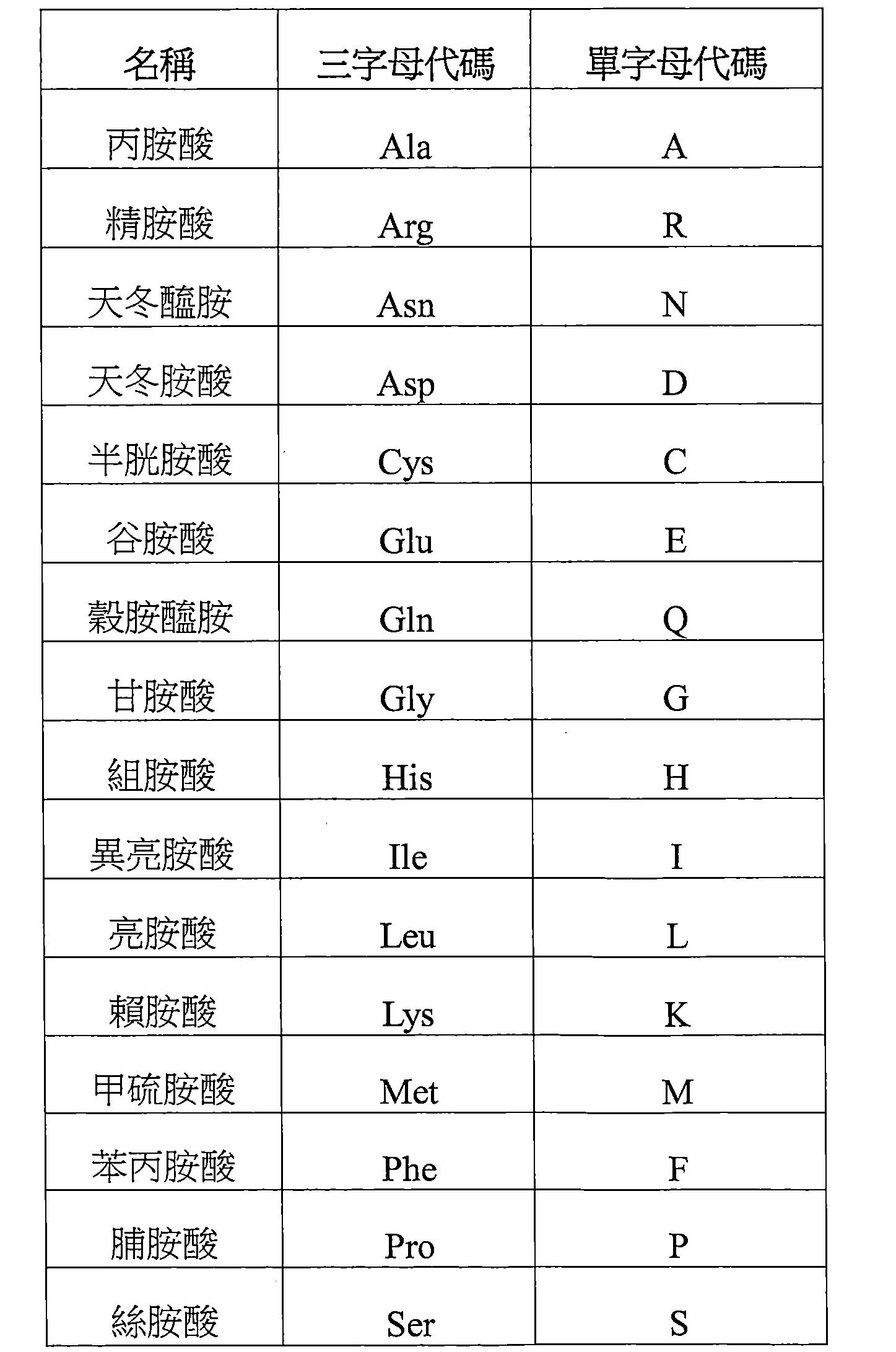

術語“多肽”、“肽”和“蛋白質”在本文中可互換使用,指胺基酸殘基的聚合物。該術語還適用於其中一個或多個胺基酸殘基是對應天然存在的胺基酸的人造化學模擬物的胺基酸聚合物,以及適用於天然存在的胺基酸聚合物和非天然存在的胺基酸聚合物。 The terms "polypeptide", "peptide" and "protein" are used interchangeably herein to refer to a polymer of amino acid residues. The term also applies to amino acid polymers in which one or more of the amino acid residues is an artificial chemical mimetic of a corresponding naturally occurring amino acid, as well as to naturally occurring amino acid polymers and non-naturally occurring amino acid polymers.
當“保守取代”用於胺基酸序列時,是指將胺基酸殘基用不同的具有相似理化性質的側鏈的胺基酸殘基替代。例如,可以在具有疏水側鏈的胺基酸殘基(例如Met、Ala、Val、Leu和Ile)之間、具有中性親水側鏈的胺基酸殘基(例如Cys、Ser、Thr、Asn和Gln)之間、具有酸性側鏈的胺基酸殘基(例如Asp、Glu)之間、具有鹼性側鏈的胺基酸殘基(例如His、Lys和Arg)之間或具有芳香族側鏈的胺基酸殘基(例如Trp、Tyr和Phe)之間進行保守取代。本領域已知,保守取代通常不會引起蛋白構象結構的顯著變化,因此能夠保留蛋白質的生物活性。 When "conservative substitution" is used for amino acid sequences, it means that the amino acid residues are replaced with different amino acid residues with similar physicochemical properties. For example, conservative substitutions can be made between amino acid residues with hydrophobic side chains (e.g., Met, Ala, Val, Leu, and Ile), between amino acid residues with neutral hydrophilic side chains (e.g., Cys, Ser, Thr, Asn, and Gln), between amino acid residues with acidic side chains (e.g., Asp, Glu), between amino acid residues with basic side chains (e.g., His, Lys, and Arg), or between amino acid residues with aromatic side chains (e.g., Trp, Tyr, and Phe). It is known in the art that conservative substitutions usually do not cause significant changes in the protein conformation and structure, and thus can retain the biological activity of the protein.
“百分比(%)序列同一性”在用於胺基酸序列(或核酸序列)時被定義為在進行序列比對,並且必要時引入空位以實現最大的對應性後,在候選序列中,與參考序列中的胺基酸(或核酸)殘基相同的胺基酸(或核酸)殘基的百分比。例如,可以使用公開可用的工具如BLASTN、BLASTp(可在美國國家生物技術信息中心(U.S.National Center for Biotechnology Information,NCBI)的網站上獲得,還參見Altschul S.F.等人,《分子生物學雜誌》,215:403-410(1990);Stephen F.等人,《核酸研究(Nucleic Acids Res.)》,25:3389-3402(1997))、ClustalW2(可在歐洲生物信息研究所(European Bioinformatics Institute)的網站上獲得,還參見Higgins D.G.等人,《酶學方法(Methods in Enzymology)》,266:383-402(1996);Larkin M.A.等人,《生物信息學(Bioinformatics)》(英國牛津(Oxford,England)),23(21):2947-8(2007))和ALIGN或Megalign(DNASTAR)軟體來實現比對以確定胺基酸(或核酸)序列的百分比序列同一性。所屬技術領域具有通常知識者可以使用由該工具提供的默認參數或可以根據比對的需要適當定制參數,例如藉由挑選合適的算法。在一些實施方案中,不同的殘基位置可能因保守胺基酸取代而不同。“保守胺基酸取代”是一個胺基酸殘基被具有類似化學性質(例如,電荷或疏水性)的側鏈(R基團)的另一個胺基酸殘基取代的胺基酸取代。總體而言,保守胺基酸取代將不會實質上改變蛋白質的功能性質。在兩個或更多個胺基酸序列因保守取代而彼此不同的情況下,百分比或類似性程度可以向上調整以校正取代的保守性質。用於作出此調整的方法是所屬技術領域具有通常知識者所熟知的。參見例如,Pearson(1994)《分子生物學方法(Methods Mol.Biol.)》24:307-331,該文獻藉由引用併入本文。 "Percent (%) sequence identity" when applied to amino acid sequences (or nucleic acid sequences) is defined as the percentage of amino acid (or nucleic acid) residues in the candidate sequence that are identical to the amino acid (or nucleic acid) residues in the reference sequence, after the sequences have been aligned and gaps have been introduced, if necessary, to achieve maximum correspondence. For example, publicly available tools such as BLASTN, BLASTp (available on the website of the U.S. National Center for Biotechnology Information (NCBI), see also Altschul S.F. et al., Journal of Molecular Biology, 215: 403-410 (1990); Stephen F. et al., Nucleic Acids Res., 25: 3389-3402 (1997)), ClustalW2 (available on the website of the European Bioinformatics Institute, see also Higgins D.G. et al., Methods in Enzymology, 266: 383-402 (1996); Larkin et al., Methods in Enzymology, 266: 383-402 (1996)), can be used. M.A. et al., Bioinformatics (Oxford, England), 23(21): 2947-8 (2007)) and ALIGN or Megalign (DNASTAR) software to achieve alignment to determine the percent sequence identity of amino acid (or nucleic acid) sequences. Those skilled in the art can use the default parameters provided by the tool or can customize the parameters appropriately according to the needs of the alignment, for example by selecting an appropriate algorithm. In some embodiments, different residue positions may differ due to conservative amino acid substitutions. A "conservative amino acid substitution" is an amino acid substitution in which an amino acid residue is replaced by another amino acid residue with a side chain (R group) of similar chemical properties (e.g., charge or hydrophobicity). In general, conservative amino acid substitutions will not substantially change the functional properties of the protein. Where two or more amino acid sequences differ from each other by conservative substitutions, the percentage or degree of similarity may be adjusted upward to correct for the conservative nature of the substitution. Methods for making this adjustment are well known to those of ordinary skill in the art. See, e.g., Pearson (1994) Methods Mol. Biol. 24:307-331, which is incorporated herein by reference.
如本文所使用的,“同源序列”是指這樣的多核苷酸序列(或其互補鏈)或胺基酸序列,其與另一個序列在視需要地比對時具有至少80%(例如至少85%、88%、90%、91%、92%、93%、94%、95%、96%、97%、98%、99%)的序列同一性。 As used herein, "homologous sequence" refers to a polynucleotide sequence (or its complementary chain) or amino acid sequence that has at least 80% (e.g., at least 85%, 88%, 90%, 91%, 92%, 93%, 94%, 95%, 96%, 97%, 98%, 99%) sequence identity with another sequence when aligned as desired.
“分離的”物質已經經人工由自然狀態改變。如果自然界中出現某種“分離的”組成物或物質,那麼其已經被改變或脫離其原始環境,或二者均有發生。例如,某一活體動物體內天然存在的多核苷酸或多肽不是“分離的”,但如果 該多核苷酸或多肽與其在天然狀態下共存的物質充分分離並以基本上純的狀態存在,則可以認為是“分離的”。分離的“核酸”或“多核苷酸”可互換使用並指分離的核酸分子的序列。在一些實施方案中,“分離的抗體或其抗原結合片段”是指純度為至少60%、70%、75%、80%、81%、82%、83%、84%、85%、86%、87%、88%、89%、90%、91%、92%、93%、94%、95%、96%、97%、98%、99%的抗體或抗原結合片段,其中純度由電泳方法(如SDS-PAGE、等電聚焦、毛細管電泳)或色譜方法(如離子交換色譜法或反相HPLC)確定。 An "isolated" substance has been artificially altered from its natural state. If an "isolated" composition or substance occurs in nature, it has been altered or removed from its original environment, or both. For example, a polynucleotide or polypeptide naturally present in a living animal is not "isolated", but if the polynucleotide or polypeptide is sufficiently separated from the substances with which it coexists in nature and exists in a substantially pure state, it can be considered "isolated". Isolated "nucleic acid" or "polynucleotide" are used interchangeably and refer to the sequence of an isolated nucleic acid molecule. In some embodiments, "isolated antibodies or antigen-binding fragments thereof" refers to antibodies or antigen-binding fragments thereof having a purity of at least 60%, 70%, 75%, 80%, 81%, 82%, 83%, 84%, 85%, 86%, 87%, 88%, 89%, 90%, 91%, 92%, 93%, 94%, 95%, 96%, 97%, 98%, 99%, wherein the purity is determined by electrophoresis (such as SDS-PAGE, isoelectric focusing, capillary electrophoresis) or chromatography (such as ion exchange chromatography or reverse phase HPLC).
術語“受試者”包括人和非人動物。非人動物包括所有脊椎動物,例如哺乳動物和非哺乳動物,如非人靈長類動物、小鼠、大鼠、貓、兔、綿羊、狗、牛、雞、兩棲動物和爬行動物。除在指出時之外,術語“患者”或“受試者”在本文中可互換使用。 The term "subject" includes humans and non-human animals. Non-human animals include all vertebrates, such as mammals and non-mammals, such as non-human primates, mice, rats, cats, rabbits, sheep, dogs, cows, chickens, amphibians, and reptiles. Except where otherwise indicated, the terms "patient" or "subject" are used interchangeably herein.
如本文所使用的,“治療(Treating或treatment)”病狀包括預防或減輕病狀、減緩病狀的發作或發展速率、降低罹患病狀的風險、預防或延遲與病狀相關的症狀的發展、減輕或結束與病狀相關的症狀、產生病狀的完全或部分消退、治癒病狀或其某種組合。 As used herein, "treating" or "treatment" of a condition includes preventing or alleviating the condition, slowing the onset or rate of development of the condition, reducing the risk of developing the condition, preventing or delaying the development of symptoms associated with the condition, reducing or ending symptoms associated with the condition, causing complete or partial regression of the condition, curing the condition, or some combination thereof.
本文使用的術語“載體”是指可以將遺傳元件可操作地插入其中並使該遺傳元件獲得表達以便產生由該遺傳元件編碼的蛋白質、RNA或DNA或複製該遺傳元件的一種運載工具。載體可以用於轉化、轉導或轉染宿主細胞,使其攜帶的遺傳元件在宿主細胞內得以表達。載體的實例包括質粒、噬菌粒、黏粒、人工染色體如酵母人工染色體(YAC)、細菌人工染色體(BAC)或P1來源的人工染色體(PAC)、如λ噬菌體或M13噬菌體等噬菌體以及動物病毒。載體可以含有多種用於控制表達的元件,包括啟動子序列、轉錄起始序列、增強子序列、可選 擇元件和報告基因。另外,載體還可以含有複製起點。載體還可以包括協助其進入細胞的材料,包括但不限於,病毒顆粒、脂質體或蛋白質塗層。載體可以是表達載體或選殖載體。本揭露提供的載體(例如表達載體)含有本文提供的編碼抗體或其抗原結合片段的核酸序列、至少一個可操作地連接到該核酸序列的啟動子(例如,SV40、CMV、EF-1α)以及至少一個選擇標誌物。 The term "vector" as used herein refers to a vehicle into which a genetic element can be operably inserted and into which the genetic element is expressed so as to produce a protein, RNA or DNA encoded by the genetic element or to replicate the genetic element. A vector can be used to transform, transduce or transfect a host cell so that the genetic element it carries is expressed in the host cell. Examples of vectors include plasmids, phagemids, cosmids, artificial chromosomes such as yeast artificial chromosomes (YAC), bacterial artificial chromosomes (BAC) or P1-derived artificial chromosomes (PAC), phages such as lambda phage or M13 phage, and animal viruses. A vector can contain a variety of elements for controlling expression, including a promoter sequence, a transcription initiation sequence, an enhancer sequence, a selectable element, and a reporter gene. In addition, a vector can also contain a replication origin. The vector may also include materials that assist it in entering cells, including but not limited to viral particles, liposomes, or protein coatings. The vector may be an expression vector or a selection vector. The vector provided by the present disclosure (e.g., an expression vector) contains a nucleic acid sequence encoding an antibody or an antigen-binding fragment thereof provided herein, at least one promoter (e.g., SV40, CMV, EF-1α) operably linked to the nucleic acid sequence, and at least one selection marker.
如本文所使用的,“宿主細胞”是指其中已引入有外源多核苷酸和/或載體的細胞。 As used herein, "host cell" refers to a cell into which an exogenous polynucleotide and/or vector has been introduced.
如本文所使用的,術語“可溶性”是指分子(例如,蛋白質)溶解在溶劑(如液體和水性環境)中的能力。 As used herein, the term "soluble" refers to the ability of a molecule (e.g., a protein) to dissolve in a solvent (e.g., a liquid or aqueous environment).
如本文所使用的,術語“轉化生長因子β”和“TGFβ”是指具有來自受試者(例如,人)的任何TGF-β的全長、天然胺基酸序列的任何TGFβ家族蛋白,包括前體和成熟TGFβ的潛在形式和相關或非相關複合物(“潛在TGFβ”)。在本文中提及此類TGFβ將被理解為提及任何一種當前鑑定的形式,包括TGFβ1、TGFβ2、TGFβ3同種型及其潛在型式,以及未來鑑定的人TGFβ種類,包括衍生自任何已知TGFβ的序列並且與該序列至少約75%、較佳地至少約80%、更佳地至少約85%、仍更佳地至少約90%並且甚至更佳地至少約95%同源的多肽。具體術語“TGFβ1”、“TGFβ2”和“TGFβ3”是指文獻中定義的TGF-β,例如Derynck等人,《自然.癌症研究(Nature,Cancer Res.)》,47:707(1987);Seyedin等人,《生物化學雜誌》,261:5693-5695(1986);deMartin等人,《歐洲分子生物學學會雜誌(EMBO J.)》,6:3673(1987);Kuppner等人,《國際癌症雜誌(Int.J.Cancer)》,42:562(1988)。術語“轉化生長因子β”、“TGFβ”、“TGFbeta”、“TGF-β”和“TGF-beta”在本揭露中可互換使用。 As used herein, the terms "transforming growth factor β" and "TGFβ" refer to any TGFβ family protein having a full-length, native amino acid sequence of any TGF-β from a subject (e.g., a human), including potential forms of precursor and mature TGFβ and related or unrelated complexes ("potential TGFβ"). References to such TGFβ herein will be understood as references to any currently identified form, including TGFβ1, TGFβ2, TGFβ3 isoforms and potential forms thereof, as well as human TGFβ species identified in the future, including polypeptides derived from the sequence of any known TGFβ and at least about 75%, preferably at least about 80%, more preferably at least about 85%, still more preferably at least about 90%, and even more preferably at least about 95% homologous to the sequence. The specific terms "TGFβ1", "TGFβ2" and "TGFβ3" refer to TGF-β as defined in the literature, such as Derynck et al., Nature , Cancer Res ., 47:707 (1987); Seyedin et al., Journal of Biochemistry, 261:5693-5695 (1986); deMartin et al., EMBO J. , 6:3673 (1987); Kuppner et al., Int. J. Cancer, 42:562 (1988). The terms "transforming growth factor β", "TGFβ", "TGFbeta", "TGF-β" and "TGF-beta" are used interchangeably in the present disclosure.
如本文所使用的,術語“人TGFβ1”是指由人TGFB1基因(例如,野生型人TGFB1基因)編碼的TGFβ1蛋白。示例性野生型人TGFβ1蛋白由GenBank登錄號NP_000651.3提供。如本文所使用的,術語“人TGFβ2”是指由人TGFB2基因(例如,野生型人TGFB2基因)編碼的TGFβ2蛋白。示例性野生型人TGFβ2蛋白由GenBank登錄號NP_001129071.1和NP_003229.1提供。如本文所使用的,術語“人TGFβ3”是指由人TGFB3基因(例如,野生型人TGFB3基因)編碼的TGFβ3蛋白。示例性野生型人TGFβ3蛋白由GenBank登錄號NP_003230.1、NP_001316868.1和NP_001316867.1提供。 As used herein, the term "human TGFβ1" refers to a TGFβ1 protein encoded by a human TGFB1 gene (e.g., a wild-type human TGFB1 gene). An exemplary wild-type human TGFβ1 protein is provided by GenBank Accession No. NP_000651.3. As used herein, the term "human TGFβ2" refers to a TGFβ2 protein encoded by a human TGFB2 gene (e.g., a wild-type human TGFB2 gene). Exemplary wild-type human TGFβ2 proteins are provided by GenBank Accession Nos. NP_001129071.1 and NP_003229.1. As used herein, the term "human TGFβ3" refers to a TGFβ3 protein encoded by a human TGFB3 gene (e.g., a wild-type human TGFB3 gene). Exemplary wild-type human TGFβ3 proteins are provided by GenBank Accession Nos. NP_003230.1, NP_001316868.1, and NP_001316867.1.
如本文所使用的,術語“小鼠TGFβ1”、“小鼠TGFβ2”和“小鼠TGFβ3”是指分別由小鼠TGFB1基因(例如,野生型小鼠TGFB1基因)、小鼠TGFB2基因(例如,野生型小鼠TGFB2基因)和小鼠TGFB3基因(例如,野生型小鼠TGFB3基因)編碼的TGFβ1蛋白、TGFβ2蛋白和TGFβ3蛋白。示例性野生型小鼠(小家鼠(Mus musculus))TGFβ1蛋白由GenBank登錄號NP_035707.1和CAA08900.1提供。示例性野生型小鼠TGFβ2蛋白由GenBank登錄號NP_033393.2提供。示例性野生型小鼠TGFβ3蛋白由GenBank登錄號AAA40422.1提供。 As used herein, the terms "mouse TGFβ1", "mouse TGFβ2" and "mouse TGFβ3" refer to TGFβ1 protein, TGFβ2 protein and TGFβ3 protein encoded by the mouse TGFB1 gene (e.g., wild-type mouse TGFB1 gene), the mouse TGFB2 gene (e.g., wild-type mouse TGFB2 gene) and the mouse TGFB3 gene (e.g., wild-type mouse TGFB3 gene), respectively. Exemplary wild-type mouse ( Mus musculus )) TGFβ1 proteins are provided by GenBank Accession Nos. NP_035707.1 and CAA08900.1. Exemplary wild-type mouse TGFβ2 proteins are provided by GenBank Accession No. NP_033393.2. Exemplary wild-type mouse TGFβ3 proteins are provided by GenBank Accession No. AAA40422.1.
如本文所使用的,術語“TGFβ受體”是指結合至少一種TGFβ同種型的任何受體。通常,TGFβ受體包括TGFβ受體I(TGFβRI)、TGFβ受體II(TGFβRII)或TGFβ受體III(TGFβRIII)。 As used herein, the term "TGFβ receptor" refers to any receptor that binds at least one TGFβ isoform. Typically, the TGFβ receptor includes TGFβ receptor I (TGFβRI), TGFβ receptor II (TGFβRII), or TGFβ receptor III (TGFβRIII).
關於人,術語“TGFβ受體I”或“TGFβRI”是指人TGFβ受體1型序列,包括野生型TGFβRI以及其已知能夠與至少一種TGFβ同種型結合的所有同種型和變體。野生型TGFβRI的示例性胺基酸序列可在GenBank登錄號
ABD46753.1或UniProtKB-P36897下獲得,也包括在本文中作為SEQ ID NO:69。變體TGFβRI可以具有與SEQ ID NO:69的胺基酸序列具有至少80%、85%、90%、91%、92%、93%、94%、95%、96%、97%、98%、99%序列同一性的序列並保留野生型序列(例如SEQ ID NO:69)的TGFβ結合活性的至少25%、35%、50%、75%、90%、95%或99%。
With respect to humans, the term "TGFβ receptor I" or "TGFβRI" refers to the human
關於人,術語“TGFβ受體II”或“TGFβRII”是指人TGFβ受體2型同種型A序列,包括野生型TGFβRII以及其已知能夠與至少一種TGFβ同種型結合的所有同種型和變體。野生型TGFβRII同種型A或同種型1的示例性胺基酸序列可在GenBank登錄號NP_001020018.1或UniProtKB-P37173-1下獲得,也包括在本文中作為SEQ ID NO:70,並且野生型TGFβRII同種型B可在GenBank登錄號NP_003233.4或UniProtKB-P37173-2下獲得,也包括在本文中作為SEQ ID NO:71。變體TGFβRII可以具有與SEQ ID NO:70或71具有至少80%、85%、90%、91%、92%、93%、94%、95%、96%、97%、98%、99%序列同一性的序列並保留野生型序列(例如SEQ ID NO:70或71)的TGFβ結合活性的至少25%、35%、50%、75%、90%、95%或99%。
With respect to humans, the term "TGFβ receptor II" or "TGFβRII" refers to the human
關於人,術語“TGFβ受體III”或“TGFβRIII”是指人TGFβ受體3型序列,包括野生型TGFβRII以及所有同種型和變體。野生型TGFβRIII的示例性胺基酸序列可在GenBank登錄號NP_003234.2或UniProtKB-Q03167下獲得,也包括在本文中作為SEQ ID NO:72。
With respect to humans, the term "TGFβ receptor III" or "TGFβRIII" refers to the human
如本文所使用的,關於某種參考蛋白或肽的術語“變體”是指參考蛋白或肽的經修飾型式,例如其功能等效物、片段、融合體、衍生物、模擬物或任何組合,該經修飾型式具有與參考序列具有至少70%(例如80%、85%、90%、 91%、92%、93%、94%、95%、96%、97%、98%、99%)序列同一性的胺基酸序列並保留參考序列(例如野生型序列)的生物活性或結合活性的至少25%(例如35%、50%、75%、90%、95%或99%)。該變體可以是參考蛋白或肽的片段、突變體、融合體、截短體或其任何組合。 As used herein, the term "variant" with respect to a reference protein or peptide refers to a modified form of the reference protein or peptide, such as a functional equivalent, fragment, fusion, derivative, mimetic, or any combination thereof, which has an amino acid sequence with at least 70% (e.g., 80%, 85%, 90%, 91%, 92%, 93%, 94%, 95%, 96%, 97%, 98%, 99%) sequence identity to the reference sequence and retains at least 25% (e.g., 35%, 50%, 75%, 90%, 95% or 99%) of the biological activity or binding activity of the reference sequence (e.g., wild-type sequence). The variant may be a fragment, mutant, fusion, truncation, or any combination thereof of the reference protein or peptide.
如本文所使用的,術語“白細胞介素-1”或“IL-1”包括IL-1α和IL-1β、它們的前體(例如pro-IL-1α和pro-IL-1β)、同種型和變體。 As used herein, the term "interleukin-1" or "IL-1" includes IL-1α and IL-1β, their precursors (e.g., pro-IL-1α and pro-IL-1β), isoforms and variants.
如本文所使用的,術語“人IL-1α”是指由人IL1A基因(例如,野生型人IL1A基因)編碼的IL-1α蛋白以及同種型和變體。UniProtKB-P01583提供了示例性野生型人IL1α蛋白。 As used herein, the term "human IL-1α" refers to IL-1α proteins encoded by a human IL1A gene (e.g., a wild-type human IL1A gene), as well as isoforms and variants. UniProtKB-P01583 provides an exemplary wild-type human IL1α protein.
如本文所使用的,術語“人IL-1β”是指由人IL1B基因(例如,野生型人IL1B基因)編碼的IL-1β蛋白。示例性野生型人IL1β蛋白由GenBank登錄號NP_000567.1或UniProtKB-C9JVK0提供。 As used herein, the term "human IL-1β" refers to an IL-1β protein encoded by a human IL1B gene (e.g., a wild-type human IL1B gene). An exemplary wild-type human IL1β protein is provided by GenBank Accession No. NP_000567.1 or UniProtKB-C9JVK0.
如本文所使用的,術語“IL-1受體”或“IL-1R”是指可以與IL-1結合的受體,包括其能夠與IL-1結合的所有野生型受體、同種型和變體。通常,存在兩種類型的IL-1受體,即IL-1受體I(IL-1RI)和IL-1受體II(IL-1RII)。IL-1RII充當與配體結合而不轉導信號的誘餌受體。IL-1RII的蛋白水解切割引起可溶性受體,例如IL-1sRI和IL-1sRII的形成,該可溶性受體與配體結合而不轉導信號(細節參見Thomas G.Kennedy,《激素百科全書(Encyclopedia of Hormones)》中的第V.B.2.章,2003)。IL-1sRI和IL-1sRII是IL-1RII的蛋白水解切割產物並且可以是一組IL-1RII的胞外結構域片段。術語IL-1R還旨在涵蓋輔助受體IL-1RAP,該輔助受體可以與結合到IL-1β的IL-1RI締合,以形成高親和力的白細
胞介素1受體複合物,該複合物介導NF-κ-B的白細胞介素1依賴性激活和其它通路。
As used herein, the term "IL-1 receptor" or "IL-1R" refers to a receptor that can bind to IL-1, including all wild-type receptors, isoforms and variants thereof that can bind to IL-1. Generally, there are two types of IL-1 receptors, IL-1 receptor I (IL-1RI) and IL-1 receptor II (IL-1RII). IL-1RII acts as a bait receptor that binds to a ligand without transducing a signal. Proteolytic cleavage of IL-1RII causes the formation of soluble receptors, such as IL-1sRI and IL-1sRII, which bind to a ligand without transducing a signal (see Thomas G. Kennedy, Chapter V.B.2. in Encyclopedia of Hormones, 2003 for details). IL-1sRI and IL-1sRII are proteolytic cleavage products of IL-1RII and may be a group of extracellular domain fragments of IL-1RII. The term IL-1R is also intended to encompass the co-receptor IL-1RAP, which can bind to IL-1RI bound to IL-1β to form a high-
如本文所使用的,術語“IL-1RI”包括野生型IL-1RI以及其能夠與IL-1α和/或IL-1β結合的所有同種型和變體。野生型IL-1RI的示例性胺基酸序列可在UniProtKB-P14778下獲得,也包括在本文中作為SEQ ID NO:73。 As used herein, the term "IL-1RI" includes wild-type IL-1RI and all isoforms and variants thereof that are capable of binding to IL-1α and/or IL-1β. An exemplary amino acid sequence of wild-type IL-1RI is available under UniProtKB-P14778 and is also included herein as SEQ ID NO: 73.
如本文所使用的,術語“IL-1RII”包括野生型IL-1RII以及其能夠與IL-1α和/或IL-1β結合的所有同種型和變體。野生型IL-1RII的示例性胺基酸序列可在UniProtKB-P27930下獲得,也包括在本文中作為SEQ ID NO:75。 As used herein, the term "IL-1RII" includes wild-type IL-1RII and all isoforms and variants thereof that are capable of binding to IL-1α and/or IL-1β. An exemplary amino acid sequence of wild-type IL-1RII is available under UniProtKB-P27930 and is also included herein as SEQ ID NO: 75.
如本文所使用的,術語“IL-1RAP”包括野生型IL-1RAP以及其能夠與結合到IL-1β的IL-1R結合的所有同種型和變體。野生型IL-1RAP的示例性胺基酸序列可在UniProtKB-Q9NPH3下獲得,也包括在本文中作為SEQ ID NO:74。 As used herein, the term "IL-1RAP" includes wild-type IL-1RAP and all isoforms and variants thereof that are capable of binding to IL-1R bound to IL-1β. An exemplary amino acid sequence of wild-type IL-1RAP is available under UniProtKB-Q9NPH3 and is also included herein as SEQ ID NO: 74.
如本文所使用的,術語“IL-1sRI”包括可以藉由涉及金屬蛋白酶的蛋白水解切割產生的所有可溶形式的IL-1RI。天然存在的IL-1sRI的分子量可以在約45kDa到60Kda的範圍內。此術語還涵蓋IL-1sRI的能夠與IL-1α和/或IL-1β結合的所有同種型和變體。 As used herein, the term "IL-1sRI" includes all soluble forms of IL-1RI that can be produced by proteolytic cleavage involving metalloproteinases. The molecular weight of naturally occurring IL-1sRI can range from about 45 kDa to 60 KDa. This term also encompasses all isoforms and variants of IL-1sRI that are capable of binding to IL-1α and/or IL-1β.
如本文所使用的,術語“IL-1sRII”包括可以藉由涉及金屬蛋白酶的蛋白水解切割產生的所有可溶形式的IL-1RII。天然存在的IL-1sRII的分子量可以在約45kDa到60Kda的範圍內。此術語還涵蓋IL-1sRII的能夠與IL-1α和/或IL-1β結合的所有同種型和變體。 As used herein, the term "IL-1sRII" includes all soluble forms of IL-1RII that can be produced by proteolytic cleavage involving metalloproteinases. The molecular weight of naturally occurring IL-1sRII can range from about 45 kDa to 60 KDa. This term also encompasses all isoforms and variants of IL-1sRII that are capable of binding to IL-1α and/or IL-1β.
如本文所使用的,術語“IL-1受體拮抗劑”通常包括可以與IL-1α或IL-1β競爭結合IL-1受體並抑制IL-1α或IL-1β活性的任何蛋白。臎IL-1受體 拮抗劑可以包括天然存在的拮抗劑,如IL-1Ra、IL-1sRI和IL-1sRII,以及其它可以阻斷IL-1α或IL-1β的結合以結合到IL-1受體,具體地IL-1RI的人工拮抗劑。 As used herein, the term "IL-1 receptor antagonist" generally includes any protein that can compete with IL-1α or IL-1β for binding to IL-1 receptor and inhibit the activity of IL-1α or IL-1β. IL-1 receptor antagonists may include naturally occurring antagonists such as IL-1Ra, IL-1sRI and IL-1sRII, as well as other artificial antagonists that can block the binding of IL-1α or IL-1β to bind to IL-1 receptor, specifically IL-1RI.
如本文所使用的,術語“IL-1Ra”包括野生型IL-1Ra以及其能夠與IL-1α和/或IL-1β結合的所有同種型和變體。野生型IL-1Ra的示例性胺基酸序列可在UniProtKB-P18510下獲得,也包括在本文中作為SEQ ID NO:76。 As used herein, the term "IL-1Ra" includes wild-type IL-1Ra and all isoforms and variants thereof that are capable of binding to IL-1α and/or IL-1β. An exemplary amino acid sequence of wild-type IL-1Ra is available under UniProtKB-P18510 and is also included herein as SEQ ID NO: 76.
如本文所使用的,“癌症”是指以惡性細胞生長或贅生物、異常增殖、浸潤或轉移為特徵的任何醫學病狀,並且可以是良性或惡性的,並且包括實體瘤和非實體癌(例如血液系統惡性腫瘤)如白血病。如本文所使用的,“實體瘤”是指贅生性和/或惡性細胞的實體團塊。 As used herein, "cancer" refers to any medical condition characterized by malignant cell growth or metastasis, abnormal proliferation, infiltration or metastasis, and can be benign or malignant, and includes solid tumors and non-solid cancers (e.g., hematological malignancies) such as leukemia. As used herein, "solid tumor" refers to a solid mass of metastatic and/or malignant cells.
術語“藥學上可接受的”表示指定的載體、媒劑、稀釋劑、賦形劑和/或鹽通常與構成調配物的其它成分在化學和/或物理上相容,並且與其接受者在生理上相容。 The term "pharmaceutically acceptable" means that the specified carrier, vehicle, diluent, excipient and/or salt is generally chemically and/or physically compatible with the other ingredients that make up the formulation and is physiologically compatible with the recipient thereof.
當關於胺基酸序列(例如,肽、多肽或蛋白質)使用時,術語“融合”或“融合的”是指例如藉由化學鍵合或重組手段將兩個或更多個胺基酸序列組合成天然不存在的單一胺基酸序列。融合胺基酸序列可以藉由兩個編碼多核苷酸序列的基因重組產生,並且可以藉由將含有重組多核苷酸的構建體引入到宿主細胞中的方法表達。 The term "fusion" or "fused" when used in relation to amino acid sequences (e.g., peptides, polypeptides, or proteins) refers to the combination of two or more amino acid sequences into a single amino acid sequence that does not occur naturally, for example, by chemical bonding or recombinant means. The fused amino acid sequence can be produced by genetic recombination of two encoding polynucleotide sequences and can be expressed by introducing a construct containing the recombinant polynucleotide into a host cell.
本揭露實施方案的進一步詳細描述Further detailed description of the disclosed embodiments
本揭露上下文所述的各個實施方案以及各個實施方案中的特徵應當被理解為可以以任何方式進行相互組合,這些相互組合得到的各個方案均 包括在本揭露的範圍內、就如同在本文中具體地且逐一地列出了這些相互組合而得到的方案一樣,除非上下文清楚地顯示並非如此。 The various embodiments and features in the various embodiments described in the context of this disclosure should be understood to be able to be combined with each other in any way, and the various solutions obtained by these combinations are included in the scope of this disclosure, just as the solutions obtained by these combinations are specifically and one by one listed in this article, unless the context clearly shows otherwise.
本揭露的以下描述僅旨在說明本揭露的各個實施方案。如此,所討論的具體變化之處不應被解釋為對本揭露的範圍的限制。所屬技術領域具有通常知識者顯然知曉,在不脫離本揭露範圍的情況下,可以做出各種等同物、改變和修改,並且應當理解,此類等同實施方案將被包括在本文中。在本文中引用的所有文獻,包括公開出版物、專利和專利申請都藉由引用的方式全文併入。 The following description of the present disclosure is intended only to illustrate various embodiments of the present disclosure. As such, the specific variations discussed should not be interpreted as limiting the scope of the present disclosure. It is obvious to those skilled in the art that various equivalents, changes, and modifications may be made without departing from the scope of the present disclosure, and it should be understood that such equivalent embodiments are to be included herein. All references cited herein, including publications, patents, and patent applications, are incorporated by reference in their entirety.
I.靶向免疫檢查點分子並阻斷IL-1活性的雙功能分子I. Bifunctional molecules that target immune checkpoint molecules and block IL-1 activity
本揭露提供了一種雙功能分子,其包括與免疫檢查點分子結合的第一部分和阻斷白細胞介素-1(IL-1)的活性的第二部分。本文提供的雙功能分子藉由用IL-1結合部分或IL-1受體(IL-1R)結合部分(即,雙功能分子的第二部分)阻斷IL-1與IL-1受體之間的相互作用,允許阻斷和/或降低腫瘤微環境中的IL-1活性。IL-1結合部分和/或IL-1R結合部分可以連接到靶向免疫檢查點分子的部分(即,雙功能分子的第一部分),該免疫檢查點分子可以在某些腫瘤細胞或免疫細胞的表面上發現。 The present disclosure provides a bifunctional molecule comprising a first portion that binds to an immune checkpoint molecule and a second portion that blocks the activity of interleukin-1 (IL-1). The bifunctional molecules provided herein allow blocking and/or reducing IL-1 activity in the tumor microenvironment by blocking the interaction between IL-1 and the IL-1 receptor with an IL-1 binding portion or an IL-1 receptor (IL-1R) binding portion (i.e., the second portion of the bifunctional molecule). The IL-1 binding portion and/or the IL-1R binding portion can be linked to a portion that targets an immune checkpoint molecule (i.e., the first portion of the bifunctional molecule), which can be found on the surface of certain tumor cells or immune cells.
IL-1是炎性細胞因子。炎症是腫瘤微環境的重要組成部分,並且IL-1在致癌作用和腫瘤進展中起著關鍵作用(A.Mantovani等人,《免疫學評論(Immunol Rev.)》2018年1月;281(1):57-61.)。IL-1在腫瘤起始和進展中在不同水平上起作用,包括驅動慢性非可控性炎症、腫瘤血管生成、IL-17通路的激活、骨髓源性抑制細胞(MDSC)的誘導和巨噬細胞募集、侵襲和轉移(出處同上)。 IL-1 is an inflammatory cytokine. Inflammation is an important component of the tumor microenvironment, and IL-1 plays a key role in carcinogenesis and tumor progression (A. Mantovani et al., Immunol Rev. 2018 Jan;281(1):57-61.). IL-1 plays a role at different levels in tumor initiation and progression, including driving chronic uncontrolled inflammation, tumor angiogenesis, activation of the IL-17 pathway, induction of myeloid-derived suppressor cells (MDSCs), and macrophage recruitment, invasion, and metastasis (ibid.).
免疫檢查點分子在某些免疫細胞如T細胞、自然殺傷細胞等上表達。一些癌細胞也可以表達某些免疫檢查點分子,這可能阻斷免疫檢查點的激活,從而使癌細胞避開免疫系統的監視。 Immune checkpoint molecules are expressed on certain immune cells such as T cells, natural killer cells, etc. Some cancer cells can also express certain immune checkpoint molecules, which may block the activation of immune checkpoints, thereby allowing cancer cells to avoid the surveillance of the immune system.
藉由減少腫瘤微環境中的IL-1並減少檢查點阻斷,本揭露提供了一種新型雙功能分子,該新型雙功能分子可以用於治療免疫檢查點相關疾病,如癌症、自身免疫疾病、傳染病等。 By reducing IL-1 in the tumor microenvironment and reducing checkpoint blockade, the present disclosure provides a novel bifunctional molecule that can be used to treat immune checkpoint-related diseases such as cancer, autoimmune diseases, infectious diseases, etc.
在一些實施方案中,第一部分包括具有免疫刺激或共刺激活性的檢查點分子的激動劑。此類免疫刺激性檢查點分子可包括但不限於CD27、CD70、CD28、CD80(B7-1)、CD86(B7-2)、CD40、CD40L(CD154)、CD122、CD137、CD137L、OX40(CD134)、OX40L(CD252)、GITR、ICOS(CD278)和ICOSLG(CD275)、CD2、ICAM-1、LFA-1(CD11a/CD18)、CD30、BAFFR、HVEM、CD7、LIGHT、NKG2C、SLAMF7、NKp80、CD160和CD83。 In some embodiments, the first part includes an agonist of a checkpoint molecule having immunostimulatory or co-stimulatory activity. Such immunostimulatory checkpoint molecules may include, but are not limited to, CD27, CD70, CD28, CD80 (B7-1), CD86 (B7-2), CD40, CD40L (CD154), CD122, CD137, CD137L, OX40 (CD134), OX40L (CD252), GITR, ICOS (CD278) and ICOSLG (CD275), CD2, ICAM-1, LFA-1 (CD11a/CD18), CD30, BAFFR, HVEM, CD7, LIGHT, NKG2C, SLAMF7, NKp80, CD160, and CD83.
在一些實施方案中,第一部分包括具有免疫抑制或共抑制活性的檢查點分子的抑制劑。此類免疫抑制性檢查點分子可以包括但不限於A2AR、B7-H3(CD276)、B7-H4(VTCN1)、BTLA(CD272)、CTLA-4(CD152)、IDO1、IDO2、TDO、KIR、LAG3、NOX2、PD-1、PD-L1、PD-L2、TIM-3、VISTA、SIGLEC7(CD328)、TIGIT、PVR(CD155)、SIGLEC9(CD329)、CD160、LAIR1、2B4(CD244)、CD47和B7-H5。 In some embodiments, the first part includes an inhibitor of a checkpoint molecule with immunosuppressive or co-inhibitory activity. Such immunosuppressive checkpoint molecules may include, but are not limited to, A2AR, B7-H3 (CD276), B7-H4 (VTCN1), BTLA (CD272), CTLA-4 (CD152), IDO1, IDO2, TDO, KIR, LAG3, NOX2, PD-1, PD-L1, PD-L2, TIM-3, VISTA, SIGLEC7 (CD328), TIGIT, PVR (CD155), SIGLEC9 (CD329), CD160, LAIR1, 2B4 (CD244), CD47, and B7-H5.
在一些實施方案中,該免疫檢查點分子是PD-L1。在一些實施方案中,第一部分包括針對PD-L1的抗體部分或其抗原結合片段。在一些實施方案中,第一部分包括針對PD-L1的拮抗劑抗體部分或其抗原結合片段。 In some embodiments, the immune checkpoint molecule is PD-L1. In some embodiments, the first portion includes an antibody portion or an antigen-binding fragment thereof directed against PD-L1. In some embodiments, the first portion includes an antagonist antibody portion or an antigen-binding fragment thereof directed against PD-L1.
在一些實施方案中,該第二部分包括IL-1結合部分或IL-1受體(IL-1R)結合部分。 In some embodiments, the second portion includes an IL-1 binding portion or an IL-1 receptor (IL-1R) binding portion.
IL-1α和IL-1β都是促炎的並且與IL-1R結合。在與IL-1α或IL-1β結合後,IL-1R可以將IL-1R輔助蛋白和銜接蛋白MyD88募集到受體複合物,從而引起下游信號傳導級聯的激活,並最終激活大量免疫和炎症基因。本發明人發現,阻斷IL-1的活性或其與IL-1R的結合與免疫檢查點分子的調節的組合將是有用的。 Both IL-1α and IL-1β are pro-inflammatory and bind to IL-1R. After binding to IL-1α or IL-1β, IL-1R can recruit IL-1R accessory protein and adapter protein MyD88 to the receptor complex, thereby causing activation of downstream signaling cascades and ultimately activating a large number of immune and inflammatory genes. The inventors have found that blocking the activity of IL-1 or its binding to IL-1R in combination with the regulation of immune checkpoint molecules will be useful.
在一些實施方案中,IL-1是IL-1α或IL-1β。在一些實施方案中,IL-1β是人IL-1β。 In some embodiments, IL-1 is IL-1α or IL-1β. In some embodiments, IL-1β is human IL-1β.
在一些實施方案中,該第二部分包括IL-1結合部分。在一些實施方案中,該IL-1結合部分特異性結合到IL-1α或IL-1β。在一些實施方案中,該IL-1結合部分包括可溶性IL-1R、IL-1R的IL-1結合片段或變體、或針對IL-1的抗體或其抗原結合片段。 In some embodiments, the second portion includes an IL-1 binding portion. In some embodiments, the IL-1 binding portion specifically binds to IL-1α or IL-1β. In some embodiments, the IL-1 binding portion includes a soluble IL-1R, an IL-1 binding fragment or variant of IL-1R, or an antibody against IL-1 or an antigen-binding fragment thereof.
可溶性IL-1R可以是IL-1R的結構域或片段,例如IL-1R的胞外結構域(ECD)。可替代地,可溶性IL-1R也可以是IL-1sRI或IL-1sRII,它們是天然可溶性並能夠與IL-1結合的同種型。 The soluble IL-1R may be a domain or fragment of IL-1R, such as the extracellular domain (ECD) of IL-1R. Alternatively, the soluble IL-1R may also be IL-1sRI or IL-1sRII, which are naturally soluble isoforms capable of binding to IL-1.
所屬技術領域具有通常知識者將理解,IL-1RI或IL-1RI的ECD、或IL-1RII或IL-1RII的ECD、或IL-1RAP或IL-1RAP的ECD、或IL-1sRI或IL-1sRII的縮短片段可能足以結合到IL-1(例如,IL-1α或IL-1β),只要此類片段含有IL-1結合結構域。因此,本揭露還涵蓋IL-1RI、IL-1RI的ECD、或IL-1RII、或IL-1RII的ECD、或IL-1RAP、或IL-1RAP的ECD、IL-1sRI和IL-1sRII中的任一者的所有IL-1結合片段和變體。在一些實施方案中,IL-1結合部分包括SEQ ID NO:73、74或75的胺基酸序列或其IL-1結合片段或變體。在一些實施方案中,IL-1結合部分包括與SEQ ID NO:73、74和75中的任一者具有至少80%序列同一性的胺基酸序列或其IL-1結合片段或變體。 A person of ordinary skill in the art will understand that shortened fragments of IL-1RI or IL-1RI ECD, or IL-1RII or IL-1RII ECD, or IL-1RAP or IL-1RAP ECD, or IL-1sRI or IL-1sRII may be sufficient to bind to IL-1 (e.g., IL-1α or IL-1β) as long as such fragments contain an IL-1 binding domain. Thus, the present disclosure also encompasses all IL-1 binding fragments and variants of any of IL-1RI, IL-1RI ECD, or IL-1RII, or IL-1RII ECD, or IL-1RAP, or IL-1RAP ECD, IL-1sRI, and IL-1sRII. In some embodiments, the IL-1 binding portion comprises the amino acid sequence of SEQ ID NO: 73, 74, or 75, or an IL-1 binding fragment or variant thereof. In some embodiments, the IL-1 binding portion comprises an amino acid sequence having at least 80% sequence identity to any one of SEQ ID NOs: 73, 74, and 75, or an IL-1 binding fragment or variant thereof.
在一些實施方案中,IL-1結合部分包括針對IL-1的抗體或其抗原結合片段。也可以使用針對IL-1的抗體或其抗原結合片段,只要此類抗體或抗原結合片段可以阻斷IL-1(例如IL-1α或IL-1β)與IL-1R的結合即可。 In some embodiments, the IL-1 binding portion includes an antibody or antigen binding fragment thereof against IL-1. Antibodies or antigen binding fragments thereof against IL-1 may also be used, as long as such antibodies or antigen binding fragments can block the binding of IL-1 (e.g., IL-1α or IL-1β) to IL-1R.
在一些實施方案中,該針對IL-1的抗體或其抗原結合片段包含重鏈可變區和/或輕鏈可變區,該重鏈可變區包含包括SEQ ID NO:104或SEQ ID NO:112的序列的HCDR1,包括SEQ ID NO:105或SEQ ID NO:113的序列的HCDR2,和包括SEQ ID NO:106或SEQ ID NO:114的序列的HCDR3,該輕鏈可變區包含包括SEQ ID NO:107或SEQ ID NO:115的序列的LCDR1,包括SEQ ID NO:108或SEQ ID NO:116的序列的LCDR2,和包括SEQ ID NO:109或SEQ ID NO:117的序列的LCDR3。 In some embodiments, the antibody or antigen-binding fragment thereof against IL-1 comprises a heavy chain variable region and/or a light chain variable region, wherein the heavy chain variable region comprises a HCDR1 comprising a sequence of SEQ ID NO: 104 or SEQ ID NO: 112, a HCDR2 comprising a sequence of SEQ ID NO: 105 or SEQ ID NO: 113, and a HCDR3 comprising a sequence of SEQ ID NO: 106 or SEQ ID NO: 114, and the light chain variable region comprises a LCDR1 comprising a sequence of SEQ ID NO: 107 or SEQ ID NO: 115, a LCDR2 comprising a sequence of SEQ ID NO: 108 or SEQ ID NO: 116, and a LCDR3 comprising a sequence of SEQ ID NO: 109 or SEQ ID NO: 117.
在一些實施方案中,該針對IL-1的抗體或其抗原結合片段包含重鏈可變區和/或輕鏈可變區,該重鏈可變區包含包括SEQ ID NO:104的序列的HCDR1,包括SEQ ID NO:105的序列的HCDR2,和包括SEQ ID NO:106的序列的HCDR3,該輕鏈可變區包含包括SEQ ID NO:107的序列的LCDR1,包括SEQ ID NO:108的序列的LCDR2,和包括SEQ ID NO:109的序列的LCDR3。 In some embodiments, the antibody or antigen-binding fragment thereof against IL-1 comprises a heavy chain variable region and/or a light chain variable region, wherein the heavy chain variable region comprises a HCDR1 comprising a sequence of SEQ ID NO: 104, a HCDR2 comprising a sequence of SEQ ID NO: 105, and a HCDR3 comprising a sequence of SEQ ID NO: 106, and the light chain variable region comprises a LCDR1 comprising a sequence of SEQ ID NO: 107, a LCDR2 comprising a sequence of SEQ ID NO: 108, and a LCDR3 comprising a sequence of SEQ ID NO: 109.
在一些實施方案中,該針對IL-1的抗體或其抗原結合片段包含重鏈可變區和/或輕鏈可變區,該重鏈可變區包含包括SEQ ID NO:112的序列的HCDR1,包括SEQ ID NO:113的序列的HCDR2,和包括SEQ ID NO:114的序 列的HCDR3,該輕鏈可變區包含包括SEQ ID NO:115的序列的LCDR1,包括SEQ ID NO:116的序列的LCDR2,和包括SEQ ID NO:117的序列的LCDR3。 In some embodiments, the antibody or antigen-binding fragment thereof against IL-1 comprises a heavy chain variable region and/or a light chain variable region, wherein the heavy chain variable region comprises a HCDR1 comprising a sequence of SEQ ID NO: 112, a HCDR2 comprising a sequence of SEQ ID NO: 113, and a HCDR3 comprising a sequence of SEQ ID NO: 114, and the light chain variable region comprises a LCDR1 comprising a sequence of SEQ ID NO: 115, a LCDR2 comprising a sequence of SEQ ID NO: 116, and a LCDR3 comprising a sequence of SEQ ID NO: 117.
在一些實施方案中,該針對IL-1的抗體或其抗原結合片段包含重鏈可變區和/或輕鏈可變區,該重鏈可變區包含選自由以下組成的組的序列:SEQ ID NO:102、SEQ ID NO:110、和與其具有至少80%序列同一性的同源序列,該輕鏈可變區包含選自由以下組成的組的序列:SEQ ID NO:103、SEQ ID NO:111、和與其具有至少80%序列同一性的同源序列。 In some embodiments, the antibody or antigen-binding fragment thereof against IL-1 comprises a heavy chain variable region and/or a light chain variable region, wherein the heavy chain variable region comprises a sequence selected from the group consisting of SEQ ID NO: 102, SEQ ID NO: 110, and a homologous sequence having at least 80% sequence identity therewith, and the light chain variable region comprises a sequence selected from the group consisting of SEQ ID NO: 103, SEQ ID NO: 111, and a homologous sequence having at least 80% sequence identity therewith.
在一些實施方案中,該針對IL-1的抗體或其抗原結合片段包含重鏈可變區和/或輕鏈可變區,該重鏈可變區包含選自由以下組成的組的序列:SEQ ID NO:102和與其具有至少80%序列同一性的同源序列,該輕鏈可變區包含選自由以下組成的組的序列:SEQ ID NO:103和與其具有至少80%序列同一性的同源序列。 In some embodiments, the antibody or antigen-binding fragment thereof against IL-1 comprises a heavy chain variable region and/or a light chain variable region, wherein the heavy chain variable region comprises a sequence selected from the group consisting of: SEQ ID NO: 102 and a homologous sequence having at least 80% sequence identity therewith, and the light chain variable region comprises a sequence selected from the group consisting of: SEQ ID NO: 103 and a homologous sequence having at least 80% sequence identity therewith.
在一些實施方案中,該針對IL-1的抗體或其抗原結合片段包含重鏈可變區和/或輕鏈可變區,該重鏈可變區包含選自由以下組成的組的序列:SEQ ID NO:110和與其具有至少80%序列同一性的同源序列,該輕鏈可變區包含選自由以下組成的組的序列:SEQ ID NO:111和與其具有至少80%序列同一性的同源序列。 In some embodiments, the antibody or antigen-binding fragment thereof against IL-1 comprises a heavy chain variable region and/or a light chain variable region, wherein the heavy chain variable region comprises a sequence selected from the group consisting of: SEQ ID NO: 110 and a homologous sequence having at least 80% sequence identity therewith, and the light chain variable region comprises a sequence selected from the group consisting of: SEQ ID NO: 111 and a homologous sequence having at least 80% sequence identity therewith.
在一些實施方案中,該第二部分包括IL-1R結合部分。 In some embodiments, the second portion includes an IL-1R binding portion.
在一些實施方案中,IL-1R結合部分包括IL-1Ra或其IL-1R結合片段或變體。IL-1Ra是IL-1R的拮抗劑並且可以與IL-1α或IL-1β競爭結合IL-1R。類似地,所屬技術領域具有通常知識者將理解IL-1Ra的縮短片段可能足以用於結合IL-1R和/或與IL-1α或IL-1β競爭。在一些實施方案中,IL-1R結合部 分包括截短形式的IL-1Ra。在一些實施方案中,IL-1R結合部分包括SEQ ID NO:67或76的胺基酸序列或其任何IL-1結合片段或變體。在一些實施方案中,IL-1R結合部分包括與SEQ ID NO:67或76具有至少80%序列同一性的胺基酸序列或其任何IL-1結合片段或變體。所屬技術領域具有通常知識者將理解,野生型IL-1Ra的變體也可用於本揭露,只要此類變體能夠與IL-1α或IL-1β競爭與IL-1R結合即可。 In some embodiments, the IL-1R binding portion includes IL-1Ra or an IL-1R binding fragment or variant thereof. IL-1Ra is an antagonist of IL-1R and can compete with IL-1α or IL-1β for binding to IL-1R. Similarly, one of ordinary skill in the art will appreciate that a shortened fragment of IL-1Ra may be sufficient for binding to IL-1R and/or competing with IL-1α or IL-1β. In some embodiments, the IL-1R binding portion includes a truncated form of IL-1Ra. In some embodiments, the IL-1R binding portion includes the amino acid sequence of SEQ ID NO: 67 or 76 or any IL-1 binding fragment or variant thereof. In some embodiments, the IL-1R binding portion includes an amino acid sequence having at least 80% sequence identity with SEQ ID NO: 67 or 76 or any IL-1 binding fragment or variant thereof. A person skilled in the art will understand that variants of wild-type IL-1Ra can also be used in the present disclosure, as long as such variants can compete with IL-1α or IL-1β for binding to IL-1R.
在一些實施方案中,IL-1R結合部分包括針對IL-1R的抗體或其抗原結合片段。也可以使用針對IL-1R的抗體或其抗原結合片段,只要此類抗體或抗原結合片段可以與IL-1α或IL-1β競爭與IL-1R結合即可。 In some embodiments, the IL-1R binding moiety includes an antibody or antigen binding fragment thereof against IL-1R. Antibodies or antigen binding fragments thereof against IL-1R may also be used, as long as such antibodies or antigen binding fragments can compete with IL-1α or IL-1β for binding to IL-1R.
II.靶向PD-L1的雙功能分子和第二部分II. Bifunctional molecules targeting PD-L1 and Part II
當腫瘤微環境(“TME”)富集有免疫抑制性細胞因子時,PD-1/PD-L1軸檢查點抑制劑(例如,PD-L1抗體)的治療功效可能受到限制。局部微環境中的此類免疫抑制性細胞因子的信號傳導可以減少腫瘤浸潤性T細胞,並使它們偏向Tregs並減弱免疫效應細胞的激活。 The therapeutic efficacy of PD-1/PD-L1 axis checkpoint inhibitors (e.g., PD-L1 antibodies) may be limited when the tumor microenvironment (“TME”) is enriched with immunosuppressive cytokines. Signaling by such immunosuppressive cytokines in the local microenvironment can reduce tumor-infiltrating T cells and skew them toward Tregs and attenuate the activation of immune effector cells.
在一個方面,本揭露內容提供了一種新型雙功能分子,其包括與PD-L1結合的第一部分和a)阻斷免疫抑制性細胞因子的活性或b)刺激抗腫瘤免疫的第二部分。該分子可以是化合物、肽、多肽、蛋白質或其任何組合。第二部分可以藉由阻斷免疫抑制活性或細胞因子或增加或刺激免疫來恢復腫瘤微環境中的免疫應答。 In one aspect, the disclosure provides a novel bifunctional molecule comprising a first portion that binds to PD-L1 and a second portion that a) blocks the activity of immunosuppressive cytokines or b) stimulates anti-tumor immunity. The molecule can be a compound, a peptide, a polypeptide, a protein, or any combination thereof. The second portion can restore immune responses in the tumor microenvironment by blocking immunosuppressive activity or cytokines or increasing or stimulating immunity.
在一些實施方案中,本文提供的雙功能分子包括與PD-L1結合的第一部分(即,PD-L1結合部分)和阻斷免疫抑制性細胞因子的活性的第二部分。 In some embodiments, the bifunctional molecules provided herein include a first portion that binds to PD-L1 (i.e., a PD-L1 binding portion) and a second portion that blocks the activity of immunosuppressive cytokines.
在一些實施方案中,免疫抑制性細胞因子包括轉化生長因子β(TGF-β)超家族中的細胞因子、IL-1或血管內皮生長因子(VEGF)。在一些實施方案中,該TGF-β超家族中的免疫抑制性細胞因子包括骨形態發生蛋白(BMP)、激活素、NODAL和生長和分化因子(GDF)。 In some embodiments, the immunosuppressive cytokines include cytokines in the transforming growth factor beta (TGF-β) superfamily, IL-1, or vascular endothelial growth factor (VEGF). In some embodiments, the immunosuppressive cytokines in the TGF-β superfamily include bone morphogenetic protein (BMP), activin, NODAL, and growth and differentiation factor (GDF).
在一些實施方案中,該免疫抑制性細胞因子是TGF-β。在一些實施方案中,該免疫抑制性細胞因子是IL-1。 In some embodiments, the immunosuppressive cytokine is TGF-β. In some embodiments, the immunosuppressive cytokine is IL-1.
在一些實施方案中,該第二部分包括TGFβ結合部分。在一些實施方案中,該第二部分包括IL-1結合部分。如本文所使用的,術語“結合部分”、“結合片段”是指具有與靶分子或複合物特異性結合的能力的部分或片段。術語“TGFβ結合部分”是指具有與TGFβ家族的一個或多個家族成員或同種型(例如,TGFβ1、TGFβ2或TGFβ3)特異性結合的能力的部分。類似地,術語“IL-1結合部分”是指具有與IL-1家族的一個或多個家族成員(例如,IL-1α、IL-1β)特異性結合的能力的部分。 In some embodiments, the second portion includes a TGFβ binding portion. In some embodiments, the second portion includes an IL-1 binding portion. As used herein, the term "binding portion", "binding fragment" refers to a portion or fragment that has the ability to specifically bind to a target molecule or complex. The term "TGFβ binding portion" refers to a portion that has the ability to specifically bind to one or more family members or isoforms of the TGFβ family (e.g., TGFβ1, TGFβ2, or TGFβ3). Similarly, the term "IL-1 binding portion" refers to a portion that has the ability to specifically bind to one or more family members of the IL-1 family (e.g., IL-1α, IL-1β).
在一些實施方案中,本文提供的雙功能分子包括與PD-L1結合的第一部分(即,PD-L1結合部分)和刺激抗腫瘤免疫的第二部分。在一些實施方案中,該第二部分包括免疫刺激性多肽或其功能等效物或其變體。在一些實施方案中,該免疫刺激性多肽是白細胞介素(IL)-2(IL-2)、IL-15、IL-21、IL-10、IL-12、IL-23、IL-27、IL-35、粒細胞-巨噬細胞集落刺激因子(GM-CSF)、可溶性CD4、可溶性LAG-3或IFN-α或其功能等效物。 In some embodiments, the bifunctional molecules provided herein include a first portion that binds to PD-L1 (i.e., a PD-L1 binding portion) and a second portion that stimulates anti-tumor immunity. In some embodiments, the second portion includes an immunostimulatory polypeptide or a functional equivalent thereof or a variant thereof. In some embodiments, the immunostimulatory polypeptide is interleukin (IL)-2 (IL-2), IL-15, IL-21, IL-10, IL-12, IL-23, IL-27, IL-35, granulocyte-macrophage colony stimulating factor (GM-CSF), soluble CD4, soluble LAG-3 or IFN-α or a functional equivalent thereof.
在一些實施方案中,該第二部分包括免疫抑制性受體信號傳導的拮抗劑。在一些實施方案中,該免疫抑制性受體是SIRPα。 In some embodiments, the second portion includes an antagonist of immunosuppressive receptor signaling. In some embodiments, the immunosuppressive receptor is SIRPα.
在一些實施方案中,該雙功能分子包括該第二部分中的一個或多個第二部分。在一些實施方案中,該第二部分中的該一個或多個第二部分可以具有相同的類型,例如,該一個或多個第二部分中的每個第二部分可以阻斷免疫抑制性細胞因子的活性,或者該一個或多個第二部分中的每個第二部分可以刺激抗腫瘤免疫。在一些實施方案中,該第二部分中的該一個或多個第二部分可以具有不同的類型。在一些實施方案中,該多個第二部分中的每個第二部分可以具有相同的序列或者可以具有不同的胺基酸序列。 In some embodiments, the bifunctional molecule includes one or more second parts in the second part. In some embodiments, the one or more second parts in the second part can be of the same type, for example, each second part in the one or more second parts can block the activity of immunosuppressive cytokines, or each second part in the one or more second parts can stimulate anti-tumor immunity. In some embodiments, the one or more second parts in the second part can be of different types. In some embodiments, each second part in the multiple second parts can have the same sequence or can have different amino acid sequences.
i.TGFβ結合部分i. TGFβ binding part
在一些實施方案中,該TGFβ結合部分包括可溶性TGFβ受體(TGFβR)或其TGFβ結合片段或變體、或針對TGFβ的抗體和其抗原結合片段。 In some embodiments, the TGFβ binding portion includes a soluble TGFβ receptor (TGFβR) or a TGFβ binding fragment or variant thereof, or an antibody against TGFβ and an antigen binding fragment thereof.
“TGFβ結合部分”在本揭露中也可以稱為“TGFβ陷阱(TGFβ Trap)”。因此,靶向PD-L1和TGFβ兩者的蛋白質在本揭露中也可以稱為“抗PD-L1/TGFβ陷阱”。 "TGFβ binding moiety" may also be referred to as "TGFβ Trap" in this disclosure. Therefore, proteins targeting both PD-L1 and TGFβ may also be referred to as "anti-PD-L1/TGFβ trap" in this disclosure.
在一些實施方案中,TGFβ結合部分與人和/或小鼠TGFβ結合。在一些實施方案中,TGFβ結合部分能夠拮抗和/或抑制TGFβ信號傳導通路。在一些實施方案中,TGFβ結合部分能夠拮抗和/或抑制TGFβ。 In some embodiments, the TGFβ binding moiety binds to human and/or mouse TGFβ. In some embodiments, the TGFβ binding moiety is capable of antagonizing and/or inhibiting the TGFβ signaling pathway. In some embodiments, the TGFβ binding moiety is capable of antagonizing and/or inhibiting TGFβ.
在本揭露中,TGFβ結合部分可以包括與TGFβ家族的一個或多個家族成員或同種型特異性結合的任何部分。在一些實施方案中,TGFβ結合部分包括與TGFβ1(例如,人TGFβ1)、TGFβ2(例如,人TGFβ2)和/或TGFβ3(例如,人TGFβ3)結合的部分或其具有相似或改善的TGFβ結合親和力的變體。在一些實施方案中,TGFβ結合部分包括與TGFβ1(例如,人TGFβ1)結合的部分。在一些實施方案中,TGFβ結合部分包括與TGFβ2(例如,人TGFβ2)結合的部分。在 一些實施方案中,TGFβ結合部分包括與TGFβ3(例如,人TGFβ3)結合的部分。在一些實施方案中,TGFβ結合部分包括與TGFβ1(例如,人TGFβ1)和TGFβ2(例如,人TGFβ2)兩者特異性結合的部分。在一些實施方案中,TGFβ結合部分包括與TGFβ1(例如,人TGFβ1)和TGFβ3(例如,人TGFβ3)兩者特異性結合的部分。在一些實施方案中,TGFβ結合部分包括與TGFβ2(例如,人TGFβ2)和TGFβ3(例如,人TGFβ3)兩者特異性結合的部分。在一些實施方案中,TGFβ結合部分包括與TGFβ1(例如,人TGFβ1)、TGFβ2(例如,人TGFβ2)和TGFβ3(例如,人TGFβ3)中的每一者特異性結合的部分。所屬技術領域具有通常知識者將理解,與TGFβ家族的一個家族成員或同種型結合的TGFβ結合部分可能能夠以相似或更高的親和力與TGFβ家族的一個或多個其它家族成員或同種型結合。 In the present disclosure, a TGFβ binding moiety may include any moiety that specifically binds to one or more family members or isoforms of the TGFβ family. In some embodiments, a TGFβ binding moiety includes a moiety that binds to TGFβ1 (e.g., human TGFβ1), TGFβ2 (e.g., human TGFβ2), and/or TGFβ3 (e.g., human TGFβ3), or a variant thereof having similar or improved TGFβ binding affinity. In some embodiments, a TGFβ binding moiety includes a moiety that binds to TGFβ1 (e.g., human TGFβ1). In some embodiments, a TGFβ binding moiety includes a moiety that binds to TGFβ2 (e.g., human TGFβ2). In some embodiments, a TGFβ binding moiety includes a moiety that binds to TGFβ3 (e.g., human TGFβ3). In some embodiments, the TGFβ binding portion includes a portion that specifically binds to both TGFβ1 (e.g., human TGFβ1) and TGFβ2 (e.g., human TGFβ2). In some embodiments, the TGFβ binding portion includes a portion that specifically binds to both TGFβ1 (e.g., human TGFβ1) and TGFβ3 (e.g., human TGFβ3). In some embodiments, the TGFβ binding portion includes a portion that specifically binds to both TGFβ2 (e.g., human TGFβ2) and TGFβ3 (e.g., human TGFβ3). In some embodiments, the TGFβ binding portion includes a portion that specifically binds to each of TGFβ1 (e.g., human TGFβ1), TGFβ2 (e.g., human TGFβ2), and TGFβ3 (e.g., human TGFβ3). One of ordinary skill in the art will appreciate that a TGFβ binding moiety that binds to one family member or isoform of the TGFβ family may be able to bind to one or more other family members or isoforms of the TGFβ family with similar or greater affinity.
在一些實施方案中,TGFβ結合部分包括相對於TGFβ2和/或TGFβ3而選擇性地結合到TGFβ1的部分。 In some embodiments, the TGFβ binding moiety includes a moiety that selectively binds to TGFβ1 relative to TGFβ2 and/or TGFβ3.
在一些實施方案中,TGFβ結合部分包括以相似的親和力與人TGFβ1和小鼠TGFβ1特異性結合的部分。 In some embodiments, the TGFβ binding portion includes a portion that specifically binds to human TGFβ1 and mouse TGFβ1 with similar affinity.
在一些實施方案中,本揭露的TGFβ結合部分包括可溶性TGFβ受體(TGFβR)或其TGFβ結合片段或變體。 In some embodiments, the TGFβ binding portion of the present disclosure includes a soluble TGFβ receptor (TGFβR) or a TGFβ binding fragment or variant thereof.
示例性TGFβ受體包括TGFβRI、TGFβRII和TGFβRIII。在一些實施方案中,TGFβ受體選自由以下組成的組:TGFβ受體I(TGFβRI)、TGFβ受體II(TGFβRII)、TGFβ受體III(TGFβRIII)和其任何組合。在一些實施方案中,TGFβ受體是TGFβRI(例如,人TGFβRI)。在一些實施方案中,TGFβ受體是TGFβRII(例如,人TGFβRII)。在一些實施方案中,TGFβ受體是TGFβRIII(例如,人TGFβRIII)。 Exemplary TGFβ receptors include TGFβRI, TGFβRII, and TGFβRIII. In some embodiments, the TGFβ receptor is selected from the group consisting of TGFβ receptor I (TGFβRI), TGFβ receptor II (TGFβRII), TGFβ receptor III (TGFβRIII), and any combination thereof. In some embodiments, the TGFβ receptor is TGFβRI (e.g., human TGFβRI). In some embodiments, the TGFβ receptor is TGFβRII (e.g., human TGFβRII). In some embodiments, the TGFβ receptor is TGFβRIII (e.g., human TGFβRIII).
在一些實施方案中,TGFβ結合部分包括TGFβ受體(例如,人TGFβ受體)的胞外結構域(ECD)或其TGFβ結合片段或變體。在一些實施方案中,TGFβ受體的ECD包括TGFβRI(例如,人TGFβRI)的ECD、TGFβRII(例如,人TGFβRII)的ECD、TGFβRIII(例如,人TGFβRIII)的ECD或其任何組合。在一些實施方案中,TGFβRII的ECD包括SEQ ID NO:66、79的胺基酸序列或與該胺基酸序列具有至少80%(例如,至少85%、86%、87%、88%、89%、90%、91%、92%、93%、94%、95%、96%、97%、98%或99%)序列同一性但仍保留對TGFβ的結合特異性的胺基酸序列。在一些實施方案中,TGFβRI的ECD包括SEQ ID NO:77的胺基酸序列或與該胺基酸序列具有至少80%(例如,至少85%、86%、87%、88%、89%、90%、91%、92%、93%、94%、95%、96%、97%、98%或99%)序列同一性但仍保留對TGFβ的結合特異性的胺基酸序列。在一些實施方案中,TGFβRIII的ECD包括SEQ ID NO:78的胺基酸序列或與該胺基酸序列具有至少80%(例如,至少85%、86%、87%、88%、89%、90%、91%、92%、93%、94%、95%、96%、97%、98%或99%)序列同一性但仍保留對TGFβ的結合特異性的胺基酸序列。 In some embodiments, the TGFβ binding portion includes the extracellular domain (ECD) of a TGFβ receptor (e.g., a human TGFβ receptor) or a TGFβ binding fragment or variant thereof. In some embodiments, the ECD of a TGFβ receptor includes the ECD of TGFβRI (e.g., human TGFβRI), the ECD of TGFβRII (e.g., human TGFβRII), the ECD of TGFβRIII (e.g., human TGFβRIII), or any combination thereof. In some embodiments, the ECD of TGFβRII includes the amino acid sequence of SEQ ID NO: 66, 79, or an amino acid sequence having at least 80% (e.g., at least 85%, 86%, 87%, 88%, 89%, 90%, 91%, 92%, 93%, 94%, 95%, 96%, 97%, 98% or 99%) sequence identity thereto but still retains binding specificity to TGFβ. In some embodiments, the ECD of TGFβRI comprises an amino acid sequence of SEQ ID NO: 77 or an amino acid sequence having at least 80% (e.g., at least 85%, 86%, 87%, 88%, 89%, 90%, 91%, 92%, 93%, 94%, 95%, 96%, 97%, 98%, or 99%) sequence identity thereto but retains binding specificity to TGFβ. In some embodiments, the ECD of TGFβRIII comprises an amino acid sequence of SEQ ID NO: 78 or an amino acid sequence having at least 80% (e.g., at least 85%, 86%, 87%, 88%, 89%, 90%, 91%, 92%, 93%, 94%, 95%, 96%, 97%, 98%, or 99%) sequence identity thereto but retains binding specificity to TGFβ.
在一些實施方案中,TGFβ結合部分包括針對TGFβ的抗體和其抗原結合片段。示例性抗TGFβ抗體包括非蘇木單抗(fresolimumab)和美替木單抗(metelimumab)以及在以下中描述的抗TGFβ抗體或其抗原結合片段:例如,US7494651B2、US8383780B2、US8012482B2、WO 2017141208A1,該文獻中的每個文獻藉由引用整體併入本文。 In some embodiments, the TGFβ binding moiety includes antibodies against TGFβ and antigen-binding fragments thereof. Exemplary anti-TGFβ antibodies include fresolimumab and metelimumab, as well as anti-TGFβ antibodies or antigen-binding fragments thereof described in, for example, US7494651B2, US8383780B2, US8012482B2, WO 2017141208A1, each of which is incorporated herein by reference in its entirety.
在一些實施方案中,TGFβ結合部分包括一種或多種TGFβ受體的一個或多個ECD和/或一種或多種抗TGFβ抗體或其抗原結合片段的組合。 In some embodiments, the TGFβ binding moiety comprises a combination of one or more ECDs of one or more TGFβ receptors and/or one or more anti-TGFβ antibodies or antigen-binding fragments thereof.
該一個或多個ECD可以相同或不同。例如,TGFβ結合部分可以包括TGFβ受體的ECD的相同重複序列,或者可替代地可以包括同一TGFβ受體的不同ECD序列的組合,或者可替代地可以包括來自不同TGFβ受體的不同ECD的組合。類似地,該一種或多種抗TGFβ抗體可以相同或不同。 The one or more ECDs may be the same or different. For example, the TGFβ binding portion may include the same repeat sequence of the ECD of the TGFβ receptor, or alternatively may include a combination of different ECD sequences of the same TGFβ receptor, or alternatively may include a combination of different ECDs from different TGFβ receptors. Similarly, the one or more anti-TGFβ antibodies may be the same or different.
在一些實施方案中,TGFβ結合部分包括選自由以下組成的組的ECD的組合(或融合體):TGFβRI(例如,人TGFβRI)的ECD、TGFβRII(例如,人TGFβRII)的ECD、TGFβRIII(例如,人TGFβRIII)的ECD或其任何組合。 In some embodiments, the TGFβ binding moiety includes a combination (or fusion) of ECDs selected from the group consisting of: an ECD of TGFβRI (e.g., human TGFβRI), an ECD of TGFβRII (e.g., human TGFβRII), an ECD of TGFβRIII (e.g., human TGFβRIII), or any combination thereof.
在一些實施方案中,TGFβ結合部分包括一種或多種抗TGFβ抗體或其抗原結合片段的組合(或融合體)。 In some embodiments, the TGFβ binding portion includes a combination (or fusion) of one or more anti-TGFβ antibodies or antigen-binding fragments thereof.
在一些實施方案中,TGFβ結合部分包括以下的組合(或融合體):ECD,該ECD選自由以下組成的組:TGFβRI(例如,人TGFβRI)的ECD、TGFβRII(例如,人TGFβRII)的ECD、TGFβRIII(例如,人TGFβRIII)的ECD;一種或多種抗TGFβ抗體或其抗原結合片段;或其任何組合。 In some embodiments, the TGFβ binding moiety comprises a combination (or fusion) of: an ECD selected from the group consisting of: an ECD of TGFβRI (e.g., human TGFβRI), an ECD of TGFβRII (e.g., human TGFβRII), an ECD of TGFβRIII (e.g., human TGFβRIII); one or more anti-TGFβ antibodies or antigen-binding fragments thereof; or any combination thereof.
ii.IL-1結合部分ii. IL-1 binding part
在一些實施方案中,該第二部分包括IL-1結合部分。在一些實施方案中,IL-1是IL-1α或IL-1β。在一些實施方案中,IL-1β是人IL-1β。 In some embodiments, the second portion includes an IL-1 binding portion. In some embodiments, IL-1 is IL-1α or IL-1β. In some embodiments, IL-1β is human IL-1β.
在一些實施方案中,該IL-1結合部分特異性結合到IL-1α或IL-1β。在一些實施方案中,該IL-1結合部分包括相對於IL-1α而選擇性地結合到IL-1β的部分或相對於IL-1β而選擇性地結合到IL-1α的部分。 In some embodiments, the IL-1 binding moiety specifically binds to IL-1α or IL-1β. In some embodiments, the IL-1 binding moiety includes a moiety that selectively binds to IL-1β relative to IL-1α or a moiety that selectively binds to IL-1α relative to IL-1β.
在一些實施方案中,該IL-1結合部分包括可溶性IL-1R、IL-1R的IL-1結合片段或變體、或針對IL-1的抗體或其抗原結合片段。 In some embodiments, the IL-1 binding moiety comprises soluble IL-1R, an IL-1 binding fragment or variant of IL-1R, or an antibody against IL-1 or an antigen-binding fragment thereof.
可溶性IL-1R可以包括IL-1R的結構域或片段或變體,例如,IL-1R的胞外結構域(ECD)。可替代地,可溶性IL-1R也可以包括IL-1sRI或IL-1sRII,它們是天然可溶性並能夠與IL-1結合的同種型。 Soluble IL-1R may include a domain or fragment or variant of IL-1R, for example, the extracellular domain (ECD) of IL-1R. Alternatively, soluble IL-1R may also include IL-1sRI or IL-1sRII, which are naturally soluble isoforms capable of binding to IL-1.
所屬技術領域具有通常知識者將理解,IL-1R或IL-1R的ECD、或IL-1sRI或IL-1sRII的縮短片段可能足以結合到IL-1(例如,IL-1α或IL-1β),只要此類片段含有IL-1結合結構域。因此,本文提供的IL-1結合部分還可以包括IL-1R、IL-1R的ECD、IL-1sRI和IL-1sRII中的任一者的IL-1結合片段。在一些實施方案中,IL-1結合部分包括SEQ ID NO:73、74或75的胺基酸序列或其IL-1結合片段或變體。在一些實施方案中,IL-1結合部分包括與SEQ ID NO:73、74和75中的任一者具有至少80%序列同一性的胺基酸序列或其IL-1結合片段或變體。 Those skilled in the art will appreciate that shortened fragments of IL-1R or IL-1R ECD, or IL-1sRI or IL-1sRII may be sufficient to bind to IL-1 (e.g., IL-1α or IL-1β), as long as such fragments contain an IL-1 binding domain. Therefore, the IL-1 binding moiety provided herein may also include an IL-1 binding fragment of any one of IL-1R, IL-1R ECD, IL-1sRI, and IL-1sRII. In some embodiments, the IL-1 binding moiety includes an amino acid sequence of SEQ ID NO: 73, 74, or 75, or an IL-1 binding fragment or variant thereof. In some embodiments, the IL-1 binding moiety includes an amino acid sequence having at least 80% sequence identity with any one of SEQ ID NO: 73, 74, and 75, or an IL-1 binding fragment or variant thereof.
在一些實施方案中,IL-1結合部分包括針對IL-1的抗體或其抗原結合片段。也可以使用針對IL-1的抗體或其抗原結合片段,只要此類抗體或抗原結合片段可以阻斷IL-1(例如IL-1α或IL-1β)與IL-1R的結合即可。 In some embodiments, the IL-1 binding portion includes an antibody or antigen binding fragment thereof against IL-1. Antibodies or antigen binding fragments thereof against IL-1 may also be used, as long as such antibodies or antigen binding fragments can block the binding of IL-1 (e.g., IL-1α or IL-1β) to IL-1R.
在一些實施方案中,該針對IL-1的抗體或其抗原結合片段包含重鏈可變區和/或輕鏈可變區,該重鏈可變區包含包括SEQ ID NO:104或SEQ ID NO:112的序列的HCDR1,包括SEQ ID NO:105或SEQ ID NO:113的序列的HCDR2,和包括SEQ ID NO:106或SEQ ID NO:114的序列的HCDR3,該輕鏈可變區包含包括SEQ ID NO:107或SEQ ID NO:115的序列的LCDR1,包括SEQ ID NO:108或SEQ ID NO:116的序列的LCDR2,和包括SEQ ID NO:109或SEQ ID NO:117的序列的LCDR3。 In some embodiments, the antibody or antigen-binding fragment thereof against IL-1 comprises a heavy chain variable region and/or a light chain variable region, wherein the heavy chain variable region comprises a HCDR1 comprising a sequence of SEQ ID NO: 104 or SEQ ID NO: 112, a HCDR2 comprising a sequence of SEQ ID NO: 105 or SEQ ID NO: 113, and a HCDR3 comprising a sequence of SEQ ID NO: 106 or SEQ ID NO: 114, and the light chain variable region comprises a LCDR1 comprising a sequence of SEQ ID NO: 107 or SEQ ID NO: 115, a LCDR2 comprising a sequence of SEQ ID NO: 108 or SEQ ID NO: 116, and a LCDR3 comprising a sequence of SEQ ID NO: 109 or SEQ ID NO: 117.
在一些實施方案中,該針對IL-1的抗體或其抗原結合片段包含重鏈可變區和/或輕鏈可變區,該重鏈可變區包含包括SEQ ID NO:104的序列的HCDR1,包括SEQ ID NO:105的序列的HCDR2,和包括SEQ ID NO:106的序列的HCDR3,該輕鏈可變區包含包括SEQ ID NO:107的序列的LCDR1,包括SEQ ID NO:108的序列的LCDR2,和包括SEQ ID NO:109的序列的LCDR3。 In some embodiments, the antibody or antigen-binding fragment thereof against IL-1 comprises a heavy chain variable region and/or a light chain variable region, wherein the heavy chain variable region comprises a HCDR1 comprising a sequence of SEQ ID NO: 104, a HCDR2 comprising a sequence of SEQ ID NO: 105, and a HCDR3 comprising a sequence of SEQ ID NO: 106, and the light chain variable region comprises a LCDR1 comprising a sequence of SEQ ID NO: 107, a LCDR2 comprising a sequence of SEQ ID NO: 108, and a LCDR3 comprising a sequence of SEQ ID NO: 109.
在一些實施方案中,該針對IL-1的抗體或其抗原結合片段包含重鏈可變區和/或輕鏈可變區,該重鏈可變區包含包括SEQ ID NO:112的序列的HCDR1,包括SEQ ID NO:113的序列的HCDR2,和包括SEQ ID NO:114的序列的HCDR3,該輕鏈可變區包含包括SEQ ID NO:115的序列的LCDR1,包括SEQ ID NO:116的序列的LCDR2,和包括SEQ ID NO:117的序列的LCDR3。 In some embodiments, the antibody or antigen-binding fragment thereof against IL-1 comprises a heavy chain variable region and/or a light chain variable region, wherein the heavy chain variable region comprises a HCDR1 comprising a sequence of SEQ ID NO: 112, a HCDR2 comprising a sequence of SEQ ID NO: 113, and a HCDR3 comprising a sequence of SEQ ID NO: 114, and the light chain variable region comprises a LCDR1 comprising a sequence of SEQ ID NO: 115, a LCDR2 comprising a sequence of SEQ ID NO: 116, and a LCDR3 comprising a sequence of SEQ ID NO: 117.
在一些實施方案中,該針對IL-1的抗體或其抗原結合片段包含重鏈可變區和/或輕鏈可變區,該重鏈可變區包含選自由以下組成的組的序列:SEQ ID NO:102、SEQ ID NO:110、和與其具有至少80%序列同一性的同源序列,該輕鏈可變區包含選自由以下組成的組的序列:SEQ ID NO:103、SEQ ID NO:111、和與其具有至少80%序列同一性的同源序列。 In some embodiments, the antibody or antigen-binding fragment thereof against IL-1 comprises a heavy chain variable region and/or a light chain variable region, wherein the heavy chain variable region comprises a sequence selected from the group consisting of SEQ ID NO: 102, SEQ ID NO: 110, and a homologous sequence having at least 80% sequence identity therewith, and the light chain variable region comprises a sequence selected from the group consisting of SEQ ID NO: 103, SEQ ID NO: 111, and a homologous sequence having at least 80% sequence identity therewith.
在一些實施方案中,該針對IL-1的抗體或其抗原結合片段包含重鏈可變區和/或輕鏈可變區,該重鏈可變區包含選自由以下組成的組的序列:SEQ ID NO:102和與其具有至少80%序列同一性的同源序列,該輕鏈可變區包含選自由以下組成的組的序列:SEQ ID NO:103和與其具有至少80%序列同一性的同源序列。 In some embodiments, the antibody or antigen-binding fragment thereof against IL-1 comprises a heavy chain variable region and/or a light chain variable region, wherein the heavy chain variable region comprises a sequence selected from the group consisting of: SEQ ID NO: 102 and a homologous sequence having at least 80% sequence identity therewith, and the light chain variable region comprises a sequence selected from the group consisting of: SEQ ID NO: 103 and a homologous sequence having at least 80% sequence identity therewith.
在一些實施方案中,該針對IL-1的抗體或其抗原結合片段包含重鏈可變區和/或輕鏈可變區,該重鏈可變區包含選自由以下組成的組的序列:SEQ ID NO:110和與其具有至少80%序列同一性的同源序列,該輕鏈可變區包含選自由以下組成的組的序列:SEQ ID NO:111和與其具有至少80%序列同一性的同源序列。 In some embodiments, the antibody or antigen-binding fragment thereof against IL-1 comprises a heavy chain variable region and/or a light chain variable region, wherein the heavy chain variable region comprises a sequence selected from the group consisting of: SEQ ID NO: 110 and a homologous sequence having at least 80% sequence identity therewith, and the light chain variable region comprises a sequence selected from the group consisting of: SEQ ID NO: 111 and a homologous sequence having at least 80% sequence identity therewith.
在一些實施方案中,IL-1結合部分包括選自由以下組成的組的一個或多個部分的組合:IL-1R、IL-1R的ECD、IL-1sRI、IL-1sRII、針對IL-1的抗體、其任何IL-1結合片段和其任何組合。此類一個或多個部分可以藉由直接鍵連接或可以藉由合適的接頭連接。 In some embodiments, the IL-1 binding moiety comprises a combination of one or more moieties selected from the group consisting of IL-1R, ECD of IL-1R, IL-1sRI, IL-1sRII, antibodies against IL-1, any IL-1 binding fragment thereof, and any combination thereof. Such one or more moieties may be linked by direct bonds or may be linked by suitable linkers.
在一些實施方案中,IL-1R結合部分包括IL-1Ra或其IL-1R結合片段或變體。IL-1Ra是IL-1R的拮抗劑並且可以與IL-1α或IL-1β競爭結合IL-1R。類似地,所屬技術領域具有通常知識者將理解IL-1Ra的縮短片段可能足以用於結合IL-1R和/或與IL-1α或IL-1β競爭。在一些實施方案中,IL-1R結合部分包括截短形式的IL-1Ra。在一些實施方案中,IL-1R結合部分包括SEQ ID NO:67的胺基酸序列或其任何IL-1結合片段或變體。在一些實施方案中,IL-1R結合部分包括與SEQ ID NO:67具有至少80%序列同一性的胺基酸序列或其任何IL-1結合片段或變體。所屬技術領域具有通常知識者將理解,野生型IL-1Ra的變體也可用於本揭露,只要此類變體能夠與IL-1α或IL-1β競爭與IL-1R結合即可。 In some embodiments, the IL-1R binding portion includes IL-1Ra or an IL-1R binding fragment or variant thereof. IL-1Ra is an antagonist of IL-1R and can compete with IL-1α or IL-1β for binding to IL-1R. Similarly, one of ordinary skill in the art will appreciate that a shortened fragment of IL-1Ra may be sufficient for binding to IL-1R and/or competing with IL-1α or IL-1β. In some embodiments, the IL-1R binding portion includes a truncated form of IL-1Ra. In some embodiments, the IL-1R binding portion includes the amino acid sequence of SEQ ID NO: 67 or any IL-1 binding fragment or variant thereof. In some embodiments, the IL-1R binding portion includes an amino acid sequence having at least 80% sequence identity with SEQ ID NO: 67 or any IL-1 binding fragment or variant thereof. Those skilled in the art will understand that variants of wild-type IL-1Ra can also be used in the present disclosure, as long as such variants can compete with IL-1α or IL-1β for binding to IL-1R.
在一些實施方案中,IL-1R結合部分包括針對IL-1R的抗體或其抗原結合片段。也可以使用針對IL-1R的抗體或其抗原結合片段,只要此類抗體或抗原結合片段可以與IL-1α或IL-1β競爭與IL-1R結合即可。 In some embodiments, the IL-1R binding moiety includes an antibody or antigen binding fragment thereof against IL-1R. Antibodies or antigen binding fragments thereof against IL-1R may also be used, as long as such antibodies or antigen binding fragments can compete with IL-1α or IL-1β for binding to IL-1R.
在一些實施方案中,IL-1R結合部分包括選自由以下組成的組的一個或多個部分的組合:IL-1Ra、針對IL-1R的抗體、其任何IL-1R結合片段或 變體和其任何組合。此類一個或多個部分可以藉由直接鍵連接或可以藉由合適的接頭連接。 In some embodiments, the IL-1R binding moiety comprises a combination of one or more moieties selected from the group consisting of IL-1Ra, an antibody against IL-1R, any IL-1R binding fragment or variant thereof, and any combination thereof. Such one or more moieties may be linked by a direct bond or may be linked by a suitable linker.
iii.免疫刺激性多肽iii. Immunostimulatory peptides
在一些實施方案中,該第二部分包括免疫刺激性多肽或其功能等效物或其變體。在一些實施方案中,免疫刺激性多肽是可溶性CD4、可溶性LAG-3或其功能等效物。 In some embodiments, the second part includes an immunostimulatory polypeptide or a functional equivalent thereof or a variant thereof. In some embodiments, the immunostimulatory polypeptide is soluble CD4, soluble LAG-3 or a functional equivalent thereof.
在一些實施方案中,可溶性LAG-3包括LAG-3的胞外結構域(ECD)或其MHC II類(MHCII)結合片段或變體。 In some embodiments, the soluble LAG-3 comprises the extracellular domain (ECD) of LAG-3 or an MHC class II (MHCII) binding fragment or variant thereof.
LAG-3(Uniprot編號:Q61790)屬於免疫球蛋白(Ig)超家族,是一種包括503個胺基酸的I型跨膜蛋白。Lag-3包括胞內結構域(ICD)、跨膜結構域(TMD)和胞外結構域(ECD)。ECD包括四個Ig樣結構域,即D1到D4,其中D1包括9條β-鏈:A、B、C、C'、C"、D、E、F和G鏈。在C鏈與C'鏈之間,存在另外的序列,該另外的序列具有形成“額外環”的約30個胺基酸。據報導,此類“額外環”涉及LAG-3與MHCII之間的相互作用。在一些實施方案中,可溶性LAG-3包括額外環、D1結構域、D1加D2結構域或其任何MHC II結合片段或變體的胺基酸序列。在一些實施方案中,可溶性LAG-3包括SEQ ID NO:99、SEQ ID NO:100、SEQ ID NO:101的胺基酸序列或其任何MHC II結合片段或變體。 LAG-3 (Uniprot number: Q61790) belongs to the immunoglobulin (Ig) superfamily and is a type I transmembrane protein consisting of 503 amino acids. Lag-3 consists of an intracellular domain (ICD), a transmembrane domain (TMD), and an extracellular domain (ECD). ECD includes four Ig-like domains, namely D1 to D4, wherein D1 includes 9 β-chains: A, B, C, C', C", D, E, F and G. Between the C and C' chains, there is an additional sequence with about 30 amino acids forming an "extra loop". Such "extra loops" are reported to be involved in the interaction between LAG-3 and MHCII. In some embodiments, soluble LAG-3 includes the amino acid sequence of the extra loop, the D1 domain, the D1 plus D2 domains, or any MHC II binding fragment or variant thereof. In some embodiments, soluble LAG-3 includes the amino acid sequence of SEQ ID NO: 99, SEQ ID NO: 100, SEQ ID NO: 101, or any MHC II binding fragment or variant thereof.
LAG-3在激活的T細胞、天然殺傷細胞、B細胞和漿細胞樣樹突狀細胞上表達。LAG-3的主要配體是MHC II類,與CD4相比,LAG-3以更高的親和力與MHC II類結合。連接肽(CP)存在於LAG-3的D4與TMD之間,其中在金屬蛋白酶ADAM10和/或ADAM17的存在下發生切割以產生經切割的可溶性LAG-3。參見例如Huard等人,《美國國家科學院院刊(Proc Natl Acad Sci U S A)》1997;94:5744-9.;Workman等人,《免疫學雜誌(J Immunol)》2002;169:5392-5.doi:10.4049/jimmunol.169.10.5392;和Lawrence等人,《癌症免疫治療雜誌(J Immunother Cancer)》.2015;3(增刊2):P216,該文獻藉由引用併入本文。 LAG-3 is expressed on activated T cells, natural killer cells, B cells, and plasmacytoid dendritic cells. The primary ligand for LAG-3 is MHC class II, to which LAG-3 binds with higher affinity than CD4. A linker peptide (CP) is present between D4 and the TMD of LAG-3, where cleavage occurs in the presence of the metalloproteases ADAM10 and/or ADAM17 to produce cleaved, soluble LAG-3. See, for example, Huard et al., Proc Natl Acad Sci U S A 1997; 94: 5744-9.; Workman et al., J Immunol 2002; 169: 5392-5. doi: 10.4049/jimmunol.169.10.5392; and Lawrence et al., J Immunother Cancer 2015; 3(Suppl 2): P216, which are incorporated herein by reference.
LAG-3還編碼可被轉譯成可溶形式的LAG-3的替代性剪接變體。可溶性LAG-3藉由MHCII信號傳導激活抗原呈遞細胞(APC),從而使得體內抗原特異性T細胞應答增加。例如,可溶性LAG-3激活樹突狀細胞(DC),並且據報導參與細胞因子激活(如TNF-α和/或IL-12激活)的旁觀者T細胞的促炎活動,並且它可以直接激活DC。參見例如Triebel,《免疫學趨勢(Trends Immunol.)》,2003,24:619-622,其藉由引用併入本文。 LAG-3 also encodes an alternative splice variant that can be translated into a soluble form of LAG-3. Soluble LAG-3 activates antigen presenting cells (APCs) via MHCII signaling, resulting in increased antigen-specific T cell responses in vivo. For example, soluble LAG-3 activates dendritic cells (DCs) and is reported to participate in the proinflammatory activity of bystander T cells activated by cytokines such as TNF-α and/or IL-12, and it can directly activate DCs. See, e.g., Triebel, Trends Immunol., 2003, 24: 619-622, which is incorporated herein by reference.
在一些實施方案中,可溶性LAG-3包括依替莫德α(Eftilagimod alpha)(IMP321)或其MHC II結合片段或變體。IMP321是LAG-3的可溶性二聚體重組形式。IMP321藉由借助於MHCII分子刺激樹突狀細胞來誘導持續的免疫應答。MP321和抗PD-1抗體或抗PD-L1抗體的組合療法已顯示協同激活T細胞(具體地CD8+ T細胞)。參見例如Luc等人,在NLM目錄添加到搜索中的PubMed搜索中的未來腫瘤行動搜索(Future Oncol Actions Search in PubMed Search in NLM Catalog Add to Search).2019年6月;15(17):1963-1973.doi:10.2217/fon-2018-0807.Epub 2019年4月12日.;Julio等人,《臨床腫瘤學雜誌(Journal of Clinical Oncology)》,第37卷,第15期;和US10874713 B,該文獻藉由引用併入本文。 In some embodiments, the soluble LAG-3 comprises Eftilagimod alpha (IMP321) or an MHC II binding fragment or variant thereof. IMP321 is a soluble dimeric recombinant form of LAG-3. IMP321 induces a sustained immune response by stimulating dendritic cells via MHCII molecules. Combination therapy of IMP321 and anti-PD-1 antibodies or anti-PD-L1 antibodies has been shown to synergistically activate T cells (specifically CD8+ T cells). See, e.g., Luc et al., Future Oncol Actions Search in PubMed Search in NLM Catalog Add to Search. 2019 Jun;15(17):1963-1973. doi:10.2217/fon-2018-0807. Epub 2019 Apr 12.; Julio et al., Journal of Clinical Oncology, Vol. 37, No. 15; and US10874713 B, which are incorporated herein by reference.
iv.免疫抑制性受體信號傳導的拮抗劑iv. Antagonists of immunosuppressive receptor signaling
在一些實施方案中,該第二部分包括免疫抑制性受體信號傳導的拮抗劑。在一些實施方案中,該免疫抑制性受體是SIRPα。 In some embodiments, the second portion includes an antagonist of immunosuppressive receptor signaling. In some embodiments, the immunosuppressive receptor is SIRPα.
如本文所使用的,可與術語“信號調節蛋白α”互換的術語“SIRPa”是指主要在骨髓細胞和樹突狀細胞上表達的抑制性受體。SIRPα屬於SIRPs家族,該家族還包括其它幾種跨膜糖蛋白,包括SIRPβ和SIRPγ。SIRPs家族的每個成員都含有3個相似的胞外Ig樣結構域,而跨膜和細胞質結構域不同。 As used herein, the term "SIRPα", which is interchangeable with the term "signal regulatory protein alpha", refers to an inhibitory receptor expressed primarily on myeloid cells and dendritic cells. SIRPα belongs to the SIRPs family, which also includes several other transmembrane glycoproteins, including SIRPβ and SIRPγ. Each member of the SIRPs family contains three similar extracellular Ig-like domains, while the transmembrane and cytoplasmic domains are different.
SIRPa可以與傳遞“不要吃我”信號以抑制吞噬作用的CD47結合,並且阻斷CD47介導的SIRPa在吞噬細胞上的接合可以引起去除帶有“吃我”信號的活細胞。CD47是一種廣泛表達的跨膜糖蛋白,具有一個胞外N末端IgV結構域、五個跨膜結構域和一個短的C末端胞內尾。CD47作為SIRPα的細胞配體發揮作用。腫瘤細胞經常過度表達CD47以避開巨噬細胞介導的破壞。已證明CD47與SIRPα的相互作用參與巨噬細胞介導的吞噬作用的調節(Takenaka等人,《自然免疫學(Nature Immunol.)》,8(12):1313-1323,2007)。 SIRPα can bind to CD47, which transmits the "don't eat me" signal to inhibit phagocytosis, and blocking CD47-mediated SIRPα binding on phagocytic cells can lead to the removal of live cells with "eat me" signals. CD47 is a ubiquitously expressed transmembrane glycoprotein with an extracellular N-terminal IgV domain, five transmembrane domains, and a short C-terminal intracellular tail. CD47 functions as a cellular ligand for SIRPα. Tumor cells often overexpress CD47 to avoid macrophage-mediated destruction. The interaction between CD47 and SIRPα has been shown to be involved in the regulation of macrophage-mediated phagocytosis (Takenaka et al., Nature Immunol. , 8(12): 1313-1323, 2007).
在一些實施方案中,該第二部分阻斷CD47與SIRPα之間的相互作用。在各種臨床前模型中,阻斷CD47與SIRPα相互作用的療法會刺激體外癌細胞的吞噬作用和體內抗腫瘤免疫應答。 In some embodiments, the second portion blocks the interaction between CD47 and SIRPα. In various preclinical models, therapies that block the interaction between CD47 and SIRPα stimulate phagocytosis of cancer cells in vitro and anti-tumor immune responses in vivo.
該第二部分可以包括CD47結合結構域或SIRPα結合結構域。在一些實施方案中,該免疫抑制性受體是信號調節蛋白α(SIRPα)。在一些實施方案中,該第二部分阻斷CD47與SIRPα之間的相互作用。在一些實施方案中,該第二部分包括CD47結合結構域或SIRPα結合結構域。在一些實施方案中,該CD47結合結構域包括可溶性SIRPα或其CD47結合片段、或抗CD47抗體或其抗原結合片段。 The second portion may include a CD47 binding domain or a SIRPα binding domain. In some embodiments, the immunosuppressive receptor is signal regulatory protein α (SIRPα). In some embodiments, the second portion blocks the interaction between CD47 and SIRPα. In some embodiments, the second portion includes a CD47 binding domain or a SIRPα binding domain. In some embodiments, the CD47 binding domain includes soluble SIRPα or a CD47 binding fragment thereof, or an anti-CD47 antibody or an antigen binding fragment thereof.
在一些實施方案中,該可溶性SIRPα包括該SIRPα的胞外結構域(ECD)或其CD47結合片段或變體。在一些實施方案中,可溶性SIRPα包括SEQ ID NO:84的胺基酸序列或與該胺基酸序列具有至少80%(例如,至少85%、86%、87%、88%、89%、90%、91%、92%、93%、94%、95%、96%、97%、98%或99%)序列同一性但仍保留對CD47的結合特異性的胺基酸序列。視需要地,可溶性SIRPα是經工程化的高親和力SIRPα變體,該變體有效地拮抗癌細胞上的CD47,但本身不會誘導巨噬細胞吞噬作用。在一些實施方案中,SIRPα變體包括選自由以下組成的組的相對於SEQ ID NO:98的一個或多個突變:L4V、L4I、V6I、V6L、A21V、V27I、V27L、I31T、I31S、I31F、E47V、E47L、K53R、E54Q、H56P、H56R、V63I、S66T、S66G、K68R、V92I、F94L、F94V和F103V。在一些實施方案中,SIRPa變體包括選自由以下組成的組的突變的組合:1)V27I、K53R、S66T、K68R、F103V;2)L4V、V27L、E47V、K53R、E54Q、S66G、K68R、V92I;3)L4V、V6I、A21V、V27I、I31T、E47L、K53R、H56P、S66T、K68R、F94L;4)V6I、V27I、I31S、E47V、K53R、E54Q、H56P、S66G、V92I、F94L;5)L4I、A21V、V27I、I31F、E47V、K53R、E54Q、H56R、S66G、F94V、F103V;6)L4V、V6I、V27I、I31F、E47V、K53R、H56R、S66G、K68R、V92I、F94L;7)L4V、V6L、I31F、E47V、K53R、H56P、S66G、V92I、F103V;8)V6I、V27I、I31F、E47L、K53R、E54Q、H56P、S66T;9)L4V、V6I、V27I、I31F、E47V、K53R、E54Q、H56P、V63、S66T、K68R、V92I;10)V6I、V27I、I31T、E47V、K53R、E54Q、H56P、S66G、K68R、V92I、F103V;和11)V6I、V27I、I31F、E47V、K53R、E54Q、H56P、S66T、V92I。參見例如Kipp Weiskopf等人《科學(Science)》341,88(2013),其藉由引用併入本文。 In some embodiments, the soluble SIRPα comprises the extracellular domain (ECD) of the SIRPα or a CD47 binding fragment or variant thereof. In some embodiments, the soluble SIRPα comprises the amino acid sequence of SEQ ID NO: 84 or an amino acid sequence having at least 80% (e.g., at least 85%, 86%, 87%, 88%, 89%, 90%, 91%, 92%, 93%, 94%, 95%, 96%, 97%, 98% or 99%) sequence identity thereto but still retaining binding specificity to CD47. Optionally, the soluble SIRPα is an engineered high-affinity SIRPα variant that effectively antagonizes CD47 on cancer cells but does not induce macrophage phagocytosis itself. In some embodiments, the SIRPα variant comprises one or more mutations relative to SEQ ID NO: 98 selected from the group consisting of L4V, L4I, V6I, V6L, A21V, V27I, V27L, I31T, I31S, I31F, E47V, E47L, K53R, E54Q, H56P, H56R, V63I, S66T, S66G, K68R, V92I, F94L, F94V, and F103V. In some embodiments, the SIRPα variant comprises a combination of mutations selected from the group consisting of: 1) V27I, K53R, S66T, K68R, F103V; 2) L4V, V27L, E47V, K53R, E54Q, S66G, K68R, V92I; 3) L4V, V6I, A21V, V27I, I31T, E47L, K53R, H56P, S66T, K68R, F94L; 4) V6I, V27I, I31S, E47V, K53R, E54Q, H56P, S66G, V92I, F94L; 5) L4I , A21V, V27I, I31F, E47V, K53R, E54Q, H56R, S66G, F94V, F103V; 6) L4V, V6I, V27I, I31F, E47V, K53R, H56R, S66G, K68R, V92I, F94L; 7) L4V, V6L, I31F, E47V, K53R, H56P, S66G, V 92I, F103V; 8) V6I, V27I, I31F, E47L, K53R, E54Q, H56P, S66T; 9) L4V, V6I, V27I, I31F, E 47V, K53R, E54Q, H56P, V63, S66T, K68R, V92I; 10) V6I, V27I, I31T, E47V, K53R, E54Q, H56P, S66G, K68R, V92I, F103V; and 11) V6I, V27I, I31F, E47V, K53R, E54Q, H56P, S66T, V92I. See, e.g., Kipp Weiskopf et al., Science, 341, 88 (2013), which is incorporated herein by reference.
在一些實施方案中,該SIRPα結合結構域包括可溶性CD47或其SIRPα結合片段、或抗SIRPα抗體或其抗原結合片段。在一些實施方案中,該可 溶性CD47包括該CD47的胞外結構域(ECD)或其SIRPα結合片段、抗SIRPα抗體或其抗原結合片段。 In some embodiments, the SIRPα binding domain includes soluble CD47 or a SIRPα binding fragment thereof, or an anti-SIRPα antibody or an antigen binding fragment thereof. In some embodiments, the soluble CD47 includes the extracellular domain (ECD) of the CD47 or a SIRPα binding fragment thereof, an anti-SIRPα antibody or an antigen binding fragment thereof.
在一些實施方案中,CD47結合結構域包括抗CD47抗體和其抗原結合片段。示例性抗CD47抗體包括但不限於人源化5F9抗體、B6H12抗體和ZF1抗體。參見Lu等人,《腫瘤指標與療法(OncoTargets and Therapy)》,第13卷,DOI https://doi.org/10.2147/OTT.S249822,其藉由引用併入本文。在一些實施方案中,SIRPα結合結構域包括抗SIRPα抗體或其抗原結合片段。示例性抗SIRPa抗體包括但不限於BI765064和AL008。參見例如WO 2019073080A1、WO 2019175218A1和WO 2018107058A1,該文獻藉由引用併入本文。 In some embodiments, the CD47 binding domain comprises an anti-CD47 antibody and an antigen-binding fragment thereof. Exemplary anti-CD47 antibodies include, but are not limited to, humanized 5F9 antibody, B6H12 antibody, and ZF1 antibody. See Lu et al., OncoTargets and Therapy, Vol. 13, DOI https://doi.org/10.2147/OTT.S249822, which is incorporated herein by reference. In some embodiments, the SIRPα binding domain comprises an anti-SIRPα antibody or an antigen-binding fragment thereof. Exemplary anti-SIRPα antibodies include, but are not limited to, BI765064 and AL008. See, for example, WO 2019073080A1, WO 2019175218A1, and WO 2018107058A1, which are incorporated herein by reference.
在一些實施方案中,CD47結合結構域包括一個或多個SIRPα、SIRPβ或SIRPγ的一個或多個ECD和/或一種或多種抗CD47抗體或其抗原結合片段的組合。 In some embodiments, the CD47 binding domain includes one or more ECDs of one or more SIRPα, SIRPβ, or SIRPγ and/or a combination of one or more anti-CD47 antibodies or antigen-binding fragments thereof.
該一個或多個ECD可以相同或不同。例如,CD47結合結構域可以包括SIRPα、SIRPβ或SIRPγ的ECD的相同重複序列,或者可替代地可以包括相同SIRPα、SIRPβ或SIRPγ的不同ECD序列的組合,或者可替代地可以包括來自不同SIRPα、SIRPβ臎或SIRPγ的不同ECD的組合。類似地,該一種或多種抗CD47抗體可以相同或不同。 The one or more ECDs may be the same or different. For example, the CD47 binding domain may include the same repeat sequence of the ECD of SIRPα, SIRPβ, or SIRPγ, or alternatively may include a combination of different ECD sequences of the same SIRPα, SIRPβ, or SIRPγ, or alternatively may include a combination of different ECDs from different SIRPα, SIRPβ, or SIRPγ. Similarly, the one or more anti-CD47 antibodies may be the same or different.
在一些實施方案中,CD47結合結構域包括選自由以下組成的組的ECD的組合(或融合體):SIRPα的ECD、SIRPβ的ECD、SIRPγ的ECD或其任何組合。 In some embodiments, the CD47 binding domain includes a combination (or fusion) of ECDs selected from the group consisting of: ECD of SIRPα, ECD of SIRPβ, ECD of SIRPγ, or any combination thereof.
在一些實施方案中,CD47結合結構域包括一種或多種抗CD47抗體或其抗原結合片段的組合(或融合體)。 In some embodiments, the CD47 binding domain comprises a combination (or fusion) of one or more anti-CD47 antibodies or antigen-binding fragments thereof.
在一些實施方案中,CD47結合結構域包括以下的組合(或融合體):ECD,該ECD選自由以下組成的組:SIRPα的ECD、SIRPβ的ECD、SIRPγ的ECD;一種或多種抗CD47抗體或其抗原結合片段;或其任何組合。 In some embodiments, the CD47 binding domain comprises a combination (or fusion) of: an ECD selected from the group consisting of: an ECD of SIRPα, an ECD of SIRPβ, an ECD of SIRPγ; one or more anti-CD47 antibodies or antigen-binding fragments thereof; or any combination thereof.
v.PD-L1結合部分 v. PD-L1 binding part
在一些實施方案中,本文提供的雙功能分子包括第一部分,該第一部分是PD-L1結合部分。 In some embodiments, the bifunctional molecules provided herein include a first portion that is a PD-L1 binding portion.
在一些實施方案中,本揭露的PD-L1結合部分與PD-L1(例如,人PD-L1或食蟹猴PD-L1)結合。在一些實施方案中,本揭露的PD-L1結合部分與人PD-L1結合。在一些實施方案中,本揭露的PD-L1結合部分與食蟹猴PD-L1結合。 In some embodiments, the PD-L1 binding portion of the present disclosure binds to PD-L1 (e.g., human PD-L1 or cynomolgus monkey PD-L1). In some embodiments, the PD-L1 binding portion of the present disclosure binds to human PD-L1. In some embodiments, the PD-L1 binding portion of the present disclosure binds to cynomolgus monkey PD-L1.
在一些實施方案中,本揭露的PD-L1結合部分包括抗PD-L1抗體部分。在一些實施方案中,示例性抗PD-L1抗體在本揭露的抗PD-L1抗體章節和說明性抗PD-L1抗體章節中揭露。 In some embodiments, the PD-L1 binding portion of the present disclosure includes an anti-PD-L1 antibody portion. In some embodiments, exemplary anti-PD-L1 antibodies are disclosed in the Anti-PD-L1 Antibody section and the Illustrative Anti-PD-L1 Antibody section of the present disclosure.
在一些實施方案中,抗PD-L1抗體部分包括一個或多個CDR。在一些實施方案中,抗PD-L1抗體部分包括在本揭露的說明性抗PD-L1抗體章節中描述的一個或多個CDR。在一些實施方案中,抗PD-L1抗體部分包括重鏈可變區(VH)和輕鏈可變區(VL)。在一些實施方案中,抗PD-L1抗體部分包括如本揭露的說明性抗PD-L1抗體章節中揭露的抗PD-L1抗體的VH和VL。 In some embodiments, the anti-PD-L1 antibody portion includes one or more CDRs. In some embodiments, the anti-PD-L1 antibody portion includes one or more CDRs described in the illustrative anti-PD-L1 antibody section of the present disclosure. In some embodiments, the anti-PD-L1 antibody portion includes a heavy chain variable region (VH) and a light chain variable region (VL). In some embodiments, the anti-PD-L1 antibody portion includes the VH and VL of the anti-PD-L1 antibody disclosed in the illustrative anti-PD-L1 antibody section of the present disclosure.
在一些實施方案中,抗PD-L1抗體部分進一步包括附加到重鏈可變區的羧基端的重鏈恆定結構域。在一些實施方案中,重鏈恆定區來源於由IgA、IgG和IgM組成的組。在一些實施方案中,重鏈恆定區來源於人IgG1、IgG2、IgG3、IgG4、IgA1、IgA2或IgM。在一些實施方案中,抗PD-L1抗體部分進一 步包括附加到輕鏈可變區的羧基端的輕鏈恆定結構域。在一些實施方案中,輕鏈恆定區來源於κ輕鏈或λ輕鏈。在一些實施方案中,重鏈恆定區包括SEQ ID NO:80或81的胺基酸序列。在一些實施方案中,輕鏈恆定區包括SEQ ID NO:82的胺基酸序列。 In some embodiments, the anti-PD-L1 antibody portion further comprises a heavy chain constant domain attached to the carboxyl terminus of the heavy chain variable region. In some embodiments, the heavy chain constant region is derived from the group consisting of IgA, IgG, and IgM. In some embodiments, the heavy chain constant region is derived from human IgG1, IgG2, IgG3, IgG4, IgA1, IgA2, or IgM. In some embodiments, the anti-PD-L1 antibody portion further comprises a light chain constant domain attached to the carboxyl terminus of the light chain variable region. In some embodiments, the light chain constant region is derived from a kappa light chain or a lambda light chain. In some embodiments, the heavy chain constant region comprises an amino acid sequence of SEQ ID NO: 80 or 81. In some embodiments, the light chain constant region includes the amino acid sequence of SEQ ID NO: 82.
vi.第一部分與第二部分之間的連接vi. Connection between the first and second parts
在本揭露中,第二部分可以連接到第一部分的任何部分。例如,如TGFβ結合部分或IL-1結合部分等第二部分可以連接到第一部分的任何合適的部分,該第一部分如PD-L1結合部分(例如,抗PD-L1抗體部分)。 In the present disclosure, the second part can be linked to any part of the first part. For example, a second part such as a TGFβ binding part or an IL-1 binding part can be linked to any suitable part of the first part, such as a PD-L1 binding part (e.g., an anti-PD-L1 antibody part).
在一些實施方案中,PD-L1結合部分包括一條或多條多肽鏈,如抗體重鏈和輕鏈。 In some embodiments, the PD-L1 binding moiety includes one or more polypeptide chains, such as antibody heavy chains and light chains.
在一些實施方案中,該雙功能分子包括該第二部分中的一個或多個第二部分。在一些實施方案中,該多個第二部分中的至少一個第二部分連接到該第一部分的多肽鏈的胺基端(N端)或羧基(C端)。在一些實施方案中,該多個第二部分中的該至少一個第二部分連接到該第一部分的重鏈的N端或C端或連接到第一部分的輕鏈的N端或C端。 In some embodiments, the bifunctional molecule includes one or more second parts in the second part. In some embodiments, at least one second part in the plurality of second parts is connected to the amino end (N-terminus) or carboxyl end (C-terminus) of the polypeptide chain of the first part. In some embodiments, at least one second part in the plurality of second parts is connected to the N-terminus or C-terminus of the heavy chain of the first part or to the N-terminus or C-terminus of the light chain of the first part.
在一些實施方案中,該多個第二部分中的該至少一個第二部分連接到該第一部分的重鏈恆定區的C端。在一些實施方案中,該多個第二部分中的每個第二部分分別連接到該第一部分的每個重鏈恆定區的C端。 In some embodiments, at least one of the plurality of second parts is connected to the C-terminus of the heavy chain constant region of the first part. In some embodiments, each of the plurality of second parts is connected to the C-terminus of each heavy chain constant region of the first part.
在一些實施方案中,該雙功能分子包括該第二部分中的至少兩個第二部分,該至少兩個第二部分中的每個第二部分分別連接到該第一部分的每條重鏈的C端,或者該至少兩個第二部分中的每個第二部分分別連接到該第一部分的每條輕鏈的C端。在一些實施方案中,該雙功能分子包括該第二部分中 的至少兩個第二部分,該至少兩個第二部分中的每個第二部分分別連接到該第一部分的每條重鏈的N端,或者該至少兩個第二部分中的每個第二部分分別連接到該第一部分的每條輕鏈的N端。 In some embodiments, the bifunctional molecule includes at least two second parts in the second part, each of the at least two second parts is connected to the C-terminus of each heavy chain of the first part, or each of the at least two second parts is connected to the C-terminus of each light chain of the first part. In some embodiments, the bifunctional molecule includes at least two second parts in the second part, each of the at least two second parts is connected to the N-terminus of each heavy chain of the first part, or each of the at least two second parts is connected to the N-terminus of each light chain of the first part.
在一些實施方案中,該雙功能分子包括該第二部分中的多於一個第二部分,該多於一個第二部分分別連接到:該第一部分的重鏈的N端、該第一部分的重鏈的C端、該第一部分的輕鏈的N端、該第一部分的輕鏈的C端或其任何組合。例如,該雙功能分子可以包括該第二部分中的至少兩個第二部分,該至少兩個第二部分中的一個第二部分連接到該第一部分的重鏈的C端,並且另一個第二部分連接到該第一部分的輕鏈的C端。例如,該雙功能分子可以包括該第二部分中的至少兩個第二部分,該至少兩個第二部分中的一個第二部分連接到該第一部分的重鏈的N端,並且另一個第二部分連接到該第一部分的輕鏈的N端。 In some embodiments, the bifunctional molecule includes more than one second part in the second part, and the more than one second part is respectively connected to: the N-terminus of the heavy chain of the first part, the C-terminus of the heavy chain of the first part, the N-terminus of the light chain of the first part, the C-terminus of the light chain of the first part, or any combination thereof. For example, the bifunctional molecule may include at least two second parts in the second part, one of the at least two second parts is connected to the C-terminus of the heavy chain of the first part, and the other second part is connected to the C-terminus of the light chain of the first part. For example, the bifunctional molecule may include at least two second parts in the second part, one of the at least two second parts is connected to the N-terminus of the heavy chain of the first part, and the other second part is connected to the N-terminus of the light chain of the first part.
在一些實施方案中,一個或多個TGFβ結合部分、一個或多個IL-1結合部分、一種或多種免疫刺激性多肽(例如,可溶性LAG3或可溶性CD4)或一個或多個CD47結合部分在選自由以下組成的組的一個或多個位置處連接到抗PD-L1抗體部分:抗PD-L1抗體部分的1)重鏈可變區的N端,2)輕鏈可變區的N端,3)重鏈可變區的C端;4)輕鏈可變區的C端;5)重鏈恆定區的C端;6)輕鏈恆定區的C端;以及7)其任何組合。 In some embodiments, one or more TGFβ binding moieties, one or more IL-1 binding moieties, one or more immunostimulatory polypeptides (e.g., soluble LAG3 or soluble CD4), or one or more CD47 binding moieties are linked to the anti-PD-L1 antibody portion at one or more positions selected from the group consisting of: 1) the N-terminus of the heavy chain variable region, 2) the N-terminus of the light chain variable region, 3) the C-terminus of the heavy chain variable region; 4) the C-terminus of the light chain variable region; 5) the C-terminus of the heavy chain constant region; 6) the C-terminus of the light chain constant region; and 7) any combination thereof of the anti-PD-L1 antibody portion.
在一些實施方案中,該雙功能分子包括同二聚體重鏈。在一些實施方案中,該雙功能分子包括異二聚體重鏈。該重鏈就該第二部分的存在或位置而言是異二聚體的。在一些實施方案中,該異二聚體重鏈包括具有該第二部分的一條重鏈,而另一條重鏈不具有該第二部分。 In some embodiments, the bifunctional molecule comprises a homodimeric heavy chain. In some embodiments, the bifunctional molecule comprises a heterodimeric heavy chain. The heavy chain is heterodimeric with respect to the presence or location of the second part. In some embodiments, the heterodimeric heavy chain comprises one heavy chain having the second part and the other heavy chain not having the second part.
vii.接頭vii.Joints
該第二部分可以直接或藉由接頭連接到該第一部分。直接連接可以是化學連接(如共價鍵)。 The second part can be connected to the first part directly or via a linker. The direct connection can be a chemical connection (such as a covalent bond).
在一些實施方案中,該雙功能分子進一步包括連接該第一部分和該第二部分的接頭。如本文所使用的,術語“接頭”可以是任何合適的雙功能部分,該雙功能部分能夠與至少兩個要連接的實體反應,從而將實體鍵合以形成一個分子或保持實體足夠緊密地締合。該接頭可以整合到所得連接分子或結構中而具有或不具有其反應的官能團。 In some embodiments, the bifunctional molecule further comprises a linker connecting the first part and the second part. As used herein, the term "linker" can be any suitable bifunctional part that can react with at least two entities to be connected, thereby bonding the entities to form a molecule or keeping the entities tightly enough. The linker can be integrated into the resulting connected molecule or structure with or without its reactive functional group.
在一些實施方案中,該接頭選自由以下組成的組:可切割接頭、不可切割接頭、肽接頭、柔性接頭、剛性接頭、螺旋接頭和非螺旋接頭。 In some embodiments, the linker is selected from the group consisting of a cleavable linker, a non-cleavable linker, a peptide linker, a flexible linker, a rigid linker, a helical linker, and a non-helical linker.
在一些實施方案中,該接頭包括肽接頭。肽接頭可以由藉由肽鍵連接在一起的胺基酸殘基構成。在一些實施方案中,肽接頭可以進一步包括一種或多種非天然胺基酸。在一些實施方案中,肽接頭包括具有藉由肽鍵連接的至少1、2、3、4、5、8、10、15、20、30、50或更多個胺基酸殘基並且能夠連接兩個或更多個多肽的胺基酸序列。肽接頭可以具有或可以不具有二級結構。 In some embodiments, the linker includes a peptide linker. The peptide linker may be composed of amino acid residues linked together by peptide bonds. In some embodiments, the peptide linker may further include one or more non-natural amino acids. In some embodiments, the peptide linker includes an amino acid sequence having at least 1, 2, 3, 4, 5, 8, 10, 15, 20, 30, 50 or more amino acid residues linked by peptide bonds and capable of linking two or more polypeptides. The peptide linker may or may not have a secondary structure.
可以使用任何合適的肽接頭。許多肽接頭序列是本領域已知的,參見例如Holliger等人,《美國國家科學院院刊(Proc.Natl.Acad.Sci.USA)》90:6444-6448(1993);Poljak等人,《結構(Structure)》2:1121-1123(1994)。在一些實施方案中,肽接頭可以包括選自以下的胺基酸殘基或由選自以下的胺基酸殘基組成:甘胺酸、絲胺酸、丙胺酸、甲硫胺酸、天冬醯胺和穀胺醯胺。在一些實施方案中,肽接頭可以由大部分無空間位阻的胺基酸如甘胺酸和丙胺酸構成。 在一些實施方案中,接頭是聚甘胺酸、聚丙胺酸、甘胺酸和丙胺酸的組合(如聚(Gly-Ala))或甘胺酸和絲胺酸的組合(如聚(Gly-Ser))。 Any suitable peptide linker may be used. Many polypeptide linker sequences are known in the art, see, for example, Holliger et al., Proc. Natl . Acad. Sci. USA 90: 6444-6448 (1993); Poljak et al., Structure 2: 1121-1123 (1994). In some embodiments, the peptide linker may include or consist of an amino acid residue selected from the group consisting of glycine, serine, alanine, methionine, asparagine, and glutamine. In some embodiments, the peptide linker may consist of a majority of sterically unhindered amino acids such as glycine and alanine. In some embodiments, the linker is poly-glycine, poly-alanine, a combination of glycine and alanine (such as poly(Gly-Ala)), or a combination of glycine and serine (such as poly(Gly-Ser)).
在一些實施方案中,該接頭包括((G)nS)m的胺基酸序列,其中m和n獨立地是選自以下的整數:0到30、1到29、2到28、3到27、4到26、5到25、6到24、7到23、8到22、9到21、10到20、11到19、12到18、13到17、14到16或5。在一些實施方案中,m是4,並且n是4。 In some embodiments, the linker comprises an amino acid sequence of ((G)nS)m, wherein m and n are independently integers selected from 0 to 30, 1 to 29, 2 to 28, 3 to 27, 4 to 26, 5 to 25, 6 to 24, 7 to 23, 8 to 22, 9 to 21, 10 to 20, 11 to 19, 12 to 18, 13 to 17, 14 to 16, or 5. In some embodiments, m is 4, and n is 4.
在一些實施方案中,該接頭包括SEQ ID NO:68的胺基酸序列。在一些實施方案中,該接頭包括與SEQ ID NO:68具有至少80%、至少85%、至少90%、至少91%、至少92%、至少93%、至少94%、至少95%、至少96%、至少97%、至少98%、至少99%序列同一性的胺基酸序列。 In some embodiments, the linker comprises an amino acid sequence of SEQ ID NO: 68. In some embodiments, the linker comprises an amino acid sequence having at least 80%, at least 85%, at least 90%, at least 91%, at least 92%, at least 93%, at least 94%, at least 95%, at least 96%, at least 97%, at least 98%, at least 99% sequence identity to SEQ ID NO: 68.
viii.抗PD-L1抗體和其抗原結合片段viii. Anti-PD-L1 Antibodies and Antigen-Binding Fragments Thereof
在一些實施方案中,本文提供的雙功能分子的PD-L1結合部分包括包含抗PD-L1抗體或其抗原結合片段的部分。在一些實施方案中,抗PD-L1抗體和其抗原結合片段能夠特異性地結合到PD-L1。 In some embodiments, the PD-L1 binding portion of the bifunctional molecule provided herein includes a portion comprising an anti-PD-L1 antibody or an antigen-binding fragment thereof. In some embodiments, the anti-PD-L1 antibody and its antigen-binding fragment are capable of specifically binding to PD-L1.
在一些實施方案中,如藉由Biacore測定所測量的,本文提供的抗PD-L1抗體和其抗原結合片段以不超過0.8nM、不超過0.7nM、不超過0.6nM、不超過0.5nM或不超過0.4nM的KD值特異性地結合到人PD-L1。Biacore測定基於表面電漿共振技術,參見例如Murphy,M.等人,《蛋白科學實驗指南(Current protocols in protein science)》,第19章,單元19.14,2006。在一些實施方案中,KD值是藉由如在本揭露的實例6中描述的方法來測量的。 In some embodiments, the anti-PD-L1 antibodies and antigen-binding fragments thereof provided herein specifically bind to human PD-L1 with a K value of no more than 0.8 nM, no more than 0.7 nM, no more than 0.6 nM, no more than 0.5 nM, or no more than 0.4 nM as measured by Biacore assay. The Biacore assay is based on surface plasmon resonance technology, see, e.g., Murphy, M. et al., Current protocols in protein science , Chapter 19, Unit 19.14, 2006. In some embodiments, the K value is measured by a method as described in Example 6 of the present disclosure.
本文提供的抗體或其抗原結合片段與人PD-L1的結合也可以用“半最大有效濃度”(EC50)值表示,其是指抗體的觀察到其最大結合的50%的濃 度。EC50值可以藉由本領域已知的結合測定來測量,例如直接或間接結合測定,如酶聯免疫吸附測定(ELISA)、螢光激活細胞分選(FACS)測定和其它結合測定。在一些實施方案中,如藉由ELISA所測量的,本文提供的抗體和其抗原結合片段以不超過0.3nM、不超過0.2nM、不超過0.1nM或不超過0.09nM的EC50(即,50%結合濃度)特異性地結合到PD-L1。在一些實施方案中,如藉由FACS測定所測量的,本文提供的抗體和其抗原結合片段以不超過1.4nM、不超過1.3nM、不超過1.2nM、不超過1.1nM、不超過1.0nM、不超過0.3nM、不超過0.25nM或不超過0.21nM的EC50(即,50%結合濃度)特異性地結合到PD-L1。 The binding of the antibodies or antigen-binding fragments thereof provided herein to human PD-L1 can also be expressed as a "half maximal effective concentration" ( EC50 ) value, which refers to the concentration of the antibody at which 50% of its maximal binding is observed. EC50 values can be measured by binding assays known in the art, such as direct or indirect binding assays, such as enzyme-linked immunosorbent assays (ELISA), fluorescence-activated cell sorting (FACS) assays, and other binding assays. In some embodiments, the antibodies and antigen-binding fragments thereof provided herein specifically bind to PD-L1 with an EC50 (i.e., 50% binding concentration) of no more than 0.3nM, no more than 0.2nM, no more than 0.1nM, or no more than 0.09nM as measured by ELISA. In some embodiments, the antibodies and antigen-binding fragments thereof provided herein specifically bind to PD-L1 with an EC50 (i.e., 50 % binding concentration) of no more than 1.4 nM, no more than 1.3 nM, no more than 1.2 nM, no more than 1.1 nM, no more than 1.0 nM, no more than 0.3 nM, no more than 0.25 nM, or no more than 0.21 nM, as measured by FACS assay.
在一些實施方案中,本文提供的抗PD-L1抗體或其抗原結合片段特異性地結合到PD-L1。在一些實施方案中,本文提供的抗PD-L1抗體或其抗原結合片段不與B7家族的其它成員結合。 In some embodiments, the anti-PD-L1 antibodies or antigen-binding fragments thereof provided herein specifically bind to PD-L1. In some embodiments, the anti-PD-L1 antibodies or antigen-binding fragments thereof provided herein do not bind to other members of the B7 family.
在一些實施方案中,本文提供的抗PD-L1抗體和其抗原結合片段能夠阻斷PD-L1與其結合配偶體(例如,PD-1和B7-1)之間的相互作用,如藉由ELISA所測量的,該相互作用的IC50不超過2.2、2.1、2.0、1.9、1.8或1.2ug/ml。 In some embodiments, the anti-PD-L1 antibodies and antigen-binding fragments thereof provided herein are capable of blocking the interaction between PD-L1 and its binding partners (e.g., PD-1 and B7-1), as measured by ELISA, and the IC50 of the interaction is no more than 2.2, 2.1, 2.0, 1.9, 1.8 or 1.2 ug/ml.
在一些實施方案中,本文提供的抗PD-L1抗體和其抗原結合片段能夠阻斷PD-L1與其結合配偶體(例如,PD-1)之間的相互作用,如藉由基於細胞的測定所測量的,該相互作用的EC50不超過1.3、1.2、1.1、1.0、0.9或0.8nM。 In some embodiments, the anti-PD-L1 antibodies and antigen-binding fragments thereof provided herein are capable of blocking the interaction between PD-L1 and its binding partner (e.g., PD-1) with an EC50 of no more than 1.3, 1.2, 1.1, 1.0, 0.9 or 0.8 nM as measured by a cell-based assay.
ix.說明性抗PD-L1抗體和其抗原結合片段ix. Illustrative Anti-PD-L1 Antibodies and Antigen-Binding Fragments Thereof
在一些實施方案中,本揭露的抗PD-L1抗體(即,針對PD-L1的抗體)和其抗原結合片段包括一個或多個(例如,1、2、3、4、5或6個)CDR,該一個或多個CDR包括選自由以下組成的組的序列:DYYMN(SEQ ID NO:1)、DINPNNX 1 X 2 TX 3 YNHKFKG(SEQ ID NO:19)、WGDGPFAY(SEQ ID NO:3)、 KASQNVX 4 X 5 X 6 VA(SEQ ID NO:20)、SX 7 SX 8 RYT(SEQ ID NO:21)、QQYSNYPT(SEQ ID NO:6),其中X1是G或A,X2是G或D或Q或E或L,X3是S或M或Q或L或V,X4是G或P或K,X5是A或G,X6是A或I,X7是A或N或R或V,X8是N或H或V或D。 In some embodiments, the anti-PD-L1 antibodies (i.e., antibodies against PD-L1) and antigen-binding fragments thereof of the present disclosure include one or more (e.g., 1, 2, 3, 4, 5 or 6) CDRs, wherein the one or more CDRs include a sequence selected from the group consisting of: DYYMN (SEQ ID NO: 1), DINPNNX 1 X 2 TX 3 YNHKFKG (SEQ ID NO: 19), WGDGPFAY (SEQ ID NO: 3), KASQNVX 4 X 5 X 6 VA (SEQ ID NO: 20), SX 7 SX 8 RYT (SEQ ID NO: 21), QQYSNYPT (SEQ ID NO: 6), wherein X 1 is G or A, X 2 is G or D or Q or E or L, X 3 is S or M or Q or L or V, X 4 is G or P or K, X 5 is A or G, X 6 is G or P or K , X 7 is G or P or K, X 8 is A or G, X 9 is G or P or K, X 10 is G or A, X 11 is G or A, X 12 is G or D or Q or E or L, X 13 is S or M or Q or L or V, X 14 is G or P or K, X 15 is A or G, X 16 is G or P or K, X 17 is G or P or K, X 18 is G or P or K, X 19 is G or P or K, X 20 is G or P or K, X 21 is G or P or K, X 22 is G or P or K, X 23 is G or P or K, X 24 is G or P or K, X 25 is A or G, X 26 is G or P or K, X 27 is G or P or K, X 28 is G or P or K, X 29 is G or P or X6 is A or I, X7 is A or N or R or V, and X8 is N or H or V or D.
在一些實施方案中,該重鏈可變區包括: In some embodiments, the heavy chain variable region includes:
a)HCDR1包括SEQ ID NO:1的序列, a) HCDR1 includes the sequence of SEQ ID NO: 1,
b)HCDR2包括選自由以下組成的組的序列:SEQ ID NO:2、SEQ ID NO:13、SEQ ID NO:14、SEQ ID NO:15、SEQ ID NO:17和SEQ ID NO:18,以及 b) HCDR2 comprises a sequence selected from the group consisting of: SEQ ID NO: 2, SEQ ID NO: 13, SEQ ID NO: 14, SEQ ID NO: 15, SEQ ID NO: 17 and SEQ ID NO: 18, and
c)HCDR3包括SEQ ID NO:3的序列, c) HCDR3 includes the sequence of SEQ ID NO: 3,
和/或 and/or
輕鏈可變區,該輕鏈可變區包括: Light chain variable area, the light chain variable area includes:
d)LCDR1包括選自由以下組成的組的序列:SEQ ID NO:4、SEQ ID NO:7、SEQ ID NO:8和SEQ ID NO:9, d) LCDR1 comprises a sequence selected from the group consisting of: SEQ ID NO: 4, SEQ ID NO: 7, SEQ ID NO: 8 and SEQ ID NO: 9,
e)LCDR2包括選自由以下組成的組的序列:SEQ ID NO:5、SEQ ID NO:10、SEQ ID NO:11和SEQ ID NO:12,以及 e) LCDR2 comprises a sequence selected from the group consisting of: SEQ ID NO: 5, SEQ ID NO: 10, SEQ ID NO: 11 and SEQ ID NO: 12, and
f)LCDR3包括SEQ ID NO:6的序列。 f) LCDR3 includes the sequence of SEQ ID NO: 6.
在一些實施方案中,該重鏈可變區選自由以下組成的組: In some embodiments, the heavy chain variable region is selected from the group consisting of:
g)包括以下的重鏈可變區:包括SEQ ID NO:1的序列的HCDR1、包括SEQ ID NO:2的序列的HCDR2和包括SEQ ID NO:3的序列的HCDR3; g) comprising the following heavy chain variable regions: HCDR1 comprising the sequence of SEQ ID NO: 1, HCDR2 comprising the sequence of SEQ ID NO: 2, and HCDR3 comprising the sequence of SEQ ID NO: 3;
h)包括以下的重鏈可變區:包括SEQ ID NO:1的序列的HCDR1、包括SEQ ID NO:13的序列的HCDR2和包括SEQ ID NO:3的序列的HCDR3; h) comprising the following heavy chain variable regions: HCDR1 comprising the sequence of SEQ ID NO: 1, HCDR2 comprising the sequence of SEQ ID NO: 13, and HCDR3 comprising the sequence of SEQ ID NO: 3;
i)包括以下的重鏈可變區:包括SEQ ID NO:1的序列的HCDR1、包括SEQ ID NO:14的序列的HCDR2和包括SEQ ID NO:3的序列的HCDR3; i) comprising the following heavy chain variable regions: HCDR1 comprising the sequence of SEQ ID NO: 1, HCDR2 comprising the sequence of SEQ ID NO: 14, and HCDR3 comprising the sequence of SEQ ID NO: 3;
j)包括以下的重鏈可變區:包括SEQ ID NO:1的序列的HCDR1、包括SEQ ID NO:15的序列的HCDR2和包括SEQ ID NO:3的序列的HCDR3;以及 j) comprising the following heavy chain variable regions: HCDR1 comprising the sequence of SEQ ID NO: 1, HCDR2 comprising the sequence of SEQ ID NO: 15, and HCDR3 comprising the sequence of SEQ ID NO: 3; and
k)包括以下的重鏈可變區:包括SEQ ID NO:1的序列的HCDR1、包括SEQ ID NO:17的序列的HCDR2和包括SEQ ID NO:3的序列的HCDR3;以及 k) comprising the following heavy chain variable regions: HCDR1 comprising the sequence of SEQ ID NO: 1, HCDR2 comprising the sequence of SEQ ID NO: 17, and HCDR3 comprising the sequence of SEQ ID NO: 3; and
l)包括以下的重鏈可變區:包括SEQ ID NO:1的序列的HCDR1、包括SEQ ID NO:18的序列的HCDR2和包括SEQ ID NO:3的序列的HCDR3。 l) comprising the following recombinant variable regions: HCDR1 comprising the sequence of SEQ ID NO: 1, HCDR2 comprising the sequence of SEQ ID NO: 18, and HCDR3 comprising the sequence of SEQ ID NO: 3.
在一些實施方案中,該輕鏈可變區選自由以下組成的組: In some embodiments, the light chain variable region is selected from the group consisting of:
a)包括以下的輕鏈可變區:包括SEQ ID NO:4的序列的LCDR1、包括SEQ ID NO:5的序列的LCDR2和包括SEQ ID NO:6的序列的LCDR3; a) comprising the following light chain variable regions: LCDR1 comprising the sequence of SEQ ID NO: 4, LCDR2 comprising the sequence of SEQ ID NO: 5, and LCDR3 comprising the sequence of SEQ ID NO: 6;
b)包括以下的輕鏈可變區:包括SEQ ID NO:9的序列的LCDR1、包括SEQ ID NO:5的序列的LCDR2和包括SEQ ID NO:6的序列的LCDR3; b) comprising the following light chain variable regions: LCDR1 comprising the sequence of SEQ ID NO: 9, LCDR2 comprising the sequence of SEQ ID NO: 5, and LCDR3 comprising the sequence of SEQ ID NO: 6;
c)包括以下的輕鏈可變區:包括SEQ ID NO:8的序列的LCDR1、包括SEQ ID NO:5的序列的LCDR2和包括SEQ ID NO:6的序列的LCDR3; c) comprising the following light chain variable regions: LCDR1 comprising the sequence of SEQ ID NO: 8, LCDR2 comprising the sequence of SEQ ID NO: 5, and LCDR3 comprising the sequence of SEQ ID NO: 6;
d)包括以下的輕鏈可變區:包括SEQ ID NO:4的序列的LCDR1、包括SEQ ID NO:12的序列的LCDR2和包括SEQ ID NO:6的序列的LCDR3;以及 d) comprising the following light chain variable regions: LCDR1 comprising the sequence of SEQ ID NO: 4, LCDR2 comprising the sequence of SEQ ID NO: 12, and LCDR3 comprising the sequence of SEQ ID NO: 6; and
e)包括以下的輕鏈可變區:包括SEQ ID NO:4的序列的LCDR1、包括SEQ ID NO:11的序列的LCDR2和包括SEQ ID NO:6的序列的LCDR3。 e) comprising the following light chain variable regions: LCDR1 comprising the sequence of SEQ ID NO: 4, LCDR2 comprising the sequence of SEQ ID NO: 11, and LCDR3 comprising the sequence of SEQ ID NO: 6.
如本文所使用的,抗體“4B6”是指包括具有SEQ ID NO:46的序列的重鏈可變區和具有SEQ ID NO:47的序列的輕鏈可變區的單株抗體。 As used herein, antibody "4B6" refers to a monoclonal antibody comprising a heavy chain variable region having a sequence of SEQ ID NO: 46 and a light chain variable region having a sequence of SEQ ID NO: 47.
在一些實施方案中,本揭露提供了包括抗體4B6或抗體4B6的變體的一個或多個(例如,1、2、3、4、5或6個)CDR序列的抗PD-L1抗體和其抗原結合片段。CDR邊界藉由Kabat規則定義或鑑定。 In some embodiments, the present disclosure provides anti-PD-L1 antibodies and antigen-binding fragments thereof comprising one or more (e.g., 1, 2, 3, 4, 5, or 6) CDR sequences of antibody 4B6 or a variant of antibody 4B6. The CDR boundaries are defined or identified by the Kabat rules.
在一些實施方案中,本揭露提供了抗PD-L1抗體和其抗原結合片段,該抗體和其抗原結合片段包括:包括SEQ ID NO:1的胺基酸序列的HCDR1;包括選自由SEQ ID NO:2、13、14、15、17和18組成的組的胺基酸序列的HCDR2;和包括SEQ ID NO:3的胺基酸序列的HCDR3;和/或包括選自由SEQ ID NO:4、7、8-9組成的組的胺基酸序列的LCDR1;包括選自由SEQ ID NO:5、10、11-12組成的組的胺基酸序列的LCDR2;和包括SEQ ID NO:6的胺基酸序列的LCDR3。 In some embodiments, the present disclosure provides an anti-PD-L1 antibody and an antigen-binding fragment thereof, which comprises: a HCDR1 comprising an amino acid sequence of SEQ ID NO: 1; a HCDR2 comprising an amino acid sequence selected from the group consisting of SEQ ID NO: 2, 13, 14, 15, 17 and 18; and a HCDR3 comprising an amino acid sequence of SEQ ID NO: 3; and/or a LCDR1 comprising an amino acid sequence selected from the group consisting of SEQ ID NO: 4, 7, 8-9; a LCDR2 comprising an amino acid sequence selected from the group consisting of SEQ ID NO: 5, 10, 11-12; and a LCDR3 comprising an amino acid sequence of SEQ ID NO: 6.
表1. 抗體4B6的CDR胺基酸序列。Table 1. CDR amino acid sequences of antibody 4B6.
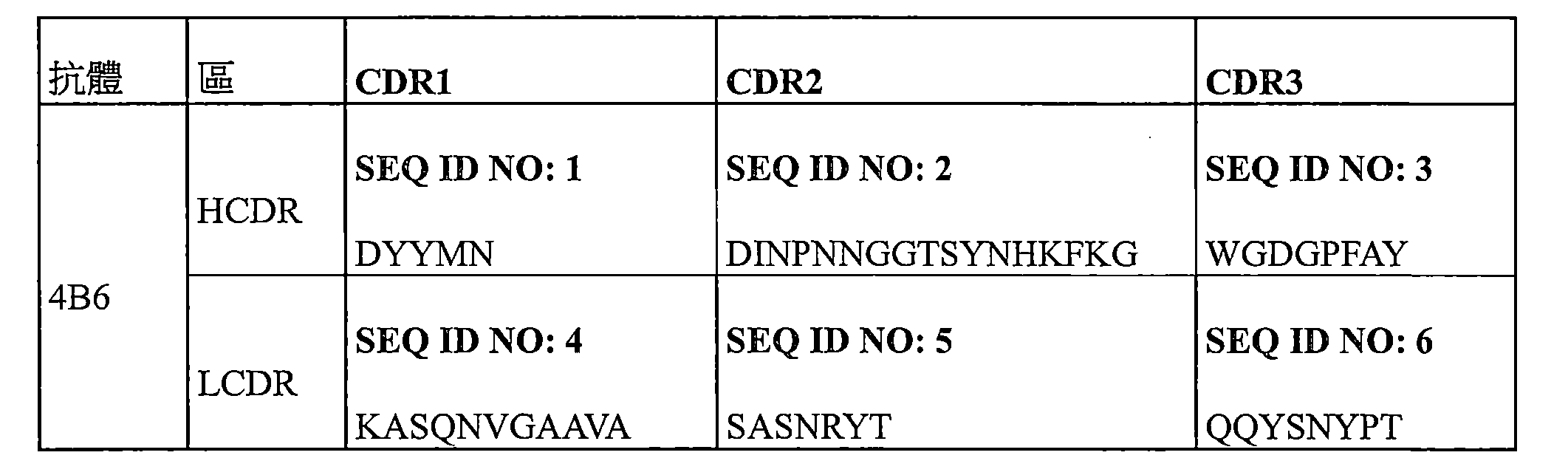
表2. 抗體4B6的可變區胺基酸序列。Table 2. Amino acid sequences of the variable regions of antibody 4B6.
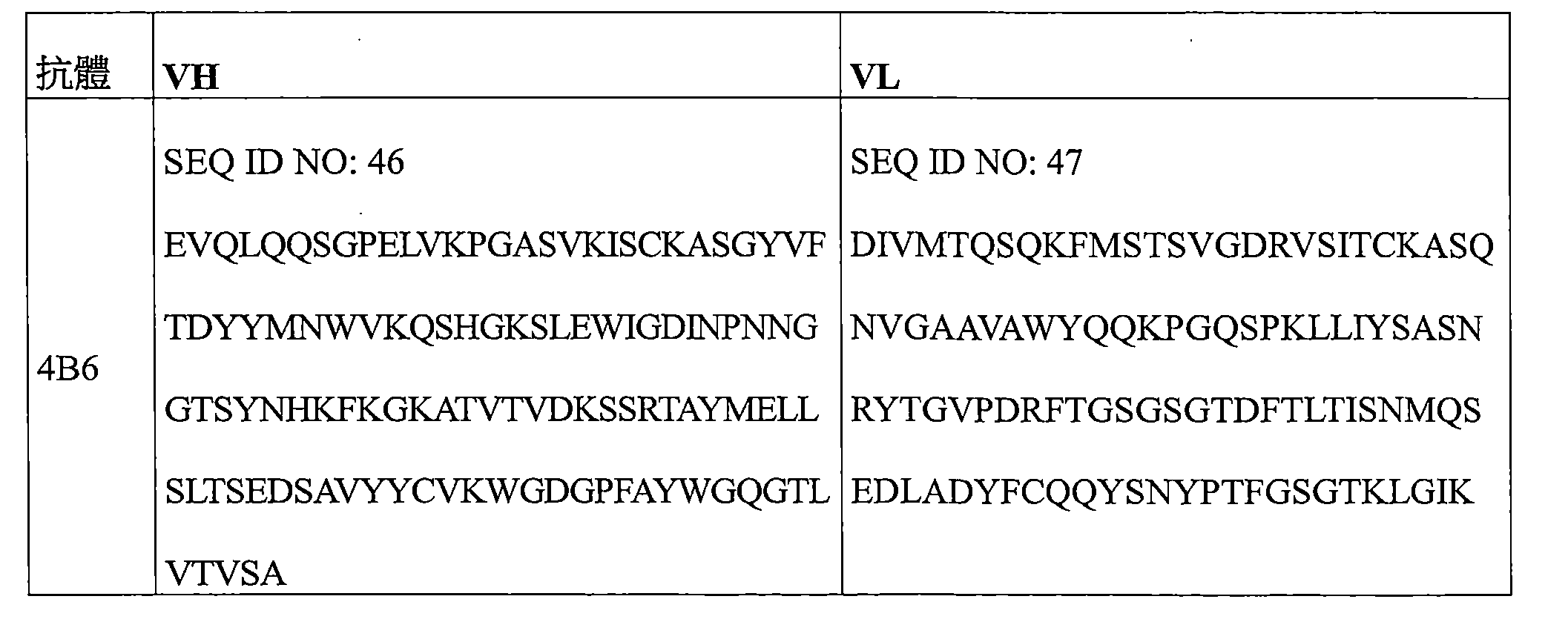
已知CDR負責抗原結合。然而,已經發現並非所有的6個CDR都是不可缺少或不可改變的。換言之,可以替換或改變或修飾抗PD-L1抗體4B6中的一個或多個CDR,但仍基本上保留對PD-L1的特異性結合親和力。 It is known that CDRs are responsible for antigen binding. However, it has been found that not all 6 CDRs are indispensable or unchangeable. In other words, one or more CDRs in the anti-PD-L1 antibody 4B6 can be replaced or changed or modified, but still substantially retain the specific binding affinity to PD-L1.
在一些實施方案中,本文提供的抗體和其抗原結合片段包括合適的框架區(FR)序列,只要該抗體和其抗原結合片段可以特異性地結合到PD-L1即可。上表1中提供的CDR序列是從小鼠抗體獲得的,但該CDR序列可以使用如重組技術等本領域已知的合適方法移植到如小鼠、人、大鼠、兔等任何合適物種的任何合適FR序列。 In some embodiments, the antibodies and antigen-binding fragments thereof provided herein include suitable framework region (FR) sequences, as long as the antibodies and antigen-binding fragments thereof can specifically bind to PD-L1. The CDR sequences provided in Table 1 above are obtained from mouse antibodies, but the CDR sequences can be transplanted to any suitable FR sequences of any suitable species such as mice, humans, rats, rabbits, etc. using suitable methods known in the art such as recombinant technology.
在一些實施方案中,本文提供的抗體和其抗原結合片段是人源化的。人源化抗體或其抗原結合片段在其於人中降低的免疫原性方面是期望的。人源化抗體在其可變區是嵌合的,因為非人CDR序列被移植到人或基本上人的FR序列。抗體或抗原結合片段的人源化基本上可以藉由用非人(如鼠)CDR基因取代人免疫球蛋白基因中的對應人CDR基因來進行(參見例如,Jones等人(1986)《自然》321:522-525;Riechmann等人(1988)《自然》332:323-327;Verhoeyen等人(1988)《科學》239:1534-1536)。 In some embodiments, the antibodies and antigen-binding fragments thereof provided herein are humanized. Humanized antibodies or antigen-binding fragments thereof are desirable for their reduced immunogenicity in humans. Humanized antibodies are chimeric in their variable regions because non-human CDR sequences are grafted to human or substantially human FR sequences. Humanization of antibodies or antigen-binding fragments can be performed essentially by replacing corresponding human CDR genes in human immunoglobulin genes with non-human (e.g., mouse) CDR genes (see, e.g., Jones et al. (1986) Nature 321:522-525; Riechmann et al. (1988) Nature 332:323-327; Verhoeyen et al. (1988) Science 239:1534-1536).
可以使用本領域已知的方法選擇合適的人重鏈和輕鏈可變結構域以實現此目的。在說明性實例中,可以使用“最佳擬合”方法,其中針對已知人可變結構域序列的數據庫篩選或BLAST非人(例如,齧齒動物)抗體可變結構域序列,並且最接近非人查詢序列的人序列被鑑定並用作用於移植非人CDR序列的人支架(參見例如Sims等人,(1993)《免疫學雜誌》151:2296;Chothia等人(1987)《分子生物學雜誌(J.Mot.Biol.)》196:901)。可替代地,來源於所有人抗 體的共有序列的框架可以用於移植非人CDR(參見例如Carter等人(1992)《美國國家科學院院刊》,89:4285;Presta等人(1993)《免疫學雜誌》,151:2623)。 Appropriate human heavy and light chain variable domains can be selected for this purpose using methods known in the art. In an illustrative example, a "best fit" approach can be used, in which a non-human (e.g., rodent) antibody variable domain sequence is screened or BLASTed against a database of known human variable domain sequences, and the human sequence closest to the non-human query sequence is identified and used as a human scaffold for grafting non-human CDR sequences (see, e.g., Sims et al., (1993) J. Immunol. 151:2296; Chothia et al. (1987) J. Mot. Biol . 196:901). Alternatively, a framework derived from the consensus sequence of all human antibodies can be used to graft non-human CDRs (see, e.g., Carter et al. (1992) Proc. Natl. Acad. Sci. USA 89:4285; Presta et al. (1993) J. Immunol. 151:2623).
在一些實施方案中,本揭露提供了4B6的12種人源化抗體,它們分別被命名為Hu4B6_Hg.2La.1、Hu4B6_Hg.2La.2、Hu4B6_Hg.2La.4、Hu4B6_Hg.2La.6、Hu4B6_Hg.3La.1、Hu4B6_Hg.3La.2、Hu4B6_Hg.3La.4、Hu4B6_Hg.3La.6、Hu4B6_Hg.5La.1、Hu4B6_Hg.5La.2、Hu4B6_Hg.5La.4和Hu4B6_Hg.5La.6。4B6的每種人源化抗體的重鏈和輕鏈可變區的SEQ ID NO在表5中示出。4B6的12種人源化抗體中的每種人源化抗體的CDR在表5(加下劃線的序列)中示出。CDR邊界藉由Kabat規則定義或鑑定。 In some embodiments, the present disclosure provides 12 humanized antibodies of 4B6, which are respectively named Hu4B6_Hg.2La.1, Hu4B6_Hg.2La.2, Hu4B6_Hg.2La.4, Hu4B6_Hg.2La.6, Hu4B6_Hg.3La.1, Hu4B6_Hg.3La.2, Hu4B6_Hg.3La.4, Hu4B6_Hg.3La.6, Hu4B6_Hg.5La.1, Hu4B6_Hg.5La.2, Hu4B6_Hg.5La.4 and Hu4B6_Hg.5La.6. The SEQ ID NOs of the heavy chain and light chain variable regions of each humanized antibody of 4B6 are shown in Table 5. The CDRs of each of the 12 humanized antibodies of 4B6 are shown in Table 5 (underlined sequences). The CDR boundaries are defined or identified by the Kabat rules.
下表3a示出了人源化4B6的變體CDR的胺基酸序列,下表3b示出了人源化4B6重鏈和輕鏈可變區的FR。下表4示出了嵌合抗體4B6的12種人源化抗體的每條重鏈和輕鏈的FR胺基酸序列,該人源化抗體分別被命名為Hu4B6_Hg.2La.1、Hu4B6_Hg.2La.2、Hu4B6_Hg.2La.4、Hu4B6_Hg.2La.6、Hu4B6_Hg.3La.1、Hu4B6_Hg.3La.2、Hu4B6_Hg.3La.4、Hu4B6_Hg.3La.6、Hu4B6_Hg.5La.1、Hu4B6_Hg.5La.2、Hu4B6_Hg.5La.4和Hu4B6_Hg.5La.6。這12種人源化抗體的重鏈可變區和輕鏈可變區在表5中示出。 Table 3a below shows the amino acid sequences of variant CDRs of humanized 4B6, and Table 3b below shows the FRs of the heavy and light chain variable regions of humanized 4B6. Table 4 below shows the FR amino acid sequence of each heavy chain and light chain of 12 humanized antibodies of chimeric antibody 4B6, which are named Hu4B6_Hg.2La.1, Hu4B6_Hg.2La.2, Hu4B6_Hg.2La.4, Hu4B6_Hg.2La.6, Hu4B6_Hg.3La.1, Hu4B6_Hg.3La.2, Hu4B6_Hg.3La.4, Hu4B6_Hg.3La.6, Hu4B6_Hg.5La.1, Hu4B6_Hg.5La.2, Hu4B6_Hg.5La.4 and Hu4B6_Hg.5La.6. The heavy chain variable regions and light chain variable regions of these 12 humanized antibodies are shown in Table 5.
表3a. 4B6的人源化抗體的CDR變體的胺基酸序列。Table 3a. Amino acid sequences of CDR variants of the humanized antibody 4B6.
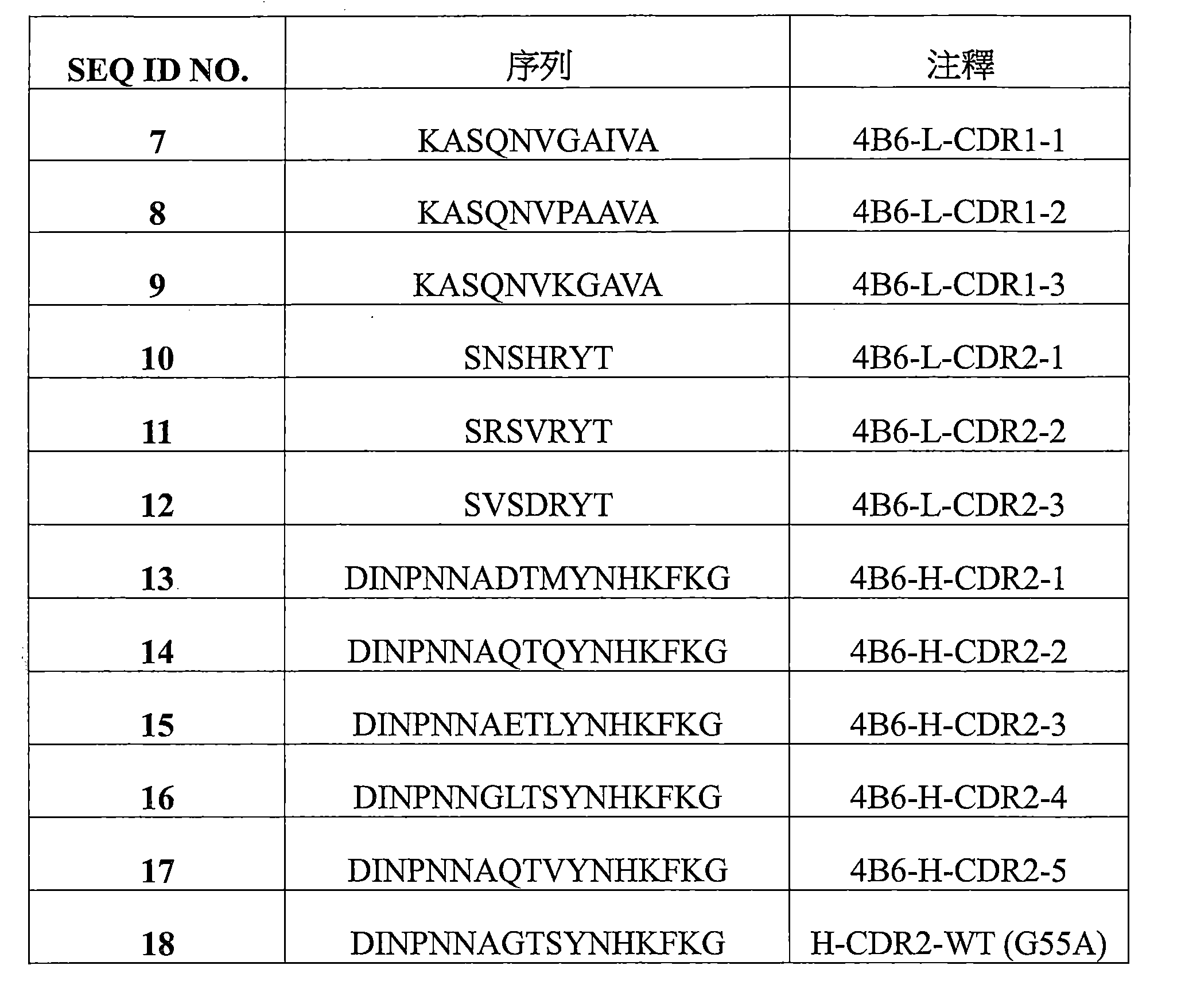
表3b. 4B6和4B6的人源化抗體的FR序列的胺基酸序列。Table 3b. Amino acid sequences of FR sequences of 4B6 and humanized antibodies of 4B6.
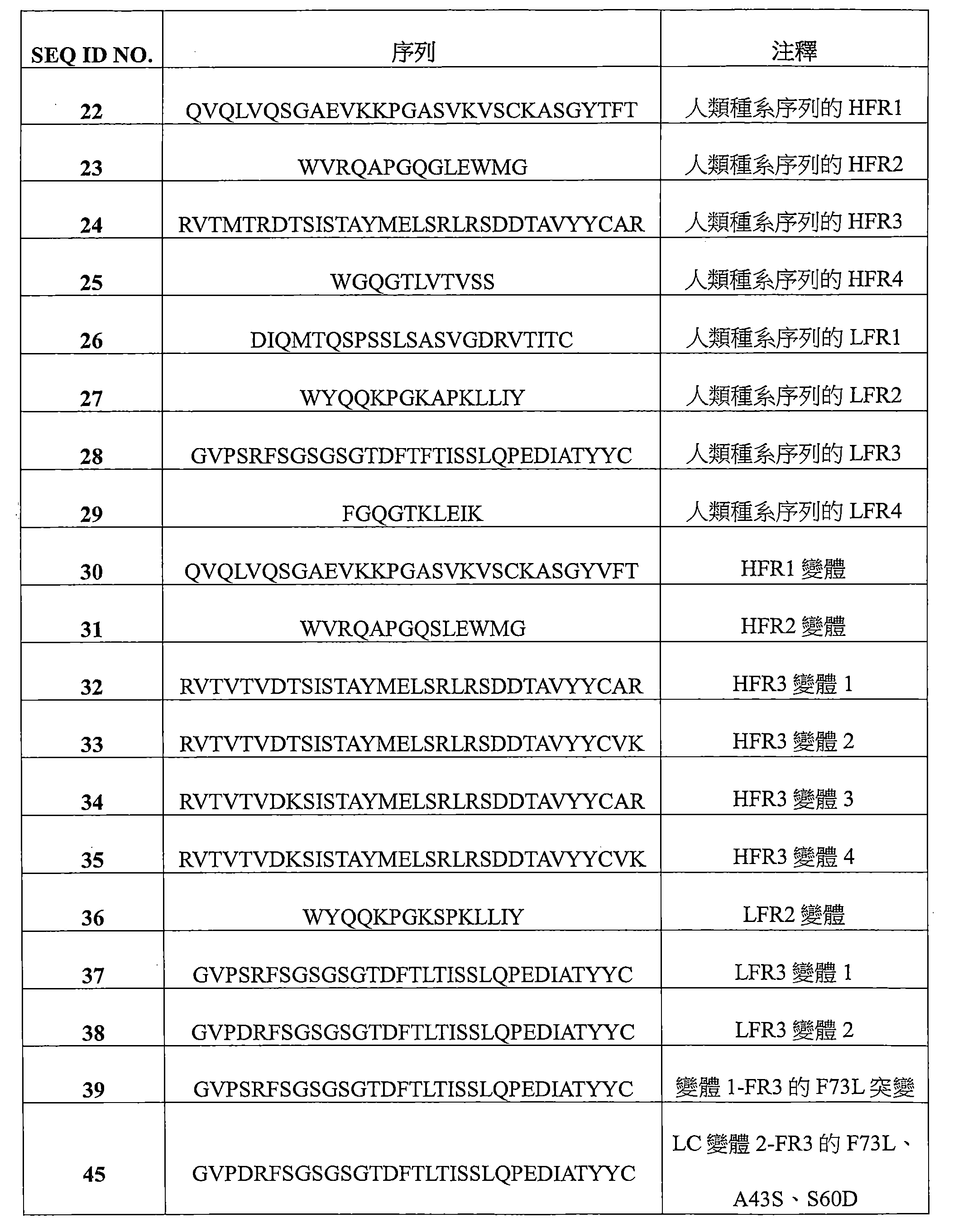
表4. 4B6的人源化抗體的每個人源化重鏈和輕鏈可變區的FR胺基酸序列。Table 4. FR amino acid sequences of each humanized heavy chain and light chain variable region of the 4B6 humanized antibody.
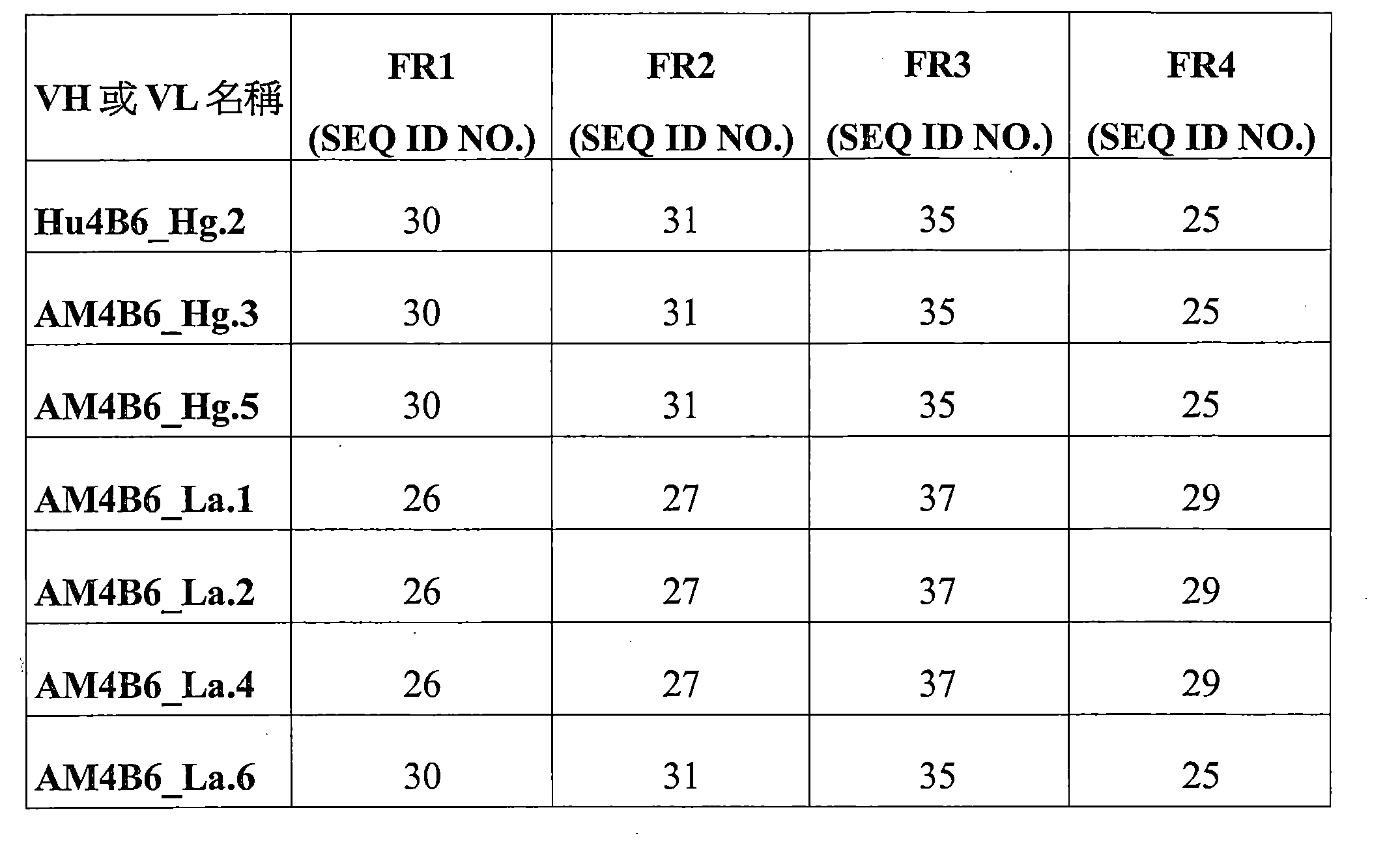
下表5示出了人源化4B6重鏈可變區的3種變體(即,Hu4B6_Hg.2、Hu4B6_Hg.3和Hu4B6_Hg.5)和人源化4B6輕鏈可變區的4種變體(即,AM4B6_La.1、AM4B6_La.2、AM4B6_La.4、AM4B6_La.6)。 Table 5 below shows three variants of the humanized 4B6 heavy chain variable region (i.e., Hu4B6_Hg.2, Hu4B6_Hg.3, and Hu4B6_Hg.5) and four variants of the humanized 4B6 light chain variable region (i.e., AM4B6_La.1, AM4B6_La.2, AM4B6_La.4, AM4B6_La.6).
表5. 4B6的人源化抗體的可變區的胺基酸序列。Table 5. Amino acid sequences of the variable regions of the humanized antibody 4B6.


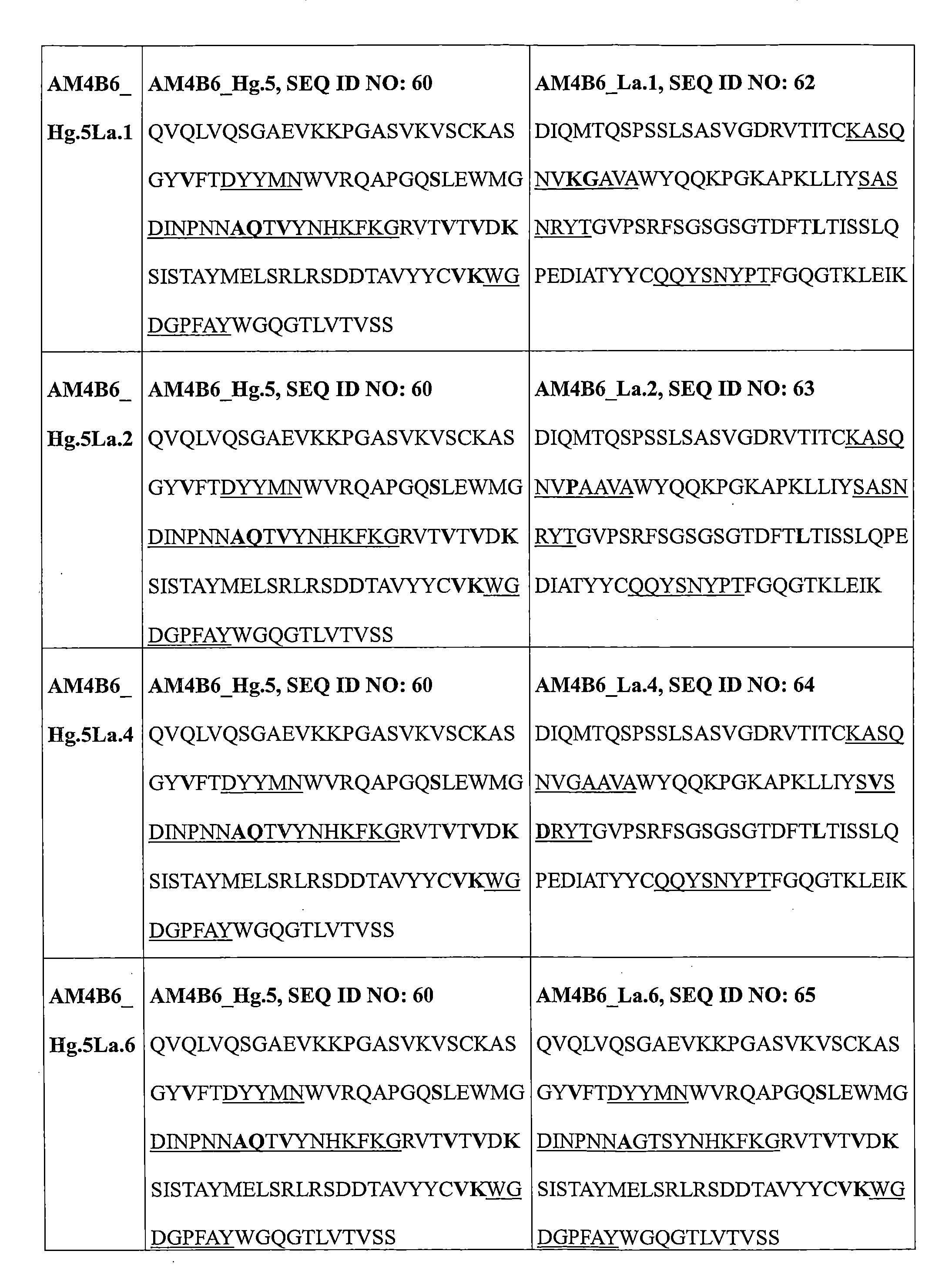
在一些實施方案中,除了非人的CDR序列之外,本文提供的人源化抗PD-L1抗體或其抗原結合片段由基本上全人序列構成。在一些實施方案中,可變區FR和恆定區(如果存在)完全或基本上來自人免疫球蛋白序列。人FR序列和人恆定區序列可以源自不同的人免疫球蛋白基因,例如,FR序列源自一種人抗體並且恆定區源自另一種人抗體。在一些實施方案中,人源化抗體或其抗原結合片段包括人重鏈HFR1-4和/或輕鏈LFR1-4。 In some embodiments, the humanized anti-PD-L1 antibodies or antigen-binding fragments thereof provided herein are composed of substantially all-human sequences, except for non-human CDR sequences. In some embodiments, the variable region FR and the constant region (if present) are completely or substantially derived from human immunoglobulin sequences. The human FR sequence and the human constant region sequence can be derived from different human immunoglobulin genes, for example, the FR sequence is derived from one human antibody and the constant region is derived from another human antibody. In some embodiments, the humanized antibody or antigen-binding fragment thereof includes human heavy chain HFR1-4 and/or light chain LFR1-4.
在一些實施方案中,源自人的FR區可以包括與其所源自的人免疫球蛋白相同的胺基酸序列。在一些實施方案中,人FR的一個或多個胺基酸殘基被來自親本非人抗體的對應殘基取代。在一些實施方案中,這可能是期望的,以使人源化抗體或其片段非常接近非人親本抗體結構,從而優化結合特性(例如,增加結合親和力)。在一些實施方案中,本文提供的人源化抗體或其抗原結合片段在多個人FR序列中的每個人FR序列中包括不超過10、9、8、7、6、5、4、3、2或1個胺基酸殘基取代,或者在重鏈或輕鏈可變結構域的所有FR序列中包括不超過10、9、8、7、6、5、4、3、2或1個胺基酸殘基取代。在一些實施方案中,胺基酸殘基的此類變化可以僅存在於重鏈FR區、僅存在於輕鏈FR區、或存在於兩條鏈中。在一些實施方案中,使人FR序列的一個或多個胺基酸隨機突變以增加結合親和力。在一些實施方案中,使人FR序列的一個或多個胺基酸回復突變為親本非人抗體的對應胺基酸以增加結合親和力。 In some embodiments, the FR region derived from people can include the same amino acid sequence as the human immunoglobulin from which it is derived. In some embodiments, one or more amino acid residues of people FR are replaced by the corresponding residues from parent non-human antibody. In some embodiments, this may be desirable, so that humanized antibody or its fragment is very close to the non-human parent antibody structure, thereby optimizing binding properties (for example, increasing binding affinity). In some embodiments, humanized antibody or its antigen-binding fragment provided herein includes no more than 10,9,8,7,6,5,4,3,2 or 1 amino acid residue replacement in each people FR sequence in multiple people FR sequences, or includes no more than 10,9,8,7,6,5,4,3,2 or 1 amino acid residue replacement in all FR sequences of heavy chain or light chain variable domains. In some embodiments, such changes in amino acid residues may be present only in the heavy chain FR region, only in the light chain FR region, or in both chains. In some embodiments, one or more amino acids in the human FR sequence are randomly mutated to increase binding affinity. In some embodiments, one or more amino acids in the human FR sequence are reverted to the corresponding amino acids of the parent non-human antibody to increase binding affinity.
在一些實施方案中,本揭露的人源化抗PD-L1抗體和其抗原結合片段包括:重鏈HFR1,該重鏈HFR1包括QVQLVQSGAEVKKPGASVKVSCKASGYX 9 FT(SEQ ID NO:40)的序列或與該序列具有至少80%序列同一性的同源序列;重鏈HFR2,該重鏈HFR2包括 WVRQAPGQX 10 LEWMG(SEQ ID NO:41)的序列或與該序列具有至少80%序列同一性的同源序列;重鏈HFR3,該重鏈HFR3包括RVTX 16 TVDX 11 SISTAYMELSRLRSDDTAVYYCX 12 X 13 (SEQ ID NO:42)的序列或與該序列具有至少80%序列同一性的同源序列;和重鏈HFR4,該重鏈HFR4包括WGQGTLVTVSS(SEQ ID NO:25)的序列或與該序列具有至少80%序列同一性的同源序列,其中X9是T或V,X10是G或S,X11是T或K,X12是A或V,並且X13是R或K。 In some embodiments, the humanized anti-PD-L1 antibody and antigen-binding fragment thereof disclosed herein comprises: a heavy chain HFR1 comprising a sequence of QVQLVQSGAEVKKPGASVKVSCKASGYX 9 FT (SEQ ID NO: 40) or a homologous sequence having at least 80% sequence identity thereto; a heavy chain HFR2 comprising a sequence of WVRQAPGQX 10 LEWMG (SEQ ID NO: 41) or a homologous sequence having at least 80% sequence identity thereto; a heavy chain HFR3 comprising RVTX 16 TVDX 11 SISTAYMELSRLRSDDTAVYYCX 12 X 13 (SEQ ID NO: 42) or a homologous sequence having at least 80% sequence identity thereto; NO:42) or a homologous sequence having at least 80% sequence identity thereto; and a recombinant HFR4 comprising the sequence of WGQGTLVTVSS (SEQ ID NO:25) or a homologous sequence having at least 80% sequence identity thereto, wherein X9 is T or V, X10 is G or S, X11 is T or K, X12 is A or V, and X13 is R or K.
在一些實施方案中,本揭露的人源化抗PD-L1抗體和其抗原結合片段包括:輕鏈LFR1,該輕鏈LFR1包括DIQMTQSPSSLSASVGDRVTITC(SEQ ID NO:26)的序列或與該序列具有至少80%序列同一性的同源序列;輕鏈LFR2,該輕鏈LFR2包括WYQQKPGKX 14 PKLLIY(SEQ ID NO:43)的序列或與該序列具有至少80%序列同一性的同源序列;輕鏈LFR3,該輕鏈LFR3包括GVPX 15 RFSGSGSGTDFTX 17 TISSLQPEDIATYYC(SEQ ID NO:44)的序列或與該序列具有至少80%序列同一性的同源序列;和輕鏈LFR4,該輕鏈LFR4包括FGQGTKLEIK(SEQ ID NO:29)的序列或與該序列具有至少80%序列同一性的同源序列,其中X14是A或S,X15是S或D,X16是M或V,並且X17是F或L。 In some embodiments, the humanized anti-PD-L1 antibodies and antigen-binding fragments thereof disclosed herein comprise: a light chain LFR1 comprising a sequence of DIQMTQSPSSLSASVGDRVTITC (SEQ ID NO: 26) or a homologous sequence having at least 80% sequence identity thereto; a light chain LFR2 comprising a sequence of WYQQKPGKX 14 PKLLIY (SEQ ID NO: 43) or a homologous sequence having at least 80% sequence identity thereto; a light chain LFR3 comprising a sequence of GVPX 15 RFSGSGSGTDFTX 17 TISSLQPEDIATYYC (SEQ ID NO: 44) or a homologous sequence having at least 80% sequence identity thereto; and a light chain LFR4 comprising FGQGTKLEIK (SEQ ID NO: 51). NO: 29), or a homologous sequence having at least 80% sequence identity thereto, wherein X14 is A or S, X15 is S or D, X16 is M or V, and X17 is F or L.
在一些實施方案中,HFR1包括選自由SEQ ID NO:22和30組成的組的序列,HFR2包括選自由SEQ ID NO:23和31組成的組的序列,HFR3包括選自由SEQ ID NO:24和32-35組成的組的序列,HFR4包括SEQ ID NO:25的序列,LFR1包括選自由SEQ ID NO:26組成的組的序列,LFR2包括選自由 SEQ ID NO:27和36組成的組的序列,LFR3包括選自由SEQ ID NO:28和37-38、39、45組成的組的序列,並且LFR4包括SEQ ID NO:29的序列。 In some embodiments, HFR1 comprises a sequence selected from the group consisting of SEQ ID NOs: 22 and 30, HFR2 comprises a sequence selected from the group consisting of SEQ ID NOs: 23 and 31, HFR3 comprises a sequence selected from the group consisting of SEQ ID NOs: 24 and 32-35, HFR4 comprises a sequence of SEQ ID NO: 25, LFR1 comprises a sequence selected from the group consisting of SEQ ID NOs: 26, LFR2 comprises a sequence selected from the group consisting of SEQ ID NOs: 27 and 36, LFR3 comprises a sequence selected from the group consisting of SEQ ID NOs: 28 and 37-38, 39, 45, and LFR4 comprises a sequence of SEQ ID NO: 29.
在一些實施方案中,本揭露的人源化抗PD-L1抗體和其抗原結合片段包括包含在重鏈可變區中的HFR1、HFR2、HFR3和/或HFR4序列,該重鏈可變區選自由以下組成的組:Hu4B6_Hg.2(SEQ ID NO:58)、AM4B6_Hg.3(SEQ ID NO:59)、AM4B6_Hg.5(SEQ ID NO:60)。 In some embodiments, the humanized anti-PD-L1 antibodies and antigen-binding fragments thereof disclosed herein include HFR1, HFR2, HFR3 and/or HFR4 sequences contained in a heavy chain variable region, wherein the heavy chain variable region is selected from the group consisting of: Hu4B6_Hg.2 (SEQ ID NO: 58), AM4B6_Hg.3 (SEQ ID NO: 59), AM4B6_Hg.5 (SEQ ID NO: 60).
在一些實施方案中,本揭露的人源化抗PD-L1抗體和其抗原結合片段包括包含在輕鏈可變區中的LFR1、LFR2、LFR3和/或LFR4序列,該輕鏈可變區選自由以下組成的組:AM4B6_La.1(SEQ ID NO:62)、AM4B6_La.2(SEQ ID NO:63)、AM4B6_La.4(SEQ ID NO:64)和AM4B6_La.6(SEQ ID NO:65)。 In some embodiments, the humanized anti-PD-L1 antibodies and antigen-binding fragments thereof disclosed herein include LFR1, LFR2, LFR3 and/or LFR4 sequences contained in the light chain variable region, and the light chain variable region is selected from the group consisting of: AM4B6_La.1 (SEQ ID NO: 62), AM4B6_La.2 (SEQ ID NO: 63), AM4B6_La.4 (SEQ ID NO: 64) and AM4B6_La.6 (SEQ ID NO: 65).
在一些實施方案中,該重鏈可變區包括選自由以下組成的組的序列:SEQ ID NO:46、SEQ ID NO:49、SEQ ID NO:50、SEQ ID NO:51、SEQ ID NO:52、SEQ IDNO:56、SEQ ID NO:57、SEQ ID NO:58、SEQ ID NO:59、SEQ ID NO:60和與其具有至少80%序列同一性的其同源序列。在一些實施方案中,該輕鏈可變區包括選自由以下組成的組的序列:SEQ ID NO:47、SEQ ID NO:54、SEQ ID NO:55、SEQ ID NO:61、SEQ ID NO:62、SEQ ID NO:63、SEQ ID NO:64、SEQ ID NO:65和與其具有至少80%序列同一性的其同源序列。在一些實施方案中,該針對PD-L1的抗體或其抗原結合片段包括選自由以下組成的組的一對重鏈可變區和輕鏈可變區序列:SEQ ID NO:49/54、50/54、51/54、52/54、49/55、50/55、51/55、52/55、58/62、58/63、58/64、58/65、59/62、59/63、59/64、59/65、60/62、60/63、60/64和60/65。 In some embodiments, the heavy chain variable region comprises a sequence selected from the group consisting of SEQ ID NO: 46, SEQ ID NO: 49, SEQ ID NO: 50, SEQ ID NO: 51, SEQ ID NO: 52, SEQ ID NO: 56, SEQ ID NO: 57, SEQ ID NO: 58, SEQ ID NO: 59, SEQ ID NO: 60, and homologous sequences thereof having at least 80% sequence identity therewith. In some embodiments, the light chain variable region comprises a sequence selected from the group consisting of SEQ ID NO: 47, SEQ ID NO: 54, SEQ ID NO: 55, SEQ ID NO: 61, SEQ ID NO: 62, SEQ ID NO: 63, SEQ ID NO: 64, SEQ ID NO: 65, and homologous sequences thereof having at least 80% sequence identity therewith. In some embodiments, the antibody or antigen-binding fragment thereof against PD-L1 comprises a pair of heavy chain variable region and light chain variable region sequences selected from the group consisting of: SEQ ID NO: 49/54, 50/54, 51/54, 52/54, 49/55, 50/55, 51/55, 52/55, 58/62, 58/63, 58/64, 58/65, 59/62, 59/63, 59/64, 59/65, 60/62, 60/63, 60/64 and 60/65.
這些示例性人源化抗PD-L1抗體保留了對PD-L1的特異性結合能力或親和力,並且在該方面優於親本小鼠抗體4B6。 These exemplary humanized anti-PD-L1 antibodies retain specific binding ability or affinity to PD-L1 and are superior to the parental mouse antibody 4B6 in this regard.
在一些實施方案中,本文提供的抗PD-L1抗體和抗原結合片段包括重鏈可變結構域的全部或一部分和/或輕鏈可變結構域的全部或一部分。在一個實施方案中,本文提供的抗PD-L1抗體或其抗原結合片段是由本文提供的重鏈可變結構域的全部或一部分組成的單結構域抗體。此類單結構域抗體的更多信息可在本領域中獲得(參見例如,美國專利第6,248,516號)。 In some embodiments, the anti-PD-L1 antibodies and antigen-binding fragments provided herein include all or a portion of a heavy chain variable domain and/or all or a portion of a light chain variable domain. In one embodiment, the anti-PD-L1 antibodies or antigen-binding fragments thereof provided herein are single-domain antibodies composed of all or a portion of a heavy chain variable domain provided herein. More information on such single-domain antibodies is available in the art (see, e.g., U.S. Patent No. 6,248,516).
在一些實施方案中,本文提供的抗PD-L1抗體或其抗原結合片段進一步包括免疫球蛋白(Ig)恆定區,該恆定區視需要地進一步包括重鏈和/或輕鏈恆定區。在一些實施方案中,重鏈恆定區包括CH1、鉸鏈和/或CH2-CH3區(或視需要的CH2-CH3-CH4區)。在一些實施方案中,本文提供的抗PD-L1抗體或其抗原結合片段包括人IgG1、IgG2、IgG3、IgG4、IgA1、IgA2或IgM的重鏈恆定區。在一些實施方案中,輕鏈恆定區包括Cκ或Cλ。本文提供的抗PD-L1抗體或其抗原結合片段的恆定區可以與野生型恆定區序列相同或在一個或多個突變中不同。 In some embodiments, the anti-PD-L1 antibody or antigen-binding fragment thereof provided herein further comprises an immunoglobulin (Ig) constant region, which further comprises a heavy chain and/or light chain constant region as required. In some embodiments, the heavy chain constant region comprises CH1, hinge and/or CH2-CH3 region (or CH2-CH3-CH4 region as required). In some embodiments, the anti-PD-L1 antibody or antigen-binding fragment thereof provided herein comprises a heavy chain constant region of human IgG1, IgG2, IgG3, IgG4, IgA1, IgA2 or IgM. In some embodiments, the light chain constant region comprises Cκ or Cλ. The constant region of the anti-PD-L1 antibody or antigen-binding fragment thereof provided herein may be identical to the wild-type constant region sequence or different in one or more mutations.
在一些實施方案中,本文提供的抗PD-L1抗體或其抗原結合片段對人PD-L1具有特異性結合親和力,這足以提供診斷和/或治療用途。 In some embodiments, the anti-PD-L1 antibodies or antigen-binding fragments thereof provided herein have specific binding affinity for human PD-L1, which is sufficient to provide diagnostic and/or therapeutic uses.
本文提供的抗PD-L1抗體或其抗原結合片段可以是單株抗體、多株抗體、人源化抗體、嵌合抗體、重組抗體、雙特異性抗體、多特異性抗體、標記抗體、二價抗體、抗獨特型抗體或融合蛋白。重組抗體是使用重組方法在體外而不是在動物體內製備的抗體。 The anti-PD-L1 antibodies or antigen-binding fragments thereof provided herein can be monoclonal antibodies, polyclonal antibodies, humanized antibodies, chimeric antibodies, recombinant antibodies, bispecific antibodies, multispecific antibodies, labeled antibodies, bivalent antibodies, anti-idiotype antibodies or fusion proteins. Recombinant antibodies are antibodies prepared in vitro rather than in animals using recombinant methods.
在一些實施方案中,PD-L1結合部分包括抗PD-L1抗體或其抗原結合片段,該抗體或其抗原結合片段與包括選自由以下組成的組的一對重鏈可變區和輕鏈可變區序列的抗體或其抗原結合片段競爭結合PD-L1:5EQ ID NO:49/54、50/54、51/54、52/54、49/55、50/55、51/55、52/55、58/62、58/63、58/64、58/65、59/62、59/63、59/64、59/65、60/62、60/63、60/64和60/65。 In some embodiments, the PD-L1 binding moiety comprises an anti-PD-L1 antibody or antigen-binding fragment thereof that competes for binding to PD-L1 with an antibody or antigen-binding fragment thereof comprising a pair of heavy chain variable region and light chain variable region sequences selected from the group consisting of: 5EQ ID NO: 49/54, 50/54, 51/54, 52/54, 49/55, 50/55, 51/55, 52/55, 58/62, 58/63, 58/64, 58/65, 59/62, 59/63, 59/64, 59/65, 60/62, 60/63, 60/64, and 60/65.
x.抗體變體x. Antibody variants
本文提供的抗PD-L1抗體和其抗原結合片段還涵蓋本文提供的抗體序列的各種變體。 The anti-PD-L1 antibodies and antigen-binding fragments thereof provided herein also encompass various variants of the antibody sequences provided herein.
在一些實施方案中,該抗體變體在以上的表1提供的多個CDR序列中的一個或多個CDR序列中、以上的表3a、3b和5提供的重鏈可變區或輕鏈可變區的多個非CDR序列中的一個或多個非CDR序列中、和/或恆定區(例如,Fc區)中包括一個或多個修飾或取代。此類變體保留了其親本抗體對PD-L1的結合特異性,但具有一種或多種由修飾或取代賦予的期望性質。例如,抗體變體可以具有改善的抗原結合親和力、改善的糖基化模式、降低的糖基化風險、減少的脫胺基作用、減少或耗竭的效應子功能、改善的FcRn受體結合、增加的藥物代謝動力學半衰期、pH敏感性和/或與綴合的相容性(例如,一個或多個引入的半胱胺酸殘基)。 In some embodiments, the antibody variant comprises one or more modifications or substitutions in one or more of the CDR sequences provided in Table 1 above, one or more of the non-CDR sequences of the heavy chain variable region or light chain variable region provided in Tables 3a, 3b and 5 above, and/or in a constant region (e.g., Fc region). Such variants retain the binding specificity of their parent antibody to PD-L1, but have one or more desirable properties conferred by the modification or substitution. For example, antibody variants may have improved antigen binding affinity, improved glycosylation pattern, reduced risk of glycosylation, reduced deamination, reduced or depleted effector function, improved FcRn receptor binding, increased drug metabolic half-life, pH sensitivity, and/or compatibility with conjugation (e.g., one or more introduced cysteine residues).
可以使用本領域已知的方法,例如“丙胺酸掃描誘變”,篩選親本抗體序列以鑑定合適的或較佳的待修飾或取代的殘基(參見例如Cunningham和Wells(1989)《科學》,244:1081-1085)。簡要地說,可以鑑定靶標殘基(例如帶電的殘基,如Arg、Asp、His、Lys和Glu)並由中性或帶負電的胺基酸(例如丙胺酸或聚丙胺酸)替代,並且產生經修飾的抗體,並且針對所關注性質對其進行篩選。 如果在特定的胺基酸位置處的取代表現出所關注功能性改變,則該位置可以被鑑定為潛在的用於修飾或取代的殘基。可以藉由用另一種殘基(例如半胱胺酸殘基、帶正電荷的殘基等)取代來進一步評估該潛在的殘基。 Parent antibody sequences can be screened to identify suitable or preferred residues to be modified or substituted using methods known in the art, such as "alanine scanning mutagenesis" (see, e.g., Cunningham and Wells (1989) Science, 244: 1081-1085). Briefly, target residues (e.g., charged residues such as Arg, Asp, His, Lys, and Glu) can be identified and replaced by neutral or negatively charged amino acids (e.g., alanine or polyalanine), and modified antibodies are generated and screened for properties of interest. If substitution at a particular amino acid position exhibits a functional change of interest, that position can be identified as a potential residue for modification or substitution. The potential residue can be further evaluated by substitution with another residue (e.g., a cysteine residue, a positively charged residue, etc.).
xi.親和性變體xi. Affinity variants
抗體的親和性變體可以在上表1中提供的一個或多個CDR序列、上表3b和4中提供的一個或多個FR序列或上表5中提供的重鏈或輕鏈可變區序列中含有修飾或取代。所屬技術領域具有通常知識者可以基於上表1中的CDR序列和上表5中的可變區序列容易地鑑定FR序列,因為本領域公知在可變區中,CDR區側接兩個FR區。親和性變體保留了親本抗體對PD-L1的特異性結合親和力,或者甚至比親本抗體具有更高的PD-L1特異性結合親和力。在一些實施方案中,CDR序列、FR序列或可變區序列中的至少一個(或全部)取代包括保守取代。 The affinity variant of the antibody may contain modifications or substitutions in one or more CDR sequences provided in Table 1 above, one or more FR sequences provided in Tables 3b and 4 above, or heavy chain or light chain variable region sequences provided in Table 5 above. A person skilled in the art can easily identify the FR sequence based on the CDR sequence in Table 1 above and the variable region sequence in Table 5 above, because it is well known in the art that in the variable region, the CDR region is flanked by two FR regions. The affinity variant retains the specific binding affinity of the parent antibody to PD-L1, or even has a higher specific binding affinity for PD-L1 than the parent antibody. In some embodiments, at least one (or all) substitutions in the CDR sequence, FR sequence, or variable region sequence include conservative substitutions.
所屬技術領域具有通常知識者將理解,在上表1和3a中提供的CDR序列以及上表5中提供的可變區序列中,一個或多個胺基酸殘基可以被取代,但所得抗體或抗原結合片段仍保留對PD-L1的結合親和力或結合能力或者甚至具有改進的結合親和力或結合能力。可以使用本領域已知的各種方法來實現此目的。例如,可以生成抗體變體(如Fab或scFv變體)的文庫,並用噬菌體展示技術表達,隨後針對與PD-L1結合的親和力對其進行篩選。再例如,計算機軟體可以用於虛擬模擬抗體與PD-L1的結合,並鑑定抗體上的形成結合界面的胺基酸殘基。在取代中可以避開此類殘基以防止結合親和性的降低,或者可以作為取代的靶標以獲得更強的結合。 Those skilled in the art will appreciate that one or more amino acid residues may be substituted in the CDR sequences provided in Tables 1 and 3a above and in the variable region sequences provided in Table 5 above, but the resulting antibody or antigen-binding fragment still retains binding affinity or binding ability to PD-L1 or even has improved binding affinity or binding ability. Various methods known in the art may be used to achieve this purpose. For example, a library of antibody variants (such as Fab or scFv variants) may be generated and expressed using phage display technology, and then screened for affinity for binding to PD-L1. For another example, computer software may be used to virtually simulate the binding of antibodies to PD-L1 and identify amino acid residues on the antibody that form the binding interface. Such residues can be avoided in substitutions to prevent reduction in binding affinity, or can be targeted for substitution to obtain stronger binding.
在一些實施方案中,本文提供的人源化抗PD-L1抗體或其抗原結合片段在多個CDR序列中的一個或多個CDR序列和/或多個FR序列中的一個 或多個FR序列中包括一個或多個胺基酸殘基取代。在一些實施方案中,親和性變體在CDR序列和/或FR序列中總共包括不超過20、15、10、9、8、7、6、5、4、3、2或1個取代。 In some embodiments, the humanized anti-PD-L1 antibodies or antigen-binding fragments thereof provided herein include one or more amino acid residue substitutions in one or more CDR sequences and/or one or more FR sequences in multiple CDR sequences. In some embodiments, the affinity variants include no more than 20, 15, 10, 9, 8, 7, 6, 5, 4, 3, 2, or 1 substitutions in total in the CDR sequences and/or FR sequences.
在一些實施方案中,抗PD-L1抗體或其抗原結合片段包括1、2或3個CDR序列,該CDR序列與以上表1和3a中所列出的一個(或多個)序列具有至少80%(例如,至少85%、88%、90%、91%、92%、93%、94%、95%、96%、97%、98%、99%)序列同一性,但仍以相對於其親本抗體而言相似或甚至更高的水平保留了對PD-L1的特異性結合親和力。 In some embodiments, the anti-PD-L1 antibody or antigen-binding fragment thereof comprises 1, 2 or 3 CDR sequences that have at least 80% (e.g., at least 85%, 88%, 90%, 91%, 92%, 93%, 94%, 95%, 96%, 97%, 98%, 99%) sequence identity with one (or more) of the sequences listed in Tables 1 and 3a above, but still retains specific binding affinity to PD-L1 at a similar or even higher level relative to its parent antibody.
在一些實施方案中,抗PD-L1抗體或其抗原結合片段包括一個或多個可變區序列,該一個或多個可變區序列與以上表5中所列出的一個(或多個)序列具有至少80%(例如,至少85%、88%、90%、91%、92%、93%、94%、95%、96%、97%、98%、99%)序列同一性,但仍以相對於其親本抗體而言相似或甚至更高的水平保留了對PD-L1的特異性結合親和力。在一些實施方案中,在上表5中列出的可變區序列中總共取代、插入或缺失了1到10個胺基酸。在一些實施方案中,取代、插入或缺失發生在CDR之外的區中(例如,在FR中)。 In some embodiments, the anti-PD-L1 antibody or antigen-binding fragment thereof comprises one or more variable region sequences having at least 80% (e.g., at least 85%, 88%, 90%, 91%, 92%, 93%, 94%, 95%, 96%, 97%, 98%, 99%) sequence identity with one (or more) sequence listed in Table 5 above, but still retaining specific binding affinity to PD-L1 at a similar or even higher level relative to its parent antibody. In some embodiments, a total of 1 to 10 amino acids are substituted, inserted or deleted in the variable region sequences listed in Table 5 above. In some embodiments, the substitution, insertion or deletion occurs in a region outside the CDR (e.g., in the FR).
xii.糖基化變體xii. Glycosylation variants
本文提供的抗PD-L1抗體或其抗原結合片段還涵蓋糖基化變體,可以獲得該糖基化變體以增加或減少該抗體或其抗原結合片段的糖基化程度。 The anti-PD-L1 antibodies or antigen-binding fragments thereof provided herein also encompass glycosylation variants, which can be obtained to increase or decrease the degree of glycosylation of the antibody or antigen-binding fragment thereof.
抗PD-L1抗體或其抗原結合片段可以包括引入或去除糖基化位點的一個或多個修飾。糖基化位點是具有側鏈的胺基酸殘基,碳水化合物部分(例如,寡糖結構)可以連接到該側鏈。抗體的糖基化通常是N連接的或O連接的。N連接是指碳水化合物部分連接到天冬醯胺殘基(例如,如天冬醯胺-X-絲胺 酸和天冬醯胺-X-蘇胺酸等三肽序列中的天冬醯胺殘基)的側鏈,其中X是除了脯胺酸之外的任何胺基酸。O連接的糖基化是指將N-乙醯半乳糖胺、半乳糖或木糖之一與羥基胺基酸連接,最常見的是與絲胺酸或蘇胺酸連接。可以很方便地去除天然糖基化位點,例如藉由改變胺基酸序列,使得存在於該序列中的上述三肽序列(對於N連接的糖基化位點)或者絲胺酸或蘇胺酸殘基(對於O連接的糖基化位點)中的一個被取代。可以藉由引入此類三肽序列或者絲胺酸或蘇胺酸殘基以相似的方式產生新的糖基化位點。 The anti-PD-L1 antibody or antigen-binding fragment thereof may include one or more modifications that introduce or remove glycosylation sites. A glycosylation site is an amino acid residue with a side chain to which a carbohydrate moiety (e.g., an oligosaccharide structure) can be attached. Glycosylation of the antibody is typically N-linked or O-linked. N-linked refers to the attachment of the carbohydrate moiety to the side chain of an asparagine residue (e.g., the asparagine residue in tripeptide sequences such as asparagine-X-serine and asparagine-X-threonine), where X is any amino acid except proline. O-linked glycosylation refers to the attachment of one of N-acetylgalactosamine, galactose, or xylose to a hydroxyl amino acid, most commonly to serine or threonine. The native glycosylation site can be conveniently removed, for example by altering the amino acid sequence so that one of the above tripeptide sequences (for N-linked glycosylation sites) or serine or threonine residues (for O-linked glycosylation sites) present in the sequence is substituted. New glycosylation sites can be generated in a similar manner by introducing such tripeptide sequences or serine or threonine residues.
在一些實施方案中,本文提供的抗PD-L1抗體和抗原結合片段包括一個或多個突變以去除一個或多個脫醯胺位點。在一些實施方案中,本文提供的抗PD-L1抗體和抗原結合片段在重鏈中的G55(例如,G55A)處包括突變。測試了這些突變並且據信這些突變不會負面影響本文提供的抗體的結合親和力。 In some embodiments, the anti-PD-L1 antibodies and antigen-binding fragments provided herein include one or more mutations to remove one or more deamidation sites. In some embodiments, the anti-PD-L1 antibodies and antigen-binding fragments provided herein include a mutation at G55 (e.g., G55A) in the heavy chain. These mutations were tested and are believed not to negatively affect the binding affinity of the antibodies provided herein.
xiii.半胱胺酸工程化的變體xiii. Cysteine engineered variants
本文提供的抗PD-L1抗體或其抗原結合片段還涵蓋半胱胺酸工程化的變體,該變體包括一個或多個引入的游離半胱胺酸胺基酸殘基。 The anti-PD-L1 antibodies or antigen-binding fragments thereof provided herein also encompass cysteine engineered variants comprising one or more introduced free cysteine amino acid residues.
游離半胱胺酸殘基是不為二硫鍵的一部分的半胱胺酸殘基。半胱胺酸工程化的變體可用於藉由例如馬來醯亞胺或鹵乙醯基在經工程化的半胱胺酸的位點處與例如細胞毒性化合物和/或成像化合物、標記或放射性同位素等綴合。用於工程化抗體或其抗原結合片段以引入游離半胱胺酸殘基的方法是本領域已知的,參見例如,WO2006/034488。 A free cysteine residue is a cysteine residue that is not part of a disulfide bond. Cysteine engineered variants can be used to conjugate, for example, a cytotoxic compound and/or an imaging compound, a label or a radioisotope at the site of the engineered cysteine via, for example, a maleimide or a halogenated acetyl group. Methods for engineering antibodies or antigen-binding fragments thereof to introduce free cysteine residues are known in the art, see, for example, WO2006/034488.
xiv. Fc變體xiv. Fc variants
本文提供的抗PD-L1抗體或其抗原結合片段還涵蓋Fc變體,該Fc變體在Fc區和/或鉸鏈區處包括一個或多個胺基酸殘基修飾或取代,例如以提供改變的 效應子功能,如ADCC和CDC。藉由抗體工程改變ADCC活性的方法在本領域已有描述,參見例如Shields RL.等人,《生物化學雜誌(J Biol Chem.)》2001.276(9):6591-604;Idusogie EE.等人,《免疫學雜誌(J Immunol.)》2000.164(8):4178-84;Steurer W.等人,《免疫學雜誌》1995,155(3):1165-74;Idusogie EE.等人,《免疫學雜誌》2001,166(4):2571-5;Lazar GA.等人,《美國國家科學院院刊(PNAS)》,2006,103(11):4005-4010;Ryan MC.等人,《分子癌症治療(Mol.Cancer Ther.)》,2007,6:3009-3018;Richards JO,.等人,《分子癌症治療》2008,7(8):2517-27;Shields R.L.等人,《生物化學雜誌》,2002,277:26733-26740;Shinkawa T.等人,《生物化學雜誌》,2003,278:3466-3473。 The anti-PD-L1 antibodies or antigen-binding fragments thereof provided herein also encompass Fc variants that include one or more amino acid residue modifications or substitutions at the Fc region and/or hinge region, for example to provide altered effector functions, such as ADCC and CDC. Methods for altering ADCC activity by antibody engineering have been described in the art, see, for example, Shields RL. et al., J Biol Chem. 2001. 276(9):6591-604; Idusogie EE. et al., J Immunol. 2000. 164(8):4178-84; Steurer W. et al., J Immunol. 1995, 155(3):1165-74; Idusogie EE. et al., J Immunol. 2001, 166(4):2571-5; Lazar GA. et al., PNAS, 2006, 103(11):4005-4010; Ryan MC. et al., Mol. Cancer Ther. Ther.), 2007, 6: 3009-3018; Richards JO, et al., Molecular Cancer Therapy, 2008, 7(8): 2517-27; Shields R.L. et al., Journal of Biochemistry, 2002, 277: 26733-26740; Shinkawa T. et al., Journal of Biochemistry, 2003, 278: 3466-3473.
本文提供的抗體或抗原結合片段的CDC活性也可以例如藉由改善或減少C1q結合和/或CDC來改變(參見例如WO99/51642;Duncan和Winter《自然》322:738-40(1988);美國專利第5,648,260號;美國專利第5,624,821號);和關於Fc區變體的其它實例的WO94/29351。可以將選自Fc區的胺基酸殘基329、331和322的一個或多個胺基酸替換為不同的胺基酸殘基,以改變C1q結合和/或減少或消除補體依賴性細胞毒性(CDC)(參見Idusogie等人的美國專利第6,194,551號)。也可以引入一個或多個胺基酸取代,以改變抗體固定補體的能力(參見Bodmer等人的PCT公開WO 94/29351)。 The CDC activity of the antibodies or antigen-binding fragments provided herein can also be altered, for example, by improving or reducing C1q binding and/or CDC (see, e.g., WO99/51642; Duncan and Winter, Nature, 322:738-40 (1988); U.S. Pat. No. 5,648,260; U.S. Pat. No. 5,624,821); and WO94/29351 for other examples of Fc region variants. One or more amino acids selected from amino acid residues 329, 331, and 322 of the Fc region can be replaced with different amino acid residues to alter C1q binding and/or reduce or eliminate complement-dependent cytotoxicity (CDC) (see U.S. Pat. No. 6,194,551 to Idusogie et al.). One or more amino acid substitutions may also be introduced to alter the ability of the antibody to bind complement (see PCT Publication WO 94/29351 by Bodmer et al.).
在一些實施方案中,本文提供的Fc變體相對於野生型Fc(例如,IgG1的Fc)具有降低的效應子功能,並且在選自由以下組成的組的位置處包括一個或多個胺基酸取代:Fc區的220、226、228、229、233、234、235、236、237、238、267、268、269、270、297、309、318、320、322、325、328、329、330、331和332(參見WO2016/196228:Richards等人(2008)《分子癌症治療學(Mol. Cancer Therap.)》7:2517;Moore等人(2010)《單株抗體(mAbs)》2:181;和Strohl(2009)《生物技術當前述評(Current Opinion in Biotechnology)》20:685-691),其中Fc區中殘基的編號為如Kabat中的EU索引的編號。減少的效應子功能的示例性取代包括但不限於220S、226S、228P、229S、233P、234V、234G、234A、234F、234A、235A、235G、235E、236E、236R、237A、237K、238S、267R、268A、268Q、269R、297A、297Q、297G、309L、318A、322A、325L、328R、330S、331S或其任何組合(參見WO2016/196228;和Strohl(2009)《生物技術當前述評》20:685-691)。 In some embodiments, the Fc variants provided herein have reduced effector function relative to wild-type Fc (e.g., Fc of IgG1) and include one or more amino acid substitutions at positions selected from the group consisting of: 220, 226, 228, 229, 233, 234, 235, 236, 237, 238, 267, 268, 269, 270, 297, 309, 318, 320, 322, 325, 328, 329, 330, 331 and 332 of the Fc region (see WO2016/196228: Richards et al. (2008) Mol. Cancer Therap . 7:2517; Moore et al. (2010) mAbs )》2:181; and Strohl (2009) " Current Opinion in Biotechnology " 20:685-691), in which the numbering of residues in the Fc region is according to the EU index in Kabat. Exemplary substitutions of reduced effector function include, but are not limited to, 220S, 226S, 228P, 229S, 233P, 234V, 234G, 234A, 234F, 234A, 235A, 235G, 235E, 236E, 236R, 237A, 237K, 238S, 267R, 268A, 268Q, 269R, 297A, 297Q, 297G, 309L, 318A, 322A, 325L, 328R, 330S, 331S, or any combination thereof (see WO2016/196228; and Strohl (2009) Biotechnol Current Rev 20: 685-691).
在一些實施方案中,本文提供的抗PD-L1抗體或其抗原結合片段具有降低的效應子功能,並且在IgG1中在選自由以下組成的組的位置處包括一個或多個胺基酸取代:234、235、237、238、268、297、309、330和331。在一些實施方案中,本文提供的抗PD-L1抗體或其抗原結合片段是IgG1同種型並且包括選自由以下組成的組的一個或多個胺基酸取代:N297A、N297Q、N297G、L235E、L234A、L235A、L234F、L235E、P331S和其任何組合。 In some embodiments, the anti-PD-L1 antibodies or antigen-binding fragments thereof provided herein have reduced effector function and comprise one or more amino acid substitutions in IgG1 at positions selected from the group consisting of: 234, 235, 237, 238, 268, 297, 309, 330, and 331. In some embodiments, the anti-PD-L1 antibodies or antigen-binding fragments thereof provided herein are of the IgG1 isotype and comprise one or more amino acid substitutions selected from the group consisting of: N297A, N297Q, N297G, L235E, L234A, L235A, L234F, L235E, P331S, and any combination thereof.
在一些實施方案中,本文提供的抗PD-L1抗體或其抗原結合片段是IgG1同種型並且包括L234A和L235A突變。在一些實施方案中,本文提供的抗PD-L1抗體或其抗原結合片段是IgG1同種型並且包括L234F、L235E和P331S。定位於Fc結構域的CH2區中的取代的L234F、L235E和P331S集合(也稱為FES三重突變)可以消除FCγR和C1q結合,從而使得抗體無法引發ADCC或CDC(Oganesyan等人,《晶體學報D(Acta Crystallogr.D)》64:700-704(2008))。PCT/US2013/36872已經表明,與野生型親本分子(例如,野生型IgG1 Fc)相比,在變體Fc結構域(例如,抗體中的變體Fc結構域)中組合這些突變使Fc結構域 具有降低的熱穩定性。在一些實施方案中,該Fc變體包括SEQ ID NO:81的胺基酸序列。 In some embodiments, the anti-PD-L1 antibodies or antigen-binding fragments thereof provided herein are of IgG1 isotype and include L234A and L235A mutations. In some embodiments, the anti-PD-L1 antibodies or antigen-binding fragments thereof provided herein are of IgG1 isotype and include L234F, L235E and P331S. The set of substitutions L234F, L235E and P331S (also referred to as FES triple mutations) located in the CH2 region of the Fc domain can eliminate FCγR and C1q binding, thereby rendering the antibody unable to induce ADCC or CDC (Oganesyan et al., Acta Crystallogr. D 64: 700-704 (2008)). PCT/US2013/36872 has shown that combining these mutations in a variant Fc domain (e.g., a variant Fc domain in an antibody) results in the Fc domain having reduced thermal stability compared to a wild-type parent molecule (e.g., a wild-type IgG1 Fc). In some embodiments, the Fc variant includes the amino acid sequence of SEQ ID NO: 81.
在一些實施方案中,本文提供的抗PD-L1抗體或其抗原結合片段是IgG2同種型,並且包括選自由以下組成的組的一個或多個胺基酸取代:H268Q、V309L、A330S、P331S、V234A、G237A、P238S、H268A和其任何組合(例如,H268Q/V309L/A330S/P331S、V234A/G237A/P238S/H268A/V309L/A330S/P331S)。在一些實施方案中,本文提供的抗PD-L1抗體或其抗原結合片段是IgG4同種型,並且包括選自由以下組成的組的一個或多個胺基酸取代:S228P、N297A、N297Q、N297G、L235E、F234A、L235A和其任何組合。在一些實施方案中,本文提供的抗PD-L1抗體或其抗原結合片段是IgG2/IgG4交叉同種型。Rother RP等人,《自然生物技術(Nat Biotechnol)》25:1256-1264(2007)中描述了IgG2/IgG4交叉同種型的實例。 In some embodiments, the anti-PD-L1 antibodies or antigen-binding fragments thereof provided herein are of the IgG2 isotype and include one or more amino acid substitutions selected from the group consisting of H268Q, V309L, A330S, P331S, V234A, G237A, P238S, H268A, and any combination thereof (e.g., H268Q/V309L/A330S/P331S, V234A/G237A/P238S/H268A/V309L/A330S/P331S). In some embodiments, the anti-PD-L1 antibodies or antigen-binding fragments thereof provided herein are of the IgG4 isotype and include one or more amino acid substitutions selected from the group consisting of S228P, N297A, N297Q, N297G, L235E, F234A, L235A, and any combination thereof. In some embodiments, the anti-PD-L1 antibodies or antigen-binding fragments thereof provided herein are of the IgG2/IgG4 cross-isotype. Examples of IgG2/IgG4 cross-isotypes are described in Rother RP et al., Nat Biotechnol 25:1256-1264 (2007).
在一些實施方案中,抗PD-L1抗體或其抗原結合片段包括改善與新生兒Fc受體(FcRn)的pH依賴性結合的一個或多個胺基酸取代。此類變體可以具有延長的藥物代謝動力學半衰期,因為它在酸性pH下與FcRn結合,使其得以免於在溶酶體中降解,並且隨後被轉移並釋放到細胞外。工程化抗體或其抗原結合片段以提高與FcRn的結合親和力的方法是本領域眾所周知的,參見例如Vaughn,D.等人,《結構》,6(1):63-73,1998;Kontermann,R.等人,《抗體工程(Antibody Engineering)》,第1卷,第27章:將Fc區工程化以改善PK,由施普林格(Springer)出版,2010年;Yeung,Y.等人,《癌症研究(Cancer Research)》,70:3269-3277(2010);和Hinton,P.等人,《免疫學雜誌(J.Immunology)》,176:346-356(2006)。 In some embodiments, the anti-PD-L1 antibody or antigen-binding fragment thereof comprises one or more amino acid substitutions that improve pH-dependent binding to the neonatal Fc receptor (FcRn). Such variants may have a prolonged drug metabolic half-life because it binds to FcRn at acidic pH, allowing it to be protected from degradation in lysosomes and subsequently transferred and released outside the cell. Methods for engineering antibodies or antigen-binding fragments thereof to improve binding affinity to FcRn are well known in the art, see, e.g., Vaughn, D. et al., Structure, 6(1):63-73, 1998; Kontermann, R. et al., Antibody Engineering , Vol. 1, Chapter 27: Engineering the Fc Region to Improve PK, published by Springer, 2010; Yeung, Y. et al., Cancer Research , 70:3269-3277 (2010); and Hinton, P. et al., J. Immunology, 176:346-356 (2006).
在一些實施方案中,抗PD-L1抗體或其抗原結合片段在Fc區的界面中包括一個或多個胺基酸取代以便於和/或促進異二聚體化。這些修飾包括將突起引入到第一Fc多肽中並且將空腔引入到第二Fc多肽中,其中突起可以定位於空腔中,以便促進第一Fc多肽與第二Fc多肽的相互作用以形成異二聚體或複合物。產生具有這些修飾的抗體的方法是本領域已知的,例如,如美國專利第5,731,168號中所述。 In some embodiments, the anti-PD-L1 antibody or antigen-binding fragment thereof comprises one or more amino acid substitutions in the interface of the Fc region to facilitate and/or promote heterodimerization. These modifications include introducing a protrusion into a first Fc polypeptide and introducing a cavity into a second Fc polypeptide, wherein the protrusion can be positioned in the cavity to promote the interaction of the first Fc polypeptide with the second Fc polypeptide to form a heterodimer or complex. Methods for producing antibodies with these modifications are known in the art, for example, as described in U.S. Patent No. 5,731,168.
xv.抗原結合片段xv. Antigen-binding fragment
本文提供的雙功能分子中的PD-L1結合部分還涵蓋抗PD-L1抗原結合片段。各種類型的抗原結合片段是本領域已知的並且可以基於本文提供的抗PD-L1抗體和其不同變體(如親和性變體、糖基化變體、Fc變體、半胱胺酸工程化的變體等)開發,該抗體包括例如其CDR在上表1和3a中示出並且其可變序列在表2和5中示出的示例性抗體。 The PD-L1 binding moiety in the bifunctional molecule provided herein also encompasses an anti-PD-L1 antigen binding fragment. Various types of antigen binding fragments are known in the art and can be developed based on the anti-PD-L1 antibodies provided herein and their different variants (such as affinity variants, glycosylation variants, Fc variants, cysteine engineered variants, etc.), including, for example, the exemplary antibodies whose CDRs are shown in Tables 1 and 3a above and whose variable sequences are shown in Tables 2 and 5.
在一些實施方案中,本文提供的抗PD-L1抗原結合片段是雙抗體、Fab、Fab'、F(ab')2、Fd、Fv片段、二硫鍵穩定的Fv片段(dsFv)、(dsFv)2、雙特異性dsFv(dsFv-dsFv')、二硫鍵穩定的雙抗體(ds雙抗體)、單鏈抗體分子(scFv)、scFv二聚體(二價雙抗體)、多特異性抗體、駱駝化單結構域抗體、奈米抗體、結構域抗體和二價結構域抗體。 In some embodiments, the anti-PD-L1 antigen-binding fragments provided herein are diabodies, Fab, Fab', F(ab')2, Fd, Fv fragments, disulfide-stabilized Fv fragments (dsFv), (dsFv) 2 , bispecific dsFv (dsFv-dsFv'), disulfide-stabilized diabodies (dsdiabodies), single-chain antibody molecules (scFv), scFv dimers (bivalent diabodies), multispecific antibodies, camellized single domain antibodies, nanobodies, domain antibodies, and bivalent domain antibodies.
多種技術可以用於產生此類抗原結合片段。說明性方法包括完整抗體的酶消化(參見例如Morimoto等人,《生物化學與生物物理方法雜誌(Journal of Biochemical and Biophysical Methods)》24:107-117(1992);和Brennan等人,《科學》,229:81(1985))、藉由如大腸桿菌(E.Coli)等宿主細胞進行的重組表達(例如,對於Fab、Fv和ScFv抗體片段)、如上文討論的從噬菌體展示文庫篩選(例如, 對於ScFv)以及兩個Fab'-SH片段的化學偶聯以形成F(ab')2片段(Carter等人,《生物/技術(Bio/Technology)》10:163-167(1992))。用於產生抗體片段的其它技術對所屬技術領域具有通常知識者來說是顯而易見的。 A variety of techniques can be used to produce such antigen-binding fragments. Illustrative methods include enzymatic digestion of intact antibodies (see, e.g., Morimoto et al., Journal of Biochemical and Biophysical Methods 24: 107-117 (1992); and Brennan et al., Science 229: 81 (1985)), recombinant expression by host cells such as E. coli (e.g., for Fab, Fv and ScFv antibody fragments), screening from phage display libraries as discussed above (e.g., for ScFv), and chemical coupling of two Fab'-SH fragments to form a F(ab') 2 fragment (Carter et al., Bio/Technology 10: 163-167 (1992)). Other techniques for the production of antibody fragments will be apparent to those of ordinary skill in the art.
在一些實施方案中,抗原結合片段是scFv。以下中描述了scFv的產生:例如WO 93/16185;美國專利第5,571,894號;和第5,587,458號。ScFv可以在胺基端或羧基端與效應蛋白融合以提供融合蛋白(參見例如《抗體工程》,Borrebaeck編輯)。 In some embodiments, the antigen binding fragment is a scFv. The production of scFv is described in, e.g., WO 93/16185; U.S. Patent No. 5,571,894; and 5,587,458. ScFv can be fused to an effector protein at the amino terminus or carboxyl terminus to provide a fusion protein (see, e.g., Antibody Engineering, Borrebaeck, ed.).
在一些實施方案中,本文提供的抗PD-L1抗體或其抗原結合片段是二價的、四價的、六價的或多價的。任何超過二價的分子被認為是多價的,涵蓋例如三價、四價、六價等。 In some embodiments, the anti-PD-L1 antibodies or antigen-binding fragments thereof provided herein are bivalent, tetravalent, hexavalent, or multivalent. Any molecule with more than two valencies is considered multivalent, including, for example, trivalent, tetravalent, hexavalent, etc.
如果兩個結合位點都特異性地結合到同一抗原或同一表位,則二價分子可以是單特異性的。在一些實施方案中,這提供了比單價對應物更強的與抗原或表位的結合。類似地,多價分子也可以是單特異性的。在一些實施方案中,在二價或多價抗原結合部分中,結合位點的第一價和結合位點的第二價在結構上相同(即,具有相同的序列)或在結構上不同(即,具有不同的序列,但具有相同的特異性)。 A bivalent molecule can be monospecific if both binding sites specifically bind to the same antigen or the same epitope. In some embodiments, this provides stronger binding to the antigen or epitope than the monovalent counterpart. Similarly, multivalent molecules can also be monospecific. In some embodiments, in a bivalent or multivalent antigen binding moiety, the first valency of the binding site and the second valency of the binding site are structurally identical (i.e., have the same sequence) or structurally different (i.e., have different sequences, but have the same specificity).
如果兩個結合位點對不同的抗原或表位具有特異性,則二價也可以是雙特異性的。這也適用於多價分子。例如,當兩個結合位點對第一抗原(或表位)是單特異性的並且第三結合位點對第二抗原(或表位)是特異性的時,三價分子可以是雙特異性的。 A bivalent can also be bispecific if the two binding sites are specific for different antigens or epitopes. This also applies to multivalent molecules. For example, a trivalent molecule can be bispecific when two binding sites are monospecific for a first antigen (or epitope) and the third binding site is specific for a second antigen (or epitope).
xvi.雙特異性抗體xvi. Bispecific antibodies
在一些實施方案中,抗PD-L1抗體或其抗原結合片段是雙特異性的。在一些實施方案中,除了本文提供的第二部分之外,PD-L1結合抗體或其抗原結合片段進一步連接到與該抗PD-L1抗體或其抗原結合片段具有不同結合特異性的額外功能結構域。 In some embodiments, the anti-PD-L1 antibody or antigen-binding fragment thereof is bispecific. In some embodiments, in addition to the second portion provided herein, the PD-L1 binding antibody or antigen-binding fragment thereof is further linked to an additional functional domain having a different binding specificity from the anti-PD-L1 antibody or antigen-binding fragment thereof.
在一些實施方案中,本文提供的雙特異性抗體或其抗原結合片段能夠特異性結合到除PD-L1之外(以及除第二部分結合的靶標之外)的第二抗原或PD-L1上的第二表位(或第二部分結合的靶標上的第二表位)。 In some embodiments, the bispecific antibodies or antigen-binding fragments thereof provided herein are capable of specifically binding to a second antigen other than PD-L1 (and other than the target to which the second portion binds) or a second epitope on PD-L1 (or a second epitope on the target to which the second portion binds).
xvii.雙功能分子xvii. Bifunctional molecules
在一些實施方案中,本文提供的雙功能分子能夠與PD-L1和由第二部分結合的靶標結合。在一些實施方案中,本文提供的雙功能分子能夠與PD-L1和TGFβ兩者結合,或與PD-L1和IL-1兩者結合,或與PD-L1和IL-1R兩者結合,或與PD-L1和MHCII兩者結合,或與PD-L1和CD47兩者結合,或與PD-L1和SIRPα兩者結合。 In some embodiments, the bifunctional molecules provided herein can bind to PD-L1 and a target bound by a second part. In some embodiments, the bifunctional molecules provided herein can bind to both PD-L1 and TGFβ, or to both PD-L1 and IL-1, or to both PD-L1 and IL-1R, or to both PD-L1 and MHCII, or to both PD-L1 and CD47, or to both PD-L1 and SIRPα.
在一些實施方案中,如藉由ELISA測定所測量的,本揭露的靶向PD-L1和TGFβ的雙功能分子以不超過2.0nM(例如,不超過2.0nM、不超過1.2nM、不超過1.1nM、不超過1.0nM、不超過0.9nM、不超過0.8nM)的EC50與人TGFβ1特異性地結合。在一些實施方案中,如藉由ELISA測定所測量的,本揭露的靶向PD-L1和TGFβ的蛋白質能夠同時與PD-L1和TGFβ結合。在一些實施方案中,如藉由Biacore測定所測量的,本揭露的靶向PD-L1和TGFβ的雙功能分子能夠以不超過0.8nM、不超過0.7nM、不超過0.6nM、不超過0.5nM或不超過0.4nM的KD值與人PD-L1特異性地結合。在一些實施方案中,如藉由ELISA測定所測量的,本揭露的靶向PD-L1和TGFβ的雙功能分子能夠以不 超過2.0nM(例如,不超過2.0nM、不超過1.2nM、不超過1.1nM、不超過1.0nM、不超過0.9nM、不超過0.8nM)的KD值與人TGFβ1特異性地結合。 In some embodiments, as measured by ELISA assay, the bifunctional molecules targeting PD-L1 and TGFβ of the present disclosure specifically bind to human TGFβ1 with an EC 50 of no more than 2.0 nM (e.g., no more than 2.0 nM, no more than 1.2 nM, no more than 1.1 nM, no more than 1.0 nM, no more than 0.9 nM, no more than 0.8 nM). In some embodiments, as measured by ELISA assay, the proteins targeting PD-L1 and TGFβ of the present disclosure can bind to PD-L1 and TGFβ simultaneously. In some embodiments, as measured by Biacore assay, the bifunctional molecules targeting PD-L1 and TGFβ of the present disclosure can specifically bind to human PD-L1 with a K value of no more than 0.8 nM, no more than 0.7 nM, no more than 0.6 nM, no more than 0.5 nM, or no more than 0.4 nM. In some embodiments, as measured by ELISA assay, the bifunctional molecules targeting PD-L1 and TGFβ of the present disclosure can specifically bind to human TGFβ1 with a K value of no more than 2.0 nM (e.g., no more than 2.0 nM, no more than 1.2 nM, no more than 1.1 nM , no more than 1.0 nM, no more than 0.9 nM, no more than 0.8 nM).
在一些實施方案中,本揭露的靶向PD-L1和TGFβ的雙功能分子能夠以劑量依賴性方式對腫瘤生長抑制表現出協同作用。 In some embodiments, the bifunctional molecules disclosed herein that target PD-L1 and TGFβ can exhibit synergistic effects on tumor growth inhibition in a dose-dependent manner.
在一些實施方案中,與僅包括免疫檢查點分子的分子相比,本揭露的靶向PD-L1和TGFβ的雙功能分子能夠表現出抗腫瘤免疫細胞向腫瘤微環境中的浸潤增強。 In some embodiments, compared with molecules including only immune checkpoint molecules, the bifunctional molecules disclosed herein that target PD-L1 and TGFβ can exhibit enhanced infiltration of anti-tumor immune cells into the tumor microenvironment.
在一些實施方案中,本揭露的靶向PD-L1和TGFβ的雙功能分子能夠選擇性地降低血漿中至少90%(例如,至少80%、70%、60%、50%、40%、30%或20%)的TGFβ1並且此類降低可以維持至少10、14或21天。 In some embodiments, the bifunctional molecules targeting PD-L1 and TGFβ disclosed herein can selectively reduce TGFβ1 in plasma by at least 90% (e.g., at least 80%, 70%, 60%, 50%, 40%, 30% or 20%) and such reduction can be maintained for at least 10, 14 or 21 days.
在一些實施方案中,該雙功能分子包括異二聚體重鏈。該重鏈就該第二部分的存在或位置而言是異二聚體的。在一些實施方案中,該異二聚體重鏈包括具有該第二部分的一條重鏈,而另一條重鏈不具有該第二部分,其中該第二部分包括CD47結合結構域(例如,可溶性SIRPα)或SIRPα結合結構域。 In some embodiments, the bifunctional molecule comprises a heterodimeric heavy chain. The heavy chain is heterodimeric with respect to the presence or location of the second portion. In some embodiments, the heterodimeric heavy chain comprises one heavy chain having the second portion and the other heavy chain not having the second portion, wherein the second portion comprises a CD47 binding domain (e.g., soluble SIRPα) or a SIRPα binding domain.
在該雙功能分子中,該異二聚體重鏈包括具有該第二部分的一條重鏈,而另一條重鏈不具有該第二部分。該異二聚體重鏈可以進一步包括以阻礙同二聚體化和/或有利於異二聚體化的方式締合的異二聚體Fc區。例如,可以選擇異二聚體Fc區,使得它們不相同並且它們優先在彼此之間形成異二聚體而不是在它們自身內形成同二聚體。在一些實施方案中,該異二聚體Fc區能夠藉由形成杵臼結構、疏水相互作用、靜電相互作用、親水相互作用或增加的柔性締合成異二聚體。在一些實施方案中,異二聚體Fc區包括分別突變成能夠形成杵臼結構的CH2和/或CH3結構域。杵結構可以藉由將第一CH2/CH3多肽中的小胺 基酸殘基替換為較大的胺基酸殘基來獲得,並且臼結構可以藉由將較大的殘基替換為較小的殘基來獲得。在一些實施方案中,異二聚體Fc區包括含有S354C和T366W取代(SEQ ID NO:96,杵結構)的IgG1同種型的第一CH3結構域和含有Y349C、T366S、L368A和Y407V取代(SEQ ID NO:97,臼結構)的IgG1同種型的第二CH3結構域。 In the bifunctional molecule, the heterodimer heavy chain includes a heavy chain with the second part, and the other heavy chain does not have the second part. The heterodimer heavy chain can further include a heterodimer Fc region that is associated in a manner that hinders homodimerization and/or is conducive to heterodimerization. For example, the heterodimer Fc regions can be selected so that they are not identical and they preferentially form heterodimers between each other rather than forming homodimers in themselves. In some embodiments, the heterodimer Fc region can form heterodimers by forming a knob-in-hole structure, hydrophobic interactions, electrostatic interactions, hydrophilic interactions, or increased flexibility. In some embodiments, the heterodimeric Fc region includes a CH2 and/or CH3 domain that are mutated to form a knob-and-hole structure. The knob structure can be obtained by replacing a small amino acid residue in a first CH2/CH3 polypeptide with a larger amino acid residue, and the hole structure can be obtained by replacing a larger residue with a smaller residue. In some embodiments, the heterodimeric Fc region includes a first CH3 domain of the IgG1 isotype containing S354C and T366W substitutions (SEQ ID NO: 96, knob structure) and a second CH3 domain of the IgG1 isotype containing Y349C, T366S, L368A and Y407V substitutions (SEQ ID NO: 97, hole structure).
在一些實施方案中,該雙功能分子包含SEQ ID NO:118或SEQ ID NO:120的胺基酸序列的重鏈,和/或包含SEQ ID NO:119或SEQ ID NO:121的胺基酸序列的輕鏈。 In some embodiments, the bifunctional molecule comprises a heavy chain of an amino acid sequence of SEQ ID NO: 118 or SEQ ID NO: 120, and/or a light chain of an amino acid sequence of SEQ ID NO: 119 or SEQ ID NO: 121.
xviii.綴合物xviii. Compounds
在一些實施方案中,雙功能分子進一步包括一個或多個綴合物部分。綴合物部分可以連接到雙功能分子。綴合物部分是可以連接到雙功能分子的部分。設想多種綴合物部分可以連接到本文提供的雙功能分子(參見例如,“綴合物疫苗(Conjugate Vaccines)”,對微生物學和免疫學的貢獻(Contributions to Microbiology and Immunology),J.M.Cruse和R.E.Lewis,Jr.(編輯),紐約Carger出版社(Carger Press,New York),(1989))。這些綴合物部分可以藉由共價結合、親和結合、嵌入、配位結合、絡合、締合、共混或添加等方法與雙功能分子連接。在一些實施方案中,雙功能分子可以藉由接頭連接到一種或多種綴合物。 In some embodiments, the bifunctional molecule further comprises one or more conjugate moieties. A conjugate moiety can be attached to the bifunctional molecule. A conjugate moiety is a moiety that can be attached to a bifunctional molecule. It is contemplated that a variety of conjugate moieties can be attached to the bifunctional molecules provided herein (see, e.g., "Conjugate Vaccines", Contributions to Microbiology and Immunology, J.M. Cruse and R.E. Lewis, Jr. (Eds.), Carger Press, New York, (1989)). These conjugate moieties can be attached to the bifunctional molecule by covalent binding, affinity binding, embedding, coordination binding, complexation, association, blending or addition. In some embodiments, the bifunctional molecule can be linked to one or more conjugates via a linker.
在一些實施方案中,本文提供的雙功能分子可以被工程化成在表位結合部分之外含有特異性位點,該特異性位點可以用於結合到一個或多個綴合物部分。例如,此類位點可以包括一個或多個反應性胺基酸殘基,例如半胱胺酸或組胺酸殘基,以促進與綴合物部分的共價連接。 In some embodiments, the bifunctional molecules provided herein can be engineered to contain specific sites in addition to the epitope binding moiety that can be used to bind to one or more conjugate moieties. For example, such sites can include one or more reactive amino acid residues, such as cysteine or histidine residues, to facilitate covalent attachment to the conjugate moiety.
在一些實施方案中,雙功能分子可以間接地或藉由另一綴合物部分連接到綴合物部分。例如,本文提供的雙功能分子可以與生物素綴合,然後間接綴合到與抗生物素蛋白綴合的第二綴合物。在一些實施方案中,綴合物部分包括清除修飾劑(例如,延長半衰期的聚合物,如PEG)、化學治療劑、毒素、放射性同位素、鑭系元素、可檢測標記(例如,發光標記、螢光標記、酶受質標記)、DNA烷基化劑、拓撲異構酶抑制劑、微管蛋白結合劑、純化部分或其它抗癌藥物。 In some embodiments, the bifunctional molecule can be linked to the conjugate moiety indirectly or through another conjugate moiety. For example, the bifunctional molecules provided herein can be conjugated to biotin and then indirectly conjugated to a second conjugate conjugated to avidin. In some embodiments, the conjugate moiety includes a scavenging modifier (e.g., a polymer that extends half-life, such as PEG), a chemotherapeutic agent, a toxin, a radioisotope, an indium element, a detectable label (e.g., a luminescent label, a fluorescent label, an enzyme substrate label), a DNA alkylating agent, a topoisomerase inhibitor, a tubulin binding agent, a purification moiety, or other anticancer drugs.
“毒素”可以是對細胞有害或可以損傷或殺死細胞的任何藥劑。毒素的實例包括但不限於紫杉醇、細胞鬆弛素B、短桿菌肽D、溴化乙錠、吐根鹼、絲裂黴素、依託泊苷(etoposide)、替尼泊苷(tenoposide)、長春新鹼(vincristine)、MMAE、MMAF、DM1、長春鹼(vinblastine)、秋水仙鹼(colchicin)、阿黴素(doxornbicin)、柔紅黴素(daunorubicin)、二羧基炭疽菌素二酮(dihydroxy anthracin dione)、米托蒽醌(mitoxantrone)、光神黴素(mithramycin)、放線菌素D(actinomycin D)、1-去氫睾酮、糖皮質激素、普魯卡因(procaine)、丁卡因(tetracaine)、利多卡因(lidocaine)、普萘洛爾(propranolol)、嘌呤黴素(puromycin)及其類似物、抗代謝物(例如甲胺蝶呤、6-巰基嘌呤、6-硫鳥嘌呤、阿糖胞苷、5-氟尿嘧啶達卡巴嗪)、烷化劑(例如氮芥、塞替派苯丁酸氮芥(thioepa chlorambucil)、美法侖(melphalan)、卡莫司汀(carmustine)(BSNU)和洛莫司汀(lomustine)(CCNU)、環磷醯胺、白消安(busulfan)、二溴甘露醇、鏈脲黴素(streptozotocin)、絲裂黴素C(mitomycin C)和二氯二胺鉑(II)(DDP順鉑)、蒽環黴素(anthracycline)(例如柔紅黴素(以前的道諾黴素(daunomycin)和阿黴素)、抗生素(例如更生黴素(dactinomycin)(以前的放線菌 素)、博來黴素(bleomycin)、光神黴素和胺茴黴素(anthramycin)(AMC))、抗有絲分裂劑(例如長春新鹼和長春鹼)、拓撲異構酶抑制劑和微管蛋白結合劑。 A "toxin" can be any agent that is harmful to cells or that can damage or kill cells. Examples of toxins include, but are not limited to, paclitaxel, cytochalasin B, bacitracin D, ethidium bromide, ipecacine, mitomycin, etoposide, tenoposide, vincristine, MMAE, MMAF, DM1, vinblastine, colchicin, doxornbicin, daunorubicin, dihydroxy anthracin dione, mitoxantrone, mithramycin, actinomycin D, and d-actinomycin. D), 1-dehydrotestosterone, glucocorticoids, procaine, tetracaine, lidocaine, propranolol, puromycin and its analogs, anti-metabolites (e.g., methotrexate, 6-hydroxypurine, 6-thioguanine, cytarabine, 5-fluorouracil dacarbazine), alkylating agents (e.g., nitrogen mustard, thioepa chlorambucil, melphalan, carmustine (BSNU) and lomustine (CCNU), cyclophosphamide, busulfan, dibromomannitol, streptozotocin, mitomycin C (mitomycin C) and dichlorodiamine platinum (II) (DDP cis platinum), anthracyclines (e.g., daunorubicin (formerly daunomycin and adriamycin), antibiotics (e.g., dactinomycin (formerly actinomycin), bleomycin, mithramycin, and anthramycin (AMC)), antimitotics (e.g., vincristine and vinblastine), topoisomerase inhibitors, and tubulin-binding agents.
可檢測標記的實例可以包括螢光標記(例如,螢光素、羅丹明(rhodamine)、丹醯、藻紅蛋白或德克薩斯紅(Texas Red))、酶受質標記(例如,辣根過氧化物酶、鹼性磷酸酶、螢光素酶、葡糖澱粉酶、溶菌酶、糖氧化酶或β-D-半乳糖苷酶)、放射性同位素(例如,123I、124I、125I、131I、35S、3H、111In、112In、14C、64Cu、67Cu、86Y、88Y、90Y、177Lu、211At、186Re、188Re、153Sm、212Bi和32P、其它鑭系元素)、發光標記、發色團部分、地高辛(digoxigenin)、生物素/抗生物素蛋白、DNA分子或用於檢測的金。 Examples of detectable labels can include fluorescent labels (e.g., fluorescein, rhodamine, dansyl, phycoerythrin, or Texas Red). Red), enzyme substrate labels (e.g., horseradish peroxidase, alkaline phosphatase, luciferase, glucosamine, lysozyme, sugar oxidase, or β-D-galactosidase), radioactive isotopes (e.g., 123I, 124I, 125I, 131I, 35S, 3H, 111In, 112In, 14C, 64Cu, 67Cu, 86Y, 88Y, 90Y, 177Lu, 211At, 186Re, 188Re, 153Sm, 212Bi, and 32P, other chrysogens), luminescent labels, chromophore moieties, digoxigenin, biotin/avidin, DNA molecules, or gold for detection.
在一些實施方案中,綴合物部分可以是幫助增加雙功能分子的半衰期的清除修飾劑。說明性實例包括水溶性聚合物,例PEG、羧甲基纖維素、葡聚糖、聚乙烯醇、聚乙烯吡咯烷酮、乙二醇/丙二醇的共聚物等。聚合物可以具有任何分子量,並且可以是支化的或未支化的。連接到抗體的聚合物的數量可能會有所不同,並且如果連接的聚合物多於一種,則它們可以是相同或不同的分子。 In some embodiments, the conjugate moiety can be a clearance modifier that helps increase the half-life of the bifunctional molecule. Illustrative examples include water-soluble polymers such as PEG, carboxymethyl cellulose, dextran, polyvinyl alcohol, polyvinyl pyrrolidone, copolymers of ethylene glycol/propylene glycol, etc. The polymer can be of any molecular weight and can be branched or unbranched. The number of polymers attached to the antibody can vary, and if more than one polymer is attached, they can be the same or different molecules.
在一些實施方案中,綴合物部分可以是純化部分,如磁珠。 In some embodiments, the conjugate moiety can be a purified moiety, such as a magnetic bead.
在一些實施方案中,本文提供的雙功能分子用作綴合物的基礎。 In some embodiments, the bifunctional molecules provided herein are used as the basis for conjugates.
III.藥物製劑III. Pharmaceutical preparations
本揭露的製劑還可包含其他藥學上可接受的輔料、諸如溶媒(含水或非水)、滲透壓調節劑、降低黏度的輔料、防腐劑、潤濕劑、乳化劑和分散劑。可藉由滅菌程序並且藉由加入各種抗菌和抗真菌劑(例如對羥基苯甲酸酯、氯丁醇、苯酚、山梨酸等)以確保無微生物存在。防腐劑通常以約0.001%(w/v)至約2%(w/v)的濃 度使用。防腐劑包括但不限於乙醇、苯甲醇、苯酚、間甲酚、對氯間甲酚、對羥基苯甲酸甲酯或對羥基苯甲酸丙酯、苯紮氯銨。 The formulation disclosed herein may also contain other pharmaceutically acceptable excipients, such as solvents (aqueous or non-aqueous), osmotic pressure regulators, viscosity-reducing excipients, preservatives, wetting agents, emulsifiers, and dispersants. The absence of microorganisms can be ensured by sterilization procedures and by adding various antibacterial and antifungal agents (e.g., parabens, chlorobutanol, phenol, sorbic acid, etc.). Preservatives are usually used at a concentration of about 0.001% (w/v) to about 2% (w/v). Preservatives include, but are not limited to, ethanol, benzyl alcohol, phenol, m-cresol, p-chloro-m-cresol, methyl p-hydroxybenzoate or propyl p-hydroxybenzoate, and ammonium benzoate.
本揭露的製劑表現出良好的穩定性和施用便利性。在本揭露的一些實施方案中、雙功能分子、尤其是PD-L1/TGF-β蛋白可以保持長期穩定、滿足臨床使用需求。此外、本揭露提供的方案還解決了聚山梨酯80降解的問題、避免聚山梨酯80的降解產物可能對蛋白質量產生影響。
The formulation disclosed herein exhibits good stability and ease of administration. In some embodiments of the present disclosure, bifunctional molecules, especially PD-L1/TGF-β proteins, can maintain long-term stability and meet clinical use requirements. In addition, the solution provided by the present disclosure also solves the problem of
在一些實施方案中,本揭露的製劑是液體製劑。例如該液體製劑是注射劑。例如該液體製劑包含注射用水。 In some embodiments, the formulation disclosed herein is a liquid formulation. For example, the liquid formulation is an injection. For example, the liquid formulation contains water for injection.
在一些實施方案中、本揭露的製劑、例如液體製劑在約-80℃至約45℃、例如-80℃、約-30℃、約-20℃、約0℃、約5℃、約25℃、約35℃、約37℃、約42℃或約45℃的條件下儲存至少14天、至少28天、至少1個月、至少2個月、至少3個月、至少4個月、至少5個月、至少6個月、至少7個月、至少8個月、至少9個月、至少10個月、至少11個月、至少12個月、至少18個月、至少24個月、至少36個月、或更長時間後、用SEC法檢測、製劑中雙功能蛋白質分子的純度下降不超過10%、例如不超過5%、4%、3%、2%、1%、0.5%或0.1%。 In some embodiments, the formulation disclosed herein, such as a liquid formulation, is stored at about -80°C to about 45°C, such as -80°C, about -30°C, about -20°C, about 0°C, about 5°C, about 25°C, about 35°C, about 37°C, about 42°C or about 45°C for at least 14 days, at least 28 days, at least 1 month, at least 2 months, at least 3 months, at least 4 months, at least 5 months, at least 6 months, at least 7 months, at least 8 months, at least 9 months, at least 10 months, at least 11 months, at least 12 months, at least 18 months, at least 24 months, at least 36 months, or longer, and the purity of the bifunctional protein molecule in the formulation is detected by SEC method, and the decrease is no more than 10%, such as no more than 5%, 4%, 3%, 2%, 1%, 0.5% or 0.1%.
在一個實施方案中、本揭露的製劑、例如液體製劑在約-80℃至約45℃、例如-80℃、約-30℃、約-20℃、約0℃、約5℃、約25℃、約35℃、約37℃、約42℃或約45℃的條件下儲存至少14天、至少28天、至少1個月、至少2個月、至少3個月、至少4個月、至少5個月、至少6個月、至少7個月、至少8個月、至少9個月、至少10個月、至少11個月、至少12個月、至少18個月、至少24個月、至少36個月、或更長時間後、用非還原性CE-SDS法檢測、 雙功能蛋白質分子的純度下降不超過10%、例如不超過5%、4%、3%、2%、1%、0.5%或0.1%。 In one embodiment, the formulation of the present disclosure, such as a liquid formulation, is stored at about -80°C to about 45°C, such as -80°C, about -30°C, about -20°C, about 0°C, about 5°C, about 25°C, about 35°C, about 37°C, about 42°C or about 45°C for at least 14 days, at least 28 days, at least 1 month, at least 2 months, at least 3 months, at least 4 months, at least 5 months, at least 6 months, at least 8 months, at least 12 months, at least 14 months, at least 28 days, at least 12 months, at least 28 ... After at least 7 months, at least 8 months, at least 9 months, at least 10 months, at least 11 months, at least 12 months, at least 18 months, at least 24 months, at least 36 months, or longer, the purity of the bifunctional protein molecule does not decrease by more than 10%, such as 5%, 4%, 3%, 2%, 1%, 0.5% or 0.1%, as detected by non-reducing CE-SDS method.
IV.治療方法和用途IV. Treatment methods and uses
本揭露提供了治療、預防或減輕受試者的PD-L1相關疾病的方法,該方法包括向該受試者施用治療有效量的本文提供的製劑。 The present disclosure provides a method for treating, preventing or alleviating a PD-L1-related disease in a subject, the method comprising administering to the subject a therapeutically effective amount of the formulation provided herein.
在一些實施方案中,受試者是人。 In some embodiments, the subject is a human.
PD-1相關病狀和病症可以是免疫相關疾病或病症、癌症、自身免疫疾病或傳染病。 PD-1 related conditions and disorders may be immune related diseases or disorders, cancer, autoimmune diseases or infectious diseases.
在一些實施方案中,PD-1相關病狀和病症包括癌症,例如,非小細胞肺癌、小細胞肺癌、腎細胞癌、結直腸癌、卵巢癌、乳腺癌、胰腺癌、胃癌、膀胱癌、食道癌、間皮瘤、黑色素瘤、頭頸癌、甲狀腺癌、肉瘤、前列腺癌、膠質母細胞瘤、宮頸癌、胸腺癌、白血病、淋巴瘤、骨髓瘤、有真菌特徵的真菌病(mycoses fungoids)、默克爾細胞癌(merkel cell cancer)和其它血液學惡性腫瘤,如經典霍奇金淋巴瘤(CHL)、原發性縱隔大B細胞淋巴瘤、富含T細胞/組織細胞的B細胞淋巴瘤、EBV陽性和陰性PTLD以及EBV相關的彌漫性大B細胞淋巴瘤(DLBCL)、漿母細胞淋巴瘤、結外NK/T細胞淋巴瘤、鼻咽癌和HHV8相關的原發性滲出性淋巴瘤、霍奇金淋巴瘤、中樞神經系統(CNS)贅生物,如原發性CNS淋巴瘤、脊髓軸腫瘤、腦乾膠質瘤。在一些實施方案中,腫瘤和癌症是轉移性的,尤其是表達PD-L1的轉移性腫瘤。 In some embodiments, PD-1-associated conditions and disorders include cancer, e.g., non-small cell lung cancer, small cell lung cancer, renal cell carcinoma, colorectal cancer, ovarian cancer, breast cancer, pancreatic cancer, gastric cancer, bladder cancer, esophageal cancer, mesothelioma, melanoma, head and neck cancer, thyroid cancer, sarcoma, prostate cancer, glioblastoma, cervical cancer, thymic cancer, leukemia, lymphoma, myeloma, mycoses fungoids, merkel cell carcinoma, cancer) and other hematological malignancies, such as classical Hodgkin lymphoma (CHL), primary septal large B-cell lymphoma, T-cell/tissue-rich B-cell lymphoma, EBV-positive and -negative PTLD and EBV-related diffuse large B-cell lymphoma (DLBCL), plasmablastic lymphoma, extranodal NK/T-cell lymphoma, nasopharyngeal carcinoma and HHV8-related primary exudative lymphoma, Hodgkin lymphoma, central nervous system (CNS) metastases, such as primary CNS lymphoma, spinal cord axonal tumor, brain stem glioma. In some embodiments, the tumors and cancers are metastatic, especially metastatic tumors expressing PD-L1.
在一些實施方案中,PD-1相關病狀和病症包括自身免疫疾病。自身免疫疾病包括但不限於獲得性免疫缺陷綜合症(AIDS,它是一種具有自身免疫組分的病毒性疾病)、斑禿、僵直性脊柱炎、抗磷脂綜合症、自身免疫性阿狄森 氏病(autoimmune Addison's disease)、自身免疫性糖尿病、自身免疫性溶血性貧血、自身免疫性肝炎、自身免疫性內耳病(AIED)、自身免疫性淋巴增生綜合症(ALPS)、自身免疫性血小板減少性紫癜(ATP)、白塞氏病(Behcet's disease)、心肌病、口炎性腹瀉-皰疹樣皮炎;慢性疲勞免疫功能障礙綜合症(CFIDS)、慢性炎性脫髓鞘性多發性神經病(CIPD)、癜痕性類天皰瘡、冷凝集素病、肢端硬皮綜合症(crest syndrome)、克羅恩氏病(Crohn's disease)、德戈斯病(Degos' disease)、幼年性皮肌炎、盤狀狼瘡、原發性混合性冷球蛋白血症、纖維肌痛-纖維肌炎、格雷夫斯氏病(Graves' disease)、吉蘭-巴利綜合症(Guillain-Barre syndrome)、橋本氏甲狀腺炎(Hashimoto's thyroiditis)、特發性肺纖維化、特發性血小板減少性紫癜(ITP)、IgA腎病、胰島素依賴型糖尿病、幼年型慢性關節炎(斯蒂爾氏病(Still's disease))、幼年型類風濕性關節炎、梅尼埃氏病(Meniere's disease)、混合性結締組織病、多發性硬化症、重症肌無力、嚴重貧血(pemacious anemia)、結節性多動脈炎、多軟骨炎、多腺體綜合症、風濕性多肌痛、多肌炎和皮肌炎、原發性無丙種球蛋白血症、原發性膽汁性肝硬化、銀屑病、銀屑病關節炎、雷諾氏現象(Raynaud's phenomena)、萊特爾氏綜合症(Reiter's syndrome)、風濕熱、類風濕性關節炎、結節病、硬皮病(進行性系統性硬化症(PSS),也稱為系統性硬化症(SS))、乾燥綜合症(Sjogren's syndrome)、僵人綜合症、系統性紅斑狼瘡、高安氏動脈炎(Takayasu arteritis)、顯動脈炎/巨細胞動脈炎、潰瘍性結腸炎、葡萄膜炎、白癜風和韋格納氏肉芽腫(Wegener's granulomatosis)。 In some embodiments, PD-1-associated conditions and disorders include autoimmune diseases. Autoimmune diseases include, but are not limited to, acquired immunodeficiency syndrome (AIDS, which is a viral disease with an autoimmune component), alopecia areata, ankylosing spondylitis, antiphospholipid syndrome, autoimmune Addison's disease, autoimmune diabetes, autoimmune hemolytic anemia, autoimmune hepatitis, autoimmune inner ear disease (AIED), autoimmune lymphoproliferative syndrome (ALPS), autoimmune thrombocytopenic purpura (ATP), Behcet's disease, cardiomyopathy, sprue-like dermatitis, chronic fatigue syndrome (CFIDS), chronic inflammatory demyelinating polyneuropathy (CIPD), cicatricial conglomerate, cold agglutinin disease, crested scleroderma, syndrome), Crohn's disease, Degos' disease, juvenile dermatomyositis, discoid lupus, essential mixed cryoglobulinemia, fibromyalgia-fibromyositis, Graves' disease, Guillain-Barre syndrome, Hashimoto's thyroiditis, idiopathic pulmonary fibrosis, idiopathic thrombocytopenic purpura (ITP), IgA nephropathy, insulin-dependent diabetes mellitus, juvenile chronic arthritis (Still's disease), juvenile rheumatoid arthritis, Meniere's disease, mixed connective tissue disease, multiple sclerosis, myasthenia gravis, severe anemia (pemacious anemia), polyarteritis nodosa, polychondritis, polyglandular syndrome, polymyalgia rheumatica, polymyositis and dermatomyositis, primary agammaglobulinemia, primary biliary cirrhosis, psoriasis, psoriatic arthritis, Raynaud's phenomena, Reiter's syndrome, rheumatic fever, rheumatoid arthritis, sarcoidosis, scleroderma (progressive systemic sclerosis (PSS), also called systemic sclerosis (SS)), Sjogren's syndrome, stiff-man syndrome, systemic lupus erythematosus, Takayasu's arteritis, arteritis), manifest arteritis/giant cell arteritis, ulcerative colitis, uveitis, vitiligo, and Wegener's granulomatosis.
在一些實施方案中,PD-1相關病狀和病症包括傳染病。傳染病包括例如,慢性病毒感染,例如,真菌感染、寄生蟲/原生動物感染或慢性病毒感染,例如,瘧疾、粗球孢子菌病(coccidioiodmycosis immitis)、組識胞漿菌病、甲 真菌病、曲黴菌病、芽生菌病、白色念珠菌病、副球孢子菌病(paracoccidioiomycosis)、微孢子蟲病、棘阿米巴角膜炎(Acanthamoeba keratitis)、阿米巴病、蛔蟲病、巴貝斯蟲病、小袋蟲病、浣熊貝蛔蟲病(Baylisascariasis)、南美錐蟲病(Chagas disease)、華支睾吸蟲病、錐蠅屬(Coehliomyia)、隱孢子蟲病、裂頭絛蟲病、麥地那龍線蟲病、包蟲病、象皮病、蟯蟲病、肝片吸蟲病、薑片蟲病、絲蟲病、賈第蟲病、顎口線蟲病(Gnathostomiasis)、膜殼絛蟲病、等孢球蟲病、片山熱(Katayama fever)、利什曼病、萊姆病(Lyme disease)、後殖吸蟲病、蠅蛆病、盤尾絲蟲病、虱病、疥瘡、血吸蟲病、昏睡病、類圓線蟲病、絛蟲病、弓蛔蟲病、弓形體病、旋毛蟲病、鞭蟲病、錐蟲病、蠕蟲感染、乙型肝炎(HBV)感染、丙型肝炎(HCV)感染、皰疹病毒感染、艾普斯登-巴爾病毒(Epstein-Barr virus)感染、HIV-1感染、HIV-2感染、巨細胞病毒感染、單純皰疹病毒I型感染、單純皰疹病毒II型感染、人乳頭瘤病毒感染、腺病毒感染、卡波西西肉瘤相關皰疹病毒流行病感染、細環病毒(轉矩特諾病毒(Torquetenovirus))感染、人T嗜淋巴細胞病毒I感染、人T嗜淋巴細胞病毒II感染、水痘帶狀皰疹病毒感染、JC病毒感染或BK病毒感染。 In some embodiments, PD-1-related conditions and disorders include infectious diseases. Infectious diseases include, for example, chronic viral infections, for example, fungal infections, parasitic/protozoan infections, or chronic viral infections, for example, malaria, coccidioidomycosis immitis, histoplasmosis, onychomycosis, aspergillosis, blastomycosis, candidiasis, paracoccidioidomycosis, microsporidiosis, Acanthamoeba keratitis, amebiasis, ascariasis, babesiosis, bagworm disease, Baylisascariasis, Chagas disease, disease), Clonorchiasis, Coehliomyia, Cryptosporidiosis, Diphyllobothrium, Medina, Hydatidosis, Echinobia, Echinobia, Otocarpus, Fasciola hepatica, Fasciola gingivalis, Filarial disease, Giardiasis, Gnathostomiasis, Hymenorrhagiasis, Coccidioides, Katayama fever, Leishmaniasis, Lyme disease disease), metagenesis, myiasis, onchocerciasis, lice, scabies, schistosomiasis, sleeping sickness, strongyloidiasis, taeniasis, toxocara, toxoplasmosis, trichinosis, whipworm disease, helminthiasis, hepatitis B (HBV) infection, hepatitis C (HCV) infection, herpes virus infection, Epstein-Barr virus (Epstein-Barr virus) infection, virus infection, HIV-1 infection, HIV-2 infection, cytomegalovirus infection, herpes simplex virus type I infection, herpes simplex virus type II infection, human papillomavirus infection, adenovirus infection, Kaposi's sarcoma-associated herpes virus epidemic infection, circovirus (Torquetenovirus) infection, human T-lymphotropic virus I infection, human T-lymphotropic virus II infection, varicella-zoster virus infection, JC virus infection, or BK virus infection.
在一些實施方案中,PD-L1相關疾病是表達PD-L1的癌症或過度表達PD-L1的癌症。“表達PD-L1的癌症”是一種涉及癌細胞或腫瘤細胞在其細胞表面存在PD-L1蛋白的癌症。“過度表達PD-L1的癌症”是與相同組織類型的非癌細胞相比,在癌症或腫瘤細胞的細胞表面具有顯著更高水平的PD-L1的癌症。 In some embodiments, the PD-L1-related disease is a PD-L1-expressing cancer or a PD-L1-overexpressing cancer. A "PD-L1-expressing cancer" is a cancer involving the presence of the PD-L1 protein on the cell surface of a cancer cell or tumor cell. A "PD-L1-overexpressing cancer" is a cancer that has significantly higher levels of PD-L1 on the cell surface of a cancer cell or tumor cell compared to non-cancerous cells of the same tissue type.
PD-L1表達或過度表達可以在診斷或預後測定中藉由評估存在於細胞表面上的PD-L1水平增加來確定(例如,藉由免疫組織化學測定;IHC)。可 替代地或另外地,可以例如藉由螢光原位雜交(FISH;參見1998年10月出版的WO98/45479)、southern印跡或聚合酶鏈反應(PCR)技術,如實時定量PCR(RT-PCR)來測量細胞中編碼PD-L1的核酸的水平。還可以藉由測量如血清等生物流體中的脫落抗原(例如,PD-L1胞外結構域或可溶性PD-L1)來研究PD-L1過度表達。除了上述測定之外,熟練的從業者還可獲得各種體內測定。例如,可以將患者體內的細胞暴露於抗PD-L1抗體,該抗體視需要地用可檢測標記(例如,放射性同位素)進行標記,並且可以例如藉由外部掃描放射性或藉由分析取自先前暴露於抗體的患者的活組織檢查評估抗體與患者細胞的結合。 PD-L1 expression or overexpression can be determined in a diagnostic or prognostic assay by assessing increased levels of PD-L1 present on the surface of cells (e.g., by immunohistochemistry assay; IHC). Alternatively or additionally, the level of nucleic acid encoding PD-L1 in cells can be measured, for example, by fluorescent in situ hybridization (FISH; see WO98/45479 published in October 1998), southern blot, or polymerase chain reaction (PCR) techniques, such as real-time quantitative PCR (RT-PCR). PD-L1 overexpression can also be studied by measuring shed antigen (e.g., PD-L1 extracellular domain or soluble PD-L1) in biological fluids such as serum. In addition to the above assays, a variety of in vivo assays are available to the skilled practitioner. For example, cells in a patient can be exposed to an anti-PD-L1 antibody, optionally labeled with a detectable marker (e.g., a radioisotope), and binding of the antibody to the patient's cells can be assessed, for example, by external scanning for radioactivity or by analyzing a biopsy taken from a patient previously exposed to the antibody.
在一些實施方案中,受試者已被鑑定為可能對PD-1拮抗劑有應答。所關注生物樣品上PD-L1的存在或水平可以指示生物樣品所源自的受試者是否可能對PD-1拮抗劑有應答。在一些實施方案中,測試樣品源自癌細胞或組織、或腫瘤浸潤免疫細胞。在一些實施方案中,測試生物樣品中PD-L1的存在或上調水平指示應答的可能性。如本文所使用的,術語“上調”是指與使用相同抗體檢測的參考樣品中的PD-L1蛋白水平相比,測試樣品中PD-L1的蛋白水平總體增加不少於10%、15%、20%、25%、30%、35%、40%、45%、50%、55%、60%、65%、70%、75%、80%或更大。參考樣品可以是從健康或非患病個體獲得的對照樣品,或者是從測試樣品所獲自的同一個體獲得的健康或非患病樣品。例如,參考樣品可以是與測試樣品(例如,腫瘤)相鄰或在測試樣品附近的非患病樣品。 In some embodiments, the subject has been identified as likely to respond to a PD-1 antagonist. The presence or level of PD-L1 on the biological sample of interest may indicate whether the subject from which the biological sample is derived is likely to respond to a PD-1 antagonist. In some embodiments, the test sample is derived from a cancer cell or tissue, or a tumor-infiltrating immune cell. In some embodiments, the presence or upregulated level of PD-L1 in the test biological sample indicates the possibility of response. As used herein, the term "upregulated" refers to an overall increase in the protein level of PD-L1 in the test sample by no less than 10%, 15%, 20%, 25%, 30%, 35%, 40%, 45%, 50%, 55%, 60%, 65%, 70%, 75%, 80% or greater compared to the PD-L1 protein level in a reference sample detected using the same antibody. A reference sample can be a control sample obtained from a healthy or non-diseased individual, or a healthy or non-diseased sample obtained from the same individual from which the test sample is obtained. For example, a reference sample can be a non-diseased sample adjacent to or near a test sample (e.g., a tumor).
在一些實施方案中,PD-L1相關疾病對PD-L1/PD-1單一療法具有抗性。如本文所使用的,“PD-L1/PD-1單一療法”是指藉由抑制或減少PD-L1和PD-1相互作用或信號傳導而起作用的單一療法。示例性PD-L1/PD-1單一療 法可以包括抗PD-L1抗體療法、抗PD-1抗體療法或涉及針對PD-1或PD-L1的小分子抑制劑的單一療法。“抗性”意指該疾病對PD-L1/PD-1單一療法沒有應答或敏感性或具有降低的應答或敏感性。降低的應答可以藉由例如需要增加劑量以實現給定功效來指示。在一些實施方案中,該疾病可能對PD-L1/PD-1單一療法無應答。例如,儘管使用PD-L1/PD-1單一療法治療,癌細胞或腫瘤大小仍會增加,或者疾病顯示回歸到其以前的狀態,例如,在部分康復後恢復先前的症狀。對PD-L1/PD-1單一療法的抗性可以是新發的或獲得性的。 In some embodiments, the PD-L1-related disease is resistant to PD-L1/PD-1 monotherapy. As used herein, "PD-L1/PD-1 monotherapy" refers to a monotherapy that works by inhibiting or reducing the interaction or signaling between PD-L1 and PD-1. Exemplary PD-L1/PD-1 monotherapy may include anti-PD-L1 antibody therapy, anti-PD-1 antibody therapy, or a monotherapy involving a small molecule inhibitor of PD-1 or PD-L1. "Resistance" means that the disease is unresponsive or sensitive or has a reduced response or sensitivity to PD-L1/PD-1 monotherapy. The reduced response can be indicated by, for example, the need to increase the dose to achieve a given efficacy. In some embodiments, the disease may be unresponsive to PD-L1/PD-1 monotherapy. For example, cancer cells or tumor size increases despite treatment with PD-L1/PD-1 monotherapy, or the disease shows regression to its previous state, e.g., return of previous symptoms after partial recovery. Resistance to PD-L1/PD-1 monotherapy can be de novo or acquired.
在另一方面,本揭露提供了治療、預防或減輕受試者的疾病或病狀的方法,該疾病或病狀將受益於免疫抑制性細胞因子的抑制、持續免疫應答的誘導或抗腫瘤免疫的刺激,該方法包括施用有效量的本文提供的製劑。 In another aspect, the present disclosure provides a method for treating, preventing or alleviating a disease or condition in a subject that would benefit from the suppression of immunosuppressive cytokines, the induction of a sustained immune response, or the stimulation of anti-tumor immunity, the method comprising administering an effective amount of a formulation provided herein.
在一些實施方案中,該免疫抑制性細胞因子是TGFβ或IL-1。在一些實施方案中,該免疫抑制性細胞因子是TGFβ1或IL-1β。 In some embodiments, the immunosuppressive cytokine is TGFβ or IL-1. In some embodiments, the immunosuppressive cytokine is TGFβ1 or IL-1β.
在一些實施方案中,該疾病或病狀是TGFβ相關疾病或病狀。在一些實施方案中,該TGFβ相關疾病是癌症、纖維化疾病或腎病。 In some embodiments, the disease or condition is a TGFβ-related disease or condition. In some embodiments, the TGFβ-related disease is cancer, a fibrotic disease, or a kidney disease.
在一些實施方案中,該TGFβ相關疾病是癌症。在一些實施方案中,該癌症選自由以下組成的組:結直腸癌、乳腺癌、卵巢癌、胰腺癌、胃癌、前列腺癌、腎癌、宮頸癌、骨髓瘤、淋巴瘤、白血病、甲狀腺癌、子宮內膜癌、子宮癌、膀胱癌、神經內分泌癌、頭頸癌、肝癌、鼻咽癌、睾丸癌、小細胞肺癌、非小細胞肺癌、黑色素瘤、基底細胞癌、皮膚癌、鱗狀細胞皮膚癌、皮膚纖維肉瘤突起、默克爾細胞癌、膠質母細胞瘤、膠質瘤、肉瘤、間皮瘤和骨髓增生異常綜合症。 In some embodiments, the TGFβ-related disease is cancer. In some embodiments, the cancer is selected from the group consisting of colorectal cancer, breast cancer, ovarian cancer, pancreatic cancer, gastric cancer, prostate cancer, kidney cancer, cervical cancer, myeloma, lymphoma, leukemia, thyroid cancer, endometrial cancer, uterine cancer, bladder cancer, neuroendocrine cancer, head and neck cancer, liver cancer, nasopharyngeal cancer, testicular cancer, small cell lung cancer, non-small cell lung cancer, melanoma, basal cell carcinoma, skin cancer, squamous cell skin cancer, dermatofibrosarcoma protuberans, Merkel cell carcinoma, glioblastoma, glioma, sarcoma, mesothelioma, and myeloproliferative syndrome.
在一些實施方案中,該TGFB相關疾病是纖維化疾病。纖維化疾病是涉及纖維化的疾病或病狀。纖維化是一種癜痕形成過程,是慢性器官(例如肺、肝臟、腎臟、皮膚、心臟、腸道或肌肉)損傷的常見特徵。纖維化的特徵在於轉化生長因子-β(TGF-β)活性升高,從而導致胞外基質和其它纖維化相關蛋白的沉積增加和改變。 In some embodiments, the TGFB-related disease is a fibrotic disease. A fibrotic disease is a disease or condition involving fibrosis. Fibrosis is a scarring process that is a common feature of chronic organ damage (e.g., lung, liver, kidney, skin, heart, intestine, or muscle). Fibrosis is characterized by elevated transforming growth factor-β (TGF-β) activity, which results in increased deposition and alterations of extracellular matrix and other fibrosis-related proteins.
纖維化疾病可以包括肺、肝臟、腎臟、眼睛、皮膚、心臟、腸道或肌肉的纖維化疾病。肺的纖維化疾病的實例包括肺纖維化、囊性纖維化、肺動脈高壓、進行性大塊纖維化、閉塞性細支氣管炎、與慢性哮喘或特發性肺相關的氣道重塑。肝臟的纖維化疾病的實例包括肝硬化或非酒精性脂肪性肝炎。腎臟的纖維化疾病的實例包括如腎纖維化、缺血性腎損傷、腎小管間質纖維化、糖尿病腎病、腎硬化或腎毒性。眼睛的纖維化疾病的實例包括如角膜纖維化、視網膜下纖維化。皮膚的纖維化疾病的實例包括如腎源性系統性纖維化、癜痕疙瘩或硬皮病。心臟的纖維化疾病的實例包括心內膜心肌纖維化或陳舊性心肌梗塞。 Fibrotic diseases can include fibrotic diseases of the lungs, liver, kidneys, eyes, skin, heart, intestines, or muscles. Examples of fibrotic diseases of the lungs include pulmonary fibrosis, cystic fibrosis, pulmonary hypertension, progressive massive fibrosis, obstructive bronchitis, airway remodeling associated with chronic asthma or idiopathic lung. Examples of fibrotic diseases of the liver include cirrhosis or nonalcoholic steatohepatitis. Examples of fibrotic diseases of the kidneys include renal fibrosis, ischemic renal damage, tubulointerstitial fibrosis, diabetic nephropathy, nephrosclerosis, or renal toxicity. Examples of fibrotic diseases of the eye include corneal fibrosis and subretinal fibrosis. Examples of fibrotic diseases of the skin include renal systemic fibrosis, keloids, or scleroderma. Examples of fibrotic diseases of the heart include endomyocardial fibrosis or old myocardial infarction.
在一些實施方案中,該疾病或病狀是IL-1相關疾病或病狀。在一些實施方案中,該IL-1相關疾病是自身炎性疾病、代謝綜合症、急性炎症、慢性炎症或惡性腫瘤。 In some embodiments, the disease or condition is an IL-1-related disease or condition. In some embodiments, the IL-1-related disease is an autoinflammatory disease, a metabolic syndrome, acute inflammation, chronic inflammation, or a malignant tumor.
在一些實施方案中,該疾病或病狀將受益於藉由用免疫刺激性多肽(例如,可溶性LAG-3)刺激MHCII信號傳導而誘導持續免疫應答。在一些實施方案中,該疾病或病狀是癌症、病毒感染、寄生蟲感染或其組合。 In some embodiments, the disease or condition will benefit from inducing a sustained immune response by stimulating MHCII signaling with an immunostimulatory polypeptide (e.g., soluble LAG-3). In some embodiments, the disease or condition is cancer, a viral infection, a parasitic infection, or a combination thereof.
在一些實施方案中,該疾病或病狀將受益於藉由抑制免疫抑制性受體信號傳導而刺激抗腫瘤免疫。在一些實施方案中,該免疫抑制性受體是SIRPα。在一些實施方案中,該疾病、病症或病狀與SIRPa相關,如癌症、實體 瘤、慢性感染、炎性疾病、多發性硬化、自身免疫疾病、神經系統疾病、腦損傷、神經損傷、紅細胞增多症、血色病、外傷、感染性休克、纖維化、動脈粥樣硬化、肥胖症、II型糖尿病、移植功能障礙或關節炎。在一些實施方案中,該癌症是肛門癌、闌尾癌、星形細胞瘤、基底細胞癌、膽囊癌、胃癌、肺癌、支氣管癌、骨癌、肝和膽管癌、胰腺癌、乳腺癌、肝癌、卵巢癌、睾丸癌、腎癌、腎盂和輸尿管癌、唾液腺癌、小腸癌、尿道癌、膀胱癌、頭頸癌、脊柱癌、腦癌、宮頸癌、子宮癌、子宮內膜癌、結腸癌、結直腸癌、直腸癌、肛門癌、食道癌、胃腸癌、皮膚癌、前列腺癌、垂體癌、陰道癌、甲狀腺癌、喉癌、膠質母細胞瘤、黑色素瘤、骨髓增生異常綜合症、肉瘤、畸胎瘤、慢性淋巴細胞白血病(CLL)、慢性髓性白血病(CML)、急性淋巴細胞白血病(ALL)、急性髓性白血病(AML)、霍奇金淋巴瘤、非霍奇金淋巴瘤、多發性骨髓瘤、T或B細胞淋巴瘤、GI器官間質瘤、軟組織腫瘤、肝細胞癌和腺癌。在一些實施方案中,該癌症是表達CD47的癌症或過度表達CD47的癌症。 In some embodiments, the disease or condition will benefit from stimulating anti-tumor immunity by inhibiting immunosuppressive receptor signaling. In some embodiments, the immunosuppressive receptor is SIRPα. In some embodiments, the disease, disorder, or condition is associated with SIRPα, such as cancer, solid tumors, chronic infection, inflammatory disease, multiple sclerosis, autoimmune disease, nervous system disease, brain injury, nerve injury, polycythemia, hemochromatosis, trauma, septic shock, fibrosis, atherosclerosis, obesity, type II diabetes, transplant dysfunction, or arthritis. In some embodiments, the cancer is anal cancer, coccyx cancer, astrocytoma, basal cell carcinoma, gallbladder cancer, stomach cancer, lung cancer, bronchial cancer, bone cancer, liver and bile duct cancer, pancreatic cancer, breast cancer, liver cancer, ovarian cancer, testicular cancer, kidney cancer, renal pelvis and ureter cancer, salivary gland cancer, small intestine cancer, urethra cancer, bladder cancer, head and neck cancer, spine cancer, brain cancer, cervical cancer, uterine cancer, endometrial cancer, colon cancer, colorectal cancer, rectal cancer, anal cancer, esophageal cancer, gastrointestinal cancer, skin cancer, Prostate cancer, pituitary cancer, vaginal cancer, thyroid cancer, laryngeal cancer, glioblastoma, melanoma, myeloproliferative syndrome, sarcoma, teratoma, chronic lymphocytic leukemia (CLL), chronic myeloid leukemia (CML), acute lymphocytic leukemia (ALL), acute myeloid leukemia (AML), Hodgkin lymphoma, non-Hodgkin lymphoma, multiple myeloma, T or B cell lymphoma, GI organ stromal tumor, soft tissue tumor, hepatocellular carcinoma and adenocarcinoma. In some embodiments, the cancer is a cancer expressing CD47 or a cancer overexpressing CD47.
本文提供的雙功能分子的治療有效量將取決於本領域已知的各種因素,例如,體重、年齡、既往病史、目前的藥物治療、受試者的健康狀況和交叉反應的潛力、過敏、敏感性和不良副作用,以及施用途徑和疾病發展的程度。 The therapeutically effective amount of the bifunctional molecules provided herein will depend on various factors known in the art, such as weight, age, past medical history, current drug therapy, the subject's health condition and the potential for cross-reactions, allergies, sensitivities and adverse side effects, as well as the route of administration and the extent of disease progression.
在一些實施方案中,本文提供的雙功能分子可以以約0.01mg/kg到約100mg/kg的治療有效劑量施用。 In some embodiments, the bifunctional molecules provided herein can be administered in a therapeutically effective amount of about 0.01 mg/kg to about 100 mg/kg.
本文提供的製劑可以藉由本領域已知的途徑施用,例如,腸胃外(例如,皮下、腹膜內、靜脈內,包括靜脈內輸注、肌內或皮內注射)或非腸胃外(例如,口服、鼻內、眼內、舌下、直腸或局部)途徑。 The formulations provided herein can be administered by routes known in the art, for example, parenteral (e.g., subcutaneous, intraperitoneal, intravenous, including intravenous infusion, intramuscular or intradermal injection) or non-parenteral (e.g., oral, intranasal, intraocular, sublingual, rectal or topical) routes.
在一些實施方案中,本文提供的雙功能分子可以單獨施用或與治療有效量的第二治療劑組合施用。例如,本文揭露的雙功能分子可以與第二治療劑組合施用,該第二治療劑例如化學治療劑、抗癌藥物、放射療法、免疫治療劑、抗血管生成劑、靶向療法、細胞療法、基因療法、激素療法、抗病毒劑、抗生素、鎖痛劑、抗氧化劑、金屬螯合劑或細胞因子。 In some embodiments, the bifunctional molecules provided herein can be administered alone or in combination with a therapeutically effective amount of a second therapeutic agent. For example, the bifunctional molecules disclosed herein can be administered in combination with a second therapeutic agent, such as a chemotherapeutic agent, an anticancer drug, radiation therapy, an immunotherapy agent, an anti-angiogenic agent, targeted therapy, cell therapy, gene therapy, hormone therapy, antiviral agent, antibiotic, analgesic, antioxidant, metal chelator or cytokine.
如本文所使用的,術語“免疫療法”是指刺激免疫系統對抗如癌症等疾病或以一般方式增強免疫系統的療法類型。免疫療法的實例包括但不限於檢查點調節劑、過繼細胞轉移、細胞因子、溶瘤病毒和治療性疫苗。 As used herein, the term "immunotherapy" refers to types of therapy that stimulate the immune system to fight a disease such as cancer or generally strengthen the immune system. Examples of immunotherapy include, but are not limited to, checkpoint modulators, secondary cell transfer, cytokines, oncolytic viruses, and therapeutic vaccines.
“靶向療法”是作用於與癌症相關的特定分子的療法類型,該特定分子如存在於癌細胞中但不存在於正常細胞中或在癌細胞中更豐富的特定蛋白質,或有助於癌症生長和存活的癌症微環境中的靶分子。靶向療法將治療劑靶向腫瘤,從而使正常組織免受治療劑的影響。 "Targeted therapy" is a type of therapy that acts on specific molecules associated with cancer, such as specific proteins that are present in cancer cells but not in normal cells or are more abundant in cancer cells, or target molecules in the cancer microenvironment that contribute to cancer growth and survival. Targeted therapy directs the therapeutic agent to the tumor, thereby sparing normal tissue from the effects of the therapeutic agent.
在一些實施方案中,與一種或多種另外的治療劑組合施用的本文提供的雙功能分子可以與一種或多種另外的治療劑同時施用,並且在這些實施方案中的一些實施方案中,該雙功能分子和該另外的治療劑可以作為相同藥物組成物的一部分施用。然而,與另一種治療劑“組合”施用的雙功能分子不必與該藥劑同時施用或不必與該藥劑在同一組成物中施用。在另一種藥劑之前或之後施用的雙功能分子被認為是與該藥劑“組合”施用,如本文所使用的短語,即使抗體或抗原結合片段和第二藥劑藉由不同途徑施用也是如此。 In some embodiments, the bifunctional molecules provided herein that are administered in combination with one or more additional therapeutic agents can be administered simultaneously with the one or more additional therapeutic agents, and in some of these embodiments, the bifunctional molecule and the additional therapeutic agent can be administered as part of the same pharmaceutical composition. However, a bifunctional molecule administered "in combination" with another therapeutic agent need not be administered simultaneously with the agent or in the same composition as the agent. A bifunctional molecule administered before or after another agent is considered to be administered "in combination" with the agent, as the phrase is used herein, even if the antibody or antigen-binding fragment and the second agent are administered by different routes.
在另一方面,本揭露還提供了本文提供的雙功能分子和/或本文提供的藥物組成物、藥物製劑在製造用於治療受試者的PD-L1相關疾病和/或TGF-β相關疾病和/或IL-1相關疾病和/或CD47相關疾病的藥物中的用途。 On the other hand, the present disclosure also provides the use of the bifunctional molecules provided herein and/or the drug compositions and drug preparations provided herein in the manufacture of drugs for treating PD-L1-related diseases and/or TGF-β-related diseases and/or IL-1-related diseases and/or CD47-related diseases in subjects.
提供以下實施例以更好地說明所要求保護的發明並且不應將該實施例解釋為限制本揭露的範圍。下文描述的所有具體配製物或製劑、材料和方法全部或部分地落入本揭露的範圍內。這些具體配製物或製劑、材料和方法不旨在限制本揭露,而僅用於說明落入本揭露範圍內的具體實施方案。所屬技術領域具有通常知識者可以在不需要創造性勞動和不脫離本揭露範圍的情況下開發出等效的組成物、材料和方法。將理解,可以在本文描述的方案中做出許多變化,此類變化仍然包括在本揭露的範圍內。 The following examples are provided to better illustrate the claimed invention and should not be construed as limiting the scope of the present disclosure. All specific formulations or preparations, materials and methods described below fall within the scope of the present disclosure in whole or in part. These specific formulations or preparations, materials and methods are not intended to limit the present disclosure, but are only used to illustrate specific implementation schemes that fall within the scope of the present disclosure. A person of ordinary skill in the art can develop equivalent compositions, materials and methods without requiring creative labor and without departing from the scope of the present disclosure. It will be understood that many changes can be made in the schemes described herein, and such changes are still included in the scope of the present disclosure.
實施例Embodiment
實施例A抗體、雙功能蛋白的製備、表徵及其活性Example A Preparation, Characterization and Activity of Antibodies and Bifunctional Proteins
實施例1:人源化4B6抗體的產生、表達和純化Example 1: Production, expression and purification of humanized 4B6 antibody
源自專利WO 2017161976A1的包括如下所示的SEQ ID NO:46的VH序列和SEQ ID NO:47的VL序列的抗PD-L1 mAb 4B6是強效PD-1/PD-L1阻滯劑。此抗體由小鼠融合瘤抗體產生,因此需要適當的人源化。小鼠抗體4B6的可變結構域的序列用於鑑定與其相應鼠框架具有最高同源性的種系序列。計算機建模用於設計具有互補決定區(CDR)移植和回復突變的人源化變體。 Anti-PD-L1 mAb 4B6 derived from patent WO 2017161976A1, comprising the VH sequence of SEQ ID NO: 46 and the VL sequence of SEQ ID NO: 47 as shown below, is a potent PD-1/PD-L1 inhibitor. This antibody is generated by a mouse hybridoma antibody and therefore requires appropriate humanization. The sequence of the variable domain of the mouse antibody 4B6 was used to identify the germline sequence with the highest homology to its corresponding mouse framework. Computational modeling was used to design humanized variants with complementary determining region (CDR) grafting and back mutations.
小鼠/嵌合重鏈可變區(SEQ ID NO:46):

小鼠/嵌合輕鏈可變區(SEQ ID NO:47):DIVMTQSQKFMSTSVGDRVSITC KASQNVGAAVA WYQQKPGQSPKLLIY SASNRYT GVPDRFTGSGSGTDFTLTISNMQSEDLADYFC QQYSNYPT FGSGTKLGIK 注意:斜體部分表示框架(FR),並且下劃線部分表示CDR序列。順序是FR1-CDR1-FR2-CDR2-FR3-CDR3-FR4。 Mouse/chimeric light chain variable region (SEQ ID NO: 47): DIVMTQSQKFMSTSVGDRVSITC KASQNVGAAVA WYQQKPGQSPKLLIY SASNRYT GVPDRFTGSGSGTDFTLTISNMQSEDLADYFC QQYSNYPT FGSGTKLGIK Note: The italic portion represents the framework (FR) and the underlined portion represents the CDR sequence. The order is FR1-CDR1-FR2-CDR2-FR3-CDR3-FR4.
輕鏈的人種系框架序列VK/1-33和重鏈的VH/1-2分別用於CDR移植。 The human germline framework sequences VK/1-33 of the light chain and VH/1-2 of the heavy chain were used for CDR grafting, respectively.
重鏈變體1、2、3和4(即,VH變體1、2、3和4)藉由將三個CDR直接移植到VH種系序列(SEQ ID NO:48)以及另外對VH變體1(SEQ ID NO:49)的M69V、R71V、VH變體2(SEQ ID NO:50)的M69V、R71V、A93V、R94K、VH變體3(SEQ ID NO:51)的M69V、R71V、T73K、T28V和VH變體4(SEQ ID NO:52)的M69V、R71V、A93V、R94K、T73K、T28V、G44S分別進行回復突變來獲得。
4B6 VH的種系序列: Germline sequence of 4B6 VH:
VH/1-2(4B6-VH種系,SEQ ID NO:48):QVQLVQSGAEVKKPGASVKVSCKASGYTFTGYYMHWVRQAPGQGLEWMGWINPNSGGTNYAQKFQGRVTMTRDTSISTAYMELSRLRSDDTAVYYCAR VH/1-2 (4B6-VH germline, SEQ ID NO: 48): QVQLVQSGAEVKKPGASVKVSCKASGYTFTGYYMHWVRQAPGQGLEWMGWINPNSGGTNYAQKFQGRVTMTRDTSISTAYMELSRLRSDDTAVYYCAR
VH/1-2變體1(4B6_Ha,SEQ ID NO:49):

VH/1-2變體2(4B6_Hb,SEQ ID NO:50):

VH/1-2變體3(Hu4B6_Hc,SEQ ID NO:51):

VH/1-2變體4(Hu4B6_Hd,SEQ ID NO:52):

輕鏈變體1和2(VL變體1和2)藉由將三個CDR直接移植到種系序列(SEQ ID NO:53)以及另外對VL變體1(SEQ ID NO:54)的F73L突變和VL變體2(SEQ ID NO:55)的F73L、A43S、S60D分別進行回復突變獲得。
4B6 VL的種系序列: Germline sequence of 4B6 VL:
VK/1-33(4B6-VL-種系,SEQ ID NO:53):DIQMTQSPSSLSASVGDRVTITCQASQDISNYLNWYQQKPGKAPKLLIYDASNLETGVPSRFSGSGSGTDFTFTISSLQPEDIATYYCQQYDNLP VK/1-33 (4B6-VL-germline, SEQ ID NO: 53): DIQMTQSPSSSLSASVGDRVTITCQASQDISNYLNWYQQKPGKAPKLLIYDASNLETGVPSRFSGSGSGTDFTFTISSLQPEDIATYYCQQYDNLP
VK/1-33變體1(Hu4B6_La,SEQ ID NO:54):DIQMTQSPSSLSASVGDRVTITCKASQNVGAAVAWYQQKPGKAPKLLIYSASNRYTGVPSRFSGSGSGTDFTLTISSLQPEDIATYYCQQYSNYPTFGQGTKLEIK VK/1-33 variant 1 (Hu4B6_La, SEQ ID NO: 54): DIQMTQSPSSSLSASVGDRVTITCKASQNVGAAVAWYQQKPGKAPKLLIYSASNRYTGVPSRFSGSGSGTDFTLTISSLQPEDIATYYCQQYSNYPTFGQGTKLEIK
VK/1-33變體2(Hu4B6_Lb,SEQ ID NO:55):DIQMTQSPSSLSASVGDRVTITCKASQNVGAAVAWYQQKPGKSPKLLIYSASNRYTGVPDRFSGSGSGTDFTLTISSLQPEDIATYYCQQYSNYPTFGQGTKLEIK VK/1-33 variant 2 (Hu4B6_Lb, SEQ ID NO: 55): DIQMTQSPSSSLSASVGDRVTITCKASQNVGAAVAWYQQKPGKSPKLLIYSASNRYTGVPDRFSGSGSGTDFTLTISSLQPEDIATYYCQQYSNYPTFGQGTKLEIK
合成上述重鏈和輕鏈可變區的cDNA,並且然後將該cDNA與人IgG1和人κ的恆定區序列融合。將所得抗體基因序列選殖到表達載體中。使用 來自凱傑公司(Qiagen)的Plasmid Maxiprep System製備大規模DNA,以用於人源化4B6變體表達,如表6所示,並使用來自英傑公司(Invitrogen)的ExpiFectamineTM CHO試劑根據製造商的方案進行細胞轉染。當細胞存活率超過60%時收穫上清液並藉由0.22um過濾膠囊過濾以去除細胞碎片。隨後將經過濾的上清液加載到預平衡的蛋白質-A親和管柱上。用平衡緩衝液(PBS)洗滌蛋白A樹脂,並且然後使用25mM檸檬酸鹽(pH 3.5)沖提抗體。藉由使用1M Tris-鹼(pH 9.0)將純化的抗體溶液調節到pH 6.0-7.0。內毒素控制在1EU/mg以下。最後,純化的抗體藉由SDS-PAGE進行表徵。 The cDNA of the heavy chain and light chain variable region was synthesized, and then the cDNA was fused with the constant region sequence of human IgG1 and human κ. The resulting antibody gene sequence was cloned into the expression vector. Large-scale DNA was prepared using the Plasmid Maxiprep System from Qiagen for expression of humanized 4B6 variants, as shown in Table 6, and cell transfection was performed using the ExpiFectamine TM CHO reagent from Invitrogen according to the manufacturer's protocol. The supernatant was harvested when the cell viability exceeded 60% and filtered through a 0.22um filter capsule to remove cell debris. The filtered supernatant was then loaded onto a pre-equilibrated protein-A affinity column. The protein A resin was washed with equilibrated buffer (PBS), and then the antibody was washed with 25 mM citrate (pH 3.5). The purified antibody solution was adjusted to pH 6.0-7.0 by using 1 M Tris-base (pH 9.0). Endotoxin was controlled below 1 EU/mg. Finally, the purified antibody was characterized by SDS-PAGE.
表6. 人源化4B6變體的表達Table 6. Expression of humanized 4B6 variants
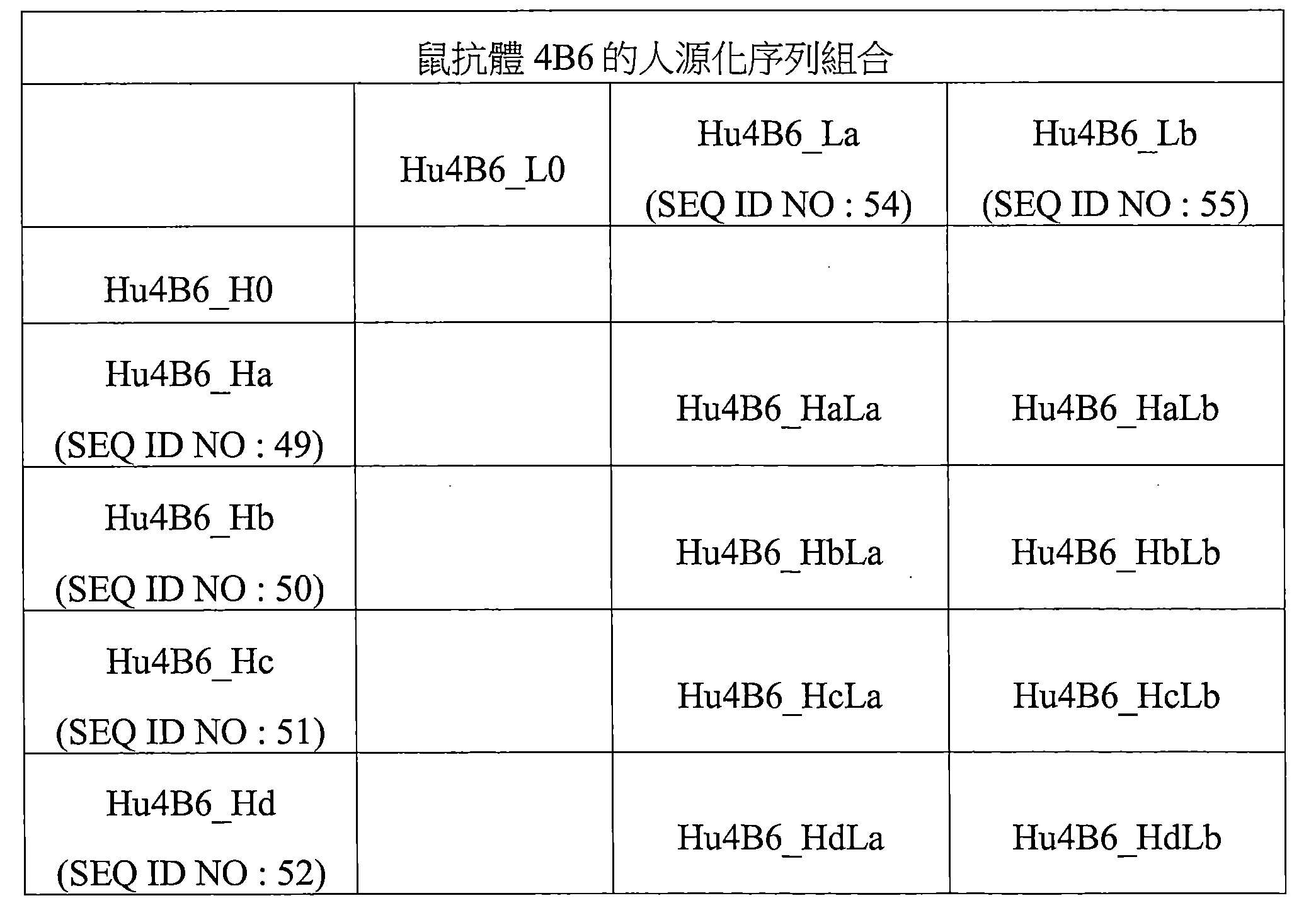
注意:此表示出了不同突變的各種序列組合。例如,Hu4B6_HaLa指示人源化鼠抗體Hu4B6_HaLa上存在兩種突變(重鏈Hu4B6_Ha和輕鏈 Hu4B6_La),以此類推。Hu4B6_L0和Hu4B6_H0是CDR移植獲得的,該CDR移植缺少關鍵回復突變,因此其不用於表達。 Note: This table shows various sequence combinations of different mutations. For example, Hu4B6_HaLa indicates that there are two mutations (heavy chain Hu4B6_Ha and light chain Hu4B6_La) on the humanized murine antibody Hu4B6_HaLa, and so on. Hu4B6_L0 and Hu4B6_H0 are obtained by CDR grafting, which lacks the key back mutations, so they are not used for expression.
實施例2:藉由ELISA測定測量的與人PD-L1的結合Example 2: Binding to human PD-L1 measured by ELISA assay
藉由ELISA方法評估人源化抗體的結合。簡而言之,將人PD-L1-His固定在板上。將表6中列出的人源化4B6抗體在PBS中連續稀釋並添加溫育1小時。接下來,添加山羊pAb對人IgG-HRP和TMB以檢測OD450nm處的結合。 Binding of humanized antibodies was assessed by ELISA. Briefly, human PD-L1-His was immobilized on the plate. Humanized 4B6 antibodies listed in Table 6 were serially diluted in PBS and added for 1 hour. Next, goat pAb against human IgG-HRP and TMB were added to detect binding at OD450nm.
如圖1所示,測試所有人源化變體以篩選最好的變體。所有變體都保留了它們的結合活性,並且Hu4B6_HdLa顯示出比其它變體更好的結合活性。 As shown in Figure 1, all humanized variants were tested to screen the best variant. All variants retained their binding activity, and Hu4B6_HdLa showed better binding activity than other variants.
分析了此抗體的CDR序列,並且發現重鏈的CDR2中存在NG基序。在表達和純化過程中可能存在脫胺基的風險。為了去除脫醯胺熱點,將G55A的突變(下方粗體和放大)引入到Hu4B6_Hd中。然後獲得Hu4B6_Hg(SEQ ID NO:56),並且對人PD-L1的親和力不受影響,如圖2所示。 The CDR sequence of this antibody was analyzed, and the NG motif was found in the CDR2 of the heavy chain. There may be a risk of deamidation during expression and purification. In order to remove the deamidation hotspot, the mutation of G55A (bold and enlarged below) was introduced into Hu4B6_Hd. Then Hu4B6_Hg (SEQ ID NO: 56) was obtained, and the affinity for human PD-L1 was not affected, as shown in Figure 2.
Hu4B6_Hg(SEQ ID NO:56):

實施例3:單株噬菌體ELISA和序列分析Example 3: Single strain phage ELISA and sequence analysis
儘管Hu4B6-HgLa保留了嵌合4B6的活性,但作為拮抗劑藥物,更高的親和力是較佳的。基於Hu4B6-HgLa序列,CDR中的定點誘變和體外解離速率依賴性選擇的幾個淘選循環被進一步用於親和力成熟。首先,將4B6-HgLa的VL 和VH結構域藉由重疊PCR擴增並藉由肽接頭(G4S)3連接形成scFv,然後亞選殖到噬菌粒載體pComb3x(武漢妙靈生物(Wuhan MiaoLingBio),P0862)中,作為藉由SfiI切割位點進行親和力成熟的野生型序列。 Although Hu4B6-HgLa retained the activity of chimeric 4B6, as an antagonist drug, higher affinity was preferred. Based on the Hu4B6-HgLa sequence, several rounds of panning with site-directed mutagenesis in CDRs and off-rate-dependent selection in vitro were further used for affinity maturation. First, the VL and VH domains of 4B6-HgLa were amplified by overlapping PCR and linked by a peptide linker ( G4S )3 to form scFv, and then subcloned into the phagemid vector pComb3x (Wuhan MiaoLingBio, P0862) as the wild-type sequence for affinity maturation by the SfiI cleavage site.
為了研究重鏈和輕鏈的CDR1和CDR2對4B6親和力成熟的單獨的貢獻,將構建上述每個CDR的一個SPM(小擾動誘變)噬菌體文庫,因為兩條鏈的抗體CDR3通常在抗原結合中起著重要的作用。將兩條鏈的CDR1和CDR2序列與種系序列比對,並且重鏈和輕鏈的可變區的種系分別為IGHV1-2和IGKV1-33。種系CDR序列的生物信息學分析結果用於指導文庫設計。 To investigate the individual contributions of CDR1 and CDR2 of the heavy and light chains to 4B6 affinity maturation, one SPM (small perturbation induced mutagenesis) phage library for each of the above CDRs will be constructed, since antibody CDR3 of both chains usually plays an important role in antigen binding. The CDR1 and CDR2 sequences of both chains were aligned with the germline sequences, and the germlines of the variable regions of the heavy and light chains were IGHV1-2 and IGKV1-33, respectively. The results of bioinformatics analysis of the germline CDR sequences were used to guide the library design.
在確定胺基酸突變位點和取代序列後,設計簡並引子以增加突變文庫的多樣性。擴增多樣化的CDR片段,以構建4B6 scFv基因突變文庫。將scFv基因與pComb3XSS噬菌體展示載體連接以生成scFv文庫。每個CDR(包括表2中列出的HCDR1、HCDR2、LCDR1和LCDR2)的基於密碼子的引子建立為獨立文庫,並且將4B6親和力成熟文庫分為4個文庫。HCDR1的容量為1.76×10⁸CFM,HCDR2的容量為1.81×10⁸CFM,LCDR1的容量為2.34×10⁸CFM,並且LCDR2的容量為2.00×10⁸CFM。每個文庫隨機選取5或6個株進行菌落測序。結果表明,構建的文庫的插入率為100%。 After determining the amino acid mutation sites and replacement sequences, degenerate primers were designed to increase the diversity of the mutation library. The diversified CDR fragments were expanded to construct the 4B6 scFv gene mutation library. The scFv gene was connected to the pComb3XSS phage display vector to generate the scFv library. The codon-based primers for each CDR (including HCDR1, HCDR2, LCDR1 and LCDR2 listed in Table 2) were established as independent libraries, and the 4B6 affinity maturation library was divided into 4 libraries. The capacity of HCDR1 was 1.76×10 8 CFM, the capacity of HCDR2 was 1.81×10 8 CFM, the capacity of LCDR1 was 2.34×10 8 CFM, and the capacity of LCDR2 was 2.00×10 8 CFM. Five or six strains were randomly selected from each library for colony sequencing. The results showed that the insertion rate of the constructed library was 100%.
將10μg/ml hPD-L1(Acro Biosystems,PD1-H5229)抗原包被到ELISA板,並在37℃下與200μL噬菌體(1×10¹⁰pfu/m噬菌體展示文庫)反應1小時。洗滌後,將OD600為大約0.5的TG1(Lucigen,60502-2)直接添加到孔中進行感染,並與噬菌體一起溫育15分鐘。足夠體積的M13KO7輔助噬菌體(NEB,N0315S)到對數中期培養用於文庫噬菌粒拯救,並且將噬菌體生成和純化以用於 下一輪篩選。篩選過程重複3輪,並且第2輪抗原濃度下降到2.5μg/ml且第3輪抗原濃度下降到1μg/ml。 10 μg/ml hPD-L1 (Acro Biosystems, PD1-H5229) antigen was coated onto an ELISA plate and reacted with 200 μL phage (1×10 10 pfu/m phage display library) at 37°C for 1 hour. After washing, TG1 (Lucigen, 60502-2) with an OD600 of approximately 0.5 was added directly to the well for infection and incubated with the phage for 15 minutes. A sufficient volume of M13KO7 helper phage (NEB, N0315S) was cultured to mid-log phase for library phagemid rescue, and phage was generated and purified for the next round of screening. The screening process was repeated for 3 rounds, and the antigen concentration was reduced to 2.5 μg/ml in the second round and to 1 μg/ml in the third round.
進行ELISA結合測定以檢測這些多株噬菌體變體的效價。在3輪淘選之後,包括4B6-H-CDR2、4B6-L-CDR1和4B6-L-CDR2的3個文庫明顯富集。 ELISA binding assay was performed to detect the titers of these multiple phage variants. After 3 rounds of panning, 3 libraries including 4B6-H-CDR2, 4B6-L-CDR1 and 4B6-L-CDR2 were significantly enriched.
對於這3個文庫,挑取每個文庫的96個株並進行噬菌體ELISA以檢測它們的結合活性。簡而言之,將1μg/ml hPD-L1(Acro Biosystems,PD1-H5229)抗原包被到ELISA板並在4℃下放置過夜。然後添加300μL的3%(w/v)脫脂牛奶,以在室溫下封閉1小時。1小時後,將含有單株抗體片段噬菌體的100μl上清液與作為陰性對照的PBS一起添加並且在37℃下溫育1小時。0.5% PBS+Tween-20用於洗滌3次,並且添加100μl HRP偶聯抗M13 mAb(1:20000,Sino Biological,11973-MM05T-H)。在室溫下溫育1小時後,添加混合的TMB(InnoReagents,TMB-S-003)受質試劑並將板在室溫下溫育5分鐘。添加0.1M H2SO4終止反應,然後記錄OD450nm。挑選陽性株以用於由Genewiz(中國蘇州)進行DNA測序。序列在表7中示出。 For these 3 libraries, 96 strains of each library were picked and phage ELISA was performed to detect their binding activity. Briefly, 1 μg/ml hPD-L1 (Acro Biosystems, PD1-H5229) antigen was coated onto the ELISA plate and placed at 4°C overnight. Then 300 μL of 3% (w/v) skim milk was added to block for 1 hour at room temperature. After 1 hour, 100 μl of supernatant containing monoclonal antibody fragment phage was added with PBS as a negative control and incubated at 37°C for 1 hour. 0.5% PBS+Tween-20 was used for washing 3 times, and 100 μl of HRP-conjugated anti-M13 mAb (1:20000, Sino Biological, 11973-MM05T-H) was added. After incubation at room temperature for 1 hour, mixed TMB (InnoReagents, TMB-S-003) substrate reagent was added and the plate was incubated at room temperature for 5 minutes. The reaction was terminated by adding 0.1M H 2 SO 4 , and then OD450nm was recorded. Positive strains were selected for DNA sequencing by Genewiz (Suzhou, China). The sequences are shown in Table 7.
表7.4B6 scFv噬菌體文庫的陽性株的序列Table 7.4 Sequences of positive strains of B6 scFv phage library

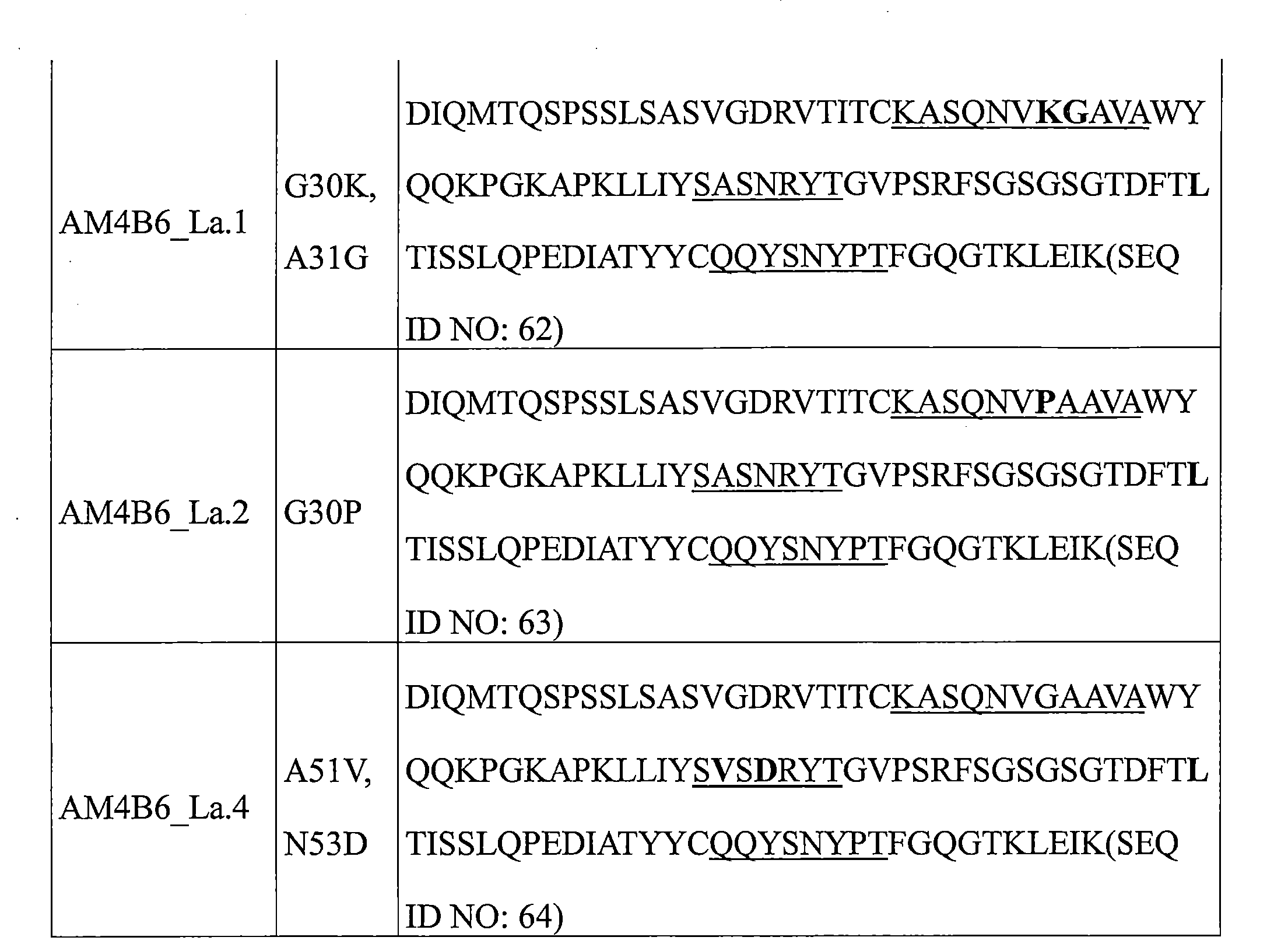
實施例4:用於檢測結合親和力的生物層干涉測量法(BLI)Example 4: Biolayer Interferometry (BLI) for detecting binding affinity
生物層干涉測量法(BLI)用於測試4B6 scFv變體對人PD-L1-Fc(Sino Biological,70110-D02H)抗原的結合親和力。材料和程序分別在表8和表9中示出。結果在表10-12中示出。根據結合親和力結果,4個輕鏈變體(L-CDR1-2、L-CDR1-3、L-CDR2-2、L-CDR2-3)和3個重鏈變體(H-CDR2-2、H-CDR2-3、H-CDR2-5)被選擇用於未來的構建。 Biolayer interferometry (BLI) was used to test the binding affinity of 4B6 scFv variants to human PD-L1-Fc (Sino Biological, 70110-D02H) antigen. The materials and procedures are shown in Tables 8 and 9, respectively. The results are shown in Tables 10-12. Based on the binding affinity results, 4 light chain variants (L-CDR1-2, L-CDR1-3, L-CDR2-2, L-CDR2-3) and 3 heavy chain variants (H-CDR2-2, H-CDR2-3, H-CDR2-5) were selected for future construction.
表8 BLI測定中使用的樣品和材料Table 8 Samples and materials used in BLI determination
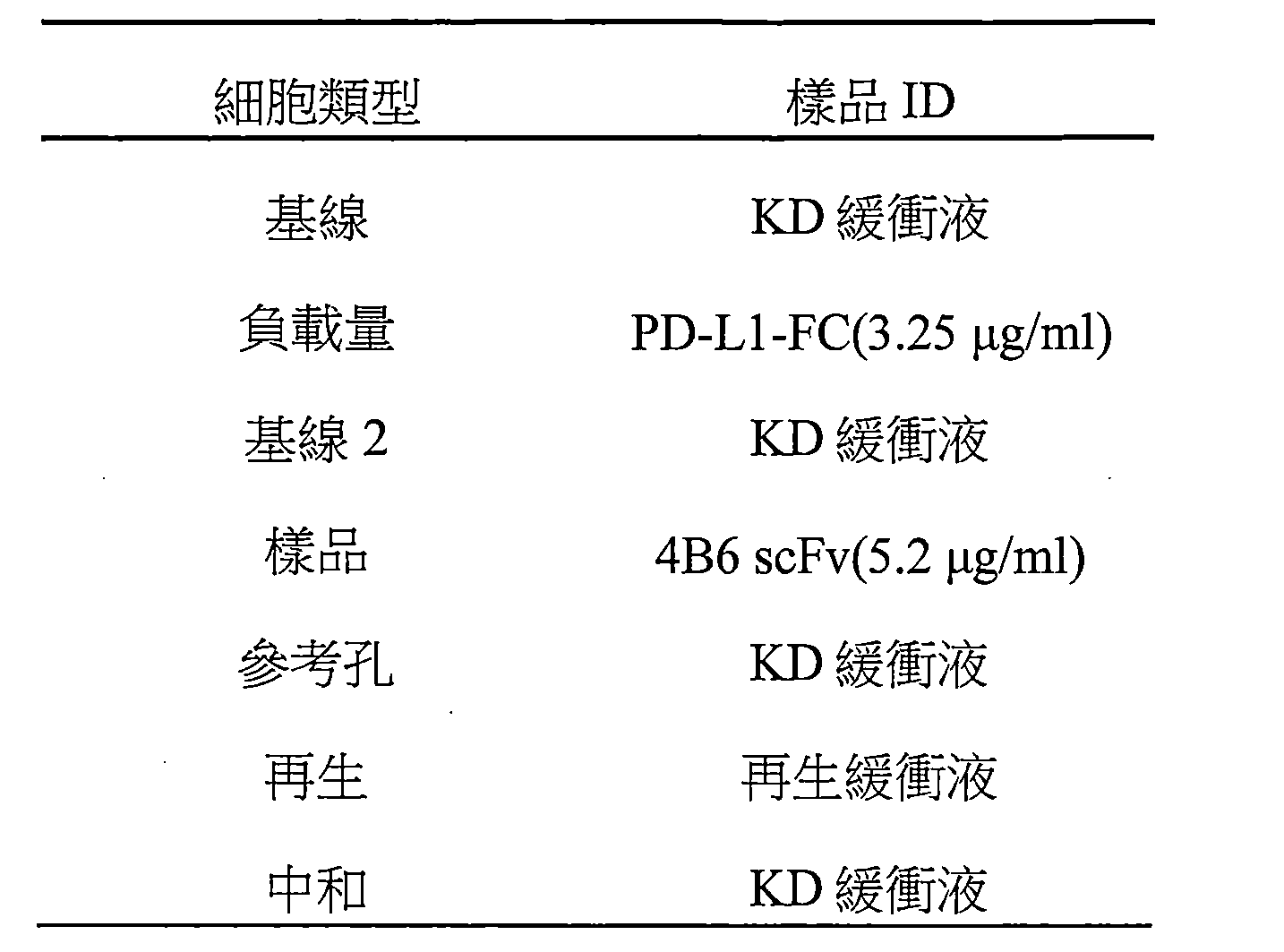
表9 BLI測定程序Table 9 BLI assay procedure

表10. 4B6-L-CDR1突變變體的結合親和力分級Table 10. Binding affinity ranking of 4B6-L-CDR1 mutants
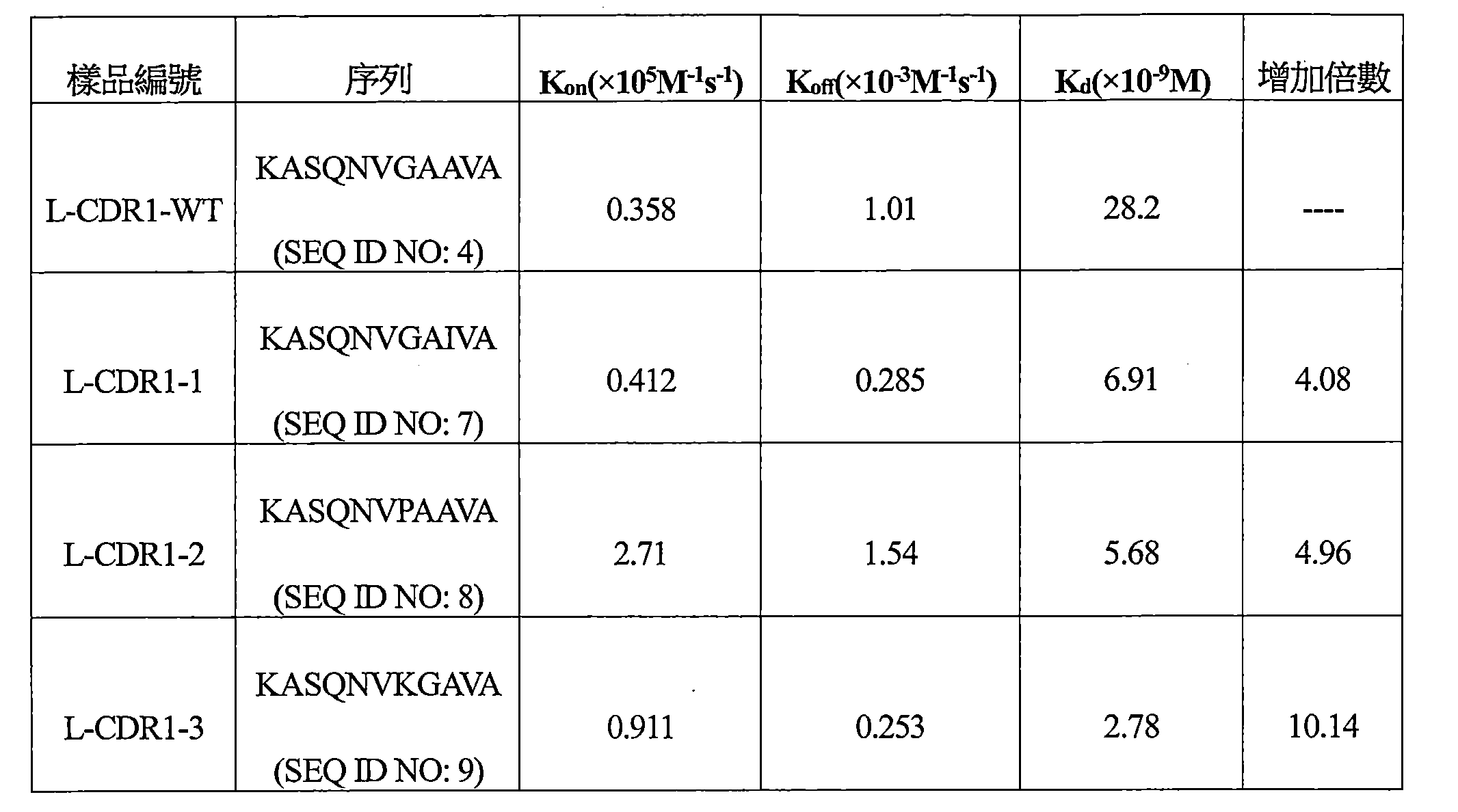
表11.4B6-L-CDR2突變變體的結合親和力分級Table 11. Binding affinity ranking of 4B6-L-CDR2 mutants
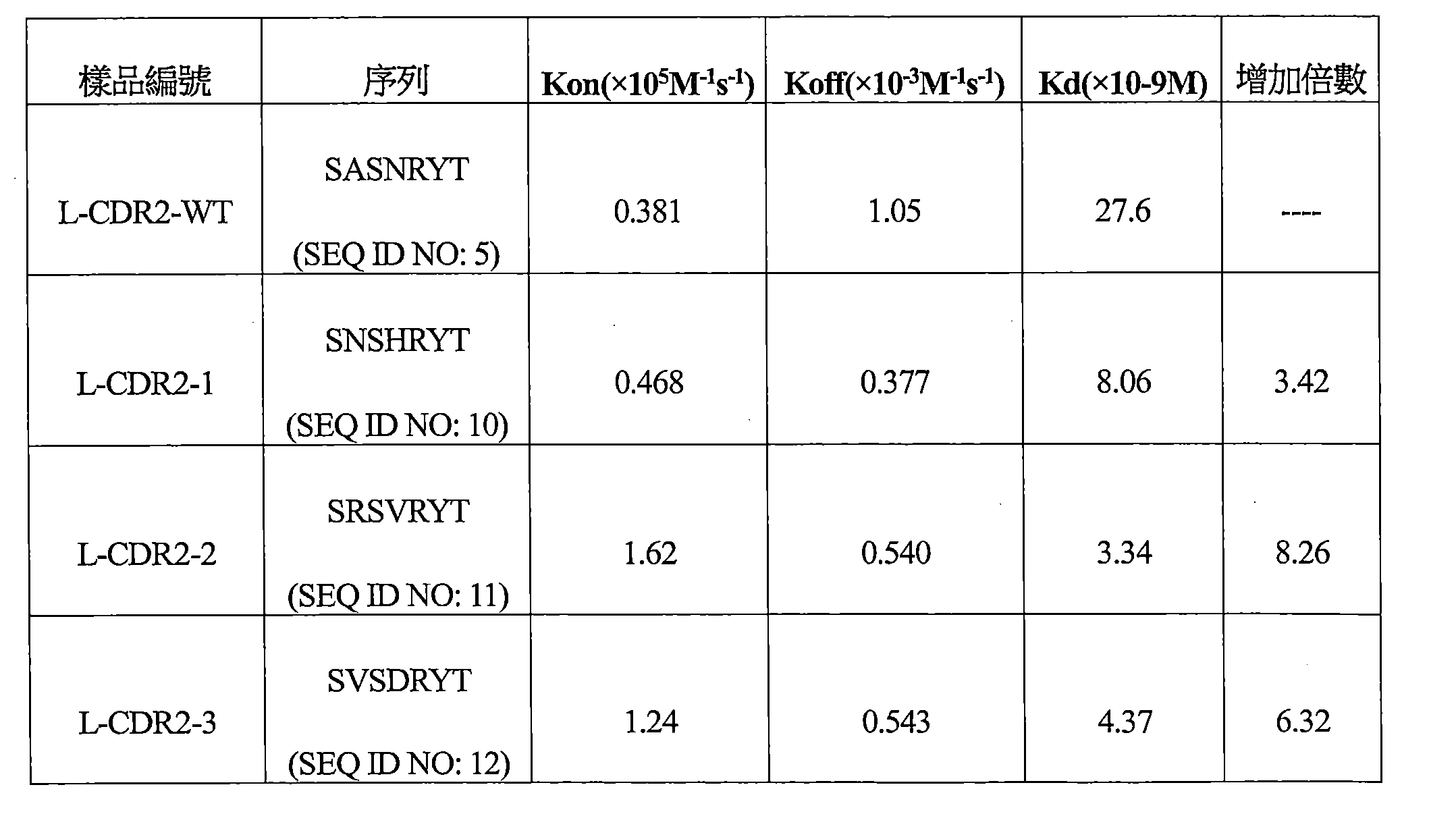
表12. 4B6-H-CDR2突變變體的結合親和力分級Table 12. Binding affinity ranking of 4B6-H-CDR2 mutants
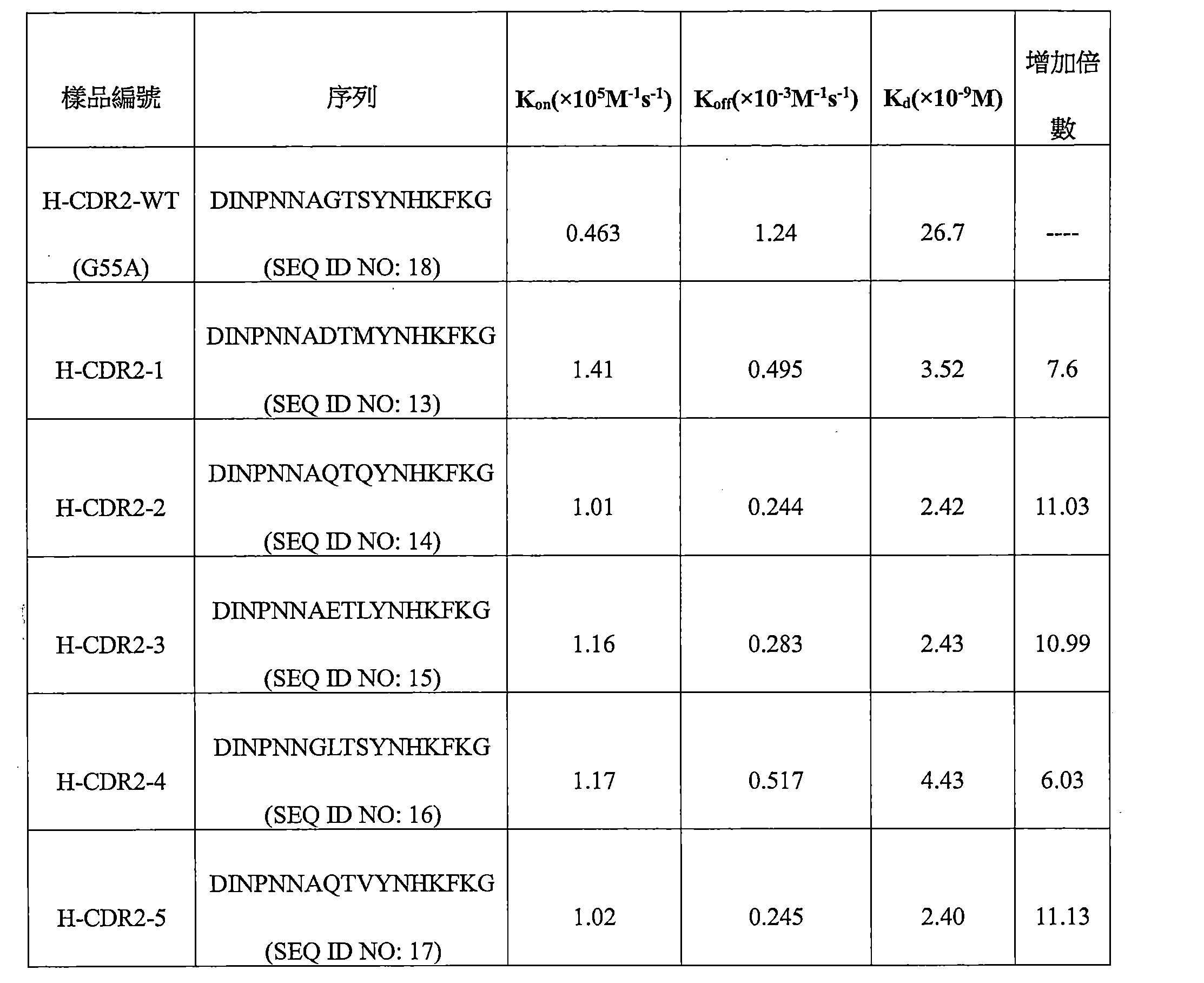
實施例5:AM-4B6-hIgG1-TGFβRII(1-136)融合蛋白的構建和表達Example 5: Construction and expression of AM-4B6-hIgG1-TGFβRII (1-136) fusion protein
將所選重鏈和輕鏈變體與hIgG1-TGFβRII(1-136)融合蛋白交叉組合並表達。TGFβRII(1-136)具有在SEQ ID NO:79中所示的胺基酸序列:

hIgG1的胺基酸序列如下(SEQ ID NO:80):

TGFβRII(1-136)藉由肽接頭(G4S)4G(SEQ ID NO:68)連接到hIgG1的羧基端。 TGFβRII(1-136) was linked to the carboxyl terminus of hIgG1 via a peptide linker (G4S) 4 G (SEQ ID NO: 68).
hκ的胺基酸序列如下(SEQ ID NO:82):

完整抗體變體以AM(親和力成熟)為前綴。重鏈和輕鏈的序列構建體在表13中示出,並且完整抗體的設計在表14中示出。例如,如表13和表14所示,雙功能分子“AM-4B6-hIgG1-TGFβRII變體1”具有重鏈和輕鏈,其中從N端到C端的重鏈包括:Hu4B6_Hg.2-_hIgG1-(G4S)4G-TGFβRII(1-136);並且從N端到C端的輕鏈包括:Hu4B6_La.1-hκ。相同的命名法適用於表14中的其它變體。
The complete antibody variants are prefixed with AM (affinity maturation). The sequence constructs of the heavy chain and the light chain are shown in Table 13, and the design of the complete antibody is shown in Table 14. For example, as shown in Tables 13 and 14, the bifunctional molecule "AM-4B6-hIgG1-
根據製造商的方案,使用來自英傑公司的ExpiFectamineTM CHO試劑(賽默(Thermo),A29129)進行重鏈和輕鏈的共轉染。在第10天收穫上清液並藉由親和色譜法純化。
Co-transfection of heavy and light chains was performed using ExpiFectamine ™ CHO reagent from Invitrogen (Thermo, A29129) according to the manufacturer's protocol. Supernatants were harvested on
表13 AM-4B6-hIgG1-TGFβRII重鏈和輕鏈變體的列表Table 13 List of AM-4B6-hIgG1-TGFβRII heavy chain and light chain variants
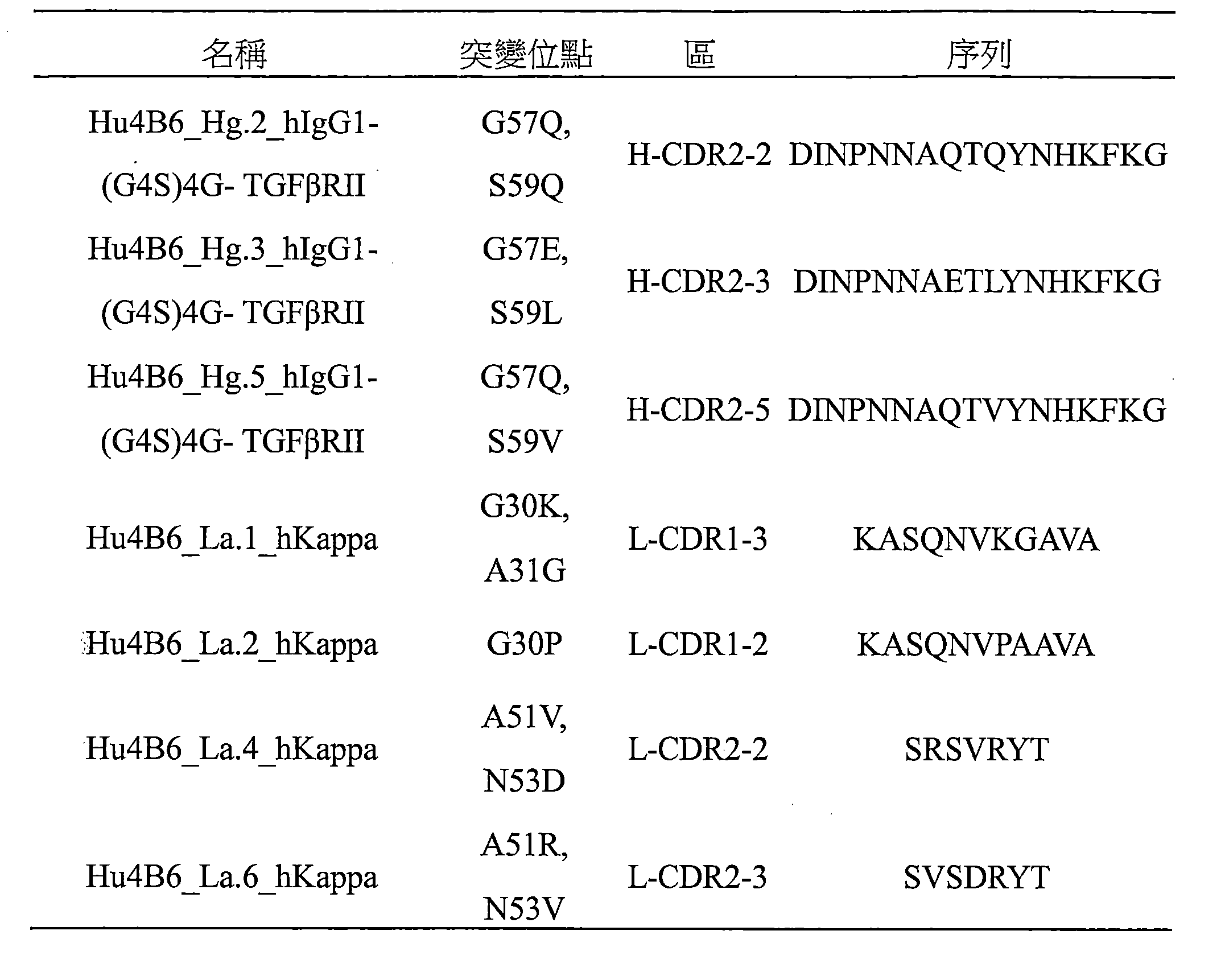
表14. AM-4B6-hIgG1-TGFβRII抗體變體的列表Table 14. List of AM-4B6-hIgG1-TGFβRII antibody variants

實施例6:AM-4B6-hIgG1-TGFβRII變體對hPD-L1的結合親和力Example 6: Binding affinity of AM-4B6-hIgG1-TGFβRII variant to hPD-L1
藉由ELISA測定測量的與hPD-L1的結合Binding to hPD-L1 measured by ELISA
將1μg/ml hPD-L1(Acro Biosystems,PD1-H5229)抗原包被到ELISA板並在4℃下放置過夜。然後添加300μl的3%(w/v)脫脂牛奶,以在室溫下封閉1小時。在1小時後,將100μl的濃度範圍為100nM到0.006nM(四倍連續稀釋)的AM-4B6-hIgG1-TGFβRII變體或原始4B6-hIgG1-TGFβRII與作為陰性對照的PBS一起添加並在室溫下溫育1小時。0.5% PBS+Tween-20用於洗滌3次,並且添加100μl HRP偶聯的抗人Fc抗體(1:20000,艾博抗(Abcam),ab98624),在室溫下溫育1小時後,添加混合的TMB受質試劑(InnoReagents,TMB-S-003)並在室溫下溫育5分鐘,然後藉由添加0.1M H2SO4終止。OD450nm由微板讀數器記錄。 1 μg/ml hPD-L1 (Acro Biosystems, PD1-H5229) antigen was coated onto the ELISA plate and placed overnight at 4°C. Then 300 μl of 3% (w/v) skim milk was added to block for 1 hour at room temperature. After 1 hour, 100 μl of AM-4B6-hIgG1-TGFβRII variants or original 4B6-hIgG1-TGFβRII with a concentration range of 100 nM to 0.006 nM (four-fold serial dilution) was added with PBS as a negative control and incubated at room temperature for 1 hour. 0.5% PBS + Tween-20 was used for washing 3 times, and 100 μl of HRP-conjugated anti-human Fc antibody (1:20000, Abcam, ab98624) was added, and after incubation at room temperature for 1 hour, mixed TMB substrate reagent (InnoReagents, TMB-S-003) was added and incubated at room temperature for 5 minutes, and then terminated by adding 0.1M H 2 SO 4. OD450nm was recorded by a microplate reader.
如圖3A至圖3C所示,當與原始4B6-hIgG1-TGFβRII比較時,所有變體都具有增強的結合信號和親和力。鑑於這些變體之間的差異有限,表面電漿共振技術被用於進一步評估它們的結合親和力。 As shown in Figures 3A to 3C, all variants had enhanced binding signals and affinities when compared to the original 4B6-hIgG1-TGFβRII. Given the limited differences between these variants, surface plasmon resonance was used to further evaluate their binding affinities.
藉由Biacore測量的與hPD-L1的結合Binding to hPD-L1 measured by Biacore
將4μg/ml AM-4B6-hIgG1-TGFβRII變體或原始4B6-hIgG1-TGFβRII固定在S系列蛋白A芯片的表面上。將人PD-L1稀釋到適當的濃度梯度(0nM、1.875nM、3.75nM、7.5nM、15nM、30nM、60nM)並注射到Biacore 2000的樣品通道中。結果在表15中示出。AM-4B6-hIgG1-TGFβRII變體7與人PD-L1的結合親和力比原始4B6-hIgG1-TGFβRII提高了約15倍。
4μg/ml AM-4B6-hIgG1-TGFβRII variants or original 4B6-hIgG1-TGFβRII were immobilized on the surface of the S-series Protein A chip. Human PD-L1 was diluted to an appropriate concentration gradient (0nM, 1.875nM, 3.75nM, 7.5nM, 15nM, 30nM, 60nM) and injected into the sample channel of
表15. 藉由Biacore測量的AM-4B6-hIgG1-TGFβRII與hPD-L1的結合親和力Table 15. Binding affinity of AM-4B6-hIgG1-TGFβRII to hPD-L1 measured by Biacore
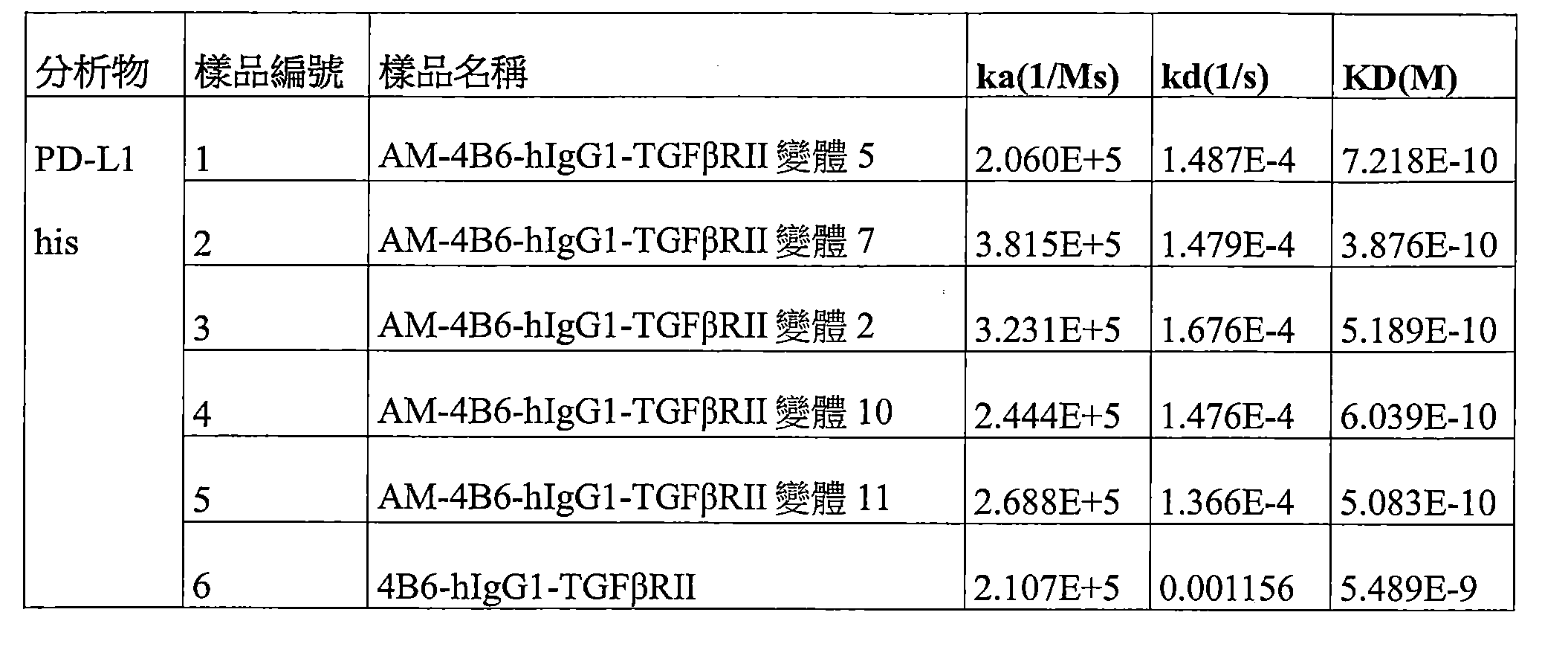
藉由FACS測定測量的與細胞表面上表達的PD-L1的結合Binding to PD-L1 expressed on the cell surface as measured by FACS assay
293T-PD-L1-CD3L細胞由邁博斯生物科學(MabSpace Bioscience)產生,以用於表徵PD-L1抗體。用人PD-L1和抗CD3 scFv轉染細胞。將AM-4B6-hIgG1-TGFβRII變體或原始4B6-hIgG1-TGFβRII連續稀釋(5倍稀釋)以在稀釋緩衝液(含2% BSA的PBS)中獲得8個濃度。收穫並離心293T-PD-L1-CD3L細胞。將它們以2×10⁶個細胞/ml的密度重新懸浮於PBS中,然後以每孔100ul添加到板中。在離心並去除上清液後,將稀釋的抗體添加到板並且在4℃下溫育30分鐘。在用稀釋緩衝液洗滌兩次後,將PE綴合的驢抗人IgG(H+L)(Jacksonimmuno,709-116-149)添加到板並在4℃下溫育30分鐘。在洗滌後,將細胞重新懸浮於200μl PBS中並藉由流式細胞術進行分析。 293T-PD-L1-CD3L cells were generated by MabSpace Bioscience for characterization of PD-L1 antibodies. Cells were transfected with human PD-L1 and anti-CD3 scFv. AM-4B6-hIgG1-TGFβRII variants or original 4B6-hIgG1-TGFβRII were serially diluted (5-fold dilution) to obtain 8 concentrations in dilution buffer (PBS with 2% BSA). 293T-PD-L1-CD3L cells were harvested and centrifuged. They were resuspended in PBS at a density of 2×10 6 cells/ml and then added to the plate at 100ul per well. After centrifugation and removal of the supernatant, the diluted antibody was added to the plate and incubated for 30 minutes at 4° C. After washing twice with dilution buffer, PE-conjugated donkey anti-human IgG (H+L) (Jacksonimmuno, 709-116-149) was added to the plate and incubated for 30 minutes at 4° C. After washing, the cells were resuspended in 200 μl PBS and analyzed by flow cytometry.
如圖4所示,這5種變體以相似的EC50與在293T-PD-L1-CD3L細胞表面表達的PD-L1結合。變體7的EC50略低於其它變體,這與藉由Biacore測量的結合親和力結果一致。 As shown in Figure 4, these five variants bind to PD-L1 expressed on the surface of 293T-PD-L1-CD3L cells with similar EC50. The EC50 of variant 7 is slightly lower than that of the other variants, which is consistent with the binding affinity results measured by Biacore.
實施例7:AM-4B6-hIgG1-TGFbRII變體的PD-1/PD-L1阻斷活性Example 7: PD-1/PD-L1 blocking activity of AM-4B6-hIgG1-TGFbRII variant
藉由ELISA測定測量的PD-1/PD-L1和B7-1/PD-L1阻斷PD-1/PD-L1 and B7-1/PD-L1 blockade measured by ELISA assay
為了測試配體/受體阻斷活性,將0.5μg/ml hPD-L1-Fc抗原包被到ELISA板並在4℃下放置過夜。添加300μL封閉緩衝液,以在室溫下封閉1小時。在1小時後,添加50μl的濃度範圍為100nM到0.024nM(四倍連續稀釋)的AM-4B6-hIgG1-TGFβRII變體7或原始4B6-hIgG1-TGFβRII以及50μl的濃度為1μg/ml的PD-L1-his並且在室溫下溫育1小時。0.5% PBS+Tween-20用於洗滌3次,並且添加100μl HRP偶聯的鏈黴親和素(1:5000,艾博抗,目錄號ab7403)。在室溫下溫育1.5小時後,添加混合的TMB受質試劑並在室溫下溫育5分鐘,然後添加0.1M H2SO4終止。OD450nm由微板讀數器記錄。如圖5A和圖5B所示,兩個樣品都可以阻斷PD-L1/PD-1或PD-L1/B7-1,而AM-4B6-hIgG1-TGFβRII變體7的IC50較低,這表明變體7具有更高的活性。 To test ligand/receptor blocking activity, 0.5 μg/ml hPD-L1-Fc antigen was coated onto ELISA plates and placed overnight at 4°C. 300 μL of blocking buffer was added to block for 1 hour at room temperature. After 1 hour, 50 μl of AM-4B6-hIgG1-TGFβRII variant 7 or original 4B6-hIgG1-TGFβRII with a concentration range of 100 nM to 0.024 nM (four-fold serial dilution) and 50 μl of PD-L1-his at a concentration of 1 μg/ml were added and incubated for 1 hour at room temperature. 0.5% PBS + Tween-20 was used for washing 3 times, and 100 μl HRP-conjugated streptavidin (1:5000, Abcam, catalog number ab7403) was added. After incubation at room temperature for 1.5 hours, the mixed TMB substrate reagent was added and incubated at room temperature for 5 minutes, and then 0.1M H 2 SO 4 was added to terminate. OD450nm was recorded by a microplate reader. As shown in Figures 5A and 5B, both samples can block PD-L1/PD-1 or PD-L1/B7-1, while the IC50 of AM-4B6-hIgG1-TGFβRII variant 7 is lower, indicating that variant 7 has higher activity.
藉由基於細胞的測定測量的PD-1/PD-L1阻斷PD-1/PD-L1 blockade measured by cell-based assays
在此測定中,293T-PD-L1-CD3L細胞表達PD-L1和抗CD3 scFv,而Jurkat-NFAT-Luc-PD1細胞表達PD-1並攜帶可以用CD3刺激激活的NFAT信號。NFAT激活導致下游螢光素酶基因轉錄和表達,這可以藉由其受質進行檢測。該兩個細胞由邁博斯生物科學產生。 In this assay, 293T-PD-L1-CD3L cells express PD-L1 and anti-CD3 scFv, while Jurkat-NFAT-Luc-PD1 cells express PD-1 and carry NFAT signaling that can be activated with CD3 stimulation. NFAT activation leads to downstream luciferase gene transcription and expression, which can be detected by its substrate. Both cells were generated by Mybos Biosciences.
簡而言之,收穫293T-PD-L1-CD3L細胞並以2×10⁶個細胞/ml的密度重新懸浮。將每孔20μl細胞添加到半孔板中。將AM-4B6-hIgG1-TGFβRII變體或原始4B6-hIgG1-TGFβRII連續稀釋(3倍稀釋)以在含2% FBS的RPMI培養基中獲得8個濃度。向半孔板中每孔添加20μl抗體並且將板在37℃、5% CO2下溫育30分鐘。收穫Jurkat-NFAT-Luc-PD1細胞並以4×10⁶個細胞/ml的密度重 新懸浮於含有2% FBS的RPMI培養基中。最後,將每孔20μl細胞和5ng/ml TGF-β(R&D,240-B-010)添加到半孔板中並在37℃、5% CO2下溫育5小時。將60μl的OneGlo檢測試劑(普洛麥格(Promega),E6120)添加到每個孔中並在室溫下溫育5分鐘。發光信號由微板讀數器讀取。數據藉由GraphPad Prism分析。 Briefly, 293T-PD-L1-CD3L cells were harvested and resuspended at 2×10 6 cells/ml. 20 μl of cells were added to each well of a half-well plate. AM-4B6-hIgG1-TGFβRII variants or original 4B6-hIgG1-TGFβRII were serially diluted (3-fold dilution) to obtain 8 concentrations in RPMI medium containing 2% FBS. 20 μl of antibody was added to each well of a half-well plate and the plate was incubated at 37°C, 5% CO 2 for 30 minutes. Jurkat-NFAT-Luc-PD1 cells were harvested and resuspended at 4×10 6 cells/ml in RPMI medium containing 2% FBS. Finally, 20 μl of cells and 5 ng/ml TGF-β (R&D, 240-B-010) were added to half-well plates and incubated at 37°C, 5% CO 2 for 5 hours. 60 μl of OneGlo detection reagent (Promega, E6120) was added to each well and incubated at room temperature for 5 minutes. Luminescence signals were read by a microplate reader. Data were analyzed by GraphPad Prism.
如圖6所示,與之前的ELISA結果一致,與其它變體相比,變體7在此基於細胞的測定中具有最強效的阻斷活性。因此,將AM-4B6-hIgG1-TGFβRII變體7的4B6 Fab部分簡稱為AM4B6,並在以下實驗中進一步評估AM4B6-hIgG1-TGFβRII融合蛋白。 As shown in Figure 6, consistent with the previous ELISA results, variant 7 had the most potent blocking activity in this cell-based assay compared to the other variants. Therefore, the 4B6 Fab portion of AM-4B6-hIgG1-TGFβRII variant 7 was abbreviated as AM4B6, and the AM4B6-hIgG1-TGFβRII fusion protein was further evaluated in the following experiments.
實施例8:AM4B6-hIgG1-TGFβRII'的體外生成和表徵 Example 8: In vitro generation and characterization of AM4B6-hIgG1-TGFβRII′
AM4B6-hIgG1-TGFβRII的株和表達AM4B6-hIgG1-TGFβRII strain and expression
據報導,截短的TGFβRII ECD_20-136是可溶性的並保留了結合TGFβ1的能力(Kim-Ming Lo等人,US9676863 B2,2017;Christian C.等人,《蛋白質表達和純化(Protein Expression and Purification)》,2000,20:98-104)。接下來,將TGFβRII_1-136的胞外結構域的全長替換為截短的胞外結構域並評估可開發性和穩定性。來自穩定細胞系的SDS-PAGE結果表明,蛋白質表達對於截短和全長TGFβRII ECD都很好,但截短的TGFβRII ECD_20-136的蛋白質穩定性比全長TGFβRII ECD好得多(圖7)。截短的TGFβRII ECD_20-136的序列如下: It has been reported that the truncated TGFβRII ECD_20-136 is soluble and retains the ability to bind to TGFβ1 (Kim-Ming Lo et al., US9676863 B2, 2017; Christian C. et al., Protein Expression and Purification, 2000, 20: 98-104). Next, the full length of the extracellular domain of TGFβRII_1-136 was replaced with the truncated extracellular domain and the developability and stability were evaluated. The SDS-PAGE results from the stable cell line showed that protein expression was good for both truncated and full-length TGFβRII ECD, but the protein stability of the truncated TGFβRII ECD_20-136 was much better than that of the full-length TGFβRII ECD (Figure 7). The sequence of the truncated TGFβRII ECD_20-136 is as follows:
穩定的TGF-β陷阱、TGF-βRII胞外結構域(20-136)的序列 Sequence of stable TGF-β trap, TGF-βRII extracellular domain (20-136)

包括截短的TGF-βRII(即TGF-βRII(20-136),SEQ ID NO:66)的雙功能分子用於此實施例以及實施例9-11。此類雙功能分子的名稱用TGFβRII'表示,以區別於TGF-βRII(1-136)。例如,AM4B6-hIgG1-TGFβRII'表示具有TGF-βRII(20-136)的分子。 Bifunctional molecules including truncated TGF-βRII (i.e., TGF-βRII (20-136), SEQ ID NO: 66) are used in this embodiment and in embodiments 9-11. Such bifunctional molecules are named TGFβRII' to distinguish them from TGF-βRII (1-136). For example, AM4B6-hIgG1-TGFβRII' represents a molecule having TGF-βRII (20-136).
藉由ELISA測定測量的與來自不同物種的PD-L1的結合Binding to PD-L1 from different species measured by ELISA assay
將1μg/ml人PD-L1(Acro Biosystems,PD1-H5229)或食蟹猴PD-L1抗原包被到ELISA板上並在4℃下放置過夜。然後添加300μl的3%(w/v)脫脂牛奶,以在室溫下封閉1小時。在1小時後,添加100μl的濃度範圍為100nM到0.02nM(四倍連續稀釋)的AM4B6-hIgG1-TGFβRII'或對照hIgG1-TGFβRII'並在室溫下溫育1小時。0.5% PBS+Tween-20用於洗滌3次,並且添加100μl HRP偶聯的抗人Fc抗體(1:20000,艾博抗(Abcam),ab98624),在室溫下溫育1小時後,添加混合的TMB受質試劑(InnoReagents,TMB-S-003)並在室溫下溫育5分鐘,並且藉由添加0.1M H2SO4終止。OD450nm由微板讀數器記錄。 1 μg/ml human PD-L1 (Acro Biosystems, PD1-H5229) or cynomolgus PD-L1 antigen was coated onto ELISA plates and placed overnight at 4°C. Then 300 μl of 3% (w/v) skim milk was added to block for 1 hour at room temperature. After 1 hour, 100 μl of AM4B6-hIgG1-TGFβRII' or control hIgG1-TGFβRII' with a concentration range of 100 nM to 0.02 nM (four-fold serial dilution) was added and incubated at room temperature for 1 hour. 0.5% PBS + Tween-20 was used for washing 3 times, and 100 μl of HRP-conjugated anti-human Fc antibody (1:20000, Abcam, ab98624) was added, and after incubation at room temperature for 1 hour, mixed TMB substrate reagent (InnoReagents, TMB-S-003) was added and incubated at room temperature for 5 minutes, and terminated by adding 0.1M H 2 SO 4. OD450nm was recorded by a microplate reader.
如圖8A和圖8B所示,AM4B6-hIgG1-TGFβRII'以與人PD-L1相似的EC50與食蟹猴PD-L1交叉反應。 As shown in Figures 8A and 8B, AM4B6-hIgG1-TGFβRII' cross-reacted with cynomolgus monkey PD-L1 at an EC50 similar to that of human PD-L1.
藉由ELISA測量的與來自不同物種的TGFβ1、TGFβ2和TGFβ3的結合Binding to TGFβ1, TGFβ2, and TGFβ3 from different species measured by ELISA
根據來自Uniport網站(https://www.uniprot.org/)上公佈的4種常見物種:人、食蟹猴、小鼠和大鼠的TGFβ1、TGFβ2和TGFβ3的序列,TGFβ成員是相當保守。人TGFβ1和食蟹猴TGFβ1的序列相同;小鼠TGFβ1和大鼠TGFβ1相同;人TGFβ2和食蟹猴TGFβ2相同;小鼠TGFβ2和大鼠TGFβ2相同;人TGFβ3、食蟹猴TGFβ3和小鼠TGFβ3相同。 According to the sequences of TGFβ1, TGFβ2 and TGFβ3 of four common species published on the Uniport website (https://www.uniprot.org/): human, cynomolgus monkey, mouse and rat, TGFβ members are quite conserved. The sequences of human TGFβ1 and cynomolgus monkey TGFβ1 are the same; mouse TGFβ1 and rat TGFβ1 are the same; human TGFβ2 and cynomolgus monkey TGFβ2 are the same; mouse TGFβ2 and rat TGFβ2 are the same; human TGFβ3, cynomolgus monkey TGFβ3 and mouse TGFβ3 are the same.
對於TGFβ1和TGFβ3,程序如下:將0.5μg/ml人TGFβ1(Sino Biological,10804-HNAC)或小鼠TGFβ1(Novoprotein,CK33)或人TGFβ3(金斯瑞(Genscript),Z03430)或大鼠TGFβ3(Novoprotein,CJ44)抗原包被到ELISA板並在4℃下放置過夜。然後添加300μl的3%(w/v)脫脂牛奶,以在室溫下封閉1小時。在1小時後,添加100μl的濃度範圍為100nM到0.006nM(四倍連續稀釋)的AM4B6-hIgG1-TGFβRII'或對照hIgG1-TGFβRII'並在室溫下溫育1小時。0.5% PBS+Tween-20用於洗滌3次,並且添加100μl HRP偶聯的抗人Fc抗體(1:20000,艾博抗(Abcam),ab98624),在室溫下溫育1小時後,添加混合的TMB受質試劑(InnoReagents,TMB-S-003)並在室溫下溫育5分鐘,並且藉由添加0.1M H2SO4終止。OD450nm由微板讀數器記錄。 For TGFβ1 and TGFβ3, the procedure was as follows: 0.5 μg/ml human TGFβ1 (Sino Biological, 10804-HNAC) or mouse TGFβ1 (Novoprotein, CK33) or human TGFβ3 (Genscript, Z03430) or rat TGFβ3 (Novoprotein, CJ44) antigen was coated onto an ELISA plate and placed overnight at 4°C. Then 300 μl of 3% (w/v) skim milk was added to block for 1 hour at room temperature. After 1 hour, 100 μl of AM4B6-hIgG1-TGFβRII' or control hIgG1-TGFβRII' with a concentration range of 100 nM to 0.006 nM (four-fold serial dilution) was added and incubated at room temperature for 1 hour. 0.5% PBS + Tween-20 was used for washing 3 times, and 100 μl of HRP-conjugated anti-human Fc antibody (1:20000, Abcam, ab98624) was added, and after incubation at room temperature for 1 hour, mixed TMB substrate reagent (InnoReagents, TMB-S-003) was added and incubated at room temperature for 5 minutes, and terminated by adding 0.1M H 2 SO 4. OD450nm was recorded by a microplate reader.
對於TGFβ2,測試程序不同:將2μg/ml的AM4B6-hIgG1-TGFβRII'或對照hIgG1-TGFβRII'包被到ELISA板並在4℃下放置過夜。然後添加300μl的3%(w/v)脫脂牛奶,以在室溫下封閉1小時。在1小時後,添加100μl的濃度範圍為39.4nM到0.3nM(兩倍連續稀釋)的人TGFβ2或小鼠TGFβ2並在室溫下溫育1小時。0.5% PBS+Tween-20用於洗滌3次,並且添加100μl的TGFβ2生物素化抗體(1:10000,R&D,BAF302)。在室溫下溫育1小時並洗滌後,添加100μl的HRP-鏈黴親和素(1:5000,艾博抗,ab7403)並將板在室溫下溫育1小時。在洗滌後,添加混合的TMB受質試劑(InnoReagents,TMB-S-003)並在室溫下溫育5分鐘,並且藉由添加0.1M H2SO4終止。OD450nm由微板讀數器記錄。 For TGFβ2, the assay procedure was different: 2 μg/ml of AM4B6-hIgG1-TGFβRII' or control hIgG1-TGFβRII' was coated onto ELISA plates and placed overnight at 4°C. Then 300 μl of 3% (w/v) skim milk was added to block for 1 hour at room temperature. After 1 hour, 100 μl of human TGFβ2 or mouse TGFβ2 with a concentration range of 39.4 nM to 0.3 nM (two-fold serial dilution) was added and incubated for 1 hour at room temperature. 0.5% PBS+Tween-20 was used for washing 3 times, and 100 μl of TGFβ2 biotinylated antibody (1:10000, R&D, BAF302) was added. After incubation at room temperature for 1 hour and washing, 100 μl of HRP-streptavidin (1:5000, Abcam, ab7403) was added and the plate was incubated at room temperature for 1 hour. After washing, mixed TMB substrate reagent (InnoReagents, TMB-S-003) was added and incubated at room temperature for 5 minutes and stopped by adding 0.1 MH 2 SO 4. OD450nm was recorded by a microplate reader.
結果總結在表16中。對於與TGFβ1的結合親和力,不同物種之間的EC50值非常相似。此外,與TGFβ1和TGFβ3的結合親和力顯著高於TGFβ2,這表明對TGFβ1和TGFβ3的阻斷活性可能比TGFβ2更有效。 The results are summarized in Table 16. For the binding affinity to TGFβ1, the EC50 values were very similar between the different species. In addition, the binding affinity to TGFβ1 and TGFβ3 was significantly higher than that to TGFβ2, suggesting that the blocking activity against TGFβ1 and TGFβ3 may be more effective than that of TGFβ2.
表16. AM4B6-hIgG1-TGFβRII'與TGFβ1、TGFβ2和TGFβ3的結合Table 16. Binding of AM4B6-hIgG1-TGFβRII' to TGFβ1, TGFβ2 and TGFβ3
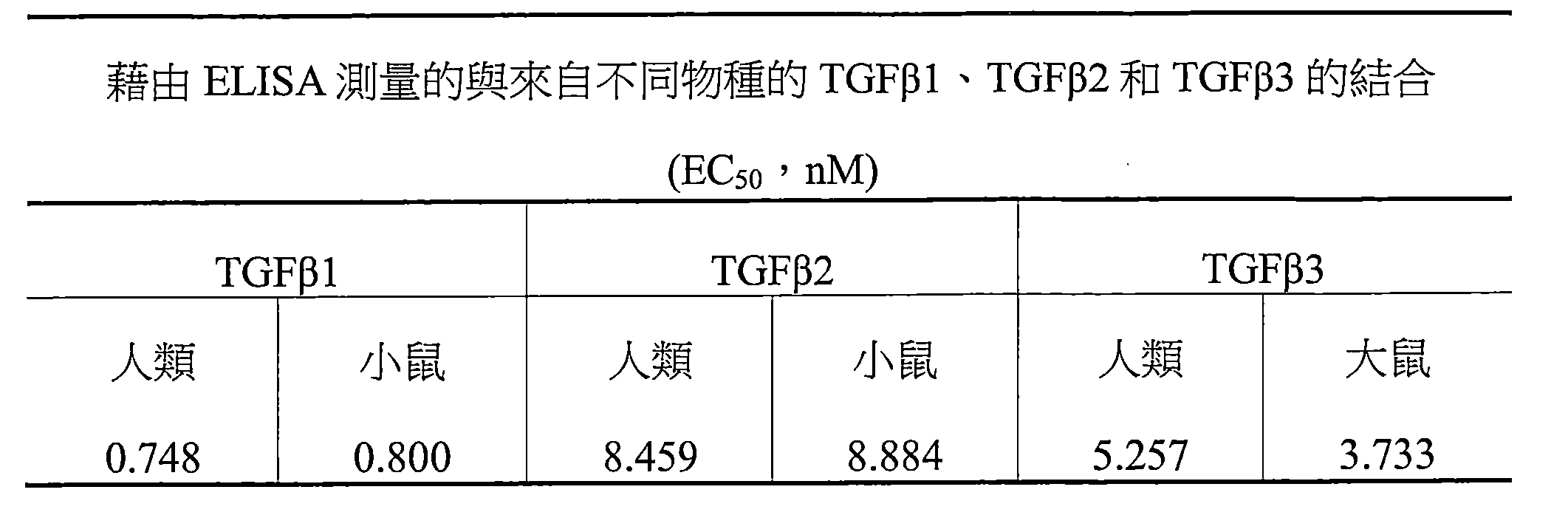
藉由ELISA測定測量的與B7家族或TGFβ超家族內的其它成員的結合Binding to other members of the B7 family or TGFβ superfamily measured by ELISA assay
對於B7家族,將0.5μg/ml hPD-L1(Acro Biosystems,PD1-H5229)或hPD-L2或B7-2或B7-1或B7-H2或B7-H3或B7-H4或VISTA包被到ELISA板並在4℃下放置過夜。對於TGFβ超家族,將0.5μg/ml人激活素A、BMP-2、LAP或TGFβ1在4℃下包被過夜。然後添加300μl的3%(w/v)脫脂牛奶,以在室溫下封閉1小時。在1小時後,添加100μl的濃度範圍為100nM到0.006nM(連續稀釋)的AM4B6-hIgG1-TGFβRII'並在室溫下溫育1小時。0.5% PBS+Tween-20用於洗滌3次,並且添加100μl HRP偶聯的抗人Fc抗體(1:20000,艾博抗(Abcam),ab98624),在室溫下溫育1小時後,添加混合的TMB受質試劑(InnoReagents,TMB-S-003)並在室溫下溫育5分鐘,並且藉由添加0.1M H2SO4終止。OD450nm由微板讀數器記錄。 For the B7 family, 0.5 μg/ml hPD-L1 (Acro Biosystems, PD1-H5229) or hPD-L2 or B7-2 or B7-1 or B7-H2 or B7-H3 or B7-H4 or VISTA was coated on an ELISA plate and placed overnight at 4°C. For the TGFβ superfamily, 0.5 μg/ml human activin A, BMP-2, LAP or TGFβ1 was coated overnight at 4°C. Then 300 μl of 3% (w/v) skim milk was added to block for 1 hour at room temperature. After 1 hour, 100 μl of AM4B6-hIgG1-TGFβRII' with a concentration range of 100 nM to 0.006 nM (serial dilution) was added and incubated at room temperature for 1 hour. 0.5% PBS + Tween-20 was used for washing 3 times, and 100 μl of HRP-conjugated anti-human Fc antibody (1:20000, Abcam, ab98624) was added, and after incubation at room temperature for 1 hour, mixed TMB substrate reagent (InnoReagents, TMB-S-003) was added and incubated at room temperature for 5 minutes, and terminated by adding 0.1M H 2 SO 4. OD450nm was recorded by a microplate reader.
如圖9A和圖9B所示,AM4B6-hIgG1-TGFβRII'特異性結合到PD-L1而不是也屬於B7家族的其它抗原。如圖9C所示,AM4B6-hIgG1-TGFβRII'特異性結合到TGF-β1而不是也屬於TGFβ超家族的其它抗原。 As shown in Figures 9A and 9B, AM4B6-hIgG1-TGFβRII' specifically binds to PD-L1 rather than other antigens that also belong to the B7 family. As shown in Figure 9C, AM4B6-hIgG1-TGFβRII' specifically binds to TGF-β1 rather than other antigens that also belong to the TGFβ superfamily.
AM4B6-hIgG1-TGFβRII'與表達PD-L1的細胞的結合Binding of AM4B6-hIgG1-TGFβRII' to cells expressing PD-L1
MC38/hPD-L1是藉由經由CRISPR-Cas9系統刪除mPD-L1,然後使用慢病毒轉導hPD-L1來產生的。此細胞系由中國醫學科學院蘇州系統醫學研究所系統醫學中心(Center of Systems Medicine,Chinese Academy of Medical Sciences Suzhou Institute of Systems Medicine)秦曉峰教授實驗室提供(Huang,Anfei等人《科學報告(Scientific Reports)》7(2017):42687.)。將MC-38/hPD-L1細胞在RPMI1640+10% FBS中培養。EMT-6/hPD-L1是穩定表達經轉染的人PD-L1基因的小鼠乳腺癌細胞系。將EMT-6/hPD-L1細胞在Waymouth的(1×)MB752/1+15% FBS中培養。NCI-H460細胞購自COBIOER有限公司(COBIOER Ltd)。它是一種具有PD-L1表達的人肺上皮腫瘤細胞系。將NCI-H460細胞在RPMI1640+10% FBS中培養。NCI-H292細胞購自COBIOER有限公司。它是一種具有PD-L1表達的人肺上皮腫瘤細胞系。將NCI-H292細胞在RPMI1640+10% FBS+1nM丙酮酸鈉溶液中培養。FACS分析方案與實施例6第3節相同。
MC38/hPD-L1 was generated by deleting mPD-L1 via the CRISPR-Cas9 system and then transducing hPD-L1 using lentivirus. This cell line was provided by Professor Qin Xiaofeng's laboratory at the Center of Systems Medicine, Chinese Academy of Medical Sciences Suzhou Institute of Systems Medicine (Huang, Anfei et al. Scientific Reports 7 (2017): 42687.). MC-38/hPD-L1 cells were cultured in RPMI1640 + 10% FBS. EMT-6/hPD-L1 is a mouse breast cancer cell line that stably expresses the transfected human PD-L1 gene. EMT-6/hPD-L1 cells were cultured in (1×) MB752/1+15% FBS from Waymouth. NCI-H460 cells were purchased from COBIOER Ltd. It is a human lung epithelial tumor cell line with PD-L1 expression. NCI-H460 cells were cultured in RPMI1640+10% FBS. NCI-H292 cells were purchased from COBIOER Ltd. It is a human lung epithelial tumor cell line with PD-L1 expression. NCI-H292 cells were cultured in RPMI1640+10% FBS+1nM sodium pyruvate solution. The FACS analysis protocol was the same as that in
將人或食蟹猴PBMC(TPCS,目錄號PB025C)從液氮中回收並重新懸浮於具有10% FBS的RPMI1640中。添加5μg/ml的PHA(西格馬(Sigma),目錄號L8902)以刺激PBMC激活並將細胞培養3天。收集激活的PBMC並且離心並以2×106個細胞/ml的密度重新懸浮於PBS中,並且以每孔100ul添加到板中。將AM4B6-hIgG1-TGFβRII'或AM4B6或對照hIgG1-TGFβRII'連續稀釋(5倍稀釋)以在稀釋緩衝液(含2% BSA的PBS)獲得10個濃度。在離心並去除板中的上清液後,將稀釋的抗體添加到具有激活的PBMC的板中並在4℃下溫育1小時。用稀釋緩衝液洗滌兩次後,添加Alexa488標記的小鼠抗人CD3(Biolegend,目錄號300320)和APC標記的抗人IgG二級抗體(BD,目錄號550931)並在4℃ 下溫育30分鐘。在洗滌後,將細胞重新懸浮於150μl PBS中並藉由流式細胞術進行分析。 Human or cynomolgus monkey PBMC (TPCS, catalog number PB025C) were recovered from liquid nitrogen and resuspended in RPMI1640 with 10% FBS. 5 μg/ml of PHA (Sigma, catalog number L8902) was added to stimulate PBMC activation and the cells were cultured for 3 days. The activated PBMCs were collected and centrifuged and resuspended in PBS at a density of 2×10 6 cells/ml and added to the plate at 100 ul per well. AM4B6-hIgG1-TGFβRII' or AM4B6 or control hIgG1-TGFβRII' were serially diluted (5-fold dilution) to obtain 10 concentrations in dilution buffer (PBS containing 2% BSA). After centrifugation and removal of the supernatant in the plate, the diluted antibody was added to the plate with activated PBMC and incubated for 1 hour at 4°C. After washing twice with dilution buffer, Alexa488-labeled mouse anti-human CD3 (Biolegend, catalog number 300320) and APC-labeled anti-human IgG secondary antibody (BD, catalog number 550931) were added and incubated for 30 minutes at 4°C. After washing, the cells were resuspended in 150 μl PBS and analyzed by flow cytometry.
如圖10A至圖10F所示,AM4B6-hIgG1-TGFβRII'可以以與單獨的AM4B6 mAb相似的親和力與在這些癌細胞系和激活的人或食蟹猴T細胞上表達的PD-L1結合。 As shown in Figures 10A to 10F, AM4B6-hIgG1-TGFβRII' can bind to PD-L1 expressed on these cancer cell lines and activated human or cynomolgus monkey T cells with similar affinity as AM4B6 mAb alone.
與激活的人T細胞的結合Binding to activated human T cells
將人PBMC(TPCS,目錄號PB025C)從液氮中回收並重新懸浮於具有10% FBS的RPMI1640中。添加5μg/ml的PHA(西格馬,目錄號L8902)以刺激PBMC激活並將細胞培養3天。收集激活的PBMC並且離心並以2×106個細胞/ml的密度重新懸浮於PBS中,並且以每孔100ul添加到板中。將AM4B6-hIgG1-TGFβRII'或AM4B6或對照hIgG1-TGFβRII'連續稀釋(5倍稀釋)以在稀釋緩衝液(含2% BSA的PBS)獲得10個濃度。在離心並去除板中的上清液後,將稀釋的抗體添加到具有激活的PBMC的板中並在4℃下溫育1小時。用稀釋緩衝液洗滌兩次後,添加Alexa488標記的小鼠抗人CD3(Biolegend,目錄號300320)和APC標記的抗人IgG二級抗體(BD,目錄號550931)並在4℃下溫育30分鐘。在洗滌後,將細胞重新懸浮於150μl PBS中並藉由流式細胞術進行分析。 Human PBMC (TPCS, catalog number PB025C) was recovered from liquid nitrogen and resuspended in RPMI1640 with 10% FBS. 5 μg/ml of PHA (Sigma, catalog number L8902) was added to stimulate PBMC activation and the cells were cultured for 3 days. The activated PBMCs were collected and centrifuged and resuspended in PBS at a density of 2×10 6 cells/ml and added to the plate at 100 ul per well. AM4B6-hIgG1-TGFβRII' or AM4B6 or control hIgG1-TGFβRII' was serially diluted (5-fold dilution) to obtain 10 concentrations in dilution buffer (PBS containing 2% BSA). After centrifugation and removal of the supernatant in the plate, the diluted antibody was added to the plate with activated PBMC and incubated for 1 hour at 4°C. After washing twice with dilution buffer, Alexa488-labeled mouse anti-human CD3 (Biolegend, catalog number 300320) and APC-labeled anti-human IgG secondary antibody (BD, catalog number 550931) were added and incubated for 30 minutes at 4°C. After washing, the cells were resuspended in 150 μl PBS and analyzed by flow cytometry.
如圖11所示,AM4B6-hIgG1-TGFβRII'可以結合到在激活的人T細胞上表達的PD-L1。 As shown in Figure 11, AM4B6-hIgG1-TGFβRII' can bind to PD-L1 expressed on activated human T cells.
藉由ELISA測定測量的對hPD-L1/hPD-1和食蟹猴PD-L1/食蟹猴PD-1的阻斷Blockade of hPD-L1/hPD-1 and cynomolgus PD-L1/cynomolgus PD-1 measured by ELISA assay
將0.5μg/ml的hPD-L1-Fc或0.5μg/ml的食蟹猴PD-L1-Fc包被到ELISA板並在4℃下放置過夜。添加300μL的3%(w/v)脫脂牛奶,以在室溫下封閉1小 時。在1小時後,添加100μl的濃度範圍為100nM到0.02nM(四倍連續稀釋)的AM4B6-hIgG1-TGFβRII'或AM4B6以及0.5μg/ml的hPD-1-Fc-生物素或食蟹猴PD-1-Fc-生物素並在室溫下溫育1小時。0.5% PBS+Tween-20用於洗滌3次,並且添加100μl HRP偶聯的鏈黴親和素(1:5000)。在室溫下溫育1小時後,添加混合的TMB受質試劑並在室溫下溫育5分鐘,然後添加0.1M H2SO4終止。OD450nm由微板讀數器記錄。 0.5 μg/ml hPD-L1-Fc or 0.5 μg/ml cynomolgus PD-L1-Fc was coated onto an ELISA plate and placed overnight at 4°C. 300 μL of 3% (w/v) skim milk was added to block for 1 hour at room temperature. After 1 hour, 100 μl of AM4B6-hIgG1-TGFβRII' or AM4B6 with a concentration range of 100 nM to 0.02 nM (fourfold serial dilution) and 0.5 μg/ml hPD-1-Fc-biotin or cynomolgus PD-1-Fc-biotin were added and incubated for 1 hour at room temperature. 0.5% PBS+Tween-20 was used for washing 3 times, and 100 μl of HRP-conjugated streptavidin (1:5000) was added. After incubation at room temperature for 1 hour, mixed TMB substrate reagents were added and incubated at room temperature for 5 minutes, and then stopped by adding 0.1M H 2 SO 4. OD450nm was recorded by a microplate reader.
如圖12A和圖12B所示,AM4B6-hIgG1-TGFβRII'還可以以與阻斷人PD-L1/人PD-1的IC50相似的IC50完全阻斷食蟹猴PD-L1/食蟹猴PD-1。 As shown in Figures 12A and 12B, AM4B6-hIgG1-TGFβRII' can also completely block cynomolgus monkey PD-L1/cynomolgus monkey PD-1 with an IC50 similar to that of human PD-L1/human PD-1.
與hPD-L1和hTGFβ1的同時結合Simultaneous binding to hPD-L1 and hTGFβ1
將0.5μg/ml的hTGFβ-1包被到ELISA板並在4℃下放置過夜。然後添加300μl的封閉緩衝液,以在室溫下封閉1小時。在1小時後,添加100μl的濃度範圍為100nM到0.02nM(四倍連續稀釋)的AM4B6-hIgG1-TGFβRII'或AM4B6或對照hIgG1-TGFβRII'並在室溫下溫育1小時。0.5% PBS+Tween-20用於洗滌3次,並且然後每孔添加0.5μg/ml的hPD-L1-生物素。在1小時後,添加100μl的HRP偶聯的鏈黴親和素(1:5000)。在室溫下溫育1小時後,添加混合的TMB受質試劑(InnoReagents,TMB-S-003)並在室溫下溫育5分鐘,並且藉由添加0.1M H2SO4終止。OD450nm由微板讀數器記錄。 0.5 μg/ml of hTGFβ-1 was coated onto the ELISA plate and placed overnight at 4°C. Then 300 μl of blocking buffer was added to block for 1 hour at room temperature. After 1 hour, 100 μl of AM4B6-hIgG1-TGFβRII' or AM4B6 or control hIgG1-TGFβRII' with a concentration range of 100 nM to 0.02 nM (four-fold serial dilution) was added and incubated for 1 hour at room temperature. 0.5% PBS+Tween-20 was used for washing 3 times, and then 0.5 μg/ml of hPD-L1-biotin was added to each well. After 1 hour, 100 μl of HRP-conjugated streptavidin (1:5000) was added. After incubation at room temperature for 1 hour, mixed TMB substrate reagent (InnoReagents, TMB-S-003) was added and incubated at room temperature for 5 minutes and terminated by adding 0.1 MH 2 SO 4. OD450nm was recorded by a microplate reader.
如圖13所示,由抗PD-L1抗體AM4B6和TGFβRII'構成的AM4B6-hIgG1-TGFβRII'可以同時結合兩個靶標,這表明其雙特異性或雙功能特性。 As shown in Figure 13, AM4B6-hIgG1-TGFβRII', which is composed of the anti-PD-L1 antibody AM4B6 and TGFβRII', can bind to two targets simultaneously, indicating its bispecificity or bifunctional properties.
藉由報告細胞測定測量的對hPD-L1/hPD-1的阻斷 Blockade of hPD-L1/hPD-1 measured by reporter cell assay
方案與實施例7第2節相同。如圖14所示,AM4B6-hIgG1-TGFβRII可以阻斷PD-L1/PD-1的抑制並隨後逆轉信號傳導激活,這與單獨的AM4B6 mAb相同。
The scheme is the same as in Example 7,
藉由報告細胞測定測量的對TGFβ1信號傳導的阻斷Blockade of TGFβ1 signaling measured by reporter cell assay
TGFβ報告基因HEK-293細胞系購自Genomeditech(目錄:GM-C05346)並於具有5%二氧化碳的37℃溫育器中在含有10% FBS、4μg/ml殺稻瘟素、400μg/ml新黴素、125μg/ml潮黴素、0.75μg/ml嘌呤黴素和1% Pen/Strep的DMEM培養基中培養。 TGFβ reporter gene HEK-293 cell line was purchased from Genomeditech (Catalog: GM-C05346) and cultured in DMEM medium containing 10% FBS, 4μg/ml blasticidin, 400μg/ml neomycin, 125μg/ml hygromycin, 0.75μg/ml puromycin, and 1% Pen/Strep in a 37°C incubator with 5% carbon dioxide.
在對數生長期收集細胞並重新懸浮於DMEM培養基中並以2×10^4個細胞/100μl/孔的密度種植在96孔板中。在細胞培養過夜後,將培養基更換為75μl含有10ng/ml人TGFβ1的培養基。以最終濃度範圍為100nM到0.02nM(三倍連續稀釋)添加75μl的AM4B6-hIgG1-TGFβRII'或AM4B6,。將板在37℃溫育器中培養16小時。ONE-GloTM螢光素酶檢測系統以150μl/孔添加,並且在室溫下溫育10分鐘後,用微板讀數器讀取板。 Cells were collected in the logarithmic growth phase and resuspended in DMEM medium and seeded in 96-well plates at a density of 2×10^4 cells/100μl/well. After the cells were cultured overnight, the medium was replaced with 75μl of medium containing 10ng/ml human TGFβ1. 75μl of AM4B6-hIgG1-TGFβRII' or AM4B6 was added at a final concentration range of 100nM to 0.02nM (three-fold serial dilution). The plate was incubated in a 37℃ incubator for 16 hours. ONE-GloTM luciferase detection system was added at 150μl/well, and after incubation at room temperature for 10 minutes, the plate was read with a microplate reader.
如圖15所示,AM4B6-hIgG1-TGFβRII'對TGFβ1信號傳導顯示出強效的阻斷活性,其中IC50為0.35nM,而單獨的AM4B6 mAb沒有阻斷活性,這表明阻斷活性是TGFβ1特異性的。 As shown in Figure 15, AM4B6-hIgG1-TGFβRII' exhibited potent blocking activity against TGFβ1 signaling with an IC50 of 0.35 nM, whereas AM4B6 mAb alone had no blocking activity, indicating that the blocking activity was TGFβ1 specific.
AM4B6-hIgG1-TGFβRII'對由結核菌素(TB)刺激的PBMC的IFN-γ釋放的影響 Effect of AM4B6-hIgG1-TGFβRII' on IFN-γ release from PBMCs stimulated with tuberculin (TB)
從液氮中回收人PBMC並以2×10^6/mL的密度重新懸浮細胞。添加TB到終濃度為1.33μg/mL;在37℃下培養5天。在第六天,收集誘導的PBMC並且離心,用PBS洗滌一次,重新懸浮於新鮮培養基中,調整到1×10^6/ml的密度,並且以180μL/孔接種到96孔細胞板中。將稀釋的抗體以20μL/孔添加到96孔 細胞培養板中。對照組和空白組添加有20μL PBS。將細胞培養板在37℃下在5% CO2溫育器中溫育3天。在溫育結束時,將細胞上清液稀釋10倍並且用IFN-γ ELISA檢測試劑盒(R&D,DY285B)檢測IFNγ的分泌水平。 Human PBMCs were recovered from liquid nitrogen and resuspended at a density of 2×10^6/mL. TB was added to a final concentration of 1.33μg/mL; cultured at 37°C for 5 days. On the sixth day, the induced PBMCs were collected and centrifuged, washed once with PBS, resuspended in fresh medium, adjusted to a density of 1×10^6/ml, and inoculated into 96-well cell plates at 180μL/well. The diluted antibodies were added to 96-well cell culture plates at 20μL/well. The control group and the blank group were added with 20μL PBS. The cell culture plates were incubated at 37°C in a 5% CO 2 incubator for 3 days. At the end of the incubation, the cell supernatant was diluted 10-fold and the secretion level of IFNγ was detected using an IFN-γ ELISA detection kit (R&D, DY285B).
如圖16所示,AM4B6-hIgG1-TGFβRII'誘導的IFN-γ釋放水平顯著高於單獨的AM4B6 mAb,這表明其激活活性由於其雙特異性結合和阻斷活性而更強效。 As shown in Figure 16, the level of IFN-γ release induced by AM4B6-hIgG1-TGFβRII' was significantly higher than that of AM4B6 mAb alone, indicating that its activation activity was more potent due to its bispecific binding and blocking activities.
AM4B6-hIgG1-TGFβRII'的ADCC/CDC活性ADCC/CDC activity of AM4B6-hIgG1-TGFβRII'
對於ADCC測定,效應細胞:Jurkat-NFAT Luc-FcγRIIIa-158V細胞系由(蘇州)邁博斯生物科學有限公司(Mabspace Biosciences(Suzhou)Co.,Limited)構建。靶細胞:HEK-293T-hPD-L1細胞(購自冠科生物技術公司(Crown Biosciences Inc.),目錄:2005)。 For ADCC assay, effector cells: Jurkat-NFAT Luc-FcγRIIIa-158V cell line was constructed by Mabspace Biosciences (Suzhou) Co., Limited. Target cells: HEK-293T-hPD-L1 cells (purchased from Crown Biosciences Inc., catalog: 2005).
將HEK-293T-hPD-L1細胞以10,000個細胞/12.5μl/孔添加細胞培養板。然後以12.5μl/孔添加最終濃度範圍為200nM到0.003nM的AM4B6-hIgG1-TGFβRII'稀釋液。然後將板放置於37℃的溫育器中,以使抗體和細胞溫育30分鐘。然後將Jurkat-NFAT Luc-FcγRIIIa-158V細胞以60,000個細胞/25μl/孔添加到孔中。然後將板放置於37℃的溫育器中持續6小時。ONE-GloTM螢光素酶檢測系統以50μl/孔添加,並且在室溫下溫育10分鐘後,用微板讀數器讀取板。 HEK-293T-hPD-L1 cells were added to the cell culture plate at 10,000 cells/12.5μl/well. AM4B6-hIgG1-TGFβRII' dilutions ranging from 200nM to 0.003nM were then added at 12.5μl/well. The plate was then placed in a 37°C incubator to allow the antibody and cells to incubate for 30 minutes. Jurkat-NFAT Luc-FcγRIIIa-158V cells were then added to the wells at 60,000 cells/25μl/well. The plate was then placed in a 37°C incubator for 6 hours. ONE-GloTM luciferase detection system was added at 50 μl/well and after incubation at room temperature for 10 minutes, the plate was read using a microplate reader.
對於CDC測定,靶細胞也是HEK-293T-hPD-L1細胞。將HEK-293T-hPD-L1細胞以10,000個細胞/25孔添加細胞培養板。然後以12.5μl/孔添加最終濃度範圍為200nM到0.3nM的AM4B6-hIgG1-TGFβRII'稀釋液。然後將板放置於37℃的溫育器中,以使抗體和細胞溫育30分鐘。將HEK-293T-hPD-L1細胞用40%補體以50μl/孔(最終濃度為20%)處理,然後在37℃下溫育80分鐘。 ONE-GloTM螢光素酶檢測系統以100μl/孔添加,並且在室溫下溫育10分鐘後,用微板讀數器讀取板。 For the CDC assay, the target cells were also HEK-293T-hPD-L1 cells. HEK-293T-hPD-L1 cells were added to the cell culture plate at 10,000 cells/25 wells. AM4B6-hIgG1-TGFβRII' dilutions ranging from 200nM to 0.3nM were then added at 12.5μl/well. The plate was then placed in a 37°C incubator to allow the antibody and cells to incubate for 30 minutes. HEK-293T-hPD-L1 cells were treated with 40% complement at 50μl/well (final concentration of 20%) and then incubated at 37°C for 80 minutes. ONE-GloTM luciferase detection system was added at 100 μl/well and after incubation at room temperature for 10 minutes, the plate was read using a microplate reader.
結果表明AM4B6-hIgG1-TGFβRII'對HEK-293T-hPD-L1細胞既沒有ADCC也沒有CDC活性(數據未示出)。 The results showed that AM4B6-hIgG1-TGFβRII' had neither ADCC nor CDC activity against HEK-293T-hPD-L1 cells (data not shown).
實施例9:AM4B6-hIgG1-TGFβRII'的體內功效Example 9: In vivo efficacy of AM4B6-hIgG1-TGFβRII'
C57BL/6小鼠上的MC38-hPD-L1腫瘤模型MC38-hPD-L1 tumor model in C57BL/6 mice
使用最近開發的高效CRISPR/Cas9系統剔除小鼠腫瘤細胞系MC38(ATCC)中的內源性小鼠PD-L1。簡而言之,設計靶向小鼠PD-L1基因的第一編碼外顯子的sgRNA,並且將細胞藉由“打了就跑”(hit-and-run)CRISPR/Cas9+sgRNA構建體轉染並從中選擇剔除細胞。完全剔除小鼠內源性PD-L1的細胞藉由FACS分析鑑定PD-L1在穩態或干擾素γ刺激下的細胞表面表達,隨後藉由TA株和靶向基因組區測序進行驗證。為了生成人PD-L1替代細胞系,將人PD-L1 cDNA的編碼序列選殖到FG12衍生的慢病毒載體中。然後用表達人PD-L1的慢病毒感染小鼠PD-L1剔除細胞,並且FACS分析證實了在建立的細胞系中人PD-L1的高水平和穩定表達。MC38的此經工程化的細胞被命名為MC38-hPD-L1。 Endogenous mouse PD-L1 was knocked out in the mouse tumor cell line MC38 (ATCC) using the recently developed and highly efficient CRISPR/Cas9 system. Briefly, sgRNAs targeting the first coding exon of the mouse PD-L1 gene were designed, and cells were transfected and selected for knockout using a hit-and-run CRISPR/Cas9+sgRNA construct. Cells with complete knockout of mouse endogenous PD-L1 were identified by FACS analysis for cell surface expression of PD-L1 under steady-state or interferon-γ stimulation, followed by validation by TA strain and targeted genomic region sequencing. To generate a human PD-L1 surrogate cell line, the coding sequence of human PD-L1 cDNA was cloned into an FG12-derived lentiviral vector. Mouse PD-L1 knockout cells were then infected with lentivirus expressing human PD-L1, and FACS analysis confirmed the high level and stable expression of human PD-L1 in the established cell line. This engineered cell of MC38 was named MC38-hPD-L1.
將MC38-hPD-L1細胞作為單層培養物在補充有10%熱滅活胎牛血清的RPMI1640培養基中於37℃下在空氣中含有5% CO2的氣氛中體外維持。收穫在指數生長期中生長的腫瘤細胞並計數以用於腫瘤接種。向每隻雌性SPF級C57BL/6小鼠接種混合的2×106MC38-hPD-L1細胞和50%基質凝膠。當腫瘤大小為大約90mm^3時,選擇荷瘤小鼠並將其隨機分到5個組(n=8)。用2.5mg/kg同種型對照、3mg/kg同種型對照TGFβRII'、2.5mg/kg AM4B6、0.3mg/kg AM4B6-hIgG1-TGFβRII'、1mg/kg AM4B6-hIgG1-TGFβRII'和3mg/kg AM4B6- hIgG1-TGFβRII'處理動物。將所有抗體藉由腹膜內注射每週兩次施用,持續4週。使用卡尺(INSIZE)在兩個維度上每週測量兩次或三次腫瘤大小,並且使用以下公式以mm^3為單位表示體積:V=0.5 a×b^2,其中a和b分別為腫瘤的長直徑和短直徑。使用Prism GraphPad分析結果並表示為平均值±S.E.M.。藉由T檢驗進行兩組之間的比較,並且如果p為*<0.05並且**<0.01,則認為差異是顯著的。 MC38-hPD-L1 cells were maintained in vitro as monolayer cultures in RPMI1640 medium supplemented with 10% heat-killed fetal bovine serum at 37°C in an atmosphere containing 5% CO 2 in air. Tumor cells growing in the exponential growth phase were harvested and counted for tumor inoculation. Each female SPF-grade C57BL/6 mouse was inoculated with a mixture of 2×10 6 MC38-hPD-L1 cells and 50% matrix gel. When the tumor size was approximately 90 mm^3, tumor-bearing mice were selected and randomly divided into 5 groups (n=8). Animals were treated with 2.5 mg/kg isotype control, 3 mg/kg isotype control TGFβRII', 2.5 mg/kg AM4B6, 0.3 mg/kg AM4B6-hIgG1-TGFβRII', 1 mg/kg AM4B6-hIgG1-TGFβRII', and 3 mg/kg AM4B6-hIgG1-TGFβRII'. All antibodies were administered twice a week by intraperitoneal injection for 4 weeks. Tumor size was measured twice or three times a week in two dimensions using a caliper (INSIZE), and the volume was expressed in mm^3 using the following formula: V=0.5 a×b^2, where a and b are the long and short diameters of the tumor, respectively. Results were analyzed using Prism GraphPad and expressed as mean ± SEM. Comparisons between two groups were performed by T test, and differences were considered significant if p was *<0.05 and **<0.01.
如圖17A和圖17B所示,3mg/kg同種型對照TGFβRII'根本不抑制腫瘤生長,這表明單獨的TGFβRII'幾乎沒有功效。2.5mg/kg AM4B6只有部分抑制作用,這與0.3mg/kg AM4B6-hIgG1-TGFβRII'相似,似乎不足以控制腫瘤生長。隨著劑量的增加,腫瘤體積越來越小。3mg/kg AM4B6-hIgG1-TGFβRII'以84%的TGI幾乎使腫瘤生長完全停止(表17)。 As shown in Figures 17A and 17B, 3 mg/kg of the isotype control TGFβRII' did not inhibit tumor growth at all, indicating that TGFβRII' alone had little efficacy. 2.5 mg/kg AM4B6 had only a partial inhibitory effect, which was similar to 0.3 mg/kg AM4B6-hIgG1-TGFβRII' and seemed insufficient to control tumor growth. As the dose increased, the tumor size became smaller and smaller. 3 mg/kg AM4B6-hIgG1-TGFβRII' almost completely stopped tumor growth with a TGI of 84% (Table 17).
表17.第32天MC38-hPD-L1腫瘤模型中抗體的腫瘤生長抑制(TGI)(平均值±S.E.M.,n=8)Table 17. Tumor Growth Inhibition (TGI) of Antibodies in MC38-hPD-L1 Tumor Model on Day 32 (mean ± S.E.M., n=8)
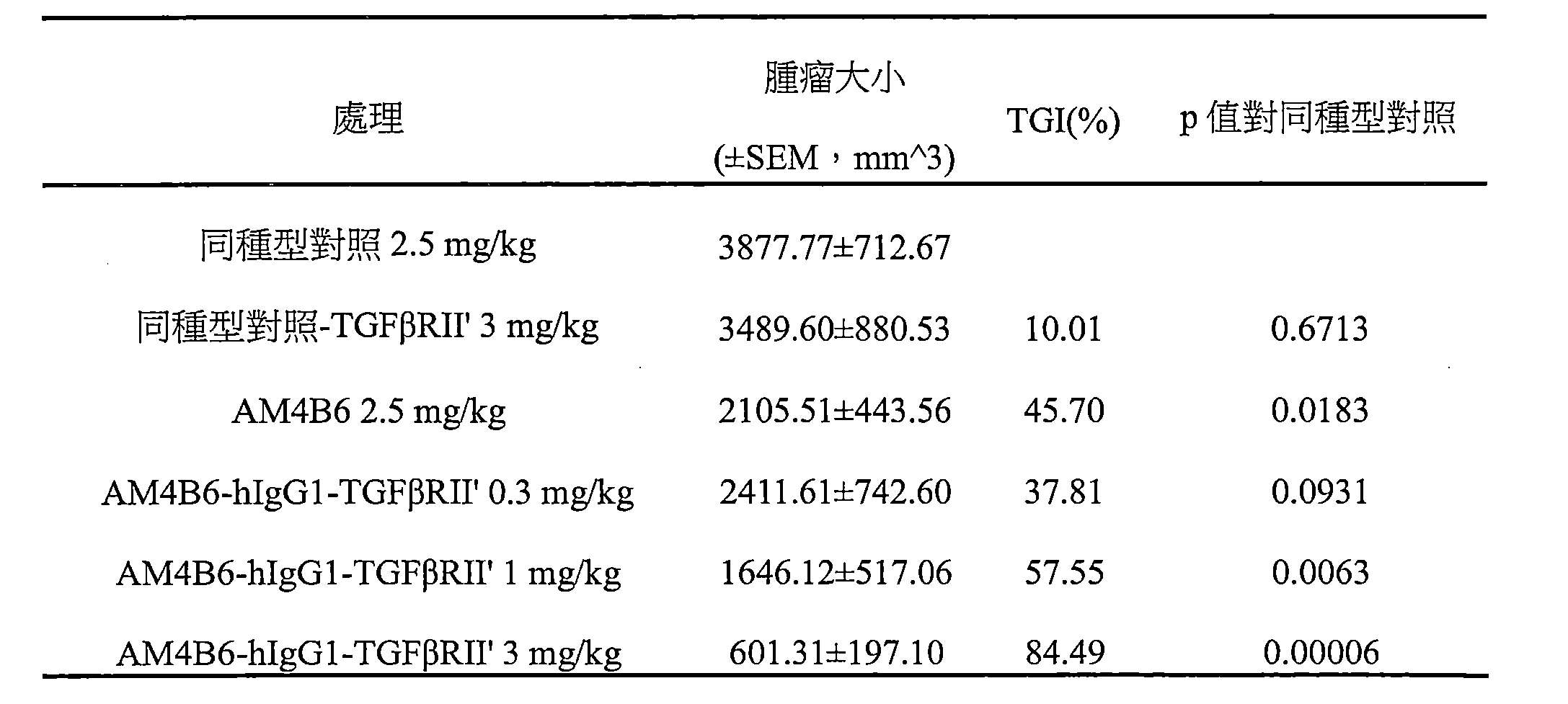
NOD-SCID小鼠上的H460腫瘤和人PBMC共接種模型H460 tumor and human PBMC co-immunization model in NOD-SCID mice
H460細胞購自COBIOER有限公司。將H460細胞作為單層培養物在補充有10%熱滅活胎牛血清的RPMI1640培養基中於37℃下在空氣中含有5% CO2的氣氛中體外維持。收穫在指數生長期中生長的腫瘤細胞並計數以用於腫瘤接種。向每隻雌性SPF級NOD-SCID小鼠接種混合的3×10^6 H460細胞(模型組)或與1.5×10^6人PBMC混合的3×10^6 H460細胞。接種前將所有細胞懸浮液與基質膠以1:1的比率充分混合。在接種後大約4小時,將動物分組成7組(n=10)並不同地給藥。將動物用16.7mg/kg對照hIgG1、或20mg/kg對照hIgG1-TGFβRII'、或16.7mg/kg AM4B6、或5mg/kg AM4B6-hIgG1-TGFβRII'、或10mg/kg AM4B6-hIgG1-TGFβRII'、或20mg/kg AM4B6-hIgG1-TGFβRII'處理。模型組不做任何處理。將所有抗體藉由腹膜內注射每週兩次施用,持續5週。使用卡尺(INSIZE)在兩個維度上每週測量兩次或三次腫瘤大小,並且使用以下公式以mm^3為單位表示體積:V=0.5 a×b^2,其中a和b分別為腫瘤的長直徑和短直徑。使用GraphPad Prism分析結果並表示為平均值±S.E.M.。藉由T檢驗進行兩組之間的比較,並且如果p為*<0.05並且**<0.01,則認為差異是顯著的。 H460 cells were purchased from COBIOER Co., Ltd. H460 cells were maintained in vitro as monolayer cultures in RPMI1640 medium supplemented with 10% heat-killed live fetal bovine serum at 37°C in an atmosphere containing 5% CO 2 in air. Tumor cells growing in the exponential growth phase were harvested and counted for tumor inoculation. Each female SPF-grade NOD-SCID mouse was inoculated with 3×10^6 H460 cells mixed (model group) or 3×10^6 H460 cells mixed with 1.5×10^6 human PBMCs. All cell suspensions were thoroughly mixed with base gel at a ratio of 1:1 before inoculation. Approximately 4 hours after inoculation, animals were divided into 7 groups (n=10) and dosed differently. Animals were treated with 16.7 mg/kg control hIgG1, or 20 mg/kg control hIgG1-TGFβRII', or 16.7 mg/kg AM4B6, or 5 mg/kg AM4B6-hIgG1-TGFβRII', or 10 mg/kg AM4B6-hIgG1-TGFβRII', or 20 mg/kg AM4B6-hIgG1-TGFβRII'. The model group received no treatment. All antibodies were administered twice a week by intraperitoneal injection for 5 weeks. Tumor size was measured twice or three times a week in two dimensions using a caliper (INSIZE), and the volume was expressed in mm^3 using the following formula: V=0.5 a×b^2, where a and b are the long and short diameters of the tumor, respectively. Results were analyzed using GraphPad Prism and expressed as mean ± SEM. Comparisons between two groups were performed by T test, and differences were considered significant if p was *<0.05 and **<0.01.
如圖18A和圖18B所示,20mg/kg同種型對照TGFβRII'根本不抑制腫瘤生長。16.7mg/kg AM4B6僅具有部分抑制作用,而5mg/kg AM4B6-hIgG1-TGFβRII'已經具有明顯更好的腫瘤抑制作用,這表明TGFβRII融合增加了單獨AM4B6 mAb的抗腫瘤功效。另外,在此模型中觀察到AM4B6-hIgG1-TGFβRII'的明顯劑量應答,再次表明功效取決於AM4B6-hIgG1-TGFβRII'。 As shown in Figures 18A and 18B, 20 mg/kg of the isotype control TGFβRII' did not inhibit tumor growth at all. 16.7 mg/kg AM4B6 had only partial inhibition, while 5 mg/kg AM4B6-hIgG1-TGFβRII' already had significantly better tumor inhibition, indicating that TGFβRII fusion increases the anti-tumor efficacy of AM4B6 mAb alone. In addition, a significant dose response of AM4B6-hIgG1-TGFβRII' was observed in this model, again indicating that efficacy is dependent on AM4B6-hIgG1-TGFβRII'.
C57BL/6小鼠上的EMT6-hPD-L1腫瘤模型EMT6-hPD-L1 Tumor Model in C57BL/6 Mice
剔除小鼠腫瘤細胞系EMT6(ATCC)中的內源性小鼠PD-L1並剔除細胞中的人PD-L1,將EMT6的經工程化的細胞命名為EMT6-hPD-L1。 Endogenous mouse PD-L1 was deleted in the mouse tumor cell line EMT6 (ATCC) and human PD-L1 was deleted in the cells. The engineered cells of EMT6 were named EMT6-hPD-L1.
向小鼠皮下接種EMT6/hPD-L1腫瘤細胞,並且然後根據腫瘤體積隨機分為7組,每組10隻小鼠。在分組後,向第1組到第7組的動物每週兩次藉由腹膜內注射分別施用24.9mg/kg對照hIgG1、30mg/kg對照hIgG1-TGFβRII'、24.9mg/kg AM4B6、3mg/kg AM4B6-hIgG1-TGFβRII'、10mg/kg AM4B6-hIgG1-TGFβRII'或30mg/kg AM4B6-hIgG1-TGFβRII',持續4週。每週兩次觀察荷瘤小鼠的腫瘤體積和體重。如圖19A和圖19B所示,AM4B6-hIgG1-TGFβRII'在給藥後第29天在3、10和30mg/kg下分別以21.43%、46.83%和79.39%的TGI劑量依賴性地抑制腫瘤生長。在等摩爾量下,AM4B6-hIgG1-TGFβRII'在30mg/kg下的抗腫瘤活性比AM4B6在24.9mg/kg下更明顯,在該組中,第29天的TGI為29.67%。
Mice were subcutaneously inoculated with EMT6/hPD-L1 tumor cells and then randomly divided into 7 groups of 10 mice each according to tumor volume. After grouping, animals in
實施例10:AM4B6-hIgG1-TGFβRII'處理對MC38-hPD-L1腫瘤模型中腫瘤浸潤淋巴細胞(TIL)的影響Example 10: Effects of AM4B6-hIgG1-TGFβRII' treatment on tumor infiltrating lymphocytes (TIL) in the MC38-hPD-L1 tumor model
將MC38-hPD-L1腫瘤細胞按照與實施例9相同的過程進行培養和接種。當腫瘤大小為250-300mm^3時,選擇荷瘤小鼠並將其隨機分到4個組(n=6)。將動物用PBS、或3mg/kg同種型對照TGFβRII'、或2.5mg/kg AM4B6、或3mg/kg AM4B6-hIgG1-TGFβRII'處理。將所有抗體藉由靜脈內注射每週兩次施用,持續1或2週。分別在第2次給藥後24小時和第4次給藥後24小時收穫腫瘤,然後用溫和的MACS離解劑(MACS Dissociator)(美天旎生物技術(Miltenyi Biotec),130-093-235)離解並用小鼠腫瘤離解試劑盒(美天旎生物技術,130-096-730)在37℃下消化40分鐘。在藉由PE抗小鼠CD45(BD生物科學(BD bioscience),目錄號553081)、APC抗小鼠CD8a(Biolegend,目錄號100712)、APC抗小鼠NK1.1(Biolegend,目錄號108710)、FITC抗小鼠顆粒酶B(Biolegend,目錄號 515403)和FITC抗小鼠IFNγ(英傑公司,目錄號11-7311-82)染色後,使用FACS分析每組分離的單腫瘤細胞懸浮液的TIL亞群百分比,如表18和表19所示。 MC38-hPD-L1 tumor cells were cultured and inoculated following the same procedure as in Example 9. When the tumor size was 250-300 mm^3, tumor-bearing mice were selected and randomly divided into 4 groups (n=6). Animals were treated with PBS, or 3 mg/kg isotype control TGFβRII', or 2.5 mg/kg AM4B6, or 3 mg/kg AM4B6-hIgG1-TGFβRII'. All antibodies were administered twice a week by intravenous injection for 1 or 2 weeks. Tumors were harvested 24 hours after the second and fourth dosing, respectively, and then dissociated with mild MACS Dissociator (Miltenyi Biotec, 130-093-235) and digested with Mouse Tumor Dissociation Kit (Miltenyi Biotec, 130-096-730) at 37°C for 40 minutes. After staining with PE anti-mouse CD45 (BD bioscience, catalog number 553081), APC anti-mouse CD8a (Biolegend, catalog number 100712), APC anti-mouse NK1.1 (Biolegend, catalog number 108710), FITC anti-mouse granzyme B (Biolegend, catalog number 515403) and FITC anti-mouse IFNγ (Invitrogen, catalog number 11-7311-82), the percentage of TIL subsets in each group of isolated single tumor cell suspensions was analyzed by FACS, as shown in Tables 18 and 19.
表18.第2次給藥後24小時對MC38-hPD-L1腫瘤模型的TIL分析。Table 18. TIL analysis of MC38-hPD-L1 tumor model 24 hours after the second dose.
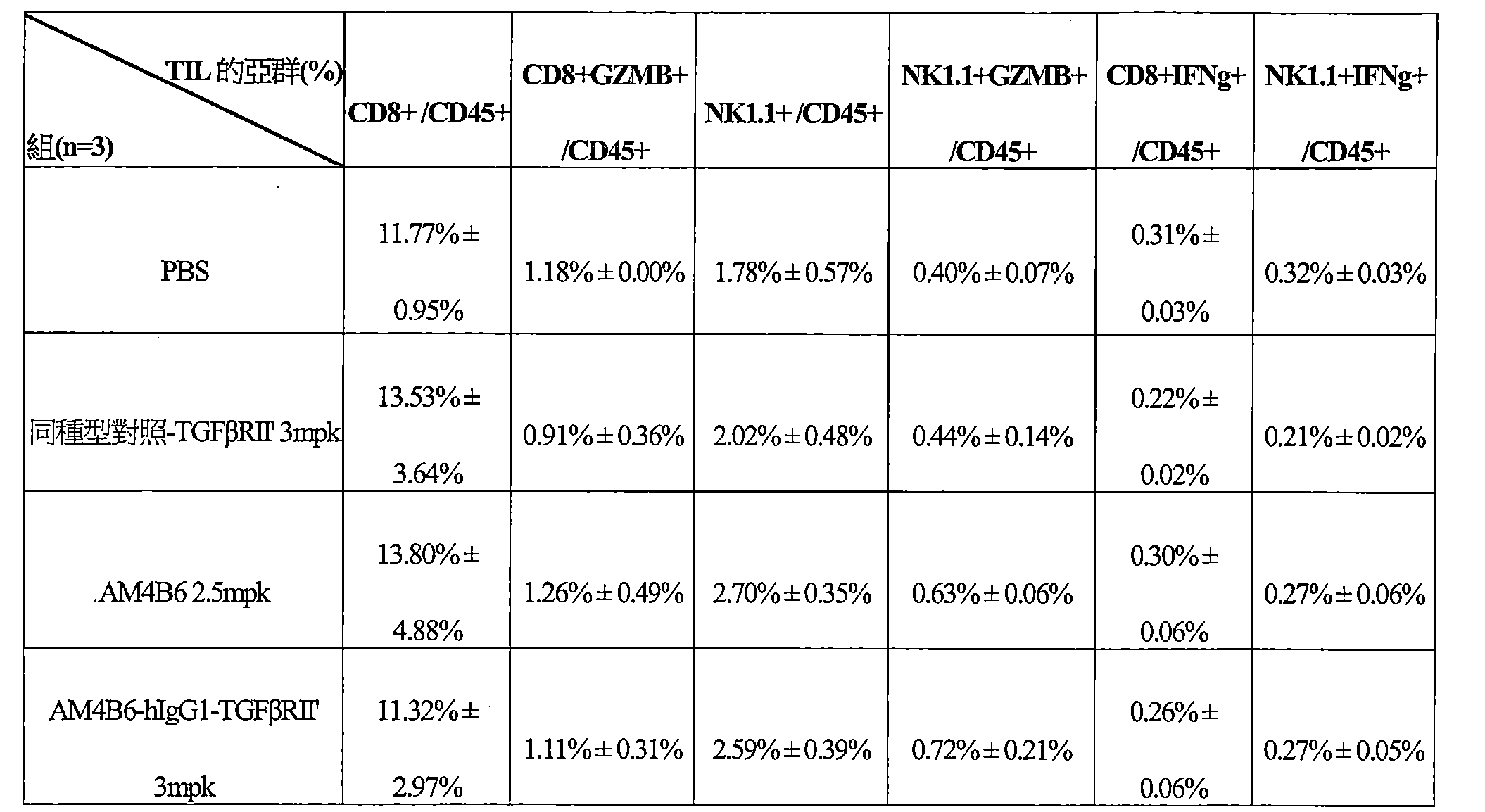
表19第4次給藥後24小時對MC38-hPD-L1腫瘤模型的TIL分析。Table 19 TIL analysis of MC38-hPD-L1 tumor model 24 hours after the 4th dose.

在第2次給藥後,不同處理組中TIL亞群的百分比沒有顯著變化(表18)。但在第4次給藥後,與同種型對照TGFβRII'組相比,AM4B6組和AM4B6-hIgG1-TGFβRII'組的CD8+/CD45+%顯著增加(表19)。與同種型對照TGFβRII'組相比,CD8+GZMB+%和NK1.1+%也增加了很多。這些發現表明CD8+T細胞和NK1.1 T細胞可能受到AM4B6或AM4B6-hIgG1-TGFβRII'的刺激而激活和增殖,並且在腫瘤微環境中富集以促進腫瘤細胞殺傷。與AM4B6相比,AM4B6-hIgG1-TGFβRII'具有更高的CD8+GZMB+%和NK1.1+%,這與其藉由上述TGI測量的更有效的抗腫瘤活性相關。 After the second administration, the percentage of TIL subsets in different treatment groups did not change significantly (Table 18). However, after the fourth administration, the CD8+/CD45+% in the AM4B6 group and the AM4B6-hIgG1-TGFβRII' group increased significantly compared with the isotype control TGFβRII' group (Table 19). CD8+GZMB+% and NK1.1+% also increased a lot compared with the isotype control TGFβRII' group. These findings suggest that CD8+T cells and NK1.1 T cells may be activated and proliferated by the stimulation of AM4B6 or AM4B6-hIgG1-TGFβRII', and enriched in the tumor microenvironment to promote tumor cell killing. AM4B6-hIgG1-TGFβRII' had higher CD8+GZMB+% and NK1.1+% compared to AM4B6, which correlated with its more effective anti-tumor activity measured by the above TGI.
實施例11:AM4B6-hIgG1-TGFβRII'的體內藥物代謝動力學和藥效學研究Example 11: In vivo drug metabolism kinetics and pharmacodynamics study of AM4B6-hIgG1-TGFβRII'
將C57BL/6雌性小鼠隨機分為6組(n=3)。將動物用3mg/kg同種型對照TGFβRII'、或2.5mg/kg AM4B6、或0.3mg/kg AM4B6-hIgG1-TGFβRII'、或1mg/kg AM4B6-hIgG1-TGFβRII'、或3mg/kg AM4B6-hIgG1-TGFβRII'、或3mg/kg M7824類似物處理。M7824類似物由邁博斯生物科學根據US9676863中揭露的序列產生。所有抗體均藉由靜脈單次注射施用。注射後,在以下不同時間點收集每隻小鼠的200μl血液:給藥前、注射後30分鐘、2小時、8小時、24小時、48小時、第4天、第7天、第10天、第14天、第21天。收集每隻小鼠的80μl血漿並測試抗體濃度。
C57BL/6 female mice were randomly divided into 6 groups (n=3). Animals were treated with 3 mg/kg isotype control TGFβRII', or 2.5 mg/kg AM4B6, or 0.3 mg/kg AM4B6-hIgG1-TGFβRII', or 1 mg/kg AM4B6-hIgG1-TGFβRII', or 3 mg/kg AM4B6-hIgG1-TGFβRII', or 3 mg/kg M7824 analogs. M7824 analogs were generated by Mybos Biosciences based on the sequence disclosed in US9676863. All antibodies were administered by single intravenous injection. After injection, 200 μl of blood was collected from each mouse at the following different time points: before administration, 30 minutes, 2 hours, 8 hours, 24 hours, 48 hours,
為了測量血漿中的抗體濃度,使用兩種方法。第一種方法是檢測整個雙功能分子,包括AM4B6和TGFβRII'臂。通常,將1μg/ml的人PD-L1-his在室溫下包被在96孔ELISA板上2小時。在封閉後,添加連續稀釋的標準物和血漿樣品並溫育1.5小時。洗滌後添加0.1μg/ml生物素化抗人TGFβRII',然後 在洗滌後添加鏈黴親和素-HRP。最後,添加TMB以顯色,用稀硫酸終止顯色。藉由微板讀數器讀取板的OD450nm和OD620nm。藉由OD450nm-OD620nm分析數據。 To measure the antibody concentration in plasma, two methods were used. The first method was to detect the entire bifunctional molecule, including AM4B6 and TGFβRII' arms. Typically, 1μg/ml of human PD-L1-his was coated on a 96-well ELISA plate for 2 hours at room temperature. After blocking, serially diluted standards and plasma samples were added and incubated for 1.5 hours. After washing, 0.1μg/ml of biotinylated anti-human TGFβRII' was added, and then Streptavidin-HRP was added after washing. Finally, TMB was added for color development, which was terminated with dilute sulfuric acid. The OD450nm and OD620nm of the plate were read by a microplate reader. The data were analyzed by OD450nm-OD620nm.
第二種方法是僅檢測AM4B6抗體臂。與上述程序類似,包被1μg/ml的人PD-L1-his,並且添加連續稀釋的標準物和血漿樣品並溫育1.5小時。洗滌後,添加稀釋的山羊HRP偶聯的抗人IgG Fc抗體。最後,添加TMB以顯色,用稀硫酸終止顯色。藉由微板讀數器讀取板的OD450nm和OD620nm。藉由OD450nm-OD620nm分析數據。 The second method is to detect only the AM4B6 antibody arm. Similar to the above procedure, 1μg/ml human PD-L1-his was coated, and serially diluted standards and plasma samples were added and incubated for 1.5 hours. After washing, diluted goat HRP-conjugated anti-human IgG Fc antibody was added. Finally, TMB was added for color development and the color development was terminated with dilute sulfuric acid. The OD450nm and OD620nm of the plate were read by a microplate reader. The data was analyzed by OD450nm-OD620nm.
為了評估抗體濃度與血漿中TGFβ變化之間的相關性,測試了血漿中TGFβ1和TGFβ2的濃度變化。簡而言之,將4μg/ml的小鼠TGF-β1捕獲抗體或2μg/ml的小鼠TGF-β2捕獲抗體在室溫下包被在96孔ELISA板上2小時。將10μl的1N HCl添加到50μl每種血漿樣品中,並在室溫下溫育10分鐘。藉由添加10μl的1.2N NaOH/0.5M HEPES中和酸化樣品,以確保最終pH值在7.2-7.6內。在封閉後,添加連續稀釋的標準物和血漿樣品並溫育1.5小時。洗滌後添加TGF-β1或TGF-β2檢測抗體,然後在洗滌後添加鏈黴親和素-HRP。最後,添加TMB以顯色,用稀硫酸終止顯色。藉由微板讀數器讀取板的OD450nm和OD620nm。藉由OD450nm-OD620nm分析數據。 To assess the correlation between antibody concentration and changes in TGFβ in plasma, changes in the concentrations of TGFβ1 and TGFβ2 in plasma were tested. Briefly, 4 μg/ml of mouse TGF-β1 capture antibody or 2 μg/ml of mouse TGF-β2 capture antibody was coated on a 96-well ELISA plate for 2 hours at room temperature. 10 μl of 1N HCl was added to 50 μl of each plasma sample and incubated at room temperature for 10 minutes. The acidified samples were neutralized by adding 10 μl of 1.2N NaOH/0.5M HEPES to ensure that the final pH was within 7.2-7.6. After blocking, serially diluted standards and plasma samples were added and incubated for 1.5 hours. After washing, add TGF-β1 or TGF-β2 detection antibody, and then add streptavidin-HRP after washing. Finally, add TMB to develop color, and stop the color development with dilute sulfuric acid. Read the OD450nm and OD620nm of the plate by a microplate reader. Analyze the data by OD450nm-OD620nm.
圖20A示出了血漿中的抗體濃度變化。使用兩種方法的PK曲線沒有顯著差異,這表明整個雙功能分子AM4B6-hIgG1-TGFβRII'非常穩定,而沒有像AM4B6mAb那樣在體內異常切割和清除。同時,AM4B6-hIgG1-TGFβRII'在靜脈內注射後30分鐘內耗竭TGF-β1,甚至在0.3mg/kg的最低劑量下也是如此,如圖20B所示。M7824類似物和同種型對照TGFβRII'也耗竭TGF-β1,但
M7824類似物不能從第2天起保持該作用,而AM4B6-hIgG1-TGFβRII'可以保持低水平的TGF-β1到第21天。這個結果也對應於它們的PK暴露(圖20C),這表明TGF-β1可以作為AM4B6-hIgG1-TGFβRII'靶標參與血漿的良好藥效標誌物。未檢測到小鼠血漿中TGF-β2的明顯耗竭(現在示出數據)。
FIG20A shows the change in antibody concentration in plasma. There was no significant difference in the PK curves using the two methods, indicating that the entire bifunctional molecule AM4B6-hIgG1-TGFβRII' is very stable and is not abnormally cleaved and cleared in vivo like AM4B6 mAb. At the same time, AM4B6-hIgG1-TGFβRII' depleted TGF-β1 within 30 minutes after intravenous injection, even at the lowest dose of 0.3 mg/kg, as shown in FIG20B. The M7824 analog and the isotype control TGFβRII' also depleted TGF-β1, but the M7824 analog could not maintain this effect from
實施例12:AM4B6-hIgG1-IL-1RA融合蛋白的構建和表達Example 12: Construction and expression of AM4B6-hIgG1-IL-1RA fusion protein
將所選重鏈和輕鏈變體與hIgG1-IL-1RA(34-177)(UniProtKB,P18510)融合蛋白交叉組合並表達。重鏈和輕鏈的序列在表20中示出。 The selected heavy chain and light chain variants were cross-combined and expressed with the hIgG1-IL-1RA (34-177) (UniProtKB, P18510) fusion protein. The sequences of the heavy chain and light chain are shown in Table 20.
表20. AM4B6-hIgG1-IL-1RA重鏈和輕鏈變體的列表
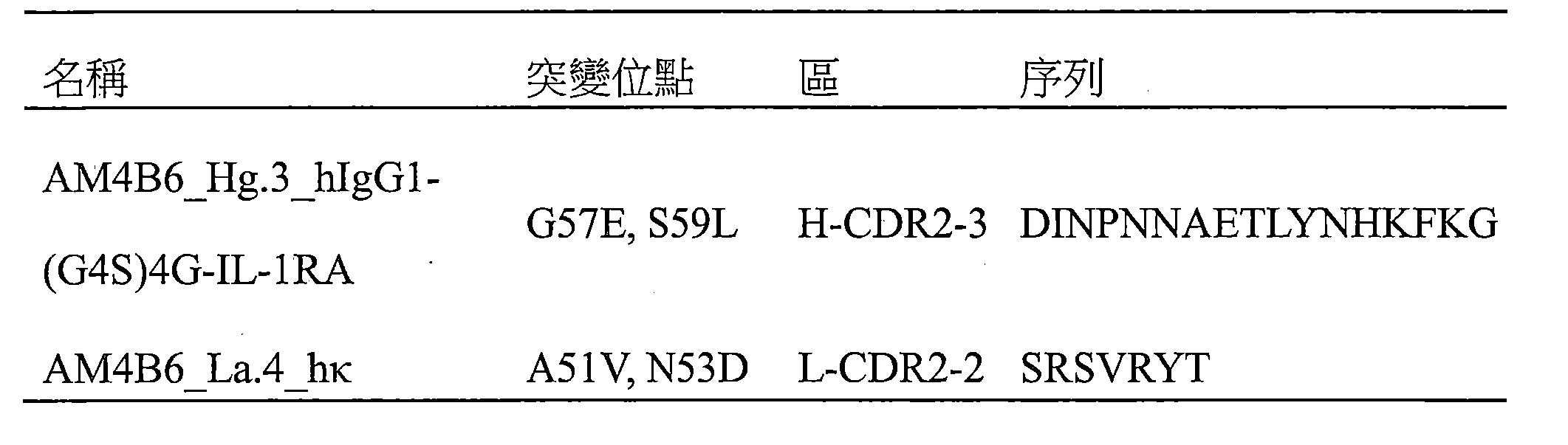
類似於AM4B6-hIgG1-TGFβRII'雙功能分子,截短的人IL-1RA_34-177與AM4B6融合以獲得更好的活性和穩定性。AM4B6-hIgG1-IL-1RA是AM4B6-hIgG1-IL-1RA(34-177)的簡稱。截短的人IL-1RA_34-177的序列如下: Similar to the AM4B6-hIgG1-TGFβRII' bifunctional molecule, truncated human IL-1RA_34-177 is fused to AM4B6 to obtain better activity and stability. AM4B6-hIgG1-IL-1RA is the abbreviation of AM4B6-hIgG1-IL-1RA(34-177). The sequence of truncated human IL-1RA_34-177 is as follows:
(SEQ ID NO:67)

根據製造商的方案,使用來自英傑公司的ExpiFectamineTM CHO試劑(賽默(Thermo),A29129)進行重鏈和輕鏈的共轉染。在第10天收穫上清液並藉由親和色譜法純化。
Co-transfection of heavy and light chains was performed using ExpiFectamine ™ CHO reagent from Invitrogen (Thermo, A29129) according to the manufacturer's protocol. Supernatants were harvested on
實施例13:AM4B6-hIgG1-IL-1RA雙功能分子與hPD-L1的親和力Example 13: Affinity of AM4B6-hIgG1-IL-1RA bifunctional molecule with hPD-L1
基於ELISA測定的與人PD-L1的結合Binding to human PD-L1 as determined by ELISA
將1μg/ml hPD-L1(Acro Biosystems,PD1-H5229)抗原包被到ELISA板並在4℃下包被過夜。然後添加300μl的2%(w/v)BSA,以在室溫下封閉1小時。在溫育1小時後,將100μl的濃度範圍為10nM到0.00017nM(三倍連續稀釋)的AM4B6-hIgG1-IL-1RA雙功能分子或AM4B6-hIgG1單株抗體與作為陰性對照的PBST一起添加並在室溫下溫育1小時。具有0.5% Tween-20的PBS用於洗滌3次,並且添加100μl HRP偶聯的抗人Fc抗體(1:20000,艾博抗,ab98624),在室溫下溫育1小時後,添加混合的TMB受質試劑(InnoReagents,TMB-S-003)並在室溫下溫育5分鐘,並且藉由添加0.1M H2SO4終止。OD450nm由微板讀數器記錄。數據藉由Graphpad prism分析。 1 μg/ml hPD-L1 (Acro Biosystems, PD1-H5229) antigen was coated onto the ELISA plate and coated overnight at 4°C. Then 300 μl of 2% (w/v) BSA was added to block for 1 hour at room temperature. After incubation for 1 hour, 100 μl of AM4B6-hIgG1-IL-1RA bifunctional molecules or AM4B6-hIgG1 monoclonal antibodies with concentrations ranging from 10 nM to 0.00017 nM (three-fold serial dilutions) were added together with PBST as a negative control and incubated at room temperature for 1 hour. PBS with 0.5% Tween-20 was used for washing 3 times, and 100 μl of HRP-conjugated anti-human Fc antibody (1:20000, Abcam, ab98624) was added, and after incubation at room temperature for 1 hour, mixed TMB substrate reagent (InnoReagents, TMB-S-003) was added and incubated at room temperature for 5 minutes, and terminated by adding 0.1M H 2 SO 4. OD450nm was recorded by a microplate reader. Data were analyzed by Graphpad prism.
如圖21所示,與AM4B6單株抗體相比,AM4B6-hIgG1-IL-1RA雙功能分子具有相似的結合信號和親和力。 As shown in Figure 21, compared with the AM4B6 monoclonal antibody, the AM4B6-hIgG1-IL-1RA bifunctional molecule has similar binding signal and affinity.
藉由FACS測定測量的AM4B6-hIgG1-IL-IRA與在細胞表面上表達的PD-L1的結合Binding of AM4B6-hIgG1-IL-IRA to PD-L1 expressed on the cell surface measured by FACS assay
293T-PD-L1-CD3L細胞由邁博斯生物科學產生,以用於表徵PD-L1抗體。用人PD-L1和抗CD3 scFv轉染細胞。將AM4B6-hIgG1-IL-1RA雙功能分子或AM4B6單株抗體連續稀釋3倍以在稀釋緩衝液(含2% BSA的PBS)中獲得11個 濃度。收穫並離心293T-PD-L1-CD3L細胞。然後將它們以2×10⁶個細胞/ml的密度重新懸浮於PBS中,並以每孔100μl添加到板中。在離心並去除上清液後,將稀釋的抗體添加到板中並在4℃下溫育30分鐘。在用稀釋緩衝液洗滌兩次後,將PE綴合的驢抗人IgG(H+L)(Jacksonimmuno,709-116-149)添加到板並在4℃下溫育30分鐘。在洗滌後,將細胞重新懸浮於200μl PBS中並藉由流式細胞術進行分析。數據藉由Graphpad prism分析。 293T-PD-L1-CD3L cells were generated by Mybos Biosciences for characterization of PD-L1 antibodies. Cells were transfected with human PD-L1 and anti-CD3 scFv. AM4B6-hIgG1-IL-1RA bifunctional molecules or AM4B6 monoclonal antibodies were serially diluted 3-fold to obtain 11 concentrations in dilution buffer (PBS with 2% BSA). 293T-PD-L1-CD3L cells were harvested and centrifuged. They were then resuspended in PBS at a density of 2×10 6 cells/ml and added to the plate at 100 μl per well. After centrifugation and removal of the supernatant, the diluted antibodies were added to the plate and incubated at 4°C for 30 minutes. After washing twice with dilution buffer, PE-conjugated donkey anti-human IgG (H+L) (Jacksonimmuno, 709-116-149) was added to the plate and incubated at 4°C for 30 minutes. After washing, the cells were resuspended in 200 μl PBS and analyzed by flow cytometry. Data were analyzed by Graphpad prism.
如圖22所示,AM4B6-hIgG1-IL-1RA雙功能分子和AM4B6-hIgG1可以以相似的EC50結合到細胞表面上表達的PD-L1,這與藉由ELISA測量的親和力結果一致。 As shown in Figure 22, AM4B6-hIgG1-IL-1RA bifunctional molecule and AM4B6-hIgG1 can bind to PD-L1 expressed on the cell surface with similar EC50, which is consistent with the affinity results measured by ELISA.
實施例14:AM4B6-hIgG1-IL-1RA的PD1/PD-L1阻斷活性Example 14: PD1/PD-L1 blocking activity of AM4B6-hIgG1-IL-1RA
在此測定中,293T-PD-L1-CD3L細胞表達PD-L1和抗CD3 scFv,而Jurkat-NFAT-Luc-PD1細胞表達PD-1並攜帶可以被CD3刺激激活的NFAT信號。NFAT激活導致螢光素酶基因轉錄和表達,這可以藉由其受質進行檢測。兩個細胞均由邁博斯生物科學產生。 In this assay, 293T-PD-L1-CD3L cells express PD-L1 and anti-CD3 scFv, while Jurkat-NFAT-Luc-PD1 cells express PD-1 and carry a NFAT signal that can be activated by CD3 stimulation. NFAT activation leads to luciferase gene transcription and expression, which can be detected by its substrate. Both cells were generated by Mybos Biosciences.
簡而言之,收穫293T-PD-L1-CD3L細胞並以2×10⁶個細胞/ml的密度重新懸浮。將每孔20μl細胞添加到半孔板中。將AM4B6-hIgG1-IL-1RA雙功能分子和AM4B6-hIgG1連續稀釋(3倍稀釋)以在含2% FBS的RPMI培養基中獲得8個濃度。向半孔板中每孔添加20μl抗體並且將板在37℃、5% CO2下溫育30分鐘。收穫Jurkat-NFAT-Luc-PD1細胞並以4×10⁶個細胞/ml的密度重新懸浮於含有2% FBS的RPMI培養基中。最後,將每孔20μl細胞添加到半孔板中並在37℃、5% CO2下溫育5小時。將60μl的OneGlo檢測試劑(普洛麥格 (Promega),E6120)添加到每個孔中並在室溫下溫育5分鐘。發光信號由微板讀數器讀取。數據藉由GraphPad Prism分析。 Briefly, 293T-PD-L1-CD3L cells were harvested and resuspended at 2×10 6 cells/ml. 20 μl of cells were added to each well of a half-well plate. AM4B6-hIgG1-IL-1RA bifunctional molecule and AM4B6-hIgG1 were serially diluted (3-fold dilution) to obtain 8 concentrations in RPMI medium containing 2% FBS. 20 μl of antibody was added to each well of a half-well plate and the plate was incubated at 37°C, 5% CO 2 for 30 minutes. Jurkat-NFAT-Luc-PD1 cells were harvested and resuspended at 4×10 6 cells/ml in RPMI medium containing 2% FBS. Finally, 20 μl of cells per well were added to half-well plates and incubated at 37°C, 5% CO 2 for 5 hours. 60 μl of OneGlo detection reagent (Promega, E6120) was added to each well and incubated at room temperature for 5 minutes. Luminescence signals were read by a microplate reader. Data were analyzed by GraphPad Prism.
如圖23所示,AM4B6-hIgG1-IL-1RA雙功能分子和AM4B6-hIgG1在此基於細胞的測定中具有相似的對PD-L1的阻斷活性。 As shown in Figure 23, AM4B6-hIgG1-IL-1RA bifunctional molecule and AM4B6-hIgG1 have similar blocking activity against PD-L1 in this cell-based assay.
實施例15:AM4B6-hIgG1-IL-1RA對人IL-1β的阻斷活性Example 15: AM4B6-hIgG1-IL-1RA blocking activity against human IL-1β
基於ELISA的AM4B6-hIgG1-IL-1RA BsAb對hIL-1β的阻斷活性 ELISA-based blocking activity of AM4B6-hIgG1-IL-1RA BsAb against hIL-1β
為了測試配體/受體阻斷活性,將5μg/ml人IL-1β蛋白(Sino Biological,目錄號10139)包被到ELISA板上並在4℃下溫育過夜。添加300μl封閉緩衝液,以在室溫下封閉1小時。在1小時後,將50μl的連續濃度範圍為200nM到0.03nM(三倍連續稀釋)的AM4B6-hIgG1-IL-1RA BsAb或IL-1RA蛋白(Sino Biological,目錄號10123-HNAE)以及50μl的10nM人IL-1RI-his(Sino Biological,目錄號10126-H08H)添加到孔中並在室溫下溫育1小時。具有0.5% Tween-20的PBS用於洗滌3次,並且添加100μl的HRP偶聯的his標簽抗體(1:2000稀釋,Genscript,目錄號A00612),在室溫下溫育1小時。然後,添加混合的TMB受質試劑(InnoReagents,目錄號:TMB-S-003)並在室溫下溫育5分鐘,然後藉由添加0.1M H2SO4終止。OD450nm由微板讀數器記錄。數據藉由Graphpad prism分析。 To test ligand/receptor blocking activity, 5 μg/ml human IL-1β protein (Sino Biological, catalog number 10139) was coated onto ELISA plates and incubated overnight at 4°C. 300 μl of blocking buffer was added to block for 1 hour at room temperature. After 1 hour, 50 μl of AM4B6-hIgG1-IL-1RA BsAb or IL-1RA protein (Sino Biological, catalog number 10123-HNAE) with a serial concentration range of 200 nM to 0.03 nM (three-fold serial dilution) and 50 μl of 10 nM human IL-1RI-his (Sino Biological, catalog number 10126-H08H) were added to the wells and incubated for 1 hour at room temperature. PBS with 0.5% Tween-20 was used for washing 3 times, and 100 μl of HRP-conjugated his-tag antibody (1:2000 dilution, Genscript, catalog number A00612) was added and incubated at room temperature for 1 hour. Then, mixed TMB substrate reagent (InnoReagents, catalog number: TMB-S-003) was added and incubated at room temperature for 5 minutes, and then stopped by adding 0.1M H 2 SO 4. OD450nm was recorded by a microplate reader. Data were analyzed by Graphpad prism.
如圖24所示,AM4B6-hIgG1-IL-1RA可以劑量依賴性地阻斷IL-1β,並且AM4B6-hIgG1-IL-1RA對IL-1RI的阻斷活性優於IL-1RA蛋白。 As shown in Figure 24, AM4B6-hIgG1-IL-1RA can block IL-1β in a dose-dependent manner, and the blocking activity of AM4B6-hIgG1-IL-1RA on IL-1RI is superior to that of IL-1RA protein.
AM4B6-hIgG1-IL-IRA雙功能分子對報告細胞上的hIL-1β的阻斷活性AM4B6-hIgG1-IL-IRA bifunctional molecule blocks hIL-1β activity on reporter cells
在此測定中,HEK-BlueTM CD40L細胞購自Invivogen(目錄號hkb-cd40),這些細胞藉由用人CD40基因和NF-kB誘導型SEAP構建體穩定轉染HEK293細 胞產生。CD40L與其受體CD40的結合觸發級聯反應,從而引起NF-kB的激活和SEAP的後續產生,這可以藉由QUANTI-Blue進行監測。HEK293細胞內源性地表達與CD40L共享共同信號通路的細胞因子IL-1β的受體。因此,可以使用中和抗體阻斷IL-1b介導的SEAP產生。 In this assay, HEK-Blue ™ CD40L cells were purchased from Invivogen (Catalog No. hkb-cd40) and were generated by stably transfecting HEK293 cells with the human CD40 gene and a NF-kB-inducible SEAP construct. Binding of CD40L to its receptor CD40 triggers a cascade leading to activation of NF-kB and subsequent production of SEAP, which can be monitored by QUANTI-Blue. HEK293 cells endogenously express the receptor for the cytokine IL-1β, which shares a common signaling pathway with CD40L. Therefore, neutralizing antibodies can be used to block IL-1b-mediated SEAP production.
簡而言之,收集對數期細胞的HEK293-CD40L細胞並且以5×10^4/孔(100μl/孔)的密度接種細胞到96孔板中以黏附過夜。將AM4B6-hIgG1-IL-1RA雙特異性抗體和IL-1RA蛋白連續稀釋(5倍稀釋)以在完全培養基中獲得10個濃度。向細胞中添加50μl/孔稀釋的抗體(或IL-1RA蛋白)和50μl/孔人IL-1β,在37℃下溫育24小時。第二天向新板中添加160μl的QUANTI-BlueTM溶液(Invivogen,目錄號rep-qbs),並且向板中添加40μl細胞培養上清液。將板在37℃下溫育2小時。使用分光光度計在620nm處確定SEAP水平。數據藉由Graphpad prism分析。 Briefly, HEK293-CD40L cells of logarithmic phase cells were collected and inoculated into 96-well plates at a density of 5×10^4/well (100 μl/well) to adhere overnight. AM4B6-hIgG1-IL-1RA bispecific antibody and IL-1RA protein were serially diluted (5-fold dilution) to obtain 10 concentrations in complete medium. 50 μl/well of diluted antibody (or IL-1RA protein) and 50 μl/well human IL-1β were added to the cells and incubated at 37°C for 24 hours. The next day, 160 μl of QUANTI-Blue TM solution (Invivogen, catalog number rep-qbs) was added to a new plate, and 40 μl of cell culture supernatant was added to the plate. The plates were incubated at 37°C for 2 hours. SEAP levels were determined using a spectrophotometer at 620 nm. Data were analyzed by Graphpad prism.
如圖25所示,AM4B6-hIgG1-IL-1RA可以以劑量依賴性方式阻斷IL-1β,並且AM4B6-hIgG1-IL-1RA對IL-1β的阻斷活性強於IL-1RA蛋白,這與藉由ELISA測量的阻斷結果一致。 As shown in Figure 25, AM4B6-hIgG1-IL-1RA can block IL-1β in a dose-dependent manner, and the blocking activity of AM4B6-hIgG1-IL-1RA on IL-1β is stronger than that of IL-1RA protein, which is consistent with the blocking results measured by ELISA.
實施例16:AM4B6-SIRPα雙功能抗體的構建、表達、純化Example 16: Construction, expression and purification of AM4B6-SIRPα bifunctional antibody
SIRPα_CV1是經工程化的高親和力SIRPα變體,該變體有效地拮抗癌細胞上的CD47,但自身不會誘導巨噬細胞吞噬作用(KippWeiskopf等人,《科學》341,88(2013))。發明了針對PD-L1和CD47兩者的雙功能抗體,包括對稱抗體(AM4B6-hIgG1-SIRPα和3280A-hIgG1-SIRPα)和不對稱抗體(AM4B6-hIgG1-SIRPα(KIH)和3280A-hIgG1-SIRPα(KIH)),其中KIH是杵臼結構的簡稱。這些分子的構建在表21中描述,並且測序的SIRPα_CV1也在下面列出。 SIRPα_CV1 is an engineered high-affinity SIRPα variant that effectively antagonizes CD47 on cancer cells but does not induce macrophage phagocytosis itself (Kipp Weiskopf et al., Science 341, 88 (2013) ). Bifunctional antibodies targeting both PD-L1 and CD47 were invented, including symmetric antibodies (AM4B6-hIgG1-SIRPα and 3280A-hIgG1-SIRPα) and asymmetric antibodies (AM4B6-hIgG1-SIRPα (KIH) and 3280A-hIgG1-SIRPα (KIH)), where KIH is the abbreviation for the knob-and-hole structure. The construction of these molecules is described in Table 21, and the sequenced SIRPα_CV1 is also listed below.
SIRPa_CV1序列(SEQ ID NO:84):

表21抗PD-L1-SIRPa雙功能抗體的構建Table 21 Construction of anti-PD-L1-SIRPa bifunctional antibodies
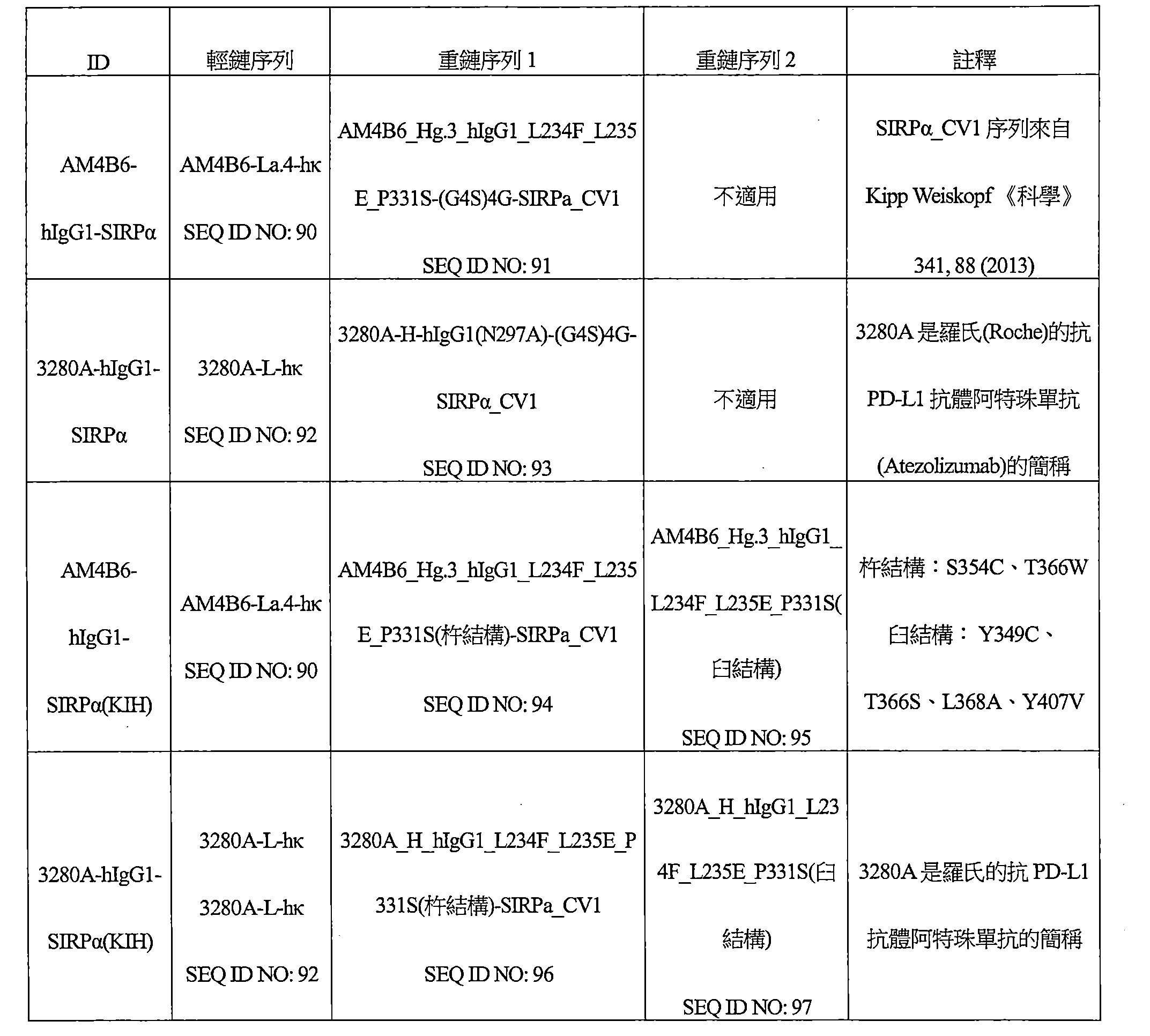
根據製造商的方案,用Expi-CHO細胞表達所有4種雙功能抗體。對於兩種對稱雙功能抗體,藉由一步Mabselect SuRe純化獲得高純度抗體,但對 於不對稱雙功能抗體,無法藉由常規一步Mabselect SuRe純化獲得高純度抗體。為獲得高純度的不對稱抗體,使用HiTrap PrismA樹脂對抗體進行精製純化,並且不對稱抗體的純度優於95%。精製純化程序描述如下。 All four bifunctional antibodies were expressed using Expi-CHO cells according to the manufacturer's protocol. For two symmetric bifunctional antibodies, high purity antibodies were obtained by one-step Mabselect SuRe purification, but for the asymmetric bifunctional antibody, high purity antibodies could not be obtained by conventional one-step Mabselect SuRe purification. To obtain high purity asymmetric antibodies, antibodies were purified using HiTrap PrismA resin, and the purity of asymmetric antibodies was better than 95%. The purification procedure is described below.
使用的緩衝液: Buffer used:
平衡緩衝液:50mM Tris-HAc、150mM NaCl、pH 7.4。 Equilibration buffer: 50mM Tris-HAc, 150mM NaCl, pH 7.4.
洗滌緩衝液:50mM NaAc/HAc、500mM NaCl、5% PEG、pH 5.5。 Wash buffer: 50mM NaAc/HAc, 500mM NaCl, 5% PEG, pH 5.5.
沖提緩衝液:50mM HAc、500mM NaCl、5% PEG、pH 3.0。 Flushing buffer: 50mM HAc, 500mM NaCl, 5% PEG, pH 3.0.
用平衡緩衝液平衡HiTrap PrismA管柱至少5個柱體積(CV),直到UV基線、沖提液pH值和電導率不變。 Equilibrate the HiTrap PrismA column with equilibration buffer for at least 5 column volumes (CV) until the UV baseline, eluent pH and conductivity remain constant.
將樣品加載到預平衡的HiTrap PrismA管柱上。 Load the sample onto the pre-equilibrated HiTrap PrismA column.
用5到10CV洗滌緩衝液洗滌,直到UV跡線返回到基線。 Wash with 5 to 10 CV of wash buffer until the UV trace returns to baseline.
用0-100%沖提緩衝液在10-20CV中沖提,並分別用幾個管收集5-10個級分。用1M Tris-鹼(pH 9.0)將pH調整到約6.0-7.0。 Wash with 0-100% wash buffer in 10-20CV and collect 5-10 fractions in several tubes. Adjust pH to about 6.0-7.0 with 1M Tris-base (pH 9.0).
然後藉由SEC-HPLC表徵級分。圖26示出了3280A-hIgG1-SIRPα(KIH)和AM4B6-hIgG1-SIRPα(KIH)的純度分別為95.33%和96.5%。 The fractions were then characterized by SEC-HPLC. Figure 26 shows that the purity of 3280A-hIgG1-SIRPα(KIH) and AM4B6-hIgG1-SIRPα(KIH) were 95.33% and 96.5%, respectively.
用ELISA測試對人PD-L1或人CD47的親和力。圖27和28示出了雙功能抗體對抗原的親和力與親本單株抗體(4B6 mAb對照)或融合蛋白(SIRPα-Fc(FES))相當。 The affinity to human PD-L1 or human CD47 was tested by ELISA. Figures 27 and 28 show that the affinity of the bifunctional antibody to the antigen is comparable to that of the parental monoclonal antibody (4B6 mAb control) or the fusion protein (SIRPα-Fc (FES)).
實施例17:IgG-scFv-ACZ885-AM4B6和IgG-scFv-XOMA052-AM4B6雙特異性抗體的構建和表達Example 17: Construction and expression of IgG-scFv-ACZ885-AM4B6 and IgG-scFv-XOMA052-AM4B6 bispecific antibodies
AM4B6的單鏈片段(scFv)的序列如下表所示。抗-IL-1β抗體Gevokizumab(XOMA052)和Canakinumab(ACZ885)來自諾華。AM4B6的scFv連接至抗-IL- 1β抗體重鏈C末端以獲得更好的活性和穩定性。該scFv具有將VH連接至VL的GS連接子(GGGGSGGGGSGGGGSGGGGS),並且在H44C和L100C(Kabat編號)殘基之間包含一個結構域間的雙硫鍵。抗-IL-1β抗體(XOMA052和ACZ885)的序列如表22所示。所構建的雙特異性抗體分別被命名為IgG-scFv-ACZ885-AM4B6和IgG-scFv-XOMA052-AM4B6。 The sequence of the single-chain fragment (scFv) of AM4B6 is shown in the table below. The anti-IL-1β antibodies Gevokizumab (XOMA052) and Canakinumab (ACZ885) are from Novartis. The scFv of AM4B6 is linked to the C-terminus of the anti-IL- 1β antibody heavy chain for better activity and stability. The scFv has a GS linker (GGGGSGGGGSGGGGSGGGGS) linking VH to VL and contains an interdomain disulfide bond between the H44C and L100C (Kabat numbering) residues. The sequences of the anti-IL-1β antibodies (XOMA052 and ACZ885) are shown in Table 22. The constructed bispecific antibodies were named IgG-scFv-ACZ885-AM4B6 and IgG-scFv-XOMA052-AM4B6, respectively.
根據製造商的方案,使用來自英傑公司的ExpiFectamineTM CHO試劑(賽默(Thermo),A29129)進行該雙特異性抗體的重鏈和輕鏈的共轉染。在第10天收穫上清液並藉由親和色譜法純化。
Co-transfection of the heavy and light chains of the bispecific antibody was performed using ExpiFectamine ™ CHO reagent from Invitrogen (Thermo, A29129) according to the manufacturer's protocol. Supernatants were harvested on
實施例18:IgG-scFv-ACZ885-AM4B6和IgG-scFv-XOMA052-AM4B6雙特異性抗體對hIL-1β的結合活性Example 18: Binding activity of IgG-scFv-ACZ885-AM4B6 and IgG-scFv-XOMA052-AM4B6 bispecific antibodies to hIL-1β
基於ELISA測定的與人IL-1β的結合Binding to human IL-1β as determined by ELISA
將100μL的1μg/ml hIL-1β蛋白(SinoBiological,Cat# 10139-HNAE)抗原包被到ELISA板並在4℃下包被過夜。然後添加200μl的2%(w/v)BSA,以在室溫下封閉2小時。在溫育後,將100μl的濃度範圍為20nM到0.000339nM(三倍連續稀釋)的IgG-scFv-ACZ885-AM4B6,IgG-scFv-XOMA052-AM4B6雙特異性抗體,ACZ885或XOMA052與作為陰性對照的PBST一起添加並在室溫下溫育1小時。具有0.5% Tween-20的PBS用於洗滌3次,並且添加100μl HRP偶聯的抗人Fc抗體(1:20000,艾博抗,ab98624),在室溫下溫育1小時後,添加混合的TMB受質試劑(InnoReagents,TMB-S-003)並在室溫下溫育5分鐘,並且藉由添加0.1M H2SO4終止。OD450nm由微板讀數器記錄。數據藉由Graphpad prism分析。 100 μL of 1 μg/ml hIL-1β protein (SinoBiological, Cat# 10139-HNAE) antigen was coated onto the ELISA plate and coated overnight at 4°C. Then 200 μL of 2% (w/v) BSA was added to block for 2 hours at room temperature. After incubation, 100 μL of IgG-scFv-ACZ885-AM4B6, IgG-scFv-XOMA052-AM4B6 bispecific antibodies, ACZ885 or XOMA052 with a concentration range of 20 nM to 0.000339 nM (three-fold serial dilution) were added together with PBST as a negative control and incubated at room temperature for 1 hour. PBS with 0.5% Tween-20 was used for washing 3 times, and 100 μl of HRP-conjugated anti-human Fc antibody (1:20000, Abcam, ab98624) was added, and after incubation at room temperature for 1 hour, mixed TMB substrate reagent (InnoReagents, TMB-S-003) was added and incubated at room temperature for 5 minutes, and terminated by adding 0.1M H 2 SO 4. OD450nm was recorded by a microplate reader. Data were analyzed by Graphpad prism.
如圖29所示,與ACZ885和XOMA052單株抗體相比,IgG-scFv-ACZ885-AM4B6和IgG-scFv-XOMA052-AM4B6 bsAbs雙功能分子分別具有相似的結合hIL-1β蛋白的活性。 As shown in Figure 29, compared with ACZ885 and XOMA052 monoclonal antibodies, IgG-scFv-ACZ885-AM4B6 and IgG-scFv-XOMA052-AM4B6 bsAbs bifunctional molecules have similar activities in binding to hIL-1β protein.
實施例19:IgG-scFv-ACZ885-AM4B6和IgG-scFv-XOMA052-AM4B6雙特異性抗體與hPD-L1的結合活性Example 19: Binding activity of IgG-scFv-ACZ885-AM4B6 and IgG-scFv-XOMA052-AM4B6 bispecific antibodies to hPD-L1
基於ELISA測定的與人PD-L1的結合Binding to human PD-L1 as determined by ELISA
將100μL的1μg/ml hPD-L1(Acro Biosystems,PD1-H5229)抗原包被到ELISA板並在4℃下包被過夜。然後添加300μl的2%(w/v)BSA,以在室溫下封閉1小時。在溫育1小時後,將100μl的濃度範圍為20nM到0.000339nM(三倍連續稀釋)的IgG-scFv-ACZ885-AM4B6,IgG-scFv-XOMA052-AM4B6雙特異性抗體或AM4B6-hIgG1單株抗體(AM4B6 mAb)與作為陰性對照的PBST一起添加並在室溫下溫育1小時。具有0.5% Tween-20的PBS用於洗滌3次,並且添加100μl HRP偶聯的抗人Fc抗體(1:20000,艾博抗,ab98624),在室溫下溫育1小時後,添加混合的TMB受質試劑(InnoReagents,TMB-S-003)並在室溫下溫育5分鐘,並且藉由添加0.1M H2SO4終止。OD450nm由微板讀數器記錄。數據藉由Graphpad prism分析。 100 μL of 1 μg/ml hPD-L1 (Acro Biosystems, PD1-H5229) antigen was coated onto the ELISA plate and coated overnight at 4°C. Then 300 μL of 2% (w/v) BSA was added to block for 1 hour at room temperature. After incubation for 1 hour, 100 μL of IgG-scFv-ACZ885-AM4B6, IgG-scFv-XOMA052-AM4B6 bispecific antibody or AM4B6-hIgG1 monoclonal antibody (AM4B6 mAb) with a concentration range of 20 nM to 0.000339 nM (three-fold serial dilution) was added together with PBST as a negative control and incubated at room temperature for 1 hour. PBS with 0.5% Tween-20 was used for washing 3 times, and 100 μl of HRP-conjugated anti-human Fc antibody (1:20000, Abcam, ab98624) was added, and after incubation at room temperature for 1 hour, mixed TMB substrate reagent (InnoReagents, TMB-S-003) was added and incubated at room temperature for 5 minutes, and terminated by adding 0.1M H 2 SO 4. OD450nm was recorded by a microplate reader. Data were analyzed by Graphpad prism.
如圖30所示,與AM4B6單株抗體相比,IgG-scFv-ACZ885-AM4B6,IgG-scFv-XOMA052-AM4B6雙特異性抗體具有相似的結合hPD-L1蛋白的活性。 As shown in Figure 30, compared with the AM4B6 monoclonal antibody, the IgG-scFv-ACZ885-AM4B6 and IgG-scFv-XOMA052-AM4B6 bispecific antibodies have similar activities in binding to the hPD-L1 protein.
藉由FACS測定測量的IgG-scFv-ACZ885-AM4B6和IgG-scFv-XOMA052-AM4B6與表達PD-L1的293T細胞的結合Binding of IgG-scFv-ACZ885-AM4B6 and IgG-scFv-XOMA052-AM4B6 to PD-L1-expressing 293T cells measured by FACS assay
293T-PD-L1-CD3L細胞由邁博斯生物科學產生,以用於表徵PD-L1抗體。用人PD-L1和抗CD3 scFv轉染細胞。將IgG-scFv-ACZ885-AM4B6,IgG-scFv-XOMA052-AM4B6雙特異性抗體AM4B6 mAb連續稀釋4倍以在稀釋緩衝液(含2% BSA的PBS)中獲得9個濃度。收穫並離心293T-PD-L1-CD3L細胞。然後將它們以2×10⁶個細胞/ml的密度重新懸浮於PBS中,並以每孔100μl添加到板中。在離心並去除上清液後,將稀釋的抗體添加到板中並在4℃下溫育30分鐘。在用稀釋緩衝液洗滌兩次後,將PE綴合的驢抗人IgG(H+L)(Jacksonimmuno,709-116-149)添加到板並在4℃下溫育30分鐘。在洗滌後,將細胞重新懸浮於200μl PBS中並藉由流式細胞術進行分析。數據藉由Graphpad prism分析。 293T-PD-L1-CD3L cells were generated by Mybos Biosciences for characterization of PD-L1 antibodies. Cells were transfected with human PD-L1 and anti-CD3 scFv. IgG-scFv-ACZ885-AM4B6, IgG-scFv-XOMA052-AM4B6 bispecific antibody AM4B6 mAb was serially diluted 4-fold to obtain 9 concentrations in dilution buffer (PBS with 2% BSA). 293T-PD-L1-CD3L cells were harvested and centrifuged. They were then resuspended in PBS at a density of 2×10 6 cells/ml and added to the plate at 100 μl per well. After centrifugation and removal of the supernatant, the diluted antibody was added to the plate and incubated at 4°C for 30 minutes. After washing twice with dilution buffer, PE-conjugated donkey anti-human IgG (H+L) (Jacksonimmuno, 709-116-149) was added to the plate and incubated at 4°C for 30 minutes. After washing, the cells were resuspended in 200 μl PBS and analyzed by flow cytometry. Data were analyzed by Graphpad prism.
如圖31所示,IgG-scFv-ACZ885-AM4B6和IgG-scFv-XOMA052-AM4B6可以以相似的EC50結合到細胞表面上表達的PD-L1,這與藉由ELISA測量的親和力結果一致。 As shown in Figure 31, IgG-scFv-ACZ885-AM4B6 and IgG-scFv-XOMA052-AM4B6 can bind to PD-L1 expressed on the cell surface with similar EC50, which is consistent with the affinity results measured by ELISA.
實施例20:IgG-scFv-ACZ885-AM4B6和IgG-scPv-XOMA052-AM4B6的PD1/PD-L1阻斷活性Example 20: PD1/PD-L1 blocking activity of IgG-scFv-ACZ885-AM4B6 and IgG-scPv-XOMA052-AM4B6
在此測定中,293T-PD-L1-CD3L細胞表達PD-L1和抗CD3 scFv,而Jurkat-NFAT-Luc-PD1細胞表達PD-1並攜帶可以被CD3刺激激活的NFAT信號。NFAT激活導致螢光素酶基因轉錄和表達,這可以藉由其受質進行檢測。兩個細胞均由邁博斯生物科學產生。 In this assay, 293T-PD-L1-CD3L cells express PD-L1 and anti-CD3 scFv, while Jurkat-NFAT-Luc-PD1 cells express PD-1 and carry a NFAT signal that can be activated by CD3 stimulation. NFAT activation leads to luciferase gene transcription and expression, which can be detected by its substrate. Both cells were generated by Mybos Biosciences.
簡而言之,收穫293T-PD-L1-CD3L細胞並以2×10⁶個細胞/ml的密度重新懸浮。將每孔20μl細胞添加到半孔板中。將IgG-scFv-ACZ885-AM4B6,IgG-scFv-XOMA052-AM4B6雙特異性抗體和AM4B6-hIgG1連續稀釋(3倍稀釋)以在含2% FBS的RPMI培養基中獲得9個濃度。向半孔板中每孔添加20μl抗體並且 將板在37℃、5% CO2下溫育30分鐘。收穫Jurkat-NFAT-Luc-PD1細胞並以4×10⁶個細胞/ml的密度重新懸浮於含有2% FBS的RPMI培養基中。最後,將每孔20μl細胞添加到半孔板中並在37℃、5% CO2下溫育5小時。將60μl的OneGlo檢測試劑(普洛麥格(Promega),E6120)添加到每個孔中並在室溫下溫育5分鐘。發光信號由微板讀數器讀取。數據藉由GraphPad Prism分析。 Briefly, 293T-PD-L1-CD3L cells were harvested and resuspended at a density of 2×10 6 cells/ml. 20 μl of cells were added to each well of a half-well plate. IgG-scFv-ACZ885-AM4B6, IgG-scFv-XOMA052-AM4B6 bispecific antibodies and AM4B6-hIgG1 were serially diluted (3-fold dilution) to obtain 9 concentrations in RPMI medium containing 2% FBS. 20 μl of antibody was added to each well of a half-well plate and the plate was incubated at 37°C, 5% CO 2 for 30 minutes. Jurkat-NFAT-Luc-PD1 cells were harvested and resuspended in RPMI medium containing 2% FBS at a density of 4×10 6 cells/ml. Finally, 20 μl of cells per well were added to half-well plates and incubated at 37°C, 5% CO 2 for 5 hours. 60 μl of OneGlo detection reagent (Promega, E6120) was added to each well and incubated at room temperature for 5 minutes. The luminescence signal was read by a microplate reader. Data were analyzed by GraphPad Prism.
如圖32所示,IgG-scFv-ACZ885-AM4B6、IgG-scFv-XOMA052-AM4B6和AM4B6-hIgG1在此基於細胞的測定中具有相似的對PD-L1的阻斷活性。 As shown in Figure 32, IgG-scFv-ACZ885-AM4B6, IgG-scFv-XOMA052-AM4B6, and AM4B6-hIgG1 have similar blocking activities against PD-L1 in this cell-based assay.
實施例21:IgG-scFv-XOMA052-AM4B6對人真皮成纖維(HDF)細胞上的人IL-1β的阻斷活性Example 21: Blocking activity of IgG-scFv-XOMA052-AM4B6 on human IL-1β on human dermal fibroblast (HDF) cells
IgG-scFv-XOMA052-AM4B6對HDF細胞上的人IL-1β的阻斷活性 Blocking activity of IgG-scFv-XOMA052-AM4B6 on human IL-1β on HDF cells
為了測試配體/受體阻斷活性,用50pg/ml的重組人IL-1β蛋白(Sino Biological,目錄號10139)刺激100uL/孔的4x104/mL的HDF細胞,並用沒有IL-1β刺激的細胞作為陰性對照。然後,將100uL/孔的連續濃度範圍為100nM到0.00038nM(四倍連續稀釋)的IgG-scFv-XOMA052-AM4B6和XOMA052添加到培養液中並在室溫下溫育過夜(16-17小時)。刺激之後,根據試劑盒的指導,用IL-6 ELISA試劑盒(R&D,DY206,P209026)來檢測細胞培養的懸浮液中的IL-6釋放。 To test the ligand/receptor blocking activity, 100uL/well of 4x10 4 /mL HDF cells were stimulated with 50pg/ml recombinant human IL-1β protein (Sino Biological, catalog number 10139), and cells without IL-1β stimulation were used as negative controls. Then, 100uL/well of IgG-scFv-XOMA052-AM4B6 and XOMA052 with a serial concentration range of 100nM to 0.00038nM (four-fold serial dilution) were added to the culture medium and incubated overnight (16-17 hours) at room temperature. After stimulation, IL-6 release in the cell culture suspension was detected using an IL-6 ELISA kit (R&D, DY206, P209026) according to the instructions of the kit.
如圖33所示,IgG-scFv-XOMA052-AM4B6和XOMA052可以劑量依賴性地阻斷IL-1β,並且IgG-scFv-XOMA052-AM4B6對HDF細胞的阻斷活性與XOMA052相似。 As shown in Figure 33, IgG-scFv-XOMA052-AM4B6 and XOMA052 can block IL-1β in a dose-dependent manner, and the blocking activity of IgG-scFv-XOMA052-AM4B6 on HDF cells is similar to that of XOMA052.
IgG-scFv-ACZ885-AM4B6對報告細胞上的hIL-1β的阻斷活性Blocking activity of IgG-scFv-ACZ885-AM4B6 on hIL-1β on reporter cells
在此測定中,HEK-BlueTM CD40L細胞購自Invivogen(目錄號hkb-cd40),這些細胞藉由用人CD40基因和NF-kB誘導型SEAP構建體穩定轉染HEK293細胞產生。CD40L與其受體CD40的結合觸發級聯反應,從而引起NF-kB的激活和SEAP的後續產生,這可以藉由QUANTI-Blue進行監測。HEK293細胞內源性地表達與CD40L共享共同信號通路的細胞因子IL-1β的受體。因此,可以使用中和抗體阻斷IL-1β介導的SEAP產生。 In this assay, HEK-Blue ™ CD40L cells were purchased from Invivogen (Catalog No. hkb-cd40) and were generated by stably transfecting HEK293 cells with the human CD40 gene and a NF-kB-inducible SEAP construct. Binding of CD40L to its receptor CD40 triggers a cascade leading to activation of NF-kB and subsequent production of SEAP, which can be monitored by QUANTI-Blue. HEK293 cells endogenously express the receptor for the cytokine IL-1β, which shares a common signaling pathway with CD40L. Therefore, neutralizing antibodies can be used to block IL-1β-mediated SEAP production.
簡而言之,收集對數期細胞的HEK293-CD40L細胞並且以5×10^4/孔(100μl/孔)的密度接種細胞到96孔板中以黏附過夜。將IgG-scFv-ACZ885-AM4B6和ACZ885從100nM連續稀釋(4倍稀釋)以在完全培養基中獲得9個濃度。向細胞中添加50μl/孔稀釋的抗體和50μl/孔人IL-1β(1ng/mL),在37℃下溫育24小時。第二天向新板中添加160μl的QUANTI-BlueTM溶液(Invivogen,目錄號rep-qbs),並且向板中添加40μl細胞培養上清液。將板在37℃下溫育2小時。使用分光光度計在620nm處確定SEAP水平。數據藉由Graphpad prism分析。 Briefly, HEK293-CD40L cells of logarithmic phase cells were collected and inoculated into 96-well plates at a density of 5×10^4/well (100 μl/well) to adhere overnight. IgG-scFv-ACZ885-AM4B6 and ACZ885 were serially diluted from 100 nM (4-fold dilution) to obtain 9 concentrations in complete medium. 50 μl/well of diluted antibody and 50 μl/well human IL-1β (1 ng/mL) were added to the cells and incubated at 37°C for 24 hours. 160 μl of QUANTI-Blue TM solution (Invivogen, catalog number rep-qbs) was added to a new plate the next day, and 40 μl of cell culture supernatant was added to the plate. The plates were incubated at 37°C for 2 hours. SEAP levels were determined using a spectrophotometer at 620 nm. Data were analyzed by Graphpad prism.
如圖34所示,IgG-scFv-ACZ885-AM4B6和ACZ885(Canakinumab)可以以劑量依賴性方式阻斷IL-1β,並且IgG-scFv-ACZ885-AM4B6對HEK293-CD40L報告細胞的阻斷活性與ACZ885(Canakinumab)相似。 As shown in Figure 34, IgG-scFv-ACZ885-AM4B6 and ACZ885 (Canakinumab) can block IL-1β in a dose-dependent manner, and the blocking activity of IgG-scFv-ACZ885-AM4B6 on HEK293-CD40L reporter cells is similar to that of ACZ885 (Canakinumab).
表22. 本揭露提到的胺基酸序列Table 22. Amino acid sequences mentioned in this disclosure
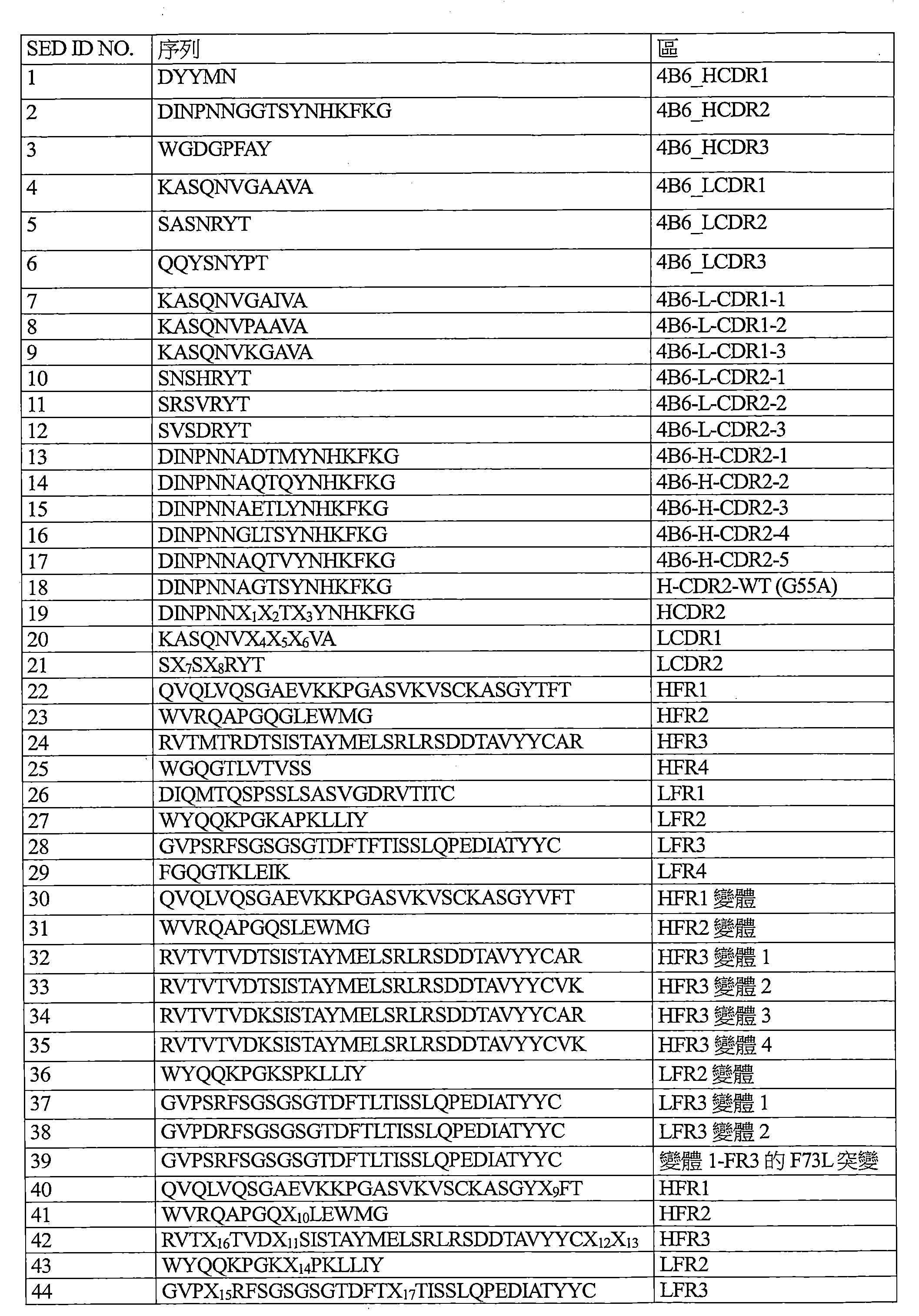
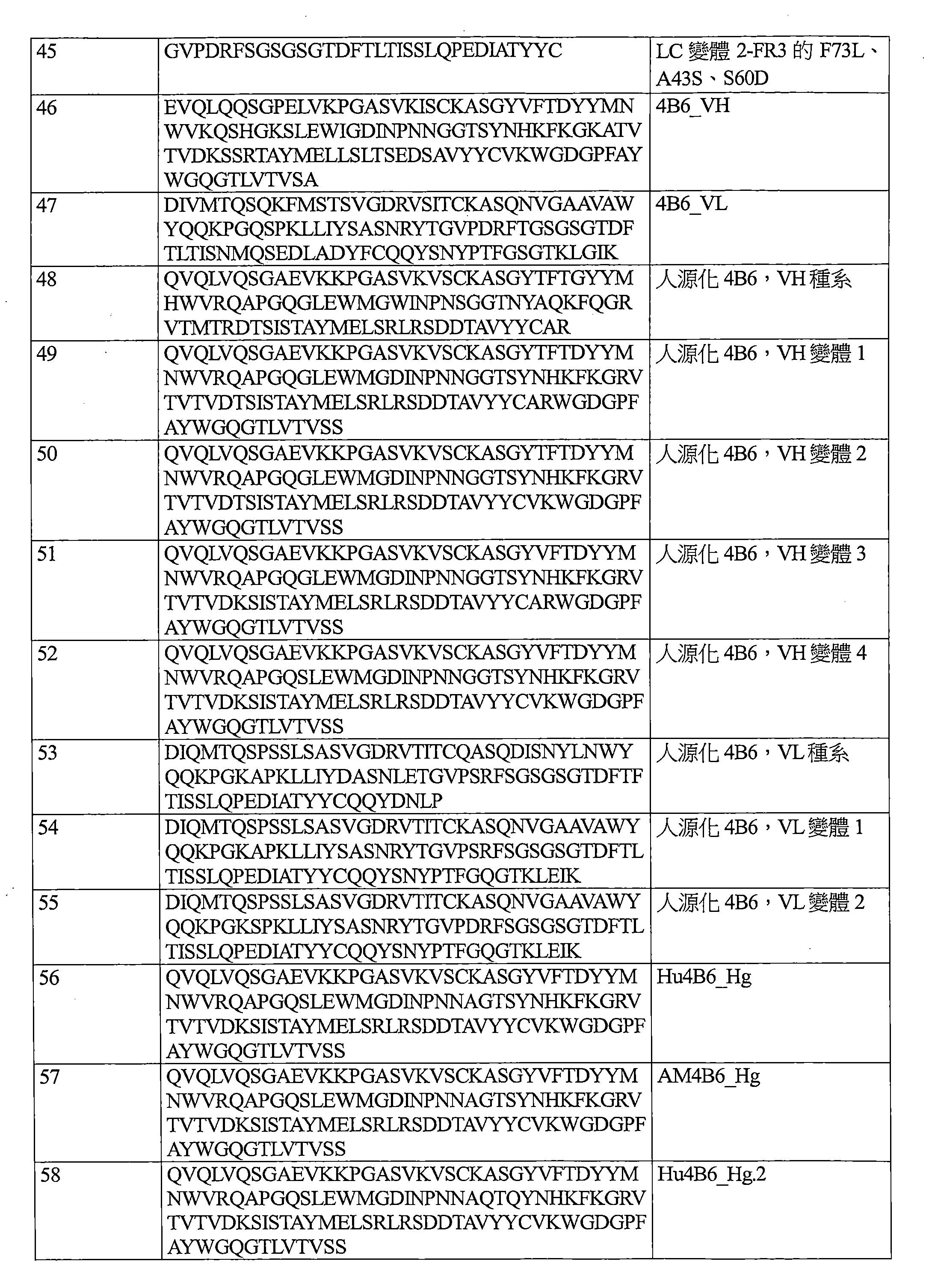
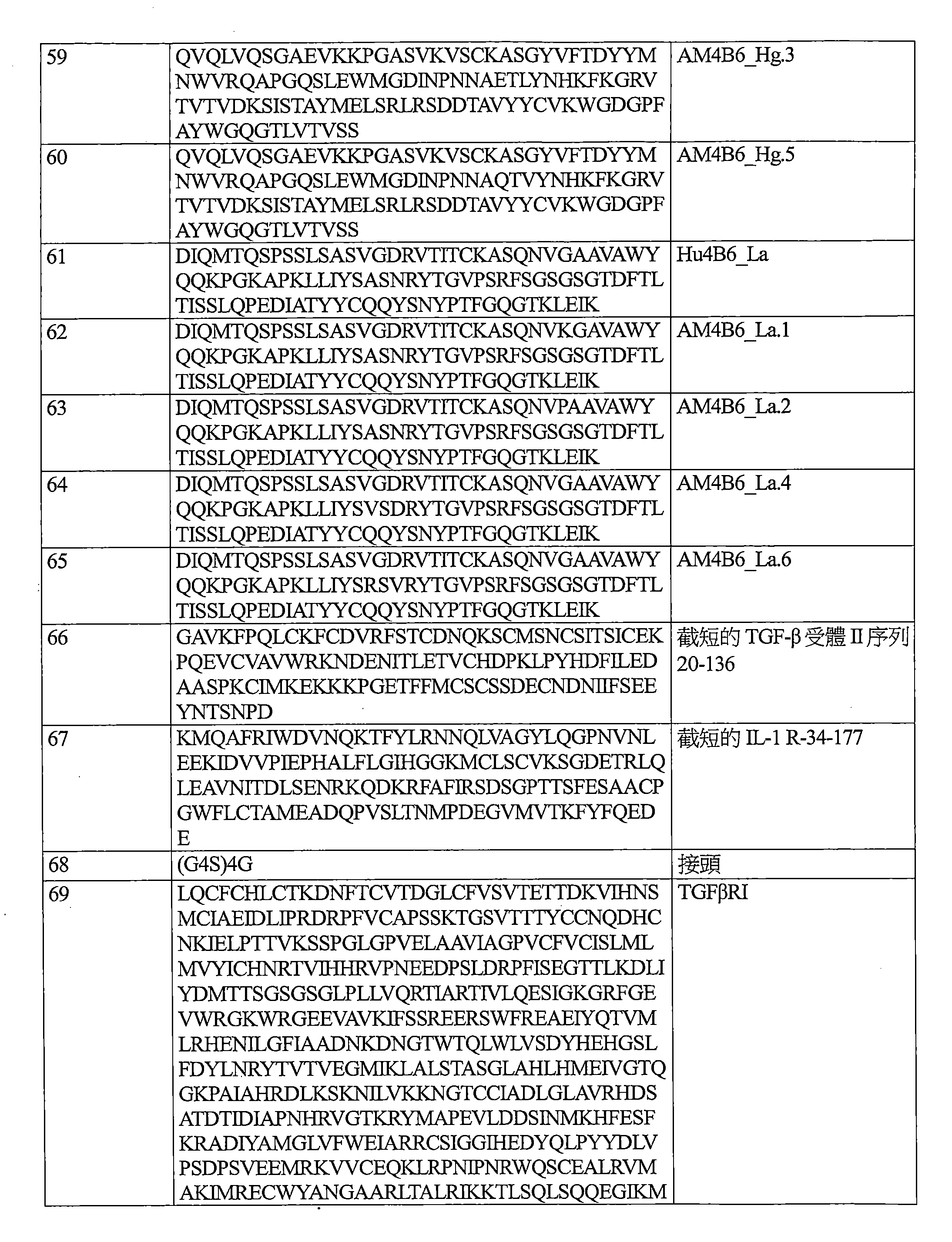


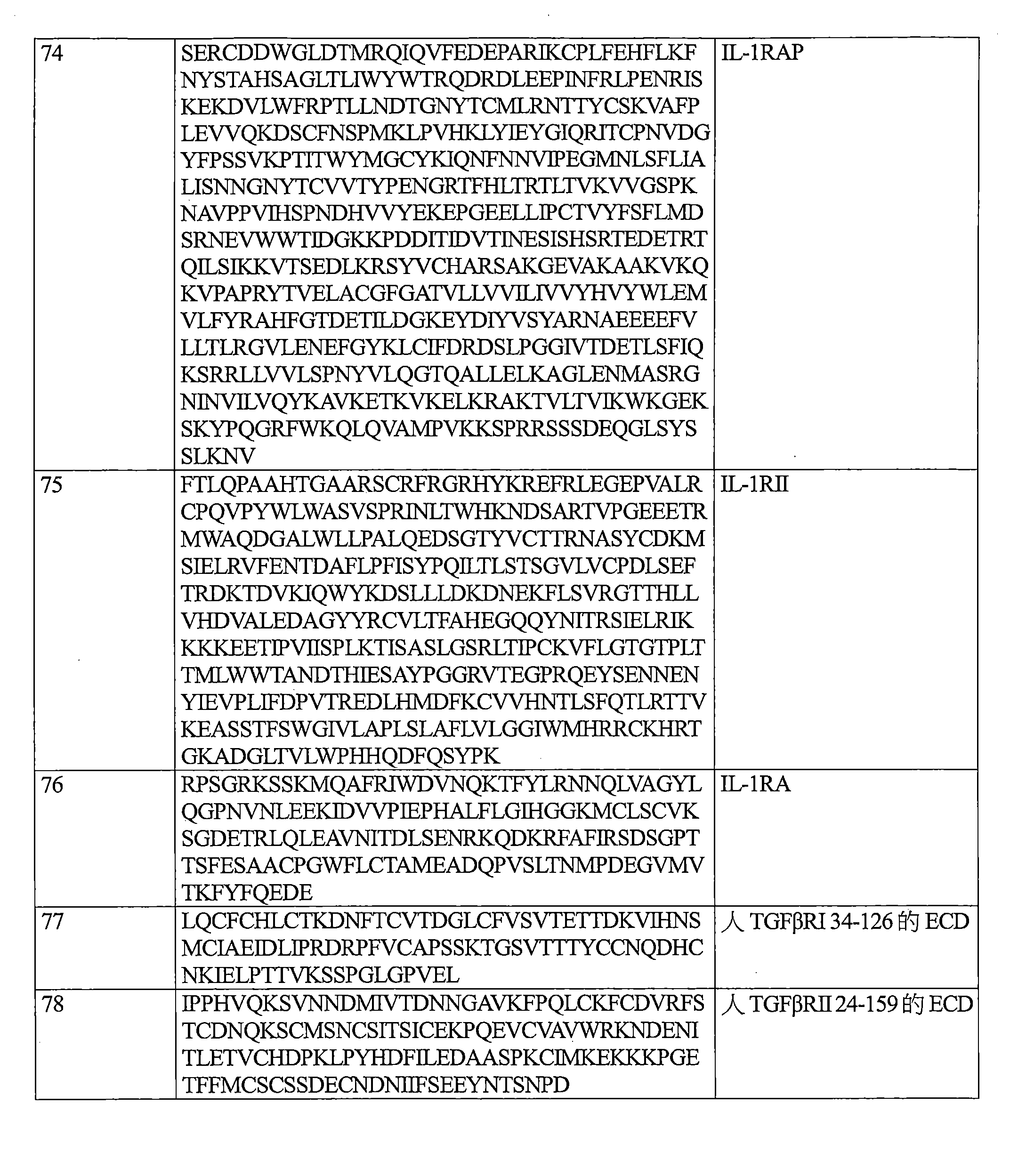
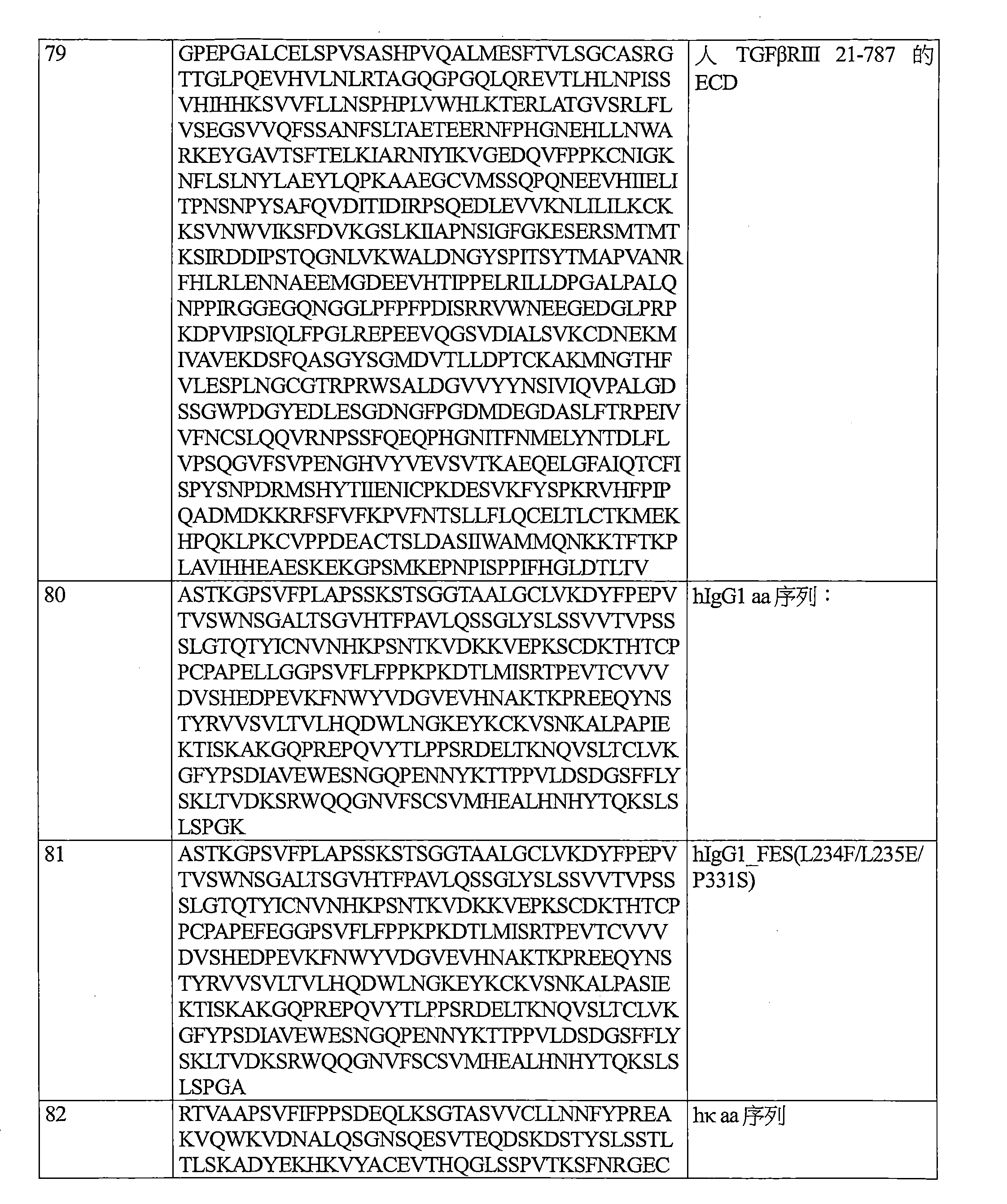

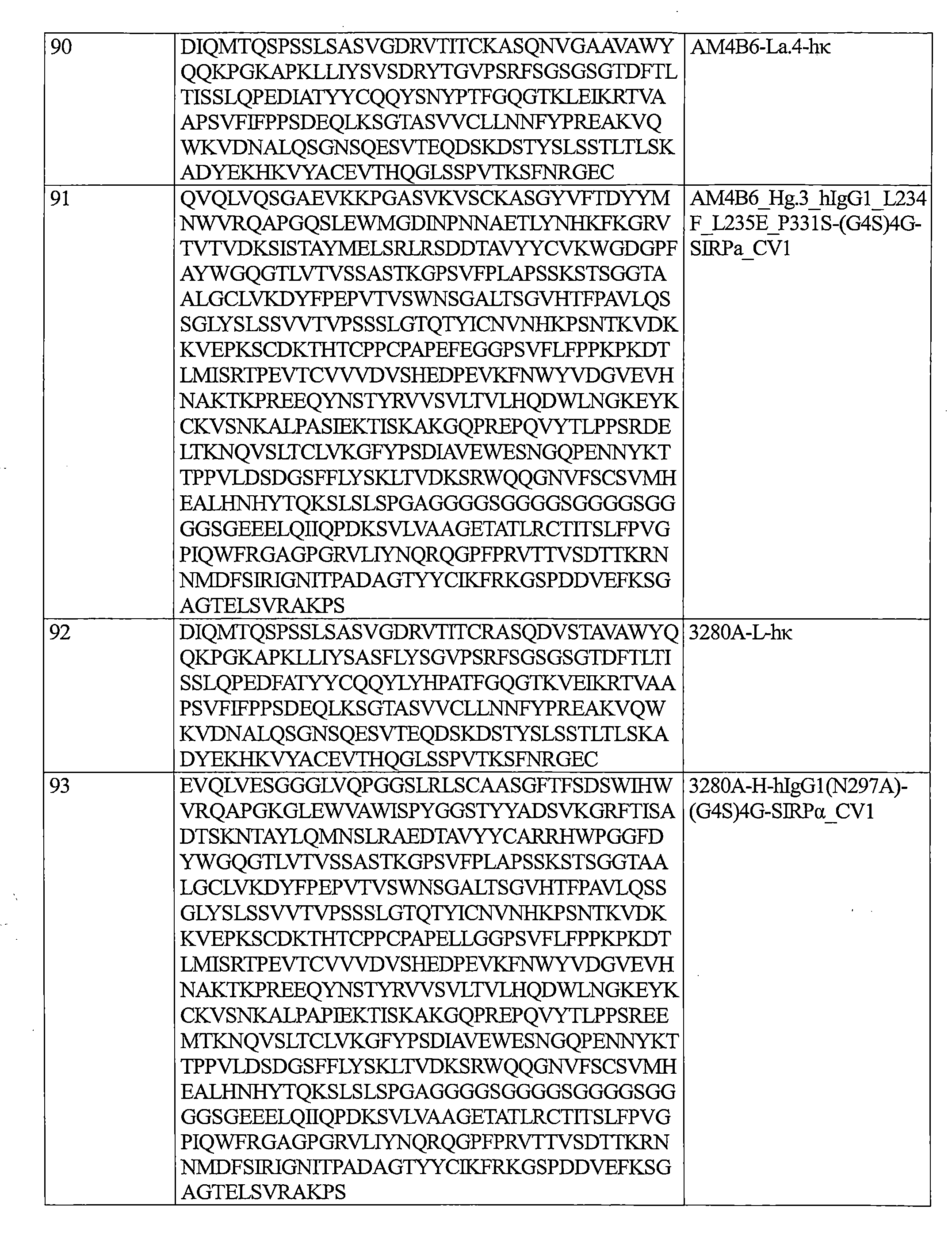

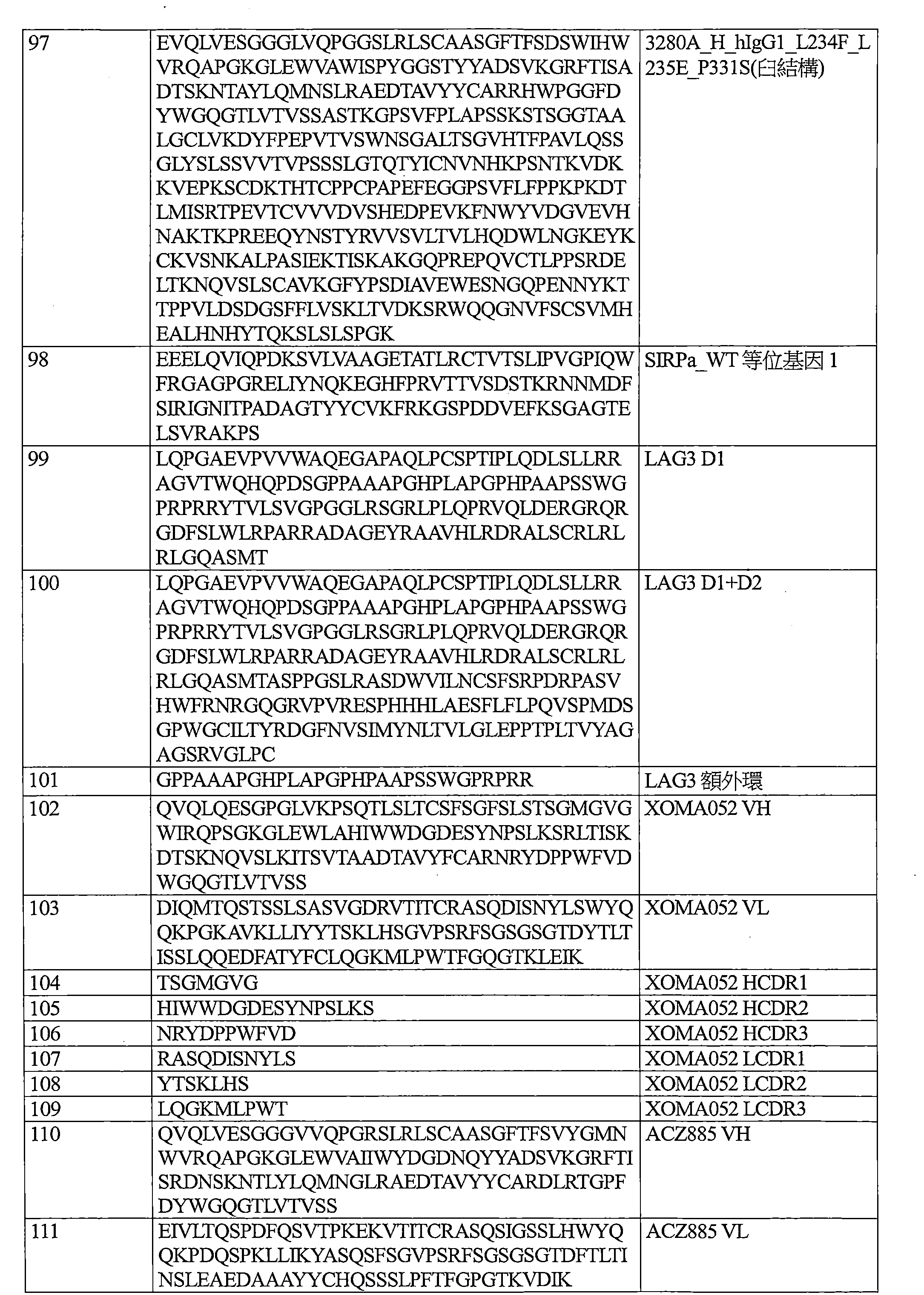

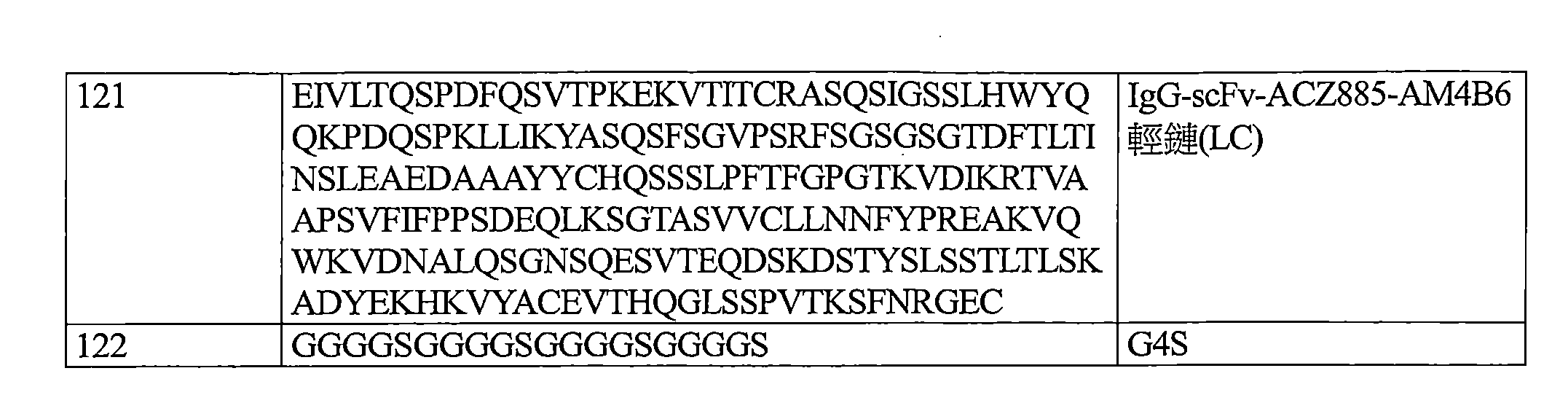
實施例B:製劑及其效果Example B: Preparation and its effect
本實施例中涉及的分析方法、試劑相關信息以及測試樣品配製方法如下: The analysis method, reagent-related information, and test sample preparation method involved in this embodiment are as follows:
1.動態光散射DLS 1. Dynamic Light Scattering DLS
蛋白粒徑及分佈藉由動態光散射儀(DLS,Wyatt,型號WP2-09)進行測定,方法參數如下:採集時間5s,每次測量採集20次,測量溫度25℃。
The protein particle size and distribution were measured by dynamic light scattering (DLS, Wyatt, model WP2-09), and the method parameters were as follows:
2.分子排阻色譜SEC 2. Size Exclusion Chromatography SEC
蛋白聚集情況使用Agilent 1260系統和TSKgel G3000SWXL柱(300×7.8mm,5μm)藉由SEC方法測定。流動相為50mM磷酸鈉緩衝液,300mM NaCl,pH 6.8±0.1。流速為1.0mL/min。將樣品稀釋至10mg/mL,檢測體積10μL,檢測波長為280nm。 Protein aggregation was determined by SEC using an Agilent 1260 system and a TSKgel G3000SWXL column (300×7.8mm, 5μm). The mobile phase was 50mM sodium phosphate buffer, 300mM NaCl, pH 6.8±0.1. The flow rate was 1.0mL/min. The sample was diluted to 10mg/mL, the detection volume was 10μL, and the detection wavelength was 280nm.
藉由SEC測定樣品中的高分子量聚合物(至少是二聚體)HMW% Determine the HMW% of high molecular weight polymers (at least dimers) in the sample by SEC
3.非還原性毛細管電泳NR CE-SDS 3. Non-reducing capillary electrophoresis NR CE-SDS
蛋白碎片情況藉由CE-SDS(NR)方法進行測定。將標準品或供試樣品用磷酸-檸檬酸緩衝液稀釋至4mg/mL,然後取樣25μL與75μL SDS樣品緩衝液和5μL NEM(100mM N-乙基馬來醯亞胺)渦旋混合進行變性處理。變性的樣品經離心後,在70±2℃下孵育10±2min,在室溫下冷卻,然後再次離心。使用SDS分離凝膠試劑盒和未塗層的熔融石英毛細管在PA800 plus上進行分離。 Protein fragmentation was determined by CE-SDS (NR) method. The standard or test sample was diluted to 4 mg/mL with phosphoric acid-citrate buffer, and then 25 μL was sampled and vortexed with 75 μL SDS sample buffer and 5 μL NEM (100 mM N-ethylmaleimide) for denaturation. The denatured sample was centrifuged, incubated at 70 ± 2 ° C for 10 ± 2 min, cooled at room temperature, and then centrifuged again. Separation was performed on PA800 plus using SDS separation gel kit and uncoated fused silica capillary.
藉由NR CE-SDS測定樣品中的小分子碎片(分子量低於單體)LMW% Determine the LMW% of small molecule fragments (molecular weight lower than monomer) in the sample by NR CE-SDS
4.結合活性 4. Binding activity
包被抗原為TGFβ1,檢測抗體為Goat anti-Human IgG-Fc HRP conjugated,酶反應的受質為TMB。將抗原包被吸附在96孔高吸附板上,洗滌封閉後加入供試品與之結合,孵育後洗滌,加入檢測抗體,孵育洗滌除去未結合的檢測抗體,再加入受質顯色,最後加入反應終止液(1M硫酸),於酶標儀上讀取吸光值,其檢測波長為450nm,參比波長為650nm。 The coating antigen is TGFβ1, the detection antibody is Goat anti-Human IgG-Fc HRP conjugated, and the substrate of the enzyme reaction is TMB. The antigen is coated and adsorbed on a 96-well high adsorption plate, washed and sealed, and the test sample is added to bind to it. After incubation and washing, the detection antibody is added, incubated and washed to remove the unbound detection antibody, and then the substrate is added for color development. Finally, the reaction termination solution (1M sulfuric acid) is added, and the absorbance value is read on the enzyme marker. The detection wavelength is 450nm and the reference wavelength is 650nm.
5.細胞活性 5. Cell activity
細胞鋪板在96孔檢測板中,參比品和樣品以濃度10μg/mL為首孔、2倍梯度稀釋至0.0195μg/mL,加入96孔檢測板中。加入梯度稀釋樣品的細胞置於37.0℃±1.0℃,5.0±1.0%CO2培養箱中培養4-5小時。藉由Bio-LiteTM化學發光試劑盒或等效試劑檢測以上實施例製備的雙功能蛋白質分子、例如AM4B6-hIgG1-TGFβRII'是否抑制PD-1和PD-L1細胞間的交互作用。化學發光的強度與每個孔的抑制程度成線性相關。對劑量依賴曲線進行四參數模型擬合,最終以參比品與樣品之半數有效濃度比值,計算樣品的相對活性。 The cells were plated in a 96-well assay plate, and the reference and sample were diluted 2-fold to 0.0195 μg/mL in the first well at a concentration of 10 μg/mL and added to the 96-well assay plate. The cells with the gradient diluted samples were cultured in a 37.0°C ± 1.0°C, 5.0 ± 1.0% CO2 incubator for 4-5 hours. The bifunctional protein molecules prepared in the above examples, such as AM4B6-hIgG1-TGFβRII', were detected by Bio-LiteTM chemiluminescence reagent kit or equivalent reagents to determine whether they inhibit the interaction between PD-1 and PD-L1 cells. The intensity of chemiluminescence is linearly correlated with the degree of inhibition in each well. The dose dependence curve was fitted with a four-parameter model, and the relative activity of the sample was finally calculated using the ratio of the half effective concentration of the reference product to the sample.
6.流動注射HPLC螢光分析法 6. Flow injection HPLC fluorescence analysis method
聚山梨酯80濃度藉由流動注射HPLC螢光分析法進行測定。使用Agilent 1260系統和螢光檢測器,激發波長為350nm,發射波長為420nm,流動相為0.15M氯化鈉,0.025M四硼酸鈉,5.0%乙睛,5.0μM奈胺基苯,2.5ppm聚山梨酯80。
The concentration of
7.試劑相關信息如下: 7. Reagent related information is as follows:


8.如無特別說明,本實施例的測試製劑樣品採用的配製方法如下: 8. Unless otherwise specified, the preparation method used for the test preparation sample of this embodiment is as follows:
(1).採用透析的方法將蛋白質原液(即,PDL1/TGFβ蛋白(AM4B6-hIgG1-TGFβRII'))的緩衝液置換為目標緩衝體系:將一定體積的樣品置於Snake Skin®透析袋內,密封後,置於≧100倍體積的目標緩衝液中,持續攪拌以促進置換。透析進行3次,持續時間分別為4h,4h並且過夜,攪拌速度為300rpm。 (1). Use dialysis to replace the buffer of the protein stock solution (i.e., PDL1/TGFβ protein (AM4B6-hIgG1-TGFβRII')) with the target buffer system: place a certain volume of sample in a Snake Skin® dialysis bag, seal it, and place it in ≧100 times the volume of the target buffer, stirring continuously to promote replacement. Dialysis was performed 3 times, lasting 4 hours, 4 hours and overnight, and the stirring speed was 300rpm.
(2).透析結束後,蛋白原液中加入所需量的穩定劑、表面活性劑母液等輔料,並用目標緩衝液稀釋至目標蛋白濃度,然後除菌過濾、無菌灌裝,得到測試製劑溶液,製劑的具體參數分別如下文處方設計表格所示。 (2). After dialysis, add the required amount of stabilizer, surfactant stock solution and other auxiliary materials to the protein stock solution, dilute it with the target buffer to the target protein concentration, and then sterilize, filter and aseptically fill it to obtain the test preparation solution. The specific parameters of the preparation are shown in the prescription design table below.
實施例B-1:pH、表面活性劑和其他輔料對製劑性質的影響研究Example B-1: Study on the effects of pH, surfactants and other excipients on formulation properties
1.材料和方法1. Materials and Methods
採用JMP軟體的定制設計進行DOE(Design of expriment)處方設計。篩選的處方包含20mg/mL PDL1/TGFβ蛋白(AM4B6-hIgG1-TGFβRII'),pH為4.5~5.5的20mM醋酸-醋酸鈉緩衝液,135mM~280mM其他輔料,0.025~0.1%(w/v,g/100mL)聚山梨酯80。具體處方設計見表23。
The DOE (Design of expriment) prescription design was performed using the custom design of JMP software. The selected prescription contained 20 mg/mL PDL1/TGFβ protein (AM4B6-hIgG1-TGFβRII'), 20 mM acetic acid-sodium acetate buffer with a pH of 4.5-5.5, 135 mM-280 mM other excipients, and 0.025-0.1% (w/v, g/100 mL)
如下表所示,考察所有處方測試樣品初始時刻T0的粒徑,40℃4週及在25℃攪拌3小時條件下的穩定性。 As shown in the table below, the particle size of all prescription test samples at the initial time T0, stability under the conditions of 40℃ for 4 weeks and stirring at 25℃ for 3 hours were investigated.
表23處方設計Table 23 Prescription design

2.實驗結果和分析2. Experimental results and analysis
2.1 各個測試樣品初始時刻T0的粒徑2.1 Particle size of each test sample at the initial time T0
藉由動態光散射儀,檢測樣品的粒徑。檢測條件,如上文所述。 The particle size of the sample is measured by dynamic light scattering. The detection conditions are as described above.
T0時的粒徑(DLS)結果見表24。從實驗結果可知隨著pH增加,含蔗糖和山梨醇的處方,粒徑明顯增加(F2、F4、F6、F8、F10、F12,從~7nm增加到~15nm),特別是在pH5.0和pH5.5時,含蔗糖或山梨醇的處方(F6、F8、F10、F12),粒徑明顯大於含鹽酸精胺酸或NaCl的處方。實驗結果顯示,含鹽酸精胺酸或NaCl的處方在不同pH下T0粒徑沒有明顯差異。這顯示,滲透壓調節劑鹽酸精胺酸或NaCl還可以減少蛋白聚合物的產生,有利於蛋白質穩定。 The particle size (DLS) results at T0 are shown in Table 24. From the experimental results, it can be seen that as the pH increases, the particle size of the prescriptions containing sucrose and sorbitol increases significantly (F2, F4, F6, F8, F10, F12, from ~7nm to ~15nm), especially at pH5.0 and pH5.5, the particle size of the prescriptions containing sucrose or sorbitol (F6, F8, F10, F12) is significantly larger than that of the prescriptions containing arginine hydrochloride or NaCl. The experimental results show that there is no significant difference in the T0 particle size of the prescriptions containing arginine hydrochloride or NaCl at different pH. This shows that the osmotic pressure regulator arginine hydrochloride or NaCl can also reduce the production of protein aggregates, which is beneficial to protein stability.
表24 DLS結果Table 24 DLS results
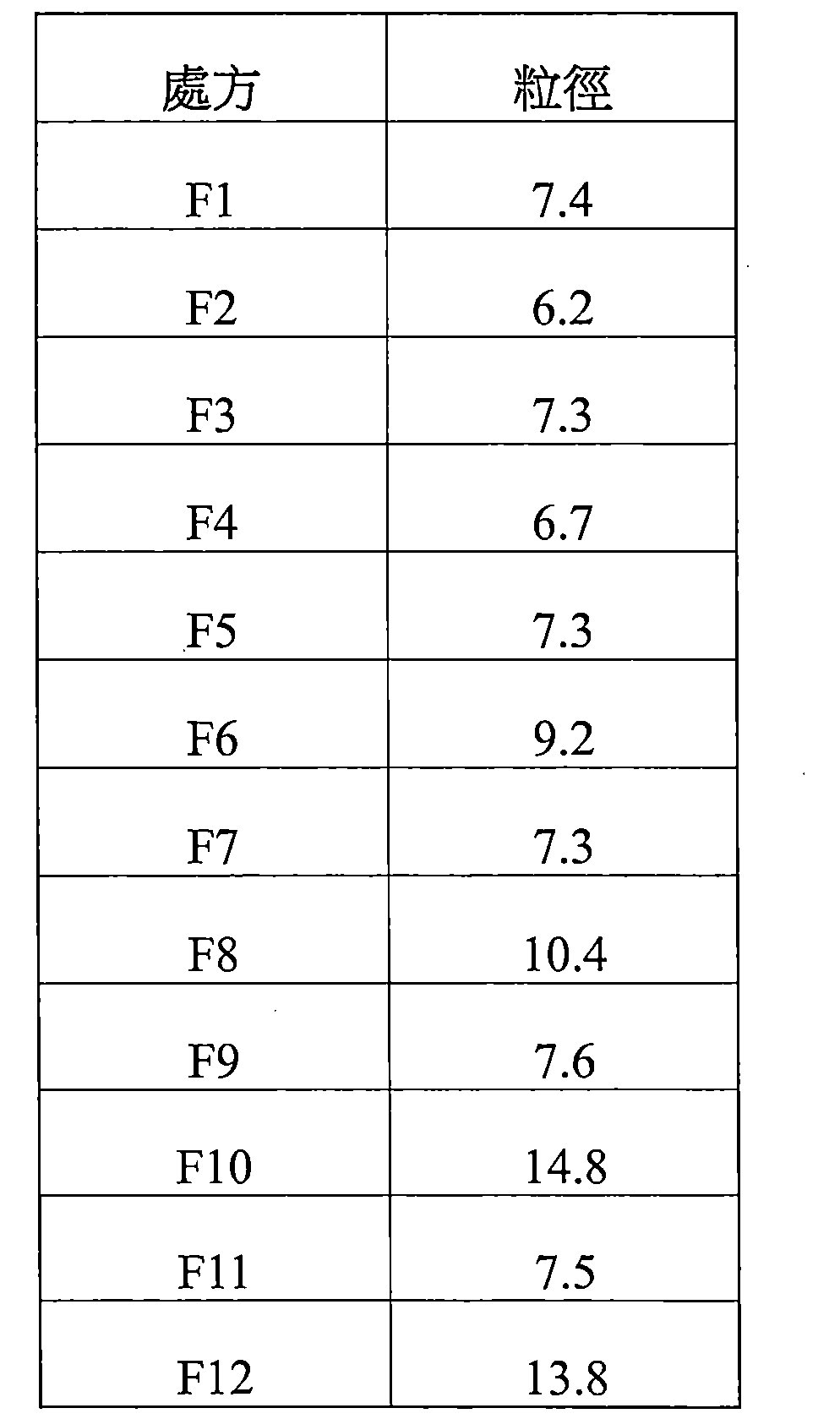
2.2 各個測試樣品40℃放置4週的穩定性2.2 Stability of each test sample at 40℃ for 4 weeks
將各個處方樣品在40℃放置4週(T4w)。採用SEC和NR CE-SDS進行檢測,得到樣品T0(初始時刻)和T4w的高分子量聚合物HMW%(採用SEC檢測)和小分子碎片LMW%(採用NR CE-SDS檢測)數據。高分子量聚合物HMW%和小分子碎片LMW%的變化值(△HMW%和△LMW%)為T4w與T0的差異值。 Each prescription sample was placed at 40℃ for 4 weeks (T4w). SEC and NR CE-SDS were used for detection to obtain the data of high molecular weight polymer HMW% (detected by SEC) and small molecule fragment LMW% (detected by NR CE-SDS) at T0 (initial time) and T4w. The change values of high molecular weight polymer HMW% and small molecule fragment LMW% (△HMW% and △LMW%) are the difference values between T4w and T0.
將△HMW%和△LMW%作為響應值輸入JMP軟體,採用最小二乘法對回歸模型進行擬合。HMW和LMW的模型擬合R2均為0.96,數據擬合度很高。圖35展示了JMP軟體對數據進行分析後的結果。在0.025%~0.1%(w/v)的範圍內,PS80的濃度對HMW和LMW幾乎沒有影響。輔料種類對HMW的影響在於,含蔗糖和山梨醇的處方,HMW的增加較多;與含蔗糖和山梨醇的處方相比,含鹽酸精胺酸和氯化鈉的處方,HMW的增加明顯減少。這顯示滲透壓調節劑鹽酸精胺酸或NaCl還可以減少蛋白聚合物的產生,有利於蛋白質穩定。此外,從圖35中可見,在pH 4.5~5.5的範圍內,pH越高,越有利於PD-L1/TGF-β蛋白穩定,HMW和LMW的增加越緩慢,即pH 5.0~5.5是比較優異的pH區間範圍。 △HMW% and △LMW% were input as response values into JMP software, and the regression model was fitted using the least squares method. The model fitting R2 of HMW and LMW was 0.96, and the data fit was very high. Figure 35 shows the results of the data analysis by JMP software. In the range of 0.025%~0.1% (w/v), the concentration of PS80 had almost no effect on HMW and LMW. The effect of the type of excipients on HMW is that the increase in HMW is greater in the formulation containing sucrose and sorbitol; compared with the formulation containing sucrose and sorbitol, the increase in HMW in the formulation containing arginine hydrochloride and sodium chloride is significantly reduced. This shows that the osmotic pressure regulator arginine hydrochloride or NaCl can also reduce the generation of protein aggregates, which is beneficial to protein stability. In addition, as can be seen from Figure 35, within the range of pH 4.5~5.5, the higher the pH, the more favorable it is for PD-L1/TGF-β protein stability, and the slower the increase of HMW and LMW, that is, pH 5.0~5.5 is a relatively excellent pH range.
2.3 攪拌條件的穩定性2.3 Stability of stirring conditions
將各個處方樣品在25℃攪拌3小時(T3h)。採用SEC和NR CE-SDS進行檢測,得到樣品T0(初始時刻)和T3h的高分子量聚合物HMW%(採用SEC檢測)和小分子碎片LMW%(採用NR CE-SDS檢測)數據。高分子量聚合物HMW%和小分子碎片LMW%的變化值(△HMW%和△LMW%)為T3h與T0的差異值。 Each prescription sample was stirred at 25℃ for 3 hours (T3h). SEC and NR CE-SDS were used for detection to obtain the data of high molecular weight polymer HMW% (detected by SEC) and small molecule fragment LMW% (detected by NR CE-SDS) at T0 (initial time) and T3h. The change values of high molecular weight polymer HMW% and small molecule fragment LMW% (△HMW% and △LMW%) are the difference values between T3h and T0.
將△HMW%和△LMW%作為響應值輸入JMP軟體,採用最小二乘法對回歸模型進行擬合。HMW和LMW的模型擬合R2分別為0.91和0.93,數據擬合度很高。圖36展示了JMP軟體對數據進行分析後的結果。從圖36中 可以看出,F1-F12:pH,PS80濃度和輔料種類在測試條件下對HMW和LMW都沒有影響。 △HMW% and △LMW% were input as response values into JMP software, and the regression model was fitted using the least squares method. The model fitting R2 of HMW and LMW were 0.91 and 0.93 respectively, and the data fit was very high. Figure 36 shows the results of the data analysis by JMP software. As can be seen from Figure 36, F1-F12: pH, PS80 concentration and excipient type had no effect on HMW and LMW under the test conditions.
綜上,T0粒徑、40℃穩定性以及攪拌實驗顯示,在pH 5.0~5.5的範圍內時,HMW和LWM的增加比較緩慢,並且pH對HMW和LMW的變化幾乎沒有影響,因此較佳的pH範圍是pH 5.0~5.5。鹽酸精胺酸或NaCl不僅可以起到滲透壓調節劑的作用,還可以減少蛋白聚合物的產生,有利於蛋白質穩定,因此較佳的輔料種類為鹽酸精胺酸或氯化鈉。在0.025%~0.1%(w/v)的範圍內,PS80的濃度對HMW和LMW幾乎沒有影響。 In summary, T0 particle size, 40℃ stability and stirring experiments show that in the pH range of 5.0~5.5, the increase of HMW and LWM is relatively slow, and pH has almost no effect on the change of HMW and LMW, so the optimal pH range is pH 5.0~5.5. Arginine hydrochloride or NaCl can not only act as an osmotic pressure regulator, but also reduce the production of protein polymers, which is beneficial to protein stability. Therefore, the best excipient type is arginine hydrochloride or sodium chloride. In the range of 0.025%~0.1% (w/v), the concentration of PS80 has almost no effect on HMW and LMW.
實施例B-2:不同緩衝體系的比較實驗Example B-2: Comparative Experiment of Different Buffer Systems
1.材料和方法1. Materials and Methods
在pH5.5的條件下,比較醋酸緩衝體系和組胺酸緩衝體系對蛋白質穩定性的影響。具體的處方設計見表25。 Under pH 5.5, compare the effects of acetate buffer system and histidine buffer system on protein stability. See Table 25 for the specific prescription design.
表25比較不同緩衝體系的處方設計Table 25 Comparison of prescription designs of different buffer systems

2.不同緩衝體系的結果與分析2. Results and analysis of different buffer systems
將兩個處方樣品在40℃放置4週(T4w)。採用SEC和NR CE-SDS進行檢測,得到樣品T0(初始時刻)、T2w和T4w的高分子量聚合物HMW%(採用SEC檢測)和小分子碎片LMW%(採用NR CE-SDS檢測)數據。如圖37和圖38所示,在醋酸緩衝體系和組胺酸緩衝體系中,PD-L1/TGF-β蛋白的高分子量聚合物HMW和小分子碎片LMW的變化均較小,說明緩衝鹽的種類對蛋白質穩定性沒有影響,即這兩種緩衝體系均可滿足蛋白質穩定性要求。 The two prescription samples were placed at 40°C for 4 weeks (T4w). SEC and NR CE-SDS were used for detection, and the high molecular weight polymer HMW% (detected by SEC) and small molecule fragment LMW% (detected by NR CE-SDS) data of samples T0 (initial time), T2w and T4w were obtained. As shown in Figures 37 and 38, in the acetic acid buffer system and the histidine buffer system, the changes in the high molecular weight polymer HMW and small molecule fragment LMW of PD-L1/TGF-β protein were small, indicating that the type of buffer salt has no effect on protein stability, that is, both buffer systems can meet the protein stability requirements.
實施例B-3:不同蛋白質濃度的比較實驗Example B-3: Comparative experiment of different protein concentrations
1.材料和方法1. Materials and Methods
在本實施例中,對蛋白質濃度進行了篩選。根據實施例B-1中的結果圖35,較佳的pH範圍是pH 5.0~5.5。當pH為5.3時,如圖35所示,HWM在40℃條件下幾乎沒有增加,LMW僅有少量增加。因此,本實施例中選擇pH5.3的緩衝液作為緩衝體系。同時根據實施例B-1中的結果圖35,聚山梨酯80的濃度0.025-0.1%對蛋白質穩定性沒有影響,因此,選擇一個中間值0.05%(w/v)的聚山梨酯80作為本實驗表面活性劑的濃度進行實驗。具體的處方設計和測試條件見表26。
In this embodiment, the protein concentration was screened. According to the result Figure 35 in Example B-1 , the optimal pH range is pH 5.0~5.5. When the pH is 5.3, as shown in Figure 35, HWM hardly increases at 40°C, and LMW only increases slightly. Therefore, a buffer solution with pH 5.3 is selected as the buffer system in this embodiment. At the same time, according to the result Figure 35 in Example B-1 , the concentration of
表26不同蛋白濃度的處方設計Table 26 Prescription design of different protein concentrations
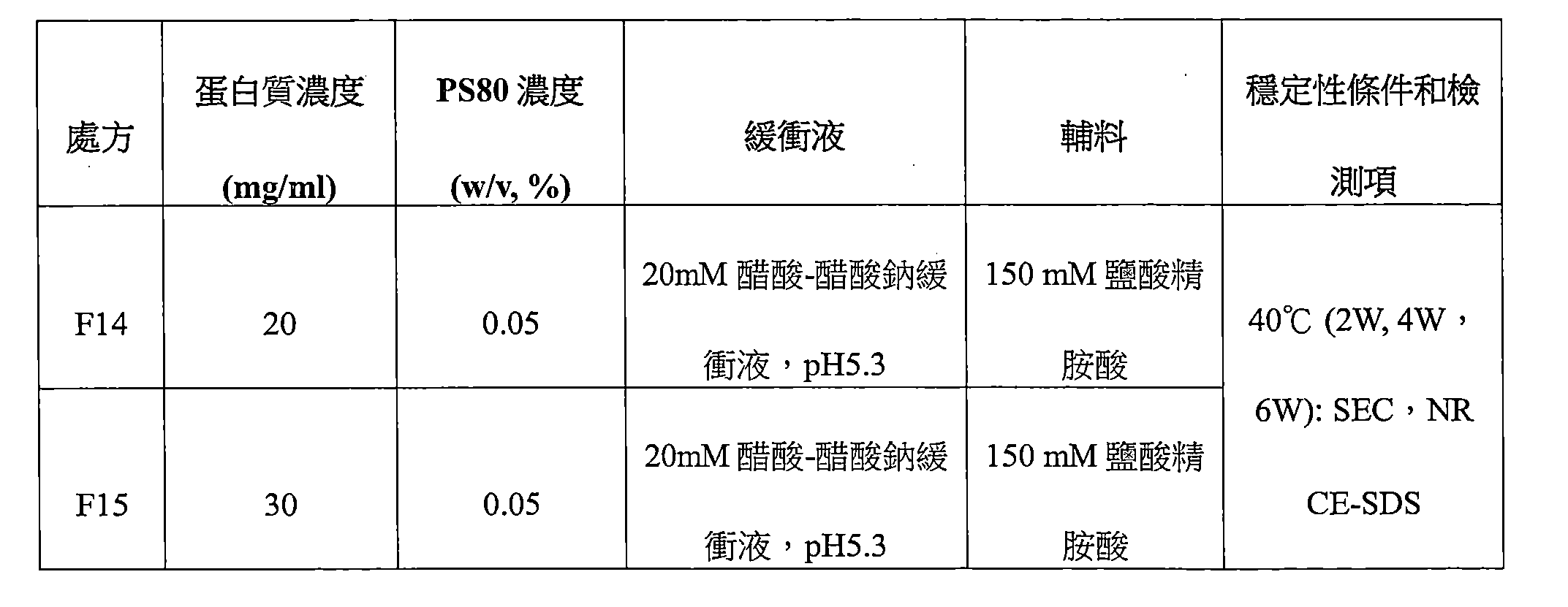
2.結果與分析2. Results and Analysis
將兩個處方樣品在40℃放置6週(T6w)。採用SEC和NR CE-SDS進行檢測,得到樣品T0(初始時刻)、T2w、T4w和T6w的高分子量聚合物HMW%(採用SEC檢測)和小分子碎片LMW%(採用NR CE-SDS檢測)數據。如圖39和圖40所示,在蛋白濃度分別為20mg/ml和30mg/ml時,PD-L1/TGF-β蛋白的高分子量聚合物HMW和小分子碎片LMW的變化趨勢很接近,說明在20mg/ml~30mg/ml的範圍內,PD-L1/TGF-β蛋白的穩定性相似,滿足穩定性要求。 The two prescription samples were placed at 40℃ for 6 weeks (T6w). SEC and NR CE-SDS were used for detection, and the high molecular weight polymer HMW% (detected by SEC) and small molecule fragment LMW% (detected by NR CE-SDS) data of samples T0 (initial time), T2w, T4w and T6w were obtained. As shown in Figures 39 and 40, when the protein concentration was 20mg/ml and 30mg/ml respectively, the change trends of the high molecular weight polymer HMW and small molecule fragment LMW of PD-L1/TGF-β protein were very similar, indicating that within the range of 20mg/ml~30mg/ml, the stability of PD-L1/TGF-β protein was similar and met the stability requirements.
實施例B-4:不同輔料的比較實驗Example B-4: Comparative experiment of different auxiliary materials
1.材料和方法1. Materials and Methods
在本實施例中,對輔料種類進行了進一步篩選。根據實施例B-1的結果,選擇pH5.3的20mM醋酸-醋酸鈉緩衝液作為緩衝體系,0.05%(w/v)的聚山梨酯80作為表面活性劑,鹽酸精胺酸或氯化鈉作為穩定劑和滲透壓調節劑。具體的處方設計和測試條件見表27。
In this embodiment, the types of excipients were further screened. According to the results of Example B-1 , 20 mM acetic acid-sodium acetate buffer at pH 5.3 was selected as the buffer system, 0.05% (w/v)
表27進一步篩選輔料的處方設計Table 27 Prescription design for further screening of excipients
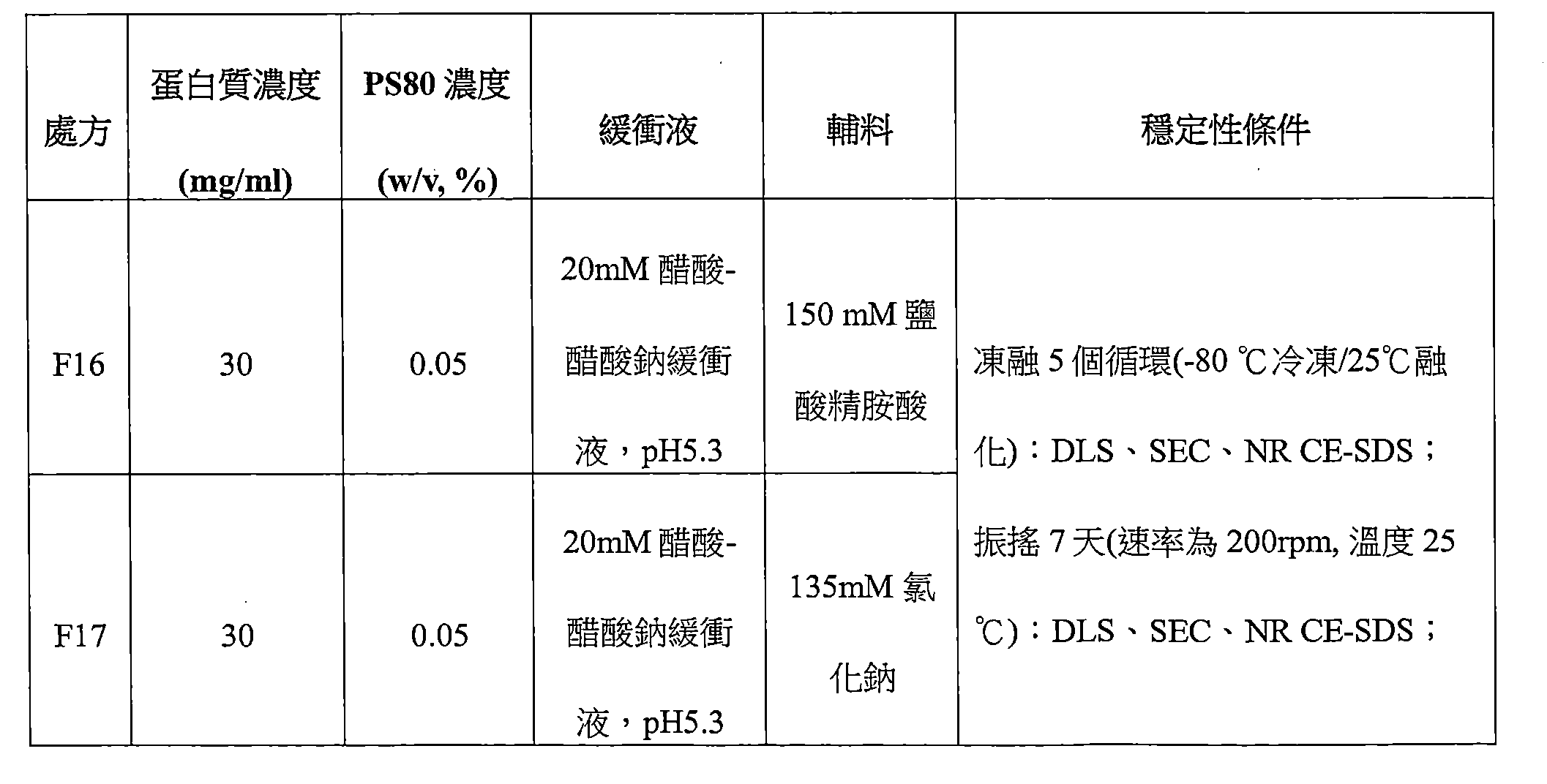

2.結果與分析2. Results and Analysis
2.1 凍融和振搖結果2.1 Freeze-thaw and shaking results
在凍融和振搖條件下,F16和F17在外觀,蛋白質粒徑,HMW和LMW方面均無明顯變化,且與T0相比這些方面亦無明顯變化。這顯示F16和F17在凍融和振搖條件下滿足藥物製劑穩定性要求。 Under freeze-thaw and shaking conditions, F16 and F17 showed no significant changes in appearance, protein particle size, HMW and LMW, and there was no significant change in these aspects compared with T0. This shows that F16 and F17 meet the stability requirements of pharmaceutical preparations under freeze-thaw and shaking conditions.
2.2 光照結果2.2 Lighting Results
如圖41所示,在光照條件下,與氯化鈉相比,鹽酸精胺酸在抑制HMW方面有明顯的優勢,顯示其特別有利於維持蛋白質穩定。在外觀、蛋白質粒徑、LMW及活性方面,F16和F17均未發生明顯變化,且與T0相比這些方面亦無明顯變化。這顯示F16和F17在光照條件下均滿足藥物製劑穩定性要求,而F16顯示出更加優異的穩定性。 As shown in Figure 41, under light conditions, compared with sodium chloride, arginine hydrochloride has a significant advantage in inhibiting HMW, indicating that it is particularly beneficial for maintaining protein stability. In terms of appearance, protein particle size, LMW and activity, F16 and F17 did not undergo significant changes, and there was no significant change in these aspects compared with T0. This shows that F16 and F17 both meet the stability requirements of pharmaceutical preparations under light conditions, and F16 shows more excellent stability.
2.3 40℃結果2.3 Results at 40°C
如圖42所示,在40℃條件下,與氯化鈉相比,鹽酸精胺酸在抑制HMW方面有明顯的優勢,顯示其特別有利於維持蛋白質穩定。在外觀、蛋白質粒徑及活 性方面,F16和F17均未發生明顯變化;F17的LMW增加比F16略少,優勢不明顯;且與T0相比這些方面亦無明顯變化。這顯示F16和F17在40℃條件下均滿足藥物製劑穩定性要求,而F16顯示出更加優異的穩定性。 As shown in Figure 42, at 40°C, compared with sodium chloride, arginine hydrochloride has a significant advantage in inhibiting HMW, indicating that it is particularly beneficial for maintaining protein stability. In terms of appearance, protein particle size and activity, F16 and F17 did not change significantly; the increase in LMW of F17 was slightly less than that of F16, and the advantage was not obvious; and there was no significant change in these aspects compared with T0. This shows that F16 and F17 both meet the stability requirements of drug preparations at 40°C, and F16 shows more excellent stability.
2.4 25℃結果2.4 Results at 25°C
如圖43示,在25℃條件下,與氯化鈉相比,鹽酸精胺酸在抑制HMW方面有明顯的優勢。在外觀、蛋白質粒徑及LMW方面,F16和F17均未發生明顯變化,且與T0相比這些方面亦無明顯變化。這顯示F16和F17在光照條件下均滿足藥物製劑穩定性要求,而F16顯示出更加優異的穩定性。 As shown in Figure 43, at 25°C, arginine hydrochloride has a significant advantage in inhibiting HMW compared to sodium chloride. In terms of appearance, protein particle size and LMW, F16 and F17 did not change significantly, and there was no significant change in these aspects compared to T0. This shows that F16 and F17 both meet the stability requirements of drug formulations under light conditions, and F16 shows better stability.
綜合考慮各條件的結果,在光照、高溫強制降解(40℃)、加速(25℃)的條件下,鹽酸精胺酸可以更好地減緩HMW的增加。在LMW及活性方面,鹽酸精胺酸和氯化鈉的作用無明顯差異。因此,在本實施例中,製劑穩定性最佳的處方為:30mg/ml的PD-L1/TGF-β蛋白,pH為5.3的20mM醋酸-醋酸鈉緩衝液,150mM的鹽酸精胺酸,0.05%(w/v)的聚山梨酯80。
Taking into account the results of various conditions, arginine hydrochloride can better slow down the increase of HMW under the conditions of light, high temperature forced degradation (40°C), and acceleration (25°C). There is no significant difference between arginine hydrochloride and sodium chloride in terms of LMW and activity. Therefore, in this embodiment, the best formulation stability is: 30 mg/ml PD-L1/TGF-β protein, 20 mM acetic acid-sodium acetate buffer with a pH of 5.3, 150 mM arginine hydrochloride, and 0.05% (w/v)
實施例B-5:考察依地酸二鈉的保護作用Example B-5: Investigation of the protective effect of disodium edetate
1.材料和方法1. Materials and Methods
在實施例B-4中較佳處方的基礎上,進一步考察加入依地酸二鈉後對蛋白質和聚山梨酯80穩定性的影響。具體的處方設計和測試條件見表28。
Based on the preferred formula in Example B-4 , the effect of adding disodium edetate on the stability of protein and
表28處方設計Table 28 Prescription design


2.結果與分析2. Results and Analysis
如圖44和圖45所示,在所測試的75μM~300μM的範圍內,依地酸二鈉可以為PD-L1/TGF-β蛋白製劑中的聚山梨酯80提供良好的保護作用,在40℃儲存一個月及儲存25℃6個月後,聚山梨酯80幾乎沒有發生降解。
As shown in Figures 44 and 45, within the tested range of 75μM~300μM, disodium edetate can provide good protection for
如圖46、圖47、圖48和圖49所示,F19、F20和F21在防止HMW和LWM增加方面的效果與F18相似,說明加入依地酸二鈉不影響蛋白質的穩定性。依地酸二鈉的作用主要在於防止聚山梨酯80降解,從而提高製劑的安全性。
As shown in Figures 46, 47, 48 and 49, the effects of F19, F20 and F21 in preventing the increase of HMW and LWM are similar to those of F18, indicating that the addition of disodium edetate does not affect the stability of the protein. The main function of disodium edetate is to prevent the degradation of
實施例B-6:考察處方製備工藝中加入依地酸二鈉的作用Example B-6: Study on the effect of adding disodium edetate in the preparation process of the prescription
1.材料和方法1. Materials and Methods
在實施例B-5的基礎上,考察在工藝中加入依地酸二鈉,是否仍然可以防止聚山梨酯80降解。工藝描述如下:
Based on Example B-5 , it was investigated whether adding disodium edetate to the process could still prevent the degradation of
在pH為5.3的20mM醋酸-醋酸鈉緩衝液的40mg/ml蛋白質(即,PDL1/TGFβ蛋白(AM4B6-hIgG1-TGFβRII'))溶液中,先加入依地酸二鈉母液,使其終濃度為0.5mM和5mM,所得溶液分別在室溫下放置過夜。 In a 40 mg/ml protein solution (i.e., PDL1/TGFβ protein (AM4B6-hIgG1-TGFβRII')) in a 20 mM acetic acid-sodium acetate buffer at pH 5.3, disodium edetate stock solution was first added to make the final concentrations 0.5 mM and 5 mM, and the resulting solutions were placed at room temperature overnight.
將上述步驟中的蛋白溶液置於Thermo的透析袋(貨號:88245)中,用pH為5.3的20mM醋酸-醋酸鈉緩衝液透析三次,每次透析時間
將透析後的蛋白溶液採用實施例B中的通用方法的第(2)部分配製成處方溶液(30mg/ml的PD-L1/TGF-β蛋白,pH為5.3的20mM醋酸-醋酸鈉緩衝液,150mM的鹽酸精胺酸,0.05%(w/v)的聚山梨酯80),並考察在40℃條件下聚山梨酯80降解的情況。
The dialyzed protein solution was prepared into a prescription solution (30 mg/ml PD-L1/TGF-β protein, 20 mM acetic acid-sodium acetate buffer with a pH of 5.3, 150 mM arginine hydrochloride, 0.05% (w/v) polysorbate 80) using part (2) of the general method in Example B, and the degradation of
同時,還採用類似方法製備了對照溶液,區別僅在於蛋白質溶液未經依地酸二鈉處理。 At the same time, a control solution was prepared in a similar manner, except that the protein solution was not treated with disodium edetate.
2.結果與分析2. Results and Analysis
如圖50所示,與未經依地酸二鈉處理的處方相比,經0.5mM或5mM依地酸二鈉處理後的處方,均可以在40℃下防止聚山梨酯80的降解,減少降解副產物的產生,從而提高製劑的安全性。
As shown in Figure 50, compared with the formulations not treated with disodium edetate, the formulations treated with 0.5mM or 5mM disodium edetate can prevent the degradation of
TWI866210B_112117936_SEQL.xmlTWI866210B_112117936_SEQL.xml
Claims (31)
Applications Claiming Priority (2)
| Application Number | Priority Date | Filing Date | Title |
|---|---|---|---|
| CN2022105416624 | 2022-05-17 | ||
| CN202210541662 | 2022-05-17 |
Publications (2)
| Publication Number | Publication Date |
|---|---|
| TW202402796A TW202402796A (en) | 2024-01-16 |
| TWI866210B true TWI866210B (en) | 2024-12-11 |
Family
ID=88834587
Family Applications (1)
| Application Number | Title | Priority Date | Filing Date |
|---|---|---|---|
| TW112117936A TWI866210B (en) | 2022-05-17 | 2023-05-15 | Bifunctional protein and its preparation and use |
Country Status (5)
| Country | Link |
|---|---|
| US (1) | US20250282874A1 (en) |
| EP (1) | EP4527857A1 (en) |
| CN (1) | CN119213034A (en) |
| TW (1) | TWI866210B (en) |
| WO (1) | WO2023221936A1 (en) |
Citations (2)
| Publication number | Priority date | Publication date | Assignee | Title |
|---|---|---|---|---|
| CN111363041A (en) * | 2016-03-23 | 2020-07-03 | 迈博斯生物医药(苏州)有限公司 | Novel anti-PD-L1 antibody |
| WO2021037184A1 (en) * | 2019-08-30 | 2021-03-04 | 正大天晴药业集团南京顺欣制药有限公司 | FUSION PROTEIN TARGETING PD-L1 AND TGF-β AND USE THEREOF |
Family Cites Families (29)
| Publication number | Priority date | Publication date | Assignee | Title |
|---|---|---|---|---|
| WO1988007089A1 (en) | 1987-03-18 | 1988-09-22 | Medical Research Council | Altered antibodies |
| WO1990005144A1 (en) | 1988-11-11 | 1990-05-17 | Medical Research Council | Single domain ligands, receptors comprising said ligands, methods for their production, and use of said ligands and receptors |
| DE3920358A1 (en) | 1989-06-22 | 1991-01-17 | Behringwerke Ag | BISPECIFIC AND OLIGO-SPECIFIC, MONO- AND OLIGOVALENT ANTI-BODY CONSTRUCTS, THEIR PRODUCTION AND USE |
| US5571894A (en) | 1991-02-05 | 1996-11-05 | Ciba-Geigy Corporation | Recombinant antibodies specific for a growth factor receptor |
| FI941572L (en) | 1991-10-07 | 1994-05-27 | Oncologix Inc | Combination and method of use of anti-erbB-2 monoclonal antibodies |
| WO1993011161A1 (en) | 1991-11-25 | 1993-06-10 | Enzon, Inc. | Multivalent antigen-binding proteins |
| ATE503496T1 (en) | 1992-02-06 | 2011-04-15 | Novartis Vaccines & Diagnostic | BIOSYNTHETIC BINDING PROTEIN FOR TUMOR MARKERS |
| US6005079A (en) | 1992-08-21 | 1999-12-21 | Vrije Universiteit Brussels | Immunoglobulins devoid of light chains |
| ATE420178T1 (en) | 1992-08-21 | 2009-01-15 | Univ Bruxelles | IMMUNOGLOBULINS WITHOUT LIGHT CHAIN |
| US6838254B1 (en) | 1993-04-29 | 2005-01-04 | Conopco, Inc. | Production of antibodies or (functionalized) fragments thereof derived from heavy chain immunoglobulins of camelidae |
| CA2163345A1 (en) | 1993-06-16 | 1994-12-22 | Susan Adrienne Morgan | Antibodies |
| US5731168A (en) | 1995-03-01 | 1998-03-24 | Genentech, Inc. | Method for making heteromultimeric polypeptides |
| US5994071A (en) | 1997-04-04 | 1999-11-30 | Albany Medical College | Assessment of prostate cancer |
| ATE375365T1 (en) | 1998-04-02 | 2007-10-15 | Genentech Inc | ANTIBODIES VARIANTS AND FRAGMENTS THEREOF |
| US6194551B1 (en) | 1998-04-02 | 2001-02-27 | Genentech, Inc. | Polypeptide variants |
| MXPA06011199A (en) | 2004-03-31 | 2007-04-16 | Genentech Inc | Humanized anti-tgf-beta antibodies. |
| NZ553500A (en) | 2004-09-23 | 2009-11-27 | Genentech Inc Genentech Inc | Cysteine engineered antibodies and conjugates withCysteine engineered antibodies and conjugates with a free cysteine amino acid in the heavy chain a free cysteine amino acid in the heavy chain |
| PT1850873T (en) | 2005-02-08 | 2019-02-19 | Genzyme Corp | Antibodies to tgfbeta |
| JP2009521496A (en) | 2005-12-23 | 2009-06-04 | イーライ リリー アンド カンパニー | TGF-β binding composition |
| HUE054873T2 (en) | 2014-02-10 | 2021-10-28 | Merck Patent Gmbh | Targeted tgf beta inhibition |
| GB201500374D0 (en) | 2015-01-09 | 2015-02-25 | Immutep S A | Combined preparations for the treatment of cancer |
| DK3303396T5 (en) | 2015-05-29 | 2024-10-07 | Bristol Myers Squibb Co | ANTIBODIES AGAINST OX40 AND USES THEREOF |
| AU2017219254B2 (en) | 2016-02-17 | 2019-12-12 | Novartis Ag | TGFbeta 2 antibodies |
| KR20240039236A (en) | 2016-12-09 | 2024-03-26 | 알렉터 엘엘씨 | Anti-sirp-alpha antibodies and methods of use thereof |
| EP3694881A1 (en) | 2017-10-13 | 2020-08-19 | OSE Immunotherapeutics | Modified anti-sirpa antibodies and uses thereof |
| KR20210006338A (en) | 2018-03-13 | 2021-01-18 | 오제 이뮈노테라프틱스 | Use of anti-human SIRPa v1 antibody and method of producing anti-SIRPa v1 antibody |
| WO2020127369A1 (en) * | 2018-12-21 | 2020-06-25 | Ose Immunotherapeutics | Bifunctional molecule directed against human pd-1 |
| CN110734498A (en) * | 2019-10-15 | 2020-01-31 | 上海科棋药业科技有限公司 | fusion protein for relieving immunosuppression and application thereof |
| WO2022105817A1 (en) * | 2020-11-18 | 2022-05-27 | Suzhou Transcenta Therapeutics Co., Ltd. | Bi-functional molecules |
-
2023
- 2023-05-15 TW TW112117936A patent/TWI866210B/en active
- 2023-05-15 EP EP23806888.6A patent/EP4527857A1/en active Pending
- 2023-05-15 CN CN202380040595.0A patent/CN119213034A/en active Pending
- 2023-05-15 US US18/866,948 patent/US20250282874A1/en active Pending
- 2023-05-15 WO PCT/CN2023/094267 patent/WO2023221936A1/en not_active Ceased
Patent Citations (2)
| Publication number | Priority date | Publication date | Assignee | Title |
|---|---|---|---|---|
| CN111363041A (en) * | 2016-03-23 | 2020-07-03 | 迈博斯生物医药(苏州)有限公司 | Novel anti-PD-L1 antibody |
| WO2021037184A1 (en) * | 2019-08-30 | 2021-03-04 | 正大天晴药业集团南京顺欣制药有限公司 | FUSION PROTEIN TARGETING PD-L1 AND TGF-β AND USE THEREOF |
Also Published As
| Publication number | Publication date |
|---|---|
| TW202402796A (en) | 2024-01-16 |
| WO2023221936A1 (en) | 2023-11-23 |
| WO2023221936A9 (en) | 2024-04-11 |
| CN119213034A (en) | 2024-12-27 |
| US20250282874A1 (en) | 2025-09-11 |
| EP4527857A1 (en) | 2025-03-26 |
Similar Documents
| Publication | Publication Date | Title |
|---|---|---|
| ES2801873T3 (en) | PDL-1 antibody, its pharmaceutical composition and its uses | |
| TWI788327B (en) | Bispecific binding molecules that are capable of binding cd137 and tumor antigens, and uses thereof | |
| JP7603205B2 (en) | Antibody molecule | |
| WO2020247843A2 (en) | Fusions of mutant interleukin-2 polypeptides with antigen binding molecules for modulating immune cell function | |
| US20240043566A1 (en) | Bi-functional molecules | |
| CN110167591B (en) | ADAM9 binding molecules and methods of using the same | |
| WO2019179390A1 (en) | Novel bispecific pd-1/egfr antibody molecules | |
| CA3188601A1 (en) | Antibodies that bind psma and gamma-delta t cell receptors | |
| US20220056148A1 (en) | Novel polypeptides | |
| IL301276A (en) | Novel human antibodies that bind to human CD3-epsilon | |
| CA3227854A1 (en) | Novel anti-sirpa antibodies | |
| WO2019179421A1 (en) | Novel bispecific pd-1/ctla-4 antibody molecules | |
| US20210115138A1 (en) | Novel bispecific pd-1/lag-3 antibody molecules | |
| JP2023547662A (en) | Polypeptide constructs that selectively bind to CLDN6 and CD3 | |
| KR20230027267A (en) | Anti-PD-1 Antibodies and Fusion Proteins | |
| CA3226306A1 (en) | Novel multi-specific molecules | |
| US20250339519A1 (en) | Combination of cytokine fusion proteins with cd8 antigen binding molecules | |
| TWI866210B (en) | Bifunctional protein and its preparation and use | |
| HK40093420A (en) | Bi-functional molecules | |
| WO2024243048A1 (en) | Bispecific agonistic antibodies to il12 receptor | |
| JP2025540100A (en) | Mutant IL-2 Polypeptides and IL-2 Prodrugs | |
| TW202305011A (en) | Specific binding protein targeting pd-1 and ox40 |