TWI701317B - 4h-imidazo[1,2-a]imidazoles for electronic applications - Google Patents
4h-imidazo[1,2-a]imidazoles for electronic applications Download PDFInfo
- Publication number
- TWI701317B TWI701317B TW107136952A TW107136952A TWI701317B TW I701317 B TWI701317 B TW I701317B TW 107136952 A TW107136952 A TW 107136952A TW 107136952 A TW107136952 A TW 107136952A TW I701317 B TWI701317 B TW I701317B
- Authority
- TW
- Taiwan
- Prior art keywords
- group
- alkyl
- substituted
- aryl
- compound
- Prior art date
Links
- 0 *[n]1c2ccccc2[n]2c1cnc2 Chemical compound *[n]1c2ccccc2[n]2c1cnc2 0.000 description 12
- SDFLTYHTFPTIGX-UHFFFAOYSA-N C[n]1c(cccc2)c2c2c1cccc2 Chemical compound C[n]1c(cccc2)c2c2c1cccc2 SDFLTYHTFPTIGX-UHFFFAOYSA-N 0.000 description 3
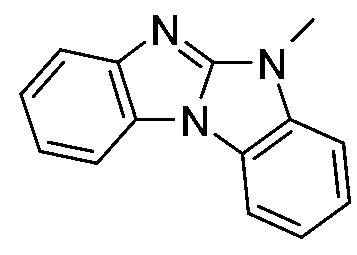
- UWDTYENJIOEORT-UHFFFAOYSA-N C[n]1c2nc(cccc3)c3[n]2c2ccccc12 Chemical compound C[n]1c2nc(cccc3)c3[n]2c2ccccc12 UWDTYENJIOEORT-UHFFFAOYSA-N 0.000 description 3
- HFKVKYHMXQYMNO-UHFFFAOYSA-N Brc1cc(-[n]2c3nc(cccc4)c4[n]3cc2)ccc1 Chemical compound Brc1cc(-[n]2c3nc(cccc4)c4[n]3cc2)ccc1 HFKVKYHMXQYMNO-UHFFFAOYSA-N 0.000 description 2
- BWOSCTZLKMWUBX-UHFFFAOYSA-N Brc1cc(-[n]2c3ncc[n]3c3c2cccc3)ccc1 Chemical compound Brc1cc(-[n]2c3ncc[n]3c3c2cccc3)ccc1 BWOSCTZLKMWUBX-UHFFFAOYSA-N 0.000 description 2
- PQZWTAAQCBHUJK-UHFFFAOYSA-N C[n]1c2ncn[n]2c2ccccc12 Chemical compound C[n]1c2ncn[n]2c2ccccc12 PQZWTAAQCBHUJK-UHFFFAOYSA-N 0.000 description 2
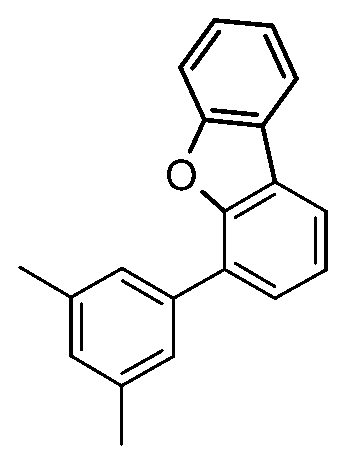
- AVHYCWZZYMNWCD-UHFFFAOYSA-N Cc1cc(C)c2[o]c3ccccc3c2c1 Chemical compound Cc1cc(C)c2[o]c3ccccc3c2c1 AVHYCWZZYMNWCD-UHFFFAOYSA-N 0.000 description 2
- XGEJVLWJGJUSFU-UHFFFAOYSA-N Brc(cc1)cc(c2c3)c1[o]c2ccc3-[n]1c2nc(cccc3)c3[n]2c2c1cccc2 Chemical compound Brc(cc1)cc(c2c3)c1[o]c2ccc3-[n]1c2nc(cccc3)c3[n]2c2c1cccc2 XGEJVLWJGJUSFU-UHFFFAOYSA-N 0.000 description 1
- INJBSCDDUIMCJC-UHFFFAOYSA-N Brc(cc1)ccc1-[n]1c2nc(cccc3)c3[n]2c2c1cccc2 Chemical compound Brc(cc1)ccc1-[n]1c2nc(cccc3)c3[n]2c2c1cccc2 INJBSCDDUIMCJC-UHFFFAOYSA-N 0.000 description 1
- DKMOCBJNPHXRED-UHFFFAOYSA-N Brc(cc1c2c3)ccc1[o]c2ccc3-[n]1c2ncn[n]2c2c1cccc2 Chemical compound Brc(cc1c2c3)ccc1[o]c2ccc3-[n]1c2ncn[n]2c2c1cccc2 DKMOCBJNPHXRED-UHFFFAOYSA-N 0.000 description 1
- XHANTMZXEALLBA-UHFFFAOYSA-N Brc1cc(-[n]2c3nc4ccccc4[n]3c3c2cccc3)cc(Br)c1 Chemical compound Brc1cc(-[n]2c3nc4ccccc4[n]3c3c2cccc3)cc(Br)c1 XHANTMZXEALLBA-UHFFFAOYSA-N 0.000 description 1
- GEJOQRIYFDKSDH-UHFFFAOYSA-N Brc1cccc(-[n](c(cccc2)c2c2c3)c2ccc3-[n]2c3nc(cccc4)c4[n]3c3ccccc23)c1 Chemical compound Brc1cccc(-[n](c(cccc2)c2c2c3)c2ccc3-[n]2c3nc(cccc4)c4[n]3c3ccccc23)c1 GEJOQRIYFDKSDH-UHFFFAOYSA-N 0.000 description 1
- QUIMWYGUOPGVGV-UHFFFAOYSA-N C(C1)C=Cc(c2ccccc22)c1[n]2-c1cccc(-c(cc2)cc(c3c4)c2[o]c3ccc4-[n]2c3ncn[n]3c3c2cccc3)c1 Chemical compound C(C1)C=Cc(c2ccccc22)c1[n]2-c1cccc(-c(cc2)cc(c3c4)c2[o]c3ccc4-[n]2c3ncn[n]3c3c2cccc3)c1 QUIMWYGUOPGVGV-UHFFFAOYSA-N 0.000 description 1
- DAHBVTMJEZTITM-BJQOMGFOSA-N CC(C)(C(C)(C)[O-]Bc1cc(-[n]2c3ccccc3c3c2C(C2)[C@H]2C=C3)ccc1)O Chemical compound CC(C)(C(C)(C)[O-]Bc1cc(-[n]2c3ccccc3c3c2C(C2)[C@H]2C=C3)ccc1)O DAHBVTMJEZTITM-BJQOMGFOSA-N 0.000 description 1
- IPTJTXHSQSNEGD-UHFFFAOYSA-N CC(C12C)N1NC=CNc1c2cccc1 Chemical compound CC(C12C)N1NC=CNc1c2cccc1 IPTJTXHSQSNEGD-UHFFFAOYSA-N 0.000 description 1
- GDWJKTGSLLXSHE-UHFFFAOYSA-N CC1(C)OB(c2ccc3[o]c(cccc4)c4c3c2)OC1(C)C Chemical compound CC1(C)OB(c2ccc3[o]c(cccc4)c4c3c2)OC1(C)C GDWJKTGSLLXSHE-UHFFFAOYSA-N 0.000 description 1
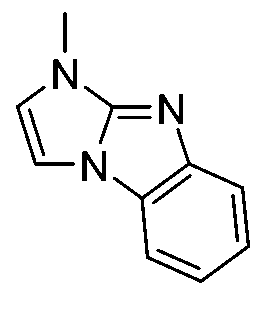
- LWJBFORPUJKVCE-UHFFFAOYSA-N C[n]1c2ncc[n]2c2ccccc12 Chemical compound C[n]1c2ncc[n]2c2ccccc12 LWJBFORPUJKVCE-UHFFFAOYSA-N 0.000 description 1
- VUQUOGPMUUJORT-UHFFFAOYSA-N Cc(cc1)ccc1S(OC)(=O)=O Chemical compound Cc(cc1)ccc1S(OC)(=O)=O VUQUOGPMUUJORT-UHFFFAOYSA-N 0.000 description 1
- QCBKFZHXWFZMIS-UHFFFAOYSA-N Cc1ccc2[o]c(ccc(-c(cc3C4=C[I]=CC=C4)cc4c3[o]c3ccccc43)c3)c3c2c1 Chemical compound Cc1ccc2[o]c(ccc(-c(cc3C4=C[I]=CC=C4)cc4c3[o]c3ccccc43)c3)c3c2c1 QCBKFZHXWFZMIS-UHFFFAOYSA-N 0.000 description 1
- AKEZNXGHDYJLRD-UHFFFAOYSA-N Cc1ccc2[o]c(ccc(-c3cc(-c4ccc5[o]c6ccc(C)cc6c5c4)ccc3)c3)c3c2c1 Chemical compound Cc1ccc2[o]c(ccc(-c3cc(-c4ccc5[o]c6ccc(C)cc6c5c4)ccc3)c3)c3c2c1 AKEZNXGHDYJLRD-UHFFFAOYSA-N 0.000 description 1
- XLTFRTTTZWMJJQ-UHFFFAOYSA-N Cc1cccc2c1[o]c1ccccc21 Chemical compound Cc1cccc2c1[o]c1ccccc21 XLTFRTTTZWMJJQ-UHFFFAOYSA-N 0.000 description 1
- STTGYIUESPWXOW-UHFFFAOYSA-N Cc1nc(c2nc(C)cc(-c3ccccc3)c2cc2)c2c(-c2ccccc2)c1 Chemical compound Cc1nc(c2nc(C)cc(-c3ccccc3)c2cc2)c2c(-c2ccccc2)c1 STTGYIUESPWXOW-UHFFFAOYSA-N 0.000 description 1
- VKTLGHDNPWVFSY-UHFFFAOYSA-N Ic(cc1)cc2c1[o]c(cc1)c2cc1I Chemical compound Ic(cc1)cc2c1[o]c(cc1)c2cc1I VKTLGHDNPWVFSY-UHFFFAOYSA-N 0.000 description 1
- XVCGYFKSNIPQBK-UHFFFAOYSA-N Ic(cc1c2cc(-[n]3c4nc(cccc5)c5[n]4c4c3cccc4)ccc22)ccc1[n]2-c1ccccc1 Chemical compound Ic(cc1c2cc(-[n]3c4nc(cccc5)c5[n]4c4c3cccc4)ccc22)ccc1[n]2-c1ccccc1 XVCGYFKSNIPQBK-UHFFFAOYSA-N 0.000 description 1
- ZXDMDBUMVNEQPT-UHFFFAOYSA-N N=C/N=C(\Nc1c2cccc1)/N2c1cccc(Br)c1 Chemical compound N=C/N=C(\Nc1c2cccc1)/N2c1cccc(Br)c1 ZXDMDBUMVNEQPT-UHFFFAOYSA-N 0.000 description 1
- XAVGCGJJEOUOTD-UHFFFAOYSA-N NN(c(cccc1)c1N1c(cc2c3c4)ccc2[o]c3ccc4Br)C1=N Chemical compound NN(c(cccc1)c1N1c(cc2c3c4)ccc2[o]c3ccc4Br)C1=N XAVGCGJJEOUOTD-UHFFFAOYSA-N 0.000 description 1
- KLACMEYLRXQSMN-UHFFFAOYSA-N c(cc1)cc([nH]2)c1[n]1c2nc2c1cccc2 Chemical compound c(cc1)cc([nH]2)c1[n]1c2nc2c1cccc2 KLACMEYLRXQSMN-UHFFFAOYSA-N 0.000 description 1
- DADQYGQKTGAMQI-UHFFFAOYSA-N c(cc1)cc(c2c3)c1[o]c2ccc3-c1cc(-[n]2c3nc4ccccc4[n]3c3ccccc23)cc(-c(cc2)cc-3c2[U]c2c-3cccc2)c1 Chemical compound c(cc1)cc(c2c3)c1[o]c2ccc3-c1cc(-[n]2c3nc4ccccc4[n]3c3ccccc23)cc(-c(cc2)cc-3c2[U]c2c-3cccc2)c1 DADQYGQKTGAMQI-UHFFFAOYSA-N 0.000 description 1
- YDKDUHNTBMTWIC-UHFFFAOYSA-N c(cc1)ccc1-[n](c1ccccc1c1c2)c1ccc2-c(cc1)cc2c1[o]c(cc1)c2cc1-[n]1c2nc(cccc3)c3[n]2c2c1cccc2 Chemical compound c(cc1)ccc1-[n](c1ccccc1c1c2)c1ccc2-c(cc1)cc2c1[o]c(cc1)c2cc1-[n]1c2nc(cccc3)c3[n]2c2c1cccc2 YDKDUHNTBMTWIC-UHFFFAOYSA-N 0.000 description 1
- SDFSSBFIXGMXMN-UHFFFAOYSA-N c(cc1[n]2c3nc4c2cccc4)ccc1[n]3-c(cc1)cc(c2c3)c1[o]c2ccc3-[n]1c2nc3ccccc3[n]2c2c1cccc2 Chemical compound c(cc1[n]2c3nc4c2cccc4)ccc1[n]3-c(cc1)cc(c2c3)c1[o]c2ccc3-[n]1c2nc3ccccc3[n]2c2c1cccc2 SDFSSBFIXGMXMN-UHFFFAOYSA-N 0.000 description 1
- VKMKVOODGCVQDE-UHFFFAOYSA-N c1ccc2[o]c(ccc(-c3cc(-[n]4c5nc6ccccc6[n]5c5c4cccc5)cc(-c(cc4)cc5c4[o]c4ccccc54)c3)c3)c3c2c1 Chemical compound c1ccc2[o]c(ccc(-c3cc(-[n]4c5nc6ccccc6[n]5c5c4cccc5)cc(-c(cc4)cc5c4[o]c4ccccc54)c3)c3)c3c2c1 VKMKVOODGCVQDE-UHFFFAOYSA-N 0.000 description 1
Classifications
-
- C—CHEMISTRY; METALLURGY
- C07—ORGANIC CHEMISTRY
- C07D—HETEROCYCLIC COMPOUNDS
- C07D487/00—Heterocyclic compounds containing nitrogen atoms as the only ring hetero atoms in the condensed system, not provided for by groups C07D451/00 - C07D477/00
- C07D487/02—Heterocyclic compounds containing nitrogen atoms as the only ring hetero atoms in the condensed system, not provided for by groups C07D451/00 - C07D477/00 in which the condensed system contains two hetero rings
- C07D487/04—Ortho-condensed systems
-
- C—CHEMISTRY; METALLURGY
- C07—ORGANIC CHEMISTRY
- C07D—HETEROCYCLIC COMPOUNDS
- C07D519/00—Heterocyclic compounds containing more than one system of two or more relevant hetero rings condensed among themselves or condensed with a common carbocyclic ring system not provided for in groups C07D453/00 or C07D455/00
-
- C—CHEMISTRY; METALLURGY
- C09—DYES; PAINTS; POLISHES; NATURAL RESINS; ADHESIVES; COMPOSITIONS NOT OTHERWISE PROVIDED FOR; APPLICATIONS OF MATERIALS NOT OTHERWISE PROVIDED FOR
- C09K—MATERIALS FOR MISCELLANEOUS APPLICATIONS, NOT PROVIDED FOR ELSEWHERE
- C09K11/00—Luminescent, e.g. electroluminescent, chemiluminescent materials
- C09K11/06—Luminescent, e.g. electroluminescent, chemiluminescent materials containing organic luminescent materials
-
- H—ELECTRICITY
- H05—ELECTRIC TECHNIQUES NOT OTHERWISE PROVIDED FOR
- H05B—ELECTRIC HEATING; ELECTRIC LIGHT SOURCES NOT OTHERWISE PROVIDED FOR; CIRCUIT ARRANGEMENTS FOR ELECTRIC LIGHT SOURCES, IN GENERAL
- H05B33/00—Electroluminescent light sources
- H05B33/12—Light sources with substantially two-dimensional radiating surfaces
- H05B33/20—Light sources with substantially two-dimensional radiating surfaces characterised by the chemical or physical composition or the arrangement of the material in which the electroluminescent material is embedded
-
- H—ELECTRICITY
- H10—SEMICONDUCTOR DEVICES; ELECTRIC SOLID-STATE DEVICES NOT OTHERWISE PROVIDED FOR
- H10K—ORGANIC ELECTRIC SOLID-STATE DEVICES
- H10K85/00—Organic materials used in the body or electrodes of devices covered by this subclass
- H10K85/60—Organic compounds having low molecular weight
- H10K85/649—Aromatic compounds comprising a hetero atom
- H10K85/657—Polycyclic condensed heteroaromatic hydrocarbons
- H10K85/6572—Polycyclic condensed heteroaromatic hydrocarbons comprising only nitrogen in the heteroaromatic polycondensed ring system, e.g. phenanthroline or carbazole
-
- H—ELECTRICITY
- H10—SEMICONDUCTOR DEVICES; ELECTRIC SOLID-STATE DEVICES NOT OTHERWISE PROVIDED FOR
- H10K—ORGANIC ELECTRIC SOLID-STATE DEVICES
- H10K85/00—Organic materials used in the body or electrodes of devices covered by this subclass
- H10K85/60—Organic compounds having low molecular weight
- H10K85/649—Aromatic compounds comprising a hetero atom
- H10K85/657—Polycyclic condensed heteroaromatic hydrocarbons
- H10K85/6574—Polycyclic condensed heteroaromatic hydrocarbons comprising only oxygen in the heteroaromatic polycondensed ring system, e.g. cumarine dyes
-
- C—CHEMISTRY; METALLURGY
- C09—DYES; PAINTS; POLISHES; NATURAL RESINS; ADHESIVES; COMPOSITIONS NOT OTHERWISE PROVIDED FOR; APPLICATIONS OF MATERIALS NOT OTHERWISE PROVIDED FOR
- C09K—MATERIALS FOR MISCELLANEOUS APPLICATIONS, NOT PROVIDED FOR ELSEWHERE
- C09K2211/00—Chemical nature of organic luminescent or tenebrescent compounds
- C09K2211/10—Non-macromolecular compounds
- C09K2211/1003—Carbocyclic compounds
- C09K2211/1007—Non-condensed systems
-
- C—CHEMISTRY; METALLURGY
- C09—DYES; PAINTS; POLISHES; NATURAL RESINS; ADHESIVES; COMPOSITIONS NOT OTHERWISE PROVIDED FOR; APPLICATIONS OF MATERIALS NOT OTHERWISE PROVIDED FOR
- C09K—MATERIALS FOR MISCELLANEOUS APPLICATIONS, NOT PROVIDED FOR ELSEWHERE
- C09K2211/00—Chemical nature of organic luminescent or tenebrescent compounds
- C09K2211/10—Non-macromolecular compounds
- C09K2211/1018—Heterocyclic compounds
- C09K2211/1025—Heterocyclic compounds characterised by ligands
- C09K2211/1074—Heterocyclic compounds characterised by ligands containing more than three nitrogen atoms as heteroatoms
-
- C—CHEMISTRY; METALLURGY
- C09—DYES; PAINTS; POLISHES; NATURAL RESINS; ADHESIVES; COMPOSITIONS NOT OTHERWISE PROVIDED FOR; APPLICATIONS OF MATERIALS NOT OTHERWISE PROVIDED FOR
- C09K—MATERIALS FOR MISCELLANEOUS APPLICATIONS, NOT PROVIDED FOR ELSEWHERE
- C09K2211/00—Chemical nature of organic luminescent or tenebrescent compounds
- C09K2211/18—Metal complexes
- C09K2211/185—Metal complexes of the platinum group, i.e. Os, Ir, Pt, Ru, Rh or Pd
-
- H—ELECTRICITY
- H10—SEMICONDUCTOR DEVICES; ELECTRIC SOLID-STATE DEVICES NOT OTHERWISE PROVIDED FOR
- H10K—ORGANIC ELECTRIC SOLID-STATE DEVICES
- H10K2101/00—Properties of the organic materials covered by group H10K85/00
- H10K2101/10—Triplet emission
-
- H—ELECTRICITY
- H10—SEMICONDUCTOR DEVICES; ELECTRIC SOLID-STATE DEVICES NOT OTHERWISE PROVIDED FOR
- H10K—ORGANIC ELECTRIC SOLID-STATE DEVICES
- H10K50/00—Organic light-emitting devices
- H10K50/10—OLEDs or polymer light-emitting diodes [PLED]
- H10K50/11—OLEDs or polymer light-emitting diodes [PLED] characterised by the electroluminescent [EL] layers
-
- H—ELECTRICITY
- H10—SEMICONDUCTOR DEVICES; ELECTRIC SOLID-STATE DEVICES NOT OTHERWISE PROVIDED FOR
- H10K—ORGANIC ELECTRIC SOLID-STATE DEVICES
- H10K50/00—Organic light-emitting devices
- H10K50/10—OLEDs or polymer light-emitting diodes [PLED]
- H10K50/14—Carrier transporting layers
- H10K50/15—Hole transporting layers
-
- H—ELECTRICITY
- H10—SEMICONDUCTOR DEVICES; ELECTRIC SOLID-STATE DEVICES NOT OTHERWISE PROVIDED FOR
- H10K—ORGANIC ELECTRIC SOLID-STATE DEVICES
- H10K85/00—Organic materials used in the body or electrodes of devices covered by this subclass
- H10K85/30—Coordination compounds
- H10K85/341—Transition metal complexes, e.g. Ru(II)polypyridine complexes
- H10K85/342—Transition metal complexes, e.g. Ru(II)polypyridine complexes comprising iridium
-
- H—ELECTRICITY
- H10—SEMICONDUCTOR DEVICES; ELECTRIC SOLID-STATE DEVICES NOT OTHERWISE PROVIDED FOR
- H10K—ORGANIC ELECTRIC SOLID-STATE DEVICES
- H10K85/00—Organic materials used in the body or electrodes of devices covered by this subclass
- H10K85/60—Organic compounds having low molecular weight
- H10K85/615—Polycyclic condensed aromatic hydrocarbons, e.g. anthracene
- H10K85/622—Polycyclic condensed aromatic hydrocarbons, e.g. anthracene containing four rings, e.g. pyrene
-
- H—ELECTRICITY
- H10—SEMICONDUCTOR DEVICES; ELECTRIC SOLID-STATE DEVICES NOT OTHERWISE PROVIDED FOR
- H10K—ORGANIC ELECTRIC SOLID-STATE DEVICES
- H10K85/00—Organic materials used in the body or electrodes of devices covered by this subclass
- H10K85/60—Organic compounds having low molecular weight
- H10K85/615—Polycyclic condensed aromatic hydrocarbons, e.g. anthracene
- H10K85/626—Polycyclic condensed aromatic hydrocarbons, e.g. anthracene containing more than one polycyclic condensed aromatic rings, e.g. bis-anthracene
-
- Y—GENERAL TAGGING OF NEW TECHNOLOGICAL DEVELOPMENTS; GENERAL TAGGING OF CROSS-SECTIONAL TECHNOLOGIES SPANNING OVER SEVERAL SECTIONS OF THE IPC; TECHNICAL SUBJECTS COVERED BY FORMER USPC CROSS-REFERENCE ART COLLECTIONS [XRACs] AND DIGESTS
- Y02—TECHNOLOGIES OR APPLICATIONS FOR MITIGATION OR ADAPTATION AGAINST CLIMATE CHANGE
- Y02E—REDUCTION OF GREENHOUSE GAS [GHG] EMISSIONS, RELATED TO ENERGY GENERATION, TRANSMISSION OR DISTRIBUTION
- Y02E10/00—Energy generation through renewable energy sources
- Y02E10/50—Photovoltaic [PV] energy
- Y02E10/549—Organic PV cells
-
- Y—GENERAL TAGGING OF NEW TECHNOLOGICAL DEVELOPMENTS; GENERAL TAGGING OF CROSS-SECTIONAL TECHNOLOGIES SPANNING OVER SEVERAL SECTIONS OF THE IPC; TECHNICAL SUBJECTS COVERED BY FORMER USPC CROSS-REFERENCE ART COLLECTIONS [XRACs] AND DIGESTS
- Y02—TECHNOLOGIES OR APPLICATIONS FOR MITIGATION OR ADAPTATION AGAINST CLIMATE CHANGE
- Y02P—CLIMATE CHANGE MITIGATION TECHNOLOGIES IN THE PRODUCTION OR PROCESSING OF GOODS
- Y02P70/00—Climate change mitigation technologies in the production process for final industrial or consumer products
- Y02P70/50—Manufacturing or production processes characterised by the final manufactured product
Landscapes
- Chemical & Material Sciences (AREA)
- Organic Chemistry (AREA)
- Engineering & Computer Science (AREA)
- Materials Engineering (AREA)
- Physics & Mathematics (AREA)
- Spectroscopy & Molecular Physics (AREA)
- Electroluminescent Light Sources (AREA)
- Nitrogen Condensed Heterocyclic Rings (AREA)
Abstract
Description
本發明係關於式I化合物,其製備方法,及其在電子裝置,尤其電致發光裝置中之用途。當用作電致發光裝置中之電洞傳輸材料時,式I化合物可使電致發光裝置之效率、穩定性、可製造性或光譜特徵改良。 The present invention relates to a compound of formula I , its preparation method, and its use in electronic devices, especially electroluminescent devices. When used as a hole transport material in an electroluminescent device, the compound of formula I can improve the efficiency, stability, manufacturability or spectral characteristics of the electroluminescent device.
Khan,Misbahul Ain;Ribeiro,Vera Lucia Teixeira,Pakistan Journal of Scientific and Industrial Research 43(2000)168-170描述藉由亞磷酸三烷酯誘導之1-(鄰硝基苯基)苯并咪唑及1-(鄰疊氮基苯基)苯并咪唑
去氧及熱解而合成苯并咪唑并[1,2-a]苯并咪唑
Pedro Molina等人Tetrahedron(1994)10029-10036報導衍生自雙(2-胺基苯基)胺之雙(亞胺基磷烷)與2當量異氰酸酯之氮雜維蒂希型反應(aza Wittig-type reaction)直接提供苯并咪唑并[1,2,a]苯并咪唑衍生物。 Pedro Molina et al. Tetrahedron (1994) 10029-10036 reported the aza Wittig-type reaction of bis(imidinophosphorane) derived from bis(2-aminophenyl)amine with 2 equivalents of isocyanate (aza Wittig-type reaction) directly provide benzimidazo[1,2,a]benzimidazole derivatives.


Kolesnikova,I.V.;Zhurnal Organicheskoi Khimii 25(1989)1689-95描述5H-苯并咪唑并[1,2-a]苯并咪唑1,2,3,4,7,8,9,10-八氟-5-(2,3,4,5,6-五氟苯基)之合成。 Kolesnikova, IV; Zhurnal Organicheskoi Khimii 25 (1989) 1689-95 describes 5H-benzimidazo[1,2-a]benzimidazole 1,2,3,4,7,8,9,10-octafluoro- Synthesis of 5-(2,3,4,5,6-pentafluorophenyl).

Achour,Reddouane;Zniber,Rachid,Bulletin des Societes Chimiques Belges 96(1987)787-92描述自苯并咪唑啉酮衍生物製備之
苯并咪唑并苯并咪唑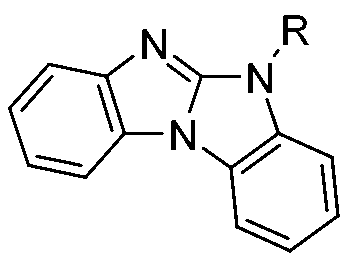
Hubert,Andre J.;Reimlinger,Hans,Chemische Berichte 103
(1970)2828-35描述苯并咪唑并苯并咪唑

JP 2001160488描述具有在對立的陽極與陰極之間具有單層或多層有機化合物膜之發光層的電致發光元件,其中該有機化合物膜之至
少一個層含有至少一種由式


US 20100244006係關於包括以下之有機電致發光裝置:陰極;陽極;及介於該陰極與該陽極之間的至少一個有機層。該至少一個有機層包括含有至少一種發光材料之發光層。由下式
US 20100244006中所述之化合物較佳用作發光層中之主體。
KR 1020110008784係關於式
US 2005079387係關於式Ar1-Ar2-Ar3之含咪唑環化合物(藍色發光主體化合物)及使用其之有機電致發光(EL)顯示裝置。 US 2005079387 relates to an imidazole ring-containing compound (blue light-emitting host compound) of the formula Ar 1 -Ar 2 -Ar 3 and an organic electroluminescence (EL) display device using the same.
Ar2係選自由以下組成之群:


US 2005074632係關於式
A係選自由以下組成之群:
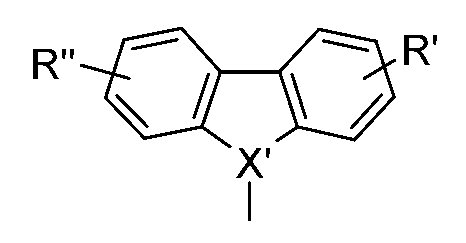


JP 2007180147係關於由陽極與陰極包夾且含有至少一個發光層之有機電致發光元件,該至少一個發光層含有由通式1、2、3或4表示之化合物:


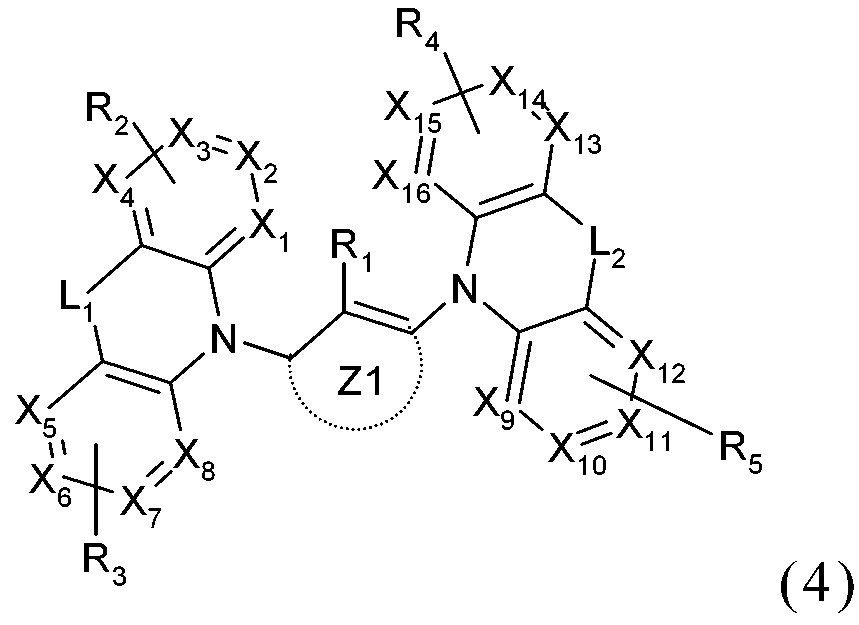
明確揭示以下化合物:

US 6551723係關於有機電致發光元件,其包含介於一對電極之間的發光層或複數個含有發光層之有機化合物薄層,其中該有機電致發光元件中之至少一個層包含至少一種由式(I)至(VII)表示之雜環化
合物:


WO 2011160757係關於包含陽極、陰極及至少一個有機層之電子
裝置,該至少一個有機層含有以下各式之化合物:


儘管已取得此等發展,但仍然需要包含新電洞傳輸材料以使電致發光裝置之效率、穩定性、可製造性及/或光譜特徵改良的有機發光裝置。 Despite these developments, there is still a need for organic light-emitting devices that include new hole transport materials to improve the efficiency, stability, manufacturability, and/or spectral characteristics of electroluminescent devices.
因此,針對前述先前技術,本發明之一目的在於提供適合用於OLED及有機電子學中之其他應用中的其他材料。更特定言之,應可能提供用於OLED中之電洞傳輸材料、電子/激子阻擋材料、及基質材 料。該等材料應尤其適用於包含至少一個磷光發射極,尤其至少一個綠色發射極或至少一個藍色發射極之OLED。此外,該等材料應適合於提供確保良好效率、良好操作壽命及對熱應力之高穩定性的OLED,及OLED之低使用電壓及操作電壓。 Therefore, in view of the aforementioned prior art, one object of the present invention is to provide other materials suitable for OLED and other applications in organic electronics. More specifically, it should be possible to provide hole transport materials, electron/exciton blocking materials, and matrix materials used in OLEDs material. These materials should be particularly suitable for OLEDs containing at least one phosphorescent emitter, especially at least one green emitter or at least one blue emitter. In addition, these materials should be suitable for providing OLEDs that ensure good efficiency, good operating life and high stability against thermal stress, and low operating voltages and operating voltages of OLEDs.
發現某些咪唑衍生物

該目的已由下式化合物達成:

詳言之,該目的已由下式之化合物達成:


本發明化合物可用於電子照相感光器;光電轉換器;有機太陽能電池(有機光伏打);切換元件,諸如有機電晶體,例如有機FET及有機TFT、有機發光場效電晶體(OLEFET);影像感測器;染料雷射;及電致發光裝置,諸如有機發光二極體(OLED)。 The compounds of the present invention can be used in electrophotographic photoreceptors; photoelectric converters; organic solar cells (organic photovoltaics); switching elements, such as organic transistors, such as organic FETs and organic TFTs, organic light-emitting field effect transistors (OLEFETs); image sensors Sensors; dye lasers; and electroluminescent devices, such as organic light-emitting diodes (OLED).
因此,本發明之另一主題係有關一種包含本發明化合物之電子裝置。該電子裝置較佳為電致發光裝置。 Therefore, another subject of the present invention relates to an electronic device containing the compound of the present invention. The electronic device is preferably an electroluminescent device.
式I化合物原則上可用於EL裝置之任何層中,但較佳用作主體材料、電洞傳輸材料及電子阻擋材料。特定言之,式I化合物用作發藍光之磷光發射極之主體材料。 The compound of formula I can be used in any layer of the EL device in principle, but is preferably used as a host material, hole transport material and electron blocking material. In particular, the compound of formula I is used as the host material of the phosphorescent emitter that emits blue light.
因此,本發明之另一主題係有關一種包含本發明之式I化合物之電洞傳輸層。 Therefore, another subject of the present invention relates to a hole transport layer comprising the compound of formula I of the present invention.
本發明之另一主題係有關一種包含本發明之式I化合物之發射層。在該實施例中,式I化合物較佳與磷光發射極組合用作主體材料。 Another subject of the invention relates to an emissive layer comprising the compound of formula I of the invention. In this embodiment, the compound of formula I is preferably used as a host material in combination with a phosphorescent emitter.
本發明之另一主題係有關一種包含本發明之式I化合物之電子阻擋層。 Another subject of the present invention relates to an electron blocking layer comprising the compound of formula I of the present invention.
式I化合物尤其為下式化合物:
式I化合物可為以下各式之化合物:


在一較佳實施例中,式(I)化合物為式

式I化合物較佳為以下各式之化合物:


R2、R3、R4及R5較佳為H。 R 2 , R 3 , R 4 and R 5 are preferably H.
並非軸向對稱之式I化合物,諸如R9及R10為H之式Id'化合物,可以兩種異構形式存在:


如ARKIVOC 2002(v)48-61中所述來製備4H-咪唑并[1,2-a]苯并咪唑。4H-咪唑并[1,2-a]苯并咪唑與1-溴-3-碘-苯之烏爾曼反應(Ullmann reaction)得到比率為約1:1之兩種異構體。 4H-imidazo[1,2-a]benzimidazole was prepared as described in ARKIVOC 2002(v) 48-61. The Ullmann reaction of 4H-imidazo[1,2-a]benzimidazole and 1-bromo-3-iodo-benzene yields two isomers with a ratio of about 1:1.

R20、R21及R22較佳為C1-C18烷基,諸如甲基、乙基、正丙基、異丙基、正丁基、異丁基、第二丁基、第三丁基、2-甲基丁基、正戊基、異戊基、正己基、2-乙基己基或正庚基;C6-C14芳基,諸如苯基、萘基或聯苯基;或經G取代之C6-C14芳基,諸如-C6H4OCH3、- C6H4OCH2CH3、-C6H3(OCH3)2或-C6H3(OCH2CH3)2、-C6H4CH3、-C6H3(CH3)2、-C6H2(CH3)3或-C6H4tBu。 R 20 , R 21 and R 22 are preferably C 1 -C 18 alkyl groups, such as methyl, ethyl, n-propyl, isopropyl, n-butyl, isobutyl, sec-butyl, tert-butyl Yl, 2-methylbutyl, n-pentyl, isopentyl, n-hexyl, 2-ethylhexyl or n-heptyl; C 6 -C 14 aryl, such as phenyl, naphthyl or biphenyl; or C 6 -C 14 aryl groups substituted by G, such as -C 6 H 4 OCH 3 , -C 6 H 4 OCH 2 CH 3 , -C 6 H 3 (OCH 3 ) 2 or -C 6 H 3 (OCH 2 CH 3 ) 2 , -C 6 H 4 CH 3 , -C 6 H 3 (CH 3 ) 2 , -C 6 H 2 (CH 3 ) 3 or -C 6 H 4 tBu.
R9及R10較佳為H;或C6-C14芳基,諸如苯基、萘基或聯苯基,其可視情況經一或多個C1-C8烷基取代;或C2-C30雜芳基,諸如二苯并呋喃基,其可視情況經一或多個C1-C8烷基取代。 R 9 and R 10 are preferably H; or a C 6 -C 14 aryl group, such as phenyl, naphthyl or biphenyl, which may optionally be substituted with one or more C 1 -C 8 alkyl groups; or C 2 -C 30 heteroaryl, such as dibenzofuranyl, optionally substituted with one or more C 1 -C 8 alkyl groups.
在一較佳實施例中,本發明係有關下式之化合物:

在一較佳實施例中,式(II)化合物為式
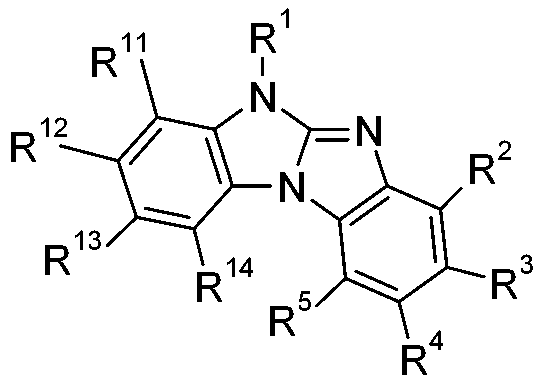
式II化合物甚至更佳,其中R2、R3、R4、R5、R11、R12、R13及
R14為H且R1如上文所定義:
R6可為可視情況經G取代之C6-C24芳基或可視情況經G取代之C2-C30雜芳基。 R 6 can be a C 6 -C 24 aryl group substituted with G as appropriate or a C 2 -C 30 heteroaryl group substituted with G as appropriate.
可視情況經G取代之C6-C24芳基R6通常為苯基、4-甲基苯基、4-甲氧基苯基、萘基(尤其1-萘基或2-萘基)、聯苯基、聯三苯基、芘基、2-茀基或9-茀基、菲基或蒽基,其可未經取代或經取代。 The C 6 -C 24 aryl group R 6 substituted by G may be optionally phenyl, 4-methylphenyl, 4-methoxyphenyl, naphthyl (especially 1-naphthyl or 2-naphthyl), Biphenyl, triphenyl, pyrenyl, 2- or 9-phenanthryl, phenanthryl or anthracenyl, which may be unsubstituted or substituted.
可視情況經G取代之C2-C30雜芳基R6表示具有5至7個環原子之環、或縮合環系統,其中氮、氧或硫為可能存在之雜原子,且其通常為具有5至30個原子且具有至少6個共軛π電子之雜環基,諸如噻吩基、苯并噻吩基、二苯并噻吩基、噻嗯基、呋喃基、呋喃甲基、2H-哌喃基、苯并呋喃基、異苯并呋喃基、二苯并呋喃基、苯氧基噻吩基、吡咯基、咪唑基、吡唑基、吡啶基、聯吡啶基、三嗪基、嘧啶基、吡嗪基、噠嗪基、吲哚嗪基、異吲哚基、吲哚基、吲唑基、嘌呤基、喹嗪基、喹啉基、異喹啉基、呔嗪基、

C6-C24芳基及C2-C30雜芳基可經G取代且較佳經一或多個C1-C8烷基取代。 The C 6 -C 24 aryl and C 2 -C 30 heteroaryl groups may be substituted with G and are preferably substituted with one or more C 1 -C 8 alkyl groups.
較佳C2-C30雜芳基為吡啶基、三嗪基、嘧啶基、4-咪唑并[1,2-a]苯并咪唑基、5-苯并咪唑并[1,2-a]苯并咪唑基、咔唑基、二苯并呋喃基,其可未經取代或經取代,尤其經C6-C10芳基或經C1-C4烷基取代之C6-C10芳基、或C2-C5雜芳基取代。4H-[1,2,4]三唑并[1,5-a]苯并咪唑基亦表示較佳C2-C30雜芳基R6。 Preferred C 2 -C 30 heteroaryl groups are pyridyl, triazinyl, pyrimidinyl, 4-imidazo[1,2-a]benzimidazolyl, 5-benzimidazo[1,2-a] Benzimidazolyl, carbazolyl, dibenzofuranyl, which may be unsubstituted or substituted, especially C 6 -C 10 aryl or C 1 -C 4 alkyl substituted C 6 -C 10 aryl Group, or C 2 -C 5 heteroaryl substituted. 4H-[1,2,4]triazolo[1,5-a]benzimidazolyl also represents a preferred C 2 -C 30 heteroaryl group R 6 .
A1、A2、A3及A4彼此獨立地為可視情況經G取代之C6-C24伸芳基或可視情況經G取代之C2-C30伸雜芳基。可視情況經G取代之C6-C24伸芳基A1、A2、A3及A4通常為伸苯基、4-甲基伸苯基、4-甲氧基伸苯基、伸萘基(尤其1-伸萘基或2-伸萘基)、伸聯苯基、伸聯三苯基、伸芘基、2-伸茀基或9-伸茀基、伸菲基或伸蒽基,其可未經取代或經取代。 A 1 , A 2 , A 3 and A 4 are independently a C 6 -C 24 arylene group substituted by G or a C 2 -C 30 heteroaryl group substituted by G as appropriate. The C 6 -C 24 arylene groups A 1 , A 2 , A 3 and A 4 substituted by G may be phenylene, 4-methylphenylene, 4-methoxyphenylene, naphthylene (Especially 1-naphthylene or 2-naphthylene), biphenylene, triphenylene, pyrene, 2-phenylene or 9-phenylene, phenanthrenyl or anthracene, It can be unsubstituted or substituted.
可視情況經G取代之C2-C30伸雜芳基A1、A2、A3及A4表示具有5至7個環原子之環、或縮合環系統,其中氮、氧或硫為可能存在之雜原子,且其通常為具有5至30個原子且具有至少6個共軛電子之雜環基,諸如伸噻吩基、伸苯并噻吩基、伸二苯并噻吩基、伸噻嗯基、伸呋喃基、伸呋喃甲基、2H-伸哌喃基、伸苯并呋喃基、伸異苯并呋喃基、伸二苯并呋喃基、苯氧基伸噻吩基、伸吡咯基、伸咪唑基、伸吡唑基、伸吡啶基、伸聯吡啶基、伸三嗪基、伸嘧啶基、伸吡嗪基、伸噠嗪基、伸吲哚嗪基、伸異吲哚基、伸吲哚基、伸吲唑基、伸嘌呤基、伸喹嗪基、伸喹啉基、伸異喹啉基、伸呔嗪基、伸

較佳C6-C24伸芳基為1,3-伸苯基、3,3'-伸聯苯基、3,3'-伸間聯三苯基、2-伸茀基或9-伸茀基、伸菲基,其可未經取代或經取代。 The preferred C 6 -C 24 arylene group is 1,3-phenylene, 3,3'-biphenylene, 3,3'-triphenylene, 2-phenylene, or 9-phenylene The phenanthryl group and phenanthryl group may be unsubstituted or substituted.
較佳C2-C30伸雜芳基為伸吡啶基、伸三嗪基、伸嘧啶基、伸咔唑基、伸二苯并呋喃基,其可未經取代或經取代,尤其經C6-C10芳基、經C1-C4烷基取代之C6-C10芳基、或C2-C5雜芳基取代。 Preferred C 2 -C 30 heteroaryl groups are pyridinyl, triazinyl, pyrimidinyl, carbazolyl, and dibenzofuranyl, which may be unsubstituted or substituted, especially C 6 -C 10 aryl, C 6 -C 10 aryl substituted with C 1 -C 4 alkyl, or C 2 -C 5 heteroaryl substituted.
更佳C2-C30伸雜芳基為伸咔唑基及伸二苯并呋喃基,其可視情況經C6-C10芳基取代,該C6-C10芳基可視情況經一或多個C1-C4烷基取代。 More preferred C 2 -C 30 heteroaryl groups are carbazolyl and dibenzofuranyl, which may be substituted by C 6 -C 10 aryl groups as appropriate, and the C 6 -C 10 aryl groups may be substituted by one or more One C 1 -C 4 alkyl substitution.
C6-C24伸芳基及C2-C30伸雜芳基可經G取代且較佳經一或多個C1-C8烷基取代。 The C 6 -C 24 arylene group and the C 2 -C 30 heteroaryl group may be substituted with G and are preferably substituted with one or more C 1 -C 8 alkyl groups.
由於術語「C2-C30雜芳基」包括例如以下各式之基團:


R1較佳為式-A1-(A2)p-(A3)q-(A4)r-R6之基團,諸如-A1-R6、-A1-A2-
R6、-A1-A2-A3-R6、-A1-A2-A3-A4-R6或


式


A1、A2、A3及A4更佳彼此獨立地為以下各式之基團:

R15較佳為式

基團-A1-(A2)p-(A3)q-(A4)r-較佳,其中A1、A2、A3及A4中之至少一者為式

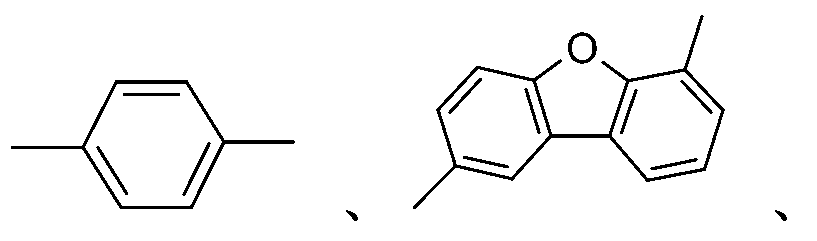
較佳基團-A1-(A2)p-(A3)q-(A4)r-之實例展示如下:
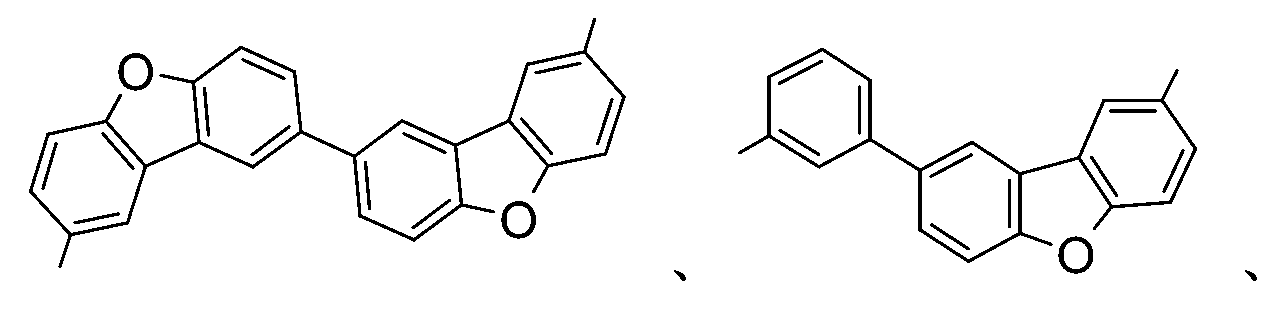
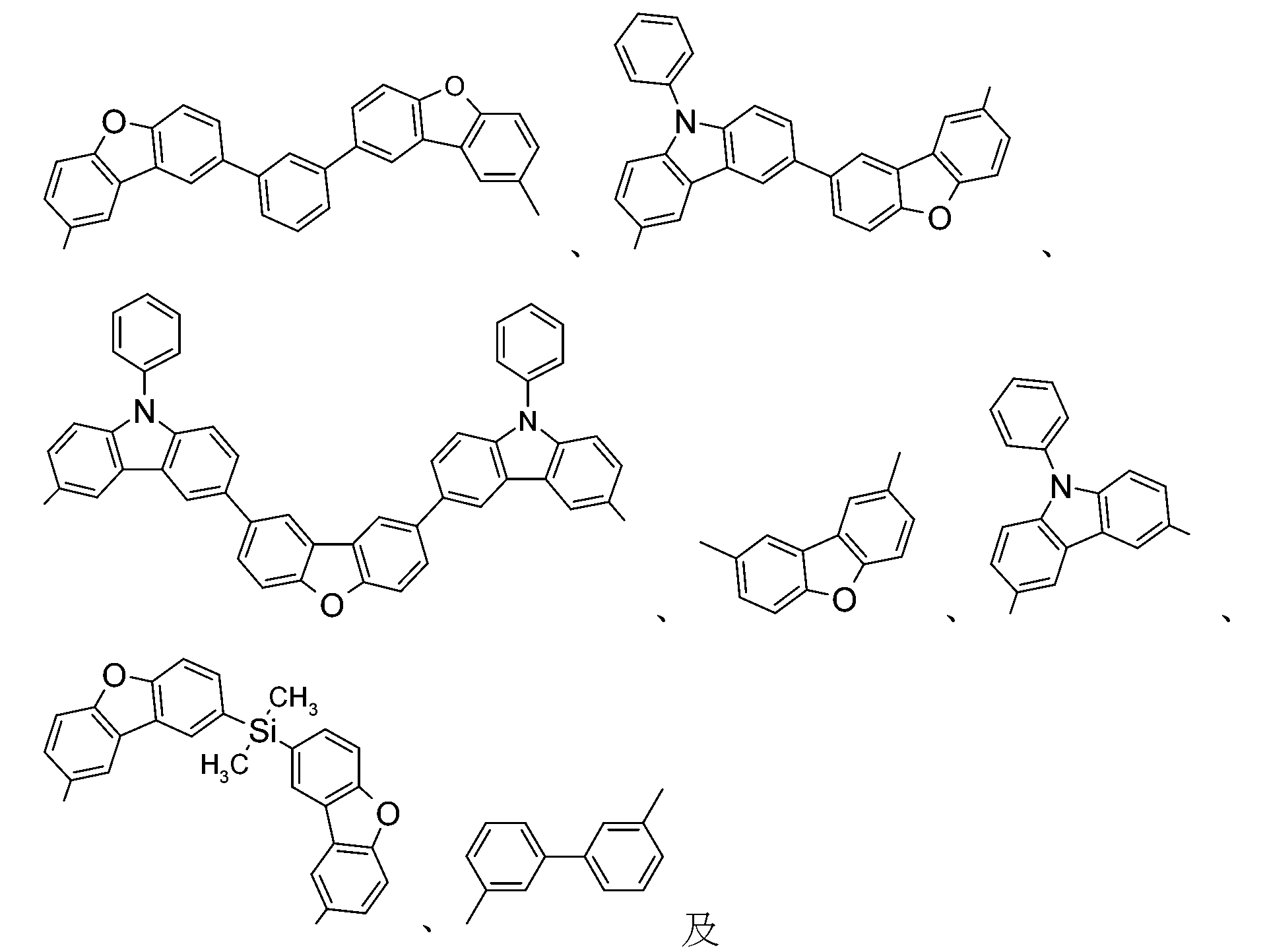
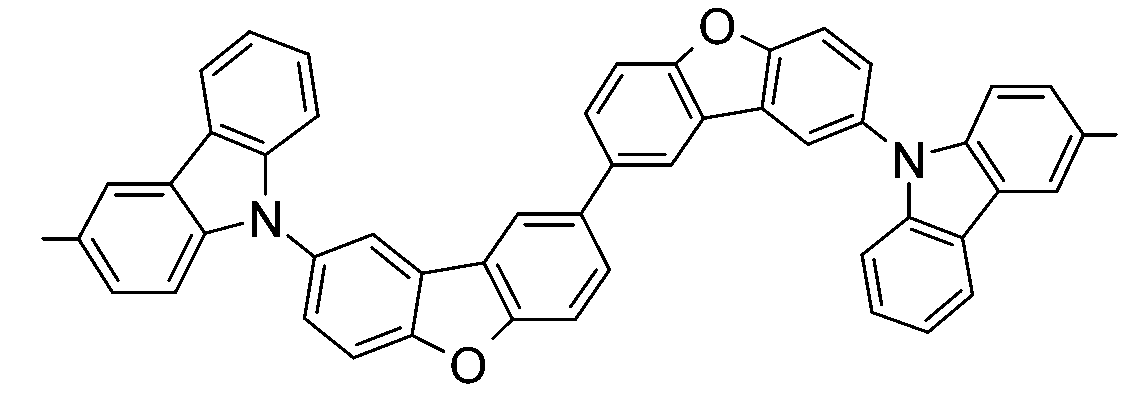


在另一較佳實施例中,R1為式-A1-(A2)p-(A3)q-(A4)r-R6之基團,諸如-A1-R6、-A1-A2-R6、-A1-A2-A3-R6或-A1-A2-A3-A4-R6,其中基團A1、A2、A3及A4中之至少一者為以下各式之基團:





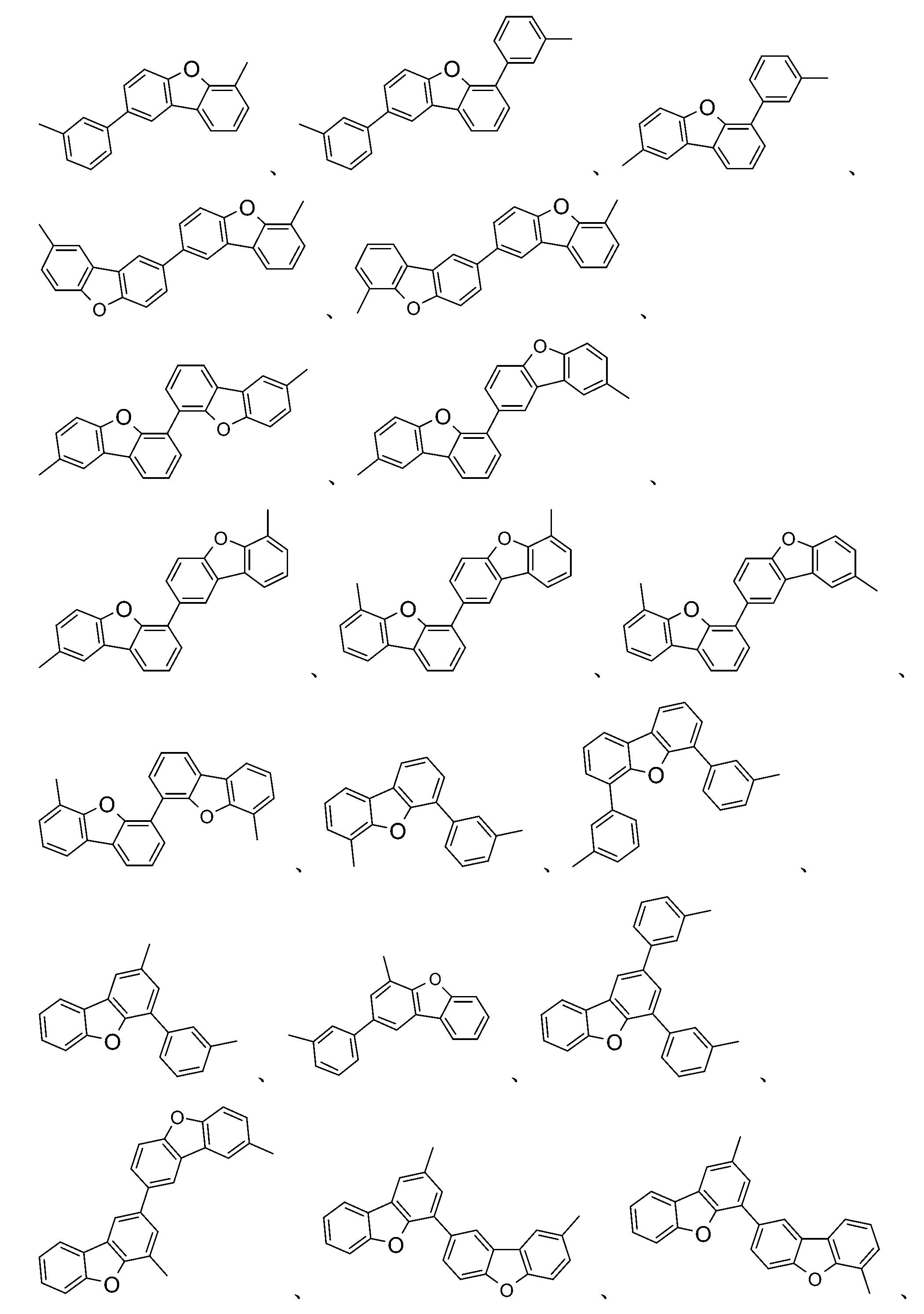

R6尤其為以下各式之基團:
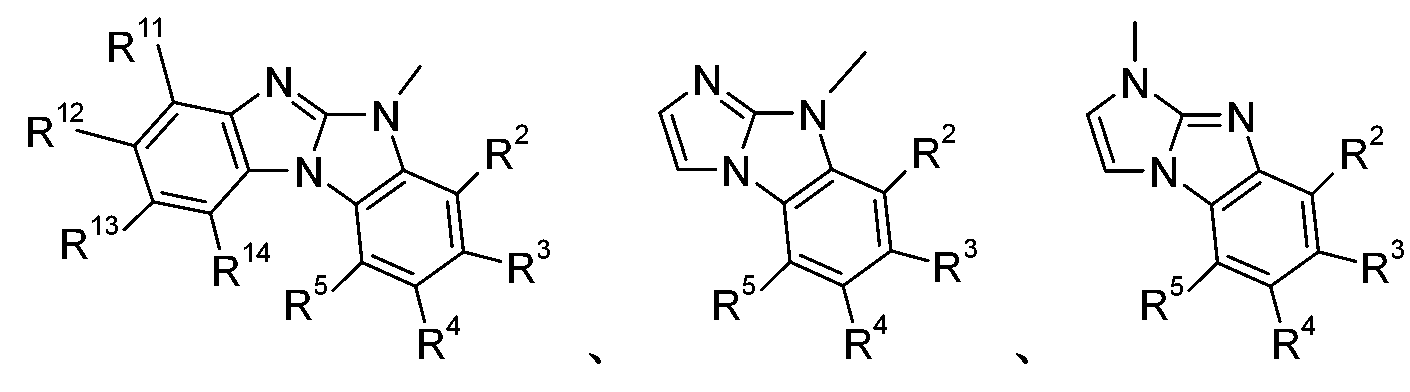

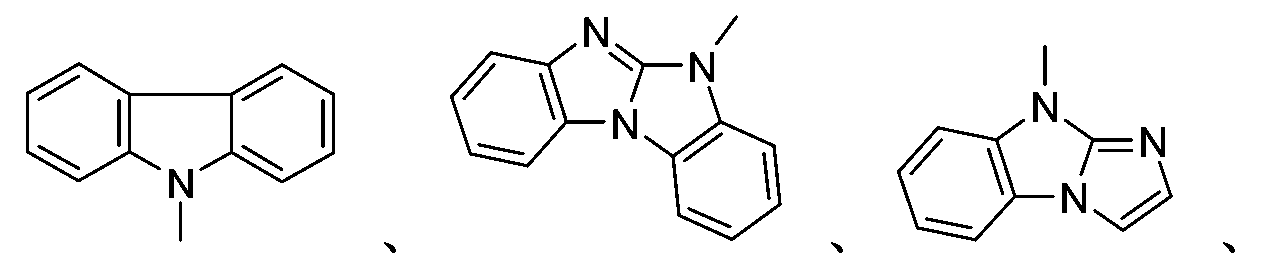


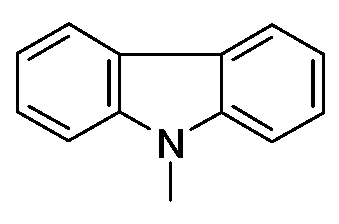
在本發明之一較佳實施例中,R6為以下各式之基團:


D較佳為-CO-、-COO-、-S-、-SO-、-SO2-、-O-、-NR65-,其中R65為C1-C18烷基,諸如甲基、乙基、正丙基、異丙基、正丁基、異丁基或第二丁基;或C6-C14芳基,諸如苯基、甲苯基、萘基或聯苯基。 D is preferably -CO-, -COO-, -S-, -SO-, -SO 2 -, -O-, -NR 65 -, wherein R 65 is C 1 -C 18 alkyl, such as methyl, Ethyl, n-propyl, isopropyl, n-butyl, isobutyl, or sec-butyl; or C 6 -C 14 aryl, such as phenyl, tolyl, naphthyl or biphenyl.
E較佳為-OR69、-SR69、-NR65R65、-COR68、-COOR67、-CONR65R65或-CN;其中R65、R67、R68及R69彼此獨立地為C1-C18烷基,諸如甲基、乙基、正丙基、異丙基、正丁基、異丁基、第二丁基、己基、辛基或2-乙基-己基;或C6-C14芳基,諸如苯基、甲苯基、萘基或聯苯基。 E is preferably -OR 69 , -SR 69 , -NR 65 R 65 , -COR 68 , -COOR 67 , -CONR 65 R 65 or -CN; wherein R 65 , R 67 , R 68 and R 69 are independent of each other C 1 -C 18 alkyl, such as methyl, ethyl, n-propyl, isopropyl, n-butyl, isobutyl, sec-butyl, hexyl, octyl or 2-ethyl-hexyl; or C 6 -C 14 aryl groups such as phenyl, tolyl, naphthyl or biphenyl.
G具有與E相同之優選項;或為C1-C18烷基,諸如甲基、乙基、正丙基、異丙基、正丁基、異丁基、第二丁基、己基、辛基或2-乙基-己基;或為C1-C18全氟烷基,諸如-CF3。 G has the same preferences as E; or C 1 -C 18 alkyl, such as methyl, ethyl, n-propyl, isopropyl, n-butyl, isobutyl, sec-butyl, hexyl, octyl Or 2-ethyl-hexyl; or C 1 -C 18 perfluoroalkyl, such as -CF 3 .
R2、R3、R4、R5、R11、R12、R13及R14較佳為H。 R 2 , R 3 , R 4 , R 5 , R 11 , R 12 , R 13 and R 14 are preferably H.
R43較佳為H;或C6-C14芳基,諸如苯基、甲苯基、萘基或聯苯基,其可視情況經取代。 R 43 is preferably H; or a C 6 -C 14 aryl group, such as phenyl, tolyl, naphthyl or biphenyl, which may be substituted as appropriate.
m3較佳為0或1,最佳為0。m4較佳為0或1,最佳為0。 m3 is preferably 0 or 1, most preferably 0. m4 is preferably 0 or 1, most preferably 0.
m2較佳為0或1,最佳為0。m5較佳為0或1,最佳為0。 m2 is preferably 0 or 1, most preferably 0. m5 is preferably 0 or 1, most preferably 0.
R20、R21及R22較佳為式

R6更佳為式
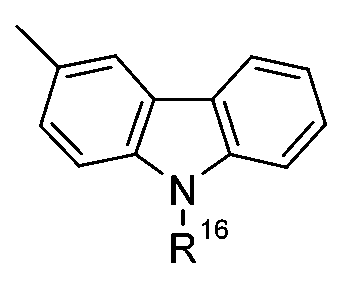
R16較佳為式

在一較佳實施例中,本發明係有關式


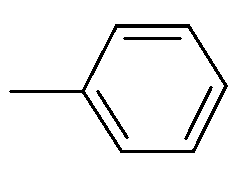

在該實施例中,式-A1-(A2)p-(A3)q-(A4)r-之基團尤其為以下各式之基團:



式-A1-(A2)p-(A3)q-(A4)r-之當前最佳基團為式(IVa)、(IVb)、(IVe)、(IVl)、(IVk)、(IVs)、(IVv)及(VIj)。 The current best group of formula -A 1 -(A 2 ) p -(A 3 ) q -(A 4 ) r -is formula ( IVa ), ( IVb ), ( IVe ), ( IVl ), ( IVk ) , ( IVs ), ( IVv ) and ( VIj ).
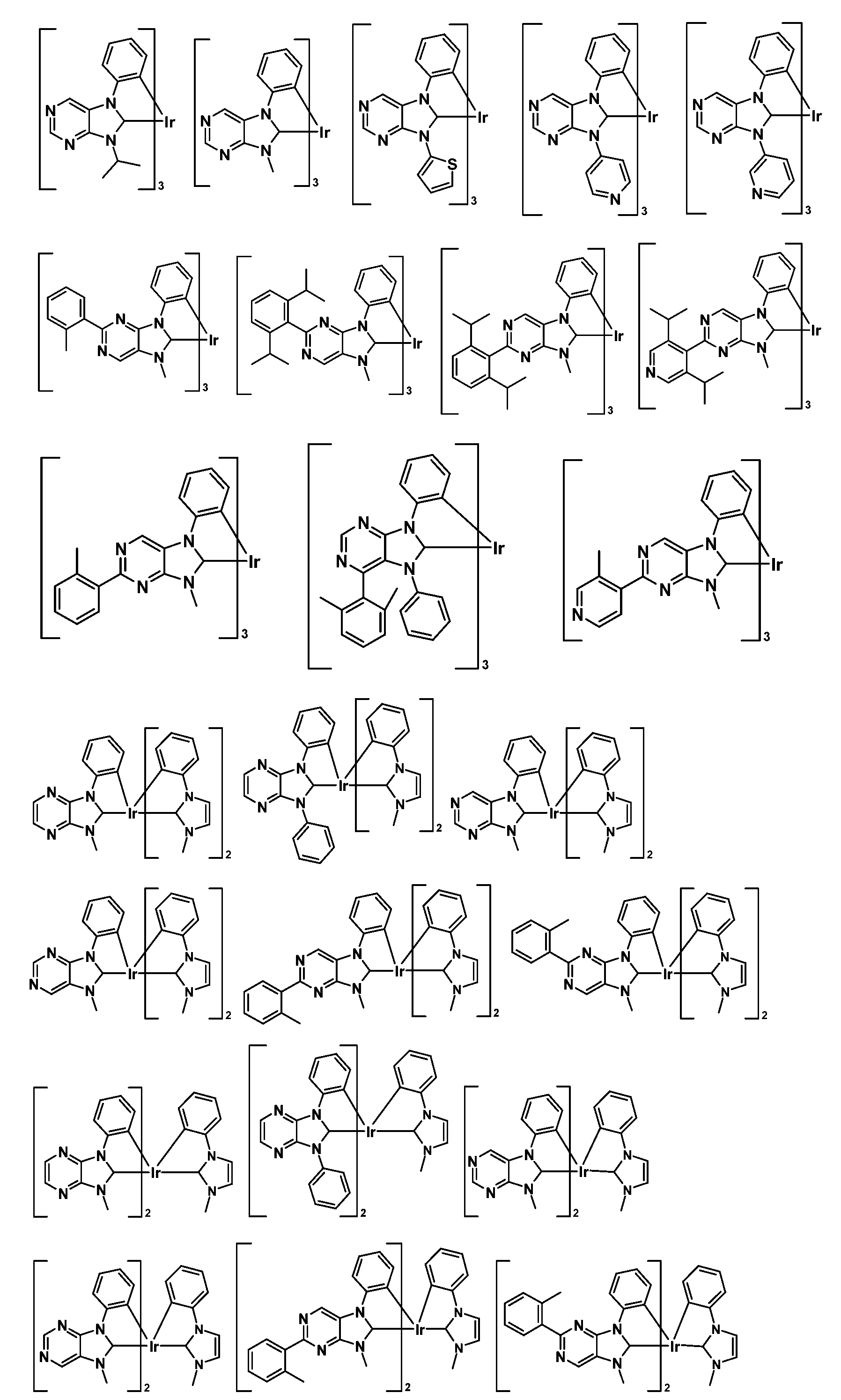
較佳化合物之實例為下表中所示之化合物A-1至A-20,尤其A-1至A-19,及下表中所示之化合物A-21至A-32: 
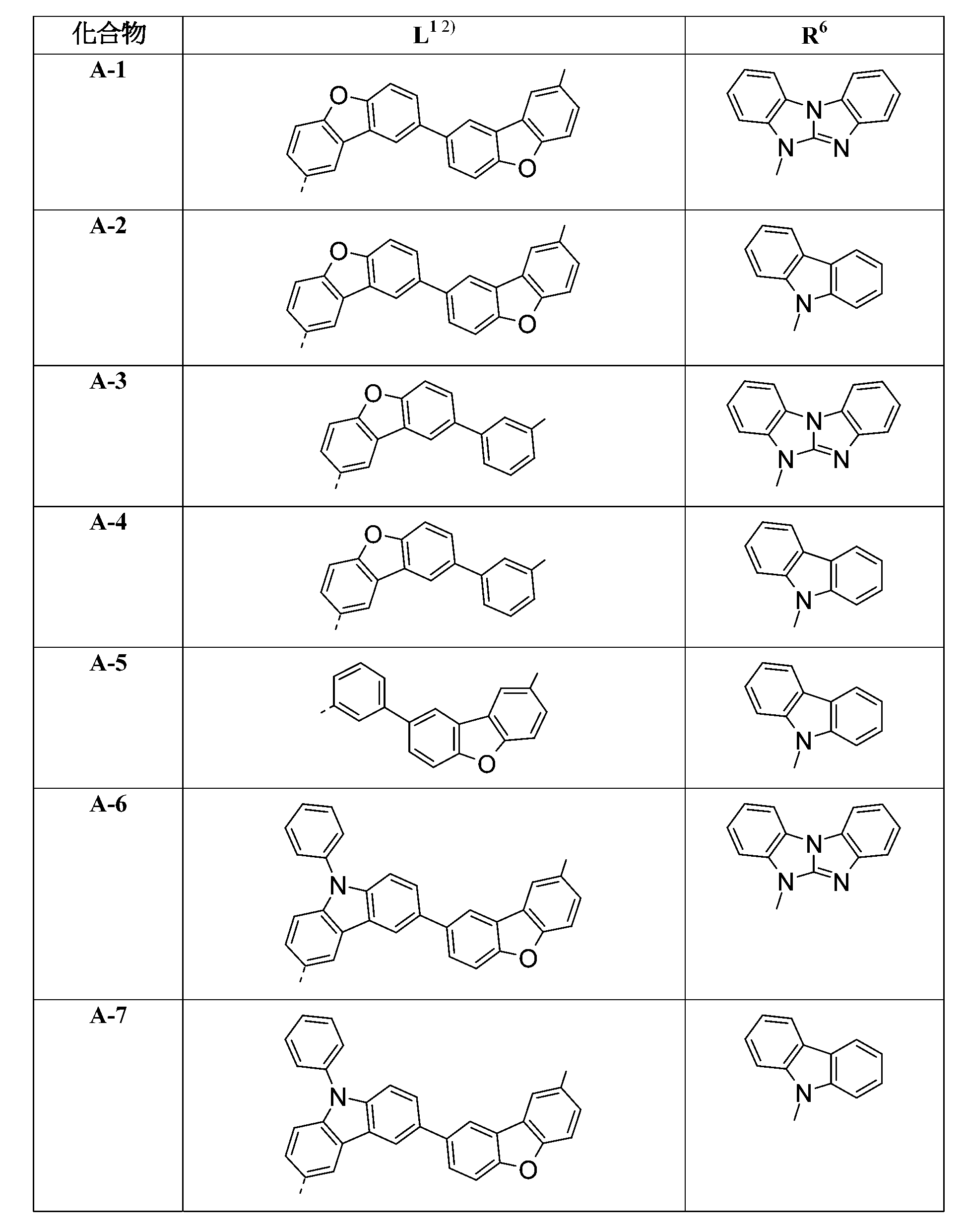


1) L 1 =

在另一較佳實施例中,本發明係有關式


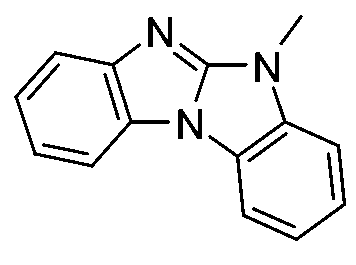
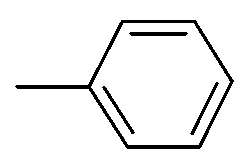

在該實施例中,式-A1-(A2)p-(A3)q-(A4)r-之基團尤其為以下各式之基團:


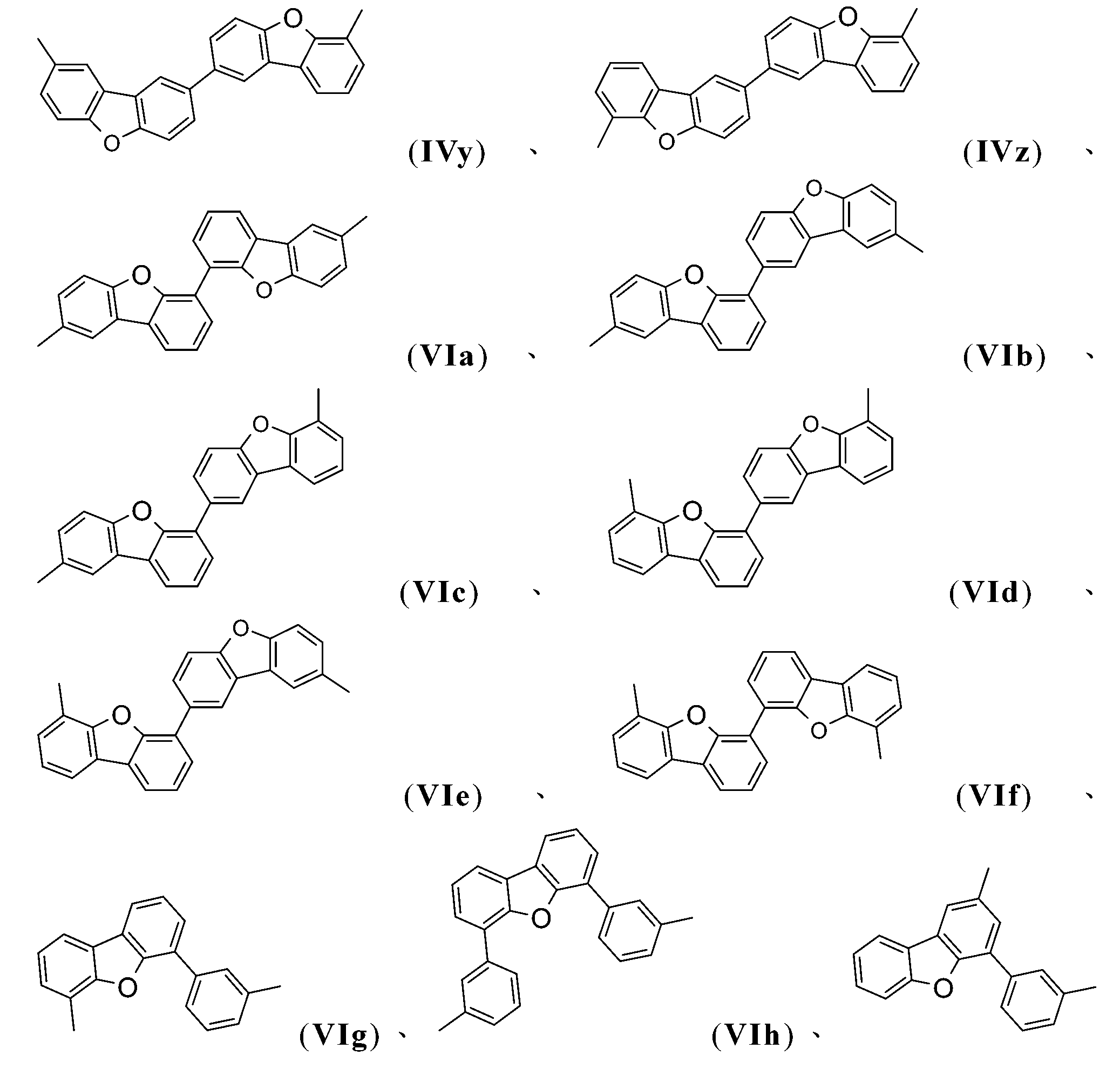


式-A1-(A2)p-(A3)q-(A4)r-之當前最佳基團為式(IVa)、(IVb)、 (IVe)、(IVl)、(IVk)、(IVs)、(IVv)及(VIj)之基團。 The current best group of formula -A 1 -(A 2 ) p -(A 3 ) q -(A 4 ) r -is formula ( IVa ), ( IVb ), ( IVe ), ( IVl ), ( IVk ) , ( IVs ), ( IVv ) and ( VIj ) groups.
在式I化合物用作藍色或綠色磷光發射極之主體材料或用作電子/激子阻擋材料之狀況下,基團A1-(A2)p-(A3)q-(A4)r-次佳,其含有式
較佳化合物之實例為下表中所示之化合物C-1至C-78。 Examples of preferred compounds are compounds C-1 to C-78 shown in the table below .


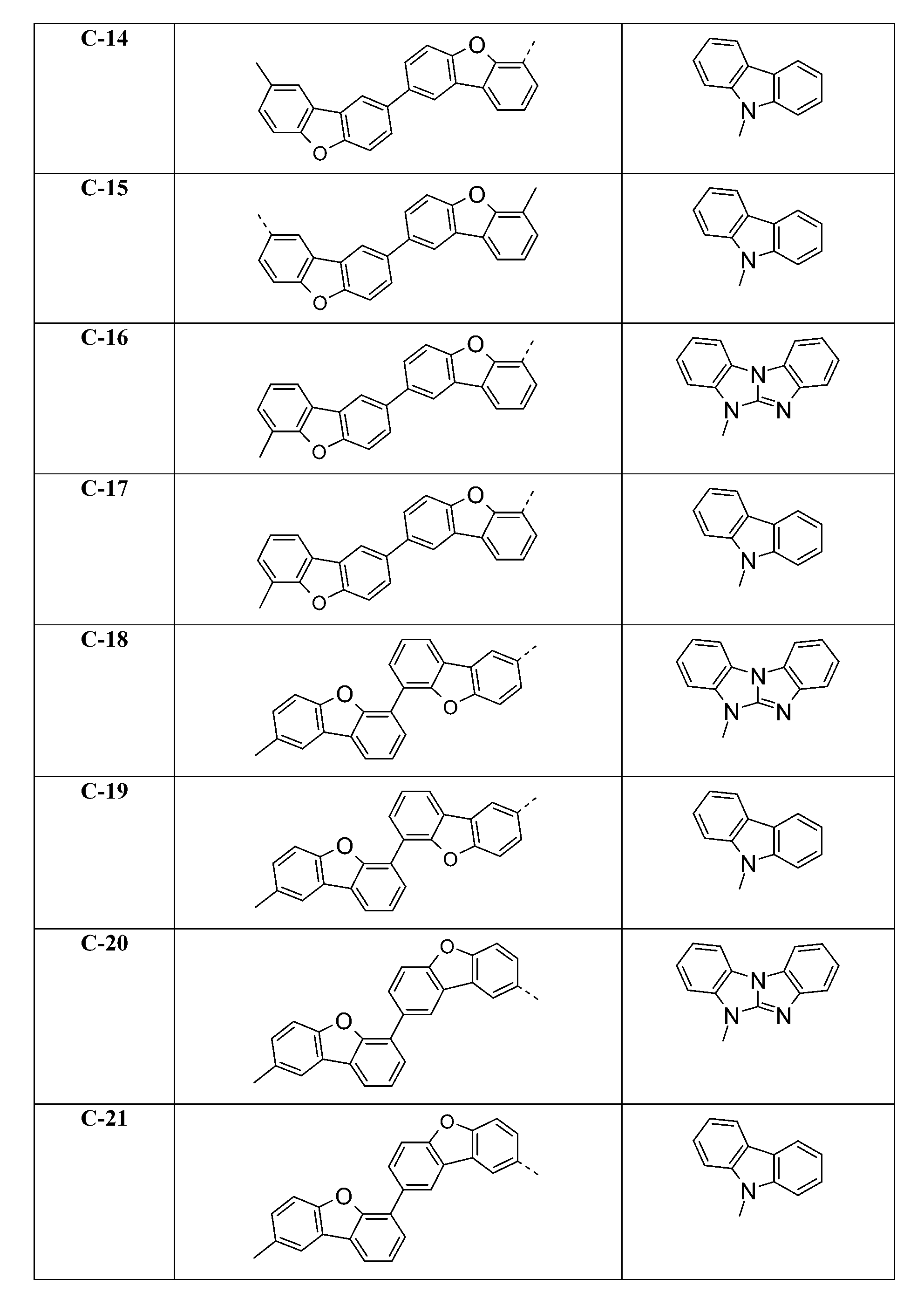


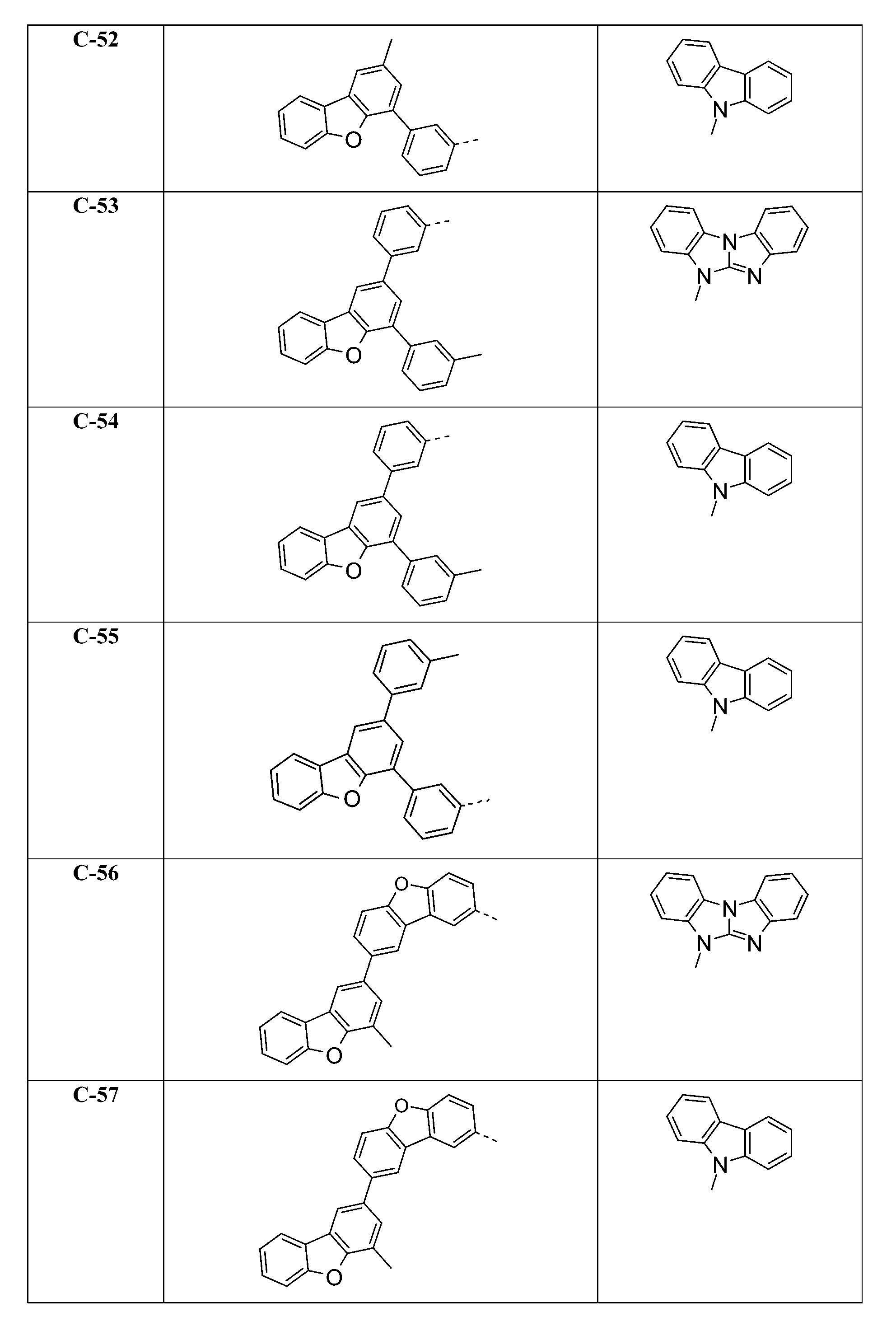


在另一較佳實施例中,本發明係有關式


在該實施例中,R1為式-A1-(A2)p-(A3)q-(A4)r-R6之基團,其中
A1、A2、A3及A4彼此獨立地為以下各式之基團: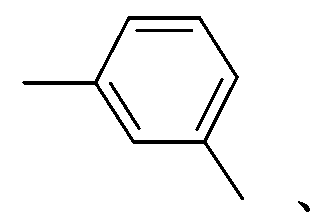


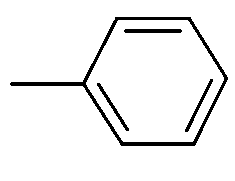






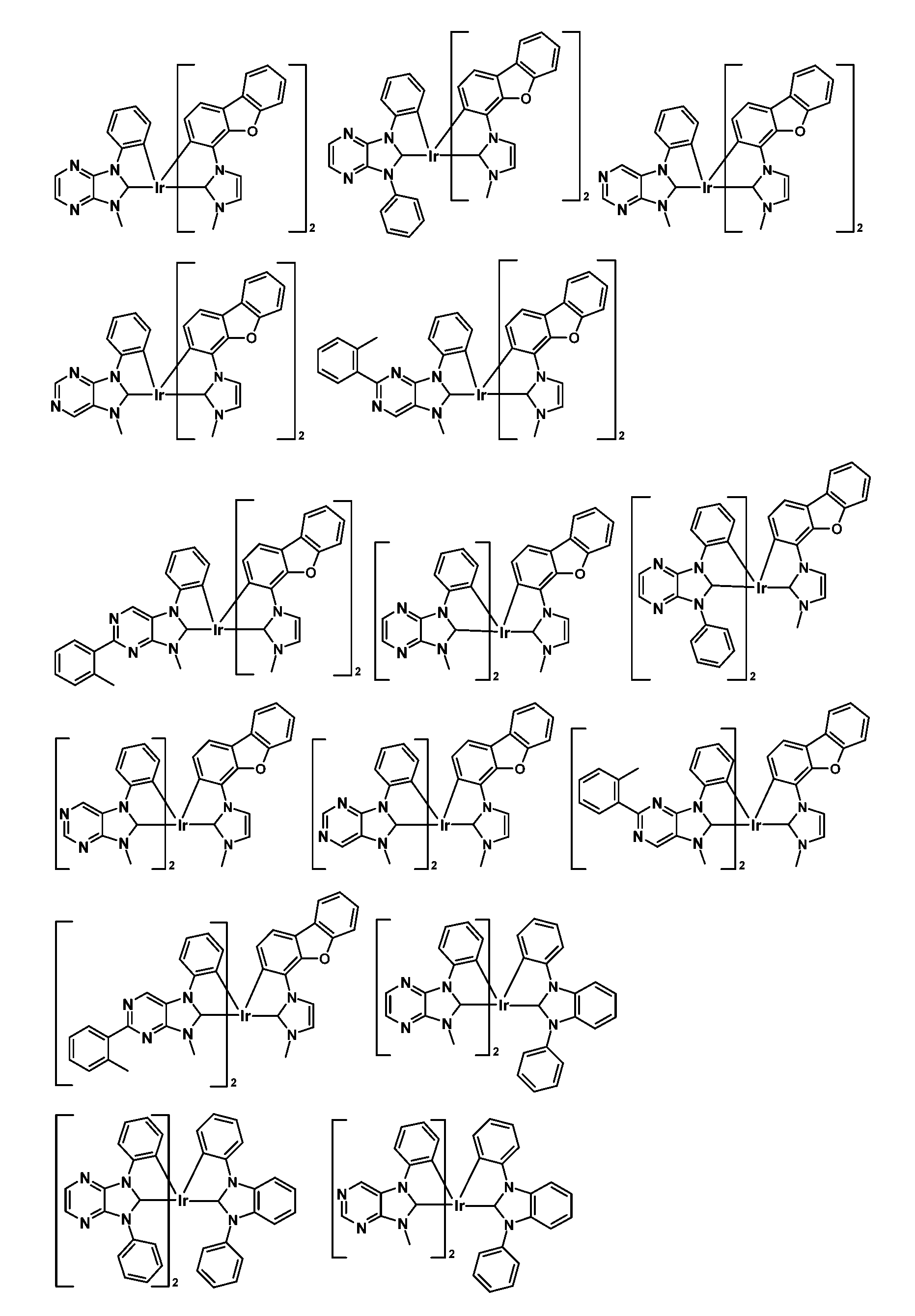
較佳化合物之實例為下表中所示之化合物B-1至B-5,尤其B-1至B-4,及下表中所示之化合物B-6至B-35。 Examples of preferred compounds are the compounds B-1 to B-5 shown in the table below, especially B-1 to B-4 , and the compounds B-6 to B-35 shown in the table below.

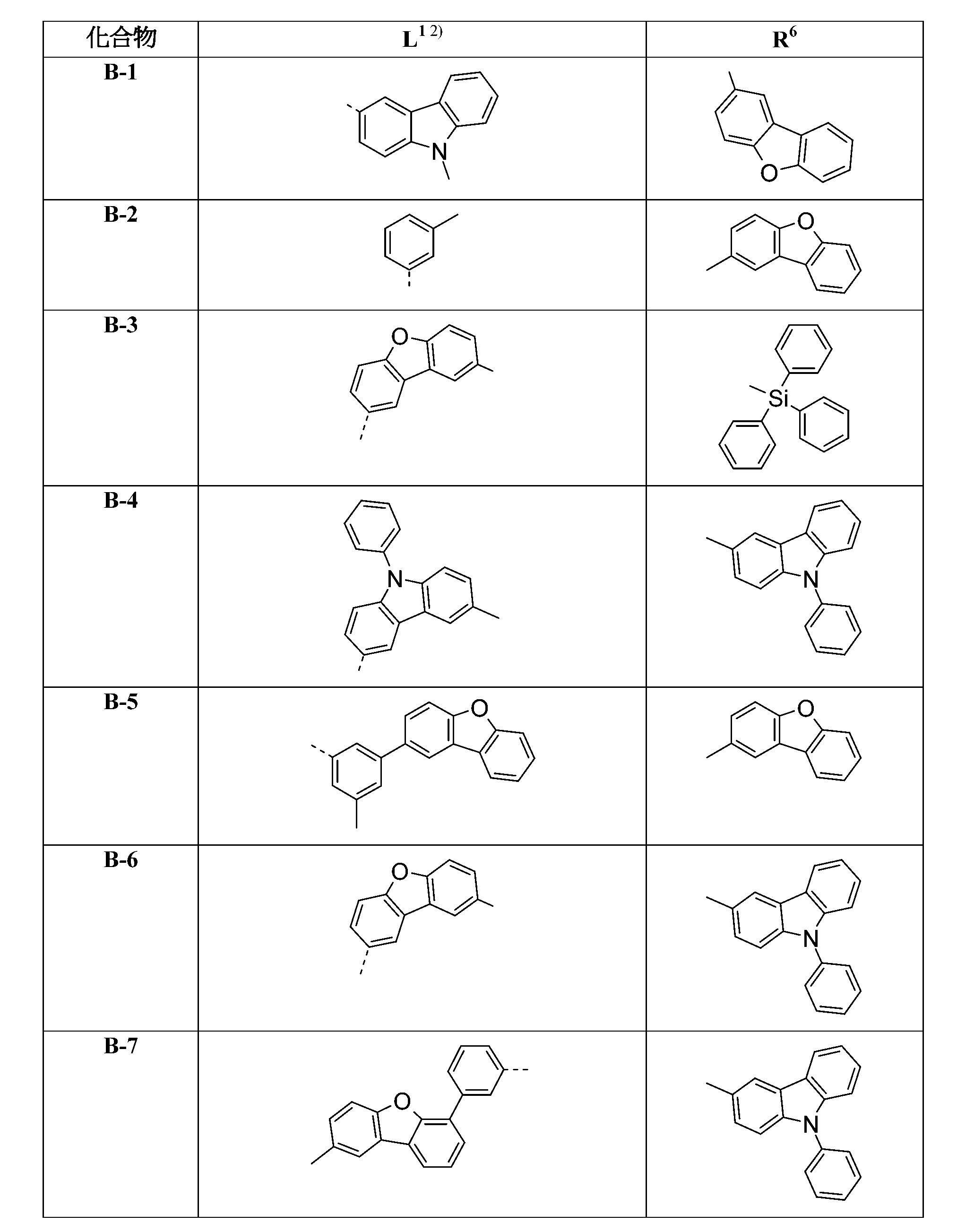


2)虛線指示與式
較佳化合物之其他實例為下表中所示之化合物J-1至J-35、K-1至K-35及L-1至L-35。 Other examples of preferred compounds are the compounds J-1 to J-35 , K-1 to K-35, and L-1 to L-35 shown in the following table.

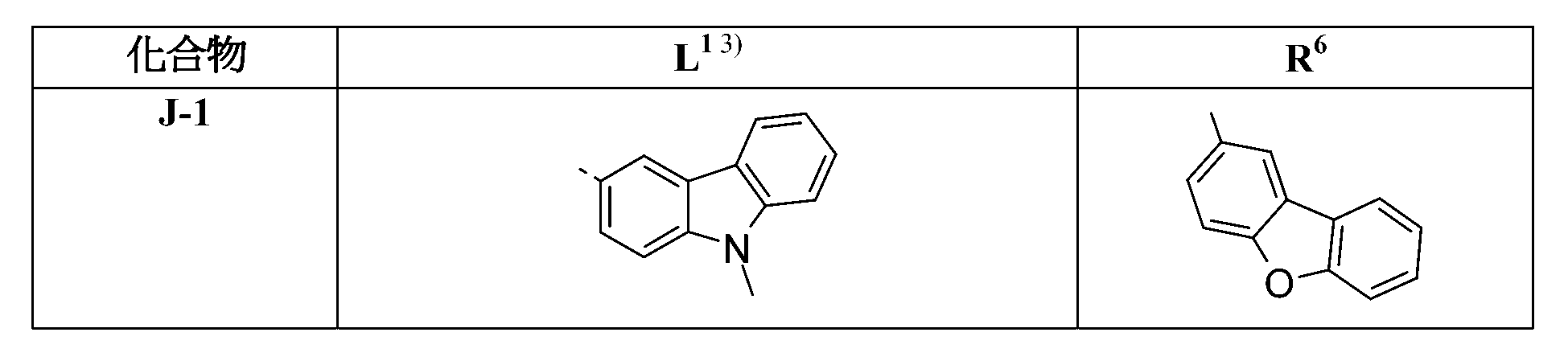


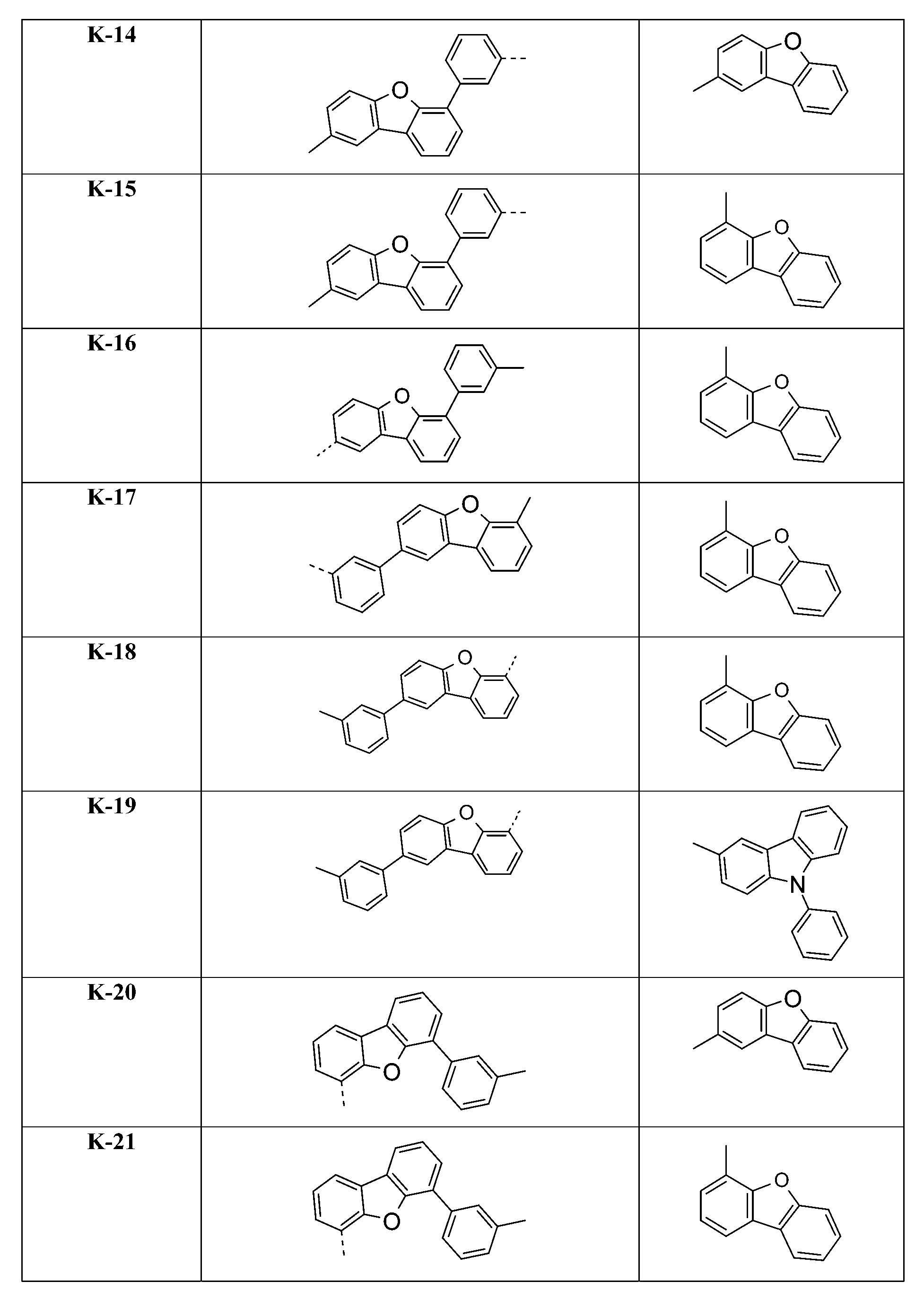


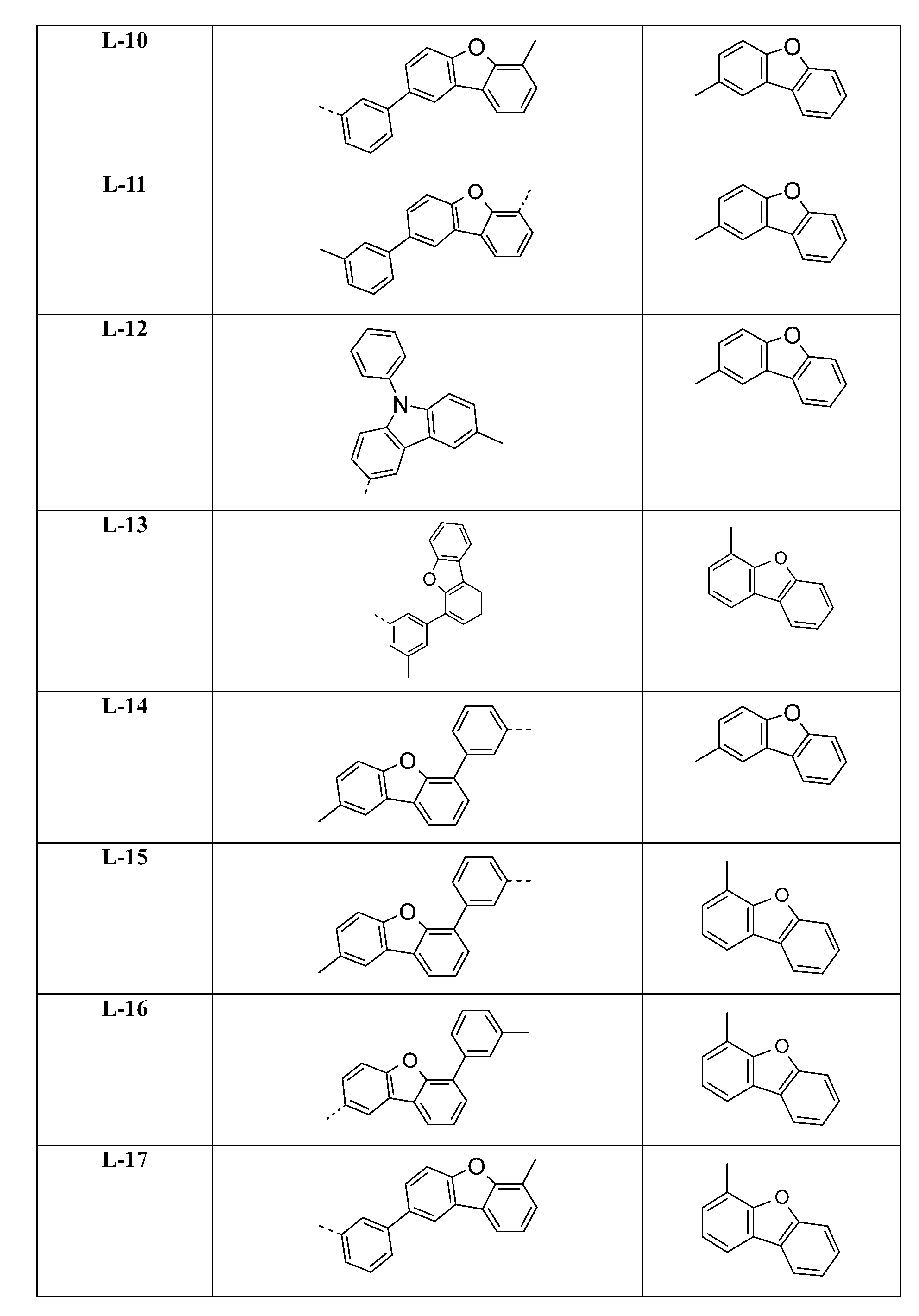

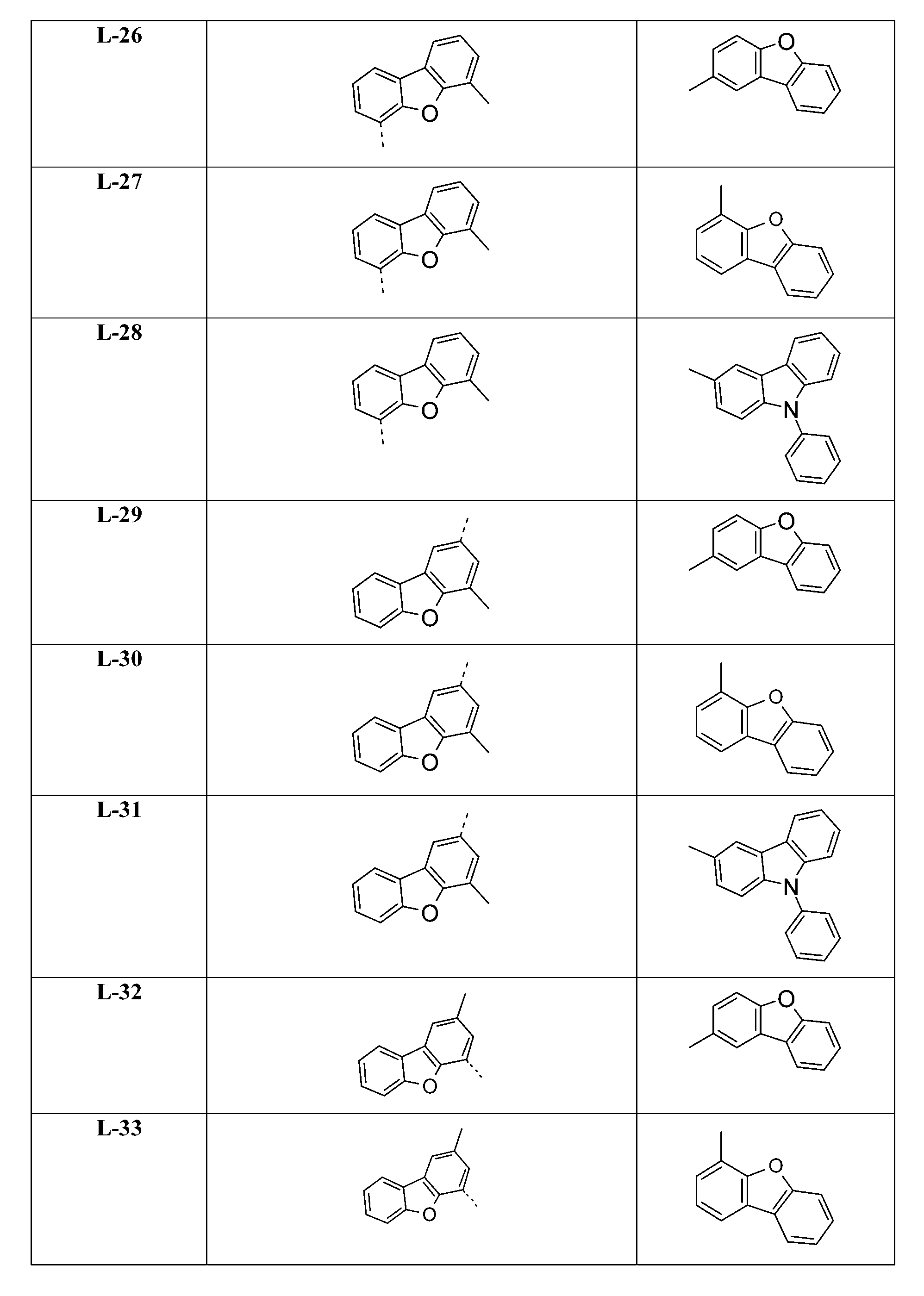

在另一較佳實施例中,本發明係有關以下各式之化合物:
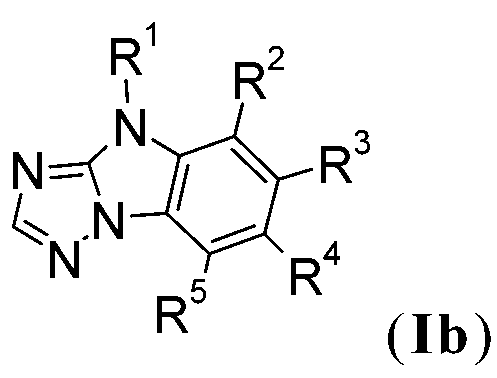
R1較佳為式-A1-(A2)p-(A3)q-(A4)r-R6或


R6較佳為以下各式之基團:

R2、R3、R4及R5較佳為氫。 R 2 , R 3 , R 4 and R 5 are preferably hydrogen.
A1、A2、A3及A4較佳彼此獨立地為以下各式之基團:


R15較佳為式

R6為以下各式之基團:


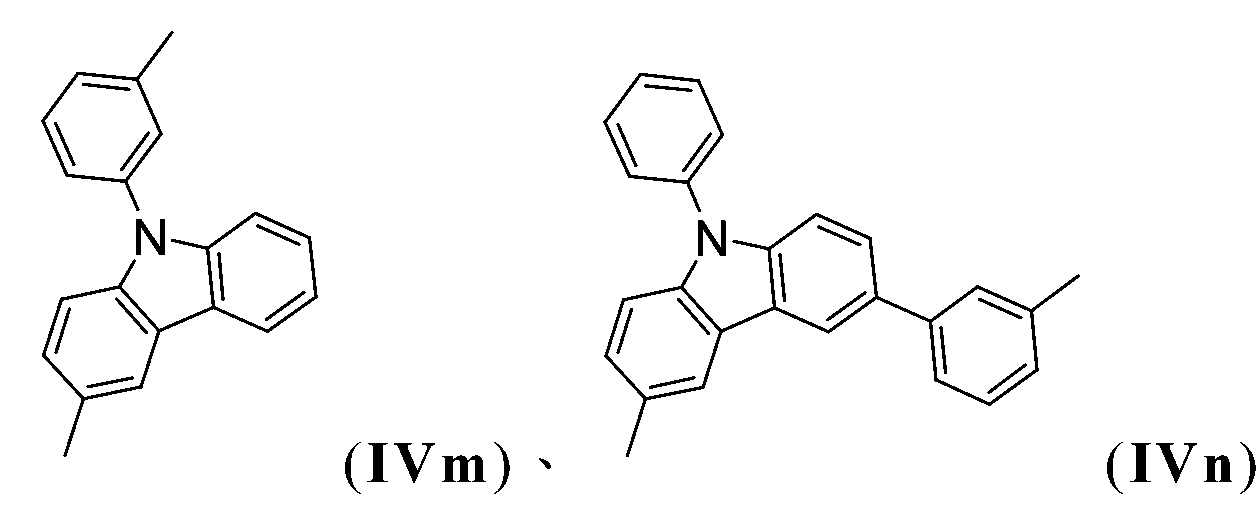
在該實施例中,式-A1-(A2)p-(A3)q-(A4)r-之基團尤其為以下各式之基團:(IVa)、(IVb)、(IVc)、(IVd)、(IVe)、(IVf)、(IVg)、(IVh)、(IVi)、(IVj)、(IVk)、(IVl)、(IVm)、(IVn)、(IVo)、(IVp)、

較佳化合物之實例為下表中所示之化合物D-1至D-144、E-1至E-183以及H-1至H-264。 Examples of preferred compounds are the compounds D-1 to D-144 , E-1 to E-183, and H-1 to H-264 shown in the following table.


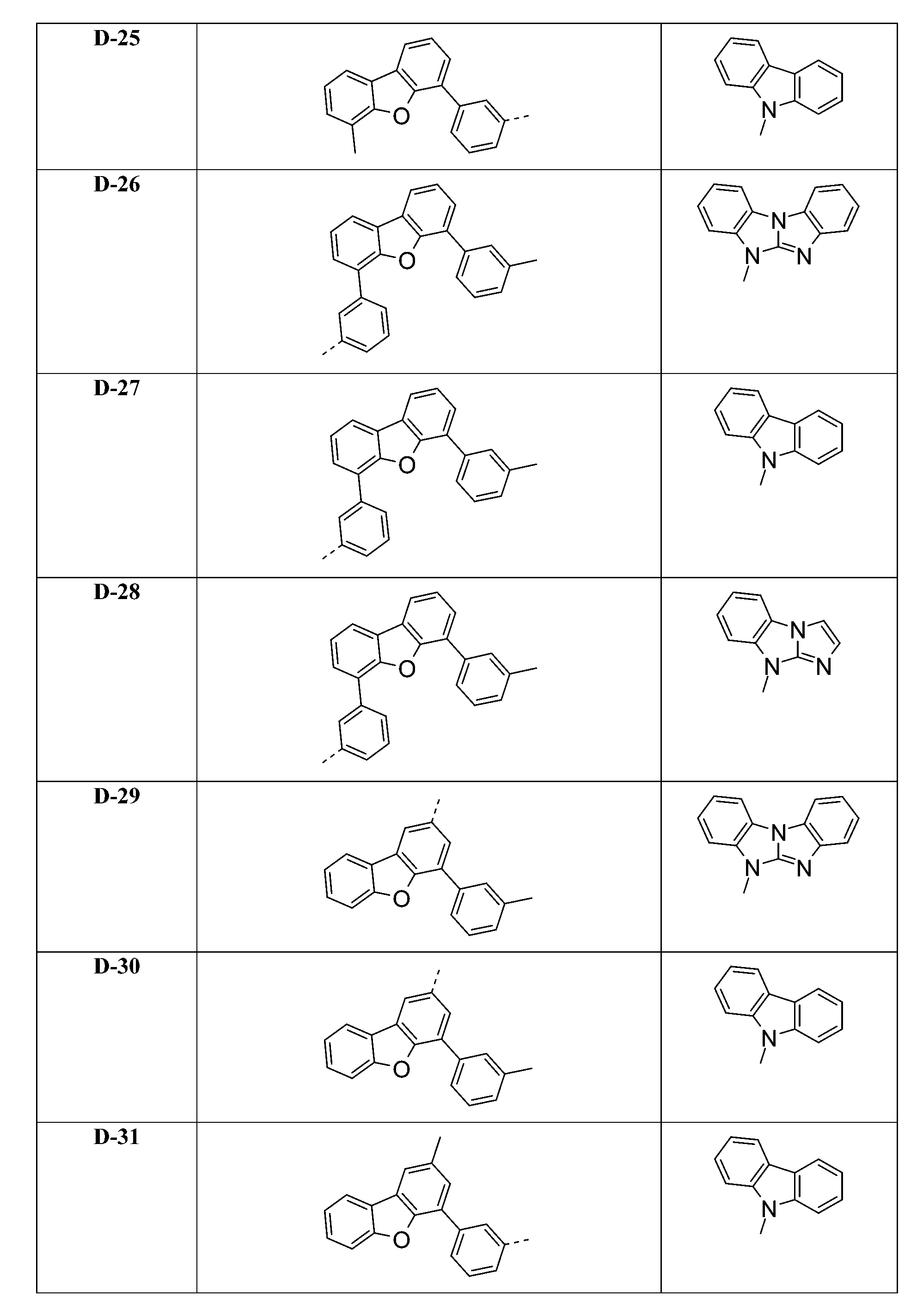


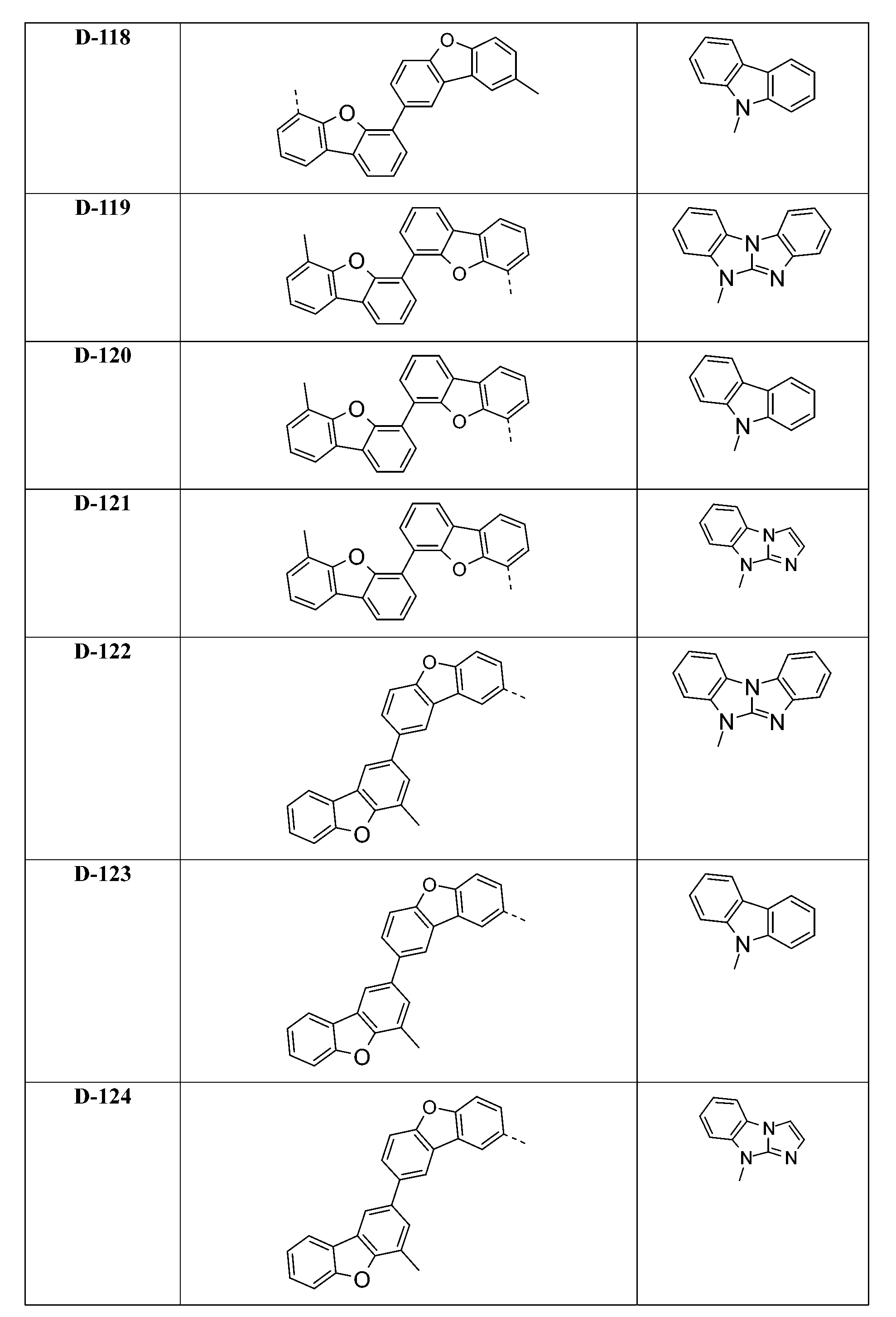


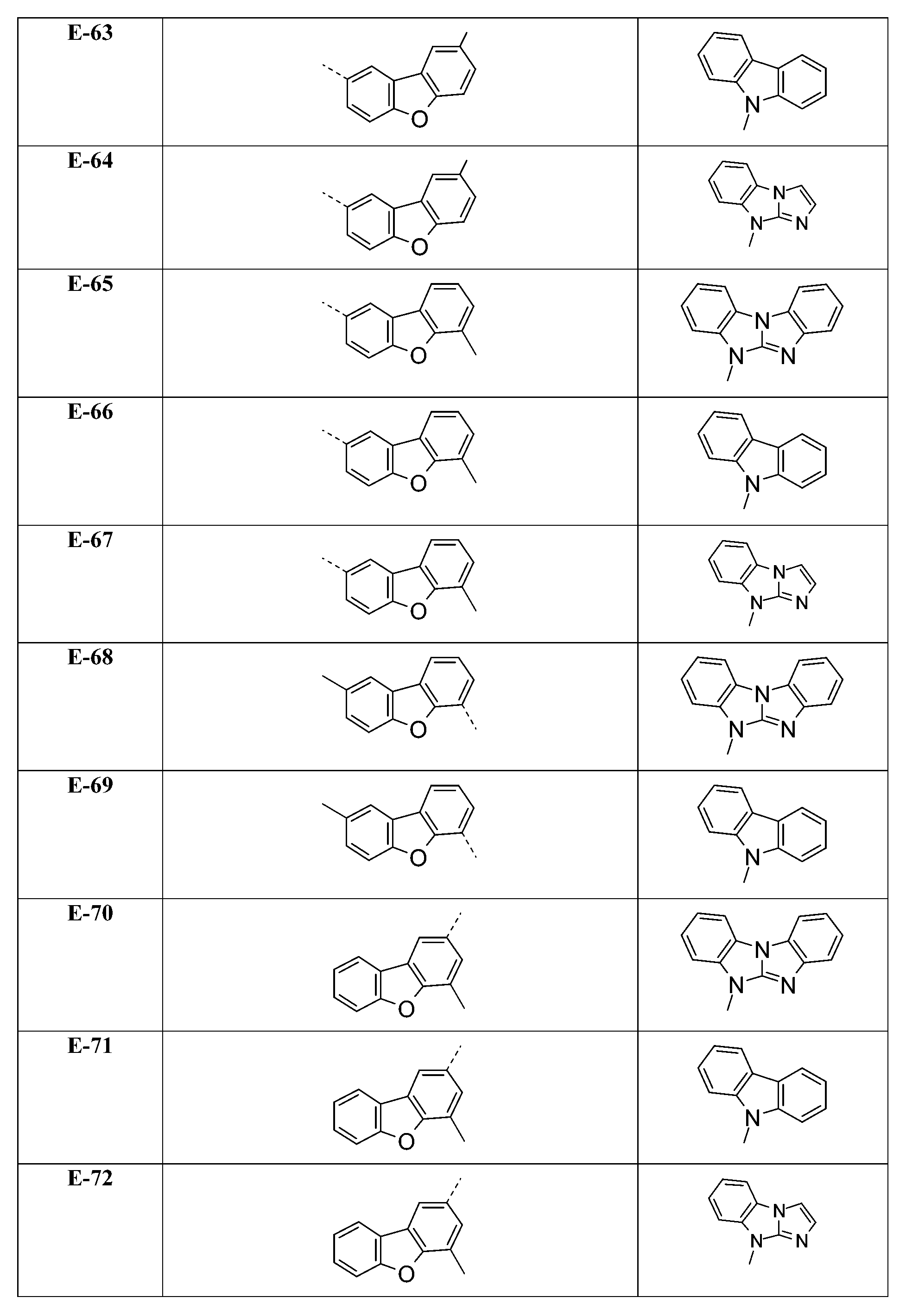


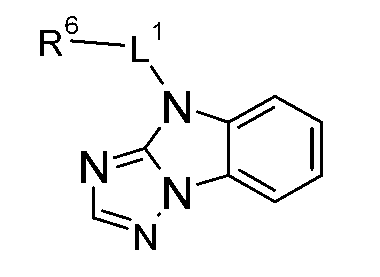


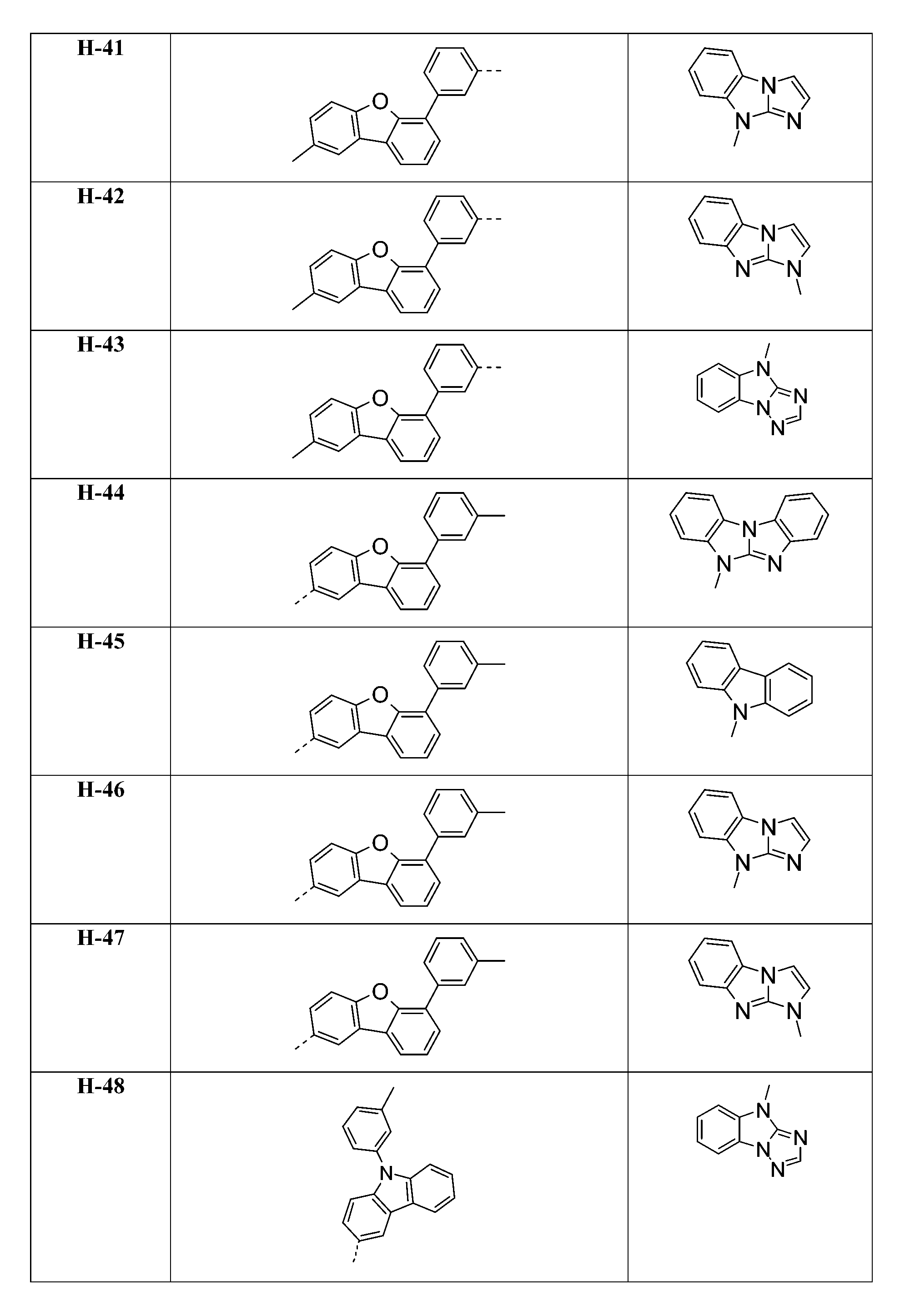
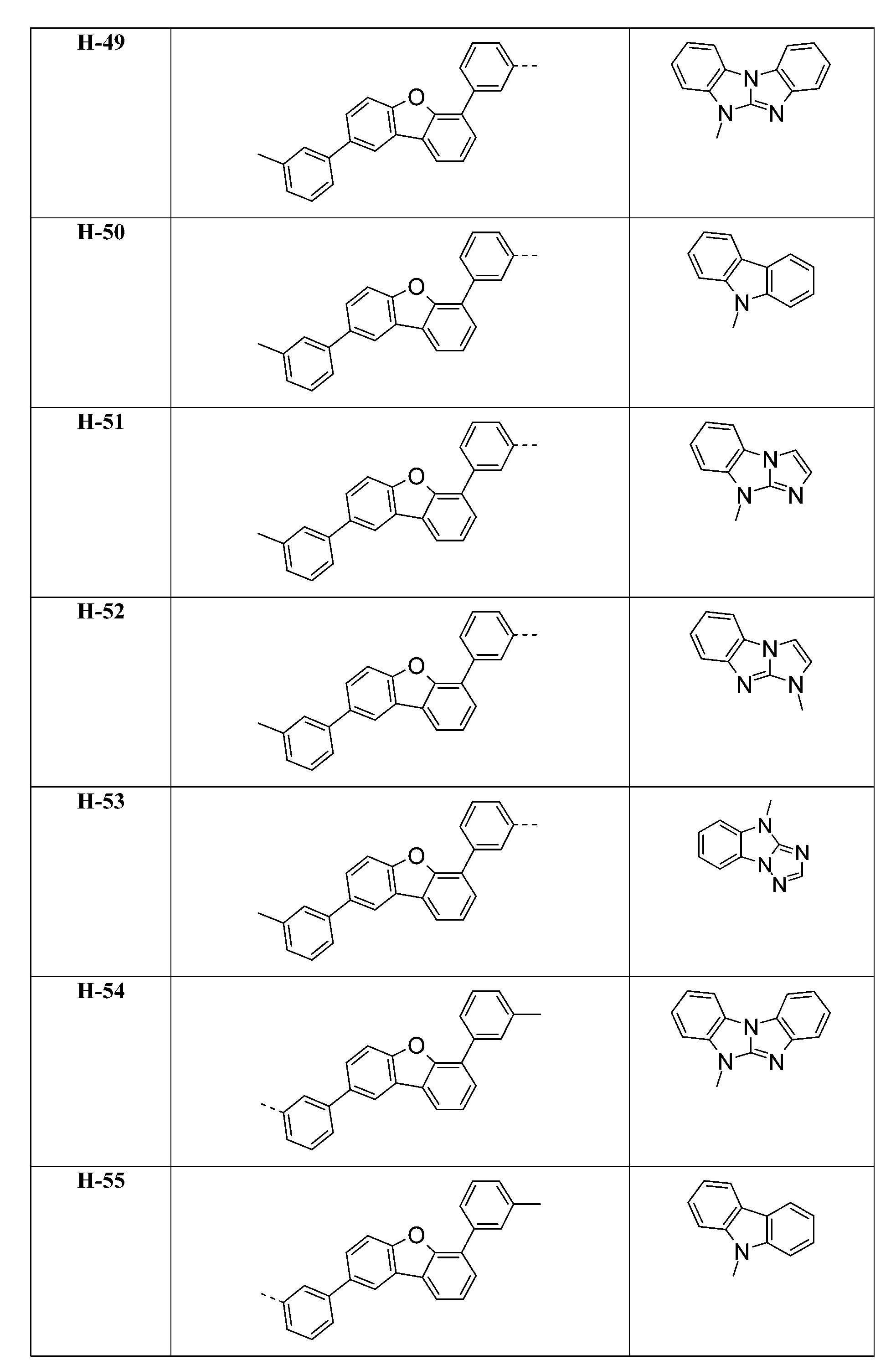


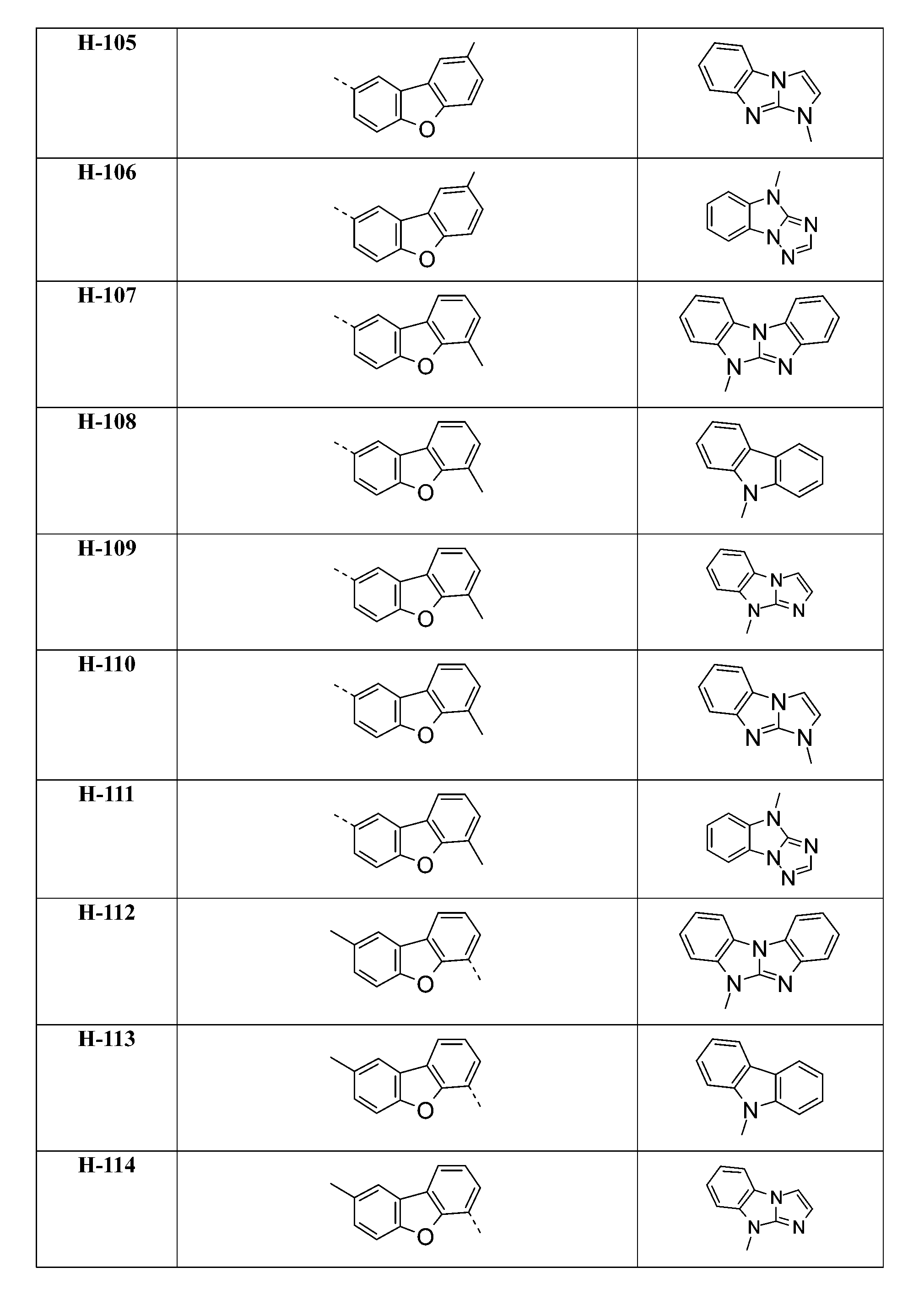


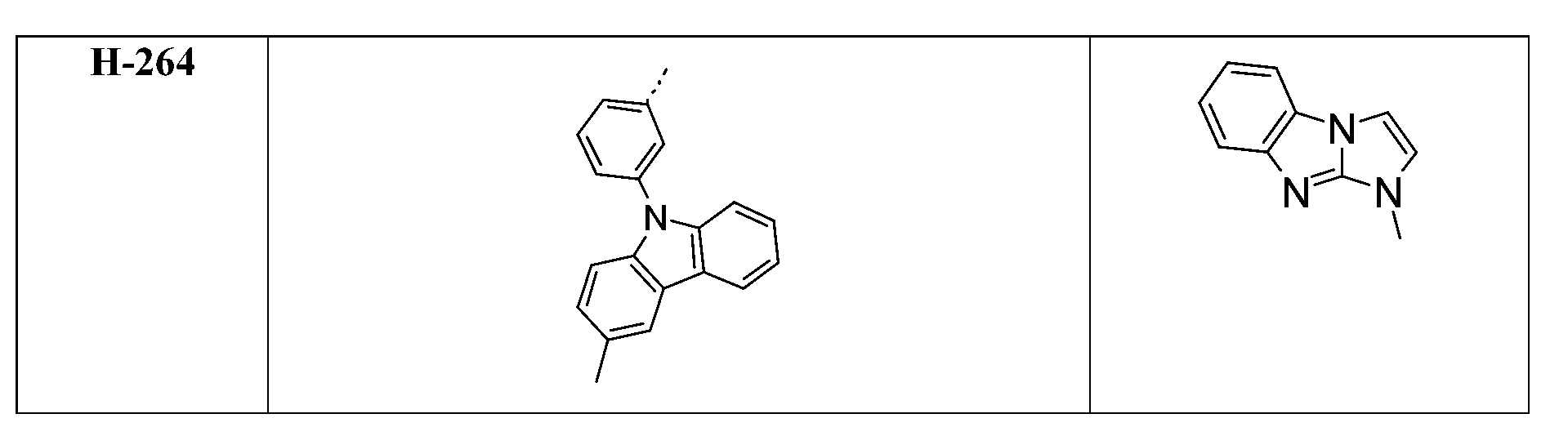
在另一較佳實施例中,本發明係有關以下各式之化合物:


R15較佳為式

在式I化合物用作藍色或綠色磷光發射極之主體材料或用作電子/激子阻擋材料之狀況下,基團A1-(A2)p-(A3)q-(A4)r-次佳,其含有式


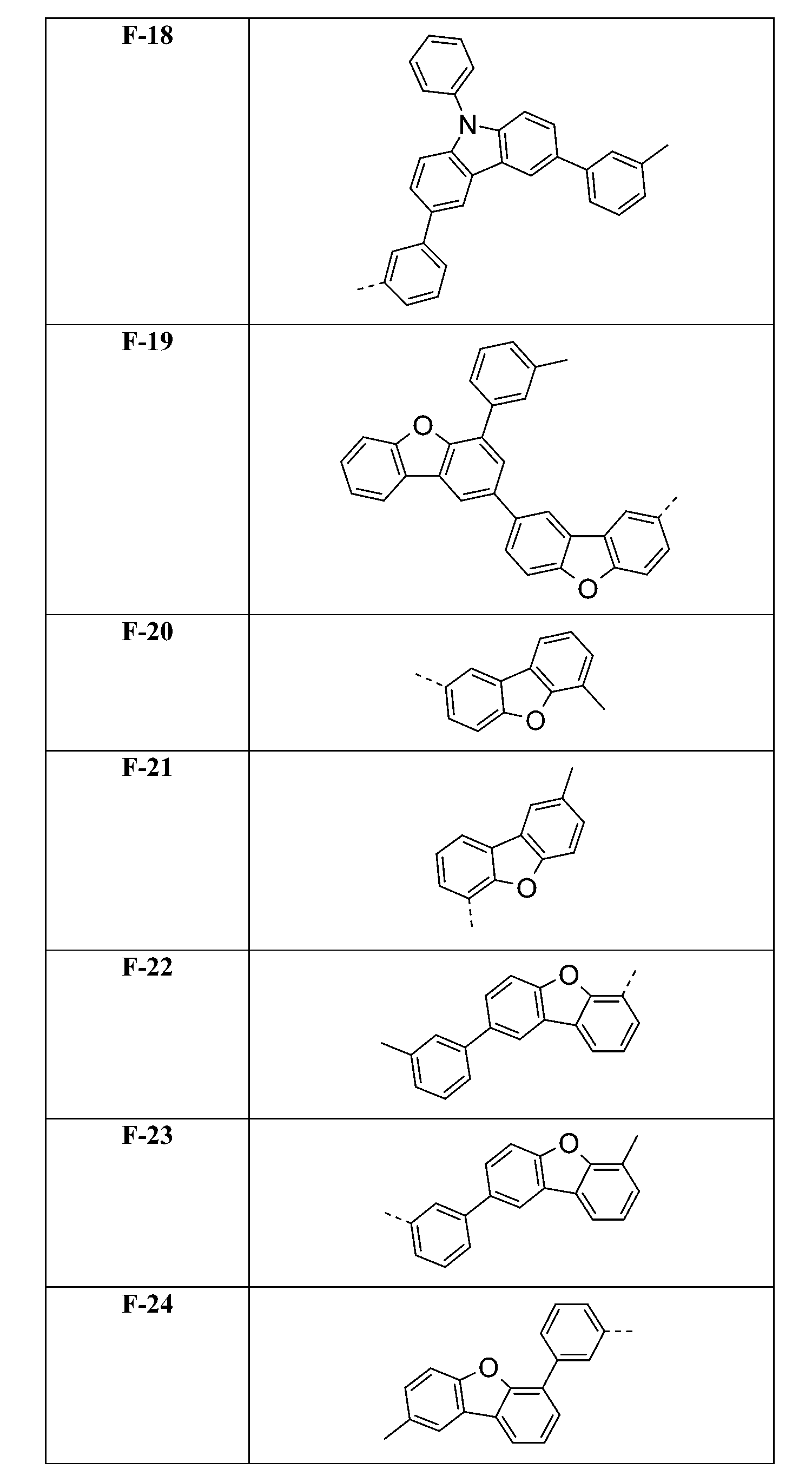

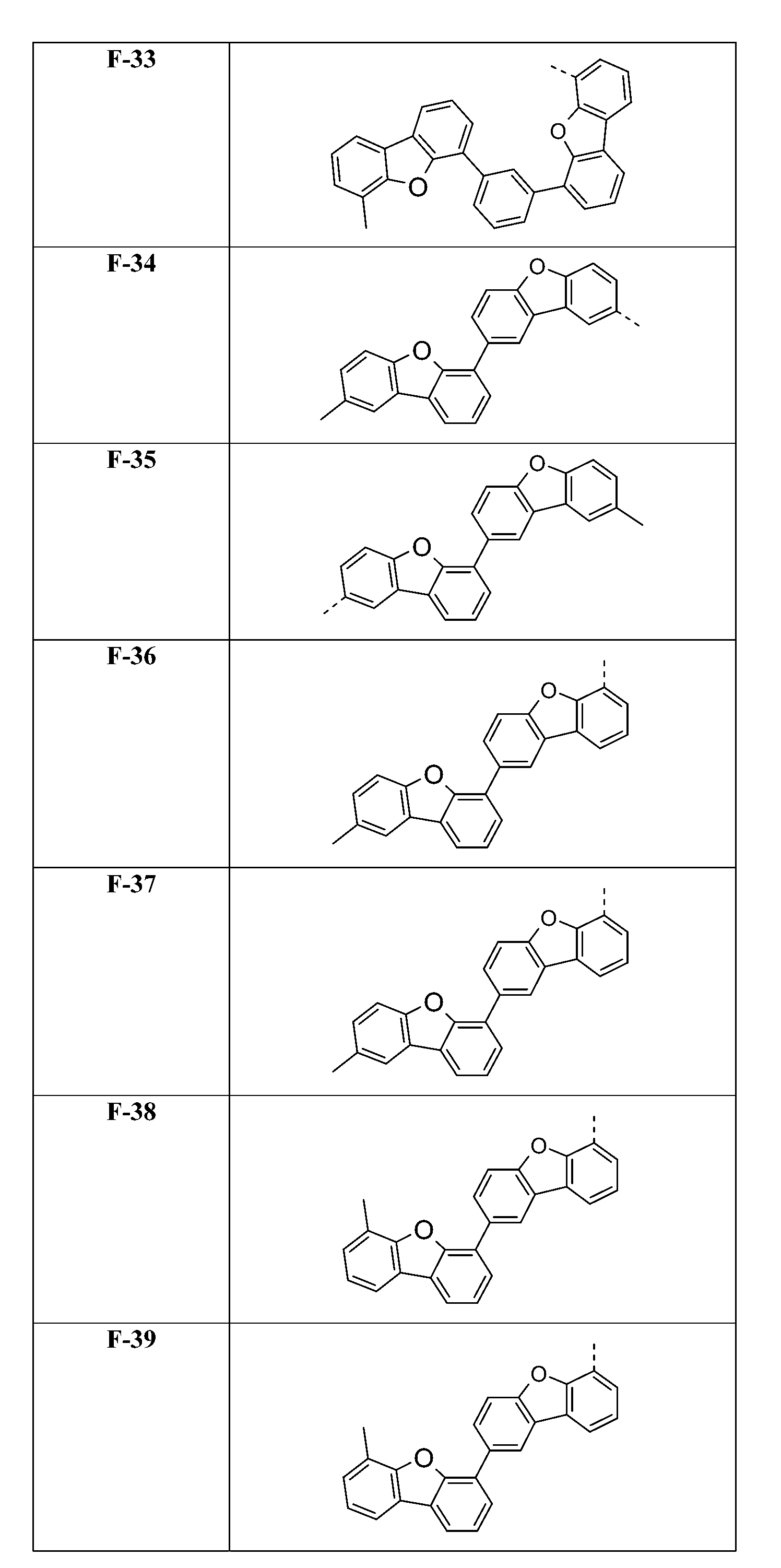
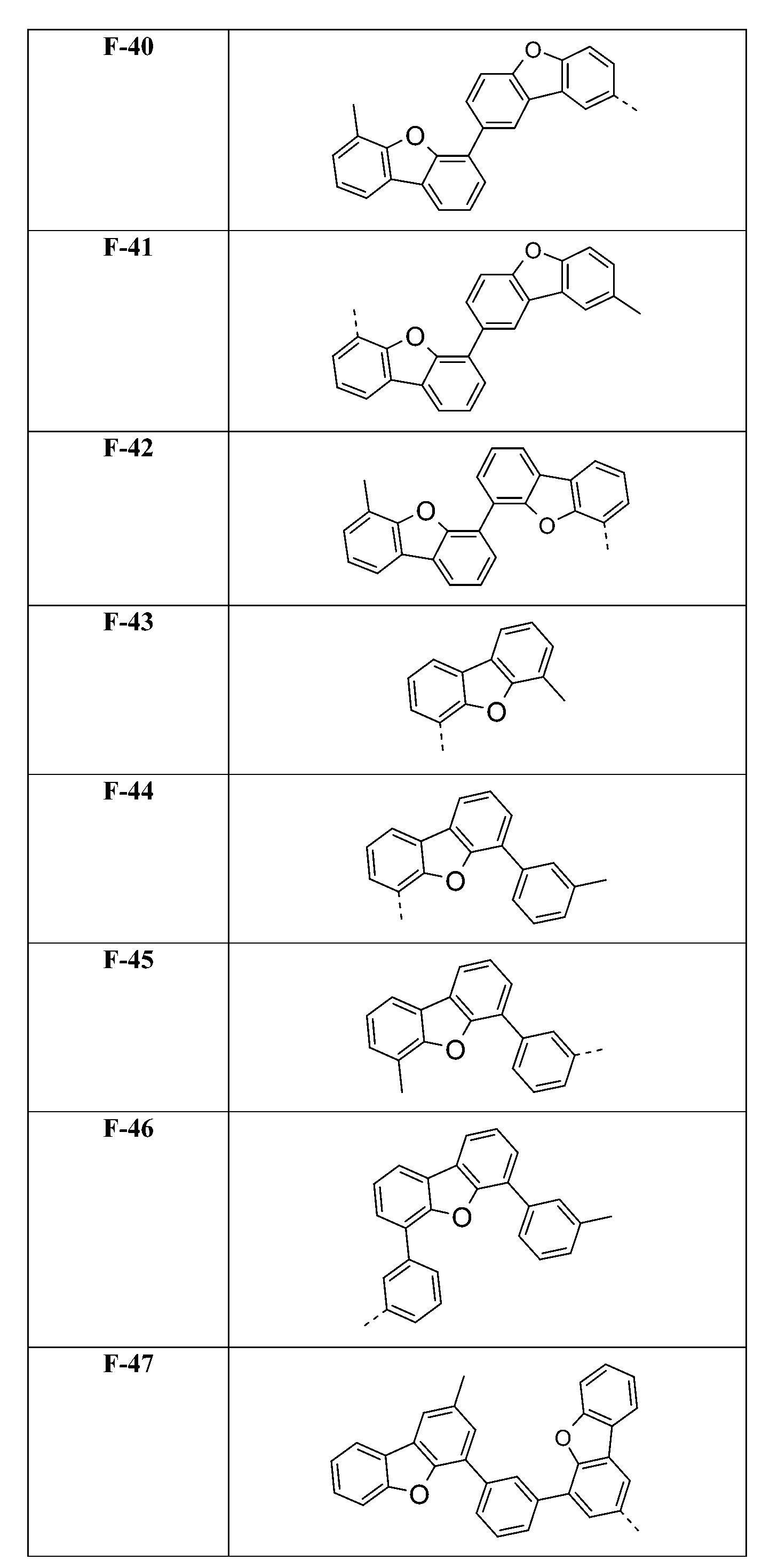


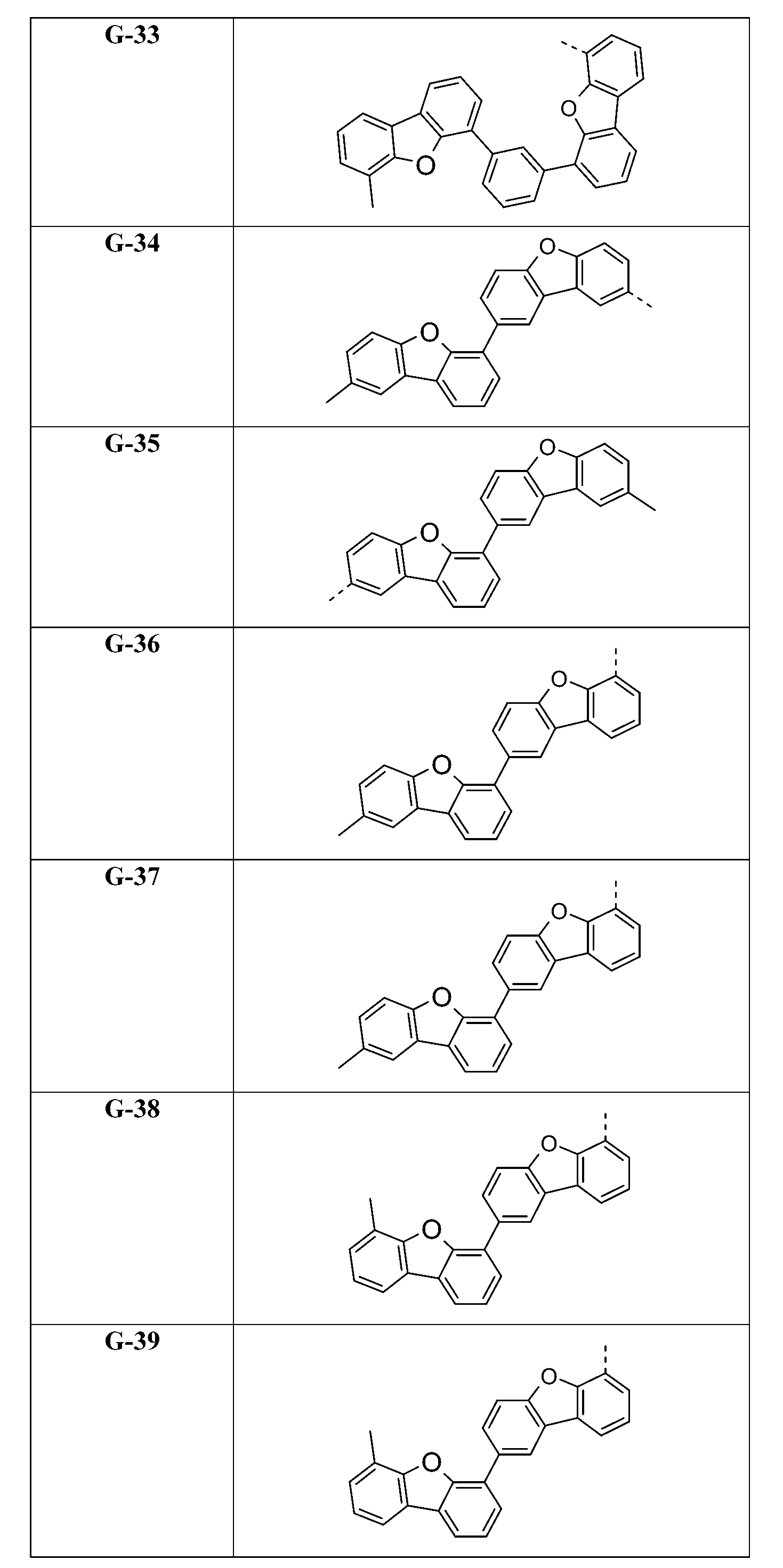
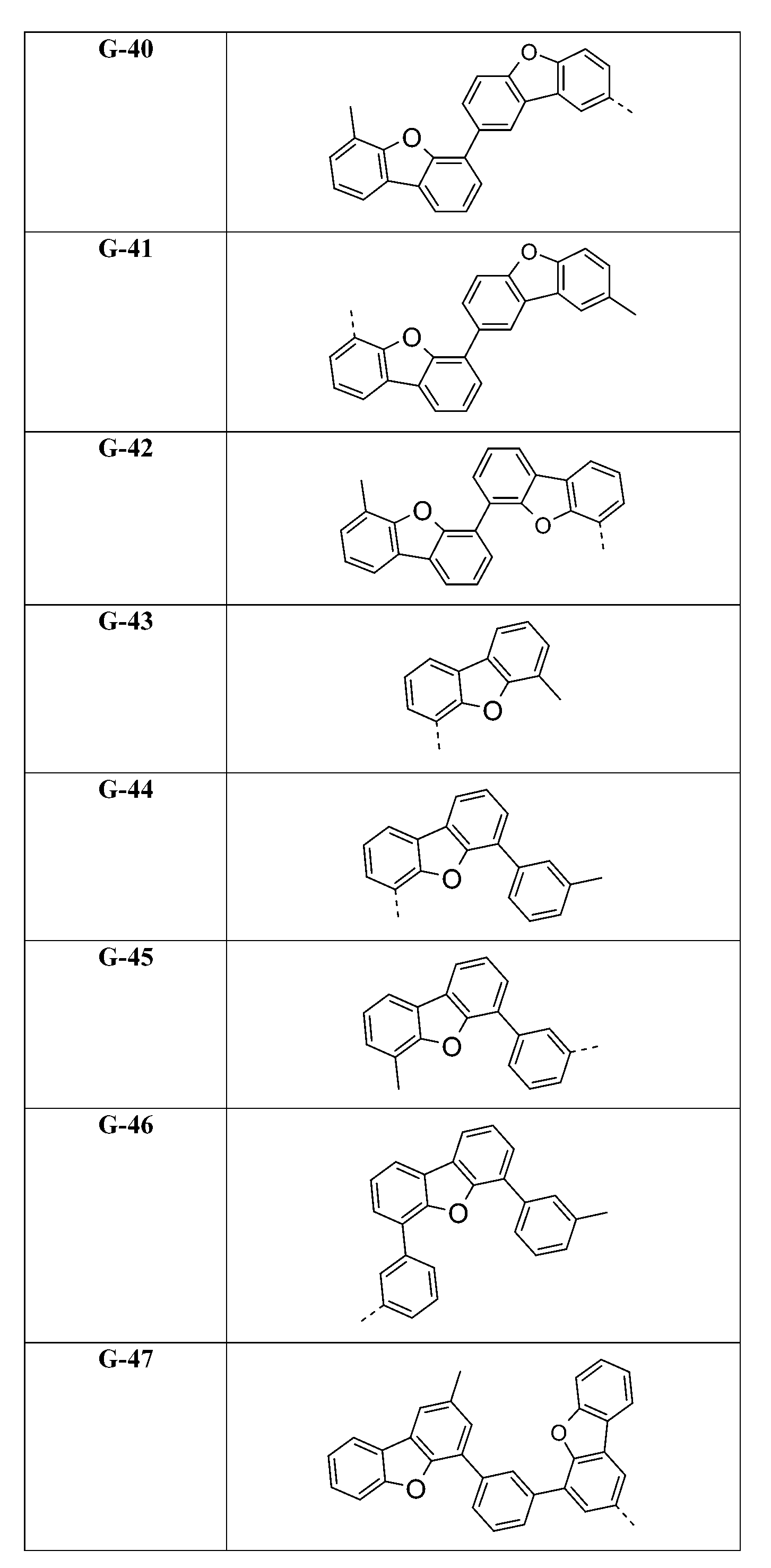


在以上表格中,標記1)、2)、3)及4)具有以下含義: In the above table, the marks 1) , 2) , 3) and 4) have the following meanings:
1)1)
LL
11
=
2)虛線指示與式
3)虛線指示分別與式
4)虛線指示與式
在另一較佳實施例中,本發明係有關化合物M-1至M-62,其自化
合物F-1至F-62藉由用式

在另一較佳實施例中,本發明係有關化合物N-1至N-62,其自化
合物F-1至F-62藉由用式
在另一較佳實施例中,本發明係有關化合物O-1至O-62,其自化
合物F-1至F-62藉由用式

在另一較佳實施例中,本發明係有關化合物P-1至P-62,其自化
合物G-1至G-62藉由用式

在另一較佳實施例中,本發明係有關化合物Q-1至Q-62,其自化
合物G-1至G-62藉由用式

在另一較佳實施例中,本發明係有關化合物R-1至R-62,其自化
合物G-1至G-62藉由用式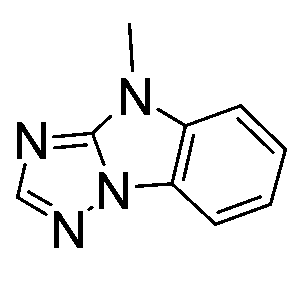

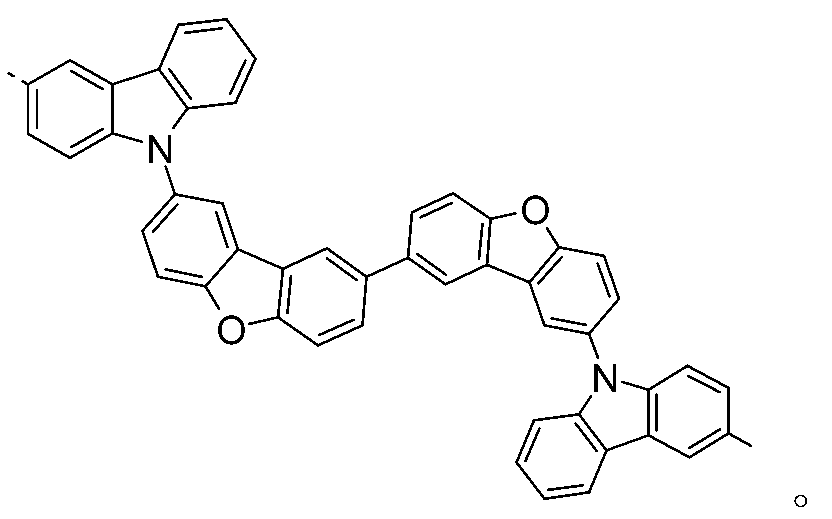
當前最佳化合物為以下化合物:


詳言之,發現含有式
鹵素為氟、氯、溴及碘。 Halogen is fluorine, chlorine, bromine and iodine.
C1-C25烷基(C1-C18烷基)通常為直鏈或分支鏈(若有可能)。實例為甲基、乙基、正丙基、異丙基、正丁基、第二丁基、異丁基、第三丁基、正戊基、2-戊基、3-戊基、2,2-二甲基丙基、1,1,3,3-四甲基戊基、正己基、1-甲基己基、1,1,3,3,5,5-六甲基己基、正庚基、異庚基、1,1,3,3-四甲基丁基、1-甲基庚基、3-甲基庚基、正辛基、1,1,3,3-四甲基丁基及2-乙基己基、正壬基、癸基、十一烷基、十二烷基、十三烷基、十四烷基、十五烷基、十六烷基、十七烷基或十八烷基。C1-C8烷基通常為甲基、乙基、正丙基、異丙基、正丁基、第二丁基、異丁基、第三丁基、正戊基、2-戊基、3-戊基、2,2-二甲基-丙基、正己基、正庚基、正辛基、1,1,3,3-四甲基丁基及2-乙基己基。C1-C4烷基通常為甲基、乙基、正丙基、異丙基、正丁基、第二丁基、異丁基、第三丁基。 The C 1 -C 25 alkyl group (C 1 -C 18 alkyl group) is usually straight or branched (if possible). Examples are methyl, ethyl, n-propyl, isopropyl, n-butyl, second butyl, isobutyl, tertiary butyl, n-pentyl, 2-pentyl, 3-pentyl, 2, 2-Dimethylpropyl, 1,1,3,3-tetramethylpentyl, n-hexyl, 1-methylhexyl, 1,1,3,3,5,5-hexamethylhexyl, n-heptyl Base, isoheptyl, 1,1,3,3-tetramethylbutyl, 1-methylheptyl, 3-methylheptyl, n-octyl, 1,1,3,3-tetramethylbutyl And 2-ethylhexyl, n-nonyl, decyl, undecyl, dodecyl, tridecyl, tetradecyl, pentadecyl, hexadecyl, heptadecyl or Octadecyl. The C 1 -C 8 alkyl group is usually methyl, ethyl, n-propyl, isopropyl, n-butyl, second butyl, isobutyl, tertiary butyl, n-pentyl, 2-pentyl, 3-pentyl, 2,2-dimethyl-propyl, n-hexyl, n-heptyl, n-octyl, 1,1,3,3-tetramethylbutyl and 2-ethylhexyl. The C 1 -C 4 alkyl group is usually methyl, ethyl, n-propyl, isopropyl, n-butyl, second butyl, isobutyl, or tertiary butyl.
C1-C25烷氧基(C1-C18烷氧基)為直鏈或分支鏈烷氧基,例如甲氧基、乙氧基、正丙氧基、異丙氧基、正丁氧基、第二丁氧基、第三丁氧基、戊氧基、異戊氧基或第三戊氧基、庚氧基、辛氧基、異辛氧基、壬氧基、癸氧基、十一烷氧基、十二烷氧基、十四烷氧基、十五烷氧基、十六烷氧基、十七烷氧基及十八烷氧基。C1-C8烷氧基之實例為甲氧基、乙氧基、正丙氧基、異丙氧基、正丁氧基、第二丁氧基、異丁氧基、第三丁氧基、正戊氧基、2-戊氧基、3-戊氧基、2,2-二甲基丙氧基、正己氧基、正庚氧基、正辛氧基、1,1,3,3-四甲基丁氧基及2-乙基己氧基,較佳為C1-C4烷氧基,通常諸如甲氧基、乙氧 基、正丙氧基、異丙氧基、正丁氧基、第二丁氧基、異丁氧基、第三丁氧基。 C 1 -C 25 alkoxy (C 1 -C 18 alkoxy) is linear or branched alkoxy, such as methoxy, ethoxy, n-propoxy, isopropoxy, n-butoxy Group, second butoxy, third butoxy, pentoxy, isopentoxy or third pentoxy, heptyloxy, octyloxy, isooctyloxy, nonoxy, decyloxy, Undecyloxy, dodecyloxy, tetradecyloxy, pentadecyloxy, hexadecyloxy, heptadecyloxy and octadecyloxy. Examples of C 1 -C 8 alkoxy are methoxy, ethoxy, n-propoxy, isopropoxy, n-butoxy, second butoxy, isobutoxy, tertiary butoxy , N-pentyloxy, 2-pentyloxy, 3-pentyloxy, 2,2-dimethylpropoxy, n-hexyloxy, n-heptyloxy, n-octyloxy, 1,1,3,3 -Tetramethylbutoxy and 2-ethylhexyloxy, preferably C 1 -C 4 alkoxy, usually such as methoxy, ethoxy, n-propoxy, isopropoxy, n-but Oxy, second butoxy, isobutoxy, tertiary butoxy.
術語「環烷基」通常為C4-C18環烷基,尤其為C5-C12環烷基,諸如環戊基、環己基、環庚基、環辛基、環壬基、環癸基、環十一烷基、環十二烷基,較佳為環戊基、環己基、環庚基或環辛基,其可未經取代或經取代。 The term "cycloalkyl" is usually C 4 -C 18 cycloalkyl, especially C 5 -C 12 cycloalkyl, such as cyclopentyl, cyclohexyl, cycloheptyl, cyclooctyl, cyclononyl, cyclodecyl Cycloundecyl, cycloundecyl, cyclododecyl, preferably cyclopentyl, cyclohexyl, cycloheptyl or cyclooctyl, which may be unsubstituted or substituted.
可視情況經取代之C6-C24芳基(C6-C18芳基)通常為苯基、4-甲基苯基、4-甲氧基苯基、萘基(尤其1-萘基或2-萘基)、聯苯基、聯三苯基、芘基、2-茀基或9-茀基、菲基或蒽基,其可未經取代或經取代。 The optionally substituted C 6 -C 24 aryl group (C 6 -C 18 aryl group) is usually phenyl, 4-methylphenyl, 4-methoxyphenyl, naphthyl (especially 1-naphthyl or 2-naphthyl), biphenyl, tertphenyl, pyrenyl, 2-pyrenyl or 9-phenanthryl, phenanthryl or anthracenyl, which may be unsubstituted or substituted.
C2-C30雜芳基表示具有5至7個環原子之環、或縮合環系統,其中氮、氧或硫為可能存在之雜原子,且其通常為具有5至30個原子且具有至少6個共軛π電子之雜環基,諸如噻吩基、苯并噻吩基、二苯并噻吩基、噻嗯基、呋喃基、呋喃甲基、2H-哌喃基、苯并呋喃基、異苯并呋喃基、二苯并呋喃基、苯氧基噻吩基、吡咯基、咪唑基、吡唑基、吡啶基、聯吡啶基、三嗪基、嘧啶基、吡嗪基、噠嗪基、吲哚嗪基、異吲哚基、吲哚基、吲唑基、嘌呤基、喹嗪基、喹啉基、異喹啉基、呔嗪基、

C6-C24芳基(C6-C18芳基)及C2-C30雜芳基較佳經一或多個C1-C8烷基取代。 The C 6 -C 24 aryl group (C 6 -C 18 aryl group) and the C 2 -C 30 heteroaryl group are preferably substituted by one or more C 1 -C 8 alkyl groups.
術語「芳基醚基」通常為C6-24芳氧基,亦即O-C6-24芳基,諸如苯氧基或4-甲氧基苯基。 The term "aryl ether group" is usually a C 6-24 aryloxy group, that is, an OC 6-24 aryl group, such as phenoxy or 4-methoxyphenyl.
上述基團之可能取代基為C1-C8烷基、羥基、巰基、C1-C8烷氧基、C1-C8烷硫基、鹵素、鹵-C1-C8烷基或氰基。 The possible substituents of the above groups are C 1 -C 8 alkyl, hydroxyl, mercapto, C 1 -C 8 alkoxy, C 1 -C 8 alkylthio, halogen, halo-C 1 -C 8 alkyl or Cyano.
若諸如R41之取代基在基團中出現一次以上,則其在每次出現時可不同。 If a substituent such as R 41 occurs more than once in the group, it may be different at each occurrence.
用語「經G取代」意謂可能存在一或多個,尤其一至三個取代基G。 The term "replaced by G" means that there may be one or more, especially one to three substituents G.
如上文所述,前述基團可經E取代及/或必要時間雜有D。當然間雜僅在含有至少2個由單鍵彼此連接之碳原子之基團的狀況下方為可能的;C6-C18芳基無間雜;間雜之芳基烷基在烷基部分中含有單元D。經一或多個E取代及/或間雜有一或多個單元D之C1-C18烷基為例如(CH2CH2O)1-9-Rx,其中Rx為H或C1-C10烷基或C2-C10烷醯基(例如CO-CH(C2H5)C4H9);CH2-CH(ORy')-CH2-O-Ry,其中Ry為C1-C18烷基、C5-C12環烷基、苯基、C7-C15苯基烷基,且Ry'涵蓋與Ry相同之定義或為H;C1-C8伸烷基-COO-Rz,例如CH2COORz、CH(CH3)COORz、C(CH3)2COORz,其中Rz為H、C1-C18烷基、(CH2CH2O)1-9-Rx,且Rx涵蓋上文所指示之定義;CH2CH2-O-CO-CH=CH2;CH2CH(OH)CH2-O-CO-C(CH3)=CH2。 As mentioned above, the aforementioned groups may be substituted by E and/or D may be incorporated as necessary. Of course, the interruption is only possible under the condition of a group containing at least 2 carbon atoms connected to each other by a single bond; the C 6 -C 18 aryl group has no interruption; the interrupted arylalkyl group contains the unit D in the alkyl part . The C 1 -C 18 alkyl group substituted by one or more E and/or interspersed with one or more units D is, for example, (CH 2 CH 2 O) 1-9 -R x , wherein R x is H or C 1- C 10 alkyl or C 2 -C 10 alkyl (for example, CO-CH(C 2 H 5 )C 4 H 9 ); CH 2 -CH(OR y ')-CH 2 -OR y , where R y is C 1 -C 18 alkyl, C 5 -C 12 cycloalkyl, phenyl, C 7 -C 15 phenylalkyl, and R y 'encompasses the same definition as R y or H; C 1 -C 8 Alkylene-COO-R z , such as CH 2 COOR z , CH(CH 3 )COOR z , C(CH 3 ) 2 COOR z , where R z is H, C 1 -C 18 alkyl, (CH 2 CH 2 O) 1-9 -R x , and R x covers the definition indicated above; CH 2 CH 2 -O-CO-CH=CH 2 ; CH 2 CH(OH)CH 2 -O-CO-C( CH 3 )=CH 2 .


式
鹵化可由熟習此項技術者已知之方法進行。優先在式(II)之基本骨架之3位及6位(二溴化)或在3位或6位(單溴化)、2,8位(二苯并呋喃及二苯并噻吩)或3,6位(咔唑)溴化或碘化。 Halogenation can be carried out by methods known to those skilled in the art. Preferentially in the 3-position and 6-position (dibromination) or 3-position or 6-position (monobromination), 2,8-position (dibenzofuran and dibenzothiophene) or 3 of the basic skeleton of formula (II) , 6 (carbazole) bromination or iodination.
視情況經取代之二苯并呋喃、二苯并噻吩及咔唑可在2,8位(二苯并呋喃及二苯并噻吩)或3,6位(咔唑)用溴或NBS於冰醋酸或氯仿中二溴化。舉例而言,用Br2溴化可在低溫(例如0℃)下於冰醋酸或氯仿中實現。適合製程描述於例如以下文獻中:M.Park,J.R.Buck,C.J.Rizzo,Tetrahedron,54(1998)12707-12714,對於X=NPh;及W.Yang等人,J.Mater.Chem.13(2003)1351,對於X=S。另外,3,6-二溴咔唑、3,6-二溴-9-苯基咔唑、2,8-二溴二苯并噻吩、2,8-二溴二苯并呋喃、2-溴咔唑、3-溴二苯并噻吩、3-溴二苯并呋喃、3-溴咔唑、2-溴二苯并噻吩及2-溴二苯并呋喃可購得。 Depending on the situation, the substituted dibenzofuran, dibenzothiophene and carbazole can be used in the 2,8 position (dibenzofuran and dibenzothiophene) or 3,6 position (carbazole) with bromine or NBS in glacial acetic acid Or dibrominated in chloroform. For example, bromination with Br 2 can be achieved in glacial acetic acid or chloroform at low temperature (eg 0°C). Suitable processes are described in, for example, the following documents: M. Park, JRBuck, CJ Rizzo, Tetrahedron, 54 (1998) 12707-12714, for X=NPh; and W. Yang et al., J. Mater. Chem. 13 (2003) 1351 , For X=S. In addition, 3,6-dibromocarbazole, 3,6-dibromo-9-phenylcarbazole, 2,8-dibromodibenzothiophene, 2,8-dibromodibenzofuran, 2-bromo Carbazole, 3-bromodibenzothiophene, 3-bromodibenzofuran, 3-bromocarbazole, 2-bromodibenzothiophene and 2-bromodibenzofuran are commercially available.
二苯并呋喃(且二苯并噻吩與此類似)之4位的單溴化描述於例如J.Am.Chem.Soc.1984,106,7150中。二苯并呋喃(二苯并噻吩)可在3位 由熟習此項技術者已知之順序單溴化,該順序包含硝化、還原及後續山德邁耳反應(Sandmeyer reaction)。 The monobromination of the 4-position of dibenzofuran (and dibenzothiophene is similar) is described in, for example, J. Am. Chem. Soc. 1984, 106, 7150. Dibenzofuran (dibenzothiophene) can be in the 3 position The sequence of monobromination known by those skilled in the art includes nitration, reduction and subsequent Sandmeyer reaction.
二苯并呋喃或二苯并噻吩之2位的單溴化及咔唑之3位的單溴化類似於二溴化來實現,但僅添加1當量溴或NBS。 The monobromination of the 2-position of dibenzofuran or dibenzothiophene and the monobromination of the 3-position of carbazole can be achieved similarly to dibromination, but only 1 equivalent of bromine or NBS is added.
或者,亦可能利用經碘化之二苯并呋喃、二苯并噻吩及咔唑。製備尤其描述於Tetrahedron.Lett.47(2006)6957-6960;Eur.J.Inorg.Chem.24(2005)4976-4984;J.Heterocyclic Chem.39(2002)933-941;J.Am.Chem.Soc.124(2002)11900-11907;J.Heterocyclic Chem,38(2001)77-87中。 Alternatively, it is also possible to use iodinated dibenzofuran, dibenzothiophene and carbazole. The preparation is described in particular in Tetrahedron. Lett. 47 (2006) 6957-6960; Eur. J. Inorg. Chem. 24 (2005) 4976-4984; J. Heterocyclic Chem. 39 (2002) 933-941; J. Am. Chem .Soc.124 (2002) 11900-11907; J. Heterocyclic Chem, 38 (2001) 77-87.
對於親核取代,需要經C1或F取代之二苯并呋喃、二苯并噻吩及咔唑。氯化尤其描述於J.Heterocyclic Chemistry,34(1997)891-900;Org.Lett.,6(2004)3501-3504;J.Chem.Soc.[Section]C:Organic,16(1971)2775-7;Tetrahedron Lett.25(1984)5363-6;J.Org.Chem.69(2004)8177-8182中。氟化描述於J.Org.Chem.63(1998)878-880及J.Chem.Soc.,Perkin Trans.2,5(2002)953-957中。 For nucleophilic substitution, C1 or F substituted dibenzofuran, dibenzothiophene and carbazole are required. Chlorination is particularly described in J. Heterocyclic Chemistry, 34 (1997) 891-900; Organ. Lett., 6 (2004) 3501-3504; J. Chem. Soc. [Section] C: Organic, 16 (1971) 2775 7; Tetrahedron Lett. 25 (1984) 5363-6; J. Org. Chem. 69 (2004) 8177-8182. Fluorination is described in J. Org. Chem. 63 (1998) 878-880 and J. Chem. Soc., Perkin Trans. 2, 5 (2002) 953-957.
基團
雜芳基化可例如藉由銅催化之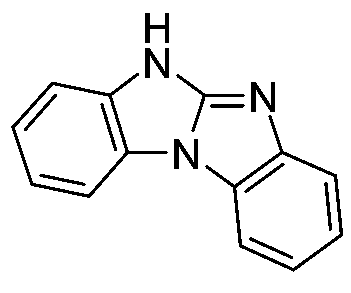

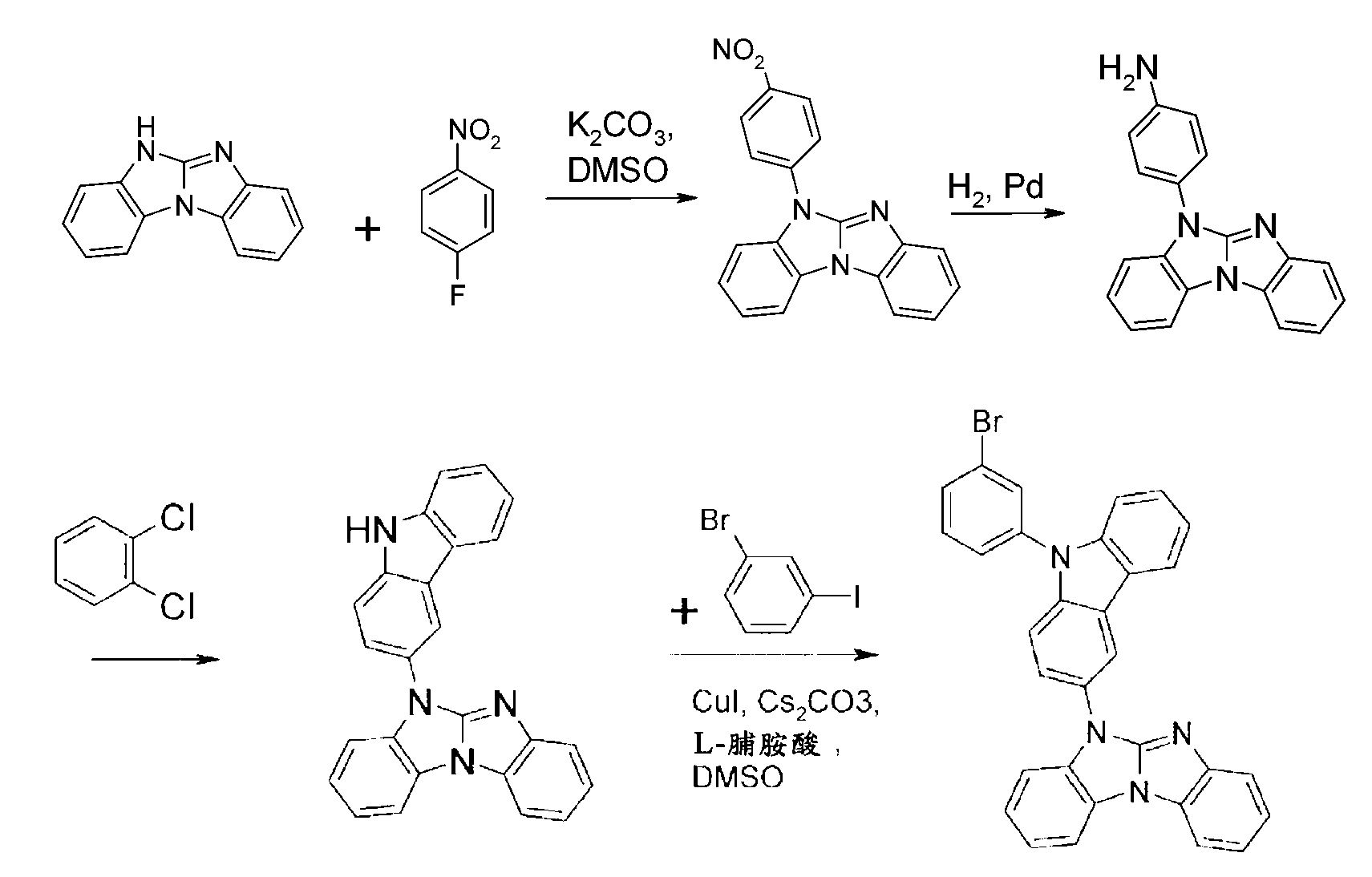
N-芳基化例如揭示於H.Gilman及D.A.Shirley,J.Am.Chem.Soc.66(1944)888;D.Li等人,Dyes and Pigments 49(2001)181-186;及Eur.J.Org.Chem.(2007)2147-2151中。反應可在溶劑中或熔體中進行。適合溶劑為例如(極性)非質子性溶劑,諸如二甲亞碸、二甲基甲醯胺、NMP、十三烷或醇類。 N-arylation is disclosed, for example, in H. Gilman and Dashirley, J. Am. Chem. Soc. 66 (1944) 888; D. Li et al., Dyes and Pigments 49 (2001) 181-186; and Eur. J . Org. Chem. (2007) 2147-2151. The reaction can be carried out in a solvent or in a melt. Suitable solvents are, for example, (polar) aprotic solvents, such as dimethylsulfene, dimethylformamide, NMP, tridecane or alcohols.
9-(8-溴二苯并呋喃-2-基)咔唑

式
參考Angew.Chem.Int.Ed.46(2007)1627-1629。 Reference Angew. Chem. Int. Ed. 46 (2007) 1627-1629.
含有二

依照一種常用途徑,含有二


含有二

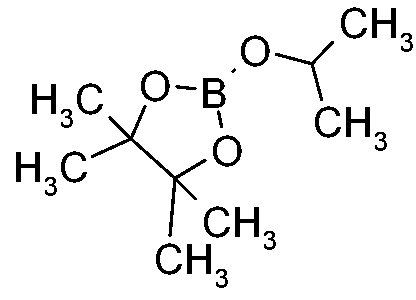

含有二


諸如


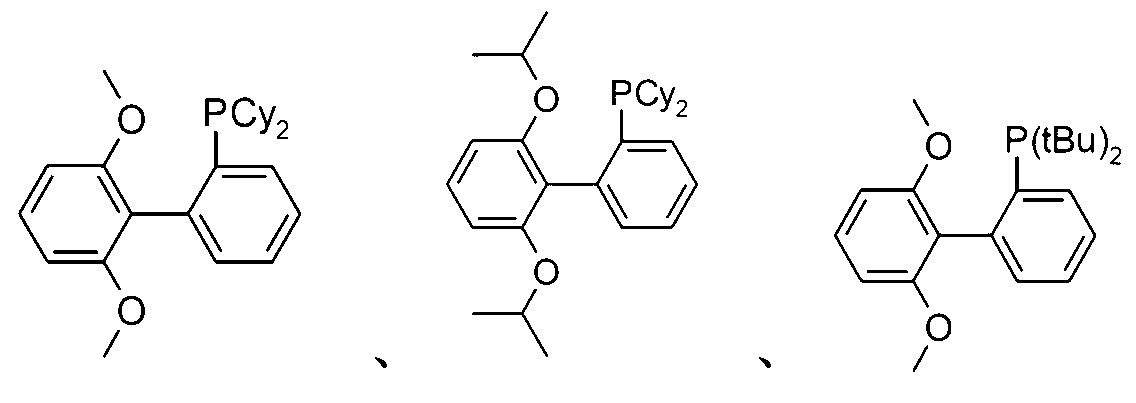
較佳在諸如芳族烴之有機溶劑或諸如苯、甲苯、二甲苯、四氫呋喃或二噁烷或其混合物(最佳為甲苯)之常用極性有機溶劑存在下進行鈴木反應(Suzuki reaction)。通常,所選之溶劑量在每莫耳




化合物A-1之可能合成途徑展示於以下反應流程中:

化合物B-3之可能合成途徑展示於以下反應流程中:

在-78℃下使用nBuLi/THF或在-78℃下使用tBuLi/THF進行鹵素/金屬交換。參考WO 2010/079051,其中描述該等化合物之合成。 Use nBuLi/THF at -78°C or tBuLi/THF at -78°C for halogen/metal exchange. Refer to WO 2010/079051, which describes the synthesis of these compounds.
式

式
在一個實施例中,R6'為鹵素,尤其為Cl、Br或J;-OS(O)2CF3、-OS(O)2-芳基,尤其為
在另一實施例中,R6'為ZnX12;-SnR207R208R209,其中R207、R208及R209相同或不同且為H或C1-C6烷基,其中兩個基團視情況形成共用環且此等基團視情況為分支或未分支的;且X12為鹵素原子,尤其為I或Br;-B(OH)2、-B(OY1)2
、


式I化合物可以中間物及適合共反應物為起始物,例如藉由鈴木偶合反應(Suzuki coupling reaction)、施蒂勒偶合反應(Stille coupling reaction)或根岸偶合反應(Negishi coupling reaction)而獲得。 The compound of formula I can be obtained from intermediates and suitable co-reactants as starting materials, for example, by Suzuki coupling reaction, Stille coupling reaction or Negishi coupling reaction.
製備R2、R3、R4、R5、R11、R12、R13及R14為H且R1如上文所定義
之式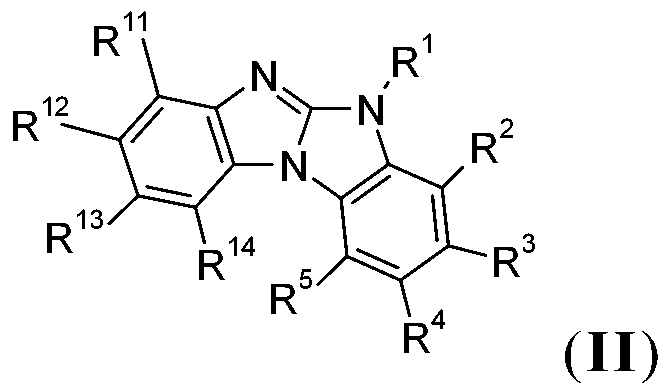


已發現,式I化合物尤其適合用於需要電荷載流子傳導性之應用中,尤其用於有機電子學應用中,例如選自以下之應用:諸如切換元件,諸如有機電晶體,例如有機FET及有機TFT;有機太陽能電池;及有機發光二極體(OLED),式I化合物尤其適合於在OLED中用作發光層中之基質材料及/或用作電洞及/或激子阻擋材料及/或用作電子及/或激子阻擋材料,尤其與磷光發射極組合。在本發明式I化合物用於OLED中之狀況下,獲得具有良好效率及長壽命且可尤其在低使用電壓及操作電壓下操作之OLED。本發明式I化合物尤其適合用作藍色及綠色發射極,例如淺藍或深藍發射極之基質及/或電洞/激子阻擋材料,此等發射極尤其為磷光發射極。此外,式I化合物可在選自切換元件及有機太陽能電池之有機電子學應用中用作導體/互補材料。 It has been found that the compounds of formula I are particularly suitable for use in applications requiring charge carrier conductivity, especially in organic electronics applications, such as those selected from: such as switching elements, such as organic transistors, such as organic FETs and Organic TFT; organic solar cell; and organic light-emitting diode (OLED). The compound of formula I is particularly suitable for use as a matrix material in the light-emitting layer in OLED and/or as a hole and/or exciton blocking material and/ Or used as an electron and/or exciton blocking material, especially in combination with phosphorescent emitters. Under the condition that the compound of formula I of the present invention is used in an OLED, an OLED with good efficiency and long lifetime and which can be operated especially at low voltage and operating voltage is obtained. The compounds of formula I of the present invention are particularly suitable for use as blue and green emitters, for example, light blue or dark blue emitters and/or hole/exciton blocking materials. These emitters are especially phosphorescent emitters. In addition, the compound of formula I can be used as a conductor/complementary material in organic electronics applications selected from switching elements and organic solar cells.
式I化合物可在有機電子學應用中,尤其在OLED中用作基質材料及/或電洞/激子阻擋材料及/或電子/激子阻擋材料及/或電洞注入材料及/或電子注入材料及/或電洞傳導材料(電洞傳輸材料)及/或電子傳導材料(電子傳輸材料),較佳用作基質材料及/或電子/激子阻擋材料及/或電洞傳輸材料。本發明式I化合物更佳在有機電子學應用中,尤其 在OLED中用作基質材料。 The compound of formula I can be used as a host material and/or hole/exciton blocking material and/or electron/exciton blocking material and/or hole injection material and/or electron injection in organic electronics applications, especially in OLED The material and/or the hole conductive material (hole transport material) and/or the electron conductive material (electron transport material) are preferably used as the host material and/or the electron/exciton blocking material and/or the hole transport material. The compound of formula I of the present invention is better used as a host material in organic electronics applications, especially in OLEDs.
在OLED之發射層或一個發射層中,亦可能將發射極材料與式I化合物之基質材料及具有例如良好電洞傳導(電洞傳輸)特性之另一基質材料組合。由此達成此發射層之高量子效率。 In the emissive layer or an emissive layer of an OLED, it is also possible to combine the emitter material with the matrix material of the compound of formula I and another matrix material with, for example, good hole conduction (hole transport) properties. As a result, the high quantum efficiency of the emission layer is achieved.
當式I化合物用作發射層中之基質材料且因材料之化學一致性或類似性而另外用作電洞/激子阻擋材料及/或電子/激子阻擋材料時,發射層與相鄰電洞/激子阻擋材料及/或電子/激子阻擋材料之間的界面獲得改良,由此可使得同等亮度下之電壓降低且使得OLED之壽命延長。此外,電洞/激子阻擋材料及/或電子/激子阻擋材料與發射層之基質使用相同材料可使OLED之製造製程簡化,此係由於一種式I化合物之材料的氣相沈積製程可使用相同來源之故。 When the compound of formula I is used as a matrix material in the emission layer and is additionally used as a hole/exciton blocking material and/or an electron/exciton blocking material due to the chemical consistency or similarity of the materials, the emission layer is The interface between the hole/exciton blocking material and/or the electron/exciton blocking material is improved, which can reduce the voltage at the same brightness and extend the life of the OLED. In addition, the use of the same material for the hole/exciton blocking material and/or the electron/exciton blocking material and the matrix of the emission layer can simplify the manufacturing process of OLED, because the vapor deposition process of a material of the formula I compound can be used Because of the same source.
有機電子裝置之適合結構為熟習此項技術者所知且於下文加以說明。 Suitable structures for organic electronic devices are known to those skilled in the art and are described below.
有機電晶體一般包括由具有電洞傳輸能力及/或電子傳輸能力之有機層形成之半導體層;由導電層形成之閘電極;及在半導體層與導電層之間引入的絕緣層。源電極及汲電極安裝於此配置上,由此產生電晶體元件。另外,熟習此項技術者已知之其他層可存在於有機電晶體中。 Organic transistors generally include a semiconductor layer formed from an organic layer with hole transport capability and/or electron transport capability; a gate electrode formed from a conductive layer; and an insulating layer introduced between the semiconductor layer and the conductive layer. The source electrode and the drain electrode are mounted on this configuration, thereby producing a transistor element. In addition, other layers known to those skilled in the art may be present in the organic transistor.
有機太陽能電池(光電轉換元件)一般包含存在於兩個平行配置之板型電極之間的有機層。有機層可組態於梳型電極上。關於有機層之位置無特定限制且關於電極之材料無特定限制。然而,當使用平行配置之板型電極時,至少一個電極較佳由透明電極形成,例如ITO電極或摻氟之氧化錫電極。有機層由兩個子層形成,亦即具有p型半導體 特性或電洞傳輸能力之層,及具有n型半導體特性或電子傳輸能力之層。另外,熟習此項技術者已知之其他層可能存在於有機太陽能電池中。具有電洞傳輸能力之層可包含式I化合物。 An organic solar cell (photoelectric conversion element) generally includes an organic layer existing between two plate-shaped electrodes arranged in parallel. The organic layer can be configured on the comb-shaped electrode. There is no specific restriction on the position of the organic layer and no specific restriction on the material of the electrode. However, when using plate-type electrodes arranged in parallel, at least one electrode is preferably formed of a transparent electrode, such as an ITO electrode or a fluorine-doped tin oxide electrode. The organic layer is formed of two sub-layers, that is, a layer with p-type semiconductor properties or hole transport capability, and a layer with n-type semiconductor properties or electron transport capability. In addition, other layers known to those skilled in the art may be present in organic solar cells. The layer with hole transport capability may include the compound of formula I.
式I化合物同樣可能存在於發光層中(較佳作為基質材料)與電子阻擋層中(作為電子/激子阻擋劑)。 The compound of formula I may also be present in the light-emitting layer (preferably as a host material) and in the electron blocking layer (as an electron/exciton blocker).
本發明另外提供一種有機發光二極體,其包含陽極An及陰極Ka以及配置於陽極An與陰極Ka之間的發光層E,且適當時包含至少一個選自由以下組成之群的其他層:至少一個電洞/激子阻擋層、至少一個電子/激子阻擋層、至少一個電洞注入層、至少一個電洞傳導層、至少一個電子注入層及至少一個電子傳導層,其中至少一種式I化合物存在於發光層E中及/或至少一個其他層中。至少一種式I化合物較佳存在於發光層及/或電洞阻擋層中。 The present invention further provides an organic light-emitting diode, which comprises an anode An and a cathode Ka, and a light-emitting layer E arranged between the anode An and the cathode Ka, and when appropriate, comprises at least one other layer selected from the group consisting of: at least One hole/exciton blocking layer, at least one electron/exciton blocking layer, at least one hole injection layer, at least one hole conduction layer, at least one electron injection layer, and at least one electron conduction layer, wherein at least one compound of formula I Exist in the light-emitting layer E and/or in at least one other layer. At least one compound of formula I is preferably present in the light-emitting layer and/or the hole blocking layer.
本申請案另外係關於一種包含至少一種式I化合物之發光層。 This application additionally relates to a light-emitting layer comprising at least one compound of formula I.
本發明有機發光二極體(OLED)由此一般具有以下結構:陽極(An)及陰極(Ka)以及配置於陽極(An)與陰極(Ka)之間的發光層E。 Therefore, the organic light emitting diode (OLED) of the present invention generally has the following structure: an anode (An) and a cathode (Ka), and a light-emitting layer E arranged between the anode (An) and the cathode (Ka).
在一較佳實施例中,本發明OLED可例如由以下各層形成: In a preferred embodiment, the OLED of the present invention can be formed, for example, by the following layers:
1. 陽極 1. Anode
2. 電洞傳導層 2. Hole Conduction Layer
3. 發光層 3. Light-emitting layer
4. 電洞/激子阻擋層 4. Hole/Exciton Blocking Layer
5. 電子傳導層 5. Electron conduction layer
6. 陰極 6. Cathode
不同於前述結構之層順序亦為可能的,且為熟習此項技術者所知。舉例而言,OLED可能不具有所提及之所有層;例如具有層(1)(陽極)、(3)(發光層)及(6)(陰極)之OLED同樣適合,在該狀況下,層(2)(電洞傳導層)及(4)(電洞/激子阻擋層)及(5)(電子傳導層)之功能由相鄰層呈現。具有層(1)、(2)、(3)及(6)或層(1)、(3)、(4)、(5)及(6)之OLED同樣適合。另外,OLED在電洞傳導層(2)與發光層(3)之間可具有電子/激子阻擋層。 Layer sequences other than the aforementioned structure are also possible and known to those skilled in the art. For example, OLEDs may not have all the layers mentioned; for example, OLEDs with layers (1) (anode), (3) (light-emitting layer) and (6) (cathode) are also suitable. In this case, the layer The functions of (2) (hole conduction layer) and (4) (hole/exciton blocking layer) and (5) (electron conduction layer) are presented by adjacent layers. OLEDs with layers (1), (2), (3) and (6) or layers (1), (3), (4), (5) and (6) are also suitable. In addition, the OLED may have an electron/exciton blocking layer between the hole conductive layer (2) and the light emitting layer (3).
另外,複數個前述功能(電子/激子阻擋、電洞/激子阻擋、電洞注入、電洞傳導、電子注入、電子傳導)可能組合於一個層中,且例如由存在於此層中之單一材料呈現。舉例而言,在一個實施例中,電洞傳導層中所用之材料可同時阻擋激子及/或電子。 In addition, a plurality of the aforementioned functions (electron/exciton blocking, hole/exciton blocking, hole injection, hole conduction, electron injection, electron conduction) may be combined in one layer, and for example, by existing in this layer Single material presentation. For example, in one embodiment, the material used in the hole conductive layer can block excitons and/or electrons at the same time.
此外,在上文所說明之彼等層中OLED之個別層又可由兩個或兩個以上層形成。舉例而言,電洞傳導層可由使電洞自電極注入內部之層及使電洞離開電洞注入層傳輸至發光層中之層形成。電子傳導層可同樣由複數個層組成,例如電子由電極注入之層及接收來自電子注入層之電子且將其傳輸至發光層中之層。所提及之此等層各自根據諸如以下因素選擇:能量位準、熱阻及電荷載流子移動力,以及以有機層或金屬電極說明之層的能量差。熟習此項技術者能夠選擇OLED之結構,使得其與根據本發明用作發射極物質之有機化合物最佳匹配。 In addition, the individual layers of the OLED among the above-described layers can be formed by two or more layers. For example, the hole conductive layer can be formed by a layer that allows holes to be injected from the electrode into the interior and a layer that allows holes to leave the hole injection layer and transfer to the light-emitting layer. The electron conducting layer may also be composed of a plurality of layers, for example, a layer in which electrons are injected from an electrode and a layer in which electrons are received from the electron injection layer and transported to the light-emitting layer. The mentioned layers are selected based on factors such as energy level, thermal resistance and charge carrier mobility, and the energy difference of the layers described by organic layers or metal electrodes. Those skilled in the art can choose the structure of the OLED to best match the organic compound used as the emitter material according to the present invention.
為獲得尤其有效之OLED,舉例而言,電洞傳導層之HOMO(最高佔用分子軌域)應與陽極之功函數匹配,且電子傳導層之LUMO(最低未佔用分子軌域)應與陰極之功函數匹配,其限制條件為前述各層存 在於本發明OLED中。 To obtain a particularly effective OLED, for example, the HOMO (highest occupied molecular orbital) of the hole-conducting layer should match the work function of the anode, and the LUMO (lowest unoccupied molecular orbital) of the electron conducting layer should match that of the cathode Work function matching, the restriction condition is the storage of the aforementioned layers In the OLED of the present invention.
陽極(1)為提供正電荷載流子之電極。其可例如由包含以下之材料形成:金屬、各種金屬之混合物、金屬合金、金屬氧化物或各種金屬氧化物之混合物。或者,陽極可為導電聚合物。適合金屬包含主族金屬及主族金屬之合金、過渡金屬及類鑭系元素,尤其元素週期表之Ib族、IVa族、Va族及VIa族之金屬,及VIIIa族之過渡金屬。當陽極欲為透明時,一般使用元素週期表(舊IUPAC版)之IIb族、IIIb族及IVb族之混合型金屬氧化物,例如氧化銦錫(ITO)。陽極(1)同樣可能包含有機材料,例如聚苯胺,如例如Nature,第357卷,第477至479頁(1992年6月11日)中所述。至少陽極或陰極中之任一者應至少部分透明,以能夠發射所形成之光。用於陽極(1)之材料較佳為ITO。 The anode (1) is an electrode that provides positive charge carriers. It can be formed of, for example, a material including a metal, a mixture of various metals, a metal alloy, a metal oxide, or a mixture of various metal oxides. Alternatively, the anode may be a conductive polymer. Suitable metals include main group metals and alloys of main group metals, transition metals and lanthanide-like elements, especially metals of groups Ib, IVa, Va and VIa of the periodic table, and transition metals of group Villa. When the anode is to be transparent, mixed metal oxides of the IIb, IIIb, and IVb groups of the periodic table (old IUPAC version) are generally used, such as indium tin oxide (ITO). The anode (1) may also contain organic materials, such as polyaniline, as described in, for example, Nature, Vol. 357, pages 477 to 479 (June 11, 1992). At least either the anode or the cathode should be at least partially transparent to be able to emit the formed light. The material used for the anode (1) is preferably ITO.
本發明OLED之層(2)之適合電洞傳導材料揭示於例如Kirk-Othmer Encyclopedia of Chemical Technology,第4版,第18卷,第837至860頁,1996中。電洞傳輸分子與電洞傳輸聚合物均可用作電洞傳輸材料。通常所用之電洞傳輸分子係選自由以下組成之群:參[N-(1-萘基)-N-(苯基胺基)]三苯胺(1-NaphDATA)、4,4'-雙[N-(1-萘基)-N-苯基胺基]聯苯(α-NPD)、N,N'-二苯基-N,N'-雙(3-甲基苯基)-[1,1'-聯苯]-4,4'-二胺(TPD)、1,1-雙[(二-4-甲苯基胺基)苯基]環己烷(TAPC)、N,N'-雙(4-甲基苯基)-N,N'-雙(4-乙基苯基)-[1,1'-(3,3'-二甲基)聯苯]-4,4'-二胺(ETPD)、肆(3-甲基苯基)-N,N,N',N'-2,5-伸苯基二胺(PDA)、α-苯基-4-N,N-二苯基胺基苯乙烯(TPS)、對(二乙基胺基)苯甲醛二苯腙(DEH)、三苯胺(TPA)、雙[4-(N,N-二乙基胺基)-2-甲基苯基)(4-甲基苯基)甲烷(MPMP)、1-苯基-3-[對(二乙基胺基)苯乙烯基]-5-[對(二乙基 胺基)苯基]吡唑啉(PPR或DEASP)、1,2-反-雙(9H-咔唑-9-基)環丁烷(DCZB)、N,N,N',N'-肆(4-甲基苯基)-(1,1'-聯苯)-4,4'-二胺(TTB)、4,4',4"-參(N,N-二苯基胺基)三苯胺(TDTA)、4,4',4"-參(N-咔唑基)三苯胺(TCTA)、N,N'-雙(萘-2-基)-N,N'-雙(苯基)聯苯胺(β-NPB)、N,N'-雙(3-甲基苯基)-N,N'-雙(苯基)-9,9-螺二茀(Spiro-TPD)、N,N'-雙(萘-1-基)-N,N'-雙(苯基)-9,9-螺二茀(Spiro-NPB)、N,N'-雙(3-甲基苯基)-N,N'-雙(苯基)-9,9-二甲基茀(DMFL-TPD)、二[4-(N,N-二甲苯基胺基)苯基]環己烷、N,N'-雙(萘-1-基)-N,N'-雙(苯基)-9,9-二甲基茀、N,N'-雙(萘-1-基)-N,N'-雙(苯基)-2,2-二甲基聯苯胺、N,N'-雙(萘-1-基)-N,N'-雙(苯基)聯苯胺、N,N'-雙(3-甲基苯基)-N,N'-雙(苯基)聯苯胺、2,3,5,6-四氟-7,7,8,8-四氰基對醌二甲烷(F4-TCNQ)、4,4',4"-參(N-3-甲基苯基-N-苯基胺基)三苯胺、4,4',4"-參(N-(2-萘基)-N-苯基-胺基)三苯胺、吡嗪并[2,3-f][1,10]啡啉-2,3-二甲腈(PPDN)、N,N,N',N'-肆(4-甲氧基苯基)聯苯胺(MeO-TPD)、2,7-雙[N,N-雙(4-甲氧基苯基)胺基]-9,9-螺二茀(MeO-Spiro-TPD)、2,2'-雙[N,N-雙(4-甲氧基苯基)胺基]-9,9-螺二茀(2,2'-MeO-Spiro-TPD)、N,N'-二苯基-N,N'-二[4-(N,N-二甲苯基胺基)苯基]聯苯胺(NTNPB)、N,N'-二苯基-N,N'-二[4-(N,N-二苯基胺基)苯基]聯苯胺(NPNPB)、N,N'-二(萘-2-基)-N,N'-二苯基苯-1,4-二胺(β-NPP)、N,N'-雙(3-甲基苯基)-N,N'-雙(苯基)-9,9-二苯基茀(DPFL-TPD)、N,N'-雙(萘-1-基)-N,N'-雙(苯基)-9,9-二苯基茀(DPFL-NPB)、2,2',7,7'-肆(N,N-二苯基胺基)-9,9'-螺二茀(Spiro-TAD)、9,9-雙[4-(N,N-雙(聯苯-4-基)胺基)苯基]-9H-茀(BPAPF)、9,9-雙[4-(N,N-雙(萘-2-基)胺基)苯基]-9H-茀(NPAPF)、9,9-雙[4-(N,N-雙(萘-2-基)-N,N'-雙苯基胺基)苯基]- 9H-茀(NPBAPF)、2,2',7,7'-肆[N-萘基(苯基)胺基]-9,9'-螺二茀(Spiro-2NPB)、N,N'-雙(菲-9-基)-N,N'-雙(苯基)聯苯胺(PAPB)、2,7-雙[N,N-雙(9,9-螺二茀-2-基)胺基]-9,9-螺二茀(Spiro-5)、2,2'-雙[N,N-雙(聯苯-4-基)胺基]-9,9-螺二茀(2,2'-Spiro-DBP)、2,2'-雙(N,N-二苯基胺基)-9,9-螺二茀(Spiro-BPA)、2,2',7,7'-四(N,N-二甲苯基)胺基螺二茀(Spiro-TTB)、N,N,N',N'-四萘-2-基聯苯胺(TNB)、卟啉化合物及酞菁,諸如銅酞菁及氧化鈦酞菁。通常所用之電洞傳輸聚合物係選自由以下組成之群:聚乙烯基咔唑、(苯基甲基)聚矽烷及聚苯胺。同樣可能藉由將電洞傳輸分子摻雜至諸如聚苯乙烯及聚碳酸酯之聚合物中而獲得電洞傳輸聚合物。適合之電洞傳輸分子為上文已提及之分子。 Suitable hole conductive materials for the layer (2) of the OLED of the present invention are disclosed in, for example, Kirk-Othmer Encyclopedia of Chemical Technology, 4th edition, volume 18, pages 837 to 860, 1996. Both hole transport molecules and hole transport polymers can be used as hole transport materials. The commonly used hole transport molecules are selected from the group consisting of: [N-(1-naphthyl)-N-(phenylamino)] triphenylamine (1-NaphDATA), 4,4'-bis[ N-(1-naphthyl)-N-phenylamino]biphenyl (α-NPD), N,N'-diphenyl-N,N'-bis(3-methylphenyl)-[1 ,1'-Biphenyl]-4,4'-diamine (TPD), 1,1-bis[(Di-4-tolylamino)phenyl]cyclohexane (TAPC), N,N'- Bis(4-methylphenyl)-N,N'-bis(4-ethylphenyl)-[1,1'-(3,3'-dimethyl)biphenyl]-4,4'- Diamine (ETPD), Si (3-methylphenyl)-N,N,N',N'-2,5-phenylenediamine (PDA), α-phenyl-4-N,N- Diphenylaminostyrene (TPS), p-(diethylamino)benzaldehyde diphenylhydrazone (DEH), triphenylamine (TPA), bis[4-(N,N-diethylamino)- 2-methylphenyl)(4-methylphenyl)methane (MPMP), 1-phenyl-3-[p(diethylamino)styryl]-5-[p(diethyl) Amino) phenyl) pyrazoline (PPR or DEASP), 1,2-trans-bis(9H-carbazol-9-yl)cyclobutane (DCZB), N,N,N',N'-four (4-Methylphenyl)-(1,1'-biphenyl)-4,4'-diamine (TTB), 4,4',4"-reference (N,N-diphenylamino) Triphenylamine (TDTA), 4,4',4"-(N-carbazolyl) triphenylamine (TCTA), N,N'-bis(naphth-2-yl)-N,N'-bis(benzene Benzidine (β-NPB), N,N'-bis(3-methylphenyl)-N,N'-bis(phenyl)-9,9-Spiro-TPD (Spiro-TPD), N ,N'-bis(naphthalene-1-yl)-N,N'-bis(phenyl)-9,9-Spiro-NPB (Spiro-NPB), N,N'-bis(3-methylphenyl) )-N,N'-bis(phenyl)-9,9-dimethylsulfuron (DMFL-TPD), bis[4-(N,N-xylylamino)phenyl]cyclohexane, N ,N'-bis(naphthalene-1-yl)-N,N'-bis(phenyl)-9,9-dimethylsulfonate, N,N'-bis(naphthalene-1-yl)-N,N '-Bis(phenyl)-2,2-dimethylbenzidine, N,N'-bis(naphthalene-1-yl)-N,N'-bis(phenyl)benzidine, N,N'- Bis(3-methylphenyl)-N,N'-bis(phenyl)benzidine, 2,3,5,6-tetrafluoro-7,7,8,8-tetracyanoquinodimethane ( F4-TCNQ), 4,4',4"-Chen (N-3-methylphenyl-N-phenylamino) triphenylamine, 4,4',4"-Chen (N-(2-Naphthalene (Phenyl)-N-phenyl-amino) triphenylamine, pyrazino[2,3-f][1,10]phenanthroline-2,3-dicarbonitrile (PPDN), N,N,N', N'-4-(4-methoxyphenyl)benzidine (MeO-TPD), 2,7-bis[N,N-bis(4-methoxyphenyl)amino]-9,9-spiro Di Fu (MeO-Spiro-TPD), 2,2'-bis[N,N-bis(4-methoxyphenyl)amino]-9,9-Spiro di Fu (2,2'-MeO- Spiro-TPD), N,N'-diphenyl-N,N'-bis[4-(N,N-xylenylamino)phenyl]benzidine (NTNPB), N,N'-diphenyl -N,N'-bis[4-(N,N-diphenylamino)phenyl]benzidine (NPNPB), N,N'-bis(naphth-2-yl)-N,N'- Diphenylbenzene-1,4-diamine (β-NPP), N,N'-bis(3-methylphenyl)-N,N'-bis(phenyl)-9,9-diphenyl Twig (DPFL-TPD), N,N'-bis(naphthalene-1-yl)-N,N'-bis(phenyl)-9,9-diphenyl(DPFL-NPB), 2,2' ,7,7'-Four (N,N-diphenylamino)-9,9'-Spiro-TAD (Spiro-TAD), 9,9-bis[4-(N,N -Bis(biphenyl-4-yl)amino)phenyl)-9H-茀(BPAPF), 9,9-bis[4-(N,N-bis(naphth-2-yl)amino)phenyl) ]-9H-茀(NPAPF), 9,9-bis[4-(N,N-bis(naphth-2-yl)-N,N'-bisphenylamino)phenyl]- 9H-茀(NPBAPF), 2,2',7,7'-Four [N-naphthyl(phenyl)amino]-9,9'-Spiro-2NPB), N,N'- Bis(phenanthrene-9-yl)-N,N'-bis(phenyl)benzidine (PAPB), 2,7-bis[N,N-bis(9,9-spirodiaphyll-2-yl)amine Base]-9,9-Spiro-5 (Spiro-5), 2,2'-Bis[N,N-bis(biphenyl-4-yl)amino]-9,9-Spiro-5 (2, 2'-Spiro-DBP), 2,2'-bis(N,N-diphenylamino)-9,9-Spiro-BPA, 2,2',7,7'-tetra (N,N-Xylyl)aminospiro-TTB (Spiro-TTB), N,N,N',N'-tetranaphth-2-ylbenzidine (TNB), porphyrin compounds and phthalocyanines, such as Copper phthalocyanine and titanium oxide phthalocyanine. The hole transport polymer usually used is selected from the group consisting of polyvinyl carbazole, (phenylmethyl) polysiloxane and polyaniline. It is also possible to obtain hole-transporting polymers by doping hole-transporting molecules into polymers such as polystyrene and polycarbonate. Suitable hole transport molecules are the molecules mentioned above.
另外,在一個實施例中,可能使用碳烯錯合物作為電洞傳導材料,至少一種電洞傳導材料之能帶隙一般大於所用發射極材料之能帶隙。在本申請案之情形中,「能帶隙」應理解為意謂三重態能量。適合之碳烯錯合物為例如WO 2005/019373 A2、WO 2006/056418 A2、WO 2005/113704、WO 2007/115970、WO 2007/115981及WO 2008/000727中所述之碳烯錯合物。適合碳烯錯合物之一個實例為具有下式之Ir(dpbic)3:

發光層(3)包含至少一種發射極材料。原則上,其可為螢光或磷光發射極,適合之發射極材料為熟習此項技術者所知。至少一種發射極材料較佳為磷光發射極。優先使用之磷光發射極化合物係基於金屬錯合物,且尤其金屬Ru、Rh、Ir、Pd及Pt之錯合物(尤其Ir錯合物)尤其重要。式I化合物可用作發光層中之基質。 The light-emitting layer (3) contains at least one emitter material. In principle, it can be a fluorescent or phosphorescent emitter, and suitable emitter materials are known to those skilled in the art. The at least one emitter material is preferably a phosphorescent emitter. The preferred phosphorescent emitter compounds are based on metal complexes, and the complexes of metals Ru, Rh, Ir, Pd and Pt (especially Ir complexes) are particularly important. The compound of formula I can be used as a matrix in the light-emitting layer.
用於本發明OLED中之適合金屬錯合物描述於例如以下文獻中:WO 02/60910 A1、US 2001/0015432 A1、US 2001/0019782 A1、US 2002/0055014 A1、US 2002/0024293 A1、US 2002/0048689 A1、EP 1 191 612 A2、EP 1 191 613 A2、EP 1 211 257 A2、US 2002/0094453 A1、WO 02/02714 A2、WO 00/70655 A2、WO 01/41512 A1、WO 02/15645 A1、WO 2005/019373 A2、WO 2005/113704 A2、WO 2006/115301 A1、WO 2006/067074 A1、WO 2006/056418、WO 2006121811 A1、WO 2007095118 A2、WO 2007/115970、WO 2007/115981、WO 2008/000727、WO 2010129323、WO 2010056669及WO 10086089。 Suitable metal complexes used in the OLED of the present invention are described in, for example, the following documents: WO 02/60910 A1, US 2001/0015432 A1, US 2001/0019782 A1, US 2002/0055014 A1, US 2002/0024293 A1, US 2002/0048689 A1, EP 1 191 612 A2, EP 1 191 613 A2, EP 1 211 257 A2, US 2002/0094453 A1, WO 02/02714 A2, WO 00/70655 A2, WO 01/41512 A1, WO 02/ 15645 A1, WO 2005/019373 A2, WO 2005/113704 A2, WO 2006/115301 A1, WO 2006/067074 A1, WO 2006/056418, WO 2006121811 A1, WO 2007095118 A2, WO 2007/115970, WO 2007/115981 WO 2008/000727, WO 2010129323, WO 2010056669 and WO 10086089.
其他適合金屬錯合物為市售金屬錯合物:參(2-苯基吡啶)銥(III)、參(2-(4-甲苯基)吡啶根基-N,C2')銥(III)、雙(2-苯基吡啶)(乙醯丙酮根基)銥(III)、參(1-苯基異喹啉)銥(III)、雙(2,2'-苯并噻吩基)吡啶根基-N,C3')(乙醯丙酮酸)銥(III)、參(2-苯基喹啉)銥(III)、雙(2-(4,6-二氟苯基)吡啶根基-N,C2)吡啶甲酸銥(III)、雙(1-苯基異喹啉)(乙醯丙酮酸)銥(III)、雙(2-苯基喹啉)(乙醯丙酮根基)銥(III)、雙(二苯并[f,h]喹喏啉)(乙醯丙酮酸)銥(III)、雙(2-甲基二苯并[f,h]喹喏啉)(乙醯丙酮酸)銥(III)及參(3-甲基-1-苯基-4-三甲基乙醯基-5-吡唑啉基)鋱(III)、雙[1- (9,9-二甲基-9H-茀-2-基)異喹啉](乙醯丙酮根基)銥(III)、雙(2-苯基苯并噻唑根基)(乙醯丙酮根基)銥(III)、雙(2-(9,9-二己基茀基)-1-吡啶)(乙醯丙酮根基)銥(III)、雙(2-苯并[b]噻吩-2-基-吡啶)(乙醯丙酮根基)銥(III)。 Other suitable metal complexes are commercially available metal complexes: gins(2-phenylpyridine)iridium(III), ginseng(2-(4-tolyl)pyridyl-N,C 2' )iridium(III) , Bis (2-phenylpyridine) (acetylacetonyl) iridium (III), ginseng (1-phenylisoquinoline) iridium (III), bis (2,2'-benzothienyl) pyridyl- N,C 3' )(acetylpyruvate)iridium(III), ginseng(2-phenylquinoline)iridium(III), bis(2-(4,6-difluorophenyl)pyridyl-N, C 2 )Iridium(III) picolinate, bis(1-phenylisoquinoline) (acetylpyruvate)iridium(III), bis(2-phenylquinoline)(acetylacetonyl)iridium(III) , Bis(dibenzo[f,h]quinoline) (acetylpyruvate)iridium(III), bis(2-methyldibenzo[f,h]quinoline)(acetylpyruvate) Iridium (III) and ginseng (3-methyl-1-phenyl-4-trimethylacetin-5-pyrazolinyl) porcine (III), bis[1- (9,9-dimethyl -9H-茀-2-yl)isoquinoline)(acetylacetonyl)iridium(III), bis(2-phenylbenzothiazolyl)(acetacetonyl)iridium(III), bis(2- (9,9-Dihexylpyridinium)-1-pyridine)(acetylacetonyl)iridium(III), bis(2-benzo(b)thiophen-2-yl-pyridine)(acetylacetonyl)iridium (III).
另外,以下市售材料為適合的:參(二苄醯丙酮根基)單(啡啉)銪(III)、參(二苄醯基甲烷)-單(啡啉)銪(III)、參(二苄醯基甲烷)單(5-胺基啡啉)銪(III)、參(二-2-萘甲醯基甲烷)單(啡啉)銪(III)、參(4-溴苄醯基甲烷)單(啡啉)銪(III)、參(二(聯苯)甲烷)單(啡啉)銪(III)、參(二苄醯基甲烷)單(4,7-二苯基啡啉)銪(III)、參(二苄醯基甲烷)單(4,7-二甲基啡啉)銪(III)、參(二苄醯基甲烷)單(4,7-二甲基啡啉二磺酸)銪(III)二鈉鹽、參[二(4-(2-(2-乙氧基乙氧基)乙氧基)苄醯基甲烷)]單(啡啉)銪(III)及參[二[4-(2-(2-乙氧基乙氧基)乙氧基)苄醯基甲烷)]單(5-胺基啡啉)銪(III)、雙(3-(三氟甲基)-5-(4-第三丁基吡啶基)-1,2,4-三唑根基)二苯基甲基膦鋨(II)、雙(3-(三氟甲基)-5-(2-吡啶基)-1,2,4-三唑)二甲基苯基膦鋨(II)、雙(3-(三氟甲基)-5-(4-第三丁基吡啶基)-1,2,4-三唑根基)二甲基苯基膦鋨(II)、雙(3-(三氟甲基)-5-(2-吡啶基)吡唑根基)二甲基苯基膦鋨(II)、參[4,4'-二第三丁基(2,2')-聯吡啶]釕(III)、雙(2-(9,9-二丁基茀基)-1-異喹啉(乙醯丙酮酸)鋨(II)。 In addition, the following commercially available materials are suitable: ginseng (dibenzylacetonyl) mono (phenanthroline) europium (III), ginseng (dibenzylidene methane)-mono (phenanthroline) europium (III), ginseng (two Benzylmethane) mono (5-aminophenanthroline) europium (III), ginseng (di-2-naphthoylmethane) mono (phenanthroline) europium (III), ginseng (4-bromobenzyl methane) )Mono (phenanthroline) europium (III), ginseng (bis(biphenyl) methane) mono (phenanthroline) europium (III), ginseng (dibenzylidene methane) mono (4,7-diphenyl phenanthroline) Europium (III), ginseng (dibenzylidene methane) mono (4,7-dimethyl phenanthroline) europium (III), ginseng (dibenzylidene methane) mono (4,7-dimethyl phenanthroline) Sulfonic acid) europium(III) disodium salt, ginseng[bis(4-(2-(2-ethoxyethoxy)ethoxy)benzylidenemethane)]mono(phenanthroline) europium(III) and Ginseng [bis[4-(2-(2-ethoxyethoxy)ethoxy)benzylidenemethane)]mono(5-aminophenanthroline) europium(III), bis(3-(trifluoro Methyl)-5-(4-tertiary butylpyridyl)-1,2,4-triazolyl)diphenylmethylphosphinoosmium(II), bis(3-(trifluoromethyl)-5 -(2-pyridyl)-1,2,4-triazole)dimethylphenylphosphino osmium(II), bis(3-(trifluoromethyl)-5-(4-tertiary butylpyridyl) )-1,2,4-triazolyl)dimethylphenylphosphinoosmium(II), bis(3-(trifluoromethyl)-5-(2-pyridyl)pyrazolyl)dimethylbenzene Phosphine osmium (II), ginseng [4,4'-di-tertiary butyl (2,2')-bipyridine] ruthenium (III), bis (2-(9,9-dibutyl sulfonyl)- 1-Isoquinoline (Acetylpyruvate) Osmium (II).
發光層較佳包含式


作為適合三重態發射極之碳烯錯合物描述於例如WO 2006/056418 A2、WO 2005/113704、WO 2007/115970、WO 2007/115981及WO 2008/000727、WO 2009050281、WO 2009050290、WO 2011051404及WO 2011073149中。 Carbene complexes suitable for triplet emitters are described in, for example, WO 2006/056418 A2, WO 2005/113704, WO 2007/115970, WO 2007/115981 and WO 2008/000727, WO 2009050281, WO 2009050290, WO 2011051404 and WO 2011073149.
以下通式之金屬-碳烯錯合物更佳:

式IX化合物較佳為以下各式之化合物:




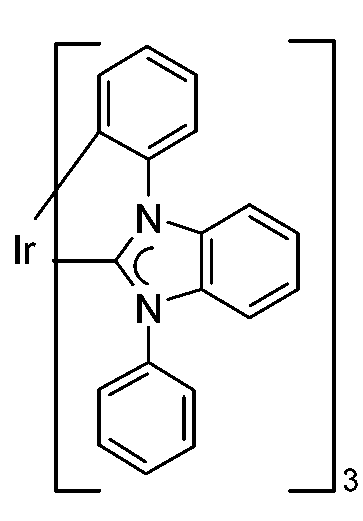
均配金屬-碳烯錯合物可以面式異構體或經式異構體之形式存在,面式異構體較佳。 Homogeneous metal-carbene complexes may exist in the form of face isomers or meridional isomers, and face isomers are preferred.
在混配金屬-碳烯錯合物之狀況下,可存在四種不同異構體,假面式異構體較佳。 In the case of mixing metal-carbene complexes, four different isomers can exist, and the pseudo-face isomer is preferred.
發光層除發射極材料以外亦可包含其他組分。舉例而言,螢光染料可存在於發光層中以改變發射極材料之發射色彩。另外,在一較佳實施例中,可使用基質材料。此基質材料可為聚合物,例如聚(N-乙烯基咔唑)或聚矽烷。然而,基質材料可為小分子,例如4,4'-N,N'-二咔唑聯苯(CDP=CBP)或三級芳族胺,例如TCTA。在本發明之一較佳實施例中,至少一種式I化合物用作基質材料。 In addition to the emitter material, the light-emitting layer may also contain other components. For example, fluorescent dyes can be present in the light-emitting layer to change the emission color of the emitter material. In addition, in a preferred embodiment, a matrix material may be used. The matrix material can be a polymer, such as poly(N-vinylcarbazole) or polysilane. However, the matrix material can be small molecules, such as 4,4'-N,N'-dicarbazole biphenyl (CDP=CBP) or tertiary aromatic amines, such as TCTA. In a preferred embodiment of the present invention, at least one compound of formula I is used as the matrix material.
在一較佳實施例中,發光層由以下形成:2重量%至40重量%,較佳5重量%至35重量%之至少一種前述發射極材料及60重量%至98重量%,較佳75重量%至95重量%之至少一種前述基質材料(在一個實施例中為至少一種式I化合物),其中發射極材料與基質材料之總和合計達100重量%。 In a preferred embodiment, the light-emitting layer is formed by: 2% to 40% by weight, preferably 5% to 35% by weight of at least one of the aforementioned emitter materials and 60% to 98% by weight, preferably 75% by weight. The weight% to 95 weight% of at least one of the aforementioned matrix materials (in one embodiment, at least one compound of formula I ), wherein the sum of the emitter material and the matrix material amounts to 100% by weight.
在尤其較佳實施例中,發光層包含式I化合物,諸如



因此,與式I化合物一起在OLED中用作基質材料及/或電洞/激子阻擋材料及/或電子/激子阻擋材料及/或電洞注入材料及/或電子注入材料及/或電洞傳導材料及/或電子傳導材料,較佳用作基質材料及/或電洞/激子阻擋材料之適合金屬錯合物例如亦為如WO 2005/019373 A2、WO 2006/056418 A2、WO 2005/113704、WO 2007/115970、WO 2007/115981及WO 2008/000727中所述之碳烯錯合物。此處明確參考所引用之WO申請案之揭示內容,且此等揭示內容應視為併入本申請案之內容中。 Therefore, together with the compound of formula I, it can be used as a matrix material and/or hole/exciton blocking material and/or electron/exciton blocking material and/or hole injection material and/or electron injection material and/or electron in OLED. Hole conductive materials and/or electron conductive materials are preferably used as host materials and/or hole/exciton blocking materials suitable for metal complexes such as WO 2005/019373 A2, WO 2006/056418 A2, WO 2005 /113704, WO 2007/115970, WO 2007/115981 and WO 2008/000727 carbene complexes. The disclosure content of the cited WO application is explicitly referred to here, and such disclosure content should be deemed to be incorporated into the content of this application.
若電洞/激子阻擋層(4)不包含任何式I化合物,則OLED具有(若電洞阻擋層存在)OLED中通常所用之電洞阻擋材料,諸如2,6-雙(N-咔唑基)吡啶(mCPy)、2,9-二甲基-4,7-二苯基-1,10-啡啉(浴銅靈(bathocuproin,BCP))、雙(2-甲基-8-喹啉基)-4-苯基酚氧)鋁(III)(bis(2-methyl-8-quinolinato)-4-phenylphenylato)aluminum(III);BAlq)、啡噻嗪S,S-二氧化物衍生物及1,3,5-參(N-苯基-2-苄基咪唑基) 苯(TPBI),TPBI亦適合用作電子傳導材料。其他適合電洞阻擋劑及/或電子傳導材料為2,2',2"-(1,3,5-苯次甲基)參(1-苯基-1-H-苯并咪唑)、2-(4-聯苯基)-5-(4-第三丁基苯基)-1,3,4-噁二唑、8-羥基喹啉基鋰、4-(萘-1-基)-3,5-二苯基-4H-1,2,4-三唑、1,3-雙[2-(2,2'-聯吡啶-6-基)-1,3,4-噁二唑-5-基]苯、4,7-二苯基-1,10-啡啉、3-(4-聯苯基)-4-苯基-5-第三丁基苯基-1,2,4-三唑、6,6'-雙[5-(聯苯-4-基)-1,3,4-噁二唑-2-基]-2,2'-聯吡啶、2-苯基-9,10-二(萘-2-基)蒽、2,7-雙[2-(2,2'-聯吡啶-6-基)-1,3,4-噁二唑-5-基]-9,9-二甲基茀、1,3-雙[2-(4-第三丁基苯基)-1,3,4-噁二唑-5-基]苯、2-(萘-2-基)-4,7-二苯基-1,10-啡啉、參(2,4,6-三甲基-3-(吡啶-3-基)苯基)硼烷、2,9-雙(萘-2-基)-4,7-二苯基-1,10-啡啉、1-甲基-2-(4-(萘-2-基)苯基)-1H-咪唑并[4,5-f][1,10]啡啉。在另一實施例中,可能使用包含經由包含羰基之基團接合之芳族或雜芳族環的化合物,如WO 2006/100298中所揭示者;選自由以下組成之群的二矽烷基化合物:二矽烷基咔唑、二矽烷基苯并呋喃、二矽烷基苯并噻吩、二矽烷基苯并磷唑、二矽烷基苯并噻吩S-氧化物及二矽烷基苯并噻吩S,S-二氧化物,如例如PCT申請案PCT/EP2008/058207及PCT/EP2008/058106中所說明者,該等申請案欲在本申請案之優先日期之時公開;及如WO 2008/034758中所揭示之二矽烷基化合物,該等化合物作為電洞/激子阻擋層(4)或作為發光層(3)中之基質材料。 If the hole/exciton blocking layer (4) does not contain any compound of formula I , the OLED has (if the hole blocking layer is present) the hole blocking materials commonly used in OLEDs, such as 2,6-bis(N-carbazole) Base) pyridine (mCPy), 2,9-dimethyl-4,7-diphenyl-1,10-phenanthroline (bathocuproin (bathocuproin, BCP)), bis(2-methyl-8-quine) Aluminium(III)(bis(2-methyl-8-quinolinato)-4-phenylphenylato)aluminum(III); BAlq), phenothiazine S,S -dioxide derived And 1,3,5-ginseng (N-phenyl-2-benzylimidazolyl) benzene (TPBI), TPBI is also suitable for use as an electron conducting material. Other suitable hole blocking agents and/or electron conducting materials are 2,2',2"-(1,3,5-benzylidene) ginseng (1-phenyl-1-H-benzimidazole), 2 -(4-Biphenyl)-5-(4-tert-butylphenyl)-1,3,4-oxadiazole, 8-hydroxyquinolinyl lithium, 4-(naphthalene-1-yl)- 3,5-Diphenyl-4H-1,2,4-triazole, 1,3-bis[2-(2,2'-bipyridin-6-yl)-1,3,4-oxadiazole -5-yl]benzene, 4,7-diphenyl-1,10-phenanthroline, 3-(4-biphenyl)-4-phenyl-5-tert-butylphenyl-1,2, 4-triazole, 6,6'-bis[5-(biphenyl-4-yl)-1,3,4-oxadiazol-2-yl]-2,2'-bipyridine, 2-phenyl -9,10-bis(naphthalene-2-yl)anthracene, 2,7-bis[2-(2,2'-bipyridin-6-yl)-1,3,4-oxadiazol-5-yl ]-9,9-dimethylsulfuron, 1,3-bis[2-(4-tertiary butylphenyl)-1,3,4-oxadiazol-5-yl]benzene, 2-(naphthalene -2-yl)-4,7-diphenyl-1,10-phenanthroline, ginseng (2,4,6-trimethyl-3-(pyridin-3-yl)phenyl)borane, 2, 9-bis(naphthalen-2-yl)-4,7-diphenyl-1,10-phenanthroline, 1-methyl-2-(4-(naphthalen-2-yl)phenyl)-1H-imidazole And [4,5-f][1,10]phenanthroline. In another embodiment, it is possible to use a compound containing an aromatic or heteroaromatic ring joined via a group containing a carbonyl group, as in WO 2006/100298 Disclosed; Disilyl compounds selected from the group consisting of disilylcarbazole, disilyl benzofuran, disilyl benzothiophene, disilyl benzophosphorazole, disilyl benzothiophene S-oxide and disilyl benzothiophene S,S-dioxide, as described in, for example, PCT applications PCT/EP2008/058207 and PCT/EP2008/058106, these applications are intended to be included in this application Disclosure on the priority date; and disilyl compounds as disclosed in WO 2008/034758, which are used as hole/exciton blocking layer (4) or as a host material in the light-emitting layer (3).
本發明OLED之層(5)之適合電子傳導材料包含與類咢辛化合物螯合之金屬,諸如2,2',2"-(1,3,5-伸苯基)參[1-苯基-1H-苯并咪唑](TPBI)、參(8-喹啉基)鋁(Alq3);基於啡啉之化合物,諸如2,9-二甲基-4,7-二苯基-1,10-啡啉(DDPA=BCP)或4,7-二苯基-1,10-啡啉(DPA); 及唑化合物,諸如2-(4-聯苯基)-5-(4-第三丁基苯基)-1,3,4-噁二唑(PBD)及3-(4-聯苯基)-4-苯基-5-(4-第三丁基苯基)-1,2,4-三唑(TAZ);8-羥基喹啉基鋰(Liq);4,7-二苯基-1,10-啡啉(BPhen);雙(2-甲基-8-喹啉基)-4-(苯基酚氧)鋁(BAlq);1,3-雙[2-(2,2'-聯吡啶-6-基)-1,3,4-噁二唑-5-基]苯(Bpy-OXD);6,6'-雙[5-(聯苯-4-基)-1,3,4-噁二唑-2-基]-2,2'-聯吡啶(BP-OXD-Bpy);4-(萘-1-基)-3,5-二苯基-4H-1,2,4-三唑(NTAZ);2,9-雙(萘-2-基)-4,7-二苯基-1,10-啡啉(NBphen);2,7-雙[2-(2,2'-聯吡啶-6-基)-1,3,4-噁二唑-5-基]-9,9-二甲基茀(Bby-FOXD);1,3-雙[2-(4-第三丁基苯基)-1,3,4-噁二唑-5-基]苯(OXD-7);參(2,4,6-三甲基-3-(吡啶-3-基)苯基)硼烷(3TPYMB);1-甲基-2-(4-(萘-2-基)苯基)-1H-咪唑并[4,5-f][1,10]啡啉(2-NPIP);2-苯基-9,10-二(萘-2-基)蒽(PADN);2-(萘-2-基)-4,7-二苯基-1,10-啡啉(HNBphen)。層(5)可用以促進電子傳輸且充當緩衝層或障壁層以防止在OLED各層之界面處激子淬滅。層(5)較佳改良電子移動力且減少激子淬滅。在一較佳實施例中,TPBI用作電子傳導材料。在另一較佳實施例中,BCP用作電子傳導材料。原則上,電子傳導層可能包含至少一種式I化合物作為電子傳導材料。 The suitable electron conducting material of the layer (5) of the OLED of the present invention contains a metal chelated with an octyl-like compound, such as 2,2',2"-(1,3,5-phenylene) ginseng [1-phenyl] -1H-benzimidazole] (TPBI), (8-quinolinyl) aluminum (Alq 3 ); phenanthroline-based compounds, such as 2,9-dimethyl-4,7-diphenyl-1, 10-phenanthroline (DDPA=BCP) or 4,7-diphenyl-1,10-phenanthroline (DPA); and azole compounds such as 2-(4-biphenyl)-5-(4-third Butylphenyl)-1,3,4-oxadiazole (PBD) and 3-(4-biphenyl)-4-phenyl-5-(4-tert-butylphenyl)-1,2 ,4-Triazole (TAZ); Lithium 8-quinolinyl (Liq); 4,7-Diphenyl-1,10-phenanthroline (BPhen); Bis(2-methyl-8-quinolinyl) )-4-(phenylphenoxy) aluminum (BAlq); 1,3-bis[2-(2,2'-bipyridin-6-yl)-1,3,4-oxadiazol-5-yl ] Benzene (Bpy-OXD); 6,6'-bis[5-(biphenyl-4-yl)-1,3,4-oxadiazol-2-yl]-2,2'-bipyridine (BP -OXD-Bpy); 4-(naphthalene-1-yl)-3,5-diphenyl-4H-1,2,4-triazole (NTAZ); 2,9-bis(naphthalene-2-yl) -4,7-Diphenyl-1,10-phenanthroline (NBphen); 2,7-bis[2-(2,2'-bipyridin-6-yl)-1,3,4-oxadiazole -5-yl]-9,9-dimethylsulfuron (Bby-FOXD); 1,3-bis[2-(4-tertiary butylphenyl)-1,3,4-oxadiazole-5 -Yl]benzene (OXD-7); cf. (2,4,6-trimethyl-3-(pyridin-3-yl)phenyl)borane (3TPYMB); 1-methyl-2-(4- (Naphthalene-2-yl)phenyl)-1H-imidazo[4,5-f][1,10]phenanthroline (2-NPIP); 2-phenyl-9,10-bis(naphthalene-2- Base) anthracene (PADN); 2-(naphthalene-2-yl)-4,7-diphenyl-1,10-phenanthroline (HNBphen). Layer (5) can be used to promote electron transport and act as a buffer layer or barrier Layer to prevent exciton quenching at the interface of each layer of OLED. Layer (5) preferably improves electron mobility and reduces exciton quenching. In a preferred embodiment, TPBI is used as an electron conducting material. In another preferred embodiment, In a preferred embodiment, BCP is used as the electron conducting material. In principle, the electron conducting layer may contain at least one compound of formula I as the electron conducting material.
在上文所提及之作為電洞傳導材料及電子傳導材料之材料中,一些材料可發揮數種功能。舉例而言,一些電子傳導材料當具有低位HOMO時,其同時為電洞阻斷材料。此等材料可用於例如電洞/激子阻擋層(4)中。然而,層(5)同樣可能亦發揮電洞/激子阻擋功能,由此可省卻層(4)。 Among the materials mentioned above as hole-conducting materials and electron-conducting materials, some materials can perform several functions. For example, when some electron conductive materials have low-level HOMO, they are also hole blocking materials. These materials can be used, for example, in the hole/exciton blocking layer (4). However, layer (5) may also perform hole/exciton blocking function, so that layer (4) can be omitted.
亦可將電荷傳輸層電子摻雜以改良所用材料之傳輸特性,以首 先使層厚度更充足(避免針孔/短路),其次使裝置之操作電壓降至最低。舉例而言,電洞傳導材料可摻雜有電子受體;例如,酞菁或芳基胺(諸如TPD或TDTA)可摻雜有四氟四氰基對醌二甲烷(F4-TCNQ)或摻雜有MoO3或WO3。電子傳導材料可摻雜有例如鹼金屬,例如Alq3摻雜有鋰。另外,電子導體可摻雜有鹽,諸如Cs2CO3或8-羥基喹啉基鋰(Liq)。電子摻雜為熟習此項技術者所知且揭示於例如以下文獻中:W.Gao,A.Kahn,J.Appl.Phys.,第94卷,第1期,2003年7月1日(p型摻雜有機層);A.G.Werner,F.Li,K.Harada,M.Pfeiffer,T.Fritz,K.Leo.Appl.Phys.Lett.,第82卷,第25期,2003年6月23日;及Pfeiffer等人,Organic Electronics 2003,4,89-103。舉例而言,電洞傳導層除碳烯錯合物(例如Ir(dpbic)3)以外亦可摻雜有MoO3或WO3。舉例而言,電子傳導層可包含摻雜有Cs2CO3之BCP。 The charge transport layer can also be doped with electrons to improve the transport characteristics of the materials used, so as to first make the layer thickness more sufficient (to avoid pinholes/short circuits), and secondly to minimize the operating voltage of the device. For example, the hole conducting material can be doped with electron acceptors; for example, phthalocyanine or arylamine (such as TPD or TDTA) can be doped with tetrafluorotetracyanoquinodimethane (F4-TCNQ) or doped Doped with MoO 3 or WO 3 . The electron conductive material may be doped with, for example, an alkali metal, such as Alq 3 doped with lithium. In addition, the electronic conductor may be doped with a salt such as Cs 2 CO 3 or 8-quinolinyl lithium (Liq). Electron doping is known to those who are familiar with the technology and is disclosed in, for example, the following documents: W. Gao, A. Kahn, J. Appl. Phys., Vol. 94, Issue 1, July 1, 2003 (p Type doped organic layer); AGWerner, F. Li, K. Harada, M. Pfeiffer, T. Fritz, K. Leo. Appl. Phys. Lett., Vol. 82, No. 25, June 23, 2003 ; And Pfeiffer et al., Organic Electronics 2003, 4, 89-103. For example, in addition to carbene complexes (such as Ir(dpbic) 3 ), the hole conductive layer can also be doped with MoO 3 or WO 3 . For example, the electron conductive layer may include BCP doped with Cs 2 CO 3 .
陰極(6)為用以引入電子或負電荷載流子之電極。陰極之適合材料係選自由以下組成之群:Ia族鹼金屬,例如Li、Cs;IIa族鹼土金屬,例如鈣、鋇或鎂;元素週期表(舊IUPAC版)之IIb族金屬,包含鑭系元素及錒系元素,例如釤。另外,亦可能使用諸如鋁或銦之金屬,及所提及之所有金屬之組合。另外,包含鹼金屬(尤其鋰)之有機金屬化合物或諸如LiF、CsF或KF之鹼金屬氟化物可施加於有機層與陰極之間以降低操作電壓。 The cathode (6) is an electrode used to introduce electrons or negative charge carriers. Suitable materials for the cathode are selected from the group consisting of: group Ia alkali metals, such as Li, Cs; group IIa alkaline earth metals, such as calcium, barium or magnesium; group IIb metals of the periodic table (old IUPAC version), including lanthanides Elements and actinides, such as samarium. In addition, it is also possible to use metals such as aluminum or indium, and combinations of all the metals mentioned. In addition, organic metal compounds containing alkali metals (especially lithium) or alkali metal fluorides such as LiF, CsF, or KF may be applied between the organic layer and the cathode to reduce the operating voltage.
本發明之OLED可另外包含熟習此項技術者已知之其他層。舉例而言,促進正電荷傳輸及/或使各層之能帶隙彼此匹配之層可施加於層(2)與發光層(3)之間。或者,此另一層可充當保護層。以類似方式,其他層可存在於發光層(3)與層(4)之間以促進負電荷傳輸及/或使 各層之間的能帶隙彼此匹配。或者,此層可充當保護層。 The OLED of the present invention may additionally include other layers known to those skilled in the art. For example, a layer that promotes positive charge transport and/or matches the energy band gap of each layer can be applied between the layer (2) and the light-emitting layer (3). Alternatively, this other layer may serve as a protective layer. In a similar manner, other layers can exist between the light-emitting layer (3) and the layer (4) to promote negative charge transport and/or make The energy band gaps between the layers match each other. Alternatively, this layer can serve as a protective layer.
在一較佳實施例中,本發明OLED除層(1)至(6)以外亦包含下文所提及之以下各層中之至少一者:介於陽極(1)與電洞傳輸層(2)之間的電洞注入層,其厚度為2至100nm,較佳為5至50nm;介於電洞傳輸層(2)與發光層(3)之間的電子阻擋層;介於電子傳輸層(5)與陰極(6)之間的電子注入層。 In a preferred embodiment, in addition to layers (1) to (6), the OLED of the present invention also includes at least one of the following layers mentioned below: between the anode (1) and the hole transport layer (2) The hole injection layer in between has a thickness of 2 to 100 nm, preferably 5 to 50 nm; an electron blocking layer between the hole transport layer (2) and the light emitting layer (3); and an electron transport layer ( 5) The electron injection layer between the cathode (6).
電洞注入層之材料可選自銅酞菁、4,4',4"-參(N-3-甲基苯基-N-苯基胺基)三苯胺(m-MTDATA)、4,4',4"-參(N-(2-萘基)-N-苯基胺基)三苯胺(2T-NATA)、4,4',4"-參(N-(1-萘基)-N-苯基胺基)三苯胺(1T-NATA)、4,4',4"-參(N,N-二苯基胺基)三苯胺(NATA)、氧化鈦酞菁、2,3,5,6-四氟-7,7,8,8-四氰基對醌二甲烷(F4-TCNQ)、吡嗪并[2,3-f][1,10]啡啉-2,3-二甲腈(PPDN)、N,N,N',N'-肆(4-甲氧基苯基)聯苯胺(MeO-TPD)、2,7-雙[N,N-雙(4-甲氧基苯基)胺基]-9,9-螺二茀(MeO-Spiro-TPD)、2,2'-雙[N,N-雙(4-甲氧基苯基)胺基]-9,9-螺二茀(2,2'-MeO-Spiro-TPD)、N,N'-二苯基-N,N'-二[4-(N,N-二甲苯基胺基)苯基]聯苯胺(NTNPB)、N,N'-二苯基-N,N'-二[4-(N,N-二苯基胺基)苯基]聯苯胺(NPNPB)、N,N'-二(萘-2-基)-N,N'-二苯基苯-1,4-二胺(α-NPP)。原則上,電洞注入層可能包含至少一種式I化合物作為電洞注入材料。另外,可使用聚合電洞注入材料,諸如聚(N-乙烯基咔唑)(PVK);聚噻吩;聚吡咯;聚苯胺;自摻雜聚合物,諸如磺化聚(噻吩-3-[2[(2-甲氧基乙氧基)乙氧基]-2,5-二基)(Plexcore® OC Conducting Inks,可購自Plextronics);及共聚物,諸如聚(3,4-伸乙二氧基噻吩)/聚(4-苯乙烯磺 酸酯),亦稱為PEDOT/PSS。 The material of the hole injection layer can be selected from copper phthalocyanine, 4,4',4"-ginseng (N-3-methylphenyl-N-phenylamino) triphenylamine (m-MTDATA), 4,4 ',4"-reference (N-(2-naphthyl)-N-phenylamino) triphenylamine (2T-NATA), 4,4',4"-reference (N-(1-naphthyl)- N-phenylamino) triphenylamine (1T-NATA), 4,4',4"-parameter (N,N-diphenylamino) triphenylamine (NATA), titanium oxide phthalocyanine, 2,3, 5,6-Tetrafluoro-7,7,8,8-tetracyanoquinodimethane (F4-TCNQ), pyrazino[2,3-f][1,10]phenanthroline-2,3- Dicarbonitrile (PPDN), N,N,N',N'-four (4-methoxyphenyl) benzidine (MeO-TPD), 2,7-bis(N,N-bis(4-methyl (Oxyphenyl)amino]-9,9-Spiro-TPD (MeO-Spiro-TPD), 2,2'-bis[N,N-bis(4-methoxyphenyl)amino]-9 ,9-Spiro Difu (2,2'-MeO-Spiro-TPD), N,N'-Diphenyl-N,N'-bis[4-(N,N-xylylamino)phenyl ]Benzidine (NTNPB), N,N'-diphenyl-N,N'-bis[4-(N,N-diphenylamino)phenyl]benzidine (NPNPB), N,N'- Di(naphthalene-2-yl)-N,N'-diphenylbenzene-1,4-diamine (α-NPP). In principle, the hole injection layer may contain at least one compound of formula I as the hole injection material. In addition, polymeric hole injection materials can be used, such as poly(N-vinylcarbazole) (PVK); polythiophene; polypyrrole; polyaniline; self-doping polymers, such as sulfonated poly(thiophen-3-[2 [(2-Methoxyethoxy)ethoxy]-2,5-diyl) (Plexcore ® OC Conducting Inks, available from Plextronics); and copolymers, such as poly(3,4-ethylene ethylene two Oxythiophene)/poly(4-styrene sulfonate), also known as PEDOT/PSS.
可選擇例如LiF作為電子注入層之材料。原則上,電子注入層可能包含至少一種式I化合物作為電子注入材料。 For example, LiF can be selected as the material of the electron injection layer. In principle, the electron injection layer may contain at least one compound of formula I as an electron injection material.
熟習此項技術者瞭解(例如基於電化學研究)如何選擇適合材料。個別層之適合材料為熟習此項技術者所知且揭示於例如WO 00/70655中。 Those who are familiar with this technology understand (for example, based on electrochemical research) how to select suitable materials. Suitable materials for the individual layers are known to those skilled in the art and are disclosed in, for example, WO 00/70655.
另外,本發明OLED中所用之一些層可能已經表面處理以增加電荷載流子傳輸之效率。所提及之各層之材料的選擇較佳由獲得具有高效率及長壽命之OLED來決定。 In addition, some layers used in the OLED of the present invention may have been surface-treated to increase the efficiency of charge carrier transport. The selection of the materials of the various layers mentioned is preferably determined by obtaining an OLED with high efficiency and long life.
本發明OLED可由熟習此項技術者已知之方法製備。一般而言,本發明OLED係藉由將個別層連續氣相沈積至適合基板上來製備。適合基板為例如玻璃、無機半導體或聚合物膜。對於氣相沈積,可能使用常規技術,諸如熱蒸鍍、化學氣相沈積(CVD)、物理氣相沈積(PVD)及其他技術。在一替代性製程中,可採用熟習此項技術者已知之塗覆技術,自於適合溶劑中之溶液或分散液塗佈OLED之有機層。 The OLED of the present invention can be prepared by methods known to those skilled in the art. Generally speaking, the OLED of the present invention is prepared by continuous vapor deposition of individual layers on a suitable substrate. Suitable substrates are, for example, glass, inorganic semiconductors or polymer films. For vapor deposition, conventional techniques such as thermal evaporation, chemical vapor deposition (CVD), physical vapor deposition (PVD), and other techniques may be used. In an alternative process, a coating technique known to those skilled in the art can be used to coat the organic layer of the OLED from a solution or dispersion in a suitable solvent.
一般而言,不同層具有以下厚度:陽極(1)50至500nm,較佳為100至200nm;電洞傳導層(2)5至100nm,較佳為20至80nm;發光層(3)1至100nm,較佳為10至80nm;電洞/激子阻擋層(4)2至100nm,較佳為5至50nm;電子傳導層(5)5至100nm,較佳為20至80nm;陰極(6)20至1000nm,較佳為30至500nm。本發明OLED中電洞與電子之再結合區關於陰極的相對位置及由此OLED之發射光譜可尤其受以下因素影響:各層之相對厚度。此意謂應較佳選擇電子傳輸層之厚度,使得再結合區之位置與二極體之光學諧振器特性匹配且由此與發 射極之發射波長匹配。OLED中個別層之層厚度之比率取決於所用材料。所用之任何其他層之層厚度為熟習此項技術者所知。電子傳導層及/或電洞傳導層之厚度可能大於其經電性摻雜時所指出之層厚度。 Generally speaking, the different layers have the following thicknesses: anode (1) 50 to 500 nm, preferably 100 to 200 nm; hole conductive layer (2) 5 to 100 nm, preferably 20 to 80 nm; light emitting layer (3) 1 to 100nm, preferably 10 to 80nm; hole/exciton blocking layer (4) 2 to 100nm, preferably 5 to 50nm; electron conducting layer (5) 5 to 100nm, preferably 20 to 80nm; cathode (6) ) 20 to 1000 nm, preferably 30 to 500 nm. The relative position of the recombination region of holes and electrons in the OLED of the present invention with respect to the cathode and thus the emission spectrum of the OLED can be particularly affected by the following factors: the relative thickness of each layer. This means that the thickness of the electron transport layer should be better selected so that the position of the recombination zone matches the characteristics of the optical resonator of the diode, and thus is consistent with The emission wavelength of the emitter is matched. The ratio of the layer thickness of the individual layers in an OLED depends on the materials used. The layer thicknesses of any other layers used are known to those skilled in the art. The thickness of the electron conductive layer and/or the hole conductive layer may be greater than the layer thickness indicated when it is electrically doped.
式I化合物用於OLED之至少一個層中,較佳用於發光層中(較佳作為基質材料)及/或電洞/激子阻擋層中使得獲得具有高效率且具有低使用電壓及操作電壓之OLED成為可能。藉由使用式I化合物獲得之OLED常常另外具有長壽命。OLED之效率可另外藉由使OLED之其他層最佳化而改良。舉例而言,可使用諸如Ca或Ba之高效率陰極,適當時與LiF之中間層組合。使操作電壓降低或量子效率增加之成形基板及新穎電洞傳輸材料同樣可用於本發明OLED中。此外,其他層可存在於OLED中以調整不同層之能量位準及促進電致發光。 The compound of formula I is used in at least one layer of the OLED, preferably in the light-emitting layer (preferably as a host material) and/or in the hole/exciton blocking layer to achieve high efficiency and low use voltage and operating voltage OLED becomes possible. OLEDs obtained by using compounds of formula I often additionally have a long lifetime. The efficiency of OLED can be further improved by optimizing other layers of OLED. For example, a high-efficiency cathode such as Ca or Ba can be used, combined with an intermediate layer of LiF when appropriate. Shaped substrates and novel hole transport materials that reduce the operating voltage or increase the quantum efficiency can also be used in the OLED of the present invention. In addition, other layers can be present in the OLED to adjust the energy levels of different layers and promote electroluminescence.
OLED可另外包含至少一個第二發光層。OLED之總體發射可由至少兩個發光層之發射構成且亦可包含白光。 The OLED may additionally include at least one second light-emitting layer. The overall emission of the OLED can be composed of the emission of at least two light-emitting layers and can also include white light.
OLED可用於電致發光適用之所有設備中。適合裝置較佳係選自固定及移動視覺顯示單元及照明單元。固定視覺顯示單元為例如電腦、電視之視覺顯示單元,印表機、廚房器具及廣告面板、照明及資訊面板中之視覺顯示單元。移動視覺顯示單元為例如行動電話、平板型PC、膝上型電腦、數位相機、MP3播放器、載具中之視覺顯示單元,及公車及列車上之目的地顯示器。可使用本發明OLED之其他裝置為例如鍵盤;衣物;傢俱;壁紙。 OLED can be used in all devices suitable for electroluminescence. Suitable devices are preferably selected from fixed and mobile visual display units and lighting units. The fixed visual display unit is, for example, the visual display unit of computers and televisions, the visual display units of printers, kitchen appliances and advertising panels, lighting and information panels. Mobile visual display units are, for example, mobile phones, tablet PCs, laptops, digital cameras, MP3 players, visual display units in vehicles, and destination displays on buses and trains. Other devices that can use the OLED of the present invention are, for example, keyboards; clothing; furniture; wallpapers.
另外,本發明係關於一種選自由以下組成之群的裝置:固定視覺顯示單元,諸如電腦、電視之視覺顯示單元,印表機、廚房器具及廣告面板、照明、資訊面板中之視覺顯示單元;及移動視覺顯示單 元,諸如行動電話、平板型PC、膝上型電腦、數位相機、MP3播放器、載具中之視覺顯示單元,及公車及列車上之目的地顯示器;照明單元;鍵盤;衣物;傢俱;壁紙,其包含至少一個本發明有機發光二極體或至少一個本發明發光層。 In addition, the present invention relates to a device selected from the group consisting of: fixed visual display units, visual display units such as computers and televisions, visual display units in printers, kitchen appliances and advertising panels, lighting, and information panels; And mobile visual display Yuan, such as mobile phones, tablet PCs, laptops, digital cameras, MP3 players, visual display units in vehicles, and destination displays on buses and trains; lighting units; keyboards; clothing; furniture; wallpapers , Which comprises at least one organic light emitting diode of the present invention or at least one light emitting layer of the present invention.
以下實例僅出於說明之目的而納入且不限制申請專利範圍之範疇。除非另有規定,否則所有份數及百分比皆以重量計。 The following examples are included for illustrative purposes only and do not limit the scope of the patent application. Unless otherwise specified, all parts and percentages are by weight.

a)在-78℃下於氬氣下,將16.4ml(27.9mmol)第三丁基鋰之戊烷溶液添加至5.00g(12.1mmol)9-(8-溴二苯并呋喃-2-基)咔唑(其合成描述於WO 2010079051中)於30ml無水四氫呋喃(THF)中之溶液中。15分鐘後,緩慢添加2.93g(15.8mmol)2-異丙氧基-4,4,5,5-四甲基-1,3,2-二氧硼

b)在180℃下,將11.3g(50.0mmol)3-(2-胺基苯基)-1H-苯并咪唑-2-酮添加至50g聚磷酸中。在220℃下於氮氣下攪拌反應混合物3小時且傾倒至水中。濾出產物且用水及甲醇洗滌。將50ml 30%氫氧化鈉溶液添加至產物於200ml THF中之懸浮液中。攪拌混合物30分鐘,且分離有機相,經硫酸鎂乾燥且蒸餾出溶劑。獲得9.26g化合物2(產率:89%)。 1 H NMR(400MHz,DMSO-d6):δ 7.88(d,J=7.7Hz,2H),7.39(d,J=8.0Hz,2H),7.12-7.16(m,2H),6.97-7.01(m,2H)。 b) At 180°C, 11.3 g (50.0 mmol) of 3-(2-aminophenyl)-1H-benzimidazol-2-one was added to 50 g of polyphosphoric acid. The reaction mixture was stirred at 220°C under nitrogen for 3 hours and poured into water. The product was filtered off and washed with water and methanol. 50ml 30% sodium hydroxide solution was added to the suspension of the product in 200ml THF. The mixture was stirred for 30 minutes, and the organic phase was separated, dried over magnesium sulfate and the solvent was distilled off. 9.26 g of compound 2 was obtained (yield: 89%). 1 H NMR (400MHz, DMSO-d6): δ 7.88(d,J=7.7Hz,2H), 7.39(d,J=8.0Hz,2H), 7.12-7.16(m,2H), 6.97-7.01(m ,2H).
5H-苯并咪唑并[1,2-a]苯并咪唑及3-(2-胺基苯基)-1H-苯并咪唑-2-酮之合成描述於Bull.Soc.Chem.Belg.96(1987)787中。 The synthesis of 5H-benzimidazo[1,2-a]benzimidazole and 3-(2-aminophenyl)-1H-benzimidazole-2-one is described in Bull.Soc.Chem.Belg.96 ( 1987 ) 787.

c)在氮氣下,將5.00g(13.4mmol)2-溴-8-碘-二苯并呋喃(其合成描述於EP1885818中)、8.74g(26.8mmol)碳酸銫、255mg(1.34mmol)碘化銅(I)及309mg(2.68mmol)L-脯胺酸添加至含2.78g(13.4mmol)5H-苯并咪唑并[1,2-a]苯并咪唑之75ml二甲基甲醯胺中。在150℃下加熱反應混合物19小時,且在Hyflo Super Cel(R)介質(Fluka 56678,CAS[91053-39-3])上用THF過濾。用水洗滌有機相。蒸餾出溶劑。用甲苯/乙酸乙酯19/1進行矽膠管柱層析,得到化合物3(產量: 2.29g(37.7%))。 1 H NMR(400MHz,THF-d8):δ 8.66(s,1H),8.41(s,1H),8-01-8-16(m,3H),7.89(d,J=8.8Hz,1H),7.63-7.75(m,4H),7.25-7.49(m,4H)。 c) Under nitrogen, 5.00g (13.4mmol) 2-bromo-8-iodo-dibenzofuran (the synthesis is described in EP1885818), 8.74g (26.8mmol) cesium carbonate, 255mg (1.34mmol) iodide Copper (I) and 309 mg (2.68 mmol) of L-proline were added to 75 ml of dimethylformamide containing 2.78 g (13.4 mmol) of 5H-benzimidazo[1,2-a]benzimidazole. The reaction mixture was heated at 150°C for 19 hours and filtered with THF over Hyflo Super Cel(R) medium (Fluka 56678, CAS [91053-39-3]). Wash the organic phase with water. The solvent is distilled off. Silica gel column chromatography was performed with toluene/ethyl acetate 19/1 to obtain compound 3 (yield: 2.29 g (37.7%)). 1 H NMR (400MHz,THF-d8): δ 8.66(s,1H), 8.41(s,1H), 8-01-8-16(m,3H), 7.89(d,J=8.8Hz,1H) , 7.63-7.75 (m, 4H), 7.25-7.49 (m, 4H).

d)將1.98g(3.41mmol)化合物1及4.02g(16.6mmol)單水合磷酸三鉀、15ml二噁烷、60ml甲苯及12ml水添加至1.50g(3.32mmol)化合物3中。用氬氣使混合物脫氣。添加81mg(0.199mmol)2-二環己基膦基-2',6'-二甲氧基聯苯(SPhos)及74mg(0.033mmol)乙酸鈀(II)。用氬氣使反應混合物脫氣,且在100℃下於氬氣下攪拌4.5小時。添加40ml 1%氰化鈉溶液,且使反應混合物回流1小時。添加二氯甲烷,用水洗滌有機相且經硫酸鎂乾燥。依序用甲苯及甲苯/乙酸乙酯9/1進行矽膠管柱層析,得到化合物A-1(產量:1.42g(61%))。 1 H NMR(400MHz,THF-d8):δ 8.71(s,1H),8.54-8.58(m,2H),8.41(s,1H),8.20(d,J=7.8Hz,2H),7.62-8.11(m,12H),7.26-7.31(m,10H)。 d) 1.98g (3.41mmol) of compound 1 and 4.02g (16.6mmol) of tripotassium phosphate monohydrate, 15ml of dioxane, 60ml of toluene and 12ml of water were added to 1.50g (3.32mmol) of compound 3 . The mixture was degassed with argon. 81 mg (0.199 mmol) of 2-dicyclohexylphosphino-2',6'-dimethoxybiphenyl (SPhos) and 74 mg (0.033 mmol) of palladium(II) acetate were added. The reaction mixture was degassed with argon and stirred at 100°C under argon for 4.5 hours. 40 ml of 1% sodium cyanide solution was added, and the reaction mixture was refluxed for 1 hour. Dichloromethane was added, the organic phase was washed with water and dried over magnesium sulfate. Perform silica gel column chromatography with toluene and toluene/ethyl acetate 9/1 sequentially to obtain compound A-1 (yield: 1.42 g (61%)). 1 H NMR (400MHz,THF-d8): δ 8.71 (s, 1H), 8.54-8.58 (m, 2H), 8.41 (s, 1H), 8.20 (d, J=7.8Hz, 2H), 7.62-8.11 (m, 12H), 7.26-7.31 (m, 10H).
4H-咪唑并[1,2-a]苯并咪唑之合成描述於ARKIVOC 2002(v)48-61中。 The synthesis of 4H-imidazo[1,2-a]benzimidazole is described in ARKIVOC 2002 (v) 48-61.

a)在100℃下,將含8.02g(51.0mmol)4H-咪唑并[1,2-a]苯并咪 唑、15.9g(56.1mmol)1-溴-3-碘-苯、33.2g(102mmol)碳酸銫、1.94g(10.2mol)碘化銅(I)及2.35g(20.4mol)L-脯胺酸之200ml二甲亞碸(DMSO)攪拌24小時。濾出固體且用二氯甲烷洗滌。用水洗滌有機相且經硫酸鎂乾燥。蒸餾出溶劑。依序用甲苯及甲苯/乙酸乙酯(20/1)進行管柱層析,得到產物混合物(3.89g(24%)異構體A及4.46g(28%)異構體B)。藉由用甲苯/乙酸乙酯(甲苯100%、甲苯/乙酸乙酯95/5、甲苯/乙酸乙酯90/10及乙酸乙酯100%)進行梯度管柱層析來分離兩種異構體。 a) At 100°C, add 8.02g (51.0mmol) 4H-imidazo[1,2-a]benzimid Azole, 15.9g (56.1mmol) 1-bromo-3-iodo-benzene, 33.2g (102mmol) cesium carbonate, 1.94g (10.2mol) copper(I) iodide and 2.35g (20.4mol) L-proline 200ml of dimethylsulfoxide (DMSO) was stirred for 24 hours. The solid was filtered off and washed with dichloromethane. The organic phase was washed with water and dried over magnesium sulfate. The solvent is distilled off. Column chromatography was performed sequentially with toluene and toluene/ethyl acetate (20/1) to obtain a product mixture (3.89 g (24%) isomer A and 4.46 g (28%) isomer B). Two isomers were separated by gradient column chromatography with toluene/ethyl acetate (toluene 100%, toluene/ethyl acetate 95/5, toluene/ethyl acetate 90/10 and ethyl acetate 100%) .

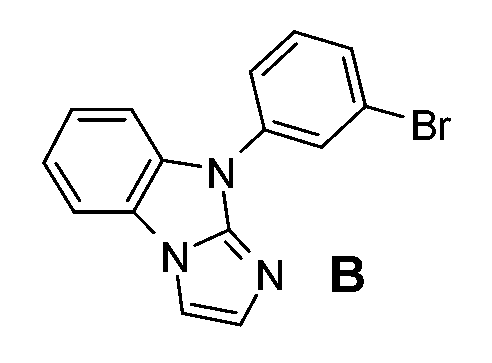
b)類似於化合物A-1之合成來進行化合物C-1之合成。 b) The synthesis of compound C-1 is carried out similar to the synthesis of compound A-1 .

c)類似於化合物A-1之合成來進行實例2c)之產物之合成。 c) The synthesis of the product of Example 2c) is carried out similarly to the synthesis of compound A-1 .

首先使用供LCD製造用之工業用清潔劑(Deconex® 20NS,及25ORGAN-ACID®中和劑),接著在超音波浴中之丙酮/異丙醇混合物中清潔用作陽極之ITO基板。為消除任何可能存在之有機殘餘物,使基板暴露於臭氧烘箱中之連續臭氧流,再持續25分鐘。此處理亦改良ITO之電洞注入特性。接著旋塗Plexcore® OC AJ20-1000(可購自Plextronics Inc.)且乾燥以形成電洞注入層(約40nm)。 First use industrial cleaners for LCD manufacturing (Deconex ® 20NS, and 25ORGAN-ACID ® neutralizer), and then clean the anode ITO substrate in the acetone/isopropanol mixture in the ultrasonic bath. In order to eliminate any possible organic residues, the substrate was exposed to a continuous flow of ozone in an ozone oven for another 25 minutes. This treatment also improves the hole injection characteristics of ITO. Plexcore ® OC AJ20-1000 (available from Plextronics Inc.) was then spin-coated and dried to form a hole injection layer (about 40 nm).
此後,藉由氣相沈積在約10-7-10-9毫巴下以約0.5-5nm/min之速
率將下文所說明之有機材料塗佈於潔淨基板上。將
隨後,藉由氣相沈積以30nm之厚度塗佈30重量%發射極化合物

隨後,藉由氣相沈積以5nm之厚度塗佈材料BAlq(
接著,藉由氣相沈積以20nm之厚度塗佈經Cs2CO3摻雜之
BCP(
所有製造部件皆於惰性氮氣氛圍中用玻璃蓋及吸氣劑密封。 All manufactured parts are sealed with glass lids and getters in an inert nitrogen atmosphere.
OLED之製備及建構如同應用實例1,但發射層僅由30重量%化合物

為表徵OLED,在各種電流及電壓下記錄電致發光光譜。另外,與所發射之光輸出組合來量測電流-電壓特徵。可藉由用光度計校準將光輸出轉換成光度參數。為測定壽命,使OLED在恆定電流密度下操作且記錄光輸出之降低。壽命定義為亮度降至初始亮度一半之前所歷經之時間。 To characterize the OLED, electroluminescence spectra were recorded at various currents and voltages. In addition, it is combined with the emitted light output to measure the current-voltage characteristics. The light output can be converted into photometric parameters by calibrating with a photometer. To determine the lifetime, the OLED was operated at a constant current density and the decrease in light output was recorded. Life is defined as the time elapsed before the brightness drops to half of the initial brightness.


在氮氣下,將3.30g(10mmol)1,3-二碘苯、13.0g(40.0mmol)碳酸銫、1.90g(1.00mmol)碘化銅(I)及2.30g(20.0mmol)L-脯胺酸添加至含4.56g(22.0mmol)5H-苯并咪唑并[1,2-a]苯并咪唑之100ml二甲亞碸(DMSO)中。在100℃下攪拌反應混合物5小時。將反應混合物傾倒至水中,且濾出產物。使產物自甲苯中結晶兩次。產量1.6g(48%)。MS(APCI(正離子模式):m/z)=489(M+1)。 1 H NMR(400MHz,THF-d8):δ 8.79(s,1H),8.22(d,J=8.4Hz,2H),8.15-8.18(m,2H),8.00-8.06(m,4H),7.88(t,J=8.1Hz,1H)7.71(d,J=7.9Hz,2H),7.41-7.49(m,4H),7.25-7.34(m,4H)。 Under nitrogen, 3.30g (10mmol) 1,3-diiodobenzene, 13.0g (40.0mmol) cesium carbonate, 1.90g (1.00mmol) copper (I) iodide and 2.30g (20.0mmol) L-proline The acid was added to 100 ml of dimethylsulfoxide (DMSO) containing 4.56 g (22.0 mmol) of 5H-benzimidazo[1,2-a]benzimidazole. The reaction mixture was stirred at 100°C for 5 hours. The reaction mixture was poured into water, and the product was filtered off. The product was crystallized twice from toluene. The yield is 1.6g (48%). MS (APCI (positive ion mode): m/z)=489 (M +1 ). 1 H NMR (400MHz, THF-d8): δ 8.79 (s, 1H), 8.22 (d, J=8.4 Hz, 2H), 8.15-8.18 (m, 2H), 8.00-8.06 (m, 4H), 7.88 (t, J=8.1 Hz, 1H) 7.71 (d, J=7.9 Hz, 2H), 7.41-7.49 (m, 4H), 7.25-7.34 (m, 4H).
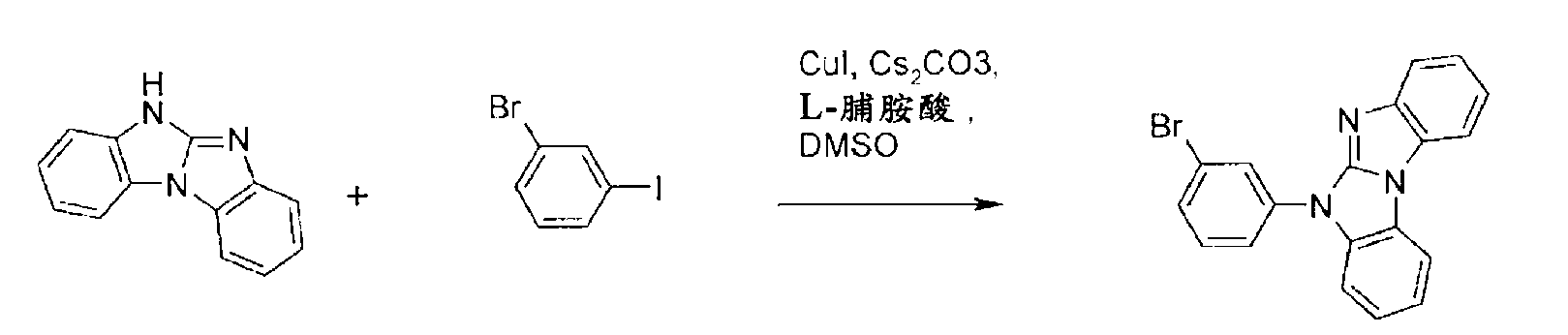
a)在氮氣下,將7.78g(25mmol)1-溴-3-碘-苯、16.3g(50.0mmol)碳酸銫、1.24g(6.50mmol)碘化銅(I)及1.50g(13.0mmol)L-脯胺酸添加至含5.18g(25.0mmol)5H-苯并咪唑并[1,2-a]苯并咪唑之100ml二甲亞碸(DMSO)中。在100℃下攪拌反應混合物18小時。將反應混合物傾倒至水中。用二氯甲烷萃取有機相。經硫酸鎂乾燥有機相。蒸餾出溶劑。用甲苯進行矽膠管柱層析,得到產物。產量8.35g(92%)。 1 H NMR(400MHz,CDCl3):δ 8.25(s,1H),7.90-8.05(m,3H),7.95-8.05(m,3H),7.71(d,J=7.9Hz,1H),7.65(d,J=7.9Hz,1H),7.50-7.65 (m,2H),7.26-7.45(m,4H)。 a) Under nitrogen, combine 7.78g (25mmol) 1-bromo-3-iodo-benzene, 16.3g (50.0mmol) cesium carbonate, 1.24g (6.50mmol) copper(I) iodide and 1.50g (13.0mmol) L-proline acid was added to 100ml dimethylsulfoxide (DMSO) containing 5.18g (25.0mmol) of 5H-benzimidazo[1,2-a]benzimidazole. The reaction mixture was stirred at 100°C for 18 hours. The reaction mixture was poured into water. The organic phase was extracted with dichloromethane. The organic phase was dried over magnesium sulfate. The solvent is distilled off. Perform silica gel column chromatography with toluene to obtain the product. The yield is 8.35g (92%). 1 H NMR (400MHz, CDCl 3 ): δ 8.25 (s, 1H), 7.90-8.05 (m, 3H), 7.95-8.05 (m, 3H), 7.71 (d, J=7.9 Hz, 1H), 7.65 ( d, J=7.9Hz, 1H), 7.50-7.65 (m, 2H), 7.26-7.45 (m, 4H).

b)用氬氣使含1.09g(3.00mmol)實例4a)之產物、690mg(2.70mmol)4,4,5,5-四甲基-2-(4,4,5,5-四甲基-1,3,2-二氧硼

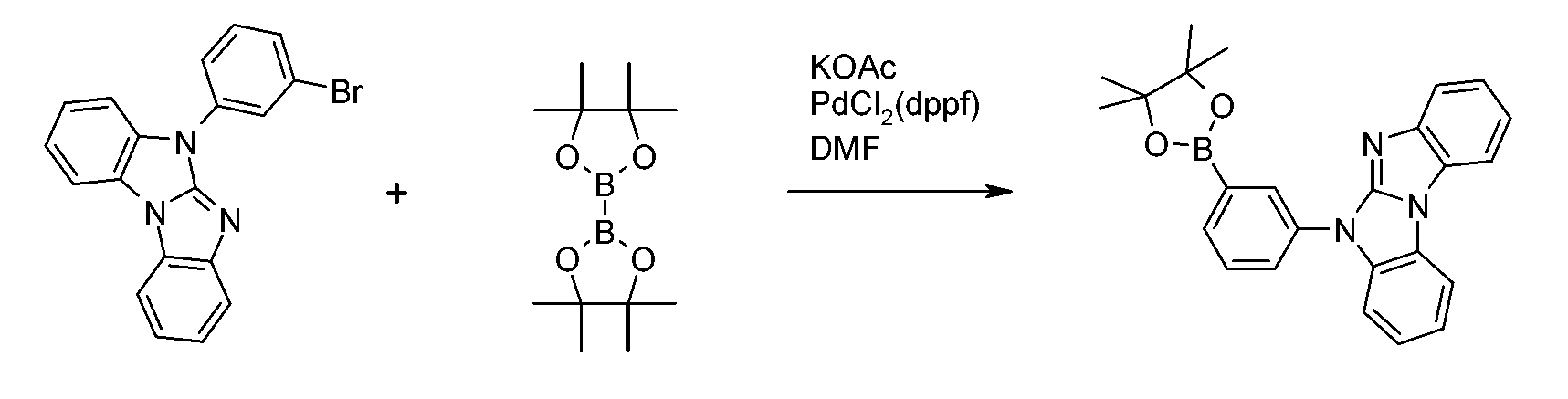
a)用氬氣使含5.78g(16.0mmol)實例4a)之產物、12.16g(47.8mmol)4,4,5,5-四甲基-2-(4,4,5,5-四甲基-1,3,2-二氧硼


b)將2.72g(6.01mmol)5-(8-溴二苯并呋喃-2-基)苯并咪唑并[1,2-a]苯并咪唑及6.92g(3.01mmol)單水合磷酸三鉀、27ml二噁烷、100ml甲苯及21ml水添加至3.20g(7.82mmol)5-[3-(4,4,5,5-四甲基-1,3,2-二氧硼
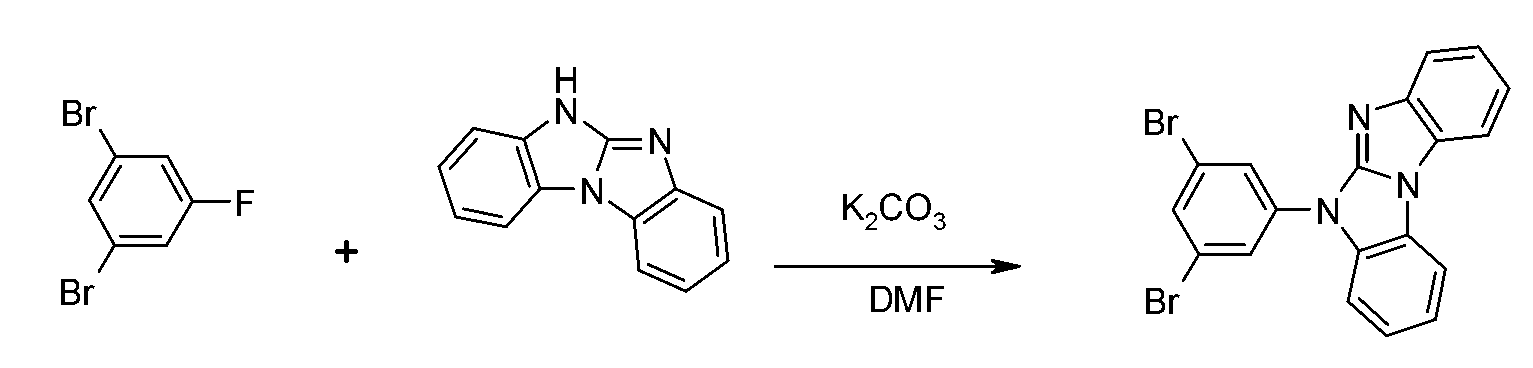
a)在170℃下,將含20.0g(78.8mmol)1,3-二溴-5-氟-苯、16.3g(78.8mmol)6H-苯并咪唑并[1,2-a]苯并咪唑及43.5g(0.315mmol)碳酸鉀之200ml DMF攪拌17小時。趁熱過濾反應混合物,且冷卻後過濾來自母液之沈澱物。用水及乙醇洗滌產物且與乙醚及乙醇一起蒸煮。產量21.2g(61%)。 1 H NMR(400MHz,THF-d8):δ 8.21-8.26(m,4H),7.98-7.800(m,1H),7.68-7.73(m,2H),7.31-7.49(m,4H)。 a) At 170°C, the mixture containing 20.0g (78.8mmol) 1,3-dibromo-5-fluoro-benzene, 16.3g (78.8mmol) 6H-benzimidazo[1,2-a]benzimidazole And 43.5g (0.315mmol) potassium carbonate in 200ml DMF and stirred for 17 hours. The reaction mixture was filtered while hot, and after cooling, the precipitate from the mother liquor was filtered. The product was washed with water and ethanol and cooked with ether and ethanol. The yield is 21.2g (61%). 1 H NMR (400MHz, THF-d8): δ 8.21-8.26 (m, 4H), 7.98-7.800 (m, 1H), 7.68-7.73 (m, 2H), 7.31-7.49 (m, 4H).

b)將2.00g(4.53mmol)5-(3,5-二溴苯基)苯并咪唑并[1,2-a]苯并咪唑及4.15g(3.00mmol)碳酸鉀、27ml二噁烷、100ml甲苯及21ml水添加至3.20g(7.82mmol)2-二苯并呋喃-2-基-4,4,5,5-四甲基-1,3,2-二氧硼
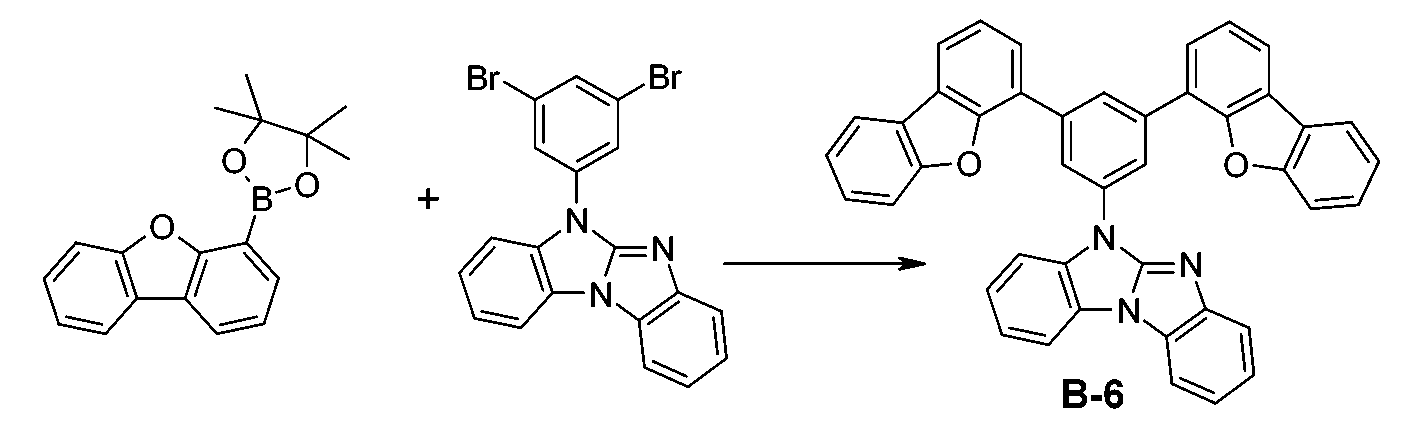
類似於實例6中所述之程序來製備實例7之產物。 1 H NMR(400MHz,DMSO-d6):δ 8.59(d,J=1.5Hz,2H),8.46-8.47(m,1H),8.24-8.33(m,6H),8.13(d,J=8.0Hz,1H),7.99-8.01(m,2H),7.78(d,J=8.2Hz,2H),7.37-7.68(m,9H),7.29-7.37(m,2H)。 The product of Example 7 was prepared similarly to the procedure described in Example 6. 1 H NMR (400MHz,DMSO-d6): δ 8.59(d,J=1.5Hz,2H),8.46-8.47(m,1H),8.24-8.33(m,6H),8.13(d,J=8.0Hz) , 1H), 7.99-8.01 (m, 2H), 7.78 (d, J=8.2 Hz, 2H), 7.37-7.68 (m, 9H), 7.29-7.37 (m, 2H).

將3.85g(8.51mmol)5-(8-溴二苯并呋喃-2-基)苯并咪唑并[1,2-a]苯并咪唑及10.3g(4.26mmol)單水合磷酸三鉀、20ml二噁烷、80ml二甲苯及16ml水添加至2.01g(4.09mmol)4,4,5,5-四甲基-2-[3-(4,4,5,5-四甲基-1,3,2-二氧硼


a)根據WO 2011/111423之實例13製備2,6-二碘-二苯并呋喃且藉由自環己烷中結晶而純化。 a) 2,6-Diiodo-dibenzofuran was prepared according to Example 13 of WO 2011/111423 and purified by crystallization from cyclohexane.

b)類似於實例5中所述之程序來製備實例9之產物。 b) The product of Example 9 was prepared similarly to the procedure described in Example 5 .

在氮氣下,將4.20g(10mmol)2,8-二碘二苯并呋喃、13.0g(40.0mmol)碳酸銫、1.90g(1.00mmol)碘化銅(I)及2.30g(20.0mmol)L-脯胺酸添加至含4.56g(22.0mmol)5H-苯并咪唑并[1,2-a]苯并咪唑之100ml 二甲亞碸(DMSO)中。在100℃下攪拌反應混合物24小時,過濾且用二氯甲烷洗滌。經硫酸鎂乾燥有機相,且蒸餾出溶劑。使產物自乙醚中結晶。產量4.7g(81%)。 1 H NMR(400MHz,THF-d8):δ 8.73(d,J=1.2Hz,2H),8.14(d,J=2.3Hz,J=8.8Hz,2H),7.96-8.02(m,4H),7.92(d,J=8.8Hz,2H),7.70-7.73(m,2H),7.62(d,J=7.1Hz,2H),7.25-7.40(m,8 H)。 Under nitrogen, 4.20g (10mmol) 2,8-diiodo dibenzofuran, 13.0g (40.0mmol) cesium carbonate, 1.90g (1.00mmol) copper (I) iodide and 2.30g (20.0mmol) L -Proline acid was added to 100ml dimethylsulfoxide (DMSO) containing 4.56g (22.0mmol) of 5H-benzimidazo[1,2-a]benzimidazole. The reaction mixture was stirred at 100°C for 24 hours, filtered and washed with dichloromethane. The organic phase was dried over magnesium sulfate, and the solvent was distilled off. The product was crystallized from ether. The yield is 4.7g (81%). 1 H NMR (400MHz,THF-d8): δ 8.73(d,J=1.2Hz,2H), 8.14(d,J=2.3Hz,J=8.8Hz,2H),7.96-8.02(m,4H), 7.92(d,J=8.8Hz,2H), 7.70-7.73(m,2H), 7.62(d,J=7.1Hz,2H), 7.25-7.40(m,8H).

a)根據E.Hand,J.Org.Chem.62(1997)1348製備2-溴-二苯并呋喃且藉由自第三丁基甲基醚(TBME)中結晶而純化。 a) 2-Bromo-dibenzofuran was prepared according to E. Hand, J. Org. Chem. 62 (1997) 1348 and purified by crystallization from tertiary butyl methyl ether (TBME).

b)將47.27g(0.199mol)2-溴-苯并呋喃溶解於440ml無水THF中,且在氬氣下冷卻至-78℃。在1小時內,添加二異丙基胺基鋰(LDA;自81.2ml(0.219mol)正丁基鋰(2.7M,於庚烷中)及含20.18g(0.199mol)二異丙胺之250ml無水THF製備),同時保持溫度低於-73℃。在-78℃下攪拌所得黃色溶液2小時。接著在50分鐘內添加50.6g(0.199mol)碘溶解於150ml無水THF中之溶液,同時保持溫度低於-73℃。使所得棕色溶液升溫至室溫,傾倒至500ml緩衝溶液(pH=7)中,且用2N HCl中和至pH=7。蒸發有機溶劑,且用乙酸乙酯萃取水相三次。用水洗滌經合併之有機相三次,經硫酸鎂乾燥,過濾且蒸發 溶劑。自環己烷/TBME=1:1中結晶兩次,得到35.0g 2-溴-4-碘-二苯并呋喃(產率:45.6%)。 1 H NMR(400MHz,CDCl3):δ 7.99(d,J=1.8Hz,1H),7.95(d,J=1.8Hz,1H),7.85(d,J=8Hz,1H),7.63(d,J=8Hz,1H),7.51(t,J=8Hz,1H),7.37(t,J=8Hz,1H)。 b) 47.27g (0.199mol) of 2-bromo-benzofuran was dissolved in 440ml of dry THF, and cooled to -78°C under argon. Within 1 hour, add lithium diisopropylamide (LDA; from 81.2ml (0.219mol) n-butyllithium (2.7M in heptane) and 250ml anhydrous containing 20.18g (0.199mol) diisopropylamine THF preparation) while keeping the temperature below -73°C. The resulting yellow solution was stirred at -78°C for 2 hours. Next, a solution of 50.6 g (0.199 mol) of iodine dissolved in 150 ml of anhydrous THF was added within 50 minutes while keeping the temperature below -73°C. The resulting brown solution was warmed to room temperature, poured into 500 ml buffer solution (pH=7), and neutralized to pH=7 with 2N HCl. The organic solvent was evaporated, and the aqueous phase was extracted three times with ethyl acetate. The combined organic phases were washed three times with water, dried over magnesium sulfate, filtered and the solvent was evaporated. Crystallized twice from cyclohexane/TBME=1:1 to obtain 35.0 g of 2-bromo-4-iodo-dibenzofuran (yield: 45.6%). 1 H NMR (400MHz, CDCl 3 ): δ 7.99(d,J=1.8Hz,1H), 7.95(d,J=1.8Hz,1H), 7.85(d,J=8Hz,1H), 7.63(d, J=8Hz,1H), 7.51(t,J=8Hz,1H), 7.37(t,J=8Hz,1H).

a)根據US 2011/0006670之實例1製備4-溴-二苯并呋喃且藉由自甲醇中結晶而純化。 a) 4-bromo-dibenzofuran was prepared according to Example 1 of US 2011/0006670 and purified by crystallization from methanol.

b)根據US 2011/0006670之實例1製備6-溴-2-碘-二苯并呋喃且藉由自2-丙醇中結晶而純化。 b) Preparation of 6-bromo-2-iodo-dibenzofuran according to Example 1 of US 2011/0006670 and purification by crystallization from 2-propanol.

c)在氮氣下,將1.00g(2.68mmol)6-溴-2-碘-二苯并呋喃、1.75g(5.36mmol)碳酸銫、130mg(0.67mmol)碘化銅(I)及150mg(1.34mmol)L-脯胺酸添加至含670mg(3.22mmol)5H-苯并咪唑并[1,2-a]苯并咪唑之20ml DMSO中。在100℃下攪拌反應混合物18小時且過濾。將 THF及甲苯添加至有機相中,且用水洗滌有機相。經硫酸鎂乾燥有機相,且蒸餾出溶劑。產物可未經進一步純化即用於步驟d)中(產量=650mg(78%))。 1 H NMR(400MHz,CDCl3):δ 8.66(d,J=2.2Hz,1H),8.13-8.19(m,2H),7.96-8.07(m,3H),7.66-7.78(m,3H),7.25-7.45(m,5H)。 c) Under nitrogen, 1.00g (2.68mmol) 6-bromo-2-iodo-dibenzofuran, 1.75g (5.36mmol) cesium carbonate, 130mg (0.67mmol) copper (I) iodide and 150mg (1.34 mmol) L-proline acid was added to 20 ml DMSO containing 670 mg (3.22 mmol) of 5H-benzimidazo[1,2-a]benzimidazole. The reaction mixture was stirred at 100°C for 18 hours and filtered. THF and toluene were added to the organic phase, and the organic phase was washed with water. The organic phase was dried over magnesium sulfate, and the solvent was distilled off. The product can be used in step d) without further purification (yield = 650 mg (78%)). 1 H NMR (400MHz, CDCl 3 ): δ 8.66 (d, J=2.2 Hz, 1H), 8.13-8.19 (m, 2H), 7.96-8.07 (m, 3H), 7.66-7.78 (m, 3H), 7.25-7.45 (m, 5H).
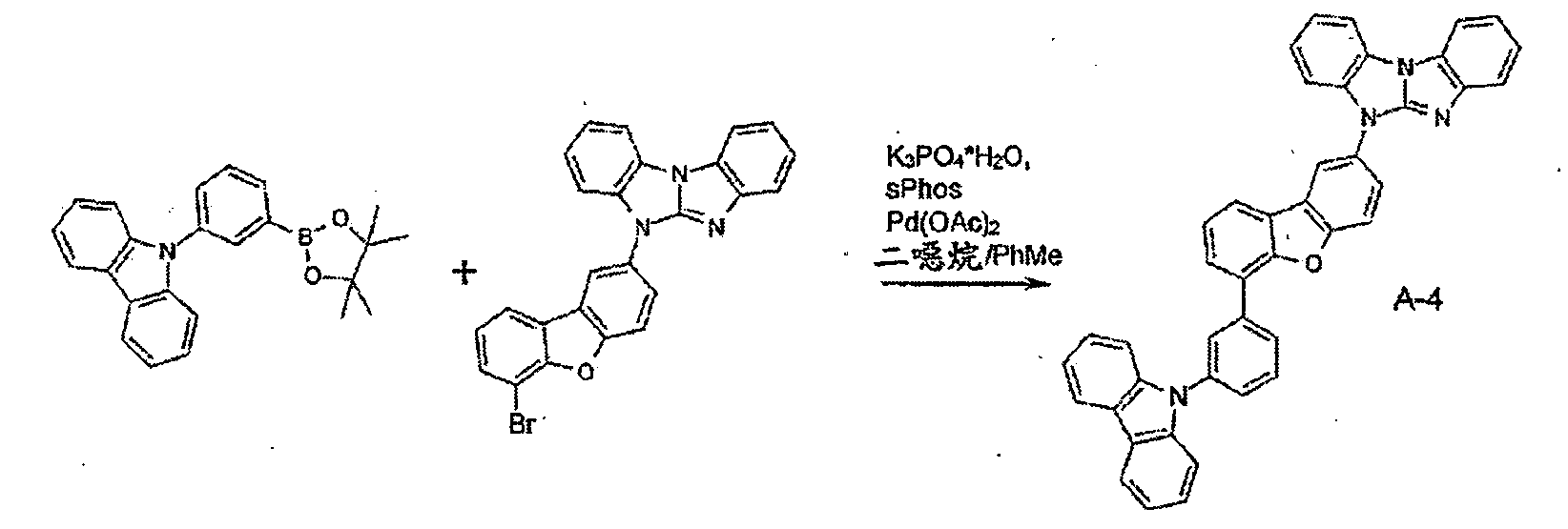
d)類似於實例5中所述之程序來製備實例12之產物。MS(APCI(正離子模式),m/z):615.5(M+1)。 1 H NMR(400MHz,THF-d8):8.68(d,J=2.1Hz,1H),8.34(t,J=1.8Hz,1H),8.21(d,J=7.7Hz,3H),7.85-7.15(m,7H),7.65-7.77(m,5H),7.47-7.58(m,3H),7.28-7.44(m,6H)。 d) The product of Example 12 was prepared similarly to the procedure described in Example 5 . MS (APCI (positive ion mode), m/z): 615.5 (M +1 ). 1 H NMR (400MHz,THF-d8): 8.68(d,J=2.1Hz,1H), 8.34(t,J=1.8Hz,1H), 8.21(d,J=7.7Hz,3H), 7.85-7.15 (m, 7H), 7.65-7.77 (m, 5H), 7.47-7.58 (m, 3H), 7.28-7.44 (m, 6H).

9-[3-(4,4,5,5-四甲基-1,3,2-二氧硼

根據A.Kryska,Journal of Chemical Research,Miniprint 10(1999)2501製備2-碘-二苯并呋喃且藉由自甲醇中結晶而純化。 2-Iodo-dibenzofuran was prepared according to A. Kryska, Journal of Chemical Research, Miniprint 10 (1999) 2501 and purified by crystallization from methanol.

a)類似於實例11中所述之程序,以2-碘-二苯并呋喃(實例14)為起始物來製備2,4-二碘-二苯并呋喃且藉由自2-丙醇中結晶來純化(產率:80%)。 1 H NMR(400MHz,CDCl3):δ 8.17(s,1H),8.07(s,1H),7.84(d,J=7.6Hz,1H),7.63(d,J=7.6Hz,1H),7.51(t,J=7.6Hz,1H),7.37(t,J=7.6Hz,1H)。 a) Similar to the procedure described in Example 11, using 2-iodo-dibenzofuran (Example 14) as the starting material to prepare 2,4-diiodo-dibenzofuran and using 2-propanol It is purified by crystallization (yield: 80%). 1 H NMR (400MHz, CDCl 3 ): δ 8.17(s,1H), 8.07(s,1H), 7.84(d,J=7.6Hz,1H), 7.63(d,J=7.6Hz,1H), 7.51 (t,J=7.6Hz,1H), 7.37(t,J=7.6Hz,1H).

b)類似於實例10中所述之程序來製備實例15之產物。 b) The product of Example 15 was prepared similarly to the procedure described in Example 10.

a)在氮氣下,將7.00g(24.7mmol)1-溴-4-碘-苯、10.5g(32.2 mmol)碳酸銫、2.36g(12.4mmol)碘化銅(I)及2.85g(24.7mmol)L-脯胺酸添加至含5.13g(24.7mmol)5H-苯并咪唑并[1,2-a]苯并咪唑之80ml DMSO中。在100℃下攪拌反應混合物15小時且在150℃下攪拌4小時,在Hyflo上用二氯甲烷過濾。用水洗滌有機相。經硫酸鎂乾燥有機相。將產物與乙醚及甲基乙基酮(MEK)一起蒸煮。產量:2.90g(77%)。 1 H NMR(400MHz,DMF-d7):δ 7.93-8.10(m,4H),7.78-7.92(m,2H),7.72-7.79(m,1H),7.49-7.71(m,1H),7.31-7.49(m,4H)。 a) Under nitrogen, combine 7.00g (24.7mmol) 1-bromo-4-iodo-benzene, 10.5g (32.2 mmol) cesium carbonate, 2.36g (12.4mmol) copper (I) iodide and 2.85g (24.7mmol) ) L-proline acid was added to 80ml DMSO containing 5.13g (24.7mmol) of 5H-benzimidazo[1,2-a]benzimidazole. The reaction mixture was stirred at 100°C for 15 hours and at 150°C for 4 hours, filtered on Hyflo with dichloromethane. Wash the organic phase with water. The organic phase was dried over magnesium sulfate. The product is cooked with ether and methyl ethyl ketone (MEK). Yield: 2.90g (77%). 1 H NMR (400MHz, DMF-d7): δ 7.93-8.10 (m, 4H), 7.78-7.92 (m, 2H), 7.72-7.79 (m, 1H), 7.49-7.71 (m, 1H), 7.31 7.49 (m, 4H).

b)類似於實例4b)中所述之程序來製備實例16b)之產物。 1 H NMR(400MHz,DMF-d7):δ=8.19-8.33(m,10H),7.83-7.87(m,2H),7.73-7.77(m,2H),7.35-7.54(m,4H)。一個信號由DMF覆蓋。MS(APCI(正離子模式),m/z):565(M+1)。 b) The product of Example 16b) was prepared similarly to the procedure described in Example 4b) . 1 H NMR (400MHz, DMF-d7): δ=8.19-8.33 (m, 10H), 7.83-7.87 (m, 2H), 7.73-7.77 (m, 2H), 7.35-7.54 (m, 4H). One signal is covered by DMF. MS (APCI (positive ion mode), m/z): 565 (M +1 ).

類似於實例4b)中所述之程序來製備實例17之產物。 The product of Example 17 was prepared similarly to the procedure described in Example 4b) .
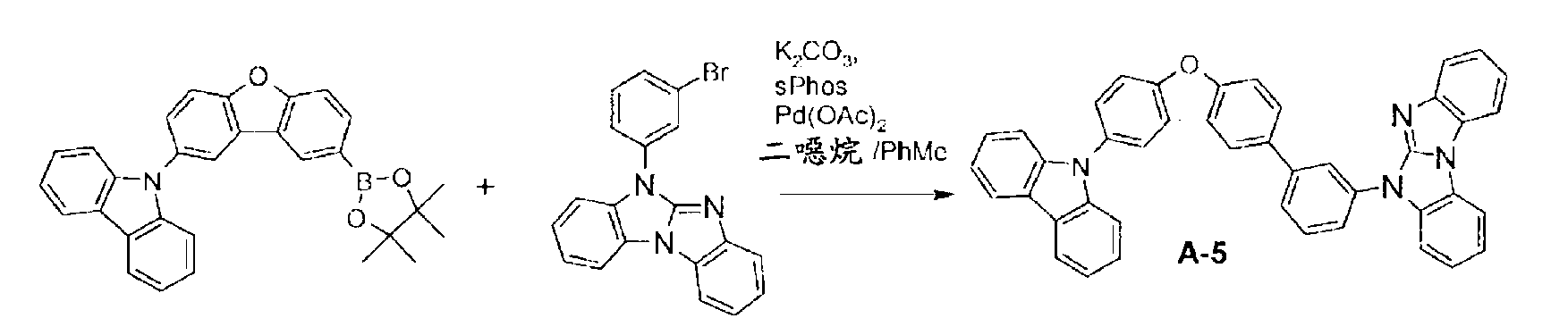
類似於實例5b)中所述之程序來製備實例18之產物。MS(APCI(正離子模式),m/z):615(M+1)。 The product of Example 18 was prepared similarly to the procedure described in Example 5b) . MS (APCI (positive ion mode), m/z): 615 (M +1 ).

在氮氣下,將2g(4.04mmol)3,6-二碘-9-苯基-咔唑、5.26g(16.2mmol)碳酸銫、190mg(0.101mmol)碘化銅(I)及233mg(2.02mmol)L-脯胺酸添加至含1.84g(8.89mmol)5H-苯并咪唑并[1,2-a]苯并咪唑之40ml DMSO中。在150℃下攪拌反應混合物10小時,在Hyflo Super Cel(R)介質(Fluka 56678,CAS[91053-39-3])上過濾,且用二氯甲烷洗滌。經硫酸鎂乾燥有機相,且蒸餾出溶劑。用環己烷/甲苯(環己烷100%、環己烷/甲苯10/1、環己烷/甲苯4/1)進行梯度管柱層析,得到產物(產量:70mg(3%))。MS(APCI(正離子模式),m/z):654(M+1)。 1 H NMR(400MHz,THF-d8):δ=8.81(d,J=1.9Hz,2H),7.99-7.05(m,6H),7.70-7.83(m,11H),7.22-7.41(m,8H)。 Under nitrogen, 2g (4.04mmol) 3,6-diiodo-9-phenyl-carbazole, 5.26g (16.2mmol) cesium carbonate, 190mg (0.101mmol) copper (I) iodide and 233mg (2.02mmol) ) L-Proline acid was added to 40ml DMSO containing 1.84g (8.89mmol) of 5H-benzimidazo[1,2-a]benzimidazole. The reaction mixture was stirred at 150°C for 10 hours, filtered on Hyflo Super Cel(R) medium (Fluka 56678, CAS [91053-39-3]), and washed with dichloromethane. The organic phase was dried over magnesium sulfate, and the solvent was distilled off. Gradient column chromatography was performed with cyclohexane/toluene (cyclohexane 100%, cyclohexane/toluene 10/1, cyclohexane/toluene 4/1) to obtain the product (yield: 70 mg (3%)). MS (APCI (positive ion mode), m/z): 654 (M +1 ). 1 H NMR (400MHz,THF-d8): δ=8.81(d,J=1.9Hz,2H),7.99-7.05(m,6H),7.70-7.83(m,11H),7.22-7.41(m,8H) ).
除化合物A-12以外,已由HPLC-MS偵測到以下化合物:


a)類似於實例1c)中所述之程序來製備實例20a)之產物。關於4H-[1,2,4]三唑并[1,5-a]苯并咪唑之合成及用於其合成之起始物質,參考J.Heterocyclic Compounds(1989)168及J.Org.Chem 42(1977)542。MS(MALDI-MS,m/z):403(M+1)。 a) The product of Example 20a) was prepared similarly to the procedure described in Example 1c) . For the synthesis of 4H-[1,2,4]triazolo[1,5-a]benzimidazole and the starting materials used in its synthesis, refer to J.Heterocyclic Compounds ( 1989 )168 and J.Org.Chem 42 (1977) 542. MS (MALDI-MS, m/z): 403 (M +1 ).

b)類似於實例13)中所述之程序來製備實例20b)之產物。 b) The product of Example 20b) was prepared similarly to the procedure described in Example 13) .

a)在氮氣下,將5g(31.6mmol)4H-[1,2,4]三唑并[1,5-a]苯并咪唑、20.6g(63.2mmol)碳酸銫、1.5g(7.9mmol)碘化銅(I)及910mg(7.9mmol)L-脯胺酸添加至含17.8g(8mL)(63.2mmol)1-溴-3-碘苯之60mL DMSO中。在85℃下攪拌反應混合物15小時。經矽膠用二氯甲烷過濾反應混合物。用水、NaCl溶液洗滌有機相,且經硫酸鈉乾燥。將產物與乙醚一起蒸煮(產量:8.0g(80%))。1H NMR(400MHz,CD2Cl2):δ 8.02(s,1H),7.98(s,1H),7.90-7.88(m,1H),7.71-7.68(m,1H),7.60-7.58(d,1H),7.52-7.48(t,1H),7.46-7.40(m,2H)。13C NMR(500MHz,CD2Cl2):δ 155.05(d,1C),153.47(s,1C),136.82(s,1C),134.23(s,1C),131.63(d,1C),130.78(d,1C),126.69(d,1C),124.95(s,1C),124.87(d,1C),123.50(s,1C),123.26(d,1C),122.45(d,1C),112.15(d,1C),111.66(d,1C)。 a) Under nitrogen, add 5g (31.6mmol) 4H-[1,2,4]triazolo[1,5-a]benzimidazole, 20.6g (63.2mmol) cesium carbonate, 1.5g (7.9mmol) Copper (I) iodide and 910 mg (7.9 mmol) of L-proline are added to 60 mL of DMSO containing 17.8 g (8 mL) (63.2 mmol) of 1-bromo-3-iodobenzene. The reaction mixture was stirred at 85°C for 15 hours. The reaction mixture was filtered through silica gel with dichloromethane. The organic phase was washed with water, NaCl solution, and dried over sodium sulfate. The product was cooked with ether (yield: 8.0 g (80%)). 1 H NMR (400MHz, CD 2 Cl 2 ): δ 8.02 (s, 1H), 7.98 (s, 1H), 7.90-7.88 (m, 1H), 7.71-7.68 (m, 1H), 7.60-7.58 (d ,1H),7.52-7.48(t,1H),7.46-7.40(m,2H). 13 C NMR (500MHz, CD 2 Cl 2 ): δ 155.05 (d, 1C), 153.47 (s, 1C), 136.82 (s, 1C), 134.23 (s, 1C), 131.63 (d, 1C), 130.78 ( d,1C),126.69(d,1C),124.95(s,1C),124.87(d,1C),123.50(s,1C),123.26(d,1C),122.45(d,1C),112.15(d ,1C),111.66(d,1C).

b)在氬氣下,將含1.25g(4mmol)4-(3-溴苯基)-[1,2,4]三唑并[1,5-a]苯并咪唑、2.4g(5.2mmol)9-[8-(4,4,5,5-四甲基-1,3,2-二氧硼

在氬氣下,將含160mg(0.48mmol)1,3-二碘苯及170mg(1.06mmol)4H-[1,2,4]三唑并[1,5-a]苯并咪唑之10mL DMSO攪拌15分鐘。添加625mg(1.9mmol)碳酸銫、120mg(1.06mmol)L-脯胺酸及90mg(0.48mmol)碘化銅(I)。在100℃下攪拌反應混合物15小時,且經矽藻土用二氯甲烷過濾。用水、NaCl溶液洗滌有機相,且經硫酸鈉乾燥。使產物自異丙醇中結晶(產量:130mg(69%))。1H NMR(400MHz,CD2Cl2):δ 8.35(s,1H),8.06(s,2H),7.94-7.84(m,7H),7.50-7.42 (m,4H)。13C NMR(500MHz,CD2Cl2):δ 155.12(d,2C),153.59(s,2C),137.10(s,2C),134.27(s,2C),131.07(d,1C),125.09(s,2C),125.06(d,2C),123.39(d,2C),121.80(d,2C),118.36(d,1C),112.51(d,2C),111.73(d,2C)。 Under argon, 10mL DMSO containing 160mg (0.48mmol) 1,3-diiodobenzene and 170mg (1.06mmol) 4H-[1,2,4]triazolo[1,5-a]benzimidazole Stir for 15 minutes. 625 mg (1.9 mmol) of cesium carbonate, 120 mg (1.06 mmol) of L-proline and 90 mg (0.48 mmol) of copper (I) iodide were added. The reaction mixture was stirred at 100°C for 15 hours and filtered through diatomaceous earth with dichloromethane. The organic phase was washed with water, NaCl solution, and dried over sodium sulfate. The product was crystallized from isopropanol (yield: 130 mg (69%)). 1 H NMR (400MHz, CD 2 Cl 2 ): δ 8.35 (s, 1H), 8.06 (s, 2H), 7.94-7.84 (m, 7H), 7.50-7.42 (m, 4H). 13 C NMR (500MHz, CD 2 Cl 2 ): δ 155.12 (d, 2C), 153.59 (s, 2C), 137.10 (s, 2C), 134.27 (s, 2C), 131.07 (d, 1C), 125.09 ( s, 2C), 125.06 (d, 2C), 123.39 (d, 2C), 121.80 (d, 2C), 118.36 (d, 1C), 112.51 (d, 2C), 111.73 (d, 2C).
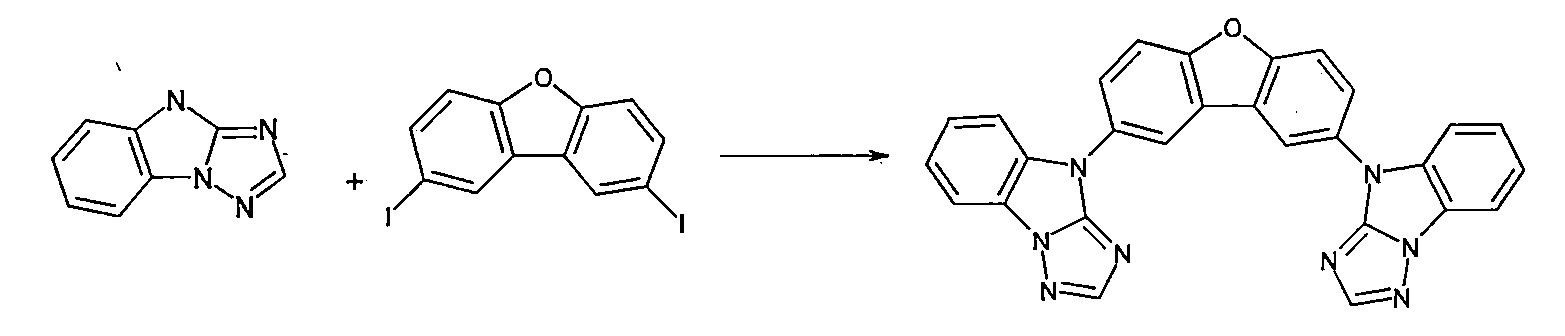
在氬氣下,將含1g(2.4mmol)2,8-二碘二苯并呋喃及840mg(5.3mmol)4H-[1,2,4]三唑并[1,5-a]苯并咪唑之10mL DMSO攪拌15分鐘。添加3.1g(9.6mmol)碳酸銫、550mg(4.8mmol)L-脯胺酸及460mg(2.4mmol)碘化銅(I)。在100℃下攪拌棕色反應混合物15小時。將水添加至反應混合物中,且過濾並用甲醇洗滌。使產物自甲苯中結晶(產量:330mg(28%))。1H NMR(400MHz,CD2Cl2):δ 8.38(s,1H),8.05(s,2H),7.92-7.85(m,8H),7.42-7.13(dd,2H)。 Under argon, will contain 1g (2.4mmol) 2,8-diiodo dibenzofuran and 840mg (5.3mmol) 4H-[1,2,4]triazolo[1,5-a]benzimidazole Then 10mL DMSO was stirred for 15 minutes. 3.1 g (9.6 mmol) of cesium carbonate, 550 mg (4.8 mmol) of L-proline, and 460 mg (2.4 mmol) of copper (I) iodide were added. The brown reaction mixture was stirred at 100°C for 15 hours. Water was added to the reaction mixture, and filtered and washed with methanol. The product was crystallized from toluene (yield: 330 mg (28%)). 1 H NMR (400 MHz, CD 2 Cl 2 ): δ 8.38 (s, 1H), 8.05 (s, 2H), 7.92-7.85 (m, 8H), 7.42-7.13 (dd, 2H).
根據文獻程序(J.Org.Chem,2008,73,1809)製備9-(9H-咔唑-3-基)-9H-咔唑。 9-(9 H -carbazol-3-yl)-9 H -carbazole was prepared according to literature procedures (J. Org. Chem, 2008, 73, 1809).

a)根據實例10之程序來製備實例24a)之產物。純化:FC(SiO2,環己烷/CH2Cl2 4:1)。產率:85%。 1 H NMR(400MHz,CD2Cl2):δ 8.34(s,1H),8.18(m,5H),7.87(d,1H),7.77(d,1H),7.67(d,1H),7.59(m,3H),7.51-7.39(m,6H),7.31(m,3H)。 a) Prepare the product of Example 24a ) according to the procedure of Example 10 . Purification: FC (SiO 2 , cyclohexane/CH 2 Cl 2 4:1). Yield: 85%. 1 H NMR (400MHz, CD 2 Cl 2 ): δ 8.34 (s, 1H), 8.18 (m, 5H), 7.87 (d, 1H), 7.77 (d, 1H), 7.67 (d, 1H), 7.59 ( m, 3H), 7.51-7.39 (m, 6H), 7.31 (m, 3H).

b)將Pd(dppf).CH2Cl2(8mg,0.01mmol)添加至5-[3-(4,4,5,5-四甲基-1,3,2-二氧硼-2-基)苯基]苯并咪唑并[1,2-a]苯并咪唑(133mg,0.33mmol)、實例24a)之產物(144mg,0.25mmol)於二噁烷(5mL)及NaOH(3M,0.25mL)中之經脫氣(Ar)混合物中。在80℃下加熱反應混合物8小時且經矽藻土過濾,且FC(SiO2,CH2Cl2)得到產物(產量:50mg,26%)。 1 H NMR(400MHz,CD2Cl2):δ 8.33(2xs,2+1H),8.18(m,4H),7.88(m,5H),7.81-7.73(m,4H),7.69-7.62(m,3H),7.56(d,1H),7.49(d,2H),7.42-7.27(m,11H)。 b) Pd(dppf). CH 2 Cl 2 (8mg, 0.01mmol) was added to 5-[3-(4,4,5,5-tetramethyl-1,3,2-dioxaboro-2-yl)phenyl]benzimidazole And [1,2-a]benzimidazole (133mg, 0.33mmol), the product of Example 24a) (144mg, 0.25mmol) in dioxane (5mL) and NaOH (3M, 0.25mL) after degassing ( Ar) in the mixture. The reaction mixture was heated at 80° C. for 8 hours and filtered through Celite, and FC (SiO 2 , CH 2 Cl 2 ) gave the product (yield: 50 mg, 26%). 1 H NMR (400MHz, CD 2 Cl 2 ): δ 8.33 (2xs, 2+1H), 8.18 (m, 4H), 7.88 (m, 5H), 7.81-7.73 (m, 4H), 7.69-7.62 (m , 3H), 7.56 (d, 1H), 7.49 (d, 2H), 7.42-7.27 (m, 11H).
ITO基板之製備以及完整二極體之後續表徵等同於應用實例1,但以下各層之組成不同:將Ir(dpbic)3以20nm之厚度塗佈於基板上作為電洞傳輸及激子阻擋劑,其中最先10nm摻雜有MoO3(約10%)以改良傳導率。隨後,藉
由氣相沈積以30nm之厚度塗佈30重量%發射極化合物

隨後,藉由氣相沈積以5nm之厚度塗佈化合物A-10作為電洞阻擋劑。隨後,以20nm之厚度蒸鍍50重量%材料
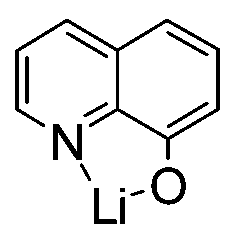
如應用實例3進行OLED之製備及建構,但有以下不同:電洞傳輸層中之Ir(dpbic)3中MoO3之摻雜濃度為5重量%。發射層由30重量%化合物

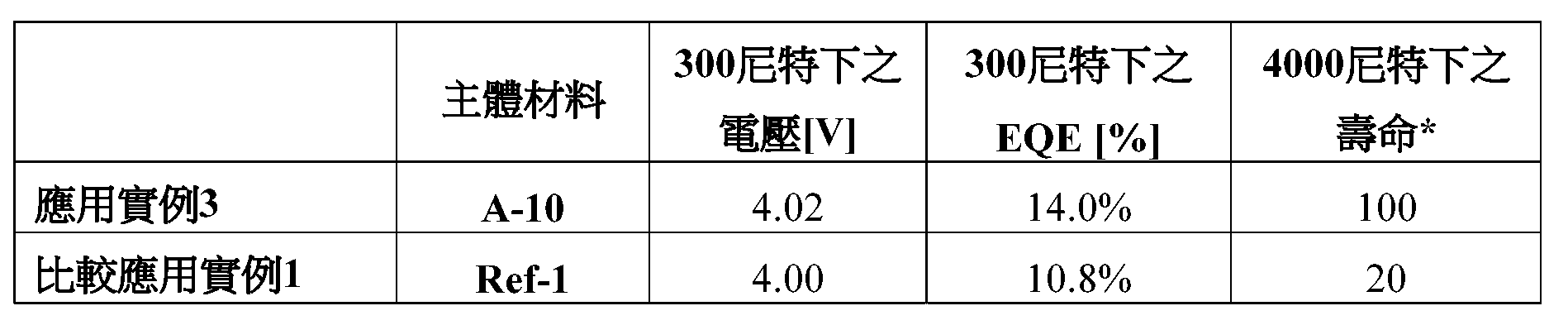
如應用實例3進行OLED之製備及建構,但有以下不同:具有MoO3及Ir(dpbic)3之電洞傳輸層為15nm且未經摻雜之電子阻擋劑Ir(dpbic)3僅5nm厚。發射層由30重量%化合物

如應用實例3進行OLED之製備及建構,但有以下不同:發射層
由30重量%化合物


如應用實例1進行OLED之製備及建構,但有以下不同:發射層由30重量%化合物

如應用實例1進行OLED之製備及建構,但有以下不同:發射層由30重量%化合物


如應用實例3進行OLED之製備及建構,但有以下不同:發射層由30重量%化合物


Claims (19)


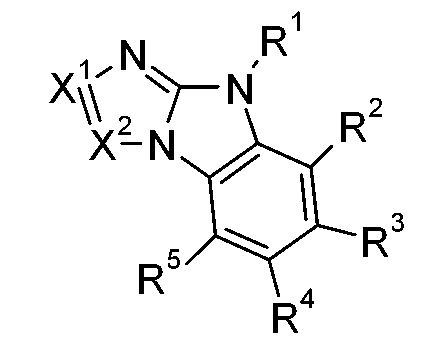


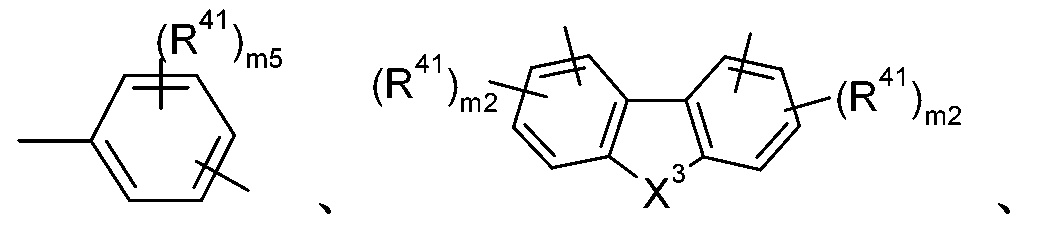


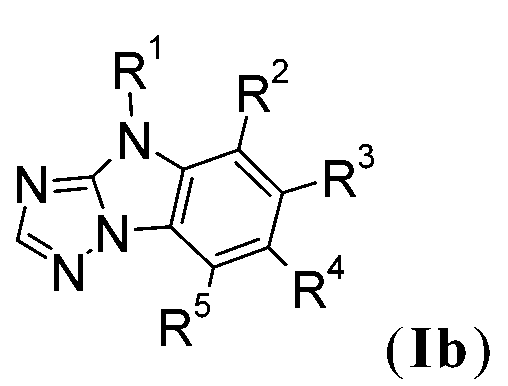


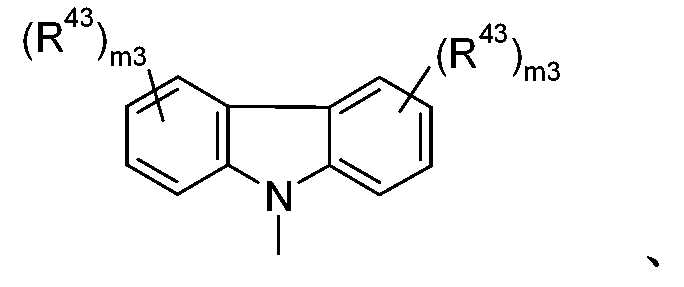


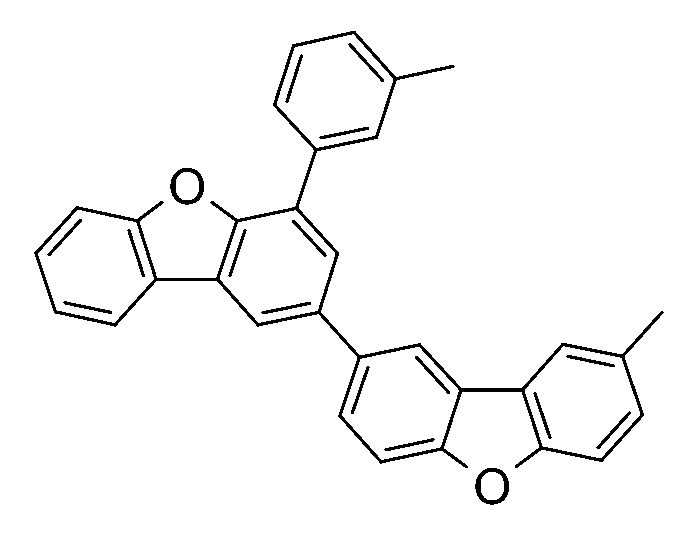

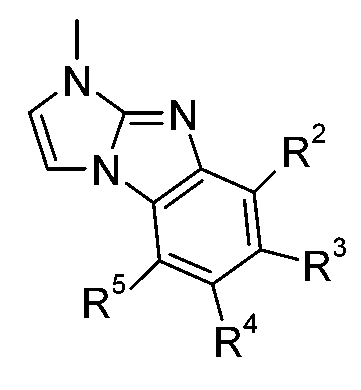


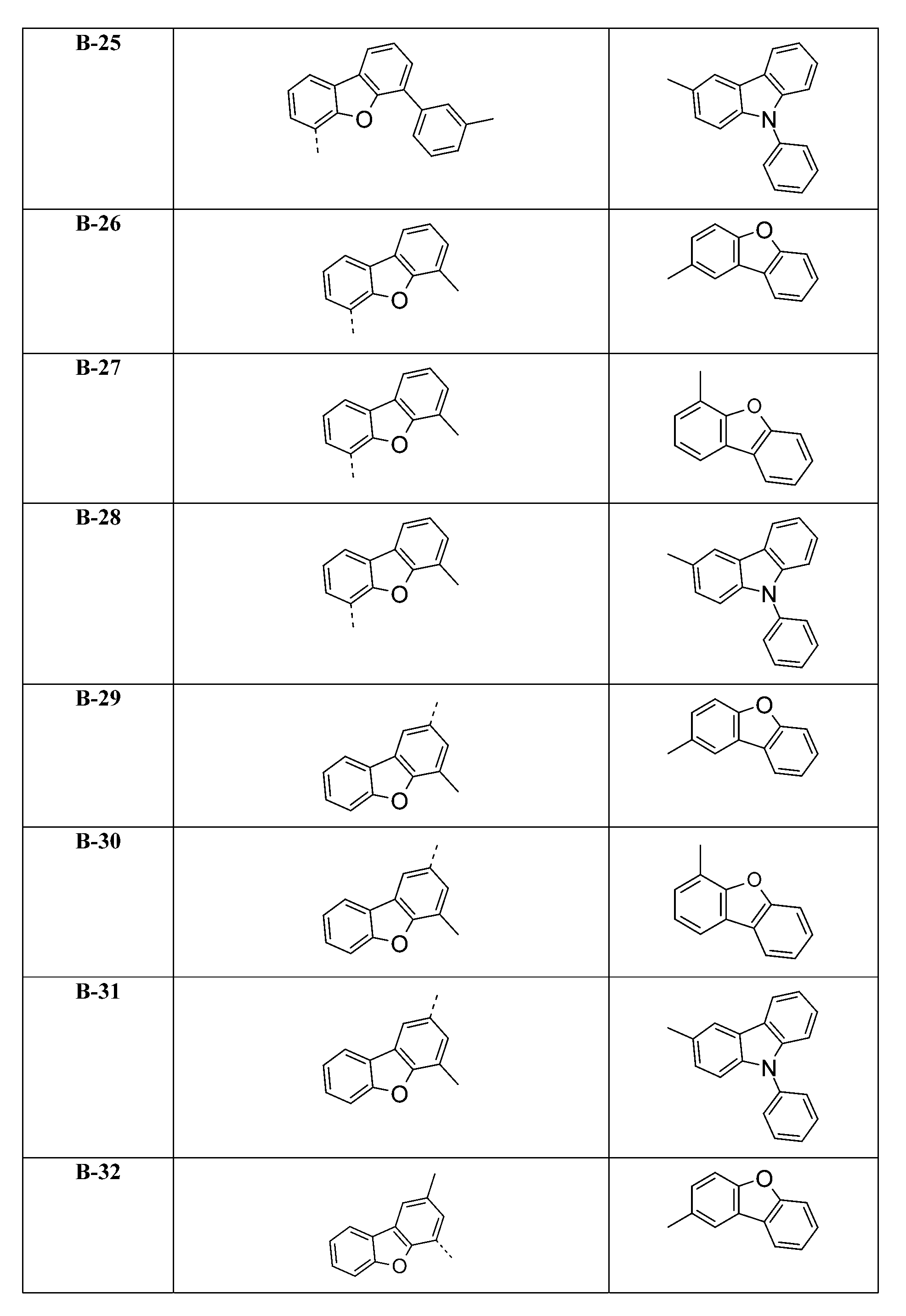


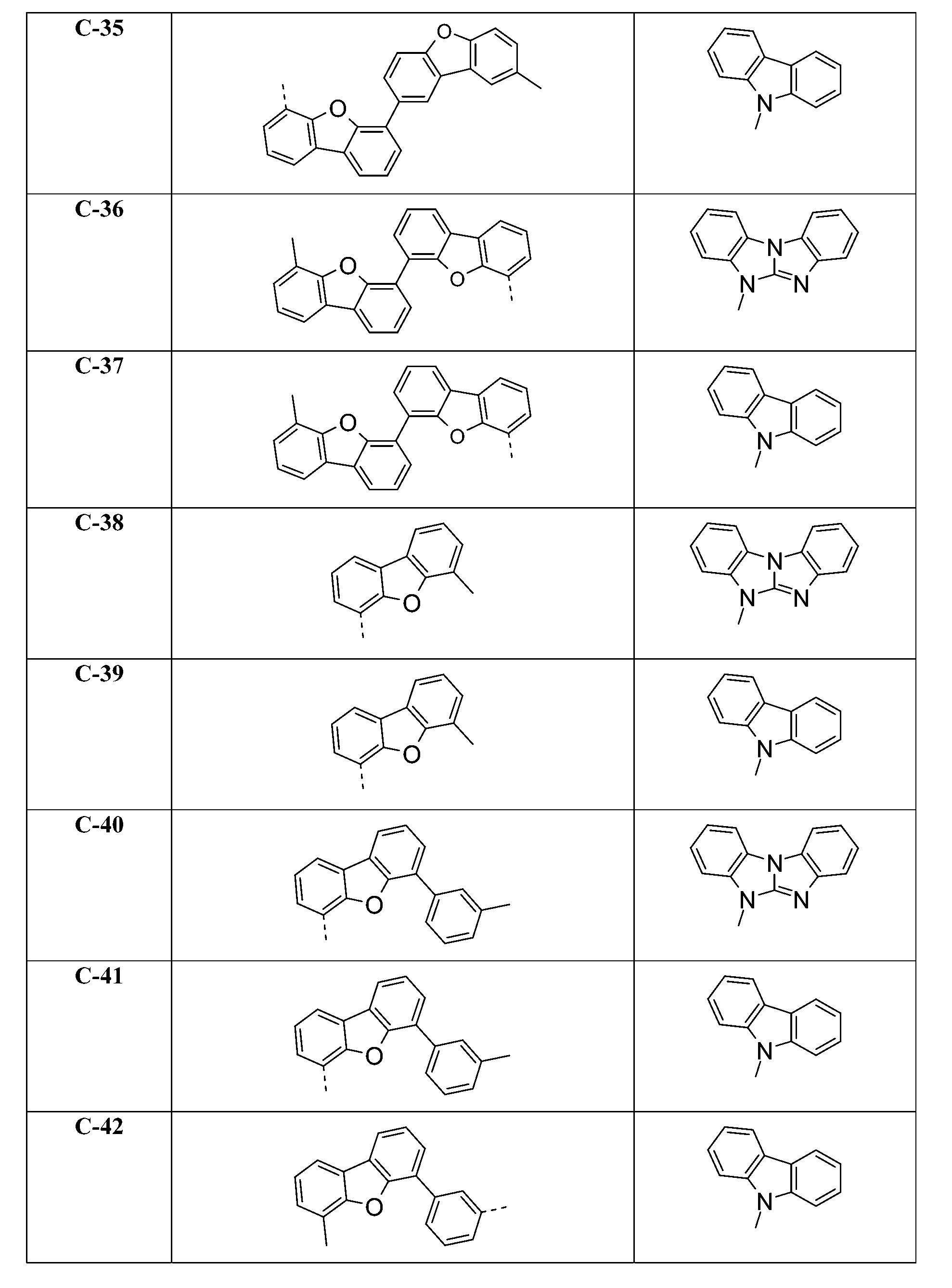


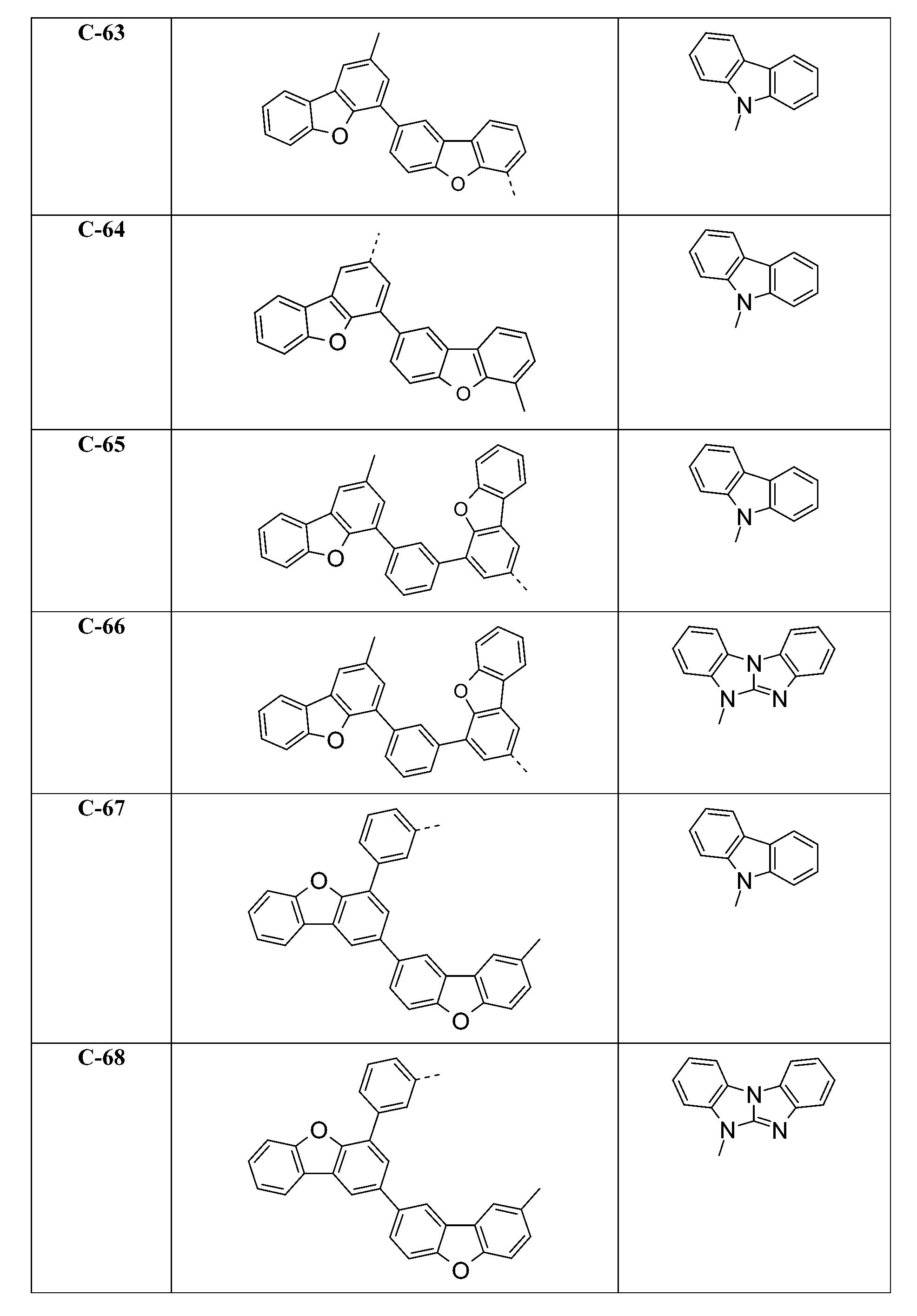


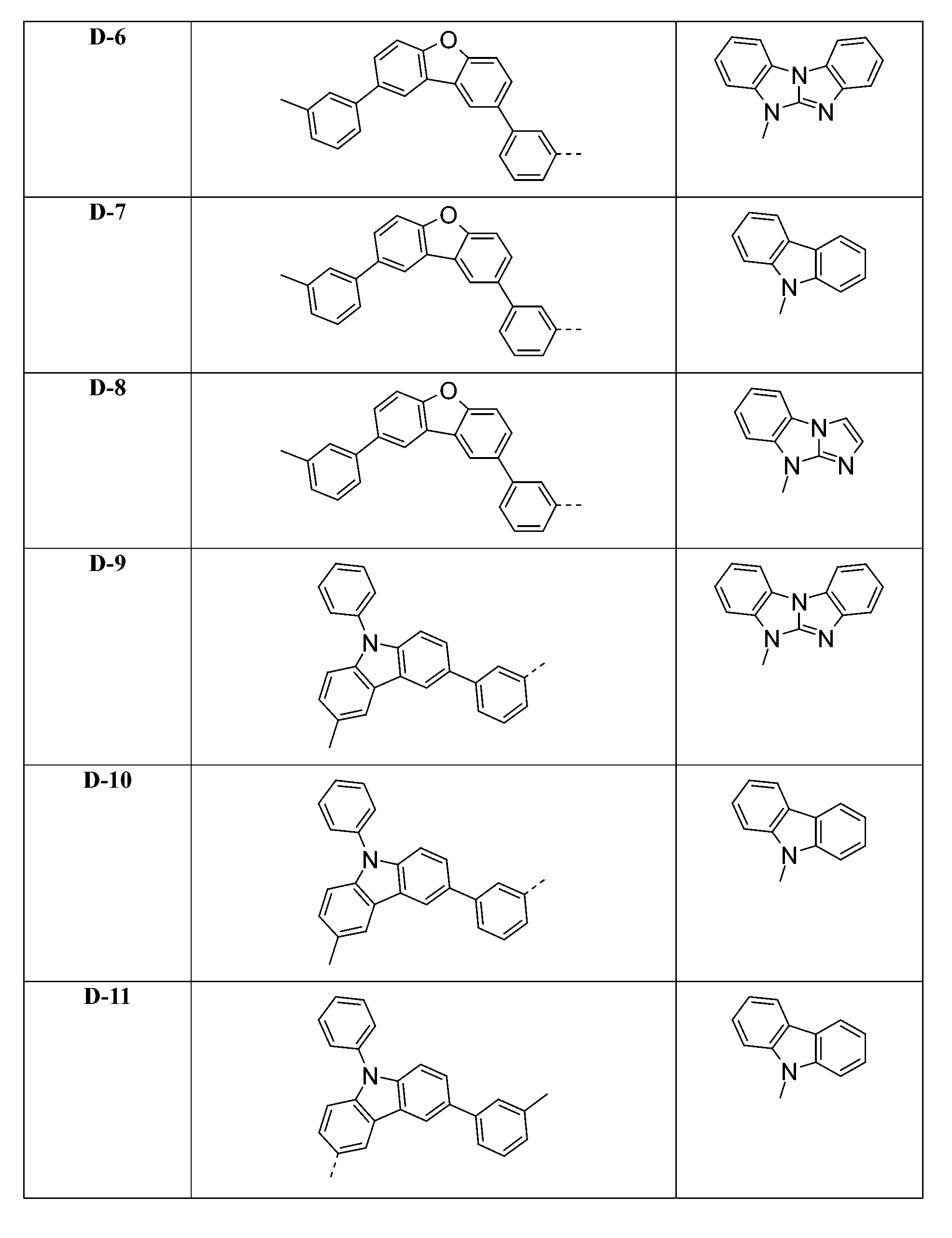


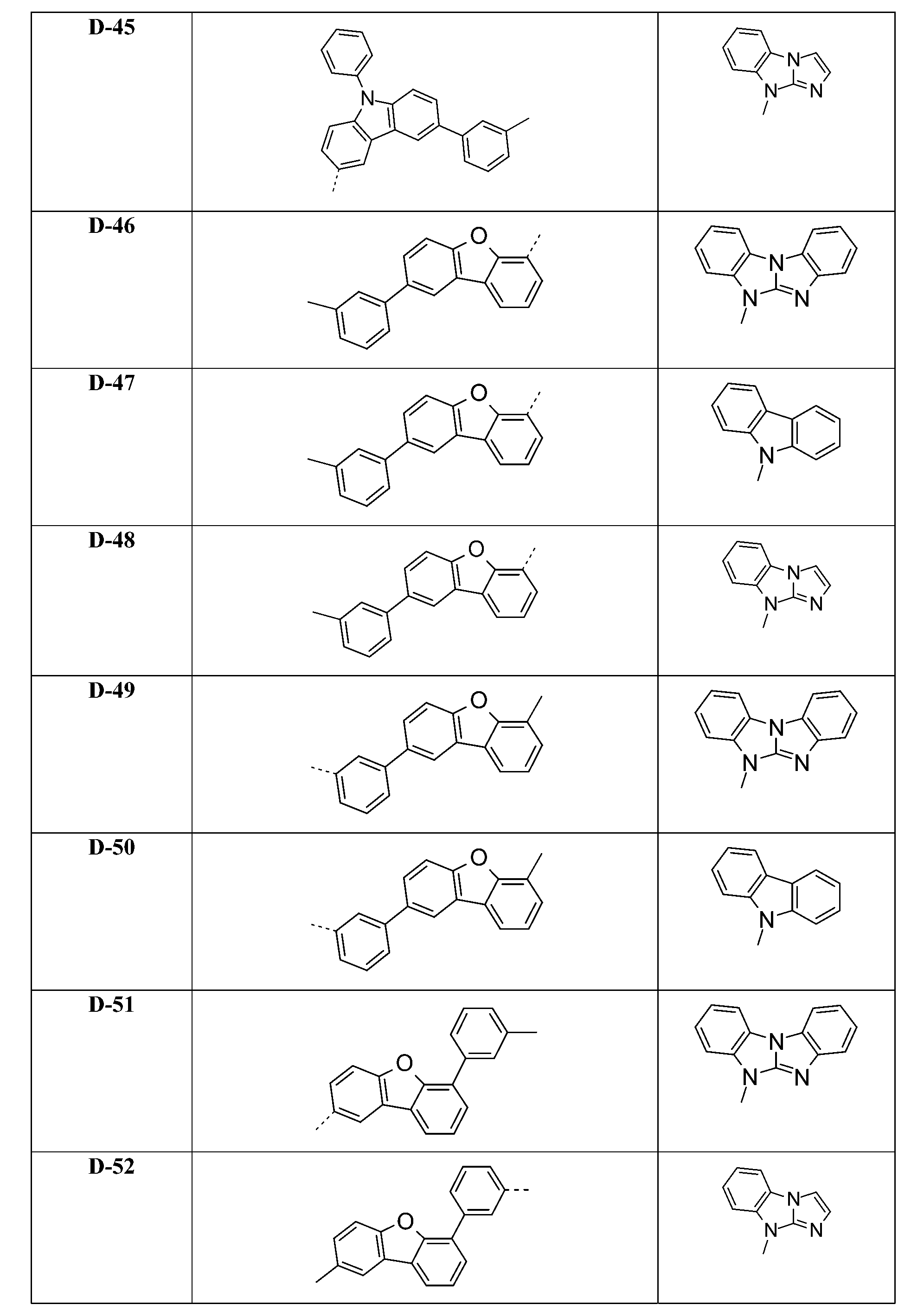


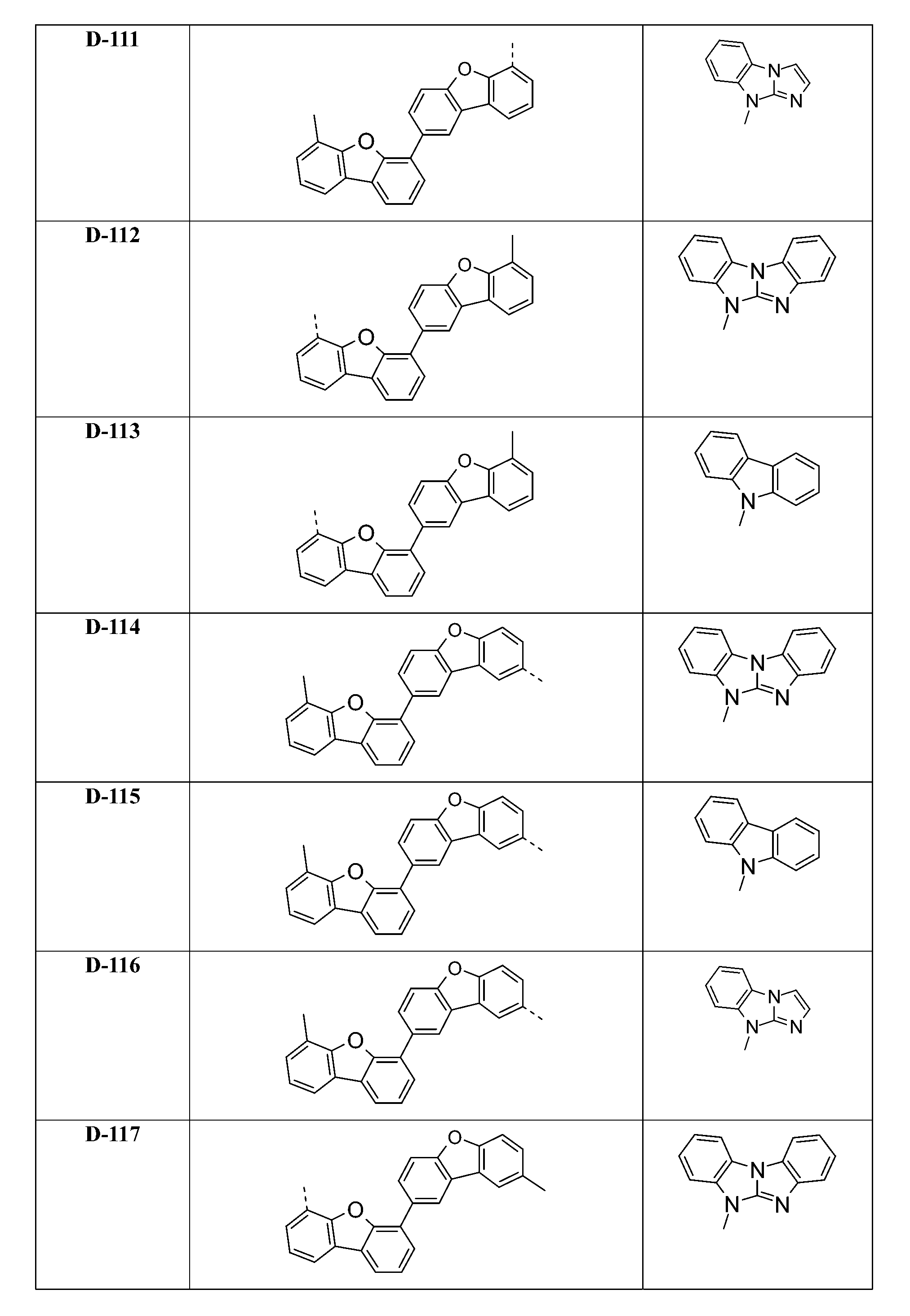


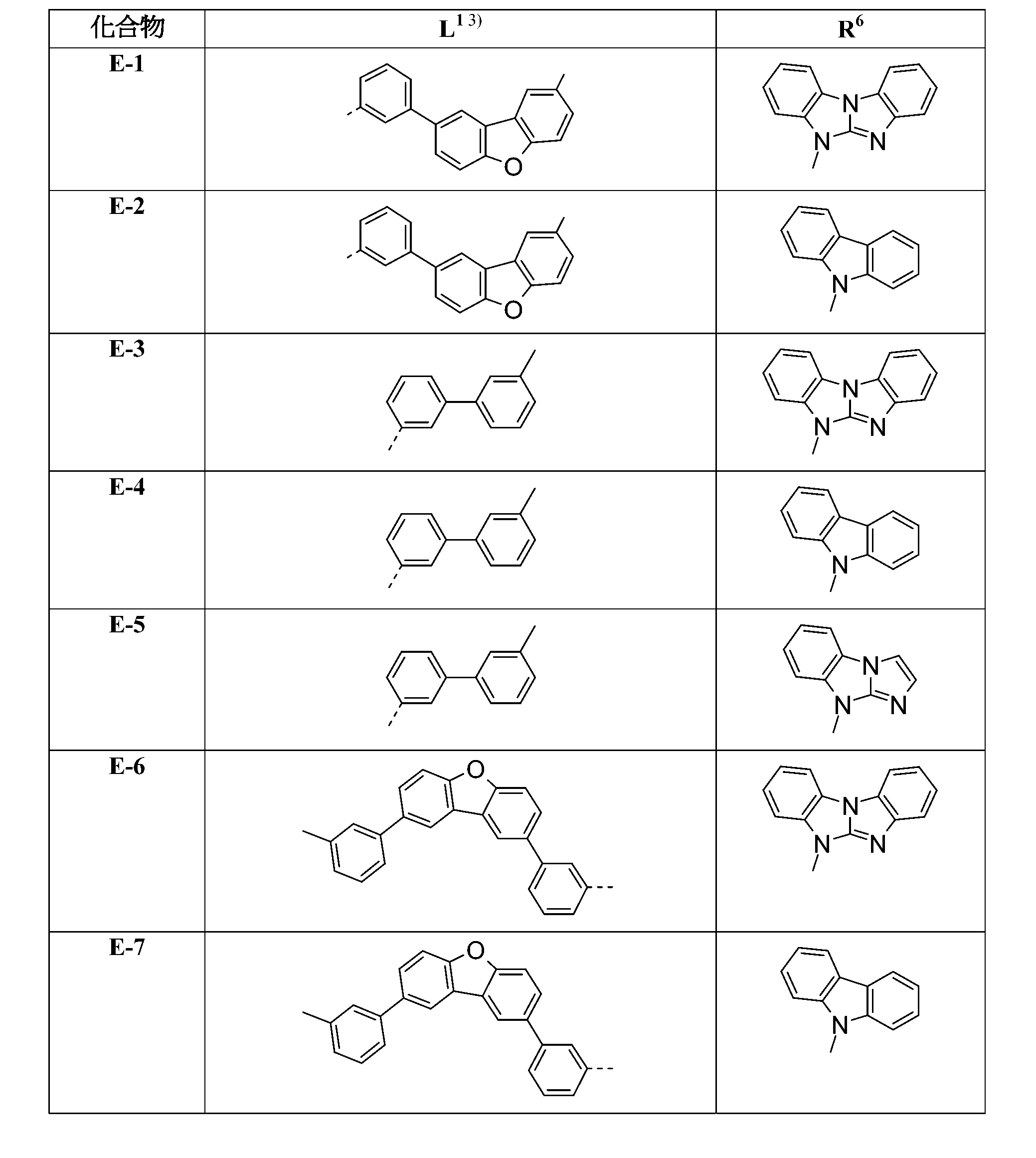


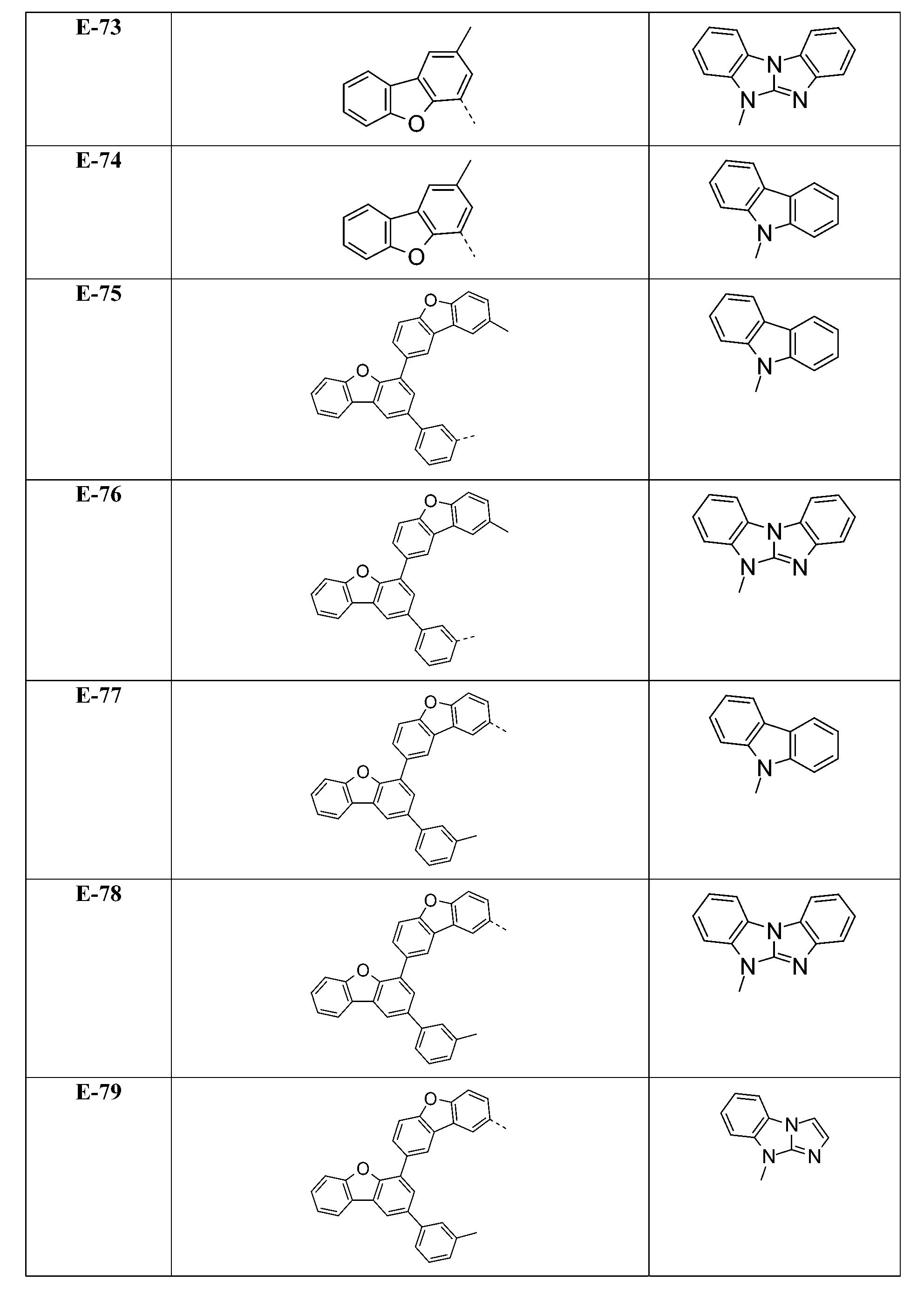

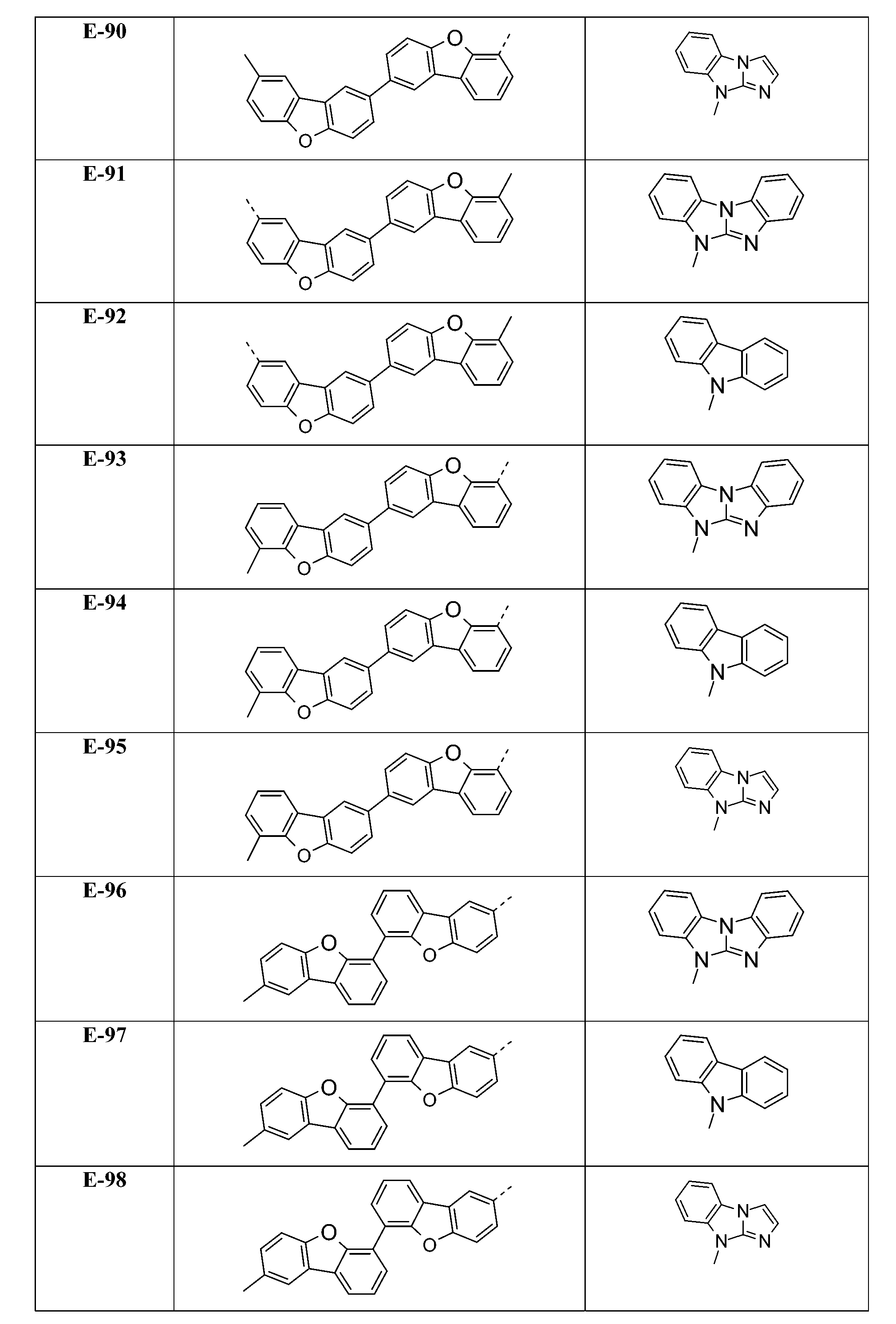

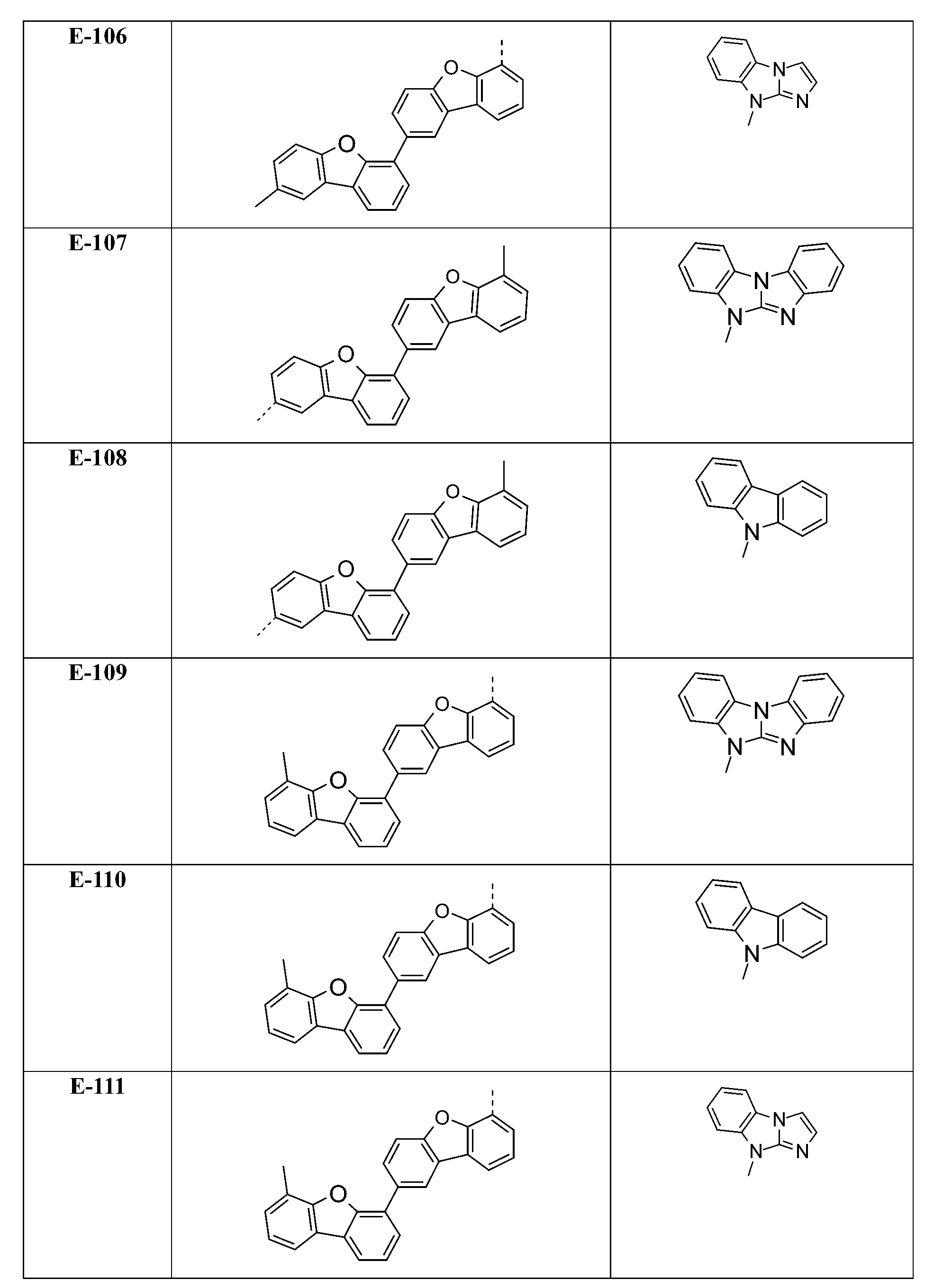


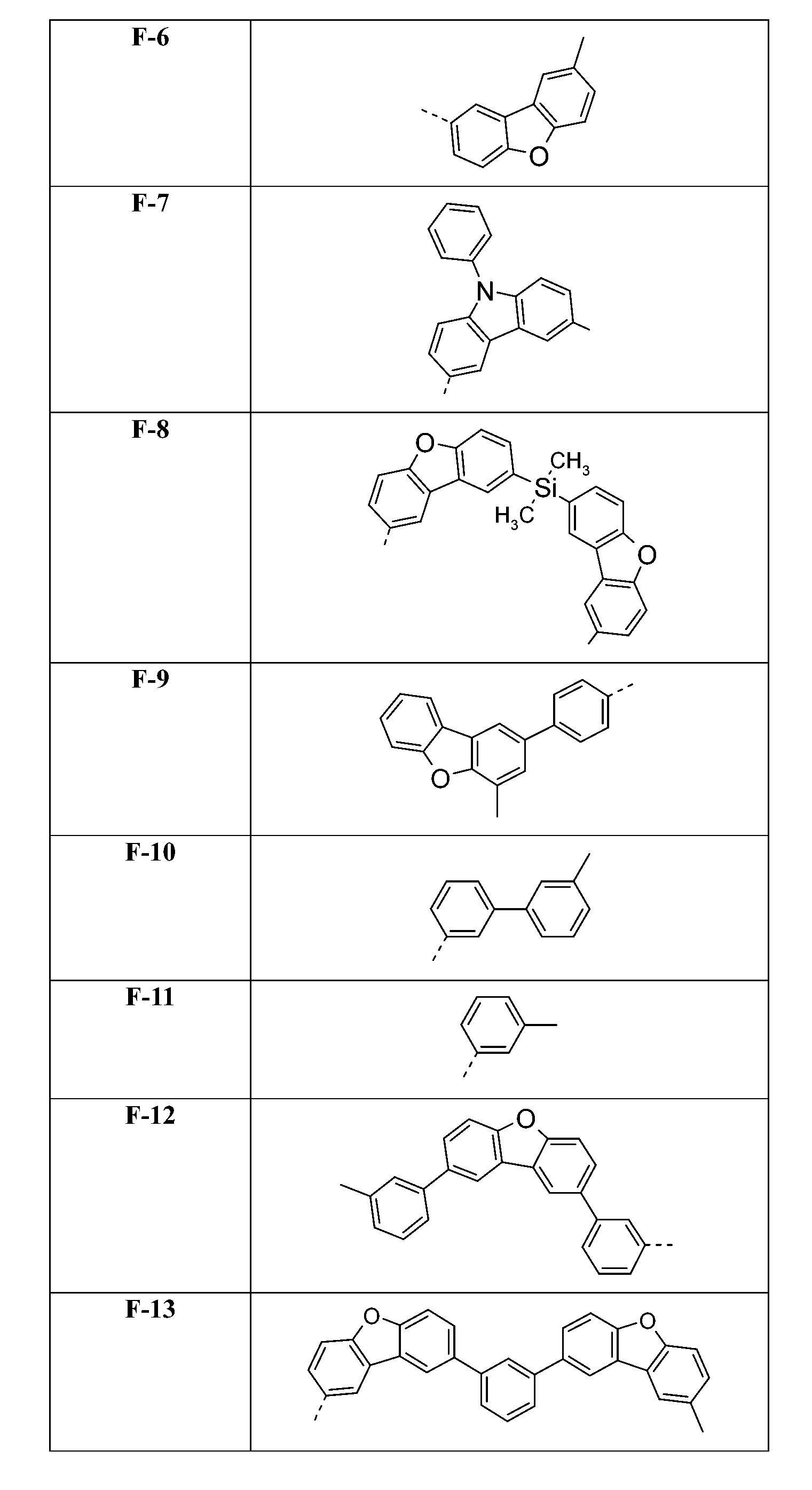


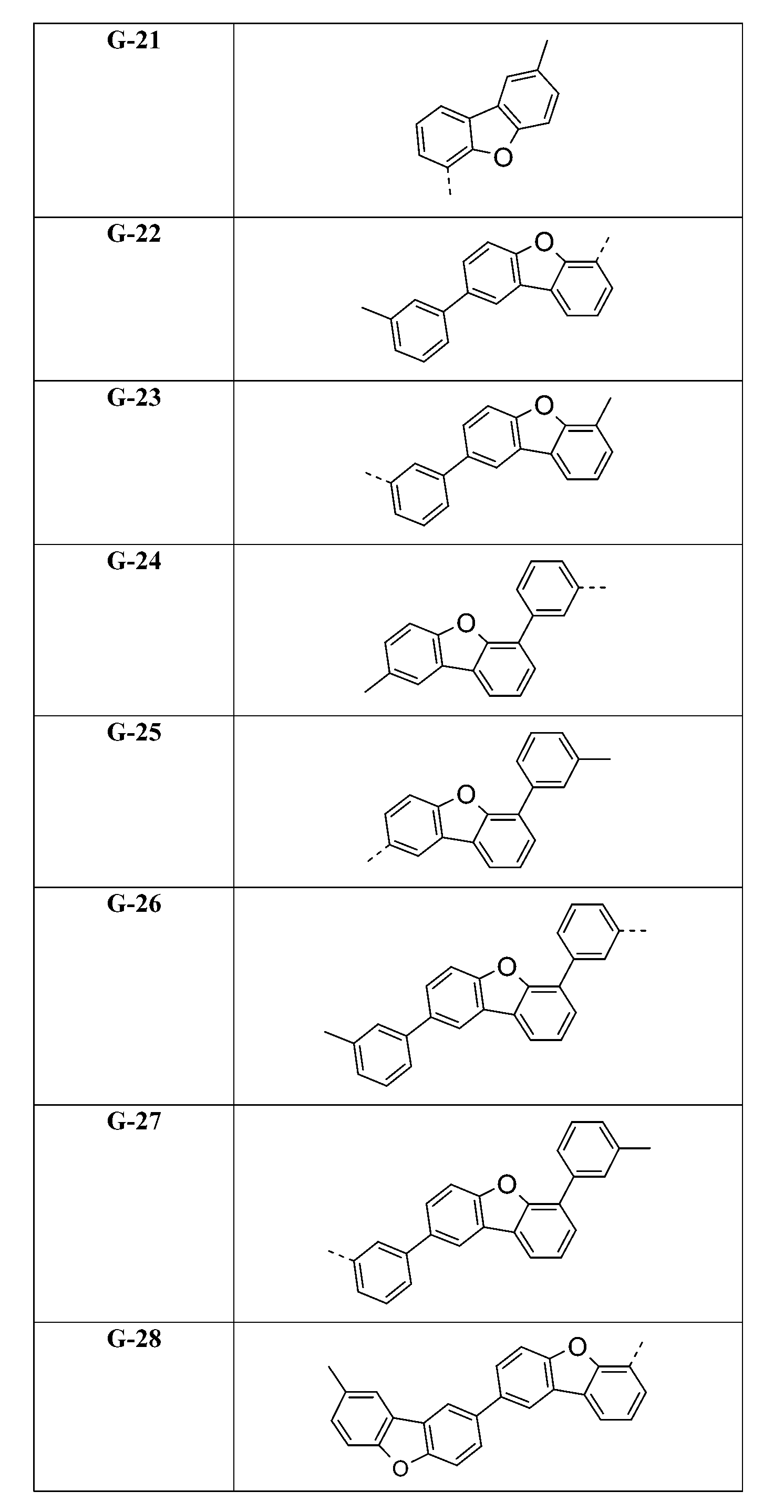

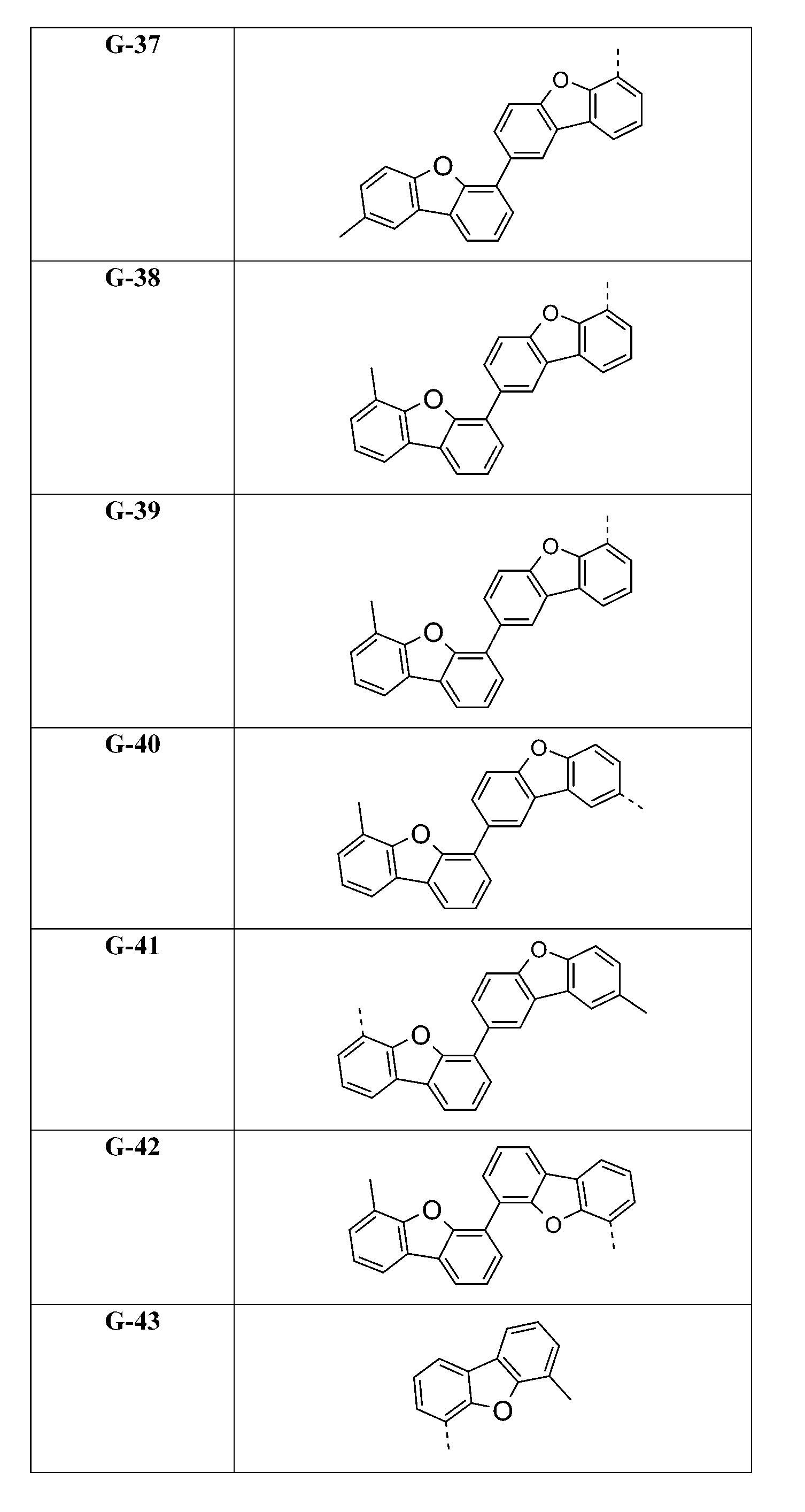


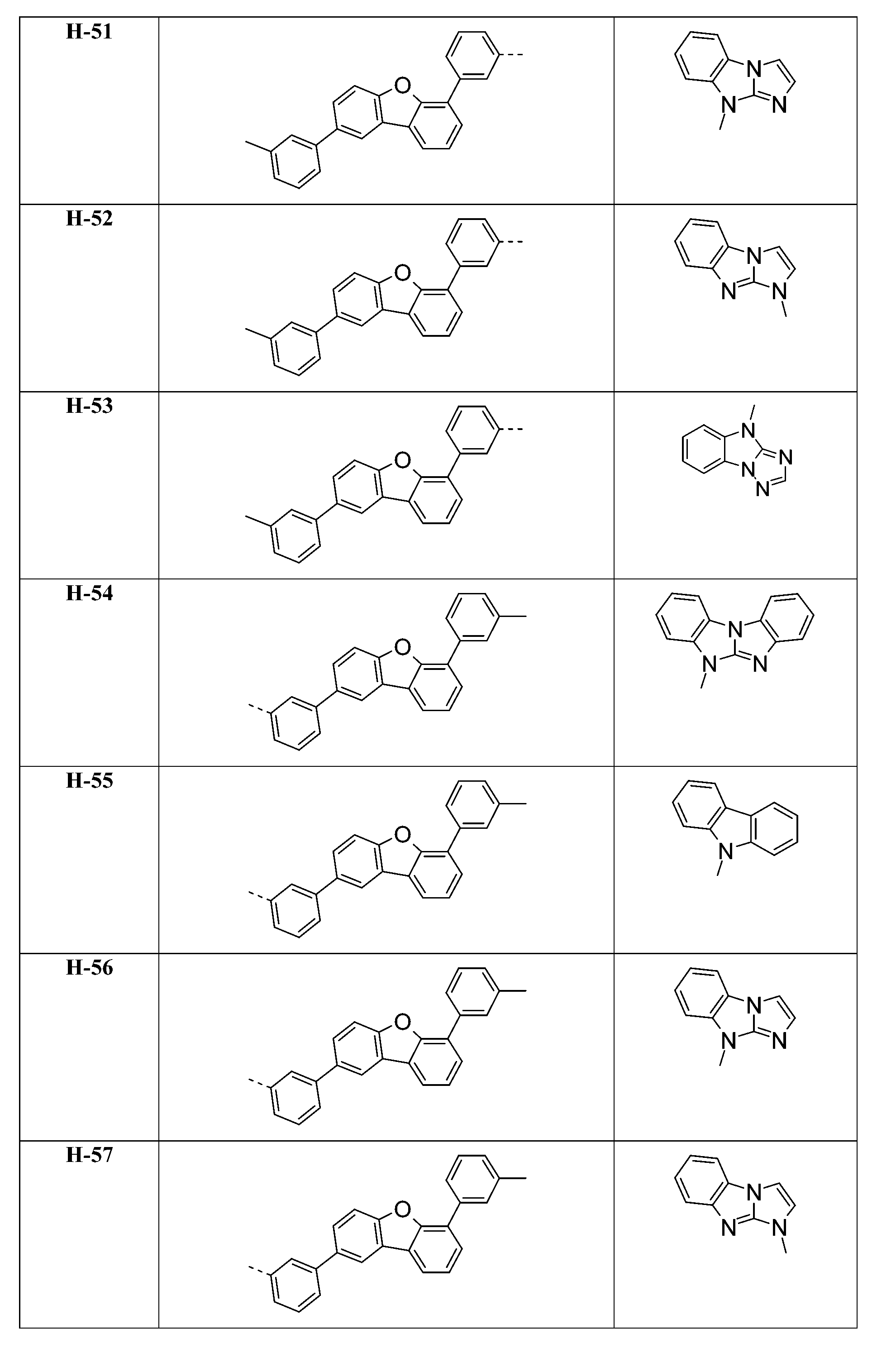


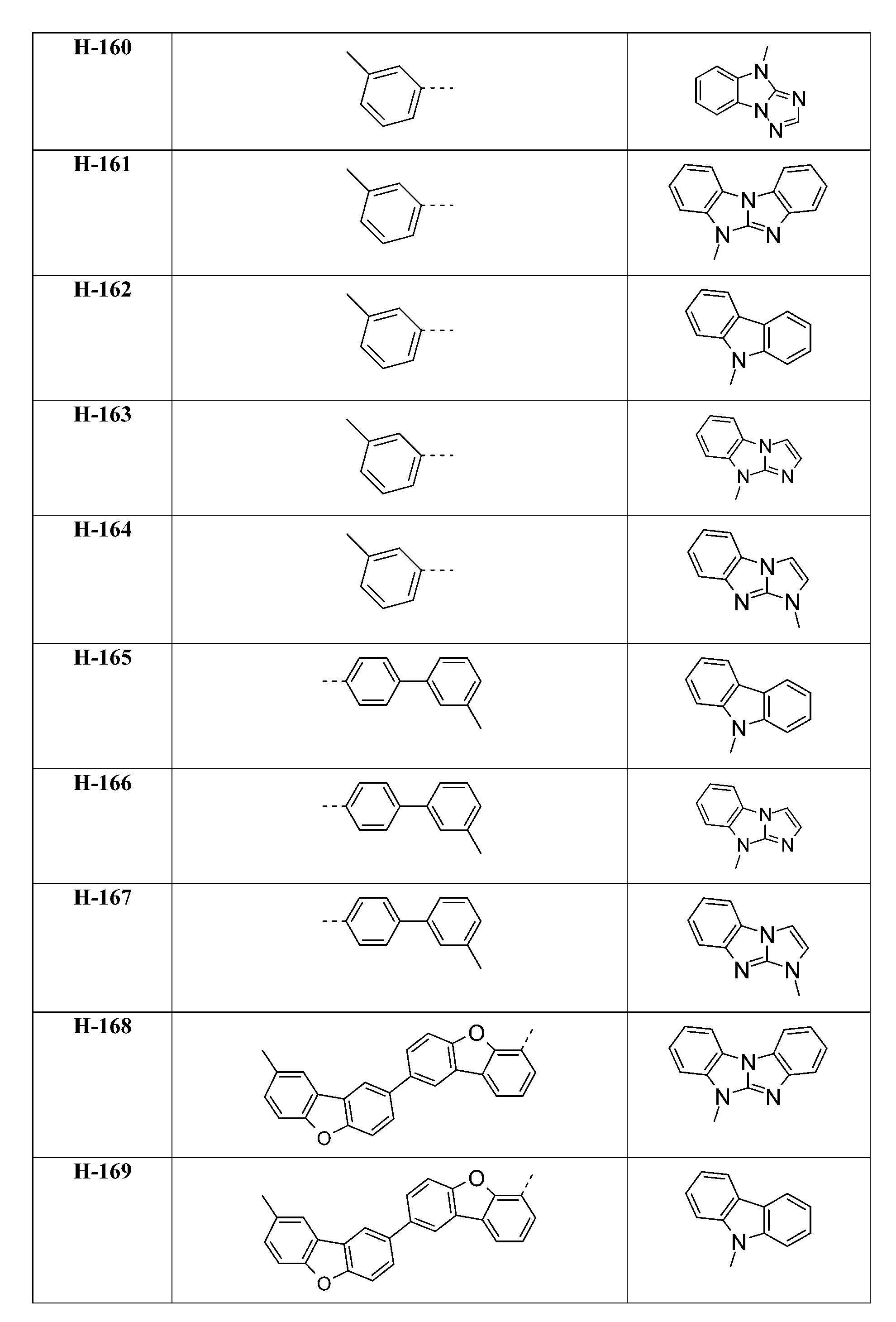


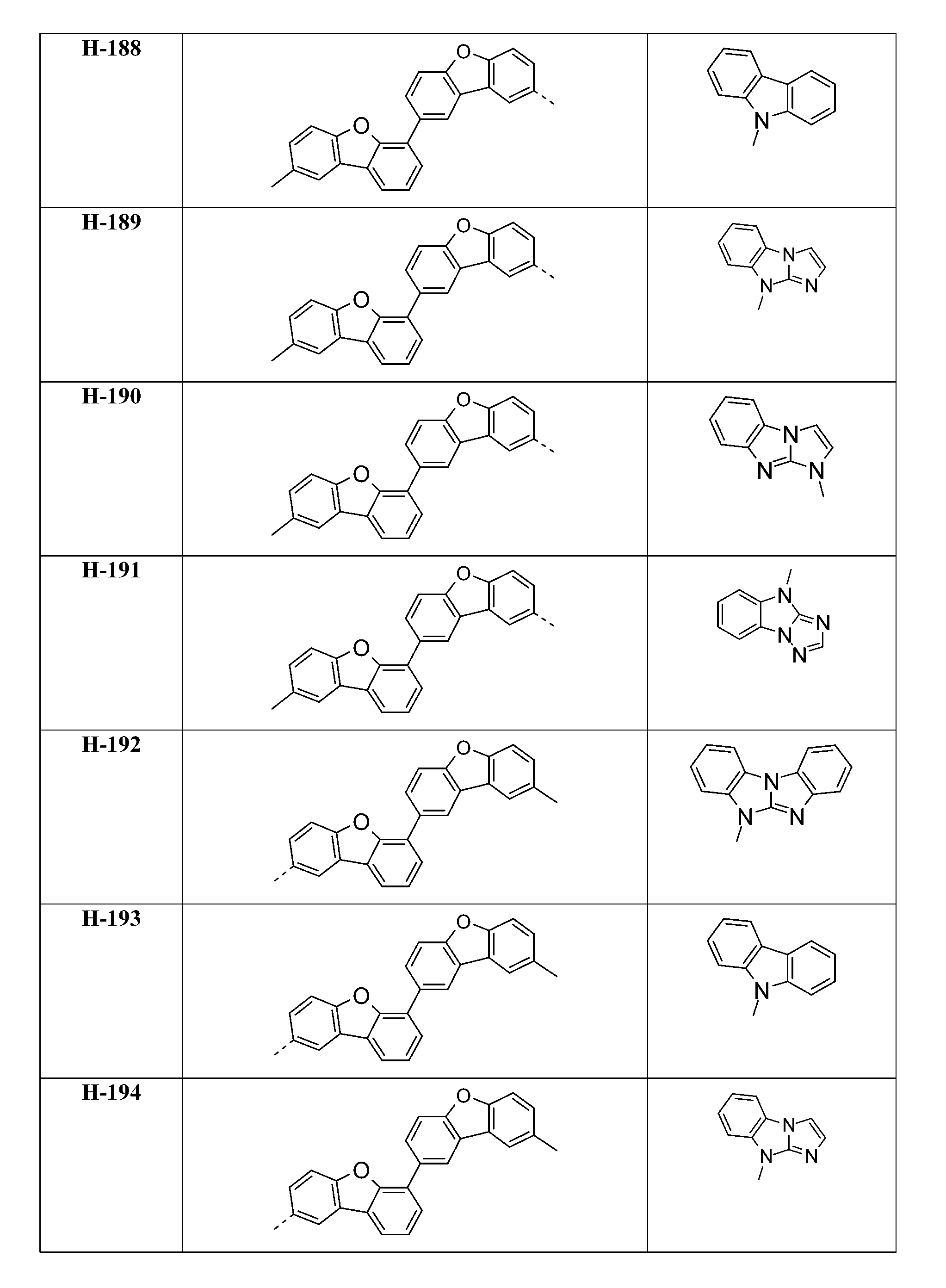


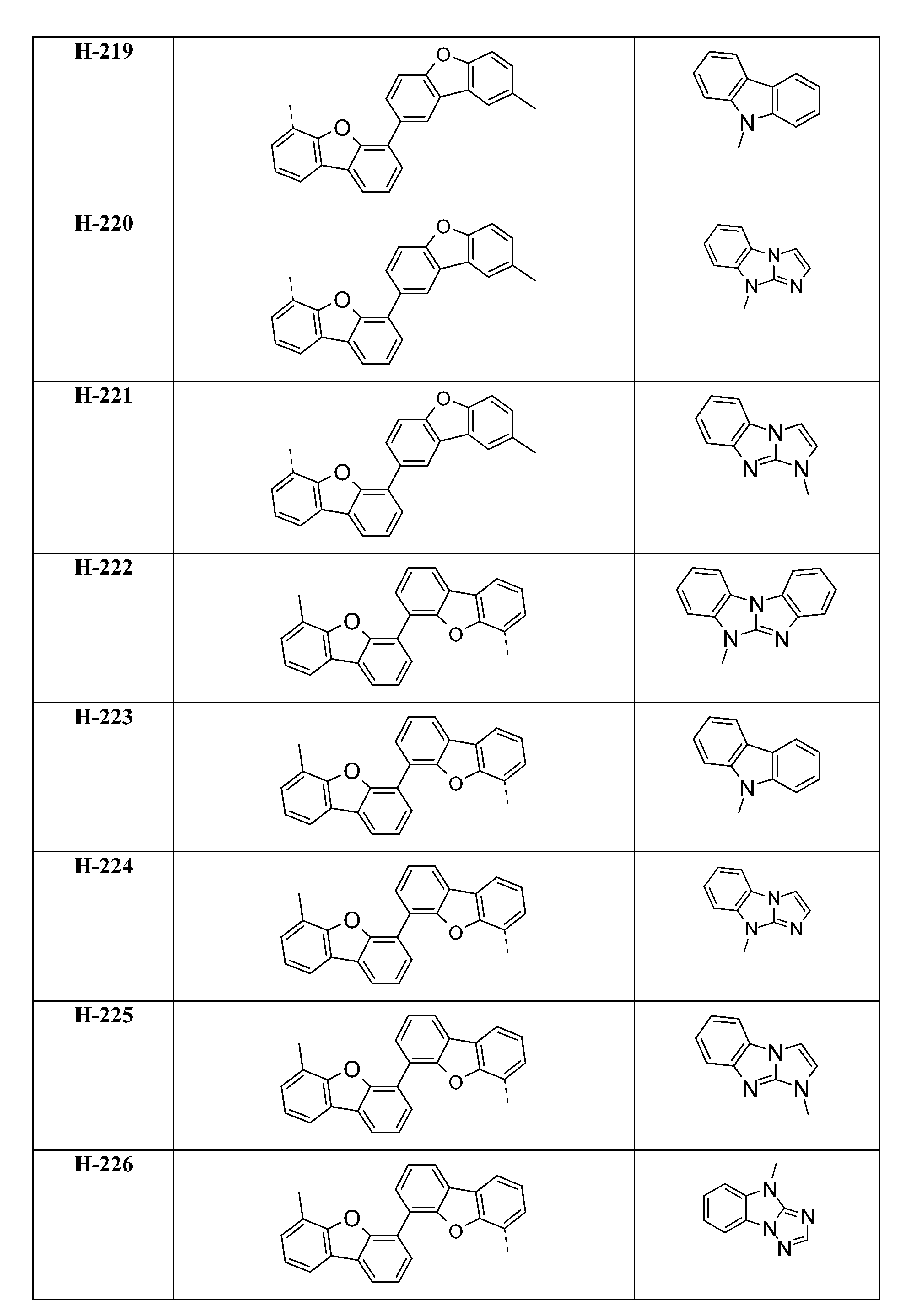


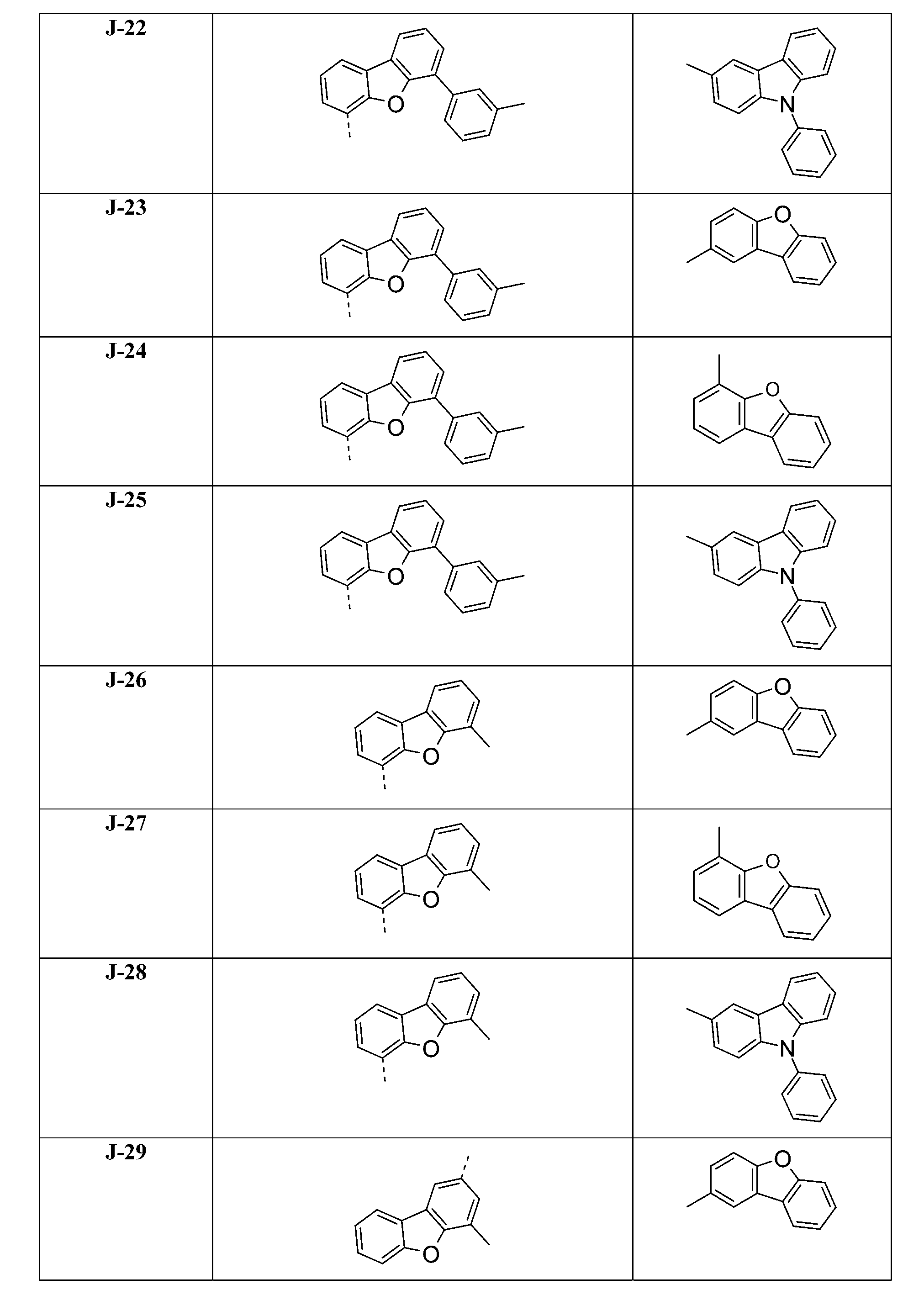


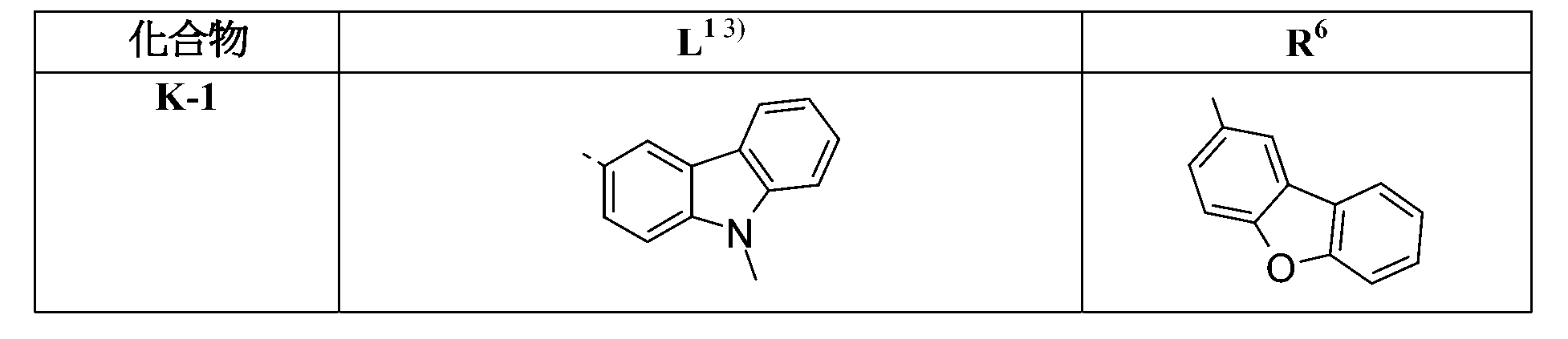


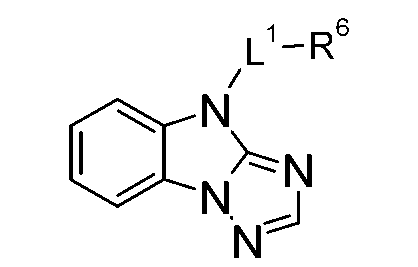


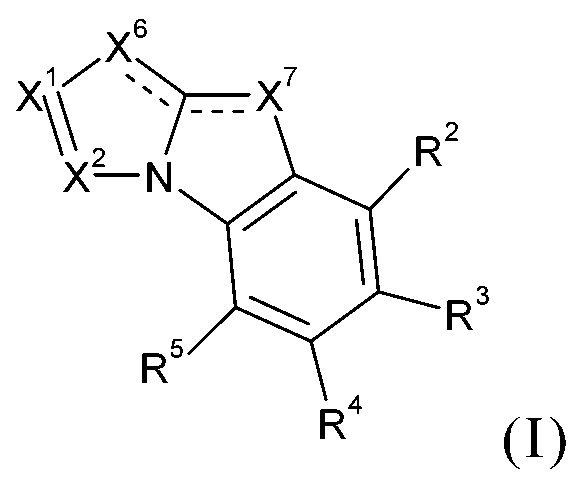

Applications Claiming Priority (4)
| Application Number | Priority Date | Filing Date | Title |
|---|---|---|---|
| US201161467412P | 2011-03-25 | 2011-03-25 | |
| US61/467,412 | 2011-03-25 | ||
| US201161557933P | 2011-11-10 | 2011-11-10 | |
| US61/557,933 | 2011-11-10 |
Publications (2)
| Publication Number | Publication Date |
|---|---|
| TW201928008A TW201928008A (en) | 2019-07-16 |
| TWI701317B true TWI701317B (en) | 2020-08-11 |
Family
ID=46876550
Family Applications (2)
| Application Number | Title | Priority Date | Filing Date |
|---|---|---|---|
| TW107136952A TWI701317B (en) | 2011-03-25 | 2012-03-23 | 4h-imidazo[1,2-a]imidazoles for electronic applications |
| TW101110259A TWI645013B (en) | 2011-03-25 | 2012-03-23 | 4H-imidazo[1,2-a]imidazole for electronic applications |
Family Applications After (1)
| Application Number | Title | Priority Date | Filing Date |
|---|---|---|---|
| TW101110259A TWI645013B (en) | 2011-03-25 | 2012-03-23 | 4H-imidazo[1,2-a]imidazole for electronic applications |
Country Status (2)
| Country | Link |
|---|---|
| US (4) | US9806270B2 (en) |
| TW (2) | TWI701317B (en) |
Families Citing this family (25)
| Publication number | Priority date | Publication date | Assignee | Title |
|---|---|---|---|---|
| US9806270B2 (en) | 2011-03-25 | 2017-10-31 | Udc Ireland Limited | 4H-imidazo[1,2-a]imidazoles for electronic applications |
| CN103476774B (en) * | 2011-04-13 | 2017-02-15 | 默克专利有限公司 | Materials for Electronic Devices |
| WO2012152812A1 (en) | 2011-05-10 | 2012-11-15 | Basf Se | Novel color converters |
| RU2608411C2 (en) | 2011-06-10 | 2017-01-18 | Басф Се | New colour converter |
| CN108299439B (en) | 2011-11-10 | 2021-02-09 | Udc 爱尔兰有限责任公司 | 4H-imidazo [1,2-a ] imidazoles for electronic applications |
| CN108191870A (en) | 2012-07-10 | 2018-06-22 | Udc 爱尔兰有限责任公司 | For benzimidazole simultaneously [1,2-A] benzimidizole derivatives of electronic application |
| CN104662023B (en) * | 2012-09-20 | 2017-08-18 | Udc 爱尔兰有限责任公司 | Azadibenzofurans for electron applications |
| CN104119364A (en) * | 2013-04-25 | 2014-10-29 | 海洋王照明科技股份有限公司 | Organic semiconductor material, preparation method thereof and electroluminescent device |
| EP3063153B1 (en) * | 2013-10-31 | 2018-03-07 | Idemitsu Kosan Co., Ltd. | Azadibenzothiophenes for electronic applications |
| EP2993215B1 (en) * | 2014-09-04 | 2019-06-19 | Idemitsu Kosan Co., Ltd. | Azabenzimidazo[2,1-a]benzimidazoles for electronic applications |
| KR102304719B1 (en) * | 2014-10-01 | 2021-09-27 | 삼성디스플레이 주식회사 | Condensed-cyclic compound and organic light emitting diode comprising the same |
| EP3034507A1 (en) * | 2014-12-15 | 2016-06-22 | Idemitsu Kosan Co., Ltd | 1-functionalized dibenzofurans and dibenzothiophenes for organic light emitting diodes (OLEDs) |
| EP3150604B1 (en) * | 2015-10-01 | 2021-07-14 | Idemitsu Kosan Co., Ltd. | Benzimidazolo[1,2-a]benzimidazole carrying benzimidazolo[1,2-a]benzimidazolylyl groups, carbazolyl groups, benzofurane groups or benzothiophene groups for organic light emitting diodes |
| US10593892B2 (en) | 2015-10-01 | 2020-03-17 | Universal Display Corporation | Organic electroluminescent materials and devices |
| WO2017056053A1 (en) * | 2015-10-01 | 2017-04-06 | Idemitsu Kosan Co., Ltd. | Benzimidazolo[1,2-a]benzimidazole carrying benzimidazolo[1,2-a]benzimidazolyl groups, carbazolyl groups, benzofurane groups or benzothiophene groups for organic light emitting diodes |
| CN106588934A (en) * | 2016-11-26 | 2017-04-26 | 长春海谱润斯科技有限公司 | Carbazole derivative, preparation method, and application thereof |
| US10840459B2 (en) * | 2017-05-18 | 2020-11-17 | Universal Display Corporation | Organic electroluminescent materials and devices |
| US10608188B2 (en) * | 2017-09-11 | 2020-03-31 | Universal Display Corporation | Organic electroluminescent materials and devices |
| KR102671945B1 (en) | 2017-10-06 | 2024-06-03 | 메르크 파텐트 게엠베하 | Materials for organic electroluminescent devices |
| EP3762388A1 (en) * | 2018-03-09 | 2021-01-13 | Merck Patent GmbH | Compounds for electronic devices |
| US20210020850A1 (en) * | 2018-03-09 | 2021-01-21 | Merck Patent Gmbh | Compounds for electronic devices |
| US11515489B2 (en) * | 2018-11-28 | 2022-11-29 | Universal Display Corporation | Host materials for electroluminescent devices |
| US11512093B2 (en) | 2019-03-04 | 2022-11-29 | Universal Display Corporation | Compound used for organic light emitting device (OLED), consumer product and formulation |
| KR102820738B1 (en) * | 2019-05-30 | 2025-06-16 | 삼성디스플레이 주식회사 | Organometallic compound and organic light emitting device including the same |
| TW202208594A (en) | 2020-05-27 | 2022-03-01 | 德商麥克專利有限公司 | Materials for electronic devices |
Citations (4)
| Publication number | Priority date | Publication date | Assignee | Title |
|---|---|---|---|---|
| US20050079387A1 (en) * | 2003-10-13 | 2005-04-14 | Seok-Jong Lee | Imidazole ring-containing compound and organic electroluminescence display device |
| CN1637000A (en) * | 2003-10-07 | 2005-07-13 | 三星Sdi株式会社 | Imidazole ring-containing compound and organic electroluminescence display device |
| TW200602464A (en) * | 2004-05-14 | 2006-01-16 | Idemitsu Kosan Co | Organic electroluminescent device |
| JP2010232221A (en) * | 2009-03-25 | 2010-10-14 | Fujifilm Corp | Organic electroluminescence device |
Family Cites Families (69)
| Publication number | Priority date | Publication date | Assignee | Title |
|---|---|---|---|---|
| JPS6072760A (en) | 1983-09-29 | 1985-04-24 | Yokogawa Hokushin Electric Corp | Thermo-transfer printer |
| US5493020A (en) * | 1993-07-29 | 1996-02-20 | Genentech, Inc. | Tricyclic inhibitors of the GPIIb IIIa receptor |
| PT1064243E (en) | 1998-03-18 | 2003-03-31 | Ciba Sc Holding Ag | REACCOES OF COUPLING WITH PALLADIUM CATALYSTS |
| JP3907142B2 (en) | 1998-08-18 | 2007-04-18 | 富士フイルム株式会社 | Organic electroluminescent device material and organic electroluminescent device using the same |
| WO2000070655A2 (en) | 1999-05-13 | 2000-11-23 | The Trustees Of Princeton University | Very high efficiency organic light emitting devices based on electrophosphorescence |
| JP2001160488A (en) | 1999-12-01 | 2001-06-12 | Konica Corp | Organic electroluminescent element |
| KR100946314B1 (en) | 1999-12-01 | 2010-03-09 | 더 트러스티즈 오브 프린스턴 유니버시티 | Organic light emitting device comprising a phosphorescent organo metallic compound |
| US6821645B2 (en) | 1999-12-27 | 2004-11-23 | Fuji Photo Film Co., Ltd. | Light-emitting material comprising orthometalated iridium complex, light-emitting device, high efficiency red light-emitting device, and novel iridium complex |
| US6565994B2 (en) | 2000-02-10 | 2003-05-20 | Fuji Photo Film Co., Ltd. | Light emitting device material comprising iridium complex and light emitting device using same material |
| US20020121638A1 (en) | 2000-06-30 | 2002-09-05 | Vladimir Grushin | Electroluminescent iridium compounds with fluorinated phenylpyridines, phenylpyrimidines, and phenylquinolines and devices made with such compounds |
| DE60103405T2 (en) | 2000-07-13 | 2005-06-09 | Intier Automotive Inc., Aurora | SLEEPING SHOULDER BELT |
| US7306856B2 (en) | 2000-07-17 | 2007-12-11 | Fujifilm Corporation | Light-emitting element and iridium complex |
| CN101924190B (en) | 2000-08-11 | 2012-07-04 | 普林斯顿大学理事会 | Organometallic compounds and emission-shifting organic electrophosphorescence |
| JP4344494B2 (en) | 2000-08-24 | 2009-10-14 | 富士フイルム株式会社 | Light emitting device and novel polymer element |
| JP4067286B2 (en) | 2000-09-21 | 2008-03-26 | 富士フイルム株式会社 | Light emitting device and iridium complex |
| JP4154139B2 (en) | 2000-09-26 | 2008-09-24 | キヤノン株式会社 | Light emitting element |
| JP4154138B2 (en) | 2000-09-26 | 2008-09-24 | キヤノン株式会社 | Light emitting element, display device and metal coordination compound |
| JP4086499B2 (en) | 2000-11-29 | 2008-05-14 | キヤノン株式会社 | Metal coordination compound, light emitting device and display device |
| JP4154145B2 (en) | 2000-12-01 | 2008-09-24 | キヤノン株式会社 | Metal coordination compound, light emitting device and display device |
| BR0206698A (en) * | 2001-01-26 | 2004-04-20 | Bristol Myers Squibb Co | Imidazolyl derivatives as corticotropin releasing factor inhibitors. |
| DE10104426A1 (en) | 2001-02-01 | 2002-08-08 | Covion Organic Semiconductors | Process for the production of high-purity, tris-ortho-metallated organo-iridium compounds |
| JP4218312B2 (en) | 2002-11-07 | 2009-02-04 | コニカミノルタホールディングス株式会社 | Organic electroluminescence element and display device |
| DE10338550A1 (en) | 2003-08-19 | 2005-03-31 | Basf Ag | Transition metal complexes with carbene ligands as emitters for organic light-emitting diodes (OLEDs) |
| GB0323137D0 (en) | 2003-10-03 | 2003-11-05 | Chang Lisa C W | 2,4,6- Trisubstituted pyrimidines and their different uses |
| WO2005113704A2 (en) | 2004-05-18 | 2005-12-01 | The University Of Southern California | Luminescent compounds with carbene ligands |
| DE102004057072A1 (en) | 2004-11-25 | 2006-06-01 | Basf Ag | Use of Transition Metal Carbene Complexes in Organic Light Emitting Diodes (OLEDs) |
| WO2006060294A2 (en) | 2004-11-30 | 2006-06-08 | Kelly Stephen M | Blue emissive oled materials |
| CA2589711A1 (en) | 2004-12-23 | 2006-06-29 | Ciba Specialty Chemicals Holding Inc. | Electroluminescent metal complexes with nucleophilic carbene ligands |
| DE102005014284A1 (en) | 2005-03-24 | 2006-09-28 | Basf Ag | Use of compounds containing aromatic or heteroaromatic rings containing groups via carbonyl groups as matrix materials in organic light-emitting diodes |
| GB2439030B (en) | 2005-04-18 | 2011-03-02 | Konica Minolta Holdings Inc | Organic electroluminescent device, display and illuminating device |
| TWI418606B (en) | 2005-04-25 | 2013-12-11 | Udc Ireland Ltd | Organic electroluminescent device |
| US9051344B2 (en) | 2005-05-06 | 2015-06-09 | Universal Display Corporation | Stability OLED materials and devices |
| DE602006011734D1 (en) | 2005-05-30 | 2010-03-04 | Basf Se | ELECTROLUMINESCENT DEVICE |
| WO2007047397A2 (en) | 2005-10-13 | 2007-04-26 | Smithkline Beecham Corporation | Phenol ethers as modulators of the opioid receptors |
| DE102005058543A1 (en) | 2005-12-08 | 2007-06-14 | Merck Patent Gmbh | Organic electroluminescent devices |
| JP5017858B2 (en) | 2005-12-27 | 2012-09-05 | コニカミノルタホールディングス株式会社 | Organic electroluminescence device |
| USRE44831E1 (en) | 2006-01-05 | 2014-04-08 | Konica Minolta Holdings, Inc. | Organic electroluminescent device, display, and illuminating device |
| KR101600624B1 (en) | 2006-02-10 | 2016-03-21 | 유니버셜 디스플레이 코포레이션 | METAL COMPLEXES OF CYCLOMETALLATED IMIDAZO[1,2-f]PHENANTHRIDINE AND DIIMIDAZO[1,2-A:1',2'-C]QUINAZOLINE LIGANDS AND ISOELECTRONIC AND BENZANNULATED ANALOGS THEREOF |
| WO2007101820A1 (en) | 2006-03-08 | 2007-09-13 | Ciba Holding Inc. | Palladium catalyzed polymerization reaction |
| EP2615153B1 (en) | 2006-03-23 | 2017-03-01 | Konica Minolta Holdings, Inc. | Organic electroluminescent device, display and illuminating device |
| KR20090007389A (en) | 2006-04-04 | 2009-01-16 | 바스프 에스이 | Transition metal complexes comprising one bicarbene ligand and one or two carbene ligands and their use in OLD |
| ATE550342T1 (en) | 2006-04-05 | 2012-04-15 | Basf Se | HETEROLEPTIC TRANSITION METAL-CARBEN COMPLEXES AND THEIR USE IN ORGANIC LIGHT-LIGHT DIODES (OLEDS) |
| CN101461074B (en) | 2006-06-02 | 2011-06-15 | 出光兴产株式会社 | Material for organic electroluminescence element and organic electroluminescence element using same |
| JP2009541431A (en) | 2006-06-26 | 2009-11-26 | ビーエーエスエフ ソシエタス・ヨーロピア | Use of transition metal-carbene complexes without cyclometalation via non-carbene |
| US8241764B2 (en) | 2006-09-21 | 2012-08-14 | Basf Aktiengesellschaft | OLED display with extended lifetime |
| KR101030007B1 (en) | 2007-06-15 | 2011-04-20 | 삼성모바일디스플레이주식회사 | Heteroaromatic cycle containing compound method of preparing the same and an organic light emitting device comprising the same |
| KR101612135B1 (en) | 2007-10-17 | 2016-04-12 | 바스프 에스이 | Transition metal complexes with bridged carbene ligands and use thereof in oleds |
| JP2011500648A (en) | 2007-10-17 | 2011-01-06 | ビーエーエスエフ ソシエタス・ヨーロピア | Transition metal complexes with bridged carbene ligands and their use in OLEDs |
| EP2362889B1 (en) | 2008-11-11 | 2018-12-26 | Universal Display Corporation | Phosphorescent emitters |
| TWI475011B (en) | 2008-12-01 | 2015-03-01 | Tosoh Corp | 1,3,5-triazine derivatives and method for producing thereof, and organic electroluminescent elements using them as components |
| JP2010138121A (en) | 2008-12-12 | 2010-06-24 | Canon Inc | Triazine compound, and organic light emitting element employing the same |
| US9458182B2 (en) | 2009-01-07 | 2016-10-04 | Basf Se | Silyl- and heteroatom-substituted compounds selected from carbazoles, dibenzofurans, dibenzothiophenes and dibenzophospholes, and use thereof in organic electronics |
| DE102009007038A1 (en) | 2009-02-02 | 2010-08-05 | Merck Patent Gmbh | metal complexes |
| TWI687408B (en) | 2009-04-28 | 2020-03-11 | 美商環球展覽公司 | Iridium complex with methyl-D3 substitution |
| KR20110008784A (en) | 2009-07-21 | 2011-01-27 | 다우어드밴스드디스플레이머티리얼 유한회사 | Novel organic light emitting compound and organic electroluminescent device comprising same |
| KR101431644B1 (en) | 2009-08-10 | 2014-08-21 | 롬엔드하스전자재료코리아유한회사 | Novel organic electroluminescent compounds and organic electroluminescent devices containing them |
| KR101986469B1 (en) | 2009-10-28 | 2019-06-05 | 유디씨 아일랜드 리미티드 | Heteroleptic carbene complexes and the use thereof in organic electronics |
| WO2011073149A1 (en) | 2009-12-14 | 2011-06-23 | Basf Se | Metal complexes comprising diazabenzimidazol carbene-ligands and the use thereof in oleds |
| KR20110093055A (en) | 2010-02-11 | 2011-08-18 | 다우어드밴스드디스플레이머티리얼 유한회사 | Novel organic light emitting compound and organic electroluminescent device employing the same |
| DE102010024542A1 (en) | 2010-06-22 | 2011-12-22 | Merck Patent Gmbh | Materials for electronic devices |
| NZ605889A (en) * | 2010-06-24 | 2014-10-31 | Takeda Pharmaceutical | Fused heterocyclic compounds as phosphodiesterases (pdes) inhibitors |
| WO2012023947A1 (en) | 2010-08-20 | 2012-02-23 | Universal Display Corporation | Bicarbazole compounds for oleds |
| JP6012024B2 (en) | 2010-12-13 | 2016-10-25 | ユー・ディー・シー アイルランド リミテッド | Bispyrimidine for electronic device applications |
| CN114315840A (en) | 2011-03-25 | 2022-04-12 | Udc 爱尔兰有限责任公司 | 4H-imidazo [1,2-a ] imidazoles for electronic applications |
| US9806270B2 (en) | 2011-03-25 | 2017-10-31 | Udc Ireland Limited | 4H-imidazo[1,2-a]imidazoles for electronic applications |
| JP6192647B2 (en) | 2011-10-04 | 2017-09-06 | ビーエーエスエフ ソシエタス・ヨーロピアBasf Se | Benzodione polymers |
| EP2592422A1 (en) | 2011-11-08 | 2013-05-15 | Zora Biosciences OY | Lipidomic biomarkers for the prediction of cardiovascular outcomes in coronary artery disease patients undergoing statin treatment |
| CN108299439B (en) | 2011-11-10 | 2021-02-09 | Udc 爱尔兰有限责任公司 | 4H-imidazo [1,2-a ] imidazoles for electronic applications |
| CN104662023B (en) | 2012-09-20 | 2017-08-18 | Udc 爱尔兰有限责任公司 | Azadibenzofurans for electron applications |
-
2012
- 2012-03-20 US US13/424,892 patent/US9806270B2/en active Active
- 2012-03-23 TW TW107136952A patent/TWI701317B/en active
- 2012-03-23 TW TW101110259A patent/TWI645013B/en active
-
2016
- 2016-03-03 US US15/060,363 patent/US10431750B2/en active Active
-
2019
- 2019-05-17 US US16/415,221 patent/US11450812B2/en active Active
-
2022
- 2022-06-08 US US17/835,319 patent/US12538704B2/en active Active
Patent Citations (4)
| Publication number | Priority date | Publication date | Assignee | Title |
|---|---|---|---|---|
| CN1637000A (en) * | 2003-10-07 | 2005-07-13 | 三星Sdi株式会社 | Imidazole ring-containing compound and organic electroluminescence display device |
| US20050079387A1 (en) * | 2003-10-13 | 2005-04-14 | Seok-Jong Lee | Imidazole ring-containing compound and organic electroluminescence display device |
| TW200602464A (en) * | 2004-05-14 | 2006-01-16 | Idemitsu Kosan Co | Organic electroluminescent device |
| JP2010232221A (en) * | 2009-03-25 | 2010-10-14 | Fujifilm Corp | Organic electroluminescence device |
Non-Patent Citations (1)
| Title |
|---|
| "1,2-DIPHENYLIMIDAZO[I,2-a]BENZIMIDAZOLE IN ELECTROPHILIC SUBSTITUTION REACTIONS", B. A. Priimenko et al., Chemistry of Heterocyclic Compounds,1981,17(9),937-940. * |
Also Published As
| Publication number | Publication date |
|---|---|
| TWI645013B (en) | 2018-12-21 |
| US20190273211A1 (en) | 2019-09-05 |
| US10431750B2 (en) | 2019-10-01 |
| US20120241681A1 (en) | 2012-09-27 |
| US12538704B2 (en) | 2026-01-27 |
| US20160190480A1 (en) | 2016-06-30 |
| US20230090208A1 (en) | 2023-03-23 |
| US9806270B2 (en) | 2017-10-31 |
| TW201247839A (en) | 2012-12-01 |
| US11450812B2 (en) | 2022-09-20 |
| TW201928008A (en) | 2019-07-16 |
Similar Documents
| Publication | Publication Date | Title |
|---|---|---|
| TWI701317B (en) | 4h-imidazo[1,2-a]imidazoles for electronic applications | |
| JP6730470B2 (en) | 4H-imidazo[1,2-a]imidazole for electronics applications | |
| TWI673270B (en) | Benzimidazo[1,2-a]benzimidazole derivatives for electronic applications | |
| TWI626242B (en) | 4h-imidazo[1,2-a]imidazoles for electronic applications | |
| TWI623539B (en) | Azadibenzofuran for electronic applications | |
| TW201520218A (en) | Benzimidazo[2,1-b][1,3]benzothiazole for electronic applications | |
| TW201605842A (en) | Novel dibenzofuran and dibenzothiophene | |
| TW201522323A (en) | Azadibenzothiophenes for electronic applications |