TW202237636A - Compositions and uses of psca targeted chimeric antigen receptor modified cells - Google Patents
Compositions and uses of psca targeted chimeric antigen receptor modified cells Download PDFInfo
- Publication number
- TW202237636A TW202237636A TW110143586A TW110143586A TW202237636A TW 202237636 A TW202237636 A TW 202237636A TW 110143586 A TW110143586 A TW 110143586A TW 110143586 A TW110143586 A TW 110143586A TW 202237636 A TW202237636 A TW 202237636A
- Authority
- TW
- Taiwan
- Prior art keywords
- cells
- seq
- nucleic acid
- cell
- acid molecule
- Prior art date
Links
Images


Classifications
-
- A—HUMAN NECESSITIES
- A61—MEDICAL OR VETERINARY SCIENCE; HYGIENE
- A61K—PREPARATIONS FOR MEDICAL, DENTAL OR TOILETRY PURPOSES
- A61K35/00—Medicinal preparations containing materials or reaction products thereof with undetermined constitution
- A61K35/12—Materials from mammals; Compositions comprising non-specified tissues or cells; Compositions comprising non-embryonic stem cells; Genetically modified cells
- A61K35/48—Reproductive organs
- A61K35/54—Ovaries; Ova; Ovules; Embryos; Foetal cells; Germ cells
- A61K35/545—Embryonic stem cells; Pluripotent stem cells; Induced pluripotent stem cells; Uncharacterised stem cells
-
- A—HUMAN NECESSITIES
- A61—MEDICAL OR VETERINARY SCIENCE; HYGIENE
- A61K—PREPARATIONS FOR MEDICAL, DENTAL OR TOILETRY PURPOSES
- A61K40/00—Cellular immunotherapy
- A61K40/10—Cellular immunotherapy characterised by the cell type used
- A61K40/15—Natural-killer [NK] cells; Natural-killer T [NKT] cells
-
- A—HUMAN NECESSITIES
- A61—MEDICAL OR VETERINARY SCIENCE; HYGIENE
- A61K—PREPARATIONS FOR MEDICAL, DENTAL OR TOILETRY PURPOSES
- A61K40/00—Cellular immunotherapy
- A61K40/30—Cellular immunotherapy characterised by the recombinant expression of specific molecules in the cells of the immune system
- A61K40/31—Chimeric antigen receptors [CAR]
-
- A—HUMAN NECESSITIES
- A61—MEDICAL OR VETERINARY SCIENCE; HYGIENE
- A61K—PREPARATIONS FOR MEDICAL, DENTAL OR TOILETRY PURPOSES
- A61K40/00—Cellular immunotherapy
- A61K40/40—Cellular immunotherapy characterised by antigens that are targeted or presented by cells of the immune system
- A61K40/41—Vertebrate antigens
- A61K40/42—Cancer antigens
- A61K40/4274—Prostate associated antigens e.g. Prostate stem cell antigen [PSCA]; Prostate carcinoma tumor antigen [PCTA]; Prostatic acid phosphatase [PAP]; Prostate-specific G-protein-coupled receptor [PSGR]
-
- A—HUMAN NECESSITIES
- A61—MEDICAL OR VETERINARY SCIENCE; HYGIENE
- A61P—SPECIFIC THERAPEUTIC ACTIVITY OF CHEMICAL COMPOUNDS OR MEDICINAL PREPARATIONS
- A61P35/00—Antineoplastic agents
-
- C—CHEMISTRY; METALLURGY
- C07—ORGANIC CHEMISTRY
- C07K—PEPTIDES
- C07K14/00—Peptides having more than 20 amino acids; Gastrins; Somatostatins; Melanotropins; Derivatives thereof
- C07K14/435—Peptides having more than 20 amino acids; Gastrins; Somatostatins; Melanotropins; Derivatives thereof from animals; from humans
- C07K14/52—Cytokines; Lymphokines; Interferons
- C07K14/54—Interleukins [IL]
- C07K14/5443—IL-15
-
- C—CHEMISTRY; METALLURGY
- C07—ORGANIC CHEMISTRY
- C07K—PEPTIDES
- C07K14/00—Peptides having more than 20 amino acids; Gastrins; Somatostatins; Melanotropins; Derivatives thereof
- C07K14/435—Peptides having more than 20 amino acids; Gastrins; Somatostatins; Melanotropins; Derivatives thereof from animals; from humans
- C07K14/705—Receptors; Cell surface antigens; Cell surface determinants
- C07K14/70503—Immunoglobulin superfamily
- C07K14/7051—T-cell receptor (TcR)-CD3 complex
-
- C—CHEMISTRY; METALLURGY
- C07—ORGANIC CHEMISTRY
- C07K—PEPTIDES
- C07K14/00—Peptides having more than 20 amino acids; Gastrins; Somatostatins; Melanotropins; Derivatives thereof
- C07K14/435—Peptides having more than 20 amino acids; Gastrins; Somatostatins; Melanotropins; Derivatives thereof from animals; from humans
- C07K14/705—Receptors; Cell surface antigens; Cell surface determinants
- C07K14/70503—Immunoglobulin superfamily
- C07K14/70521—CD28, CD152
-
- C—CHEMISTRY; METALLURGY
- C07—ORGANIC CHEMISTRY
- C07K—PEPTIDES
- C07K16/00—Immunoglobulins [IGs], e.g. monoclonal or polyclonal antibodies
- C07K16/18—Immunoglobulins [IGs], e.g. monoclonal or polyclonal antibodies against material from animals or humans
- C07K16/28—Immunoglobulins [IGs], e.g. monoclonal or polyclonal antibodies against material from animals or humans against receptors, cell surface antigens or cell surface determinants
- C07K16/30—Immunoglobulins [IGs], e.g. monoclonal or polyclonal antibodies against material from animals or humans against receptors, cell surface antigens or cell surface determinants from tumour cells
- C07K16/3069—Reproductive system, e.g. ovaria, uterus, testes, prostate
-
- C—CHEMISTRY; METALLURGY
- C12—BIOCHEMISTRY; BEER; SPIRITS; WINE; VINEGAR; MICROBIOLOGY; ENZYMOLOGY; MUTATION OR GENETIC ENGINEERING
- C12N—MICROORGANISMS OR ENZYMES; COMPOSITIONS THEREOF; PROPAGATING, PRESERVING, OR MAINTAINING MICROORGANISMS; MUTATION OR GENETIC ENGINEERING; CULTURE MEDIA
- C12N5/00—Undifferentiated human, animal or plant cells, e.g. cell lines; Tissues; Cultivation or maintenance thereof; Culture media therefor
- C12N5/06—Animal cells or tissues; Human cells or tissues
- C12N5/0602—Vertebrate cells
- C12N5/0634—Cells from the blood or the immune system
- C12N5/0646—Natural killers cells [NK], NKT cells
-
- A—HUMAN NECESSITIES
- A01—AGRICULTURE; FORESTRY; ANIMAL HUSBANDRY; HUNTING; TRAPPING; FISHING
- A01K—ANIMAL HUSBANDRY; AVICULTURE; APICULTURE; PISCICULTURE; FISHING; REARING OR BREEDING ANIMALS, NOT OTHERWISE PROVIDED FOR; NEW BREEDS OF ANIMALS
- A01K2207/00—Modified animals
- A01K2207/12—Animals modified by administration of exogenous cells
-
- A—HUMAN NECESSITIES
- A01—AGRICULTURE; FORESTRY; ANIMAL HUSBANDRY; HUNTING; TRAPPING; FISHING
- A01K—ANIMAL HUSBANDRY; AVICULTURE; APICULTURE; PISCICULTURE; FISHING; REARING OR BREEDING ANIMALS, NOT OTHERWISE PROVIDED FOR; NEW BREEDS OF ANIMALS
- A01K2227/00—Animals characterised by species
- A01K2227/10—Mammal
- A01K2227/105—Murine
-
- A—HUMAN NECESSITIES
- A01—AGRICULTURE; FORESTRY; ANIMAL HUSBANDRY; HUNTING; TRAPPING; FISHING
- A01K—ANIMAL HUSBANDRY; AVICULTURE; APICULTURE; PISCICULTURE; FISHING; REARING OR BREEDING ANIMALS, NOT OTHERWISE PROVIDED FOR; NEW BREEDS OF ANIMALS
- A01K2267/00—Animals characterised by purpose
- A01K2267/03—Animal model, e.g. for test or diseases
- A01K2267/0331—Animal model for proliferative diseases
-
- A—HUMAN NECESSITIES
- A61—MEDICAL OR VETERINARY SCIENCE; HYGIENE
- A61K—PREPARATIONS FOR MEDICAL, DENTAL OR TOILETRY PURPOSES
- A61K2239/00—Indexing codes associated with cellular immunotherapy of group A61K40/00
- A61K2239/31—Indexing codes associated with cellular immunotherapy of group A61K40/00 characterized by the route of administration
-
- A—HUMAN NECESSITIES
- A61—MEDICAL OR VETERINARY SCIENCE; HYGIENE
- A61K—PREPARATIONS FOR MEDICAL, DENTAL OR TOILETRY PURPOSES
- A61K2239/00—Indexing codes associated with cellular immunotherapy of group A61K40/00
- A61K2239/38—Indexing codes associated with cellular immunotherapy of group A61K40/00 characterised by the dose, timing or administration schedule
-
- A—HUMAN NECESSITIES
- A61—MEDICAL OR VETERINARY SCIENCE; HYGIENE
- A61K—PREPARATIONS FOR MEDICAL, DENTAL OR TOILETRY PURPOSES
- A61K2239/00—Indexing codes associated with cellular immunotherapy of group A61K40/00
- A61K2239/46—Indexing codes associated with cellular immunotherapy of group A61K40/00 characterised by the cancer treated
- A61K2239/53—Liver
-
- A—HUMAN NECESSITIES
- A61—MEDICAL OR VETERINARY SCIENCE; HYGIENE
- A61K—PREPARATIONS FOR MEDICAL, DENTAL OR TOILETRY PURPOSES
- A61K2239/00—Indexing codes associated with cellular immunotherapy of group A61K40/00
- A61K2239/46—Indexing codes associated with cellular immunotherapy of group A61K40/00 characterised by the cancer treated
- A61K2239/54—Pancreas
-
- A—HUMAN NECESSITIES
- A61—MEDICAL OR VETERINARY SCIENCE; HYGIENE
- A61K—PREPARATIONS FOR MEDICAL, DENTAL OR TOILETRY PURPOSES
- A61K40/00—Cellular immunotherapy
- A61K40/50—Cellular immunotherapy characterised by the use of allogeneic cells
-
- A—HUMAN NECESSITIES
- A61—MEDICAL OR VETERINARY SCIENCE; HYGIENE
- A61K—PREPARATIONS FOR MEDICAL, DENTAL OR TOILETRY PURPOSES
- A61K48/00—Medicinal preparations containing genetic material which is inserted into cells of the living body to treat genetic diseases; Gene therapy
- A61K48/005—Medicinal preparations containing genetic material which is inserted into cells of the living body to treat genetic diseases; Gene therapy characterised by an aspect of the 'active' part of the composition delivered, i.e. the nucleic acid delivered
-
- C—CHEMISTRY; METALLURGY
- C07—ORGANIC CHEMISTRY
- C07K—PEPTIDES
- C07K2317/00—Immunoglobulins specific features
- C07K2317/60—Immunoglobulins specific features characterized by non-natural combinations of immunoglobulin fragments
- C07K2317/62—Immunoglobulins specific features characterized by non-natural combinations of immunoglobulin fragments comprising only variable region components
- C07K2317/622—Single chain antibody (scFv)
-
- C—CHEMISTRY; METALLURGY
- C07—ORGANIC CHEMISTRY
- C07K—PEPTIDES
- C07K2319/00—Fusion polypeptide
- C07K2319/01—Fusion polypeptide containing a localisation/targetting motif
- C07K2319/02—Fusion polypeptide containing a localisation/targetting motif containing a signal sequence
-
- C—CHEMISTRY; METALLURGY
- C07—ORGANIC CHEMISTRY
- C07K—PEPTIDES
- C07K2319/00—Fusion polypeptide
- C07K2319/01—Fusion polypeptide containing a localisation/targetting motif
- C07K2319/03—Fusion polypeptide containing a localisation/targetting motif containing a transmembrane segment
Landscapes
- Health & Medical Sciences (AREA)
- Life Sciences & Earth Sciences (AREA)
- Chemical & Material Sciences (AREA)
- General Health & Medical Sciences (AREA)
- Organic Chemistry (AREA)
- Immunology (AREA)
- Animal Behavior & Ethology (AREA)
- Public Health (AREA)
- Veterinary Medicine (AREA)
- Medicinal Chemistry (AREA)
- Cell Biology (AREA)
- Epidemiology (AREA)
- Genetics & Genomics (AREA)
- Zoology (AREA)
- Biochemistry (AREA)
- Molecular Biology (AREA)
- Proteomics, Peptides & Aminoacids (AREA)
- Biophysics (AREA)
- Engineering & Computer Science (AREA)
- Toxicology (AREA)
- Gastroenterology & Hepatology (AREA)
- Developmental Biology & Embryology (AREA)
- Biomedical Technology (AREA)
- Biotechnology (AREA)
- Reproductive Health (AREA)
- Pharmacology & Pharmacy (AREA)
- Gynecology & Obstetrics (AREA)
- Bioinformatics & Cheminformatics (AREA)
- Wood Science & Technology (AREA)
- Virology (AREA)
- General Engineering & Computer Science (AREA)
- Nuclear Medicine, Radiotherapy & Molecular Imaging (AREA)
- General Chemical & Material Sciences (AREA)
- Pregnancy & Childbirth (AREA)
- Chemical Kinetics & Catalysis (AREA)
- Microbiology (AREA)
- Hematology (AREA)
- Micro-Organisms Or Cultivation Processes Thereof (AREA)
- Medicines Containing Material From Animals Or Micro-Organisms (AREA)
- Peptides Or Proteins (AREA)
Abstract
Description
本發明關於經PSCA特異性嵌合抗原受體(CAR)改造之免疫細胞、調配方法及使用方法。The present invention relates to immune cells modified by PSCA-specific chimeric antigen receptor (CAR), preparation methods and usage methods.
前列腺幹細胞抗原(PSCA)高度表現於各種實體瘤細胞(包括胰臟癌、前列腺癌及膀胱癌)中,但於正常細胞中具有有限之表現(Argani等人,(2001) Cancer Res. 61, 4320-4324;Abate-Daga等人,(2014) Hum Gene Ther. 25(12), 1003-1012)。儘管胰臟癌係第10大最常診斷之惡性腫瘤,但其仍係美國癌症相關死亡之第4大主因(Siegel等人,(2012) CA Cancer J. Clin. 62, 10-29)。大多數病患在診斷時出現局部晚期或轉移性疾病,且因此不符合手術切除之條件。另外,胰臟癌細胞趨於對化學及放射療法具有內在抗性。護理標準係基於吉西他濱(gemcitabine)之化學療法,其降低發病率但不誘導已證實之存活益處。目前估計之中位數存活係6至8個月(Cartwright等人,(2008) Cancer Control 15, 308-313)。需更有效之療法以有效治療此等PSCA陽性癌症。Prostate stem cell antigen (PSCA) is highly expressed in various solid tumor cells, including pancreatic, prostate, and bladder cancers, but has limited expression in normal cells (Argani et al., (2001) Cancer Res. 61, 4320 -4324; Abate-Daga et al. (2014) Hum Gene Ther. 25(12), 1003-1012). Although pancreatic cancer is the 10th most commonly diagnosed malignancy, it is still the 4th leading cause of cancer-related death in the United States (Siegel et al. (2012) CA Cancer J. Clin. 62, 10-29). Most patients have locally advanced or metastatic disease at diagnosis and are therefore not eligible for surgical resection. In addition, pancreatic cancer cells tend to be intrinsically resistant to chemotherapy and radiation therapy. The standard of care is gemcitabine-based chemotherapy, which reduces morbidity but does not induce a proven survival benefit. The median survival is currently estimated at 6 to 8 months (Cartwright et al. (2008) Cancer Control 15, 308-313). More effective therapies are needed to effectively treat these PSCA positive cancers.
本文提供包含編碼嵌合抗原受體(CAR)之第一核苷酸分子及編碼IL-15域之第二核苷酸分子,或者基本上由其構成,或又進一步由其構成之核酸分子。該CAR包含靶向前列腺幹細胞抗原(PSCA)之單鏈可變片段(scFv)、間隔子、跨膜域、共刺激域及CD3 ζ傳訊域,或者基本上由其構成,或又進一步由其構成。該核酸分子可為DNA或RNA。Provided herein are nucleic acid molecules comprising, or consisting essentially of, or further consisting of, a first nucleotide molecule encoding a chimeric antigen receptor (CAR) and a second nucleotide molecule encoding an IL-15 domain. The CAR comprises, or consists essentially of, or further consists of, a single-chain variable fragment (scFv) targeting prostate stem cell antigen (PSCA), a spacer, a transmembrane domain, a co-stimulatory domain, and a CD3 ζ signaling domain . The nucleic acid molecule can be DNA or RNA.
本文描述用於製造及使用表現靶向PSCA之嵌合抗原受體(CAR)共表現IL-15域(例如,IL-15之至少一部分、IL-15Ra之至少一部分,或包括IL-15之至少一部分及IL-15Ra之至少一部分之融合蛋白)之CAR T及自然殺手(NK)細胞或其他免疫細胞(本文亦稱為PSCA CAR NK細胞)以治療多種實體瘤(例如,非小細胞肺癌、膽囊癌、胰臟癌、前列腺癌及膀胱癌)之方法。本文描述之PSCA CAR NK細胞具有活體外及活體內強效抗原特異性抗腫瘤效應。本文描述之PSCA CAR NK細胞亦具有該強效抗原特異性抗腫瘤效應。Described herein are methods for making and using chimeric antigen receptors (CARs) expressing targeting PSCA co-expressing IL-15 domains (e.g., at least a portion of IL-15, at least a portion of IL-15Ra, or comprising at least a portion of IL-15 Fusion protein of a portion and at least a portion of IL-15Ra) and natural killer (NK) cells or other immune cells (also referred to herein as PSCA CAR NK cells) for the treatment of various solid tumors (e.g., non-small cell lung cancer, gallbladder cancer, pancreatic cancer, prostate cancer and bladder cancer). The PSCA CAR NK cells described herein have potent antigen-specific anti-tumor effects in vitro and in vivo. The PSCA CAR NK cells described herein also have this potent antigen-specific anti-tumor effect.
本文描述包含編碼嵌合抗原受體(CAR)或多肽之核苷酸序列及編碼包含IL-15域之多肽之核苷酸序列之核酸分子,其中該嵌合抗原受體或多肽包含:靶向PSCA之scFv、間隔子、跨膜域、共刺激域及CD3 ζ傳訊域。Described herein are nucleic acid molecules comprising a nucleotide sequence encoding a chimeric antigen receptor (CAR) or polypeptide and a nucleotide sequence encoding a polypeptide comprising an IL-15 domain, wherein the chimeric antigen receptor or polypeptide comprises: targeting scFv, spacer, transmembrane domain, co-stimulatory domain and CD3 ζ signaling domain of PSCA.
在一些實施例中,由第一核苷酸分子編碼之CAR包含scFv,或者基本上由其構成,或又進一步由其構成,該scFv包括包含DYYI (SEQ ID NO: 33之aa 31至aa 34)之重鏈(HC)互補決定區(CDR) 1 (CDRH1)、包含WIDPENGDTEFVPKFQG (SEQ ID NO: 33之aa 50至aa 66)之HC CDR 2 (CDRH2)及包含GGF (SEQ ID NO: 33之aa 99至aa 101)之HC CDR 3 (CDRH3),或者基本上由其構成,或又進一步由其構成。在一些實施例中,由該第一核苷酸序列編碼之CAR包含scFv,或者基本上由其構成,或又進一步由其構成,該scFv包括包含SASSSVRFIH (SEQ ID NO: 32之aa 24至aa 33)之輕鏈(LC)互補決定區(CDR) 1 (CDRL1)、包含DTSKLAS (SEQ ID NO: 32之aa 49至aa 55)之LC CDR 2 (CDRL2)及包含QQWGSSPFT (SEQ ID NO: 32之aa 88至aa 96)之LC CDR 3 (CDRL3),或者基本上由其構成,或又進一步由其構成。In some embodiments, the CAR encoded by the first nucleotide molecule comprises, or consists essentially of, or further consists of, a scFv comprising DYYI (aa 31 to aa 34 of SEQ ID NO: 33 ), the heavy chain (HC) complementarity determining region (CDR) 1 (CDRH1), the HC CDR 2 (CDRH2) comprising WIDPENGDTEFVPKFQG (aa 50 to aa 66 of SEQ ID NO: 33) and the HC CDR 2 (CDRH2) comprising GGF (SEQ ID NO: 33 The HC CDR 3 (CDRH3) of aa 99 to aa 101) either consists essentially of or further consists of it. In some embodiments, the CAR encoded by the first nucleotide sequence comprises, or consists essentially of, or further consists of, a scFv comprising SASSSVRFIH (aa 24 to aa of SASSSVRFIH (SEQ ID NO: 32) 33) light chain (LC) complementarity determining region (CDR) 1 (CDRL1), LC CDR 2 (CDRL2) comprising DTSKLAS (aa 49 to aa 55 of SEQ ID NO: 32) and comprising QQWGSSPFT (SEQ ID NO: 32 The LC CDR 3 (CDRL3) of
在另一態樣中,編碼IL-15域之核酸分子包含可溶性IL-15 (sIL-15或s15)、膜連IL-15 (mbIL-15或mIL-15或m15)、包括可溶性IL-15及IL-15Rα之至少一部分之融合蛋白(sIL-15c或s15c),及包括跨膜域、IL-15之至少一部分及IL-15α之至少一部分之融合蛋白(mbIL-15c或mIL-15c或m15c),其可視需要經密碼子最佳化。In another aspect, the nucleic acid molecule encoding an IL-15 domain comprises soluble IL-15 (sIL-15 or s15), membrane-bound IL-15 (mbIL-15 or mIL-15 or m15), including soluble IL-15 and at least a portion of IL-15Rα (sIL-15c or s15c), and a fusion protein comprising a transmembrane domain, at least a portion of IL-15, and at least a portion of IL-15α (mbIL-15c or mIL-15c or m15c ), which can be codon-optimized if desired.
本發明亦提供包含如本文揭示之核酸分子,或者基本上由其構成,或又進一步由其構成之載體。在一些實施例中,該載體進一步包含引導該核酸分子之表現或複製之調節序列,其可操作地連接至該核酸分子之一或多個元件。The present invention also provides a vector comprising, or consisting essentially of, or further consisting of, a nucleic acid molecule as disclosed herein. In some embodiments, the vector further comprises regulatory sequences directing expression or replication of the nucleic acid molecule operably linked to one or more elements of the nucleic acid molecule.
本發明亦描述包含本文描述之核酸分子之表現載體,及經該載體轉導或包括本文描述之核酸分子(例如,mRNA)之人類免疫細胞(例如,NK細胞、T細胞或巨噬細胞)之群體。Also described herein are expression vectors comprising the nucleic acid molecules described herein, and human immune cells (e.g., NK cells, T cells, or macrophages) transduced by the vectors or comprising the nucleic acid molecules (e.g., mRNA) described herein. group.
本發明亦描述一種治療病患中實體瘤或癌症之方法,其包括投與經包含本文描述之核酸分子之載體轉導之自體或同種異體之人類CAR細胞或人類NK細胞之群體,其中該實體瘤或癌症包含表現PSCA之細胞。在各種實施例中:表現嵌合抗原受體或多肽之人類CAR或NK細胞之群體係經局部或全身投與;表現該嵌合抗原受體或該多肽之人類CAR或NK細胞之群體係藉由單次或重複給藥投與。The invention also describes a method of treating a solid tumor or cancer in a patient comprising administering a population of autologous or allogeneic human CAR cells or human NK cells transduced with a vector comprising a nucleic acid molecule described herein, wherein the A solid tumor or cancer comprises cells expressing PSCA. In various embodiments: a population of human CAR or NK cells expressing a chimeric antigen receptor or polypeptide is administered locally or systemically; a population of human CAR or NK cells expressing the chimeric antigen receptor or polypeptide is administered by Administration by single or repeated doses.
在各種實施例中,NK細胞來源於臍帶血、周邊血或幹細胞。In various embodiments, the NK cells are derived from cord blood, peripheral blood, or stem cells.
本文進一步提供由本文揭示之核酸分子編碼之CAR及IL-15域多肽及表現並包含其等之細胞。Further provided herein are CAR and IL-15 domain polypeptides encoded by the nucleic acid molecules disclosed herein and cells expressing and comprising the same.
另外本發明提供包含以下中之一或多者之經分離細胞:如本文揭示之多肽、如本文揭示之核酸分子或如本文揭示之載體。在一些實施例中,該細胞表現如本文揭示之嵌合抗原受體(CAR)及IL-15域。在一些實施例中,該細胞係免疫細胞及視需要T細胞、B細胞、NK細胞、NKT細胞、樹突細胞、骨髓細胞、單核細胞或巨噬細胞。Further the invention provides isolated cells comprising one or more of: a polypeptide as disclosed herein, a nucleic acid molecule as disclosed herein or a vector as disclosed herein. In some embodiments, the cell expresses a chimeric antigen receptor (CAR) and IL-15 domain as disclosed herein. In some embodiments, the cells are immune cells and optionally T cells, B cells, NK cells, NKT cells, dendritic cells, myeloid cells, monocytes or macrophages.
另外,本文提供包含本文揭示之經分離細胞,或者基本上由其構成,或又進一步由其構成之細胞群體。在一些實施例中,本文提供免疫細胞(例如,人類NK細胞、T細胞或巨噬細胞)之群體,其等包含核酸分子或由本文揭示之核酸分子編碼之CAR及IL-15域,或者基本上由其構成,或又進一步由其構成。Additionally, provided herein are cell populations comprising, or consisting essentially of, or still further consisting of, the isolated cells disclosed herein. In some embodiments, provided herein are populations of immune cells (e.g., human NK cells, T cells, or macrophages) comprising nucleic acid molecules or CAR and IL-15 domains encoded by nucleic acid molecules disclosed herein, or essentially constituted by it, or further constituted by it.
本發明進一步提供經包含本發明之核酸(例如,編碼CAR)之載體轉導之人類NK細胞,其中該等人類NK細胞在一、二或三個凍融循環後係穩定。其等可用於本發明之方法中,及該等細胞在投與前經冷凍,且視需要其中該等細胞係NK細胞。在另一態樣中,該等細胞在投與前經解凍且視需要其中該等細胞係NK細胞。The invention further provides human NK cells transduced with a vector comprising a nucleic acid of the invention (eg, encoding a CAR), wherein the human NK cells are stable after one, two or three freeze-thaw cycles. These can be used in the methods of the invention, and the cells are frozen prior to administration, and optionally wherein the cells are NK cells. In another aspect, the cells are thawed prior to administration and optionally wherein the cells are NK cells.
另外,本文提供一種包含載劑及本文揭示之核酸分子、載體、多肽、細胞或細胞群體中之一或多者,或者基本上由其構成,或又進一步由其構成之組合物。In addition, provided herein is a composition comprising, or consisting essentially of, or further consisting of, a carrier and one or more of the nucleic acid molecules, vectors, polypeptides, cells or cell populations disclosed herein.
在一項態樣中,本發明提供一種用於產生本文揭示之細胞之細胞系之方法,其包括將本文揭示之核酸或本文揭示之載體引入至本文揭示之細胞,並表現該核酸分子,或者基本上由其構成,或又進一步由其構成。In one aspect, the invention provides a method for producing a cell line of a cell disclosed herein comprising introducing a nucleic acid disclosed herein or a vector disclosed herein into a cell disclosed herein and expressing the nucleic acid molecule, or Consists essentially of, or further consists of,
在又另一態樣中,本發明提供一種抑制表現PSCA之癌細胞或包含該癌細胞之組織之生長之方法,該方法包括使該癌細胞或該組織與本文揭示之細胞接觸,或者基本上由其構成,或又進一步由其構成。In yet another aspect, the invention provides a method of inhibiting the growth of a cancer cell expressing PSCA or a tissue comprising the cancer cell comprising contacting the cancer cell or the tissue with a cell disclosed herein, or substantially Consists of it, or further consists of it.
在又另一態樣中,本發明提供一種治療有需要受試者中表現PSCA之癌症之方法,其包括對該受試者投與本文揭示之細胞或細胞群體,藉此治療該癌症,或者基本上由其構成,或又進一步由其構成。In yet another aspect, the invention provides a method of treating a cancer expressing PSCA in a subject in need thereof comprising administering to the subject a cell or population of cells disclosed herein, thereby treating the cancer, or Consists essentially of, or further consists of,
在又另一態樣中,本發明提供一種用於治療有需要病患中實體瘤或癌症之方法,其包括投與經包含本文揭示之核酸分子,或者基本上由其構成,或又進一步由其構成之載體轉導之自體或同種異體之人類NK細胞之群體,或者基本上由其構成,或又進一步由其構成,且其中該實體瘤或癌症包含表現PSCA之細胞。In yet another aspect, the invention provides a method for treating a solid tumor or cancer in a patient in need thereof comprising administering a nucleic acid molecule comprising, consisting essentially of, or further consisting of a nucleic acid molecule disclosed herein A population of autologous or allogeneic human NK cells transduced by a vector thereof constitutes, consists essentially of, or further consists of, and wherein the solid tumor or cancer comprises cells expressing PSCA.
在一些實施例中,本文描述一種治療實體瘤之方法或一種減少或消除PSCA陽性細胞之方法。在一些實施例中,實體瘤係胰臟癌、前列腺癌、膀胱癌、胃癌、乳癌、子宮頸癌、子宮內膜癌、食道癌、肺癌、卵巢癌、睪丸癌、甲狀腺癌等中之任一者或多者或此等或其他癌症之子群體。本文亦描述一種治療病患中PSCA陽性癌症或疾患(包括,例如,胰臟癌、前列腺癌及膀胱癌)之方法,其包括投與經包含本文描述之核酸分子之載體轉導之自體或同種異體之人類NK細胞之群體,其中該等PSCA陽性癌症或疾患包含表現PSCA之細胞。在各種實施例中:表現本文描述之嵌合抗原受體或多肽之人類NK細胞係經局部或全身投與;表現PSCA之靶細胞係癌細胞;及表現嵌合抗原受體或多肽之人類NK細胞係藉由單次或重複給藥投與。In some embodiments, described herein is a method of treating a solid tumor or a method of reducing or eliminating PSCA positive cells. In some embodiments, the solid tumor is any one of pancreatic cancer, prostate cancer, bladder cancer, gastric cancer, breast cancer, cervical cancer, endometrial cancer, esophageal cancer, lung cancer, ovarian cancer, testicular cancer, thyroid cancer, etc. or a subset of these or other cancers. Also described herein is a method of treating a PSCA-positive cancer or disorder (including, for example, pancreatic cancer, prostate cancer, and bladder cancer) in a patient comprising administering an autologous or An allogeneic population of human NK cells, wherein the PSCA-positive cancer or disease comprises cells expressing PSCA. In various embodiments: human NK cell lines expressing chimeric antigen receptors or polypeptides described herein are administered locally or systemically; target cell line cancer cells expressing PSCA; and human NK cells expressing chimeric antigen receptors or polypeptides Cell lines are administered by single or repeated doses.
本文亦描述使用PSCA CAR NK細胞作為針對PSCA陽性細胞具有選擇性之抗癌劑之方法;本文亦描述減少非癌PSCA陽性細胞之群體之方法。在一些實施例中,本文描述一種減少或消除受試者中PSCA陽性細胞之方法,其包括投與經包含編碼PSCA CAR或PSCA多肽之核酸分子之載體轉導之自體或同種異體之人類NK細胞的群體。Also described herein are methods of using PSCA CAR NK cells as anticancer agents selective for PSCA positive cells; also described herein are methods of reducing the population of non-cancerous PSCA positive cells. In some embodiments, described herein is a method of reducing or eliminating PSCA-positive cells in a subject comprising administering an autologous or allogeneic human NK transduced with a vector comprising a nucleic acid molecule encoding a PSCA CAR or PSCA polypeptide population of cells.
在又另一態樣中,本發明提供一種減少或消除受試者中PSCA陽性細胞之方法,其包括投與經包含本文揭示之核酸分子之載體轉導之自體或同種異體之人類NK細胞之群體。In yet another aspect, the present invention provides a method of reducing or eliminating PSCA-positive cells in a subject comprising administering autologous or allogeneic human NK cells transduced with a vector comprising a nucleic acid molecule disclosed herein group.
儘管較佳本文描述之CAR或多肽使用重組DNA技術產生,但本文描述之CAR或多肽亦可藉由此項技術中已知的任何方式產生。編碼嵌合受體之數個區域之核酸可經製備且若便利則藉由此項技術中已知的分子選殖之標準技術(基因體庫篩選、重疊PCR、引子輔助連接、定點誘變等)組裝成完整編碼序列。所得編碼區較佳插入表現載體內並用以轉形合適之表現宿主細胞系,較佳NK細胞,且最佳自體NK細胞。Although preferably the CARs or polypeptides described herein are produced using recombinant DNA techniques, the CARs or polypeptides described herein can also be produced by any means known in the art. Nucleic acids encoding several regions of the chimeric receptor can be prepared and if convenient by standard techniques of molecular selection known in the art (genome library screening, overlapping PCR, primer assisted ligation, site-directed mutagenesis, etc. ) assembled into a complete coding sequence. The resulting coding region is preferably inserted into an expression vector and used to transform a suitable expressing host cell line, preferably NK cells, and most preferably autologous NK cells.
CAR或多肽可由編碼該CAR或多肽之mRNA瞬時表現於NK細胞群體中。該mRNA可藉由電穿孔引入該等NK細胞內(Wiesinger等人,2019 Cancers (Basel) 11:1198)。The CAR or polypeptide can be expressed transiently in the NK cell population by the mRNA encoding the CAR or polypeptide. The mRNA can be introduced into the NK cells by electroporation (Wiesinger et al., 2019 Cancers (Basel) 11:1198).
在一些實施例中,本文描述一種增加患有癌症之受試者之存活之方法,其包括投與包含本文描述之CAR NK細胞之組合物。In some embodiments, described herein is a method of increasing survival in a subject having cancer comprising administering a composition comprising a CAR NK cell described herein.
在一些實施例中,本文描述一種治療病患中癌症之方法,其包括投與包含本文描述之CAR NK細胞之組合物。In some embodiments, described herein is a method of treating cancer in a patient comprising administering a composition comprising a CAR NK cell described herein.
在一些實施例中,本文描述一種減少或改善病患中與癌症相關聯之症狀之方法,其包括投與包含本文描述之CAR NK細胞之組合物。In some embodiments, described herein is a method of reducing or ameliorating a symptom associated with cancer in a patient comprising administering a composition comprising a CAR NK cell described herein.
在一些實施例中,包含本文描述之CAR NK細胞或CAR T細胞之組合物係經局部或全身投與。在一些實施例中,包含本文描述之CAR NK細胞之組合物係藉由單次或重複給藥投與。在一些實施例中,對患有癌症、病原體感染、自體免疫疾病,或經受同種異體移植之病患投與包含本文描述之CAR NK細胞之組合物。In some embodiments, compositions comprising CAR NK cells or CAR T cells described herein are administered locally or systemically. In some embodiments, compositions comprising CAR NK cells described herein are administered by single or repeated administration. In some embodiments, a composition comprising a CAR NK cell described herein is administered to a patient suffering from cancer, pathogenic infection, autoimmune disease, or undergoing allogeneic transplantation.
在一些實施例中,癌症係實體瘤。在一些實施例中,該癌症係選自由以下組成之群:胰臟癌、前列腺癌及膀胱癌。在一些實施例中,該癌症係包含PSCA陽性細胞之任何癌症或腫瘤。In some embodiments, the cancer is a solid tumor. In some embodiments, the cancer is selected from the group consisting of pancreatic cancer, prostate cancer, and bladder cancer. In some embodiments, the cancer is any cancer or tumor comprising PSCA positive cells.
另外,本文提供一種套組,其包含可選使用說明及本文揭示之核酸分子、載體、多肽、細胞、細胞群體或組合物中之一或多者,或者基本上由其構成,或又進一步由其構成。In addition, provided herein is a kit comprising, or consisting essentially of, optional instructions for use, and one or more of the nucleic acid molecules, vectors, polypeptides, cells, cell populations, or compositions disclosed herein, or further consisting of its composition.
相關申請案之交叉參考Cross References to Related Applications
本申請案主張2020年11月24日申請之美國臨時申請案第63/117,904號及2021年4月8日申請之美國臨時申請案第63/172,489號之優先權,各案之內容係以全文引用之方式併入本文中。This application claims priority to U.S. Provisional Application No. 63/117,904, filed November 24, 2020, and U.S. Provisional Application No. 63/172,489, filed April 8, 2021, the contents of which are reproduced in full Incorporated herein by reference.
在本發明中,尤其描述具有抗PSCA抗原結合域之CAR之產生及抗腫瘤效應。In the present invention, the generation and anti-tumor effect of CARs with anti-PSCA antigen binding domains are especially described.
應瞭解的是,如本文使用之章節或小章節標題僅用於組織目的且不應解釋為限制及/或分離本文描述之標的。It should be appreciated that the section or subsection headings, as used herein, are for organizational purposes only and should not be construed as limiting and/or isolating the subject matter described herein.
除非另有定義,否則本文使用之所有技術及科學術語具有與本發明所屬領域中之一般技術者通常瞭解之含義相同之含義。儘管與彼等本文描述者相似或等同之任何方法及材料均可用於本發明之實務或測試中,但現描述較佳之方法、裝置及材料。本文引用之所有技術及專利公開案均係以全文引用之方式併入本文中。本文之任何內容均不應解釋為承認本發明無權憑藉先前揭示內容而先於本發明。Unless defined otherwise, all technical and scientific terms used herein have the same meaning as commonly understood by one of ordinary skill in the art to which this invention belongs. Although any methods and materials similar or equivalent to those described herein can be used in the practice or testing of the present invention, the preferred methods, devices and materials are now described. All technical and patent publications cited herein are hereby incorporated by reference in their entirety. Nothing herein should be construed as an admission that the present invention is not entitled to antedate this invention by virtue of prior disclosure.
除非另有指示,否則本發明之實務將採用於此項技術內之組織培養、免疫學、分子生物學、微生物學、細胞生物學及重組DNA之習知技術。參見,例如,Sambrook及Russell編,(2001) Molecular Cloning: A Laboratory Manual,第3版;系列Ausubel等人編,(2007) Current Protocols in Molecular Biology;系列Methods in Enzymology (Academic Press, Inc., N.Y.);MacPherson等人,(1991) PCR 1: A Practical Approach (IRL Press at Oxford University Press);MacPherson等人,(1995) PCR 2: A Practical Approach;Harlow及Lane編,(1999) Antibodies, A Laboratory Manual;Freshney (2005) Culture of Animal Cells: A Manual of Basic Technique,第5版;Gait編,(1984) Oligonucleotide Synthesis;美國專利第4,683,195號;Hames及Higgins編,(1984) Nucleic Acid Hybridization;Anderson (1999) Nucleic Acid Hybridization;Hames及Higgins編,(1984) Transcription and Translation;Immobilized Cells and Enzymes (IRL Press (1986));Perbal (1984) A Practical Guide to Molecular Cloning;Miller及Calos編,(1987) Gene Transfer Vectors for Mammalian Cells (Cold Spring Harbor Laboratory);Makrides編,(2003) Gene Transfer and Expression in Mammalian Cells;Mayer及Walker編,(1987) Immunochemical Methods in Cell and Molecular Biology (Academic Press, London);Herzenberg等人編,(1996) Weir’s Handbook of Experimental Immunology;等人編,Manipulating the Mouse Embryo: A Laboratory Manual,第3版(Cold Spring Harbor Laboratory Press (2002));Sohail (編) (2004) Gene Silencing by RNA Interference: Technology and Application (CRC Press)。The practice of the present invention will employ, unless otherwise indicated, conventional techniques of tissue culture, immunology, molecular biology, microbiology, cell biology and recombinant DNA, within the art. See, e.g., Sambrook and Russell, eds. (2001) Molecular Cloning: A Laboratory Manual, 3rd Edition; series Ausubel et al., (2007) Current Protocols in Molecular Biology; series Methods in Enzymology (Academic Press, Inc., N.Y. ); MacPherson et al., (1991) PCR 1: A Practical Approach (IRL Press at Oxford University Press); MacPherson et al., (1995) PCR 2: A Practical Approach; Harlow and Lane, eds., (1999) Antibodies, A Laboratory Manual; Freshney (2005) Culture of Animal Cells: A Manual of Basic Technique, 5th Edition; Gait ed., (1984) Oligonucleotide Synthesis; U.S. Patent No. 4,683,195; Hames and Higgins eds., (1984) Nucleic Acid Hybridization; Anderson ( 1999) Nucleic Acid Hybridization; Hames and Higgins, eds., (1984) Transcription and Translation; Immobilized Cells and Enzymes (IRL Press (1986)); Perbal (1984) A Practical Guide to Molecular Cloning; Miller and Calos, eds., (1987) Gene Transfer Vectors for Mammalian Cells (Cold Spring Harbor Laboratory); Makrides, ed., (2003) Gene Transfer and Expression in Mammalian Cells; Mayer and Walker, ed., (1987) Immunochemical Methods in Cell and Molecular Biology (Academic Press, Lo Ed. Herzenberg et al., (1996) Weir's Handbook of Experimental Immunology; Ed. et al., Manipulating the Mouse Embryo: A Laboratory Manual, 3rd Edition (Cold Spring Harbor Laboratory Press (2002)); Sohail (ed.) (2004 ) Gene Silencing by RNA Interference: Technology and Application (CRC Press).
所有數字名稱(例如,pH、溫度、時間、濃度及分子量,包括範圍)均為近似值,其等在適當之情況下以0.1或1.0之增量變化( + )或( - )。應瞭解,然而並非始終明確規定所有數字名稱前均有術語「約」。亦應瞭解,然而並非始終明確規定本文描述之試劑係僅例示性且此等同物為此項技術中已知。All numerical designations (eg, pH, temperature, time, concentration, and molecular weight, including ranges) are approximations, which vary (+) or (-) in increments of 0.1 or 1.0, where appropriate. It should be understood, however, that the term "about" is not always expressly required to precede all numerical designations. It should also be understood, however, that it is not always expressly stated that the reagents described herein are exemplary only and that equivalents are known in the art.
定義definition
如本文使用,前列腺幹細胞抗原或PSCA係指高度表現於前列腺中之多醣磷脂肌醇錨定之細胞膜醣蛋白。該蛋白質亦表現於圖1識別之組織(例如,膀胱、胎盤、結腸、腎及胃)中。PSCA於大部分前列腺癌中上調。編碼PSCA之基因包括於一些個體中導致上游起始密碼子之多型性;認為此多型性與某些胃癌及膀胱癌之風險相關聯。與PSCA相關聯之疾病包括前列腺癌、膽囊腺癌及移行細胞癌。其相關途徑包括蛋白質之代謝及GPI錨定之蛋白質之轉譯後修飾合成。As used herein, prostate stem cell antigen or PSCA refers to a polysaccharide phosphoinositol anchored cell membrane glycoprotein that is highly expressed in the prostate. This protein is also expressed in the tissues identified in Figure 1 (eg, bladder, placenta, colon, kidney, and stomach). PSCA is upregulated in most prostate cancers. The gene encoding PSCA includes polymorphisms that result in the upstream start codon in some individuals; this polymorphism is thought to be associated with the risk of certain gastric and bladder cancers. Diseases associated with PSCA include prostate cancer, gallbladder adenocarcinoma, and transitional cell carcinoma. The related pathways include protein metabolism and post-translational modification synthesis of GPI-anchored proteins.
如本文使用之術語「約」當係指可量測值(諸如量或濃度及類似物)時,其意欲包含規定量之20%、10%、5%、1%、0.5%或甚至0.1%之變化。As used herein, the term "about" when referring to a measurable value such as an amount or concentration and the like, is intended to include 20%, 10%, 5%, 1%, 0.5% or even 0.1% of the stated amount change.
如本說明書及隨附申請專利範圍中使用,除非內文另有明確規定,否則單數形式「一」、「一個」及「該」包括複數個參考物。例如,術語「細胞」包括複數個細胞,包括其混合物。As used in this specification and the appended claims, the singular forms "a", "an" and "the" include plural references unless the context clearly dictates otherwise. For example, the term "cell" includes a plurality of cells, including mixtures thereof.
如本文使用,術語「包含(comprising)」或「包含(comprises)」旨在意謂組合物及方法包括列舉之元素,但不排除其他元素。「基本上由……構成」當用以定義組合物及方法時,應意謂出於規定目的排除對組合具有任何基本意義之其他元素。因此,基本上由如本文定義之元素構成之組合物將不自分離及純化方法及醫藥上可接受之載劑(諸如磷酸鹽緩衝鹽水、防腐劑及類似物)排除痕量污染物。「由……構成」應意謂排除超過微量元素之其他成分及用於投與本發明之組合物之實質性方法步驟或產生組合物或達成預期結果之方法步驟。由此等過渡術語中之各者定義之實施例係於本發明之範圍內。As used herein, the terms "comprising" or "comprises" are intended to mean that compositions and methods include the listed elements, but do not exclude other elements. "Consisting essentially of" when used to define compositions and methods shall mean excluding other elements having any essential significance to the combination for the stated purpose. Thus, compositions consisting essentially of elements as defined herein will not exclude trace contaminants from isolation and purification methods and pharmaceutically acceptable carriers such as phosphate buffered saline, preservatives and the like. "Consisting of" shall mean the exclusion of other ingredients beyond trace elements and substantive process steps for administering the compositions of the invention or process steps that produce the composition or achieve the desired result. Embodiments defined by each of these transitional terms are within the scope of this invention.
「可選」或「視需要」意謂後續描述之事項可發生或可不發生,因此該描述包括該事項發生之情況及其不發生之情況。"Optional" or "optional" means that the subsequently described event may or may not occur, and thus the description includes instances where that event occurs and instances where it does not.
如本文使用,「及/或」係指且包含相關列舉項目中之一或多者之任何及所有可能之組合,且當以替代詞(「或」)解釋時缺乏組合。As used herein, "and/or" means and includes any and all possible combinations of one or more of the associated listed items, and lack of combination when construed with an alternative ("or").
「大體上」或「基本上」意謂幾乎全部或完全,例如,某些給定數量之95%或更大。在一些實施例中,「大體上」或「基本上」意謂95%、96%、97%、98%、99%、99.5%或99.9%。"Substantially" or "substantially" means almost all or completely, eg, 95% or greater of some given amount. In some embodiments, "substantially" or "essentially" means 95%, 96%, 97%, 98%, 99%, 99.5%, or 99.9%.
如本文互換使用之術語「受試者(subject)」、「宿主(host)」、「個體(individual)」及「病患(patient)」係指人類及獸醫受試者,例如,人類、動物、非人類靈長類動物、狗、貓、綿羊、小鼠、馬及奶牛。在一些實施例中,該受試者係人類。在一些實施例中,其係指脊椎動物,較佳哺乳動物,更佳人類。哺乳動物包括(但不限於)鼠、大鼠、兔、猿猴、牛、綿羊、豬、犬、貓、農場動物、競技類動物(sport animal)、寵物、馬及靈長類動物,特別人類。除適用於人類治療外,本發明亦適用於伴侶哺乳動物、外來動物及家養動物(包括哺乳動物、嚙齒動物)之獸醫治療。在一項實施例中,該等哺乳動物包括馬、狗及貓。在本發明之另一實施例中,該人類係胎兒、嬰兒、青春期前之受試者、青少年、兒科病患或成人。在一項態樣中,該受試者係症狀前哺乳動物或人類。在另一態樣中,該受試者具有疾病之最小臨床症狀。該受試者可為男性或女性、成人、嬰兒或兒科受試者。在一另外態樣中,該受試者係成人。在一些情況下,該成人係成人人類,例如,年齡大於18歲之成人人類。The terms "subject", "host", "individual" and "patient" as used interchangeably herein refer to human and veterinary subjects, e.g., human, animal , non-human primates, dogs, cats, sheep, mice, horses and cows. In some embodiments, the subject is human. In some embodiments, it refers to vertebrates, preferably mammals, more preferably humans. Mammals include, but are not limited to, mice, rats, rabbits, apes, cows, sheep, pigs, dogs, cats, farm animals, sport animals, pets, horses and primates, especially humans. In addition to being applicable to the treatment of humans, the present invention is also applicable to the veterinary treatment of companion mammals, exotic animals and domestic animals (including mammals, rodents). In one embodiment, the mammals include horses, dogs and cats. In another embodiment of the invention, the human is a fetus, an infant, a prepubertal subject, an adolescent, a pediatric patient or an adult. In one aspect, the subject is a presymptomatic mammal or human. In another aspect, the subject has minimal clinical symptoms of disease. The subject can be a male or female, adult, infant or pediatric subject. In another aspect, the subject is an adult. In some instances, the adult is an adult human, eg, an adult human over the age of 18.
如本文使用,術語「動物」係指多細胞脊椎動物活生物體,包括(例如)哺乳動物及鳥類之類別。術語「哺乳動物」包括人類及非人類哺乳動物兩者。As used herein, the term "animal" refers to multicellular vertebrate living organisms, including, for example, the classes of mammals and birds. The term "mammal" includes both human and non-human mammals.
如本文使用之術語「經分離」係指分子或生物製劑或細胞材料大體上不含其他材料。在一項態樣中,術語「經分離」係指核酸,諸如DNA或RNA,或蛋白質或多肽(例如,抗體或其衍生物),或細胞或細胞胞器,或組織或器官,分別分離自其他DNA或RNA,或蛋白質或多肽,或細胞或細胞胞器,或組織或器官,其等存在於天然來源中。術語「經分離」亦係指當藉由重組DNA技術產生時,大體上不含細胞材料、病毒材料或培養基之核酸或肽,或當化學合成時,大體上不含化學前體或其他化學品之核酸或肽。此外,「經分離核酸」或「經分離核酸分子」意欲包括非作為片段天然生成且非在天然狀態下發現之核酸片段。本文亦使用之術語「經分離」係指分離自其他細胞蛋白之多肽且意欲包含經純化及重組多肽兩者。本文亦使用之術語「經分離」係指分離自其他細胞或組織之細胞或組織且意欲包含經培養及經改造細胞或組織兩者。The term "isolated" as used herein means that the molecule or biological agent or cellular material is substantially free of other materials. In one aspect, the term "isolated" refers to nucleic acid, such as DNA or RNA, or protein or polypeptide (e.g., antibody or derivative thereof), or cell or cell organelle, or tissue or organ, respectively, isolated from Other DNA or RNA, or proteins or polypeptides, or cells or cell organelles, or tissues or organs, etc. are present in natural sources. The term "isolated" also refers to a nucleic acid or peptide substantially free of cellular material, viral material or culture medium when produced by recombinant DNA techniques, or substantially free of chemical precursors or other chemicals when chemically synthesized nucleic acid or peptide. Furthermore, "isolated nucleic acid" or "isolated nucleic acid molecule" is intended to include nucleic acid fragments that do not naturally occur as fragments and are not found in their natural state. The term "isolated" also used herein refers to a polypeptide that is separated from other cellular proteins and is intended to include both purified and recombinant polypeptides. The term "isolated" also used herein refers to cells or tissues that are separated from other cells or tissues and is intended to include both cultured and engineered cells or tissues.
在一些實施例中,術語「經改造」或「重組」係指具有至少一種天然生成之蛋白質、多肽、聚核苷酸、菌株、野生型菌株或參考物種之親代宿主菌株中通常不存在之修飾。在一些實施例中,術語「經改造」或「重組」係指藉由人類干預合成。如本文使用,術語「重組蛋白」係指藉由重組DNA技術產生之多肽,其中一般而言,將編碼該多肽之DNA插入合適之表現載體內,其進一步用以轉形宿主細胞以產生異源性蛋白。In some embodiments, the term "engineered" or "recombinant" refers to having at least one naturally occurring protein, polypeptide, polynucleotide, strain, wild-type strain, or parental host strain that is not normally present in the reference species. grooming. In some embodiments, the term "modified" or "recombinant" refers to synthesis through human intervention. As used herein, the term "recombinant protein" refers to a polypeptide produced by recombinant DNA techniques, wherein, generally, DNA encoding the polypeptide is inserted into a suitable expression vector, which is further used to transform host cells to produce heterologous sex protein.
術語「聚核苷酸」、「核酸序列」、「核酸分子」及「寡核苷酸」可互換使用且係指任何長度之核苷酸之聚合形式,脫氧核糖核苷酸或核糖核苷酸或其類似物。聚核苷酸可具有任何三維結構且可進行任何功能(已知或未知)。下列係聚核苷酸之非限制性實例:基因或基因片段(例如,探針、引子、EST或SAGE標記)、外顯子、內含子、傳訊RNA (mRNA)、轉送RNA、核糖體RNA、核糖核酸酵素、cDNA、重組聚核苷酸、分支聚核苷酸、質體、載體、任何序列之經分離DNA、任何序列之經分離RNA、核酸探針及引子。在一些實施例中,如本文揭示之聚核苷酸係RNA。在一些實施例中,如本文揭示之聚核苷酸係DNA。在一些實施例中,如本文揭示之聚核苷酸係DNA及RNA之雜合體。聚核苷酸可包含經修飾之核苷酸,諸如甲基化核苷酸及核苷酸類似物。若存在,則對核苷酸結構之修飾可在組裝聚核苷酸之前或之後賦予。核苷酸之序列可由非核苷酸組分中斷。聚核苷酸可在聚合後(諸如)藉由與標記組分結合經進一步修飾。該術語亦係指雙股及單股份子兩者。除非另有規定或要求,否則本發明之任何實施例(其係聚核苷酸)包含雙股形式及已知或預測構成該雙股形式之兩種互補單股形式中之各者。The terms "polynucleotide", "nucleic acid sequence", "nucleic acid molecule" and "oligonucleotide" are used interchangeably and refer to a polymeric form of nucleotides of any length, either deoxyribonucleotides or ribonucleotides or its analogues. A polynucleotide can have any three-dimensional structure and can perform any function (known or unknown). The following are non-limiting examples of polynucleotides: genes or gene fragments (e.g., probes, primers, EST or SAGE markers), exons, introns, messenger RNA (mRNA), transfer RNA, ribosomal RNA , ribonuclease, cDNA, recombinant polynucleotides, branched polynucleotides, plastids, vectors, isolated DNA of any sequence, isolated RNA of any sequence, nucleic acid probes and primers. In some embodiments, a polynucleotide as disclosed herein is RNA. In some embodiments, a polynucleotide as disclosed herein is DNA. In some embodiments, a polynucleotide as disclosed herein is a hybrid of DNA and RNA. A polynucleotide may comprise modified nucleotides, such as methylated nucleotides and nucleotide analogs. Modifications to nucleotide structure, if present, can be imparted before or after assembly of the polynucleotide. The sequence of nucleotides may be interrupted by non-nucleotide components. Polynucleotides may be further modified after polymerization, such as by conjugation with labeling components. The term also refers to both dual and single shares. Unless otherwise specified or required, any embodiment of the invention which is a polynucleotide comprises a double-stranded form and each of the two complementary single-stranded forms known or predicted to constitute the double-stranded form.
聚核苷酸由四個核苷酸鹼基之特定序列構成:腺嘌呤(A);胞嘧啶(C);鳥嘌呤(G);胸腺嘧啶(T);及當該聚核苷酸係RNA時,胸腺嘧啶改為尿嘧啶(U)。因此,術語「聚核苷酸序列」係聚核苷酸分子之字母順序表示。此字母順序表示可輸入具有中央處理單元之電腦中之資料庫內並用於生物資訊學應用,諸如功能基因體學及同源搜索。A polynucleotide consists of a specific sequence of four nucleotide bases: adenine (A); cytosine (C); guanine (G); thymine (T); When, thymine is changed to uracil (U). Thus, the term "polynucleotide sequence" refers to the alphabetical order of the polynucleotide molecule. This alphabetic representation can be entered into a database in a computer with a central processing unit and used in bioinformatics applications such as functional genomics and homology searches.
表述「聚核苷酸之擴增」包括諸如PCR、連接擴增(或連接酶鏈反應,LCR)及擴增方法之方法。此等方法為此項技術中已知且經廣泛實踐。參見,例如,美國專利第4,683,195及4,683,202號及Innis等人,1990 (針對PCR);及Wu等人,(1989) Genomics 4:560-569 (針對LCR)。一般而言,PCR程序描述一種包含以下之基因擴增之方法:(i)引子與DNA樣本(或庫)內之特異性基因序列特異性雜合,(ii)涉及使用DNA聚合酶進行多輪降溫貼合、延長及變性之後續擴增,及(iii)針對正確尺寸之條帶篩選PCR產物。使用之引子係具有足夠長度及適當序列以提供聚合開始之寡核苷酸,即各引子經特定設計以與待擴增之基因體基因座之各股互補。The expression "amplification of polynucleotides" includes methods such as PCR, ligation amplification (or ligase chain reaction, LCR) and amplification methods. Such methods are known and widely practiced in the art. See, eg, US Patent Nos. 4,683,195 and 4,683,202 and Innis et al., 1990 (for PCR); and Wu et al., (1989) Genomics 4:560-569 (for LCR). In general, a PCR procedure describes a method of gene amplification involving (i) primers that specifically hybridize to specific gene sequences within a DNA sample (or library), (ii) involving multiple rounds of DNA polymerase Subsequent amplification of cooling fit, extension and denaturation, and (iii) screening of PCR products for bands of the correct size. The primers used were oligonucleotides of sufficient length and appropriate sequence to provide initiation of polymerization, ie each primer was specifically designed to be complementary to each strand of the gene body locus to be amplified.
用於進行PCR之試劑及硬體可購買獲得。用以自特定基因區擴增序列之引子較佳與靶區或其側翼區中之序列互補並特異性雜合。藉由擴增產生之核酸序列可直接測序。或者,經擴增之序列可在序列分析前選殖。一種用於經酶促擴增之基因體鏈段之直接選殖及序列分析之方法為此項技術中已知。Reagents and hardware for performing PCR are commercially available. Primers used to amplify sequences from specific gene regions are preferably complementary to and specifically hybridize to sequences in the target region or its flanking regions. Nucleic acid sequences generated by amplification can be directly sequenced. Alternatively, amplified sequences can be cloned prior to sequence analysis. A method for direct cloning and sequence analysis of enzymatically amplified genome segments is known in the art.
「基因」係指含有至少一個可在轉錄及轉譯後編碼特定多肽或蛋白質之開放閱讀框(ORF)之聚核苷酸。"Gene" refers to a polynucleotide containing at least one open reading frame (ORF) that encodes a specific polypeptide or protein after transcription and translation.
術語「表現」係指基因產物之產生。The term "expression" refers to the production of a gene product.
如本文使用,術語「表現」係指將聚核苷酸轉錄為mRNA之方法或將經轉錄之mRNA後續轉譯為肽、多肽或蛋白質之方法。若該聚核苷酸來源於基因體DNA,則表現可包括真核細胞中mRNA之剪接。基因之表現量可藉由量測細胞或組織樣本中mRNA或蛋白質之量測定。在一項態樣中,來自一個樣本之基因之表現量可與來自對照或參考樣本之基因之表現量直接比較。在另一態樣中,來自一個樣本之基因之表現量可與投與化合物後來自相同樣本之該基因之表現量直接比較。As used herein, the term "expression" refers to the method by which a polynucleotide is transcribed into mRNA or the method by which transcribed mRNA is subsequently translated into a peptide, polypeptide or protein. If the polynucleotide is derived from genomic DNA, expression can include splicing of mRNA in eukaryotic cells. The expression level of a gene can be determined by measuring the amount of mRNA or protein in a cell or tissue sample. In one aspect, the expression level of a gene from a sample can be directly compared to the expression level of a gene from a control or reference sample. In another aspect, the expression level of a gene from one sample can be directly compared to the expression level of that gene from the same sample after administration of the compound.
「基因產物」或者「基因表現產物」係指當基因經轉錄及轉譯時產生之胺基酸(例如,肽或多肽)。"Gene product" or "gene expression product" refers to the amino acids (eg, peptide or polypeptide) produced when a gene is transcribed and translated.
術語「編碼」當其應用於核酸序列時係指聚核苷酸若在其天然狀態下或當藉由熟習此項技術者熟知的方法操作時可經轉錄及/或轉譯以產生多肽及/或其片段之mRNA,則稱該聚核苷酸「編碼」多肽。反義股係此核酸之互補體,且編碼序列可自其推導。The term "encoding" as it applies to a nucleic acid sequence refers to a polynucleotide which, in its native state or when manipulated by methods well known to those skilled in the art, can be transcribed and/or translated to produce a polypeptide and/or The mRNA of its fragment is said that the polynucleotide "encodes" a polypeptide. The antisense strand is the complement of this nucleic acid and a coding sequence can be deduced therefrom.
在一些實施例中,組分名稱中使用術語「第一」、「第二」、「第三」、「第四」或類似語以區分並識別於其等名稱中共用特定身份之多於一種組分。例如,「第一核苷酸分子」及「第二核苷酸分子」可用於說明書或隨附申請專利範圍中以區分兩個核苷酸序列或分子,及在一些實施例中,該第一核苷酸分子可係指編碼如本文揭示之嵌合抗原受體(CAR)之核苷酸分子,而該第二核苷酸分子可係指編碼IL-15域之核苷酸分子。In some embodiments, the terms "first," "second," "third," "fourth," or similar terms are used in component names to distinguish and identify more than one species that share a particular identity in their names. components. For example, "a first nucleotide molecule" and "a second nucleotide molecule" may be used in the specification or accompanying claims to distinguish between two nucleotide sequences or molecules, and in some embodiments, the first A nucleotide molecule may refer to a nucleotide molecule encoding a chimeric antigen receptor (CAR) as disclosed herein, and the second nucleotide molecule may refer to a nucleotide molecule encoding an IL-15 domain.
如本文使用之術語「調節序列或分子」、「表現控制元件」或「啟動子」意指可操作地連接至待轉錄及/或複製之靶聚核苷酸,並促進該靶聚核苷酸之表現及/或複製之聚核苷酸。啟動子係表現控制元件或調節序列之一實例。The term "regulatory sequence or molecule", "expression control element" or "promoter" as used herein means operably linked to a target polynucleotide to be transcribed and/or replicated and which promotes the expression of the target polynucleotide Expression and/or replication of polynucleotides. A promoter represents one example of a control element or regulatory sequence.
如本文使用之術語「啟動子」係指調節編碼序列(諸如基因)之表現之任何序列。啟動子可為例如組成型、誘導型、抑制型或組織特異性。「啟動子」係控制序列,其係聚核苷酸序列之控制轉錄之開始及速率之區域。啟動子可含有遺傳元件,在該遺傳元件處,調節蛋白及分子可結合諸如RNA聚合酶及其他轉錄因子。啟動子之非限制性實例包括EF1α啟動子及CMV啟動子。EF1α序列為此項技術中已知(參見,例如,addgene.org/11154/sequences/;ncbi.nlm.nih.gov/nuccore/J04617,上次訪問時間為2019年3月13日,及Zheng及Baum (2014) Int’l. J. Med. Sci. 11(5):404-408)。CMV啟動子序列為此項技術中已知(參見,例如,snapgene.com/resources/plasmid-files/?set=basic_cloning_vectors&plasmid=CMV_promoter,上次訪問時間為2019年3月13日,及Zheng及Baum (2014),同上)。The term "promoter" as used herein refers to any sequence that regulates the expression of a coding sequence, such as a gene. A promoter can be, for example, constitutive, inducible, repressible, or tissue specific. A "promoter" is a control sequence, which is a region of a polynucleotide sequence that controls the initiation and rate of transcription. A promoter can contain genetic elements where regulatory proteins and molecules can bind, such as RNA polymerase and other transcription factors. Non-limiting examples of promoters include the EF1α promoter and the CMV promoter. The EF1α sequence is known in the art (see, e.g., addgene.org/11154/sequences/; ncbi.nlm.nih.gov/nuccore/J04617, last accessed March 13, 2019, and Zheng and Baum (2014) Int'l. J. Med. Sci. 11(5):404-408). CMV promoter sequences are known in the art (see, e.g., snapgene.com/resources/plasmid-files/?set=basic_cloning_vectors&plasmid=CMV_promoter, last accessed March 13, 2019, and Zheng and Baum ( 2014), ibid).
強化子係增加靶序列之表現之調節元件。「啟動子/強化子」係含有可提供啟動子及強化子功能兩者之序列之聚核苷酸。例如,反轉錄病毒之長末端重複序列含有啟動子及強化子功能兩者。該強化子/啟動子可為「內源性」或「外源性」或「異源性」。「內源性」強化子/啟動子係與基因體中給定基因天然連接者。「外源性」或「異源性」強化子/啟動子係藉助於遺傳操作(即,分子生物學技術)與基因並列放置使得該基因之轉錄由連接之強化子/啟動子引導者。Enhancers are regulatory elements that increase the expression of a target sequence. A "promoter/enhancer" is a polynucleotide containing a sequence that provides both promoter and enhancer functions. For example, the long terminal repeat of a retrovirus contains both promoter and enhancer functions. The enhancer/promoter can be "endogenous" or "exogenous" or "heterologous". An "endogenous" enhancer/promoter is one that is naturally associated with a given gene in the gene body. An "exogenous" or "heterologous" enhancer/promoter is one that has been placed juxtaposed to a gene by genetic manipulation (ie, molecular biology techniques) such that transcription of the gene is directed by the linked enhancer/promoter.
如本文使用,如本文使用之術語「強化子」表示增加、改善或減輕核酸序列之轉錄,不考慮其與待表現之核酸序列相關之位置及定向的序列元件。強化子可自單個啟動子或同時自多於一個啟動子增強轉錄。只要此保留或大體上保留此改善轉錄之功能(例如,野生型活性,即,全長序列之活性之至少70%、至少80%、至少90%或至少95%),則野生型強化子序列之任何截短、突變或其他經修飾之變體亦於上文定義內。As used herein, the term "enhancer" as used herein refers to a sequence element that increases, improves or reduces the transcription of a nucleic acid sequence, regardless of its position and orientation relative to the nucleic acid sequence to be expressed. An enhancer can enhance transcription from a single promoter or from more than one promoter at the same time. As long as the transcription-improving function (e.g., wild-type activity, i.e., at least 70%, at least 80%, at least 90%, or at least 95% of the activity of the full-length sequence) is retained or substantially retained, the wild-type enhancer sequence Any truncation, mutation or other modified variants are also within the above definition.
「雜合」係指其中一或多種聚核苷酸反應以形成複合物之反應,該複合物經由核苷酸殘基之鹼基之間的氫鍵穩定。該氫鍵可藉由沃森-克裡克鹼基配對(Watson-Crick base pairing)、胡格斯坦結合(Hoogstein binding)或以任何其他序列特異性方式發生。該複合物可包含兩個形成雙股螺旋結構之股、三個或更多個形成多股複合物之股、單個自雜合股,或此等之任何組合。雜合反應可構成更廣泛過程中之一個步驟,諸如PCR反應之開始,或由核糖核酸酵素酶促裂解聚核苷酸。"Hybridization" refers to a reaction in which one or more polynucleotides react to form a complex that is stabilized by hydrogen bonding between the bases of the nucleotide residues. The hydrogen bonding can occur by Watson-Crick base pairing, Hoogstein binding, or in any other sequence-specific manner. The complex may comprise two strands forming a double helix structure, three or more strands forming a multi-strand complex, a single self-hybridizing strand, or any combination thereof. The hybridization reaction may constitute a step in a wider process, such as the initiation of a PCR reaction, or the enzymatic cleavage of polynucleotides by ribonucleases.
如本文使用,「互補」序列係指在彼此反平行比對時含有多個彼此配對之個別核苷酸鹼基之兩個核苷酸序列。核苷酸鹼基之配對形成氫鍵並因此穩定由互補序列形成之雙股結構。兩個序列中每個核苷酸鹼基不必彼此配對以將序列視為「互補」。例如,若兩個序列中核苷酸鹼基之至少30%、40%、50%、55%、60%、65%、70%、75%、80%、85%、90%、95%、98%、99%或100%彼此配對,則可認為序列互補。在一些實施例中,術語互補係指兩個序列中核苷酸鹼基之100%彼此配對。另外,當兩個序列之總長度彼此顯著不同時,則仍可認為序列「互補」。例如,當15個核苷酸之引子與較長聚核苷酸之特定區域反平行比對時,若該引子之多個個別核苷酸鹼基與該較長聚核苷酸中之核苷酸鹼基配對,則可認為該引子與含有數百個核苷酸之較長聚核苷酸「互補」。核苷酸鹼基配對為此項技術中(諸如DNA中)已知,嘌呤腺嘌呤(A)與嘧啶胸腺嘧啶(T)配對及嘧啶胞嘧啶(C)始終與嘌呤鳥嘌呤(G)配對;而於RNA中,腺嘌呤(A)與尿嘧啶(U)配對及鳥嘌呤(G)與胞嘧啶(C)配對。此外,兩個互補序列中彼此反平行配對但不成對之核苷酸鹼基在本文中稱為錯配。As used herein, "complementary" sequences refer to two nucleotide sequences that contain a plurality of individual nucleotide bases that pair with each other when aligned antiparallel to each other. The pairing of nucleotide bases forms hydrogen bonds and thus stabilizes the double-stranded structure formed by complementary sequences. Every nucleotide base in the two sequences does not have to pair with each other for the sequences to be considered "complementary". For example, if at least 30%, 40%, 50%, 55%, 60%, 65%, 70%, 75%, 80%, 85%, 90%, 95%, 98% of the nucleotide bases in the two sequences %, 99% or 100% match with each other, the sequences can be considered complementary. In some embodiments, the term complementary means that 100% of the nucleotide bases in the two sequences are paired with each other. In addition, sequences can still be considered "complementary" when the overall lengths of the two sequences differ significantly from each other. For example, when a primer of 15 nucleotides is aligned antiparallel to a specific region of a longer polynucleotide, if multiple individual nucleotide bases of the primer are aligned with nucleosides in the longer polynucleotide If acid-base pairing occurs, the primer can be considered "complementary" to a longer polynucleotide containing hundreds of nucleotides. Nucleotide base pairing is known in the art, such as in DNA, that the purine adenine (A) pairs with the pyrimidine thymine (T) and that the pyrimidine cytosine (C) always pairs with the purine guanine (G); In RNA, adenine (A) pairs with uracil (U) and guanine (G) pairs with cytosine (C). Furthermore, nucleotide bases in two complementary sequences that pair antiparallel to each other but are not paired are referred to herein as mismatches.
雜合反應可在不同「嚴格度」之條件下進行。一般而言,低嚴格度雜合反應在約40℃下於10 x SSC或等效離子強度/溫度之溶液中進行。中等嚴格度雜合通常在約50℃下於6 x SSC中進行,及高嚴格度雜合反應通常在約60℃下於1 x SSC中進行。雜合反應亦可在熟習此項技術者熟知的「生理條件」下進行。生理條件之一非限制性實例係溫度、離子強度、pH及細胞中通常發現之Mg 2+濃度。 Hybridization reactions can be performed under conditions of varying "stringency". Generally, low stringency hybridization reactions are performed at about 40°C in 10 x SSC or equivalent ionic strength/temperature solution. Medium stringency hybridization reactions are typically performed in 6 x SSC at about 50°C, and high stringency hybridization reactions are typically performed in 1 x SSC at about 60°C. Hybridization reactions can also be performed under "physiological conditions" well known to those skilled in the art. A non-limiting example of physiological conditions is temperature, ionic strength, pH, and the concentration of Mg2+ normally found in cells.
當兩個單股聚核苷酸之間以反平行構型發生雜合時,反應稱為「降溫貼合(annealing)」且將彼等聚核苷酸描述為「互補」。若第一聚核苷酸股中之一者與第二聚核苷酸股中之一者之間可發生雜合,則雙股聚核苷酸可與另一聚核苷酸「互補」或「同源」。根據公認之鹼基配對規則,「互補性」或「同源性」 (一種聚核苷酸與另一種聚核苷酸之互補程度)可根據預期彼此形成氫鍵之相對股中鹼基之比例定量。When hybridization occurs between two single-stranded polynucleotides in an antiparallel configuration, the reaction is called "annealing" and the polynucleotides are described as "complementary." A double-stranded polynucleotide can be "complementary" to another polynucleotide if hybridization between one of the first polynucleotide strands and one of the second polynucleotide strands can occur, or "Same origin". According to the accepted rules of base pairing, "complementarity" or "homology" (the degree of complementarity of one polynucleotide to another) can be defined in terms of the proportion of bases in opposing strands that are expected to form hydrogen bonds with each other Quantitative.
「同源性」或「一致性」或「相似性」係指兩個肽之間或兩個核酸分子之間的序列相似性。同源性可藉由比較各序列中之一個位置確定,該位置可出於比較之目的進行比對。當比較序列中之一個位置由相同鹼基或胺基酸佔據時,則該等分子於該位置處同源。序列之間的同源性程度係該等序列共用之匹配或同源位置之數量的函數。「無關」或「非同源」序列與本發明之序列中之一者共用小於40%一致性,或者小於25%一致性。"Homology" or "identity" or "similarity" refers to the sequence similarity between two peptides or between two nucleic acid molecules. Homology can be determined by comparing a position in each sequence, which can be aligned for comparison purposes. When a position in the compared sequences is occupied by the same base or amino acid, then the molecules are homologous at that position. The degree of homology between sequences is a function of the number of matching or homologous positions shared by the sequences. An "unrelated" or "non-homologous" sequence shares less than 40% identity, alternatively less than 25% identity, with one of the sequences of the invention.
聚核苷酸或聚核苷酸區(或多肽或多肽區)與另一序列具有一定百分比(例如,70%、75%、80%、85%、90%、95%、98%或99%)之「序列一致性」意謂當比對時,鹼基(或胺基酸)在比較兩個序列中相同之百分比。此比對及同源性或序列一致性百分比可使用此項技術中已知的軟體程式(例如,彼等描述於Ausubel等人編,(2007) Current Protocols in Molecular Biology中者)測定。較佳地,默認參數用於比對。一種比對程式係BLAST,使用默認參數。特定言之,程式係BLASTN及BLASTP,使用下列默認參數:遺傳密碼=標準;過濾器=無;股=兩股;截止= 60;預期= 10;矩陣= BLOSUM62;描述= 50個序列;分選方式=高分;資料庫=非冗餘,基因庫+ EMBL + DDBJ + PDB +基因庫CDS轉譯+ SwissProtein + SPupdate + PIR。此等程式之細節可參見下列網際網路位址:www.ncbi.nlm.nih.gov/cgi-bin/BLAST。在另一實施例中,該程式係以下中之任一者:可於www.ebi.ac.uk/Tools/msa/clustalo/訪問之Clustal Omega、可於www.ebi.ac.uk/Tools/psa/emboss_needle/訪問之Needle (EMBOSS)、可於www.ebi.ac.uk/Tools/psa/emboss_stretcher/訪問之Stretcher (EMBOSS)、可於www.ebi.ac.uk/Tools/psa/emboss_water/訪問之Water (EMBOSS)、可於www.ebi.ac.uk/Tools/psa/emboss_matcher/訪問之Matcher (EMBOSS)、可於www.ebi.ac.uk/Tools/psa/lalign/訪問之LALIGN。在其他實施例中,使用默認設定。A polynucleotide or polynucleotide region (or polypeptide or polypeptide region) is a certain percentage (e.g., 70%, 75%, 80%, 85%, 90%, 95%, 98%, or 99%) of another sequence "Sequence identity" in ) means, when aligned, the percentage of bases (or amino acids) that are identical in the compared two sequences. This alignment and percent homology or sequence identity can be determined using software programs known in the art (eg, they are described in Ausubel et al., eds., (2007) Current Protocols in Molecular Biology). Preferably, default parameters are used for the alignment. One alignment program was BLAST, with default parameters. Specifically, the programs were BLASTN and BLASTP, using the following default parameters: Genetic code=Standard; Filter=None; Strand=Two strands; Cutoff=60; Expected=10; Matrix=BLOSUM62; Description=50 sequences; Sorting Mode = High Score; Database = Non-redundant, GenBank + EMBL + DDBJ + PDB + GenBank CDS Translation + SwissProtein + SPupdate + PIR. Details of these programs can be found at the following Internet address: www.ncbi.nlm.nih.gov/cgi-bin/BLAST. In another embodiment, the program is any of the following: Clustal Omega available at www.ebi.ac.uk/Tools/msa/clustalo/, available at www.ebi.ac.uk/Tools/ Needle (EMBOSS) available at psa/emboss_needle/, Stretcher (EMBOSS) available at www.ebi.ac.uk/Tools/psa/emboss_stretcher/, available at www.ebi.ac.uk/Tools/psa/emboss_water/ Access Water (EMBOSS), Matcher (EMBOSS) available at www.ebi.ac.uk/Tools/psa/emboss_matcher/, LALIGN available at www.ebi.ac.uk/Tools/psa/lalign/. In other embodiments, default settings are used.
在一些實施例中,參考核酸、聚核苷酸或寡核苷酸之等同物編碼由該參考物編碼之相同序列。在一些實施例中,參考核酸、聚核苷酸或寡核苷酸之等同物與該參考物、互補體參考物、反向參考物或反向互補體參考物,視需要在高嚴格度之條件下雜合。In some embodiments, an equivalent of a reference nucleic acid, polynucleotide or oligonucleotide encodes the same sequence encoded by the reference. In some embodiments, the equivalent of the reference nucleic acid, polynucleotide or oligonucleotide and the reference, complement reference, reverse reference or reverse complement reference, optionally at a high stringency heterozygous condition.
另外或替代地,等同核酸、聚核苷酸或寡核苷酸係與參考核酸、聚核苷酸或寡核苷酸具有至少70%序列一致性、或至少75%序列一致性、或至少80%序列一致性、或者至少85%序列一致性、或者至少90%序列一致性、或者至少92%序列一致性、或者至少95%序列一致性、或者至少97%序列一致性、或者至少98%序列、或者至少99%序列一致性者,或者等同核酸在高嚴格度之條件下與參考聚核苷酸或其互補體雜合。在一項態樣中,該等同物必須編碼相同之蛋白質或該蛋白質之功能等同物,其視需要可通過一或多種本文描述之分析鑑別。另外或替代地,聚核苷酸之等同物將編碼與參考或親代聚核苷酸具有相同或相似功能之蛋白質或多肽。Additionally or alternatively, an equivalent nucleic acid, polynucleotide or oligonucleotide has at least 70% sequence identity, or at least 75% sequence identity, or at least 80% sequence identity with a reference nucleic acid, polynucleotide or oligonucleotide. % sequence identity, or at least 85% sequence identity, or at least 90% sequence identity, or at least 92% sequence identity, or at least 95% sequence identity, or at least 97% sequence identity, or at least 98% sequence identity , or at least 99% sequence identity, or an equivalent nucleic acid that hybridizes to a reference polynucleotide or its complement under high stringency conditions. In one aspect, the equivalents must encode the same protein or a functional equivalent of that protein, optionally identifiable by one or more of the assays described herein. Additionally or alternatively, an equivalent of a polynucleotide will encode a protein or polypeptide having the same or similar function as the reference or parent polynucleotide.
當術語「轉導(transduce/transduction)」應用於細胞(諸如嵌合抗原受體細胞)之產生時,術語「轉導(transduce/transduction)」係指將外源核苷酸序列引入細胞內之過程。在一些實施例中,此轉導係經由載體、病毒或非病毒進行。When the term "transduce/transduction" applies to the production of cells such as chimeric antigen receptor cells, the term "transduce/transduction" refers to the process of introducing foreign nucleotide sequences into cells. process. In some embodiments, this transduction is via vector, viral or non-viral.
術語「蛋白質」、「肽」及「多肽」可互換使用且以其等最廣泛意義係指兩個或更多個次單元胺基酸、胺基酸類似物或擬肽物之化合物。該等次單元(其等亦稱為殘基)可由肽鍵連接。在另一實施例中,該次單元可由其他鍵(例如,酯、醚等)連接。蛋白質或肽必須含有至少兩個胺基酸且對可包含蛋白質或肽序列之胺基酸之最大數量無限制。如本文使用,術語「胺基酸」係指天然及/或非天然或合成胺基酸,包括甘胺酸及D及L光學異構體兩者、胺基酸類似物及擬肽物。The terms "protein", "peptide" and "polypeptide" are used interchangeably and in their broadest sense refer to a compound of two or more subunits of amino acids, amino acid analogs or peptidomimetics. The subunits (which are also referred to as residues) may be linked by peptide bonds. In another embodiment, the subunits may be linked by other linkages (eg, esters, ethers, etc.). A protein or peptide must contain at least two amino acids and there is no limit to the maximum number of amino acids that can comprise a protein or peptide sequence. As used herein, the term "amino acid" refers to natural and/or unnatural or synthetic amino acids, including glycine and both D and L optical isomers, amino acid analogs and peptidomimetics.
如本文使用,術語「抗體」統稱為免疫球蛋白或免疫球蛋白樣分子,包括(以實例說明之且不限於) IgA、IgD、IgE、IgG及IgM,其組合,及在任何脊椎動物中(例如,在哺乳動物(諸如人類、山羊、兔及小鼠)及非哺乳動物物種中)之免疫反應期間產生之相似分子(諸如鯊魚免疫球蛋白)。除非另有明確說明,否則術語「抗體」包括完整免疫球蛋白及「抗體片段」或「抗原結合片段」,其等特異性結合至受關注分子(或受關注之高度相似之分子之群)以實質性排除結合至其他分子(例如,針對受關注分子具有比針對生物樣本中之其他分子之結合常數大至少10 3M -1、至少10 4M -1或至少10 5M -1之結合常數之抗體及抗體片段)。術語「抗體」亦包括經基因改造形式,諸如嵌合抗體(例如,鼠或人類化非靈長類動物抗體)、雜結合抗體(諸如,雙特異性抗體)。亦參見,Pierce Catalog and Handbook, 1994-1995 (Pierce Chemical Co., Rockford, Ill.);Owen等人,Kuby Immunology,第7版,W.H. Freeman & Co., 2013;Murphy, Janeway’s Immunobiology,第8版,Garland Science, 2014;Male等人,Immunology (Roitt),第8版,Saunders, 2012;Parham, The Immune System,第4版,Garland Science, 2014。在一些實施例中,術語「抗體」係指單鏈可變片段(scFv或ScFV)。在一些實施例中,術語「抗體」係指視需要經由肽連接子或如本文揭示之另一合適之組分彼此連接之多於一個單鏈可變片段(scFv或ScFV)。在一些實施例中,抗體係單株抗體。在一些實施例中,抗體係單特異性抗體或多特異性抗體,諸如雙特異性抗體或三特異性抗體。該抗體之物種可為人類或非人類,例如,哺乳動物。 As used herein, the term "antibody" refers collectively to immunoglobulins or immunoglobulin-like molecules, including, by way of example and not limitation, IgA, IgD, IgE, IgG, and IgM, combinations thereof, and in any vertebrate ( For example, similar molecules such as shark immunoglobulins are produced during immune responses in mammals such as humans, goats, rabbits and mice, and in non-mammalian species. Unless expressly stated otherwise, the term "antibody" includes intact immunoglobulins and "antibody fragments" or "antigen-binding fragments" that specifically bind to a molecule of interest (or a group of highly similar molecules of interest) or Binding to other molecules is substantially excluded (e.g., has a binding constant for the molecule of interest that is at least 10 3 M −1 , at least 10 4 M −1 , or at least 10 5 M −1 greater than the binding constant for other molecules in the biological sample antibodies and antibody fragments). The term "antibody" also includes genetically engineered forms such as chimeric antibodies (eg, murine or humanized non-primate antibodies), hybrid antibodies (eg, bispecific antibodies). See also, Pierce Catalog and Handbook, 1994-1995 (Pierce Chemical Co., Rockford, Ill.); Owen et al., Kuby Immunology, 7th ed., WH Freeman & Co., 2013; Murphy, Janeway's Immunobiology, 8th ed. , Garland Science, 2014; Male et al., Immunology (Roitt), 8th ed., Saunders, 2012; Parham, The Immune System, 4th ed., Garland Science, 2014. In some embodiments, the term "antibody" refers to a single chain variable fragment (scFv or ScFv). In some embodiments, the term "antibody" refers to more than one single chain variable fragments (scFv or ScFv) linked to each other optionally via a peptide linker or another suitable component as disclosed herein. In some embodiments, the antibody is a monoclonal antibody. In some embodiments, the antibody is a monospecific antibody or a multispecific antibody, such as a bispecific antibody or a trispecific antibody. The species of the antibody can be human or non-human, eg, mammalian.
如本文使用,免疫細胞(諸如T細胞或NK細胞)「附近」之語言係指該免疫細胞周圍之任何位置,該位置存在的免疫細胞之標靶(諸如癌細胞)可由該免疫細胞識別,諸如經由該免疫細胞上存在之分子結合至該標靶上存在之另一分子,且視需要由該免疫細胞破壞或殺死。因此,帶至免疫細胞附近之動作在本文中亦稱為接合免疫細胞。As used herein, the language "near" an immune cell (such as a T cell or NK cell) refers to any location around the immune cell where the presence of an immune cell target (such as a cancer cell) can be recognized by the immune cell, such as Binding by a molecule present on the immune cell to another molecule present on the target, and optionally destroyed or killed by the immune cell. Thus, the act of bringing into the vicinity of an immune cell is also referred to herein as engaging an immune cell.
如本文使用,術語「單株抗體」係指由B淋巴細胞之單個純系或由其中單個抗體之輕鏈及重鏈基因已經轉染之細胞產生之抗體。單株抗體藉由熟習此項技術者已知的方法產生,例如藉由自骨髓瘤細胞與免疫脾細胞融合製備形成雜合體抗體之細胞。單株抗體包括人類化單株抗體。As used herein, the term "monoclonal antibody" refers to an antibody produced by a single clone of B lymphocytes or by a cell in which the light and heavy chain genes of a single antibody have been transfected. Monoclonal antibodies are produced by methods known to those skilled in the art, such as by producing hybrid antibody-forming cells from the fusion of myeloma cells and immune spleen cells. Monoclonal antibodies include humanized monoclonal antibodies.
就抗體結構而言,免疫球蛋白具有重(H)鏈及輕(L)鏈經二硫鍵相互連接。存在兩種類型之輕鏈,拉目達 (λ)及卡帕 (κ)。存在決定抗體分子之功能活性之五種主要重鏈類別(或同型):IgM、IgD、IgG、IgA及IgE。各重鏈及輕鏈含有恆定區及可變區(該等區域亦稱為「域」)。在組合中,該重鏈及輕鏈可變區特異性結合抗原。輕鏈及重鏈可變區含有「框架」區經三個高變區,(亦稱為「互補決定區」或「CDR」)間插。該框架區及CDR之範圍已經定義(參見,Kabat等人,Sequences of Proteins of Immunological Interest, U.S. Department of Health and Human Services, 1991,該案係以引用之方式併入本文中)。Kabat資料庫現在線維護。不同輕鏈或重鏈之框架區之序列係於物種內相對保守。抗體之框架區(即組成型輕鏈及重鏈之組合框架區)主要採用β褶板構形及CDR形成連接之環,及在一些情況下,形成該β褶板結構之部分。因此,框架區用以形成提供由鏈間、非共價相互作用以正確定向放置該等CDR之支架。In terms of antibody structure, immunoglobulins have heavy (H) and light (L) chains interconnected by disulfide bonds. There are two types of light chains, lambda (λ) and kappa (κ). There are five major heavy chain classes (or isotypes) that determine the functional activity of antibody molecules: IgM, IgD, IgG, IgA, and IgE. Each heavy and light chain contains constant and variable regions (these regions are also referred to as "domains"). In combination, the heavy and light chain variable regions specifically bind antigen. The light and heavy chain variable regions contain "framework" regions interspersed by three hypervariable regions, (also known as "complementarity determining regions" or "CDRs"). The scope of the framework regions and CDRs has been defined (see, Kabat et al., Sequences of Proteins of Immunological Interest, U.S. Department of Health and Human Services, 1991, which is incorporated herein by reference). The Kabat database is now maintained online. The sequences of the framework regions of different light or heavy chains are relatively conserved within a species. The framework regions of antibodies (ie, the combined framework regions of the constitutive light and heavy chains) primarily adopt a β-sheet configuration and the CDRs form connecting loops, and in some cases, form part of this β-sheet structure. Thus, the framework regions serve to form a scaffold that provides for proper orientation of the CDRs by interchain, non-covalent interactions.
CDR主要負責結合至抗原之抗原決定基。各鏈之CDR通常稱為CDR1、CDR2及CDR3,自N端開始循序編號,且亦通常由其中放置特定CDR之鏈(標記為CDHR之重鏈區及標記為CDLR之輕鏈區)鑑定。因此,CDHR3係來自其中發現其之抗體之重鏈之可變域的CDR3,而CDLR1係來自其中發現其之抗體之輕鏈之可變域的CDR1。例如,PSCA抗體將具有PSCA相關抗原特有之特異性V H區及V L區序列,且因此具有特異性CDR序列。具有不同特異性(即,針對不同抗原之不同組合位點)之抗體具有不同之CDR。儘管該等CDR隨抗體不同而變化,但該等CDR內僅有限數量之胺基酸位置直接參與抗原結合。該等CDR內之此等位置稱為特異性決定殘基(SDR)。在一項態樣中,術語抗體或抗原結合片段之「等同物」或「生物等同物」意謂如藉由ELISA或其他合適之方法量測之抗體或片段選擇性結合其抗原決定基蛋白或其片段之能力。生物學等同抗體包括(但不限於)結合至與參考抗體相同之抗原決定基之彼等抗體、肽、抗體片段、抗體變體、抗體衍生物及抗體模擬物。 CDRs are primarily responsible for binding to epitopes of antigens. The CDRs of each chain are usually called CDR1, CDR2 and CDR3, numbered sequentially starting from the N-terminus, and are also usually identified by the chain in which a particular CDR is placed (the heavy chain region labeled CDHR and the light chain region labeled CDLR). Thus, CDHR3 is derived from the CDR3 of the variable domain of the heavy chain of the antibody in which it is found, and CDLR1 is derived from the CDR1 of the variable domain of the light chain of the antibody in which it is found. For example, a PSCA antibody will have specific VH and VL region sequences, and thus specific CDR sequences, that are characteristic of PSCA-related antigens. Antibodies with different specificities (ie, different combining sites for different antigens) have different CDRs. Although the CDRs vary from antibody to antibody, only a limited number of amino acid positions within the CDRs are directly involved in antigen binding. These positions within the CDRs are called specificity determining residues (SDRs). In one aspect, the term "equivalent" or "biological equivalent" of an antibody or antigen-binding fragment means that the antibody or fragment selectively binds its epitope protein or protein as measured by ELISA or other suitable method. the capabilities of its fragments. Biologically equivalent antibodies include, but are not limited to, those antibodies, peptides, antibody fragments, antibody variants, antibody derivatives, and antibody mimetics that bind to the same epitope as a reference antibody.
如本文使用,術語「抗原結合域」係指可特異性結合至抗原標靶之任何蛋白質或多肽域(諸如抗體片段)。抗體片段之非限制性實例包括單鏈可變片段(scFV或ScFV)、Fab、F(ab’) 2、Fab’或Fv。 As used herein, the term "antigen binding domain" refers to any protein or polypeptide domain (such as an antibody fragment) that can specifically bind to an antigen target. Non-limiting examples of antibody fragments include single chain variable fragment (scFV or ScFV), Fab, F(ab') 2 , Fab' or Fv.
如本文使用,單鏈可變片段,本文中亦稱為抗體之片段,及係免疫球蛋白之重鏈(V H)及輕鏈(V L)之可變區視需要以約10至約25個胺基酸之短連接子肽連接之融合蛋白。該連接子通常富含甘胺酸用於可撓性,及絲胺酸或蘇胺酸用於溶解度,且可將該V H之N端與該V L之C端連接,或反之亦然。儘管移除恆定區並引入該連接子,但此蛋白質仍保留原始免疫球蛋白之特異性。 As used herein, single-chain variable fragments, also referred to herein as fragments of antibodies, and the variable regions of the heavy ( VH ) and light ( VL ) chains of immunoglobulins, optionally in the range of about 10 to about 25 A fusion protein linked by a short linker peptide of two amino acids. The linker is usually rich in glycine for flexibility and serine or threonine for solubility, and can link the N-terminus of the VH to the C-terminus of the VL , or vice versa. Despite removal of the constant region and introduction of the linker, the protein retains the specificity of the original immunoglobulin.
如本文使用,片段可結晶(Fc)區係指抗體之尾區,其穩定抗體,且視需要與免疫細胞或血小板上之Fc受體相互作用(諸如結合)或其結合補體蛋白。As used herein, a fragment crystallizable (Fc) region refers to the tail region of an antibody, which stabilizes the antibody and optionally interacts with (such as binds to) Fc receptors on immune cells or platelets or binds complement proteins.
在無明確敘述之情況下推斷,且除非另有預期,否則當本發明係關於多肽、蛋白質、聚核苷酸或抗體時,此等同物或生物學等同物旨在本發明之範圍內。如本文使用,當提及參考蛋白質、抗體、多肽或核酸時,術語「其生物等同物」旨在與「其等同物」同義,意指彼等具有最小同源性同時仍維持所需結構或功能者。除非本文明確列舉,否則經審慎考慮本文提及之任何聚核苷酸、多肽或蛋白質亦包括其等同物。例如,等同物意指至少約70%同源性或一致性、或至少80%同源性或一致性,及或者,或至少約85%、或者至少約90%、或者至少約95%、或者98%同源性或一致性百分比並顯示與參考蛋白質、多肽或核酸大體上等同之生物活性。或者,當提及聚核苷酸時,其等同物係在嚴格條件下與參考聚核苷酸或其互補體雜合之聚核苷酸。在一些實施例中,術語抗體之「等同物」或「生物等同物」意謂如藉由ELISA或其他合適之方法量測之抗體選擇性結合其抗原決定基蛋白或其片段之能力大體上維持在(例如)至少50%、或至少55%、或至少60%、或至少65%、或至少70%、或至少75%、或至少80%、或至少85%、或至少90%、或至少95%、或至少99%或更大之程度。生物學等同之抗體包括(但不限於)結合至與參考抗體相同之抗原決定基之彼等抗體、肽、抗體片段、抗體變體、抗體衍生物及抗體模擬物。另外或替代地,該等同物及參考抗體共用同一組CDR但其他胺基酸係經修飾。Where the invention relates to polypeptides, proteins, polynucleotides or antibodies, inferred in the absence of express recitation, and unless otherwise intended, such equivalents or biological equivalents are intended to be within the scope of the invention. As used herein, when referring to a reference protein, antibody, polypeptide or nucleic acid, the term "biological equivalent thereof" is intended to be synonymous with "equivalent thereof", meaning that they have minimal homology while still maintaining the desired structure or functional person. Unless expressly recited herein, reference to any polynucleotide, polypeptide or protein herein is contemplated to include equivalents thereof. For example, equivalent means at least about 70% homology or identity, or at least 80% homology or identity, and or, or at least about 85%, or at least about 90%, or at least about 95%, or 98% homology or percent identity and exhibiting substantially equivalent biological activity to a reference protein, polypeptide or nucleic acid. Alternatively, when referring to a polynucleotide, an equivalent thereof is a polynucleotide that hybridizes under stringent conditions to a reference polynucleotide or its complement. In some embodiments, the term "equivalent" or "biological equivalent" of an antibody means that the ability of the antibody to selectively bind its epitope protein or fragment thereof as measured by ELISA or other suitable method is substantially maintained At least 50%, or at least 55%, or at least 60%, or at least 65%, or at least 70%, or at least 75%, or at least 80%, or at least 85%, or at least 90%, or at least 95%, or at least 99% or greater. Biologically equivalent antibodies include, but are not limited to, those antibodies, peptides, antibody fragments, antibody variants, antibody derivatives, and antibody mimetics that bind to the same epitope as a reference antibody. Additionally or alternatively, the equivalent and reference antibody share the same set of CDRs but other amino acids are modified.
多肽或其等同物之後可為端另外50個胺基酸、或者約40個胺基酸、或者約30個胺基酸、或者約20個胺基酸、或者約10個胺基酸、或者約5個胺基酸、或者約4、或3、或2或1個胺基酸於羧基端(C端)。另外或替代地,該多肽或其等同物可進一步包含另外50個胺基酸、或者約40個胺基酸、或者約30個胺基酸、或者約20個胺基酸、或者約10個胺基酸、或者約5個胺基酸、或者約4、或3、或2或1個胺基酸於胺基端(N端)。The polypeptide or its equivalent may be followed by another 50 amino acids, or about 40 amino acids, or about 30 amino acids, or about 20 amino acids, or about 10 amino acids, or about 5 amino acids, or about 4, or 3, or 2 or 1 amino acids at the carboxy terminus (C terminus). Additionally or alternatively, the polypeptide or equivalent thereof may further comprise an additional 50 amino acids, or about 40 amino acids, or about 30 amino acids, or about 20 amino acids, or about 10 amino acids amino acids, or about 5 amino acids, or about 4, or 3, or 2 or 1 amino acids at the amino terminus (N-terminus).
參考多肽之等同物包含與該參考多肽(諸如如本文揭示之CAR)具有至少80%胺基酸一致性之多肽,或由在高嚴格度之條件下與編碼該參考多肽之聚核苷酸之互補體雜合之聚核苷酸編碼之多肽(諸如如本文揭示之CAR或IL-15域),基本上由其構成或者由其構成,其中高嚴格度之條件包含約55℃至約68℃之培養溫度;約1x SSC至約0.1x SSC之緩衝液濃度;約55%至約75%之甲醯胺濃度;及約1x SSC、0.1x SSC或去離子水之洗滌溶液。Equivalents of a reference polypeptide include a polypeptide having at least 80% amino acid identity to the reference polypeptide (such as a CAR as disclosed herein), or a polynucleotide encoding the reference polypeptide under conditions of high stringency. A polypeptide encoded by a polynucleotide that is a complement hybrid (such as a CAR or IL-15 domain as disclosed herein), consists essentially of, or consists of, wherein the conditions of high stringency comprise about 55°C to about 68°C The incubation temperature; the buffer concentration of about 1x SSC to about 0.1x SSC; the formamide concentration of about 55% to about 75%; and the washing solution of about 1x SSC, 0.1x SSC or deionized water.
「片段」意指由完整全長序列及結構之僅一部分構成之分子。多肽之片段可包括天然多肽之C端缺失、N端缺失、內部缺失,或其任何組合。特定蛋白質之活性片段將一般包括全長分子之至少約5至10個連續胺基酸殘基,較佳該全長分子之至少約15至25個連續胺基酸殘基,及最佳該全長分子之至少約20至50或更多個連續胺基酸殘基,或介於5個胺基酸與全長序列之間的任何整數,限制條件為所述片段大體上保留生物活性。"Fragment" means a molecule consisting of only a portion of the complete full-length sequence and structure. Fragments of a polypeptide may include C-terminal deletions, N-terminal deletions, internal deletions, or any combination thereof of the native polypeptide. An active fragment of a particular protein will generally comprise at least about 5 to 10 contiguous amino acid residues of the full-length molecule, preferably at least about 15 to 25 contiguous amino acid residues of the full-length molecule, and most preferably of the full-length molecule. At least about 20 to 50 or more contiguous amino acid residues, or any integer between 5 amino acids and the full-length sequence, provided that the fragment substantially retains biological activity.
術語「抗體變體」旨在包括除小鼠外之物種中產生之抗體。抗體變體亦包括含有對抗體或其片段之直鏈多肽序列之轉譯後修飾的抗體。抗體變體進一步包含完全人類抗體。The term "antibody variant" is intended to include antibodies produced in species other than mice. Antibody variants also include antibodies that contain post-translational modifications to the linear polypeptide sequence of the antibody or fragments thereof. Antibody variants further include fully human antibodies.
如本文使用,術語「特異性結合」或「結合」意謂抗體與抗原之間以至少10 -6M之結合親和力之接觸。在某些實施例中,抗體以至少約10 -7M,及最佳至少約10 -8M、至少約10 -9M、至少約10 -10M、至少約10 -11M或至少約10 -12M之親和力結合。 As used herein, the term "specifically binds" or "binds" means contact between an antibody and an antigen with a binding affinity of at least 10 −6 M. In certain embodiments, the antibody is present at at least about 10 −7 M, and most preferably at least about 10 −8 M, at least about 10 −9 M, at least about 10 −10 M, at least about 10 −11 M, or at least about 10 -12 M binding affinity.
如本文使用,術語「抗原」係指可由特異性體液或細胞免疫之產物(諸如抗體分子或T細胞受體)特異性結合之化合物、組合物或物質。抗原可為任何類型之分子,包括例如半抗原、簡單中間代謝物、糖類(例如,寡醣)、脂質,及激素及大分子(諸如複合醣類(例如,多醣類))、磷脂及蛋白質。抗原之常見分類包括(但不限於)病毒抗原、細菌抗原、真菌抗原、原生動物及其他寄生蟲抗原、腫瘤抗原、涉及自體免疫疾病、過敏及移植排斥之抗原、毒素,及其他雜項抗原。As used herein, the term "antigen" refers to a compound, composition or substance that can be specifically bound by a product of specific humoral or cellular immunity, such as an antibody molecule or a T cell receptor. Antigens can be any type of molecule including, for example, haptens, simple intermediate metabolites, carbohydrates (e.g., oligosaccharides), lipids, and hormones and macromolecules (such as complex carbohydrates (e.g., polysaccharides)), phospholipids, and proteins . Common categories of antigens include, but are not limited to, viral antigens, bacterial antigens, fungal antigens, protozoan and other parasitic antigens, tumor antigens, antigens involved in autoimmune diseases, allergies and transplant rejection, toxins, and other miscellaneous antigens.
CD19係用作B淋巴細胞上B細胞抗原受體複合物(BCR)之輔助受體的分子。CD19降低活化下游傳訊途徑及觸發對抗原之B細胞反應之臨限值,且為應抗原攻毒引起之正常B細胞分化及增生所需。參見,例如,de Rie等人,Cell Immunol. 1989 Feb;118(2):368-81;及Carter及Fearon. Science. 1992 Apr 3;256(5053):105-7。大多數B細胞惡性腫瘤,諸如非何傑金氏淋巴瘤(Non-Hodgkin’s Lymphoma) (NHL)、急性淋巴細胞白血病(ALL)及慢性淋巴細胞白血病(CLL)表現正常至高量之CD19。在一些實施例中,該CD19係人類CD19。此蛋白質或潛在基因之非限制性例示性序列可於Gene Cards ID: GC16P033267、HGNC: 1633、NCBI Entrez Gene: 930、Ensembl: ENSG00000177455、OMIM®: 107265或UniProtKB/Swiss-Prot: P15391下找到,其等中之各者係以全文引用之方式併入本文中。CD19 is a molecule that functions as a co-receptor for the B-cell antigen receptor complex (BCR) on B lymphocytes. CD19 lowers the threshold for activating downstream signaling pathways and triggering B cell responses to antigens, and is required for normal B cell differentiation and proliferation in response to antigen challenge. See, eg, de Rie et al., Cell Immunol. 1989 Feb;118(2):368-81; and Carter and Fearon. Science. 1992
在一些實施例中,CD19係指CD19同功型1或CD19同功型2或兩者。在其他實施例中,CD19同功型1包含MPPPRLLFFLLFLTPMEVRPEEPLVVKVEEGDNAVLQCLKGTSDGPTQQLTWSRESPLKPFLKLSLGLPGLGIHMRPLAIWLFIFNVSQQMGGFYLCQPGPPSEKAWQPGWTVNVEGSGELFRWNVSDLGGLGCGLKNRSSEGPSSPSGKLMSPKLYVWAKDRPEIWEGEPPCLPPRDSLNQSLSQDLTMAPGSTLWLSCGVPPDSVSRGPLSWTHVHPKGPKSLLSLELKDDRPARDMWVMETGLLLPRATAQDAGKYYCHRGNLTMSFHLEITARPVLWHWLLRTGGWKVSAVTLAYLIFCLCSLVGILHLQRALVLRRKRKRMTDPTRRFFKVTPPPGSGPQNQYGNVLSLPTPTSGLGRAQRWAAGLGGTAPSYGNPSSDVQADGALGSRSPPGVGPEEEEGEGYEEPDSEEDSEFYENDSNLGQDQLSQDGSGYENPEDEPLGPEDEDSFSNAESYENEDEELTQPVARTMDFLSPHGSAWDPSREATSLGSQSYEDMRGILYAAPQLRSIRGQPGPNHEEDADSYENMDNPDGPDPAWGGGGRMGTWSTR (SEQ ID NO: 82),或SEQ ID NO: 82之aa 16至aa 556,或SEQ ID NO: 82之aa 20至aa 556,或基本上由其構成,或又進一步由其構成。在其他實施例中,CD19同功型2包含MPPPRLLFFLLFLTPMEVRPEEPLVVKVEEGDNAVLQCLKGTSDGPTQQLTWSRESPLKPFLKLSLGLPGLGIHMRPLAIWLFIFNVSQQMGGFYLCQPGPPSEKAWQPGWTVNVEGSGELFRWNVSDLGGLGCGLKNRSSEGPSSPSGKLMSPKLYVWAKDRPEIWEGEPPCLPPRDSLNQSLSQDLTMAPGSTLWLSCGVPPDSVSRGPLSWTHVHPKGPKSLLSLELKDDRPARDMWVMETGLLLPRATAQDAGKYYCHRGNLTMSFHLEITARPVLWHWLLRTGGWKVSAVTLAYLIFCLCSLVGILHLQRALVLRRKRKRMTDPTRRFFKVTPPPGSGPQNQYGNVLSLPTPTSGLGRAQRWAAGLGGTAPSYGNPSSDVQADGALGSRSPPGVGPEEEEGEGYEEPDSEEDSEFYENDSNLGQDQLSQDGSGYENPEDEPLGPEDEDSFSNAESYENEDEELTQPVARTMDFLSPHGSAWDPSREATSLAGSQSYEDMRGILYAAPQLRSIRGQPGPNHEEDADSYENMDNPDGPDPAWGGGGRMGTWSTR (SEQ ID NO: 83),或基本上由其構成,或又進一步由其構成。In some embodiments, CD19 refers to
如本文使用,術語「截短」或其語法變化係指多肽之胺基酸序列或核酸之核苷酸序列之縮短。蛋白質截短可為編碼該蛋白質之核酸序列之截短的結果,產生過早終止密碼子而不縮短該核酸序列之取代或其他突變,或來自RNA之交替剪接,其中本身不引起截短之取代或其他突變導致異常RNA處理。在一些實施例中,參考多肽之截短多肽大體上保留該參考多肽之生物功能。在其他實施例中,參考多肽之截短多肽相較於該參考物之生物功能具有經減少或大體上消除之生物功能。另外或替代地,參考多肽之截短多肽保留該參考物之一或多個抗原決定基。As used herein, the term "truncation" or grammatical variations thereof refers to the shortening of the amino acid sequence of a polypeptide or the nucleotide sequence of a nucleic acid. Protein truncations can be the result of truncation of the nucleic acid sequence encoding the protein, substitutions or other mutations that result in premature stop codons without shortening the nucleic acid sequence, or from alternative splicing of RNA, where substitutions do not themselves cause truncation or other mutations leading to abnormal RNA processing. In some embodiments, a truncated polypeptide of a reference polypeptide substantially retains the biological function of the reference polypeptide. In other embodiments, a truncated polypeptide of a reference polypeptide has a reduced or substantially eliminated biological function compared to the biological function of the reference. Additionally or alternatively, a truncated polypeptide of a reference polypeptide retains one or more epitopes of the reference.
在一些實施例中,術語「截短CD19」係指CD19之非功能片段。一非限制性實例係該CD19之一部分或整個細胞質域可經截短。因此,該截短CD19活化下游傳訊途徑(諸如介導細胞質鈣之可移動化)之能力降低或基本消除。在保留該CD19之細胞外域的同時,此截短CD19可仍由特異性識別並結合至該CD19之細胞外域之抗體或其抗原結合片段偵測。在其他實施例中,在保留該CD19之跨膜域的同時,該截短CD19可仍表現於細胞膜(諸如細胞表面)上。在一些實施例中,截短CD19包含具有與以下具有至少90%、至少95%、至少98%一致性或一致之序列之截短CD19R (亦稱為CD19t)中之任一者或多者,或基本上由其構成,或又進一步由其構成:MPPPRLLFFLLFLTPMEVRPEEPLVVKVEEGDNAVLQCLKGTSDGPTQQLTWSRESPLKPFLKLSLGLPGLGIHMRPLAIWLFIFNVSQQMGGFYLCQPGPPSEKAWQPGWTVNVEGSGELFRWNVSDLGGLGCGLKNRSSEGPSSPSGKLMSPKLYVWAKDRPEIWEGEPPCVPPRDSLNQSLSQDLTMAPGSTLWLSCGVPPDSVSRGPLSWTHVHPKGPKSLLSLELKDDRPARDMWVMETGLLLPRATAQDAGKYYCHRGNLTMSFHLEITARPVLWHWLLRTGGWKVSAVTLAYLIFCLCSLVGILHLQRALVLRRKR (SEQ ID NO: 26)。在一些情況下,該截短CD19t相較於SEQ ID NO: 26具有1、2、3、4或5個胺基酸變化(較佳係保守性變化)。In some embodiments, the term "truncated CD19" refers to a non-functional fragment of CD19. A non-limiting example is that a portion or the entire cytoplasmic domain of CD19 can be truncated. Thus, the ability of the truncated CD19 to activate downstream signaling pathways, such as mediating the mobilization of cytoplasmic calcium, is reduced or substantially eliminated. While retaining the extracellular domain of CD19, the truncated CD19 can still be detected by antibodies or antigen-binding fragments thereof that specifically recognize and bind to the extracellular domain of CD19. In other embodiments, while retaining the transmembrane domain of CD19, the truncated CD19 can still be expressed on the cell membrane, such as the cell surface. In some embodiments, the truncated CD19 comprises any one or more of a truncated CD19R (also known as CD19t) having a sequence that is at least 90%, at least 95%, at least 98% identical or identical to,或基本上由其構成,或又進一步由其構成:MPPPRLLFFLLFLTPMEVRPEEPLVVKVEEGDNAVLQCLKGTSDGPTQQLTWSRESPLKPFLKLSLGLPGLGIHMRPLAIWLFIFNVSQQMGGFYLCQPGPPSEKAWQPGWTVNVEGSGELFRWNVSDLGGLGCGLKNRSSEGPSSPSGKLMSPKLYVWAKDRPEIWEGEPPCVPPRDSLNQSLSQDLTMAPGSTLWLSCGVPPDSVSRGPLSWTHVHPKGPKSLLSLELKDDRPARDMWVMETGLLLPRATAQDAGKYYCHRGNLTMSFHLEITARPVLWHWLLRTGGWKVSAVTLAYLIFCLCSLVGILHLQRALVLRRKR (SEQ ID NO: 26)。 In some cases, the truncated CD19t has 1, 2, 3, 4 or 5 amino acid changes (preferably conservative changes) compared to SEQ ID NO: 26.
如本文使用,關於細胞之術語「自體」係指經分離並輸回至相同受試者(接受體或宿主)內之細胞。「同種異體」係指非自體細胞。As used herein, the term "autologous" with reference to cells refers to cells that have been isolated and reintroduced into the same subject (recipient or host). "Allogeneic" refers to non-autologous cells.
如本文使用,術語「嵌合抗原受體」 (CAR)係指一種融合蛋白,其包含可結合至抗原之細胞外域、來源於與該細胞外域來源之多肽不同之多肽之跨膜域,及至少一個細胞內域。該「嵌合抗原受體(CAR)」有時稱為「嵌合受體」、「T小體」或「嵌合免疫受體(CIR)」。「可結合至抗原之細胞外域」意謂可結合至某一抗原之任何寡肽或多肽。「細胞內域」或「細胞內傳訊域」意謂已知用作傳輸信號以引起細胞中生物過程之活化或抑制之域的任何寡肽或多肽。在某些實施例中,除初級傳訊域外,該細胞內域亦可包含一或多個共刺激傳訊域或者基本上由其構成,或又進一步包含其。「跨膜域」意謂已知跨越細胞膜且可用以連接細胞外域及傳訊域之任何寡肽或多肽。嵌合抗原受體可視需要包含間隔子,例如在細胞外域與跨膜域之間用作連接子之「鉸鏈域」。本文提供此等域之非限制性實例,例如:鉸鏈域:IgG1重鏈鉸鏈編碼序列:CTCGAGCCCAAATCTTGTGACAAAACTCACACATGCCCACCGTGCCCG (SEQ ID NO: 84)。As used herein, the term "chimeric antigen receptor" (CAR) refers to a fusion protein comprising an extracellular domain that can bind to an antigen, a transmembrane domain derived from a polypeptide different from that from which the extracellular domain is derived, and at least an intracellular domain. This "chimeric antigen receptor (CAR)" is sometimes referred to as a "chimeric receptor", "T body" or "chimeric immune receptor (CIR)". "An extracellular domain that can bind to an antigen" means any oligopeptide or polypeptide that can bind to an antigen. "Intracellular domain" or "intracellular signaling domain" means any oligopeptide or polypeptide known to serve as a domain for transmitting signals to cause activation or inhibition of biological processes in a cell. In certain embodiments, in addition to the primary signaling domain, the intracellular domain may also comprise, consist essentially of, or further comprise one or more co-stimulatory signaling domains. "Transmembrane domain" means any oligopeptide or polypeptide known to span a cell membrane and which can be used to link the extracellular and signaling domains. A chimeric antigen receptor may optionally comprise a spacer, such as a "hinge domain" that acts as a linker between the extracellular domain and the transmembrane domain. Non-limiting examples of such domains are provided herein, eg: Hinge Domain: IgGl Heavy Chain Hinge Coding Sequence: CTCGAGCCCAAATCTTGTGACAAAACTCACACATGCCCACCGTGCCCG (SEQ ID NO: 84).
另外非限制性實例包括IgG4鉸鏈區、IgD及CD8域,如此項技術中已知。Additional non-limiting examples include IgG4 hinge regions, IgD and CD8 domains, as known in the art.
跨膜域:CD28跨膜區編碼序列:TTTTGGGTGCTGGTGGTGGTTGGTGGAGTCCTGGCTTGCTATAGCTTGCTAGTAACAGTGGCCTTTATTATTTTCTGGGTG (SEQ ID NO: 85)。Transmembrane domain: CD28 transmembrane region coding sequence: TTTTGGGTGCTGGTGGTGGTTGGTGGAGTCCTGGCTTGCTATAGCTTGCTAGTAACAGTGGCCTTTATTATTTTCTGGGTG (SEQ ID NO: 85).
細胞內域:4-1BB共刺激傳訊區編碼序列:AAACGGGGCAGAAAGAAACTCCTGTATATATTCAAACAACCATTTATGAGACCAGTACAAACTACTCAAGAGGAAGATGGCTGTAGCTGCCGATTTCCAGAAGAAGAAGAAGGAGGATGTGAACTG (SEQ ID NO: 86)。Intracellular domain: 4-1BB co-stimulatory signaling region Coding sequence: AAACGGGGCAGAAAGAAACTCCTGTATATTTCAAACAACCATTTATGAGACCAGTACAAACTACTCAAGAGGAAGATGGCTGTAGCTGCCGATTTCCAGAAGAAGAAGAAGGAGGATGTGAACTG (SEQ ID NO: 86).
細胞內域:CD28共刺激傳訊區編碼序列:AGGAGTAAGAGGAGCAGGCTCCTGCACAGTGACTACATGAACATGACTCCCCGCCGCCCCGGGCCCACCCGCAAGCATTACCAGCCCTATGCCCCACCACGCGACTTCGCAGCCTATCGCTCC (SEQ ID NO: 87)。Intracellular domain: CD28 co-stimulatory signaling region Coding sequence: AGGAGTAAGAGGAGCAGGCTCCTGCACAGTGACTACATGAACATGACTCCCCGCCGCCCCGGGCCCACCCGCAAGCATTACCAGCCCTATGCCCCACCACGCGACTTCGCAGCCTATCGCTCC (SEQ ID NO: 87).
細胞內域:CD3 ζ傳訊區編碼序列:AGAGTGAAGTTCAGCAGGAGCGCAGACGCCCCCGCGTACCAGCAGGGCCAGAACCAGCTCTATAACGAGCTCAATCTAGGACGAAGAGAGGAGTACGATGTTTTGGACAAGAGACGTGGCCGGGACCCTGAGATGGGGGGAAAGCCGAGAAGGAAGAACCCTCAGGAAGGCCTGTACAATGAACTGCAGAAAGATAAGATGGCGGAGGCCTACAGTGAGATTGGGATGAAAGGCGAGCGCCGGAGGGGCAAGGGGCACGATGGCCTTTACCAGGGTCTCAGTACAGCCACCAAGGACACCTACGACGCCCTTCACATGCAGGCCCTGCCCCCTCGCTAA (SEQ ID NO: 88)。細胞內域:CD3 ζ傳訊區編碼序列:AGAGTGAAGTTCAGCAGGAGCGCAGACGCCCCCGCGTACCAGCAGGGCCAGAACCAGCTCTATAACGAGCTCAATCTAGGACGAAGAGAGGAGTACGATGTTTTGGACAAGAGACGTGGCCGGGACCCTGAGATGGGGGGAAAGCCGAGAAGGAAGAACCCTCAGGAAGGCCTGTACAATGAACTGCAGAAAGATAAGATGGCGGAGGCCTACAGTGAGATTGGGATGAAAGGCGAGCGCCGGAGGGGCAAGGGGCACGATGGCCTTTACCAGGGTCTCAGTACAGCCACCAAGGACACCTACGACGCCCTTCACATGCAGGCCCTGCCCCCTCGCTAA (SEQ ID NO: 88)。
各例示性域組分之其他實施例包括具有與由上文揭示之核酸序列編碼之蛋白質共用至少70%,或者至少80%胺基酸序列一致性,較佳90%序列一致性,更佳至少95%序列一致性之類似生物功能之其他蛋白質。此外,本文提供此等域之非限制性實例。Other examples of exemplary domain components include those having at least 70%, or at least 80%, amino acid sequence identity, preferably 90% sequence identity, more preferably at least Other proteins with similar biological functions with 95% sequence identity. Additionally, non-limiting examples of such domains are provided herein.
如本文使用,術語「CD4跨膜域」係指與此名稱相關聯之特異性蛋白質片段及具有與如本文顯示之CD4跨膜域序列共用至少70%,或者至少80%胺基酸序列一致性,較佳90%序列一致性,更佳至少95%序列一致性之類似生物功能之任何其他分子。CD4跨膜域之示例序列提供於Parrish, Heather L等人,「A Transmembrane Domain GGxxG Motif in CD4 Contributes to Its Lck-Independent Function but Does Not Mediate CD4 Dimerization」 PloS一卷10,7 e0132333. 6 Jul. 2015, doi:10.1371/journal.pone.0132333中。此等之非限制性實例包括人類CD4跨膜域:MALIVLGGVAGLLLFIGLGIFF (SEQ ID NO: 16)。As used herein, the term "CD4 transmembrane domain" refers to the specific protein fragment associated with this designation and which shares at least 70%, or at least 80%, amino acid sequence identity with the CD4 transmembrane domain sequence as shown herein , preferably 90% sequence identity, more preferably at least 95% sequence identity of any other molecule with similar biological function. An example sequence of the CD4 transmembrane domain is provided in Parrish, Heather L et al., "A Transmembrane Domain GGxxG Motif in CD4 Contributes to Its Lck-Independent Function but Does Not Mediate CD4 Dimerization" PloS Vol. 10, 7 e0132333. 6 Jul. 2015 , doi:10.1371/journal.pone.0132333. Non-limiting examples of these include the human CD4 transmembrane domain: MALIVLGGVAGLLLFIGLGIFF (SEQ ID NO: 16).
如本文使用,術語「CD8 α鉸鏈域」係指與此名稱相關聯之特異性蛋白質片段及具有與如本文顯示之CD8 α鉸鏈域序列共用至少70%,或者至少80%胺基酸序列一致性,較佳90%序列一致性,更佳至少95%序列一致性之類似生物功能之任何其他分子。人類、小鼠及其他物種之CD8 α鉸鏈域之示例序列提供於Pinto, R.D.等人,(2006) Vet. Immunol. Immunopathol. 110:169-177。與該CD8 α鉸鏈域相關聯之序列提供於Pinto, R.D.等人,(2006) Vet. Immunol. Immunopathol. 110:169-177中。此等之非限制性實例包括:As used herein, the term "CD8 alpha hinge domain" refers to the specific protein fragment to which this designation is associated and which shares at least 70%, or at least 80%, amino acid sequence identity with the CD8 alpha hinge domain sequence as shown herein , preferably 90% sequence identity, more preferably at least 95% sequence identity of any other molecule with similar biological function. Exemplary sequences of the CD8 alpha hinge domain of human, mouse and other species are provided in Pinto, R.D. et al. (2006) Vet. Immunol. Immunopathol. 110:169-177. The sequence associated with the CD8 alpha hinge domain is provided in Pinto, R.D. et al. (2006) Vet. Immunol. Immunopathol. 110:169-177. Non-limiting examples of these include:
人類CD8 α鉸鏈域:PAKPTTTPAPRPPTPAPTIASQPLSLRPEACRPAAGGAVHTRGLDFACDIY (SEQ ID NO: 89);Human CD8 alpha hinge domain: PAKPTTTPAPRPPTPAPTIASQPLSLRPEACRPAAGGAVHTRGLDFACDIY (SEQ ID NO: 89);
小鼠CD8 α鉸鏈域:KVNSTTTKPVLRTPSPVHPTGTSQPQRPEDCRPRGSVKGTGLDFACDIY (SEQ ID NO: 90);Mouse CD8 alpha hinge domain: KVNSTTTKPVLRTPSPVHPTGTSQPQRPEDCRPRGSVKGTGLDFACDIY (SEQ ID NO: 90);
貓CD8 α鉸鏈域:PVKPTTTPAPRPPTQAPITTSQRVSLRPGTCQPSAGSTVEASGLDLSCDIY (SEQ ID NO: 91)。Feline CD8 alpha hinge domain: PVKPTTTPAPRPPTQAPITTSQRVSLRPGTCQPSAGSTVEASGLDLSCDIY (SEQ ID NO: 91).
如本文使用,術語「CD28共刺激傳訊區」係指與此名稱相關聯之特異性蛋白質片段及具有與本文顯示之CD28共刺激傳訊區序列共用至少70%,或者至少80%胺基酸序列一致性,較佳90%序列一致性,更佳至少95%序列一致性之類似生物功能之任何其他分子。該等示例序列CD28共刺激傳訊域提供於美國專利第5,686,281號;Geiger, T.L.等人,Blood 98: 2364-2371 (2001);Hombach, A.等人,J Immunol 167: 6123-6131 (2001);Maher, J.等人,Nat Biotechnol 20: 70-75 (2002);Haynes, N.M.等人,J Immunol 169: 5780-5786 (2002);Haynes, N.M.等人,Blood 100: 3155-3163 (2002)中。非限制性實例包括下文CD28序列之殘基114至220:MLRLLLALNL FPSIQVTGNK ILVKQSPMLV AYDNAVNLSC KYSYNLFSRE FRASLHKGLDSAVEVCVVYG NYSQQLQVYS KTGFNCDGKL GNESVTFYLQ NLYVNQTDIY FCKIEVMYPPPYLDNEKSNG TIIHVKGKHL CPSPLFPGPS KPFWVLVVVG GVLACYSLLVTVAFIIFWVR SKRSRLLHSD YMNMTPRRPG PTRKHYQPYA PPRDFAAYRS (SEQ ID NO: 92)或SEQ ID NO: 15,及其各者之等同物。As used herein, the term "CD28 co-stimulatory signaling domain" refers to the specific protein fragment associated with this designation and having at least 70%, or at least 80%, amino acid sequence identity with the CD28 co-stimulatory signaling domain sequence shown herein Sex, preferably 90% sequence identity, more preferably at least 95% sequence identity of any other molecule with similar biological function. Such exemplary sequences of the CD28 co-stimulatory signaling domain are provided in U.S. Patent No. 5,686,281; Geiger, T.L. et al., Blood 98: 2364-2371 (2001); Hombach, A. et al., J Immunol 167: 6123-6131 (2001) ; Maher, J. et al., Nat Biotechnol 20: 70-75 (2002); Haynes, N.M. et al., J Immunol 169: 5780-5786 (2002); Haynes, N.M. et al., Blood 100: 3155-3163 (2002 )middle.非限制性實例包括下文CD28序列之殘基114至220:MLRLLLALNL FPSIQVTGNK ILVKQSPMLV AYDNAVNLSC KYSYNLFSRE FRASLHKGLDSAVEVCVVYG NYSQQLQVYS KTGFNCDGKL GNESVTFYLQ NLYVNQTDIY FCKIEVMYPPPYLDNEKSNG TIIHVKGKHL CPSPLFPGPS KPFWVLVVVG GVLACYSLLVTVAFIIFWVR SKRSRLLHSD YMNMTPRRPG PTRKHYQPYA PPRDFAAYRS (SEQ ID NO: 92)或SEQ ID NO: 15,及其equivalents of each.
如本文使用,術語「CD8 α跨膜域」係指與此名稱相關聯之特異性蛋白質片段及具有與如本文顯示之CD8 α跨膜域序列共用至少70%,或者至少80%胺基酸序列一致性,較佳90%序列一致性,更佳至少95%序列一致性之類似生物功能之任何其他分子。與人類T細胞表面醣蛋白CD8 α鏈之胺基酸位置183至203 (基因庫寄存編號:NP_001759.3),或小鼠T細胞表面醣蛋白CD8 α鏈之胺基酸位置197至217 (基因庫寄存編號:NP_001074579.1),及大鼠T細胞表面醣蛋白CD8 α鏈之胺基酸位置190至210 (基因庫寄存編號:NP_ 113726.1)相關聯之片段序列提供該CD8 α跨膜域之另外示例序列。與列舉之寄存編號中之各者相關聯之序列如下提供:As used herein, the term "CD8 alpha transmembrane domain" refers to the specific protein fragment associated with this designation and having at least 70%, or at least 80%, of the amino acid sequences in common with the CD8 alpha transmembrane domain sequence as shown herein Identity, preferably 90% sequence identity, more preferably at least 95% sequence identity to any other molecule with similar biological function. and amino acid positions 183 to 203 of human T cell surface glycoprotein CD8 α chain (gene bank registration number: NP_001759.3), or amino acid positions 197 to 217 of mouse T cell surface glycoprotein CD8 α chain (gene Bank registration number: NP_001074579.1), and the fragment sequence associated with amino acid positions 190 to 210 of the rat T cell surface glycoprotein CD8 α chain (gene bank registration number: NP_ 113726.1) provides the CD8 α transmembrane domain Also example sequence. The sequence associated with each of the listed deposit numbers is provided below:
人類CD8 α跨膜域:IYIWAPLAGTCGVLLLSLVIT (SEQ ID NO: 17),或SEQ ID NO: 18或19。Human CD8 alpha transmembrane domain: IYIWAPLAGTCGVLLLSLVIT (SEQ ID NO: 17), or SEQ ID NO: 18 or 19.
小鼠CD8 α跨膜域:IWAPLAGICVALLLSLIITLI (SEQ ID NO: 93)。Mouse CD8 alpha transmembrane domain: IWAPLAGICVALLLSLIITLI (SEQ ID NO: 93).
大鼠CD8 α跨膜域:IWAPLAGICAVLLLSLVITLI (SEQ ID NO: 94)。Rat CD8 alpha transmembrane domain: IWAPLAGICAVLLLLSVITLI (SEQ ID NO: 94).
如本文使用,術語「CD28跨膜域」係指與此名稱相關聯之特異性蛋白質片段及具有與如本文顯示之CD28跨膜域序列共用至少70%,或者至少80%胺基酸序列一致性,至少90%序列一致性,或者至少95%序列一致性之類似生物功能之任何其他分子。與基因庫寄存編號:XM_006712862.2及XM_009444056.1相關聯之片段序列提供該CD28跨膜域之另外非限制性示例序列。在一些實施例中,CAR包括包含FWVLVVVGGVLACYSLLVTVAFIIFWVRSKRSRLLHSDYMNMTPRRPGPTRKHYQPYAPPRDFAAYRS (SEQ ID NO: 95)或其等同物之CD28跨膜及細胞質域,或者基本上由其構成,或又由其構成。在其他實施例中,相較於SEQ ID NO: 95,SEQ ID NO: 95之等同物可包含1、或2、或3、或4、或5、或6、或7、或8、或9、或10、或11、或12、或13、或14、或15或更多個突變,但仍可用作跨膜域及共刺激傳訊區。As used herein, the term "CD28 transmembrane domain" refers to the specific protein fragment associated with this designation and having at least 70%, alternatively at least 80%, amino acid sequence identity with the CD28 transmembrane domain sequence as shown herein , at least 90% sequence identity, or any other molecule with similar biological function of at least 95% sequence identity. The fragment sequences associated with GenBank Accession Nos: XM_006712862.2 and XM_009444056.1 provide additional non-limiting exemplary sequences of the CD28 transmembrane domain. In some embodiments, the CAR comprises, consists essentially of, or consists of a CD28 transmembrane and cytoplasmic domain comprising FWVLVVVGGVLACYSLLVTVAFIIFWVRSKRSRLLHSDYMNMTPRRPGPTRKHYQPYAPPRDFAAYRS (SEQ ID NO: 95) or an equivalent thereof. In other embodiments, compared to SEQ ID NO: 95, the equivalent of SEQ ID NO: 95 may comprise 1, or 2, or 3, or 4, or 5, or 6, or 7, or 8, or 9 , or 10, or 11, or 12, or 13, or 14, or 15 or more mutations, but can still be used as a transmembrane domain and co-stimulatory signaling region.
如本文使用,術語「4-1BB共刺激傳訊區」係指與此名稱相關聯之特異性蛋白質片段及具有與如本文顯示之4-1BB共刺激傳訊區序列共用至少70%,或者至少80%胺基酸序列一致性,較佳90%序列一致性,更佳至少95%序列一致性之類似生物功能之任何其他分子。該4-1BB共刺激傳訊區之非限制性實例序列提供於美國公開案20130266551A1 (作為美國申請案第13/826,258號申請)中,諸如下文提供之例示性序列:As used herein, the term "4-1BB co-stimulatory signaling domain" refers to the specific protein fragment associated with this designation and having at least 70%, or at least 80%, sharing with the 4-1BB co-stimulatory signaling domain sequence as shown herein Amino acid sequence identity, preferably 90% sequence identity, more preferably at least 95% sequence identity to any other molecule with similar biological function. Non-limiting example sequences of such 4-1BB co-stimulatory signaling regions are provided in US Publication 20130266551A1 (applied as US Application Serial No. 13/826,258), such as the exemplary sequences provided below:
4-1BB共刺激傳訊區:KRGRKKLLYIFKQPFMRPVQTTQEEDGCSCRFPEEEEGGCEL (SEQ ID NO: 24),或SEQ ID NO: 20。4-1BB co-stimulatory signaling region: KRGRKKLLYIFKQPFMRPVQTTQEEDGCSCRFPEEEEGGCEL (SEQ ID NO: 24), or SEQ ID NO: 20.
如本文使用,術語「2B4共刺激傳訊區」係指與此名稱相關聯之特異性蛋白質片段及具有與本文顯示之2B4共刺激傳訊區序列共用至少70%,或者至少80%胺基酸序列一致性,較佳90%序列一致性,更佳至少95%序列一致性之類似生物功能之任何其他分子。 2B4共刺激傳訊區:WRRKRKEKQSETSPKEFLTIYEDVKDLKTRRNHEQEQTFPGGGSTIYSMIQSQSSAPTSQEPAYTLYSLIQPSRKSGSRKRNHSPSFNSTIYEVIGKSQPKAQNPARLSRKELENFDVYS (SEQ ID NO: 66)。 As used herein, the term "2B4 co-stimulatory signaling domain" refers to the specific protein fragment associated with this designation and having at least 70%, or at least 80%, amino acid sequence identity with the 2B4 co-stimulatory signaling domain sequence shown herein Sex, preferably 90% sequence identity, more preferably at least 95% sequence identity of any other molecule with similar biological function. 2B4 Co-stimulatory signaling region: WRRKRKEKQSETSPKEFLTIYEDVKDLKTRRNHEQEQTFPGGGSTIYSMIQSQSSAPTSQEPAYTLYSLIQPSRKSGSRKRNHSPSFNSTIYEVIGKSQPKAQNPARLSRKELENFDVYS (SEQ ID NO: 66).
如本文使用,術語「ICOS共刺激傳訊區」係指與此名稱相關聯之特異性蛋白質片段及具有與如本文顯示之ICOS共刺激傳訊區序列共用至少70%,或者至少80%胺基酸序列一致性,較佳90%序列一致性,更佳至少95%序列一致性之類似生物功能之任何其他分子。該ICOS共刺激傳訊區之非限制性實例序列提供於美國公開案2015/0017141A1中,下文提供例示性聚核苷酸序列。As used herein, the term "ICOS co-stimulatory signaling region" refers to the specific protein fragment associated with this designation and having at least 70%, or at least 80%, of the amino acid sequences in common with the ICOS co-stimulatory signaling region sequence as shown herein Identity, preferably 90% sequence identity, more preferably at least 95% sequence identity to any other molecule with similar biological function. Non-limiting example sequences of such ICOS co-stimulatory signaling regions are provided in US Publication 2015/0017141A1 and exemplary polynucleotide sequences are provided below.
ICOS共刺激傳訊區編碼序列:ACAAAAAAGA AGTATTCATC CAGTGTGCAC GACCCTAACG GTGAATACAT GTTCATGAGA GCAGTGAACA CAGCCAAAAA ATCCAGACTC ACAGATGTGA CCCTA (SEQ ID NO: 96)。ICOS co-stimulatory signaling region coding sequence: ACAAAAAAGA AGTATTCATC CAGTGTGCAC GACCCTAACG GTGAATACAT GTTCATGAGA GCAGTGAACA CAGCCAAAAA ATCCAGACTC ACAGATGTGA CCCTA (SEQ ID NO: 96).
如本文使用,術語「OX40共刺激傳訊區」係指與此名稱相關聯之特異性蛋白質片段及具有與如本文顯示之OX40共刺激傳訊區序列共用至少70%,或者至少80%胺基酸序列一致性,或者90%序列一致性,或者至少95%序列一致性之類似生物功能之任何其他分子。該OX40共刺激傳訊區之限制性實例序列揭示於美國公開案2012/20148552A1中,且包括例示性序列OX40共刺激傳訊區編碼序列:AGGGACCAG AGGCTGCCCC CCGATGCCCA CAAGCCCCCT GGGGGAGGCA GTTTCCGGAC CCCCATCCAA GAGGAGCAGG CCGACGCCCA CTCCACCCTG GCCAAGATC (SEQ ID NO: 97),及其等同物。As used herein, the term "OX40 co-stimulatory signaling domain" refers to the specific protein fragment associated with this designation and having at least 70%, or at least 80%, amino acid sequence sharing with the OX40 co-stimulatory signaling domain sequence as shown herein Identity, or 90% sequence identity, or any other molecule of similar biological function with at least 95% sequence identity. Limiting example sequences of the OX40 costimulatory signaling region are disclosed in US Publication 2012/20148552A1 and include the exemplary sequence OX40 costimulatory signaling region coding sequence: AGGGACCAG AGGCTGCCCC CCGATGCCCA CAAGCCCCCT GGGGGAGGCA GTTTCCGGAC CCCCATCCAA GAGGAGCAGG CCGACGCCCA QTCCACCCTG GCCAAGATC( 97), and their equivalents.
如本文使用,術語「DAP10共刺激傳訊區」或「DAP10共刺激區」係指與此名稱相關聯之特異性蛋白質片段或具有與如本文顯示之DAP10共刺激傳訊區序列共用至少約70%,或者至少約80%胺基酸序列一致性,或者至少約90%序列一致性,或者至少約95%序列一致性之類似生物功能之任何其他分子。該DAP10共刺激傳訊區之非限制性實例序列揭示於美國專利第9,587,020B2號中,且包括例示性序列:RPRRSPAQDGKVYINMPGRG (SEQ ID NO: 98),或其等同物。As used herein, the term "DAP10 costimulatory signaling domain" or "DAP10 costimulatory domain" refers to a specific protein fragment associated with this designation or having at least about 70% share with the DAP10 costimulatory signaling domain sequence as shown herein, Or any other molecule of similar biological function with at least about 80% amino acid sequence identity, or at least about 90% sequence identity, or at least about 95% sequence identity. Non-limiting example sequences of the DAP10 co-stimulatory signaling region are disclosed in US Patent No. 9,587,020B2 and include the exemplary sequence: RPRRSPAQDGKVYINMPGRG (SEQ ID NO: 98), or an equivalent thereof.
如本文使用,術語「DAP12共刺激傳訊區」或「DAP12共刺激區」係指與此名稱相關聯之特異性蛋白質片段或具有與如美國專利第9,587,020B2號中揭示之DAP12共刺激傳訊區序列共用至少約70%,或者至少約80%胺基酸序列一致性,或者至少約90%序列一致性,或者至少約95%序列一致性之類似生物功能之任何其他分子。該DAP12共刺激傳訊區之非限制性實例序列揭示於U中,且包括例示性序列:ESPYQELQGQRSDVYSDLNTQ (SEQ ID NO: 99),或其等同物。As used herein, the term "DAP12 co-stimulatory signaling domain" or "DAP12 co-stimulatory domain" refers to specific protein fragments associated with this designation or having the same sequence as the DAP12 co-stimulatory signaling domain as disclosed in U.S. Patent No. 9,587,020B2 Any other molecule that shares a similar biological function of at least about 70%, or at least about 80% amino acid sequence identity, or at least about 90% sequence identity, or at least about 95% sequence identity. Non-limiting example sequences of such DAP12 co-stimulatory signaling regions are disclosed in U and include the exemplary sequence: ESPYQELQGQRSDVYSDLNTQ (SEQ ID NO: 99), or equivalents thereof.
如本文使用,術語「CD3 ζ傳訊域」係指與此名稱相關聯之特異性蛋白質片段及具有與如本文顯示之CD3 ζ傳訊域序列共用至少70%,或者至少80%胺基酸序列一致性,較佳90%序列一致性,更佳至少95%序列一致性之類似生物功能之任何其他分子。該CD3 ζ傳訊域之非限制性實例序列提供於美國申請案第13/826,258、15/327,794號中並參見美國專利第10,801,012號,例如:RVKFSRSADAPAYQQGQNQLYNELNLGRREEYDVLDKRRGRDPEMGGKPRRKNPQEGLYNELQKDKMAEAYSEIGMKGERRRGKGHDGLYQGLSTATKDTYDALHMQALPPR (SEQ ID NO: 21);或參見例如,美國專利第10,801,012B2號,MRVKFSRSADAPAYQQGQNQLYNELNLGRREEYDVLDKRRGRDPEMGGKPQRRKNPQEGLYNELQKDKMAEAYSEIGMKGERRRGKGHDGLYQGLSTATKDTYDALHMQALPPR (SEQ ID NO: 100);或參見例如,美國專利公開案第2017/0209492A1號,RVKFSRSADAPAYKQGQNQLYNELNLGRREEYDVLDKRRGRDPEMGGKPRRKNPQEGNELQKDKMAEAYSEIGMKGERRRGKGHDGQGLSTATKDTYDALHMQALPPR (SEQ ID NO: 101);或參見例如,美國專利公開案第2017/0209492A1號,RVKFSRSADAPAYQQGQNQLYNELNLGRREEYDVLDKRRGRDPEMGGKPRRKNPQEGNELQKDKMAEAYSEIGMKGERRRGKGHDGQGLSTATKDTYDALHMQALPPR (SEQ ID NO: 102)。As used herein, the term "CD3 ζ signaling domain" refers to the specific protein fragment associated with this designation and having at least 70%, alternatively at least 80%, amino acid sequence identity with the CD3 ζ signaling domain sequence as shown herein , preferably 90% sequence identity, more preferably at least 95% sequence identity of any other molecule with similar biological function.該CD3 ζ傳訊域之非限制性實例序列提供於美國申請案第13/826,258、15/327,794號中並參見美國專利第10,801,012號,例如:RVKFSRSADAPAYQQGQNQLYNELNLGRREEYDVLDKRRGRDPEMGGKPRRKNPQEGLYNELQKDKMAEAYSEIGMKGERRRGKGHDGLYQGLSTATKDTYDALHMQALPPR (SEQ ID NO: 21);或參見例如,美國專利第10,801,012B2號,MRVKFSRSADAPAYQQGQNQLYNELNLGRREEYDVLDKRRGRDPEMGGKPQRRKNPQEGLYNELQKDKMAEAYSEIGMKGERRRGKGHDGLYQGLSTATKDTYDALHMQALPPR (SEQ ID NO: 100);或參見例如,美國專利公開案第2017/0209492A1號,RVKFSRSADAPAYKQGQNQLYNELNLGRREEYDVLDKRRGRDPEMGGKPRRKNPQEGNELQKDKMAEAYSEIGMKGERRRGKGHDGQGLSTATKDTYDALHMQALPPR (SEQ ID NO: 101);或參見例如,美國專利公開案第2017/0209492A1 No. RVKFSRSADAPAYQQGQNQLYNELNLGRREEYDVLDKRRGRDPEMGGKPRRKNPQEGNELQKDKMAEAYSEIGMKGERRRGKGHDGQGLSTATKDTYDALHMQALPPR (SEQ ID NO: 102).
CD3 ζ之替代傳訊域包括稱為基於免疫受體酪胺酸之活化基序或ITAM之傳訊基序。含有初級細胞質傳訊序列之ITAM之實例包括彼等來源於CD3 ζ、FcR γ、FcR β、CD3 γ、CD3 δ、CD3 ε、CD5、CD22、CD79a、CD79b、CD278 (亦稱為「ICOS」)、FcεRI及CD66d者。在本發明中具有特定用途之含有初級細胞內傳訊域之分子之其他實例包括彼等具有DAP10、DAP12及CD32者。DAP10共刺激傳訊區之非限制性實例序列揭示於美國專利申請案US2017/0209492中。Alternative signaling domains of CD3 ζ include signaling motifs known as immunoreceptor tyrosine-based activation motifs, or ITAMs. Examples of ITAMs containing primary cytoplasmic signaling sequences include those derived from CD3ζ, FcRγ, FcRβ, CD3γ, CD3δ, CD3ε, CD5, CD22, CD79a, CD79b, CD278 (also known as "ICOS"), FcεRI and CD66d. Other examples of primary intracellular signaling domain-containing molecules of particular use in the present invention include those with DAP10, DAP12 and CD32. Non-limiting example sequences of DAP10 co-stimulatory signaling regions are disclosed in US Patent Application US2017/0209492.
如本文使用,術語「自殺基因」係指表現對表現該自殺基因之細胞致命之產物(視需要在另一藥劑(諸如抗體)之存在下)之任何基因。此基因於細胞中之轉錄或表現(即,其基因產物之存在)單獨或與其他藥劑一起導致該細胞(例如)通過細胞凋亡自殺。其提供一種消除細胞(例如,表現CAR之治療性細胞在其執行其所需功能(諸如治療癌症)後)之可能策略。在其他實施例中,該自殺基因產物係選自以下中之一或多者:HSV-TK (單純疱疹病毒胸苷激酶)、胞嘧啶脫胺酶、硝基還原酶、羧酸酯酶、細胞色素P450或PNP (嘌呤核苷磷酸化酶)、截短EGFR (tEGFR)或誘導型半胱天冬酶(「iCasp」)。在又其他實施例中,例示性自殺策略包括胸苷激酶/更昔洛韋(ganciclovir)系統、胞嘧啶脫胺酶/5-氟胞嘧啶系統、硝基還原酶/CB1954系統、羧肽酶G2/氮芥系統、細胞色素P450/噁唑磷系統、嘌呤核苷磷酸化酶/6-甲基嘌呤脫氧核苷(PNP/MEP)、辣根過氧化物酶/吲哚-3-乙酸系統(HRP/IAA)及羧酸酯酶/伊立替康(irinotecan) (CE/伊立替康)系統、截短EGFR (tEGFR)、誘導型半胱天冬酶(「iCasp」)、大腸桿菌gpt基因、大腸桿菌Deo基因及硝基還原酶。更多細節請參見Karjoo, Z.等人,2016. Adv. Drug Deliv. Rev. 99 (Pt. A):123-128。As used herein, the term "suicide gene" refers to any gene that expresses a product that is lethal to cells expressing the suicide gene, optionally in the presence of another agent, such as an antibody. Transcription or expression of this gene in a cell (ie, the presence of its gene product), alone or in combination with other agents, causes the cell to commit suicide, eg, by apoptosis. It provides a possible strategy to eliminate cells (eg, therapeutic cells expressing a CAR after they have performed their desired function, such as treating cancer). In other embodiments, the suicide gene product is selected from one or more of the following: HSV-TK (herpes simplex virus thymidine kinase), cytosine deaminase, nitroreductase, carboxylesterase, cell Pigment P450 or PNP (purine nucleoside phosphorylase), truncated EGFR (tEGFR) or inducible caspase ("iCasp"). In yet other embodiments, exemplary suicide strategies include thymidine kinase/ganciclovir system, cytosine deaminase/5-fluorocytosine system, nitroreductase/CB1954 system, carboxypeptidase G2 /nitrogen mustard system, cytochrome P450/oxazophos system, purine nucleoside phosphorylase/6-methylpurine deoxynucleoside (PNP/MEP), horseradish peroxidase/indole-3-acetic acid system ( HRP/IAA) and carboxylesterase/irinotecan (CE/irinotecan) systems, truncated EGFR (tEGFR), inducible caspase ("iCasp"), E. coli gpt gene, Escherichia coli Deo gene and nitroreductase. For more details, see Karjoo, Z. et al., 2016. Adv. Drug Deliv. Rev. 99 (Pt. A):123-128.
表現於細胞表面上之蛋白質可用作標誌物(諸如用於純化或偵測或追蹤)或提供如本文揭示之表現CAR之細胞之自殺開關。此蛋白質在本文中稱為自殺基因產物或可偵測標誌物或兩者。通常截短此蛋白質之一部分或整個細胞質區使得降低或甚至消除該蛋白質之天然功能。因此,此蛋白質在本文中亦稱為截短蛋白質標誌物。在一些實施例中,當用作表現CAR之細胞之自殺開關時,該截短蛋白質標誌物於受試者之正常細胞或與表現CAR之細胞相鄰之正常細胞上不表現或以顯著較低之量表現。因此,一經移除表現CAR之細胞(例如,藉由投與特異性識別並結合該截短蛋白質標誌物之抗體,或藉由投與結合至將毒素引導至該截短蛋白質標誌物之部分的毒素),該受試者之正常細胞將不受損害。因此,在一些實施例中,如本文揭示之方法可進一步包括對該受試者投與減少或消除該受試者中表現CAR之細胞之藥劑。在其他實施例中,減少或消除該受試者中表現CAR之細胞之藥劑包含特異性識別並結合至該自殺基因產物(諸如tEGFR或RQR8)之抗體或其片段,或基本上由其構成,或又進一步由其構成。另外或替代地,投與減少或消除該受試者中表現CAR之細胞之藥劑係在投與如本文揭示之細胞後約1天、約3天、約1週、約2週、約3週、約4週、約5週、約6週、約7週、約8週、約9週、約10週、約3個月、約4個月、約5個月、約6個月、約1年、約1.5年、約2年或更久。Proteins expressed on the surface of cells can be used as markers, such as for purification or detection or tracking, or provide a suicide switch for CAR-expressing cells as disclosed herein. This protein is referred to herein as a suicide gene product or a detectable marker or both. Often truncation of a portion or the entire cytoplasmic region of the protein results in a reduction or even elimination of the protein's native function. Therefore, this protein is also referred to herein as a truncated protein marker. In some embodiments, when used as a suicide switch for a CAR-expressing cell, the truncated protein marker is not expressed or is significantly lower on normal cells of the subject or on normal cells adjacent to the CAR-expressing cell amount of performance. Thus, once CAR-expressing cells are removed (e.g., by administering an antibody that specifically recognizes and binds to the truncated protein marker, or by administering an antibody that binds to the portion that directs the toxin to the truncated protein marker toxin), the normal cells of the subject will not be damaged. Accordingly, in some embodiments, a method as disclosed herein may further comprise administering to the subject an agent that reduces or eliminates CAR-expressing cells in the subject. In other embodiments, the agent that reduces or eliminates CAR-expressing cells in the subject comprises, or consists essentially of, an antibody or fragment thereof that specifically recognizes and binds to the suicide gene product (such as tEGFR or RQR8), or further constituted by it. Additionally or alternatively, administering the agent that reduces or eliminates CAR-expressing cells in the subject is about 1 day, about 3 days, about 1 week, about 2 weeks, about 3 weeks after administration of the cells as disclosed herein , about 4 weeks, about 5 weeks, about 6 weeks, about 7 weeks, about 8 weeks, about 9 weeks, about 10 weeks, about 3 months, about 4 months, about 5 months, about 6 months, about 1 year, about 1.5 years, about 2 years or more.
如本文使用,細胞介素係由免疫系統之特定細胞分泌之一大類蛋白質、肽或醣蛋白,及介導並調節免疫、發炎及造血之傳訊分子。在一些實施例中,細胞介素係約5 kDa至約20 kDa。細胞介素包含趨化因子、干擾素、介白素、淋巴因子及腫瘤壞死因子,但一般不為激素或生長因子。在一些實施例中,如本文使用之細胞介素促進免疫細胞(諸如T細胞、NK細胞、NKT細胞,或其任何組合)之發育、分化、活化或擴增中之一或多者。As used herein, cytokines are a broad class of proteins, peptides or glycoproteins secreted by specific cells of the immune system, and signaling molecules that mediate and regulate immunity, inflammation and hematopoiesis. In some embodiments, the interleukin is about 5 kDa to about 20 kDa. Cytokines include chemokines, interferons, interleukins, lymphokines, and tumor necrosis factors, but are generally not hormones or growth factors. In some embodiments, a cytokine as used herein promotes one or more of the development, differentiation, activation or expansion of immune cells such as T cells, NK cells, NKT cells, or any combination thereof.
如本文使用,介白素(IL)係指首次發現由白血球(白細胞)表現之細胞介素。免疫系統之功能很大程度上取決於介白素。大多數介白素係由輔助CD4 T淋巴細胞,及通過單核細胞、巨噬細胞及內皮細胞合成。其等促進T及B淋巴細胞、NK細胞、NKT細胞及造血細胞之發育及分化。如本文使用,介白素可為細胞分泌之可溶性細胞介素,或表現於細胞表面上之膜連(mb)細胞介素。細胞介素之可溶形式及膜連形式可由熟習此項技術者,諸如藉由一種包括對細胞介素改造跨膜域(諸如血小板衍生生長因子受體β (PDGFRβ)跨膜域)或信號肽或跨膜域及信號肽兩者,基本上由其構成或由其構成之方法而轉化。As used herein, interleukin (IL) refers to an interleukin first discovered to be expressed by white blood cells (leukocytes). The function of the immune system depends largely on interleukins. Most interleukins are synthesized by helper CD4 T lymphocytes, and by monocytes, macrophages, and endothelial cells. They promote the development and differentiation of T and B lymphocytes, NK cells, NKT cells and hematopoietic cells. As used herein, an interleukin can be a soluble interleukin secreted by a cell, or a membrane-bound (mb) interleukin expressed on the surface of a cell. Soluble and membrane-associated forms of interleukins can be prepared by those skilled in the art, such as by a method that includes an engineered transmembrane domain for the interleukin (such as the platelet-derived growth factor receptor beta (PDGFRβ) transmembrane domain) or a signal peptide Or both the transmembrane domain and the signal peptide are substantially constituted by or transformed by the method of constituting it.
如本文使用,介白素-15或IL-15係指編碼調節T細胞及自然殺手細胞活化及增生之細胞介素之細胞介素或基因。IL-15誘導JAK激酶之活化,及轉錄活化子STAT3、STAT5及STAT6之磷酸化及活化。IL-15很可能藉由通過由次單元IL15RA、IL2RB及IL2RG構成之IL15受體傳訊刺激吞噬作用,該傳訊導致激酶SYK活化。發現IL-15結合至造血受體次單元,該等次單元係介白素-2 (IL-2)之常見結合位點。由於IL-15及IL-2競爭共同受體,因此該等兩種分子負調節彼此之活性。顯示CD8+記憶細胞之數量由此細胞介素與IL-2之間的平衡控制。IL-15可能通過STAT6之轉錄活化活性可增加細胞凋亡抑制劑BCL2L1/BCL-x(L)之表現,且因此阻止細胞凋亡。As used herein, interleukin-15 or IL-15 refers to an interleukin or gene encoding an interleukin that regulates the activation and proliferation of T cells and natural killer cells. IL-15 induces the activation of JAK kinases, and the phosphorylation and activation of the transcriptional activators STAT3, STAT5 and STAT6. IL-15 stimulates phagocytosis, likely by signaling through the IL15 receptor composed of subunits IL15RA, IL2RB and IL2RG, which leads to activation of the kinase SYK. IL-15 was found to bind to hematopoietic receptor subunits, which are common binding sites for interleukin-2 (IL-2). Since IL-15 and IL-2 compete for the co-receptor, these two molecules negatively regulate each other's activity. It was shown that the number of CD8+ memory cells is controlled by the balance between this cytokine and IL-2. IL-15 may increase the expression of the apoptosis inhibitor BCL2L1/BCL-x(L), possibly through the transcriptional activation activity of STAT6, and thus prevent apoptosis.
在一些實施例中,IL-15係可溶性IL-15。在其他實施例中,該可溶性IL-15包含選自NWVNVISDLKKIEDLIQSMHIDATLYTESDVHPSCKVTAMKCFLLELQVISLESGDASIHDTVENLIILANNSLSSNGNVTESGCKECEELEEKNIKEFLQSFVHIVQMFINTS (SEQ ID NO: 103);或GIHVFILGCFSAGLPKTEANWVNVISDLKKIEDLIQSMHIDATLYTESDVHPSCKVTAMKCFLLELQVISLESGDASIHDTVENLIILANNSLSSNGNVTESGCKECEELEEKNIKEFLQSFVHIVQMFINTS (SEQ ID NO: 43)之胺基酸序列,或MRISKPHLRSISIQCYLCLLLNSHFLTEAGIHVFILGCFSAGLPKTEANWVNVISDLKKIEDLIQSMHIDATLYTESDVHPSCKVTAMKCFLLELQVISLESGDASIHDTVENLIILANNSLSSNGNVTESGCKECEELEEKNIKEFLQSFVHIVQMFINTS (SEQ ID NO: 104)之胺基酸序列 (其等中之各者在本文中可稱為野生型IL15)或其等同物,或基本上由其構成,或又進一步由其構成。在一些實施例中,相較於該野生型IL15,該IL15等同物對IL15RA具有至少約10%、或約20%、或約30%、或約40%、或約50%、或約60%、或約70%、或約80%、或約90%、或約95%、或約100%、或約1.5倍、或約2倍、或約3倍、或約5倍、或約10倍、或更大之結合親和力。在一些實施例中,該IL-15等同物係包含一或多個選自L45D、L45E、S51D、L52D、N72D、N72E、N72A、N72S、N72Y及N72P之突變之IL-15,其中第一個字母指示原始胺基酸殘基,最後一個字母指示突變之胺基酸殘基及中間之數字指示NWVNVISDLKKIEDLIQSMHIDATLYTESDVHPSCKVTAMKCFLLELQVISLESGDASIHDTVENLIILANNSLSSNGNVTESGCKECEELEEKNIKEFLQSFVHIVQMFINTS (SEQ ID NO: 103)或SEQ ID NO: 43序列中或與其對齊之胺基酸殘基號數。In some embodiments, the IL-15 is soluble IL-15.在其他實施例中,該可溶性IL-15包含選自NWVNVISDLKKIEDLIQSMHIDATLYTESDVHPSCKVTAMKCFLLELQVISLESGDASIHDTVENLIILANNSLSSNGNVTESGCKECEELEEKNIKEFLQSFVHIVQMFINTS (SEQ ID NO: 103);或GIHVFILGCFSAGLPKTEANWVNVISDLKKIEDLIQSMHIDATLYTESDVHPSCKVTAMKCFLLELQVISLESGDASIHDTVENLIILANNSLSSNGNVTESGCKECEELEEKNIKEFLQSFVHIVQMFINTS (SEQ ID NO: 43)之胺基酸序列,或MRISKPHLRSISIQCYLCLLLNSHFLTEAGIHVFILGCFSAGLPKTEANWVNVISDLKKIEDLIQSMHIDATLYTESDVHPSCKVTAMKCFLLELQVISLESGDASIHDTVENLIILANNSLSSNGNVTESGCKECEELEEKNIKEFLQSFVHIVQMFINTS (SEQ ID NO: 104)之胺基acid sequence (each of which may be referred to herein as wild-type IL15) or an equivalent thereof, or consist essentially of, or further consist of. In some embodiments, the IL15 equivalent has at least about 10%, or about 20%, or about 30%, or about 40%, or about 50%, or about 60% of IL15RA compared to the wild-type IL15 , or about 70%, or about 80%, or about 90%, or about 95%, or about 100%, or about 1.5 times, or about 2 times, or about 3 times, or about 5 times, or about 10 times , or greater binding affinity. In some embodiments, the IL-15 equivalent is IL-15 comprising one or more mutations selected from L45D, L45E, S51D, L52D, N72D, N72E, N72A, N72S, N72Y, and N72P, wherein the first The letter indicates the original amino acid residue, the last letter indicates the mutated amino acid residue and the number in between indicates the residue in or aligned with the amino acid sequence of NWVNVISDLKKIEDLIQSMHIDATLYTESDVHPSCKVTAMKCFLLELQVISLESGDASIHDTVENLIILANNSLSSNNGNVTESGCKECEELEEKNIKEFLQSFVHIVQMFINTS (SEQ ID NO: 103) or SEQ ID NO: 43 number.
在一些實施例中,本文用作細胞介素者係包含IL-15及IL15受體,或基本上由其構成或由其構成之可溶性複合物(SIL15C)。在其他實施例中,該IL-15包含GIHVFILGCFSAGLPKTEANWVNVISDLKKIEDLIQSMHIDATLYTESDVHPSCKVTAMKCFLLELQVISLESGDASIHDTVENLIILANNSLSSNGNVTESGCKECEELEEKNIKEFLQSFVHIVQMFINTS (SEQ ID NO: 43)之胺基酸序列,或MRISKPHLRSISIQCYLCLLLNSHFLTEAGIHVFILGCFSAGLPKTEANWVNVISDLKKIEDLIQSMHIDATLYTESDVHPSCKVTAMKCFLLELQVISLESGDASIHDTVENLIILANNSLSSNGNVTESGCKECEELEEKNIKEFLQSFVHIVQMFINTS(SEQ ID NO: 104)之胺基酸序列,或其各者之等同物,或基本上由其構成,或又進一步由其構成。In some embodiments, a cytokine for use herein comprises IL-15 and IL15 receptor, or a soluble complex consisting essentially of or consisting thereof (SIL15C).在其他實施例中,該IL-15包含GIHVFILGCFSAGLPKTEANWVNVISDLKKIEDLIQSMHIDATLYTESDVHPSCKVTAMKCFLLELQVISLESGDASIHDTVENLIILANNSLSSNGNVTESGCKECEELEEKNIKEFLQSFVHIVQMFINTS (SEQ ID NO: 43)之胺基酸序列,或MRISKPHLRSISIQCYLCLLLNSHFLTEAGIHVFILGCFSAGLPKTEANWVNVISDLKKIEDLIQSMHIDATLYTESDVHPSCKVTAMKCFLLELQVISLESGDASIHDTVENLIILANNSLSSNGNVTESGCKECEELEEKNIKEFLQSFVHIVQMFINTS(SEQ ID NO: 104)之胺基酸序列,或其各者之等同物,或基本constituted by it, or further constituted by it.
在其他實施例中,IL15受體包含IL15受體次單元α (IL15RA)或其等同物,或基本上由其構成,或又進一步由其構成。另外或替代地,該IL15受體包含IL15受體次單元β (IL15RB,即,IL2受體次單元β),或基本上由其構成,或又進一步由其構成。在一些實施例中,相較於野生型IL15RA,該IL15RA等同物對IL15具有至少約10%、或約20%、或約30%、或約40%、或約50%、或約60%、或約70%、或約80%、或約90%、或約95%、或約100%、或約1.5倍、或約2倍、或約3倍、或約5倍、或約10倍、或更大之結合親和力。該結合親和力可藉由一種如實例及此項技術(諸如Wei等人,J. Immunol,第167(1)卷,第277至282頁,2001)中提供之方法測定。在一些實施例中,該IL15RA等同物包含該IL15RA之壽司域(sushi domain),或基本上由其構成,或又進一步由其構成。在其他實施例中,該IL15RA等同物係野生型IL15RA之片段,其包含該IL15RA之壽司域,或基本上由其構成,或又進一步由其構成。在一些實施例中,該IL15受體包含ITCPPPMSVEHADIWVKSYSLYSRERYICNSGFKRKAGTSSLTECVLNKATNVAHWTTPSLKCIR (SEQ ID NO: 80)或其等同物,或基本上由其構成或由其構成。In other embodiments, the IL15 receptor comprises, consists essentially of, or further consists of IL15 receptor subunit alpha (IL15RA) or an equivalent thereof. Additionally or alternatively, the IL15 receptor comprises, consists essentially of, or still further consists of, IL15 receptor subunit beta (IL15RB, ie, IL2 receptor subunit beta). In some embodiments, the IL15RA equivalent has at least about 10%, or about 20%, or about 30%, or about 40%, or about 50%, or about 60%, or about 60%, or about 60% of IL15 compared to wild-type IL15RA. Or about 70%, or about 80%, or about 90%, or about 95%, or about 100%, or about 1.5 times, or about 2 times, or about 3 times, or about 5 times, or about 10 times, or greater binding affinity. The binding affinity can be determined by a method as provided in the examples and in the art such as Wei et al., J. Immunol, Vol. 167(1), pp. 277-282, 2001 . In some embodiments, the IL15RA equivalent comprises, consists essentially of, or further consists of the sushi domain of the IL15RA. In other embodiments, the IL15RA equivalent is a fragment of wild-type IL15RA that comprises, consists essentially of, or further consists of the sushi domain of the IL15RA. In some embodiments, the IL15 receptor comprises, consists essentially of, or consists of ITCPPPMSVEHADIWVKSYSLYSRERYICNSGFKRKAGTSSLECVLNKATNVAHWTTPSLKCIR (SEQ ID NO: 80) or an equivalent thereof.
在其他實施例中,SIL15C包含GIHVFILGCFSAGLPKTEANWVNVISDLKKIEDLIQSMHIDATLYTESDVHPSCKVTAMKCFLLELQVISLESGDASIHDTVENLIILANNSLSSNGNVTESGCKECEELEEKNIKEFLQSFVHIVQMFINTS (可溶性IL-15,SEQ ID NO: 43)之胺基酸序列或其等同物及ITCPPPMSVEHADIWVKSYSLYSRERYICNSGFKRKAGTSSLTECVLNKATNVAHWTTPSLKCIR (SEQ ID NO: 80)之胺基酸序列或其等同物,或基本上由其構成,或又進一步由其構成。在一些實施例中,該IL15及該IL15受體由肽連接子連接。在一些實施例中,該連接子包含SGGGSGGGGSGGGGSGGGGSGGGSLQ (SEQ ID NO: 71)或GGGGSGGGGSGGGGS (SEQ ID NO: 37),或其各者之等同物。在一些實施例中,該SIL15C包含ALT-803 (IL15N72D:IL15RαSu/IgG1 Fc複合物),或基本上由其構成,或又進一步由其構成。ALT-803係IL-15超級促效劑複合物IL-15N72D:IL-15RαSu/Fc,其包含IL-15突變體(IL-15N72D)及二聚IL-15受體α 壽司域-IgG1 Fc融合蛋白,或基本上由其構成,或又進一步由其構成。在其他實施例中,SIL15C包含GIHVFILGCFSAGLPKTEANWVNVISDLKKIEDLIQSMHIDATLYTESDVHPSCKVTAMKCFLLELQVISLESGDASIHDTVENLIILANNSLSSNGNVTESGCKECEELEEKNIKEFLQSFVHIVQMFINTS (可溶性IL-15,SEQ ID NO: 43)之胺基酸序列或其等同物及ITCPPPMSVEHADIWVKSYSLYSRERYICNSGFKRKAGTSSLTECVLNKATNVAHWTTPSLKCIR (SEQ ID NO: 80)之胺基酸序列或其等同物,或Consists essentially of, or further consists of, In some embodiments, the IL15 and the IL15 receptor are linked by a peptide linker. In some embodiments, the linker comprises SGGGSGGGGSGGGGSGGGGSGGGSLQ (SEQ ID NO: 71 ) or GGGGSGGGGSGGGGS (SEQ ID NO: 37), or an equivalent of each thereof. In some embodiments, the SIL15C comprises, consists essentially of, or further consists of ALT-803 (IL15N72D:IL15RαSu/IgG1 Fc complex). ALT-803 is an IL-15 superagonist complex IL-15N72D:IL-15RαSu/Fc comprising an IL-15 mutant (IL-15N72D) and a dimeric IL-15 receptor α Sushi domain-IgG1 Fc fusion Protein, or consists essentially of it, or further consists of it.
如本文使用,IL15RA 壽司域係指CPX 1PX 2SVEHADIX 3VKSYSLX 4SRERYX 5CNSGFKRKAGTSSLTECVLNKATNX 6AX 7WTTPSLKC之共通序列,其中X 1係P或A,X 2係M或V,X 3係W、R或Q,X 4係Y或H,X 5係I或V,X 6係V或A,及X 7係V或(SEQ ID NO: 105)。 As used herein, IL15RA sushi domain refers to the consensus sequence of CPX 1 PX 2 SVEHADIX 3 VKSYSLX 4 SRERYX 5 CNSGFKRKAGTSLTECVLNKATNX 6 AX 7 WTTPSLKC, wherein X 1 is P or A, X 2 is M or V, X 3 is W, R or Q, X 4 is Y or H, X 5 is I or V, X 6 is V or A, and X 7 is V or (SEQ ID NO: 105).
如本文使用,術語「IL15RA」、「IL 15 RA」、「IL-15 RA」及「IL 15受體次單元α」可互換使用以係指以高親和力特異性結合介白素15 (IL15)並由IL15RA基因或其片段編碼之細胞介素受體。IL15RA可以順式及反式兩者傳訊,其中來自一個細胞子組之IL15受體(IL15R)將IL15呈遞至相鄰表現IL2RG之細胞。此蛋白質或其潛在基因或功能之非限制性例示性序列可於Gene Cards ID: GC10M005943、HGNC: 5978、Entrez Gene: 3601、Ensembl: ENSG00000134470、OMIM: 601070或UniProtKB: Q13261下找到,其等中之各者均以全文引用之方式併入本文中。在一些實施例中,該IL15RA包含ITCPPPMSVEHADIWVKSYSLYSRERYICNSGFKRKAGTSSLTECVLNKATNVAHWTTPSLKCIR (SEQ ID NO: 80)之胺基酸序列,或基本上由其構成,或又進一步由其構成。As used herein, the terms "IL15RA", "IL15 RA", "IL-15 RA" and "IL15 receptor subunit alpha" are used interchangeably to refer to a protein that specifically binds interleukin 15 (IL15) with high affinity And it is an interleukin receptor encoded by IL15RA gene or its fragment. IL15RA can be signaled both in cis and in trans, with the IL15 receptor (IL15R) from one subset of cells presenting IL15 to neighboring cells expressing IL2RG. Non-limiting exemplary sequences of this protein or its underlying gene or function can be found under Gene Cards ID: GC10M005943, HGNC: 5978, Entrez Gene: 3601, Ensembl: ENSG00000134470, OMIM: 601070 or UniProtKB: Q13261, among others Each is incorporated herein by reference in its entirety. In some embodiments, the IL15RA comprises, consists essentially of, or further consists of the amino acid sequence of ITCPPPMSVEHADIWVKSYSLYSRERYICNSGFKRKAGTSSLECVLNKATNVAHWTTPSLKCIR (SEQ ID NO: 80).
如本文使用,IL2RB及IL15RB可互換使用以係指IL2之受體且與IL15RA相關聯,參與IL15對嗜中性球吞噬作用之刺激。參見,例如,Ratthe等人,J. Leukoc. Biol. 76:162-168(2004)。此蛋白質或其潛在基因或功能之非限制性例示性序列可於Gene Cards ID: GC22M037125、HGNC: 6009、Entrez Gene: 3560、Ensembl: ENSG00000100385、OMIM: 146710或UniProtKB: P14784下找到,其等中之各者均以全文引用之方式併入本文中。As used herein, IL2RB and IL15RB are used interchangeably to refer to the receptor for IL2 and is associated with IL15RA, involved in the stimulation of neutrophil phagocytosis by IL15. See, eg, Ratthe et al., J. Leukoc. Biol. 76:162-168 (2004). Non-limiting exemplary sequences of this protein or its underlying gene or function can be found under Gene Cards ID: GC22M037125, HGNC: 6009, Entrez Gene: 3560, Ensembl: ENSG00000100385, OMIM: 146710 or UniProtKB: P14784, among others Each is incorporated herein by reference in its entirety.
在其他實施例中,IL-15係膜連IL-15 (mbIL-15),諸如與視需要進一步包含肽連接子或一或多個隨機胺基酸殘基之跨膜域結合,且因此結合於細胞膜上之可溶性IL-15。在其他實施例中,該mbIL-15係與PDGFRβ跨膜域或其等同物結合之IL15。In other embodiments, IL-15 mesangial-linked IL-15 (mbIL-15), such as with a transmembrane domain optionally further comprising a peptide linker or one or more random amino acid residues, and thus binds Soluble IL-15 on the cell membrane. In other embodiments, the mbIL-15 is IL15 bound to the PDGFRβ transmembrane domain or an equivalent thereof.
如本文使用,信號肽係指(有時稱為信號序列、靶向信號、定位信號、定位序列、轉運肽、前導序列或前導肽)係存在於註定進入分泌途徑之大多數新合成之蛋白質之N端之短肽(通常長度為16至30個胺基酸)。在一項實施例中,該信號肽係分泌信號。As used herein, signal peptide refers to (sometimes referred to as signal sequence, targeting signal, localization signal, localization sequence, transit peptide, leader sequence, or leader peptide) that is present on most newly synthesized proteins destined to enter the secretory pathway. N-terminal short peptides (usually 16 to 30 amino acids in length). In one embodiment, the signal peptide is a secretion signal.
在一些實施例中,信號肽包含MYRMQLLSCIALSLALVTNS (SEQ ID NO: 31)、或MWLQSLLLLGTVACSIS (SEQ ID NO: 106)、或MRISKPHLRSISIQCYLCLLLNSHFLTEA (SEQ ID NO: 107)、或MRSSPGNMERIVICLMVIFLGTLV (SEQ ID NO: 108)、或MGWSSIILFLVATATGVH (SEQ ID NO: 30)、或MLLLVTSLLLCELPHPAFLLIP (SEQ ID NO: 36),或其各者之等同物,或基本上由其構成,或又進一步由其構成。在一項實施例中,該信號肽包含MYRMQLLSCIALSLALVTNS (SEQ ID NO: 31)、或MWLQSLLLLGTVACSIS (SEQ ID NO: 106)、或MRISKPHLRSISIQCYLCLLLNSHFLTEA (SEQ ID NO: 107)、或MRSSPGNMERIVICLMVIFLGTLV (SEQ ID NO: 108),或其各者之等同物,或基本上由其構成,或又進一步由其構成。在其他實施例中,該信號肽包含MGWSSIILFLVATATGVH (SEQ ID NO: 30)、或MLLLVTSLLLCELPHPAFLLIP (SEQ ID NO: 36),或其各者之等同物,或基本上由其構成,或又進一步由其構成。在一項實施例中,該信號肽係分泌信號。In some embodiments, the signal peptide comprises MYRMQLLSCIALSLSLVTNS (SEQ ID NO: 31), or MWLQSLLLLGTVACSIS (SEQ ID NO: 106), or MRISKPHLRSISIQCYLCLLLNSHFLTEA (SEQ ID NO: 107), or MRSSPGNMERIVICLMVIFLGTLV (SEQ ID NO: 108), or MGWSGVSIHFLVA (SEQ ID NO: 30), or MLLLVTSLLLCELPHPAFLLIP (SEQ ID NO: 36), or an equivalent of each thereof, or consist essentially of, or further consist of. In one embodiment, the signal peptide comprises MYRMQLLSCIALSLSLVTNS (SEQ ID NO: 31), or MWLQSLLLLGTVACSIS (SEQ ID NO: 106), or MRISKPHLRSISIQCYLCLLNSHFLTEA (SEQ ID NO: 107), or MRSSPGNMERIVICLMVIFLGTLV (SEQ ID NO: 108), or equivalents thereof, or consist essentially of them, or further consist of them. In other embodiments, the signal peptide comprises, consists essentially of, or further consists of MGWSSIILFLVATATGVH (SEQ ID NO: 30), or MLLLVTSLLLCELPHPAFLLIP (SEQ ID NO: 36), or an equivalent of each . In one embodiment, the signal peptide is a secretion signal.
分泌信號意指容許蛋白質自胞質液輸出至分泌途徑之分泌信號肽。蛋白質可顯示不同量之成功分泌且當與特異性蛋白質合作時某些信號肽通常可導致較低或較高之量。在真核生物中,該信號肽係真核細胞之胞質液中由信號識別顆粒(SRP)識別之疏水性胺基酸串。自mRNA-核糖體複合物產生信號肽後,SRP結合該肽並停止蛋白質轉譯。然後該SRP將該mRNA/核糖體複合物輸送至粗內質網,其中將該蛋白質轉譯至該內質網之內腔中。然後使該信號肽自該蛋白質裂解以於該內質網中產生可溶性或膜標記(若亦存在跨膜區)之蛋白質。此等為此項技術中已知,且可自供應商(例如,Oxford Genetics)購買獲得。Secretion signal means a secretion signal peptide that allows export of a protein from the cytosol to the secretory pathway. Proteins can show varying amounts of successful secretion and certain signal peptides can often result in lower or higher amounts when cooperating with specific proteins. In eukaryotes, the signal peptide is a hydrophobic amino acid string recognized by signal recognition particles (SRP) in the cytoplasm of eukaryotic cells. After the signal peptide is generated from the mRNA-ribosome complex, the SRP binds the peptide and stops protein translation. The SRP then transports the mRNA/ribosome complex to the rough endoplasmic reticulum where the protein is translated into the lumen of the endoplasmic reticulum. The signal peptide is then cleaved from the protein to produce a soluble or membrane-tagged (if a transmembrane region is also present) protein in the endoplasmic reticulum. These are known in the art and are commercially available from suppliers such as Oxford Genetics.
如本文使用,「核糖體跳躍序列」係指在轉譯期間阻止核糖體共價連接新插入之胺基酸分子之序列。可藉由引入可裂解肽造成核糖體跳躍,使核糖體無法製造肽而形成多個肽。一非限制性實例包括與LEGGGEGRGSLLTCGDVEENPGPR (SEQ ID NO: 27)具有至少95%一致性或與其一致之多肽。其他適用於本文描述之CAR或肽中之核糖體跳躍序列包括具有與EGRGSLLTCGDVEENPGP (SEQ ID NO: 46)具有至少95%一致性或一致之序列之T2At或具有與GSGATNFSLLKQAGDVEENPGP (SEQ ID NO: 47)具有至少95%一致性或一致之序列之P2A。在一些情況下,該核糖體跳躍序列相較於SEQ ID NO: 46或47具有1、2、3、4或5個胺基酸變化(較佳係保守性變化)。As used herein, "ribosomal skipping sequence" refers to a sequence that prevents the ribosome from covalently attaching newly inserted amino acid molecules during translation. Multiple peptides can be formed by introducing cleavable peptides that cause ribosomes to jump, rendering ribosomes unable to make peptides. A non-limiting example includes a polypeptide at least 95% identical to or identical to LEGGGEGRGSLLTCGDVEENPGPR (SEQ ID NO: 27). Other ribosomal skipping sequences suitable for use in the CARs or peptides described herein include T2At having a sequence at least 95% identical or identical to EGRGSLLTCGDVEENPGP (SEQ ID NO: 46) or having a sequence identical to GSGATNFSLLKQAGDVEENPGP (SEQ ID NO: 47) P2A of at least 95% identity or identical sequences. In some cases, the ribosomal skipping sequence has 1, 2, 3, 4 or 5 amino acid changes (preferably conservative changes) compared to SEQ ID NO: 46 or 47.
如本文使用,「可裂解肽」(亦稱為可裂解連接子)意謂可(例如)由酵素裂解之肽。一種包含此可裂解肽之經轉譯之多肽可產生兩種最終產物,因此,容許自一個開放閱讀框表現多於一種多肽。可裂解肽之一項實例係自裂解肽,諸如2A自裂解肽。2A自裂解肽係一類長度為18至22個aa之肽,其可誘導重組蛋白於細胞中裂解。在一些實施例中,該2A自裂解肽係選自P2A、T2A、E2A、F2A及BmCPV2A。參見,例如,Wang Y等人,2A self-cleaving peptide-based multi-gene expression system in the silkworm Bombyx mori. Sci Rep. 2015;5:16273.,2015年11月5日公開。As used herein, "cleavable peptide" (also known as a cleavable linker) means a peptide that can be cleaved, for example, by an enzyme. A translated polypeptide comprising this cleavable peptide produces two end products, thus allowing the expression of more than one polypeptide from one open reading frame. One example of a cleavable peptide is a self-cleaving peptide, such as the 2A self-cleaving peptide. 2A self-cleaving peptides are a class of peptides with a length of 18 to 22 aa that induce cleavage of recombinant proteins in cells. In some embodiments, the 2A self-cleaving peptide is selected from P2A, T2A, E2A, F2A and BmCPV2A. See, eg, Wang Y et al., 2A self-cleaving peptide-based multi-gene expression system in the silkworm Bombyx mori. Sci Rep. 2015;5:16273., published Nov. 5, 2015.
如本文使用,術語「T2A」及「2A肽」可互換使用以係指任何2A肽或其片段、任何2A樣肽或其片段,或含有共通多肽基序D-V/I-E-X-N-P-G-P之相對較短肽序列中包含必需胺基酸之人工肽(取決於病毒來源長約20個胺基酸),其中X係指一般認為自裂解之任何胺基酸(SEQ ID NO: 109)。本文提供額外實例並以參考之方式併入其中。As used herein, the terms "T2A" and "2A peptide" are used interchangeably to refer to any 2A peptide or fragment thereof, any 2A-like peptide or fragment thereof, or within a relatively short peptide sequence containing the common polypeptide motif D-V/I-E-X-N-P-G-P Artificial peptides (approximately 20 amino acids long depending on the source of the virus) comprising essential amino acids, where X refers to any amino acid generally considered self-cleavable (SEQ ID NO: 109). Additional examples are provided herein and incorporated by reference.
如本文使用,術語「連接子序列」、「連接子肽」及「可撓性連接子」可互換使用,係關於包含1至10、或者8個胺基酸、或者6個胺基酸、或者5個胺基酸,其等可重複1至10、或者至約8、或者至約6、或者至約5、或者至約4、或者至約3、或者至約2次之任何胺基酸序列。例如,該連接子可包含多達15個胺基酸殘基,該等殘基由重複三次之五肽構成。在一項實施例中,該連接子序列係(甘胺酸 4絲胺酸) 3(SEQ ID NO: 37)可撓性多肽連接子,其包含gly-gly-gly-gly-ser (SEQ ID NO: 39)之三個拷貝。在一些實施例中,該連接子序列係(G4S) n(SEQ ID NO: 110),其中n係1、或2、或3、或4、或5、或6、或7、或8、或9、或10、或11、或12、或13、或14、或15。在一些實施例中,該連接子包含SGGGSGGGGSGGGGSGGGGSGGGSLQ (SEQ ID NO: 71)或GGGGSGGGGSGGGGS (SEQ ID NO: 37),或其各者之等同物。 As used herein, the terms "linker sequence", "linker peptide" and "flexible linker" are used interchangeably in relation to sequences comprising 1 to 10, or 8 amino acids, or 6 amino acids, or 5 amino acids, which can repeat any amino acid sequence from 1 to 10, or to about 8, or to about 6, or to about 5, or to about 4, or to about 3, or to about 2 times . For example, the linker may comprise up to 15 amino acid residues consisting of pentapeptides repeated three times. In one embodiment, the linker sequence is (glycine 4 serine) 3 (SEQ ID NO: 37) flexible polypeptide linker comprising gly-gly-gly-gly-ser (SEQ ID NO: 39) in three copies. In some embodiments, the linker sequence is (G4S) n (SEQ ID NO: 110), wherein n is 1, or 2, or 3, or 4, or 5, or 6, or 7, or 8, or 9, or 10, or 11, or 12, or 13, or 14, or 15. In some embodiments, the linker comprises SGGGSGGGGSGGGGSGGGGSGGGSLQ (SEQ ID NO: 71 ) or GGGGSGGGGSGGGGS (SEQ ID NO: 37), or an equivalent of each thereof.
如本文互換使用之術語「內部核糖體進入位點」或「IRES」係指直接促進核糖體結合及mRNA轉譯並藉此允許以帽獨立性方式開始轉譯之聚核苷酸。在一些實施例中,IRES係指傳訊RNA (mRNA)上之RNA序列。另外或替代地,IRES亦係指與IRES RNA序列互補或相反,或互補及相反兩者之聚核苷酸序列(諸如RNA序列、DNA序列或其雜合體)。IRES之非限制性實例可於Hellen CU及Sarnow P. Internal ribosome entry sites in eukaryotic mRNA molecules. Genes Dev. 2001 Jul 1;15(13):1593-612中找到。The term "internal ribosome entry site" or "IRES" as used interchangeably herein refers to a polynucleotide that directly facilitates ribosome binding and translation of mRNA and thereby allows initiation of translation in a cap-independent manner. In some embodiments, an IRES refers to an RNA sequence on a messenger RNA (mRNA). Additionally or alternatively, an IRES also refers to a polynucleotide sequence (such as an RNA sequence, a DNA sequence, or a hybrid thereof) that is complementary or opposite, or both, to an IRES RNA sequence. Non-limiting examples of IRES can be found in Hellen CU and Sarnow P. Internal ribosome entry sites in eukaryotic mRNA molecules. Genes Dev. 2001
如本文使用,術語「標記」或可偵測標記意指直接或間接結合至待偵測之組合物之直接或間接可偵測化合物或組合物,例如,N端組胺酸標記(N-His)、磁活性同位素(例如, 115Sn、 117Sn及 119Sn)、非放射性同位素(諸如 13C及 15N)、聚核苷酸或蛋白質(諸如抗體)以便於產生「經標記」之組合物。該術語亦包括結合至聚核苷酸之序列,一經表現插入序列(諸如綠色螢光蛋白(GFP)及類似物),該等序列即將提供信號。該標記可本身可偵測(例如,放射性同位素標記或螢光標記),或在酶促標記之情況下,可催化可偵測之受質化合物或組合物之化學改變。該等標記可適用於小規模偵測或更適用於高通量篩選。因此,合適之標記包括(但不限於)磁活性同位素、非放射性同位素、放射性同位素、螢光染料、化學發光化合物、染料及蛋白質(包括酵素)。該標記可經簡單偵測,或其可經定量。簡單偵測之反應一般包含僅證實其存在之反應,而定量之反應一般包含具有可量化(例如,可數字報告)值(諸如強度、極化或其他性質)之反應。在發光或螢光分析中,該可偵測反應可使用與實際參與結合之分析組分相關聯之發光團或螢光團直接產生,或使用與另一(例如,報告物或指示劑)組分相關聯之發光團或螢光團間接產生。產生信號之發光標記之實例包括(但不限於)生物發光及化學發光。可偵測發光反應一般包含發光信號之變化或出現。適用於發光標記分析組分之方法及發光團為此項技術中已知及描述(例如)於Haugland, Richard P. (1996) Handbook of Fluorescent Probes and Research Chemicals (第6版)中。發光探針之實例包括(但不限於)水母發光蛋白(aequorin)及螢光素酶。 As used herein, the term "label" or detectable label means a directly or indirectly detectable compound or composition that binds directly or indirectly to a composition to be detected, for example, an N-terminal histidine tag (N-His ), magnetically active isotopes (eg, 115 Sn, 117 Sn, and 119 Sn), non-radioactive isotopes (such as 13 C and 15 N), polynucleotides or proteins (such as antibodies) to facilitate the production of "labeled" compositions . The term also includes sequences bound to polynucleotides which will provide a signal upon expression of intervening sequences such as green fluorescent protein (GFP) and the like. The label can be detectable itself (eg, radioisotopic labeling or fluorescent labeling), or, in the case of enzymatic labeling, can catalyze a chemical change of a detectable substrate compound or composition. Such markers may be suitable for small-scale detection or more suitable for high-throughput screening. Accordingly, suitable labels include, but are not limited to, magnetically active isotopes, non-radioactive isotopes, radioactive isotopes, fluorescent dyes, chemiluminescent compounds, dyes, and proteins (including enzymes). The label can be simply detected, or it can be quantified. Responses that are simply detected generally include those that merely confirm their presence, while quantitative responses generally include those that have a quantifiable (eg, numerically reportable) value, such as intensity, polarization, or other property. In luminescent or fluorescent assays, the detectable response can be generated directly using a luminophore or fluorophore associated with the assay component actually participating in binding, or using a fluorophore associated with another (eg, reporter or indicator) component. Indirect generation of associated luminophores or fluorophores. Examples of luminescent labels that produce a signal include, but are not limited to, bioluminescence and chemiluminescence. A detectable luminescent response generally involves a change or appearance of a luminescent signal. Methods and luminophores suitable for luminescently labeling assay components are known in the art and described, for example, in Haugland, Richard P. (1996) Handbook of Fluorescent Probes and Research Chemicals (6th edition). Examples of luminescent probes include, but are not limited to, aequorin and luciferase.
「可偵測標記」、「標記」、「可偵測標誌物」或「標誌物」可互換使用,包括(但不限於)放射性同位素、螢光染料、化學發光化合物、染料及蛋白質(包括酵素)。可偵測標記亦可結合至本文描述之聚核苷酸、多肽、抗體或組合物。"Detectable label", "label", "detectable marker" or "marker" are used interchangeably and include, but are not limited to, radioisotopes, fluorescent dyes, chemiluminescent compounds, dyes, and proteins (including enzymes) ). Detectable labels can also be attached to the polynucleotides, polypeptides, antibodies or compositions described herein.
合適之螢光標記之實例包括(但不限於)螢光素、羅丹明、四甲基羅丹明、曙紅、赤蘚紅、香豆素、甲基-香豆素、芘、孔雀石綠、二苯乙烯、路西法黃、Cascade Blue™及德克薩斯紅。其他合適之光學染料描述於Haugland, Richard P. (1996) Handbook of Fluorescent Probes and Research Chemicals (第6版)中。Examples of suitable fluorescent labels include, but are not limited to, luciferin, rhodamine, tetramethylrhodamine, eosin, erythrosin, coumarin, methyl-coumarin, pyrene, malachite green, Stilbene, Lucifer Yellow, Cascade Blue™ and Texas Red. Other suitable optical dyes are described in Haugland, Richard P. (1996) Handbook of Fluorescent Probes and Research Chemicals (6th edition).
在一些實施例中,螢光標記係經官能化以促進共價結合至細胞或組織之表面中或上存在之細胞組分,諸如細胞表面標誌物。合適之官能基包括(但不限於)異硫氰酸酯基團、胺基、鹵乙醯基、馬來亞醯胺、琥珀醯亞胺酯及磺醯鹵化物,其等中之所有均可用以將該螢光標記結合至第二分子。該螢光標記之官能基之選擇將取決於對連接子、藥劑、標誌物或第二標記劑之結合位點。In some embodiments, fluorescent labels are functionalized to facilitate covalent binding to cellular components present in or on the surface of cells or tissues, such as cell surface markers. Suitable functional groups include, but are not limited to, isothiocyanate groups, amine groups, haloacetyl groups, maleimides, succinimidyl esters, and sulfonyl halides, all of which can be used to bind the fluorescent label to a second molecule. The choice of functional group for the fluorescent label will depend on the binding site for the linker, agent, marker or second labeling agent.
如本文使用,純化標記或標誌物係指可用以純化分子或組分之標記,該分子或組分與該標記結合,(諸如)抗原決定基標記(包括(但不限於) Myc標記、人類流感紅球凝集素(HA)標記、FLAG標記)、親和力標記(包括(但不限於)麩胱甘肽-S轉移酶(GST)、聚組胺酸(His)標記、鈣調素結合蛋白(CBP)或麥芽糖結合蛋白(MBP))或螢光標記。在一項態樣中,截短CD19及EGFR適合作為標誌物。As used herein, a purification marker or marker refers to a marker that can be used to purify molecules or components to which the marker is bound, such as epitope markers (including but not limited to Myc markers, human influenza Hemagglutinin (HA) tag, FLAG tag), affinity tag (including (but not limited to) glutathione-S transferase (GST), polyhistidine (His) tag, calmodulin-binding protein (CBP ) or maltose binding protein (MBP)) or a fluorescent label. In one aspect, truncated CD19 and EGFR are suitable as markers.
如本文使用,「對應於」參考序列中之已鑑定位置之受關注序列中之胺基酸(aa)或核苷酸(nt)殘基位置係指該殘基位置於該受關注序列與該參考序列之間之序列比對中與該已鑑定位置比對。多種程式可用於進行此等序列比對,諸如Clustal Omega及BLAST。As used herein, an amino acid (aa) or nucleotide (nt) residue position in a sequence of interest that "corresponds to" an identified position in a reference sequence means that the residue position is between the sequence of interest and the sequence of interest. The identified positions are aligned in a sequence alignment between the reference sequences. Various programs are available for performing such sequence alignments, such as Clustal Omega and BLAST.
如本文使用,術語「純化標誌物」係指至少一種適用於純化或鑑定之標誌物。此標誌物之非詳細列表包括His、lacZ、GST、麥芽糖結合蛋白、NusA、BCCP、c-myc、CaM、FLAG、GFP、YFP、cherry、硫氧還蛋白、poly(NANP)、V5、Snap、HA、甲殼素結合蛋白、Softag 1、Softag 3、Strep或S蛋白。合適之直接或間接螢光標誌物包含FLAG、GFP、YFP、RFP、dTomato、cherry、Cy3、Cy5、Cy5.5、Cy7、DNP、AMCA、生物素、地高辛(Digoxigenin)、塔姆拉(Tamra)、德克薩斯紅、羅丹明、Alexa fluor、FITC、TRITC或任何其他螢光染料或半抗原。As used herein, the term "purification marker" refers to at least one marker suitable for purification or identification. This non-exhaustive list of markers includes His, lacZ, GST, maltose binding protein, NusA, BCCP, c-myc, CaM, FLAG, GFP, YFP, cherry, thioredoxin, poly(NANP), V5, Snap, HA, chitin-binding protein,
如本文使用,術語「重組蛋白」係指藉由重組DNA技術產生之多肽,其中一般而言,編碼該多肽之DNA插入合適之表現載體內,該表現載體進一步用以轉形宿主細胞以產生異源性蛋白。As used herein, the term "recombinant protein" refers to a polypeptide produced by recombinant DNA technology, wherein generally, the DNA encoding the polypeptide is inserted into a suitable expression vector, which is further used to transform host cells to produce heterogeneous source protein.
如本文使用,術語「載體」係指經設計以在不同宿主之間轉移之核酸構築體,包括(但不限於)質體、病毒、黏接質體、噬菌體、BAC、YAC等。質體之非限制性實例包括RD114、FD114-TR及VSVG。在一些實施例中,質體載體可由市售載體製備。在其他實施例中,病毒載體可根據此項技術中已知的技術由桿狀病毒、反轉錄病毒、腺病毒、AAV等產生。在一項實施例中,該病毒載體係慢病毒載體。As used herein, the term "vector" refers to a nucleic acid construct designed to be transferred between different hosts, including but not limited to plastids, viruses, cohesoplasts, phages, BACs, YACs, and the like. Non-limiting examples of plastids include RD114, FD114-TR, and VSVG. In some embodiments, plastid vectors can be prepared from commercially available vectors. In other embodiments, viral vectors can be produced from baculoviruses, retroviruses, adenoviruses, AAV, etc. according to techniques known in the art. In one embodiment, the viral vector is a lentiviral vector.
「病毒載體」定義為重組產生之病毒或病毒顆粒,其包含欲活體內、離體或活體外遞送至宿主細胞內之聚核苷酸。病毒載體之實例包括反轉錄病毒載體、慢病毒載體、腺病毒載體、腺相關病毒載體、α病毒載體及類似物。亦已研發病毒載體(諸如基於塞姆利基森林病毒(Semliki Forest virus)之載體及基於辛德畢斯病毒(Sindbis virus)之載體)用於基因療法及免疫療法中。參見,Schlesinger及Dubensky (1999) Curr. Opin. Biotechnol. 5:434-439及Ying等人,(1999) Nat. Med. 5(7):823-827。A "viral vector" is defined as a recombinantly produced virus or virus particle comprising a polynucleotide intended for delivery into a host cell in vivo, ex vivo or in vitro. Examples of viral vectors include retroviral vectors, lentiviral vectors, adenoviral vectors, adeno-associated viral vectors, alphaviral vectors, and the like. Viral vectors, such as Semliki Forest virus-based vectors and Sindbis virus-based vectors, have also been developed for use in gene therapy and immunotherapy. See, Schlesinger and Dubensky (1999) Curr. Opin. Biotechnol. 5:434-439 and Ying et al., (1999) Nat. Med. 5(7):823-827.
在由慢病毒載體介導基因轉移之態樣中,載體構築體係指包含慢病毒基因體或其部分,及治療性基因之聚核苷酸。如本文使用,「慢病毒介導之基因轉移」或「慢病毒轉導」具有相同含義及係指憑藉病毒進入細胞內並將其基因體整合至宿主細胞基因體內而將基因或核酸序列穩定轉移至宿主細胞內之過程。該病毒可經由其正常感染機制進入該宿主細胞內或經修飾使得其結合至不同宿主細胞表面受體或配體以進入該細胞內。反轉錄病毒以RNA之形式攜載其等遺傳資訊;然而,該病毒一經感染細胞,該RNA即反轉錄為DNA形式,其整合至經感染之細胞之基因體DNA內。經整合之DNA形式稱為原病毒。如本文使用,慢病毒載體係指可通過病毒或病毒樣進入機制將外源性核酸引入細胞內之病毒顆粒。「慢病毒載體」係此項技術中熟知的一種反轉錄病毒載體類型,其相較於其他反轉錄病毒載體在轉導非分裂細胞中具有某些優勢。參見,Trono D. (2002) Lentiviral vectors, New York: Spring-Verlag Berlin Heidelberg。In the aspect of gene transfer mediated by a lentiviral vector, the vector construction system refers to a polynucleotide comprising a lentiviral gene body or part thereof, and a therapeutic gene. As used herein, "lentiviral-mediated gene transfer" or "lentiviral transduction" have the same meaning and refer to the stable transfer of a gene or nucleic acid sequence by virtue of a virus entering a cell and integrating its gene body into the host cell genome into the host cell. The virus can enter the host cell via its normal infection mechanism or be modified such that it binds to a different host cell surface receptor or ligand for entry into the cell. Retroviruses carry their genetic information in the form of RNA; however, once the virus infects a cell, the RNA is reverse transcribed into a DNA form that integrates into the DNA of the genome of the infected cell. The integrated DNA form is called a provirus. As used herein, a lentiviral vector refers to a viral particle that can introduce exogenous nucleic acid into a cell through a viral or virus-like entry mechanism. A "lentiviral vector" is a type of retroviral vector well known in the art that has certain advantages over other retroviral vectors in transducing non-dividing cells. See, Trono D. (2002) Lentiviral vectors, New York: Spring-Verlag Berlin Heidelberg.
本發明之慢病毒載體係基於或來源於腫瘤反轉錄病毒(含有MLV之反轉錄病毒之子組),及慢病毒(含有HIV之反轉錄病毒之子組)。實例包括ASLV、SNV及RSV,其等中之所有均已分為用於慢病毒載體顆粒產生系統之包裝及載體組分。根據本發明之慢病毒載體顆粒可基於特定反轉錄病毒之遺傳或另外(例如藉由包裝細胞系統之特定選擇)經修飾之形式。The lentiviral vector system of the present invention is based on or derived from oncoretroviruses (subgroup of retroviruses containing MLV), and lentiviruses (subgroup of retroviruses containing HIV). Examples include ASLV, SNV and RSV, all of which have been separated into packaging and vector components for lentiviral vector particle production systems. The lentiviral vector particles according to the invention may be based on genetically or otherwise (eg by specific selection of packaging cell systems) modified forms of specific retroviruses.
根據本發明之載體顆粒係「基於」特定反轉錄病毒,意謂該載體來源於該特定反轉錄病毒。該載體顆粒之基因體包含來自該反轉錄病毒之組分作為主鏈。該載體顆粒含有可與RNA基因體相容之基本載體組分,包括反轉錄及整合系統。通常此等將包括來源於該特定反轉錄病毒之gag及pol蛋白。因此,儘管該載體顆粒之大多數結構組分已經遺傳或另外修飾以便於提供所需之有用性質,但其等將通常來源於該反轉錄病毒。然而,某些結構組分及特定言之env蛋白可來源於不同病毒。經感染或轉導之載體宿主範圍及細胞類型可藉由在載體顆粒產生系統中使用不同env基因以給予該載體顆粒不同特異性進行修飾。A vector particle according to the invention is "based on" a specific retrovirus, meaning that the vector is derived from that specific retrovirus. The gene body of the vector particle contains components from the retrovirus as the backbone. The carrier particle contains basic carrier components compatible with RNA genomes, including reverse transcription and integration systems. Typically these will include the gag and pol proteins derived from the particular retrovirus. Thus, although most of the structural components of the vector particle have been genetically or otherwise modified so as to provide desired useful properties, they will generally be derived from the retrovirus. However, certain structural components and in particular the env protein may be derived from different viruses. The infected or transduced vector host range and cell type can be modified by using different env genes in the vector particle production system to confer different specificities on the vector particle.
如本文使用之術語「腺相關病毒」或「AAV」係指與此名稱相關聯且屬於細小病毒科依賴細小病毒屬之病毒類別之成員。已知此病毒之多種血清型適用於基因遞送;所有已知血清型均可感染來自多種組織類型之細胞。至少11種循序編號之AAV血清型為此項技術中已知。適用於本文揭示之方法中之非限制性例示性血清型包括11種血清型中之任一者,例如,AV2、AAV8、AAV9,或變體或合成血清型,例如,AV-DJ及AAV PHP.B。該AAV顆粒包含三種主要之病毒蛋白:VP1、VP2及VP3,或者基本上由其構成,或又進一步由其構成。在一項實施例中,該AAV係指血清型AAV1、AAV2、AAV4、AAV5、AAV6、AAV7、AAV8、AAV9、AAV10、AAV11、AAV12、AAV13、AAV PHP.B或AAV rh74者。此等載體係市售或已描述於專利或技術文獻中。The term "adeno-associated virus" or "AAV" as used herein refers to a member of the class of viruses associated with this designation and belonging to the genus Parvovirus in the family Parvoviridae. Several serotypes of this virus are known to be suitable for gene delivery; all known serotypes can infect cells from a variety of tissue types. At least 11 sequentially numbered AAV serotypes are known in the art. Non-limiting exemplary serotypes suitable for use in the methods disclosed herein include any of eleven serotypes, e.g., AV2, AAV8, AAV9, or variant or synthetic serotypes, e.g., AV-DJ and AAV PHP .B. The AAV particle comprises, consists essentially of, or further consists of three major viral proteins: VP1, VP2 and VP3. In one embodiment, the AAV refers to serotypes AAV1, AAV2, AAV4, AAV5, AAV6, AAV7, AAV8, AAV9, AAV10, AAV11, AAV12, AAV13, AAV PHP.B or AAV rh74. Such vectors are commercially available or have been described in patent or technical literature.
術語「轉導(transduce/transduction)」當其應用於嵌合抗原受體細胞之產生時係指將外源核苷酸序列引入細胞內之過程。在一些實施例中,此轉導係經由載體進行。The term "transduce/transduction" as it applies to the generation of chimeric antigen receptor cells refers to the process of introducing exogenous nucleotide sequences into the cells. In some embodiments, this transduction is via a vector.
如本文使用,細胞可為原核或真核細胞。在其他實施例中,該細胞係免疫細胞。As used herein, a cell can be prokaryotic or eukaryotic. In other embodiments, the cell line is an immune cell.
如本文使用,「免疫細胞」包括例如白血球(白細胞,諸如粒細胞(中性粒細胞、嗜酸性粒細胞及嗜鹼性粒細胞)、單核細胞及淋巴細胞(T細胞、B細胞、自然殺手(NK)細胞及NKT細胞)),其等可來源於骨髓中產生之造血幹細胞(HSC)、淋巴細胞(T細胞、B細胞、自然殺手(NK)細胞及NKT細胞)及骨髓衍生之細胞(中性粒細胞、嗜酸性粒細胞、嗜鹼性粒細胞、單核細胞、巨噬細胞、樹突細胞)。在一些實施例中,該免疫細胞來源於以下中之一或多者:祖細胞、胚胎幹細胞、胚胎幹細胞衍生之細胞、胚胎生殖細胞、胚胎生殖細胞衍生之細胞、幹細胞、幹細胞衍生之細胞、富潛能幹細胞、誘導性富潛能幹細胞(iPSc)、造血幹細胞(HSC)或永生化細胞。在一些實施例中,該等HSC來源於受試者之臍帶血、受試者之周邊血或受試者之骨髓。As used herein, "immune cells" include, for example, leukocytes (leukocytes, such as granulocytes (neutrophils, eosinophils, and basophils), monocytes, and lymphocytes (T cells, B cells, natural killer cells, (NK) cells and NKT cells)), which may be derived from hematopoietic stem cells (HSCs), lymphocytes (T cells, B cells, natural killer (NK) cells and NKT cells) derived from bone marrow, and bone marrow-derived cells ( neutrophils, eosinophils, basophils, monocytes, macrophages, dendritic cells). In some embodiments, the immune cells are derived from one or more of the following: progenitor cells, embryonic stem cells, embryonic stem cell-derived cells, embryonic germ cells, embryonic germ cell-derived cells, stem cells, stem cell-derived cells, enriched Potent stem cells, induced potent stem cells (iPSc), hematopoietic stem cells (HSC) or immortalized cells. In some embodiments, the HSCs are derived from cord blood of a subject, peripheral blood of a subject, or bone marrow of a subject.
「宿主細胞」不僅係指特定受試者細胞,但亦係指此細胞之後代或潛在後代。因為某些修飾可由於突變或環境影響而出現於後代中,因此此後代實際上可與親代細胞不同,但仍包括於如本文使用之術語之範圍內。非限制性實例包括293、293T細胞及免疫細胞。"Host cell" refers not only to a particular subject cell, but also to the progeny or potential progeny of such cells. Because certain modifications may arise in the progeny as a result of mutations or environmental influences, the progeny may actually differ from the parental cells and still be included within the scope of the term as used herein. Non-limiting examples include 293, 293T cells, and immune cells.
細胞之「富集群體」意指具有某些確定特性之大體上均質之細胞群體。該等細胞在該等確定特性具有大於70%、或者大於75%、或者大於80%、或者大於85%、或者大於90%、或者大於95%、或者大於98%一致性。An "enriched population" of cells means a substantially homogeneous population of cells possessing certain defined properties. The cells have greater than 70%, alternatively greater than 75%, alternatively greater than 80%, alternatively greater than 85%, alternatively greater than 90%, alternatively greater than 95%, alternatively greater than 98% concordant in the defined properties.
術語「增殖」意謂生長細胞或細胞群體。術語「生長」亦係指細胞在支持培養基、營養素、生長因子、支持細胞,或獲得所需數量之細胞或細胞類型必需之任何化學或生物化合物之存在下增生。The term "proliferate" means growing a cell or population of cells. The term "growing" also refers to the proliferation of cells in the presence of supporting media, nutrients, growth factors, supporting cells, or any chemical or biological compound necessary to obtain a desired number of cells or cell types.
術語「培養」係指細胞或生物體於各種種類之培養基上或中活體外或離體增殖。應瞭解於培養物中生長之細胞之後代可與親代細胞不完全相同(即,形態學、遺傳學或表型)。The term "culture" refers to the in vitro or ex vivo propagation of cells or organisms on or in various types of media. It is understood that the progeny of cells grown in culture may not be identical (ie, morphology, genetics, or phenotype) to the parent cells.
如本文使用,術語「T細胞」係指一種於胸腺中成熟之淋巴細胞。T細胞於細胞介導之免疫中發揮重要作用且由於細胞表面上T細胞受體之存在而區別於其他淋巴細胞(諸如B細胞)。T細胞可分離或獲自市售來源。「T細胞」包括表現CD3之免疫細胞之所有類型,包括T-輔助細胞(CD4+細胞)、細胞毒性T細胞(CD8+細胞)、自然殺手T細胞、T-調節細胞(Treg)及γ-δ T細胞。「細胞毒性細胞」包括CD8+ T細胞、自然殺手(NK)細胞及中性粒細胞,該等細胞可介導細胞毒性反應。市售T細胞系之非限制性實例包括細胞系BCL2 (AAA) Jurkat (ATCC® CRL-2902™)、BCL2 (S70A) Jurkat (ATCC® CRL-2900™)、BCL2 (S87A) Jurkat (ATCC® CRL-2901™)、BCL2 Jurkat (ATCC® CRL-2899™)、Neo Jurkat (ATCC® CRL-2898™)、TALL-104細胞毒性人類T細胞系(ATCC # CRL-11386)。其他實例包括(但不限於)成熟T細胞系,例如,諸如Deglis、EBT-8、HPB-MLp-W、HUT 78、HUT 102、Karpas 384、Ki 225、My-La、Se-Ax、SKW-3、SMZ-1及T34;及未成熟T細胞系,例如,LL-SIL、Be13、CCRF-CEM、CML-T1、DND-41、DU.528、EU-9、HD-Mar、HPB-ALL、H-SB2、HT-1、JK-T1、Jurkat、Karpas 45、KE-37、KOPT-K1、K-T1、L-KAW、Loucy、MAT、MOLT-1、MOLT 3、MOLT-4、MOLT 13、MOLT-16、MT-1、MT-ALL、P12/Ichikawa、Peer、PER0117、PER-255、PF-382、PFI-285、RPMI-8402、ST-4、SUP-T1至T14、TALL-1、TALL-101、TALL-103/2、TALL-104、TALL-105、TALL-106、TALL-107、TALL-197、TK-6、TLBR-1、-2、-3及-4、CCRF-HSB-2 (CCL-120.1)、J.RT3-T3.5 (ATCC TIB-153)、J45.01 (ATCC CRL-1990)、J.CaM1.6 (ATCC CRL-2063)、RS4;11 (ATCC CRL-1873)、CCRF-CEM (ATCC CRM-CCL-119);及皮膚T細胞淋巴瘤系,例如,HuT78 (ATCC CRM-TIB-161)、MJ[G11] (ATCC CRL-8294)、HuT102 (ATCC TIB-162)。無標記(null)白血病細胞系(包括(但不限於) REH、NALL-1、KM-3、L92-221)係免疫細胞之另一市售來源,來源於其他白血病及淋巴瘤(諸如K562紅白血病、THP-1單核細胞白血病、U937淋巴瘤、HEL紅白血病、HL60白血病、HMC-1白血病、KG-1白血病、U266骨髓瘤)之細胞系亦如此。此等市售細胞系之非限制性例示性來源包括美國典型培養物保藏中心或ATCC (http://www.atcc.org/)及德國微生物及細胞培養物保藏中心(https://www.dsmz.de/)。As used herein, the term "T cell" refers to a type of lymphocyte that matures in the thymus. T cells play an important role in cell-mediated immunity and are distinguished from other lymphocytes, such as B cells, by the presence of T cell receptors on the cell surface. T cells can be isolated or obtained from commercially available sources. "T cells" include all types of immune cells expressing CD3, including T-helper cells (CD4+ cells), cytotoxic T cells (CD8+ cells), natural killer T cells, T-regulatory cells (Treg) and gamma-delta T cells cell. "Cytotoxic cells" include CD8+ T cells, natural killer (NK) cells and neutrophils, which mediate cytotoxic responses. Non-limiting examples of commercially available T cell lines include the cell lines BCL2 (AAA) Jurkat (ATCC® CRL-2902™), BCL2 (S70A) Jurkat (ATCC® CRL-2900™), BCL2 (S87A) Jurkat (ATCC® CRL-2900™ ), BCL2 (S87A) Jurkat (ATCC® CRL -2901™), BCL2 Jurkat (ATCC® CRL-2899™), Neo Jurkat (ATCC® CRL-2898™), TALL-104 cytotoxic human T cell line (ATCC # CRL-11386). Other examples include, but are not limited to, mature T cell lines such as, for example, Deglis, EBT-8, HPB-MLp-W, HUT 78,
如本文使用,術語「NK細胞」(亦稱為自然殺手細胞)係指一種起源於骨髓並於先天免疫系統中發揮關鍵作用之淋巴細胞。即使於細胞表面上缺乏抗體及主要組織相容性複合物之情況下,NK細胞仍提供針對經病毒感染之細胞、腫瘤細胞或其他應激細胞的快速免疫反應。NK細胞可分離或獲自市售來源。商業NK細胞系之非限制性實例包括細胞系NK-92 (ATCC® CRL-2407™)、NK-92MI (ATCC® CRL-2408™)。其他實例包括(但不限於) NK系HANK1、KHYG-1、NKL、NK-YS、NOI-90及YT。此等市售細胞系之非限制性例示性來源包括美國典型培養物保藏中心或ATCC (http://www.atcc.org/)及德國微生物及細胞培養物保藏中心(https://www.dsmz.de/)。As used herein, the term "NK cell" (also known as natural killer cell) refers to a type of lymphocyte that originates in the bone marrow and plays a key role in the innate immune system. NK cells provide a rapid immune response against virus-infected cells, tumor cells or other stressed cells even in the absence of antibodies and major histocompatibility complexes on the cell surface. NK cells can be isolated or obtained from commercially available sources. Non-limiting examples of commercial NK cell lines include the cell lines NK-92 (ATCC® CRL-2407™), NK-92MI (ATCC® CRL-2408™). Other examples include, but are not limited to, the NK lines HANK1, KHYG-1, NKL, NK-YS, NOI-90, and YT. Non-limiting exemplary sources of such commercially available cell lines include the American Type Culture Collection or ATCC (http://www.atcc.org/) and the German Collection of Microorganisms and Cell Cultures (https://www.atcc.org/). dsmz.de/).
如本文使用,術語「B細胞」係指一種繼發性免疫系統之體液免疫中之淋巴細胞。B細胞主要用以製造抗體、用作抗原呈遞細胞、釋放細胞介素並在活化後由抗原相互作用發展記憶B細胞。B細胞由於細胞表面上存在B細胞受體而區別於其他淋巴細胞(諸如T細胞)。B細胞可分離或獲自市售來源。市售B細胞系之非限制性實例包括細胞系AHH-1 (ATCC® CRL-8146™)、BC-1 (ATCC® CRL-2230™)、BC-2 (ATCC® CRL-2231™)、BC-3 (ATCC® CRL-2277™)、CA46 (ATCC® CRL-1648™)、DG-75 [D.G.-75] (ATCC® CRL-2625™)、DS-1 (ATCC® CRL-11102™)、EB-3 [EB3] (ATCC® CCL-85™)、Z-138 (ATCC #CRL-3001)、DB (ATCC CRL-2289)、Toledo (ATCC CRL-2631)、Pfiffer (ATCC CRL-2632)、SR (ATCC CRL-2262)、JM-1 (ATCC CRL-10421)、NFS-5 C-1 (ATCC CRL-1693);NFS-70 C10 (ATCC CRL-1694)、NFS-25 C-3 (ATCC CRL-1695)及SUP-B15 (ATCC CRL-1929)。其他實例包括(但不限於)來源於未分化及大細胞淋巴瘤之細胞系,例如,DEL、DL-40、FE-PD、JB6、Karpas 299、Ki-JK、Mac-2A Ply1、SR-786、SU-DHL-1、-2、-4、-5、-6、-7、-8、-9、-10及-16、DOHH-2、NU-DHL-1、U-937、Granda 519、USC-DHL-1、RL;何傑金氏淋巴瘤(Hodgkin’s lymphomas),例如,DEV、HD-70、HDLM-2、HD-MyZ、HKB-1、KM-H2、L 428、L 540、L1236、SBH-1、SUP-HD1、SU/RH-HD-l。此等市售細胞系之非限制性例示性來源包括美國典型培養物保藏中心或ATCC (http://www.atcc.org/)及德國微生物及細胞培養物保藏中心(https://www.dsmz.de/)。As used herein, the term "B cell" refers to a type of lymphocyte in the humoral immunity of the secondary immune system. B cells are mainly used to produce antibodies, act as antigen presenting cells, release cytokines and develop memory B cells from antigen interaction after activation. B cells are distinguished from other lymphocytes, such as T cells, by the presence of B cell receptors on the cell surface. B cells can be isolated or obtained from commercially available sources. Non-limiting examples of commercially available B cell lines include the cell lines AHH-1 (ATCC® CRL-8146™), BC-1 (ATCC® CRL-2230™), BC-2 (ATCC® CRL-2231™), BC -3 (ATCC® CRL-2277™), CA46 (ATCC® CRL-1648™), DG-75 [D.G.-75] (ATCC® CRL-2625™), DS-1 (ATCC® CRL-11102™), EB-3 [EB3] (ATCC® CCL-85™), Z-138 (ATCC #CRL-3001), DB (ATCC CRL-2289), Toledo (ATCC CRL-2631), Pfiffer (ATCC CRL-2632), SR (ATCC CRL-2262), JM-1 (ATCC CRL-10421), NFS-5 C-1 (ATCC CRL-1693); NFS-70 C10 (ATCC CRL-1694), NFS-25 C-3 (ATCC CRL-1695) and SUP-B15 (ATCC CRL-1929). Other examples include, but are not limited to, cell lines derived from undifferentiated and large cell lymphomas, e.g., DEL, DL-40, FE-PD, JB6, Karpas 299, Ki-JK, Mac-2A Ply1, SR-786 , SU-DHL-1, -2, -4, -5, -6, -7, -8, -9, -10 and -16, DOHH-2, NU-DHL-1, U-937, Granda 519 , USC-DHL-1, RL; Hodgkin's lymphomas, eg, DEV, HD-70, HDLM-2, HD-MyZ, HKB-1, KM-H2, L 428, L 540, L1236, SBH-1, SUP-HD1, SU/RH-HD-l. Non-limiting exemplary sources of such commercially available cell lines include the American Type Culture Collection or ATCC (http://www.atcc.org/) and the German Collection of Microorganisms and Cell Cultures (https://www.atcc.org/). dsmz.de/).
術語「幹細胞」係指處於未分化或部分分化狀態且具有自我更新或產生分化後代或兩者之能力之細胞。自我更新定義為幹細胞增生並產生更多此等幹細胞,同時維持其發育潛力(即,全能、富潛能、多能等)之能力。本文使用術語「體幹細胞」係指來源於非胚胎組織(包括胎兒、青少年及成人組織)之任何幹細胞。天然體幹細胞已自多種成人組織(包括血液、骨髓、腦、嗅覺上皮、皮膚、胰臟、骨骼肌及心肌)分離。例示性天然生成之體幹細胞包括(但不限於)間充質幹細胞(MSC)及神經或神經元幹細胞(NSC)。在一些實施例中,該幹細胞或祖細胞可為胚胎幹細胞或誘導性富潛能幹細胞(iPSC)。在一些實施例中,該幹細胞或祖細胞係造血幹細胞(HSC)。如本文使用,「胚胎幹細胞」係指來源於受精後但妊娠結束前形成之組織之幹細胞,包括胚胎前組織(諸如,例如,胚囊)、胚胎組織或在妊娠期間之任何時間,通常但不一定在妊娠約10至12週前採集之胎兒組織。最常見地,胚胎幹細胞係來源於早期胚胎或胚囊之富潛能細胞。胚胎幹細胞可直接獲自合適之組織,包括(但不限於)人類組織,或獲自已建立之胚胎細胞系。「胚胎樣幹細胞」係指共用胚胎幹細胞之一或多種,但非所有特性之細胞。The term "stem cell" refers to a cell in an undifferentiated or partially differentiated state that has the ability to self-renew or produce differentiated progeny, or both. Self-renewal is defined as the ability of stem cells to proliferate and produce more of these stem cells while maintaining their developmental potential (ie, totipotent, pluripotent, pluripotent, etc.). The term "somatic stem cell" as used herein refers to any stem cell derived from non-embryonic tissue, including fetal, juvenile and adult tissue. Natural somatic stem cells have been isolated from a variety of adult tissues including blood, bone marrow, brain, olfactory epithelium, skin, pancreas, skeletal muscle, and cardiac muscle. Exemplary naturally occurring somatic stem cells include, but are not limited to, mesenchymal stem cells (MSCs) and neural or neuronal stem cells (NSCs). In some embodiments, the stem or progenitor cells may be embryonic stem cells or induced potent stem cells (iPSCs). In some embodiments, the stem or progenitor cell is a hematopoietic stem cell (HSC). As used herein, "embryonic stem cells" refers to stem cells derived from tissues formed after fertilization but before the end of pregnancy, including pre-embryonic tissue (such as, for example, the blastocyst), embryonic tissue, or at any time during pregnancy, usually but not Fetal tissue must be collected before about 10 to 12 weeks of gestation. Most commonly, embryonic stem cell lines are derived from the high potential cells of early embryos or blastocysts. Embryonic stem cells can be obtained directly from suitable tissues, including but not limited to human tissues, or from established embryonic cell lines. "Embryonic-like stem cells" refer to cells that share one or more, but not all, characteristics of embryonic stem cells.
「分化」描述非特化細胞獲取特化細胞(諸如心臟、肝、免疫或肌肉細胞)之特徵之過程。「定向分化」係指操縱幹細胞培養條件以誘導分化為特定細胞類型。「去分化」定義於細胞譜系內恢復至較少定向位置之細胞。如本文使用,術語「分化或經分化」定義於細胞譜系內佔據更定向(「分化」)位置之細胞。"Differentiation" describes the process by which unspecialized cells acquire the characteristics of specialized cells, such as cardiac, hepatic, immune or muscle cells. "Directed differentiation" refers to the manipulation of stem cell culture conditions to induce differentiation into specific cell types. "Dedifferentiation" is defined as a cell reverting to a less committed position within a cell lineage. As used herein, the term "differentiated or differentiated" defines a cell that occupies a more committed ("differentiated") position within a cell lineage.
如本文使用,術語「分化或經分化」定義於細胞譜系內佔據更定向(「分化」)位置之細胞。「去分化」定義於細胞譜系內恢復至較少定向位置之細胞。誘導性富潛能幹細胞係去分化細胞之實例。As used herein, the term "differentiated or differentiated" defines a cell that occupies a more committed ("differentiated") position within a cell lineage. "Dedifferentiation" is defined as a cell reverting to a less committed position within a cell lineage. An example of a dedifferentiated cell of an induced potent stem cell line.
如本文使用,細胞之「譜系」定義該細胞之遺傳性,即其前導子及後代。細胞之譜系將該細胞放置於發育及分化之遺傳方案內。As used herein, the "lineage" of a cell defines the heritability of that cell, ie, its predecessors and progeny. The lineage of a cell places the cell within a genetic scheme of development and differentiation.
「多譜系幹細胞」或「多能幹細胞」係指自我繁殖之幹細胞及來自不同發育譜系之至少兩個進一步分化之後代細胞。該等譜系可來自相同之胚層(即中胚層、外胚層或內胚層),或來自不同之胚層。"Multi-lineage stem cells" or "pluripotent stem cells" refer to self-propagating stem cells and at least two further differentiated progeny cells from different developmental lineages. The lineages may be from the same germ layer (ie, mesoderm, ectoderm or endoderm), or from different germ layers.
「前體」或「祖細胞」意指具有分化為特定類型細胞之能力的細胞。祖細胞可為幹細胞。祖細胞亦可比幹細胞更具有特異性。祖細胞可為單能或多能。相較於成人幹細胞,祖細胞可處於細胞分化之後期。祖細胞之一實例包括(但不限於)祖神經細胞。"Precursor" or "progenitor cell" means a cell that has the ability to differentiate into a particular type of cell. Progenitor cells can be stem cells. Progenitor cells can also be more specific than stem cells. Progenitor cells can be unipotent or multipotent. Progenitor cells can be at a later stage of cell differentiation than adult stem cells. An example of a progenitor cell includes, but is not limited to, a neural progenitor cell.
如本文使用,「富潛能細胞」定義分化程度較低之細胞,其可產生至少兩種不同之(基因型或表型或兩者)進一步分化之後代細胞。在另一態樣中,「富潛能細胞」包括誘導性富潛能幹細胞(iPSC),其係來自非富潛能細胞之人工衍生之幹細胞,通常成人體細胞,其歷史上已藉由誘導一或多種幹細胞特異性基因之表現產生。此等幹細胞特異性基因包括(但不限於)八聚體轉錄因子家族,即Oct-3/4;Sox基因家族,即,Sox1、Sox2、Sox3、Sox 15及Sox 18;Klf基因家族,即Klf1、Klf2、Klf4及Klf5;Myc基因家族,即c-myc及L-myc;Nanog基因家族,即,OCT4、NANOG及REX1;或LIN28。iPSC之實例描述於Takahashi等人,(2007) Cell advance在線出版物2007年11月20日;Takahashi及Yamanaka (2006) Cell 126:663-76;Okita等人,(2007) Nature 448:260-262;Yu等人,(2007) Science advance在線出版物2007年11月20日;及Nakagawa等人,(2007) Nat. Biotechnol. Advance在線出版物2007年11月30日中。As used herein, a "potent cell" defines a less differentiated cell that can give rise to at least two distinct (genotype or phenotype or both) further differentiated progeny cells. In another aspect, "potent cells" include induced pluripotent stem cells (iPSCs), which are artificially derived stem cells from non-potent cells, typically adult human cells, which have historically been induced by inducing one or more Expression of stem cell-specific genes. Such stem cell-specific genes include, but are not limited to, the octamer transcription factor family, namely Oct-3/4; the Sox gene family, namely, Sox1, Sox2, Sox3,
「誘導性富潛能細胞」意指自成人細胞重編程為未成熟表型之胚胎樣細胞。各種方法為此項技術中已知,例如,「A simple new way to induce pluripotency: Acid」 Nature, 29 January 2014且可於sciencedaily.com/releases/2014/01/140129184445獲得,上次訪問時間為2014年2月5日,及美國專利申請公開案第2010/0041054號。人類iPSC亦表現幹細胞標誌物且可產生所有三個胚層之細胞特性。"Induced high potential cell" means an embryonic-like cell reprogrammed from an adult cell to an immature phenotype. Various methods are known in the art, e.g., "A simple new way to induce pluripotency: Acid" Nature, 29 January 2014 and available at sciencedaily.com/releases/2014/01/140129184445, last accessed 2014 February 5, 2010, and US Patent Application Publication No. 2010/0041054. Human iPSCs also express stem cell markers and can generate cell identity of all three germ layers.
「單性生殖幹細胞」係指由卵子之單性生殖活化產生之幹細胞。產生單性生殖幹細胞之方法為此項技術中已知。參見,例如,Cibelli等人,(2002) Science 295(5556):819及Vrana等人,(2003) Proc. Natl. Acad. Sci. USA 100 (增刊1) 11911-6。"Parthenogenetic stem cells" refer to stem cells resulting from parthenogenetic activation of eggs. Methods for generating parthenogenetic stem cells are known in the art. See, eg, Cibelli et al., (2002) Science 295(5556):819 and Vrana et al., (2003) Proc. Natl. Acad. Sci. USA 100 (Suppl. 1) 11911-6.
如本文使用,術語「富潛能基因或標誌物」意指已與未成熟或未分化表型相關之經表現之基因或蛋白質,例如,Oct ¾、Sox2、Nanog、c-Myc及LIN-28。用以鑑定此之方法為此項技術中已知及用以鑑定此之系統可(例如)自EMD Millipore (MILLIPLEX®圖譜套組)購買獲得。As used herein, the term "potency-rich gene or marker" means an expressed gene or protein that has been associated with an immature or undifferentiated phenotype, for example,
如本文使用,造血幹細胞(HSC)係產生所有類型血細胞(包括(但不限於)白血球、紅血球及血小板)的細胞,諸如幹細胞。造血幹細胞可於周邊血及骨髓中找到。在一些實施例中,如本文揭示之免疫細胞係來源於HSC。As used herein, a hematopoietic stem cell (HSC) is a cell, such as a stem cell, that gives rise to all types of blood cells, including but not limited to white blood cells, red blood cells, and platelets. Hematopoietic stem cells can be found in peripheral blood and bone marrow. In some embodiments, immune cell lines as disclosed herein are derived from HSCs.
術語「表型」係指可量測且僅表現於群體內個體之子組中之個體之特徵或特性的描述。在本發明之一項態樣中,個體之表型包括單個細胞、大體上均質之細胞群體、經分化之細胞群體或包含細胞群體之組織之表型。The term "phenotype" refers to a description of a characteristic or characteristic of an individual that is measurable and manifested only in a subset of individuals within a population. In one aspect of the invention, the phenotype of an individual includes the phenotype of a single cell, a substantially homogeneous population of cells, a differentiated population of cells, or a tissue comprising a population of cells.
在一些實施例中,細胞群體意指在表型或基因型或兩者上相同(純系)或不同之多於一個細胞之集合。如本文描述,該群體可經純化、高度純化、大體上均質或異質。In some embodiments, a population of cells refers to a collection of more than one cell that is phenotypically or genotypically or both identical (clonal) or different. As described herein, the population can be purified, highly purified, substantially homogeneous or heterogeneous.
術語有效期(或時間)及有效條件係指藥劑或組合物達成其預期結果(例如,細胞分化或去分化為預定細胞類型)必要或較佳之一段時間或其他可控條件(例如,活體外或離體方法之溫度、濕度)。The terms effective period (or time) and effective conditions refer to the necessary or preferable period of time or other controllable conditions (for example, in vitro or Body method temperature, humidity).
「大體上均質」描述其中超過約50%、或者超過約60%、或者超過70%、或者超過75%、或者超過80%、或者超過85%、或者超過90%、或者超過95%之細胞具有相同或相似表型之細胞群體。表型可由預選細胞表面標誌物或其他標誌物確定。"Substantially homogeneous" describes wherein more than about 50%, or more than about 60%, or more than 70%, or more than 75%, or more than 80%, or more than 85%, or more than 90%, or more than 95% of the cells have Cell populations of the same or similar phenotype. Phenotypes can be determined by preselected cell surface markers or other markers.
如本文使用,本文使用「治療(treating/treatment)」受試者中疾病及類似物以意謂獲得所需之藥理學及/或生理學效應。「治療」之實例包括(但不限於):防止在可易患某種疾患,但尚未診斷為患有其之受試者中發生該疾患;抑制疾患,即,阻止其發展;及/或減輕或改善疾患之症狀。在一項態樣中,治療係阻止該疾病或疾患(諸如癌症)之症狀發展。在一些實施例中,其係指(1)在易患該疾病或尚未顯示該疾病之症狀之受試者中預防該症狀或疾病發生;(2)抑制該疾病或阻止其發展;或(3)改善或引起該疾病或該疾病之症狀之消退。如此項技術中瞭解,「治療」係用於獲得有利或所需結果(包括臨床結果)之方法。出於本發明技術之目的,有利或所需結果可包括(但不限於)以下中之一或多者:一或多種症狀之減輕或改善、病症(包括疾病)程度之減小、病症(包括疾病)之穩定化(即,未惡化)狀態、病症(包括疾病)之延遲或減緩、病症(包括疾病)、狀態及緩解(無論部分或全部)之進展、改善或緩和(無論可偵測或不可偵測)。含有本文揭示之組合物及方法之治療可為一線、二線、三線、四線、五線療法且旨在用作單獨療法或與其他適當療法組合使用。在一項態樣中,術語「治療(treatment/treating)」排除防治或預防。As used herein, "treating/treatment" of a disease and the like in a subject is used herein to mean obtaining a desired pharmacological and/or physiological effect. Examples of "treatment" include (but are not limited to): preventing a disorder from occurring in subjects who are predisposed to it but have not been diagnosed with it; inhibiting a disorder, i.e., arresting its development; and/or alleviating or Improve the symptoms of diseases. In one aspect, treatment is arresting the development of symptoms of the disease or disorder, such as cancer. In some embodiments, it refers to (1) preventing the occurrence of the disease or the disease in a subject predisposed to the disease or not yet showing symptoms of the disease; (2) inhibiting the disease or preventing its development; or (3 ) improves or causes regression of the disease or symptoms of the disease. As understood in the art, "treatment" is a method used to obtain a beneficial or desired result, including a clinical result. For purposes of the present technology, beneficial or desired results may include, but are not limited to, one or more of the following: alleviation or amelioration of one or more symptoms, reduction in the extent of a condition, including disease, Stabilized (i.e., non-exacerbated) state of disease), delay or slowing of disease (including disease), progression, improvement or palliation (whether detectable or undetectable). Treatment comprising the compositions and methods disclosed herein may be first-line, second-line, third-line, fourth-line, fifth-line therapy and is intended to be used as a sole therapy or in combination with other appropriate therapies. In one aspect, the term "treatment/treating" excludes prophylaxis or prophylaxis.
如本文使用,術語「樣本」及「生物樣本」可互換使用,係指來源於受試者之樣本材料。生物樣本可包括自受試者分離之組織、細胞、蛋白質或細胞之膜提取物,及生物流體(例如,腹水或腦脊液(CSF)),及受試者內存在之組織、細胞及流體。生物樣本可包括(但不限於)取自乳房組織、腎組織、子宮頸、子宮內膜、頭或頸、膽囊、腮腺組織、前列腺、腦、垂體、腎組織、肌肉、食道、胃、小腸、結腸、肝、脾、胰臟、甲狀腺組織、心臟組織、肺組織、膀胱、脂肪組織、淋巴結組織、子宮、卵巢組織、腎上腺組織、睪丸組織、扁桃體、胸腺、血液、頭髮、口腔、皮膚、血清、血漿、CSF、精液、前列腺流體、精液流體、尿液、糞便、汗水、唾液、痰、黏液、骨髓、淋巴及眼淚之樣本。在一些實施例中,生物樣本係選自周邊血、血漿或血清。As used herein, the terms "sample" and "biological sample" are used interchangeably to refer to sample material derived from a subject. Biological samples can include tissues, cells, proteins, or membrane extracts of cells isolated from a subject, and biological fluids (eg, ascites or cerebrospinal fluid (CSF)), and tissues, cells, and fluids present within a subject. Biological samples may include, but are not limited to, those taken from breast tissue, kidney tissue, cervix, endometrium, head or neck, gallbladder, parotid tissue, prostate, brain, pituitary, kidney tissue, muscle, esophagus, stomach, small intestine, Colon, liver, spleen, pancreas, thyroid tissue, heart tissue, lung tissue, bladder, adipose tissue, lymph node tissue, uterus, ovarian tissue, adrenal tissue, testicular tissue, tonsil, thymus, blood, hair, oral cavity, skin, serum , plasma, CSF, semen, prostatic fluid, semen fluid, urine, feces, sweat, saliva, phlegm, mucus, bone marrow, lymph and tear samples. In some embodiments, the biological sample is selected from peripheral blood, plasma or serum.
術語或「可接受」、「有效」或「足夠」當用以描述本文揭示之任何組分、範圍、劑型等之選擇時,意指該組分、範圍、劑型等適用於本文揭示之目的。The term or "acceptable", "effective" or "sufficient" when used to describe a selection of any component, range, dosage form, etc. disclosed herein means that the component, range, dosage form, etc. is suitable for the purposes disclosed herein.
如本文使用,治療性蛋白質或多肽係指適用於治療之蛋白質或多肽,包括(但不限於)抗體或其片段、酵素、配體或受體。此治療性蛋白質或多肽可由醫師或熟習此項技術者基於待治療之疾病選擇。例如,針對治療癌症,可使用針對免疫檢查點受體或其配體之抗體,諸如抗PD-1抗體或抗PD-L1抗體或兩者。As used herein, a therapeutic protein or polypeptide refers to a protein or polypeptide suitable for therapy, including but not limited to antibodies or fragments thereof, enzymes, ligands or receptors. The therapeutic protein or polypeptide can be selected by a physician or one skilled in the art based on the disease to be treated. For example, for the treatment of cancer, antibodies against immune checkpoint receptors or their ligands, such as anti-PD-1 antibodies or anti-PD-L1 antibodies or both, can be used.
在一項實施例中,如本文使用之術語「疾病」或「疾患」係指癌症或腫瘤(其等可互換使用)、經診斷患有此疾病之狀態、疑似患有此疾病之狀態或處於患有此疾病之高風險下之狀態。In one embodiment, the term "disease" or "disorder" as used herein refers to cancer or tumor (which are used interchangeably), a state diagnosed with, suspected of having, or in A state at high risk of developing the disease.
如本文使用,「癌症」係特徵在於受試者中存在證實異常不受控制之複製之細胞之疾病狀態,且在一些態樣中,該術語可與術語「腫瘤」互換使用。術語「癌症或腫瘤抗原」係指已知與癌細胞或腫瘤細胞或組織相關聯並表現於其表面上之抗原,及術語「靶向癌症或腫瘤之抗體」係指靶向此抗原之抗體。在一些實施例中,如本文使用之術語「癌症」係指多發性骨髓瘤(MM)。在一些實施例中,如本文使用之術語「癌症」係指急性骨髓性白血病(AML)。另外或替代地,如本文使用之癌症表示PSCA。在一些實施例中,該癌症係復發性癌症。在一些實施例中,該癌症係難治性癌症。As used herein, "cancer" is a disease state characterized by the presence in a subject of cells demonstrating abnormal uncontrolled replication, and in some aspects the term is used interchangeably with the term "tumor". The term "cancer or tumor antigen" refers to an antigen known to be associated with and expressed on the surface of cancer or tumor cells or tissues, and the term "antibody targeting cancer or tumor" refers to an antibody targeting this antigen. In some embodiments, the term "cancer" as used herein refers to multiple myeloma (MM). In some embodiments, the term "cancer" as used herein refers to acute myelogenous leukemia (AML). Additionally or alternatively, cancer as used herein means PSCA. In some embodiments, the cancer is a recurrent cancer. In some embodiments, the cancer is refractory cancer.
「實體瘤」係通常不含有囊腫或液體區之異常組織塊。實體瘤可為良性或惡性、轉移或非轉移的。不同類型之實體瘤以形成其等之細胞類型命名。實體瘤之實例包括肉瘤、癌及淋巴瘤。A "solid tumor" is an abnormal mass of tissue that usually does not contain cysts or areas of fluid. Solid tumors can be benign or malignant, metastatic or non-metastatic. The different types of solid tumors are named for the types of cells from which they form. Examples of solid tumors include sarcomas, carcinomas and lymphomas.
「組合物」通常意指活性劑(例如,化合物或組合物),及天然生成或非天然生成之載劑,惰性(例如,可偵測藥劑或標記)或活性,諸如佐劑、稀釋劑、黏合劑、穩定劑、緩衝液、鹽、親油性溶劑、防腐劑、佐劑或類似物之組合且包括醫藥上可接受之載劑。載劑亦包括醫藥賦形劑及添加劑蛋白質、肽、胺基酸、脂質及醣類(例如,糖類,包括單醣、二、三、四寡醣,及寡醣;衍生糖類,諸如醛醣醇、醛醣酸、酯化糖及類似物;及多醣類或糖聚合物),其等可各自或組合存在,以重量或體積計單獨或組合包含1至99.99%。例示性蛋白質賦形劑包括血清白蛋白諸如人類血清白蛋白(HSA)、重組人類白蛋白(rHA)、明膠、酪蛋白,及類似物。亦可發揮緩衝能力之代表性胺基酸/抗體組分包括丙胺酸、精胺酸、甘胺酸、精胺酸、甜菜鹼、組胺酸、麩胺酸、天冬胺酸、半胱胺酸、離胺酸、白胺酸、異白胺酸、纈胺酸、甲硫胺酸、苯丙胺酸、阿斯巴甜,及類似物。碳水化合物賦形劑亦旨在此技術之範圍內,其等實例包括(但不限於)單醣,諸如果糖、麥芽糖、半乳糖、葡萄糖、D-甘露糖、山梨糖,及類似物;雙醣,諸如乳糖、蔗糖、海藻糖、纖維雙糖,及類似物;多醣類,諸如棉子糖、松三糖、麥芽糊精、類糊精、澱粉,及類似物;及醛醣醇,諸如甘露醇、木糖醇、麥芽糖醇、乳糖醇、木糖醇山梨醇(葡萄糖醇)及肌醇。"Composition" generally means an active agent (e.g., a compound or composition), and a naturally occurring or non-naturally occurring carrier, inert (e.g., a detectable agent or label) or active, such as an adjuvant, diluent, Combinations of binders, stabilizers, buffers, salts, lipophilic solvents, preservatives, adjuvants or the like and include pharmaceutically acceptable carriers. Carriers also include pharmaceutical excipients and additives proteins, peptides, amino acids, lipids, and carbohydrates (e.g., carbohydrates, including monosaccharides, di-, tri-, and tetra-oligosaccharides, and oligosaccharides; derivatized carbohydrates, such as alditols , aldonic acid, esterified sugars and the like; and polysaccharides or sugar polymers), which may be present individually or in combination, comprising 1 to 99.99% by weight or volume alone or in combination. Exemplary protein excipients include serum albumin such as human serum albumin (HSA), recombinant human albumin (rHA), gelatin, casein, and the like. Representative amino acids/antibody components that also exert buffering capacity include alanine, arginine, glycine, arginine, betaine, histidine, glutamic acid, aspartic acid, cysteamine acid, lysine, leucine, isoleucine, valine, methionine, phenylalanine, aspartame, and the like. Carbohydrate excipients are also intended to be within the scope of this technology, examples of which include, but are not limited to, monosaccharides such as fructose, maltose, galactose, glucose, D-mannose, sorbose, and the like; disaccharides; , such as lactose, sucrose, trehalose, cellobiose, and the like; polysaccharides, such as raffinose, melezitose, maltodextrin, dextrin-like, starch, and the like; and alditol, Such as mannitol, xylitol, maltitol, lactitol, xylitol sorbitol (glucitol) and inositol.
「醫藥組合物」旨在包括活性多肽、聚核苷酸或抗體與載劑,惰性或活性,諸如撐體之組合,使得該組合物適用於活體外、活體內或離體診斷或治療用途。A "pharmaceutical composition" is intended to include an active polypeptide, polynucleotide or antibody in combination with a carrier, inert or active, such as a support, making the composition suitable for in vitro, in vivo or ex vivo diagnostic or therapeutic use.
如本文使用,術語「醫藥上可接受之載劑」包含標準醫藥載劑中之任一者,諸如磷酸鹽緩衝鹽水溶液、水及乳液(諸如油/水或水/油乳液),及各種類型之潤濕劑。該等組合物亦可包括穩定劑及防腐劑。針對載劑、穩定劑及佐劑之實例,參見Martin (1975) Remington’s Pharm. Sci.,第15版(Mack Publ. Co., Easton)。術語醫藥上可接受之載劑(或介質) (其可與術語生物相容性載劑或介質互換使用)係指不僅與待治療投與之細胞及其他藥劑相容,且於合理之醫學判斷之範圍內,亦適用於與人類及動物之組織接觸而無過度毒性、刺激性、過敏反應或其他併發症且與合理之收益風險比相稱之試劑、細胞、化合物、材料、組合物或劑型,或其任何組合。適用於本發明中之醫藥上可接受之載劑包括液體、半固體(例如,凝膠)及固體材料(例如,細胞支架及基質、管板及其他此項技術中已知且本文中更詳細描述之材料)。此等半固體及固體材料可經設計以抵抗體內降解(生物不可降解)或其等可經設計以於體內降解(生物可降解、生物可侵蝕)。生物可降解材料可進一步係生物可吸收(bioresorbable)或生物可吸收(bioabsorbable),即,其可溶解並吸收至體液(水-可溶性植入物係一項實例)內,或自身體降解並最終消除,藉由轉化為其他材料或通過天然途徑分解並消除。As used herein, the term "pharmaceutically acceptable carrier" includes any of standard pharmaceutical carriers, such as phosphate-buffered saline, water, and emulsions (such as oil/water or water/oil emulsions), and various types of of wetting agent. These compositions may also include stabilizers and preservatives. For examples of carriers, stabilizers and adjuvants, see Martin (1975) Remington's Pharm. Sci., 15th Edition (Mack Publ. Co., Easton). The term pharmaceutically acceptable carrier (or vehicle) (which is used interchangeably with the term biocompatible carrier or medium) means not only compatible with the cells and other agents to be administered therapeutically, but also compatible with sound medical judgment. Also applicable to reagents, cells, compounds, materials, compositions or dosage forms that come into contact with human and animal tissues without undue toxicity, irritation, allergic reactions or other complications and commensurate with a reasonable benefit-risk ratio, or any combination thereof. Pharmaceutically acceptable carriers suitable for use in the present invention include liquid, semi-solid (e.g., gels), and solid materials (e.g., cell scaffolds and matrices, tube sheets, and others known in the art and described in more detail herein). description material). These semi-solid and solid materials can be designed to resist degradation in vivo (biodegradable) or they can be designed to degrade in vivo (biodegradable, bioerodible). The biodegradable material can further be bioresorbable or bioabsorbable, i.e. it can be dissolved and absorbed into body fluids (water-soluble implants are one example), or it can degrade itself and eventually Eliminate, by transformation into other materials or by breakdown and elimination by natural means.
根據本發明使用之組合物可以劑量單位形式包裝以易於投與及劑量均勻。術語「單一劑量」或「劑量」係指適用於受試者中之物理離散單元,各單元含有預定量之該組合物,該量經計算以產生與其投與(即,適當之途徑及方案)相關聯之所需反應。根據治療次數及單一劑量兩者之待投與量取決於結果或保護或兩者均需。該組合物之精確量亦取決於從業者之判斷且因人而異。影響劑量之因素包括受試者之身體及臨床狀態、投與途徑、治療之預期目的(緩解症狀與治癒),及特定組合物之效價、穩定性及毒性。一經調配,溶液即以可與劑量調配物相容之方式及以諸如治療或預防有效之量投與。該等調配物容易以多種劑型(諸如本文描述之可注射溶液之類型)投與。Compositions for use in accordance with the invention may be packaged in dosage unit form for ease of administration and uniformity of dosage. The term "single dose" or "dose" refers to physically discrete units suitable for use in a subject, each unit containing a predetermined quantity of the composition calculated to result in its administration (i.e., the appropriate route and regimen) Associated desired responses. The amount to be administered in terms of both the number of treatments and a single dose depends on outcome or protection or both. The precise amount of the composition also depends on the judgment of the practitioner and will vary from individual to individual. Factors affecting dosage include the physical and clinical state of the subject, the route of administration, the intended purpose of the treatment (alleviation of symptoms and cure), and the potency, stability and toxicity of the particular composition. Once formulated, solutions are administered in a manner compatible with the dosage formulation and in such amounts as are therapeutically or prophylactically effective. The formulations are readily administered in a variety of dosage forms, such as the types of injectable solutions described herein.
如本文使用,術語「接觸」意謂兩個或更多個分子或其他實體之間的直接或間接結合或相互作用。直接相互作用之一特定實例係結合。間接相互作用之一特定實例係其中一個實體作用於中間分子,其進一步作用於第二參考實體。如本文使用之接觸包括於溶液中、於固相中、活體外、離體、於細胞中及活體內。活體內接觸可稱為投與(administering/administration)。As used herein, the term "contacting" means a direct or indirect bonding or interaction between two or more molecules or other entities. A specific example of a direct interaction is binding. A specific example of an indirect interaction is where one entity acts on an intermediate molecule, which further acts on a second reference entity. Contacting as used herein includes in solution, in solid phase, in vitro, ex vivo, in a cell and in vivo. Contacting in vivo may be referred to as administering/administration.
細胞或載體或其他藥劑及含有其之組合物之「投與」或「遞送」可以一個劑量在整個治療過程中連續或間歇進行。確定投與之最有效方式及劑量之方法為熟習此項技術者已知且將隨用於療法之組合物、療法之目的、治療中之靶細胞及治療中之受試者而變化。單次或多次投與可以由主治醫師或在動物之情況下由主治獸醫選擇之劑量及模式進行。合適之劑量調配物及投與該等藥劑之方法為此項技術中已知。投與途徑亦可經確定及確定最有效之投與途徑之方法為熟習此項技術者已知且將隨用於治療之組合物、治療目的、治療中之受試者之健康狀況或疾病階段,及靶細胞或組織而變化。投與途徑之非限制性實例包括經口投與、腹膜內、輸注、經鼻投與、吸入、注射及局部施用。在一些實施例中,該投與係腫瘤內投與,或對腫瘤微環境投與,或兩者。在一些實施例中,該投與係輸注(例如對受試者之周邊血)一定時間週期,諸如約30分鐘、約1小時、約2小時、約3小時、約4小時、約5小時、約6小時、約7小時、約8小時、約9小時、約10小時、約11小時、約12小時、約24小時或更久。"Administration" or "delivery" of cells or vectors or other agents and compositions containing them can be performed continuously or intermittently throughout the course of treatment in one dose. Methods of determining the most effective mode and dosage of administration are known to those skilled in the art and will vary with the composition used for therapy, the purpose of therapy, the target cells being treated and the subject being treated. Single or multiple administrations can be carried out at dosages and patterns selected by the attending physician or, in the case of animals, the attending veterinarian. Suitable dosage formulations and methods of administering such agents are known in the art. The route of administration can also be determined and the methods for determining the most effective route of administration are known to those skilled in the art and will depend on the composition used for treatment, the purpose of treatment, the state of health or the stage of disease of the subject being treated , and target cells or tissues. Non-limiting examples of routes of administration include oral administration, intraperitoneal, infusion, nasal administration, inhalation, injection, and topical administration. In some embodiments, the administration is intratumoral administration, or administration to the tumor microenvironment, or both. In some embodiments, the administration is an infusion (e.g., into the peripheral blood of a subject) for a period of time, such as about 30 minutes, about 1 hour, about 2 hours, about 3 hours, about 4 hours, about 5 hours, About 6 hours, about 7 hours, about 8 hours, about 9 hours, about 10 hours, about 11 hours, about 12 hours, about 24 hours or more.
術語投與應包括(但不限於)藉由經口、非經腸(例如,肌內、腹膜內、靜脈內、腦室內(ICV)、鞘內、腦池內注射或輸注、皮下注射或植入)、藉由吸入噴鼻劑、陰道、直腸、舌下、尿道(例如,尿道栓劑)或局部投與途徑(例如,凝膠、軟膏、藥膏、氣霧劑等)投與且可單獨或一起調配成含有適用於各投與途徑之習知無毒醫藥上可接受之載劑、佐劑、賦形劑及媒介物之合適之劑量單位調配物。本發明不受投與途徑、調配物或給藥方案限制。The term administer shall include, but is not limited to, administration by oral, parenteral (e.g., intramuscular, intraperitoneal, intravenous, intracerebroventricular (ICV), intrathecal, intracisternal injection or infusion, subcutaneous injection or implant administration), by nasal inhalation spray, vaginal, rectal, sublingual, urethral (e.g., urethral suppositories), or topical routes of administration (e.g., gels, ointments, salves, aerosols, etc.) and may be administered alone or Formulated together into suitable dosage unit formulations containing conventional non-toxic pharmaceutically acceptable carriers, adjuvants, excipients and vehicles suitable for each route of administration. The invention is not limited by route of administration, formulation or dosing regimen.
「投與」可以一個劑量在整個治療過程中連續或間歇進行。確定投與之最有效方式及劑量之方法為熟習此項技術者已知且將隨用於療法之組合物、治療目的、治療中之靶細胞及治療中之受試者而變化。單次或多次投與可以由主治醫師選擇之劑量及模式進行。合適之劑量調配物及投與該等藥劑之方法為此項技術中已知。投與途徑亦可經確定及確定最有效之投與途徑之方法為熟習此項技術者已知且將隨用於治療之組合物、治療目的、治療中之受試者之健康狀況或疾病階段,及靶細胞或組織而變化。在一些實施例中,對受試者投與1x10 4至1x10 15或介於其中之範圍之如本文揭示之細胞,諸如1x10 7至1x10 10。在一些實施例中,投與或其語法變體亦係指多於一個具有某一間隔之劑量。在一些實施例中,該間隔係1天、2天、3天、4天、5天、6天、1週、10天、2週、3週、1個月、2個月、3個月、4個月、5個月、6個月、1年或更久。在一些實施例中,一個劑量重複一次、兩次、三次、四次、五次、六次、七次、八次、九次、十次或更多次。例如,如本文揭示之細胞可對受試者每週投與且投與長達四週。該等組合物及療法可與其他療法組合,例如,淋巴耗竭化學療法,接著輸注(例如,每週輸注四次)療法,定義一個週期,接著額外週期直至可見部分或完全反應或者用作另一方式之「橋接」療法,諸如造血幹細胞移植或CAR T細胞療法。 "Administering" can be in one dose, continuously or intermittently throughout the course of treatment. Methods of determining the most effective mode and dosage of administration are known to those skilled in the art and will vary with the composition used for therapy, the purpose of the therapy, the target cells being treated and the subject being treated. Single or multiple administrations can be performed at dosages and patterns selected by the attending physician. Suitable dosage formulations and methods of administering such agents are known in the art. The route of administration can also be determined and the methods for determining the most effective route of administration are known to those skilled in the art and will depend on the composition used for treatment, the purpose of treatment, the state of health or the stage of disease of the subject being treated , and target cells or tissues. In some embodiments, 1x10 4 to 1x10 15 or a range therebetween of cells as disclosed herein, such as 1x10 7 to 1x10 10 , is administered to the subject. In some embodiments, administering or grammatical variations thereof also refers to more than one dose with a certain interval. In some embodiments, the interval is 1 day, 2 days, 3 days, 4 days, 5 days, 6 days, 1 week, 10 days, 2 weeks, 3 weeks, 1 month, 2 months, 3 months , 4 months, 5 months, 6 months, 1 year or longer. In some embodiments, a dose is repeated one, two, three, four, five, six, seven, eight, nine, ten or more times. For example, cells as disclosed herein can be administered to a subject weekly and for up to four weeks. These compositions and therapies can be combined with other therapies, e.g., lymphodepleting chemotherapy, followed by infusion (e.g., four weekly infusions) therapy, defined for one cycle, followed by additional cycles until a partial or complete response is seen or used as another "Bridging" therapies such as hematopoietic stem cell transplantation or CAR T cell therapy.
本發明之藥劑可針對療法藉由任何合適之投與途徑投與。亦將認知,最佳途徑將隨受體之病症及年齡,及治療中之疾病而變化。Agents of the invention may be administered by any suitable route of administration for therapy. It will also be recognized that the optimal route will vary with the condition and age of the recipient, and the disease being treated.
「受試者」、「個體」或「病患」在本文中可互換使用,且係指脊椎動物,較佳哺乳動物,更佳人類。哺乳動物包括(但不限於)鼠、大鼠、兔、猿猴、牛、綿羊、豬、犬、貓、農場動物、競技類動物、寵物、馬及靈長類動物(特別人類)。除適用於人類治療外,本發明亦適用於伴侶哺乳動物、外來動物及家養動物(包括哺乳動物、嚙齒動物)之獸醫治療。在一項實施例中,該等哺乳動物包括馬、狗及貓。在本發明之另一實施例中,該人類係胎兒、嬰兒、青春期前之受試者、青少年、兒科病患或成人。在一項態樣中,該受試者係症狀前哺乳動物或人類。在另一態樣中,該受試者具有該疾病之最小臨床症狀。該受試者可為男性或女性、成人、嬰兒或兒科受試者。在一另外態樣中,該受試者係成人。在一些情況下,該成人係成人人類,例如,大於18歲之成人人類。"Subject", "individual" or "patient" are used interchangeably herein and refer to a vertebrate, preferably a mammal, more preferably a human. Mammals include, but are not limited to, mice, rats, rabbits, apes, cows, sheep, pigs, dogs, cats, farm animals, sport animals, pets, horses, and primates (particularly humans). In addition to being applicable to the treatment of humans, the present invention is also applicable to the veterinary treatment of companion mammals, exotic animals and domestic animals (including mammals, rodents). In one embodiment, the mammals include horses, dogs and cats. In another embodiment of the invention, the human is a fetus, an infant, a prepubertal subject, an adolescent, a pediatric patient or an adult. In one aspect, the subject is a presymptomatic mammal or human. In another aspect, the subject has minimal clinical symptoms of the disease. The subject can be a male or female, adult, infant or pediatric subject. In another aspect, the subject is an adult. In some instances, the adult is an adult human, eg, an adult human greater than 18 years of age.
與術語「治療」相關之術語「罹患」係指病患或個體已診斷為患有或易患如本文揭示之疾病。此病患尚未發展特性疾病病理。The term "suffering" in relation to the term "treating" refers to a patient or individual who has been diagnosed with or is susceptible to a disease as disclosed herein. This patient has not yet developed characteristic disease pathology.
「有效量」係足以產生有利或所需結果之量。有效量可以一次或多次投與、施用或劑量投與。此遞送取決於許多變量,包括個別劑量單元待使用之時間週期、治療劑之生體可用率、投與途徑等。然而,應瞭解用於任何特定受試者之本發明之治療劑之特定劑量量取決於多種因素,包括採用之特定化合物之活性、受試者之年齡、體重、一般健康、性別及飲食、投與時間、排泄率、藥物組合,及治療中之特定疾患之嚴重程度及投與形式。治療劑量一般可經調整以最佳化安全性及效用。通常,來自活體外、或離體、或活體內測試(或其任何組合)之劑量-效應關係最初可為病患投與之適當劑量提供有用之指導。一般而言,吾人將期望投與一定量之如本文揭示之藥劑(諸如細胞),該量足以達成與發現活體外或離體有效之濃度相稱之血清量。此等參數之測定完全於此領域技術範圍內。此等考慮及有效之調配物及投與程序為此項技術中熟知且描述於標準教科書中。An "effective amount" is an amount sufficient to produce a beneficial or desired result. An effective amount can be administered in one or more administrations, administrations or doses. This delivery depends on many variables, including the period of time for which the individual dosage unit is to be used, the bioavailability of the therapeutic agent, the route of administration, and the like. It is to be understood, however, that the particular dosage amount of a therapeutic agent of the invention for any particular subject will depend upon a variety of factors, including the activity of the particular compound employed, the subject's age, weight, general health, sex, and diet, administration and time, excretion rate, drug combination, and severity of the particular condition being treated and the form of administration. Therapeutic dosages can generally be adjusted to optimize safety and efficacy. In general, dose-response relationships from in vitro, or ex vivo, or in vivo tests (or any combination thereof) can initially provide useful guidance on the appropriate dose to administer to a patient. Generally, one will desire to administer an amount of an agent (such as a cell) as disclosed herein sufficient to achieve a serum amount commensurate with the concentration found to be effective in vitro or ex vivo. Determination of these parameters is well within the skill of the art. Such considerations and effective formulations and administration procedures are well known in the art and are described in standard textbooks.
藥物或藥劑之「治療有效量」係指該藥物或該藥劑(諸如如本文揭示之細胞)之量,該量足以獲得藥理反應;或者,當對患有指定疾患或疾病之病患時,該藥物或藥劑的量足以具有預期效應,例如,在該病患中治療、減輕、改善、緩和或消除該指定疾患或疾病之一或多種臨床特徵之量。治療效應未必藉由投與一個劑量發生,且可僅在投與一系列劑量後發生,視需要誘導部分或完全效應。因此,治療有效量可以一次或多次投與進行投與。在一些實施例中,如本文揭示之細胞之治療有效量係1x10 4至1x10 15或範圍(諸如1x10 7至1x10 10)。 A "therapeutically effective amount" of a drug or agent means that amount of the drug or agent (such as a cell as disclosed herein) sufficient to obtain a pharmacological response; or, when present in a patient with a given condition or disease, the amount The amount of drug or agent is sufficient to have the desired effect, eg, an amount that treats, alleviates, ameliorates, alleviates or eliminates one or more clinical features of the specified condition or disease in the patient. A therapeutic effect does not necessarily occur by administration of one dose, and may only occur after administration of a series of doses, inducing partial or complete effects as desired. Thus, a therapeutically effective amount can be administered in one or more administrations. In some embodiments, a therapeutically effective amount of cells as disclosed herein is 1x10 4 to 1x10 15 or a range (such as 1x10 7 to 1x10 10 ).
在一些實施例中,治療(諸如包含如本文揭示之多肽之免疫細胞)係以有效量對如本文揭示之受試者投與。在其他實施例中,治療(諸如包含如本文揭示之多肽之免疫細胞)係以治療有效量對如本文揭示之受試者投與。In some embodiments, a therapy, such as an immune cell comprising a polypeptide as disclosed herein, is administered to a subject as disclosed herein in an effective amount. In other embodiments, a treatment, such as an immune cell comprising a polypeptide as disclosed herein, is administered to a subject as disclosed herein in a therapeutically effective amount.
如本文使用,「抗癌療法」包括(但不限於)手術切除、化學療法、冷療法、放射療法、免疫療法及靶向療法。用以減少細胞增生之藥劑為此項技術中已知且經廣泛使用。僅在癌細胞分裂時殺死癌細胞之化學療法藥物稱為細胞週期特異性。此等藥物包括在S期中發揮作用之藥劑,包括拓撲異構酶抑制劑及抗代謝物。As used herein, "anticancer therapy" includes, but is not limited to, surgical resection, chemotherapy, cryotherapy, radiation therapy, immunotherapy, and targeted therapy. Agents to reduce cellular proliferation are known and widely used in the art. Chemotherapy drugs that kill cancer cells only when they are dividing are called cell cycle specific. Such drugs include agents that act in S phase, including topoisomerase inhibitors and antimetabolites.
拓撲異構酶抑制劑係干擾拓撲異構酶酵素(拓撲異構酶I及II)作用之藥物。在化學治療之過程中,拓撲異構酶酵素控制複製必需之DNA結構之操作且因此係細胞週期特異性。拓撲異構酶I抑制劑之實例包括上文列舉之喜樹鹼類似物、伊立替康及拓撲替康。拓撲異構酶II抑制劑之實例包括安吖啶、依託泊苷、磷酸依託泊苷及替尼泊苷。Topoisomerase inhibitors are drugs that interfere with the action of topoisomerase enzymes (topoisomerase I and II). During chemotherapy, the topoisomerase enzyme controls the manipulation of DNA structures necessary for replication and is thus cell cycle specific. Examples of topoisomerase I inhibitors include the camptothecin analogs listed above, irinotecan and topotecan. Examples of topoisomerase II inhibitors include amsacrine, etoposide, etoposide phosphate, and teniposide.
抗代謝物係通常正常代謝受質之類似物,通常干擾參與染色體複製之過程。該等抗代謝物於週期之非常特定階段攻擊細胞。抗代謝物包括葉酸拮抗劑,例如,胺甲喋呤(methotrexate);嘧啶拮抗劑,例如,5-氟尿嘧啶、氟尿苷(foxuridine)、阿糖胞苷(cytarabine)、卡培他濱(capecitabine)及吉西他濱(gemcitabine);嘌呤拮抗劑,例如,6-巰基嘌呤及6-硫鳥嘌呤;腺苷脫胺酶抑制劑,例如,克拉屈濱(cladribine)、氟達拉濱(fludarabine)、奈拉濱(nelarabine)及噴司他丁(pentostatin);及類似物。Antimetabolites are analogs of substrates of normal metabolism that usually interfere with processes involved in chromosome replication. These antimetabolites attack cells at very specific stages of the cycle. Antimetabolites include folic acid antagonists such as methotrexate; pyrimidine antagonists such as 5-fluorouracil, foxuridine, cytarabine, capecitabine and gemcitabine; purine antagonists, for example, 6-mercaptopurine and 6-thioguanine; adenosine deaminase inhibitors, for example, cladribine, fludarabine, naira nelarabine and pentostatin; and the like.
植物生物鹼來源於某些類型之植物。長春花生物鹼由長春花植物(長春花(Catharanthus rosea))製成。紫杉烷由太平洋紫杉(紫杉(taxus))之樹皮製成。該等長春花生物鹼及紫杉烷亦稱為抗微管劑。鬼臼毒素來源於五月蘋果植物。喜樹鹼類似物來源於亞洲「快樂樹」 (喜樹(Camptotheca acuminata))。鬼臼毒素及喜樹鹼類似物亦歸類為拓撲異構酶抑制劑。該等植物生物鹼係一般細胞週期特異性。Plant alkaloids are derived from certain types of plants. Vinca alkaloids are made from the periwinkle plant (Catharanthus rosea). Taxanes are made from the bark of the Pacific yew (taxus). The vinca alkaloids and taxanes are also known as anti-microtubule agents. Podophyllotoxin is derived from the May apple plant. Camptothecin analogs are derived from the Asian "happy tree" (Camptotheca acuminata). Podophyllotoxins and camptothecin analogs are also classified as topoisomerase inhibitors. These plant alkaloids are generally cell cycle specific.
此等藥劑之實例包括長春花生物鹼,例如,長春新鹼(vincristine)、長春花鹼(vinblastine)及長春瑞濱(vinorelbine);紫杉烷,例如,紫杉醇(paclitaxel)及多西他賽(docetaxel);鬼臼毒素,例如,依託泊苷及替尼司平(tenisopide);及喜樹鹼類似物,例如,伊立替康及拓撲替康(topotecan)。Examples of such agents include vinca alkaloids such as vincristine, vinblastine and vinorelbine; taxanes such as paclitaxel and docetaxel ( docetaxel); podophyllotoxins such as etoposide and tenisopide; and camptothecin analogs such as irinotecan and topotecan.
在一些實施例中,在癌症係免疫細胞癌症之情況下,抗癌療法可包含造血幹細胞移植,或基本上由其構成或由其構成。In some embodiments, where the cancer is an immune cell cancer, the anticancer therapy may comprise, consist essentially of, or consist of hematopoietic stem cell transplantation.
在一些實施例中,治療劑(諸如如本文揭示之細胞)可與另一抗癌療法或耗竭免疫細胞之療法組合用以治療癌症。例如,進行淋巴耗竭化學療法,接著投與如本文揭示之細胞,諸如每週輸注四次。在其他實施例中,此等步驟可重複一次、兩次、三次或更多次,直至觀察到部分或完全效應或達成臨床終點。In some embodiments, a therapeutic agent such as a cell as disclosed herein may be used to treat cancer in combination with another anti-cancer therapy or a therapy that depletes immune cells. For example, lymphodepleting chemotherapy is performed followed by administration of cells as disclosed herein, such as four weekly infusions. In other embodiments, these steps may be repeated one, two, three or more times until a partial or complete effect is observed or a clinical endpoint is reached.
吉西巴賓(Gemzar®)係用以治療癌之抗代謝物且已用作胰臟癌之一線治療,及與順鉑(cisplatin)組合用於晚期或轉移膀胱癌及晚期或轉移非小細胞肺癌。吉西巴賓用作與卡鉑(carboplatin)組合用於卵巢癌及與紫杉醇組合用於轉移或無法手術移除之乳癌之二線治療。吉西巴賓可自Lilly Medical購買獲得。Gemzar® is an antimetabolite used to treat cancer and has been used as first-line therapy for pancreatic cancer and in combination with cisplatin for advanced or metastatic bladder cancer and advanced or metastatic non-small cell lung cancer. Gemcibabine is used as second-line therapy in combination with carboplatin for ovarian cancer and in combination with paclitaxel for metastatic or unresectable breast cancer. Gypsy Babin is commercially available from Lilly Medical.
阿多柔比星係由CytRx研發之靶向腫瘤之多柔比星(doxorubicin)結合物。阿多柔比星係多柔比星之(6-馬來醯亞胺己醯基)腙。基本上,此化學名稱描述結合至酸敏感連接子(N-ε-馬來醯亞胺己酸醯肼或EMCH)之多柔比星。Adoxorubicin is a tumor-targeting doxorubicin conjugate developed by CytRx. (6-maleimidocaproyl) hydrazone of doxorubicin in the Adoxorubic system. Basically, this chemical name describes doxorubicin bound to an acid-sensitive linker (N-ε-maleimidocaproic acid hydrazide or EMCH).
冷療法包括(但不限於)涉及降低溫度之療法,例如,低溫療法。Cold therapy includes, but is not limited to, therapy that involves lowering the temperature, eg, hypothermia.
放射療法包括(但不限於)曝露於輻射,例如,電離輻射、UV輻射,如此項技術中已知。例示性劑量包括(但不限於)於至少約2 Gy至不超過約10 Gy之範圍內之電離輻射劑量或於至少約5 J/m 2至不超過約50 J/m 2之範圍內,通常約10 J/m 2之紫外輻射劑量。 Radiation therapy includes, but is not limited to, exposure to radiation, eg, ionizing radiation, UV radiation, as known in the art. Exemplary doses include, but are not limited to, ionizing radiation doses in the range of at least about 2 Gy to no more than about 10 Gy or in the range of at least about 5 J/ m2 to no more than about 50 J/m2, typically UV radiation dose of about 10 J/m 2 .
片語「一線」或「二線」或「三線」係指病患接受之治療順序。一線療法方案係首先給定之治療,而二線或三線療法分別在一線療法後或在二線療法後給定。國家癌症研究院將一線療法定義為「用於疾病或病症之首次治療。在患有癌症之病患中,初級治療可為手術、化學療法、放射療法,或此等療法之組合。熟習此項技術者亦將一線療法稱為「初級療法及初級治療」。參見國家癌症研究院網站www.cancer.gov,上次訪問時間為2008年5月1日。通常,對病患給定後續化學療法方案,因為該病患對該一線療法不顯示積極之臨床或亞臨床反應或該一線療法已停止。 用於進行本發明之模式 核酸分子及聚核苷酸 The phrases "first-line" or "second-line" or "third-line" refer to the order of treatment received by a patient. The first-line therapy regimen is the treatment given first, and the second-line or third-line therapy is given after the first-line therapy or after the second-line therapy, respectively. The National Cancer Institute defines first-line therapy as "the first treatment for a disease or condition. In patients with cancer, primary treatment may be surgery, chemotherapy, radiation therapy, or a combination of these. Familiarize yourself with this First-line therapy is also referred to by artisans as "primary therapy and primary therapy." See National Cancer Institute website www.cancer.gov, last accessed May 1, 2008. Typically, a patient is given a subsequent chemotherapy regimen because the patient does not show a positive clinical or subclinical response to the first-line therapy or the first-line therapy has been discontinued. Mode for carrying out the invention Nucleic Acid Molecules and Polynucleotides
本發明提供編碼結合至PSCA癌症或腫瘤抗原之嵌合抗原受體(CAR)之第一核酸分子,該CAR包括包含細胞外、跨膜及細胞內域(本文中亦稱為細胞質域)之細胞活化部分,或基本上由其構成或由其構成。該細胞外域包含標靶特異性結合元件,另外亦稱為抗原結合域。該細胞內域或細胞質域包含一或多個共刺激傳訊區及傳訊域,諸如CD3 ζ鏈部分。該CAR可視需要進一步包含信號肽、可撓性連接子及/或多達300個胺基酸,較佳10至100個胺基酸,更佳25至50個胺基酸之間隔域中之一或多者。該核酸分子可為DNA或RNA。The present invention provides a first nucleic acid molecule encoding a chimeric antigen receptor (CAR) that binds to a PSCA cancer or tumor antigen, the CAR comprising a cell comprising extracellular, transmembrane and intracellular domains (also referred to herein as cytoplasmic domains) An activating moiety, or consisting essentially of or consisting of. This extracellular domain comprises target-specific binding elements and is otherwise known as an antigen-binding domain. The intracellular or cytoplasmic domain comprises one or more co-stimulatory signaling regions and signaling domains, such as portions of the CD3 zeta chain. The CAR can optionally further comprise a signal peptide, a flexible linker and/or one of up to 300 amino acids, preferably 10 to 100 amino acids, more preferably 25 to 50 amino acids, in the spacer domain or more. The nucleic acid molecule can be DNA or RNA.
在一項態樣中,本發明提供用於製造並使用表現靶向PSCA之嵌合抗原受體(CAR)共表現IL-15域(例如,IL-15之至少一部分、IL-15Ra之至少一部分,或包括IL-15之至少一部分及IL-15Ra之至少一部分之融合蛋白)之自然殺手(NK)細胞或其他免疫細胞(本文亦稱為PSCA CAR NK細胞)以治療多種實體瘤(例如,胰臟癌、前列腺癌及膀胱癌)之方法。本文描述之PSCA CAR NK細胞具有活體外及活體內強效抗原特異性抗腫瘤效應。本文描述之PSCA CAR NK細胞亦具有強效抗原特異性抗腫瘤效應。In one aspect, the invention provides methods for making and co-expressing an IL-15 domain (e.g., at least a portion of IL-15, at least a portion of IL-15Ra) using a chimeric antigen receptor (CAR) expressing a PSCA-targeting , or a fusion protein comprising at least a portion of IL-15 and at least a portion of IL-15Ra) natural killer (NK) cells or other immune cells (also referred to herein as PSCA CAR NK cells) for the treatment of various solid tumors (e.g., pancreatic Visceral cancer, prostate cancer and bladder cancer). The PSCA CAR NK cells described herein have potent antigen-specific anti-tumor effects in vitro and in vivo. The PSCA CAR NK cells described herein also have potent antigen-specific anti-tumor effects.
在一項態樣中,本文描述一種包含編碼嵌合抗原受體(CAR)或多肽之第一核酸分子之核酸分子,其中該嵌合抗原受體或多肽包含:靶向PSCA之抗體單鏈可變片段(scFv)、間隔子(例如,鉸鏈域)、跨膜域、共刺激域及CD3 ζ傳訊域。該核酸分子進一步包含編碼IL-15域之核苷酸分子。IL-15域之非限制性實例可包括(例如)可溶性IL-15 (sIL-15或s15)、膜連IL-15 (mbIL-15或mIL-15或m15)、包括可溶性IL-15及IL-15Rα之至少一部分之融合蛋白(sIL-15c或s15c),及包括跨膜域、IL-15之至少一部分及IL-15α之至少一部分之融合蛋白(mbIL-15c或mIL-15c或m15c),其可視需要經密碼子最佳化。In one aspect, described herein is a nucleic acid molecule comprising a first nucleic acid molecule encoding a chimeric antigen receptor (CAR) or polypeptide, wherein the chimeric antigen receptor or polypeptide comprises: an antibody single chain targeting PSCA can variable fragment (scFv), spacer (eg, hinge domain), transmembrane domain, co-stimulatory domain, and CD3 zeta signaling domain. The nucleic acid molecule further comprises a nucleotide molecule encoding an IL-15 domain. Non-limiting examples of IL-15 domains can include, for example, soluble IL-15 (sIL-15 or s15), membrane-associated IL-15 (mbIL-15 or mIL-15 or m15), including soluble IL-15 and IL-15 - a fusion protein of at least a portion of 15Rα (sIL-15c or s15c), and a fusion protein comprising a transmembrane domain, at least a portion of IL-15, and at least a portion of IL-15α (mbIL-15c or mIL-15c or m15c), It can be codon optimized if necessary.
PSCA ScFVPSCA ScFV
在一項態樣中,第一分子之scFv核酸分子編碼包含DYYI (SEQ ID NO: 33之aa 31至aa 34)之重鏈(HC)互補決定區(CDR) 1 (CDRH1)、包含WIDPENGDTEFVPKFQG (SEQ ID NO: 33之aa 50至aa 66)之HC CDR 2 (CDRH2),及包含GGF (SEQ ID NO: 33之aa 99至aa 101)之HC CDR 3 (CDRH3)。In one aspect, the scFv nucleic acid molecule of the first molecule encodes a heavy chain (HC) complementarity determining region (CDR) 1 (CDRH1) comprising DYYI (aa 31 to aa 34 of SEQ ID NO: 33), comprising WIDPENGDTEFVPKFQG ( HC CDR 2 (CDRH2) of
在另一態樣中,第一分子之scFv核酸分子編碼包含SASSSVRFIH (SEQ ID NO: 32之aa 24至aa 33)之輕鏈(LC)互補決定區(CDR) 1 (CDRL1)、包含DTSKLAS (SEQ ID NO: 32之aa 49至aa 55)之LC CDR 2 (CDRL2),及包含QQWGSSPFT (SEQ ID NO: 32之aa 88至aa 96)之LC CDR 3 (CDRL3)。In another aspect, the scFv nucleic acid molecule encoding of the first molecule comprises a light chain (LC) complementarity determining region (CDR) 1 (CDRL1) comprising SASSSVRFIH (aa 24 to aa 33 of SEQ ID NO: 32), comprising DTSKLAS ( LC CDR 2 (CDRL2) of aa 49 to aa 55 of SEQ ID NO: 32), and LC CDR 3 (CDRL3) of QQWGSSPFT (
在另一態樣中,第一分子之scFv核酸分子包括包含DYYI (SEQ ID NO: 33之aa 31至aa 34)之CDRH1、包含WIDPENGDTEFVPKFQG (SEQ ID NO: 33之aa 50至aa 66)之CDRH2、包含GGF (SEQ ID NO: 33之aa 99至aa 101)之CDRH3、包含SASSSVRFIH (SEQ ID NO: 32之aa 24至aa 33)之CDRL1、包含DTSKLAS (SEQ ID NO: 32之aa 49至aa 55)之CDRL2,及包含QQWGSSPFT (SEQ ID NO: 32之aa 88至aa 96)之CDRL3。In another aspect, the scFv nucleic acid molecule of the first molecule comprises CDRH1 comprising DYYI (aa 31 to aa 34 of SEQ ID NO: 33), CDRH2 comprising WIDPENGDTEFVPKFQG (
在又另一態樣中,第一分子之scFv核酸分子編碼SEQ ID NO: 34之輕鏈可變區或其等同物,及SEQ ID NO: 35之重鏈可變區或其等同物。In yet another aspect, the first molecule of scFv nucleic acid molecule encodes the light chain variable region of SEQ ID NO: 34, or an equivalent thereof, and the heavy chain variable region of SEQ ID NO: 35, or an equivalent thereof.
在一項實施例中,第一分子之scFv核酸分子編碼SEQ ID NO: 35之胺基酸序列,或其各者之等同物,或包含SYSMS (SEQ ID NO: 35之aa 31至aa 35)之CDRH1、包含YINDSGGSTFYPDTVKG (SEQ ID NO: 35之aa 50至aa 66)之CDRH2,及包含RMYYGNSHWHFDV (SEQ ID NO: 35之aa 99至aa 111)之CDRH3。In one embodiment, the scFv nucleic acid molecule of the first molecule encodes the amino acid sequence of SEQ ID NO: 35, or an equivalent thereof, or comprises SYSMS (aa 31 to aa 35 of SEQ ID NO: 35) CDRH1 comprising YINDSGGSTFYPDTVKG (
在另一實施例中,第一分子之scFv核酸分子編碼包含GTSQDINNYLN (SEQ ID NO: 34之aa 24至aa 34)之CDRL1、包含YTSRLHS (SEQ ID NO: 34之aa 50至aa 56)之CDRL2,及包含QQSKTLPWT (SEQ ID NO: 34之aa 89至aa 97)之CDRL3。In another embodiment, the scFv nucleic acid molecule of the first molecule encodes CDRL1 comprising GTSQDINNYLN (aa 24 to aa 34 of SEQ ID NO: 34), CDRL2 comprising YTSRLHS (
在又另一實施例中,第一分子之scFv核酸分子編碼包含SYSMS (SEQ ID NO: 35之aa 31至aa 35)之CDRH1、包含YINDSGGSTFYPDTVKG (SEQ ID NO: 35之aa 50至aa 66)之CDRH2、包含RMYYGNSHWHFDV (SEQ ID NO: 35之aa 99至aa 111)之CDRH3、包含GTSQDINNYLN (SEQ ID NO: 34之aa 24至aa 34)之CDRL1、包含YTSRLHS (SEQ ID NO: 34之aa 50至aa 56)之CDRL2,及包含QQSKTLPWT (SEQ ID NO: 34之aa 89至aa 97)之CDRL3。In yet another embodiment, the scFv nucleic acid molecule of the first molecule encodes CDRH1 comprising SYSMS (aa 31 to aa 35 of SEQ ID NO: 35), CDRH1 comprising YINDSGGSTFYPDTVKG (
在另一態樣中,第一分子之scFv核酸分子編碼SEQ ID NO: 34之輕鏈可變區或其等同物,及SEQ ID NO: 35之重鏈可變區或其等同物。In another aspect, the first scFv nucleic acid molecule encodes the light chain variable region of SEQ ID NO: 34, or an equivalent thereof, and the heavy chain variable region of SEQ ID NO: 35, or an equivalent thereof.
在另一態樣中,scFv核酸分子進一步包含編碼HC與LC之間的可撓性連接子多肽之聚核苷酸。在一些實施例中,有用之可撓性連接子係序列GGGS之1、2、3、4、5、6、7、8、9或10個重複序列(SEQ ID NO: 38,如SEQ ID NO: 111揭示之重複序列)。在一些實施例中,有用之可撓性連接子係序列GGGGS之1、2、3、4、5、6、7、8、9或10個重複序列(SEQ ID NO: 39,如SEQ ID NO: 112揭示之重複序列)。有用之連接子可包含(G4S)3 GGGGSGGGGSGGGGS (SEQ ID NO: 37)。在一項態樣中,該scFv包含HC -連接子- LC,或者LC -連接子- HC。In another aspect, the scFv nucleic acid molecule further comprises a polynucleotide encoding a flexible linker polypeptide between HC and LC. In some embodiments, useful flexible linkers are 1, 2, 3, 4, 5, 6, 7, 8, 9 or 10 repeats of the sequence GGGS (SEQ ID NO: 38, such as SEQ ID NO : the repeat sequence revealed by 111). In some embodiments, useful flexible linkers are 1, 2, 3, 4, 5, 6, 7, 8, 9 or 10 repeats of the sequence GGGGS (SEQ ID NO: 39, such as SEQ ID NO : 112 revealed repeat sequence). Useful linkers may include (G4S)3GGGGSGGGGSGGGGS (SEQ ID NO: 37). In one aspect, the scFv comprises HC-linker-LC, or LC-linker-HC.
在另一態樣中,第一分子之scFv核酸分子編碼SEQ ID NO: 1之胺基酸序列,或其各者之等同物。In another aspect, the first scFv nucleic acid molecule encodes the amino acid sequence of SEQ ID NO: 1, or equivalents thereof.
在另一態樣中,第一分子之scFv核酸分子編碼SEQ ID NO: 40之胺基酸序列,或其各者之等同物。In another aspect, the first scFv nucleic acid molecule encodes the amino acid sequence of SEQ ID NO: 40, or equivalents thereof.
間隔區Spacer
編碼本文描述之CAR或多肽之第一核酸可包括編碼位於靶向PSCA之域(即,靶向PSCA之ScFv或其變體)與跨膜域之間的間隔子之核酸分子。可使用多種不同之間隔子。該等間隔子中之一些包括人類Fc區之至少部分,例如人類Fc區之鉸鏈部分或CH3域或其變體。下表1提供可用於本文描述之CAR中之各種間隔子。A first nucleic acid encoding a CAR or polypeptide described herein may include a nucleic acid molecule encoding a spacer between a PSCA-targeting domain (ie, a PSCA-targeting ScFv or variant thereof) and the transmembrane domain. A variety of different spacers can be used. Some of these spacers include at least part of a human Fc region, eg, the hinge portion or a CH3 domain of a human Fc region or variants thereof. Table 1 below provides various spacers that can be used in the CARs described herein.
表1:間隔子之實例
一些間隔區包括免疫球蛋白(例如,IgG1、IgG2、IgG3、IgG4)鉸鏈區(即,位於免疫球蛋白之CH1與CH2域之間的序列,例如,IgG4 Fc鉸鏈或CD8鉸鏈)之所有或部分。一些間隔區包括免疫球蛋白CH3域(稱為CH3或ΔCH2)或CH3域及CH2域兩者。免疫球蛋白衍生之序列可包括一或多個胺基酸修飾,例如,1、2、3、4或5個取代,例如,減少脫靶結合之取代。Some spacers include all or part of an immunoglobulin (e.g., IgG1, IgG2, IgG3, IgG4) hinge region (i.e., the sequence located between the CH1 and CH2 domains of an immunoglobulin, e.g., an IgG4 Fc hinge or a CD8 hinge) . Some spacers include an immunoglobulin CH3 domain (referred to as CH3 or ΔCH2) or both CH3 and CH2 domains. Immunoglobulin-derived sequences may include one or more amino acid modifications, eg, 1, 2, 3, 4 or 5 substitutions, eg, substitutions that reduce off-target binding.
間隔區亦可包含具有序列ESKYGPPCPSCP (SEQ ID NO: 4)或ESKYGPPCPPCP (SEQ ID NO: 3)之IgG4鉸鏈區。該間隔區亦可包含鉸鏈序列ESKYGPPCPPCP (SEQ ID NO: 3),接著連接子序列GGGSSGGGSG (SEQ ID NO: 2),接著IgG4 CH3序列GQPREPQVYTLPPSQEEMTKNQVSLTCLVKGFYPSDIAVEWESNGQPENNYKTTPPVLDSDGSFFLYSRLTVDKSRWQEGNVFSCSVMHEALHNHYTQKSLSLSLGK (SEQ ID NO: 12)。因此,整個間隔區可包含序列:ESKYGPPCPPCPGGGSSGGGSGGQPREPQVYTLPPSQEEMTKNQVSLTCLVKGFYPSDIAVEWESNGQPENNYKTTPPVLDSDGSFFLYSRLTVDKSRWQEGNVFSCSVMHEALHNHYTQKSLSLSLGK (SEQ ID NO: 9)。The spacer may also comprise an IgG4 hinge region having the sequence ESKYGPPCPSCP (SEQ ID NO: 4) or ESKYGPPCPPCP (SEQ ID NO: 3). The spacer may also comprise the hinge sequence ESKYGPPCPPCP (SEQ ID NO: 3), followed by the linker sequence GGGSSGGGSG (SEQ ID NO: 2), followed by the IgG4 CH3 sequence GQPREPQVYTLPPSQEEMTKNQVSLTCLVKGFYPSDIAVEWESNGQPENNYKTTPPVLDSDGSFFLYSRLTVDKSRWQEGNVFSCSVMHEALHNHYTQKS Thus, the entire spacer region may comprise the sequence: ESKYGPPCPPCPGGGSSGGGSGGQPREPQVYTLPPSQEEMTKNQVSLTCLVKGFYPSDIAVEWESNGQPENNYKTTPPVLDSDGSFFLYSRLTVDKSRWQEGNVFSCSVMHEALHNHYTQKSLSLSLGK (SEQ ID NO: 9).
跨膜域transmembrane domain
多種編碼CAR之跨膜域之核酸分子可用於CAR中。在一些態樣中,間隔子位於間隔區之羧基端。A variety of nucleic acid molecules encoding transmembrane domains of CARs can be used in CARs. In some aspects, the spacer is located carboxy-terminal to the spacer.
在一些情況下,跨膜域核酸分子編碼選自CD4跨膜域、CD8跨膜域、CD28跨膜域或NKG2D跨膜域之域。在一項態樣中,該跨膜域編碼SEQ ID NO: 13至20或65之胺基酸序列,或其各者之等同物。在一些情況下,該跨膜域相較於SEQ ID NO: 13至20或65分別具有1、2、3、4或5個胺基酸變化(較佳係保守性變化)。In some cases, the transmembrane domain nucleic acid molecule encodes a domain selected from a CD4 transmembrane domain, a CD8 transmembrane domain, a CD28 transmembrane domain, or an NKG2D transmembrane domain. In one aspect, the transmembrane domain encodes the amino acid sequence of SEQ ID NO: 13 to 20 or 65, or an equivalent of each. In some cases, the transmembrane domain has 1, 2, 3, 4 or 5 amino acid changes (preferably conservative changes) compared to SEQ ID NO: 13-20 or 65, respectively.
在一項態樣中,核酸分子編碼包括與FWVLVVVGGVLACYSLLVTVAFIIFWV (SEQ ID NO: 14)具有至少90%、至少95%、至少98%一致性或一致之序列之CD28跨膜域。在一些情況下,該CD28跨膜域相較於SEQ ID NO: 14具有1、2、3、4或5個胺基酸變化(較佳係保守性變化)。In one aspect, the nucleic acid molecule encodes a CD28 transmembrane domain comprising a sequence at least 90%, at least 95%, at least 98% identical or identical to FWVLVVVGGVLACYSLLVTVAFIIFWV (SEQ ID NO: 14). In some cases, the CD28 transmembrane domain has 1, 2, 3, 4 or 5 amino acid changes (preferably conservative changes) compared to SEQ ID NO: 14.
表2包括合適跨膜域之另外實例。在存在間隔區之情況下,該跨膜域(TM)位於該間隔區之羧基端。Table 2 includes additional examples of suitable transmembrane domains. In the presence of a spacer, the transmembrane domain (TM) is located carboxy-terminal to the spacer.
表2:跨膜域之實例
共刺激域co-stimulatory domain
在本發明之CAR中,可使用一或多個編碼一或多個共刺激域之聚核苷酸,此等之非限制性實例包括CD28、4-1BB、2B4、OX40、DAP10或DAP12,或其具有1至5 (例如,1或2)個胺基酸修飾之變體。在另一態樣中,該共刺激域包含CD28、4-1BB、OX40或2B4共刺激域或其具有1至5 (例如,1或2)個胺基酸修飾之變體中之一或多者。In the CAR of the invention, one or more polynucleotides encoding one or more co-stimulatory domains may be used, non-limiting examples of which include CD28, 4-1BB, 2B4, OX40, DAP10 or DAP12, or It is a variant with 1 to 5 (eg, 1 or 2) amino acid modifications. In another aspect, the co-stimulatory domain comprises one or more of a CD28, 4-1BB, OX40 or 2B4 co-stimulatory domain or variants thereof having 1 to 5 (eg, 1 or 2) amino acid modifications By.
在另一態樣中,聚核苷酸編碼適用於與CD3ζ傳訊域一起使用之域。在一些情況下,該共傳訊域係CD28共傳訊或共刺激域,其包括與RSKRSRLLHSDYMNMTPRRPGPTRKHYQPYAPPRDFAAYRS (SEQ ID NO: 22)具有至少90%、至少95%、至少98%一致性或一致之序列。在一些情況下,4-1BB共傳訊或共刺激域相較於SEQ ID NO: 20、23或24具有1、2、3、4或5個胺基酸變化(較佳係保守性變化)。In another aspect, the polynucleotide codes are adapted for use with the CD3ζ signaling domain. In some instances, the co-signalling domain is a CD28 co-signalling or co-stimulatory domain comprising a sequence that is at least 90%, at least 95%, at least 98% identical or identical to RSKRSRLLHSDYMNMTPRRPGPTRKHYQPYAPPRDFAAYRS (SEQ ID NO: 22). In some cases, the 4-1BB co-signalling or co-stimulatory domain has 1, 2, 3, 4 or 5 amino acid changes (preferably conservative changes) compared to SEQ ID NO: 20, 23 or 24.
共刺激域位於跨膜域與CD3ζ傳訊域之間。表3包括合適共刺激域之另外實例連同該CD3ζ傳訊域之序列一起。The co-stimulatory domain is located between the transmembrane domain and the CD3ζ signaling domain. Table 3 includes additional examples of suitable co-stimulatory domains along with the sequence of the CD3ζ signaling domain.
表3:CD3ζ域及共刺激域之實例
在各種實施例中:共刺激域係選自由以下組成之群:表3中闡述之共刺激域或其具有1至5 (例如,1或2)個胺基酸修飾之變體、CD28共刺激域或其具有1至5 (例如,1或2)個胺基酸修飾之變體、4-1BB共刺激域或其具有1至5 (例如,1或2)個胺基酸修飾之變體及OX40共刺激域或其具有1至5 (例如,1或2)個胺基酸修飾之變體。在某些實施例中,存在4-1BB共刺激域或其具有1至5 (例如,1或2)個胺基酸修飾之變體。在一些實施例中,存在兩個共刺激域,例如CD28共刺激域或其具有1至5 (例如,1或2)個胺基酸修飾(例如,取代)之變體及4-1BB共刺激域或其具有1至5 (例如,1或2)個胺基酸修飾(例如,取代)之變體。在各種實施例中,該1至5 (例如,1或2)個胺基酸修飾係取代。該共刺激域位於該CD3ζ傳訊域之胺基端及由2至10,例如,3個胺基酸(例如,GGG)構成之短連接子可位於該共刺激域與該CD3ζ傳訊域之間。In various embodiments: the co-stimulatory domain is selected from the group consisting of a co-stimulatory domain set forth in Table 3 or variants thereof having 1 to 5 (eg, 1 or 2) amino acid modifications, CD28 co-stimulatory Domain or variant thereof with 1 to 5 (eg, 1 or 2) amino acid modifications, 4-1BB co-stimulatory domain or variant thereof with 1 to 5 (eg, 1 or 2) amino acid modifications and OX40 co-stimulatory domains or variants thereof having 1 to 5 (eg, 1 or 2) amino acid modifications. In certain embodiments, there is a 4-1BB co-stimulatory domain or a variant thereof having 1 to 5 (eg, 1 or 2) amino acid modifications. In some embodiments, there are two co-stimulatory domains, e.g., a CD28 co-stimulatory domain or a variant thereof having 1 to 5 (e.g., 1 or 2) amino acid modifications (e.g., substitutions) and a 4-1BB costimulatory domain Domains or variants thereof having 1 to 5 (eg, 1 or 2) amino acid modifications (eg, substitutions). In various embodiments, the 1 to 5 (eg, 1 or 2) amino acid modifications are substitutions. The costimulatory domain is located amino-terminal to the CD3ζ signaling domain and a short linker consisting of 2 to 10, eg, 3 amino acids (eg, GGG) can be located between the costimulatory domain and the CD3ζ signaling domain.
CD3ζ傳訊域CD3ζ signaling domain
第一核酸分子亦包含編碼傳訊域(諸如CD3ζ傳訊域)或適合取代或與CD3ζ傳訊域一起使用之任何域之聚核苷酸。在一些情況下,該CD3ζ傳訊域包括與RVKFSRSADAPAYQQGQNQLYNELNLGRREEYDVLDKRRGRDPEMGGKPRRKNPQEGLYNELQKDKMAEAYSEIGMKGERRRGKGHDGLYQGLSTATKDTYDALHMQALPPR (SEQ ID NO: 21)具有至少90%、至少95%、至少98%一致性或一致之序列。在一些情況下,該CD3ζ傳訊相較於SEQ ID NO: 21具有1、2、3、4或5個胺基酸變化(較佳係保守性變化)。The first nucleic acid molecule also comprises a polynucleotide encoding a signaling domain, such as a CD3ζ signaling domain, or any domain suitable for substitution or use with a CD3ζ signaling domain. In some instances, the CD3ζ signaling domain comprises a sequence that is at least 90%, at least 95%, at least 98% identical to RVKFSRSADAPAYQQGQNQLYNELNLGRREEYDVLDKRRGRDPEMGGKPRRKNPQEGLYNELQKDKMAEAYSEIGMKGERRRGKGHDGLYQGLSTATKDTYDALHMQALPPR (SEQ ID NO: 21). In some instances, the CD3ζ signaling has 1, 2, 3, 4 or 5 amino acid changes (preferably conservative changes) compared to SEQ ID NO: 21.
自裂解肽self-cleaving peptide
在一些態樣中,第一核酸分子進一步包含編碼位於CAR與IL-15域之間的自裂解肽之聚核苷酸,或基本上由其構成或由其構成。此等之非限制性實例包括2A自裂解肽。2A自裂解肽係指一類長度為18至22 aa之肽,其等可誘導重組蛋白於細胞中之裂解。在一些實施例中,該2A自裂解肽係選自P2A、T2A、E2A、F2A及BmCPV2A。參見,例如,Wang Y等人,2A self-cleaving peptide-based multi-gene expression system in the silkworm Bombyx mori. Sci Rep. 2015;5:16273.,2015年11月5日公開。In some aspects, the first nucleic acid molecule further comprises, consists essentially of, or consists of a polynucleotide encoding a self-cleaving peptide located between the CAR and IL-15 domains. Non-limiting examples of these include 2A self-cleaving peptides. 2A Self-cleaving peptides refer to a class of peptides with a length of 18 to 22 aa, which can induce the cleavage of recombinant proteins in cells. In some embodiments, the 2A self-cleaving peptide is selected from P2A, T2A, E2A, F2A and BmCPV2A. See, eg, Wang Y et al., 2A self-cleaving peptide-based multi-gene expression system in the silkworm Bombyx mori. Sci Rep. 2015;5:16273., published Nov. 5, 2015.
信號肽signal peptide
編碼CAR之第一核酸分子可進一步包含編碼信號肽之聚核苷酸,例如,人類GM-CSF受體α信號序列(MLLLVTSLLLCELPHPAFLLIP;SEQ ID NO: 36);IgGk信號肽(METDTLLLWVLLLWVPGSTG;SEQ ID NO: 29);IgG2信號肽(MGWSSIILFLVATATGVH;SEQ ID NO: 30);IL-2信號肽(MYRMQLLSCIALSLALVTNS;SEQ ID NO: 31),或其各者之等同物。The first nucleic acid molecule encoding the CAR may further comprise a polynucleotide encoding a signal peptide, for example, human GM-CSF receptor alpha signal sequence (MLLLVTSLLLCELPHPAFLLIP; SEQ ID NO: 36); IgGk signal peptide (METDTLLLWVLLLWVPGSTG; SEQ ID NO: 29); IgG2 signal peptide (MGWSSIILFLVATATGVH; SEQ ID NO: 30); IL-2 signal peptide (MYRMQLLSCIALSL LVTNS; SEQ ID NO: 31), or an equivalent of each.
在一些實施例中,信號肽包含MYRMQLLSCIALSLALVTNS (SEQ ID NO: 31)、或MWLQSLLLLGTVACSIS (SEQ ID NO: 106)、或MRISKPHLRSISIQCYLCLLLNSHFLTEA (SEQ ID NO: 107)、或MRSSPGNMERIVICLMVIFLGTLV (SEQ ID NO: 108)、或MGWSSIILFLVATATGVH (SEQ ID NO: 30)、或MLLLVTSLLLCELPHPAFLLIP (SEQ ID NO: 36),或其各者之等同物,或基本上由其構成,或又進一步由其構成。在一項實施例中,該信號肽包含MYRMQLLSCIALSLALVTNS (SEQ ID NO: 31)、或MWLQSLLLLGTVACSIS (SEQ ID NO: 106)、或MRISKPHLRSISIQCYLCLLLNSHFLTEA (SEQ ID NO: 107)、或MRSSPGNMERIVICLMVIFLGTLV (SEQ ID NO: 108),或其各者之等同物,或基本上由其構成,或又進一步由其構成。在其他實施例中,該信號肽包含MGWSSIILFLVATATGVH (SEQ ID NO: 30)、或MLLLVTSLLLCELPHPAFLLIP (SEQ ID NO: 36),或其各者之等同物,或基本上由其構成,或又進一步由其構成。在一項實施例中,該信號肽係分泌信號。In some embodiments, the signal peptide comprises MYRMQLLSCIALSLSLVTNS (SEQ ID NO: 31), or MWLQSLLLLGTVACSIS (SEQ ID NO: 106), or MRISKPHLRSISIQCYLCLLLNSHFLTEA (SEQ ID NO: 107), or MRSSPGNMERIVICLMVIFLGTLV (SEQ ID NO: 108), or MGWSGVSIHFLVA (SEQ ID NO: 30), or MLLLVTSLLLCELPHPAFLLIP (SEQ ID NO: 36), or an equivalent of each thereof, or consist essentially of, or further consist of. In one embodiment, the signal peptide comprises MYRMQLLSCIALSLSLVTNS (SEQ ID NO: 31), or MWLQSLLLLGTVACSIS (SEQ ID NO: 106), or MRISKPHLRSISIQCYLCLLNSHFLTEA (SEQ ID NO: 107), or MRSSPGNMERIVICLMVIFLGTLV (SEQ ID NO: 108), or equivalents thereof, or consist essentially of them, or further consist of them. In other embodiments, the signal peptide comprises, consists essentially of, or further consists of MGWSSIILFLVATATGVH (SEQ ID NO: 30), or MLLLVTSLLLCELPHPAFLLIP (SEQ ID NO: 36), or an equivalent of each . In one embodiment, the signal peptide is a secretion signal.
IL-15域IL-15 domain
核酸分子亦包含編碼IL-15域之第二核酸分子,該IL-15域包括人類IL-15之至少功能部分(例如,胺基酸30至162人類IL-15同功型I;基因庫NP_0056)或人類IL-15受體α次單元同功型I之功能部分(例如,基因庫NP_002180之胺基酸31至205)或可為具有該結構或功能之任何域,包括(但不限於)可溶性IL-15 (sIL-15)、膜連IL-15 (mbIL-15或mIL-15)、sIL-15複合IL-15Rα (sIL-15c),及與IL-15Rα複合之mbIL-15 (mbIL-15c或mIL-15c),及其模擬物。在一些情況下,該IL-15聚核苷酸編碼包括與GIHVFILGCFSAGLPKTEANWVNVISDLKKIEDLIQSMHIDATLYTESDVHPSCKVTAMKCFLLELQVISLESGDASIHDTVENLIILANNSLSSNGNVTESGCKECEELEEKNIKEFLQSFVHIVQMFINTS (可溶性IL-15;SEQ ID NO: 43)具有至少90%、至少95%、至少98%一致性或一致之序列之域。在一些情況下,該聚核苷酸編碼相較於SEQ ID NO: 43具有1、2、3、4或5個胺基酸變化(較佳係保守性變化)之IL-15域。在一些實施例中,編碼該IL-15域之聚核苷酸係經密碼子最佳化。The nucleic acid molecule also comprises a second nucleic acid molecule encoding an IL-15 domain comprising at least a functional portion of human IL-15 (e.g.,
在一些實施例中,聚核苷酸編碼包括與以下具有至少90%、至少95%、至少98%一致性或一致之跨膜域之IL-15域:VAISTSTVLLCGLSAVSLLACYL (SEQ ID NO: 74)。在一些情況下,該IL-15域內之跨膜域相較於SEQ ID NO: 74具有1、2、3、4或5個胺基酸變化(較佳係保守性變化)。In some embodiments, the polynucleotide encodes an IL-15 domain comprising a transmembrane domain that is at least 90%, at least 95%, at least 98% identical, or identical to: VAISTSTVLLCGLSAVSLLACYL (SEQ ID NO: 74). In some cases, the transmembrane domain within the IL-15 domain has 1, 2, 3, 4 or 5 amino acid changes (preferably conservative changes) compared to SEQ ID NO: 74.
在一些實施例中,聚核苷酸編碼IL-15域,其包括跨膜域序列及可溶性IL-15域且具有與以下具有至少90%、至少95%、至少98%一致性或一致之序列:VAISTSTVLLCGLSAVSLLACYLGIHVFILGCFSAGLPKTEANWVNVISDLKKIEDLIQSMHIDATLYTESDVHPSCKVTAMKCFLLELQVISLESGDASIHDTVENLIILANNSLSSNGNVTESGCKECEELEEKNIKEFLQSFVHIVQMFINTS (SEQ ID NO: 77)。在一些情況下,聚核苷酸編碼該IL-15域內之跨膜域,其相較於SEQ ID NO: 77具有1、2、3、4或5個胺基酸變化(較佳係保守性變化)。In some embodiments, the polynucleotide encodes an IL-15 domain that includes a transmembrane domain sequence and a soluble IL-15 domain and has a sequence that is at least 90%, at least 95%, at least 98% identical or identical to : VAISTSTVLLCGLSAVSLLACYLGIHVFILGCFSAGLPKTEANWVNVISDLKKIEDLIQSMHIDATLYTESDVHPSCKVTAMKCFLLELQVISLESGDASIHDTVENLIILANNSLSSSNGNVTESGCKECEELEEKNIKEFLQSFVHIVQMFINTS (SEQ ID NO: 77). In some cases, the polynucleotide encodes a transmembrane domain within the IL-15 domain that has 1, 2, 3, 4, or 5 amino acid changes (preferably conservative) compared to SEQ ID NO: 77. sex change).
在一些實施例中,聚核苷酸編碼IL-15域,該域包括IL-15Rα之功能部分。在一些實施例中,該聚核苷酸編碼包括與以下具有至少90%、至少95%、至少98%一致性或一致之序列之IL-15Rα:ITCPPPMSVEHADIWVKSYSLYSRERYICNSGFKRKAGTSSLTECVLNKATNVAHWTTPSLKCIRDPALVHQRPAPPSTVTTAGVTPQPESLSPSGKEPAASSPSSNNTAATTAAIVPGSQLMPSKSPSTGTTEISSHESSHGTPSQTTAKNWELTASASHQPPGVYPQGHSDTT (IL-15Ra之胺基酸31至205;SEQ ID NO: 72)。在一些實施例中,該聚核苷酸編碼相較於SEQ ID NO: 72具有1、2、3、4或5個胺基酸變化(較佳係保守性變化)之IL-15Rα。In some embodiments, the polynucleotide encodes an IL-15 domain that includes a functional portion of IL-15Rα.在一些實施例中,該聚核苷酸編碼包括與以下具有至少90%、至少95%、至少98%一致性或一致之序列之IL-15Rα:ITCPPPMSVEHADIWVKSYSLYSRERYICNSGFKRKAGTSSLTECVLNKATNVAHWTTPSLKCIRDPALVHQRPAPPSTVTTAGVTPQPESLSPSGKEPAASSPSSNNTAATTAAIVPGSQLMPSKSPSTGTTEISSHESSHGTPSQTTAKNWELTASASHQPPGVYPQGHSDTT (IL-15Ra之胺基酸31至205 ; SEQ ID NO: 72). In some embodiments, the polynucleotide encodes IL-15Rα with 1, 2, 3, 4 or 5 amino acid changes (preferably conservative changes) compared to SEQ ID NO: 72.
在一些實施例中,聚核苷酸編碼包含連接子於IL-15部分與IL-15Rα部分之間之IL-15域。本文揭示之任何連接子可用於該IL-15域中。在一些實施例中,該聚核苷酸編碼包括與以下具有至少90%、至少95%、至少98%一致性或一致之序列之連接子:SGGGSGGGGSGGGGSGGGGSGGGS (SEQ ID NO: 81)。In some embodiments, the polynucleotide encodes an IL-15 domain comprising a linker between the IL-15 portion and the IL-15Ra portion. Any linker disclosed herein can be used in the IL-15 domain. In some embodiments, the polynucleotide encodes a linker comprising a sequence at least 90%, at least 95%, at least 98% identical or identical to: SGGGSGGGGSGGGGSGGGGSGGGS (SEQ ID NO: 81).
在一些實施例中,聚核苷酸編碼包含可溶性IL-15、連接子及IL-15Ra之一部分之IL-15域。例如,聚核苷酸編碼與以下具有至少90%、至少95%、至少98%一致性或一致之序列:GIHVFILGCFSAGLPKTEANWVNVISDLKKIEDLIQSMHIDATLYTESDVHPSCKVTAMKCFLLELQVISLESGDASIHDTVENLIILANNSLSSNGNVTESGCKECEELEEKNIKEFLQSFVHIVQMFINTSSGGGSGGGGSGGGGSGGGGSGGGSLQITCPPPMSVEHADIWVKSYSLYSRERYICNSGFKRKAGTSSLTECVLNKATNVAHWTTPSLKCIRDPALVHQRPAPPSTVTTAGVTPQPESLSPSGKEPAASSPSSNNTAATTAAIVPGSQLMPSKSPSTGTTEISSHESSHGTPSQTTAKNWELTASASHQPPGVYPQGHSDTT (SEQ ID NO: 70)或GIHVFILGCFSAGLPKTEANWVNVISDLKKIEDLIQSMHIDATLYTESDVHPSCKVTAMKCFLLELQVISLESGDASIHDTVENLIILANNSLSSNGNVTESGCKECEELEEKNIKEFLQSFVHIVQMFINTSSGGGSGGGGSGGGGSGGGGSGGGSITCPPPMSVEHADIWVKSYSLYSRERYICNSGFKRKAGTSSLTECVLNKATNVAHWTTPSLKCIRDPALVHQRPAPPSTVTTAGVTPQPESLSPSGKEPAASSPSSNNTAATTAAIVPGSQLMPSKSPSTGTTEISSHESSHGTPSQTTAKNWELTASASHQPPGVYPQGHSDTT (SEQ ID NO: 75)。在某些情況下,該聚核苷酸編碼相較於SEQ ID NO: 75具有1、2、3、4或5個胺基酸變化(較佳係保守性變化)之IL-15域。In some embodiments, the polynucleotide encodes an IL-15 domain comprising soluble IL-15, a linker, and a portion of IL-15Ra.例如,聚核苷酸編碼與以下具有至少90%、至少95%、至少98%一致性或一致之序列:GIHVFILGCFSAGLPKTEANWVNVISDLKKIEDLIQSMHIDATLYTESDVHPSCKVTAMKCFLLELQVISLESGDASIHDTVENLIILANNSLSSNGNVTESGCKECEELEEKNIKEFLQSFVHIVQMFINTSSGGGSGGGGSGGGGSGGGGSGGGSLQITCPPPMSVEHADIWVKSYSLYSRERYICNSGFKRKAGTSSLTECVLNKATNVAHWTTPSLKCIRDPALVHQRPAPPSTVTTAGVTPQPESLSPSGKEPAASSPSSNNTAATTAAIVPGSQLMPSKSPSTGTTEISSHESSHGTPSQTTAKNWELTASASHQPPGVYPQGHSDTT (SEQ ID NO: 70)或GIHVFILGCFSAGLPKTEANWVNVISDLKKIEDLIQSMHIDATLYTESDVHPSCKVTAMKCFLLELQVISLESGDASIHDTVENLIILANNSLSSNGNVTESGCKECEELEEKNIKEFLQSFVHIVQMFINTSSGGGSGGGGSGGGGSGGGGSGGGSITCPPPMSVEHADIWVKSYSLYSRERYICNSGFKRKAGTSSLTECVLNKATNVAHWTTPSLKCIRDPALVHQRPAPPSTVTTAGVTPQPESLSPSGKEPAASSPSSNNTAATTAAIVPGSQLMPSKSPSTGTTEISSHESSHGTPSQTTAKNWELTASASHQPPGVYPQGHSDTT (SEQ ID NO: 75)。 In some cases, the polynucleotide encodes an IL-15 domain with 1, 2, 3, 4 or 5 amino acid changes (preferably conservative changes) compared to SEQ ID NO: 75.
在一些實施例中,聚核苷酸編碼包含以下之IL-15域:跨膜域、可溶性IL-15、連接子及IL-15Ra之一部分。例如,與以下具有至少90%、至少95%、至少98%一致性或一致之序列:VAISTSTVLLCGLSAVSLLACYLITCPPPMSVEHADIWVKSYSLYSRERYICNSGFKRKAGTSSLTECVLNKATNVAHWTTPSLKCIRDPALVHQRPAPPSTVTTAGVTPQPESLSPSGKEPAASSPSSNNTAATTAAIVPGSQLMPSKSPSTGTTEISSHESSHGTPSQTTAKNWELTASASHQPPGVYPQGHSDTTVAISTSTVLLCGLSAVSLLACYLGIHVFILGCFSAGLPKTEANWVNVISDLKKIEDLIQSMHIDATLYTESDVHPSCKVTAMKCFLLELQVISLESGDASIHDTVENLIILANNSLSSNGNVTESGCKECEELEEKNIKEFLQSFVHIVQMFINTS (SEQ ID NO: 76)。在一些情況下,該IL-15域相較於SEQ ID NO: 76具有1、2、3、4或5個胺基酸變化(較佳係保守性變化)。In some embodiments, the polynucleotide encodes an IL-15 domain comprising: a transmembrane domain, soluble IL-15, a linker, and a portion of IL-15Ra.例如,與以下具有至少90%、至少95%、至少98%一致性或一致之序列:VAISTSTVLLCGLSAVSLLACYLITCPPPMSVEHADIWVKSYSLYSRERYICNSGFKRKAGTSSLTECVLNKATNVAHWTTPSLKCIRDPALVHQRPAPPSTVTTAGVTPQPESLSPSGKEPAASSPSSNNTAATTAAIVPGSQLMPSKSPSTGTTEISSHESSHGTPSQTTAKNWELTASASHQPPGVYPQGHSDTTVAISTSTVLLCGLSAVSLLACYLGIHVFILGCFSAGLPKTEANWVNVISDLKKIEDLIQSMHIDATLYTESDVHPSCKVTAMKCFLLELQVISLESGDASIHDTVENLIILANNSLSSNGNVTESGCKECEELEEKNIKEFLQSFVHIVQMFINTS (SEQ ID NO: 76)。 In some cases, the IL-15 domain has 1, 2, 3, 4 or 5 amino acid changes (preferably conservative changes) compared to SEQ ID NO: 76.
在一些實施例中,聚核苷酸編碼包含IL-15-連接子-IL15Rα之IL-15域。在一些實施例中,該IL-15位於該IL-15Rα之N端。在一些實施例中,該聚核苷酸編碼包含IL-15Rα -連接子-IL15之IL-15域。在一些實施例中,該IL-15Rα位於該IL-15之N端。在一些實施例中,該IL-15域可包含具有多達1、2、3、4或5個胺基酸變化(較佳係保守性胺基酸變化)之SEQ ID NO: 43或具有多達1、2、3、4或5個胺基酸變化(較佳係保守性胺基酸變化)之SEQ ID NO: 70及具有多達1、2、3、4或5個胺基酸變化(較佳係保守性胺基酸變化)之SEQ ID NO: 72經可撓性連接子連接。在一些實施例中,該聚核苷酸編碼IL-15域,該域可包含具有多達1、2、3、4或5個胺基酸變化(較佳係保守性胺基酸變化)之SEQ ID NO: 70及具有多達1、2、3、4或5個胺基酸變化(較佳係保守性胺基酸變化)之SEQ ID NO: 72經可撓性連接子連接。在一些實施例中,聚核苷酸編碼該IL-15域,該域可包含具有多達1、2、3、4或5個胺基酸變化(較佳係保守性胺基酸變化)之SEQ ID NO: 70及具有多達1、2、3、4或5個胺基酸變化(較佳係保守性胺基酸變化)之SEQ ID NO: 72經可撓性連接子連接。In some embodiments, the polynucleotide encodes an IL-15 domain comprising IL-15-linker-IL15Rα. In some embodiments, the IL-15 is located at the N-terminus of the IL-15Rα. In some embodiments, the polynucleotide encodes an IL-15 domain comprising IL-15Rα-linker-IL15. In some embodiments, the IL-15Rα is located at the N-terminus of the IL-15. In some embodiments, the IL-15 domain may comprise SEQ ID NO: 43 with as many as 1, 2, 3, 4 or 5 amino acid changes (preferably conservative amino acid changes) or with multiple SEQ ID NO: 70 with up to 1, 2, 3, 4 or 5 amino acid changes (preferably conservative amino acid changes) and up to 1, 2, 3, 4 or 5 amino acid changes (Preferably a conservative amino acid change) of SEQ ID NO: 72 is connected via a flexible linker. In some embodiments, the polynucleotide encodes an IL-15 domain, which may contain up to 1, 2, 3, 4, or 5 amino acid changes (preferably conservative amino acid changes). SEQ ID NO: 70 and SEQ ID NO: 72 with up to 1, 2, 3, 4 or 5 amino acid changes (preferably conservative amino acid changes) are connected via a flexible linker. In some embodiments, the polynucleotide encodes the IL-15 domain, and the domain may contain up to 1, 2, 3, 4, or 5 amino acid changes (preferably conservative amino acid changes). SEQ ID NO: 70 and SEQ ID NO: 72 with up to 1, 2, 3, 4 or 5 amino acid changes (preferably conservative amino acid changes) are connected via a flexible linker.
在一些實施例中,聚核苷酸編碼位於IL-15域前之跨膜域「TM」。在一些實施例中,編碼TM域之聚核苷酸緊鄰該IL-15域之N端。在一些實施例中,該聚核苷酸編碼TM域,該域包含與以下具有至少90%、至少95%、至少98%一致性或一致之胺基酸序列:VAISTSTVLLCGLSAVSLLACYL (SEQ ID NO: 74)。在一些實施例中,編碼TM之聚核苷酸可包含具有多達1、2、3、4或5個胺基酸變化(較佳係保守性胺基酸變化)之SEQ ID NO: 74。In some embodiments, the polynucleotide encodes a transmembrane domain "TM" preceding the IL-15 domain. In some embodiments, the polynucleotide encoding the TM domain is immediately N-terminal to the IL-15 domain. In some embodiments, the polynucleotide encodes a TM domain comprising an amino acid sequence that is at least 90%, at least 95%, at least 98% identical or identical to: VAISTSTVLLCGLSAVSLLACYL (SEQ ID NO: 74) . In some embodiments, the polynucleotide encoding the TM may comprise SEQ ID NO: 74 with as many as 1, 2, 3, 4 or 5 amino acid changes (preferably conservative amino acid changes).
截短EGFR或截短CD19或LNGFR,及可選之核糖體跳躍序列Truncated EGFR or truncated CD19 or LNGFR, and optional ribosomal skipping sequence
在一些情況下,編碼PSCA CAR或PSCA多肽之核酸分子係使用載體產生,其中CAR開放閱讀框後接著核糖體跳躍序列及截短EGFR (EGFRt),其缺乏細胞質傳訊尾,或截短CD19R或LNGFR。在此配置中,EGFRt之共表現提供惰性、非免疫原性表面標誌物,其容許精確量測經基因修飾之細胞,且可對經基因修飾之細胞進行陽性選擇,並在過繼轉移後活體內對治療性NK細胞進行高效細胞追蹤。高效控制增生以避免細胞介素風暴及脫靶毒性係NK細胞免疫療法成功之重要障礙。併入PSCA CAR慢病毒或反轉錄病毒載體內之EGFRt、CD19t或LNGFR可用作自殺基因以在治療相關毒性之情況下消融CAR+ NK細胞。In some cases, a nucleic acid molecule encoding a PSCA CAR or PSCA polypeptide is produced using a vector in which the CAR open reading frame is followed by a ribosomal skipping sequence and a truncated EGFR (EGFRt), which lacks a cytoplasmic signaling tail, or a truncated CD19R or LNGFR . In this configuration, co-expression of EGFRt provides an inert, non-immunogenic surface marker that allows precise measurement of genetically modified cells and allows positive selection of genetically modified cells and in vivo after adoptive transfer Efficient cell tracking of therapeutic NK cells. Efficient control of proliferation to avoid interleukin storm and off-target toxicity is an important obstacle to the success of NK cell immunotherapy. EGFRt, CD19t or LNGFR incorporated into PSCA CAR lentiviral or retroviral vectors can be used as suicide genes to ablate CAR+ NK cells in the setting of treatment-related toxicity.
在一些實施例中,第二核酸分子進一步包含編碼核糖體跳躍序列(例如,LEGGGEGRGSLLTCGDVEENPGPR;SEQ ID NO: 27)之聚核苷酸及編碼具有與以下具有至少90%、至少95%、至少98%一致性或一致之序列之截短EGFR之聚核苷酸:LVTSLLLCELPHPAFLLIPRKVCNGIGIGEFKDSLSINATNIKHFKNCTSISGDLHILPVAFRGDSFTHTPPLDPQELDILKTVKEITGFLLIQAWPENRTDLHAFENLEIIRGRTKQHGQFSLAVVSLNITSLGLRSLKEISDGDVIISGNKNLCYANTINWKKLFGTSGQKTKIISNRGENSCKATGQVCHALCSPEGCWGPEPRDCVSCRNVSRGRECVDKCNLLEGEPREFVENSECIQCHPECLPQAMNITCTGRGPDNCIQCAHYIDGPHCVKTCPAGVMGENNTLVWKYADAGHVCHLCHPNCTYGCTGPGLEGCPTNGPKIPSIATGMVGALLLLLVVALGIGLFM (SEQ ID NO: 28)。在一些情況下,該截短EGFR相較於SEQ ID NO: 28具有1、2、3、4或5個胺基酸變化(較佳係保守性變化)。適用於第二核酸分子中之其他核糖體跳躍序列包括具有與以下具有至少95%一致性或一致之序列之T2At:EGRGSLLTCGDVEENPGP (SEQ ID NO: 46)或具有與以下具有至少95%一致性或一致之序列之P2A:GSGATNFSLLKQAGDVEENPGP (SEQ ID NO: 47)。在一些情況下,該核糖體跳躍序列相較於SEQ ID NO: 46或47具有1、2、3、4或5個胺基酸變化(較佳係保守性變化)。In some embodiments, the second nucleic acid molecule further comprises a polynucleotide encoding a ribosomal skipping sequence (e.g., LEGGGEGRGSLLTCGDVEENPGPR; SEQ ID NO: 27) having at least 90%, at least 95%, at least 98% of一致性或一致之序列之截短EGFR之聚核苷酸:LVTSLLLCELPHPAFLLIPRKVCNGIGIGEFKDSLSINATNIKHFKNCTSISGDLHILPVAFRGDSFTHTPPLDPQELDILKTVKEITGFLLIQAWPENRTDLHAFENLEIIRGRTKQHGQFSLAVVSLNITSLGLRSLKEISDGDVIISGNKNLCYANTINWKKLFGTSGQKTKIISNRGENSCKATGQVCHALCSPEGCWGPEPRDCVSCRNVSRGRECVDKCNLLEGEPREFVENSECIQCHPECLPQAMNITCTGRGPDNCIQCAHYIDGPHCVKTCPAGVMGENNTLVWKYADAGHVCHLCHPNCTYGCTGPGLEGCPTNGPKIPSIATGMVGALLLLLVVALGIGLFM (SEQ ID NO: 28)。 In some cases, the truncated EGFR has 1, 2, 3, 4 or 5 amino acid changes (preferably conservative changes) compared to SEQ ID NO: 28. Other ribosomal skipping sequences suitable for use in the second nucleic acid molecule include T2At having a sequence at least 95% identical or identical to: EGRGSLLTCGDVEENPGP (SEQ ID NO: 46) or having at least 95% identical or identical to P2A of the sequence: GSGATNFSLLKQAGDVEENPGP (SEQ ID NO: 47). In some cases, the ribosomal skipping sequence has 1, 2, 3, 4 or 5 amino acid changes (preferably conservative changes) compared to SEQ ID NO: 46 or 47.
在一些實施例中,第二核酸分子可編碼核糖體跳躍序列(例如,LEGGGEGRGSLLTCGDVEENPGPR;SEQ ID NO: 27)及編碼具有與以下具有至少90%、至少95%、至少98%一致性或一致之序列之截短CD19R (亦稱為CD19t)之聚核苷酸:MPPPRLLFFLLFLTPMEVRPEEPLVVKVEEGDNAVLQCLKGTSDGPTQQLTWSRESPLKPFLKLSLGLPGLGIHMRPLAIWLFIFNVSQQMGGFYLCQPGPPSEKAWQPGWTVNVEGSGELFRWNVSDLGGLGCGLKNRSSEGPSSPSGKLMSPKLYVWAKDRPEIWEGEPPCVPPRDSLNQSLSQDLTMAPGSTLWLSCGVPPDSVSRGPLSWTHVHPKGPKSLLSLELKDDRPARDMWVMETGLLLPRATAQDAGKYYCHRGNLTMSFHLEITARPVLWHWLLRTGGWKVSAVTLAYLIFCLCSLVGILHLQRALVLRRKR (SEQ ID NO: 26)。在一些情況下,該截短CD19t相較於SEQ ID NO: 26具有1、2、3、4或5個胺基酸變化(較佳係保守性變化)。適用於第二核酸分子中之其他核糖體跳躍序列包括具有與以下具有至少95%一致性或一致之序列之T2At:EGRGSLLTCGDVEENPGP (SEQ ID NO: 46)或具有與以下具有至少95%一致性或一致之序列之P2A:GSGATNFSLLKQAGDVEENPGP (SEQ ID NO: 47)。在一些情況下,該核糖體跳躍序列相較於SEQ ID NO: 46或47具有1、2、3、4或5個胺基酸變化(較佳係保守性變化)。In some embodiments, the second nucleic acid molecule can encode a ribosomal skipping sequence (e.g., LEGGGEGRGSLLTCGDVEENPGPR; SEQ ID NO: 27) and encode a sequence that is at least 90%, at least 95%, at least 98% identical or identical to之截短CD19R (亦稱為CD19t)之聚核苷酸:MPPPRLLFFLLFLTPMEVRPEEPLVVKVEEGDNAVLQCLKGTSDGPTQQLTWSRESPLKPFLKLSLGLPGLGIHMRPLAIWLFIFNVSQQMGGFYLCQPGPPSEKAWQPGWTVNVEGSGELFRWNVSDLGGLGCGLKNRSSEGPSSPSGKLMSPKLYVWAKDRPEIWEGEPPCVPPRDSLNQSLSQDLTMAPGSTLWLSCGVPPDSVSRGPLSWTHVHPKGPKSLLSLELKDDRPARDMWVMETGLLLPRATAQDAGKYYCHRGNLTMSFHLEITARPVLWHWLLRTGGWKVSAVTLAYLIFCLCSLVGILHLQRALVLRRKR (SEQ ID NO: 26)。 In some cases, the truncated CD19t has 1, 2, 3, 4 or 5 amino acid changes (preferably conservative changes) compared to SEQ ID NO: 26. Other ribosomal skipping sequences suitable for use in the second nucleic acid molecule include T2At having a sequence at least 95% identical or identical to: EGRGSLLTCGDVEENPGP (SEQ ID NO: 46) or having at least 95% identical or identical to P2A of the sequence: GSGATNFSLLKQAGDVEENPGP (SEQ ID NO: 47). In some cases, the ribosomal skipping sequence has 1, 2, 3, 4 or 5 amino acid changes (preferably conservative changes) compared to SEQ ID NO: 46 or 47.
在一些實施例中,第二核酸分子編碼核糖體跳躍序列(例如,LEGGGEGRGSLLTCGDVEENPGPR;SEQ ID NO: 27)及具有與以下具有至少90%、至少95%、至少98%一致性或一致之序列之tEGFR:MLLLVTSLLLCELPHPAFLLIPRKVCNGIGIGEFKDSLSINATNIKHFKNCTSISGDLHILPVAFRGDSFTHTPPLDPQELDILKTVKEITGFLLIQAWPENRTDLHAFENLEIIRGRTKQHGQFSLAVVSLNITSLGLRSLKEISDGDVIISGNKNLCYANTINWKKLFGTSGQKTKIISNRGENSCKATGQVCHALCSPEGCWGPEPRDCVSCRNVSRGRECVDKCNLLEGEPREFVENSECIQCHPECLPQAMNITCTGRGPDNCIQCAHYIDGPHCVKTCPAGVMGENNTLVWKYADAGHVCHLCHPNCTYGCTGPGLEGCPTNGPKIPSIATGMVGALLLLLVVALGIGLFM (SEQ ID NO: 45)。適用於第二核酸分子中之其他核糖體跳躍序列包括具有與以下具有至少95%一致性或一致之序列之T2At:EGRGSLLTCGDVEENPGP (SEQ ID NO: 46)或具有與以下具有至少95%一致性或一致之序列之P2A:GSGATNFSLLKQAGDVEENPGP (SEQ ID NO: 47)。在一些情況下,該核糖體跳躍序列相較於SEQ ID NO: 46或47具有1、2、3、4或5個胺基酸變化(較佳係保守性變化)。In some embodiments, the second nucleic acid molecule encodes a ribosomal skipping sequence (e.g., LEGGGEGRGSLLTCGDVEENPGPR; SEQ ID NO: 27) and a tEGFR having a sequence that is at least 90%, at least 95%, at least 98% identical or identical to :MLLLVTSLLLCELPHPAFLLIPRKVCNGIGIGEFKDSLSINATNIKHFKNCTSISGDLHILPVAFRGDSFTHTPPLDPQELDILKTVKEITGFLLIQAWPENRTDLHAFENLEIIRGRTKQHGQFSLAVVSLNITSLGLRSLKEISDGDVIISGNKNLCYANTINWKKLFGTSGQKTKIISNRGENSCKATGQVCHALCSPEGCWGPEPRDCVSCRNVSRGRECVDKCNLLEGEPREFVENSECIQCHPECLPQAMNITCTGRGPDNCIQCAHYIDGPHCVKTCPAGVMGENNTLVWKYADAGHVCHLCHPNCTYGCTGPGLEGCPTNGPKIPSIATGMVGALLLLLVVALGIGLFM (SEQ ID NO: 45)。 Other ribosomal skipping sequences suitable for use in the second nucleic acid molecule include T2At having a sequence at least 95% identical or identical to: EGRGSLLTCGDVEENPGP (SEQ ID NO: 46) or having at least 95% identical or identical to P2A of the sequence: GSGATNFSLLKQAGDVEENPGP (SEQ ID NO: 47). In some cases, the ribosomal skipping sequence has 1, 2, 3, 4 or 5 amino acid changes (preferably conservative changes) compared to SEQ ID NO: 46 or 47.
在一些實施例中,第二核酸分子進一步編碼核糖體跳躍序列及具有與以下具有至少90%、至少95%、至少98%一致性或一致之序列之截短LNGFR:MGAGATGRAMDGPRLLLLLLLGVSLGGAKEACPTGLYTHSGECCKACNLGEGVAQPCGANQTVCEPCLDSVTFSDVVSATEPCKPCTECVGLQSMSAPCVEADDAVCRCAYGYYQDETTGRCEACRVCEAGSGLVFSCQDKQNTVCEECPDGTYSDEANHVDPCLPCTVCEDTERQLRECTRWADAECEEIPGRWITRSTPPEGSDSTAPSTQEPEAPPEQDLIASTVAGVVTTVMGSSQPVVTRGTTDNLIPVYCSILAAVVVGLVAYIAFKRWNSCKQNK (SEQ ID NO: 78)。在一些情況下,該截短LNGFR相較於SEQ ID NO: 78具有1、2、3、4或5個胺基酸變化(較佳係保守性變化)。有用之其他核糖體跳躍序列包括具有與以下具有至少95%一致性或一致之序列之T2At:EGRGSLLTCGDVEENPGP (SEQ ID NO: 46)或具有與以下具有至少95%一致性或一致之序列之P2A:GSGATNFSLLKQAGDVEENPGP (SEQ ID NO: 47)。在一些情況下,該核糖體跳躍序列相較於SEQ ID NO: 46或47具有1、2、3、4或5個胺基酸變化(較佳係保守性變化)。在一些實施例中,第二核酸分子進一步編碼核糖體跳躍序列及具有與以下具有至少90%、至少95%、至少98%一致性或一致之序列之截短LNGFR:MGAGATGRAMDGPRLLLLLLLGVSLGGAKEACPTGLYTHSGECCKACNLGEGVAQPCGANQTVCEPCLDSVTFSDVVSATEPCKPCTECVGLQSMSAPCVEADDAVCRCAYGYYQDETTGRCEACRVCEAGSGLVFSCQDKQNTVCEECPDGTYSDEANHVDPCLPCTVCEDTERQLRECTRWADAECEEIPGRWITRSTPPEGSDSTAPSTQEPEAPPEQDLIASTVAGVVTTVMGSSQPVVTRGTTDNLIPVYCSILAAVVVGLVAYIAFKRWNSCKQNK (SEQ ID NO: 78 ). In some cases, the truncated LNGFR has 1, 2, 3, 4 or 5 amino acid changes (preferably conservative changes) compared to SEQ ID NO: 78. Other ribosomal skipping sequences that are useful include T2At having a sequence at least 95% identical or identical to: EGRGSLLTCGDVEENPGP (SEQ ID NO: 46) or P2A having a sequence at least 95% identical or identical to: GSGATNFSLLKQAGDVEENPGP (SEQ ID NO: 47). In some cases, the ribosomal skipping sequence has 1, 2, 3, 4 or 5 amino acid changes (preferably conservative changes) compared to SEQ ID NO: 46 or 47.
載體carrier
另外,本發明提供一種包含如本文揭示之聚核苷酸、其互補體、其反向序列或其反向互補體中之一或多者,或基本上由其構成,或又進一步由其構成之載體。In addition, the present invention provides a polynucleotide comprising, or consisting essentially of, or further consisting of, one or more of the polynucleotide disclosed herein, its complement, its reverse sequence, or its reverse complement carrier.
在一些實施例中,載體係非病毒載體或病毒載體。在一項實施例中,該非病毒載體係質體,例如,RD114、RD114-TR或VSVG。在一項實施例中,該病毒載體係選自以下之群:反轉錄病毒載體、慢病毒載體、腺病毒載體、腺相關病毒載體或疱疹病毒載體。In some embodiments, the vector is a non-viral vector or viral vector. In one embodiment, the non-viral vector plastid is, for example, RD114, RD114-TR or VSVG. In one embodiment, the viral vector is selected from the group consisting of retroviral vectors, lentiviral vectors, adenoviral vectors, adeno-associated viral vectors or herpesviral vectors.
另外,載體可進一步包含引導聚核苷酸之複製或表現或兩者之調節序列。在一些實施例中,質體係例如如實例中顯示般構築並製備,以產生病毒載體,諸如慢病毒載體。In addition, the vector may further comprise regulatory sequences that direct the replication or expression of the polynucleotide, or both. In some embodiments, plasmid systems are constructed and prepared, eg, as shown in the Examples, to generate viral vectors, such as lentiviral vectors.
在一些實施例中,載體係用以複製或擴增如本文揭示之聚核苷酸。在其他實施例中,該載體包含以下中之一或多者:聚核苷酸、其互補體、其反向序列或其反向互補體。在又其他實施例中,該載體進一步包含引導該聚核苷酸之複製之調節序列。In some embodiments, vectors are used to replicate or amplify polynucleotides as disclosed herein. In other embodiments, the vector comprises one or more of: a polynucleotide, its complement, its reverse sequence, or its reverse complement. In yet other embodiments, the vector further comprises regulatory sequences that direct replication of the polynucleotide.
在一些實施例中,載體係用以將如本文揭示之聚核苷酸轉錄或轉譯或轉錄並轉譯(例如)為如本文揭示之多肽或其片段。在其他實施例中,該載體包含以下中之一或多者:聚核苷酸、其互補體、其反向序列或其反向互補體。在又其他實施例中,該載體進一步包含引導該聚核苷酸之表現之調節序列。另外或替代地,該載體進一步包含在CAR之開放閱讀框後之核糖體跳躍序列。In some embodiments, vectors are used to transcribe or translate or transcribe and translate a polynucleotide as disclosed herein, for example, into a polypeptide as disclosed herein or a fragment thereof. In other embodiments, the vector comprises one or more of: a polynucleotide, its complement, its reverse sequence, or its reverse complement. In yet other embodiments, the vector further comprises regulatory sequences directing expression of the polynucleotide. Additionally or alternatively, the vector further comprises a ribosomal skipping sequence following the open reading frame of the CAR.
CAR多肽CAR peptide
本發明亦提供由本文描述之核酸分子編碼之CAR及IL-15多肽。The invention also provides CAR and IL-15 polypeptides encoded by the nucleic acid molecules described herein.
在各種實施例中:嵌合抗原受體或多肽包含:PSCA scFv (A1 LH),例如,包含胺基酸序列DIQLTQSPSTLSASVGDRVTITCSASSSVRFIHWYQQKPGKAPKRLIYDTSKLASGVPSRFSGSGSGTDFTLTISSLQPEDFATYYCQQWGSSPFTFGQGTKVEIKGSTSGGGGSGGGGSGGGGSEVQLVEYGGGLVQPGGSLRLSCAASGFNIKDYYIHWVRQAPGKGLEWVAWIDPENGDTEFVPKFQGRATMSADTSKNTAYLQMNSLRAEDTAVYYCKTGGFWGQGTLVTVSS (SEQ ID NO: 1)之scFv,其具有多達5或多達10個單一胺基酸取代(較佳在CDR外)。在各種實施例中:嵌合抗原受體或多肽包含:PSCA scFv (A1 LH),例如,包含胺基酸序列DIQLTQSPSTLSASVGDRVTITCSASSSVRFIHWYQQKPGKAPKRLIYDTSKLASGVPSRFSGSGSGTDFTLTISSLQPEDFATYYCQQWGSSPFTFGQGTKVEIKGSTSGGGGSGGGGSGGGGSEVQLVEYGGGLVQPGGSLRLSCAASGFNIKDYYIHWVRQAPGKGLEWVAWIDPENGDTEFVPKFQGRATMSADTSKNTAYLQMNSLRAEDTAVYYCKTGGFWGQGTLVTVSS (SEQ ID NO: 1)之scFv,其具有多達5或多達10個Single amino acid substitutions (preferably outside the CDRs).
在各種實施例中:嵌合抗原受體或多肽包含:PSCA scFv (A1 HL),例如,包含胺基酸序列EVQLVEYGGGLVQPGGSLRLSCAASGFNIKDYYIHWVRQAPGKGLEWVAWIDPENGDTEFVPKFQGRATMSADTSKNTAYLQMNSLRAEDTAVYYCKTGGFWGQGTLVTVSSGGGGSGGGGSGGGGSDIQLTQSPSTLSASVGDRVTITCSASSSVRFIHWYQQKPGKAPKRLIYDTSKLASGVPSRFSGSGSGTDFTLTISSLQPEDFATYYCQQWGSSPFTFGQGTKVEIKGSTS (SEQ ID NO:40)之scFv,其具有多達5或多達10個單一胺基酸取代(較佳在CDR外)。在各種實施例中:嵌合抗原受體或多肽包含:PSCA scFv (A1 HL),例如,包含胺基酸序列EVQLVEYGGGLVQPGGSLRLSCAASGFNIKDYYIHWVRQAPGKGLEWVAWIDPENGDTEFVPKFQGRATMSADTSKNTAYLQMNSLRAEDTAVYYCKTGGFWGQGTLVTVSSGGGGSGGGGSGGGGSDIQLTQSPSTLSASVGDRVTITCSASSSVRFIHWYQQKPGKAPKRLIYDTSKLASGVPSRFSGSGSGTDFTLTISSLQPEDFATYYCQQWGSSPFTFGQGTKVEIKGSTS (SEQ ID NO:40)之scFv,其具有多達5或多達10個Single amino acid substitutions (preferably outside the CDRs).
在某些實施例中,PSCA scFv包含輕鏈可變區(A1 VL),其與以下具有至少95%一致性或相較於以下包括多達5個單一胺基酸取代(較佳在CDR外,加底線):DIQLTQSPSTLSASVGDRVTITC SASSSVRFIHWYQQKPGKAPKRLIY DTSKLASGVPSRFSGSGSGTDFTLTISSLQPEDFATYYC QQWGSSPFTFGQGTKVEIKGSTS (SEQ ID NO: 32)。 In certain embodiments, the PSCA scFv comprises a light chain variable region (A1 VL) that is at least 95% identical to or includes up to 5 single amino acid substitutions (preferably outside the CDRs) compared to , underlined): DIQLTQSPSTLSASVGDRVTITC SASSSVRFIH WYQQKPGKAPKRLIY DTSKLAS GVPSRFSGSGSGTDFLTISSLQPEDFATYYC QQWGSSPFT FGQGTKVEIKGSTS (SEQ ID NO: 32).
在某些實施例中,PSCA scFv包含重鏈可變區(A1 VH),其與以下具有至少95%一致性或相較於以下包括多達5個單一胺基酸取代(較佳在CDR外,加底線):EVQLVEYGGGLVQPGGSLRLSCAASGFNIK DYYIHWVRQAPGKGLEWVA WIDPENGDTEFVPKFQGRATMSADTSKNTAYLQMNSLRAEDTAVYYCKT GGFWGQGTLVTVSS (SEQ ID NO: 33)。 In certain embodiments, the PSCA scFv comprises a heavy chain variable region (A1 VH) that is at least 95% identical to or includes up to 5 single amino acid substitutions (preferably outside the CDRs) compared to , underlined): EVQLVEYGGGLVQPGGSLRLSCAASGFNIK DYYI HWVRQAPGKGLEWVA WIDPENGDTEFVPKFQG RATMSADTSKNTAYLQMNSLRAEDTAVYYCKT GGF WGQGTLVTVSS (SEQ ID NO: 33).
在一些實施例中,PSCA scFv包含輕鏈可變區(M1 VL),其與以下具有至少95%一致性或相較於以下包括多達5個單一胺基酸取代(較佳在CDR外,加底線):DIQMTQSPSSLSASVGDRVTITC GTSQDINNYLNWYQQKPGKVPKLLIY YTSRLHSGVPSRFSGSGSGTDFTLTISSLQPEDVATYYC QQSKTLPWTFGGGTQLTVL (SEQ ID NO: 34)。 In some embodiments, the PSCA scFv comprises a light chain variable region (M1 VL) that is at least 95% identical to or includes up to 5 single amino acid substitutions (preferably outside the CDRs, Underlined): DIQMTQSPSSLSASVGDRVTITC GTSQDINNYLN WYQQKPGKVPKLLIY YTSRLHS GVPSRFSGSGSGTDFTLTISSLQPEDVATYYC QQSKTLPWT FGGGTQLTVL (SEQ ID NO: 34).
在某些實施例中,PSCA scFv包含重鏈可變區(M1 VH),其與以下具有至少95%一致性或相較於以下包括多達5個單一胺基酸取代(較佳在CDR外,加底線):QVQLVESGGGLVKPGGSLRLSCAASGFTFS SYSMSWIRQAPGKGLEWVS YINDSGGSTFYPDTVKGRFTISRDNAKNSLYLQMNSLRAEDTAVYYCAR RMYYGNSHWHFDVWGQGTTVTVSS (SEQ ID NO: 35)。 In certain embodiments, the PSCA scFv comprises a heavy chain variable region (M1 VH) that is at least 95% identical to or includes up to 5 single amino acid substitutions (preferably outside the CDRs) compared to , underlined): QVQLVESGGGLVKPGGSLRLSCAASGFTFS SYSMS WIRQAPGKGLEWVS YINDSGGSTFYPDTVKG RFTISRDNAKNSLYLQMNSLRAEDTAVYYCAR RMYYGNSHWHFDV WGQGTTVTVSS (SEQ ID NO: 35).
在各種實施例中:嵌合抗原受體或多肽包含:PSCA scFv,例如,包含胺基酸序列DIQMTQSPSSLSASVGDRVTITCGTSQDINNYLNWYQQKPGKVPKLLIYYTSRLHSGVPSRFSGSGSGTDFTLTISSLQPEDVATYYCQQSKTLPWTFGGGTQLTVLGGGGSGGGGSGGGGSQVQLVESGGGLVKPGGSLRLSCAASGFTFSSYSMSWIRQAPGKGLEWVSYINDSGGSTFYPDTVKGRFTISRDNAKNSLYLQMNSLRAEDTAVYYCARRMYYGNSHWHFDVWGQGTTVTVSS (SEQ ID NO:41)之scFv (M1 LH),其具有多達5個或多達10個單一胺基酸取代(較佳在CDR外)。在各種實施例中:嵌合抗原受體或多肽包含:PSCA scFv,例如,包含胺基酸序列DIQMTQSPSSLSASVGDRVTITCGTSQDINNYLNWYQQKPGKVPKLLIYYTSRLHSGVPSRFSGSGSGTDFTLTISSLQPEDVATYYCQQSKTLPWTFGGGTQLTVLGGGGSGGGGSGGGGSQVQLVESGGGLVKPGGSLRLSCAASGFTFSSYSMSWIRQAPGKGLEWVSYINDSGGSTFYPDTVKGRFTISRDNAKNSLYLQMNSLRAEDTAVYYCARRMYYGNSHWHFDVWGQGTTVTVSS (SEQ ID NO:41)之scFv (M1 LH),其具有多達5個或多達10 A single amino acid substitution (preferably outside a CDR).
在各種實施例中:嵌合抗原受體或多肽包含:PSCA scFv,例如,包含胺基酸序列QVQLVESGGGLVKPGGSLRLSCAASGFTFSSYSMSWIRQAPGKGLEWVSYINDSGGSTFYPDTVKGRFTISRDNAKNSLYLQMNSLRAEDTAVYYCARRMYYGNSHWHFDVWGQGTTVTVSSGGGGSGGGGSGGGGSDIQMTQSPSSLSASVGDRVTITCGTSQDINNYLNWYQQKPGKVPKLLIYYTSRLHSGVPSRFSGSGSGTDFTLTISSLQPEDVATYYCQQSKTLPWTFGGGTQLTVL (SEQ ID NO:42)之scFv (M1 HL),其具有多達5或多達10個單一胺基酸取代(較佳在CDR外)。在各種實施例中:嵌合抗原受體或多肽包含:PSCA scFv,例如,包含胺基酸序列QVQLVESGGGLVKPGGSLRLSCAASGFTFSSYSMSWIRQAPGKGLEWVSYINDSGGSTFYPDTVKGRFTISRDNAKNSLYLQMNSLRAEDTAVYYCARRMYYGNSHWHFDVWGQGTTVTVSSGGGGSGGGGSGGGGSDIQMTQSPSSLSASVGDRVTITCGTSQDINNYLNWYQQKPGKVPKLLIYYTSRLHSGVPSRFSGSGSGTDFTLTISSLQPEDVATYYCQQSKTLPWTFGGGTQLTVL (SEQ ID NO:42)之scFv (M1 HL),其具有多達5或多達10個Single amino acid substitutions (preferably outside the CDRs).
本文描述之靶向PSCA之CAR (亦稱為「PSCA CAR」)或靶向PSCA之多肽(亦稱為「PSCA多肽」)包括靶向PSCA之scFv,例如,上文描述之PSCA scFv。在一些實施例中,scFv包含胺基酸序列DIQLTQSPSTLSASVGDRVTITCSASSSVRFIHWYQQKPGKAPKRLIYDTSKLASGVPSRFSGSGSGTDFTLTISSLQPEDFATYYCQQWGSSPFTFGQGTKVEIKGSTS (SEQ ID NO:32)及序列EVQLVEYGGGLVQPGGSLRLSCAASGFNIKDYYIHWVRQAPGKGLEWVAWIDPENGDTEFVPKFQGRATMSADTSKNTAYLQMNSLRAEDTAVYYCKTGGFWGQGTLVTVSS (SEQ ID NO:33) (以任一順序)經可撓性連接子連接。A PSCA-targeting CAR (also referred to as a "PSCA CAR") or a PSCA-targeting polypeptide (also referred to as a "PSCA polypeptide") described herein includes a PSCA-targeting scFv, eg, the PSCA scFv described above.在一些實施例中,scFv包含胺基酸序列DIQLTQSPSTLSASVGDRVTITCSASSSVRFIHWYQQKPGKAPKRLIYDTSKLASGVPSRFSGSGSGTDFTLTISSLQPEDFATYYCQQWGSSPFTFGQGTKVEIKGSTS (SEQ ID NO:32)及序列EVQLVEYGGGLVQPGGSLRLSCAASGFNIKDYYIHWVRQAPGKGLEWVAWIDPENGDTEFVPKFQGRATMSADTSKNTAYLQMNSLRAEDTAVYYCKTGGFWGQGTLVTVSS (SEQ ID NO:33) (以任一順序)經可撓性連接子連接。
在一些實施例中,scFv包含胺基酸序列DIQMTQSPSSLSASVGDRVTITCGTSQDINNYLNWYQQKPGKVPKLLIYYTSRLHSGVPSRFSGSGSGTDFTLTISSLQPEDVATYYCQQSKTLPWTFGGGTQLTVL (SEQ ID NO:34)及序列QVQLVESGGGLVKPGGSLRLSCAASGFTFSSYSMSWIRQAPGKGLEWVSYINDSGGSTFYPDTVKGRFTISRDNAKNSLYLQMNSLRAEDTAVYYCARRMYYGNSHWHFDVWGQGTTVTVSS (SEQ ID NO:35) (以任一順序)經可撓性連接子連接。在一些實施例中,scFv包含胺基酸序列DIQMTQSPSSLSASVGDRVTITCGTSQDINNYLNWYQQKPGKVPKLLIYYTSRLHSGVPSRFSGSGSGTDFTLTISSLQPEDVATYYCQQSKTLPWTFGGGTQLTVL (SEQ ID NO:34)及序列QVQLVESGGGLVKPGGSLRLSCAASGFTFSSYSMSWIRQAPGKGLEWVSYINDSGGSTFYPDTVKGRFTISRDNAKNSLYLQMNSLRAEDTAVYYCARRMYYGNSHWHFDVWGQGTTVTVSS (SEQ ID NO:35) (以任一順序)經可撓性連接子連接。
在一些實施例中,有用之可撓性連接子係序列GGGS之1、2、3、4、5、6、7、8、9或10個重複序列(SEQ ID NO:38,如SEQ ID NO: 111揭示之重複序列)。在一些實施例中,有用之可撓性連接子係序列GGGGS之1、2、3、4、5、6、7、8、9或10個重複序列(SEQ ID NO:39,如SEQ ID NO: 112揭示之重複序列)。有用之連接子可包含(G4S)3 GGGGSGGGGSGGGGS (SEQ ID NO:37)。In some embodiments, useful flexible linkers are 1, 2, 3, 4, 5, 6, 7, 8, 9 or 10 repeats of the sequence GGGS (SEQ ID NO: 38, such as SEQ ID NO : the repeat sequence revealed by 111). In some embodiments, useful flexible linkers are 1, 2, 3, 4, 5, 6, 7, 8, 9 or 10 repeats of the sequence GGGGS (SEQ ID NO: 39, such as SEQ ID NO : 112 revealed repeat sequence). Useful linkers may include (G4S)3GGGGSGGGGSGGGGS (SEQ ID NO: 37).
有用之PSCA CAR或PSCA多肽可由SEQ ID NO: X或SEQ ID NO: Y (缺乏信號序列之成熟CAR)之胺基酸序列構成或包含其。任何揭示之CAR或多肽可以包括信號序列(例如,人類GM-CSF受體α信號序列(MLLLVTSLLLCELPHPAFLLIP;SEQ ID NO:36);IgGk信號肽(METDTLLLWVLLLWVPGSTG;SEQ ID NO:29);IgG2信號肽(MGWSSIILFLVATATGVH;SEQ ID NO:30);IL-2信號肽(MYRMQLLSCIALSLALVTNS;SEQ ID NO:31))之形式表現。A useful PSCA CAR or PSCA polypeptide may consist of or comprise the amino acid sequence of SEQ ID NO: X or SEQ ID NO: Y (mature CAR lacking a signal sequence). Any disclosed CAR or polypeptide can include a signal sequence (e.g., human GM-CSF receptor alpha signal sequence (MLLLVTSLLLCELPHPAFLLIP; SEQ ID NO:36); IgGk signal peptide (METDTLLLWVLLLWVPGSTG; SEQ ID NO:29); IgG2 signal peptide (MGWSSIILFLVATATGVH ; SEQ ID NO: 30); IL-2 signal peptide (MYRMQLLSCIALSL LVTNS; SEQ ID NO: 31)) in the form of expression.
CAR或多肽可以適用於監測表現之額外序列,例如,T2A或P2A跳躍序列及截短EGFR或截短CD19或LNGFR (可由SEQ ID NO:31之胺基酸序列構成或包含其)加以表現。The CAR or polypeptide can be expressed by additional sequences suitable for monitoring expression, for example, T2A or P2A skipping sequences and truncated EGFR or truncated CD19 or LNGFR (which may consist of or comprise the amino acid sequence of SEQ ID NO: 31).
CAR或多肽可包含SEQ ID NO: 1或40至42之胺基酸序列或可包含與SEQ ID NO: 1或40至42具有至少95%、96%、97%、98%或99%一致性之胺基酸序列。該CAR或多肽可包含SEQ ID NO: 1或40至42中任一者之胺基酸序列,其具有多達1、2、3、4或5個胺基酸變化(較佳係保守性胺基酸變化)。該CAR或多肽可包含具有多達1、2、3、4或5個胺基酸變化(較佳係保守性胺基酸變化)之SEQ ID NO:32及具有多達1、2、3、4或5個胺基酸變化(較佳係保守性胺基酸變化)之SEQ ID NO: 33經可撓性連接子連接。該CAR或多肽可包含具有多達1、2、3、4或5個胺基酸變化(較佳係保守性胺基酸變化)之SEQ ID NO: 34及具有多達1、2、3、4或5個胺基酸變化(較佳係保守性胺基酸變化)之SEQ ID NO: 35經可撓性連接子連接。The CAR or polypeptide may comprise the amino acid sequence of SEQ ID NO: 1 or 40 to 42 or may comprise at least 95%, 96%, 97%, 98% or 99% identity to SEQ ID NO: 1 or 40 to 42 the amino acid sequence. The CAR or polypeptide may comprise the amino acid sequence of any one of SEQ ID NO: 1 or 40 to 42 with up to 1, 2, 3, 4 or 5 amino acid changes (preferably conservative amine amino acid changes). The CAR or polypeptide may comprise SEQ ID NO: 32 with up to 1, 2, 3, 4 or 5 amino acid changes (preferably conservative amino acid changes) and up to 1, 2, 3, SEQ ID NO: 33 with 4 or 5 amino acid changes (preferably conservative amino acid changes) is connected via a flexible linker. The CAR or polypeptide may comprise SEQ ID NO: 34 with up to 1, 2, 3, 4 or 5 amino acid changes (preferably conservative amino acid changes) and up to 1, 2, 3, SEQ ID NO: 35 with 4 or 5 amino acid changes (preferably conservative amino acid changes) is connected via a flexible linker.
在一些實施例中,編碼胺基酸序列SEQ ID NO: 1、32至35及40至42之核酸係經密碼子最佳化。In some embodiments, the nucleic acids encoding the amino acid sequences of SEQ ID NO: 1, 32-35, and 40-42 are codon-optimized.
本文描述之CAR或多肽可包括位於靶向PSCA之域(即,靶向PSCA之ScFv或其變體)與跨膜域之間的間隔子。可使用多種不同間隔子。其等中之一些包括人類Fc區之至少部分,例如人類Fc區之鉸鏈部分或CH3域或其變體。表1提供可用於本文描述之CAR中之各種間隔子。The CAR or polypeptide described herein may include a spacer between the PSCA-targeting domain (ie, PSCA-targeting ScFv or variant thereof) and the transmembrane domain. A variety of different spacers can be used. Some of these include at least part of a human Fc region, such as the hinge portion or CH3 domain of a human Fc region or variants thereof. Table 1 provides various spacers that can be used in the CARs described herein.
IgG4)鉸鏈區,即,位於免疫球蛋白之CH1與CH2域之間的序列,例如,IgG4 Fc鉸鏈或CD8鉸鏈。一些間隔區包括免疫球蛋白CH3域(稱為CH3或ΔCH2)或兩者CH3域及CH2域。免疫球蛋白衍生之序列可包括一或多個胺基酸修飾,例如,1、2、3、4或5個取代,例如,減少脫靶結合之取代。IgG4) hinge region, ie, the sequence located between the CH1 and CH2 domains of an immunoglobulin, eg, an IgG4 Fc hinge or a CD8 hinge. Some spacers include an immunoglobulin CH3 domain (referred to as CH3 or ΔCH2) or both CH3 and CH2 domains. Immunoglobulin-derived sequences may include one or more amino acid modifications, eg, 1, 2, 3, 4 or 5 substitutions, eg, substitutions that reduce off-target binding.
間隔區亦可包含具有序列ESKYGPPCPSCP (SEQ ID NO: 4)或ESKYGPPCPPCP (SEQ ID NO: 3)之IgG4鉸鏈區。該間隔區亦可包含鉸鏈序列ESKYGPPCPPCP (SEQ ID NO: 3),接著連接子序列GGGSSGGGSG (SEQ ID NO: 2),接著IgG4 CH3序列GQPREPQVYTLPPSQEEMTKNQVSLTCLVKGFYPSDIAVEWESNGQPENNYKTTPPVLDSDGSFFLYSRLTVDKSRWQEGNVFSCSVMHEALHNHYTQKSLSLSLGK (SEQ ID NO: 12)。因此,整個間隔區可包含序列:ESKYGPPCPPCPGGGSSGGGSGGQPREPQVYTLPPSQEEMTKNQVSLTCLVKGFYPSDIAVEWESNGQPENNYKTTPPVLDSDGSFFLYSRLTVDKSRWQEGNVFSCSVMHEALHNHYTQKSLSLSLGK (SEQ ID NO: 79)。The spacer may also comprise an IgG4 hinge region having the sequence ESKYGPPCPSCP (SEQ ID NO: 4) or ESKYGPPCPPCP (SEQ ID NO: 3). The spacer may also comprise the hinge sequence ESKYGPPCPPCP (SEQ ID NO: 3), followed by the linker sequence GGGSSGGGSG (SEQ ID NO: 2), followed by the IgG4 CH3 sequence GQPREPQVYTLPPSQEEMTKNQVSLTCLVKGFYPSDIAVEWESNGQPENNYKTTPPVLDSDGSFFLYSRLTVDKSRWQEGNVFSCSVMHEALHNHYTQKS Thus, the entire spacer region may comprise the sequence: ESKYGPPCPPCPGGGSSGGGSGGQPREPQVYTLPPSQEEMTKNQVSLTCLVKGFYPSDIAVEWESNGQPENNYKTTPPVLDSDGSFFLYSRLTVDKSRWQEGNVFSCSVMHEALHNHYTQKSLSLSLGK (SEQ ID NO: 79).
多種跨膜域均可用於CAR中。在一些情況下,該跨膜域係CD28跨膜域,其包括與以下具有至少90%、至少95%、至少98%一致性或一致之序列:FWVLVVVGGVLACYSLLVTVAFIIFWV (SEQ ID NO: 14)。在一些情況下,該CD28跨膜域相較於SEQ ID NO:14具有1、2、3、4或5個胺基酸變化(較佳係保守性變化)。表2包括合適跨膜域之實例。在存在間隔區之情況下,該跨膜域(TM)位於該間隔區之羧基端。A variety of transmembrane domains can be used in CARs. In some instances, the transmembrane domain is a CD28 transmembrane domain comprising a sequence that is at least 90%, at least 95%, at least 98% identical or identical to: FWVLVVVGGVLACYSLLVTVAFIIFWV (SEQ ID NO: 14). In some cases, the CD28 transmembrane domain has 1, 2, 3, 4 or 5 amino acid changes (preferably conservative changes) compared to SEQ ID NO: 14. Table 2 includes examples of suitable transmembrane domains. In the presence of a spacer, the transmembrane domain (TM) is located carboxy-terminal to the spacer.
共刺激域可為適用於與CD3ζ傳訊域一起使用之任何域。在一些情況下,該共傳訊域係CD28共傳訊域,其包括與以下具有至少90%、至少95%、至少98%一致性或一致之序列:RSKRSRLLHSDYMNMTPRRPGPTRKHYQPYAPPRDFAAYRS (SEQ ID NO: 22)。在一些情況下,4-1BB共傳訊域相較於SEQ ID NO: 22具有1、2、3、4或5個胺基酸變化(較佳係保守性變化)。A co-stimulatory domain can be any domain suitable for use with a CD3ζ signaling domain. In some instances, the co-signalling domain is a CD28 co-signalling domain comprising a sequence that is at least 90%, at least 95%, at least 98% identical or identical to: RSKRSRLLHSDYMNMTPRRPGPTRKHYQPYAPPRDFAAYRS (SEQ ID NO: 22). In some cases, the 4-1BB co-signalling domain has 1, 2, 3, 4 or 5 amino acid changes (preferably conservative changes) compared to SEQ ID NO: 22.
共刺激域位於跨膜域與CD3ζ傳訊域之間。表3包括合適共刺激域之實例連同CD3ζ傳訊域之序列一起。The co-stimulatory domain is located between the transmembrane domain and the CD3ζ signaling domain. Table 3 includes examples of suitable co-stimulatory domains along with the sequence of the CD3zeta signaling domain.
在各種實施例中:共刺激域係選自由以下組成之群:表3中闡述之共刺激域或其具有1至5 (例如,1或2)個胺基酸修飾之變體、CD28共刺激域或其具有1至5 (例如,1或2)個胺基酸修飾之變體、4-1BB共刺激域或其具有1至5 (例如,1或2)個胺基酸修飾之變體及OX40共刺激域或其具有1至5 (例如,1或2)個胺基酸修飾之變體。在某些實施例中,存在4-1BB共刺激域或其具有1至5 (例如,1或2)個胺基酸修飾之變體。在一些實施例中,存在兩個共刺激域,例如CD28共刺激域或其具有1至5 (例如,1或2)個胺基酸修飾之變體(例如,取代)及4-1BB共刺激域或其具有1至5 (例如,1或2)個胺基酸修飾之變體(例如,取代)。在各種實施例中,該1至5 (例如,1或2)個胺基酸修飾係取代。該共刺激域位於CD3ζ傳訊域之胺基端,且由2至10,例如,3個胺基酸(例如,GGG)構成之短連接子可位於該共刺激域與該CD3ζ傳訊域之間。In various embodiments: the co-stimulatory domain is selected from the group consisting of a co-stimulatory domain set forth in Table 3 or variants thereof having 1 to 5 (eg, 1 or 2) amino acid modifications, CD28 co-stimulatory Domain or variant thereof with 1 to 5 (eg, 1 or 2) amino acid modifications, 4-1BB co-stimulatory domain or variant thereof with 1 to 5 (eg, 1 or 2) amino acid modifications and OX40 co-stimulatory domains or variants thereof having 1 to 5 (eg, 1 or 2) amino acid modifications. In certain embodiments, there is a 4-1BB co-stimulatory domain or a variant thereof having 1 to 5 (eg, 1 or 2) amino acid modifications. In some embodiments, there are two co-stimulatory domains, e.g., a CD28 co-stimulatory domain or a variant thereof with 1 to 5 (e.g., 1 or 2) amino acid modifications (e.g., substitutions) and a 4-1BB costimulatory domain Domains or variants thereof having 1 to 5 (eg, 1 or 2) amino acid modifications (eg, substitutions). In various embodiments, the 1 to 5 (eg, 1 or 2) amino acid modifications are substitutions. The costimulatory domain is located amino-terminal to the CD3ζ signaling domain, and a short linker consisting of 2 to 10, eg, 3 amino acids (eg, GGG) can be located between the costimulatory domain and the CD3ζ signaling domain.
CD3ζ傳訊域可為適用於與CD3ζ傳訊域一起使用之任何域。在一些情況下,該CD3ζ傳訊域包括與以下具有至少90%、至少95%、至少98%一致性或一致之序列:RVKFSRSADAPAYQQGQNQLYNELNLGRREEYDVLDKRRGRDPEMGGKPRRKNPQEGLYNELQKDKMAEAYSEIGMKGERRRGKGHDGLYQGLSTATKDTYDALHMQALPPR (SEQ ID NO: 21)。在一些情況下,該CD3ζ傳訊相較於SEQ ID NO: 21具有1、2、3、4或5個胺基酸變化(較佳係保守性變化)。A CD3ζ signaling domain can be any domain suitable for use with a CD3ζ signaling domain. In some instances, the CD3ζ signaling domain comprises a sequence that is at least 90%, at least 95%, at least 98% identical or identical to: RVKFSRSADAPAYQQGQNQLYNELNLGRREEYDVLDKRRGRDPEMGGKPRRKNPQEGLYNELQKDKMAEAYSEIGMKGERRRGKGHDGLYQGLSTATKDTYDALHMQALPPR (SEQ ID: 21 ). In some instances, the CD3ζ signaling has 1, 2, 3, 4 or 5 amino acid changes (preferably conservative changes) compared to SEQ ID NO: 21.
IL-15域係包括至少人類IL-15之功能部分(例如,胺基酸30至162人類IL-15同功型I;基因庫NP_0056)或人類IL-15受體α次單元同功型I之功能部分(例如,基因庫NP_002180之胺基酸31至205)之域或可為具有該結構或功能之任何域,包括(但不限於)可溶性IL-15 (sIL-15)、膜連IL-15 (mbIL-15或mIL-15)、sIL-15複合IL-15Rα (sIL-15c),及與IL-15Rα複合之mbIL-15 (mbIL-15c或mIL-15c),及其模擬物。在一些情況下,該IL-15域包括與以下至少90%、至少95%、至少98%一致性或一致之序列:GIHVFILGCFSAGLPKTEANWVNVISDLKKIEDLIQSMHIDATLYTESDVHPSCKVTAMKCFLLELQVISLESGDASIHDTVENLIILANNSLSSNGNVTESGCKECEELEEKNIKEFLQSFVHIVQMFINTS (可溶性IL-15;SEQ ID NO: 43)。在一些情況下,該IL-15域相較於SEQ ID NO: 43具有1、2、3、4或5個胺基酸變化(較佳係保守性變化)。在一些實施例中,該IL-15域係經密碼子最佳化。IL-15 domains include at least a functional portion of human IL-15 (e.g.,
在一些實施例中,IL-15域包括與以下具有至少90%、至少95%、至少98%一致性或一致之跨膜域:VAISTSTVLLCGLSAVSLLACYL (SEQ ID NO: 74)。在一些情況下,該IL-15域內之跨膜域相較於SEQ ID NO: 74具有1、2、3、4或5個胺基酸變化(較佳係保守性變化)。In some embodiments, the IL-15 domain comprises a transmembrane domain that is at least 90%, at least 95%, at least 98% identical or identical to: VAISTSTVLLCGLSAVSLLACYL (SEQ ID NO: 74). In some cases, the transmembrane domain within the IL-15 domain has 1, 2, 3, 4 or 5 amino acid changes (preferably conservative changes) compared to SEQ ID NO: 74.
在一些實施例中,IL-15域包括跨膜域序列及可溶性IL-15域且具有與以下具有至少90%、至少95%、至少98%一致性或一致之序列:VAISTSTVLLCGLSAVSLLACYLGIHVFILGCFSAGLPKTEANWVNVISDLKKIEDLIQSMHIDATLYTESDVHPSCKVTAMKCFLLELQVISLESGDASIHDTVENLIILANNSLSSNGNVTESGCKECEELEEKNIKEFLQSFVHIVQMFINTS (SEQ ID NO: 77)。在一些情況下,該IL-15域內之跨膜域相較於SEQ ID NO: 77具有1、2、3、4或5個胺基酸變化(較佳係保守性變化)。在一些實施例中,IL-15域包括跨膜域序列及可溶性IL-15域且具有與以下具有至少90%、至少95%、至少98%一致性或一致之序列:VAISTSTVLLCGLSAVSLLACYLGIHVFILGCFSAGLPKTEANWVNVISDLKKIEDLIQSMHIDATLYTESDVHPSCKVTAMKCFLLELQVISLESGDASIHDTVENLIILANNSLSSNGNVTESGCKECEELEEKNIKEFLQSFVHIVQMFINTS (SEQ ID NO: 77). In some cases, the transmembrane domain within the IL-15 domain has 1, 2, 3, 4 or 5 amino acid changes (preferably conservative changes) compared to SEQ ID NO: 77.
在一些實施例中,IL-15域包含連接子於IL-15部分與IL-15Rα部分之間。本文揭示之任何連接子可用於該IL-15域中。在一些實施例中,該連接子包括與以下具有至少90%、至少95%、至少98%一致性或一致之序列:SGGGSGGGGSGGGGSGGGGSGGGS (SEQ ID NO: 81)。In some embodiments, the IL-15 domain comprises a linker between the IL-15 portion and the IL-15Rα portion. Any linker disclosed herein can be used in the IL-15 domain. In some embodiments, the linker comprises a sequence that is at least 90%, at least 95%, at least 98% identical or identical to: SGGGSGGGGSGGGGSGGGGSGGGS (SEQ ID NO: 81).
在一些實施例中,IL-15域包括IL-15Rα之功能部分。在一些實施例中,IL-15Rα包括與以下具有至少90%、至少95%、至少98%一致性或一致之序列:ITCPPPMSVEHADIWVKSYSLYSRERYICNSGFKRKAGTSSLTECVLNKATNVAHWTTPSLKCIRDPALVHQRPAPPSTVTTAGVTPQPESLSPSGKEPAASSPSSNNTAATTAAIVPGSQLMPSKSPSTGTTEISSHESSHGTPSQTTAKNWELTASASHQPPGVYPQGHSDTT (IL-15Ra之胺基酸31-205;SEQ ID NO: 72)。在一些實施例中,該IL-15Rα相較於SEQ ID NO: 72具有1、2、3、4或5個胺基酸變化(較佳係保守性變化)。In some embodiments, the IL-15 domain comprises a functional portion of IL-15Rα.在一些實施例中,IL-15Rα包括與以下具有至少90%、至少95%、至少98%一致性或一致之序列:ITCPPPMSVEHADIWVKSYSLYSRERYICNSGFKRKAGTSSLTECVLNKATNVAHWTTPSLKCIRDPALVHQRPAPPSTVTTAGVTPQPESLSPSGKEPAASSPSSNNTAATTAAIVPGSQLMPSKSPSTGTTEISSHESSHGTPSQTTAKNWELTASASHQPPGVYPQGHSDTT (IL-15Ra之胺基酸31-205;SEQ ID NO: 72) . In some embodiments, the IL-15Rα has 1, 2, 3, 4 or 5 amino acid changes (preferably conservative changes) compared to SEQ ID NO: 72.
在一些實施例中,IL-15域包含可溶性IL-15、連接子及IL-15Ra之一部分。例如,與以下具有至少90%、至少95%、至少98%一致性或一致之序列:GIHVFILGCFSAGLPKTEANWVNVISDLKKIEDLIQSMHIDATLYTESDVHPSCKVTAMKCFLLELQVISLESGDASIHDTVENLIILANNSLSSNGNVTESGCKECEELEEKNIKEFLQSFVHIVQMFINTSSGGGSGGGGSGGGGSGGGGSGGGSLQITCPPPMSVEHADIWVKSYSLYSRERYICNSGFKRKAGTSSLTECVLNKATNVAHWTTPSLKCIRDPALVHQRPAPPSTVTTAGVTPQPESLSPSGKEPAASSPSSNNTAATTAAIVPGSQLMPSKSPSTGTTEISSHESSHGTPSQTTAKNWELTASASHQPPGVYPQGHSDTT (SEQ ID NO: 70)或GIHVFILGCFSAGLPKTEANWVNVISDLKKIEDLIQSMHIDATLYTESDVHPSCKVTAMKCFLLELQVISLESGDASIHDTVENLIILANNSLSSNGNVTESGCKECEELEEKNIKEFLQSFVHIVQMFINTSSGGGSGGGGSGGGGSGGGGSGGGSITCPPPMSVEHADIWVKSYSLYSRERYICNSGFKRKAGTSSLTECVLNKATNVAHWTTPSLKCIRDPALVHQRPAPPSTVTTAGVTPQPESLSPSGKEPAASSPSSNNTAATTAAIVPGSQLMPSKSPSTGTTEISSHESSHGTPSQTTAKNWELTASASHQPPGVYPQGHSDTT (SEQ ID NO: 75)。在一些情況下,該IL-15域相較於SEQ ID NO: 70具有1、2、3、4或5個胺基酸變化(較佳係保守性變化)。In some embodiments, the IL-15 domain comprises soluble IL-15, a linker and a portion of IL-15Ra.例如,與以下具有至少90%、至少95%、至少98%一致性或一致之序列:GIHVFILGCFSAGLPKTEANWVNVISDLKKIEDLIQSMHIDATLYTESDVHPSCKVTAMKCFLLELQVISLESGDASIHDTVENLIILANNSLSSNGNVTESGCKECEELEEKNIKEFLQSFVHIVQMFINTSSGGGSGGGGSGGGGSGGGGSGGGSLQITCPPPMSVEHADIWVKSYSLYSRERYICNSGFKRKAGTSSLTECVLNKATNVAHWTTPSLKCIRDPALVHQRPAPPSTVTTAGVTPQPESLSPSGKEPAASSPSSNNTAATTAAIVPGSQLMPSKSPSTGTTEISSHESSHGTPSQTTAKNWELTASASHQPPGVYPQGHSDTT (SEQ ID NO: 70)或GIHVFILGCFSAGLPKTEANWVNVISDLKKIEDLIQSMHIDATLYTESDVHPSCKVTAMKCFLLELQVISLESGDASIHDTVENLIILANNSLSSNGNVTESGCKECEELEEKNIKEFLQSFVHIVQMFINTSSGGGSGGGGSGGGGSGGGGSGGGSITCPPPMSVEHADIWVKSYSLYSRERYICNSGFKRKAGTSSLTECVLNKATNVAHWTTPSLKCIRDPALVHQRPAPPSTVTTAGVTPQPESLSPSGKEPAASSPSSNNTAATTAAIVPGSQLMPSKSPSTGTTEISSHESSHGTPSQTTAKNWELTASASHQPPGVYPQGHSDTT (SEQ ID NO: 75)。 In some cases, the IL-15 domain has 1, 2, 3, 4 or 5 amino acid changes (preferably conservative changes) compared to SEQ ID NO: 70.
在一些實施例中,IL-15域包含:跨膜域、可溶性IL-15、連接子及IL-15Ra之一部分。例如,與以下具有至少90%、至少95%、至少98%一致性或一致之序列:VAISTSTVLLCGLSAVSLLACYLITCPPPMSVEHADIWVKSYSLYSRERYICNSGFKRKAGTSSLTECVLNKATNVAHWTTPSLKCIRDPALVHQRPAPPSTVTTAGVTPQPESLSPSGKEPAASSPSSNNTAATTAAIVPGSQLMPSKSPSTGTTEISSHESSHGTPSQTTAKNWELTASASHQPPGVYPQGHSDTTVAISTSTVLLCGLSAVSLLACYLGIHVFILGCFSAGLPKTEANWVNVISDLKKIEDLIQSMHIDATLYTESDVHPSCKVTAMKCFLLELQVISLESGDASIHDTVENLIILANNSLSSNGNVTESGCKECEELEEKNIKEFLQSFVHIVQMFINTS (SEQ ID NO: 76)。在一些情況下,該IL-15域相較於SEQ ID NO: 76具有1、2、3、4或5個胺基酸變化(較佳係保守性變化)。In some embodiments, the IL-15 domain comprises: a transmembrane domain, soluble IL-15, a linker, and a portion of IL-15Ra.例如,與以下具有至少90%、至少95%、至少98%一致性或一致之序列:VAISTSTVLLCGLSAVSLLACYLITCPPPMSVEHADIWVKSYSLYSRERYICNSGFKRKAGTSSLTECVLNKATNVAHWTTPSLKCIRDPALVHQRPAPPSTVTTAGVTPQPESLSPSGKEPAASSPSSNNTAATTAAIVPGSQLMPSKSPSTGTTEISSHESSHGTPSQTTAKNWELTASASHQPPGVYPQGHSDTTVAISTSTVLLCGLSAVSLLACYLGIHVFILGCFSAGLPKTEANWVNVISDLKKIEDLIQSMHIDATLYTESDVHPSCKVTAMKCFLLELQVISLESGDASIHDTVENLIILANNSLSSNGNVTESGCKECEELEEKNIKEFLQSFVHIVQMFINTS (SEQ ID NO: 76)。 In some cases, the IL-15 domain has 1, 2, 3, 4 or 5 amino acid changes (preferably conservative changes) compared to SEQ ID NO: 76.
在一些實施例中,IL-15域包含IL-15-連接子-IL15Rα。在一些實施例中,該IL-15位於該IL-15Rα之N端。在一些實施例中,該IL-15域包含IL-15Rα-連接子-IL15。在一些實施例中,該IL-15Rα位於該IL-15之N端。在一些實施例中,該IL-15域可包含具有多達1、2、3、4或5個胺基酸變化(較佳係保守性胺基酸變化)之SEQ ID NO: 43或具有多達1、2、3、4或5個胺基酸變化(較佳係保守性胺基酸變化)之SEQ ID NO: 70及具有多達1、2、3、4或5個胺基酸變化(較佳係保守性胺基酸變化)之SEQ ID NO: 72經可撓性連接子連接。在一些實施例中,該IL-15域可包含具有多達1、2、3、4或5個胺基酸變化(較佳係保守性胺基酸變化)之SEQ ID NO: 43及具有多達1、2、3、4或5個胺基酸變化(較佳係保守性胺基酸變化)之SEQ ID NO: 72經可撓性連接子連接。在一些實施例中,該IL-15域可包含具有多達1、2、3、4或5個胺基酸變化(較佳係保守性胺基酸變化)之SEQ ID NO: 70及具有多達1、2、3、4或5個胺基酸變化(較佳係保守性胺基酸變化)之SEQ ID NO: 72經可撓性連接子連接。In some embodiments, the IL-15 domain comprises IL-15-linker-IL15Rα. In some embodiments, the IL-15 is located at the N-terminus of the IL-15Rα. In some embodiments, the IL-15 domain comprises IL-15Rα-linker-IL15. In some embodiments, the IL-15Rα is located at the N-terminus of the IL-15. In some embodiments, the IL-15 domain may comprise SEQ ID NO: 43 with as many as 1, 2, 3, 4 or 5 amino acid changes (preferably conservative amino acid changes) or with multiple SEQ ID NO: 70 with up to 1, 2, 3, 4 or 5 amino acid changes (preferably conservative amino acid changes) and up to 1, 2, 3, 4 or 5 amino acid changes (Preferably a conservative amino acid change) of SEQ ID NO: 72 is connected via a flexible linker. In some embodiments, the IL-15 domain may comprise SEQ ID NO: 43 with as many as 1, 2, 3, 4 or 5 amino acid changes (preferably conservative amino acid changes) and multiple SEQ ID NO: 72 of up to 1, 2, 3, 4 or 5 amino acid changes (preferably conservative amino acid changes) are connected via a flexible linker. In some embodiments, the IL-15 domain can comprise SEQ ID NO: 70 with as many as 1, 2, 3, 4 or 5 amino acid changes (preferably conservative amino acid changes) and multiple SEQ ID NO: 72 of up to 1, 2, 3, 4 or 5 amino acid changes (preferably conservative amino acid changes) are connected via a flexible linker.
在一些實施例中,跨膜域在IL-15域前。在一些實施例中,TM域緊鄰該IL-15域之N端。在一些實施例中,該TM域包含與以下具有至少90%、至少95%、至少98%一致性或一致之胺基酸序列:VAISTSTVLLCGLSAVSLLACYL (SEQ ID NO: 74)。在一些實施例中,該TM可包含具有多達1、2、3、4或5個胺基酸變化(較佳係保守性胺基酸變化)之SEQ ID NO: 74。In some embodiments, the transmembrane domain precedes the IL-15 domain. In some embodiments, the TM domain is immediately N-terminal to the IL-15 domain. In some embodiments, the TM domain comprises an amino acid sequence that is at least 90%, at least 95%, at least 98% identical or identical to: VAISTSTVLLCGLSAVSLLACYL (SEQ ID NO: 74). In some embodiments, the TM may comprise SEQ ID NO: 74 with as many as 1, 2, 3, 4 or 5 amino acid changes, preferably conservative amino acid changes.
在一些實施例中,本文描述之CAR或肽可包含核糖體跳躍序列(例如,LEGGGEGRGSLLTCGDVEENPGPR;SEQ ID NO:27)及截短EGFR,其具有與以下具有至少90%、至少95%、至少98%一致性或一致之序列:LVTSLLLCELPHPAFLLIPRKVCNGIGIGEFKDSLSINATNIKHFKNCTSISGDLHILPVAFRGDSFTHTPPLDPQELDILKTVKEITGFLLIQAWPENRTDLHAFENLEIIRGRTKQHGQFSLAVVSLNITSLGLRSLKEISDGDVIISGNKNLCYANTINWKKLFGTSGQKTKIISNRGENSCKATGQVCHALCSPEGCWGPEPRDCVSCRNVSRGRECVDKCNLLEGEPREFVENSECIQCHPECLPQAMNITCTGRGPDNCIQCAHYIDGPHCVKTCPAGVMGENNTLVWKYADAGHVCHLCHPNCTYGCTGPGLEGCPTNGPKIPSIATGMVGALLLLLVVALGIGLFM (SEQ ID NO: 28)。在某些情況下,該截短EGFR相較於SEQ ID NO: 28具有1、2、3、4或5個胺基酸變化(較佳係保守性變化)。In some embodiments, a CAR or peptide described herein may comprise a ribosomal skipping sequence (e.g., LEGGGEGRGSLLTCGDVEENPGPR; SEQ ID NO: 27) and a truncated EGFR having at least 90%, at least 95%, at least 98% of the following一致性或一致之序列:LVTSLLLCELPHPAFLLIPRKVCNGIGIGEFKDSLSINATNIKHFKNCTSISGDLHILPVAFRGDSFTHTPPLDPQELDILKTVKEITGFLLIQAWPENRTDLHAFENLEIIRGRTKQHGQFSLAVVSLNITSLGLRSLKEISDGDVIISGNKNLCYANTINWKKLFGTSGQKTKIISNRGENSCKATGQVCHALCSPEGCWGPEPRDCVSCRNVSRGRECVDKCNLLEGEPREFVENSECIQCHPECLPQAMNITCTGRGPDNCIQCAHYIDGPHCVKTCPAGVMGENNTLVWKYADAGHVCHLCHPNCTYGCTGPGLEGCPTNGPKIPSIATGMVGALLLLLVVALGIGLFM (SEQ ID NO: 28)。 In some cases, the truncated EGFR has 1, 2, 3, 4 or 5 amino acid changes (preferably conservative changes) compared to SEQ ID NO: 28.
在一些實施例中,本文描述之CAR或肽可包含核糖體跳躍序列(例如,LEGGGEGRGSLLTCGDVEENPGPR;SEQ ID NO: 27)及截短CD19R (亦稱為CD19t),其具有與以下具有至少90%、至少95%、至少98%一致性或一致之序列:MPPPRLLFFLLFLTPMEVRPEEPLVVKVEEGDNAVLQCLKGTSDGPTQQLTWSRESPLKPFLKLSLGLPGLGIHMRPLAIWLFIFNVSQQMGGFYLCQPGPPSEKAWQPGWTVNVEGSGELFRWNVSDLGGLGCGLKNRSSEGPSSPSGKLMSPKLYVWAKDRPEIWEGEPPCVPPRDSLNQSLSQDLTMAPGSTLWLSCGVPPDSVSRGPLSWTHVHPKGPKSLLSLELKDDRPARDMWVMETGLLLPRATAQDAGKYYCHRGNLTMSFHLEITARPVLWHWLLRTGGWKVSAVTLAYLIFCLCSLVGILHLQRALVLRRKR (SEQ ID NO: 26)。在某些情況下,該截短CD19t相較於SEQ ID NO: 26具有1、2、3、4或5個胺基酸變化(較佳係保守性變化)。In some embodiments, a CAR or peptide described herein may comprise a ribosomal skipping sequence (e.g., LEGGGEGRGSLLTCGDVEENPGPR; SEQ ID NO: 27) and a truncated CD19R (also known as CD19t) having at least 90%, at least 95%、至少98%一致性或一致之序列:MPPPRLLFFLLFLTPMEVRPEEPLVVKVEEGDNAVLQCLKGTSDGPTQQLTWSRESPLKPFLKLSLGLPGLGIHMRPLAIWLFIFNVSQQMGGFYLCQPGPPSEKAWQPGWTVNVEGSGELFRWNVSDLGGLGCGLKNRSSEGPSSPSGKLMSPKLYVWAKDRPEIWEGEPPCVPPRDSLNQSLSQDLTMAPGSTLWLSCGVPPDSVSRGPLSWTHVHPKGPKSLLSLELKDDRPARDMWVMETGLLLPRATAQDAGKYYCHRGNLTMSFHLEITARPVLWHWLLRTGGWKVSAVTLAYLIFCLCSLVGILHLQRALVLRRKR (SEQ ID NO: 26)。 In some cases, the truncated CD19t has 1, 2, 3, 4 or 5 amino acid changes (preferably conservative changes) compared to SEQ ID NO: 26.
在一些實施例中,本文描述之CAR或肽可包含核糖體跳躍序列(例如,LEGGGEGRGSLLTCGDVEENPGPR;SEQ ID NO: 27)及tEGFR,其具有與以下具有至少90%、至少95%、至少98%一致性或一致之序列:MLLLVTSLLLCELPHPAFLLIPRKVCNGIGIGEFKDSLSINATNIKHFKNCTSISGDLHILPVAFRGDSFTHTPPLDPQELDILKTVKEITGFLLIQAWPENRTDLHAFENLEIIRGRTKQHGQFSLAVVSLNITSLGLRSLKEISDGDVIISGNKNLCYANTINWKKLFGTSGQKTKIISNRGENSCKATGQVCHALCSPEGCWGPEPRDCVSCRNVSRGRECVDKCNLLEGEPREFVENSECIQCHPECLPQAMNITCTGRGPDNCIQCAHYIDGPHCVKTCPAGVMGENNTLVWKYADAGHVCHLCHPNCTYGCTGPGLEGCPTNGPKIPSIATGMVGALLLLLVVALGIGLFM (SEQ ID NO: 45)。In some embodiments, a CAR or peptide described herein may comprise a ribosomal skipping sequence (e.g., LEGGGEGRGSLLTCGDVEENPGPR; SEQ ID NO: 27) and tEGFR having at least 90%, at least 95%, at least 98% identity to或一致之序列:MLLLVTSLLLCELPHPAFLLIPRKVCNGIGIGEFKDSLSINATNIKHFKNCTSISGDLHILPVAFRGDSFTHTPPLDPQELDILKTVKEITGFLLIQAWPENRTDLHAFENLEIIRGRTKQHGQFSLAVVSLNITSLGLRSLKEISDGDVIISGNKNLCYANTINWKKLFGTSGQKTKIISNRGENSCKATGQVCHALCSPEGCWGPEPRDCVSCRNVSRGRECVDKCNLLEGEPREFVENSECIQCHPECLPQAMNITCTGRGPDNCIQCAHYIDGPHCVKTCPAGVMGENNTLVWKYADAGHVCHLCHPNCTYGCTGPGLEGCPTNGPKIPSIATGMVGALLLLLVVALGIGLFM (SEQ ID NO: 45)。
在一些實施例中,本文描述之CAR或肽可包含核糖體跳躍序列及截短LNGFR,其具有與以下具有至少90%、至少95%、至少98%一致性或一致之序列:MGAGATGRAMDGPRLLLLLLLGVSLGGAKEACPTGLYTHSGECCKACNLGEGVAQPCGANQTVCEPCLDSVTFSDVVSATEPCKPCTECVGLQSMSAPCVEADDAVCRCAYGYYQDETTGRCEACRVCEAGSGLVFSCQDKQNTVCEECPDGTYSDEANHVDPCLPCTVCEDTERQLRECTRWADAECEEIPGRWITRSTPPEGSDSTAPSTQEPEAPPEQDLIASTVAGVVTTVMGSSQPVVTRGTTDNLIPVYCSILAAVVVGLVAYIAFKRWNSCKQNK (SEQ ID NO: 78)。在一些情況下,該截短LNGFR相較於SEQ ID NO: 78具有1、2、3、4或5個胺基酸變化(較佳係保守性變化)。在一些實施例中,本文描述之CAR或肽可包含核糖體跳躍序列及截短LNGFR,其具有與以下具有至少90%、至少95%、至少98%一致性或一致之序列:MGAGATGRAMDGPRLLLLLLLGVSLGGAKEACPTGLYTHSGECCKACNLGEGVAQPCGANQTVCEPCLDSVTFSDVVSATEPCKPCTECVGLQSMSAPCVEADDAVCRCAYGYYQDETTGRCEACRVCEAGSGLVFSCQDKQNTVCEECPDGTYSDEANHVDPCLPCTVCEDTERQLRECTRWADAECEEIPGRWITRSTPPEGSDSTAPSTQEPEAPPEQDLIASTVAGVVTTVMGSSQPVVTRGTTDNLIPVYCSILAAVVVGLVAYIAFKRWNSCKQNK (SEQ ID NO: 78). In some cases, the truncated LNGFR has 1, 2, 3, 4 or 5 amino acid changes (preferably conservative changes) compared to SEQ ID NO: 78.
用於本文描述之CAR或肽中之其他核糖體跳躍序列包括具有與以下具有至少95%一致性之序列之T2At:EGRGSLLTCGDVEENPGP (SEQ ID NO: 46)或具有與以下具有至少95%一致性之序列之P2A:GSGATNFSLLKQAGDVEENPGP (SEQ ID NO: 47)。在一些情況下,該核糖體跳躍序列相較於SEQ ID NO:46或47具有1、2、3、4或5個胺基酸變化(較佳係保守性變化)。Other ribosomal skipping sequences for use in the CARs or peptides described herein include T2At having a sequence at least 95% identical to: EGRGSLLTCGDVEENPGP (SEQ ID NO: 46) or having a sequence at least 95% identical to P2A of: GSGATNFSLLKQAGDVEENPGP (SEQ ID NO: 47). In some cases, the ribosomal skipping sequence has 1, 2, 3, 4 or 5 amino acid changes (preferably conservative changes) compared to SEQ ID NO: 46 or 47.
細胞cell
本發明進一步提供一種包含以下中之一或多者之經分離細胞:如本文編碼之核酸分子、由如本文揭示之核酸分子編碼之多肽、如本文揭示之CAR、如本文揭示之細胞介素、如本文揭示之自殺基因產物或可偵測標誌物或兩者、如本文揭示之自殺基因、如本文揭示之聚核苷酸、如本文揭示之載體或如本文揭示之載體系統。The present invention further provides an isolated cell comprising one or more of: a nucleic acid molecule encoded herein, a polypeptide encoded by a nucleic acid molecule as disclosed herein, a CAR as disclosed herein, a cytokine as disclosed herein, A suicide gene product as disclosed herein or a detectable marker or both, a suicide gene as disclosed herein, a polynucleotide as disclosed herein, a vector as disclosed herein or a vector system as disclosed herein.
因此,本發明提供一種包含或表現如本文描述之多肽,或編碼該多肽之聚核苷酸,或兩者之細胞。在一些實施例中,該多肽(例如)由自身或細胞裂解進一步治療,以產生下列中之任一者或兩者或三者或所有四者:CAR肽、細胞介素及自殺基因產物或可偵測標誌物或兩者。在一些實施例中,該細胞進一步包含下列中之任一者或兩者或三者或所有四者:CAR肽、細胞介素及自殺基因產物或可偵測標誌物或兩者。在一些實施例中,該細胞表現CAR於細胞膜上。在其他實施例中,該細胞自該細胞分泌細胞介素或表現細胞介素於細胞膜上。另外或替代地,該細胞表現自殺基因產物或可偵測標誌物或兩者(例如)於細胞膜上。在一些實施例中,該細胞包含如本文揭示之聚核苷酸及適用於在該細胞中複製或表現該聚核苷酸之調節序列。在一些實施例中,將該細胞分離。在一項態樣中,該細胞包含編碼以下中之一或多者之聚核苷酸,或包含以下中之一或多者,或基本上由其構成,或又進一步由其構成之經編碼之多肽:(i)如本文揭示之PSCA CAR之胺基酸序列,(ii) IL-15域之胺基酸序列,或(iii)如本文揭示之自殺基因產物或可偵測標誌物或兩者之胺基酸序列;或如本文揭示之聚核苷酸;或該多肽及該聚核苷酸中之兩者。在一些實施例中,該多肽(例如)由自身或細胞裂解進一步治療,以產生CAR肽、IL-15域或自殺基因產物或可偵測標誌物或兩者中之一或多者。在其他實施例中,該細胞進一步包含CAR肽、IL-15域或自殺基因產物、可偵測標誌物或兩者中之一或多者。在又其他實施例中,該細胞表現CAR於細胞膜上。在一些實施例中,該細胞表現IL-15域。在其他實施例中,該細胞分泌該IL-15域。在一些實施例中,該細胞表現IL-15域於細胞膜上。在一些實施例中,該細胞表現該自殺基因產物或可偵測標誌物或兩者。在其他實施例中,該細胞表現自殺基因產物或可偵測標誌物或兩者於細胞膜上。在一些實施例中,該細胞包含或進一步包含如本文揭示之聚核苷酸及適用於在該細胞中複製或表現該聚核苷酸之調節序列。在一些實施例中,將該細胞分離。Accordingly, the invention provides a cell comprising or expressing a polypeptide as described herein, or a polynucleotide encoding the polypeptide, or both. In some embodiments, the polypeptide is further treated, e.g., by itself or by cell lysis, to produce any or both or three or all four of the following: CAR peptides, cytokines, and suicide gene products or can Detect markers or both. In some embodiments, the cell further comprises any one or two or three or all four of the following: a CAR peptide, an interleukin and a suicide gene product or a detectable marker or both. In some embodiments, the cell expresses the CAR on the cell membrane. In other embodiments, the cell secretes the cytokine from the cell or expresses the cytokine on the cell membrane. Additionally or alternatively, the cell expresses a suicide gene product or a detectable marker or both, eg, on the cell membrane. In some embodiments, the cell comprises a polynucleotide as disclosed herein and regulatory sequences suitable for replicating or expressing the polynucleotide in the cell. In some embodiments, the cells are isolated. In one aspect, the cell comprises a polynucleotide encoding one or more of, or comprises, consists essentially of, or further consists of an encoded The polypeptide: (i) the amino acid sequence of PSCA CAR as disclosed herein, (ii) the amino acid sequence of IL-15 domain, or (iii) the suicide gene product or detectable marker or both as disclosed herein or the polynucleotide as disclosed herein; or both the polypeptide and the polynucleotide. In some embodiments, the polypeptide is further treated, eg, by itself or by cell lysis, to produce one or more of a CAR peptide, IL-15 domain, or suicide gene product or detectable marker, or both. In other embodiments, the cell further comprises a CAR peptide, an IL-15 domain, or a suicide gene product, a detectable marker, or one or more of both. In yet other embodiments, the cell expresses the CAR on the cell membrane. In some embodiments, the cell expresses an IL-15 domain. In other embodiments, the cell secretes the IL-15 domain. In some embodiments, the cell exhibits an IL-15 domain on the cell membrane. In some embodiments, the cell expresses the suicide gene product or detectable marker or both. In other embodiments, the cell expresses a suicide gene product or a detectable marker or both on the cell membrane. In some embodiments, the cell comprises or further comprises a polynucleotide as disclosed herein and regulatory sequences suitable for replicating or expressing the polynucleotide in the cell. In some embodiments, the cells are isolated.
在一些實施例中,細胞係原核細胞或真核細胞。在一些實施例中,該細胞係真核細胞,視需要選自動物細胞、哺乳動物細胞、牛細胞、貓細胞、犬細胞、鼠細胞、馬細胞或人類細胞。在一些實施例中,該真核細胞係免疫細胞,視需要T細胞、B細胞、NK細胞、NKT細胞、樹突細胞、骨髓細胞、單核細胞或巨噬細胞,視需要來源於造血幹細胞(HSC)或誘導性富潛能幹細胞(iPSC)。在一些實施例中,HSC及iPSC在本文中稱為前體細胞。在一些實施例中,該細胞係幹細胞,諸如HSC或iPSC。In some embodiments, the cell line is prokaryotic or eukaryotic. In some embodiments, the cell line is a eukaryotic cell, optionally selected from animal cells, mammalian cells, bovine cells, feline cells, canine cells, murine cells, equine cells or human cells. In some embodiments, the eukaryotic cells are immune cells, optionally T cells, B cells, NK cells, NKT cells, dendritic cells, myeloid cells, monocytes or macrophages, optionally derived from hematopoietic stem cells ( HSCs) or induced potent stem cells (iPSCs). In some embodiments, HSCs and iPSCs are referred to herein as precursor cells. In some embodiments, the cell line is a stem cell, such as HSC or iPSC.
在一些實施例中,細胞係免疫細胞諸如T細胞、B細胞、NK細胞、NKT細胞、樹突細胞、骨髓細胞、單核細胞、巨噬細胞,其任何子組,或任何其他免疫細胞。在其他實施例中,該免疫細胞來源於造血幹細胞(HSC)或誘導性富潛能幹細胞(iPSC)。該真核細胞可來自任何較佳物種,例如,動物細胞、哺乳動物細胞(諸如人類)、牛細胞、鼠細胞、馬細胞、貓細胞或犬細胞。該等細胞可來源於病患、供體或細胞系,諸如彼等現成可用者。該等細胞對於治療中之受試者而言可為自體的或同種異體的。在一些實施例中,該細胞進一步包含可偵測或純化標誌物。在一些實施例中,該細胞表現如本文揭示之CAR。In some embodiments, the cell line is an immune cell such as T cells, B cells, NK cells, NKT cells, dendritic cells, myeloid cells, monocytes, macrophages, any subset thereof, or any other immune cell. In other embodiments, the immune cells are derived from hematopoietic stem cells (HSCs) or induced potent stem cells (iPSCs). The eukaryotic cells may be from any preferred species, eg animal cells, mammalian cells (such as human), bovine cells, murine cells, equine cells, feline cells or canine cells. The cells may be derived from patients, donors or cell lines, such as those readily available. The cells may be autologous or allogeneic to the subject being treated. In some embodiments, the cell further comprises a detectable or purifiable marker. In some embodiments, the cell expresses a CAR as disclosed herein.
本發明亦提供一種包含如本文揭示之細胞,或者基本上由其構成,或又由其構成之細胞群體。在一些實施例中,該細胞群體係均質或異質。在其他實施例中,該細胞群體係大體上均質,例如,基本上由一或多個經分離細胞構成。在一些實施例中,該細胞群體係異質,諸如包含引入如本文揭示之聚核苷酸之經分離細胞及未引入該聚核苷酸之殘餘細胞,或基本上由其構成,或又進一步由其構成。在一些實施例中,該細胞係已使用基因編輯技術(例如,CRISPR或TALEN)修飾以移除CD52表現之T細胞。The present invention also provides a cell population comprising, or consisting essentially of, or further consisting of, the cells as disclosed herein. In some embodiments, the population of cells is homogeneous or heterogeneous. In other embodiments, the population of cells is substantially homogeneous, eg, consists essentially of one or more isolated cells. In some embodiments, the population of cells is heterogeneous, such as comprising, consisting essentially of, or further consisting of isolated cells incorporating a polynucleotide as disclosed herein and residual cells not incorporating the polynucleotide its composition. In some embodiments, the cell line has been modified using gene editing technology (eg, CRISPR or TALEN) to remove CD52 expressing T cells.
在一些實施例中,細胞係用於複製聚核苷酸或載體或載體系統。在其他實施例中,該細胞係細胞系。在一些實施例中,該細胞可為原核或真核細胞。在其他實施例中,該細胞係大腸桿菌細胞。在又其他實施例中,該細胞係MAX Efficiency™ Stbl2™機能健全細胞(Invitrogen, 10268019),其用於以最佳化效率及品質增鏈尺寸大於10 Kb (諸如P64)之聚核苷酸。在一些實施例中,該細胞係NEB®穩定機能健全大腸桿菌(高效率) (NEB, C3030H),其適用於尺寸等於或小於10 Kb之其他質體。In some embodiments, cell lines are used to replicate polynucleotides or vectors or vector systems. In other embodiments, the cell line is a cell line. In some embodiments, the cell can be prokaryotic or eukaryotic. In other embodiments, the cell line is an E. coli cell. In yet other embodiments, the cell line MAX Efficiency™ Stbl2™ Competent Cells (Invitrogen, 10268019) is used to extend polynucleotides of size greater than 10 Kb, such as P64, with optimized efficiency and quality. In some embodiments, the cell line NEB® stabilizes competent E. coli (high efficiency) (NEB, C3030H), which is suitable for other plastids with a size equal to or less than 10 Kb.
本發明進一步提供一種包含以下中之一或多者之經分離細胞:如本文揭示之多肽、或其如本文揭示之片段、如本文揭示之CAR、如本文揭示之聚核苷酸、或如本文揭示之載體、或如本文揭示之載體系統。在一些實施例中,該細胞包含CAR於細胞膜中。在其他實施例中,該細胞分泌如本文揭示之細胞介素。另外或替代地,該細胞表現如本文揭示之自殺基因產物或可偵測標誌物或兩者(例如)於細胞表面上。The invention further provides an isolated cell comprising one or more of: a polypeptide as disclosed herein, or a fragment thereof as disclosed herein, a CAR as disclosed herein, a polynucleotide as disclosed herein, or a polypeptide as disclosed herein A vector as disclosed, or a vector system as disclosed herein. In some embodiments, the cell comprises a CAR in a cell membrane. In other embodiments, the cell secretes a cytokine as disclosed herein. Additionally or alternatively, the cell expresses a suicide gene product or a detectable marker or both, eg, on the cell surface, as disclosed herein.
在本文揭示之細胞之擴增及基因修飾之前,細胞可獲自受試者,例如,在涉及自體療法之實施例中,或市售細胞系或培養物,或幹細胞(諸如誘導性富潛能幹細胞(iPSC))。Prior to expansion and genetic modification of the cells disclosed herein, cells may be obtained from a subject, for example, in embodiments involving autologous therapy, or commercially available cell lines or cultures, or stem cells (such as induced enriched potential stem cells (iPSCs).
細胞可獲自受試者中之許多來源,包括周邊血單核細胞、骨髓、淋巴結組織、臍帶血、胸腺組織、來自感染位點之組織、腹水、胸腔積液、脾組織及腫瘤。Cells can be obtained from a number of sources in a subject, including peripheral blood mononuclear cells, bone marrow, lymph node tissue, cord blood, thymus tissue, tissue from a site of infection, ascites, pleural effusion, spleen tissue, and tumors.
產生方法及組合物Production method and composition
在一項態樣中,本發明提供一種產生如本文揭示之細胞(諸如表現CAR之細胞)之方法。在一些實施例中,該細胞進一步分泌細胞介素或表現自殺基因產物(或可偵測標誌物或兩者)或分泌細胞介素且表現自殺基因產物或可偵測標誌物或兩者。在一些實施例中,該方法包括用如本文揭示之聚核苷酸或如本文揭示之載體或如本文揭示之載體系統轉導細胞或其群體,或基本上由其構成,或又進一步由其構成。在一些實施例中,該方法包括同時隨後用該載體系統之載體轉導細胞或其群體,或基本上由其構成,或又進一步由其構成。另外或替代地,該方法包括培養如本文揭示之細胞或細胞群體,或基本上由其構成,或又進一步由其構成。In one aspect, the invention provides a method of producing a cell as disclosed herein, such as a cell expressing a CAR. In some embodiments, the cell further secretes a cytokine or expresses a suicide gene product (or a detectable marker or both) or secretes a cytokine and expresses a suicide gene product or a detectable marker or both. In some embodiments, the method comprises transducing a cell or population thereof with, or consists essentially of, or further consists of, a polynucleotide as disclosed herein or a vector as disclosed herein or a vector system as disclosed herein constitute. In some embodiments, the method comprises concurrently subsequently transducing a cell or population thereof with, consists essentially of, or still further consists of, a vector of the vector system. Additionally or alternatively, the method comprises culturing, or consisting essentially of, or still further consisting of, a cell or population of cells as disclosed herein.
在一些實施例中,細胞係選自造血幹細胞(HSC)、誘導性富潛能幹細胞(iPSC)或免疫細胞。在一些實施例中,該方法進一步包括在分化為免疫細胞之條件下培養經轉導之HSC或iPSC。在一些實施例中,該免疫細胞係選自T細胞、B細胞、NK細胞、樹突細胞、骨髓細胞、單核細胞或巨噬細胞。在一些實施例中,該免疫細胞來源於HSC或iPSC。在一些實施例中,該細胞係免疫細胞。In some embodiments, the cell line is selected from hematopoietic stem cells (HSCs), induced pluripotent stem cells (iPSCs), or immune cells. In some embodiments, the method further comprises culturing the transduced HSC or iPSC under conditions to differentiate into immune cells. In some embodiments, the immune cell line is selected from T cells, B cells, NK cells, dendritic cells, myeloid cells, monocytes or macrophages. In some embodiments, the immune cells are derived from HSCs or iPSCs. In some embodiments, the cell line is an immune cell.
分離相關細胞之方法為此項技術中熟知且可容易適用於本申請案;例示性方法描述於下文實例中。用於與本發明相關之分離方法包括(但不限於) Life Technologies DYNABEADS®系統;STEMCELL™ Technologies EASYSEP™、ROBOSEP™、ROSETTESEP™、SEPMATE™;Miltenyi Biotec MACS™細胞分離套組,及其他市售細胞分離(separation)及分離(isolation)套組。免疫細胞之特定子群體可通過使用對獨特細胞表面標誌物具特異性之此等套組中可用之珠或其他結合劑分離。例如,MACS™ CD4+及CD8+微珠(MicroBead)可用以分離CD4+及CD8+ T細胞。可根據已知技術分離之細胞之替代非限制性實例包括大量T細胞、NK T細胞及γ δ T細胞。Methods for isolating cells of interest are well known in the art and can be readily adapted to the present application; exemplary methods are described in the Examples below. Isolation methods useful in connection with the present invention include, but are not limited to, Life Technologies DYNABEADS® system; STEMCELL™ Technologies EASYSEP™, ROBOSEP™, ROSETTESEP™, SEPMATE™; Miltenyi Biotec MACS™ Cell Separation Kit, and other commercially available cell Separation and isolation kits. Specific subpopulations of immune cells can be isolated by using beads or other binding agents available in such kits that are specific for unique cell surface markers. For example, MACS™ CD4+ and CD8+ Microbeads (MicroBeads) can be used to isolate CD4+ and CD8+ T cells. Alternative non-limiting examples of cells that can be isolated according to known techniques include bulk T cells, NK T cells and γδ T cells.
在一些實施例中,如本文揭示之方法進一步包括分離如本文揭示之自殺基因產物之細胞。在其他實施例中,該方法進一步包括使待分離之細胞與識別並結合至自殺基因產物(諸如RQR8)之抗體(在一些實施例中,抗RQR8抗體係抗CD34抗體或抗CD20抗體)接觸,藉此分離表現自殺基因產物之細胞。在其他實施例中,該抗CD20抗體係選自以下中之一或多者:利妥昔單抗(rituximab)、奧瑞珠單抗(ocrelizumab)、奧法木單抗(ofatumumab)、奧比妥珠單抗(binutuzumab)、伊比妥單抗(ibritumomab)或碘i 131托西妥單抗(tositumomab)。另外或替代地,該抗CD34抗體係選自人類CD34 APC結合之抗體(R&D Systems,目錄號FAB7227A)、抗人類CD34抗體、純系581 (STEMCELL TMTechnologies)或純化抗人類CD34抗體、純系561 (BIOLEGEND ®)。在其他實施例中,CD34微珠套組用以分離表現自殺基因產物之細胞,諸如CD34微珠套組(可獲自Miltenyi Biotec)、DYNABEADS™ CD34陽性分離套組(可獲自INVITROGEN TM)或EASYSEP™人類CD34陽性選擇套組II (可獲自STEMCELL TMTechnologies)。 In some embodiments, the methods as disclosed herein further comprise isolating cells of suicide gene products as disclosed herein. In other embodiments, the method further comprises contacting the cells to be isolated with an antibody (in some embodiments, the anti-RQR8 antibody is an anti-CD34 antibody or an anti-CD20 antibody) that recognizes and binds to a suicide gene product such as RQR8, Cells expressing suicide gene products are thereby isolated. In other embodiments, the anti-CD20 antibody system is selected from one or more of the following: rituximab, ocrelizumab, ofatumumab, orbi Tocilizumab (binutuzumab), ibritumomab (ibritumomab), or iodine i 131 tositumomab (tositumomab). Additionally or alternatively, the anti-CD34 antibody system is selected from human CD34 APC-binding antibody (R&D Systems, catalog number FAB7227A), anti-human CD34 antibody, clone 581 (STEMCELL ™ Technologies) or purified anti-human CD34 antibody, clone 561 (BIOLEGEND ® ). In other embodiments, a CD34 bead set is used to isolate cells expressing suicide gene products, such as the CD34 bead set (available from Miltenyi Biotec), the DYNABEADS™ CD34 Positive Isolation Kit (available from INVITROGEN ™ ) or EASYSEP™ Human CD34 Positive Selection Kit II (available from STEMCELL ™ Technologies).
或者,細胞可通過市售細胞培養物獲得,包括(但不限於)針對T細胞,系BCL2 (AAA) Jurkat (ATCC® CRL-2902™)、BCL2 (S70A) Jurkat (ATCC® CRL-2900™)、BCL2 (S87A) Jurkat (ATCC® CRL-2901™)、BCL2 Jurkat (ATCC® CRL-2899™)、Neo Jurkat (ATCC® CRL-2898™);針對B細胞,系AHH-1 (ATCC® CRL-8146™)、BC-1 (ATCC® CRL-2230™)、BC-2 (ATCC® CRL-2231™)、BC-3 (ATCC® CRL-2277™)、CA46 (ATCC® CRL-1648™)、DG-75 [D.G.-75] (ATCC® CRL-2625™)、DS-1 (ATCC® CRL-11102™)、EB-3 [EB3] (ATCC® CCL-85™)、Z-138 (ATCC #CRL-3001)、DB (ATCC CRL-2289)、Toledo (ATCC CRL-2631)、Pfiffer (ATCC CRL-2632)、SR (ATCC CRL-2262)、JM-1 (ATCC CRL-10421)、NFS-5 C-1 (ATCC CRL-1693);NFS-70 C10 (ATCC CRL-1694)、NFS-25 C-3 (ATCC CRL-1695),及SUP-B15 (ATCC CRL-1929);及針對NK細胞,系NK-92 (ATCC® CRL-2407™)、NK-92MI (ATCC® CRL-2408™)。其他實例包括(但不限於)成熟T細胞系,例如,Deglis、EBT-8、HPB-MLp-W、HUT 78、HUT 102、Karpas 384、Ki 225、My-La、Se-Ax、SKW-3、SMZ-1及T34;未成熟T細胞系,例如,LL-SIL、Be13、CCRF-CEM、CML-T1、DND-41、DU.528、EU-9、HD-Mar、HPB-ALL、H-SB2、HT-1、JK-T1、Jurkat、Karpas 45、KE-37、KOPT-K1、K-T1、L-KAW、Loucy、MAT、MOLT-1、MOLT 3、MOLT-4、MOLT 13、MOLT-16、MT-1、MT-ALL、P12/Ichikawa、Peer、PER0117、PER-255、PF-382、PFI-285、RPMI-8402、ST-4、SUP-T1至T14、TALL-1、TALL-101、TALL-103/2、TALL-104、TALL-105、TALL-106、TALL-107、TALL-197、TK-6、TLBR-1、-2、-3及-4、CCRF-HSB-2 (CCL-120.1)、J.RT3-T3.5 (ATCC TIB-153)、J45.01 (ATCC CRL-1990)、J.CaM1.6 (ATCC CRL-2063)、RS4;11 (ATCC CRL-1873)、CCRF-CEM (ATCC CRM-CCL-119);皮膚T細胞淋巴瘤系,例如,HuT78 (ATCC CRM-TIB-161)、MJ[G11] (ATCC CRL-8294)、HuT102 (ATCC TIB-162);來源於未分化及大細胞淋巴瘤之B細胞系,例如,DEL、DL-40、FE-PD、JB6、Karpas 299、Ki-JK、Mac-2A Ply1、SR-786、SU-DHL-1、-2、-4、-5、-6、-7、-8、-9、-10及-16、DOHH-2、NU-DHL-1、U-937、Granda 519、USC-DHL-1、RL;何傑金氏淋巴瘤,例如,DEV、HD-70、HDLM-2、HD-MyZ、HKB-1、KM-H2、L 428、L 540、L1236、SBH-1、SUP-HD1及SU/RH-HD-l;及NK系,諸如HANK1、KHYG-1、NKL、NK-YS、NOI-90及YT。無標記白血病細胞系(包括(但不限於) REH、NALL-1、KM-3、L92-221)係免疫細胞之另一市售來源,來源於其他白血病及淋巴瘤之細胞系(諸如K562紅白血病、THP-1單核細胞白血病、U937淋巴瘤、HEL紅白血病、HL60白血病、HMC-1白血病、KG-1白血病、U266骨髓瘤)亦如此。此等市售細胞系之非限制性例示性來源包括美國典型培養物保藏中心或ATCC、(atcc.org/)及德國微生物及細胞培養物保藏中心(dsmz.de/)。Alternatively, cells can be obtained from commercially available cell cultures, including (but not limited to) for T cells, the lines BCL2 (AAA) Jurkat (ATCC® CRL-2902™), BCL2 (S70A) Jurkat (ATCC® CRL-2900™ ) , BCL2 (S87A) Jurkat (ATCC® CRL-2901™), BCL2 Jurkat (ATCC® CRL-2899™), Neo Jurkat (ATCC® CRL-2898™); for B cells, the line AHH-1 (ATCC® CRL-2898™); 8146™), BC-1 (ATCC® CRL-2230™), BC-2 (ATCC® CRL-2231™), BC-3 (ATCC® CRL-2277™ ), CA46 (ATCC® CRL-1648™ ), DG-75 [D.G.-75] (ATCC® CRL-2625™), DS-1 (ATCC® CRL-11102™), EB-3 [EB3] (ATCC® CCL-85™), Z-138 (ATCC # CRL-3001), DB (ATCC CRL-2289), Toledo (ATCC CRL-2631), Pfiffer (ATCC CRL-2632), SR (ATCC CRL-2262), JM-1 (ATCC CRL-10421), NFS-5 C-1 (ATCC CRL-1693); NFS-70 C10 (ATCC CRL-1694), NFS-25 C-3 (ATCC CRL-1695), and SUP-B15 (ATCC CRL-1929); and against NK cells, NK-92 (ATCC® CRL-2407™), NK-92MI (ATCC® CRL-2408™). Other examples include, but are not limited to, mature T cell lines, e.g., Deglis, EBT-8, HPB-MLp-W, HUT 78, HUT 102, Karpas 384, Ki 225, My-La, Se-Ax, SKW-3 , SMZ-1 and T34; immature T cell lines such as LL-SIL, Be13, CCRF-CEM, CML-T1, DND-41, DU.528, EU-9, HD-Mar, HPB-ALL, H -SB2, HT-1, JK-T1, Jurkat, Karpas 45, KE-37, KOPT-K1, K-T1, L-KAW, Loucy, MAT, MOLT-1, MOLT 3, MOLT-4, MOLT 13, MOLT-16, MT-1, MT-ALL, P12/Ichikawa, Peer, PER0117, PER-255, PF-382, PFI-285, RPMI-8402, ST-4, SUP-T1 to T14, TALL-1, TALL-101, TALL-103/2, TALL-104, TALL-105, TALL-106, TALL-107, TALL-197, TK-6, TLBR-1, -2, -3 and -4, CCRF-HSB -2 (CCL-120.1), J.RT3-T3.5 (ATCC TIB-153), J45.01 (ATCC CRL-1990), J.CaM1.6 (ATCC CRL-2063), RS4; 11 (ATCC CRL -1873), CCRF-CEM (ATCC CRM-CCL-119); cutaneous T-cell lymphoma lines, e.g., HuT78 (ATCC CRM-TIB-161), MJ[G11] (ATCC CRL-8294), HuT102 (ATCC TIB -162); B cell lines derived from undifferentiated and large cell lymphomas, e.g., DEL, DL-40, FE-PD, JB6, Karpas 299, Ki-JK, Mac-2A Ply1, SR-786, SU- DHL-1, -2, -4, -5, -6, -7, -8, -9, -10 and -16, DOHH-2, NU-DHL-1, U-937, Granda 519, USC- DHL-1, RL; Hodgkin's lymphoma, eg, DEV, HD-70, HDLM-2, HD-MyZ, HKB-1, KM-H2, L 428, L 540, L1236, SBH-1, SUP - HD1 and SU/RH-HD-1; and NK lines such as HANK1, KHYG-1, NKL, NK-YS, NOI-90 and YT. Unlabeled leukemia cell lines (including but not limited to REH, NALL-1, KM-3, L92-221) are another commercially available source of immune cells derived from other leukemia and lymphoma cell lines (such as K562 red The same is true for leukemia, THP-1 monocytic leukemia, U937 lymphoma, HEL erythroleukemia, HL60 leukemia, HMC-1 leukemia, KG-1 leukemia, U266 myeloma). Non-limiting exemplary sources of such commercially available cell lines include the American Type Culture Collection or ATCC, (atcc.org/) and the German Collection of Microorganisms and Cell Cultures (dsmz.de/).
在一些實施例中,表現本文揭示CAR之T細胞可經進一步修飾以減少或消除內源性TCR之表現。內源性TCR之減少或消除可減少脫靶效應並增加T細胞之有效性。穩定缺乏功能TCR表現之T細胞可使用多種方法產生。T細胞將呈複合物的整個T細胞受體內化、分選並降解,其中休眠T細胞的半衰期為約10小時及經刺激T細胞的半衰期為3小時(von Essen, M.等人,2004. J. Immunol. 173:384-393)。TCR複合物之適當功能化(functioning)需組成該TCR複合物之蛋白質之適當化學計量比。TCR功能亦需兩個具有ITAM基序之功能化TCR ζ蛋白。該TCR在與其MHC-肽配體接合後的活化需接合相同T細胞上的多個TCR,其等全部必須適當傳訊。因此,若TCR複合物經無法正確結合或無法以最佳方式傳訊之蛋白質去穩定,則該T細胞將不會經充分活化以開始細胞反應。In some embodiments, T cells expressing CARs disclosed herein can be further modified to reduce or eliminate endogenous TCR expression. Reduction or elimination of endogenous TCRs can reduce off-target effects and increase T cell effectiveness. Stable T cells lacking the expression of a functional TCR can be generated using a variety of methods. T cells internalize, sort and degrade the entire T cell receptor in complexes with a half-life of approximately 10 hours for resting T cells and 3 hours for stimulated T cells (von Essen, M. et al., 2004. J. Immunol. 173:384-393). Proper functioning of a TCR complex requires an appropriate stoichiometric ratio of the proteins making up the TCR complex. TCR function also requires two functionalized TCR ζ proteins with ITAM motifs. Activation of this TCR upon engagement of its MHC-peptide ligand requires engagement of multiple TCRs on the same T cell, all of which must be properly signaled. Thus, if the TCR complex is destabilized by proteins that do not bind properly or communicate optimally, the T cell will not be sufficiently activated to initiate a cellular response.
因此,在一些實施例中,TCR表現可使用RNA干擾(例如,shRNA、siRNA、miRNA等)、CRISPR,或在初級T細胞中靶向編碼特異性TCR (例如,TCR-α及TCR-β)及/或CD3鏈之核酸之其他方法消除。藉由阻斷此等蛋白質中之一或多者之表現,該T細胞將不再產生TCR複合物之關鍵組分中之一或多者,藉此使該TCR複合物去穩定並阻止功能TCR之細胞表面表現。儘管當使用RNA干擾時一些TCR複合物可再循環至細胞表面,但該RNA (例如,shRNA、siRNA、miRNA等)將阻止TCR蛋白之新產生,此導致整個TCR複合物之降解及移除,導致在功能TCR表現方面具有穩定缺陷之T細胞之產生。Thus, in some embodiments, TCR expression can be performed using RNA interference (e.g., shRNA, siRNA, miRNA, etc.), CRISPR, or targeting of specific TCRs (e.g., TCR-α and TCR-β) in primary T cells. And/or other methods to eliminate the nucleic acid of the CD3 chain. By blocking the expression of one or more of these proteins, the T cell will no longer produce one or more of the key components of the TCR complex, thereby destabilizing the TCR complex and preventing functional TCR cell surface expression. Although some TCR complexes can be recycled to the cell surface when RNA interference is used, the RNA (e.g., shRNA, siRNA, miRNA, etc.) will prevent the de novo production of TCR protein, which results in the degradation and removal of the entire TCR complex, Resulting in the generation of T cells with stable defects in functional TCR expression.
抑制RNA (例如,shRNA、siRNA、miRNA等)在初級T細胞中之表現可使用任何習知的表現系統(例如,慢病毒表現系統)達成。儘管慢病毒適用於靶向休眠初級T細胞,但非所有T細胞均將表現該等shRNA。一些此等T細胞可無法表現足夠量之RNA以容許TCR表現之足夠抑制來改變T細胞之功能活性。因此,在病毒轉導後保留中度至高度TCR表現之T細胞可(例如)藉由細胞分選或分離技術移除,使得殘餘之T細胞在細胞表面中缺乏TCR或CD3,從而可擴增經分離的缺乏功能TCR或CD3表現之T細胞群體。Inhibition of RNA (eg, shRNA, siRNA, miRNA, etc.) expression in primary T cells can be achieved using any known expression system (eg, lentiviral expression system). Although lentiviruses are useful for targeting dormant primary T cells, not all T cells will express these shRNAs. Some of these T cells may fail to express RNA in sufficient quantities to allow sufficient inhibition of TCR expression to alter the functional activity of the T cell. Thus, T cells that retain moderate to high TCR expression after viral transduction can be removed, for example, by cell sorting or separation techniques, such that the remaining T cells lack TCR or CD3 in the cell surface and can thus be expanded Isolated T cell populations lacking functional TCR or CD3 expression.
CRISPR於初級T細胞中之表現可使用習知的CRISPR/Cas系統及對標靶TCR具特異性之引導RNA達成。合適之表現系統(例如慢病毒或腺病毒表現系統)為此項技術中已知。類似於抑制劑RNA之遞送,該CRISPR系統可用以特異性靶向休眠初級T細胞或其他合適之免疫細胞用於CAR細胞療法。此外,在CRISPR編輯不成功之情況下,可根據上文揭示之方法選擇成功之細胞。例如,如上文提及,在病毒轉導後保留中度至高度TCR表現之T細胞可(例如)藉由細胞分選或分離技術移除,使得殘餘之T細胞在細胞表面中缺乏TCR或CD3,從而擴增經分離的缺乏功能TCR或CD3表現之T細胞群體。應進一步認知CRISPR編輯構築體可適用於剔除內源性TCR及敲入本文揭示之CAR構築體兩者。因此,應認知CRISPR系統可經設計用於達成此等目的中之一或兩者。Expression of CRISPR in primary T cells can be achieved using the well-known CRISPR/Cas system and guide RNA specific to the target TCR. Suitable expression systems, such as lentiviral or adenoviral expression systems, are known in the art. Similar to the delivery of inhibitor RNA, this CRISPR system can be used to specifically target resting primary T cells or other suitable immune cells for CAR cell therapy. In addition, in the case of unsuccessful CRISPR editing, successful cells can be selected according to the methods disclosed above. For example, as mentioned above, T cells that retain moderate to high TCR expression after viral transduction can be removed, for example, by cell sorting or isolation techniques, such that the remaining T cells lack TCR or CD3 in the cell surface , thereby expanding isolated populations of T cells lacking functional TCR or CD3 expression. It should further be appreciated that CRISPR editing constructs may be applicable to both knockout of endogenous TCRs and knock-in of the CAR constructs disclosed herein. Accordingly, it is recognized that CRISPR systems can be designed to achieve either or both of these purposes.
本文討論製備例示性載體及使用該等載體產生表現CAR之細胞。總而言之,編碼如本文揭示之多肽、如本文揭示之CAR,或其任何組合之天然或合成核酸之表現通常藉由將編碼該多肽、CAR之核酸可操作地連接至啟動子,並將構築體併入表現載體內達成。該等載體可適用於複製並整合真核生物。用於產生包含載體或外源性核酸之細胞之方法為此項技術中熟知。參見,例如,Sambrook等人,(2001, Molecular Cloning: A Laboratory Manual, Cold Spring Harbor Laboratory, New York)。Preparation of exemplary vectors and use of such vectors to generate CAR-expressing cells are discussed herein. In general, expression of a natural or synthetic nucleic acid encoding a polypeptide as disclosed herein, a CAR as disclosed herein, or any combination thereof is typically performed by operably linking the nucleic acid encoding the polypeptide, CAR to a promoter, and combining the construct and into the expression carrier. These vectors are suitable for replication and integration in eukaryotes. Methods for generating cells comprising vectors or exogenous nucleic acids are well known in the art. See, eg, Sambrook et al., (2001, Molecular Cloning: A Laboratory Manual, Cold Spring Harbor Laboratory, New York).
聚核苷酸可藉由使用包裝載體及細胞系包裝於反轉錄病毒包裝系統內。該包裝載體包括(但不限於)反轉錄病毒載體、慢病毒載體、腺病毒載體及腺相關病毒載體。該包裝載體含有促進將遺傳材料遞送至細胞內之元件及序列。例如,反轉錄病毒構築體係包含至少一個反轉錄病毒輔助DNA序列之包裝載體,該反轉錄病毒輔助DNA序列來源於無法複製之反轉錄病毒基因體,該無法複製之反轉錄病毒基因體反式編碼包裝無法複製之反轉錄病毒載體所需之所有病毒體蛋白,並用於產生可以高滴度包裝該無法複製之反轉錄病毒載體之病毒體蛋白,而不產生無法複製之輔助病毒。反轉錄病毒DNA序列缺乏編碼該病毒之病毒5′ LTR之天然強化子或啟動子,及缺乏負責包裝輔助基因體及3′ LTR之兩個psi功能序列,但編碼外源聚腺苷酸化位點(例如SV40聚腺苷酸化位點),及在其中需病毒產生之細胞類型中引導高效轉錄之外源強化子或啟動子或兩者之區域。該反轉錄病毒係白血病病毒,諸如莫洛尼鼠白血病病毒(MMLV)、人類免疫缺陷病毒(HIV)或長臂猿白血病病毒(GALV)。該外源強化子及啟動子可為人類巨細胞病毒(HCMV)立即早期(IE)強化子及啟動子、莫洛尼鼠肉瘤病毒(MMSV)之強化子及啟動子(U3區)、勞斯肉瘤病毒(RSV)之U3區、脾病灶形成病毒(SFFV)之U3區,或連接至天然莫洛尼鼠白血病病毒(MMLV)啟動子之HCMV IE強化子。該反轉錄病毒包裝載體可由兩個由基於質體之表現載體編碼之反轉錄病毒輔助DNA序列構成,例如其中第一輔助序列含有編碼嗜親性MMLV或GALV之gag及pol蛋白之cDNA及第二輔助序列含有編碼env蛋白之cDNA。確定宿主範圍之Env基因可來源於編碼異向性、雙嗜性、嗜親性、多向性(水貂病灶形成)或10A1鼠白血病病毒env蛋白,或長臂猿白血病病毒(GALV) env蛋白、人類免疫缺陷病毒env (gp160)蛋白、水疱性口腔炎病毒(VSV) G蛋白、人類T細胞白血病(HTLV) I及II型env基因產物之基因、來源於上述env基因之一或多者的組合之嵌合包膜(envelope)基因或編碼上述env基因產物之細胞質及跨膜及針對所需靶細胞上特異性表面分子之單株抗體之嵌合包膜基因。Polynucleotides can be packaged in retroviral packaging systems by using packaging vectors and cell lines. The packaging vectors include, but are not limited to, retroviral vectors, lentiviral vectors, adenoviral vectors and adeno-associated viral vectors. The packaging vector contains elements and sequences that facilitate delivery of the genetic material into the cell. For example, the retroviral construct comprises a packaging vector comprising at least one retroviral helper DNA sequence derived from a non-replicative retroviral genome that encodes in trans All virion proteins required to package the non-replicative retroviral vector are used to generate high titers of virion proteins capable of packaging the non-replicative retroviral vector without producing a non-replicative helper virus. The retroviral DNA sequence lacks the natural enhancer or promoter encoding the viral 5' LTR of the virus, and lacks the two psi functional sequences responsible for packaging the accessory gene body and the 3' LTR, but encodes an exogenous polyadenylation site (such as the SV40 polyadenylation site), and regions of exogenous enhancers or promoters or both that direct efficient transcription in cell types where virus production is desired. The retrovirus is a leukemia virus such as Moloney Murine Leukemia Virus (MMLV), Human Immunodeficiency Virus (HIV) or Gibbon Leukemia Virus (GALV). The exogenous enhancer and promoter can be human cytomegalovirus (HCMV) immediate early (IE) enhancer and promoter, Moloney murine sarcoma virus (MMSV) enhancer and promoter (U3 region), Rous The U3 region of sarcoma virus (RSV), the U3 region of spleen focus forming virus (SFFV), or the HCMV IE enhancer linked to the native Moloney murine leukemia virus (MMLV) promoter. The retroviral packaging vector may consist of two retroviral helper DNA sequences encoded by a plastid-based expression vector, for example wherein the first helper sequence contains the cDNAs encoding the gag and pol proteins of the tropic MMLV or GALV and the second The helper sequence contains the cDNA encoding the env protein. The Env gene that determines the host range can be derived from encoding anisotropy, amphitropism, affinity, pleiotropy (mink lesion formation) or 10A1 murine leukemia virus env protein, or gibbon leukemia virus (GALV) env protein, human immune Genes for defective viral env (gp160) protein, vesicular stomatitis virus (VSV) G protein, human T-cell leukemia (HTLV) type I and II env gene products, chimera derived from one or more combinations of the above env genes Envelope gene or chimeric envelope gene encoding the cytoplasmic and transmembrane of the above-mentioned env gene product and monoclonal antibodies directed against specific surface molecules on desired target cells.
在包裝過程中,將包裝載體及反轉錄病毒載體瞬時共轉染至可產生病毒之哺乳動物細胞諸如人類胚胎腎細胞例如293細胞(ATCC編號CRL1573, ATCC, Rockville, Md.)之第一群體內以產生含有高滴度重組反轉錄病毒之上清液。在本發明之另一方法中,然後將此瞬時轉染之第一細胞群體與哺乳動物靶細胞(例如人類淋巴細胞)共培養,以高效率用外源基因轉導該等靶細胞。在本發明之又另一方法中,來自上文描述之瞬時轉染之第一細胞群體之上清液用哺乳動物靶細胞(例如人類淋巴細胞或造血幹細胞)培養以高效率用該外源基因轉導該等靶細胞。During the packaging process, the packaging vector and the retroviral vector are transiently co-transfected into a first population of virus-producing mammalian cells such as human embryonic kidney cells such as 293 cells (ATCC No. CRL1573, ATCC, Rockville, Md.) To produce supernatants containing high titers of recombinant retroviruses. In another method of the present invention, this transiently transfected first cell population is then co-cultured with mammalian target cells (eg, human lymphocytes) to transduce the target cells with the exogenous gene at high efficiency. In yet another method of the present invention, the supernatant of the first cell population from the transient transfection described above is cultured with mammalian target cells (such as human lymphocytes or hematopoietic stem cells) to efficiently utilize the exogenous gene The target cells are transduced.
在另一態樣中,包裝載體穩定表現於可產生病毒之哺乳動物細胞諸如人類胚胎腎細胞例如293細胞之第一群體中。藉由經可選擇標誌物共轉染或經假型病毒感染將反轉錄病毒或慢病毒載體引入細胞內。在兩種情況下,該等載體整合。或者,載體可引入游離維持之質體中。產生含有高滴度重組反轉錄病毒之上清液。In another aspect, the packaging vector is stably expressed in a first population of virus-producing mammalian cells, such as human embryonic kidney cells, eg, 293 cells. Retroviral or lentiviral vectors are introduced into cells by co-transfection with selectable markers or by pseudotyped virus infection. In both cases, the vectors integrated. Alternatively, the vector can be introduced into an episomally maintained plastid. Produce supernatants containing high titers of recombinant retroviruses.
在一些實施例中,表現CAR或自殺基因產物(或可偵測標誌物或兩者)或兩者之細胞係例如經由基於對CAR識別並結合之抗原(諸如CD19或其片段)之結合或對自殺基因產物之配體(諸如抗體)之結合或兩者之選擇加以富集。此選擇可藉由將該抗原或該配體或兩者固定於盤、珠、柱、膜、基材或任何其他合適之撐體上,及選擇識別並結合該固定化抗原或配體或兩者之細胞達成。In some embodiments, a cell line expressing a CAR or a suicide gene product (or a detectable marker or both) or both, e.g., via binding or targeting of an antigen (such as CD19 or a fragment thereof) that recognizes and binds to the CAR, e.g. Enrichment is enriched by selection for binding of ligands (such as antibodies) to suicide gene products, or both. This selection can be performed by immobilizing the antigen or the ligand or both on a disc, bead, column, membrane, substrate or any other suitable support, and selecting for recognition and binding of the immobilized antigen or the ligand or both. The cells of the patient are achieved.
CAR細胞之活化及擴增。無論在基因修飾細胞以表現所需CAR之前或之後,該等細胞均可使用眾所周知的方法諸如彼等描述於美國專利第6,352,694;6,534,055;6,905,680;6,692,964;5,858,358;6,887,466;6,905,681;7,144,575;7,067,318;7,172,869;7,232,566;7,175,843;5,883,223;6,905,874;6,797,514;6,867,041號及諸如Lapateva等人,(2014) Crit Rev Oncog 19(1-2):121-32;Tam等人,(2003) Cytotherapy 5(3):259-72;Garcia-Marquez等人,(2014) Cytotherapy 16(11):1537-44之參考文獻中的方法加以活化及擴增。用腫瘤相關抗原離體刺激可活化並擴增選擇之表現CAR之細胞子群體。或者,該等細胞可藉由與腫瘤相關抗原相互作用加以活體內活化。不希望受理論束縛,由該細胞表現的如本文揭示之細胞介素(諸如IL15)改善該等細胞之活化及擴增。Activation and expansion of CAR cells. Whether before or after genetically modifying the cells to express the desired CAR, the cells can be treated using well-known methods such as those described in U.S. Patent Nos. 6,352,694; 6,534,055; 7,232,566; 7,175,843; 5,883,223; 6,905,874; -72; Garcia-Marquez et al., (2014) Cytotherapy 16 (11): 1537-44 reference method to activate and amplify. Ex vivo stimulation with tumor-associated antigens can activate and expand a selected subset of CAR-expressing cells. Alternatively, the cells can be activated in vivo by interaction with tumor-associated antigens. Without wishing to be bound by theory, expression of a cytokine as disclosed herein by the cells, such as IL15, improves the activation and expansion of these cells.
在某些免疫細胞之情況下,可需額外細胞群體、可溶性配體或細胞介素或兩者,或其他刺激劑以活化並擴增細胞。相關試劑為此項技術中熟知並根據已知的免疫學原理加以選擇。例如,可溶性CD-40配體可有助於活化並擴增某些B細胞群體;同樣地,經輻射之飼養細胞細胞可用於NK細胞之活化及擴增之程序中。In the case of certain immune cells, additional cell populations, soluble ligands or cytokines or both, or other stimulatory agents may be required to activate and expand the cells. Relevant reagents are well known in the art and are selected according to known immunological principles. For example, soluble CD-40 ligands can help activate and expand certain B cell populations; likewise, irradiated feeder cells can be used in a program of NK cell activation and expansion.
活化相關細胞之方法為此項技術中熟知且可容易適用於本申請案;一例示性方法描述於下文實例中。用於關於本發明使用之分離方法包括(但不限於) Life Technologies DYNABEADS ®系統活化及擴增套組;BD Biosciences PHOSFLOW™活化套組、Miltenyi Biotec MACS™活化/擴增套組,及對該相關細胞之活化部分具特異性之其他市售細胞套組。免疫細胞之特定子群體可通過使用此等套組中可用之珠或其他藥劑活化或擴增。例如,可使用α-CD3/α-CD28 DYNABEADS ®以活化並擴增經分離T細胞群體。 Methods of activating relevant cells are well known in the art and can be readily adapted to this application; an exemplary method is described in the Examples below. Separation methods for use in connection with the present invention include, but are not limited to, Life Technologies DYNABEADS® System Activation and Amplification Kit; BD Biosciences PHOSFLOW ™ Activation Kit, Miltenyi Biotec MACS™ Activation/Amplification Kit, and the related Other commercially available cell kits with specificity for the activation part of the cells. Specific subpopulations of immune cells can be activated or expanded by using beads or other agents available in such kits. For example, α-CD3/α-CD28 DYNABEADS® can be used to activate and expand isolated T cell populations.
在一項態樣中,本發明提供一種包含載劑(視需要醫藥上可接受之載劑)及以下中之一或多者,或基本上由其構成,或又進一步由其構成之組合物:如本文揭示之多肽或其片段、如本文揭示之CAR、如本文揭示之聚核苷酸、如本文揭示之載體、如本文揭示之載體系統、經分離複合物、如本文揭示之經分離細胞或如本文揭示之細胞群體。在另一實施例中,該載劑係醫藥上可接受之載劑。In one aspect, the present invention provides a composition comprising, consisting essentially of, or further consisting of, a carrier (if necessary, a pharmaceutically acceptable carrier) and one or more of the following: : Polypeptide or fragment thereof as disclosed herein, CAR as disclosed herein, polynucleotide as disclosed herein, vector as disclosed herein, vector system as disclosed herein, isolated complex, isolated cell as disclosed herein Or a population of cells as disclosed herein. In another embodiment, the carrier is a pharmaceutically acceptable carrier.
在另一態樣中,本發明提供一種包含以下中之一或多者,或基本上由其構成,或又進一步由其構成之經分離複合物:結合至癌細胞(例如,表現PSCA)之如本文揭示之多肽、結合至癌細胞(例如,表現PSCA)之如本文揭示之CAR、結合至癌細胞(例如,表現PSCA)之如本文揭示之經分離細胞、與經分離或改造細胞結合之癌細胞(例如,表現PSCA)、結合至細胞介素及癌細胞(例如,表現PSCA)之如本文揭示之經分離或改造細胞;或進一步結合至細胞介素之如本文揭示之癌細胞(例如,表現PSCA)及經分離或改造細胞。在一項態樣中,本發明提供一種產生表現CAR之細胞之方法。該方法包括用如本文揭示之聚核苷酸或如本文揭示之載體或如本文揭示之載體系統轉導細胞或其群體,或基本上由其構成,或又進一步由其構成。在一些實施例中,該聚核苷酸或該載體或載體系統編碼該CAR。在如本文揭示之任何態樣之一些實施例中,該細胞係選自造血幹細胞(HSC)、誘導性富潛能幹細胞(iPSC)或免疫細胞。In another aspect, the invention provides an isolated complex comprising, consisting essentially of, or further consisting of, one or more of: A polypeptide as disclosed herein, a CAR as disclosed herein bound to a cancer cell (e.g., expressing PSCA), an isolated cell as disclosed herein bound to a cancer cell (e.g., expressing PSCA), a CAR bound to an isolated or engineered cell A cancer cell (e.g., expressing PSCA), an isolated or engineered cell as disclosed herein bound to a cytokine and a cancer cell (e.g., expressing PSCA); or a cancer cell as disclosed herein further bound to an interleukin (e.g., , expressing PSCA) and isolated or transformed cells. In one aspect, the invention provides a method of generating cells expressing a CAR. The method comprises transducing a cell or a population thereof with, consists essentially of, or still further consists of, a polynucleotide as disclosed herein or a vector as disclosed herein or a vector system as disclosed herein. In some embodiments, the polynucleotide or the vector or vector system encodes the CAR. In some embodiments of any of the aspects disclosed herein, the cell line is selected from hematopoietic stem cells (HSCs), induced pluripotent stem cells (iPSCs), or immune cells.
在如本文揭示之任何態樣之一些實施例中,細胞群體包含以下中之一或多者,或基本上由其構成,或又進一步由其構成:HSC、iPSC或免疫細胞。In some embodiments of any of the aspects disclosed herein, the population of cells comprises, consists essentially of, or still further consists of, one or more of: HSCs, iPSCs, or immune cells.
在如本文揭示之任何態樣之一些實施例中,免疫細胞係選自T細胞、B細胞、NK細胞、樹突細胞、骨髓細胞、單核細胞或巨噬細胞。在如本文揭示之任何態樣之一些實施例中,該免疫細胞來源於HSC或iPSC。In some embodiments of any of the aspects disclosed herein, the immune cell line is selected from T cells, B cells, NK cells, dendritic cells, myeloid cells, monocytes or macrophages. In some embodiments of any of the aspects disclosed herein, the immune cells are derived from HSCs or iPSCs.
在如本文揭示之任何態樣之一些實施例中,該方法進一步包括選擇或富集包含如本文揭示之聚核苷酸或載體或載體系統之細胞。另外或替代地,該方法進一步包括選擇或富集表現CAR之細胞。在一些實施例中,該方法進一步包括在合適之條件下,諸如於合適之培養基中,在合適之培養溫度下,以合適之供氧,或其任何組合培養該細胞。在一些實施例中,該方法進一步包括保存該細胞。 醫藥組合物 In some embodiments of any of the aspects disclosed herein, the method further comprises selecting or enriching for cells comprising a polynucleotide or vector or vector system as disclosed herein. Additionally or alternatively, the method further comprises selecting or enriching for CAR expressing cells. In some embodiments, the method further comprises culturing the cells under suitable conditions, such as in a suitable culture medium, at a suitable culture temperature, with a suitable supply of oxygen, or any combination thereof. In some embodiments, the method further comprises preserving the cells. pharmaceutical composition
本發明之另外態樣係關於包含載劑及本文揭示之實施例中所述之產物(例如如本文揭示之細胞群體、CAR、包含CAR之經分離細胞、多肽、聚核苷酸、經分離核酸、載體、載體系統、細胞、細胞群體,或含有如本文揭示之CAR或雙特異性抗體或兩者之經分離細胞或編碼此之核酸)中之一或多者,或者基本上由其構成,或又進一步由其構成之組合物。在一些實施例中,該載劑係醫藥上可接受之載劑。在其他態樣中,該組合物可另外包含免疫調節分子。Additional aspects of the invention pertain to products comprising a carrier and the products described in the examples disclosed herein (e.g. cell populations, CARs, isolated cells comprising CARs, polypeptides, polynucleotides, isolated nucleic acids as disclosed herein) , a vector, a vector system, a cell, a cell population, or an isolated cell containing a CAR or a bispecific antibody or both as disclosed herein, or a nucleic acid encoding the same), or consists essentially of, Or a composition further composed of it. In some embodiments, the carrier is a pharmaceutically acceptable carrier. In other aspects, the composition may additionally comprise an immunomodulatory molecule.
簡而言之,本發明之醫藥組合物包括(但不限於)如本文描述之本發明主張組合物中之任一者,與一或多種醫藥或生理上可接受之載劑、稀釋劑或賦形劑之組合。此等組合物可包含緩衝液,諸如中性緩衝鹽水、磷酸鹽緩衝鹽水及類似物;醣類,諸如葡萄糖、甘露糖、蔗糖或類糊精、甘露醇;蛋白質;多肽或胺基酸,諸如甘胺酸;抗氧化劑;螯合劑,諸如EDTA或麩胱甘肽;佐劑(例如,氫氧化鋁);及防腐劑。本發明之組合物可經調配用於局部或全身投與,例如,經口、靜脈內、顱內、局部、腸內或非經腸投與。在某些實施例中,本發明之組合物係經調配用於靜脈內投與。 方法 Briefly, pharmaceutical compositions of the invention include, but are not limited to, any of the claimed compositions of the invention as described herein, together with one or more pharmaceutically or physiologically acceptable carriers, diluents or excipients. A combination of excipients. These compositions may comprise buffers, such as neutral buffered saline, phosphate buffered saline, and the like; sugars, such as glucose, mannose, sucrose or dextrinoids, mannitol; proteins; polypeptides or amino acids, such as glycine; antioxidants; chelating agents, such as EDTA or glutathione; adjuvants (eg, aluminum hydroxide); and preservatives. Compositions of the invention may be formulated for local or systemic administration, eg, oral, intravenous, intracranial, topical, enteral or parenteral administration. In certain embodiments, compositions of the invention are formulated for intravenous administration. method
在一項態樣中,本發明提供一種抑制表現PSCA之癌細胞或包含該癌細胞之組織之生長之方法。該方法包括使該癌細胞或該組織與如本文揭示之經分離細胞或如本文揭示之細胞群體接觸,或基本上由其構成,或又進一步由其構成。在一些實施例中,該接觸係活體外、或離體、或活體內。在一些實施例中,該接觸係活體內且該等經分離細胞對於治療中之受試者而言係自體的或同種異體的。在一些實施例中,該接觸係活體內且該等經分離細胞為治療中之受試者同種異體的。當活體外實踐時,該方法可用以測試個性化療法,或者用以分析組合療法。當活體內實踐時,該方法可於動物中實踐以治療該動物,或者,作為動物模型以測試個性化療法或組合療法。確定細胞活體外或活體內是否生長之方法係經本文描述且為此項技術中已知,例如,藉由活體內掃描技術監測腫瘤生長。或者,亦可監測腫瘤負荷之減小、較長整體存活、較長無進展存活、較長腫瘤復發時間以確定療法之有效性。In one aspect, the invention provides a method of inhibiting the growth of a cancer cell expressing PSCA or a tissue comprising the cancer cell. The method comprises contacting the cancer cell or the tissue with, or consisting essentially of, or still further consisting of, an isolated cell as disclosed herein or a population of cells as disclosed herein. In some embodiments, the contacting is in vitro, or ex vivo, or in vivo. In some embodiments, the contacting is in vivo and the isolated cells are autologous or allogeneic to the subject under treatment. In some embodiments, the contacting is in vivo and the isolated cells are allogeneic to the subject under treatment. When practiced in vitro, the method can be used to test individualized therapies, or to analyze combination therapies. When practiced in vivo, the method can be practiced in animals to treat the animal, or as an animal model to test individualized or combination therapies. Methods for determining whether cells are growing in vitro or in vivo are described herein and are known in the art, eg, monitoring tumor growth by in vivo scanning techniques. Alternatively, reduction in tumor burden, longer overall survival, longer progression-free survival, longer time to tumor recurrence can also be monitored to determine the effectiveness of the therapy.
在一些實施例中,該方法進一步包括使癌細胞或組織與有效量之上調該癌細胞上之PSCA表現之療法接觸。In some embodiments, the method further comprises contacting the cancer cell or tissue with an effective amount of a therapy that upregulates expression of PSCA on the cancer cell.
在一項實施例中,接觸係活體內且經分離細胞對於治療中之受試者而言係自體的或同種異體的。在另一實施例中,該接觸係活體內且該等經分離細胞為治療中之受試者同種異體的。In one embodiment, the contacting is in vivo and the isolated cells are autologous or allogeneic to the subject under treatment. In another embodiment, the contacting is in vivo and the isolated cells are allogeneic to the subject under treatment.
在另一態樣中,該方法進一步包括在投與如本文描述之細胞之前、同時或之後實踐療法。非限制性實例包括(例如)細胞減滅(cytoreductive)療法或投與第二抗癌劑(例如,吉西巴賓或阿多柔比星)。In another aspect, the method further comprises practicing therapy prior to, concurrently with, or subsequent to administering the cells as described herein. Non-limiting examples include, for example, cytoreductive therapy or administration of a second anticancer agent (eg, gemcibabine or adoxorubicin).
在一些實施例中,第二抗癌療法包括在投與細胞後,投與識別並結合至自殺基因產物(諸如RQR8)之抗體 (在一些實施例中,抗RQR8抗體係抗CD34抗體或抗CD20抗體),藉此消除表現自殺基因產物之細胞。在其他實施例中,該抗CD20抗體係選自以下中之一或多者:利妥昔單抗、奧瑞珠單抗、奧法木單抗、奧比妥珠單抗、伊比妥單抗或碘i 131托西妥單抗。在又其他實施例中,該抗體之投與係在投與該等細胞後約4週、或約1.5個月、或約2個月、或約3個月、或約4個月、或約5個月、或約6個月、或約7個月、或約8個月、或約9個月、或約10個月、或約11個月、或約12個月、或約1.5年。In some embodiments, the second anticancer therapy comprises, following administration of the cells, an antibody (in some embodiments, an anti-RQR8 antibody is an anti-CD34 antibody or an anti-CD20 antibody) that recognizes and binds to a suicide gene product such as RQR8 Antibodies) to eliminate cells expressing suicide gene products. In other embodiments, the anti-CD20 antibody system is selected from one or more of the following: rituximab, ocrelizumab, ofatumumab, obinutuzumab, ibituzumab Or iodine i 131 tocetuzumab. In yet other embodiments, the antibody is administered about 4 weeks, or about 1.5 months, or about 2 months, or about 3 months, or about 4 months, or about 5 months, or about 6 months, or about 7 months, or about 8 months, or about 9 months, or about 10 months, or about 11 months, or about 12 months, or about 1.5 years .
在一些實施例中,細胞減滅療法包含以下中之一或多者,或基本上由其構成,或又進一步由其構成:化學療法、冷療法、熱療法、靶向療法或放射療法。In some embodiments, the cytoreductive therapy comprises, consists essentially of, or still further consists of, one or more of: chemotherapy, cold therapy, heat therapy, targeted therapy, or radiation therapy.
在另一態樣中,該方法進一步包括使用此項技術中已知的方法測定癌細胞是否表現PSCA,及然後對具有表現PSCA之腫瘤或癌細胞之受試者投與如本文描述之組合物。In another aspect, the method further comprises determining whether the cancer cell expresses PSCA using methods known in the art, and then administering a composition as described herein to a subject having a tumor or cancer cell expressing PSCA .
在另一態樣中,本發明提供一種用於治療有需要受試者中表現PSCA之癌症之方法。該方法包括對該受試者投與如本文揭示之經分離細胞或對該受試者投與如本文揭示之細胞群體,藉此治療該癌症,或基本上由其構成,或又進一步由其構成。確定該癌症是否已經治療之方法包括(例如)藉由活體內掃描技術監測腫瘤生長。或者,亦可監測腫瘤負荷之減小、較長整體存活、較長無進展存活、較長腫瘤復發時間以確定療法之有效性。In another aspect, the invention provides a method for treating a PSCA expressing cancer in a subject in need thereof. The method comprises administering to the subject an isolated cell as disclosed herein or administering to the subject a population of cells as disclosed herein, thereby treating, or consisting essentially of, or still further consisting of, the cancer constitute. Methods of determining whether the cancer has been treated include, for example, monitoring tumor growth by in vivo scanning techniques. Alternatively, reduction in tumor burden, longer overall survival, longer progression-free survival, longer time to tumor recurrence can also be monitored to determine the effectiveness of the therapy.
在又另一態樣中,本發明提供一種用於治療有需要病患中實體瘤或癌症之方法,其包括投與由載體轉導之自體或同種異體之人類NK細胞之群體,或者基本上由其構成,或又進一步由其構成,該載體包含本文揭示之核酸分子,或者基本上由其構成,或又進一步由其構成,且其中該實體瘤或癌症包含表現PSCA之細胞。In yet another aspect, the invention provides a method for treating a solid tumor or cancer in a patient in need thereof comprising administering a vector-transduced population of autologous or allogeneic human NK cells, or essentially The vector comprises, or consists essentially of, or further consists of, the nucleic acid molecule disclosed herein, and wherein the solid tumor or cancer comprises cells expressing PSCA.
在又另一態樣中,本發明提供一種減少或消除受試者中PSCA陽性細胞之方法,其包括投與由包含本文揭示之核酸分子之載體轉導之自體或同種異體之人類NK細胞之群體。In yet another aspect, the present invention provides a method of reducing or eliminating PSCA-positive cells in a subject comprising administering autologous or allogeneic human NK cells transduced with a vector comprising a nucleic acid molecule disclosed herein group.
在一些實施例中,已藉由測定自受試者分離之樣本中PSCA之表現對受試者選擇療法且該樣本包含表現PSCA之細胞。在一些實施例中,該樣本疑似包含或包含癌細胞。在其他實施例中,該樣本係癌症或腫瘤生檢。在一些實施例中,該表現係藉由使該樣本與抗PSCA抗體或其抗原結合片段活體外、或離體、或活體內接觸並偵測該樣本與該抗體或其抗原結合片段之間的結合加以測定。在其他實施例中,該抗體或抗原結合片段包含可偵測標誌物。In some embodiments, the subject has been selected for therapy by determining the expression of PSCA in a sample isolated from the subject and comprising cells expressing PSCA. In some embodiments, the sample is suspected of containing or containing cancer cells. In other embodiments, the sample is a cancer or tumor biopsy. In some embodiments, the expression is by contacting the sample with an anti-PSCA antibody or antigen-binding fragment thereof in vitro, ex vivo, or in vivo and detecting the interaction between the sample and the antibody or antigen-binding fragment thereof. combined to measure. In other embodiments, the antibody or antigen-binding fragment comprises a detectable marker.
在一些實施例中,該方法進一步包括藉由自受試者分離樣本並測定自該受試者分離之樣本中PSCA之表現來監測療法。In some embodiments, the method further comprises monitoring therapy by isolating a sample from the subject and determining the expression of PSCA in the sample isolated from the subject.
在一些實施例中,該方法進一步包括測定自受試者分離之樣本中PSCA之表現,然後投與細胞或細胞群體。In some embodiments, the method further comprises measuring the expression of PSCA in a sample isolated from the subject prior to administering the cell or population of cells.
在一些實施例中,該方法進一步包括對該受試者投與細胞減滅療法,或上調PSCA表現之療法,或兩者。In some embodiments, the method further comprises administering to the subject a cytoreductive therapy, or a therapy that upregulates expression of PSCA, or both.
在另一態樣中,該方法進一步包括在投與如本文描述之細胞之前、同時或之後實踐療法。非限制性實例包括(例如)細胞減滅療法或投與第二抗癌劑(例如,吉西巴賓或阿多柔比星)。In another aspect, the method further comprises practicing therapy prior to, concurrently with, or subsequent to administering the cells as described herein. Non-limiting examples include, for example, cytoreductive therapy or administration of a second anticancer agent (eg, gemcibabine or adoxorubicin).
在一些實施例中,細胞減滅療法包含以下中之一或多者,或基本上由其構成,或又進一步由其構成:化學療法、冷療法、熱療法、靶向療法或放射療法。In some embodiments, the cytoreductive therapy comprises, consists essentially of, or still further consists of, one or more of: chemotherapy, cold therapy, heat therapy, targeted therapy, or radiation therapy.
在一些實施例中,將投與作為一線療法、或二線療法、或三線療法、或四線療法施用於受試者。In some embodiments, the administration is administered to the subject as first-line therapy, or second-line therapy, or third-line therapy, or fourth-line therapy.
在一些實施例中,第二抗癌療法包括在投與細胞後,投與識別並結合至自殺基因產物(諸如RQR8)之抗體(在一些實施例中,抗RQR8抗體係抗CD34抗體或抗CD20抗體),藉此消除表現自殺基因產物之細胞。在其他實施例中,該抗CD20抗體係選自以下中之一或多者:利妥昔單抗、奧瑞珠單抗、奧法木單抗、奧比妥珠單抗、伊比妥單抗或碘i 131托西妥單抗。在又其他實施例中,該抗體之投與係在投與該等細胞後約4週、或約1.5個月、或約2個月、或約3個月、或約4個月、或約5個月、或約6個月、或約7個月、或約8個月、或約9個月、或約10個月、或約11個月、或約12個月、或約1.5年。In some embodiments, the second anticancer therapy comprises, following administration of the cells, an antibody (in some embodiments, an anti-RQR8 antibody is an anti-CD34 antibody or an anti-CD20 antibody) that recognizes and binds to a suicide gene product such as RQR8 Antibodies) to eliminate cells expressing suicide gene products. In other embodiments, the anti-CD20 antibody system is selected from one or more of the following: rituximab, ocrelizumab, ofatumumab, obinutuzumab, ibituzumab Or iodine i 131 tocetuzumab. In yet other embodiments, the antibody is administered about 4 weeks, or about 1.5 months, or about 2 months, or about 3 months, or about 4 months, or about 5 months, or about 6 months, or about 7 months, or about 8 months, or about 9 months, or about 10 months, or about 11 months, or about 12 months, or about 1.5 years .
在一些實施例中,細胞(諸如經分離或改造細胞)對於有需要受試者而言係自體的或同種異體的。在一些實施例中,該細胞(諸如經分離或改造細胞)對有需要受試者而言係同種異體的。In some embodiments, the cells (such as isolated or engineered cells) are autologous or allogeneic to the subject in need thereof. In some embodiments, the cells (such as isolated or engineered cells) are allogeneic to the subject in need thereof.
在如本文揭示之方法之一些實施例中,將投與作為一線療法、或二線療法、或三線療法、或四線療法施用於受試者。In some embodiments of the methods as disclosed herein, the administering is administered to the subject as first-line therapy, or second-line therapy, or third-line therapy, or fourth-line therapy.
在如本文揭示之任何態樣之一些實施例中,受試者係哺乳動物、犬、貓、馬、鼠或人類病患。In some embodiments of any of the aspects disclosed herein, the subject is a mammal, canine, feline, equine, murine or human patient.
在一些實施例中,在tEGFR用作自殺基因產物或可偵測標誌物或兩者之情況下,該方法進一步包括在投與細胞後,投與識別並結合tEGFR之抗體(抗tEGFR抗體),藉此消除表現tEGFR之細胞。在一些實施例中,該抗tEGFR抗體之投與係在投與該等細胞後約4週、或約1.5個月、或約2個月、或約3個月、或約4個月、或約5個月、或約6個月、或約7個月、或約8個月、或約9個月、或約10個月、或約11個月、或約12個月、或約1.5年。合適之抗tEGFR抗體可選自以下中之一或多者:西妥昔單抗(cetuximab)、奈西妥珠單抗(necitumumab)或帕尼單抗(panitumumab)。In some embodiments, where tEGFR is used as a suicide gene product or a detectable marker, or both, the method further comprises, after administering to the cell, administering an antibody that recognizes and binds to tEGFR (an anti-tEGFR antibody), Cells expressing tEGFR are thereby eliminated. In some embodiments, the anti-tEGFR antibody is administered about 4 weeks, or about 1.5 months, or about 2 months, or about 3 months, or about 4 months, or about 5 months, or about 6 months, or about 7 months, or about 8 months, or about 9 months, or about 10 months, or about 11 months, or about 12 months, or about 1.5 year. Suitable anti-tEGFR antibodies may be selected from one or more of the following: cetuximab, necitumumab or panitumumab.
在一些實施例中,在自殺基因產物或可偵測標誌物或兩者包含RQR8,或基本上由其構成,或又進一步由其構成之情況下,該方法進一步包括在投與細胞後,投與識別並結合RQR8之抗體(即,抗RQR8抗體,諸如抗CD20抗體或抗CD34抗體或兩者),藉此消除表現RQR8之細胞。在一些實施例中,該抗RQR8抗體識別並結合該RQR8中之CD34抗原決定基。另外或替代地,該抗RQR8抗體識別並結合該RQR8中之CD20抗原決定基。在一些實施例中,該抗CD20抗體係選自以下中之一或多者:利妥昔單抗、奧瑞珠單抗、奧法木單抗、奧比妥珠單抗、伊比妥單抗或碘i 131托西妥單抗。在一些實施例中,該抗RQR8抗體之投與係在投與該等細胞後約4週、或約1.5個月、或約2個月、或約3個月、或約4個月、或約5個月、或約6個月、或約7個月、或約8個月、或約9個月、或約10個月、或約11個月、或約12個月、或約1.5年。合適之抗RQR8抗體可選自以下中之一或多者:利妥昔單抗、奧法木單抗、奧瑞珠單抗、奧比妥珠單抗、伊比妥單抗或托西妥單抗。In some embodiments, where the suicide gene product or the detectable marker or both comprise, consist essentially of, or further consist of RQR8, the method further comprises, after administering to the cell, administering With an antibody that recognizes and binds RQR8 (ie, an anti-RQR8 antibody such as an anti-CD20 antibody or an anti-CD34 antibody or both), thereby depleting RQR8-expressing cells. In some embodiments, the anti-RQR8 antibody recognizes and binds a CD34 epitope in the RQR8. Additionally or alternatively, the anti-RQR8 antibody recognizes and binds a CD20 epitope in the RQR8. In some embodiments, the anti-CD20 antibody system is selected from one or more of the following: rituximab, ocrelizumab, ofatumumab, obinutuzumab, ibituzumab Or iodine i 131 tocetuzumab. In some embodiments, the anti-RQR8 antibody is administered about 4 weeks, or about 1.5 months, or about 2 months, or about 3 months, or about 4 months, or about 4 months after administration of the cells. about 5 months, or about 6 months, or about 7 months, or about 8 months, or about 9 months, or about 10 months, or about 11 months, or about 12 months, or about 1.5 year. Suitable anti-RQR8 antibodies may be selected from one or more of the following: rituximab, ofatumumab, ocrelizumab, obinutuzumab, ibituzumab or toxituzumab anti.
在一些實施例中,在自殺基因產物或可偵測標誌物或兩者包含RQR8,或基本上由其構成,或又進一步由其構成之情況下,該方法進一步包括藉由選擇表現RQR8之細胞純化該等細胞。在一些實施例中,抗RQR8抗體用以選擇表現RQR8之細胞。在其他實施例中,使用熟習此項技術者可用之系統諸如CliniMACS CD34試劑系統以選擇表現RQR之細胞。In some embodiments, where the suicide gene product or the detectable marker or both comprise, consist essentially of, or further consist of RQR8, the method further comprises selecting cells expressing RQR8 by selecting Purify the cells. In some embodiments, anti-RQR8 antibodies are used to select cells expressing RQR8. In other embodiments, cells expressing RQR are selected using systems available to those skilled in the art, such as the CliniMACS CD34 reagent system.
在一些實施例中,癌細胞係初級癌細胞或轉移癌細胞。在一些實施例中,該癌細胞係來自癌、腺癌、膽囊腺癌及移行細胞癌、肉瘤、骨髓瘤、白血病或淋巴瘤。在一些實施例中,該癌症係選自胰臟癌、前列腺癌、膀胱癌、子宮頸癌、食道癌或胃癌。In some embodiments, the cancer cell line is a primary cancer cell or a metastatic cancer cell. In some embodiments, the cancer cell line is from carcinoma, adenocarcinoma, gallbladder adenocarcinoma and transitional cell carcinoma, sarcoma, myeloma, leukemia or lymphoma. In some embodiments, the cancer is selected from pancreatic cancer, prostate cancer, bladder cancer, cervical cancer, esophageal cancer, or gastric cancer.
在一些實施例中,投與步驟可重複一次、兩次、三次、四次、五次、六次、七次、八次、九次、十次或更多次。在其他實施例中,兩次投與係相隔約1天、相隔約2天、相隔約3天、相隔約4天、相隔約5天、相隔約6天、相隔約1週、相隔約10天、相隔約2週、相隔約3週、相隔約4週、相隔約1個月、相隔約2個月、相隔約3個月、相隔約4個月、相隔約5個月、相隔約6個月、相隔約7個月、相隔約8個月、相隔約9個月、相隔約10個月、約11個月、相隔約1年、相隔約1.5年、相隔約2年、相隔約3年、相隔約5年、相隔約10年或更久。In some embodiments, the administering step can be repeated one, two, three, four, five, six, seven, eight, nine, ten or more times. In other embodiments, the two administrations are about 1 day apart, about 2 days apart, about 3 days apart, about 4 days apart, about 5 days apart, about 6 days apart, about 1 week apart, about 10 days apart , about 2 weeks apart, about 3 weeks apart, about 4 weeks apart, about 1 month apart, about 2 months apart, about 3 months apart, about 4 months apart, about 5 months apart, about 6 months apart month, about 7 months apart, about 8 months apart, about 9 months apart, about 10 months apart, about 11 months apart, about 1 year apart, about 1.5 years apart, about 2 years apart, about 3 years apart , about 5 years apart, about 10 years or more apart.
細胞或組合物之投與可以一個劑量,在整個治療過程中連續或間歇進行並提供有效量以達成所需之治療益處。確定最有效之投與方式及劑量之方法為熟習此項技術者已知且將隨用於療法之組合物、治療目的及治療中之受試者而變化。單次或多次投與可以主治醫師選擇之劑量及模式進行。合適之劑量調配物及投與藥劑之方法為此項技術中已知。在另一態樣中,本發明之細胞及組合物可與其他治療組合投與。Administration of the cells or compositions can be in one dose, continuously or intermittently throughout the course of treatment and provides an effective amount to achieve the desired therapeutic benefit. Methods of determining the most effective mode of administration and dosage are known to those skilled in the art and will vary with the composition used in therapy, the purpose of the treatment and the subject being treated. Single or multiple administrations can be carried out in dosages and patterns selected by the attending physician. Suitable dosage formulations and methods of administering the agents are known in the art. In another aspect, the cells and compositions of the invention may be administered in combination with other treatments.
使用此項技術中已知及描述(例如)於WO2012079000A1中之方法對宿主或受試者投與細胞及細胞群體。可進行本發明之細胞或組合物之此投與以產生用於實驗及篩選分析之所需疾病、疾患或病症之動物模型。 組合療法 Cells and cell populations are administered to a host or subject using methods known in the art and described, for example, in WO2012079000A1. Such administration of cells or compositions of the invention can be performed to generate animal models of the desired disease, disorder or condition for experimental and screening assays. combination therapy
如本文描述之組合物可作為一線、二線、三線、四線或其他療法投與且可與另一抗癌療法(諸如細胞減滅干預)組合。其可由主治醫師決定順序或同時投與。Compositions as described herein can be administered as first-line, second-line, third-line, fourth-line or other therapy and can be combined with another anti-cancer therapy such as cytoreductive intervention. They can be administered sequentially or simultaneously at the discretion of the attending physician.
在一些實施例中,如本文揭示之組合物或方法可與可上調CAR結合之腫瘤或其他抗原之表現之療法組合。在一些實施例中,一些臨床藥物可增加靶向抗原。In some embodiments, a composition or method as disclosed herein may be combined with a therapy that upregulates the expression of a tumor or other antigen to which the CAR binds. In some embodiments, some clinical drugs can increase targeting antigens.
在一些實施例中,如本文揭示之組合物或方法可與另一抗癌療法(諸如細胞減滅干預或癌症或腫瘤之手術移除)組合。在一些實施例中,該細胞減滅療法包含化學療法、冷療法、熱療法、靶向療法、免疫療法或放射療法中之一或多者,或者基本上由其構成,或又由其構成。In some embodiments, a composition or method as disclosed herein may be combined with another anticancer therapy, such as cytoreductive intervention or surgical removal of a cancer or tumor. In some embodiments, the cytoreductive therapy comprises, consists essentially of, or consists of, one or more of chemotherapy, cold therapy, heat therapy, targeted therapy, immunotherapy, or radiation therapy.
在一些實施例中,免疫療法調節免疫檢查點。在其他實施例中,該免疫療法包含免疫檢查點抑制劑,諸如細胞毒性T淋巴細胞相關蛋白4 (CTLA4)抑制劑、或計畫性細胞死亡1 (PD-1)抑制劑、或計畫性死亡配體1 (PD-L1)抑制劑,或基本上由其構成,或又進一步由其構成。在又其他實施例中,該免疫檢查點抑制劑包含識別並結合至免疫檢查點蛋白之抗體或其等同物,諸如識別並結合至CTLA4之抗體或其等同物(例如,Yervoy (伊匹單抗(ipilimumab))、CP-675,206 (曲美木單抗(tremelimumab))、AK104 (卡多尼單抗(cadonilimab))或AGEN1884 (紮利福利單抗(zalifrelimab))),或識別並結合至PD-1之抗體或其等同物(例如,Keytruda (派姆單抗(pembrolizumab))、Opdivo (納武單抗(nivolumab))、Libtayo (西米普利單抗(cemiplimab))、Tyvyt (信迪利單抗(sintilimab))、BGB-A317 (替雷利珠單抗(tislelizumab))、JS001 (特瑞普利單抗(toripalimab))、SHR1210 (卡瑞利珠單抗(camrelizumab))、GB226 (吉普諾利單抗(geptanolimab))、JS001 (特瑞普利單抗)、AB122 (辛貝瑞單抗(zimberelimab))、AK105 (彭普利單抗(penpulimab))、HLX10 (斯魯利單抗(serplulimab))、BCD-100 (前洛美單抗(prolgolimab))、AGEN2034 (巴斯蒂利單抗(balstilimab))、MGA012 (瑞替凡利單抗(retifanlimab))、AK104 (卡多尼單抗)、HX008 (普考替利單抗(pucotenlimab))、PF-06801591 (薩桑利單抗(sasanlimab))、JNJ-63723283 (西曲利單抗(cetrelimab))、MGD013 (替博替利單抗(tebotelimab))、CT-011 (皮迪利珠單抗(pidilizumab))或Jemperli (多斯達利單抗(dostarlimab))),或識別並結合至PD-L1之抗體或其等同物(例如,Tecentriq (阿特珠單抗(atezolizumab))、Imfinzi (度伐單抗(durvalumab))、Bavencio (阿維尤單抗(avelumab))、CS1001 (舒格馬單抗(sugemalimab))或KN035 (恩伐福單抗(envafolimab))),或基本上由其構成,或又進一步由其構成。In some embodiments, immunotherapy modulates immune checkpoints. In other embodiments, the immunotherapy comprises immune checkpoint inhibitors, such as inhibitors of cytotoxic T lymphocyte-associated protein 4 (CTLA4), or inhibitors of programmed cell death 1 (PD-1), or inhibitors of programmed cell death 1 (PD-1), or A death ligand 1 (PD-L1) inhibitor, or consisting essentially of, or further consisting of, the same. In yet other embodiments, the immune checkpoint inhibitor comprises an antibody or equivalent thereof that recognizes and binds to an immune checkpoint protein, such as an antibody or equivalent thereof that recognizes and binds to CTLA4 (e.g., Yervoy (ipilimumab (ipilimumab), CP-675,206 (tremelimumab), AK104 (cadonilimab) or AGEN1884 (zalifrelimab)), or recognize and bind to PD -1 antibodies or their equivalents (e.g., Keytruda (pembrolizumab), Opdivo (nivolumab), Libtayo (cemiplimab), Tyvyt (Sindy Sintilimab), BGB-A317 (tislelizumab), JS001 (toripalimab), SHR1210 (camrelizumab), GB226 (geptanolimab), JS001 (toripalimab), AB122 (zimberelimab), AK105 (penpulimab), HLX10 (sirulimab (serplulimab), BCD-100 (prolgolimab), AGEN2034 (balstilimab), MGA012 (retifanlimab), AK104 (cardoni monoclonal antibody), HX008 (pucotenlimab), PF-06801591 (sasanlimab), JNJ-63723283 (cetrelimab), MGD013 (tebotib Tebotelimab), CT-011 (pidilizumab) or Jemperli (dostarlimab)), or an antibody that recognizes and binds to PD-L1 or its equivalent (eg, Tecentriq (atezolizumab), Imfinzi (durvalumab), Bavencio (avelumab), CS1001 (sugemalimab), or KN035 (envafolimab)), or consisting essentially of it, or further constituted by it.
在一些實施例中,組合物及療法可與其他療法組合,例如,淋巴耗竭化學療法,接著該療法之輸注(例如,每週輸注四次),定義一個週期,接著額外週期直至可見部分或完全反應或者用作另一方式之「橋接」療法,諸如造血幹細胞移植或CAR T細胞療法。 套組 In some embodiments, compositions and therapies can be combined with other therapies, e.g., lymphodepleting chemotherapy, followed by infusions of that therapy (e.g., four weekly infusions), defining a cycle, followed by additional cycles until partial or complete Response or as a "bridging" therapy for another approach, such as hematopoietic stem cell transplantation or CAR T cell therapy. set
如本文闡述,本發明提供用於產生並投與CAR細胞之方法。在一項特定態樣中,本發明提供用於進行此等方法之套組及用於進行本發明之方法(諸如收集細胞或組織)、進行篩選/轉導/等、分析結果,或其任何組合之說明書。As set forth herein, the present invention provides methods for generating and administering CAR cells. In a specific aspect, the invention provides kits for performing the methods and for performing the methods of the invention (such as collecting cells or tissues), performing screening/transduction/etc., analyzing the results, or any Combination instructions.
在一項態樣中,套組包含以下中之任一者或多者,或者基本上由其構成,或又進一步由其構成:如本文揭示之多肽、如本文揭示之CAR、如本文揭示之聚核苷酸、如本文揭示之載體、如本文揭示之載體系統、如本文揭示之細胞(諸如經分離同種異體細胞,較佳T細胞或NK細胞)、如本文揭示之細胞群體、如本文揭示之組合物、如本文揭示之經分離複合物,或用於如本文揭示之方法中之可選說明書,例如,關於自病患獲取自體細胞之說明書。此套組亦可包含介質及其他適用於表現CAR之細胞之轉導、選擇、活化、擴增或其任何組合之試劑(諸如彼等本文揭示者),或者基本上由其構成,或又進一步包含其。In one aspect, the kit comprises, or consists essentially of, or further consists of, any one or more of the following: a polypeptide as disclosed herein, a CAR as disclosed herein, a CAR as disclosed herein Polynucleotides, vectors as disclosed herein, vector systems as disclosed herein, cells as disclosed herein (such as isolated allogeneic cells, preferably T cells or NK cells), cell populations as disclosed herein, cell populations as disclosed herein, Compositions, isolated complexes as disclosed herein, or optional instructions for use in methods as disclosed herein, for example, instructions for obtaining autologous cells from a patient. The kit may also comprise, consist essentially of, or further comprise, media and other reagents suitable for the transduction, selection, activation, expansion, or any combination thereof, of CAR-expressing cells, such as those disclosed herein. contains it.
在一項態樣中,套組包含經分離之表現CAR之細胞或其群體,或者基本上由其構成,或又進一步由其構成。在一些實施例中,此套組之細胞可在對有需要受試者投與前需活化或擴增或兩者。在其他實施例中,該套組可進一步包含介質及試劑(諸如彼等上文揭示內容中涵蓋者),或基本上由其構成,以活化或擴增或活化並擴增經分離之表現CAR之細胞。在一些實施例中,該細胞待用於CAR療法。在其他實施例中,該套組包含關於對需CAR療法之病患投與分離細胞之說明書。In one aspect, the kit comprises, consists essentially of, or further consists of isolated CAR-expressing cells or populations thereof. In some embodiments, the cells of the set may require activation or expansion, or both, prior to administration to a subject in need thereof. In other embodiments, the kit may further comprise, or consist essentially of, media and reagents such as those encompassed in their disclosure above, to activate or amplify or activate and amplify the isolated expressed CAR of cells. In some embodiments, the cells are to be used in CAR therapy. In other embodiments, the kit comprises instructions for administering the isolated cells to a patient in need of CAR therapy.
本發明之套組亦可包含(例如)緩衝劑、防腐劑或蛋白質穩定劑。該等套組可進一步包含偵測可偵測標記(例如,酵素或受質)必需之組分。該等套組亦可含有對照樣本或一系列對照樣本,可分析該等樣本並與測試樣本比較。套組之各組分可封裝於個別容器內且各種容器中之所有均可於單個包裝內,連同用於解釋使用該套組進行分析之結果之說明書一起。本發明之套組可含有該套組容器上或中之書面產品。該書面產品描述使用該套組中含有之試劑之方式。The kits of the invention may also contain, for example, buffers, preservatives or protein stabilizers. The kits may further comprise the components necessary to detect a detectable label (eg, an enzyme or a substrate). The kits may also contain a control sample or series of control samples which can be analyzed and compared to the test sample. The components of the kit can be packaged in individual containers and all of the various containers can be in a single package, along with instructions for interpreting the results of assays performed using the kit. The kit of the present invention may contain a written product on or in the container of the kit. The written product describes the manner in which the reagents contained in the kit are used.
在可行之情況下,此等建議之套組組分可以熟習此項技術者慣用之方式包裝。例如,此等建議之套組組分可以溶液或作為液體分散液或類似物提供。 實例 Wherever practicable, the components of such suggested kits may be packaged in the manner customary to those skilled in the art. For example, the suggested kit components may be provided in solution or as a liquid dispersion or the like. example
本文揭示之PSCA CAR及肽及其用途進一步描述於下列實例中,該等實例不限制隨附申請專利範圍之範疇。The PSCA CARs and peptides disclosed herein and their uses are further described in the following examples, which do not limit the scope of the appended claims.
材料及方法Materials and methods
下列材料及方法用於本文闡述之實例中。The following materials and methods were used in the Examples set forth herein.
細胞系cell line
在含有10%胎牛血清(FBS, Hyclone)之RPMI-1640 (Lonza) (完全RPMI)中或在含有10% FBS, 1X AA, 25 mM HEPES (Irvine Scientific)及2 mM L-麩醯胺酸(Fisher Scientific)之杜爾貝科改良伊格爾培養基(DMEM, Life Technologies) (完全DMEM)中培養PSCA(+) Canpan-1及PSCA(-) PANC-1細胞系。在37℃下以5% CO 2培養所有細胞。 In RPMI-1640 (Lonza) (complete RPMI) containing 10% fetal bovine serum (FBS, Hyclone) or in 10% FBS, 1X AA, 25 mM HEPES (Irvine Scientific) and 2 mM L-glutamine The PSCA(+) Canpan-1 and PSCA(-) PANC-1 cell lines were cultured in Dulbecco's Modified Eagle's Medium (DMEM, Life Technologies) (complete DMEM) from (Fisher Scientific). All cells were incubated at 37 °C with 5% CO2 .
DNA構築體,慢病毒產生及反轉錄病毒產生DNA constructs, lentivirus production and retrovirus production
PSCA CAR構築PSCA CAR Construction
直接合成含有抗PSCA scFv-鉸鏈-CD28-CD3z-2A片段及IL-15-2A-截短EGFR (tEGFR)片段之PSCA CAR及然後選殖至反轉錄病毒或慢病毒載體內。藉由測序證實插入之序列及定向。PSCA CAR containing anti-PSCA scFv-hinge-CD28-CD3z-2A fragment and IL-15-2A-truncated EGFR (tEGFR) fragment was directly synthesized and then cloned into retroviral or lentiviral vectors. The sequence and orientation of the insertion was confirmed by sequencing.
反轉錄病毒產生retrovirus production
藉由使用脂質體轉染胺、聚乙烯亞胺(PEI)或CaHpo4在GP2-293T細胞中共轉染包膜質體、RD114、RD114-TR或VSVG產生攜載PSCA CAR之反轉錄病毒。轉染後48小時收集反轉錄病毒,濾過0.45 µm過濾器,並在-80℃下等分冷凍。PSCA CAR-carrying retroviruses were generated by co-transfection of enveloped plastids, RD114, RD114-TR or VSVG in GP2-293T cells using lipofectamine, polyethyleneimine (PEI) or CaHpo4. Retroviruses were collected 48 hours after transfection, filtered through 0.45 µm filters, and frozen in aliquots at -80°C.
PSCA CAR NK產生及分析Generation and analysis of PSCA CAR NK
PSCA CAR NK之產生Generation of PSCA CAR NK
使用陰性選擇套組遵循製造商之說明書自臍帶血富集初級NK細胞並在反轉錄病毒感染前用IL-21及41BBL K562飼養細胞擴增。經擴增之NK細胞用反轉錄病毒感染。在病毒感染後72小時,藉由FACS分析的EGFR (Biolegend, #352906)表現測定CAR NK轉導率。Primary NK cells were enriched from cord blood using a negative selection kit following the manufacturer's instructions and expanded with IL-21 and 41BBL K562 feeder cells prior to retroviral infection. The expanded NK cells are infected with retroviruses. At 72 hours after virus infection, CAR NK transduction rate was determined by FACS analysis of EGFR (Biolegend, #352906) expression.
即時細胞分析(RTCA)Real Time Cell Analysis (RTCA)
藉由RTCA分析(ACEA Bioscience, xCELLigence RTCA MP)評估CAR NK之活體外功能。簡而言之,將靶細胞介質添加至96孔E-Plates (ACEA Biosciences)之各孔並量測背景阻抗,然後添加靶細胞。靶細胞以8,000個細胞/孔之密度接種並於xCELLigence RTCA MP儀器中在37℃培養器下培養24小時。然後以1:3 E/T比率將CAR NK細胞添加至該等靶細胞且每15分鐘間隔收集資料,收集72小時。使用xIMT軟體(ACEA Biosciences)分析該等靶細胞之標準化細胞指數。The in vitro function of CAR NK was evaluated by RTCA assay (ACEA Bioscience, xCELLigence RTCA MP). Briefly, target cell medium was added to each well of 96-well E-Plates (ACEA Biosciences) and background impedance was measured before adding target cells. Target cells were seeded at a density of 8,000 cells/well and cultured in an xCELLigence RTCA MP instrument at 37°C for 24 hours in an incubator. CAR NK cells were then added to the target cells at a 1:3 E/T ratio and data were collected at 15 minute intervals for 72 hours. The normalized cell index of these target cells was analyzed using xIMT software (ACEA Biosciences).
胰臟轉移模型Pancreatic metastasis model
藉由腹腔注射對8週齡雌性NSG小鼠移植表現螢光素酶之胰臟肝轉移腫瘤細胞(20萬個CAPAN1/小鼠)。在CAR NK治療前藉由IVIS成像證實腫瘤移植。自液氮直接回收CAR NK細胞並藉由腹腔(200萬個/小鼠)及靜脈(200萬個/小鼠)注射對該等小鼠給予該等CAR NK細胞。CAR NK以三個週期給藥且各週期含有4個劑量並於兩週內進行。於6週內給予總計12個劑量。Luciferase-expressing pancreatic and liver metastatic tumor cells (200,000 CAPAN1/mouse) were transplanted into 8-week-old female NSG mice by intraperitoneal injection. Tumor engraftment was confirmed by IVIS imaging prior to CAR NK treatment. CAR NK cells were directly recovered from liquid nitrogen and administered to the mice by intraperitoneal (2 million/mouse) and intravenous (2 million/mouse) injections. CAR NK was administered in three cycles with each cycle containing 4 doses over two weeks. A total of 12 doses were administered over 6 weeks.
IVIS成像IVIS imaging
D-螢光素受質(Biosynth, #L8220)經PBS溶解並藉由腹腔注射(150 mg/kg)投給CAPAN1-Luc移植小鼠。小鼠於影像室中由2%異氟醚及氧(1 L/min)麻醉,然後經受影像擷取。發光影像由Lago-X (Spectral Instruments Imaging)遵循製造商之說明書獲取。發光由Aura成像軟體(2.2.1.1版)定量。D-luciferin substrate (Biosynth, #L8220) was dissolved in PBS and administered to CAPAN1-Luc transplanted mice by intraperitoneal injection (150 mg/kg). Mice were anesthetized with 2% isoflurane and oxygen (1 L/min) in the imaging chamber, and then underwent image acquisition. Luminescent images were acquired by Lago-X (Spectral Instruments Imaging) following the manufacturer's instructions. Luminescence was quantified by Aura imaging software (version 2.2.1.1).
PSCA CAR NK細胞之產生Generation of PSCA CAR NK cells
NK細胞之PSCA CAR構築體由兩個不同之抗PSCA scFv域組成(圖2)。The PSCA CAR construct for NK cells consists of two different anti-PSCA scFv domains (Figure 2).
在一些情況下,CAR構築體具有信號肽、可包含可變輕鏈及可變重鏈經可撓性連接子連接的呈VL-連接子-VH或VH-連接子-VL構形之抗PSCA、來自IgG1或IgG4之間隔子或鉸鏈、跨膜域、CD28或2B4共刺激域、CD3ζ,視需要,密碼子最佳化IL-15 (可溶或膜連及兩者,與及不與IL-15α複合),及截短人類表皮生長因子受體截短EGFR或CD19或LNGFR作為標誌物(圖2)。該CAR構築體亦可使用其他共刺激域(諸如41BB、2B4)、其他間隔域及跨膜域(諸如CD28、NKG2D、CD8鉸鏈及CD4跨膜域)。可包含單獨IL-15或IL-15及IL-15Rα經連接子連接之IL-15域可在該跨膜域後。針對NK細胞之CAR構築體,該跨膜域可為CD28或NKG2D跨膜域及該共刺激域可為CD28或2B4共刺激域。所有實驗均使用初級人類NK細胞進行。In some cases, the CAR construct has a signal peptide, an anti-PSCA that may comprise a variable light chain and a variable heavy chain linked by a flexible linker in a VL-linker-VH or VH-linker-VL configuration , spacer or hinge from IgG1 or IgG4, transmembrane domain, CD28 or 2B4 co-stimulatory domain, CD3ζ, as required, codon-optimized IL-15 (soluble or membrane-associated and both, with and without IL -15α complex), and truncated human epidermal growth factor receptor truncated EGFR or CD19 or LNGFR as markers (Figure 2). The CAR construct can also use other co-stimulatory domains (such as 41BB, 2B4), other spacer domains, and transmembrane domains (such as CD28, NKG2D, CD8 hinge, and CD4 transmembrane domain). The transmembrane domain may be followed by an IL-15 domain which may comprise IL-15 alone or IL-15 and IL-15Ra linked by a linker. For the CAR construct for NK cells, the transmembrane domain can be CD28 or NKG2D transmembrane domain and the co-stimulatory domain can be CD28 or 2B4 co-stimulatory domain. All experiments were performed using primary human NK cells.
驗證PSCA CAR NK細胞選擇性靶向PSCA陽性細胞Validation of PSCA CAR NK cells selectively targeting PSCA-positive cells
為確定PSCA CAR NK細胞針對PSCA陽性癌細胞及非癌細胞是否顯示選擇性活性,將該等PSCA CAR NK細胞與PSCA陽性細胞或PSCA陰性細胞共培養。In order to determine whether PSCA CAR NK cells show selective activity against PSCA-positive cancer cells and non-cancer cells, these PSCA CAR NK cells were co-cultured with PSCA-positive cells or PSCA-negative cells.
如圖3A至3B中顯示,相較於活體外表現截短CD19而無PSCA-CAR之NK細胞(t19 NK細胞),具有CD28或2B4共刺激域之PSCA-CAR NK細胞(分別PSCA-NK-28及PSCA-NK-2B4)以抗原特異性方式裂解胰臟PSCA +腫瘤細胞。使用xCELLigence即時細胞分析(RTCA)收集資料。該等PSCA-CAR NK細胞中之兩者均裂解PSCA(+) Canpan-1胰臟癌細胞(圖3A)。重要地,PSCA-CAR NK細胞對PSCA(-) PANC-1細胞系沒有CAR活性。該等t19 NK細胞及僅具有腫瘤細胞之條件用作對照。 As shown in Figures 3A to 3B, PSCA-CAR NK cells with CD28 or 2B4 co-stimulatory domains (PSCA-NK- 28 and PSCA-NK-2B4) lyse pancreatic PSCA + tumor cells in an antigen-specific manner. Data were collected using xCELLigence Real-Time Cell Analysis (RTCA). Both of these PSCA-CAR NK cells lysed PSCA(+) Canpan-1 pancreatic cancer cells (Fig. 3A). Importantly, PSCA-CAR NK cells had no CAR activity against the PSCA(-) PANC-1 cell line. The t19 NK cells and the condition with only tumor cells were used as controls.
於腫瘤殺死分析中使用兩種不同之密碼子最佳化PSCA scFv序列。A1 scFv包含與可撓性連接子連接之SEQ ID NOs:。M1 scFv包含與可撓性連接子連接之SEQ ID NOs:。如圖4A至4B中顯示,PSCA CAR NK細胞之兩種scFv構築體均與PSCA +CAPAN-1腫瘤細胞或PSCA negPANC-1細胞以本文顯示之效應物:標靶比率(30:1、7.5:1及1.875:1)共培養。使用 51C釋放分析收集資料。A1 scFv CAR NK細胞及M1 scFv CAR NK細胞兩者均以所有比率有效裂解PSCA +CAPAN-1腫瘤細胞(圖4A)。該等PSCA negPANC-1細胞用作對照且顯示CAR介導之細胞溶解係抗原特異性(圖4B)。 Two different codon optimized PSCA scFv sequences were used in the tumor killing assay. The A1 scFv comprises SEQ ID NOs: linked to a flexible linker. The M1 scFv comprises SEQ ID NOs: linked to a flexible linker. As shown in Figures 4A-4B, both scFv constructs of PSCA CAR NK cells interacted with PSCA + CAPAN-1 tumor cells or PSCA neg PANC-1 cells at the effector:target ratios shown herein (30:1, 7.5 :1 and 1.875:1) co-cultivation. Data were collected using 51 C release analysis. Both A1 scFv CAR NK cells and M1 scFv CAR NK cells efficiently lysed PSCA + CAPAN-1 tumor cells at all ratios ( FIG. 4A ). These PSCA neg PANC-1 cells were used as controls and showed CAR-mediated cytolysis was antigen specific (Figure 4B).
在本文顯示之效應物:標靶比率(10:1、5:1、2.5:1及1.25:1)下,測試包含4種不同類型之IL-15域(包括可溶性(s)IL-15、膜連(mb)IL-15、sIL-15複合IL-15Rα及與IL-15α複合之mbIL-15)之PSCA CAR對PSCA +CAPAN-1腫瘤細胞或PSCA negPANC-1細胞之細胞毒性。使用 51C釋放分析收集資料。所有A1 PSCA CAR NK細胞均有效裂解PSCA +CAPAN-1腫瘤細胞(圖5A)。包含IL-15域之PSCA CAR NK細胞與無IL-15域之PSCA CAR NK細胞(「A1-tCD19」)一樣有效,或在一些情況下,更有效裂解細胞(腫瘤細胞)。特定言之,具有可溶性IL-15及IL-15複合物之PSCA CAR NK細胞在抗原特異性腫瘤細胞溶解中具有令人驚訝之增加(圖5A,「A1-J311」紅),具有可溶性IL-15之PSCA CAR NK細胞緊隨其後(圖5A,「A1-J313」紫)。該等PSCA negPANC-1細胞用作對照且顯示CAR介導之細胞溶解係抗原特異性(圖5B)。 At the effector:target ratios shown here (10:1, 5:1, 2.5:1, and 1.25:1), IL-15 domains comprising 4 different types (including soluble (s)IL-15, Cytotoxicity of membrane-linked (mb)IL-15, sIL-15 complexed with IL-15Rα, and mbIL-15 complexed with IL-15α) PSCA CAR against PSCA + CAPAN-1 tumor cells or PSCA neg PANC-1 cells. Data were collected using 51 C release analysis. All A1 PSCA CAR NK cells efficiently lysed PSCA + CAPAN-1 tumor cells (Fig. 5A). PSCA CAR NK cells comprising an IL-15 domain were as effective, or in some cases, more effective at lysing cells (tumor cells) than PSCA CAR NK cells without an IL-15 domain ("A1-tCD19"). Specifically, PSCA CAR NK cells with soluble IL-15 and IL-15 complexes had a surprising increase in antigen-specific tumor cell lysis (Fig. 5A, "A1-J311" red), with soluble IL-15 PSCA CAR NK cells of 15 followed closely (Fig. 5A, "A1-J313" purple). These PSCA neg PANC-1 cells were used as controls and showed CAR-mediated cytolysis was antigen specific (Figure 5B).
如圖6中顯示,具有4種不同類型之IL-15之PSCA-CAR NK細胞對PSCA(+) Canpan-1胰臟癌細胞之細胞毒性係經證實並使用xCELLigence即時細胞分析(RTCA)定量。上圖顯示經時標準化腫瘤生長指數(以開始共培養PSCA +CAPAN-1腫瘤細胞與PSCA CAR NK細胞後之小時計)。下圖顯示於建立腫瘤細胞及CAR NK細胞共培養後約25小時之某個時間點(參見上圖中之垂直實線)處之定量資料。同樣,相較於未治療(「僅腫瘤」)及無抗PSCA域之tEGFR NK細胞,所有PSCA CAR NK細胞均導致腫瘤生長減少。具有可溶性IL-15之A1 PSCA CAR NK細胞(A1-s15)減少腫瘤生長最多,具有膜連IL-15之A1 PSCA CAR NK細胞(A1-m15)、具有可溶性IL-15複合IL-15Rα之A1 PSCA CAR NK細胞(A1-s15c)、具有膜連IL-15複合IL-15Rα之A1 PSCA CAR NK細胞(A1-m15c)及無IL-15域之A1 PSCA CAR NK細胞(A1-t19)緊隨其後。 As shown in Figure 6, the cytotoxicity of PSCA-CAR NK cells with 4 different types of IL-15 against PSCA(+) Canpan-1 pancreatic cancer cells was confirmed and quantified using xCELLigence real-time cell assay (RTCA). The upper panel shows the time-normalized tumor growth index (in hours after the start of co-cultivation of PSCA + CAPAN-1 tumor cells and PSCA CAR NK cells). The lower panel shows quantitative data at a certain time point (see vertical solid line in the upper panel) approximately 25 hours after the establishment of co-culture of tumor cells and CAR NK cells. Likewise, all PSCA CAR NK cells resulted in reduced tumor growth compared to untreated (“tumor only”) and tEGFR NK cells without the anti-PSCA domain. A1 PSCA CAR NK cells with soluble IL-15 (A1-s15) reduced tumor growth the most, A1 PSCA CAR NK cells with membrane-linked IL-15 (A1-m15), A1 with soluble IL-15 complexed with IL-15Rα PSCA CAR NK cells (A1-s15c), A1 PSCA CAR NK cells with membrane-linked IL-15 complexed with IL-15Rα (A1-m15c), and A1 PSCA CAR NK cells without IL-15 domain (A1-t19) followed thereafter.
驗證小鼠模型中活體內遞送之PSCA CAR NK細胞顯示強效抗腫瘤活性Validation of In Vivo-Delivered PSCA CAR NK Cells Showing Potent Antitumor Activity in a Mouse Model
為評估小鼠模型中PSCA CAR NK細胞選擇性靶向PSCA陽性細胞之活體內效用,遞送PSCA CAR NK細胞並經時評估腫瘤尺寸。To assess the in vivo utility of PSCA CAR NK cells in selectively targeting PSCA-positive cells in a mouse model, PSCA CAR NK cells were delivered and tumor size was assessed over time.
如圖7A至7C顯示,製造之冷凍現成初級人類PSCA-CAR-sIL-15 NK細胞顯示活體內效用及當相較於未治療組時更有效根除腫瘤細胞且在使用移植PSCA(+) Capan-1細胞之小鼠之動物模型中亦優於具有無PSCA CAR之sIL-15轉導之NK細胞之組。人類PSCA-CAR-sIL-15 NK細胞治療顯著消除腫瘤移植物。As shown in FIGS. 7A to 7C , manufactured frozen ready-to-use primary human PSCA-CAR-sIL-15 NK cells showed in vivo efficacy and more effective eradication of tumor cells when compared to untreated groups and were more effective in eradicating tumor cells using transplanted PSCA(+) Capan- 1-cell mice also outperformed the group of NK cells transduced with sIL-15 without PSCA CAR in the animal model. Human PSCA-CAR-sIL-15 NK cell therapy significantly eliminates tumor grafts.
表現PSCA CAR及可溶性IL-15之NK細胞靶向表現PSCA之胰臟細胞系NK cells expressing PSCA CAR and soluble IL-15 target PSCA-expressing pancreatic cell lines
測試表現可溶性IL-15之PSCA CAR NK細胞對兩種不同胰臟細胞系之細胞毒性。圖8A顯示對Capan-1 (PSCA+)細胞之影響及圖8B顯示對Panc-1 (PSCA-)細胞之影響。在NK細胞與胰臟細胞以1:3之E:T比率共培養72小時之持續時間後測試細胞毒性。Cytotoxicity of PSCA CAR NK cells expressing soluble IL-15 was tested against two different pancreatic cell lines. Figure 8A shows the effect on Capan-1 (PSCA+) cells and Figure 8B shows the effect on Panc-1 (PSCA-) cells. Cytotoxicity was tested after NK cells were co-cultured with pancreatic cells at an E:T ratio of 1:3 for a duration of 72 hours.
測試表現可溶性IL-15之研究及臨床PSCA CAR NK載體對Capan-1 (PSCA+)細胞之細胞毒性。自研究級PSCA CAR -可溶性IL-15載體移除非人類DNA序列以產生臨床級PSCA CAR -可溶性IL-15載體。在本文指示之NK細胞或PSCA CAR -可溶性NK細胞與胰臟細胞以1:3之E:T比率共培養72小時之持續時間後測試細胞毒性。藉由xCELLigence即時細胞分析(RTCA)分析細胞生長。The test showed the cytotoxicity of soluble IL-15 research and clinical PSCA CAR NK vectors on Capan-1 (PSCA+) cells. The non-human DNA sequence was removed from the research-grade PSCA CAR-soluble IL-15 vector to generate the clinical-grade PSCA CAR-soluble IL-15 vector. Cytotoxicity was tested after NK cells or PSCA CAR-soluble NK cells were co-cultured with pancreatic cells at an E:T ratio of 1:3 for a duration of 72 hours as indicated herein. Cell growth was analyzed by xCELLigence Real Time Cell Analysis (RTCA).
PSCA CAR -可溶性IL15 NK細胞之抗腫瘤效應Anti-tumor effect of PSCA CAR-soluble IL15 NK cells
如圖10A中示意性繪示,NSG小鼠腹膜內移植0.2x10 9個表現螢光素酶(luc)之CAPAN1細胞,然後接受三個使用表現可溶性IL-15或PSCA CAR及可溶性IL-15之NK細胞之治療週期。各週期包括四次注射,各注射由腹膜內投與2x10 9個細胞及靜脈內投與2x10 9個細胞構成。圖10B係移植CAPAN1_luc並經或未經本文指示之表現可溶性IL-15之NK或CAR NK細胞治療之小鼠之IVIS成像。小鼠在NK治療之前及之後成像。圖10C顯示胰臟癌細胞之生物發光之定量。圖10D顯示移植CAPAN1_luc及經或未經本文指示之表現可溶性IL-15之NK細胞或CAR NK細胞治療之小鼠之存活分析。 As schematically shown in Figure 10A, NSG mice were transplanted intraperitoneally with 0.2x10⁹ CAPAN1 cells expressing luciferase (luc), and then received three cells expressing soluble IL-15 or PSCA CAR and soluble IL-15. NK cell therapy cycle. Each cycle consisted of four injections, each consisting of 2x10⁹ cells administered intraperitoneally and 2x10⁹ cells administered intravenously. Figure 10B is an IVIS image of mice transplanted with CAPAN1_luc and treated with or without NK or CAR NK cells expressing soluble IL-15 as indicated herein. Mice were imaged before and after NK treatment. Figure 10C shows quantification of bioluminescence of pancreatic cancer cells. Figure 10D shows the survival analysis of mice transplanted with CAPAN1_luc and treated with or without NK cells expressing soluble IL-15 or CAR NK cells indicated herein.
PSCA CAR -可溶性IL15 NK細胞與抗癌藥組合係有效的Combination of PSCA CAR-soluble IL15 NK cells and anticancer drugs is effective
圖11A係胰臟癌細胞系CAPAN1與PSCA CAR -可溶性IL-15 NK細胞(效應物/標靶=1:3,PSCA CAR NK)或阿多柔比星(0.3 µM)或組合共培養後48小時之一系列代表性影像。圖11B繪示經PSCA CAR -可溶性IL-15 NK細胞、阿多柔比星(0.3 µM),或組合治療之CAPAN1之標準化腫瘤生長指數的分析,藉由xCELLigence即時細胞分析(RTCA)分析。表現可溶性IL-15之NK細胞用作對照。Figure 11A pancreatic cancer cell line CAPAN1 co-cultured with PSCA CAR-soluble IL-15 NK cells (effector/target = 1:3, PSCA CAR NK) or adoxorubicin (0.3 μM) or the combination after 48 Hours of a series of representative images. Figure 11B shows the analysis of the normalized tumor growth index of CAPAN1 treated with PSCA CAR-soluble IL-15 NK cells, adoxorubicin (0.3 µM), or the combination, by xCELLigence real-time cell analysis (RTCA). NK cells expressing soluble IL-15 were used as controls.
圖12A係胰臟癌細胞系CAPAN1與PSCA CAR NK -表現可溶性IL-15之細胞(效應物/標靶=1:3,PSCA CAR NK)或吉西巴賓(0.3 µM)或組合共培養後48小時之一系列代表性影像。圖12B繪示經PSCA CAR -可溶性IL-15 NK細胞、阿多柔比星(0.3 µM),或組合治療之CAPAN1之標準化腫瘤生長指數的分析,藉由xCELLigence即時細胞分析(RTCA)分析。表現可溶性IL-15之NK細胞用作對照。Figure 12A is the co-culture of pancreatic cancer cell line CAPAN1 with PSCA CAR NK-cells expressing soluble IL-15 (effector/target=1:3, PSCA CAR NK) or gemcibabine (0.3 μM) or the combination A series of representative images of 48 hours. Figure 12B shows the analysis of normalized tumor growth index of CAPAN1 treated with PSCA CAR-soluble IL-15 NK cells, adoxorubicin (0.3 µM), or combination, by xCELLigence real-time cell analysis (RTCA). NK cells expressing soluble IL-15 were used as controls.
冷凍保存不影響PSCA CAR NK細胞功能Cryopreservation does not affect PSCA CAR NK cell function
圖13A及圖13B繪示分別使用新鮮製備及預先冷凍之表現僅可溶性IL-15 (sIL-15)或可溶性IL-15及PSCA CAR (PSCA CAR)之NK細胞之活體外腫瘤細胞溶解分析的結果。如可見,冷凍不顯著影響該PSCA CAR之活性。Figures 13A and 13B show the results of in vitro tumor cell lysis assays using freshly prepared and pre-frozen NK cells expressing only soluble IL-15 (sIL-15) or soluble IL-15 and PSCA CAR (PSCA CAR), respectively . As can be seen, freezing did not significantly affect the activity of the PSCA CAR.
PSCA CAR -可溶性IL15 NK細胞之抗腫瘤效應Anti-tumor effect of PSCA CAR-soluble IL15 NK cells
對NSG小鼠腹膜內移植0.2x10
6個表現螢光素酶(luc)之CAPAN1細胞,然後接受三個使用鹽水、表現可溶性IL-15之NK細胞或表現可溶性IL-15之PSCA CAR NK細胞之治療週期。各週期包括四次注射,及各注射由腹膜內投與2x10
6個細胞及靜脈內投與2x10
6個細胞構成。圖14A係移植CAPAN1-luc及經鹽水或本文指示之表現可溶性IL-15之NK細胞或表現可溶性IL-15之CAR NK細胞治療之小鼠之IVIS成像。治療期為第4至18天、第19至33天及第34至48天。小鼠在NK治療之前及之後成像。圖14B係經鹽水治療、經sIL-15 NK細胞治療或經PSCA CAR/sIL-15治療之小鼠之胰臟的影像。圖14C顯示移植CAPAN1_luc及經表現sIL-15之NK細胞或表現sIL-15之PSCA CAR NK細胞治療之小鼠之存活分析。使用PSCA CAR/sIL-15 NK細胞之治療顯著抑制腫瘤生長,保護胰臟及肝免於轉移性擴散,及顯著延長小鼠於研究之任一對照臂(鹽水或sIL-15 NK細胞)之存活。
NSG mice were transplanted intraperitoneally with 0.2x10 CAPAN1 cells expressing luciferase (luc), and then received three cycles of saline, NK cells expressing soluble IL-15, or PSCA CAR NK cells expressing soluble IL-15. treatment cycle. Each cycle consisted of four injections, and each injection consisted of 2×10 6 cells administered intraperitoneally and 2×10 6 cells administered intravenously. Figure 14A is an IVIS image of mice transplanted with CAPAN1-luc and treated with saline or NK cells expressing soluble IL-15 or CAR NK cells expressing soluble IL-15 as indicated herein. The treatment periods were
在第45天進行FACS分析以評估自胰臟分離之腫瘤細胞及NK細胞之存在。如圖14D中可見,PSCA CAR/sIL-15 NK治療導致幾乎不存在腫瘤細胞及持續存在PSCA CAR NK細胞。FACS analysis was performed on
等同物equivalent
除非另有定義,否則本文使用之所有技術及科學術語具有與此技術所屬領域中之一般技術者通常瞭解之含義相同之含義。Unless defined otherwise, all technical and scientific terms used herein have the same meaning as commonly understood by one of ordinary skill in the art to which this technology belongs.
在缺乏本文未明確揭示之任何一或多種元素、一或多種限制之情況下,本文說明性描述之本發明技術可經適當實踐。因此,例如,術語「包含」、「包括」、「含有」等應廣泛且無限制地解讀。另外,本文採用之術語及表述已用作描述且無限制之術語,及在使用此等術語及表述時無意排除本文顯示並描述之特徵或其部分之任何等同物,但應認知各種修飾可能於本文主張之本發明技術之範疇內。The inventive techniques illustratively described herein may be suitably practiced in the absence of any element or elements, limitation or limitations, not expressly disclosed herein. Thus, for example, the terms "comprises," "including," "containing," etc. are to be read broadly and without limitation. Additionally, the terms and expressions employed herein have been used as terms of description and not limitation, and in the use of such terms and expressions there is no intention to exclude any equivalents to the features shown and described herein, or portions thereof, it being recognized that various modifications are possible in within the scope of the inventive technology claimed herein.
因此,應瞭解本文提供之材料、方法及實例代表較佳態樣,係例示性,且無意限制本發明技術之範疇。Therefore, it should be understood that the materials, methods and examples provided herein represent the best mode, are illustrative, and are not intended to limit the scope of the present technology.
本文已廣泛且一般地描述本發明技術。落於一般揭示內容內之更狹窄種類及亞屬分組中之各者亦形成本發明技術之部分。此均包括本發明技術之一般描述,具有自從屬移除任何標的之附帶條件或否定限制,不考慮本文是否明確列舉刪減之材料。The present technology has been described broadly and generically herein. Each of the narrower species and subgeneric groupings falling within the general disclosure also form part of the present technology. This includes a general description of the inventive technology, with a proviso or negative limitation removing any subject matter from the genus, regardless of whether the excised material is explicitly recited herein.
另外,在根據馬庫什組描述本發明技術之特徵或態樣之情況下,熟習此項技術者將認知本發明技術亦藉此根據該馬庫什組之任何個別成員或成員之子組加以描述。Additionally, where features or aspects of the inventive technology are described in terms of a Markush group, those skilled in the art will recognize that the inventive technology is also thereby described in terms of any individual member or subgroup of members of that Markush group .
本文提及之所有公開案、專利申請案、專利及其他參考文獻均以全文引用之方式明確併入本文中,該引用之程度就如同將其等中之各者個別地引入本文中一樣。在衝突之情況下,將以本說明書(包括定義)為準。All publications, patent applications, patents, and other references mentioned herein are expressly incorporated by reference in their entirety to the same extent as if each of them were individually incorporated. In case of conflict, the present specification, including definitions, will control.
其他態樣闡述於下列申請專利範圍內。Other aspects are described in the scope of the following patent applications.
圖1顯示繪示各種腫瘤組織中PSCA抗原RNA表現之圖。虛線代表正常PSCA量,及方框概述胰臟癌之PSCA表現量。Figure 1 shows a graph depicting the expression of PSCA antigen RNA in various tumor tissues. Dashed lines represent normal PSCA levels, and boxes outline PSCA expression levels in pancreatic cancer.
圖2顯示繪示各種例示性CAR構築體之示意圖。SP:信號肽;TM:跨膜;Codon Opm IL15:密碼子最佳化IL15,可溶性或膜連。Figure 2 shows a schematic diagram depicting various exemplary CAR constructs. SP: signal peptide; TM: transmembrane; Codon Opm IL15: codon-optimized IL15, soluble or membrane-linked.
圖3A至3B顯示使用攜載CD28或2B4傳訊域之PSCA-CAR NK細胞治療所得之活體外細胞溶解與表現截短CD19無PSCA-CAR及未處理之NK細胞之比較。圖3A顯示PSCA-CAR NK細胞以抗原特異性方式裂解PSCA(+) Canpan-1裂解胰臟腫瘤細胞。圖3B顯示PSCA-CAR NK細胞針對PSCA(-) PANC-1細胞系無特異性CAR活性。Figures 3A-3B show ex vivo cytolysis resulting from treatment with PSCA-CAR NK cells carrying CD28 or 2B4 signaling domains compared to PSCA-CAR-null and untreated NK cells expressing truncated CD19. Figure 3A shows that PSCA-CAR NK cells lyse PSCA(+) Canpan-1 in an antigen-specific manner to lyse pancreatic tumor cells. Figure 3B shows that PSCA-CAR NK cells have no specific CAR activity against PSCA(-) PANC-1 cell line.
圖4A至4B顯示經改造NK細胞與未處理之比較中兩種具有A1或M1 scFv之PSCA-CAR在各種效應物:標靶(E:T)比率下之細胞溶解百分比。圖4A顯示PSCA-CAR NK細胞以抗原特異性方式裂解PSCA(+) Canpan-1裂解胰臟腫瘤細胞。圖4B顯示PSCA-CAR NK細胞針對PSCA(-) PANC-1細胞系存在細胞溶解。自 51Cr釋放分析收集資料。 Figures 4A-4B show the percent lysis of two PSCA-CARs with A1 or M1 scFv at various effector:target (E:T) ratios in engineered NK cells compared to untreated. Figure 4A shows that PSCA-CAR NK cells lyse PSCA(+) Canpan-1 in an antigen-specific manner to lyse pancreatic tumor cells. Figure 4B shows the presence of cytolysis of PSCA-CAR NK cells against the PSCA(-) PANC-1 cell line. Data were collected from 51 Cr release analysis.
圖5A至5B顯示在一系列效應物:標靶(E:T)比率下,具有4種不同類型之IL-15之PSCA CAR NK細胞對PSCA(+) Canpan-1胰臟癌細胞(圖5A)及PSCA(-) PANC-1細胞系(圖5B)之細胞毒性。自 51Cr釋放分析分析細胞毒性效應。 Figures 5A to 5B show the effect of PSCA CAR NK cells with 4 different types of IL-15 on PSCA(+) Canpan-1 pancreatic cancer cells at a range of effector:target (E:T) ratios (Figure 5A ) and PSCA(-) PANC-1 cell line (Figure 5B) cytotoxicity. Cytotoxic effects were analyzed from the 51 Cr release assay.
圖6顯示具有4種不同類型之IL-15之PSCA-CAR NK細胞對PSCA(+) Canpan-1胰臟癌細胞之細胞毒性。上圖顯示獲自xCELLigence即時細胞分析(RTCA)之標準化細胞指數資料,指示針對CAPAN-1細胞之經時腫瘤生長指數。下圖顯示腫瘤細胞及CAR NK細胞之共培養開始後約25小時之某個時間點(參見上圖中之垂直實線)之定量資料。使用之圖例指示針對上圖及下圖兩者之各組之治療。從左至右:tEGFR、具有M1 scFv之PSCA CAR、A1-t19、A1-m15c、A1 s15c、A1-m15、A1-s15及「僅腫瘤」未治療。Figure 6 shows the cytotoxicity of PSCA-CAR NK cells with 4 different types of IL-15 against PSCA(+) Canpan-1 pancreatic cancer cells. The upper panel shows normalized cell index data obtained from xCELLigence real-time cell analysis (RTCA), indicating tumor growth index over time for CAPAN-1 cells. The lower panel shows quantitative data at a time point (see vertical solid line in upper panel) approximately 25 hours after initiation of co-culture of tumor cells and CAR NK cells. The legend used indicates the treatment for each group for both the upper and lower panels. From left to right: tEGFR, PSCA CAR with M1 scFv, A1-t19, A1-m15c, A1 s15c, A1-m15, A1-s15 and "tumor only" untreated.
圖7A至7C顯示胰臟癌移植小鼠模型中PSCA NK細胞之腫瘤消耗效應。圖7A顯示胰臟癌(CAPAN1_luc,表現螢光素酶基因)移植小鼠之IVIS成像。小鼠在NK治療之前及之後成像。將冷凍PSCA-CAR-sIL15 NK細胞解凍並全身(i.v.)及局部(i.p.)直接注射至小鼠。圖7B顯示胰臟癌細胞之生物發光之定量。圖7C顯示胰臟癌細胞之生物發光之定量。定量係藉由標準化至治療前達成並以倍數變化之形式呈現。Figures 7A to 7C show the tumor depleting effect of PSCA NK cells in a pancreatic cancer xenograft mouse model. Figure 7A shows IVIS imaging of pancreatic cancer (CAPAN1_luc, expressing luciferase gene) transplanted mice. Mice were imaged before and after NK treatment. Frozen PSCA-CAR-sIL15 NK cells were thawed and injected systemically (i.v.) and topically (i.p.) directly into mice. Figure 7B shows quantification of bioluminescence of pancreatic cancer cells. Figure 7C shows quantification of bioluminescence of pancreatic cancer cells. Quantification was achieved by normalization to pre-treatment and presented as fold change.
圖8A至8B顯示表現可溶性IL-15之PSCA CAR NK細胞之活體外效用。測試表現可溶性IL-15之PSCA CAR NK細胞對兩種不同之胰臟細胞系之細胞毒性。圖8A顯示對Capan-1 (PSCA+)細胞之影響及圖8B顯示對Panc-1 (PSCA-)細胞之影響。在NK細胞與胰臟細胞以1:3之E:T比率共培養72小時之持續時間後測試細胞毒性。Figures 8A-8B show the in vitro efficacy of PSCA CAR NK cells expressing soluble IL-15. Cytotoxicity of PSCA CAR NK cells expressing soluble IL-15 was tested against two different pancreatic cell lines. Figure 8A shows the effect on Capan-1 (PSCA+) cells and Figure 8B shows the effect on Panc-1 (PSCA-) cells. Cytotoxicity was tested after NK cells were co-cultured with pancreatic cells at an E:T ratio of 1:3 for a duration of 72 hours.
圖9顯示藉由RTCA分析之研究及臨床構築體之功能比較。測試表現可溶性IL-15之研究及臨床PSCA CAR NK載體對Capan-1 (PSCA+)細胞之細胞毒性。自研究級PSCA CAR -可溶性IL-15載體移除非人類DNA序列以產生臨床級PSCA CAR -可溶性IL-15載體。在本文指示之NK細胞或PSCA CAR -可溶性NK細胞與胰臟細胞以1:3之E:T比率共培養72小時之持續時間後測試細胞毒性。藉由xCELLigence即時細胞分析(RTCA)分析細胞生長。Figure 9 shows a functional comparison of research and clinical constructs analyzed by RTCA. The test showed the cytotoxicity of soluble IL-15 research and clinical PSCA CAR NK vectors on Capan-1 (PSCA+) cells. The non-human DNA sequence was removed from the research-grade PSCA CAR-soluble IL-15 vector to generate the clinical-grade PSCA CAR-soluble IL-15 vector. Cytotoxicity was tested after NK cells or PSCA CAR-soluble NK cells were co-cultured with pancreatic cells at an E:T ratio of 1:3 for a duration of 72 hours as indicated herein. Cell growth was analyzed by xCELLigence Real Time Cell Analysis (RTCA).
圖10A至10D顯示PSCA NK細胞之抗腫瘤效應。圖10A係研究之示意圖。NSG小鼠腹膜內移植0.2 x 10 9個表現螢光素酶(luc)之CAPAN1細胞,然後接受三個使用表現可溶性IL-15或PSCA CAR及可溶性IL-15之NK細胞之治療週期。各週期包括四次注射,各注射由腹膜內投與2 x 10 9個細胞及靜脈內投與2 x 10 9個細胞構成。圖10B係移植CAPAN1_luc並經或未經本文指示之表現可溶性IL-15之NK或CAR NK細胞治療之小鼠的IVIS成像。小鼠在NK治療之前及之後成像。圖10C顯示胰臟癌細胞之生物發光之定量。圖10D顯示移植CAPAN1_luc並經或未經本文指示之表現可溶性IL-15之NK細胞或CAR NK細胞治療之小鼠的存活分析。 Figures 10A to 10D show the anti-tumor effect of PSCA NK cells. Figure 10A is a schematic representation of the study. NSG mice were transplanted intraperitoneally with 0.2 x 10 9 CAPAN1 cells expressing luciferase (luc), and then received three cycles of treatment with NK cells expressing soluble IL-15 or PSCA CAR and soluble IL-15. Each cycle consisted of four injections, each consisting of 2 x 10⁹ cells administered intraperitoneally and 2 x 10⁹ cells administered intravenously. Figure 10B is an IVIS image of mice transplanted with CAPAN1_luc and treated with or without NK or CAR NK cells expressing soluble IL-15 as indicated herein. Mice were imaged before and after NK treatment. Figure 10C shows quantification of bioluminescence of pancreatic cancer cells. Figure 10D shows the survival analysis of mice transplanted with CAPAN1_luc and treated with or without NK cells expressing soluble IL-15 or CAR NK cells indicated herein.
圖11A至11B顯示PSCA CAR -可溶性IL-15 NK細胞及阿多柔比星(aldoxorubicin)之組合之細胞殺死效應。圖11A係胰臟癌細胞系CAPAN1與PSCA CAR -可溶性IL-15 NK細胞(效應物/標靶=1:3,PSCA CAR NK)或阿多柔比星(0.3 µM)或組合共培養後48小時之一系列代表性影像。圖11B繪示經PSCA CAR -可溶性IL-15 NK細胞、阿多柔比星(0.3 µM),或組合治療之CAPAN1之標準化腫瘤生長指數的分析,藉由xCELLigence即時細胞分析(RTCA)分析。表現可溶性IL-15之NK細胞用作對照。Figures 11A-11B show the cell-killing effect of PSCA CAR-soluble IL-15 NK cells in combination with aldoxorubicin. Figure 11A pancreatic cancer cell line CAPAN1 co-cultured with PSCA CAR-soluble IL-15 NK cells (effector/target = 1:3, PSCA CAR NK) or adoxorubicin (0.3 μM) or the combination after 48 Hours of a series of representative images. Figure 11B shows the analysis of the normalized tumor growth index of CAPAN1 treated with PSCA CAR-soluble IL-15 NK cells, adoxorubicin (0.3 µM), or the combination, by xCELLigence real-time cell analysis (RTCA). NK cells expressing soluble IL-15 were used as controls.
圖12A至12B顯示PSCA CAR -可溶性IL-15 NK細胞及吉西巴賓(gemcibabine)之組合之細胞殺死效應。圖12A係胰臟癌細胞系CAPAN1與PSCA CAR NK -表現可溶性IL-15之細胞(效應物/標靶=1:3,PSCA CAR NK)或吉西巴賓(0.3 µM)或組合共培養後48小時之一系列代表性影像。圖12B繪示經PSCA CAR -可溶性IL-15 NK細胞、阿多柔比星(0.3 µM),或組合治療之CAPAN1之標準化腫瘤生長指數的分析,藉由xCELLigence即時細胞分析(RTCA)分析。表現可溶性IL-15之NK細胞用作對照。Figures 12A-12B show the cell killing effect of the combination of PSCA CAR-soluble IL-15 NK cells and gemcibabine. Figure 12A is the co-culture of pancreatic cancer cell line CAPAN1 with PSCA CAR NK-cells expressing soluble IL-15 (effector/target=1:3, PSCA CAR NK) or gemcibabine (0.3 μM) or the combination A series of representative images of 48 hours. Figure 12B shows the analysis of normalized tumor growth index of CAPAN1 treated with PSCA CAR-soluble IL-15 NK cells, adoxorubicin (0.3 µM), or combination, by xCELLigence real-time cell analysis (RTCA). NK cells expressing soluble IL-15 were used as controls.
圖13A至13B顯示新鮮製備(圖13A)及預先冷凍(圖13B)之NK細胞之Capan-1腫瘤細胞殺死。Figures 13A-13B show Capan-1 tumor cell killing by freshly prepared (Figure 13A) and pre-frozen (Figure 13B) NK cells.
圖14A至14D顯示PSCA NK細胞之抗腫瘤效應。圖14A係移植CAPAN1_luc並經或未經本文指示之表現可溶性IL-15之NK或表現可溶性IL-15之PSCA CAR NK細胞治療之小鼠的IVIS成像。小鼠在NK治療之前及之後成像。圖14B顯示胰臟在三種不同治療下之成像。圖14C顯示移植CAPAN1_luc並經或未經本文指示之表現可溶性IL-15之NK細胞或表現可溶性IL-15之PSCA CAR NK細胞治療之小鼠的存活分析。圖14D顯示腫瘤細胞及NK細胞在三種不同治療下之定量。Figures 14A to 14D show the anti-tumor effect of PSCA NK cells. Figure 14A is an IVIS image of mice transplanted with CAPAN1_luc and treated with or without soluble IL-15 expressing NK or soluble IL-15 expressing PSCA CAR NK cells indicated herein. Mice were imaged before and after NK treatment. Figure 14B shows imaging of the pancreas under three different treatments. Figure 14C shows the survival analysis of mice transplanted with CAPAN1_luc and treated with or without soluble IL-15 expressing NK cells or soluble IL-15 expressing PSCA CAR NK cells indicated herein. Figure 14D shows the quantification of tumor cells and NK cells under three different treatments.
<![CDATA[<110> 美商希望之城(CITY OF HOPE)]]>
<![CDATA[<120> 經靶向PSCA之嵌合抗原受體修飾的細胞之組合物及用途]]>
<![CDATA[<130> 113086-0231]]>
<![CDATA[<140> TW 110143586]]>
<![CDATA[<141> 2021-11-23]]>
<![CDATA[<150> 63/117,904]]>
<![CDATA[<151> 2020-11-24]]>
<![CDATA[<160> 112 ]]>
<![CDATA[<170> PatentIn version 3.5]]>
<![CDATA[<210> 1]]>
<![CDATA[<211> 237]]>
<![CDATA[<212> PRT]]>
<![CDATA[<213> 人工序列]]>
<![CDATA[<220>]]>
<![CDATA[<223> 人工序列之描述:合成多肽]]>
<![CDATA[<220> ]]>
<![CDATA[<223> PSCA scFv (A1 LH)]]>
<![CDATA[<400> 1]]>
Asp Ile Gln Leu Thr Gln Ser Pro Ser Thr Leu Ser Ala Ser Val Gly
1 5 10 15
Asp Arg Val Thr Ile Thr Cys Ser Ala Ser Ser Ser Val Arg Phe Ile
20 25 30
His Trp Tyr Gln Gln Lys Pro Gly Lys Ala Pro Lys Arg Leu Ile Tyr
35 40 45
Asp Thr Ser Lys Leu Ala Ser Gly Val Pro Ser Arg Phe Ser Gly Ser
50 55 60
Gly Ser Gly Thr Asp Phe Thr Leu Thr Ile Ser Ser Leu Gln Pro Glu
65 70 75 80
Asp Phe Ala Thr Tyr Tyr Cys Gln Gln Trp Gly Ser Ser Pro Phe Thr
85 90 95
Phe Gly Gln Gly Thr Lys Val Glu Ile Lys Gly Ser Thr Ser Gly Gly
100 105 110
Gly Gly Ser Gly Gly Gly Gly Ser Gly Gly Gly Gly Ser Glu Val Gln
115 120 125
Leu Val Glu Tyr Gly Gly Gly Leu Val Gln Pro Gly Gly Ser Leu Arg
130 135 140
Leu Ser Cys Ala Ala Ser Gly Phe Asn Ile Lys Asp Tyr Tyr Ile His
145 150 155 160
Trp Val Arg Gln Ala Pro Gly Lys Gly Leu Glu Trp Val Ala Trp Ile
165 170 175
Asp Pro Glu Asn Gly Asp Thr Glu Phe Val Pro Lys Phe Gln Gly Arg
180 185 190
Ala Thr Met Ser Ala Asp Thr Ser Lys Asn Thr Ala Tyr Leu Gln Met
195 200 205
Asn Ser Leu Arg Ala Glu Asp Thr Ala Val Tyr Tyr Cys Lys Thr Gly
210 215 220
Gly Phe Trp Gly Gln Gly Thr Leu Val Thr Val Ser Ser
225 230 235
<![CDATA[<210> 2]]>
<![CDATA[<211> 10]]>
<![CDATA[<212> PRT]]>
<![CDATA[<213> 人工序列]]>
<![CDATA[<220>]]>
<![CDATA[<223> 人工序列之描述:合成肽]]>
<![CDATA[<220> ]]>
<![CDATA[<223>連接子]]>
<![CDATA[<400> 2]]>
Gly Gly Gly Ser Ser Gly Gly Gly Ser Gly
1 5 10
<![CDATA[<210> 3]]>
<![CDATA[<211> 12]]>
<![CDATA[<212> PRT]]>
<![CDATA[<213> 人工序列]]>
<![CDATA[<220>]]>
<![CDATA[<223> 人工序列之描述:合成肽]]>
<![CDATA[<220> ]]>
<![CDATA[<223> IgG4鉸鏈(S228P)]]>
<![CDATA[<400> 3]]>
Glu Ser Lys Tyr Gly Pro Pro Cys Pro Pro Cys Pro
1 5 10
<![CDATA[<210> 4]]>
<![CDATA[<211> 12]]>
<![CDATA[<212> PRT]]>
<![CDATA[<213> 智人]]>
<![CDATA[<220> ]]>
<![CDATA[<223> IgG4鉸鏈]]>
<![CDATA[<400> 4]]>
Glu Ser Lys Tyr Gly Pro Pro Cys Pro Ser Cys Pro
1 5 10
<![CDATA[<210> 5]]>
<![CDATA[<211> 22]]>
<![CDATA[<212> PRT]]>
<![CDATA[<213> 智人]]>
<![CDATA[<220> ]]>
<![CDATA[<223> IgG4鉸鏈(S228P)+連接子]]>
<![CDATA[<400> 5]]>
Glu Ser Lys Tyr Gly Pro Pro Cys Pro Pro Cys Pro Gly Gly Gly Ser
1 5 10 15
Ser Gly Gly Gly Ser Gly
20
<![CDATA[<210> 6]]>
<![CDATA[<211> 39]]>
<![CDATA[<212> PRT]]>
<![CDATA[<213> 智人]]>
<![CDATA[<220> ]]>
<![CDATA[<223> CD28鉸鏈]]>
<![CDATA[<400> 6]]>
Ile Glu Val Met Tyr Pro Pro Pro Tyr Leu Asp Asn Glu Lys Ser Asn
1 5 10 15
Gly Thr Ile Ile His Val Lys Gly Lys His Leu Cys Pro Ser Pro Leu
20 25 30
Phe Pro Gly Pro Ser Lys Pro
35
<![CDATA[<210> 7]]>
<![CDATA[<211> 48]]>
<![CDATA[<212> PRT]]>
<![CDATA[<213> 智人]]>
<![CDATA[<220> ]]>
<![CDATA[<223> CD8鉸鏈-48aa]]>
<![CDATA[<400> 7]]>
Ala Lys Pro Thr Thr Thr Pro Ala Pro Arg Pro Pro Thr Pro Ala Pro
1 5 10 15
Thr Ile Ala Ser Gln Pro Leu Ser Leu Arg Pro Glu Ala Cys Arg Pro
20 25 30
Ala Ala Gly Gly Ala Val His Thr Arg Gly Leu Asp Phe Ala Cys Asp
35 40 45
<![CDATA[<210> 8]]>
<![CDATA[<211> 45]]>
<![CDATA[<212> PRT]]>
<![CDATA[<213> 智人]]>
<![CDATA[<220> ]]>
<![CDATA[<223> CD8鉸鏈-45aa]]>
<![CDATA[<400> 8]]>
Thr Thr Thr Pro Ala Pro Arg Pro Pro Thr Pro Ala Pro Thr Ile Ala
1 5 10 15
Ser Gln Pro Leu Ser Leu Arg Pro Glu Ala Cys Arg Pro Ala Ala Gly
20 25 30
Gly Ala Val His Thr Arg Gly Leu Asp Phe Ala Cys Asp
35 40 45
<![CDATA[<210> 9]]>
<![CDATA[<211> 129]]>
<![CDATA[<212> PRT]]>
<![CDATA[<213> 人工序列]]>
<![CDATA[<220>]]>
<![CDATA[<223> 人工序列之描述:合成多肽]]>
<![CDATA[<220> ]]>
<![CDATA[<223> IgG4(HL-CH3)]]>
<![CDATA[<400> 9]]>
Glu Ser Lys Tyr Gly Pro Pro Cys Pro Pro Cys Pro Gly Gly Gly Ser
1 5 10 15
Ser Gly Gly Gly Ser Gly Gly Gln Pro Arg Glu Pro Gln Val Tyr Thr
20 25 30
Leu Pro Pro Ser Gln Glu Glu Met Thr Lys Asn Gln Val Ser Leu Thr
35 40 45
Cys Leu Val Lys Gly Phe Tyr Pro Ser Asp Ile Ala Val Glu Trp Glu
50 55 60
Ser Asn Gly Gln Pro Glu Asn Asn Tyr Lys Thr Thr Pro Pro Val Leu
65 70 75 80
Asp Ser Asp Gly Ser Phe Phe Leu Tyr Ser Arg Leu Thr Val Asp Lys
85 90 95
Ser Arg Trp Gln Glu Gly Asn Val Phe Ser Cys Ser Val Met His Glu
100 105 110
Ala Leu His Asn His Tyr Thr Gln Lys Ser Leu Ser Leu Ser Leu Gly
115 120 125
Lys
<![CDATA[<210> 10]]>
<![CDATA[<211> 229]]>
<![CDATA[<212> PRT]]>
<![CDATA[<213> 人工序列]]>
<![CDATA[<220>]]>
<![CDATA[<223> 人工序列之描述:合成多肽]]>
<![CDATA[<220> ]]>
<![CDATA[<223> IgG4(L235E,N297Q)]]>
<![CDATA[<400> 10]]>
Glu Ser Lys Tyr Gly Pro Pro Cys Pro Ser Cys Pro Ala Pro Glu Phe
1 5 10 15
Glu Gly Gly Pro Ser Val Phe Leu Phe Pro Pro Lys Pro Lys Asp Thr
20 25 30
Leu Met Ile Ser Arg Thr Pro Glu Val Thr Cys Val Val Val Asp Val
35 40 45
Ser Gln Glu Asp Pro Glu Val Gln Phe Asn Trp Tyr Val Asp Gly Val
50 55 60
Glu Val His Asn Ala Lys Thr Lys Pro Arg Glu Glu Gln Phe Gln Ser
65 70 75 80
Thr Tyr Arg Val Val Ser Val Leu Thr Val Leu His Gln Asp Trp Leu
85 90 95
Asn Gly Lys Glu Tyr Lys Cys Lys Val Ser Asn Lys Gly Leu Pro Ser
100 105 110
Ser Ile Glu Lys Thr Ile Ser Lys Ala Lys Gly Gln Pro Arg Glu Pro
115 120 125
Gln Val Tyr Thr Leu Pro Pro Ser Gln Glu Glu Met Thr Lys Asn Gln
130 135 140
Val Ser Leu Thr Cys Leu Val Lys Gly Phe Tyr Pro Ser Asp Ile Ala
145 150 155 160
Val Glu Trp Glu Ser Asn Gly Gln Pro Glu Asn Asn Tyr Lys Thr Thr
165 170 175
Pro Pro Val Leu Asp Ser Asp Gly Ser Phe Phe Leu Tyr Ser Arg Leu
180 185 190
Thr Val Asp Lys Ser Arg Trp Gln Glu Gly Asn Val Phe Ser Cys Ser
195 200 205
Val Met His Glu Ala Leu His Asn His Tyr Thr Gln Lys Ser Leu Ser
210 215 220
Leu Ser Leu Gly Lys
225
<![CDATA[<210> 11]]>
<![CDATA[<211> 229]]>
<![CDATA[<212> PRT]]>
<![CDATA[<213> 人工序列]]>
<![CDATA[<220>]]>
<![CDATA[<223> 人工序列之描述:合成多肽]]>
<![CDATA[<220> ]]>
<![CDATA[<223> IgG4(S228P,L235E,N297Q)]]>
<![CDATA[<400> 11]]>
Glu Ser Lys Tyr Gly Pro Pro Cys Pro Pro Cys Pro Ala Pro Glu Phe
1 5 10 15
Glu Gly Gly Pro Ser Val Phe Leu Phe Pro Pro Lys Pro Lys Asp Thr
20 25 30
Leu Met Ile Ser Arg Thr Pro Glu Val Thr Cys Val Val Val Asp Val
35 40 45
Ser Gln Glu Asp Pro Glu Val Gln Phe Asn Trp Tyr Val Asp Gly Val
50 55 60
Glu Val His Asn Ala Lys Thr Lys Pro Arg Glu Glu Gln Phe Gln Ser
65 70 75 80
Thr Tyr Arg Val Val Ser Val Leu Thr Val Leu His Gln Asp Trp Leu
85 90 95
Asn Gly Lys Glu Tyr Lys Cys Lys Val Ser Asn Lys Gly Leu Pro Ser
100 105 110
Ser Ile Glu Lys Thr Ile Ser Lys Ala Lys Gly Gln Pro Arg Glu Pro
115 120 125
Gln Val Tyr Thr Leu Pro Pro Ser Gln Glu Glu Met Thr Lys Asn Gln
130 135 140
Val Ser Leu Thr Cys Leu Val Lys Gly Phe Tyr Pro Ser Asp Ile Ala
145 150 155 160
Val Glu Trp Glu Ser Asn Gly Gln Pro Glu Asn Asn Tyr Lys Thr Thr
165 170 175
Pro Pro Val Leu Asp Ser Asp Gly Ser Phe Phe Leu Tyr Ser Arg Leu
180 185 190
Thr Val Asp Lys Ser Arg Trp Gln Glu Gly Asn Val Phe Ser Cys Ser
195 200 205
Val Met His Glu Ala Leu His Asn His Tyr Thr Gln Lys Ser Leu Ser
210 215 220
Leu Ser Leu Gly Lys
225
<![CDATA[<210> 12]]>
<![CDATA[<211> 107]]>
<![CDATA[<212> PRT]]>
<![CDATA[<213> 人工序列]]>
<![CDATA[<220>]]>
<![CDATA[<223> 人工序列之描述:合成多肽]]>
<![CDATA[<220> ]]>
<![CDATA[<223> IgG4(CH3)]]>
<![CDATA[<400> 12]]>
Gly Gln Pro Arg Glu Pro Gln Val Tyr Thr Leu Pro Pro Ser Gln Glu
1 5 10 15
Glu Met Thr Lys Asn Gln Val Ser Leu Thr Cys Leu Val Lys Gly Phe
20 25 30
Tyr Pro Ser Asp Ile Ala Val Glu Trp Glu Ser Asn Gly Gln Pro Glu
35 40 45
Asn Asn Tyr Lys Thr Thr Pro Pro Val Leu Asp Ser Asp Gly Ser Phe
50 55 60
Phe Leu Tyr Ser Arg Leu Thr Val Asp Lys Ser Arg Trp Gln Glu Gly
65 70 75 80
Asn Val Phe Ser Cys Ser Val Met His Glu Ala Leu His Asn His Tyr
85 90 95
Thr Gln Lys Ser Leu Ser Leu Ser Leu Gly Lys
100 105
<![CDATA[<210> 13]]>
<![CDATA[<211> 21]]>
<![CDATA[<212> PRT]]>
<![CDATA[<213> 智人]]>
<![CDATA[<220> ]]>
<![CDATA[<223> CD3z跨膜域]]>
<![CDATA[<400> 13]]>
Leu Cys Tyr Leu Leu Asp Gly Ile Leu Phe Ile Tyr Gly Val Ile Leu
1 5 10 15
Thr Ala Leu Phe Leu
20
<![CDATA[<210> 14]]>
<![CDATA[<211> 27]]>
<![CDATA[<212> PRT]]>
<![CDATA[<213> 智人]]>
<![CDATA[<220> ]]>
<![CDATA[<223> CD28跨膜域]]>
<![CDATA[<400> 14]]>
Phe Trp Val Leu Val Val Val Gly Gly Val Leu Ala Cys Tyr Ser Leu
1 5 10 15
Leu Val Thr Val Ala Phe Ile Ile Phe Trp Val
20 25
<![CDATA[<210> 15]]>
<![CDATA[<211> 28]]>
<![CDATA[<212> PRT]]>
<![CDATA[<213> 智人]]>
<![CDATA[<220> ]]>
<![CDATA[<223> CD28(m)跨膜域]]>
<![CDATA[<400> 15]]>
Met Phe Trp Val Leu Val Val Val Gly Gly Val Leu Ala Cys Tyr Ser
1 5 10 15
Leu Leu Val Thr Val Ala Phe Ile Ile Phe Trp Val
20 25
<![CDATA[<210> 16]]>
<![CDATA[<211> 22]]>
<![CDATA[<212> PRT]]>
<![CDATA[<213> 智人]]>
<![CDATA[<220> ]]>
<![CDATA[<223> CD4跨膜域]]>
<![CDATA[<400> 16]]>
Met Ala Leu Ile Val Leu Gly Gly Val Ala Gly Leu Leu Leu Phe Ile
1 5 10 15
Gly Leu Gly Ile Phe Phe
20
<![CDATA[<210> 17]]>
<![CDATA[<211> 21]]>
<![CDATA[<212> PRT]]>
<![CDATA[<213> 智人]]>
<![CDATA[<220> ]]>
<![CDATA[<223> CD8 α跨膜域]]>
<![CDATA[<400> 17]]>
Ile Tyr Ile Trp Ala Pro Leu Ala Gly Thr Cys Gly Val Leu Leu Leu
1 5 10 15
Ser Leu Val Ile Thr
20
<![CDATA[<210> 18]]>
<![CDATA[<211> 23]]>
<![CDATA[<212> PRT]]>
<![CDATA[<213> 智人]]>
<![CDATA[<220> ]]>
<![CDATA[<223> CD8tm2跨膜域]]>
<![CDATA[<400> 18]]>
Ile Tyr Ile Trp Ala Pro Leu Ala Gly Thr Cys Gly Val Leu Leu Leu
1 5 10 15
Ser Leu Val Ile Thr Leu Tyr
20
<![CDATA[<210> 19]]>
<![CDATA[<211> 24]]>
<![CDATA[<212> PRT]]>
<![CDATA[<213> 智人]]>
<![CDATA[<220> ]]>
<![CDATA[<223> CD8tm3跨膜域]]>
<![CDATA[<400> 19]]>
Ile Tyr Ile Trp Ala Pro Leu Ala Gly Thr Cys Gly Val Leu Leu Leu
1 5 10 15
Ser Leu Val Ile Thr Leu Tyr Cys
20
<![CDATA[<210> 20]]>
<![CDATA[<211> 27]]>
<![CDATA[<212> PRT]]>
<![CDATA[<213> 智人]]>
<![CDATA[<220> ]]>
<![CDATA[<223> 41BB跨膜域]]>
<![CDATA[<400> 20]]>
Ile Ile Ser Phe Phe Leu Ala Leu Thr Ser Thr Ala Leu Leu Phe Leu
1 5 10 15
Leu Phe Phe Leu Thr Leu Arg Phe Ser Val Val
20 25
<![CDATA[<210> 21]]>
<![CDATA[<211> 112]]>
<![CDATA[<212> PRT]]>
<![CDATA[<213> 智人]]>
<![CDATA[<220> ]]>
<![CDATA[<223> CD3ζ傳訊域]]>
<![CDATA[<400> 21]]>
Arg Val Lys Phe Ser Arg Ser Ala Asp Ala Pro Ala Tyr Gln Gln Gly
1 5 10 15
Gln Asn Gln Leu Tyr Asn Glu Leu Asn Leu Gly Arg Arg Glu Glu Tyr
20 25 30
Asp Val Leu Asp Lys Arg Arg Gly Arg Asp Pro Glu Met Gly Gly Lys
35 40 45
Pro Arg Arg Lys Asn Pro Gln Glu Gly Leu Tyr Asn Glu Leu Gln Lys
50 55 60
Asp Lys Met Ala Glu Ala Tyr Ser Glu Ile Gly Met Lys Gly Glu Arg
65 70 75 80
Arg Arg Gly Lys Gly His Asp Gly Leu Tyr Gln Gly Leu Ser Thr Ala
85 90 95
Thr Lys Asp Thr Tyr Asp Ala Leu His Met Gln Ala Leu Pro Pro Arg
100 105 110
<![CDATA[<210> 22]]>
<![CDATA[<211> 41]]>
<![CDATA[<212> PRT]]>
<![CDATA[<213> 智人]]>
<![CDATA[<220> ]]>
<![CDATA[<223> CD28共傳訊域]]>
<![CDATA[<400> 22]]>
Arg Ser Lys Arg Ser Arg Leu Leu His Ser Asp Tyr Met Asn Met Thr
1 5 10 15
Pro Arg Arg Pro Gly Pro Thr Arg Lys His Tyr Gln Pro Tyr Ala Pro
20 25 30
Pro Arg Asp Phe Ala Ala Tyr Arg Ser
35 40
<![CDATA[<210> 23]]>
<![CDATA[<211> 41]]>
<![CDATA[<212> PRT]]>
<![CDATA[<213> 智人]]>
<![CDATA[<220> ]]>
<![CDATA[<223> CD28gg*共刺激域]]>
<![CDATA[<400> 23]]>
Arg Ser Lys Arg Ser Arg Gly Gly His Ser Asp Tyr Met Asn Met Thr
1 5 10 15
Pro Arg Arg Pro Gly Pro Thr Arg Lys His Tyr Gln Pro Tyr Ala Pro
20 25 30
Pro Arg Asp Phe Ala Ala Tyr Arg Ser
35 40
<![CDATA[<210> 24]]>
<![CDATA[<211> 42]]>
<![CDATA[<212> PRT]]>
<![CDATA[<213> 智人]]>
<![CDATA[<220> ]]>
<![CDATA[<223> 4-1BB共刺激傳訊區]]>
<![CDATA[<400> 24]]>
Lys Arg Gly Arg Lys Lys Leu Leu Tyr Ile Phe Lys Gln Pro Phe Met
1 5 10 15
Arg Pro Val Gln Thr Thr Gln Glu Glu Asp Gly Cys Ser Cys Arg Phe
20 25 30
Pro Glu Glu Glu Glu Gly Gly Cys Glu Leu
35 40
<![CDATA[<210> 25]]>
<![CDATA[<211> 42]]>
<![CDATA[<212> PRT]]>
<![CDATA[<213> 智人]]>
<![CDATA[<220> ]]>
<![CDATA[<223> OX40共刺激域]]>
<![CDATA[<400> 25]]>
Ala Leu Tyr Leu Leu Arg Arg Asp Gln Arg Leu Pro Pro Asp Ala His
1 5 10 15
Lys Pro Pro Gly Gly Gly Ser Phe Arg Thr Pro Ile Gln Glu Glu Gln
20 25 30
Ala Asp Ala His Ser Thr Leu Ala Lys Ile
35 40
<![CDATA[<210> 26]]>
<![CDATA[<211> 323]]>
<![CDATA[<212> PRT]]>
<![CDATA[<213> 人工序列]]>
<![CDATA[<220>]]>
<![CDATA[<223> 人工序列之描述:合成多肽]]>
<![CDATA[<220> ]]>
<![CDATA[<223> 截短CD19t]]>
<![CDATA[<400> 26]]>
Met Pro Pro Pro Arg Leu Leu Phe Phe Leu Leu Phe Leu Thr Pro Met
1 5 10 15
Glu Val Arg Pro Glu Glu Pro Leu Val Val Lys Val Glu Glu Gly Asp
20 25 30
Asn Ala Val Leu Gln Cys Leu Lys Gly Thr Ser Asp Gly Pro Thr Gln
35 40 45
Gln Leu Thr Trp Ser Arg Glu Ser Pro Leu Lys Pro Phe Leu Lys Leu
50 55 60
Ser Leu Gly Leu Pro Gly Leu Gly Ile His Met Arg Pro Leu Ala Ile
65 70 75 80
Trp Leu Phe Ile Phe Asn Val Ser Gln Gln Met Gly Gly Phe Tyr Leu
85 90 95
Cys Gln Pro Gly Pro Pro Ser Glu Lys Ala Trp Gln Pro Gly Trp Thr
100 105 110
Val Asn Val Glu Gly Ser Gly Glu Leu Phe Arg Trp Asn Val Ser Asp
115 120 125
Leu Gly Gly Leu Gly Cys Gly Leu Lys Asn Arg Ser Ser Glu Gly Pro
130 135 140
Ser Ser Pro Ser Gly Lys Leu Met Ser Pro Lys Leu Tyr Val Trp Ala
145 150 155 160
Lys Asp Arg Pro Glu Ile Trp Glu Gly Glu Pro Pro Cys Val Pro Pro
165 170 175
Arg Asp Ser Leu Asn Gln Ser Leu Ser Gln Asp Leu Thr Met Ala Pro
180 185 190
Gly Ser Thr Leu Trp Leu Ser Cys Gly Val Pro Pro Asp Ser Val Ser
195 200 205
Arg Gly Pro Leu Ser Trp Thr His Val His Pro Lys Gly Pro Lys Ser
210 215 220
Leu Leu Ser Leu Glu Leu Lys Asp Asp Arg Pro Ala Arg Asp Met Trp
225 230 235 240
Val Met Glu Thr Gly Leu Leu Leu Pro Arg Ala Thr Ala Gln Asp Ala
245 250 255
Gly Lys Tyr Tyr Cys His Arg Gly Asn Leu Thr Met Ser Phe His Leu
260 265 270
Glu Ile Thr Ala Arg Pro Val Leu Trp His Trp Leu Leu Arg Thr Gly
275 280 285
Gly Trp Lys Val Ser Ala Val Thr Leu Ala Tyr Leu Ile Phe Cys Leu
290 295 300
Cys Ser Leu Val Gly Ile Leu His Leu Gln Arg Ala Leu Val Leu Arg
305 310 315 320
Arg Lys Arg
<![CDATA[<210> 27]]>
<![CDATA[<211> 24]]>
<![CDATA[<212> PRT]]>
<![CDATA[<213> 人工序列]]>
<![CDATA[<220>]]>
<![CDATA[<223> 人工序列之描述:合成肽]]>
<![CDATA[<220> ]]>
<![CDATA[<223> 核糖體跳躍序列]]>
<![CDATA[<400> 27]]>
Leu Glu Gly Gly Gly Glu Gly Arg Gly Ser Leu Leu Thr Cys Gly Asp
1 5 10 15
Val Glu Glu Asn Pro Gly Pro Arg
20
<![CDATA[<210> 28]]>
<![CDATA[<211> 354]]>
<![CDATA[<212> PRT]]>
<![CDATA[<213> 人工序列]]>
<![CDATA[<220>]]>
<![CDATA[<223> 人工序列之描述:合成多肽]]>
<![CDATA[<220> ]]>
<![CDATA[<223> 截短EGFR]]>
<![CDATA[<400> 28]]>
Leu Val Thr Ser Leu Leu Leu Cys Glu Leu Pro His Pro Ala Phe Leu
1 5 10 15
Leu Ile Pro Arg Lys Val Cys Asn Gly Ile Gly Ile Gly Glu Phe Lys
20 25 30
Asp Ser Leu Ser Ile Asn Ala Thr Asn Ile Lys His Phe Lys Asn Cys
35 40 45
Thr Ser Ile Ser Gly Asp Leu His Ile Leu Pro Val Ala Phe Arg Gly
50 55 60
Asp Ser Phe Thr His Thr Pro Pro Leu Asp Pro Gln Glu Leu Asp Ile
65 70 75 80
Leu Lys Thr Val Lys Glu Ile Thr Gly Phe Leu Leu Ile Gln Ala Trp
85 90 95
Pro Glu Asn Arg Thr Asp Leu His Ala Phe Glu Asn Leu Glu Ile Ile
100 105 110
Arg Gly Arg Thr Lys Gln His Gly Gln Phe Ser Leu Ala Val Val Ser
115 120 125
Leu Asn Ile Thr Ser Leu Gly Leu Arg Ser Leu Lys Glu Ile Ser Asp
130 135 140
Gly Asp Val Ile Ile Ser Gly Asn Lys Asn Leu Cys Tyr Ala Asn Thr
145 150 155 160
Ile Asn Trp Lys Lys Leu Phe Gly Thr Ser Gly Gln Lys Thr Lys Ile
165 170 175
Ile Ser Asn Arg Gly Glu Asn Ser Cys Lys Ala Thr Gly Gln Val Cys
180 185 190
His Ala Leu Cys Ser Pro Glu Gly Cys Trp Gly Pro Glu Pro Arg Asp
195 200 205
Cys Val Ser Cys Arg Asn Val Ser Arg Gly Arg Glu Cys Val Asp Lys
210 215 220
Cys Asn Leu Leu Glu Gly Glu Pro Arg Glu Phe Val Glu Asn Ser Glu
225 230 235 240
Cys Ile Gln Cys His Pro Glu Cys Leu Pro Gln Ala Met Asn Ile Thr
245 250 255
Cys Thr Gly Arg Gly Pro Asp Asn Cys Ile Gln Cys Ala His Tyr Ile
260 265 270
Asp Gly Pro His Cys Val Lys Thr Cys Pro Ala Gly Val Met Gly Glu
275 280 285
Asn Asn Thr Leu Val Trp Lys Tyr Ala Asp Ala Gly His Val Cys His
290 295 300
Leu Cys His Pro Asn Cys Thr Tyr Gly Cys Thr Gly Pro Gly Leu Glu
305 310 315 320
Gly Cys Pro Thr Asn Gly Pro Lys Ile Pro Ser Ile Ala Thr Gly Met
325 330 335
Val Gly Ala Leu Leu Leu Leu Leu Val Val Ala Leu Gly Ile Gly Leu
340 345 350
Phe Met
<![CDATA[<210> 29]]>
<![CDATA[<211> 20]]>
<![CDATA[<212> PRT]]>
<![CDATA[<213> 人工序列]]>
<![CDATA[<220>]]>
<![CDATA[<223> 人工序列之描述:合成肽]]>
<![CDATA[<220> ]]>
<![CDATA[<223> IgGk信號肽]]>
<![CDATA[<400> 29]]>
Met Glu Thr Asp Thr Leu Leu Leu Trp Val Leu Leu Leu Trp Val Pro
1 5 10 15
Gly Ser Thr Gly
20
<![CDATA[<210> 30]]>
<![CDATA[<211> 18]]>
<![CDATA[<212> PRT]]>
<![CDATA[<213> 人工序列]]>
<![CDATA[<220>]]>
<![CDATA[<223> 人工序列之描述:合成肽]]>
<![CDATA[<220> ]]>
<![CDATA[<223> IgG2信號肽]]>
<![CDATA[<400> 30]]>
Met Gly Trp Ser Ser Ile Ile Leu Phe Leu Val Ala Thr Ala Thr Gly
1 5 10 15
Val His
<![CDATA[<210> 31]]>
<![CDATA[<211> 20]]>
<![CDATA[<212> PRT]]>
<![CDATA[<213> 人工序列]]>
<![CDATA[<220>]]>
<![CDATA[<223> 人工序列之描述:合成肽]]>
<![CDATA[<220> ]]>
<![CDATA[<223> IL-2信號肽]]>
<![CDATA[<400> 31]]>
Met Tyr Arg Met Gln Leu Leu Ser Cys Ile Ala Leu Ser Leu Ala Leu
1 5 10 15
Val Thr Asn Ser
20
<![CDATA[<210> 32]]>
<![CDATA[<211> 110]]>
<![CDATA[<212> PRT]]>
<![CDATA[<213> 人工序列]]>
<![CDATA[<220>]]>
<![CDATA[<223> 人工序列之描述:合成多肽]]>
<![CDATA[<220> ]]>
<![CDATA[<223> PSCA scFv (A1 VL)]]>
<![CDATA[<400> 32]]>
Asp Ile Gln Leu Thr Gln Ser Pro Ser Thr Leu Ser Ala Ser Val Gly
1 5 10 15
Asp Arg Val Thr Ile Thr Cys Ser Ala Ser Ser Ser Val Arg Phe Ile
20 25 30
His Trp Tyr Gln Gln Lys Pro Gly Lys Ala Pro Lys Arg Leu Ile Tyr
35 40 45
Asp Thr Ser Lys Leu Ala Ser Gly Val Pro Ser Arg Phe Ser Gly Ser
50 55 60
Gly Ser Gly Thr Asp Phe Thr Leu Thr Ile Ser Ser Leu Gln Pro Glu
65 70 75 80
Asp Phe Ala Thr Tyr Tyr Cys Gln Gln Trp Gly Ser Ser Pro Phe Thr
85 90 95
Phe Gly Gln Gly Thr Lys Val Glu Ile Lys Gly Ser Thr Ser
100 105 110
<![CDATA[<210> 33]]>
<![CDATA[<211> 112]]>
<![CDATA[<212> PRT]]>
<![CDATA[<213> 人工序列]]>
<![CDATA[<220>]]>
<![CDATA[<223> 人工序列之描述:合成多肽]]>
<![CDATA[<220> ]]>
<![CDATA[<223> PSCA scFv (A1 VH)]]>
<![CDATA[<400> 33]]>
Glu Val Gln Leu Val Glu Tyr Gly Gly Gly Leu Val Gln Pro Gly Gly
1 5 10 15
Ser Leu Arg Leu Ser Cys Ala Ala Ser Gly Phe Asn Ile Lys Asp Tyr
20 25 30
Tyr Ile His Trp Val Arg Gln Ala Pro Gly Lys Gly Leu Glu Trp Val
35 40 45
Ala Trp Ile Asp Pro Glu Asn Gly Asp Thr Glu Phe Val Pro Lys Phe
50 55 60
Gln Gly Arg Ala Thr Met Ser Ala Asp Thr Ser Lys Asn Thr Ala Tyr
65 70 75 80
Leu Gln Met Asn Ser Leu Arg Ala Glu Asp Thr Ala Val Tyr Tyr Cys
85 90 95
Lys Thr Gly Gly Phe Trp Gly Gln Gly Thr Leu Val Thr Val Ser Ser
100 105 110
<![CDATA[<210> 34]]>
<![CDATA[<211> 107]]>
<![CDATA[<212> PRT]]>
<![CDATA[<213> 人工序列]]>
<![CDATA[<220>]]>
<![CDATA[<223> 人工序列之描述:合成多肽]]>
<![CDATA[<220> ]]>
<![CDATA[<223> PSCA scFv (M1 VL)]]>
<![CDATA[<400> 34]]>
Asp Ile Gln Met Thr Gln Ser Pro Ser Ser Leu Ser Ala Ser Val Gly
1 5 10 15
Asp Arg Val Thr Ile Thr Cys Gly Thr Ser Gln Asp Ile Asn Asn Tyr
20 25 30
Leu Asn Trp Tyr Gln Gln Lys Pro Gly Lys Val Pro Lys Leu Leu Ile
35 40 45
Tyr Tyr Thr Ser Arg Leu His Ser Gly Val Pro Ser Arg Phe Ser Gly
50 55 60
Ser Gly Ser Gly Thr Asp Phe Thr Leu Thr Ile Ser Ser Leu Gln Pro
65 70 75 80
Glu Asp Val Ala Thr Tyr Tyr Cys Gln Gln Ser Lys Thr Leu Pro Trp
85 90 95
Thr Phe Gly Gly Gly Thr Gln Leu Thr Val Leu
100 105
<![CDATA[<210> 35]]>
<![CDATA[<211> 122]]>
<![CDATA[<212> PRT]]>
<![CDATA[<213> 人工序列]]>
<![CDATA[<220>]]>
<![CDATA[<223> 人工序列之描述:合成多肽]]>
<![CDATA[<220> ]]>
<![CDATA[<223> PSCA scFv (M1 VH)]]>
<![CDATA[<400> 35]]>
Gln Val Gln Leu Val Glu Ser Gly Gly Gly Leu Val Lys Pro Gly Gly
1 5 10 15
Ser Leu Arg Leu Ser Cys Ala Ala Ser Gly Phe Thr Phe Ser Ser Tyr
20 25 30
Ser Met Ser Trp Ile Arg Gln Ala Pro Gly Lys Gly Leu Glu Trp Val
35 40 45
Ser Tyr Ile Asn Asp Ser Gly Gly Ser Thr Phe Tyr Pro Asp Thr Val
50 55 60
Lys Gly Arg Phe Thr Ile Ser Arg Asp Asn Ala Lys Asn Ser Leu Tyr
65 70 75 80
Leu Gln Met Asn Ser Leu Arg Ala Glu Asp Thr Ala Val Tyr Tyr Cys
85 90 95
Ala Arg Arg Met Tyr Tyr Gly Asn Ser His Trp His Phe Asp Val Trp
100 105 110
Gly Gln Gly Thr Thr Val Thr Val Ser Ser
115 120
<![CDATA[<210> 36]]>
<![CDATA[<211> 22]]>
<![CDATA[<212> PRT]]>
<![CDATA[<213> 智人]]>
<![CDATA[<220> ]]>
<![CDATA[<223> GM-CSF受體α信號序列]]>
<![CDATA[<400> 36]]>
Met Leu Leu Leu Val Thr Ser Leu Leu Leu Cys Glu Leu Pro His Pro
1 5 10 15
Ala Phe Leu Leu Ile Pro
20
<![CDATA[<210> 37]]>
<![CDATA[<211> 15]]>
<![CDATA[<212> PRT]]>
<![CDATA[<213> 人工序列]]>
<![CDATA[<220>]]>
<![CDATA[<223> 人工序列之描述:合成肽]]>
<![CDATA[<220> ]]>
<![CDATA[<223>連接子]]>
<![CDATA[<400> 37]]>
Gly Gly Gly Gly Ser Gly Gly Gly Gly Ser Gly Gly Gly Gly Ser
1 5 10 15
<![CDATA[<210> 38]]>
<![CDATA[<211> 4]]>
<![CDATA[<212> PRT]]>
<![CDATA[<213> 人工序列]]>
<![CDATA[<220>]]>
<![CDATA[<223> 人工序列之描述:合成肽]]>
<![CDATA[<220> ]]>
<![CDATA[<223>連接子]]>
<![CDATA[<400> 38]]>
Gly Gly Gly Ser
1
<![CDATA[<210> 39]]>
<![CDATA[<211> 5]]>
<![CDATA[<212> PRT]]>
<![CDATA[<213> 人工序列]]>
<![CDATA[<220>]]>
<![CDATA[<223> 人工序列之描述:合成肽]]>
<![CDATA[<220> ]]>
<![CDATA[<223>連接子]]>
<![CDATA[<400> 39]]>
Gly Gly Gly Gly Ser
1 5
<![CDATA[<210> 40]]>
<![CDATA[<211> 237]]>
<![CDATA[<212> PRT]]>
<![CDATA[<213> 人工序列]]>
<![CDATA[<220>]]>
<![CDATA[<223> 人工序列之描述:合成多肽]]>
<![CDATA[<220> ]]>
<![CDATA[<223> PSCA scFv (A1 HL)]]>
<![CDATA[<400> 40]]>
Glu Val Gln Leu Val Glu Tyr Gly Gly Gly Leu Val Gln Pro Gly Gly
1 5 10 15
Ser Leu Arg Leu Ser Cys Ala Ala Ser Gly Phe Asn Ile Lys Asp Tyr
20 25 30
Tyr Ile His Trp Val Arg Gln Ala Pro Gly Lys Gly Leu Glu Trp Val
35 40 45
Ala Trp Ile Asp Pro Glu Asn Gly Asp Thr Glu Phe Val Pro Lys Phe
50 55 60
Gln Gly Arg Ala Thr Met Ser Ala Asp Thr Ser Lys Asn Thr Ala Tyr
65 70 75 80
Leu Gln Met Asn Ser Leu Arg Ala Glu Asp Thr Ala Val Tyr Tyr Cys
85 90 95
Lys Thr Gly Gly Phe Trp Gly Gln Gly Thr Leu Val Thr Val Ser Ser
100 105 110
Gly Gly Gly Gly Ser Gly Gly Gly Gly Ser Gly Gly Gly Gly Ser Asp
115 120 125
Ile Gln Leu Thr Gln Ser Pro Ser Thr Leu Ser Ala Ser Val Gly Asp
130 135 140
Arg Val Thr Ile Thr Cys Ser Ala Ser Ser Ser Val Arg Phe Ile His
145 150 155 160
Trp Tyr Gln Gln Lys Pro Gly Lys Ala Pro Lys Arg Leu Ile Tyr Asp
165 170 175
Thr Ser Lys Leu Ala Ser Gly Val Pro Ser Arg Phe Ser Gly Ser Gly
180 185 190
Ser Gly Thr Asp Phe Thr Leu Thr Ile Ser Ser Leu Gln Pro Glu Asp
195 200 205
Phe Ala Thr Tyr Tyr Cys Gln Gln Trp Gly Ser Ser Pro Phe Thr Phe
210 215 220
Gly Gln Gly Thr Lys Val Glu Ile Lys Gly Ser Thr Ser
225 230 235
<![CDATA[<210> 41]]>
<![CDATA[<211> 244]]>
<![CDATA[<212> PRT]]>
<![CDATA[<213> 人工序列]]>
<![CDATA[<220>]]>
<![CDATA[<223> 人工序列之描述:合成多肽]]>
<![CDATA[<220> ]]>
<![CDATA[<223> PSCA scFv (M1 LH)]]>
<![CDATA[<400> 41]]>
Asp Ile Gln Met Thr Gln Ser Pro Ser Ser Leu Ser Ala Ser Val Gly
1 5 10 15
Asp Arg Val Thr Ile Thr Cys Gly Thr Ser Gln Asp Ile Asn Asn Tyr
20 25 30
Leu Asn Trp Tyr Gln Gln Lys Pro Gly Lys Val Pro Lys Leu Leu Ile
35 40 45
Tyr Tyr Thr Ser Arg Leu His Ser Gly Val Pro Ser Arg Phe Ser Gly
50 55 60
Ser Gly Ser Gly Thr Asp Phe Thr Leu Thr Ile Ser Ser Leu Gln Pro
65 70 75 80
Glu Asp Val Ala Thr Tyr Tyr Cys Gln Gln Ser Lys Thr Leu Pro Trp
85 90 95
Thr Phe Gly Gly Gly Thr Gln Leu Thr Val Leu Gly Gly Gly Gly Ser
100 105 110
Gly Gly Gly Gly Ser Gly Gly Gly Gly Ser Gln Val Gln Leu Val Glu
115 120 125
Ser Gly Gly Gly Leu Val Lys Pro Gly Gly Ser Leu Arg Leu Ser Cys
130 135 140
Ala Ala Ser Gly Phe Thr Phe Ser Ser Tyr Ser Met Ser Trp Ile Arg
145 150 155 160
Gln Ala Pro Gly Lys Gly Leu Glu Trp Val Ser Tyr Ile Asn Asp Ser
165 170 175
Gly Gly Ser Thr Phe Tyr Pro Asp Thr Val Lys Gly Arg Phe Thr Ile
180 185 190
Ser Arg Asp Asn Ala Lys Asn Ser Leu Tyr Leu Gln Met Asn Ser Leu
195 200 205
Arg Ala Glu Asp Thr Ala Val Tyr Tyr Cys Ala Arg Arg Met Tyr Tyr
210 215 220
Gly Asn Ser His Trp His Phe Asp Val Trp Gly Gln Gly Thr Thr Val
225 230 235 240
Thr Val Ser Ser
<![CDATA[<210> 42]]>
<![CDATA[<211> 244]]>
<![CDATA[<212> PRT]]>
<![CDATA[<213> 人工序列]]>
<![CDATA[<220>]]>
<![CDATA[<223> 人工序列之描述:合成多肽]]>
<![CDATA[<220> ]]>
<![CDATA[<223> PSCA scFv (M1 HL)]]>
<![CDATA[<400> 42]]>
Gln Val Gln Leu Val Glu Ser Gly Gly Gly Leu Val Lys Pro Gly Gly
1 5 10 15
Ser Leu Arg Leu Ser Cys Ala Ala Ser Gly Phe Thr Phe Ser Ser Tyr
20 25 30
Ser Met Ser Trp Ile Arg Gln Ala Pro Gly Lys Gly Leu Glu Trp Val
35 40 45
Ser Tyr Ile Asn Asp Ser Gly Gly Ser Thr Phe Tyr Pro Asp Thr Val
50 55 60
Lys Gly Arg Phe Thr Ile Ser Arg Asp Asn Ala Lys Asn Ser Leu Tyr
65 70 75 80
Leu Gln Met Asn Ser Leu Arg Ala Glu Asp Thr Ala Val Tyr Tyr Cys
85 90 95
Ala Arg Arg Met Tyr Tyr Gly Asn Ser His Trp His Phe Asp Val Trp
100 105 110
Gly Gln Gly Thr Thr Val Thr Val Ser Ser Gly Gly Gly Gly Ser Gly
115 120 125
Gly Gly Gly Ser Gly Gly Gly Gly Ser Asp Ile Gln Met Thr Gln Ser
130 135 140
Pro Ser Ser Leu Ser Ala Ser Val Gly Asp Arg Val Thr Ile Thr Cys
145 150 155 160
Gly Thr Ser Gln Asp Ile Asn Asn Tyr Leu Asn Trp Tyr Gln Gln Lys
165 170 175
Pro Gly Lys Val Pro Lys Leu Leu Ile Tyr Tyr Thr Ser Arg Leu His
180 185 190
Ser Gly Val Pro Ser Arg Phe Ser Gly Ser Gly Ser Gly Thr Asp Phe
195 200 205
Thr Leu Thr Ile Ser Ser Leu Gln Pro Glu Asp Val Ala Thr Tyr Tyr
210 215 220
Cys Gln Gln Ser Lys Thr Leu Pro Trp Thr Phe Gly Gly Gly Thr Gln
225 230 235 240
Leu Thr Val Leu
<![CDATA[<210> 43]]>
<![CDATA[<211> 133]]>
<![CDATA[<212> PRT]]>
<![CDATA[<213> 智人]]>
<![CDATA[<220>]]>
<![CDATA[<223> 可溶性IL-15序列]]>
<![CDATA[<400> 43]]>
Gly Ile His Val Phe Ile Leu Gly Cys Phe Ser Ala Gly Leu Pro Lys
1 5 10 15
Thr Glu Ala Asn Trp Val Asn Val Ile Ser Asp Leu Lys Lys Ile Glu
20 25 30
Asp Leu Ile Gln Ser Met His Ile Asp Ala Thr Leu Tyr Thr Glu Ser
35 40 45
Asp Val His Pro Ser Cys Lys Val Thr Ala Met Lys Cys Phe Leu Leu
50 55 60
Glu Leu Gln Val Ile Ser Leu Glu Ser Gly Asp Ala Ser Ile His Asp
65 70 75 80
Thr Val Glu Asn Leu Ile Ile Leu Ala Asn Asn Ser Leu Ser Ser Asn
85 90 95
Gly Asn Val Thr Glu Ser Gly Cys Lys Glu Cys Glu Glu Leu Glu Glu
100 105 110
Lys Asn Ile Lys Glu Phe Leu Gln Ser Phe Val His Ile Val Gln Met
115 120 125
Phe Ile Asn Thr Ser
130
<![CDATA[<210> 44]]>
<![CDATA[<211> 16]]>
<![CDATA[<212> PRT]]>
<![CDATA[<213> 未知]]>
<![CDATA[<220>]]>
<![CDATA[<223> 未知之描述:IgG1鉸鏈]]>
<![CDATA[<400> 44]]>
Leu Glu Pro Lys Ser Cys Asp Lys Thr His Thr Cys Pro Pro Cys Pro
1 5 10 15
<![CDATA[<210> 45]]>
<![CDATA[<211> 357]]>
<![CDATA[<212> PRT]]>
<![CDATA[<213> 人工序列]]>
<![CDATA[<220>]]>
<![CDATA[<223> 人工序列之描述:合成多肽]]>
<![CDATA[<220> ]]>
<![CDATA[<223> tEGFR]]>
<![CDATA[<400> 45]]>
Met Leu Leu Leu Val Thr Ser Leu Leu Leu Cys Glu Leu Pro His Pro
1 5 10 15
Ala Phe Leu Leu Ile Pro Arg Lys Val Cys Asn Gly Ile Gly Ile Gly
20 25 30
Glu Phe Lys Asp Ser Leu Ser Ile Asn Ala Thr Asn Ile Lys His Phe
35 40 45
Lys Asn Cys Thr Ser Ile Ser Gly Asp Leu His Ile Leu Pro Val Ala
50 55 60
Phe Arg Gly Asp Ser Phe Thr His Thr Pro Pro Leu Asp Pro Gln Glu
65 70 75 80
Leu Asp Ile Leu Lys Thr Val Lys Glu Ile Thr Gly Phe Leu Leu Ile
85 90 95
Gln Ala Trp Pro Glu Asn Arg Thr Asp Leu His Ala Phe Glu Asn Leu
100 105 110
Glu Ile Ile Arg Gly Arg Thr Lys Gln His Gly Gln Phe Ser Leu Ala
115 120 125
Val Val Ser Leu Asn Ile Thr Ser Leu Gly Leu Arg Ser Leu Lys Glu
130 135 140
Ile Ser Asp Gly Asp Val Ile Ile Ser Gly Asn Lys Asn Leu Cys Tyr
145 150 155 160
Ala Asn Thr Ile Asn Trp Lys Lys Leu Phe Gly Thr Ser Gly Gln Lys
165 170 175
Thr Lys Ile Ile Ser Asn Arg Gly Glu Asn Ser Cys Lys Ala Thr Gly
180 185 190
Gln Val Cys His Ala Leu Cys Ser Pro Glu Gly Cys Trp Gly Pro Glu
195 200 205
Pro Arg Asp Cys Val Ser Cys Arg Asn Val Ser Arg Gly Arg Glu Cys
210 215 220
Val Asp Lys Cys Asn Leu Leu Glu Gly Glu Pro Arg Glu Phe Val Glu
225 230 235 240
Asn Ser Glu Cys Ile Gln Cys His Pro Glu Cys Leu Pro Gln Ala Met
245 250 255
Asn Ile Thr Cys Thr Gly Arg Gly Pro Asp Asn Cys Ile Gln Cys Ala
260 265 270
His Tyr Ile Asp Gly Pro His Cys Val Lys Thr Cys Pro Ala Gly Val
275 280 285
Met Gly Glu Asn Asn Thr Leu Val Trp Lys Tyr Ala Asp Ala Gly His
290 295 300
Val Cys His Leu Cys His Pro Asn Cys Thr Tyr Gly Cys Thr Gly Pro
305 310 315 320
Gly Leu Glu Gly Cys Pro Thr Asn Gly Pro Lys Ile Pro Ser Ile Ala
325 330 335
Thr Gly Met Val Gly Ala Leu Leu Leu Leu Leu Val Val Ala Leu Gly
340 345 350
Ile Gly Leu Phe Met
355
<![CDATA[<210> 46]]>
<![CDATA[<211> 18]]>
<![CDATA[<212> PRT]]>
<![CDATA[<213> 扁刺蛾病毒]]>
<![CDATA[<220> ]]>
<![CDATA[<223> T2A]]>
<![CDATA[<400> 46]]>
Glu Gly Arg Gly Ser Leu Leu Thr Cys Gly Asp Val Glu Glu Asn Pro
1 5 10 15
Gly Pro
<![CDATA[<210> 47]]>
<![CDATA[<211> 22]]>
<![CDATA[<212> PRT]]>
<![CDATA[<213> 人工序列]]>
<![CDATA[<220>]]>
<![CDATA[<223> 人工序列之描述:合成肽]]>
<![CDATA[<220> ]]>
<![CDATA[<223> P2A]]>
<![CDATA[<400> 47]]>
Gly Ser Gly Ala Thr Asn Phe Ser Leu Leu Lys Gln Ala Gly Asp Val
1 5 10 15
Glu Glu Asn Pro Gly Pro
20
<![CDATA[<210> 48]]>
<![CDATA[<400> 48]]>
000
<![CDATA[<210> 49]]>
<![CDATA[<400> 49]]>
000
<![CDATA[<210> 50]]>
<![CDATA[<400> 50]]>
000
<![CDATA[<210> 51]]>
<![CDATA[<400> 51]]>
000
<![CDATA[<210> 52]]>
<![CDATA[<400> 52]]>
000
<![CDATA[<210> 53]]>
<![CDATA[<400> 53]]>
000
<![CDATA[<210> 54]]>
<![CDATA[<400> 54]]>
000
<![CDATA[<210> 55]]>
<![CDATA[<400> 55]]>
000
<![CDATA[<210> 56]]>
<![CDATA[<400> 56]]>
000
<![CDATA[<210> 57]]>
<![CDATA[<400> 57]]>
000
<![CDATA[<210> 58]]>
<![CDATA[<400> 58]]>
000
<![CDATA[<210> 59]]>
<![CDATA[<400> 59]]>
000
<![CDATA[<210> 60]]>
<![CDATA[<400> 60]]>
000
<![CDATA[<210> 61]]>
<![CDATA[<400> 61]]>
000
<![CDATA[<210> 62]]>
<![CDATA[<400> 62]]>
000
<![CDATA[<210> 63]]>
<![CDATA[<400> 63]]>
000
<![CDATA[<210> 64]]>
<![CDATA[<400> 64]]>
000
<![CDATA[<210> 65]]>
<![CDATA[<211> 21]]>
<![CDATA[<212> PRT]]>
<![CDATA[<213> 智人]]>
<![CDATA[<220> ]]>
<![CDATA[<223> NKG2D跨膜域]]>
<![CDATA[<400> 65]]>
Pro Phe Phe Phe Cys Cys Phe Ile Ala Val Ala Met Gly Ile Arg Phe
1 5 10 15
Ile Ile Met Val Ala
20
<![CDATA[<210> 66]]>
<![CDATA[<211> 120]]>
<![CDATA[<212> PRT]]>
<![CDATA[<213> 智人]]>
<![CDATA[<220> ]]>
<![CDATA[<223> 2B4共刺激傳訊區]]>
<![CDATA[<400> 66]]>
Trp Arg Arg Lys Arg Lys Glu Lys Gln Ser Glu Thr Ser Pro Lys Glu
1 5 10 15
Phe Leu Thr Ile Tyr Glu Asp Val Lys Asp Leu Lys Thr Arg Arg Asn
20 25 30
His Glu Gln Glu Gln Thr Phe Pro Gly Gly Gly Ser Thr Ile Tyr Ser
35 40 45
Met Ile Gln Ser Gln Ser Ser Ala Pro Thr Ser Gln Glu Pro Ala Tyr
50 55 60
Thr Leu Tyr Ser Leu Ile Gln Pro Ser Arg Lys Ser Gly Ser Arg Lys
65 70 75 80
Arg Asn His Ser Pro Ser Phe Asn Ser Thr Ile Tyr Glu Val Ile Gly
85 90 95
Lys Ser Gln Pro Lys Ala Gln Asn Pro Ala Arg Leu Ser Arg Lys Glu
100 105 110
Leu Glu Asn Phe Asp Val Tyr Ser
115 120
<![CDATA[<210> 67]]>
<![CDATA[<400> 67]]>
000
<![CDATA[<210> 68]]>
<![CDATA[<400> 68]]>
000
<![CDATA[<210> 69]]>
<![CDATA[<400> 69]]>
000
<![CDATA[<210> 70]]>
<![CDATA[<211> 334]]>
<![CDATA[<212> PRT]]>
<![CDATA[<213> 人工序列]]>
<![CDATA[<220>]]>
<![CDATA[<223> 人工序列之描述:合成多肽]]>
<![CDATA[<220> ]]>
<![CDATA[<223> IL-15域]]>
<![CDATA[<400> 70]]>
Gly Ile His Val Phe Ile Leu Gly Cys Phe Ser Ala Gly Leu Pro Lys
1 5 10 15
Thr Glu Ala Asn Trp Val Asn Val Ile Ser Asp Leu Lys Lys Ile Glu
20 25 30
Asp Leu Ile Gln Ser Met His Ile Asp Ala Thr Leu Tyr Thr Glu Ser
35 40 45
Asp Val His Pro Ser Cys Lys Val Thr Ala Met Lys Cys Phe Leu Leu
50 55 60
Glu Leu Gln Val Ile Ser Leu Glu Ser Gly Asp Ala Ser Ile His Asp
65 70 75 80
Thr Val Glu Asn Leu Ile Ile Leu Ala Asn Asn Ser Leu Ser Ser Asn
85 90 95
Gly Asn Val Thr Glu Ser Gly Cys Lys Glu Cys Glu Glu Leu Glu Glu
100 105 110
Lys Asn Ile Lys Glu Phe Leu Gln Ser Phe Val His Ile Val Gln Met
115 120 125
Phe Ile Asn Thr Ser Ser Gly Gly Gly Ser Gly Gly Gly Gly Ser Gly
130 135 140
Gly Gly Gly Ser Gly Gly Gly Gly Ser Gly Gly Gly Ser Leu Gln Ile
145 150 155 160
Thr Cys Pro Pro Pro Met Ser Val Glu His Ala Asp Ile Trp Val Lys
165 170 175
Ser Tyr Ser Leu Tyr Ser Arg Glu Arg Tyr Ile Cys Asn Ser Gly Phe
180 185 190
Lys Arg Lys Ala Gly Thr Ser Ser Leu Thr Glu Cys Val Leu Asn Lys
195 200 205
Ala Thr Asn Val Ala His Trp Thr Thr Pro Ser Leu Lys Cys Ile Arg
210 215 220
Asp Pro Ala Leu Val His Gln Arg Pro Ala Pro Pro Ser Thr Val Thr
225 230 235 240
Thr Ala Gly Val Thr Pro Gln Pro Glu Ser Leu Ser Pro Ser Gly Lys
245 250 255
Glu Pro Ala Ala Ser Ser Pro Ser Ser Asn Asn Thr Ala Ala Thr Thr
260 265 270
Ala Ala Ile Val Pro Gly Ser Gln Leu Met Pro Ser Lys Ser Pro Ser
275 280 285
Thr Gly Thr Thr Glu Ile Ser Ser His Glu Ser Ser His Gly Thr Pro
290 295 300
Ser Gln Thr Thr Ala Lys Asn Trp Glu Leu Thr Ala Ser Ala Ser His
305 310 315 320
Gln Pro Pro Gly Val Tyr Pro Gln Gly His Ser Asp Thr Thr
325 330
<![CDATA[<210> 71]]>
<![CDATA[<211> 26]]>
<![CDATA[<212> PRT]]>
<![CDATA[<213> 人工序列]]>
<![CDATA[<220>]]>
<![CDATA[<223> 人工序列之描述:合成肽]]>
<![CDATA[<220> ]]>
<![CDATA[<223>連接子]]>
<![CDATA[<400> 71]]>
Ser Gly Gly Gly Ser Gly Gly Gly Gly Ser Gly Gly Gly Gly Ser Gly
1 5 10 15
Gly Gly Gly Ser Gly Gly Gly Ser Leu Gln
20 25
<![CDATA[<210> 72]]>
<![CDATA[<211> 175]]>
<![CDATA[<212> PRT]]>
<![CDATA[<213> 智人]]>
<![CDATA[<220>]]>
<![CDATA[<223> IL-15Ra]]>
<![CDATA[<400> 72]]>
Ile Thr Cys Pro Pro Pro Met Ser Val Glu His Ala Asp Ile Trp Val
1 5 10 15
Lys Ser Tyr Ser Leu Tyr Ser Arg Glu Arg Tyr Ile Cys Asn Ser Gly
20 25 30
Phe Lys Arg Lys Ala Gly Thr Ser Ser Leu Thr Glu Cys Val Leu Asn
35 40 45
Lys Ala Thr Asn Val Ala His Trp Thr Thr Pro Ser Leu Lys Cys Ile
50 55 60
Arg Asp Pro Ala Leu Val His Gln Arg Pro Ala Pro Pro Ser Thr Val
65 70 75 80
Thr Thr Ala Gly Val Thr Pro Gln Pro Glu Ser Leu Ser Pro Ser Gly
85 90 95
Lys Glu Pro Ala Ala Ser Ser Pro Ser Ser Asn Asn Thr Ala Ala Thr
100 105 110
Thr Ala Ala Ile Val Pro Gly Ser Gln Leu Met Pro Ser Lys Ser Pro
115 120 125
Ser Thr Gly Thr Thr Glu Ile Ser Ser His Glu Ser Ser His Gly Thr
130 135 140
Pro Ser Gln Thr Thr Ala Lys Asn Trp Glu Leu Thr Ala Ser Ala Ser
145 150 155 160
His Gln Pro Pro Gly Val Tyr Pro Gln Gly His Ser Asp Thr Thr
165 170 175
<![CDATA[<210> 73]]>
<![CDATA[<400> 73]]>
000
<![CDATA[<210> 74]]>
<![CDATA[<211> 23]]>
<![CDATA[<212> PRT]]>
<![CDATA[<213> 未知]]>
<![CDATA[<220>]]>
<![CDATA[<223> 未知之描述:跨膜域]]>
<![CDATA[<400> 74]]>
Val Ala Ile Ser Thr Ser Thr Val Leu Leu Cys Gly Leu Ser Ala Val
1 5 10 15
Ser Leu Leu Ala Cys Tyr Leu
20
<![CDATA[<210> 75]]>
<![CDATA[<211> 332]]>
<![CDATA[<212> PRT]]>
<![CDATA[<213> 人工序列]]>
<![CDATA[<220>]]>
<![CDATA[<223> 人工序列之描述:合成多肽]]>
<![CDATA[<220> ]]>
<![CDATA[<223> IL-15域]]>
<![CDATA[<400> 75]]>
Gly Ile His Val Phe Ile Leu Gly Cys Phe Ser Ala Gly Leu Pro Lys
1 5 10 15
Thr Glu Ala Asn Trp Val Asn Val Ile Ser Asp Leu Lys Lys Ile Glu
20 25 30
Asp Leu Ile Gln Ser Met His Ile Asp Ala Thr Leu Tyr Thr Glu Ser
35 40 45
Asp Val His Pro Ser Cys Lys Val Thr Ala Met Lys Cys Phe Leu Leu
50 55 60
Glu Leu Gln Val Ile Ser Leu Glu Ser Gly Asp Ala Ser Ile His Asp
65 70 75 80
Thr Val Glu Asn Leu Ile Ile Leu Ala Asn Asn Ser Leu Ser Ser Asn
85 90 95
Gly Asn Val Thr Glu Ser Gly Cys Lys Glu Cys Glu Glu Leu Glu Glu
100 105 110
Lys Asn Ile Lys Glu Phe Leu Gln Ser Phe Val His Ile Val Gln Met
115 120 125
Phe Ile Asn Thr Ser Ser Gly Gly Gly Ser Gly Gly Gly Gly Ser Gly
130 135 140
Gly Gly Gly Ser Gly Gly Gly Gly Ser Gly Gly Gly Ser Ile Thr Cys
145 150 155 160
Pro Pro Pro Met Ser Val Glu His Ala Asp Ile Trp Val Lys Ser Tyr
165 170 175
Ser Leu Tyr Ser Arg Glu Arg Tyr Ile Cys Asn Ser Gly Phe Lys Arg
180 185 190
Lys Ala Gly Thr Ser Ser Leu Thr Glu Cys Val Leu Asn Lys Ala Thr
195 200 205
Asn Val Ala His Trp Thr Thr Pro Ser Leu Lys Cys Ile Arg Asp Pro
210 215 220
Ala Leu Val His Gln Arg Pro Ala Pro Pro Ser Thr Val Thr Thr Ala
225 230 235 240
Gly Val Thr Pro Gln Pro Glu Ser Leu Ser Pro Ser Gly Lys Glu Pro
245 250 255
Ala Ala Ser Ser Pro Ser Ser Asn Asn Thr Ala Ala Thr Thr Ala Ala
260 265 270
Ile Val Pro Gly Ser Gln Leu Met Pro Ser Lys Ser Pro Ser Thr Gly
275 280 285
Thr Thr Glu Ile Ser Ser His Glu Ser Ser His Gly Thr Pro Ser Gln
290 295 300
Thr Thr Ala Lys Asn Trp Glu Leu Thr Ala Ser Ala Ser His Gln Pro
305 310 315 320
Pro Gly Val Tyr Pro Gln Gly His Ser Asp Thr Thr
325 330
<![CDATA[<210> 76]]>
<![CDATA[<211> 354]]>
<![CDATA[<212> PRT]]>
<![CDATA[<213> 人工序列]]>
<![CDATA[<220>]]>
<![CDATA[<223> 人工序列之描述:合成多肽]]>
<![CDATA[<220> ]]>
<![CDATA[<223> IL-15域]]>
<![CDATA[<400> 76]]>
Val Ala Ile Ser Thr Ser Thr Val Leu Leu Cys Gly Leu Ser Ala Val
1 5 10 15
Ser Leu Leu Ala Cys Tyr Leu Ile Thr Cys Pro Pro Pro Met Ser Val
20 25 30
Glu His Ala Asp Ile Trp Val Lys Ser Tyr Ser Leu Tyr Ser Arg Glu
35 40 45
Arg Tyr Ile Cys Asn Ser Gly Phe Lys Arg Lys Ala Gly Thr Ser Ser
50 55 60
Leu Thr Glu Cys Val Leu Asn Lys Ala Thr Asn Val Ala His Trp Thr
65 70 75 80
Thr Pro Ser Leu Lys Cys Ile Arg Asp Pro Ala Leu Val His Gln Arg
85 90 95
Pro Ala Pro Pro Ser Thr Val Thr Thr Ala Gly Val Thr Pro Gln Pro
100 105 110
Glu Ser Leu Ser Pro Ser Gly Lys Glu Pro Ala Ala Ser Ser Pro Ser
115 120 125
Ser Asn Asn Thr Ala Ala Thr Thr Ala Ala Ile Val Pro Gly Ser Gln
130 135 140
Leu Met Pro Ser Lys Ser Pro Ser Thr Gly Thr Thr Glu Ile Ser Ser
145 150 155 160
His Glu Ser Ser His Gly Thr Pro Ser Gln Thr Thr Ala Lys Asn Trp
165 170 175
Glu Leu Thr Ala Ser Ala Ser His Gln Pro Pro Gly Val Tyr Pro Gln
180 185 190
Gly His Ser Asp Thr Thr Val Ala Ile Ser Thr Ser Thr Val Leu Leu
195 200 205
Cys Gly Leu Ser Ala Val Ser Leu Leu Ala Cys Tyr Leu Gly Ile His
210 215 220
Val Phe Ile Leu Gly Cys Phe Ser Ala Gly Leu Pro Lys Thr Glu Ala
225 230 235 240
Asn Trp Val Asn Val Ile Ser Asp Leu Lys Lys Ile Glu Asp Leu Ile
245 250 255
Gln Ser Met His Ile Asp Ala Thr Leu Tyr Thr Glu Ser Asp Val His
260 265 270
Pro Ser Cys Lys Val Thr Ala Met Lys Cys Phe Leu Leu Glu Leu Gln
275 280 285
Val Ile Ser Leu Glu Ser Gly Asp Ala Ser Ile His Asp Thr Val Glu
290 295 300
Asn Leu Ile Ile Leu Ala Asn Asn Ser Leu Ser Ser Asn Gly Asn Val
305 310 315 320
Thr Glu Ser Gly Cys Lys Glu Cys Glu Glu Leu Glu Glu Lys Asn Ile
325 330 335
Lys Glu Phe Leu Gln Ser Phe Val His Ile Val Gln Met Phe Ile Asn
340 345 350
Thr Ser
<![CDATA[<210> 77]]>
<![CDATA[<211> 156]]>
<![CDATA[<212> PRT]]>
<![CDATA[<213> 未知]]>
<![CDATA[<220>]]>
<![CDATA[<223> 未知之描述:IL-15跨膜域]]>
<![CDATA[<400> 77]]>
Val Ala Ile Ser Thr Ser Thr Val Leu Leu Cys Gly Leu Ser Ala Val
1 5 10 15
Ser Leu Leu Ala Cys Tyr Leu Gly Ile His Val Phe Ile Leu Gly Cys
20 25 30
Phe Ser Ala Gly Leu Pro Lys Thr Glu Ala Asn Trp Val Asn Val Ile
35 40 45
Ser Asp Leu Lys Lys Ile Glu Asp Leu Ile Gln Ser Met His Ile Asp
50 55 60
Ala Thr Leu Tyr Thr Glu Ser Asp Val His Pro Ser Cys Lys Val Thr
65 70 75 80
Ala Met Lys Cys Phe Leu Leu Glu Leu Gln Val Ile Ser Leu Glu Ser
85 90 95
Gly Asp Ala Ser Ile His Asp Thr Val Glu Asn Leu Ile Ile Leu Ala
100 105 110
Asn Asn Ser Leu Ser Ser Asn Gly Asn Val Thr Glu Ser Gly Cys Lys
115 120 125
Glu Cys Glu Glu Leu Glu Glu Lys Asn Ile Lys Glu Phe Leu Gln Ser
130 135 140
Phe Val His Ile Val Gln Met Phe Ile Asn Thr Ser
145 150 155
<![CDATA[<210> 78]]>
<![CDATA[<211> 282]]>
<![CDATA[<212> PRT]]>
<![CDATA[<213> 人工序列]]>
<![CDATA[<220>]]>
<![CDATA[<223> 人工序列之描述:合成多肽]]>
<![CDATA[<220> ]]>
<![CDATA[<223> 截短LNGFR]]>
<![CDATA[<400> 78]]>
Met Gly Ala Gly Ala Thr Gly Arg Ala Met Asp Gly Pro Arg Leu Leu
1 5 10 15
Leu Leu Leu Leu Leu Gly Val Ser Leu Gly Gly Ala Lys Glu Ala Cys
20 25 30
Pro Thr Gly Leu Tyr Thr His Ser Gly Glu Cys Cys Lys Ala Cys Asn
35 40 45
Leu Gly Glu Gly Val Ala Gln Pro Cys Gly Ala Asn Gln Thr Val Cys
50 55 60
Glu Pro Cys Leu Asp Ser Val Thr Phe Ser Asp Val Val Ser Ala Thr
65 70 75 80
Glu Pro Cys Lys Pro Cys Thr Glu Cys Val Gly Leu Gln Ser Met Ser
85 90 95
Ala Pro Cys Val Glu Ala Asp Asp Ala Val Cys Arg Cys Ala Tyr Gly
100 105 110
Tyr Tyr Gln Asp Glu Thr Thr Gly Arg Cys Glu Ala Cys Arg Val Cys
115 120 125
Glu Ala Gly Ser Gly Leu Val Phe Ser Cys Gln Asp Lys Gln Asn Thr
130 135 140
Val Cys Glu Glu Cys Pro Asp Gly Thr Tyr Ser Asp Glu Ala Asn His
145 150 155 160
Val Asp Pro Cys Leu Pro Cys Thr Val Cys Glu Asp Thr Glu Arg Gln
165 170 175
Leu Arg Glu Cys Thr Arg Trp Ala Asp Ala Glu Cys Glu Glu Ile Pro
180 185 190
Gly Arg Trp Ile Thr Arg Ser Thr Pro Pro Glu Gly Ser Asp Ser Thr
195 200 205
Ala Pro Ser Thr Gln Glu Pro Glu Ala Pro Pro Glu Gln Asp Leu Ile
210 215 220
Ala Ser Thr Val Ala Gly Val Val Thr Thr Val Met Gly Ser Ser Gln
225 230 235 240
Pro Val Val Thr Arg Gly Thr Thr Asp Asn Leu Ile Pro Val Tyr Cys
245 250 255
Ser Ile Leu Ala Ala Val Val Val Gly Leu Val Ala Tyr Ile Ala Phe
260 265 270
Lys Arg Trp Asn Ser Cys Lys Gln Asn Lys
275 280
<![CDATA[<210> 79]]>
<![CDATA[<211> 129]]>
<![CDATA[<212> PRT]]>
<![CDATA[<213> 人工序列]]>
<![CDATA[<220>]]>
<![CDATA[<223> 人工序列之描述:合成多肽]]>
<![CDATA[<220> ]]>
<![CDATA[<223> 間隔序列]]>
<![CDATA[<400> 79]]>
Glu Ser Lys Tyr Gly Pro Pro Cys Pro Pro Cys Pro Gly Gly Gly Ser
1 5 10 15
Ser Gly Gly Gly Ser Gly Gly Gln Pro Arg Glu Pro Gln Val Tyr Thr
20 25 30
Leu Pro Pro Ser Gln Glu Glu Met Thr Lys Asn Gln Val Ser Leu Thr
35 40 45
Cys Leu Val Lys Gly Phe Tyr Pro Ser Asp Ile Ala Val Glu Trp Glu
50 55 60
Ser Asn Gly Gln Pro Glu Asn Asn Tyr Lys Thr Thr Pro Pro Val Leu
65 70 75 80
Asp Ser Asp Gly Ser Phe Phe Leu Tyr Ser Arg Leu Thr Val Asp Lys
85 90 95
Ser Arg Trp Gln Glu Gly Asn Val Phe Ser Cys Ser Val Met His Glu
100 105 110
Ala Leu His Asn His Tyr Thr Gln Lys Ser Leu Ser Leu Ser Leu Gly
115 120 125
Lys
<![CDATA[<210> 80]]>
<![CDATA[<211> 65]]>
<![CDATA[<212> PRT]]>
<![CDATA[<213> 未知]]>
<![CDATA[<220>]]>
<![CDATA[<223> 未知之描述:IL15受體]]>
<![CDATA[<400> 80]]>
Ile Thr Cys Pro Pro Pro Met Ser Val Glu His Ala Asp Ile Trp Val
1 5 10 15
Lys Ser Tyr Ser Leu Tyr Ser Arg Glu Arg Tyr Ile Cys Asn Ser Gly
20 25 30
Phe Lys Arg Lys Ala Gly Thr Ser Ser Leu Thr Glu Cys Val Leu Asn
35 40 45
Lys Ala Thr Asn Val Ala His Trp Thr Thr Pro Ser Leu Lys Cys Ile
50 55 60
Arg
65
<![CDATA[<210> 81]]>
<![CDATA[<211> 24]]>
<![CDATA[<212> PRT]]>
<![CDATA[<213> 人工序列]]>
<![CDATA[<220>]]>
<![CDATA[<223> 人工序列之描述:合成肽]]>
<![CDATA[<220> ]]>
<![CDATA[<223>連接子]]>
<![CDATA[<400> 81]]>
Ser Gly Gly Gly Ser Gly Gly Gly Gly Ser Gly Gly Gly Gly Ser Gly
1 5 10 15
Gly Gly Gly Ser Gly Gly Gly Ser
20
<![CDATA[<210> 82]]>
<![CDATA[<211> 556]]>
<![CDATA[<212> PRT]]>
<![CDATA[<213> 智人]]>
<![CDATA[<220> ]]>
<![CDATA[<223> CD19同功型1]]>
<![CDATA[<400> 82]]>
Met Pro Pro Pro Arg Leu Leu Phe Phe Leu Leu Phe Leu Thr Pro Met
1 5 10 15
Glu Val Arg Pro Glu Glu Pro Leu Val Val Lys Val Glu Glu Gly Asp
20 25 30
Asn Ala Val Leu Gln Cys Leu Lys Gly Thr Ser Asp Gly Pro Thr Gln
35 40 45
Gln Leu Thr Trp Ser Arg Glu Ser Pro Leu Lys Pro Phe Leu Lys Leu
50 55 60
Ser Leu Gly Leu Pro Gly Leu Gly Ile His Met Arg Pro Leu Ala Ile
65 70 75 80
Trp Leu Phe Ile Phe Asn Val Ser Gln Gln Met Gly Gly Phe Tyr Leu
85 90 95
Cys Gln Pro Gly Pro Pro Ser Glu Lys Ala Trp Gln Pro Gly Trp Thr
100 105 110
Val Asn Val Glu Gly Ser Gly Glu Leu Phe Arg Trp Asn Val Ser Asp
115 120 125
Leu Gly Gly Leu Gly Cys Gly Leu Lys Asn Arg Ser Ser Glu Gly Pro
130 135 140
Ser Ser Pro Ser Gly Lys Leu Met Ser Pro Lys Leu Tyr Val Trp Ala
145 150 155 160
Lys Asp Arg Pro Glu Ile Trp Glu Gly Glu Pro Pro Cys Leu Pro Pro
165 170 175
Arg Asp Ser Leu Asn Gln Ser Leu Ser Gln Asp Leu Thr Met Ala Pro
180 185 190
Gly Ser Thr Leu Trp Leu Ser Cys Gly Val Pro Pro Asp Ser Val Ser
195 200 205
Arg Gly Pro Leu Ser Trp Thr His Val His Pro Lys Gly Pro Lys Ser
210 215 220
Leu Leu Ser Leu Glu Leu Lys Asp Asp Arg Pro Ala Arg Asp Met Trp
225 230 235 240
Val Met Glu Thr Gly Leu Leu Leu Pro Arg Ala Thr Ala Gln Asp Ala
245 250 255
Gly Lys Tyr Tyr Cys His Arg Gly Asn Leu Thr Met Ser Phe His Leu
260 265 270
Glu Ile Thr Ala Arg Pro Val Leu Trp His Trp Leu Leu Arg Thr Gly
275 280 285
Gly Trp Lys Val Ser Ala Val Thr Leu Ala Tyr Leu Ile Phe Cys Leu
290 295 300
Cys Ser Leu Val Gly Ile Leu His Leu Gln Arg Ala Leu Val Leu Arg
305 310 315 320
Arg Lys Arg Lys Arg Met Thr Asp Pro Thr Arg Arg Phe Phe Lys Val
325 330 335
Thr Pro Pro Pro Gly Ser Gly Pro Gln Asn Gln Tyr Gly Asn Val Leu
340 345 350
Ser Leu Pro Thr Pro Thr Ser Gly Leu Gly Arg Ala Gln Arg Trp Ala
355 360 365
Ala Gly Leu Gly Gly Thr Ala Pro Ser Tyr Gly Asn Pro Ser Ser Asp
370 375 380
Val Gln Ala Asp Gly Ala Leu Gly Ser Arg Ser Pro Pro Gly Val Gly
385 390 395 400
Pro Glu Glu Glu Glu Gly Glu Gly Tyr Glu Glu Pro Asp Ser Glu Glu
405 410 415
Asp Ser Glu Phe Tyr Glu Asn Asp Ser Asn Leu Gly Gln Asp Gln Leu
420 425 430
Ser Gln Asp Gly Ser Gly Tyr Glu Asn Pro Glu Asp Glu Pro Leu Gly
435 440 445
Pro Glu Asp Glu Asp Ser Phe Ser Asn Ala Glu Ser Tyr Glu Asn Glu
450 455 460
Asp Glu Glu Leu Thr Gln Pro Val Ala Arg Thr Met Asp Phe Leu Ser
465 470 475 480
Pro His Gly Ser Ala Trp Asp Pro Ser Arg Glu Ala Thr Ser Leu Gly
485 490 495
Ser Gln Ser Tyr Glu Asp Met Arg Gly Ile Leu Tyr Ala Ala Pro Gln
500 505 510
Leu Arg Ser Ile Arg Gly Gln Pro Gly Pro Asn His Glu Glu Asp Ala
515 520 525
Asp Ser Tyr Glu Asn Met Asp Asn Pro Asp Gly Pro Asp Pro Ala Trp
530 535 540
Gly Gly Gly Gly Arg Met Gly Thr Trp Ser Thr Arg
545 550 555
<![CDATA[<210> 83]]>
<![CDATA[<211> 557]]>
<![CDATA[<212> PRT]]>
<![CDATA[<213> 智人]]>
<![CDATA[<220> ]]>
<![CDATA[<223> CD19同功型2]]>
<![CDATA[<400> 83]]>
Met Pro Pro Pro Arg Leu Leu Phe Phe Leu Leu Phe Leu Thr Pro Met
1 5 10 15
Glu Val Arg Pro Glu Glu Pro Leu Val Val Lys Val Glu Glu Gly Asp
20 25 30
Asn Ala Val Leu Gln Cys Leu Lys Gly Thr Ser Asp Gly Pro Thr Gln
35 40 45
Gln Leu Thr Trp Ser Arg Glu Ser Pro Leu Lys Pro Phe Leu Lys Leu
50 55 60
Ser Leu Gly Leu Pro Gly Leu Gly Ile His Met Arg Pro Leu Ala Ile
65 70 75 80
Trp Leu Phe Ile Phe Asn Val Ser Gln Gln Met Gly Gly Phe Tyr Leu
85 90 95
Cys Gln Pro Gly Pro Pro Ser Glu Lys Ala Trp Gln Pro Gly Trp Thr
100 105 110
Val Asn Val Glu Gly Ser Gly Glu Leu Phe Arg Trp Asn Val Ser Asp
115 120 125
Leu Gly Gly Leu Gly Cys Gly Leu Lys Asn Arg Ser Ser Glu Gly Pro
130 135 140
Ser Ser Pro Ser Gly Lys Leu Met Ser Pro Lys Leu Tyr Val Trp Ala
145 150 155 160
Lys Asp Arg Pro Glu Ile Trp Glu Gly Glu Pro Pro Cys Leu Pro Pro
165 170 175
Arg Asp Ser Leu Asn Gln Ser Leu Ser Gln Asp Leu Thr Met Ala Pro
180 185 190
Gly Ser Thr Leu Trp Leu Ser Cys Gly Val Pro Pro Asp Ser Val Ser
195 200 205
Arg Gly Pro Leu Ser Trp Thr His Val His Pro Lys Gly Pro Lys Ser
210 215 220
Leu Leu Ser Leu Glu Leu Lys Asp Asp Arg Pro Ala Arg Asp Met Trp
225 230 235 240
Val Met Glu Thr Gly Leu Leu Leu Pro Arg Ala Thr Ala Gln Asp Ala
245 250 255
Gly Lys Tyr Tyr Cys His Arg Gly Asn Leu Thr Met Ser Phe His Leu
260 265 270
Glu Ile Thr Ala Arg Pro Val Leu Trp His Trp Leu Leu Arg Thr Gly
275 280 285
Gly Trp Lys Val Ser Ala Val Thr Leu Ala Tyr Leu Ile Phe Cys Leu
290 295 300
Cys Ser Leu Val Gly Ile Leu His Leu Gln Arg Ala Leu Val Leu Arg
305 310 315 320
Arg Lys Arg Lys Arg Met Thr Asp Pro Thr Arg Arg Phe Phe Lys Val
325 330 335
Thr Pro Pro Pro Gly Ser Gly Pro Gln Asn Gln Tyr Gly Asn Val Leu
340 345 350
Ser Leu Pro Thr Pro Thr Ser Gly Leu Gly Arg Ala Gln Arg Trp Ala
355 360 365
Ala Gly Leu Gly Gly Thr Ala Pro Ser Tyr Gly Asn Pro Ser Ser Asp
370 375 380
Val Gln Ala Asp Gly Ala Leu Gly Ser Arg Ser Pro Pro Gly Val Gly
385 390 395 400
Pro Glu Glu Glu Glu Gly Glu Gly Tyr Glu Glu Pro Asp Ser Glu Glu
405 410 415
Asp Ser Glu Phe Tyr Glu Asn Asp Ser Asn Leu Gly Gln Asp Gln Leu
420 425 430
Ser Gln Asp Gly Ser Gly Tyr Glu Asn Pro Glu Asp Glu Pro Leu Gly
435 440 445
Pro Glu Asp Glu Asp Ser Phe Ser Asn Ala Glu Ser Tyr Glu Asn Glu
450 455 460
Asp Glu Glu Leu Thr Gln Pro Val Ala Arg Thr Met Asp Phe Leu Ser
465 470 475 480
Pro His Gly Ser Ala Trp Asp Pro Ser Arg Glu Ala Thr Ser Leu Ala
485 490 495
Gly Ser Gln Ser Tyr Glu Asp Met Arg Gly Ile Leu Tyr Ala Ala Pro
500 505 510
Gln Leu Arg Ser Ile Arg Gly Gln Pro Gly Pro Asn His Glu Glu Asp
515 520 525
Ala Asp Ser Tyr Glu Asn Met Asp Asn Pro Asp Gly Pro Asp Pro Ala
530 535 540
Trp Gly Gly Gly Gly Arg Met Gly Thr Trp Ser Thr Arg
545 550 555
<![CDATA[<210> 84]]>
<![CDATA[<211> 48]]>
<![CDATA[<212> DNA]]>
<![CDATA[<213> 未知]]>
<![CDATA[<220>]]>
<![CDATA[<223> 未知之描述:IgG1重鏈鉸鏈]]>
<![CDATA[<400> 84]]>
ctcgagccca aatcttgtga caaaactcac acatgcccac cgtgcccg 48
<![CDATA[<210> 85]]>
<![CDATA[<211> 81]]>
<![CDATA[<212> DNA]]>
<![CDATA[<213> 未知]]>
<![CDATA[<220>]]>
<![CDATA[<223> 未知之描述:CD28跨膜區]]>
<![CDATA[<400> 85]]>
ttttgggtgc tggtggtggt tggtggagtc ctggcttgct atagcttgct agtaacagtg 60
gcctttatta ttttctgggt g 81
<![CDATA[<210> 86]]>
<![CDATA[<211> 126]]>
<![CDATA[<212> DNA]]>
<![CDATA[<213> 未知]]>
<![CDATA[<220>]]>
<![CDATA[<223> 未知之描述:4-1BB共刺激傳訊區]]>
<![CDATA[<400> 86]]>
aaacggggca gaaagaaact cctgtatata ttcaaacaac catttatgag accagtacaa 60
actactcaag aggaagatgg ctgtagctgc cgatttccag aagaagaaga aggaggatgt 120
gaactg 126
<![CDATA[<210> 87]]>
<![CDATA[<211> 123]]>
<![CDATA[<212> DNA]]>
<![CDATA[<213> 未知]]>
<![CDATA[<220>]]>
<![CDATA[<223> 未知之描述:CD28共刺激傳訊區]]>
<![CDATA[<400> 87]]>
aggagtaaga ggagcaggct cctgcacagt gactacatga acatgactcc ccgccgcccc 60
gggcccaccc gcaagcatta ccagccctat gccccaccac gcgacttcgc agcctatcgc 120
tcc 123
<![CDATA[<210> 88]]>
<![CDATA[<211> 339]]>
<![CDATA[<212> DNA]]>
<![CDATA[<213> 未知]]>
<![CDATA[<220>]]>
<![CDATA[<223> 未知之描述:CD3 ζ傳訊區]]>
<![CDATA[<400> 88]]>
agagtgaagt tcagcaggag cgcagacgcc cccgcgtacc agcagggcca gaaccagctc 60
tataacgagc tcaatctagg acgaagagag gagtacgatg ttttggacaa gagacgtggc 120
cgggaccctg agatgggggg aaagccgaga aggaagaacc ctcaggaagg cctgtacaat 180
gaactgcaga aagataagat ggcggaggcc tacagtgaga ttgggatgaa aggcgagcgc 240
cggaggggca aggggcacga tggcctttac cagggtctca gtacagccac caaggacacc 300
tacgacgccc ttcacatgca ggccctgccc cctcgctaa 339
<![CDATA[<210> 89]]>
<![CDATA[<211> 51]]>
<![CDATA[<212> PRT]]>
<![CDATA[<213> 智人]]>
<![CDATA[<220> ]]>
<![CDATA[<223> CD8 α鉸鏈域]]>
<![CDATA[<400> 89]]>
Pro Ala Lys Pro Thr Thr Thr Pro Ala Pro Arg Pro Pro Thr Pro Ala
1 5 10 15
Pro Thr Ile Ala Ser Gln Pro Leu Ser Leu Arg Pro Glu Ala Cys Arg
20 25 30
Pro Ala Ala Gly Gly Ala Val His Thr Arg Gly Leu Asp Phe Ala Cys
35 40 45
Asp Ile Tyr
50
<![CDATA[<210> 90]]>
<![CDATA[<211> 49]]>
<![CDATA[<212> PRT]]>
<![CDATA[<213> 鼠屬]]>
<![CDATA[<220> ]]>
<![CDATA[<223> CD8 α鉸鏈域]]>
<![CDATA[<400> 90]]>
Lys Val Asn Ser Thr Thr Thr Lys Pro Val Leu Arg Thr Pro Ser Pro
1 5 10 15
Val His Pro Thr Gly Thr Ser Gln Pro Gln Arg Pro Glu Asp Cys Arg
20 25 30
Pro Arg Gly Ser Val Lys Gly Thr Gly Leu Asp Phe Ala Cys Asp Ile
35 40 45
Tyr
<![CDATA[<210> 91]]>
<![CDATA[<211> 51]]>
<![CDATA[<212> PRT]]>
<![CDATA[<213> 未知]]>
<![CDATA[<220>]]>
<![CDATA[<223> 未知之描述:Cat CD8 α鉸鏈域]]>
<![CDATA[<400> 91]]>
Pro Val Lys Pro Thr Thr Thr Pro Ala Pro Arg Pro Pro Thr Gln Ala
1 5 10 15
Pro Ile Thr Thr Ser Gln Arg Val Ser Leu Arg Pro Gly Thr Cys Gln
20 25 30
Pro Ser Ala Gly Ser Thr Val Glu Ala Ser Gly Leu Asp Leu Ser Cys
35 40 45
Asp Ile Tyr
50
<![CDATA[<210> 92]]>
<![CDATA[<211> 220]]>
<![CDATA[<212> PRT]]>
<![CDATA[<213> 智人]]>
<![CDATA[<220> ]]>
<![CDATA[<223> CD28序列]]>
<![CDATA[<400> 92]]>
Met Leu Arg Leu Leu Leu Ala Leu Asn Leu Phe Pro Ser Ile Gln Val
1 5 10 15
Thr Gly Asn Lys Ile Leu Val Lys Gln Ser Pro Met Leu Val Ala Tyr
20 25 30
Asp Asn Ala Val Asn Leu Ser Cys Lys Tyr Ser Tyr Asn Leu Phe Ser
35 40 45
Arg Glu Phe Arg Ala Ser Leu His Lys Gly Leu Asp Ser Ala Val Glu
50 55 60
Val Cys Val Val Tyr Gly Asn Tyr Ser Gln Gln Leu Gln Val Tyr Ser
65 70 75 80
Lys Thr Gly Phe Asn Cys Asp Gly Lys Leu Gly Asn Glu Ser Val Thr
85 90 95
Phe Tyr Leu Gln Asn Leu Tyr Val Asn Gln Thr Asp Ile Tyr Phe Cys
100 105 110
Lys Ile Glu Val Met Tyr Pro Pro Pro Tyr Leu Asp Asn Glu Lys Ser
115 120 125
Asn Gly Thr Ile Ile His Val Lys Gly Lys His Leu Cys Pro Ser Pro
130 135 140
Leu Phe Pro Gly Pro Ser Lys Pro Phe Trp Val Leu Val Val Val Gly
145 150 155 160
Gly Val Leu Ala Cys Tyr Ser Leu Leu Val Thr Val Ala Phe Ile Ile
165 170 175
Phe Trp Val Arg Ser Lys Arg Ser Arg Leu Leu His Ser Asp Tyr Met
180 185 190
Asn Met Thr Pro Arg Arg Pro Gly Pro Thr Arg Lys His Tyr Gln Pro
195 200 205
Tyr Ala Pro Pro Arg Asp Phe Ala Ala Tyr Arg Ser
210 215 220
<![CDATA[<210> 93]]>
<![CDATA[<211> 21]]>
<![CDATA[<212> PRT]]>
<![CDATA[<213> 小家鼠]]>
<![CDATA[<220> ]]>
<![CDATA[<223> CD8 α跨膜域]]>
<![CDATA[<400> 93]]>
Ile Trp Ala Pro Leu Ala Gly Ile Cys Val Ala Leu Leu Leu Ser Leu
1 5 10 15
Ile Ile Thr Leu Ile
20
<![CDATA[<210> 94]]>
<![CDATA[<211> 21]]>
<![CDATA[<212> PRT]]>
<![CDATA[<213> 鼠屬]]>
<![CDATA[<220> ]]>
<![CDATA[<223> CD8 α跨膜域]]>
<![CDATA[<400> 94]]>
Ile Trp Ala Pro Leu Ala Gly Ile Cys Ala Val Leu Leu Leu Ser Leu
1 5 10 15
Val Ile Thr Leu Ile
20
<![CDATA[<210> 95]]>
<![CDATA[<211> 68]]>
<![CDATA[<212> PRT]]>
<![CDATA[<213> 智人]]>
<![CDATA[<220> ]]>
<![CDATA[<223> CD28跨膜及細胞質域]]>
<![CDATA[<400> 95]]>
Phe Trp Val Leu Val Val Val Gly Gly Val Leu Ala Cys Tyr Ser Leu
1 5 10 15
Leu Val Thr Val Ala Phe Ile Ile Phe Trp Val Arg Ser Lys Arg Ser
20 25 30
Arg Leu Leu His Ser Asp Tyr Met Asn Met Thr Pro Arg Arg Pro Gly
35 40 45
Pro Thr Arg Lys His Tyr Gln Pro Tyr Ala Pro Pro Arg Asp Phe Ala
50 55 60
Ala Tyr Arg Ser
65
<![CDATA[<210> 96]]>
<![CDATA[<211> 105]]>
<![CDATA[<212> DNA]]>
<![CDATA[<213> 未知]]>
<![CDATA[<220>]]>
<![CDATA[<223> 未知之描述:ICOS共刺激傳訊區]]>
<![CDATA[<400> 96]]>
acaaaaaaga agtattcatc cagtgtgcac gaccctaacg gtgaatacat gttcatgaga 60
gcagtgaaca cagccaaaaa atccagactc acagatgtga cccta 105
<![CDATA[<210> 97]]>
<![CDATA[<211> 108]]>
<![CDATA[<212> DNA]]>
<![CDATA[<213> 未知]]>
<![CDATA[<220>]]>
<![CDATA[<223> 未知之描述:OX40共刺激傳訊區]]>
<![CDATA[<400> 97]]>
agggaccaga ggctgccccc cgatgcccac aagccccctg ggggaggcag tttccggacc 60
cccatccaag aggagcaggc cgacgcccac tccaccctgg ccaagatc 108
<![CDATA[<210> 98]]>
<![CDATA[<211> 20]]>
<![CDATA[<212> PRT]]>
<![CDATA[<213> 未知]]>
<![CDATA[<220>]]>
<![CDATA[<223> 未知之描述:DAP10共刺激傳訊區]]>
<![CDATA[<400> 98]]>
Arg Pro Arg Arg Ser Pro Ala Gln Asp Gly Lys Val Tyr Ile Asn Met
1 5 10 15
Pro Gly Arg Gly
20
<![CDATA[<210> 99]]>
<![CDATA[<211> 21]]>
<![CDATA[<212> PRT]]>
<![CDATA[<213> 未知]]>
<![CDATA[<220>]]>
<![CDATA[<223> 未知之描述:DAP12共刺激傳訊區]]>
<![CDATA[<400> 99]]>
Glu Ser Pro Tyr Gln Glu Leu Gln Gly Gln Arg Ser Asp Val Tyr Ser
1 5 10 15
Asp Leu Asn Thr Gln
20
<![CDATA[<210> 100]]>
<![CDATA[<211> 114]]>
<![CDATA[<212> PRT]]>
<![CDATA[<213> 未知]]>
<![CDATA[<220>]]>
<![CDATA[<223> 未知之描述:CD3ζ傳訊域]]>
<![CDATA[<400> 100]]>
Met Arg Val Lys Phe Ser Arg Ser Ala Asp Ala Pro Ala Tyr Gln Gln
1 5 10 15
Gly Gln Asn Gln Leu Tyr Asn Glu Leu Asn Leu Gly Arg Arg Glu Glu
20 25 30
Tyr Asp Val Leu Asp Lys Arg Arg Gly Arg Asp Pro Glu Met Gly Gly
35 40 45
Lys Pro Gln Arg Arg Lys Asn Pro Gln Glu Gly Leu Tyr Asn Glu Leu
50 55 60
Gln Lys Asp Lys Met Ala Glu Ala Tyr Ser Glu Ile Gly Met Lys Gly
65 70 75 80
Glu Arg Arg Arg Gly Lys Gly His Asp Gly Leu Tyr Gln Gly Leu Ser
85 90 95
Thr Ala Thr Lys Asp Thr Tyr Asp Ala Leu His Met Gln Ala Leu Pro
100 105 110
Pro Arg
<![CDATA[<210> 101]]>
<![CDATA[<211> 108]]>
<![CDATA[<212> PRT]]>
<![CDATA[<213> 未知]]>
<![CDATA[<220>]]>
<![CDATA[<223> 未知之描述:CD3ζ傳訊域]]>
<![CDATA[<400> 101]]>
Arg Val Lys Phe Ser Arg Ser Ala Asp Ala Pro Ala Tyr Lys Gln Gly
1 5 10 15
Gln Asn Gln Leu Tyr Asn Glu Leu Asn Leu Gly Arg Arg Glu Glu Tyr
20 25 30
Asp Val Leu Asp Lys Arg Arg Gly Arg Asp Pro Glu Met Gly Gly Lys
35 40 45
Pro Arg Arg Lys Asn Pro Gln Glu Gly Asn Glu Leu Gln Lys Asp Lys
50 55 60
Met Ala Glu Ala Tyr Ser Glu Ile Gly Met Lys Gly Glu Arg Arg Arg
65 70 75 80
Gly Lys Gly His Asp Gly Gln Gly Leu Ser Thr Ala Thr Lys Asp Thr
85 90 95
Tyr Asp Ala Leu His Met Gln Ala Leu Pro Pro Arg
100 105
<![CDATA[<210> 102]]>
<![CDATA[<211> 108]]>
<![CDATA[<212> PRT]]>
<![CDATA[<213> 未知]]>
<![CDATA[<220>]]>
<![CDATA[<223> 未知之描述:CD3ζ傳訊域]]>
<![CDATA[<400> 102]]>
Arg Val Lys Phe Ser Arg Ser Ala Asp Ala Pro Ala Tyr Gln Gln Gly
1 5 10 15
Gln Asn Gln Leu Tyr Asn Glu Leu Asn Leu Gly Arg Arg Glu Glu Tyr
20 25 30
Asp Val Leu Asp Lys Arg Arg Gly Arg Asp Pro Glu Met Gly Gly Lys
35 40 45
Pro Arg Arg Lys Asn Pro Gln Glu Gly Asn Glu Leu Gln Lys Asp Lys
50 55 60
Met Ala Glu Ala Tyr Ser Glu Ile Gly Met Lys Gly Glu Arg Arg Arg
65 70 75 80
Gly Lys Gly His Asp Gly Gln Gly Leu Ser Thr Ala Thr Lys Asp Thr
85 90 95
Tyr Asp Ala Leu His Met Gln Ala Leu Pro Pro Arg
100 105
<![CDATA[<210> 103]]>
<![CDATA[<211> 114]]>
<![CDATA[<212> PRT]]>
<![CDATA[<213> 未知]]>
<![CDATA[<220>]]>
<![CDATA[<223> 未知之描述:可溶性IL-15]]>
<![CDATA[<400> 103]]>
Asn Trp Val Asn Val Ile Ser Asp Leu Lys Lys Ile Glu Asp Leu Ile
1 5 10 15
Gln Ser Met His Ile Asp Ala Thr Leu Tyr Thr Glu Ser Asp Val His
20 25 30
Pro Ser Cys Lys Val Thr Ala Met Lys Cys Phe Leu Leu Glu Leu Gln
35 40 45
Val Ile Ser Leu Glu Ser Gly Asp Ala Ser Ile His Asp Thr Val Glu
50 55 60
Asn Leu Ile Ile Leu Ala Asn Asn Ser Leu Ser Ser Asn Gly Asn Val
65 70 75 80
Thr Glu Ser Gly Cys Lys Glu Cys Glu Glu Leu Glu Glu Lys Asn Ile
85 90 95
Lys Glu Phe Leu Gln Ser Phe Val His Ile Val Gln Met Phe Ile Asn
100 105 110
Thr Ser
<![CDATA[<210> 104]]>
<![CDATA[<211> 162]]>
<![CDATA[<212> PRT]]>
<![CDATA[<213> 未知]]>
<![CDATA[<220>]]>
<![CDATA[<223> 未知之描述:可溶性IL-15]]>
<![CDATA[<400> 104]]>
Met Arg Ile Ser Lys Pro His Leu Arg Ser Ile Ser Ile Gln Cys Tyr
1 5 10 15
Leu Cys Leu Leu Leu Asn Ser His Phe Leu Thr Glu Ala Gly Ile His
20 25 30
Val Phe Ile Leu Gly Cys Phe Ser Ala Gly Leu Pro Lys Thr Glu Ala
35 40 45
Asn Trp Val Asn Val Ile Ser Asp Leu Lys Lys Ile Glu Asp Leu Ile
50 55 60
Gln Ser Met His Ile Asp Ala Thr Leu Tyr Thr Glu Ser Asp Val His
65 70 75 80
Pro Ser Cys Lys Val Thr Ala Met Lys Cys Phe Leu Leu Glu Leu Gln
85 90 95
Val Ile Ser Leu Glu Ser Gly Asp Ala Ser Ile His Asp Thr Val Glu
100 105 110
Asn Leu Ile Ile Leu Ala Asn Asn Ser Leu Ser Ser Asn Gly Asn Val
115 120 125
Thr Glu Ser Gly Cys Lys Glu Cys Glu Glu Leu Glu Glu Lys Asn Ile
130 135 140
Lys Glu Phe Leu Gln Ser Phe Val His Ile Val Gln Met Phe Ile Asn
145 150 155 160
Thr Ser
<![CDATA[<210> 105]]>
<![CDATA[<211> 61]]>
<![CDATA[<212> PRT]]>
<![CDATA[<213> 人工序列]]>
<![CDATA[<220>]]>
<![CDATA[<223> 人工序列之描述:合成多肽]]>
<![CDATA[<220> ]]>
<![CDATA[<223> IL15RA壽司域]]>
<![CDATA[<220>]]>
<![CDATA[<221> MOD_RES]]>
<![CDATA[<222> (3)..(3)]]>
<![CDATA[<223> P或A]]>
<![CDATA[<220>]]>
<![CDATA[<221> MOD_RES]]>
<![CDATA[<222> (5)..(5)]]>
<![CDATA[<223> M或V]]>
<![CDATA[<220>]]>
<![CDATA[<221> MOD_RES]]>
<![CDATA[<222> (13)..(13)]]>
<![CDATA[<223> W、R或Q]]>
<![CDATA[<220>]]>
<![CDATA[<221> MOD_RES]]>
<![CDATA[<222> (20)..(20)]]>
<![CDATA[<223> Y或H]]>
<![CDATA[<220>]]>
<![CDATA[<221> MOD_RES]]>
<![CDATA[<222> (26)..(26)]]>
<![CDATA[<223> I或V]]>
<![CDATA[<220>]]>
<![CDATA[<221> MOD_RES]]>
<![CDATA[<222> (51)..(51)]]>
<![CDATA[<223> V或A]]>
<![CDATA[<220>]]>
<![CDATA[<221> MOD_RES]]>
<![CDATA[<222> (53)..(53)]]>
<![CDATA[<223> V或A]]>
<![CDATA[<400> 105]]>
Cys Pro Xaa Pro Xaa Ser Val Glu His Ala Asp Ile Xaa Val Lys Ser
1 5 10 15
Tyr Ser Leu Xaa Ser Arg Glu Arg Tyr Xaa Cys Asn Ser Gly Phe Lys
20 25 30
Arg Lys Ala Gly Thr Ser Ser Leu Thr Glu Cys Val Leu Asn Lys Ala
35 40 45
Thr Asn Xaa Ala Xaa Trp Thr Thr Pro Ser Leu Lys Cys
50 55 60
<![CDATA[<210> 106]]>
<![CDATA[<211> 17]]>
<![CDATA[<212> PRT]]>
<![CDATA[<213> 人工序列]]>
<![CDATA[<220>]]>
<![CDATA[<223> 人工序列之描述:合成肽]]>
<![CDATA[<220> ]]>
<![CDATA[<223>信號肽]]>
<![CDATA[<400> 106]]>
Met Trp Leu Gln Ser Leu Leu Leu Leu Gly Thr Val Ala Cys Ser Ile
1 5 10 15
Ser
<![CDATA[<210> 107]]>
<![CDATA[<211> 29]]>
<![CDATA[<212> PRT]]>
<![CDATA[<213> 人工序列]]>
<![CDATA[<220>]]>
<![CDATA[<223> 人工序列之描述:合成肽]]>
<![CDATA[<220> ]]>
<![CDATA[<223>信號肽]]>
<![CDATA[<400> 107]]>
Met Arg Ile Ser Lys Pro His Leu Arg Ser Ile Ser Ile Gln Cys Tyr
1 5 10 15
Leu Cys Leu Leu Leu Asn Ser His Phe Leu Thr Glu Ala
20 25
<![CDATA[<210> 108]]>
<![CDATA[<211> 24]]>
<![CDATA[<212> PRT]]>
<![CDATA[<213> 人工序列]]>
<![CDATA[<220>]]>
<![CDATA[<223> 人工序列之描述:合成肽]]>
<![CDATA[<220> ]]>
<![CDATA[<223>信號肽]]>
<![CDATA[<400> 108]]>
Met Arg Ser Ser Pro Gly Asn Met Glu Arg Ile Val Ile Cys Leu Met
1 5 10 15
Val Ile Phe Leu Gly Thr Leu Val
20
<![CDATA[<210> 109]]>
<![CDATA[<211> 8]]>
<![CDATA[<212> PRT]]>
<![CDATA[<213> 人工序列]]>
<![CDATA[<220>]]>
<![CDATA[<223> 人工序列之描述:合成肽]]>
<![CDATA[<220> ]]>
<![CDATA[<223> 2A 肽共通基序]]>
<![CDATA[<220>]]>
<![CDATA[<221> MOD_RES]]>
<![CDATA[<222> (2)..(2)]]>
<![CDATA[<223> V或I]]>
<![CDATA[<220>]]>
<![CDATA[<221> MOD_RES]]>
<![CDATA[<222> (4)..(4)]]>
<![CDATA[<223> 認為待自裂解之任何胺基酸]]>
<![CDATA[<400> 109]]>
Asp Xaa Glu Xaa Asn Pro Gly Pro
1 5
<![CDATA[<210> 110]]>
<![CDATA[<211> 75]]>
<![CDATA[<212> PRT]]>
<![CDATA[<213> 人工序列]]>
<![CDATA[<220>]]>
<![CDATA[<223> 人工序列之描述:合成多肽]]>
<![CDATA[<220> ]]>
<![CDATA[<223>連接子]]>
<![CDATA[<220>]]>
<![CDATA[<221> SITE]]>
<![CDATA[<222> (1)..(75) ]]>
<![CDATA[<223> 此序列可包含1至15個「Gly Gly Gly Gly Ser」重複單元]]>
<![CDATA[<400> 110]]>
Gly Gly Gly Gly Ser Gly Gly Gly Gly Ser Gly Gly Gly Gly Ser Gly
1 5 10 15
Gly Gly Gly Ser Gly Gly Gly Gly Ser Gly Gly Gly Gly Ser Gly Gly
20 25 30
Gly Gly Ser Gly Gly Gly Gly Ser Gly Gly Gly Gly Ser Gly Gly Gly
35 40 45
Gly Ser Gly Gly Gly Gly Ser Gly Gly Gly Gly Ser Gly Gly Gly Gly
50 55 60
Ser Gly Gly Gly Gly Ser Gly Gly Gly Gly Ser
65 70 75
<![CDATA[<210> 111]]>
<![CDATA[<211> 40]]>
<![CDATA[<212> PRT]]>
<![CDATA[<213> 人工序列]]>
<![CDATA[<220>]]>
<![CDATA[<223> 人工序列之描述:合成多肽]]>
<![CDATA[<220> ]]>
<![CDATA[<223>連接子]]>
<![CDATA[<220>]]>
<![CDATA[<221> SITE]]>
<![CDATA[<222> (1)..(40) ]]>
<![CDATA[<223> 此序列可包含1至10個「Gly Gly Gly Ser」重複單元]]>
<![CDATA[<400> 111]]>
Gly Gly Gly Ser Gly Gly Gly Ser Gly Gly Gly Ser Gly Gly Gly Ser
1 5 10 15
Gly Gly Gly Ser Gly Gly Gly Ser Gly Gly Gly Ser Gly Gly Gly Ser
20 25 30
Gly Gly Gly Ser Gly Gly Gly Ser
35 40
<![CDATA[<210> 112]]>
<![CDATA[<211> 50]]>
<![CDATA[<212> PRT]]>
<![CDATA[<213> 人工序列]]>
<![CDATA[<220>]]>
<![CDATA[<223> 人工序列之描述:合成多肽]]>
<![CDATA[<220> ]]>
<![CDATA[<223>連接子]]>
<![CDATA[<220>]]>
<![CDATA[<221> SITE]]>
<![CDATA[<222> (1)..(50) ]]>
<![CDATA[<223> 此序列可包含1至10個「Gly Gly Gly Gly Ser」重複單元]]>
<![CDATA[<400> 112]]>
Gly Gly Gly Gly Ser Gly Gly Gly Gly Ser Gly Gly Gly Gly Ser Gly
1 5 10 15
Gly Gly Gly Ser Gly Gly Gly Gly Ser Gly Gly Gly Gly Ser Gly Gly
20 25 30
Gly Gly Ser Gly Gly Gly Gly Ser Gly Gly Gly Gly Ser Gly Gly Gly
35 40 45
Gly Ser
50
<![CDATA[ <110> CITY OF HOPE]]>
<![CDATA[ <120> Composition and use of cells modified by chimeric antigen receptor targeting PSCA]]>
<![CDATA[ <130> 113086-0231]]>
<![CDATA[ <140> TW 110143586]]>
<![CDATA[ <141> 2021-11-23]]>
<![CDATA[ <150> 63/117,904]]>
<![CDATA[ <151> 2020-11-24]]>
<![CDATA[ <160> 112 ]]>
<![CDATA[ <170> PatentIn version 3.5]]>
<![CDATA[ <210> 1]]>
<![CDATA[ <211> 237]]>
<![CDATA[ <212> PRT]]>
<![CDATA[ <213> Artificial Sequence]]>
<![CDATA[ <220>]]>
<![CDATA[ <223> Description of Artificial Sequences: Synthetic Peptides]]>
<![CDATA[ <220> ]]>
<![CDATA[ <223> PSCA scFv (A1 LH)]]>
<![CDATA[ <400> 1]]>
Asp Ile Gln Leu Thr Gln Ser Pro Ser Thr Leu Ser Ala Ser Val Gly
1 5 10 15
Asp Arg Val Thr Ile Thr Cys Ser Ala Ser Ser Ser Val Arg Phe Ile
20 25 30
His Trp Tyr Gln Gln Lys Pro Gly Lys Ala Pro Lys Arg Leu Ile Tyr
35 40 45
Asp Thr Ser Lys Leu Ala Ser Gly Val Pro Ser Arg Phe Ser Gly Ser
50 55 60
Gly Ser Gly Thr Asp Phe Thr Leu Thr Ile Ser Ser Leu Gln Pro Glu
65 70 75 80
Asp Phe Ala Thr Tyr Tyr Cys Gln Gln Trp Gly Ser Ser Pro Phe Thr
85 90 95
Phe Gly Gln Gly Thr Lys Val Glu Ile Lys Gly Ser Thr Ser Gly Gly
100 105 110
Gly Gly Ser Gly Gly Gly Gly Ser Gly Gly Gly Gly Ser Glu Val Gln
115 120 125
Leu Val Glu Tyr Gly Gly Gly Leu Val Gln Pro Gly Gly Ser Leu Arg
130 135 140
Leu Ser Cys Ala Ala Ser Gly Phe Asn Ile Lys Asp Tyr Tyr Ile His
145 150 155 160
Trp Val Arg Gln Ala Pro Gly Lys Gly Leu Glu Trp Val Ala Trp Ile
165 170 175
Asp Pro Glu Asn Gly Asp Thr Glu Phe Val Pro Lys Phe Gln Gly Arg
180 185 190
Ala Thr Met Ser Ala Asp Thr Ser Lys Asn Thr Ala Tyr Leu Gln Met
195 200 205
Asn Ser Leu Arg Ala Glu Asp Thr Ala Val Tyr Tyr Cys Lys Thr Gly
210 215 220
Gly Phe Trp Gly Gln Gly Thr Leu Val Thr Val Ser Ser
225 230 235
<![CDATA[ <210> 2]]>
<![CDATA[ <211> 10]]>
<![CDATA[ <212> PRT]]>
<![CDATA[ <213> Artificial Sequence]]>
<![CDATA[ <220>]]>
<![CDATA[ <223> Description of Artificial Sequences: Synthetic Peptides]]>
<![CDATA[ <220> ]]>
<![CDATA[ <223>Connector]]>
<![CDATA[ <400> 2]]>
Gly Gly Gly Ser Ser Gly Gly Gly Ser Gly
1 5 10
<![CDATA[ <210> 3]]>
<![CDATA[ <211> 12]]>
<![CDATA[ <212> PRT]]>
<![CDATA[ <213> Artificial Sequence]]>
<![CDATA[ <220>]]>
<![CDATA[ <223> Description of Artificial Sequences: Synthetic Peptides]]>
<![CDATA[ <220> ]]>
<![CDATA[ <223> IgG4 hinge (S228P)]]>
<![CDATA[ <400> 3]]>
Glu Ser Lys Tyr Gly Pro Pro Cys Pro Pro Cys Pro
1 5 10
<![CDATA[ <210> 4]]>
<![CDATA[ <211> 12]]>
<![CDATA[ <212> PRT]]>
<![CDATA[ <213> Sapiens]]>
<![CDATA[ <220> ]]>
<![CDATA[ <223> IgG4 hinge]]>
<![CDATA[ <400> 4]]>
Glu Ser Lys Tyr Gly Pro Pro Cys Pro Ser Cys Pro
1 5 10
<![CDATA[ <210> 5]]>
<![CDATA[ <211> 22]]>
<![CDATA[ <212> PRT]]>
<![CDATA[ <213> Sapiens]]>
<![CDATA[ <220> ]]>
<![CDATA[ <223> IgG4 hinge (S228P) + linker]]>
<![CDATA[ <400> 5]]>
Glu Ser Lys Tyr Gly Pro Pro Cys Pro Pro Cys Pro Gly Gly Gly Ser
1 5 10 15
Ser Gly Gly Gly Ser Gly
20
<![CDATA[ <210> 6]]>
<![CDATA[ <211> 39]]>
<![CDATA[ <212> PRT]]>
<![CDATA[ <213> Sapiens]]>
<![CDATA[ <220> ]]>
<![CDATA[ <223> CD28 hinge]]>
<![CDATA[ <400> 6]]>
Ile Glu Val Met Tyr Pro Pro Pro Tyr Leu Asp Asn Glu Lys Ser Asn
1 5 10 15
Gly Thr Ile Ile His Val Lys Gly Lys His Leu Cys Pro Ser Pro Leu
20 25 30
Phe Pro Gly Pro Ser Lys Pro
35
<![CDATA[ <210> 7]]>
<![CDATA[ <211> 48]]>
<![CDATA[ <212> PRT]]>
<![CDATA[ <213> Sapiens]]>
<![CDATA[ <220> ]]>
<![CDATA[ <223> CD8 hinge-48aa]]>
<![CDATA[ <400> 7]]>
Ala Lys Pro Thr Thr Thr Pro Ala Pro Arg Pro Pro Thr Pro Ala Pro
1 5 10 15
Thr Ile Ala Ser Gln Pro Leu Ser Leu Arg Pro Glu Ala Cys Arg Pro
20 25 30
Ala Ala Gly Gly Ala Val His Thr Arg Gly Leu Asp Phe Ala Cys Asp
35 40 45
<![CDATA[ <210> 8]]>
<![CDATA[ <211> 45]]>
<![CDATA[ <212> PRT]]>
<![CDATA[ <213> Sapiens]]>
<![CDATA[ <220> ]]>
<![CDATA[ <223> CD8 hinge-45aa]]>
<![CDATA[ <400> 8]]>
Thr Thr Thr Pro Ala Pro Arg Pro Pro Thr Pro Ala Pro Thr Ile Ala
1 5 10 15
Ser Gln Pro Leu Ser Leu Arg Pro Glu Ala Cys Arg Pro Ala Ala Gly
20 25 30
Gly Ala Val His Thr Arg Gly Leu Asp Phe Ala Cys Asp
35 40 45
<![CDATA[ <210> 9]]>
<![CDATA[ <211> 129]]>
<![CDATA[ <212> PRT]]>
<![CDATA[ <213> Artificial Sequence]]>
<![CDATA[ <220>]]>
<![CDATA[ <223> Description of Artificial Sequences: Synthetic Peptides]]>
<![CDATA[ <220> ]]>
<![CDATA[ <223> IgG4(HL-CH3)]]>
<![CDATA[ <400> 9]]>
Glu Ser Lys Tyr Gly Pro Pro Cys Pro Pro Cys Pro Gly Gly Gly Ser
1 5 10 15
Ser Gly Gly Gly Ser Gly Gly Gln Pro Arg Glu Pro Gln Val Tyr Thr
20 25 30
Leu Pro Pro Ser Gln Glu Glu Met Thr Lys Asn Gln Val Ser Leu Thr
35 40 45
Cys Leu Val Lys Gly Phe Tyr Pro Ser Asp Ile Ala Val Glu Trp Glu
50 55 60
Ser Asn Gly Gln Pro Glu Asn Asn Tyr Lys Thr Thr Pro Pro Val Leu
65 70 75 80
Asp Ser Asp Gly Ser Phe Phe Leu Tyr Ser Arg Leu Thr Val Asp Lys
85 90 95
Ser Arg Trp Gln Glu Gly Asn Val Phe Ser Cys Ser Val Met His Glu
100 105 110
Ala Leu His Asn His Tyr Thr Gln Lys Ser Leu Ser Leu Ser Leu Gly
115 120 125
Lys
<![CDATA[ <210> 10]]>
<![CDATA[ <211> 229]]>
<![CDATA[ <212> PRT]]>
<![CDATA[ <213> Artificial Sequence]]>
<![CDATA[ <220>]]>
<![CDATA[ <223> Description of Artificial Sequences: Synthetic Peptides]]>
<![CDATA[ <220> ]]>
<![CDATA[ <223> IgG4(L235E,N297Q)]]>
<![CDATA[ <400> 10]]>
Glu Ser Lys Tyr Gly Pro Pro Cys Pro Ser Cys Pro Ala Pro Glu Phe
1 5 10 15
Glu Gly Gly Pro Ser Val Phe Leu Phe Pro Pro Lys Pro Lys Asp Thr
20 25 30
Leu Met Ile Ser Arg Thr Pro Glu Val Thr Cys Val Val Val Asp Val
35 40 45
Ser Gln Glu Asp Pro Glu Val Gln Phe Asn Trp Tyr Val Asp Gly Val
50 55 60
Glu Val His Asn Ala Lys Thr Lys Pro Arg Glu Glu Gln Phe Gln Ser
65 70 75 80
Thr Tyr Arg Val Val Ser Val Leu Thr Val Leu His Gln Asp Trp Leu
85 90 95
Asn Gly Lys Glu Tyr Lys Cys Lys Val Ser Asn Lys Gly Leu Pro Ser
100 105 110
Ser Ile Glu Lys Thr Ile Ser Lys Ala Lys Gly Gln Pro Arg Glu Pro
115 120 125
Gln Val Tyr Thr Leu Pro Pro Ser Gln Glu Glu Met Thr Lys Asn Gln
130 135 140
Val Ser Leu Thr Cys Leu Val Lys Gly Phe Tyr Pro Ser Asp Ile Ala
145 150 155 160
Val Glu Trp Glu Ser Asn Gly Gln Pro Glu Asn Asn Tyr Lys Thr Thr
165 170 175
Pro Pro Val Leu Asp Ser Asp Gly Ser Phe Phe Leu Tyr Ser Arg Leu
180 185 190
Thr Val Asp Lys Ser Arg Trp Gln Glu Gly Asn Val Phe Ser Cys Ser
195 200 205
Val Met His Glu Ala Leu His Asn His Tyr Thr Gln Lys Ser Leu Ser
210 215 220
Leu Ser Leu Gly Lys
225
<![CDATA[ <210> 11]]>
<![CDATA[ <211> 229]]>
<![CDATA[ <212> PRT]]>
<![CDATA[ <213> Artificial Sequence]]>
<![CDATA[ <220>]]>
<![CDATA[ <223> Description of Artificial Sequences: Synthetic Peptides]]>
<![CDATA[ <220> ]]>
<![CDATA[ <223> IgG4(S228P,L235E,N297Q)]]>
<![CDATA[ <400> 11]]>
Glu Ser Lys Tyr Gly Pro Pro Cys Pro Pro Cys Pro Ala Pro Glu Phe
1 5 10 15
Glu Gly Gly Pro Ser Val Phe Leu Phe Pro Pro Lys Pro Lys Asp Thr
20 25 30
Leu Met Ile Ser Arg Thr Pro Glu Val Thr Cys Val Val Val Asp Val
35 40 45
Ser Gln Glu Asp Pro Glu Val Gln Phe Asn Trp Tyr Val Asp Gly Val
50 55 60
Glu Val His Asn Ala Lys Thr Lys Pro Arg Glu Glu Gln Phe Gln Ser
65 70 75 80
Thr Tyr Arg Val Val Ser Val Leu Thr Val Leu His Gln Asp Trp Leu
85 90 95
Asn Gly Lys Glu Tyr Lys Cys Lys Val Ser Asn Lys Gly Leu Pro Ser
100 105 110
Ser Ile Glu Lys Thr Ile Ser Lys Ala Lys Gly Gln Pro Arg Glu Pro
115 120 125
Gln Val Tyr Thr Leu Pro Pro Ser Gln Glu Glu Met Thr Lys Asn Gln
130 135 140
Val Ser Leu Thr Cys Leu Val Lys Gly Phe Tyr Pro Ser Asp Ile Ala
145 150 155 160
Val Glu Trp Glu Ser Asn Gly Gln Pro Glu Asn Asn Tyr Lys Thr Thr
165 170 175
Pro Pro Val Leu Asp Ser Asp Gly Ser Phe Phe Leu Tyr Ser Arg Leu
180 185 190
Thr Val Asp Lys Ser Arg Trp Gln Glu Gly Asn Val Phe Ser Cys Ser
195 200 205
Val Met His Glu Ala Leu His Asn His Tyr Thr Gln Lys Ser Leu Ser
210 215 220
Leu Ser Leu Gly Lys
225
<![CDATA[ <210> 12]]>
<![CDATA[ <211> 107]]>
<![CDATA[ <212> PRT]]>
<![CDATA[ <213> Artificial Sequence]]>
<![CDATA[ <220>]]>
<![CDATA[ <223> Description of Artificial Sequences: Synthetic Peptides]]>
<![CDATA[ <220> ]]>
<![CDATA[ <223> IgG4(CH3)]]>
<![CDATA[ <400> 12]]>
Gly Gln Pro Arg Glu Pro Gln Val Tyr Thr Leu Pro Pro Ser Gln Glu
1 5 10 15
Glu Met Thr Lys Asn Gln Val Ser Leu Thr Cys Leu Val Lys Gly Phe
20 25 30
Tyr Pro Ser Asp Ile Ala Val Glu Trp Glu Ser Asn Gly Gln Pro Glu
35 40 45
Asn Asn Tyr Lys Thr Thr Pro Pro Val Leu Asp Ser Asp Gly Ser Phe
50 55 60
Phe Leu Tyr Ser Arg Leu Thr Val Asp Lys Ser Arg Trp Gln Glu Gly
65 70 75 80
Asn Val Phe Ser Cys Ser Val Met His Glu Ala Leu His Asn His Tyr
85 90 95
Thr Gln Lys Ser Leu Ser Leu Ser Leu Gly Lys
100 105
<![CDATA[ <210> 13]]>
<![CDATA[ <211> 21]]>
<![CDATA[ <212> PRT]]>
<![CDATA[ <213> Sapiens]]>
<![CDATA[ <220> ]]>
<![CDATA[ <223> CD3z transmembrane domain]]>
<![CDATA[ <400> 13]]>
Leu Cys Tyr Leu Leu Asp Gly Ile Leu Phe Ile Tyr Gly Val Ile Leu
1 5 10 15
Thr Ala Leu Phe Leu
20
<![CDATA[ <210> 14]]>
<![CDATA[ <211> 27]]>
<![CDATA[ <212> PRT]]>
<![CDATA[ <213> Sapiens]]>
<![CDATA[ <220> ]]>
<![CDATA[ <223> CD28 transmembrane domain]]>
<![CDATA[ <400> 14]]>
Phe Trp Val Leu Val Val Val Gly Gly Val Leu Ala Cys Tyr Ser Leu
1 5 10 15
Leu Val Thr Val Ala Phe Ile Ile Phe Trp Val
20 25
<![CDATA[ <210> 15]]>
<![CDATA[ <211> 28]]>
<![CDATA[ <212> PRT]]>
<![CDATA[ <213> Sapiens]]>
<![CDATA[ <220> ]]>
<![CDATA[ <223> CD28(m) transmembrane domain]]>
<![CDATA[ <400> 15]]>
Met Phe Trp Val Leu Val Val Val Gly Gly Val Leu Ala Cys Tyr Ser
1 5 10 15
Leu Leu Val Thr Val Ala Phe Ile Ile Phe Trp Val
20 25
<![CDATA[ <210> 16]]>
<![CDATA[ <211> 22]]>
<![CDATA[ <212> PRT]]>
<![CDATA[ <213> Sapiens]]>
<![CDATA[ <220> ]]>
<![CDATA[ <223> CD4 transmembrane domain]]>
<![CDATA[ <400> 16]]>
Met Ala Leu Ile Val Leu Gly Gly Val Ala Gly Leu Leu Leu Phe Ile
1 5 10 15
Gly Leu Gly Ile Phe Phe
20
<![CDATA[ <210> 17]]>
<![CDATA[ <211> 21]]>
<![CDATA[ <212> PRT]]>
<![CDATA[ <213> Sapiens]]>
<![CDATA[ <220> ]]>
<![CDATA[ <223> CD8 alpha transmembrane domain]]>
<![CDATA[ <400> 17]]>
Ile Tyr Ile Trp Ala Pro Leu Ala Gly Thr Cys Gly Val Leu Leu Leu
1 5 10 15
Ser Leu Val Ile Thr
20
<![CDATA[ <210> 18]]>
<![CDATA[ <211> 23]]>
<![CDATA[ <212> PRT]]>
<![CDATA[ <213> Sapiens]]>
<![CDATA[ <220> ]]>
<![CDATA[ <223> CD8tm2 transmembrane domain]]>
<![CDATA[ <400> 18]]>
Ile Tyr Ile Trp Ala Pro Leu Ala Gly Thr Cys Gly Val Leu Leu Leu
1 5 10 15
Ser Leu Val Ile Thr Leu Tyr
20
<![CDATA[ <210> 19]]>
<![CDATA[ <211> 24]]>
<![CDATA[ <212> PRT]]>
<![CDATA[ <213> Sapiens]]>
<![CDATA[ <220> ]]>
<![CDATA[ <223> CD8tm3 transmembrane domain]]>
<![CDATA[ <400> 19]]>
Ile Tyr Ile Trp Ala Pro Leu Ala Gly Thr Cys Gly Val Leu Leu Leu
1 5 10 15
Ser Leu Val Ile Thr Leu Tyr Cys
20
<![CDATA[ <210> 20]]>
<![CDATA[ <211> 27]]>
<![CDATA[ <212> PRT]]>
<![CDATA[ <213> Sapiens]]>
<![CDATA[ <220> ]]>
<![CDATA[ <223>41BB transmembrane domain]]>
<![CDATA[ <400> 20]]>
Ile Ile Ser Phe Phe Leu Ala Leu Thr Ser Thr Ala Leu Leu Phe Leu
1 5 10 15
Leu Phe Phe Leu Thr Leu Arg Phe Ser Val Val
20 25
<![CDATA[ <210> 21]]>
<![CDATA[ <211> 112]]>
<![CDATA[ <212> PRT]]>
<![CDATA[ <213> Sapiens]]>
<![CDATA[ <220> ]]>
<![CDATA[ <223> CD3ζ signaling domain]]>
<![CDATA[ <400> 21]]>
Arg Val Lys Phe Ser Arg Ser Ala Asp Ala Pro Ala Tyr Gln Gln Gly
1 5 10 15
Gln Asn Gln Leu Tyr Asn Glu Leu Asn Leu Gly Arg Arg Glu Glu Tyr
20 25 30
Asp Val Leu Asp Lys Arg Arg Gly Arg Asp Pro Glu Met Gly Gly Lys
35 40 45
Pro Arg Arg Lys Asn Pro Gln Glu Gly Leu Tyr Asn Glu Leu Gln Lys
50 55 60
Asp Lys Met Ala Glu Ala Tyr Ser Glu Ile Gly Met Lys Gly Glu Arg
65 70 75 80
Arg Arg Gly Lys Gly His Asp Gly Leu Tyr Gln Gly Leu Ser Thr Ala
85 90 95
Thr Lys Asp Thr Tyr Asp Ala Leu His Met Gln Ala Leu Pro Pro Arg
100 105 110
<![CDATA[ <210> 22]]>
<![CDATA[ <211> 41]]>
<![CDATA[ <212> PRT]]>
<![CDATA[ <213> Sapiens]]>
<![CDATA[ <220> ]]>
<![CDATA[ <223> CD28 common communication domain]]>
<![CDATA[ <400> 22]]>
Arg Ser Lys Arg Ser Arg Leu Leu His Ser Asp Tyr Met Asn Met Thr
1 5 10 15
Pro Arg Arg Pro Gly Pro Thr Arg Lys His Tyr Gln Pro Tyr Ala Pro
20 25 30
Pro Arg Asp Phe Ala Ala Tyr Arg Ser
35 40
<![CDATA[ <210> 23]]>
<![CDATA[ <211> 41]]>
<![CDATA[ <212> PRT]]>
<![CDATA[ <213> Sapiens]]>
<![CDATA[ <220> ]]>
<![CDATA[ <223> CD28gg* co-stimulatory domain]]>
<![CDATA[ <400> 23]]>
Arg Ser Lys Arg Ser Arg Gly Gly His Ser Asp Tyr Met Asn Met Thr
1 5 10 15
Pro Arg Arg Pro Gly Pro Thr Arg Lys His Tyr Gln Pro Tyr Ala Pro
20 25 30
Pro Arg Asp Phe Ala Ala Tyr Arg Ser
35 40
<![CDATA[ <210> 24]]>
<![CDATA[ <211> 42]]>
<![CDATA[ <212> PRT]]>
<![CDATA[ <213> Sapiens]]>
<![CDATA[ <220> ]]>
<![CDATA[ <223> 4-1BB co-stimulation communication area]]>
<![CDATA[ <400> 24]]>
Lys Arg Gly Arg Lys Lys Leu Leu Tyr Ile Phe Lys Gln Pro Phe Met
1 5 10 15
Arg Pro Val Gln Thr Thr Gln Glu Glu Asp Gly Cys Ser Cys Arg Phe
20 25 30
Pro Glu Glu Glu Glu Gly Gly Cys Glu Leu
35 40
<![CDATA[ <210> 25]]>
<![CDATA[ <211> 42]]>
<![CDATA[ <212> PRT]]>
<![CDATA[ <213> Sapiens]]>
<![CDATA[ <220> ]]>
<![CDATA[ <223> OX40 co-stimulatory domain]]>
<![CDATA[ <400> 25]]>
Ala Leu Tyr Leu Leu Arg Arg Asp Gln Arg Leu Pro Pro Asp Ala His
1 5 10 15
Lys Pro Pro Gly Gly Gly Ser Phe Arg Thr Pro Ile Gln Glu Glu Gln
20 25 30
Ala Asp Ala His Ser Thr Leu Ala Lys Ile
35 40
<![CDATA[ <210> 26]]>
<![CDATA[ <211> 323]]>
<![CDATA[ <212> PRT]]>
<![CDATA[ <213> Artificial Sequence]]>
<![CDATA[ <220>]]>
<![CDATA[ <223> Description of Artificial Sequences: Synthetic Peptides]]>
<![CDATA[ <220> ]]>
<![CDATA[ <223> Truncated CD19t]]>
<![CDATA[ <400> 26]]>
Met Pro Pro Pro Arg Leu Leu Phe Phe Leu Leu Phe Leu Thr Pro Met
1 5 10 15
Glu Val Arg Pro Glu Glu Pro Leu Val Val Lys Val Glu Glu Gly Asp
20 25 30
Asn Ala Val Leu Gln Cys Leu Lys Gly Thr Ser Asp Gly Pro Thr Gln
35 40 45
Gln Leu Thr Trp Ser Arg Glu Ser Pro Leu Lys Pro Phe Leu Lys Leu
50 55 60
Ser Leu Gly Leu Pro Gly Leu Gly Ile His Met Arg Pro Leu Ala Ile
65 70 75 80
Trp Leu Phe Ile Phe Asn Val Ser Gln Gln Met Gly Gly Phe Tyr Leu
85 90 95
Cys Gln Pro Gly Pro Pro Ser Glu Lys Ala Trp Gln Pro Gly Trp Thr
100 105 110
Val Asn Val Glu Gly Ser Gly Glu Leu Phe Arg Trp Asn Val Ser Asp
115 120 125
Leu Gly Gly Leu Gly Cys Gly Leu Lys Asn Arg Ser Ser Glu Gly Pro
130 135 140
Ser Ser Pro Ser Gly Lys Leu Met Ser Pro Lys Leu Tyr Val Trp Ala
145 150 155 160
Lys Asp Arg Pro Glu Ile Trp Glu Gly Glu Pro Pro Cys Val Pro Pro
165 170 175
Arg Asp Ser Leu Asn Gln Ser Leu Ser Gln Asp Leu Thr Met Ala Pro
180 185 190
Gly Ser Thr Leu Trp Leu Ser Cys Gly Val Pro Pro Asp Ser Val Ser
195 200 205
Arg Gly Pro Leu Ser Trp Thr His Val His Pro Lys Gly Pro Lys Ser
210 215 220
Leu Leu Ser Leu Glu Leu Lys Asp Asp Arg Pro Ala Arg Asp Met Trp
225 230 235 240
Val Met Glu Thr Gly Leu Leu Leu Pro Arg Ala Thr Ala Gln Asp Ala
245 250 255
Gly Lys Tyr Tyr Cys His Arg Gly Asn Leu Thr Met Ser Phe His Leu
260 265 270
Glu Ile Thr Ala Arg Pro Val Leu Trp His Trp Leu Leu Arg Thr Gly
275 280 285
Gly Trp Lys Val Ser Ala Val Thr Leu Ala Tyr Leu Ile Phe Cys Leu
290 295 300
Cys Ser Leu Val Gly Ile Leu His Leu Gln Arg Ala Leu Val Leu Arg
305 310 315 320
Arg Lys Arg
<![CDATA[ <210> 27]]>
<![CDATA[ <211> 24]]>
<![CDATA[ <212> PRT]]>
<![CDATA[ <213> Artificial Sequence]]>
<![CDATA[ <220>]]>
<![CDATA[ <223> Description of Artificial Sequences: Synthetic Peptides]]>
<![CDATA[ <220> ]]>
<![CDATA[ <223> Ribosomal skipping sequence]]>
<![CDATA[ <400> 27]]>
Leu Glu Gly Gly Gly Glu Gly Arg Gly Ser Leu Leu Thr Cys Gly Asp
1 5 10 15
Val Glu Glu Asn Pro Gly Pro Arg
20
<![CDATA[ <210> 28]]>
<![CDATA[ <211> 354]]>
<![CDATA[ <212> PRT]]>
<![CDATA[ <213> Artificial Sequence]]>
<![CDATA[ <220>]]>
<![CDATA[ <223> Description of Artificial Sequences: Synthetic Peptides]]>
<![CDATA[ <220> ]]>
<![CDATA[ <223> Truncated EGFR]]>
<![CDATA[ <400> 28]]>
Leu Val Thr Ser Leu Leu Leu Cys Glu Leu Pro His Pro Ala Phe Leu
1 5 10 15
Leu Ile Pro Arg Lys Val Cys Asn Gly Ile Gly Ile Gly Glu Phe Lys
20 25 30
Asp Ser Leu Ser Ile Asn Ala Thr Asn Ile Lys His Phe Lys Asn Cys
35 40 45
Thr Ser Ile Ser Gly Asp Leu His Ile Leu Pro Val Ala Phe Arg Gly
50 55 60
Asp Ser Phe Thr His Thr Pro Pro Leu Asp Pro Gln Glu Leu Asp Ile
65 70 75 80
Leu Lys Thr Val Lys Glu Ile Thr Gly Phe Leu Leu Ile Gln Ala Trp
85 90 95
Pro Glu Asn Arg Thr Asp Leu His Ala Phe Glu Asn Leu Glu Ile Ile
100 105 110
Arg Gly Arg Thr Lys Gln His Gly Gln Phe Ser Leu Ala Val Val Ser
115 120 125
Leu Asn Ile Thr Ser Leu Gly Leu Arg Ser Leu Lys Glu Ile Ser Asp
130 135 140
Gly Asp Val Ile Ile Ser Gly Asn Lys Asn Leu Cys Tyr Ala Asn Thr
145 150 155 160
Ile Asn Trp Lys Lys Leu Phe Gly Thr Ser Gly Gln Lys Thr Lys Ile
165 170 175
Ile Ser Asn Arg Gly Glu Asn Ser Cys Lys Ala Thr Gly Gln Val Cys
180 185 190
His Ala Leu Cys Ser Pro Glu Gly Cys Trp Gly Pro Glu Pro Arg Asp
195 200 205
Cys Val Ser Cys Arg Asn Val Ser Arg Gly Arg Glu Cys Val Asp Lys
210 215 220
Cys Asn Leu Leu Glu Gly Glu Pro Arg Glu Phe Val Glu Asn Ser Glu
225 230 235 240
Cys Ile Gln Cys His Pro Glu Cys Leu Pro Gln Ala Met Asn Ile Thr
245 250 255
Cys Thr Gly Arg Gly Pro Asp Asn Cys Ile Gln Cys Ala His Tyr Ile
260 265 270
Asp Gly Pro His Cys Val Lys Thr Cys Pro Ala Gly Val Met Gly Glu
275 280 285
Asn Asn Thr Leu Val Trp Lys Tyr Ala Asp Ala Gly His Val Cys His
290 295 300
Leu Cys His Pro Asn Cys Thr Tyr Gly Cys Thr Gly Pro Gly Leu Glu
305 310 315 320
Gly Cys Pro Thr Asn Gly Pro Lys Ile Pro Ser Ile Ala Thr Gly Met
325 330 335
Val Gly Ala Leu Leu Leu Leu Leu Val Val Ala Leu Gly Ile Gly Leu
340 345 350
Phe Met
<![CDATA[ <210> 29]]>
<![CDATA[ <211> 20]]>
<![CDATA[ <212> PRT]]>
<![CDATA[ <213> Artificial Sequence]]>
<![CDATA[ <220>]]>
<![CDATA[ <223> Description of Artificial Sequences: Synthetic Peptides]]>
<![CDATA[ <220> ]]>
<![CDATA[ <223> IgGk signal peptide]]>
<![CDATA[ <400> 29]]>
Met Glu Thr Asp Thr Leu Leu Leu Trp Val Leu Leu Leu Trp Val Pro
1 5 10 15
Gly Ser Thr Gly
20
<![CDATA[ <210> 30]]>
<![CDATA[ <211> 18]]>
<![CDATA[ <212> PRT]]>
<![CDATA[ <213> Artificial Sequence]]>
<![CDATA[ <220>]]>
<![CDATA[ <223> Description of Artificial Sequences: Synthetic Peptides]]>
<![CDATA[ <220> ]]>
<![CDATA[ <223> IgG2 signal peptide]]>
<![CDATA[ <400> 30]]>
Met Gly Trp Ser Ser Ile Ile Leu Phe Leu Val Ala Thr Ala Thr Gly
1 5 10 15
Val His
<![CDATA[ <210> 31]]>
<![CDATA[ <211> 20]]>
<![CDATA[ <212> PRT]]>
<![CDATA[ <213> Artificial Sequence]]>
<![CDATA[ <220>]]>
<![CDATA[ <223> Description of Artificial Sequences: Synthetic Peptides]]>
<![CDATA[ <220> ]]>
<![CDATA[ <223> IL-2 signal peptide]]>
<![CDATA[ <400> 31]]>
Met Tyr Arg Met Gln Leu Leu Ser Cys Ile Ala Leu Ser Leu Ala Leu
1 5 10 15
Val Thr Asn Ser
20
<![CDATA[ <210> 32]]>
<![CDATA[ <211> 110]]>
<![CDATA[ <212> PRT]]>
<![CDATA[ <213> Artificial Sequence]]>
<![CDATA[ <220>]]>
<![CDATA[ <223> Description of Artificial Sequences: Synthetic Peptides]]>
<![CDATA[ <220> ]]>
<![CDATA[ <223> PSCA scFv (A1 VL)]]>
<![CDATA[ <400> 32]]>
Asp Ile Gln Leu Thr Gln Ser Pro Ser Thr Leu Ser Ala Ser Val Gly
1 5 10 15
Asp Arg Val Thr Ile Thr Cys Ser Ala Ser Ser Ser Val Arg Phe Ile
20 25 30
His Trp Tyr Gln Gln Lys Pro Gly Lys Ala Pro Lys Arg Leu Ile Tyr
35 40 45
Asp Thr Ser Lys Leu Ala Ser Gly Val Pro Ser Arg Phe Ser Gly Ser
50 55 60
Gly Ser Gly Thr Asp Phe Thr Leu Thr Ile Ser Ser Leu Gln Pro Glu
65 70 75 80
Asp Phe Ala Thr Tyr Tyr Cys Gln Gln Trp Gly Ser Ser Pro Phe Thr
85 90 95
Phe Gly Gln Gly Thr Lys Val Glu Ile Lys Gly Ser Thr Ser
100 105 110
<![CDATA[ <210> 33]]>
<![CDATA[ <211> 112]]>
<![CDATA[ <212> PRT]]>
<![CDATA[ <213> Artificial Sequence]]>
<![CDATA[ <220>]]>
<![CDATA[ <223> Description of Artificial Sequences: Synthetic Peptides]]>
<![CDATA[ <220> ]]>
<![CDATA[ <223> PSCA scFv (A1 VH)]]>
<![CDATA[ <400> 33]]>
Glu Val Gln Leu Val Glu Tyr Gly Gly Gly Leu Val Gln Pro Gly Gly
1 5 10 15
Ser Leu Arg Leu Ser Cys Ala Ala Ser Gly Phe Asn Ile Lys Asp Tyr
20 25 30
Tyr Ile His Trp Val Arg Gln Ala Pro Gly Lys Gly Leu Glu Trp Val
35 40 45
Ala Trp Ile Asp Pro Glu Asn Gly Asp Thr Glu Phe Val Pro Lys Phe
50 55 60
Gln Gly Arg Ala Thr Met Ser Ala Asp Thr Ser Lys Asn Thr Ala Tyr
65 70 75 80
Leu Gln Met Asn Ser Leu Arg Ala Glu Asp Thr Ala Val Tyr Tyr Cys
85 90 95
Lys Thr Gly Gly Phe Trp Gly Gln Gly Thr Leu Val Thr Val Ser Ser
100 105 110
<![CDATA[ <210> 34]]>
<![CDATA[ <211> 107]]>
<![CDATA[ <212> PRT]]>
<![CDATA[ <213> Artificial Sequence]]>
<![CDATA[ <220>]]>
<![CDATA[ <223> Description of Artificial Sequences: Synthetic Peptides]]>
<![CDATA[ <220> ]]>
<![CDATA[ <223> PSCA scFv (M1 VL)]]>
<![CDATA[ <400> 34]]>
Asp Ile Gln Met Thr Gln Ser Pro Ser Ser Leu Ser Ala Ser Val Gly
1 5 10 15
Asp Arg Val Thr Ile Thr Cys Gly Thr Ser Gln Asp Ile Asn Asn Tyr
20 25 30
Leu Asn Trp Tyr Gln Gln Lys Pro Gly Lys Val Pro Lys Leu Leu Ile
35 40 45
Tyr Tyr Thr Ser Arg Leu His Ser Gly Val Pro Ser Arg Phe Ser Gly
50 55 60
Ser Gly Ser Gly Thr Asp Phe Thr Leu Thr Ile Ser Ser Leu Gln Pro
65 70 75 80
Glu Asp Val Ala Thr Tyr Tyr Cys Gln Gln Ser Lys Thr Leu Pro Trp
85 90 95
Thr Phe Gly Gly Gly Thr Gln Leu Thr Val Leu
100 105
<![CDATA[ <210> 35]]>
<![CDATA[ <211> 122]]>
<![CDATA[ <212> PRT]]>
<![CDATA[ <213> Artificial Sequence]]>
<![CDATA[ <220>]]>
<![CDATA[ <223> Description of Artificial Sequences: Synthetic Peptides]]>
<![CDATA[ <220> ]]>
<![CDATA[ <223> PSCA scFv (M1 VH)]]>
<![CDATA[ <400> 35]]>
Gln Val Gln Leu Val Glu Ser Gly Gly Gly Leu Val Lys Pro Gly Gly
1 5 10 15
Ser Leu Arg Leu Ser Cys Ala Ala Ser Gly Phe Thr Phe Ser Ser Tyr
20 25 30
Ser Met Ser Trp Ile Arg Gln Ala Pro Gly Lys Gly Leu Glu Trp Val
35 40 45
Ser Tyr Ile Asn Asp Ser Gly Gly Ser Thr Phe Tyr Pro Asp Thr Val
50 55 60
Lys Gly Arg Phe Thr Ile Ser Arg Asp Asn Ala Lys Asn Ser Leu Tyr
65 70 75 80
Leu Gln Met Asn Ser Leu Arg Ala Glu Asp Thr Ala Val Tyr Tyr Cys
85 90 95
Ala Arg Arg Met Tyr Tyr Gly Asn Ser His Trp His Phe Asp Val Trp
100 105 110
Gly Gln Gly Thr Thr Val Thr Val Ser Ser
115 120
<![CDATA[ <210> 36]]>
<![CDATA[ <211> 22]]>
<![CDATA[ <212> PRT]]>
<![CDATA[ <213> Sapiens]]>
<![CDATA[ <220> ]]>
<![CDATA[ <223> GM-CSF receptor alpha signal sequence]]>
<![CDATA[ <400> 36]]>
Met Leu Leu Leu Val Thr Ser Leu Leu Leu Cys Glu Leu Pro His Pro
1 5 10 15
Ala Phe Leu Leu Ile Pro
20
<![CDATA[ <210> 37]]>
<![CDATA[ <211> 15]]>
<![CDATA[ <212> PRT]]>
<![CDATA[ <213> Artificial Sequence]]>
<![CDATA[ <220>]]>
<![CDATA[ <223> Description of Artificial Sequences: Synthetic Peptides]]>
<![CDATA[ <220> ]]>
<![CDATA[ <223>Connector]]>
<![CDATA[ <400> 37]]>
Gly Gly Gly Gly Ser Gly Gly Gly Gly Ser Gly Gly Gly Gly Ser
1 5 10 15
<![CDATA[ <210> 38]]>
<![CDATA[ <211> 4]]>
<![CDATA[ <212> PRT]]>
<![CDATA[ <213> Artificial Sequence]]>
<![CDATA[ <220>]]>
<![CDATA[ <223> Description of Artificial Sequences: Synthetic Peptides]]>
<![CDATA[ <220> ]]>
<![CDATA[ <223>Connector]]>
<![CDATA[ <400> 38]]>
Gly Gly Gly Ser
1
<![CDATA[ <210> 39]]>
<![CDATA[ <211> 5]]>
<![CDATA[ <212> PRT]]>
<![CDATA[ <213> Artificial Sequence]]>
<![CDATA[ <220>]]>
<![CDATA[ <223> Description of Artificial Sequences: Synthetic Peptides]]>
<![CDATA[ <220> ]]>
<![CDATA[ <223>Connector]]>
<![CDATA[ <400> 39]]>
Gly Gly Gly Gly Ser
1 5
<![CDATA[ <210> 40]]>
<![CDATA[ <211> 237]]>
<![CDATA[ <212> PRT]]>
<![CDATA[ <213> Artificial Sequence]]>
<![CDATA[ <220>]]>
<![CDATA[ <223> Description of Artificial Sequences: Synthetic Peptides]]>
<![CDATA[ <220> ]]>
<![CDATA[ <223> PSCA scFv (A1 HL)]]>
<![CDATA[ <400> 40]]>
Glu Val Gln Leu Val Glu Tyr Gly Gly Gly Leu Val Gln Pro Gly Gly
1 5 10 15
Ser Leu Arg Leu Ser Cys Ala Ala Ser Gly Phe Asn Ile Lys Asp Tyr
20 25 30
Tyr Ile His Trp Val Arg Gln Ala Pro Gly Lys Gly Leu Glu Trp Val
35 40 45
Ala Trp Ile Asp Pro Glu Asn Gly Asp Thr Glu Phe Val Pro Lys Phe
50 55 60
Gln Gly Arg Ala Thr Met Ser Ala Asp Thr Ser Lys Asn Thr Ala Tyr
65 70 75 80
Leu Gln Met Asn Ser Leu Arg Ala Glu Asp Thr Ala Val Tyr Tyr Cys
85 90 95
Lys Thr Gly Gly Phe Trp Gly Gln Gly Thr Leu Val Thr Val Ser Ser
100 105 110
Gly Gly Gly Gly Ser Gly Gly Gly Gly Ser Gly Gly Gly Gly Ser Asp
115 120 125
Ile Gln Leu Thr Gln Ser Pro Ser Thr Leu Ser Ala Ser Val Gly Asp
130 135 140
Arg Val Thr Ile Thr Cys Ser Ala Ser Ser Ser Ser Val Arg Phe Ile His
145 150 155 160
Trp Tyr Gln Gln Lys Pro Gly Lys Ala Pro Lys Arg Leu Ile Tyr Asp
165 170 175
Thr Ser Lys Leu Ala Ser Gly Val Pro Ser Arg Phe Ser Gly Ser Gly
180 185 190
Ser Gly Thr Asp Phe Thr Leu Thr Ile Ser Ser Leu Gln Pro Glu Asp
195 200 205
Phe Ala Thr Tyr Tyr Cys Gln Gln Trp Gly Ser Ser Pro Phe Thr Phe
210 215 220
Gly Gln Gly Thr Lys Val Glu Ile Lys Gly Ser Thr Ser
225 230 235
<![CDATA[ <210> 41]]>
<![CDATA[ <211> 244]]>
<![CDATA[ <212> PRT]]>
<![CDATA[ <213> Artificial Sequence]]>
<![CDATA[ <220>]]>
<![CDATA[ <223> Description of Artificial Sequences: Synthetic Peptides]]>
<![CDATA[ <220> ]]>
<![CDATA[ <223> PSCA scFv (M1 LH)]]>
<![CDATA[ <400> 41]]>
Asp Ile Gln Met Thr Gln Ser Pro Ser Ser Leu Ser Ala Ser Val Gly
1 5 10 15
Asp Arg Val Thr Ile Thr Cys Gly Thr Ser Gln Asp Ile Asn Asn Tyr
20 25 30
Leu Asn Trp Tyr Gln Gln Lys Pro Gly Lys Val Pro Lys Leu Leu Ile
35 40 45
Tyr Tyr Thr Ser Arg Leu His Ser Gly Val Pro Ser Arg Phe Ser Gly
50 55 60
Ser Gly Ser Gly Thr Asp Phe Thr Leu Thr Ile Ser Ser Leu Gln Pro
65 70 75 80
Glu Asp Val Ala Thr Tyr Tyr Cys Gln Gln Ser Lys Thr Leu Pro Trp
85 90 95
Thr Phe Gly Gly Gly Thr Gln Leu Thr Val Leu Gly Gly Gly Gly Ser
100 105 110
Gly Gly Gly Gly Ser Gly Gly Gly Gly Ser Gln Val Gln Leu Val Glu
115 120 125
Ser Gly Gly Gly Leu Val Lys Pro Gly Gly Ser Leu Arg Leu Ser Cys
130 135 140
Ala Ala Ser Gly Phe Thr Phe Ser Ser Tyr Ser Met Ser Trp Ile Arg
145 150 155 160
Gln Ala Pro Gly Lys Gly Leu Glu Trp Val Ser Tyr Ile Asn Asp Ser
165 170 175
Gly Gly Ser Thr Phe Tyr Pro Asp Thr Val Lys Gly Arg Phe Thr Ile
180 185 190
Ser Arg Asp Asn Ala Lys Asn Ser Leu Tyr Leu Gln Met Asn Ser Leu
195 200 205
Arg Ala Glu Asp Thr Ala Val Tyr Tyr Cys Ala Arg Arg Met Tyr Tyr
210 215 220
Gly Asn Ser His Trp His Phe Asp Val Trp Gly Gln Gly Thr Thr Val
225 230 235 240
Thr Val Ser Ser
<![CDATA[ <210> 42]]>
<![CDATA[ <211> 244]]>
<![CDATA[ <212> PRT]]>
<![CDATA[ <213> Artificial Sequence]]>
<![CDATA[ <220>]]>
<![CDATA[ <223> Description of Artificial Sequences: Synthetic Peptides]]>
<![CDATA[ <220> ]]>
<![CDATA[ <223> PSCA scFv (M1 HL)]]>
<![CDATA[ <400> 42]]>
Gln Val Gln Leu Val Glu Ser Gly Gly Gly Leu Val Lys Pro Gly Gly
1 5 10 15
Ser Leu Arg Leu Ser Cys Ala Ala Ser Gly Phe Thr Phe Ser Ser Tyr
20 25 30
Ser Met Ser Trp Ile Arg Gln Ala Pro Gly Lys Gly Leu Glu Trp Val
35 40 45
Ser Tyr Ile Asn Asp Ser Gly Gly Ser Thr Phe Tyr Pro Asp Thr Val
50 55 60
Lys Gly Arg Phe Thr Ile Ser Arg Asp Asn Ala Lys Asn Ser Leu Tyr
65 70 75 80
Leu Gln Met Asn Ser Leu Arg Ala Glu Asp Thr Ala Val Tyr Tyr Cys
85 90 95
Ala Arg Arg Met Tyr Tyr Gly Asn Ser His Trp His Phe Asp Val Trp
100 105 110
Gly Gln Gly Thr Thr Val Thr Val Ser Ser Ser Gly Gly Gly Gly Ser Gly
115 120 125
Gly Gly Gly Ser Gly Gly Gly Gly Ser Asp Ile Gln Met Thr Gln Ser
130 135 140
Pro Ser Ser Leu Ser Ala Ser Val Gly Asp Arg Val Thr Ile Thr Cys
145 150 155 160
Gly Thr Ser Gln Asp Ile Asn Asn Tyr Leu Asn Trp Tyr Gln Gln Lys
165 170 175
Pro Gly Lys Val Pro Lys Leu Leu Ile Tyr Tyr Thr Ser Arg Leu His
180 185 190
Ser Gly Val Pro Ser Arg Phe Ser Gly Ser Gly Ser Gly Thr Asp Phe
195 200 205
Thr Leu Thr Ile Ser Ser Leu Gln Pro Glu Asp Val Ala Thr Tyr Tyr
210 215 220
Cys Gln Gln Ser Lys Thr Leu Pro Trp Thr Phe Gly Gly Gly Thr Gln
225 230 235 240
Leu Thr Val Leu
<![CDATA[ <210> 43]]>
<![CDATA[ <211> 133]]>
<![CDATA[ <212> PRT]]>
<![CDATA[ <213> Sapiens]]>
<![CDATA[ <220>]]>
<![CDATA[ <223> soluble IL-15 sequence]]>
<![CDATA[ <400> 43]]>
Gly Ile His Val Phe Ile Leu Gly Cys Phe Ser Ala Gly Leu Pro Lys
1 5 10 15
Thr Glu Ala Asn Trp Val Asn Val Ile Ser Asp Leu Lys Lys Lys Ile Glu
20 25 30
Asp Leu Ile Gln Ser Met His Ile Asp Ala Thr Leu Tyr Thr Glu Ser
35 40 45
Asp Val His Pro Ser Cys Lys Val Thr Ala Met Lys Cys Phe Leu Leu
50 55 60
Glu Leu Gln Val Ile Ser Leu Glu Ser Gly Asp Ala Ser Ile His Asp
65 70 75 80
Thr Val Glu Asn Leu Ile Ile Leu Ala Asn Asn Ser Leu Ser Ser Ser Asn
85 90 95
Gly Asn Val Thr Glu Ser Gly Cys Lys Glu Cys Glu Glu Leu Glu Glu
100 105 110
Lys Asn Ile Lys Glu Phe Leu Gln Ser Phe Val His Ile Val Gln Met
115 120 125
Phe Ile Asn Thr Ser
130
<![CDATA[ <210> 44]]>
<![CDATA[ <211> 16]]>
<![CDATA[ <212> PRT]]>
<![CDATA[ <213> unknown]]>
<![CDATA[ <220>]]>
<![CDATA[ <223> Unknown description: IgG1 hinge]]>
<![CDATA[ <400> 44]]>
Leu Glu Pro Lys Ser Cys Asp Lys Thr His Thr Cys Pro Pro Cys Pro
1 5 10 15
<![CDATA[ <210> 45]]>
<![CDATA[ <211> 357]]>
<![CDATA[ <212> PRT]]>
<![CDATA[ <213> Artificial Sequence]]>
<![CDATA[ <220>]]>
<![CDATA[ <223> Description of Artificial Sequences: Synthetic Peptides]]>
<![CDATA[ <220> ]]>
<![CDATA[ <223>tEGFR]]>
<![CDATA[ <400> 45]]>
Met Leu Leu Leu Val Thr Ser Leu Leu Leu Cys Glu Leu Pro His Pro
1 5 10 15
Ala Phe Leu Leu Ile Pro Arg Lys Val Cys Asn Gly Ile Gly Ile Gly
20 25 30
Glu Phe Lys Asp Ser Leu Ser Ile Asn Ala Thr Asn Ile Lys His Phe
35 40 45
Lys Asn Cys Thr Ser Ile Ser Gly Asp Leu His Ile Leu Pro Val Ala
50 55 60
Phe Arg Gly Asp Ser Phe Thr His Thr Pro Pro Leu Asp Pro Gln Glu
65 70 75 80
Leu Asp Ile Leu Lys Thr Val Lys Glu Ile Thr Gly Phe Leu Leu Ile
85 90 95
Gln Ala Trp Pro Glu Asn Arg Thr Asp Leu His Ala Phe Glu Asn Leu
100 105 110
Glu Ile Ile Arg Gly Arg Thr Lys Gln His Gly Gln Phe Ser Leu Ala
115 120 125
Val Val Ser Leu Asn Ile Thr Ser Leu Gly Leu Arg Ser Leu Lys Glu
130 135 140
Ile Ser Asp Gly Asp Val Ile Ile Ser Gly Asn Lys Asn Leu Cys Tyr
145 150 155 160
Ala Asn Thr Ile Asn Trp Lys Lys Leu Phe Gly Thr Ser Gly Gln Lys
165 170 175
Thr Lys Ile Ile Ser Asn Arg Gly Glu Asn Ser Cys Lys Ala Thr Gly
180 185 190
Gln Val Cys His Ala Leu Cys Ser Pro Glu Gly Cys Trp Gly Pro Glu
195 200 205
Pro Arg Asp Cys Val Ser Cys Arg Asn Val Ser Arg Gly Arg Glu Cys
210 215 220
Val Asp Lys Cys Asn Leu Leu Glu Gly Glu Pro Arg Glu Phe Val Glu
225 230 235 240
Asn Ser Glu Cys Ile Gln Cys His Pro Glu Cys Leu Pro Gln Ala Met
245 250 255
Asn Ile Thr Cys Thr Gly Arg Gly Pro Asp Asn Cys Ile Gln Cys Ala
260 265 270
His Tyr Ile Asp Gly Pro His Cys Val Lys Thr Cys Pro Ala Gly Val
275 280 285
Met Gly Glu Asn Asn Thr Leu Val Trp Lys Tyr Ala Asp Ala Gly His
290 295 300
Val Cys His Leu Cys His Pro Asn Cys Thr Tyr Gly Cys Thr Gly Pro
305 310 315 320
Gly Leu Glu Gly Cys Pro Thr Asn Gly Pro Lys Ile Pro Ser Ile Ala
325 330 335
Thr Gly Met Val Gly Ala Leu Leu Leu Leu Leu Val Val Ala Leu Gly
340 345 350
Ile Gly Leu Phe Met
355
<![CDATA[ <210> 46]]>
<![CDATA[ <211> 18]]>
<![CDATA[ <212> PRT]]>
<![CDATA[ <213> Flathead Moth Virus]]>
<![CDATA[ <220> ]]>
<![CDATA[ <223> T2A]]>
<![CDATA[ <400> 46]]>
Glu Gly Arg Gly Ser Leu Leu Thr Cys Gly Asp Val Glu Glu Asn Pro
1 5 10 15
GlyPro
<![CDATA[ <210> 47]]>
<![CDATA[ <211> 22]]>
<![CDATA[ <212> PRT]]>
<![CDATA[ <213> Artificial Sequence]]>
<![CDATA[ <220>]]>
<![CDATA[ <223> Description of Artificial Sequences: Synthetic Peptides]]>
<![CDATA[ <220> ]]>
<![CDATA[ <223> P2A]]>
<![CDATA[ <400> 47]]>
Gly Ser Gly Ala Thr Asn Phe Ser Leu Leu Lys Gln Ala Gly Asp Val
1 5 10 15
Glu Glu Asn Pro Gly Pro
20
<![CDATA[ <210> 48]]>
<![CDATA[ <400> 48]]>
000
<![CDATA[ <210> 49]]>
<![CDATA[ <400> 49]]>
000
<![CDATA[ <210> 50]]>
<![CDATA[ <400> 50]]>
000
<![CDATA[ <210> 51]]>
<![CDATA[ <400> 51]]>
000
<![CDATA[ <210> 52]]>
<![CDATA[ <400> 52]]>
000
<![CDATA[ <210> 53]]>
<![CDATA[ <400> 53]]>
000
<![CDATA[ <210> 54]]>
<![CDATA[ <400> 54]]>
000
<![CDATA[ <210> 55]]>
<![CDATA[ <400> 55]]>
000
<![CDATA[ <210> 56]]>
<![CDATA[ <400> 56]]>
000
<![CDATA[ <210> 57]]>
<![CDATA[ <400> 57]]>
000
<![CDATA[ <210> 58]]>
<![CDATA[ <400> 58]]>
000
<![CDATA[ <210> 59]]>
<![CDATA[ <400> 59]]>
000
<![CDATA[ <210> 60]]>
<![CDATA[ <400> 60]]>
000
<![CDATA[ <210> 61]]>
<![CDATA[ <400> 61]]>
000
<![CDATA[ <210> 62]]>
<![CDATA[ <400> 62]]>
000
<![CDATA[ <210> 63]]>
<![CDATA[ <400> 63]]>
000
<![CDATA[ <210> 64]]>
<![CDATA[ <400> 64]]>
000
<![CDATA[ <210> 65]]>
<![CDATA[ <211> 21]]>
<![CDATA[ <212> PRT]]>
<![CDATA[ <213> Sapiens]]>
<![CDATA[ <220> ]]>
<![CDATA[ <223> NKG2D transmembrane domain]]>
<![CDATA[ <400> 65]]>
Pro Phe Phe Phe Cys Cys Phe Ile Ala Val Ala Met Gly Ile Arg Phe
1 5 10 15
Ile Ile Met Val Ala
20
<![CDATA[ <210> 66]]>
<![CDATA[ <211> 120]]>
<![CDATA[ <212> PRT]]>
<![CDATA[ <213> Sapiens]]>
<![CDATA[ <220> ]]>
<![CDATA[ <223> 2B4 co-stimulation communication area]]>
<![CDATA[ <400> 66]]>
Trp Arg Arg Lys Arg Lys Glu Lys Gln Ser Glu Thr Ser Pro Lys Glu
1 5 10 15
Phe Leu Thr Ile Tyr Glu Asp Val Lys Asp Leu Lys Thr Arg Arg Asn
20 25 30
His Glu Gln Glu Gln Thr Phe Pro Gly Gly Gly Ser Thr Ile Tyr Ser
35 40 45
Met Ile Gln Ser Gln Ser Ser Ala Pro Thr Ser Gln Glu Pro Ala Tyr
50 55 60
Thr Leu Tyr Ser Leu Ile Gln Pro Ser Arg Lys Ser Gly Ser Arg Lys
65 70 75 80
Arg Asn His Ser Pro Ser Phe Asn Ser Thr Ile Tyr Glu Val Ile Gly
85 90 95
Lys Ser Gln Pro Lys Ala Gln Asn Pro Ala Arg Leu Ser Arg Lys Glu
100 105 110
Leu Glu Asn Phe Asp Val Tyr Ser
115 120
<![CDATA[ <210> 67]]>
<![CDATA[ <400> 67]]>
000
<![CDATA[ <210> 68]]>
<![CDATA[ <400> 68]]>
000
<![CDATA[ <210> 69]]>
<![CDATA[ <400> 69]]>
000
<![CDATA[ <210> 70]]>
<![CDATA[ <211> 334]]>
<![CDATA[ <212> PRT]]>
<![CDATA[ <213> Artificial Sequence]]>
<![CDATA[ <220>]]>
<![CDATA[ <223> Description of Artificial Sequences: Synthetic Peptides]]>
<![CDATA[ <220> ]]>
<![CDATA[ <223> IL-15 Domain]]>
<![CDATA[ <400> 70]]>
Gly Ile His Val Phe Ile Leu Gly Cys Phe Ser Ala Gly Leu Pro Lys
1 5 10 15
Thr Glu Ala Asn Trp Val Asn Val Ile Ser Asp Leu Lys Lys Lys Ile Glu
20 25 30
Asp Leu Ile Gln Ser Met His Ile Asp Ala Thr Leu Tyr Thr Glu Ser
35 40 45
Asp Val His Pro Ser Cys Lys Val Thr Ala Met Lys Cys Phe Leu Leu
50 55 60
Glu Leu Gln Val Ile Ser Leu Glu Ser Gly Asp Ala Ser Ile His Asp
65 70 75 80
Thr Val Glu Asn Leu Ile Ile Leu Ala Asn Asn Ser Leu Ser Ser Ser Asn
85 90 95
Gly Asn Val Thr Glu Ser Gly Cys Lys Glu Cys Glu Glu Leu Glu Glu
100 105 110
Lys Asn Ile Lys Glu Phe Leu Gln Ser Phe Val His Ile Val Gln Met
115 120 125
Phe Ile Asn Thr Ser Ser Gly Gly Gly Ser Gly Gly Gly Gly Ser Gly
130 135 140
Gly Gly Gly Ser Gly Gly Gly Gly Ser Gly Gly Gly Ser Leu Gln Ile
145 150 155 160
Thr Cys Pro Pro Pro Met Ser Val Glu His Ala Asp Ile Trp Val Lys
165 170 175
Ser Tyr Ser Leu Tyr Ser Arg Glu Arg Tyr Ile Cys Asn Ser Gly Phe
180 185 190
Lys Arg Lys Ala Gly Thr Ser Ser Leu Thr Glu Cys Val Leu Asn Lys
195 200 205
Ala Thr Asn Val Ala His Trp Thr Thr Pro Ser Leu Lys Cys Ile Arg
210 215 220
Asp Pro Ala Leu Val His Gln Arg Pro Ala Pro Pro Ser Thr Val Thr
225 230 235 240
Thr Ala Gly Val Thr Pro Gln Pro Glu Ser Leu Ser Pro Ser Gly Lys
245 250 255
Glu Pro Ala Ala Ser Ser Pro Ser Ser Asn Asn Thr Ala Ala Thr Thr
260 265 270
Ala Ala Ile Val Pro Gly Ser Gln Leu Met Pro Ser Lys Ser Pro Ser
275 280 285
Thr Gly Thr Thr Thr Glu Ile Ser Ser His Glu Ser Ser His Gly Thr Pro
290 295 300
Ser Gln Thr Thr Ala Lys Asn Trp Glu Leu Thr Ala Ser Ser Ala Ser His
305 310 315 320
Gln Pro Pro Gly Val Tyr Pro Gln Gly His Ser Asp Thr Thr
325 330
<![CDATA[ <210> 71]]>
<![CDATA[ <211> 26]]>
<![CDATA[ <212> PRT]]>
<![CDATA[ <213> Artificial Sequence]]>
<![CDATA[ <220>]]>
<![CDATA[ <223> Description of Artificial Sequences: Synthetic Peptides]]>
<![CDATA[ <220> ]]>
<![CDATA[ <223>Connector]]>
<![CDATA[ <400> 71]]>
Ser Gly Gly Gly Ser Gly Gly Gly Gly Ser Gly Gly Gly Gly Ser Gly
1 5 10 15
Gly Gly Gly Ser Gly Gly Gly Ser Leu Gln
20 25
<![CDATA[ <210> 72]]>
<![CDATA[ <211> 175]]>
<![CDATA[ <212> PRT]]>
<![CDATA[ <213> Sapiens]]>
<![CDATA[ <220>]]>
<![CDATA[ <223>IL-15Ra]]>
<![CDATA[ <400> 72]]>
Ile Thr Cys Pro Pro Pro Met Ser Val Glu His Ala Asp Ile Trp Val
1 5 10 15
Lys Ser Tyr Ser Leu Tyr Ser Arg Glu Arg Tyr Ile Cys Asn Ser Gly
20 25 30
Phe Lys Arg Lys Ala Gly Thr Ser Ser Leu Thr Glu Cys Val Leu Asn
35 40 45
Lys Ala Thr Asn Val Ala His Trp Thr Thr Pro Ser Leu Lys Cys Ile
50 55 60
Arg Asp Pro Ala Leu Val His Gln Arg Pro Ala Pro Pro Ser Thr Val
65 70 75 80
Thr Thr Ala Gly Val Thr Pro Gln Pro Glu Ser Leu Ser Pro Ser Gly
85 90 95
Lys Glu Pro Ala Ala Ser Ser Pro Ser Ser Asn Asn Thr Ala Ala Thr
100 105 110
Thr Ala Ala Ile Val Pro Gly Ser Gln Leu Met Pro Ser Lys Ser Pro
115 120 125
Ser Thr Gly Thr Thr Thr Glu Ile Ser Ser His Glu Ser Ser His Gly Thr
130 135 140
Pro Ser Gln Thr Thr Ala Lys Asn Trp Glu Leu Thr Ala Ser Ala Ser
145 150 155 160
His Gln Pro Pro Gly Val Tyr Pro Gln Gly His Ser Asp Thr Thr
165 170 175
<![CDATA[ <210> 73]]>
<![CDATA[ <400> 73]]>
000
<![CDATA[ <210> 74]]>
<![CDATA[ <211> 23]]>
<![CDATA[ <212> PRT]]>
<![CDATA[ <213> unknown]]>
<![CDATA[ <220>]]>
<![CDATA[ <223> Unknown description: transmembrane domain]]>
<![CDATA[ <400> 74]]>
Val Ala Ile Ser Thr Ser Thr Val Leu Leu Cys Gly Leu Ser Ala Val
1 5 10 15
Ser Leu Leu Ala Cys Tyr Leu
20
<![CDATA[ <210> 75]]>
<![CDATA[ <211> 332]]>
<![CDATA[ <212> PRT]]>
<![CDATA[ <213> Artificial Sequence]]>
<![CDATA[ <220>]]>
<![CDATA[ <223> Description of Artificial Sequences: Synthetic Peptides]]>
<![CDATA[ <220> ]]>
<![CDATA[ <223> IL-15 Domain]]>
<![CDATA[ <400> 75]]>
Gly Ile His Val Phe Ile Leu Gly Cys Phe Ser Ala Gly Leu Pro Lys
1 5 10 15
Thr Glu Ala Asn Trp Val Asn Val Ile Ser Asp Leu Lys Lys Lys Ile Glu
20 25 30
Asp Leu Ile Gln Ser Met His Ile Asp Ala Thr Leu Tyr Thr Glu Ser
35 40 45
Asp Val His Pro Ser Cys Lys Val Thr Ala Met Lys Cys Phe Leu Leu
50 55 60
Glu Leu Gln Val Ile Ser Leu Glu Ser Gly Asp Ala Ser Ile His Asp
65 70 75 80
Thr Val Glu Asn Leu Ile Ile Leu Ala Asn Asn Ser Leu Ser Ser Ser Asn
85 90 95
Gly Asn Val Thr Glu Ser Gly Cys Lys Glu Cys Glu Glu Leu Glu Glu
100 105 110
Lys Asn Ile Lys Glu Phe Leu Gln Ser Phe Val His Ile Val Gln Met
115 120 125
Phe Ile Asn Thr Ser Ser Gly Gly Gly Ser Gly Gly Gly Gly Ser Gly
130 135 140
Gly Gly Gly Ser Gly Gly Gly Gly Ser Gly Gly Gly Ser Ile Thr Cys
145 150 155 160
Pro Pro Pro Met Ser Val Glu His Ala Asp Ile Trp Val Lys Ser Tyr
165 170 175
Ser Leu Tyr Ser Arg Glu Arg Tyr Ile Cys Asn Ser Gly Phe Lys Arg
180 185 190
Lys Ala Gly Thr Ser Ser Leu Thr Glu Cys Val Leu Asn Lys Ala Thr
195 200 205
Asn Val Ala His Trp Thr Thr Pro Ser Leu Lys Cys Ile Arg Asp Pro
210 215 220
Ala Leu Val His Gln Arg Pro Ala Pro Pro Ser Thr Val Thr Thr Ala
225 230 235 240
Gly Val Thr Pro Gln Pro Glu Ser Leu Ser Pro Ser Gly Lys Glu Pro
245 250 255
Ala Ala Ser Ser Pro Ser Ser Asn Asn Thr Ala Ala Thr Thr Ala Ala
260 265 270
Ile Val Pro Gly Ser Gln Leu Met Pro Ser Lys Ser Pro Ser Thr Gly
275 280 285
Thr Thr Glu Ile Ser Ser His Glu Ser Ser His Gly Thr Pro Ser Gln
290 295 300
Thr Thr Ala Lys Asn Trp Glu Leu Thr Ala Ser Ala Ser His Gln Pro
305 310 315 320
Pro Gly Val Tyr Pro Gln Gly His Ser Asp Thr Thr
325 330
<![CDATA[ <210> 76]]>
<![CDATA[ <211> 354]]>
<![CDATA[ <212> PRT]]>
<![CDATA[ <213> Artificial Sequence]]>
<![CDATA[ <220>]]>
<![CDATA[ <223> Description of Artificial Sequences: Synthetic Peptides]]>
<![CDATA[ <220> ]]>
<![CDATA[ <223> IL-15 Domain]]>
<![CDATA[ <400> 76]]>
Val Ala Ile Ser Thr Ser Thr Val Leu Leu Cys Gly Leu Ser Ala Val
1 5 10 15
Ser Leu Leu Ala Cys Tyr Leu Ile Thr Cys Pro Pro Pro Met Ser Val
20 25 30
Glu His Ala Asp Ile Trp Val Lys Ser Tyr Ser Leu Tyr Ser Arg Glu
35 40 45
Arg Tyr Ile Cys Asn Ser Gly Phe Lys Arg Lys Ala Gly Thr Ser Ser
50 55 60
Leu Thr Glu Cys Val Leu Asn Lys Ala Thr Asn Val Ala His Trp Thr
65 70 75 80
Thr Pro Ser Leu Lys Cys Ile Arg Asp Pro Ala Leu Val His Gln Arg
85 90 95
Pro Ala Pro Pro Ser Thr Val Thr Thr Ala Gly Val Thr Pro Gln Pro
100 105 110
Glu Ser Leu Ser Pro Ser Gly Lys Glu Pro Ala Ala Ser Ser Pro Ser
115 120 125
Ser Asn Asn Thr Ala Ala Thr Thr Ala Ala Ile Val Pro Gly Ser Gln
130 135 140
Leu Met Pro Ser Lys Ser Pro Ser Thr Gly Thr Thr Thr Glu Ile Ser Ser
145 150 155 160
His Glu Ser Ser His Gly Thr Pro Ser Gln Thr Thr Ala Lys Asn Trp
165 170 175
Glu Leu Thr Ala Ser Ala Ser His Gln Pro Pro Gly Val Tyr Pro Gln
180 185 190
Gly His Ser Asp Thr Thr Val Ala Ile Ser Thr Ser Thr Val Leu Leu
195 200 205
Cys Gly Leu Ser Ala Val Ser Leu Leu Ala Cys Tyr Leu Gly Ile His
210 215 220
Val Phe Ile Leu Gly Cys Phe Ser Ala Gly Leu Pro Lys Thr Glu Ala
225 230 235 240
Asn Trp Val Asn Val Ile Ser Asp Leu Lys Lys Ile Glu Asp Leu Ile
245 250 255
Gln Ser Met His Ile Asp Ala Thr Leu Tyr Thr Glu Ser Asp Val His
260 265 270
Pro Ser Cys Lys Val Thr Ala Met Lys Cys Phe Leu Leu Glu Leu Gln
275 280 285
Val Ile Ser Leu Glu Ser Gly Asp Ala Ser Ile His Asp Thr Val Glu
290 295 300
Asn Leu Ile Ile Leu Ala Asn Asn Ser Leu Ser Ser Asn Gly Asn Val
305 310 315 320
Thr Glu Ser Gly Cys Lys Glu Cys Glu Glu Leu Glu Glu Lys Asn Ile
325 330 335
Lys Glu Phe Leu Gln Ser Phe Val His Ile Val Gln Met Phe Ile Asn
340 345 350
Thr Ser
<![CDATA[ <210> 77]]>
<![CDATA[ <211> 156]]>
<![CDATA[ <212> PRT]]>
<![CDATA[ <213> unknown]]>
<![CDATA[ <220>]]>
<![CDATA[ <223> Unknown description: IL-15 transmembrane domain]]>
<![CDATA[ <400> 77]]>
Val Ala Ile Ser Thr Ser Thr Val Leu Leu Cys Gly Leu Ser Ala Val
1 5 10 15
Ser Leu Leu Ala Cys Tyr Leu Gly Ile His Val Phe Ile Leu Gly Cys
20 25 30
Phe Ser Ala Gly Leu Pro Lys Thr Glu Ala Asn Trp Val Asn Val Ile
35 40 45
Ser Asp Leu Lys Lys Ile Glu Asp Leu Ile Gln Ser Met His Ile Asp
50 55 60
Ala Thr Leu Tyr Thr Glu Ser Asp Val His Pro Ser Cys Lys Val Thr
65 70 75 80
Ala Met Lys Cys Phe Leu Leu Glu Leu Gln Val Ile Ser Leu Glu Ser
85 90 95
Gly Asp Ala Ser Ile His Asp Thr Val Glu Asn Leu Ile Ile Leu Ala
100 105 110
Asn Asn Ser Leu Ser Ser Asn Gly Asn Val Thr Glu Ser Gly Cys Lys
115 120 125
Glu Cys Glu Glu Leu Glu Glu Lys Asn Ile Lys Glu Phe Leu Gln Ser
130 135 140
Phe Val His Ile Val Gln Met Phe Ile Asn Thr Ser
145 150 155
<![CDATA[ <210> 78]]>
<![CDATA[ <211> 282]]>
<![CDATA[ <212> PRT]]>
<![CDATA[ <213> Artificial Sequence]]>
<![CDATA[ <220>]]>
<![CDATA[ <223> Description of Artificial Sequences: Synthetic Peptides]]>
<![CDATA[ <220> ]]>
<![CDATA[ <223> Truncated LNGFR]]>
<![CDATA[ <400> 78]]>
Met Gly Ala Gly Ala Thr Gly Arg Ala Met Asp Gly Pro Arg Leu Leu
1 5 10 15
Leu Leu Leu Leu Leu Leu Gly Val Ser Leu Gly Gly Ala Lys Glu Ala Cys
20 25 30
Pro Thr Gly Leu Tyr Thr His Ser Gly Glu Cys Cys Lys Ala Cys Asn
35 40 45
Leu Gly Glu Gly Val Ala Gln Pro Cys Gly Ala Asn Gln Thr Val Cys
50 55 60
Glu Pro Cys Leu Asp Ser Val Thr Phe Ser Asp Val Val Ser Ala Thr
65 70 75 80
Glu Pro Cys Lys Pro Cys Thr Glu Cys Val Gly Leu Gln Ser Met Ser
85 90 95
Ala Pro Cys Val Glu Ala Asp Asp Ala Val Cys Arg Cys Ala Tyr Gly
100 105 110
Tyr Tyr Gln Asp Glu Thr Thr Gly Arg Cys Glu Ala Cys Arg Val Cys
115 120 125
Glu Ala Gly Ser Gly Leu Val Phe Ser Cys Gln Asp Lys Gln Asn Thr
130 135 140
Val Cys Glu Glu Cys Pro Asp Gly Thr Tyr Ser Asp Glu Ala Asn His
145 150 155 160
Val Asp Pro Cys Leu Pro Cys Thr Val Cys Glu Asp Thr Glu Arg Gln
165 170 175
Leu Arg Glu Cys Thr Arg Trp Ala Asp Ala Glu Cys Glu Glu Ile Pro
180 185 190
Gly Arg Trp Ile Thr Arg Ser Thr Pro Pro Glu Gly Ser Asp Ser Thr
195 200 205
Ala Pro Ser Thr Gln Glu Pro Glu Ala Pro Pro Glu Gln Asp Leu Ile
210 215 220
Ala Ser Thr Val Ala Gly Val Val Thr Thr Val Met Gly Ser Ser Gln
225 230 235 240
Pro Val Val Thr Arg Gly Thr Thr Asp Asn Leu Ile Pro Val Tyr Cys
245 250 255
Ser Ile Leu Ala Ala Val Val Val Gly Leu Val Ala Tyr Ile Ala Phe
260 265 270
Lys Arg Trp Asn Ser Cys Lys Gln Asn Lys
275 280
<![CDATA[ <210> 79]]>
<![CDATA[ <211> 129]]>
<![CDATA[ <212> PRT]]>
<![CDATA[ <213> Artificial Sequence]]>
<![CDATA[ <220>]]>
<![CDATA[ <223> Description of Artificial Sequences: Synthetic Peptides]]>
<![CDATA[ <220> ]]>
<![CDATA[ <223> spacer sequence]]>
<![CDATA[ <400> 79]]>
Glu Ser Lys Tyr Gly Pro Pro Cys Pro Pro Cys Pro Gly Gly Gly Ser
1 5 10 15
Ser Gly Gly Gly Ser Gly Gly Gln Pro Arg Glu Pro Gln Val Tyr Thr
20 25 30
Leu Pro Pro Ser Gln Glu Glu Met Thr Lys Asn Gln Val Ser Leu Thr
35 40 45
Cys Leu Val Lys Gly Phe Tyr Pro Ser Asp Ile Ala Val Glu Trp Glu
50 55 60
Ser Asn Gly Gln Pro Glu Asn Asn Tyr Lys Thr Thr Pro Pro Val Leu
65 70 75 80
Asp Ser Asp Gly Ser Phe Phe Leu Tyr Ser Arg Leu Thr Val Asp Lys
85 90 95
Ser Arg Trp Gln Glu Gly Asn Val Phe Ser Cys Ser Val Met His Glu
100 105 110
Ala Leu His Asn His Tyr Thr Gln Lys Ser Leu Ser Leu Ser Leu Gly
115 120 125
Lys
<![CDATA[ <210> 80]]>
<![CDATA[ <211> 65]]>
<![CDATA[ <212> PRT]]>
<![CDATA[ <213> unknown]]>
<![CDATA[ <220>]]>
<![CDATA[ <223> Unknown description: IL15 receptor]]>
<![CDATA[ <400> 80]]>
Ile Thr Cys Pro Pro Pro Met Ser Val Glu His Ala Asp Ile Trp Val
1 5 10 15
Lys Ser Tyr Ser Leu Tyr Ser Arg Glu Arg Tyr Ile Cys Asn Ser Gly
20 25 30
Phe Lys Arg Lys Ala Gly Thr Ser Ser Leu Thr Glu Cys Val Leu Asn
35 40 45
Lys Ala Thr Asn Val Ala His Trp Thr Thr Pro Ser Leu Lys Cys Ile
50 55 60
Arg
65
<![CDATA[ <210> 81]]>
<![CDATA[ <211> 24]]>
<![CDATA[ <212> PRT]]>
<![CDATA[ <213> Artificial Sequence]]>
<![CDATA[ <220>]]>
<![CDATA[ <223> Description of Artificial Sequences: Synthetic Peptides]]>
<![CDATA[ <220> ]]>
<![CDATA[ <223>Connector]]>
<![CDATA[ <400> 81]]>
Ser Gly Gly Gly Ser Gly Gly Gly Gly Ser Gly Gly Gly Gly Ser Gly
1 5 10 15
Gly Gly Gly Ser Gly Gly Gly Ser
20
<![CDATA[ <210> 82]]>
<![CDATA[ <211> 556]]>
<![CDATA[ <212> PRT]]>
<![CDATA[ <213> Sapiens]]>
<![CDATA[ <220> ]]>
<![CDATA[ <223> CD19 isoform 1]]>
<![CDATA[ <400> 82]]>
Met Pro Pro Pro Arg Leu Leu Phe Phe Leu Leu Phe Leu Thr Pro Met
1 5 10 15
Glu Val Arg Pro Glu Glu Pro Leu Val Val Lys Val Glu Glu Gly Asp
20 25 30
Asn Ala Val Leu Gln Cys Leu Lys Gly Thr Ser Asp Gly Pro Thr Gln
35 40 45
Gln Leu Thr Trp Ser Arg Glu Ser Pro Leu Lys Pro Phe Leu Lys Leu
50 55 60
Ser Leu Gly Leu Pro Gly Leu Gly Ile His Met Arg Pro Leu Ala Ile
65 70 75 80
Trp Leu Phe Ile Phe Asn Val Ser Gln Gln Met Gly Gly Phe Tyr Leu
85 90 95
Cys Gln Pro Gly Pro Pro Ser Glu Lys Ala Trp Gln Pro Gly Trp Thr
100 105 110
Val Asn Val Glu Gly Ser Gly Glu Leu Phe Arg Trp Asn Val Ser Asp
115 120 125
Leu Gly Gly Leu Gly Cys Gly Leu Lys Asn Arg Ser Ser Glu Gly Pro
130 135 140
Ser Ser Pro Ser Gly Lys Leu Met Ser Pro Lys Leu Tyr Val Trp Ala
145 150 155 160
Lys Asp Arg Pro Glu Ile Trp Glu Gly Glu Pro Pro Cys Leu Pro Pro
165 170 175
Arg Asp Ser Leu Asn Gln Ser Leu Ser Gln Asp Leu Thr Met Ala Pro
180 185 190
Gly Ser Thr Leu Trp Leu Ser Cys Gly Val Pro Pro Asp Ser Val Ser
195 200 205
Arg Gly Pro Leu Ser Trp Thr His Val His Pro Lys Gly Pro Lys Ser
210 215 220
Leu Leu Ser Leu Glu Leu Lys Asp Asp Arg Pro Ala Arg Asp Met Trp
225 230 235 240
Val Met Glu Thr Gly Leu Leu Leu Pro Arg Ala Thr Ala Gln Asp Ala
245 250 255
Gly Lys Tyr Tyr Cys His Arg Gly Asn Leu Thr Met Ser Phe His Leu
260 265 270
Glu Ile Thr Ala Arg Pro Val Leu Trp His Trp Leu Leu Arg Thr Gly
275 280 285
Gly Trp Lys Val Ser Ala Val Thr Leu Ala Tyr Leu Ile Phe Cys Leu
290 295 300
Cys Ser Leu Val Gly Ile Leu His Leu Gln Arg Ala Leu Val Leu Arg
305 310 315 320
Arg Lys Arg Lys Arg Met Thr Asp Pro Thr Arg Arg Phe Phe Lys Val
325 330 335
Thr Pro Pro Pro Gly Ser Gly Pro Gln Asn Gln Tyr Gly Asn Val Leu
340 345 350
Ser Leu Pro Thr Pro Thr Ser Gly Leu Gly Arg Ala Gln Arg Trp Ala
355 360 365
Ala Gly Leu Gly Gly Thr Ala Pro Ser Tyr Gly Asn Pro Ser Ser Asp
370 375 380
Val Gln Ala Asp Gly Ala Leu Gly Ser Arg Ser Pro Pro Gly Val Gly
385 390 395 400
Pro Glu Glu Glu Glu Gly Glu Gly Tyr Glu Glu Pro Asp Ser Glu Glu
405 410 415
Asp Ser Glu Phe Tyr Glu Asn Asp Ser Asn Leu Gly Gln Asp Gln Leu
420 425 430
Ser Gln Asp Gly Ser Gly Tyr Glu Asn Pro Glu Asp Glu Pro Leu Gly
435 440 445
Pro Glu Asp Glu Asp Ser Phe Ser Asn Ala Glu Ser Tyr Glu Asn Glu
450 455 460
Asp Glu Glu Leu Thr Gln Pro Val Ala Arg Thr Met Asp Phe Leu Ser
465 470 475 480
Pro His Gly Ser Ala Trp Asp Pro Ser Arg Glu Ala Thr Ser Leu Gly
485 490 495
Ser Gln Ser Tyr Glu Asp Met Arg Gly Ile Leu Tyr Ala Ala Pro Gln
500 505 510
Leu Arg Ser Ile Arg Gly Gln Pro Gly Pro Asn His Glu Glu Asp Ala
515 520 525
Asp Ser Tyr Glu Asn Met Asp Asn Pro Asp Gly Pro Asp Pro Ala Trp
530 535 540
Gly Gly Gly Gly Arg Met Gly Thr Trp Ser Thr Arg
545 550 555
<![CDATA[ <210> 83]]>
<![CDATA[ <211> 557]]>
<![CDATA[ <212> PRT]]>
<![CDATA[ <213> Sapiens]]>
<![CDATA[ <220> ]]>
<![CDATA[ <223> CD19 isoform 2]]>
<![CDATA[ <400> 83]]>
Met Pro Pro Pro Arg Leu Leu Phe Phe Leu Leu Phe Leu Thr Pro Met
1 5 10 15
Glu Val Arg Pro Glu Glu Pro Leu Val Val Lys Val Glu Glu Gly Asp
20 25 30
Asn Ala Val Leu Gln Cys Leu Lys Gly Thr Ser Asp Gly Pro Thr Gln
35 40 45
Gln Leu Thr Trp Ser Arg Glu Ser Pro Leu Lys Pro Phe Leu Lys Leu
50 55 60
Ser Leu Gly Leu Pro Gly Leu Gly Ile His Met Arg Pro Leu Ala Ile
65 70 75 80
Trp Leu Phe Ile Phe Asn Val Ser Gln Gln Met Gly Gly Phe Tyr Leu
85 90 95
Cys Gln Pro Gly Pro Pro Ser Glu Lys Ala Trp Gln Pro Gly Trp Thr
100 105 110
Val Asn Val Glu Gly Ser Gly Glu Leu Phe Arg Trp Asn Val Ser Asp
115 120 125
Leu Gly Gly Leu Gly Cys Gly Leu Lys Asn Arg Ser Ser Glu Gly Pro
130 135 140
Ser Ser Pro Ser Gly Lys Leu Met Ser Pro Lys Leu Tyr Val Trp Ala
145 150 155 160
Lys Asp Arg Pro Glu Ile Trp Glu Gly Glu Pro Pro Cys Leu Pro Pro
165 170 175
Arg Asp Ser Leu Asn Gln Ser Leu Ser Gln Asp Leu Thr Met Ala Pro
180 185 190
Gly Ser Thr Leu Trp Leu Ser Cys Gly Val Pro Pro Asp Ser Val Ser
195 200 205
Arg Gly Pro Leu Ser Trp Thr His Val His Pro Lys Gly Pro Lys Ser
210 215 220
Leu Leu Ser Leu Glu Leu Lys Asp Asp Arg Pro Ala Arg Asp Met Trp
225 230 235 240
Val Met Glu Thr Gly Leu Leu Leu Pro Arg Ala Thr Ala Gln Asp Ala
245 250 255
Gly Lys Tyr Tyr Cys His Arg Gly Asn Leu Thr Met Ser Phe His Leu
260 265 270
Glu Ile Thr Ala Arg Pro Val Leu Trp His Trp Leu Leu Arg Thr Gly
275 280 285
Gly Trp Lys Val Ser Ala Val Thr Leu Ala Tyr Leu Ile Phe Cys Leu
290 295 300
Cys Ser Leu Val Gly Ile Leu His Leu Gln Arg Ala Leu Val Leu Arg
305 310 315 320
Arg Lys Arg Lys Arg Met Thr Asp Pro Thr Arg Arg Phe Phe Lys Val
325 330 335
Thr Pro Pro Pro Gly Ser Gly Pro Gln Asn Gln Tyr Gly Asn Val Leu
340 345 350
Ser Leu Pro Thr Pro Thr Ser Gly Leu Gly Arg Ala Gln Arg Trp Ala
355 360 365
Ala Gly Leu Gly Gly Thr Ala Pro Ser Tyr Gly Asn Pro Ser Ser Asp
370 375 380
Val Gln Ala Asp Gly Ala Leu Gly Ser Arg Ser Pro Pro Gly Val Gly
385 390 395 400
Pro Glu Glu Glu Glu Gly Glu Gly Tyr Glu Glu Pro Asp Ser Glu Glu
405 410 415
Asp Ser Glu Phe Tyr Glu Asn Asp Ser Asn Leu Gly Gln Asp Gln Leu
420 425 430
Ser Gln Asp Gly Ser Gly Tyr Glu Asn Pro Glu Asp Glu Pro Leu Gly
435 440 445
Pro Glu Asp Glu Asp Ser Phe Ser Asn Ala Glu Ser Tyr Glu Asn Glu
450 455 460
Asp Glu Glu Leu Thr Gln Pro Val Ala Arg Thr Met Asp Phe Leu Ser
465 470 475 480
Pro His Gly Ser Ala Trp Asp Pro Ser Arg Glu Ala Thr Ser Leu Ala
485 490 495
Gly Ser Gln Ser Tyr Glu Asp Met Arg Gly Ile Leu Tyr Ala Ala Pro
500 505 510
Gln Leu Arg Ser Ile Arg Gly Gln Pro Gly Pro Asn His Glu Glu Asp
515 520 525
Ala Asp Ser Tyr Glu Asn Met Asp Asn Pro Asp Gly Pro Asp Pro Ala
530 535 540
Trp Gly Gly Gly Gly Arg Met Gly Thr Trp Ser Thr Arg
545 550 555
<![CDATA[ <210> 84]]>
<![CDATA[ <211> 48]]>
<![CDATA[ <212>DNA]]>
<![CDATA[ <213> unknown]]>
<![CDATA[ <220>]]>
<![CDATA[ <223> Unknown description: IgG1 heavy chain hinge]]>
<![CDATA[ <400> 84]]>
ctcgagccca aatcttgtga caaaactcac acatgcccac cgtgcccg 48
<![CDATA[ <210> 85]]>
<![CDATA[ <211> 81]]>
<![CDATA[ <212>DNA]]>
<![CDATA[ <213> unknown]]>
<![CDATA[ <220>]]>
<![CDATA[ <223> Unknown description: CD28 transmembrane region]]>
<![CDATA[ <400> 85]]>
ttttgggtgc tggtggtggt tggtggagtc ctggcttgct atagcttgct agtaacagtg 60
gcctttatta ttttctgggt g 81
<![CDATA[ <210> 86]]>
<![CDATA[ <211> 126]]>
<![CDATA[ <212>DNA]]>
<![CDATA[ <213> unknown]]>
<![CDATA[ <220>]]>
<![CDATA[ <223> Unknown description: 4-1BB co-stimulatory signaling area]]>
<![CDATA[ <400> 86]]>
aaacggggca gaaagaaact cctgtatata ttcaaacaac catttatgag accagtacaa 60
actactcaag aggaagatgg ctgtagctgc cgatttccag aagaagaaga aggaggatgt 120
gaactg 126
<![CDATA[ <210> 87]]>
<![CDATA[ <211> 123]]>
<![CDATA[ <212>DNA]]>
<![CDATA[ <213> unknown]]>
<![CDATA[ <220>]]>
<![CDATA[ <223> Unknown description: CD28 co-stimulatory signaling domain]]>
<![CDATA[ <400> 87]]>
aggagtaaga ggagcaggct cctgcacagt gactacatga acatgactcc ccgccgcccc 60
gggcccaccc gcaagcatta ccagccctat gccccaccac gcgacttcgc agcctatcgc 120
tcc 123
<![CDATA[ <210> 88]]>
<![CDATA[ <211> 339]]>
<![CDATA[ <212>DNA]]>
<![CDATA[ <213> unknown]]>
<![CDATA[ <220>]]>
<![CDATA[ <223> Unknown description: CD3 ζ signaling domain]]>
<![CDATA[ <400> 88]]>
agagtgaagt tcagcaggag cgcagacgcc cccgcgtacc agcagggcca gaaccagctc 60
tataacgagc tcaatctagg acgaagagag gagtacgatg ttttggacaa gagacgtggc 120
cgggaccctg agatgggggg aaagccgaga aggaagaacc ctcaggaagg cctgtacaat 180
gaactgcaga aagataagat ggcggaggcc tacagtgaga ttgggatgaa aggcgagcgc 240
cggaggggca aggggcacga tggcctttac cagggtctca gtacagccac caaggacacc 300
tacgacgccc ttcacatgca ggccctgccc cctcgctaa 339
<![CDATA[ <210> 89]]>
<![CDATA[ <211> 51]]>
<![CDATA[ <212> PRT]]>
<![CDATA[ <213> Sapiens]]>
<![CDATA[ <220> ]]>
<![CDATA[ <223> CD8 alpha hinge domain]]>
<![CDATA[ <400> 89]]>
Pro Ala Lys Pro Thr Thr Thr Pro Ala Pro Arg Pro Pro Thr Pro Ala
1 5 10 15
Pro Thr Ile Ala Ser Gln Pro Leu Ser Leu Arg Pro Glu Ala Cys Arg
20 25 30
Pro Ala Ala Gly Gly Ala Val His Thr Arg Gly Leu Asp Phe Ala Cys
35 40 45
Asp Ile Tyr
50
<![CDATA[ <210> 90]]>
<![CDATA[ <211> 49]]>
<![CDATA[ <212> PRT]]>
<![CDATA[ <213> Rats]]>
<![CDATA[ <220> ]]>
<![CDATA[ <223> CD8 alpha hinge domain]]>
<![CDATA[ <400> 90]]>
Lys Val Asn Ser Thr Thr Thr Lys Pro Val Leu Arg Thr Pro Ser Pro
1 5 10 15
Val His Pro Thr Gly Thr Ser Gln Pro Gln Arg Pro Glu Asp Cys Arg
20 25 30
Pro Arg Gly Ser Val Lys Gly Thr Gly Leu Asp Phe Ala Cys Asp Ile
35 40 45
Tyr
<![CDATA[ <210> 91]]>
<![CDATA[ <211> 51]]>
<![CDATA[ <212> PRT]]>
<![CDATA[ <213> unknown]]>
<![CDATA[ <220>]]>
<![CDATA[ <223> Unknown description: Cat CD8 α-hinge domain]]>
<![CDATA[ <400> 91]]>
Pro Val Lys Pro Thr Thr Thr Pro Ala Pro Arg Pro Pro Thr Gln Ala
1 5 10 15
Pro Ile Thr Thr Ser Gln Arg Val Ser Leu Arg Pro Gly Thr Cys Gln
20 25 30
Pro Ser Ala Gly Ser Thr Val Glu Ala Ser Gly Leu Asp Leu Ser Cys
35 40 45
Asp Ile Tyr
50
<![CDATA[ <210> 92]]>
<![CDATA[ <211> 220]]>
<![CDATA[ <212> PRT]]>
<![CDATA[ <213> Sapiens]]>
<![CDATA[ <220> ]]>
<![CDATA[ <223> CD28 sequence]]>
<![CDATA[ <400> 92]]>
Met Leu Arg Leu Leu Leu Ala Leu Asn Leu Phe Pro Ser Ile Gln Val
1 5 10 15
Thr Gly Asn Lys Ile Leu Val Lys Gln Ser Pro Met Leu Val Ala Tyr
20 25 30
Asp Asn Ala Val Asn Leu Ser Cys Lys Tyr Ser Tyr Asn Leu Phe Ser
35 40 45
Arg Glu Phe Arg Ala Ser Leu His Lys Gly Leu Asp Ser Ala Val Glu
50 55 60
Val Cys Val Val Tyr Gly Asn Tyr Ser Gln Gln Leu Gln Val Tyr Ser
65 70 75 80
Lys Thr Gly Phe Asn Cys Asp Gly Lys Leu Gly Asn Glu Ser Val Thr
85 90 95
Phe Tyr Leu Gln Asn Leu Tyr Val Asn Gln Thr Asp Ile Tyr Phe Cys
100 105 110
Lys Ile Glu Val Met Tyr Pro Pro Pro Tyr Leu Asp Asn Glu Lys Ser
115 120 125
Asn Gly Thr Ile Ile His Val Lys Gly Lys His Leu Cys Pro Ser Pro
130 135 140
Leu Phe Pro Gly Pro Ser Lys Pro Phe Trp Val Leu Val Val Val Gly
145 150 155 160
Gly Val Leu Ala Cys Tyr Ser Leu Leu Val Thr Val Ala Phe Ile Ile
165 170 175
Phe Trp Val Arg Ser Lys Arg Ser Arg Leu Leu His Ser Asp Tyr Met
180 185 190
Asn Met Thr Pro Arg Arg Pro Gly Pro Thr Arg Lys His Tyr Gln Pro
195 200 205
Tyr Ala Pro Pro Arg Asp Phe Ala Ala Tyr Arg Ser
210 215 220
<![CDATA[ <210> 93]]>
<![CDATA[ <211> 21]]>
<![CDATA[ <212> PRT]]>
<![CDATA[ <213> Mus musculus]]>
<![CDATA[ <220> ]]>
<![CDATA[ <223> CD8 alpha transmembrane domain]]>
<![CDATA[ <400> 93]]>
Ile Trp Ala Pro Leu Ala Gly Ile Cys Val Ala Leu Leu Leu Ser Leu
1 5 10 15
Ile Ile Thr Leu Ile
20
<![CDATA[ <210> 94]]>
<![CDATA[ <211> 21]]>
<![CDATA[ <212> PRT]]>
<![CDATA[ <213> Rats]]>
<![CDATA[ <220> ]]>
<![CDATA[ <223> CD8 alpha transmembrane domain]]>
<![CDATA[ <400> 94]]>
Ile Trp Ala Pro Leu Ala Gly Ile Cys Ala Val Leu Leu Leu Ser Leu
1 5 10 15
Val Ile Thr Leu Ile
20
<![CDATA[ <210> 95]]>
<![CDATA[ <211> 68]]>
<![CDATA[ <212> PRT]]>
<![CDATA[ <213> Sapiens]]>
<![CDATA[ <220> ]]>
<![CDATA[ <223> CD28 transmembrane and cytoplasmic domain]]>
<![CDATA[ <400> 95]]>
Phe Trp Val Leu Val Val Val Gly Gly Val Leu Ala Cys Tyr Ser Leu
1 5 10 15
Leu Val Thr Val Ala Phe Ile Ile Phe Trp Val Arg Ser Lys Arg Ser
20 25 30
Arg Leu Leu His Ser Asp Tyr Met Asn Met Thr Pro Arg Arg Pro Gly
35 40 45
Pro Thr Arg Lys His Tyr Gln Pro Tyr Ala Pro Pro Arg Asp Phe Ala
50 55 60
Ala Tyr Arg Ser
65
<![CDATA[ <210> 96]]>
<![CDATA[ <211> 105]]>
<![CDATA[ <212>DNA]]>
<![CDATA[ <213> unknown]]>
<![CDATA[ <220>]]>
<![CDATA[ <223> Unknown description: ICOS co-stimulation communication area]]>
<![CDATA[ <400> 96]]>
acaaaaaaga agtattcatc cagtgtgcac gaccctaacg gtgaatacat gttcatgaga 60
gcagtgaaca cagccaaaaa atccagactc acagatgtga cccta 105
<![CDATA[ <210> 97]]>
<![CDATA[ <211> 108]]>
<![CDATA[ <212>DNA]]>
<![CDATA[ <213> unknown]]>
<![CDATA[ <220>]]>
<![CDATA[ <223> Unknown description: OX40 co-stimulatory signaling area]]>
<![CDATA[ <400> 97]]>
agggaccaga ggctgccccc cgatgcccac aagccccctg ggggaggcag tttccggacc 60
cccatccaag aggagcaggc cgacgcccac tccaccctgg ccaagatc 108
<![CDATA[ <210> 98]]>
<![CDATA[ <211> 20]]>
<![CDATA[ <212> PRT]]>
<![CDATA[ <213> unknown]]>
<![CDATA[ <220>]]>
<![CDATA[ <223> Unknown description: DAP10 co-stimulatory signaling area]]>
<![CDATA[ <400> 98]]>
Arg Pro Arg Arg Ser Pro Ala Gln Asp Gly Lys Val Tyr Ile Asn Met
1 5 10 15
Pro Gly Arg Gly
20
<![CDATA[ <210> 99]]>
<![CDATA[ <211> 21]]>
<![CDATA[ <212> PRT]]>
<![CDATA[ <213> unknown]]>
<![CDATA[ <220>]]>
<![CDATA[ <223> Unknown description: DAP12 co-stimulatory signaling area]]>
<![CDATA[ <400> 99]]>
Glu Ser Pro Tyr Gln Glu Leu Gln Gly Gln Arg Ser Asp Val Tyr Ser
1 5 10 15
Asp Leu Asn Thr Gln
20
<![CDATA[ <210> 100]]>
<![CDATA[ <211> 114]]>
<![CDATA[ <212> PRT]]>
<![CDATA[ <213> unknown]]>
<![CDATA[ <220>]]>
<![CDATA[ <223> Unknown description: CD3ζ signaling domain]]>
<![CDATA[ <400> 100]]>
Met Arg Val Lys Phe Ser Arg Ser Ala Asp Ala Pro Ala Tyr Gln Gln
1 5 10 15
Gly Gln Asn Gln Leu Tyr Asn Glu Leu Asn Leu Gly Arg Arg Glu Glu
20 25 30
Tyr Asp Val Leu Asp Lys Arg Arg Gly Arg Asp Pro Glu Met Gly Gly
35 40 45
Lys Pro Gln Arg Arg Lys Asn Pro Gln Glu Gly Leu Tyr Asn Glu Leu
50 55 60
Gln Lys Asp Lys Met Ala Glu Ala Tyr Ser Glu Ile Gly Met Lys Gly
65 70 75 80
Glu Arg Arg Arg Gly Lys Gly His Asp Gly Leu Tyr Gln Gly Leu Ser
85 90 95
Thr Ala Thr Lys Asp Thr Tyr Asp Ala Leu His Met Gln Ala Leu Pro
100 105 110
Pro Arg
<![CDATA[ <210> 101]]>
<![CDATA[ <211> 108]]>
<![CDATA[ <212> PRT]]>
<![CDATA[ <213> unknown]]>
<![CDATA[ <220>]]>
<![CDATA[ <223> Unknown description: CD3ζ signaling domain]]>
<![CDATA[ <400> 101]]>
Arg Val Lys Phe Ser Arg Ser Ala Asp Ala Pro Ala Tyr Lys Gln Gly
1 5 10 15
Gln Asn Gln Leu Tyr Asn Glu Leu Asn Leu Gly Arg Arg Glu Glu Tyr
20 25 30
Asp Val Leu Asp Lys Arg Arg Gly Arg Asp Pro Glu Met Gly Gly Lys
35 40 45
Pro Arg Arg Lys Asn Pro Gln Glu Gly Asn Glu Leu Gln Lys Asp Lys
50 55 60
Met Ala Glu Ala Tyr Ser Glu Ile Gly Met Lys Gly Glu Arg Arg Arg
65 70 75 80
Gly Lys Gly His Asp Gly Gln Gly Leu Ser Thr Ala Thr Lys Asp Thr
85 90 95
Tyr Asp Ala Leu His Met Gln Ala Leu Pro Pro Arg
100 105
<![CDATA[ <210> 102]]>
<![CDATA[ <211> 108]]>
<![CDATA[ <212> PRT]]>
<![CDATA[ <213> unknown]]>
<![CDATA[ <220>]]>
<![CDATA[ <223> Unknown description: CD3ζ signaling domain]]>
<![CDATA[ <400> 102]]>
Arg Val Lys Phe Ser Arg Ser Ala Asp Ala Pro Ala Tyr Gln Gln Gly
1 5 10 15
Gln Asn Gln Leu Tyr Asn Glu Leu Asn Leu Gly Arg Arg Glu Glu Tyr
20 25 30
Asp Val Leu Asp Lys Arg Arg Gly Arg Asp Pro Glu Met Gly Gly Lys
35 40 45
Pro Arg Arg Lys Asn Pro Gln Glu Gly Asn Glu Leu Gln Lys Asp Lys
50 55 60
Met Ala Glu Ala Tyr Ser Glu Ile Gly Met Lys Gly Glu Arg Arg Arg
65 70 75 80
Gly Lys Gly His Asp Gly Gln Gly Leu Ser Thr Ala Thr Lys Asp Thr
85 90 95
Tyr Asp Ala Leu His Met Gln Ala Leu Pro Pro Arg
100 105
<![CDATA[ <210> 103]]>
<![CDATA[ <211> 114]]>
<![CDATA[ <212> PRT]]>
<![CDATA[ <213> unknown]]>
<![CDATA[ <220>]]>
<![CDATA[ <223> Unknown description: soluble IL-15]]>
<![CDATA[ <400> 103]]>
Asn Trp Val Asn Val Ile Ser Asp Leu Lys Lys Ile Glu Asp Leu Ile
1 5 10 15
Gln Ser Met His Ile Asp Ala Thr Leu Tyr Thr Glu Ser Asp Val His
20 25 30
Pro Ser Cys Lys Val Thr Ala Met Lys Cys Phe Leu Leu Glu Leu Gln
35 40 45
Val Ile Ser Leu Glu Ser Gly Asp Ala Ser Ile His Asp Thr Val Glu
50 55 60
Asn Leu Ile Ile Leu Ala Asn Asn Ser Leu Ser Ser Asn Gly Asn Val
65 70 75 80
Thr Glu Ser Gly Cys Lys Glu Cys Glu Glu Leu Glu Glu Lys Asn Ile
85 90 95
Lys Glu Phe Leu Gln Ser Phe Val His Ile Val Gln Met Phe Ile Asn
100 105 110
Thr Ser
<![CDATA[ <210> 104]]>
<![CDATA[ <211> 162]]>
<![CDATA[ <212> PRT]]>
<![CDATA[ <213> unknown]]>
<![CDATA[ <220>]]>
<![CDATA[ <223> Unknown description: soluble IL-15]]>
<![CDATA[ <400> 104]]>
Met Arg Ile Ser Lys Pro His Leu Arg Ser Ile Ser Ile Gln Cys Tyr
1 5 10 15
Leu Cys Leu Leu Leu Asn Ser His Phe Leu Thr Glu Ala Gly Ile His
20 25 30
Val Phe Ile Leu Gly Cys Phe Ser Ala Gly Leu Pro Lys Thr Glu Ala
35 40 45
Asn Trp Val Asn Val Ile Ser Asp Leu Lys Lys Ile Glu Asp Leu Ile
50 55 60
Gln Ser Met His Ile Asp Ala Thr Leu Tyr Thr Glu Ser Asp Val His
65 70 75 80
Pro Ser Cys Lys Val Thr Ala Met Lys Cys Phe Leu Leu Glu Leu Gln
85 90 95
Val Ile Ser Leu Glu Ser Gly Asp Ala Ser Ile His Asp Thr Val Glu
100 105 110
Asn Leu Ile Ile Leu Ala Asn Asn Ser Leu Ser Ser Asn Gly Asn Val
115 120 125
Thr Glu Ser Gly Cys Lys Glu Cys Glu Glu Leu Glu Glu Lys Asn Ile
130 135 140
Lys Glu Phe Leu Gln Ser Phe Val His Ile Val Gln Met Phe Ile Asn
145 150 155 160
Thr Ser
<![CDATA[ <210> 105]]>
<![CDATA[ <211> 61]]>
<![CDATA[ <212> PRT]]>
<![CDATA[ <213> Artificial Sequence]]>
<![CDATA[ <220>]]>
<![CDATA[ <223> Description of Artificial Sequences: Synthetic Peptides]]>
<![CDATA[ <220> ]]>
<![CDATA[ <223> IL15RA sushi domain]]>
<![CDATA[ <220>]]>
<![CDATA[ <221>MOD_RES]]>
<![CDATA[ <222> (3)..(3)]]>
<![CDATA[ <223> P or A]]>
<![CDATA[ <220>]]>
<![CDATA[ <221>MOD_RES]]>
<![CDATA[ <222> (5)..(5)]]>
<![CDATA[ <223> M or V]]>
<![CDATA[ <220>]]>
<![CDATA[ <221>MOD_RES]]>
<![CDATA[ <222> (13)..(13)]]>
<![CDATA[ <223> W, R or Q]]>
<![CDATA[ <220>]]>
<![CDATA[ <221>MOD_RES]]>
<![CDATA[ <222> (20)..(20)]]>
<![CDATA[ <223> Y or H]]>
<![CDATA[ <220>]]>
<![CDATA[ <221>MOD_RES]]>
<![CDATA[ <222> (26)..(26)]]>
<![CDATA[ <223> I or V]]>
<![CDATA[ <220>]]>
<![CDATA[ <221>MOD_RES]]>
<![CDATA[ <222> (51)..(51)]]>
<![CDATA[ <223> V or A]]>
<![CDATA[ <220>]]>
<![CDATA[ <221>MOD_RES]]>
<![CDATA[ <222> (53)..(53)]]>
<![CDATA[ <223> V or A]]>
<![CDATA[ <400> 105]]>
Cys Pro Xaa Pro Xaa Ser Val Glu His Ala Asp Ile Xaa Val Lys Ser
1 5 10 15
Tyr Ser Leu Xaa Ser Arg Glu Arg Tyr Xaa Cys Asn Ser Gly Phe Lys
20 25 30
Arg Lys Ala Gly Thr Ser Ser Leu Thr Glu Cys Val Leu Asn Lys Ala
35 40 45
Thr Asn Xaa Ala Xaa Trp Thr Thr Pro Ser Leu Lys Cys
50 55 60
<![CDATA[ <210> 106]]>
<![CDATA[ <211> 17]]>
<![CDATA[ <212> PRT]]>
<![CDATA[ <213> Artificial Sequence]]>
<![CDATA[ <220>]]>
<![CDATA[ <223> Description of Artificial Sequences: Synthetic Peptides]]>
<![CDATA[ <220> ]]>
<![CDATA[ <223>Signal peptide]]>
<![CDATA[ <400> 106]]>
Met Trp Leu Gln Ser Leu Leu Leu Leu Gly Thr Val Ala Cys Ser Ile
1 5 10 15
Ser
<![CDATA[ <210> 107]]>
<![CDATA[ <211> 29]]>
<![CDATA[ <212> PRT]]>
<![CDATA[ <213> Artificial Sequence]]>
<![CDATA[ <220>]]>
<![CDATA[ <223> Description of Artificial Sequences: Synthetic Peptides]]>
<![CDATA[ <220> ]]>
<![CDATA[ <223>Signal peptide]]>
<![CDATA[ <400> 107]]>
Met Arg Ile Ser Lys Pro His Leu Arg Ser Ile Ser Ile Gln Cys Tyr
1 5 10 15
Leu Cys Leu Leu Leu Asn Ser His Phe Leu Thr Glu Ala
20 25
<![CDATA[ <210> 108]]>
<![CDATA[ <211> 24]]>
<![CDATA[ <212> PRT]]>
<![CDATA[ <213> Artificial Sequence]]>
<![CDATA[ <220>]]>
<![CDATA[ <223> Description of Artificial Sequences: Synthetic Peptides]]>
<![CDATA[ <220> ]]>
<![CDATA[ <223>Signal peptide]]>
<![CDATA[ <400> 108]]>
Met Arg Ser Ser Pro Gly Asn Met Glu Arg Ile Val Ile Cys Leu Met
1 5 10 15
Val Ile Phe Leu Gly Thr Leu Val
20
<![CDATA[ <210> 109]]>
<![CDATA[ <211> 8]]>
<![CDATA[ <212> PRT]]>
<![CDATA[ <213> Artificial Sequence]]>
<![CDATA[ <220>]]>
<![CDATA[ <223> Description of Artificial Sequences: Synthetic Peptides]]>
<![CDATA[ <220> ]]>
<![CDATA[ <223> 2A Peptide Common Motif]]>
<![CDATA[ <220>]]>
<![CDATA[ <221>MOD_RES]]>
<![CDATA[ <222> (2)..(2)]]>
<![CDATA[ <223> V or I]]>
<![CDATA[ <220>]]>
<![CDATA[ <221>MOD_RES]]>
<![CDATA[ <222> (4)..(4)]]>
<![CDATA[ <223> Any amino acid considered to be self-cleaved]]>
<![CDATA[ <400> 109]]>
Asp Xaa Glu Xaa Asn Pro Gly Pro
1 5
<![CDATA[ <210> 110]]>
<![CDATA[ <211> 75]]>
<![CDATA[ <212> PRT]]>
<![CDATA[ <213> Artificial Sequence]]>
<![CDATA[ <220>]]>
<![CDATA[ <223> Description of Artificial Sequences: Synthetic Peptides]]>
<![CDATA[ <220> ]]>
<![CDATA[ <223>Connector]]>
<![CDATA[ <220>]]>
<![CDATA[ <221> SITE]]>
<![CDATA[ <222> (1)..(75) ]]>
<![CDATA[ <223> This sequence can contain 1 to 15 "Gly Gly Gly Gly Ser" repeating units]]>
<![CDATA[ <400> 110]]>
Gly Gly Gly Gly Ser Gly Gly Gly Gly Ser Gly Gly Gly Gly Ser Gly
1 5 10 15
Gly Gly Gly Ser Gly Gly Gly Gly Ser Gly Gly Gly Gly Ser Gly Gly
20 25 30
Gly Gly Ser Gly Gly Gly Gly Ser Gly Gly Gly Gly Ser Gly Gly Gly
35 40 45
Gly Ser Gly Gly Gly Gly Ser Gly Gly Gly Gly Ser Gly Gly Gly Gly
50 55 60
Ser Gly Gly Gly Gly Ser Gly Gly Gly Gly Ser
65 70 75
<![CDATA[ <210> 111]]>
<![CDATA[ <211> 40]]>
<![CDATA[ <212> PRT]]>
<![CDATA[ <213> Artificial Sequence]]>
<![CDATA[ <220>]]>
<![CDATA[ <223> Description of Artificial Sequences: Synthetic Peptides]]>
<![CDATA[ <220> ]]>
<![CDATA[ <223>Connector]]>
<![CDATA[ <220>]]>
<![CDATA[ <221> SITE]]>
<![CDATA[ <222> (1)..(40) ]]>
<![CDATA[ <223> This sequence can contain 1 to 10 "Gly Gly Gly Ser" repeating units]]>
<![CDATA[ <400> 111]]>
Gly Gly Gly Ser Gly Gly Gly Ser Gly Gly Gly Ser Gly Gly Gly Ser
1 5 10 15
Gly Gly Gly Ser Gly Gly Gly Ser Gly Gly Gly Ser Gly Gly Gly Ser
20 25 30
Gly Gly Gly Ser Gly Gly Gly Ser
35 40
<![CDATA[ <210> 112]]>
<![CDATA[ <211> 50]]>
<![CDATA[ <212> PRT]]>
<![CDATA[ <213> Artificial Sequence]]>
<![CDATA[ <220>]]>
<![CDATA[ <223> Description of Artificial Sequences: Synthetic Peptides]]>
<![CDATA[ <220> ]]>
<![CDATA[ <223>Connector]]>
<![CDATA[ <220>]]>
<![CDATA[ <221> SITE]]>
<![CDATA[ <222> (1)..(50) ]]>
<![CDATA[ <223> This sequence can contain 1 to 10 "Gly Gly Gly Gly Ser" repeating units]]>
<![CDATA[ <400> 112]]>
Gly Gly Gly Gly Ser Gly Gly Gly Gly Ser Gly Gly Gly Gly Ser Gly
1 5 10 15
Gly Gly Gly Ser Gly Gly Gly Gly Ser Gly Gly Gly Gly Ser Gly Gly
20 25 30
Gly Gly Ser Gly Gly Gly Gly Ser Gly Gly Gly Gly Ser Gly Gly Gly
35 40 45
Gly Ser
50


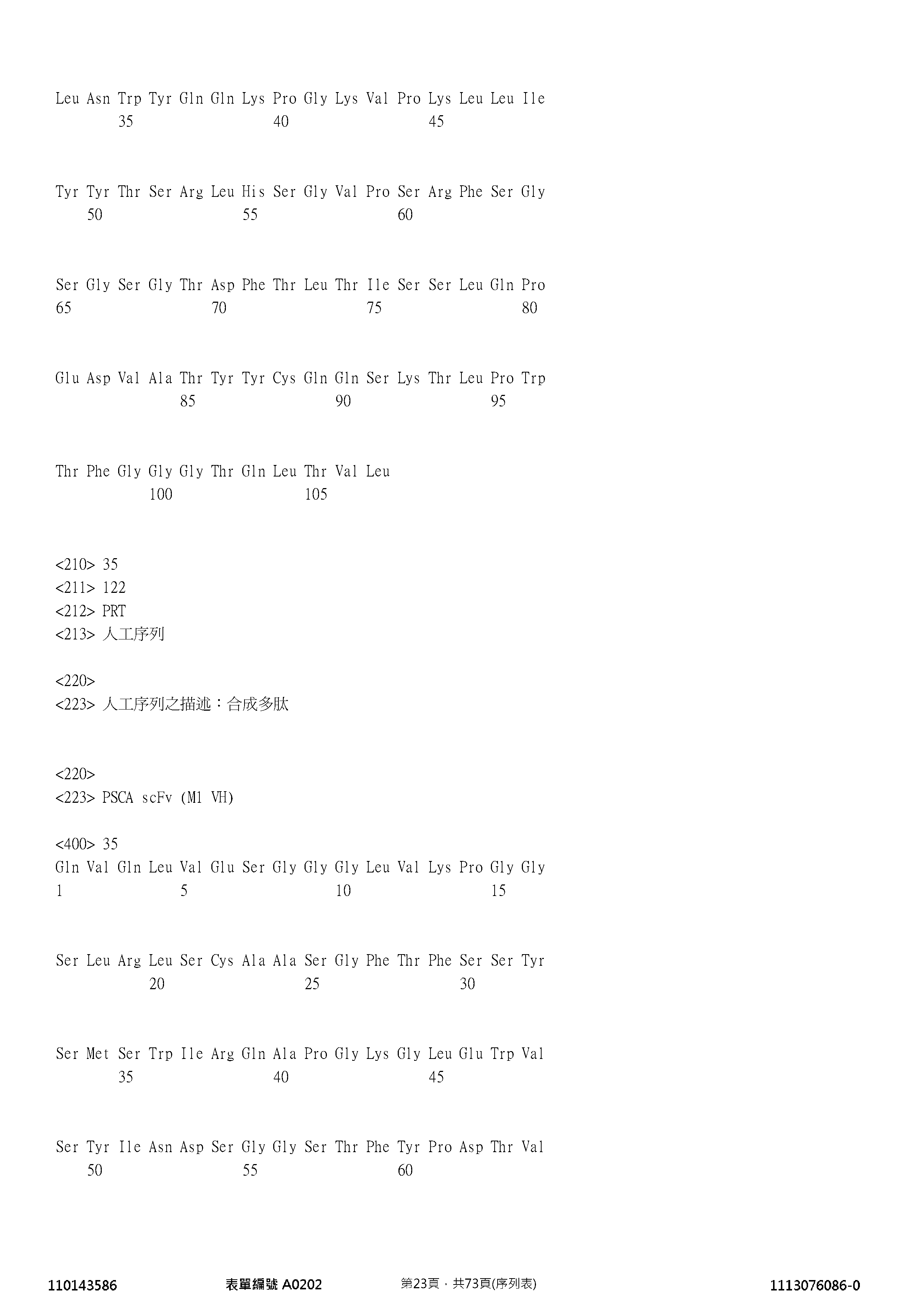


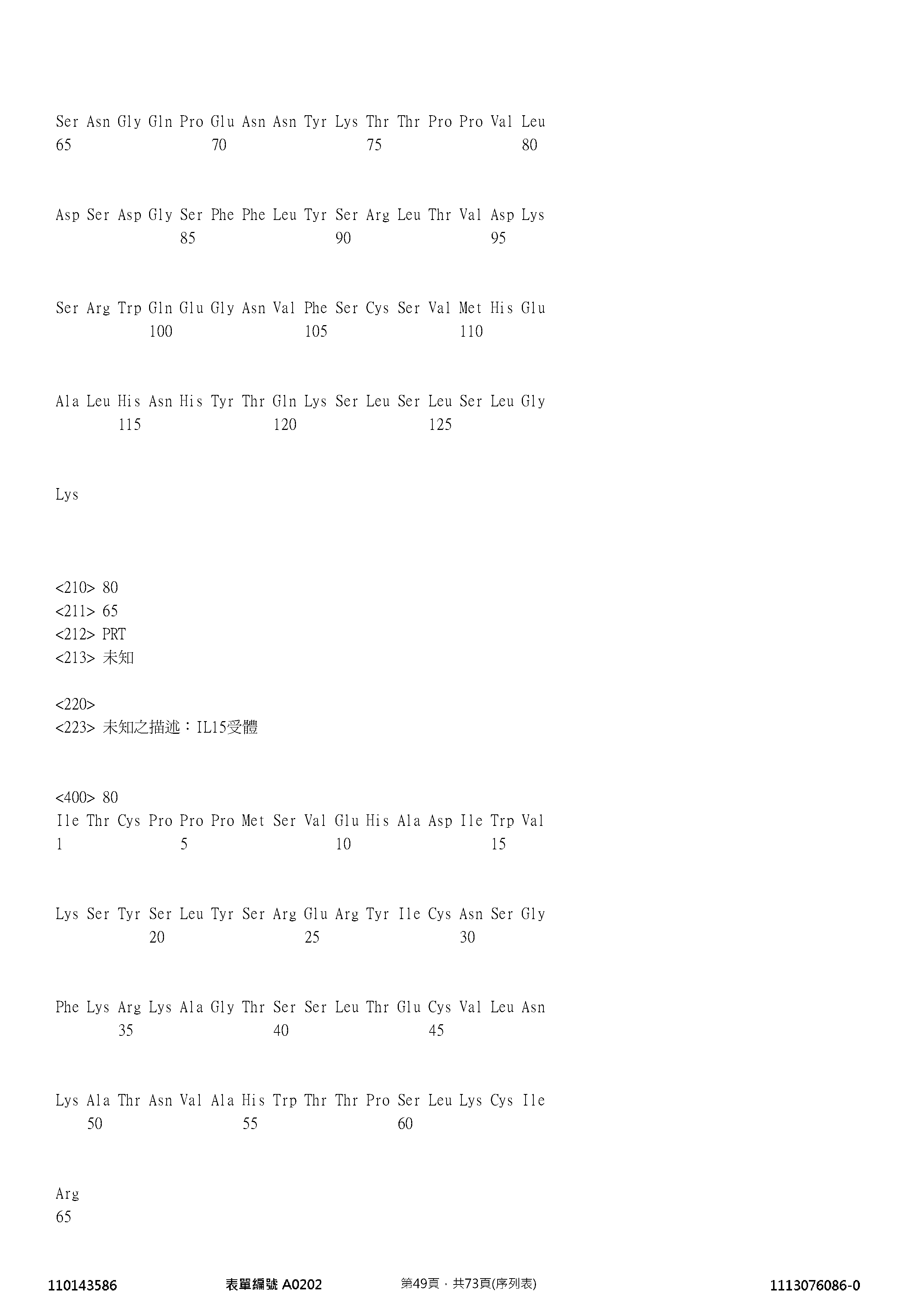


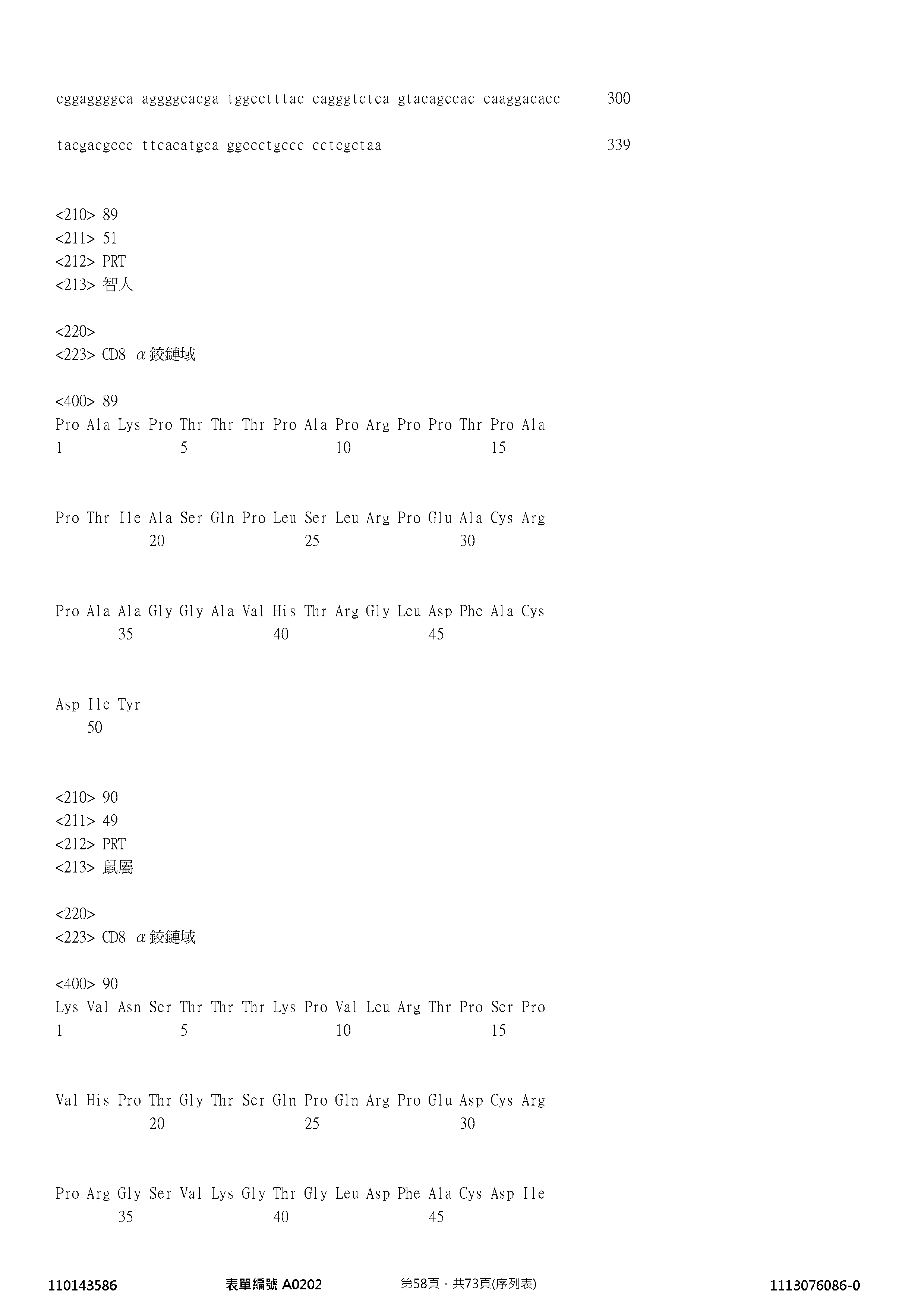


Claims (87)
Applications Claiming Priority (4)
| Application Number | Priority Date | Filing Date | Title |
|---|---|---|---|
| US202063117904P | 2020-11-24 | 2020-11-24 | |
| US63/117,904 | 2020-11-24 | ||
| US202163172489P | 2021-04-08 | 2021-04-08 | |
| US63/172,489 | 2021-04-08 |
Publications (1)
| Publication Number | Publication Date |
|---|---|
| TW202237636A true TW202237636A (en) | 2022-10-01 |
Family
ID=81756266
Family Applications (1)
| Application Number | Title | Priority Date | Filing Date |
|---|---|---|---|
| TW110143586A TW202237636A (en) | 2020-11-24 | 2021-11-23 | Compositions and uses of psca targeted chimeric antigen receptor modified cells |
Country Status (8)
| Country | Link |
|---|---|
| US (1) | US20230405122A1 (en) |
| EP (1) | EP4251174A1 (en) |
| JP (1) | JP2023553818A (en) |
| AU (1) | AU2021385343A1 (en) |
| CA (1) | CA3199876A1 (en) |
| IL (1) | IL303144A (en) |
| TW (1) | TW202237636A (en) |
| WO (1) | WO2022115421A1 (en) |
Cited By (1)
| Publication number | Priority date | Publication date | Assignee | Title |
|---|---|---|---|---|
| CN115947869A (en) * | 2022-11-28 | 2023-04-11 | 广州佰芮慷生物科技有限公司 | Chimeric antigen receptor targeting human cytomegalovirus, CAR-NK cell and application |
Families Citing this family (1)
| Publication number | Priority date | Publication date | Assignee | Title |
|---|---|---|---|---|
| WO2025235801A1 (en) | 2024-05-08 | 2025-11-13 | City Of Hope | Antibodies targeted to osteopontin and uses thereof for reducing resistance of solid tumors immune cell therapy |
Family Cites Families (4)
| Publication number | Priority date | Publication date | Assignee | Title |
|---|---|---|---|---|
| US7939059B2 (en) * | 2001-12-10 | 2011-05-10 | California Institute Of Technology | Method for the generation of antigen-specific lymphocytes |
| ES2688035T3 (en) * | 2014-08-29 | 2018-10-30 | Gemoab Monoclonals Gmbh | Universal antigen receptor that expresses immune cells for addressing multiple multiple antigens, procedure for manufacturing it and using it for the treatment of cancer, infections and autoimmune diseases |
| IL299114A (en) * | 2015-10-06 | 2023-02-01 | Hope City | Chimeric antigen receptors targeted to psca |
| EP3464352B1 (en) * | 2016-05-27 | 2021-03-24 | Altor BioScience Corporation | Construction and characterization of multimeric il-15-based molecules with cd3 binding domains |
-
2021
- 2021-11-23 CA CA3199876A patent/CA3199876A1/en active Pending
- 2021-11-23 EP EP21899008.3A patent/EP4251174A1/en not_active Withdrawn
- 2021-11-23 AU AU2021385343A patent/AU2021385343A1/en active Pending
- 2021-11-23 US US18/038,423 patent/US20230405122A1/en active Pending
- 2021-11-23 WO PCT/US2021/060500 patent/WO2022115421A1/en not_active Ceased
- 2021-11-23 JP JP2023531014A patent/JP2023553818A/en active Pending
- 2021-11-23 IL IL303144A patent/IL303144A/en unknown
- 2021-11-23 TW TW110143586A patent/TW202237636A/en unknown
Cited By (2)
| Publication number | Priority date | Publication date | Assignee | Title |
|---|---|---|---|---|
| CN115947869A (en) * | 2022-11-28 | 2023-04-11 | 广州佰芮慷生物科技有限公司 | Chimeric antigen receptor targeting human cytomegalovirus, CAR-NK cell and application |
| CN115947869B (en) * | 2022-11-28 | 2023-12-12 | 广州佰芮慷生物科技有限公司 | Chimeric antigen receptor targeting human cytomegalovirus, CAR-NK cell and application |
Also Published As
| Publication number | Publication date |
|---|---|
| IL303144A (en) | 2023-07-01 |
| AU2021385343A1 (en) | 2023-07-06 |
| AU2021385343A9 (en) | 2024-09-05 |
| US20230405122A1 (en) | 2023-12-21 |
| WO2022115421A1 (en) | 2022-06-02 |
| EP4251174A1 (en) | 2023-10-04 |
| CA3199876A1 (en) | 2022-06-02 |
| JP2023553818A (en) | 2023-12-26 |
Similar Documents
| Publication | Publication Date | Title |
|---|---|---|
| US12104178B2 (en) | DHFR tunable protein regulation | |
| ES2968880T3 (en) | Chimeric antigen receptor (CAR) that binds BCMA, and uses thereof | |
| US20210269534A1 (en) | Flt3 directed car cells for immunotherapy | |
| US20230331872A1 (en) | Bispecific antibody car cell immunotherapy | |
| JP6538716B2 (en) | MND promoter chimeric antigen receptor | |
| US20220281982A1 (en) | Bispecific antibody car cell immunotherapy | |
| JP7409669B2 (en) | Anti-DCLK1 antibodies and chimeric antigen receptors, and compositions and methods of use thereof | |
| AU2019333324A1 (en) | Methods and compositions for genetically modifying lymphocytes in blood or in enriched PBMCs | |
| TW202227636A (en) | Methods and compositions of infecting, activating, and expanding immune cells | |
| TW202237636A (en) | Compositions and uses of psca targeted chimeric antigen receptor modified cells | |
| BR112021015676A2 (en) | LYM-1 AND LYM-2 ANTIBODY COMPOSITIONS AND IMPROVED CAR CONSTRUCTIONS | |
| CN115397517A (en) | FLT 3-Targeted chimeric antigen receptor-modified cells for the treatment of FLT 3-positive malignancies | |
| WO2024128219A1 (en) | Chimeric antigen receptor | |
| HK40030405A (en) | Chimeric antigen receptor (car) binding to bcma, and uses thereof | |
| HK40030405B (en) | Chimeric antigen receptor (car) binding to bcma, and uses thereof | |
| EA041672B1 (en) | SIGNAL CONVERTER TGFβ |