TW202140791A - Methods of treating phenylketonuria - Google Patents
Methods of treating phenylketonuria Download PDFInfo
- Publication number
- TW202140791A TW202140791A TW110101092A TW110101092A TW202140791A TW 202140791 A TW202140791 A TW 202140791A TW 110101092 A TW110101092 A TW 110101092A TW 110101092 A TW110101092 A TW 110101092A TW 202140791 A TW202140791 A TW 202140791A
- Authority
- TW
- Taiwan
- Prior art keywords
- amino acid
- seq
- capsid protein
- sequence
- acid sequence
- Prior art date
Links
- 238000000034 method Methods 0.000 title claims abstract description 196
- 201000011252 Phenylketonuria Diseases 0.000 title claims description 46
- 102100038223 Phenylalanine-4-hydroxylase Human genes 0.000 claims abstract description 92
- 208000037265 diseases, disorders, signs and symptoms Diseases 0.000 claims abstract description 89
- 101150036331 pah gene Proteins 0.000 claims abstract description 63
- 201000010099 disease Diseases 0.000 claims abstract description 49
- 206010064571 Gene mutation Diseases 0.000 claims abstract description 40
- 208000035475 disorder Diseases 0.000 claims abstract description 40
- 150000001413 amino acids Chemical group 0.000 claims description 739
- 229940024606 amino acid Drugs 0.000 claims description 485
- 235000001014 amino acid Nutrition 0.000 claims description 485
- 108090000565 Capsid Proteins Proteins 0.000 claims description 409
- 102100023321 Ceruloplasmin Human genes 0.000 claims description 409
- 239000002773 nucleotide Substances 0.000 claims description 165
- 125000003729 nucleotide group Chemical group 0.000 claims description 165
- 108090000623 proteins and genes Proteins 0.000 claims description 157
- 229960005205 prednisolone Drugs 0.000 claims description 81
- 210000000234 capsid Anatomy 0.000 claims description 79
- OIGNJSKKLXVSLS-VWUMJDOOSA-N prednisolone Chemical compound O=C1C=C[C@]2(C)[C@H]3[C@@H](O)C[C@](C)([C@@](CC4)(O)C(=O)CO)[C@@H]4[C@@H]3CCC2=C1 OIGNJSKKLXVSLS-VWUMJDOOSA-N 0.000 claims description 77
- 108091026890 Coding region Proteins 0.000 claims description 66
- 102100036475 Alanine aminotransferase 1 Human genes 0.000 claims description 58
- 108010082126 Alanine transaminase Proteins 0.000 claims description 58
- 238000012546 transfer Methods 0.000 claims description 54
- 230000008488 polyadenylation Effects 0.000 claims description 51
- 108010003415 Aspartate Aminotransferases Proteins 0.000 claims description 37
- 102000004625 Aspartate Aminotransferases Human genes 0.000 claims description 37
- 239000003018 immunosuppressive agent Substances 0.000 claims description 35
- 229960003444 immunosuppressant agent Drugs 0.000 claims description 34
- 230000001861 immunosuppressant effect Effects 0.000 claims description 34
- 210000004185 liver Anatomy 0.000 claims description 34
- 210000004027 cell Anatomy 0.000 claims description 31
- 101000823116 Homo sapiens Alpha-1-antitrypsin Proteins 0.000 claims description 29
- 102000051631 human SERPINA1 Human genes 0.000 claims description 29
- 102000003929 Transaminases Human genes 0.000 claims description 27
- 108090000340 Transaminases Proteins 0.000 claims description 27
- 238000013518 transcription Methods 0.000 claims description 26
- 230000035897 transcription Effects 0.000 claims description 26
- 239000002253 acid Substances 0.000 claims description 19
- FWMNVWWHGCHHJJ-SKKKGAJSSA-N 4-amino-1-[(2r)-6-amino-2-[[(2r)-2-[[(2r)-2-[[(2r)-2-amino-3-phenylpropanoyl]amino]-3-phenylpropanoyl]amino]-4-methylpentanoyl]amino]hexanoyl]piperidine-4-carboxylic acid Chemical compound C([C@H](C(=O)N[C@H](CC(C)C)C(=O)N[C@H](CCCCN)C(=O)N1CCC(N)(CC1)C(O)=O)NC(=O)[C@H](N)CC=1C=CC=CC=1)C1=CC=CC=C1 FWMNVWWHGCHHJJ-SKKKGAJSSA-N 0.000 claims description 18
- 108700029229 Transcriptional Regulatory Elements Proteins 0.000 claims description 12
- 239000000203 mixture Substances 0.000 claims description 12
- 230000001105 regulatory effect Effects 0.000 claims description 12
- 230000002045 lasting effect Effects 0.000 claims description 7
- 210000004556 brain Anatomy 0.000 claims description 5
- 239000003862 glucocorticoid Substances 0.000 claims description 5
- 210000003494 hepatocyte Anatomy 0.000 claims description 5
- 206010062767 Hypophysitis Diseases 0.000 claims description 4
- 210000004100 adrenal gland Anatomy 0.000 claims description 4
- 210000000481 breast Anatomy 0.000 claims description 4
- 210000001072 colon Anatomy 0.000 claims description 4
- 210000000232 gallbladder Anatomy 0.000 claims description 4
- 210000003292 kidney cell Anatomy 0.000 claims description 4
- 210000000496 pancreas Anatomy 0.000 claims description 4
- 210000003635 pituitary gland Anatomy 0.000 claims description 4
- 210000000813 small intestine Anatomy 0.000 claims description 4
- 210000003932 urinary bladder Anatomy 0.000 claims description 4
- 230000002440 hepatic effect Effects 0.000 claims description 3
- 229940125721 immunosuppressive agent Drugs 0.000 claims 1
- 108010069013 Phenylalanine Hydroxylase Proteins 0.000 abstract description 95
- 241000702421 Dependoparvovirus Species 0.000 abstract description 89
- 102000004196 processed proteins & peptides Human genes 0.000 abstract description 14
- 108090000765 processed proteins & peptides Proteins 0.000 abstract description 14
- 229920001184 polypeptide Polymers 0.000 abstract description 13
- 102100021244 Integral membrane protein GPR180 Human genes 0.000 description 103
- COLNVLDHVKWLRT-QMMMGPOBSA-N L-phenylalanine Chemical compound OC(=O)[C@@H](N)CC1=CC=CC=C1 COLNVLDHVKWLRT-QMMMGPOBSA-N 0.000 description 103
- 208000002267 Anti-neutrophil cytoplasmic antibody-associated vasculitis Diseases 0.000 description 83
- 239000013598 vector Substances 0.000 description 57
- 238000011282 treatment Methods 0.000 description 33
- OUYCCCASQSFEME-QMMMGPOBSA-N L-tyrosine Chemical compound OC(=O)[C@@H](N)CC1=CC=C(O)C=C1 OUYCCCASQSFEME-QMMMGPOBSA-N 0.000 description 32
- 235000018102 proteins Nutrition 0.000 description 22
- 102000004169 proteins and genes Human genes 0.000 description 22
- 150000003431 steroids Chemical class 0.000 description 21
- 230000001506 immunosuppresive effect Effects 0.000 description 20
- 241000700605 Viruses Species 0.000 description 19
- 230000007423 decrease Effects 0.000 description 19
- 235000005911 diet Nutrition 0.000 description 19
- 238000004806 packaging method and process Methods 0.000 description 19
- 230000000694 effects Effects 0.000 description 18
- 238000005259 measurement Methods 0.000 description 17
- 238000007449 liver function test Methods 0.000 description 16
- 230000008859 change Effects 0.000 description 15
- 230000037213 diet Effects 0.000 description 15
- 230000000069 prophylactic effect Effects 0.000 description 15
- 230000009467 reduction Effects 0.000 description 15
- 238000011160 research Methods 0.000 description 15
- 210000004369 blood Anatomy 0.000 description 14
- 239000008280 blood Substances 0.000 description 14
- 101000604901 Homo sapiens Phenylalanine-4-hydroxylase Proteins 0.000 description 13
- 210000001519 tissue Anatomy 0.000 description 13
- 108700028146 Genetic Enhancer Elements Proteins 0.000 description 12
- 241000699670 Mus sp. Species 0.000 description 12
- 239000003246 corticosteroid Substances 0.000 description 12
- 238000002560 therapeutic procedure Methods 0.000 description 12
- 241000702423 Adeno-associated virus - 2 Species 0.000 description 11
- 238000001415 gene therapy Methods 0.000 description 11
- 229960005190 phenylalanine Drugs 0.000 description 11
- 210000002966 serum Anatomy 0.000 description 11
- 238000012360 testing method Methods 0.000 description 11
- 229940079593 drug Drugs 0.000 description 10
- 239000003814 drug Substances 0.000 description 10
- 238000012216 screening Methods 0.000 description 10
- 125000002435 L-phenylalanyl group Chemical group O=C([*])[C@](N([H])[H])([H])C([H])([H])C1=C([H])C([H])=C([H])C([H])=C1[H] 0.000 description 9
- 238000011156 evaluation Methods 0.000 description 9
- 230000028993 immune response Effects 0.000 description 9
- COLNVLDHVKWLRT-UHFFFAOYSA-N phenylalanine Natural products OC(=O)C(N)CC1=CC=CC=C1 COLNVLDHVKWLRT-UHFFFAOYSA-N 0.000 description 9
- 229960004441 tyrosine Drugs 0.000 description 9
- 108091028043 Nucleic acid sequence Proteins 0.000 description 8
- 108091081024 Start codon Proteins 0.000 description 8
- 230000002411 adverse Effects 0.000 description 8
- 230000035772 mutation Effects 0.000 description 8
- 239000008194 pharmaceutical composition Substances 0.000 description 8
- 229960004618 prednisone Drugs 0.000 description 8
- XOFYZVNMUHMLCC-ZPOLXVRWSA-N prednisone Chemical compound O=C1C=C[C@]2(C)[C@H]3C(=O)C[C@](C)([C@@](CC4)(O)C(=O)CO)[C@@H]4[C@@H]3CCC2=C1 XOFYZVNMUHMLCC-ZPOLXVRWSA-N 0.000 description 8
- OUYCCCASQSFEME-UHFFFAOYSA-N tyrosine Natural products OC(=O)C(N)CC1=CC=C(O)C=C1 OUYCCCASQSFEME-UHFFFAOYSA-N 0.000 description 8
- 101100190273 Homo sapiens PAH gene Proteins 0.000 description 7
- 108091092195 Intron Proteins 0.000 description 7
- 230000002159 abnormal effect Effects 0.000 description 7
- 230000014509 gene expression Effects 0.000 description 7
- 208000015181 infectious disease Diseases 0.000 description 7
- 210000005229 liver cell Anatomy 0.000 description 7
- 108700024394 Exon Proteins 0.000 description 6
- 241000700584 Simplexvirus Species 0.000 description 6
- 150000001412 amines Chemical class 0.000 description 6
- 229960001334 corticosteroids Drugs 0.000 description 6
- 208000002672 hepatitis B Diseases 0.000 description 6
- 208000019423 liver disease Diseases 0.000 description 6
- 230000004048 modification Effects 0.000 description 6
- 238000012986 modification Methods 0.000 description 6
- 235000015097 nutrients Nutrition 0.000 description 6
- 210000002706 plastid Anatomy 0.000 description 6
- 235000021075 protein intake Nutrition 0.000 description 6
- 108091032973 (ribonucleotides)n+m Proteins 0.000 description 5
- 208000036864 Attention deficit/hyperactivity disease Diseases 0.000 description 5
- 238000008789 Direct Bilirubin Methods 0.000 description 5
- 102000004190 Enzymes Human genes 0.000 description 5
- 108090000790 Enzymes Proteins 0.000 description 5
- 241000725303 Human immunodeficiency virus Species 0.000 description 5
- 241001465754 Metazoa Species 0.000 description 5
- 238000011861 anti-inflammatory therapy Methods 0.000 description 5
- 208000015802 attention deficit-hyperactivity disease Diseases 0.000 description 5
- 238000005538 encapsulation Methods 0.000 description 5
- 230000002068 genetic effect Effects 0.000 description 5
- JYGXADMDTFJGBT-VWUMJDOOSA-N hydrocortisone Chemical compound O=C1CC[C@]2(C)[C@H]3[C@@H](O)C[C@](C)([C@@](CC4)(O)C(=O)CO)[C@@H]4[C@@H]3CCC2=C1 JYGXADMDTFJGBT-VWUMJDOOSA-N 0.000 description 5
- 150000007523 nucleic acids Chemical class 0.000 description 5
- 230000003449 preventive effect Effects 0.000 description 5
- 208000020016 psychiatric disease Diseases 0.000 description 5
- 241000894007 species Species 0.000 description 5
- 241000701161 unidentified adenovirus Species 0.000 description 5
- 108010088751 Albumins Proteins 0.000 description 4
- 102000009027 Albumins Human genes 0.000 description 4
- 208000019901 Anxiety disease Diseases 0.000 description 4
- IJGRMHOSHXDMSA-UHFFFAOYSA-N Atomic nitrogen Chemical compound N#N IJGRMHOSHXDMSA-UHFFFAOYSA-N 0.000 description 4
- 102100027378 Prothrombin Human genes 0.000 description 4
- 108010094028 Prothrombin Proteins 0.000 description 4
- 238000008050 Total Bilirubin Reagent Methods 0.000 description 4
- 230000000840 anti-viral effect Effects 0.000 description 4
- 230000036506 anxiety Effects 0.000 description 4
- 230000037396 body weight Effects 0.000 description 4
- 230000000295 complement effect Effects 0.000 description 4
- DDRJAANPRJIHGJ-UHFFFAOYSA-N creatinine Chemical compound CN1CC(=O)NC1=N DDRJAANPRJIHGJ-UHFFFAOYSA-N 0.000 description 4
- 229960003957 dexamethasone Drugs 0.000 description 4
- UREBDLICKHMUKA-CXSFZGCWSA-N dexamethasone Chemical compound C1CC2=CC(=O)C=C[C@]2(C)[C@]2(F)[C@@H]1[C@@H]1C[C@@H](C)[C@@](C(=O)CO)(O)[C@@]1(C)C[C@@H]2O UREBDLICKHMUKA-CXSFZGCWSA-N 0.000 description 4
- 230000000378 dietary effect Effects 0.000 description 4
- 230000035622 drinking Effects 0.000 description 4
- 230000007717 exclusion Effects 0.000 description 4
- 230000001965 increasing effect Effects 0.000 description 4
- 238000001990 intravenous administration Methods 0.000 description 4
- 230000004060 metabolic process Effects 0.000 description 4
- 230000007935 neutral effect Effects 0.000 description 4
- 229940039716 prothrombin Drugs 0.000 description 4
- 208000024891 symptom Diseases 0.000 description 4
- 238000010361 transduction Methods 0.000 description 4
- 230000026683 transduction Effects 0.000 description 4
- 102000002260 Alkaline Phosphatase Human genes 0.000 description 3
- 108020004774 Alkaline Phosphatase Proteins 0.000 description 3
- 101000856234 Clostridium acetobutylicum (strain ATCC 824 / DSM 792 / JCM 1419 / LMG 5710 / VKM B-1787) Butyrate-acetoacetate CoA-transferase subunit A Proteins 0.000 description 3
- 241000701022 Cytomegalovirus Species 0.000 description 3
- 108020004414 DNA Proteins 0.000 description 3
- 201000004624 Dermatitis Diseases 0.000 description 3
- 102000001554 Hemoglobins Human genes 0.000 description 3
- 108010054147 Hemoglobins Proteins 0.000 description 3
- 201000006347 Intellectual Disability Diseases 0.000 description 3
- FQISKWAFAHGMGT-SGJOWKDISA-M Methylprednisolone sodium succinate Chemical compound [Na+].C([C@@]12C)=CC(=O)C=C1[C@@H](C)C[C@@H]1[C@@H]2[C@@H](O)C[C@]2(C)[C@@](O)(C(=O)COC(=O)CCC([O-])=O)CC[C@H]21 FQISKWAFAHGMGT-SGJOWKDISA-M 0.000 description 3
- 241000699666 Mus <mouse, genus> Species 0.000 description 3
- FAPWRFPIFSIZLT-UHFFFAOYSA-M Sodium chloride Chemical compound [Na+].[Cl-] FAPWRFPIFSIZLT-UHFFFAOYSA-M 0.000 description 3
- 239000004480 active ingredient Substances 0.000 description 3
- 125000003277 amino group Chemical group 0.000 description 3
- 239000012491 analyte Substances 0.000 description 3
- 208000010668 atopic eczema Diseases 0.000 description 3
- 235000021004 dietary regimen Nutrition 0.000 description 3
- 238000005516 engineering process Methods 0.000 description 3
- 230000006870 function Effects 0.000 description 3
- 150000003278 haem Chemical class 0.000 description 3
- 210000005260 human cell Anatomy 0.000 description 3
- 208000013403 hyperactivity Diseases 0.000 description 3
- 210000000265 leukocyte Anatomy 0.000 description 3
- 230000003211 malignant effect Effects 0.000 description 3
- 108020004999 messenger RNA Proteins 0.000 description 3
- 229960004584 methylprednisolone Drugs 0.000 description 3
- 230000003472 neutralizing effect Effects 0.000 description 3
- 108020004707 nucleic acids Proteins 0.000 description 3
- 102000039446 nucleic acids Human genes 0.000 description 3
- 239000000546 pharmaceutical excipient Substances 0.000 description 3
- 230000002829 reductive effect Effects 0.000 description 3
- 238000000611 regression analysis Methods 0.000 description 3
- 230000010076 replication Effects 0.000 description 3
- 238000011272 standard treatment Methods 0.000 description 3
- 238000001890 transfection Methods 0.000 description 3
- 230000009261 transgenic effect Effects 0.000 description 3
- 210000002700 urine Anatomy 0.000 description 3
- XLYOFNOQVPJJNP-UHFFFAOYSA-N water Substances O XLYOFNOQVPJJNP-UHFFFAOYSA-N 0.000 description 3
- 241001634120 Adeno-associated virus - 5 Species 0.000 description 2
- 108010057856 Adenovirus E2 Proteins Proteins 0.000 description 2
- 108010056962 Adenovirus E4 Proteins Proteins 0.000 description 2
- 208000007848 Alcoholism Diseases 0.000 description 2
- BPYKTIZUTYGOLE-IFADSCNNSA-N Bilirubin Chemical compound N1C(=O)C(C)=C(C=C)\C1=C\C1=C(C)C(CCC(O)=O)=C(CC2=C(C(C)=C(\C=C/3C(=C(C=C)C(=O)N\3)C)N2)CCC(O)=O)N1 BPYKTIZUTYGOLE-IFADSCNNSA-N 0.000 description 2
- 108020004705 Codon Proteins 0.000 description 2
- 108020004635 Complementary DNA Proteins 0.000 description 2
- 206010010904 Convulsion Diseases 0.000 description 2
- 102000053602 DNA Human genes 0.000 description 2
- 206010012559 Developmental delay Diseases 0.000 description 2
- 206010013654 Drug abuse Diseases 0.000 description 2
- 208000010201 Exanthema Diseases 0.000 description 2
- WQZGKKKJIJFFOK-GASJEMHNSA-N Glucose Natural products OC[C@H]1OC(O)[C@H](O)[C@@H](O)[C@@H]1O WQZGKKKJIJFFOK-GASJEMHNSA-N 0.000 description 2
- 241000711549 Hepacivirus C Species 0.000 description 2
- 241000700721 Hepatitis B virus Species 0.000 description 2
- 208000005176 Hepatitis C Diseases 0.000 description 2
- WTDRDQBEARUVNC-LURJTMIESA-N L-DOPA Chemical compound OC(=O)[C@@H](N)CC1=CC=C(O)C(O)=C1 WTDRDQBEARUVNC-LURJTMIESA-N 0.000 description 2
- WTDRDQBEARUVNC-UHFFFAOYSA-N L-Dopa Natural products OC(=O)C(N)CC1=CC=C(O)C(O)=C1 WTDRDQBEARUVNC-UHFFFAOYSA-N 0.000 description 2
- ZDXPYRJPNDTMRX-VKHMYHEASA-N L-glutamine Chemical compound OC(=O)[C@@H](N)CCC(N)=O ZDXPYRJPNDTMRX-VKHMYHEASA-N 0.000 description 2
- 102000003855 L-lactate dehydrogenase Human genes 0.000 description 2
- 108700023483 L-lactate dehydrogenases Proteins 0.000 description 2
- 241000282567 Macaca fascicularis Species 0.000 description 2
- 241000124008 Mammalia Species 0.000 description 2
- 206010060860 Neurological symptom Diseases 0.000 description 2
- 206010033546 Pallor Diseases 0.000 description 2
- 241000288906 Primates Species 0.000 description 2
- 241000320126 Pseudomugilidae Species 0.000 description 2
- 241000283984 Rodentia Species 0.000 description 2
- 238000009825 accumulation Methods 0.000 description 2
- 230000006154 adenylylation Effects 0.000 description 2
- 206010001584 alcohol abuse Diseases 0.000 description 2
- 208000025746 alcohol use disease Diseases 0.000 description 2
- 239000000427 antigen Substances 0.000 description 2
- 108091007433 antigens Proteins 0.000 description 2
- 102000036639 antigens Human genes 0.000 description 2
- 238000011203 antimicrobial therapy Methods 0.000 description 2
- 208000006673 asthma Diseases 0.000 description 2
- 230000004888 barrier function Effects 0.000 description 2
- 230000003542 behavioural effect Effects 0.000 description 2
- 230000023555 blood coagulation Effects 0.000 description 2
- 238000010804 cDNA synthesis Methods 0.000 description 2
- 239000000969 carrier Substances 0.000 description 2
- 238000006243 chemical reaction Methods 0.000 description 2
- 208000019425 cirrhosis of liver Diseases 0.000 description 2
- 239000002299 complementary DNA Substances 0.000 description 2
- 238000011970 concomitant therapy Methods 0.000 description 2
- 229940109239 creatinine Drugs 0.000 description 2
- 230000003247 decreasing effect Effects 0.000 description 2
- 238000013461 design Methods 0.000 description 2
- 238000011161 development Methods 0.000 description 2
- 238000010586 diagram Methods 0.000 description 2
- 231100000673 dose–response relationship Toxicity 0.000 description 2
- 239000003937 drug carrier Substances 0.000 description 2
- 230000002996 emotional effect Effects 0.000 description 2
- 239000000839 emulsion Substances 0.000 description 2
- 201000005884 exanthem Diseases 0.000 description 2
- 238000009472 formulation Methods 0.000 description 2
- 239000008103 glucose Substances 0.000 description 2
- 210000003128 head Anatomy 0.000 description 2
- 210000002216 heart Anatomy 0.000 description 2
- 229960000890 hydrocortisone Drugs 0.000 description 2
- 238000001727 in vivo Methods 0.000 description 2
- 239000004615 ingredient Substances 0.000 description 2
- 238000003780 insertion Methods 0.000 description 2
- 230000037431 insertion Effects 0.000 description 2
- 210000003734 kidney Anatomy 0.000 description 2
- 229940003703 kuvan Drugs 0.000 description 2
- 238000009533 lab test Methods 0.000 description 2
- 229960004502 levodopa Drugs 0.000 description 2
- 239000007788 liquid Substances 0.000 description 2
- 230000007774 longterm Effects 0.000 description 2
- 210000004962 mammalian cell Anatomy 0.000 description 2
- 238000007726 management method Methods 0.000 description 2
- 238000004519 manufacturing process Methods 0.000 description 2
- 238000004949 mass spectrometry Methods 0.000 description 2
- 238000012544 monitoring process Methods 0.000 description 2
- 229910052757 nitrogen Inorganic materials 0.000 description 2
- 206010053219 non-alcoholic steatohepatitis Diseases 0.000 description 2
- 239000002777 nucleoside Substances 0.000 description 2
- 125000003835 nucleoside group Chemical group 0.000 description 2
- 210000004940 nucleus Anatomy 0.000 description 2
- 239000002953 phosphate buffered saline Substances 0.000 description 2
- 239000002243 precursor Substances 0.000 description 2
- 229940066263 prednisolone 10 mg Drugs 0.000 description 2
- 229940104271 prednisolone 20 mg Drugs 0.000 description 2
- 229940068296 prednisolone 30 mg Drugs 0.000 description 2
- 229940102618 prednisolone 5 mg Drugs 0.000 description 2
- 239000006041 probiotic Substances 0.000 description 2
- 230000000529 probiotic effect Effects 0.000 description 2
- 235000018291 probiotics Nutrition 0.000 description 2
- -1 rAAV) Substances 0.000 description 2
- 206010037844 rash Diseases 0.000 description 2
- 230000004044 response Effects 0.000 description 2
- 230000001177 retroviral effect Effects 0.000 description 2
- 238000012552 review Methods 0.000 description 2
- FNKQXYHWGSIFBK-RPDRRWSUSA-N sapropterin Chemical compound N1=C(N)NC(=O)C2=C1NC[C@H]([C@@H](O)[C@@H](O)C)N2 FNKQXYHWGSIFBK-RPDRRWSUSA-N 0.000 description 2
- 229960004617 sapropterin Drugs 0.000 description 2
- RKSUYBCOVNCALL-NTVURLEBSA-N sapropterin dihydrochloride Chemical compound Cl.Cl.N1=C(N)NC(=O)C2=C1NC[C@H]([C@@H](O)[C@@H](O)C)N2 RKSUYBCOVNCALL-NTVURLEBSA-N 0.000 description 2
- 231100000046 skin rash Toxicity 0.000 description 2
- 208000011117 substance-related disease Diseases 0.000 description 2
- 238000006467 substitution reaction Methods 0.000 description 2
- 230000009469 supplementation Effects 0.000 description 2
- 238000001356 surgical procedure Methods 0.000 description 2
- 230000009885 systemic effect Effects 0.000 description 2
- 230000002103 transcriptional effect Effects 0.000 description 2
- 238000002054 transplantation Methods 0.000 description 2
- 229960005294 triamcinolone Drugs 0.000 description 2
- GFNANZIMVAIWHM-OBYCQNJPSA-N triamcinolone Chemical compound O=C1C=C[C@]2(C)[C@@]3(F)[C@@H](O)C[C@](C)([C@@]([C@H](O)C4)(O)C(=O)CO)[C@@H]4[C@@H]3CCC2=C1 GFNANZIMVAIWHM-OBYCQNJPSA-N 0.000 description 2
- 241000701447 unidentified baculovirus Species 0.000 description 2
- 241001529453 unidentified herpesvirus Species 0.000 description 2
- 239000003981 vehicle Substances 0.000 description 2
- KWTSXDURSIMDCE-QMMMGPOBSA-N (S)-amphetamine Chemical compound C[C@H](N)CC1=CC=CC=C1 KWTSXDURSIMDCE-QMMMGPOBSA-N 0.000 description 1
- FUFLCEKSBBHCMO-UHFFFAOYSA-N 11-dehydrocorticosterone Natural products O=C1CCC2(C)C3C(=O)CC(C)(C(CC4)C(=O)CO)C4C3CCC2=C1 FUFLCEKSBBHCMO-UHFFFAOYSA-N 0.000 description 1
- 239000013607 AAV vector Substances 0.000 description 1
- 241000272525 Anas platyrhynchos Species 0.000 description 1
- 208000000412 Avitaminosis Diseases 0.000 description 1
- 101150044789 Cap gene Proteins 0.000 description 1
- 241000282693 Cercopithecidae Species 0.000 description 1
- 208000015879 Cerebellar disease Diseases 0.000 description 1
- 208000017667 Chronic Disease Diseases 0.000 description 1
- MFYSYFVPBJMHGN-ZPOLXVRWSA-N Cortisone Chemical compound O=C1CC[C@]2(C)[C@H]3C(=O)C[C@](C)([C@@](CC4)(O)C(=O)CO)[C@@H]4[C@@H]3CCC2=C1 MFYSYFVPBJMHGN-ZPOLXVRWSA-N 0.000 description 1
- MFYSYFVPBJMHGN-UHFFFAOYSA-N Cortisone Natural products O=C1CCC2(C)C3C(=O)CC(C)(C(CC4)(O)C(=O)CO)C4C3CCC2=C1 MFYSYFVPBJMHGN-UHFFFAOYSA-N 0.000 description 1
- ITRJWOMZKQRYTA-RFZYENFJSA-N Cortisone acetate Chemical compound C1CC2=CC(=O)CC[C@]2(C)[C@@H]2[C@@H]1[C@@H]1CC[C@@](C(=O)COC(=O)C)(O)[C@@]1(C)CC2=O ITRJWOMZKQRYTA-RFZYENFJSA-N 0.000 description 1
- 102000004163 DNA-directed RNA polymerases Human genes 0.000 description 1
- 108090000626 DNA-directed RNA polymerases Proteins 0.000 description 1
- 108010010256 Dietary Proteins Proteins 0.000 description 1
- 102000015781 Dietary Proteins Human genes 0.000 description 1
- 238000002965 ELISA Methods 0.000 description 1
- 241000588724 Escherichia coli Species 0.000 description 1
- 241000282326 Felis catus Species 0.000 description 1
- 206010016654 Fibrosis Diseases 0.000 description 1
- 208000004262 Food Hypersensitivity Diseases 0.000 description 1
- 241000287828 Gallus gallus Species 0.000 description 1
- 102000051366 Glycosyltransferases Human genes 0.000 description 1
- 108700023372 Glycosyltransferases Proteins 0.000 description 1
- 206010053759 Growth retardation Diseases 0.000 description 1
- 102100031573 Hematopoietic progenitor cell antigen CD34 Human genes 0.000 description 1
- 206010019851 Hepatotoxicity Diseases 0.000 description 1
- 208000007514 Herpes zoster Diseases 0.000 description 1
- 241000238631 Hexapoda Species 0.000 description 1
- 101100055865 Homo sapiens APOE gene Proteins 0.000 description 1
- 101000777663 Homo sapiens Hematopoietic progenitor cell antigen CD34 Proteins 0.000 description 1
- 101001042049 Human herpesvirus 1 (strain 17) Transcriptional regulator ICP22 Proteins 0.000 description 1
- 101000999690 Human herpesvirus 2 (strain HG52) E3 ubiquitin ligase ICP22 Proteins 0.000 description 1
- 206010020751 Hypersensitivity Diseases 0.000 description 1
- 101150027427 ICP4 gene Proteins 0.000 description 1
- 206010061598 Immunodeficiency Diseases 0.000 description 1
- 208000029462 Immunodeficiency disease Diseases 0.000 description 1
- 208000026350 Inborn Genetic disease Diseases 0.000 description 1
- 229920000715 Mucilage Polymers 0.000 description 1
- 206010067482 No adverse event Diseases 0.000 description 1
- 208000008589 Obesity Diseases 0.000 description 1
- 108700020796 Oncogene Proteins 0.000 description 1
- 102000043276 Oncogene Human genes 0.000 description 1
- 208000001132 Osteoporosis Diseases 0.000 description 1
- 229910019142 PO4 Inorganic materials 0.000 description 1
- 108091005804 Peptidases Proteins 0.000 description 1
- 208000037581 Persistent Infection Diseases 0.000 description 1
- FSXRLASFHBWESK-HOTGVXAUSA-N Phe-Tyr Chemical compound C([C@H](N)C(=O)N[C@@H](CC=1C=CC(O)=CC=1)C(O)=O)C1=CC=CC=C1 FSXRLASFHBWESK-HOTGVXAUSA-N 0.000 description 1
- RVGRUAULSDPKGF-UHFFFAOYSA-N Poloxamer Chemical compound C1CO1.CC1CO1 RVGRUAULSDPKGF-UHFFFAOYSA-N 0.000 description 1
- 239000004365 Protease Substances 0.000 description 1
- 108010076504 Protein Sorting Signals Proteins 0.000 description 1
- 208000028017 Psychotic disease Diseases 0.000 description 1
- 206010037660 Pyrexia Diseases 0.000 description 1
- 238000011529 RT qPCR Methods 0.000 description 1
- 102100037486 Reverse transcriptase/ribonuclease H Human genes 0.000 description 1
- 206010048908 Seasonal allergy Diseases 0.000 description 1
- 101710172711 Structural protein Proteins 0.000 description 1
- 229930006000 Sucrose Natural products 0.000 description 1
- CZMRCDWAGMRECN-UGDNZRGBSA-N Sucrose Chemical compound O[C@H]1[C@H](O)[C@@H](CO)O[C@@]1(CO)O[C@@H]1[C@H](O)[C@@H](O)[C@H](O)[C@@H](CO)O1 CZMRCDWAGMRECN-UGDNZRGBSA-N 0.000 description 1
- 230000005867 T cell response Effects 0.000 description 1
- 210000001744 T-lymphocyte Anatomy 0.000 description 1
- 108091023040 Transcription factor Proteins 0.000 description 1
- 102000040945 Transcription factor Human genes 0.000 description 1
- 102000044209 Tumor Suppressor Genes Human genes 0.000 description 1
- 108700025716 Tumor Suppressor Genes Proteins 0.000 description 1
- 101150068034 UL30 gene Proteins 0.000 description 1
- 101150099321 UL42 gene Proteins 0.000 description 1
- 208000036142 Viral infection Diseases 0.000 description 1
- 206010047627 Vitamin deficiencies Diseases 0.000 description 1
- 230000001154 acute effect Effects 0.000 description 1
- 239000000853 adhesive Substances 0.000 description 1
- 239000002671 adjuvant Substances 0.000 description 1
- 229940025084 amphetamine Drugs 0.000 description 1
- 238000004458 analytical method Methods 0.000 description 1
- 230000003110 anti-inflammatory effect Effects 0.000 description 1
- 230000000692 anti-sense effect Effects 0.000 description 1
- 210000004507 artificial chromosome Anatomy 0.000 description 1
- 230000009286 beneficial effect Effects 0.000 description 1
- 229960002537 betamethasone Drugs 0.000 description 1
- UREBDLICKHMUKA-DVTGEIKXSA-N betamethasone Chemical compound C1CC2=CC(=O)C=C[C@]2(C)[C@]2(F)[C@@H]1[C@@H]1C[C@H](C)[C@@](C(=O)CO)(O)[C@@]1(C)C[C@@H]2O UREBDLICKHMUKA-DVTGEIKXSA-N 0.000 description 1
- 210000000941 bile Anatomy 0.000 description 1
- 230000004071 biological effect Effects 0.000 description 1
- 230000015572 biosynthetic process Effects 0.000 description 1
- 210000001185 bone marrow Anatomy 0.000 description 1
- 239000000872 buffer Substances 0.000 description 1
- 150000001720 carbohydrates Chemical class 0.000 description 1
- 235000014633 carbohydrates Nutrition 0.000 description 1
- 210000001638 cerebellum Anatomy 0.000 description 1
- 239000013611 chromosomal DNA Substances 0.000 description 1
- 230000007882 cirrhosis Effects 0.000 description 1
- 230000010485 coping Effects 0.000 description 1
- 201000007717 corneal ulcer Diseases 0.000 description 1
- 229960004544 cortisone Drugs 0.000 description 1
- 229960003290 cortisone acetate Drugs 0.000 description 1
- 230000001186 cumulative effect Effects 0.000 description 1
- 210000000805 cytoplasm Anatomy 0.000 description 1
- 210000001151 cytotoxic T lymphocyte Anatomy 0.000 description 1
- 230000007812 deficiency Effects 0.000 description 1
- 230000006735 deficit Effects 0.000 description 1
- 230000003111 delayed effect Effects 0.000 description 1
- 238000012217 deletion Methods 0.000 description 1
- 230000037430 deletion Effects 0.000 description 1
- 230000001419 dependent effect Effects 0.000 description 1
- 230000001066 destructive effect Effects 0.000 description 1
- 235000018823 dietary intake Nutrition 0.000 description 1
- 235000021245 dietary protein Nutrition 0.000 description 1
- 239000003085 diluting agent Substances 0.000 description 1
- 239000000539 dimer Substances 0.000 description 1
- FSXRLASFHBWESK-UHFFFAOYSA-N dipeptide phenylalanyl-tyrosine Natural products C=1C=C(O)C=CC=1CC(C(O)=O)NC(=O)C(N)CC1=CC=CC=C1 FSXRLASFHBWESK-UHFFFAOYSA-N 0.000 description 1
- LOKCTEFSRHRXRJ-UHFFFAOYSA-I dipotassium trisodium dihydrogen phosphate hydrogen phosphate dichloride Chemical compound P(=O)(O)(O)[O-].[K+].P(=O)(O)([O-])[O-].[Na+].[Na+].[Cl-].[K+].[Cl-].[Na+] LOKCTEFSRHRXRJ-UHFFFAOYSA-I 0.000 description 1
- 239000002552 dosage form Substances 0.000 description 1
- 231100000371 dose-limiting toxicity Toxicity 0.000 description 1
- 238000012377 drug delivery Methods 0.000 description 1
- 230000008030 elimination Effects 0.000 description 1
- 238000003379 elimination reaction Methods 0.000 description 1
- 230000002708 enhancing effect Effects 0.000 description 1
- 238000002641 enzyme replacement therapy Methods 0.000 description 1
- 238000003114 enzyme-linked immunosorbent spot assay Methods 0.000 description 1
- 230000001815 facial effect Effects 0.000 description 1
- 210000003608 fece Anatomy 0.000 description 1
- 230000035558 fertility Effects 0.000 description 1
- 235000013305 food Nutrition 0.000 description 1
- 235000020932 food allergy Nutrition 0.000 description 1
- 239000013022 formulation composition Substances 0.000 description 1
- 208000016361 genetic disease Diseases 0.000 description 1
- 231100000001 growth retardation Toxicity 0.000 description 1
- 230000036541 health Effects 0.000 description 1
- 230000003862 health status Effects 0.000 description 1
- 230000002489 hematologic effect Effects 0.000 description 1
- 208000006454 hepatitis Diseases 0.000 description 1
- 231100000283 hepatitis Toxicity 0.000 description 1
- 231100000304 hepatotoxicity Toxicity 0.000 description 1
- 230000007686 hepatotoxicity Effects 0.000 description 1
- 230000004727 humoral immunity Effects 0.000 description 1
- 230000033444 hydroxylation Effects 0.000 description 1
- 238000005805 hydroxylation reaction Methods 0.000 description 1
- 230000004179 hypothalamic–pituitary–adrenal axis Effects 0.000 description 1
- 230000007813 immunodeficiency Effects 0.000 description 1
- 238000012744 immunostaining Methods 0.000 description 1
- 238000002650 immunosuppressive therapy Methods 0.000 description 1
- 230000006872 improvement Effects 0.000 description 1
- 238000000338 in vitro Methods 0.000 description 1
- 238000010348 incorporation Methods 0.000 description 1
- 238000001802 infusion Methods 0.000 description 1
- 230000005764 inhibitory process Effects 0.000 description 1
- 238000002347 injection Methods 0.000 description 1
- 239000007924 injection Substances 0.000 description 1
- 208000014674 injury Diseases 0.000 description 1
- 238000007918 intramuscular administration Methods 0.000 description 1
- 238000007912 intraperitoneal administration Methods 0.000 description 1
- 238000010253 intravenous injection Methods 0.000 description 1
- 230000002427 irreversible effect Effects 0.000 description 1
- BTNMPGBKDVTSJY-UHFFFAOYSA-N keto-phenylpyruvic acid Chemical compound OC(=O)C(=O)CC1=CC=CC=C1 BTNMPGBKDVTSJY-UHFFFAOYSA-N 0.000 description 1
- 238000002372 labelling Methods 0.000 description 1
- 208000032839 leukemia Diseases 0.000 description 1
- 230000007721 medicinal effect Effects 0.000 description 1
- 230000002503 metabolic effect Effects 0.000 description 1
- 238000009126 molecular therapy Methods 0.000 description 1
- 239000004570 mortar (masonry) Substances 0.000 description 1
- 238000010172 mouse model Methods 0.000 description 1
- 210000003205 muscle Anatomy 0.000 description 1
- 230000009251 neurologic dysfunction Effects 0.000 description 1
- 208000015015 neurological dysfunction Diseases 0.000 description 1
- 230000000926 neurological effect Effects 0.000 description 1
- 239000002858 neurotransmitter agent Substances 0.000 description 1
- 210000004493 neutrocyte Anatomy 0.000 description 1
- 210000000440 neutrophil Anatomy 0.000 description 1
- 235000020824 obesity Nutrition 0.000 description 1
- 210000000056 organ Anatomy 0.000 description 1
- 230000007918 pathogenicity Effects 0.000 description 1
- 230000001991 pathophysiological effect Effects 0.000 description 1
- 210000005259 peripheral blood Anatomy 0.000 description 1
- 239000011886 peripheral blood Substances 0.000 description 1
- 229940124531 pharmaceutical excipient Drugs 0.000 description 1
- NBIIXXVUZAFLBC-UHFFFAOYSA-K phosphate Chemical compound [O-]P([O-])([O-])=O NBIIXXVUZAFLBC-UHFFFAOYSA-K 0.000 description 1
- 239000010452 phosphate Substances 0.000 description 1
- 230000036470 plasma concentration Effects 0.000 description 1
- 229920001993 poloxamer 188 Polymers 0.000 description 1
- 229920000515 polycarbonate Polymers 0.000 description 1
- 239000004417 polycarbonate Substances 0.000 description 1
- 239000000843 powder Substances 0.000 description 1
- 230000008569 process Effects 0.000 description 1
- 230000000750 progressive effect Effects 0.000 description 1
- 230000017854 proteolysis Effects 0.000 description 1
- 239000013608 rAAV vector Substances 0.000 description 1
- 239000001054 red pigment Substances 0.000 description 1
- 230000011514 reflex Effects 0.000 description 1
- 101150066583 rep gene Proteins 0.000 description 1
- 230000001850 reproductive effect Effects 0.000 description 1
- 231100000279 safety data Toxicity 0.000 description 1
- 150000003839 salts Chemical class 0.000 description 1
- 208000020352 skin basal cell carcinoma Diseases 0.000 description 1
- 201000010106 skin squamous cell carcinoma Diseases 0.000 description 1
- 239000011780 sodium chloride Substances 0.000 description 1
- 239000000243 solution Substances 0.000 description 1
- 125000006850 spacer group Chemical group 0.000 description 1
- 238000007920 subcutaneous administration Methods 0.000 description 1
- 238000010254 subcutaneous injection Methods 0.000 description 1
- 239000007929 subcutaneous injection Substances 0.000 description 1
- 239000000126 substance Substances 0.000 description 1
- 239000005720 sucrose Substances 0.000 description 1
- 235000000346 sugar Nutrition 0.000 description 1
- 150000008163 sugars Chemical class 0.000 description 1
- 238000004885 tandem mass spectrometry Methods 0.000 description 1
- 239000008399 tap water Substances 0.000 description 1
- 235000020679 tap water Nutrition 0.000 description 1
- 230000001225 therapeutic effect Effects 0.000 description 1
- 230000000699 topical effect Effects 0.000 description 1
- 230000005758 transcription activity Effects 0.000 description 1
- 230000002463 transducing effect Effects 0.000 description 1
- 238000003146 transient transfection Methods 0.000 description 1
- 238000013519 translation Methods 0.000 description 1
- 230000014621 translational initiation Effects 0.000 description 1
- 230000008733 trauma Effects 0.000 description 1
- 238000011269 treatment regimen Methods 0.000 description 1
- 238000009966 trimming Methods 0.000 description 1
- 238000011144 upstream manufacturing Methods 0.000 description 1
- 210000003462 vein Anatomy 0.000 description 1
- 230000009385 viral infection Effects 0.000 description 1
- 230000003612 virological effect Effects 0.000 description 1
- 238000001262 western blot Methods 0.000 description 1
- 239000000080 wetting agent Substances 0.000 description 1
Images


Classifications
-
- C—CHEMISTRY; METALLURGY
- C12—BIOCHEMISTRY; BEER; SPIRITS; WINE; VINEGAR; MICROBIOLOGY; ENZYMOLOGY; MUTATION OR GENETIC ENGINEERING
- C12N—MICROORGANISMS OR ENZYMES; COMPOSITIONS THEREOF; PROPAGATING, PRESERVING, OR MAINTAINING MICROORGANISMS; MUTATION OR GENETIC ENGINEERING; CULTURE MEDIA
- C12N15/00—Mutation or genetic engineering; DNA or RNA concerning genetic engineering, vectors, e.g. plasmids, or their isolation, preparation or purification; Use of hosts therefor
- C12N15/09—Recombinant DNA-technology
- C12N15/63—Introduction of foreign genetic material using vectors; Vectors; Use of hosts therefor; Regulation of expression
- C12N15/79—Vectors or expression systems specially adapted for eukaryotic hosts
- C12N15/85—Vectors or expression systems specially adapted for eukaryotic hosts for animal cells
- C12N15/86—Viral vectors
-
- A—HUMAN NECESSITIES
- A61—MEDICAL OR VETERINARY SCIENCE; HYGIENE
- A61K—PREPARATIONS FOR MEDICAL, DENTAL OR TOILETRY PURPOSES
- A61K48/00—Medicinal preparations containing genetic material which is inserted into cells of the living body to treat genetic diseases; Gene therapy
- A61K48/005—Medicinal preparations containing genetic material which is inserted into cells of the living body to treat genetic diseases; Gene therapy characterised by an aspect of the 'active' part of the composition delivered, i.e. the nucleic acid delivered
-
- C—CHEMISTRY; METALLURGY
- C12—BIOCHEMISTRY; BEER; SPIRITS; WINE; VINEGAR; MICROBIOLOGY; ENZYMOLOGY; MUTATION OR GENETIC ENGINEERING
- C12N—MICROORGANISMS OR ENZYMES; COMPOSITIONS THEREOF; PROPAGATING, PRESERVING, OR MAINTAINING MICROORGANISMS; MUTATION OR GENETIC ENGINEERING; CULTURE MEDIA
- C12N7/00—Viruses; Bacteriophages; Compositions thereof; Preparation or purification thereof
-
- C—CHEMISTRY; METALLURGY
- C12—BIOCHEMISTRY; BEER; SPIRITS; WINE; VINEGAR; MICROBIOLOGY; ENZYMOLOGY; MUTATION OR GENETIC ENGINEERING
- C12N—MICROORGANISMS OR ENZYMES; COMPOSITIONS THEREOF; PROPAGATING, PRESERVING, OR MAINTAINING MICROORGANISMS; MUTATION OR GENETIC ENGINEERING; CULTURE MEDIA
- C12N9/00—Enzymes; Proenzymes; Compositions thereof; Processes for preparing, activating, inhibiting, separating or purifying enzymes
- C12N9/0004—Oxidoreductases (1.)
- C12N9/0071—Oxidoreductases (1.) acting on paired donors with incorporation of molecular oxygen (1.14)
-
- A—HUMAN NECESSITIES
- A01—AGRICULTURE; FORESTRY; ANIMAL HUSBANDRY; HUNTING; TRAPPING; FISHING
- A01K—ANIMAL HUSBANDRY; AVICULTURE; APICULTURE; PISCICULTURE; FISHING; REARING OR BREEDING ANIMALS, NOT OTHERWISE PROVIDED FOR; NEW BREEDS OF ANIMALS
- A01K2217/00—Genetically modified animals
- A01K2217/07—Animals genetically altered by homologous recombination
- A01K2217/075—Animals genetically altered by homologous recombination inducing loss of function, i.e. knock out
-
- A—HUMAN NECESSITIES
- A01—AGRICULTURE; FORESTRY; ANIMAL HUSBANDRY; HUNTING; TRAPPING; FISHING
- A01K—ANIMAL HUSBANDRY; AVICULTURE; APICULTURE; PISCICULTURE; FISHING; REARING OR BREEDING ANIMALS, NOT OTHERWISE PROVIDED FOR; NEW BREEDS OF ANIMALS
- A01K2227/00—Animals characterised by species
- A01K2227/10—Mammal
- A01K2227/105—Murine
-
- A—HUMAN NECESSITIES
- A01—AGRICULTURE; FORESTRY; ANIMAL HUSBANDRY; HUNTING; TRAPPING; FISHING
- A01K—ANIMAL HUSBANDRY; AVICULTURE; APICULTURE; PISCICULTURE; FISHING; REARING OR BREEDING ANIMALS, NOT OTHERWISE PROVIDED FOR; NEW BREEDS OF ANIMALS
- A01K2267/00—Animals characterised by purpose
- A01K2267/03—Animal model, e.g. for test or diseases
- A01K2267/0306—Animal model for genetic diseases
-
- A—HUMAN NECESSITIES
- A01—AGRICULTURE; FORESTRY; ANIMAL HUSBANDRY; HUNTING; TRAPPING; FISHING
- A01K—ANIMAL HUSBANDRY; AVICULTURE; APICULTURE; PISCICULTURE; FISHING; REARING OR BREEDING ANIMALS, NOT OTHERWISE PROVIDED FOR; NEW BREEDS OF ANIMALS
- A01K2267/00—Animals characterised by purpose
- A01K2267/03—Animal model, e.g. for test or diseases
- A01K2267/035—Animal model for multifactorial diseases
- A01K2267/0356—Animal model for processes and diseases of the central nervous system, e.g. stress, learning, schizophrenia, pain, epilepsy
-
- A—HUMAN NECESSITIES
- A61—MEDICAL OR VETERINARY SCIENCE; HYGIENE
- A61K—PREPARATIONS FOR MEDICAL, DENTAL OR TOILETRY PURPOSES
- A61K31/00—Medicinal preparations containing organic active ingredients
- A61K31/56—Compounds containing cyclopenta[a]hydrophenanthrene ring systems; Derivatives thereof, e.g. steroids
- A61K31/57—Compounds containing cyclopenta[a]hydrophenanthrene ring systems; Derivatives thereof, e.g. steroids substituted in position 17 beta by a chain of two carbon atoms, e.g. pregnane or progesterone
- A61K31/573—Compounds containing cyclopenta[a]hydrophenanthrene ring systems; Derivatives thereof, e.g. steroids substituted in position 17 beta by a chain of two carbon atoms, e.g. pregnane or progesterone substituted in position 21, e.g. cortisone, dexamethasone, prednisone or aldosterone
-
- C—CHEMISTRY; METALLURGY
- C12—BIOCHEMISTRY; BEER; SPIRITS; WINE; VINEGAR; MICROBIOLOGY; ENZYMOLOGY; MUTATION OR GENETIC ENGINEERING
- C12N—MICROORGANISMS OR ENZYMES; COMPOSITIONS THEREOF; PROPAGATING, PRESERVING, OR MAINTAINING MICROORGANISMS; MUTATION OR GENETIC ENGINEERING; CULTURE MEDIA
- C12N2750/00—MICROORGANISMS OR ENZYMES; COMPOSITIONS THEREOF; PROPAGATING, PRESERVING, OR MAINTAINING MICROORGANISMS; MUTATION OR GENETIC ENGINEERING; CULTURE MEDIA ssDNA viruses
- C12N2750/00011—Details
- C12N2750/14011—Parvoviridae
- C12N2750/14111—Dependovirus, e.g. adenoassociated viruses
- C12N2750/14141—Use of virus, viral particle or viral elements as a vector
- C12N2750/14143—Use of virus, viral particle or viral elements as a vector viral genome or elements thereof as genetic vector
-
- C—CHEMISTRY; METALLURGY
- C12—BIOCHEMISTRY; BEER; SPIRITS; WINE; VINEGAR; MICROBIOLOGY; ENZYMOLOGY; MUTATION OR GENETIC ENGINEERING
- C12N—MICROORGANISMS OR ENZYMES; COMPOSITIONS THEREOF; PROPAGATING, PRESERVING, OR MAINTAINING MICROORGANISMS; MUTATION OR GENETIC ENGINEERING; CULTURE MEDIA
- C12N2830/00—Vector systems having a special element relevant for transcription
- C12N2830/008—Vector systems having a special element relevant for transcription cell type or tissue specific enhancer/promoter combination
-
- C—CHEMISTRY; METALLURGY
- C12—BIOCHEMISTRY; BEER; SPIRITS; WINE; VINEGAR; MICROBIOLOGY; ENZYMOLOGY; MUTATION OR GENETIC ENGINEERING
- C12N—MICROORGANISMS OR ENZYMES; COMPOSITIONS THEREOF; PROPAGATING, PRESERVING, OR MAINTAINING MICROORGANISMS; MUTATION OR GENETIC ENGINEERING; CULTURE MEDIA
- C12N2830/00—Vector systems having a special element relevant for transcription
- C12N2830/50—Vector systems having a special element relevant for transcription regulating RNA stability, not being an intron, e.g. poly A signal
-
- C—CHEMISTRY; METALLURGY
- C12—BIOCHEMISTRY; BEER; SPIRITS; WINE; VINEGAR; MICROBIOLOGY; ENZYMOLOGY; MUTATION OR GENETIC ENGINEERING
- C12Y—ENZYMES
- C12Y114/00—Oxidoreductases acting on paired donors, with incorporation or reduction of molecular oxygen (1.14)
- C12Y114/16—Oxidoreductases acting on paired donors, with incorporation or reduction of molecular oxygen (1.14) with reduced pteridine as one donor, and incorporation of one atom of oxygen (1.14.16)
- C12Y114/16001—Phenylalanine 4-monooxygenase (1.14.16.1)
Landscapes
- Health & Medical Sciences (AREA)
- Life Sciences & Earth Sciences (AREA)
- Chemical & Material Sciences (AREA)
- Genetics & Genomics (AREA)
- Engineering & Computer Science (AREA)
- Organic Chemistry (AREA)
- Zoology (AREA)
- Wood Science & Technology (AREA)
- Bioinformatics & Cheminformatics (AREA)
- Biotechnology (AREA)
- Biomedical Technology (AREA)
- General Engineering & Computer Science (AREA)
- General Health & Medical Sciences (AREA)
- Biochemistry (AREA)
- Microbiology (AREA)
- Medicinal Chemistry (AREA)
- Molecular Biology (AREA)
- Virology (AREA)
- Plant Pathology (AREA)
- Biophysics (AREA)
- Physics & Mathematics (AREA)
- Immunology (AREA)
- Pharmacology & Pharmacy (AREA)
- Epidemiology (AREA)
- Animal Behavior & Ethology (AREA)
- Public Health (AREA)
- Veterinary Medicine (AREA)
- Peptides Or Proteins (AREA)
- Medicines That Contain Protein Lipid Enzymes And Other Medicines (AREA)
- Acyclic And Carbocyclic Compounds In Medicinal Compositions (AREA)
- Pharmaceuticals Containing Other Organic And Inorganic Compounds (AREA)
Abstract
Description
以電子方式提交之序列表之引用Citation of sequence table submitted electronically
ASCII文字檔案(名稱:「713280_HMW-039PC_SL.txt」;大小:39,896位元組;及創建日期:2020年12月29日)中以電子方式提交之序列表之內容以全文引用之方式併入本文中。The content of the electronically submitted sequence table in the ASCII text file (name: "713280_HMW-039PC_SL.txt"; size: 39,896 bytes; and creation date: December 29, 2020) is incorporated into this article by reference in its entirety middle.
苯酮尿症(PKU)為體染色體隱性遺傳病症,其中大部分病例係由苯丙胺酸羥化酶(PAH)基因之突變引起。PAH基因之突變導致PAH活性之降低或喪失,PAH活性為表現於肝細胞中之一種酶,其在多聚化時催化L-苯丙胺酸(Phe)向L-酪胺酸(Tyr)的羥基化。PAH活性之降低或喪失會導致苯丙胺酸積聚且將其轉化為苯丙酮酸鹽(亦稱為苯酮)。若不加以治療,則PAH缺乏會在嬰兒期及幼兒期導致進展性的不可逆神經功能障礙。無法達到正常濃度之Phe會導致神經學問題及代謝問題。Phenylketonuria (PKU) is an autosomal recessive genetic disorder, most of which are caused by mutations in the phenylalanine hydroxylase (PAH) gene. Mutations in the PAH gene result in the reduction or loss of PAH activity. PAH activity is an enzyme expressed in liver cells that catalyzes the hydroxylation of L-phenylalanine (Phe) to L-tyrosine (Tyr) during multimerization . The reduction or loss of PAH activity can cause the accumulation of phenylalanine and convert it into phenylpyruvate (also known as phenone). If left untreated, PAH deficiency can lead to progressive and irreversible neurological dysfunction in infancy and early childhood. Failure to reach the normal concentration of Phe can cause neurological and metabolic problems.
目前,PKU尚無法治癒。標準照護為藉由將含有大量苯丙胺酸之食物減至最少來進行膳食管理。利用低苯丙胺酸配方自出生起進行之膳食管理在很大程度上預防該病症之智力殘疾的發展。然而,即使是低苯丙胺酸膳食,兒童仍會遭受生長遲滯的困擾,而成年人通常會患有骨質疏鬆症和維生素缺乏症。此外,堅持終生膳食治療是困難的,尤其在兒童達到學齡後。Currently, there is no cure for PKU. Standard care is dietary management by minimizing foods that contain large amounts of phenylalanine. The use of low phenylalanine formula for dietary management from birth to a large extent prevents the development of the disease’s intellectual disability. However, even with a low-phenylalanine diet, children still suffer from growth retardation, while adults usually suffer from osteoporosis and vitamin deficiencies. In addition, it is difficult to adhere to lifelong dietary therapy, especially after children reach school age.
最近出現了新的治療策略,包含大型中性胺基酸(large neutral amino acid,LNAA)補充、輔因子四氫生物蝶呤療法、酶替代療法及經基因修飾益生菌療法。然而,此等策略存在缺點。LNAA補充僅適合於不堅持低Phe膳食之成年人。輔因子四氫生物喋呤僅能以一些溫和的PKU形式使用。通過施用PAH之替代物(例如苯丙胺酸氨解酶(PAL))進行酶替代會引起免疫反應,從而降低功效及/或引起副作用。對於經基因修飾益生菌療法,表現PAL之大腸桿菌的病原性一直是人們關注的問題。Recently, new treatment strategies have emerged, including large neutral amino acid (LNAA) supplementation, cofactor tetrahydrobiopterin therapy, enzyme replacement therapy, and genetically modified probiotic therapy. However, these strategies have disadvantages. LNAA supplementation is only suitable for adults who do not adhere to a low-Phe diet. The cofactor tetrahydrobiopterin can only be used in some mild forms of PKU. Enzyme replacement by administering PAH substitutes (such as phenylalanine aminolyase (PAL)) can cause an immune response, thereby reducing efficacy and/or causing side effects. For genetically modified probiotic therapy, the pathogenicity of E. coli that expresses PAL has always been a concern.
基因療法提供治癒PKU之獨特機會。反轉錄病毒載體(包含慢病毒載體)能夠將核酸整合至宿主細胞基因體中,從而由於其對基因體之非靶向插入而產生安全性問題。舉例而言,存在載體破壞腫瘤抑制基因或活化致癌基因,從而引起惡性病之風險。實情為,在藉由用γ反轉錄病毒載體轉導CD34+ 骨髓前驅體來進行之用於治療X性聯嚴重複合免疫缺乏症(SCID)之臨床試驗中,十名患者中之四名罹患白血病(Hacein-Bey-Abina等人, 《臨床研究雜誌(J Clin Invest.)》 (2008) 118(9):3132-42)。另一方面,非整合載體通常在活體內經歷表現量不足或表現持續時間不足。Gene therapy provides a unique opportunity to cure PKU. Retroviral vectors (including lentiviral vectors) can integrate nucleic acid into the genome of the host cell, thereby causing safety problems due to their non-target insertion into the genome. For example, there is a risk that the vector destroys tumor suppressor genes or activates oncogenes, thereby causing malignant diseases. The fact is that in a clinical trial for the treatment of X-linked severe complex immunodeficiency (SCID) by transducing CD34 + bone marrow precursors with gamma retroviral vectors, four out of ten patients suffered from leukemia (Hacein-Bey-Abina et al., J Clin Invest. (2008) 118(9):3132-42). On the other hand, non-integrated vectors usually experience insufficient performance or insufficient performance duration in vivo.
因此,本領域中需要經改良之基因療法組成物及方法,其可有效及安全地恢復PKU患者之PAH基因功能。Therefore, there is a need in the art for improved gene therapy compositions and methods that can effectively and safely restore PAH gene function in PKU patients.
本文提供了治療患有與PAH基因突變相關之疾病或病症之個體的方法。該方法通常包括向該個體施用治療有效劑量之重組腺相關病毒(rAAV),該rAAV可在細胞中表現PAH多肽,從而恢復該個體之PAH基因功能。Provided herein are methods of treating individuals suffering from diseases or disorders associated with mutations in the PAH gene. The method usually includes administering to the individual a therapeutically effective dose of recombinant adeno-associated virus (rAAV), which can express PAH polypeptides in cells, thereby restoring the individual's PAH gene function.
因此,在一個態樣中,本文提供了一種用於治療患有與PAH基因突變相關之疾病或病症之個體的方法,該方法包括以如下劑量向該個體施用rAAV:約2e13 vg/kg、3e13 vg/kg、4e13 vg/kg、5e13 vg/kg、6e13 vg/kg、7e13 vg/kg、8e13 vg/kg、9e13 vg/kg、1e14 vg/kg、1.1e14 vg/kg、1.2e14 vg/kg、1.3e14 vg/kg、1.4e14 vg/kg、1.5e14 vg/kg、1.6e14 vg/kg、1.7e14 vg/kg、1.8e14 vg/kg、1.9e14 vg/kg或2e14 vg/kg(例如劑量為2e13 vg/kg、3e13 vg/kg、4e13 vg/kg、5e13 vg/kg、6e13 vg/kg、7e13 vg/kg、8e13 vg/kg、9e13 vg/kg、1e14 vg/kg、1.1e14 vg/kg、1.2e14 vg/kg、1.3e14 vg/kg、1.4e14 vg/kg、1.5e14 vg/kg、1.6e14 vg/kg、1.7e14 vg/kg、1.8e14 vg/kg、1.9e14 vg/kg或2e14 vg/kg),其中該rAAV包括:(a) AAV衣殼,其包括衣殼蛋白;(b)轉移基因體,其包括以緘默方式改變之PAH編碼序列,其中該以緘默方式改變之PAH編碼序列包括SEQ ID NO: 1之核苷酸序列。Therefore, in one aspect, provided herein is a method for treating an individual suffering from a disease or disorder associated with PAH gene mutations, the method comprising administering rAAV to the individual at the following doses: about 2e13 vg/kg, 3e13 vg/kg, 4e13 vg/kg, 5e13 vg/kg, 6e13 vg/kg, 7e13 vg/kg, 8e13 vg/kg, 9e13 vg/kg, 1e14 vg/kg, 1.1e14 vg/kg, 1.2e14 vg/kg , 1.3e14 vg/kg, 1.4e14 vg/kg, 1.5e14 vg/kg, 1.6e14 vg/kg, 1.7e14 vg/kg, 1.8e14 vg/kg, 1.9e14 vg/kg or 2e14 vg/kg (e.g. dose 2e13 vg/kg, 3e13 vg/kg, 4e13 vg/kg, 5e13 vg/kg, 6e13 vg/kg, 7e13 vg/kg, 8e13 vg/kg, 9e13 vg/kg, 1e14 vg/kg, 1.1e14 vg/ kg, 1.2e14 vg/kg, 1.3e14 vg/kg, 1.4e14 vg/kg, 1.5e14 vg/kg, 1.6e14 vg/kg, 1.7e14 vg/kg, 1.8e14 vg/kg, 1.9e14 vg/kg or 2e14 vg/kg), wherein the rAAV includes: (a) AAV capsid, which includes capsid protein; (b) a transfer gene body, which includes a silently altered PAH coding sequence, wherein the silently altered PAH The coding sequence includes the nucleotide sequence of SEQ ID NO:1.
在某些實施例中,該轉移基因體進一步包括與該以緘默方式改變之PAH編碼序列可操作地連接的轉錄調節元件。In certain embodiments, the transfer gene body further includes a transcriptional regulatory element operably linked to the PAH coding sequence that is altered in a silent manner.
在某些實施例中,該轉錄調節元件能夠介導肝細胞、腎細胞或腦、腦下垂體、腎上腺、胰腺、膀胱、膽囊、結腸、小腸或乳房中之細胞中的轉錄。In certain embodiments, the transcriptional regulatory element can mediate transcription in cells in hepatocytes, kidney cells or brain, pituitary gland, adrenal gland, pancreas, bladder, gallbladder, colon, small intestine, or breast.
在某些實施例中,該轉錄調節元件包括人類肝控制區1(HCR1),其包括SEQ ID NO: 2之核苷酸序列。在某些實施例中,該轉錄調節元件包括人類α1-抗胰蛋白酶(hAAT)啟動子,其包括SEQ ID NO: 3之核苷酸序列。在某些實施例中,該轉錄調節元件包括SV40內含子,其包括SEQ ID NO: 4之核苷酸序列。在某些實施例中,該轉錄調節元件包括SEQ ID NO: 5之核苷酸序列。In certain embodiments, the transcriptional regulatory element includes human liver control region 1 (HCR1), which includes the nucleotide sequence of SEQ ID NO: 2. In certain embodiments, the transcriptional regulatory element includes the human α1-antitrypsin (hAAT) promoter, which includes the nucleotide sequence of SEQ ID NO: 3. In certain embodiments, the transcriptional regulatory element includes the SV40 intron, which includes the nucleotide sequence of SEQ ID NO: 4. In certain embodiments, the transcriptional regulatory element includes the nucleotide sequence of SEQ ID NO: 5.
在某些實施例中,該轉移基因體進一步包括在該PAH編碼序列之3'端的SV40聚腺苷酸化序列,其中該SV40聚腺苷酸化序列包括SEQ ID NO: 6之核苷酸序列。In certain embodiments, the transfer gene body further includes an SV40 polyadenylation sequence at the 3'end of the PAH coding sequence, wherein the SV40 polyadenylation sequence includes the nucleotide sequence of SEQ ID NO: 6.
在某些實施例中,該轉移基因體包括SEQ ID NO: 7之核苷酸序列。In certain embodiments, the transferred gene body includes the nucleotide sequence of SEQ ID NO:7.
在某些實施例中,該轉移基因體進一步包括該於基因體5’之5’反向末端重複(5’ ITR)核苷酸序列,及於該基因體3’之3’反向末端重複(3’ ITR)核苷酸序列。在某些實施例中,該5' ITR核苷酸序列與SEQ ID NO: 8具有至少95%序列一致性,且該3' ITR核苷酸序列與SEQ ID NO: 9具有至少95%序列一致性。In some embodiments, the transferred gene body further includes the 5'inverted terminal repeat (5' ITR) nucleotide sequence at the 5'of the gene body, and the 3'inverted terminal repeat at the 3'of the gene body (3' ITR) Nucleotide sequence. In certain embodiments, the 5'ITR nucleotide sequence has at least 95% sequence identity with SEQ ID NO: 8, and the 3'ITR nucleotide sequence has at least 95% sequence identity with SEQ ID NO: 9 sex.
在某些實施例中,該轉移基因體包括SEQ ID NO: 10之核苷酸序列。In certain embodiments, the transferred gene body includes the nucleotide sequence of SEQ ID NO: 10.
在某些實施例中,該AAV衣殼包括:衣殼蛋白,該衣殼蛋白包括與SEQ ID NO: 11之胺基酸203至736的胺基酸序列具有至少95%序列一致性的胺基酸序列,其中該衣殼蛋白中對應於SEQ ID NO: 11之胺基酸346的胺基酸為A,且其中該衣殼蛋白中對應於SEQ ID NO: 11之胺基酸505的胺基酸為R;衣殼蛋白,該衣殼蛋白包括與SEQ ID NO: 11之胺基酸138至736的胺基酸序列具有至少95%序列一致性的胺基酸序列,其中該衣殼蛋白中對應於SEQ ID NO: 11之胺基酸346的胺基酸為A,且其中該衣殼蛋白中對應於SEQ ID NO: 11之胺基酸505的胺基酸為R;及/或衣殼蛋白,該衣殼蛋白包括與SEQ ID NO: 11之胺基酸1至736的胺基酸序列具有至少95%序列一致性的胺基酸序列,其中該衣殼蛋白中對應於SEQ ID NO: 11之胺基酸346的胺基酸為A,且其中該衣殼蛋白中對應於SEQ ID NO: 11之胺基酸505的胺基酸為R。In certain embodiments, the AAV capsid includes: a capsid protein, which includes an amino group having at least 95% sequence identity with the amino acid sequence of amino acids 203 to 736 of SEQ ID NO: 11 Acid sequence, wherein the amino acid of the capsid protein corresponding to the amino acid 346 of SEQ ID NO: 11 is A, and wherein the amino acid of the capsid protein corresponding to the amino acid 505 of SEQ ID NO: 11 The acid is R; a capsid protein, which includes an amino acid sequence having at least 95% sequence identity with the amino acid sequence of amino acids 138 to 736 of SEQ ID NO: 11, wherein the capsid protein The amino acid corresponding to the amino acid 346 of SEQ ID NO: 11 is A, and the amino acid corresponding to the amino acid 505 of SEQ ID NO: 11 in the capsid protein is R; and/or the capsid The capsid protein includes an amino acid sequence having at least 95% sequence identity with the amino acid sequence of
在某些實施例中,該AAV衣殼包括:衣殼蛋白,該衣殼蛋白包括與SEQ ID NO: 11之胺基酸203至736的胺基酸序列具有至少99%序列一致性的胺基酸序列,其中該衣殼蛋白中對應於SEQ ID NO: 11之胺基酸346的胺基酸為A,且其中該衣殼蛋白中對應於SEQ ID NO: 11之胺基酸505的胺基酸為R;衣殼蛋白,該衣殼蛋白包括與SEQ ID NO: 11之胺基酸138至736的胺基酸序列具有至少99%序列一致性的胺基酸序列,其中該衣殼蛋白中對應於SEQ ID NO: 11之胺基酸346的胺基酸為A,且其中該衣殼蛋白中對應於SEQ ID NO: 11之胺基酸505的胺基酸為R;及/或衣殼蛋白,該衣殼蛋白包括與SEQ ID NO: 11之胺基酸1至736的胺基酸序列具有至少99%序列一致性的胺基酸序列,其中該衣殼蛋白中對應於SEQ ID NO: 11之胺基酸346的胺基酸為A,且其中該衣殼蛋白中對應於SEQ ID NO: 11之胺基酸505的胺基酸為R。In certain embodiments, the AAV capsid includes: a capsid protein, which includes an amino group having at least 99% sequence identity with the amino acid sequence of the amino acid 203 to 736 of SEQ ID NO: 11 Acid sequence, wherein the amino acid of the capsid protein corresponding to the amino acid 346 of SEQ ID NO: 11 is A, and wherein the amino acid of the capsid protein corresponding to the amino acid 505 of SEQ ID NO: 11 The acid is R; a capsid protein, which includes an amino acid sequence having at least 99% sequence identity with the amino acid sequence of amino acids 138 to 736 of SEQ ID NO: 11, wherein the capsid protein The amino acid corresponding to the amino acid 346 of SEQ ID NO: 11 is A, and the amino acid corresponding to the amino acid 505 of SEQ ID NO: 11 in the capsid protein is R; and/or the capsid The capsid protein includes an amino acid sequence having at least 99% sequence identity with the amino acid sequence of
在某些實施例中,該AAV衣殼包括:衣殼蛋白,該衣殼蛋白包括SEQ ID NO:11之胺基酸203至736的胺基酸序列;衣殼蛋白,該衣殼蛋白包括SEQ ID NO:11之胺基酸138至736的胺基酸序列;及/或衣殼蛋白,該衣殼蛋白包括SEQ ID NO:11之胺基酸1至736的胺基酸序列。In certain embodiments, the AAV capsid includes: a capsid protein, the capsid protein includes the amino acid sequence of amino acids 203 to 736 of SEQ ID NO: 11; a capsid protein, the capsid protein includes SEQ ID NO: 11 The amino acid sequence of the amino acids 138 to 736 of ID NO: 11; and/or the capsid protein, which includes the amino acid sequence of the
在某些實施例中,該衣殼蛋白之該胺基酸序列由SEQ ID NO: 11之胺基酸203至736的胺基酸序列組成,該衣殼蛋白之該胺基酸序列由SEQ ID NO: 11之胺基酸138至736的胺基酸序列組成,及/或該衣殼蛋白之該胺基酸序列由SEQ ID NO: 11之胺基酸1至736的胺基酸序列組成。In certain embodiments, the amino acid sequence of the capsid protein consists of the amino acid sequence of amino acids 203 to 736 of SEQ ID NO: 11, and the amino acid sequence of the capsid protein is composed of SEQ ID The amino acid sequence of NO: 11 consists of the amino acid sequence of amino acids 138 to 736, and/or the amino acid sequence of the capsid protein is composed of the amino acid sequence of
在另一態樣中,本文提供一種用於治療患有與PAH基因突變相關之疾病或病症之個體的方法,該方法包括向該個體施用如下劑量之rAAV:約2e13 vg/kg、3e13 vg/kg、4e13 vg/kg、5e13 vg/kg、6e13 vg/kg、7e13 vg/kg、8e13 vg/kg、9e13 vg/kg、1e14 vg/kg、1.1e14 vg/kg、1.2e14 vg/kg、1.3e14 vg/kg、1.4e14 vg/kg、1.5e14 vg/kg、1.6e14 vg/kg、1.7e14 vg/kg、1.8e14 vg/kg、1.9e14 vg/kg或2e14 vg/kg(例如劑量為2e13 vg/kg、3e13 vg/kg、4e13 vg/kg、5e13 vg/kg、6e13 vg/kg、7e13 vg/kg、8e13 vg/kg、9e13 vg/kg、1e14 vg/kg、1.1e14 vg/kg、1.2e14 vg/kg、1.3e14 vg/kg、1.4e14 vg/kg、1.5e14 vg/kg、1.6e14 vg/kg、1.7e14 vg/kg、1.8e14 vg/kg、1.9e14 vg/kg或2e14 vg/kg),其中該rAAV包括:(a) AAV衣殼,其包括:衣殼蛋白,該衣殼蛋白包括與SEQ ID NO: 11之胺基酸203至736的胺基酸序列具有至少95%序列一致性的胺基酸序列,其中該衣殼蛋白中對應於SEQ ID NO: 11之胺基酸346的胺基酸為A,且其中該衣殼蛋白中對應於SEQ ID NO: 11之胺基酸505的胺基酸為R;衣殼蛋白,該衣殼蛋白包括與SEQ ID NO: 11之胺基酸138至736的胺基酸序列具有至少95%序列一致性的胺基酸序列,其中該衣殼蛋白中對應於SEQ ID NO: 11之胺基酸346的胺基酸為A,且其中該衣殼蛋白中對應於SEQ ID NO: 11之胺基酸505的胺基酸為R;及/或衣殼蛋白,該衣殼蛋白包括與SEQ ID NO: 11之胺基酸1至736的胺基酸序列具有至少95%序列一致性的胺基酸序列,其中該衣殼蛋白中對應於SEQ ID NO: 11之胺基酸346的胺基酸為A,且其中該衣殼蛋白中對應於SEQ ID NO: 11之胺基酸505的胺基酸為R;以及(b)轉移基因體,其包括SEQ ID NO: 7或SEQ ID NO: 10之核苷酸序列。In another aspect, provided herein is a method for treating an individual suffering from a disease or disorder associated with PAH gene mutations, the method comprising administering to the individual the following doses of rAAV: about 2e13 vg/kg, 3e13 vg/ kg, 4e13 vg/kg, 5e13 vg/kg, 6e13 vg/kg, 7e13 vg/kg, 8e13 vg/kg, 9e13 vg/kg, 1e14 vg/kg, 1.1e14 vg/kg, 1.2e14 vg/kg, 1.3 e14 vg/kg, 1.4e14 vg/kg, 1.5e14 vg/kg, 1.6e14 vg/kg, 1.7e14 vg/kg, 1.8e14 vg/kg, 1.9e14 vg/kg or 2e14 vg/kg (for example, the dose is 2e13 vg/kg, 3e13 vg/kg, 4e13 vg/kg, 5e13 vg/kg, 6e13 vg/kg, 7e13 vg/kg, 8e13 vg/kg, 9e13 vg/kg, 1e14 vg/kg, 1.1e14 vg/kg, 1.2e14 vg/kg, 1.3e14 vg/kg, 1.4e14 vg/kg, 1.5e14 vg/kg, 1.6e14 vg/kg, 1.7e14 vg/kg, 1.8e14 vg/kg, 1.9e14 vg/kg or 2e14 vg /kg), wherein the rAAV includes: (a) AAV capsid, which includes: a capsid protein, and the capsid protein includes at least 95% of the amino acid sequence of the amino acid 203 to 736 of SEQ ID NO: 11 The amino acid sequence of sequence identity, wherein the amino acid of the capsid protein corresponding to the amino acid 346 of SEQ ID NO: 11 is A, and the amino acid of the capsid protein corresponding to the amine of SEQ ID NO: 11 The amino acid of base acid 505 is R; a capsid protein, which includes an amino acid sequence that has at least 95% sequence identity with the amino acid sequence of amino acids 138 to 736 of SEQ ID NO: 11, The amino acid of the capsid protein corresponding to the amino acid 346 of SEQ ID NO: 11 is A, and the amino acid of the capsid protein corresponding to the amino acid 505 of SEQ ID NO: 11 is R And/or a capsid protein, the capsid protein includes an amino acid sequence having at least 95% sequence identity with the amino acid sequence of
在某些實施例中,該AAV衣殼包括:衣殼蛋白,該衣殼蛋白包括與SEQ ID NO: 11之胺基酸203至736的胺基酸序列具有至少99%序列一致性的胺基酸序列,其中該衣殼蛋白中對應於SEQ ID NO: 11之胺基酸346的胺基酸為A,且其中該衣殼蛋白中對應於SEQ ID NO: 11之胺基酸505的胺基酸為R;衣殼蛋白,該衣殼蛋白包括與SEQ ID NO: 11之胺基酸138至736的胺基酸序列具有至少99%序列一致性的胺基酸序列,其中該衣殼蛋白中對應於SEQ ID NO: 11之胺基酸346的胺基酸為A,且其中該衣殼蛋白中對應於SEQ ID NO: 11之胺基酸505的胺基酸為R;及/或衣殼蛋白,該衣殼蛋白包括與SEQ ID NO: 11之胺基酸1至736的胺基酸序列具有至少99%序列一致性的胺基酸序列,其中該衣殼蛋白中對應於SEQ ID NO: 11之胺基酸346的胺基酸為A,且其中該衣殼蛋白中對應於SEQ ID NO: 11之胺基酸505的胺基酸為R。In certain embodiments, the AAV capsid includes: a capsid protein, which includes an amino group having at least 99% sequence identity with the amino acid sequence of the amino acid 203 to 736 of SEQ ID NO: 11 Acid sequence, wherein the amino acid of the capsid protein corresponding to the amino acid 346 of SEQ ID NO: 11 is A, and wherein the amino acid of the capsid protein corresponding to the amino acid 505 of SEQ ID NO: 11 The acid is R; a capsid protein, which includes an amino acid sequence having at least 99% sequence identity with the amino acid sequence of amino acids 138 to 736 of SEQ ID NO: 11, wherein the capsid protein The amino acid corresponding to the amino acid 346 of SEQ ID NO: 11 is A, and the amino acid corresponding to the amino acid 505 of SEQ ID NO: 11 in the capsid protein is R; and/or the capsid The capsid protein includes an amino acid sequence having at least 99% sequence identity with the amino acid sequence of
在某些實施例中,該AAV衣殼包括:衣殼蛋白,該衣殼蛋白包括SEQ ID NO:11之胺基酸203至736的胺基酸序列;衣殼蛋白,該衣殼蛋白包括SEQ ID NO:11之胺基酸138至736的胺基酸序列;及/或衣殼蛋白,該衣殼蛋白包括SEQ ID NO:11之胺基酸1至736的胺基酸序列。In certain embodiments, the AAV capsid includes: a capsid protein, the capsid protein includes the amino acid sequence of amino acids 203 to 736 of SEQ ID NO: 11; a capsid protein, the capsid protein includes SEQ ID NO: 11 The amino acid sequence of the amino acids 138 to 736 of ID NO: 11; and/or the capsid protein, which includes the amino acid sequence of the
在某些實施例中,該衣殼蛋白之該胺基酸序列由SEQ ID NO: 11之胺基酸203至736的胺基酸序列組成;該衣殼蛋白之該胺基酸序列由SEQ ID NO: 11之胺基酸138至736的胺基酸序列組成;及/或該衣殼蛋白之該胺基酸序列由SEQ ID NO: 11之胺基酸1至736的胺基酸序列組成。In certain embodiments, the amino acid sequence of the capsid protein consists of the amino acid sequence of amino acids 203 to 736 of SEQ ID NO: 11; the amino acid sequence of the capsid protein is composed of SEQ ID The amino acid sequence of NO: 11 consists of the amino acid sequence of amino acids 138 to 736; and/or the amino acid sequence of the capsid protein is composed of the amino acid sequence of
以下實施例適用於每一前述態樣。The following embodiments are applicable to each of the aforementioned aspects.
在某些實施例中,該劑量為約2e13 vg/kg。在某些實施例中,該劑量為約6e13 vg/kg。在某些實施例中,該劑量為約8e13 vg/kg。在某些實施例中,該劑量為約1e14 vg/kg。在某些實施例中,該劑量為約2e14 vg/kg。In certain embodiments, the dosage is about 2e13 vg/kg. In certain embodiments, the dosage is about 6e13 vg/kg. In certain embodiments, the dosage is about 8e13 vg/kg. In certain embodiments, the dosage is about 1e14 vg/kg. In certain embodiments, the dosage is about 2e14 vg/kg.
在某些實施例中,rAAV係以單次劑量施用。在某些實施例中,該rAAV係以多次劑量施用。在某些實施例中,該rAAV係靜脈內施用。In certain embodiments, rAAV is administered in a single dose. In certain embodiments, the rAAV is administered in multiple doses. In certain embodiments, the rAAV is administered intravenously.
在某些實施例中,該個體為小兒個體。在某些實施例中,該個體為成人個體。In certain embodiments, the individual is a pediatric individual. In certain embodiments, the individual is an adult individual.
在某些實施例中,該與PAH基因突變相關之疾病或病症為苯酮尿症(PKU)。In certain embodiments, the disease or disorder associated with PAH gene mutation is phenylketonuria (PKU).
在另一態樣中,本揭露提供一種用於治療患有與PAH基因突變相關之疾病或病症之個體的方法,該方法包括以約2e13 vg/kg之劑量向該個體施用rAAV,其中該rAAV包括:(a) AAV衣殼,其包括:衣殼蛋白,該衣殼蛋白包括與SEQ ID NO: 11之胺基酸203至736的胺基酸序列具有至少95%序列一致性的胺基酸序列,其中該衣殼蛋白中對應於SEQ ID NO: 11之胺基酸346的胺基酸為A,且其中該衣殼蛋白中對應於SEQ ID NO: 11之胺基酸505的胺基酸為R;衣殼蛋白,該衣殼蛋白包括與SEQ ID NO: 11之胺基酸138至736的胺基酸序列具有至少95%序列一致性的胺基酸序列,其中該衣殼蛋白中對應於SEQ ID NO: 11之胺基酸346的胺基酸為A,且其中該衣殼蛋白中對應於SEQ ID NO: 11之胺基酸505的胺基酸為R;及/或衣殼蛋白,該衣殼蛋白包括與SEQ ID NO: 11之胺基酸1至736的胺基酸序列具有至少95%序列一致性的胺基酸序列,其中該衣殼蛋白中對應於SEQ ID NO: 11之胺基酸346的胺基酸為A,且其中該衣殼蛋白中對應於SEQ ID NO: 11之胺基酸505的胺基酸為R;以及(b)轉移基因體,其包括SEQ ID NO: 7或SEQ ID NO: 10之核苷酸序列。In another aspect, the present disclosure provides a method for treating an individual suffering from a disease or disorder associated with PAH gene mutations, the method comprising administering rAAV to the individual at a dose of about 2e13 vg/kg, wherein the rAAV Including: (a) AAV capsid, which includes: capsid protein, the capsid protein includes amino acids with at least 95% sequence identity with the amino acid sequence of amino acids 203 to 736 of SEQ ID NO: 11 Sequence, wherein the amino acid of the capsid protein corresponding to the amino acid 346 of SEQ ID NO: 11 is A, and wherein the amino acid of the capsid protein corresponding to the amino acid 505 of SEQ ID NO: 11 R; capsid protein, the capsid protein includes an amino acid sequence with at least 95% sequence identity with the amino acid sequence of amino acids 138 to 736 of SEQ ID NO: 11, wherein the capsid protein corresponds to The amino acid of the amino acid 346 of SEQ ID NO: 11 is A, and the amino acid of the capsid protein corresponding to the amino acid 505 of SEQ ID NO: 11 is R; and/or the capsid protein The capsid protein includes an amino acid sequence having at least 95% sequence identity with the amino acid sequence of
在另一態樣中,本揭露提供一種用於治療患有與PAH基因突變相關之疾病或病症之個體的方法,該方法包括以約6e13 vg/kg之劑量向該個體施用rAAV,其中該rAAV包括:(a) AAV衣殼,其包括:衣殼蛋白,該衣殼蛋白包括與SEQ ID NO: 11之胺基酸203至736的胺基酸序列具有至少95%序列一致性的胺基酸序列,其中該衣殼蛋白中對應於SEQ ID NO: 11之胺基酸346的胺基酸為A,且其中該衣殼蛋白中對應於SEQ ID NO: 11之胺基酸505的胺基酸為R;衣殼蛋白,該衣殼蛋白包括與SEQ ID NO: 11之胺基酸138至736的胺基酸序列具有至少95%序列一致性的胺基酸序列,其中該衣殼蛋白中對應於SEQ ID NO: 11之胺基酸346的胺基酸為A,且其中該衣殼蛋白中對應於SEQ ID NO: 11之胺基酸505的胺基酸為R;及/或衣殼蛋白,該衣殼蛋白包括與SEQ ID NO: 11之胺基酸1至736的胺基酸序列具有至少95%序列一致性的胺基酸序列,其中該衣殼蛋白中對應於SEQ ID NO: 11之胺基酸346的胺基酸為A,且其中該衣殼蛋白中對應於SEQ ID NO: 11之胺基酸505的胺基酸為R;以及(b)轉移基因體,其包括SEQ ID NO: 7或SEQ ID NO: 10之核苷酸序列。In another aspect, the present disclosure provides a method for treating an individual suffering from a disease or disorder associated with PAH gene mutations, the method comprising administering rAAV to the individual at a dose of about 6e13 vg/kg, wherein the rAAV Including: (a) AAV capsid, which includes: capsid protein, the capsid protein includes amino acids with at least 95% sequence identity with the amino acid sequence of amino acids 203 to 736 of SEQ ID NO: 11 Sequence, wherein the amino acid of the capsid protein corresponding to the amino acid 346 of SEQ ID NO: 11 is A, and wherein the amino acid of the capsid protein corresponding to the amino acid 505 of SEQ ID NO: 11 R; capsid protein, the capsid protein includes an amino acid sequence with at least 95% sequence identity with the amino acid sequence of amino acids 138 to 736 of SEQ ID NO: 11, wherein the capsid protein corresponds to The amino acid of the amino acid 346 of SEQ ID NO: 11 is A, and the amino acid of the capsid protein corresponding to the amino acid 505 of SEQ ID NO: 11 is R; and/or the capsid protein The capsid protein includes an amino acid sequence having at least 95% sequence identity with the amino acid sequence of
在另一態樣中,本揭露提供一種用於治療患有與PAH基因突變相關之疾病或病症之個體的方法,該方法包括以約8e13 vg/kg之劑量向該個體施用rAAV,其中該rAAV包括:(a) AAV衣殼,其包括:衣殼蛋白,該衣殼蛋白包括與SEQ ID NO: 11之胺基酸203至736的胺基酸序列具有至少95%序列一致性的胺基酸序列,其中該衣殼蛋白中對應於SEQ ID NO: 11之胺基酸346的胺基酸為A,且其中該衣殼蛋白中對應於SEQ ID NO: 11之胺基酸505的胺基酸為R;衣殼蛋白,該衣殼蛋白包括與SEQ ID NO: 11之胺基酸138至736的胺基酸序列具有至少95%序列一致性的胺基酸序列,其中該衣殼蛋白中對應於SEQ ID NO: 11之胺基酸346的胺基酸為A,且其中該衣殼蛋白中對應於SEQ ID NO: 11之胺基酸505的胺基酸為R;及/或衣殼蛋白,該衣殼蛋白包括與SEQ ID NO: 11之胺基酸1至736的胺基酸序列具有至少95%序列一致性的胺基酸序列,其中該衣殼蛋白中對應於SEQ ID NO: 11之胺基酸346的胺基酸為A,且其中該衣殼蛋白中對應於SEQ ID NO: 11之胺基酸505的胺基酸為R;以及(b)轉移基因體,其包括SEQ ID NO: 7或SEQ ID NO: 10之核苷酸序列。In another aspect, the present disclosure provides a method for treating an individual suffering from a disease or disorder associated with PAH gene mutations, the method comprising administering rAAV to the individual at a dose of about 8e13 vg/kg, wherein the rAAV Including: (a) AAV capsid, which includes: capsid protein, the capsid protein includes amino acids with at least 95% sequence identity with the amino acid sequence of amino acids 203 to 736 of SEQ ID NO: 11 Sequence, wherein the amino acid of the capsid protein corresponding to the amino acid 346 of SEQ ID NO: 11 is A, and wherein the amino acid of the capsid protein corresponding to the amino acid 505 of SEQ ID NO: 11 R; capsid protein, the capsid protein includes an amino acid sequence with at least 95% sequence identity with the amino acid sequence of amino acids 138 to 736 of SEQ ID NO: 11, wherein the capsid protein corresponds to The amino acid of the amino acid 346 of SEQ ID NO: 11 is A, and the amino acid of the capsid protein corresponding to the amino acid 505 of SEQ ID NO: 11 is R; and/or the capsid protein The capsid protein includes an amino acid sequence having at least 95% sequence identity with the amino acid sequence of
在另一態樣中,本揭露提供一種用於治療患有與PAH基因突變相關之疾病或病症之個體的方法,該方法包括以約1e14 vg/kg之劑量向該個體施用rAAV,其中該rAAV包括:(a) AAV衣殼,其包括:衣殼蛋白,該衣殼蛋白包括與SEQ ID NO: 11之胺基酸203至736的胺基酸序列具有至少95%序列一致性的胺基酸序列,其中該衣殼蛋白中對應於SEQ ID NO: 11之胺基酸346的胺基酸為A,且其中該衣殼蛋白中對應於SEQ ID NO: 11之胺基酸505的胺基酸為R;衣殼蛋白,該衣殼蛋白包括與SEQ ID NO: 11之胺基酸138至736的胺基酸序列具有至少95%序列一致性的胺基酸序列,其中該衣殼蛋白中對應於SEQ ID NO: 11之胺基酸346的胺基酸為A,且其中該衣殼蛋白中對應於SEQ ID NO: 11之胺基酸505的胺基酸為R;及/或衣殼蛋白,該衣殼蛋白包括與SEQ ID NO: 11之胺基酸1至736的胺基酸序列具有至少95%序列一致性的胺基酸序列,其中該衣殼蛋白中對應於SEQ ID NO: 11之胺基酸346的胺基酸為A,且其中該衣殼蛋白中對應於SEQ ID NO: 11之胺基酸505的胺基酸為R;以及(b)轉移基因體,其包括SEQ ID NO: 7或SEQ ID NO: 10之核苷酸序列。In another aspect, the present disclosure provides a method for treating an individual suffering from a disease or disorder associated with PAH gene mutations, the method comprising administering rAAV to the individual at a dose of about 1e14 vg/kg, wherein the rAAV Including: (a) AAV capsid, which includes: capsid protein, the capsid protein includes amino acids with at least 95% sequence identity with the amino acid sequence of amino acids 203 to 736 of SEQ ID NO: 11 Sequence, wherein the amino acid of the capsid protein corresponding to the amino acid 346 of SEQ ID NO: 11 is A, and wherein the amino acid of the capsid protein corresponding to the amino acid 505 of SEQ ID NO: 11 R; capsid protein, the capsid protein includes an amino acid sequence with at least 95% sequence identity with the amino acid sequence of amino acids 138 to 736 of SEQ ID NO: 11, wherein the capsid protein corresponds to The amino acid of the amino acid 346 of SEQ ID NO: 11 is A, and the amino acid of the capsid protein corresponding to the amino acid 505 of SEQ ID NO: 11 is R; and/or the capsid protein The capsid protein includes an amino acid sequence having at least 95% sequence identity with the amino acid sequence of
在另一態樣中,本揭露提供一種用於治療患有與PAH基因突變相關之疾病或病症之個體的方法,該方法包括以約2e14 vg/kg之劑量向該個體施用rAAV,其中該rAAV包括:(a) AAV衣殼,其包括:衣殼蛋白,該衣殼蛋白包括與SEQ ID NO: 11之胺基酸203至736的胺基酸序列具有至少95%序列一致性的胺基酸序列,其中該衣殼蛋白中對應於SEQ ID NO: 11之胺基酸346的胺基酸為A,且其中該衣殼蛋白中對應於SEQ ID NO: 11之胺基酸505的胺基酸為R;衣殼蛋白,該衣殼蛋白包括與SEQ ID NO: 11之胺基酸138至736的胺基酸序列具有至少95%序列一致性的胺基酸序列,其中該衣殼蛋白中對應於SEQ ID NO: 11之胺基酸346的胺基酸為A,且其中該衣殼蛋白中對應於SEQ ID NO: 11之胺基酸505的胺基酸為R;及/或衣殼蛋白,該衣殼蛋白包括與SEQ ID NO: 11之胺基酸1至736的胺基酸序列具有至少95%序列一致性的胺基酸序列,其中該衣殼蛋白中對應於SEQ ID NO: 11之胺基酸346的胺基酸為A,且其中該衣殼蛋白中對應於SEQ ID NO: 11之胺基酸505的胺基酸為R;以及(b)轉移基因體,其包括SEQ ID NO: 7或SEQ ID NO: 10之核苷酸序列。In another aspect, the present disclosure provides a method for treating an individual suffering from a disease or disorder associated with PAH gene mutations, the method comprising administering rAAV to the individual at a dose of about 2e14 vg/kg, wherein the rAAV Including: (a) AAV capsid, which includes: capsid protein, the capsid protein includes amino acids with at least 95% sequence identity with the amino acid sequence of amino acids 203 to 736 of SEQ ID NO: 11 Sequence, wherein the amino acid of the capsid protein corresponding to the amino acid 346 of SEQ ID NO: 11 is A, and wherein the amino acid of the capsid protein corresponding to the amino acid 505 of SEQ ID NO: 11 R; capsid protein, the capsid protein includes an amino acid sequence with at least 95% sequence identity with the amino acid sequence of amino acids 138 to 736 of SEQ ID NO: 11, wherein the capsid protein corresponds to The amino acid of the amino acid 346 of SEQ ID NO: 11 is A, and the amino acid of the capsid protein corresponding to the amino acid 505 of SEQ ID NO: 11 is R; and/or the capsid protein The capsid protein includes an amino acid sequence having at least 95% sequence identity with the amino acid sequence of amino acids 1 to 736 of SEQ ID NO: 11, wherein the capsid protein corresponds to SEQ ID NO: 11 The amino acid of the amino acid 346 of the capsid protein is A, and the amino acid of the amino acid 505 of SEQ ID NO: 11 in the capsid protein is R; and (b) the gene transfer body, which includes SEQ ID The nucleotide sequence of NO: 7 or SEQ ID NO: 10.
以下實施例適用於每一前述態樣。The following embodiments are applicable to each of the aforementioned aspects.
在某些實施例中,在施用該rAAV之前向該個體施用第一免疫抑制劑。在某些實施例中,在施用該rAAV之前一天施用該第一免疫抑制劑。在某些實施例中,該第一免疫抑制劑係向該個體持續施用約20或約21週。In certain embodiments, the individual is administered a first immunosuppressant before the rAAV is administered. In certain embodiments, the first immunosuppressant is administered one day before the rAAV is administered. In certain embodiments, the first immunosuppressant is administered to the individual for about 20 or about 21 weeks.
在某些實施例中,該第一免疫抑制劑係根據以下依序給藥方案施用:(1) 60毫克/天之潑尼松龍(prednisolone)當量,持續兩週;(2) 40毫克/天之潑尼松龍當量,持續六週;(3) 30毫克/天之潑尼松龍當量,持續三週;(4) 20毫克/天之潑尼松龍當量,持續三週;(5) 10毫克/天之潑尼松龍當量,持續五週;以及(6) 5毫克/天之潑尼松龍當量,持續一週或兩週。In some embodiments, the first immunosuppressant is administered according to the following sequential dosing schedule: (1) 60 mg/day prednisolone equivalent for two weeks; (2) 40 mg/day Prednisolone equivalent per day for six weeks; (3) Prednisolone equivalent of 30 mg/day for three weeks; (4) Prednisolone equivalent of 20 mg/day for three weeks; (5) ) Prednisolone equivalent of 10 mg/day for five weeks; and (6) Prednisolone equivalent of 5 mg/day for one or two weeks.
在某些實施例中,若該個體在該依序給藥方案期間之任何時候展現的肝轉胺酶水準為ULN之至少約2倍,則將自步驟(1)重新開始該依序給藥方案。In certain embodiments, if the individual exhibits hepatic transaminase levels that are at least about 2 times ULN at any time during the sequential dosing regimen, the sequential dosing will be restarted from step (1) plan.
在某些實施例中,若該個體在完成步驟(6)之後展現的肝轉胺酶水準為ULN之至少約2倍,則根據以下依序給藥方案進一步向該個體施用該第一免疫抑制劑:(7) 60毫克/天之潑尼松龍當量,持續兩週至四週;(8) 40毫克/天之潑尼松龍當量,持續兩週;(9) 30毫克/天之潑尼松龍當量,持續兩週;(10) 20毫克/天之潑尼松龍當量,持續兩週;(11) 10毫克/天之潑尼松龍當量,持續兩週;以及(12) 5毫克/天之潑尼松龍當量,持續兩週。在某些實施例中,執行步驟(7),直至該肝轉胺酶水準下降至該個體之肝轉胺酶基線位準左右或低於該基線位準為止。In certain embodiments, if the individual exhibits hepatic transaminase levels that are at least about twice ULN after completing step (6), then the individual is further administered the first immunosuppressant according to the following sequential dosing schedule Dosage: (7) 60 mg/day prednisolone equivalent for two weeks to four weeks; (8) 40 mg/day prednisolone equivalent for two weeks; (9) 30 mg/day prednisone Dragon equivalent for two weeks; (10) 20 mg/day prednisolone equivalent for two weeks; (11) 10 mg/day prednisolone equivalent for two weeks; and (12) 5 mg/day The prednisolone equivalent of the sky lasts for two weeks. In some embodiments, step (7) is performed until the liver transaminase level drops to about or below the baseline level of the individual's liver transaminase.
在某些實施例中,該個體之肝轉胺酶基線位準為在接受該rAAV之前,該個體中之肝轉胺酶水準。在某些實施例中,該個體之肝轉胺酶基線位準在正常範圍內。在某些實施例中,該個體之肝轉胺酶基線位準處於肝轉胺酶之正常上限(ULN)左右。在某些實施例中,該肝轉胺酶為丙胺酸胺基轉移酶(ALT)或天冬胺酸胺基轉移酶(AST)。In some embodiments, the baseline level of liver transaminase of the individual is the level of liver transaminase in the individual before receiving the rAAV. In some embodiments, the baseline level of liver transaminase of the individual is within the normal range. In some embodiments, the baseline level of liver transaminases of the individual is about the upper limit of normal (ULN) of liver transaminases. In certain embodiments, the liver transaminase is alanine aminotransferase (ALT) or aspartate aminotransferase (AST).
在某些實施例中,ALT之正常範圍為0至約63 U/L。在某些實施例中,AST之正常範圍為0至約57 U/L。在某些實施例中,ALT之ULN為約30至約63 U/L。在某些實施例中,AST之ULN為約34至約57 U/L。In certain embodiments, the normal range of ALT is 0 to about 63 U/L. In certain embodiments, the normal range of AST is 0 to about 57 U/L. In certain embodiments, the ULN of ALT is about 30 to about 63 U/L. In certain embodiments, the ULN of AST is about 34 to about 57 U/L.
在某些實施例中,該第一免疫抑制劑為糖皮質類固醇。在某些實施例中,該第一免疫抑制劑為潑尼松龍。In certain embodiments, the first immunosuppressant is a glucocorticoid. In certain embodiments, the first immunosuppressant is prednisolone.
本文提供了治療患有與PAH基因突變相關之疾病或病症之個體的方法。該等方法通常包括向個體施用治療有效劑量之重組腺相關病毒(rAAV),該rAAV可在細胞中表現苯丙胺酸羥化酶(PAH)多肽,從而恢復個體之PAH基因功能。I. 定義Provided herein are methods of treating individuals suffering from diseases or disorders associated with mutations in the PAH gene. These methods usually include administering to the individual a therapeutically effective dose of recombinant adeno-associated virus (rAAV), which can express phenylalanine hydroxylase (PAH) polypeptides in cells, thereby restoring the individual's PAH gene function. I. Definition
如本文所用,術語「AAV」為腺相關病毒之標準縮寫。As used herein, the term "AAV" is the standard abbreviation for adeno-associated virus.
如本文所用,術語「重組腺相關病毒」或「rAAV」係指包括缺乏功能rep及cap基因之基因體的AAV。As used herein, the term "recombinant adeno-associated virus" or "rAAV" refers to AAV that includes genes lacking functional rep and cap genes.
如本文所用,術語「cap基因」係指編碼衣殼蛋白之核酸序列。As used herein, the term "cap gene" refers to a nucleic acid sequence encoding a capsid protein.
如本文所用,術語「rep基因」係指編碼複製及產生AAV所需之非結構蛋白(例如rep78、rep68、rep52及rep40)的核酸序列。As used herein, the term "rep gene" refers to a nucleic acid sequence that encodes non-structural proteins (such as rep78, rep68, rep52, and rep40) required for replication and production of AAV.
如本文所用,術語「PAH基因」係指苯丙胺酸羥化酶基因。人類PAH基因係由Entrez Gene ID 5053鑑別。PAH mRNA之例示性核苷酸序列提供為SEQ ID NO: 12。PAH多肽之例示性胺基酸序列提供為SEQ ID NO: 13。As used herein, the term "PAH gene" refers to the phenylalanine hydroxylase gene. The human PAH gene line is identified by Entrez Gene ID 5053. An exemplary nucleotide sequence of PAH mRNA is provided as SEQ ID NO: 12. An exemplary amino acid sequence of the PAH polypeptide is provided as SEQ ID NO: 13.
如本文所用,術語「轉移基因體」係指包括可操作地連接於外源性轉錄調節元件之編碼序列的重組AAV基因體,該外源性轉錄調節元件在將轉移基因體引入細胞中時介導編碼序列之表現。在某些實施例中,轉移基因體未整合於細胞之染色體DNA中。熟習此項技術者應瞭解,轉移基因體中包括可操作地連接於PAH編碼序列之轉錄調節元件之部分相對於PAH編碼序列之轉錄方向可為有義或反義定向。As used herein, the term "transferred gene body" refers to a recombinant AAV gene body that includes a coding sequence operably linked to an exogenous transcriptional regulatory element that mediates when the transferred gene body is introduced into a cell. The performance of the leading coding sequence. In some embodiments, the transferred gene body is not integrated into the chromosomal DNA of the cell. Those familiar with the technology should understand that the part of the transferred gene body including the transcriptional regulatory element operably linked to the PAH coding sequence can be in sense or antisense orientation relative to the transcription direction of the PAH coding sequence.
如本文所用,兩個核苷酸序列之間或兩個胺基酸序列之間的「一致性百分比」係藉由將所比對之序列對之間的匹配數目乘以100且除以所比對區域之長度(包含內部空位)來計算。一致性評分僅對完美匹配進行計數,且不考慮胺基酸彼此之間的類似性程度。應注意,長度中僅包含內部空位,而不包含序列末端處之空位。As used herein, the "percent identity" between two nucleotide sequences or between two amino acid sequences is obtained by multiplying the number of matches between aligned sequence pairs by 100 and dividing by the compared Calculate the length of the area (including internal space). The agreement score only counts perfect matches, and does not consider the degree of similarity between amino acids. It should be noted that only internal gaps are included in the length, not gaps at the end of the sequence.
如本文所用,術語「與PAH基因突變相關之疾病或病症」係指由PAH基因之突變引起、由PAH基因之突變加劇或在遺傳學上與PAH基因之突變相關之任何疾病或病症。在某些實施例中,該與PAH基因突變相關之疾病或病症為苯酮尿症(PKU)。As used herein, the term "disease or disorder related to PAH gene mutation" refers to any disease or disorder that is caused by, exacerbated by, or is genetically related to PAH gene mutation. In certain embodiments, the disease or disorder associated with PAH gene mutation is phenylketonuria (PKU).
如本文所用,術語「編碼序列」係指互補DNA(cDNA)中編碼多肽之部分,在起始密碼子處開始且在終止密碼子處終止。基因可由於替代性剪接、替代性轉譯起始及群體內之變化而具有一或多個編碼序列。編碼序列可為野生型或密碼子改變型。例示性野生型PAH編碼序列闡述於SEQ ID NO: 12中。As used herein, the term "coding sequence" refers to the portion of complementary DNA (cDNA) that encodes a polypeptide, starting at the start codon and ending at the stop codon. Genes can have one or more coding sequences due to alternative splicing, alternative translation initiation, and changes within the population. The coding sequence can be wild-type or codon-altered. An exemplary wild-type PAH coding sequence is set forth in SEQ ID NO: 12.
如本文所用,術語「以緘默方式改變」係指在不改變由編碼序列或經填充子插入之編碼序列編碼的多肽之胺基酸序列之情況下,基因之編碼序列或經填充子插入之編碼序列之變化(例如藉由核苷酸取代)。此緘默改變是有利的,因為其可提高編碼序列之轉譯效率。As used herein, the term "muted in a silent manner" refers to the coding sequence of a gene or the coding sequence inserted through the stuffer without changing the amino acid sequence of the polypeptide encoded by the coding sequence or the coding sequence inserted through the stuffer Changes in sequence (for example by nucleotide substitutions). This silent change is advantageous because it can improve the translation efficiency of the coding sequence.
在本文中,相對於起始密碼子之第一核苷酸指定PAH基因中之核苷酸位置。起始密碼子之第一核苷酸為位置1;在起始密碼子之第一核苷酸之5'端的核苷酸具有負數;在起始密碼子之第一核苷酸之3'端的核苷酸具有正數。人類PAH基因之例示性核苷酸1為NCBI參考序列之核苷酸5,473:NG_008690.1,且人類PAH基因之例示性核苷酸3為NCBI參考序列之核苷酸5,475:NG_008690.1。與起始密碼子之5'端相鄰之核苷酸為核苷酸-1。Here, the position of the nucleotide in the PAH gene is specified relative to the first nucleotide of the start codon. The first nucleotide of the start codon is
在本文中,相對於涵蓋起始密碼子之第一核苷酸之外顯子指定PAH基因中之外顯子及內含子,該第一核苷酸為NCBI參考序列之核苷酸5473:NG_008690.1。涵蓋起始密碼子之第一核苷酸之外顯子為外顯子1。在外顯子1之3'端之外顯子自5'至3'為:外顯子2、外顯子3等。在外顯子1之3'端之內含子自5'至3'為:內含子1、內含子2等。因此,PAH基因自5'至3'包括:外顯子1、內含子1、外顯子2、內含子2、外顯子3等。人類PAH基因之例示性外顯子1為NCBI參考序列之核苷酸5001-5532:NG_008690.1。人類PAH基因之例示性內含子1為NCBI參考序列之核苷酸5533-9704:NG_008690.1。Herein, the exon and intron of the PAH gene are designated relative to the exon of the first nucleotide covering the start codon, and the first nucleotide is nucleotide 5473 of the NCBI reference sequence: NG_008690.1. The exon beyond the first nucleotide that covers the start codon is
如本文所用,術語「轉錄調節元件」或「TRE」係指順式作用核苷酸序列,例如DNA序列,其藉由RNA聚合酶調節(例如控制、增加或減少)可操作地連接之核苷酸序列之轉錄以形成RNA分子。TRE依賴於一或多個反式作用分子(諸如轉錄因子)來調節轉錄。因此,一個TRE在其與不同的反式作用分子接觸時(例如當其位於不同類型的細胞中時)可以不同方式調節轉錄。TRE可包含一或多個啟動子元件及/或強化子元件。熟習此項技術者應瞭解,基因中之啟動子及強化子元件可在位置上靠近,且術語「啟動子」可指代包括啟動子元件及強化子元件之序列。因此,術語「啟動子」不排除序列中之強化子元件。啟動子及強化子元件無需來源於相同基因或物種,且每個啟動子或強化子元件之序列可與基因體中之對應內源序列一致或實質上一致。As used herein, the term "transcription regulatory element" or "TRE" refers to a cis-acting nucleotide sequence, such as a DNA sequence, which is regulated (eg, controlled, increased, or decreased) by RNA polymerase to operably linked nucleosides The transcription of acid sequences to form RNA molecules. TRE relies on one or more trans-acting molecules (such as transcription factors) to regulate transcription. Therefore, a TRE can regulate transcription in different ways when it comes into contact with different trans-acting molecules (for example, when it is located in different types of cells). The TRE may include one or more promoter elements and/or enhancer elements. Those familiar with the technology should understand that promoters and enhancer elements in genes can be located close together, and the term "promoter" can refer to sequences including promoter elements and enhancer elements. Therefore, the term "promoter" does not exclude enhancer elements in the sequence. The promoter and enhancer elements need not be derived from the same gene or species, and the sequence of each promoter or enhancer element can be identical or substantially identical to the corresponding endogenous sequence in the genome.
如本文所用,術語「可操作地連接」用於描述TRE與待轉錄之編碼序列之間的連接。通常,將基因表現置於包括一或多個啟動子及/或強化子元件之TRE之控制下。若編碼序列之轉錄由TRE控制或影響,則編碼序列「可操作地連接」至TRE。TRE之啟動子及強化子元件可自編碼序列呈任何定向及/或距離,只要獲得所需轉錄活性即可。在某些實施例中,TRE位於編碼序列之上游。As used herein, the term "operably linked" is used to describe the connection between the TRE and the coding sequence to be transcribed. Generally, gene expression is placed under the control of a TRE that includes one or more promoter and/or enhancer elements. If the transcription of the coding sequence is controlled or influenced by the TRE, the coding sequence is "operably linked" to the TRE. The promoter and enhancer elements of TRE can be in any orientation and/or distance from the coding sequence, as long as the desired transcription activity is obtained. In certain embodiments, the TRE is located upstream of the coding sequence.
如本文所用,術語「聚腺苷酸化序列」係指在轉錄至RNA中時構成聚腺苷酸化信號序列之DNA序列。聚腺苷酸化序列可為原生的(例如來自PAH基因)或外源性的。外源性聚腺苷酸化序列可為哺乳動物或病毒聚腺苷酸化序列(例如SV40聚腺苷酸化序列)。As used herein, the term "polyadenylation sequence" refers to a DNA sequence that constitutes a polyadenylation signal sequence when transcribed into RNA. The polyadenylation sequence can be native (for example from the PAH gene) or exogenous. The exogenous polyadenylation sequence can be a mammalian or viral polyadenylation sequence (for example, the SV40 polyadenylation sequence).
如本文所用,「外源性聚腺苷酸化序列」係指與PAH基因(例如人類PAH基因)之內源性聚腺苷酸化序列不一致或實質上一致之聚腺苷酸化序列。在某些實施例中,外源性聚腺苷酸化序列為相同物種(例如人類)中之非PAH基因之聚腺苷酸化序列。在某些實施例中,外源性聚腺苷酸化序列為不同物種(例如病毒)之聚腺苷酸化序列。As used herein, "exogenous polyadenylation sequence" refers to a polyadenylation sequence that is inconsistent or substantially identical to the endogenous polyadenylation sequence of a PAH gene (such as a human PAH gene). In some embodiments, the exogenous polyadenylation sequence is a polyadenylation sequence of a non-PAH gene in the same species (for example, human). In some embodiments, the exogenous polyadenylation sequence is a polyadenylation sequence of a different species (such as a virus).
如本文所用,在向個體施用AAV之情形下,術語「有效量」係指實現所需預防或治療作用之AAV之量。As used herein, in the context of administering AAV to an individual, the term "effective amount" refers to the amount of AAV that achieves the desired preventive or therapeutic effect.
如本文所用,術語「約」或「大約」在指代諸如劑量之可量測值時,涵蓋既定值或範圍之±20%或±10%、±5%、±1%或±0.1%之變化,以適合於執行本文中所揭示之方法。As used herein, the term "about" or "approximately" when referring to a measurable value such as a dose, covers a predetermined value or range of ±20% or ±10%, ±5%, ±1%, or ±0.1% Changes to suit the implementation of the methods disclosed in this article.
如本文所用,在肝功能測試之結果(例如個體血液中肝轉胺酶位準)之情形下,術語「正常範圍」係指針對健康個體預期之參考範圍(亦即非病理生理學參考範圍)。本領域中熟習此項技術者應瞭解,參考範圍在實驗室測試點之間變化。如此,當測定測試值是否在正常範圍內時,應使用獲得測試值之實驗室測試點供應之參考範圍。此外,在本領域中已知,某一肝功能測試的參考範圍對於男性及女性可能是不同的。常見的肝功能測試包含測定丙胺酸胺基轉移酶(ALT)、天冬胺酸胺基轉移酶(AST)、鹼性磷酸酯(ALP)、γ-麩胺醯基轉移酶(GGT)、膽紅素及白蛋白的水準。肝功能測試亦包含測定凝血酶原時間(PT),其為量測血液凝結時間之測試。在某些實施例中,ALT之參考範圍為0至約45 IU/L、約3至約30 U/L、約1至約45 U/L、約17至約63 U/L、約14至約54 U/L。在某些實施例中,AST之參考範圍為0至約35 IU/L、約2至約40 U/L、約1至約35 U/L、約18至約57 U/L、約5至約34 U/L、約15至約41 U/L。在某些實施例中,ALP之參考範圍為約30至約120 IU/L、約38至約126 U/L、約69至約318 U/L、約53至約212 U/L、約34至約104 U/L。在某些實施例中,直接膽紅素之參考範圍為約2至約17 µmol/L、約0至約0.4 mg/dL、約0至約0.8 mg/dL、約0至約0.3 mg/dL、約0至約0.2 mg/dL。在某些實施例中,總膽紅素之參考範圍為約0.3至約1.2 mg/dL、約0.1至約1.2 mg/dL、約0.2至約1.2 mg/dL。在某些實施例中,凝血酶原時間之參考範圍為約10.9至約12.5秒。在某些實施例中,白蛋白之參考範圍為約40至約60 g/L。As used herein, in the context of the results of liver function tests (such as the level of liver transaminase in the blood of an individual), the term "normal range" refers to the expected reference range for healthy individuals (that is, the non-pathophysiological reference range) . Those skilled in the art should understand that the reference range varies between laboratory test points. In this way, when determining whether the test value is within the normal range, the reference range supplied by the laboratory test point where the test value is obtained should be used. In addition, it is known in the art that the reference range of a certain liver function test may be different for men and women. Common liver function tests include the determination of alanine aminotransferase (ALT), aspartate aminotransferase (AST), alkaline phosphate (ALP), gamma-glutamine aminotransferase (GGT), bile The level of red pigment and albumin. The liver function test also includes the measurement of prothrombin time (PT), which is a test for measuring blood clotting time. In certain embodiments, the reference range of ALT is 0 to about 45 IU/L, about 3 to about 30 U/L, about 1 to about 45 U/L, about 17 to about 63 U/L, about 14 to About 54 U/L. In certain embodiments, the reference range of AST is 0 to about 35 IU/L, about 2 to about 40 U/L, about 1 to about 35 U/L, about 18 to about 57 U/L, about 5 to About 34 U/L, about 15 to about 41 U/L. In certain embodiments, the reference range of ALP is about 30 to about 120 IU/L, about 38 to about 126 U/L, about 69 to about 318 U/L, about 53 to about 212 U/L, about 34 To about 104 U/L. In some embodiments, the reference range of direct bilirubin is about 2 to about 17 µmol/L, about 0 to about 0.4 mg/dL, about 0 to about 0.8 mg/dL, about 0 to about 0.3 mg/dL , About 0 to about 0.2 mg/dL. In some embodiments, the reference range of total bilirubin is about 0.3 to about 1.2 mg/dL, about 0.1 to about 1.2 mg/dL, about 0.2 to about 1.2 mg/dL. In some embodiments, the reference range of prothrombin time is about 10.9 to about 12.5 seconds. In certain embodiments, the reference range for albumin is about 40 to about 60 g/L.
如本文所用,在肝功能測試之結果(例如個體血液中肝轉胺酶位準)之情形下,「基線值」係指在施用本文中所描述之治療(例如向個體施用基因療法)之前獲得的肝功能測試之結果。在某些實施例中,肝功能測試之基線值為在施用基因療法(例如肝定向基因療法)之前自個體獲得的肝功能測試之結果。舉例而言,ALT及/或AST之基線值為在施用基因療法之前自個體獲得的ALT及/或AST之值。As used herein, in the context of the results of liver function tests (for example, the level of liver transaminase in the blood of an individual), the "baseline value" refers to the value obtained before administration of the treatment described herein (for example, the administration of gene therapy to the individual) The results of the liver function test. In some embodiments, the baseline value of the liver function test is the result of the liver function test obtained from the individual before the administration of gene therapy (eg, liver-directed gene therapy). For example, the baseline value of ALT and/or AST is the value of ALT and/or AST obtained from the individual before administration of gene therapy.
在某些實施例中,肝功能測試之結果可報告為某一參考值之倍數。舉例而言,肝功能測試之結果可報告為正常上限之倍數。如本文所用,術語「正常上限」或「ULN」係指參考範圍之上限值。舉例而言,ALT之ULN為ALT之參考範圍之上限值。在某些實施例中,ALT之ULN為約45 IU/L、約30 U/L、約45 U/L、約63 U/L、約54 U/L。在某些實施例中,ALT之ULN為約30 U/L至約63 U/L。在某些實施例中,AST之ULN為約35 IU/L、約40 U/L、約57 U/L、約34 U/L、約41 U/L。在某些實施例中,AST之ULN為約34 U/L至約57 U/L。在某些實施例中,ALP之ULN為約120 IU/L、約126 U/L、約318 U/L、約212 U/L、約104 U/L。在某些實施例中,ALP之ULN為約104 U/L至約318 U/L。在某些實施例中,直接膽紅素之ULN為約17 μol/L、約0.4 mg/dL、約0.8 mg/dL、約0.3 mg/dL、約0.2 mg/dL。在某些實施例中,直接膽紅素之ULN為約0.2 mg/dL至約0.8 mg/dL。在某些實施例中,總膽紅素之ULN為約1.2 mg/dL。在某些實施例中,凝血酶原時間之ULN為約12.5秒。在某些實施例中,白蛋白之ULN為約60 g/L。如此,肝功能測試之結果可報告為例如ULN之至少約1.5倍、ULN之至少約2倍、ULN之至少約2.5倍、ULN之至少約3倍、ULN之至少約4倍、ULN之至少5倍、ULN之至少20倍等等。In some embodiments, the result of liver function test can be reported as a multiple of a certain reference value. For example, the results of liver function tests can be reported as multiples of the upper limit of normal. As used herein, the term "upper limit of normal" or "ULN" refers to the upper limit of the reference range. For example, the ULN of ALT is the upper limit of the reference range of ALT. In certain embodiments, the ULN of ALT is about 45 IU/L, about 30 U/L, about 45 U/L, about 63 U/L, about 54 U/L. In certain embodiments, the ULN of ALT is about 30 U/L to about 63 U/L. In some embodiments, the ULN of AST is about 35 IU/L, about 40 U/L, about 57 U/L, about 34 U/L, about 41 U/L. In certain embodiments, the ULN of AST is about 34 U/L to about 57 U/L. In some embodiments, the ULN of ALP is about 120 IU/L, about 126 U/L, about 318 U/L, about 212 U/L, about 104 U/L. In certain embodiments, the ULN of ALP is about 104 U/L to about 318 U/L. In some embodiments, the ULN of direct bilirubin is about 17 μol/L, about 0.4 mg/dL, about 0.8 mg/dL, about 0.3 mg/dL, about 0.2 mg/dL. In certain embodiments, the ULN of direct bilirubin is about 0.2 mg/dL to about 0.8 mg/dL. In certain embodiments, the ULN of total bilirubin is about 1.2 mg/dL. In certain embodiments, the ULN of the prothrombin time is about 12.5 seconds. In certain embodiments, the ULN of albumin is about 60 g/L. Thus, the liver function test result can be reported as, for example, at least about 1.5 times ULN, at least about 2 times ULN, at least about 2.5 times ULN, at least about 3 times ULN, at least about 4 times ULN, and at least 5 times ULN. Times, at least 20 times the ULN and so on.
諸如ALT升高之事件可藉由某一等級描述。如本文所用,術語「等級」在用於事件之情形下時,係指如常見不良事件術語評定標準(Common Terminology Criteria for Adverse Events;CTCAE)所提供之等級指定。舉例而言,ALT升高水準可描述為等級1(若基線正常,則大於ULN之約1至約3倍;若基線異常,則大於基線之約1.5至約3倍)、等級2(若基線正常,則大於ULN之約3至約5倍;若基線異常,則大於基線之約3至約5倍)、等級3(若基線正常,則大於ULN之約5至約20倍;若基線異常,則大於基線之約5至約20倍)及等級4(若基線正常,則大於ULN之約20倍;若基線異常,則大於基線之約20倍)。II. 重組腺相關病毒 Events such as elevated ALT can be described by a certain level. As used herein, the term "rank" when used in the context of an event refers to the grade designation provided by the Common Terminology Criteria for Adverse Events (CTCAE). For example, the level of ALT elevation can be described as grade 1 (if the baseline is normal, it is greater than about 1 to about 3 times the ULN; if the baseline is abnormal, it is greater than about 1.5 to about 3 times the baseline), grade 2 (if the baseline is Normal, about 3 to about 5 times greater than ULN; if the baseline is abnormal, about 3 to about 5 times greater than the baseline), grade 3 (if the baseline is normal, about 5 to about 20 times greater than ULN; if the baseline is abnormal , It is about 5 to about 20 times greater than the baseline) and Grade 4 (if the baseline is normal, it is greater than about 20 times the ULN; if the baseline is abnormal, it is about 20 times greater than the baseline). II. Recombinant adeno-associated virus
本文提供治療患有與PAH基因突變相關之疾病或病症之個體的方法。方法一般包括以約2e13 vg/kg至約2e14 kg/vg之劑量向個體施用治療有效劑量之本文中所揭示之重組腺相關病毒(rAAV)。適合用於此等方法之rAAV在下文予以詳細描述。Provided herein are methods of treating individuals suffering from diseases or disorders associated with PAH gene mutations. The method generally includes administering to the individual a therapeutically effective dose of the recombinant adeno-associated virus (rAAV) disclosed herein at a dose of about 2e13 vg/kg to about 2e14 kg/vg. RAAV suitable for these methods are described in detail below.
在某些實施例中,本文中所揭示之方法中採用的rAAV包括:AAV衣殼,其包括衣殼蛋白;以及轉移基因體,其包括可操作地連接於PAH編碼序列(例如以緘默方式改變之PAH編碼序列)的轉錄調節元件,從而允許PAH在經AAV轉導之細胞中的染色體外表現。In certain embodiments, the rAAV used in the methods disclosed herein includes: AAV capsids, which include capsid proteins; and transfer genes, which include operably linked to the PAH coding sequence (for example, altered in a silent manner) (PAH coding sequence) to allow PAH to be expressed extrachromosomally in AAV-transduced cells.
在某些實施例中,AAV衣殼包括以下中之一或多者:(a)衣殼蛋白,其包括與SEQ ID NO: 11之胺基酸203至736之序列具有至少80%、81%、82%、83%、84%、85%、86%、87%、88%、89%、90%、91%、92%、93%、94%、95%、96%、97%、98%或99%序列一致性的胺基酸序列,其中衣殼蛋白中對應於SEQ ID NO: 11之胺基酸346的胺基酸為A,且其中衣殼蛋白中對應於SEQ ID NO: 11之胺基酸505的胺基酸為R;(b)衣殼蛋白,其包括與SEQ ID NO: 11之胺基酸138至736之序列具有至少80%、81%、82%、83%、84%、85%、86%、87%、88%、89%、90%、91%、92%、93%、94%、95%、96%、97%、98%或99%序列一致性的胺基酸序列,其中衣殼蛋白中對應於SEQ ID NO: 11之胺基酸346的胺基酸為A,且其中衣殼蛋白中對應於SEQ ID NO: 11之胺基酸505的胺基酸為R;以及(c)衣殼蛋白,其包括與SEQ ID NO: 11之胺基酸1至736之序列具有至少80%、81%、82%、83%、84%、85%、86%、87%、88%、89%、90%、91%、92%、93%、94%、95%、96%、97%、98%或99%序列一致性的胺基酸序列,其中衣殼蛋白中對應於SEQ ID NO: 11之胺基酸346的胺基酸為A,且其中衣殼蛋白中對應於SEQ ID NO: 11之胺基酸505的胺基酸為R。In certain embodiments, the AAV capsid includes one or more of the following: (a) a capsid protein, which includes at least 80%, 81% of the sequence of the amino acid 203 to 736 of SEQ ID NO: 11 , 82%, 83%, 84%, 85%, 86%, 87%, 88%, 89%, 90%, 91%, 92%, 93%, 94%, 95%, 96%, 97%, 98 % Or 99% sequence identity of the amino acid sequence, wherein the amino acid of the capsid protein corresponding to the amino acid 346 of SEQ ID NO: 11 is A, and wherein the capsid protein corresponds to SEQ ID NO: 11 The amino acid of the amino acid 505 is R; (b) the capsid protein, which includes the sequence of the amino acid 138 to 736 of SEQ ID NO: 11 having at least 80%, 81%, 82%, 83%, 84%, 85%, 86%, 87%, 88%, 89%, 90%, 91%, 92%, 93%, 94%, 95%, 96%, 97%, 98%, or 99% sequence identity The amino acid sequence of the capsid protein, wherein the amino acid of the capsid protein corresponding to the amino acid 346 of SEQ ID NO: 11 is A, and the capsid protein of the amino acid corresponding to the amino acid 505 of SEQ ID NO: 11 The base acid is R; and (c) the capsid protein, which includes at least 80%, 81%, 82%, 83%, 84%, 85%, and the sequence of amino acids 1 to 736 of SEQ ID NO: 11 86%, 87%, 88%, 89%, 90%, 91%, 92%, 93%, 94%, 95%, 96%, 97%, 98% or 99% sequence identity of amino acid sequences, The amino acid of the capsid protein corresponding to the amino acid 346 of SEQ ID NO: 11 is A, and the amino acid of the capsid protein corresponding to the amino acid 505 of SEQ ID NO: 11 is R.
在某些實施例中,AAV衣殼包括以下中之一或多者:(a)衣殼蛋白,其包括SEQ ID NO: 11之胺基酸203至736之胺基酸序列;(b)衣殼蛋白,其包括SEQ ID NO: 11之胺基酸138至736之胺基酸序列;及(c)衣殼蛋白,其包括SEQ ID NO: 11之胺基酸1至736之胺基酸序列。In certain embodiments, the AAV capsid includes one or more of the following: (a) capsid protein, which includes the amino acid sequence of amino acids 203 to 736 of SEQ ID NO: 11; (b) coat A capsid protein, which includes the amino acid sequence of amino acids 138 to 736 of SEQ ID NO: 11; and (c) a capsid protein, which includes the amino acid sequence of
在某些實施例中,AAV衣殼包括以下中之兩者或更多者:(a)衣殼蛋白,其包括SEQ ID NO: 11之胺基酸203至736之胺基酸序列;(b)衣殼蛋白,其包括SEQ ID NO: 11之胺基酸138至736之胺基酸序列;及(c)衣殼蛋白,其包括SEQ ID NO: 11之胺基酸1至736之胺基酸序列。In certain embodiments, the AAV capsid includes two or more of the following: (a) the capsid protein, which includes the amino acid sequence of the amino acid 203 to 736 of SEQ ID NO: 11; (b) ) Capsid protein, which includes the amino acid sequence of amino acids 138 to 736 of SEQ ID NO: 11; and (c) Capsid protein, which includes the amino acid sequence of
在某些實施例中,AAV衣殼包括:(a)衣殼蛋白,其具有由SEQ ID NO: 11之胺基酸203至736組成之胺基酸序列;(b)衣殼蛋白,其具有由SEQ ID NO: 11之胺基酸138至736組成之胺基酸序列;及(c)衣殼蛋白,其具有由SEQ ID NO: 11之胺基酸1至736組成之胺基酸序列。In certain embodiments, the AAV capsid includes: (a) a capsid protein, which has an amino acid sequence consisting of amino acids 203 to 736 of SEQ ID NO: 11; (b) a capsid protein, which has An amino acid sequence consisting of amino acids 138 to 736 of SEQ ID NO: 11; and (c) a capsid protein having an amino acid sequence consisting of
在某些實施例中,衣殼蛋白之胺基酸序列由SEQ ID NO: 11之胺基酸203至736的胺基酸序列組成;衣殼蛋白之胺基酸序列由SEQ ID NO: 11之胺基酸138至736的胺基酸序列組成,及/或衣殼蛋白之胺基酸序列由SEQ ID NO: 11之胺基酸1至736的胺基酸序列組成。In certain embodiments, the amino acid sequence of the capsid protein consists of the amino acid sequence of the amino acids 203 to 736 of SEQ ID NO: 11; the amino acid sequence of the capsid protein is composed of the amino acid sequence of SEQ ID NO: 11 The amino acid sequence of amino acids 138 to 736 is composed, and/or the amino acid sequence of the capsid protein is composed of the amino acid sequence of
適用於rAAV之轉移基因體通常包括可操作地連接於PAH編碼序列之轉錄調節元件(TRE)。在某些實施例中,轉移基因體包括於TRE及PAH編碼序列5’之5'反向末端重複(5' ITR)核苷酸序列及於TRE及PAH編碼序列3’之3'反向末端重複(3' ITR)核苷酸序列。The transfer gene body suitable for rAAV usually includes a transcription regulatory element (TRE) operably linked to the PAH coding sequence. In certain embodiments, the transferred genome includes the 5'inverted terminal repeat (5' ITR) nucleotide sequence at the 5'of the TRE and PAH coding sequence and the 3'inverted end at the 3'of the TRE and PAH coding sequence Repeat (3' ITR) nucleotide sequence.
在某些實施例中,PAH編碼序列包括PAH基因之全部或實質上全部編碼序列。在某些實施例中,轉移基因體包括編碼SEQ ID NO: 13之核苷酸序列且可視情況進一步包括於PAH編碼序列3’之外源性聚腺苷酸化序列。在某些實施例中,編碼SEQ ID NO: 13之核苷酸序列為野生型(例如具有SEQ ID NO: 12之序列)。在某些實施例中,編碼SEQ ID NO: 13之核苷酸序列為密碼子改變型(例如具有SEQ ID NO: 1之序列)。In certain embodiments, the PAH coding sequence includes all or substantially all of the coding sequence of the PAH gene. In some embodiments, the transferred gene body includes the nucleotide sequence encoding SEQ ID NO: 13 and optionally further includes an exogenous polyadenylation sequence 3'to the PAH encoding sequence. In certain embodiments, the nucleotide sequence encoding SEQ ID NO: 13 is wild-type (for example, having the sequence of SEQ ID NO: 12). In some embodiments, the nucleotide sequence encoding SEQ ID NO: 13 is a codon-altered type (for example, having the sequence of SEQ ID NO: 1).
在某些實施例中,PAH編碼序列編碼包括PAH蛋白之全部或實質上全部胺基酸序列之多肽。在某些實施例中,PAH編碼序列編碼野生型PAH蛋白(例如人類PAH蛋白)之胺基酸序列。在某些實施例中,PAH編碼序列編碼突變型PAH蛋白(例如人類PAH蛋白)之胺基酸序列,其中突變型PAH多肽為野生型PAH多肽之功能等效物,亦即,可充當野生型PAH多肽。在某些實施例中,功能上等效之PAH多肽進一步包括至少一個未發現於野生型PAH多肽中之特性,例如使PAH蛋白(例如二聚體或四聚體)穩定之能力或抵抗蛋白質降解之能力。In certain embodiments, the PAH coding sequence encodes a polypeptide that includes all or substantially all of the amino acid sequence of the PAH protein. In certain embodiments, the PAH coding sequence encodes the amino acid sequence of a wild-type PAH protein (such as a human PAH protein). In certain embodiments, the PAH coding sequence encodes the amino acid sequence of a mutant PAH protein (such as a human PAH protein), wherein the mutant PAH polypeptide is a functional equivalent of a wild-type PAH polypeptide, that is, it can serve as a wild-type PAH polypeptide. PAH polypeptide. In certain embodiments, a functionally equivalent PAH polypeptide further includes at least one characteristic not found in wild-type PAH polypeptides, such as the ability to stabilize PAH proteins (such as dimers or tetramers) or resist protein degradation The ability.
轉移基因體可用於表現任何哺乳動物細胞(例如人類細胞)中之PAH。因此,TRE可在任何哺乳動物細胞(例如人類細胞)中具有活性。在某些實施例中,TRE在廣泛範圍之人類細胞中具有活性。此類TRE可包括組成型啟動子及/或強化子元件,包含The gene transfer body can be used to express PAH in any mammalian cell (such as human cell). Therefore, TRE can be active in any mammalian cell (such as human cells). In certain embodiments, TRE is active in a wide range of human cells. Such TREs may include constitutive promoters and/or enhancer elements, including
或者,TRE可為組織特異性TRE,亦即,其在特定組織及/或器官中具有活性。組織特異性TRE包括一或多個組織特異性啟動子及/或強化子元件,及視情況選用之一或多個組成型啟動子及/或強化子元件。熟習此項技術者應瞭解,可藉由本領域中熟知之方法自特異性表現於組織中之基因分離組織特異性啟動子及/或強化子元件。在某些實施例中,TRE為肝特異性TRE(例如肝細胞特異性TRE)。例示性肝特異性TRE可包括一或多個元件,該一或多個元件包含人類APOE/C-I肝控制區(HCR)1或2(例如包括與SEQ ID NO: 2或14至少90%、91%、92%、93%、94%、95%、96%、97%、98%、99%或100%一致的核苷酸序列)及人類SERPINA1(hAAT)啟動子(例如包括與SEQ ID NO: 3或15至少90%、91%、92%、93%、94%、95%、96%、97%、98%、99%或100%一致的核苷酸序列)。Alternatively, the TRE may be a tissue-specific TRE, that is, it has activity in a specific tissue and/or organ. The tissue-specific TRE includes one or more tissue-specific promoters and/or enhancer elements, and one or more constitutive promoters and/or enhancer elements are selected as appropriate. Those familiar with the art should understand that tissue-specific promoters and/or enhancer elements can be isolated from genes that are specifically expressed in tissues by methods well known in the art. In certain embodiments, TRE is liver-specific TRE (eg, hepatocyte-specific TRE). An exemplary liver-specific TRE may include one or more elements that include human APOE/CI liver control region (HCR) 1 or 2 (e.g., include at least 90%, 91, and 2 of SEQ ID NO: 2 or 14). %, 92%, 93%, 94%, 95%, 96%, 97%, 98%, 99%, or 100% identical nucleotide sequence) and the human SERPINA1 (hAAT) promoter (for example, including SEQ ID NO : 3 or 15 nucleotide sequences that are at least 90%, 91%, 92%, 93%, 94%, 95%, 96%, 97%, 98%, 99% or 100% identical).
在某些實施例中,轉移基因體包括兩個或更多個TRE,視情況包括上文揭示之TRE中之至少一者。本領域中熟習此項技術者應瞭解,此等TRE中之任一者可以任何次序組合,且組成型TRE及組織特異性TRE之組合可驅動有效及組織特異性轉錄。In certain embodiments, the transferred gene body includes two or more TREs, optionally including at least one of the TREs disclosed above. Those skilled in the art should understand that any of these TREs can be combined in any order, and the combination of constitutive TRE and tissue-specific TRE can drive efficient and tissue-specific transcription.
類似地,兩個或更多個組織特異性TRE之組合可驅動有效及組織特異性轉錄。舉例而言,在某些實施例中,轉移基因體包括人類HCR1(例如包括與SEQ ID NO: 2至少90%、91%、92%、93%、94%、95%、96%、97%、98%或99%一致的核苷酸序列)及hAAT啟動子(例如包括與SEQ ID NO: 3至少90%、91%、92%、93%、94%、95%、96%、97%、98%或99%一致的核苷酸序列),視情況其中人類HCR1在hAAT啟動子之5'端。在某些實施例中,轉移基因體包括與SEQ ID NO: 5之序列至少90%、91%、92%、93%、94%、95%、96%、97%、98%或99%一致的核苷酸序列。在某些實施例中,轉移基因體包括人類HCR1(例如包括SEQ ID NO: 2之核苷酸序列)及hAAT啟動子(例如包括SEQ ID NO: 3之核苷酸序列),視情況其中人類HCR1在hAAT啟動子的5'端。在某些實施例中,轉移基因體包括SEQ ID NO: 5之核苷酸序列。Similarly, the combination of two or more tissue-specific TREs can drive efficient and tissue-specific transcription. For example, in certain embodiments, the transferred gene body includes human HCR1 (e.g., including at least 90%, 91%, 92%, 93%, 94%, 95%, 96%, 97% of SEQ ID NO: 2 , 98% or 99% identical nucleotide sequence) and hAAT promoter (e.g. including SEQ ID NO: 3 at least 90%, 91%, 92%, 93%, 94%, 95%, 96%, 97% , 98% or 99% identical nucleotide sequence), as appropriate, where human HCR1 is at the 5'end of the hAAT promoter. In certain embodiments, the transferred gene body includes at least 90%, 91%, 92%, 93%, 94%, 95%, 96%, 97%, 98%, or 99% identical to the sequence of SEQ ID NO: 5 The nucleotide sequence. In certain embodiments, the transferred gene body includes human HCR1 (for example, including the nucleotide sequence of SEQ ID NO: 2) and hAAT promoter (for example, including the nucleotide sequence of SEQ ID NO: 3). HCR1 is at the 5'end of the hAAT promoter. In certain embodiments, the transferred gene body includes the nucleotide sequence of SEQ ID NO: 5.
在某些實施例中,轉移載體進一步包括在PAH編碼序列之5'端或插入PAH編碼序列中之內含子。此類內含子可增加轉殖基因表現,例如藉由減少轉錄緘默及增強自細胞核至細胞質之mRNA輸出。在某些實施例中,轉移基因體自5'至3'包括:非編碼外顯子、內含子及PAH編碼序列。在某些實施例中,將內含子序列插入PAH編碼序列中,視情況其中在連接兩個原生外顯子之核苷酸間鍵處插入內含子。在某些實施例中,在連接原生外顯子1及外顯子2之核苷酸間鍵處插入內含子。In some embodiments, the transfer vector further includes an intron at the 5'end of the PAH coding sequence or inserted into the PAH coding sequence. Such introns can increase the performance of transgenic genes, for example, by reducing transcriptional muting and enhancing mRNA output from the nucleus to the cytoplasm. In certain embodiments, the transferred gene body from 5'to 3'includes: non-coding exons, introns, and PAH coding sequences. In certain embodiments, the intron sequence is inserted into the PAH coding sequence, optionally where the intron is inserted at the internucleotide bond connecting the two native exons. In certain embodiments, an intron is inserted at the internucleotide bond connecting
內含子可包含PAH基因之原生內含子序列、來自不同物種之內含子序列或來自相同物種之不同基因及/或合成內含子序列。熟悉此項技術者應瞭解,合成內含子序列可經設計以藉由引入本領域中已知的任何共同剪接基序來介導RNA剪接(例如Sibley等人, (2016) 《自然綜述遺傳學(Nature Reviews Genetics)》, 17, 407-21,其以全文引用之方式併入本文中)。例示性內含子序列提供於Lu等人 (2013) 《分子療法(Molecular Therapy)》 21(5): 954-63及Lu等人 (2017) 《人類基因療法(Hum. Gene Ther.)》 28(1): 125-34中,其以全文引用之方式併入本文中。在某些實施例中,轉移基因體包括SV40內含子(例如包括與SEQ ID NO: 4至少90%、91%、92%、93%、94%、95%、96%、97%、98%或99%一致的核苷酸序列)。The intron may include the native intron sequence of the PAH gene, the intron sequence from different species, or the different gene and/or synthetic intron sequence from the same species. Those familiar with this technology should understand that synthetic intron sequences can be designed to mediate RNA splicing by introducing any common splicing motif known in the art (for example, Sibley et al., (2016) "Nature Review Genetics" (Nature Reviews Genetics)", 17, 407-21, which is incorporated herein by reference in its entirety). Exemplary intron sequences are provided in Lu et al. (2013) Molecular Therapy 21(5): 954-63 and Lu et al. (2017) Hum. Gene Ther. 28 (1): 125-34, which is incorporated herein by reference in its entirety. In certain embodiments, the transferred gene body includes the SV40 intron (e.g., includes at least 90%, 91%, 92%, 93%, 94%, 95%, 96%, 97%, 98 % Or 99% identical nucleotide sequence).
在某些實施例中,本文中所揭示之轉移基因體進一步包括轉錄終止子(例如聚腺苷酸化序列)。在某些實施例中,轉錄終止子在PAH編碼序列之3'端。轉錄終止子可為任何有效終止轉錄之序列,且熟習此項技術者應瞭解,可自任何表現於需要PAH編碼序列之轉錄的細胞中之基因分離此類序列。在某些實施例中,轉錄終止子包括聚腺苷酸化序列。在某些實施例中,聚腺苷酸化序列與人類PAH基因之內源性聚腺苷酸化序列一致或實質上一致。在某些實施例中,聚腺苷酸化序列為外源性聚腺苷酸化序列。在某些實施例中,聚腺苷酸化序列為SV40聚腺苷酸化序列(例如包含SEQ ID NO: 6之核苷酸序列,或與其互補之核苷酸序列)。在某些實施例中,聚腺苷酸化序列包含SEQ ID NO: 6之序列。In certain embodiments, the gene transfer body disclosed herein further includes a transcription terminator (for example, a polyadenylation sequence). In certain embodiments, the transcription terminator is at the 3'end of the PAH coding sequence. The transcription terminator can be any sequence that effectively terminates transcription, and those skilled in the art should understand that such sequences can be isolated from any genes that are expressed in cells that require transcription of the PAH coding sequence. In certain embodiments, the transcription terminator includes a polyadenylation sequence. In certain embodiments, the polyadenylation sequence is identical or substantially identical to the endogenous polyadenylation sequence of the human PAH gene. In certain embodiments, the polyadenylation sequence is an exogenous polyadenylation sequence. In some embodiments, the polyadenylation sequence is an SV40 polyadenylation sequence (for example, comprising the nucleotide sequence of SEQ ID NO: 6, or a nucleotide sequence complementary to it). In certain embodiments, the polyadenylation sequence comprises the sequence of SEQ ID NO:6.
在某些實施例中,轉移基因體自5'至3'包括:TRE、視情況選用之非編碼外顯子及內含子、PAH編碼序列及聚腺苷酸化序列。在某些實施例中,TRE與SEQ ID NO: 2、3及5中之任一者具有至少90%、91%、92%、93%、94%、95%、96%、97%、98%或99%序列一致性;內含子與SEQ ID NO: 4具有至少90%、91%、92%、93%、94%、95%、96%、97%、98%或99%序列一致性;PAH編碼序列與SEQ ID NO: 1具有至少90%、91%、92%、93%、94%、95%、96%、97%、98%或99%序列一致性;及/或聚腺苷酸化序列與SEQ ID NO: 6中之任一者具有至少90%、91%、92%、93%、94%、95%、96%、97%、98%或99%序列一致性。在某些實施例中,TRE包括選自由SEQ ID NO: 2、3及5組成之群組的核苷酸序列;內含子包括選自由SEQ ID NO: 4組成之群組的核苷酸序列;PAH編碼序列包括SEQ ID NO: 1之序列;及/或聚腺苷酸化序列包括選自由SEQ ID NO: 6組成之群組的核苷酸序列。在某些實施例中,TRE自5'至3'包括:SEQ ID NO: 2之序列及SEQ ID NO: 3之序列(例如TRE包括SEQ ID NO: 5之序列);內含子包括SEQ ID NO: 4之序列;PAH編碼序列包括SEQ ID NO: 1之序列;及/或聚腺苷酸化序列包括SEQ ID NO: 6之序列。In some embodiments, the transferred gene body from 5'to 3'includes: TRE, optional non-coding exons and introns, PAH coding sequence and polyadenylation sequence. In certain embodiments, TRE and SEQ ID NO: 2, 3, and 5 have at least 90%, 91%, 92%, 93%, 94%, 95%, 96%, 97%, 98% % Or 99% sequence identity; the intron has at least 90%, 91%, 92%, 93%, 94%, 95%, 96%, 97%, 98% or 99% sequence identity with SEQ ID NO: 4 The PAH coding sequence has at least 90%, 91%, 92%, 93%, 94%, 95%, 96%, 97%, 98%, or 99% sequence identity with SEQ ID NO: 1; and/or poly The adenylation sequence has at least 90%, 91%, 92%, 93%, 94%, 95%, 96%, 97%, 98%, or 99% sequence identity with any of SEQ ID NO: 6. In certain embodiments, TRE includes a nucleotide sequence selected from the group consisting of SEQ ID NO: 2, 3, and 5; introns includes a nucleotide sequence selected from the group consisting of SEQ ID NO: 4 The PAH coding sequence includes the sequence of SEQ ID NO: 1; and/or the polyadenylation sequence includes a nucleotide sequence selected from the group consisting of SEQ ID NO: 6. In some embodiments, TRE includes from 5'to 3': the sequence of SEQ ID NO: 2 and the sequence of SEQ ID NO: 3 (for example, TRE includes the sequence of SEQ ID NO: 5); the intron includes SEQ ID The sequence of NO: 4; the coding sequence of PAH includes the sequence of SEQ ID NO: 1; and/or the sequence of polyadenylation includes the sequence of SEQ ID NO: 6.
在某些實施例中,轉移基因體包括與SEQ ID NO: 7至少80%、85%、90%、91%、92%、93%、94%、95%、96%、97%、98%或99%一致的序列。在某些實施例中,轉移基因體包括SEQ ID NO: 7之核苷酸序列。在某些實施例中,轉移基因體由SEQ ID NO: 7之核苷酸序列組成。In certain embodiments, the transferred gene body includes at least 80%, 85%, 90%, 91%, 92%, 93%, 94%, 95%, 96%, 97%, 98% of SEQ ID NO: 7 Or a 99% identical sequence. In certain embodiments, the transferred gene body includes the nucleotide sequence of SEQ ID NO:7. In certain embodiments, the transferred gene body consists of the nucleotide sequence of SEQ ID NO:7.
在某些實施例中,本文中所揭示之轉移基因體進一步包括於TRE5’之5'反向末端重複(5' ITR)核苷酸序列,及於PAH編碼序列3’之3'反向末端重複(3' ITR)核苷酸序列。來自任何AAV血清型或其變異體之ITR序列皆可用於本文中所揭示之轉移基因體中。5'及3' ITR可來自相同血清型之AAV或不同血清型之AAV。用於本文中所揭示之轉移基因體中的例示性ITR闡述於本文中之SEQ ID NO: 8、9及16至19中。In certain embodiments, the transferred gene body disclosed herein further includes a 5'inverted terminal repeat (5' ITR) nucleotide sequence at the 5'of TRE, and a 3'inverted end at the 3'of the PAH coding sequence Repeat (3' ITR) nucleotide sequence. ITR sequences from any AAV serotype or variants thereof can be used in the transgenic bodies disclosed herein. The 5'and 3'ITR can be from the same serotype of AAV or different serotypes of AAV. Exemplary ITRs used in the transferred gene bodies disclosed herein are set forth in SEQ ID NOs: 8, 9 and 16-19 herein.
在某些實施例中,5' ITR或3' ITR係來自AAV2。在某些實施例中,5' ITR及3' ITR皆來自AAV2。在某些實施例中,5' ITR核苷酸序列與SEQ ID NO: 16具有至少90%(例如至少95%、至少96%、至少97%、至少98%、至少99%或100%)序列一致性,或3' ITR核苷酸序列與SEQ ID NO: 17具有至少90%(例如至少95%、至少96%、至少97%、至少98%、至少99%或100%)序列一致性。在某些實施例中,5' ITR核苷酸序列與SEQ ID NO: 16具有至少90%(例如至少95%、至少96%、至少97%、至少98%、至少99%或100%)序列一致性,且3' ITR核苷酸序列與SEQ ID NO: 17具有至少90%(例如至少95%、至少96%、至少97%、至少98%、至少99%或100%)序列一致性。在某些實施例中,轉移基因體包括SEQ ID NO: 7中之任一者之核苷酸序列、具有SEQ ID NO: 16之序列之5' ITR核苷酸序列及具有SEQ ID NO: 17之序列之3' ITR核苷酸序列。In certain embodiments, the 5'ITR or 3'ITR is derived from AAV2. In some embodiments, both 5'ITR and 3'ITR are derived from AAV2. In certain embodiments, the 5'ITR nucleotide sequence has at least 90% (eg at least 95%, at least 96%, at least 97%, at least 98%, at least 99%, or 100%) sequence with SEQ ID NO: 16 Identity, or the 3'ITR nucleotide sequence has at least 90% (for example, at least 95%, at least 96%, at least 97%, at least 98%, at least 99%, or 100%) sequence identity with SEQ ID NO: 17. In certain embodiments, the 5'ITR nucleotide sequence has at least 90% (eg at least 95%, at least 96%, at least 97%, at least 98%, at least 99%, or 100%) sequence with SEQ ID NO: 16 The 3′ ITR nucleotide sequence has at least 90% (for example, at least 95%, at least 96%, at least 97%, at least 98%, at least 99%, or 100%) sequence identity with SEQ ID NO: 17. In certain embodiments, the transferred genome includes the nucleotide sequence of any one of SEQ ID NO: 7, the 5'ITR nucleotide sequence having the sequence of SEQ ID NO: 16, and the nucleotide sequence of SEQ ID NO: 17. The 3'ITR nucleotide sequence of the sequence.
在某些實施例中,5' ITR或3' ITR係來自AAV5。在某些實施例中,5' ITR及3' ITR皆來自AAV5。在某些實施例中,5' ITR核苷酸序列與SEQ ID NO: 18具有至少90%(例如至少95%、至少96%、至少97%、至少98%、至少99%或100%)序列一致性,或3' ITR核苷酸序列與SEQ ID NO: 19具有至少90%(例如至少95%、至少96%、至少97%、至少98%、至少99%或100%)序列一致性。在某些實施例中,5' ITR核苷酸序列與SEQ ID NO: 18具有至少90%(例如至少95%、至少96%、至少97%、至少98%、至少99%或100%)序列一致性,且3' ITR核苷酸序列與SEQ ID NO: 19具有至少90%(例如至少95%、至少96%、至少97%、至少98%、至少99%或100%)序列一致性。在某些實施例中,轉移基因體包括SEQ ID NO: 7中之任一者之核苷酸序列、具有SEQ ID NO: 18之序列之5' ITR核苷酸序列及具有SEQ ID NO: 19之序列之3' ITR核苷酸序列。In certain embodiments, the 5'ITR or 3'ITR is derived from AAV5. In some embodiments, both 5'ITR and 3'ITR are derived from AAV5. In certain embodiments, the 5'ITR nucleotide sequence has at least 90% (eg, at least 95%, at least 96%, at least 97%, at least 98%, at least 99%, or 100%) sequence with SEQ ID NO: 18 Identity, or the 3'ITR nucleotide sequence has at least 90% (for example, at least 95%, at least 96%, at least 97%, at least 98%, at least 99%, or 100%) sequence identity with SEQ ID NO: 19. In certain embodiments, the 5'ITR nucleotide sequence has at least 90% (eg, at least 95%, at least 96%, at least 97%, at least 98%, at least 99%, or 100%) sequence with SEQ ID NO: 18 Identity, and the 3'ITR nucleotide sequence has at least 90% (for example, at least 95%, at least 96%, at least 97%, at least 98%, at least 99%, or 100%) sequence identity with SEQ ID NO: 19. In certain embodiments, the transferred gene body includes the nucleotide sequence of any one of SEQ ID NO: 7, the 5'ITR nucleotide sequence having the sequence of SEQ ID NO: 18, and the nucleotide sequence of SEQ ID NO: 19 The 3'ITR nucleotide sequence of the sequence.
在某些實施例中,5' ITR核苷酸序列及3' ITR核苷酸序列彼此實質上互補(例如除在5'或3' ITR中之1、2、3、4或5個核苷酸位置處之失配以外彼此互補)。In certain embodiments, the 5'ITR nucleotide sequence and the 3'ITR nucleotide sequence are substantially complementary to each other (e.g., except for 1, 2, 3, 4, or 5 nucleosides in the 5'or 3'ITR The mismatch at the acid position is complementary to each other).
在某些實施例中,5' ITR或3' ITR經修飾以減少或消除由Rep蛋白進行之解析(「不可解析之ITR」)。在某些實施例中,不可解析之ITR包括末端解析位點之核苷酸序列中之插入、缺失或取代。此類修飾使得能夠於在經感染之細胞中複製轉移基因體之後形成AAV之自互補、雙股DNA基因體。例示性不可解析之ITR序列為本領域中已知的(參見例如美國專利案第7,790,154號及第9,783,824號中提供之序列,其以全文引用之方式併入本文中)。在某些實施例中,5' ITR包括與SEQ ID NO: 8至少95%、96%、97%、98%或99%一致之核苷酸序列。在某些實施例中,5' ITR由與SEQ ID NO: 8至少95%、96%、97%、98%或99%一致之核苷酸序列組成。在某些實施例中,5' ITR由SEQ ID NO: 8之核苷酸序列組成。在某些實施例中,3' ITR包括與SEQ ID NO: 9至少95%、96%、97%、98%或99%一致之核苷酸序列。在某些實施例中,5' ITR包括與SEQ ID NO: 9至少95%、96%、97%、98%或99%一致之核苷酸序列。在某些實施例中,3' ITR由SEQ ID NO: 9之核苷酸序列組成。在某些實施例中,5' ITR由SEQ ID NO: 8之核苷酸序列組成,且3' ITR由SEQ ID NO: 9之核苷酸序列組成。在某些實施例中,5' ITR由SEQ ID NO: 8之核苷酸序列組成,且3' ITR由SEQ ID NO: 17之核苷酸序列組成。In certain embodiments, the 5'ITR or 3'ITR is modified to reduce or eliminate resolution by the Rep protein ("unresolvable ITR"). In certain embodiments, the unresolvable ITR includes insertions, deletions, or substitutions in the nucleotide sequence of the end resolved site. Such modifications enable the formation of a self-complementary, double-stranded DNA gene body of AAV after replication of the transferred gene body in an infected cell. Exemplary unresolvable ITR sequences are known in the art (see, for example, the sequences provided in US Patent Nos. 7,790,154 and 9,783,824, which are incorporated herein by reference in their entirety). In certain embodiments, the 5'ITR includes a nucleotide sequence that is at least 95%, 96%, 97%, 98%, or 99% identical to SEQ ID NO: 8. In certain embodiments, the 5'ITR consists of a nucleotide sequence that is at least 95%, 96%, 97%, 98%, or 99% identical to SEQ ID NO: 8. In certain embodiments, the 5'ITR consists of the nucleotide sequence of SEQ ID NO: 8. In certain embodiments, the 3'ITR includes a nucleotide sequence that is at least 95%, 96%, 97%, 98%, or 99% identical to SEQ ID NO: 9. In certain embodiments, the 5'ITR includes a nucleotide sequence that is at least 95%, 96%, 97%, 98%, or 99% identical to SEQ ID NO: 9. In certain embodiments, the 3'ITR consists of the nucleotide sequence of SEQ ID NO: 9. In certain embodiments, the 5'ITR consists of the nucleotide sequence of SEQ ID NO: 8, and the 3'ITR consists of the nucleotide sequence of SEQ ID NO: 9. In certain embodiments, the 5'ITR consists of the nucleotide sequence of SEQ ID NO: 8, and the 3'ITR consists of the nucleotide sequence of SEQ ID NO: 17.
在某些實施例中,3' ITR由來源於野生型AAV2基因體序列之額外核苷酸序列側接。在某些實施例中,3' ITR由來源於與野生型AAV2 ITR相鄰的野生型AAV2序列之額外37 bp序列側接。參見例如Savy等人,《人類基因療法方法( Human Gene Therapy Methods )》 (2017) 28(5): 277-289 (其藉此以全文引用之方式併入本文中)。在某些實施例中,該額外37 bp序列在3' ITR內部。在某些實施例中,37 bp序列由SEQ ID NO: 20之序列組成。在某些實施例中,3' ITR包括與SEQ ID NO: 21至少95%、96%、97%、98%或99%一致之核苷酸序列。在某些實施例中,3' ITR包括SEQ ID NO: 21之核苷酸序列。在某些實施例中,3' ITR之核苷酸序列由與SEQ ID NO: 21至少95%、96%、97%、98%或99%一致之核苷酸序列組成。在某些實施例中,3' ITR之核苷酸序列由SEQ ID NO: 21之核苷酸序列組成。In certain embodiments, the 3'ITR is flanked by an additional nucleotide sequence derived from the wild-type AAV2 genomic sequence. In certain embodiments, the 3'ITR is flanked by an additional 37 bp sequence derived from the wild-type AAV2 sequence adjacent to the wild-type AAV2 ITR. See, for example, Savy et al., " Human Gene Therapy Methods " (2017) 28(5): 277-289 (which is hereby incorporated by reference in its entirety). In certain embodiments, this additional 37 bp sequence is inside the 3'ITR. In certain embodiments, the 37 bp sequence consists of the sequence of SEQ ID NO:20. In certain embodiments, the 3'ITR includes a nucleotide sequence that is at least 95%, 96%, 97%, 98%, or 99% identical to SEQ ID NO:21. In certain embodiments, the 3'ITR includes the nucleotide sequence of SEQ ID NO:21. In certain embodiments, the nucleotide sequence of the 3'ITR consists of a nucleotide sequence that is at least 95%, 96%, 97%, 98%, or 99% identical to SEQ ID NO: 21. In certain embodiments, the nucleotide sequence of 3'ITR consists of the nucleotide sequence of SEQ ID NO: 21.
在某些實施例中,轉移基因體自5'至3'包括:5' ITR;內部元件,其自5'至3'包括:TRE、視情況選用之非編碼外顯子及內含子、PAH編碼序列及聚腺苷酸化序列,如本文中所揭示;不可解析之ITR;與內部元件互補之核苷酸序列;及3' ITR。此類轉移基因體可在感染之後及複製之前形成AAV之自互補、雙股DNA基因體。In some embodiments, the transferred gene body from 5'to 3'includes: 5'ITR; internal elements, which from 5'to 3'include: TRE, optional non-coding exons and introns, PAH coding sequence and polyadenylation sequence, as disclosed herein; unresolvable ITR; nucleotide sequence complementary to internal elements; and 3'ITR. Such transfer genes can form AAV self-complementary, double-stranded DNA genes after infection and before replication.
在某些實施例中,轉移基因體自5'至3'包括:5' ITR、TRE、視情況選用之非編碼外顯子及內含子、PAH編碼序列、聚腺苷酸化序列及3' ITR。在某些實施例中,5'ITR與SEQ ID NO: 8、16或18具有至少90%、91%、92%、93%、94%、95%、96%、97%、98%或99%序列一致性;TRE與SEQ ID NO: 2、3或5中之任一者具有至少90%、91%、92%、93%、94%、95%、96%、97%、98%或99%序列一致性;內含子與SEQ ID NO: 4具有至少90%、91%、92%、93%、94%、95%、96%、97%、98%或99%序列一致性;PAH編碼序列與SEQ ID NO: 1具有至少90%、91%、92%、93%、94%、95%、96%、97%、98%或99%序列一致性;聚腺苷酸化序列與SEQ ID NO: 6中之任一者具有至少90%、91%、92%、93%、94%、95%、96%、97%、98%或99%序列一致性;及/或3' ITR與SEQ ID NO: 9、17或19具有至少90%、91%、92%、93%、94%、95%、96%、97%、98%或99%序列一致性。在某些實施例中,5' ITR包括選自由SEQ ID NO: 8、16或18組成之群組的核苷酸序列或由該核苷酸序列組成;TRE包括選自由SEQ ID NO: 2、3或5組成之群組的核苷酸序列;內含子包括選自由SEQ ID NO: 4組成之群組的核苷酸序列;PAH編碼序列包括SEQ ID NO: 1之序列;聚腺苷酸化序列包括選自由SEQ ID NO: 6組成之群組的核苷酸序列;及/或3' ITR包括選自由SEQ ID NO: 9、17或19組成之群組的核苷酸序列或由該核苷酸序列組成。在某些實施例中,5' ITR包括SEQ ID NO: 8之序列或由該序列組成;TRE自5'至3'包括SEQ ID NO: 2之序列及SEQ ID NO: 3之序列(例如TRE包括SEQ ID NO: 5之序列);內含子包括SEQ ID NO: 4之序列;PAH編碼序列包括SEQ ID NO: 1之序列;聚腺苷酸化序列包括SEQ ID NO: 6之序列;及/或3' ITR包括SEQ ID NO: 9之序列或由該序列組成。In some embodiments, the transferred gene body from 5'to 3'includes: 5'ITR, TRE, optional non-coding exons and introns, PAH coding sequence, polyadenylation sequence and 3' ITR. In certain embodiments, the 5'ITR and SEQ ID NO: 8, 16 or 18 have at least 90%, 91%, 92%, 93%, 94%, 95%, 96%, 97%, 98% or 99%. % Sequence identity; TRE and SEQ ID NO: 2, 3 or 5 have at least 90%, 91%, 92%, 93%, 94%, 95%, 96%, 97%, 98% or 99% sequence identity; the intron has at least 90%, 91%, 92%, 93%, 94%, 95%, 96%, 97%, 98% or 99% sequence identity with SEQ ID NO: 4; The PAH coding sequence has at least 90%, 91%, 92%, 93%, 94%, 95%, 96%, 97%, 98% or 99% sequence identity with SEQ ID NO: 1; the polyadenylation sequence is consistent with Any one of SEQ ID NO: 6 has at least 90%, 91%, 92%, 93%, 94%, 95%, 96%, 97%, 98%, or 99% sequence identity; and/or 3' The ITR has at least 90%, 91%, 92%, 93%, 94%, 95%, 96%, 97%, 98%, or 99% sequence identity with SEQ ID NO: 9, 17 or 19. In certain embodiments, 5'ITR includes or consists of a nucleotide sequence selected from the group consisting of SEQ ID NO: 8, 16 or 18; TRE includes a nucleotide sequence selected from SEQ ID NO: 2, The nucleotide sequence of the group consisting of 3 or 5; the intron includes a nucleotide sequence selected from the group consisting of SEQ ID NO: 4; the PAH coding sequence includes the sequence of SEQ ID NO: 1; polyadenylation The sequence includes a nucleotide sequence selected from the group consisting of SEQ ID NO: 6; and/or 3'ITR includes a nucleotide sequence selected from the group consisting of SEQ ID NO: 9, 17 or 19 or is composed of the core Nucleotide sequence composition. In certain embodiments, the 5'ITR includes or consists of the sequence of SEQ ID NO: 8; TRE from 5'to 3'includes the sequence of SEQ ID NO: 2 and the sequence of SEQ ID NO: 3 (for example, TRE (Including the sequence of SEQ ID NO: 5); the intron includes the sequence of SEQ ID NO: 4; the PAH coding sequence includes the sequence of SEQ ID NO: 1; the polyadenylation sequence includes the sequence of SEQ ID NO: 6; and/ Or 3'ITR includes or consists of the sequence of SEQ ID NO: 9.
在某些實施例中,轉移基因體包括與SEQ ID NO: 10之序列至少至少80%(例如至少85%、90%、91%、92%、93%、94%、95%、96%、97%、98%或99%)一致的序列。在某些實施例中,轉移基因體包括SEQ ID NO: 10之序列。在某些實施例中,轉移基因體由SEQ ID NO: 10之序列組成。In certain embodiments, the transferred gene body includes a sequence with SEQ ID NO: 10 at least at least 80% (e.g., at least 85%, 90%, 91%, 92%, 93%, 94%, 95%, 96%, 97%, 98%, or 99%) consistent sequence. In certain embodiments, the transferred gene body includes the sequence of SEQ ID NO: 10. In certain embodiments, the transferred gene body consists of the sequence of SEQ ID NO: 10.
在某些實施例中,rAAV包括: (a) AAV衣殼蛋白,該AAV衣殼蛋白包括SEQ ID NO: 11之胺基酸203至736的胺基酸序列;及轉移基因體,該轉移基因體自5'至3'包括以下基因元件:5' ITR元件(例如SEQ ID NO: 8之5' ITR)、人類HCR1(例如SEQ ID NO: 2之HCR1)、hAAT啟動子(例如SEQ ID NO: 3之hAAT啟動子)、SV40內含子(例如SEQ ID NO: 4之SV40內含子)、以緘默方式改變之人類PAH編碼序列(例如SEQ ID NO: 1之PAH編碼序列)、SV40聚腺苷酸化序列(例如SEQ ID NO: 6之SV40聚腺苷酸化序列)及3' ITR元件(例如SEQ ID NO: 9之3' ITR);(b) AAV衣殼蛋白,該AAV衣殼蛋白包括SEQ ID NO: 11之胺基酸138至736的胺基酸序列;及轉移基因體,該轉移基因體自5'至3'包括以下基因元件:5' ITR元件(例如SEQ ID NO: 8之5' ITR)、人類HCR1(例如SEQ ID NO: 2之HCR1)、hAAT啟動子(例如SEQ ID NO: 3之hAAT啟動子)、SV40內含子(例如SEQ ID NO: 4之SV40內含子)、以緘默方式改變之人類PAH編碼序列(例如SEQ ID NO: 1之PAH編碼序列)、SV40聚腺苷酸化序列(例如SEQ ID NO: 6之SV40聚腺苷酸化序列)及3' ITR元件(例如SEQ ID NO: 9之3' ITR);及/或(c) AAV衣殼蛋白,該AAV衣殼蛋白包括SEQ ID NO: 11之胺基酸序列;及轉移基因體,該轉移基因體自5'至3'包括以下基因元件:5' ITR元件(例如SEQ ID NO: 8之5' ITR)、人類HCR1(例如SEQ ID NO: 2之HCR1)、hAAT啟動子(例如SEQ ID NO: 3之hAAT啟動子)、SV40內含子(例如SEQ ID NO: 4之SV40內含子)、以緘默方式改變之人類PAH編碼序列(例如SEQ ID NO: 1之PAH編碼序列)、SV40聚腺苷酸化序列(例如SEQ ID NO: 6之SV40聚腺苷酸化序列)及3' ITR元件(例如SEQ ID NO: 9之3' ITR)。In certain embodiments, rAAV includes: (a) AAV capsid protein, the AAV capsid protein includes the amino acid sequence of amino acids 203 to 736 of SEQ ID NO: 11; and a transfer gene body, the transfer gene The body from 5'to 3'includes the following genetic elements: 5'ITR element (for example, 5'ITR of SEQ ID NO: 8), human HCR1 (for example, HCR1 of SEQ ID NO: 2), hAAT promoter (for example, SEQ ID NO : 3 hAAT promoter), SV40 intron (such as the SV40 intron of SEQ ID NO: 4), silently altered human PAH coding sequence (such as the PAH coding sequence of SEQ ID NO: 1), SV40 poly Adenylation sequence (such as the SV40 polyadenylation sequence of SEQ ID NO: 6) and 3'ITR element (such as the 3'ITR of SEQ ID NO: 9); (b) AAV capsid protein, the AAV capsid protein Including the amino acid sequence of the amino acids 138 to 736 of SEQ ID NO: 11; and a transferred gene body, which includes the following gene elements from 5'to 3': 5'ITR element (for example, SEQ ID NO: 8 5'ITR), human HCR1 (for example, HCR1 of SEQ ID NO: 2), hAAT promoter (for example, hAAT promoter of SEQ ID NO: 3), SV40 intron (for example, SV40 intron of SEQ ID NO: 4) Sub), the human PAH coding sequence (such as the PAH coding sequence of SEQ ID NO: 1), the SV40 polyadenylation sequence (such as the SV40 polyadenylation sequence of SEQ ID NO: 6) and 3'ITR that are altered in a silent manner Element (for example, the 3'ITR of SEQ ID NO: 9); and/or (c) AAV capsid protein, the AAV capsid protein including the amino acid sequence of SEQ ID NO: 11; and the transfer gene body, the transfer gene The body from 5'to 3'includes the following genetic elements: 5'ITR element (for example, 5'ITR of SEQ ID NO: 8), human HCR1 (for example, HCR1 of SEQ ID NO: 2), hAAT promoter (for example, SEQ ID NO : 3 hAAT promoter), SV40 intron (such as the SV40 intron of SEQ ID NO: 4), silently altered human PAH coding sequence (such as the PAH coding sequence of SEQ ID NO: 1), SV40 poly An adenylation sequence (for example, the SV40 polyadenylation sequence of SEQ ID NO: 6) and a 3'ITR element (for example, the 3'ITR of SEQ ID NO: 9).
在某些實施例中,rAAV包括:(a) AAV衣殼蛋白,該AAV衣殼蛋白包括SEQ ID NO: 11之胺基酸203至736的胺基酸序列;及轉移基因體,該轉移基因體包括SEQ ID NO: 7或10中之任一者之核苷酸序列;(b) AAV衣殼蛋白,該AAV衣殼蛋白包括SEQ ID NO: 11之胺基酸138至736的胺基酸序列;及轉移基因體,該轉移基因體包括SEQ ID NO: 7或10中之任一者之核苷酸序列;及/或(c) AAV衣殼蛋白,該AAV衣殼蛋白包括SEQ ID NO: 11之胺基酸序列;及轉移基因體,該轉移基因體包括SEQ ID NO: 7或10中之任一者之核苷酸序列。In certain embodiments, rAAV includes: (a) AAV capsid protein, the AAV capsid protein includes the amino acid sequence of amino acids 203 to 736 of SEQ ID NO: 11; and a transfer gene body, the transfer gene The body includes the nucleotide sequence of either SEQ ID NO: 7 or 10; (b) AAV capsid protein, which includes the amino acids 138 to 736 of SEQ ID NO: 11 Sequence; and a transfer gene body, the transfer gene body comprising the nucleotide sequence of any one of SEQ ID NO: 7 or 10; and/or (c) AAV capsid protein, the AAV capsid protein comprising SEQ ID NO : The amino acid sequence of 11; and a transfer gene body, the transfer gene body comprising the nucleotide sequence of either SEQ ID NO: 7 or 10.
在某些實施例中,rAAV存在於醫藥組合物中,該醫藥組合物包括如本文中所揭示之rAAV以及醫藥學上可接受之賦形劑、佐劑、稀釋劑、媒劑或載劑,或其組合。「醫藥學上可接受之載劑」包含任何在與組合物之活性成分組合時使該成分保留生物活性且不引起破壞性生理學反應(諸如不希望的免疫反應)的物質。醫藥學上可接受之載劑包含水、磷酸鹽緩衝生理鹽水、乳液(諸如油/水乳液)及潤濕劑。包括此類載劑之組合物係藉由熟知的習知方法調配,諸如《雷明頓氏醫藥科學(Remington's Pharmaceutical Sciences)》, 最新版, Mack Publishing Co., Easton Pa. 18042, USA;A. Gennaro (2000) 《雷明頓:藥劑學之科學及實踐(Remington: The Science and Practice of Pharmacy)》, 第20版, Lippincott, Williams, & Wilkins;《醫藥劑型及藥物遞送系統(Pharmaceutical Dosage Forms and Drug Delivery Systems)》 (1999) H. C. Ansel等人, 第7版, Lippincott, Williams, & Wilkins;及《醫藥賦形劑手冊(Handbook of Pharmaceutical Excipients)》 (2000) A. H. Kibbe等人, 第3版, Amer. Pharmaceutical Assoc中所闡述之方法。In certain embodiments, rAAV is present in a pharmaceutical composition that includes rAAV as disclosed herein and a pharmaceutically acceptable excipient, adjuvant, diluent, vehicle or carrier, Or a combination. "Pharmaceutically acceptable carrier" includes any substance that, when combined with the active ingredient of the composition, allows the ingredient to retain its biological activity and does not cause a destructive physiological reaction (such as an undesired immune response). Pharmaceutically acceptable carriers include water, phosphate buffered saline, emulsions (such as oil/water emulsions) and wetting agents. The compositions including such carriers are formulated by well-known methods, such as "Remington's Pharmaceutical Sciences", the latest edition, Mack Publishing Co., Easton Pa. 18042, USA; A. Gennaro (2000) "Remington: The Science and Practice of Pharmacy", 20th edition, Lippincott, Williams, &Wilkins; "Pharmaceutical Dosage Forms and Drug Delivery Systems)" (1999) HC Ansel et al., 7th edition, Lippincott, Williams, &Wilkins; and "Handbook of Pharmaceutical Excipients" (2000) AH Kibbe et al., 3rd edition, Amer. The method described in Pharmaceutical Assoc.
在某些實施例中,活性成分(例如rAAV)、醫藥學上可接受之賦形劑及/或任何其他成分的相對量是變化的。在某些實施例中,相對量可取決於各種因素,包含但不限於個體之體型(例如體重)及個體之整體健康狀況。在某些實施例中,本發明之醫藥組合物含有約0.1%至約100%(w/w)之活性成分。舉例而言,本發明之醫藥組合物包括約0.1%至約10.0%(w/w)、約5.0%至約15.0%(w/w)、約10.0%至約20.0%(w/w)、約15.0%至約25.0%(w/w)、約20.0%至約30.0%(w/w)、約25.0%至約35.0%(w/w)、約30.0%至約40.0%(w/w)、約35.0%至約45.0%(w/w)、約40.0%至約50.0%(w/w)、約45.0%至約55.0%(w/w)、約50.0%至約60.0%(w/w)、約55.0%至約65.0%(w/w)、約60.0%至約70.0%(w/w)、約65.0%至約75.0%(w/w)、約70.0%至約80.0%(w/w)、約75.0%至約85.0%(w/w)、約80.0%至約90.0%(w/w)、約85.0%至約95.0%、約90.0%至約100.0% (w/w)或其之間的相對量。In certain embodiments, the relative amounts of the active ingredient (such as rAAV), pharmaceutically acceptable excipients, and/or any other ingredients vary. In some embodiments, the relative amount may depend on various factors, including but not limited to the individual's body type (eg, weight) and the individual's overall health status. In some embodiments, the pharmaceutical composition of the present invention contains about 0.1% to about 100% (w/w) of the active ingredient. For example, the pharmaceutical composition of the present invention includes about 0.1% to about 10.0% (w/w), about 5.0% to about 15.0% (w/w), about 10.0% to about 20.0% (w/w), About 15.0% to about 25.0% (w/w), about 20.0% to about 30.0% (w/w), about 25.0% to about 35.0% (w/w), about 30.0% to about 40.0% (w/w ), about 35.0% to about 45.0% (w/w), about 40.0% to about 50.0% (w/w), about 45.0% to about 55.0% (w/w), about 50.0% to about 60.0% (w /w), about 55.0% to about 65.0% (w/w), about 60.0% to about 70.0% (w/w), about 65.0% to about 75.0% (w/w), about 70.0% to about 80.0% (W/w), about 75.0% to about 85.0% (w/w), about 80.0% to about 90.0% (w/w), about 85.0% to about 95.0%, about 90.0% to about 100.0% (w/ w) or the relative amount between them.
在某些實施例中,醫藥組合物適合於向有需要之個體(例如患有與PAH缺乏症相關之疾病或病症的個體)施用。有需要之個體可為任何動物。舉例而言,動物可為哺乳動物,諸如靈長類動物(例如人類或猴)或非靈長類動物(例如小鼠、大鼠、貓、狗、奶牛、豬或馬等)。舉例而言,個體可為非哺乳動物,例如雞或鴨等。本領域中熟習此項技術者應能夠確定對調配物或醫藥組合物之常規修改,以使其適合於施用於各種動物。在某些實施例中,且本文提供之醫藥組合物適合於施用於人類個體。In certain embodiments, the pharmaceutical composition is suitable for administration to an individual in need (eg, an individual suffering from a disease or condition associated with PAH deficiency). The individual in need can be any animal. For example, the animal may be a mammal, such as a primate (such as a human or monkey) or a non-primate (such as a mouse, rat, cat, dog, cow, pig, or horse, etc.). For example, the individual may be a non-mammal, such as a chicken or duck. Those skilled in the art should be able to determine routine modifications to the formulation or pharmaceutical composition to make it suitable for administration to various animals. In certain embodiments, and the pharmaceutical compositions provided herein are suitable for administration to human individuals.
在某些實施例中,醫藥組合物可藉由任何本領域中熟習此項技術者已知之方法來製備。醫藥組合物可包含但不限於鹽、緩衝液、碳水化合物、糖、蛋白質、肽及本領域中已知之其他組分。III. 使用方法In some embodiments, the pharmaceutical composition can be prepared by any method known to those skilled in the art. The pharmaceutical composition may include, but is not limited to, salts, buffers, carbohydrates, sugars, proteins, peptides, and other components known in the art. III. How to use
本文提供治療患有與PAH基因突變相關之疾病或病症之個體的方法。方法通常包括以約2e13 vg kg至約2e14 kg/vg之劑量向個體施用本文中所揭示之重組腺相關病毒(rAAV)。Provided herein are methods of treating individuals suffering from diseases or disorders associated with PAH gene mutations. The method generally includes administering the recombinant adeno-associated virus (rAAV) disclosed herein to the individual at a dose of about 2e13 vg kg to about 2e14 kg/vg.
本文中所揭示之方法可應用於任何含有PAH基因之突變的細胞。熟習此項技術者應瞭解,對在Phe代謝中具有活性之細胞尤其感興趣。因此,在某些實施例中,方法應用於肝、腎、腦、腦下垂體、腎上腺、胰腺、膀胱、膽囊、結腸、小腸或乳房中之細胞。在某些實施例中,方法應用於肝細胞及/或腎細胞。The method disclosed herein can be applied to any cell containing a mutation of the PAH gene. Those familiar with this technique should understand that they are particularly interested in cells that are active in Phe metabolism. Therefore, in certain embodiments, the method is applied to cells in the liver, kidney, brain, pituitary gland, adrenal gland, pancreas, bladder, gallbladder, colon, small intestine, or breast. In certain embodiments, the method is applied to hepatocytes and/or kidney cells.
在某些實施例中,待轉導之細胞在哺乳動物個體中,且以可有效轉導個體中之細胞之量向個體施用AAV。因此,在某些實施例中,本文提供一種用於治療患有與PAH基因突變相關之疾病或病症之個體的方法,該方法通常包括向個體施用有效量之如本文中所揭示之rAAV。個體可為具有PAH突變的人類個體、非人類靈長類動物個體(例如食蟹獼猴)或嚙齒動物個體(例如小鼠),或含有PAH突變型人類肝細胞之非人類靈長類動物個體(例如食蟹獼猴)或嚙齒動物個體(例如小鼠)。適合之小鼠個體包含但不限於已植入人類肝臟細胞(例如人類肝細胞)的小鼠。可使用本文中所揭示之方法治療任何與PAH基因突變相關之疾病或病症。適合之疾病或病症包含但不限於苯酮尿症。In certain embodiments, the cells to be transduced are in a mammalian individual, and AAV is administered to the individual in an amount effective to transduce the cells in the individual. Therefore, in certain embodiments, provided herein is a method for treating an individual suffering from a disease or disorder associated with PAH gene mutations, the method generally comprising administering to the individual an effective amount of rAAV as disclosed herein. The individual can be a human individual with a PAH mutation, a non-human primate individual (such as a cynomolgus monkey), or a rodent individual (such as a mouse), or a non-human primate individual with PAH mutant human liver cells ( Such as cynomolgus monkeys) or individual rodents (such as mice). Suitable individual mice include, but are not limited to, mice that have been implanted with human liver cells (such as human liver cells). The methods disclosed herein can be used to treat any disease or disorder associated with PAH gene mutations. Suitable diseases or conditions include but are not limited to phenylketonuria.
在某些實施例中,前述方法採用rAAV, 其包括: (a) AAV衣殼蛋白,該AAV衣殼蛋白包括SEQ ID NO: 11之胺基酸203至736的胺基酸序列;及轉移基因體,該轉移基因體自5'至3'包括以下基因元件:5' ITR元件(例如SEQ ID NO: 8之5' ITR)、人類HCR1(例如SEQ ID NO: 2之HCR1)、hAAT啟動子(例如SEQ ID NO: 3之hAAT啟動子)、SV40內含子(例如SEQ ID NO: 4之SV40內含子)、以緘默方式改變之人類PAH編碼序列(例如SEQ ID NO: 1之PAH編碼序列)、SV40聚腺苷酸化序列(例如SEQ ID NO: 6之SV40聚腺苷酸化序列)及3' ITR元件(例如SEQ ID NO: 9之3' ITR);(b) AAV衣殼蛋白,該AAV衣殼蛋白包括SEQ ID NO: 11之胺基酸138至736的胺基酸序列;及轉移基因體,該轉移基因體自5'至3'包括以下基因元件:5' ITR元件(例如SEQ ID NO: 8之5' ITR)、人類HCR1(例如SEQ ID NO: 2之HCR1)、hAAT啟動子(例如SEQ ID NO: 3之hAAT啟動子)、SV40內含子(例如SEQ ID NO: 4之SV40內含子)、以緘默方式改變之人類PAH編碼序列(例如SEQ ID NO: 1之PAH編碼序列)、SV40聚腺苷酸化序列(例如SEQ ID NO: 6之SV40聚腺苷酸化序列)及3' ITR元件(例如SEQ ID NO: 9之3' ITR);及/或(c) AAV衣殼蛋白,該AAV衣殼蛋白包括SEQ ID NO: 11之胺基酸序列;及轉移基因體,該轉移基因體自5'至3'包括以下基因元件:5' ITR元件(例如SEQ ID NO: 8之5' ITR)、人類HCR1(例如SEQ ID NO: 2之HCR1)、hAAT啟動子(例如SEQ ID NO: 3之hAAT啟動子)、SV40內含子(例如SEQ ID NO: 4之SV40內含子)、以緘默方式改變之人類PAH編碼序列(例如SEQ ID NO: 1之PAH編碼序列)、SV40聚腺苷酸化序列(例如SEQ ID NO: 6之SV40聚腺苷酸化序列)及3' ITR元件(例如SEQ ID NO: 9之3' ITR)。In certain embodiments, the aforementioned method uses rAAV, which includes: (a) AAV capsid protein, which includes the amino acid sequence of amino acids 203 to 736 of SEQ ID NO: 11; and a transfer gene The transferred gene body includes the following genetic elements from 5'to 3': 5'ITR element (for example, 5'ITR of SEQ ID NO: 8), human HCR1 (for example, HCR1 of SEQ ID NO: 2), hAAT promoter (For example, the hAAT promoter of SEQ ID NO: 3), SV40 intron (for example, the SV40 intron of SEQ ID NO: 4), and the human PAH coding sequence changed in a silent manner (for example, the PAH coding of SEQ ID NO: 1) Sequence), SV40 polyadenylation sequence (such as the SV40 polyadenylation sequence of SEQ ID NO: 6) and 3'ITR element (such as the 3'ITR of SEQ ID NO: 9); (b) AAV capsid protein, The AAV capsid protein includes the amino acid sequence of the amino acids 138 to 736 of SEQ ID NO: 11; and the transferred gene body, which includes the following gene elements from 5'to 3': 5'ITR element (for example 5'ITR of SEQ ID NO: 8), human HCR1 (for example, HCR1 of SEQ ID NO: 2), hAAT promoter (for example, hAAT promoter of SEQ ID NO: 3), SV40 intron (for example, SEQ ID NO: The SV40 intron of 4), the human PAH coding sequence (such as the PAH coding sequence of SEQ ID NO: 1) that changes in a silent manner, the SV40 polyadenylation sequence (such as the SV40 polyadenylation sequence of SEQ ID NO: 6) ) And a 3'ITR element (for example, the 3'ITR of SEQ ID NO: 9); and/or (c) AAV capsid protein, which includes the amino acid sequence of SEQ ID NO: 11; and a transfer gene The transferred gene body includes the following genetic elements from 5'to 3': 5'ITR element (for example, 5'ITR of SEQ ID NO: 8), human HCR1 (for example, HCR1 of SEQ ID NO: 2), hAAT promoter (For example, the hAAT promoter of SEQ ID NO: 3), SV40 intron (for example, the SV40 intron of SEQ ID NO: 4), and the human PAH coding sequence changed in a silent manner (for example, the PAH coding of SEQ ID NO: 1) Sequence), SV40 polyadenylation sequence (such as the SV40 polyadenylation sequence of SEQ ID NO: 6) and 3'ITR element (such as the 3'ITR of SEQ ID NO: 9).
在某些實施例中,前述方法採用rAAV ,其包括:(a) AAV衣殼蛋白,該AAV衣殼蛋白包括SEQ ID NO: 11之胺基酸203至736的胺基酸序列;及轉移基因體,該轉移基因體包括SEQ ID NO: 7或10中之任一者之核苷酸序列;(b) AAV衣殼蛋白,該AAV衣殼蛋白包括SEQ ID NO: 11之胺基酸138至736的胺基酸序列;及轉移基因體,該轉移基因體包括SEQ ID NO: 7或10中之任一者之核苷酸序列;及/或(c) AAV衣殼蛋白,該AAV衣殼蛋白包括SEQ ID NO: 11之胺基酸序列;及轉移基因體,該轉移基因體包括SEQ ID NO: 7或10中之任一者之核苷酸序列。In certain embodiments, the aforementioned method uses rAAV, which includes: (a) AAV capsid protein, which includes the amino acid sequence of amino acids 203 to 736 of SEQ ID NO: 11; and a transfer gene The transferred gene body includes the nucleotide sequence of any one of SEQ ID NO: 7 or 10; (b) AAV capsid protein, the AAV capsid protein includes the amino acids 138 to of SEQ ID NO: 11 The amino acid sequence of 736; and a transfer gene body, the transfer gene body comprising the nucleotide sequence of any one of SEQ ID NO: 7 or 10; and/or (c) AAV capsid protein, the AAV capsid The protein includes the amino acid sequence of SEQ ID NO: 11; and a transferred gene body, which includes the nucleotide sequence of either SEQ ID NO: 7 or 10.
本文中所揭示之方法的有利之處尤其在於其能夠活體內及活體外在細胞中以高效率表現PAH蛋白。在某些實施例中,PAH蛋白之表現量為PAH基因不具有突變之相同類型的細胞中之內源性PAH蛋白之表現量的至少10%、20%、30%、40%、50%、60%、70%、80%、90%或100%。在某些實施例中,PAH蛋白之表現量比PAH基因不具有突變之相同類型的細胞中之內源性PAH蛋白之表現量高至少1.1、1.2、1.3、1.4、1.5、1.6、1.7、1.8、1.9、2、3、4、5、6、7、8、9或10倍。可採用任何測定PAH蛋白之表現量之方法,包含但不限於ELISA、西方墨點法(Western blotting)、免疫染色及質譜法。The method disclosed herein is particularly advantageous in that it can express PAH protein with high efficiency in cells in vivo and in vitro. In certain embodiments, the expression level of the PAH protein is at least 10%, 20%, 30%, 40%, 50%, at least 10%, 20%, 30%, 40%, 50%, the expression level of the endogenous PAH protein in the same type of cell where the PAH gene does not have mutations. 60%, 70%, 80%, 90% or 100%. In certain embodiments, the expression level of PAH protein is at least 1.1, 1.2, 1.3, 1.4, 1.5, 1.6, 1.7, 1.8 higher than the expression level of endogenous PAH protein in the same type of cell where the PAH gene does not have mutations. , 1.9, 2, 3, 4, 5, 6, 7, 8, 9 or 10 times. Any method for determining the expression level of PAH protein can be used, including but not limited to ELISA, Western blotting, immunostaining and mass spectrometry.
在某些實施例中,用本文中所揭示之AAV組合物轉導細胞可如本文中所提供來執行或藉由任何本領域中一般熟習此項技術者已知的轉導方法來執行。在某些實施例中,可使細胞在以下感染倍率(MOI)下與AAV接觸:50,000;100,000;150,000;200,000;250,000;300,000;350,000;400,000;450,000;或500,000,或任何提供細胞之最佳轉導之MOI。In certain embodiments, transduction of cells with the AAV composition disclosed herein can be performed as provided herein or by any transduction method known to those skilled in the art. In certain embodiments, the cells can be contacted with AAV at the following magnification of infection (MOI): 50,000; 100,000; 150,000; 200,000; 250,000; 300,000; 350,000; 400,000; 450,000; or 500,000, or whatever provides the best cell MOI of transduction.
可藉由任何適當途徑向個體施用本文中所揭示之AAV組合物,包含但不限於靜脈內、腹膜內、皮下、肌肉內、鼻內、局部或皮內途徑。在某些實施例中,組合物經調配以用於經由靜脈內注射或皮下注射來施用。The AAV composition disclosed herein can be administered to an individual by any suitable route, including but not limited to intravenous, intraperitoneal, subcutaneous, intramuscular, intranasal, topical, or intradermal routes. In certain embodiments, the composition is formulated for administration via intravenous injection or subcutaneous injection.
在另一態樣中,本文提供向有需要之個體施用如本文中所揭示之rAAV的方法。可使用任何向個體遞送rAAV的有效預防、管控、治療或診斷與PAH基因突變相關之疾病或病症的施用途徑。可向個體遞送任何有效量之rAAV,以有效預防、管控、治療或診斷與PAH基因突變相關之疾病或病症。本領域中熟習此項技術者應理解,rAAV之適當量及施用途徑可由主治醫療專業人員(例如醫師)決定。待施用之rAAV之特定量可取決於各種因素,包含但不限於個體之年齡、性別、體重及總體健康狀況,以及其他本領域中熟習此項技術者已知的因素。In another aspect, provided herein is a method of administering rAAV as disclosed herein to an individual in need. Any administration route that can effectively prevent, manage, treat, or diagnose diseases or disorders associated with PAH gene mutations can be used to deliver rAAV to an individual. Any effective amount of rAAV can be delivered to an individual to effectively prevent, manage, treat or diagnose diseases or disorders related to PAH gene mutations. Those skilled in the art should understand that the appropriate amount and route of administration of rAAV can be determined by the attending medical professional (such as a physician). The specific amount of rAAV to be administered may depend on various factors, including but not limited to the age, sex, weight, and general health of the individual, as well as other factors known to those skilled in the art.
在某些實施例中,rAAV係以多次劑量施用。在某些實施例中,rAAV係作為多劑量方案之部分以一或多次劑量施用。在某些實施例中,rAAV係以兩次、三次、四次、五次、六次、七次、八次、九次、十次或更多次劑量施用。在某些實施例中,一或多次劑量構成足以引起醫藥作用(例如減輕PKU之一或多個症狀)的總劑量。In certain embodiments, rAAV is administered in multiple doses. In certain embodiments, rAAV is administered in one or more doses as part of a multiple dose regimen. In certain embodiments, rAAV is administered in two, three, four, five, six, seven, eight, nine, ten or more doses. In certain embodiments, one or more doses constitute a total dose sufficient to cause a medicinal effect (eg, alleviate one or more symptoms of PKU).
在某些實施例中,一或多次劑量係經由單個施用途徑(例如靜脈內)施用。在某些實施例中,一或多次劑量係經由多個施用途徑施用。在某些實施例中,一或多次劑量係經由一個、兩個、三個、四個、五個、六個或更多個施用途徑施用。In certain embodiments, one or more doses are administered via a single route of administration (eg, intravenous). In certain embodiments, one or more doses are administered via multiple routes of administration. In certain embodiments, one or more doses are administered via one, two, three, four, five, six or more routes of administration.
在某些實施例中,rAAV係以單次劑量施用。在某些實施例中,rAAV係以約2e13 vg/kg至約2e14 vg/kg(亦即約2×1013 vg/kg至約2×1014 vg/kg)之劑量施用,其中vg表示病毒基因體之數目。在某些實施例中,rAAV係以約1e13 vg/kg至約3e14 vg/kg之劑量施用。在某些實施例中,rAAV係以約1e13 vg/kg至約3e13 vg/kg之劑量施用。在某些實施例中,rAAV係以約2e13 vg/kg至約4e13 vg/kg之劑量施用。在某些實施例中,rAAV係以約3e13 vg/kg至約5e13 vg/kg之劑量施用。在某些實施例中,rAAV係以約4e13 vg/kg至約6e13 vg/kg之劑量施用。在某些實施例中,rAAV係以約5e13 vg/kg至約7e13 vg/kg之劑量施用。在某些實施例中,rAAV係以約6e13 vg/kg至約8e13 vg/kg之劑量施用。在某些實施例中,rAAV係以約7e13 vg/kg至約9e13 vg/kg之劑量施用。在某些實施例中,rAAV係以約8e13 vg/kg至約1e14 vg/kg之劑量施用。在某些實施例中,rAAV係以約9e13 vg/kg至約1.21e14 vg/kg之劑量施用。在某些實施例中,rAAV係以約1e14 vg/kg至約1.2e14 vg/kg之劑量施用。在某些實施例中,rAAV係以約1.1e14 vg/kg至約1.3e14 vg/kg之劑量施用。在某些實施例中,rAAV係以約1.2e14 vg/kg至約1.4e14 vg/kg之劑量施用。在某些實施例中,rAAV係以約1.3e14 vg/kg至約1.5e14 vg/kg之劑量施用。在某些實施例中,rAAV係以約1.4e14 vg/kg至約1.6e14 vg/kg之劑量施用。在某些實施例中,rAAV係以約1.5e14 vg/kg至約1.7e14 vg/kg之劑量施用。在某些實施例中,rAAV係以約1.6e14 vg/kg至約1.8e14 vg/kg之劑量施用。在某些實施例中,rAAV係以約1.7e14 vg/kg至約1.9e14 vg/kg之劑量施用。在某些實施例中,rAAV係以約1.8e14 vg/kg至約2e14 vg/kg之劑量施用。在某些實施例中,rAAV係以約1.9e14 vg/kg至約2.1e14 vg/kg之劑量施用。在某些實施例中,rAAV係以約2e14 vg/kg至約2.2e14 vg/kg之劑量施用。在某些實施例中,rAAV係以約2.1e14 vg/kg至約2.3e14 vg/kg之劑量施用。在某些實施例中,rAAV係以約2.2e14 vg/kg至約2.4e14 vg/kg之劑量施用。在某些實施例中,rAAV係以約2.3e14 vg/kg至約2.5e14 vg/kg之劑量施用。在某些實施例中,rAAV係以約2.4e14 vg/kg至約2.6e14 vg/kg之劑量施用。在某些實施例中,rAAV係以約2.5e14 vg/kg至約2.7e14 vg/kg之劑量施用。在某些實施例中,rAAV係以約2.6e14 vg/kg至約2.8e14 vg/kg之劑量施用。在某些實施例中,rAAV係以約2.7e14 vg/kg至約2.9e14 vg/kg之劑量施用。在某些實施例中,rAAV係以約2.8e14 vg/kg至約3e14 vg/kg之劑量施用。In certain embodiments, rAAV is administered in a single dose. In certain embodiments, rAAV is administered at a dose of about 2e13 vg/kg to about 2e14 vg/kg (that is, about 2×10 13 vg/kg to about 2×10 14 vg/kg), where vg represents virus The number of genomes. In certain embodiments, rAAV is administered at a dose of about 1e13 vg/kg to about 3e14 vg/kg. In certain embodiments, rAAV is administered at a dose of about 1e13 vg/kg to about 3e13 vg/kg. In certain embodiments, rAAV is administered at a dose of about 2e13 vg/kg to about 4e13 vg/kg. In certain embodiments, rAAV is administered at a dose of about 3e13 vg/kg to about 5e13 vg/kg. In certain embodiments, rAAV is administered at a dose of about 4e13 vg/kg to about 6e13 vg/kg. In certain embodiments, rAAV is administered at a dose of about 5e13 vg/kg to about 7e13 vg/kg. In certain embodiments, rAAV is administered at a dose of about 6e13 vg/kg to about 8e13 vg/kg. In certain embodiments, rAAV is administered at a dose of about 7e13 vg/kg to about 9e13 vg/kg. In certain embodiments, rAAV is administered at a dose of about 8e13 vg/kg to about 1e14 vg/kg. In certain embodiments, rAAV is administered at a dose of about 9e13 vg/kg to about 1.21e14 vg/kg. In certain embodiments, rAAV is administered at a dose of about 1e14 vg/kg to about 1.2e14 vg/kg. In certain embodiments, rAAV is administered at a dose of about 1.1e14 vg/kg to about 1.3e14 vg/kg. In certain embodiments, rAAV is administered at a dose of about 1.2e14 vg/kg to about 1.4e14 vg/kg. In certain embodiments, rAAV is administered at a dose of about 1.3e14 vg/kg to about 1.5e14 vg/kg. In certain embodiments, rAAV is administered at a dose of about 1.4e14 vg/kg to about 1.6e14 vg/kg. In certain embodiments, rAAV is administered at a dose of about 1.5e14 vg/kg to about 1.7e14 vg/kg. In certain embodiments, rAAV is administered at a dose of about 1.6e14 vg/kg to about 1.8e14 vg/kg. In certain embodiments, rAAV is administered at a dose of about 1.7e14 vg/kg to about 1.9e14 vg/kg. In certain embodiments, rAAV is administered at a dose of about 1.8e14 vg/kg to about 2e14 vg/kg. In certain embodiments, rAAV is administered at a dose of about 1.9e14 vg/kg to about 2.1e14 vg/kg. In certain embodiments, rAAV is administered at a dose of about 2e14 vg/kg to about 2.2e14 vg/kg. In certain embodiments, rAAV is administered at a dose of about 2.1e14 vg/kg to about 2.3e14 vg/kg. In certain embodiments, rAAV is administered at a dose of about 2.2e14 vg/kg to about 2.4e14 vg/kg. In certain embodiments, rAAV is administered at a dose of about 2.3e14 vg/kg to about 2.5e14 vg/kg. In certain embodiments, rAAV is administered at a dose of about 2.4e14 vg/kg to about 2.6e14 vg/kg. In certain embodiments, rAAV is administered at a dose of about 2.5e14 vg/kg to about 2.7e14 vg/kg. In certain embodiments, rAAV is administered at a dose of about 2.6e14 vg/kg to about 2.8e14 vg/kg. In certain embodiments, rAAV is administered at a dose of about 2.7e14 vg/kg to about 2.9e14 vg/kg. In certain embodiments, rAAV is administered at a dose of about 2.8e14 vg/kg to about 3e14 vg/kg.
在某些實施例中,rAAV係以約2e13 vg/kg、3e13 vg/kg、4e13 vg/kg、5e13 vg/kg、6e13 vg/kg、7e13 vg/kg、8e13 vg/kg、9e13 vg/kg、1e14 vg/kg、1.1e14 vg/kg、1.2e14 vg/kg、1.3e14 vg/kg、1.4e14 vg/kg、1.5e14 vg/kg、1.6e14 vg/kg、1.7e14 vg/kg、1.8e14 vg/kg、1.9e14 vg/kg或2e14 vg/kg之劑量施用。在某些實施例中,rAAV係以2e13 vg/kg、3e13 vg/kg、4e13 vg/kg、5e13 vg/kg、6e13 vg/kg、7e13 vg/kg、8e13 vg/kg、9e13 vg/kg、1e14 vg/kg、1.1e14 vg/kg、1.2e14 vg/kg、1.3e14 vg/kg、1.4e14 vg/kg、1.5e14 vg/kg、1.6e14 vg/kg、1.7e14 vg/kg、1.8e14 vg/kg、1.9e14 vg/kg或2e14 vg/kg之劑量施用。In some embodiments, the rAAV is about 2e13 vg/kg, 3e13 vg/kg, 4e13 vg/kg, 5e13 vg/kg, 6e13 vg/kg, 7e13 vg/kg, 8e13 vg/kg, 9e13 vg/kg , 1e14 vg/kg, 1.1e14 vg/kg, 1.2e14 vg/kg, 1.3e14 vg/kg, 1.4e14 vg/kg, 1.5e14 vg/kg, 1.6e14 vg/kg, 1.7e14 vg/kg, 1.8e14 vg/kg, 1.9e14 vg/kg or 2e14 vg/kg dose administration. In certain embodiments, rAAV is expressed as 2e13 vg/kg, 3e13 vg/kg, 4e13 vg/kg, 5e13 vg/kg, 6e13 vg/kg, 7e13 vg/kg, 8e13 vg/kg, 9e13 vg/kg, 1e14 vg/kg, 1.1e14 vg/kg, 1.2e14 vg/kg, 1.3e14 vg/kg, 1.4e14 vg/kg, 1.5e14 vg/kg, 1.6e14 vg/kg, 1.7e14 vg/kg, 1.8e14 vg /kg, 1.9e14 vg/kg or 2e14 vg/kg.
在某些實施例中,rAAV係以約9e12 vg/kg、約9.5e12 vg/kg、約1e13 vg/kg、約1.5e13 vg/kg、約2e13 vg/kg、約2.5e13 vg/kg、約3e13 vg/kg、約3.5e13 vg/kg、約4e13 vg/kg、約4.5e13 vg/kg、約5e13 vg/kg、約5.5e13 vg/kg、約6e13 vg/kg、約6.5e13 vg/kg、約7e13 vg/kg、約7.5e13 vg/kg、約8e13 vg/kg、約8.5e13 vg/kg、約9e13 vg/kg、約9.5e13 vg/kg、約1e14 vg/kg、約1.5e14 vg/kg、約2e14 vg/kg或約2.5e14 vg/kg之劑量施用。在某些實施例中,rAAV係以約2e13 vg/kg之劑量施用。在某些實施例中,rAAV係以約1e13 vg/kg、約1.2e13 vg/kg、約1.4e13 vg/kg、約1.6e13 vg/kg、約1.8e13 vg/kg、約2e13 vg/kg、約2.2e13 vg/kg、約2.4e13 vg/kg、約2.6e13 vg/kg、約2.8e13 vg/kg或約3e13 vg/kg之劑量施用。在某些實施例中,rAAV係以約6e13 vg/kg之劑量施用。在某些實施例中,rAAV係以約5e13 vg/kg、約5.2e13 vg/kg、約5.4e13 vg/kg、約5.6e13 vg/kg、約5.8e13 vg/kg、約6e13 vg/kg、約6.2e13 vg/kg、約6.4e13 vg/kg、約6.6e13 vg/kg、約6.8e13 vg/kg或約7e13 vg/kg之劑量施用。在某些實施例中,rAAV係以約8e13 vg/kg之劑量施用。在某些實施例中,rAAV係以約7e13 vg/kg、約7.2e13 vg/kg、約7.4e13 vg/kg、約7.6e13 vg/kg、約7.8e13 vg/kg、約8e13 vg/kg、約8.2e13 vg/kg、約8.4e13 vg/kg、約8.6e13 vg/kg、約8.8e13 vg/kg或約9e13 vg/kg之劑量施用。在某些實施例中,rAAV係以約1e14 vg/kg之劑量施用。在某些實施例中,rAAV係以約9e13 vg/kg、約9.2e13 vg/kg、約9.4e13 vg/kg、約9.6e13 vg/kg、約9.8e13 vg/kg、約1e14 vg/kg、約1.2e14 vg/kg、約1.4e14 vg/kg、約1.6e14 vg/kg、約1.8e14 vg/kg或約2e14 vg/kg之劑量施用。在某些實施例中,rAAV係以約2e14 vg/kg之劑量施用。在某些實施例中,rAAV係以約1e14 vg/kg、約1.2e14 vg/kg、約1.4e14 vg/kg、約1.6e14 vg/kg、約1.8e14 vg/kg、約2e14 vg/kg、約2.2e14 vg/kg、約2.4e14 vg/kg、約2.6e14 vg/kg、約2.8e14 vg/kg或約3e14 vg/kg之劑量施用。In some embodiments, rAAV is at a rate of about 9e12 vg/kg, about 9.5e12 vg/kg, about 1e13 vg/kg, about 1.5e13 vg/kg, about 2e13 vg/kg, about 2.5e13 vg/kg, about 3e13 vg/kg, about 3.5e13 vg/kg, about 4e13 vg/kg, about 4.5e13 vg/kg, about 5e13 vg/kg, about 5.5e13 vg/kg, about 6e13 vg/kg, about 6.5e13 vg/kg , About 7e13 vg/kg, about 7.5e13 vg/kg, about 8e13 vg/kg, about 8.5e13 vg/kg, about 9e13 vg/kg, about 9.5e13 vg/kg, about 1e14 vg/kg, about 1.5e14 vg /kg, about 2e14 vg/kg or about 2.5e14 vg/kg. In certain embodiments, rAAV is administered at a dose of about 2e13 vg/kg. In some embodiments, the rAAV is at a rate of about 1e13 vg/kg, about 1.2e13 vg/kg, about 1.4e13 vg/kg, about 1.6e13 vg/kg, about 1.8e13 vg/kg, about 2e13 vg/kg, The dosage is about 2.2e13 vg/kg, about 2.4e13 vg/kg, about 2.6e13 vg/kg, about 2.8e13 vg/kg or about 3e13 vg/kg. In certain embodiments, rAAV is administered at a dose of about 6e13 vg/kg. In some embodiments, rAAV is at a rate of about 5e13 vg/kg, about 5.2e13 vg/kg, about 5.4e13 vg/kg, about 5.6e13 vg/kg, about 5.8e13 vg/kg, about 6e13 vg/kg, It is administered at a dose of about 6.2e13 vg/kg, about 6.4e13 vg/kg, about 6.6e13 vg/kg, about 6.8e13 vg/kg, or about 7e13 vg/kg. In certain embodiments, rAAV is administered at a dose of about 8e13 vg/kg. In certain embodiments, the rAAV is at a rate of about 7e13 vg/kg, about 7.2e13 vg/kg, about 7.4e13 vg/kg, about 7.6e13 vg/kg, about 7.8e13 vg/kg, about 8e13 vg/kg, Doses of about 8.2e13 vg/kg, about 8.4e13 vg/kg, about 8.6e13 vg/kg, about 8.8e13 vg/kg, or about 9e13 vg/kg are administered. In certain embodiments, rAAV is administered at a dose of about 1e14 vg/kg. In some embodiments, the rAAV is at about 9e13 vg/kg, about 9.2e13 vg/kg, about 9.4e13 vg/kg, about 9.6e13 vg/kg, about 9.8e13 vg/kg, about 1e14 vg/kg, The dosage is about 1.2e14 vg/kg, about 1.4e14 vg/kg, about 1.6e14 vg/kg, about 1.8e14 vg/kg or about 2e14 vg/kg. In certain embodiments, rAAV is administered at a dose of about 2e14 vg/kg. In certain embodiments, rAAV is at a rate of about 1e14 vg/kg, about 1.2e14 vg/kg, about 1.4e14 vg/kg, about 1.6e14 vg/kg, about 1.8e14 vg/kg, about 2e14 vg/kg, The dosage is about 2.2e14 vg/kg, about 2.4e14 vg/kg, about 2.6e14 vg/kg, about 2.8e14 vg/kg or about 3e14 vg/kg.
在某些實施例中,向有需要之個體施用如本文所描述之rAAV使得不良事件之發生率最低。在某些實施例中,向有需要之個體施用rAAV使得嚴重不良事件之發生率最低。在某些實施例中,不良事件可能為施用rAAV之結果。因此,在某些實施例中,向有需要之個體施用rAAV使得可能為施用rAAV之結果的不良事件及/或嚴重不良事件之發生率最低。在某些實施例中,向有需要之個體施用rAAV使得治療中出現之不良事件(TEAE)及嚴重TEAE之發生率及嚴重度降低。In certain embodiments, administration of rAAV as described herein to individuals in need minimizes the incidence of adverse events. In certain embodiments, the administration of rAAV to individuals in need minimizes the incidence of serious adverse events. In certain embodiments, the adverse event may be the result of the administration of rAAV. Therefore, in certain embodiments, the administration of rAAV to individuals in need minimizes the incidence of adverse events and/or serious adverse events that may be the result of the administration of rAAV. In certain embodiments, the administration of rAAV to individuals in need reduces the incidence and severity of adverse events (TEAE) and severe TEAEs during treatment.
在某些實施例中,向有需要之個體施用如本文中所描述之rAAV緩解一或多個與苯酮尿症(PKU)相關的症狀。PKU之症狀可包含但不限於呼吸、皮膚或尿液中有黴味;可包含癲癇發作之神經學症狀;皮疹(例如濕疹);皮膚蒼白及眼睛發藍;頭部異常小(亦即小腦症);過動症;智力殘疾;發育延遲;行為、情感及社交問題;以及精神病症。因此,在某些實施例中,向有需要之個體施用如本文中所描述之rAAV緩解一或多個選自由以下組成之群組的PKU之症狀:呼吸、皮膚或尿液中有黴味;可包含癲癇發作之神經學症狀;皮疹(例如濕疹);皮膚蒼白及眼睛發藍;頭部異常小(亦即小腦症);過動症;智力殘疾;發育延遲;行為、情感及社交問題;以及精神病症。In certain embodiments, administration of rAAV as described herein to an individual in need alleviates one or more symptoms associated with phenylketonuria (PKU). Symptoms of PKU may include, but are not limited to, a musty smell in breath, skin or urine; may include neurological symptoms of seizures; skin rashes (such as eczema); pale skin and blue eyes; abnormally small head (ie, cerebellum) Disease); hyperactivity; intellectual disability; developmental delay; behavioral, emotional and social problems; and mental illness. Therefore, in certain embodiments, administration of rAAV as described herein to individuals in need alleviates one or more symptoms of PKU selected from the group consisting of: musty smell in breath, skin, or urine; Neurological symptoms that may include seizures; skin rashes (such as eczema); pale skin and blue eyes; abnormally small head (also known as cerebellar disease); hyperactivity; intellectual disability; developmental delay; behavioral, emotional and social problems ; And mental illness.
在某些實施例中,無高苯丙胺酸血症之個體(HPA;例如未患與PAH基因突變相關之疾病或病症的個體)的血液苯丙胺酸(Phe)(例如血漿Phe)之正常範圍為58±14 µmol/L。在某些實施例中,患有不需要根據本領域中可用之標準治療指南進行治療的與PAH基因突變相關之疾病或病症(例如PAH缺乏症)的個體的血液Phe(例如血漿Phe)的範圍為約120 µmol/L至約360 µmol/L(例如血液Phe(例如血漿Phe)為約100 µmol/L、約110 µmol/L、約120 µmol/L、約130 µmol/L、約140 µmol/L、約150 µmol/L、約160 µmol/L、約170 µmol/L、約180 µmol/L、約190 µmol/L、約200 µmol/L、約210 µmol/L、約220 µmol/L、約230 µmol/L、約240 µmol/L、約250 µmol/L、約260 µmol/L、約270 µmol/L、約280 µmol/L、約290 µmol/L、約300 µmol/L、約310 µmol/L、約320 µmol/L、約330 µmol/L、約340 µmol/L、約350 µmol/L、約360 µmol/L、約370 µmol/L、約380 µmol/L、約390 µmol/L或約400 µmol/L。在某些實施例中,患有不需要根據本領域中可用之標準治療指南進行治療的PAH缺乏症(例如PKU)的個體的血液Phe(例如血漿Phe)的範圍為約120 µmol/L至約360 µmol/L。在某些實施例中,患有不需要根據本領域中可用之標準治療指南進行治療的PKU的個體之血液Phe(例如血漿Phe)的範圍為約120 µmol/L至約360 µmol/L。In some embodiments, the normal range of blood phenylalanine (Phe) (such as plasma Phe) in individuals without hyperampheaemia (HPA; for example, individuals who are not suffering from diseases or disorders associated with PAH gene mutations) is 58 ±14 µmol/L. In certain embodiments, the range of blood Phe (such as plasma Phe) in an individual suffering from a disease or disorder associated with PAH gene mutations (such as PAH deficiency) that does not require treatment according to standard treatment guidelines available in the art About 120 µmol/L to about 360 µmol/L (for example, blood Phe (such as plasma Phe) is about 100 µmol/L, about 110 µmol/L, about 120 µmol/L, about 130 µmol/L, about 140 µmol/L L, about 150 µmol/L, about 160 µmol/L, about 170 µmol/L, about 180 µmol/L, about 190 µmol/L, about 200 µmol/L, about 210 µmol/L, about 220 µmol/L, About 230 µmol/L, about 240 µmol/L, about 250 µmol/L, about 260 µmol/L, about 270 µmol/L, about 280 µmol/L, about 290 µmol/L, about 300 µmol/L, about 310 µmol/L, about 320 µmol/L, about 330 µmol/L, about 340 µmol/L, about 350 µmol/L, about 360 µmol/L, about 370 µmol/L, about 380 µmol/L, about 390 µmol/ L or about 400 µmol/L. In certain embodiments, the range of blood Phe (such as plasma Phe) in individuals with PAH deficiency (such as PKU) that does not require treatment according to standard treatment guidelines available in the art From about 120 µmol/L to about 360 µmol/L. In certain embodiments, the range of blood Phe (eg, plasma Phe) in individuals with PKU that does not require treatment according to standard treatment guidelines available in the art is About 120 µmol/L to about 360 µmol/L.
在某些實施例中,患有適合於用本文之rAAV治療的與PAH基因突變相關之疾病或病症(例如高苯丙胺酸血症,PKU)的個體之血液Phe(例如血漿Phe)大於約600 µmol/L。在某些實施例中,適合於用本文之rAAV治療的個體具有間隔至少48小時抽取的兩個血漿Phe值,濃度≥600 µmol/L,且在過去12個月中具有至少一個≥600 µmol/L之歷史值。在某些實施例中,患有適合於用本文之rAAV治療的與PAH基因突變相關之疾病或病症(例如高苯丙胺酸血症,PKU)的個體之血液Phe(例如血漿Phe)為大於約450 µmol/L、大於約500 µmol/L、大於約450 µmol/L、大於約600 µmol/L、大於約650 µmol/L、大於約700 µmol/L、大於約750 µmol/L、大於約800 µmol/L、大於約900 µmol/L、大於約1000 µmol/L、大於約1100 µmol/L、大於約1200 µmol/L、大於約1300 µmol/L、大於約1400 µmol/L、大於約1500 µmol/L或更大。In certain embodiments, the blood Phe (eg plasma Phe) of an individual suffering from a disease or condition (eg hyperphenylalanineemia, PKU) associated with PAH gene mutations suitable for treatment with the rAAV herein is greater than about 600 µmol /L. In certain embodiments, an individual suitable for treatment with the rAAV herein has two plasma Phe values drawn at least 48 hours apart, a concentration ≥600 µmol/L, and at least one ≥600 µmol/L in the past 12 months The historical value of L. In certain embodiments, the blood Phe (eg plasma Phe) of an individual suffering from a disease or disorder (eg hyperphenylalanineemia, PKU) associated with PAH gene mutations suitable for treatment with the rAAV herein is greater than about 450 µmol/L, greater than about 500 µmol/L, greater than about 450 µmol/L, greater than about 600 µmol/L, greater than about 650 µmol/L, greater than about 700 µmol/L, greater than about 750 µmol/L, greater than about 800 µmol /L, greater than about 900 µmol/L, greater than about 1000 µmol/L, greater than about 1100 µmol/L, greater than about 1200 µmol/L, greater than about 1300 µmol/L, greater than about 1400 µmol/L, greater than about 1500 µmol/ L or greater.
在某些實施例中,適合於採用本文之方法(包括施用本文中所描述之rAAV)的個體已診斷患有由PAH缺乏引起之典型苯酮尿症(PKU)。在某些實施例中,適合於採用本文之方法(包括施用本文中所描述之rAAV)的個體具有間隔至少48小時抽取的兩個濃度大於約600 µmol/L之血漿Phe值,且在前12個月具有至少一個大於約600 µmol/L之歷史值。在某些實施例中,適合於採用本文之方法(包括施用本文中所描述之rAAV)的個體能夠在採用本文之方法之後維持基線膳食(例如平均總蛋白質攝入量(完整及醫用)之±25%,無論是Phe限制型或非限制型)。在某些實施例中,若適用,適合於採用本文之方法(包括施用本文中所描述之rAAV)的個體能夠在本文之方法開始之前±8週維持穩定劑量之用於注意力不足/過動症(ADHD)、抑鬱、焦慮或其他精神病症的藥物,且能夠在整個治療過程中維持穩定劑量。在某些實施例中,若適合於採用本文之方法(包括施用本文中所描述之rAAV)的個體具有生育可能性,則其將在採用本文之方法之後12個月使用有效避孕,包含在治療之後的6個月期間使用屏障避孕。In certain embodiments, individuals who are suitable for the methods herein (including administration of the rAAV described herein) have been diagnosed with classic phenketonuria (PKU) caused by PAH deficiency. In certain embodiments, individuals suitable for the methods described herein (including administration of the rAAV described herein) have two plasma Phe values with a concentration greater than about 600 µmol/L drawn at least 48 hours apart, and the first 12 A month has at least one historical value greater than about 600 µmol/L. In certain embodiments, individuals suitable for the methods herein (including administration of the rAAV described herein) can maintain a baseline diet (eg, average total protein intake (whole and medical) after using the methods herein). ±25%, whether it is Phe restricted or unrestricted). In certain embodiments, if applicable, individuals who are suitable for the methods herein (including administration of the rAAV described herein) can maintain a stable dose for attention deficit/hyperactivity ±8 weeks before the methods herein begin. Drugs for ADHD, depression, anxiety or other psychiatric disorders, and can maintain a stable dose throughout the treatment process. In certain embodiments, if an individual who is suitable for using the methods herein (including the administration of the rAAV described herein) has the potential to be reproductive, they will use
在某些實施例中,適合於採用本文之方法(包括施用本文中所描述之rAAV)的個體患有並非由PAH缺乏引起的PKU。在某些實施例中,不適合於採用本文之方法(包括施用本文中所描述之rAAV)的個體存在可偵測的針對如本文中所描述之AAV衣殼蛋白之AAV中和抗體。在某些實施例中,不適合於採用本文之方法(包括施用本文中所描述之rAAV)的個體具有人類免疫缺乏病毒(HIV)歷史或其陽性測試結果。在某些實施例中,不適合於採用本文之方法(包括施用本文中所描述之rAAV)的個體具有C型肝炎病毒抗體或B型肝炎病毒歷史或其陽性測試結果(定義為B型肝炎表面抗原及B型肝炎核心抗體陽性),或正接受針對B型或C型肝炎之抗病毒療法。在某些實施例中,不適合於採用本文之方法(包括施用本文中所描述之rAAV)的個體具有明顯基礎肝病、肝臟移植、遺傳性肝病、肝硬化、NASH或其他肝病之病史。在某些實施例中,不適合於採用本文之方法(包括施用本文中所描述之rAAV)的個體具有藥物濫用或酗酒史,此將限制個體參與治療。在某些實施例中,不適合於採用本文之方法(包括施用本文中所描述之rAAV)的個體具有> 1.5×正常上限(ULN)之ALT及> 1.5×ULN之AST。在某些實施例中,不適合於採用本文之方法(包括施用本文中所描述之rAAV)的個體具有≥ 1.5×ULN之鹼性磷酸酶值。在某些實施例中,不適合於採用本文之方法(包括施用本文中所描述之rAAV)的個體具有≥ 1.5×ULN之總膽紅素值及/或≥1.5×ULN之直接膽紅素值。在某些實施例中,不適合於採用本文之方法(包括施用本文中所描述之rAAV)的個體具有≥1.5×ULN之血清肌酐水準。在某些實施例中,不適合於採用本文之方法(包括施用本文中所描述之rAAV)的個體具有超出正常範圍的血液學值(例如男性血紅素< 11.0g /dL或女性血紅素< 10.0 g/dL;白血球< 3,000/µL;絕對嗜中性白血球< 1,500/µL;血小板< 100,000/µL)。在某些實施例中,不適合於採用本文之方法(包括施用本文中所描述之rAAV)的個體具有> 7.9%之血紅素A1c值或> 200 mg/dL之空腹血糖。在某些實施例中,不適合於採用本文之方法(包括施用本文中所描述之rAAV)的個體患有類固醇使用禁忌症或在皮質類固醇存在下將惡化的病況。在某些實施例中,不適合於採用本文之方法(包括施用本文中所描述之rAAV)的個體先前已接受用於治療任何病況之基因療法。在某些實施例中,不適合於採用本文之方法(包括施用本文中所描述之rAAV)的個體在過去30天內使用了左旋多巴(levodopa)。在某些實施例中,不適合於採用本文之方法(包括施用本文中所描述之rAAV)的個體存在未經治療或未充分呢治療之活動性感染或需要全身性抗病毒或抗微生物療法之感染。在某些實施例中,不適合於採用本文之方法(包括施用本文中所描述之rAAV)的個體在治療開始之前30天內使用過任何打算治療PKU之藥物,包含使用大型中性胺基酸(large neutral amino acids,LNAA)。In certain embodiments, individuals suitable for the methods herein (including administration of rAAV as described herein) have PKU that is not caused by PAH deficiency. In certain embodiments, individuals who are not suitable for the methods described herein (including administration of the rAAV described herein) have detectable AAV neutralizing antibodies against the AAV capsid protein described herein. In certain embodiments, individuals who are not suitable for the methods described herein (including administration of the rAAV described herein) have a history of human immunodeficiency virus (HIV) or a positive test result. In certain embodiments, individuals who are not suitable for the methods described herein (including administration of the rAAV described herein) have a history of hepatitis C virus antibody or hepatitis B virus or a positive test result (defined as hepatitis B surface antigen) And hepatitis B core antibody positive), or are receiving antiviral therapy for hepatitis B or C. In certain embodiments, individuals who are not suitable for the methods herein (including administration of the rAAV described herein) have a history of significant underlying liver disease, liver transplantation, hereditary liver disease, cirrhosis, NASH, or other liver disease. In certain embodiments, individuals who are not suitable for the methods herein (including administration of the rAAV described herein) have a history of drug abuse or alcohol abuse, which will limit the individual's participation in treatment. In certain embodiments, individuals who are not suitable for the methods described herein (including administration of the rAAV described herein) have an ALT of> 1.5 x upper limit of normal (ULN) and an AST of> 1.5 x ULN. In certain embodiments, individuals who are not suitable for the methods described herein (including administration of the rAAV described herein) have an alkaline phosphatase value ≥ 1.5×ULN. In certain embodiments, individuals who are not suitable for the methods herein (including administration of the rAAV described herein) have a total bilirubin value ≥ 1.5×ULN and/or a direct bilirubin value ≥ 1.5×ULN. In certain embodiments, individuals who are not suitable for the methods described herein (including administration of the rAAV described herein) have a serum creatinine level ≥ 1.5×ULN. In certain embodiments, individuals who are not suitable for the methods described herein (including administration of the rAAV described herein) have hematological values outside the normal range (for example, male hemoglobin <11.0 g/dL or female hemoglobin <10.0 g /dL; white blood cells <3,000/µL; absolute neutrophils <1,500/µL; platelets <100,000/µL). In certain embodiments, individuals who are not suitable for the methods herein (including administration of the rAAV described herein) have a heme A1c value >7.9% or fasting blood glucose >200 mg/dL. In certain embodiments, individuals who are not suitable for the methods herein (including administration of the rAAV described herein) suffer from steroid use contraindications or conditions that will worsen in the presence of corticosteroids. In certain embodiments, individuals who are not suitable for the methods herein (including administration of the rAAV described herein) have previously received gene therapy for the treatment of any condition. In certain embodiments, individuals who are not suitable for the methods herein (including administration of the rAAV described herein) have used levodopa in the past 30 days. In certain embodiments, individuals who are not suitable for the methods described herein (including the administration of the rAAV described herein) have untreated or inadequately treated active infections or infections that require systemic antiviral or antimicrobial therapy . In certain embodiments, individuals who are not suitable for the methods described herein (including the administration of the rAAV described herein) have used any drugs intended to treat PKU within 30 days before the start of treatment, including the use of large neutral amino acids ( large neutral amino acids, LNAA).
因此,在某些實施例中,本文之方法(包括以本文中所描述之劑量向患有與PAH基因突變相關之疾病或病症的個體施用本文中所描述之rAAV)可使得血漿Phe濃度降低至小於約360 µmol/L(例如小於約340 µmol/L、小於約320 µmol/L、小於約300 µmol/L、小於約280 µmol/L、小於約260 µmol/L、小於約240 µmol/L、小於約220 µmol/L、小於約200 µmol/L、小於約180 µmol/L、小於約160 µmol/L、小於約140 µmol/L或小於約120 µmol/L)。在某些實施例中,本文之方法(包括以本文中所描述之劑量向患有與PAH基因突變相關之疾病或病症的個體施用本文中所描述之rAAV)可使得血漿Phe濃度降低至小於約120 µmol/L(例如小於約110 µmol/L、小於約100 µmol/L、小於約90 µmol/L、小於約80 µmol/L、小於約70 µmol/L、小於約60 µmol/L、小於約50 µmol/L、小於約40 µmol/L、小於約30 µmol/L、小於約20 µmol/L或小於約10 µmol/L。Therefore, in certain embodiments, the methods herein (including administering the rAAV described herein to individuals suffering from diseases or disorders associated with PAH gene mutations at the doses described herein) can reduce the plasma Phe concentration to Less than about 360 µmol/L (for example, less than about 340 µmol/L, less than about 320 µmol/L, less than about 300 µmol/L, less than about 280 µmol/L, less than about 260 µmol/L, less than about 240 µmol/L, Less than about 220 µmol/L, less than about 200 µmol/L, less than about 180 µmol/L, less than about 160 µmol/L, less than about 140 µmol/L, or less than about 120 µmol/L). In certain embodiments, the methods herein (including administering the rAAV described herein to individuals suffering from diseases or conditions associated with PAH gene mutations at the doses described herein) can reduce the plasma Phe concentration to less than about 120 µmol/L (for example, less than about 110 µmol/L, less than about 100 µmol/L, less than about 90 µmol/L, less than about 80 µmol/L, less than about 70 µmol/L, less than about 60 µmol/L, less than about 50 µmol/L, less than about 40 µmol/L, less than about 30 µmol/L, less than about 20 µmol/L, or less than about 10 µmol/L.
在某些實施例中,施用如本文中所描述之rAAV的個體之血漿Phe位準的降低可持續至少2週、4週、6週、8週、10週、3個月、4個月、5個月、6個月、7個月、8個月、9個月、10個月、11個月、12個月、13個月、14個月、15個月、16個月、17個月、18個月、19個月、20個月、21個月、22個月、23個月、2年、3年、4年、5年、6年、7年、8年、9年、10年、15年或大於15年。免疫抑制劑方案 In certain embodiments, the reduction in plasma Phe level of an individual administered rAAV as described herein can last for at least 2 weeks, 4 weeks, 6 weeks, 8 weeks, 10 weeks, 3 months, 4 months, 5 months, 6 months, 7 months, 8 months, 9 months, 10 months, 11 months, 12 months, 13 months, 14 months, 15 months, 16 months, 17 Month, 18 months, 19 months, 20 months, 21 months, 22 months, 23 months, 2 years, 3 years, 4 years, 5 years, 6 years, 7 years, 8 years, 9 years, 10 years, 15 years or more than 15 years. Immunosuppressive regimen
在某些實施例中,向個體遞送肝定向rAAV可引起對rAAV之免疫反應。在某些實施例中,對rAAV之免疫反應係藉由肝功能測試之提高證明。肝功能測試包含檢定血液中某些酶及蛋白質之水準。本領域中已知各種肝功能測試,包含例如檢定丙胺酸轉胺酶(ALT)、天冬胺酸轉胺酶(AST)、鹼性磷酸酶(ALP)、白蛋白及總蛋白質、膽紅素、γ-麩胺醯基轉移酶(GGT)以及L-乳酸脫氫酶(LD)之水準;及檢定血液凝結時間(在本領域中亦稱為凝血酶原時間(PT))。在某些實施例中,對rAAV之免疫反應係藉由周邊血液中AAV衣殼特異性T細胞之增加證明。如本領域中已知,衣殼特異性CD8+ T細胞反應在4至8週內達到峰值,且與血清ALT及AST之升高及經AAV轉導之細胞之消除同時發生。此外,已顯示對AAV衣殼之體液免疫發生在病毒遞送之2至4週內。在某些實施例中,在個體中觀測到轉胺酶升高(例如ALT及AST之水準升高),且其可為自限性的並且不伴隨額外肝毒性徵象。轉胺酶之升高(例如ALT及AST;稱為轉胺酶升高(transaminitis))可藉由施用抗炎性療法及/或免疫抑制療法(例如免疫抑制劑方案)予以控制。In certain embodiments, delivery of liver-directed rAAV to an individual can elicit an immune response to rAAV. In some embodiments, the immune response to rAAV is demonstrated by the improvement of liver function tests. The liver function test involves checking the levels of certain enzymes and proteins in the blood. Various liver function tests are known in the art, including, for example, testing alanine aminotransferase (ALT), aspartate aminotransferase (AST), alkaline phosphatase (ALP), albumin and total protein, and bilirubin , Γ-glutamine glycosyltransferase (GGT) and L-lactate dehydrogenase (LD) levels; and test blood clotting time (also known as prothrombin time (PT) in the art). In some embodiments, the immune response to rAAV is demonstrated by the increase of AAV capsid-specific T cells in the peripheral blood. As known in the art, the capsid-specific CD8+ T cell response reaches its peak within 4 to 8 weeks, and it coincides with the increase in serum ALT and AST and the elimination of AAV-transduced cells. In addition, humoral immunity to AAV capsids has been shown to occur within 2 to 4 weeks of virus delivery. In certain embodiments, elevated transaminases (e.g., elevated levels of ALT and AST) are observed in individuals, and they may be self-limiting and not accompanied by additional signs of hepatotoxicity. The elevation of transaminases (such as ALT and AST; called transaminitis) can be controlled by the administration of anti-inflammatory and/or immunosuppressive therapies (such as immunosuppressive regimens).
在某些實施例中,預防性免疫抑制劑方案(例如預防性潑尼松龍方案)係在施用本文之rAAV之前向個體施用。在某些實施例中,預防性免疫抑制劑方案係在施用本文之rAAV之前一天向個體施用。在某些實施例中,預防性免疫抑制劑方案療法係在施用本文之rAAV期間向個體施用。在某些實施例中,預防性免疫抑制劑方案係在施用本文之rAAV之後向個體施用。在某些實施例中,預防性免疫抑制劑方案係在施用本解案之rAAV之前、期間及/或之後向個體施用。本文中所描述之預防性免疫抑制劑方案可限制肝中之免疫反應且維持PAH表現及防止載體損失。In certain embodiments, a prophylactic immunosuppressive regimen (eg, a prophylactic prednisolone regimen) is administered to the individual prior to the administration of the rAAV herein. In certain embodiments, the prophylactic immunosuppressant regimen is administered to the individual one day before the administration of the rAAV herein. In certain embodiments, the prophylactic immunosuppressive regimen therapy is administered to the individual during the administration of the rAAV herein. In certain embodiments, the prophylactic immunosuppressive regimen is administered to the individual after the administration of the rAAV herein. In certain embodiments, the prophylactic immunosuppressant regimen is administered to the individual before, during, and/or after the administration of the rAAV of this solution. The prophylactic immunosuppressive regimen described herein can limit the immune response in the liver and maintain PAH performance and prevent carrier loss.
在某些實施例中,免疫抑制劑方案之持續時間及劑量打算覆蓋預期之峰值免疫反應週期(例如病毒遞送之後約8週),之後逐漸減量。本領域中熟習此項技術者(例如主治醫師)將顯而易見,免疫抑制劑方案之施用(包含其逐漸減量)將取決於個體對免疫抑制劑方案之總體耐受性。In some embodiments, the duration and dose of the immunosuppressant regimen are intended to cover the expected peak immune response period (for example, about 8 weeks after virus delivery), and then gradually decrease the dose. It will be obvious to those skilled in the art (for example, the attending physician) that the administration of the immunosuppressive regimen (including its gradual reduction) will depend on the individual's overall tolerance to the immunosuppressive regimen.
本領域熟習此項技術者將能夠容易地確定免疫抑制劑方案之施用途徑。在某些實施例中,免疫抑制劑方案將口服施用。在某些實施例中,免疫抑制劑方案將全身施用(例如經由靜脈內或非經腸途徑)。Those skilled in the art will be able to easily determine the route of administration of the immunosuppressant regimen. In certain embodiments, the immunosuppressant regimen will be administered orally. In certain embodiments, the immunosuppressant regimen will be administered systemically (eg, via intravenous or parenteral routes).
適合之免疫抑制劑方案為本領域中已知的,且包含使用皮質類固醇。因此,在某些實施例中,皮質類固醇(例如潑尼松龍)係在施用本文之rAAV之前、期間及/或之後向個體施用。在某些實施例中,皮質類固醇為糖皮質類固醇。皮質類固醇之實例包含但不限於氫化可的松(hydrocortisone)、可的松(cortisone)、倍他米松(ethamethasoneb)、潑尼松(prednisone)、潑尼松龍、曲安西龍(triamcinolone)、甲基潑尼松龍及地塞米松(dexamathasone)。在某些實施例中,潑尼松龍係在施用本文之rAAV之前、期間及/或之後向個體施用。Suitable immunosuppressive regimens are known in the art and include the use of corticosteroids. Therefore, in certain embodiments, a corticosteroid (eg, prednisolone) is administered to the individual before, during, and/or after administration of the rAAV herein. In certain embodiments, the corticosteroid is a glucocorticoid. Examples of corticosteroids include, but are not limited to, hydrocortisone, cortisone, ethamethasoneb, prednisone, prednisolone, triamcinolone, Geneprednisolone and dexamathasone (dexamathasone). In certain embodiments, prednisolone is administered to the individual before, during, and/or after administration of the rAAV herein.
在某些實施例中,免疫抑制劑方案(例如潑尼松龍方案)係在施用本文之rAAV之前向個體施用。在某些實施例中,免疫抑制劑方案(例如潑尼松龍方案)係在施用本文之rAAV之前至少一天、至少兩天、至少三天、至少四天、至少五天、至少六天、至少七天、至少八天、至少九天或至少十天向個體施用。在某些實施例中,免疫抑制劑方案(例如潑尼松龍方案)係在施用本文之rAAV之前一天向個體施用。In certain embodiments, the immunosuppressive regimen (eg, the prednisolone regimen) is administered to the individual prior to the administration of the rAAV herein. In certain embodiments, the immunosuppressant regimen (eg, the prednisolone regimen) is at least one day, at least two days, at least three days, at least four days, at least five days, at least six days, at least It is administered to the individual for seven days, at least eight days, at least nine days, or at least ten days. In certain embodiments, the immunosuppressive regimen (eg, the prednisolone regimen) is administered to the individual one day before the administration of the rAAV herein.
在某些實施例中,免疫抑制劑方案(例如潑尼松龍方案)係持續約20或約21週向個體施用。在某些實施例中,免疫抑制劑方案(例如潑尼松龍方案)係持續至少約一週、至少約兩週、至少約三週、至少約四週、至少約五週、至少約六週、至少約七週、至少約八週、至少約九週、至少約十週、至少約十一週、至少約十二週、至少約十三週、至少約十四週、至少約十五週、至少約十六週、至少約十七週、至少約十八週、至少約十九週、至少約二十週、至少約二十一週或至少約二十二週向個體施用。本領域中熟習此項技術者應瞭解,本文中所描述之免疫抑制劑方案之持續時間可取決於個體對療法之耐受性及或取決於療法時程期間之臨床發展。舉例而言,在某些實施例中,若在免疫抑制劑方案期間之任何時候,個體之肝功能測試展現異常結果(例如展現一或多種肝臟酶之異常血清水準),則免疫抑制劑方案可重新開始及/或經修改以包含持續額外持續時間之額外劑量。在此類實施例中,免疫抑制劑方案之持續時間將延長,例如超出約20週之持續時間。In certain embodiments, the immunosuppressive regimen (eg, the prednisolone regimen) is administered to the individual for about 20 or about 21 weeks. In certain embodiments, the immunosuppressant regimen (eg, prednisolone regimen) lasts for at least about one week, at least about two weeks, at least about three weeks, at least about four weeks, at least about five weeks, at least about six weeks, at least About seven weeks, at least about eight weeks, at least about nine weeks, at least about ten weeks, at least about eleven weeks, at least about twelve weeks, at least about thirteen weeks, at least about fourteen weeks, at least about fifteen weeks, at least The administration is to an individual for about sixteen weeks, at least about seventeen weeks, at least about eighteen weeks, at least about nineteen weeks, at least about twenty weeks, at least about twenty-one weeks, or at least about twenty-two weeks. Those skilled in the art should understand that the duration of the immunosuppressive regimen described herein may depend on the individual's tolerance to the therapy and or on the clinical development during the treatment schedule. For example, in certain embodiments, if at any time during the immunosuppressive regimen, an individual's liver function test shows abnormal results (for example, showing abnormal serum levels of one or more liver enzymes), the immunosuppressive regimen may Restart and/or modify to include additional doses for an additional duration. In such embodiments, the duration of the immunosuppressive regimen will be extended, for example beyond the duration of about 20 weeks.
在某些實施例中,免疫抑制劑方案(例如潑尼松龍方案)係在以潑尼松龍當量描述之劑量下施用。如本文所用,術語「潑尼松龍當量」係指皮質類固醇在向個體施用時產生與某一劑量之潑尼松龍之作用(例如某一劑量之潑尼松龍之免疫抑制作用)實質上相同之作用的劑量。舉例而言,此項技術中已知5 mg劑量之潑尼松龍在向個體施用時引發與0.75 mg之地塞米松實質上相同的作用。如此,本領域中熟習此項技術者容易理解,潑尼松龍當量之5 mg劑量涵蓋5 mg劑量之潑尼松龍或0.75 mg劑量之地塞米松。皮質類固醇當量轉換表可由本領域中熟習此項技術者使用及存取,且可容易地自例如臨床決策支援資源(諸如UpToDate)存取。在某些實施例中,根據如表1中所示之皮質類固醇當量轉換值計算免疫抑制劑方案之持續時間及劑量。表 1 :皮質類固醇當量劑量
在某些實施例中,免疫抑制劑方案(例如潑尼松龍方案)係以某一劑量/天施用。例如,療法可包括以毫克/天計的劑量。在某些實施例中,免疫抑制劑方案(例如潑尼松龍或地塞米松方案)係每天根據基於體重之劑量,例如以根據個體之體重之某一劑量施用。舉例而言,療法可包括以毫克/公斤個體/天計之劑量。In certain embodiments, the immunosuppressant regimen (eg, the prednisolone regimen) is administered at a certain dose per day. For example, therapy may include dosages in milligrams per day. In certain embodiments, the immunosuppressant regimen (eg, prednisolone or dexamethasone regimen) is administered daily based on a weight-based dose, for example, at a certain dose based on the individual's weight. For example, therapy may include a dose in mg/kg individual/day.
在某些實施例中,免疫抑制劑方案(例如潑尼松龍方案)係以約1毫克/天至約100毫克/天施用。在某些實施例中,免疫抑制劑方案(例如潑尼松龍方案)係以約1毫克/天至約100毫克/天之潑尼松龍當量施用。在某些實施例中,免疫抑制劑方案(例如潑尼松龍方案)係以約1毫克/天、約5毫克/天、約10毫克/天、約15毫克/天、約20毫克/天、約25毫克/天、約30毫克/天、約35毫克/天、約40毫克/天、約45毫克/天、約50毫克/天、約55毫克/天、約60毫克/天、約65毫克/天、約70毫克/天、約75毫克/天、約80毫克/天、約85毫克/天、約90毫克/天、約95毫克/天或約100毫克/天施用。在某些實施例中,免疫抑制劑方案(例如潑尼松龍方案)係以約1毫克/天、約5毫克/天、約10毫克/天、約15毫克/天、約20毫克/天、約25毫克/天、約30毫克/天、約35毫克/天、約40毫克/天、約45毫克/天、約50毫克/天、約55毫克/天、約60毫克/天、約65毫克/天、約70毫克/天、約75毫克/天、約80毫克/天、約85毫克/天、約90毫克/天、約95毫克/天或約100毫克/天之潑尼松龍當量施用。In certain embodiments, the immunosuppressant regimen (eg, the prednisolone regimen) is administered at about 1 mg/day to about 100 mg/day. In certain embodiments, the immunosuppressant regimen (eg, the prednisolone regimen) is administered at a prednisolone equivalent of about 1 mg/day to about 100 mg/day. In certain embodiments, the immunosuppressant regimen (for example, the prednisolone regimen) is about 1 mg/day, about 5 mg/day, about 10 mg/day, about 15 mg/day, about 20 mg/day , About 25 mg/day, about 30 mg/day, about 35 mg/day, about 40 mg/day, about 45 mg/day, about 50 mg/day, about 55 mg/day, about 60 mg/day, about 65 mg/day, about 70 mg/day, about 75 mg/day, about 80 mg/day, about 85 mg/day, about 90 mg/day, about 95 mg/day, or about 100 mg/day. In certain embodiments, the immunosuppressant regimen (for example, the prednisolone regimen) is about 1 mg/day, about 5 mg/day, about 10 mg/day, about 15 mg/day, about 20 mg/day , About 25 mg/day, about 30 mg/day, about 35 mg/day, about 40 mg/day, about 45 mg/day, about 50 mg/day, about 55 mg/day, about 60 mg/day, about 65 mg/day, about 70 mg/day, about 75 mg/day, about 80 mg/day, about 85 mg/day, about 90 mg/day, about 95 mg/day or about 100 mg/day of prednisone Long equivalent application.
在某些實施例中,特定劑量之免疫抑制劑方案係根據依序給藥方案施用。在某些實施例中,免疫抑制劑方案係根據依序給藥方案施用。在某些實施例中,免疫抑制劑方案係根據以下依序給藥方案施用:約60毫克/天之潑尼松龍當量,持續約兩週;約40毫克/天之潑尼松龍當量,持續約六週;約30毫克/天之潑尼松龍當量,持續約三週;約20毫克/天之潑尼松龍當量,持續約三週;約10毫克/天之潑尼松龍當量,持續約五週;以及約5毫克/天之潑尼松龍當量,持續約一週。在某些實施例中,持續約一週的約5毫克/天之潑尼松龍當量之最終步驟可持續總共約兩週。在某些實施例中,特定劑量之免疫抑制劑方案係根據依序給藥方案施用。在某些實施例中,潑尼松龍係根據依序給藥方案施用。在某些實施例中,潑尼松龍係根據以下依序給藥方案施用:約60毫克/天,持續約兩週;約40毫克/天,持續約六週;約30毫克/天,持續約三週;約20毫克/天,持續約三週;約10毫克/天,持續約五週;及約5毫克/天,持續約一週。在某些實施例中,持續約一週的約5毫克/天之最終步驟可持續總共約兩週。In certain embodiments, the immunosuppressant regimen of specific doses is administered according to a sequential dosing regimen. In certain embodiments, the immunosuppressant regimen is administered according to a sequential dosing regimen. In certain embodiments, the immunosuppressant regimen is administered according to the following sequential dosing schedule: about 60 mg/day of prednisolone equivalent for about two weeks; about 40 mg/day of prednisolone equivalent, Lasts about six weeks; about 30 mg/day of prednisolone equivalent for about three weeks; about 20 mg/day of prednisolone equivalent for about three weeks; about 10 mg/day of prednisolone equivalent , Lasts about five weeks; and about 5 mg/day of prednisolone equivalent, lasts about one week. In certain embodiments, the final step of about 5 mg/day of prednisolone equivalent lasting about one week may last about two weeks in total. In certain embodiments, the immunosuppressant regimen of specific doses is administered according to a sequential dosing regimen. In certain embodiments, prednisolone is administered according to a sequential dosing schedule. In certain embodiments, prednisolone is administered according to the following sequential dosing schedule: about 60 mg/day for about two weeks; about 40 mg/day for about six weeks; about 30 mg/day for about six weeks About three weeks; about 20 mg/day for about three weeks; about 10 mg/day for about five weeks; and about 5 mg/day for about one week. In some embodiments, the final step of about 5 mg/day lasting about one week can last for a total of about two weeks.
在某些實施例中,個體在本文中所描述之預防性免疫抑制劑方案期間經歷AST及/或ALT位準升高,該等位準大於正常上限(ULN)之2倍。在此類實施例中,免疫抑制劑方案將重新遞增或以某一劑量重新開始。In certain embodiments, the individual experiences elevated AST and/or ALT levels during the prophylactic immunosuppressive regimen described herein, which levels are greater than twice the upper limit of normal (ULN). In such embodiments, the immunosuppressant regimen will be re-escalated or restarted at a certain dose.
因此,在某些實施例中,其中個體在預防性潑尼松龍依序給藥方案(例如約60毫克/天,持續兩週;約40毫克/天,持續六週;約30毫克/天,持續三週;約20毫克/天,持續三週;約10毫克/天,持續五週;及約5毫克/天,持續一週或兩週)期間經歷AST及/或ALT之位準升高,該等位準大於正常上限(ULN)之2倍,潑尼松龍將根據相同依序給藥方案重新遞增或以60毫克/天重新開始且隨後再次減量,該相同依序給藥方案為例如約60毫克/天,持續兩週;約40毫克/天,持續六週;約30毫克/天,持續三週;約20毫克/天,持續三週;約10毫克/天,持續五週;及約5毫克/天,持續一週或兩週。Therefore, in certain embodiments, the individual is on a preventive prednisolone dosing regimen (e.g., about 60 mg/day for two weeks; about 40 mg/day for six weeks; about 30 mg/day , Lasting three weeks; about 20 mg/day, lasting three weeks; about 10 mg/day, lasting five weeks; and about 5 mg/day, lasting one or two weeks) experienced elevated levels of AST and/or ALT during the period If these levels are greater than 2 times the upper limit of normal (ULN), prednisolone will be re-incremented according to the same sequential dosing schedule or restarted at 60 mg/day and then decreased again. The same sequential dosing schedule is For example, about 60 mg/day for two weeks; about 40 mg/day for six weeks; about 30 mg/day for three weeks; about 20 mg/day for three weeks; about 10 mg/day for five weeks ; And about 5 mg/day for one or two weeks.
在某些實施例中,個體在本文中所描述之預防性免疫抑制劑方案結束之後經歷AST及/或ALT位準升高,該等位準大於正常上限之2倍。在此類實施例中,免疫抑制劑方案將根據修改方案重新開始。In certain embodiments, the individual experiences an increase in AST and/or ALT levels after the prophylactic immunosuppressive regimen described herein ends, which levels are greater than twice the upper limit of normal. In such an embodiment, the immunosuppressant regimen will be restarted according to the modified regimen.
因此,在某些實施例中,其中個體在預防性潑尼松龍依序給藥方案(例如約60毫克/天,持續兩週;約40毫克/天,持續六週;約30毫克/天,持續三週;約20毫克/天,持續三週;約10毫克/天,持續五週;及約5毫克/天,持續一週或兩週)結束之後經歷AST及/或ALT之位準升高,該等位準大於正常上限(ULN)之2倍,潑尼松龍將根據以下給藥方案重新開始:約60毫克/天,持續兩週或直至ALT及/或AST位準下降至個體基線位準以下或左右為止;約40毫克/天,持續兩週;約30毫克/天,持續兩週;約20毫克/天,持續兩週;約10毫克/天,持續兩週;及約5毫克/天,持續兩週。在某些實施例中,直至ALT及/或AST位準下降至個體基線位準才開始持續兩週的低於約60毫克/天潑尼松龍之減量,其限制條件為個體對該方案耐受。在某些實施例中,約60毫克/天潑尼松龍劑量之持續時間不超過四週。在其中ALT及/或AST水準在60毫克/天或40毫克/天下持續上升的某些實施例中,可靜脈內施用甲基潑尼松龍。其他伴隨療法 Therefore, in certain embodiments, the individual is on a preventive prednisolone dosing regimen (e.g., about 60 mg/day for two weeks; about 40 mg/day for six weeks; about 30 mg/day , Lasts three weeks; about 20 mg/day, lasts three weeks; about 10 mg/day, lasts five weeks; and about 5 mg/day, lasts one or two weeks) After the end, the level of experiencing AST and/or ALT rises High, this level is greater than 2 times the upper limit of normal (ULN), prednisolone will be restarted according to the following dosing schedule: about 60 mg/day for two weeks or until the ALT and/or AST level drops to the individual Below or about the baseline level; about 40 mg/day for two weeks; about 30 mg/day for two weeks; about 20 mg/day for two weeks; about 10 mg/day for two weeks; and about 5 mg/day for two weeks. In some embodiments, the reduction of prednisolone of less than about 60 mg/day for two weeks does not begin until the ALT and/or AST levels drop to the individual's baseline level. The limitation is that the individual is resistant to the regimen. by. In certain embodiments, the duration of a prednisolone dose of about 60 mg/day does not exceed four weeks. In certain embodiments where ALT and/or AST levels continue to rise at 60 mg/day or 40 mg/day, methylprednisolone may be administered intravenously. Other concomitant therapies
在某些實施例中,個體將繼續其往常之膳食方案。在某些實施例中,將建立基線膳食,且可將其定義為平均總蛋白質攝入量(完整及醫用)之±25%,無論是Phe限制型或非限制型。在某些實施例中,將在施用本文之rAAV後維持基線膳食。在某些實施例中,可基於以下修改膳食:(1)在第8週,當前8週中之三個Phe值≤ 360 µmol/L時;及/或(2)在第8週前,當前8週中之三個Phe值(間隔至少一週量測)< 120 µmol/L時。In some embodiments, the individual will continue their usual dietary regimen. In some embodiments, a baseline diet will be established, and it can be defined as ±25% of the average total protein intake (whole and medical), whether it is Phe-restricted or non-restricted. In certain embodiments, a baseline diet will be maintained after administration of the rAAV herein. In some embodiments, the diet may be modified based on the following: (1) in the 8th week, when the three Phe values in the current 8 weeks are ≤ 360 µmol/L; and/or (2) before the 8th week, the current When three Phe values in 8 weeks (measured at least one week apart) <120 µmol/L.
在某些實施例中,在研究記入時服用用於治療ADHD、抑鬱、焦慮或其他精神病症之藥物的個體必須在施用本文之rAAV之前≥8週維持穩定劑量,且可在整個研究中保持相同劑量方案,除非醫師由於醫學原因而另有判定。In certain embodiments, individuals taking drugs for the treatment of ADHD, depression, anxiety, or other psychiatric conditions at the time of study entry must maintain a stable dose for ≥8 weeks before administering the rAAV herein, and can remain the same throughout the study The dosage regimen, unless the physician decides otherwise for medical reasons.
在某些實施例中,除非認為血漿Phe濃度對於個體而言不安全,且確定此治療為修改膳食之後在醫學上仍必要,否則可禁止使用任何用於PKU之藥物,包含Kuvan®、LNAA及Palynziq™。IV. 製備 rAAV 之系統及方法 In some embodiments, unless the plasma Phe concentration is considered unsafe for the individual, and the treatment is determined to be medically necessary after modifying the diet, the use of any drugs for PKU, including Kuvan®, LNAA, and Palynziq™. IV. System and method for preparing rAAV
用於本文中所揭示之方法中之rAAV可使用任何本領域公認之方法產生。下文描述適用於產生rAAV之封裝系統。使用此類封裝系統之方法為本領域眾所周知。The rAAV used in the methods disclosed herein can be produced using any method recognized in the art. The following description is applicable to the packaging system for generating rAAV. Methods of using such packaging systems are well known in the art.
在某些實施例中,適用於產生rAAV之封裝系統包括:編碼一或多種AAV Rep蛋白的第一核苷酸;編碼如本文中所揭示之AAV中之任一者之衣殼蛋白的第二核苷酸;及包括如本文中所揭示之rAAV基因體序列中之任一者的第三核苷酸序列,其中封裝系統在細胞中具操作性以將轉移基因體包裹於衣殼中而形成AAV。在某些實施例中,封裝系統包括第一載體,其包括編碼一或多種AAV Rep蛋白之第一核苷酸序列及編碼AAV衣殼蛋白之第二核苷酸序列,以及第二載體,其包括有包括rAAV基因體之第三核苷酸序列。如在如本文中所描述之封裝系統之情形下所使用,「載體」係指一種核酸分子,其為用於將核酸引入細胞之媒劑(例如質體、病毒、黏質體、人工染色體等)。In certain embodiments, an encapsulation system suitable for producing rAAV includes: a first nucleotide encoding one or more AAV Rep proteins; a second capsid protein encoding any of the AAVs disclosed herein Nucleotides; and a third nucleotide sequence including any of the rAAV gene body sequences as disclosed herein, wherein the encapsulation system is operative in the cell to wrap the transferred gene body in the capsid to form AAV. In certain embodiments, the packaging system includes a first vector that includes a first nucleotide sequence encoding one or more AAV Rep proteins and a second nucleotide sequence encoding AAV capsid protein, and a second vector The third nucleotide sequence including the rAAV gene body is included. As used in the context of an encapsulation system as described herein, "vector" refers to a nucleic acid molecule, which is a vehicle for introducing nucleic acid into cells (such as plastids, viruses, mucilages, artificial chromosomes, etc.) ).
任何AAV Rep蛋白皆可用於本文中所揭示之封裝系統中。在封裝系統之某些實施例中,Rep核苷酸序列編碼AAV2 Rep蛋白。適合之AAV2 Rep蛋白可包含但不限於Rep 78/68或Rep 68/52。在封裝系統之某些實施例中,編碼AAV2 Rep蛋白之核苷酸序列包括編碼與SEQ ID NO: 22之AAV2 Rep胺基酸序列具有最小序列一致性百分比之蛋白質的核苷酸序列,其中跨AAV2 Rep蛋白之胺基酸序列之長度的最小序列一致性百分比為至少70%(例如至少75%、至少80%、至少85%、至少90%、至少95%、至少98%、至少99%或100%)。在封裝系統之某些實施例中,AAV2 Rep蛋白具有SEQ ID NO: 22之胺基酸序列。Any AAV Rep protein can be used in the packaging system disclosed herein. In certain embodiments of the packaging system, the Rep nucleotide sequence encodes the AAV2 Rep protein. Suitable AAV2 Rep proteins can include but are not limited to Rep 78/68 or Rep 68/52. In certain embodiments of the packaging system, the nucleotide sequence encoding the AAV2 Rep protein includes the nucleotide sequence encoding the protein having the smallest percent sequence identity with the AAV2 Rep amino acid sequence of SEQ ID NO: 22, wherein The minimum sequence identity percentage of the length of the amino acid sequence of the AAV2 Rep protein is at least 70% (for example, at least 75%, at least 80%, at least 85%, at least 90%, at least 95%, at least 98%, at least 99% or 100%). In certain embodiments of the packaging system, the AAV2 Rep protein has the amino acid sequence of SEQ ID NO: 22.
在封裝系統之某些實施例中,封裝系統進一步包括第四核苷酸序列,其包括一或多種輔助病毒基因。在某些實施例中,第四核苷酸序列包括腺病毒E2、E4及VA基因。在封裝系統之某些實施例中,封裝系統進一步包括第三載體(例如輔助病毒載體),其包括第四核苷酸序列。第三載體可為獨立的第三載體、與第一載體整合在一起或與第二載體整合在一起。In certain embodiments of the packaging system, the packaging system further includes a fourth nucleotide sequence, which includes one or more helper virus genes. In certain embodiments, the fourth nucleotide sequence includes adenovirus E2, E4, and VA genes. In certain embodiments of the packaging system, the packaging system further includes a third vector (eg, a helper virus vector) that includes a fourth nucleotide sequence. The third vector can be an independent third vector, integrated with the first vector, or integrated with the second vector.
在封裝系統之某些實施例中,輔助病毒係選自由以下組成之群組:腺病毒、疱疹病毒(包含單純疱疹病毒(HSV))、痘病毒(諸如痘瘡病毒)、巨細胞病毒(CMV)及桿狀病毒。在封裝系統之某些實施例中,其中輔助病毒為腺病毒,腺病毒基因體包括一或多種選自由以下組成之群組之腺病毒RNA基因:El、E2、E4及VA。在封裝系統之某些實施例中,其中腺病毒基因體包括一或多種選自由以下組成之群組之腺病毒RNA基因:E2、E4及VA。在封裝系統之某些實施例中,其中輔助病毒為HSV,HSV基因體包括選自由以下組成之群組之HSV基因中之一或多者:UL5/8/52、ICPO、ICP4、ICP22及UL30/UL42。In some embodiments of the packaging system, the helper virus is selected from the group consisting of adenovirus, herpes virus (including herpes simplex virus (HSV)), pox virus (such as pox virus), cytomegalovirus (CMV) And baculovirus. In certain embodiments of the packaging system, where the helper virus is an adenovirus, the adenovirus gene body includes one or more adenovirus RNA genes selected from the group consisting of El, E2, E4, and VA. In certain embodiments of the packaging system, the adenoviral genome includes one or more adenoviral RNA genes selected from the group consisting of E2, E4, and VA. In certain embodiments of the packaging system, wherein the helper virus is HSV, the HSV gene body includes one or more HSV genes selected from the group consisting of: UL5/8/52, ICPO, ICP4, ICP22, and UL30 /UL42.
在封裝系統之某些實施例中,第一、第二及/或第三載體包含於一或多個質體內。在某些實施例中,第一載體及第三載體包含於第一質體內。在某些實施例中,第二載體及第三載體包含於第二質體內。In some embodiments of the packaging system, the first, second, and/or third carriers are contained in one or more plastids. In some embodiments, the first carrier and the third carrier are contained within the first plastid. In some embodiments, the second carrier and the third carrier are contained within the second plastid.
在封裝系統之某些實施例中,第一、第二及/或第三載體包含於一或多種重組輔助病毒內。在某些實施例中,第一載體及第三載體包含於重組輔助病毒內。在某些實施例中,第二載體及第三載體包含於重組輔助病毒內。In certain embodiments of the packaging system, the first, second and/or third vectors are contained in one or more recombinant helper viruses. In certain embodiments, the first vector and the third vector are contained in a recombinant helper virus. In certain embodiments, the second vector and the third vector are contained in a recombinant helper virus.
在某些實施例中,封裝系統包括:編碼一或多種AAV Rep蛋白之第一核苷酸序列;編碼本文中所描述之AAV中之任一者之衣殼蛋白的第二核苷酸序列;包括本文中所描述之AAV中之任一者之rAAV基因體序列的第三核苷酸序列;及視情況選用之包括一或多種輔助病毒基因(例如腺病毒E2、E4及VA基因)之第四核苷酸序列。In certain embodiments, the packaging system includes: a first nucleotide sequence encoding one or more AAV Rep proteins; a second nucleotide sequence encoding a capsid protein of any of the AAV described herein; The third nucleotide sequence including the rAAV gene body sequence of any of the AAVs described herein; and optionally including one or more helper virus genes (such as adenovirus E2, E4 and VA genes) Four nucleotide sequence.
在某些實施例中,rAAV可使用如下方法產生,該方法包括在可操作以將rAAV基因體包裹於AAV衣殼中以形成rAAV的條件下用如本文中所描述之封裝系統轉染或轉導細胞。用於rAAV之重組製備之例示性方法包含瞬時轉染(例如用一或多種轉染質體,其含有如本文中所描述之第一及第二以及視情況選用之第三載體)、病毒感染(例如用一或多種重組輔助病毒,諸如腺病毒、痘病毒(諸如痘瘡病毒)、疱疹病毒(包含HSV、巨細胞病毒或桿狀病毒,其含有如本文中所描述之第一及第二以及視情況選用之第三載體)及穩定的生產細胞株轉染或感染(例如用穩定生產細胞,諸如哺乳動物或昆蟲細胞,其含有如本文中所描述之編碼一或多種AAV Rep蛋白之Rep核苷酸序列及/或編碼一或多種衣殼蛋白之Cap核苷酸序列,及用以質體或重組輔助病毒形式遞送的如本文中所描述之轉移基因體)。V. 額外實施例 In certain embodiments, rAAV can be produced using a method that includes transfection or transfection with the packaging system as described herein under conditions operable to encapsulate the rAAV gene body in the AAV capsid to form rAAV Guide cells. Exemplary methods for the recombinant production of rAAV include transient transfection (for example, one or more transfected plastids containing the first and second and optionally third vectors as described herein), viral infection (For example, use one or more recombinant helper viruses, such as adenovirus, poxvirus (such as pox virus), herpes virus (including HSV, cytomegalovirus or baculovirus, which contains the first and second and second as described herein Optionally select a third vector) and a stable producer cell line for transfection or infection (for example, with a stable producer cell, such as mammalian or insect cells, which contains the Rep nucleus encoding one or more AAV Rep proteins as described herein Nucleotide sequences and/or Cap nucleotide sequences encoding one or more capsid proteins, and transfer genes as described herein for delivery in the form of plastids or recombinant helper viruses). V. Additional Examples
亦藉由以下實施例描述本文。
實施例1. 一種用於治療患有與PAH基因突變相關之疾病或病症之個體的方法,該方法包括以約2e13 vg/kg至約2e14 kg/vg之劑量向個體施用rAAV,其中該rAAV包括:(a) AAV衣殼,其包括衣殼蛋白;及(b)轉移基因體,其包括以緘默方式改變之PAH編碼序列,其中該以緘默方式改變之PAH編碼序列包括SEQ ID NO: 1之核苷酸序列。
實施例2. 如實施例1之方法,其中轉移基因體進一步包括與以緘默方式改變之PAH編碼序列可操作地連接的轉錄調節元件。
實施例3. 如實施例2之方法,其中該轉錄調節元件能夠介導肝細胞、腎細胞或腦、腦下垂體、腎上腺、胰腺、膀胱、膽囊、結腸、小腸或乳房中之細胞中的轉錄。
實施例4. 如實施例2之方法,其中該轉錄調節元件包括人類肝控制區1(HCR1),其包括SEQ ID NO: 2之核苷酸序列。
實施例5. 如實施例2之方法,其中該轉錄調節元件包括人類α1-抗胰蛋白酶(hAAT)啟動子,其包括SEQ ID NO: 3之核苷酸序列。
實施例6. 如實施例2之方法,其中該轉錄調節元件包括SV40內含子,其包括SEQ ID NO: 4之核苷酸序列。
實施例7. 如實施例2之方法,其中該轉錄調節元件包括SEQ ID NO: 5之核苷酸序列。
實施例8. 如前述實施例中任一項之方法,其中該轉移基因體進一步包括在該PAH編碼序列之3'端的SV40聚腺苷酸化序列,其中該SV40聚腺苷酸化序列包括SEQ ID NO: 6之核苷酸序列。
實施例9. 如前述實施例中任一項之方法,其中轉移基因體包括SEQ ID NO: 7之核苷酸序列。
實施例10. 如前述實施例中任一項之方法,其中轉移基因體進一步包括該於基因體5’之5’反向末端重複(5’ ITR)核苷酸序列,及於該基因體3’之3’反向末端重複(3’ ITR)核苷酸序列。
實施例11. 如實施例10之方法,其中該5' ITR核苷酸序列與SEQ ID NO: 8具有至少95%序列一致性,且該3' ITR核苷酸序列與SEQ ID NO: 9具有至少95%序列一致性。
實施例12. 如前述實施例中任一項之方法,其中轉移基因體包括SEQ ID NO: 10之核苷酸序列。
實施例13. 如前述實施例中任一項之方法,其中該AAV衣殼包括:衣殼蛋白,其包括與SEQ ID NO: 11之胺基酸203至736的胺基酸序列具有至少95%序列一致性的胺基酸序列,其中該衣殼蛋白中對應於SEQ ID NO: 11之胺基酸346的胺基酸為A,且其中該衣殼蛋白中對應於SEQ ID NO: 11之胺基酸505的胺基酸為R;衣殼蛋白,其包括與SEQ ID NO: 11之胺基酸138至736的胺基酸序列具有至少95%序列一致性的胺基酸序列,其中該衣殼蛋白中對應於SEQ ID NO: 11之胺基酸346的胺基酸為A,且其中該衣殼蛋白中對應於SEQ ID NO: 11之胺基酸505的胺基酸為R;及/或衣殼蛋白,其包括與SEQ ID NO: 11之胺基酸1至736的胺基酸序列具有至少95%序列一致性的胺基酸序列,其中該衣殼蛋白中對應於SEQ ID NO: 11之胺基酸346的胺基酸為A,且其中該衣殼蛋白中對應於SEQ ID NO: 11之胺基酸505的胺基酸為R。
實施例14. 如前述實施例中任一項之方法,其中該AAV衣殼包括:衣殼蛋白,其包括與SEQ ID NO: 11之胺基酸203至736的胺基酸序列具有至少99%序列一致性的胺基酸序列,其中該衣殼蛋白中對應於SEQ ID NO: 11之胺基酸346的胺基酸為A,且其中該衣殼蛋白中對應於SEQ ID NO: 11之胺基酸505的胺基酸為R;衣殼蛋白,其包括與SEQ ID NO: 11之胺基酸138至736的胺基酸序列具有至少99%序列一致性的胺基酸序列,其中該衣殼蛋白中對應於SEQ ID NO: 11之胺基酸346的胺基酸為A,且其中該衣殼蛋白中對應於SEQ ID NO: 11之胺基酸505的胺基酸為R;及/或衣殼蛋白,其包括與SEQ ID NO: 11之胺基酸1至736的胺基酸序列具有至少99%序列一致性的胺基酸序列,其中該衣殼蛋白中對應於SEQ ID NO: 11之胺基酸346的胺基酸為A,且其中該衣殼蛋白中對應於SEQ ID NO: 11之胺基酸505的胺基酸為R。
實施例15. 如前述實施例中任一項之方法,其中該AAV衣殼包括:衣殼蛋白,該衣殼蛋白包括SEQ ID NO: 11之胺基酸203至736的胺基酸序列;衣殼蛋白,該衣殼蛋白包括SEQ ID NO: 11之胺基酸138至736的胺基酸序列;及/或衣殼蛋白,該衣殼蛋白包括SEQ ID NO: 11之胺基酸1至736的胺基酸序列。
實施例16. 如前述實施例中任一項之方法,其中該衣殼蛋白之該胺基酸序列由SEQ ID NO: 11之胺基酸203至736的胺基酸序列組成,該衣殼蛋白之該胺基酸序列由SEQ ID NO: 11之胺基酸138至736的胺基酸序列組成,及/或該衣殼蛋白之該胺基酸序列由SEQ ID NO: 11之胺基酸1至736的胺基酸序列組成。
實施例17. 一種用於治療患有與PAH基因突變相關之疾病或病症之個體的方法,該方法包括以約2e13 vg/kg至約2e14 kg/vg之劑量向該個體施用rAAV,其中該rAAV包括:(a) AAV衣殼,其包括:衣殼蛋白,其包括與SEQ ID NO: 11之胺基酸203至736的胺基酸序列具有至少95%序列一致性的胺基酸序列,其中該衣殼蛋白中對應於SEQ ID NO: 11之胺基酸346的胺基酸為A,且其中該衣殼蛋白中對應於SEQ ID NO: 11之胺基酸505的胺基酸為R;衣殼蛋白,其包括與SEQ ID NO: 11之胺基酸138至736的胺基酸序列具有至少95%序列一致性的胺基酸序列,其中該衣殼蛋白中對應於SEQ ID NO: 11之胺基酸346的胺基酸為A,且其中該衣殼蛋白中對應於SEQ ID NO: 11之胺基酸505的胺基酸為R;及/或衣殼蛋白,其包括與SEQ ID NO: 11之胺基酸1至736的胺基酸序列具有至少95%序列一致性的胺基酸序列,其中該衣殼蛋白中對應於SEQ ID NO: 11之胺基酸346的胺基酸為A,且其中該衣殼蛋白中對應於SEQ ID NO: 11之胺基酸505的胺基酸為R;以及(b)轉移基因體,其包括SEQ ID NO: 7或SEQ ID NO: 10之核苷酸序列。
實施例18. 如實施例17之方法,其中該AAV衣殼包括:衣殼蛋白,其包括與SEQ ID NO: 11之胺基酸203至736的胺基酸序列具有至少99%序列一致性的胺基酸序列,其中該衣殼蛋白中對應於SEQ ID NO: 11之胺基酸346的胺基酸為A,且其中該衣殼蛋白中對應於SEQ ID NO: 11之胺基酸505的胺基酸為R;衣殼蛋白,其包括與SEQ ID NO: 11之胺基酸138至736的胺基酸序列具有至少99%序列一致性的胺基酸序列,其中該衣殼蛋白中對應於SEQ ID NO: 11之胺基酸346的胺基酸為A,且其中該衣殼蛋白中對應於SEQ ID NO: 11之胺基酸505的胺基酸為R;及/或衣殼蛋白,其包括與SEQ ID NO: 11之胺基酸1至736的胺基酸序列具有至少99%序列一致性的胺基酸序列,其中該衣殼蛋白中對應於SEQ ID NO: 11之胺基酸346的胺基酸為A,且其中該衣殼蛋白中對應於SEQ ID NO: 11之胺基酸505的胺基酸為R。
實施例19. 如實施例17之方法,其中該AAV衣殼包括:衣殼蛋白,該衣殼蛋白包括SEQ ID NO: 11之胺基酸203至736的胺基酸序列;衣殼蛋白,該衣殼蛋白包括SEQ ID NO: 11之胺基酸138至736的胺基酸序列;及/或衣殼蛋白,該衣殼蛋白包括SEQ ID NO: 11之胺基酸1至736的胺基酸序列。
實施例20. 如實施例17之方法,其中:該衣殼蛋白之該胺基酸序列由SEQ ID NO: 11之胺基酸203至736的胺基酸序列組成;該衣殼蛋白之該胺基酸序列由SEQ ID NO: 11之胺基酸138至736的胺基酸序列組成;及/或該衣殼蛋白之該胺基酸序列由SEQ ID NO: 11之胺基酸1至736的胺基酸序列組成。
實施例21. 如前述實施例中任一項之方法,其中該劑量為約2e13 vg/kg。
實施例22. 如前述實施例中任一項之方法,其中該劑量為約6e13 vg/kg。
實施例23. 如前述實施例中任一項之方法,其中該劑量為約8e13 vg/kg。
實施例24. 如前述實施例中任一項之方法,其中該劑量為約1e14 vg/kg。
實施例25. 如前述實施例中任一項之方法,其中該劑量為約2e14 vg/kg。
實施例26. 如前述實施例中任一項之方法,其中該rAAV係以單次劑量施用。
實施例27. 如實施例1至25中任一項之方法,其中該rAAV係以多次劑量施用。
實施例28. 如前述實施例中任一項之方法,其中該rAAV係靜脈內施用。
實施例29. 如前述實施例中任一項之方法,其中該個體為小兒個體。
實施例30. 如實施例1至28中任一項之方法,其中該個體為成人個體。
實施例31. 如前述實施例中任一例之方法,其中在施用該rAAV之前、期間及/或之後向該個體施用預防性抗發炎療法。
實施例32. 如實施例31之方法,其中在施用該rAAV之前,視情況在施用該rAAV之前向該個體施用預防性抗發炎療法1、2、3、4、5、6、7、8、9或10天。
實施例33. 如實施例31之方法,其中向該個體持續施用預防性抗發炎療法至少1、2、3、4、5、6、7、8、9、10、11、12、13、14、15、16、17、18、19或20週。
實施例34. 如實施例31至33中任一項之方法,其中該抗發炎療法為糖皮質類固醇。
實施例35. 如實施例34之方法,其中該糖皮質類固醇為潑尼松龍。
實施例36. 如實施例35之方法,其中潑尼松龍係以約1至約100毫克/天,視情況約5、10、15、20、25、30、35、40、45、50、55、60、65、70、75、80、85、90、95或100毫克/天施用。
實施例37. 如實施例35之方法,其中潑尼松龍係根據以下依序給藥方案施用:60毫克/天,持續兩週;40毫克/天,持續六週;30毫克/天,持續三週;20毫克/天,持續三週;10毫克/天,持續五週;及5毫克/天,持續一週。
實施例38. 如前述實施例中任一項之方法,其中該與PAH基因突變相關之疾病或病症為苯酮尿症(PKU)。
實施例39. 一種用於治療患有與PAH基因突變相關之疾病或病症之個體的方法,該方法包括以約2e13 vg/kg之劑量向個體靜脈內施用rAAV,其中該rAAV包括:(a) AAV衣殼,其包括:衣殼蛋白,該衣殼蛋白包括與SEQ ID NO: 11之胺基酸203至736的胺基酸序列具有至少95%序列一致性的胺基酸序列,其中該衣殼蛋白中對應於SEQ ID NO: 11之胺基酸346的胺基酸為A,且其中該衣殼蛋白中對應於SEQ ID NO: 11之胺基酸505的胺基酸為R;衣殼蛋白,該衣殼蛋白包括與SEQ ID NO: 11之胺基酸138至736的胺基酸序列具有至少95%序列一致性的胺基酸序列,其中該衣殼蛋白中對應於SEQ ID NO: 11之胺基酸346的胺基酸為A,且其中該衣殼蛋白中對應於SEQ ID NO: 11之胺基酸505的胺基酸為R;及/或衣殼蛋白,該衣殼蛋白包括與SEQ ID NO: 11之胺基酸1至736的胺基酸序列具有至少95%序列一致性的胺基酸序列,其中該衣殼蛋白中對應於SEQ ID NO: 11之胺基酸346的胺基酸為A,且其中該衣殼蛋白中對應於SEQ ID NO: 11之胺基酸505的胺基酸為R;以及(b)轉移基因體,其包括SEQ ID NO: 7或SEQ ID NO: 10之核苷酸序列。
實施例40. 一種用於治療患有與PAH基因突變相關之疾病或病症之個體的方法,該方法包括以約6e13 vg/kg之劑量向個體靜脈內施用rAAV,其中該rAAV包括:(a) AAV衣殼,其包括:衣殼蛋白,該衣殼蛋白包括與SEQ ID NO: 11之胺基酸203至736的胺基酸序列具有至少95%序列一致性的胺基酸序列,其中該衣殼蛋白中對應於SEQ ID NO: 11之胺基酸346的胺基酸為A,且其中該衣殼蛋白中對應於SEQ ID NO: 11之胺基酸505的胺基酸為R;衣殼蛋白,該衣殼蛋白包括與SEQ ID NO: 11之胺基酸138至736的胺基酸序列具有至少95%序列一致性的胺基酸序列,其中該衣殼蛋白中對應於SEQ ID NO: 11之胺基酸346的胺基酸為A,且其中該衣殼蛋白中對應於SEQ ID NO: 11之胺基酸505的胺基酸為R;及/或衣殼蛋白,該衣殼蛋白包括與SEQ ID NO: 11之胺基酸1至736的胺基酸序列具有至少95%序列一致性的胺基酸序列,其中該衣殼蛋白中對應於SEQ ID NO: 11之胺基酸346的胺基酸為A,且其中該衣殼蛋白中對應於SEQ ID NO: 11之胺基酸505的胺基酸為R;以及(b)轉移基因體,其包括SEQ ID NO: 7或SEQ ID NO: 10之核苷酸序列。
實施例41. 一種用於治療患有與PAH基因突變相關之疾病或病症之個體的方法,該方法包括以約8e13 vg/kg之劑量向個體靜脈內施用rAAV,其中該rAAV包括:(a) AAV衣殼,其包括:衣殼蛋白,該衣殼蛋白包括與SEQ ID NO: 11之胺基酸203至736的胺基酸序列具有至少95%序列一致性的胺基酸序列,其中該衣殼蛋白中對應於SEQ ID NO: 11之胺基酸346的胺基酸為A,且其中該衣殼蛋白中對應於SEQ ID NO: 11之胺基酸505的胺基酸為R;衣殼蛋白,該衣殼蛋白包括與SEQ ID NO: 11之胺基酸138至736的胺基酸序列具有至少95%序列一致性的胺基酸序列,其中該衣殼蛋白中對應於SEQ ID NO: 11之胺基酸346的胺基酸為A,且其中該衣殼蛋白中對應於SEQ ID NO: 11之胺基酸505的胺基酸為R;及/或衣殼蛋白,該衣殼蛋白包括與SEQ ID NO: 11之胺基酸1至736的胺基酸序列具有至少95%序列一致性的胺基酸序列,其中該衣殼蛋白中對應於SEQ ID NO: 11之胺基酸346的胺基酸為A,且其中該衣殼蛋白中對應於SEQ ID NO: 11之胺基酸505的胺基酸為R;以及(b)轉移基因體,其包括SEQ ID NO: 7或SEQ ID NO: 10之核苷酸序列。
實施例42. 一種用於治療患有與PAH基因突變相關之疾病或病症之個體的方法,該方法包括以約1e14 vg/kg之劑量向個體施用rAAV,其中該rAAV包括:(a) AAV衣殼,其包括:衣殼蛋白,該衣殼蛋白包括與SEQ ID NO: 11之胺基酸203至736的胺基酸序列具有至少95%序列一致性的胺基酸序列,其中該衣殼蛋白中對應於SEQ ID NO: 11之胺基酸346的胺基酸為A,且其中該衣殼蛋白中對應於SEQ ID NO: 11之胺基酸505的胺基酸為R;衣殼蛋白,該衣殼蛋白包括與SEQ ID NO: 11之胺基酸138至736的胺基酸序列具有至少95%序列一致性的胺基酸序列,其中該衣殼蛋白中對應於SEQ ID NO: 11之胺基酸346的胺基酸為A,且其中該衣殼蛋白中對應於SEQ ID NO: 11之胺基酸505的胺基酸為R;及/或衣殼蛋白,該衣殼蛋白包括與SEQ ID NO: 11之胺基酸1至736的胺基酸序列具有至少95%序列一致性的胺基酸序列,其中該衣殼蛋白中對應於SEQ ID NO: 11之胺基酸346的胺基酸為A,且其中該衣殼蛋白中對應於SEQ ID NO: 11之胺基酸505的胺基酸為R;以及(b)轉移基因體,其包括SEQ ID NO: 7或SEQ ID NO: 10之核苷酸序列。
實施例43. 一種用於治療患有與PAH基因突變相關之疾病或病症之個體的方法,該方法包括以約2e14 vg/kg之劑量向個體施用rAAV,其中該rAAV包括:(a) AAV衣殼,其包括:衣殼蛋白,該衣殼蛋白包括與SEQ ID NO: 11之胺基酸203至736的胺基酸序列具有至少95%序列一致性的胺基酸序列,其中該衣殼蛋白中對應於SEQ ID NO: 11之胺基酸346的胺基酸為A,且其中該衣殼蛋白中對應於SEQ ID NO: 11之胺基酸505的胺基酸為R;衣殼蛋白,該衣殼蛋白包括與SEQ ID NO: 11之胺基酸138至736的胺基酸序列具有至少95%序列一致性的胺基酸序列,其中該衣殼蛋白中對應於SEQ ID NO: 11之胺基酸346的胺基酸為A,且其中該衣殼蛋白中對應於SEQ ID NO: 11之胺基酸505的胺基酸為R;及/或衣殼蛋白,該衣殼蛋白包括與SEQ ID NO: 11之胺基酸1至736的胺基酸序列具有至少95%序列一致性的胺基酸序列,其中該衣殼蛋白中對應於SEQ ID NO: 11之胺基酸346的胺基酸為A,且其中該衣殼蛋白中對應於SEQ ID NO: 11之胺基酸505的胺基酸為R;以及(b)轉移基因體,其包括SEQ ID NO: 7或SEQ ID NO: 10之核苷酸序列。VI. 實例 The text is also described by the following examples. Example 1. A method for treating an individual suffering from a disease or disorder associated with PAH gene mutations, the method comprising administering rAAV to the individual at a dose of about 2e13 vg/kg to about 2e14 kg/vg, wherein the rAAV comprises : (A) AAV capsid, which includes the capsid protein; and (b) transfer gene body, which includes the PAH coding sequence that is changed in a silent manner, wherein the PAH coding sequence that is changed in a silent manner includes the sequence of SEQ ID NO: 1 Nucleotide sequence.
以下實例係以說明而非限制之方式提供。實例 1 :人類 PAH 轉移載體 The following examples are provided by way of illustration and not limitation. Example 1 : Human PAH transfer vector
如圖 1
中所示之AAV基因轉移載體pHMI-hPAH-TC-025自5'至3'包括以下基因元件:截短5' ITR元件、人類肝控制區1(HCR1)、人類α1-抗胰蛋白酶(hAAT)啟動子、SV40內含子、以緘默方式改變之人類PAH編碼序列、SV40聚腺苷酸化序列及經修飾3' ITR元件。此等元件之序列闡述於表2中。截短5' ITR允許載體在轉導至細胞中之後形成雙股AAV基因體。此載體能夠將人類PAH蛋白表現於人類肝細胞中。表 2 :人類 PAH 轉移載體 pHMI-hPAH-TC-025 中之基因元件
將Pah-/- ( PAHenu2 ) 小鼠圈養於在隔離件中具有接觸性墊料的透明聚碳酸酯籠子。隨意向動物提供Picolab小鼠飲食5058。隨意提供用1 N HCl酸化至2.5至3.0之目標pH的泉水或自來水。在補充有35 mM NaCl、1%蔗糖及0.05%Pluronic F-68之PBS(含Ca及Mg)中製備封裝於AAVHSC15衣殼中的載體。經由尾部靜脈靜脈內注射調配物。 Pah -/- ( PAH enu2 ) mice were housed in transparent polycarbonate cages with contact bedding in the spacer. The animals are provided with Picolab mouse diet 5058 ad libitum. Feel free to provide spring water or tap water acidified with 1 N HCl to a target pH of 2.5 to 3.0. The vector encapsulated in the AAVHSC15 capsid was prepared in PBS (containing Ca and Mg) supplemented with 35 mM NaCl, 1% sucrose and 0.05% Pluronic F-68. The formulation is injected intravenously via the tail vein.
在施用PAH轉移載體之後(0週:施用之前)的每週藉由臉部靜脈穿刺或剪尾收集血液樣本。使樣本在室溫凝結至少30分鐘,在環境溫度以最低1000×g離心10分鐘,且提取血清樣本。將血清樣本儲存於-70℃。藉由串聯質譜法量測血清苯丙胺酸及酪胺酸位準。Blood samples were collected by facial venipuncture or tail trimming every week after the administration of the PAH transfer vector (week 0: before administration). Allow the sample to clot for at least 30 minutes at room temperature, centrifuge at a minimum of 1000×g at ambient temperature for 10 minutes, and extract the serum sample. Store serum samples at -70°C. The levels of serum phenylalanine and tyrosine were measured by tandem mass spectrometry.
為了收集組織樣本,對動物進行生理鹽水心臟灌注。將肝(尾葉)、腎(左)、腦、心臟及肌肉(四頭肌)組織在液氮中速凍且儲存於-70℃。將經速凍組織在研缽及研杵中之液氮中研磨成粉末,且分成等分試樣以藉由qPCR測試PAH表現,以用於載體基因體生物分佈。In order to collect tissue samples, the animals were perfused with normal saline in the heart. The liver (tail lobe), kidney (left), brain, heart, and muscle (quadriceps) tissues were quick-frozen in liquid nitrogen and stored at -70°C. The quick-frozen tissue was ground into powder in liquid nitrogen in a mortar and pestle, and divided into aliquots to test PAH performance by qPCR for the biodistribution of carrier gene bodies.
為了檢查包括封裝在AAVHSC15衣殼中之pHMI-hPAH-TC-025的rAAV之長期功效,將每公斤體重2.6×10¹³ 個載體基因體之單次劑量施用於雄性Pah-/- ( PAHenu2 ) 小鼠,且將每公斤體重6×10¹³ 個載體基因體之單次劑量施用於雌性Pah-/- ( PAHenu2 ) 小鼠。如圖 2A 及圖 2B 中所示,施用含pHMI-hPAH-TC-025之rAAV使得Phe水準在一週內顯著降低。此降低在雄性小鼠中持續至少48週,且在雌性小鼠中持續至少46週。相對於未施用rAAV載體之小鼠,藉由ddPCR在注射後4週收集的此等小數之肝樣本中觀測到PAH mRNA之增加。亦藉由質譜法在肝樣本中偵測到PAH酶活性之增加。In order to examine the long-term efficacy of rAAV including pHMI-hPAH-TC-025 encapsulated in the AAVHSC15 capsid, a single dose of 2.6×10 13 vector genes per kilogram of body weight was administered to male Pah -/- ( PAH enu2 ) Mice, and a single dose of 6×10 13 vector genes per kilogram of body weight was administered to female Pah -/- ( PAH enu2 ) mice. As shown in FIGS. 2A and 2B, the administration comprises pHMI-hPAH-TC-025 such that the rAAV significant reduction in Phe level within a week. This reduction lasted at least 48 weeks in male mice and at least 46 weeks in female mice. Compared with mice not administered with the rAAV vector, an increase in PAH mRNA was observed in these fractional liver samples collected 4 weeks after injection by ddPCR. The increase in PAH enzyme activity was also detected in liver samples by mass spectrometry.
進一步評定不同劑量之上文所描述之含pHMI-hPAH-TC-025之rAAV的功效。將每公斤體重2.6×10¹¹ 個、2.6×10¹² 個或2.6×10¹³ 個載體基因體之單次劑量施用於雄性小鼠及雌性Pah -/- (PAH enu2 )小鼠,且量測Phe及Tyr之血清水準。如圖 3A 至圖 3D 中所示,相比兩個較低劑量,每公斤體重2.6×10¹³ 個載體基因體之劑量更顯著地降低Phe位準及提高Tyr位準,且維持男性個體及女性個體兩者之檢查時間期間血清Phe位準之完全降低。實例 3 : PAH 轉移載體之臨床研究 The efficacy of different doses of rAAV containing pHMI-hPAH-TC-025 described above was further evaluated. A single dose of 2.6×10 11 , 2.6×10 12 or 2.6×10 13 carrier genes per kilogram of body weight was administered to male mice and female Pah -/- ( PAH enu2 ) mice, and Phe was measured And Tyr's serum level. As shown in FIGS. 3A to 3D, the two lower doses as compared to a dose earner 2.6 × 10 13 genomes per kilogram of body weight of more significantly reduced level and increase Phe Tyr level, and maintains the individual male and female The serum Phe level was completely reduced during the examination time of both subjects. Example 3 : Clinical study of PAH transfer vector
此實例描述用於1期/2期隨機化、並行控制、劑量累增研究之流程,其用以評估包括封裝於AAVHSC15衣殼中之pHMI-hPAH-TC-025載體的rAAV在患有PAH缺乏症之成人苯酮尿症(PKU)個體中的安全性及功效。This example describes the procedures used in the
個體將在研究記入之前經歷篩選評定,篩選週期長達45天。在施用封裝於AAVHSC15衣殼中之pHMI-hPAH-TC-025載體之前,個體將獲准進入臨床研究單位,且將開始預防性類固醇施用。將在臨床研究單位環境中進行一次大約120分鐘的封裝於AAVHSC15衣殼中之pHMI-hPAH-TC-025載體的施用。個體可在於臨床研究單位中施用封裝於AAVHSC15衣殼中之pHMI-hPAH-TC-025載體後觀測至少24小時之後回家,限制條件為其在臨床上穩定。在篩選週期期間及施用封裝於AAVHSC15衣殼中之pHMI-hPAH-TC-025載體之後,個體將繼續其往常之膳食方案(無論是Phe限制型或非限制型膳食)。Individuals will undergo screening assessments before entry into the study, with a screening period of up to 45 days. Prior to the administration of the pHMI-hPAH-TC-025 vector encapsulated in the AAVHSC15 capsid, the individual will be admitted to the clinical research unit and prophylactic steroid administration will begin. The pHMI-hPAH-TC-025 vector encapsulated in the AAVHSC15 capsid will be administered once in a clinical research unit environment for approximately 120 minutes. Individuals can go home after observing for at least 24 hours after administering the pHMI-hPAH-TC-025 vector encapsulated in the AAVHSC15 capsid in the clinical research unit. The restriction is that it is clinically stable. During the screening cycle and after administration of the pHMI-hPAH-TC-025 vector encapsulated in the AAVHSC15 capsid, the individual will continue their usual diet regimen (whether it is a Phe-restricted or unrestricted diet).
在施用封裝於AAVHSC15衣殼中之pHMI-hPAH-TC-025載體後,個體將在此研究中經歷52週之安全性及功效觀測。將研究至多三個劑量水準之封裝於AAVHSC15衣殼中之pHMI-hPAH-TC-025載體。預期所有劑量均提供血漿Phe濃度之臨床上相關之降低。在既定劑量水準下,最初將徵選2名個體並進行給藥。每組中的前2名個體之給藥將錯開,每一個體之給藥之間間隔至少21天。在向彼組中之後續個體給藥之前,將審查每一個體之至少21天安全性隨訪及Phe濃度資料。After administering the pHMI-hPAH-TC-025 vector encapsulated in the AAVHSC15 capsid, individuals will undergo 52 weeks of safety and efficacy observations in this study. The pHMI-hPAH-TC-025 vector encapsulated in the capsid of AAVHSC15 at up to three dose levels will be studied. All doses are expected to provide a clinically relevant reduction in plasma Phe concentration. At the established dose level, 2 individuals will be enrolled and administered initially. The administrations of the first 2 individuals in each group will be staggered, and the interval between administrations of each individual shall be at least 21 days. Before administering to subsequent individuals in that group, at least 21 days of safety follow-up and Phe concentration data for each individual will be reviewed.
在評估組中前2名個體之至少21天的資料後,可做出以下任一決策:(1)遞增到下一劑量位準,(2)將另一個體加入同一組中,或(3)擴大所選劑量之組,以徵選至多9名額外個體。隨機分配6名個體以接受封裝於AAVHSC15衣殼中之pHMI-hPAH-TC-025載體,且將3名個體隨機分配至同時存在的延遲治療對照組。After evaluating at least 21 days of data for the first two individuals in the group, one of the following decisions can be made: (1) increase to the next dose level, (2) add another individual to the same group, or (3) ) Expand the selected dose group to recruit up to 9 additional individuals. Six individuals were randomly assigned to receive the pHMI-hPAH-TC-025 vector encapsulated in the AAVHSC15 capsid, and three individuals were randomly assigned to the concurrent delayed treatment control group.
關於劑量遞增及擴展的決策將基於血漿Phe濃度相對於PKU治療指南之安全性及變化。治療指南將120-360 μmol/L之範圍描述為不需要治療之PAH缺乏症,且無高苯丙胺酸血症(HPA)或PKU之個體的血液Phe(例如血漿Phe)之正常範圍為58 ± 14 (SD) μmol/L。納入及排除準則 Decisions regarding dose escalation and expansion will be based on the safety and change of plasma Phe concentration relative to PKU treatment guidelines. The treatment guidelines describe the range of 120-360 μmol/L as PAH deficiency that does not require treatment, and the normal range of blood Phe (such as plasma Phe) in individuals without hyperphenylalanineemia (HPA) or PKU is 58 ± 14 (SD) μmol/L. Inclusion and exclusion criteria
將根據表3中所闡述之納入及排除準則徵選適合於研究之個體。表 3 :納入及排除準則
將在臨床研究單位環境中經大約2至4小時靜脈內施用封裝於AAVHSC15衣殼中之pHMI-hPAH-TC-025載體。要在研究中研究的封裝於AAVHSC15衣殼中之pHMI-hPAH-TC-025載體的3組劑量水準為:(1) 2e13 vg/kg;(2) 6e13 vg/kg;(3)8e13 vg/kg;及(4)1e14 vg/kg。劑量之上限將為2e14 vg/kg。圖 4
為展示劑量組1至3的研究設計示意圖。The pHMI-hPAH-TC-025 vector encapsulated in the AAVHSC15 capsid will be administered intravenously in a clinical research unit environment for approximately 2 to 4 hours. The three dose levels of the pHMI-hPAH-TC-025 vector encapsulated in the AAVHSC15 capsid to be studied in the study are: (1) 2e13 vg/kg; (2) 6e13 vg/kg; (3) 8e13 vg/ kg; and (4) 1e14 vg/kg. The upper limit of the dose will be 2e14 vg/kg. Figure 4 is a schematic diagram showing the study design of
在施用封裝於AAVHSC15衣殼中之pHMI-hPAH-TC-025載體之前一天,個體將開始預防性口服潑尼松龍療法,該療法將如下施用20週:
- 潑尼松龍60毫克/天×2週
- 潑尼松龍40毫克/天×6週
- 潑尼松龍30毫克/天×3週
- 潑尼松龍20毫克/天×3週
- 潑尼松龍10毫克/天×5週
- 潑尼松龍5毫克/天×1週(研究人員可基於臨床判斷酌情使5毫克/天劑量持續總共2週(亦即再延長1週))One day before the administration of the pHMI-hPAH-TC-025 vector encapsulated in the AAVHSC15 capsid, the individual will begin prophylactic oral prednisolone therapy, which will be administered for 20 weeks as follows:
-
若個體在預防性潑尼松龍方案期間經歷升高之AST及/或ALT > 2×ULN,則將根據上文之時程使類固醇重新遞增或以60毫克/天重新開始,且隨後再次減量。If the individual experiences elevated AST and/or ALT> 2×ULN during the preventive prednisolone regimen, the steroid will be re-incremented or restarted at 60 mg/day according to the above schedule, and then the dose will be reduced again .
若個體在預防性潑尼松龍方案結束後經歷升高之AST及/或ALT > 2×ULN,則將根據以下時程重新開始使用類固醇,其中研究人員(諮詢試驗委託者之醫學監測人員或指定人員)允許基於實驗室參數、個體病史及臨床病程及/或個體對方案之耐受進行修改。
- 潑尼松龍60毫克/天×2週或直至ALT及AST水準下降至≤個體之基線位準為止
- 潑尼松龍40毫克/天×2週
- 潑尼松龍30毫克/天×2週
- 潑尼松龍20毫克/天×2週
- 潑尼松龍10毫克/天×2週
- 潑尼松龍5毫克/天×2週If the individual experiences elevated AST and/or ALT> 2×ULN after the end of the preventive prednisolone regimen, the steroid will be restarted according to the following schedule, in which the researcher (consult the medical monitor of the trial client or Designated personnel) allow modification based on laboratory parameters, individual medical history and clinical course, and/or individual tolerance of the protocol.
-
直至ALT及AST下降至基線(施用前)位準之前不應開始低於60毫克/天之潑尼松龍減量,限制條件為個體對該方案耐受。60毫克/天之劑量可持續至多4週,或若ALT/AST再次上升及/或研究人員諮詢試驗委託者之醫學監測人員或指定人員進行判斷來另外確定有所需要,則劑量再次遞增至彼位準。在ALT/AST再次降低及/或臨床情況得到控制之後,則可繼續進行後續減量。60毫升/天之劑量不應超過4週。The prednisolone dose reduction of less than 60 mg/day should not be started until the ALT and AST drop to the baseline (pre-administration) level. The restriction is that the individual tolerates the regimen. The dose of 60 mg/day can last up to 4 weeks, or if the ALT/AST rises again and/or the researcher consults the medical monitor or designated personnel of the trial client to make another judgment to determine the need, the dose will be increased again. Level. After the ALT/AST decreases again and/or the clinical situation is under control, subsequent reductions can be continued. The dose of 60 ml/day should not exceed 4 weeks.
由研究人員諮詢試驗委託者之醫學監測人員或指定人員而酌情考慮,認為轉胺酶值在60毫克/天或40毫克/天繼續上升之個體應用靜脈內甲基潑尼松龍代替口服潑尼松龍進行治療。The researcher consults with the medical monitoring personnel or designated personnel of the trial client and considers as appropriate. Individuals who believe that the transaminase value continues to rise at 60 mg/day or 40 mg/day should be given intravenous methylprednisolone instead of oral prednisone Songlong is treated.
若研究人員確定應代替口服潑尼松龍而施用口服潑尼松,則研究人員必須與試驗委託者之醫學監測人員或指定人員討論基本原則且獲得試驗委託者之醫學監測人員或指定人員允許使用此替代類固醇的批准。預期潑尼松之給藥及減量時程應與潑尼松龍相同。潑尼松代替潑尼松龍之基本原則、批准及施用必須記載於該個體之研究記錄。If the researcher determines that oral prednisone should be administered instead of oral prednisolone, the researcher must discuss the basic principles with the medical monitor or designator of the trial client and obtain permission from the medical monitor or designator of the trial client Approval of this alternative steroid. It is expected that the administration and dose reduction schedule of prednisone should be the same as prednisolone. The basic principles, approval and administration of prednisone instead of prednisolone must be recorded in the individual's research records.
若個體在接受5毫克/天或10毫克/天之潑尼松龍時發生伴隨發熱之急性疾病,則應將劑量加倍,保持48小時,隨後恢復先前之劑量及減量時程。If an individual develops an acute illness accompanied by fever while receiving 5 mg/day or 10 mg/day of prednisolone, the dose should be doubled for 48 hours, and then the previous dose and reduction schedule should be restored.
在個體接受類固醇(及類固醇停用之後至多6個月)經歷大手術或經歷重大外傷或疾病之任何時候,應根據標準照護施用應激類固醇。將告知個體類固醇之風險,包含HPA軸抑制及其他類固醇相關副作用。Any time an individual receives steroids (and up to 6 months after steroids are stopped) undergoes major surgery or experiences major trauma or illness, stress steroids should be administered according to standard care. Individuals will be informed about the risks of steroids, including HPA axis inhibition and other steroid-related side effects.
目的在於使研究人員及個體能夠遵循如流程中所描述之類固醇方案。然而,已認識到可能發生不常見之情況,其中降低或停用類固醇劑量對個體而言最為有利。類固醇方案旨在抑制或控制對基因療法之免疫反應,從而保留肝細胞中之基因表現。解決LFT增加之類固醇方案之另一個潛在目標在於藉由應對肝炎(在嚴重時)來保護肝細胞。若研究人員考慮在臨床重要事件(諸如類固醇相關之精神病或疱疹性角膜潰瘍)中降低類固醇之劑量或停用類固醇,則需要考慮此等因素。若研究人員發現需要降低或停用類固醇,則在研究人員修改類固醇給藥之前必須諮詢試驗委託者之醫學監測人員或指定人員(除非在立即危及生命之情形中,時間不允許)。伴隨療法 The goal is to enable researchers and individuals to follow the steroid regimen as described in the procedure. However, it has been recognized that uncommon situations may occur, in which reducing or discontinuing the steroid dose is most beneficial to the individual. The steroid regimen aims to suppress or control the immune response to gene therapy, thereby preserving the gene expression in liver cells. Another potential goal of the steroid regimen to address the increase in LFT is to protect liver cells by coping with hepatitis (in severe cases). If researchers consider reducing the dose of steroids or discontinuing steroids in clinically important events (such as steroid-related psychosis or herpetic corneal ulcers), these factors need to be considered. If the researcher finds that it is necessary to reduce or stop the steroid, the researcher must consult the medical monitor or designated person of the trial client before modifying the steroid administration (except in an immediate life-threatening situation, time does not allow). Concomitant therapy
在篩選週期期間,個體將繼續其往常之膳食方案。將在篩選週期期間建立基線膳食,將其定義為平均總蛋白質攝入量(完整及醫用)之±25%,無論是Phe限制型或非限制型。將在施用封裝於AAVHSC15衣殼中之pHMI-hPAH-TC-025載體後維持基線膳食。可由研究人員、現場營養師酌情且諮詢試驗委託者之醫學監測人員或被指派者而基於以下指南提出修改膳食之建議: - 在第8週,當前8週期間之三個Phe值≤ 360 µmol/L時 - 在第8週之前,當前8週期間之三個Phe值(間隔至少一週量測)< 120 µmol/L時During the screening cycle, the individual will continue their usual dietary regimen. A baseline diet will be established during the screening cycle, which will be defined as ±25% of the average total protein intake (intact and medical), whether it is Phe restricted or unrestricted. The baseline diet will be maintained after administration of the pHMI-hPAH-TC-025 vector encapsulated in the AAVHSC15 capsid. At the discretion of the researcher or on-site dietitian, and in consultation with the medical monitoring staff or designee of the trial consignor, suggestions for modifying the diet can be made based on the following guidelines: -In the 8th week, when the three Phe values during the current 8 weeks are ≤ 360 µmol/L -Before the 8th week, when the three Phe values during the current 8 weeks (measured at least one week apart) <120 µmol/L
在研究記入時服用藥物以治療ADHD、抑鬱、焦慮或其他精神病症之個體必須在施用封裝於AAVHSC15衣殼中之pHMI-hPAH-TC-025載體之前保持穩定劑量≥ 8週,且必須在整個研究中繼續保持相同劑量方案,除非確定出於醫學原因而應作出改變。Individuals taking drugs to treat ADHD, depression, anxiety, or other psychiatric disorders at the time of study entry must maintain a stable dose for ≥ 8 weeks before administering the pHMI-hPAH-TC-025 vector encapsulated in the AAVHSC15 capsid, and must be used throughout the study Continue to maintain the same dosage regimen, unless it is determined that changes should be made for medical reasons.
除非認為血漿Phe濃度對於個體而言不安全,且確定此治療為修改膳食之後在醫學上仍必要,否則可禁止使用任何用於PKU之藥物,包含Kuvan®、LNAA及Palynziq™。目標及試驗指標 Unless the plasma Phe concentration is considered unsafe for the individual, and the treatment is determined to be medically necessary after diet modification, the use of any drugs for PKU, including Kuvan®, LNAA and Palynziq™, can be prohibited. Goals and test indicators
研究之主要目標在於評估單次劑量之封裝於AAVHSC15衣殼中之pHMI-hPAH-TC-025載體在向患有苯丙胺酸羥化酶(PAH)缺乏症之個體施用時的安全性、耐受性及功效。The main goal of the study is to evaluate the safety and tolerability of a single dose of the pHMI-hPAH-TC-025 vector encapsulated in the AAVHSC15 capsid when administered to individuals with phenylalanine hydroxylase (PAH) deficiency And efficacy.
主要安全性評估指標為治療中出現之不良事件(TEAE)及嚴重TEAE之發生率及嚴重度。主要功效評估指標為在施用封裝於AAVHSC15衣殼中之pHMI-hPAH-TC-025載體後24週持續血漿Phe濃度≤ 360 μmol/L的發生率。持續血漿Phe濃度定義為16週與24週之間的至少兩個血漿Phe量測值≤ 360 μmol/L。The main safety evaluation indicators are the incidence and severity of adverse events (TEAE) and serious TEAEs during treatment. The main efficacy evaluation index is the incidence of continuous plasma Phe concentration ≤ 360 μmol/
研究之次要目標在於評估封裝於AAVHSC15衣殼中之pHMI-hPAH-TC-025載體相對於PKU治療指南對血漿苯丙胺酸(Phe)濃度之效應,以評定反應之耐久性,且表徵在施用封裝於AAVHSC15衣殼中之pHMI-hPAH-TC-025載體之後載體及免疫反應之存在。The secondary objective of the study is to evaluate the effect of the pHMI-hPAH-TC-025 carrier encapsulated in the AAVHSC15 capsid relative to the PKU treatment guidelines on the plasma concentration of phenylalanine (Phe), in order to assess the durability of the response, and to characterize the application of the encapsulation The presence of the carrier and immune response after the pHMI-hPAH-TC-025 carrier in the AAVHSC15 capsid.
關鍵次要評估指標為處理後24週時血漿Phe濃度之量測。額外次要評估指標包含: - 在研究期間之每一時刻達到≤ 360 μmol/L之血漿Phe濃度的發生率 - 在研究期間之每一時刻達到≤ 120 μmol/L之血漿Phe濃度的發生率 - 血液中載體DNA之存在的評定 - 尿液、糞便及唾液中之載體脫落的評定 - 抗AAVHSC15抗體(IgG及中和抗體)、抗PAH轉殖基因抗體滴度及細胞毒性T淋巴球反應(ELISPOT)之量測。 - 安全性及耐受性(包含劑量限制性毒性之發生率)結果 The key secondary evaluation index is the measurement of plasma Phe concentration at 24 weeks after treatment. Additional secondary evaluation indicators include:-The incidence of plasma Phe concentration ≤ 360 μmol/L at each time during the study period-The incidence of plasma Phe concentration ≤ 120 μmol/L at each time during the study period- Evaluation of the presence of carrier DNA in blood-Evaluation of carrier shedding in urine, feces and saliva-Anti-AAVHSC15 antibody (IgG and neutralizing antibody), anti-PAH transgenic antibody titer and cytotoxic T lymphocyte response (ELISPOT) ) Of the measurement. -Safety and tolerability (including the incidence of dose-limiting toxicity) results
第1組(低劑量)中之兩名患者及第2組(中等劑量)中之一名患者接受封裝於AAVHSC15衣殼中之pHMI-hPAH-TC-025載體。來自第1組及第2組之初步安全性資料顯示,封裝於AAVHSC15衣殼中之pHMI-hPAH-TC-025載體之施用具有良好耐受性。圖 5A 至圖 5C
展示三名經給藥患者之資料。第2組中之第一患者指示了劑量-反應效應,其中觀測到苯丙胺酸(Phe)水準相對於基線之降低(圖 5A
)、酪胺酸(Tyr)之增加(圖 5B
)及Phe/Tyr比之降低(圖 5C
),暗示酶活性之增加。Phe為PKU之可註冊評估指標,Tyr為Phe代謝之產物及神經傳遞素之前驅體,且Phe/Tyr比為PKU之臨床上相關診斷性量測。Two patients in group 1 (low dose) and one patient in group 2 (medium dose) received the pHMI-hPAH-TC-025 vector encapsulated in the AAVHSC15 capsid. The preliminary safety data from
未觀測到治療中出現之不良事件(TEAE)或嚴重TEAE。所有患者之ALT(丙胺酸胺基轉移酶)及AST(天冬胺酸胺基轉移酶)水準仍保持在正常範圍內。第1組之安全性概況使得劑量累增至第2組。No adverse events (TEAE) or serious TEAEs during treatment were observed. The ALT (alanine aminotransferase) and AST (aspartate aminotransferase) levels of all patients remained within the normal range. The safety profile of the first group resulted in a cumulative dose increase to the second group.
相較於第1組,第2組中給藥之第一患者分別在第1週及第4週經歷相對於基線35%及48%之Phe降低,其通常不會在第10週及第12週顯示Phe降低(圖 5A
)。在圖5A中,患者1之平均治療前空腹Phe濃度以µmol/L計為1,187(n=7次量測);患者2為1,178(n=4次量測);且患者3為779(n=5次量測)。結果與封裝於AAVHSC15衣殼中之pHMI-hPAH-TC-025載體之施用的劑量-反應效應一致。根據流程,患者基線定義為給藥之前一天。第2組中給藥之第一患者亦分別在第1週及第4週顯示72%及85%之Tyr位準增加,表明PAH酶活性增加(圖 5B
)。在圖5B中,患者1之平均治療前空腹Tyr濃度以µmol/L計為36.54(n=7次量測);患者2為77.08(n=4次量測);且患者3為49.00(n=5次量測)。另外,患者分別自基線至第1週及第4週經歷Phe/Tyr比之62%降低及72%降低(圖 5C
)。所有患者均報告治療前及治療後維持一致之蛋白質攝入量。在圖5C中,患者1之平均治療前空腹Phe/Tyr比例位準為32.8(n=7次量測);患者2為22.1(n=4次量測);且患者3為16.3(n=5次量測)。結果 Compared with the first group, the first patient in the second group experienced 35% and 48% reduction in Phe from baseline in the first and fourth weeks, respectively, which usually does not occur in the 10th and 12th week. Weeks showed a decrease in Phe ( Figure 5A ). In Figure 5A, the average fasting Phe concentration before treatment in
對上述流程進行修改,使得第3組經施用1e14 vg/kg之劑量之AAV載體,而非8e13 vg/kg。因此,根據如下三個給藥組(每組兩名患者)將封裝於AAVHSC15衣殼中之pHMI-hPAH-TC-025載體靜脈內施用於六名患者:(1)低劑量組:2e13 vg/kg;(2)中等劑量組:6e13 vg/kg;及(3)高劑量組:1e14 vg/kg。The above procedure was modified so that the third group was administered with a dose of 1e14 vg/kg of AAV vector instead of 8e13 vg/kg. Therefore, the pHMI-hPAH-TC-025 vector encapsulated in the AAVHSC15 capsid was intravenously administered to six patients according to the following three administration groups (two patients in each group): (1) Low-dose group: 2e13 vg/ kg; (2) Medium-dose group: 6e13 vg/kg; and (3) High-dose group: 1e14 vg/kg.
表4展示每一患者之基線特性之概述。表 4 :患者基線特性
圖6至圖11展示每一個別患者之資料。圖6、圖7、圖8、圖9、圖10及圖11為分別展示患者1、2、3、4、5及6的血漿Phe隨時間變化之位準的圖表。如下得出Phe、Tyr及Phe與Tyr比(P/T)相對於基線之平均變化百分比(CFB%)值:對於每一個體,藉由對所有基線後值求和及除以訪視總數目來得出每一分析物的平均基線後值。隨後藉由自每一分析物之平均基線後值減去基線值來計算平均基線後變化。對於每一分析物,藉由用平均基線後值除以基線值且乘以100來得出相對於基線之平均變化百分比(CFB%)。如下得出完整蛋白質、總蛋白質、Phe攝入量及Tyr攝入量之膳食平均CFB%值:對於每一個體,藉由對所有基線後值求和及除以訪視總數目來得出每一營養素的平均基線後值。隨後藉由自每一營養素之平均基線後值減去基線值來計算平均基線後變化。對於每一營養素,藉由將平均基線後改變值除以基線值且乘以100來得出平均CFB%。Figures 6 to 11 show the data of each individual patient. Fig. 6, Fig. 7, Fig. 8, Fig. 9, Fig. 10, and Fig. 11 are graphs showing the level of plasma Phe of
如圖6及圖7中所示,未分別觀測到患者1及2之血漿Phe之有意義降低。As shown in Figures 6 and 7, no significant reduction in plasma Phe was observed in
如圖8中所示,患者3之平均CFB%顯示血漿Phe之48.6%降低、酪胺酸之81.1%增加及Phe與Tyr比之70.8%降低。不受任何理論束縛,此指示具有PAH酶活性及更正常之代謝。As shown in Figure 8, the average CFB% of
如圖9中所示,未觀測到患者4的血漿Phe位準之降低。儘管平均CFB%顯示血漿Phe之13%增加,但此患者經歷131.1%之酪胺酸之急劇平均CFB%增加及45.5%之Phe與Tyr比之降低。不受任何理論束縛,此指示PAH酶活性足以提高酪胺酸,但不足以降低Phe。**指示此患者在第36週之後開始使用額外PKU藥物。As shown in Figure 9, no decrease in the plasma Phe level of
如圖10中所示,患者5之平均CFB%顯示血漿Phe之10.8%降低、酪胺酸之22.6%增加及Phe與Tyr比之25.4%降低。As shown in Figure 10, the average CFB% of
如圖11中所示,觀測到患者6之血漿Phe之明顯降低。患者6之平均CFB%顯示血漿Phe之31.4%降低、酪胺酸之40.3%增加及Phe與Tyr比之52.4%降低。不受任何理論束縛,此指示具有PAH酶活性及更正常之代謝。**指示患者6為等級1,此係基於高於ULN之基線ALT值。As shown in Figure 11, a significant decrease in the plasma Phe of
在圖6至圖11中,WNL表示在參考實驗室之丙胺酸胺基轉移酶(ALT)水準正常範圍內,且ULN表示參考實驗室之ALT水準之正常上限。P/T表示Phe/Tyr比,CFB表示後一值相對於基線之變化,且*指示患者預先存在免疫病況。ALT等級係基於常見不良事件術語評定準則(CTCAE)版本5。In Figures 6 to 11, WNL represents the normal range of alanine aminotransferase (ALT) levels in the reference laboratory, and ULN represents the upper limit of normal for the ALT levels of the reference laboratory. P/T represents the ratio of Phe/Tyr, CFB represents the change of the latter value from baseline, and * indicates that the patient has a pre-existing immune condition. The ALT grade is based on the Common Adverse Event Terminology Evaluation Criteria (CTCAE)
圖12為展示患者3及6之血漿Phe隨時間變化之位準的圖表,且展示此等患者之Phe降低具有類似軌跡。Fig. 12 is a graph showing the level of plasma Phe of
圖13為展示第1組中之患者血漿Phe位準隨時間相對於基線的變化百分比(CFB%)的圖表。Figure 13 is a graph showing the percentage change (CFB%) of the plasma Phe level of patients in
圖14為展示第2組及第3組中之患者之血漿Phe位準隨時間相對於基線的變化百分比(CFB%)的圖表。第1組之患者與第2組及第3組之患者之間的平均CFB%比較顯示,在較高劑量下觀測到顯著血漿Phe降低(p<0.004;使用重複量測MANOVA/回歸分析進行第1組與第2組及第3組之事後比較)。Figure 14 is a graph showing the percentage change (CFB%) of the plasma Phe level of patients in
在圖13及圖14中,藉由首先計算所有個體每次訪視時之CFB PHE%來進行分析。隨後使用考慮到由多個隨訪引起的個體相關性之重複量測回歸比較各組之間的CFB%,其中CFB%作為因變數且包含訪視之組、基線PHE值及研究天數作為自變數。In Figure 13 and Figure 14, the analysis was performed by first calculating the CFB PHE% of all individuals at each visit. Subsequently, repeated measurement regressions considering the individual correlation caused by multiple follow-ups were used to compare the CFB% between the groups, where CFB% was used as the dependent variable and the group of the visits, the baseline PHE value and the number of study days were included as the independent variables.
相較於低劑量之第1組,在中等劑量及高劑量組中觀測到血漿Phe位準之顯著降低(p< 0.004;使用重複量測MANOVA/回歸分析進行第1組與第2組及第3組之事後比較)。在第2組中及第3組中達成低於360 μmol/L之血漿Phe位準(美國醫學遺傳學與基因體學學會(American College of Medical Genetics;ACMG)目標Phe水準),在第2組中,患者3在施用後48週出現五個值;且在第3組中,患者6在施用後13週出現一個值。Phe降低、Tyr增加及Phe/Tyr比降低指示PAH酶活性。Compared with the low-
大部分患者會自行放寬膳食中之完整蛋白質,例如增加其天然蛋白質之膳食攝入量及/或Phe攝入量。表5展示每一患者之蛋白質攝入量變化之概述。對於每一個體,藉由對所有基線後值求和且除以訪視總數目來得出每一營養素之平均基線後值。隨後藉由自每一營養素之平均基線後值減去基線值來計算平均基線後變化。對於每一營養素,藉由將平均基線後改變值除以基線值且乘以100來得出平均CFB%。表 5 :患者膳食蛋白質攝入量之變化
發現封裝於AAVHSC15衣殼中之pHMI-hPAH-TC-025載體通常具有良好耐受性。六名給藥患者未報告治療相關嚴重不良事件(SAE)。罹患帶狀疱疹之患者中觀測到一個非治療相關SAE。It was found that the pHMI-hPAH-TC-025 vector encapsulated in the AAVHSC15 capsid is generally well tolerated. No treatment-related serious adverse events (SAE) were reported in the six administered patients. A non-treatment-related SAE was observed in patients with shingles.
五名患者出現轉胺酶升高,如由ALT升高所證明。按需要,用增加之類固醇管控第2組及第3組之ALT升高。患者4及5中觀測到兩個等級3 ALT升高,兩名患者皆預先存在免疫病況。在計劃之高劑量預防性類固醇療法期間,在患者4中觀測到正常皮質醇水準。發現ALT增加之嚴重度與預先存在之免疫病況相關。不受任何理論束縛,ALT增加可能會影響封裝於AAVHSC15衣殼中之pHMI-hPAH-TC-025載體之功效。在第2組及第3組中,發現具有等級1 ALT升高之患者的Phe降低比具有等級3 ALT升高之患者更多(p< 0.05;使用重複量測MANOVA/回歸分析進行患者3及6與患者4及5之事後比較)。表6概述每一患者之ALT升高狀態。ALT等級係基於常見不良事件術語評定準則(CTCAE)版本5。表 6 :患者 ALT 升高狀態
本發明之範疇不受本文中所描述之特定實施例限制。實際上,根據前文描述及附圖,除所描述之修改之外,本發明之各種修改對本領域中熟習此項技術者而言將變得顯而易見。此等修改意欲屬於隨附申請專利範圍之範疇內。The scope of the present invention is not limited by the specific embodiments described herein. In fact, based on the foregoing description and drawings, in addition to the described modifications, various modifications of the present invention will become apparent to those skilled in the art. These amendments are intended to fall within the scope of the attached patent application.
本文中所引用之所有參考文獻(例如公開案或專利或專利申請案)均以全文引用之方式且出於所有目的併入本文中,其併入程度如同每一個別參考文獻(例如公開案或專利或專利申請案)特別地且個別地指示為出於所有目的而以全文引用之方式併入一般。其他實施例屬於以下申請專利範圍內。All references cited in this text (such as publications or patents or patent applications) are cited in their entirety and are incorporated herein for all purposes to the same degree of incorporation as each individual reference (such as publications or patent applications). (Patents or patent applications) are specifically and individually indicated to be incorporated by reference in their entirety for all purposes. Other embodiments belong to the scope of the following patent applications.
無none
圖 1 為pHMI-hPAH-TC-025載體之載體圖。 Figure 1 is a vector diagram of the pHMI-hPAH-TC-025 vector.
圖 2A 至圖 2B 為展示施用所指示劑量之rAAV的雄性(圖2A)或雌性(圖2B)小鼠的血清中苯丙胺酸隨時間變化之水準的圖表,該rAAV包括pHMI-hPAH-TC-025載體。 Figures 2A to 2B are graphs showing the level of amphetamine in the serum of male (Figure 2A) or female (Figure 2B) mice administered the indicated dose of rAAV, which includes pHMI-hPAH-TC-025 Carrier.
圖 3A 至圖 3D 為展示施用所指示劑量之rAAV的雄性(圖3A及圖3B)或雌性(圖3C及圖3D)小鼠的血清中苯丙胺酸(圖3A及圖3C)或酪胺酸(圖3B及圖3D)隨時間變化之水準的圖表,該rAAV包括pHMI-hPAH-TC-025載體。 Figures 3A to 3D show the serum levels of phenylalanine (Figures 3A and 3C) or tyrosine ( Fig. 3B and Fig. 3D) A graph of the level over time. The rAAV includes the pHMI-hPAH-TC-025 vector.
圖 4 為展示患有PAH缺乏症的成人中單次遞增劑量之rAAV之開放標記、隨機化、並行控制、劑量累增研究的設計,該rAAV包括封裝於AAVHSC15衣殼中的pHMI-hPAH-TC-025載體。 Figure 4 shows the design of an open labeling, randomization, concurrent control, and dose escalation study of a single escalating dose of rAAV in adults with PAH deficiency, which includes pHMI-hPAH-TC encapsulated in the capsid of AAVHSC15 -025 carrier.
圖 5A 至圖 5C 展示三名用rAAV給藥之患者的空腹Phe濃度(圖5A)、空腹Tyr濃度(圖5B)及空腹Phe/Tyr比例位準(圖5C),該rAAV包括封裝於AAVHSC15中之HMI-hPAH-TC-025載體。 Figures 5A to 5C show the fasting Phe concentration (Figure 5A), fasting Tyr concentration (Figure 5B), and fasting Phe/Tyr ratio (Figure 5C) of three patients administered with rAAV. The rAAV includes the encapsulation in AAVHSC15 The HMI-hPAH-TC-025 carrier.
圖 6
為展示患者1隨時間變化的血漿Phe位準的圖表。 Fig. 6 is a graph showing the plasma Phe level of
圖 7
為展示患者2隨時間變化之血漿Phe位準的圖表。 Figure 7 is a graph showing the plasma Phe level of
圖 8
為展示患者3隨時間變化之血漿Phe位準的圖表。 Figure 8 is a graph showing the plasma Phe level of
圖 9
為展示患者4隨時間變化之血漿Phe位準的圖表。 Figure 9 is a graph showing the plasma Phe level of
圖 10
為展示患者5隨時間變化之血漿Phe位準的圖表。 Figure 10 is a graph showing the plasma Phe level of
圖 11
為展示患者6隨時間變化之血漿Phe位準的圖表。 Figure 11 is a graph showing the plasma Phe level of
圖 12
為展示患者3及患者6隨時間變化之血漿Phe位準的圖表。 Figure 12 is a graph showing the plasma Phe levels of
圖 13
為展示第1組中之患者之血漿Phe位準隨時間相對於基線的變化百分比的圖表。 Figure 13 is a graph showing the percentage change in plasma Phe level of patients in
圖 14
為展示第2組及第3組中之患者之血漿Phe位準隨時間相對於基線的變化百分比的圖表。 Figure 14 is a graph showing the percentage change in plasma Phe level of patients in


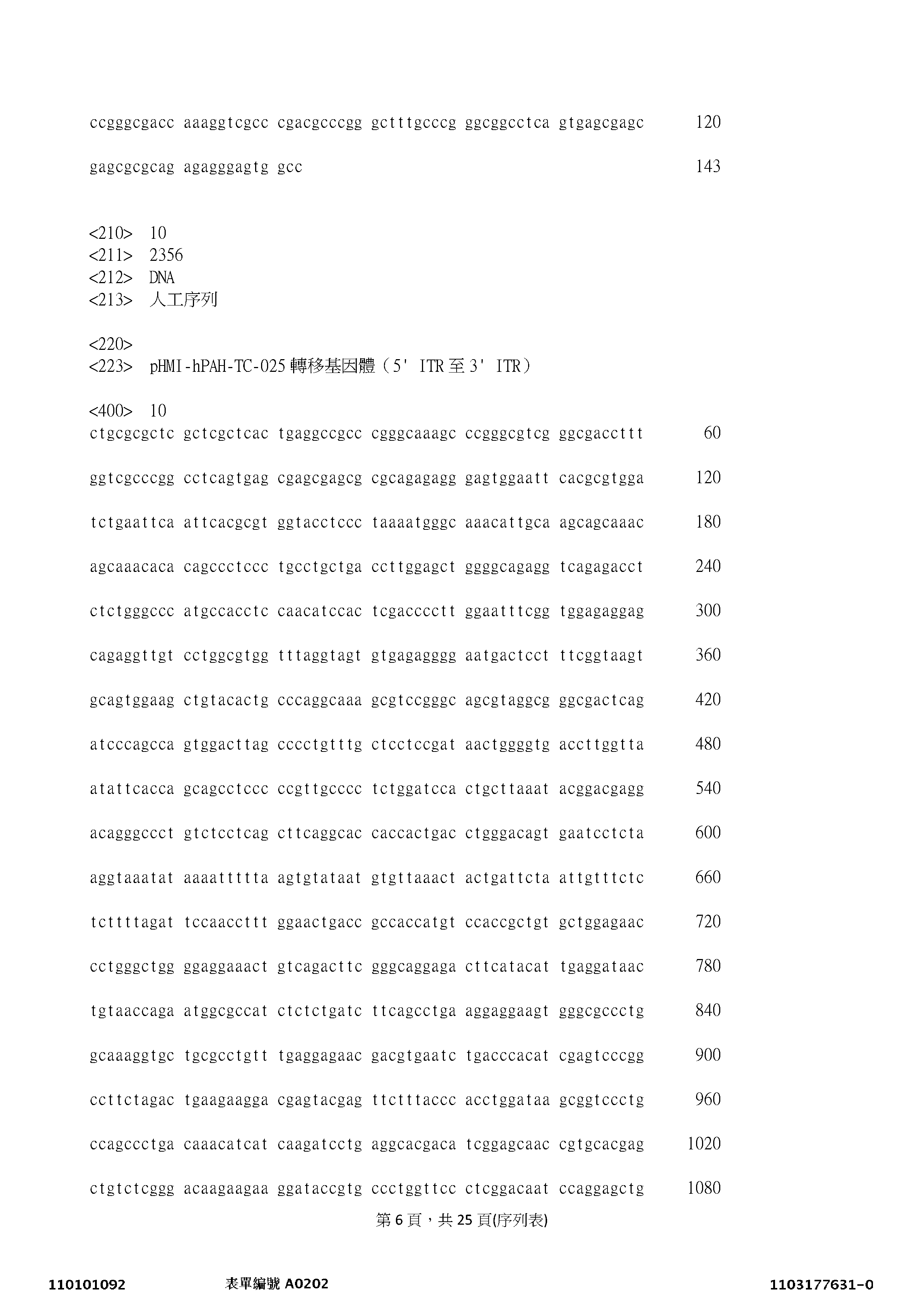


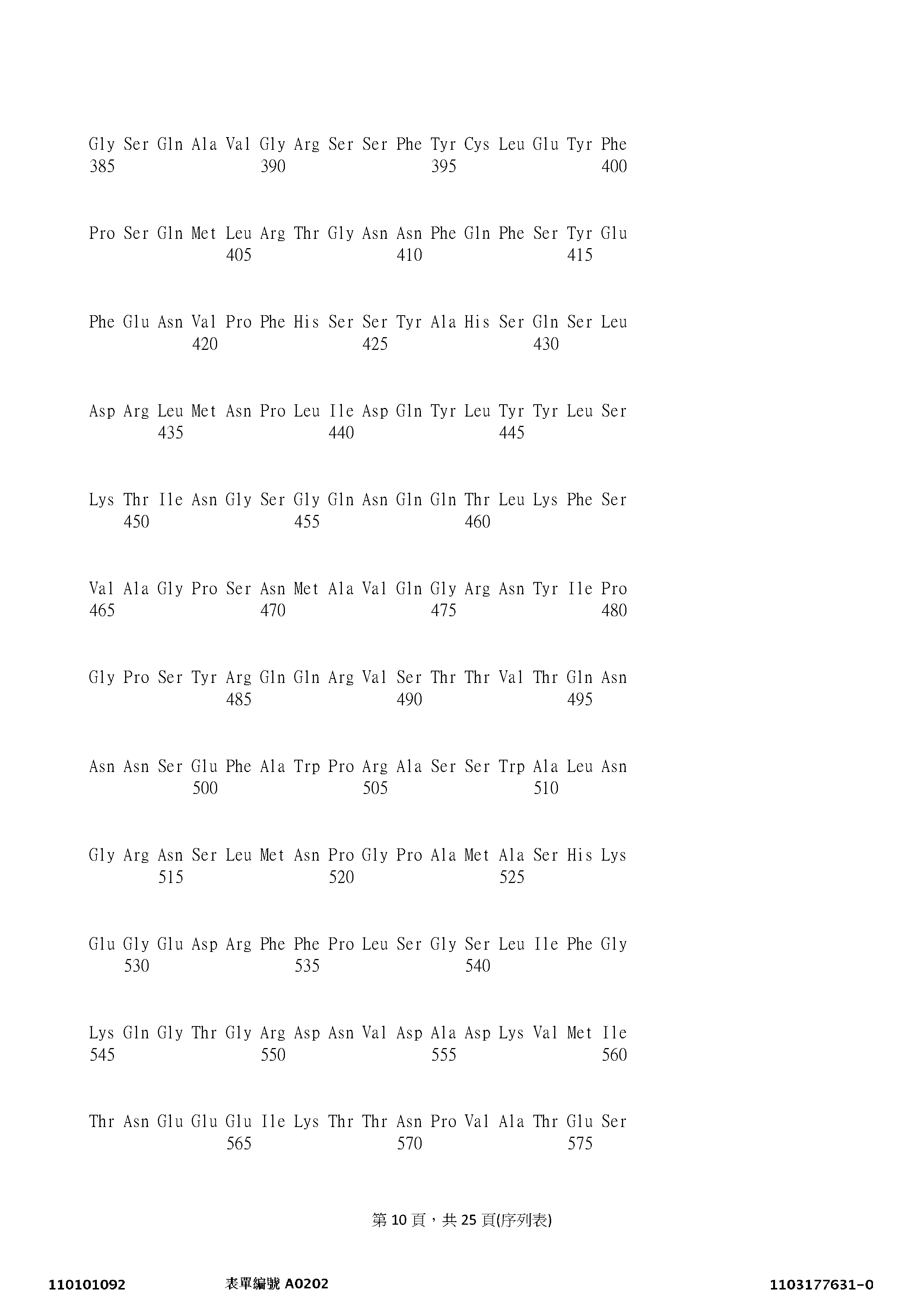


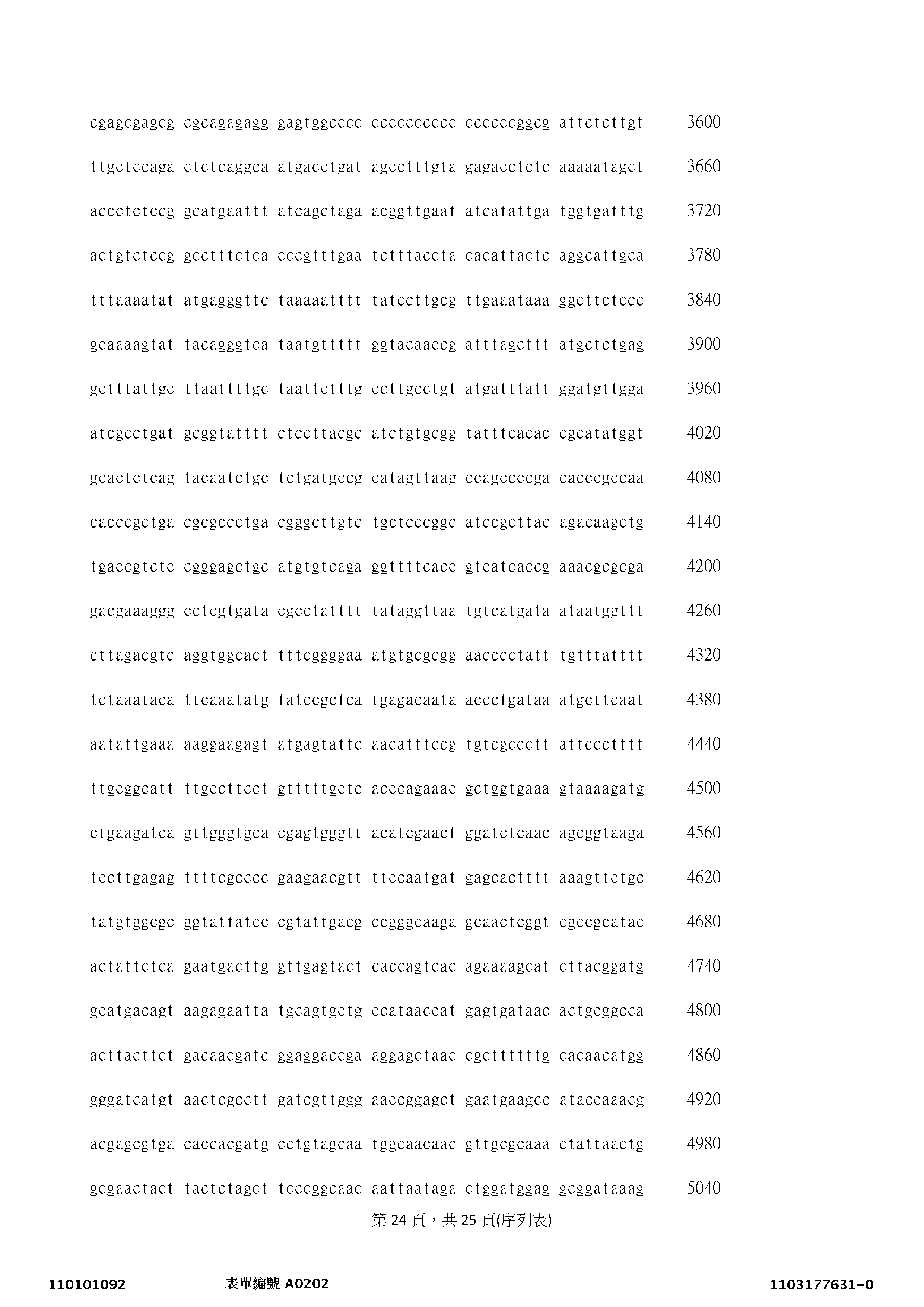

Claims (53)
Applications Claiming Priority (4)
| Application Number | Priority Date | Filing Date | Title |
|---|---|---|---|
| US202062960498P | 2020-01-13 | 2020-01-13 | |
| US62/960,498 | 2020-01-13 | ||
| US202063110251P | 2020-11-05 | 2020-11-05 | |
| US63/110,251 | 2020-11-05 |
Publications (1)
| Publication Number | Publication Date |
|---|---|
| TW202140791A true TW202140791A (en) | 2021-11-01 |
Family
ID=76863267
Family Applications (1)
| Application Number | Title | Priority Date | Filing Date |
|---|---|---|---|
| TW110101092A TW202140791A (en) | 2020-01-13 | 2021-01-12 | Methods of treating phenylketonuria |
Country Status (6)
| Country | Link |
|---|---|
| US (1) | US11952585B2 (en) |
| EP (1) | EP4090749A4 (en) |
| AU (1) | AU2021207468A1 (en) |
| CA (1) | CA3164341A1 (en) |
| TW (1) | TW202140791A (en) |
| WO (1) | WO2021146260A1 (en) |
Cited By (1)
| Publication number | Priority date | Publication date | Assignee | Title |
|---|---|---|---|---|
| CN115896135A (en) * | 2022-11-02 | 2023-04-04 | 苏州诺洁贝生物技术有限公司 | Optimized PAH gene and expression cassette and uses thereof |
Families Citing this family (1)
| Publication number | Priority date | Publication date | Assignee | Title |
|---|---|---|---|---|
| JP2023544165A (en) | 2020-10-01 | 2023-10-20 | ジェンザイム・コーポレーション | Human PAH expression cassette for treating PKU by liver-directed gene replacement therapy |
Family Cites Families (167)
| Publication number | Priority date | Publication date | Assignee | Title |
|---|---|---|---|---|
| IL71505A0 (en) | 1983-04-14 | 1984-07-31 | Hughes Howard Med Inst | Phenylalanine hydroxylase cdna clones,their production and their use in the diagnosis of classical phenylketonuria |
| IL74761A0 (en) | 1984-04-13 | 1985-06-30 | Hughes Howard Med Inst | Human phenylalanine hydroxylase cdna clones,their production and their use in diagnosing classical phenylketonuria |
| US5436146A (en) | 1989-09-07 | 1995-07-25 | The Trustees Of Princeton University | Helper-free stocks of recombinant adeno-associated virus vectors |
| WO1991018088A1 (en) | 1990-05-23 | 1991-11-28 | The United States Of America, Represented By The Secretary, United States Department Of Commerce | Adeno-associated virus (aav)-based eucaryotic vectors |
| US5173414A (en) | 1990-10-30 | 1992-12-22 | Applied Immune Sciences, Inc. | Production of recombinant adeno-associated virus vectors |
| US5252479A (en) | 1991-11-08 | 1993-10-12 | Research Corporation Technologies, Inc. | Safe vector for gene therapy |
| DE4339922C1 (en) | 1993-09-03 | 1994-10-06 | Max Planck Gesellschaft | Vector for gene therapy of the liver |
| US6268212B1 (en) | 1993-10-18 | 2001-07-31 | Amgen Inc. | Tissue specific transgene expression |
| DE4407859C1 (en) | 1994-03-04 | 1995-03-02 | Max Planck Gesellschaft | Vector for liver-specific gene therapy |
| DE69535703T2 (en) | 1994-04-13 | 2009-02-19 | The Rockefeller University | AAV-mediated delivery of DNA to cells of the nervous system |
| WO1996008560A1 (en) | 1994-09-16 | 1996-03-21 | The Uab Research Foundation | Transduction of genes into human hematopoietic stem cells using recombinant adeno-associated viral vectors |
| AU702830B2 (en) | 1994-09-23 | 1999-03-04 | General Hospital Corporation, The | Use of a non-mammalian dna virus to express an exogenous gene in a mammalian cell |
| US6924128B2 (en) | 1994-12-06 | 2005-08-02 | Targeted Genetics Corporation | Packaging cell lines for generation of high titers of recombinant AAV vectors |
| US5650309A (en) | 1995-05-16 | 1997-07-22 | The Regents Of The University Of California | Viral vectors |
| US7001764B2 (en) | 1995-06-27 | 2006-02-21 | Cell Genesys, Inc. | Compositions comprising tissue specific adenoviral vectors |
| DE19525900C1 (en) | 1995-07-15 | 1996-12-12 | Max Planck Gesellschaft | Liver-specific adenovirus expression vector |
| US5622856A (en) | 1995-08-03 | 1997-04-22 | Avigen | High efficiency helper system for AAV vector production |
| US5780447A (en) | 1996-06-14 | 1998-07-14 | St. Jude Children's Research Hospital | Recombinant adeno-associated viral vectors |
| EP0933997A4 (en) | 1996-09-06 | 2000-08-16 | Chiron Corp | METHODS AND COMPOSITIONS FOR SPECIFIC DELIVERY IN THE LIVER OF THERAPEUTIC MOLECULES USING RECOMBINANT AAV VECTORS |
| AU4266597A (en) | 1996-09-11 | 1998-04-14 | General Hospital Corporation, The | Use of a non-mammalian dna virus to express an exogenous gene in a mammalian cell |
| EP0932694A2 (en) | 1996-09-11 | 1999-08-04 | THE UNITED STATES GOVERNMENT as represented by THE DEPARTMENT OF HEALTH AND HUMAN SERVICES | Aav4 vector and uses thereof |
| DE19644500C2 (en) | 1996-10-25 | 1998-11-05 | Deutsches Krebsforsch | AAV DNA with helper virus sequences |
| FR2755699B1 (en) | 1996-11-08 | 1998-12-18 | Rhone Poulenc Rorer Sa | NEW CONSTRUCTIONS AND VECTORS FOR TARGETED AND INDUCTIBLE GENE EXPRESSION |
| FR2756297B1 (en) | 1996-11-22 | 1999-01-08 | Centre Nat Rech Scient | PROCESS FOR PRODUCING RECOMBINANT VIRUSES |
| AU5588298A (en) | 1996-12-02 | 1998-06-29 | Cell Genesys, Inc. | Adeno-associated viral vector-mediated delivery of dna to cells of the liver |
| EP0946723A1 (en) | 1996-12-18 | 1999-10-06 | Targeted Genetics Corporation | Recombinase-activatable aav packaging cassettes for use in the production of aav vectors |
| JP2001507230A (en) | 1996-12-23 | 2001-06-05 | ジィーン−セル | Nucleic acid constructs and their use for direct nucleic acid integration into cells |
| US6153436A (en) | 1997-01-10 | 2000-11-28 | The Board Of Trustees Of The University Of Arkansas | Method of gene delivery using wildtype adeno associated viral (AAV) vectors with insertions |
| ATE420157T1 (en) | 1997-04-24 | 2009-01-15 | Univ Washington | TARGETED GENETIC MODIFICATION WITH PARVOVIRAL VECTORS |
| US6156303A (en) | 1997-06-11 | 2000-12-05 | University Of Washington | Adeno-associated virus (AAV) isolates and AAV vectors derived therefrom |
| GB9715064D0 (en) | 1997-07-17 | 1997-09-24 | Ppl Therapeutics Scotland Ltd | Protein expression |
| AU1269699A (en) | 1997-10-08 | 1999-04-27 | Advanced Research And Technology Institute, Inc. | Chimeric parvovirus-based recombinant vector system that specifically targets the erythroid lineage |
| US6346415B1 (en) | 1997-10-21 | 2002-02-12 | Targeted Genetics Corporation | Transcriptionally-activated AAV inverted terminal repeats (ITRS) for use with recombinant AAV vectors |
| US6953690B1 (en) | 1998-03-20 | 2005-10-11 | The Trustees Of The University Of Pennsylvania | Compositions and methods for helper-free production of recombinant adeno-associated viruses |
| DE69918090T2 (en) | 1998-04-24 | 2005-06-16 | University Of Florida, Gainesville | RECOMBINANT ADENO ASSOCIATED VIRAL VECTOR CODING ALPHA-1 ANTITRYPSIN FOR GENE THERAPY |
| US6984517B1 (en) | 1998-05-28 | 2006-01-10 | The United States Of America As Represented By The Department Of Health And Human Services | AAV5 vector and uses thereof |
| WO1999064569A1 (en) | 1998-06-10 | 1999-12-16 | Advanced Research And Technology Institute | Methods and compositions for generating recombinant adeno-associated virus vectors |
| US6759237B1 (en) | 1998-11-05 | 2004-07-06 | The Trustees Of The University Of Pennsylvania | Adeno-associated virus serotype 1 nucleic acid sequences, vectors and host cells containing same |
| DE69941905D1 (en) | 1998-11-10 | 2010-02-25 | Univ North Carolina | VIRUS VECTORS AND METHOD FOR THEIR MANUFACTURE AND ADMINISTRATION. |
| US6919209B1 (en) | 1998-12-04 | 2005-07-19 | City Of Hope | Method of genetically modifying very primitive quiescent human hematopoietic stem cells |
| US6200758B1 (en) | 1999-02-19 | 2001-03-13 | New York State Office Of Mental Health | Phenylalanine hydroxylase gene variants, and amino acid and pterin homeostasis, in the definition, detection, treatment and prevention of psychotic, mood and personality disorders |
| JP4693244B2 (en) | 1999-03-18 | 2011-06-01 | ザ・トラステイーズ・オブ・ザ・ユニバーシテイ・オブ・ペンシルベニア | Compositions and methods for helperless production of recombinant adeno-associated virus |
| US6610906B1 (en) | 1999-06-09 | 2003-08-26 | The Regents Of The University Of Michigan | Nucleotide sequences for gene regulation and methods of use thereof |
| ATE360082T1 (en) | 1999-11-16 | 2007-05-15 | Genzyme Corp | VECTORS AND TRANSGENES WITH REGULATORY ELEMENTS FOR GENE ADMINISTRATION IN LIVER |
| JP2004514407A (en) | 2000-04-28 | 2004-05-20 | ザ・トラステイーズ・オブ・ザ・ユニバーシテイ・オブ・ペンシルベニア | AAV5 capsid pseudotyped in heterologous capsid and recombinant AAV vector comprising AAV5 vector |
| WO2001092551A2 (en) | 2000-06-01 | 2001-12-06 | University Of North Carolina At Chapel Hill | Duplexed parvovirus vectors |
| US7351813B2 (en) | 2000-06-20 | 2008-04-01 | The Board Of Trustees Of The Leland Stanford Junior University | Liver-specific gene expression cassettes, and methods of use |
| US6329181B1 (en) | 2000-08-07 | 2001-12-11 | Neurologix, Inc. | Helper functions for recombinant vector production |
| US7749492B2 (en) | 2001-01-05 | 2010-07-06 | Nationwide Children's Hospital, Inc. | AAV vectors and methods |
| AU2002306539A1 (en) | 2001-02-16 | 2002-09-04 | The Board Of Trustees Of The Leland Stanford Junior University | Minimal plasmid vectors that provide for persistent and high level gene expression and methods for using the same |
| DE10120265A1 (en) | 2001-04-25 | 2002-11-14 | Deutsches Krebsforsch | AAV helper plasmids for helper virus-free packaging and pseudotyping of AAV vectors |
| EP1395293B1 (en) | 2001-05-14 | 2009-07-22 | Gbp Ip, Llc | Lentiviral vectors encoding clotting factors for gene therapy |
| AU2002305778A1 (en) | 2001-05-31 | 2002-12-09 | The Rockefeller University | Method for generating replication defective viral vectors that are helper free |
| US8241622B2 (en) | 2001-07-13 | 2012-08-14 | University Of Iowa Research Foundation | Adeno-associated virus vectors with intravector heterologous terminal palindromic sequences |
| US20030129203A1 (en) | 2001-08-27 | 2003-07-10 | Nautilus Biotech S.A. | Mutant recombinant adeno-associated viruses |
| US20040086485A1 (en) | 2001-10-04 | 2004-05-06 | Aguilar-Cordova Carlos Estuardo | Chemeric viral vectors for gene therapy |
| CA2361462A1 (en) | 2001-11-07 | 2003-05-08 | Katherine A. High | Induction of tolerance to a therapeutic polypeptide |
| JP4677187B2 (en) | 2001-11-13 | 2011-04-27 | ザ・トラステイーズ・オブ・ザ・ユニバーシテイ・オブ・ペンシルベニア | Novel adeno-associated virus (AAV) 7 sequences, vectors containing them and their use |
| WO2003052051A2 (en) | 2001-12-17 | 2003-06-26 | The Trustees Of The University Of Pennsylvania | Adeno-associated virus (aav) serotype 8 sequences |
| WO2003052052A2 (en) | 2001-12-17 | 2003-06-26 | The Trustees Of The University Of Pennsylvania | Adeno-associated virus (aav) serotype 9 sequences, vectors containing same, and uses therefor |
| CA2369985A1 (en) | 2002-01-18 | 2003-07-18 | Duke University | Generation of recombinant adeno-associated viral vectors by a complete adenovirus-mediated approach |
| US20030198620A1 (en) | 2002-04-16 | 2003-10-23 | Keiya Ozawa | Method of treating amino acid metabolic disorders using recombinant adeno-associated virus virions |
| US7235393B2 (en) | 2002-04-29 | 2007-06-26 | The Trustees Of The University Of Pennsylvania | Method for direct rescue and amplification of integrated viruses from cellular DNA of tissues |
| AU2003237159A1 (en) | 2002-04-30 | 2003-11-17 | University Of Florida | Treatment for phenylketonuria |
| US20070015238A1 (en) | 2002-06-05 | 2007-01-18 | Snyder Richard O | Production of pseudotyped recombinant AAV virions |
| US7220577B2 (en) | 2002-08-28 | 2007-05-22 | University Of Florida Research Foundation, Inc. | Modified AAV |
| US7091029B2 (en) | 2002-09-23 | 2006-08-15 | Applied Genetics Technologies Corporation | High titer recombinant AAV production |
| US20070202587A1 (en) | 2002-09-23 | 2007-08-30 | Applied Genetic Technologies Corporation | Recombinant AAV production in mammalian cells |
| HUE034597T2 (en) | 2003-06-19 | 2018-02-28 | Genzyme Corp | AAV virions with decreased immunoreactivity and uses therefor |
| US9441244B2 (en) | 2003-06-30 | 2016-09-13 | The Regents Of The University Of California | Mutant adeno-associated virus virions and methods of use thereof |
| NZ545628A (en) | 2003-09-30 | 2009-04-30 | Univ Pennsylvania | Adeno-associated virus (AAV) clades, sequences, vectors containing same, and uses therefor |
| US7482156B2 (en) | 2003-10-15 | 2009-01-27 | Cell Genesys, Inc. | Hepatocellular carcinoma specific promoter and uses thereof |
| EP1732383A4 (en) | 2004-04-06 | 2007-05-02 | Cedars Sinai Medical Center | PREVENTION AND TREATMENT OF VASCULAR DISEASES WITH VIRUS VECTORS ASSOCIATED WITH RECOMBINANT ADENOVIRUS CODING APOLIPOPROTEIN A-I AND APOLIPOPROTEIN A-I MILANO |
| US8716461B2 (en) | 2004-05-24 | 2014-05-06 | Blood Systems, Inc. | Human parvovirus |
| ES2436741T3 (en) | 2004-09-22 | 2014-01-07 | St. Jude Children's Research Hospital | Improved expression of Factor IX in gene therapy vectors |
| TWI293307B (en) | 2004-09-30 | 2008-02-11 | Ind Tech Res Inst | A liver-specific chimeric regulatory sequence and use thereof |
| JP2008532521A (en) | 2005-03-09 | 2008-08-21 | ボード オブ リージェンツ, ザ ユニバーシティ オブ テキサス システム | Novel hTMC promoter and vector for tumor selective and highly efficient expression of cancer therapeutic genes |
| EP2359866B1 (en) | 2005-04-07 | 2013-07-17 | The Trustees of The University of Pennsylvania | Modified AAV rh48 capsids, compositions containing same and uses thereof |
| WO2006119432A2 (en) | 2005-04-29 | 2006-11-09 | The Government Of The U.S.A., As Rep. By The Sec., Dept. Of Health & Human Services | Isolation, cloning and characterization of new adeno-associated virus (aav) serotypes |
| US20100010068A1 (en) | 2005-08-19 | 2010-01-14 | Binhai Ren | Liver-directed gene therapy |
| CN101287837B (en) | 2005-10-20 | 2015-03-18 | 尤尼克尔生物制药股份有限公司 | Improved AAV vectors produced in insect cells |
| EP1981548A4 (en) | 2006-01-20 | 2010-03-24 | Univ North Carolina | ENHANCED PRODUCTION OF INFECTIOUS VECTORS OF PARVOVIRUS IN INSECT CELLS |
| WO2008016391A2 (en) | 2006-01-31 | 2008-02-07 | The Board Of Trustees Of The Leland Stanford Junior University | Self-complementary parvoviral vectors, and methods for making and using the same |
| WO2007120542A2 (en) | 2006-03-30 | 2007-10-25 | The Board Of Trustees Of The Leland Stanford Junior University | Aav capsid library and aav capsid proteins |
| US8298818B2 (en) | 2006-04-28 | 2012-10-30 | University Of Florida Research Foundation, Inc. | Self-complementary adeno-associated virus having a truncated CMV-chicken β-actin promoter |
| WO2014193716A2 (en) | 2013-05-21 | 2014-12-04 | University Of Florida Research Foundation, Inc. | Capsid-modified, raav3 vector compositions and methods of use in gene therapy of human liver cancer |
| CA2720097C (en) | 2007-04-09 | 2016-07-19 | University Of Florida Research Foundation, Inc. | Raav vector compositions having tyrosine-modified capsid proteins and methods for use |
| US9725485B2 (en) | 2012-05-15 | 2017-08-08 | University Of Florida Research Foundation, Inc. | AAV vectors with high transduction efficiency and uses thereof for gene therapy |
| US10696983B2 (en) | 2007-05-30 | 2020-06-30 | The Trustees Of The University Of Pennsylvania | Method for transducing cells with primary cilia |
| EP2008656A1 (en) | 2007-06-28 | 2008-12-31 | Bergen Teknologioverforing AS | Compositions for the treatment of hyperphenylalaninemia |
| EP2058401A1 (en) | 2007-10-05 | 2009-05-13 | Genethon | Widespread gene delivery to motor neurons using peripheral injection of AAV vectors |
| WO2009108274A2 (en) | 2008-02-26 | 2009-09-03 | The University Of North Carolina At Chapel Hill | Methods and compositions for adeno-associated virus (aav) with hi loop mutations |
| EP3586868B1 (en) | 2008-04-22 | 2023-11-08 | Vib Vzw | Liver-specific nucleic acid regulatory elements and methods and use thereof |
| WO2009134681A2 (en) | 2008-04-30 | 2009-11-05 | The Trustees Of The University Of Pennsylvania | Aav7 viral vectors for targeted delivery of rpe cells |
| WO2009137006A2 (en) | 2008-04-30 | 2009-11-12 | The University Of North Carolina At Chapel Hill | Directed evolution and in vivo panning of virus vectors |
| US20120093772A1 (en) | 2008-05-20 | 2012-04-19 | Alan Horsager | Vectors for delivery of light sensitive proteins and methods of use |
| US9217155B2 (en) | 2008-05-28 | 2015-12-22 | University Of Massachusetts | Isolation of novel AAV'S and uses thereof |
| US20100316623A1 (en) | 2009-04-23 | 2010-12-16 | Andrew Turner | Phenylalanine hydroxylase fusion protein and methods for treating phenylketonuria |
| DK2425000T3 (en) | 2009-04-30 | 2019-05-13 | Univ Pennsylvania | COMPOSITIONS RELATED TO LEADING AIRCRAFT COOLS INCLUDING ADENO ASSOCIATED VIRUSES |
| CN107083400A (en) | 2009-05-02 | 2017-08-22 | 建新公司 | The gene therapy of nerve degenerative diseases |
| WO2010136549A2 (en) | 2009-05-28 | 2010-12-02 | Deutsches Krebsforschungszentrum | Modified aav capsid polypeptides |
| DK3067417T3 (en) | 2009-06-16 | 2018-11-19 | Genzyme Corp | IMPROVED PROCEDURES FOR CLEANING RECOMBINANT AAV VECTORS |
| GB0911870D0 (en) | 2009-07-08 | 2009-08-19 | Ucl Business Plc | Optimised coding sequence and promoter |
| EP2287323A1 (en) | 2009-07-31 | 2011-02-23 | Association Institut de Myologie | Widespread gene delivery to the retina using systemic administration of AAV vectors |
| WO2011038187A1 (en) | 2009-09-25 | 2011-03-31 | The Trustees Of The University Of Pennsylvania | Controlled adeno-associated virus (aav) diversification and libraries prepared therefrom |
| WO2011041502A1 (en) | 2009-10-01 | 2011-04-07 | The Trustees Of The University Of Pennsylvania | Aav vectors expressing sec1o for treating kidney damage |
| ES2683695T3 (en) | 2010-01-12 | 2018-09-27 | The University Of North Carolina At Chapel Hill | Inverse restrictive terminal repeats for viral vectors |
| CN102947453A (en) | 2010-01-28 | 2013-02-27 | 费城儿童医院 | Scalable production platform for viral vector purification and use of such purified viral vectors in gene therapy |
| WO2011117258A2 (en) | 2010-03-22 | 2011-09-29 | Association Institut De Myologie | Methods of increasing efficiency of vector penetration of target tissue |
| SG10201502270TA (en) | 2010-03-29 | 2015-05-28 | Univ Pennsylvania | Pharmacologically induced transgene ablation system |
| US8927514B2 (en) * | 2010-04-30 | 2015-01-06 | City Of Hope | Recombinant adeno-associated vectors for targeted treatment |
| US9839696B2 (en) | 2010-04-30 | 2017-12-12 | City Of Hope | Recombinant adeno-associated vectors for targeted treatment |
| US8628966B2 (en) | 2010-04-30 | 2014-01-14 | City Of Hope | CD34-derived recombinant adeno-associated vectors for stem cell transduction and systemic therapeutic gene transfer |
| EP2394667A1 (en) | 2010-06-10 | 2011-12-14 | Laboratorios Del Dr. Esteve, S.A. | Vectors and sequences for the treatment of diseases |
| US20120014932A1 (en) | 2010-07-14 | 2012-01-19 | Golden William J | Methods for treating disorders of amino acid metabolism |
| JP6042825B2 (en) | 2011-02-10 | 2016-12-14 | ザ・ユニヴァーシティ・オヴ・ノース・キャロライナ・アト・チャペル・ヒル | Viral vectors with modified transduction profiles and methods for their production and use |
| WO2012112578A2 (en) | 2011-02-14 | 2012-08-23 | The Children's Hospital Of Philadelphia | Improved aav8 vector with enhanced functional activity and methods of use thereof |
| SG10201601110VA (en) | 2011-02-17 | 2016-03-30 | Univ Pennsylvania | Compositions and methods for altering tissue specificity and improving aav9-mediated gene transfer |
| GB201103062D0 (en) | 2011-02-22 | 2011-04-06 | Isis Innovation | Method |
| EP3450568A3 (en) | 2011-03-04 | 2019-04-24 | Intrexon Corporation | Vectors conditionally expressing protein |
| SI3693025T1 (en) | 2011-04-22 | 2022-04-29 | The Regents Of The University Of California | Adeno-associated virus virions with capsid variant and procedures for their use |
| WO2013029030A1 (en) | 2011-08-24 | 2013-02-28 | The Board Of Trustees Of The Leland Stanford Junior University | New aav capsid proteins for nucleic acid transfer |
| US8895264B2 (en) | 2011-10-27 | 2014-11-25 | Sangamo Biosciences, Inc. | Methods and compositions for modification of the HPRT locus |
| US10640785B2 (en) | 2011-11-22 | 2020-05-05 | The Children's Hospital Of Philadelphia | Virus vectors for highly efficient transgene delivery |
| WO2013096955A1 (en) | 2011-12-23 | 2013-06-27 | Case Western Reserve University | Targeted gene modification using hybrid recombinant adeno-associated virus |
| US20150111955A1 (en) | 2012-02-17 | 2015-04-23 | The Children's Hospital Of Philadelphia | Aav vector compositions and methods for gene transfer to cells, organs and tissues |
| HUE054087T2 (en) | 2012-04-18 | 2021-09-28 | Childrens Hospital Philadelphia | Composition and methods for highly efficient gene transfer using aav capsid variants |
| BR112015000161A2 (en) | 2012-07-06 | 2017-06-27 | Univ Iowa Res Found | modified adeno-associated virus vector compositions |
| EP3738974A1 (en) | 2012-09-28 | 2020-11-18 | The University of North Carolina at Chapel Hill | Aav vectors targeted to oligodendrocytes |
| DK2911687T3 (en) * | 2012-10-26 | 2019-05-13 | Univ Brussel Vrije | Vector for liver-targeted gene therapy of hemophilia and methods and use thereof |
| AU2013355327A1 (en) | 2012-12-05 | 2015-06-11 | Sangamo Therapeutics, Inc. | Methods and compositions for regulation of metabolic disorders |
| CN104937100B (en) | 2012-12-25 | 2020-04-03 | 宝生物工程株式会社 | AAV variant |
| US20150352228A1 (en) | 2013-01-11 | 2015-12-10 | Bruce TORBET | Methods and compositions for enhancing transduction efficiency of retroviral vectors |
| WO2014124282A1 (en) | 2013-02-08 | 2014-08-14 | The Trustees Of The University Of Pennsylvania | Enhanced aav-mediated gene transfer for retinal therapies |
| WO2014160092A1 (en) | 2013-03-13 | 2014-10-02 | The Children's Hospital Of Philadelphia | Adeno-associated virus vectors and methods of use thereof |
| US20140271550A1 (en) | 2013-03-14 | 2014-09-18 | The Trustees Of The University Of Pennsylvania | Constructs and Methods for Delivering Molecules via Viral Vectors with Blunted Innate Immune Responses |
| US10137176B2 (en) | 2013-03-15 | 2018-11-27 | The Trustee Of The University Of Pennsylvania | Compositions and methods for treating MPSI |
| BR112015021884A8 (en) | 2013-03-15 | 2019-11-26 | Childrens Hospital Philadelphia | recombinant plasmid vectors, avv viral particle or plurality of viral particles, their production methods and uses, and pharmaceutical composition |
| US11136557B2 (en) | 2013-05-31 | 2021-10-05 | The Regents Of The University Of California | Adeno-associated virus variants and methods of use thereof |
| KR102445330B1 (en) | 2013-07-12 | 2022-09-19 | 더 칠드런스 호스피탈 오브 필라델피아 | Assays for neutralizing antibodies to AVA vectors and anti-AVA (adeno-associated virus) |
| NZ716102A (en) | 2013-07-22 | 2021-12-24 | The Children’S Hospital Of Philadelphia | Variant aav and compositions, methods and uses for gene transfer to cells, organs and tissues |
| ES2739288T3 (en) | 2013-09-13 | 2020-01-30 | California Inst Of Techn | Selective recovery |
| CN116836957A (en) | 2013-10-17 | 2023-10-03 | 桑格摩生物科学股份有限公司 | Delivery methods and compositions for nuclease-mediated genome engineering |
| CN105658242A (en) | 2013-10-22 | 2016-06-08 | 夏尔人类遗传性治疗公司 | MRNA therapy for phenylketonuria |
| WO2015143177A1 (en) | 2014-03-21 | 2015-09-24 | The Board Of Trustees Of The Leland Stanford Junior University | Genome editing without nucleases |
| JP6983511B2 (en) | 2014-04-25 | 2021-12-17 | ザ・トラステイーズ・オブ・ザ・ユニバーシテイ・オブ・ペンシルベニア | Methods and Compositions for Treating Metastatic Breast Cancer and Other Cancers in the Brain |
| MX388392B (en) | 2014-09-24 | 2025-03-19 | Hope City | ADENO-ASSOCIATED VIRUS VECTOR VARIANTS FOR HIGH-EFFICIENCY GENOMIC EDITING AND THEIR METHODS. |
| JP6754361B2 (en) | 2014-12-16 | 2020-09-09 | ボード オブ リージェンツ オブ ザ ユニバーシティ オブ ネブラスカ | Gene therapy for juvenile Batten disease |
| DK3233130T3 (en) | 2014-12-17 | 2021-06-21 | Fundacion Para La Investig Medica Aplicada | NUCLEIC ACID CONSTRUCTIONS AND GENERATIVE VECTORS FOR USE IN THE TREATMENT OF WILSON DISEASE |
| JP6956635B2 (en) | 2014-12-17 | 2021-11-02 | フンダシオン パラ ラ インベスティガシオン メディカ アプリカダ | Nucleic acid constructs and gene therapy vectors for use in the treatment of Wilson's disease and other conditions |
| WO2016127057A1 (en) | 2015-02-06 | 2016-08-11 | The University Of North Carolina At Chapel Hill | Optimized human clotting factor viii gene expression cassettes and their use |
| EP3270944B1 (en) | 2015-03-17 | 2019-10-23 | Vrije Universiteit Brussel | Optimized liver-specific expression systems for fviii and fix |
| CN108093639B (en) | 2015-04-16 | 2022-07-19 | 埃默里大学 | Recombinant promoter and vector for protein expression in liver and application thereof |
| US10792339B2 (en) | 2015-07-17 | 2020-10-06 | Children's National Medical Center | Methods and compositions for treating phenylketonuria |
| MY189674A (en) | 2015-10-28 | 2022-02-24 | Sangamo Therapeutics Inc | Liver-specific constructs, factor viii expression cassettes and methods of use thereof |
| WO2017100551A1 (en) | 2015-12-09 | 2017-06-15 | Alexion Pharmaceuticals, Inc. | HETEROLOGOUS UTR SEQUENCES FOR ENHANCED mRNA EXPRESSION |
| EP3509628A1 (en) | 2016-09-09 | 2019-07-17 | Fondazione Telethon | Combined therapy for mucopolysaccharidosis type vi (maroteaux-lamy-syndrome) |
| EP3562494A4 (en) | 2016-12-30 | 2020-08-19 | The Trustees Of The University Of Pennsylvania | GENE THERAPY FOR TREATMENT OF PHENYLKETONURIA |
| EP3562514A4 (en) | 2016-12-30 | 2020-08-05 | The Trustees Of The University Of Pennsylvania | GENE THERAPY TO TREAT WILSON'S DISEASE |
| ES3052719T3 (en) | 2017-01-10 | 2026-01-13 | Childrens Medical Res Institute | Polynucleotides and vectors for the expression of transgenes |
| WO2019010091A1 (en) | 2017-07-06 | 2019-01-10 | The Board Of Trustees Of The Leland Stanford Junior University | Methods and compositions for facilitating homologous recombination |
| US20190256867A1 (en) * | 2018-02-01 | 2019-08-22 | Homology Medicines, Inc. | Adeno-associated virus compositions for restoring pah gene function and methods of use thereof |
| US10610606B2 (en) | 2018-02-01 | 2020-04-07 | Homology Medicines, Inc. | Adeno-associated virus compositions for PAH gene transfer and methods of use thereof |
| EP3746113A4 (en) * | 2018-02-01 | 2022-03-09 | Homology Medicines, Inc. | Adeno-associated virus compositions for pah gene transfer and methods of use thereof |
| SG11202103614RA (en) * | 2018-10-12 | 2021-05-28 | Genzyme Corp | Generation of improved human pah for treatment of severe pku by liver-directed gene replacement therapy |
| CA3116630A1 (en) * | 2018-11-30 | 2020-06-04 | Novartis Ag | Aav viral vectors and uses thereof |
| WO2022099301A1 (en) * | 2020-11-05 | 2022-05-12 | Homology Medicines, Inc. | Improved gene therapy methods |
-
2021
- 2021-01-12 TW TW110101092A patent/TW202140791A/en unknown
- 2021-01-13 US US17/147,974 patent/US11952585B2/en active Active
- 2021-01-13 AU AU2021207468A patent/AU2021207468A1/en not_active Abandoned
- 2021-01-13 CA CA3164341A patent/CA3164341A1/en active Pending
- 2021-01-13 WO PCT/US2021/013205 patent/WO2021146260A1/en not_active Ceased
- 2021-01-13 EP EP21741633.8A patent/EP4090749A4/en active Pending
Cited By (2)
| Publication number | Priority date | Publication date | Assignee | Title |
|---|---|---|---|---|
| CN115896135A (en) * | 2022-11-02 | 2023-04-04 | 苏州诺洁贝生物技术有限公司 | Optimized PAH gene and expression cassette and uses thereof |
| CN115896135B (en) * | 2022-11-02 | 2024-03-01 | 苏州诺洁贝生物技术有限公司 | Optimized PAH genes and expression cassettes and their uses |
Also Published As
| Publication number | Publication date |
|---|---|
| US11952585B2 (en) | 2024-04-09 |
| AU2021207468A1 (en) | 2022-08-04 |
| WO2021146260A1 (en) | 2021-07-22 |
| US20210261983A1 (en) | 2021-08-26 |
| EP4090749A4 (en) | 2024-02-28 |
| CA3164341A1 (en) | 2021-07-22 |
| EP4090749A1 (en) | 2022-11-23 |
Similar Documents
| Publication | Publication Date | Title |
|---|---|---|
| US7645446B2 (en) | Glutamic acid decarboxylase (GAD) based delivery system | |
| JP7082050B2 (en) | Adeno-related viral vectors useful in the treatment of spinal muscular atrophy | |
| Fuller-Carter et al. | Focused Update on AAV-Based Gene Therapy Clinical Trials for Inherited Retinal Degeneration: PI Fuller-Carter et al. | |
| JP7433360B2 (en) | Adeno-associated virus compositions and methods of their use for PAH gene transfer | |
| JP2018509164A (en) | Recombinant Glut1 adeno-associated virus vector construct and method for restoring Glut1 expression | |
| KR20210009317A (en) | Gene therapy for diseases caused by unbalanced nucleotide pools, including mitochondrial DNA depletion syndrome | |
| JP2022523766A (en) | Recombinant adeno-associated virus for the treatment of GRN-related adult-onset neurodegenerative disease | |
| US20240033325A1 (en) | Treatment of danon disease | |
| JP2015533368A (en) | Gene therapy for glycogen storage disease | |
| JP2020518269A (en) | Gene therapy for cilia | |
| TW202140791A (en) | Methods of treating phenylketonuria | |
| CN118078860A (en) | Treatment of Krabbe disease with umbilical cord blood transplantation (UCBT) and increased galactocerebrosidase (GALC) expression | |
| JP2022525564A (en) | Vectors and Methods for Treating Angelman Syndrome | |
| TW202112807A (en) | Adeno-associated virus compositions for arsa gene transfer and methods of use thereof | |
| KR20230159837A (en) | Gene therapy for 21-hydroxylase deficiency | |
| JP2022519596A (en) | Adeno-associated virus delivery of CLN3 polynucleotide | |
| EP4236986A1 (en) | Methods for treating inflammatory ocular diseases with complement factor h | |
| IL294627A (en) | Methods of treating phenylketonuria | |
| TW202246513A (en) | Adeno-associated virus delivery of cln3 polynucleotide | |
| JP2024505257A (en) | Gene therapy for neuronal ceroid lipofuscinosis | |
| CN118909979A (en) | Recombinant adeno-associated virus AAV-Lec and preparation method and application thereof | |
| WO2026006391A1 (en) | Compositions and methods for treating a heart disease | |
| JP2024539012A (en) | Methods and compositions for treating leukodystrophies | |
| TW202208622A (en) | Compositions useful in treatment of krabbe disease | |
| EA049835B1 (en) | TYPES OF GENE THERAPY FOR LYSOSOMAL DISORDERS |