TW202131921A - Combination of a cxcr7 antagonist with an s1p1 receptor modulator - Google Patents
Combination of a cxcr7 antagonist with an s1p1 receptor modulator Download PDFInfo
- Publication number
- TW202131921A TW202131921A TW109137814A TW109137814A TW202131921A TW 202131921 A TW202131921 A TW 202131921A TW 109137814 A TW109137814 A TW 109137814A TW 109137814 A TW109137814 A TW 109137814A TW 202131921 A TW202131921 A TW 202131921A
- Authority
- TW
- Taiwan
- Prior art keywords
- pharmaceutically acceptable
- acceptable salt
- disease
- diseases
- disorders
- Prior art date
Links
Images


Classifications
-
- A—HUMAN NECESSITIES
- A61—MEDICAL OR VETERINARY SCIENCE; HYGIENE
- A61K—PREPARATIONS FOR MEDICAL, DENTAL OR TOILETRY PURPOSES
- A61K31/00—Medicinal preparations containing organic active ingredients
- A61K31/33—Heterocyclic compounds
- A61K31/395—Heterocyclic compounds having nitrogen as a ring hetero atom, e.g. guanethidine or rifamycins
- A61K31/495—Heterocyclic compounds having nitrogen as a ring hetero atom, e.g. guanethidine or rifamycins having six-membered rings with two or more nitrogen atoms as the only ring heteroatoms, e.g. piperazine or tetrazines
- A61K31/505—Pyrimidines; Hydrogenated pyrimidines, e.g. trimethoprim
- A61K31/506—Pyrimidines; Hydrogenated pyrimidines, e.g. trimethoprim not condensed and containing further heterocyclic rings
-
- A—HUMAN NECESSITIES
- A61—MEDICAL OR VETERINARY SCIENCE; HYGIENE
- A61K—PREPARATIONS FOR MEDICAL, DENTAL OR TOILETRY PURPOSES
- A61K31/00—Medicinal preparations containing organic active ingredients
- A61K31/13—Amines
- A61K31/135—Amines having aromatic rings, e.g. ketamine, nortriptyline
- A61K31/137—Arylalkylamines, e.g. amphetamine, epinephrine, salbutamol, ephedrine or methadone
-
- A—HUMAN NECESSITIES
- A61—MEDICAL OR VETERINARY SCIENCE; HYGIENE
- A61K—PREPARATIONS FOR MEDICAL, DENTAL OR TOILETRY PURPOSES
- A61K31/00—Medicinal preparations containing organic active ingredients
- A61K31/33—Heterocyclic compounds
- A61K31/395—Heterocyclic compounds having nitrogen as a ring hetero atom, e.g. guanethidine or rifamycins
- A61K31/397—Heterocyclic compounds having nitrogen as a ring hetero atom, e.g. guanethidine or rifamycins having four-membered rings, e.g. azetidine
-
- A—HUMAN NECESSITIES
- A61—MEDICAL OR VETERINARY SCIENCE; HYGIENE
- A61K—PREPARATIONS FOR MEDICAL, DENTAL OR TOILETRY PURPOSES
- A61K31/00—Medicinal preparations containing organic active ingredients
- A61K31/33—Heterocyclic compounds
- A61K31/395—Heterocyclic compounds having nitrogen as a ring hetero atom, e.g. guanethidine or rifamycins
- A61K31/40—Heterocyclic compounds having nitrogen as a ring hetero atom, e.g. guanethidine or rifamycins having five-membered rings with one nitrogen as the only ring hetero atom, e.g. sulpiride, succinimide, tolmetin, buflomedil
- A61K31/403—Heterocyclic compounds having nitrogen as a ring hetero atom, e.g. guanethidine or rifamycins having five-membered rings with one nitrogen as the only ring hetero atom, e.g. sulpiride, succinimide, tolmetin, buflomedil condensed with carbocyclic rings, e.g. carbazole
- A61K31/404—Indoles, e.g. pindolol
-
- A—HUMAN NECESSITIES
- A61—MEDICAL OR VETERINARY SCIENCE; HYGIENE
- A61K—PREPARATIONS FOR MEDICAL, DENTAL OR TOILETRY PURPOSES
- A61K31/00—Medicinal preparations containing organic active ingredients
- A61K31/33—Heterocyclic compounds
- A61K31/395—Heterocyclic compounds having nitrogen as a ring hetero atom, e.g. guanethidine or rifamycins
- A61K31/41—Heterocyclic compounds having nitrogen as a ring hetero atom, e.g. guanethidine or rifamycins having five-membered rings with two or more ring hetero atoms, at least one of which being nitrogen, e.g. tetrazole
- A61K31/4245—Oxadiazoles
-
- A—HUMAN NECESSITIES
- A61—MEDICAL OR VETERINARY SCIENCE; HYGIENE
- A61K—PREPARATIONS FOR MEDICAL, DENTAL OR TOILETRY PURPOSES
- A61K31/00—Medicinal preparations containing organic active ingredients
- A61K31/33—Heterocyclic compounds
- A61K31/395—Heterocyclic compounds having nitrogen as a ring hetero atom, e.g. guanethidine or rifamycins
- A61K31/41—Heterocyclic compounds having nitrogen as a ring hetero atom, e.g. guanethidine or rifamycins having five-membered rings with two or more ring hetero atoms, at least one of which being nitrogen, e.g. tetrazole
- A61K31/425—Thiazoles
- A61K31/426—1,3-Thiazoles
-
- A—HUMAN NECESSITIES
- A61—MEDICAL OR VETERINARY SCIENCE; HYGIENE
- A61K—PREPARATIONS FOR MEDICAL, DENTAL OR TOILETRY PURPOSES
- A61K31/00—Medicinal preparations containing organic active ingredients
- A61K31/33—Heterocyclic compounds
- A61K31/395—Heterocyclic compounds having nitrogen as a ring hetero atom, e.g. guanethidine or rifamycins
- A61K31/435—Heterocyclic compounds having nitrogen as a ring hetero atom, e.g. guanethidine or rifamycins having six-membered rings with one nitrogen as the only ring hetero atom
- A61K31/44—Non condensed pyridines; Hydrogenated derivatives thereof
- A61K31/4427—Non condensed pyridines; Hydrogenated derivatives thereof containing further heterocyclic ring systems
- A61K31/4439—Non condensed pyridines; Hydrogenated derivatives thereof containing further heterocyclic ring systems containing a five-membered ring with nitrogen as a ring hetero atom, e.g. omeprazole
-
- A—HUMAN NECESSITIES
- A61—MEDICAL OR VETERINARY SCIENCE; HYGIENE
- A61K—PREPARATIONS FOR MEDICAL, DENTAL OR TOILETRY PURPOSES
- A61K45/00—Medicinal preparations containing active ingredients not provided for in groups A61K31/00 - A61K41/00
- A61K45/06—Mixtures of active ingredients without chemical characterisation, e.g. antiphlogistics and cardiaca
-
- A—HUMAN NECESSITIES
- A61—MEDICAL OR VETERINARY SCIENCE; HYGIENE
- A61P—SPECIFIC THERAPEUTIC ACTIVITY OF CHEMICAL COMPOUNDS OR MEDICINAL PREPARATIONS
- A61P1/00—Drugs for disorders of the alimentary tract or the digestive system
-
- A—HUMAN NECESSITIES
- A61—MEDICAL OR VETERINARY SCIENCE; HYGIENE
- A61P—SPECIFIC THERAPEUTIC ACTIVITY OF CHEMICAL COMPOUNDS OR MEDICINAL PREPARATIONS
- A61P1/00—Drugs for disorders of the alimentary tract or the digestive system
- A61P1/04—Drugs for disorders of the alimentary tract or the digestive system for ulcers, gastritis or reflux esophagitis, e.g. antacids, inhibitors of acid secretion, mucosal protectants
-
- A—HUMAN NECESSITIES
- A61—MEDICAL OR VETERINARY SCIENCE; HYGIENE
- A61P—SPECIFIC THERAPEUTIC ACTIVITY OF CHEMICAL COMPOUNDS OR MEDICINAL PREPARATIONS
- A61P19/00—Drugs for skeletal disorders
- A61P19/02—Drugs for skeletal disorders for joint disorders, e.g. arthritis, arthrosis
-
- A—HUMAN NECESSITIES
- A61—MEDICAL OR VETERINARY SCIENCE; HYGIENE
- A61P—SPECIFIC THERAPEUTIC ACTIVITY OF CHEMICAL COMPOUNDS OR MEDICINAL PREPARATIONS
- A61P25/00—Drugs for disorders of the nervous system
-
- A—HUMAN NECESSITIES
- A61—MEDICAL OR VETERINARY SCIENCE; HYGIENE
- A61P—SPECIFIC THERAPEUTIC ACTIVITY OF CHEMICAL COMPOUNDS OR MEDICINAL PREPARATIONS
- A61P25/00—Drugs for disorders of the nervous system
- A61P25/28—Drugs for disorders of the nervous system for treating neurodegenerative disorders of the central nervous system, e.g. nootropic agents, cognition enhancers, drugs for treating Alzheimer's disease or other forms of dementia
-
- A—HUMAN NECESSITIES
- A61—MEDICAL OR VETERINARY SCIENCE; HYGIENE
- A61P—SPECIFIC THERAPEUTIC ACTIVITY OF CHEMICAL COMPOUNDS OR MEDICINAL PREPARATIONS
- A61P29/00—Non-central analgesic, antipyretic or antiinflammatory agents, e.g. antirheumatic agents; Non-steroidal antiinflammatory drugs [NSAID]
-
- A—HUMAN NECESSITIES
- A61—MEDICAL OR VETERINARY SCIENCE; HYGIENE
- A61P—SPECIFIC THERAPEUTIC ACTIVITY OF CHEMICAL COMPOUNDS OR MEDICINAL PREPARATIONS
- A61P37/00—Drugs for immunological or allergic disorders
-
- A—HUMAN NECESSITIES
- A61—MEDICAL OR VETERINARY SCIENCE; HYGIENE
- A61P—SPECIFIC THERAPEUTIC ACTIVITY OF CHEMICAL COMPOUNDS OR MEDICINAL PREPARATIONS
- A61P37/00—Drugs for immunological or allergic disorders
- A61P37/02—Immunomodulators
-
- A—HUMAN NECESSITIES
- A61—MEDICAL OR VETERINARY SCIENCE; HYGIENE
- A61P—SPECIFIC THERAPEUTIC ACTIVITY OF CHEMICAL COMPOUNDS OR MEDICINAL PREPARATIONS
- A61P37/00—Drugs for immunological or allergic disorders
- A61P37/02—Immunomodulators
- A61P37/06—Immunosuppressants, e.g. drugs for graft rejection
-
- A—HUMAN NECESSITIES
- A61—MEDICAL OR VETERINARY SCIENCE; HYGIENE
- A61K—PREPARATIONS FOR MEDICAL, DENTAL OR TOILETRY PURPOSES
- A61K2300/00—Mixtures or combinations of active ingredients, wherein at least one active ingredient is fully defined in groups A61K31/00 - A61K41/00
-
- Y—GENERAL TAGGING OF NEW TECHNOLOGICAL DEVELOPMENTS; GENERAL TAGGING OF CROSS-SECTIONAL TECHNOLOGIES SPANNING OVER SEVERAL SECTIONS OF THE IPC; TECHNICAL SUBJECTS COVERED BY FORMER USPC CROSS-REFERENCE ART COLLECTIONS [XRACs] AND DIGESTS
- Y02—TECHNOLOGIES OR APPLICATIONS FOR MITIGATION OR ADAPTATION AGAINST CLIMATE CHANGE
- Y02A—TECHNOLOGIES FOR ADAPTATION TO CLIMATE CHANGE
- Y02A50/00—TECHNOLOGIES FOR ADAPTATION TO CLIMATE CHANGE in human health protection, e.g. against extreme weather
- Y02A50/30—Against vector-borne diseases, e.g. mosquito-borne, fly-borne, tick-borne or waterborne diseases whose impact is exacerbated by climate change
Landscapes
- Health & Medical Sciences (AREA)
- Chemical & Material Sciences (AREA)
- Medicinal Chemistry (AREA)
- Pharmacology & Pharmacy (AREA)
- Life Sciences & Earth Sciences (AREA)
- Animal Behavior & Ethology (AREA)
- General Health & Medical Sciences (AREA)
- Public Health (AREA)
- Veterinary Medicine (AREA)
- Epidemiology (AREA)
- Bioinformatics & Cheminformatics (AREA)
- Engineering & Computer Science (AREA)
- Organic Chemistry (AREA)
- General Chemical & Material Sciences (AREA)
- Nuclear Medicine, Radiotherapy & Molecular Imaging (AREA)
- Chemical Kinetics & Catalysis (AREA)
- Immunology (AREA)
- Neurosurgery (AREA)
- Biomedical Technology (AREA)
- Neurology (AREA)
- Rheumatology (AREA)
- Transplantation (AREA)
- Emergency Medicine (AREA)
- Pain & Pain Management (AREA)
- Hospice & Palliative Care (AREA)
- Psychiatry (AREA)
- Orthopedic Medicine & Surgery (AREA)
- Physical Education & Sports Medicine (AREA)
- Pharmaceuticals Containing Other Organic And Inorganic Compounds (AREA)
- Medicines That Contain Protein Lipid Enzymes And Other Medicines (AREA)
- Acyclic And Carbocyclic Compounds In Medicinal Compositions (AREA)
- Measuring Pulse, Heart Rate, Blood Pressure Or Blood Flow (AREA)
- Peptides Or Proteins (AREA)
Abstract
Description
本發明係關於化合物(3S,4S)-1-環丙基甲基-4-{[5-(2,4-二氟-苯基)-異噁唑-3-羰基]-胺基}-哌啶-3-羧酸(1-嘧啶-2-基-環丙基)-醯胺(下文中亦稱為「化合物」):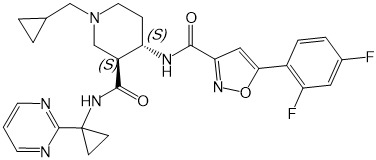
自WO2018/019929已知化合物為CXCL11/CXCL12受體CXCR7之調節劑。自WO2019/145460已知化合物之結晶形式。化合物可潛在用於預防/防治或治療涉及CXCR7受體或其配體之某些疾病及疾患,其等包括: = 癌症,諸如腦腫瘤,包括惡性神經膠質瘤、多形性神經膠質母細胞瘤;神經母細胞瘤;胰臟癌,包括胰臟腺癌/胰管腺癌;腸胃癌,包括結腸癌、肝細胞癌及胃癌;卡波濟肉瘤(Kaposi’s sarcoma);白血病,包括成人T細胞白血病;淋巴瘤;肺癌;乳癌;橫紋肌肉瘤;前列腺癌;食管鱗癌;口腔鱗狀細胞癌;子宮內膜癌;甲狀腺癌,包括甲狀腺乳頭狀癌;轉移性癌症;肺轉移;皮膚癌,包括黑色素瘤及轉移性黑色素瘤;膀胱癌;多發性骨髓瘤;骨肉瘤;頭頸癌;及腎癌,包括腎透明細胞癌、轉移性腎透明細胞癌; = 發炎性疾病,諸如慢性鼻竇炎、哮喘、慢性阻塞性肺疾患、動脈粥樣硬化、心肌炎、急性肺損傷、子宮內膜異位症、葡萄膜炎、糖尿病性視網膜病變及結節病; = 自體免疫疾患,諸如(發炎性)脫髓鞘疾病;多發性硬化症(MS);格林巴利症候群(Guillain Barré syndrome);類風濕性關節炎(RA);發炎性腸病(IBD,尤其包含克羅恩氏病(Crohn’s disease)及潰瘍性結腸炎);全身性紅斑狼瘡(SLE),包括神經精神全身性紅斑狼瘡及狼瘡性腎炎;間質性膀胱炎;乳糜瀉;自體免疫腦脊髓炎;骨關節炎;I型糖尿病;牛皮癬;自體免疫甲狀腺炎;舍格倫症候群(Sjögren’s Syndrome);強直性脊柱炎及白癜風; = 神經退化性疾患,諸如肌萎縮性側索硬化; = 移植排斥(尤其腎同種異體移植排斥、心臟同種異體移植排斥及由造血幹細胞移植引起之移植物抗宿主疾病); = 纖維化(尤其肝纖維化、肝硬化、肺纖維化、心臟纖維化,尤其特發性肺纖維化;及 = 缺血性損傷,諸如腎缺血或大腦缺血。Compounds known from WO2018/019929 are modulators of CXCL11/CXCL12 receptor CXCR7. The crystalline form of the compound is known from WO2019/145460. The compounds can potentially be used to prevent/control or treat certain diseases and disorders involving the CXCR7 receptor or its ligands, including: = Cancer, such as brain tumors, including malignant glioma, glioblastoma multiforme; neuroblastoma; pancreatic cancer, including pancreatic adenocarcinoma/pancreatic duct adenocarcinoma; gastrointestinal cancer, including colon cancer, liver Cell carcinoma and gastric cancer; Kaposi's sarcoma (Kaposi's sarcoma); Leukemia, including adult T-cell leukemia; Lymphoma; Lung cancer; Breast cancer; Rhabdomyosarcoma; Prostate cancer; Esophageal squamous cell carcinoma; Oral squamous cell carcinoma; Endometrial cancer; Thyroid cancer, including papillary thyroid carcinoma; metastatic cancer; lung metastasis; skin cancer, including melanoma and metastatic melanoma; bladder cancer; multiple myeloma; osteosarcoma; head and neck cancer; and kidney cancer, including renal clear cell Carcinoma, metastatic clear cell carcinoma of the kidney; = Inflammatory diseases, such as chronic sinusitis, asthma, chronic obstructive pulmonary disease, atherosclerosis, myocarditis, acute lung injury, endometriosis, uveitis, diabetic retinopathy and sarcoidosis; = Autoimmune diseases, such as (inflammatory) demyelinating diseases; multiple sclerosis (MS); Guillain Barré syndrome (Guillain Barré syndrome); rheumatoid arthritis (RA); inflammatory bowel disease (IBD, Especially including Crohn's disease (Crohn's disease) and ulcerative colitis); systemic lupus erythematosus (SLE), including neuropsychiatric systemic lupus erythematosus and lupus nephritis; interstitial cystitis; celiac disease; autoimmunity Encephalomyelitis; Osteoarthritis; Type I diabetes; Psoriasis; Autoimmune thyroiditis; Sjögren's Syndrome; Ankylosing spondylitis and vitiligo; = Neurodegenerative diseases, such as amyotrophic lateral sclerosis; = Transplant rejection (especially kidney allograft rejection, heart allograft rejection, and graft-versus-host disease caused by hematopoietic stem cell transplantation); = Fibrosis (especially liver fibrosis, liver cirrhosis, pulmonary fibrosis, cardiac fibrosis, especially idiopathic pulmonary fibrosis; and = Ischemic injury, such as renal ischemia or cerebral ischemia.
趨化因子受體係以高親和力結合肽趨化因子配體之G蛋白偶合受體(GPCR)之組。趨化因子受體之主要功能係在靜息狀態下及在發炎期間引導白血球運輸至淋巴器官及組織,但亦已識別某些趨化因子受體對非造血細胞及其等祖細胞之作用。Chemokines are a group of G protein-coupled receptors (GPCRs) that bind peptide chemokine ligands with high affinity. The main function of chemokine receptors is to guide the transport of white blood cells to lymphoid organs and tissues in the resting state and during inflammation, but the effects of certain chemokine receptors on non-hematopoietic cells and their progenitor cells have also been identified.
CXCR7 (亦稱ACKR3,亦稱RDC1,亦稱CMKOR1,亦稱GPR159)具有兩個已知的趨化因子配體:CXCL12 (亦稱基質細胞衍生因子1,SDF-1;亦稱前B細胞生長刺激因子,PBSF)及CXCL11 (亦稱l-TAC,亦稱IFN-g誘導型T細胞化學吸引劑)。CXCL11或CXCL12結合至CXCR7導致CXCR7-配體複合物之內化(Burns JM等人,J Exp Med 2006, 203(9):2201-13)及配體之降解(Naumann U等人,PLoS One 2010, 5(2):e9175)。此清除活性有助於建立並維持自血管向組織之CXCL11及CXCL12濃度梯度。CXCR7 (also known as ACKR3, also known as RDC1, also known as CMKOR1, also known as GPR159) has two known chemokine ligands: CXCL12 (also known as stromal cell-derived
基質衍生之化學吸引劑CXCL12參與免疫監視及發炎性反應之調節。CXCL12係由骨髓基質細胞、內皮細胞、心臟、骨骼肌、肝、腦、腎、胸腺、淋巴結、實質細胞分泌並在幹細胞增生、存活及造血細胞/祖細胞歸巢至骨髓中發揮重要作用(Rankin SM等人;Immunol let. 2012, 145(1-2):47-54)。CXCL12係在某些病理性疾患(包括缺血、發炎、缺氧、癌症、神經退化性疾病及自體免疫疾病)下誘導(Juarez J等人,Curr Pharm Des 2004, 10(11):1245-59)。The matrix-derived chemoattractant CXCL12 participates in immune surveillance and the regulation of inflammatory response. CXCL12 is secreted by bone marrow stromal cells, endothelial cells, heart, skeletal muscle, liver, brain, kidney, thymus, lymph node, parenchymal cells, and plays an important role in stem cell proliferation, survival, and homing of hematopoietic/progenitor cells to bone marrow (Rankin SM et al.; Immunol let. 2012, 145(1-2):47-54). CXCL12 is induced under certain pathological conditions (including ischemia, inflammation, hypoxia, cancer, neurodegenerative diseases and autoimmune diseases) (Juarez J et al., Curr Pharm Des 2004, 10(11): 1245 59).
CXCL12亦將來源於骨髓之祖細胞募集至脈管系統形成之位點。此外,其在致癌作用中發揮顯著作用。CXCL12促進將內皮祖細胞及來源於骨髓之抑制細胞募集至腫瘤位點及來源於骨髓之其他細胞。CXCL12亦在發炎期間對細胞遷移、黏附及存活發揮作用(Kumar R等人,Cell Immunol. 2012, 272(2):230-41)。CXCL12亦驅動細胞(諸如寡樹突膠細胞祖細胞)之分化、成熟(Gottle P等人,Ann Neurol. 2010, 68(6):915-24)。CXCL12 also recruits bone marrow-derived progenitor cells to the site of vasculature formation. In addition, it plays a significant role in carcinogenesis. CXCL12 promotes the recruitment of endothelial progenitor cells and bone marrow-derived suppressor cells to tumor sites and other bone marrow-derived cells. CXCL12 also plays a role in cell migration, adhesion and survival during inflammation (Kumar R et al., Cell Immunol. 2012, 272(2):230-41). CXCL12 also drives the differentiation and maturation of cells (such as oligodendritic progenitor cells) (Gottle P et al., Ann Neurol. 2010, 68(6):915-24).
CXCL11係主要表現於胰、外周血白血球、胸腺、肝、脾及肺中。此趨化因子係由干擾素誘導並在感染或癌症過程期間上調(Cole等人,J Exp Med. 1998, 187(12):2009-21)。CXCL11 is mainly manifested in pancreas, peripheral blood leukocytes, thymus, liver, spleen and lungs. This chemokine is induced by interferon and is upregulated during the course of infection or cancer (Cole et al., J Exp Med. 1998, 187(12):2009-21).
除CXCR7外,CXCL12結合並活化CXCR4 (亦稱融合素,亦稱白血球衍生之七跨膜域受體;LESTR,亦稱D2S201E,亦稱七跨膜片段受體,亦稱HM89,亦稱脂多醣相關蛋白3;lap3,亦稱LPS相關蛋白3),而CXCL11結合並活化CXCR3 (亦稱GPR9,亦稱CD183)。In addition to CXCR7, CXCL12 binds and activates CXCR4 (also known as fusion factor, also known as leukocyte-derived seven transmembrane domain receptor; LESTR, also known as D2S201E, also known as seven transmembrane fragment receptor, also known as HM89, also known as lipopolysaccharide
因此,CXCR7與其配體CXCL12及CXCL11 (此後稱為CXCR7軸)之相互作用涉及將攜載受體之細胞引導至體內之特定位置,特定言之引導至發炎、免疫損傷及免疫功能障礙之位點且亦與組織損傷、凋亡之誘導、細胞生長及血管阻滯相關聯。CXCR7及其配體係經上調並高度表現於多種病理情況,包括癌症、自體免疫疾患、發炎、感染、移植排斥、纖維化及神經退化中。Therefore, the interaction between CXCR7 and its ligands CXCL12 and CXCL11 (hereinafter referred to as the CXCR7 axis) involves directing receptor-carrying cells to specific locations in the body, specifically to sites of inflammation, immune damage, and immune dysfunction It is also associated with tissue damage, induction of apoptosis, cell growth and vascular blockade. CXCR7 and its complex system are up-regulated and highly expressed in a variety of pathological conditions, including cancer, autoimmune diseases, inflammation, infection, transplant rejection, fibrosis, and neurodegeneration.
已揭示CXCR7調節劑具有單獨或組合用於以下疾病中之潛在用途,其中已顯示CXCR7調節(例如,使用siRNA、shRNA、microRNA、過表現、CXCR7敲除動物、CXCR7激動劑、CXCR7拮抗劑、抗體或納米抗體)調節白血球遷移(Berahovich RD等人;Immunology. 2014, 141(1):111-22)及促進髓鞘質/神經元修復(Williams JL等人;J Exp Med. 2014, 5;211(5):791-9;Gottle P等人;Ann Neurol. 2010, 68(6):915-24)、在發炎性、自體免疫及脫髓鞘疾病,包括多發性硬化症及自體免疫腦脊髓炎(Cruz-Orengo L等人;J Neuroinflammation. 2011, 6; 8:170;Bao J等人;Biochem Biophys Res Commun. 2016 Jan 1; 469(1):1-7)、格林-巴利症候群(Guillain-Barré syndrome)或自體免疫神經炎(Brunn A等人;Neuropathol Appl Neurobiol. 2013, 39(7):772-87)及類風濕性關節炎(Watanabe K等人;Arthritis Rheum. 2010, 62(11):3211-20)之實驗疾病模型中提供有利影響。It has been revealed that CXCR7 modulators have the potential use alone or in combination in the following diseases, in which CXCR7 modulation has been shown (for example, the use of siRNA, shRNA, microRNA, overexpression, CXCR7 knockout animals, CXCR7 agonists, CXCR7 antagonists, antibodies (Or Nanobody) regulates the migration of white blood cells (Berahovich RD et al.; Immunology. 2014, 141(1):111-22) and promotes myelin/neuron repair (Williams JL et al.; J Exp Med. 2014, 5; 211 (5):791-9; Gottle P et al.; Ann Neurol. 2010, 68(6):915-24), in inflammatory, autoimmune and demyelinating diseases, including multiple sclerosis and autoimmune Encephalomyelitis (Cruz-Orengo L et al.; J Neuroinflammation. 2011, 6; 8:170; Bao J et al.; Biochem Biophys Res Commun. 2016 Jan 1; 469(1):1-7), Green-Barre Syndrome (Guillain-Barré syndrome) or autoimmune neuritis (Brunn A et al.; Neuropathol Appl Neurobiol. 2013, 39(7):772-87) and rheumatoid arthritis (Watanabe K et al.; Arthritis Rheum. 2010 , 62(11):3211-20) provides beneficial effects in experimental disease models.
具體言之,自參考文獻已知CXCR7對發炎性脫髓鞘疾病之影響。CXCR7係在整個成年小鼠腦中表現於各種區域中及其表現係在多發性硬化症(MS)之小鼠模型中及在脫髓鞘作用期間在非發炎性脫髓鞘作用模型中上調(Banisadr G等人;J Neuroimmune Pharmacol. 2016 Mar;11(1):26-35;Williams JL等人;J Exp Med. 2014, 5;211(5):791-9;Gottle P等人;Ann Neurol. 2010, 68(6):915-24)。CXCL12於血腦屏障(BBB)處之經改變表現模式係涉及多發性硬化症且與疾病之嚴重性相關(McCandless EE等人;Am J Pathol. 2008, 172(3):799-808)。已顯示CXCR7功能拮抗作用在小鼠之實驗性自體免疫腦脊髓炎中有效。彼等最近研究在多發性硬化症中經由互補機制強烈暗示CXCR7為疾病修飾分子:(i)藉由經由CXCL12重新分配於BBB處促進白血球進入血管周圍空間內(Cruz-Orengo L等人;J Neuroinflammation. 2011, 6; 8:170;Cruz-Orengo L等人;J Exp Med. 2011, 14; 208(2):327-39)及調節整合素之CXCR4介導活化(Hartmann TN等人;J Leukoc Biol. 2008,; 84(4):1130-40) (ii)藉由直接作用於微膠質細胞趨化性(Bao J等人;Biochem Biophys Res Commun. 2016 Jan 1; 469(1):1-7)及直接作用於發炎性單核球,促進其等進入腦內(Douglas SD等人;J Leukoc Biol. 2017; 102: 1155-1157) (iii)藉由經由增強CXCR4介導之寡樹突膠細胞祖細胞成熟之CXCL12之增加含量促進髓鞘再生(Williams JL等人;J Exp Med. 2014, 5;211(5):791-9;Gottle P等人;Ann Neurol. 2010, 68(6):915-24)。最近,Chu等人(Neuroscientist. 2017, 23(6): 627-648)回顧靶向脫髓鞘疾病之CXCL12/CXCR4/CXCR7軸之重要性,因為其等在促進寡樹突膠細胞祖細胞之遷移、增生及分化中發揮主要作用。因此,CXCR7拮抗作用可在脫髓鞘之成人CNS中治療上預防發炎並增強髓鞘質修復。Specifically, the influence of CXCR7 on inflammatory demyelinating diseases is known from references. The CXCR7 line is expressed in various regions in the entire adult mouse brain and its expression is upregulated in a mouse model of multiple sclerosis (MS) and during demyelination in a non-inflammatory demyelination model ( Banisadr G et al.; J Neuroimmune Pharmacol. 2016 Mar; 11(1):26-35; Williams JL et al.; J Exp Med. 2014, 5; 211(5):791-9; Gottle P et al.; Ann Neurol . 2010, 68(6):915-24). The altered performance pattern of CXCL12 at the blood-brain barrier (BBB) involves multiple sclerosis and is related to the severity of the disease (McCandless EE et al.; Am J Pathol. 2008, 172(3):799-808). CXCR7 functional antagonism has been shown to be effective in experimental autoimmune encephalomyelitis in mice. Their recent studies strongly suggest that CXCR7 is a disease-modifying molecule through complementary mechanisms in multiple sclerosis: (i) by redistributing CXCL12 at the BBB to promote leukocyte entry into the perivascular space (Cruz-Orengo L et al.; J Neuroinflammation 2011, 6; 8:170; Cruz-Orengo L et al.; J Exp Med. 2011, 14; 208(2):327-39) and CXCR4-mediated activation of integrins (Hartmann TN et al.; J Leukoc Biol. 2008,; 84(4):1130-40) (ii) By directly acting on microglia chemotaxis (Bao J et al.; Biochem Biophys Res Commun. 2016 Jan 1; 469(1):1- 7) and directly act on inflammatory monocytes to promote their entry into the brain (Douglas SD et al.; J Leukoc Biol. 2017; 102: 1155-1157) (iii) by enhancing CXCR4 mediated oligodendrites The increased content of CXCL12 in the maturation of glial progenitor cells promotes remyelination (Williams JL et al.; J Exp Med. 2014, 5; 211(5):791-9; Gottle P et al.; Ann Neurol. 2010, 68(6) ):915-24). Recently, Chu et al. (Neuroscientist. 2017, 23(6): 627-648) reviewed the importance of the CXCL12/CXCR4/CXCR7 axis of targeted demyelinating diseases, because it promotes the development of oligodendritic cell progenitor cells. Play a major role in migration, proliferation and differentiation. Therefore, CXCR7 antagonism can therapeutically prevent inflammation and enhance myelin repair in demyelinated adult CNS.
具體言之,自參考文獻已知CXCR7在類風濕性關節炎中之潛在作用。據報導CXCR7係表現於滑膜中之內皮細胞上。同樣,在類風濕性關節炎病患之滑膜組織中發現CXCL12及CXCL11 mRNA之高含量(Ueno等人;Rheumatol Int. 2005, 25(5):361-7)。顯示CXCL12在滑膜中CD4+ T細胞及單核球聚集中發揮主要作用(Nanki T等人;J Immunol. 2000, 165(11):6590-8;Blades MC等人;Arthritis Rheum. 2002 Mar;46(3):824-36)。另外,CXCL12經由其促血管生成功能及其對破骨細胞募集及分化之作用參與類風濕性關節炎過程。因此,已提出將CXCL12途徑之調節劑(包括CXCR7調節劑)作為潛在治療劑來治療類風濕關節炎。Villalvilla等人(Expert Opin Ther Targets. 2014, 18(9):1077-87)最近討論支持抗CXCL12藥劑在類風濕性關節炎治療中之潛在用途之臨床前及臨床資料。Watanabe等人(Arthritis Rheum. 2010, 62(11):3211-20)證實CXCR7抑制劑在小鼠膠原誘導之關節炎模型中預防性及治療性減少疾病臨床跡象及血管生成。Specifically, the potential role of CXCR7 in rheumatoid arthritis is known from references. It is reported that CXCR7 is expressed on endothelial cells in the synovium. Similarly, high levels of CXCL12 and CXCL11 mRNA were found in the synovial tissue of patients with rheumatoid arthritis (Ueno et al.; Rheumatol Int. 2005, 25(5):361-7). It has been shown that CXCL12 plays a major role in the accumulation of CD4 + T cells and monocytes in the synovium (Nanki T et al.; J Immunol. 2000, 165(11):6590-8; Blades MC et al.; Arthritis Rheum. 2002 Mar; 46(3):824-36). In addition, CXCL12 participates in the process of rheumatoid arthritis through its pro-angiogenic function and its effect on the recruitment and differentiation of osteoclasts. Therefore, modulators of the CXCL12 pathway (including CXCR7 modulators) have been proposed as potential therapeutic agents to treat rheumatoid arthritis. Villalvilla et al. (Expert Opin Ther Targets. 2014, 18(9):1077-87) recently discussed the preclinical and clinical data supporting the potential use of anti-CXCL12 agents in the treatment of rheumatoid arthritis. Watanabe et al. (Arthritis Rheum. 2010, 62(11):3211-20) demonstrated that CXCR7 inhibitors preventively and therapeutically reduce clinical signs of disease and angiogenesis in a mouse collagen-induced arthritis model.
進一步報導CXCR7涉及數種發炎性疾患,包括急性及慢性肺發炎性過程,諸如慢性阻塞性肺疾病、急性肺損傷、哮喘、肺發炎、肺纖維化及動脈粥樣硬化、肝纖維化及心臟纖維化。It is further reported that CXCR7 is involved in several inflammatory diseases, including acute and chronic pulmonary inflammatory processes, such as chronic obstructive pulmonary disease, acute lung injury, asthma, lung inflammation, pulmonary fibrosis and atherosclerosis, liver fibrosis and heart fibers change.
亦報導CXCL12及CXCL11在發炎性腸病中上調(Koelink PJ等人;Pharmacol Ther. 2012, 133(1):1-18)。發現CXCR7在發炎性腸病(IBD)中在外周血T細胞上上調(Werner L等人;J Leukoc Biol. 2011, 90(3):583-90)。作者假設「CXCR7在IBD病患之外周血中之增加表現可促進T細胞增加回流至黏膜發炎症位點」 (Werner L等人;Theranostics. 2013, 3(1):40-6)。在IBD之小鼠模型中,CXCL12途徑之調節劑可減少T細胞之浸潤及減少組織損傷(Mikami S等人;J Pharmacol Exp Ther. 2008, 327(2):383-92;Xia XM等人;PLoS One. 2011, 6(11):e27282)。It has also been reported that CXCL12 and CXCL11 are up-regulated in inflammatory bowel disease (Koelink PJ et al.; Pharmacol Ther. 2012, 133(1):1-18). CXCR7 was found to be upregulated on peripheral blood T cells in inflammatory bowel disease (IBD) (Werner L et al.; J Leukoc Biol. 2011, 90(3):583-90). The authors hypothesized that "the increased performance of CXCR7 in the peripheral blood of patients with IBD can promote the increased return of T cells to the site of mucosal inflammation" (Werner L et al.; Theranostics. 2013, 3(1):40-6). In the mouse model of IBD, modulators of the CXCL12 pathway can reduce T cell infiltration and tissue damage (Mikami S et al.; J Pharmacol Exp Ther. 2008, 327(2):383-92; Xia XM et al.; PLoS One. 2011, 6(11):e27282).
亦已在皮損性牛皮廯皮膚中發現CXCL12及CXCL11之高含量(Chen SC等人;Arch Dermatol Res. 2010, 302(2):113-23;Zgraggen S等人;PLoS One. 2014, 9(4):e93665)。Zgraggen等人證實CXCL12之阻斷在牛皮癬樣皮膚發炎之兩種不同模型中改善慢性皮膚炎症之過程。High levels of CXCL12 and CXCL11 have also been found in the skin of dermal cortex (Chen SC et al.; Arch Dermatol Res. 2010, 302(2):113-23; Zgraggen S et al.; PLoS One. 2014, 9( 4):e93665). Zgraggen et al. demonstrated that the blockade of CXCL12 improves the process of chronic skin inflammation in two different models of psoriatic skin inflammation.
數種其他自體免疫疾患(諸如全身性紅斑狼瘡(SLE))顯示改變之CXCR7/CXCR4表現與SLE B細胞受損之CXCL12促進之遷移相關(Biajoux V等人;J Transl Med. 2012, 18; 10:251)。另外,在狼瘡之多個鼠模型中,CXCL12係在腎病腎中顯著上調。Wang等人(J Immunol. 2009, 182(7):4448-58)顯示在CXCL12軸上發揮作用係狼瘡中之良好治療目標,因為CXCR4拮抗劑顯著改善疾病、延長存活並減少腎炎及淋巴組織增生。Several other autoimmune diseases (such as systemic lupus erythematosus (SLE)) have shown that altered CXCR7/CXCR4 performance is related to the migration of SLE B cells promoted by CXCL12 (Biajoux V et al.; J Transl Med. 2012, 18; 10:251). In addition, in multiple murine models of lupus, CXCL12 is significantly up-regulated in nephrotic kidneys. Wang et al. (J Immunol. 2009, 182(7):4448-58) showed that acting on the CXCL12 axis is a good treatment target in lupus, because CXCR4 antagonists significantly improve disease, prolong survival, and reduce nephritis and lymphoid tissue proliferation .
Matin等人(Immunology. 2002, 107(2):222-32)證實用抗體阻斷CXCL12在糖尿病之小鼠模型中導致糖尿病發展之減少及胰島炎之抑制。Matin et al. (Immunology. 2002, 107(2):222-32) demonstrated that blocking CXCL12 with antibodies resulted in a reduction in the development of diabetes and inhibition of insulitis in a mouse model of diabetes.
在來自自體免疫病患之甲狀腺中及在動物模型中發現CXCL12及CXCR4係上調(Armengol MP等人;J Immunol. 2003, 170(12):6320-8)。Liu等人(Mol Med Rep. 2016, 13(4):3604-12)揭示CXCR4之阻斷減小小鼠之自體免疫甲狀腺炎之嚴重性、減少淋巴球浸潤及自體抗體產生。CXCL12 and CXCR4 were found to be up-regulated in the thyroid from autoimmune patients and in animal models (Armengol MP et al.; J Immunol. 2003, 170(12): 6320-8). Liu et al. (Mol Med Rep. 2016, 13(4):3604-12) revealed that the blockade of CXCR4 reduces the severity of autoimmune thyroiditis in mice, reduces lymphocyte infiltration and autoantibody production.
在來自患有強直性脊柱炎之病患之滑膜組織中發現CXCR4係上調(He C等人;Mol Med Rep. 2019, 19(4):3237-3246)。CXCR4抑制導致減少之纖維母細胞增生及成骨作用。CXCR4 was found to be up-regulated in synovial tissue from patients with ankylosing spondylitis (He C et al.; Mol Med Rep. 2019, 19(4): 3237-3246). CXCR4 inhibition leads to reduced fibroblast proliferation and osteogenesis.
已顯示神經退化性疾患顯示經改變之CXCL12/CXCR4表現。此途徑涉及自我更新及多能神經祖細胞之募集及分化,其等在組織修復期間發揮關鍵作用。Meizhang等人回顧在動物模型中CXCL12在神經退化性疾病中之作用及CXCL12傳訊途徑之操作對神經退化性疾患之影響(Meizhang等人,Trends Neurosci. 2012, 35(10): 619-628)。最近,在帕金森氏症(Parkinson’s disease)病患之外周血中發現CXCL12及CXCR4之表現係上調(Bagheri等人,Neuroimmunomodulation. 2018, 25(4):201-205)。CXCR4/CXCL12途徑亦已涉及阿茲海默症(Alzheimer’s disease)中發生之發炎性過程(Hongyan等人,Brain Circ. 2017, 3(4):199-203)。Rabinovich-Nikitin等人教示阻斷CXCR4/CXCL12傳訊在肌肉萎縮性脊髓側索硬化症(ALS)之模型中減少微膠質細胞發炎、降低血腦屏障通透性及增加運動神經元之數量、增加小鼠之存活(Rabinovich-Nikitin等人,J Neuroinflammation. 2016, 13: 123)。It has been shown that neurodegenerative disorders show altered CXCL12/CXCR4 performance. This pathway involves self-renewal and the recruitment and differentiation of pluripotent neural progenitor cells, which play a key role during tissue repair. Meizhang et al. reviewed the role of CXCL12 in neurodegenerative diseases in animal models and the influence of CXCL12 signaling pathway operation on neurodegenerative diseases (Meizhang et al., Trends Neurosci. 2012, 35(10): 619-628). Recently, the expression of CXCL12 and CXCR4 was found to be up-regulated in the peripheral blood of patients with Parkinson’s disease (Bagheri et al., Neuroimmunomodulation. 2018, 25(4):201-205). The CXCR4/CXCL12 pathway has also been involved in the inflammatory process that occurs in Alzheimer’s disease (Hongyan et al., Brain Circ. 2017, 3(4):199-203). Rabinovich-Nikitin et al. taught that blocking CXCR4/CXCL12 transmission reduces microglia inflammation, reduces the permeability of the blood-brain barrier, increases the number of motor neurons, and increases the number of motor neurons in a model of amyotrophic lateral sclerosis (ALS). Survival of mice (Rabinovich-Nikitin et al., J Neuroinflammation. 2016, 13: 123).
CXCR7亦稱為數種類鴉片肽(尤其腦啡肽及強啡肽)之清除劑受體,調節其等可用率並藉此通過其等經典類鴉片受體調節傳訊(Meyrath M等人,Nat Commun. 2020;11(1):3033)。因為CXCR7用作類鴉片肽之廣譜清除劑,所以投與CXCR7拮抗劑可導致此等類鴉片肽之增加,類似於針對趨化因子配體CXCL11及CXCL12觀測到之增加。因此,內源性類鴉片含量之調節可用於臨床疼痛管理及傷害性知覺之控制中(Holden JE等人,AACN Clin Issues. 2005; 16(3): 291-301)。已顯示結合至CXCR7之強啡肽原衍生之肽之腦脊液含量在杭丁頓氏舞蹈症(Huntington’s disease)病患中降低(Al Shweiki MR等人,Mov Disord. 2020; doi: 10.1002/mds.28300),因此藉由投與CXCR7拮抗劑增加此等肽之含量可有利於此疾病。內源性類鴉片肽亦涉及情緒障礙,諸如抑鬱症(Peciña M等人,Mol Psychiatry. 2019; 24(4): 576-587)。因此,可預期可使用藉由阻斷清除受體CXCR7調節內源性肽含量以治療情緒障礙。沿彼等思路,已顯示CXCR7調節劑在臨床前模型中具有抗焦慮活性(Ikeda Y等人,Cell. 2013; 155(6): 1323-36)。因此,除涉及上文提及之CXCR7受體或其配體之疾病及疾患外,CXCR7調節劑亦可適用於預防/防治或治療涉及類鴉片受體傳訊之某些疾病及疾患,包括神經性疼痛、神經退化性疾病,包括杭丁頓氏舞蹈症、成癮症、情緒障礙、焦慮症。CXCR7 is also known as the scavenger receptor for several types of opioid peptides (especially enkephalin and dynorphin), which regulates its availability and thereby modulates communication through its classic opioid receptors (Meyrath M et al., Nat Commun. 2020;11(1):3033). Because CXCR7 acts as a broad-spectrum scavenger for opioid peptides, administration of CXCR7 antagonists can result in an increase in these opioid peptides, similar to the increase observed for the chemokine ligands CXCL11 and CXCL12. Therefore, the regulation of endogenous opioid content can be used in clinical pain management and nociceptive control (Holden JE et al., AACN Clin Issues. 2005; 16(3): 291-301). It has been shown that the cerebrospinal fluid content of the prodynorphin-derived peptide bound to CXCR7 is reduced in Huntington's disease patients (Al Shweiki MR et al., Mov Disord. 2020; doi: 10.1002/mds.28300 ), therefore, increasing the content of these peptides by administering CXCR7 antagonists can benefit this disease. Endogenous opioid peptides are also involved in mood disorders, such as depression (Peciña M et al., Mol Psychiatry. 2019; 24(4): 576-587). Therefore, it is expected that the use of blocking the clearance receptor CXCR7 to regulate the content of endogenous peptides can be used to treat mood disorders. Along these lines of thinking, CXCR7 modulators have been shown to have anxiolytic activity in preclinical models (Ikeda Y et al., Cell. 2013; 155(6): 1323-36). Therefore, in addition to the diseases and disorders related to the CXCR7 receptor or its ligands mentioned above, CXCR7 modulators can also be suitable for the prevention/control or treatment of certain diseases and disorders involving opioid receptor communication, including neurological Pain and neurodegenerative diseases, including Huntington’s disease, addiction, mood disorders, and anxiety.
數種神經鞘胺醇-1-磷酸受體1調節劑(或者亦稱為S1P1受體調節劑,其包含非選擇性S1P1受體調節劑諸如芬戈莫德(fingolimod),及選擇性S1P1受體調節劑)係S1P1受體激動劑,其作為功能拮抗劑以藥理學方式作用於S1P1受體。已將S1P1受體調節劑描述為適用於預防及/或治療與經活化之免疫系統相關聯之疾病或疾患(Juif等人,Exp. Op. Drug Metabol. & Tox. (2016) 12(8), 879-895)。S1P1受體調節劑間接拮抗該S1P1受體之功能並隔絕淋巴結中之淋巴球(Subei等人,CNS Drugs. 2015 Jul; 29(7): 565-575)。經證實多種S1P1受體調節劑以相同方式通過S1P1傳訊,導致S1P1受體降解(Lukas等人,J. Biomol. Screening (2014) 19(3) 407-416)。在臨床實務中,S1P1受體調節劑(包括非選擇性及選擇性S1P1受體調節劑)顯示緩慢性不整脈及房室傳導阻滯(AV阻滯)之風險。因此,例如,對於芬戈莫德,建議應在病患開始治療期間一般監測心率及血壓。已提出藉由使用上滴定劑量方案降低風險且此等劑量方案係用於臨床實務中(例如,參見,對於芬戈莫德:WO2006/058316、WO2010/075239、WO2011/041145、WO2013/055833;對於龐西莫德(ponesimod):WO2009/115954、WO2016/091996;對於西波莫德(siponimod):WO2010/072703、WO2013/057212、WO2015/155709)。可獲得或在研發中之某些S1P1受體調節劑之另一潛在警告係治療一般導致淋巴球減少症,及在某些情況下可導致嚴重之淋巴球減少症,與感染之風險增加相關聯。與另一活性成分之組合可導致效用增加及/或存在更高之淋巴球計數。此外,與另一活性成分之組合可容許減小S1P1受體調節劑之最小有效劑量。因此,與另一活性成分之此組合可具有優勢,尤其在免疫系統可需重新活化之情況下,例如,在緊急情況(諸如急性感染)下。Several sphingosine-1-phosphate receptor modulators (or also known as S1P1 receptor modulators), which include non-selective S1P1 receptor modulators such as fingolimod, and selective S1P1 receptor modulators Body regulator) is a S1P1 receptor agonist, which acts as a functional antagonist on the S1P1 receptor in a pharmacological manner. S1P1 receptor modulators have been described as suitable for the prevention and/or treatment of diseases or disorders associated with the activated immune system (Juif et al., Exp. Op. Drug Metabol. & Tox. (2016) 12(8) , 879-895). S1P1 receptor modulators indirectly antagonize the function of the S1P1 receptor and isolate the lymphocytes in the lymph nodes (Subei et al., CNS Drugs. 2015 Jul; 29(7): 565-575). It has been confirmed that multiple S1P1 receptor modulators transmit S1P1 signals in the same way, leading to degradation of S1P1 receptors (Lukas et al., J. Biomol. Screening (2014) 19(3) 407-416). In clinical practice, S1P1 receptor modulators (including non-selective and selective S1P1 receptor modulators) show the risk of chronic irregular pulse and atrioventricular block (AV block). Therefore, for fingolimod, for example, it is recommended that the heart rate and blood pressure should be generally monitored during the start of treatment of the patient. It has been proposed to reduce the risk by using upper titration dosage regimens and these dosage regimens are used in clinical practice (for example, see, for fingolimod: WO2006/058316, WO2010/075239, WO2011/041145, WO2013/055833; for Ponesimod: WO2009/115954, WO2016/091996; for siponimod: WO2010/072703, WO2013/057212, WO2015/155709). Another potential warning for certain S1P1 receptor modulators available or under development is that the treatment generally leads to lymphopenia, and in some cases can cause severe lymphopenia, which is associated with an increased risk of infection . The combination with another active ingredient can result in increased utility and/or the presence of a higher lymphocyte count. In addition, the combination with another active ingredient may allow to reduce the minimum effective dose of the S1P1 receptor modulator. Therefore, this combination with another active ingredient may have advantages, especially in situations where the immune system may need to be reactivated, for example, in emergency situations (such as acute infections).
已將S1P1受體調節劑特定言之描述為在治療多發性硬化症(MS)中具有獨特之作用機制(Chaudhry等人,Neurotherapeutics (2017) 14:859-873)。MS係CNS之慢性發炎性及脫髓鞘疾病,其中發炎性過程係與髓鞘質之破壞相關聯,導致出現脫髓鞘作用之大病灶病變。由於發炎性脫髓鞘作用,亦出現軸突損傷及損失,即使在不同程度下。主動髓鞘再生過程可至少部分修復髓鞘質病變,而軸突損失係永久且不可逆的。主要認為MS係自體免疫神經退化性疾病,即,由對自身抗原之適應性免疫反應引起之疾病。在MS中,經活化之髓鞘質反應性T細胞係自外周募集至CNS,導致微膠質細胞之活化及導致循環巨噬細胞之募集(Grassi等人,Frontiers in Pharmacology 2019, doi:10.3389/fphar.2019.00807)。S1P1 receptor modulators have been specifically described as having a unique mechanism of action in the treatment of multiple sclerosis (MS) (Chaudhry et al., Neurotherapeutics (2017) 14:859-873). MS is a chronic inflammatory and demyelinating disease of the CNS. The inflammatory process is associated with the destruction of myelin, resulting in large focal lesions with demyelination. Due to inflammatory demyelination, axon damage and loss also occur, even to varying degrees. The active remyelination process can at least partially repair myelin lesions, while axonal loss is permanent and irreversible. It is mainly believed that MS is an autoimmune neurodegenerative disease, that is, a disease caused by an adaptive immune response to self-antigens. In MS, activated myelin-responsive T cell lines are recruited from the periphery to the CNS, leading to the activation of microglia and the recruitment of circulating macrophages (Grassi et al., Frontiers in Pharmacology 2019, doi:10.3389/fphar .2019.00807).
已揭示S1P1受體調節劑在神經退行性疾病中之潛在用途,其中S1P1受體調節劑直接作用於CNS駐留細胞諸如微膠質細胞、星狀細胞、神經元、寡樹突膠細胞祖細胞及寡樹突膠細胞(Miron等人,J Neurol Sci. 2008, 274(1-2):13-7),在神經退化之實驗疾病模型中提供有利影響。The potential use of S1P1 receptor modulators in neurodegenerative diseases has been revealed, where S1P1 receptor modulators directly act on CNS-resident cells such as microglia, stellate cells, neurons, oligodendritic cell progenitors and oligodendritic cells. Dendritic cells (Miron et al., J Neurol Sci. 2008, 274(1-2):13-7) provide beneficial effects in experimental disease models of neurodegeneration.
具體言之,自參考文獻已知S1P對神經退化性疾病之影響。Yazdi等人最近討論支持S1P1受體調節劑直接影響髓鞘形成之實驗及臨床研究(Yazdi等人,J Neuro Res. 2019, 00:1-13)。Angelopoulou等人最近綜述S1P涉及阿茲海默症(AD)發病機理及S1P1受體調節劑在AD模型中之有利影響(Angelopoulou等人,Neuromolecular Med. 2019, 21(3):227-238)。顯示S1P1受體調節劑可減少神經功能缺損並在肌肉萎縮性脊髓側索硬化症(ALS)之模型中延長小鼠之存活、調節神經發炎性反應並增加來源於腦之神經營養因子之表現(Potenza等人,Neurotherapeutics. 2016, 13(4): 918-927)。Miguez等人教示S1P1受體調節劑在杭丁頓氏舞蹈症之小鼠模型中改善海馬突觸可塑性及記憶、減少星狀細胞增生及減少局部發炎(Miguez等人,Hum Mol Genet. 2015, 24(17):4958-70)。Specifically, the influence of S1P on neurodegenerative diseases is known from the references. Yazdi et al. recently discussed experimental and clinical studies supporting the direct effect of S1P1 receptor modulators on myelination (Yazdi et al., J Neuro Res. 2019, 00:1-13). Angelopoulou et al. recently reviewed S1P's involvement in the pathogenesis of Alzheimer's disease (AD) and the beneficial effects of S1P1 receptor modulators in AD models (Angelopoulou et al., Neuromolecular Med. 2019, 21(3):227-238). Show that S1P1 receptor modulators can reduce neurological deficits and prolong the survival of mice in a model of amyotrophic lateral sclerosis (ALS), modulate neuroinflammatory responses, and increase the performance of neurotrophic factors derived from the brain ( Potenza et al. Neurotherapeutics. 2016, 13(4): 918-927). Miguez et al. taught that S1P1 receptor modulators improve hippocampal synaptic plasticity and memory, reduce stellate cell proliferation, and reduce local inflammation in a mouse model of Huntington’s disease (Miguez et al., Hum Mol Genet. 2015, 24 (17): 4958-70).
芬戈莫德(2-胺基-2-[2-(4-辛基苯基)乙基]-丙烷-1,3-二醇,CAS Reg. No. 162359-55-9,例如WO2008/000419、WO2010/055027、WO2010/055028、WO2010/072703)係指示用於治療多發性硬化症(MS)之復發形式之非選擇性S1P1受體調節劑。芬戈莫德0.5 mg每天一次在許多國家被批准用於復發之多發性硬化症及在歐盟被批准用於高度活性複發緩解型MS (RRMS)之第一經口療法。在美國,指示芬戈莫德用於治療多發性硬化症(MS)之復發形式,包括臨床孤立症候群、複發緩解型疾病及活性繼發性進行性疾病,在10歲及以上之病患中,針對體重超過40 kg之成人及兒童病患推薦劑量為0.5 mg經口每天一次。在最後劑量之芬戈莫德後長達2個月內,芬戈莫德仍留在血液中且具有藥效動力學效應,包括減少之淋巴球計數。停止療法後1至2個月內,淋巴球計數一般恢復至正常範圍。儘管觀測到長沖淡期,但亦已顯示將芬戈莫德之劑量(例如)減少至0.5 mg每隔一天,可在很大比例之病患中導致疾病重新活化(Zecca等人,Multiple Sclerosis Journal (2017) 24(2), 167-174)。Fingolimod (2-amino-2-[2-(4-octylphenyl)ethyl]-propane-1,3-diol, CAS Reg. No. 162359-55-9, for example WO2008/ 000419, WO2010/055027, WO2010/055028, WO2010/072703) are non-selective S1P1 receptor modulators indicated for the treatment of relapsing forms of multiple sclerosis (MS). Fingolimod 0.5 mg once a day is approved in many countries for relapsing multiple sclerosis and is approved in the European Union for the first oral therapy for highly active relapsing-remitting MS (RRMS). In the United States, Fingolimod is indicated for the treatment of recurrent forms of multiple sclerosis (MS), including clinically isolated syndrome, relapsing-remitting disease, and active secondary progressive disease. In
龐西莫德[(R)-5-[3-氯-4-(2,3-二羥基-丙氧基)-苯[Z]亞甲基]-2-([Z]-丙基亞胺基)-3-鄰甲苯基-噻唑啶-4-酮,CAS Reg. No. 854107-55-4,例如WO2005/054215、WO2008/062376、WO2010/046835、WO2014/027330]係選擇性S1P1受體激動劑及其經口投與導致外周血淋巴球之數量一致、持續及劑量依賴性減少。已描述龐西莫德適用於治療及/或預防與經活化之免疫系統相關聯之疾病或疾患(例如,參見WO 2005/054215及WO 2009/115954)。特定言之,龐西莫德已在第II階段/第III階段試驗中在患有中度至重度慢性斑塊型牛皮癬之病患中及在患有複發緩解型多發性硬化症之病患中顯示臨床益處。龐西莫德可根據WO 2005/054215、WO 2008/062376及WO 2014/027330中揭示之程序製備。Posimod [(R)-5-[3-chloro-4-(2,3-dihydroxy-propoxy)-benzene[Z]methylene]-2-([Z]-propyl Amino)-3-o-tolyl-thiazolidine-4-one, CAS Reg. No. 854107-55-4, such as WO2005/054215, WO2008/062376, WO2010/046835, WO2014/027330] is a selective S1P1 acceptor Body agonists and their oral administration resulted in a consistent, sustained and dose-dependent reduction in the number of peripheral blood lymphocytes. Posimod has been described as being suitable for the treatment and/or prevention of diseases or disorders associated with an activated immune system (for example, see WO 2005/054215 and WO 2009/115954). Specifically, Posimod has been used in patients with moderate to severe chronic plaque psoriasis and in patients with relapsing-remitting multiple sclerosis in Phase II/Phase III trials Show clinical benefit. Posimod can be prepared according to the procedures disclosed in WO 2005/054215, WO 2008/062376 and WO 2014/027330.
塞那莫德(cenerimod) [(S)-3-[[4-[5-(2-環戊基-6-甲氧基吡啶-4-基)[1,2,4]噁二唑-3-基]-2-乙基-6-甲基苯基]-氧基]-丙烷-1,2-二醇,CAS Reg. No. 1262414-04-9,例如WO2011/007324、WO2013/175397、WO2016/184939、Piali等人,Pharmacol Res Perspect. 2017;e00370]係選擇性S1P1受體激動劑並進入多劑量效用及安全性研究中用於治療全身性紅斑狼瘡。塞那莫德似乎無需上滴定劑量方案。Cenerimod [(S)-3-[[4-[5-(2-cyclopentyl-6-methoxypyridin-4-yl)[1,2,4]oxadiazole- 3-yl]-2-ethyl-6-methylphenyl]-oxy]-propane-1,2-diol, CAS Reg. No. 1262414-04-9, such as WO2011/007324, WO2013/175397 , WO2016/184939, Piali et al., Pharmacol Res Perspect. 2017; e00370] is a selective S1P1 receptor agonist and entered into multi-dose efficacy and safety studies for the treatment of systemic lupus erythematosus. Senamod does not seem to require a titration schedule.
西波莫德(1-(4-[1-[(E)-4-環己基-3-三氟甲基-苯甲氧基亞胺基]-乙基]-2-乙基-苯甲基)-氮雜環丁烷-3-羧酸,CAS Reg. No. 1230487-00-9,例如WO2004/103306、WO2010/071794、WO2010/080409、WO2010/080455、WO2019/064184)係S1P1受體調節劑並經研究用於治療繼發性進行性多發性硬化症(SPMS),其係獨立於急性復發發生之多發性硬化症之進行性神經學衰退。在活性SPMS中,西波莫德降低殘疾及MS復發之風險。在美國,指示西波莫德用於治療多發性硬化症(MS)之復發形式,包括臨床孤立症候群(定義為持續至少24 h且由於在中樞神經系統中發炎或脫髓鞘作用引起之神經系統症狀之首次發作)、複發緩解型疾病及活性繼發性進行性疾病(SPMS),在成人中建議維持劑量為2 mg經口每天一次。停止西波莫德療法後,西波莫德仍留在血液中長達10天。在此間隔期間開始其他療法將導致伴隨曝露於西波莫德。在90%之病患中,淋巴球計數於停止療法後10天內恢復至正常範圍。然而,殘留之藥效動力學效應(諸如降低對外周淋巴球計數之影響)可在最後劑量後持續長達3至4週。於此週期內使用免疫抑制劑可導致對免疫系統之累加效應,且因此在最後劑量之西波莫德後3至4週應謹慎使用。Sipomod (1-(4-[1-[(E)-4-cyclohexyl-3-trifluoromethyl-benzyloxyimino]-ethyl]-2-ethyl-benzyl Group)-azetidine-3-carboxylic acid, CAS Reg. No. 1230487-00-9, such as WO2004/103306, WO2010/071794, WO2010/080409, WO2010/080455, WO2019/064184) is the S1P1 receptor Modulators have also been studied for the treatment of secondary progressive multiple sclerosis (SPMS), which is a progressive neurological decline of multiple sclerosis that occurs independently of acute relapses. In active SPMS, sipomod reduces the risk of disability and MS recurrence. In the United States, sipomod is indicated for the treatment of recurrent forms of multiple sclerosis (MS), including clinically isolated syndrome (defined as the nervous system that lasts at least 24 hours and is caused by inflammation or demyelination in the central nervous system) For the first onset of symptoms), relapsing-remitting diseases, and active secondary progressive diseases (SPMS), the recommended maintenance dose for adults is 2 mg orally once a day. After cessation of sipomod therapy, sipomod remained in the blood for up to 10 days. Starting other therapies during this interval will result in concomitant exposure to sipomod. In 90% of patients, the lymphocyte count returned to the normal range within 10 days after stopping therapy. However, residual pharmacodynamic effects (such as the effect of lowering peripheral lymphocyte count) can last up to 3 to 4 weeks after the last dose. The use of immunosuppressive agents during this cycle can lead to an additive effect on the immune system, and therefore should be used with
奧紮尼莫德(Ozanimod) (5-[3-[(1S)-2,3-二氫-1-[(2-羥乙基)胺基]-1H-茚-4-基]-1,2,4-噁二唑-5-基]-2-(1-甲基乙氧基)-苯甲腈,CAS Reg. No. 1306760-87-1,例如WO2011/060392、WO2015/066515、WO2018/184185、WO2018/208855、WO2018/215807、WO2019/058290、WO2019/094409)係研究中S1P1受體調節劑,其係在第III階段臨床試驗中測試用於多發性硬化症(RMS)之復發形式之療法(NCT02047734);並在克羅恩氏病及潰瘍性結腸炎(UC)中進一步測試。自2020年以來,在美國,指示奧紮尼莫德用於在成人中治療多發性硬化症(MS)之復發形式,包括臨床孤立症候群、複發緩解型疾病及活性繼發性進行性疾病;及在歐洲,用於治療患有復發緩解型多發性硬化症(RRMS)之成人病患,及活性疾病如臨床或成像特徵定義。Ozanimod (5-[3-[(1S)-2,3-dihydro-1-[(2-hydroxyethyl)amino]-1H-inden-4-yl]-1 ,2,4-oxadiazol-5-yl]-2-(1-methylethoxy)-benzonitrile, CAS Reg. No. 1306760-87-1, such as WO2011/060392, WO2015/066515, WO2018/184185, WO2018/208855, WO2018/215807, WO2019/058290, WO2019/094409) are S1P1 receptor modulators under study, which are tested in phase III clinical trials for recurrence of multiple sclerosis (RMS) Form of therapy (NCT02047734); and further testing in Crohn's disease and ulcerative colitis (UC). Since 2020, in the United States, ozanimod has been instructed to treat relapsed forms of multiple sclerosis (MS) in adults, including clinically isolated syndrome, relapsing-remitting disease, and active secondary progressive disease; and In Europe, it is used to treat adult patients with relapsing-remitting multiple sclerosis (RRMS) and active diseases as defined by clinical or imaging characteristics.
依曲西莫特(Etrasimod) [(3R)-7-[[4-環戊基-3-(三氟甲基)苯基]甲氧基]-1,2,3,4-四氫環戊[b]吲哚-3-乙酸,CAS Reg. No. 1206123-37-6,例如WO2010/011316、WO2011/094008、WO2016/112075、WO2016/209809、Al-Shamma等人,J Pharmacol Exp Ther (2019) 369:311-317]係研究中S1P1受體調節劑,其當前正在研發中(例如)用於發炎性腸病,包括克羅恩氏病及潰瘍性結腸炎(UC)之療法。Etrasimod [(3R)-7-[[4-cyclopentyl-3-(trifluoromethyl)phenyl]methoxy]-1,2,3,4-tetrahydro Pent [b] indole-3-acetic acid, CAS Reg. No. 1206123-37-6, such as WO2010/011316, WO2011/094008, WO2016/112075, WO2016/209809, Al-Shamma et al., J Pharmacol Exp Ther ( 2019) 369:311-317] is an S1P1 receptor modulator under investigation, which is currently under development (for example) for the treatment of inflammatory bowel diseases, including Crohn’s disease and ulcerative colitis (UC).
其他S1P1受體調節劑已經描述及臨床測試,然而,其等研發可能已中止:Other S1P1 receptor modulators have been described and clinically tested, however, their research and development may have been discontinued:
阿米西莫德(Amiselimod) (MT-1303,2-胺基-2-[2-[4-(庚氧基)-3-(三氟甲基)苯基]乙基]-1,3-丙二醇,CAS Reg. No. 942399-20-4,例如WO2007/069712、WO2018/021517;Harada等人,Br J Clin Pharmacol (2017) 83 1011-1027;Sugahara等人,Br.J.Pharmacol. (2017) 174 15-27);Amiselimod (MT-1303, 2-amino-2-[2-[4-(heptyloxy)-3-(trifluoromethyl)phenyl]ethyl]-1,3 -Propylene glycol, CAS Reg. No. 942399-20-4, such as WO2007/069712, WO2018/021517; Harada et al., Br J Clin Pharmacol (2017) 83 1011-1027; Sugahara et al., Br. J. Pharmacol. ( 2017) 174 15-27);
薩拉福莫德(Ceralifimod) (1-[[3,4-二氫-6-[(2-甲氧基-4-丙基苯基)甲氧基]-1-甲基-2-萘基]甲基]-3-氮雜環丁烷羧酸,CAS Reg. No. 891859-12-4,例如WO2006/064757、Kurata等人,JMedChem 60(23) (2017), 9508-9530);Ceralifimod (1-[[3,4-dihydro-6-[(2-methoxy-4-propylphenyl)methoxy]-1-methyl-2-naphthalene Group]methyl]-3-azetidine carboxylic acid, CAS Reg. No. 891859-12-4, such as WO2006/064757, Kurata et al., JMedChem 60(23) (2017), 9508-9530);
GSK 2018682 (4-[5-[5-氯-6-(1-甲基乙氧基)-3-吡啶基]-1,2,4-噁二唑-3-基]-1H-吲哚-1-丁酸,例如WO2008/074821);GSK 2018682 (4-[5-[5-chloro-6-(1-methylethoxy)-3-pyridyl]-1,2,4-oxadiazol-3-yl]-1H-indole -1-butyric acid, for example WO2008/074821);
CS-0777 (1-[5-[(3R)-3-胺基-4-羥基-3-甲基丁基]-1-甲基-1H-吡咯-2-基]-4-(4-甲基苯基)-1-丁酮,CAS Reg. No. 827344-05-8,例如WO2005/079788、nishi等人,Med Chem Lett. 2011 2;2(5):368-72);及CS-0777 (1-[5-[(3R)-3-amino-4-hydroxy-3-methylbutyl]-1-methyl-1H-pyrrol-2-yl]-4-(4- (Methylphenyl)-1-butanone, CAS Reg. No. 827344-05-8, such as WO2005/079788, Nishi et al., Med Chem Lett. 2011 2;2(5):368-72); and
莫拉韋莫德(Mocravimod) (2-胺基-2-[2-(2-氯-4-{[3-(苯基甲氧基)苯基]硫基}苯基)乙基]丙烷-1,3-二醇;KEP203,CAS Reg. No. 509092-16-4,例如US 9,920,005、US 6,960,692),其等經揭示進入高風險急性骨髓性白血病之研究中。Mocravimod (2-amino-2-[2-(2-chloro-4-{[3-(phenylmethoxy)phenyl]thio}phenyl)ethyl]propane -1,3-diol; KEP203, CAS Reg. No. 509092-16-4, such as US 9,920,005, US 6,960,692), which have been revealed to enter the study of high-risk acute myeloid leukemia.
現已發現化合物(在預防/防治及治療對CXCL12受體及/或CXCL11受體之活化產生反應之疾病及疾患中具有潛力之CXCR7拮抗劑),當與S1P1受體調節劑組合用於治療具有發炎性自體免疫反應之組分,及/或神經退化性反應之組分之此等疾病及疾患時,可具有互補及甚至協同效應。因此,此組合可尤其適用於預防/防治及/或治療自體免疫及發炎性疾病及疾患、移植排斥及神經退化性疾病及疾患(尤其具有發炎性組分之自體免疫疾病及疾患,特定言之,自體免疫及/或發炎性脫髓鞘疾病及疾患,包括多發性硬化症)。另外,化合物之潛在髓鞘再生藥理效應可配補S1P1受體調節劑,其等係針對此等發炎性脫髓鞘疾病之臨床上建立之治療選擇。此外,化合物與S1P1受體調節劑之組合可容許減少相應之S1P1受體調節劑之劑量,可能甚至減少至低於此S1P1受體調節劑在單獨投與時建立之最佳有效劑量之劑量,因此,潛在減輕已知與某些S1P1受體調節劑相關聯之某些安全性責任[例如,對心血管系統(心動過緩)之影響,及/或在嚴禁曝露於S1P1受體調節劑之情況下,在治療中止後長期殘留之曝露,及/或(潛在嚴重之)淋巴球減少症]。Compounds (CXCR7 antagonists with potential in the prevention/control and treatment of diseases and disorders that respond to the activation of CXCL12 receptors and/or CXCL11 receptors) have now been found, when combined with S1P1 receptor modulators for treatment The components of the inflammatory autoimmune response and/or the components of the neurodegenerative response may have complementary and even synergistic effects in these diseases and disorders. Therefore, this combination can be particularly suitable for the prevention/control and/or treatment of autoimmune and inflammatory diseases and diseases, transplant rejection and neurodegenerative diseases and diseases (especially autoimmune diseases and diseases with inflammatory components, specific In other words, autoimmune and/or inflammatory demyelinating diseases and disorders, including multiple sclerosis). In addition, the potential remyelination pharmacological effects of the compounds can be formulated with S1P1 receptor modulators, which are clinically established treatment options for these inflammatory demyelinating diseases. In addition, the combination of the compound and the S1P1 receptor modulator can allow to reduce the dose of the corresponding S1P1 receptor modulator, possibly even to a dose lower than the optimal effective dose established when the S1P1 receptor modulator is administered alone. Therefore, it has the potential to alleviate certain safety responsibilities known to be associated with certain S1P1 receptor modulators [for example, the impact on the cardiovascular system (bradycardia), and/or where exposure to S1P1 receptor modulators is strictly prohibited In cases, long-term residual exposure after treatment is discontinued, and/or (potentially serious) lymphopenia].
1)第一實施例係關於包含化合物或其醫藥上可接受之鹽作為活性成分,與S1P1受體調節劑或其醫藥上可接受之鹽及至少一種醫藥上可接受之(惰性)賦形劑之組合之醫藥組合物。1) The first embodiment is about containing a compound or a pharmaceutically acceptable salt thereof as an active ingredient, and an S1P1 receptor modulator or a pharmaceutically acceptable salt thereof and at least one pharmaceutically acceptable (inert) excipient The combination of pharmaceutical composition.
根據實施例1)之醫藥組合物可用作藥劑,例如以用於經腸(諸如尤其經口)或非經腸投與(包括局部施用或吸入)之醫藥組合物之形式。The pharmaceutical composition according to Example 1) can be used as a medicament, for example in the form of a pharmaceutical composition for enteral (such as especially oral) or parenteral administration (including topical application or inhalation).
2)另一實施例係關於根據實施例1)之醫藥組合物,其中該S1P1受體調節劑係芬戈莫德、龐西莫德、西波莫德、奧紮尼莫德、塞那莫德、依曲西莫特、阿米西莫德、薩拉福莫德、GSK 2018682或CS-0777;或另外,莫拉韋莫德(尤其芬戈莫德、龐西莫德、西波莫德或奧紮尼莫德;或另外,塞那莫德);或其醫藥上可接受之鹽。2) Another embodiment relates to the pharmaceutical composition according to embodiment 1), wherein the S1P1 receptor modulator is fingolimod, posimod, sipomod, ozanimod, senamo Germany, Etracimod, Amishimod, Saraformmod, GSK 2018682 or CS-0777; or in addition, Moravimod (especially Fingolimod, Posiimod, Sibomo Or ozanimod; or additionally, senamod); or a pharmaceutically acceptable salt thereof.
3)另一實施例係關於根據實施例1)之醫藥組合物,其中該S1P1受體調節劑或其醫藥上可接受之鹽係芬戈莫德、龐西莫德、西波莫德、奧紮尼莫德、塞那莫德或依曲西莫特(尤其芬戈莫德、龐西莫德、西波莫德或奧紮尼莫德)或其醫藥上可接受之鹽。3) Another embodiment relates to the pharmaceutical composition according to embodiment 1), wherein the S1P1 receptor modulator or a pharmaceutically acceptable salt thereof is fingolimod, posimod, sipomod, or Zanimod, senamod or etrasimod (especially fingolimod, posimod, sipomod or ozanimod) or a pharmaceutically acceptable salt thereof.
4)另一實施例係關於根據實施例1)之醫藥組合物,其中該S1P1受體調節劑或其醫藥上可接受之鹽係塞那莫德、依曲西莫特或阿米西莫德(尤其塞那莫德或依曲西莫特)或其醫藥上可接受之鹽。4) Another embodiment relates to the pharmaceutical composition according to embodiment 1), wherein the S1P1 receptor modulator or a pharmaceutically acceptable salt thereof is senamod, etrasimod or amisimod (Especially senamod or etrasimod) or a pharmaceutically acceptable salt thereof.
5)另一實施例係關於根據實施例1)之醫藥組合物,其中該S1P1受體調節劑或其醫藥上可接受之鹽係芬戈莫德或其醫藥上可接受之鹽。5) Another embodiment relates to the pharmaceutical composition according to embodiment 1), wherein the S1P1 receptor modulator or a pharmaceutically acceptable salt thereof is fingolimod or a pharmaceutically acceptable salt thereof.
6)另一實施例係關於根據實施例1)之醫藥組合物,其中該S1P1受體調節劑或其醫藥上可接受之鹽係龐西莫德或其醫藥上可接受之鹽。6) Another embodiment relates to the pharmaceutical composition according to embodiment 1), wherein the S1P1 receptor modulator or a pharmaceutically acceptable salt thereof is Posimod or a pharmaceutically acceptable salt thereof.
7)另一實施例係關於根據實施例1)之醫藥組合物,其中該S1P1受體調節劑或其醫藥上可接受之鹽係西波莫德或其醫藥上可接受之鹽。7) Another embodiment relates to the pharmaceutical composition according to embodiment 1), wherein the S1P1 receptor modulator or a pharmaceutically acceptable salt thereof is sipomod or a pharmaceutically acceptable salt thereof.
8)另一實施例係關於根據實施例1)之醫藥組合物,其中該S1P1受體調節劑或其醫藥上可接受之鹽係奧紮尼莫德或其醫藥上可接受之鹽。8) Another embodiment relates to the pharmaceutical composition according to embodiment 1), wherein the S1P1 receptor modulator or a pharmaceutically acceptable salt thereof is ozanimod or a pharmaceutically acceptable salt thereof.
9)另一實施例係關於根據實施例1)之醫藥組合物,其中該S1P1受體調節劑或其醫藥上可接受之鹽係塞那莫德或其醫藥上可接受之鹽。9) Another embodiment relates to the pharmaceutical composition according to embodiment 1), wherein the S1P1 receptor modulator or a pharmaceutically acceptable salt thereof is senamod or a pharmaceutically acceptable salt thereof.
10)另一實施例係關於根據實施例1)之醫藥組合物,其中該S1P1受體調節劑或其醫藥上可接受之鹽係依曲西莫特或其醫藥上可接受之鹽。10) Another embodiment relates to the pharmaceutical composition according to embodiment 1), wherein the S1P1 receptor modulator or a pharmaceutically acceptable salt thereof is Etrasimod or a pharmaceutically acceptable salt thereof.
11)另一實施例係關於根據實施例1)之醫藥組合物,其中該S1P1受體調節劑或其醫藥上可接受之鹽係阿米西莫德或其醫藥上可接受之鹽。11) Another embodiment relates to the pharmaceutical composition according to embodiment 1), wherein the S1P1 receptor modulator or a pharmaceutically acceptable salt thereof is amisimod or a pharmaceutically acceptable salt thereof.
12)另一實施例係關於根據實施例1)至11)中任一項之醫藥組合物,其中該S1P1受體調節劑或其醫藥上可接受之鹽係包含於適用於經口投與該S1P1受體調節劑之醫藥劑型中,其中: = 芬戈莫德或其醫藥上可接受之鹽若存在係包含於該醫藥劑型中,以適用於經口投與總計每天約0.5 mg或更低/之芬戈莫德之單位劑量; = 西波莫德或其醫藥上可接受之鹽若存在係包含於該醫藥劑型中,以適用於經口投與總計每天約2 mg或更低之西波莫德之單位劑量; = 龐西莫德或其醫藥上可接受之鹽若存在係包含於該醫藥劑型中,以適用於經口投與總計每天約20 mg或更低之龐西莫德之單位劑量;及 = 奧紮尼莫德或其醫藥上可接受之鹽若存在係包含於該醫藥劑型中,以適用於經口投與總計每天約1 mg或更低之奧紮尼莫德之單位劑量; = 塞那莫德或其醫藥上可接受之鹽若存在係包含於該醫藥劑型中,以適用於經口投與總計每天約4 mg或更低之塞那莫德之單位劑量; = 依曲西莫特或其醫藥上可接受之鹽若存在係包含於該醫藥劑型中,以適用於經口投與總計每天約2 mg或更低之依曲西莫特之單位劑量;及 = 阿米西莫德或其醫藥上可接受之鹽若存在係包含於該醫藥劑型中,以適用於經口投與總計每天約0.4 mg或更低之阿米西莫德之單位劑量。12) Another embodiment relates to the pharmaceutical composition according to any one of embodiments 1) to 11), wherein the S1P1 receptor modulator or a pharmaceutically acceptable salt thereof is suitable for oral administration of the Among the pharmaceutical dosage forms of S1P1 receptor modulators: = Fingolimod or its pharmaceutically acceptable salt, if present, is included in the pharmaceutical dosage form to be suitable for oral administration of a unit dose of about 0.5 mg or less per day of fingolimod in total; = Sipomod or its pharmaceutically acceptable salt, if present, is included in the pharmaceutical dosage form to be suitable for oral administration of a unit dose of sipomod of about 2 mg or less per day; = Posiimod or its pharmaceutically acceptable salt, if present, is included in the pharmaceutical dosage form to be suitable for oral administration of a unit dose of Posiimod of approximately 20 mg or less per day; and = If ozanimod or its pharmaceutically acceptable salt is contained in the pharmaceutical dosage form, it is suitable for oral administration of a unit dose of ozanimod of about 1 mg or less per day; = Senamod or its pharmaceutically acceptable salt, if present, is included in the pharmaceutical dosage form, so that it is suitable for oral administration of a unit dose of senamod of about 4 mg or less per day; = Etrasimod or its pharmaceutically acceptable salt, if present, is included in the pharmaceutical dosage form, so as to be suitable for oral administration of a unit dose of about 2 mg or less per day of Etrasimod; and = Amicimod or a pharmaceutically acceptable salt thereof, if present, is included in the pharmaceutical dosage form, so that it is suitable for oral administration of a unit dose of about 0.4 mg or less of amicimod per day.
上文劑型尤其意欲用於每天一次(qd)給藥該單位劑量。The above dosage form is especially intended for once a day (qd) administration of the unit dose.
13)另一實施例係關於根據實施例1)至11)中任一項之醫藥組合物,其中該S1P1受體調節劑或其醫藥上可接受之鹽係包含於適用於經口投與該S1P1受體調節劑之醫藥劑型中,其中: = 芬戈莫德或其醫藥上可接受之鹽若存在係包含於該醫藥劑型中,以適用於經口投與總計每天約0.5 mg或更低之芬戈莫德之單位劑量; = 西波莫德或其醫藥上可接受之鹽若存在係包含於該醫藥劑型中,以適用於經口投與總計每天約2 mg或更低之西波莫德之單位劑量; = 龐西莫德或其醫藥上可接受之鹽若存在係包含於該醫藥劑型中,以適用於經口投與總計每天約10 mg或更低之龐西莫德之單位劑量;及 = 奧紮尼莫德或其醫藥上可接受之鹽若存在係包含於該醫藥劑型中,以適用於經口投與總計每天約0.5 mg或更低之奧紮尼莫德之單位劑量; = 塞那莫德或其醫藥上可接受之鹽若存在係包含於該醫藥劑型中,以適用於經口投與總計每天約2 mg或更低之塞那莫德之單位劑量; = 依曲西莫特或其醫藥上可接受之鹽若存在係包含於該醫藥劑型中,以適用於經口投與總計每天約1 mg或更低之依曲西莫特之單位劑量;及 = 阿米西莫德或其醫藥上可接受之鹽若存在係包含於該醫藥劑型中,以適用於經口投與總計每天約0.2 mg或更低之阿米西莫德之單位劑量。13) Another embodiment relates to the pharmaceutical composition according to any one of embodiments 1) to 11), wherein the S1P1 receptor modulator or a pharmaceutically acceptable salt thereof is suitable for oral administration of the Among the pharmaceutical dosage forms of S1P1 receptor modulators: = Fingolimod or its pharmaceutically acceptable salt, if present, is included in the pharmaceutical dosage form to be suitable for oral administration of a unit dose of fingolimod of about 0.5 mg or less per day; = Sipomod or its pharmaceutically acceptable salt, if present, is included in the pharmaceutical dosage form to be suitable for oral administration of a unit dose of sipomod of about 2 mg or less per day; = Posiimod or its pharmaceutically acceptable salt, if present, is included in the pharmaceutical dosage form, so as to be suitable for oral administration of a unit dose of Posiimod of approximately 10 mg or less per day; and = If ozanimod or its pharmaceutically acceptable salt is contained in the pharmaceutical dosage form, it is suitable for oral administration of a unit dose of ozanimod of about 0.5 mg or less per day; = Senamod or its pharmaceutically acceptable salt, if present, is included in the pharmaceutical dosage form, so that it is suitable for oral administration of a unit dose of senamod of about 2 mg or less per day; = Etrasimod or its pharmaceutically acceptable salt, if present, is included in the pharmaceutical dosage form, so as to be suitable for oral administration of a unit dose of about 1 mg or less per day of Etrasimod; and = Amicimod or a pharmaceutically acceptable salt thereof, if present, is included in the pharmaceutical dosage form, so that it is suitable for oral administration of a unit dose of about 0.2 mg or less of amicimod per day.
上文劑型係尤其意欲用於每天一次(qd)給藥該單位劑量。The above dosage form is especially intended for once-a-day (qd) administration of the unit dose.
14)另一實施例係關於根據實施例1)至13)中任一項之醫藥組合物,其中該S1P1受體調節劑或其醫藥上可接受之鹽係以該S1P1受體調節劑之劑量為該S1P1受體調節劑在作為單一療法給予時之耐受有效劑量或低於該耐受有效劑量(例如,如核准通知書中針對此S1P1受體調節劑當作為單一療法給予時用於某一疾病或疾患所指示)來包含。14) Another embodiment relates to the pharmaceutical composition according to any one of embodiments 1) to 13), wherein the S1P1 receptor modulator or a pharmaceutically acceptable salt thereof is at the dose of the S1P1 receptor modulator Is the tolerated effective dose of the S1P1 receptor modulator when administered as a monotherapy or lower than the tolerated effective dose (for example, as in the approval notice for this S1P1 receptor modulator when administered as a monotherapy, it is used for a certain As indicated by a disease or disorder).
15)另一實施例係關於根據實施例1)至13)中任一項之醫藥組合物,其中該S1P1受體調節劑或其醫藥上可接受之鹽係以該S1P1受體調節劑之劑量低於該S1P1受體調節劑在作為單一療法給予時之耐受有效劑量(例如,如核准通知書中針對此S1P1受體調節劑當作為單一療法給予時用於某一疾病或疾患所指示)來包含。15) Another embodiment relates to the pharmaceutical composition according to any one of embodiments 1) to 13), wherein the S1P1 receptor modulator or a pharmaceutically acceptable salt thereof is at the dose of the S1P1 receptor modulator Lower than the tolerated effective dose of the S1P1 receptor modulator when administered as a monotherapy (for example, as indicated in the approval notice for this S1P1 receptor modulator when administered as a monotherapy for a certain disease or condition) To include.
根據實施例1)至15)之此等組合醫藥組合物尤其適用於預防/防治或治療其中CXCR7表現或其配體及S1P均發揮作用之疾病及疾患及適用於預防/防治或治療其中CXCR7表現或其配體及S1P均發揮作用之疾病及疾患之方法中,該方法包括向有此需要之個體投與醫藥有效劑量之此組合醫藥組合物。These combined pharmaceutical compositions according to Examples 1) to 15) are particularly suitable for the prevention/control or treatment of diseases and disorders in which CXCR7 performance or its ligand and S1P both play a role, and are suitable for the prevention/control or treatment of CXCR7 performance In the method for diseases and disorders in which both its ligand and S1P play a role, the method includes administering a pharmaceutically effective dose of the combined pharmaceutical composition to an individual in need.
其中CXCR7表現或其配體及S1P均發揮作用之疾病及疾患尤其為彼等其中CXCR7表現或其配體及S1P在(i)各種自體免疫及發炎性疾患中發生之發炎性免疫反應(諸如細胞之遷移、黏附、存活、分化、極化),及/或(ii)神經退化性過程(諸如膠質細胞活化、增生、遷移、神經元存活、髓鞘形成)中均發揮作用者。The diseases and diseases in which CXCR7 performance or its ligand and S1P both play a role are especially those in which CXCR7 performance or its ligand and S1P occur in (i) various autoimmune and inflammatory diseases in the inflammatory immune response (such as Cell migration, adhesion, survival, differentiation, polarization), and/or (ii) neurodegenerative processes (such as glial cell activation, proliferation, migration, neuron survival, myelination).
特定言之,其中CXCR7表現或其配體發揮作用之疾病及疾患係尤其對CXCL12受體及/或CXCL11受體之活化產生反應之疾病及疾患;及對類鴉片受體傳訊產生反應之疾病及疾患。In particular, diseases and disorders in which CXCR7 expression or its ligands play a role are diseases and disorders that particularly respond to the activation of CXCL12 receptor and/or CXCL11 receptor; and diseases that respond to opioid receptor signaling and Illness.
其中CXCR7表現或其配體發揮作用之此等疾病及疾患特定言之定義為包含: = 癌症,諸如腦腫瘤,包括惡性神經膠質瘤、多形性神經膠質母細胞瘤;神經母細胞瘤;胰臟癌,包括胰臟腺癌/胰管腺癌;腸胃癌,包括結腸癌、肝細胞癌及胃癌;卡波濟肉瘤;白血病,包括成人T細胞白血病;淋巴瘤;肺癌;乳癌;橫紋肌肉瘤;前列腺癌;食管鱗癌;口腔鱗狀細胞癌;子宮內膜癌;甲狀腺癌,包括甲狀腺乳頭狀癌;轉移性癌症;肺轉移;皮膚癌,包括黑色素瘤及轉移性黑色素瘤;膀胱癌;多發性骨髓瘤;骨肉瘤;頭頸癌;及腎癌,包括腎透明細胞癌及轉移性腎透明細胞癌; = 自體免疫及/或發炎性疾病及疾患,包括尤其 Ø 自體免疫及/或發炎性脫髓鞘疾病及疾患,包括尤其 n 多發性硬化症(MS);特發性(發炎性)脫髓鞘疾病;及自體免疫腦脊髓炎(包括急性瀰漫性腦脊髓炎(ADEM)及多相瀰漫性腦脊髓炎(MDEM)); n 格林巴利症候群;及慢性發炎性脫髓鞘多發神經病變(CIDP);及 n 其他自體免疫及/或發炎性脫髓鞘疾病及疾患(其等可與上文列舉之自體免疫及/或發炎性脫髓鞘疾病及疾患相關聯),包括尤其 = 視神經脊髓炎譜系障礙(包括視神經脊髓炎(德威克氏病(Devic's disease))及(急性)視神經炎); = 脊髓炎(包括尤其橫貫性脊髓炎譜系障礙,諸如尤其(急性)橫貫性脊髓炎及急性弛緩性脊髓炎、脊髓灰質炎、脊髓白質炎及腦膜炎球菌性脊髓炎); = 腦幹腦炎;及 = 抗髓鞘質寡樹突膠細胞醣蛋白(抗MOG)相關疾病(包括抗MOG腦脊髓炎); Ø 類風濕性關節炎(RA); Ø 發炎性腸病(IBD,尤其包含克羅恩氏病及潰瘍性結腸炎); Ø 全身性紅斑狼瘡(SLE) (包括神經精神全身性紅斑狼瘡及狼瘡性腎炎); Ø 間質性膀胱炎;乳糜瀉;骨關節炎;I型糖尿病;牛皮癬;自體免疫甲狀腺炎;舍格倫症候群;及白癜風; Ø 慢性鼻竇炎、哮喘、慢性阻塞性肺疾患、動脈粥樣硬化、心肌炎、急性肺損傷、子宮內膜異位症、糖尿病性視網膜病變及結節病; Ø 牛皮癬性關節炎;抗磷脂症候群;甲狀腺炎,諸如橋本甲狀腺炎(Hashimoto’s thyroiditis);淋巴球性甲狀腺炎;重症肌無力;鞏膜外層炎;鞏膜炎;川崎病(Kawasaki's disease);葡萄膜視網膜炎;葡萄膜炎,包括後葡萄膜炎及與白塞氏病(Behcet's disease)相關聯之葡萄膜炎;葡萄膜腦膜炎症候群;過敏性腦脊髓炎;特應性疾病,諸如鼻炎、結膜炎、皮炎;及感染後自體免疫疾病,包括風濕熱及感染後腎小球腎炎; Ø 拉斯穆森腦炎(Rasmussen’s encephalitis)及SUSAC症候群(視網膜靜脈腦血管病變); Ø 強直性脊柱炎, Ø 幼年特發性關節炎、全身性硬化症(全身性硬皮病)、巨細胞動脈炎(GCA或顳動脈炎)、原發性膽源性膽管炎(PBC或原發性膽汁性肝硬化);及 Ø 強病毒感染後細胞介素釋放症候群或急性呼吸窘迫症候群(包括COVID-19); = 移植排斥,包括尤其腎同種異體移植排斥、心臟同種異體移植排斥及由造血幹細胞移植引起之移植物抗宿主疾病; = 纖維化,包括尤其肝纖維化、肝硬化、肺纖維化、心臟纖維化;尤其特發性肺纖維化; = 缺血性損傷,包括尤其腎缺血或大腦缺血; = 斑禿、嗜酸性食管炎、皮肌炎/多發性肌炎、特應性皮炎及壞疽性膿皮病; = 神經退化性疾患,包括尤其肌肉萎縮性脊髓側索硬化症(ALS)及杭丁頓氏舞蹈症;及阿茲海默症(AD)、帕金森氏症(PD)及腎上腺腦白質失養症;及 = 涉及類鴉片受體傳訊之疾病及疾患,包括尤其神經性疼痛;及成癮症、情緒障礙及焦慮症。The specific definitions of these diseases and disorders in which CXCR7 manifests or its ligands play a role include: = Cancer, such as brain tumors, including malignant glioma, glioblastoma multiforme; neuroblastoma; pancreatic cancer, including pancreatic adenocarcinoma/pancreatic duct adenocarcinoma; gastrointestinal cancer, including colon cancer, liver Cell carcinoma and gastric cancer; Kaposi’s sarcoma; leukemia, including adult T-cell leukemia; lymphoma; lung cancer; breast cancer; rhabdomyosarcoma; prostate cancer; esophageal squamous cell carcinoma; oral squamous cell carcinoma; endometrial cancer; thyroid cancer, including Papillary thyroid carcinoma; metastatic cancer; lung metastasis; skin cancer, including melanoma and metastatic melanoma; bladder cancer; multiple myeloma; osteosarcoma; head and neck cancer; and kidney cancer, including renal clear cell carcinoma and metastatic Renal clear cell carcinoma; = Autoimmune and/or inflammatory diseases and disorders, including especially Ø Autoimmune and/or inflammatory demyelinating diseases and disorders, including especially n Multiple sclerosis (MS); idiopathic (inflammatory) demyelinating disease; and autoimmune encephalomyelitis (including acute diffuse encephalomyelitis (ADEM) and polymorphic diffuse encephalomyelitis (MDEM) ); n Guillain Barre syndrome; and chronic inflammatory demyelinating polyneuropathy (CIDP); and n Other autoimmune and/or inflammatory demyelinating diseases and disorders (they may be associated with the autoimmune and/or inflammatory demyelinating diseases and disorders listed above), including in particular = Neuromyelitis optica spectrum disorders (including neuromyelitis optica (Devic's disease) and (acute) optic neuritis); = Myelitis (including especially transverse myelitis spectrum disorders, such as especially (acute) transverse myelitis and acute flaccid myelitis, polio, leucomyelitis and meningococcal myelitis); = Brainstem encephalitis; and = Anti-myelin oligodendritic glycoprotein (anti-MOG) related diseases (including anti-MOG encephalomyelitis); Ø Rheumatoid arthritis (RA); Ø Inflammatory bowel disease (IBD, especially including Crohn's disease and ulcerative colitis); Ø Systemic lupus erythematosus (SLE) (including neuropsychiatric systemic lupus erythematosus and lupus nephritis); Ø Interstitial cystitis; celiac disease; osteoarthritis; type I diabetes; psoriasis; autoimmune thyroiditis; Sjogren’s syndrome; and vitiligo; Ø Chronic sinusitis, asthma, chronic obstructive pulmonary disease, atherosclerosis, myocarditis, acute lung injury, endometriosis, diabetic retinopathy and sarcoidosis; Ø Psoriatic arthritis; antiphospholipid syndrome; thyroiditis, such as Hashimoto's thyroiditis; lymphocytic thyroiditis; myasthenia gravis; episcleritis; scleritis; Kawasaki's disease; uveoretinitis ; Uveitis, including posterior uveitis and uveitis associated with Behcet's disease; uveoma meningeal inflammation syndrome; allergic encephalomyelitis; atopic diseases such as rhinitis, conjunctivitis, dermatitis ; And post-infection autoimmune diseases, including rheumatic fever and post-infection glomerulonephritis; Ø Rasmussen’s encephalitis and SUSAC syndrome (retinal vein cerebrovascular disease); Ø Ankylosing spondylitis, Ø Juvenile idiopathic arthritis, systemic sclerosis (systemic scleroderma), giant cell arteritis (GCA or temporal arteritis), primary biliary cholangitis (PBC or primary biliary cirrhosis) );and Ø Cytokine release syndrome or acute respiratory distress syndrome (including COVID-19) after strong virus infection; = Transplant rejection, including especially renal allograft rejection, heart allograft rejection, and graft-versus-host disease caused by hematopoietic stem cell transplantation; = Fibrosis, including especially liver fibrosis, liver cirrhosis, pulmonary fibrosis, and cardiac fibrosis; especially idiopathic pulmonary fibrosis; = Ischemic injury, including especially renal ischemia or cerebral ischemia; = Alopecia areata, eosinophilic esophagitis, dermatomyositis/polymyositis, atopic dermatitis and pyoderma gangrenosum; = Neurodegenerative diseases, including especially amyotrophic lateral sclerosis (ALS) and Huntington's disease; and Alzheimer's disease (AD), Parkinson's disease (PD) and adrenal leukotroph Disease; and = Diseases and disorders involving opioid receptor communication, including neuropathic pain in particular; and addiction, mood disorders, and anxiety disorders.
應瞭解其中CXCR7表現或其配體發揮作用之疾病及疾患尤其包含自體免疫及/或發炎性脫髓鞘疾病及疾患,包括自體免疫神經炎之所有形式。It should be understood that diseases and disorders in which CXCR7 manifests or its ligands play a role particularly include autoimmune and/or inflammatory demyelinating diseases and disorders, including all forms of autoimmune neuritis.
應進一步瞭解神經性疼痛可與其中CXCR7表現或其配體發揮作用之任何其他疾病或疾患相關聯。It should be further understood that neuropathic pain can be associated with any other disease or condition in which CXCR7 manifests or its ligand plays a role.
在本發明之另一態樣中,現已發現化合物或其醫藥上可接受之鹽在作為單一活性成分投與時可用於預防/防治及治療如上文定義該等「其中CXCR7表現或其配體發揮作用之疾病及疾患」,其中化合物較佳係在特定藥理有效給藥方案中使用/投與/待投與。化合物可單獨使用(即,作為單一活性成分),尤其在此較佳之特定給藥中,用於預防/防治及治療該等疾病及疾患;或可使用化合物,尤其在此較佳之特定給藥方案中,與S1P1受體調節劑組合[例如,以根據實施例1)至15)中任一項之固定劑量組合;或以等效之非固定劑量組合],其中當組合使用時,該等「其中CXCR7表現或其配體發揮作用之疾病及疾患」係使得CXCR7表現或其配體及S1P均發揮作用(如本文定義之此等疾病及疾患)。In another aspect of the present invention, it has been found that the compound or its pharmaceutically acceptable salt can be used for prevention/control and treatment when administered as a single active ingredient. Effective diseases and disorders", wherein the compound is preferably used/administered/to be administered in a specific pharmacologically effective dosing regimen. The compound can be used alone (ie, as a single active ingredient), especially in this preferred specific administration, for the prevention/control and treatment of such diseases and disorders; or the compound can be used, especially in the preferred specific dosing regimen. In combination with an S1P1 receptor modulator [for example, in a fixed-dose combination according to any one of Examples 1) to 15); or in an equivalent non-fixed-dose combination], wherein when used in combination, these " The diseases and disorders in which CXCR7 performance or its ligands play a role" are such diseases and disorders that CXCR7 performance or its ligands and S1P play a role (such diseases and disorders as defined herein).
此特定劑量方案可包括投與化合物或其醫藥上可接受之鹽,以每天約20 mg至約300 mg之總劑量,其中該總劑量係尤其以一個單位劑量(每天一次=每日一次= qd)或以兩個獨立之單位劑量(每天兩次=每日兩次= bid)給予/投與。例如,該總劑量可藉由給藥約20 mg qd至約300 mg qd或約10 mg bid至約150 mg bid達成。This particular dosage regimen may include administering the compound or its pharmaceutically acceptable salt in a total dose of about 20 mg to about 300 mg per day, wherein the total dose is especially a unit dose (once a day = once a day = qd ) Or in two independent unit doses (twice a day = twice a day = bid) administration/administration. For example, the total dose can be achieved by administering about 20 mg qd to about 300 mg qd or about 10 mg bid to about 150 mg bid.
尤其,此劑量方案可包括以約20 mg至300 mg/天、約20 mg至200 mg/天、約30 mg至150 mg/天、約40 mg至150 mg每天、約50 mg至200 mg、約50 mg至100 mg、約100 mg至200 mg或尤其約75 mg至150 mg/天之總劑量投與化合物;其中該總劑量係尤其以一個單位劑量(qd)或以兩個獨立之單位劑量(bid)給予/投與。此劑量方案之實例包括投與約200 mg、約150 mg、約100 mg、約75 mg、約50 mg、約30 mg或約25 mg/天之總劑量,以一個單位劑量(qd)之化合物或以兩個獨立之單位劑量(bid)之化合物給予,其中此每天兩次給藥之特定實例將包括(例如)投與約100 mg bid、約75 mg bid、約50 mg bid、約25 mg bid或約15 mg bid之化合物。In particular, this dosage regimen may include about 20 mg to 300 mg/day, about 20 mg to 200 mg/day, about 30 mg to 150 mg/day, about 40 mg to 150 mg per day, about 50 mg to 200 mg, The compound is administered in a total dose of about 50 mg to 100 mg, about 100 mg to 200 mg, or especially about 75 mg to 150 mg/day; wherein the total dose is especially in one unit dose (qd) or in two separate units Dose (bid) administration/administration. Examples of this dosage regimen include the administration of a total dose of about 200 mg, about 150 mg, about 100 mg, about 75 mg, about 50 mg, about 30 mg, or about 25 mg per day in a unit dose (qd) of the compound Or administered in two separate unit doses (bid) of the compound, where specific examples of twice daily administration would include, for example, administration of about 100 mg bid, about 75 mg bid, about 50 mg bid, and about 25 mg bid or about 15 mg bid of the compound.
為避免疑義,關於本發明,化合物之以mg計之任何量/單位劑量係指適用於以此量/單位劑量投與具有522.56 g/mol之分子量之游離鹼形式化合物之量/單位劑量。在化合物係以不同於無水游離鹼之形式(諸如以醫藥上可接受之鹽;及/或溶劑合物(諸如水合物)之形式)存在於醫藥組合物中之情況下,此量/單位劑量可需在此組合物中進行調節。在活性成分係(例如)以醫藥上可接受之鹽之形式投與之情況下,應瞭解醫藥組合物中活性醫藥成分(例如,該醫藥上可接受之鹽)之個別量將相應地進行調節。For the avoidance of doubt, with regard to the present invention, any amount/unit dose of a compound in mg refers to the amount/unit dose suitable for administering this amount/unit dose of a compound in free base form with a molecular weight of 522.56 g/mol. In the case where the compound is present in the pharmaceutical composition in a form other than the anhydrous free base (such as in the form of a pharmaceutically acceptable salt; and/or in the form of a solvate (such as a hydrate)), this amount/unit dose May need to be adjusted in this composition. In the case where the active ingredient is administered (for example) in the form of a pharmaceutically acceptable salt, it should be understood that the individual amount of the active pharmaceutical ingredient (for example, the pharmaceutically acceptable salt) in the pharmaceutical composition will be adjusted accordingly .
某一劑型/劑量方案在其達成80%至125%之活性成分之最大濃度Cmax 之情況下一般認為係等效的(根據FDA指導方針生物等效),及活性成分之曝露表示為以給定劑型及劑量方案達成之血漿中個別值之80%至125%之曲線下面積(AUC)。A certain dosage form/dosage regimen is generally considered to be equivalent (bioequivalent according to FDA guidelines) when the maximum concentration C max of the active ingredient of 80% to 125% is achieved, and the exposure of the active ingredient is expressed as giving The area under the curve (AUC) of 80% to 125% of the individual value in plasma achieved by the fixed dosage form and dosage regimen.
i)因此,本發明之一項特定態樣係關於化合物或其醫藥上可接受之鹽,用於防治/預防或治療「其中CXCR7表現或其配體發揮作用之疾病及疾患」 (如本文定義),其中化合物係以約20 mg至約300 mg (尤其約20 mg至約200 mg;尤其約50 mg至約150 mg)/天之化合物之總劑量(待)投與。在一子實施例中,該總劑量係尤其以一個單位劑量/天[qd;例如,約20 mg qd至約300 mg qd (尤其約20 mg qd至約200 mg qd;尤其約50 mg qd至約150 mg qd)]或以兩個獨立之單位劑量/天[bid;例如,約10 mg bid至約150 mg bid (尤其約10 mg bid至約100 mg bid;尤其約25 mg bid至約75 mg bid)]給予/投與。i) Therefore, a specific aspect of the present invention relates to a compound or a pharmaceutically acceptable salt thereof for the prevention/prevention or treatment of "disease and disorder in which CXCR7 manifests or its ligand plays a role" (as defined herein ), wherein the compound is administered in a total dose (to be) of the compound of about 20 mg to about 300 mg (especially about 20 mg to about 200 mg; especially about 50 mg to about 150 mg) per day. In a sub-embodiment, the total dosage is especially one unit dose per day [qd; for example, about 20 mg qd to about 300 mg qd (especially about 20 mg qd to about 200 mg qd; especially about 50 mg qd to About 150 mg qd)] or in two separate unit doses/day [bid; for example, about 10 mg bid to about 150 mg bid (especially about 10 mg bid to about 100 mg bid; especially about 25 mg bid to about 75 mg bid)] give/administer.
i) (a)在一子實施例中,其中CXCR7表現或其配體發揮作用之此等疾病及疾患尤其包含: = 自體免疫及/或發炎性疾病及疾患如本文定義;其中該疾病或疾患尤其係 Ø 自體免疫及/或發炎性脫髓鞘疾病或疾患,包括特定言之多發性硬化症(MS)、特發性發炎性脫髓鞘疾病、視神經脊髓炎譜系疾病(包括視神經脊髓炎及(急性)視神經炎)、自體免疫腦脊髓炎(包括急性瀰漫性腦脊髓炎(ADEM)及多相瀰漫性腦脊髓炎(MDEM))、脊髓炎(包括尤其橫貫性脊髓炎譜系障礙,諸如尤其(急性)橫貫性脊髓炎及急性弛緩性脊髓炎、脊髓灰質炎、脊髓白質炎及腦膜炎球菌性脊髓炎)、腦幹腦炎、抗髓鞘質寡樹突膠細胞醣蛋白(抗MOG)相關疾病(包括抗MOG腦脊髓炎);格林-巴利症侯群、慢性發炎性脫髓鞘多發神經病變(CIDP)及抗髓鞘質相關醣蛋白(抗MAG)外周神經病變; Ø 類風濕性關節炎(RA); Ø 發炎性腸病(IBD);特定言之,克羅恩氏病或潰瘍性結腸炎; Ø 全身性紅斑狼瘡(SLE),包括神經精神全身性紅斑狼瘡及狼瘡性腎炎; Ø 間質性膀胱炎; Ø 乳糜瀉; Ø 骨關節炎; Ø 牛皮癬; Ø I型糖尿病; Ø 強直性脊柱炎;或 Ø 強病毒感染後細胞介素釋放症候群或急性呼吸窘迫症候群(包括COVID-19); = 移植排斥,包括尤其腎同種異體移植排斥、心臟同種異體移植排斥及由造血幹細胞移植引起之移植物抗宿主疾病;或 = 神經退化性疾患,包括尤其肌肉萎縮性脊髓側索硬化症(ALS)及杭丁頓氏舞蹈症;及阿茲海默症(AD)、帕金森氏症(PD)及腎上腺腦白質失養症。i) (a) In a sub-embodiment, these diseases and disorders in which CXCR7 manifests or its ligands play a role especially include: = Autoimmune and/or inflammatory diseases and disorders are as defined herein; where the disease or disorder is particularly Ø Autoimmune and/or inflammatory demyelinating diseases or disorders, including multiple sclerosis (MS), idiopathic inflammatory demyelinating diseases, optic neuromyelitis spectrum diseases (including optic neuromyelitis and ( Acute) optic neuritis), autoimmune encephalomyelitis (including acute diffuse encephalomyelitis (ADEM) and polymorphic diffuse encephalomyelitis (MDEM)), myelitis (including especially transverse myelitis spectrum disorders, such as especially (Acute) Transverse myelitis and acute flaccid myelitis, poliomyelitis, myelitis and meningococcal myelitis), brainstem encephalitis, anti-myelin oligodendritic glycoprotein (anti-MOG) Related diseases (including anti-MOG encephalomyelitis); Guillain-Barré syndrome, chronic inflammatory demyelinating polyneuropathy (CIDP) and anti-myelin-associated glycoprotein (anti-MAG) peripheral neuropathy; Ø Rheumatoid arthritis (RA); Ø Inflammatory bowel disease (IBD); specifically, Crohn's disease or ulcerative colitis; Ø Systemic lupus erythematosus (SLE), including neuropsychiatric systemic lupus erythematosus and lupus nephritis; Ø Interstitial cystitis; Ø Celiac disease; Ø Osteoarthritis; Ø Psoriasis; Ø Type I diabetes; Ø Ankylosing spondylitis; or Ø Cytokine release syndrome or acute respiratory distress syndrome (including COVID-19) after strong virus infection; = Transplant rejection, including especially kidney allograft rejection, heart allograft rejection, and graft-versus-host disease caused by hematopoietic stem cell transplantation; or = Neurodegenerative diseases, including especially amyotrophic lateral sclerosis (ALS) and Huntington's disease; and Alzheimer's disease (AD), Parkinson's disease (PD) and adrenal leukotroph disease.
i) (b)在另一子實施例中,其中CXCR7表現或其配體發揮作用之此等疾病及疾患尤其包含纖維化,包括尤其肝纖維化、肝硬化、肺纖維化、心臟纖維化;尤其特發性肺纖維化。i) (b) In another sub-embodiment, these diseases and disorders in which CXCR7 manifests or its ligands play a role include especially fibrosis, including especially liver fibrosis, liver cirrhosis, pulmonary fibrosis, and cardiac fibrosis; Especially idiopathic pulmonary fibrosis.
i) (c)在另一子實施例中,其中CXCR7表現或其配體發揮作用之此等疾病及疾患尤其包含缺血性損傷,包括尤其腎缺血或大腦缺血。i) (c) In another sub-embodiment, the diseases and disorders in which CXCR7 manifests or its ligands play a role include especially ischemic injury, including especially renal ischemia or cerebral ischemia.
i) (d)在另一子實施例中,其中CXCR7表現或其配體發揮作用之此等疾病及疾患尤其包含涉及類鴉片受體傳訊之疾病或疾患,包括尤其神經性疼痛;及成癮症、情緒障礙及焦慮症。i) (d) In another sub-embodiment, these diseases and disorders in which CXCR7 manifests or its ligands play a role include, in particular, diseases or disorders involving opioid receptor communication, including neuropathic pain in particular; and addiction Disorders, mood disorders and anxiety disorders.
i) (e)在另一子實施例中,其中CXCR7表現或其配體發揮作用之此等疾病及疾患尤其包含癌症,諸如腦腫瘤,包括惡性神經膠質瘤、多形性神經膠質母細胞瘤;神經母細胞瘤;胰臟癌,包括胰臟腺癌/胰管腺癌;腸胃癌,包括結腸癌、肝細胞癌及胃癌;卡波濟肉瘤;白血病,包括成人T細胞白血病;淋巴瘤;肺癌;乳癌;橫紋肌肉瘤;前列腺癌;食管鱗癌;口腔鱗狀細胞癌;子宮內膜癌;甲狀腺癌,包括甲狀腺乳頭狀癌;轉移性癌症;肺轉移;皮膚癌,包括黑色素瘤及轉移性黑色素瘤;膀胱癌;多發性骨髓瘤;骨肉瘤;頭頸癌;及腎癌,包括腎透明細胞癌、轉移性腎透明細胞癌。i) (e) In another sub-embodiment, these diseases and disorders in which CXCR7 manifests or its ligands play a role include especially cancers, such as brain tumors, including malignant glioma, glioblastoma multiforme ; Neuroblastoma; pancreatic cancer, including pancreatic adenocarcinoma/pancreatic duct adenocarcinoma; gastrointestinal cancer, including colon cancer, hepatocellular carcinoma and gastric cancer; Kaposi's sarcoma; leukemia, including adult T-cell leukemia; lymphoma; Lung cancer; breast cancer; rhabdomyosarcoma; prostate cancer; esophageal squamous cell carcinoma; oral squamous cell carcinoma; endometrial cancer; thyroid cancer, including papillary thyroid carcinoma; metastatic cancer; lung metastasis; skin cancer, including melanoma and metastatic Melanoma; bladder cancer; multiple myeloma; osteosarcoma; head and neck cancer; and kidney cancer, including renal clear cell carcinoma and metastatic renal clear cell carcinoma.
ii)本發明之第二特定態樣係關於根據實施例i) (或其子實施例中之任何一者)使用之化合物或其醫藥上可接受之鹽,其中化合物係以約20至200 mg/天之化合物;尤其約30 mg至150 mg/天、約40 mg至150 mg/天、約50 mg至200 mg、約50 mg至150 mg、約50 mg至100 mg或約100 mg至200 mg/天之化合物;尤其約75 mg至150 mg/天之化合物之總劑量(待)投與。在一子實施例中,該總劑量係尤其以一個單位劑量/天(qd)或以兩個獨立之單位劑量/天(bid)給予/投與。ii) The second specific aspect of the present invention relates to the compound used according to embodiment i) (or any one of its sub-embodiments) or a pharmaceutically acceptable salt thereof, wherein the compound is in the range of about 20 to 200 mg /Day compound; especially about 30 mg to 150 mg/day, about 40 mg to 150 mg/day, about 50 mg to 200 mg, about 50 mg to 150 mg, about 50 mg to 100 mg or about 100 mg to 200 mg/day of the compound; especially about 75 mg to 150 mg/day of the total dose of the compound (to be administered). In a sub-embodiment, the total dose is especially given/administered in one unit dose/day (qd) or in two independent unit doses/day (bid).
iii)本發明之第三特定態樣係關於根據實施例i) (或其子實施例中之任何一者)使用之化合物或其醫藥上可接受之鹽,其中化合物係以約200 mg、約150 mg、約100 mg、約75 mg、約50 mg或約30 mg/天之化合物;尤其約150 mg、約100 mg或約75 mg/天之化合物之總劑量(待)投與。在一子實施例中,該總劑量係尤其以一個單位劑量/天(qd)或以兩個獨立之單位劑量/天(bid)給予/投與。iii) The third specific aspect of the present invention relates to the compound used according to embodiment i) (or any one of its sub-embodiments) or a pharmaceutically acceptable salt thereof, wherein the compound is at about 200 mg, about 150 mg, about 100 mg, about 75 mg, about 50 mg, or about 30 mg/day of the compound; especially about 150 mg, about 100 mg, or about 75 mg/day of the compound (to be) administered. In a sub-embodiment, the total dose is especially given/administered in one unit dose/day (qd) or in two independent unit doses/day (bid).
iv)本發明之第四特定態樣係關於根據實施例i) (或其子實施例中之任何一者)使用之化合物或其醫藥上可接受之鹽,其中化合物係以約200 mg、約150 mg、約125 mg、約100 mg、約75 mg、約50 mg、約30 mg或約25 mg/天之化合物;尤其約150 mg、約125 mg、約100 mg或約75 mg/天之化合物之總劑量(待)投與;其中該總劑量係以一個單位劑量/天(qd)給予/投與。iv) The fourth specific aspect of the present invention relates to the compound used according to embodiment i) (or any one of its sub-embodiments) or a pharmaceutically acceptable salt thereof, wherein the compound is used at about 200 mg, about 150 mg, about 125 mg, about 100 mg, about 75 mg, about 50 mg, about 30 mg, or about 25 mg/day of compounds; especially about 150 mg, about 125 mg, about 100 mg or about 75 mg/day The total dose of the compound (to be) administered; wherein the total dose is given/administered at one unit dose/day (qd).
v)本發明之第五特定態樣係關於根據實施例i) (或其子實施例中之任何一者)使用之化合物或其醫藥上可接受之鹽,其中化合物係以約200 mg給予/投與約100 mg bid、約150 mg給予/投與約75 mg bid、約120 mg給予/投與約60 mg bid、約100 mg給予/投與約50 mg bid、約80 mg給予/投與約40 mg bid、約60 mg給予/投與約30 mg bid、約50 mg給予/投與約25 mg bid或約30 mg給予/投與約15 mg bid/天之化合物;尤其約150 mg給予/投與約75 mg bid或約100 mg給予/投與約50 mg bid/天之化合物之總劑量(待)投與。v) The fifth specific aspect of the present invention relates to the compound used according to embodiment i) (or any one of its sub-embodiments) or a pharmaceutically acceptable salt thereof, wherein the compound is administered at about 200 mg/ Administration of about 100 mg bid, about 150 mg administration/administration of about 75 mg bid, about 120 mg administration/administration of about 60 mg bid, about 100 mg administration/administration of about 50 mg bid, about 80 mg administration/administration About 40 mg bid, about 60 mg administration/administration of about 30 mg bid, about 50 mg administration/administration of about 25 mg bid, or about 30 mg administration/administration of about 15 mg bid/day compound; especially about 150 mg administration /Administration of about 75 mg bid or about 100 mg administration/administration of about 50 mg bid/day of the total dose (to be administered) of the compound.
化合物可根據本發明作為單一活性成分(視需要與S1P1受體調節劑組合,即,不與此S1P1受體調節劑組合,或與此S1P1受體調節劑組合)用作藥劑,例如以醫藥組合物之形式,尤其用於經腸或用於非經腸投與。The compound can be used as a medicament according to the present invention as a single active ingredient (as required in combination with an S1P1 receptor modulator, that is, not combined with this S1P1 receptor modulator, or combined with this S1P1 receptor modulator), for example, in a pharmaceutical combination In the form of substances, especially for enteral or parenteral administration.
vi)因此,本發明之另一態樣係關於包含化合物或其醫藥上可接受之鹽之醫藥組合物,其中化合物係包含於適用於以如實施例i)至v)中任一項定義之總劑量每天投與化合物之單位劑量中。vi) Therefore, another aspect of the present invention relates to a pharmaceutical composition comprising a compound or a pharmaceutically acceptable salt thereof, wherein the compound is suitable for use as defined in any one of embodiments i) to v) The total dose is administered daily in a unit dose of the compound.
viii)本發明之另一態樣係關於根據實施例i)至v)中任一項使用之化合物或其醫藥上可接受之鹽,其中化合物係用於預防/防治或治療其中CXCR7表現或其配體及S1P均發揮作用之疾病及疾患;其中本文中下文之實施例16)至35)之特性在細節上做必要的修正後適用。viii) Another aspect of the present invention relates to a compound used according to any one of embodiments i) to v) or a pharmaceutically acceptable salt thereof, wherein the compound is used for the prevention/control or treatment of CXCR7 expression or Diseases and disorders in which both ligand and S1P play a role; among them, the characteristics of Examples 16) to 35) in this article and below apply after making necessary corrections in details.
vii)本發明之另一態樣係關於根據實施例1)至15)中任一項之,包含化合物或其醫藥上可接受之鹽作為活性成分,與S1P1受體調節劑或其醫藥上可接受之鹽之組合之醫藥組合物,其中化合物係包含於適用於以如實施例i)至v)中任一項定義之總劑量每天投與化合物之單位劑量中;其中此組合物係尤其用於每天一次(qd)給藥/投與。vii) Another aspect of the present invention relates to any one of embodiments 1) to 15) comprising a compound or a pharmaceutically acceptable salt thereof as an active ingredient, and an S1P1 receptor modulator or a pharmaceutically acceptable salt thereof. A pharmaceutical composition of a combination of accepted salts, wherein the compound is contained in a unit dose suitable for daily administration of the compound in a total dose as defined in any one of embodiments i) to v); wherein this composition is particularly useful Dosing/administering once a day (qd).
viii)本發明之另一態樣係關於根據實施例i)至v)中任一項使用之化合物或其醫藥上可接受之鹽,其中化合物係用於預防/防治或治療其中CXCR7表現或其配體及S1P均發揮作用之疾病及疾患;其中化合物意欲與S1P1受體調節劑或其醫藥上可接受之鹽組合使用/投與/ (意欲)待投與;其中如本文中下文之實施例16)至48)中任一項之特性在細節上做必要的修正後適用。viii) Another aspect of the present invention relates to a compound used according to any one of embodiments i) to v) or a pharmaceutically acceptable salt thereof, wherein the compound is used for the prevention/control or treatment of CXCR7 expression or Diseases and disorders in which both ligand and S1P play a role; wherein the compound is intended to be used in combination with an S1P1 receptor modulator or a pharmaceutically acceptable salt thereof/administered/(intended) to be administered; wherein, as in the examples herein and below The characteristics of any one of 16) to 48) shall be applied after making necessary corrections in details.
其中CXCR7表現或其配體及S1P均發揮作用之疾病及疾患係其中CXCR7表現或其配體發揮作用之較佳具有發炎性免疫反應之組分之此等疾病及疾患。Diseases and disorders in which CXCR7 performance or its ligand and S1P both play a role are diseases and disorders in which CXCR7 performance or its ligand plays a role preferably as a component of an inflammatory immune response.
其中CXCR7表現或其配體及S1P均發揮作用之此等疾病及疾患可特定言之定義為包括自體免疫及/或發炎性疾病及疾患、移植排斥及神經退化性疾病及疾患;尤其具有發炎性組分之自體免疫疾病及疾患,特定言之,自體免疫及/或發炎性脫髓鞘疾病及疾患。The diseases and diseases in which CXCR7 performance or its ligand and S1P both play a role can be specifically defined as including autoimmune and/or inflammatory diseases and diseases, transplant rejection and neurodegenerative diseases and diseases; especially those with inflammation Sexual components of autoimmune diseases and disorders, specifically, autoimmune and/or inflammatory demyelinating diseases and disorders.
術語「移植排斥」可定義為包含移植器官(諸如腎、肝、心臟、肺、胰、角膜及皮膚)之排斥;由造血幹細胞移植引起之移植物抗宿主疾病;慢性同種異體移植排斥及慢性同種異體血管病變。The term "transplant rejection" can be defined as including rejection of transplanted organs (such as kidney, liver, heart, lung, pancreas, cornea, and skin); graft-versus-host disease caused by hematopoietic stem cell transplantation; chronic allograft rejection and chronic allotransplantation Allogeneic vascular disease.
術語「神經退化性疾病及疾患」可定義為包含尤其其中CXCR7表現或其配體及S1P在與此疾病及疾患相關聯之神經退化(例如,膠質細胞活化、神經元存活、髓鞘形成)中均發揮作用之神經退化性疾病及疾患。特定實例包括肌肉萎縮性脊髓側索硬化症(ALS)、阿茲海默症(AD)、帕金森氏症(PD)、杭丁頓氏舞蹈症及腎上腺腦白質失養症。The term "neurodegenerative diseases and disorders" can be defined to include, among others, CXCR7 performance or its ligands and S1P in neurodegeneration (eg, glial cell activation, neuronal survival, myelination) associated with the disease and disorder Neurodegenerative diseases and disorders that all play a role. Specific examples include amyotrophic lateral sclerosis (ALS), Alzheimer's disease (AD), Parkinson's disease (PD), Huntington's disease, and adrenal leukodystrophy.
術語「自體免疫及/或發炎性疾病及疾患」係特定言之指其中CXCR7表現或其配體及S1P均發揮作用之任何自體免疫及/或發炎性疾病或疾患,尤其係指具有發炎性組分之自體免疫疾病及疾患。此等自體免疫及/或發炎性疾病及疾患之實例包含自體免疫及/或發炎性脫髓鞘疾病及疾患,包括自體免疫神經炎之所有形式。特定言之,自體免疫及/或發炎性脫髓鞘疾病及疾患包括多發性硬化症(MS)、格林巴利症候群、慢性發炎性脫髓鞘多發神經病變(CIDP)及其他自體免疫及/或發炎性脫髓鞘疾病及疾患(其等可與上文列舉之自體免疫及/或發炎性脫髓鞘疾病及疾患相關聯),諸如視神經脊髓炎譜系障礙(包括視神經脊髓炎(德威克氏病)及(急性)視神經炎)、自體免疫腦脊髓炎(包括急性瀰漫性腦脊髓炎(ADEM)及多相瀰漫性腦脊髓炎(MDEM))、脊髓炎(包括尤其橫貫性脊髓炎譜系障礙,諸如尤其(急性)橫貫性脊髓炎及急性弛緩性脊髓炎、脊髓灰質炎、脊髓白質炎及腦膜炎球菌性脊髓炎)、腦幹腦炎及抗髓鞘質寡樹突膠細胞醣蛋白(抗MOG)相關疾病(包括抗MOG腦脊髓炎);類風濕性關節炎(RA);發炎性腸病(IBD,尤其包含克羅恩氏病及潰瘍性結腸炎);全身性紅斑狼瘡(SLE) (包括神經精神全身性紅斑狼瘡及狼瘡性腎炎);間質性膀胱炎;乳糜瀉;骨關節炎;牛皮癬;及I型糖尿病。另外,自體免疫及發炎性疾病及疾患進一步包含諸如以下之疾患:牛皮癬性關節炎;抗磷脂症候群;甲狀腺炎(諸如橋本甲狀腺炎);淋巴球性甲狀腺炎;重症肌無力;鞏膜外層炎;鞏膜炎;川崎病;葡萄膜視網膜炎;葡萄膜炎,包括後葡萄膜炎及與白塞氏病相關聯之葡萄膜炎;葡萄膜腦膜炎症候群;過敏性腦脊髓炎;特應性疾病,諸如鼻炎、結膜炎、皮炎;及感染後自體免疫疾病,包括風濕熱及感染後腎小球腎炎。The term "autoimmune and/or inflammatory diseases and disorders" specifically refers to any autoimmune and/or inflammatory diseases or disorders in which CXCR7 performance or its ligands and S1P both play a role, especially referring to those with inflammation Sexual components of autoimmune diseases and disorders. Examples of such autoimmune and/or inflammatory diseases and disorders include autoimmune and/or inflammatory demyelinating diseases and disorders, including all forms of autoimmune neuritis. Specifically, autoimmune and/or inflammatory demyelinating diseases and disorders include multiple sclerosis (MS), Guillain-Barre syndrome, chronic inflammatory demyelinating polyneuropathy (CIDP) and other autoimmune and / Or inflammatory demyelinating diseases and disorders (which may be associated with the autoimmune and/or inflammatory demyelinating diseases and disorders listed above), such as optic neuromyelitis spectrum disorders (including optic neuromyelitis (Germany) Wick's disease) and (acute) optic neuritis), autoimmune encephalomyelitis (including acute diffuse encephalomyelitis (ADEM) and polymorphic diffuse encephalomyelitis (MDEM)), myelitis (including especially transverse encephalomyelitis) Myelitis spectrum disorders, such as especially (acute) transverse myelitis and acute flaccid myelitis, polio, leukomyelitis and meningococcal myelitis), brainstem encephalitis and antimyelin oligodendritic gum Cell glycoprotein (anti-MOG) related diseases (including anti-MOG encephalomyelitis); rheumatoid arthritis (RA); inflammatory bowel disease (IBD, especially including Crohn’s disease and ulcerative colitis); systemic Lupus erythematosus (SLE) (including neuropsychiatric systemic lupus erythematosus and lupus nephritis); interstitial cystitis; celiac disease; osteoarthritis; psoriasis; and type I diabetes. In addition, autoimmune and inflammatory diseases and diseases further include diseases such as: psoriatic arthritis; antiphospholipid syndrome; thyroiditis (such as Hashimoto's thyroiditis); lymphocytic thyroiditis; myasthenia gravis; episcleral inflammation; Scleritis; Kawasaki disease; uveoretinitis; uveitis, including posterior uveitis and uveitis associated with Behcet's disease; uveomemeningeal inflammation syndrome; allergic encephalomyelitis; atopic disease, Such as rhinitis, conjunctivitis, dermatitis; and post-infection autoimmune diseases, including rheumatic fever and post-infection glomerulonephritis.
除上文列舉者外,其中CXCR7表現或其配體及S1P均發揮作用之其他自體免疫及/或發炎性疾病或疾患包括自體免疫及/或發炎性脫髓鞘疾病及疾患,諸如拉斯穆森腦炎及SUSAC症候群(視網膜靜脈腦血管病變);及其他自體免疫及發炎性疾病及疾患,諸如強直性脊柱炎、幼年特發性關節炎、全身性硬化症(全身性硬皮病)、巨細胞動脈炎(GCA或顳動脈炎)、原發性膽源性膽管炎(PBC或原發性膽汁性肝硬化);及強病毒感染後細胞介素釋放症候群或急性呼吸窘迫症候群(包括COVID-19)。In addition to those listed above, other autoimmune and/or inflammatory diseases or disorders in which CXCR7 performance or its ligands and S1P both play a role include autoimmune and/or inflammatory demyelinating diseases and disorders, such as Smusson encephalitis and SUSAC syndrome (retinal vein cerebrovascular disease); and other autoimmune and inflammatory diseases and diseases, such as ankylosing spondylitis, juvenile idiopathic arthritis, systemic sclerosis (systemic scleroderma) Disease), giant cell arteritis (GCA or temporal arteritis), primary biliary cholangitis (PBC or primary biliary cirrhosis); and cytokine release syndrome or acute respiratory distress syndrome after strong virus infection (Including COVID-19).
自體免疫及/或發炎性疾病及疾患之特定實例係: = 自體免疫及/或發炎性脫髓鞘疾病及疾患,包括尤其多發性硬化症(MS)、格林巴利症候群、慢性發炎性脫髓鞘多發神經病變(CIDP)及其他自體免疫及/或發炎性脫髓鞘疾病及疾患; = 類風濕性關節炎(RA); = 發炎性腸病(IBD),包括尤其克羅恩氏病及潰瘍性結腸炎; = 全身性紅斑狼瘡(SLE) (包括神經精神全身性紅斑狼瘡及狼瘡性腎炎);及除上文列舉者外, = 強直性脊柱炎,及 = 強病毒感染後細胞介素釋放症候群或急性呼吸窘迫症候群(包括COVID-19)。Specific examples of autoimmune and/or inflammatory diseases and disorders are: = Autoimmune and/or inflammatory demyelinating diseases and disorders, including multiple sclerosis (MS), Guillain-Barré syndrome, chronic inflammatory demyelinating polyneuropathy (CIDP) and other autoimmune and/ Or inflammatory demyelinating diseases and disorders; = Rheumatoid arthritis (RA); = Inflammatory bowel disease (IBD), including Crohn's disease and ulcerative colitis in particular; = Systemic lupus erythematosus (SLE) (including neuropsychiatric systemic lupus erythematosus and lupus nephritis); and in addition to those listed above, = Ankylosing spondylitis, and = Cytokine release syndrome or acute respiratory distress syndrome (including COVID-19) after strong virus infection.
在一第一子實施例中,術語「自體免疫及/或發炎性疾病及疾患」尤其係指自體免疫及/或發炎性脫髓鞘疾病及疾患,包括尤其多發性硬化症(MS)、格林巴利症候群、慢性發炎性脫髓鞘多發神經病變(CIDP)及如本文定義之其他自體免疫及/或發炎性脫髓鞘疾病及疾患,諸如尤其自體免疫腦脊髓炎及脊髓炎。In a first sub-embodiment, the term "autoimmune and/or inflammatory diseases and disorders" especially refers to autoimmune and/or inflammatory demyelinating diseases and disorders, including in particular multiple sclerosis (MS) , Guillain-Barre syndrome, chronic inflammatory demyelinating polyneuropathy (CIDP) and other autoimmune and/or inflammatory demyelinating diseases and disorders as defined herein, such as autoimmune encephalomyelitis and myelitis in particular .
在一第二子實施例中,術語「自體免疫及/或發炎性疾病及疾患」係指發炎性腸病,包括尤其克羅恩氏病及潰瘍性結腸炎。In a second sub-embodiment, the term "autoimmune and/or inflammatory diseases and disorders" refers to inflammatory bowel diseases, including Crohn's disease and ulcerative colitis in particular.
在一第三子實施例中,術語「自體免疫及/或發炎性疾病及疾患」係指全身性紅斑狼瘡(SLE),包括神經精神全身性紅斑狼瘡及狼瘡性腎炎。In a third sub-embodiment, the term "autoimmune and/or inflammatory diseases and disorders" refers to systemic lupus erythematosus (SLE), including neuropsychiatric systemic lupus erythematosus and lupus nephritis.
在一第四子實施例中,術語「自體免疫及/或發炎性疾病及疾患」係指強直性脊柱炎。In a fourth sub-embodiment, the term "autoimmune and/or inflammatory diseases and disorders" refers to ankylosing spondylitis.
在一第五子實施例中,術語「自體免疫及/或發炎性疾病及疾患」係指強病毒感染後細胞介素釋放症候群或急性呼吸窘迫症候群(包括COVID-19)。In a fifth sub-embodiment, the term "autoimmune and/or inflammatory diseases and disorders" refers to cytokine release syndrome or acute respiratory distress syndrome (including COVID-19) after a strong virus infection.
術語「自體免疫及/或發炎性脫髓鞘疾病及疾患」係指中樞神經系統之脫髓鞘疾病及疾患,諸如尤其多發性硬化症(MS)及特發性發炎性脫髓鞘疾病、視神經脊髓炎譜系疾病(包括視神經脊髓炎(德威克氏病)及(急性)視神經炎)、自體免疫腦脊髓炎(包括急性瀰漫性腦脊髓炎(ADEM)及多相瀰漫性腦脊髓炎(MDEM))、脊髓炎(包括尤其橫貫性脊髓炎譜系障礙,諸如尤其(急性)橫貫性脊髓炎及急性弛緩性脊髓炎、脊髓灰質炎、脊髓白質炎及腦膜炎球菌性脊髓炎)、腦幹腦炎及抗髓鞘質寡樹突膠細胞醣蛋白(抗MOG)相關疾病(包括抗MOG腦脊髓炎);及外周神經系統之自體免疫及/或發炎性脫髓鞘疾病及疾患,包括尤其格林-巴利症侯群及其慢性對應物慢性發炎性脫髓鞘多發神經病變(CIDP,或者亦稱為慢性複發性多發性神經病變(CRP))及抗髓鞘質相關醣蛋白(抗MAG)外周神經病變。The term "autoimmune and/or inflammatory demyelinating diseases and disorders" refers to demyelinating diseases and disorders of the central nervous system, such as multiple sclerosis (MS) and idiopathic inflammatory demyelinating diseases, Optic neuromyelitis spectrum diseases (including optic neuromyelitis (Dewick's disease) and (acute) optic neuritis), autoimmune encephalomyelitis (including acute diffuse encephalomyelitis (ADEM) and polymorphic diffuse encephalomyelitis (MDEM)), myelitis (including especially transverse myelitis spectrum disorders, such as especially (acute) transverse myelitis and acute flaccid myelitis, polio, leucomyelitis and meningococcal myelitis), brain Stem encephalitis and anti-myelin oligodendritic glycoprotein (anti-MOG) related diseases (including anti-MOG encephalomyelitis); and autoimmune and/or inflammatory demyelinating diseases and disorders of the peripheral nervous system, Including especially Guillain-Barre syndrome and its chronic counterparts, chronic inflammatory demyelinating polyneuropathy (CIDP, or also known as chronic recurrent polyneuropathy (CRP)) and antimyelin-related glycoproteins ( Anti-MAG) peripheral neuropathy.
在一第一子實施例中,術語「自體免疫及/或發炎性脫髓鞘疾病及疾患」尤其係指多發性硬化症(MS)、格林巴利症候群、慢性發炎性脫髓鞘多發神經病變(CIDP)及如本文定義之其他自體免疫及/或發炎性脫髓鞘疾病及疾患,諸如尤其自體免疫腦脊髓炎及脊髓炎。In a first sub-embodiment, the term "autoimmune and/or inflammatory demyelinating diseases and disorders" especially refers to multiple sclerosis (MS), Guillain-Barré syndrome, chronic inflammatory demyelinating multiple nerves Diseases (CIDP) and other autoimmune and/or inflammatory demyelinating diseases and disorders as defined herein, such as autoimmune encephalomyelitis and myelitis in particular.
在一第二子實施例中,術語「自體免疫及/或發炎性脫髓鞘疾病及疾患」尤其係指為橫貫性脊髓炎譜系障礙之脊髓炎,諸如尤其(急性)橫貫性脊髓炎; 其中該橫貫性脊髓炎譜系障礙可為: = 特發性(無已知原因),或 = 由多發性硬化症引起/與多發性硬化症相關聯,或 = 由SLE、視神經脊髓炎譜系障礙、抗磷脂症候群或如本文定義之其他自體免疫及發炎性疾病及疾患引起/與SLE、視神經脊髓炎譜系障礙、抗磷脂症候群或如本文定義之其他自體免疫及發炎性疾病及疾患相關聯; = 或由感染性疾病諸如病毒、細菌、黴菌或寄生蟲之感染引起/與感染性疾病諸如病毒、細菌、黴菌或寄生蟲之感染相關聯 [尤其包括細菌感染(例如,肺炎支原體、亨氏巴爾通體、包柔氏螺旋體(萊姆病)、空腸彎曲桿菌、梅毒、肺結核(TB)之感染);及 病毒感染(例如,病毒性腦膜腦炎(腦膜炎),或HIV、單純皰疹、帶狀皰疹、巨細胞病毒、愛潑斯坦-巴爾病毒、黃病毒科(諸如寨卡病毒及西尼羅河病毒))之感染]; = 或由疫苗接種(包括針對冠狀病毒(諸如SARS-CoV / SARS-CoV-1)之疫苗接種)引起/與疫苗接種(包括針對冠狀病毒(諸如SARS-CoV / SARS-CoV-1)之疫苗接種)相關聯。In a second sub-embodiment, the term "autoimmune and/or inflammatory demyelinating diseases and disorders" especially refers to myelitis of the transverse myelitis spectrum disorder, such as especially (acute) transverse myelitis; Among them, the transverse myelitis spectrum disorder can be: = Idiopathic (no known cause), or = Caused by multiple sclerosis/associated with multiple sclerosis, or = Caused by SLE, neuromyelitis optica spectrum disorder, antiphospholipid syndrome or other autoimmune and inflammatory diseases and disorders as defined herein/with SLE, neuromyelitis optica spectrum disorder, antiphospholipid syndrome or other autologous diseases as defined herein Immune and inflammatory diseases and diseases are associated; = Or caused by infectious diseases such as viruses, bacteria, molds or parasites/associated with infectious diseases such as viruses, bacteria, molds or parasites [In particular, bacterial infections (e.g., Mycoplasma pneumoniae, Bartonella hensii, Treponema pneumoniae (Lyme disease), Campylobacter jejuni, syphilis, tuberculosis (TB) infections, for example); and Viral infection (e.g., viral meningoencephalitis (meningitis), or HIV, herpes simplex, herpes zoster, cytomegalovirus, Epstein-Barr virus, flaviviridae (such as Zika virus and West Nile virus) )) of infection]; = Or caused by vaccination (including vaccination against coronavirus (such as SARS-CoV / SARS-CoV-1))/with vaccination (including vaccine against coronavirus (such as SARS-CoV / SARS-CoV-1) Vaccination).
在一第三子實施例中,術語「自體免疫及/或發炎性脫髓鞘疾病及疾患」尤其係指視神經脊髓炎譜系障礙諸如尤其(急性)視神經炎,其中該等視神經脊髓炎譜系障礙可為: = 特發性(無已知原因), = 或由多發性硬化症引起/與多發性硬化症相關聯,或 = 由SLE或其他自體免疫及/或發炎性疾病及疾患引起/與SLE或其他自體免疫及/或發炎性疾病及疾患相關聯;或 = 由感染性疾病(包括尤其萊姆病)引起/與感染性疾病(包括尤其萊姆病)相關聯。In a third sub-embodiment, the term "autoimmune and/or inflammatory demyelinating diseases and disorders" especially refers to optic neuromyelitis spectrum disorders such as (acute) optic neuritis, wherein the optic neuromyelitis spectrum disorders Can be: = Idiopathic (no known cause), = Or caused by multiple sclerosis/associated with multiple sclerosis, or = Caused by SLE or other autoimmune and/or inflammatory diseases and disorders/associated with SLE or other autoimmune and/or inflammatory diseases and disorders; or = Caused by infectious diseases (including Lyme disease in particular)/associated with infectious diseases (including Lyme disease in particular).
同樣,在一第四子實施例中,術語「自體免疫及/或發炎性脫髓鞘疾病及疾患」尤其係指任何自體免疫及/或發炎性脫髓鞘疾病或疾患,諸如尤其MS,其係與視神經脊髓炎譜系障礙(諸如尤其(急性)視神經炎)相關聯。Similarly, in a fourth sub-embodiment, the term "autoimmune and/or inflammatory demyelinating diseases and disorders" especially refers to any autoimmune and/or inflammatory demyelinating diseases or disorders, such as MS in particular , Which is associated with neuromyelitis optica spectrum disorders such as especially (acute) optic neuritis.
術語「特發性發炎性脫髓鞘疾病」係指病因不明之發炎性脫髓鞘疾病;尤其係指(例如)就慢性、嚴重性及臨床病程而言不同之多發性硬化症之變體或邊界形式。The term "idiopathic inflammatory demyelinating disease" refers to an inflammatory demyelinating disease of unknown etiology; in particular, it refers to, for example, variants or variants of multiple sclerosis that differ in terms of chronicity, severity, and clinical course. Border form.
「自體免疫及/或發炎性疾病及疾患」之一特定實例係自體免疫脫髓鞘疾病多發性硬化症(MS),其中應瞭解MS可進一步分類為復發緩解型MS、原發性進行性MS或繼發性進行性MS。A specific example of "autoimmune and/or inflammatory diseases and disorders" is the autoimmune demyelinating disease multiple sclerosis (MS). It should be understood that MS can be further classified as relapsing-remitting MS, primary progressive Sexual MS or secondary progressive MS.
自體免疫及/或發炎性脫髓鞘疾病及疾患(諸如尤其MS)之一特定特徵係關於此疾病或疾患存在之脫髓鞘作用態樣。因此,本發明之一項態樣係關於治療自體免疫及/或發炎性脫髓鞘疾病或疾患(諸如尤其MS),其中降低該疾病或疾患之進展速率,尤其降低脫髓鞘作用之進展速率及/或不可逆神經退化性損傷(諸如軸突損傷)之出現速率。本發明之一額外態樣係關於治療自體免疫及/或發炎性脫髓鞘疾病或疾患(諸如尤其MS),其中該治療影響/導致髓鞘再生。One of the specific characteristics of autoimmune and/or inflammatory demyelinating diseases and disorders (such as MS in particular) is the state of demyelination in relation to the existence of the disease or disorder. Therefore, one aspect of the present invention relates to the treatment of autoimmune and/or inflammatory demyelinating diseases or disorders (such as MS in particular), wherein the rate of progression of the disease or disorder is reduced, in particular the progression of demyelination is reduced The rate and/or rate of occurrence of irreversible neurodegenerative damage (such as axonal damage). An additional aspect of the invention relates to the treatment of autoimmune and/or inflammatory demyelinating diseases or disorders (such as MS in particular), wherein the treatment affects/results in remyelination.
術語「臨床孤立症候群」 (CIS)係指持續至少24 h且由中樞神經系統(CNS)中之發炎或脫髓鞘作用引起之神經系統症狀之首次發作。該發作一般為自體免疫及/或發炎性脫髓鞘疾病或疾患(特定言之,MS)之特性,然而,診斷為已經歷CIS之病患可或可不後續發展自體免疫及/或發炎性脫髓鞘疾病或疾患(特定言之,MS)。當CIS伴有(例如)藉由腦MRI (磁共振成像)識別之與彼等在MS中可見者類似之病變時,此人極有可能出現神經系統症狀之第二次發作且診斷為複發緩解型MS。當CIS在腦MRI上不伴有MS樣病變時,此人發展MS之可能性遠遠更低。針對MS之診斷標準(例如,參見2018修訂指南:https://www.mscare.org/page/MRI_protocol)使得其可能在已經歷CIS之病患中診斷MS,該病患在腦MRI上亦已具有特定發現,該等發現提供不同位置中損傷之早期發作之證據並指示除引起當前症狀之區域外之區域中之活性發炎。患有CIS之個體可視為正處於發展MS之高風險下。在美國,此等病患可用已由美國食品及藥物管理局(FDA)出於該目的批准之疾病修飾療法治療。已顯示CIS之早期治療延遲自體免疫及/或發炎性脫髓鞘疾病或疾患(特定言之,MS)之發作。The term "Clinical Isolated Syndrome" (CIS) refers to the first episode of neurological symptoms that lasts at least 24 hours and is caused by inflammation or demyelination in the central nervous system (CNS). The attack is generally characteristic of autoimmune and/or inflammatory demyelinating diseases or disorders (specifically, MS), however, patients diagnosed as having experienced CIS may or may not develop autoimmunity and/or inflammation subsequently Sexual demyelinating disease or disorder (specifically, MS). When CIS is accompanied by (for example) brain MRI (magnetic resonance imaging) with lesions similar to those seen in MS, the person is very likely to have a second episode of neurological symptoms and is diagnosed as relapsing remission Type MS. When CIS does not have MS-like lesions on brain MRI, the person is far less likely to develop MS. The diagnostic criteria for MS (for example, see the 2018 revised guideline: https://www.mscare.org/page/MRI_protocol) makes it possible to diagnose MS in patients who have undergone CIS, and that patient has also been tested on brain MRI. There are specific findings that provide evidence of early onset of damage in different locations and indicate active inflammation in areas other than the area that caused the current symptoms. Individuals with CIS can be considered to be at high risk of developing MS. In the United States, these patients can be treated with disease-modifying therapies that have been approved by the U.S. Food and Drug Administration (FDA) for this purpose. Early treatment of CIS has been shown to delay the onset of autoimmune and/or inflammatory demyelinating diseases or disorders (specifically, MS).
術語防治/預防自體免疫及/或發炎性脫髓鞘疾病或疾患因此尤其包括延遲此自體免疫及/或發炎性脫髓鞘疾病或疾患之發作[例如,藉由防止脫髓鞘作用及/或藉由防止最初發生之脫髓鞘作用之髓鞘再生(諸如在臨床孤立症候群中)]。The term prevention/prevention of autoimmune and/or inflammatory demyelinating diseases or disorders therefore especially includes delaying the onset of such autoimmune and/or inflammatory demyelinating diseases or disorders [e.g., by preventing demyelination and /Or remyelination by preventing the demyelination that initially occurs (such as in clinically isolated syndromes)].
因此,本發明之另一態樣係關於根據實施例1)至15)之醫藥組合物,其等用於防治/預防自體免疫及/或發炎性脫髓鞘疾病或疾患(特定言之MS),其中自體免疫及/或發炎性脫髓鞘疾病或疾患(特定言之MS)之該防治/預防包括在已經歷CIS/已診斷為已經歷CIS之病患中延遲該自體免疫及/或發炎性脫髓鞘疾病或疾患(特定言之MS)之發作。Therefore, another aspect of the present invention relates to the pharmaceutical compositions according to Examples 1) to 15), which are used to prevent/prevent autoimmune and/or inflammatory demyelinating diseases or diseases (specifically, MS ), where the prevention/prevention of autoimmune and/or inflammatory demyelinating diseases or disorders (specifically MS) includes delaying the autoimmunity and / Or the onset of an inflammatory demyelinating disease or condition (specifically MS).
在本發明之一特定實施例中,根據實施例1)至15)之該等組合醫藥組合物預防或治療脫髓鞘作用;其中尤其待治療之個體已診斷為患有如本文定義之自體免疫及/或發炎性脫髓鞘疾病及疾患。In a specific embodiment of the present invention, the combined pharmaceutical compositions according to embodiments 1) to 15) prevent or treat demyelination; wherein the individual to be treated in particular has been diagnosed as suffering from autoimmunity and as defined herein / Or inflammatory demyelinating diseases and disorders.
在本發明之另一特定實施例中,根據實施例1)至15)之該等組合醫藥組合物預防或治療病患之脫髓鞘作用,其中脫髓鞘作用之該預防或治療另外包括髓鞘再生效應;其中尤其待治療之個體已診斷為患有如本文定義之自體免疫及/或發炎性脫髓鞘疾病及疾患。In another specific embodiment of the present invention, the combined pharmaceutical compositions according to embodiments 1) to 15) prevent or treat demyelination in patients, wherein the prevention or treatment of demyelination additionally includes myelin Sheath regeneration effect; in particular, the individual to be treated has been diagnosed with autoimmune and/or inflammatory demyelinating diseases and disorders as defined herein.
16)本發明之一第二態樣係關於化合物或其醫藥上可接受之鹽,用於預防/防治或治療其中CXCR7表現或其配體及S1P均發揮作用之疾病及疾患,尤其用於預防/防治或治療自體免疫及發炎性疾病及疾患、移植排斥及神經退化性疾病及疾患(尤其自體免疫及/或發炎性疾病及疾患;尤其具有發炎性組分之自體免疫疾病及疾患,特定言之,自體免疫及/或發炎性脫髓鞘疾病及疾患);其中化合物係(意欲)與S1P1受體調節劑或其醫藥上可接受之鹽組合(待)投與。16) A second aspect of the present invention relates to a compound or a pharmaceutically acceptable salt thereof for the prevention/control or treatment of diseases and disorders in which CXCR7 performance or its ligand and S1P both play a role, especially for prevention /Prevention or treatment of autoimmune and inflammatory diseases and diseases, transplant rejection and neurodegenerative diseases and diseases (especially autoimmune and/or inflammatory diseases and diseases; especially autoimmune diseases and diseases with inflammatory components In particular, autoimmune and/or inflammatory demyelinating diseases and disorders); wherein the compound is (intended) combined with an S1P1 receptor modulator or a pharmaceutically acceptable salt thereof (to be) administered.
17)另一實施例係關於根據實施例16)使用之化合物或其醫藥上可接受之鹽;其中此用途用於治療: = 自體免疫及/或發炎性疾病及疾患;其中該疾病或疾患尤其係: Ø 自體免疫及/或發炎性脫髓鞘疾病或疾患,包括特定言之多發性硬化症(MS);特發性發炎性脫髓鞘疾病;視神經脊髓炎譜系(包括視神經脊髓炎及(急性)視神經炎);自體免疫腦脊髓炎,包括急性瀰漫性腦脊髓炎(ADEM)及多相瀰漫性腦脊髓炎(MDEM);脊髓炎,包括尤其橫貫性脊髓炎譜系障礙,諸如尤其(急性)橫貫性脊髓炎及急性弛緩性脊髓炎、脊髓灰質炎、脊髓白質炎及腦膜炎球菌性脊髓炎;腦幹腦炎;抗髓鞘質寡樹突膠細胞醣蛋白(抗MOG)相關疾病(包括抗MOG腦脊髓炎);格林-巴利症侯群;慢性發炎性脫髓鞘多發神經病變(CIDP);及抗髓鞘質相關醣蛋白(抗MAG)外周神經病變; Ø 類風濕性關節炎(RA); Ø 發炎性腸病(IBD);特定言之,克羅恩氏病或潰瘍性結腸炎; Ø 全身性紅斑狼瘡(SLE),包括神經精神全身性紅斑狼瘡及狼瘡性腎炎; Ø 間質性膀胱炎; Ø 乳糜瀉; Ø 骨關節炎; Ø 牛皮癬; Ø I型糖尿病;或除上文列舉者外, Ø 強直性脊柱炎;或 Ø 強病毒感染後細胞介素釋放症候群或急性呼吸窘迫症候群(包括COVID-19); = 移植排斥;其中該移植排斥尤其係移植器官諸如腎、肝、心臟、肺、胰、角膜或皮膚之排斥;由造血幹細胞移植引起之移植物抗宿主疾病;慢性同種異體移植排斥及慢性同種異體血管病變;或 = 神經退化性疾病及疾患;其中該神經退化性疾病及疾患尤其係肌肉萎縮性脊髓側索硬化症(ALS)或杭丁頓氏舞蹈症;或另外,阿茲海默症(AD)、帕金森氏症(PD)或腎上腺腦白質失養症。17) Another example relates to the compound used according to example 16) or a pharmaceutically acceptable salt thereof; wherein this use is for the treatment of: = Autoimmune and/or inflammatory diseases and disorders; among them, the diseases or disorders are especially: Ø Autoimmune and/or inflammatory demyelinating diseases or disorders, including multiple sclerosis (MS) in specific terms; idiopathic inflammatory demyelinating diseases; optic neuromyelitis spectrum (including optic neuromyelitis and (acute) ) Optic neuritis); Autoimmune encephalomyelitis, including acute diffuse encephalomyelitis (ADEM) and polymorphic diffuse encephalomyelitis (MDEM); myelitis, including especially transverse myelitis spectrum disorders, such as especially (acute ) Transverse myelitis and acute flaccid myelitis, polio, myelitis and meningococcal myelitis; brainstem encephalitis; anti-myelin oligodendritic glycoprotein (anti-MOG) related diseases ( Including anti-MOG encephalomyelitis); Guillain-Barré syndrome; chronic inflammatory demyelinating polyneuropathy (CIDP); and anti-myelin-associated glycoprotein (anti-MAG) peripheral neuropathy; Ø Rheumatoid arthritis (RA); Ø Inflammatory bowel disease (IBD); specifically, Crohn's disease or ulcerative colitis; Ø Systemic lupus erythematosus (SLE), including neuropsychiatric systemic lupus erythematosus and lupus nephritis; Ø Interstitial cystitis; Ø Celiac disease; Ø Osteoarthritis; Ø Psoriasis; Ø Type I diabetes; or in addition to those listed above, Ø Ankylosing spondylitis; or Ø Cytokine release syndrome or acute respiratory distress syndrome (including COVID-19) after strong virus infection; = Transplant rejection; where the transplant rejection is especially the rejection of transplanted organs such as kidney, liver, heart, lung, pancreas, cornea or skin; graft-versus-host disease caused by hematopoietic stem cell transplantation; chronic allograft rejection and chronic allogeneic Vascular disease; or = Neurodegenerative diseases and disorders; where the neurodegenerative diseases and disorders are especially amyotrophic lateral sclerosis (ALS) or Huntington’s disease; or in addition, Alzheimer’s disease (AD), Pa Kinsen's disease (PD) or adrenal leukodystrophy.
18)另一實施例係關於根據實施例16)使用之化合物或其醫藥上可接受之鹽,其中CXCR7表現或其配體及S1P均發揮作用之該疾病及疾患係選自以下之自體免疫及/或發炎性疾病或疾患: = 自體免疫及/或發炎性脫髓鞘疾病或疾患,尤其選自多發性硬化症(MS);特發性發炎性脫髓鞘疾病;自體免疫腦脊髓炎,包括急性瀰漫性腦脊髓炎(ADEM)及多相瀰漫性腦脊髓炎(MDEM);格林-巴利症侯群;慢性發炎性脫髓鞘多發神經病變(CIDP);抗髓鞘質相關醣蛋白(抗MAG)外周神經病變;及髓鞘質寡樹突膠細胞醣蛋白(MOG)-抗體相關疾病;及脊髓炎,包括尤其橫貫性脊髓炎譜系障礙,諸如尤其(急性)橫貫性脊髓炎及急性弛緩性脊髓炎、脊髓灰質炎、脊髓白質炎及腦膜炎球菌性脊髓炎; = 發炎性腸病,尤其選自克羅恩氏病及潰瘍性結腸炎;或 = 全身性紅斑狼瘡(SLE),包括神經精神全身性紅斑狼瘡及狼瘡性腎炎。18) Another example relates to the compound used according to example 16) or a pharmaceutically acceptable salt thereof, wherein the diseases and disorders in which CXCR7 is expressed or its ligand and S1P both function are selected from the following autoimmunity And/or inflammatory diseases or disorders: = Autoimmune and/or inflammatory demyelinating diseases or disorders, especially selected from multiple sclerosis (MS); idiopathic inflammatory demyelinating diseases; autoimmune encephalomyelitis, including acute diffuse cerebral spinal cord Inflammation (ADEM) and multiphasic diffuse encephalomyelitis (MDEM); Guillain-Barré syndrome; Chronic inflammatory demyelinating polyneuropathy (CIDP); Anti-myelin-associated glycoprotein (anti-MAG) peripheral nerve Pathological changes; and myelin oligodendritic glycoprotein (MOG)-antibody-related diseases; and myelitis, including especially transverse myelitis spectrum disorders, such as especially (acute) transverse myelitis and acute flaccid myelitis, Poliomyelitis, myelitis and meningococcal myelitis; = Inflammatory bowel disease, especially selected from Crohn's disease and ulcerative colitis; or = Systemic lupus erythematosus (SLE), including neuropsychiatric systemic lupus erythematosus and lupus nephritis.
術語「預防/防治或治療」在本文定義之疾病及疾患之內文中,尤其根據實施例16)、17)及18),尤其係指治療該等疾病及疾患;其中對於慢性進行性疾病及疾患(包括原發性或繼發性進行性及復發緩解型),術語「治療」特定言之係指降低該等疾病或疾患之進展速率。進展速率之此降低可(例如)由殘疾進展之速率降低;不可逆神經退化性損傷(諸如軸突損傷)之速率降低;脫髓鞘之速率降低表示;或在該疾病或疾患與腦/中樞神經系統相關之情況下,由腦萎縮/大腦萎縮(諸如尤其藉由磁共振成像(MRI)診斷)之速率降低表示。The term "prevention/control or treatment" in the context of diseases and disorders defined herein, especially according to Examples 16), 17) and 18), especially refers to the treatment of these diseases and disorders; among them, for chronic progressive diseases and disorders (Including primary or secondary progressive and relapsing-remitting types), the term "treatment" specifically refers to reducing the rate of progression of these diseases or disorders. This decrease in the rate of progression can be, for example, a decrease in the rate of disability progression; a decrease in the rate of irreversible neurodegenerative damage (such as axonal damage); a decrease in the rate of demyelination is indicated; or in the disease or disorder and the brain/central nervous system In the case of system-related conditions, it is represented by a decrease in the rate of brain atrophy/cerebral atrophy (such as especially diagnosed by magnetic resonance imaging (MRI)).
在另一態樣中,術語「預防/防治或治療」在本文定義之疾病及疾患之內文中,尤其根據實施例16)、17)及18),尤其亦係指預防/防治該等疾病及疾患,特定言之係指在處於發展此疾病或疾患之風險下/已診斷為處於發展此疾病或疾患之風險下之個體中延遲該等疾病或疾患之發作;例如已經歷臨床孤立症候群(CIS) /已診斷為已經歷CIS之個體,此CIS一般已知指示此個體可處於風險下。發作之此延遲可(例如)由直至可建立該疾病或疾患之診斷之時間之增加表示;特定言之,其可由直至殘疾之時間之增加;若適用,由直至首次復發之時間之增加;直至(進展)不可逆神經退化性損傷(諸如軸突損傷)之診斷之時間之增加;直至脫髓鞘作用之診斷之時間之增加;或在該疾病或疾患係與腦/中樞神經系統相關之情況下,直至進展腦萎縮/大腦萎縮(諸如尤其藉由磁共振成像(MRI)診斷)之診斷之時間之增加表示。In another aspect, the term "prevention/control or treatment" in the context of diseases and disorders defined herein, especially according to Examples 16), 17) and 18), especially also refers to the prevention/control of these diseases and Illness, in particular, refers to the delay in the onset of the disease or disorder in individuals who are at risk of developing the disease or disorder/diagnosed at risk of developing the disease or disorder; for example, having experienced clinically isolated syndrome (CIS) ) / An individual who has been diagnosed as having experienced CIS. This CIS is generally known to indicate that the individual may be at risk. This delay of onset can, for example, be represented by the increase in the time until the diagnosis of the disease or disorder can be established; in particular, it can be the increase in the time until the disability; if applicable, the increase in the time until the first relapse; (Progress) Increase in the diagnosis time of irreversible neurodegenerative injury (such as axonal injury); Increase in the time until the diagnosis of demyelination; or when the disease or disorder is related to the brain/central nervous system , The increase in the time until the diagnosis of brain atrophy/cerebral atrophy (such as especially diagnosed by magnetic resonance imaging (MRI)) is indicated.
19)另一實施例係關於化合物或其醫藥上可接受之鹽,用於預防/防治或治療神經退化性疾病或疾患;其中該神經退化性疾病或疾患尤其係肌肉萎縮性脊髓側索硬化症(ALS)或杭丁頓氏舞蹈症;或阿茲海默症(AD)、帕金森氏症(PD)或腎上腺腦白質失養症;其中化合物係(意欲)與S1P1受體調節劑或其醫藥上可接受之鹽組合待投與。19) Another embodiment relates to a compound or a pharmaceutically acceptable salt thereof for use in the prevention/prevention or treatment of neurodegenerative diseases or disorders; wherein the neurodegenerative diseases or disorders are especially muscular atrophic lateral sclerosis (ALS) or Huntington’s disease; or Alzheimer’s disease (AD), Parkinson’s disease (PD) or adrenal leukodystrophy; wherein the compound is (intended) and the S1P1 receptor modulator or its The pharmaceutically acceptable salt combination is ready to be administered.
20)另一實施例係關於根據實施例19)使用之化合物或其醫藥上可接受之鹽,其中此用途係用於治療經診斷患有該神經退化性疾病或疾患之病患,其中該治療降低該神經退化性疾病或疾患之進展速率。20) Another embodiment relates to the compound used according to embodiment 19) or a pharmaceutically acceptable salt thereof, wherein the use is for the treatment of a patient diagnosed with the neurodegenerative disease or disorder, wherein the treatment Reduce the rate of progression of the neurodegenerative disease or disorder.
21)另一實施例係關於根據實施例20)使用之化合物或其醫藥上可接受之鹽;其中該神經退化性疾病或疾患之此降低之進展速率可由腦萎縮/大腦萎縮(諸如尤其藉由磁共振成像(MRI)診斷)之速率降低表示。21) Another embodiment relates to the compound used according to embodiment 20) or a pharmaceutically acceptable salt thereof; wherein the reduced rate of progression of the neurodegenerative disease or disorder can be caused by brain atrophy/cerebral atrophy (such as especially by Magnetic resonance imaging (MRI) diagnosis) shows that the rate is reduced.
22)另一實施例係關於根據實施例16)至18)中任一項使用之化合物或其醫藥上可接受之鹽,其中化合物係用於預防/防治或治療自體免疫及/或發炎性脫髓鞘疾病或疾患; 其中尤其此自體免疫及/或發炎性脫髓鞘疾病或疾患係: = 多發性硬化症(MS); = 特發性發炎性脫髓鞘疾病; = 視神經脊髓炎譜系疾病(包括視神經脊髓炎及(急性)視神經炎); = 自體免疫腦脊髓炎(包括急性瀰漫性腦脊髓炎(ADEM)及多相瀰漫性腦脊髓炎(MDEM)); = 脊髓炎(包括尤其橫貫性脊髓炎譜系障礙,諸如尤其(急性)橫貫性脊髓炎,及急性弛緩性脊髓炎、脊髓灰質炎、脊髓白質炎及腦膜炎球菌性脊髓炎); = 腦幹腦炎; = 抗髓鞘質寡樹突膠細胞醣蛋白(抗MOG)相關疾病(包括抗MOG腦脊髓炎); = 格林-巴利症侯群; = 慢性發炎性脫髓鞘多發神經病變(CIDP);或 = 抗髓鞘質相關醣蛋白(抗MAG)外周神經病變。22) Another embodiment relates to a compound used according to any one of embodiments 16) to 18) or a pharmaceutically acceptable salt thereof, wherein the compound is used for the prevention/control or treatment of autoimmunity and/or inflammation Demyelinating diseases or disorders; Among them, especially this autoimmune and/or inflammatory demyelinating disease or disease system: = Multiple Sclerosis (MS); = Idiopathic inflammatory demyelinating disease; = Neuromyelitis optica spectrum diseases (including neuromyelitis optica and (acute) optic neuritis); = Autoimmune encephalomyelitis (including acute diffuse encephalomyelitis (ADEM) and polyphasic diffuse encephalomyelitis (MDEM)); = Myelitis (including especially transverse myelitis spectrum disorders, such as especially (acute) transverse myelitis, and acute flaccid myelitis, polio, leukomyelitis and meningococcal myelitis); = Brainstem encephalitis; = Anti-myelin oligodendritic glycoprotein (anti-MOG) related diseases (including anti-MOG encephalomyelitis); = Green-Barre syndrome; = Chronic inflammatory demyelinating polyneuropathy (CIDP); or = Anti-myelin-associated glycoprotein (anti-MAG) peripheral neuropathy.
23)另一實施例係關於根據實施例22)使用之化合物或其醫藥上可接受之鹽,其中此用途係用於治療已診斷患有自體免疫及/或發炎性脫髓鞘疾病或疾患之病患,其中該治療降低該自體免疫及/或發炎性脫髓鞘疾病或疾患之進展速率;其中尤其此自體免疫及/或發炎性脫髓鞘疾病或疾患係如實施例22)中列舉。23) Another embodiment relates to the compound used according to embodiment 22) or a pharmaceutically acceptable salt thereof, wherein the use is for the treatment of autoimmune and/or inflammatory demyelinating diseases or disorders that have been diagnosed The patient, wherein the treatment reduces the rate of progression of the autoimmune and/or inflammatory demyelinating disease or disorder; wherein in particular, the autoimmune and/or inflammatory demyelinating disease or disorder is as in Example 22) Listed in.
24)另一實施例係關於根據實施例22)使用之化合物或其醫藥上可接受之鹽,其中此用途係用於預防/防治該自體免疫及/或發炎性脫髓鞘疾病或疾患;其中該自體免疫及/或發炎性脫髓鞘疾病或疾患之發作係在處於發展此疾病或疾患之風險下/已診斷為處於發展此疾病或疾患之風險下之個體中延遲;其中尤其此自體免疫及/或發炎性脫髓鞘疾病或疾患係如實施例22)中列舉。24) Another embodiment relates to the compound used according to embodiment 22) or a pharmaceutically acceptable salt thereof, wherein the use is for the prevention/control of the autoimmune and/or inflammatory demyelinating disease or disease; Wherein the onset of the autoimmune and/or inflammatory demyelinating disease or disorder is delayed in individuals who are at risk of developing the disease or disorder/diagnosed as being at risk of developing the disease or disorder; especially this Autoimmune and/or inflammatory demyelinating diseases or disorders are listed in Example 22).
25)另一實施例係關於根據實施例23)使用之化合物或其醫藥上可接受之鹽;其中該自體免疫及/或發炎性脫髓鞘疾病或疾患之此降低之進展速率可由脫髓鞘之速率降低及/或不可逆神經退化性損傷(諸如軸突損傷)之速率降低表示。25) Another embodiment relates to the compound used according to embodiment 23) or a pharmaceutically acceptable salt thereof; wherein the reduced rate of progression of the autoimmune and/or inflammatory demyelinating disease or disorder can be demyelinated The decrease in the rate of the sheath and/or the decrease in the rate of irreversible neurodegenerative damage (such as axonal damage) is indicated.
26)另一實施例係關於根據實施例23)或25)使用之化合物或其醫藥上可接受之鹽;其中該自體免疫及/或發炎性脫髓鞘疾病或疾患之此降低之進展速率可尤其由殘疾進展之速率降低表示。26) Another embodiment relates to the compound used according to embodiment 23) or 25) or a pharmaceutically acceptable salt thereof; wherein this reduced rate of progression of the autoimmune and/or inflammatory demyelinating disease or disorder It can be especially represented by the decrease in the rate of disability progression.
27)另一實施例係關於根據實施例23)、25)或26)使用之化合物或其醫藥上可接受之鹽;其中該自體免疫及/或發炎性脫髓鞘疾病或疾患之此降低之進展速率可由腦萎縮/大腦萎縮(諸如尤其藉由磁共振成像(MRI)診斷)之速率之降低表示;其中應瞭解該自體免疫及/或發炎性脫髓鞘疾病或疾患係(特定言之) MS,尤其複發緩解型多發性硬化症(RRMS)、繼發性進行性多發性硬化症(SPMS)或原發性進行性多發性硬化症(PPMS)。27) Another embodiment relates to the compound used according to embodiment 23), 25) or 26) or a pharmaceutically acceptable salt thereof; wherein the reduction of the autoimmune and/or inflammatory demyelinating disease or disorder The rate of progression can be represented by a decrease in the rate of brain atrophy/cerebral atrophy (such as especially diagnosed by magnetic resonance imaging (MRI)); where the autoimmune and/or inflammatory demyelinating disease or disease system should be understood (specifically Of) MS, especially relapsing-remitting multiple sclerosis (RRMS), secondary progressive multiple sclerosis (SPMS) or primary progressive multiple sclerosis (PPMS).
28)另一實施例係關於根據實施例24)使用之化合物或其醫藥上可接受之鹽,其中該自體免疫及/或發炎性脫髓鞘疾病或疾患之發作之該延遲係由以下表示: = 直至可建立該疾病或疾患之診斷之時間之增加; = 直至殘疾之時間之增加; = 在該疾病或疾患係由包含復發之疾病進展表徵之情況下,直至首次復發之時間之增加; = 直至(進行性) (不可逆)神經退化性損傷(諸如軸突損傷)之診斷之時間之增加; = 直至脫髓鞘作用之診斷之時間之增加;或 = 在該疾病或疾患係與腦/中樞神經系統相關之情況下,直至進行性腦萎縮/大腦萎縮(諸如尤其藉由磁共振成像(MRI)診斷)之診斷之時間之增加。28) Another embodiment relates to the compound used according to embodiment 24) or a pharmaceutically acceptable salt thereof, wherein the delay of the onset of the autoimmune and/or inflammatory demyelinating disease or disorder is represented by : = Increase in time until the diagnosis of the disease or disorder can be established; = Increase in time until disability; = When the disease or illness is characterized by disease progression including recurrence, the increase in the time until the first recurrence; = Increase in time until the diagnosis of (progressive) (irreversible) neurodegenerative injury (such as axonal injury); = Increase in the time until the diagnosis of demyelination; or = In the case that the disease or disorder is related to the brain/central nervous system, the increase in time until the diagnosis of progressive brain atrophy/cerebral atrophy (such as diagnosis by magnetic resonance imaging (MRI)).
29)另一實施例係關於根據實施例22)至28)中任一項使用之化合物或其醫藥上可接受之鹽,其中該預防/防治或治療誘導髓鞘再生之效應。29) Another embodiment relates to a compound or a pharmaceutically acceptable salt thereof used according to any one of embodiments 22) to 28), wherein the prevention/control or treatment induces the effect of remyelination.
髓鞘再生之效應可表現(例如)為組織修復(例如,細胞外基質之組織修復)。髓鞘再生之此效應可(例如)藉由熟知的磁共振成像(MRI)技術,包括磁化轉移成像(MTI),及尤其擴散加權磁共振成像(DWI或DW-MRI),尤其擴散張量成像(DTI)可視化。The effect of remyelination can be expressed, for example, as tissue repair (for example, tissue repair of extracellular matrix). This effect of remyelination can be achieved, for example, by well-known magnetic resonance imaging (MRI) techniques, including magnetization transfer imaging (MTI), and especially diffusion-weighted magnetic resonance imaging (DWI or DW-MRI), especially diffusion tensor imaging (DTI) Visualization.
30)另一實施例係關於根據實施例22)使用之化合物或其醫藥上可接受之鹽,其中此用途係用於治療經診斷患有MS之病患;其中特定言之該治療降低MS之進展速率,其中MS之此降低之進展速率可尤其由脫髓鞘之速率降低及/或不可逆神經退化性損傷(諸如軸突損傷)之速率降低表示;其中應瞭解此MS可尤其係複發緩解型多發性硬化症(RRMS)、繼發性進行性多發性硬化症(SPMS)或原發性進行性多發性硬化症(PPMS)。30) Another embodiment relates to the compound used according to embodiment 22) or a pharmaceutically acceptable salt thereof, wherein the use is for the treatment of patients diagnosed with MS; in particular, the treatment reduces MS The rate of progression, where this reduced rate of progression of MS can be represented particularly by a decrease in the rate of demyelination and/or a decrease in the rate of irreversible neurodegenerative damage (such as axon damage); it should be understood that this MS can especially be a relapsing-remitting type Multiple sclerosis (RRMS), secondary progressive multiple sclerosis (SPMS), or primary progressive multiple sclerosis (PPMS).
31)另一實施例係關於根據實施例22)使用之化合物或其醫藥上可接受之鹽,其中此用途係用於治療經診斷患有MS之病患;其中特定言之該治療降低MS之進展速率,其中MS之此降低之進展速率可尤其由殘疾進展之速率降低表示;其中應瞭解此MS可尤其係複發緩解型多發性硬化症(RRMS)、繼發性進行性多發性硬化症(SPMS)或原發性進行性多發性硬化症(PPMS)。31) Another embodiment relates to the compound used according to embodiment 22) or a pharmaceutically acceptable salt thereof, wherein the use is for the treatment of patients diagnosed with MS; in particular, the treatment reduces MS The rate of progression, where this reduced rate of progression of MS can be represented especially by the reduced rate of progression of disability; among them, it should be understood that this MS can especially be relapsing-remitting multiple sclerosis (RRMS), secondary progressive multiple sclerosis ( SPMS) or primary progressive multiple sclerosis (PPMS).
32)另一實施例係關於根據實施例22)使用之化合物或其醫藥上可接受之鹽,其中此用途係用於治療經診斷患有MS之病患;其中特定言之該治療降低MS之進展速率,其中MS之此降低之進展速率可尤其由腦萎縮/大腦萎縮(諸如尤其藉由磁共振成像(MRI)診斷)之速率降低表示;其中應瞭解此MS可尤其係複發緩解型多發性硬化症(RRMS)、繼發性進行性多發性硬化症(SPMS)或原發性進行性多發性硬化症(PPMS)。 33)另一實施例係關於根據實施例22)使用之化合物或其醫藥上可接受之鹽,其中此用途係用於治療經診斷患有MS之病患;其中該治療改善MS之症狀,其中MS之症狀之此改善可尤其由髓鞘再生之效應表示;其中應瞭解此MS可尤其係複發緩解型多發性硬化症(RRMS)、繼發性進行性多發性硬化症(SPMS)或原發性進行性多發性硬化症(PPMS)。32) Another embodiment relates to the compound used according to embodiment 22) or a pharmaceutically acceptable salt thereof, wherein the use is for the treatment of patients diagnosed with MS; in particular, the treatment reduces MS The rate of progression, where this reduced rate of progression of MS can be represented especially by the reduced rate of brain atrophy/cerebral atrophy (such as especially diagnosed by magnetic resonance imaging (MRI)); it should be understood that this MS can especially be relapsing-remitting multiple Sclerosis (RRMS), secondary progressive multiple sclerosis (SPMS), or primary progressive multiple sclerosis (PPMS). 33) Another embodiment relates to the compound used according to embodiment 22) or a pharmaceutically acceptable salt thereof, wherein the use is for the treatment of patients diagnosed with MS; wherein the treatment improves the symptoms of MS, wherein This improvement in the symptoms of MS can be particularly represented by the effect of remyelination; it should be understood that this MS can be especially relapsing-remitting multiple sclerosis (RRMS), secondary progressive multiple sclerosis (SPMS) or primary Sexually progressive multiple sclerosis (PPMS).
34)另一實施例係關於根據實施例22)使用之化合物或其醫藥上可接受之鹽,其中此用途係用於防治/預防MS,其中MS之該防治/預防包括延遲MS在已經歷CIS /已診斷為已經歷CIS之病患中之發作;其中應瞭解此MS可尤其係複發緩解型多發性硬化症(RRMS)。34) Another embodiment relates to the compound used in accordance with embodiment 22) or a pharmaceutically acceptable salt thereof, wherein the use is for the prevention/prevention of MS, wherein the prevention/prevention of MS includes delaying MS after undergoing CIS /Onset in patients who have been diagnosed as having experienced CIS; among them, it should be understood that this MS can be especially relapsing-remitting multiple sclerosis (RRMS).
35)另一實施例係關於根據實施例30)至34)中任一項使用之化合物或其醫藥上可接受之鹽,其中該預防/防治或治療誘導髓鞘再生之效應。35) Another embodiment relates to a compound used according to any one of embodiments 30) to 34) or a pharmaceutically acceptable salt thereof, wherein the prevention/control or treatment induces remyelination effect.
36)另一實施例係關於根據實施例16)至35)中任一項使用之化合物或其醫藥上可接受之鹽,其中該S1P1受體調節劑或其醫藥上可接受之鹽係芬戈莫德、龐西莫德、西波莫德、奧紮尼莫德、塞那莫德、依曲西莫特、阿米西莫德、薩拉福莫德、GSK 2018682或CS-0777;或另外,莫拉韋莫德(尤其芬戈莫德、龐西莫德、西波莫德或奧紮尼莫德;或另外,塞那莫德);或其醫藥上可接受之鹽。36) Another embodiment relates to a compound used according to any one of embodiments 16) to 35) or a pharmaceutically acceptable salt thereof, wherein the S1P1 receptor modulator or a pharmaceutically acceptable salt thereof is fengo Maud, Posimod, Sepomod, Ozanimod, Senamod, Etracimod, Amisimod, Sarah Formmod, GSK 2018682 or CS-0777; or In addition, Moravimod (especially fingolimod, Posimod, sipomod, or ozanimod; or additionally, Senamod); or a pharmaceutically acceptable salt thereof.
37)另一實施例係關於根據實施例16)至35)中任一項使用之化合物或其醫藥上可接受之鹽,其中該S1P1受體調節劑或其醫藥上可接受之鹽係芬戈莫德、龐西莫德、西波莫德、奧紮尼莫德、塞那莫德、依曲西莫特(尤其芬戈莫德、龐西莫德、西波莫德或奧紮尼莫德;或另外,塞那莫德)或其醫藥上可接受之鹽。37) Another embodiment relates to a compound used according to any one of embodiments 16) to 35) or a pharmaceutically acceptable salt thereof, wherein the S1P1 receptor modulator or a pharmaceutically acceptable salt thereof is fengo Mod, Posimod, Sipomod, Ozanimod, Senamod, Etrasimod (especially Fingolimod, Posimod, Sipomod or Ozanimo Germany; or in addition, Senamod) or a pharmaceutically acceptable salt thereof.
在一子實施例中,此組合用途係(尤其使用芬戈莫德、龐西莫德、西波莫德或奧紮尼莫德)用於預防或治療自體免疫及/或發炎性脫髓鞘疾病或疾患(特定言之用於多發性硬化症(MS)),或(尤其使用塞那莫德、奧紮尼莫德或依曲西莫特;尤其使用塞那莫德或依曲西莫特)用於預防或治療發炎性腸病(包括克羅恩氏病及潰瘍性結腸炎);或用於預防或治療全身性紅斑狼瘡(SLE)。In a sub-embodiment, the combined use system (especially using fingolimod, posimod, sipomod or ozanimod) is used to prevent or treat autoimmune and/or inflammatory demyelination Sheath disease or disorder (specifically for multiple sclerosis (MS)), or (especially use of senamod, ozanimod, or etrasimod; especially use of senamod or etracid Mott) is used to prevent or treat inflammatory bowel disease (including Crohn's disease and ulcerative colitis); or to prevent or treat systemic lupus erythematosus (SLE).
38)另一實施例係關於根據實施例16)至35)中任一項使用之化合物或其醫藥上可接受之鹽,其中該S1P1受體調節劑或其醫藥上可接受之鹽係塞那莫德、奧紮尼莫德、依曲西莫特或阿米西莫德(尤其塞那莫德或依曲西莫特)或其醫藥上可接受之鹽。38) Another embodiment relates to the compound used according to any one of embodiments 16) to 35) or a pharmaceutically acceptable salt thereof, wherein the S1P1 receptor modulator or a pharmaceutically acceptable salt thereof is Senna Modder, ozanimod, etrasimod, or amisimod (especially senamod or etrasimod) or a pharmaceutically acceptable salt thereof.
在一子實施例中,此組合用途係尤其用於預防或治療發炎性腸病,尤其選自克羅恩氏病及潰瘍性結腸炎;或用於預防或治療全身性紅斑狼瘡(SLE)。In a sub-embodiment, this combined use is especially used for the prevention or treatment of inflammatory bowel disease, especially selected from Crohn's disease and ulcerative colitis; or for the prevention or treatment of systemic lupus erythematosus (SLE).
39)另一實施例係關於根據實施例16)至35)中任一項使用之化合物或其醫藥上可接受之鹽,其中該S1P1受體調節劑或其醫藥上可接受之鹽係芬戈莫德或其醫藥上可接受之鹽。39) Another embodiment relates to a compound used according to any one of embodiments 16) to 35) or a pharmaceutically acceptable salt thereof, wherein the S1P1 receptor modulator or a pharmaceutically acceptable salt thereof is fengo Moder or its pharmaceutically acceptable salt.
40)另一實施例係關於根據實施例16)至35)中任一項使用之化合物或其醫藥上可接受之鹽,其中該S1P1受體調節劑或其醫藥上可接受之鹽係龐西莫德或其醫藥上可接受之鹽。40) Another embodiment relates to the compound used according to any one of embodiments 16) to 35) or a pharmaceutically acceptable salt thereof, wherein the S1P1 receptor modulator or a pharmaceutically acceptable salt thereof is Ponce Moder or its pharmaceutically acceptable salt.
41)另一實施例係關於根據實施例16)至35)中任一項使用之化合物或其醫藥上可接受之鹽,其中該S1P1受體調節劑或其醫藥上可接受之鹽係西波莫德或其醫藥上可接受之鹽。41) Another embodiment relates to a compound used according to any one of embodiments 16) to 35) or a pharmaceutically acceptable salt thereof, wherein the S1P1 receptor modulator or a pharmaceutically acceptable salt thereof is Xibo Moder or its pharmaceutically acceptable salt.
42)另一實施例係關於根據實施例16)至35)中任一項使用之化合物或其醫藥上可接受之鹽,其中該S1P1受體調節劑或其醫藥上可接受之鹽係奧紮尼莫德或其醫藥上可接受之鹽。42) Another embodiment relates to the compound used according to any one of embodiments 16) to 35) or a pharmaceutically acceptable salt thereof, wherein the S1P1 receptor modulator or a pharmaceutically acceptable salt thereof is Oza Nimod or its pharmaceutically acceptable salt.
43)另一實施例係關於根據實施例16)至35)中任一項使用之化合物或其醫藥上可接受之鹽,其中該S1P1受體調節劑或其醫藥上可接受之鹽係塞那莫德或其醫藥上可接受之鹽。43) Another embodiment relates to a compound used according to any one of embodiments 16) to 35) or a pharmaceutically acceptable salt thereof, wherein the S1P1 receptor modulator or a pharmaceutically acceptable salt thereof is Senna Moder or its pharmaceutically acceptable salt.
在一子實施例中,此組合用途係尤其用於根據實施例22)至29)中任一項預防/防治或治療自體免疫及/或發炎性脫髓鞘疾病或疾患;尤其用於根據實施例30)至35)中任一項預防/防治或治療MS。In a sub-embodiment, this combined use is particularly used for the prevention/prevention or treatment of autoimmune and/or inflammatory demyelinating diseases or disorders according to any one of embodiments 22) to 29); especially for Any one of Examples 30) to 35) prevents/prevents or treats MS.
在另一子實施例中,此組合用途係尤其用於預防/防治或治療全身性紅斑狼瘡(SLE)。In another sub-embodiment, this combined use is especially used for the prevention/control or treatment of systemic lupus erythematosus (SLE).
44)另一實施例係關於根據實施例16)至35)中任一項使用之化合物或其醫藥上可接受之鹽,其中該S1P1受體調節劑或其醫藥上可接受之鹽係依曲西莫特或其醫藥上可接受之鹽。44) Another embodiment relates to a compound used according to any one of embodiments 16) to 35) or a pharmaceutically acceptable salt thereof, wherein the S1P1 receptor modulator or a pharmaceutically acceptable salt thereof is Etrex Simote or its pharmaceutically acceptable salt.
45)另一實施例係關於根據實施例16)至44)中任一項使用之化合物或其醫藥上可接受之鹽,其中該S1P1受體調節劑或其醫藥上可接受之鹽係欲以適用於經口投與該S1P1受體調節劑之醫藥劑型投與,其中: = 芬戈莫德或其醫藥上可接受之鹽若存在係欲以該醫藥劑型以適用於經口投與總計每天約0.5 mg或更低之芬戈莫德之單位劑量投與; = 西波莫德或其醫藥上可接受之鹽若存在係欲以該醫藥劑型以適用於經口投與總計每天約2 mg或更低之西波莫德之單位劑量投與; = 龐西莫德或其醫藥上可接受之鹽若存在係欲以該醫藥劑型以適用於經口投與總計每天約20 mg或更低(尤其約10至20 mg/天,特定言之,20 mg/天或10 mg/天)之龐西莫德之單位劑量投與;及 = 奧紮尼莫德或其醫藥上可接受之鹽若存在係欲以該醫藥劑型以適用於經口投與總計每天約1 mg或更低(尤其約0.5至1 mg/天,特定言之,1 mg/天或0.5 mg/天)之奧紮尼莫德之單位劑量投與; = 塞那莫德或其醫藥上可接受之鹽若存在係欲以該醫藥劑型以適用於經口投與總計每天約4 mg或更低(尤其約2至4 mg/天,特定言之,4 mg/天或2 mg/天)之塞那莫德之單位劑量投與; = 依曲西莫特或其醫藥上可接受之鹽若存在係欲以該醫藥劑型以適用於經口投與總計每天約2 mg或更低(尤其約1至2 mg/天,特定言之,2 mg/天或1 mg/天)之依曲西莫特之單位劑量投與; = 阿米西莫德或其醫藥上可接受之鹽若存在係欲以該醫藥劑型以適用於經口投與總計每天約0.4 mg或更低(尤其約0.2至0.4 mg/天,特定言之,0.4 mg/天或0.2 mg/天)之阿米西莫德之單位劑量投與。45) Another embodiment relates to a compound used according to any one of embodiments 16) to 44) or a pharmaceutically acceptable salt thereof, wherein the S1P1 receptor modulator or a pharmaceutically acceptable salt thereof is intended to It is suitable for oral administration of the S1P1 receptor modulator in pharmaceutical dosage forms, in which: = If fingolimod or its pharmaceutically acceptable salt is present, it is intended to use the pharmaceutical dosage form to be suitable for oral administration in a unit dose of about 0.5 mg or less fingolimod per day; = If sipomod or its pharmaceutically acceptable salt is present, it is intended to use the pharmaceutical dosage form to be suitable for oral administration in a unit dose of about 2 mg or less sibomod per day; = Posiimod or its pharmaceutically acceptable salt, if present, is intended to be used in the pharmaceutical dosage form to be suitable for oral administration. A total of about 20 mg or less per day (especially about 10 to 20 mg/day, in particular, 20 mg/day or 10 mg/day) of the unit dose of Posimod; and = If ozanimod or its pharmaceutically acceptable salt is present, it is intended to use the pharmaceutical dosage form to be suitable for oral administration. A total of about 1 mg or less per day (especially about 0.5 to 1 mg/day, specifically , 1 mg/day or 0.5 mg/day) ozanimod unit dose administration; = If senamod or its pharmaceutically acceptable salt is present, it is intended that the pharmaceutical dosage form is suitable for oral administration and a total of about 4 mg or less per day (especially about 2 to 4 mg/day, in particular, 4 mg/day or 2 mg/day) of the unit dose of senamod; = Etrasimod or its pharmaceutically acceptable salt, if present, is intended to be used in the pharmaceutical dosage form to be suitable for oral administration. A total of about 2 mg or less per day (especially about 1 to 2 mg/day, specifically , 2 mg/day or 1 mg/day) of the unit dose of Etrasimod; = If amsimod or its pharmaceutically acceptable salt is present, it is intended that the pharmaceutical dosage form is suitable for oral administration and a total of about 0.4 mg or less per day (especially about 0.2 to 0.4 mg/day, in particular , 0.4 mg/day or 0.2 mg/day) of the unit dose of amoximod.
上文劑型係尤其意欲用於每天一次(qd)給藥該單位劑量。The above dosage form is especially intended for once-a-day (qd) administration of the unit dose.
46)另一實施例係關於根據實施例16)至45)中任一項使用之化合物或其醫藥上可接受之鹽,其中該S1P1受體調節劑或其醫藥上可接受之鹽係欲以適用於經口投與該S1P1受體調節劑之醫藥劑型投與,其中: = 芬戈莫德或其醫藥上可接受之鹽若存在係欲以該醫藥劑型以適用於經口投與總計每天約0.5 mg或更低之芬戈莫德之單位劑量投與; = 西波莫德或其醫藥上可接受之鹽若存在係欲以該醫藥劑型以適用於經口投與總計每天約2 mg或更低之西波莫德之單位劑量投與; = 龐西莫德或其醫藥上可接受之鹽若存在係欲以該醫藥劑型以適用於經口投與總計每天約10 mg或更低之龐西莫德之單位劑量投與;及 = 奧紮尼莫德或其醫藥上可接受之鹽若存在係欲以該醫藥劑型以適用於經口投與總計每天約0.5 mg或更低之奧紮尼莫德之單位劑量投與; = 塞那莫德或其醫藥上可接受之鹽若存在係欲以該醫藥劑型以適用於經口投與總計每天約2 mg或更低之塞那莫德之單位劑量投與; = 依曲西莫特或其醫藥上可接受之鹽若存在係欲以該醫藥劑型以適用於經口投與總計每天約1 mg或更低之依曲西莫特之單位劑量投與; = 阿米西莫德或其醫藥上可接受之鹽若存在係欲以該醫藥劑型以適用於經口投與總計每天約0.2 mg或更低之阿米西莫德之單位劑量投與。46) Another embodiment relates to a compound used according to any one of embodiments 16) to 45) or a pharmaceutically acceptable salt thereof, wherein the S1P1 receptor modulator or a pharmaceutically acceptable salt thereof is intended to It is suitable for oral administration of the S1P1 receptor modulator in pharmaceutical dosage forms, in which: = If fingolimod or its pharmaceutically acceptable salt is present, it is intended to use the pharmaceutical dosage form to be suitable for oral administration in a unit dose of about 0.5 mg or less fingolimod per day; = If sipomod or its pharmaceutically acceptable salt is present, it is intended to use the pharmaceutical dosage form to be suitable for oral administration in a unit dose of about 2 mg or less sibomod per day; = Posiimod or its pharmaceutically acceptable salt, if present, is intended to be used in the pharmaceutical dosage form to be suitable for oral administration in a unit dose of Posiimod of approximately 10 mg or less per day; and = If ozanimod or its pharmaceutically acceptable salt exists, it is intended to use the pharmaceutical dosage form to be suitable for oral administration at a unit dose of 0.5 mg or less ozanimod per day; = If senamod or its pharmaceutically acceptable salt exists, it is intended to use the pharmaceutical dosage form to be suitable for oral administration in a unit dose of about 2 mg or less of senamod per day; = Etrasimod or its pharmaceutically acceptable salt, if present, is intended to be used in the pharmaceutical dosage form to be suitable for oral administration at a unit dose of about 1 mg or less per day of Etrasimod; = If the presence of amicimod or a pharmaceutically acceptable salt thereof, it is intended to use the pharmaceutical dosage form to be suitable for oral administration in a unit dose of about 0.2 mg or less of amicimod per day.
上文劑型係尤其意欲用於每天一次(qd)給藥該單位劑量。The above dosage form is especially intended for once-a-day (qd) administration of the unit dose.
47)另一實施例係關於根據實施例16)至46)中任一項使用之化合物或其醫藥上可接受之鹽,其中該S1P1受體調節劑或其醫藥上可接受之鹽係欲以當作為單一療法給予時之耐受有效劑量(例如,如核准通知書中針對此S1P1受體調節劑當作為單一療法給予時用於個別疾病或疾患所指示)之劑量,或以低於當作為單一療法給予時之此耐受有效劑量之劑量投與。47) Another embodiment relates to a compound used according to any one of embodiments 16) to 46) or a pharmaceutically acceptable salt thereof, wherein the S1P1 receptor modulator or a pharmaceutically acceptable salt thereof is intended to The tolerated effective dose when given as a monotherapy (for example, as indicated in the approval notice for this S1P1 receptor modulator when given as a monotherapy for individual diseases or disorders), or less than the dose When monotherapy is given, the tolerable effective dose is administered.
48)另一實施例係關於根據實施例16)至46)中任一項使用之化合物或其醫藥上可接受之鹽,其中該S1P1受體調節劑或其醫藥上可接受之鹽係欲以低於當作為單一療法給予時之耐受有效劑量(例如,如核准通知書中針對此S1P1受體調節劑當作為單一療法給予時用於個別疾病或疾患所指示)之劑量投與。48) Another embodiment relates to a compound used according to any one of embodiments 16) to 46) or a pharmaceutically acceptable salt thereof, wherein the S1P1 receptor modulator or a pharmaceutically acceptable salt thereof is intended to be used The dose administration is lower than the tolerated effective dose when administered as a monotherapy (for example, as indicated in the approval notice for this S1P1 receptor modulator when administered as a monotherapy for individual diseases or disorders).
49)另一實施例係關於根據實施例16)至48)中任一項組合使用之化合物或其醫藥上可接受之鹽,其中化合物係(欲)以約20 mg至約300 mg (尤其約20 mg至約200 mg;尤其約50 mg至約150 mg)/天之化合物之總劑量投與。在一子實施例中,該總劑量係尤其以一個單位劑量/天(qd;例如,約20 mg qd至約300 mg qd (尤其約20 mg qd至約200 mg qd;尤其約50 mg qd至約150 mg qd)),或以兩個獨立之單位劑量/天(bid;例如,約10 mg bid至約150 mg bid (尤其約10 mg bid至約100 mg bid;尤其約25 mg bid至約75 mg bid))給予/投與。49) Another embodiment relates to a compound used in combination according to any one of embodiments 16) to 48) or a pharmaceutically acceptable salt thereof, wherein the compound is (intended) at about 20 mg to about 300 mg (especially about 20 mg to about 200 mg; especially about 50 mg to about 150 mg)/day of the total compound dose administration. In a sub-embodiment, the total dose is in particular in a unit dose per day (qd; for example, about 20 mg qd to about 300 mg qd (especially about 20 mg qd to about 200 mg qd; especially about 50 mg qd to about 50 mg qd). About 150 mg qd)), or in two separate unit doses per day (bid; for example, about 10 mg bid to about 150 mg bid (especially about 10 mg bid to about 100 mg bid; especially about 25 mg bid to about 75 mg bid)) administration/administration.
在此實施例49)之一子實施例中,本文中上文之實施例ii)至v)之特定特性在細節上做必要的修正後適用。In a sub-embodiment of this embodiment 49), the specific characteristics of the above-mentioned embodiments ii) to v) in this article are applied after making necessary corrections in details.
50)另一實施例因此係關於根據實施例16)至48)中任一項組合使用之化合物或其醫藥上可接受之鹽,其中化合物係(欲)以約20 mg至200 mg/天之化合物;尤其約30 mg至150 mg/天、約40 mg至150 mg/天、約50 mg至200 mg、約50 mg至150 mg、約50 mg至100 mg或約100 mg至200 mg/天之化合物;尤其約75 mg至150 mg/天之化合物之總劑量投與。在一子實施例中,該總劑量係尤其以一個單位劑量/天(qd),或以兩個獨立之單位劑量/天(bid)給予/投與。50) Another embodiment therefore relates to a compound or a pharmaceutically acceptable salt thereof used in combination according to any one of embodiments 16) to 48), wherein the compound is (intended) at a rate of about 20 mg to 200 mg/day Compound; especially about 30 mg to 150 mg/day, about 40 mg to 150 mg/day, about 50 mg to 200 mg, about 50 mg to 150 mg, about 50 mg to 100 mg, or about 100 mg to 200 mg/day The compound; especially the total dose of about 75 mg to 150 mg/day of the compound is administered. In a sub-embodiment, the total dose is especially given/administered in one unit dose/day (qd), or in two independent unit doses/day (bid).
因此,根據本發明之化合物或其醫藥上可接受之鹽係尤其與該等其他醫藥活性成分組合(或協同治療)使用。Therefore, the compound according to the present invention or a pharmaceutically acceptable salt thereof is especially used in combination (or synergistic treatment) with these other pharmaceutically active ingredients.
組合治療(或協同治療)可同時(以固定劑量或以非固定劑量)、分別或在一段時間內(尤其同時)進行。The combination therapy (or synergistic therapy) can be performed simultaneously (in a fixed dose or in a non-fixed dose), separately or over a period of time (especially simultaneously).
當涉及投與類型時,「同時」在本申請案中意謂涉及之該投與類型在於幾乎同時投與兩種或更多種活性成分及/或治療;其中應瞭解同時投與將導致個體同時曝露於該等兩種或更多種活性成分及/或治療。在此內文中,術語「同時」尤其係指針對所有活性成分基本上每天之給藥方案/週期性,即,該等兩種或更多種活性成分及/或治療之投與在同一天發生,尤其在當天約相同時間至少一次。When referring to the type of administration, "simultaneous" in this application means that the type of administration involved is the administration of two or more active ingredients and/or treatments at almost the same time; it should be understood that simultaneous administration will result in the simultaneous administration of individuals Exposure to these two or more active ingredients and/or treatments. In this context, the term "simultaneous" especially refers to a substantially daily dosing regimen/periodical for all active ingredients, that is, the administration of the two or more active ingredients and/or therapies occurs on the same day , Especially at least once at about the same time that day.
當同時投與時,該等兩種或更多種活性成分可投與: = 以固定劑量組合,或 = 以與固定劑量組合等效之非固定劑量組合(例如,藉由使用欲投與之兩種或更多種不同之醫藥組合物,較佳藉由相同之投與途徑,幾乎同時),其中特定言之該非固定劑量組合係欲以相同之給藥方案/週期性投與(例如,所有活性成分尤其待每天一次(qd)投與,或欲每天兩次(bid)或類似物投與),或 = 以非固定劑量組合使用兩種或更多種不同之投與途徑或給藥方案/週期性(例如,該等活性成分中之一或多者係欲每天一次(qd)投與,而至少一種其他活性成分較佳係欲藉由相同之投與途徑,以不同之給藥方案,諸如每天兩次(bid)或每天三次(tid)或每隔一天投與);When administered at the same time, these two or more active ingredients can be administered: = Combined with a fixed dose, or = A non-fixed-dose combination equivalent to a fixed-dose combination (for example, by using two or more different pharmaceutical compositions to be administered, preferably by the same route of administration, almost simultaneously), where Specifically, the non-fixed-dose combination is intended to be administered in the same dosing schedule/periodically (for example, all active ingredients are to be administered once a day (qd), or twice a day (bid) or the like) ,or = Use two or more different administration routes or dosing schedules/periodicalities in a non-fixed dose combination (for example, one or more of these active ingredients are intended to be administered once a day (qd), and at least One other active ingredient is preferably intended to be administered by the same route of administration in a different dosage regimen, such as twice a day (bid) or three times a day (tid) or every other day);
其中該共投與導致個體基本上同時曝露於醫藥有效量之兩種或更多種活性成分及/或治療。使用欲投與之兩種不同之醫藥組合物,較佳藉由相同之投與途徑,幾乎同時之非固定劑量組合之同時投與之一實例係其中化合物係(欲)一天一次投與及個別S1P1受體調節劑係(欲)一天一次投與之非固定劑量組合。使用兩種不同之投與途徑或給藥方案/週期性之非固定劑量組合之同時投與之一實例係其中化合物係(欲)一天兩次投與,及個別S1P1受體調節劑係(欲)一天一次投與之非固定劑量組合。另一實例為其中化合物係(欲)一天一次或一天兩次投與,及個別S1P1受體調節劑係(欲)每隔一天投與(其中應瞭解此共投與將導致個體永遠同時曝露於醫藥有效量之化合物及該S1P1受體調節劑)。當與S1P1受體調節劑組合使用時,該化合物將尤其「同時」使用。Wherein the co-administration results in the subject being substantially simultaneously exposed to a pharmaceutically effective amount of two or more active ingredients and/or treatments. Use two different pharmaceutical compositions to be administered, preferably by the same route of administration. An example of simultaneous administration of almost simultaneous non-fixed-dose combinations is that the compound is administered once a day and individually The S1P1 receptor modulator is administered in combination with a non-fixed dose once a day (to be). One example of simultaneous administration using two different administration routes or dosing schedules/periodical non-fixed dose combinations is where the compound is administered twice a day (to be), and the individual S1P1 receptor modulator is to be administered (to be ) The non-fixed dose combination is administered once a day. Another example is where the compound is administered once a day or twice a day, and the individual S1P1 receptor modulator is administered every other day (it should be understood that this co-administration will result in an individual being exposed to the same time forever Pharmaceutically effective amount of the compound and the S1P1 receptor modulator). When used in combination with an S1P1 receptor modulator, the compound will especially be used "simultaneously".
當涉及投與類型時,「固定劑量組合」在本申請案中意謂涉及之該投與類型在於投與一種單一醫藥組合物,該醫藥組合物包含兩種或更多種活性成分,諸如尤其如實施例1)至15)中任一項之醫藥組合物。When referring to the type of administration, "fixed-dose combination" in this application means that the type of administration involved is to administer a single pharmaceutical composition comprising two or more active ingredients, such as, for example, The pharmaceutical composition of any one of Examples 1) to 15).
當涉及投與類型時,「分別」在本申請案中意謂涉及之該投與類型在於在不同時間點投與兩種或更多種活性成分及/或治療;其中應瞭解分別投與將導致其中個體同時曝露於該等兩種或更多種活性成分及/或治療之治療階段(例如,至少1 h,尤其至少6 h,尤其至少12 h);但分別投與亦可導致其中在一定時間(例如,至少12 h,尤其至少一天)內,個體曝露於該等兩種或更多種活性成分及/或治療中之僅一者之治療階段。分別投與尤其係指其中該等活性成分及/或治療中之至少一者係以大體上不同於每天(諸如每天一次或每天兩次)投與(例如,其中一種活性成分及/或治療係(例如)一天一次或一天兩次給予,及另一種係(例如)一週一次或甚至間隔更久給予)之週期性給予之狀況。When referring to the type of administration, "respectively" in this application means that the type of administration involved is the administration of two or more active ingredients and/or treatments at different points in time; it should be understood that separate administration will result in Where the individual is simultaneously exposed to the two or more active ingredients and/or the treatment phase of the treatment (for example, at least 1 h, especially at least 6 h, especially at least 12 h); For a period of time (for example, at least 12 h, especially at least one day), the individual is exposed to the treatment phase of only one of the two or more active ingredients and/or treatments. Separate administration especially means that at least one of the active ingredients and/or therapies is administered substantially differently from daily (such as once a day or twice a day) (for example, one of the active ingredients and/or therapies (For example) once a day or twice a day, and another type of periodic administration (for example, once a week or even longer intervals).
「在一段時間內」投與在本申請案中意謂在不同時間後續投與兩種或更多種活性成分及/或治療。該術語特定言之係指該等活性成分及/或治療中之一者之全部投與係在開始投與另一者/其他之前完成之一投與方法。以此方法可能投與該等活性成分及/或治療中之一者數月,然後投與其他活性成分及/或治療。"Over a period of time" administration in this application means the subsequent administration of two or more active ingredients and/or treatments at different times. The term specifically refers to a method of administration that all administration of one of the active ingredients and/or treatments is completed before the start of administration of the other/other. In this way, it is possible to administer one of the active ingredients and/or treatments for several months, and then administer the other active ingredients and/or treatments.
術語「醫藥有效量(pharmaceutically effective amount/pharmaceutically efficacious amount)」應瞭解為將在個體中導致藥理反應之個別活性成分之至少最小量(最小藥理有效量)。藥理反應可(例如)在給定活性成分以阻斷給定生物靶標之至少20% (尤其至少50%)之濃度(在拮抗劑之情況下)存在(在治療期間之某一時間點,諸如,例如,在Tmax 或在波谷;關於意欲長期投與之活性成分,尤其在整個治療期間(例如,包括在波谷))之情況下假定。藥理反應進一步可在相較於未經治療之參考(諸如基線或安慰劑),對給定生物靶標之此阻斷具反應性之生物標誌物(顯著)增加/減少之情況下假定;其中此增加/減少可在治療期間之某一時間點諸如例如在Tmax 或在波谷觀測到;關於意欲長期投與之活性成分,尤其在整個治療期間(例如,包括在波谷)。較佳地,醫藥有效量係於活性成分之治療劑量範圍內,此範圍一般由在最小有效劑量(MED)與最大耐受劑量(MTD)之間的範圍定義。The term "pharmaceutically effective amount (pharmaceutically effective amount)" should be understood as at least the minimum amount (minimum pharmacologically effective amount) of an individual active ingredient that will cause a pharmacological reaction in an individual. A pharmacological response may, for example, be present (in the case of an antagonist) at a concentration (in the case of an antagonist) of a given active ingredient that blocks at least 20% (especially at least 50%) of a given biological target (at a certain point in time during treatment, such as For example, at Tmax or at the trough; it is assumed that the active ingredient is intended to be administered for a long period of time, especially during the entire treatment period (for example, including at the trough). The pharmacological response can further be assumed under the condition that the biomarkers (significantly) that are responsive to this blockade of a given biological target increase/decrease compared to an untreated reference (such as baseline or placebo); where this The increase/decrease may be observed at a certain time point during the treatment, such as, for example, at Tmax or at the trough; with regard to the intended long-term administration of the active ingredient, especially during the entire treatment period (e.g., including at the trough). Preferably, the pharmaceutically effective dose is within the therapeutic dose range of the active ingredient, which is generally defined by the range between the minimum effective dose (MED) and the maximum tolerated dose (MTD).
如本文使用之術語「個體」係指哺乳動物,尤其人類;尤其係指病患,尤其人類病患。較佳地, = 該術語係指處於發展某一疾病或疾患之風險下/已診斷為處於發展某一疾病或疾患之風險下之(人類)個體,且因此需預防/防治此疾病或疾患; = 或該術語係指已診斷患有某一疾病或疾患/診斷為正患有某一疾病或疾患,且因此需治療此疾病或疾患之(人類)病患。 應瞭解關於化合物或其醫藥上可接受之鹽用於預防/防治或治療其中CXCR7表現或其配體及S1P均發揮作用之某一疾病及疾患之任何實施例係如本文明確定義,其中化合物係(意欲)與S1P1受體調節劑(尤其如此實施例中明確定義之S1P1受體調節劑)組合投與,亦係關於: = 此S1P1受體調節劑或其醫藥上可接受之鹽,用於預防/防治或治療其中CXCR7表現或其配體及S1P均發揮作用之該疾病及疾患;其中該S1P1受體調節劑係(意欲)與化合物或其醫藥上可接受之鹽組合投與; = 化合物或其醫藥上可接受之鹽於製造包含化合物或其醫藥上可接受之鹽,及此S1P1受體調節劑或其醫藥上可接受之鹽之藥劑/醫藥組合物之用途,該藥劑/醫藥組合物用於預防/防治或治療其中CXCR7表現或其配體及S1P均發揮作用之該疾病及疾患; = 化合物或其醫藥上可接受之鹽於製造包含化合物或其醫藥上可接受之鹽作為活性成分之藥劑/醫藥組合物之用途,該藥劑/醫藥組合物用於預防/防治或治療其中CXCR7表現或其配體及S1P均發揮作用之該疾病及疾患;其中該藥劑/醫藥組合物係(意欲)與此S1P1受體調節劑組合或其醫藥上可接受之鹽一起使用; = 此S1P1受體調節劑或其醫藥上可接受之鹽於製造包含該S1P1受體調節劑或其醫藥上可接受之鹽作為活性成分之藥劑/醫藥組合物之用途,該藥劑/醫藥組合物用於預防/防治或治療其中CXCR7表現或其配體及S1P均發揮作用之該疾病及疾患;其中該藥劑/醫藥組合物係(意欲)與化合物或其醫藥上可接受之鹽組合使用; = 包含化合物或其醫藥上可接受之鹽及此S1P1受體調節劑或其醫藥上可接受之鹽之醫藥組合物之用途,其用於預防/防治或治療其中CXCR7表現或其配體及S1P均發揮作用之該疾病及疾患; = 用於預防/防治或治療其中CXCR7表現或其配體及S1P均發揮作用之該疾病及疾患之藥劑,該藥劑包含化合物或其醫藥上可接受之鹽;其中該藥劑係(意欲)與該S1P1受體調節劑或其醫藥上可接受之鹽組合投與; = 預防/防治或治療其中CXCR7表現或其配體及S1P均發揮作用之該疾病及疾患之方法,其包括向有需要個體(較佳人類)投與有效量之化合物或其醫藥上可接受之鹽,其中化合物係與有效量之此S1P1受體調節劑或其醫藥上可接受之鹽組合投與; = 預防/防治或治療其中CXCR7表現或其配體及S1P均發揮作用之該疾病及疾患之方法,其包括向有需要個體投與有效量之包含化合物或其醫藥上可接受之鹽及此S1P1受體調節劑或其醫藥上可接受之鹽之醫藥組合物;及 = 預防/防治或治療其中CXCR7表現或其配體及S1P均發揮作用之該疾病及疾患之方法,其包括向有需要個體(較佳人類)投與有效量之此S1P1受體調節劑或其醫藥上可接受之鹽,其中該S1P1受體調節劑係與有效量之化合物或其醫藥上可接受之鹽組合投與。The term "individual" as used herein refers to mammals, especially humans; especially to patients, especially human patients. Preferably, = This term refers to (human) individuals who are at risk of developing a certain disease or condition/have been diagnosed as being at risk of developing a certain disease or condition, and therefore need to prevent/control this disease or condition; = Or the term refers to a (human) patient who has been diagnosed with a certain disease or condition/diagnosed as having a certain disease or condition, and therefore needs to be treated for this disease or condition. It should be understood that any embodiment of a compound or a pharmaceutically acceptable salt thereof for the prevention/control or treatment of a disease or disorder in which CXCR7 performance or its ligands and S1P both play a role is as clearly defined herein, wherein the compound is (Intention) Combined administration with S1P1 receptor modulators (especially the S1P1 receptor modulators clearly defined in the examples) is also related to: = This S1P1 receptor modulator or its pharmaceutically acceptable salt is used to prevent/control or treat the disease and disease in which CXCR7 performance or its ligand and S1P both play a role; wherein the S1P1 receptor modulator is ( Intended) to be administered in combination with a compound or a pharmaceutically acceptable salt thereof; = The use of the compound or its pharmaceutically acceptable salt in the manufacture of a medicament/pharmaceutical composition containing the compound or its pharmaceutically acceptable salt, and the S1P1 receptor modulator or its pharmaceutically acceptable salt, the medicament/ The pharmaceutical composition is used to prevent/control or treat the diseases and disorders in which CXCR7 performance or its ligand and S1P both play a role; = Use of the compound or its pharmaceutically acceptable salt in the manufacture of a medicament/medical composition containing the compound or its pharmaceutically acceptable salt as an active ingredient, which is used to prevent/control or treat CXCR7 manifestations Or the diseases and disorders in which both its ligand and S1P play a role; wherein the medicament/pharmaceutical composition is (intended) used in combination with the S1P1 receptor modulator or a pharmaceutically acceptable salt thereof; = Use of this S1P1 receptor modulator or its pharmaceutically acceptable salt in the manufacture of a medicament/pharmaceutical composition containing the S1P1 receptor modulator or its pharmaceutically acceptable salt as an active ingredient, the medicament/pharmaceutical composition For the prevention/control or treatment of diseases and disorders in which CXCR7 performance or its ligands and S1P both play a role; wherein the medicament/pharmaceutical composition is (intended) used in combination with a compound or a pharmaceutically acceptable salt thereof; = The use of a pharmaceutical composition containing a compound or its pharmaceutically acceptable salt and this S1P1 receptor modulator or its pharmaceutically acceptable salt for the prevention/control or treatment of CXCR7 expression or its ligands and S1P The disease and illness that both play a role; = A medicament used to prevent/control or treat the disease and disorder in which CXCR7 performance or its ligand and S1P both play a role. The medicament includes a compound or a pharmaceutically acceptable salt; wherein the medicament is (intended) and S1P1 receptor modulator or its pharmaceutically acceptable salt is administered in combination; = A method for preventing/preventing or treating the disease and disease in which CXCR7 performance or its ligand and S1P both play a role, which includes administering an effective amount of a compound or a pharmaceutically acceptable compound to an individual in need (preferably human) Salt, wherein the compound is administered in combination with an effective amount of this S1P1 receptor modulator or a pharmaceutically acceptable salt thereof; = A method for preventing/preventing or treating the disease and disorder in which CXCR7 performance or its ligand and S1P both play a role, which includes administering an effective amount of the compound or its pharmaceutically acceptable salt and the S1P1 to an individual in need The pharmaceutical composition of a receptor modulator or a pharmaceutically acceptable salt thereof; and = A method for preventing/preventing or treating the disease and disorder in which CXCR7 performance or its ligand and S1P both play a role, which includes administering an effective amount of this S1P1 receptor modulator or its A pharmaceutically acceptable salt, wherein the S1P1 receptor modulator is administered in combination with an effective amount of a compound or a pharmaceutically acceptable salt thereof.
同樣,關於化合物或其醫藥上可接受之鹽用於預防/防治或治療其中CXCR7表現或其配體發揮作用之某一疾病及疾患之任何實施例應瞭解為亦係指使用化合物或其醫藥上可接受之鹽預防/防治或治療該某一疾病及疾患;及係關於預防/防治或治療該某一疾病及疾患之方法,該方法包括向有需要個體投與有效量之包含化合物或其醫藥上可接受之鹽之醫藥組合物。Similarly, any embodiment regarding the use of a compound or its pharmaceutically acceptable salt for the prevention/control or treatment of a disease or disorder in which CXCR7 manifests or its ligand plays a role should be understood to also refer to the use of the compound or its medicament The acceptable salt prevents/prevents or treats the certain disease and disorder; and relates to a method for preventing/preventing or treating the certain disease and disorder, the method includes administering an effective amount of a compound or its medicine to an individual in need The pharmaceutical composition of the acceptable salt.
其中複數形式係用於化合物、鹽、醫藥組合物、疾病及類似物,此意欲亦意謂單一化合物、鹽或類似物。Where the plural form is used for compounds, salts, pharmaceutical compositions, diseases, and the like, this is meant to also mean a single compound, salt or the like.
除非明確闡述之定義提供更廣義或狹義之定義,否則在整個說明書及申請專利範圍中,本文提供之定義意欲統一適用於如實施例1)至50)中任一項定義之組合物且在細節上做必要的修正後適用。應充分瞭解術語之定義或較佳定義定義且可替代獨立於如本文定義之任何或所有其他術語之任何定義或較佳定義(及與其組合)之個別術語。Unless the clearly stated definition provides a broader or narrower definition, the definitions provided herein are intended to be uniformly applicable to the composition defined in any one of Examples 1) to 50) throughout the specification and the scope of the patent application. Apply after making necessary corrections on the above. The definitions or preferred definitions of terms should be fully understood and can replace individual terms that are independent of any or all other definitions or preferred definitions (and combinations thereof) of any or all other terms as defined herein.
酌情權宜,對化合物之任何參考應瞭解為亦係指此等化合物之鹽(及尤其醫藥上可接受之鹽)。As appropriate, any reference to compounds should be understood to also refer to the salts (and especially pharmaceutically acceptable salts) of these compounds.
術語「醫藥上可接受之鹽」係指保留標的化合物之所需生物活性且顯示最小非所需之毒理效應之鹽。取決於標的化合物中鹼性及/或酸性基團之存在,此等鹽包括無機或有機酸及/或鹼加成鹽。為參考,例如,參見「Handbook of Pharmaceutical Salts. Properties, Selection and Use.」, P. Heinrich Stahl、Camille G. Wermuth (編),Wiley-VCH, 2008;及「Pharmaceutical Salts and Co-crystals」, Johan Wouters及Luc Quéré (編),RSC出版,2012。The term "pharmaceutically acceptable salt" refers to a salt that retains the desired biological activity of the target compound and shows minimal undesirable toxicological effects. Depending on the presence of basic and/or acidic groups in the target compound, these salts include inorganic or organic acid and/or base addition salts. For reference, for example, see "Handbook of Pharmaceutical Salts. Properties, Selection and Use.", P. Heinrich Stahl, Camille G. Wermuth (eds), Wiley-VCH, 2008; and "Pharmaceutical Salts and Co-crystals", Johan Wouters and Luc Quéré (eds), published by RSC, 2012.
術語「基本上由…構成」在本發明之內文中應瞭解尤其意謂個別組合物為至少90重量%,尤其至少95重量%,尤其至少99重量%之量,及如個別實施例中明確規定之量,較佳為100重量%之量(即,在「由…構成」之意義中)之個別組合物構成。術語「包含」較佳瞭解為在術語「基本上由…構成」之含義中。The term "consisting essentially of" in the context of the present invention should be understood to mean in particular that the individual composition is in an amount of at least 90% by weight, especially at least 95% by weight, especially at least 99% by weight, and as specified in the individual examples The amount is preferably 100% by weight (that is, in the meaning of "consisting of") of the individual composition. The term "comprising" is better understood as in the meaning of the term "consisting essentially of".
術語「基本上」在本發明之內文中應瞭解尤其意謂個別量/純度/時間等係個別總數之至少90%,尤其至少95%,及尤其至少99%。The term "substantially" should be understood in the context of the present invention to particularly mean that the individual amount/purity/time etc. are at least 90%, especially at least 95%, and especially at least 99% of the individual total.
例如,當用於術語「基本上同時曝露」中時,應瞭解尤其意謂個別曝露導致醫藥有效量之所有組合活性成分在至少90,尤其至少95,及尤其至少99%之時間內同時曝露,即,在經考慮長期/穩態曝露於醫藥活性成分之情況下,一天之至少90,尤其至少95,及尤其至少99%之時間內同時曝露。For example, when used in the term "substantially simultaneous exposure", it should be understood that in particular it means that individual exposure results in a pharmaceutically effective amount of all combined active ingredients exposed simultaneously for at least 90, especially at least 95, and especially at least 99% of the time, That is, under consideration of long-term/steady-state exposure to pharmaceutical active ingredients, at least 90, especially at least 95, and especially at least 99% of the time of simultaneous exposure in a day.
例如,當用於諸如「基本上純」之術語中時,在本發明之內文中應瞭解尤其意謂個別組合物/化合物等為至少95重量%,及尤其至少99重量%之個別純組合物/化合物/結晶形式等之量構成。For example, when used in terms such as "substantially pure", it should be understood in the context of the present invention that in particular it means that the individual composition/compound, etc. is at least 95% by weight, and especially at least 99% by weight of the individual pure composition / Compound / crystalline form, etc.
術語「對映體富集」在本發明之內文中應瞭解尤其意謂至少90重量%,較佳至少95重量%,及最佳至少99重量%之化合物係以該化合物之一種對映體之形式存在。應瞭解化合物係以對映體富集之絕對(3S,4S)-構型,較佳以基本上純之絕對(3S,4S)-構型存在。The term "enantiomeric enrichment" in the context of the present invention should be understood to mean in particular that at least 90% by weight, preferably at least 95% by weight, and most preferably at least 99% by weight of the compound is based on an enantiomer of the compound Form exists. It should be understood that the compound is in an enantiomerically enriched absolute (3S, 4S)-configuration, preferably in a substantially pure absolute (3S, 4S)-configuration.
為避免任何疑問,應充分瞭解包含醫藥有效量化合物之任何醫藥組合物可另外包含其他習知的賦形劑及/或添加劑,其等可單獨使用或組合使用(足量,即,其中該等其他習知成分及/或添加劑之最大量可需減少以構成100之總ww%)。應瞭解某一組合物以「ww%」表示之總量為100。表達「ww%」 (或% (w/w))係指相較於考慮之組合物之總重量之以重量計之百分比。For the avoidance of any doubt, it should be fully understood that any pharmaceutical composition containing a pharmaceutically effective amount of the compound can additionally contain other conventional excipients and/or additives, which can be used alone or in combination (sufficient amount, that is, where these The maximum amount of other conventional ingredients and/or additives may need to be reduced to form a total ww% of 100). It should be understood that the total amount of a certain composition expressed as "ww%" is 100. The expression "ww%" (or% (w/w)) refers to the percentage by weight compared to the total weight of the composition under consideration.
根據本發明之醫藥組合物之產生可以任何熟習此項技術者熟悉之方式進行(例如,參見R.C. Rowe、P.J. Seskey、S.C. Owen,Handbook of Pharmaceutical Excipients,第5版,Pharmaceutical Press 2006;Remington, The Science and Practice of Pharmacy,第21版(2005),第5部分,「Pharmaceutical Manufacturing」 [由Lippincott Williams & Wilkins出版]),藉由將本發明之組合活性成分,視需要與其他有治療價值之物質組合,連同合適之無毒惰性醫藥上可接受之固體或液體載劑材料,及視需要,常用醫藥佐劑一起,製成蓋倫製劑投與形式。用於經口投與之醫藥組合物可(特定言之)以膠囊之形式或以錠劑之形式。The production of the pharmaceutical composition according to the present invention can be carried out in any manner familiar to those skilled in the art (for example, see RC Rowe, PJ Seskey, SC Owen, Handbook of Pharmaceutical Excipients, 5th Edition, Pharmaceutical Press 2006; Remington, The Science and Practice of Pharmacy, 21st Edition (2005),
適用於經腸投與之劑型可為錠劑。或者,適用於經腸投與之劑型可為用包含有效量之化合物之醫藥組合物填充之膠囊(尤其硬質明膠膠囊)。通常用於含有呈粉末或丸粒之形式之醫藥組合物之任何類型之膠囊(諸如硬質明膠膠囊、HPMC膠囊等)可用於本發明中。應瞭解除化合物或其醫藥上可接受之鹽外,膠囊或錠劑將包含視需要與如本文定義之S1P1受體調節劑或其醫藥上可接受之鹽之組合,及至少一種醫藥上可接受之惰性賦形劑。如本文使用之術語「醫藥組合物」可與術語「調配物」、「組合物」或「藥劑」互換使用。The dosage form suitable for enteral administration may be a lozenge. Alternatively, the dosage form suitable for enteral administration may be a capsule (especially a hard gelatin capsule) filled with a pharmaceutical composition containing an effective amount of the compound. Any type of capsules (such as hard gelatin capsules, HPMC capsules, etc.) generally used for containing pharmaceutical compositions in the form of powder or pellets can be used in the present invention. In addition to the releasing compound or its pharmaceutically acceptable salt, the capsule or lozenge will contain a combination of the S1P1 receptor modulator as defined herein or its pharmaceutically acceptable salt as needed, and at least one pharmaceutically acceptable salt The inert excipients. The term "pharmaceutical composition" as used herein can be used interchangeably with the terms "formulation", "composition" or "medicament".
除非關於溫度使用,否則放在數值「X」前之術語「約」在本申請案中係指自X減X之10%延伸至X加X之10%之間隔,及較佳係指自X減X之5%延伸至X加X之5%之間隔。在溫度之特定情況下,放在溫度「Y」前之術語「約」在本申請案中係指自溫度Y減10℃延伸至Y加10℃之間隔,較佳係指自Y減5℃延伸至Y加5℃之間隔,尤其係指自Y減3℃延伸至Y加3℃之間隔。室溫意謂約25℃之溫度。當在本申請案中使用術語n當量時,其中n為數字,其意謂且於本申請案之範圍內n係指約該數字n,較佳n係指精確數字n。Unless used with respect to temperature, the term "about" placed before the value "X" in this application refers to the interval from X minus 10% of X to X plus 10% of X, and preferably refers to the interval from X The 5% reduction of X extends to the interval between X plus 5% of X. In the specific case of temperature, the term "about" placed before the temperature "Y" in this application refers to the interval extending from the temperature Y minus 10°C to Y plus 10°C, preferably means from Y minus 5°C The interval extending to Y plus 5°C, especially the interval extending from Y minus 3°C to Y plus 3°C. Room temperature means a temperature of about 25°C. When the term n equivalent is used in this application, where n is a number, it means and within the scope of this application n refers to approximately that number n, preferably n refers to the exact number n.
每當使用詞語「之間」或「至」描述數值範圍時,應瞭解為指示範圍之端點係明確包括於該範圍中。例如:若溫度範圍描述為在40℃與80℃之間(或40℃至80℃),則此意謂端點40℃及80℃係包括於該範圍中;或若變量定義為在1與4之間(或1至4)之整數,則此意謂該變量係整數1、2、3或4。Whenever the words "between" or "to" are used to describe a numerical range, it should be understood that the endpoints of the indicated range are clearly included in the range. For example: if the temperature range is described as between 40°C and 80°C (or 40°C to 80°C), this means that the
本發明之特定實施例係描述於下列實例中,其等發揮作用以更詳細地闡述本發明而不以任何方式限制其範圍。Specific embodiments of the present invention are described in the following examples, which serve to explain the present invention in more detail without limiting its scope in any way.
實驗程序 縮寫: 下列縮寫用於整個說明書及實例中: b.i.d. (bis in die):亦bid;每天兩次 CFA 完全弗氏佐劑 CPZ 雙環己酮草醯二腙 EAE 實驗性自體免疫腦脊髓炎 Fig 圖 h 小時 IBD 發炎性腸病 MOG 髓鞘質寡樹突膠細胞醣蛋白 MS 多發性硬化症 NFL 神經絲輕鏈 ns 非顯著 PLP 蛋白脂蛋白 q.d. (quaque die):亦qd;每天一次 SEM 平均值之標準誤差Abbreviation of experimental procedure: The following abbreviations are used throughout the specification and examples: b.i.d. (bis in die): also bid; twice a day CFA Complete Freund's adjuvant CPZ Dicyclohexanone dihydrazone EAE Experimental autoimmune encephalomyelitis Fig Figure h hours IBD Inflammatory bowel disease MOG Myelin oligodendritic cell glycoprotein MS Multiple Sclerosis NFL Neurofilament Light Chain ns Not significant PLP Proteolipoprotein q.d. (quaque die): also qd; once a day SEM Standard error of the mean
化合物作為單一療法或與S1P1受體調節劑之組合之治療用途之實例 治療效應可在指示其中CXCR7表現或其配體及S1P均發揮作用之疾病及疾患之多種動物模型中建模。Examples of therapeutic use of compounds as monotherapy or in combination with S1P1 receptor modulators The therapeutic effect can be modeled in a variety of animal models indicating diseases and disorders in which CXCR7 performance or its ligands and S1P both play a role.
實例A: 單獨或組合之化合物及芬戈莫德之效用可在(例如)與多發性硬化症(MS)相關之發炎性脫髓鞘疾病之小鼠模型中確定。Example A: The efficacy of the compound and fingolimod alone or in combination can be determined in, for example, a mouse model of inflammatory demyelinating disease associated with multiple sclerosis (MS).
CXCL12或CXCL11血漿濃度可使用此項技術中熟知的方法,例如Ella®免疫分析(Bio-Techne®)或來自R&D系統之商業量化因子ELISA小鼠CXCL12/SDF1α套組測定。The plasma concentration of CXCL12 or CXCL11 can be determined using well-known methods in this technology, such as Ella® immunoassay (Bio-Techne®) or commercial quantitative factor ELISA mouse CXCL12/SDF1α kit from R&D system.
a) 未治療小鼠中之劑量發現實驗: 在先導實驗中,用化合物以30及100 mg/kg,每天兩次(b.i.d.)對健康雌性C57BL/6小鼠經口給藥3天。目標係在此品系小鼠中歷時24 h評估化合物對血漿中CXCL12升高(其係已建立之生物標誌物以監測CXCR7受體拮抗劑之藥理活性)之劑量-效應關係。 a) Dose discovery experiment in untreated mice: In the pilot experiment, the compound was orally administered to healthy female C57BL/6 mice at 30 and 100 mg/kg twice a day (bid) for 3 days. The target is to evaluate the dose-effect relationship of the compound on the increase of CXCL12 in plasma (which is an established biomarker to monitor the pharmacological activity of CXCR7 receptor antagonists) in this strain of mice for 24 h.
基於此實驗,在未治療C57BL/6小鼠(劑量100 mg/kg,b.i.d.)中,僅最高劑量之測試化合物在波谷(最後給藥後14小時)提供化合物血漿曝露以維持血漿CXCL12在24 h內增加。Based on this experiment, in untreated C57BL/6 mice (dose 100 mg/kg, bid), only the highest dose of the test compound provided plasma exposure at the trough (14 hours after the last dose) to maintain plasma CXCL12 at 24 h内 Increase.
與化合物之靶接合之量測同時進行第二先導實驗。健康雌性C57BL/6以介於0.01至0.3 mg/kg之範圍之不同劑量,每天一次(q.d.)接受芬戈莫德。目標係在此品系小鼠中歷時24 h評估芬戈莫德對外周血中淋巴球計數(其係已建立之生物標誌物以監測S1P1受體調節劑之藥理活性)之劑量-效應關係。基於此實驗,用於組合實驗之選擇劑量之芬戈莫德於24 h內顯示對淋巴球計數減少之部分效用(劑量0.03 mg/kg,q.d.)。The second pilot experiment was performed simultaneously with the measurement of the target binding of the compound. Healthy female C57BL/6 received fingolimod at different doses ranging from 0.01 to 0.3 mg/kg once a day (q.d.). The target is to evaluate the dose-response relationship of fingolimod in peripheral blood lymphocyte count (which is an established biomarker to monitor the pharmacological activity of S1P1 receptor modulators) in this strain of mice for 24 hours. Based on this experiment, the selected dose of fingolimod used in the combination experiment showed a partial effect on the reduction of lymphocyte count within 24 hours (dose 0.03 mg/kg, q.d.).
b) 髓鞘質寡樹突膠細胞醣蛋白 (MOG) 誘導之 實驗性自體免疫腦脊髓炎 (EAE) 模型 中之單一療法效用實驗: 化合物在髓鞘質寡樹突膠細胞醣蛋白(MOG)誘導之實驗性自體免疫腦脊髓炎(EAE)中之效用可在先導實驗中確定。目標係在MS之小鼠模型中,評估化合物對效用及對血漿CXCL12增加之劑量-效應關係。 b) Monotherapy efficacy experiment in experimental autoimmune encephalomyelitis (EAE) model induced by myelin oligodendritic glial cell glycoprotein (MOG) : The compound is used in myelin oligodendritic glial cell glycoprotein (MOG) ) The effect of induced experimental autoimmune encephalomyelitis (EAE) can be determined in pilot experiments. The goal is to evaluate the compound's efficacy and the dose-effect relationship of plasma CXCL12 increase in a mouse model of MS.
用MOG於完全弗氏佐劑(CFA)及百日咳毒素中之乳液使雌性C57BL/6小鼠免疫(第0天)。對每隻小鼠皮下注射總計150 µg MOG於腹部之各側面中之兩個位點。對小鼠第二次(首次注射後2天(第2天))腹腔內注射百日咳毒素。於9至14天內,小鼠發展麻痺跡象,其將根據評估尾巴及四肢之0至5之範圍分級,定義為:0 =無EAE之臨床跡象,0.5=末端尾巴麻痺或單肢無力,1=尾巴麻痺或兩肢無力,1.5=尾巴麻痺及一個後肢無力,2=尾巴麻痺及雙側部分後肢麻痺,2.5=尾巴麻及單側完全後肢麻痺,2.75= 2.5之分數+單側部分後肢麻痺,3=完全雙側後肢麻痺,3.25= 3 +單側部分前肢麻痺,3.5= 3 +單側完全前肢麻痺,4=完全麻痺(瀕死),及5=死亡或安樂死。Immunization of female C57BL/6 mice with an emulsion of MOG in complete Freund's adjuvant (CFA) and pertussis toxin (day 0). A total of 150 µg MOG was injected subcutaneously into each mouse at two sites on each side of the abdomen. The mice were injected intraperitoneally with pertussis toxin for the second time (2 days after the first injection (day 2)). Within 9 to 14 days, the mice develop signs of paralysis, which will be graded according to the range of 0 to 5 of the assessment of the tail and limbs, defined as: 0 = no clinical signs of EAE, 0.5 = terminal tail paralysis or weakness of one limb, 1 = Tail paralysis or weakness of both limbs, 1.5=tail paralysis and weakness of one hind limb, 2=tail paralysis and bilateral partial hindlimb paralysis, 2.5=tail paralysis and unilateral complete hindlimb paralysis, 2.75=score of 2.5 + unilateral partial hindlimb paralysis , 3=complete bilateral hindlimb paralysis, 3.25=3+unilateral partial forelimb paralysis, 3.5=3+unilateral complete forelimb paralysis, 4=complete paralysis (near death), and 5=death or euthanasia.
疾病進展遵循無緩解之慢性進展過程。The disease progression follows a chronic progression without remission.
9至10隻小鼠之組係在疾病誘導當天(第0天)開始經口給藥不同劑量之化合物。其由四個治療組構成:
1. 媒劑(水) b.i.d.,自第0天
2. 化合物(10 mg/kg) b.i.d.,自第0天
3. 化合物(30 mg/kg) b.i.d.,自第0天
4. 化合物(100 mg/kg) b.i.d.,自第0天
每天評估臨床分數及在經媒劑治療之小鼠與接受化合物之小鼠之間比較疾病進展。藉由在29天研究週期內求和所有每天臨床分數計算各小鼠之累積疾病分數。該實驗在第29天,給藥後1至4小時終止。抽取血漿樣本用於測定化合物濃度及用於量測CXCR7靶接合(CXCL12含量)之生物標誌物。CXCL12血漿濃度係使用來自R&D系統之商業量化因子ELISA小鼠CXCL12/SDF1α套組,根據製造商之說明書測定。A group of 9 to 10 mice was orally administered with different doses of the compound on the day of disease induction (day 0). It consists of four treatment groups:
1. Vehicle (water) b.i.d., since
來自效用實驗之結果顯示於圖1至2中。如由29天研究內平均累積疾病分數之減小顯示,以預防性設定投與之化合物顯示對EAE疾病之整體程度之劑量依賴性效用(圖1)。效用係與血漿CXCL12濃度之劑量依賴性增加相關聯(圖2)。The results from the utility experiment are shown in Figures 1 to 2. As shown by the decrease in the average cumulative disease score over the 29-day study, the administration of the compound in a prophylactic setting showed a dose-dependent effect on the overall degree of EAE disease (Figure 1). The effect is associated with a dose-dependent increase in plasma CXCL12 concentration (Figure 2).
基於上文描述之先導實驗,選擇一個劑量之化合物用於組合效用實驗。當以預防性設定(劑量:100 mg/kg,b.i.d.)給予時,所選劑量在波谷提供化合物血漿曝露以於24小時內維持CXCL12血漿數及顯著減少疾病之整體負擔。Based on the pilot experiment described above, a dose of the compound was selected for the combined effect experiment. When administered in a preventive setting (dose: 100 mg/kg, b.i.d.), the selected dose provides plasma exposure of the compound at the trough to maintain CXCL12 plasma levels within 24 hours and significantly reduce the overall burden of disease.
與化合物在EAE模型中之劑量依賴性效用之量測同時進行第二先導實驗以評估所選劑量之芬戈莫德之效用。Simultaneously with the measurement of the dose-dependent effect of the compound in the EAE model, a second pilot experiment was performed to evaluate the effect of the selected dose of fingolimod.
10隻小鼠之組係在疾病誘導當天(第0天)開始經口給藥。其由兩個治療組構成:
1. 媒劑(0.5%甲基纖維素/0.5% Tween® 80) b.i.d.,自第0天
2. 芬戈莫德(0.03 mg/kg) q.d. +媒劑q.d.,自第0天
每天評估臨床分數及在經媒劑治療之小鼠與接受芬戈莫德之小鼠之間比較疾病進展。藉由在27天研究週期內求和所有每天臨床分數計算各小鼠之累積疾病分數。該實驗係在第27天終止。The group of 10 mice started oral administration on the day of disease induction (day 0). It consists of two treatment groups:
1. Vehicle (0.5% methylcellulose/0.5% Tween® 80) b.i.d., from
如由27天研究內平均累積疾病分數之減小顯示,以預防性設定在所選劑量(0.03 mg/kg)下投與之芬戈莫德顯示對疾病之整體程度之效用(圖3)。芬戈莫德之效用係與血漿CXCL12濃度之增加無關聯。As shown by the decrease in the average cumulative disease score in the 27-day study, the prophylactic setting of fingolimod at the selected dose (0.03 mg/kg) showed the effect on the overall degree of disease (Figure 3). The effect of fingolimod is not related to the increase of plasma CXCL12 concentration.
c) MOG 誘導之 EAE 模型中之組合效用實驗: 組合效用實驗係在與針對先導實驗描述相同之小鼠EAE模型中進行。 c) Combined effect experiment in MOG-induced EAE model: The combined effect experiment was carried out in the same mouse EAE model as described for the pilot experiment.
10隻小鼠之組係僅在疾病發作前(第7天)開始經口給藥。其由四個治療組構成:
1. 媒劑(0.5%甲基纖維素/0.5% Tween® 80) b.i.d.,自第7天
2. 芬戈莫德(0.03 mg/kg) q.d. +媒劑q.d.,自第7天
3. 化合物(100 mg/kg) b.i.d.,自第7天
4. 芬戈莫德(0.03 mg/kg) q.d. +化合物(100 mg/kg) b.i.d.,自第7天
每天評估臨床分數及在經媒劑治療之小鼠與接受不同治療之小鼠之間比較疾病進展。該實驗係在第16天或第17天終止。血液學參數(包括淋巴球計數)係在實驗終止時量測。抽取血漿樣本用於測定化合物濃度及用於量測CXCR7靶接合(CXCL12含量)及軸突損傷(神經絲輕鏈(NFL)含量)之生物標誌物。CXCL12血漿濃度係使用來自R&D系統之商業量化因子ELISA小鼠CXCL12/SDF1α套組,根據製造商之說明書測定。The group of 10 mice started oral administration only before the onset of the disease (day 7). It consists of four treatment groups:
1. Vehicle (0.5% methylcellulose/0.5% Tween® 80) b.i.d., from
此實驗適用於顯示添加在EAE模型中顯示作為單一療法在所有時間下之靶接合及效用之化合物劑量是否顯示對淋巴球計數僅部分有效之芬戈莫德劑量之額外益處。This experiment is suitable for showing whether the addition of compound doses in the EAE model that show target engagement and effectiveness as a monotherapy at all times shows the additional benefit of fingolimod doses that are only partially effective for lymphocyte count.
來自組合效用實驗之結果顯示於圖4至8中。以治療性設定,僅在發作前投與之化合物及芬戈莫德在小鼠EAE模型中對疾病之臨床分數分別顯示中等及最小效用(圖4)。當組合時,自第14天起,兩種化合物對EAE病程顯示協同效用,降低該疾病之嚴重性(圖4及圖5)及NFL血漿濃度(圖6);NFL之存在指示不可逆/軸突損傷。此協同效應可能無法由以下解釋:該組合之累加效應、外周血中芬戈莫德誘導之淋巴球計數減小(圖7)、該實驗終止時化合物誘導之CXCL12血漿含量增加(圖8)。The results from the combined utility experiment are shown in Figures 4 to 8. In a therapeutic setting, the compound administered only before the onset and fingolimod showed moderate and minimal effects on the clinical scores of the disease in the mouse EAE model (Figure 4). When combined, from the 14th day, the two compounds showed synergistic effects on the course of EAE, reducing the severity of the disease (Figure 4 and Figure 5) and NFL plasma concentration (Figure 6); the presence of NFL indicates irreversibility/axon damage. This synergistic effect may not be explained by the following: the additive effect of the combination, the decrease in the lymphocyte count induced by fingolimod in the peripheral blood (Figure 7), and the increase in the plasma content of CXCL12 induced by the compound at the end of the experiment (Figure 8).
圖1顯示如由累積疾病分數評估,化合物對疾病之整體程度之劑量依賴性效應,定義為於29天研究內各小鼠之臨床分數之總和。小鼠係自第0天治療。資料呈現為平均值+ SEM;n= 9至10隻/組。*p<0.05,****p<0.0001相比於經媒劑治療之EAE小鼠,使用克拉斯卡-瓦立斯檢定,接著鄧恩之多重比較檢定。Figure 1 shows the dose-dependent effect of the compound on the overall degree of disease as assessed by the cumulative disease score, defined as the sum of the clinical scores of each mouse in the 29-day study. The mice were treated from
圖2顯示在小鼠MOG誘導之EAE模型中,化合物對CXCL12血漿濃度之劑量依賴性效應。資料呈現為平均值+ SEM;n = 7至10隻/組。****p<0.0001相比於經媒劑治療之EAE小鼠,使用單因素ANOVA檢定,接著鄧內特之多重比較檢定。Figure 2 shows the dose-dependent effect of the compound on the plasma concentration of CXCL12 in the EAE model induced by MOG in mice. The data are presented as mean + SEM; n = 7 to 10 animals/group. ****p<0.0001 compared to vehicle-treated EAE mice, using a one-way ANOVA test followed by Dunnett's multiple comparison test.
圖3顯示如由累積疾病分數評估,芬戈莫德(0.03 mg/kg,q.d.)對疾病之整體程度之效應,定義為於27天研究內各小鼠之臨床分數之總和。小鼠係自第0天治療。資料呈現為平均值+ SEM;n= 10隻/組,**p<0.01相比於經媒劑治療之EAE小鼠,使用曼惠特尼檢定。Figure 3 shows the effect of fingolimod (0.03 mg/kg, q.d.) on the overall degree of disease as assessed by the cumulative disease score, defined as the sum of the clinical scores of each mouse in the 27-day study. The mice were treated from
圖4顯示在EAE小鼠模型中,化合物、芬戈莫德及其等組合對平均臨床分數之治療效用。小鼠係自第7天開始治療直至研究結束。資料呈現為平均值+ SEM;n= 10隻/組。*p<0.05,**p<0.01相比於經媒劑治療之EAE小鼠,使用克拉斯卡-瓦立斯檢定,接著鄧恩之多重比較檢定。Figure 4 shows the therapeutic effects of compounds, fingolimod and other combinations on the average clinical score in the EAE mouse model. The mice were treated from
圖5顯示化合物、芬戈莫德及其等組合對小鼠EAE疾病之嚴重性之治療效應,表示為於16天研究內達成之最大臨床分數。資料呈現為平均值+ SEM;n = 10隻/組。*p<0.05,**p<0.01,使用克拉斯卡-瓦立斯檢定,接著未修正之鄧恩之多重比較檢定。Figure 5 shows the therapeutic effects of compounds, fingolimod and their combinations on the severity of EAE disease in mice, expressed as the maximum clinical score achieved within a 16-day study. The data are presented as mean + SEM; n = 10 per group. *p<0.05, **p<0.01, using Kraska-Wallis test followed by Dunn's multiple comparison test without modification.
圖6顯示在小鼠EAE模型中,化合物、芬戈莫德及其等組合對神經絲輕鏈血漿濃度之治療效應。資料呈現為平均值+ SEM;n = 8-9隻/組。*p<0.05,**p<0.01,使用單因素ANOVA檢定,接著未修正之費雪LSD多重比較檢定。Figure 6 shows the therapeutic effects of compounds, fingolimod and other combinations on neurofilament light chain plasma concentration in the mouse EAE model. The data are presented as mean + SEM; n = 8-9 per group. *p<0.05, **p<0.01, using one-way ANOVA test, followed by uncorrected Fisher LSD multiple comparison test.
圖7顯示在小鼠EAE模型中,化合物、芬戈莫德及其等組合對血液淋巴球計數之影響。資料呈現為平均值+ SEM;n = 8至10隻/組。**p<0.01,使用單因素ANOVA檢定,接著未修正之費雪LSD多重比較檢定相比於經媒劑治療之EAE小鼠。Figure 7 shows the effects of compounds, fingolimod and other combinations on the blood lymphocyte count in the mouse EAE model. The data are presented as mean + SEM; n = 8 to 10 animals/group. **p<0.01, using a one-way ANOVA test followed by an uncorrected Fisher LSD multiple comparison test compared to vehicle-treated EAE mice.
圖8顯示在小鼠EAE模型中,化合物、芬戈莫德及其等組合對血漿CXCL12濃度之影響。資料呈現為平均值+ SEM;n = 8至10隻/組。****p<0.0001,使用單因素ANOVA檢定,接著未修正之費雪LSD多重比較檢定。Figure 8 shows the effects of compounds, fingolimod and other combinations on the plasma CXCL12 concentration in the mouse EAE model. The data are presented as mean + SEM; n = 8 to 10 animals/group. ****p<0.0001, using one-way ANOVA test, followed by uncorrected Fisher LSD multiple comparison test.
實例B: 實驗1):化合物對髓鞘形成之直接影響可在雙環己酮草醯二腙誘導之脫髓鞘作用小鼠模型中確定,其中原發性脫髓鞘作用不為免疫介導的。Example B: Experiment 1): The direct effect of the compound on myelination can be determined in a mouse model of demyelination induced by dicyclohexanone and hydrazone, where the primary demyelination is not immune-mediated .
使雄性C57BL/6小鼠曝露於雙環己酮草醯二腙(CPZ;150 mg/kg,b.i.d.) (一種導致成熟寡樹突膠細胞死亡之斬波螯合劑),藉由經口管飼每天兩次歷時六週。化合物(100 mg/kg,b.i.d.)係以預防性設定給予,即,自第0天與雙環己酮草醯二腙共投與(化合物預防性-CPZ);或以治療性設定,即,在雙環己酮草醯二腙曝露後3週開始直至該實驗結束(化合物治療性-CPZ)。Expose male C57BL/6 mice to dicyclohexanone dihydrazone (CPZ; 150 mg/kg, bid) (a chopping chelator that causes the death of mature oligodendritic cells) by oral gavage daily Both lasted six weeks. The compound (100 mg/kg, bid) is administered on a prophylactic setting, that is, co-administered with dicyclohexanone dihydrazone from day 0 (compound prophylactic-CPZ); or on a therapeutic setting, that is, in Dicyclohexanone dihydrazone began 3 weeks after exposure to the end of the experiment (compound therapeutic-CPZ).
實驗係在雙環己酮草醯二腙曝露6週後終止。抽取血漿樣本用於測定化合物濃度及用於量測CXCR7靶接合(CXCL12含量)之生物標誌物。CXCL12血漿濃度係如實例A中先前描述量測。將腦樣本分離並固定用於組織病理學及免疫組織化學檢查以評估脫髓鞘作用之程度(用於髓鞘質染色之勒克司堅牢藍(Luxol Fast Blue))及成熟寡樹突膠細胞之損失(GSTπ染色)。The experiment was terminated after 6 weeks of exposure to dicyclohexanone dihydrazone. Plasma samples are drawn for determination of compound concentration and biomarkers for measurement of CXCR7 target binding (CXCL12 content). The plasma concentration of CXCL12 was measured as previously described in Example A. The brain samples were separated and fixed for histopathology and immunohistochemical examination to assess the degree of demyelination (Luxol Fast Blue for myelin staining) and mature oligodendritic cells Loss (GSTπ staining).
來自此研究之結果係顯示於圖9至10中。曝露6週後,雙環己酮草醯二腙誘導顯著之脫髓鞘作用(圖9)及成熟寡樹突膠細胞之顯著損失(圖10)。儘管仍投與雙環己酮草醯二腙,但化合物治療方案(預防性:化合物預防性-CPZ,及治療性:化合物治療性-CPZ)顯著增加胼胝體中之髓鞘質染色(圖9)及成熟寡樹突膠細胞計數(圖10)。The results from this study are shown in Figures 9-10. After 6 weeks of exposure, dicyclohexanone dihydrazone induced significant demyelination (Figure 9) and significant loss of mature oligodendritic cells (Figure 10). Although dicyclohexanone dihydrazone was still administered, the compound treatment regimen (prophylactic: compound prophylactic-CPZ, and therapeutic: compound therapeutic-CPZ) significantly increased myelin staining in the corpus callosum (Figure 9) and Count of mature oligodendritic cells (Figure 10).
圖9顯示在小鼠雙環己酮草醯二腙誘導之脫髓鞘作用模型中,與雙環己酮草醯二腙共投與之化合物,在相同調配物中,自第0天開始(化合物預防性-CPZ)或在雙環己酮草醯二腙曝露3週後開始(化合物治療性-CPZ)對脫髓鞘作用之影響。延髓冠狀切面係用勒克司堅牢藍染色及胼胝體中之染色強度係使用軌道影像分析軟體定量。結果表示為平均值+ SEM,n=每組7至8隻小鼠。*p<0.05,**p<0.01,****p<0.0001,相比於經媒劑治療之CPZ小鼠(CPZ),使用單因素ANOVA,接著未修正之費雪多重比較檢定。Figure 9 shows that in a mouse model of demyelination induced by dicyclohexanone dihydrazone, the compound was co-administered with dicyclohexanone dihydrazone. In the same formulation, starting from day 0 (compound prevention (Compound Therapeutic-CPZ) or after 3 weeks of exposure to dicyclohexanone and dihydrazone (Compound Therapeutic-CPZ) on the effect of demyelination. The coronal section of the medulla oblongata was stained with Lux Fast Blue and the staining intensity in the corpus callosum was quantified using orbital image analysis software. The results are expressed as mean + SEM, n=7 to 8 mice per group. *p<0.05, **p<0.01, ****p<0.0001, compared to vehicle-treated CPZ mice (CPZ), using one-way ANOVA followed by uncorrected Fisher's multiple comparison test.
圖10顯示在小鼠雙環己酮草醯二腙誘導之脫髓鞘作用模型中,與雙環己酮草醯二腙共投與之化合物,在相同調配物中,自第0天開始(化合物預防性-CPZ)或在雙環己酮草醯二腙曝露3週後開始(化合物治療性-CPZ)對成熟寡樹突膠細胞數量之影響。延髓冠狀切面係用GSTπ染色及胼胝體中之定量分析係使用軌道影像分析軟體定量。結果表示為藉由以mm2 計之受關注之所選區域標準化之細胞之平均數量+ SEM,n=每組6至8隻小鼠。*p<0.05,**p<0.01,****p<0.0001,相比於經媒劑治療之CPZ小鼠(CPZ),使用單因素ANOVA,接著未修正之費雪多重比較檢定。Figure 10 shows that in a mouse model of demyelination induced by dicyclohexanone dihydrazone, the compound was co-administered with dicyclohexanone dihydrazone. In the same formulation, starting from day 0 (compound prevention (Compound Therapeutic-CPZ) or after 3 weeks of exposure to dicyclohexanone dihydrazone (Compound Therapeutic-CPZ) on the number of mature oligodendritic cells. The medulla coronal section was stained with GSTπ and the quantitative analysis in the corpus callosum was quantified with orbital image analysis software. The results are expressed as the average number of cells normalized by the selected area of interest in mm 2 + SEM, n = 6 to 8 mice per group. *p<0.05, **p<0.01, ****p<0.0001, compared to vehicle-treated CPZ mice (CPZ), using one-way ANOVA followed by uncorrected Fisher's multiple comparison test.
實驗2):在第二實驗中,化合物對髓鞘形成之治療效應係在由雙環己酮草醯二腙誘導之毒性脫髓鞘作用之模型中確定,其中自發性髓鞘再生在雙環己酮草醯二腙停藥後發生。Experiment 2): In the second experiment, the therapeutic effect of the compound on myelination was determined in a model of toxic demyelination induced by dicyclohexanone and hydrazone, in which spontaneous remyelination was in dicyclohexanone Occurs after discontinuation of the hydrazone.
使雄性C57BL/6小鼠曝露於0.2%雙環己酮草醯二腙飲食歷時六週及然後切換至對照食物歷時再一週。8至9隻小鼠之組係在雙環己酮草醯二腙曝露五週後開始經口給藥。其由三個治療組構成:
1. 媒劑(0.5%甲基纖維素/0.5% Tween® 80) b.i.d.,自第5週至第7週
2. 芬戈莫德(0.3 mg/kg) q.d. +媒劑q.d.,自第5週至第7週
3. 化合物(100 mg/kg) b.i.d.,自第5週至第7週
實驗係在治療兩週後(第7週),意謂在雙環己酮草醯二腙停藥後一週終止。血液學參數(包括淋巴球計數)係在該實驗終止時,最後給藥後一小時量測。抽取血漿樣本用於測定化合物濃度及用於量測CXCR7靶接合(CXCL12含量)之生物標誌物。將腦樣本分離並固定用於組織病理學及免疫組織化學檢查以評估脫髓鞘作用之程度(用於髓鞘質染色之勒克司堅牢藍)。Male C57BL/6 mice were exposed to a 0.2% dicyclohexanone and hydrazone diet for six weeks and then switched to control food for another week. A group of 8 to 9 mice was administered orally after exposure to dicyclohexanone and hydrazone for five weeks. It consists of three treatment groups:
1. Vehicle (0.5% methylcellulose/0.5% Tween® 80) b.i.d., from
此實驗適用於頭對頭比較在EAE模型及雙環己酮草醯二腙模型中顯示作為單一療法在所有時間下之靶接合及效用之化合物劑量與於24小時內對淋巴球計數減小完全有效之芬戈莫德劑量(劑量:0.3 mg/kg,q.d.)。This experiment is suitable for head-to-head comparisons between the EAE model and the dicyclohexanone hydrazone model showing the target engagement and effectiveness of the compound dose as a monotherapy at all times and the complete effect on the reduction of lymphocyte count within 24 hours. Fingolimod dose (dose: 0.3 mg/kg, qd).
來自此研究之結果係顯示於圖11中。在雙環己酮草醯二腙曝露6週後,接著一週對照食物,經媒劑治療之小鼠顯示胼胝體中顯著之脫髓鞘作用。CPZ停藥後一週,化合物顯著加速自發性髓鞘再生,而芬戈莫德無影響(圖11)。The results from this study are shown in Figure 11. The vehicle-treated mice showed significant demyelination in the corpus callosum after 6 weeks of exposure to dicyclohexanone and hydrazone, followed by a week of control food. One week after CPZ was stopped, the compound significantly accelerated spontaneous remyelination, but fingolimod had no effect (Figure 11).
圖11顯示在小鼠雙環己酮草醯二腙誘導之脫髓鞘作用模型中,在雙環己酮草醯二腙停藥前一週開始之化合物及芬戈莫德對脫髓鞘作用/髓鞘再生之治療效應。延髓冠狀切面係用勒克司堅牢藍染色及胼胝體中之染色強度係使用軌道影像分析軟體定量。結果表示為平均值+ SEM,n=每組7至8隻小鼠。*p<0.05,****p<0.0001,相比於經媒劑治療之CPZ小鼠(CPZ),使用單因素ANOVA,接著未修正之費雪多重比較檢定。Figure 11 shows the demyelination effect of the compound and fingolimod on demyelination/myelination of the compound and fengomod starting one week before the discontinuation of the dicyclohexanone dihydrazone in a mouse model of demyelination induced by dicyclohexanone dihydrazone The healing effect of regeneration. The coronal section of the medulla oblongata was stained with Lux Fast Blue and the staining intensity in the corpus callosum was quantified using orbital image analysis software. The results are expressed as mean + SEM, n=7 to 8 mice per group. *p<0.05, ****p<0.0001, compared to vehicle-treated CPZ mice (CPZ), using one-way ANOVA followed by uncorrected Fisher's multiple comparison test.
實例C: 單獨或組合之化合物及西波莫德之治療效用可在發炎性脫髓鞘疾病之小鼠模型中確定。Example C: The therapeutic efficacy of the compound and sipomod alone or in combination can be determined in a mouse model of inflammatory demyelinating disease.
a) 健康小鼠中之劑量發現實驗:
在先導實驗中,健康雌性SJL/J小鼠係用西波莫德以介於0.03至1 mg/kg範圍內之不同劑量,每天一次經口給藥2至3天。目標係在此品系小鼠中歷時24 h評估西波莫德對外周血中淋巴球計數(其係已建立之生物標誌物以監測S1P1受體調節劑之藥理活性)之劑量-效應關係。基於此實驗,用於組合實驗之所選劑量之西波莫德於24 h內顯示對淋巴球計數減小之完全效用(劑量0.3 mg/kg,q.d.)。組合在所選劑量下之西波莫德及在100 mg/kg下之化合物,b.i.d.不影響彼此之生物標誌物,即分別淋巴球減少症及血漿CXCL12增加,亦不影響其等個別血漿藥物動力學。 a) Dose discovery experiment in healthy mice: In the pilot experiment, healthy female SJL/J mice were administered orally once a day with sipomod in different doses ranging from 0.03 to 1 mg/
b) 蛋白脂蛋白 (PLP) 誘導之 EAE 模型 中之單一療法效用實驗: 化合物在PLP誘導之EAE中之治療效用可在先導實驗中確定。目標係評估化合物對效用及對血漿CXCL11及CXCL12增加之劑量-效應關係。 b) EAE model proteolipid protein (PLP) in the induction of experimental utility monotherapy: induction of therapeutic efficacy of the compounds of the PLP EAE can be determined in a pilot experiment. The objective is to evaluate the compound's efficacy and the dose-effect relationship of the increase in plasma CXCL11 and CXCL12.
用PLP於CFA及百日咳毒素中之乳液使雌性SJL/J小鼠免疫(第0天)。對每隻小鼠皮下注射總計100 µg PLP於腹部之各側面中之兩個位點。對小鼠第二次(首次注射後2天(第2天))腹腔內注射百日咳毒素。於9至16天內,小鼠發展麻痺跡象,其將根據評估尾巴及四肢之0至5之範圍分級,定義為:0 =無EAE之臨床跡象,0.5=末端尾巴麻痺或單肢無力,1=尾巴麻痺或兩肢無力,1.5=尾巴麻痺及一個後肢無力,2=尾巴麻痺及雙側部分後肢麻痺,2.5=尾巴麻痺及單側完全後肢麻痺,2.75= 2.5之分數+單側部分後肢麻痺,3=完全雙側後肢麻痺,3.25= 3 +單側部分前肢麻痺,3.5= 3 +單側完全前肢麻痺,4=完全麻痺(瀕死),及5=死亡或安樂死。疾病進展遵循複發緩解型過程,在發作後三至五天出現疾病之第一峰值,接著在EAE誘導後20至30天,緩解階段及該疾病之第二峰值。Female SJL/J mice were immunized with an emulsion of PLP in CFA and pertussis toxin (day 0). A total of 100 µg of PLP was subcutaneously injected into each mouse at two sites on each side of the abdomen. The mice were injected intraperitoneally with pertussis toxin for the second time (2 days after the first injection (day 2)). Within 9 to 16 days, the mice develop signs of paralysis, which will be graded according to the range of 0 to 5 for evaluating the tail and limbs, defined as: 0 = no clinical signs of EAE, 0.5 = terminal tail paralysis or weakness of one limb, 1 = Tail palsy or weakness of both limbs, 1.5=tail palsy and weakness of one hind limb, 2=tail palsy and bilateral partial hindlimb palsy, 2.5=tail palsy and unilateral complete hindlimb palsy, 2.75=score of 2.5 + unilateral partial hindlimb palsy , 3=complete bilateral hindlimb paralysis, 3.25=3+unilateral partial forelimb paralysis, 3.5=3+unilateral complete forelimb paralysis, 4=complete paralysis (near death), and 5=death or euthanasia. The progression of the disease follows a relapsing-remitting process, with the first peak of the disease appearing three to five days after the onset, followed by the remission phase and the second peak of the
14至16隻小鼠之組係自各小鼠之疾病之首次跡象開始,經口給藥不同劑量之化合物。研究由四個治療組構成:
1. 媒劑(水) b.i.d.,自各小鼠之疾病發作
2. 化合物(10 mg/kg) b.i.d.,自各小鼠之疾病發作
3. 化合物(100 mg/kg) b.i.d.,自各小鼠之疾病發作
4. 化合物(150 mg/kg) b.i.d.,自各小鼠之疾病發作
每天以盲目方式評估臨床分數及在經媒劑治療之小鼠與接受化合物之小鼠之間比較疾病進展。藉由在治療開始後30天內求和所有每天臨床分數計算各小鼠之累積疾病分數。實驗係基於小鼠入選日,在化合物治療之30至33天後,意謂在EAE誘導後之42至48天終止。抽取血漿樣本用於測定化合物濃度及用於量測CXCR7靶接合(CXCL11及CXCL12含量)之生物標誌物。CXCL12血漿濃度係如實例A中先前描述測定。Groups of 14 to 16 mice started from the first signs of disease in each mouse, and different doses of the compound were orally administered. The study consists of four treatment groups:
1. Vehicle (water) b.i.d., since the onset of disease in each
來自效用實驗之結果係顯示於圖12中。如由平均累積疾病分數之顯著減小顯示,以治療性設定投與之化合物顯示對疾病之整體程度之劑量依賴性效用(圖12)。效用係與血漿CXCL11及CXCL12含量之劑量依賴性增加相關聯(圖13)。The results from the utility experiment are shown in Figure 12. As shown by a significant reduction in the average cumulative disease score, administration of the compound in a therapeutic setting showed a dose-dependent effect on the overall degree of disease (Figure 12). The effect is associated with a dose-dependent increase in plasma CXCL11 and CXCL12 levels (Figure 13).
圖12顯示如由累積疾病分數評估,化合物對EAE疾病之整體程度之劑量依賴性效應,定義為治療開始後30天之各小鼠之臨床分數之總和。在疾病之首次跡象後開始,個別治療小鼠。資料呈現為平均值+ SEM;n= 14至16隻/組。*p<0.05相比於經媒劑治療之EAE小鼠,使用克拉斯卡-瓦立斯檢定,接著未修正之鄧恩之多重比較檢定。Figure 12 shows the dose-dependent effect of the compound on the overall degree of EAE disease as assessed by the cumulative disease score, defined as the sum of the clinical scores of each
圖13顯示在小鼠PLP誘導之EAE模型中,化合物對血漿CXCL12濃度之劑量依賴性效應。資料呈現為平均值+ SEM;n = 13至14隻/組。****p<0.0001,使用單因素ANOVA檢定,接著未修正之費雪LSD多重比較檢定。Figure 13 shows the dose-dependent effect of the compound on the plasma CXCL12 concentration in the EAE model induced by PLP in mice. The data are presented as mean + SEM; n = 13 to 14 per group. ****p<0.0001, using one-way ANOVA test, followed by uncorrected Fisher LSD multiple comparison test.
基於上文描述之先導實驗,選擇一個劑量之化合物(劑量:100 mg/kg,b.i.d.)用於組合效用實驗。在PLP誘導之EAE模型中,所選劑量在波谷增加CXCL11及CXCL12血漿含量及最大程度減小臨床分數。Based on the pilot experiment described above, a dose of the compound (dose: 100 mg/kg, b.i.d.) was selected for the combined effect experiment. In the EAE model induced by PLP, the selected dose increases the plasma content of CXCL11 and CXCL12 at the trough and minimizes the clinical score.
c) PLP 誘導之 EAE 模型中之組合效用實驗: 組合效用實驗係在與針對先導實驗描述相同之小鼠EAE模型中進行。 c) Combined effect experiment in PLP-induced EAE model: The combined effect experiment was performed in the same mouse EAE model as described for the pilot experiment.
10至15隻小鼠之組係在各小鼠疾病發作時開始經口給藥。研究由四個治療組構成:
1. 媒劑(0.5%甲基纖維素/0.5% Tween® 80) b.i.d.,自EAE發作
2. 西波莫德(0.3 mg/kg) q.d. +媒劑q.d.,自EAE發作
3. 化合物(100 mg/kg) b.i.d.,自EAE發作
4. 西波莫德(0.3 mg/kg) q.d. +化合物(100 mg/kg) b.i.d.,自EAE發作
每天以盲目方式評估臨床分數,及在經媒劑治療之小鼠與接受不同治療之小鼠之間及在組合與單一療法治療之間比較疾病進展。與此同時,每天記錄小鼠之體重以遵循一般健康。實驗係在針對各小鼠化合物治療至少30天後終止。S1P1及CXCR7靶接合(即分別淋巴球計數及CXCL11及CXCL12血漿含量)係在實驗終止時量測。亦抽取血漿樣本用於化合物及西波莫德濃度測定。Groups of 10 to 15 mice started oral administration at the onset of disease in each mouse. The study consists of four treatment groups:
1. Vehicle (0.5% methylcellulose/0.5% Tween® 80) b.i.d., since
實例D:化合物之安全性、耐受性、藥物動力學及藥效動力學之研究可在單一劑量後在健康男性受試者中確定Example D: Studies on the safety, tolerability, pharmacokinetics and pharmacodynamics of the compound can be determined in healthy male subjects after a single dose
A 研究設計(ClinicalTrials.gov: NCT03869320) 在隨機雙盲安慰劑對照之首次人類中研究中,研究化合物之六個劑量,即1、3、10、30、100及200 mg。在各劑量組中,六個健康男性受試者接受化合物及兩個健康男性受試者接受匹配之安慰劑,經口,在禁食條件下在早晨。在各給藥後,將該等受試者監測14天以研究(i)耐受性及安全性(不良事件、生命跡象、臨床實驗室、ECG)、(ii)藥物動力學(血漿中之化合物濃度),及(iii)藥效動力學(血漿CXCL11及CXCL12)。在30 mg劑量組中,食物之影響係藉由在標準化高脂肪早餐後向該等相同受試者投與相同治療進一步研究。質量平衡及ADME係藉由在100 mg劑量組中投與經口化合物微示蹤劑或匹配之安慰劑結合指定治療一起進一步研究。絕對生體可用率係藉由在200 mg劑量組中投與i.v.化合物微示蹤劑或匹配之安慰劑結合指定治療一起進一步研究。A Study design (ClinicalTrials.gov: NCT03869320) In a randomized, double-blind, placebo-controlled first human study, six doses of the compound were studied, namely 1, 3, 10, 30, 100, and 200 mg. In each dose group, six healthy male subjects received the compound and two healthy male subjects received a matched placebo, orally, in the morning under fasting conditions. After each administration, the subjects were monitored for 14 days to study (i) tolerability and safety (adverse events, vital signs, clinical laboratory, ECG), (ii) pharmacokinetics (in plasma Compound concentration), and (iii) pharmacodynamics (plasma CXCL11 and CXCL12). In the 30 mg dose group, the effect of food was further studied by administering the same treatment to the same subjects after a standardized high-fat breakfast. Mass balance and ADME were further studied by administering oral compound microtracer or matching placebo in the 100 mg dose group in combination with the designated treatment. The absolute bioavailability rate was further studied by administering i.v. compound microtracer or matching placebo in the 200 mg dose group in combination with the designated treatment.
結果: 化合物在1至200 mg之單一經口劑量之完整範圍內係安全且良好耐受的。在劑量≥10 mg下,tmax 介於1.3至3.0 h之範圍內及終點t1/2 介於17.8至23.6 h之範圍內。在劑量範圍內之曝露增加基本上與劑量成比例且對藥物動力學不存在相關之食物影響。在此研究中發現化合物主要由糞便排泄及尿液中少量排泄。絕對生體可用率係約50%。Results: The compound is safe and well tolerated within the full range of a single oral dose of 1 to 200 mg. At doses ≥10 mg, t max is in the range of 1.3 to 3.0 h and the end point t 1/2 is in the range of 17.8 to 23.6 h. The increase in exposure within the dose range is basically proportional to the dose and there is no food effect related to pharmacokinetics. In this study, it was found that the compound was mainly excreted in feces and a small amount in urine. The absolute bioavailability rate is about 50%.
靶接合生物標誌物CXCL12之血漿濃度在測試之劑量範圍內以相較於基線高約2倍之程度劑量依賴性增加。在投與100 mg及200 mg化合物後,血漿CXC12濃度及相較於基線之倍數變化係相似的(圖14)。在穩態下預測曝露-反應之間接反應藥物動力學/藥效動力學模型很好地描述化合物與CXCL12濃度之關係(圖15)。在此研究中,在健康志願者中,CXCL11濃度基本上保持不變。The plasma concentration of the target-binding biomarker CXCL12 increased in a dose-dependent manner within the tested dose range by about 2 times higher than the baseline. After the 100 mg and 200 mg compounds were administered, the plasma CXC12 concentration and the fold change from baseline were similar (Figure 14). The pharmacokinetic/pharmacodynamic model for predicting the exposure-reaction indirect reaction under steady-state conditions well describes the relationship between the compound and the concentration of CXCL12 (Figure 15). In this study, the CXCL11 concentration remained basically unchanged in healthy volunteers.
圖14顯示在研究中,健康受試者中峰值CXCL12血漿濃度之劑量-反應關係。資料呈現為相較於基線之倍數變化,及水平線表示平均值及點表示個別資料點。Figure 14 shows the dose-response relationship of the peak CXCL12 plasma concentration in healthy subjects in the study. The data is presented as a multiple change from the baseline, and the horizontal line represents the average value and the point represents the individual data point.
圖15顯示由劑量分層之在穩態下預測之曝露反應關係。點表示相較於基線之中位數預測倍數變化,及誤差條表示80%預測區間。Figure 15 shows the exposure response relationship predicted by dose stratification under steady-state conditions. The dots represent the change in the predicted fold compared to the baseline median, and the error bars represent the 80% prediction interval.
實例E:化合物之安全性、耐受性、藥物動力學及藥效動力學之研究可在多個劑量後在健康男性及女性受試者中確定Example E: Studies on the safety, tolerability, pharmacokinetics and pharmacodynamics of the compound can be determined in healthy male and female subjects after multiple doses
A 研究設計(ClinicalTrials.gov: NCT04286750) 在隨機雙盲安慰劑對照之研究中,研究化合物之不同劑量,例如,30、100及200 mg。在各劑量組中,八個健康受試者(4個男性及4個女性)接受化合物及兩個健康受試者(1個男性及1個女性)接受匹配之安慰劑,經口,在禁食條件下每天一次歷時7天,例如在早晨。在給藥之7天及在最後給藥後長達8天之期間,監測受試者以研究(i)耐受性及安全性(不良事件、生命跡象、臨床實驗室、ECG)、(ii)藥物動力學(血漿中之化合物濃度),及(iii)藥效動力學(包括例如,CXCL11及CXCL12之血漿含量)。A Study design (ClinicalTrials.gov: NCT04286750) In a randomized double-blind placebo-controlled study, different doses of the study compound, for example, 30, 100, and 200 mg. In each dose group, eight healthy subjects (4 males and 4 females) received the compound and two healthy subjects (1 male and 1 female) received a matching placebo. Under food conditions, once a day for 7 days, for example in the morning. During 7 days of dosing and up to 8 days after the last dosing, monitor subjects to study (i) tolerability and safety (adverse events, vital signs, clinical laboratory, ECG), (ii ) Pharmacokinetics (compound concentration in plasma), and (iii) Pharmacodynamics (including, for example, the plasma levels of CXCL11 and CXCL12).
圖1顯示如由累積疾病分數評估,化合物對EAE疾病之整體程度之劑量依賴性效應。Figure 1 shows the dose-dependent effect of the compound on the overall degree of EAE disease as assessed by the cumulative disease score.
圖2顯示在小鼠MOG誘導之EAE模型中,化合物對CXCL12血漿濃度之劑量依賴性效應。Figure 2 shows the dose-dependent effect of the compound on the plasma concentration of CXCL12 in the EAE model induced by MOG in mice.
圖3顯示如由累積疾病分數評估,芬戈莫德(0.03 mg/kg,q.d.)對EAE疾病之整體程度之效應。Figure 3 shows the effect of fingolimod (0.03 mg/kg, q.d.) on the overall degree of EAE disease as assessed by the cumulative disease score.
圖4顯示在EAE小鼠模型中,化合物、芬戈莫德及其等組合對平均臨床分數之治療效用。Figure 4 shows the therapeutic effects of compounds, fingolimod and other combinations on the average clinical score in the EAE mouse model.
圖5顯示化合物、芬戈莫德及其等組合對小鼠EAE疾病之嚴重性之治療效應,表示為最大臨床分數。Figure 5 shows the therapeutic effects of compounds, fingolimod and their combinations on the severity of EAE disease in mice, expressed as the maximum clinical score.
圖6顯示在小鼠EAE模型中,化合物、芬戈莫德及其等組合對神經絲輕鏈血漿濃度之治療效應。Figure 6 shows the therapeutic effects of compounds, fingolimod and other combinations on neurofilament light chain plasma concentration in the mouse EAE model.
圖7顯示在小鼠EAE模型中,化合物、芬戈莫德及其等組合對血液淋巴球計數之效應。Figure 7 shows the effects of compounds, fingolimod and their combinations on blood lymphocyte count in the mouse EAE model.
圖8顯示在小鼠EAE模型中,化合物、芬戈莫德及其等組合對血漿CXCL12濃度之效應。Figure 8 shows the effects of compounds, fingolimod and other combinations on the plasma CXCL12 concentration in the mouse EAE model.
圖9顯示如在雙環己酮草醯二腙誘導之脫髓鞘作用小鼠模型中確定,化合物對髓鞘形成之直接效應。Figure 9 shows the direct effect of the compound on myelination, as determined in a mouse model of demyelination induced by dicyclohexanone and hydrazone.
圖10顯示在小鼠雙環己酮草醯二腙誘導之脫髓鞘作用模型中,化合物對成熟寡樹突膠細胞數量之效應。Figure 10 shows the effect of the compound on the number of mature oligodendritic cells in a mouse model of demyelination induced by dicyclohexanone dihydrazone.
圖11顯示在小鼠雙環己酮草醯二腙誘導之脫髓鞘作用模型中,在雙環己酮草醯二腙停藥前一週開始之化合物或芬戈莫德對脫髓鞘作用/髓鞘再生之治療效應。Figure 11 shows the demyelination/myelination effect of the compound or fengomod starting one week before the discontinuation of the dicyclohexanone dihydrazone in a mouse model of demyelination induced by dicyclohexanone dihydrazone The healing effect of regeneration.
圖12顯示如由累積疾病分數評估,化合物對疾病之整體程度之劑量依賴性效應。Figure 12 shows the dose-dependent effect of the compound on the overall degree of disease as assessed by the cumulative disease score.
圖13顯示在小鼠PLP誘導之EAE模型中,化合物對血漿CXCL12濃度之劑量依賴性效應。Figure 13 shows the dose-dependent effect of the compound on the plasma CXCL12 concentration in the EAE model induced by PLP in mice.
圖14顯示在單一劑量後在人類健康受試者中之峰值CXCL12血漿濃度之劑量-反應關係。Figure 14 shows the dose-response relationship of peak CXCL12 plasma concentrations in human healthy subjects after a single dose.
圖15顯示在由劑量分層之穩態下之預測曝露反應關係。Figure 15 shows the predicted exposure response relationship under steady state stratified by dose.
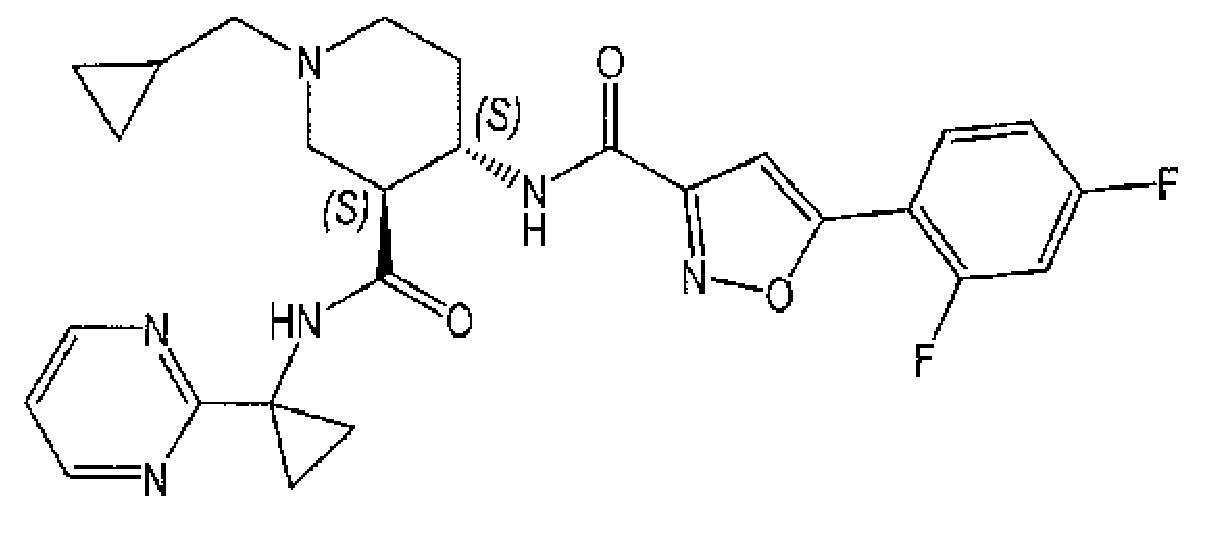
Claims (15)
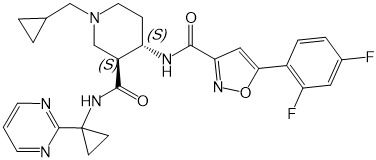
Applications Claiming Priority (2)
| Application Number | Priority Date | Filing Date | Title |
|---|---|---|---|
| WOPCT/EP2019/079932 | 2019-10-31 | ||
| EP2019079932 | 2019-10-31 |
Publications (1)
| Publication Number | Publication Date |
|---|---|
| TW202131921A true TW202131921A (en) | 2021-09-01 |
Family
ID=75715765
Family Applications (1)
| Application Number | Title | Priority Date | Filing Date |
|---|---|---|---|
| TW109137814A TW202131921A (en) | 2019-10-31 | 2020-10-30 | Combination of a cxcr7 antagonist with an s1p1 receptor modulator |
Country Status (14)
| Country | Link |
|---|---|
| US (1) | US20250228850A1 (en) |
| EP (1) | EP4051250A1 (en) |
| JP (2) | JP7749552B2 (en) |
| KR (1) | KR20220093330A (en) |
| CN (1) | CN114599363A (en) |
| AU (1) | AU2020372647B2 (en) |
| CA (1) | CA3156298A1 (en) |
| CL (1) | CL2022000990A1 (en) |
| IL (1) | IL292529A (en) |
| MX (1) | MX2022005014A (en) |
| PH (1) | PH12022551043A1 (en) |
| TW (1) | TW202131921A (en) |
| UA (1) | UA129627C2 (en) |
| WO (1) | WO2021084068A1 (en) |
Families Citing this family (2)
| Publication number | Priority date | Publication date | Assignee | Title |
|---|---|---|---|---|
| CN118615268A (en) * | 2024-06-21 | 2024-09-10 | 中国人民解放军空军军医大学 | Application of fingolimod in the preparation of cancer therapeutic drugs |
| CN120721966A (en) * | 2025-07-16 | 2025-09-30 | 杭州市第一人民医院(西湖大学附属杭州市第一人民医院) | Application of pyruvate carboxylase in the diagnosis and treatment of endometriosis |
Family Cites Families (46)
| Publication number | Priority date | Publication date | Assignee | Title |
|---|---|---|---|---|
| BRPI0212894B8 (en) | 2001-09-27 | 2021-05-25 | Kyorin Seiyaku Kk | pharmaceutically acceptable compound or salt thereof and pharmaceutical composition |
| MY150088A (en) | 2003-05-19 | 2013-11-29 | Irm Llc | Immunosuppressant compounds and compositions |
| DK1689726T3 (en) | 2003-11-21 | 2010-12-06 | Actelion Pharmaceuticals Ltd | 5- (Benz- (z) -ylidene) -thiazolidin-4-one derivatives as immunosuppressants |
| KR20110136901A (en) | 2004-02-24 | 2011-12-21 | 상꾜 가부시키가이샤 | Amino alcohol compounds |
| ES2495690T3 (en) | 2004-11-29 | 2014-09-17 | Novartis Ag | Dosing regimen of an S1P receptor agonist |
| EP2371811B1 (en) | 2004-12-13 | 2014-10-08 | Ono Pharmaceutical Co., Ltd. | Azetidinecarboxylic acid derivative and medicinal use thereof |
| AU2006325931B8 (en) | 2005-12-15 | 2012-09-20 | Mitsubishi Tanabe Pharma Corporation | Amine compound and use thereof for medical purposes |
| GB0612721D0 (en) | 2006-06-27 | 2006-08-09 | Novartis Ag | Organic compounds |
| JP4669564B2 (en) | 2006-11-23 | 2011-04-13 | アクテリオン ファーマシューティカルズ リミテッド | Novel process for the preparation of 2-imino-thiazolidin-4-one derivatives |
| JO2701B1 (en) | 2006-12-21 | 2013-03-03 | جلاكسو جروب ليميتد | Compounds |
| DK2278960T4 (en) | 2008-03-17 | 2020-01-27 | Actelion Pharmaceuticals Ltd | DOSAGE regimen for a selective SIP1 RECEPTOR AGONIST |
| EP3059226A1 (en) | 2008-03-24 | 2016-08-24 | Kyorin Pharmaceutical Co., Ltd. | 2-amino-2-[2-[4-(3-benzyloxyphenylthio)-2-chlorophenyl]-ethyl]-1,3-propanediol hydrochloride crystal |
| KR20190004843A (en) | 2008-07-23 | 2019-01-14 | 아레나 파마슈티칼스, 인크. | SUBSTITUTED 1,2,3,4- TETRAHYDROCYCLOPENTA[b]INDOL-3-YL) ACETIC ACID DERIVATIVES USEFUL IN THE TREATMENT OF AUTOIMMUNE AND INFLAMMATORY DISORDERS |
| GB0819182D0 (en) | 2008-10-20 | 2008-11-26 | Actelion Pharmaceuticals Ltd | Crystalline forms |
| KR20110086142A (en) | 2008-11-11 | 2011-07-27 | 노파르티스 아게 | Salt of fingolimod |
| EP2356090B1 (en) | 2008-11-11 | 2017-07-05 | Novartis AG | Crystalline forms of fingolimod hcl |
| AU2009327405A1 (en) | 2008-12-18 | 2011-06-30 | Novartis Ag | New polymorphic form of 1- (4- { l- [ (E) -4-cyclohexyl--3-trifluoromethyl-benzyloxyimino] -ethyl) -2-ethyl-benzy l) -azetidine-3-carboxylic |
| MA32961B1 (en) | 2008-12-18 | 2012-01-02 | Novartis Ag | 1- [4- [1 (4-CYCLOHEXYL-3-TRIFLUOROMETHYL-BENZYLOXYIMINO] -ETHYL] -2-ETHYL-BENZYL] -AZETIDIN-3-CARBOXYLIC HEMIFUMARATE SALMON HEMIFUMARATE |
| CA2747558A1 (en) | 2008-12-18 | 2010-07-15 | Novartis Ag | New salts |
| ES2552823T3 (en) | 2008-12-22 | 2015-12-02 | Novartis Ag | Dosing regimen for fingolimod for the treatment of multiple sclerosis |
| AR074825A1 (en) | 2008-12-22 | 2011-02-16 | Novartis Ag | DOSAGE REGIME OF AN S1P RECEIVER AGONIST, TREATMENT METHOD AND KIT |
| EP2454255B1 (en) | 2009-07-16 | 2013-11-06 | Actelion Pharmaceuticals Ltd. | Pyridin-4-yl derivatives as s1p1/edg1 agonists |
| RU2012117561A (en) | 2009-09-29 | 2013-11-10 | Новартис Аг | METHOD AND SYSTEM OF ACCESS TO PATIENT DATA |
| JP5650233B2 (en) | 2009-11-13 | 2015-01-07 | レセプトス インコーポレイテッドReceptos, Inc. | Selective sphingosine-1-phosphate receptor modulator and method of asymmetric synthesis |
| SG10201500639TA (en) | 2010-01-27 | 2015-03-30 | Arena Pharm Inc | Processes for the preparation of (r)-2-(7-(4-cyclopentyl-3-(trifluoromethyl)benzyloxy)-1,2,3,4-tetrahydrocyclopenta[b]indol-3-yl)acetic acid and salts thereof |
| TW201320994A (en) * | 2011-10-11 | 2013-06-01 | Novartis Ag | Dosage regimen |
| JP2014530835A (en) | 2011-10-21 | 2014-11-20 | ノバルティスアーゲー | Dosage regimen for S1P receptor modulators or S1P receptor agonists |
| MX2014014138A (en) | 2012-05-22 | 2015-02-24 | Actelion Pharmaceuticals Ltd | New process for the preparation of 2-cyclopentyl-6-methoxy-isonic otinic acid. |
| SMT202000298T1 (en) | 2012-08-17 | 2020-07-08 | Actelion Pharmaceuticals Ltd | Process for the preparation of (2z,5z)-5-(3-chloro-4-((r)-2,3-dihydroxypropoxy)benzylidene)-2-(propylimino)-3-(o-tolyl)thiazolidin-4-one and intermediate used in said process |
| US20170165236A1 (en) | 2013-11-01 | 2017-06-15 | Celgene International Ii Sàrl | Selective sphingosine 1 phosphate receptor modulators and combination therapy therewith |
| RU2020107732A (en) | 2014-04-10 | 2020-03-30 | Новартис Аг | S1P MODULATOR DOSING SCHEME WITH IMMEDIATE RELEASE |
| KR20170068480A (en) * | 2014-10-16 | 2017-06-19 | 노파르티스 아게 | Combinations comprising siponimod and laquinimod for the treatment of multiple sclerosis |
| PL3256125T3 (en) | 2014-12-11 | 2022-05-09 | Actelion Pharmaceuticals Ltd | Dosing regimen for ponesimod, a selective s1p1 receptor agonist |
| PL3242666T3 (en) | 2015-01-06 | 2025-02-17 | Arena Pharmaceuticals, Inc. | Compound for use in treating conditions related to the s1p1 receptor |
| PH12017502097B1 (en) | 2015-05-20 | 2023-05-05 | Idorsia Pharmaceuticals Ltd | Crystalline form of the compound (s)-3-{4-[5-(2-cyclopentyl-6-methoxy-pyridin-4-yl)-[1,2,4]oxadiazol-3-yl]-2-ethyl-6-methyl-phenoxy}-propane-1,2-diol |
| JP6838744B2 (en) | 2015-06-22 | 2021-03-03 | アリーナ ファーマシューティカルズ, インコーポレイテッド | (R) -2- (7- (4-cyclopentyl-3- (trifluoromethyl) benzyloxy) -1,2,3,4-tetrahydrocyclopenta [b] indole-for use in S1P1 receptor-related disorders Crystalline L-arginine salt of 3-yl) acetic acid (Compound 1) |
| CN108698991B (en) * | 2016-01-20 | 2022-08-23 | 凯莫森特里克斯股份有限公司 | 2-oxoindole compound |
| PT3490986T (en) * | 2016-07-28 | 2022-02-01 | Idorsia Pharmaceuticals Ltd | Piperidine cxcr7 receptor modulators |
| WO2018021517A1 (en) | 2016-07-29 | 2018-02-01 | 田辺三菱製薬株式会社 | 4-alkoxy-3-(trifluoromethyl)benzyl alcohol production method |
| CN110612292A (en) | 2017-04-07 | 2019-12-24 | 杭州领业医药科技有限公司 | Ozamod addition salt crystal form, preparation method and pharmaceutical composition and use |
| EP3621610A1 (en) | 2017-05-08 | 2020-03-18 | Celgene International II Sàrl | Sphingosine 1 phosphate receptor agonists for neuroprotection |
| EA201992421A1 (en) | 2017-05-22 | 2020-03-27 | Эгиш Дьёдьсердьяр Зрт. | METHOD OF OBTAINING OZANIMODA |
| WO2019058290A1 (en) | 2017-09-20 | 2019-03-28 | Suven Life Sciences Limited | Improved process for the preparation of ozanimod α-amino compound |
| JP2020535175A (en) | 2017-09-27 | 2020-12-03 | ドクター レディズ ラボラトリーズ リミテッド | Process for the preparation of siponimod, its salt and its solid state foam |
| WO2019094409A1 (en) | 2017-11-07 | 2019-05-16 | Teva Pharmaceuticals International Gmbh | Salts and solid state forms of ozanimod |
| SG11202006943TA (en) * | 2018-01-26 | 2020-08-28 | Idorsia Pharmaceuticals Ltd | Crystalline forms of the cxcr7 receptor antagonist (3s,4s)-1-cyclopropylmethyl-4-{[5-(2,4-difluoro-phenyl)-isoxazole-3-carbonyl]-amino}-piperidine-3-carboxylic acid (1-pyrimidin-2-yl-cyclopropyl)-amide |
-
2020
- 2020-10-30 WO PCT/EP2020/080510 patent/WO2021084068A1/en not_active Ceased
- 2020-10-30 UA UAA202201705A patent/UA129627C2/en unknown
- 2020-10-30 PH PH1/2022/551043A patent/PH12022551043A1/en unknown
- 2020-10-30 MX MX2022005014A patent/MX2022005014A/en unknown
- 2020-10-30 US US17/773,216 patent/US20250228850A1/en active Pending
- 2020-10-30 CA CA3156298A patent/CA3156298A1/en active Pending
- 2020-10-30 AU AU2020372647A patent/AU2020372647B2/en active Active
- 2020-10-30 KR KR1020227017728A patent/KR20220093330A/en active Pending
- 2020-10-30 IL IL292529A patent/IL292529A/en unknown
- 2020-10-30 EP EP20800836.7A patent/EP4051250A1/en active Pending
- 2020-10-30 JP JP2022525279A patent/JP7749552B2/en active Active
- 2020-10-30 TW TW109137814A patent/TW202131921A/en unknown
- 2020-10-30 CN CN202080074623.7A patent/CN114599363A/en active Pending
-
2022
- 2022-04-20 CL CL2022000990A patent/CL2022000990A1/en unknown
-
2025
- 2025-07-31 JP JP2025128844A patent/JP2025163142A/en active Pending
Also Published As
| Publication number | Publication date |
|---|---|
| CL2022000990A1 (en) | 2023-01-27 |
| MX2022005014A (en) | 2022-05-16 |
| IL292529A (en) | 2022-06-01 |
| AU2020372647A1 (en) | 2022-06-16 |
| AU2020372647B2 (en) | 2026-02-05 |
| JP2023501217A (en) | 2023-01-18 |
| EP4051250A1 (en) | 2022-09-07 |
| WO2021084068A1 (en) | 2021-05-06 |
| JP2025163142A (en) | 2025-10-28 |
| JP7749552B2 (en) | 2025-10-06 |
| PH12022551043A1 (en) | 2023-05-03 |
| CA3156298A1 (en) | 2021-05-06 |
| CN114599363A (en) | 2022-06-07 |
| UA129627C2 (en) | 2025-06-18 |
| KR20220093330A (en) | 2022-07-05 |
| US20250228850A1 (en) | 2025-07-17 |
Similar Documents
| Publication | Publication Date | Title |
|---|---|---|
| RU2617502C2 (en) | S1p receptor modulators for multiple sclerosis treatment | |
| JP7514534B2 (en) | Benzodiazepine derivatives, compositions and methods for treating cognitive disorders | |
| JP2025163142A (en) | Combination of CXCR7 antagonist with S1P1 receptor modulator | |
| US20110059947A1 (en) | Alpha 7 nicotinic agonists and antipsychotics | |
| JP7306614B2 (en) | Methods of Treating Gastrointestinal Disorders with Tradipitant | |
| WO2020259528A1 (en) | Method for treating idiopathic pulmonary fibrosis | |
| AU2016256471A1 (en) | Methods of treating cancer | |
| JP2020513005A (en) | Methods and compositions for treating age-related dysfunction with CCR3 inhibitors | |
| US9539249B2 (en) | PPAR gamma agonists for treatment of multiple sclerosis | |
| US20250090543A1 (en) | Cxcr7 inhibitors for the treatment of cancer | |
| JP6325252B2 (en) | Preventive or therapeutic agent for neuropathic pain associated with Guillain-Barre syndrome | |
| Lin et al. | The development of pharmacological therapies for Alzheimer’s disease | |
| EP4178582A1 (en) | Combinations of gabaa alpha 5 agonists and sv2a inhibitors and methods of using in the treatment of cognitive impairment | |
| WO2009069828A1 (en) | Agent for improving motor complications or psychiatric symptoms in parkinson's disease | |
| CN103547289A (en) | Methods and compositions for treating alzheimer's disease | |
| KR102571296B1 (en) | Allosteric Corticotropin-Releasing Factor Receptor 1 (CRFR1) Antagonist Reduces P-TAU and Improves Cognition | |
| EA048938B1 (en) | COMBINATION OF CXCR7 ANTAGONIST WITH S1P1 RECEPTOR MODULATOR | |
| JP7528065B2 (en) | Methods and compositions for treating age-related dysfunction using CCR3 inhibitors | |
| RU2569732C9 (en) | Modulators of receptor s1p for treatment of multiple sclerosis | |
| HK40063173A (en) | Method for treating idiopathic pulmonary fibrosis |