RU2755074C2 - Emulsifier for industrial emulsion explosives - Google Patents
Emulsifier for industrial emulsion explosives Download PDFInfo
- Publication number
- RU2755074C2 RU2755074C2 RU2019115480A RU2019115480A RU2755074C2 RU 2755074 C2 RU2755074 C2 RU 2755074C2 RU 2019115480 A RU2019115480 A RU 2019115480A RU 2019115480 A RU2019115480 A RU 2019115480A RU 2755074 C2 RU2755074 C2 RU 2755074C2
- Authority
- RU
- Russia
- Prior art keywords
- emulsion
- emulsifier
- industrial
- well
- composition
- Prior art date
Links
- 239000000839 emulsion Substances 0.000 title claims abstract description 45
- 239000002360 explosive Substances 0.000 title claims abstract description 33
- 239000003995 emulsifying agent Substances 0.000 title claims abstract description 20
- PEDCQBHIVMGVHV-UHFFFAOYSA-N Glycerine Chemical compound OCC(O)CO PEDCQBHIVMGVHV-UHFFFAOYSA-N 0.000 claims abstract description 32
- 235000011187 glycerol Nutrition 0.000 claims abstract description 15
- 239000000344 soap Substances 0.000 claims abstract description 14
- 108010010803 Gelatin Proteins 0.000 claims abstract description 11
- 239000008273 gelatin Substances 0.000 claims abstract description 11
- 229920000159 gelatin Polymers 0.000 claims abstract description 11
- 235000019322 gelatine Nutrition 0.000 claims abstract description 11
- 235000011852 gelatine desserts Nutrition 0.000 claims abstract description 11
- 239000000271 synthetic detergent Substances 0.000 claims abstract description 11
- 239000003921 oil Substances 0.000 claims abstract description 9
- 239000003381 stabilizer Substances 0.000 claims abstract description 9
- 239000004088 foaming agent Substances 0.000 claims abstract description 6
- 239000004094 surface-active agent Substances 0.000 claims abstract description 6
- 239000003349 gelling agent Substances 0.000 claims description 5
- 239000000203 mixture Substances 0.000 abstract description 26
- 238000004519 manufacturing process Methods 0.000 abstract description 7
- 238000005422 blasting Methods 0.000 abstract description 3
- 238000002347 injection Methods 0.000 abstract description 3
- 239000007924 injection Substances 0.000 abstract description 3
- 239000000126 substance Substances 0.000 abstract description 3
- 239000003795 chemical substances by application Substances 0.000 abstract 1
- 235000014113 dietary fatty acids Nutrition 0.000 description 8
- 239000000194 fatty acid Substances 0.000 description 8
- 229930195729 fatty acid Natural products 0.000 description 8
- 150000004665 fatty acids Chemical class 0.000 description 7
- XLYOFNOQVPJJNP-UHFFFAOYSA-N water Substances O XLYOFNOQVPJJNP-UHFFFAOYSA-N 0.000 description 7
- 229920002367 Polyisobutene Polymers 0.000 description 6
- 229920005652 polyisobutylene succinic anhydride Polymers 0.000 description 5
- 230000001804 emulsifying effect Effects 0.000 description 4
- -1 fatty acid esters Chemical class 0.000 description 4
- 238000002156 mixing Methods 0.000 description 4
- 239000000047 product Substances 0.000 description 4
- 239000000243 solution Substances 0.000 description 4
- HZAXFHJVJLSVMW-UHFFFAOYSA-N 2-Aminoethan-1-ol Chemical compound NCCO HZAXFHJVJLSVMW-UHFFFAOYSA-N 0.000 description 3
- DNIAPMSPPWPWGF-UHFFFAOYSA-N Propylene glycol Chemical compound CC(O)CO DNIAPMSPPWPWGF-UHFFFAOYSA-N 0.000 description 3
- GSEJCLTVZPLZKY-UHFFFAOYSA-N Triethanolamine Chemical compound OCCN(CCO)CCO GSEJCLTVZPLZKY-UHFFFAOYSA-N 0.000 description 3
- 150000008064 anhydrides Chemical class 0.000 description 3
- 239000007859 condensation product Substances 0.000 description 3
- 230000003993 interaction Effects 0.000 description 3
- 239000007788 liquid Substances 0.000 description 3
- 239000002245 particle Substances 0.000 description 3
- 238000003860 storage Methods 0.000 description 3
- 150000005846 sugar alcohols Polymers 0.000 description 3
- 102000008186 Collagen Human genes 0.000 description 2
- 108010035532 Collagen Proteins 0.000 description 2
- 150000001298 alcohols Chemical class 0.000 description 2
- 210000000988 bone and bone Anatomy 0.000 description 2
- 244000309464 bull Species 0.000 description 2
- 230000007774 longterm Effects 0.000 description 2
- 229910052751 metal Inorganic materials 0.000 description 2
- 239000002184 metal Substances 0.000 description 2
- 229920000768 polyamine Polymers 0.000 description 2
- 238000002360 preparation method Methods 0.000 description 2
- 238000003756 stirring Methods 0.000 description 2
- 238000005496 tempering Methods 0.000 description 2
- 235000015112 vegetable and seed oil Nutrition 0.000 description 2
- 239000008158 vegetable oil Substances 0.000 description 2
- PAWQVTBBRAZDMG-UHFFFAOYSA-N 2-(3-bromo-2-fluorophenyl)acetic acid Chemical compound OC(=O)CC1=CC=CC(Br)=C1F PAWQVTBBRAZDMG-UHFFFAOYSA-N 0.000 description 1
- 241000881711 Acipenser sturio Species 0.000 description 1
- 241000251468 Actinopterygii Species 0.000 description 1
- LFQSCWFLJHTTHZ-UHFFFAOYSA-N Ethanol Chemical compound CCO LFQSCWFLJHTTHZ-UHFFFAOYSA-N 0.000 description 1
- 241001465754 Metazoa Species 0.000 description 1
- 241000283973 Oryctolagus cuniculus Species 0.000 description 1
- 239000002253 acid Substances 0.000 description 1
- 150000001412 amines Chemical class 0.000 description 1
- 238000004458 analytical method Methods 0.000 description 1
- 230000000844 anti-bacterial effect Effects 0.000 description 1
- 230000015572 biosynthetic process Effects 0.000 description 1
- 238000004061 bleaching Methods 0.000 description 1
- 238000006243 chemical reaction Methods 0.000 description 1
- 238000004140 cleaning Methods 0.000 description 1
- 229920001436 collagen Polymers 0.000 description 1
- 239000002131 composite material Substances 0.000 description 1
- 150000001875 compounds Chemical class 0.000 description 1
- 235000009508 confectionery Nutrition 0.000 description 1
- 210000002808 connective tissue Anatomy 0.000 description 1
- 238000001816 cooling Methods 0.000 description 1
- 239000002537 cosmetic Substances 0.000 description 1
- 239000013078 crystal Substances 0.000 description 1
- 125000004122 cyclic group Chemical group 0.000 description 1
- 238000004925 denaturation Methods 0.000 description 1
- 230000036425 denaturation Effects 0.000 description 1
- 239000006185 dispersion Substances 0.000 description 1
- 238000004043 dyeing Methods 0.000 description 1
- 238000004945 emulsification Methods 0.000 description 1
- 150000002148 esters Chemical class 0.000 description 1
- 238000005530 etching Methods 0.000 description 1
- 230000003203 everyday effect Effects 0.000 description 1
- 239000004744 fabric Substances 0.000 description 1
- 238000001914 filtration Methods 0.000 description 1
- 239000012530 fluid Substances 0.000 description 1
- 238000005187 foaming Methods 0.000 description 1
- 235000013305 food Nutrition 0.000 description 1
- 239000003292 glue Substances 0.000 description 1
- 230000036571 hydration Effects 0.000 description 1
- 238000006703 hydration reaction Methods 0.000 description 1
- 229910052739 hydrogen Inorganic materials 0.000 description 1
- 239000001257 hydrogen Substances 0.000 description 1
- 239000004615 ingredient Substances 0.000 description 1
- 150000002739 metals Chemical class 0.000 description 1
- 238000000034 method Methods 0.000 description 1
- 239000007800 oxidant agent Substances 0.000 description 1
- 230000001590 oxidative effect Effects 0.000 description 1
- 229910052698 phosphorus Inorganic materials 0.000 description 1
- 239000011574 phosphorus Substances 0.000 description 1
- 238000011197 physicochemical method Methods 0.000 description 1
- 238000005086 pumping Methods 0.000 description 1
- 239000002994 raw material Substances 0.000 description 1
- 150000003839 salts Chemical class 0.000 description 1
- 229910052708 sodium Inorganic materials 0.000 description 1
- 239000011734 sodium Substances 0.000 description 1
- 239000007787 solid Substances 0.000 description 1
- 230000001954 sterilising effect Effects 0.000 description 1
- 235000019640 taste Nutrition 0.000 description 1
- 239000004753 textile Substances 0.000 description 1
Classifications
-
- C—CHEMISTRY; METALLURGY
- C06—EXPLOSIVES; MATCHES
- C06B—EXPLOSIVES OR THERMIC COMPOSITIONS; MANUFACTURE THEREOF; USE OF SINGLE SUBSTANCES AS EXPLOSIVES
- C06B23/00—Compositions characterised by non-explosive or non-thermic constituents
-
- C—CHEMISTRY; METALLURGY
- C09—DYES; PAINTS; POLISHES; NATURAL RESINS; ADHESIVES; COMPOSITIONS NOT OTHERWISE PROVIDED FOR; APPLICATIONS OF MATERIALS NOT OTHERWISE PROVIDED FOR
- C09K—MATERIALS FOR MISCELLANEOUS APPLICATIONS, NOT PROVIDED FOR ELSEWHERE
- C09K23/00—Use of substances as emulsifying, wetting, dispersing, or foam-producing agents
Landscapes
- Chemical & Material Sciences (AREA)
- Organic Chemistry (AREA)
- Engineering & Computer Science (AREA)
- Materials Engineering (AREA)
- Detergent Compositions (AREA)
- Cosmetics (AREA)
- Colloid Chemistry (AREA)
Abstract
Description
Изобретение относится к получению эмульгирующих составов, применяемых в производстве взрывчатых веществ эмульсионного типа для взрывных работ.The invention relates to the production of emulsifying compositions used in the production of emulsion-type explosives for blasting operations.
Известен эмульгатор (патент РФ №2258055, опубл. 10.08.2005, бюл. №22). Эмульгатор получен путем смешения полиизобутиленянтарного или полиизобутиленбисянтарного ангидрида с продуктом его взаимодействия с органическим моно- или полиамином, введения в полученную смесь при постоянном перемешивании эфиров жирных кислот с многоатомными спиртами, последующего добавления алкилбензосульфонатов Са, K, Mg, Mo или их смеси в виде 20-70% раствора в индустриальном масле, перемешивания и фильтрования полученной смеси.Known emulsifier (RF patent No. 2258055, publ. 10.08.2005, bull. No. 22). The emulsifier is obtained by mixing polyisobutylene succinic or polyisobutylene bisuccinic anhydride with the product of its interaction with an organic mono- or polyamine, introducing fatty acid esters with polyhydric alcohols into the resulting mixture with constant stirring, then adding alkylbenzenesulfonates Ca, K, Mg, Mo or their mixture in the form of 20- 70% solution in industrial oil, mixing and filtering the resulting mixture.
Недостатком данного состава является малая конечная вязкость эмульсионного взрывчатого вещества после подачи в скважину и небольшое большое время жизни в скважине.The disadvantage of this composition is the low final viscosity of the emulsion explosive after being fed into the well and a short long lifetime in the well.
Известен композиционный эмульгатор (патент РФ №2110506, опубл. 10.05.1998), композиционный эмульгатор, состоящий из моноэфира многоатомного (С2-С6) спирта и одноосновной жирной (С12-С20) кислоты; первичных синтетических высших жирных (С12-С20) спиртов; этаноламидов и соли алкилбензолсульфоната многовалентного металла.Known compositional emulsifier (RF patent No. 2110506, publ. 05/10/1998), a composite emulsifier consisting of a monoester of polyhydric (C2-C6) alcohol and monobasic fatty (C12-C20) acid; primary synthetic higher fatty (C12-C20) alcohols; ethanolamides and polyvalent metal alkylbenzenesulfonate salts.
Недостатком данного состава является малая конечная вязкость эмульсионного взрывчатого вещества после подачи в скважину и небольшое большое время жизни в скважине.The disadvantage of this composition is the low final viscosity of the emulsion explosive after being fed into the well and a short long lifetime in the well.
Известен эмульгатор для производства эмульсионного взрывчатого вещества (патент РФ №2263096, опубл. 27.10.2005, №30), содержащий компоненты при следующем соотношении (мас. %): полиизобутиленянтарный или полиизобутиленбисянтарный ангидрид 1-10; продукт взаимодействия полиизобутиленянтарного или полиизобутиленбисянтарного ангидрида с органическим моно- или полиамином 40-90; эфиры жирных кислот с многоатомными спиртами 2-30; алкилбензосульфонаты Са, K, Mg, Mo или их смеси 6-30.Known emulsifier for the production of emulsion explosive (RF patent No. 2263096, publ. 27.10.2005, No. 30), containing components in the following ratio (wt.%): Polyisobutylene succinic or polyisobutylene bissuccinic anhydride 1-10; the product of the interaction of polyisobutylene succinic or polyisobutylene bisuccinic anhydride with organic mono - or polyamine 40-90; esters of fatty acids with polyhydric alcohols 2-30; alkylbenzenesulfonates Ca, K, Mg, Mo or mixtures thereof 6-30.
Недостатком данного состава является малая конечная вязкость эмульсионного взрывчатого вещества после подачи в скважину и небольшое большое время жизни в скважине.The disadvantage of this composition is the low final viscosity of the emulsion explosive after being fed into the well and a short long lifetime in the well.
Известен эмульгирующий состав для производства эмульсионных взрывчатых веществ (патент РФ №2277965, опубл. 20.06.2006, бюл. №17. Эмульгирующий состав включает продукты конденсации полиизобутиленянтарных ангидридов с алканоламинами в виде раствора в индустриальном масле. Состав содержит смесь продуктов конденсации полиизобутиленянтарного ангидрида с моноэтаноламином и триэтаноламином в следующих соотношениях в исходной реакционной массе: моноэтаноламина от 0,2 до 0,5 моль и триэтаноламина - от 1,5 до 1,8 моль на 1 моль полиизобутиленянтарного ангидрида. В способе получения состава процесс конденсации полиизобутиленянтарного ангидрида ведут с последовательным добавлением 0,2-0,5 моль моноэтаноламина, затем 1.8÷1.5 моль триэтаноламина на 1 моль полиизобутиленянтарного ангидрида с перемешиванием при скорости вращения мешалки 2,5÷3,6 м/с. Для уменьшения вспенивания вводят 0,005÷0,01 мас. % полиметилсилоксиновой жидкости.Known emulsifying composition for the production of emulsion explosives (RF patent No. 2277965, publ. 20.06.2006, bulletin No. 17. The emulsifying composition includes condensation products of polyisobutylene succinic anhydrides with alkanolamines in the form of a solution in industrial oil. The composition contains a mixture of condensation products of polyisobutylene succinic anhydride with mono and triethanolamine in the following ratios in the initial reaction mass: monoethanolamine from 0.2 to 0.5 mol and triethanolamine - from 1.5 to 1.8 mol per 1 mol of polyisobutylene succinic anhydride. 0.2-0.5 mol of monoethanolamine, then 1.8-1.5 mol of triethanolamine per 1 mol of polyisobutylene succinic anhydride with stirring at a stirrer speed of 2.5-3.6 m / s. To reduce foaming, 0.005-0.01 wt.% Is introduced polymethylsiloxine liquid.
Недостатком данного состава является малая конечная вязкость эмульсионного взрывчатого вещества после подачи в скважину и небольшое большое время жизни в скважине.The disadvantage of this composition is the low final viscosity of the emulsion explosive after being fed into the well and a short long lifetime in the well.
Известен универсальный эмульгатор обратных эмульсий, принятый за прототип (патент РФ №2652714, опубл. 28.04.2018 г., бюл. №13). Универсальный эмульгатор обратных эмульсий содержит индустриальное масло, смесь продуктов конденсации алкенил-(полиизобутилен)-янтарного ангидрида с аминопроизводными и аддуктов жирных кислот и стабилизатор эмульсии. В качестве аддуктов жирных кислот используют алкилоламиды жирных кислот растительных масел, а в качестве стабилизатора -гидрофобизированные продукты гидратации растительных масел.Known universal emulsifier of inverse emulsions, taken as a prototype (RF patent No. 2652714, publ. 28.04.2018, bull. No. 13). Universal emulsifier of inverse emulsions contains industrial oil, a mixture of condensation products of alkenyl- (polyisobutylene) -succinic anhydride with amino derivatives and adducts of fatty acids, and an emulsion stabilizer. Alkylolamides of fatty acids of vegetable oils are used as adducts of fatty acids, and hydrophobized products of hydration of vegetable oils are used as stabilizers.
Недостатком данного состава является малая конечная вязкость эмульсионного взрывчатого вещества после подачи в скважину и небольшое большое время жизни в скважине.The disadvantage of this composition is the low final viscosity of the emulsion explosive after being fed into the well and a short long lifetime in the well.
Техническим результатом изобретения является повышение вязкости эмульсионного взрывчатого состава после закачивания в скважину и повышение продолжительности времени жизни в скважине.The technical result of the invention is to increase the viscosity of the emulsion explosive composition after injection into the well and increase the life span in the well.
Технический результат достигается тем, что в эмульгаторе для промышленных эмульсионных взрывчатых веществ, содержащем индустриальное масло, гелеобразователь, пенообразователь, поверхностно-активное вещество и стабилизатор, согласно изобретению в качестве гелеобразователя он содержит желатин, в качестве пенообразователя синтетическое моющее средство, в качестве поверхностно-активного вещества хозяйственное мыло, в качестве стабилизатора - глицерин, при следующем соотношении компонентов, мас. %:The technical result is achieved by the fact that in an emulsifier for industrial emulsion explosives containing industrial oil, a gelling agent, a foaming agent, a surfactant and a stabilizer, according to the invention, it contains gelatin as a gelling agent, a synthetic detergent as a foaming agent, as a surfactant substances laundry soap, as a stabilizer - glycerin, with the following ratio of components, wt. %:
Эмульгатор для промышленных эмульсионных взрывчатых веществ приготавливают следующим способом. Берут компоненты: желатин, синтетическое моющее средство, хозяйственное мыло, индустриальное масло.An emulsifier for industrial emulsion explosives is prepared in the following way. Take the ingredients: gelatin, synthetic detergent, laundry soap, industrial oil.
В качестве гелеобразователя используют желатин, например по ГОСТ 11293-89 Желатин. Технические условия. Желатин - бесцветный или имеющий желтоватый оттенок частично гидролизованный белок коллаген, прозрачная вязкая масса, продукт переработки (денатурации) соединительной ткани животных (коллагена). В зависимости от сырья и целей применения имеет различные торговые названия: кроличий, мездровый (кожный), пергаментный, костный, рыбий (осетровый), столярный (костный) и т.д. Тип желатина определяют экспериментальным, экспериментально-аналитическим или опытным путем в зависимости от требуемой вязкости эмульсионного взрывчатого вещества.Gelatin is used as a gelling agent, for example, according to GOST 11293-89 Gelatin. Technical conditions. Gelatin is a colorless or yellowish, partially hydrolyzed protein collagen, a transparent viscous mass, a product of processing (denaturation) of animal connective tissue (collagen). Depending on the raw materials and purposes of application, it has various trade names: rabbit, flesh (skin), parchment, bone, fish (sturgeon), carpentry (bone), etc. The type of gelatin is determined experimentally, experimentally-analytical or empirically, depending on the required viscosity of the emulsion explosive.
В качестве пенообразователя используют синтетическое моющее средство. Синтетические моющие средства используются в быту, в промышленности их применяют для отбеливания текстиля, при крашении и аппретировании тканей, на стадиях очистки и травления металлов, для стерилизации оборудования в пищевой промышленности, а также в производстве косметики. Наиболее распространенные синтетические моющие средства - сульфонаты натрия. Существуют их многочисленные разновидности, несколько различающиеся по свойствам. Для специальных целей используются и другие соединения. Тип синтетического моющего средства определяют экспериментальным, экспериментально-аналитическим или опытным путем в зависимости от требуемых характеристик эмульсионного взрывчатого вещества.A synthetic detergent is used as a foaming agent. Synthetic detergents are used in everyday life, in industry they are used for bleaching textiles, for dyeing and finishing fabrics, at the stages of cleaning and etching metals, for sterilizing equipment in the food industry, as well as in the production of cosmetics. The most common synthetic detergents are sodium sulfonates. There are numerous varieties of them, slightly differing in properties. Other compounds are also used for special purposes. The type of synthetic detergent is determined experimentally, experimentally-analytical or empirically, depending on the required characteristics of the emulsion explosive.
В качестве поверхностно-активного вещества используют хозяйственное мыло. Мыло хозяйственное твердое - сорт мыла с содержанием жирных кислот не более 72% и большим количеством щелочей, около 0,15-0,20%. Вследствие чего имеет высокий водородный показатель - рН 11-12. Обладает антибактериальными свойствами. В СНГ в соответствии с ГОСТ 30266-95 хозяйственное мыло подразделяется на три категории в зависимости от содержания жирных кислот: I категория должна иметь не менее 70,5% жирных кислот, II категория - 69,0%, III - 64,0%. Хозяйственное мыло получают охлаждением мыльного клея. Тип хозяйственного мыла определяют экспериментальным, экспериментально-аналитическим или опытным путем в зависимости от требуемых характеристик эмульсионного взрывчатого вещества.Laundry soap is used as a surfactant. Laundry solid soap - a type of soap with a fatty acid content of not more than 72% and a large amount of alkalis, about 0.15-0.20%. As a result, it has a high pH value - pH 11-12. Possesses antibacterial properties. In the CIS, in accordance with GOST 30266-95, laundry soap is divided into three categories depending on the content of fatty acids: category I must have at least 70.5% fatty acids, category II - 69.0%, III - 64.0%. Laundry soap is obtained by cooling the soap glue. The type of laundry soap is determined experimentally, experimentally-analytical or empirically, depending on the required characteristics of the emulsion explosive.
В качестве стабилизатора используют глицерин, например по ГОСТ 6259-75 Глицерин. Технические условия. Глицерин (глицербл, пропантриол-1,2,3) - простейший представитель трехатомных спиртов с формулой С3Н3(ОН)3. Представляет собой вязкую прозрачную жидкость. Тип глицерина определяют экспериментальным, экспериментально-аналитическим или опытным путем в зависимости от требуемых характеристик эмульсионного взрывчатого вещества. Глицерин - бесцветная, вязкая, очень гигроскопичная жидкость, смешивается с водой в любых пропорциях. Сладкий на вкус, отчего и получил свое название. В соединении с пропиленгликолем становится более текучим. Химические свойства глицерина типичны для многоатомных спиртов. Взаимодействие глицерина с галогеноводородами или галогенидами фосфора ведет к образованию моно- и дигалогенгидринов. Тип глицерина определяют экспериментальным, экспериментально-аналитическим или опытным путем в зависимости от требуемых характеристик эмульсионного взрывчатого вещества.Glycerin is used as a stabilizer, for example, according to GOST 6259-75 Glycerin. Technical conditions. Glycerin (glycerol, propantriol-1,2,3) is the simplest representative of trihydric alcohols with the formula C 3 H 3 (OH) 3 . It is a viscous transparent liquid. The type of glycerin is determined experimentally, experimentally, analytical or empirically, depending on the required characteristics of the emulsion explosive. Glycerin is a colorless, viscous, very hygroscopic liquid, miscible with water in any proportion. It tastes sweet, which is why it got its name. In combination with propylene glycol, it becomes more fluid. The chemical properties of glycerin are typical of polyhydric alcohols. The interaction of glycerol with hydrogen halides or phosphorus halides leads to the formation of mono- and dihalohydrins. The type of glycerin is determined experimentally, experimentally, analytical or empirically, depending on the required characteristics of the emulsion explosive.
Примеры 1, 2, 3, 4, 5 приготовления эмульгаторов для промышленных эмульсионных взрывчатых веществ различного состава приведены в таблице.Examples 1, 2, 3, 4, 5 of the preparation of emulsifiers for industrial emulsion explosives of various compositions are shown in the table.
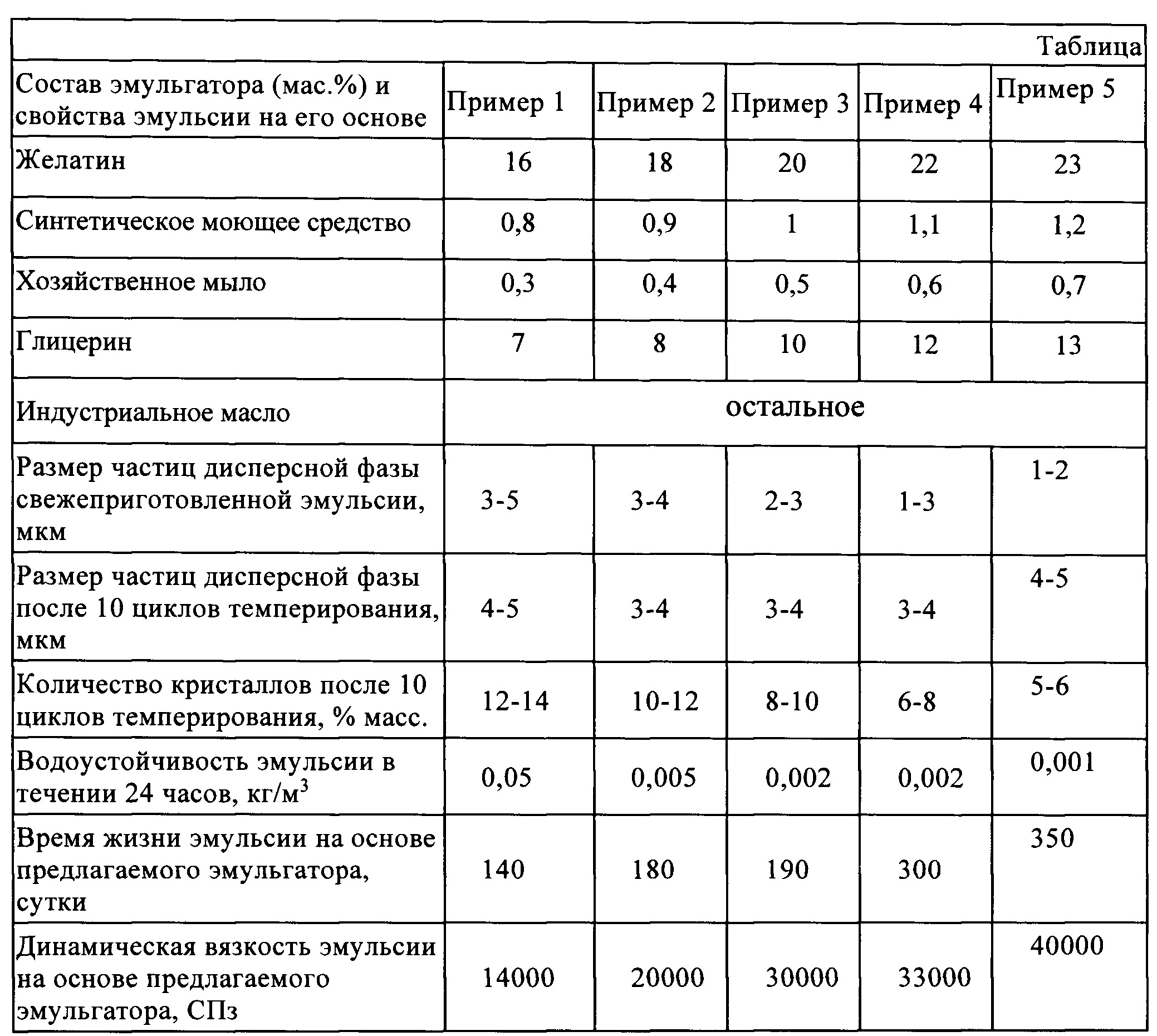
Получение эмульгатора для промышленных эмульсионных взрывчатых веществ осуществляют путем смешения охлажденных до 70-80°С компонентов, в необходимых массовых соотношениях. Массовые соотношения компонентов и свойства эмульсии с использованием полученного эмульгатора для промышленных эмульсионных взрывчатых веществ приведены в таблице. Как видно из данных таблицы в примере 1 водоустойчивость и время жизни эмульсионного взрывчатого состава меньше заявленных в составе, принятом за прототип (180 суток), поэтому данный состав эмульгатора для промышленных эмульсионных взрывчатых веществ к применению не рассматривается. В примерах 2, 3, 4, 5 можно отметить увеличение водоустойчивости и времени жизни эмульсионного взрывчатого состава, но в примере 5 вязкость полученной эмульсии значительно превышает оптимальную для перекачки насосом (до 20000-33000 СПуаз), поэтому его применение представляется невозможным при применении мобильного смесительно-зарядного оборудования.The production of an emulsifier for industrial emulsion explosives is carried out by mixing the components cooled to 70-80 ° C in the required mass ratios. The mass ratios of the components and the properties of the emulsion using the obtained emulsifier for industrial emulsion explosives are shown in the table. As can be seen from the data in the table in example 1, the water resistance and lifetime of the emulsion explosive composition is less than those stated in the composition taken as the prototype (180 days), therefore this composition of the emulsifier for industrial emulsion explosives is not considered for use. In examples 2, 3, 4, 5, an increase in the water resistance and life time of the emulsion explosive composition can be noted, but in example 5 the viscosity of the resulting emulsion significantly exceeds the optimal for pumping (up to 20,000-33,000 SPuases), therefore its use seems impossible when using a mobile mixing - charging equipment.
Пропорции эмульсии для приготовления в лабораторных условиях принимали следующие, мас. %:The proportions of the emulsion for preparation under laboratory conditions were taken as follows, wt. %:
Раствор окислителя (80% аммиачной селитры в воде) 93;Oxidizing agent solution (80% ammonium nitrate in water) 93;
Эмульгатор 7.Emulsifier 7.
Пример получения состава эмульсии в лабораторных условиях. Полученный эмульгатор для промышленных эмульсионных взрывчатых веществ нагревают до 70-80°С и при включенной мешалке приливают в раствор окислителя в течение 1 минуты. Процесс эмульгирования продолжают еще в течение 2 минут, после чего полученную эмульсию подвергают испытаниям.An example of obtaining an emulsion composition in laboratory conditions. The resulting emulsifier for industrial emulsion explosives is heated to 70-80 ° C and, with the mixer turned on, is poured into the oxidizing solution for 1 minute. The emulsification process is continued for another 2 minutes, after which the resulting emulsion is tested.
Для оценки качества получаемых эмульсий с применением заявляемого эмульгирующего состава применяли известные физико-химические методы.To assess the quality of the emulsions obtained using the claimed emulsifying composition, known physicochemical methods were used.
Все образцы эмульсий подвергали циклическому темперированию: 4 часа выдерживали при температуре минус 30°С, затем 4 часа при плюс 30°С. При этом считали, что 10 циклов соответствует продолжительности хранения эмульсии в течение 6 месяцев.All samples of emulsions were subjected to cyclic tempering: kept for 4 hours at a temperature of minus 30 ° C, then 4 hours at plus 30 ° C. It was considered that 10 cycles corresponds to the storage time of the emulsion for 6 months.
Количество образовавшихся после 10 циклов кристаллов определяли рентгенофазовым анализом. Размер частиц дисперсной фазы до и после темперирования определяли анализатором размера частиц.The number of crystals formed after 10 cycles was determined by X-ray phase analysis. The particle size of the dispersed phase before and after tempering was determined with a particle size analyzer.
Водоустойчивость эмульсий определяли по ГОСТ Р32141-2013.The water resistance of emulsions was determined according to GOST R32141-2013.
Как видно из таблицы (примеры 1-5), эмульгатор для промышленных эмульсионных взрывчатых веществ, содержащий компоненты в заявляемых пределах, превосходит прототип по всем контролируемым свойствам. Снижение концентрации компонентов в составе ниже нижнего предела не обеспечивает достаточно высокой степени дисперсности и устойчивости эмульсии при длительном хранении и контакте с водой (пример 11). Снижение концентрации стабилизатора эмульсии ниже заявляемого предела приводит к увеличению размера частиц дисперсной фазы при длительном хранении (пример 1).As can be seen from the table (examples 1-5), an emulsifier for industrial emulsion explosives containing components within the claimed limits is superior to the prototype in all controlled properties. A decrease in the concentration of components in the composition below the lower limit does not provide a sufficiently high degree of dispersion and stability of the emulsion during long-term storage and contact with water (example 11). A decrease in the concentration of the emulsion stabilizer below the claimed limit leads to an increase in the particle size of the dispersed phase during long-term storage (example 1).
Применение данного эмульгатора для промышленных эмульсионных взрывчатых веществ обеспечивает следующие преимущества:The use of this emulsifier for industrial emulsion explosives provides the following advantages:
- продление времени жизни эмульсионного взрывчатого вещества;- prolongation of the life time of the emulsion explosive;
- повышение конечной вязкости эмульсионного взрывчатого вещества после закачки в скважину;- increasing the final viscosity of the emulsion explosive after injection into the well;
- повышение водоустойчивости эмульсионного взрывчатого вещества.- increasing the water resistance of the emulsion explosive.
Claims (2)
Priority Applications (1)
| Application Number | Priority Date | Filing Date | Title |
|---|---|---|---|
| RU2019115480A RU2755074C2 (en) | 2019-05-21 | 2019-05-21 | Emulsifier for industrial emulsion explosives |
Applications Claiming Priority (1)
| Application Number | Priority Date | Filing Date | Title |
|---|---|---|---|
| RU2019115480A RU2755074C2 (en) | 2019-05-21 | 2019-05-21 | Emulsifier for industrial emulsion explosives |
Publications (3)
| Publication Number | Publication Date |
|---|---|
| RU2019115480A RU2019115480A (en) | 2020-11-23 |
| RU2019115480A3 RU2019115480A3 (en) | 2021-04-19 |
| RU2755074C2 true RU2755074C2 (en) | 2021-09-13 |
Family
ID=73543422
Family Applications (1)
| Application Number | Title | Priority Date | Filing Date |
|---|---|---|---|
| RU2019115480A RU2755074C2 (en) | 2019-05-21 | 2019-05-21 | Emulsifier for industrial emulsion explosives |
Country Status (1)
| Country | Link |
|---|---|
| RU (1) | RU2755074C2 (en) |
Families Citing this family (1)
| Publication number | Priority date | Publication date | Assignee | Title |
|---|---|---|---|---|
| CN119191922A (en) * | 2024-09-13 | 2024-12-27 | 江西威源民爆器材有限责任公司 | A special foaming agent for preparing emulsion explosive and preparation method thereof |
Citations (5)
| Publication number | Priority date | Publication date | Assignee | Title |
|---|---|---|---|---|
| US4632714A (en) * | 1985-09-19 | 1986-12-30 | Megabar Corporation | Microcellular composite energetic materials and method for making same |
| CN1008114B (en) * | 1985-12-06 | 1990-05-23 | 鲁布里佐尔公司 | Water-in-oil emulsion |
| CN101068913A (en) * | 2004-10-18 | 2007-11-07 | 禾大国际股份公开有限公司 | Surfactant compounds |
| RU2331464C1 (en) * | 2004-04-05 | 2008-08-20 | Канагава Юниверсити | Emulsifying dispersant, method of emulsification and dispersion with use of emulsifying dispersant, emulsion and emulsion fuels |
| RU2652714C1 (en) * | 2017-07-17 | 2018-04-28 | Общество с ограниченной ответственностью "РудХим" | Universal emulsifier of inverted emulsions |
-
2019
- 2019-05-21 RU RU2019115480A patent/RU2755074C2/en active
Patent Citations (5)
| Publication number | Priority date | Publication date | Assignee | Title |
|---|---|---|---|---|
| US4632714A (en) * | 1985-09-19 | 1986-12-30 | Megabar Corporation | Microcellular composite energetic materials and method for making same |
| CN1008114B (en) * | 1985-12-06 | 1990-05-23 | 鲁布里佐尔公司 | Water-in-oil emulsion |
| RU2331464C1 (en) * | 2004-04-05 | 2008-08-20 | Канагава Юниверсити | Emulsifying dispersant, method of emulsification and dispersion with use of emulsifying dispersant, emulsion and emulsion fuels |
| CN101068913A (en) * | 2004-10-18 | 2007-11-07 | 禾大国际股份公开有限公司 | Surfactant compounds |
| RU2652714C1 (en) * | 2017-07-17 | 2018-04-28 | Общество с ограниченной ответственностью "РудХим" | Universal emulsifier of inverted emulsions |
Also Published As
| Publication number | Publication date |
|---|---|
| RU2019115480A3 (en) | 2021-04-19 |
| RU2019115480A (en) | 2020-11-23 |
Similar Documents
| Publication | Publication Date | Title |
|---|---|---|
| EP0938590B1 (en) | Use of carboxyamide-polysiloxanes for water-proofing leather | |
| RU2755074C2 (en) | Emulsifier for industrial emulsion explosives | |
| FR2543563A1 (en) | COMPOSITION BASED ON SUBSTITUTED SUCCINIC ANHYDRIDE AND EMULSIFIER AND APPLICATION THEREOF FOR BONDING PAPER | |
| RU2431466C2 (en) | Ascorbic acid suspension in glycerin and method for making thereof | |
| RU2652714C1 (en) | Universal emulsifier of inverted emulsions | |
| US2046128A (en) | Method of treating sulphur and product | |
| US2296933A (en) | Water-dispersible lecithin | |
| US2280830A (en) | Colloidal dispersion | |
| US2555972A (en) | Preparation of phosphatides | |
| BG61698B1 (en) | STABLE COMPOSITION FOR SUSPENSION CONTAINING CELLULOSE | |
| RU2125152C1 (en) | Compound for displacement of oil | |
| RU2755079C2 (en) | Emulsifier for industrial emulsion explosives | |
| US2919197A (en) | Method of preparing oil-in-water emulsions | |
| RU2761063C2 (en) | Emulsifier for industrial emulsion explosives | |
| US1937969A (en) | Emulsifier and insecticide | |
| RU2710426C1 (en) | Emulsion explosive composition | |
| DE728224C (en) | Process for the preparation of derivatives of the condensation products from high molecular weight protein breakdown products and higher molecular weight saturated or unsaturated fatty acids | |
| Cupples | Wetting and Spreading Properties of Aqueous Solutions Oleic Acid-Sodium Hydroxide Mixtures | |
| RU2004117796A (en) | METHOD FOR PRODUCING GEL, COMPOSITION OF WATER GEL AND METHOD FOR CHANGING ITS PHYSICAL CHARACTERISTICS | |
| JPS5962340A (en) | Manufacturing method of W101W type composite emulsion | |
| JP2017184675A5 (en) | ||
| RU2625876C2 (en) | Method of obtaining emulsifying composition for impregnation of ammonium nitrate | |
| RU2181370C1 (en) | Reagent for treating process fluids used in oil-production industry, and method of preparation thereof | |
| US273390A (en) | Hermann protze | |
| RU1779688C (en) | Emulsified drilling mud on hydrocarbon base and method for production thereof |