RU2712097C1 - Dipeptidyl peptidase-4 inhibitor for treating type 2 diabetes mellitus, compounds (versions) - Google Patents
Dipeptidyl peptidase-4 inhibitor for treating type 2 diabetes mellitus, compounds (versions) Download PDFInfo
- Publication number
- RU2712097C1 RU2712097C1 RU2018134266A RU2018134266A RU2712097C1 RU 2712097 C1 RU2712097 C1 RU 2712097C1 RU 2018134266 A RU2018134266 A RU 2018134266A RU 2018134266 A RU2018134266 A RU 2018134266A RU 2712097 C1 RU2712097 C1 RU 2712097C1
- Authority
- RU
- Russia
- Prior art keywords
- azabicyclo
- trifluorophenyl
- amino
- heptane
- exo
- Prior art date
Links
- 150000001875 compounds Chemical class 0.000 title claims abstract description 45
- 208000001072 type 2 diabetes mellitus Diseases 0.000 title claims abstract description 19
- 229940124213 Dipeptidyl peptidase 4 (DPP IV) inhibitor Drugs 0.000 title abstract description 20
- 239000003603 dipeptidyl peptidase IV inhibitor Substances 0.000 title abstract description 20
- OKTJSMMVPCPJKN-UHFFFAOYSA-N Carbon Chemical compound [C] OKTJSMMVPCPJKN-UHFFFAOYSA-N 0.000 claims abstract description 34
- 102000016622 Dipeptidyl Peptidase 4 Human genes 0.000 claims abstract description 34
- 108010067722 Dipeptidyl Peptidase 4 Proteins 0.000 claims abstract description 34
- 229910052799 carbon Inorganic materials 0.000 claims abstract description 34
- 239000001257 hydrogen Substances 0.000 claims abstract description 24
- 229910052739 hydrogen Inorganic materials 0.000 claims abstract description 24
- 229910052736 halogen Inorganic materials 0.000 claims abstract description 22
- 150000002367 halogens Chemical class 0.000 claims abstract description 22
- UFHFLCQGNIYNRP-UHFFFAOYSA-N Hydrogen Chemical compound [H][H] UFHFLCQGNIYNRP-UHFFFAOYSA-N 0.000 claims abstract description 17
- 150000003839 salts Chemical class 0.000 claims abstract description 14
- 239000003112 inhibitor Substances 0.000 claims abstract description 12
- 150000001576 beta-amino acids Chemical class 0.000 claims abstract description 9
- CUBFNQXOGIDUPZ-UHFFFAOYSA-N 5-(2-azabicyclo[2.2.1]heptan-3-yl)-1,2,4-oxadiazole Chemical compound C12C(NC(CC1)C2)C1=NC=NO1 CUBFNQXOGIDUPZ-UHFFFAOYSA-N 0.000 claims abstract description 6
- 125000002887 hydroxy group Chemical group [H]O* 0.000 claims abstract description 6
- 125000005073 adamantyl group Chemical group C12(CC3CC(CC(C1)C3)C2)* 0.000 claims abstract description 5
- XCDOWMKTGKSICD-UHFFFAOYSA-N 2-azabicyclo[2.2.1]hept-3-ene-3-carbonitrile Chemical compound C12=C(NC(CC1)C2)C#N XCDOWMKTGKSICD-UHFFFAOYSA-N 0.000 claims abstract description 4
- YYGYTIWHUWDFMS-UHFFFAOYSA-N 3-(2-azabicyclo[2.2.1]heptan-3-yl)-1,2,4-oxadiazole Chemical compound C12C(NC(CC1)C2)C1=NOC=N1 YYGYTIWHUWDFMS-UHFFFAOYSA-N 0.000 claims abstract description 4
- 125000005843 halogen group Chemical group 0.000 claims abstract 6
- 125000001797 benzyl group Chemical group [H]C1=C([H])C([H])=C(C([H])=C1[H])C([H])([H])* 0.000 claims abstract 4
- -1 4-fluoro-3-hydroxybenzyl Chemical group 0.000 claims description 124
- 125000001424 substituent group Chemical group 0.000 claims description 34
- 125000002496 methyl group Chemical group [H]C([H])([H])* 0.000 claims description 26
- 125000000217 alkyl group Chemical group 0.000 claims description 13
- 238000011282 treatment Methods 0.000 claims description 9
- 125000001449 isopropyl group Chemical group [H]C([H])([H])C([H])(*)C([H])([H])[H] 0.000 claims description 8
- 125000006288 3,5-difluorobenzyl group Chemical group [H]C1=C(F)C([H])=C(C([H])=C1F)C([H])([H])* 0.000 claims description 6
- 125000004176 4-fluorobenzyl group Chemical group [H]C1=C([H])C(=C([H])C([H])=C1F)C([H])([H])* 0.000 claims description 6
- 125000001559 cyclopropyl group Chemical group [H]C1([H])C([H])([H])C1([H])* 0.000 claims description 4
- 125000002023 trifluoromethyl group Chemical group FC(F)(F)* 0.000 claims description 4
- YDEZZPRXJREHOZ-PMDFSGFKSA-N (3R)-3-amino-1-[(3S)-3-(3-phenyl-1,2,4-oxadiazol-5-yl)-2-azabicyclo[2.2.1]heptan-2-yl]-4-(2,4,5-trifluorophenyl)butan-1-one Chemical compound N[C@@H](CC(=O)N1[C@@H](C2CCC1C2)C2=NC(=NO2)C2=CC=CC=C2)CC2=C(C=C(C(=C2)F)F)F YDEZZPRXJREHOZ-PMDFSGFKSA-N 0.000 claims description 3
- UOVMUOLZERCCRF-PMDFSGFKSA-N (3R)-3-amino-1-[(3S)-3-(5-phenyl-1,2,4-oxadiazol-3-yl)-2-azabicyclo[2.2.1]heptan-2-yl]-4-(2,4,5-trifluorophenyl)butan-1-one Chemical compound N[C@@H](CC(=O)N1[C@@H](C2CCC1C2)C2=NOC(=N2)C2=CC=CC=C2)CC2=C(C=C(C(=C2)F)F)F UOVMUOLZERCCRF-PMDFSGFKSA-N 0.000 claims description 3
- OYLYPTNUUUUZJU-MWDCTBBTSA-N (3S)-2-[(3R)-3-amino-4-(2,4,5-trifluorophenyl)butanoyl]-2-azabicyclo[2.2.1]heptane-3-carbonitrile Chemical compound N[C@@H](CC(=O)N1[C@@H](C2CCC1C2)C#N)CC2=C(C=C(C(=C2)F)F)F OYLYPTNUUUUZJU-MWDCTBBTSA-N 0.000 claims description 3
- 125000001072 heteroaryl group Chemical group 0.000 claims description 3
- YDEZZPRXJREHOZ-OWCKKMFFSA-N (3R)-3-amino-1-[(3R)-3-(3-phenyl-1,2,4-oxadiazol-5-yl)-2-azabicyclo[2.2.1]heptan-2-yl]-4-(2,4,5-trifluorophenyl)butan-1-one Chemical compound N[C@@H](CC(=O)N1[C@H](C2CCC1C2)C2=NC(=NO2)C2=CC=CC=C2)CC2=C(C=C(C(=C2)F)F)F YDEZZPRXJREHOZ-OWCKKMFFSA-N 0.000 claims description 2
- DDOKWCBNVNDSKO-YKBXHCKPSA-N (3R)-3-amino-1-[(3S)-3-[3-(3,5-difluoropyridin-2-yl)-1,2,4-oxadiazol-5-yl]-2-azabicyclo[2.2.1]heptan-2-yl]-4-(2,4,5-trifluorophenyl)butan-1-one Chemical compound N[C@@H](CC(=O)N1[C@@H](C2CCC1C2)C2=NC(=NO2)C2=NC=C(C=C2F)F)CC2=C(C=C(C(=C2)F)F)F DDOKWCBNVNDSKO-YKBXHCKPSA-N 0.000 claims description 2
- ANZMGXAHQIHTBO-AGLYGMQLSA-N (3R)-3-amino-1-[(3S)-3-[5-(2-fluoropropan-2-yl)-1,2,4-oxadiazol-3-yl]-2-azabicyclo[2.2.1]heptan-2-yl]-4-(2,4,5-trifluorophenyl)butan-1-one Chemical compound N[C@@H](CC(=O)N1[C@@H](C2CCC1C2)C2=NOC(=N2)C(C)(C)F)CC2=C(C=C(C(=C2)F)F)F ANZMGXAHQIHTBO-AGLYGMQLSA-N 0.000 claims description 2
- BJPKBSXDTGUGNX-GURQAQJRSA-N (3S)-2-[3-[(2,4,5-trifluorophenyl)methylamino]propanoyl]-2-azabicyclo[2.2.1]heptane-3-carbonitrile Chemical compound FC1=C(C=C(C(=C1)F)F)CNCCC(=O)N1[C@@H](C2CCC1C2)C#N BJPKBSXDTGUGNX-GURQAQJRSA-N 0.000 claims description 2
- 208000001145 Metabolic Syndrome Diseases 0.000 claims description 2
- OUIWWERRLKFRLO-PCKANPLQSA-N N[C@@H](CC(=O)N1[C@@H](C2CCC1C2)C2=NC(=NO2)C(C)C)CC2=C(C=C(C(=C2)F)F)F Chemical compound N[C@@H](CC(=O)N1[C@@H](C2CCC1C2)C2=NC(=NO2)C(C)C)CC2=C(C=C(C(=C2)F)F)F OUIWWERRLKFRLO-PCKANPLQSA-N 0.000 claims description 2
- 201000000690 abdominal obesity-metabolic syndrome Diseases 0.000 claims description 2
- 125000001997 phenyl group Chemical group [H]C1=C([H])C([H])=C(*)C([H])=C1[H] 0.000 claims 10
- 230000000694 effects Effects 0.000 abstract description 14
- 239000000126 substance Substances 0.000 abstract description 13
- 238000011161 development Methods 0.000 abstract description 7
- 150000001408 amides Chemical class 0.000 abstract description 6
- 230000015572 biosynthetic process Effects 0.000 description 117
- 238000003786 synthesis reaction Methods 0.000 description 115
- 238000000034 method Methods 0.000 description 110
- YMWUJEATGCHHMB-UHFFFAOYSA-N Dichloromethane Chemical compound ClCCl YMWUJEATGCHHMB-UHFFFAOYSA-N 0.000 description 60
- XEKOWRVHYACXOJ-UHFFFAOYSA-N Ethyl acetate Chemical compound CCOC(C)=O XEKOWRVHYACXOJ-UHFFFAOYSA-N 0.000 description 36
- 239000000243 solution Substances 0.000 description 36
- 239000000203 mixture Substances 0.000 description 34
- WEVYAHXRMPXWCK-UHFFFAOYSA-N Acetonitrile Chemical compound CC#N WEVYAHXRMPXWCK-UHFFFAOYSA-N 0.000 description 27
- 239000003480 eluent Substances 0.000 description 26
- NOESYZHRGYRDHS-UHFFFAOYSA-N insulin Chemical compound N1C(=O)C(NC(=O)C(CCC(N)=O)NC(=O)C(CCC(O)=O)NC(=O)C(C(C)C)NC(=O)C(NC(=O)CN)C(C)CC)CSSCC(C(NC(CO)C(=O)NC(CC(C)C)C(=O)NC(CC=2C=CC(O)=CC=2)C(=O)NC(CCC(N)=O)C(=O)NC(CC(C)C)C(=O)NC(CCC(O)=O)C(=O)NC(CC(N)=O)C(=O)NC(CC=2C=CC(O)=CC=2)C(=O)NC(CSSCC(NC(=O)C(C(C)C)NC(=O)C(CC(C)C)NC(=O)C(CC=2C=CC(O)=CC=2)NC(=O)C(CC(C)C)NC(=O)C(C)NC(=O)C(CCC(O)=O)NC(=O)C(C(C)C)NC(=O)C(CC(C)C)NC(=O)C(CC=2NC=NC=2)NC(=O)C(CO)NC(=O)CNC2=O)C(=O)NCC(=O)NC(CCC(O)=O)C(=O)NC(CCCNC(N)=N)C(=O)NCC(=O)NC(CC=3C=CC=CC=3)C(=O)NC(CC=3C=CC=CC=3)C(=O)NC(CC=3C=CC(O)=CC=3)C(=O)NC(C(C)O)C(=O)N3C(CCC3)C(=O)NC(CCCCN)C(=O)NC(C)C(O)=O)C(=O)NC(CC(N)=O)C(O)=O)=O)NC(=O)C(C(C)CC)NC(=O)C(CO)NC(=O)C(C(C)O)NC(=O)C1CSSCC2NC(=O)C(CC(C)C)NC(=O)C(NC(=O)C(CCC(N)=O)NC(=O)C(CC(N)=O)NC(=O)C(NC(=O)C(N)CC=1C=CC=CC=1)C(C)C)CC1=CN=CN1 NOESYZHRGYRDHS-UHFFFAOYSA-N 0.000 description 26
- KRKNYBCHXYNGOX-UHFFFAOYSA-N citric acid Chemical compound OC(=O)CC(O)(C(O)=O)CC(O)=O KRKNYBCHXYNGOX-UHFFFAOYSA-N 0.000 description 24
- 239000003814 drug Substances 0.000 description 23
- 239000000859 incretin Substances 0.000 description 23
- LFQSCWFLJHTTHZ-UHFFFAOYSA-N Ethanol Chemical compound CCO LFQSCWFLJHTTHZ-UHFFFAOYSA-N 0.000 description 22
- 229940079593 drug Drugs 0.000 description 21
- RTZKZFJDLAIYFH-UHFFFAOYSA-N Diethyl ether Chemical compound CCOCC RTZKZFJDLAIYFH-UHFFFAOYSA-N 0.000 description 20
- 239000000047 product Substances 0.000 description 20
- 125000003118 aryl group Chemical group 0.000 description 19
- ZMANZCXQSJIPKH-UHFFFAOYSA-N Triethylamine Chemical compound CCN(CC)CC ZMANZCXQSJIPKH-UHFFFAOYSA-N 0.000 description 18
- 239000002253 acid Substances 0.000 description 18
- 239000011541 reaction mixture Substances 0.000 description 18
- NKBWMBRPILTCRD-UHFFFAOYSA-N 2-Methylheptanoic acid Chemical compound CCCCCC(C)C(O)=O NKBWMBRPILTCRD-UHFFFAOYSA-N 0.000 description 17
- 229910052794 bromium Inorganic materials 0.000 description 17
- 229910052731 fluorine Inorganic materials 0.000 description 17
- 239000002904 solvent Substances 0.000 description 17
- 229910052801 chlorine Inorganic materials 0.000 description 16
- 238000004440 column chromatography Methods 0.000 description 15
- HEMHJVSKTPXQMS-UHFFFAOYSA-M Sodium hydroxide Chemical compound [OH-].[Na+] HEMHJVSKTPXQMS-UHFFFAOYSA-M 0.000 description 14
- JOXIMZWYDAKGHI-UHFFFAOYSA-N toluene-4-sulfonic acid Chemical compound CC1=CC=C(S(O)(=O)=O)C=C1 JOXIMZWYDAKGHI-UHFFFAOYSA-N 0.000 description 14
- 102000004877 Insulin Human genes 0.000 description 13
- 108090001061 Insulin Proteins 0.000 description 13
- VYPSYNLAJGMNEJ-UHFFFAOYSA-N Silicium dioxide Chemical compound O=[Si]=O VYPSYNLAJGMNEJ-UHFFFAOYSA-N 0.000 description 13
- 238000001816 cooling Methods 0.000 description 13
- 235000019439 ethyl acetate Nutrition 0.000 description 13
- 229940125396 insulin Drugs 0.000 description 13
- XLYOFNOQVPJJNP-UHFFFAOYSA-N water Substances O XLYOFNOQVPJJNP-UHFFFAOYSA-N 0.000 description 13
- WQZGKKKJIJFFOK-GASJEMHNSA-N Glucose Natural products OC[C@H]1OC(O)[C@H](O)[C@@H](O)[C@@H]1O WQZGKKKJIJFFOK-GASJEMHNSA-N 0.000 description 12
- OKKJLVBELUTLKV-UHFFFAOYSA-N Methanol Chemical compound OC OKKJLVBELUTLKV-UHFFFAOYSA-N 0.000 description 12
- 229940090124 dipeptidyl peptidase 4 (dpp-4) inhibitors for blood glucose lowering Drugs 0.000 description 12
- 239000008103 glucose Substances 0.000 description 12
- 101800000224 Glucagon-like peptide 1 Proteins 0.000 description 11
- VEXZGXHMUGYJMC-UHFFFAOYSA-N Hydrochloric acid Chemical compound Cl VEXZGXHMUGYJMC-UHFFFAOYSA-N 0.000 description 11
- 102100040918 Pro-glucagon Human genes 0.000 description 11
- 238000000746 purification Methods 0.000 description 11
- 239000000741 silica gel Substances 0.000 description 11
- 229910002027 silica gel Inorganic materials 0.000 description 11
- DTHNMHAUYICORS-KTKZVXAJSA-N Glucagon-like peptide 1 Chemical compound C([C@@H](C(=O)N[C@@H]([C@@H](C)CC)C(=O)N[C@@H](C)C(=O)N[C@@H](CC=1C2=CC=CC=C2NC=1)C(=O)N[C@@H](CC(C)C)C(=O)N[C@@H](C(C)C)C(=O)N[C@@H](CCCCN)C(=O)NCC(=O)N[C@@H](CCCNC(N)=N)C(N)=O)NC(=O)[C@H](CCC(O)=O)NC(=O)[C@H](CCCCN)NC(=O)[C@H](C)NC(=O)[C@H](C)NC(=O)[C@H](CCC(N)=O)NC(=O)CNC(=O)[C@H](CCC(O)=O)NC(=O)[C@H](CC(C)C)NC(=O)[C@H](CC=1C=CC(O)=CC=1)NC(=O)[C@H](CO)NC(=O)[C@H](CO)NC(=O)[C@@H](NC(=O)[C@H](CC(O)=O)NC(=O)[C@H](CO)NC(=O)[C@@H](NC(=O)[C@H](CC=1C=CC=CC=1)NC(=O)[C@@H](NC(=O)CNC(=O)[C@H](CCC(O)=O)NC(=O)[C@H](C)NC(=O)[C@@H](N)CC=1N=CNC=1)[C@@H](C)O)[C@@H](C)O)C(C)C)C1=CC=CC=C1 DTHNMHAUYICORS-KTKZVXAJSA-N 0.000 description 10
- 206010012601 diabetes mellitus Diseases 0.000 description 10
- PMZURENOXWZQFD-UHFFFAOYSA-L Sodium Sulfate Chemical compound [Na+].[Na+].[O-]S([O-])(=O)=O PMZURENOXWZQFD-UHFFFAOYSA-L 0.000 description 9
- YXFVVABEGXRONW-UHFFFAOYSA-N Toluene Chemical compound CC1=CC=CC=C1 YXFVVABEGXRONW-UHFFFAOYSA-N 0.000 description 9
- 238000006243 chemical reaction Methods 0.000 description 9
- MGXWVYUBJRZYPE-YUGYIWNOSA-N incretin Chemical class C([C@@H](C(=O)N[C@@H](CO)C(=O)N[C@@H]([C@@H](C)CC)C(=O)N[C@@H](C)C(=O)N[C@@H](CCSC)C(=O)N[C@@H](CC(O)=O)C(=O)N[C@@H](CCCCN)C(=O)N[C@@H]([C@@H](C)CC)C(=O)N[C@@H](CC=1NC=NC=1)C(=O)N[C@@H](CCC(N)=O)C(=O)N[C@@H](CCC(N)=O)C(=O)N[C@@H](CC(O)=O)C(=O)N[C@@H](CC=1C=CC=CC=1)C(=O)N[C@@H](C(C)C)C(=O)N[C@@H](CC(N)=O)C(=O)N[C@@H](CC=1C2=CC=CC=C2NC=1)C(=O)N[C@@H](CC(C)C)C(=O)N[C@@H](CC(C)C)C(=O)N[C@@H](C)C(=O)N[C@@H](CCC(N)=O)C(=O)N[C@@H](CCCCN)C(=O)NCC(=O)N[C@@H](CCCCN)C(=O)N[C@@H](CCCCN)C(=O)N[C@@H](CC(N)=O)C(=O)N[C@@H](CC(O)=O)C(=O)N[C@@H](CC=1C2=CC=CC=C2NC=1)C(=O)N[C@@H](CCCCN)C(=O)N[C@@H](CC=1NC=NC=1)C(=O)N[C@@H](CC(N)=O)C(=O)N[C@@H]([C@@H](C)CC)C(=O)N[C@@H]([C@@H](C)O)C(=O)N[C@@H](CCC(N)=O)C(O)=O)NC(=O)[C@H](CC(O)=O)NC(=O)[C@H](CO)NC(=O)[C@@H](NC(=O)[C@H](CC=1C=CC=CC=1)NC(=O)[C@@H](NC(=O)CNC(=O)[C@H](CCC(O)=O)NC(=O)[C@H](C)NC(=O)[C@@H](N)CC=1C=CC(O)=CC=1)[C@@H](C)O)[C@@H](C)CC)C1=CC=C(O)C=C1 MGXWVYUBJRZYPE-YUGYIWNOSA-N 0.000 description 9
- WYURNTSHIVDZCO-UHFFFAOYSA-N tetrahydrofuran Substances C1CCOC1 WYURNTSHIVDZCO-UHFFFAOYSA-N 0.000 description 9
- QGZKDVFQNNGYKY-UHFFFAOYSA-N ammonia Natural products N QGZKDVFQNNGYKY-UHFFFAOYSA-N 0.000 description 8
- 229910052938 sodium sulfate Inorganic materials 0.000 description 8
- 235000011152 sodium sulphate Nutrition 0.000 description 8
- CBECPKLEGGTSOV-UHFFFAOYSA-N 2-azabicyclo[2.2.1]heptane-3-carbonitrile Chemical compound C1CC2C(C#N)NC1C2 CBECPKLEGGTSOV-UHFFFAOYSA-N 0.000 description 7
- 230000001419 dependent effect Effects 0.000 description 7
- 229940088597 hormone Drugs 0.000 description 7
- 239000005556 hormone Substances 0.000 description 7
- IXCSERBJSXMMFS-UHFFFAOYSA-N hydrogen chloride Substances Cl.Cl IXCSERBJSXMMFS-UHFFFAOYSA-N 0.000 description 7
- 229910000041 hydrogen chloride Inorganic materials 0.000 description 7
- 238000003402 intramolecular cyclocondensation reaction Methods 0.000 description 7
- KDLHZDBZIXYQEI-UHFFFAOYSA-N palladium Substances [Pd] KDLHZDBZIXYQEI-UHFFFAOYSA-N 0.000 description 7
- QAEDZJGFFMLHHQ-UHFFFAOYSA-N trifluoroacetic anhydride Chemical compound FC(F)(F)C(=O)OC(=O)C(F)(F)F QAEDZJGFFMLHHQ-UHFFFAOYSA-N 0.000 description 7
- ZMXDDKWLCZADIW-UHFFFAOYSA-N N,N-Dimethylformamide Chemical compound CN(C)C=O ZMXDDKWLCZADIW-UHFFFAOYSA-N 0.000 description 6
- JUJWROOIHBZHMG-UHFFFAOYSA-N Pyridine Chemical compound C1=CC=NC=C1 JUJWROOIHBZHMG-UHFFFAOYSA-N 0.000 description 6
- 230000009471 action Effects 0.000 description 6
- 125000003295 alanine group Chemical group N[C@@H](C)C(=O)* 0.000 description 6
- 230000006870 function Effects 0.000 description 6
- 230000002401 inhibitory effect Effects 0.000 description 6
- 239000002244 precipitate Substances 0.000 description 6
- 108090000765 processed proteins & peptides Proteins 0.000 description 6
- QJRYYOWARFCJQZ-UHFFFAOYSA-N pyrrolidine-1-carbonitrile Chemical class N#CN1CCCC1 QJRYYOWARFCJQZ-UHFFFAOYSA-N 0.000 description 6
- 238000004809 thin layer chromatography Methods 0.000 description 6
- DTQVDTLACAAQTR-UHFFFAOYSA-N trifluoroacetic acid Substances OC(=O)C(F)(F)F DTQVDTLACAAQTR-UHFFFAOYSA-N 0.000 description 6
- DPGVNSDPGIWYQK-UHFFFAOYSA-N 2-methylheptanenitrile Chemical compound CCCCCC(C)C#N DPGVNSDPGIWYQK-UHFFFAOYSA-N 0.000 description 5
- 150000001412 amines Chemical class 0.000 description 5
- 210000001035 gastrointestinal tract Anatomy 0.000 description 5
- 150000002431 hydrogen Chemical class 0.000 description 5
- VLKZOEOYAKHREP-UHFFFAOYSA-N n-Hexane Chemical compound CCCCCC VLKZOEOYAKHREP-UHFFFAOYSA-N 0.000 description 5
- 150000002825 nitriles Chemical class 0.000 description 5
- 239000012044 organic layer Substances 0.000 description 5
- 239000003208 petroleum Substances 0.000 description 5
- BWHMMNNQKKPAPP-UHFFFAOYSA-L potassium carbonate Substances [K+].[K+].[O-]C([O-])=O BWHMMNNQKKPAPP-UHFFFAOYSA-L 0.000 description 5
- 108090000623 proteins and genes Proteins 0.000 description 5
- 238000007363 ring formation reaction Methods 0.000 description 5
- 230000028327 secretion Effects 0.000 description 5
- 238000003756 stirring Methods 0.000 description 5
- 238000005406 washing Methods 0.000 description 5
- RYHBNJHYFVUHQT-UHFFFAOYSA-N 1,4-Dioxane Chemical compound C1COCCO1 RYHBNJHYFVUHQT-UHFFFAOYSA-N 0.000 description 4
- XDRAKJQFCQVBMP-UHFFFAOYSA-N 2-but-2-enyl-3-methylbutanedioic acid Chemical compound CC=CCC(C(O)=O)C(C)C(O)=O XDRAKJQFCQVBMP-UHFFFAOYSA-N 0.000 description 4
- VHUUQVKOLVNVRT-UHFFFAOYSA-N Ammonium hydroxide Chemical compound [NH4+].[OH-] VHUUQVKOLVNVRT-UHFFFAOYSA-N 0.000 description 4
- BZLVMXJERCGZMT-UHFFFAOYSA-N Methyl tert-butyl ether Chemical compound COC(C)(C)C BZLVMXJERCGZMT-UHFFFAOYSA-N 0.000 description 4
- KWYUFKZDYYNOTN-UHFFFAOYSA-M Potassium hydroxide Chemical compound [OH-].[K+] KWYUFKZDYYNOTN-UHFFFAOYSA-M 0.000 description 4
- 125000003275 alpha amino acid group Chemical group 0.000 description 4
- 239000003472 antidiabetic agent Substances 0.000 description 4
- 210000004369 blood Anatomy 0.000 description 4
- 239000008280 blood Substances 0.000 description 4
- 210000004027 cell Anatomy 0.000 description 4
- ZSWFCLXCOIISFI-UHFFFAOYSA-N cyclopentadiene Chemical compound C1C=CC=C1 ZSWFCLXCOIISFI-UHFFFAOYSA-N 0.000 description 4
- 201000010099 disease Diseases 0.000 description 4
- 208000037265 diseases, disorders, signs and symptoms Diseases 0.000 description 4
- 230000006362 insulin response pathway Effects 0.000 description 4
- 229940072033 potash Drugs 0.000 description 4
- 235000015320 potassium carbonate Nutrition 0.000 description 4
- 230000002829 reductive effect Effects 0.000 description 4
- QGJUIPDUBHWZPV-SGTAVMJGSA-N saxagliptin Chemical compound C1C(C2)CC(C3)CC2(O)CC13[C@H](N)C(=O)N1[C@H](C#N)C[C@@H]2C[C@@H]21 QGJUIPDUBHWZPV-SGTAVMJGSA-N 0.000 description 4
- 229960004937 saxagliptin Drugs 0.000 description 4
- 108010033693 saxagliptin Proteins 0.000 description 4
- 239000011734 sodium Substances 0.000 description 4
- 239000000758 substrate Substances 0.000 description 4
- SYOKIDBDQMKNDQ-XWTIBIIYSA-N vildagliptin Chemical compound C1C(O)(C2)CC(C3)CC1CC32NCC(=O)N1CCC[C@H]1C#N SYOKIDBDQMKNDQ-XWTIBIIYSA-N 0.000 description 4
- 229960001254 vildagliptin Drugs 0.000 description 4
- SOVHYYFIELMXAK-UHFFFAOYSA-N 3-[(3-hydroxy-1-adamantyl)amino]propanoic acid Chemical class C1C2CC3(CC1CC(C2)(C3)O)NCCC(=O)O SOVHYYFIELMXAK-UHFFFAOYSA-N 0.000 description 3
- UHOVQNZJYSORNB-UHFFFAOYSA-N Benzene Chemical compound C1=CC=CC=C1 UHOVQNZJYSORNB-UHFFFAOYSA-N 0.000 description 3
- 102000051325 Glucagon Human genes 0.000 description 3
- 108060003199 Glucagon Proteins 0.000 description 3
- WHXSMMKQMYFTQS-UHFFFAOYSA-N Lithium Chemical compound [Li] WHXSMMKQMYFTQS-UHFFFAOYSA-N 0.000 description 3
- 229940100389 Sulfonylurea Drugs 0.000 description 3
- 235000004279 alanine Nutrition 0.000 description 3
- 239000003513 alkali Substances 0.000 description 3
- 125000003277 amino group Chemical group 0.000 description 3
- 238000004458 analytical method Methods 0.000 description 3
- 210000000227 basophil cell of anterior lobe of hypophysis Anatomy 0.000 description 3
- JFDZBHWFFUWGJE-UHFFFAOYSA-N benzonitrile Chemical compound N#CC1=CC=CC=C1 JFDZBHWFFUWGJE-UHFFFAOYSA-N 0.000 description 3
- 230000015556 catabolic process Effects 0.000 description 3
- 230000003197 catalytic effect Effects 0.000 description 3
- 239000003153 chemical reaction reagent Substances 0.000 description 3
- RIFGWPKJUGCATF-UHFFFAOYSA-N ethyl chloroformate Chemical compound CCOC(Cl)=O RIFGWPKJUGCATF-UHFFFAOYSA-N 0.000 description 3
- 230000002496 gastric effect Effects 0.000 description 3
- MASNOZXLGMXCHN-ZLPAWPGGSA-N glucagon Chemical compound C([C@@H](C(=O)N[C@H](C(=O)N[C@@H](CCC(N)=O)C(=O)N[C@@H](CC=1C2=CC=CC=C2NC=1)C(=O)N[C@@H](CC(C)C)C(=O)N[C@@H](CCSC)C(=O)N[C@@H](CC(N)=O)C(=O)N[C@@H]([C@@H](C)O)C(O)=O)C(C)C)NC(=O)[C@H](CC(O)=O)NC(=O)[C@H](CCC(N)=O)NC(=O)[C@H](C)NC(=O)[C@H](CCCNC(N)=N)NC(=O)[C@H](CCCNC(N)=N)NC(=O)[C@H](CO)NC(=O)[C@H](CC(O)=O)NC(=O)[C@H](CC(C)C)NC(=O)[C@H](CC=1C=CC(O)=CC=1)NC(=O)[C@H](CCCCN)NC(=O)[C@H](CO)NC(=O)[C@H](CC=1C=CC(O)=CC=1)NC(=O)[C@H](CC(O)=O)NC(=O)[C@H](CO)NC(=O)[C@@H](NC(=O)[C@H](CC=1C=CC=CC=1)NC(=O)[C@@H](NC(=O)CNC(=O)[C@H](CCC(N)=O)NC(=O)[C@H](CO)NC(=O)[C@@H](N)CC=1NC=NC=1)[C@@H](C)O)[C@@H](C)O)C1=CC=CC=C1 MASNOZXLGMXCHN-ZLPAWPGGSA-N 0.000 description 3
- 229960004666 glucagon Drugs 0.000 description 3
- 230000002218 hypoglycaemic effect Effects 0.000 description 3
- 239000003446 ligand Substances 0.000 description 3
- 238000004895 liquid chromatography mass spectrometry Methods 0.000 description 3
- 229910052744 lithium Inorganic materials 0.000 description 3
- 230000007246 mechanism Effects 0.000 description 3
- 230000010534 mechanism of action Effects 0.000 description 3
- 230000004060 metabolic process Effects 0.000 description 3
- 229910052760 oxygen Inorganic materials 0.000 description 3
- 229910052763 palladium Inorganic materials 0.000 description 3
- UMJSCPRVCHMLSP-UHFFFAOYSA-N pyridine Natural products COC1=CC=CN=C1 UMJSCPRVCHMLSP-UHFFFAOYSA-N 0.000 description 3
- 239000012321 sodium triacetoxyborohydride Substances 0.000 description 3
- YROXIXLRRCOBKF-UHFFFAOYSA-N sulfonylurea Chemical class OC(=N)N=S(=O)=O YROXIXLRRCOBKF-UHFFFAOYSA-N 0.000 description 3
- VZCYOOQTPOCHFL-UHFFFAOYSA-N trans-butenedioic acid Natural products OC(=O)C=CC(O)=O VZCYOOQTPOCHFL-UHFFFAOYSA-N 0.000 description 3
- LANHEKZGKDEWLK-UHFFFAOYSA-N 2-methylideneheptanoic acid Chemical compound CCCCCC(=C)C(O)=O LANHEKZGKDEWLK-UHFFFAOYSA-N 0.000 description 2
- TYEYBOSBBBHJIV-UHFFFAOYSA-M 2-oxobutanoate Chemical compound CCC(=O)C([O-])=O TYEYBOSBBBHJIV-UHFFFAOYSA-M 0.000 description 2
- NLXLAEXVIDQMFP-UHFFFAOYSA-N Ammonia chloride Chemical compound [NH4+].[Cl-] NLXLAEXVIDQMFP-UHFFFAOYSA-N 0.000 description 2
- ATRRKUHOCOJYRX-UHFFFAOYSA-N Ammonium bicarbonate Chemical compound [NH4+].OC([O-])=O ATRRKUHOCOJYRX-UHFFFAOYSA-N 0.000 description 2
- 229910000013 Ammonium bicarbonate Inorganic materials 0.000 description 2
- 125000006847 BOC protecting group Chemical group 0.000 description 2
- 108010016626 Dipeptides Proteins 0.000 description 2
- 102000004190 Enzymes Human genes 0.000 description 2
- 108090000790 Enzymes Proteins 0.000 description 2
- 108010004460 Gastric Inhibitory Polypeptide Proteins 0.000 description 2
- 208000013016 Hypoglycemia Diseases 0.000 description 2
- QNAYBMKLOCPYGJ-REOHCLBHSA-N L-alanine Chemical compound C[C@H](N)C(O)=O QNAYBMKLOCPYGJ-REOHCLBHSA-N 0.000 description 2
- JGFZNNIVVJXRND-UHFFFAOYSA-N N,N-Diisopropylethylamine (DIPEA) Chemical compound CCN(C(C)C)C(C)C JGFZNNIVVJXRND-UHFFFAOYSA-N 0.000 description 2
- 238000005481 NMR spectroscopy Methods 0.000 description 2
- 102000000536 PPAR gamma Human genes 0.000 description 2
- 108010016731 PPAR gamma Proteins 0.000 description 2
- 102000035195 Peptidases Human genes 0.000 description 2
- 108091005804 Peptidases Proteins 0.000 description 2
- 239000004365 Protease Substances 0.000 description 2
- 102000012479 Serine Proteases Human genes 0.000 description 2
- 108010022999 Serine Proteases Proteins 0.000 description 2
- CDBYLPFSWZWCQE-UHFFFAOYSA-L Sodium Carbonate Chemical compound [Na+].[Na+].[O-]C([O-])=O CDBYLPFSWZWCQE-UHFFFAOYSA-L 0.000 description 2
- 150000007513 acids Chemical class 0.000 description 2
- 230000004913 activation Effects 0.000 description 2
- 235000008206 alpha-amino acids Nutrition 0.000 description 2
- 235000001014 amino acid Nutrition 0.000 description 2
- 229940024606 amino acid Drugs 0.000 description 2
- 150000001413 amino acids Chemical class 0.000 description 2
- 229910021529 ammonia Inorganic materials 0.000 description 2
- 235000012538 ammonium bicarbonate Nutrition 0.000 description 2
- 239000001099 ammonium carbonate Substances 0.000 description 2
- 238000010171 animal model Methods 0.000 description 2
- 229940127003 anti-diabetic drug Drugs 0.000 description 2
- 238000013459 approach Methods 0.000 description 2
- 239000007864 aqueous solution Substances 0.000 description 2
- 239000012300 argon atmosphere Substances 0.000 description 2
- QVGXLLKOCUKJST-UHFFFAOYSA-N atomic oxygen Chemical compound [O] QVGXLLKOCUKJST-UHFFFAOYSA-N 0.000 description 2
- 239000002585 base Substances 0.000 description 2
- WGQKYBSKWIADBV-UHFFFAOYSA-N benzylamine Chemical compound NCC1=CC=CC=C1 WGQKYBSKWIADBV-UHFFFAOYSA-N 0.000 description 2
- 230000004071 biological effect Effects 0.000 description 2
- 125000004063 butyryl group Chemical group O=C([*])C([H])([H])C([H])([H])C([H])([H])[H] 0.000 description 2
- 235000014633 carbohydrates Nutrition 0.000 description 2
- 150000007942 carboxylates Chemical class 0.000 description 2
- 238000003776 cleavage reaction Methods 0.000 description 2
- 238000002425 crystallisation Methods 0.000 description 2
- 230000008025 crystallization Effects 0.000 description 2
- 125000004093 cyano group Chemical group *C#N 0.000 description 2
- 230000006378 damage Effects 0.000 description 2
- 238000010908 decantation Methods 0.000 description 2
- 238000006731 degradation reaction Methods 0.000 description 2
- 238000001514 detection method Methods 0.000 description 2
- 239000000839 emulsion Substances 0.000 description 2
- 230000002708 enhancing effect Effects 0.000 description 2
- 150000002148 esters Chemical class 0.000 description 2
- 239000002024 ethyl acetate extract Substances 0.000 description 2
- 230000029142 excretion Effects 0.000 description 2
- 238000002474 experimental method Methods 0.000 description 2
- 238000000605 extraction Methods 0.000 description 2
- 239000012458 free base Substances 0.000 description 2
- 230000002641 glycemic effect Effects 0.000 description 2
- 238000005984 hydrogenation reaction Methods 0.000 description 2
- 230000003914 insulin secretion Effects 0.000 description 2
- 230000003993 interaction Effects 0.000 description 2
- 239000010410 layer Substances 0.000 description 2
- 108020001756 ligand binding domains Proteins 0.000 description 2
- 238000012423 maintenance Methods 0.000 description 2
- VZCYOOQTPOCHFL-UPHRSURJSA-N maleic acid Chemical compound OC(=O)\C=C/C(O)=O VZCYOOQTPOCHFL-UPHRSURJSA-N 0.000 description 2
- 238000004949 mass spectrometry Methods 0.000 description 2
- GBMDVOWEEQVZKZ-UHFFFAOYSA-N methanol;hydrate Chemical compound O.OC GBMDVOWEEQVZKZ-UHFFFAOYSA-N 0.000 description 2
- 239000012452 mother liquor Substances 0.000 description 2
- 239000003960 organic solvent Substances 0.000 description 2
- 239000001301 oxygen Substances 0.000 description 2
- 230000008506 pathogenesis Effects 0.000 description 2
- 230000001717 pathogenic effect Effects 0.000 description 2
- 239000008194 pharmaceutical composition Substances 0.000 description 2
- 229920001184 polypeptide Polymers 0.000 description 2
- 238000002360 preparation method Methods 0.000 description 2
- GCYXWQUSHADNBF-AAEALURTSA-N preproglucagon 78-108 Chemical compound C([C@@H](C(=O)N[C@@H]([C@@H](C)CC)C(=O)N[C@@H](C)C(=O)N[C@@H](CC=1C2=CC=CC=C2NC=1)C(=O)N[C@@H](CC(C)C)C(=O)N[C@@H](C(C)C)C(=O)N[C@@H](CCCCN)C(=O)NCC(=O)N[C@@H](CCCNC(N)=N)C(=O)NCC(O)=O)NC(=O)[C@H](CCC(O)=O)NC(=O)[C@H](CCCCN)NC(=O)[C@H](C)NC(=O)[C@H](C)NC(=O)[C@H](CCC(N)=O)NC(=O)CNC(=O)[C@H](CCC(O)=O)NC(=O)[C@H](CC(C)C)NC(=O)[C@H](CC=1C=CC(O)=CC=1)NC(=O)[C@H](CO)NC(=O)[C@H](CO)NC(=O)[C@@H](NC(=O)[C@H](CC(O)=O)NC(=O)[C@H](CO)NC(=O)[C@@H](NC(=O)[C@H](CC=1C=CC=CC=1)NC(=O)[C@@H](NC(=O)CNC(=O)[C@H](CCC(O)=O)NC(=O)[C@H](C)NC(=O)[C@@H](N)CC=1N=CNC=1)[C@@H](C)O)[C@@H](C)O)C(C)C)C1=CC=CC=C1 GCYXWQUSHADNBF-AAEALURTSA-N 0.000 description 2
- 230000008569 process Effects 0.000 description 2
- 102000004196 processed proteins & peptides Human genes 0.000 description 2
- 235000019419 proteases Nutrition 0.000 description 2
- 125000006239 protecting group Chemical group 0.000 description 2
- 102000005962 receptors Human genes 0.000 description 2
- 108020003175 receptors Proteins 0.000 description 2
- 230000007017 scission Effects 0.000 description 2
- MFFMDFFZMYYVKS-SECBINFHSA-N sitagliptin Chemical compound C([C@H](CC(=O)N1CC=2N(C(=NN=2)C(F)(F)F)CC1)N)C1=CC(F)=C(F)C=C1F MFFMDFFZMYYVKS-SECBINFHSA-N 0.000 description 2
- 229960004034 sitagliptin Drugs 0.000 description 2
- 210000000813 small intestine Anatomy 0.000 description 2
- 230000004936 stimulating effect Effects 0.000 description 2
- 230000001629 suppression Effects 0.000 description 2
- 239000000725 suspension Substances 0.000 description 2
- DYHSDKLCOJIUFX-UHFFFAOYSA-N tert-butoxycarbonyl anhydride Chemical compound CC(C)(C)OC(=O)OC(=O)OC(C)(C)C DYHSDKLCOJIUFX-UHFFFAOYSA-N 0.000 description 2
- RWRDLPDLKQPQOW-UHFFFAOYSA-N tetrahydropyrrole Natural products C1CCNC1 RWRDLPDLKQPQOW-UHFFFAOYSA-N 0.000 description 2
- 210000001519 tissue Anatomy 0.000 description 2
- GHOKWGTUZJEAQD-ZETCQYMHSA-N (D)-(+)-Pantothenic acid Chemical compound OCC(C)(C)[C@@H](O)C(=O)NCCC(O)=O GHOKWGTUZJEAQD-ZETCQYMHSA-N 0.000 description 1
- CVHZOJJKTDOEJC-UHFFFAOYSA-M 1,1-dioxo-1,2-benzothiazol-3-olate Chemical compound C1=CC=C2C([O-])=NS(=O)(=O)C2=C1 CVHZOJJKTDOEJC-UHFFFAOYSA-M 0.000 description 1
- OKGHUXJLDXCNGS-UHFFFAOYSA-N 1-cyclopropylpyrrolidine Chemical class C1CC1N1CCCC1 OKGHUXJLDXCNGS-UHFFFAOYSA-N 0.000 description 1
- 125000004214 1-pyrrolidinyl group Chemical group [H]C1([H])N(*)C([H])([H])C([H])([H])C1([H])[H] 0.000 description 1
- DVGJCXKMICUSPU-UHFFFAOYSA-N 2-ethylhex-4-enoic acid Chemical compound CCC(C(O)=O)CC=CC DVGJCXKMICUSPU-UHFFFAOYSA-N 0.000 description 1
- VNJOEUSYAMPBAK-UHFFFAOYSA-N 2-methylbenzenesulfonic acid;hydrate Chemical compound O.CC1=CC=CC=C1S(O)(=O)=O VNJOEUSYAMPBAK-UHFFFAOYSA-N 0.000 description 1
- 125000004211 3,5-difluorophenyl group Chemical group [H]C1=C(F)C([H])=C(*)C([H])=C1F 0.000 description 1
- DWPIPTNBOVJYAD-UHFFFAOYSA-N 3-aminoadamantan-1-ol Chemical compound C1C(C2)CC3CC1(N)CC2(O)C3 DWPIPTNBOVJYAD-UHFFFAOYSA-N 0.000 description 1
- VOUAQYXWVJDEQY-QENPJCQMSA-N 33017-11-7 Chemical compound OC(=O)CC[C@H](N)C(=O)N[C@@H](C)C(=O)N[C@@H](CCC(O)=O)C(=O)N[C@@H](CC(O)=O)C(=O)N[C@@H](CC(C)C)C(=O)N[C@@H](CCC(N)=O)C(=O)N[C@@H](C(C)C)C(=O)NCC(=O)N[C@@H](CCC(N)=O)C(=O)N[C@@H](C(C)C)C(=O)N[C@@H](CCC(O)=O)C(=O)N[C@@H](CC(C)C)C(=O)NCC(=O)NCC(=O)NCC(=O)N1CCC[C@H]1C(=O)NCC(=O)N[C@@H](C)C(=O)NCC(=O)N[C@@H](CO)C(=O)N[C@@H](CC(C)C)C(=O)N[C@@H](CCC(N)=O)C(=O)N1[C@H](C(=O)N[C@@H](CC(C)C)C(=O)N[C@@H](C)C(=O)N[C@@H](CC(C)C)C(=O)N[C@@H](CCC(O)=O)C(=O)NCC(=O)N[C@@H](CO)C(=O)N[C@@H](CC(C)C)C(=O)N[C@@H](CCC(N)=O)C(O)=O)CCC1 VOUAQYXWVJDEQY-QENPJCQMSA-N 0.000 description 1
- SWLAMJPTOQZTAE-UHFFFAOYSA-N 4-[2-[(5-chloro-2-methoxybenzoyl)amino]ethyl]benzoic acid Chemical class COC1=CC=C(Cl)C=C1C(=O)NCCC1=CC=C(C(O)=O)C=C1 SWLAMJPTOQZTAE-UHFFFAOYSA-N 0.000 description 1
- 125000001255 4-fluorophenyl group Chemical group [H]C1=C([H])C(*)=C([H])C([H])=C1F 0.000 description 1
- HBAQYPYDRFILMT-UHFFFAOYSA-N 8-[3-(1-cyclopropylpyrazol-4-yl)-1H-pyrazolo[4,3-d]pyrimidin-5-yl]-3-methyl-3,8-diazabicyclo[3.2.1]octan-2-one Chemical class C1(CC1)N1N=CC(=C1)C1=NNC2=C1N=C(N=C2)N1C2C(N(CC1CC2)C)=O HBAQYPYDRFILMT-UHFFFAOYSA-N 0.000 description 1
- QTBSBXVTEAMEQO-UHFFFAOYSA-M Acetate Chemical compound CC([O-])=O QTBSBXVTEAMEQO-UHFFFAOYSA-M 0.000 description 1
- 229940077274 Alpha glucosidase inhibitor Drugs 0.000 description 1
- BVKZGUZCCUSVTD-UHFFFAOYSA-M Bicarbonate Chemical compound OC([O-])=O BVKZGUZCCUSVTD-UHFFFAOYSA-M 0.000 description 1
- 229940123208 Biguanide Drugs 0.000 description 1
- 241000283690 Bos taurus Species 0.000 description 1
- 108010075254 C-Peptide Proteins 0.000 description 1
- CURLTUGMZLYLDI-UHFFFAOYSA-N Carbon dioxide Chemical compound O=C=O CURLTUGMZLYLDI-UHFFFAOYSA-N 0.000 description 1
- KRKNYBCHXYNGOX-UHFFFAOYSA-K Citrate Chemical compound [O-]C(=O)CC(O)(CC([O-])=O)C([O-])=O KRKNYBCHXYNGOX-UHFFFAOYSA-K 0.000 description 1
- RGHNJXZEOKUKBD-SQOUGZDYSA-M D-gluconate Chemical compound OC[C@@H](O)[C@@H](O)[C@H](O)[C@@H](O)C([O-])=O RGHNJXZEOKUKBD-SQOUGZDYSA-M 0.000 description 1
- FEWJPZIEWOKRBE-JCYAYHJZSA-N Dextrotartaric acid Chemical compound OC(=O)[C@H](O)[C@@H](O)C(O)=O FEWJPZIEWOKRBE-JCYAYHJZSA-N 0.000 description 1
- 206010012735 Diarrhoea Diseases 0.000 description 1
- JIGUQPWFLRLWPJ-UHFFFAOYSA-N Ethyl acrylate Chemical compound CCOC(=O)C=C JIGUQPWFLRLWPJ-UHFFFAOYSA-N 0.000 description 1
- 102000018389 Exopeptidases Human genes 0.000 description 1
- 108010091443 Exopeptidases Proteins 0.000 description 1
- VZCYOOQTPOCHFL-OWOJBTEDSA-N Fumaric acid Chemical compound OC(=O)\C=C\C(O)=O VZCYOOQTPOCHFL-OWOJBTEDSA-N 0.000 description 1
- 102100039994 Gastric inhibitory polypeptide Human genes 0.000 description 1
- 101000930822 Giardia intestinalis Dipeptidyl-peptidase 4 Proteins 0.000 description 1
- AEMRFAOFKBGASW-UHFFFAOYSA-M Glycolate Chemical compound OCC([O-])=O AEMRFAOFKBGASW-UHFFFAOYSA-M 0.000 description 1
- 206010019280 Heart failures Diseases 0.000 description 1
- 206010019851 Hepatotoxicity Diseases 0.000 description 1
- 102000009331 Homeodomain Proteins Human genes 0.000 description 1
- 108010048671 Homeodomain Proteins Proteins 0.000 description 1
- 241000282412 Homo Species 0.000 description 1
- 102000003746 Insulin Receptor Human genes 0.000 description 1
- 108010001127 Insulin Receptor Proteins 0.000 description 1
- CKLJMWTZIZZHCS-REOHCLBHSA-N L-aspartic acid Chemical compound OC(=O)[C@@H](N)CC(O)=O CKLJMWTZIZZHCS-REOHCLBHSA-N 0.000 description 1
- WHUUTDBJXJRKMK-VKHMYHEASA-N L-glutamic acid Chemical compound OC(=O)[C@@H](N)CCC(O)=O WHUUTDBJXJRKMK-VKHMYHEASA-N 0.000 description 1
- JVTAAEKCZFNVCJ-UHFFFAOYSA-M Lactate Chemical compound CC(O)C([O-])=O JVTAAEKCZFNVCJ-UHFFFAOYSA-M 0.000 description 1
- LTXREWYXXSTFRX-QGZVFWFLSA-N Linagliptin Chemical compound N=1C=2N(C)C(=O)N(CC=3N=C4C=CC=CC4=C(C)N=3)C(=O)C=2N(CC#CC)C=1N1CCC[C@@H](N)C1 LTXREWYXXSTFRX-QGZVFWFLSA-N 0.000 description 1
- AFVFQIVMOAPDHO-UHFFFAOYSA-N Methanesulfonic acid Chemical compound CS(O)(=O)=O AFVFQIVMOAPDHO-UHFFFAOYSA-N 0.000 description 1
- 101001116436 Mus musculus Xaa-Pro dipeptidase Proteins 0.000 description 1
- 241000699670 Mus sp. Species 0.000 description 1
- OPFJDXRVMFKJJO-ZHHKINOHSA-N N-{[3-(2-benzamido-4-methyl-1,3-thiazol-5-yl)-pyrazol-5-yl]carbonyl}-G-dR-G-dD-dD-dD-NH2 Chemical compound S1C(C=2NN=C(C=2)C(=O)NCC(=O)N[C@H](CCCN=C(N)N)C(=O)NCC(=O)N[C@H](CC(O)=O)C(=O)N[C@H](CC(O)=O)C(=O)N[C@H](CC(O)=O)C(N)=O)=C(C)N=C1NC(=O)C1=CC=CC=C1 OPFJDXRVMFKJJO-ZHHKINOHSA-N 0.000 description 1
- 229910002651 NO3 Inorganic materials 0.000 description 1
- 206010028813 Nausea Diseases 0.000 description 1
- ZNSPHKJFQDEABI-NZQKXSOJSA-N Nc1nc(O[C@H](c2ccc(Cl)cc2-c2ccccc2)C(F)(F)F)cc(n1)N1CCC2(CN[C@@H](C2)C(O)=O)CC1 Chemical compound Nc1nc(O[C@H](c2ccc(Cl)cc2-c2ccccc2)C(F)(F)F)cc(n1)N1CCC2(CN[C@@H](C2)C(O)=O)CC1 ZNSPHKJFQDEABI-NZQKXSOJSA-N 0.000 description 1
- NHNBFGGVMKEFGY-UHFFFAOYSA-N Nitrate Chemical compound [O-][N+]([O-])=O NHNBFGGVMKEFGY-UHFFFAOYSA-N 0.000 description 1
- 208000001132 Osteoporosis Diseases 0.000 description 1
- 229910019142 PO4 Inorganic materials 0.000 description 1
- 108010058003 Proglucagon Proteins 0.000 description 1
- XBDQKXXYIPTUBI-UHFFFAOYSA-M Propionate Chemical compound CCC([O-])=O XBDQKXXYIPTUBI-UHFFFAOYSA-M 0.000 description 1
- 241000700159 Rattus Species 0.000 description 1
- 229940124639 Selective inhibitor Drugs 0.000 description 1
- 241000282887 Suidae Species 0.000 description 1
- QAOWNCQODCNURD-UHFFFAOYSA-L Sulfate Chemical compound [O-]S([O-])(=O)=O QAOWNCQODCNURD-UHFFFAOYSA-L 0.000 description 1
- 102000040945 Transcription factor Human genes 0.000 description 1
- 108091023040 Transcription factor Proteins 0.000 description 1
- 206010067584 Type 1 diabetes mellitus Diseases 0.000 description 1
- 238000010521 absorption reaction Methods 0.000 description 1
- 230000002378 acidificating effect Effects 0.000 description 1
- 239000004480 active ingredient Substances 0.000 description 1
- 125000002252 acyl group Chemical group 0.000 description 1
- 230000010933 acylation Effects 0.000 description 1
- 238000005917 acylation reaction Methods 0.000 description 1
- 238000007792 addition Methods 0.000 description 1
- 210000000577 adipose tissue Anatomy 0.000 description 1
- 239000000556 agonist Substances 0.000 description 1
- 230000001476 alcoholic effect Effects 0.000 description 1
- 150000001299 aldehydes Chemical class 0.000 description 1
- 125000001931 aliphatic group Chemical group 0.000 description 1
- 229960001667 alogliptin Drugs 0.000 description 1
- ZSBOMTDTBDDKMP-OAHLLOKOSA-N alogliptin Chemical compound C=1C=CC=C(C#N)C=1CN1C(=O)N(C)C(=O)C=C1N1CCC[C@@H](N)C1 ZSBOMTDTBDDKMP-OAHLLOKOSA-N 0.000 description 1
- 239000003888 alpha glucosidase inhibitor Substances 0.000 description 1
- 150000001371 alpha-amino acids Chemical class 0.000 description 1
- 235000019270 ammonium chloride Nutrition 0.000 description 1
- 150000003863 ammonium salts Chemical class 0.000 description 1
- 150000008064 anhydrides Chemical class 0.000 description 1
- 239000005557 antagonist Substances 0.000 description 1
- 229940125708 antidiabetic agent Drugs 0.000 description 1
- 239000012736 aqueous medium Substances 0.000 description 1
- 229940009098 aspartate Drugs 0.000 description 1
- 125000004429 atom Chemical group 0.000 description 1
- 230000008901 benefit Effects 0.000 description 1
- WPYMKLBDIGXBTP-UHFFFAOYSA-N benzoic acid Chemical compound OC(=O)C1=CC=CC=C1 WPYMKLBDIGXBTP-UHFFFAOYSA-N 0.000 description 1
- 150000004283 biguanides Chemical class 0.000 description 1
- 239000011230 binding agent Substances 0.000 description 1
- 230000031018 biological processes and functions Effects 0.000 description 1
- 230000036765 blood level Effects 0.000 description 1
- 230000037396 body weight Effects 0.000 description 1
- MIOPJNTWMNEORI-UHFFFAOYSA-N camphorsulfonic acid Chemical compound C1CC2(CS(O)(=O)=O)C(=O)CC1C2(C)C MIOPJNTWMNEORI-UHFFFAOYSA-N 0.000 description 1
- 150000001720 carbohydrates Chemical class 0.000 description 1
- 239000003054 catalyst Substances 0.000 description 1
- 239000001913 cellulose Substances 0.000 description 1
- 229920002678 cellulose Polymers 0.000 description 1
- 239000003795 chemical substances by application Substances 0.000 description 1
- HEDRZPFGACZZDS-UHFFFAOYSA-N chloroform Substances ClC(Cl)Cl HEDRZPFGACZZDS-UHFFFAOYSA-N 0.000 description 1
- 238000004587 chromatography analysis Methods 0.000 description 1
- 230000002860 competitive effect Effects 0.000 description 1
- 229940125876 compound 15a Drugs 0.000 description 1
- 229940126086 compound 21 Drugs 0.000 description 1
- 239000013078 crystal Substances 0.000 description 1
- DEZRYPDIMOWBDS-UHFFFAOYSA-N dcm dichloromethane Chemical compound ClCCl.ClCCl DEZRYPDIMOWBDS-UHFFFAOYSA-N 0.000 description 1
- 230000034994 death Effects 0.000 description 1
- GHVNFZFCNZKVNT-UHFFFAOYSA-N decanoic acid Chemical compound CCCCCCCCCC(O)=O GHVNFZFCNZKVNT-UHFFFAOYSA-N 0.000 description 1
- 230000003247 decreasing effect Effects 0.000 description 1
- 230000007547 defect Effects 0.000 description 1
- 230000003111 delayed effect Effects 0.000 description 1
- NBIIXXVUZAFLBC-UHFFFAOYSA-M dihydrogenphosphate Chemical compound OP(O)([O-])=O NBIIXXVUZAFLBC-UHFFFAOYSA-M 0.000 description 1
- BGRWYRAHAFMIBJ-UHFFFAOYSA-N diisopropylcarbodiimide Natural products CC(C)NC(=O)NC(C)C BGRWYRAHAFMIBJ-UHFFFAOYSA-N 0.000 description 1
- 238000004821 distillation Methods 0.000 description 1
- CETRZFQIITUQQL-UHFFFAOYSA-N dmso dimethylsulfoxide Chemical compound CS(C)=O.CS(C)=O CETRZFQIITUQQL-UHFFFAOYSA-N 0.000 description 1
- 238000001035 drying Methods 0.000 description 1
- 210000001198 duodenum Anatomy 0.000 description 1
- 210000003890 endocrine cell Anatomy 0.000 description 1
- 210000000981 epithelium Anatomy 0.000 description 1
- OLAMWIPURJGSKE-UHFFFAOYSA-N et2o diethylether Chemical compound CCOCC.CCOCC OLAMWIPURJGSKE-UHFFFAOYSA-N 0.000 description 1
- SSLYYFPZACMJFH-UHFFFAOYSA-N ethyl 2-methylideneheptanoate Chemical compound CCCCCC(=C)C(=O)OCC SSLYYFPZACMJFH-UHFFFAOYSA-N 0.000 description 1
- CEIPQQODRKXDSB-UHFFFAOYSA-N ethyl 3-(6-hydroxynaphthalen-2-yl)-1H-indazole-5-carboximidate dihydrochloride Chemical compound Cl.Cl.C1=C(O)C=CC2=CC(C3=NNC4=CC=C(C=C43)C(=N)OCC)=CC=C21 CEIPQQODRKXDSB-UHFFFAOYSA-N 0.000 description 1
- PPUKEAWMRSOSSL-UHFFFAOYSA-N ethyl 3-azabicyclo[2.2.1]hept-5-ene-2-carboxylate Chemical compound C1C2C(C(=O)OCC)NC1C=C2 PPUKEAWMRSOSSL-UHFFFAOYSA-N 0.000 description 1
- OAYLNYINCPYISS-UHFFFAOYSA-N ethyl acetate;hexane Chemical compound CCCCCC.CCOC(C)=O OAYLNYINCPYISS-UHFFFAOYSA-N 0.000 description 1
- 125000001495 ethyl group Chemical group [H]C([H])([H])C([H])([H])* 0.000 description 1
- OJCSPXHYDFONPU-UHFFFAOYSA-N etoac etoac Chemical compound CCOC(C)=O.CCOC(C)=O OJCSPXHYDFONPU-UHFFFAOYSA-N 0.000 description 1
- 238000011156 evaluation Methods 0.000 description 1
- 238000000105 evaporative light scattering detection Methods 0.000 description 1
- 239000000284 extract Substances 0.000 description 1
- 239000000706 filtrate Substances 0.000 description 1
- 238000002795 fluorescence method Methods 0.000 description 1
- 125000000524 functional group Chemical group 0.000 description 1
- 229940050410 gluconate Drugs 0.000 description 1
- 230000004153 glucose metabolism Effects 0.000 description 1
- 229930195712 glutamate Natural products 0.000 description 1
- 238000010438 heat treatment Methods 0.000 description 1
- 230000002440 hepatic effect Effects 0.000 description 1
- 230000007686 hepatotoxicity Effects 0.000 description 1
- 231100000304 hepatotoxicity Toxicity 0.000 description 1
- FUZZWVXGSFPDMH-UHFFFAOYSA-N hexanoic acid Chemical compound CCCCCC(O)=O FUZZWVXGSFPDMH-UHFFFAOYSA-N 0.000 description 1
- 238000004128 high performance liquid chromatography Methods 0.000 description 1
- 150000003840 hydrochlorides Chemical class 0.000 description 1
- 230000002209 hydrophobic effect Effects 0.000 description 1
- WTDHULULXKLSOZ-UHFFFAOYSA-N hydroxylamine hydrochloride Substances Cl.ON WTDHULULXKLSOZ-UHFFFAOYSA-N 0.000 description 1
- 238000000338 in vitro Methods 0.000 description 1
- 238000001727 in vivo Methods 0.000 description 1
- 230000002779 inactivation Effects 0.000 description 1
- 230000005764 inhibitory process Effects 0.000 description 1
- 210000000936 intestine Anatomy 0.000 description 1
- 210000001630 jejunum Anatomy 0.000 description 1
- 229940001447 lactate Drugs 0.000 description 1
- 208000006443 lactic acidosis Diseases 0.000 description 1
- 229960002397 linagliptin Drugs 0.000 description 1
- 230000004130 lipolysis Effects 0.000 description 1
- 229940049920 malate Drugs 0.000 description 1
- BJEPYKJPYRNKOW-UHFFFAOYSA-N malic acid Chemical compound OC(=O)C(O)CC(O)=O BJEPYKJPYRNKOW-UHFFFAOYSA-N 0.000 description 1
- 238000004519 manufacturing process Methods 0.000 description 1
- 235000012054 meals Nutrition 0.000 description 1
- 238000005259 measurement Methods 0.000 description 1
- 230000001404 mediated effect Effects 0.000 description 1
- 229950004994 meglitinide Drugs 0.000 description 1
- COTNUBDHGSIOTA-UHFFFAOYSA-N meoh methanol Chemical compound OC.OC COTNUBDHGSIOTA-UHFFFAOYSA-N 0.000 description 1
- XZWYZXLIPXDOLR-UHFFFAOYSA-N metformin Chemical compound CN(C)C(=N)NC(N)=N XZWYZXLIPXDOLR-UHFFFAOYSA-N 0.000 description 1
- 229960003105 metformin Drugs 0.000 description 1
- JZMJDSHXVKJFKW-UHFFFAOYSA-M methyl sulfate(1-) Chemical compound COS([O-])(=O)=O JZMJDSHXVKJFKW-UHFFFAOYSA-M 0.000 description 1
- 230000004048 modification Effects 0.000 description 1
- 238000012986 modification Methods 0.000 description 1
- 150000004682 monohydrates Chemical class 0.000 description 1
- 230000035772 mutation Effects 0.000 description 1
- SYSQUGFVNFXIIT-UHFFFAOYSA-N n-[4-(1,3-benzoxazol-2-yl)phenyl]-4-nitrobenzenesulfonamide Chemical class C1=CC([N+](=O)[O-])=CC=C1S(=O)(=O)NC1=CC=C(C=2OC3=CC=CC=C3N=2)C=C1 SYSQUGFVNFXIIT-UHFFFAOYSA-N 0.000 description 1
- WOOWBQQQJXZGIE-UHFFFAOYSA-N n-ethyl-n-propan-2-ylpropan-2-amine Chemical compound CCN(C(C)C)C(C)C.CCN(C(C)C)C(C)C WOOWBQQQJXZGIE-UHFFFAOYSA-N 0.000 description 1
- 229950006327 napsilate Drugs 0.000 description 1
- 230000008693 nausea Effects 0.000 description 1
- 230000003472 neutralizing effect Effects 0.000 description 1
- 239000002547 new drug Substances 0.000 description 1
- 229910052757 nitrogen Inorganic materials 0.000 description 1
- 125000004433 nitrogen atom Chemical group N* 0.000 description 1
- QIQXTHQIDYTFRH-UHFFFAOYSA-N octadecanoic acid Chemical compound CCCCCCCCCCCCCCCCCC(O)=O QIQXTHQIDYTFRH-UHFFFAOYSA-N 0.000 description 1
- WWZKQHOCKIZLMA-UHFFFAOYSA-M octanoate Chemical compound CCCCCCCC([O-])=O WWZKQHOCKIZLMA-UHFFFAOYSA-M 0.000 description 1
- 229940049964 oleate Drugs 0.000 description 1
- ZQPPMHVWECSIRJ-KTKRTIGZSA-N oleic acid Chemical compound CCCCCCCC\C=C/CCCCCCCC(O)=O ZQPPMHVWECSIRJ-KTKRTIGZSA-N 0.000 description 1
- 239000003538 oral antidiabetic agent Substances 0.000 description 1
- 229940127209 oral hypoglycaemic agent Drugs 0.000 description 1
- 229940014662 pantothenate Drugs 0.000 description 1
- 235000019161 pantothenic acid Nutrition 0.000 description 1
- 239000011713 pantothenic acid Substances 0.000 description 1
- PNJWIWWMYCMZRO-UHFFFAOYSA-N pent‐4‐en‐2‐one Natural products CC(=O)CC=C PNJWIWWMYCMZRO-UHFFFAOYSA-N 0.000 description 1
- 239000000813 peptide hormone Substances 0.000 description 1
- 230000008447 perception Effects 0.000 description 1
- 210000002824 peroxisome Anatomy 0.000 description 1
- 230000002085 persistent effect Effects 0.000 description 1
- NIXKBAZVOQAHGC-UHFFFAOYSA-N phenylmethanesulfonic acid Chemical compound OS(=O)(=O)CC1=CC=CC=C1 NIXKBAZVOQAHGC-UHFFFAOYSA-N 0.000 description 1
- NBIIXXVUZAFLBC-UHFFFAOYSA-K phosphate Chemical compound [O-]P([O-])([O-])=O NBIIXXVUZAFLBC-UHFFFAOYSA-K 0.000 description 1
- 239000010452 phosphate Substances 0.000 description 1
- 230000004962 physiological condition Effects 0.000 description 1
- BXRNXXXXHLBUKK-UHFFFAOYSA-N piperazine-2,5-dione Chemical compound O=C1CNC(=O)CN1 BXRNXXXXHLBUKK-UHFFFAOYSA-N 0.000 description 1
- 210000002381 plasma Anatomy 0.000 description 1
- 230000029537 positive regulation of insulin secretion Effects 0.000 description 1
- 230000004481 post-translational protein modification Effects 0.000 description 1
- 230000000291 postprandial effect Effects 0.000 description 1
- 230000001323 posttranslational effect Effects 0.000 description 1
- 229910000027 potassium carbonate Inorganic materials 0.000 description 1
- 235000011181 potassium carbonates Nutrition 0.000 description 1
- 239000002243 precursor Substances 0.000 description 1
- 125000002924 primary amino group Chemical group [H]N([H])* 0.000 description 1
- 230000035755 proliferation Effects 0.000 description 1
- 235000018102 proteins Nutrition 0.000 description 1
- 102000004169 proteins and genes Human genes 0.000 description 1
- 230000002797 proteolythic effect Effects 0.000 description 1
- ALSCEGDXFJIYES-UHFFFAOYSA-N pyrrolidine-2-carbonitrile Chemical class N#CC1CCCN1 ALSCEGDXFJIYES-UHFFFAOYSA-N 0.000 description 1
- 150000003235 pyrrolidines Chemical class 0.000 description 1
- 125000000719 pyrrolidinyl group Chemical group 0.000 description 1
- 230000001105 regulatory effect Effects 0.000 description 1
- 238000011160 research Methods 0.000 description 1
- 230000004044 response Effects 0.000 description 1
- 230000003979 response to food Effects 0.000 description 1
- 230000002441 reversible effect Effects 0.000 description 1
- QBERHIJABFXGRZ-UHFFFAOYSA-M rhodium;triphenylphosphane;chloride Chemical compound [Cl-].[Rh].C1=CC=CC=C1P(C=1C=CC=CC=1)C1=CC=CC=C1.C1=CC=CC=C1P(C=1C=CC=CC=1)C1=CC=CC=C1.C1=CC=CC=C1P(C=1C=CC=CC=1)C1=CC=CC=C1 QBERHIJABFXGRZ-UHFFFAOYSA-M 0.000 description 1
- YGSDEFSMJLZEOE-UHFFFAOYSA-M salicylate Chemical compound OC1=CC=CC=C1C([O-])=O YGSDEFSMJLZEOE-UHFFFAOYSA-M 0.000 description 1
- 229960001860 salicylate Drugs 0.000 description 1
- 229920006395 saturated elastomer Polymers 0.000 description 1
- 239000012047 saturated solution Substances 0.000 description 1
- 238000007423 screening assay Methods 0.000 description 1
- 238000000926 separation method Methods 0.000 description 1
- 239000003421 short acting drug Substances 0.000 description 1
- 238000009097 single-agent therapy Methods 0.000 description 1
- 235000017557 sodium bicarbonate Nutrition 0.000 description 1
- 229910000030 sodium bicarbonate Inorganic materials 0.000 description 1
- UIIMBOGNXHQVGW-UHFFFAOYSA-M sodium bicarbonate Substances [Na+].OC([O-])=O UIIMBOGNXHQVGW-UHFFFAOYSA-M 0.000 description 1
- 230000006641 stabilisation Effects 0.000 description 1
- 238000011105 stabilization Methods 0.000 description 1
- 229940114926 stearate Drugs 0.000 description 1
- 230000000707 stereoselective effect Effects 0.000 description 1
- 208000024891 symptom Diseases 0.000 description 1
- 239000013076 target substance Substances 0.000 description 1
- 229940095064 tartrate Drugs 0.000 description 1
- JYRWUSXRTGACLY-UHFFFAOYSA-N tert-butyl 4-[[3-(4-methylsulfonylphenyl)-[1,2]oxazolo[4,5-d]pyrimidin-7-yl]oxy]piperidine-1-carboxylate Chemical compound C1CN(C(=O)OC(C)(C)C)CCC1OC1=NC=NC2=C1ON=C2C1=CC=C(S(C)(=O)=O)C=C1 JYRWUSXRTGACLY-UHFFFAOYSA-N 0.000 description 1
- WHRNULOCNSKMGB-UHFFFAOYSA-N tetrahydrofuran thf Chemical compound C1CCOC1.C1CCOC1 WHRNULOCNSKMGB-UHFFFAOYSA-N 0.000 description 1
- PHCBRBWANGJMHS-UHFFFAOYSA-J tetrasodium;disulfate Chemical compound [Na+].[Na+].[Na+].[Na+].[O-]S([O-])(=O)=O.[O-]S([O-])(=O)=O PHCBRBWANGJMHS-UHFFFAOYSA-J 0.000 description 1
- WROMPOXWARCANT-UHFFFAOYSA-N tfa trifluoroacetic acid Chemical compound OC(=O)C(F)(F)F.OC(=O)C(F)(F)F WROMPOXWARCANT-UHFFFAOYSA-N 0.000 description 1
- 238000002560 therapeutic procedure Methods 0.000 description 1
- 125000006510 trifluorobenzyl group Chemical group 0.000 description 1
Classifications
-
- A—HUMAN NECESSITIES
- A61—MEDICAL OR VETERINARY SCIENCE; HYGIENE
- A61K—PREPARATIONS FOR MEDICAL, DENTAL OR TOILETRY PURPOSES
- A61K31/00—Medicinal preparations containing organic active ingredients
- A61K31/33—Heterocyclic compounds
- A61K31/395—Heterocyclic compounds having nitrogen as a ring hetero atom, e.g. guanethidine or rifamycins
- A61K31/41—Heterocyclic compounds having nitrogen as a ring hetero atom, e.g. guanethidine or rifamycins having five-membered rings with two or more ring hetero atoms, at least one of which being nitrogen, e.g. tetrazole
- A61K31/4245—Oxadiazoles
-
- A—HUMAN NECESSITIES
- A61—MEDICAL OR VETERINARY SCIENCE; HYGIENE
- A61K—PREPARATIONS FOR MEDICAL, DENTAL OR TOILETRY PURPOSES
- A61K31/00—Medicinal preparations containing organic active ingredients
- A61K31/33—Heterocyclic compounds
- A61K31/395—Heterocyclic compounds having nitrogen as a ring hetero atom, e.g. guanethidine or rifamycins
- A61K31/435—Heterocyclic compounds having nitrogen as a ring hetero atom, e.g. guanethidine or rifamycins having six-membered rings with one nitrogen as the only ring hetero atom
- A61K31/439—Heterocyclic compounds having nitrogen as a ring hetero atom, e.g. guanethidine or rifamycins having six-membered rings with one nitrogen as the only ring hetero atom the ring forming part of a bridged ring system, e.g. quinuclidine
-
- A—HUMAN NECESSITIES
- A61—MEDICAL OR VETERINARY SCIENCE; HYGIENE
- A61P—SPECIFIC THERAPEUTIC ACTIVITY OF CHEMICAL COMPOUNDS OR MEDICINAL PREPARATIONS
- A61P5/00—Drugs for disorders of the endocrine system
- A61P5/48—Drugs for disorders of the endocrine system of the pancreatic hormones
- A61P5/50—Drugs for disorders of the endocrine system of the pancreatic hormones for increasing or potentiating the activity of insulin
-
- C—CHEMISTRY; METALLURGY
- C07—ORGANIC CHEMISTRY
- C07D—HETEROCYCLIC COMPOUNDS
- C07D471/00—Heterocyclic compounds containing nitrogen atoms as the only ring hetero atoms in the condensed system, at least one ring being a six-membered ring with one nitrogen atom, not provided for by groups C07D451/00 - C07D463/00
- C07D471/02—Heterocyclic compounds containing nitrogen atoms as the only ring hetero atoms in the condensed system, at least one ring being a six-membered ring with one nitrogen atom, not provided for by groups C07D451/00 - C07D463/00 in which the condensed system contains two hetero rings
- C07D471/08—Bridged systems
Landscapes
- Health & Medical Sciences (AREA)
- Chemical & Material Sciences (AREA)
- Organic Chemistry (AREA)
- General Health & Medical Sciences (AREA)
- Veterinary Medicine (AREA)
- Pharmacology & Pharmacy (AREA)
- Life Sciences & Earth Sciences (AREA)
- Animal Behavior & Ethology (AREA)
- Medicinal Chemistry (AREA)
- Public Health (AREA)
- Epidemiology (AREA)
- Diabetes (AREA)
- Engineering & Computer Science (AREA)
- Bioinformatics & Cheminformatics (AREA)
- Endocrinology (AREA)
- Chemical Kinetics & Catalysis (AREA)
- General Chemical & Material Sciences (AREA)
- Nuclear Medicine, Radiotherapy & Molecular Imaging (AREA)
- Pharmaceuticals Containing Other Organic And Inorganic Compounds (AREA)
Abstract
Description
Область, к которой относится изобретениеFIELD OF THE INVENTION
Изобретение относится к медицине, а именно к веществам, являющимися ингибиторами дипептидилпептидазы-4, из группы амидов бета-аминокислот - N-ацильных производных 3-(3-азабицикло[2.2.1]гептан-2-ил)-1,2,4-оксадиазола и 3-азабицикло[2.2.1]гептен-2-карбонитрила для лечения сахарного диабета.The invention relates to medicine, namely to substances that are dipeptidyl peptidase-4 inhibitors from the group of beta-amino acid amides - N-acyl derivatives of 3- (3-azabicyclo [2.2.1] heptan-2-yl) -1,2,4 -oxadiazole and 3-azabicyclo [2.2.1] heptene-2-carbonitrile for the treatment of diabetes mellitus.
Уровень техникиState of the art
Сахарный диабет является одной из серьезнейших медико-социальных проблем в связи с высокой распространенностью, стремительным ростом заболеваемости, высокой частотой инвалидизации и сохраняющейся высокой летальностью из-за развития осложнений этого заболевания. Существуют две формы диабета. Сахарный диабет 1-го типа или инсулин-зависимый, в котором инсулин - гормон, регулирующий утилизацию глюкозы, не образуется или образуется в малых количествах. Инсулин-независимый диабет 2-го типа характеризуется тем, что его уровень в крови такой же или чуть выше, чем у людей, не страдающих диабетом, однако, при этом присутствует устойчивость к стимулирующему действию инсулина на метаболизм глюкозы в инсулин-чувствительных тканях. Причиной же является не снижение количества рецепторов к инсулину, а следующий за связыванием инсулина с рецептором дефект, который и приводит к недостаточности активации инсулином утилизации в тканях глюкозы и неадекватному подавлению инсулином липолиза в жировой ткани.Diabetes mellitus is one of the most serious medical and social problems due to its high prevalence, rapid increase in morbidity, high incidence of disability and persistent high mortality due to the development of complications of this disease. There are two forms of diabetes. Type 1 diabetes mellitus or insulin-dependent, in which insulin is a hormone that regulates glucose utilization, is not formed or is formed in small quantities. Insulin-independent type 2 diabetes is characterized by the fact that its blood level is the same or slightly higher than that of people without diabetes, however, there is resistance to the stimulating effect of insulin on glucose metabolism in insulin-sensitive tissues. The reason is not a decrease in the number of insulin receptors, but the defect following the binding of insulin to the receptor, which leads to insufficient activation of insulin utilization in glucose tissues and inadequate suppression of lipolysis by insulin in adipose tissue.
По данным ВОЗ сахарный диабет 2-го типа (СД-2), в свою очередь выявлен у ~90% всех больных сахарным диабетом. Во всем мире значительно увеличилось количество ранее редких случаев заболевания детей диабетом 2-го типа. По прогнозам ВОЗ в 2030 году диабет станет седьмой по значимости причиной смерти.According to the WHO, type 2 diabetes mellitus (DM-2), in turn, was detected in ~ 90% of all patients with diabetes mellitus. Throughout the world, the number of previously rare cases of children with type 2 diabetes has increased significantly. According to WHO forecasts, diabetes will be the seventh leading cause of death in 2030.
В настоящее время на фармацевтическом рынке имеется ряд препаратов для коррекции состояния лиц, страдающих сахарным диабетом 2-го типа.Currently, the pharmaceutical market has a number of drugs for correcting the condition of persons suffering from type 2 diabetes.
Бигуаниды, сахароснижающее действие которых обусловлено механизмами действия, не связанными с секрецией инсулина β-клетками. Препараты сульфонилмочевины (СМ) - основной механизм действия препаратов СМ заключается в стимуляции секреции инсулина. Прандиальные регуляторы (глиниды) - короткодействующие препараты, реализующие свои сахароснижающие свойства путем острой стимуляции секреции инсулина после принятия пищи. Ингибиторы α-глюкозидазы - к этой группе препаратов относятся средства, которые конкурируют с пищевыми углеводами за связывающие центры ферментов желудочно-кишечного тракта, участвующих в расщеплении и всасывании углеводов. Ингибиторы дипептидилпептидазы-4 и инкретиномиметики - механизм действия этих препаратов тесно связан с основными биологическими эффектами гормонов желудочно-кишечного тракта и состоит в усилении глюкозозависимого инсулинового ответа и одновременном подавлении глюкозозависимой секреции глюкагона на фоне повышения уровня глюкозы крови. Глитазоны - PPAR-гамма агонисты - препараты этой группы принадлежат к новому классу пероральных сахароснижающих агентов, действующих на уровне рецепторов, активируемых пролиферацией пероксисом (PPARγ).Biguanides, the hypoglycemic effect of which is due to mechanisms of action not associated with the secretion of insulin by β-cells. Sulfonylurea (SM) preparations - the main mechanism of action of SM drugs is to stimulate insulin secretion. Prandial regulators (glinides) are short-acting drugs that realize their sugar-lowering properties by sharply stimulating insulin secretion after eating. Α-glucosidase inhibitors - this group of drugs includes drugs that compete with dietary carbohydrates for the binding centers of gastrointestinal enzymes involved in the breakdown and absorption of carbohydrates. Dipeptidyl peptidase-4 inhibitors and incretin mimetics - the mechanism of action of these drugs is closely related to the main biological effects of the hormones of the gastrointestinal tract and consists in enhancing the glucose-dependent insulin response and simultaneously suppressing glucose-dependent secretion of glucagon against the background of an increase in blood glucose. Glitazones - PPAR gamma agonists - drugs of this group belong to a new class of oral hypoglycemic agents, acting at the level of receptors activated by peroxisome proliferation (PPARγ).
Одним из востребованных подходов для лечения симптомов сахарного диабета являются ингибиторы дипептидилпептидазы-4.Dipeptidyl peptidase-4 inhibitors are one of the popular approaches for treating symptoms of diabetes mellitus.
Механизм действия этих препаратов, как и действие инкретиномиметиков, тесно связан с основными биологическими эффектами гормонов желудочно-кишечного тракта и состоит в усилении глюкозозависимого инсулинового ответа и одновременном подавлении глюкозозависимой секреции глюкагона на фоне повышения уровня глюкозы крови.The mechanism of action of these drugs, as well as the effect of incretin mimetics, is closely related to the main biological effects of hormones of the gastrointestinal tract and consists in enhancing the glucose-dependent insulin response and at the same time suppressing glucose-dependent secretion of glucagon against the background of an increase in blood glucose.
Поскольку прием большинства препаратов сопровождается серьезными побочными эффектами в виде гипогликемии, лактатацидоза, гепатотоксичности, тошноты, диареи, сердечной недостаточности, отечности, остеопороза и др., что существенно ухудшает качество жизни пациентов, особую актуальность приобретает разработка новых, более эффективных, патогенетически обоснованных подходов к терапии этого заболевания.Since taking most drugs is accompanied by serious side effects in the form of hypoglycemia, lactic acidosis, hepatotoxicity, nausea, diarrhea, heart failure, puffiness, osteoporosis, etc., which significantly worsens the quality of life of patients, the development of new, more effective, pathogenetically substantiated approaches to therapy for this disease.
Одним из звеньев патогенеза СД 2-го типа является нарушение функции инкретинов - гормонов желудочно-кишечного тракта, вырабатываемых в ответ на прием пищи и вызывающих стимуляцию секреции инсулина (инкретин - от англ. INCRETIN - INtestine seCRETion of INsulin). В организме человека известны два основных инкретина: глюкозозависимый инсулинотропный полипептид, также известный как гастроингибиторньй пептид (ГИП) или желудочный ингибиторный пептид (ЖИП), вырабатываемый К-клетками двенадцатиперстной и тощей кишок, а также глюкагон-подобный пептид-1 (ГПП-1), секретируемый энтероэндокринными L-клетками. То есть, оба гормона вырабатываются эндокринными клетками, расположенными в эпителии тонкой кишки, а их высвобождение регулируется аналогичным образом другими гормонами желудочно-кишечного тракта. Увеличение концентрации вещества в просвете желудочно-кишечного тракта (в данном случае, глюкозы) действует как триггер для секреции гормона. Исследования, свидетельствующие, что у больных СД 2-го типа нарушено не только количественное содержание инкретинов, но и механизм их действия, позволили задуматься о создании группы препаратов, влияющих на уровень инкретинов. Наличие подобных средств смогло бы улучшить гликемический контроль путем воздействия на иные патогенетические звенья данного заболевания, в отличие от существующих групп антидиабетических препаратов.One of the links in the pathogenesis of type 2 diabetes is a violation of the function of incretins - hormones of the gastrointestinal tract, produced in response to food and causing stimulation of insulin secretion (incretin - from the English INCRETIN - INtestine seCRETion of INsulin). Two main incretins are known in the human body: a glucose-dependent insulinotropic polypeptide, also known as a gastroinhibitory peptide (HIP) or a gastric inhibitory peptide (GIP) produced by K cells of the duodenum and jejunum, as well as glucagon-like peptide-1 (GLP-1) secreted by enteroendocrine L cells. That is, both hormones are produced by endocrine cells located in the epithelium of the small intestine, and their release is regulated in a similar way by other hormones of the gastrointestinal tract. An increase in the concentration of the substance in the lumen of the gastrointestinal tract (in this case, glucose) acts as a trigger for hormone secretion. Studies showing that in patients with type 2 diabetes, not only the quantitative content of incretins is disturbed, but also the mechanism of their action, allowed us to think about creating a group of drugs that affect the level of incretins. The presence of such agents could improve glycemic control by affecting other pathogenetic links of this disease, in contrast to existing groups of antidiabetic drugs.
Снижение эффекта инкретинов, находящихся в кровеносном русле, является следствием их быстрого разрушения и выведения из организма. Причина деградации инкретинов и потери их функции кроется в их структуре - наличии остатка аланина (Ala) во 2-м с N-конца положении. Подобные аминокислотные последовательности являются субстратами для сериновой протеазы - дипептидилпептидазы-4 (ДПП-4).The decrease in the effect of incretins in the bloodstream is a consequence of their rapid destruction and excretion from the body. The reason for the degradation of incretins and the loss of their function lies in their structure - the presence of an alanine (Ala) residue in the 2nd position from the N-terminus. Similar amino acid sequences are substrates for the serine protease - dipeptidyl peptidase-4 (DPP-4).
Раскрытие роли ДПП-4 в метаболизме инкретинов явилось ключевым моментом в создании препаратов, увеличивающих время действия эндогенных ГИП и ГПП-1. Такими препаратами являются ингибиторы ДПП-4. Результаты экспериментов на животных моделях продемонстрировали сохранение концентрации инкретинов в крови под влиянием ингибиторов ДПП-4. Измерение концентрации эндогенных инкретинов в плазме крови среди пациентов с СД 2-го типа, у которых прием ингибиторов ДПП-4 снижал уровень гликемии, подтвердило ранее полученные результаты.The disclosure of the role of DPP-4 in the metabolism of incretins was a key point in the development of drugs that increase the duration of action of endogenous HIP and GLP-1. Such drugs are DPP-4 inhibitors. The results of experiments on animal models have demonstrated the maintenance of the incretin concentration in the blood under the influence of DPP-4 inhibitors. Measurement of the concentration of endogenous incretins in blood plasma among patients with type 2 diabetes, in whom the use of DPP-4 inhibitors reduced the level of glycemia, confirmed the previously obtained results.
Таким образом, разработка новых лекарственных препаратов, являющихся антагонистами ДПП-4, имеет высокую значимость и перспективу получения высокоселективных ингибиторов дипептидилпептидазы-4.Thus, the development of new drugs that are antagonists of DPP-4 is of great importance and the prospect of obtaining highly selective inhibitors of dipeptidyl peptidase-4.
Известны ингибиторы дипептидилпептидазы-4, патенты РФ №2180901, №2251544 «N-замещенные 2-цианопирролидины», заявка US 20130204012.Known inhibitors of dipeptidyl peptidase-4, RF patents No. 2180901, No. 2251544 "N-substituted 2-cyanopyrrolidines", application US 20130204012.
Известен патент РФ №2286986 «Ингибиторы дипептидилпептидазы-4 на основе конденсированных циклопропилпирролидинов и способ их применения».Known RF patent No. 2286986 "Inhibitors of dipeptidyl peptidase-4 based on condensed cyclopropylpyrrolidines and the method of their use."

Известен патент РФ на изобретение №2443687, «Новые ингибиторы дипептидилпептидазы IV, способы их получения и содержащие их фармацевтические композиции».Known RF patent for the invention No. 2443687, "New inhibitors of dipeptidyl peptidase IV, methods for their preparation and pharmaceutical compositions containing them."

Известен патент РФ 2483716.Known RF patent 2483716.
Изобретение относится к медицине и фармацевтической промышленности и касается фармацевтического состава, включающего ингибитор дипептидилпептидазы-4, предпочтительно, вилдаглиптин от 1.5 до 20% и метформин от 80 до 98.5%. При этом активные ингредиенты составляют от 60 до 98% композиции. В качестве связующего вещества используются целлюлоза или ее производные в количестве от 1 до 20%.The invention relates to medicine and the pharmaceutical industry and relates to a pharmaceutical composition comprising a dipeptidyl peptidase-4 inhibitor, preferably vildagliptin from 1.5 to 20% and metformin from 80 to 98.5%. In this case, the active ingredients make up from 60 to 98% of the composition. As a binder, cellulose or its derivatives are used in an amount of 1 to 20%.
Синтезировано новое аминопроизводное пирролидина в качестве ингибитора дипептидилпептидазы-4.A new amino derivative of pyrrolidine was synthesized as a dipeptidyl peptidase-4 inhibitor.

Известно изобретение по заявке US №20130023671 А1, в котором заявлен способ производства саксаглиптина - ингибитора дипептидилпептидазы-4, являющегося производным пирролидина.The invention is known according to the application US No. 201330023671 A1, in which the claimed method for the production of saxagliptin - a dipeptidyl peptidase-4 inhibitor, which is a derivative of pyrrolidine.

Саксаглиптин - селективный обратимый конкурентный ингибитор дипептидилпептидазы-4 (ДПП-4). У пациентов с сахарным диабетом 2 типа прием саксаглиптина приводит к подавлению активности фермента ДПП-4 в течение 24 часов.Saxagliptin is a selective reversible competitive dipeptidyl peptidase-4 inhibitor (DPP-4). In patients with type 2 diabetes mellitus, the administration of saxagliptin leads to a suppression of the activity of the enzyme DPP-4 within 24 hours.
После приема внутрь ингибирование ДПП-4 приводит к 2-3 кратному увеличению концентрации глюкагоноподобного пептида-1 (ГПП-1) и глюкозозависимого инсулинотропного пептида (ГИП), уменьшению концентрации глюкагона и усилению глюкозозависимой ответной реакции бета-клеток, что приводит к повышению концентрации инсулина и С-пептида и, соответственно, к снижению гликемии натощак и постпрандиальной гликемии.After oral administration, inhibition of DPP-4 leads to a 2-3-fold increase in the concentration of glucagon-like peptide-1 (GLP-1) and glucose-dependent insulinotropic peptide (HIP), a decrease in the concentration of glucagon, and an increase in the glucose-dependent beta-cell response, which leads to an increase in the concentration of insulin and C-peptide and, accordingly, to reduce fasting and postprandial glycemia.
В качестве ингибиторов дипептидилпептидазы-4 на фармацевтическом рынке представлены: ситаглиптин, вилдаглиптин, саксаглиптин, линаглиптин, обладающие несколько отличающимися свойствами.As dipeptidyl peptidase-4 inhibitors, the pharmaceutical market includes: sitagliptin, vildagliptin, saxagliptin, linagliptin, which have slightly different properties.
Известен патент, RU 2628573, в котором ингибитор дипептидилпептидазы-4 из группы N-ацильных производных аминоацил-2-цианопирролидина, представляет вещество:A known patent, RU 2628573, in which a dipeptidyl peptidase-4 inhibitor from the group of N-acyl derivatives of aminoacyl-2-cyanopyrrolidine, is a substance:
(R/S)-3-амино-1-[(S)-5-фенил-[1,2,4]оксадиазол-3-ил)-пирролидин-1-ил]-3-(4-фторфенил)-пропан-1-он, соответствующее структурной формуле:(R / S) -3-amino-1 - [(S) -5-phenyl- [1,2,4] oxadiazol-3-yl) pyrrolidin-1-yl] -3- (4-fluorophenyl) - propan-1-one corresponding to the structural formula:

эффективно для лечения сахарного диабета 2 типа, обладает наряду с высокой эффективностью также высокой стабильностью (Прототип)effective for the treatment of type 2 diabetes mellitus; along with high efficiency, it also has high stability (Prototype)
Несмотря на наличие на рынке коммерческих противодиабетических средств - ингибиторов ДПП-4, есть необходимость в создании новых ингибиторов дипептидилпептидазы-4, сохраняющих свою химическую и пространственную структуру в естественных условиях человеческого организма. При этом соединение должно быть в первую очередь стабильным, даже при не очень высокой его активности, как ингибитора.Despite the presence on the market of commercial antidiabetic agents - DPP-4 inhibitors, there is a need to create new dipeptidyl peptidase-4 inhibitors that retain their chemical and spatial structure in the natural environment of the human body. Moreover, the compound should be primarily stable, even if its activity is not very high as an inhibitor.
Раскрытие изобретенияDisclosure of invention
В настоящее время сохраняется необходимость в создании новых ингибиторов дипептидилпептидазы-4 для расширения линейки известных ингибиторов дипептидилпептидазы-4 с целью удовлетворения потребности в данном препарате.Currently, there remains a need to create new dipeptidyl peptidase-4 inhibitors to expand the line of known dipeptidyl peptidase-4 inhibitors in order to satisfy the need for this drug.
Задачей заявляемого изобретения является создание ингибиторов дипептидилпептидазы-4, устойчивых к внутримолекулярной циклизации, для лечения больных сахарным диабетом 2-ого типа и расширение линейки известных ингибиторов дипептидилпептидазы-4.The objective of the invention is the creation of inhibitors of dipeptidyl peptidase-4, resistant to intramolecular cyclization, for the treatment of patients with type 2 diabetes and expanding the range of known inhibitors of dipeptidyl peptidase-4.
Указанная задача решается за счет того, чтоThis problem is solved due to the fact that
Созданы соединения общей формулы (I) - амиды бета-аминокислот 3-азабицикло[2.2.1]гептен-2-карбонитрила (I) или их фармацевтически приемлемые соли.Compounds of the general formula (I) have been created — beta-amino acid amides of 3-azabicyclo [2.2.1] heptene-2-carbonitrile (I) or their pharmaceutically acceptable salts.

Где:Where:
R1=Н - водород; С1-5 - алкил, в котором каждый углерод независимо может иметь один или два заместителя; арил, в котором каждый углерод ароматического кольца может иметь заместитель вместе или независимо, выбранные из: гидрокси- (ОН-), галоген (F, Cl, Br,);R 1 = H is hydrogen; C 1-5 is alkyl in which each carbon may independently have one or two substituents; aryl, in which each carbon of the aromatic ring may have a substituent, together or independently, selected from: hydroxy- (OH-), halogen (F, Cl, Br,);
R2=Н - водород; С1-5 - алкил, в котором каждый углерод независимо может иметь один или два заместителя; адамантил, в котором каждый углерод вместе или независимо может иметь заместитель, выбранный из: гидрокси (ОН-), галоген (F, Cl, Br,); фенил- (С6Н5-), в котором каждый углерод ароматического кольца может иметь заместитель вместе или независимо, выбранный из: гидрокси- (ОН-), галоген (F, Cl, Br,); бензил- (С6Н5-СН2-), в котором каждый углерод ароматического кольца может иметь заместитель вместе или независимо, выбранный из: гидрокси- (ОН-), галоген (F, Cl, Br,);R 2 = H is hydrogen; C 1-5 is alkyl in which each carbon may independently have one or two substituents; adamantyl, in which each carbon together or independently may have a substituent selected from: hydroxy (OH-), halogen (F, Cl, Br,); phenyl- (C 6 H 5 -), in which each carbon of the aromatic ring may have a substituent, together or independently, selected from: hydroxy- (OH-), halogen (F, Cl, Br,); benzyl- (C 6 H 5 -CH 2 -), in which each carbon of the aromatic ring may have a substituent, together or independently, selected from: hydroxy- (OH-), halogen (F, Cl, Br,);
R3=Н - водород, С1-5 - алкил, в котором каждый углерод независимо может иметь один или два заместителя; бензил- (С6Н5-СН2-), в котором каждый углерод ароматического кольца может иметь заместитель вместе или независимо, выбранный из: гидрокси- (ОН-), галоген (F, Cl, Br,) (вариант I).R 3 = H is hydrogen, C 1-5 is alkyl, in which each carbon independently may have one or two substituents; benzyl- (C 6 H 5 —CH 2 -), in which each carbon of the aromatic ring can have a substituent, together or independently, selected from: hydroxy- (OH-), halogen (F, Cl, Br,) (option I).
При этом синтезированы соединения, где:At the same time, compounds were synthesized where:
R1=H, R2=H, R3=гидроксиадамантил-экзо-3-[3-[(3-гидрокси-1-адамантил)амино]пропаноил]-3-азабицикло[2.2.1]гептен-2-карбонитрил (12а), илиR 1 = H, R 2 = H, R 3 = hydroxyadamantyl-exo-3- [3 - [(3-hydroxy-1-adamantyl) amino] propanoyl] -3-azabicyclo [2.2.1] heptene-2-carbonitrile (12a), or
R1=H, R2=H, R3=гидроксиадамантил-экзо-3-[3-[(3-гидрокси-1-адамантил)амино]пропаноил]-3-азабицикло[2.2.1]гептен-2-карбонитрил (12б), илиR 1 = H, R 2 = H, R 3 = hydroxyadamantyl-exo-3- [3 - [(3-hydroxy-1-adamantyl) amino] propanoyl] -3-azabicyclo [2.2.1] heptene-2-carbonitrile (12b), or
R1=Н, R2=H, R3=гидроксиадамантил-эндо-3-[3-[(3-гидрокси-1-адамантил)амино]пропаноил]-3-азабицикло[2.2.1]гептан-2-карбонитрил (13а), илиR 1 = H, R 2 = H, R 3 = hydroxyadamantyl-endo-3- [3 - [(3-hydroxy-1-adamantyl) amino] propanoyl] -3-azabicyclo [2.2.1] heptane-2-carbonitrile (13a), or
R1=H, R2=H, R3=4-фтор-3-гидроксибензил эндо-3-[3-[(3-гидрокси-1-адамантил) амино]пропаноил]-3-азабицикло[2.2.1]гептан-2-карбонитрил (13б), илиR 1 = H, R 2 = H, R 3 = 4-fluoro-3-hydroxybenzyl endo-3- [3 - [(3-hydroxy-1-adamantyl) amino] propanoyl] -3-azabicyclo [2.2.1] heptane-2-carbonitrile (13b), or
R1=метил, R2=H, R3=4-фтор-3-гидроксибензил-экзо-3-[3-[(4-фторо-3-гидрокси-фенил)метиламино]пропаноил]-3-азабицикло[2.2.1]гептан-2-карбонитрил (20а), илиR 1 = methyl, R 2 = H, R 3 = 4-fluoro-3-hydroxybenzyl-exo-3- [3 - [(4-fluoro-3-hydroxy-phenyl) methylamino] propanoyl] -3-azabicyclo [2.2 .1] heptane-2-carbonitrile (20a), or
R1=метил, R2=Н, R3=4-фтор-3-гидроксибензил-экзо-3-[(3R)-3-[(4-фтор-3-гидрокси-фенил)метиламино]бутаноил]-3-азабицикло[2.2.1]гептан-2-карбонитрил (20б), илиR 1 = methyl, R 2 = H, R 3 = 4-fluoro-3-hydroxybenzyl-exo-3 - [(3R) -3 - [(4-fluoro-3-hydroxy-phenyl) methylamino] butanoyl] -3 -azabicyclo [2.2.1] heptane-2-carbonitrile (20b), or
R1=метил, R2=H, R3=4-фтор-3-гидроксибензил-экзо-3-[(3S)-3-[(4-фтор-3-гидрокси-фенил)метиламино]бутаноил] -3-азабицикло[2.2.1]гептан-2-карбонитрил (20в), илиR 1 = methyl, R 2 = H, R 3 = 4-fluoro-3-hydroxybenzyl-exo-3 - [(3S) -3 - [(4-fluoro-3-hydroxy-phenyl) methylamino] butanoyl] -3 -azabicyclo [2.2.1] heptane-2-carbonitrile (20c), or
R1=метил, R2=метил, R3=4-фтор-3-гидроксибензил-экзо-3-[3-[(4-фтор-3-гидрокси-фенил)метиламино]-3-метил-бутаноил]-3-азабицикло[2.2.1]гептан-2-карбонитрил (20г), илиR 1 = methyl, R 2 = methyl, R 3 = 4-fluoro-3-hydroxybenzyl-exo-3- [3 - [(4-fluoro-3-hydroxy-phenyl) methylamino] -3-methyl-butanoyl] - 3-azabicyclo [2.2.1] heptane-2-carbonitrile (20g), or
R1=изопропил, R2=Н, R3=4-фтор-3-гидроксибензил-экзо-3-[(3S)-3-[(4-фтор-3-гидрокси-фенил)метиламино]-4-метил-пентаноил]-3-азабицикло[2.2.1]гептан-2-карбонитрил (20д), илиR 1 = isopropyl, R 2 = H, R 3 = 4-fluoro-3-hydroxybenzyl-exo-3 - [(3S) -3 - [(4-fluoro-3-hydroxy-phenyl) methylamino] -4-methyl -pentanoyl] -3-azabicyclo [2.2.1] heptane-2-carbonitrile (20e), or
R1=изопропил, R2=Н, R3=4-фтор-3-гидроксибензил-экзо-3-[(3R)-3-[(4-фтор-3-гидрокси-фенил)метиламино]-4-метил-пентаноил]-3-азабицикло[2.2.1]гептан-2-карбонитрил (20е), илиR 1 = isopropyl, R 2 = H, R 3 = 4-fluoro-3-hydroxybenzyl-exo-3 - [(3R) -3 - [(4-fluoro-3-hydroxy-phenyl) methylamino] -4-methyl -pentanoyl] -3-azabicyclo [2.2.1] heptane-2-carbonitrile (20e), or
R1=Н, R2=H, R3=4-фтор-3-гидроксибензил-эндо-3-[3-[(4-фтор-3-гидрокси-фенил)метиламино]пропаноил]-3-азабицикло[2.2.1]гептан-2-карбонитрил (20ж), илиR 1 = H, R 2 = H, R 3 = 4-fluoro-3-hydroxybenzyl-endo-3- [3 - [(4-fluoro-3-hydroxy-phenyl) methylamino] propanoyl] -3-azabicyclo [2.2 .1] heptane-2-carbonitrile (20g), or
R1=метил, R2=Н, R3=4-фтор-3-гидроксибензил-эндо-3-[(3R)-3-[(4-фтор-3-гидрокси-фенил)метиламино]бутаноил]-3-азабицикло[2.2.1]гептан-2-карбонитрил (20з), илиR 1 = methyl, R 2 = H, R 3 = 4-fluoro-3-hydroxybenzyl-endo-3 - [(3R) -3 - [(4-fluoro-3-hydroxy-phenyl) methylamino] butanoyl] -3 -azabicyclo [2.2.1] heptane-2-carbonitrile (20h), or
R1=метил, R2=Н, R3=4-фтор-3-гидроксибензилR 1 = methyl, R 2 = H, R 3 = 4-fluoro-3-hydroxybenzyl
эндо-3-[(3S)-3-[(4-фтор-3-гидрокси-фенил)метиламино]бутаноил]-3-азабицикло[2.2.1]гептан-2-карбонитрил (20и), илиendo-3 - [(3S) -3 - [(4-fluoro-3-hydroxy-phenyl) methylamino] butanoyl] -3-azabicyclo [2.2.1] heptane-2-carbonitrile (20i), or
R1=метил, R2=метил, R3=4-фтор-3-гидроксибензил-эндо-3-[3-[(4-фтор-3-гидрокси-фенил)метиламино]-3-метил-бутаноил]-3-азабицикло[2.2.1]гептан-2-карбонитрил (20к), илиR 1 = methyl, R 2 = methyl, R 3 = 4-fluoro-3-hydroxybenzyl-endo-3- [3 - [(4-fluoro-3-hydroxy-phenyl) methylamino] -3-methyl-butanoyl] - 3-azabicyclo [2.2.1] heptane-2-carbonitrile (20k), or
R1=метил, R2=H, R3=4-фторбензил-экзо-3-[(3R)-3-[(4-фторфенил)метиламино]бутаноил]-3-азабицикло[2.2.1]гептан-2-карбонитрил (20л), илиR 1 = methyl, R 2 = H, R 3 = 4-fluorobenzyl-exo-3 - [(3R) -3 - [(4-fluorophenyl) methylamino] butanoyl] -3-azabicyclo [2.2.1] heptane-2 -carbonitrile (20 L), or
R1=метил, R2=Н, R3=4-фторбензил-эндо-3-[(3R)-3-[(4-фторфенил)метиламино]бутаноил]-3-азабицикло[2.2.1]гептан-2-карбонитрил (20м), илиR 1 = methyl, R 2 = H, R 3 = 4-fluorobenzyl-endo-3 - [(3R) -3 - [(4-fluorophenyl) methylamino] butanoyl] -3-azabicyclo [2.2.1] heptane-2 -carbonitrile (20m), or
R1=метил, R2=H, R3=4-фторбензил-эндо-3-[(3S)-3-[(4-фторофенил)метиламино]бутаноил]-3-азабицикло[2.2.1]гептан-2-карбонитрил (20н), илиR 1 = methyl, R 2 = H, R 3 = 4-fluorobenzyl-endo-3 - [(3S) -3 - [(4-fluorophenyl) methylamino] butanoyl] -3-azabicyclo [2.2.1] heptane-2 -carbonitrile (20n), or
R1=метил, R2=H, R3=4-фторбензил-экзо-3-[(3S)-3-[(4-фторфенил)метиламино]бутаноил]-3-азабицикло[2.2.1]гептан-2-карбонитрил (20о), илиR 1 = methyl, R 2 = H, R 3 = 4-fluorobenzyl-exo-3 - [(3S) -3 - [(4-fluorophenyl) methylamino] butanoyl] -3-azabicyclo [2.2.1] heptane-2 -carbonitrile (20 °), or
R1=Н, R2=2,4,5-трифторбензил, R3=H-экзо-3-[(3R)-3-амино-4-(2,4,5-трифторфенил)бутаноил]-3-азабицикло[2.2.1]гептан-2-карбонитрил (17ж), илиR 1 = H, R 2 = 2,4,5-trifluorobenzyl, R 3 = H-exo-3 - [(3R) -3-amino-4- (2,4,5-trifluorophenyl) butanoyl] -3- azabicyclo [2.2.1] heptane-2-carbonitrile (17g), or
R1=Н, R2=2,4,5-трифторбензил, R3=H-эндо-3-[(3R)-3-амино-4-(2,4,5-трифторфенил)бутаноил]-3-азабицикло[2.2.1]гептан-2-карбонитрил (18ж), илиR 1 = H, R 2 = 2,4,5-trifluorobenzyl, R 3 = H-endo-3 - [(3R) -3-amino-4- (2,4,5-trifluorophenyl) butanoyl] -3- azabicyclo [2.2.1] heptane-2-carbonitrile (18g), or
R1=Н, R2=4-фторбензил, R3=Н-экзо-3-[(3R)-3-амино-4-(4-фторфенил)бутаноил]-3-азабицикло[2.2.1]гептан-2-карбонитрил (17з), илиR 1 = H, R 2 = 4-fluorobenzyl, R 3 = H-exo-3 - [(3R) -3-amino-4- (4-fluorophenyl) butanoyl] -3-azabicyclo [2.2.1] heptane- 2-carbonitrile (173), or
R1=Н, R2=4-фторбензил, R3=Н-эндо-3-[(3R)-3-амино-4-(4-фторфенил)бутаноил]-3-азабицикло[2.2.1]гептан-2-карбонитрил (18з), илиR 1 = H, R 2 = 4-fluorobenzyl, R 3 = H-endo-3 - [(3R) -3-amino-4- (4-fluorophenyl) butanoyl] -3-azabicyclo [2.2.1] heptane- 2-carbonitrile (18h), or
R1=Н, R2=3,5-дифторбензил, R3=Н,R 1 = H, R 2 = 3,5-difluorobenzyl, R 3 = H,
экзо-3-[(3R)-3-амино-4-(3,5-дифторфенил)бутаноил]-3-азабицикло[2.2.1]гептан-2-карбонитрил (17и), илиexo-3 - [(3R) -3-amino-4- (3,5-difluorophenyl) butanoyl] -3-azabicyclo [2.2.1] heptane-2-carbonitrile (17i), or
R1=Н, R2=3,5-дифторбензил, R3=Н-эндо-3-[(3R)-3-амино-4-(3,5-дифторфенил)бутаноил]-3-азабицикло[2.2.1]гептан-2-карбонитрил (18и), илиR 1 = H, R 2 = 3,5-difluorobenzyl, R 3 = H-endo-3 - [(3R) -3-amino-4- (3,5-difluorophenyl) butanoyl] -3-azabicyclo [2.2. 1] heptane-2-carbonitrile (18i), or
R1=Н, R2=H, R3=2,4,5-трифторбензил-экзо- 3-[3-[(2,4,5-трифторфенил)метиламино]пропаноил]-3-азабицикло[2.2.1]гептан-2-карбонитрил (17к), илиR 1 = H, R 2 = H, R 3 = 2,4,5-trifluorobenzyl-exo 3- [3 - [(2,4,5-trifluorophenyl) methylamino] propanoyl] -3-azabicyclo [2.2.1 ] heptane-2-carbonitrile (17k), or
R1=Н, R2=H, R3=2,4,5-трифторбензил-эндо- 3-[3-[(2,4,5-трифторфенил)метиламино]пропаноил]-3-азабицикло[2.2.1]гептан-2-карбонитрил (18к), илиR 1 = H, R 2 = H, R 3 = 2,4,5-trifluorobenzyl-endo-3- [3 - [(2,4,5-trifluorophenyl) methylamino] propanoyl] -3-azabicyclo [2.2.1 ] heptane-2-carbonitrile (18k), or
энантиомерно чистые соединения:enantiomerically pure compounds:
R1=Н, R2=2,4,5-трифторбензил, R3=H-экзо-(2S)-3-[(3R)-3-амино-4-(2,4,5-трифторфенил)бутаноил]-3-азабицикло[2.2.1]гептан-2-карбонитрил (17ж-1), илиR 1 = H, R 2 = 2,4,5-trifluorobenzyl, R 3 = H-exo (2S) -3 - [(3R) -3-amino-4- (2,4,5-trifluorophenyl) butanoyl ] -3-azabicyclo [2.2.1] heptane-2-carbonitrile (17g-1), or
R1=Н, R2=2,4,5-трифторбензил, R3=H-экзо-(2R)-3-[(3R)-3-амино-4-(2,4,5-трифторфенил)бутаноил]-3-азабицикло[2.2.1]гептан-2-карбонитрил (17ж-2), илиR 1 = H, R 2 = 2,4,5-trifluorobenzyl, R 3 = H-exo (2R) -3 - [(3R) -3-amino-4- (2,4,5-trifluorophenyl) butanoyl ] -3-azabicyclo [2.2.1] heptane-2-carbonitrile (17g-2), or
R1=Н, R2=4-фторбензил, R3=Н-экзо-(2S)-3-[(3R)-3-амино-4-(4-фторфенил)бутаноил]-3-азабицикло[2.2.1]гептан-2-карбонитрил (17з-1), илиR 1 = H, R 2 = 4-fluorobenzyl, R 3 = H-exo (2S) -3 - [(3R) -3-amino-4- (4-fluorophenyl) butanoyl] -3-azabicyclo [2.2. 1] heptane-2-carbonitrile (17z-1), or
R1=Н, R2=3,5-дифторбензил, R3=Н-экзо-(2S)-3-[(3R)-3-амино-4-(3,5-дифторфенил)бутаноил]-3-азабицикло [2.2.1]гептан-2-карбонитрил (17и-1), илиR 1 = H, R 2 = 3,5-difluorobenzyl, R 3 = H-exo (2S) -3 - [(3R) -3-amino-4- (3,5-difluorophenyl) butanoyl] -3- azabicyclo [2.2.1] heptane-2-carbonitrile (17i-1), or
R1=Н, R2=H, R3=2,4,5-трифторбензилR 1 = H, R 2 = H, R 3 = 2,4,5-trifluorobenzyl
экзо-(2S)-3-[3-[(2,4,5-трифторфенил)метиламино]пропаноил]-3-азабицикло[2.2.1]гептан-2-карбонитрил (17к-1).exo (2S) -3- [3 - [(2,4,5-trifluorophenyl) methylamino] propanoyl] -3-azabicyclo [2.2.1] heptane-2-carbonitrile (17k-1).
Созданы также соединения общей формулы (II) - амиды бета-аминокислот 3-(3-азабицикло[2.2.1]гептан-2-ил)-1,2,4-оксадиазола, или их фармацевтически приемлемые соли.Compounds of the general formula (II) are also created - beta-amino acid amides of 3- (3-azabicyclo [2.2.1] heptan-2-yl) -1,2,4-oxadiazole, or their pharmaceutically acceptable salts.

Где:Where:
R1=Н - водород; С1-5 - алкил, в котором каждый углерод независимо может иметь один или два заместителя; арил, в котором каждый углерод ароматического кольца может иметь заместитель вместе или независимо, выбранный из: гидрокси- (ОН-), галоген (F, С1, Br,);R 1 = H is hydrogen; C 1-5 is alkyl in which each carbon may independently have one or two substituents; aryl, in which each carbon of the aromatic ring may have a substituent, together or independently, selected from: hydroxy- (OH-), halogen (F, C1, Br,);
R2=Н - водород; С1-5 - алкил, в котором каждый углерод независимо может иметь один или два заместителя; адамантил, в котором каждый углерод вместе или независимо может иметь заместитель, выбранный из: гидрокси (ОН-), галоген (F, О, Br,); фенил- (C6H5-), в котором каждый углерод ароматического кольца может иметь заместитель вместе или независимо, выбранный из: гидрокси- (ОН-), галоген (F, С1, Br,); бензил- (С6Н5-СН2-), в котором каждый углерод ароматического кольца может иметь заместитель вместе или независимо, выбранный из: гидрокси- (ОН-), галоген (F, Cl, Br,);R 2 = H is hydrogen; C 1-5 is alkyl in which each carbon may independently have one or two substituents; adamantyl, in which each carbon together or independently may have a substituent selected from: hydroxy (OH-), halogen (F, O, Br,); phenyl- (C 6 H 5 -), in which each carbon of the aromatic ring may have a substituent, together or independently, selected from: hydroxy- (OH-), halogen (F, C1, Br,); benzyl- (C 6 H 5 -CH 2 -), in which each carbon of the aromatic ring may have a substituent, together or independently, selected from: hydroxy- (OH-), halogen (F, Cl, Br,);
R3=Н - водород, С1-5 - алкил, в котором каждый углерод независимо может иметь один или два заместителя; бензил- (С6Н5-СН2-), в котором каждый углерод ароматического кольца может иметь заместитель вместе или независимо, выбранный из: гидрокси- (ОН-), галоген (F, Cl, Br,);R 3 = H is hydrogen, C 1-5 is alkyl, in which each carbon independently may have one or two substituents; benzyl- (C 6 H 5 -CH 2 -), in which each carbon of the aromatic ring may have a substituent, together or independently, selected from: hydroxy- (OH-), halogen (F, Cl, Br,);
R4=Н - водород, С1-5 - алкил, циклопропил, изопропил в котором каждый углерод независимо может иметь один или два заместителя; бензил- (С6Н5-СН2-), в котором каждый углерод ароматического кольца может иметь заместитель вместе или независимо, выбранный из: гидрокси- (ОН-), галоген (F, Cl, Br,), гетарил (C5H4N-CH2-), в котором каждый углерод ароматического кольца может иметь заместитель вместе или независимо, выбранный из: гидрокси- (ОН-), галоген (F, Cl, Br,) (вариант 2).R 4 = H is hydrogen, C 1-5 is alkyl, cyclopropyl, isopropyl in which each carbon may independently have one or two substituents; benzyl- (C 6 H 5 -CH 2 -), in which each carbon of the aromatic ring can have a substituent together or independently, selected from: hydroxy- (OH-), halogen (F, Cl, Br,), hetaryl (C 5 H 4 N-CH 2 -), in which each carbon of the aromatic ring may have a substituent, together or independently, selected from: hydroxy- (OH-), halogen (F, Cl, Br,) (option 2).
При этом синтезированы соединения, где:At the same time, compounds were synthesized where:
R1=H, R2=2,4,5-трифторбензил, R3=H, R4-фенил-экзо-(3R)-3-амино-1-[(2S(R))-2-(5-фенил-1,2,4-оксадиазол-3-ил)-3-азабицикло[2.2.1]гептан-3-ил]-4-(2,4,5-трифторфенил)бутан-1-он (26a), илиR 1 = H, R 2 = 2,4,5-trifluorobenzyl, R 3 = H, R 4 -phenyl-exo (3R) -3-amino-1 - [(2S (R)) - 2- (5 -phenyl-1,2,4-oxadiazol-3-yl) -3-azabicyclo [2.2.1] heptan-3-yl] -4- (2,4,5-trifluorophenyl) butan-1-one (26a) , or
R1=H, R2=2,4,5-трифторбензил, R3=H, R4=трифторметил-экзо-(3R)-3-амино-1-[(2S(R))-2-[5-(трифторметил)-1,2,4-оксадиазол-3-ил]-3-азабицикло[2.2.1]гептан-3-ил]-4-(2,4,5-трифторфенил)бутан-1-он (26б), илиR 1 = H, R 2 = 2,4,5-trifluorobenzyl, R 3 = H, R 4 = trifluoromethyl-exo (3R) -3-amino-1 - [(2S (R)) - 2- [5 - (trifluoromethyl) -1,2,4-oxadiazol-3-yl] -3-azabicyclo [2.2.1] heptan-3-yl] -4- (2,4,5-trifluorophenyl) butan-1-one ( 26b), or
R1=H, R2=2,4,5-трифторбензил, R3=H, R4=циклопропил-экзо-(3R)-3-амино-1-[(2S(R))-2-(5-циклопропил-1,2,4-оксадиазол-3-ил)-3-азабицикло[2.2.1]гептан-3-ил]-4-(2,4,5-трифторфенил)бутан-1-он (26в), илиR 1 = H, R 2 = 2,4,5-trifluorobenzyl, R 3 = H, R 4 = cyclopropyl-exo (3R) -3-amino-1 - [(2S (R)) - 2- (5 -cyclopropyl-1,2,4-oxadiazol-3-yl) -3-azabicyclo [2.2.1] heptan-3-yl] -4- (2,4,5-trifluorophenyl) butan-1-one (26c) , or
R1=H, R2=2,4,5-трифторбензил, R3=H, R4=фторпропил-экзо-(3R)-3-амино-1-[(2S(R))-2-[5-(1-фтор-1-метил-этил)-1,2,4-оксадиазол-3-ил]-3-азабицикло[2.2.1]гептан-3-ил]-4-(2,4,5-трифторфенил)бутан-1-он (26г), илиR 1 = H, R 2 = 2,4,5-trifluorobenzyl, R 3 = H, R 4 = fluoropropyl-exo (3R) -3-amino-1 - [(2S (R)) - 2- [5 - (1-fluoro-1-methyl-ethyl) -1,2,4-oxadiazol-3-yl] -3-azabicyclo [2.2.1] heptan-3-yl] -4- (2,4,5- trifluorophenyl) butan-1-one (26g), or
R1=H, R2=2,4,5-трифторбензил, R3=H, R4=изопропил-экзо-(3R)-3-амино-1-[(2S(R))-2-(5-изопропил-1,2,4-оксадиазол-3-ил)-3-азабицикло[2.2.1]гептан-3-ил]-4-(2,4,5-трифторфенил)бутан-1-он (26д), илиR 1 = H, R 2 = 2,4,5-trifluorobenzyl, R 3 = H, R 4 = isopropyl-exo (3R) -3-amino-1 - [(2S (R)) - 2- (5 -isopropyl-1,2,4-oxadiazol-3-yl) -3-azabicyclo [2.2.1] heptan-3-yl] -4- (2,4,5-trifluorophenyl) butan-1-one (26e) , or
R1=H, R2=2,4,5-трифторбензил, R3=H, R4=фенил-эндо-(3R)-3-амино-1-[(2S(R))-2-(5-фенил-1,2,4-оксадиазол-3-ил)-3-азабицикло[2.2.1]гептан-3-ил]-4-(2,4,5-трифторфенил)бутан-1-он (27а), илиR 1 = H, R 2 = 2,4,5-trifluorobenzyl, R 3 = H, R 4 = phenyl-endo (3R) -3-amino-1 - [(2S (R)) - 2- (5 -phenyl-1,2,4-oxadiazol-3-yl) -3-azabicyclo [2.2.1] heptan-3-yl] -4- (2,4,5-trifluorophenyl) butan-1-one (27a) , or
R1=H, R2=2,4,5-трифторбензил, R3=H, R4=трифторметил-эндо-(3R)-3-амино-1-[(2S(R))-2-[5-(трифторметил)-1,2,4-оксадиазол-3-ил]-3-азабицикло[2.2.1]гептан-3-ил]-4-(2,4,5-трифторофенил)бутан-1-он (27б), илиR 1 = H, R 2 = 2,4,5-trifluorobenzyl, R 3 = H, R 4 = trifluoromethyl-endo (3R) -3-amino-1 - [(2S (R)) - 2- [5 - (trifluoromethyl) -1,2,4-oxadiazol-3-yl] -3-azabicyclo [2.2.1] heptan-3-yl] -4- (2,4,5-trifluorophenyl) butan-1-one ( 27b), or
R1=H, R2=2,4,5-трифторбензил, R3=H, R4=циклопропил-эндо-(3R)-3-амино-1-[(2S(R))-2-(5-циклопропил-1,2,4-оксадиазол-3-ил)-3-азабицикло[2.2.1]гептан-3-ил]-4-(2,4,5-трифторфенил)бутан-1-он (27в), илиR 1 = H, R 2 = 2,4,5-trifluorobenzyl, R 3 = H, R 4 = cyclopropyl-endo (3R) -3-amino-1 - [(2S (R)) - 2- (5 -cyclopropyl-1,2,4-oxadiazol-3-yl) -3-azabicyclo [2.2.1] heptan-3-yl] -4- (2,4,5-trifluorophenyl) butan-1-one (27c) , or
R1=H, R2=2,4,5-трифторбензил, R3=H, R4=2-фторпропил-эндо-(3R)-3-амино-1-[(2S(R))-2-[5-(1-фтор-1-метил-этил)-1,2,4-оксадиазол-3-ил]-3-азабицикло[2.2.1]гептан-3-ил]-4-(2,4,5-трифторфенил)бутан-1-он (27г), илиR 1 = H, R 2 = 2,4,5-trifluorobenzyl, R 3 = H, R 4 = 2-fluoropropyl-endo (3R) -3-amino-1 - [(2S (R)) - 2- [5- (1-fluoro-1-methyl-ethyl) -1,2,4-oxadiazol-3-yl] -3-azabicyclo [2.2.1] heptan-3-yl] -4- (2,4, 5-trifluorophenyl) butan-1-one (27g), or
R1=H, R2=2,4,5-трифторбензил, R3=H, R4=изопропил-эндо-(3R)-3-амино-1-[(2S(R))-2-(5-изопропил-1,2,4-оксадиазол-3-ил)-3-азабицикло[2.2.1]гептан-3-ил]-4-(2,4,5-трифторфенил)бутан-1-он (27д), илиR 1 = H, R 2 = 2,4,5-trifluorobenzyl, R 3 = H, R 4 = isopropyl-endo (3R) -3-amino-1 - [(2S (R)) - 2- (5 -isopropyl-1,2,4-oxadiazol-3-yl) -3-azabicyclo [2.2.1] heptan-3-yl] -4- (2,4,5-trifluorophenyl) butan-1-one (27e) , or
энантиомерно чистые соединения, где:enantiomerically pure compounds, where:
R1=H, R2=2,4,5-трифторбензил, R3=H, R4=фенил-экзо-(3R)-3-амино-1-[(2S)-2-(5-фенил-1,2,4-оксадиазол-3-ил)-3-азабицикло[2.2.1]гептан-3-ил]-4-(2,4,5-трифторфенил)бутан-1-он (26а-1), илиR 1 = H, R 2 = 2,4,5-trifluorobenzyl, R 3 = H, R 4 = phenyl-exo (3R) -3-amino-1 - [(2S) -2- (5-phenyl- 1,2,4-oxadiazol-3-yl) -3-azabicyclo [2.2.1] heptan-3-yl] -4- (2,4,5-trifluorophenyl) butan-1-one (26a-1), or
R1=H, R2=2,4,5-трифторбензил, R3=H, R4=циклопропил-экзо-(3R)-3-амино-1-[(2S)-2-(5-циклопропил-1,2,4-оксадиазол-3-ил)-3-азабицикло[2.2.1]гептан-3-ил]-4-(2,4,5-трифторфенил)бутан-1-он (26в-1), илиR 1 = H, R 2 = 2,4,5-trifluorobenzyl, R 3 = H, R 4 = cyclopropyl-exo (3R) -3-amino-1 - [(2S) -2- (5-cyclopropyl- 1,2,4-oxadiazol-3-yl) -3-azabicyclo [2.2.1] heptan-3-yl] -4- (2,4,5-trifluorophenyl) butan-1-one (26c-1), or
R1=H, R2=2,4,5-трифторбензил, R3=H, R4=2-фторпропил-экзо-(3R)-3-амино-1-[(2S)-2-[5-(1-фтор-1-метил-этил)-1,2,4-оксадиазол-3-ил]-3-азабицикло[2.2.1]гептан-3-ил]-4-(2,4,5-трифторфенил)бутан-1-он (27г-1), илиR 1 = H, R 2 = 2,4,5-trifluorobenzyl, R 3 = H, R 4 = 2-fluoropropyl-exo (3R) -3-amino-1 - [(2S) -2- [5- (1-fluoro-1-methyl-ethyl) -1,2,4-oxadiazol-3-yl] -3-azabicyclo [2.2.1] heptan-3-yl] -4- (2,4,5-trifluorophenyl ) butan-1-one (27g-1), or
R1=H, R2=2,4,5-трифторбензил, R3=H, R4=2-фторпропил-экзо-(3R)-3-амино-1-[(2S)-2-(5-изоопропил-1,2,4-оксадиазол-3-ил)-3-азабицикло[2.2.1]гептан-3-ил]-4-(2,4,5-трифторфенил)бутан-1-он (27г-1), илиR 1 = H, R 2 = 2,4,5-trifluorobenzyl, R 3 = H, R 4 = 2-fluoropropyl-exo (3R) -3-amino-1 - [(2S) -2- (5- isopropyl-1,2,4-oxadiazol-3-yl) -3-azabicyclo [2.2.1] heptan-3-yl] -4- (2,4,5-trifluorophenyl) butan-1-one (27g-1 ), or
R1=H, R2=2,4,5-трифторбензил, R3=H, R4=изопропил-эндо-(3R)-3-амино-1-[(2S)-2-(5-изопропил-1,2,4-оксадиазол-3-ил)-3-азабицикло[2.2.1]гептан-3-ил]-4-(2,4,5-трифторфенил)бутан-1-он (27д-1).R 1 = H, R 2 = 2,4,5-trifluorobenzyl, R 3 = H, R 4 = isopropyl-endo (3R) -3-amino-1 - [(2S) -2- (5-isopropyl- 1,2,4-oxadiazol-3-yl) -3-azabicyclo [2.2.1] heptan-3-yl] -4- (2,4,5-trifluorophenyl) butan-1-one (27d-1).
Созданы также соединения общей формулы (III) - амиды бета-аминокислот 5-(3-азабицикло[2.2.1]гептан-2-ил)-1,2,4-оксадиазола или их фармацевтически приемлемые соли.Compounds of the general formula (III), beta-amino acid amides of 5- (3-azabicyclo [2.2.1] heptan-2-yl) -1,2,4-oxadiazole or their pharmaceutically acceptable salts, have also been created.

Где:Where:
R1=Н - водород; С1-5 - алкил, в котором каждый углерод независимо может иметь один или два заместителя; арил, в котором каждый углерод ароматического кольца может иметь заместитель вместе или независимо, выбранный из: гидрокси- (ОН-), галоген (F, Cl, Br,);R 1 = H is hydrogen; C 1-5 is alkyl in which each carbon may independently have one or two substituents; aryl, in which each carbon of the aromatic ring may have a substituent, together or independently, selected from: hydroxy- (OH-), halogen (F, Cl, Br,);
R2=Н - водород; С1-5 - алкил, в котором каждый углерод независимо может иметь один или два заместителя; адамантил, в котором каждый углерод вместе или независимо может иметь заместитель, выбранный из: гидрокси (ОН-), галоген (F, Cl, Br,); фенил- (С6Н5-), в котором каждый углерод ароматического кольца может иметь заместитель вместе или независимо, выбранный из: гидрокси- (ОН-), галоген (F, Cl, Br,); бензил- (С6Н5-СН2-), в котором каждый углерод ароматического кольца может иметь заместитель вместе или независимо, выбранный из: гидрокси- (ОН-), галоген (F, Cl, Br,);R 2 = H is hydrogen; C 1-5 is alkyl in which each carbon may independently have one or two substituents; adamantyl, in which each carbon together or independently may have a substituent selected from: hydroxy (OH-), halogen (F, Cl, Br,); phenyl- (C 6 H 5 -), in which each carbon of the aromatic ring may have a substituent, together or independently, selected from: hydroxy- (OH-), halogen (F, Cl, Br,); benzyl- (C 6 H 5 -CH 2 -), in which each carbon of the aromatic ring may have a substituent, together or independently, selected from: hydroxy- (OH-), halogen (F, Cl, Br,);
R3=Н - водород, С1-5 - алкил, в котором каждый углерод независимо может иметь один или два заместителя; бензил- (С6Н5-СН2-), в котором каждый углерод ароматического кольца может иметь заместитель вместе или независимо, выбранный из: гидрокси- (ОН-), галоген (F, Cl, Br,);R 3 = H is hydrogen, C 1-5 is alkyl, in which each carbon independently may have one or two substituents; benzyl- (C 6 H 5 -CH 2 -), in which each carbon of the aromatic ring may have a substituent, together or independently, selected from: hydroxy- (OH-), halogen (F, Cl, Br,);
R4=Н - водород, С1-5 - алкил, циклопропил, изопропил в котором каждый углерод независимо может иметь один или два заместителя; бензил- (С6Н5-СН2-), в котором каждый углерод ароматического кольца может иметь заместитель вместе или независимо, выбранный из: гидрокси- (ОН-), галоген (F, Cl, Br,), гетарил (C5H4N-CH2-), в котором каждый углерод ароматического кольца может иметь заместитель вместе или независимо, выбранный из: гидрокси- (ОН-), галоген (F, Cl, Br,) (вариант 3).R 4 = H is hydrogen, C 1-5 is alkyl, cyclopropyl, isopropyl in which each carbon may independently have one or two substituents; benzyl- (C 6 H 5 -CH 2 -), in which each carbon of the aromatic ring can have a substituent together or independently, selected from: hydroxy- (OH-), halogen (F, Cl, Br,), hetaryl (C 5 H 4 N-CH 2 -), in which each carbon of the aromatic ring can have a substituent, together or independently, selected from: hydroxy- (OH-), halogen (F, Cl, Br,) (option 3).
При этом синтезированы соединения, где:At the same time, compounds were synthesized where:
R1=H, R2=2,4,5-трифторбензил, R3=H, R4=фенил-экзо-(3R)-3-амино-1-[(2S(R))-2-(3-фенил-1,2,4-оксадиазол-5-ил)-3-азабицикло[2.2.1]гептан-3-ил]-4-(2,4,5-трифторфенил)бутан-1-он (36а), илиR 1 = H, R 2 = 2,4,5-trifluorobenzyl, R 3 = H, R 4 = phenyl-exo (3R) -3-amino-1 - [(2S (R)) - 2- (3 -phenyl-1,2,4-oxadiazol-5-yl) -3-azabicyclo [2.2.1] heptan-3-yl] -4- (2,4,5-trifluorophenyl) butan-1-one (36a) , or
R1=H, R2=2,4,5-трифторбензил, R3=H, R4=3,5-дифтор-2-пиридил-экзо-(3R)-3-амино-1-[(2S(R))-2-[3-(3,5-дифтор-2-пиридил)-1,2,4-оксадиазол-5-ил]-3-азабицикло[2.2.1]гептан-3-ил]-4-(2,4,5-трифторфенил)бутан-1-он (36б), илиR 1 = H, R 2 = 2,4,5-trifluorobenzyl, R 3 = H, R 4 = 3,5-difluoro-2-pyridyl-exo (3R) -3-amino-1 - [(2S ( R)) - 2- [3- (3,5-difluoro-2-pyridyl) -1,2,4-oxadiazol-5-yl] -3-azabicyclo [2.2.1] heptan-3-yl] -4 - (2,4,5-trifluorophenyl) butan-1-one (36b), or
R1=H, R2=2,4,5-трифторбензил, R3=H, R4=изопропил-экзо-(3R)-3-амино-1-[(2S(R))-2-(3-изопропил-1,2,4-оксадиазол-5-ил)-3-азабицикло[2.2.1]гептан-3-ил]-4-(2,4,5-трифторфенил)бутан-1-он (36в), илиR 1 = H, R 2 = 2,4,5-trifluorobenzyl, R 3 = H, R 4 = isopropyl-exo (3R) -3-amino-1 - [(2S (R)) - 2- (3 -isopropyl-1,2,4-oxadiazol-5-yl) -3-azabicyclo [2.2.1] heptan-3-yl] -4- (2,4,5-trifluorophenyl) butan-1-one (36c) , or
R1=H, R2=2,4,5-трифторбензил, R3=H, R4=3,5-циклопропил-экзо-(3R)-3-амино-1-[(2S(R))-2-(3-циклопропил-1,2,4-оксадиазол-5-ил)-3-азабицикло[2.2.1]гептан-3-ил]-4-(2,4,5-трифторофенил)бутан-1-он (36г), илиR 1 = H, R 2 = 2,4,5-trifluorobenzyl, R 3 = H, R 4 = 3,5-cyclopropyl-exo (3R) -3-amino-1 - [(2S (R)) - 2- (3-cyclopropyl-1,2,4-oxadiazol-5-yl) -3-azabicyclo [2.2.1] heptan-3-yl] -4- (2,4,5-trifluorophenyl) butan-1- he (36g), or
R1=H, R2=2,4,5-трифторбензил, R3=H, R4=фенил-эндо-(3R)-3-амино-1-[(2S(R))-2-(3-фенил-1,2,4-оксадиазол-5-ил)-3-азабицикло[2.2.1]гептан-3-ил]-4-(2,4,5-трифторфенил)бутан-1-он (37а), илиR 1 = H, R 2 = 2,4,5-trifluorobenzyl, R 3 = H, R 4 = phenyl-endo (3R) -3-amino-1 - [(2S (R)) - 2- (3 -phenyl-1,2,4-oxadiazol-5-yl) -3-azabicyclo [2.2.1] heptan-3-yl] -4- (2,4,5-trifluorophenyl) butan-1-one (37a) , or
R1=H, R2=2,4,5-трифторбензил, R3=H, R4=3,5-дифторо-2-пиридилR 1 = H, R 2 = 2,4,5-trifluorobenzyl, R 3 = H, R 4 = 3,5-difluoro-2-pyridyl
эндо-(3R)-3-амино-1-[(2S(R))-2-[3-(3,5-дифтор-2-пиридил)-1,2,4-оксадиазол-5-ил]-3-азабицикло[2.2.1]гептан-3-ил]-4-(2,4,5-трифторфенил)бутан-1-он (37б), илиendo (3R) -3-amino-1 - [(2S (R)) - 2- [3- (3,5-difluoro-2-pyridyl) -1,2,4-oxadiazol-5-yl] - 3-azabicyclo [2.2.1] heptan-3-yl] -4- (2,4,5-trifluorophenyl) butan-1-one (37b), or
R1=H, R2=2,4,5-трифторбензил, R3=H, R4=изопропил-эндо-(3R)-3-амино-1-[(2S(R))-2-(3-изопропил-1,2,4-оксадиазол-5-ил)-3-азабицикло[2.2.1]гептан-3-ил]-4-(2,4,5-трифторфенил)бутан-1-он (37в), илиR 1 = H, R 2 = 2,4,5-trifluorobenzyl, R 3 = H, R 4 = isopropyl-endo (3R) -3-amino-1 - [(2S (R)) - 2- (3 -isopropyl-1,2,4-oxadiazol-5-yl) -3-azabicyclo [2.2.1] heptan-3-yl] -4- (2,4,5-trifluorophenyl) butan-1-one (37c) , or
R1=H, R2=2,4,5-трифторбензил, R3=H, R4=циклопропил-эндо-(3R)-3-амино-1-[(2S(R))-2-(3-циклопропил-1,2,4-оксадиазол-5-ил)-3-азабицикло[2.2.1]гептан-3-ил]-4-(2,4,5-трифторфенил)бутан-1-он (37г), илиR 1 = H, R 2 = 2,4,5-trifluorobenzyl, R 3 = H, R 4 = cyclopropyl-endo (3R) -3-amino-1 - [(2S (R)) - 2- (3 -cyclopropyl-1,2,4-oxadiazol-5-yl) -3-azabicyclo [2.2.1] heptan-3-yl] -4- (2,4,5-trifluorophenyl) butan-1-one (37 g) , or
энантиомерно чистые соединения, где:enantiomerically pure compounds, where:
R1=H, R2=2,4,5-трифторбензил, R3=H, R4=фенил-экзо-(3R)-3-амино-1-[(2S)-2-(3-фенил-1,2,4-оксадиазол-5-ил)-3-азабицикло[2.2.1]гептан-3-ил]-4-(2,4,5-трифторфенил)бутан-1-он (36а-1), илиR 1 = H, R 2 = 2,4,5-trifluorobenzyl, R 3 = H, R 4 = phenyl-exo (3R) -3-amino-1 - [(2S) -2- (3-phenyl- 1,2,4-oxadiazol-5-yl) -3-azabicyclo [2.2.1] heptan-3-yl] -4- (2,4,5-trifluorophenyl) butan-1-one (36a-1), or
R1=H, R2=2,4,5-трифторбензил, R3=H, R4=фенил-экзо-(3R)-3-амино-1-[(2R)-2-(3-фенил-1,2,4-оксадиазол-5-ил)-3-азабицикло[2.2.1]гептан-3-ил]-4-(2,4,5-трифторфенил)бутан-1-он (36а-2), илиR 1 = H, R 2 = 2,4,5-trifluorobenzyl, R 3 = H, R 4 = phenyl-exo (3R) -3-amino-1 - [(2R) -2- (3-phenyl- 1,2,4-oxadiazol-5-yl) -3-azabicyclo [2.2.1] heptan-3-yl] -4- (2,4,5-trifluorophenyl) butan-1-one (36a-2), or
R1=H, R2=2,4,5-трифторбензил, R3=H, R4=3,5-дифтор-2-пиридил-экзо-(3R)-3-амино-1-[(2S)-2-[3-(3,5-дифторо-2-пиридил)-1,2,4-оксадиазол-5-ил]-3-азабицикло[2.2.1]гептан-3-ил]-4-(2,4,5-трифторфенил)бутан-1-он (36б-1), илиR 1 = H, R 2 = 2,4,5-trifluorobenzyl, R 3 = H, R 4 = 3,5-difluoro-2-pyridyl-exo (3R) -3-amino-1 - [(2S) -2- [3- (3,5-difluoro-2-pyridyl) -1,2,4-oxadiazol-5-yl] -3-azabicyclo [2.2.1] heptan-3-yl] -4- (2 , 4,5-trifluorophenyl) butan-1-one (36b-1), or
R1=H, R2=2,4,5-трифторбензил, R3=H, R4=изопропил-экзо-(3R)-3-амино-1-[(2S)-2-(3-изопропил-1,2,4-оксадиазол-5-ил)-3-азабицикло[2.2.1]гептан-3-ил]-4-(2,4,5-трифторфенил)бутан-1-он (36в-1), илиR 1 = H, R 2 = 2,4,5-trifluorobenzyl, R 3 = H, R 4 = isopropyl-exo (3R) -3-amino-1 - [(2S) -2- (3-isopropyl- 1,2,4-oxadiazol-5-yl) -3-azabicyclo [2.2.1] heptan-3-yl] -4- (2,4,5-trifluorophenyl) butan-1-one (36B-1), or
R1=H, R2=2,4,5-трифторбензил, R3=H, R4=3,5-циклопропил-экзо-(3R)-3-амино-1-[(2S)-2-(3-циклопропил-1,2,4-оксадиазол-5-ил)-3-азабицикло[2.2.1]гептан-3-ил]-4-(2,4,5-трифторфенил)бутан-1-он (36г-1).R 1 = H, R 2 = 2,4,5-trifluorobenzyl, R 3 = H, R 4 = 3,5-cyclopropyl-exo (3R) -3-amino-1 - [(2S) -2- ( 3-cyclopropyl-1,2,4-oxadiazol-5-yl) -3-azabicyclo [2.2.1] heptan-3-yl] -4- (2,4,5-trifluorophenyl) butan-1-one (36 g -1).
Созданы также соединения, выбранные из фармацевтически приемлемых солей соединений перечисленных выше.Compounds selected from pharmaceutically acceptable salts of the compounds of the foregoing are also provided.
При этом ингибитор дипептидилпептидазы-4 для лечения сахарного диабета 2-го типа или метаболического синдрома выбирают из соединений, общей формулы I, или II, или III, или из их фармацевтически приемлемых солей.Moreover, a dipeptidyl peptidase-4 inhibitor for the treatment of type 2 diabetes mellitus or metabolic syndrome is selected from compounds of the general formula I, or II, or III, or from their pharmaceutically acceptable salts.
Реализация изобретенияThe implementation of the invention
Известно, что у больных СД 2-го типа нарушено не только количественное содержание инкретинов (ГПП-1 и ГИП), но и механизм их действия, поэтому очевидна необходимость создания группы препаратов, влияющих на уровень инкретинов. Наличие подобных средств улучшает гликемический контроль путем воздействия на иные патогенетические звенья данного заболевания, в отличие от других существующих групп антидиабетических препаратов.It is known that in patients with type 2 diabetes, not only the quantitative content of incretins (GLP-1 and HIP) is violated, but also the mechanism of their action, therefore, the need to create a group of drugs that affect the level of incretins is obvious. The presence of such drugs improves glycemic control by affecting other pathogenetic links of this disease, unlike other existing groups of antidiabetic drugs.
Влияние дипептидилпептидазы-4. Снижение эффекта инкретинов, находящихся в кровеносном русле, является следствием их быстрого разрушения и выведения из организма. Причина деградации инкретинов и потери их функции кроется в их структуре - наличии остатка аланина (Ala) во 2-м с N-конца положении. Подобные аминокислотные последовательности являются субстратами для сериновой протеазы - дипептидилпептидазы-4 (ДПП-4).The effect of dipeptidyl peptidase-4. The decrease in the effect of incretins in the bloodstream is a consequence of their rapid destruction and excretion from the body. The reason for the degradation of incretins and the loss of their function lies in their structure - the presence of an alanine (Ala) residue in the 2nd position from the N-terminus. Similar amino acid sequences are substrates for the serine protease - dipeptidyl peptidase-4 (DPP-4).
Инкретины ГПП-1 и ГИП представляют собой пептидные гормоны, зрелые формы которых являются результатом расщепления предшественников в К- и L-клетках тонкого кишечника. ГИП состоит из 42 аминокислот и образуется в результате посттрансляционной модификации про-ГИП прогормон-протеазой PC1/3 в энтероэндокринных K-клетках. Форма ГИП является единственной известной активной формой ГИП у человека, крысы, мыши, свиньи и крупного рогатого скота. ГПП-1 представляет собой результат посттрансляционного расщепления прогормон-протеазой PC1/3 продукта гена проглюкагона в энтероэндокринных L-клетках. ГПП-1 является основной формой биологически активного циркулирующего ГПП-1 в организме человека. В результате протеолитической обработки ГПП-1 и ГИП во 2-м N-концевом положении их последовательностей появляется остаток аланина. Получающиеся структуры являются субстратами для дипептидилпептидазы-4, отщепляющей от полипептидной цепи N-концевые дипептиды, содержащие остатки Pro или Ala во 2-м с N-конца положении.The incretins GLP-1 and HIP are peptide hormones, the mature forms of which are the result of the cleavage of precursors in K- and L-cells of the small intestine. HIP consists of 42 amino acids and is formed as a result of post-translational modification of pro-HIP by the PC1 / 3 prohormone protease in enteroendocrine K cells. The form of GUI is the only known active form of GUI in humans, rats, mice, pigs and cattle. GLP-1 is the result of post-translational cleavage by the prohormone protease PC1 / 3 of the proglucagon gene product in enteroendocrine L cells. GLP-1 is the main form of biologically active circulating GLP-1 in the human body. As a result of proteolytic treatment of GLP-1 and HIP in the 2nd N-terminal position of their sequences, an alanine residue appears. The resulting structures are substrates for dipeptidyl peptidase-4, which cleaves N-terminal dipeptides from the polypeptide chain containing Pro or Ala residues in the 2nd from the N-terminal position.
Еще одним доказательством роли дипептидилпептидазы-4 в патогенезе сахарного диабета 2-го типа является влияние функции генов, регулирующих экспрессию гена ДПП-4. Генами, снижающими экспрессию указанного гена, являются печеночные ядерные транскрипционные факторы 1-α и 1-β члены семейства гомеодомен-содержащих белков. Наличие мутаций, снижающих функцию любого из этих генов и, соответственно, повышающих уровень экспрессии ДПП-4, приводит к развитию сахарного диабета.Another evidence of the role of dipeptidyl peptidase-4 in the pathogenesis of type 2 diabetes is the effect of the function of genes that regulate the expression of the DPP-4 gene. The genes that reduce the expression of this gene are the hepatic nuclear transcription factors 1-α and 1-β members of the family of homeodomain proteins. The presence of mutations that reduce the function of any of these genes and, accordingly, increase the level of expression of DPP-4, leads to the development of diabetes mellitus.
Понимание роли ДПП-4 в метаболизме инкретинов дало основание для создания препаратов, увеличивающих время действия эндогенных ГИП и ГПП-1 - ингибиторов ДПП-4. Результаты экспериментов на животных моделях продемонстрировали сохранение концентрации инкретинов в крови под влиянием ингибиторов ДПП-4.Understanding the role of DPP-4 in the metabolism of incretins has given rise to the creation of drugs that increase the duration of the action of endogenous HIP and GLP-1 - DPP-4 inhibitors. The results of experiments on animal models have demonstrated the maintenance of the incretin concentration in the blood under the influence of DPP-4 inhibitors.
Ингибиторы ДПП-4 имеют и другое преимущество перед применяющимися в настоящее время гипогликемическими препаратами. Так как инкретин-опосредованные эффекты на биосинтез и высвобождение инсулина являются глюкозозависимыми, при применении ингибиторов ДПП-4 риск возникновения гипогликемии значительно ниже, чем при применении инсулина, препаратов сульфонилмочевины или меглитинидов. Кроме того, в отличие от указанных препаратов, ингибиторы ДПП-4 не вызывают прибавку массы тела. Благодаря особенностям их действия, ингибиторы ДПП-4 представляют особый интерес в применении их на ранних стадиях СД 2-го типа, как в виде монотерапии, так и в комбинации с другими препаратами, так как они могут способствовать протекции β-клеток.DPP-4 inhibitors have another advantage over currently used hypoglycemic drugs. Since incretin-mediated effects on the biosynthesis and release of insulin are glucose-dependent, with the use of DPP-4 inhibitors the risk of hypoglycemia is significantly lower than with insulin, sulfonylurea or meglitinides. In addition, unlike these drugs, DPP-4 inhibitors do not cause an increase in body weight. Due to the peculiarities of their action, DPP-4 inhibitors are of particular interest in their use in the early stages of type 2 diabetes, both as monotherapy and in combination with other drugs, since they can contribute to the protection of β-cells.
Экзопептидазная каталитическая активность дипептидилпептидазы-4, отщепляющей от полипептидной цепи определенные N-концевые дипептиды, содержащие остатки Pro или Ala во 2-м с N-конца положении, определяется строением ее активного центра.The exopeptidase catalytic activity of dipeptidyl peptidase-4, which cleaves certain N-terminal dipeptides containing Pro or Ala residues from the polypeptide chain in the 2nd and N-terminal positions, is determined by the structure of its active center.
ГПП-1 и ГИП обеспечивают от 60 до 70% общего 1, 3 инсулинового ответа после приема пищи (эффект инкретина) у здоровых людей. В клинических исследованиях пациентов с сахарным диабетом 2 типа эффект инкретина присутствовал, но был значительно снижен по сравнению со здоровыми людьми. У таких пациентов после перорального введения глюкозы инсулиновый ответ был не только отсрочен во времени, но и снижен.GLP-1 and ISU provide from 60 to 70% of the total 1, 3 insulin response after a meal (incretin effect) in healthy people. In clinical studies of patients with type 2 diabetes mellitus, the effect of incretin was present, but was significantly reduced compared with healthy people. In such patients, after oral administration of glucose, the insulin response was not only delayed in time, but also decreased.
Лекарственные средства, ингибирующие каталитическую активность ДПП-4 (ингибиторы ДПП-4) и взаимодействующие с ее активным центром, должны отвечать следующим критериям:Medicines that inhibit the catalytic activity of DPP-4 (DPP-4 inhibitors) and interact with its active center must meet the following criteria:
- субструктуры, образованные остатком Ser630 в каталитическом центре фермента и соседние аминокислоты, как правило, связывают гидрофобные кольцевые группы, такие как три-фторбензил группа ситаглиптина или бензонитрил алоглиптина;- the substructures formed by the Ser630 residue in the catalytic center of the enzyme and neighboring amino acids, as a rule, bind hydrophobic ring groups, such as the tri-fluorobenzyl group of sitagliptin or benzonitrile alogliptin;
- обязательна стабилизация двух кислотных остатков - Glu205 и Glu206 - в сайте связывания ДПП-4 аминогруппой ингибитора;- obligatory stabilization of two acid residues - Glu205 and Glu206 - in the binding site of DPP-4 by the amino group of the inhibitor;
- в дополнение к этим обязательным взаимодействиям, потенциальные ингибиторы могут содержать различные функциональные группы с целью усиления связывания с ДПП-4.- in addition to these mandatory interactions, potential inhibitors may contain various functional groups in order to enhance binding to DPP-4.
Согласно указанным выше критериям, эффективными ингибиторами ДПП-4 могут быть соединения, N-ацилированные альфа-аминокислотами производные цианопирролидина. Однако данная группа веществ в водных растворах при рН 7,4 способна к внутримолекулярной циклизации. Этот феномен приводит в естественных условиях человеческого организма к функциональной инактивации лекарственных средств - N-ацилированных альфа-аминокислотами производных цианопирролидина. Процесс циклизации таких цианопирролидинов отражен ниже.According to the above criteria, effective compounds of DPP-4 can be compounds, N-acylated alpha-amino acids derivatives of cyanopyrrolidine. However, this group of substances in aqueous solutions at pH 7.4 is capable of intramolecular cyclization. This phenomenon leads in vivo to the functional inactivation of drugs - N-acylated alpha-amino acids of cyanopyrrolidine derivatives. The cyclization process of such cyanopyrrolidines is reflected below.
Большинство описанных препаратов класса цианопирролидинов обладает высокой эффективностью за счет ковалентного связывания циано-фрагмента с гидрокси-группой Ser630 с образованием соответствующего имидата. Однако присутствие в молекуле ингибитора α-аминокислотного фрагмента создает вероятность внутримолекулярной циклизации с получением соответствующего дикетопиперазина и, как следствие, потерю активности.Most of the described drugs of the cyanopyrrolidine class are highly effective due to the covalent binding of the cyano fragment to the Ser630 hydroxy group to form the corresponding imidate. However, the presence of an α-amino acid fragment in the inhibitor molecule creates the likelihood of intramolecular cyclization to produce the corresponding diketopiperazine and, as a result, a loss of activity.
Ниже представлена внутримолекулярная циклизация из цис-формы N-ацилцианопирролидина.The following is the intramolecular cyclization from the cis form of N-acylcyanopyrrolidine.

Процесс внутримолекулярной циклизации N-ацилцианопирролидина в физиологических условиях говорит о том, что для сохранения химической структуры потенциального лекарственного средства необходимо предотвратить данное свойство подобных производных цианопирролидина. Например, включать в ацильную часть цианопирролидина пространственно объемные группы, препятствующие быстрой циклизации или совмещать наличие объемных групп с увеличением алифатической цепи, связывающей цианопирролидин с амино-функцией, участвующей в связывании в домене связывания лиганда таким образом, чтобы циклизация оказалась термодинамически затруднена.The process of intramolecular cyclization of N-acylcyanopyrrolidine under physiological conditions suggests that in order to preserve the chemical structure of a potential drug, it is necessary to prevent this property of similar derivatives of cyanopyrrolidine. For example, to include spatially bulky groups in the acyl part of cyanopyrrolidine that impede rapid cyclization or to combine the presence of bulky groups with an increase in the aliphatic chain linking cyanopyrrolidine with the amino function involved in binding in the ligand binding domain so that cyclization is thermodynamically difficult.
Структуры соединений - кандидатов-претендентов отбирались, прежде всего, на стерические соответствия структур, обеспечивающих взаимодействия с молекулой дипептилпептидазы-4, с предположением двух ключевых допущений: (i) при наличии циано-группы ожидается ковалентное связывание с Ser630 и (ii) кислород при двойной связи лиганда должен образовывать водородные связи с атомами белка в ближайшем окружении домена связывания лиганда.The structures of candidate compounds were selected, first of all, for steric correspondence of structures providing interactions with the dipeptyl peptidase-4 molecule, with the assumption of two key assumptions: (i) in the presence of a cyano group, covalent binding to Ser630 is expected and (ii) oxygen at double ligand bonds must form hydrogen bonds with protein atoms in the immediate vicinity of the ligand binding domain.
Ключевым решением явилась возможность образования ковалентной связи между углеродом с тройной связью на атом азота и кислородом Ser630 (так, как происходит при связывании вилдаглиптина, а также сходного с вилдаглиптином пространственного размещения группы лиганда N-(C=O)-C с карбонильным кислородом, вовлеченным в водородные связи при связывании с DPP-4. Для всех предложенных лигандов геометрия последовательности связей (C≡N)-C-N-(C=O)-C соответствует такой последовательности в молекуле вилдаглиптина.The key solution was the possibility of the formation of a covalent bond between carbon with a triple bond per nitrogen atom and oxygen Ser630 (as occurs when binding of vildagliptin, as well as the spatial arrangement of the N- (C = O) -C ligand group with carbonyl oxygen involved into hydrogen bonds upon binding to DPP-4. For all the proposed ligands, the geometry of the sequence of bonds (C≡N) -CN- (C = O) -C corresponds to this sequence in the vildagliptin molecule.

Настоящее изобретение представляет собой разработку ряда ингибиторов дипептидилпептидазы-4 из группы амидов бета-аминокислот - N-ацильных производных 3-азабицикло[2.2.1]гептен-2-карбонитрила (I), 5-(3-азабицикло[2.2.1]гептан-2-ил)-1,2,4-оксадиазола (II) и 3-(3-азабицикло[2.2.1]гептан-2-ил)-1,2,4-оксадиазола (III), объединенных общими формулами:The present invention is the development of a number of beta-amino acid amide dipeptidyl peptidase-4 inhibitors, N-acyl derivatives of 3-azabicyclo [2.2.1] heptene-2-carbonitrile (I), 5- (3-azabicyclo [2.2.1] heptane -2-yl) -1,2,4-oxadiazole (II) and 3- (3-azabicyclo [2.2.1] heptan-2-yl) -1,2,4-oxadiazole (III), combined by the general formulas:

Пример 1Example 1
Синтез ключевых исходных реагентов экзо- и эндо- 2-аза-бицикло[2.2.1]гептан-3-карбонитрилов 7а,б производился по разработанной синтетической схеме, приведенной ниже. Экзо- и эндо-3-азабицикло[2.2.1]гептан-2-карбонитрилы 7а,б были получены в виде рацемических смесей.The synthesis of the key starting reagents of exo- and endo-2-aza-bicyclo [2.2.1] heptane-3-carbonitriles 7a, b was carried out according to the developed synthetic scheme below. Exo and endo-3-azabicyclo [2.2.1] heptane-2-carbonitriles 7a, b were obtained as racemic mixtures.


Процедура синтеза 2-аза-бицикло[2.2.1]гептан-3-карбонитрила 7а,б.The procedure for the synthesis of 2-aza-bicyclo [2.2.1] heptane-3-carbonitrile 7a, b.
Экзо/эндо-этил-2-азабицикло[2.2.1]гепт-5-ен-3-карбоксилат (1а,б).Exo / endo-ethyl-2-azabicyclo [2.2.1] hept-5-en-3-carboxylate (1a, b).
К смеси насыщенного раствора хлорида аммония (39.3 г) и толуольного раствора этилглиоксилата (50%, 150 г) при температуре 19-20°С порциями добавили свежеперегнанный циклопентадиен 64.7 г. Реакционную массу перемешивали 12 часов при комнатной температуре, затем подвергали экстракции смесью МТБЕ:ПЭ 1:3, подщелачивали до рН 8-9 раствором NaOH (50%), экстрагировали МТБЕ, сушили над безв. Na2SO4. После отгонки растворителя получили 67 г (53%) продукта - смеси 1а,б в виде желтого густого масла.To a mixture of a saturated solution of ammonium chloride (39.3 g) and a toluene solution of ethyl glyoxylate (50%, 150 g) at a temperature of 19-20 ° C, freshly distilled cyclopentadiene 64.7 g was added portionwise. The reaction mixture was stirred for 12 hours at room temperature, then subjected to extraction with MTBE mixture: PE 1: 3, alkalized to pH 8-9 with NaOH solution (50%), extracted with MTBE, dried over anhydrous. Na 2 SO 4 . After distillation of the solvent, 67 g (53%) of the product, mixture 1a, b, were obtained as a yellow thick oil.
(R/S)-Экзо-2-третбутил-3-этил-2-азабицикло[2.2.1]гепт-5-ен-2,3-дикарбоксилат (2а) и(R / S) -Exo-2-tert-butyl-3-ethyl-2-azabicyclo [2.2.1] hept-5-en-2,3-dicarboxylate (2a) and
(R/S)-эндо-2-третбутил-3-этил-2-азабицикло[2.2.1]гепт-5-ен-2,3-дикарбоксилат (2б).(R / S) -endo-2-tert-butyl-3-ethyl-2-azabicyclo [2.2.1] hept-5-en-2,3-dicarboxylate (2b).
К раствору этил-2-азабицикло[2.2.1]гепт-5-ен-3-карбоксилата 1а,б (38 г) в ТГФ (200 мл) при охлаждении льдом добавили по каплям раствор БОК ангидрида (55 г) в ТГФ (200 мл). Реакционную смесь оставляли на ночь при перемешивании (комнатная температура), затем упаривали растворяли остаток в смеси ПЭ:EtOAc 1:1 и промывали водой. Органический слой сушили над сульфатом натрия и разделяли экзо- и эндо- изомеры на колонке. Элюент - ПЭ→ПЭ:EtOAc 30%. Получено после разделения 20 г чистого эндо-изомера 2б и 65г смеси экзо- и эндо-, последнюю подвергали дальнейшему разделению и выделяли 17 г экзо- изомера 2а. Общий выход смеси изомеров 77%.To a solution of ethyl 2-azabicyclo [2.2.1] hept-5-en-3-carboxylate 1a, b (38 g) in THF (200 ml) under ice-cooling was added dropwise a solution of BOC anhydride (55 g) in THF ( 200 ml). The reaction mixture was left overnight with stirring (room temperature), then the residue was evaporated, the residue was dissolved in a mixture of PE: EtOAc 1: 1 and washed with water. The organic layer was dried over sodium sulfate and the exo and endo isomers were separated on a column. Eluent - PE → PE: EtOAc 30%. After separation of 20 g of pure endo-isomer 2b and 65g of a mixture of exo and endo, the latter was further separated and 17 g of exo-isomer 2a were isolated. The total yield of the mixture of isomers is 77%.
(R/S)-Экзо-2-третбутил-3-этил-2-азабицикло[2.2.1]гептан-2,3-дикарбоксилат (3а)(R / S) -Exo-2-tert-butyl-3-ethyl-2-azabicyclo [2.2.1] heptane-2,3-dicarboxylate (3a)
17 г исходного карбоксилата 2а гидрировали 1.5 ч при 55-60°С и давлении 45 PSI в растворе этанола в присутствии 0.8 г 10% Pd/C. Полученная реакционная смесь была профильтрована через целит, для отделения 10% Pd/C, и растворитель был упарен при пониженном давлении на ротационном растворителе. Получили 3а (14.8 г, 86%) в виде желтого масла.17 g of the starting carboxylate 2a were hydrogenated for 1.5 h at 55-60 ° C and a pressure of 45 PSI in ethanol in the presence of 0.8 g of 10% Pd / C. The resulting reaction mixture was filtered through celite to separate 10% Pd / C, and the solvent was evaporated under reduced pressure on a rotary solvent. Received 3A (14.8 g, 86%) as a yellow oil.
(R/S)-Эндо-2-третбутил-3-этил-2-азабицикло[2.2.1]гептан-2,3-дикарбоксилат (3б)(R / S) -endo-2-tert-butyl-3-ethyl-2-azabicyclo [2.2.1] heptane-2,3-dicarboxylate (3b)
Гидрировали 26 г исходного карбоксилата 2б при температуре 55-60°С 1.5 часа в растворе этилацетата и давлении 45-50 PSI, 0.5 г Pd/C. Полученная реакционная смесь была профильтрована через целит, для отделения 10% Pd/C, и растворитель был упарен при пониженном давлении на ротационном растворителе. Получили 3б (23 г, 87%) в виде желтого масла.Hydrogenated 26 g of the original carboxylate 2b at a temperature of 55-60 ° C for 1.5 hours in a solution of ethyl acetate and a pressure of 45-50 PSI, 0.5 g of Pd / C. The resulting reaction mixture was filtered through celite to separate 10% Pd / C, and the solvent was evaporated under reduced pressure on a rotary solvent. Received 3b (23 g, 87%) as a yellow oil.
(R/S)-Экзо-2-(трет-бутоксикарбонил)-2-азабицикло[2.2.1]гептан-3-карбоновая кислота (4а)(R / S) -Exo-2- (tert-butoxycarbonyl) -2-azabicyclo [2.2.1] heptane-3-carboxylic acid (4a)
Перемешивали водно-метанольную эмульсию исходного эфира 3а (14.8 г) с литиевой щелочью (моногидрат, 6.58 г). Перемешивали в течение ночи при комнатной температуре, по ТСХ реакция прошла не полностью. Добавили еще 1.5 эквивалента литиевой щелочи и нагревали реакцию в течение 2-х часов при 40-50°С. Затем отгоняли метанол, разбавляли реакционную смесь водой, экстрагировали этилацетатом, затем подкисляли водный слой лимонной кислотой до рН=4, экстрагировали хлористым метиленом. После сушки сульфатом натрия и удаления растворителя получили 11.9 г (89%) целевой кислоты 4а.The methanol-water emulsion of starting ester 3a (14.8 g) was mixed with lithium alkali (monohydrate, 6.58 g). Stirred overnight at room temperature, TLC reaction was not complete. A further 1.5 equivalents of lithium alkali was added and the reaction was heated for 2 hours at 40-50 ° C. Then methanol was distilled off, the reaction mixture was diluted with water, extracted with ethyl acetate, then the aqueous layer was acidified with citric acid to pH = 4, and extracted with methylene chloride. After drying with sodium sulfate and removing the solvent, 11.9 g (89%) of the desired acid 4a were obtained.
(R/S)-Эндо-2-(трет-бутоксикарбонил)-2-азабицикло[2.2.1]гептан-3-карбоновая кислота (4б)(R / S) -endo-2- (tert-butoxycarbonyl) -2-azabicyclo [2.2.1] heptane-3-carboxylic acid (4b)
Перемешивали водно-метанольную эмульсию Вос-аминоэфира 3б (15.7 г) с литиевой щелочью (7 г) при кипячении в течение 3 часов. Обрабатывали аналогично экзо-изомеру 4а. Получили 12.6 г эндо-кислоты 4б (89%).The water-methanol emulsion of Boc-amino ester 3b (15.7 g) was mixed with lithium alkali (7 g) at the boil for 3 hours. Processed similarly to exo-isomer 4a. Received 12.6 g of endo acid 4b (89%).
(R/S)-Экзо-трет-бутил-3-карбамоил-2-азабицикло[2.2.1] гептан-2-карбоксилат (5а)(R / S) -Exo-tert-butyl-3-carbamoyl-2-azabicyclo [2.2.1] heptane-2-carboxylate (5a)
К раствору исходной кислоты 4а (10.3 г) в сухом ТГФ при охлаждении до -20°С в атмосфере аргона добавляли триэтиламин (6.54 мл, 4.75 г). Затем по каплям добавляли этилхлорформиат (5.10 г) в течение 10 мин. Выдерживали реакционную смесь при охлаждении в течение 40 мин и добавляли по каплям при охлаждении водный аммиак (8.36 г). Через 1 ч упарили ТГФ, обработали остаток раствором лимонной кислоты до рН=4, экстрагировали этилацетатом, этилацетатные экстракты промывали раствором соды и сушили сульфатом натрия и концентрировали. Получили 10 г бесцветного кристаллического остатка 5а. Выход количественный.Triethylamine (6.54 ml, 4.75 g) was added to a solution of the starting acid 4a (10.3 g) in dry THF upon cooling to -20 ° C in an argon atmosphere. Ethyl chloroformate (5.10 g) was then added dropwise over 10 minutes. The reaction mixture was kept under cooling for 40 minutes and aqueous ammonia (8.36 g) was added dropwise under cooling. After 1 h, THF was evaporated, the residue was treated with a solution of citric acid to pH = 4, extracted with ethyl acetate, the ethyl acetate extracts were washed with a solution of soda and dried with sodium sulfate and concentrated. Received 10 g of a colorless crystalline residue 5A. The output is quantitative.
(R/S)-Эндо-трет-бутил-3-карбамоил-2-азабицикло[2.2.1]гептан-2-карбоксилат (5б)(R / S) -endo-tert-butyl-3-carbamoyl-2-azabicyclo [2.2.1] heptane-2-carboxylate (5b)
К раствору исходной эндо-кислоты 4б (12.3 г) в сухом ТГФ при охлаждении до -20°С добавили ТЭА (8 мл) и прикапали этилхлорформиат (6.1 г). После часовой выдержки при охлаждении обрабатывали водным аммиаком (10 г). Реакцию проводили и обрабатывали аналогично экзо-изомеру 5а. Получили 11.8 г бесцветного кристаллического вещества 5б. Выход количественный.TEA (8 ml) was added to a solution of the initial endo acid 4b (12.3 g) in dry THF upon cooling to -20 ° C and ethyl chloroformate (6.1 g) was added dropwise. After cooling for an hour, it was treated with aqueous ammonia (10 g). The reaction was carried out and treated analogously to exo-isomer 5a. Received 11.8 g of a colorless crystalline substance 5b. The output is quantitative.
(R/S)-Экзо-трет-бутил-3-циано-2-азабицикло[2.2.1]гептан-2-карбоксилат (6а)(R / S) -Exo-tert-butyl-3-cyano-2-azabicyclo [2.2.1] heptane-2-carboxylate (6a)
К суспензии исходного амида 5а (10.3 г) в сухом ТГФ, при температуре не выше 4°С добавляли ангидрид трифторуксусной кислоты (14.4 г) в течение 10 минут. По ТСХ присутствовал исходный, добавили еще 9 г трифторуксусного ангидрида. Реакционную смесь выдерживали при охлаждении в течение 3 часов, затем порциями добавили к реакционной смеси при охлаждении гидрокарбонат аммония (45 г). Реакционную смесь наносили на силикагель и разделяли на хроматографической колонке. Элюент - смесь ПЭ:EtOAc 4:1. Получили 8.3 г (87%) целевого нитрила 6а в виде бледно-желтого густого маслообразного вещества.To a suspension of the starting amide 5a (10.3 g) in dry THF, at a temperature not exceeding 4 ° C, trifluoroacetic acid anhydride (14.4 g) was added over 10 minutes. The original was present by TLC, another 9 g of trifluoroacetic anhydride was added. The reaction mixture was kept under cooling for 3 hours, then ammonium hydrogen carbonate (45 g) was added portionwise to the reaction mixture under cooling. The reaction mixture was applied to silica gel and separated on a chromatographic column. The eluent is a mixture of PE: EtOAc 4: 1. Received 8.3 g (87%) of the target nitrile 6A in the form of a pale yellow thick oily substance.
(R/S)-Эндо-третбутил-3-циано-2-азабицикло[2.2.1]гептан-2-карбоксилат (6б)(R / S) -endo-tert-butyl-3-cyano-2-azabicyclo [2.2.1] heptane-2-carboxylate (6b)
Реакция проводилась аналогично экзо-изомеру 6а. Исходный амид 5б (11.8 г), трифторуксусный ангидрид (16.5 г + 10.7 г), гидрокарбонат аммония - 51 г. Получено после очистки на хроматографической колонке 6 г (54%) нитрила 6б в виде светло-желтого масла.The reaction was carried out similarly to exo-isomer 6a. The starting amide 5b (11.8 g), trifluoroacetic anhydride (16.5 g + 10.7 g), ammonium bicarbonate 51 g. After purification on a chromatographic column, 6 g (54%) of nitrile 6b in the form of a light yellow oil.
(R/S)-Экзо-2-азабицикло[2.2.1]гептан-3-карбонитрил (7а)(R / S) -Exo-2-azabicyclo [2.2.1] heptane-3-carbonitrile (7a)
К исходному БОК-нитрилу 6а (7 г) в 30 мл ацетонитрила добавили 12 г (двукратный избыток) п-толуолсульфоновой кислоты (п-ТСК) и оставляли перемешиваться на ночь. Отгоняли ацетонитрил, остаток растирали с диэтиловым эфиром (3-4 обработки с декантацией). Упаривали эфир, остаток растворяли в хлористом метилене и насыщали аммиаком из баллона. Выпавший осадок аммонийной соли п-ТСК отфильтровывали. Фильтрат упаривали и остаток хроматографировали. Элюент - хлористый метилен после экстракции водного аммиака в соотношении 1:10 (100 мл DCM экстрагировали 10 мл водного аммиака). Получили после колонки целевой продукт 7а (4.2 г) в виде желтоватого масла.To the original BOC nitrile 6a (7 g) in 30 ml of acetonitrile was added 12 g (twofold excess) of p-toluenesulfonic acid (p-TSC) and allowed to stir overnight. Acetonitrile was distilled off, the residue was triturated with diethyl ether (3-4 decantation treatments). The ether was evaporated, the residue was dissolved in methylene chloride and saturated with ammonia from a balloon. The precipitated ammonium salt of p-TSC was filtered. The filtrate was evaporated and the residue was chromatographed. The eluent was methylene chloride after extraction of aqueous ammonia in a ratio of 1:10 (100 ml of DCM was extracted with 10 ml of aqueous ammonia). The desired product 7a (4.2 g) was obtained after the column as a yellowish oil.
(R/S)-Эндо-2-азабицикло[2.2.1]гептан-3-карбонитрил (7б)(R / S) -endo-2-azabicyclo [2.2.1] heptane-3-carbonitrile (7b)
Получали аналогично экзо-изомеру 7а из БОК-нитрила 6б (6 г), п-ТСК (10.3 г). Получили после хроматографирования 3.4 г целевого амина (7б) в виде желтоватого масла.Received similarly to the exo-isomer 7a from BOC-nitrile 6b (6 g), p-TSC (10.3 g). After chromatography, 3.4 g of the desired amine (7b) was obtained as a yellowish oil.
Для синтеза целевых соединений были предварительно синтезированы модифицированные по аминогруппе β-аминокислоты 11а,б.For the synthesis of the target compounds, β-amino acids 11a, b, modified at the amino group, were previously synthesized.
Примеры:Examples:
Синтез 3-(3-гидрокси-адамантан-1-иламино)-пропионовых кислот.Synthesis of 3- (3-hydroxy-adamantan-1-ylamino) -propionic acids.

Процедура синтеза 3-(3-гидрокси-адамантан-1-иламино)-пропионовой кислоты 11а.The procedure for the synthesis of 3- (3-hydroxy-adamantan-1-ylamino) -propionic acid 11a.
К 3-амино-адамантан -1-олу 8а в виде свободного основания 16.7г (0.1 моль) было добавлено 57 г (0.5 моль) этилакрилата в 100 мл диоксана. Смесь нагревалась при 50°С в течение 24 часов. По окончании нагревания смесь была упарена досуха, снова был добавлен диоксан в объеме 100 мл, и смесь снова была упарена досуха в вакууме на ротационном испарителе. Образовавшийся остаток был растворен в смеси вода/метанол 1:1 (150 мл). Натрия гидроксид 6 г (0.15 моль) был добавлен к раствору, и смесь перемешивалась при комнатной температуре в течение 12 часов. Затем смесь была сконцентрирована до объема 75 мл и нейтрализована титрованным раствором содержащим 0.15 моль HCl в воде. Выход 3-(3-гидрокси-адамантан-1-иламино)-пропионовой кислоты 11а 16.1 г (67%).57 g (0.5 mol) of ethyl acrylate in 100 ml of dioxane was added to 3-amino-adamantane -1-ol 8a in the form of a free base of 16.7 g (0.1 mol). The mixture was heated at 50 ° C for 24 hours. At the end of heating, the mixture was evaporated to dryness, dioxane was again added in a volume of 100 ml, and the mixture was again evaporated to dryness in vacuo on a rotary evaporator. The resulting residue was dissolved in a 1: 1 water / methanol mixture (150 ml). Sodium hydroxide 6 g (0.15 mol) was added to the solution, and the mixture was stirred at room temperature for 12 hours. Then the mixture was concentrated to a volume of 75 ml and neutralized with a titrated solution containing 0.15 mol of HCl in water. Yield of 3- (3-hydroxy-adamantan-1-ylamino) -propionic acid 11a 16.1 g (67%).
Синтез кислоты 11б (10 г, 55%) осуществляли из 8б аналогично процедуре, приведенной для 11а.The synthesis of acid 11b (10 g, 55%) was carried out from 8b similarly to the procedure described for 11a.
Синтез целевых соединений 12а,б и 13а,б осуществляли из рацемических экзо- и эндо-изомеров 3-азабицикло[2.2.1]гептан-2-карбонитрилов 7а и 7б, согласно схеме, изображенной ниже.The synthesis of the target compounds 12a, b and 13a, b was carried out from racemic exo and endo isomers of 3-azabicyclo [2.2.1] heptane-2-carbonitriles 7a and 7b, according to the scheme shown below.

Процедура синтеза целевых продуктов. 12а,б и 13а,б.The synthesis procedure of the target products. 12a, b and 13a, b.
К кислоте 11а 0.239 г (1 ммоль) в 10 мл дихлорметана добавляли ВОР (0.534 г, 1.2 ммоль) и рацемический амин 7а (0.122 г, 1 ммоль). Смесь перемешивали при комнатной температуре в течение ночи. Промывали 10% раствором поташа, водой, сушили над безводным сульфатом натрия и упаривали досуха на ротационном испарителе. Полученный остаток очищали колоночной хроматографией в системе этилацетат-гексан, 4:1. Выход 12а-0.123 г (36%).To acid 11a 0.239 g (1 mmol) in 10 ml of dichloromethane was added BOP (0.534 g, 1.2 mmol) and racemic amine 7a (0.122 g, 1 mmol). The mixture was stirred at room temperature overnight. Washed with 10% potash solution, water, dried over anhydrous sodium sulfate and evaporated to dryness on a rotary evaporator. The resulting residue was purified by 4: 1 ethyl acetate-hexane column chromatography. Yield 12a-0.123 g (36%).
Синтез 12б (0.085 г, 25%) осуществляли из 11б и 7а аналогично процедуре, приведенной для 12а.Synthesis of 12b (0.085 g, 25%) was carried out from 11b and 7a similarly to the procedure given for 12a.
Синтез 13а (0.154 г, 45%%) осуществляли из 11а и 7б аналогично процедуре, приведенной для 12а.Synthesis of 13a (0.154 g, 45 %%) was carried out from 11a and 7b similarly to the procedure described for 12a.
Синтез 13б (0.188 г, 55%) осуществляли из 11б и 7б аналогично процедуре, приведенной для 12а.Synthesis of 13b (0.188 g, 55%) was carried out from 11b and 7b similarly to the procedure given for 12a.
Для простоты восприятия здесь и далее, во всех случаях использования рацемических смесей 7а и 7б, на схемах будет представлено только по одному энантиомеру исходного реактива и по одному, соответствующему ему, стереоизомерному продукту на каждой стадии.For simplicity of perception, hereinafter, in all cases of the use of racemic mixtures 7a and 7b, only one enantiomer of the initial reagent and one corresponding stereoisomeric product at each stage will be presented in the schemes.
Синтез целевых соединений 20а-о осуществляли из рацемических экзо- и эндо-изомеров 3-азабицикло[2.2.1]гептан-2-карбонитрила 7а,б согласно схеме, изображенной ниже.The synthesis of the target compounds 20a-o was carried out from racemic exo- and endo-isomers of 3-azabicyclo [2.2.1] heptane-2-carbonitrile 7a, b according to the scheme shown below.

Синтез целевых соединений 17,18ж-к осуществляли из рацемических экзо- и эндо-изомеров 3-азабицикло[2.2.1]гептан-2-карбонитрила 7а,б, согласно схемам, изображенным ниже.The synthesis of the target compounds 17.18g-k was carried out from the racemic exo- and endo-isomers of 3-azabicyclo [2.2.1] heptane-2-carbonitrile 7a, b, according to the schemes depicted below.


Синтез целевых соединений 26,27а-д и 36,37а-г осуществляли из рацемических смесей экзо- и эндо-изомеров 3-азабицикло[2.2.1]гептан-2-карбонитрилов 7а,б, согласно схемам, изображенным ниже.The synthesis of the target compounds 26,27a-d and 36,37a-g was carried out from racemic mixtures of exo- and endo-isomers of 3-azabicyclo [2.2.1] heptane-2-carbonitriles 7a, b, according to the schemes shown below.


Процедура синтеза целевых продуктов 17,18ж-к и 20а-о.The synthesis procedure of the target products 17,18zh-k and 20a-o.
К кислоте 14а 0.19 г (1 ммоль) в DCM (20 мл) добавляли DIPEA (0.13 г, 1 ммоль), ВОР (0.44 г, 1 ммоль) и рацемический амин 7а (0.12 г, 1 ммоль). Смесь перемешивали при комнатной температуре в течение ночи. Промывали 5% водным раствором лимонной кислоты (3×10 мл) и 10% водным раствором NaHCO3 (3×10 мл). Органический слой сушили над безв. Na2SO4. Растворитель упаривали на роторном испарителе досуха. Остаток растворяли в CHCl3 и проводили очистку методом колоночной хроматографии на силикагеле (элюент 1-5% МеОН/CHCl3). Выход 15а- 0.21 г (65%).To acid 14a, 0.19 g (1 mmol) in DCM (20 ml) was added DIPEA (0.13 g, 1 mmol), BOP (0.44 g, 1 mmol) and racemic amine 7a (0.12 g, 1 mmol). The mixture was stirred at room temperature overnight. Washed with 5% aqueous citric acid solution (3 × 10 ml) and 10% aqueous NaHCO 3 solution (3 × 10 ml). The organic layer was dried over anhydrous. Na 2 SO 4 . The solvent was evaporated to dryness on a rotary evaporator. The residue was dissolved in CHCl 3 and purified by column chromatography on silica gel (eluent 1-5% MeOH / CHCl 3 ). Yield 15- 0.21 g (65%).
Синтез 15б (0.18 г, 60%) осуществляли из 14б и 7а аналогично процедуре, приведенной для 15а.Synthesis of 15b (0.18 g, 60%) was carried out from 14b and 7a similarly to the procedure given for 15a.
Синтез 15в (0.19 г, 62%) осуществляли из 14в и 7а аналогично процедуре, приведенной для 15а.The synthesis of 15c (0.19 g, 62%) was carried out from 14c and 7a similarly to the procedure given for 15a.
Синтез 15г (0.22 г, 70%) осуществляли из 14г и 7а аналогично процедуре, приведенной для 15а.The synthesis of 15 g (0.22 g, 70%) was carried out from 14 g and 7a similarly to the procedure described for 15a.
Синтез 15д (0.19 г, 58%) осуществляли из 14д и 7а аналогично процедуре, приведенной для 15а.Synthesis of 15e (0.19 g, 58%) was carried out from 14e and 7a, similarly to the procedure described for 15a.
Синтез 15е (0.18 г, 55%) осуществляли из 14е и 7а аналогично процедуре, приведенной для 15а.The synthesis of 15e (0.18 g, 55%) was carried out from 14e and 7a similarly to the procedure described for 15a.
Синтез 15ж (0.30 г, 70%) осуществляли из 14ж и 7а аналогично процедуре, приведенной для 15а.Synthesis of 15g (0.30 g, 70%) was carried out from 14g and 7a similarly to the procedure described for 15a.
Синтез 15з (0.30 г, 75%) осуществляли из 14з и 7а аналогично процедуре, приведенной для 15а.Synthesis of 15c (0.30 g, 75%) was carried out from 14c and 7a similarly to the procedure given for 15a.
Синтез 15и (0.28 г, 68%) осуществляли из 14и и 7а аналогично процедуре, приведенной для 15а.The synthesis of 15i (0.28 g, 68%) was carried out from 14i and 7a similarly to the procedure described for 15a.
Синтез 15к (0.34 г, 80%) осуществляли из 14и и 7а аналогично процедуре, приведенной для 15а.The synthesis of 15k (0.34 g, 80%) was carried out from 14i and 7a similarly to the procedure described for 15a.
Синтез 16а (0.17 г, 57%) осуществляли из 14а и 7б аналогично процедуре, приведенной для 15 а.Synthesis of 16a (0.17 g, 57%) was carried out from 14a and 7b similarly to the procedure given for 15a.
Синтез 16б (0.17 г, 48%) осуществляли из 14б и 7б аналогично процедуре, приведенной для 15а.Synthesis of 16b (0.17 g, 48%) was carried out from 14b and 7b similarly to the procedure given for 15a.
Синтез 16в (0.18 г, 59%) осуществляли из 14в и 7б аналогично процедуре, приведенной для 15а.Synthesis of 16c (0.18 g, 59%) was carried out from 14c and 7b similarly to the procedure given for 15a.
Синтез 16г (0.19 г, 60%) осуществляли из 14г и 7б аналогично процедуре, приведенной для 15а.Synthesis of 16 g (0.19 g, 60%) was carried out from 14 g and 7b in the same manner as in 15a.
Синтез 16д (0.19 г, 57%) осуществляли из 14д и 7б аналогично процедуре, приведенной для 15а.Synthesis of 16e (0.19 g, 57%) was carried out from 14e and 7b similarly to the procedure described for 15a.
Синтез 16е (0.18 г, 55%) осуществляли из 14е и 7б аналогично процедуре, приведенной для 15а.Synthesis of 16e (0.18 g, 55%) was carried out from 14e and 7b similarly to the procedure described for 15a.
Синтез 16ж (0.26 г, 60%) осуществляли из 14ж и 7б аналогично процедуре, приведенной для 15а.Synthesis of 16g (0.26 g, 60%) was carried out from 14g and 7b similarly to the procedure described for 15a.
Синтез 16з (0.25 г, 62%) осуществляли из 14з и 7б аналогично процедуре, приведенной для 15а.The synthesis of 16s (0.25 g, 62%) was carried out from 14s and 7b similarly to the procedure described for 15a.
Синтез 16и (0.24 г, 60%) осуществляли из 14и и 7б аналогично процедуре, приведенной для 15а.Synthesis of 16i (0.24 g, 60%) was carried out from 14i and 7b similarly to the procedure described for 15a.
Синтез 16к (0.32 г, 75%) осуществляли из 14к и 7б аналогично процедуре, приведенной для 15а.The synthesis of 16k (0.32 g, 75%) was carried out from 14k and 7b similarly to the procedure described for 15a.
Метод А.Method A.
Соединение 15а (0.21 г, 0.65 ммоль) растворяли в DCM (20 мл) и добавляли TFA (0.5 мл). Смесь перемешивали при комнатной температуре в течение ночи. Растворитель упаривали на роторном испарителе досуха. К остатку добавляли Et2O (20 мл). Выпавший осадок отфильтровывали и сушили в вакууме. Выход 17а в виде TFA-соли - 0.18 г (90%).Compound 15a (0.21 g, 0.65 mmol) was dissolved in DCM (20 ml) and TFA (0.5 ml) was added. The mixture was stirred at room temperature overnight. The solvent was evaporated to dryness on a rotary evaporator. Et 2 O (20 ml) was added to the residue. The precipitate was filtered off and dried in vacuo. Yield 17a as a TFA salt — 0.18 g (90%).
Синтез 17б (0.16 г, 85%) осуществляли из 156 аналогично процедуре, приведенной для 17а.Synthesis of 17b (0.16 g, 85%) was carried out from 156 similarly to the procedure given for 17a.
Синтез 17в (0.18 г, 90%) осуществляли из 15в аналогично процедуре, приведенной для 17а.Synthesis of 17c (0.18 g, 90%) was carried out from 15c in the same manner as in 17a.
Синтез 17г (0.18 г, 80%) осуществляли из 15г аналогично процедуре, приведенной для 17а.Synthesis of 17 g (0.18 g, 80%) was carried out from 15 g similarly to the procedure described for 17a.
Синтез 17д (0.18 г, 90%) осуществляли из 15д аналогично процедуре, приведенной для 17а.Synthesis of 17e (0.18 g, 90%) was carried out from 15e by analogy with the procedure described for 17a.
Синтез 17е (0.18 г, 91%) осуществляли из 15е аналогично процедуре, приведенной для 17а.The synthesis of 17e (0.18 g, 91%) was carried out from 15e similarly to the procedure described for 17a.
Синтез 18а (0.16 г, 84%) осуществляли из 16а аналогично процедуре, приведенной для 17а.Synthesis of 18a (0.16 g, 84%) was carried out from 16a similarly to the procedure given for 17a.
Синтез 18б (0.15 г, 81%) осуществляли из 16б аналогично процедуре, приведенной для 17а.Synthesis of 18b (0.15 g, 81%) was carried out from 16b similarly to the procedure given for 17a.
Синтез 18в (0.18 г, 90%) осуществляли из 16в аналогично процедуре, приведенной для 17а.Synthesis of 18c (0.18 g, 90%) was carried out from 16c in the same manner as in 17a.
Синтез 18г (0.18 г, 80%) осуществляли из 16г аналогично процедуре, приведенной для 17а.Synthesis of 18 g (0.18 g, 80%) was carried out from 16 g similarly to the procedure described for 17a.
Синтез 18д (0.18 г, 90%) осуществляли из 16д аналогично процедуре, приведенной для 17а.Synthesis of 18e (0.18 g, 90%) was carried out from 16e in the same manner as in 17a.
Синтез 18е (0.18 г, 91%) осуществляли из 16е аналогично процедуре, приведенной для 17а.The synthesis of 18e (0.18 g, 91%) was carried out from 16e similarly to the procedure described for 17a.
Метод Б.Method B.
Соединение 15ж (0.30 г, 0.69 ммоль) растворяли в ацетонитриле (20 мл) и добавляли пара-толуолсульфокислоту (2 экв.). Смесь перемешивали при комнатной температуре в течение ночи. Выпавший осадок отфильтровывали, промывали Et2O и сушили в вакууме. Выход 17ж в виде п-ТСК-соли - 0.30 г (85%).Compound 15g (0.30 g, 0.69 mmol) was dissolved in acetonitrile (20 ml) and para-toluenesulfonic acid (2 equiv.) Was added. The mixture was stirred at room temperature overnight. The precipitate was filtered off, washed with Et 2 O and dried in vacuo. Yield 17g in the form of p-TSC salt - 0.30 g (85%).
Синтез 17з (0.23 г, 65%) осуществляли из 15з аналогично процедуре, приведенной для 17а.Synthesis of 17c (0.23 g, 65%) was carried out from 15c in the same manner as in 17a.
Синтез 17и (0.22 г, 67%) осуществляли из 15и аналогично процедуре, приведенной для 17а.The synthesis of 17i (0.22 g, 67%) was carried out from 15i and similarly to the procedure described for 17a.
Синтез 17к (0.21 г, 53%) осуществляли из 15к аналогично процедуре, приведенной для 17а.The synthesis of 17k (0.21 g, 53%) was carried out from 15k similarly to the procedure described for 17a.
Синтез 18ж (0.25 г, 82%) осуществляли из 16ж аналогично процедуре, приведенной для 17а.Synthesis of 18g (0.25 g, 82%) was carried out from 16g similarly to the procedure described for 17a.
Синтез 18з (0.22 г, 74%) осуществляли из 16з аналогично процедуре, приведенной для 17а.Synthesis of 18c (0.22 g, 74%) was carried out from 16c in the same manner as in 17a.
Синтез 18и (0.19 г, 67%) осуществляли из 16и аналогично процедуре, приведенной для 17а.Synthesis of 18i (0.19 g, 67%) was carried out from 16i and similarly to the procedure described for 17a.
Синтез 18к (0.24 г, 64%) осуществляли из 16к аналогично процедуре, приведенной для 17а.Synthesis of 18k (0.24 g, 64%) was carried out from 16k similarly to the procedure described for 17a.
К раствору 17а 0.18 г (0.58 ммоль) в DCM (20 мл) добавляли альдегид 19а (2 экв.) и STAB (5 экв.). Смесь перемешивали при комнатной температуре в течение ночи, упаривали на роторном испарителе до ~3-4 мл объема и наносили на колонку с силикагелем. Проводили очистку методом колоночной хроматографии (элюент 10-50% МеОН/CHCl3). Выход 20а - 0.06 г (30%).To a solution of 17a 0.18 g (0.58 mmol) in DCM (20 ml) was added aldehyde 19a (2 eq.) And STAB (5 eq.). The mixture was stirred at room temperature overnight, evaporated on a rotary evaporator to ~ 3-4 ml of volume and applied to a column of silica gel. Purification was carried out by column chromatography (eluent 10-50% MeOH / CHCl 3 ). Yield 20a - 0.06 g (30%).
Синтез 20б (0.056 г, 30%) осуществляли из 17б и 19а аналогично процедуре, приведенной для 20а.Synthesis of 20b (0.056 g, 30%) was carried out from 17b and 19a similarly to the procedure given for 20a.
Синтез 20б (0.05 г, 29%) осуществляли из 17б и 19а аналогично процедуре, приведенной для 20а.Synthesis of 20b (0.05 g, 29%) was carried out from 17b and 19a similarly to the procedure given for 20a.
Синтез 20в (0.06 г, 31%) осуществляли из 17в и 19а аналогично процедуре, приведенной для 20а.The synthesis of 20c (0.06 g, 31%) was carried out from 17c and 19a similarly to the procedure given for 20a.
Синтез 20г (0.05 г, 28%) осуществляли из 17г и 19а аналогично процедуре, приведенной для 20а.The synthesis of 20 g (0.05 g, 28%) was carried out from 17 g and 19a similarly to the procedure described for 20a.
Синтез 20д (0.05 г, 25%) осуществляли из 17д и 19а аналогично процедуре, приведенной для 20а.The synthesis of 20e (0.05 g, 25%) was carried out from 17e and 19a similarly to the procedure given for 20a.
Синтез 20е (0.06 г, 31%) осуществляли из 17е и 19а аналогично процедуре, приведенной для 20а.The synthesis of 20e (0.06 g, 31%) was carried out from 17e and 19a similarly to the procedure described for 20a.
Синтез 20ж (0.06 г, 29%) осуществляли из 18а и 19а аналогично процедуре, приведенной для 20а.Synthesis of 20g (0.06 g, 29%) was carried out from 18a and 19a similarly to the procedure given for 20a.
Синтез 20з (0.05 г, 25%) осуществляли из 18б и 19а аналогично процедуре, приведенной для 20а.Synthesis of 203 (0.05 g, 25%) was carried out from 18b and 19a similarly to the procedure given for 20a.
Синтез 20и (0.06 г, 30%) осуществляли из 18в и 19а аналогично процедуре, приведенной для 20а.The synthesis of 20i (0.06 g, 30%) was carried out from 18c and 19a similarly to the procedure given for 20a.
Синтез 20к (0.06 г, 31%) осуществляли из 18г и 19а аналогично процедуре, приведенной для 20а.The synthesis of 20k (0.06 g, 31%) was carried out from 18g and 19a similarly to the procedure given for 20a.
Синтез 20л (0.06 г, 30%) осуществляли из 17б и 19б аналогично процедуре, приведенной для 20а.The synthesis of 20 l (0.06 g, 30%) was carried out from 17b and 19b similarly to the procedure described for 20a.
Синтез 20м (0.05 г, 26%) осуществляли из 18б и 19б аналогично процедуре, приведенной для 20а.The synthesis of 20 m (0.05 g, 26%) was carried out from 18b and 19b similarly to the procedure given for 20a.
Синтез 20н (0.06 г, 31%) осуществляли из 18в и 19б аналогично процедуре, приведенной для 20а.The synthesis of 20n (0.06 g, 31%) was carried out from 18c and 19b similarly to the procedure described for 20a.
Синтез 20о (0.06 г, 31%) осуществляли из 17в и 19б аналогично процедуре, приведенной для 20а.The synthesis of 20 ° (0.06 g, 31%) was carried out from 17c and 19b similarly to the procedure given for 20a.
Процедура синтеза целевых продуктов 26-27а-д.The synthesis procedure of the target products 26-27a-d.
К нитрилу 15ж (0.43 г, 1 ммоль) в EtOH (20 мл) добавляли NH2OH×HCl (0.5 г, 7 ммоль) и K2CO3 (0.7 г, 5 ммоль). Смесь перемешивали при температуре 65-70°С в течение ночи. Охлаждали до комнатной температуры. Добавляли DCM (50 мл). Отфильтровывали осадок. Маточный раствор упаривали досуха на роторном испарителе. Остаток (21) использовали далее без очистки.To nitrile 15g (0.43 g, 1 mmol) in EtOH (20 ml) was added NH 2 OH × HCl (0.5 g, 7 mmol) and K 2 CO 3 (0.7 g, 5 mmol). The mixture was stirred at a temperature of 65-70 ° C overnight. Cooled to room temperature. DCM (50 ml) was added. The precipitate was filtered off. The mother liquor was evaporated to dryness on a rotary evaporator. The residue (21) was used further without purification.
К кислоте 23а (0.13 г, 1.1 ммоль) в DCM (20 мл) добавили DIC (0.26 г, 2.5 экв). Смесь перемешивали при комнатной температуре 1 ч. Добавляли соединение 21. Перемешивание продолжали еще 1 ч. Растворитель упаривали на роторном испарителе. К остатку добавляли пиридин (25 мл). Смесь перемешивали при температуре 110°С в течение ночи. Охлаждали до комнатной температуры. Растворитель упаривали досуха на роторном испарителе. К остатку добавляли DCM (30 мл). Промывали 5% водным раствором лимонной кислоты (3×10 мл) и 10% водным раствором NaHCO3 (3×10 мл). Органический слой сушили над безв. Na2SO4. Растворитель упаривали на роторном испарителе. Остаток растворяли в DCM и проводили очистку методом колоночной хроматографии на силикагеле (элюент 0-20% Et2O/DCM). Выход 24а - 0.2 г (37% на 3 стадии).DIC (0.26 g, 2.5 equiv) was added to acid 23a (0.13 g, 1.1 mmol) in DCM (20 ml). The mixture was stirred at room temperature for 1 hour. Compound 21 was added. Stirring was continued for another 1 hour. The solvent was evaporated on a rotary evaporator. Pyridine (25 ml) was added to the residue. The mixture was stirred at 110 ° C. overnight. Cooled to room temperature. The solvent was evaporated to dryness on a rotary evaporator. DCM (30 ml) was added to the residue. Washed with 5% aqueous citric acid solution (3 × 10 ml) and 10% aqueous NaHCO 3 solution (3 × 10 ml). The organic layer was dried over anhydrous. Na 2 SO 4 . The solvent was evaporated on a rotary evaporator. The residue was dissolved in DCM and purified by column chromatography on silica gel (eluent 0-20% Et 2 O / DCM). Yield 24a - 0.2 g (37% at 3 stages).
Синтез 24б (0.11 г, 20%) осуществляли из 15ж и 23б аналогично процедуре, приведенной для 24а.Synthesis of 24b (0.11 g, 20%) was carried out from 15g and 23b similarly to the procedure given for 24a.
Синтез 24в (0.21 г, 40%) осуществляли из 15ж и 23в аналогично процедуре, приведенной для 24а.Synthesis of 24c (0.21 g, 40%) was carried out from 15g and 23b similarly to the procedure given for 24a.
Синтез 24г (0.15 г, 27%) осуществляли из 15ж и 23г аналогично процедуре, приведенной для 24а.Synthesis of 24 g (0.15 g, 27%) was carried out from 15 g and 23 g similarly to the procedure described for 24a.
Синтез 24д (0.16 г, 30%) осуществляли из 15ж и 23д аналогично процедуре, приведенной для 24а.The synthesis of 24d (0.16 g, 30%) was carried out from 15g and 23d similarly to the procedure given for 24a.
Синтез 25а (0.19 г, 35%) осуществляли из 16ж и 23а аналогично процедуре, приведенной для 24а.Synthesis of 25a (0.19 g, 35%) was carried out from 16g and 23a similarly to the procedure given for 24a.
Синтез 25б (0.10 г, 18%) осуществляли из 16ж и 23б аналогично процедуре, приведенной для 24а.Synthesis of 25b (0.10 g, 18%) was carried out from 16g and 23b similarly to the procedure given for 24a.
Синтез 25в (0.19 г, 36%) осуществляли из 16ж и 23в аналогично процедуре, приведенной для 24а.Synthesis of 25c (0.19 g, 36%) was carried out from 16g and 23b in the same manner as in 24a.
Синтез 25г (0.13 г, 23%) осуществляли из 16ж и 23г аналогично процедуре, приведенной для 24а.Synthesis of 25 g (0.13 g, 23%) was carried out from 16g and 23g similarly to the procedure given for 24a.
Синтез 25д (0.14 г, 26%) осуществляли из 15ж и 23д аналогично процедуре, приведенной для 24а.The synthesis of 25d (0.14 g, 26%) was carried out from 15g and 23d similarly to the procedure given for 24a.
Метод В.Method B.
К соединению 24а (0.2 г, 0.36 ммоль) добавляли 4М HCl в диоксане (15 мл). Смесь перемешивали при комнатной температуре в течение ночи. Растворитель упаривали на роторном испарителе досуха. К остатку добавляли Et2O (20 мл). Выпавший осадок отфильтровывали и сушили в вакууме. Выход 26а в виде HCl-соли - 0.16 г (93%).To compound 24a (0.2 g, 0.36 mmol) was added 4M HCl in dioxane (15 ml). The mixture was stirred at room temperature overnight. The solvent was evaporated to dryness on a rotary evaporator. Et 2 O (20 ml) was added to the residue. The precipitate was filtered off and dried in vacuo. Yield 26a as an HCl salt — 0.16 g (93%).
Синтез 26б (0.09 г, 93%) осуществляли из 24б аналогично процедуре, приведенной для 26а.Synthesis of 26b (0.09 g, 93%) was carried out from 24b similarly to the procedure given for 26a.
Синтез 26в (0.17 г, 92%) осуществляли из 24в аналогично процедуре, приведенной для 26а.Synthesis of 26c (0.17 g, 92%) was carried out from 24c in the same manner as in 26a.
Синтез 26 г (0.12 г, 94%) осуществляли из 24г аналогично процедуре, приведенной для 26а.Synthesis of 26 g (0.12 g, 94%) was carried out from 24 g similarly to the procedure described for 26a.
Синтез 26д (0.12 г, 90%) осуществляли из 24д аналогично процедуре, приведенной для 26а.Synthesis of 26d (0.12 g, 90%) was carried out from 24d similarly to the procedure described for 26a.
Синтез 27а (0.15 г, 91%) осуществляли из 25а аналогично процедуре, приведенной для 26а.Synthesis of 27a (0.15 g, 91%) was carried out from 25a in the same manner as in 26a.
Синтез 27б (0.08 г, 93%) осуществляли из 25б аналогично процедуре, приведенной для 26а.Synthesis of 27b (0.08 g, 93%) was carried out from 25b similarly to the procedure given for 26a.
Синтез 27в (0.15 г, 90%) осуществляли из 25в аналогично процедуре, приведенной для 26а.Synthesis of 27c (0.15 g, 90%) was carried out from 25c in the same manner as in 26a.
Синтез 27г (0.10 г, 91%) осуществляли из 25г аналогично процедуре, приведенной для 26а.Synthesis of 27 g (0.10 g, 91%) was carried out from 25 g similarly to the procedure described for 26a.
Синтез 27д (0.11 г, 93%) осуществляли из 25д аналогично процедуре, приведенной для 26а.Synthesis of 27e (0.11 g, 93%) was carried out from 25e similarly to the procedure described for 26a.
Процедура синтеза целевых продуктов 36-37а-д.The synthesis procedure of the target products 36-37a-d.
К нитрилу 28а (0.5 г, 5 ммоль) в EtOH (20 мл) добавляли NH2OH×HCl (1.38 г, 20 ммоль) и K2CO3 (2.05 г, 15 ммоль). Смесь перемешивали при температуре 65-70°С в течение ночи. Охлаждали до комнатной температуры. Добавляли DCM (50 мл). Отфильтровывали осадок. Маточный раствор упаривали досуха на роторном испарителе. Остаток (29а) использовали далее без очистки.To nitrile 28a (0.5 g, 5 mmol) in EtOH (20 ml) was added NH 2 OH × HCl (1.38 g, 20 mmol) and K 2 CO 3 (2.05 g, 15 mmol). The mixture was stirred at a temperature of 65-70 ° C overnight. Cooled to room temperature. DCM (50 ml) was added. The precipitate was filtered off. The mother liquor was evaporated to dryness on a rotary evaporator. The residue (29a) was used further without purification.
К кислоте 4а (0.9 г, 4 ммоль) в DCM (50 мл) добавили DIC (1.17 г, 2.5 экв). Смесь перемешивали при комнатной температуре 1 ч. Добавляли соединение 29а. Перемешивание продолжали еще 1 ч. Растворитель упаривали на роторном испарителе. К остатку добавляли пиридин (40 мл). Смесь перемешивали при температуре 110°С в течение ночи. Охлаждали до комнатной температуры. Растворитель упаривали досуха на роторном испарителе. К остатку добавляли DCM (30 мл). Промывали 5% водным раствором лимонной кислоты (3×10 мл) и 10% водным раствором NaHCO3 (3×10 мл). Органический слой сушили над безв. Na2SO4. Растворитель упаривали на роторном испарителе. Остаток растворяли в CHCl3 и проводили очистку методом колоночной хроматографии на силикагеле (элюент - CHCl3). Выход 30а - 0.7 г (55% на 3 стадии).DIC (1.17 g, 2.5 equiv) was added to acid 4a (0.9 g, 4 mmol) in DCM (50 ml). The mixture was stirred at room temperature for 1 hour. Compound 29a was added. Stirring was continued for another 1 hour. The solvent was evaporated on a rotary evaporator. Pyridine (40 ml) was added to the residue. The mixture was stirred at 110 ° C. overnight. Cooled to room temperature. The solvent was evaporated to dryness on a rotary evaporator. DCM (30 ml) was added to the residue. Washed with 5% aqueous citric acid solution (3 × 10 ml) and 10% aqueous NaHCO 3 solution (3 × 10 ml). The organic layer was dried over anhydrous. Na 2 SO 4 . The solvent was evaporated on a rotary evaporator. The residue was dissolved in CHCl 3 and purified by column chromatography on silica gel (eluent — CHCl 3 ). Yield 30a - 0.7 g (55% at 3 stages).
Синтез 30б (0.5 г, 35%) осуществляли из 28б и 4а аналогично процедуре, приведенной для 20а, с небольшими модификациями. Активацию кислоты и ацилирование полупродукта 29б проводили в пиридине (40 мл). Смесь перемешивали при комнатной температуре 2 ч. Затем нагревали до температуры 110°С и продолжали перемешивание в течение ночи. Охлаждали до комнатной температуры. Растворитель упаривали досуха на роторном испарителе. К остатку добавляли DCM (5 мл). Остаток растворяли в CHCl3 и проводили очистку методом колоночной хроматографии на силикагеле (элюент - 0-5% EtOH/CHCl3).Synthesis of 30b (0.5 g, 35%) was carried out from 28b and 4a, similarly to the procedure described for 20a, with minor modifications. Acid activation and acylation of intermediate 29b were carried out in pyridine (40 ml). The mixture was stirred at room temperature for 2 hours. Then it was heated to a temperature of 110 ° C and stirring was continued overnight. Cooled to room temperature. The solvent was evaporated to dryness on a rotary evaporator. DCM (5 ml) was added to the residue. The residue was dissolved in CHCl 3 and purified by column chromatography on silica gel (eluent — 0-5% EtOH / CHCl 3 ).
Синтез 30в (0.7 г, 61%) осуществляли из 28в и 4а аналогично процедуре, приведенной для 30а.Synthesis of 30c (0.7 g, 61%) was carried out from 28c and 4a in the same manner as in 30a.
Синтез 30г (0.74 г, 66%) осуществляли из 28г и 4а аналогично процедуре, приведенной для 30а.Synthesis of 30 g (0.74 g, 66%) was carried out from 28 g and 4a in the same manner as in 30a.
Синтез 31а (0.6 г, 47%) осуществляли из 28а и 4б аналогично процедуре, приведенной для 30а.Synthesis of 31a (0.6 g, 47%) was carried out from 28a and 4b similarly to the procedure described for 30a.
Синтез 31б (0.4 г, 28%) осуществляли из 28б и 4б аналогично процедуре, приведенной для 30б.Synthesis of 31b (0.4 g, 28%) was carried out from 28b and 4b similarly to the procedure described for 30b.
Синтез 31в (0.6 г, 52%) осуществляли из 28в и 4б аналогично процедуре, приведенной для 30а.Synthesis of 31c (0.6 g, 52%) was carried out from 28c and 4b similarly to the procedure described for 30a.
Синтез 31г (0.65 г, 57%) осуществляли из 28г и 4г аналогично процедуре, приведенной для 30а.Synthesis of 31 g (0.65 g, 57%) was carried out from 28 g and 4 g similarly to the procedure described for 30a.
Синтез 32а (0.55 г, 96%) осуществляли из 30а аналогично процедуре (Метод В), приведенной для 26а.Synthesis of 32a (0.55 g, 96%) was carried out from 30a similarly to the procedure (Method B) described for 26a.
Синтез 32б (0.40 г, 86%) осуществляли из 30б аналогично процедуре (Метод В), приведенной для 26а. Продукт получен в виде дигидрохлорида (×2HCl).Synthesis of 32b (0.40 g, 86%) was carried out from 30b similarly to the procedure (Method B) described for 26a. The product was obtained as dihydrochloride (× 2HCl).
Синтез 32в (0.48 г, 86%) осуществляли из 30в аналогично процедуре (Метод В), приведенной для 26а.Synthesis of 32c (0.48 g, 86%) was carried out from 30c in the same manner as in Method B) for 26a.
Синтез 32г (0.52 г, 89%) осуществляли из 30г аналогично процедуре (Метод В), приведенной для 26а.Synthesis of 32 g (0.52 g, 89%) was carried out from 30 g similarly to the procedure (Method B) described for 26a.
Синтез 33а (0.41 г, 84%) осуществляли из 31а аналогично процедуре (Метод В), приведенной для 26а.Synthesis of 33a (0.41 g, 84%) was carried out from 31a by the same procedure as (Method B) described for 26a.
Синтез 33б (0.31 г, 83%) осуществляли из 31б аналогично процедуре (Метод В), приведенной для 26а. Продукт получен в виде дигидрохлорида (×2HCl).Synthesis of 33b (0.31 g, 83%) was carried out from 31b similarly to the procedure (Method B) described for 26a. The product was obtained as dihydrochloride (× 2HCl).
Синтез 33в (0.44 г, 92%) осуществляли из 31в аналогично процедуре (Метод В), приведенной для 26а.Synthesis of 33c (0.44 g, 92%) was carried out from 31c in the same manner as in Method B) for 26a.
Синтез 33г (0.46 г, 89%) осуществляли из 31г аналогично процедуре, приведенной для 26а.Synthesis of 33 g (0.46 g, 89%) was carried out from 31 g similarly to the procedure described for 26a.
Синтез 34а (0.8 г, 73%) осуществляли из 32а и 14ж аналогично процедуре, приведенной для 15а. Очистку методом колоночной хроматографии проводили в элюенте 0-20% Et2O/DCM.Synthesis of 34a (0.8 g, 73%) was carried out from 32a and 14g similarly to the procedure described for 15a. Purification by column chromatography was carried out in an eluent of 0-20% Et 2 O / DCM.
Синтез 34б (0.40 г, 59%) осуществляли из 32б и 14ж аналогично процедуре, приведенной для 15а, исключив промывку реакционной смеси раствором лимонной кислоты.Synthesis of 34b (0.40 g, 59%) was carried out from 32b and 14g similarly to the procedure described for 15a, excluding the washing of the reaction mixture with citric acid solution.
Синтез 34в (0.69 г, 67%) осуществляли из 32в и 14ж аналогично процедуре, приведенной для 15а. Очистку методом колоночной хроматографии проводили в элюенте 0-20% Et2O/DCM.Synthesis of 34c (0.69 g, 67%) was carried out from 32c and 14g similarly to the procedure described for 15a. Purification by column chromatography was carried out in an eluent of 0-20% Et 2 O / DCM.
Синтез 34г (0.71 г, 63%) осуществляли из 32г и 14ж аналогично процедуре, приведенной для 15а. Очистку методом колоночной хроматографии проводили в элюенте 0-20% Et2O/DCM.Synthesis of 34 g (0.71 g, 63%) was carried out from 32 g and 14 g similarly to the procedure described for 15a. Purification by column chromatography was carried out in an eluent of 0-20% Et 2 O / DCM.
Синтез 35а (0.51 г, 61%) осуществляли из 33а и 14ж аналогично процедуре, приведенной для 15а. Очистку методом колоночной хроматографии проводили в элюенте 0-20% Et2O/DCM.Synthesis of 35a (0.51 g, 61%) was carried out from 33a and 14g similarly to the procedure described for 15a. Purification by column chromatography was carried out in an eluent of 0-20% Et 2 O / DCM.
Синтез 35б (0.26 г, 50%) осуществляли из 33б и 14ж аналогично процедуре, приведенной для 15а, исключив промывку реакционной смеси раствором лимонной кислоты.Synthesis of 35b (0.26 g, 50%) was carried out from 33b and 14g similarly to the procedure described for 15a, excluding the washing of the reaction mixture with a solution of citric acid.
Синтез 35в (0.51 г, 55%) осуществляли из 33в и 14ж аналогично процедуре, приведенной для 15а. Очистку методом колоночной хроматографии проводили в элюенте 0-20% Et2O/DCM.Synthesis of 35c (0.51 g, 55%) was carried out from 33c and 14g similarly to the procedure described for 15a. Purification by column chromatography was carried out in an eluent of 0-20% Et 2 O / DCM.
Синтез 35г (0.57 г, 58%) осуществляли из 33г и 14ж аналогично процедуре, приведенной для 15а. Очистку методом колоночной хроматографии проводили в элюенте 0-20% Et2O/DCM.Synthesis of 35 g (0.57 g, 58%) was carried out from 33 g and 14 g similarly to the procedure described for 15a. Purification by column chromatography was carried out in an eluent of 0-20% Et 2 O / DCM.
В таблице 1 представлены структуры полученных соединений, их названия, аналитические характеристики и показатели ДПП-4 ингибирующей активности (IC50) целевых продуктов.Table 1 presents the structures of the obtained compounds, their names, analytical characteristics and indicators of DPP-4 inhibitory activity (IC 50 ) of the target products.


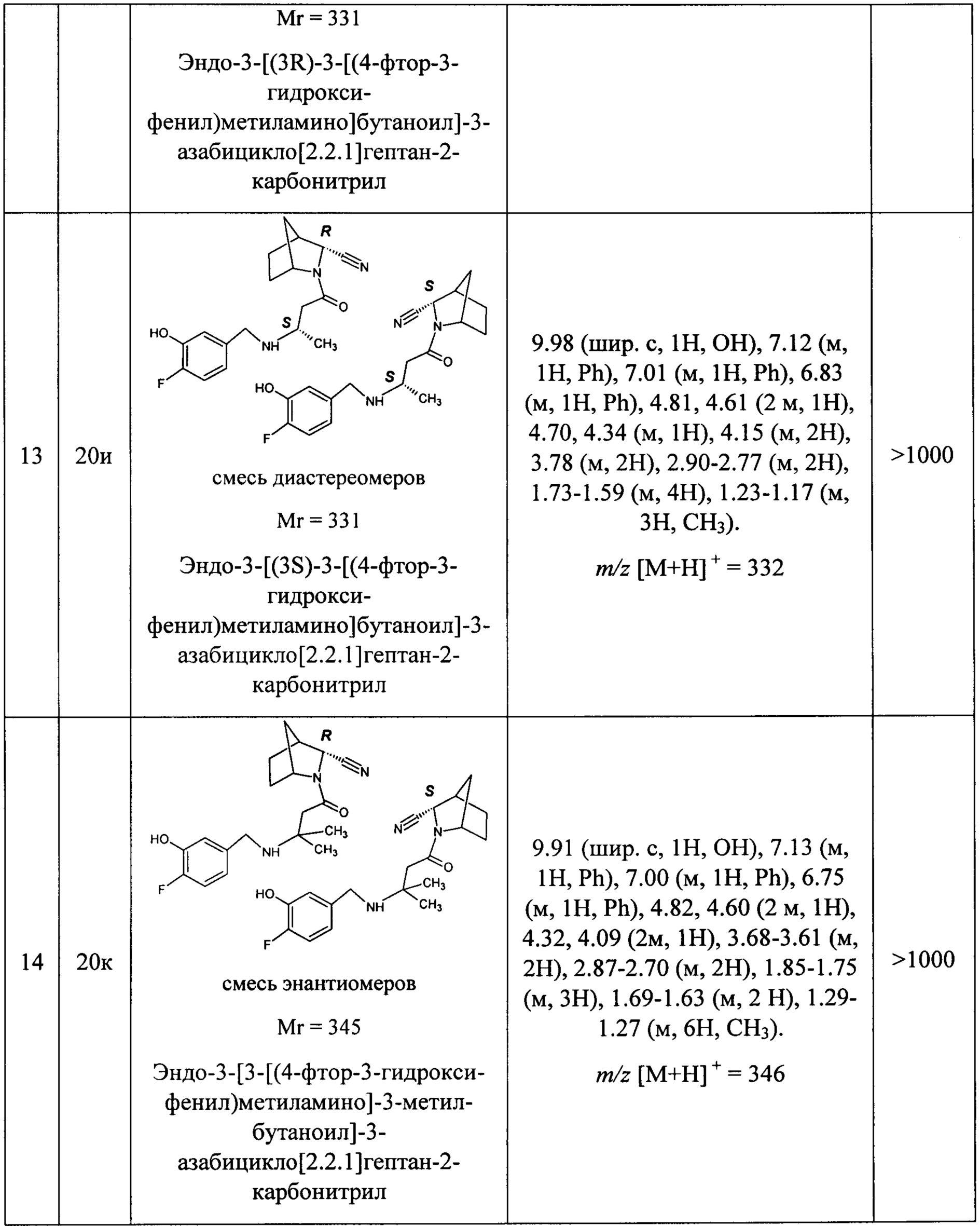


Условия проведения анализа: колонка - Onix С18 50×4.6 мм; элюент 1 - 0.1% TFA в воде; элюент 2 - 0.1% TFA в ацетонитриле, градиент - элюент 1 - 2.9 мин, элюент 2 - 0.2 мин, элюент 1 - промывка, скорость потока - 3.75 мл/мин, детекция - УФ (254 нм) и масс-спектрометрия.Analysis conditions: column - Onix C18 50 × 4.6 mm; eluent 1 - 0.1% TFA in water; eluent 2 - 0.1% TFA in acetonitrile, gradient - eluent 1 - 2.9 min, eluent 2 - 0.2 min, eluent 1 - washing, flow rate - 3.75 ml / min, detection - UV (254 nm) and mass spectrometry.
Были также разработаны методы получения индивидуальных диастереомеров целевых соединений.Methods have also been developed to produce the individual diastereomers of the target compounds.
Метод Г (кристаллизация).Method D (crystallization).
Индивидуальные диастереомеры 15ж-1 и 15ж-2 были получены из изомерной смеси 15ж последовательной 5-кратной кристаллизацией из смеси DCM/Et2O. Удаление защитной группы (метод Б) в 15ж-1 и 15ж-2 приводило к целевым диастереомерно чистым продуктам 17ж-1 и 17ж-2 (структуры в таблице 2).Individual diastereomers 15zh-1 and 15zh-2 were obtained from the isomer mixture 15zh by sequential 5-fold crystallization from a mixture of DCM / Et 2 O. Removal of the protective group (method B) in 15zh-1 and 15zh-2 led to the target diastereomerically pure products 17zh -1 and 17g-2 (structure in table 2).

Метод Д (колоночная хроматография на силикагеле).Method D (column chromatography on silica gel).
Индивидуальные диастереомеры 34а-1 и 34а-2 были получены из изомерной смеси 34а колоночной хроматографией на силикагеле в элюенте 1:1->2:1 Et2O/н-гексан. Удаление защитной группы (метод В) в 34а-1 и 34а-2 приводило к целевым диастереомерно чистым продуктам 36а-1 и 36а-2 (структуры в таблице 2).The individual diastereomers 34a-1 and 34a-2 were obtained from the isomeric mixture 34a by column chromatography on silica gel in the eluent 1: 1-> 2: 1 Et 2 O / n-hexane. Removal of the protective group (method B) in 34a-1 and 34a-2 led to the desired diastereomerically pure products 36a-1 and 36a-2 (structure in table 2).

Метод Е (стереоспецифичный синтез энантиомерно чистого экзо-3-азабицикло[2.2.1]гептан-2-карбонитрила 7а-1.Method E (stereospecific synthesis of enantiomerically pure exo-3-azabicyclo [2.2.1] heptane-2-carbonitrile 7a-1.
Синтез энантиомерно чистого (S)-экзо-3-азабицикло[2.2.1]гептан-2-карбонитрила 7а-1 был осуществлен согласно схеме:The synthesis of enantiomerically pure (S) -exo-3-azabicyclo [2.2.1] heptane-2-carbonitrile 7a-1 was carried out according to the scheme:

Процедура синтеза (S)-экзо-3-азабицикло[2.2.1]гептан-2-карбонитрила 7а-1.The synthesis procedure of (S) -exo-3-azabicyclo [2.2.1] heptane-2-carbonitrile 7a-1.
Этил-(2S,3S)-3-(1-фенилэтил)-3-азабицикло [2.2.1]гепт-5-ен-2-карбоксилат (39)Ethyl (2S, 3S) -3- (1-phenylethyl) -3-azabicyclo [2.2.1] hept-5-en-2-carboxylate (39)
В литровую колбу поместили 50%-ный раствор этилглиоксилата в толуоле (19.6 мл, 0.096 моль), толуол (300 мл) и бензиламин 38 (10.3 мл, 0.08 моль), перемешивали в течении 2 часов до выделения воды, затем воду удалили при помощи сульфата натрия и растворитель упарили. Полученный остаток растворили в диметилформамиде (100 мл), прибавили при охлаждении в ледяной бане раствор трифторуксусной кислоты (6.12 мл, 0.08 моль) в диметилформамиде. Перемешивали реакционную смесь при комнатной температуре в течение 1 часа. Затем при охлаждении в ледяной бане одной порцией прибавили свежеперегнанный циклопентадиен (10.6 г, 0.16 моль). Выдержали реакционную смесь 24 часа при комнатной температуре.A 50% solution of ethyl glyoxylate in toluene (19.6 ml, 0.096 mol), toluene (300 ml) and benzylamine 38 (10.3 ml, 0.08 mol) were placed in a 1-liter flask, stirred for 2 hours until water was separated, then the water was removed using sodium sulfate and the solvent was evaporated. The resulting residue was dissolved in dimethylformamide (100 ml), a solution of trifluoroacetic acid (6.12 ml, 0.08 mol) in dimethylformamide was added while cooling in an ice bath. The reaction mixture was stirred at room temperature for 1 hour. Then, while cooling in an ice bath, freshly distilled cyclopentadiene (10.6 g, 0.16 mol) was added in one portion. The reaction mixture was aged for 24 hours at room temperature.
Через 24 часа реакционную смесь разбавили 400 мл 10%-ного раствора поташа при охлаждении в ледяной бане, экстрагировали этилацетатом 3 раза по 100 мл, органический слой высушили сульфатом натрия и упарили при температуре бани не выше 30°С. Колоночной хроматографией на силикагеле в системе этилацетат : петролейный фир 1:10 выделили 8.1 г (0.0299 моль) чистой фракции экзо-изомера 39. Выход 37.3%.After 24 hours, the reaction mixture was diluted with 400 ml of a 10% solution of potash while cooling in an ice bath, extracted with ethyl acetate 3 times in 100 ml, the organic layer was dried with sodium sulfate and evaporated at a bath temperature not exceeding 30 ° C. Column chromatography on silica gel in an ethyl acetate: petroleum firm 1:10 system gave 8.1 g (0.0299 mol) of the pure fraction of exo-isomer 39. Yield 37.3%.
(2S)-3-трет-бутоксикарбонил-3-азабицикло[2.2.1]гептен-2-карбоновой кислоты этиловый эфир (3а-1).(2S) -3-tert-butoxycarbonyl-3-azabicyclo [2.2.1] heptene-2-carboxylic acid ethyl ester (3a-1).
В 200 мл бензола растворили экзо-изомер 39 (8.1 г, 0.0299 моль) и прибавили трис(трифенилфосфин)родийхлорид (0.405 г, 5% масс). Гидрировали на аппарате Парра при 20psi до прекращения поглощения водорода (около 4 часов). По данным LCMS контролировали полноту протекания гидрирования. После окончания реакции раствор пропустили через слой силикагеля, смывая продукт системой этилацетат : петролейный эфир 1:4. Полученный раствор упарили, добавили 200 мл этанола, 5%-ный Pd на угле (0.8 г) и Бок-ангидрид (6.9 г, 0.0316 моль). Далее гидрировали при 20psi на аппарате Парра. Контроль полноты реакции осуществляли методом LCMS. Полученную реакционную смесь использовали в следующей стадии.Exo-isomer 39 (8.1 g, 0.0299 mol) was dissolved in 200 ml of benzene, and tris (triphenylphosphine) rhodium chloride (0.405 g, 5% mass) was added. It was hydrogenated on a Parr apparatus at 20psi until hydrogen uptake ceased (about 4 hours). According to LCMS, the completeness of the hydrogenation was monitored. After the completion of the reaction, the solution was passed through a layer of silica gel, washing off the product with the ethyl acetate: petroleum ether 1: 4 system. The resulting solution was evaporated, 200 ml of ethanol, 5% Pd on charcoal (0.8 g) and Bock anhydride (6.9 g, 0.0316 mol) were added. It was then hydrogenated at 20psi on a Parr apparatus. The completeness of the reaction was monitored by LCMS. The resulting reaction mixture was used in the next step.
(2S)-3-трет-бутоксикарбонил-3-азабицикло[2.2.1]гептен-2-карбоновая кислота (4а-1)(2S) -3-tert-butoxycarbonyl-3-azabicyclo [2.2.1] heptene-2-carboxylic acid (4a-1)
Этанольный раствор Бок-эфира экзо-изомера 3а-1 с предыдущей стадии после завершения гидрирования отфильтровали от катализатора и прибавили к нему 50 мл (0.075 моль) водного раствора гидроксида натрия. Полученный раствор нагревали 1 час при 60°С. После полной конверсии эфира (контроль тсх) упарили этанол, растворили остаток в воде, подкислили раствор 2М соляной кислотой до рН 3, экстрагировали продукт этилацетатом, промыли органические вытяжки водой, высушили сульфатом натрия и упарили. Продукт перекристаллизовывали из гексана. Получили 5.42 г (0.022 моль) экзо-кислоты 4а-1. Выход составил 90%. Далее использовали этот продукт без дополнительной очистки.The ethanol solution of Bock ester of exo-isomer 3a-1 from the previous stage, after completion of hydrogenation, was filtered off from the catalyst and 50 ml (0.075 mol) of an aqueous solution of sodium hydroxide was added to it. The resulting solution was heated for 1 hour at 60 ° C. After complete ether conversion (TLC control), ethanol was evaporated, the residue was dissolved in water, the solution was acidified with 2M hydrochloric acid to pH 3, the product was extracted with ethyl acetate, the organic extracts were washed with water, dried with sodium sulfate and evaporated. The product was recrystallized from hexane. 5.42 g (0.022 mol) of exo acid 4a-1 were obtained. The yield was 90%. Further, this product was used without further purification.
(2S)-Экзо-трет-бутил-3-карбамоил-2-азабицикло[2.2.1]гептан-2-карбоксилат (5а-1)(2S) -Exo-tert-butyl-3-carbamoyl-2-azabicyclo [2.2.1] heptane-2-carboxylate (5a-1)
К раствору исходной кислоты 4а-1 (5.42 г) в сухом ТГФ при охлаждении до -20°С в атмосфере аргона добавляли триэтиламин 3.45 мл (2.5 г) затем по каплям добавляли этилхлорформиат (2.68 г, 0.0247 моль) в течение 10 мин. Выдерживали реакционную смесь при охлаждении в течение 40 мин. Затем пропускали аммиак из баллона 1 ч. Упарили ТГФ, обработали остаток раствором лимонной кислоты до рН 4, экстрагировали этилацетатом, этилацетатные экстракты промывали раствором соды, сушили сульфатом натрия и концентрировали. Получили 5.29 г бесцветного кристаллического остатка 5а-1. Выход количественный.Triethylamine 3.45 ml (2.5 g) was added to a solution of the starting acid 4a-1 (5.42 g) in dry THF under cooling to -20 ° С in an argon atmosphere, then ethyl chloroformate (2.68 g, 0.0247 mol) was added dropwise over 10 min. The reaction mixture was kept under cooling for 40 minutes. Then ammonia was passed from the cylinder for 1 h. THF was evaporated, the residue was treated with a solution of citric acid to pH 4, extracted with ethyl acetate, the ethyl acetate extracts were washed with a solution of soda, dried with sodium sulfate and concentrated. Received 5.29 g of a colorless crystalline residue 5A-1. The output is quantitative.
(2S)-Экзо-третбутил-3-циано-2-азабицикло[2.2.1]гептан-2-карбоксилат (6а-1)(2S) -Exo-tert-butyl-3-cyano-2-azabicyclo [2.2.1] heptane-2-carboxylate (6a-1)
К суспензии исходного амида 5а-1 (5.29 г) в сухом ТГФ, при температуре не выше 4°С добавляли 2 эквивалента триэтиламина (6.13 мл, 4.45 г), ангидрид трифторуксусной кислоты (6.93 г, 0.033 моль) в течение 10 минут, по ТСХ контролировали степень протекания реакции. Реакционную смесь выдерживали при охлаждении в течение 3 часов. Реакционную смесь упаривали, наносили на силикагель и разделяли на хроматографической колонке. Элюент - смесь петролейный эфир : этилацетат 4:1. Получили 4.29 г (87%) целевого нитрила 6а-1 в виде бледно-желтого густого маслообразного вещества.To a suspension of the starting amide 5a-1 (5.29 g) in dry THF, at a temperature not exceeding 4 ° С, 2 equivalents of triethylamine (6.13 ml, 4.45 g), trifluoroacetic anhydride (6.93 g, 0.033 mol) were added over 10 minutes, each TLC monitored the extent of the reaction. The reaction mixture was allowed to cool for 3 hours. The reaction mixture was evaporated, applied to silica gel and separated on a chromatographic column. The eluent is a mixture of petroleum ether: ethyl acetate 4: 1. Received 4.29 g (87%) of the target nitrile 6a-1 in the form of a pale yellow thick oily substance.
(2S)-Экзо-2-азабицикло[2.2.1]гептан-3-карбонитрил (7а-1)(2S) -Exo-2-azabicyclo [2.2.1] heptane-3-carbonitrile (7a-1)
К исходному БОК-нитрилу 6а-1 (4.29 г, 0.019 моль) в 30 мл ацетонитрила добавили двукратный избыток n-толилсульфоновой кислоты (ПТСК) (6.54 г, 0.038 моль) и оставили перемешиваться на ночь. Отгоняли ацетонитрил, остаток растирали с диэтиловым эфиром (3-4 обработки с декантацией). Упаривали эфир. Получили 4.58 г кристаллического целевого вещества 7а-1.To the initial BOC nitrile 6a-1 (4.29 g, 0.019 mol) in 30 ml of acetonitrile was added a twofold excess of n-tolylsulfonic acid (PTSK) (6.54 g, 0.038 mol) and allowed to mix overnight. Acetonitrile was distilled off, the residue was triturated with diethyl ether (3-4 decantation treatments). The ether was evaporated. Received 4.58 g of crystalline target substance 7a-1.
трет-бутил-N-[(1R)-3-[(2S)-2-циано-3-азабицикло[2.2.1]гептан-3-ил]-3-оксо-1-[(2,4,5-трифторфенил)метил]пропил]карбамат (15ж-1) (получали из энантиомерно чистого (S)-экзо-изомера 3-азабицикло[2.2.1]гептан-2-карбонитрила 7а-1, аналогично 7а.tert-butyl-N - [(1R) -3 - [(2S) -2-cyano-3-azabicyclo [2.2.1] heptan-3-yl] -3-oxo-1 - [(2,4,5 trifluorophenyl) methyl] propyl] carbamate (15g-1) (obtained from the enantiomerically pure (S) -exo isomer of 3-azabicyclo [2.2.1] heptane-2-carbonitrile 7a-1, similar to 7a.
К раствору кислоты 14ж (5.19 г, 0.0156 моль) в 60 мл дихлорметана прибавили ВОР (8.27 г, 0.0187 моль) и триэтиламин (4.74 мл, 0.0468 моль, 3 экв.). Через 15 минут при комнатной температуре прибавили тозилат амина 7а-1 (4.57 г, 0.0156 моль). Через 2 часа LCMS показала полную конверсию. Дихлорметан упарили, остаток растворили в этилацетате и промыли 10%-ным раствором поташа, затем водой, высушили сульфатом натрия и упарили. Добавили к остатку небольшое количество петролейного эфира и выкристаллизовавшийся продукт отфильтровали. Получили 5.08 г кристаллов 15ж-1. Выход 75%To a solution of acid 14g (5.19 g, 0.0156 mol) in 60 ml of dichloromethane were added BOP (8.27 g, 0.0187 mol) and triethylamine (4.74 ml, 0.0468 mol, 3 equiv.). After 15 minutes, amine tosylate 7a-1 (4.57 g, 0.0156 mol) was added at room temperature. After 2 hours, LCMS showed complete conversion. Dichloromethane was evaporated, the residue was dissolved in ethyl acetate and washed with 10% potash solution, then with water, dried with sodium sulfate and evaporated. A small amount of petroleum ether was added to the residue, and the crystallized product was filtered. Received 5.08 g of crystals 15zh-1. Yield 75%
(2S)-3-[(3R)-3-амино-4-(2,4,5-трифторфенил)бутаноил]-3-азабицикло[2.2.1]гептен-2-карбонитрил (17ж-1)(2S) -3 - [(3R) -3-amino-4- (2,4,5-trifluorophenyl) butanoyl] -3-azabicyclo [2.2.1] heptene-2-carbonitrile (17zh-1)
Для дебокирования суспендировали бок-производное 15ж-1 (5.08 г) в 100 мл ацетонитрила и прибавили двукратный избыток гидрата толуолсульфокислоты (4.02 г, 0.0234 моль). Перемешивали ночь при комнатной температуре. Отфильтровали осадок и промыли малым количеством ацетонитрила. Получили 5.18 г тозилата продукта 17ж-1. Выход 87%For debocking, the side derivative 15zh-1 (5.08 g) was suspended in 100 ml of acetonitrile and a twofold excess of toluenesulfonic acid hydrate (4.02 g, 0.0234 mol) was added. Stirred overnight at room temperature. The precipitate was filtered off and washed with a small amount of acetonitrile. Received 5.18 g of tosylate product 17zh-1. Yield 87%
Синтез перечисленных ниже диастереомерно (или энантиомерно) чистых целевых соединений (структуры в таблице 2) осуществляли аналогично 17ж-1:The synthesis of the following diastereomerically (or enantiomerically) pure target compounds (structures in table 2) was carried out similarly to 17g-1:
17ж-1, 17з-1, 17и-1 - из энантиомерно чистого (S)-экзо-изомера 3-азабицикло[2.2.1]гептан-2-карбонитрила 7а-1.17g-1, 17z-1, 17i-1 - from the enantiomerically pure (S) -exo isomer of 3-azabicyclo [2.2.1] heptane-2-carbonitrile 7a-1.
17к-1 - из энантиомерно чистого (S)-экзо-изомера 3-азабицикло[2.2.1]гептан-2-карбонитрила 7а-1.17k-1 - from the enantiomerically pure (S) -exo isomer of 3-azabicyclo [2.2.1] heptane-2-carbonitrile 7a-1.
17ж-2 - из энантиомерно чистого (R)-экзо-изомера 3-азабицикло[2.2.1]гептан-2-карбонитрила 7а-2.17g-2 - from the enantiomerically pure (R) -exo isomer of 3-azabicyclo [2.2.1] heptane-2-carbonitrile 7a-2.
26а-1, 26в-1, 26г-1 и 26д-1 - из диастереомерно чистого 15ж-1.26a-1, 26v-1, 26g-1 and 26d-1 - from diastereomerically pure 15zh-1.
36а-1, 36б-1, 36в-1 и 36г-1 - из энантиомерно чистой кислоты 4а-1.36a-1, 36b-1, 36b-1 and 36g-1 are from enantiomerically pure acid 4a-1.
В таблице 2 представлены структуры полученных соединений, названия, аналитические характеристики и показатели ДПП-4 ингибирующей активности (IC50) целевых продуктов - индивидуальных диастереомеров или энантиомеров.Table 2 presents the structures of the obtained compounds, names, analytical characteristics and indicators of DPP-4 inhibitory activity (IC 50 ) of the target products — individual diastereomers or enantiomers.


Условия проведения анализа: колонка - Onix С18 50×4.6 мм; элюент 1 - 0.1% TFA в воде; элюент 2-0.1% TFA в ацетонитриле, градиент - элюент 1 - 2.9 мин, элюент 2 - 0.2 мин, элюент 1 - промывка, скорость потока - 3.75 мл/мин, детекция - УФ (254 нм) и масс-спектрометрия.Analysis conditions: column - Onix C18 50 × 4.6 mm; eluent 1 - 0.1% TFA in water; eluent 2-0.1% TFA in acetonitrile, gradient - eluent 1 - 2.9 min, eluent 2 - 0.2 min, eluent 1 - washing, flow rate - 3.75 ml / min, detection - UV (254 nm) and mass spectrometry.
Структурным элементом молекул всех полученных ингибиторов ДПП-4 является слабоосновная функциональная аминогруппа аминокислотного фрагмента. Специалисту среднего уровня понятно, что все вещества могут быть получены, как в виде бессолевых форм (свободного основания), так и солевых форм с противоионами кислотной природы - такие как:The structural element of the molecules of all the obtained DPP-4 inhibitors is the weakly basic functional amino group of the amino acid fragment. A mid-level specialist understands that all substances can be obtained both in the form of salt-free forms (free bases) and salt forms with counterions of an acidic nature - such as:
ацетат, аспартат, бензилсульфонат, бензоат, бикарбонат, тартрат, глутамат, гликолат, сахаринат, гексаноат, гексилрезорцинат, мукат, напсилат, нитрат, октаноат, олеат, памоат, пантотенат, фосфат/дигидрофосфат, камсилат, карбонат, изетионат, гидрохлорид, полилактоуронат, пропионат, цитрат, гидрохлорид, лактат, салицилат, стеарат, малат, деканоат, малеат, мезилат, сульфат, фумарат, малеат, тозилат, метилсульфат, глюконат и др.acetate, aspartate, benzyl sulfonate, benzoate, bicarbonate, tartrate, glutamate, glycolate, saccharinate, hexanoate, hexylresorcinate, mucate, napsilate, nitrate, octanoate, oleate, pamoate, pantothenate, phosphate / dihydrogen phosphate, ischlorate, camsylate, propionate, citrate, hydrochloride, lactate, salicylate, stearate, malate, decanoate, maleate, mesylate, sulfate, fumarate, maleate, tosylate, methyl sulfate, gluconate, etc.
Бессолевые формы могут быть получены выделением свободного основания после нейтрализации солевых форм, образующихся в результате удаления БОК-защитной группы.Salt-free forms can be obtained by isolating the free base after neutralizing the salt forms resulting from the removal of the BOC-protecting group.
Солевые формы могут быть получены в результате:Salt forms can be obtained as a result of:
- удаления БОК-защитной группы:- removal of the BOC-protecting group:
- n-толуолсульфокислотой в органических растворителях,- n-toluenesulfonic acid in organic solvents,
- соляной кислотой в спиртовых или водных средах,- hydrochloric acid in alcoholic or aqueous media,
- раствором хлористого водорода (HCl) в диоксане,- a solution of hydrogen chloride (HCl) in dioxane,
- трифторуксусной кислотой в органических растворителях;- trifluoroacetic acid in organic solvents;
- добавления к свободным основаниям (бессолевым формам) кислот из числа перечисленных выше;- additions to the free bases (salt-free forms) of the acids listed above;
- солевым обменом кислот из числа перечисленных выше.- salt metabolism of the acids listed above.
Исследование ДПП-4-ингибирующей активности синтезированных соединений.The study of DPP-4-inhibitory activity of the synthesized compounds.
Ингибирующую активность синтезированных образцов в отношении ДПП-4 проводили в сравнении активности в отсутствии и в присутствии в системе анализируемого образца (субстрата). Оценку осуществляли флуоресцентным методом с использованием сертифицированного набора реагентов (Kit-ы) «Dipeptidyl peptidase IV Inhibitor Screening Assay Kit (ab 133081)». Все манипуляции проводили в полном соответствии с инструкцией к набору. Каждое вещество проанализировано в диапазоне концентраций от 10-4 до 10-11 М, в диапазоне флуоресценции 450-465 нм.The inhibitory activity of the synthesized samples against DPP-4 was performed by comparing the activity in the absence and presence in the system of the analyzed sample (substrate). Evaluation was carried out by a fluorescence method using a certified reagent kit (Kit) “Dipeptidyl peptidase IV Inhibitor Screening Assay Kit (ab 133081)”. All manipulations were carried out in full accordance with the instructions for the set. Each substance was analyzed in the concentration range from 10 -4 to 10 -11 M, in the fluorescence range of 450-465 nm.
Поставленная задача заявляемого изобретения - создание ингибиторов дипептидилпептидазы-4, устойчивых к внутримолекулярной циклизации, для лечения больных сахарным диабетом 2-ого типа и расширение линейки известных ингибиторов дипептидилпептидазы-4 решена за счет создания ряда ингибиторов дипептидилпептидазы-4, устойчивых к внутримолекулярной циклизации за счет как введения в пирролидиновый фрагмент стерического фактора, препятствующего циклизации, так и введением заместителей, при которых циклизация невозможна.The task of the claimed invention is the creation of dipeptidyl peptidase-4 inhibitors resistant to intramolecular cyclization for the treatment of patients with type 2 diabetes mellitus and the expansion of the line of known dipeptidyl peptidase-4 inhibitors is solved by creating a number of dipeptidyl peptidase-4 inhibitors resistant to intramolecular cyclization introducing into the pyrrolidine fragment a steric factor that prevents cyclization, and introducing substituents in which cyclization is impossible.
Задача решена путем синтеза и исследования перечисленных в таблицах 1 и 2 соединений. В результате исследований было обнаружено, что все соединения проявляют ингибирующий эффект по отношению к ДПП-4, при этом наиболее активными оказались соединения: экзо-(2S)-3-[(3R)-3-амино-4-(2,4,5-трифторфенил)бутаноил]-3-азабицикло[2.2.1]гептан-2-карбонитрил (17ж-1), экзо-(3R)-3-амино-1-[(2S)-2-(5-фенил-1,2,4-оксадиазол-3-ил)-3-азабицикло[2.2.1]гептан-3-ил]-4-(2,4,5-трифторфенил)бутан-1-он (26а-1), и экзо-(3R)-3-амино-1-[(2S)-2-(3-фенил-1,2,4-оксадиазол-5-ил)-3-азабицикло [2.2.1]гептан-3-ил]-4-(2,4,5-трифторфенил)бутан-1-он (36а-1).The problem is solved by synthesis and research of the compounds listed in tables 1 and 2. As a result of studies, it was found that all compounds exhibit an inhibitory effect against DPP-4, while the most active were compounds: exo (2S) -3 - [(3R) -3-amino-4- (2,4, 5-trifluorophenyl) butanoyl] -3-azabicyclo [2.2.1] heptane-2-carbonitrile (17zh-1), exo (3R) -3-amino-1 - [(2S) -2- (5-phenyl- 1,2,4-oxadiazol-3-yl) -3-azabicyclo [2.2.1] heptan-3-yl] -4- (2,4,5-trifluorophenyl) butan-1-one (26a-1), and exo (3R) -3-amino-1 - [(2S) -2- (3-phenyl-1,2,4-oxadiazol-5-yl) -3-azabicyclo [2.2.1] heptane-3- yl] -4- (2,4,5-trifluorophenyl) butan-1-one (36a-1).
Промышленная применимость доказана и подтверждена примерами синтеза и анализа полученных веществ.Industrial applicability is proved and confirmed by examples of synthesis and analysis of the obtained substances.
Список сокращений.List of abbreviations.
СД - сахарный диабетDiabetes mellitus
СМ - сульфонилмочевинаCM - sulfonylurea
ДПП-4 - дипептидилпептидаза-4DPP-4 - dipeptidyl peptidase-4
ГИП - гастроингибиторньй пептидISU - gastroinhibitory peptide
ЖИП - желудочный ингибиторный пептидGIP - gastric inhibitory peptide
ГПП-1 - глюкагон-подобный пептид-1GLP-1 - glucagon-like peptide-1
Ala - аланинAla - Alanine
STAB - натрий триацетоксиборгидридSTAB - Sodium Triacetoxyborohydride
DCM - дихлорметан (хлористый метилен)DCM - Dichloromethane (methylene chloride)
МеОН - метанолMeOH - methanol
EtOH - этанолEtOH - Ethanol
CHCl - хлороформCHCl - chloroform
п-ТСК - пара-толуолсульфокислотаp-TSC - para-toluenesulfonic acid
NH2OH×HCl - гидроксиламина гидрохлоридNH 2 OH × HCl - Hydroxylamine Hydrochloride
К2СО3 - калия карбонат (поташ)K 2 CO 3 - potassium carbonate (potash)
HCl - хлористый водородHCl - hydrogen chloride
МТБЕ - метил-трет-бутиловый эфирMTBE - methyl tert-butyl ether
NaOH - натрия гидроксидNaOH - sodium hydroxide
ПЭ - петролейный эфирPE - petroleum ether
EtOAc - этилацетатEtOAc - Ethyl Acetate
ТГФ - тетрагидрофуранTHF - tetrahydrofuran
ТЭА - триэтиламинTEA - triethylamine
Pd/C - палладий на углеPd / C - Palladium on carbon
DIC - диизопропилкарбодиимидDIC - diisopropylcarbodiimide
Et2O - диэтиловый эфирEt 2 O - diethyl ether
TFA - трифторуксусная кислотаTFA - trifluoroacetic acid
NaHCO3 - натрия гидрокарбонатNaHCO 3 - sodium bicarbonate
DIPEA - диизопропилэтиламинDIPEA - Diisopropylethylamine
Na2SO4 - натрия сульфатNa 2 SO 4 - sodium sulfate
ВОР - бензотриазол-1-илокси-трис(диметиламино)фосфоний гексафторфосфатBOP - benzotriazol-1-yloxy-tris (dimethylamino) phosphonium hexafluorophosphate
ТСХ - тонкослойная хроматографияTLC - thin layer chromatography
LC/MS - высокоэффективная жидкостная хроматография с масс-детекциейLC / MS - High Performance Liquid Chromatography with Mass Detection
ЯМР - ядерный магнитный резонансNMR - nuclear magnetic resonance
DMSO - диметилсульфоксидDMSO - Dimethyl Sulfoxide
Mr - молекулярная массаMr - molecular weight
IC50 - концентрация ингибитора, при которой соответствующий биологический процесс в условиях in vitro ингибирован на 50%IC 50 - inhibitor concentration at which the corresponding biological process in vitro is inhibited by 50%
шир. - широкийshir - wide
с - синглетs - singlet
д - дуплетd - doublet
м - мультиплетm - multiplet
Claims (144)


Priority Applications (3)
| Application Number | Priority Date | Filing Date | Title |
|---|---|---|---|
| RU2018134266A RU2712097C1 (en) | 2018-09-28 | 2018-09-28 | Dipeptidyl peptidase-4 inhibitor for treating type 2 diabetes mellitus, compounds (versions) |
| PCT/RU2019/000686 WO2020067930A1 (en) | 2018-09-28 | 2019-09-27 | Compounds for treating type 2 diabetes |
| CN201980078861.2A CN113166149B (en) | 2018-09-28 | 2019-09-27 | Compounds used to treat type II diabetes |
Applications Claiming Priority (1)
| Application Number | Priority Date | Filing Date | Title |
|---|---|---|---|
| RU2018134266A RU2712097C1 (en) | 2018-09-28 | 2018-09-28 | Dipeptidyl peptidase-4 inhibitor for treating type 2 diabetes mellitus, compounds (versions) |
Publications (1)
| Publication Number | Publication Date |
|---|---|
| RU2712097C1 true RU2712097C1 (en) | 2020-01-24 |
Family
ID=69184092
Family Applications (1)
| Application Number | Title | Priority Date | Filing Date |
|---|---|---|---|
| RU2018134266A RU2712097C1 (en) | 2018-09-28 | 2018-09-28 | Dipeptidyl peptidase-4 inhibitor for treating type 2 diabetes mellitus, compounds (versions) |
Country Status (3)
| Country | Link |
|---|---|
| CN (1) | CN113166149B (en) |
| RU (1) | RU2712097C1 (en) |
| WO (1) | WO2020067930A1 (en) |
Cited By (1)
| Publication number | Priority date | Publication date | Assignee | Title |
|---|---|---|---|---|
| RU2727898C1 (en) * | 2020-02-25 | 2020-07-24 | Общество с ограниченной ответственностью «Необиотек» | Pharmaceutical composition based on an active substance, an inhibitor of dipeptidyl peptidase-4, for preventing the development and treatment of type 2 diabetes mellitus |
Families Citing this family (1)
| Publication number | Priority date | Publication date | Assignee | Title |
|---|---|---|---|---|
| EP4361148A4 (en) * | 2021-06-25 | 2025-07-09 | Albius Sciences Alpha Private Ltd | Heterocycloalkyl-substituted polyheteroazole derivative as a medicinal product for the treatment and/or prevention of infectious diseases caused by the RS virus |
Citations (2)
| Publication number | Priority date | Publication date | Assignee | Title |
|---|---|---|---|---|
| WO2007113634A1 (en) * | 2006-04-03 | 2007-10-11 | Matrix Laboratories Ltd. | Novel dipeptidyl peptidase iv inhibitors and processes for their preparation and pharmaceutical compositions containing them |
| RU2483716C2 (en) * | 2005-09-29 | 2013-06-10 | Новартис Аг | Novel composition |
Family Cites Families (5)
| Publication number | Priority date | Publication date | Assignee | Title |
|---|---|---|---|---|
| DE3246757A1 (en) * | 1982-12-17 | 1984-06-20 | Hoechst Ag, 6230 Frankfurt | NEW 2-AZABICYCLO (2.2.1) HEPTAN DERIVATIVES, METHOD FOR THE PRODUCTION THEREOF, THEIR SUBSTANCES AND THE USE THEREOF, AND 2-AZABICYCLO (2.2.1) HEPTAN DERIVATIVES AS INTERMEDIATE PRODUCTS AND METHOD FOR THE PRODUCTION THEREOF |
| US6395767B2 (en) * | 2000-03-10 | 2002-05-28 | Bristol-Myers Squibb Company | Cyclopropyl-fused pyrrolidine-based inhibitors of dipeptidyl peptidase IV and method |
| US7741082B2 (en) * | 2004-04-14 | 2010-06-22 | Bristol-Myers Squibb Company | Process for preparing dipeptidyl peptidase IV inhibitors and intermediates therefor |
| GB0413389D0 (en) * | 2004-06-16 | 2004-07-21 | Astrazeneca Ab | Chemical compounds |
| RU2628573C2 (en) * | 2015-11-27 | 2017-08-21 | Общество с ограниченной ответственностью "Аллель Центр Инновационных Биотехнологий" | Dipeptidyl peptidase-4 inhibitor for treatment of type 2 diabetes |
-
2018
- 2018-09-28 RU RU2018134266A patent/RU2712097C1/en active
-
2019
- 2019-09-27 CN CN201980078861.2A patent/CN113166149B/en active Active
- 2019-09-27 WO PCT/RU2019/000686 patent/WO2020067930A1/en not_active Ceased
Patent Citations (2)
| Publication number | Priority date | Publication date | Assignee | Title |
|---|---|---|---|---|
| RU2483716C2 (en) * | 2005-09-29 | 2013-06-10 | Новартис Аг | Novel composition |
| WO2007113634A1 (en) * | 2006-04-03 | 2007-10-11 | Matrix Laboratories Ltd. | Novel dipeptidyl peptidase iv inhibitors and processes for their preparation and pharmaceutical compositions containing them |
Cited By (2)
| Publication number | Priority date | Publication date | Assignee | Title |
|---|---|---|---|---|
| RU2727898C1 (en) * | 2020-02-25 | 2020-07-24 | Общество с ограниченной ответственностью «Необиотек» | Pharmaceutical composition based on an active substance, an inhibitor of dipeptidyl peptidase-4, for preventing the development and treatment of type 2 diabetes mellitus |
| WO2021173036A1 (en) * | 2020-02-25 | 2021-09-02 | Общество с ограниченной ответственностью "Необиотек" | Pharmaceutical composition based on dipeptidyl peptidase-4 inhibitor |
Also Published As
| Publication number | Publication date |
|---|---|
| CN113166149B (en) | 2024-02-23 |
| WO2020067930A1 (en) | 2020-04-02 |
| CN113166149A (en) | 2021-07-23 |
Similar Documents
| Publication | Publication Date | Title |
|---|---|---|
| JP6210993B2 (en) | NMDA receptor modulator and use thereof | |
| JP3762407B2 (en) | Β-aminotetrahydroimidazo (1,2-A) pyrazines and tetrahydrotriazolo (4,3-A) pyrazines as dipeptidyl peptidase inhibitors for treating or preventing diabetes | |
| Moulin et al. | Toward potent ghrelin receptor ligands based on trisubstituted 1, 2, 4-triazole structure. 2. Synthesis and pharmacological in vitro and in vivo evaluations | |
| RU2447063C2 (en) | Azabicyclooctane derivatives, method for preparing and using as dipeptidyl peptidase iv inhibitors | |
| Luly et al. | Renin inhibitors. Dipeptide analogs of angiotensinogen utilizing a dihydroxyethylene transition-state mimic at the scissile bond to impart greater inhibitory potency | |
| JP2005500308A (en) | Dipeptidyl peptidase inhibitors for the treatment of diabetes | |
| JP2024517678A (en) | Modulators of sortilin activity | |
| AU2016267872B2 (en) | Heterocyclicalkyl derivative compounds as selective histone deacetylase inhibitors and pharmaceutical compositions comprising the same | |
| KR20150131276A (en) | Dipeptide and tripeptide epoxy ketone protease inhibitors | |
| TW200938530A (en) | Pyrrolidine compounds | |
| CN117642416A (en) | Sortilin activity modulator | |
| JP2018530593A (en) | Combination of atypical antipsychotics and NMDA modulators for the treatment of schizophrenia, bipolar disorder, cognitive impairment and major depressive disorder | |
| JP2008511562A (en) | Hexahydro-pyrazino [1,2-a] pyrimidine-4,7-dione derivatives substituted with amino acids | |
| AU2021201006A1 (en) | N-methyl-D-aspartate receptor modulators and methods of making and using same | |
| RU2712097C1 (en) | Dipeptidyl peptidase-4 inhibitor for treating type 2 diabetes mellitus, compounds (versions) | |
| JP2019513704A (en) | Neuropeptide S receptor (NPSR) agonist | |
| CN102946726B (en) | Novel blood sugar lowing compound | |
| RU2528333C2 (en) | Compounds and methods of treating pain and other diseases | |
| JPH02256658A (en) | Amino acid derivative | |
| Müller‐Hartwieg et al. | Synthesis and conformational investigation of cyclic dipeptides: 7‐membered rings containing α‐and β‐amino acids | |
| US20080070885A1 (en) | Macrocyclic compounds having aspartic protease inhibiting activity and pharmaceutical uses thereof | |
| CN1209363C (en) | Novel bicyclic amino-pyrazino ketone compound, its preparation method and medicinal composition having same | |
| CA3256164A1 (en) | Compounds as nlrp3 inflammasome inhibitors and their use as medicaments | |
| Giordano et al. | Synthesis and activity of HCO–Met–Leu–Phe–OMe analogues containing β-alanine or taurine at the central position | |
| US7772221B2 (en) | Diaminopropane derived macrocycles as inhibitors of β amyloid production |