RU2688526C1 - Use of calcium salts of oxyethylidenediphosphonic acid as a nucleating agent and polypropylene composition obtained using it - Google Patents
Use of calcium salts of oxyethylidenediphosphonic acid as a nucleating agent and polypropylene composition obtained using it Download PDFInfo
- Publication number
- RU2688526C1 RU2688526C1 RU2018127176A RU2018127176A RU2688526C1 RU 2688526 C1 RU2688526 C1 RU 2688526C1 RU 2018127176 A RU2018127176 A RU 2018127176A RU 2018127176 A RU2018127176 A RU 2018127176A RU 2688526 C1 RU2688526 C1 RU 2688526C1
- Authority
- RU
- Russia
- Prior art keywords
- polypropylene
- nucleating agent
- hedp
- salts
- calcium
- Prior art date
Links
- 239000004743 Polypropylene Substances 0.000 title claims abstract description 94
- 229920001155 polypropylene Polymers 0.000 title claims abstract description 94
- -1 polypropylene Polymers 0.000 title claims abstract description 70
- 239000002667 nucleating agent Substances 0.000 title claims abstract description 61
- 239000000203 mixture Substances 0.000 title claims abstract description 50
- 159000000007 calcium salts Chemical class 0.000 title claims abstract description 11
- DBVJJBKOTRCVKF-UHFFFAOYSA-N Etidronic acid Chemical class OP(=O)(O)C(O)(C)P(O)(O)=O DBVJJBKOTRCVKF-UHFFFAOYSA-N 0.000 title abstract description 43
- 229960004585 etidronic acid Drugs 0.000 title abstract description 4
- 150000003839 salts Chemical class 0.000 claims abstract description 38
- 238000001125 extrusion Methods 0.000 claims description 29
- 239000012141 concentrate Substances 0.000 claims description 20
- CJZGTCYPCWQAJB-UHFFFAOYSA-L calcium stearate Chemical compound [Ca+2].CCCCCCCCCCCCCCCCCC([O-])=O.CCCCCCCCCCCCCCCCCC([O-])=O CJZGTCYPCWQAJB-UHFFFAOYSA-L 0.000 claims description 19
- 235000013539 calcium stearate Nutrition 0.000 claims description 19
- 239000008116 calcium stearate Substances 0.000 claims description 19
- 239000002253 acid Substances 0.000 claims description 7
- BAERPNBPLZWCES-UHFFFAOYSA-N (2-hydroxy-1-phosphonoethyl)phosphonic acid Chemical class OCC(P(O)(O)=O)P(O)(O)=O BAERPNBPLZWCES-UHFFFAOYSA-N 0.000 claims description 6
- 239000002516 radical scavenger Substances 0.000 claims description 3
- 238000002425 crystallisation Methods 0.000 abstract description 14
- 230000000694 effects Effects 0.000 abstract description 4
- 239000000126 substance Substances 0.000 abstract description 4
- OYPRJOBELJOOCE-UHFFFAOYSA-N Calcium Chemical compound [Ca] OYPRJOBELJOOCE-UHFFFAOYSA-N 0.000 description 23
- 238000004519 manufacturing process Methods 0.000 description 23
- 239000000654 additive Substances 0.000 description 16
- 230000008025 crystallization Effects 0.000 description 13
- 239000000243 solution Substances 0.000 description 13
- 229910052751 metal Inorganic materials 0.000 description 12
- 239000002184 metal Substances 0.000 description 12
- 238000000034 method Methods 0.000 description 12
- 150000001875 compounds Chemical class 0.000 description 11
- 239000011575 calcium Substances 0.000 description 10
- 239000008187 granular material Substances 0.000 description 10
- 229920000642 polymer Polymers 0.000 description 10
- 229910052791 calcium Inorganic materials 0.000 description 8
- 230000015572 biosynthetic process Effects 0.000 description 6
- 229920000098 polyolefin Polymers 0.000 description 6
- 150000002739 metals Chemical class 0.000 description 5
- 238000012545 processing Methods 0.000 description 5
- 229920001169 thermoplastic Polymers 0.000 description 5
- OKTJSMMVPCPJKN-UHFFFAOYSA-N Carbon Chemical compound [C] OKTJSMMVPCPJKN-UHFFFAOYSA-N 0.000 description 4
- 239000004594 Masterbatch (MB) Substances 0.000 description 4
- KDLHZDBZIXYQEI-UHFFFAOYSA-N Palladium Chemical compound [Pd] KDLHZDBZIXYQEI-UHFFFAOYSA-N 0.000 description 4
- 230000009918 complex formation Effects 0.000 description 4
- 239000013078 crystal Substances 0.000 description 4
- MUTGBJKUEZFXGO-UHFFFAOYSA-N hexahydrophthalic anhydride Chemical compound C1CCCC2C(=O)OC(=O)C21 MUTGBJKUEZFXGO-UHFFFAOYSA-N 0.000 description 4
- 238000002360 preparation method Methods 0.000 description 4
- 238000003860 storage Methods 0.000 description 4
- 238000003786 synthesis reaction Methods 0.000 description 4
- 239000004416 thermosoftening plastic Substances 0.000 description 4
- XLYOFNOQVPJJNP-UHFFFAOYSA-N water Substances O XLYOFNOQVPJJNP-UHFFFAOYSA-N 0.000 description 4
- FBPFZTCFMRRESA-FSIIMWSLSA-N D-Glucitol Natural products OC[C@H](O)[C@H](O)[C@@H](O)[C@H](O)CO FBPFZTCFMRRESA-FSIIMWSLSA-N 0.000 description 3
- OKKJLVBELUTLKV-UHFFFAOYSA-N Methanol Chemical compound OC OKKJLVBELUTLKV-UHFFFAOYSA-N 0.000 description 3
- TVXBFESIOXBWNM-UHFFFAOYSA-N Xylitol Natural products OCCC(O)C(O)C(O)CCO TVXBFESIOXBWNM-UHFFFAOYSA-N 0.000 description 3
- 230000000996 additive effect Effects 0.000 description 3
- 239000002585 base Substances 0.000 description 3
- 238000006243 chemical reaction Methods 0.000 description 3
- 238000005516 engineering process Methods 0.000 description 3
- 238000000227 grinding Methods 0.000 description 3
- 238000005259 measurement Methods 0.000 description 3
- HEBKCHPVOIAQTA-UHFFFAOYSA-N meso ribitol Natural products OCC(O)C(O)C(O)CO HEBKCHPVOIAQTA-UHFFFAOYSA-N 0.000 description 3
- 239000000600 sorbitol Substances 0.000 description 3
- 239000000811 xylitol Substances 0.000 description 3
- HEBKCHPVOIAQTA-SCDXWVJYSA-N xylitol Chemical compound OC[C@H](O)[C@@H](O)[C@H](O)CO HEBKCHPVOIAQTA-SCDXWVJYSA-N 0.000 description 3
- 229960002675 xylitol Drugs 0.000 description 3
- 235000010447 xylitol Nutrition 0.000 description 3
- KAKZBPTYRLMSJV-UHFFFAOYSA-N Butadiene Chemical compound C=CC=C KAKZBPTYRLMSJV-UHFFFAOYSA-N 0.000 description 2
- 102000005701 Calcium-Binding Proteins Human genes 0.000 description 2
- 108010045403 Calcium-Binding Proteins Proteins 0.000 description 2
- LFQSCWFLJHTTHZ-UHFFFAOYSA-N Ethanol Chemical compound CCO LFQSCWFLJHTTHZ-UHFFFAOYSA-N 0.000 description 2
- 239000006096 absorbing agent Substances 0.000 description 2
- DHKHKXVYLBGOIT-UHFFFAOYSA-N acetaldehyde Diethyl Acetal Natural products CCOC(C)OCC DHKHKXVYLBGOIT-UHFFFAOYSA-N 0.000 description 2
- 239000003513 alkali Substances 0.000 description 2
- 229910001413 alkali metal ion Inorganic materials 0.000 description 2
- 229910001420 alkaline earth metal ion Inorganic materials 0.000 description 2
- 239000003963 antioxidant agent Substances 0.000 description 2
- 238000000149 argon plasma sintering Methods 0.000 description 2
- 239000003054 catalyst Substances 0.000 description 2
- 150000001768 cations Chemical class 0.000 description 2
- 239000003795 chemical substances by application Substances 0.000 description 2
- 238000010276 construction Methods 0.000 description 2
- QSAWQNUELGIYBC-UHFFFAOYSA-N cyclohexane-1,2-dicarboxylic acid Chemical class OC(=O)C1CCCCC1C(O)=O QSAWQNUELGIYBC-UHFFFAOYSA-N 0.000 description 2
- 230000008021 deposition Effects 0.000 description 2
- 238000011161 development Methods 0.000 description 2
- 238000000502 dialysis Methods 0.000 description 2
- 238000009826 distribution Methods 0.000 description 2
- 238000009472 formulation Methods 0.000 description 2
- GTTBQSNGUYHPNK-UHFFFAOYSA-N hydroxymethylphosphonic acid Chemical compound OCP(O)(O)=O GTTBQSNGUYHPNK-UHFFFAOYSA-N 0.000 description 2
- 230000003993 interaction Effects 0.000 description 2
- 238000011835 investigation Methods 0.000 description 2
- 239000000463 material Substances 0.000 description 2
- 229910052763 palladium Inorganic materials 0.000 description 2
- 239000000843 powder Substances 0.000 description 2
- 238000004062 sedimentation Methods 0.000 description 2
- WXMKPNITSTVMEF-UHFFFAOYSA-M sodium benzoate Chemical compound [Na+].[O-]C(=O)C1=CC=CC=C1 WXMKPNITSTVMEF-UHFFFAOYSA-M 0.000 description 2
- 235000010234 sodium benzoate Nutrition 0.000 description 2
- 239000004299 sodium benzoate Substances 0.000 description 2
- 229910001415 sodium ion Inorganic materials 0.000 description 2
- 239000004604 Blowing Agent Substances 0.000 description 1
- BHPQYMZQTOCNFJ-UHFFFAOYSA-N Calcium cation Chemical compound [Ca+2] BHPQYMZQTOCNFJ-UHFFFAOYSA-N 0.000 description 1
- XDTMQSROBMDMFD-UHFFFAOYSA-N Cyclohexane Chemical compound C1CCCCC1 XDTMQSROBMDMFD-UHFFFAOYSA-N 0.000 description 1
- FBPFZTCFMRRESA-JGWLITMVSA-N D-glucitol Chemical compound OC[C@H](O)[C@@H](O)[C@H](O)[C@H](O)CO FBPFZTCFMRRESA-JGWLITMVSA-N 0.000 description 1
- 238000005698 Diels-Alder reaction Methods 0.000 description 1
- UFHFLCQGNIYNRP-UHFFFAOYSA-N Hydrogen Chemical compound [H][H] UFHFLCQGNIYNRP-UHFFFAOYSA-N 0.000 description 1
- DGAQECJNVWCQMB-PUAWFVPOSA-M Ilexoside XXIX Chemical compound C[C@@H]1CC[C@@]2(CC[C@@]3(C(=CC[C@H]4[C@]3(CC[C@@H]5[C@@]4(CC[C@@H](C5(C)C)OS(=O)(=O)[O-])C)C)[C@@H]2[C@]1(C)O)C)C(=O)O[C@H]6[C@@H]([C@H]([C@@H]([C@H](O6)CO)O)O)O.[Na+] DGAQECJNVWCQMB-PUAWFVPOSA-M 0.000 description 1
- WHXSMMKQMYFTQS-UHFFFAOYSA-N Lithium Chemical compound [Li] WHXSMMKQMYFTQS-UHFFFAOYSA-N 0.000 description 1
- FKNQFGJONOIPTF-UHFFFAOYSA-N Sodium cation Chemical compound [Na+] FKNQFGJONOIPTF-UHFFFAOYSA-N 0.000 description 1
- RKFMOTBTFHXWCM-UHFFFAOYSA-M [AlH2]O Chemical compound [AlH2]O RKFMOTBTFHXWCM-UHFFFAOYSA-M 0.000 description 1
- 238000004458 analytical method Methods 0.000 description 1
- 230000000844 anti-bacterial effect Effects 0.000 description 1
- 230000003078 antioxidant effect Effects 0.000 description 1
- 239000002216 antistatic agent Substances 0.000 description 1
- 238000005452 bending Methods 0.000 description 1
- KYQRDNYMKKJUTH-UHFFFAOYSA-N bicyclo[2.2.1]heptane-3,4-dicarboxylic acid Chemical class C1CC2(C(O)=O)C(C(=O)O)CC1C2 KYQRDNYMKKJUTH-UHFFFAOYSA-N 0.000 description 1
- 238000005282 brightening Methods 0.000 description 1
- 229910001424 calcium ion Inorganic materials 0.000 description 1
- 150000004649 carbonic acid derivatives Chemical class 0.000 description 1
- 238000005266 casting Methods 0.000 description 1
- 238000004140 cleaning Methods 0.000 description 1
- 239000008139 complexing agent Substances 0.000 description 1
- 229920006038 crystalline resin Polymers 0.000 description 1
- 238000000113 differential scanning calorimetry Methods 0.000 description 1
- 201000010099 disease Diseases 0.000 description 1
- 208000037265 diseases, disorders, signs and symptoms Diseases 0.000 description 1
- HMGUIQPKFUZDPV-UHFFFAOYSA-L disodium;bicyclo[2.2.1]hept-5-ene-2,3-dicarboxylate Chemical compound [Na+].[Na+].C1C2C=CC1C(C(=O)[O-])C2C([O-])=O HMGUIQPKFUZDPV-UHFFFAOYSA-L 0.000 description 1
- FXDGCBFGSXNGQD-UHFFFAOYSA-L disodium;bicyclo[2.2.1]heptane-2,3-dicarboxylate Chemical compound [Na+].[Na+].C1CC2C(C([O-])=O)C(C(=O)[O-])C1C2 FXDGCBFGSXNGQD-UHFFFAOYSA-L 0.000 description 1
- 239000006185 dispersion Substances 0.000 description 1
- 238000001914 filtration Methods 0.000 description 1
- 239000003063 flame retardant Substances 0.000 description 1
- 125000002485 formyl group Chemical class [H]C(*)=O 0.000 description 1
- 239000013538 functional additive Substances 0.000 description 1
- 238000005984 hydrogenation reaction Methods 0.000 description 1
- 229910052738 indium Inorganic materials 0.000 description 1
- 238000001746 injection moulding Methods 0.000 description 1
- 239000004611 light stabiliser Substances 0.000 description 1
- 229910052744 lithium Inorganic materials 0.000 description 1
- 230000007774 longterm Effects 0.000 description 1
- FPYJFEHAWHCUMM-UHFFFAOYSA-N maleic anhydride Chemical compound O=C1OC(=O)C=C1 FPYJFEHAWHCUMM-UHFFFAOYSA-N 0.000 description 1
- 239000011785 micronutrient Substances 0.000 description 1
- 235000013369 micronutrients Nutrition 0.000 description 1
- 150000007522 mineralic acids Chemical class 0.000 description 1
- 230000006911 nucleation Effects 0.000 description 1
- 238000010899 nucleation Methods 0.000 description 1
- QIQXTHQIDYTFRH-UHFFFAOYSA-N octadecanoic acid Chemical compound CCCCCCCCCCCCCCCCCC(O)=O QIQXTHQIDYTFRH-UHFFFAOYSA-N 0.000 description 1
- 150000002894 organic compounds Chemical class 0.000 description 1
- 230000000737 periodic effect Effects 0.000 description 1
- 239000000049 pigment Substances 0.000 description 1
- 230000008635 plant growth Effects 0.000 description 1
- 239000004014 plasticizer Substances 0.000 description 1
- 238000003825 pressing Methods 0.000 description 1
- 229910052708 sodium Inorganic materials 0.000 description 1
- 239000011734 sodium Substances 0.000 description 1
- ZHROMWXOTYBIMF-UHFFFAOYSA-M sodium;1,3,7,9-tetratert-butyl-11-oxido-5h-benzo[d][1,3,2]benzodioxaphosphocine 11-oxide Chemical compound [Na+].C1C2=CC(C(C)(C)C)=CC(C(C)(C)C)=C2OP([O-])(=O)OC2=C1C=C(C(C)(C)C)C=C2C(C)(C)C ZHROMWXOTYBIMF-UHFFFAOYSA-M 0.000 description 1
- 239000002904 solvent Substances 0.000 description 1
- 239000007858 starting material Substances 0.000 description 1
- 229910052712 strontium Inorganic materials 0.000 description 1
- CIOAGBVUUVVLOB-UHFFFAOYSA-N strontium atom Chemical compound [Sr] CIOAGBVUUVVLOB-UHFFFAOYSA-N 0.000 description 1
- 238000006467 substitution reaction Methods 0.000 description 1
- 238000012360 testing method Methods 0.000 description 1
- 239000004753 textile Substances 0.000 description 1
- 231100000331 toxic Toxicity 0.000 description 1
- 230000002588 toxic effect Effects 0.000 description 1
- 238000001291 vacuum drying Methods 0.000 description 1
Images


Classifications
-
- C—CHEMISTRY; METALLURGY
- C08—ORGANIC MACROMOLECULAR COMPOUNDS; THEIR PREPARATION OR CHEMICAL WORKING-UP; COMPOSITIONS BASED THEREON
- C08K—Use of inorganic or non-macromolecular organic substances as compounding ingredients
- C08K5/00—Use of organic ingredients
- C08K5/49—Phosphorus-containing compounds
-
- C—CHEMISTRY; METALLURGY
- C08—ORGANIC MACROMOLECULAR COMPOUNDS; THEIR PREPARATION OR CHEMICAL WORKING-UP; COMPOSITIONS BASED THEREON
- C08L—COMPOSITIONS OF MACROMOLECULAR COMPOUNDS
- C08L23/00—Compositions of homopolymers or copolymers of unsaturated aliphatic hydrocarbons having only one carbon-to-carbon double bond; Compositions of derivatives of such polymers
- C08L23/02—Compositions of homopolymers or copolymers of unsaturated aliphatic hydrocarbons having only one carbon-to-carbon double bond; Compositions of derivatives of such polymers not modified by chemical after-treatment
- C08L23/10—Homopolymers or copolymers of propene
- C08L23/12—Polypropene
Landscapes
- Chemical & Material Sciences (AREA)
- Health & Medical Sciences (AREA)
- Chemical Kinetics & Catalysis (AREA)
- Medicinal Chemistry (AREA)
- Polymers & Plastics (AREA)
- Organic Chemistry (AREA)
- Compositions Of Macromolecular Compounds (AREA)
Abstract
Description
Изобретение относится к применению кальциевых солей оксиэтилидендифосфоновой кислоты (в дальнейшем обозначена как ОЭДФ) в качестве нуклеирующего агента (затравочного соединения) для получения полипропилена (ПП). Добавка нуклеирующего агента повышает температуру кристаллизации полимера, а также ускоряет образование более мелких и многочисленных кристаллов (сферолитов). Это сопровождается повышением температурного предела работоспособности ПП, а также повышением физико-механических свойств полимера (модуль упругости, прочность при разрыве, твердость и т.д.). Изобретение может быть использовано в производстве полипропилена, а также при его переработке известными методами (экструзией, прессованием, литьем под давлением и другими методами) с изготовлением изделий в приборостроении, автомобильной, авиационной, аэрокосмической, электротехнической, строительной и других отраслях промышленности.The invention relates to the use of calcium salts of hydroxyethylidene diphosphonic acid (hereinafter referred to as HEDP) as a nucleating agent (seed compound) for the production of polypropylene (PP). The addition of a nucleating agent raises the crystallization temperature of the polymer, and also accelerates the formation of smaller and more numerous crystals (spherulites). This is accompanied by an increase in the temperature limit of the working capacity of the PP, as well as an increase in the physicomechanical properties of the polymer (modulus of elasticity, tensile strength, hardness, etc.). The invention can be used in the production of polypropylene, as well as during its processing by known methods (extrusion, pressing, injection molding and other methods) with the manufacture of products in the instrument-making industry, automotive, aviation, aerospace, electrical, construction and other industries.
Заявителем при выполнении поисковых работ по подбору эффективных нуклеирующих агентов для повышения температуры кристаллизации и улучшения физико-механических свойств полипропилена, таких как модуль упругости, прочность при разрыве, твердость и т.д., было выявлено новое, неизвестное ранее из исследованного уровня техники свойство кальциевых солей ОЭДФ (известного как такового вещества), заключающееся в его способности использоваться в качестве нуклеирующих агентов. При этом следует отметить, что из исследованного уровня техники является известным [Дятлова, Н.М. Комплексоны и комплексонаты металлов / Н.М. Дятлова, В.Я. Темкина, К.И. Попов – М: Химия. – 1988. – С. 544., https://ru.wikipedia.org/wiki/Оксиэтилидендифосфоновая_кислота], что ОЭДФ (этидроновая кислота, 1-гидроксиэтан-1,1-дифосфоновая кислота) - это органическое соединение формулы CH3C(OH)(PO3H2)2, которое образует соли, а также комплексы со многими металлами. ОЭДФ используется как комплексообразователь в химии и многих отраслях промышленности. The applicant, when searching for effective nucleating agents to increase the crystallization temperature and improve the physicomechanical properties of polypropylene, such as elastic modulus, tensile strength, hardness, etc., revealed a new, previously unknown calcium property. salts of HEDP (known per se substance), which consists in its ability to be used as nucleating agents. It should be noted that from the studied level of technology is known [Dyatlova, N.М. Complexons and complexonates of metals / N.M. Dyatlova, V.Ya. Temkina, K.I. Popov - M: Chemistry. - 1988. - P. 544., https://ru.wikipedia.org/wiki/Oxyethylidene diphosphonic acid], that HEDP (etidronic acid, 1-hydroxyethane-1,1-diphosphonic acid) is an organic compound of the formula CH 3 C ( OH) (PO 3 H 2 ) 2 , which forms salts, as well as complexes with many metals. OEDF is used as a complexing agent in chemistry and many industries.
Основной сферой применения ОЭДФ является использование ее в качестве замедлителя отложения солей, растворенных в воде, особенно карбонатов, при водоподготовке в теплоэнергетике. Как замедлитель отложения солей ОЭДФ применяется также в нефтедобыче, в текстильной индустрии. Соли ОЭДФ с металлами применяются в сельском хозяйстве в качестве микроудобрений, в качестве стимулятора и регулятора роста растений, для борьбы с их болезнями.The main field of application of HEDP is its use as a moderator for the deposition of salts dissolved in water, especially carbonates, in water treatment in thermal power engineering. As a moderator of salt deposition, OEDF is also used in oil production, in the textile industry. Salts of HEDP with metals are used in agriculture as micronutrients, as a stimulator and regulator of plant growth, to combat their diseases.
При этом из исследованного уровня техники заявителем было выявлено достаточно большое количество изобретений, в которых для повышения температуры работоспособности и физико-механических свойств ПП используются различные вещества. Далее заявителем представлены наиболее близкие аналоги, выявленные из уровня техники на дату подачи настоящей заявки, при этом исследования не выявили известность применения солей ОЭДФ в качестве нуклеирующего агента.At the same time, the applicant has revealed a sufficiently large number of inventions from the investigated level of technology in which various substances are used to increase the temperature of working capacity and the physicomechanical properties of PP. Next, the applicant presents the closest analogues identified from the prior art on the date of filing of this application, and the studies did not reveal the popularity of the use of salts of HEDP as a nucleating agent.
Из исследованного заявителем уровня техники выявлено изобретение по патенту US 3207739А, МПК С08К5/98 опубл. 21.09.1965 «Способ кристаллизации полимера», сущностью которого является использование бензоата натрия (NaOBz) в качестве нуклеирующего агента для ПП в количестве от 0.0001 до 2 % масс. Добавление 0.3 % масс. соли NaOBz в расплав ПП приводит к повышению температуры кристаллизации полимера со 115°С до 135°С. При введении в ПП 0.1 % масс. соли NaOBz модуль сдвига полученного материала уже через 2 ч достигает значения, которого немодифицированный полимер достигает через 100 ч. Недостатком бензоата натрия как нуклеирующего агента является его гигроскопичность, приводящая к слеживаемости при хранении, вследствие чего возникает необходимость дополнительного измельчения перед использованием. Кроме того, недостатком также является способность к замещению иона натрия в составе NaOBz ионами кальция из стеарата кальция, который является обычной технологической добавкой при переработке ПП, что приводит к утере нуклеирующего эффекта NaOBz.From the investigated by the applicant of the prior art identified the invention according to patent US 3207739A, IPC S08K5 / 98 publ. 09/21/1965 "Method of crystallization of the polymer", the essence of which is the use of sodium benzoate (NaOBz) as a nucleating agent for PP in an amount of from 0.0001 to 2% of the mass. Adding 0.3% of the mass. NaOBz salt in the PP melt leads to an increase in the crystallization temperature of the polymer from 115 ° C to 135 ° C. With the introduction of PP 0.1% of the mass. the NaOBz salt, the shear modulus of the material obtained, already after 2 hours, reaches the value that the unmodified polymer reaches after 100 hours. The lack of sodium benzoate as a nucleating agent is its hygroscopicity, leading to caking during storage, resulting in the need for additional grinding before use. In addition, a disadvantage is also the ability to replace sodium ion in the composition of NaOBz with calcium ions from calcium stearate, which is a common technological additive in the processing of PP, which leads to the loss of the nucleating effect of NaOBz.
Известно изобретение по патенту США № 5342868, МПК С08К5/15, опубл. 30.08.1994, «Состав синтетической кристаллической смолы», в котором описано соединение натриевой соли 2,2’-метилен-бис-(4,6-ди-трет-бутилфенил)фосфата,Known invention according to US patent No. 5342868, IPC S08K5 / 15, publ. 08/30/1994, "Composition of a synthetic crystalline resin," which describes the compound of
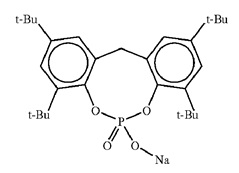
известное на рынке как NA-21 (Asahi Denka Corp., Япония). Известное соединение наиболее часто используется в качестве осветлителя для ПП, но может использоваться как нуклеирующий агент. Недостатком данного нуклеирующего агента является его реакция со стеаратом кальция в процессе переработки ПП, сопровождающаяся замещением ионов натрия на кальций, что приводит к утере нуклеирующего эффекта NA-21.known in the market as NA-21 (Asahi Denka Corp., Japan). The known compound is most often used as a clarifier for PP, but can be used as a nucleating agent. The disadvantage of this nucleating agent is its reaction with calcium stearate during the processing of PP, accompanied by the substitution of sodium ions for calcium, which leads to the loss of the nucleating effect of NA-21.
Известно изобретение по патенту РФ 2348637, МПК C07D493/04, С08К5/1575, опубл. 10.03.2009) «Способ нуклеации полиолефиновой композиции ацетальными соединениями», в котором рассматривается применение ацеталя сорбита или ксилитаKnown invention according to the patent of the Russian Federation 2348637, IPC C07D493 / 04, S08K5 / 1575, publ. 10.03.2009) “Method of nucleation of polyolefin composition by acetal compounds”, in which the use of sorbitol acetal or xylitol is considered
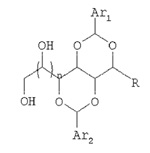
для повышения степени кристалличности полиолефинов. Однако указанные соединения применяют в первую очередь в качестве осветлителя для понижения мутности изделий из полиолефинов.to increase the crystallinity of polyolefins. However, these compounds are used primarily as a clarifier to reduce the turbidity of products from polyolefins.
Недостатком ацеталей сорбита или ксилита является сложность и длительность процессов получения, включающего несколько стадий органического синтеза с использованием специально получаемых для этого соединений на основе производных сорбита или ксилита, а также альдегидов, огнеопасных и токсичных растворителей (циклогексан, метанол, этанол), неорганических кислот в качестве катализаторов, где одна стадия синтеза может достигать трех дней, а получаемый продукт требует очистки, вакуумной сушки, измельчения с использованием механического размалывающего оборудования, последующего помола в пальцевой или стержневой мельнице и рассеивания размолотого продукта через ситовое оборудование.A disadvantage of sorbitol acetals or xylitol is the complexity and duration of the preparation processes, including several stages of organic synthesis using compounds derived from sorbitol or xylitol, as well as aldehydes, flammable and toxic solvents (cyclohexane, methanol, ethanol), inorganic acids, quality of catalysts, where one stage of synthesis can reach three days, and the resulting product requires cleaning, vacuum drying, grinding using mechanical azmalyvayuschego equipment, subsequent grinding in a pin or rod mill and dispersion of the ground product through a sieve equipment.
Известно изобретение по патенту РФ №2289597, C08K5/09, С07С13/40, С08К5/092, С08К5/095, С08К5/098, С07С69/075, С07С69/753, опубл. 20.12.2006 «Изделия из термопластов с высокой степенью структурообразования». Сущностью изобретения в отношении нуклеирующего агента является то, что в качестве нуклеирующих агентов, обеспечивающих высокие температуры кристаллизации, жесткость (плотность) и совместимость со стеаратом кальция в целевом полиолефине предложены соли металлов и бицикло[2.2.1]гептандикарбоксилатов,Known invention according to the patent of Russian Federation №2289597, C08K5 / 09, С07С13 / 40, С08К5 / 092, С08К5 / 095, С08К5 / 098, С07С69 / 075, С07С69 / 753, publ. 12.20.2006 "Products from thermoplastics with a high degree of structure formation." The essence of the invention in relation to the nucleating agent is that as nucleating agents providing high crystallization temperatures, rigidity (density) and compatibility with calcium stearate in the target polyolefin, metal salts and bicyclo [2.2.1] heptane dicarboxylates are proposed,
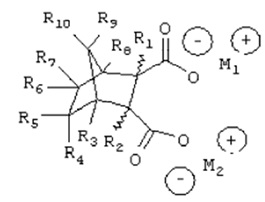
где предпочтительными катионами металлов являются кальций и натрий. Соответствующие изобретению соли добавляют в целевой полиолефин в количестве приблизительно от 50 до 20000 масс.ч/млн, чтобы обеспечить вышеупомянутые характеристики, наиболее предпочтительно, приблизительно от 200 до 4000 ч./млн. where the preferred metal cations are calcium and sodium. The salts according to the invention are added to the target polyolefin in an amount of from about 50 to about 20,000 ppm by weight to provide the aforementioned characteristics, most preferably, from about 200 to 4,000 ppm.
Недостатком указанных нуклеирующих добавок является сложная и длительная процедура их получения. Например, динатрийбицикло[2.2.1]гептан-2,3-дикарбоксилат получается следующим образом. К раствору динатрийбицикло[2.2.1]гепт-5-ен-2,3-дикарбоксилата (10,0 г) в воде (100 г) добавляют 0,5 г палладия на активированном угле (5 % масс.). Смесь помещают в реактор Парра и подвергают гидрированию (50 фунт/кв.дюйм при комнатной температуре) в течение 8 часов. Активированный уголь удаляют при фильтровании, а воду удаляют в вакууме при 75°C. Полученный продукт высушивают и перемалывают (т.пл. >300°C).The disadvantage of these nucleating additives is a complex and lengthy procedure for their production. For example, disodium bicyclo [2.2.1] heptane-2,3-dicarboxylate is prepared as follows. To a solution of disodium bicyclo [2.2.1] hept-5-ene-2,3-dicarboxylate (10.0 g) in water (100 g) add 0.5 g of palladium on activated carbon (5 wt.%). The mixture is placed in a Parr reactor and subjected to hydrogenation (50 psi at room temperature) for 8 hours. Activated carbon is removed by filtration, and water is removed in vacuo at 75 ° C. The resulting product is dried and milled (mp.> 300 ° C).
Наиболее близким по технической сущности и достигаемому техническому результату является изобретение по патенту РФ №2296115 C07C51/41, C07C61/09, C08К5/098, опубл. 27.03.2007, «Металлические соли гексагидрофталевой кислоты как затравочные добавки для кристаллических термопластов» где рассматриваются металлические соли гексагидрофталевой кислоты (в дальнейшем обозначена как ННРА) и ее производных, соответствующих формуле:The closest in technical essence and the achieved technical result is the invention according to the patent of Russian Federation №2296115 C07C51 / 41, C07C61 / 09, C08К5 / 098, publ. March 27, 2007, “Metal salts of hexahydrophthalic acid as seed additives for crystalline thermoplastics” where metal salts of hexahydrophthalic acid (hereinafter referred to as HHPA) and its derivatives, corresponding to the formula, are considered:

в которой M1 и М2 оба означают литий или объединены с образованием одного катиона металла кальция, стронция, или моногидроксид алюминия. Предлагаемые соединения могут быть использованы в качестве нуклеирующих и/или осветляющих добавок для термопластов. Такие соединения обеспечивают нужную температуру кристаллизации, жесткость и совместимость поглотителя кислоты в получаемых полиолефинах, а также имеют очень низкую гигроскопичность и, следовательно, хорошую устойчивость при хранении в виде порошковых или гранулированных составов. in which M1 and M2 both mean lithium or are combined to form a single metal cation of calcium, strontium, or aluminum monohydroxide. The proposed compounds can be used as nucleating and / or brightening additives for thermoplastics. Such compounds provide the desired crystallization temperature, rigidity and compatibility of the acid absorber in the resulting polyolefins, and also have very low hygroscopicity and, therefore, good storage stability in the form of powder or granular formulations.
Недостатком нуклеирующих агентов на основе металлических солей HHPA является недостаточная доступность соединения HHPA вследствие сложности получения из исходных соединений, который включает реакцию бутадиена с малеиновым ангидридом (реакция Дильса-Альдера) с последующим восстановлением продукта газообразным водородом на палладиевом катализаторе, и только затем полученный HHPA вводится в реакцию с металлической солью. Еще одним недостатком является недостаточно низкая гигроскопичность.A disadvantage of nucleating agents based on metal salts of HHPA is the lack of availability of the HHPA compound due to the difficulty of preparing the starting compounds from the compounds, which involves the reaction of butadiene with maleic anhydride (Diels-Alder reaction), followed by reduction of the product with hydrogen gas on a palladium catalyst, and then the resulting HHPA is introduced into reaction with metal salt. Another disadvantage is not sufficiently low hygroscopicity.
Задачей заявленного технического решения является разработка принципиально нового нуклеирующего агента для улучшения свойств ПП, где нуклеирующий агент должен обеспечить единовременное улучшение комплекса свойств в части повышения температуры кристаллизации полимера, ускорения образования более мелких и многочисленных кристаллов (сферолитов), что в свою очередь обеспечивает работоспособность изделий из ПП при более высоких температурах, и повышение физико-механических свойств полимера, таких как модуль упругости, который являются определяющими для изготовлением изделий в приборостроении, автомобильной, авиационной, аэрокосмической, электротехнической, строительной и других отраслях промышленности.The objective of the claimed technical solution is to develop a fundamentally new nucleating agent to improve the properties of PP, where the nucleating agent should provide a one-time improvement of the complex of properties in terms of increasing the crystallization temperature of the polymer, accelerating the formation of smaller and numerous crystals (spherulites), which in turn ensures the performance of products from PP at higher temperatures, and increasing the physicomechanical properties of the polymer, such as the modulus of elasticity, which is determining for manufacturing products in instrument, automotive, aviation, aerospace, electrical, construction and other industries.
При этом нуклеирующий агент должен обладать низкой гигроскопичностью, что предотвращает комкование при хранении нуклеирующего агента до его использования по назначению, и обеспечивает сыпучесть нуклеирующего агента для высокоточного дозирования в ПП, способностью легко диспергироваться в подлежащем переработке ПП, что обеспечивает возможность достижения максимально возможных потребительских качеств получаемого целевого ПП, совместимостью со стеаратом кальция в полипропиленовой композиции, обеспечивающей выполнение стеаратом кальция функции поглотителя кислоты.In this case, the nucleating agent must have a low hygroscopicity, which prevents the clumping during storage of the nucleating agent prior to its intended use, and ensures the flowability of the nucleating agent for high-precision dosing in PP, is easily dispersed in the PP to be processed, which makes it possible to achieve the highest possible consumer qualities of the obtained target PC, compatibility with calcium stearate in a polypropylene composition that ensures the performance of stearate as Acid absorber function.
Кроме того, целью изобретения является получение концентрата нуклеирующего агента для применения в полипропилене для обеспечения возможности высокоточного дозированного введения нуклеирующего агента в полипропилен, что также способствует повышению качества получаемого целевого ПП.In addition, the aim of the invention is to obtain a concentrate of a nucleating agent for use in polypropylene to enable highly accurate dosed introduction of the nucleating agent into polypropylene, which also contributes to improving the quality of the resulting PP.
Таким образом, заявленное техническое решение направлено на достижение в совокупности пяти самостоятельных целей, в результате реализации которых должны быть получены технические результаты, выраженные в разработке собственно нуклеирующего агента, который при его использовании должен обеспечить получение ПП с требуемыми характеристиками, и, в свою очередь, при длительном хранении не должен терять своих потребительских качеств.Thus, the claimed technical solution is aimed at achieving in the aggregate five independent goals , as a result of which the technical results must be obtained, expressed in the development of the nucleating agent itself, which, when used, must ensure that the PP is obtained with the required characteristics, and, in turn, during long-term storage, it should not lose its consumer qualities.
Сущностью заявленного технического решения является применение кальциевых солей оксиэтилидендифосфоновой кислоты, таких как моно- и дикальциевые соли в качестве нуклеирующего агента для полипропилена. Полипропиленовая композиция, содержащая нуклеирующий агент по п. 1 в количестве от 0,10 до 1 мас.%, наиболее предпочтительно от 0,10 до 0,50 мас.%. Полипропиленовая композиция по п.2, содержащая стеарат кальция в качестве поглотителя кислоты. Концентрат нуклеирующего агента для полипропилена, изготовленный на полипропиленовой основе методом экструзии, содержащий моно- или дикальциевую соль оксиэтилидендифосфоновой кислоты в количестве от 5 до 15 мас.%. The essence of the claimed technical solution is the use of calcium salts of hydroxyethylidene diphosphonic acid, such as mono- and dicalcium salts as a nucleating agent for polypropylene. A polypropylene composition containing a nucleating agent according to
Изобретение обеспечивает высокий модуль упругости и высокие пиковые температуры кристаллизации полипропилена, имеет высокую степень совместимости со стеаратом кальция в получаемых термопластичных композициях, имеет чрезвычайно низкую гигроскопичность. Получен концентрат нуклеирующего агента до 15 мас.% в полипропилене, облегчающий его дальнейшее дозированное введение в полипропилен.The invention provides a high modulus of elasticity and high peak crystallization temperatures of polypropylene, has a high degree of compatibility with calcium stearate in the resulting thermoplastic compositions, has an extremely low hygroscopicity. The obtained concentrate nucleating agent up to 15 wt.% In polypropylene, facilitating its further dosed introduction into polypropylene.
Заявленное техническое решение иллюстрируется Фиг.1 и Фиг.2.The claimed technical solution is illustrated in Figure 1 and Figure 2.
На Фиг.1 приведена Таблица 1, на которой представлена гигроскопичность нуклеирующих агентов.Figure 1 shows Table 1, which shows the hygroscopicity of nucleating agents.
На Фиг.2 приведена Таблица 2, на которой представлены составы рецептур и свойства композиций на основе полипропилена.Figure 2 shows Table 2, which presents the compositions of the formulations and properties of compositions based on polypropylene.
Заявленные технические результаты, достигаются тем, что в качестве нуклеирующего агента (структурообразующей добавки) для ПП используются кальциевые соли оксиэтилидендифосфоновой кислоты (ОЭДФ, H4L)The claimed technical results are achieved by the fact that calcium salts of hydroxyethylidene diphosphonic acid (HEDP, H 4 L) are used as a nucleating agent (structure-forming additive) for PP.
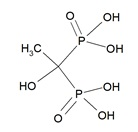
двух видов: монокальциевая соль состава CaH2L и дикальциевая соль состава Ca2L.two types: monocalcium salt of CaH 2 L composition and dicalcium salt of Ca 2 L. composition
При этом следует акцентировать внимание на том, что ОЭДФ является четырехосновной кислотой, способность которой образовывать соли и комплексные соединения с большинством металлов Периодической системы, в том числе с кальцием, хорошо известна [Дятлова, Н.М. Комплексоны и комплексонаты металлов / Н.М. Дятлова, В.Я. Темкина, К.И. Попов – М: Химия. – 1988. – С. 544.]. It should be emphasized that HEDP is a tetrabasic acid, the ability of which to form salts and complex compounds with most metals of the Periodic System, including calcium, is well known [Dyatlova, N.М. Complexons and complexonates of metals / N.M. Dyatlova, V.Ya. Temkina, K.I. Popov - M: Chemistry. - 1988. - p. 544.].
Соли кальция с ОЭДФ и их способы получения как таковые описаны в научной литературе [Uchtman V.A. Structural investigation of calcium binding molecules. II. The crystal and molecular structures of calcium dihydrogen ethane-1-hydroxy-1,1-diphosphonate dihydrate, CaC(CH3)(OH)(PO3H2)2·2H2O. Implication for polynuclear complex formation // J. Phys. Chem. 1972. V. 76. № 9. P.1304-1310; Wiers B.H. Polynuclear complex formation in solutions of calcium ion and ethane-1-hydroxy-1,1-diphosphonic acid. II. Light scattering, sedimentation, mobility, and dialysis measurements / J. Phys. Chem. 1971. V. 75. N 5. P. 682-687; Wada H., Fernando Q. Interaction of methanehydroxyphosphonic acid and ethane-l-hydroxy-1,1-diphosphonic acid with alkali and alkaline earth metal ions // Anal. Chem. 1972. V. 44. P. 1640-1643.].Calcium salts with HEDP and their methods of obtaining as such are described in the scientific literature [Uchtman VA Structural investigation of calcium binding molecules. Ii. The crystal and molecular structures of calcium dihydrogen ethane-1-hydroxy-1,1-diphosphonate dihydrate, CaC (CH 3 ) (OH) (PO 3 H 2 ) 2 · 2H 2 O. Implication for polynuclear complex formation // J. Phys. Chem. 1972. V. 76. No. 9. P.1304-1310; Ethane-1-hydroxy-1,1-diphosphonic acid Wiers BH Polynuclear complex formation. Ii. Light scattering, sedimentation, mobility, and dialysis measurements / J. Phys. Chem. 1971. V. 75.
Однако до даты подачи заявочных материалов, они (соли кальция с ОЭДФ) ранее не были использованы в качестве добавок к термопластичным полимерам вообще, и к полипропилену, в частности. However, before the filing date of the application materials, they (calcium salts with HEDP) had not previously been used as additives to thermoplastic polymers in general, and to polypropylene, in particular.
Таким образом, предлагаемое изобретение, по мнению заявителя, соответствует критерию «новизна» предъявляемому к изобретениям.Thus, the invention, according to the applicant, meets the criterion of "novelty" presented to inventions.
Сказанное также дает основание утверждать, что заявляемое техническое решение не вытекает явным образом из известного в соответствующей отрасли техники уровня, и, следовательно, предлагаемое изобретение соответствует критерию «изобретательский уровень», предъявляемому к изобретениям. The above also gives grounds to assert that the claimed technical solution does not follow explicitly from the level known in the relevant field of engineering, and, therefore, the proposed invention meets the criterion of "inventive step" presented to inventions.
При разработке заявленного нуклеирующего агента использовали промышленно выпускаемое соединение ОЭДФ, которое синтезируется на предприятиях РФ (например, на предприятии ПАО «Химпром», г. Чебоксары). Синтез солей кальция с ее использованием может быть осуществлен предприятием, не имеющим специального химического оборудования. Предлагаемый нуклеирующий агент применим на предприятиях, имеющих оборудование для изготовления полипропилена или его переработки в изделия, следовательно, он удовлетворяет критерию «промышленная применимость», предъявляемому к изобретениям. During the development of the stated nucleating agent, an industrially produced compound HEDP was used, which is synthesized at Russian enterprises (for example, at the enterprise of PJSC Khimprom, Cheboksary). The synthesis of calcium salts with its use can be carried out by an enterprise that does not have special chemical equipment. The proposed nucleating agent is applicable in enterprises that have equipment for the manufacture of polypropylene or its processing into products, therefore, it satisfies the criterion of "industrial applicability" imposed on inventions.
Композиции в соответствии с заявленным техническим решением могут быть получены путем добавления предлагаемой монокальциевой или дикальциевой солей ОЭДФ (либо их сочетанием, или состава, включающего такие соли) к ПП всеми известными способами переработки полимеров. Compositions in accordance with the claimed technical solution can be obtained by adding the proposed monocalcium or dicalcium salts of HEDP (or their combination, or composition, including such salts) to the PP by all known methods of processing polymers.
Готовая композиция применима для изготовления изделий из ПП с применением различных способов его получения. The finished composition is applicable for the manufacture of products from PP using various methods of its production.
Заявляемый нуклеирующий агент можно вводить в полипропилен как в виде порошкообразной смеси компонентов, так и в виде предварительно подготовленного концентрата в ПП (мастербатча) с содержанием нуклеирующего агента до 15 % масс., что позволяет добиться лучшего распределения нуклеирующего агента в ПП и обеспечивает реализацию поставленных целей - а именно: приводит к соответствующему повышению температуры кристаллизации и повышения модуля упругости. The inventive nucleating agent can be introduced into polypropylene either in the form of a powder mixture of components, or in the form of a pre-prepared concentrate in PP (masterbatch) with a content of a nucleating agent up to 15% by weight, which allows to achieve a better distribution of the nucleating agent in PP and ensures the realization of the goals - namely: it leads to a corresponding increase in the crystallization temperature and an increase in the modulus of elasticity.
Нуклеирующий агент может быть использован для структурообразования промышленно выпускаемого полипропилена содержащего или не содержащего традиционные известные функциональные добавки, включая стеарат кальция. The nucleating agent can be used for the structuring of industrially produced polypropylene, whether or not containing traditional well-known functional additives, including calcium stearate.
Заявленное техническое решение - нуклеирующий агент и полипропиленовая композиция с его использованием - иллюстрируется представленными далее примерами получения заявленной композиции и примерами получения ПП с использованием нуклеирующего агента.The claimed technical solution - a nucleating agent and a polypropylene composition with its use - is illustrated by the following examples of the preparation of the claimed composition and examples of the preparation of PP using a nucleating agent.
Образцы нуклеирующего агента получают по известным методикам синтеза [Uchtman V.A. Structural investigation of calcium binding molecules. II. The crystal and molecular structures of calcium dihydrogen ethane-1-hydroxy-1,1-diphosphonate dihydrate, CaC(CH3)(OH)(PO3H2)2·2H2O. Implication for polynuclear complex formation // J. Phys. Chem. 1972. V. 76. № 9. P.1304-1310; Wiers B.H. Polynuclear complex formation in solutions of calcium ion and ethane-1-hydroxy-1,1-diphosphonic acid. II. Light scattering, sedimentation, mobility, and dialysis measurements / J. Phys. Chem. 1971. V. 75. N 5. P. 682-687; Wada H., Fernando Q. Interaction of methanehydroxyphosphonic acid and ethane-l-hydroxy-1,1-diphosphonic acid with alkali and alkaline earth metal ions // Anal. Chem. 1972. V. 44. P. 1640-1643.]Samples of the nucleating agent are obtained by known methods of synthesis [Uchtman VA Structural investigation of calcium binding molecules. Ii. The crystal and molecular structures of calcium dihydrogen ethane-1-hydroxy-1,1-diphosphonate dihydrate, CaC (CH 3 ) (OH) (PO 3 H 2 ) 2 · 2H 2 O. Implication for polynuclear complex formation // J. Phys. Chem. 1972. V. 76. No. 9. P.1304-1310; Ethane-1-hydroxy-1,1-diphosphonic acid Wiers BH Polynuclear complex formation. Ii. Light scattering, sedimentation, mobility, and dialysis measurements / J. Phys. Chem. 1971. V. 75.
Полученные образцы монокальциевой и дикальциевой солей ОЭДФ исследуют на гигроскопичность. На поверхности предметного стекла равномерно распределяют два грамма сухого продукта, после чего образец взвешивают и сушат в вакуумной печи. Затем образцы помещают в климатическую камеру с контролируемой влажностью 65% при температуре 25°C и взвешивают их каждые 24 часа в течение 7 дней. Полученные результаты по определению гигроскопичности в сравнение с прототипом и аналогами приведены в Таблице 1, представленной на Фиг.1. Полученные результаты показывают, что монокальциевая и дикальциевая соли ОЭДФ имеют гигроскопичность, соответственно, на 25% и 15% ниже, чем цис-дикальциевая соль HHPA, являющаяся основным компонентом нуклеирующего агента в прототипе, и многократно ниже, чем другие аналоги.The obtained samples of monocalcium and dicalcium salts of HEDP are examined for hygroscopicity. Two grams of dry product are evenly distributed on the surface of the slide, after which the sample is weighed and dried in a vacuum oven. Then the samples are placed in a climatic chamber with a controlled humidity of 65% at a temperature of 25 ° C and weighed them every 24 hours for 7 days. The results obtained by the definition of hygroscopicity in comparison with the prototype and analogues are shown in Table 1, presented in Figure 1. The results show that monocalcium and dicalcium salts of HEDP have hygroscopicity, respectively, 25% and 15% lower than the cis-dicalcium salt of HHPA, which is the main component of the nucleating agent in the prototype, and many times lower than other analogues.
Далее заявителем приведены примеры изготовления собственно полипропиленовых композиций и представлены их физико-механические свойства, которые приведены в Таблице 2 на Фиг.2.Further, the applicant provides examples of the manufacture of the actual polypropylene compositions and presents their physico-mechanical properties, which are shown in Table 2 in Figure 2.
Полипропиленовые композиции, содержащие нуклеирующий агент на основе кальциевых солей ОЭДФ, получают на двухшнековом экструдере Scientific LTE 16-40, диаметр шнека 16 мм соотношение длина/диаметр 40:1. Полипропиленовую основу и компоненты предварительно перемешивают в лабораторном смесителе Filtra в течение 3 минут, затем загружают в экструдер. Polypropylene compositions containing a nucleating agent based on calcium salts HEDP are obtained on a Scientific LTE 16-40 twin-screw extruder, a screw diameter of 16 mm, a length ratio of 40: 1. The polypropylene base and components are pre-mixed in a Filtra laboratory mixer for 3 minutes, then loaded into an extruder.
За основу всех композиций взят полипропилен марки 1262R (производства ПАО «Нижнекамскнефтехим», Россия), содержащий антиоксидант Todanox B225 (1500 м.д.). Содержание заявляемых нуклеирующих агентов варьируют, как указано в примерах Таблицы 2, представленной на Фиг.2. All compositions are based on polypropylene of the 1262R brand (produced by PJSC «Nizhnekamskneftekhim», Russia), containing the antioxidant Todanox B225 (1500 ppm). The content of the proposed nucleating agents vary, as indicated in the examples of Table 2, shown in Figure 2.
Полипропиленовая композиция также может включать, но необязательно, по меньшей мере, одно соединение, выбранное из группы, включающей пластификаторы, поглотители кислоты, антиоксиданты, бактерицидные добавки, антипирены, светостабилизаторы, антистатики, порообразователи, цветные пигменты. Широко применяемым поглотителем кислоты к полипропилену является стеарат кальция, и совместимость его с заявляемыми нуклеирующими агентами очень важна. В Таблице 2 приведены примеры, сравнивающие показатели для композиций полипропилена с нуклеатором со стеаратом кальция и без него.The polypropylene composition can also include, but not necessarily, at least one compound selected from the group including plasticizers, acid scavengers, antioxidants, bactericidal additives, flame retardants, light stabilizers, antistatic agents, blowing agents, colored pigments. Calcium stearate is a widely used acid scavenger for polypropylene, and its compatibility with the inventive nucleating agents is very important. Table 2 shows examples comparing performance for polypropylene compositions with a nucleator with and without calcium stearate.
Пример 1Example 1
Изготовление полипропиленовой композиции с добавлением монокальциевой соли ОЭДФ методом экструзии с получением гранул.Production of polypropylene composition with the addition of mono calcium salt HEDP extrusion method to obtain granules.
В полипропилен марки 1262R (ПАО «Нижнекамскнефтехим», Россия), не содержащий добавок, на стадии экструзии вводят 0,1 % масс монокальциевой соли ОЭДФ. Экструзию проводят при температурном режиме 190-200°C (по 10 зонам). Скорость вращения шнеков 70 об/мин.In polypropylene brand 1262R (PJSC «Nizhnekamskneftekhim", Russia), not containing additives, at the extrusion stage impose 0.1% of the mass of mono calcium salt of HEDP. Extrusion is carried out at a temperature of 190-200 ° C (in 10 zones). The screw rotation speed is 70 rpm.
Пример 2Example 2
Изготовление полипропиленовой композиции с добавлением дикальциевой соли ОЭДФ методом экструзии с получением гранул.Production of polypropylene composition with the addition of dicalcium salt HEDP extrusion method to obtain granules.
В полипропилен марки 1262R (ПАО «Нижнекамскнефтехим», Россия), не содержащий добавок, на стадии экструзии вводят 0,1 мас.% дикальциевой соли ОЭДФ. Экструзию проводят при температурном режиме 190-200°C (по 10 зонам). Скорость вращения шнеков 70 об/мин.In polypropylene brand 1262R (PJSC «Nizhnekamskneftekhim", Russia), not containing additives, at the extrusion stage, 0.1 wt.% Dicalcium salt HEDP is introduced. Extrusion is carried out at a temperature of 190-200 ° C (in 10 zones). The screw rotation speed is 70 rpm.
Пример 3Example 3
Изготовление полипропиленовой композиции с добавлением монокальциевой соли ОЭДФ и стеарата кальция методом экструзии с получением гранул.Production of polypropylene composition with the addition of mono calcium salt HEDP and calcium stearate by extrusion method to obtain granules.
В полипропилен марки 1262R (ПАО «Нижнекамскнефтехим», Россия), не содержащий добавок, на стадии экструзии вводят 0,1 мас.% монокальциевой соли ОЭДФ, 0,1 мас.% стеарат кальция. Экструзию проводят при температурном режиме 190-200°C (по 10 зонам). Скорость вращения шнеков 70 об/мин.In polypropylene brand 1262R (PJSC «Nizhnekamskneftekhim", Russia), not containing additives, at the extrusion stage, 0.1 wt.% Mono calcium salt of HEDP, 0.1 wt.% Calcium stearate is injected. Extrusion is carried out at a temperature of 190-200 ° C (in 10 zones). The screw rotation speed is 70 rpm.
Пример 4Example 4
Изготовление полипропиленовой композиции с добавлением дикальциевой соли ОЭДФ и стеарата кальция методом экструзии с получением гранул.Production of polypropylene composition with the addition of dicalcium salt HEDP and calcium stearate by extrusion method to obtain granules.
В полипропилен марки 1262R (ПАО «Нижнекамскнефтехим», Россия), не содержащий добавок, на стадии экструзии вводят 0,1 мас.% дикальциевой соли ОЭДФ, 0,1 мас.% стеарат кальция. Экструзию проводят при температурном режиме 190-200°C (по 10 зонам). Скорость вращения шнеков 70 об/мин.In polypropylene brand 1262R (PJSC «Nizhnekamskneftekhim", Russia), not containing additives, at the extrusion stage, 0.1 wt.% Dicalcium salt HEDP, 0.1 wt.% Calcium stearate is injected. Extrusion is carried out at a temperature of 190-200 ° C (in 10 zones). The screw rotation speed is 70 rpm.
Составы с другими различными концентрациями нуклеирующих агентов без добавления и с добавкой стеарата кальция по Примерам 5-26 и свойства полученных композиций приведены в Таблице 2.Compositions with different concentrations of nucleating agents without the addition and with the addition of calcium stearate in Examples 5-26 and the properties of the compositions obtained are shown in Table 2.
Далее заявителем представлено описание изготовления концентрата заявляемых нуклеирующих агентов на полипропиленовой основе.Next, the applicant submitted a description of the manufacture of the concentrate of the inventive polypropylene-based nucleating agents.
На полипропиленовой основе с содержанием монокальциевой или дикальциевой солей ОЭДФ до 15 мас.% методом экструзии изготавливают гранулы концентрата (мастербатч) заявляемого нуклеирующего агентов для высокоточного дозирования и технологически удобного введения нуклеирующего агента в полимер. Нижняя граница содержания солей в мастербатче (5 мас.%, но необязательно) определяется исключительно экономической целесообразностью, определяемой пользователем концентрата. Так, изготовление концентрата с содержанием менее 5% масс. нуклеирующего агента приведет к тому, что отношение масс мастербатча и ПП будет превышать 1:5 (при конечном содержании агента в ПП 0.5 мас.%) или 1:4 (при конечном содержании агента в ПП 1 мас.%). При изготовлении концентрата с содержанием нуклеирующего агента более 15 мас.% происходит неравномерное распределение добавки из-за большой разницы в насыпной плотности кальциевых солей ОЭДФ и полипропилена. Это приводит к тому, что в получаемых гранулах концентрата будет находиться разное количество нуклеирующего агента, и это может привести к нарушению точности дозировки при получении ПП с заданным количеством нуклеирующего агента.On a polypropylene base with a content of monocalcium or dicalcium salts of HEDP up to 15 wt.% By extrusion, granulate concentrate (masterbatch) of the inventive nucleating agent is made for high-precision dosing and technologically convenient introduction of the nucleating agent into the polymer. The lower limit of the salt content in the masterbatch (5 wt.%, But not necessarily) is determined solely by the economic feasibility, determined by the user of the concentrate. Thus, the manufacture of a concentrate with a content of less than 5% of the mass. the nucleating agent will lead to the fact that the mass ratio of masterbatch and PP will exceed 1: 5 (with the final content of the agent in PP 0.5 wt.%) or 1: 4 (with the final content of the agent in
Далее заявителем Примерами 27-30 проиллюстрировано получение методом экструзии полипропиленовых композиций с добавлением в ПП концентратов монокальциевой и дикальциевой солей ОЭДФ при их разном содержании. Further, the applicant Examples 27-30 illustrate the production by extrusion of polypropylene compositions with the addition of monocalcium and dicalcium salts of HEDP in PP concentrates with their different content.
Пример 27Example 27
Изготовление полипропиленовой композиции с добавлением 5%-ного концентрата монокальциевой соли ОЭДФ методом экструзии с получением гранул.Production of polypropylene composition with the addition of 5% concentrate of monocalcium salt HEDP by extrusion method to obtain granules.
В полипропилен марки 1262R (ПАО «Нижнекамскнефтехим», Россия), не содержащий добавок, на стадии экструзии вводят 5%-ный концентрат монокальциевой соли ОЭДФ в ПП в процентном соотношении 1:10 и 0,1 мас.% стеарат кальция. Экструзию проводят при температурном режиме 190-200°C (по 10 зонам). Скорость вращения шнеков 70 об/мин.In polypropylene brand 1262R (PJSC "Nizhnekamskneftekhim", Russia), not containing additives, at the extrusion stage, 5% mono-calcium salt HEDP in PP is introduced in a percentage ratio of 1:10 and 0.1 wt.% Calcium stearate. Extrusion is carried out at a temperature of 190-200 ° C (in 10 zones). The screw rotation speed is 70 rpm.
Пример 28Example 28
Изготовление полипропиленовой композиции с добавлением 5%-ного концентрата дикальциевой соли ОЭДФ методом экструзии с получением гранул.Production of polypropylene composition with the addition of 5% concentrate dicalcium salt HEDP extrusion method to obtain granules.
В полипропилен марки 1262R (ПАО «Нижнекамскнефтехим», Россия), не содержащий добавок, на стадии экструзии вводят 5%-ный концентрат дикальциевой соли ОЭДФ в ПП в процентном соотношении 1:10 и 0,1 мас.% стеарат кальция. Экструзию проводят при температурном режиме 190-200°C (по 10 зонам). Скорость вращения шнеков 70 об/мин.In polypropylene brand 1262R (PJSC «Nizhnekamskneftekhim", Russia), not containing additives, at the extrusion stage, 5% concentrate of dicalcium salt HEDP in PP in a ratio of 1:10 and 0.1 wt.% Calcium stearate is introduced. Extrusion is carried out at a temperature of 190-200 ° C (in 10 zones). The screw rotation speed is 70 rpm.
Пример 29Example 29
Изготовление полипропиленовой композиции с добавлением 15%-ного концентрата монокальциевой соли ОЭДФ методом экструзии с получением гранул.Production of polypropylene composition with the addition of 15% concentrate of monocalcium salt HEDP by extrusion method to obtain granules.
В полипропилен марки 1262R (ПАО «Нижнекамскнефтехим», Россия), не содержащий добавок, на стадии экструзии вводят 15%-ный концентрат монокальциевой соли ОЭДФ в ПП в процентном соотношении 3:97 и 0.1 мас.% стеарат кальция. Экструзию проводят при температурном режиме 190-200°C (по 10 зонам). Скорость вращения шнеков 70 об/мин.In polypropylene brand 1262R (PJSC "Nizhnekamskneftekhim", Russia), not containing additives, at the extrusion stage, a 15% concentrate of mono calcium salt HEDP in PP in a ratio of 3:97 and 0.1 wt.% Calcium stearate is introduced. Extrusion is carried out at a temperature of 190-200 ° C (in 10 zones). The screw rotation speed is 70 rpm.
Пример 30Example 30
Изготовление полипропиленовой композиции с добавлением 15%-ного концентрата дикальциевой соли ОЭДФ методом экструзии с получением гранул.Production of polypropylene composition with the addition of 15% concentrate dicalcium salt HEDP extrusion method to obtain granules.
В полипропилен марки 1262R (ПАО «Нижнекамскнефтехим», Россия), не содержащий добавок, на стадии экструзии вводят 15%-ный концентрат дикальциевой соли ОЭДФ в ПП в процентном соотношении 3:97 и 0,1 мас.% стеарат кальция. Экструзию проводят при температурном режиме 190-200°C (по 10 зонам). Скорость вращения шнеков 70 об/мин.In the polypropylene brand 1262R (PJSC «Nizhnekamskneftekhim", Russia), not containing additives, at the extrusion stage, 15% concentrate of dicalcium salt HEDP in PP in a ratio of 3:97 and 0.1 wt.% Calcium stearate is introduced. Extrusion is carried out at a temperature of 190-200 ° C (in 10 zones). The screw rotation speed is 70 rpm.
Составы и свойства по Примерам 27-30 приведены в Таблице 2.The compositions and properties of Examples 27-30 are shown in Table 2.
Теплофизические и физико-механические исследования для определения эффективности заявляемых нуклеирующих агентов.Thermophysical and physico-mechanical studies to determine the effectiveness of the proposed nucleating agents.
Теплофизические характеристики полученных композиций исследовали методом дифференциальной сканирующей калориметрии согласно методике ASTM E 794, в частности температуру кристаллизации полимера (Ткр). Для измерения полученные композиции из полипропилена нагревают от 25 до 220°C со скоростью 10°C в минуту, чтобы получить полностью расплавленный образец, и выдерживают при максимальной температуре в течение 5 минут. Затем, температуру снижают со скоростью 10°C в минуту, пока она не достигала стартовой температуры 25°C. Температуру кристаллизации таким образом определяют как температуру, соответствующую максимальному пику во время выделения теплоты кристаллизации.The thermophysical characteristics of the obtained compositions were investigated by the method of differential scanning calorimetry according to the method of ASTM E 794, in particular, the crystallization temperature of the polymer (T cr ). For the measurement, the resulting polypropylene compositions are heated from 25 to 220 ° C at a rate of 10 ° C per minute to obtain a completely molten sample, and maintained at the maximum temperature for 5 minutes. Then, the temperature is reduced at a rate of 10 ° C per minute until it reaches the starting temperature of 25 ° C. The crystallization temperature is thus defined as the temperature corresponding to the maximum peak during the release of heat of crystallization.
Для определения прочностных характеристик композиций проводят физико-механические испытания по стандартной методике ASTM D 790. Предварительно из полученных по примерам 1-30 композиций изготавливают стандартные образцы методом литья под давлением, температурный режим литья 200-240°C, температура литьевой формы 80°C.To determine the strength characteristics of the compositions, physicomechanical tests are carried out according to the standard ASTM D 790 method. Firstly, standard samples are made from injection-molded compositions prepared according to examples 1-30, the casting temperature is 200-240 ° C, and the temperature of the mold is 80 ° C.
Свойства полученных полипропиленовых композиций с заявляемыми нуклеирующими агентами приведены в Таблице 2.The properties of the obtained polypropylene compositions with the inventive nucleating agents are shown in Table 2.
Далее заявителем представлен анализ экспериментально полученных данных. Приведенные в Таблице 2 данные показали, что введение заявляемого нуклеирующего агента в полипропилен позволяет:Further, the applicant submitted an analysis of experimentally obtained data. The data in Table 2 showed that the introduction of the inventive nucleating agent into polypropylene allows:
- повысить температуру кристаллизации до 11 градусов (в прототипе - до 9 градусов),- increase the crystallization temperature to 11 degrees (in the prototype - up to 9 degrees),
- повысить модуль упругости при изгибе - до 35-40% (в прототипе - до 30%).- to increase the modulus of elasticity in bending - up to 35-40% (in the prototype - up to 30%).
Указанный технический результат достигается при введении в ПП монокальциевой или дикальциевой солей ОЭДФ состава CaH2L или Ca2L (или их смесей в любом соотношении) в количестве от 0,10 до 1 мас.%, наиболее предпочтительно, от 0,10 до 0,50 мас.% This technical result is achieved with the introduction in PP monocalcium or dicalcium salts of HEDP composition of CaH 2 L or Ca 2 L (or their mixtures in any ratio) in an amount of from 0.10 to 1 wt.%, Most preferably, from 0.10 to 0 , 50 wt.%
Кроме того, монокальциевая и дикальциевая соли оксиэтилидендифосфоновой кислоты обладают меньшей гигроскопичностью по сравнению с нуклеирующим агентом-прототипом (на 25% и 15% соответственно). Следовательно, монокальциевая и дикальциевая соли оксиэтилидендифосфоновой кислоты (ОЭДФ, H4L) с кальцием эффективны в качестве нуклеирующего агента для ПП. In addition, monocalcium and dicalcium salts of hydroxyethylidene diphosphonic acid are less hygroscopic compared with the nucleating agent of the prototype (by 25% and 15%, respectively). Consequently, monocalcium and dicalcium salts of hydroxyethylidene diphosphonic acid (HEDP, H 4 L) with calcium are effective as a nucleating agent for PP.
Изготовление полипропиленовой композиции путем введения в ПП заявленного нуклеирующего агента в виде его концентрата в полипропилене с содержанием заявляемого нуклеирующего агента от 5 мас.% (необязательно) до 15 мас.% приводит к техническому результату, который идентичен достигаемому при получении полипропиленовой композиции при непосредственном введении нуклеирующего агента. The manufacture of a polypropylene composition by introducing into the PP the declared nucleating agent in the form of its concentrate in polypropylene with the content of the inventive nucleating agent from 5% by weight (optional) to 15% by weight leads to a technical result that is identical to that achieved by obtaining a polypropylene composition with direct introduction of the nucleating agent.
При этом обеспечивается высокоточное дозирование и технологически удобное введение нуклеирующего агента в полипропилен.This provides high-precision dosing and technologically convenient introduction of the nucleating agent into polypropylene.
Заявленное техническое решение соответствует критерию «новизна», предъявляемому к изобретениям, т.к. так как при определении уровня техники не обнаружено техническое решение, которому присущи признаки, идентичные (то есть совпадающие по исполняемой ими функции и форме выполнения этих признаков) всем признакам, представленным в независимых пунктах формулы изобретения.The claimed technical solution meets the criterion of "novelty", presented to inventions, because since, in determining the level of technology, no technical solution was found which has characteristics inherent (i.e., coinciding in the function they perform and the form in which they are performed) to all the features presented in the independent claims.
Заявленное техническое решение соответствует критерию «изобретательский уровень», предъявляемому к изобретениям, поскольку не выявлены технические решения, имеющие признаки, совпадающие с отличительными признаками данного изобретения, и не установлена известность влияния отличительных признаков на указанный технический результат. The claimed technical solution meets the criterion of "inventive step", presented to the inventions, since no technical solutions have been found that have features that match the distinctive features of the present invention, and no known effect of the distinctive features on the specified technical result.
Заявленное техническое решение соответствует критерию «промышленная применимость», предъявляемому к изобретениям, т.к. может быть реализовано в промышленных масштабах.The claimed technical solution meets the criterion of "industrial applicability", presented to the inventions, because can be implemented on an industrial scale.
Claims (4)
Priority Applications (1)
| Application Number | Priority Date | Filing Date | Title |
|---|---|---|---|
| RU2018127176A RU2688526C1 (en) | 2018-07-24 | 2018-07-24 | Use of calcium salts of oxyethylidenediphosphonic acid as a nucleating agent and polypropylene composition obtained using it |
Applications Claiming Priority (1)
| Application Number | Priority Date | Filing Date | Title |
|---|---|---|---|
| RU2018127176A RU2688526C1 (en) | 2018-07-24 | 2018-07-24 | Use of calcium salts of oxyethylidenediphosphonic acid as a nucleating agent and polypropylene composition obtained using it |
Publications (1)
| Publication Number | Publication Date |
|---|---|
| RU2688526C1 true RU2688526C1 (en) | 2019-05-21 |
Family
ID=66636873
Family Applications (1)
| Application Number | Title | Priority Date | Filing Date |
|---|---|---|---|
| RU2018127176A RU2688526C1 (en) | 2018-07-24 | 2018-07-24 | Use of calcium salts of oxyethylidenediphosphonic acid as a nucleating agent and polypropylene composition obtained using it |
Country Status (1)
| Country | Link |
|---|---|
| RU (1) | RU2688526C1 (en) |
Citations (3)
| Publication number | Priority date | Publication date | Assignee | Title |
|---|---|---|---|---|
| WO2010118041A1 (en) * | 2009-04-06 | 2010-10-14 | Metabolix, Inc. | Method of improving film processing and injection molding of polyhydroxyalkanoate polymers |
| RU2526260C2 (en) * | 2010-04-20 | 2014-08-20 | Бореалис Аг | Polypropylene bottles |
| RU2564318C2 (en) * | 2009-12-07 | 2015-09-27 | Басф Се | Clarified polypropylene products with improved optic properties and/or higher crystallisation temperature |
-
2018
- 2018-07-24 RU RU2018127176A patent/RU2688526C1/en active
Patent Citations (3)
| Publication number | Priority date | Publication date | Assignee | Title |
|---|---|---|---|---|
| WO2010118041A1 (en) * | 2009-04-06 | 2010-10-14 | Metabolix, Inc. | Method of improving film processing and injection molding of polyhydroxyalkanoate polymers |
| RU2564318C2 (en) * | 2009-12-07 | 2015-09-27 | Басф Се | Clarified polypropylene products with improved optic properties and/or higher crystallisation temperature |
| RU2526260C2 (en) * | 2010-04-20 | 2014-08-20 | Бореалис Аг | Polypropylene bottles |
Similar Documents
| Publication | Publication Date | Title |
|---|---|---|
| Fontaine et al. | Neutralized flame retardant phosphorus agent: facile synthesis, reaction to fire in PP and synergy with zinc borate | |
| Wu et al. | Influence of ammonium polyphosphate microencapsulation on flame retardancy, thermal degradation and crystal structure of polypropylene composite | |
| US4193945A (en) | Self-extinguishing polymeric compositions | |
| JPS63221141A (en) | Stabilized composition and manufacture | |
| TW200844160A (en) | DOPO flame retardant compositions | |
| CZ277731B6 (en) | Polypropylene and process for preparing thereof | |
| WO2011083009A1 (en) | Flame retardant | |
| US20090054565A1 (en) | Flame-Retardant plastics molding composition | |
| CN117844052B (en) | Nucleating agent compositions, polyolefin compositions, preparation methods and uses | |
| RU2688526C1 (en) | Use of calcium salts of oxyethylidenediphosphonic acid as a nucleating agent and polypropylene composition obtained using it | |
| TW201016769A (en) | Flame retardant compositions with polymeric dispersing agents | |
| CN102336926A (en) | Expandable flame retardant modified hydrotalcite as well as preparation method and application thereof | |
| JPS6117595A (en) | Organic phosphite composition | |
| JP2020011924A (en) | Flame retardant compounds, lignocellulose and wood flour chemically modified with the flame retardant compounds, and resin compositions containing them | |
| Gao et al. | Enhancement of “in-situ” dispersed NA11 for the mechanical and crystallization properties of polypropylene | |
| Huang et al. | Mechanism of the pH-induced aggregation reaction between melamine and phosphate | |
| JPS5842637A (en) | Self-extinguishing polyolefin composition | |
| Dębowski et al. | Calcium coordination polymer containing dimethylphosphate ligands and exhibiting nucleating properties towards α and Β crystal polymorphs of isotactic polypropylene | |
| JPH0579074B2 (en) | ||
| EP2159214B1 (en) | Amorphous compound and stabilizer for polymers containing the amorphous compound | |
| CN102850578A (en) | Nucleator composition, its preparation method and polypropylene material | |
| Schmidtmann et al. | Isotopomeric polymorphism in a “doubly-polymorphic” multi-component molecular crystal | |
| Huang et al. | Synthesis, Characterization and Application of 2, 2'-methylene-bis (4, 6-di-tert-butyl-phenyl) Phosphate Sodium | |
| DE102023000325B3 (en) | Thiazole compounds as flame retardants containing phosphorus, nitrogen and sulfur and their use | |
| PL247006B1 (en) | Method of nucleation of isotactic polypropylene |