RU2598644C2 - Isopropyl ester of [(1r,2s,5r)-2-isopropyl-5-methylcyclohexanecarbonyl)-amino]-acetic acid, related compounds and use thereof in therapy - Google Patents
Isopropyl ester of [(1r,2s,5r)-2-isopropyl-5-methylcyclohexanecarbonyl)-amino]-acetic acid, related compounds and use thereof in therapy Download PDFInfo
- Publication number
- RU2598644C2 RU2598644C2 RU2013130166/04A RU2013130166A RU2598644C2 RU 2598644 C2 RU2598644 C2 RU 2598644C2 RU 2013130166/04 A RU2013130166/04 A RU 2013130166/04A RU 2013130166 A RU2013130166 A RU 2013130166A RU 2598644 C2 RU2598644 C2 RU 2598644C2
- Authority
- RU
- Russia
- Prior art keywords
- compound
- discomfort
- pharmaceutical composition
- coughing
- airway
- Prior art date
Links
- 150000001875 compounds Chemical class 0.000 title claims abstract description 94
- -1 Isopropyl ester Chemical class 0.000 title description 52
- 238000002560 therapeutic procedure Methods 0.000 title description 7
- QTBSBXVTEAMEQO-UHFFFAOYSA-N acetic acid Substances CC(O)=O QTBSBXVTEAMEQO-UHFFFAOYSA-N 0.000 title 1
- 206010011224 Cough Diseases 0.000 claims abstract description 34
- 239000003814 drug Substances 0.000 claims abstract description 31
- 230000001953 sensory effect Effects 0.000 claims abstract description 26
- 239000008194 pharmaceutical composition Substances 0.000 claims abstract description 25
- 210000000981 epithelium Anatomy 0.000 claims abstract description 23
- 210000001519 tissue Anatomy 0.000 claims abstract description 23
- 241000282414 Homo sapiens Species 0.000 claims abstract description 18
- 208000000059 Dyspnea Diseases 0.000 claims abstract description 15
- 206010013975 Dyspnoeas Diseases 0.000 claims abstract description 15
- 230000003502 anti-nociceptive effect Effects 0.000 claims abstract description 10
- 239000000203 mixture Substances 0.000 claims description 88
- 238000011282 treatment Methods 0.000 claims description 34
- 238000011200 topical administration Methods 0.000 claims description 33
- 210000003800 pharynx Anatomy 0.000 claims description 29
- 238000000034 method Methods 0.000 claims description 24
- 210000000214 mouth Anatomy 0.000 claims description 21
- 239000003826 tablet Substances 0.000 claims description 21
- 210000003238 esophagus Anatomy 0.000 claims description 17
- 241000282412 Homo Species 0.000 claims description 16
- 239000007788 liquid Substances 0.000 claims description 15
- 206010003497 Asphyxia Diseases 0.000 claims description 14
- 208000013220 shortness of breath Diseases 0.000 claims description 14
- 239000003085 diluting agent Substances 0.000 claims description 11
- 210000005128 keratinized epithelium Anatomy 0.000 claims description 11
- 208000006545 Chronic Obstructive Pulmonary Disease Diseases 0.000 claims description 10
- 239000007937 lozenge Substances 0.000 claims description 10
- 239000000843 powder Substances 0.000 claims description 10
- 208000006673 asthma Diseases 0.000 claims description 9
- 238000007906 compression Methods 0.000 claims description 9
- 230000006835 compression Effects 0.000 claims description 9
- 235000009508 confectionery Nutrition 0.000 claims description 9
- 239000000546 pharmaceutical excipient Substances 0.000 claims description 9
- 210000004400 mucous membrane Anatomy 0.000 claims description 7
- 208000003265 stomatitis Diseases 0.000 claims description 7
- 238000004519 manufacturing process Methods 0.000 claims description 6
- 229940112822 chewing gum Drugs 0.000 claims description 5
- 235000015218 chewing gum Nutrition 0.000 claims description 5
- 239000003937 drug carrier Substances 0.000 claims description 5
- 239000000443 aerosol Substances 0.000 claims description 4
- 210000002200 mouth mucosa Anatomy 0.000 claims description 4
- 230000000241 respiratory effect Effects 0.000 claims description 2
- 229940079593 drug Drugs 0.000 abstract description 19
- 230000000694 effects Effects 0.000 abstract description 17
- 239000000126 substance Substances 0.000 abstract description 10
- 208000037265 diseases, disorders, signs and symptoms Diseases 0.000 abstract description 8
- 201000010099 disease Diseases 0.000 abstract 1
- 210000001508 eye Anatomy 0.000 description 49
- 125000001449 isopropyl group Chemical group [H]C([H])([H])C([H])(*)C([H])([H])[H] 0.000 description 40
- 238000012360 testing method Methods 0.000 description 24
- NOOLISFMXDJSKH-KXUCPTDWSA-N (-)-Menthol Chemical compound CC(C)[C@@H]1CC[C@@H](C)C[C@H]1O NOOLISFMXDJSKH-KXUCPTDWSA-N 0.000 description 20
- 208000002193 Pain Diseases 0.000 description 19
- 230000035807 sensation Effects 0.000 description 17
- 235000019615 sensations Nutrition 0.000 description 17
- 238000001816 cooling Methods 0.000 description 16
- 210000000744 eyelid Anatomy 0.000 description 16
- 238000009472 formulation Methods 0.000 description 16
- 239000003795 chemical substances by application Substances 0.000 description 15
- 239000003921 oil Substances 0.000 description 15
- NOOLISFMXDJSKH-UHFFFAOYSA-N DL-menthol Natural products CC(C)C1CCC(C)CC1O NOOLISFMXDJSKH-UHFFFAOYSA-N 0.000 description 14
- 101150086062 TDR gene Proteins 0.000 description 14
- 230000009471 action Effects 0.000 description 14
- 210000003300 oropharynx Anatomy 0.000 description 13
- XLYOFNOQVPJJNP-UHFFFAOYSA-N water Chemical compound O XLYOFNOQVPJJNP-UHFFFAOYSA-N 0.000 description 13
- 210000000621 bronchi Anatomy 0.000 description 12
- 210000000867 larynx Anatomy 0.000 description 12
- 125000002924 primary amino group Chemical group [H]N([H])* 0.000 description 12
- 210000003437 trachea Anatomy 0.000 description 12
- 235000008534 Capsicum annuum var annuum Nutrition 0.000 description 11
- 235000002568 Capsicum frutescens Nutrition 0.000 description 11
- 241001247145 Sebastes goodei Species 0.000 description 11
- 235000019198 oils Nutrition 0.000 description 11
- 239000000243 solution Substances 0.000 description 11
- LFQSCWFLJHTTHZ-UHFFFAOYSA-N Ethanol Chemical compound CCO LFQSCWFLJHTTHZ-UHFFFAOYSA-N 0.000 description 10
- 239000000839 emulsion Substances 0.000 description 10
- 239000010408 film Substances 0.000 description 10
- 239000002674 ointment Substances 0.000 description 10
- 235000015067 sauces Nutrition 0.000 description 10
- 210000005252 bulbus oculi Anatomy 0.000 description 9
- 210000000795 conjunctiva Anatomy 0.000 description 9
- 239000004615 ingredient Substances 0.000 description 9
- 230000000699 topical effect Effects 0.000 description 9
- DHMQDGOQFOQNFH-UHFFFAOYSA-N Glycine Chemical compound NCC(O)=O DHMQDGOQFOQNFH-UHFFFAOYSA-N 0.000 description 8
- 210000004027 cell Anatomy 0.000 description 8
- 210000004087 cornea Anatomy 0.000 description 8
- 239000006071 cream Substances 0.000 description 8
- 229940041616 menthol Drugs 0.000 description 8
- 230000006378 damage Effects 0.000 description 7
- 208000035475 disorder Diseases 0.000 description 7
- 239000003995 emulsifying agent Substances 0.000 description 7
- 230000007794 irritation Effects 0.000 description 7
- 208000024891 symptom Diseases 0.000 description 7
- RCEFMOGVOYEGJN-UHFFFAOYSA-N 3-(2-hydroxyphenyl)-6-(3-nitrophenyl)-1,4-dihydropyrimidin-2-one Chemical compound OC1=CC=CC=C1N1C(=O)NC(C=2C=C(C=CC=2)[N+]([O-])=O)=CC1 RCEFMOGVOYEGJN-UHFFFAOYSA-N 0.000 description 6
- FBPFZTCFMRRESA-KVTDHHQDSA-N D-Mannitol Chemical compound OC[C@@H](O)[C@@H](O)[C@H](O)[C@H](O)CO FBPFZTCFMRRESA-KVTDHHQDSA-N 0.000 description 6
- 208000003556 Dry Eye Syndromes Diseases 0.000 description 6
- 206010013774 Dry eye Diseases 0.000 description 6
- 239000004471 Glycine Substances 0.000 description 6
- 229930195725 Mannitol Natural products 0.000 description 6
- DNIAPMSPPWPWGF-UHFFFAOYSA-N Propylene glycol Chemical compound CC(O)CO DNIAPMSPPWPWGF-UHFFFAOYSA-N 0.000 description 6
- 239000012153 distilled water Substances 0.000 description 6
- 229960004873 levomenthol Drugs 0.000 description 6
- 239000000314 lubricant Substances 0.000 description 6
- 239000000594 mannitol Substances 0.000 description 6
- 235000010355 mannitol Nutrition 0.000 description 6
- 239000000047 product Substances 0.000 description 6
- 210000002345 respiratory system Anatomy 0.000 description 6
- 206010061218 Inflammation Diseases 0.000 description 5
- 229910003850 O-nPr Inorganic materials 0.000 description 5
- 208000003251 Pruritus Diseases 0.000 description 5
- 239000002671 adjuvant Substances 0.000 description 5
- 239000000969 carrier Substances 0.000 description 5
- 239000003925 fat Substances 0.000 description 5
- 235000019197 fats Nutrition 0.000 description 5
- 230000004054 inflammatory process Effects 0.000 description 5
- JMMWKPVZQRWMSS-UHFFFAOYSA-N isopropyl acetate Chemical compound CC(C)OC(C)=O JMMWKPVZQRWMSS-UHFFFAOYSA-N 0.000 description 5
- 230000007803 itching Effects 0.000 description 5
- 239000003589 local anesthetic agent Substances 0.000 description 5
- 229960005015 local anesthetics Drugs 0.000 description 5
- 239000006072 paste Substances 0.000 description 5
- 230000002035 prolonged effect Effects 0.000 description 5
- 238000011160 research Methods 0.000 description 5
- 238000010953 Ames test Methods 0.000 description 4
- 231100000039 Ames test Toxicity 0.000 description 4
- 206010010741 Conjunctivitis Diseases 0.000 description 4
- IAZDPXIOMUYVGZ-UHFFFAOYSA-N Dimethylsulphoxide Chemical compound CS(C)=O IAZDPXIOMUYVGZ-UHFFFAOYSA-N 0.000 description 4
- PEDCQBHIVMGVHV-UHFFFAOYSA-N Glycerine Chemical compound OCC(O)CO PEDCQBHIVMGVHV-UHFFFAOYSA-N 0.000 description 4
- 241001465754 Metazoa Species 0.000 description 4
- 201000007100 Pharyngitis Diseases 0.000 description 4
- 239000000853 adhesive Substances 0.000 description 4
- 230000001070 adhesive effect Effects 0.000 description 4
- 229940125715 antihistaminic agent Drugs 0.000 description 4
- 239000000739 antihistaminic agent Substances 0.000 description 4
- 230000035597 cooling sensation Effects 0.000 description 4
- 239000002552 dosage form Substances 0.000 description 4
- 239000003889 eye drop Substances 0.000 description 4
- 229940012356 eye drops Drugs 0.000 description 4
- 239000000796 flavoring agent Substances 0.000 description 4
- 208000014674 injury Diseases 0.000 description 4
- 230000000622 irritating effect Effects 0.000 description 4
- 239000000845 maltitol Substances 0.000 description 4
- 235000010449 maltitol Nutrition 0.000 description 4
- VQHSOMBJVWLPSR-WUJBLJFYSA-N maltitol Chemical compound OC[C@H](O)[C@@H](O)[C@@H]([C@H](O)CO)O[C@H]1O[C@H](CO)[C@@H](O)[C@H](O)[C@H]1O VQHSOMBJVWLPSR-WUJBLJFYSA-N 0.000 description 4
- 229940035436 maltitol Drugs 0.000 description 4
- 239000002324 mouth wash Substances 0.000 description 4
- 230000003040 nociceptive effect Effects 0.000 description 4
- 230000002093 peripheral effect Effects 0.000 description 4
- 210000003296 saliva Anatomy 0.000 description 4
- 150000003839 salts Chemical class 0.000 description 4
- 239000003381 stabilizer Substances 0.000 description 4
- 239000000725 suspension Substances 0.000 description 4
- 230000001225 therapeutic effect Effects 0.000 description 4
- 239000001993 wax Substances 0.000 description 4
- 229920000742 Cotton Polymers 0.000 description 3
- FBPFZTCFMRRESA-FSIIMWSLSA-N D-Glucitol Natural products OC[C@H](O)[C@H](O)[C@@H](O)[C@H](O)CO FBPFZTCFMRRESA-FSIIMWSLSA-N 0.000 description 3
- RTZKZFJDLAIYFH-UHFFFAOYSA-N Diethyl ether Chemical compound CCOCC RTZKZFJDLAIYFH-UHFFFAOYSA-N 0.000 description 3
- XEKOWRVHYACXOJ-UHFFFAOYSA-N Ethyl acetate Chemical compound CCOC(C)=O XEKOWRVHYACXOJ-UHFFFAOYSA-N 0.000 description 3
- 206010020751 Hypersensitivity Diseases 0.000 description 3
- 229920001615 Tragacanth Polymers 0.000 description 3
- ZMANZCXQSJIPKH-UHFFFAOYSA-N Triethylamine Chemical compound CCN(CC)CC ZMANZCXQSJIPKH-UHFFFAOYSA-N 0.000 description 3
- 239000004480 active ingredient Substances 0.000 description 3
- 239000000556 agonist Substances 0.000 description 3
- 208000003464 asthenopia Diseases 0.000 description 3
- 230000008901 benefit Effects 0.000 description 3
- 239000002775 capsule Substances 0.000 description 3
- 210000003169 central nervous system Anatomy 0.000 description 3
- 210000000038 chest Anatomy 0.000 description 3
- KRKNYBCHXYNGOX-UHFFFAOYSA-N citric acid Chemical compound OC(=O)CC(O)(C(O)=O)CC(O)=O KRKNYBCHXYNGOX-UHFFFAOYSA-N 0.000 description 3
- 238000002648 combination therapy Methods 0.000 description 3
- 239000000356 contaminant Substances 0.000 description 3
- 239000002826 coolant Substances 0.000 description 3
- 210000002919 epithelial cell Anatomy 0.000 description 3
- 235000013305 food Nutrition 0.000 description 3
- 235000013355 food flavoring agent Nutrition 0.000 description 3
- 235000003599 food sweetener Nutrition 0.000 description 3
- 239000000499 gel Substances 0.000 description 3
- 239000008187 granular material Substances 0.000 description 3
- WVKIFIROCHIWAY-UHFFFAOYSA-N hydron;2-(methylamino)acetic acid;chloride Chemical compound Cl.CNCC(O)=O WVKIFIROCHIWAY-UHFFFAOYSA-N 0.000 description 3
- 239000001866 hydroxypropyl methyl cellulose Substances 0.000 description 3
- 235000010979 hydroxypropyl methyl cellulose Nutrition 0.000 description 3
- 229920003088 hydroxypropyl methyl cellulose Polymers 0.000 description 3
- 239000006210 lotion Substances 0.000 description 3
- 238000002156 mixing Methods 0.000 description 3
- 229940021182 non-steroidal anti-inflammatory drug Drugs 0.000 description 3
- 239000006187 pill Substances 0.000 description 3
- 239000004033 plastic Substances 0.000 description 3
- 229920003023 plastic Polymers 0.000 description 3
- 239000002244 precipitate Substances 0.000 description 3
- 230000002265 prevention Effects 0.000 description 3
- 230000011514 reflex Effects 0.000 description 3
- 230000035945 sensitivity Effects 0.000 description 3
- 230000020341 sensory perception of pain Effects 0.000 description 3
- 239000007787 solid Substances 0.000 description 3
- 239000012453 solvate Substances 0.000 description 3
- 239000000600 sorbitol Substances 0.000 description 3
- 235000010356 sorbitol Nutrition 0.000 description 3
- 239000003765 sweetening agent Substances 0.000 description 3
- PUPZLCDOIYMWBV-UHFFFAOYSA-N (+/-)-1,3-Butanediol Chemical compound CC(O)CCO PUPZLCDOIYMWBV-UHFFFAOYSA-N 0.000 description 2
- VBICKXHEKHSIBG-UHFFFAOYSA-N 1-monostearoylglycerol Chemical compound CCCCCCCCCCCCCCCCCC(=O)OCC(O)CO VBICKXHEKHSIBG-UHFFFAOYSA-N 0.000 description 2
- 244000215068 Acacia senegal Species 0.000 description 2
- CURLTUGMZLYLDI-UHFFFAOYSA-N Carbon dioxide Chemical compound O=C=O CURLTUGMZLYLDI-UHFFFAOYSA-N 0.000 description 2
- FBPFZTCFMRRESA-JGWLITMVSA-N D-glucitol Chemical compound OC[C@H](O)[C@@H](O)[C@H](O)[C@H](O)CO FBPFZTCFMRRESA-JGWLITMVSA-N 0.000 description 2
- 241000282326 Felis catus Species 0.000 description 2
- 108010010803 Gelatin Proteins 0.000 description 2
- 229920000084 Gum arabic Polymers 0.000 description 2
- 108010076876 Keratins Proteins 0.000 description 2
- 102000011782 Keratins Human genes 0.000 description 2
- NNJVILVZKWQKPM-UHFFFAOYSA-N Lidocaine Chemical compound CCN(CC)CC(=O)NC1=C(C)C=CC=C1C NNJVILVZKWQKPM-UHFFFAOYSA-N 0.000 description 2
- WHNWPMSKXPGLAX-UHFFFAOYSA-N N-Vinyl-2-pyrrolidone Chemical compound C=CN1CCCC1=O WHNWPMSKXPGLAX-UHFFFAOYSA-N 0.000 description 2
- 238000005481 NMR spectroscopy Methods 0.000 description 2
- 206010028980 Neoplasm Diseases 0.000 description 2
- 206010068319 Oropharyngeal pain Diseases 0.000 description 2
- 241000700159 Rattus Species 0.000 description 2
- 241000293869 Salmonella enterica subsp. enterica serovar Typhimurium Species 0.000 description 2
- 206010048908 Seasonal allergy Diseases 0.000 description 2
- VYPSYNLAJGMNEJ-UHFFFAOYSA-N Silicium dioxide Chemical compound O=[Si]=O VYPSYNLAJGMNEJ-UHFFFAOYSA-N 0.000 description 2
- PXIPVTKHYLBLMZ-UHFFFAOYSA-N Sodium azide Chemical compound [Na+].[N-]=[N+]=[N-] PXIPVTKHYLBLMZ-UHFFFAOYSA-N 0.000 description 2
- DBMJMQXJHONAFJ-UHFFFAOYSA-M Sodium laurylsulphate Chemical compound [Na+].CCCCCCCCCCCCOS([O-])(=O)=O DBMJMQXJHONAFJ-UHFFFAOYSA-M 0.000 description 2
- 229930006000 Sucrose Natural products 0.000 description 2
- CZMRCDWAGMRECN-UGDNZRGBSA-N Sucrose Chemical compound O[C@H]1[C@H](O)[C@@H](CO)O[C@@]1(CO)O[C@@H]1[C@H](O)[C@@H](O)[C@H](O)[C@@H](CO)O1 CZMRCDWAGMRECN-UGDNZRGBSA-N 0.000 description 2
- 208000027418 Wounds and injury Diseases 0.000 description 2
- 235000010489 acacia gum Nutrition 0.000 description 2
- 239000000205 acacia gum Substances 0.000 description 2
- 230000004913 activation Effects 0.000 description 2
- 125000005907 alkyl ester group Chemical group 0.000 description 2
- 239000013566 allergen Substances 0.000 description 2
- 229960004784 allergens Drugs 0.000 description 2
- 230000000202 analgesic effect Effects 0.000 description 2
- 229940003587 aquaphor Drugs 0.000 description 2
- 239000000305 astragalus gummifer gum Substances 0.000 description 2
- 230000001580 bacterial effect Effects 0.000 description 2
- 238000004166 bioassay Methods 0.000 description 2
- 230000015572 biosynthetic process Effects 0.000 description 2
- 210000004556 brain Anatomy 0.000 description 2
- 210000000133 brain stem Anatomy 0.000 description 2
- 201000011510 cancer Diseases 0.000 description 2
- YKPUWZUDDOIDPM-SOFGYWHQSA-N capsaicin Chemical compound COC1=CC(CNC(=O)CCCC\C=C\C(C)C)=CC=C1O YKPUWZUDDOIDPM-SOFGYWHQSA-N 0.000 description 2
- 238000002512 chemotherapy Methods 0.000 description 2
- 230000001055 chewing effect Effects 0.000 description 2
- 210000002808 connective tissue Anatomy 0.000 description 2
- 239000002270 dispersing agent Substances 0.000 description 2
- 239000006196 drop Substances 0.000 description 2
- 239000003344 environmental pollutant Substances 0.000 description 2
- 231100000040 eye damage Toxicity 0.000 description 2
- 239000000835 fiber Substances 0.000 description 2
- 239000000945 filler Substances 0.000 description 2
- 235000011194 food seasoning agent Nutrition 0.000 description 2
- 239000008273 gelatin Substances 0.000 description 2
- 229920000159 gelatin Polymers 0.000 description 2
- 235000019322 gelatine Nutrition 0.000 description 2
- 235000011852 gelatine desserts Nutrition 0.000 description 2
- 235000011187 glycerol Nutrition 0.000 description 2
- KIUKXJAPPMFGSW-MNSSHETKSA-N hyaluronan Chemical compound CC(=O)N[C@H]1[C@H](O)O[C@H](CO)[C@@H](O)C1O[C@H]1[C@H](O)[C@@H](O)[C@H](O[C@H]2[C@@H](C(O[C@H]3[C@@H]([C@@H](O)[C@H](O)[C@H](O3)C(O)=O)O)[C@H](O)[C@@H](CO)O2)NC(C)=O)[C@@H](C(O)=O)O1 KIUKXJAPPMFGSW-MNSSHETKSA-N 0.000 description 2
- 229920002674 hyaluronan Polymers 0.000 description 2
- 229940099552 hyaluronan Drugs 0.000 description 2
- 229960003943 hypromellose Drugs 0.000 description 2
- 208000015181 infectious disease Diseases 0.000 description 2
- 229960004194 lidocaine Drugs 0.000 description 2
- 230000007774 longterm Effects 0.000 description 2
- HQKMJHAJHXVSDF-UHFFFAOYSA-L magnesium stearate Chemical compound [Mg+2].CCCCCCCCCCCCCCCCCC([O-])=O.CCCCCCCCCCCCCCCCCC([O-])=O HQKMJHAJHXVSDF-UHFFFAOYSA-L 0.000 description 2
- 230000000873 masking effect Effects 0.000 description 2
- 231100000647 material safety data sheet Toxicity 0.000 description 2
- 230000003340 mental effect Effects 0.000 description 2
- 230000002503 metabolic effect Effects 0.000 description 2
- 239000002480 mineral oil Substances 0.000 description 2
- BQJCRHHNABKAKU-KBQPJGBKSA-N morphine Chemical compound O([C@H]1[C@H](C=C[C@H]23)O)C4=C5[C@@]12CCN(C)[C@@H]3CC5=CC=C4O BQJCRHHNABKAKU-KBQPJGBKSA-N 0.000 description 2
- 238000000465 moulding Methods 0.000 description 2
- 231100000243 mutagenic effect Toxicity 0.000 description 2
- 230000003505 mutagenic effect Effects 0.000 description 2
- 231100000299 mutagenicity Toxicity 0.000 description 2
- 230000007886 mutagenicity Effects 0.000 description 2
- 210000005036 nerve Anatomy 0.000 description 2
- 210000001640 nerve ending Anatomy 0.000 description 2
- 210000004126 nerve fiber Anatomy 0.000 description 2
- 229940094443 oxytocics prostaglandins Drugs 0.000 description 2
- 239000002245 particle Substances 0.000 description 2
- 235000010603 pastilles Nutrition 0.000 description 2
- 230000000144 pharmacologic effect Effects 0.000 description 2
- 239000012071 phase Substances 0.000 description 2
- 231100000719 pollutant Toxicity 0.000 description 2
- 229940068918 polyethylene glycol 400 Drugs 0.000 description 2
- 229920000036 polyvinylpyrrolidone Polymers 0.000 description 2
- 235000013855 polyvinylpyrrolidone Nutrition 0.000 description 2
- 229940069328 povidone Drugs 0.000 description 2
- 239000003755 preservative agent Substances 0.000 description 2
- ULWHHBHJGPPBCO-UHFFFAOYSA-N propane-1,1-diol Chemical compound CCC(O)O ULWHHBHJGPPBCO-UHFFFAOYSA-N 0.000 description 2
- 150000003180 prostaglandins Chemical class 0.000 description 2
- 108090000623 proteins and genes Proteins 0.000 description 2
- 102000004169 proteins and genes Human genes 0.000 description 2
- 102000005962 receptors Human genes 0.000 description 2
- 108020003175 receptors Proteins 0.000 description 2
- 230000002829 reductive effect Effects 0.000 description 2
- 230000004044 response Effects 0.000 description 2
- 239000000932 sedative agent Substances 0.000 description 2
- 239000000779 smoke Substances 0.000 description 2
- 235000019333 sodium laurylsulphate Nutrition 0.000 description 2
- 210000000278 spinal cord Anatomy 0.000 description 2
- 239000007921 spray Substances 0.000 description 2
- 210000005127 stratified epithelium Anatomy 0.000 description 2
- 239000005720 sucrose Substances 0.000 description 2
- 150000005846 sugar alcohols Polymers 0.000 description 2
- 238000003786 synthesis reaction Methods 0.000 description 2
- 235000020357 syrup Nutrition 0.000 description 2
- 239000006188 syrup Substances 0.000 description 2
- 235000019640 taste Nutrition 0.000 description 2
- HLZKNKRTKFSKGZ-UHFFFAOYSA-N tetradecan-1-ol Chemical compound CCCCCCCCCCCCCCO HLZKNKRTKFSKGZ-UHFFFAOYSA-N 0.000 description 2
- 229940124597 therapeutic agent Drugs 0.000 description 2
- 231100000419 toxicity Toxicity 0.000 description 2
- 230000001988 toxicity Effects 0.000 description 2
- 230000008733 trauma Effects 0.000 description 2
- 210000001186 vagus nerve Anatomy 0.000 description 2
- 239000000080 wetting agent Substances 0.000 description 2
- MTZBBNMLMNBNJL-UHFFFAOYSA-N xipamide Chemical compound CC1=CC=CC(C)=C1NC(=O)C1=CC(S(N)(=O)=O)=C(Cl)C=C1O MTZBBNMLMNBNJL-UHFFFAOYSA-N 0.000 description 2
- TWDOPJXHIBEHIL-YMQJAAJZSA-N (1r,2s,5r)-5-methyl-2-propan-2-ylcyclohexan-1-ol;5-methyl-2-propan-2-ylcyclohexan-1-ol Chemical compound CC(C)C1CCC(C)CC1O.CC(C)[C@@H]1CC[C@@H](C)C[C@H]1O TWDOPJXHIBEHIL-YMQJAAJZSA-N 0.000 description 1
- TXTWXQXDMWILOF-UHFFFAOYSA-N (2-ethoxy-2-oxoethyl)azanium;chloride Chemical compound [Cl-].CCOC(=O)C[NH3+] TXTWXQXDMWILOF-UHFFFAOYSA-N 0.000 description 1
- DSEKYWAQQVUQTP-XEWMWGOFSA-N (2r,4r,4as,6as,6as,6br,8ar,12ar,14as,14bs)-2-hydroxy-4,4a,6a,6b,8a,11,11,14a-octamethyl-2,4,5,6,6a,7,8,9,10,12,12a,13,14,14b-tetradecahydro-1h-picen-3-one Chemical compound C([C@H]1[C@]2(C)CC[C@@]34C)C(C)(C)CC[C@]1(C)CC[C@]2(C)[C@H]4CC[C@@]1(C)[C@H]3C[C@@H](O)C(=O)[C@@H]1C DSEKYWAQQVUQTP-XEWMWGOFSA-N 0.000 description 1
- QMMJWQMCMRUYTG-UHFFFAOYSA-N 1,2,4,5-tetrachloro-3-(trifluoromethyl)benzene Chemical compound FC(F)(F)C1=C(Cl)C(Cl)=CC(Cl)=C1Cl QMMJWQMCMRUYTG-UHFFFAOYSA-N 0.000 description 1
- DDMOUSALMHHKOS-UHFFFAOYSA-N 1,2-dichloro-1,1,2,2-tetrafluoroethane Chemical compound FC(F)(Cl)C(F)(F)Cl DDMOUSALMHHKOS-UHFFFAOYSA-N 0.000 description 1
- NGNBDVOYPDDBFK-UHFFFAOYSA-N 2-[2,4-di(pentan-2-yl)phenoxy]acetyl chloride Chemical compound CCCC(C)C1=CC=C(OCC(Cl)=O)C(C(C)CCC)=C1 NGNBDVOYPDDBFK-UHFFFAOYSA-N 0.000 description 1
- UUYDPHCMCYSNAY-UHFFFAOYSA-N 2-amino-n-methylacetamide Chemical compound CNC(=O)CN UUYDPHCMCYSNAY-UHFFFAOYSA-N 0.000 description 1
- UYMMBSZASDYHCN-UHFFFAOYSA-N 2-chloro-5-methyl-2-propan-2-ylcyclohexan-1-ol Chemical compound CC(C)C1(Cl)CCC(C)CC1O UYMMBSZASDYHCN-UHFFFAOYSA-N 0.000 description 1
- HIQIXEFWDLTDED-UHFFFAOYSA-N 4-hydroxy-1-piperidin-4-ylpyrrolidin-2-one Chemical compound O=C1CC(O)CN1C1CCNCC1 HIQIXEFWDLTDED-UHFFFAOYSA-N 0.000 description 1
- SERLAGPUMNYUCK-YJOKQAJESA-N 6-O-alpha-D-glucopyranosyl-D-glucitol Chemical compound OC[C@H](O)[C@@H](O)[C@H](O)[C@H](O)CO[C@H]1O[C@H](CO)[C@@H](O)[C@H](O)[C@H]1O SERLAGPUMNYUCK-YJOKQAJESA-N 0.000 description 1
- 241000251468 Actinopterygii Species 0.000 description 1
- 108010011485 Aspartame Proteins 0.000 description 1
- BSYNRYMUTXBXSQ-UHFFFAOYSA-N Aspirin Chemical compound CC(=O)OC1=CC=CC=C1C(O)=O BSYNRYMUTXBXSQ-UHFFFAOYSA-N 0.000 description 1
- 241000416162 Astragalus gummifer Species 0.000 description 1
- 241000894006 Bacteria Species 0.000 description 1
- 208000035143 Bacterial infection Diseases 0.000 description 1
- 239000004358 Butane-1, 3-diol Substances 0.000 description 1
- NOHWSHIQJRPKOC-MOKVOYLWSA-N CCCOC(CNC(C(CC(C)CC1)[C@@H]1C(C)C)=O)=O Chemical compound CCCOC(CNC(C(CC(C)CC1)[C@@H]1C(C)C)=O)=O NOHWSHIQJRPKOC-MOKVOYLWSA-N 0.000 description 1
- 206010007559 Cardiac failure congestive Diseases 0.000 description 1
- 208000002177 Cataract Diseases 0.000 description 1
- 208000017667 Chronic Disease Diseases 0.000 description 1
- 241001340526 Chrysoclista linneella Species 0.000 description 1
- 206010010744 Conjunctivitis allergic Diseases 0.000 description 1
- 229920002785 Croscarmellose sodium Polymers 0.000 description 1
- 208000019505 Deglutition disease Diseases 0.000 description 1
- 239000004338 Dichlorodifluoromethane Substances 0.000 description 1
- ZAFNJMIOTHYJRJ-UHFFFAOYSA-N Diisopropyl ether Chemical compound CC(C)OC(C)C ZAFNJMIOTHYJRJ-UHFFFAOYSA-N 0.000 description 1
- 239000001692 EU approved anti-caking agent Substances 0.000 description 1
- 241000196324 Embryophyta Species 0.000 description 1
- 244000024675 Eruca sativa Species 0.000 description 1
- 235000014755 Eruca sativa Nutrition 0.000 description 1
- 241000089750 Gotra Species 0.000 description 1
- 206010019280 Heart failures Diseases 0.000 description 1
- HEFNNWSXXWATRW-UHFFFAOYSA-N Ibuprofen Chemical compound CC(C)CC1=CC=C(C(C)C(O)=O)C=C1 HEFNNWSXXWATRW-UHFFFAOYSA-N 0.000 description 1
- RRHGJUQNOFWUDK-UHFFFAOYSA-N Isoprene Chemical compound CC(=C)C=C RRHGJUQNOFWUDK-UHFFFAOYSA-N 0.000 description 1
- GUBGYTABKSRVRQ-QKKXKWKRSA-N Lactose Natural products OC[C@H]1O[C@@H](O[C@H]2[C@H](O)[C@@H](O)C(O)O[C@@H]2CO)[C@H](O)[C@@H](O)[C@H]1O GUBGYTABKSRVRQ-QKKXKWKRSA-N 0.000 description 1
- 239000004166 Lanolin Substances 0.000 description 1
- 201000008197 Laryngitis Diseases 0.000 description 1
- 206010058467 Lung neoplasm malignant Diseases 0.000 description 1
- XJCCHWKNFMUJFE-CGQAXDJHSA-N Maltotriitol Chemical compound O[C@@H]1[C@@H](O)[C@@H](O[C@@H]([C@H](O)[C@@H](O)CO)[C@H](O)CO)O[C@H](CO)[C@H]1O[C@@H]1[C@H](O)[C@@H](O)[C@H](O)[C@@H](CO)O1 XJCCHWKNFMUJFE-CGQAXDJHSA-N 0.000 description 1
- 244000024873 Mentha crispa Species 0.000 description 1
- 235000014749 Mentha crispa Nutrition 0.000 description 1
- 229920000168 Microcrystalline cellulose Polymers 0.000 description 1
- UCHDWCPVSPXUMX-TZIWLTJVSA-N Montelukast Chemical compound CC(C)(O)C1=CC=CC=C1CC[C@H](C=1C=C(\C=C\C=2N=C3C=C(Cl)C=CC3=CC=2)C=CC=1)SCC1(CC(O)=O)CC1 UCHDWCPVSPXUMX-TZIWLTJVSA-N 0.000 description 1
- 206010028116 Mucosal inflammation Diseases 0.000 description 1
- 201000010927 Mucositis Diseases 0.000 description 1
- 241000699670 Mus sp. Species 0.000 description 1
- 208000000112 Myalgia Diseases 0.000 description 1
- HSHXDCVZWHOWCS-UHFFFAOYSA-N N'-hexadecylthiophene-2-carbohydrazide Chemical compound CCCCCCCCCCCCCCCCNNC(=O)c1cccs1 HSHXDCVZWHOWCS-UHFFFAOYSA-N 0.000 description 1
- 244000061176 Nicotiana tabacum Species 0.000 description 1
- 235000002637 Nicotiana tabacum Nutrition 0.000 description 1
- 208000001294 Nociceptive Pain Diseases 0.000 description 1
- 208000011623 Obstructive Lung disease Diseases 0.000 description 1
- 206010033372 Pain and discomfort Diseases 0.000 description 1
- 239000004264 Petrolatum Substances 0.000 description 1
- 241000233805 Phoenix Species 0.000 description 1
- 206010035664 Pneumonia Diseases 0.000 description 1
- 239000002202 Polyethylene glycol Substances 0.000 description 1
- 229920002367 Polyisobutene Polymers 0.000 description 1
- 229920001214 Polysorbate 60 Polymers 0.000 description 1
- 206010037423 Pulmonary oedema Diseases 0.000 description 1
- 208000032023 Signs and Symptoms Diseases 0.000 description 1
- 206010040880 Skin irritation Diseases 0.000 description 1
- PMZURENOXWZQFD-UHFFFAOYSA-L Sodium Sulfate Chemical compound [Na+].[Na+].[O-]S([O-])(=O)=O PMZURENOXWZQFD-UHFFFAOYSA-L 0.000 description 1
- FAPWRFPIFSIZLT-UHFFFAOYSA-M Sodium chloride Chemical compound [Na+].[Cl-] FAPWRFPIFSIZLT-UHFFFAOYSA-M 0.000 description 1
- NWGKJDSIEKMTRX-AAZCQSIUSA-N Sorbitan monooleate Chemical compound CCCCCCCC\C=C/CCCCCCCC(=O)OC[C@@H](O)[C@H]1OC[C@H](O)[C@H]1O NWGKJDSIEKMTRX-AAZCQSIUSA-N 0.000 description 1
- 239000004376 Sucralose Substances 0.000 description 1
- 102000003610 TRPM8 Human genes 0.000 description 1
- 244000269722 Thea sinensis Species 0.000 description 1
- 101150111302 Trpm8 gene Proteins 0.000 description 1
- 208000025865 Ulcer Diseases 0.000 description 1
- 208000036142 Viral infection Diseases 0.000 description 1
- 206010047513 Vision blurred Diseases 0.000 description 1
- 206010069055 Vulvovaginal pain Diseases 0.000 description 1
- TVXBFESIOXBWNM-UHFFFAOYSA-N Xylitol Natural products OCCC(O)C(O)C(O)CCO TVXBFESIOXBWNM-UHFFFAOYSA-N 0.000 description 1
- 229960001138 acetylsalicylic acid Drugs 0.000 description 1
- 239000013543 active substance Substances 0.000 description 1
- 208000005298 acute pain Diseases 0.000 description 1
- ZWNUQDJANZGVFO-YHSALVGYSA-N acyline Chemical compound C([C@H](C(=O)N[C@@H](CC(C)C)C(=O)N[C@@H](CCCCNC(C)C)C(=O)N1[C@@H](CCC1)C(=O)N[C@H](C)C(N)=O)NC(=O)[C@H](CC=1C=CC(NC(C)=O)=CC=1)NC(=O)[C@H](CO)NC(=O)[C@@H](CC=1C=NC=CC=1)NC(=O)[C@@H](CC=1C=CC(Cl)=CC=1)NC(=O)[C@@H](CC=1C=C2C=CC=CC2=CC=1)NC(C)=O)C1=CC=C(NC(C)=O)C=C1 ZWNUQDJANZGVFO-YHSALVGYSA-N 0.000 description 1
- 108010070822 acyline Proteins 0.000 description 1
- 238000007792 addition Methods 0.000 description 1
- 230000032683 aging Effects 0.000 description 1
- 208000002205 allergic conjunctivitis Diseases 0.000 description 1
- 208000030961 allergic reaction Diseases 0.000 description 1
- 230000007815 allergy Effects 0.000 description 1
- 230000003444 anaesthetic effect Effects 0.000 description 1
- 229940035676 analgesics Drugs 0.000 description 1
- 210000003484 anatomy Anatomy 0.000 description 1
- 238000010171 animal model Methods 0.000 description 1
- 239000000730 antalgic agent Substances 0.000 description 1
- YCSBALJAGZKWFF-UHFFFAOYSA-N anthracen-2-amine Chemical compound C1=CC=CC2=CC3=CC(N)=CC=C3C=C21 YCSBALJAGZKWFF-UHFFFAOYSA-N 0.000 description 1
- 239000002260 anti-inflammatory agent Substances 0.000 description 1
- 239000003965 antinociceptive agent Substances 0.000 description 1
- 239000003963 antioxidant agent Substances 0.000 description 1
- 239000008346 aqueous phase Substances 0.000 description 1
- 239000003125 aqueous solvent Substances 0.000 description 1
- 239000000605 aspartame Substances 0.000 description 1
- 235000010357 aspartame Nutrition 0.000 description 1
- IAOZJIPTCAWIRG-QWRGUYRKSA-N aspartame Chemical compound OC(=O)C[C@H](N)C(=O)N[C@H](C(=O)OC)CC1=CC=CC=C1 IAOZJIPTCAWIRG-QWRGUYRKSA-N 0.000 description 1
- 229960003438 aspartame Drugs 0.000 description 1
- 238000003556 assay Methods 0.000 description 1
- 208000024998 atopic conjunctivitis Diseases 0.000 description 1
- 208000022362 bacterial infectious disease Diseases 0.000 description 1
- 235000021167 banquet Nutrition 0.000 description 1
- 210000002469 basement membrane Anatomy 0.000 description 1
- 230000009286 beneficial effect Effects 0.000 description 1
- OUGIDAPQYNCXRA-UHFFFAOYSA-N beta-naphthoflavone Chemical compound O1C2=CC=C3C=CC=CC3=C2C(=O)C=C1C1=CC=CC=C1 OUGIDAPQYNCXRA-UHFFFAOYSA-N 0.000 description 1
- 239000011230 binding agent Substances 0.000 description 1
- 239000003124 biologic agent Substances 0.000 description 1
- 230000005540 biological transmission Effects 0.000 description 1
- 235000019658 bitter taste Nutrition 0.000 description 1
- 230000017531 blood circulation Effects 0.000 description 1
- 230000037396 body weight Effects 0.000 description 1
- 229940124630 bronchodilator Drugs 0.000 description 1
- 239000000872 buffer Substances 0.000 description 1
- 235000019437 butane-1,3-diol Nutrition 0.000 description 1
- FUFJGUQYACFECW-UHFFFAOYSA-L calcium hydrogenphosphate Chemical compound [Ca+2].OP([O-])([O-])=O FUFJGUQYACFECW-UHFFFAOYSA-L 0.000 description 1
- 229960002504 capsaicin Drugs 0.000 description 1
- 235000017663 capsaicin Nutrition 0.000 description 1
- 239000001569 carbon dioxide Substances 0.000 description 1
- 229910002092 carbon dioxide Inorganic materials 0.000 description 1
- 229960004424 carbon dioxide Drugs 0.000 description 1
- 150000003857 carboxamides Chemical class 0.000 description 1
- 150000001732 carboxylic acid derivatives Chemical class 0.000 description 1
- 239000003054 catalyst Substances 0.000 description 1
- 229940082500 cetostearyl alcohol Drugs 0.000 description 1
- 239000013043 chemical agent Substances 0.000 description 1
- 235000019504 cigarettes Nutrition 0.000 description 1
- 239000003240 coconut oil Substances 0.000 description 1
- 235000019864 coconut oil Nutrition 0.000 description 1
- 239000003086 colorant Substances 0.000 description 1
- 238000004040 coloring Methods 0.000 description 1
- 238000011284 combination treatment Methods 0.000 description 1
- 230000000295 complement effect Effects 0.000 description 1
- 239000007891 compressed tablet Substances 0.000 description 1
- 238000007796 conventional method Methods 0.000 description 1
- 239000002537 cosmetic Substances 0.000 description 1
- 210000003792 cranial nerve Anatomy 0.000 description 1
- 239000001767 crosslinked sodium carboxy methyl cellulose Substances 0.000 description 1
- 235000010947 crosslinked sodium carboxy methyl cellulose Nutrition 0.000 description 1
- 230000003247 decreasing effect Effects 0.000 description 1
- SASYSVUEVMOWPL-NXVVXOECSA-N decyl oleate Chemical compound CCCCCCCCCCOC(=O)CCCCCCC\C=C/CCCCCCCC SASYSVUEVMOWPL-NXVVXOECSA-N 0.000 description 1
- 238000002716 delivery method Methods 0.000 description 1
- 238000001514 detection method Methods 0.000 description 1
- 238000003745 diagnosis Methods 0.000 description 1
- 235000019700 dicalcium phosphate Nutrition 0.000 description 1
- PXBRQCKWGAHEHS-UHFFFAOYSA-N dichlorodifluoromethane Chemical compound FC(F)(Cl)Cl PXBRQCKWGAHEHS-UHFFFAOYSA-N 0.000 description 1
- 235000019404 dichlorodifluoromethane Nutrition 0.000 description 1
- 229940042935 dichlorodifluoromethane Drugs 0.000 description 1
- 229940087091 dichlorotetrafluoroethane Drugs 0.000 description 1
- 150000005690 diesters Chemical class 0.000 description 1
- 235000014113 dietary fatty acids Nutrition 0.000 description 1
- 239000007884 disintegrant Substances 0.000 description 1
- 231100000673 dose–response relationship Toxicity 0.000 description 1
- 238000012377 drug delivery Methods 0.000 description 1
- 238000002651 drug therapy Methods 0.000 description 1
- 238000001035 drying Methods 0.000 description 1
- 239000000428 dust Substances 0.000 description 1
- 238000004043 dyeing Methods 0.000 description 1
- 239000003974 emollient agent Substances 0.000 description 1
- 238000005516 engineering process Methods 0.000 description 1
- 239000003623 enhancer Substances 0.000 description 1
- 150000002148 esters Chemical class 0.000 description 1
- BEFDCLMNVWHSGT-UHFFFAOYSA-N ethenylcyclopentane Chemical compound C=CC1CCCC1 BEFDCLMNVWHSGT-UHFFFAOYSA-N 0.000 description 1
- 125000004494 ethyl ester group Chemical group 0.000 description 1
- 238000001704 evaporation Methods 0.000 description 1
- 230000008020 evaporation Effects 0.000 description 1
- 230000003203 everyday effect Effects 0.000 description 1
- 230000000763 evoking effect Effects 0.000 description 1
- 230000005284 excitation Effects 0.000 description 1
- 230000007717 exclusion Effects 0.000 description 1
- 238000002474 experimental method Methods 0.000 description 1
- 208000030533 eye disease Diseases 0.000 description 1
- 206010016256 fatigue Diseases 0.000 description 1
- 239000000194 fatty acid Substances 0.000 description 1
- 229930195729 fatty acid Natural products 0.000 description 1
- 150000004665 fatty acids Chemical class 0.000 description 1
- 239000012467 final product Substances 0.000 description 1
- 235000019634 flavors Nutrition 0.000 description 1
- 239000012530 fluid Substances 0.000 description 1
- 239000006260 foam Substances 0.000 description 1
- 230000037406 food intake Effects 0.000 description 1
- 239000007789 gas Substances 0.000 description 1
- 208000021302 gastroesophageal reflux disease Diseases 0.000 description 1
- 210000001035 gastrointestinal tract Anatomy 0.000 description 1
- 239000007903 gelatin capsule Substances 0.000 description 1
- 210000004907 gland Anatomy 0.000 description 1
- 239000011521 glass Substances 0.000 description 1
- 210000001932 glossopharyngeal nerve Anatomy 0.000 description 1
- 229940075507 glyceryl monostearate Drugs 0.000 description 1
- BEBCJVAWIBVWNZ-UHFFFAOYSA-N glycinamide Chemical compound NCC(N)=O BEBCJVAWIBVWNZ-UHFFFAOYSA-N 0.000 description 1
- 201000010536 head and neck cancer Diseases 0.000 description 1
- 208000014829 head and neck neoplasm Diseases 0.000 description 1
- 208000014617 hemorrhoid Diseases 0.000 description 1
- 238000004128 high performance liquid chromatography Methods 0.000 description 1
- 235000012907 honey Nutrition 0.000 description 1
- 150000004677 hydrates Chemical class 0.000 description 1
- 239000008309 hydrophilic cream Substances 0.000 description 1
- 125000002887 hydroxy group Chemical group [H]O* 0.000 description 1
- 229960001680 ibuprofen Drugs 0.000 description 1
- 229940076642 icy hot Drugs 0.000 description 1
- 239000008325 icyhot Substances 0.000 description 1
- 208000026278 immune system disease Diseases 0.000 description 1
- 230000006872 improvement Effects 0.000 description 1
- 230000001939 inductive effect Effects 0.000 description 1
- XUGNVMKQXJXZCD-UHFFFAOYSA-N isopropyl palmitate Chemical compound CCCCCCCCCCCCCCCC(=O)OC(C)C XUGNVMKQXJXZCD-UHFFFAOYSA-N 0.000 description 1
- 206010023332 keratitis Diseases 0.000 description 1
- 201000010666 keratoconjunctivitis Diseases 0.000 description 1
- OZWKMVRBQXNZKK-UHFFFAOYSA-N ketorolac Chemical compound OC(=O)C1CCN2C1=CC=C2C(=O)C1=CC=CC=C1 OZWKMVRBQXNZKK-UHFFFAOYSA-N 0.000 description 1
- 229960004752 ketorolac Drugs 0.000 description 1
- 239000000832 lactitol Substances 0.000 description 1
- 235000010448 lactitol Nutrition 0.000 description 1
- VQHSOMBJVWLPSR-JVCRWLNRSA-N lactitol Chemical compound OC[C@H](O)[C@@H](O)[C@@H]([C@H](O)CO)O[C@@H]1O[C@H](CO)[C@H](O)[C@H](O)[C@H]1O VQHSOMBJVWLPSR-JVCRWLNRSA-N 0.000 description 1
- 229960003451 lactitol Drugs 0.000 description 1
- 239000008101 lactose Substances 0.000 description 1
- 229940039717 lanolin Drugs 0.000 description 1
- 235000019388 lanolin Nutrition 0.000 description 1
- 150000002632 lipids Chemical class 0.000 description 1
- 229940057995 liquid paraffin Drugs 0.000 description 1
- 210000004185 liver Anatomy 0.000 description 1
- 235000011475 lollipops Nutrition 0.000 description 1
- 201000005202 lung cancer Diseases 0.000 description 1
- 208000020816 lung neoplasm Diseases 0.000 description 1
- 235000019359 magnesium stearate Nutrition 0.000 description 1
- 206010025482 malaise Diseases 0.000 description 1
- 229960001855 mannitol Drugs 0.000 description 1
- 238000004949 mass spectrometry Methods 0.000 description 1
- 239000000463 material Substances 0.000 description 1
- 239000011159 matrix material Substances 0.000 description 1
- 230000010534 mechanism of action Effects 0.000 description 1
- 238000002844 melting Methods 0.000 description 1
- 230000008018 melting Effects 0.000 description 1
- HEBKCHPVOIAQTA-UHFFFAOYSA-N meso ribitol Natural products OCC(O)C(O)C(O)CO HEBKCHPVOIAQTA-UHFFFAOYSA-N 0.000 description 1
- KQSSATDQUYCRGS-UHFFFAOYSA-N methyl glycinate Chemical group COC(=O)CN KQSSATDQUYCRGS-UHFFFAOYSA-N 0.000 description 1
- 239000004292 methyl p-hydroxybenzoate Substances 0.000 description 1
- 235000010270 methyl p-hydroxybenzoate Nutrition 0.000 description 1
- LXCFILQKKLGQFO-UHFFFAOYSA-N methylparaben Chemical compound COC(=O)C1=CC=C(O)C=C1 LXCFILQKKLGQFO-UHFFFAOYSA-N 0.000 description 1
- 229940016286 microcrystalline cellulose Drugs 0.000 description 1
- 239000008108 microcrystalline cellulose Substances 0.000 description 1
- 235000019813 microcrystalline cellulose Nutrition 0.000 description 1
- 235000010446 mineral oil Nutrition 0.000 description 1
- 239000007932 molded tablet Substances 0.000 description 1
- 239000001788 mono and diglycerides of fatty acids Substances 0.000 description 1
- 229960005127 montelukast Drugs 0.000 description 1
- 229960005181 morphine Drugs 0.000 description 1
- 239000004570 mortar (masonry) Substances 0.000 description 1
- 210000003205 muscle Anatomy 0.000 description 1
- 208000013465 muscle pain Diseases 0.000 description 1
- 231100000219 mutagenic Toxicity 0.000 description 1
- 229940043348 myristyl alcohol Drugs 0.000 description 1
- 230000003533 narcotic effect Effects 0.000 description 1
- 239000007923 nasal drop Substances 0.000 description 1
- 229940100662 nasal drops Drugs 0.000 description 1
- 239000007922 nasal spray Substances 0.000 description 1
- 229940097496 nasal spray Drugs 0.000 description 1
- 210000000492 nasalseptum Anatomy 0.000 description 1
- 210000001989 nasopharynx Anatomy 0.000 description 1
- 238000002663 nebulization Methods 0.000 description 1
- 239000013642 negative control Substances 0.000 description 1
- 210000000653 nervous system Anatomy 0.000 description 1
- 208000004296 neuralgia Diseases 0.000 description 1
- 210000002569 neuron Anatomy 0.000 description 1
- 230000002981 neuropathic effect Effects 0.000 description 1
- 208000021722 neuropathic pain Diseases 0.000 description 1
- 210000001331 nose Anatomy 0.000 description 1
- 150000007523 nucleic acids Chemical class 0.000 description 1
- 102000039446 nucleic acids Human genes 0.000 description 1
- 108020004707 nucleic acids Proteins 0.000 description 1
- 231100000862 numbness Toxicity 0.000 description 1
- GLDOVTGHNKAZLK-UHFFFAOYSA-N octadecan-1-ol Chemical compound CCCCCCCCCCCCCCCCCCO GLDOVTGHNKAZLK-UHFFFAOYSA-N 0.000 description 1
- QIQXTHQIDYTFRH-UHFFFAOYSA-N octadecanoic acid Chemical compound CCCCCCCCCCCCCCCCCC(O)=O QIQXTHQIDYTFRH-UHFFFAOYSA-N 0.000 description 1
- 235000019645 odor Nutrition 0.000 description 1
- 239000003883 ointment base Substances 0.000 description 1
- 239000002997 ophthalmic solution Substances 0.000 description 1
- 210000000056 organ Anatomy 0.000 description 1
- 239000012074 organic phase Substances 0.000 description 1
- 230000008520 organization Effects 0.000 description 1
- 229930004008 p-menthane Natural products 0.000 description 1
- 239000012188 paraffin wax Substances 0.000 description 1
- 230000036961 partial effect Effects 0.000 description 1
- 230000008447 perception Effects 0.000 description 1
- 230000000737 periodic effect Effects 0.000 description 1
- 210000000578 peripheral nerve Anatomy 0.000 description 1
- 229940066842 petrolatum Drugs 0.000 description 1
- 235000019271 petrolatum Nutrition 0.000 description 1
- 229940124531 pharmaceutical excipient Drugs 0.000 description 1
- 239000002831 pharmacologic agent Substances 0.000 description 1
- DDBREPKUVSBGFI-UHFFFAOYSA-N phenobarbital Chemical compound C=1C=CC=CC=1C1(CC)C(=O)NC(=O)NC1=O DDBREPKUVSBGFI-UHFFFAOYSA-N 0.000 description 1
- 229960002695 phenobarbital Drugs 0.000 description 1
- 229920001223 polyethylene glycol Polymers 0.000 description 1
- 239000013641 positive control Substances 0.000 description 1
- 230000008092 positive effect Effects 0.000 description 1
- 238000002360 preparation method Methods 0.000 description 1
- 229960004919 procaine Drugs 0.000 description 1
- MFDFERRIHVXMIY-UHFFFAOYSA-N procaine Chemical compound CCN(CC)CCOC(=O)C1=CC=C(N)C=C1 MFDFERRIHVXMIY-UHFFFAOYSA-N 0.000 description 1
- 230000008569 process Effects 0.000 description 1
- 238000012545 processing Methods 0.000 description 1
- 239000003380 propellant Substances 0.000 description 1
- 230000000069 prophylactic effect Effects 0.000 description 1
- 239000004405 propyl p-hydroxybenzoate Substances 0.000 description 1
- 235000010232 propyl p-hydroxybenzoate Nutrition 0.000 description 1
- 235000013772 propylene glycol Nutrition 0.000 description 1
- QELSKZZBTMNZEB-UHFFFAOYSA-N propylparaben Chemical compound CCCOC(=O)C1=CC=C(O)C=C1 QELSKZZBTMNZEB-UHFFFAOYSA-N 0.000 description 1
- 230000001681 protective effect Effects 0.000 description 1
- 208000005333 pulmonary edema Diseases 0.000 description 1
- YAAWASYJIRZXSZ-UHFFFAOYSA-N pyrimidine-2,4-diamine Chemical compound NC1=CC=NC(N)=N1 YAAWASYJIRZXSZ-UHFFFAOYSA-N 0.000 description 1
- 238000001959 radiotherapy Methods 0.000 description 1
- 235000019643 salty taste Nutrition 0.000 description 1
- 230000001932 seasonal effect Effects 0.000 description 1
- 229940125723 sedative agent Drugs 0.000 description 1
- 230000001624 sedative effect Effects 0.000 description 1
- 210000001044 sensory neuron Anatomy 0.000 description 1
- 235000019613 sensory perceptions of taste Nutrition 0.000 description 1
- 238000007493 shaping process Methods 0.000 description 1
- 239000000377 silicon dioxide Substances 0.000 description 1
- 210000005122 simple epithelium Anatomy 0.000 description 1
- 230000036556 skin irritation Effects 0.000 description 1
- 231100000475 skin irritation Toxicity 0.000 description 1
- 235000011888 snacks Nutrition 0.000 description 1
- 239000008109 sodium starch glycolate Substances 0.000 description 1
- 229940079832 sodium starch glycolate Drugs 0.000 description 1
- 229920003109 sodium starch glycolate Polymers 0.000 description 1
- 229910052938 sodium sulfate Inorganic materials 0.000 description 1
- 235000011152 sodium sulphate Nutrition 0.000 description 1
- 239000002904 solvent Substances 0.000 description 1
- 239000004334 sorbic acid Substances 0.000 description 1
- 235000010199 sorbic acid Nutrition 0.000 description 1
- 229940075582 sorbic acid Drugs 0.000 description 1
- 229960002920 sorbitol Drugs 0.000 description 1
- 235000013555 soy sauce Nutrition 0.000 description 1
- 230000007480 spreading Effects 0.000 description 1
- 238000003892 spreading Methods 0.000 description 1
- 239000012086 standard solution Substances 0.000 description 1
- 210000000130 stem cell Anatomy 0.000 description 1
- 210000001562 sternum Anatomy 0.000 description 1
- 150000003431 steroids Chemical class 0.000 description 1
- 235000019408 sucralose Nutrition 0.000 description 1
- BAQAVOSOZGMPRM-QBMZZYIRSA-N sucralose Chemical compound O[C@@H]1[C@@H](O)[C@@H](Cl)[C@@H](CO)O[C@@H]1O[C@@]1(CCl)[C@@H](O)[C@H](O)[C@@H](CCl)O1 BAQAVOSOZGMPRM-QBMZZYIRSA-N 0.000 description 1
- 230000001629 suppression Effects 0.000 description 1
- 239000004094 surface-active agent Substances 0.000 description 1
- 238000001356 surgical procedure Methods 0.000 description 1
- 230000009747 swallowing Effects 0.000 description 1
- 230000008961 swelling Effects 0.000 description 1
- 229920003051 synthetic elastomer Polymers 0.000 description 1
- 239000005061 synthetic rubber Substances 0.000 description 1
- 239000000454 talc Substances 0.000 description 1
- 229910052623 talc Inorganic materials 0.000 description 1
- 239000013076 target substance Substances 0.000 description 1
- 230000035923 taste sensation Effects 0.000 description 1
- OULAJFUGPPVRBK-UHFFFAOYSA-N tetratriacontyl alcohol Natural products CCCCCCCCCCCCCCCCCCCCCCCCCCCCCCCCCCO OULAJFUGPPVRBK-UHFFFAOYSA-N 0.000 description 1
- 230000003867 tiredness Effects 0.000 description 1
- 208000016255 tiredness Diseases 0.000 description 1
- 231100000331 toxic Toxicity 0.000 description 1
- 230000002588 toxic effect Effects 0.000 description 1
- 230000002110 toxicologic effect Effects 0.000 description 1
- 231100000723 toxicological property Toxicity 0.000 description 1
- CFJYNSNXFXLKNS-UHFFFAOYSA-N trans-p-menthane Natural products CC(C)C1CCC(C)CC1 CFJYNSNXFXLKNS-UHFFFAOYSA-N 0.000 description 1
- 238000011269 treatment regimen Methods 0.000 description 1
- 229940046536 tree pollen allergenic extract Drugs 0.000 description 1
- CYRMSUTZVYGINF-UHFFFAOYSA-N trichlorofluoromethane Chemical compound FC(Cl)(Cl)Cl CYRMSUTZVYGINF-UHFFFAOYSA-N 0.000 description 1
- 229940029284 trichlorofluoromethane Drugs 0.000 description 1
- 231100000397 ulcer Toxicity 0.000 description 1
- 210000001170 unmyelinated nerve fiber Anatomy 0.000 description 1
- 239000003981 vehicle Substances 0.000 description 1
- 230000009385 viral infection Effects 0.000 description 1
- 238000005303 weighing Methods 0.000 description 1
- 238000009736 wetting Methods 0.000 description 1
- 210000002417 xiphoid bone Anatomy 0.000 description 1
- 239000000811 xylitol Substances 0.000 description 1
- 235000010447 xylitol Nutrition 0.000 description 1
- HEBKCHPVOIAQTA-SCDXWVJYSA-N xylitol Chemical compound OC[C@H](O)[C@@H](O)[C@H](O)CO HEBKCHPVOIAQTA-SCDXWVJYSA-N 0.000 description 1
- 229960002675 xylitol Drugs 0.000 description 1
Classifications
-
- C—CHEMISTRY; METALLURGY
- C07—ORGANIC CHEMISTRY
- C07C—ACYCLIC OR CARBOCYCLIC COMPOUNDS
- C07C233/00—Carboxylic acid amides
- C07C233/57—Carboxylic acid amides having carbon atoms of carboxamide groups bound to carbon atoms of rings other than six-membered aromatic rings
- C07C233/63—Carboxylic acid amides having carbon atoms of carboxamide groups bound to carbon atoms of rings other than six-membered aromatic rings having the nitrogen atom of at least one of the carboxamide groups bound to a carbon atom of a hydrocarbon radical substituted by carboxyl groups
-
- A—HUMAN NECESSITIES
- A61—MEDICAL OR VETERINARY SCIENCE; HYGIENE
- A61K—PREPARATIONS FOR MEDICAL, DENTAL OR TOILETRY PURPOSES
- A61K31/00—Medicinal preparations containing organic active ingredients
- A61K31/21—Esters, e.g. nitroglycerine, selenocyanates
- A61K31/215—Esters, e.g. nitroglycerine, selenocyanates of carboxylic acids
- A61K31/22—Esters, e.g. nitroglycerine, selenocyanates of carboxylic acids of acyclic acids, e.g. pravastatin
- A61K31/223—Esters, e.g. nitroglycerine, selenocyanates of carboxylic acids of acyclic acids, e.g. pravastatin of alpha-aminoacids
-
- A—HUMAN NECESSITIES
- A61—MEDICAL OR VETERINARY SCIENCE; HYGIENE
- A61P—SPECIFIC THERAPEUTIC ACTIVITY OF CHEMICAL COMPOUNDS OR MEDICINAL PREPARATIONS
- A61P11/00—Drugs for disorders of the respiratory system
-
- A—HUMAN NECESSITIES
- A61—MEDICAL OR VETERINARY SCIENCE; HYGIENE
- A61P—SPECIFIC THERAPEUTIC ACTIVITY OF CHEMICAL COMPOUNDS OR MEDICINAL PREPARATIONS
- A61P11/00—Drugs for disorders of the respiratory system
- A61P11/14—Antitussive agents
-
- A—HUMAN NECESSITIES
- A61—MEDICAL OR VETERINARY SCIENCE; HYGIENE
- A61P—SPECIFIC THERAPEUTIC ACTIVITY OF CHEMICAL COMPOUNDS OR MEDICINAL PREPARATIONS
- A61P17/00—Drugs for dermatological disorders
- A61P17/04—Antipruritics
-
- A—HUMAN NECESSITIES
- A61—MEDICAL OR VETERINARY SCIENCE; HYGIENE
- A61P—SPECIFIC THERAPEUTIC ACTIVITY OF CHEMICAL COMPOUNDS OR MEDICINAL PREPARATIONS
- A61P27/00—Drugs for disorders of the senses
- A61P27/02—Ophthalmic agents
-
- C—CHEMISTRY; METALLURGY
- C07—ORGANIC CHEMISTRY
- C07B—GENERAL METHODS OF ORGANIC CHEMISTRY; APPARATUS THEREFOR
- C07B2200/00—Indexing scheme relating to specific properties of organic compounds
- C07B2200/07—Optical isomers
-
- C—CHEMISTRY; METALLURGY
- C07—ORGANIC CHEMISTRY
- C07C—ACYCLIC OR CARBOCYCLIC COMPOUNDS
- C07C2601/00—Systems containing only non-condensed rings
- C07C2601/12—Systems containing only non-condensed rings with a six-membered ring
- C07C2601/14—The ring being saturated
Landscapes
- Health & Medical Sciences (AREA)
- Chemical & Material Sciences (AREA)
- Organic Chemistry (AREA)
- Veterinary Medicine (AREA)
- Pharmacology & Pharmacy (AREA)
- Public Health (AREA)
- General Health & Medical Sciences (AREA)
- Medicinal Chemistry (AREA)
- Animal Behavior & Ethology (AREA)
- Life Sciences & Earth Sciences (AREA)
- Nuclear Medicine, Radiotherapy & Molecular Imaging (AREA)
- Engineering & Computer Science (AREA)
- Bioinformatics & Cheminformatics (AREA)
- General Chemical & Material Sciences (AREA)
- Chemical Kinetics & Catalysis (AREA)
- Pulmonology (AREA)
- Ophthalmology & Optometry (AREA)
- Dermatology (AREA)
- Emergency Medicine (AREA)
- Epidemiology (AREA)
- Acyclic And Carbocyclic Compounds In Medicinal Compositions (AREA)
- Medicinal Preparation (AREA)
- Organic Low-Molecular-Weight Compounds And Preparation Thereof (AREA)
Abstract
Description
РОДСТВЕННАЯ ЗАЯВКАRELATED APPLICATION
Настоящая заявка является родственной по отношению к заявке на патент США №12/928184, поданной 06 декабря 2010 г., полное содержание которой включено в настоящую заявку посредством ссылки.This application is related to the application for US patent No. 12/928184, filed December 6, 2010, the full contents of which are incorporated into this application by reference.
ОБЛАСТЬ ТЕХНИКИFIELD OF TECHNOLOGY
Настоящее изобретение в целом относится к области охлаждающих агентов и лекарственной терапии. Более конкретно, настоящее изобретение относится к некоторым антиноцицептивным агентам, таким как изопропиловый эфир [((1R,2S,5R)-2-изопропил-5-метилциклогексанкарбонил)-амино]-уксусной кислоты, которые обеспечивают сильное, долговременное и селективное охлаждение тканей неороговевающего эпителия по сравнению с тканями ороговевающего эпителия и подходят, например, для лечения (например, облегчения симптомов, смягчения) сенсорного дискомфорта в ткани многослойного неороговевающего эпителия (МНЭ) и, таким образом, для лечения сенсорного дискомфорта поверхности глаз, век, краев век, передней части глазного яблока, конъюнктивы, слезной системы, прекорнеальной пленки или роговицы, слизистой оболочки полости рта, внутренней части губ, поверхности глотки, поверхности пищевода или поверхности аногенитальной области; дискомфорта глаз, например, вызванного длительным ношением контактных линз, напряжением и/или усталостью глаз, загрязнителями из воздуха, чрезмерным воздействием солнечного света, конъюнктивитом, синдромом сухого глаза; сенсорного дискомфорта, связанного с оральным мукозитом; сдавленности дыхательных путей (например, гортани, трахеи и/или бронхов), дискомфорта в дыхательных путях (например, в гортани, трахее и/или бронхах), удушья, кашля и/или одышки, например, связанных с астмой и/или хроническими обструктивными болезнями легких (ХОБЛ).The present invention generally relates to the field of cooling agents and drug therapy. More specifically, the present invention relates to certain antinociceptive agents, such as [((1R, 2S, 5R) -2-isopropyl-5-methylcyclohexanecarbonyl) amino] acetic acid isopropyl ester, which provide strong, long-term and selective cooling of non-keratinizing tissues epithelium in comparison with keratinized epithelial tissues and are suitable, for example, for treating (for example, alleviating symptoms, alleviating) sensory discomfort in the tissue of multilayer non-keratinizing epithelium (MNE) and, thus, for treating sensory disc omphora of the surface of the eyes, eyelids, edges of the eyelids, anterior part of the eyeball, conjunctiva, lacrimal system, precorneal film or cornea, mucous membrane of the oral cavity, inner part of the lips, pharynx, surface of the esophagus or surface of the anogenital region eye discomfort, for example, caused by prolonged use of contact lenses, tension and / or eye fatigue, contaminants from the air, excessive exposure to sunlight, conjunctivitis, dry eye syndrome; sensory discomfort associated with oral mucositis; compression of the airways (e.g., larynx, trachea and / or bronchi), discomfort in the airways (e.g., larynx, trachea and / or bronchi), suffocation, coughing and / or shortness of breath, for example, associated with asthma and / or chronic obstructive lung diseases (COPD).
УРОВЕНЬ ТЕХНИКИBACKGROUND
В настоящей заявке упоминается ряд публикаций с целью более полного описания и раскрытия настоящего изобретения и области техники, к которой относится настоящее изобретение. Содержание каждого из упомянутых документов полностью включено в настоящее описание посредством ссылки в той же степени, как если бы содержание каждого отдельного документа было конкретно и независимо включено посредством ссылки.A number of publications are referred to in this application for the purpose of more fully describing and disclosing the present invention and the technical field to which the present invention relates. The contents of each of these documents are fully incorporated into this description by reference to the same extent as if the contents of each individual document were specifically and independently incorporated by reference.
Во всем описании настоящего изобретения, включая следующую за ним формулу изобретения, если из контекста не следует иное, слово «включать» («содержать») и варианты, такие как «включает» («содержит») и «включающий» («содержащий»), подразумевают включение указанного целого числа или стадии или группы целых чисел или стадий, но не исключение любого другого целого числа или стадии или группы целых чисел или стадий.Throughout the description of the present invention, including the claims that follow, unless the context requires otherwise, the word “include” (“comprise”) and options such as “includes” (“comprises”) and “including” (“comprising” ), include the inclusion of the specified integer or stage or group of integers or stages, but not the exclusion of any other integer or stage or group of integers or stages.
Следует отметить, что в настоящем описании и прилагаемой формуле изобретения неопределенные и определенные формы единственного числа включают формы множественного числа, если контекст ясно не предписывает иное. Так, например, ссылка на «фармацевтический носитель» включает смеси двух или более таких носителей и т.п.It should be noted that in the present description and the appended claims, the indefinite and certain singular forms include the plural, unless the context clearly dictates otherwise. For example, reference to a “pharmaceutical carrier” includes mixtures of two or more such carriers, and the like.
В настоящей заявке диапазоны часто выражают как от «примерно» одного конкретного значения и/или до «примерно» другого конкретного значения. Когда диапазон выражен таким образом, другой вариант реализации включает от одного конкретного значения и/или до другого конкретного значения. Аналогично, когда значения выражены в виде приблизительных величин с помощью ранее упомянутого «примерно», будет понятно, что конкретное значение составляет другой вариант реализации.In this application, ranges are often expressed as from “about” one particular value and / or to “about” another specific value. When the range is expressed in this way, another implementation includes from one specific value and / or to another specific value. Similarly, when values are expressed as approximate values using the previously mentioned “about,” it will be understood that the particular value constitutes another embodiment.
Настоящее описание включает информацию, которая может быть полезна для понимания настоящего изобретения. При этом не предполагается, что любая информация, приведенная в настоящей заявке, представляет собой известный уровень техники или имеет отношение к заявленному изобретению, или что любая публикация, упоминаемая прямо или косвенно, представляет собой известный уровень техники.The present description includes information that may be useful for understanding the present invention. It is not intended that any information provided in this application is a prior art or is related to the claimed invention, or that any publication mentioned directly or indirectly represents a prior art.
НоцицепцияNociception
Ноцицепция может быть определена как происходящие в нервной системе процессы кодирования и обработки болевых стимулов. Особый интерес представляют антиноцицептивные лекарственные средства, обладающие периферическим действием. Термин «антиноцицептивные» означает, что лекарство подавляет физическое или физиологическое восприятие болевых стимулов. Термин «периферическое» означает, что первичное место действия лекарственного средства расположено за пределами центральной нервной системы, то есть за пределами головного и спинного мозга.Nociception can be defined as the processes of coding and processing of pain stimuli occurring in the nervous system. Of particular interest are antinociceptive drugs with peripheral effects. The term "antinociceptive" means that the drug suppresses the physical or physiological perception of pain stimuli. The term "peripheral" means that the primary site of action of the drug is located outside the central nervous system, that is, outside the brain and spinal cord.
В настоящее время существует два основных класса антиноцицептивных лекарственных средств, обладающих периферическим действием по ослаблению передачи ноцицептивных (болевых) сигналов в центральную нервную систему. К первому классу относятся местные анестетики, такие как прокаин и лидокаин, которые действуют на периферические нервные волокна, подавляя проведение ноцицептивных сигналов по нервам в направлении центральной нервной системы. К другому классу относятся агенты, такие как аспирин и ибупрофен, которые ингибируют синтез некоторых простагландинов. Указанные простагландины при высвобождении из тканей во время повреждения или воспаления снижают порог для возбуждения сенсорных нервных волокон, которые реагируют на вредные стимулы. К еще одному классу антиноцицептивных лекарственных средств относятся наркотические анальгетики, которые не подавляют боль посредством периферического действия, а наоборот, действуют непосредственно на элементы нейронов головного и спинного мозга.Currently, there are two main classes of antinociceptive drugs with peripheral action to weaken the transmission of nociceptive (pain) signals to the central nervous system. The first class includes local anesthetics, such as procaine and lidocaine, which act on peripheral nerve fibers, suppressing the conduct of nociceptive signals along the nerves in the direction of the central nervous system. Another class includes agents, such as aspirin and ibuprofen, which inhibit the synthesis of certain prostaglandins. These prostaglandins, when released from tissues during injury or inflammation, lower the threshold for excitation of sensory nerve fibers that respond to harmful stimuli. Another class of antinociceptive drugs includes narcotic analgesics, which do not suppress pain through peripheral action, but rather act directly on the elements of neurons in the brain and spinal cord.
Боль, определенная сэром Чарльзом Шеррингтоном как "психическое дополнение к императивному защитному рефлексу", активируется повышенным разрядом немиелинизированных чувствительных волокон малого диаметра, называемых полимодальными C-волокнами. Боль разделяют на ноцицептивную и невропатическую. Ноцицептивная боль вызывается повреждением клеток, а невропатическая боль вызывается повреждением, нанесенным нервным волокнам, которые передают болевые сигналы. Существует большое количество факторов, которые вызывают боль, наиболее распространенными из которых являются, например, травма, воспаление и иммунные нарушения. Ощущениями, которые могут сопровождать боль, являются раздражение, зуд и чувство недомогания и недовольства. В настоящей заявке указанные психические дополнения к ноцицепции вместе составляют категорию "сенсорного дискомфорта".The pain defined by Sir Charles Sherrington as a “mental complement to the imperative protective reflex” is activated by an increased discharge of non-myelinated sensitive small-diameter fibers called polymodal C-fibers. The pain is divided into nociceptive and neuropathic. Nociceptive pain is caused by damage to cells, and neuropathic pain is caused by damage to nerve fibers that transmit pain signals. There are a large number of factors that cause pain, the most common of which are, for example, trauma, inflammation and immune disorders. The sensations that may accompany the pain are irritation, itching, and a feeling of malaise and discontent. In this application, these mental additions to nociception together constitute the category of “sensory discomfort”.
Существуют четыре основных типа тканей животных: соединительная ткань, мышечная ткань, нервная ткань и эпителиальная ткань. Эпителиальные клетки выстилают полости и поверхности органов по всему телу. Если толщина слоя составляет одну клетку, то это слой называется простым эпителием. Если в эпителии два или более слоев клеток, он называется многослойным эпителием. Многослойный эпителий состоит в основном из чешуйчатых (плоских) клеток и нескольких кубических клеток. На коже, на внешней части губ и на языке внешний слой клеток многослойного эпителия мертвый и становится грубым, это водонепроницаемый белок, называемым кератином. Многослойный чешуйчатый эпителий, не содержащий кератин, присутствует на поверхности глаз, включая края век, переднюю часть глазного яблока, конъюнктиву, слезную систему, прекорнеальную пленку и роговицу; на слизистой оболочке полости рта, включая внутреннюю часть губ; на поверхности глотки; на поверхности пищевода и на поверхности аногенитальной области. Ороговевающие ткани противостоят травмам лучше, чем неороговевающие. Поверхности неороговевающего эпителия должны поддерживаться во влажном состоянии секретами желез (серозных или слизистых) для предотвращения высыхания.There are four main types of animal tissue: connective tissue, muscle tissue, nerve tissue, and epithelial tissue. Epithelial cells line the cavities and surfaces of organs throughout the body. If the thickness of the layer is one cell, then this layer is called simple epithelium. If the epithelium has two or more layers of cells, it is called a multilayer epithelium. The stratified epithelium consists mainly of scaly (flat) cells and several cubic cells. On the skin, on the outside of the lips and on the tongue, the outer layer of the cells of the stratified epithelium is dead and becomes coarse, it is a waterproof protein called keratin. Keratin-free stratified squamous epithelium is present on the surface of the eyes, including the edges of the eyelids, the anterior part of the eyeball, the conjunctiva, the lacrimal system, the precorneal film and the cornea; on the oral mucosa, including the inside of the lips; on the surface of the pharynx; on the surface of the esophagus and on the surface of the anogenital region. Keratinizing tissues withstand injury better than keratinizing tissues. The surfaces of the non-keratinizing epithelium should be kept moist by the secrets of the glands (serous or mucous) to prevent drying out.
Существующие местные антиноцицептивные (болеутоляющие) соединения имеют ограниченную эффективность по отношению к боли, связанной с многослойным неороговевающим эпителием (МНЭ). Это особенно касается дискомфорта, связанного с поверхностью глаз.Existing local antinociceptive (analgesic) compounds have limited efficacy in relation to pain associated with stratified non-keratinizing epithelium (MNE). This is especially true for discomfort associated with the surface of the eyes.
Соединения-местные анестетики, такие как лидокаин, применяют при боли и дискомфорте на поверхностях аногенитальной области (например, при вульвовагинальной боли) и в глотке (например, при кашле и фарингите), но эти лекарственные средства могут вызывать аллергические реакции и имеют нежелательное свойство, проявляющееся в онемении тканей при прикосновении и давлении. Местные анестетики могут быть использованы в случае крайней необходимости при боли, связанной с поверхностью глаз, особенно боли в роговице, но их продолжительное применение опасно, поскольку данный класс лекарственных средств подавляет рост эпителиальных клеток.Local anesthetics, such as lidocaine, are used for pain and discomfort on the surfaces of the anogenital area (for example, vulvovaginal pain) and in the throat (for example, for coughing and pharyngitis), but these drugs can cause allergic reactions and have an undesirable property, manifested in numbness of tissues upon touch and pressure. Local anesthetics can be used if absolutely necessary for pain associated with the surface of the eyes, especially corneal pain, but their continued use is dangerous, since this class of drugs inhibits the growth of epithelial cells.
Нестероидные противовоспалительные лекарственные средства (НПВЛС), например, кеторолак, можно применять на поверхности глаз в течение короткого периода времени, например, для уменьшения острой боли при проведении хирургической операции по удалению катаракты, но не для продолжительного применения для глаз. Местные НПВЛС не действуют на боль, связанную с МНЭ аногенитальной области или полости рта.Nonsteroidal anti-inflammatory drugs (NSAIDs), such as ketorolac, can be used on the surface of the eyes for a short period of time, for example, to reduce acute pain during cataract surgery, but not for prolonged use for the eyes. Local NSAIDs do not affect pain associated with MNE of the anogenital region or oral cavity.
Ментол имеет некоторое ограниченное обезболивающее действие в виде мази от дискомфорта при геморрое. В леденцах и кондитерских изделиях ментол оказывает положительное действие при раздраженном горле или при кашле. Ментол сильно раздражает глаза, но применяется в некоторых глазных каплях в Японии. На ороговевшую кожу ментол может быть нанесен в высокой концентрации (например, более 2% по массе) без непосредственного раздражения кожи. Например, местные пластыри, содержащие 5% ментола по массе (например, медицинский пластырь IcyHot; Chattem, Inc.), могут быть нанесены на кожу тела для уменьшения мышечной боли. Однако для неороговевающего эпителия раздражающее действие ментола ограничивает его применение; например, пастилки, содержащие более 8 мг ментола на штуку, имеют неприятный вкус.Menthol has some limited analgesic effect in the form of an ointment for discomfort during hemorrhoids. In candies and confectionery, menthol has a positive effect on irritated throat or on coughing. Menthol is very irritating to the eyes, but is used in some eye drops in Japan. Menthol can be applied to keratinized skin in high concentration (for example, more than 2% by weight) without direct skin irritation. For example, topical patches containing 5% menthol by weight (e.g., IcyHot medical patch; Chattem, Inc.) can be applied to the skin of the body to reduce muscle pain. However, for non-keratinized epithelium, the irritating effect of menthol limits its use; for example, lozenges containing more than 8 mg of menthol per piece have an unpleasant taste.
Существует потребность в новом классе фармакологических агентов, которые могут подавлять сенсорный дискомфорт, возникающий из-за МНЭ, но не вызывать проблемы, связанные с раздражением и токсичностью.There is a need for a new class of pharmacological agents that can suppress sensory discomfort arising from MNE, but not cause problems associated with irritation and toxicity.
Уотсон с соавторами (Watson et al.), 1978 г., описывает ряд соединений, обладающих физиологическим охлаждающим действием на ороговевающий эпителий, такой как эпителий кожи и языка. Описанные исследования составляют уровень техники для обнаружения других соединений с более селективным действием на МНЭ.Watson et al. (1978) describe a series of compounds having a physiological cooling effect on keratinizing epithelium, such as skin and tongue epithelium. The described studies constitute the prior art for the detection of other compounds with a more selective effect on MNE.
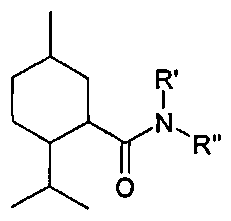
Уотсон с соавторами, 1979 г., описывает «N-замещенные карбоксамиды пара-ментана» следующей формулы. Среди примеров в данной работе представлены соединения, в которых R′ представляет собой -H и R′′ представляет собой -CH2C(=O)OCH3, -CH2C(=O)OCH2CH3 или -CH2C(=O)OCH2CH2CH3. Соответствующее соединение, в котором R′′ представляет собой -CH2C(=O)OCH(CH3)2 не представлено.Watson et al., 1979, describe the “N-substituted para-menthan carboxamides” of the following formula. Among the examples in this work, compounds are provided in which R ′ is —H and R ′ ′ is —CH 2 C (= O) OCH 3 , —CH 2 C (= O) OCH 2 CH 3, or —CH 2 C (= O) OCH 2 CH 2 CH 3 . The corresponding compound in which R ″ is —CH 2 C (= O) OCH (CH 3 ) 2 is not represented.
КРАТКОЕ ОПИСАНИЕ ИЗОБРЕТЕНИЯSUMMARY OF THE INVENTION
Один из аспектов настоящего изобретения относится к соединению ИПЭ согласно настоящему описанию.One aspect of the present invention relates to an IPE compound as described herein.
Другой аспект настоящего изобретения относится к композиции, содержащей соединение ИПЭ согласно настоящему описанию.Another aspect of the present invention relates to a composition comprising an IPE compound as described herein.
Другой аспект настоящего изобретения относится к соединению ИПЭ согласно настоящему описанию для лечения организма человека или животного посредством терапии.Another aspect of the present invention relates to an IPE compound as described herein for treating a human or animal organism through therapy.
Другой аспект настоящего изобретения относится к соединению ИПЭ согласно настоящему описанию для лечения сенсорного дискомфорта у человека согласно настоящему описанию.Another aspect of the present invention relates to an IPE compound as described herein for treating human sensory discomfort as described herein.
Другой аспект настоящего изобретения относится к способу лечения сенсорного дискомфорта у человека согласно настоящему описанию, включающему введение терапевтически эффективного количества соединения ИПЭ согласно настоящему описанию.Another aspect of the present invention relates to a method for treating sensory discomfort in humans as described herein, comprising administering a therapeutically effective amount of an IPE compound as described herein.
Другой аспект настоящего изобретения относится применению соединения ИПЭ согласно настоящему описанию для получения лекарственного средства для лечения сенсорного дискомфорта у человека согласно настоящему описанию.Another aspect of the present invention relates to the use of an IPE compound as described herein for the manufacture of a medicament for the treatment of sensory discomfort in humans as described herein.
Как очевидно специалисту в данной области, признаки и предпочтительные варианты одного аспекта изобретения также относятся и к другим аспектам настоящего изобретения.As one skilled in the art will recognize, the features and preferred embodiments of one aspect of the invention also apply to other aspects of the present invention.
ПОДРОБНОЕ ОПИСАНИЕ ИЗОБРЕТЕНИЯDETAILED DESCRIPTION OF THE INVENTION
СоединенияConnections
Автором настоящего изобретения было обнаружено, что некоторые соединения неожиданно являются эффективными охлаждающими агентами для ткани многослойного неороговевающего эпителия (МНЭ). Данные соединения обеспечивают сильное, долговременное и селективное охлаждение для тканей неороговевающего эпителия по сравнению с тканями ороговевающего эпителия.It has been found by the present inventor that some compounds are surprisingly effective cooling agents for multilayer non-keratinizing epithelial tissue (MNE). These compounds provide strong, long-term and selective cooling for tissues of the non-keratinizing epithelium compared to tissues of the keratinizing epithelium.
В настоящем описании такие соединения собирательно обозначены как "соединения изопропиловых эфиров" или "соединения ИПЭ" и представляют собой:In the present description, such compounds are collectively referred to as "isopropyl ether compounds" or "IPE compounds" and are:
изопропиловый эфир [((1R,2S,5R)-2-изопропил-5-метилциклогексанкарбонил)-амино]-уксусной кислоты ("Gly-O-iPr"), и[((1R, 2S, 5R) -2-isopropyl-5-methylcyclohexanecarbonyl) amino] acetic acid isopropyl ester ("Gly-O-iPr"), and
изопропиловый эфир [((1R,2S,5R)-2-изопропил-5-метилциклогексанкарбонил)-метиламино]-уксусной кислоты ("N-Gly-O-iPr");[((1R, 2S, 5R) -2-isopropyl-5-methylcyclohexanecarbonyl) methylamino] -acetic acid isopropyl ester ("N-Gly-O-iPr");
и их фармацевтически приемлемые соли, гидраты и сольваты.and their pharmaceutically acceptable salts, hydrates and solvates.
Таким образом, в одном из аспектов настоящего изобретения предложено соединение, представляющее собой:Thus, in one aspect of the present invention, a compound is provided, which is:
изопропиловый эфир [((1R,2S,5R)-2-изопропил-5-метилциклогексанкарбонил)-амино]-уксусной кислоты ("Gly-O-iPr"), или[((1R, 2S, 5R) -2-isopropyl-5-methylcyclohexanecarbonyl) amino] acetic acid isopropyl ester ("Gly-O-iPr"), or
изопропиловый эфир [((1R,2S,5R)-2-изопропил-5-метилциклогексанкарбонил)-метиламино]-уксусной кислоты ("N-Gly-O-iPr");[((1R, 2S, 5R) -2-isopropyl-5-methylcyclohexanecarbonyl) methylamino] -acetic acid isopropyl ester ("N-Gly-O-iPr");
или их фармацевтически приемлемую соль, гидрат или сольват.or a pharmaceutically acceptable salt, hydrate or solvate thereof.
Соединения Gly-O-iPr и N-Gly-O-iPr представлены в следующей таблице.Gly-O-iPr and N-Gly-O-iPr compounds are shown in the following table.
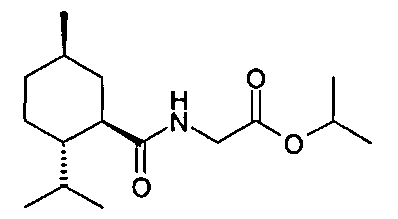

Эти соединения по структуре являются родственными (-)-ментолу и имеют те же хиральные центры в той же конфигурации, что и в (-)-ментоле.These compounds are structurally related to (-) - menthol and have the same chiral centers in the same configuration as in (-) - menthol.
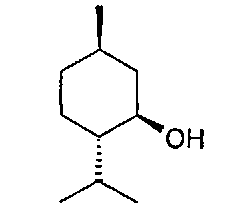
С позиции структуры указанные соединения могут быть традиционно описаны как изопропиловый эфир, образованный с глицином глицинового амида и N-метил-глицинового амида, соответственно, карбоновой кислоты, соответствующей (-)-ментолу.From the structural point of view, these compounds can be traditionally described as isopropyl ether formed with glycine glycine amide and N-methyl-glycine amide, respectively, of a carboxylic acid corresponding to (-) - menthol.
В одном из вариантов реализации настоящего изобретения предложенное соединение представляет собой изопропиловый эфир [((1R,2S,5R)-2-изопропил-5-метилциклогексанкарбонил)-амино]-уксусной кислоты или его фармацевтически приемлемую соль, гидрат или сольват.In one embodiment, the compound of the invention is [((1R, 2S, 5R) -2-isopropyl-5-methylcyclohexanecarbonyl) amino] acetic acid isopropyl ester or a pharmaceutically acceptable salt, hydrate or solvate thereof.
В одном из вариантов реализации настоящего изобретения предложенное соединение представляет собой изопропиловый эфир [((1R,2S,5R)-2-изопропил-5-метилциклогексанкарбонил)-амино]-уксусной кислоты или его фармацевтически приемлемую соль.In one embodiment, the compound of the invention is [((1R, 2S, 5R) -2-isopropyl-5-methylcyclohexanecarbonyl) amino] acetic acid isopropyl ester or a pharmaceutically acceptable salt thereof.
В одном из вариантов реализации настоящего изобретения предложенное соединение представляет собой изопропиловый эфир [((1R,2S,5R)-2-изопропил-5-метилциклогексанкарбонил)-амино]-уксусной кислоты.In one embodiment, the compound of the invention is [((1R, 2S, 5R) -2-isopropyl-5-methylcyclohexanecarbonyl) amino] -acetic acid isopropyl ester.
Химический синтезChemical synthesis
Согласно одной из методик, алкиловые эфиры, образованные с глицином глицинового амида карбоновой кислоты, соответствующей (-)-ментолу, могут быть получены в результате реакции галогенангидрида (например, хлорангидрида) карбоновой кислоты, соответствующей (-)-ментолу, с соответствующим алкиловым эфиром глицина, например, как показано ниже.According to one technique, alkyl esters formed with glycine of a glycine carboxylic acid amide corresponding to (-) - menthol can be obtained by reacting a carboxylic acid halide (e.g., acid chloride) with the corresponding (-) - menthol with the corresponding glycine alkyl ester , for example, as shown below.
Схема 1Scheme 1
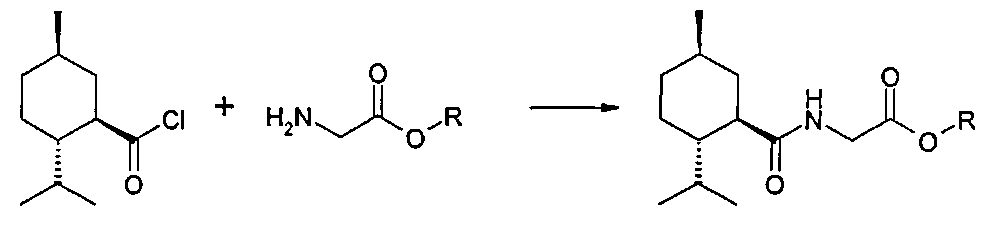
Многие алкиловые эфиры глицина (включая метиловый и этиловый эфиры глицина) доступны в продаже, например, в компании Sigma-Aldrich. Другие алкиловые эфиры глицина могут быть получены специалистами с применением известных и/или традиционных методов.Many glycine alkyl esters (including glycine methyl and ethyl esters) are commercially available from, for example, Sigma-Aldrich. Other glycine alkyl esters can be prepared by those skilled in the art using known and / or traditional methods.
Например, соединение в виде этилового эфира (в котором R представляет собой Et), обозначенное в настоящем описании как Gly-O-Et, было получено следующим образом: 1,0 г гидрохлорида этилового эфира глицина (Sigma-Aldrich) растворяли в 28 мл диэтилового эфира и 1 мл дважды дистиллированной воды и охлаждали до 0°C. Добавляли щепотку диаминопиримидина в качестве катализатора. По каплям добавляли 1,62 мл п-ментолилхлорида, после чего добавляли 2 мл триэтиламина. В смеси, перемешиваемой в течение ночи при комнатной температуре, появлялись комки белого осадка. Осадок собирали, растворяли в этилацетате, промывали дважды дистиллированной водой и сушили над сульфатом натрия. Далее органическую фазу выпаривали при пониженном давлении с получением конечного продукта (2 г), который кристаллизовали при комнатной температуре. При анализе методом высокоэффективной жидкостной хроматографии (ВЭЖХ) был выявлен одиночный пик, соответствующий более 95% целевого вещества. Для подтверждения идентичности использовали методы масс-спектрометрии (МС) и ядерного магнитного резонанса (ЯМР).For example, an ethyl ester compound (in which R is Et), referred to herein as Gly-O-Et, was prepared as follows: 1.0 g of glycine ethyl ester hydrochloride (Sigma-Aldrich) was dissolved in 28 ml of diethyl ether and 1 ml of twice distilled water and cooled to 0 ° C. A pinch of diaminopyrimidine was added as a catalyst. 1.62 ml of p-mentholyl chloride was added dropwise, after which 2 ml of triethylamine was added. In a mixture stirred overnight at room temperature, lumps of white precipitate appeared. The precipitate was collected, dissolved in ethyl acetate, washed twice with distilled water and dried over sodium sulfate. Next, the organic phase was evaporated under reduced pressure to obtain the final product (2 g), which crystallized at room temperature. When analyzed by high performance liquid chromatography (HPLC), a single peak was detected, corresponding to more than 95% of the target substance. To confirm the identity, the methods of mass spectrometry (MS) and nuclear magnetic resonance (NMR) were used.
Изопропильное соединение (в котором R представляет собой iPr), обозначенное в настоящем описании как Gly-O-iPr, было получено компанией Phoenix Pharmaceuticals, Бурлингейм, Калифорния (www.phoenixpeptide.com): партия №427497; C16H29NO3; молекулярная масса 283,41; чистота ≥95% по массе; внешний вид: белый кристаллический порошок. Дополнительные соединения были получены компанией ООО «ДИАФАРМ» (Diapharm Ltd.), Санкт-Петербург, Россия.The isopropyl compound (in which R is iPr), referred to herein as Gly-O-iPr, was obtained by Phoenix Pharmaceuticals, Burlingame, California (www.phoenixpeptide.com): lot No. 427497; C 16 H 29 NO 3 ; molecular weight 283.41; purity ≥95% by weight; Appearance: white crystalline powder. Additional compounds were obtained by Diapharm Ltd., St. Petersburg, Russia.
Были получены следующие соединения.The following compounds were obtained.
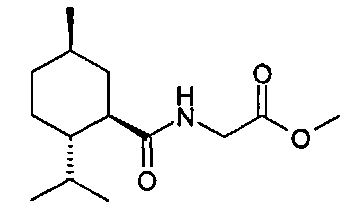
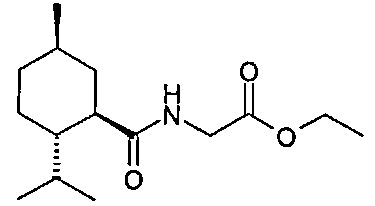

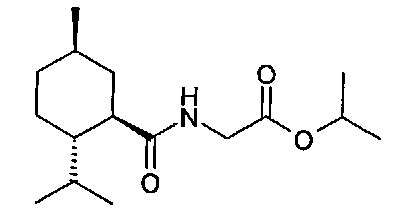

Биологическая оценкаBiological assessment
Химические соединения, которые вызывают температурные ощущения охлаждения, обладают несколькими свойствами, которые можно наблюдать при проведении исследований соединений на людях. Во-первых, это само ощущение, например, у субъекта можно спросить, ощущает ли он умеренную прохладу, прохладу или холод. Во-вторых, существует интенсивность ощущения, например, у субъекта можно спросить: ощущает ли он освежающую прохладу, сильную прохладу, интенсивный холод или обжигающий холод. В-третьих, существует продолжительность действия; у субъекта можно спросить: как долго продолжается действие. Продолжительность действия обычно определяется началом и окончанием ощущения и обычно составляет несколько минут или несколько часов. В-четвертых, существует активность; активность конкретного исследуемого соединения по обеспечению охлаждения обычно выражают с использованием применяемой концентрации (например, % по массе, мг/мл и т.п.) или дозы (например, мг на единицу массы тела).Chemical compounds that cause a temperature sensation of cooling have several properties that can be observed in studies of compounds in humans. First, this sensation itself, for example, the subject can be asked whether he feels moderate coolness, coolness or cold. Secondly, there is an intensity of sensation, for example, one can ask a subject: does he feel refreshing coolness, strong coolness, intense cold or burning cold. Thirdly, there is a duration of action; the subject can be asked: how long the action lasts. The duration of action is usually determined by the beginning and end of the sensation and is usually several minutes or several hours. Fourth, there is activity; the activity of a particular test compound in providing cooling is usually expressed using the concentration used (e.g.,% by weight, mg / ml, etc.) or dose (e.g., mg per unit body weight).
Биологическое исследование на многослойном ороговевающем эпителии: исследование на губном желобкеBiological research on stratified keratinized epithelium: a study on the labial groove
Губной желобок представляет собой канавку на срединной линии выше границы верхней губы. Местом исследования действия лекарственного средства была кожа над верхней губой (над красной каймой губ), на губном желобке, сбоку от губного желобка до носогубных складок и иногда на нижней ноздре (в точке соединения носовой перегородки и верхней губы). Известно, что эта часть лица густо иннервирована рецепторами прохлады/холода, вторые находятся только на поверхностях глазного яблока и аногенитальной области. Также из научной литературы известно, что область около губ имеет высокую плотность «холодных точек» (см., например, Дакка с соавторами (Dhaka et al.), 2008).The labial groove is a groove in the midline above the border of the upper lip. The place of study of the drug was the skin above the upper lip (above the red border of the lips), on the labial groove, on the side of the labial groove to the nasolabial folds, and sometimes on the lower nostril (at the junction of the nasal septum and upper lip). It is known that this part of the face is densely innervated by cool / cold receptors, the latter are found only on the surfaces of the eyeball and the anogenital region. It is also known from the scientific literature that the area near the lips has a high density of “cold spots” (see, for example, Dhaka et al. (Dhaka et al.), 2008).
Для определения антиноцицептивной активности исследуемое соединение сначала растворяли (5 мг/мл) в мази (Аквафор (Aquaphor®), которая содержала 41% петролатума, а остальное - минеральное масло, церезин и ланолиновый спирт) и однократно наносили (от 40 до 70 мг) на поверхность кожи губного желобка при помощи пластиковой палочки. На данном участке ощущения прохлады и холода на коже могут быть почувствованы и оценены по времени начала действия и интенсивности. Интенсивности субъективного ощущения дают оценки 0, 1, 2 или 3, где 0 - отсутствие изменений; 1 - легкая прохлада или холод; 2 - четкий сигнал о прохладе или холоде и 3 - сильная прохлада или холод. Интервалы для записи оценок составляли 5 и 10 минут, и запись продолжали до тех пор, пока не было получено два отчетливых нуля. За время начала действия лекарственного средства принимают время достижения 2 единиц интенсивности охлаждения, а время прекращения действия лекарственного средства представляет собой время, когда после достижения оценки выше 2 единиц интенсивность охлаждения падает ниже 2 единиц.To determine the antinociceptive activity, the test compound was first dissolved (5 mg / ml) in ointment (Aquaphor®, which contained 41% petrolatum, and the rest was mineral oil, ceresin and lanolin alcohol) and applied once (from 40 to 70 mg) on the surface of the skin of the labial groove with a plastic stick. In this area, sensations of coolness and cold on the skin can be felt and evaluated by the time of the onset of action and intensity. The intensities of subjective sensations give estimates of 0, 1, 2, or 3, where 0 is the absence of changes; 1 - easy cool or cold; 2 - a clear signal of coolness or cold; and 3 - strong coolness or cold. The intervals for recording the grades were 5 and 10 minutes, and the recording continued until two distinct zeros were obtained. For the time of the onset of the drug, take the time to reach 2 units of cooling intensity, and the cessation of the drug is the time when, after reaching an estimate of above 2 units, the cooling rate drops below 2 units.
Продолжительность охлаждающего действия определяют как время прекращения действия минус время начала действия. Неактивным соединением считают соединение, оценка которого не превышает 2 единиц охлаждения в течение 5 минут при любом времени после нанесения.The duration of the cooling effect is defined as the termination time minus the time the action began. An inactive compound is a compound whose rating does not exceed 2 units of cooling for 5 minutes at any time after application.
Уотсоном с соавторами, 1979, описано исследование свойств N-замещенных карбоксамидов п-ментана на добровольцах, которым прикладывали фильтровальную бумагу (1×1 см), пропитанную известным количеством исследуемого соединения, на дорсальную поверхность языка. Через 30 секунд субъекта просили сообщить о наличии или отсутствии охлаждающего действия. Эти данные отмечали как «Порог, мкг» и считали пороговым количеством исследуемого соединения, которое вызывает охлаждающие ощущения при нанесении на язык у людей из группы волонтером. Средний порог для (-)-ментола для 6 субъектов составил 0,25 мкг, однако было 100-кратное различие в индивидуальной чувствительности. Дорсальная поверхность языка ороговевшая (кератинизированная). Кератин представляет собой компонент пальцеобразных выступов, называемых сосочками, которые отвечают за вкусовые ощущения. Сигналы об охлаждении, определенные с применением метода, описанного Уотсоном с соавторами, 1979, может не отражать действие лекарственных средств на МНЭ.Watson et al., 1979, described a study of the properties of N-substituted p-menthan carboxamides on volunteers who applied filter paper (1 × 1 cm), impregnated with a known amount of the test compound, on the dorsal surface of the tongue. After 30 seconds, the subject was asked to report the presence or absence of a cooling effect. These data were marked as “Threshold, μg” and were considered the threshold amount of the test compound, which causes a cooling sensation when applied to the tongue in people from the group as a volunteer. The average threshold for (-) - menthol for 6 subjects was 0.25 μg, but there was a 100-fold difference in individual sensitivity. The dorsal surface of the tongue is keratinized (keratinized). Keratin is a component of the finger-shaped protrusions called papillae, which are responsible for taste sensations. Cooling signals detected using the method described by Watson et al. 1979 may not reflect the effects of drugs on MNE.
Биологическое исследование на многослойном неороговевающем эпителии: исследование на поверхности глазBiological research on multilayered non-keratinizing epithelium: a study on the surface of the eyes
Для проведения исследования на поверхности глаз в качестве средства доставки использовали влажную салфетку, содержащую исследуемое соединение. Исследуемое соединение растворяли сначала в абсолютном этаноле, а затем в дистиллированной воде с получением стандартного раствора с концентрацией 1 мг/мл в растворе этанола в воде с концентрацией от 3 до 5% по массе. Далее три мл исследуемого соединения добавляли на прямоугольник (50 мм × 60 мм) из хлопка массой 0,4 г (CS-being, Daisan Cotton, Япония) и отдельно герметично упаковывали с использованием вакуумного устройства (Foodsaver®, Jarden Corp.). Образцы хранили в морозильнике или в холодильники и перед применением их температуру доводили до комнатной. При протирании хлопковым тампоном на закрытые веки доставляется от 40 до 45 мкл жидкой композиции (~20-22 мкл на поверхность одного глаза). Таким образом, если концентрация исследуемого соединения составляла мг/мл, доза, доставляемая на оба глаза, составляла ~40-42 мкг или ~20 мкг на один глаз. Наличие или отсутствие ощущений прохлады на поверхности глаз отмечали по наличию или отсутствию в интервалы от 5 до 10 минут до тех пор пока отсутствие охлаждения не было отмечено в двух соответствующих исследуемых интервалах. Записывали только период охлаждения поверхности глаз без попыток количественной оценки интенсивности ощущений.To conduct a study on the surface of the eyes, a wet towel containing the test compound was used as a delivery vehicle. The test compound was dissolved first in absolute ethanol and then in distilled water to obtain a standard solution with a concentration of 1 mg / ml in a solution of ethanol in water with a concentration of from 3 to 5% by weight. Next, three ml of the test compound was added onto a rectangle (50 mm × 60 mm) of cotton weighing 0.4 g (CS-being, Daisan Cotton, Japan) and separately sealed using a vacuum device (Foodsaver®, Jarden Corp.). Samples were stored in a freezer or in refrigerators and brought to room temperature before use. When wiped with a cotton swab, 40 to 45 μl of the liquid composition is delivered to closed eyelids (~ 20-22 μl to the surface of one eye). Thus, if the concentration of the test compound was mg / ml, the dose delivered to both eyes was ~ 40-42 μg or ~ 20 μg per eye. The presence or absence of sensations of coolness on the surface of the eyes was noted by the presence or absence in the intervals from 5 to 10 minutes until the absence of cooling was noted in two corresponding studied intervals. We recorded only the period of cooling the surface of the eyes without attempting to quantify the intensity of sensations.
Биологическое исследование на многослойном неороговевающем эпителии: исследование на поверхности ротоглоткиBiological research on multilayered non-keratinizing epithelium: research on the surface of the oropharynx
Количество раздражителей оценивали по вызыванию ощущения кашля как меры чувствительности глотки (см., например, Морис с соавторами (Morice et al.), 2001). Обычно лимонную кислоту или капсаицин вводят добровольцам путем ингаляций и подсчитывают, сколько раз они кашляли. Автором настоящего изобретения было обнаружено, что ощущения в нижней части глотки, связанные с желанием откашляться, могут быть воспроизведены путем размещения (при помощи шприца или пластмассовой палочки) от 0,2 до 0,25 мл соуса из перца чили на заднюю часть дорсальной поверхности языка. Соус из перца чили смешивается со слюной, и слюна затем остается на задней части ротоглотки. В качестве соуса из перца чили использовали соус из перца чили Yank Sing® (YS Gourmet Productions, Inc., PO Box 26189, Сан-Франциско, CA 94126), который является хорошо известной приправой для использования с дим-сам (китайская закуска к чаю). Ощущения, связанные с соусом из перца чили, исходят с задней стенки полости рта, эти ощущения четко распознаются субъектом, на котором проводят исследования, и связаны с желанием откашляться. Ощущения, вызванные соусом из перца чили, могут быть легко подавлены, если выпить холодную воду или использовать таблетку для рассасывания (ТДР), содержащую охлаждающий ингредиент, однако на них не влияют ТДР, содержащие только наполнитель.The amount of stimuli was evaluated by inducing a cough sensation as a measure of the sensitivity of the pharynx (see, for example, Maurice et al. (Morice et al.), 2001). Typically, citric acid or capsaicin is administered to volunteers by inhalation and the number of times they cough is counted. The author of the present invention found that the sensations in the lower part of the pharynx associated with the desire to cough can be reproduced by placing (using a syringe or plastic stick) from 0.2 to 0.25 ml of chili pepper sauce on the back of the dorsal surface of the tongue . Chili pepper sauce is mixed with saliva, and saliva then remains on the back of the oropharynx. Yank Sing® chili pepper sauce (YS Gourmet Productions, Inc., PO Box 26189, San Francisco, CA 94126), which is a well-known seasoning for use with dim sum (Chinese tea snack), was used as a chili pepper sauce ) The sensations associated with the chili pepper sauce come from the back wall of the oral cavity, these sensations are clearly recognized by the subject being tested, and are associated with the desire to cough up. The sensations caused by chili pepper sauce can be easily suppressed if you drink cold water or use a resorption tablet (TDR) containing a cooling ingredient, but they are not affected by TDR containing only a filler.
Для приготовления ТДР брали ингредиент, растворяли его в абсолютном этаноле, а затем добавляли 10% по массе мальтита и 90% по массе маннита, а затем равный объем дистиллированной воды. Смесь перемешивали стеклянной палочкой и наносили на кусок вощеной бумаги одноразовой пластиковой пипеткой. Отдельные высушенные таблетки весили в среднем 150 мг каждая и при нахождении на дорсальной поверхности языка полностью растворяются в слюне и покрывают поверхность ротоглотки. В среднем, количество исследуемого соединения составляло от 2,5 до 3 мг на таблетку.To prepare the TDR, an ingredient was taken, dissolved in absolute ethanol, and then 10% by weight of maltitol and 90% by weight of mannitol were added, and then an equal volume of distilled water was added. The mixture was stirred with a glass rod and applied to a piece of wax paper with a disposable plastic pipette. Individual dried tablets weighed an average of 150 mg each and, when located on the dorsal surface of the tongue, completely dissolve in saliva and cover the surface of the oropharynx. On average, the amount of test compound ranged from 2.5 to 3 mg per tablet.
Для исследования антиноцицептивной активности ТДР, содержащую исследуемое соединение, сначала вводили на дорсальную поверхность языка, а через 45-50 минут вводили раздражитель в виде соуса из перца чили. В это время ощущения прохлады от исследуемого соединения исчезали, и задачей исследования было определить, сохраняется ли антиноцицептивное действие. Были отмечены следующие результаты: если не было ослабления действия раздражителя, то ставили (0), если было частичное подавление, то ставили (+), и если было полное ослабление сигнала раздражителя, ставили (++). В присутствии ТДР, содержащей активный ингредиент, дающий (++), раздражающие сигналы полностью отсутствовали, но можно было легко идентифицировать и почувствовать соленый вкус соевого соуса, используемого в приправе.To study the antinociceptive activity, TDR containing the test compound was first introduced onto the dorsal surface of the tongue, and after 45-50 minutes the stimulus was introduced in the form of chili pepper sauce. At this time, the feeling of coolness from the test compound disappeared, and the task of the study was to determine whether the antinociceptive effect persists. The following results were noted: if there was no attenuation of the stimulus, then set (0), if there was a partial suppression, then set (+), and if there was a complete attenuation of the stimulus signal, set (++). In the presence of a TDR containing the active ingredient giving (++), irritating signals were completely absent, but the salty taste of the soy sauce used in the seasoning could be easily identified and felt.
Исследование 1Study 1
Данные, полученные для многослойного ороговевающего эпителия и многослойного неороговевающего эпителия (МНЭ) приведены в следующей таблице.The data obtained for the stratified keratinized epithelium and stratified non-keratinized epithelium (MNE) are shown in the following table.
Продолжительность действия Gly-O-iPr на ороговевающем эпителии одна из самых коротких и, напротив, на неороговевающем эпителии Gly-O-iPr имеет наибольшую продолжительность действия. Самое продолжительное действие Gly-O-iPr на поверхности глаз было как удивительным, так и неожиданным. Охлаждающее действие длилось в среднем 5 часов. Повышение исследуемой концентрации Gly-O-iPr с 1 мг/мл до 1,5 мг/мл дополнительно увеличило продолжительность действия на поверхности глаз до 6,5 часов. Для сравнения, если концентрацию Gly-O-Et увеличивали с 1 мг/мл до 2 мг/мл или даже до 5 мг/мл, интенсивность ощущения охлаждения увеличивалась, но продолжительность увеличивалась только на 15-22 минуты, соответственно. Селективное действие Gly-O-iPr на неороговевающих поверхностях глаз является следствием различий в типе фармакологической активности и зависит не только от введенной дозы.The duration of action of Gly-O-iPr on keratinized epithelium is one of the shortest and, conversely, on non-keratinized epithelium, Gly-O-iPr has the longest duration of action. The longest effect of Gly-O-iPr on the surface of the eyes was both surprising and unexpected. The cooling effect lasted an average of 5 hours. An increase in the test concentration of Gly-O-iPr from 1 mg / ml to 1.5 mg / ml further increased the duration of action on the surface of the eyes to 6.5 hours. For comparison, if the concentration of Gly-O-Et was increased from 1 mg / ml to 2 mg / ml or even 5 mg / ml, the intensity of the cooling sensation increased, but the duration increased only by 15-22 minutes, respectively. The selective effect of Gly-O-iPr on non-keratinized surfaces of the eyes is a consequence of differences in the type of pharmacological activity and depends not only on the administered dose.
Шесть субъектов согласились испытать на себе салфетки для глаз с Gly-O-Et, Gly-O-iPr и Gly-O-nPr в рандомизированном двойном слепом исследовании с тремя испытаниями для каждой салфетки. Результаты были однозначными и демонстрировали продолжительность действия, при которой Gly-O-iPr>>Gly-O-nPr>Gly-O-Et.Six subjects agreed to test Gly-O-Et, Gly-O-iPr and Gly-O-nPr eye wipes in a randomized, double-blind study with three trials for each wipe. The results were unequivocal and demonstrated a duration of action at which Gly-O-iPr >> Gly-O-nPr> Gly-O-Et.
На поверхности ротоглотки и Gly-O-iPr, и Gly-O-Et вызывали ощущение освежающей прохлады. Однако, Gly-O-iPr вызывал более долгое и продолжительное освежающее «чувство» в полости рта, которое не ощущалось ни при использовании Gly-O-Et, ни при использовании Gly-O-nPr, и которое блокировало ответ на соус из перца чили. В тех же условиях проведения исследования Gly-O-Et и Gly-O-nPr не были эффективными.On the surface of the oropharynx, both Gly-O-iPr and Gly-O-Et evoked a feeling of refreshing coolness. However, Gly-O-iPr caused a longer and longer refreshing “feeling” in the oral cavity, which was not felt either when using Gly-O-Et or when using Gly-O-nPr, and which blocked the response to chili pepper sauce . Under the same study conditions, Gly-O-Et and Gly-O-nPr were not effective.
Таким образом, Gly-O-iPr обладает удивительными и неожиданными свойствами, которые отличаются от свойств Gly-O-Me, Gly-O-Et, Gly-O-nPr и Gly-O-nBu.Thus, Gly-O-iPr has surprising and unexpected properties that differ from those of Gly-O-Me, Gly-O-Et, Gly-O-nPr and Gly-O-nBu.
Исследование 2Study 2
Тест Эймса (назван в честь профессора Б.Н. Эймса (B.N. Ames) из Калифорнийского университета в Беркли) представляет собой анализ, проводимый на бактериях, для определения мутагенного потенциала исследуемого соединения. Если тест дает положительный результат, исследуемое соединение может взаимодействовать с нуклеиновыми кислотами и представлять опасность для генетического материала. Тест Эймса является стандартным инструментом для оценки безопасности.The Ames test (named after Professor B.N. Ames of the University of California at Berkeley) is a bacterium-based assay to determine the mutagenic potential of a test compound. If the test gives a positive result, the test compound may interact with nucleic acids and be dangerous for the genetic material. The Ames test is a standard safety assessment tool.
В паспорте безопасности вещества для Gly-O-Et (MSDS номер 2984, 09 ноября 2005 г., SCM Europe SA/NV, 141 Rue St. Lambert Suite 2, B-1200, Брюссель, Бельгия) в категории «мутагенность» указано, что «В тесте Эймса для [Gly-O-Et] был получен результат «слабая мутагенность» в отношении штамма ТА1535 в условиях проведения теста. Ответы были малыми и демонстрировали степень воспроизводимости».The substance safety data sheet for Gly-O-Et (MSDS no. 2984, November 9, 2005, SCM Europe SA / NV, 141 Rue St. Lambert Suite 2, B-1200, Brussels, Belgium) in the category “mutagenicity” indicates that “In the Ames test for [Gly-O-Et], the result was“ weak mutagenicity ”with respect to strain TA1535 under test conditions. The responses were small and demonstrated a degree of reproducibility. ”
Оценка Gly-O-iPr на мутагенную активность в отношении тест-штамма Salmonella typhimurium ТА1535 (тест Эймса для данного штамма) была проведена в компании Notox, BV, Hambakenwetering, РО Box 34763, Хертогенбош, Нидерланды (исследовательская организация, специализирующаяся на оценке безопасности и тестировании, проводившая исследования по контракту). Gly-O-iPr исследовали на ТА1535 в присутствии или отсутствии смеси S9-mix (S9-mix из печени крыс, индуцированная комбинацией фенобарбитала и β-нафтофлавона). Gly-O-iPr предоставляли в виде белого кристаллического порошка, синтезированного в компании Phoenix Pharmaceuticals, Inc. (Бурлингейм, Калифорния) с чистотой ≥95% по массе, и растворяли в диметилсульфоксиде (ДМСО).Assessment of Gly-O-iPr for mutagenic activity against the Salmonella typhimurium TA1535 test strain (Ames test for this strain) was performed by Notox, BV, Hambakenwetering, PO Box 34763, Hertogenbosch, Netherlands (a research organization specializing in safety and testing conducted by contract). Gly-O-iPr was tested on TA1535 in the presence or absence of a mixture of S9-mix (S9-mix from rat liver induced by a combination of phenobarbital and β-naphthoflavone). Gly-O-iPr was provided as a white crystalline powder synthesized by Phoenix Pharmaceuticals, Inc. (Burlingame, CA) with a purity of ≥95% by weight, and was dissolved in dimethyl sulfoxide (DMSO).
Gly-O-iPr исследовали в концентрациях от 3 до 5000 мкг/чашку при 8 дозировках. Gly-O-iPr не осаждался на чашках в наивысшей дозе, составляющей 5000 мкг/чашку. Бактериальный фон не снижался ни при одной из исследуемых концентраций, и биологически значимого уменьшения количества ревертантов не наблюдалось.Gly-O-iPr was tested in concentrations from 3 to 5000 μg / cup at 8 dosages. Gly-O-iPr did not precipitate on dishes at the highest dose of 5,000 μg / cup. The bacterial background did not decrease at any of the studied concentrations, and a biologically significant decrease in the number of revertants was not observed.
Gly-O-iPr не вызывал дозозависимого увеличения количества ревертантных (His+) колоний ТА1535 в отсутствии или присутствии S9-метаболической активации. В данном исследовании значения для отрицательного контроля и штаммспецифичного положительного контроля (индуцированного азидом натрия или 2-аминоантраценом) были в пределах диапазонов, которые получали в данной лаборатории ранее, что говорит о том, что условия проведения исследований были адекватными и что система метаболической активации работала должным образом. На основании результатов данного исследования можно сделать вывод, что Gly-O-iPr не является мутагенным в отношении тест-штамма Salmonella typhimurium ТА1535.Gly-O-iPr did not cause a dose-dependent increase in the number of revertant (His + ) TA1535 colonies in the absence or presence of S9 metabolic activation. In this study, the values for the negative control and strain-specific positive control (induced by sodium azide or 2-aminoanthracene) were within the ranges that were obtained in this laboratory earlier, which indicates that the conditions of the studies were adequate and that the metabolic activation system worked properly way. Based on the results of this study, it can be concluded that Gly-O-iPr is not mutagenic with respect to the Salmonella typhimurium TA1535 test strain.
Таким образом, Gly-O-iPr не имеет токсикологических свойств, присущих Gly-O-Et. Данный результат был удивительным и неожиданным, поскольку структуры данных двух соединений очень близки.Thus, Gly-O-iPr does not have the toxicological properties inherent in Gly-O-Et. This result was surprising and unexpected, since the data structures of the two compounds are very close.
Исследование 3Study 3
Ученый в лаборатории страдал от сезонного аллергического конъюнктивита. Это состояния сильно усугублялось, когда он начинал проводить эксперименты на лабораторных животных (крысах и мышах), и он стал чувствительным к соответствующим аллергенам. Конъюнктивит не может быть облегчен путем пероральных или местных глазных капель, содержащих антигистаминные лекарственные средства, также у указанного субъекта не было желания рассматривать вопрос о применении противовоспалительных стероидных мазей. При осмотре его глаза были налитыми кровью и водянистыми, и он продолжал тереть веки пальцами, даже зная, что данное действие может в дальнейшем усилить его зуд и дискомфорт. Он вызвался попробовать салфетки для глаз, содержащие 1,0 мг/мл Gly-O-iPr. Облегчение зуда и дискомфорта было достигнуто в течение 5 минут и продолжалось по меньшей мере несколько часов.A scientist in the laboratory suffered from seasonal allergic conjunctivitis. This condition was greatly aggravated when he began to conduct experiments on laboratory animals (rats and mice), and he became sensitive to the corresponding allergens. Conjunctivitis cannot be alleviated by oral or local eye drops containing antihistamines, and the subject did not want to consider the use of anti-inflammatory steroid ointments. Upon examination, his eyes were bloodshot and watery, and he continued to rub his eyelids with his fingers, even knowing that this action could further aggravate his itching and discomfort. He volunteered to try eye wipes containing 1.0 mg / ml Gly-O-iPr. Relief of itching and discomfort was achieved within 5 minutes and lasted at least several hours.
Субъект использовал салфетки по мере необходимости в течение трех дней и был удивлен, увидев, что все его зуд и покраснение были значительно уменьшены.Subject used wipes as needed for three days and was surprised to see that all of his itching and redness were significantly reduced.
Исследование 4Study 4
Дочь 52-летнего мужчины переехала из своего района, чтобы пойти в колледж, и ему надо было ухаживать за двумя ее кошками. Сначала все было в порядке, но потом, он стал чувствительным к пыли из ящика для мусора, которая образовывалась, когда он убирал за кошками. У него развилась сухость, першение в горле и кашель и это состояние сильно усугублялось его сезонной аллергией на пыльцу растений, поэтому он постоянно прочищал горло. Стандартные неседативные антигистамины не облегчали его раздражение в верхних дыхательных путях. Примерно через две недели кашля и дискомфорта он согласился попробовать Gly-O-iPr, сначала нанесенный по 3 мг на пластины жевательной резинки Wrigley spearmint, а затем в виде таблетки для рассасывания, содержащей 3 мг на единичную дозу. И лекарственная жевательная резинка, и ТДР обеспечивали облегчение через пять минут после введения. Чувство дискомфорта в горле ослаблялось, действие продолжалось в течение примерно пяти часов и дозирование может быть повторено с тем же положительным результатом. Данный человек предпочел способ доставки в виде ТДР, поскольку он счел его более эффективным, чем жевательная резинка. После применения по мере необходимости ДТР, содержащих Gly-O-iPr, в течение десяти дней кашель и першение в горле у субъекта прошли и сейчас он чувствует себя хорошо.The daughter of a 52-year-old man moved from her area to go to college, and he had to look after her two cats. At first everything was in order, but then, he became sensitive to dust from the litter box that was formed when he cleaned after the cats. He developed dryness, sore throat and cough, and this condition was greatly aggravated by his seasonal allergy to plant pollen, so he constantly cleared his throat. Standard non-sedative antihistamines did not alleviate irritation in the upper respiratory tract. After about two weeks of coughing and discomfort, he agreed to try Gly-O-iPr, first 3 mg applied to Wrigley spearmint chewing gum plates, and then in the form of a resorption tablet containing 3 mg per unit dose. Both drug chewing gum and TDR provided relief five minutes after administration. The feeling of discomfort in the throat was weakened, the effect lasted for about five hours, and dosing can be repeated with the same positive result. This person preferred the delivery method in the form of TDR, because he found it more effective than chewing gum. After applying DTR containing Gly-O-iPr as needed, the subject's coughing and sore throat have subsided for ten days and now he is feeling well.
Исследование 5Study 5
60-летний венчурный капиталист жил напряженной жизнью и выкуривал по две пачки сигарет в день. У него был кашель курильщика, и, как он сообщил, диагноз его врача был таков, что он находился на грани хронической обструктивной болезни легких (ХОБЛ). Он попробовал ТДР, содержащую 2,5 мг Gly-O-iPr, и сказал, что чувствовал себя хорошо, но боялся, что при ее использовании он стал бы больше курить. Вечером того же дня он пошел на банкет с Северно-Китайской кухней и начал кашлять, когда ел кусок рыбы, которая была сильно приправлена перцем чили. Все за столом были встревожены его кашлем, который был довольно интенсивным и из-за которого его лицо стало ярко красным. Он сразу же принял две ТДР, содержащие Gly-O-iPr, и, ко всеобщему удивлению, кашель прекратился в течение нескольких минут.The 60-year-old venture capitalist lived a busy life and smoked two packs of cigarettes a day. He had a smoker's cough and, as he said, his doctor’s diagnosis was such that he was on the verge of chronic obstructive pulmonary disease (COPD). He tried a TDR containing 2.5 mg of Gly-O-iPr, and said that he felt good, but was afraid that with it he would smoke more. On the evening of the same day, he went to a banquet with North China cuisine and began to cough when he ate a piece of fish that was very seasoned with chili peppers. Everyone at the table was alarmed by his cough, which was quite intense and because of which his face turned bright red. He immediately accepted two TDRs containing Gly-O-iPr, and, to everyone's surprise, the cough stopped within minutes.
Исследование 6Study 6
У 66-летнего мужчины за последние десять лет развилась приобретенная астма, которая усугублялась сезонной аллергией на пыльцу деревьев. Он лечился с применением ингалятора с бронхолитическим средством и средства Singulair®, а также антигистаминных препаратов и стероидов в виде ингаляций на периодической основе. Мужчина часто кашлял и жаловался на сдавленность и дискомфорт в области груди вокруг грудины. Он согласился попробовать ТДР, содержащую 3 мг Gly-O-iPr совместно с 12 мг ицилина, приговленные в виде таблетки 180 мг с маннитом в качестве вспомогательного вещества. После приема первой ТДР, содержащей Gly-O-iPr/ицилин, он чувствовал себя гораздо лучше в течение первых 15 минут, но повторная доза обеспечила облегчение дискомфорта в горле и дыхательных путях, которое продолжалось 10 часов. Мужчина чувствовал, что может двигаться гораздо легче и с меньшим дискомфортом. Он продолжал принимать ТДР, содержащие Gly-O-iPr/ицилин в течение недели и заметил, что он кашлял меньше, откашливался реже и мог лучше спать.A 66-year-old man has developed acquired asthma over the past ten years, which has been exacerbated by a seasonal allergy to tree pollen. He was treated with an inhaler with a bronchodilator and Singulair®, as well as antihistamines and steroids in the form of inhalations on a periodic basis. The man often coughed and complained of constriction and discomfort in the chest area around the sternum. He agreed to try a TDR containing 3 mg of Gly-O-iPr in conjunction with 12 mg of Icilin, sentenced to a 180 mg tablet with mannitol as an adjuvant. After taking the first GDR containing Gly-O-iPr / Icilin, he felt much better for the first 15 minutes, but a repeated dose provided relief of discomfort in the throat and respiratory tract, which lasted 10 hours. The man felt that he could move much easier and with less discomfort. He continued to take GDRs containing Gly-O-iPr / Icilin for a week and noticed that he coughed less, cleared his throat less and could sleep better.
КомпозицииSongs
Один из аспектов настоящего изобретения относится к композиции (например, фармацевтической композиции), содержащей соединение ИПЭ согласно настоящему описанию и фармацевтически приемлемый носитель, разбавитель или вспомогательное вещество.One aspect of the present invention relates to a composition (eg, a pharmaceutical composition) comprising an IPE compound as described herein and a pharmaceutically acceptable carrier, diluent or excipient.
Другой аспект настоящего изобретения относится к способу получения композиции (например, фармацевтической композиции), включающему смешивание соединения ИПЭ согласно настоящему описанию с фармацевтически приемлемым носителем, разбавителем или вспомогательным веществом.Another aspect of the present invention relates to a method for preparing a composition (eg, a pharmaceutical composition) comprising mixing the IPE compound of the present description with a pharmaceutically acceptable carrier, diluent or excipient.
Некоторые композицииSome compositions
В одном из вариантов реализации настоящего изобретения композиция представлена в форме жидкости (например, водосодержащей жидкости).In one embodiment of the present invention, the composition is in the form of a liquid (e.g., an aqueous liquid).
В одном из вариантов указанной композиции соединение присутствует в композиции в концентрации от 0,01 до 5% масс./об.In one embodiment of the composition, the compound is present in the composition at a concentration of from 0.01 to 5% w / v.
В одном из вариантов реализации настоящего изобретения композиция представлена в форме раствора для закапывания в глаза.In one embodiment of the present invention, the composition is in the form of a solution for instillation into the eyes.
В одном из вариантов реализации соединение присутствует в композиции в концентрации от 0,01 до 1% масс./об.In one embodiment, the compound is present in the composition at a concentration of from 0.01 to 1% w / v.
В одном из вариантов реализации настоящего изобретения композиция представлена в форме мази или крема.In one embodiment of the present invention, the composition is in the form of an ointment or cream.
В одном из вариантов указанной композиции соединение присутствует в композиции в концентрации от 0,5 до 5 мг/мл.In one embodiment of the composition, the compound is present in the composition at a concentration of from 0.5 to 5 mg / ml.
В одном из вариантов реализации настоящего изобретения композиция представлена в форме порошка, таблетки, леденца, пастилки, пленки, пасты или резинки.In one embodiment of the present invention, the composition is in the form of a powder, tablet, candy, lozenge, film, paste or gum.
В одном из вариантов реализации настоящего изобретения композиция представлена в форме таблетки.In one embodiment of the present invention, the composition is in the form of a tablet.
В одном из вариантов реализации настоящего изобретения композиция представлена в форме таблетки для рассасывания (ТДР).In one embodiment of the present invention, the composition is in the form of a resorption tablet (TDR).
В одном из вариантов реализации настоящего изобретения композиция представлена в форме конфеты (например, кондитерского изделия, изготовленного из концентрированного раствора сахара в воде, к которому добавлены вкусоароматические добавки и красители).In one embodiment of the present invention, the composition is in the form of a candy (for example, a confectionery product made from a concentrated solution of sugar in water to which flavorings and colorings have been added).
В одном из вариантов реализации настоящего изобретения композиция представлена в форме резинки.In one embodiment of the present invention, the composition is in the form of a gum.
В одном из вариантов реализации настоящего изобретения композиция представлена в форме жевательной резинки (например, кондитерского изделия, обычно изготавливаемого из чикла, натурального латексного продукта или синтетической резины, такой как полиизобутилен).In one embodiment of the present invention, the composition is in the form of a chewing gum (for example, a confectionery product typically made from chikel, a natural latex product, or synthetic rubber such as polyisobutylene).
В одном из вариантов реализации соединение присутствует в композиции в концентрации 0,5 до 5% по массе.In one embodiment, the compound is present in the composition at a concentration of 0.5 to 5% by weight.
Композиции, подходящие для местного введенияCompositions suitable for topical administration
В одном из вариантов реализации настоящего изобретения композиция подходит для местного введения человеку.In one embodiment, the composition is suitable for topical administration to humans.
В одном из вариантов реализации настоящего изобретения композиция подходит для местного введения человеку в глаза.In one embodiment of the present invention, the composition is suitable for topical administration to a person in the eye.
В одном из вариантов реализации настоящего изобретения композиция подходит для местного введения человеку в глаза: на веко, на край века, на переднюю часть глазного яблока, на конъюнктиву, в слезную систему, на прекорнеальную пленку или на роговицу.In one embodiment of the present invention, the composition is suitable for topical administration to a person’s eyes: on the eyelid, on the edge of the eyelid, on the front of the eyeball, on the conjunctiva, in the lacrimal system, on the precorneal film or on the cornea.
В одном из вариантов реализации настоящего изобретения композиция подходит для местного введения человеку через рот.In one embodiment of the present invention, the composition is suitable for topical administration to a person by mouth.
В одном из вариантов реализации настоящего изобретения композиция подходит для местного введения человеку на слизистую оболочку полости рта.In one embodiment of the present invention, the composition is suitable for topical administration to a person on the oral mucosa.
В одном из вариантов реализации настоящего изобретения композиция подходит для местного введения человеку на внутреннюю часть губ.In one embodiment of the present invention, the composition is suitable for topical administration to a person on the inside of the lips.
В одном из вариантов реализации настоящего изобретения композиция подходит для местного введения человеку в глотку.In one embodiment, the composition is suitable for topical administration to a human throat.
В одном из вариантов реализации настоящего изобретения композиция подходит для местного введения человеку на поверхность глотки.In one embodiment of the present invention, the composition is suitable for topical administration to a human on the surface of the pharynx.
В одном из вариантов реализации настоящего изобретения композиция подходит для местного введения человеку в пищевод.In one embodiment of the present invention, the composition is suitable for topical administration to a person in the esophagus.
В одном из вариантов реализации настоящего изобретения композиция подходит для местного введения человеку на поверхность пищевода.In one embodiment of the present invention, the composition is suitable for topical administration to a person on the surface of the esophagus.
В одном из вариантов реализации настоящего изобретения композиция подходит для местного введения человеку в аногенитальную область.In one embodiment of the invention, the composition is suitable for topical administration to humans in the anogenital region.
В одном из вариантов реализации настоящего изобретения композиция подходит для местного введения человеку на поверхность аногенитальной области.In one embodiment of the present invention, the composition is suitable for topical administration to humans on the surface of the anogenital region.
Салфетки, тампоны или влажные салфеткиWipes, swabs or wet wipes
Согласно другому аспекту настоящего изобретения предложены салфетка, тампон или влажная салфетка, содержащие водную композицию, содержащую соединение ИПЭ.According to another aspect of the present invention, there is provided a wipe, tampon, or wet wipe comprising an aqueous composition comprising an IPE compound.
В одном из вариантов реализации настоящего изобретения указанная водная композиция представляет собой воду, дополнительно содержащую указанное соединение.In one embodiment of the present invention, said aqueous composition is water, further comprising said compound.
В одном из вариантов реализации настоящего изобретения водная композиция представляет собой изотонический солевой раствор, дополнительно содержащий указанное соединение.In one embodiment of the present invention, the aqueous composition is an isotonic saline solution further comprising the compound.
В одном из вариантов реализации настоящего изобретения присутствует в водной композиции в концентрации от 0,01 до 1% масс./об.In one of the embodiments of the present invention is present in the aqueous composition in a concentration of from 0.01 to 1% wt./about.
В одном из вариантов реализации настоящего изобретения указанная водная композиция дополнительно содержит вспомогательное офтальмологическое лекарственное средство.In one embodiment of the invention, said aqueous composition further comprises an ophthalmic adjuvant.
В одном из вариантов реализации настоящего изобретения указанное вспомогательное офтальмологическое лекарственное средство представляет собой полимерное смазывающее вещество, гипромеллозу, полиэтиленгликоль 400, гиалуронан или пропандиол.In one embodiment of the invention, said ophthalmic adjuvant is a polymeric lubricant, hypromellose, polyethylene glycol 400, hyaluronan or propanediol.
В одном из вариантов реализации настоящего изобретения указанные салфетка, тампон или влажная салфетка подходят для применения для местного введения соединения человеку.In one embodiment of the invention, said wipe, tampon, or wet wipe is suitable for topical administration of the compound to humans.
В одном из вариантов реализации настоящего изобретения указанные салфетка, тампон или влажная салфетка подходят для применения для местного введения соединения человеку в глаза.In one embodiment of the invention, said wipe, tampon, or wet wipe is suitable for topical administration of a compound to a person’s eyes.
В одном из вариантов реализации настоящего изобретения указанные салфетка, тампон или влажная салфетка подходят для применения для местного введения соединения человеку в глаза: на веко, на край века, на переднюю часть глазного яблока, на конъюнктиву, в слезную систему, на прекорнеальную пленку или на роговицу.In one embodiment of the invention, said tissue, tampon, or wet tissue is suitable for topical administration of a compound to a person’s eyes: eyelid, eyelid, front of the eyeball, conjunctiva, lacrimal system, precorneal film, or the cornea.
Например, салфетка для глаз с одним охлаждающим агентом (например, Gly-O-iPr) в качестве активного фармакологического ингредиента (АФИ) может быть применена в качестве самостоятельной салфетки с обезболивающим. В качестве альтернативы, с целью улучшения терапии указанный АФИ может быть объединен на салфетке с другими агентами. Примерами других вспомогательных офтальмологических лекарственных средств являются смягчающие средства, такие как полимерные "смазывающие вещества", гипромеллоза, полиэтиленгликоль 400, гиалуронан и пропандиол(ы). Указанные смазывающие вещества усиливают упруговязкие свойства жидкостей для глаз (обычно это может быть достигнуто для офтальмологических растворов в диапазоне от 25 до 50 сантипуаз) и особенно подходят для применения при синдроме сухого глаза.For example, an eye wipe with one cooling agent (for example, Gly-O-iPr) as an active pharmacological ingredient (API) can be used as a stand-alone napkin with an anesthetic. Alternatively, in order to improve the therapy, said API can be combined on a napkin with other agents. Examples of other ophthalmic adjuvants are emollients such as polymeric “lubricants”, hypromellose, polyethylene glycol 400, hyaluronan and propanediol (s). These lubricants enhance the visco-elastic properties of eye fluids (usually this can be achieved for ophthalmic solutions in the range of 25 to 50 centipoise) and are particularly suitable for use with dry eye syndrome.
ПрименениеApplication
Соединения ИПЭ согласно настоящему описанию являются подходящими, например, для лечения сенсорного дискомфорта у человека согласно настоящему описанию.IPE compounds as described herein are suitable, for example, for treating sensory discomfort in humans as described herein.
Применение в способах леченияThe use in methods of treatment
Другой аспект настоящего изобретения относится к соединению ИПЭ согласно настоящему описанию для применения в способе лечения организма человека или животного посредством терапии.Another aspect of the present invention relates to the IPE compound according to the present description for use in a method of treating a human or animal organism through therapy.
Применение для получения лекарственных средствApplication for the production of medicines
Другой аспект настоящего изобретения относится применению соединения ИПЭ согласно настоящему описанию для получения лекарственного средства для применения для лечения.Another aspect of the present invention relates to the use of an IPE compound as described herein for the manufacture of a medicament for use in treatment.
В одном из вариантов реализации настоящего изобретения указанное лекарственное средство содержит соединение ИПЭ.In one embodiment, the medicament comprises an IPE compound.
Способы леченияTreatment methods
Другой аспект настоящего изобретения относится к способу лечения, включающему введение пациенту, нуждающемуся в лечении, терапевтически эффективного количества соединения ИПЭ согласно настоящему описанию, предпочтительно в форме фармацевтической композиции.Another aspect of the present invention relates to a method of treatment, comprising administering to a patient in need of treatment a therapeutically effective amount of an IPE compound as described herein, preferably in the form of a pharmaceutical composition.
ПоказанияIndications
В одном из вариантов реализации изобретения (например, применения в способах лечения, применения для получения лекарственных средств, способов лечения) лечение представляет собой лечение или предотвращение сенсорного дискомфорта в тканях многослойного неороговевающего эпителия (МНЭ).In one embodiment of the invention (for example, use in methods of treatment, use to obtain drugs, methods of treatment), treatment is the treatment or prevention of sensory discomfort in the tissues of a multilayer non-keratinized epithelium (MNE).
В настоящем описании предполагается, что термин «ткань многослойного неороговевающего эпителия (МНЭ)» означает ткань, содержащую (например, исходно содержащую) клетки многослойного неороговевающего эпителия (МНЭ). Примерами тканей МНЭ могут быть поверхности глаз, включая край века, переднюю часть глазного яблока, конъюнктиву, слезную систему, прекорнеальную пленку и роговицу; слизистая оболочка полости рта, включая внутреннюю часть губ; поверхность глотки; поверхность пищевода и поверхность аногенитальной области.As used herein, the term “multilayer non-keratinizing epithelium (MNE) tissue” is intended to mean tissue containing (eg, initially containing) multilayer non-keratinizing epithelial (MNE) cells. Examples of MNE tissue include the surface of the eye, including the edge of the eyelid, the anterior part of the eyeball, the conjunctiva, the lacrimal system, the precorneal film and the cornea; the mucous membrane of the oral cavity, including the inside of the lips; pharyngeal surface; surface of the esophagus and the surface of the anogenital region.
В одном из вариантов (например, применения в способах лечения, применения для получения лекарственных средств, способов лечения) лечение представляет собой лечение или предотвращение одного или более из следующего:In one embodiment (for example, use in methods of treatment, use to obtain drugs, methods of treatment), the treatment is the treatment or prevention of one or more of the following:
сенсорного дискомфорта в веках, краях век, передней части глазного яблока, конъюнктивы, слезной системе, прекорнеальной пленке или роговице;sensory discomfort in the eyelids, edges of the eyelids, front of the eyeball, conjunctiva, lacrimal system, precorneal film or cornea;
сенсорного дискомфорта на слизистой оболочки полости рта, внутренней части губ, поверхности глотки или поверхности пищевода;sensory discomfort on the mucous membrane of the oral cavity, the inside of the lips, the surface of the pharynx or surface of the esophagus;
сенсорного дискомфорта на поверхности аногенитальной области;sensory discomfort on the surface of the anogenital region;
дискомфорта глаз;eye discomfort;
дискомфорта глаз, вызванного длительным ношением контактных линз, дискомфорта глаз, вызванного напряжением и/или усталостью глаз, дискомфорта глаз, вызванного загрязнителями из воздуха, или дискомфорта глаз, вызванного чрезмерным воздействием солнечного света;eye discomfort caused by prolonged use of contact lenses, eye discomfort caused by strain and / or eye fatigue, eye discomfort caused by airborne contaminants, or eye discomfort caused by excessive exposure to sunlight;
дискомфорта глаз, вызванного конъюнктивитом;eye discomfort caused by conjunctivitis;
дискомфорта глаз, вызванного синдромом сухого глаза;eye discomfort caused by dry eye syndrome;
сенсорного дискомфорта, связанного с оральным мукозитом;sensory discomfort associated with oral mucositis;
сдавленности дыхательных путей (например, гортани, трахеи и/или бронхов), дискомфорта в дыхательных путях (например, в гортани, трахее и/или бронхах), удушья, кашля и/или одышки;compression of the airways (e.g., larynx, trachea and / or bronchi), discomfort in the airways (e.g., larynx, trachea and / or bronchi), suffocation, coughing and / or shortness of breath;
сдавленности дыхательных путей (например, гортани, трахеи и/или бронхов) и/или дискомфорта в дыхательных путях (например, в готрани, трахее и/или бронхах);compression of the airways (e.g., larynx, trachea and / or bronchi) and / or discomfort in the airways (e.g., gotra, trachea and / or bronchi);
кашля;coughing
сдавленности дыхательных путей (например, гортани, трахеи и/или бронхов), дискомфорта в дыхательных путях (например, в гортани, трахее и/или бронхах), удушья, кашля и/или одышки, связанных с астмой; иcompression of the airways (e.g., larynx, trachea and / or bronchi), discomfort in the airways (e.g., larynx, trachea and / or bronchi), suffocation, coughing and / or shortness of breath associated with asthma; and
сдавленности дыхательных путей (например, гортани, трахеи и/или бронхов), дискомфорта в дыхательных путях (например, в гортани, трахее и/или бронхах), удушья, кашля и/или одышки, связанных с хроническими обструктивными болезнями легких (ХОБЛ).compression of the airways (e.g., larynx, trachea and / or bronchi), discomfort in the airways (e.g., larynx, trachea and / or bronchi), suffocation, coughing and / or shortness of breath associated with chronic obstructive pulmonary disease (COPD).
Некоторые показания: показания для глазSome indications: eye indications
Поверхности глаз подвергаются воздействию окружающей среды. Эти анатомические структуры - веки, фронтальная (передняя) часть глазного яблока, конъюнктива, слезная система, прекорнеальная пленка и роговица - могут быть повреждены под действием физических, химических и биологических агентов. Результаты повреждений поверхностей глаз являются симптомами дискомфорта, как правило, включающими нечеткость зрения, зуд, раздражение, усталость при просмотре, чувство сухости, жжения и/или боль. Признаками повреждения глаз, как правило, являются покраснение, отек и/или усиление тока крови. Офтальмологические продукты, такие как растворы (например, глазные капли), мази и вставки применяют для того, чтобы справиться с симптомами и признаками повреждения глаз.Eye surfaces are exposed to the environment. These anatomical structures - eyelids, frontal (anterior) part of the eyeball, conjunctiva, lacrimal system, precorneal film and cornea - can be damaged by physical, chemical and biological agents. The results of damage to the surface of the eyes are symptoms of discomfort, usually including blurred vision, itching, irritation, tiredness when viewing, a feeling of dryness, burning and / or pain. Signs of eye damage are usually redness, swelling, and / or increased blood flow. Ophthalmic products such as solutions (for example, eye drops), ointments and inserts are used to cope with the symptoms and signs of eye damage.
Раздражение на поверхности глаз является особенно распространенным симптомом состояния, известного как «сухие глаза», вызванного сниженным слезообразованием и усугубляется, например, сухим климатом, длительным ношением контактных линз, чрезмерным нахождением перед экраном компьютера и старением. Распространенность «сухих глаз» в США, согласно оценкам, составляет от 10 до 30% населения в возрасте после 40 лет с примерно 4,9 миллионов тяжелых случаев, требующих специального медицинского лечения. Существует потребность в улучшении лечения.Irritation on the surface of the eyes is a particularly common symptom of a condition known as “dry eyes” caused by decreased tear formation and is exacerbated by, for example, a dry climate, prolonged contact lens wear, excessive exposure to a computer screen and aging. The prevalence of dry eyes in the United States is estimated to be between 10 and 30% of the population over 40 years old with approximately 4.9 million severe cases requiring special medical treatment. There is a need for better treatment.
Дополнительные нарушения глаз, которые вызывают дискомфорт, включают:Additional eye disorders that cause discomfort include:
Общий дискомфорт глаз: например, вызванный длительным ношением контактных линз, напряжением и/или усталостью глаз, загрязнителями из воздуха или чрезмерным воздействием солнечного света.General eye discomfort: for example, caused by prolonged contact lens wear, eye strain and / or fatigue, airborne contaminants, or excessive exposure to sunlight.
Конъюнктивит: воспаление конъюнктивы, которое чаще всего вызвано аллергенами, дымом и/или загрязнителями, но также может быть вызвано бактериальной и вирусной инфекцией или физическими агентами, такими как травмы, ветер и солнечный свет.Conjunctivitis: An inflammation of the conjunctiva that is most often caused by allergens, smoke and / or pollutants, but can also be caused by a bacterial and viral infection or by physical agents such as trauma, wind and sunlight.
Синдром сухого глаза (кератоконъюнктивит): недостаточное смачивание поверхности глаз, вызванное недостаточным слезоотделением или быстрым испарением слез из-за плохого качества слез.Dry eye syndrome (keratoconjunctivitis): insufficient wetting of the eye surface caused by insufficient tearing or rapid evaporation of tears due to poor quality of tears.
Некоторые показания: показания для полости рта и глоткиSome indications: indications for the oral cavity and pharynx
Дорсальная поверхность языка выстлана ороговевающим эпителием. Полости рта и глотки выстланы многослойным неороговевающим эпителием (МНЭ). Глотка делится на три области: носоглотка, ротоглотка и гортаноглотка. Ротоглотка является зоной, в которой происходит особо оживленное движение: у взрослых через ротоглотку каждый день в среднем проходит 12000 л воздуха и 2 кг пищи - и для жизни крайне важно, чтобы этот поток был бы правильным и пища не пошла бы в дыхательные пути. Глотательный и кашлевой рефлексы защищают дыхательные пути от попадания в них твердых частиц. Наиболее узкое место в этой зоне движения называется нижней задненебной частью ротоглотки (НЗР) и имеет поперечное сечение примерно 1 см2.The dorsal surface of the tongue is lined with keratinizing epithelium. The oral cavity and pharynx are lined with multilayered non-keratinizing epithelium (MNE). The pharynx is divided into three areas: nasopharynx, oropharynx and larynx. The oropharynx is a zone in which a particularly busy movement occurs: in adults, an average of 12,000 liters of air and 2 kg of food passes through the oropharynx every day - and for life it is extremely important that this flow is correct and the food does not go into the respiratory tract. Swallowing and coughing reflexes protect the respiratory tract from the ingestion of solid particles. The bottleneck in this area of movement is called the lower posterior part of the oropharynx (NZR) and has a cross section of approximately 1 cm 2 .
Ощущения, которые приводят к сенсорному дискомфорту в полости рта и на поверхности глотки, зависят от нескольких факторов и включают краткосрочные условия, такие как инфекции, аллергии, химиотерапию рака, воспаление, вызванное загрязнителями, и хронические состояния, в том числе фарингит, ларингит, астму, хроническую обструктивную болезнь легких (ХОБЛ), гастроэзофагеальную рефлюксную болезнь, рак легких, пневмонию, отек легких и застойную сердечную недостаточность.Sensations that lead to sensory discomfort in the oral cavity and on the surface of the pharynx depend on several factors and include short-term conditions such as infections, allergies, cancer chemotherapy, inflammation caused by pollutants, and chronic conditions, including pharyngitis, laryngitis, asthma chronic obstructive pulmonary disease (COPD), gastroesophageal reflux disease, lung cancer, pneumonia, pulmonary edema, and congestive heart failure.
Чувствительность поверхностей полости рта и глотки к повреждению или боли иллюстрируется состояниями, известными как оральный мукозит (20-40% случаев), вызванными лечением от рака, таким как радиотерапия и химиотерапия рака головы и шеи. Мукозит возникает в слизистой оболочке полости рта/глотки и является следствием токсических повреждений эпителиальных стволовых клеток, которые не могут обновляться и замещать верхние слои клеток, которые в норме отшелушиваются. Оральный мукозит вызывает ощущения сухости, боль, особенно при еде и жевании, дисфагию и снижение качества жизни. Состояние прогрессирует в течение нескольких недель и в его формах язв и заражений, угрожает жизни и прерывает лечение. Боль, выраженный симптом, вероятнее всего вызывается медиаторами воспаления и потерей эпителиальных клеток вплоть до базальной мембраны, которая затем соприкасается с чувствительными нервными окончаниями соединительной ткани стромы. Были предприняты попытки облегчать боль средствами для полоскания рта, содержащими местные анестетики, морфин, антигистаминные лекарственные средства или успокаивающие средства, такие как мед. Данные агенты имеют ограниченную продолжительность действия и обладают нежелательными побочными эффектами; например, местные анестетики могут мешать правильному пережевыванию пищи.The sensitivity of the surfaces of the oral cavity and pharynx to damage or pain is illustrated by conditions known as oral mucositis (20-40% of cases) caused by cancer treatments such as radiotherapy and chemotherapy for head and neck cancer. Mucositis occurs in the mucous membrane of the oral cavity / pharynx and is the result of toxic damage to epithelial stem cells, which cannot be renewed and replace the upper layers of cells, which normally exfoliate. Oral mucositis causes sensations of dryness, pain, especially when eating and chewing, dysphagia and a decrease in the quality of life. The condition progresses over several weeks and in its forms of ulcers and infections, threatens life and interrupts treatment. Pain, a pronounced symptom, is most likely caused by mediators of inflammation and loss of epithelial cells up to the basement membrane, which then comes into contact with the sensitive nerve endings of the stroma’s connective tissue. Attempts have been made to alleviate pain with mouthwashes containing local anesthetics, morphine, antihistamines, or sedatives such as honey. These agents have a limited duration of action and have undesirable side effects; for example, local anesthetics can interfere with proper chewing of food.
Чувствительные нервные окончания в МНЭ полости рта/глотки находятся на наружных поверхностях или поверхностях просветов тканей и, таким образом, доступны для локализованной доставки лекарственных средств.The sensitive nerve endings in the MNE of the oral cavity / pharynx are located on the outer surfaces or surfaces of the lumens of the tissues and are thus available for localized drug delivery.
ЛечениеTreatment
Термин «лечение», используемый в настоящем описании в контексте лечения нарушения, относится в целом к лечению и терапии, проводимым по отношению к человеку, при которых достигается некоторый желаемый терапевтический эффект, например, подавление прогрессирования нарушения, и включает снижение скорости прогрессирования, остановку в прогрессировании, облегчение симптомов нарушения, улучшение состояния при нарушении и излечение нарушения. Также включено лечение в качестве профилактической меры (то есть профилактика). Например, термин «лечение» охватывает применение для пациентов, у которых нарушение еще не развилось, но у которых есть риск развития нарушения.The term “treatment”, as used herein in the context of treating a disorder, generally refers to treatments and therapies given to a person in which some desired therapeutic effect is achieved, for example, suppressing the progression of the disorder, and includes reducing the rate of progression, stopping progression, relief of symptoms of the disorder, improvement in the condition of the disorder, and cure of the disorder. Treatment is also included as a preventative measure (i.e. prevention). For example, the term “treatment” encompasses use for patients who have not yet developed a disorder but who have a risk of developing the disorder.
Например, лечение включает профилактику дискомфорта глаз, снижение частоты возникновения дискомфорта глаз, облегчение симптомов дискомфорта глаз и т.п.For example, treatment includes preventing eye discomfort, reducing the incidence of eye discomfort, alleviating the symptoms of eye discomfort, and the like.
Термин "терапевтически эффективное количество" в настоящем описании относится к такому количеству соединения или вещества, композиции или лекарственной формы, содержащей соединение, которое является эффективным для получения некоторого желаемого терапевтического эффекта, соответствует разумному соотношению польза/риск при введении в соответствии с желаемой схемой лечения.The term "therapeutically effective amount" as used herein refers to that amount of a compound or substance, composition or dosage form containing a compound that is effective to produce some desired therapeutic effect, corresponds to a reasonable benefit / risk ratio when administered in accordance with the desired treatment regimen.
Комбинированная терапияCombination therapy
Термин "лечение" включает комбинированное лечение и терапию, в которых объединены два или более способа лечения или терапии, например, последовательно или одновременно. Например, соединения согласно настоящему описанию могут быть использованы в комбинированной терапии, например, в сочетании с другими агентами.The term “treatment” includes combination treatment and therapy in which two or more methods of treatment or therapy are combined, for example, sequentially or simultaneously. For example, the compounds according to the present description can be used in combination therapy, for example, in combination with other agents.
Один из аспектов настоящего изобретения относится к соединению согласно настоящему описанию в комбинации с одним или более (например, 1, 2, 3, 4 и т.п.) дополнительных терапевтических агентов.One aspect of the present invention relates to a compound according to the present description in combination with one or more (e.g., 1, 2, 3, 4, and the like) of additional therapeutic agents.
Конкретная комбинация может быть сформирована на усмотрение врача, который подберет дозировки с использованием его общих знаний и режимов дозирования, известных квалифицированному специалисту.A specific combination may be formed at the discretion of the physician, who will select the dosage using his general knowledge and dosage regimens known to the skilled person.
Агенты (т.е. соединение согласно настоящему описанию плюс один или более других агентов) могут быть введены одновременно или последовательно и могут быть введены в индивидуально варьируемых режимах дозирования и посредством различных путей. Например, при последовательном введении агенты могут быть введены с небольшими интервалами (например, в течение периода в 5-10 минут) или с большими интервалами (например, 1, 2, 3, 4 или более часов между введениями или при необходимости даже с большими периодами между введениями), при этом точная схема приема должна соответствовать свойствам терапевтического(их) агента(ов).Agents (i.e., a compound as described herein plus one or more other agents) can be administered simultaneously or sequentially and can be administered in individually varying dosage regimens and via various routes. For example, in sequential administration, agents can be administered at short intervals (for example, during a period of 5-10 minutes) or at large intervals (for example, 1, 2, 3, 4 or more hours between administrations or, if necessary, even with large periods between administrations), while the exact regimen should be consistent with the properties of the therapeutic agent (s).
Агенты (т.е. соединение согласно настоящему описанию плюс один или более других агентов) могут быть совместно приготовлены в лекарственной форме для однократного введения или, в качестве альтернативы, индивидуальные агенты могут быть приготовлены отдельно и представлены совместно в форме набора, необязательно с инструкциями по их применению.Agents (i.e., a compound as described herein plus one or more other agents) may be co-prepared in a dosage form for a single administration, or, alternatively, individual agents may be prepared separately and presented together in a kit form, optionally with instructions for their use.
Применения для глотки и пищеводаApplications for the pharynx and esophagus
Локализованная доставка агонистов TRP-M8 в отделы глотки и пищевода может иметь преимущества для облегчения симптомов сдавленности дыхательных путей, удушья, кашля и одышки при таких состояниях, как астма и/или хронические обструктивные болезни легких (ХОБЛ). Этот механизм действия является косвенным и основан на сходимости сенсорных импульсов из верхних отделов пищеварительного тракта (глотки и пищевода) и от афферентов верхних дыхательных путей (гортани, трахеи и бронхов) в мозговом стволе. Данные сенсорные импульсы исходят от двух черепных нервов: языкоглоточного (9й нерв) и блуждающего (10й). Таким образом, доставка агониста TRP-M8 на поверхность ротоглотки и пищевода будет посылать по языкоглоточному/блуждающему нервам сигнал в мозговой ствол, который косвенно «прогонит» ноцицептивные сигналы от блуждающего нерва и, таким образом, обеспечит достижение терапевтических целей по уменьшению кашля и раздражения дыхательных путей.Localized delivery of TRP-M8 agonists to the pharynx and esophagus can be beneficial in relieving symptoms of airway constriction, suffocation, coughing, and shortness of breath in conditions such as asthma and / or chronic obstructive pulmonary disease (COPD). This mechanism of action is indirect and based on the convergence of sensory impulses from the upper digestive tract (pharynx and esophagus) and from afferents of the upper respiratory tract (larynx, trachea and bronchi) in the brain stem. These sensory impulses originate from two cranial nerves glossopharyngeal (9 minutes nerve) and vagus (10 minutes). Thus, delivery of a TRP-M8 agonist to the surface of the oropharynx and esophagus will send a signal through the glossopharyngeal / vagus nerves to the brain stem, which indirectly “drives off” nociceptive signals from the vagus nerve and, thus, will achieve therapeutic goals to reduce coughing and respiratory irritation ways.
Автор настоящего изобретения экспериментально установил, что Gly-O-iPr, приготовленный совместно с ицилином (известный агонист TRP-M8), обладает необходимым свойством, обеспечивающим появление мягкого охлаждающего ощущения в груди, распространяющегося к мечевидному отростку, вероятнее всего благодаря действию на рецепторы глотки и пищевода. Gly-O-iPr отдельно менее эффективен, поскольку его действие остается локализованным в ротоглотке. Охлаждающие ощущения в груди, появляющиеся в результате действия комбинации Gly-O-iPr/ицилин могут обеспечивать симптоматическое облегчение дискомфорта в дыхательных путях (гортани, трахее, бронхах) при таких состояниях, как астма и ХОБЛ.The author of the present invention experimentally found that Gly-O-iPr, prepared together with Icilin (a well-known agonist TRP-M8), has the necessary property, providing a soft cooling sensation in the chest, spreading to the xiphoid process, most likely due to the effect on the pharyngeal receptors and esophagus. Gly-O-iPr alone is less effective because its effect remains localized in the oropharynx. The cooling sensations in the chest resulting from the action of the combination Gly-O-iPr / Icilin can provide symptomatic relief of discomfort in the respiratory tract (larynx, trachea, bronchi) in conditions such as asthma and COPD.
Таким образом, в одном из вариантов реализации настоящего изобретения дополнительный терапевтический агент представляет собой ицилин. Например, в одном из вариантов реализации настоящее изобретение относится к соединению согласно настоящему описанию или применению соединения согласно настоящему описанию в комбинации с ицилином.Thus, in one embodiment of the present invention, the additional therapeutic agent is icilin. For example, in one embodiment, the present invention relates to a compound according to the present description or use of a compound according to the present description in combination with acyline.
НаборыSets
Один аспект изобретения относится к набору, содержащему (a) соединение IPE в соответствии с настоящим описанием или композицию, содержащую соединение IPE в соответствии с настоящим описанием, например, предпочтительно представленное в подходящем контейнере и/или подходящей упаковке; и (b) инструкции по применению, например, письменные инструкции по введению указанного соединения или композиции.One aspect of the invention relates to a kit comprising (a) an IPE compound as described herein or a composition containing an IPE compound as described herein, for example, preferably presented in a suitable container and / or suitable package; and (b) instructions for use, for example, written instructions for the administration of said compound or composition.
Указанные письменные инструкции могут также включать список показаний, в отношении которых подходит данный активный ингредиент.These written instructions may also include a list of indications for which the active ingredient is suitable.
Путь введенияRoute of administration
Соединение ИПЭ или фармацевтическую композицию, содержащую соединение ИПЭ, вводят субъекту местно (то есть в месте, где необходимо действие).An IPE compound or a pharmaceutical composition containing an IPE compound is administered locally to the subject (i.e., at a place where action is required).
В одном из вариантов реализации настоящего изобретения введение представляет собой местное введение человеку.In one embodiment of the present invention, the administration is topical administration to a human.
В одном из вариантов реализации настоящего изобретения введение представляет собой местное введение в глаза человеку.In one embodiment of the present invention, administration is a topical administration to the eyes of a person.
В одном из вариантов реализации настоящего изобретения введение представляет собой местное введение человеку в глаза: на веко, на край века, на переднюю часть глазного яблока, на конъюнктиву, в слезную систему, на прекорнеальную пленку или на роговицу.In one embodiment of the present invention, the administration is topical administration to a person’s eyes: on the eyelid, on the edge of the eyelid, on the front of the eyeball, on the conjunctiva, in the lacrimal system, on the precorneal film or on the cornea.
В одном из вариантов реализации настоящего изобретения введение представляет местное введение человеку через рот.In one embodiment of the present invention, the administration is topical administration to a person by mouth.
В одном из вариантов реализации настоящего изобретения введение представляет собой представляет местное введение человеку на слизистую оболочку полости рта.In one embodiment of the present invention, administration is a topical administration to a person on the oral mucosa.
В одном из вариантов реализации настоящего изобретения введение представляет собой местное введение человеку на внутреннюю часть губ.In one embodiment of the present invention, administration is topical administration to a person on the inside of the lips.
В одном из вариантов реализации настоящего изобретения введение представляет собой местное введение человеку в глотку.In one embodiment of the present invention, the administration is topical administration to a human throat.
В одном из вариантов реализации настоящего изобретения введение представляет собой местное введение человеку на поверхность глотки.In one embodiment of the present invention, the administration is topical administration to a human on the surface of the pharynx.
В одном из вариантов реализации настоящего изобретения введение представляет собой местное введение человеку в пищевод.In one embodiment of the present invention, administration is topical administration to a human esophagus.
В одном из вариантов реализации настоящего изобретения введение представляет собой местное введение человеку на поверхность пищевода.In one embodiment of the present invention, administration is topical administration to a person on the surface of the esophagus.
В одном из вариантов реализации настоящего изобретения введение представляет собой местное введение человеку в аногенитальную область.In one embodiment of the invention, the administration is topical administration to a human in the anogenital region.
В одном из вариантов реализации настоящего изобретения введение представляет собой местное введение человеку на поверхность аногенитальной области.In one embodiment of the invention, the administration is topical administration to a human on the surface of the anogenital region.
Субъект/пациентSubject / Patient
В одном из вариантов реализации настоящего изобретения субъект/пациент представляет собой человека.In one embodiment, the subject / patient is a human.
СоставыCompositions
Несмотря на то, что соединение ИПЭ можно вводить отдельно, предпочтительно, чтобы оно было представлено в виде фармацевтического состава (например, композиции, препарата, лекарственного средства), содержащего по меньшей мере одно соединение ИПЭ согласно настоящему описанию совместно с одним или более другими фармацевтически приемлемыми ингредиентами, хорошо известными специалисту в данной области, включая, но не ограничиваясь только ими, фармацевтически приемлемые носители, разбавители, вспомогательные вещества, адъюванты, наполнители, буферные растворы, консерванты, антиоксиданты, смазывающие вещества, стабилизаторы, солюбилизаторы, поверхностно-активные вещества (например, смачивающие агенты), маскирующие агенты, красители, вкусоароматические агенты и подсластители. Состав может дополнительно включать другие активные агенты, например, другие терапевтические или профилактические агенты.Although the IPE compound can be administered separately, it is preferable that it is presented in the form of a pharmaceutical composition (eg, composition, preparation, drug) containing at least one IPE compound according to the present description together with one or more other pharmaceutically acceptable ingredients well known to those skilled in the art, including but not limited to pharmaceutically acceptable carriers, diluents, excipients, adjuvants, excipients and, buffers, preservatives, antioxidants, lubricants, stabilizers, solubilizers, surfactants (e.g. wetting agents), masking agents, coloring agents, flavoring agents and sweeteners. The composition may further include other active agents, for example, other therapeutic or prophylactic agents.
Таким образом, согласно настоящему изобретению также предложены фармацевтические композиции согласно приведенному выше описанию и способы приготовления фармацевтических композиций, включающие смешивание по меньшей мере одного соединения ИПЭ согласно настоящему описанию с одним или более фармацевтически приемлемых ингредиентов, хорошо известных специалистам в данной области, например, носителями, разбавителями, вспомогательными веществами и т.п. При приготовлении в виде отдельных единиц (например, таблеток и т.п.) каждая единица содержит предварительно определенное количество (дозировку) указанного соединения.Accordingly, the present invention also provides pharmaceutical compositions as described above and methods for preparing pharmaceutical compositions comprising mixing at least one IPE compound as described herein with one or more pharmaceutically acceptable ingredients well known to those skilled in the art, for example, carriers, diluents, excipients, etc. When prepared as separate units (e.g., tablets, etc.), each unit contains a predetermined amount (dosage) of said compound.
Термин "фармацевтически приемлемый", используемый в настоящем описании, относится к соединениям, ингредиентам, материалам, композициям, лекарственным формам и т.п., которые, согласно грамотным медицинским представлениям, подходят для применения в контакте с тканями необходимого субъекта, не вызывая чрезмерных токсических эффектов, раздражения, аллергической реакции или другой проблемы или осложнения, соразмерных с разумным соотношением пользы/риск. Каждый носитель, разбавитель, вспомогательное вещество и т.п. должны быть также «приемлемыми», в том смысле, что они должны быть совместимыми с другими ингредиентами состава.The term “pharmaceutically acceptable”, as used herein, refers to compounds, ingredients, materials, compositions, dosage forms and the like which, according to medical knowledge, are suitable for use in contact with the tissues of a desired subject without causing excessive toxicity. effects, irritation, an allergic reaction, or other problem or complication commensurate with a reasonable benefit / risk ratio. Each carrier, diluent, excipient, and the like. must also be “acceptable”, in the sense that they must be compatible with other ingredients of the composition.
Подходящие носители, разбавители, вспомогательные вещества и т.п. могут быть найдены в стандартных документах по фармации, например, в Remington's Pharmaceutical Sciences. 18th edition, Mack Publishing Company, Easton, Pa., 1990 и Handbook of Pharmaceutical Excipients. 5th edition, 2005.Suitable carriers, diluents, excipients, and the like. can be found in standard pharmacy documents, for example, Remington's Pharmaceutical Sciences. 18th edition, Mack Publishing Company, Easton, Pa., 1990 and Handbook of Pharmaceutical Excipients. 5th edition, 2005.
Составы могут быть получены любыми способами, хорошо известными в области фармации. Такие способы включают стадию приведения соединения в контакт с носителем, который содержит один или более вспомогательных ингредиентов. В целом составы получают путем равномерного и тщательного перемешивания соединения с носителями (например, жидкими носителями, тонко измельченным твердым носителем и т.п.) и последующего придания продукту формы, при необходимости.The compositions can be obtained by any means well known in the pharmaceutical field. Such methods include the step of bringing the compound into contact with a carrier that contains one or more accessory ingredients. In general, the compositions are prepared by uniformly and thoroughly mixing the compound with carriers (for example, liquid carriers, finely divided solid carrier, etc.) and then shaping the product, if necessary.
Составы могут быть соответственно в форме жидкостей, растворов (например, водных, неводных), суспензий (например, водных, неводных), эмульсий (например, масло-в-воде, вода-в-масле), эликсиров, сиропов, электуариев, жидкостей для полоскания рта, капель, таблеток (включая, например, таблетки с покрытием), гранул, порошков, пастилок (lozenges), пастилок (pastilles), капсул (включая, например, твердые и мягкие желатиновые капсулы), саше, пилюль, гелей, паст, мазей, кремов, лосьонов, масел, пен, спреев, оросителей или аэрозолей.The compositions can be, respectively, in the form of liquids, solutions (e.g. aqueous, non-aqueous), suspensions (e.g. aqueous, non-aqueous), emulsions (e.g. oil-in-water, water-in-oil), elixirs, syrups, electuary, liquids for rinsing the mouth, drops, tablets (including, for example, coated tablets), granules, powders, lozenges, pastilles, capsules (including, for example, hard and soft gelatin capsules), sachets, pills, gels, pastes, ointments, creams, lotions, oils, foams, sprays, sprinklers or aerosols.
Составы, подходящие для местного введения через рот, включают жидкости, растворы (например, водные, неводные), суспензии (например, водные, неводные), эмульсии (например, масло-в-воде, вода-в-масле), эликсиры, сиропы, электуарии, таблетки, гранулы, порошки, капсулы, саше и пилюли.Formulations suitable for topical administration by mouth include liquids, solutions (e.g., aqueous, non-aqueous), suspensions (e.g., aqueous, non-aqueous), emulsions (e.g., oil-in-water, water-in-oil), elixirs, syrups , electuary, tablets, granules, powders, capsules, sachets and pills.
Составы, подходящие для местного введения через рот (буккального введения), включают жидкости для полоскания рта, леденцы, пастилки, а также пластыри, лейкопластыри, депо и резервуары. Леденцы, как правило, содержат соединение в ароматизированной основе, обычно сахарозе, гуммиарабика или трагакантовой камеди. Пастилки, как правило, содержат соединение в инертной матрице, такой как желатин и глицерин, или сахарозе или аравийский камеди или трагакантовой камеди. Жидкости для полоскания рта, как правило, содержат соединение в подходящем жидком носителе.Formulations suitable for topical oral administration (buccal administration) include mouthwashes, lozenges, lozenges, as well as plasters, adhesive plasters, depots and reservoirs. Lollipops, as a rule, contain the compound in a flavored base, usually sucrose, gum arabic or tragacanth gum. Pastilles typically contain a compound in an inert matrix, such as gelatin and glycerin, or sucrose or Arabian gum or tragacanth gum. Mouthwashes typically contain the compound in a suitable liquid carrier.
Составы, подходящие для местного введения через рот (сублингвального введения), включают таблетки, леденцы, пастилки, капсулы и пилюли.Formulations suitable for topical oral administration (sublingual administration) include tablets, lozenges, lozenges, lozenges, capsules and pills.
Составы, подходящие для местно введения через рот (введения через слизистую оболочку) включают жидкости, растворы (например, водные, неводные), суспензии (например, водные, неводные), эмульсии (например, масло-в-воде, вода-в-масле), жидкости для полоскания рта, леденцы, пастилки, а также пластыри, лейкопластыри, депо и резервуары.Formulations suitable for topical oral administration (mucosal administration) include liquids, solutions (e.g., aqueous, non-aqueous), suspensions (e.g., aqueous, non-aqueous), emulsions (e.g., oil-in-water, water-in-oil ), mouthwashes, candies, lozenges, as well as plasters, adhesive plasters, depots and tanks.
Составы, подходящие для местного введения (не через рот) включают жидкости, растворы (например, водные, неводные), суспензии (например, водные, неводные), эмульсии (например, масло-в-воде, вода-в-масле), гели, пасты, мази, кремы, лосьоны, масла, а также пластыри, лейкопластыри, депо и резервуары.Formulations suitable for topical administration (not by mouth) include liquids, solutions (e.g., aqueous, non-aqueous), suspensions (e.g., aqueous, non-aqueous), emulsions (e.g., oil-in-water, water-in-oil), gels , pastes, ointments, creams, lotions, oils, as well as plasters, adhesive plasters, depots and tanks.
Составы, подходящие для местного (трансдермального) введения включают гели, пасты, мази, кремы, лосьоны и масла, а также пластыри, лейкопластыри, бинты, повязки, депо и резервуары.Formulations suitable for topical (transdermal) administration include gels, pastes, ointments, creams, lotions and oils, as well as plasters, adhesive plasters, bandages, dressings, depots and reservoirs.
Таблетки могут быть изготовлены традиционными способами, например, путем прессования или формования, необязательно, с одним или более вспомогательными ингредиентами. Прессованные таблетки могут быть получены прессованием в соответствующей машине соединения в сыпучей форме, такой как порошок или гранулы, необязательно смешанного с одним или более связующих веществ (например, повидоном, желатином, гуммиарабиком, сорбитом, трагакантовой камедью, гидроксипропилметилцеллюлозой); наполнителей или разбавителей (например, лактозой, микрокристаллической целлюлозой, гидрофосфатом кальция); смазывающих веществ (например, стеаратом магния, тальком, оксидом кремния); разрыхлителей (например, крахмалгликолятом натрия, поперечно сшитым повидоном, поперечно сшитой карбоксиметилцеллюлозой натрия); поверхностно-активными или диспергирующими или смачивающими агентами (например, лаурилсульфатом натрия); консервантами (например, метил-п-гидроксибензоатом, пропил-п-гидроксибензоатом, сорбиновой кислотой); вкусоароматическими агентами, усилителями вкуса и запаха и подсластителями. Формованные таблетки могут быть изготовлены путем формования на соответствующей машине смеси порошкообразного соединения, увлажненного инертным жидким разбавителем.Tablets may be made by conventional methods, for example, by compression or molding, optionally with one or more accessory ingredients. Compressed tablets can be prepared by compressing in a suitable machine, the compound in granular form, such as powder or granules, optionally mixed with one or more binders (for example, povidone, gelatin, gum arabic, sorbitol, gum tragacanth, hydroxypropyl methylcellulose); fillers or diluents (e.g., lactose, microcrystalline cellulose, calcium hydrogen phosphate); lubricants (e.g., magnesium stearate, talc, silica); disintegrants (e.g., sodium starch glycolate, cross-linked povidone, cross-linked sodium carboxymethyl cellulose); surface active or dispersing or wetting agents (e.g. sodium lauryl sulfate); preservatives (e.g. methyl p-hydroxybenzoate, propyl p-hydroxybenzoate, sorbic acid); flavoring agents, flavor and odor enhancers and sweeteners. Molded tablets may be made by molding in a suitable machine a mixture of the powdered compound moistened with an inert liquid diluent.
Мази обычно получают из соединения и парафиновой или смешивающейся с водой основой для мази.Ointments are usually prepared from a compound and a paraffinic or water-miscible ointment base.
Кремы, как правило, получают из соединения и основы для крема типа масло-в-воде. При необходимости водная фаза основы для крема может включать, например, по меньшей мере примерно 30% масс./масс. многоатомного спирта, то есть спирта, содержащего две или более гидроксильных групп, такого как пропиленгликоль, бутан-1,3-диол, маннит, сорбит, глицерин или полиэтиленгликоль, или их смесей.Creams are typically prepared from a compound and base for an oil-in-water cream. If necessary, the aqueous phase of the cream base may include, for example, at least about 30% w / w. a polyhydric alcohol, i.e., an alcohol containing two or more hydroxyl groups, such as propylene glycol, butane-1,3-diol, mannitol, sorbitol, glycerin or polyethylene glycol, or mixtures thereof.
Эмульсии, как правило, получают из соединения и масляной фазы, которая может необязательно содержать только эмульгатор (иначе известный как эмульгент) или может содержать смесь по меньшей мере одного эмульгатора с жиром или маслом или и с жиром, и с маслом. Предпочтительно, гидрофильный эмульгатор включают в эмульсию совместно с липофильным эмульгатором, который действует в качестве стабилизатора. Также предпочтительно включать и масло, и жир. Совместно указанные эмульгатор(ы) с или без стабилизатора(ов) образуют так называемый эмульсионный воск, и указанный воск совместно с маслом и/или жиром образуют так называемую эмульсионную основу для мази, которая образует масляную дисперсную фазу составов в виде кремов.Emulsions are generally obtained from a compound and an oil phase, which may optionally contain only an emulsifier (otherwise known as an emulsifier) or may contain a mixture of at least one emulsifier with fat or oil, or both fat and oil. Preferably, the hydrophilic emulsifier is included in the emulsion together with a lipophilic emulsifier, which acts as a stabilizer. It is also preferable to include both oil and fat. Jointly indicated emulsifier (s) with or without stabilizer (s) form the so-called emulsion wax, and said wax together with oil and / or fat form the so-called emulsion base for ointment, which forms the oily dispersed phase of the creams.
Подходящие эмульгаторы и стабилизаторы эмульсий включают Tween 60, Span 80, цетостеариловый спирт, миристиловый спирт, глицерилмоностеарат и лаурилсульфат натрия. Выбор подходящих масел или жиров для состава основан на достижении необходимых косметических свойств, поскольку растворимость соединения в большинстве масел, которые могут быть использованы в фармацевтических составах в виде эмульсий, может быть очень низкой. Таким образом, крем предпочтительно должен быть нежирным, некрасящимся и смываемым продуктом с подходящей консистенцией для предотвращения его вытекания из тюбиков или других емкостей. Могут быть использованы одно- или двухосновные линейные или разветвленные алкиловые сложные эфиры, такие как диизоадипат, изоцетилстеарат, диэфир пропиленгликоля и жирных кислот кокосового масла, изопропилмиристат, децилолеат, изопропилпальмитат, бутилстеарат, 2-этилгексилпальмитат, или смесь разветвленных сложных эфиров, известная как Crodamol САР, при этом последние три сложных эфира являются предпочтительными. Они могут быть использованы отдельно или в комбинации в зависимости от требуемых свойств. В качестве альтернативы, могут быть использованы липиды с высокой температурой плавления, такие как белый мягкий парафин и/или жидкий парафин или другие минеральные масла.Suitable emulsifiers and emulsion stabilizers include Tween 60, Span 80, cetostearyl alcohol, myristyl alcohol, glyceryl monostearate and sodium lauryl sulfate. The selection of suitable oils or fats for the composition is based on the achievement of the necessary cosmetic properties, since the solubility of the compound in most oils that can be used in pharmaceutical formulations in the form of emulsions can be very low. Thus, the cream should preferably be a non-greasy, non-dyeing and rinse-off product with a suitable consistency to prevent it from leaking from tubes or other containers. Mono- or dibasic linear or branched alkyl esters such as diisoadipate, isoacetyl stearate, diester of propylene glycol and fatty acids of coconut oil, isopropyl myristate, decyl oleate, isopropyl palmitate, butyl stearate, or 2-ethylhexylpolymethalamide can be used while the last three esters are preferred. They can be used individually or in combination depending on the required properties. Alternatively, high melting point lipids such as white soft paraffin and / or liquid paraffin or other mineral oils can be used.
Составы, подходящие для местного (интраназального) введения, в которых носитель представляет собой жидкость, включают, например, назальный спрей, капли для носа или составы, вводимые в виде аэрозоля при помощи распылителя, данные составы включают водные или масляные растворы соединения.Formulations suitable for topical (intranasal) administration in which the carrier is a liquid include, for example, a nasal spray, nasal drops or formulations administered as an aerosol by nebulization, these formulations include aqueous or oily solutions of the compound.
Составы, подходящие для местного (интраназального) введения, в которых носитель представляет собой твердое вещество, включают, например, составы, представленные в виде крупного порошка с размером частиц, например, в диапазоне от примерно 20 до примерно 500 микрон, который вводят так же, как табак, то есть путем быстрого вдыхания через носовой ход из емкости с порошком, которую держат близко к носу.Formulations suitable for topical (intranasal) administration in which the carrier is a solid include, for example, formulations of coarse powder with a particle size, for example, in the range of about 20 to about 500 microns, which are also administered like tobacco, that is, by quickly inhaling through the nasal passage from a container of powder that is kept close to the nose.
Составы, подходящие для местного (ингаляционного) введения (например, путем ингаляционной или инсуффляционной терапии), включают составы, представленные в виде аэразольного спрея из находящейся под давлением упаковки с использованием подходящего пропеллента, такого как дихлордифторметан, трихлорфторметан, дихлортетрафторэтан, диоксид углерода и другие подходящие газы.Formulations suitable for topical (inhalation) administration (e.g., by inhalation or insufflation therapy) include formulations presented as an aerosol spray from a pressurized package using a suitable propellant such as dichlorodifluoromethane, trichlorofluoromethane, dichlorotetrafluoroethane, carbon dioxide and other suitable gases.
Составы, подходящие для местного введения (введения в глаза), включают глазные капли, в которых соединение растворено или суспендировано в подходящем носителе, особенно в водном растворителе для данного соединения.Formulations suitable for topical administration (administration to the eye) include eye drops in which the compound is dissolved or suspended in a suitable carrier, especially in an aqueous solvent for the compound.
Подходящие составы для полости рта и ротоглотки включают, например, композиции, такие как жидкости, порошки, таблетки, пленки или пасты. Таблетки для рассасывания (ТДР), как предполагается в настоящем описании, представляют собой фармацевтические лекарственные формы, которые разлагаются в слюне за 30 секунд после местного нанесения на поверхность языка. Как правило, ТДР готовят предпочтительно в инертных среде, разбавителе или носителе. Лекарственный агент (например, Gly-O-iPr) перемешивают с этим носителем. ТДР будет растворяться при помещении на дорсальную поверхность языка с высвобождением тем самым лекарственного агента таким образом, что он может вступать в контакт с тканями нижней части ротоглотки (НРГ). Как правило, разбавителем, носителем или средой может быть «многоатомный спирт», причем данное понятие включает следующие вещества: ксилит, маннит, сорбит, мальтит, изомальтит, мальтотриит, лактит и глюкопиранозосорбит с β-связью. Для маскировки любых вкусов могут быть добавлены вкусоароматические агенты, такие как подсластители, аспартам, сукралоза или элитам. Как правило, смесь гранулируют с получением однородно диспергированной смеси, могут быть добавлены диспергирующие агенты, агенты против слеживания и/или смазывающие агенты, и затем смесь прессуют с получением ТДР.Suitable formulations for the oral cavity and oropharynx include, for example, compositions such as liquids, powders, tablets, films or pastes. Resorption tablets (TDS), as intended in the present description, are pharmaceutical dosage forms that decompose in saliva within 30 seconds after topical application to the surface of the tongue. Typically, TDMs are preferably prepared in an inert medium, diluent or carrier. A drug agent (e.g., Gly-O-iPr) is mixed with this carrier. TDR will dissolve when placed on the dorsal surface of the tongue, thereby releasing the drug agent so that it can come into contact with tissues of the lower part of the oropharynx (IWG). Typically, the diluent, carrier, or medium may be a "polyhydric alcohol", and this term includes the following substances: xylitol, mannitol, sorbitol, maltitol, isomaltitol, maltotriitol, lactitol and glucopyranososorbite with a β-bond. Flavoring agents such as sweeteners, aspartame, sucralose, or elites may be added to mask any tastes. Typically, the mixture is granulated to give a uniformly dispersed mixture, dispersing agents, anti-caking agents and / or lubricants can be added, and then the mixture is pressed to form a TDR.
В одном составе (использованном в исследованиях по биологической оценке, описанных в настоящей заявке) таблетки для рассасывания (ТДР) были приготовлены с использованием смеси маннита и мальтита 80:20 по массе (Pearlitol™ и Sweetpearl™; Roquette Freres, Франция). Данный носитель имеет преимущество, поскольку он полностью маскирует горький вкус, который может присутствовать в некоторых из исследуемых соединений. Исследуемое соединение сначала смешивали со смесью маннита и мальтита с использованием ступки и пестика, а затем суспендировали в равном объеме смеси этанола и дистиллированной воды 10:90 об./об. Далее с использованием одноразовой пипетки помещали аликвоту полученной жидкой смеси на лист вощеной бумаги и бумагу высушивали при комнатной температуре. Высушенные таблетки затем взвешивали и сортировали. Было экспериментально установлено, что таблетка 80 мг, содержащая от 2 до 3 мг исследуемого соединения, растворялась в течение 15 секунд после помещения на дорсальную поверхность языка и обеспечивала хорошую тестовую дозу.In one formulation (used in the biological assessment studies described herein), resorption tablets (TDS) were prepared using a mixture of mannitol and maltitol 80:20 by weight (Pearlitol ™ and Sweetpearl ™ ; Roquette Freres, France). This carrier has the advantage of completely masking the bitter taste that may be present in some of the test compounds. The test compound was first mixed with a mixture of mannitol and maltitol using a mortar and pestle, and then suspended in an equal volume of a mixture of ethanol and distilled water 10:90 vol./about. Then, using a disposable pipette, an aliquot of the obtained liquid mixture was placed on a sheet of wax paper and the paper was dried at room temperature. The dried tablets were then weighed and sorted. It was experimentally found that an 80 mg tablet containing from 2 to 3 mg of the test compound was dissolved within 15 seconds after being placed on the dorsal surface of the tongue and provided a good test dose.
ССЫЛКИLINKS
В настоящей заявке упоминается ряд публикаций с целью более полного описания и раскрытия настоящего изобретения и области техники, к которой относится настоящее изобретение. Полные библиографические данные для упомянутых документов приведены ниже. Содержание каждого из этих документов полностью включено в настоящее описание посредством ссылки в той же степени, как если бы содержание каждого отдельного документа было конкретно и независимо включено посредством ссылки.A number of publications are referred to in this application for the purpose of more fully describing and disclosing the present invention and the technical field to which the present invention relates. Full bibliographic data for the mentioned documents is given below. The contents of each of these documents are fully incorporated into this description by reference to the same extent as if the contents of each individual document were specifically and independently incorporated by reference.
Dhaka et al., 2008, "Visualizing cold spots: TRPM8-expressing sensory neurons and their projections", J. Neuroscience. Vol.28, pp.566-575.Dhaka et al., 2008, "Visualizing cold spots: TRPM8-expressing sensory neurons and their projections", J. Neuroscience. Vol. 28, pp. 566-575.
Morice et al., 2001, "Cough Challenge in the Assessment of Cough Reflex", Brit. J. Clin. Pharmacol., Vol.52, pp.365-375.Morice et al., 2001, "Cough Challenge in the Assessment of Cough Reflex", Brit. J. Clin. Pharmacol., Vol. 52, pp. 365-375.
Watson et al., 1978, "Compounds with the Menthol Cooling Effect", J. Soc. Cosmet. Chem., Vol.29, pp.185-200.Watson et al., 1978, "Compounds with the Menthol Cooling Effect", J. Soc. Cosmet. Chem., Vol.29, pp. 185-200.
Watson et al., 1979, "N-Substituted paramenthane carboxamides", патент США №4178459, выданный 11 декабря 1979 г.Watson et al., 1979, "N-Substituted paramenthane carboxamides", US Patent No. 4,178,459, issued December 11, 1979.
Claims (37)
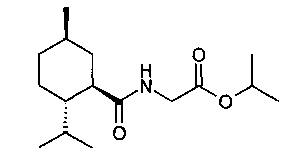
Applications Claiming Priority (3)
| Application Number | Priority Date | Filing Date | Title |
|---|---|---|---|
| US12/928,184 US20110082204A1 (en) | 2005-03-29 | 2010-12-06 | N-alkylcarbonyl-amino acid ester and N-alkylcarbonyl-amino lactone compounds and their use |
| US12/928,184 | 2010-12-06 | ||
| PCT/GB2011/000520 WO2012076831A1 (en) | 2010-12-06 | 2011-04-04 | [((1r,2s,5r)-2-isopropyl-5-methyl-cyclohexanecarbonyl)-amino]-acetic acid isopropyl ester and related compounds and their use in therapy |
Publications (2)
| Publication Number | Publication Date |
|---|---|
| RU2013130166A RU2013130166A (en) | 2015-01-20 |
| RU2598644C2 true RU2598644C2 (en) | 2016-09-27 |
Family
ID=44168849
Family Applications (1)
| Application Number | Title | Priority Date | Filing Date |
|---|---|---|---|
| RU2013130166/04A RU2598644C2 (en) | 2010-12-06 | 2011-04-04 | Isopropyl ester of [(1r,2s,5r)-2-isopropyl-5-methylcyclohexanecarbonyl)-amino]-acetic acid, related compounds and use thereof in therapy |
Country Status (10)
| Country | Link |
|---|---|
| EP (1) | EP2649046B1 (en) |
| JP (1) | JP5702864B2 (en) |
| KR (1) | KR101920050B1 (en) |
| CN (1) | CN103339103B (en) |
| AU (1) | AU2011340295B2 (en) |
| CA (1) | CA2819466C (en) |
| RU (1) | RU2598644C2 (en) |
| SG (1) | SG190991A1 (en) |
| WO (1) | WO2012076831A1 (en) |
| ZA (1) | ZA201304896B (en) |
Families Citing this family (3)
| Publication number | Priority date | Publication date | Assignee | Title |
|---|---|---|---|---|
| EP2793877B2 (en) * | 2011-12-21 | 2022-05-04 | WM. Wrigley Jr. Company | Chewing gum products containing [(2-isopropyl-5-methyl-cyclohexanecarbonyl)-amino]-acetic acid isopropyl ester |
| GB201908219D0 (en) * | 2019-06-10 | 2019-07-24 | Axalbion Sa | Therapeutic use of a compound |
| US12397518B2 (en) | 2021-04-29 | 2025-08-26 | Coopervision International Limited | WS12-releasing contact lens |
Citations (2)
| Publication number | Priority date | Publication date | Assignee | Title |
|---|---|---|---|---|
| US4178459A (en) * | 1971-02-04 | 1979-12-11 | Wilkinson Sword Limited | N-Substituted paramenthane carboxamides |
| RU2007139539A (en) * | 2005-03-29 | 2009-05-10 | Эдвард Так ВЕЙ (US) | Ethers of N-Alkylcarbonylamino Acids and N-Alkylcarbonylamino Lactones and Their Use |
Family Cites Families (4)
| Publication number | Priority date | Publication date | Assignee | Title |
|---|---|---|---|---|
| AU2004253582B2 (en) * | 2003-07-02 | 2011-02-10 | Genentech, Inc. | TRP-P8 active compounds and therapeutic treatment methods |
| US7189760B2 (en) * | 2004-04-02 | 2007-03-13 | Millennium Specialty Chemicals | Physiological cooling compositions containing highly purified ethyl ester of N-[[5-methyl-2-(1-methylethyl) cyclohexyl] carbonyl]glycine |
| US7482378B2 (en) * | 2004-05-28 | 2009-01-27 | Millenium Specialty Chemicals, Inc. | Physiological cooling compositions |
| EP2161252A1 (en) * | 2005-03-29 | 2010-03-10 | Edward T. Wei | N-Alkylcarbonyl-amino acid ester and N-Alkylcarbonyl-amino lactone compounds and their use |
-
2011
- 2011-04-04 AU AU2011340295A patent/AU2011340295B2/en active Active
- 2011-04-04 RU RU2013130166/04A patent/RU2598644C2/en active
- 2011-04-04 WO PCT/GB2011/000520 patent/WO2012076831A1/en not_active Ceased
- 2011-04-04 EP EP11715726.3A patent/EP2649046B1/en active Active
- 2011-04-04 SG SG2013043047A patent/SG190991A1/en unknown
- 2011-04-04 KR KR1020137017649A patent/KR101920050B1/en active Active
- 2011-04-04 CN CN201180066635.6A patent/CN103339103B/en active Active
- 2011-04-04 CA CA2819466A patent/CA2819466C/en active Active
- 2011-04-04 JP JP2013542596A patent/JP5702864B2/en active Active
-
2013
- 2013-07-01 ZA ZA2013/04896A patent/ZA201304896B/en unknown
Patent Citations (2)
| Publication number | Priority date | Publication date | Assignee | Title |
|---|---|---|---|---|
| US4178459A (en) * | 1971-02-04 | 1979-12-11 | Wilkinson Sword Limited | N-Substituted paramenthane carboxamides |
| RU2007139539A (en) * | 2005-03-29 | 2009-05-10 | Эдвард Так ВЕЙ (US) | Ethers of N-Alkylcarbonylamino Acids and N-Alkylcarbonylamino Lactones and Their Use |
Also Published As
| Publication number | Publication date |
|---|---|
| CN103339103B (en) | 2015-06-17 |
| JP5702864B2 (en) | 2015-04-15 |
| AU2011340295B2 (en) | 2016-11-03 |
| JP2014503513A (en) | 2014-02-13 |
| EP2649046A1 (en) | 2013-10-16 |
| ZA201304896B (en) | 2014-09-25 |
| CN103339103A (en) | 2013-10-02 |
| KR101920050B1 (en) | 2018-11-19 |
| SG190991A1 (en) | 2013-07-31 |
| WO2012076831A1 (en) | 2012-06-14 |
| CA2819466A1 (en) | 2012-06-14 |
| AU2011340295A1 (en) | 2013-07-18 |
| RU2013130166A (en) | 2015-01-20 |
| KR20130124349A (en) | 2013-11-13 |
| CA2819466C (en) | 2019-11-26 |
| EP2649046B1 (en) | 2016-12-07 |
Similar Documents
| Publication | Publication Date | Title |
|---|---|---|
| ES2328847T3 (en) | N-ALKYL-CARBONIL-AMINO ACID ESTER AND N-ALQUIL-CARBONIL-AMINO LACTONE COMPOUNDS AND THEIR USE. | |
| JP6941224B2 (en) | Intranasal epinephrine preparations and methods for the treatment of the disease | |
| BR112020015646A2 (en) | INTRANASAL EPINEPHRINE FORMULATIONS AND METHODS FOR THE TREATMENT OF DISEASE | |
| EP2234613A1 (en) | P-menthawe-3-carboxylic acid esters to treat airways diseases | |
| US20150111852A1 (en) | 1-Di(sec-butyl)-phosphinoyl-pentane (dapa-2-5) as a topical agent... | |
| RU2598644C2 (en) | Isopropyl ester of [(1r,2s,5r)-2-isopropyl-5-methylcyclohexanecarbonyl)-amino]-acetic acid, related compounds and use thereof in therapy | |
| US11406649B2 (en) | Treatment of upper aerodigestive tract disorders and cough | |
| US8426463B2 (en) | [((1R,2S,5R)-2-isopropyl-5-methyl-cyclohexanecarbonyl)-amino]-acetic acid isopropyl ester and related compounds and their use in therapy | |
| KR102027176B1 (en) | [((1R,2S,5R)-2-isopropyl-5-methyl-cyclohexanecarbonyl)-amino]-acetic acid isopropyl ester and related compounds and their use in therapy | |
| ES2973546T3 (en) | [((1R,2S,5R)-2-isopropyl-5-methyl-cyclohexanecarbonyl)-amino]-acetic acid isopropyl ester for the treatment of chronic cough | |
| JP2014508740A (en) | (R) -1,2-propanediol for use as a solvent in a therapeutic coolant composition | |
| HK1190383A (en) | [((1r,2s,5r)-2-isopropyl-5-methyl-cyclohexanecarbonyl)-amino]-acetic acid isopropyl ester and related compounds and their use in therapy | |
| HK1190383B (en) | [((1r,2s,5r)-2-isopropyl-5-methyl-cyclohexanecarbonyl)-amino]-acetic acid isopropyl ester and related compounds and their use in therapy | |
| US8476317B2 (en) | N-alkylcarbonyl-amino acid ester compounds and their use for cough and pharyngitis | |
| RU2417218C2 (en) | N-alkylcarbonylaminoacid ethers and n-alkylcarbonylaminolactons and application thereof | |
| JP2010509299A (en) | N-alkylcarbonyl-D-amino acid hydroxyalkyl ester compounds and their use | |
| HK40092206A (en) | Intranasal epinephrine formulations and methods for the treatment of disease | |
| LV13113B (en) | Ambroxol for the treatment of inflammation in the pharynx |
Legal Events
| Date | Code | Title | Description |
|---|---|---|---|
| HZ9A | Changing address for correspondence with an applicant | ||
| PC41 | Official registration of the transfer of exclusive right |
Effective date: 20170613 |