RU2487427C2 - Audio encoding device and audio decoding device - Google Patents
Audio encoding device and audio decoding device Download PDFInfo
- Publication number
- RU2487427C2 RU2487427C2 RU2011102424/08A RU2011102424A RU2487427C2 RU 2487427 C2 RU2487427 C2 RU 2487427C2 RU 2011102424/08 A RU2011102424/08 A RU 2011102424/08A RU 2011102424 A RU2011102424 A RU 2011102424A RU 2487427 C2 RU2487427 C2 RU 2487427C2
- Authority
- RU
- Russia
- Prior art keywords
- coefficient
- current
- context
- segment
- group
- Prior art date
Links
- 230000005236 sound signal Effects 0.000 claims abstract description 19
- 230000003595 spectral effect Effects 0.000 claims description 93
- 238000000034 method Methods 0.000 claims description 41
- 238000009826 distribution Methods 0.000 claims description 38
- 238000006243 chemical reaction Methods 0.000 claims description 11
- 238000004590 computer program Methods 0.000 claims description 6
- 230000009466 transformation Effects 0.000 claims description 3
- 238000001228 spectrum Methods 0.000 claims description 2
- 241001233887 Ania Species 0.000 claims 1
- 238000000844 transformation Methods 0.000 claims 1
- 239000000126 substance Substances 0.000 abstract 1
- 238000013507 mapping Methods 0.000 description 20
- 239000011159 matrix material Substances 0.000 description 16
- 230000006870 function Effects 0.000 description 11
- 230000006978 adaptation Effects 0.000 description 9
- 230000008569 process Effects 0.000 description 7
- 230000007717 exclusion Effects 0.000 description 6
- 230000009467 reduction Effects 0.000 description 6
- 230000003044 adaptive effect Effects 0.000 description 5
- 230000005540 biological transmission Effects 0.000 description 5
- 238000004422 calculation algorithm Methods 0.000 description 4
- 238000010586 diagram Methods 0.000 description 4
- 238000013213 extrapolation Methods 0.000 description 4
- 230000007246 mechanism Effects 0.000 description 4
- 239000007787 solid Substances 0.000 description 4
- 238000012935 Averaging Methods 0.000 description 3
- 230000008859 change Effects 0.000 description 3
- 238000005070 sampling Methods 0.000 description 3
- 238000009827 uniform distribution Methods 0.000 description 3
- 230000003247 decreasing effect Effects 0.000 description 2
- 238000001914 filtration Methods 0.000 description 2
- 238000012545 processing Methods 0.000 description 2
- 238000012549 training Methods 0.000 description 2
- 238000013459 approach Methods 0.000 description 1
- 238000003491 array Methods 0.000 description 1
- 238000004364 calculation method Methods 0.000 description 1
- 230000007423 decrease Effects 0.000 description 1
- 230000004069 differentiation Effects 0.000 description 1
- 230000008030 elimination Effects 0.000 description 1
- 238000003379 elimination reaction Methods 0.000 description 1
- 230000005284 excitation Effects 0.000 description 1
- 238000005457 optimization Methods 0.000 description 1
- 238000013139 quantization Methods 0.000 description 1
- 230000002123 temporal effect Effects 0.000 description 1
- 230000007704 transition Effects 0.000 description 1
- 230000001960 triggered effect Effects 0.000 description 1
Images


Classifications
-
- G—PHYSICS
- G10—MUSICAL INSTRUMENTS; ACOUSTICS
- G10L—SPEECH ANALYSIS TECHNIQUES OR SPEECH SYNTHESIS; SPEECH RECOGNITION; SPEECH OR VOICE PROCESSING TECHNIQUES; SPEECH OR AUDIO CODING OR DECODING
- G10L19/00—Speech or audio signals analysis-synthesis techniques for redundancy reduction, e.g. in vocoders; Coding or decoding of speech or audio signals, using source filter models or psychoacoustic analysis
- G10L19/02—Speech or audio signals analysis-synthesis techniques for redundancy reduction, e.g. in vocoders; Coding or decoding of speech or audio signals, using source filter models or psychoacoustic analysis using spectral analysis, e.g. transform vocoders or subband vocoders
-
- G—PHYSICS
- G10—MUSICAL INSTRUMENTS; ACOUSTICS
- G10L—SPEECH ANALYSIS TECHNIQUES OR SPEECH SYNTHESIS; SPEECH RECOGNITION; SPEECH OR VOICE PROCESSING TECHNIQUES; SPEECH OR AUDIO CODING OR DECODING
- G10L19/00—Speech or audio signals analysis-synthesis techniques for redundancy reduction, e.g. in vocoders; Coding or decoding of speech or audio signals, using source filter models or psychoacoustic analysis
-
- G—PHYSICS
- G10—MUSICAL INSTRUMENTS; ACOUSTICS
- G10L—SPEECH ANALYSIS TECHNIQUES OR SPEECH SYNTHESIS; SPEECH RECOGNITION; SPEECH OR VOICE PROCESSING TECHNIQUES; SPEECH OR AUDIO CODING OR DECODING
- G10L19/00—Speech or audio signals analysis-synthesis techniques for redundancy reduction, e.g. in vocoders; Coding or decoding of speech or audio signals, using source filter models or psychoacoustic analysis
- G10L19/02—Speech or audio signals analysis-synthesis techniques for redundancy reduction, e.g. in vocoders; Coding or decoding of speech or audio signals, using source filter models or psychoacoustic analysis using spectral analysis, e.g. transform vocoders or subband vocoders
- G10L19/022—Blocking, i.e. grouping of samples in time; Choice of analysis windows; Overlap factoring
-
- H—ELECTRICITY
- H03—ELECTRONIC CIRCUITRY
- H03M—CODING; DECODING; CODE CONVERSION IN GENERAL
- H03M7/00—Conversion of a code where information is represented by a given sequence or number of digits to a code where the same, similar or subset of information is represented by a different sequence or number of digits
- H03M7/30—Compression; Expansion; Suppression of unnecessary data, e.g. redundancy reduction
-
- H—ELECTRICITY
- H03—ELECTRONIC CIRCUITRY
- H03M—CODING; DECODING; CODE CONVERSION IN GENERAL
- H03M7/00—Conversion of a code where information is represented by a given sequence or number of digits to a code where the same, similar or subset of information is represented by a different sequence or number of digits
- H03M7/30—Compression; Expansion; Suppression of unnecessary data, e.g. redundancy reduction
- H03M7/3059—Digital compression and data reduction techniques where the original information is represented by a subset or similar information, e.g. lossy compression
-
- H—ELECTRICITY
- H03—ELECTRONIC CIRCUITRY
- H03M—CODING; DECODING; CODE CONVERSION IN GENERAL
- H03M7/00—Conversion of a code where information is represented by a given sequence or number of digits to a code where the same, similar or subset of information is represented by a different sequence or number of digits
- H03M7/30—Compression; Expansion; Suppression of unnecessary data, e.g. redundancy reduction
- H03M7/40—Conversion to or from variable length codes, e.g. Shannon-Fano code, Huffman code, Morse code
- H03M7/4006—Conversion to or from arithmetic code
- H03M7/4012—Binary arithmetic codes
- H03M7/4018—Context adapative binary arithmetic codes [CABAC]
Landscapes
- Engineering & Computer Science (AREA)
- Physics & Mathematics (AREA)
- Acoustics & Sound (AREA)
- Computational Linguistics (AREA)
- Signal Processing (AREA)
- Health & Medical Sciences (AREA)
- Audiology, Speech & Language Pathology (AREA)
- Human Computer Interaction (AREA)
- Multimedia (AREA)
- Spectroscopy & Molecular Physics (AREA)
- Theoretical Computer Science (AREA)
- Compression, Expansion, Code Conversion, And Decoders (AREA)
- Stereo-Broadcasting Methods (AREA)
- Reduction Or Emphasis Of Bandwidth Of Signals (AREA)
Abstract
Description
Настоящее изобретение относится к области звукового кодирования, в частности к кодированию на основе кодирования энтропии.The present invention relates to the field of audio coding, in particular to coding based on entropy coding.
Традиционные представления об аудиокодировании включают схему кодирования энтропии для уменьшения избыточной информации в передаваемом сигнале. Как правило, кодирование энтропии использует дискретные спектральные коэффициенты для частотной области и выполняется на основе схем кодирования или дискретных выборок во временной области с использованием схем кодирования. Эти схемы кодирования энтропии обычно используют передачу комбинации кодовых слов в соответствии с индексом кодовой таблицы, который позволяет декодеру найти определенную страницу кодовой таблицы для декодирования закодированного информационного слова, соответствующего переданному кодовому слову на указанной странице. В некоторых принципах кодирования передача индекса кодовой таблицы, тем не менее, не является обязательной, например, для случаев, когда индекс кодовой таблицы может быть определен по символу, который, например, является кодировкой энтропии, как описано в Meine, Edier, "Improved Quantization and Lossless Coding for Subband Audio Coding" and Meine, "Vektorquantisierung und kontextabhängige arithmetische Codierung für MPEG-4 AAC", Dissertation, Gottfried Wilhelm Leibnitz Universitat Hannover, Hanover 2007.Conventional audio coding concepts include an entropy coding scheme to reduce redundant information in a transmitted signal. Typically, entropy coding uses discrete spectral coefficients for the frequency domain and is performed based on coding schemes or discrete samples in the time domain using coding schemes. These entropy coding schemes typically use codeword combination transmission according to the codebook index, which allows the decoder to find a specific codebook page to decode the encoded information word corresponding to the transmitted codeword on the specified page. In some coding principles, code table index transmission is nevertheless not mandatory, for example, for cases where the code table index can be determined by a character, which, for example, is an entropy encoding, as described in Meine, Edier, "Improved Quantization and Lossless Coding for Subband Audio Coding "and Meine," Vektorquantisierung und kontextabhängige arithmetische Codierung für MPEG-4 AAC ", Dissertation, Gottfried Wilhelm Leibnitz Universitat Hannover, Hanover 2007.
Поскольку звуковое кодирование основывается на частотной или спектральной области, контекст [история появления символа, то есть, информация о символах, предшествующих текущему в сжимаемом потоке] может содержать символы, или статистические свойства, например дискретные спектральные коэффициенты, предшествующие по времени и/или частоте. В некоторых из обычно используемых принципов кодирования эти символы могут быть доступны и в кодирующем устройстве и в декодере, и созданная из этих символов кодовая таблица или контекст могут быть определены одновременно и в кодирующем устройстве и в декодере.Since sound coding is based on the frequency or spectral domain, the context [the history of the appearance of the symbol, that is, information about the symbols preceding the current one in the compressible stream] may contain symbols or statistical properties, such as discrete spectral coefficients, preceding in time and / or frequency. In some of the commonly used coding principles, these symbols can be accessed both in the encoding device and in the decoder, and the code table or context created from these symbols can be defined both in the encoding device and in the decoder.
Фиг.9 иллюстрирует пример контекста и его зависимостей. Фиг.9 показывает плоскость частота-время, в которой указано много символов. Символ Sn, м. обозначает символ во времени n и частоту m. Фиг.9 показывает, что для кодирования определенного символа, используется его контекст и определяется соответствующая кодовая таблица. Например, для символа Sn0,m0 то это будут все символы с9 illustrates an example of a context and its dependencies. 9 shows a frequency-time plane in which many symbols are indicated. Symbol S n, m . denotes a symbol in time n and frequency m. Figure 9 shows that to encode a specific character, its context is used and the corresponding code table is determined. For example, for the character S n0 , m0, then these will be all characters with
n<n0 и любого m, или с n=n0 и m<m0.n <n0 and any m, or with n = n0 and m <m0.
В практических применениях контекст будет не бесконечным, а ограниченным. В примере, изображенном в Фиг.9, контекст для символа, S0,3, например, может бытьIn practical applications, the context will not be infinite, but limited. In the example depicted in FIG. 9, the context for the symbol, S 0.3 , for example, may be
S0,2, S0,l, S-1,5, S-1,4, S-1,3, S-1,2, S-1,1, S-2,5, S-2,4, S-2,3, S-2,2, S-2,1.S 0.2 , S 0, l , S -1.5 , S -1.4 , S -1.3 , S -1.2 , S -1.1 , S -2.5 , S -2, 4 , S -2.3 , S -2.2 , S -2.1 .
Для звукового кодирования, использующего частоту, могут использоваться изменение времени, сигнал адаптивной группы фильтров или так называемые блоки преобразования, что, в качестве примера, описано в Edler, В., "Codierung von Audiosignalen mit überlappender Transformation und adaptiven Fensterfunktionen", Frequenz, Ausgabe 43, September 1989. Другими словами, в рамках этих принципов аудиокодирования, в течение длительного времени могут происходить изменения разрешения частоты/времени. Популярный принцип аудиокодирования - так называемый ААС (ААС - широкополосный алгоритм аудиокодирования), в котором используются блоки двух размеров, в которых закодированы, например, 128 или 1024 коэффициентов преобразования, представляющих, соответственно, частотные компоненты 256 или 2048 оконных выборок во временном интервале.For sound coding using a frequency, a time change, a signal of an adaptive filter group, or so-called transform blocks can be used, which, as an example, is described in Edler, B., "Codierung von Audiosignalen mit überlappender Transformation und adaptiven Fensterfunktionen", Frequenz, Ausgabe 43, September 1989. In other words, within the framework of these audio coding principles, frequency / time resolution changes can occur over time. A popular principle of audio coding is the so-called AAS (AAS - wideband audio coding algorithm), which uses blocks of two sizes in which, for example, 128 or 1024 conversion coefficients are encoded, representing, respectively, the frequency components of 256 or 2048 window samples in the time interval.
Такой принцип кодирования позволяет выполнять переключение между различными разрешениями, в зависимости от определенных характеристик сигнала, например, относящихся к изменению уровня сигнала, тональности, или имеет ли сигнал сходство с музыкой или речью, и т.д. Что касается примера для случая переключения между различными разрешениями время/частота, в различных типах блоков ААС контекст не будет последовательным. Использование обычных принципов или современных реализаций может привести к потере контекста, то есть к переходу в состояние, в котором никакой контекст не доступен и обнуляется. Этот подход может работать достаточно хорошо, например, в ААС, так как он гарантирует по крайней мере два длинных блока или восемь коротких блоков в строке, если предположить, что переключение происходит очень редко.This coding principle allows switching between different resolutions, depending on certain characteristics of the signal, for example, related to changes in signal level, tonality, or whether the signal resembles music or speech, etc. As for the example for the case of switching between different time / frequency resolutions, the context will not be consistent in different types of AAC blocks. Using ordinary principles or modern implementations can lead to a loss of context, that is, to a transition to a state in which no context is available and is reset. This approach may work quite well, for example, in AAC, as it guarantees at least two long blocks or eight short blocks per row, assuming switching is very rare.
Однако обычные способы, перезагружающие контекст, вообще не оптимальны с точки зрения эффективности кодирования, так как каждый раз, когда контекст перезагружается, последующий выбор кодовой таблицы основан на значениях, которые рассматриваются в качестве запасного решения для неизвестного контекста. В общем случае, тогда выбираются неоптимальные кодовые таблицы. Недостаток в эффективности кодирования может быть незначительным в случаях, если переключение происходит очень редко. Однако для сценария с более частым переключением это приводит к существенной потере эффективности кодирования. С одной стороны, более частое переключение весьма желательно для более низких скоростей передачи данных/частоты дискретизации, так как здесь особенно желательна оптимальная адаптация длины преобразования к характеристикам сигнала. С другой стороны, эффективность кодирования значительно уменьшается при частых переключениях.However, conventional context reloading methods are generally not optimal in terms of coding efficiency, since each time the context is reloaded, the subsequent selection of the code table is based on values that are considered as a fallback for an unknown context. In the general case, then non-optimal code tables are selected. The lack of coding efficiency may be negligible in cases where switching is very rare. However, for a scenario with more frequent switching, this leads to a significant loss in coding efficiency. On the one hand, more frequent switching is highly desirable for lower data rates / sampling rates, since optimal adaptation of the conversion length to the signal characteristics is especially desirable here. On the other hand, coding efficiency is significantly reduced with frequent switching.
Задача настоящего изобретения в предложении способа переключения между различными длинами преобразования в аудиокодировании, обеспечивающее лучшую эффективность кодирования.An object of the present invention is to propose a method for switching between different conversion lengths in audio coding, providing better coding efficiency.
Это достигается использованием звукового кодирующего устройства согласно положению 1, метода аудиокодирования согласно положению 8, звукового декодера согласно положению 9 и метода аудиодекодирования согласно положению 16.This is achieved by using an audio encoder according to
Настоящее изобретение основано на открытии, что контекст, использующий такое кодирование, как, например, кодирование энтропии, которое может быть применено к различным разрешениям по времени/частоте, и метод отображения контекста, который может использоваться в случае разрешения по времени/частоте, изменяющимся в течение длительного времени, позволяет достичь повышенной эффективности кодировки. Одно из открытий настоящего изобретения состоит в том, что переключение между различными разрешениями по времени или частоте, или контекстами коэффициентов, имеющими новые разрешения, могут быть получены из коэффициентов, имеющих старые разрешения. Одно из открытий настоящего изобретения состоит в том, что, например, интерполяция, экстраполяция, использование низкочастотных или высокочастотных выборок и т.д., могут использоваться для согласования и/или вывода контекста, при котором происходит переключение разрешения по времени/частоте в звуковом кодировании.The present invention is based on the discovery that a context using coding such as, for example, entropy coding, which can be applied to different time / frequency resolutions, and a context mapping method, which can be used in the case of time / frequency resolution changing in for a long time, allows to achieve increased encoding efficiency. One of the discoveries of the present invention is that switching between different resolutions in time or frequency, or in contexts of coefficients having new resolutions, can be obtained from coefficients having old resolutions. One of the discoveries of the present invention is that, for example, interpolation, extrapolation, the use of low-frequency or high-frequency samples, etc., can be used to match and / or derive a context in which time / frequency resolution is switched in sound coding .
Воплощения настоящего изобретения обеспечивают метод отображения, который устанавливает соответствие между частотными или спектральными коэффициентами, сохраняющимися в контексте, на который ссылается старое разрешение, с разрешением по частоте в текущем контексте или текущем фрейме. Другими словами, информация предыдущего контекста может использоваться для определения кодовой таблицы, то есть получения информации нового контекста. Воплощения изобретения позволяют выполнять более частое переключение размера блока и способствуют лучшей адаптации характеристик сигнала без потерь эффективности кодирования.Embodiments of the present invention provide a mapping method that establishes a correspondence between frequency or spectral coefficients stored in the context referenced by the old resolution with a frequency resolution in the current context or current frame. In other words, the information of the previous context can be used to determine the code table, that is, to obtain information of the new context. Embodiments of the invention allow for more frequent block size switching and contribute to better adaptation of signal characteristics without loss of coding efficiency.
Воплощения настоящего изобретения будут детализированы с использованием сопровождающих рисунков, на которых:Embodiments of the present invention will be detailed using the accompanying drawings, in which:
Фиг.1 показывает воплощение звукового кодирующего устройства;Figure 1 shows an embodiment of an audio encoder;
Фиг.2 показывает воплощение звукового декодера;Figure 2 shows an embodiment of an audio decoder;
Фиг.3 показывает воплощение для контекста с высокочастотными выборками;Figure 3 shows an embodiment for context with high-frequency samples;
Фиг.4 показывает воплощение для контекста с низкочастотными выборками;Figure 4 shows an embodiment for a context with low-frequency samples;
Фиг.5 иллюстрирует время переключения аудио и разрешение по частоте;5 illustrates audio switching time and frequency resolution;
Фиг.6 иллюстрирует пример выполнения воплощения;6 illustrates an example embodiment;
Фиг.7а показывает блок-схему воплощения метода кодирования;Figa shows a block diagram of an embodiment of an encoding method;
Фиг.7b иллюстрирует общую процедуру обновления контекста воплощения;Fig. 7b illustrates a general procedure for updating an implementation context;
Фиг.7с иллюстрирует процедуру обновления контекста воплощения для изменений разрешения;Fig. 7c illustrates a procedure for updating an implementation context for resolution changes;
Фиг.8 показывает блок-схему воплощения метода декодирования; иFig. 8 shows a block diagram of an embodiment of a decoding method; and
Фиг.9 показывает современную схему кодировки в координатах частота - время.Figure 9 shows a modern coding scheme in frequency - time coordinates.
Фиг.1 показывает воплощение звукового кодирующего устройства 100 для кодирования сегментов коэффициентов, имеющих различное разрешение по времени или частоте, выбранного звукового сигнала. Звуковое кодирующее устройство 100 содержит процессор 110 для получения контекста кодирования кодируемого текущего коэффициента текущего сегмента, основанного на ранее закодированном коэффициенте предыдущего сегмента, имеющим разрешение по времени или частоте, отличающееся от кодируемого в настоящий момент коэффициента. Кроме того, воплощение звукового кодирующего устройства включает также кодирующее устройство энтропии 120 для значения энтропии, кодирующего текущий коэффициент, основанный на кодирующем контексте для получения закодированного звукового потока.Figure 1 shows an embodiment of an audio encoder 100 for encoding segments of coefficients having different resolutions in time or frequency of a selected audio signal. The sound encoder 100 comprises a processor 110 for obtaining a context for encoding the encoded current coefficient of a current segment based on a previously encoded coefficient of a previous segment having a resolution in time or frequency different from the coefficient currently encoded. In addition, an embodiment of an audio encoder also includes an entropy encoder 120 for an entropy value encoding a current coefficient based on an encoding context to obtain an encoded audio stream.
В воплощениях коэффициенты могут соответствовать звуковым образцам, дискретным звуковым образцам, спектральным или частотным коэффициентам, масштабным коэффициентам, коэффициентам преобразования или фильтрации и т.д. или любой комбинации из перечисленных.In embodiments, the coefficients may correspond to sound samples, discrete sound samples, spectral or frequency coefficients, scale factors, transform or filter coefficients, etc. or any combination of the above.
В других вариантах исполнения звуковое кодирующее устройство 100 может содержать средства для выделения сегментов коэффициентов из звукового потока, коэффициентов, формирующих спектральное представление звукового сигнала при спектральном разрешении, изменяющимся для различных коэффициентов. Средства для выделения сегментов могут быть адаптированы для определения сегментов, имеющих различные размеры длины окна временного интервала или различные звуковые фреймы, то есть звуковые фреймы, имеющие различные длины или различные значения коэффициентов в диапазоне частот, и, следовательно, различное спектральное или частотное разрешение. Такие средства могут быть приспособлены для определения сегментов 1024 и 128 временных, частотных или спектральных коэффициентов.In other embodiments, the sound encoder 100 may comprise means for extracting segments of coefficients from the sound stream, coefficients forming a spectral representation of the sound signal at spectral resolution varying for different coefficients. Means for extracting segments can be adapted to determine segments having different window lengths for a time interval or different sound frames, i.e., sound frames having different lengths or different coefficient values in a frequency range, and therefore different spectral or frequency resolutions. Such means may be adapted to determine segments of 1024 and 128 temporal, frequency or spectral coefficients.
Процессор 110 в воплощениях может быть приспособлен для получения кодирующего контекста, основанного на представлениях текущих и предшествующих коэффициентов или сегментов в частотной или спектральной областях. Другими словами, в воплощениях последовательные сегменты могут быть представлены в различных временных и/или частотных или спектральных областях. Процессор 110 может быть адаптирован для получения кодирующего контекста в частотном или спектральном диапазоне, например, основанного на соседних спектральных коэффициентах предыдущих сегментов и/или текущих сегментов. В воплощениях сегменты могут быть первоначально определены во временной области, например, входной поток аудиоокна. Основанные на этих сегментах во временной области или коэффициентах сегменты частотной или спектральной областей или коэффициенты могут быть определены посредством преобразования. Сегменты могут быть представлены в частотной или спектральной области в терминах энергии, амплитуды и фазы, амплитуды и знака, и т.д. в частотном или спектральном диапазоне, то есть сегменты распределяются по различным частотам или диапазонам. Таким образом, в ряде применений процессор 110 может получить кодирующие контексты в частотном или спектральном диапазоне.The processor 110 in embodiments may be adapted to obtain a coding context based on representations of current and previous coefficients or segments in the frequency or spectral regions. In other words, in embodiments, consecutive segments can be represented in different time and / or frequency or spectral regions. The processor 110 may be adapted to obtain an encoding context in the frequency or spectral range, for example, based on adjacent spectral coefficients of previous segments and / or current segments. In embodiments, segments may be initially defined in the time domain, for example, an input window of an audio window. Based on these segments in the time domain or coefficients, segments of the frequency or spectral regions or coefficients can be determined by conversion. Segments can be represented in the frequency or spectral region in terms of energy, amplitude and phase, amplitude and sign, etc. in the frequency or spectral range, that is, the segments are distributed over different frequencies or ranges. Thus, in a number of applications, processor 110 can obtain coding contexts in the frequency or spectral range.
Процессор 110 и кодирующее устройство энтропии 120 могут быть приспособлены для работы на основе низкочастотных выборок или спектральных коэффициентов предыдущего сегмента, когда предыдущий сегмент имеет контекст, включающий лучшее спектральное или частотное разрешение, чем текущий сегмент. В воплощениях процессор 110 и кодирующее устройство энтропии 120 могут быть приспособлены для работы на основе высокочастотных выборок или спектральных коэффициентов, когда предыдущий сегмент контекста включает более грубое спектральное или частотное разрешение, чем текущий сегмент.The processor 110 and entropy encoder 120 may be adapted to operate on the basis of low-frequency samples or spectral coefficients of a previous segment when the previous segment has a context including better spectral or frequency resolution than the current segment. In embodiments, the processor 110 and entropy encoder 120 may be adapted to operate based on high frequency samples or spectral coefficients when the previous context segment includes a coarser spectral or frequency resolution than the current segment.
Воплощения могут обеспечить метод для кодирования коэффициентов сегментов, соответствующих различным временным или частотным разрешениям выбранного звукового сигнала. Метод может содержать этап получения кодирующего контекста для кодируемого в настоящее время или текущего коэффициента в текущем сегменте, основанного на закодированном ранее или предыдущем коэффициенте от предыдущего сегмента, а также, возможно, на кодируемом в настоящее время или текущем коэффициенте, причем ранее закодированный или предыдущий коэффициент имеет отличающееся разрешение по времени или частоте от кодируемого в настоящее время или текущего коэффициента. Метод может включить последующий этап энтропии, на котором кодируется текущий коэффициент, основанный на закодированном контексте, для получения закодированного звукового потока.Embodiments may provide a method for encoding the coefficients of segments corresponding to different time or frequency resolutions of a selected audio signal. The method may include the step of obtaining a coding context for the currently encoded or current coefficient in the current segment, based on the previously or previous encoded coefficient from the previous segment, and also, possibly, the currently encoded or current coefficient, the previously encoded or previous coefficient has a different resolution in time or frequency from the currently encoded or current coefficient. The method may include a subsequent entropy step at which the current coefficient, based on the encoded context, is encoded to obtain the encoded sound stream.
Соответственно, воплощения могут содержать звуковое декодирующее устройство 200, показанное на фиг.2. Звуковое декодирующее устройство 200 приспособлено для декодирования закодированного звукового потока и получения сегментов коэффициентов, имеющих различное разрешение по времени или частоте, выбранного звукового сигнала, звуковое декодирующее устройство 200 содержит процессор 210 для получения кодирующего контекста для декодируемого в настоящее время или текущего коэффициента, основанного на ранее декодированном или предыдущем коэффициенте, коэффициенте, имеющем отличающееся разрешение по времени или частоте от декодируемого в настоящее время коэффициента. Кроме того, звуковое декодирующее устройство 200 содержит декодирующее устройство энтропии 220 для декодирования энтропии текущего коэффициента, декодирующее устройство, использующее кодирующий контекст и закодированный звуковой поток.Accordingly, embodiments may comprise an
В воплощениях звуковое декодирующее устройство 200 может содержать декодирующее устройство энтропии 220, которое приспособлено для определения сегментов коэффициентов декодирования, основанных на различных длинах окна временного интервала или различных длинах звуковых фреймов. Декодирующее устройство энтропии 220 может использоваться для определения, например, 1024 и 128 сегментов для выборок во временном или частотном интервале или спектральных коэффициентов. Соответственно, процессор 210 может быть использован для получения кодирующего контекста, основанного на представлении коэффициентов предыдущих сегментов и/или текущего сегмента в частотной или спектральной области.In embodiments, the
В воплощениях процессор 210 может использоваться для получения кодирующего контекста вне частотного или спектрального диапазона текущего сегмента, например, основанного на соседних спектральных коэффициентах предыдущего сегмента или сегментов, выбранных произвольно из текущего сегмента. Другими словами, сегменты могут быть обработаны в частотной или спектральной области, которая может быть вынесена за пределы частотного или спектрального диапазона. Соответственно, процессор 210 может быть использован для получения определенного контекста в частотном или спектральном диапазоне.In embodiments,
Декодирующее устройство энтропии 200 может быть использовано для декодирования энтропии текущего коэффициента, основанного на энтропии или на способе кодирования с изменением длины.
Процессор 210 может быть использован для получения кодирующего контекста, основанного на уменьшении выборок по частоте или спектральным коэффициентам предыдущего сегмента в случаях, когда предыдущий сегмент включает больше коэффициентов в диапазоне частот (то есть имеет лучшее спектральное или частотное разрешение), чем текущий сегмент. В последующих воплощениях процессор 210 и кодирующее устройство энтропии 220 могут применяться для работы, основанной на высокочастотных выборках спектральных коэффициентов предыдущего сегмента, когда предыдущий сегмент имеет меньше коэффициентов в диапазоне частот (то есть имеет худшее спектральное или частотное разрешение), чем текущий сегмент.The
Следовательно, воплощения могут обеспечить метод декодирования закодированного звукового потока для получения сегментов коэффициентов, представляющих декодированные звуковые выборки. Метод декодирования может содержать этап получения кодирующего контекста для декодируемого в настоящее время или текущего коэффициента текущего сегмента, основанного на ранее декодированном или предыдущем коэффициенте предыдущего сегмента, т.е. коэффициенте, имеющем отличающееся временное или частотное разрешение от декодируемого в настоящее время коэффициента. Кроме того, метод может включать этап декодирования энтропии текущего коэффициента, основанный на кодирующем контексте и закодированном звуковом потоке. В любом воплощении, метод может включать этап определения сегментов закодированных звуковых коэффициентов из закодированного звукового потока, сегментов, имеющих разное количество звуковых коэффициентов.Therefore, embodiments may provide a method for decoding an encoded audio stream to obtain coefficient segments representing decoded audio samples. The decoding method may include the step of obtaining an encoding context for the currently decoded or current coefficient of the current segment based on the previously decoded or previous coefficient of the previous segment, i.e. a coefficient having a different time or frequency resolution from the currently decoded coefficient. In addition, the method may include the step of decoding the entropy of the current coefficient based on the coding context and the encoded audio stream. In any embodiment, the method may include the step of determining segments of the encoded sound coefficients from the encoded sound stream, segments having a different number of sound coefficients.
Фиг.3 показывает каким образом процессор 110; 210 может получить кодирующий контекст для коэффициентов текущего сегмента Mc,new, основанный на коэффициентах предыдущего сегмента Mc,old, причем предыдущий сегмент включает количество звуковых коэффициентов, отличающееся от числа коэффициентов текущего сегмента. В воплощении, показанном на фиг.3, количество коэффициентов сегмента М определяет частотное или спектральное разрешение сегмента. Воплощение может включать метод отображения, который отображает коэффициенты Mc,old предыдущего сегмента на коэффициенты Mc,new, имеющие такое же частотное или спектральное разрешение, как и контекст текущего сегмента. Фиг.3 показывает два набора коэффициентов в пределах двух сегментов, то есть оригинальный предыдущий сегмент 310, представляемый коэффициентами Mc,old, Sn,0, Sn,1, Sn,2, и т.д., и соответственно, отображение предыдущего сегмента 320, которое имеет более высокое разрешение, то есть разрешение Mc,new лучше, чем Mc,old, которое представлено Mc,new с коэффициентами Sn,0, Sn,1, Sn,2, Sn,3, и т.д.Figure 3 shows how the processor 110; 210 may obtain a coding context for the coefficients of the current segment M c, new , based on the coefficients of the previous segment M c, old , wherein the previous segment includes a number of sound coefficients different from the number of coefficients of the current segment. In the embodiment shown in FIG. 3, the number of segment coefficients M determines the frequency or spectral resolution of the segment. The embodiment may include a mapping method that maps the coefficients M c, old of the previous segment to the coefficients M c, new , having the same frequency or spectral resolution as the context of the current segment. Figure 3 shows two sets of coefficients within two segments, that is, the original
Вообще, два воплощения можно отличить, в зависимости от того, лучше или хуже разрешение контекста текущего сегмента, чем разрешение контекста предыдущего сегмента. Фиг.3 показывает воплощение, в котором разрешение коэффициентов Mc,old предыдущего сегмента хуже, чем разрешение коэффициентов Mc,new текущего сегмента.In general, two embodiments can be distinguished, depending on whether the context resolution of the current segment is better or worse than the resolution of the context of the previous segment. Figure 3 shows an embodiment in which the resolution of the coefficients M c, old of the previous segment is worse than the resolution of the coefficients M c, new of the current segment.
Фиг.3 показывает коэффициенты предыдущего сегмента 310 и символы, отражающие предыдущий сегмент 320. Из Фиг.3 можно заметить, что разрешение коэффициентов Mc,new текущего сегмента лучше, чем разрешение предыдущего сегмента 310, имеющего только коэффициенты Mc,old. В одном из вариантов исполнения предыдущий сегмент 310 имеет большее число выборок по сравнению с сегментом 320 коэффициентов Mc,new для согласования частотного или спектрального разрешения текущего сегмента. Это может быть проведено обычным увеличением числа выборок с дублированием символа и механизмами исключения каждого десятого символа, например, повторением каждого значения Mc,new, взятого до исключения каждого десятого символа, и в результате получается сегмент с увеличением числа выборок, с использованием только 1 коэффициента из каждого Mc,old. Также могут использоваться и другие виды интерполяции или экстраполяции.Figure 3 shows the coefficients of the
В воплощениях отображение может быть выполнено для всех предыдущих сегментов 310, которые необходимы для определения контекстов текущего сегмента, например, в момент времени n, другими словами, может быть учтено большое число предыдущих сегментов, то есть предыдущие сегменты в моменты времени n-1, n-2 и т.д. Вообще, воплощения могут учитывать большое число выборок по времени или предыдущих сегментов, количество выборок по времени, необходимых для определения полного контекста, может быть различным для различных вариантов исполнения или воплощений.In embodiments, a mapping can be performed for all
Фиг.4 представляет другое воплощение, в котором коэффициенты предыдущего сегмента 410 имеют меньшее количество выборок по сравнению с сегментом 420, используемым для вычисления контекстов текущего сегмента, то есть в котором число коэффициентов Mc,old предыдущего сегмента 410 больше чем количество коэффициентов Mc,new текущего сегмента. Иллюстрация на фиг.4 аналогична фиг.3, и, соответственно, большое количество коэффициентов показано в каждом сегменте 410 и 420. Как показано на фиг.4, количество коэффициентов Mc,old, больше чем в Mc,new. Поэтому коэффициенты Mc,old подбираются таким образом, чтобы соответствовать частотному или спектральному разрешению коэффициентов Mc,new текущего сегмента, то есть в вариантах использования предыдущие сегменты, имеющие более высокое разрешение, могут быть подобраны таким образом, чтобы соответствовать разрешению текущего сегмента, имеющего более низкое разрешение. В воплощениях это может быть реализовано обычным уменьшением числа выборок с соответствующим коэффициентом дублирования и исключением каждого десятого символа, и в результате получается сегмент с увеличением числа выборок, с использованием только 1 коэффициента из каждого Mc,old; например, путем повторения каждого значения Mc,new, взятого до исключения каждого десятого символа из выбранного сегмента, с использованием только 1 коэффициента из каждого Mc,old. В других воплощениях могут использоваться операции фильтрации, например усреднение двух или более смежных значений.4 represents another embodiment in which the coefficients of the
Фиг.5 иллюстрирует другое воплощение, в котором выполнено переключение между различными разрешениями. Фиг.5 показывает плоскость времени/частоты, в которой представлены три последовательных сегмента звуковых коэффициентов, а именно 510, 520 и 530. Каждый из сегментов 510, 520 и 530 соответствует единственному набору коэффициентов. В воплощении, показанном на Фиг.5, предполагается, что второй сегмент 520 в два раза длиннее первого и третьего сегментов 510 и 530. Это может быть достигнуто при использовании различных окон при делении на сегменты во временной области, например, сделанном в ААС. В воплощении, иллюстрированном на фиг.5, предполагается, что норма осуществления выборки остается постоянной, другими словами, более длинный второй сегмент 520 включает в два раза больше звуковых коэффициентов в диапазоне частот, чем первый или третий сегмент 510 или 530.5 illustrates another embodiment in which switching between different resolutions is performed. 5 shows a time / frequency plane in which three consecutive segments of sound coefficients are represented, namely 510, 520 and 530. Each of the
Фиг.5 показывает, что в этом случае разрешение в частотной или спектральной области определяется размером сегмента во временной области. Другими словами, чем короче окно во временной области, тем ниже разрешение в частотной или спектральной области. Фиг.5 показывает, что при оценке контекстов для кодирования выборки в частотной или спектральной области, необходимо иметь более высокую степень разрешения сегмента 510, в рассматриваемом примере, при кодировании второго сегмента 520 должно быть получено двойное разрешение сегмента 510. В следующих воплощениях, особенно с использованием других видов преобразования частота-время или набора фильтров, могут быть получены другие соотношения между разрешениями во временной и частотной области.Figure 5 shows that in this case, the resolution in the frequency or spectral region is determined by the size of the segment in the time domain. In other words, the shorter the window in the time domain, the lower the resolution in the frequency or spectral region. Figure 5 shows that when evaluating the contexts for encoding a sample in the frequency or spectral region, it is necessary to have a higher resolution of
Согласно воплощению коэффициенты, закодированные при обработке первого сегмента 510, дают возможность определить контекст для второго сегмента 520, например, посредством дополнительных промежуточных выборок. Другими словами, содержание контекста, полученное из первого сегмента 510, может быть обеспечено дополнительными выборками из первого сегмента 510, например, путем интерполяции или экстраполяции для получения контекста второго сегмента 520 с более высоким разрешением.According to an embodiment, the coefficients encoded during the processing of the
Как показано на фиг.5, при переключении от второго сегмента 520 к третьему сегменту 530 элемент контекста также должен измениться, поскольку разрешение теперь уменьшилось. Согласно воплощению коэффициенты, закодированные при обработке второго сегмента 520, могут использоваться для получения контекста для третьего сегмента, посредством уменьшения количества промежуточных выборок. Это может быть выполнено, например, путем усреднения или, проще, с использованием только каждого второго значения или других способов уменьшения выборок.As shown in FIG. 5, when switching from the
Воплощения имеют преимущества в увеличении эффективности кодирования на основе использования предыдущего контекста, полученного из предыдущих сегментов, даже когда существуют различия в разрешении или длине окна. Элементы контекста могут быть адаптированы к новым разрешениям, с увеличением или уменьшением выборок, например, с помощью интерполяции или экстраполяции, фильтрации или усреднения, и т.д.Embodiments have advantages in increasing the coding efficiency based on the use of the previous context obtained from previous segments, even when there are differences in resolution or window length. Context elements can be adapted to new resolutions, with increasing or decreasing samples, for example, using interpolation or extrapolation, filtering or averaging, etc.
Следующее, более конкретное воплощение будет представлено с точки зрения спектрального кодирования с исключением шумов. Спектральное кодирование с исключением шумов может использовать дополнительное сокращение избыточности дискретного спектра в звуковом кодировании. Спектральное кодирование с исключением шумов может быть основано на арифметическом кодировании с использованием динамической адаптации контекста.The following, more specific embodiment will be presented in terms of spectral coding with the exception of noise. Spectral coding with the elimination of noise can use an additional reduction in the redundancy of the discrete spectrum in audio coding. Spectral coding with noise exclusion can be based on arithmetic coding using dynamic context adaptation.
Кодирование с исключением шумов может быть основано на дискретных спектральных значениях и может использовать взаимосвязанный контекст совокупных таблиц частот, полученный, например, из четырех ранее декодированных соседних кортежей [в базах данных, кортежем называется группа взаимосвязанных элементов данных]. Фиг.6 иллюстрирует другое воплощение. Фиг.6 показывает плоскость частота-время, причем на оси времени показаны три значения времени n, n-1 и n-2. Кроме того, Фиг.6 иллюстрирует четыре частотных или спектральных диапазона, которые обозначены m-2, m-1, m и m+1. Фиг.6 показывает пределы выбранных интервалов частота-время, в которых представлены кортежи выборок, которые будут закодированы или декодированы. на Фиг.6 показаны три различных типа кортежей, в которых соединительные порты блоков, имеющие сплошную или пунктирную границу, указывают остающиеся кортежи, которые будут закодированы или декодированы, блоки белого цвета, имеющие сплошную границу, соответствуют ранее закодированным или декодированным сегментам кортежа, и блоки серого цвета со сплошной границей соответствуют ранее закодированным/декодированным кортежам, которые используются для определения контекста для текущего кортежа, который будет закодирован или декодирован.Noise exclusion coding can be based on discrete spectral values and can use the interconnected context of aggregate frequency tables obtained, for example, from four previously decoded neighboring tuples [in databases, a tuple is a group of interrelated data elements]. 6 illustrates another embodiment. 6 shows a frequency-time plane, wherein three time values n, n-1 and n-2 are shown on the time axis. In addition, FIG. 6 illustrates four frequency or spectral ranges, which are designated m-2, m-1, m and m + 1. 6 shows the limits of the selected frequency-time intervals in which tuples of samples are presented that will be encoded or decoded. Fig. 6 shows three different types of tuples in which the connecting ports of blocks having a solid or dashed border indicate the remaining tuples to be encoded or decoded, the white blocks having a solid border correspond to previously encoded or decoded segments of the tuple, and the blocks gray with a solid border correspond to previously encoded / decoded tuples, which are used to determine the context for the current tuple to be encoded or decoded.
Заметим, что предыдущие и текущие кортежи, упомянутые в описанных выше воплощениях, могут соответствовать кортежу в существующем воплощении, другими словами, кортежи могут быть обработаны в соответствующих участках диапазона в частотной или спектральной области. Как иллюстрировано в Фиг.6, кортежи или сегменты в окрестности текущего кортежа (то есть во временной и частотной или спектральной области) могут использоваться для получения контекста. Затем совокупные таблицы частот могут использоваться арифметическим кодировщиком для формирования двоичного кода переменной длины. Арифметический кодировщик может выработать двоичный код для данного набора символов и их соответствующих вероятностей. Двоичный код может быть произведен отображением интервала вероятности, в котором находится набор символов, на ключевое слово. В описанных выше воплощениях арифметический кодировщик может соответствовать кодирующему устройству энтропии 120 и, соответственно, декодирующему устройству энтропии 220.Note that the previous and current tuples mentioned in the embodiments described above can correspond to a tuple in an existing embodiment, in other words, the tuples can be processed in the corresponding parts of the range in the frequency or spectral region. As illustrated in FIG. 6, tuples or segments in the vicinity of the current tuple (i.e., in the time and frequency or spectral region) can be used to obtain context. Then the aggregate frequency tables can be used by an arithmetic encoder to generate a variable length binary code. An arithmetic encoder can generate binary code for a given character set and their corresponding probabilities. The binary code can be produced by mapping the probability interval, in which the character set is located, to the keyword. In the above embodiments, the arithmetic encoder may correspond to an entropy encoder 120 and, accordingly, an
В настоящем воплощении контекст получен на основе арифметического кодирования, которое может быть выполнено на основе 4 кортежей (то есть на четырех индексах спектральных коэффициентов), обозначенных q(n, m), представляющих спектральные коэффициенты после дискретизации, коэффициенты, которые граничат в частотной или спектральной области и которые являются энтропией, закодированной в один этап. Как было описано выше, кодирование может быть выполнено на основе кодирующего контекста. В дополнение к 4 закодированным кортежам (то есть к текущему сегменту) на Фиг.6 показаны четыре ранее закодированных 4 кортежа, которые должны учитываться при получении контекста. Эти четыре 4 кортежа определяют контекст и являются предыдущими в частотной и/или во временной области.In the present embodiment, the context is obtained based on arithmetic coding, which can be performed on the basis of 4 tuples (i.e., on four indexes of spectral coefficients), denoted by q (n, m), representing spectral coefficients after sampling, coefficients that border on the frequency or spectral areas and which are entropy encoded in one step. As described above, encoding may be performed based on the coding context. In addition to the 4 encoded tuples (i.e., to the current segment), FIG. 6 shows four previously encoded 4 tuples that should be considered when receiving context. These four 4 tuples define the context and are previous in the frequency and / or time domain.
Фиг.7а показывает блок-схему USAC (USAC = Универсальный Речевой и Звуковой Кодировщик) арифметического кодировщика взаимосвязанного контекста для схемы кодирования спектральных коэффициентов. Процесс кодирования зависит от текущих 4 кортежей и контекста, где контекст используется для выбора распределения вероятности арифметического кодировщика и предсказания амплитуды спектральных коэффициентов. На фиг.7а блок 705 выполняет определение контекста, основанное на t0, t1, t2 и t3, соответствующих q (n-1, m), q(n, m-1), q(n-1, m-1) и q(n-1, m+1), которые изображены на Фиг.6 блоками серого цвета со сплошными границами.Fig. 7a shows a block diagram of a USAC (USAC = Universal Speech and Sound Encoder) arithmetic related context encoder for a spectral coefficient coding scheme. The coding process depends on the current 4 tuples and context, where the context is used to select the probability distribution of the arithmetic encoder and predict the amplitude of the spectral coefficients. 7a, block 705 performs a context determination based on t0, t1, t2 and t3 corresponding to q (n-1, m), q (n, m-1), q (n-1, m-1) and q (n-1, m + 1), which are shown in FIG. 6 in gray blocks with solid borders.
Вообще, в воплощениях кодирующее устройство энтропии может быть использовано для кодирования текущего сегмента в блоках с 4 кортежами спектральных коэффициентов и предсказания диапазона амплитуд 4 кортежей, основанного на кодирующем контексте.In general, in embodiments, an entropy encoder can be used to encode the current segment in blocks with 4 tuples of spectral coefficients and predict the amplitude range of 4 tuples based on the coding context.
В настоящем воплощении схема кодирования включает несколько этапов. Во-первых, буквенное слово кодируется с использованием арифметического устройства кодирования и конкретного распределения вероятности. Закодированное слово представляет четыре близкорасположенных спектральных коэффициента (а, b, с, d), причем каждый из коэффициентов а, b, с, d ограничен по диапазону:In the present embodiment, the coding scheme includes several steps. First, the letter word is encoded using an arithmetic encoding device and a specific probability distribution. The encoded word represents four closely spaced spectral coefficients (a, b, c, d), and each of the coefficients a, b, c, d is limited in range:
-5<a,b,c,d<4.-5 <a, b, c, d <4.
В общем случае, в воплощениях изобретения кодирующее устройство энтропии 120 может быть использовано для разделения на 4 кортежа при помощи коэффициента, определяемого ранее по мере необходимости как результат разделения предсказанного или предварительно определенного диапазона, (кодирующее устройство энтропии 120 может быть использовано) для кодирования необходимого количества поддиапазонов, определения остатка деления и результата деления для случая, когда 4 кортежа не лежат в предсказанном диапазоне.In general, in embodiments of the invention, entropy encoder 120 can be used to divide into 4 tuples using a coefficient previously determined as necessary as a result of dividing the predicted or predetermined range (entropy encoder 120 can be used) to encode the required amount subbands, determining the remainder of the division and the result of division for the case when 4 tuples do not lie in the predicted range.
Далее, если в этом воплощении изобретения набор коэффициентов (а, b, с, d), то есть какой-нибудь из коэффициентов а, b, с, d, выходит за пределы данного диапазона, в общем случае можно использовать, по мере необходимости, деление (а, b, с, d) на коэффициент (например, 2 или 4) несколько раз, для того, чтобы получающееся закодированное слово находилось в пределах данного диапазона. Деление на коэффициент 2 соответствует двоичному сдвигу в правую сторону, то есть (а, b, с, d)>>1. Это изменение вносится в полное представление, т.е. информация может быть утрачена. Младшие биты, которые могут быть потеряны при сдвиге вправо, сохраняются и позже кодируются с использованием арифметического кодировщика и однородного распределения вероятности. Процесс сдвига вправо выполняется для всех четырех спектральных коэффициентов (а, b, с, d).Further, if in this embodiment of the invention a set of coefficients (a, b, c, d), that is, any of the coefficients a, b, c, d, is outside this range, in the general case, you can use, as necessary, dividing (a, b, c, d) by a factor (for example, 2 or 4) several times, so that the resulting encoded word is within this range. Division by a factor of 2 corresponds to a binary shift to the right, i.e. (a, b, c, d) >> 1. This change is made to the full presentation, i.e. Information may be lost. The least significant bits that can be lost by shifting to the right are stored and later encoded using an arithmetic encoder and a uniform probability distribution. The right shift process is performed for all four spectral coefficients (a, b, c, d).
В общих воплощениях кодирующее устройство энтропии 120 может быть приспособлено для кодирования результата деления или 4 кортежей с использованием индекса группы ng, индекса группы ng, ссылающегося на группу из одного или нескольких кодовых слов, для которых распределение вероятности основано на кодирующем контексте, и индексе элемента ne в случае, если группа включает более чем одно кодовое слово, индекс элемента ne, ссылающийся на кодовое слово в пределах группы. Индекс элемента можно считать равномерно распределенным, а для кодирования число делений определяется по числу исключенных символов. Исключенный символ, указанный индексом группы ng, используется только для обозначения деления и для кодирования остатков деления на основе равномерного распределения с использованием правила арифметического кодирования. Кодирующее устройство энтропии 120 может быть приспособлено для кодирования последовательности символов в закодированный аудиопоток на основе символов алфавита, содержащих исключенный символ, группу символов, соответствующих набору доступных индексов группы, символ алфавита, соответствующий индексам элемента, и символ алфавита, соответствующий различным значениям остатков от деления.In general embodiments, entropy encoder 120 may be adapted to encode a division result or 4 tuples using the ng group index, the ng group index referring to a group of one or more codewords for which the probability distribution is based on the coding context, and the element index ne in case the group includes more than one codeword, the index of the element ne referring to the codeword within the group. The element index can be considered uniformly distributed, and for coding, the number of divisions is determined by the number of excluded characters. The excluded character indicated by the ng group index is used only to indicate division and to encode division residues based on uniform distribution using the arithmetic encoding rule. Entropy encoder 120 may be adapted to encode a sequence of characters into an encoded audio stream based on alphabetical characters containing the excluded character, a group of characters corresponding to the set of available group indices, an alphabet symbol corresponding to element indices, and an alphabet symbol corresponding to different values of division residues.
В воплощении Фиг.7а распределение вероятности для кодирования буквенного кодового слова, а также оценка количества шагов по уменьшению диапазона могут быть получены из контекста. Например, все кодовые слова в количестве 84=4096, полностью представлены в 544 группах, которые состоят из одного или более элементов. Кодовое слово может быть представлено в потоке битов как индекс группы ng и элемент группы ne. Оба значения могут быть закодированы арифметическим кодировщиком с использованием определенного распределения вероятности. В одном из воплощений распределение вероятности для ng может быть получено из контекста, а распределение вероятности для ne может предполагаться однородным. Комбинация ng и ne может однозначно идентифицировать кодовое слово. Остаток от деления, то есть сдвинутые [перемещенные] разрядные матрицы, также может предполагаться однородно распределенным.In the embodiment of Fig. 7a, a probability distribution for encoding an alphabetic codeword, as well as an estimate of the number of steps to reduce the range, can be obtained from the context. For example, all codewords in the amount of 8 4 = 4096 are fully represented in 544 groups, which consist of one or more elements. The codeword can be represented in the bitstream as an index of the group ng and an element of the group ne. Both values can be encoded by an arithmetic encoder using a specific probability distribution. In one embodiment, the probability distribution for ng can be obtained from the context, and the probability distribution for ne can be assumed to be uniform. The combination of ng and ne can uniquely identify a codeword. The remainder of the division, that is, the shifted [displaced] bit matrices, can also be assumed to be uniformly distributed.
На Фиг.7а, на шаге 710, показаны 4 кортежа q (n, m), то есть (а, b, с, d) или текущий сегмент определены, и параметр lev инициализируется с установкой его значения в 0. На шаге 715 на основе контекста оценен диапазон (а, b, с, d). Согласно этой оценке (а, b, с, d) может быть уменьшен в соответствии со значением lev0, то есть разделен на множитель 21ev0. Младшие разряды матрицы lev0 сохранены для последующего использования на шаге 750. На шаге 720 происходит проверка, не превышает ли (а, b, с, d) данный диапазон, и, если это так, диапазон (а, b, с, d) уменьшается с параметром 4 на шаге 725. Другими словами, на шаге 725 (а, b, с, d) перемещены с параметром 2 вправо, и исключенные разряды матрицы сохраняются для последующего использования на шаге 750. Для того чтобы зафиксировать этот этап сокращения, для ng установлено значение 544 на шаге 730, то есть ng=544 служит признаком исключения кодового слова. Затем это кодовое слово записывается в поток битов на шаге 755, где для получения кодового слова на шаге 730 используется арифметический кодировщик с распределением вероятности, полученным из контекста. В случае если этот этап сокращения был использован в первый раз, то есть когда lev=lev0, контекст немного адаптирован. В случае если этап сокращения применен более одного раза, контекст не используется, и далее применяется распределение по умолчанию. Затем процесс продолжается с шага 720.In Fig. 7a, at
Если на шаге 720 достигается согласование диапазона, то есть если (а, b, с, d) соответствует условию диапазона, (а, b, с, d) отображается на группу ng, индекс элемента группы ne, если он применяется. Это отображение однозначно, то есть (а, b, с, d) может быть получено из ng и ne. Индекс группы ng затем кодируется арифметическим кодировщиком с использованием распределения вероятности, полученного для адаптированного/отбрасываемого контекста на шаге 735. Индекс группы ng затем включается в поток битов на шаге 755. На следующем шаге 740 проверяется является ли число элементов в группе больше чем 1. В случае необходимости, то есть когда группа, индексированная с помощью ng, состоит более чем из одного элемента, индекс элемента группы ne кодируется арифметическим кодировщиком на шаге 745, в предположении однородного распределения вероятности в представленном воплощении.If range matching is achieved in
На следующем шаге 745, индекс группы элемента ne включается в поток битов на шаге 755. Наконец, на шаге 750, все сохраненные разряды матрицы, кодируются с использованием арифметического кодировщика в предположении однородного распределения вероятности. Затем закодированные сохраненные разряды матрицы также включаются в поток битов на шаге 755.In the
В различных воплощениях декодер энтропии 220 может быть приспособлен для декодирования индекса группы ng путем использования закодированного звукового потока, основанного на распределении вероятности, полученном из кодирующего контекста, причем индекс группы ng представляет группу из одного или более кодовых слов. При использовании однородного распределения вероятности декодер энтропии 220 может быть приспособлен для декодирования индекса элемента ne из закодированного звукового потока, если индекс группы ng указывает группу, включающую более чем одно кодовое слово, и для получения 4 кортежей из спектральных коэффициентов текущего сегмента, основанного на индексе группы ng и индексе элемента ne, таким образом формируя спектральное представление области в кортежах спектральных коэффициентов. В других вариантах воплощений декодер энтропии 220 может быть приспособлен к декодированию последовательности символов из закодированного звукового потока, основанного на распределении вероятности, полученном из кодирующего контекста с использованием символа алфавита, включающего исключенный символ и символы группы, соответствующие ряду доступных индексов группы ng, для получения предварительных 4 кортежей из спектральных коэффициентов, основанных на доступном индексе группы ng, для которого символ группы последовательности символов соответствует и основывается на индексе элемента ne, и [декодер энтропии 220 может быть приспособлен] для умножения предварительных 4 кортежей с коэффициентом, зависящим от количества исключенных символов из последовательности символов, для получения кортежа спектральных коэффициентов.In various embodiments,
Кроме того, декодер энтропии 220 может быть приспособлен для декодирования остатка от закодированного звукового потока, основанного на однородном распределении вероятности, с использованием правила арифметического кодирования и для добавления остатка к умноженным предварительным 4 кортежам для получения 4 кортежей спектральных коэффициентов.In addition,
Декодер энтропии 220 может быть адаптирован для умножения 4 кортежей на предварительно определенный коэффициент так часто, как происходит декодирование исключенного символа из закодированного звукового потока, исключенный символ, являющийся специальным индексом группы ng, используемым только для указания умножения и для декодирования остатка от закодированного звукового потока, основанного на однородном распределении вероятности, с использованием правила арифметического кодирования, затем декодер энтропии 220 может быть использован для добавления остатка к умноженным 4 кортежам и получения текущего сегмента.
В следующем воплощении контекста USAC будет описана схема декодирования арифметического кодировщика. В соответствии с вышеупомянутым воплощением схемы кодирования, рассматриваются 4 кортежа, соответствующие дискретным спектральным коэффициентам, которые закодированы с исключением шумов. Кроме того, предполагается, что 4 кортежа передаются начиная с самой низкой частоты или спектрального коэффициента и заканчивая самой высокой частотой или спектральным коэффициентом. Коэффициенты могут, например, соответствовать коэффициентам ААС, которые сохраняются в массиве, и порядок передачи закодированных кодовых слов с исключением шумов предполагается таким, что они затем декодируются в соответствии с порядком, полученным и сохраненным в массиве, bin является наиболее быстро увеличивающимся индексом, a g - наиболее медленно увеличивающимся индексом. В пределах ключевого слова порядок декодирования - а, b, с, d.In a further embodiment of the USAC context, an arithmetic encoder decoding scheme will be described. According to the aforementioned embodiment of the coding scheme, 4 tuples are considered corresponding to discrete spectral coefficients that are encoded with noise exclusion. In addition, it is assumed that 4 tuples are transmitted starting from the lowest frequency or spectral coefficient and ending with the highest frequency or spectral coefficient. Coefficients can, for example, correspond to AAC coefficients that are stored in the array, and the transmission order of encoded codewords with the exception of noise is assumed to be decoded in accordance with the order received and stored in the array, bin is the fastest growing index, ag - most slowly increasing index. Within the keyword, the decoding order is a, b, c, d.
Фиг.7b иллюстрирует общую процедуру обновления контекста в данном воплощении. Подробности, относящиеся к адаптации контекста в соответствии с механизмом предсказания глубины битов, будут рассмотрены в этом воплощении. Фиг.7b показывает плоскость 760, отражающую возможный диапазон 4 кортежей (а, b, с, d) в терминах разрядов матрицы. Глубина битов, то есть число разрядов матриц, необходимых для представления 4 кортежей, может быть предсказана контекстом текущих 4 кортежей путем вычисления переменной, названной lev0, которая также показана на фиг.7b. Затем 4 кортежа делятся на 2lev0, то есть lev=lev0 разряды матрицы исключаются и сохраняются для последующего использования согласно вышеописанному шагу 715.Fig. 7b illustrates a general context update procedure in this embodiment. Details regarding context adaptation in accordance with the bit depth prediction mechanism will be discussed in this embodiment. 7b shows a
Если 4 кортежа находятся в диапазоне -5<а,b,с,d<4, предсказанная битовая глубина lev0 была правильно предсказана или завышена. Затем 4 кортежа могут быть закодированы индексом группы ng, индексом элемента ne и lev остающимися разрядами матрицы в соответствии с описанным выше. Кодирование текущих 4 кортежей на этом заканчивается. Кодирование индекса элемента ne обозначено на Фиг.7b однородным распределением вероятности 762, которое далее будет всегда использоваться для кодирования индексов элемента, где на Фиг.7b параметр r представляет остаток от 4 кортежей после деления, а р(r) представляет соответствующую однородную функцию плотности вероятности.If 4 tuples are in the range of -5 <a, b, c, d <4, the predicted bit depth lev0 was correctly predicted or overestimated. Then 4 tuples can be encoded by the index of the group ng, the index of the element ne and lev remaining bits of the matrix in accordance with the above. The encoding of the current 4 tuples ends here. The coding of the element index ne is indicated in Fig. 7b by a
Если 4 кортежа не находятся в диапазоне -5<а,b,с,d<4, предсказание, основанное на кодирующем контексте 764, слишком мало, исключенный символ (ng=544) закодируется значением 766, 4 кортежа делятся на 4 и lev увеличивается на 2 согласно шагу 730 на Фиг.7а. Контекст адаптируется следующим образом. Если lev=lev0+2, контекст немного адаптирован в соответствии с 768 на Фиг.7b. Флаг может быть установлен в представлении контекста, t, и тогда будет использоваться новая модель распределения вероятности для кодирования последующих символов ng.If 4 tuples are not in the range -5 <a, b, c, d <4, the prediction based on the
Если lev>lev0+2, кодируется другой исключенный символ согласно шагу 770 на Фиг.7b, контекст полностью перезагружается, сравнивается с 772 и, соответственно, отбрасывается как в шаге 730 на Фиг.7а. Далее не используется никакая адаптация контекста, потому что это будет неважно для текущего кодирования 4 кортежей. По умолчанию выбирается та модель вероятности, когда никакой контекст недоступен, и затем она используется для следующих символов ng, которые обозначены шагами 774 и 776 на Фиг.7b. Процесс затем повторяется для других кортежей.If lev> lev0 + 2, the other excluded character is encoded according to step 770 in FIG. 7b, the context is completely reloaded, compared with 772 and, accordingly, discarded as in
Чтобы подвести итог, адаптация контекста - механизм для уменьшения значения контекста в адаптивном контекстном кодировании. Адаптация контекста может быть вызвана, когда предсказанный lev0 и фактический lev рассогласованы. Это легко обнаруживается количеством закодированных исключенных символов (ng=544), сравнением с 766 и 770 на Фиг.7b, и поэтому может быть успешно выполнено в декодере подобным способом.To summarize, context adaptation is a mechanism for reducing context value in adaptive context coding. Context adaptation may be triggered when the predicted lev0 and actual lev are inconsistent. This is easily detected by the number of encoded excluded characters (ng = 544), compared with 766 and 770 in Fig.7b, and therefore can be successfully performed in the decoder in a similar way.
Адаптация контекста может быть сделана по срабатыванию флага в представлении состояния контекста t. Значение t вычисляется функцией get_state(), как и lev0, при использовании контекста, полученного из предыдущей и/или текущего фрейма или сегмента текущих 4 кортежей, которые сохраняются в таблице q[][]. Состояние контекста может, например, быть представлено 24 битами. Существует 1905800 состояний, возможных в этом воплощении. Эти состояния могут быть представлены только 21 битом. 23-й и 24-й биты t сохраняются для адаптирования состояния контекста. В соответствии со значениями 23-го и 24-х битов, get_pk() создаст различные модели распределения вероятности. В одном воплощении 23-й бит t может быть установлен в единицу, когда 4 кортежа делятся на 4, будучи ранее разделенными на lev0, то есть lev=lev0+2.Context adaptation can be done by triggering a flag in the context context t. The value of t is calculated by the get_state () function, as well as lev0, using the context obtained from the previous and / or current frame or segment of the current 4 tuples, which are stored in the table q [] []. The context state may, for example, be represented by 24 bits. There are 1905800 conditions possible in this incarnation. These states can only be represented by 21 bits. The 23rd and 24th bits of t are stored to adapt the state of the context. In accordance with the values of the 23rd and 24th bits, get_pk () will create various models of the probability distribution. In one embodiment, the 23rd bit t can be set to one when 4 tuples are divided by 4, being previously divided by lev0, i.e. lev = lev0 + 2.
Впоследствии отображение между состоянием контекста t и моделью распределения вероятности pki, будет отличаться для lev=lev0+2 по сравнению с lev=lev0. Отображение между контекстом t и моделью pki предварительно определяется во время фазы обучения путем выполнения оптимизации по полной статистике обучающей последовательности. Когда lev>lev0+2, контекст и t могут быть установлены в ноль. Затем на выходе функции Get_pk() используется модель распределения вероятности по умолчанию pki, которая соответствует t=0.Subsequently, the mapping between the context state t and the probability distribution model pki will be different for lev = lev0 + 2 compared to lev = lev0. The mapping between the context t and the pki model is predefined during the training phase by performing optimization on the complete statistics of the training sequence. When lev> lev0 + 2, context and t can be set to zero. Then, at the output of the Get_pk () function, the default probability distribution model pki is used, which corresponds to t = 0.
Далее будут описаны детали отображения контекста в одном из воплощений. Отображение контекста - первая операция, сделанная в адаптивном контекстном кодировании после возможного сброса контекста в настоящем воплощении. Это сделано двумя этапами.Next, context mapping details in one embodiment will be described. Context mapping is the first operation done in adaptive context coding after a possible context reset in the present embodiment. This is done in two steps.
Во-первых, перед кодированием, таблица контекста qs [] имеет размерность previous_lg/4, сохраненную в предыдущем фрейме, отображается в таблице контекста q [0] [] с размерностью lg/4, соответствующей размерности текущего фрейма. Отображение сделано функцией arith_map_context, которая представляется следующим псевдокодом:Firstly, before coding, the qs [] context table has the previous_lg / 4 dimension stored in the previous frame and is displayed in the q [0] [] context table with the lg / 4 dimension corresponding to the dimension of the current frame. The mapping is done by the arith_map_context function, which is represented by the following pseudocode:
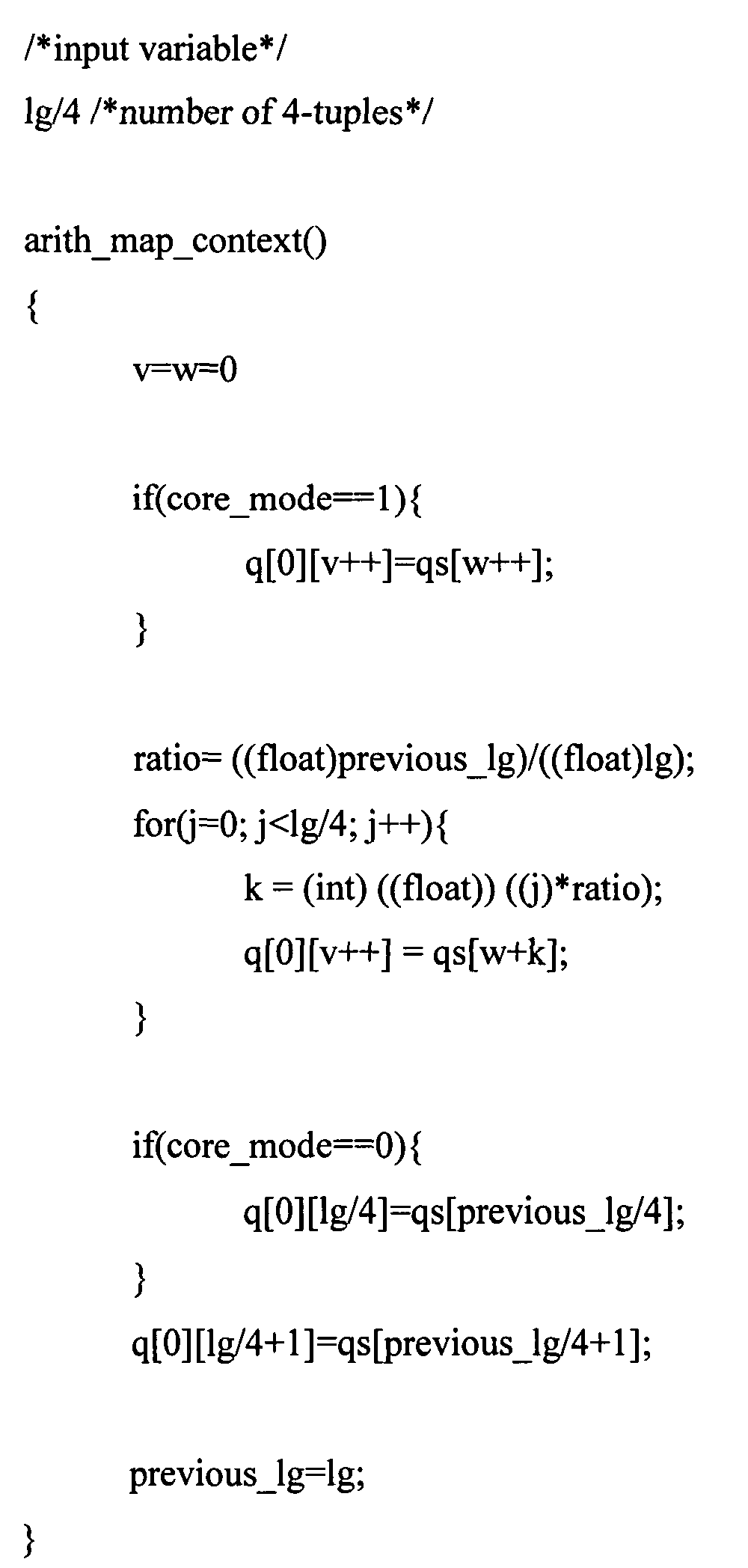
Как можно заметить из псевдокода, отображение не может быть точно таким же для всех кодирующих стратегий. В настоящем воплощении отображения для коэффициента различаются, когда используется ААС (Расширенное Аудио Кодирование) (core_mode==0), и когда используется ТСХ (Кодирование, Основанное на Преобразовании) (core_mode==1). Одно из отличий происходит из того, как обработаны границы таблиц. В ААС отображение может начаться с индекса 0 (первое значение в таблице), в то время как для ТСХ оно может начаться с индекса 1 (второе значение в таблице)), полагая, что первое значение всегда устанавливается в "неопределенное" состояние (особое состояние используется для сброса контекста). Отношение previous_lg к lg определяет порядок высокочастотных выборок (ratio<1) или низкочастотных выборок (ratio>1), который будет выполнен в настоящем воплощении. Фиг.7с иллюстрирует случай ТСХ, когда преобразование выполняется из сохраненной таблицы контекста размера 1024/4, происходит сравнение левой стороны 780 рисунка Фиг.7с с размером 512/4 с правой стороной 782 рисунка Фиг.7с. Можно заметить, что, в то время как для текущей таблицы контекста 782 используются пошаговые приращения 1, для сохраненной таблицы контекста 780 используются пошаговые приращения описанного выше отношения.As you can see from the pseudo-code, the mapping may not be exactly the same for all coding strategies. In the present embodiment, the mappings for the coefficient are different when AAC (Advanced Audio Encoding) is used (core_mode == 0) and when TLC (Transformation Based Encoding) is used (core_mode == 1). One of the differences comes from how table borders are handled. In AAC, a mapping can start at index 0 (the first value in the table), while for TLC it can start at index 1 (the second value in the table)), assuming that the first value is always set to an "undefined" state (special state used to reset context). The ratio of previous_lg to lg determines the order of high-frequency samples (ratio <1) or low-frequency samples (ratio> 1), which will be performed in the present embodiment. Fig. 7c illustrates the case of TLC, when the conversion is performed from a stored context table of
Фиг.7с иллюстрирует процедуру обновления контекста воплощения для изменений решения. Как только отображение сделано, выполняется адаптивное кодирование контекста. В конце кодирования текущие элементы фрейма сохраняются в таблице qs [] для следующего фрейма. Это может быть сделано с помощью процедуры arith_update_context (), которая представляется следующим псевдокодом:Fig. 7c illustrates a procedure for updating an implementation context for decision changes. Once the mapping is done, adaptive context coding is performed. At the end of the encoding, the current frame elements are stored in the qs [] table for the next frame. This can be done using the arith_update_context () procedure, which is represented by the following pseudocode:


В существующем воплощении сохранения проводится дифференцирование согласно основному кодировщику (ААС или ТСХ). В ТСХ контекст всегда сохраняется в таблице qs[] размерностью 1024/4. Это дополнительное отображение может быть сделано по замкнутому алгоритму AMR-WB + (Адаптивный Многоскоростной Широкополосный Кодировщик), В замкнутом алгоритме несколько процедур копирования состояний кодировщика необходимы для проверки каждой возможной комбинации TCXs и ACELP (Кодирование Линейного Предсказания с Алгебраическим Возбуждением). Копирование состояния легче осуществить, когда все виды ТСХ имеют один и тот же размер таблицы qs []. Затем используется отображение для систематического преобразования из размерности lg/4 на 1024/4. С другой стороны, ААС сохраняет только контекст и не выполняет отображение во время этого этапа.In the current embodiment of conservation, differentiation is performed according to the main encoder (AAC or TLC). In TLC, the context is always stored in the qs [] table of
Фиг.8 иллюстрирует блок-схему воплощения схемы декодирования. На шаге 805, соответствующем шагу 705, контекст получен на основе t0, t1, t2 и t3. На шаге 810, первый уровень сокращения lev0 оценивается по контексту, и переменная lev устанавливается равной lev0. На следующем шаге 815, группа ng считывается из потока битов, а распределение вероятности для декодирования ng получено из контекста. Затем на шаге 815 группа ng может быть декодирована из потока битов.FIG. 8 illustrates a block diagram of an embodiment of a decoding scheme. At
На шаге 820 определяется, равняется ли значение ng 544, которое соответствует исключению. Если это так, то переменная lev может быть увеличена на 2 прежде, чем происходит возврат на шаг 815. В случае первого использования этой ветви, то есть, если lev=lev0, распределение вероятности, подходящее для контекста, соответственно может быть использовано либо отменено, если ветвь используется не впервые, в соответствии с описанным выше механизмом адаптации контекста, сравни с Фиг.7b и 7с. В случае если индекс группы ng не равен 544 на шаге 820, на следующем шаге 825 определяется, больше ли число элементов в группе чем 1, и если это так, на шаге 830, элемент группы ne прочитан и декодирован в потоке битов в предположении однородного распределения вероятности. Индекс элемента ne получен из потока битов с использованием арифметического кодирования и однородного распределения вероятности.At
В шаге 835 буквенное кодовое слово (а, b, с, d) может быть получено из ng и ne процессом поиска в таблицах, например, при помощи обращения к dgroups[ng] и acod_ne[ne].In
На шаге 840 для всех lev отсутствуют разрядные матрицы, массивы считываются из потока битов с использованием арифметического кодирования в предположении однородного распределения вероятности. Затем разрядные матрицы могут быть применены к (а, b, с, d) со сдвигом (а, b, с, d) влево и добавлением процедуры bitplane bp: ((а, b, с, d)<<=1)|=bp. Этот процесс может быть многократным повторением lev.At
Наконец, на шаге 845 формируются 4 кортежа q (n, m), то есть создается (а, b, с, d). В следующих псевдокодах детали исполнения обеспечиваются согласно воплощению. Будут использоваться следующие определения. (а, b, с, d) 4 кортежа для декодированияFinally, at
ng индекс группы 2 битных разрядных матриц старших битов с 4 кортежами, где 0<=ng<=544. Последнее значение 544 соответствует исключенному символу, ARITH_ESCAPE.ng is the index of the group of 2 bit high-order bit matrix matrices with 4 tuples, where 0 <= ng <= 544. The
ne индекс элемента в пределах группы. Значение ne находится между 0 и главным элементом каждой группы mm. Максимальное число элементов в пределах группы 73. lev - уровень остающихся разрядных матриц. Он [уровень] соответствует разности числа разрядных матриц младших битов и числа 2 битных разрядных матриц старших битов. egroups[b] [с] [d] таблица индекса группы. Она разрешает отображать разрядные матрицы старших битов с 4 кортежами (а, b, с, d) в эти 544 группы.ne is the index of the element within the group. The value of ne is between 0 and the main element of each group mm. The maximum number of elements within a group is 73. lev is the level of the remaining bit matrices. It [level] corresponds to the difference between the number of bit matrices of the least significant bits and the number of 2 bit bit matrices of the most significant bits. egroups [b] [c] [d] group index table. It allows you to map the bit matrix of high bits with 4 tuples (a, b, c, d) into these 544 groups.
mm главный элемент группыmm the main element of the group
og Смещение группыog Group offset
dgroups[] Отображает индекс группы ng на главный элемент каждой группы mm (первые 8 битов) и смещение группы og в dgvectors[] (последние 8 битов).dgroups [] Maps the index of the ng group to the main element of each mm group (first 8 bits) and the offset of the og group to dgvectors [] (last 8 bits).
dgvectors[] Отображает смещение группы og и индекса элемента ne на разрядные матрицы старших битов с 4 кортежами (а, b, с, d).dgvectors [] Displays the offset of the og group and the index of the element ne on the bit matrix of high bits with 4 tuples (a, b, c, d).
arith_cf_ng_hash[] Добавочная таблица, отображающая состояние контекста на совокупный индекс таблицы частот pki.arith_cf_ng_hash [] An incremental table that displays the state of the context on the aggregate index of the frequency table pki.
arith_cf_ng[pki] [545] Модели совокупных частот для символа индекса группы ng.arith_cf_ng [pki] [545] The aggregate frequency models for the ng group index symbol.
arith_cf_ne[] Совокупные частоты для символа индекса элемента ne.arith_cf_ne [] The aggregate frequencies for the index symbol of the element ne.
r Разрядная матрица разности числа разрядных матриц младших битов и числа 2 битных разрядных матриц старших битов.r Bit matrix of the difference between the number of bit matrices of the least significant bits and the number of 2 bit bit matrices of the most significant bits.
arith_cf_r[] Совокупные частоты для символа разрядных матриц младших битов rarith_cf_r [] The aggregate frequencies for the symbol of the bit matrix of the least significant bits r
Далее процесс декодирования считается первым. Четыре кортежа дискретных спектральных коэффициентов кодируются с исключением шума и передаются, начиная с самой низкой частоты или спектрального коэффициента и заканчивая самой высокой частотой или спектральным коэффициентом. Коэффициенты от ААС сохраняются во множестве x_ac_quant[r] [win] [sfb] [bin], и порядок передачи закодированных кодовых слов с исключением шума таков, что, когда они декодируются в порядке получения и сохраняются в массиве, причем bin является наиболее быстро увеличивающимся индексом, a g - наиболее медленно увеличивающимся индексом. В пределах кодового слова порядок декодирования - а, b, с, d. Коэффициент от ТСХ сохраняется непосредственно в массиве x_tcx_invquant [win] [bin], и порядок передачи закодированных кодовых слов с исключением шума таков, что, когда они декодируются в порядке получения и сохраняются в массиве, bin - наиболее быстро увеличивающий индекс, a win -наиболее медленно увеличивающий индекс. В пределах кодового слова порядок расшифровки - а, b, с, d. Прежде всего, флаг arith_reset_flag определяет, должен ли контекст быть перезагружен. Если флаг имеет значение TRUE, вызывается следующая функция:Further, the decoding process is considered the first. Four tuples of discrete spectral coefficients are encoded with the exclusion of noise and transmitted, starting with the lowest frequency or spectral coefficient and ending with the highest frequency or spectral coefficient. The coefficients from AAC are stored in the set x_ac_quant [r] [win] [sfb] [bin], and the transmission order of the encoded codewords with the exception of noise is such that when they are decoded in the order received and stored in the array, bin being the fastest growing by index, ag is the most slowly increasing index. Within the codeword, the decoding order is a, b, c, d. The coefficient from TLC is stored directly in the x_tcx_invquant [win] [bin] array, and the transmission order of encoded codewords with the exception of noise is such that when they are decoded in the order received and stored in the array, bin is the fastest increasing index, and win is the fastest slowly increasing index. Within the codeword, the decryption order is a, b, c, d. First of all, the arith_reset_flag flag determines whether the context should be reloaded. If the flag is TRUE, the following function is called:
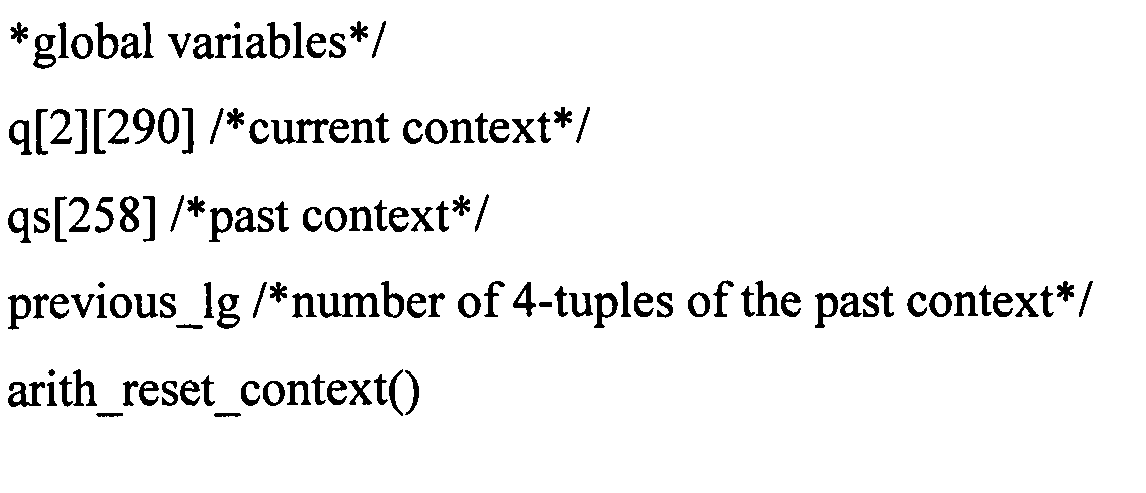
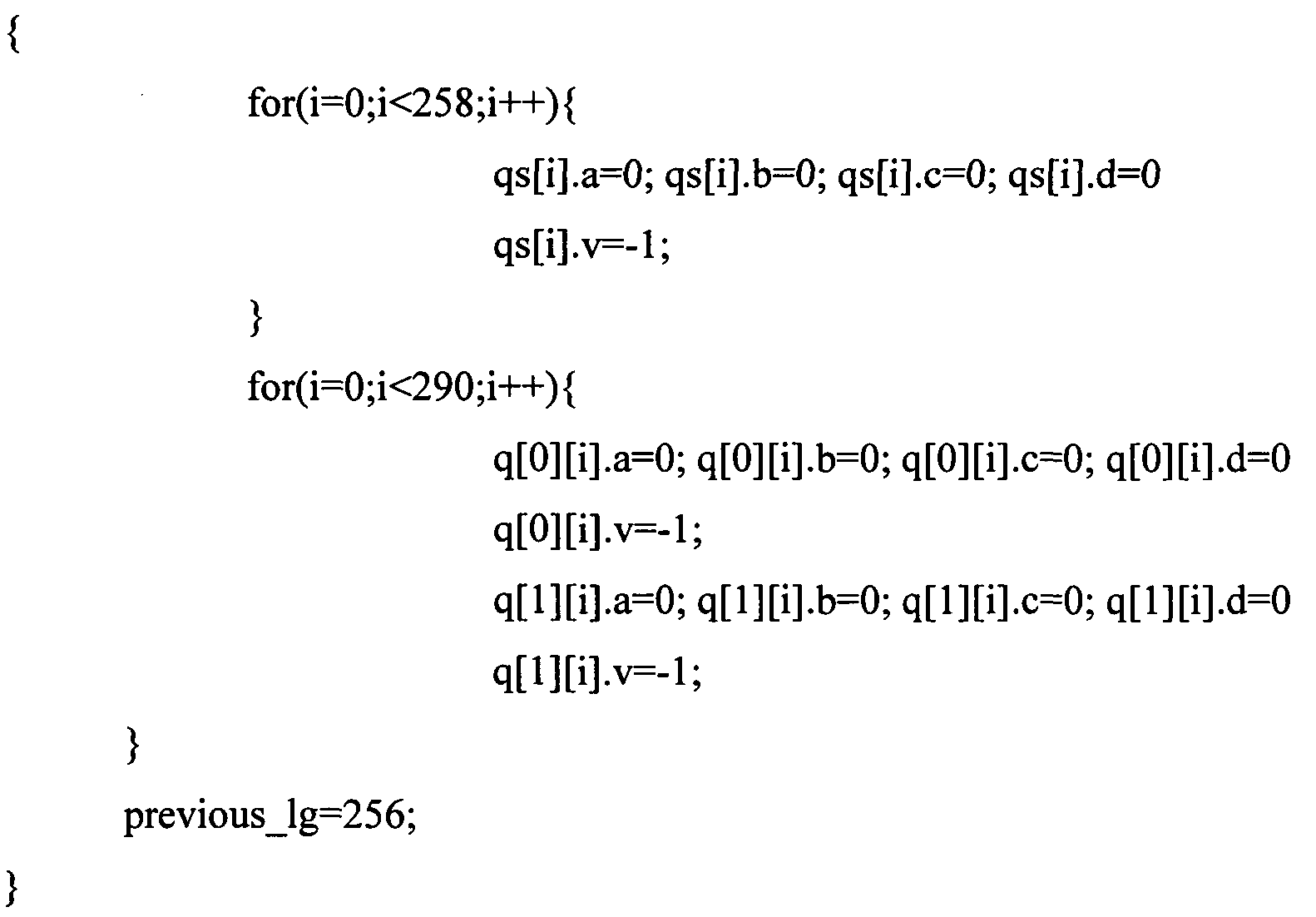
Если arith_reset_flag имеет значение FALSE, отображение проводится между прошлым контекстом и текущим контекстом:If arith_reset_flag is FALSE, the mapping is between the past context and the current context:
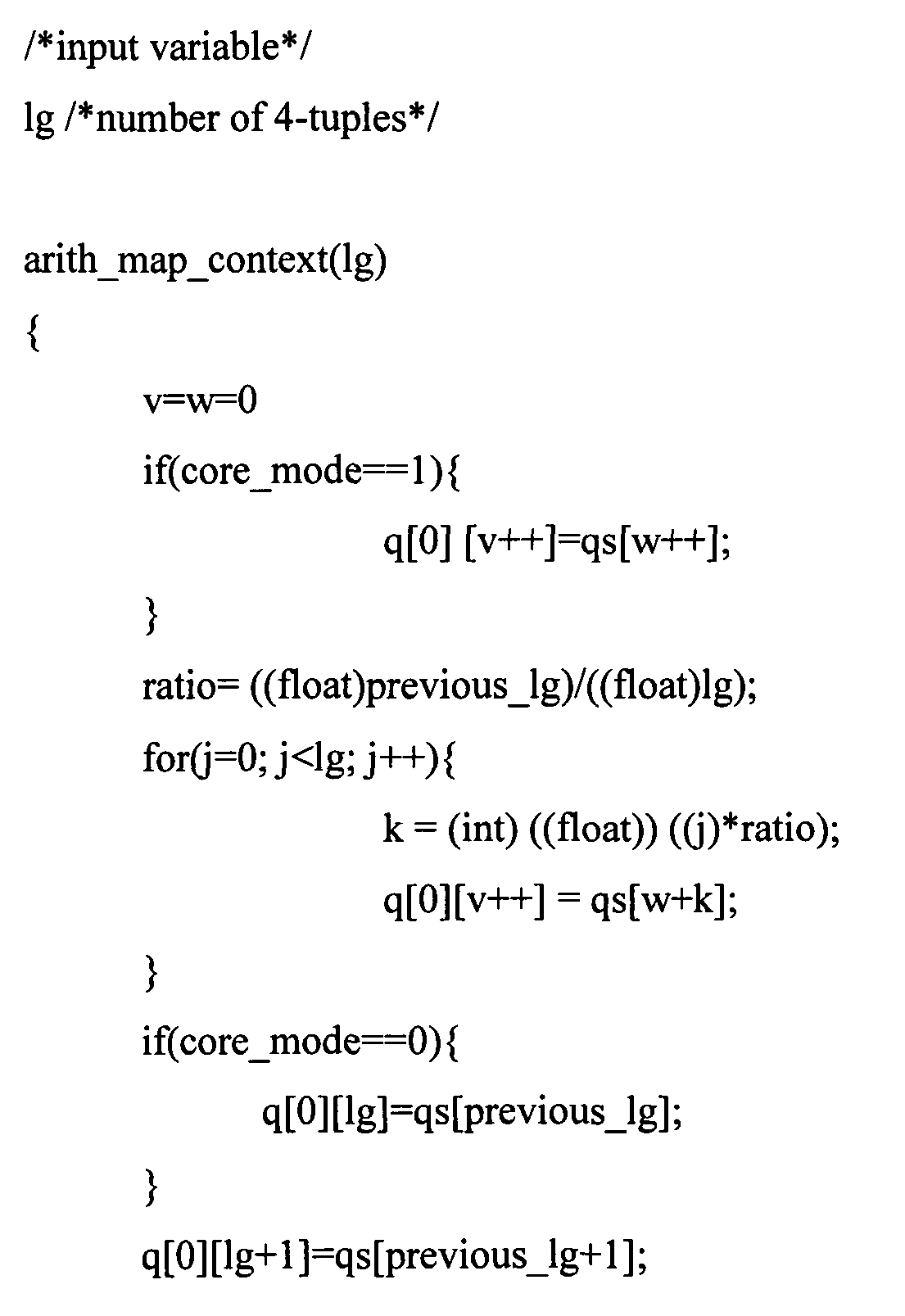
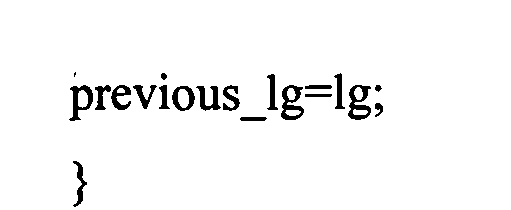
4 кортежа на выходе декодера с исключением шума представляют дискретные спектральные коэффициенты. Первоначальное состояние контекста вычисляется на основе четырех ранее декодированных групп, включающих 4 декодируемых кортежа. Состояние контекста задается функцией arith_get_context():4 tuples at the output of the decoder excluding noise represent discrete spectral coefficients. The initial context state is calculated based on four previously decoded groups including 4 decoded tuples. The state of the context is set by the arith_get_context () function:

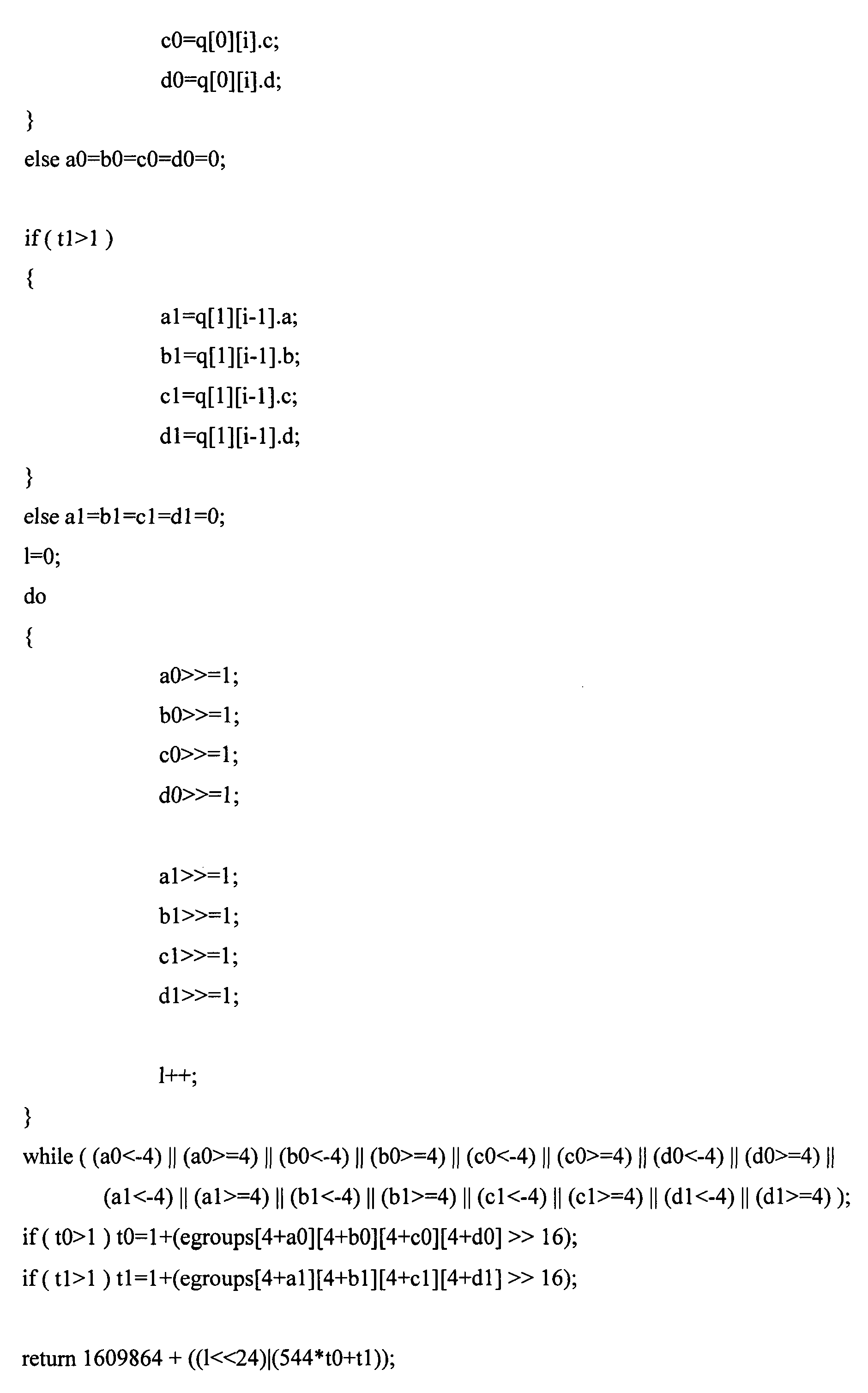

Как только состояние известно, группа, к которой принадлежит 2-битная разрядная матрица старших битов с 4 кортежами, декодируется функцией arith_decode(), использующей подходящую совокупную таблицу частот, соответствующую состоянию контекста. Соответствие выполнено функцией arith_get_pk():Once the state is known, the group to which the 2-bit high-order bit matrix with 4 tuples belongs is decoded by the arith_decode () function using a suitable aggregate frequency table corresponding to the context state. Compliance is made by the arith_get_pk () function:
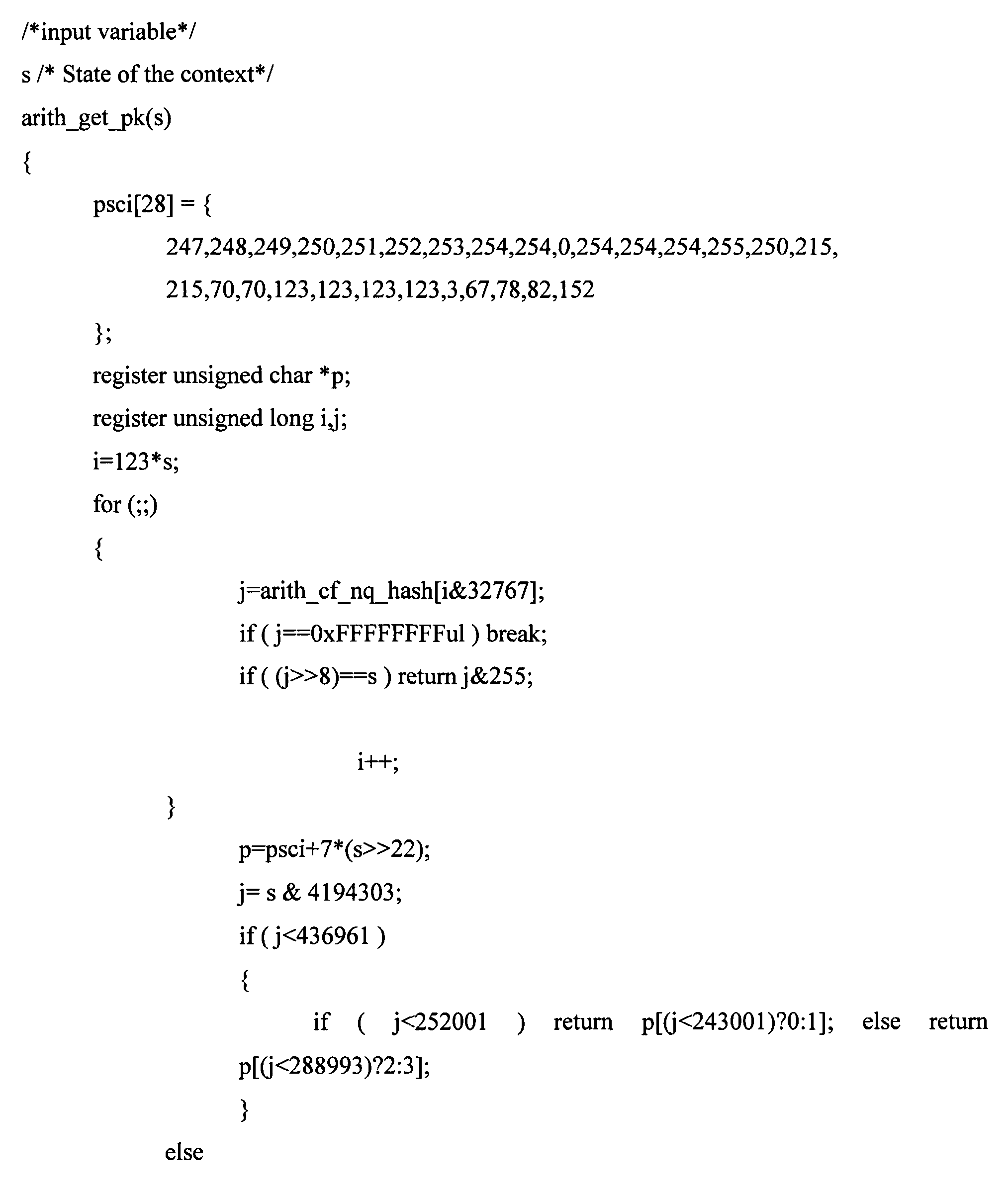

Затем вызывается функция arith_decode() с совокупной таблицей частот, соответствующей индексу возврата arith_get_pk(). Арифметический кодировщик генерирует тег [или дескриптор, элемент языка разметки гипертекста] целого типа с вычислением. Следующий псевдокод на языке С описывает используемый алгоритм.Then, the arith_decode () function is called with the aggregate frequency table corresponding to the return index arith_get_pk (). The arithmetic encoder generates an integer type tag [or descriptor, element of the hypertext markup language] with calculation. The following pseudo-code in C describes the algorithm used.


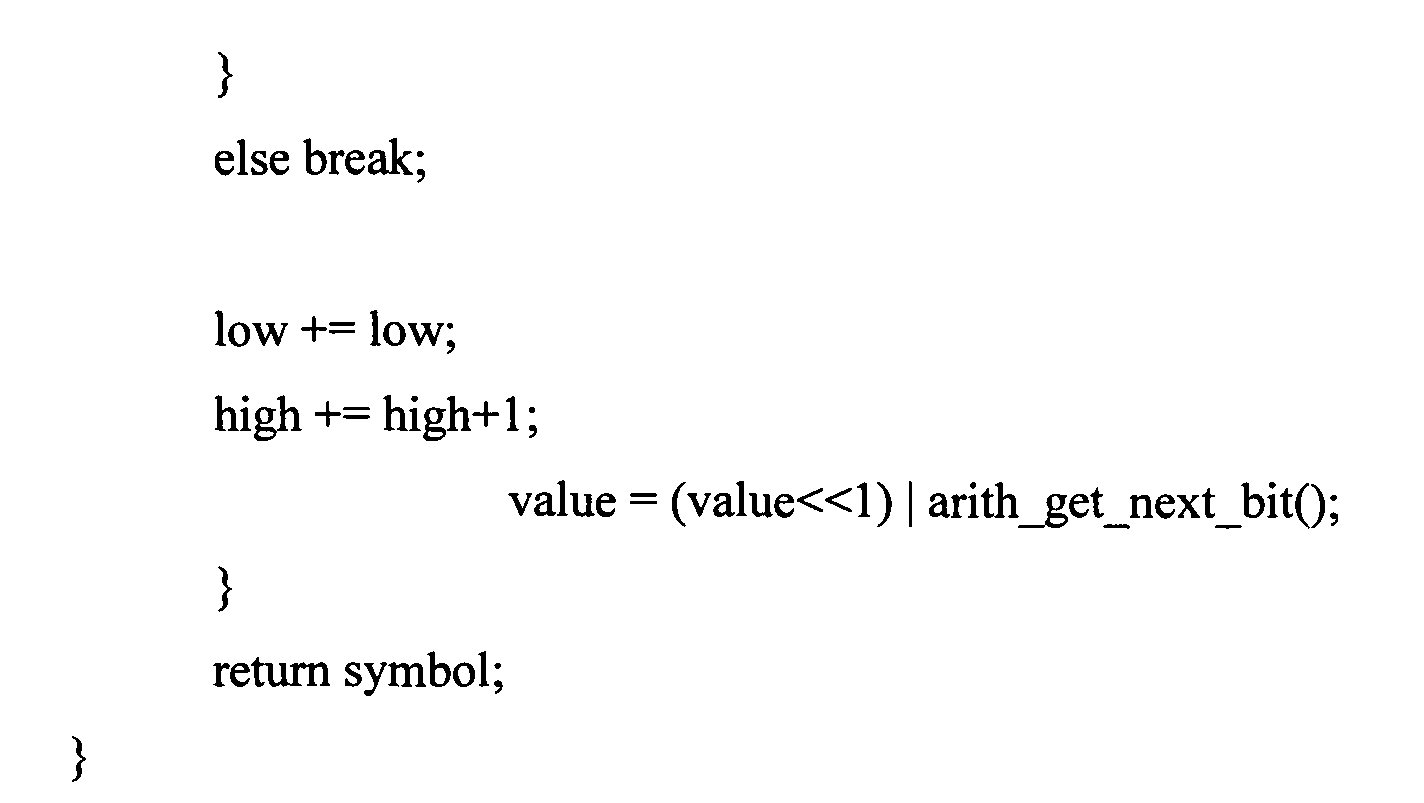
Если декодированный индекс группы ng является исключенным символом, ARITH_ESCAPE, декодируется дополнительный индекс группы ng и переменная lev увеличивается на два. Если декодированный индекс группы не является исключенным символом, ARITH_ESCAPE, количество элементов, mm, в пределах группы и группа смещения, og, выводятся в таблицу dgroups[]:If the decoded index of the ng group is an excluded character, ARITH_ESCAPE, the additional index of the ng group is decoded and the lev variable is increased by two. If the decoded group index is not an excluded character, ARITH_ESCAPE, the number of elements, mm, within the group and the offset group, og, are displayed in the dgroups [] table:
mm=dgroups [nq]&255mm = dgroups [nq] & 255
og=dgroups[nq]>>8og = dgroups [nq] >> 8
Затем декодируется индекс элемента ne с помощью вызова arith_decode() с совокупной таблицей частот (arith_cf_ne+((mm*(mm-l))>>l)[]. Как только индекс элемента декодирован, 2 битная разрядная матрица старших битов с 4 кортежами может быть получена в таблице dgvector[]:Then, the index of the element ne is decoded by calling arith_decode () with the aggregate frequency table (arith_cf_ne + ((mm * (mm-l)) >> l) []. As soon as the index of the element is decoded, the 2 bit high-order bit matrix with 4 tuples can be obtained in the dgvector [] table:
a=dgvectors[4*(og+ne)]a = dgvectors [4 * (og + ne)]
b=dgvectors[4*(og+ne)+1]b = dgvectors [4 * (og + ne) +1]
c=dgvectors[4*(og+ne)+2]c = dgvectors [4 * (og + ne) +2]
d=dgvectors[4*(og+ne)+3]d = dgvectors [4 * (og + ne) +3]
Остающиеся разрядные матрицы декодированы от самого старшего до самого младшего разряда с помощью вызова lev раз функции arith_decode() с совокупной таблицей частот arith_cf_r []. Декодированная разрядная матрица r позволяет улучшить декодирование 4 кортежей следующим путем:The remaining bit matrices are decoded from the oldest to the least significant bit by calling lev times the arith_decode () function with the aggregate frequency table arith_cf_r []. The decoded bit matrix r can improve the decoding of 4 tuples in the following way:
a=(а<<1)|(r&1)a = (a << 1) | (r & 1)
b=(b<<1)|((r>>1)&1)b = (b << 1) | ((r >> 1) & 1)
c=(с<<1)|((r>>2)&1)c = (c << 1) | ((r >> 2) & 1)
d=(d<<l)|(r>>3)d = (d << l) | (r >> 3)
Как только 4 кортежа (а, b, с, d) полностью декодированы, таблицы контекста q и qs обновляются с помощью вызова функции arith_update_context().Once 4 tuples (a, b, c, d) are fully decoded, the q and qs context tables are updated by calling the arith_update_context () function.
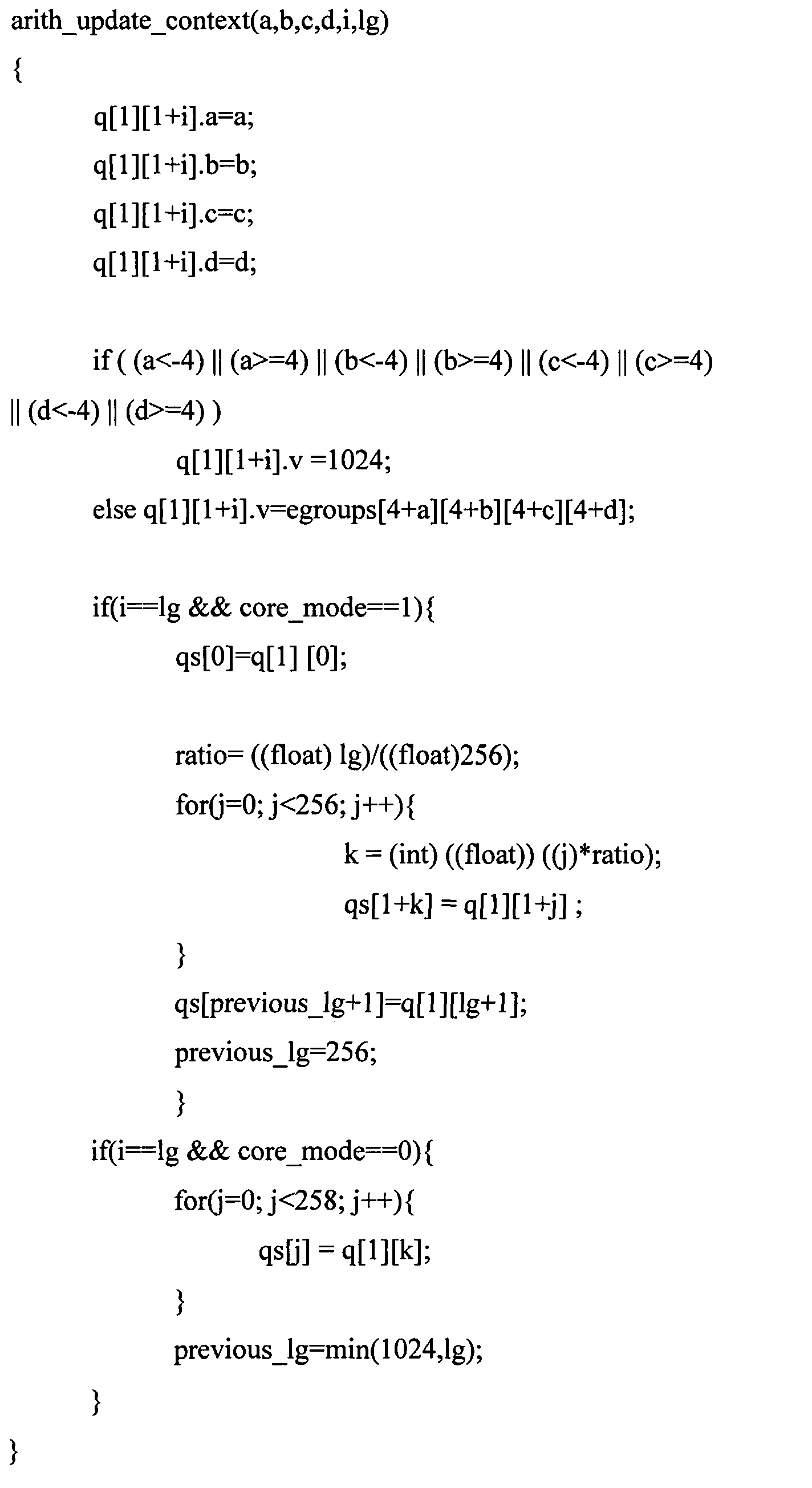
В зависимости от определенных требований выполнения методов изобретения, методы изобретения могут быть реализованы аппаратными средствами либо программным обеспечением. Выполнение может быть осуществлено с использованием цифрового носителя данных, в частности DVD-диск или CD-диск, путем сохранения на них управляющего сигнала, считываемого электронным способом, [управляющего сигнала] который взаимодействует с программируемым компьютером, на котором реализованы методы изобретения. В целом, настоящее изобретение является результатом компьютерной программы с кодом программы для машиночитаемого носителя, кодом программы, являющимся средством для выполнения методов изобретения, когда компьютерная программа запускается на компьютере. Другими словами, методы изобретения реализованы в компьютерной программе, имеющей программный код для выполнения по крайней мере одного из методов изобретения, когда компьютерная программа запускается на компьютере.Depending on the specific requirements for the implementation of the methods of the invention, the methods of the invention can be implemented in hardware or software. The execution can be carried out using a digital storage medium, in particular a DVD-ROM or CD-ROM, by storing on them a control signal read out electronically, [control signal] which interacts with a programmable computer on which the methods of the invention are implemented. In general, the present invention is the result of a computer program with a program code for a computer-readable medium, a program code that is a means for executing the methods of the invention when the computer program is run on a computer. In other words, the methods of the invention are implemented in a computer program having program code for executing at least one of the methods of the invention when the computer program is launched on a computer.
Claims (18)
Applications Claiming Priority (5)
| Application Number | Priority Date | Filing Date | Title |
|---|---|---|---|
| US7984208P | 2008-07-11 | 2008-07-11 | |
| US61/079,842 | 2008-07-11 | ||
| US10382008P | 2008-10-08 | 2008-10-08 | |
| US61/103,820 | 2008-10-08 | ||
| PCT/EP2009/003521 WO2010003479A1 (en) | 2008-07-11 | 2009-05-18 | Audio encoder and audio decoder |
Publications (2)
| Publication Number | Publication Date |
|---|---|
| RU2011102424A RU2011102424A (en) | 2012-07-27 |
| RU2487427C2 true RU2487427C2 (en) | 2013-07-10 |
Family
ID=40886050
Family Applications (1)
| Application Number | Title | Priority Date | Filing Date |
|---|---|---|---|
| RU2011102424/08A RU2487427C2 (en) | 2008-07-11 | 2009-05-18 | Audio encoding device and audio decoding device |
Country Status (21)
| Country | Link |
|---|---|
| US (10) | US8930202B2 (en) |
| EP (10) | EP4369609B1 (en) |
| JP (1) | JP5606433B2 (en) |
| KR (1) | KR101456641B1 (en) |
| CN (1) | CN102089813B (en) |
| AR (1) | AR072422A1 (en) |
| AU (1) | AU2009267543B2 (en) |
| BR (4) | BR122021007875B1 (en) |
| CA (1) | CA2729925C (en) |
| CO (1) | CO6351831A2 (en) |
| DK (1) | DK3573056T3 (en) |
| ES (8) | ES2651437T3 (en) |
| FI (1) | FI3573056T3 (en) |
| MX (1) | MX2011000379A (en) |
| MY (1) | MY160260A (en) |
| PL (8) | PL4376305T3 (en) |
| PT (3) | PT3573056T (en) |
| RU (1) | RU2487427C2 (en) |
| TW (1) | TWI449033B (en) |
| WO (1) | WO2010003479A1 (en) |
| ZA (1) | ZA201009258B (en) |
Cited By (3)
| Publication number | Priority date | Publication date | Assignee | Title |
|---|---|---|---|---|
| RU2635890C2 (en) * | 2013-07-22 | 2017-11-16 | Фраунхофер-Гезелльшафт Цур Фердерунг Дер Ангевандтен Форшунг Е.Ф. | Device and method for coding or decoding sound signal with intelligent filling of intervals in spectral area |
| RU2777304C2 (en) * | 2017-12-19 | 2022-08-02 | Долби Интернэшнл Аб | Methods, device and systems for improvement of harmonic transposition module based on qmf unified speech and audio decoding and coding |
| US12112765B2 (en) | 2015-03-09 | 2024-10-08 | Fraunhofer-Gesellschaft Zur Foerderung Der Angewandten Forschung E.V. | Audio encoder, audio decoder, method for encoding an audio signal and method for decoding an encoded audio signal |
Families Citing this family (28)
| Publication number | Priority date | Publication date | Assignee | Title |
|---|---|---|---|---|
| US7991610B2 (en) * | 2005-04-13 | 2011-08-02 | Fraunhofer-Gesellschaft Zur Foerderung Der Angewandten Forschung E.V. | Adaptive grouping of parameters for enhanced coding efficiency |
| EP2144230A1 (en) * | 2008-07-11 | 2010-01-13 | Fraunhofer-Gesellschaft zur Förderung der angewandten Forschung e.V. | Low bitrate audio encoding/decoding scheme having cascaded switches |
| EP2346029B1 (en) | 2008-07-11 | 2013-06-05 | Fraunhofer-Gesellschaft zur Förderung der angewandten Forschung e.V. | Audio encoder, method for encoding an audio signal and corresponding computer program |
| ES2651437T3 (en) * | 2008-07-11 | 2018-01-26 | Fraunhofer-Gesellschaft zur Förderung der angewandten Forschung e.V. | Audio encoder and audio decoder |
| MX2011000372A (en) | 2008-07-11 | 2011-05-19 | Fraunhofer Ges Forschung | Audio signal synthesizer and audio signal encoder. |
| KR20100136890A (en) | 2009-06-19 | 2010-12-29 | 삼성전자주식회사 | Context-based Arithmetic Coding Apparatus and Method and Arithmetic Decoding Apparatus and Method |
| EP2315358A1 (en) * | 2009-10-09 | 2011-04-27 | Thomson Licensing | Method and device for arithmetic encoding or arithmetic decoding |
| BR112012009446B1 (en) | 2009-10-20 | 2023-03-21 | Fraunhofer-Gesellschaft zur Förderung der angewandten Forschung e.V | DATA STORAGE METHOD AND DEVICE |
| MY160067A (en) * | 2010-01-12 | 2017-02-15 | Fraunhofer Ges Forschung | Audio encoder, audio decoder, method for encoding and audio information, method for decording an audio information and computer program using a modification of a number representation of a numeric previous context value |
| US8280729B2 (en) * | 2010-01-22 | 2012-10-02 | Research In Motion Limited | System and method for encoding and decoding pulse indices |
| BR112012022741B1 (en) | 2010-03-10 | 2021-09-21 | Fraunhofer-Gesellschaft Zur Fõrderung Der Angewandten Forschung E.V. | AUDIO SIGNAL DECODER, AUDIO SIGNAL ENCODER AND METHODS USING A TIME DEFORMATION CONTOUR CODING DEPENDENT ON THE SAMPLING RATE |
| EP4131258B1 (en) * | 2010-07-20 | 2025-05-14 | Fraunhofer-Gesellschaft zur Förderung der angewandten Forschung e.V. | Audio decoder, audio decoding method and computer program |
| KR101748756B1 (en) | 2011-03-18 | 2017-06-19 | 프라운호퍼 게젤샤프트 쭈르 푀르데룽 데어 안겐반텐 포르슝 에.베. | Frame element positioning in frames of a bitstream representing audio content |
| TWI451746B (en) * | 2011-11-04 | 2014-09-01 | Quanta Comp Inc | Video conference system and video conference method thereof |
| US10844689B1 (en) | 2019-12-19 | 2020-11-24 | Saudi Arabian Oil Company | Downhole ultrasonic actuator system for mitigating lost circulation |
| CN107591158B (en) * | 2012-05-18 | 2020-10-27 | 杜比实验室特许公司 | System for maintaining reversible dynamic range control information associated with a parametric audio encoder |
| JP6065452B2 (en) * | 2012-08-14 | 2017-01-25 | 富士通株式会社 | Data embedding device and method, data extraction device and method, and program |
| CN104885149B (en) * | 2012-09-24 | 2017-11-17 | 三星电子株式会社 | Method and apparatus for concealing frame errors and method and apparatus for decoding audio |
| KR20140089871A (en) * | 2013-01-07 | 2014-07-16 | 삼성전자주식회사 | Interactive server, control method thereof and interactive system |
| JP6146069B2 (en) | 2013-03-18 | 2017-06-14 | 富士通株式会社 | Data embedding device and method, data extraction device and method, and program |
| ES2635026T3 (en) * | 2013-06-10 | 2017-10-02 | Fraunhofer-Gesellschaft zur Förderung der angewandten Forschung e.V. | Apparatus and procedure for encoding, processing and decoding of audio signal envelope by dividing the envelope of the audio signal using quantization and distribution coding |
| EP3008726B1 (en) | 2013-06-10 | 2017-08-23 | Fraunhofer-Gesellschaft zur Förderung der angewandten Forschung e.V. | Apparatus and method for audio signal envelope encoding, processing and decoding by modelling a cumulative sum representation employing distribution quantization and coding |
| EP2830055A1 (en) * | 2013-07-22 | 2015-01-28 | Fraunhofer-Gesellschaft zur Förderung der angewandten Forschung e.V. | Context-based entropy coding of sample values of a spectral envelope |
| GB2559199A (en) * | 2017-01-31 | 2018-08-01 | Nokia Technologies Oy | Stereo audio signal encoder |
| CN115050378B (en) * | 2022-05-19 | 2024-06-07 | 腾讯科技(深圳)有限公司 | Audio encoding and decoding method and related products |
| US12380902B2 (en) | 2023-10-18 | 2025-08-05 | Cisco Technology, Inc. | Vector quantizer correction for audio codec system |
| US12308037B2 (en) | 2023-10-18 | 2025-05-20 | Cisco Technology, Inc. | Reduced multidimensional indices compression for audio codec system |
| WO2025149676A1 (en) * | 2024-01-12 | 2025-07-17 | Fraunhofer-Gesellschaft zur Förderung der angewandten Forschung e.V. | Transform-based block-wise coding using prediction |
Citations (4)
| Publication number | Priority date | Publication date | Assignee | Title |
|---|---|---|---|---|
| EP1395980A1 (en) * | 2001-05-08 | 2004-03-10 | Koninklijke Philips Electronics N.V. | Audio coding |
| WO2005078704A1 (en) * | 2004-02-13 | 2005-08-25 | Fraunhofer-Gesellschaft zur Förderung der angewandten Forschung e.V. | Audio coding |
| RU2289858C2 (en) * | 2002-06-27 | 2006-12-20 | Самсунг Электроникс Ко., Лтд. | Method and device for encoding an audio signal with usage of harmonics extraction |
| US7275936B1 (en) * | 2006-09-22 | 2007-10-02 | Lotes Co., Ltd. | Electrical connector |
Family Cites Families (62)
| Publication number | Priority date | Publication date | Assignee | Title |
|---|---|---|---|---|
| US5233055A (en) | 1991-03-19 | 1993-08-03 | Shell Oil Company | Copolymerization of polyethercyclicpolyols with epoxy resins |
| US5253055A (en) * | 1992-07-02 | 1993-10-12 | At&T Bell Laboratories | Efficient frequency scalable video encoding with coefficient selection |
| US5710562A (en) | 1995-08-31 | 1998-01-20 | Ricoh Company Ltd. | Method and apparatus for compressing arbitrary data |
| US5852806A (en) * | 1996-03-19 | 1998-12-22 | Lucent Technologies Inc. | Switched filterbank for use in audio signal coding |
| DE69712230T2 (en) * | 1997-05-08 | 2002-10-31 | Stmicroelectronics Asia Pacific Pte Ltd., Singapur/Singapore | METHOD AND DEVICE FOR TRANSMITTING THE FREQUENCY DOMAIN WITH A FORWARD BLOCK CIRCUIT FOR AUDIODECODER FUNCTIONS |
| US6226608B1 (en) * | 1999-01-28 | 2001-05-01 | Dolby Laboratories Licensing Corporation | Data framing for adaptive-block-length coding system |
| IL129345A (en) * | 1999-04-06 | 2004-05-12 | Broadcom Corp | Video encoding and video/audio/data multiplexing device |
| US7240001B2 (en) * | 2001-12-14 | 2007-07-03 | Microsoft Corporation | Quality improvement techniques in an audio encoder |
| US7460993B2 (en) * | 2001-12-14 | 2008-12-02 | Microsoft Corporation | Adaptive window-size selection in transform coding |
| ES2219589T3 (en) | 2002-02-05 | 2004-12-01 | Siemens Aktiengesellschaft | DATA COMPRESSION. |
| CN1639984B (en) * | 2002-03-08 | 2011-05-11 | 日本电信电话株式会社 | Digital signal encoding method, decoding method, encoding device, decoding device |
| WO2003083856A1 (en) * | 2002-03-28 | 2003-10-09 | Craven Peter G | Context coding |
| US7110941B2 (en) * | 2002-03-28 | 2006-09-19 | Microsoft Corporation | System and method for embedded audio coding with implicit auditory masking |
| US7275036B2 (en) * | 2002-04-18 | 2007-09-25 | Fraunhofer-Gesellschaft Zur Foerderung Der Angewandten Forschung E.V. | Apparatus and method for coding a time-discrete audio signal to obtain coded audio data and for decoding coded audio data |
| US7328150B2 (en) | 2002-09-04 | 2008-02-05 | Microsoft Corporation | Innovations in pure lossless audio compression |
| US7299190B2 (en) * | 2002-09-04 | 2007-11-20 | Microsoft Corporation | Quantization and inverse quantization for audio |
| US7433824B2 (en) * | 2002-09-04 | 2008-10-07 | Microsoft Corporation | Entropy coding by adapting coding between level and run-length/level modes |
| ES2297083T3 (en) | 2002-09-04 | 2008-05-01 | Microsoft Corporation | ENTROPIC CODIFICATION BY ADAPTATION OF THE CODIFICATION BETWEEN MODES BY LENGTH OF EXECUTION AND BY LEVEL. |
| US7536305B2 (en) * | 2002-09-04 | 2009-05-19 | Microsoft Corporation | Mixed lossless audio compression |
| US7502743B2 (en) * | 2002-09-04 | 2009-03-10 | Microsoft Corporation | Multi-channel audio encoding and decoding with multi-channel transform selection |
| US7797331B2 (en) | 2002-12-20 | 2010-09-14 | Nokia Corporation | Method and device for organizing user provided information with meta-information |
| DE10328777A1 (en) * | 2003-06-25 | 2005-01-27 | Coding Technologies Ab | Apparatus and method for encoding an audio signal and apparatus and method for decoding an encoded audio signal |
| US7343291B2 (en) * | 2003-07-18 | 2008-03-11 | Microsoft Corporation | Multi-pass variable bitrate media encoding |
| US7509161B2 (en) * | 2003-10-22 | 2009-03-24 | Instrumentarium Corporation | Method and apparatus for determining the cerebral state of a patient using generalized spectral entropy of the EEG signal |
| US20050185541A1 (en) | 2004-02-23 | 2005-08-25 | Darren Neuman | Method and system for memory usage in real-time audio systems |
| KR20050087956A (en) | 2004-02-27 | 2005-09-01 | 삼성전자주식회사 | Lossless audio decoding/encoding method and apparatus |
| KR100561869B1 (en) * | 2004-03-10 | 2006-03-17 | 삼성전자주식회사 | Lossless audio decoding/encoding method and apparatus |
| TWI246256B (en) * | 2004-07-02 | 2005-12-21 | Univ Nat Central | Apparatus for audio compression using mixed wavelet packets and discrete cosine transformation |
| EP2006839A3 (en) * | 2004-07-14 | 2009-02-11 | Agency for Science, Technology and Research | Context-based encoding and decoding of signals |
| KR20070051878A (en) * | 2004-09-06 | 2007-05-18 | 마츠시타 덴끼 산교 가부시키가이샤 | Scalable coding apparatus and scalable coding method |
| SE0402651D0 (en) * | 2004-11-02 | 2004-11-02 | Coding Tech Ab | Advanced methods for interpolation and parameter signaling |
| US7428342B2 (en) * | 2004-12-17 | 2008-09-23 | Microsoft Corporation | Reversible overlap operator for efficient lossless data compression |
| US7991610B2 (en) * | 2005-04-13 | 2011-08-02 | Fraunhofer-Gesellschaft Zur Foerderung Der Angewandten Forschung E.V. | Adaptive grouping of parameters for enhanced coding efficiency |
| US7788106B2 (en) * | 2005-04-13 | 2010-08-31 | Fraunhofer-Gesellschaft Zur Foerderung Der Angewandten Forschung E.V. | Entropy coding with compact codebooks |
| US7196641B2 (en) * | 2005-04-26 | 2007-03-27 | Gen Dow Huang | System and method for audio data compression and decompression using discrete wavelet transform (DWT) |
| US8050915B2 (en) | 2005-07-11 | 2011-11-01 | Lg Electronics Inc. | Apparatus and method of encoding and decoding audio signals using hierarchical block switching and linear prediction coding |
| US7539612B2 (en) * | 2005-07-15 | 2009-05-26 | Microsoft Corporation | Coding and decoding scale factor information |
| US8599925B2 (en) * | 2005-08-12 | 2013-12-03 | Microsoft Corporation | Efficient coding and decoding of transform blocks |
| US20070036228A1 (en) * | 2005-08-12 | 2007-02-15 | Via Technologies Inc. | Method and apparatus for audio encoding and decoding |
| US20070078645A1 (en) | 2005-09-30 | 2007-04-05 | Nokia Corporation | Filterbank-based processing of speech signals |
| US7974713B2 (en) * | 2005-10-12 | 2011-07-05 | Fraunhofer-Gesellschaft Zur Foerderung Der Angewandten Forschung E.V. | Temporal and spatial shaping of multi-channel audio signals |
| US8473298B2 (en) | 2005-11-01 | 2013-06-25 | Apple Inc. | Pre-resampling to achieve continuously variable analysis time/frequency resolution |
| US9009057B2 (en) * | 2006-02-21 | 2015-04-14 | Koninklijke Philips N.V. | Audio encoding and decoding to generate binaural virtual spatial signals |
| KR101244310B1 (en) * | 2006-06-21 | 2013-03-18 | 삼성전자주식회사 | Method and apparatus for wideband encoding and decoding |
| KR101346358B1 (en) * | 2006-09-18 | 2013-12-31 | 삼성전자주식회사 | Method and apparatus for encoding and decoding audio signal using band width extension technique |
| US20080097757A1 (en) | 2006-10-24 | 2008-04-24 | Nokia Corporation | Audio coding |
| RU2420911C1 (en) * | 2007-03-14 | 2011-06-10 | Ниппон Телеграф Энд Телефон Корпорейшн | Apparatus and method of estimating code volume, as well as data medium for implementing said method |
| US20080294446A1 (en) | 2007-05-22 | 2008-11-27 | Linfeng Guo | Layer based scalable multimedia datastream compression |
| EP2015293A1 (en) * | 2007-06-14 | 2009-01-14 | Deutsche Thomson OHG | Method and apparatus for encoding and decoding an audio signal using adaptively switched temporal resolution in the spectral domain |
| US7774205B2 (en) | 2007-06-15 | 2010-08-10 | Microsoft Corporation | Coding of sparse digital media spectral data |
| US8515767B2 (en) * | 2007-11-04 | 2013-08-20 | Qualcomm Incorporated | Technique for encoding/decoding of codebook indices for quantized MDCT spectrum in scalable speech and audio codecs |
| US8325800B2 (en) * | 2008-05-07 | 2012-12-04 | Microsoft Corporation | Encoding streaming media as a high bit rate layer, a low bit rate layer, and one or more intermediate bit rate layers |
| US8447591B2 (en) * | 2008-05-30 | 2013-05-21 | Microsoft Corporation | Factorization of overlapping tranforms into two block transforms |
| EP2346029B1 (en) * | 2008-07-11 | 2013-06-05 | Fraunhofer-Gesellschaft zur Förderung der angewandten Forschung e.V. | Audio encoder, method for encoding an audio signal and corresponding computer program |
| EP2144230A1 (en) * | 2008-07-11 | 2010-01-13 | Fraunhofer-Gesellschaft zur Förderung der angewandten Forschung e.V. | Low bitrate audio encoding/decoding scheme having cascaded switches |
| ES2651437T3 (en) * | 2008-07-11 | 2018-01-26 | Fraunhofer-Gesellschaft zur Förderung der angewandten Forschung e.V. | Audio encoder and audio decoder |
| US8660176B2 (en) * | 2008-09-26 | 2014-02-25 | Qualcomm Incorporated | Resolving geometric relationships among video data units |
| BR112012009446B1 (en) * | 2009-10-20 | 2023-03-21 | Fraunhofer-Gesellschaft zur Förderung der angewandten Forschung e.V | DATA STORAGE METHOD AND DEVICE |
| MY160067A (en) * | 2010-01-12 | 2017-02-15 | Fraunhofer Ges Forschung | Audio encoder, audio decoder, method for encoding and audio information, method for decording an audio information and computer program using a modification of a number representation of a numeric previous context value |
| EP2717261A1 (en) | 2012-10-05 | 2014-04-09 | Fraunhofer-Gesellschaft zur Förderung der angewandten Forschung e.V. | Encoder, decoder and methods for backward compatible multi-resolution spatial-audio-object-coding |
| EP2830058A1 (en) | 2013-07-22 | 2015-01-28 | Fraunhofer-Gesellschaft zur Förderung der angewandten Forschung e.V. | Frequency-domain audio coding supporting transform length switching |
| SG11201603046RA (en) * | 2013-10-18 | 2016-05-30 | Fraunhofer Ges Forschung | Coding of spectral coefficients of a spectrum of an audio signal |
-
2009
- 2009-05-18 ES ES09776624.0T patent/ES2651437T3/en active Active
- 2009-05-18 EP EP24166205.5A patent/EP4369609B1/en active Active
- 2009-05-18 BR BR122021007875-0A patent/BR122021007875B1/en active IP Right Grant
- 2009-05-18 EP EP24166207.1A patent/EP4376306B1/en active Active
- 2009-05-18 ES ES24166206T patent/ES3002107T3/en active Active
- 2009-05-18 BR BR122021007798-3A patent/BR122021007798B1/en active IP Right Grant
- 2009-05-18 PL PL24166206.3T patent/PL4376305T3/en unknown
- 2009-05-18 PL PL23165074.8T patent/PL4224471T3/en unknown
- 2009-05-18 PL PL24166205.5T patent/PL4369609T3/en unknown
- 2009-05-18 AU AU2009267543A patent/AU2009267543B2/en active Active
- 2009-05-18 PL PL24166207.1T patent/PL4376306T3/en unknown
- 2009-05-18 FI FIEP19160283.8T patent/FI3573056T3/en active
- 2009-05-18 MY MYPI2011000097A patent/MY160260A/en unknown
- 2009-05-18 CN CN2009801272072A patent/CN102089813B/en active Active
- 2009-05-18 PL PL19160283.8T patent/PL3573056T3/en unknown
- 2009-05-18 PL PL24166208.9T patent/PL4376307T3/en unknown
- 2009-05-18 KR KR1020117000610A patent/KR101456641B1/en active Active
- 2009-05-18 WO PCT/EP2009/003521 patent/WO2010003479A1/en not_active Ceased
- 2009-05-18 ES ES19160283T patent/ES2934052T3/en active Active
- 2009-05-18 PT PT191602838T patent/PT3573056T/en unknown
- 2009-05-18 ES ES23165074T patent/ES2995183T3/en active Active
- 2009-05-18 ES ES17190130T patent/ES2731424T3/en active Active
- 2009-05-18 ES ES24166205T patent/ES2998032T3/en active Active
- 2009-05-18 EP EP23165075.5A patent/EP4224472B1/en active Active
- 2009-05-18 PT PT97766240T patent/PT2301019T/en unknown
- 2009-05-18 MX MX2011000379A patent/MX2011000379A/en active IP Right Grant
- 2009-05-18 EP EP21190867.8A patent/EP3937167B1/en active Active
- 2009-05-18 JP JP2011516973A patent/JP5606433B2/en active Active
- 2009-05-18 PL PL17190130T patent/PL3300076T3/en unknown
- 2009-05-18 ES ES24166208T patent/ES3001990T3/en active Active
- 2009-05-18 EP EP19160283.8A patent/EP3573056B1/en active Active
- 2009-05-18 DK DK19160283.8T patent/DK3573056T3/en active
- 2009-05-18 PT PT17190130T patent/PT3300076T/en unknown
- 2009-05-18 EP EP09776624.0A patent/EP2301019B1/en active Active
- 2009-05-18 PL PL09776624T patent/PL2301019T3/en unknown
- 2009-05-18 BR BR122021008239-1A patent/BR122021008239B1/en active IP Right Grant
- 2009-05-18 BR BRPI0910796-7A patent/BRPI0910796B1/en active IP Right Grant
- 2009-05-18 CA CA2729925A patent/CA2729925C/en active Active
- 2009-05-18 RU RU2011102424/08A patent/RU2487427C2/en active
- 2009-05-18 EP EP23165074.8A patent/EP4224471B1/en active Active
- 2009-05-18 EP EP17190130.9A patent/EP3300076B1/en active Active
- 2009-05-18 EP EP24166208.9A patent/EP4376307B1/en active Active
- 2009-05-18 ES ES24166207T patent/ES3002157T3/en active Active
- 2009-05-18 EP EP24166206.3A patent/EP4376305B1/en active Active
- 2009-06-29 TW TW098121850A patent/TWI449033B/en active
- 2009-06-30 AR ARP090102436A patent/AR072422A1/en active IP Right Grant
-
2010
- 2010-12-23 ZA ZA2010/09258A patent/ZA201009258B/en unknown
-
2011
- 2011-01-11 US US13/004,282 patent/US8930202B2/en active Active
- 2011-01-21 CO CO11006444A patent/CO6351831A2/en active IP Right Grant
-
2015
- 2015-01-05 US US14/589,881 patent/US10242681B2/en active Active
-
2019
- 2019-02-22 US US16/283,591 patent/US10685659B2/en active Active
-
2020
- 2020-05-29 US US16/888,176 patent/US11670310B2/en active Active
-
2023
- 2023-04-14 US US18/301,194 patent/US11942101B2/en active Active
- 2023-04-14 US US18/301,191 patent/US12039985B2/en active Active
-
2024
- 2024-04-05 US US18/628,632 patent/US12198708B2/en active Active
- 2024-04-05 US US18/628,556 patent/US12230285B2/en active Active
- 2024-04-05 US US18/628,590 patent/US12198707B2/en active Active
- 2024-04-05 US US18/628,500 patent/US12205603B2/en active Active
Patent Citations (4)
| Publication number | Priority date | Publication date | Assignee | Title |
|---|---|---|---|---|
| EP1395980A1 (en) * | 2001-05-08 | 2004-03-10 | Koninklijke Philips Electronics N.V. | Audio coding |
| RU2289858C2 (en) * | 2002-06-27 | 2006-12-20 | Самсунг Электроникс Ко., Лтд. | Method and device for encoding an audio signal with usage of harmonics extraction |
| WO2005078704A1 (en) * | 2004-02-13 | 2005-08-25 | Fraunhofer-Gesellschaft zur Förderung der angewandten Forschung e.V. | Audio coding |
| US7275936B1 (en) * | 2006-09-22 | 2007-10-02 | Lotes Co., Ltd. | Electrical connector |
Cited By (27)
| Publication number | Priority date | Publication date | Assignee | Title |
|---|---|---|---|---|
| US10847167B2 (en) | 2013-07-22 | 2020-11-24 | Fraunhofer-Gesellschaft Zur Foerderung Der Angewandten Forschung E.V. | Audio encoder, audio decoder and related methods using two-channel processing within an intelligent gap filling framework |
| US11996106B2 (en) | 2013-07-22 | 2024-05-28 | Fraunhofer-Gesellschaft Zur Foerderung Der Angewandten Forschung E. V. | Apparatus and method for encoding and decoding an encoded audio signal using temporal noise/patch shaping |
| US10134404B2 (en) | 2013-07-22 | 2018-11-20 | Fraunhofer-Gesellschaft Zur Foerderung Der Angewandten Forschung E.V. | Audio encoder, audio decoder and related methods using two-channel processing within an intelligent gap filling framework |
| US10147430B2 (en) | 2013-07-22 | 2018-12-04 | Fraunhofer-Gesellschaft Zur Foerderung Der Angewandten Forschung E.V. | Apparatus and method for decoding and encoding an audio signal using adaptive spectral tile selection |
| US10276183B2 (en) | 2013-07-22 | 2019-04-30 | Fraunhofer-Gesellschaft Zur Foerderung Der Angewandten Forschung E.V. | Apparatus and method for decoding or encoding an audio signal using energy information values for a reconstruction band |
| US10311892B2 (en) | 2013-07-22 | 2019-06-04 | Fraunhofer-Gesellschaft Zur Foerderung Der Angewandten Forschung E.V. | Apparatus and method for encoding or decoding audio signal with intelligent gap filling in the spectral domain |
| US10332531B2 (en) | 2013-07-22 | 2019-06-25 | Fraunhofer-Gesellschaft Zur Foerderung Der Angewandten Forschung E.V. | Apparatus and method for decoding or encoding an audio signal using energy information values for a reconstruction band |
| US10332539B2 (en) | 2013-07-22 | 2019-06-25 | Fraunhofer-Gesellscheaft zur Foerderung der angewanften Forschung e.V. | Apparatus and method for encoding and decoding an encoded audio signal using temporal noise/patch shaping |
| US10347274B2 (en) | 2013-07-22 | 2019-07-09 | Fraunhofer-Gesellschaft Zur Foerderung Der Angewandten Forschung E.V. | Apparatus and method for encoding and decoding an encoded audio signal using temporal noise/patch shaping |
| US10515652B2 (en) | 2013-07-22 | 2019-12-24 | Fraunhofer-Gesellschaft Zur Foerderung Der Angewandten Forschung E.V. | Apparatus and method for decoding an encoded audio signal using a cross-over filter around a transition frequency |
| US10573334B2 (en) | 2013-07-22 | 2020-02-25 | Fraunhofer-Gesellschaft Zur Foerderung Der Angewandten Forschung E.V. | Apparatus and method for encoding or decoding an audio signal with intelligent gap filling in the spectral domain |
| US11049506B2 (en) | 2013-07-22 | 2021-06-29 | Fraunhofer-Gesellschaft Zur Foerderung Der Angewandten Forschung E.V. | Apparatus and method for encoding and decoding an encoded audio signal using temporal noise/patch shaping |
| US10002621B2 (en) | 2013-07-22 | 2018-06-19 | Fraunhofer-Gesellschaft Zur Foerderung Der Angewandten Forschung E.V. | Apparatus and method for decoding an encoded audio signal using a cross-over filter around a transition frequency |
| RU2635890C2 (en) * | 2013-07-22 | 2017-11-16 | Фраунхофер-Гезелльшафт Цур Фердерунг Дер Ангевандтен Форшунг Е.Ф. | Device and method for coding or decoding sound signal with intelligent filling of intervals in spectral area |
| US10593345B2 (en) | 2013-07-22 | 2020-03-17 | Fraunhofer-Gesellschaft Zur Foerderung Der Angewandten Forschung E.V. | Apparatus for decoding an encoded audio signal with frequency tile adaption |
| US11222643B2 (en) | 2013-07-22 | 2022-01-11 | Fraunhofer-Gesellschaft Zur Foerderung Der Angewandten Forschung E.V. | Apparatus for decoding an encoded audio signal with frequency tile adaption |
| US11250862B2 (en) | 2013-07-22 | 2022-02-15 | Fraunhofer-Gesellschaft Zur Foerderung Der Angewandten Forschung E.V. | Apparatus and method for decoding or encoding an audio signal using energy information values for a reconstruction band |
| US11257505B2 (en) | 2013-07-22 | 2022-02-22 | Fraunhofer-Gesellschaft Zur Foerderung Der Angewandten Forschung E.V. | Audio encoder, audio decoder and related methods using two-channel processing within an intelligent gap filling framework |
| US11289104B2 (en) | 2013-07-22 | 2022-03-29 | Fraunhofer-Gesellschaft Zur Foerderung Der Angewandten Forschung E.V. | Apparatus and method for encoding or decoding an audio signal with intelligent gap filling in the spectral domain |
| US12142284B2 (en) | 2013-07-22 | 2024-11-12 | Fraunhofer-Gesellschaft Zur Foerderung Der Angewandten Forschung E.V. | Audio encoder, audio decoder and related methods using two-channel processing within an intelligent gap filling framework |
| US11735192B2 (en) | 2013-07-22 | 2023-08-22 | Fraunhofer-Gesellschaft Zur Foerderung Der Angewandten Forschung E.V. | Audio encoder, audio decoder and related methods using two-channel processing within an intelligent gap filling framework |
| US11769512B2 (en) | 2013-07-22 | 2023-09-26 | Fraunhofer-Gesellschaft Zur Foerderung Der Angewandten Forschung E.V. | Apparatus and method for decoding and encoding an audio signal using adaptive spectral tile selection |
| US11769513B2 (en) | 2013-07-22 | 2023-09-26 | Fraunhofer-Gesellschaft Zur Foerderung Der Angewandten Forschung E.V. | Apparatus and method for decoding or encoding an audio signal using energy information values for a reconstruction band |
| US11922956B2 (en) | 2013-07-22 | 2024-03-05 | Fraunhofer-Gesellschaft Zur Foerderung Der Angewandten Forschung E.V. | Apparatus and method for encoding or decoding an audio signal with intelligent gap filling in the spectral domain |
| US10984805B2 (en) | 2013-07-22 | 2021-04-20 | Fraunhofer-Gesellschaft Zur Foerderung Der Angewandten Forschung E.V. | Apparatus and method for decoding and encoding an audio signal using adaptive spectral tile selection |
| US12112765B2 (en) | 2015-03-09 | 2024-10-08 | Fraunhofer-Gesellschaft Zur Foerderung Der Angewandten Forschung E.V. | Audio encoder, audio decoder, method for encoding an audio signal and method for decoding an encoded audio signal |
| RU2777304C2 (en) * | 2017-12-19 | 2022-08-02 | Долби Интернэшнл Аб | Methods, device and systems for improvement of harmonic transposition module based on qmf unified speech and audio decoding and coding |
Also Published As
Similar Documents
| Publication | Publication Date | Title |
|---|---|---|
| RU2487427C2 (en) | Audio encoding device and audio decoding device | |
| HK40108741A (en) | Audio encoder and audio decoder | |
| HK40108741B (en) | Audio encoder and audio decoder | |
| HK40103544A (en) | Audio encoder and audio decoder | |
| HK40103544B (en) | Audio encoder and audio decoder | |
| HK40108740A (en) | Audio decoding method | |
| HK40108740B (en) | Audio decoding method | |
| HK40108739B (en) | Audio encoder and audio decoder | |
| HK40108739A (en) | Audio encoder and audio decoder | |
| HK40096560B (en) | Audio encoder and audio decoder | |
| HK40096560A (en) | Audio encoder and audio decoder | |
| HK40097132A (en) | Audio decoder | |
| HK40097132B (en) | Audio decoder | |
| ES2993574T3 (en) | Audio decoder | |
| HK40064511A (en) | Audio encoder and audio decoder | |
| HK40064511B (en) | Audio encoder and audio decoder | |
| HK40018193B (en) | Audio encoder and audio decoder | |
| HK40018193A (en) | Audio encoder and audio decoder | |
| HK1253032B (en) | Audio encoder and audio decoder | |
| HK1155845A (en) | Audio encoder and audio decoder | |
| HK1155845B (en) | Audio encoder and audio decoder |