RU2470626C2 - Use of agglomerate-forming hydroxyethyl cellulose for producing pharmaceutical agents, personal hygiene products and household supplies - Google Patents
Use of agglomerate-forming hydroxyethyl cellulose for producing pharmaceutical agents, personal hygiene products and household supplies Download PDFInfo
- Publication number
- RU2470626C2 RU2470626C2 RU2009130454/15A RU2009130454A RU2470626C2 RU 2470626 C2 RU2470626 C2 RU 2470626C2 RU 2009130454/15 A RU2009130454/15 A RU 2009130454/15A RU 2009130454 A RU2009130454 A RU 2009130454A RU 2470626 C2 RU2470626 C2 RU 2470626C2
- Authority
- RU
- Russia
- Prior art keywords
- hydroxyethyl cellulose
- comparison
- consumer product
- agglomerate
- sce
- Prior art date
Links
- 229920000663 Hydroxyethyl cellulose Polymers 0.000 title claims abstract description 148
- 235000019447 hydroxyethyl cellulose Nutrition 0.000 title claims abstract description 148
- 239000004354 Hydroxyethyl cellulose Substances 0.000 title claims abstract description 103
- 239000008177 pharmaceutical agent Substances 0.000 title 1
- 239000000203 mixture Substances 0.000 claims abstract description 79
- XLYOFNOQVPJJNP-UHFFFAOYSA-N water Substances O XLYOFNOQVPJJNP-UHFFFAOYSA-N 0.000 claims abstract description 26
- 239000002245 particle Substances 0.000 claims abstract description 23
- 239000007864 aqueous solution Substances 0.000 claims abstract description 10
- 239000004480 active ingredient Substances 0.000 claims abstract description 5
- 239000003814 drug Substances 0.000 claims abstract description 5
- 239000002453 shampoo Substances 0.000 claims description 40
- 239000006210 lotion Substances 0.000 claims description 15
- 239000007788 liquid Substances 0.000 claims description 12
- 238000004851 dishwashing Methods 0.000 claims description 9
- 239000006185 dispersion Substances 0.000 abstract description 12
- 239000000126 substance Substances 0.000 abstract description 3
- 239000012895 dilution Substances 0.000 abstract 1
- 238000010790 dilution Methods 0.000 abstract 1
- 239000000825 pharmaceutical preparation Substances 0.000 abstract 1
- LEQAOMBKQFMDFZ-UHFFFAOYSA-N glyoxal Chemical compound O=CC=O LEQAOMBKQFMDFZ-UHFFFAOYSA-N 0.000 description 56
- 229940015043 glyoxal Drugs 0.000 description 28
- 239000000243 solution Substances 0.000 description 26
- 238000000034 method Methods 0.000 description 23
- 230000000052 comparative effect Effects 0.000 description 21
- 229920000642 polymer Polymers 0.000 description 21
- 239000003795 chemical substances by application Substances 0.000 description 19
- KRKNYBCHXYNGOX-UHFFFAOYSA-N citric acid Chemical compound OC(=O)CC(O)(C(O)=O)CC(O)=O KRKNYBCHXYNGOX-UHFFFAOYSA-N 0.000 description 15
- 238000003756 stirring Methods 0.000 description 15
- 239000003755 preservative agent Substances 0.000 description 11
- MRUAUOIMASANKQ-UHFFFAOYSA-N cocamidopropyl betaine Chemical compound CCCCCCCCCCCC(=O)NCCC[N+](C)(C)CC([O-])=O MRUAUOIMASANKQ-UHFFFAOYSA-N 0.000 description 10
- 229940073507 cocamidopropyl betaine Drugs 0.000 description 10
- 230000002335 preservative effect Effects 0.000 description 10
- DNIAPMSPPWPWGF-UHFFFAOYSA-N Propylene glycol Chemical compound CC(O)CO DNIAPMSPPWPWGF-UHFFFAOYSA-N 0.000 description 9
- 239000008367 deionised water Substances 0.000 description 9
- 229910021641 deionized water Inorganic materials 0.000 description 9
- 238000012360 testing method Methods 0.000 description 9
- 238000004090 dissolution Methods 0.000 description 8
- 238000009472 formulation Methods 0.000 description 7
- BXWNKGSJHAJOGX-UHFFFAOYSA-N hexadecan-1-ol Chemical compound CCCCCCCCCCCCCCCCO BXWNKGSJHAJOGX-UHFFFAOYSA-N 0.000 description 7
- 239000008240 homogeneous mixture Substances 0.000 description 7
- 230000036571 hydration Effects 0.000 description 7
- 238000006703 hydration reaction Methods 0.000 description 7
- DBMJMQXJHONAFJ-UHFFFAOYSA-M Sodium laurylsulphate Chemical compound [Na+].CCCCCCCCCCCCOS([O-])(=O)=O DBMJMQXJHONAFJ-UHFFFAOYSA-M 0.000 description 5
- 125000002091 cationic group Chemical group 0.000 description 5
- 238000002360 preparation method Methods 0.000 description 5
- 235000019333 sodium laurylsulphate Nutrition 0.000 description 5
- FHYNZKLNCPUNEU-UHFFFAOYSA-N 4-[(3,4-dihydroxyphenyl)methyl]-3-[(4-hydroxyphenyl)methyl]oxolan-2-one Chemical compound C1=CC(O)=CC=C1CC1C(=O)OCC1CC1=CC=C(O)C(O)=C1 FHYNZKLNCPUNEU-UHFFFAOYSA-N 0.000 description 4
- RTZKZFJDLAIYFH-UHFFFAOYSA-N Diethyl ether Chemical compound CCOCC RTZKZFJDLAIYFH-UHFFFAOYSA-N 0.000 description 4
- PEDCQBHIVMGVHV-UHFFFAOYSA-N Glycerine Chemical compound OCC(O)CO PEDCQBHIVMGVHV-UHFFFAOYSA-N 0.000 description 4
- WCUXLLCKKVVCTQ-UHFFFAOYSA-M Potassium chloride Chemical compound [Cl-].[K+] WCUXLLCKKVVCTQ-UHFFFAOYSA-M 0.000 description 4
- 239000012459 cleaning agent Substances 0.000 description 4
- 235000014113 dietary fatty acids Nutrition 0.000 description 4
- 238000002474 experimental method Methods 0.000 description 4
- 239000000194 fatty acid Chemical class 0.000 description 4
- 229930195729 fatty acid Chemical class 0.000 description 4
- 150000004665 fatty acids Chemical class 0.000 description 4
- 239000007863 gel particle Substances 0.000 description 4
- 150000004676 glycans Chemical class 0.000 description 4
- WJRBRSLFGCUECM-UHFFFAOYSA-N hydantoin Chemical compound O=C1CNC(=O)N1 WJRBRSLFGCUECM-UHFFFAOYSA-N 0.000 description 4
- 229940091173 hydantoin Drugs 0.000 description 4
- 239000010410 layer Substances 0.000 description 4
- 238000005259 measurement Methods 0.000 description 4
- 229920001282 polysaccharide Polymers 0.000 description 4
- 239000005017 polysaccharide Substances 0.000 description 4
- 229920003169 water-soluble polymer Polymers 0.000 description 4
- HEMHJVSKTPXQMS-UHFFFAOYSA-M Sodium hydroxide Chemical compound [OH-].[Na+] HEMHJVSKTPXQMS-UHFFFAOYSA-M 0.000 description 3
- 229960000541 cetyl alcohol Drugs 0.000 description 3
- 230000003750 conditioning effect Effects 0.000 description 3
- 239000011521 glass Substances 0.000 description 3
- 238000004519 manufacturing process Methods 0.000 description 3
- 229920005862 polyol Polymers 0.000 description 3
- 150000003077 polyols Chemical class 0.000 description 3
- XMGQYMWWDOXHJM-JTQLQIEISA-N (+)-α-limonene Chemical compound CC(=C)[C@@H]1CCC(C)=CC1 XMGQYMWWDOXHJM-JTQLQIEISA-N 0.000 description 2
- HIQIXEFWDLTDED-UHFFFAOYSA-N 4-hydroxy-1-piperidin-4-ylpyrrolidin-2-one Chemical compound O=C1CC(O)CN1C1CCNCC1 HIQIXEFWDLTDED-UHFFFAOYSA-N 0.000 description 2
- 239000004129 EU approved improving agent Substances 0.000 description 2
- LFQSCWFLJHTTHZ-UHFFFAOYSA-N Ethanol Chemical compound CCO LFQSCWFLJHTTHZ-UHFFFAOYSA-N 0.000 description 2
- 229920002907 Guar gum Polymers 0.000 description 2
- GSEJCLTVZPLZKY-UHFFFAOYSA-N Triethanolamine Chemical compound OCCN(CCO)CCO GSEJCLTVZPLZKY-UHFFFAOYSA-N 0.000 description 2
- 239000003082 abrasive agent Substances 0.000 description 2
- 238000005054 agglomeration Methods 0.000 description 2
- 230000002776 aggregation Effects 0.000 description 2
- 230000015572 biosynthetic process Effects 0.000 description 2
- 229920003086 cellulose ether Polymers 0.000 description 2
- -1 cellulose ethers Chemical class 0.000 description 2
- PBAYDYUZOSNJGU-UHFFFAOYSA-N chelidonic acid Natural products OC(=O)C1=CC(=O)C=C(C(O)=O)O1 PBAYDYUZOSNJGU-UHFFFAOYSA-N 0.000 description 2
- 238000004140 cleaning Methods 0.000 description 2
- 238000000576 coating method Methods 0.000 description 2
- 239000003086 colorant Substances 0.000 description 2
- 239000012141 concentrate Substances 0.000 description 2
- 239000000839 emulsion Substances 0.000 description 2
- 239000012530 fluid Substances 0.000 description 2
- 235000011187 glycerol Nutrition 0.000 description 2
- 239000008187 granular material Substances 0.000 description 2
- 239000000665 guar gum Substances 0.000 description 2
- 235000010417 guar gum Nutrition 0.000 description 2
- 229960002154 guar gum Drugs 0.000 description 2
- 239000000463 material Substances 0.000 description 2
- 238000012986 modification Methods 0.000 description 2
- 230000004048 modification Effects 0.000 description 2
- 230000003020 moisturizing effect Effects 0.000 description 2
- 229920001223 polyethylene glycol Polymers 0.000 description 2
- 239000001103 potassium chloride Substances 0.000 description 2
- 235000011164 potassium chloride Nutrition 0.000 description 2
- 239000000843 powder Substances 0.000 description 2
- 239000006254 rheological additive Substances 0.000 description 2
- 238000005507 spraying Methods 0.000 description 2
- 239000000606 toothpaste Substances 0.000 description 2
- 239000000080 wetting agent Substances 0.000 description 2
- RFVNOJDQRGSOEL-UHFFFAOYSA-N 2-hydroxyethyl octadecanoate Chemical compound CCCCCCCCCCCCCCCCCC(=O)OCCO RFVNOJDQRGSOEL-UHFFFAOYSA-N 0.000 description 1
- QXNVGIXVLWOKEQ-UHFFFAOYSA-N Disodium Chemical class [Na][Na] QXNVGIXVLWOKEQ-UHFFFAOYSA-N 0.000 description 1
- 241000196324 Embryophyta Species 0.000 description 1
- 239000004166 Lanolin Substances 0.000 description 1
- 239000002202 Polyethylene glycol Substances 0.000 description 1
- 235000021355 Stearic acid Nutrition 0.000 description 1
- 239000006096 absorbing agent Substances 0.000 description 1
- 238000009825 accumulation Methods 0.000 description 1
- BTBJBAZGXNKLQC-UHFFFAOYSA-N ammonium lauryl sulfate Chemical compound [NH4+].CCCCCCCCCCCCOS([O-])(=O)=O BTBJBAZGXNKLQC-UHFFFAOYSA-N 0.000 description 1
- 229940063953 ammonium lauryl sulfate Drugs 0.000 description 1
- 230000003712 anti-aging effect Effects 0.000 description 1
- 239000004599 antimicrobial Substances 0.000 description 1
- 239000002216 antistatic agent Substances 0.000 description 1
- 230000009286 beneficial effect Effects 0.000 description 1
- 229920002678 cellulose Polymers 0.000 description 1
- 239000001913 cellulose Substances 0.000 description 1
- 239000011248 coating agent Substances 0.000 description 1
- 239000003240 coconut oil Substances 0.000 description 1
- 235000019864 coconut oil Nutrition 0.000 description 1
- 238000004040 coloring Methods 0.000 description 1
- 238000011109 contamination Methods 0.000 description 1
- 238000001816 cooling Methods 0.000 description 1
- 239000000551 dentifrice Substances 0.000 description 1
- 230000001877 deodorizing effect Effects 0.000 description 1
- WSDISUOETYTPRL-UHFFFAOYSA-N dmdm hydantoin Chemical compound CC1(C)N(CO)C(=O)N(CO)C1=O WSDISUOETYTPRL-UHFFFAOYSA-N 0.000 description 1
- SYELZBGXAIXKHU-UHFFFAOYSA-N dodecyldimethylamine N-oxide Chemical compound CCCCCCCCCCCC[N+](C)(C)[O-] SYELZBGXAIXKHU-UHFFFAOYSA-N 0.000 description 1
- 239000003640 drug residue Substances 0.000 description 1
- 239000003974 emollient agent Substances 0.000 description 1
- 230000007613 environmental effect Effects 0.000 description 1
- 150000002148 esters Chemical class 0.000 description 1
- 239000003925 fat Chemical class 0.000 description 1
- 235000019197 fats Nutrition 0.000 description 1
- 150000002191 fatty alcohols Chemical class 0.000 description 1
- 230000009969 flowable effect Effects 0.000 description 1
- 239000004872 foam stabilizing agent Substances 0.000 description 1
- 229940100242 glycol stearate Drugs 0.000 description 1
- 238000009499 grossing Methods 0.000 description 1
- 239000012456 homogeneous solution Substances 0.000 description 1
- 229930195733 hydrocarbon Natural products 0.000 description 1
- 150000002430 hydrocarbons Chemical class 0.000 description 1
- 230000002209 hydrophobic effect Effects 0.000 description 1
- 239000000077 insect repellent Substances 0.000 description 1
- 229940039717 lanolin Drugs 0.000 description 1
- 235000019388 lanolin Nutrition 0.000 description 1
- 229940048866 lauramine oxide Drugs 0.000 description 1
- 150000002632 lipids Chemical class 0.000 description 1
- 239000000314 lubricant Substances 0.000 description 1
- 239000000891 luminescent agent Substances 0.000 description 1
- 150000004702 methyl esters Chemical class 0.000 description 1
- 239000002480 mineral oil Substances 0.000 description 1
- 235000010446 mineral oil Nutrition 0.000 description 1
- 238000002156 mixing Methods 0.000 description 1
- 210000000214 mouth Anatomy 0.000 description 1
- QIQXTHQIDYTFRH-UHFFFAOYSA-N octadecanoic acid Chemical compound CCCCCCCCCCCCCCCCCC(O)=O QIQXTHQIDYTFRH-UHFFFAOYSA-N 0.000 description 1
- OQCDKBAXFALNLD-UHFFFAOYSA-N octadecanoic acid Natural products CCCCCCCC(C)CCCCCCCCC(O)=O OQCDKBAXFALNLD-UHFFFAOYSA-N 0.000 description 1
- JPMIIZHYYWMHDT-UHFFFAOYSA-N octhilinone Chemical compound CCCCCCCCN1SC=CC1=O JPMIIZHYYWMHDT-UHFFFAOYSA-N 0.000 description 1
- 239000003921 oil Chemical class 0.000 description 1
- 235000019198 oils Nutrition 0.000 description 1
- 150000003961 organosilicon compounds Chemical class 0.000 description 1
- 239000003002 pH adjusting agent Substances 0.000 description 1
- 150000003904 phospholipids Chemical class 0.000 description 1
- 230000000704 physical effect Effects 0.000 description 1
- 239000000419 plant extract Substances 0.000 description 1
- 238000005498 polishing Methods 0.000 description 1
- 229920000059 polyethylene glycol stearate Polymers 0.000 description 1
- 229920001296 polysiloxane Polymers 0.000 description 1
- 239000011241 protective layer Substances 0.000 description 1
- 150000003839 salts Chemical class 0.000 description 1
- 229920002545 silicone oil Polymers 0.000 description 1
- 239000011734 sodium Substances 0.000 description 1
- 229910052708 sodium Inorganic materials 0.000 description 1
- 159000000000 sodium salts Chemical class 0.000 description 1
- 239000002689 soil Substances 0.000 description 1
- 239000007787 solid Substances 0.000 description 1
- 239000003549 soybean oil Substances 0.000 description 1
- 235000012424 soybean oil Nutrition 0.000 description 1
- 238000001228 spectrum Methods 0.000 description 1
- 230000006641 stabilisation Effects 0.000 description 1
- 238000011105 stabilization Methods 0.000 description 1
- 239000008117 stearic acid Substances 0.000 description 1
- 150000005846 sugar alcohols Chemical class 0.000 description 1
- 230000000475 sunscreen effect Effects 0.000 description 1
- 239000000516 sunscreening agent Substances 0.000 description 1
- 239000004094 surface-active agent Substances 0.000 description 1
- 239000000375 suspending agent Substances 0.000 description 1
- 239000002562 thickening agent Substances 0.000 description 1
- 230000007704 transition Effects 0.000 description 1
- 239000011782 vitamin Substances 0.000 description 1
- 235000013343 vitamin Nutrition 0.000 description 1
- 229940088594 vitamin Drugs 0.000 description 1
- 229930003231 vitamin Natural products 0.000 description 1
- 239000000341 volatile oil Chemical class 0.000 description 1
- 238000004078 waterproofing Methods 0.000 description 1
- 239000001993 wax Substances 0.000 description 1
- 239000002023 wood Substances 0.000 description 1
Images


Classifications
-
- A—HUMAN NECESSITIES
- A61—MEDICAL OR VETERINARY SCIENCE; HYGIENE
- A61Q—SPECIFIC USE OF COSMETICS OR SIMILAR TOILETRY PREPARATIONS
- A61Q19/00—Preparations for care of the skin
- A61Q19/10—Washing or bathing preparations
-
- A—HUMAN NECESSITIES
- A61—MEDICAL OR VETERINARY SCIENCE; HYGIENE
- A61K—PREPARATIONS FOR MEDICAL, DENTAL OR TOILETRY PURPOSES
- A61K8/00—Cosmetics or similar toiletry preparations
- A61K8/18—Cosmetics or similar toiletry preparations characterised by the composition
- A61K8/72—Cosmetics or similar toiletry preparations characterised by the composition containing organic macromolecular compounds
- A61K8/73—Polysaccharides
-
- A—HUMAN NECESSITIES
- A61—MEDICAL OR VETERINARY SCIENCE; HYGIENE
- A61K—PREPARATIONS FOR MEDICAL, DENTAL OR TOILETRY PURPOSES
- A61K47/00—Medicinal preparations characterised by the non-active ingredients used, e.g. carriers or inert additives; Targeting or modifying agents chemically bound to the active ingredient
- A61K47/30—Macromolecular organic or inorganic compounds, e.g. inorganic polyphosphates
- A61K47/36—Polysaccharides; Derivatives thereof, e.g. gums, starch, alginate, dextrin, hyaluronic acid, chitosan, inulin, agar or pectin
- A61K47/38—Cellulose; Derivatives thereof
-
- A—HUMAN NECESSITIES
- A61—MEDICAL OR VETERINARY SCIENCE; HYGIENE
- A61K—PREPARATIONS FOR MEDICAL, DENTAL OR TOILETRY PURPOSES
- A61K8/00—Cosmetics or similar toiletry preparations
- A61K8/18—Cosmetics or similar toiletry preparations characterised by the composition
- A61K8/72—Cosmetics or similar toiletry preparations characterised by the composition containing organic macromolecular compounds
- A61K8/73—Polysaccharides
- A61K8/731—Cellulose; Quaternized cellulose derivatives
-
- A—HUMAN NECESSITIES
- A61—MEDICAL OR VETERINARY SCIENCE; HYGIENE
- A61K—PREPARATIONS FOR MEDICAL, DENTAL OR TOILETRY PURPOSES
- A61K9/00—Medicinal preparations characterised by special physical form
- A61K9/0012—Galenical forms characterised by the site of application
- A61K9/0014—Skin, i.e. galenical aspects of topical compositions
-
- A—HUMAN NECESSITIES
- A61—MEDICAL OR VETERINARY SCIENCE; HYGIENE
- A61K—PREPARATIONS FOR MEDICAL, DENTAL OR TOILETRY PURPOSES
- A61K9/00—Medicinal preparations characterised by special physical form
- A61K9/08—Solutions
-
- A—HUMAN NECESSITIES
- A61—MEDICAL OR VETERINARY SCIENCE; HYGIENE
- A61Q—SPECIFIC USE OF COSMETICS OR SIMILAR TOILETRY PREPARATIONS
- A61Q19/00—Preparations for care of the skin
-
- A—HUMAN NECESSITIES
- A61—MEDICAL OR VETERINARY SCIENCE; HYGIENE
- A61Q—SPECIFIC USE OF COSMETICS OR SIMILAR TOILETRY PREPARATIONS
- A61Q5/00—Preparations for care of the hair
- A61Q5/02—Preparations for cleaning the hair
-
- A—HUMAN NECESSITIES
- A61—MEDICAL OR VETERINARY SCIENCE; HYGIENE
- A61Q—SPECIFIC USE OF COSMETICS OR SIMILAR TOILETRY PREPARATIONS
- A61Q5/00—Preparations for care of the hair
- A61Q5/12—Preparations containing hair conditioners
-
- C—CHEMISTRY; METALLURGY
- C08—ORGANIC MACROMOLECULAR COMPOUNDS; THEIR PREPARATION OR CHEMICAL WORKING-UP; COMPOSITIONS BASED THEREON
- C08L—COMPOSITIONS OF MACROMOLECULAR COMPOUNDS
- C08L1/00—Compositions of cellulose, modified cellulose or cellulose derivatives
- C08L1/08—Cellulose derivatives
- C08L1/26—Cellulose ethers
- C08L1/28—Alkyl ethers
- C08L1/284—Alkyl ethers with hydroxylated hydrocarbon radicals
-
- C—CHEMISTRY; METALLURGY
- C11—ANIMAL OR VEGETABLE OILS, FATS, FATTY SUBSTANCES OR WAXES; FATTY ACIDS THEREFROM; DETERGENTS; CANDLES
- C11D—DETERGENT COMPOSITIONS; USE OF SINGLE SUBSTANCES AS DETERGENTS; SOAP OR SOAP-MAKING; RESIN SOAPS; RECOVERY OF GLYCEROL
- C11D3/00—Other compounding ingredients of detergent compositions covered in group C11D1/00
- C11D3/16—Organic compounds
- C11D3/20—Organic compounds containing oxygen
- C11D3/22—Carbohydrates or derivatives thereof
- C11D3/222—Natural or synthetic polysaccharides, e.g. cellulose, starch, gum, alginic acid or cyclodextrin
- C11D3/225—Natural or synthetic polysaccharides, e.g. cellulose, starch, gum, alginic acid or cyclodextrin etherified, e.g. CMC
-
- C—CHEMISTRY; METALLURGY
- C08—ORGANIC MACROMOLECULAR COMPOUNDS; THEIR PREPARATION OR CHEMICAL WORKING-UP; COMPOSITIONS BASED THEREON
- C08L—COMPOSITIONS OF MACROMOLECULAR COMPOUNDS
- C08L2205/00—Polymer mixtures characterised by other features
- C08L2205/02—Polymer mixtures characterised by other features containing two or more polymers of the same C08L -group
Landscapes
- Health & Medical Sciences (AREA)
- Life Sciences & Earth Sciences (AREA)
- Animal Behavior & Ethology (AREA)
- General Health & Medical Sciences (AREA)
- Public Health (AREA)
- Veterinary Medicine (AREA)
- Chemical & Material Sciences (AREA)
- Dermatology (AREA)
- Epidemiology (AREA)
- Medicinal Chemistry (AREA)
- Pharmacology & Pharmacy (AREA)
- Organic Chemistry (AREA)
- Chemical Kinetics & Catalysis (AREA)
- Birds (AREA)
- Molecular Biology (AREA)
- Emergency Medicine (AREA)
- Engineering & Computer Science (AREA)
- Oil, Petroleum & Natural Gas (AREA)
- Wood Science & Technology (AREA)
- Inorganic Chemistry (AREA)
- Polymers & Plastics (AREA)
- Cosmetics (AREA)
- Detergent Compositions (AREA)
- Polysaccharides And Polysaccharide Derivatives (AREA)
Abstract
Description
Родственные заявкиRelated Applications
В настоящей заявке испрашивается приоритет в связи с заявкой U.S., серийный номер №60/879855, поданной 10 января 2007 г, полностью включенной в настоящее описание в качестве ссылки.This application claims priority in relation to U.S. application Serial No. 60/879855, filed January 10, 2007, which is incorporated herein by reference in its entirety.
Область изобретенияField of Invention
Настоящее изобретение относится к композиции полисахаридов и, более подробно, к композициям гидроксиэтилцеллюлозы, которые при контактировании с водой образуют особые дисперсии, при этом сводится к минимуму комкование, наблюдается быстрая гидратация и обеспечивается максимальная требуемая вязкость. Настоящее изобретение относится также к применению композиций гидроксиэтилцеллюлозы для получения товаров широкого потребления, прежде всего фармацевтических средств, для получения средств личной гигиены (за исключением композиций для перорального применения), а также хозяйственных товаров.The present invention relates to a composition of polysaccharides and, in more detail, to compositions of hydroxyethyl cellulose, which, when contacted with water, form special dispersions, thereby minimizing clumping, rapid hydration is observed, and maximum viscosity is achieved. The present invention also relates to the use of hydroxyethyl cellulose compositions for the production of consumer goods, especially pharmaceuticals, for the production of personal hygiene products (except for compositions for oral use), as well as household goods.
Предпосылки создания настоящего изобретенияBACKGROUND OF THE INVENTION
Известно, что для товаров широкого потребления, таких как фармацевтические средства, предметы личной гигиены (за исключением композиций для перорального применения) и хозяйственные товары, предпочтительным является получение продуктов с пригодными свойствами, такими как чистящая способность, защита поверхностей от загрязнения, благоприятное действие, образование покрытий, увлажнение, упрочнение, кондиционирование, образование защитного слоя, окрашивание и смягчающая способность. При получении таких товаров широкого потребления водорастворимые полимеры используют в качестве модификаторов реологических свойств конечных композиций. Производные полисахаридов, такие как эфиры целлюлозы, полигалактоманан, производные полигалактоманана, являются наиболее пригодными полисахаридами, используемыми в качестве модификаторов реологических свойств в продуктах указанного назначения.It is known that for consumer goods, such as pharmaceuticals, personal care products (except for compositions for oral use) and household goods, it is preferable to obtain products with suitable properties, such as cleaning ability, surface protection from contamination, beneficial effect, education coatings, moisturizing, hardening, conditioning, formation of a protective layer, coloring and softening ability. Upon receipt of such consumer goods, water-soluble polymers are used as rheological modifiers of the final compositions. Derivatives of polysaccharides, such as cellulose ethers, polygalactomannan, derivatives of polygalactomannan, are the most suitable polysaccharides used as rheological modifiers in products of this purpose.
Водорастворимые полимеры широко используются для получения товаров широкого потребления. Несмотря на их экологическую безопасность и биодеградабельность, их недостаток заключается в комковании при контактировании с водой, что снижает скорость их растворения. Термин «растворение» обычно используют в широком смысле. В данном случае термин «растворение» означает двухстадийный процесс перехода полимера в водный раствор. На первой стадии полимер диспергируется в водном растворе. Время диспергирования полимера зависит от множества параметров. Диспергирование может проходить в течение нескольких секунд или нескольких часов в зависимости от методики, приборов, морфологии и химических свойств поверхности полимера. После диспергирования полимера происходит процесс гидратации. На данной стадии цепи полимера разворачиваются, его гидродинамический объем увеличивается и занимает весь объем раствора, что приводит к возрастанию вязкости. При контактировании молекул полимера с водой они быстро набухают и начинают контактировать с соседними частицами. Молекулы полимера слипаются (комкование) и образуют частицы разного размера, что значительно увеличивает время гидратации. Достаточно высокая степень диспергирования является обязательным условием для сведения к минимуму комкования и быстрой гидратации на конечной стадии. Во всех системах водорастворимых полимеров комкование является стадией, определяющей скорость растворения, и определяет общее время всего процесса.Water-soluble polymers are widely used for consumer goods. Despite their environmental safety and biodegradability, their disadvantage lies in clumping upon contact with water, which reduces their dissolution rate. The term "dissolution" is usually used in a broad sense. In this case, the term "dissolution" means a two-stage process of the transition of the polymer into an aqueous solution. In a first step, the polymer is dispersed in an aqueous solution. The dispersion time of the polymer depends on many parameters. Dispersion can take place within a few seconds or several hours, depending on the methodology, instruments, morphology and chemical properties of the polymer surface. After dispersing the polymer, a hydration process takes place. At this stage, the polymer chains unfold, its hydrodynamic volume increases and occupies the entire volume of the solution, which leads to an increase in viscosity. When the polymer molecules come into contact with water, they quickly swell and begin to come into contact with neighboring particles. The polymer molecules stick together (clumping) and form particles of different sizes, which significantly increases the hydration time. A sufficiently high degree of dispersion is a prerequisite to minimize clumping and rapid hydration at the final stage. In all systems of water-soluble polymers, clumping is a stage that determines the dissolution rate and determines the total time of the entire process.
В патенте US №5869029 описаны композиции, содержащие водорастворимые или набухающие в воде полимеры, которые образуют агломераты при обработке полиолами, а также применение указанных композиций для получения зубных паст. Полиолы, пригодные для применения в указанных композициях, выбраны из группы, включающей альдиты, глицерин, полиэтиленгликоль, пропиленгликоль и их смеси. Указанные композиции применяют для получения составов, пригодных для получения зубных паст.US Pat. No. 5869029 describes compositions containing water-soluble or water-swellable polymers that form agglomerates when treated with polyols, as well as the use of these compositions for the preparation of toothpastes. Polyols suitable for use in these compositions are selected from the group consisting of alditols, glycerin, polyethylene glycol, propylene glycol, and mixtures thereof. These compositions are used to obtain formulations suitable for the preparation of toothpastes.
В патенте US №6258342 описано применение агломератов водорастворимых или водных полимеров с водорастворимыми или набухающими в воде полимерами для получения композиций для ухода за ротовой полостью. Композиции для ухода за ротовой полостью или средства для ухода за зубами, описанные в указанном патенте, содержат абразивные материалы, увлажняющие агенты и водорастворимые полимеры.US Pat. No. 6,258,342 describes the use of agglomerates of water-soluble or aqueous polymers with water-soluble or water-swellable polymers for preparing oral care compositions. Compositions for caring for the oral cavity or dentifrices described in this patent contain abrasive materials, wetting agents and water-soluble polymers.
При получении продуктов массового потребления и, прежде всего, средств личной гигиены возникают проблемы безопасности в связи с присутствием глиоксаля в составе композиций. В настоящее время поверхность многих продуктов на основе гидроксиэтилцеллюлозы (ГЭЦ), таких как продукт Natrosol ГЭЦ (фирмы Hercules Incorporated), и гидрофобномодифицированных производных гидроксиэтилцеллюлозы (ГМГЭЦ) (продукт Polysurf® 67 ГМГЭЦ фирмы Hercules Incorporated) обрабатывают глиоксалем для увеличения скорости диспергирования при создании композиций. Не содержащие глиоксаль, быстро диспергируемые полимеры можно использовать в составах для товаров широкого потребления, пригодных для средств личной гигиены и хозяйственных товаров, при получении которых особое внимание уделяется проблемам безопасности в связи с присутствием глиоксаля в указанных составах.Upon receipt of consumer goods and, above all, personal care products, safety problems arise in connection with the presence of glyoxal in the composition. Currently, the surface of many hydroxyethyl cellulose (HEC) -based products, such as Natrosol HEC (Hercules Incorporated) and hydrophobically modified hydroxyethyl cellulose derivatives (HMHEC) (Hercules Incorporated's Polysurf® 67 HMHEC), is treated with glyoxal to increase dispersion compositions . Glyoxal-free, rapidly dispersible polymers can be used in formulations for consumer goods suitable for personal care products and household goods, upon receipt of which special attention is paid to safety problems due to the presence of glyoxal in these formulations.
Краткое описание сущности настоящего изобретенияA brief description of the essence of the present invention
В настоящем изобретении предлагается композиция образующей агломераты гидроксиэтилцеллюлозы, при этом в качестве образующего агломераты агента используют простой эфир целлюлозы, более предпочтительно гидроксиэтилцеллюлозу.The present invention provides a composition for forming agglomerates of hydroxyethyl cellulose, wherein the cellulose ether, more preferably hydroxyethyl cellulose, is used as the agglomerating agent.
В настоящем изобретении предлагаются также способы получения композиций образующей агломераты гидроксиэтилцеллюлозы, указанных выше.The present invention also provides methods for preparing the hydroxyethyl cellulose agglomerate compositions of the above.
В настоящем изобретении предлагается также функциональное применение композиций образующей агломераты гидроксиэтилцеллюлозы для получения продуктов широкого потребления, таких как фармацевтические препараты, композиции для получения хозяйственных товаров и средств личной гигиены (за исключением перорального применения). Продукт широкого потребления содержит (а) композицию образующей агломераты целлюлозы, (б) активный ингредиент продукта широкого потребления и (в) воду, при этом композиция образующей агломераты гидроксиэтилцеллюлозы содержит частицы гидроксиэтилцелюлозы и композицию низкомолекулярной гидроксиэтилцеллюлозы.The present invention also provides the functional use of hydroxyethyl cellulose agglomerate compositions for the manufacture of consumer products such as pharmaceuticals, household products and personal care products (except for oral use). The consumer product contains (a) the composition of the agglomerate forming cellulose, (b) the active ingredient of the consumer product and (c) water, the composition of the agglomerate forming hydroxyethyl cellulose contains particles of hydroxyethyl cellulose and the composition of low molecular weight hydroxyethyl cellulose.
Краткое описание фигурBrief Description of the Figures
На фиг.1 и 2 показана зависимость вязкости в сантипуазах (сП) от времени (вязкость измеряли на вискозиметре Haake Model VT501), а также зависимость вязкости в процентах от времени с учетом конечной вязкости, как указано в примере 1 для сравнения.Figures 1 and 2 show the dependence of viscosity in centipoises (cP) on time (viscosity was measured on a Haake Model VT501 viscometer), as well as the dependence of viscosity in percent on time taking into account the final viscosity, as indicated in Example 1 for comparison.
На фиг.3 и 4 показана зависимость вязкости в сантипуазах (сП) от времени (вязкость измеряли на вискозиметре Haake Model VT501), а также зависимость вязкости в процентах от времени с учетом конечной вязкости, как указано в примере 2 для сравнения. На фиг.4 показаны результаты повторных испытаний.Figures 3 and 4 show the dependence of viscosity in centipoises (cP) on time (viscosity was measured on a Haake Model VT501 viscometer), as well as the dependence of viscosity in percent on time taking into account the final viscosity, as indicated in Example 2 for comparison. Figure 4 shows the results of repeated tests.
На фиг.5 и 6 показана зависимость вязкости в сантипуазах (сП) от времени (вязкость измеряли на вискозиметре Haake Model VT501), а также зависимость вязкости в процентах от времени с учетом конечной вязкости, как указано в примере 1 для сравнения. На фиг.5 и 6 показаны результаты повторных испытаний.Figures 5 and 6 show the dependence of viscosity in centipoises (cP) on time (viscosity was measured on a Haake Model VT501 viscometer), as well as the dependence of viscosity in percent on time taking into account the final viscosity, as indicated in Example 1 for comparison. 5 and 6 show the results of repeated tests.
Подробное описание вариантов осуществления настоящего изобретенияDetailed Description of Embodiments of the Present Invention
При получении продуктов массового потребления и, прежде всего, средств личной гигиены возникают проблемы безопасности в связи с присутствием глиоксаля в составе композиций. В настоящее время поверхность многих продуктов на основе гидроксиэтилцеллюлозы (ГЭЦ), таких как продукт Natrosol НЕС (фирмы Hercules Incorporated), и гидрофобномодифицированных производных гидроксиэтилцеллюлозы (ГМГЭЦ) (продукт Polysurf® 67 НМНЕС фирмы Hercules Incorporated) обрабатывают глиоксалем для увеличения скорости диспергирования при создании композиций. Не содержащие глиоксаль, быстро диспергируемые полимеры можно использовать в составах для товаров широкого потребления, пригодных для средств личной гигиены и хозяйственных товаров, при получении которых особое внимание уделяется проблемам безопасности в связи с присутствием глиоксаля в указанных составах.Upon receipt of consumer goods and, above all, personal care products, safety problems arise in connection with the presence of glyoxal in the composition. Currently, the surface of many hydroxyethyl cellulose (HEC) -based products such as Natrosol HEC (Hercules Incorporated) and hydrophobically modified hydroxyethyl cellulose derivatives (HMHEC) (Hercules Incorporated's Polysurf® 67 HMHEC) is treated with glyoxal to increase the dispersion speed of the compositions . Glyoxal-free, rapidly dispersible polymers can be used in formulations for consumer goods suitable for personal care products and household goods, upon receipt of which special attention is paid to safety problems due to the presence of glyoxal in these formulations.
Термин «агломерация», использованный в данном контексте, означает образование агломератов из отдельных частиц, приводящее к возрастанию размера частиц.The term "agglomeration", as used in this context, means the formation of agglomerates from individual particles, leading to an increase in particle size.
Образующую агломераты ГЭЦ, пригодную для применения по настоящему изобретению, можно получать по методике, как описано в патенте US №6258342, полностью включенном в настоящее описание в качестве ссылки. Образующую агломераты ГЭЦ, пригодную для применения по настоящему изобретению, можно получать при распылении частиц ГЭЦ в смеси с водным раствором ГЭЦ, предпочтительно низкомолекулярной ГЭЦ. Термин «низкомолекулярная ГЭЦ» означает ГЭЦ, молекулярная масса которой меньше молекулярной массы частиц ГЭЦ. Предпочтительная низкомолекулярная ГЭЦ характеризуется вязкостью в 2% водном растворе менее приблизительно 350 сП, предпочтительно приблизительно 15 сП. Для проведения стадии агломерации можно использовать коммерческие установки для распыления в псевдоожиженном слое.The SCE agglomerate forming forms suitable for use in the present invention can be prepared according to the procedure described in US Pat. No. 6,258,342, which is incorporated herein by reference in its entirety. Generating SCE agglomerates suitable for use in the present invention can be obtained by spraying SCE particles in a mixture with an aqueous SCE solution, preferably a low molecular weight SCE. The term “low molecular weight SCE” means a SCE whose molecular weight is less than the molecular weight of the SCE particles. A preferred low molecular weight SCE is characterized by a viscosity in a 2% aqueous solution of less than about 350 cP, preferably about 15 cP. For the agglomeration stage, commercial fluidized bed spraying plants can be used.
Образцы образующей агломераты ГЭЦ, пригодной для применения по настоящему изобретению (продукт Natrosol® 250HHX-GF НЕС), оценивали по их способности к диспергированию, гидратации и растворению.Samples of the SCE agglomerate forming suitable for use in the present invention (Natrosol® 250HHX-GF HEC product) were evaluated for their dispersibility, hydration and dissolution.
Агломераты ГЭЦ получали в смеси с 5% водным раствором низкомолекулярной ГЭЦ низкой вязкости (продукт Natrosol® L НЕС фирмы Hercules Incorporated) на сушилке с псевдоожиженным слоем. Для испытаний использовали просеянный образец композиции образующий агломераты ГЭЦ с размером частиц 400-800 мкм.HEC agglomerates were prepared in a mixture with a 5% aqueous solution of low molecular weight, low viscosity HEC (product Natrosol® L HEC from Hercules Incorporated) on a fluid bed dryer. For testing, we used a sieved sample of the composition forming SCE agglomerates with a particle size of 400–800 μm.
Продукт широкого потребления по настоящему изобретению включает композицию образующей агломераты ГЭЦ, активный ингредиент продукта широкого потребления и воду.The consumer product of the present invention includes a HEC agglomerate forming composition, the active ingredient of a consumer product, and water.
Примеры активных ингредиентов продуктов широкого потребления включают абсорбенты солнечных лучей (УФ-излучения), солнцезащитные средства, увлажняющие агенты, смачивающие агенты, агенты, улучшающие состояние волос, кожи, ногтей, агенты, способствующие нанесению покрытий, такие как ПАВ и полисахариды, агенты, образующие непроницаемые слои, гидроизолирующие агенты, замасливатели, смягчающие агенты, агенты против старения, антистатические агенты, абразивные материалы, противомикробные агенты, агенты для отпугивания насекомых, агенты для доставки лекарственных средств, вторичные кондиционеры, отшелушивающие агенты, разглаживающие агенты, дубильные агенты, люминесцентные агенты, красители, дезодорирующие агенты, ароматизаторы, загустители, соли, липиды, фосфолипиды, гидрофобные экстракты из растений, витамины, стабилизаторы пенообразования, модификаторы pH, консерванты, суспендирующие агенты, силиконовые масла, производные кремнийорганических соединений, эфирные масла, масла, жиры, жирные кислоты, сложные эфиры жирных кислот, жирные спирты, воски, полиолы, углеводороды, пылеуловители, полирующие агенты, пятновыводители, агенты против повторного отложения, красители, тонирующие агенты, чистящие средства, агенты, улучшающие состояние деревянных, плиточных и других твердых поверхностей, агенты по уходу за автомобилем.Examples of active ingredients of consumer products include sun absorbers (UVs), sunscreens, moisturizing agents, wetting agents, hair, skin, nail improving agents, coating aids such as surfactants and polysaccharides, forming agents impermeable layers, waterproofing agents, lubricants, emollients, anti-aging agents, antistatic agents, abrasive materials, antimicrobial agents, insect repellent agents, agents for drug residues, secondary conditioners, exfoliating agents, smoothing agents, tanning agents, luminescent agents, colorants, deodorizing agents, flavorings, thickeners, salts, lipids, phospholipids, hydrophobic plant extracts, vitamins, foam stabilizers, pH modifiers, preservatives, suspending agents agents, silicone oils, derivatives of organosilicon compounds, essential oils, oils, fats, fatty acids, esters of fatty acids, fatty alcohols, waxes, polyols, hydrocarbons, leuloviteli, polishing agents, soil release agents, antiredeposition agents, colorants, tinting agents, cleaning agents, improving agents state wood, tile and other hard surfaces, agents car care.
Приведенные ниже примеры предназначены для иллюстрации вариантов осуществления настоящего изобретения, при этом все величины даны в массовых процентах и массовых частях, если не указано иное.The following examples are intended to illustrate embodiments of the present invention, with all values given in mass percent and mass parts, unless otherwise indicated.
ПримерыExamples
Дисперсионные свойства, испытания с использованием вискозиметра Haake.Dispersion properties, tests using a Haake viscometer.
Способность образцов к диспергированию (с комкованием/без комкования), к гидратации и растворению оценивали на вискозиметре Haake Model VT501. Все испытания проводили в деионизированной воде при 25°C, 300 об/мин с использованием датчика FL10.The ability of the samples to disperse (with clumping / without clumping), to hydrate and dissolve was evaluated on a Haake Model VT501 viscometer. All tests were performed in deionized water at 25 ° C, 300 rpm using a FL10 sensor.
Другие образцы ГЭЦ (продукты Natrosol® 250HHR CS НЕС, Natrosol® 250НХ Pharm НЕС и Natrosol® 250HHX Pharm НЕС фирмы Hercules Incorporated) использовали в качестве примеров для сравнения. Получали дисперсии из образцов образующей агломераты ГЭЦ по настоящему изобретению, а также как описано в примерах для сравнения при концентрациях 0,5% и 1,0%, см. табл.1. Дисперсии перемешивали в течение либо 1 ч, либо 2 ч и измеряли вязкость в зависимости от времени, фиг.1-6. На графиках показаны зависимость вязкости от времени (вискозиметр Haake) и зависимость вязкости в процентах от времени с учетом конечной вязкости.Other HEC samples (Natrosol® 250HHR CS HEC products, Natrosol® 250HX Pharm HEC and Natrosol® 250HHX Pharm HEC products from Hercules Incorporated) were used as examples for comparison. Dispersions were obtained from samples of the SCE agglomerates forming according to the present invention, and also as described in the examples for comparison at concentrations of 0.5% and 1.0%, see table 1. The dispersions were mixed for either 1 hour or 2 hours and the viscosity was measured as a function of time, FIGS. 1-6. The graphs show the dependence of viscosity on time (Haake viscometer) and the dependence of viscosity as a percentage of time, taking into account the final viscosity.
Пример 1 для сравненияExample 1 for comparison
Продукт Natrosol® 250HHR CS НЕС (обработанный глиоксалем)Product Natrosol® 250HHR CS HEC (glyoxal treated)
В примере 1 для сравнения для достижения 100% конечной величины вязкости требуется приблизительно 80 мин при концентрациях 0,5% и 1,0% (см. фиг.1 и 2). При оценке гидратации величину pH раствора не доводили.In example 1, for comparison, to achieve 100% of the final viscosity, approximately 80 minutes are required at concentrations of 0.5% and 1.0% (see FIGS. 1 and 2). When assessing hydration, the pH of the solution was not adjusted.
Пример 2 для сравненияExample 2 for comparison
Продукт Natrosol® 250НХ Pham НЕС (не содержащий глиоксаля)Product Natrosol® 250HX Pham HEC (glyoxal free)
При концентрации 0,5% в примере 2 для сравнения для достижения 100% конечной величины вязкости требуется приблизительно 12 мин (фиг.3). При концентрации 0,5% не наблюдалось комкования. При концентрации 1,0% для достижения 100% конечной величины вязкости требуется приблизительно 30 мин (фиг.4). Однако основной прирост вязкости наблюдается в течение первых 5 мин. Исследование раствора с концентрацией 1,0% проводили в двойном повторе. В первом эксперименте наблюдается мгновенное комкование при первом контактировании полимера с водой.At a concentration of 0.5% in Example 2, for comparison, approximately 12 minutes are required to achieve 100% final viscosity value (FIG. 3). At a concentration of 0.5%, no clumping was observed. At a concentration of 1.0%, approximately 30 minutes are required to reach 100% of the final viscosity value (FIG. 4). However, the main increase in viscosity is observed during the first 5 minutes. The study solution with a concentration of 1.0% was carried out in duplicate. In the first experiment, instant clumping is observed upon the first contact of the polymer with water.
Пример 3 для сравненияExample 3 for comparison
Продукт Natrosol® 250HHX Pharm НЕС (не содержащий глиоксаля)Product Natrosol® 250HHX Pharm HEC (glyoxal free)
Данный образец не исследовали при концентрации 0,5%. При концентрации 1,0% испытания прекращали в связи с зашкаливанием полученных данных.This sample was not investigated at a concentration of 0.5%. At a concentration of 1.0%, the tests were discontinued due to the roll-over of the data.
Пример 1Example 1
Продукт Natrosol® 250HHX-GF НЕС (не содержащий глиоксаля), ГЭЦ, образующая агломераты в смеси с 5% водным раствором ГЭЦ низкой вязкости (продукт Natrosol® L НЕС фирмы Hercules Incorporated) в сушилке с псевдоожиженным слоем.Product Natrosol® 250HHX-GF HEC (not containing glyoxal), HEC, forming agglomerates mixed with 5% aqueous solution of HEC low viscosity (product Natrosol® L HEC from Hercules Incorporated) in a fluidized bed dryer.
Оба раствора с концентрацией 0,5% и 1,0% исследовали в двойном повторе. При концентрации 0,5% для достижения 100% величины конечной вязкости требуется приблизительно 10 мин, а при концентрации 1,0% для достижения 100% величины конечной вязкости требуется приблизительно 30 мин. В обоих случаях не наблюдалось комкования (см. фиг.5 и 6).Both solutions with a concentration of 0.5% and 1.0% were examined in duplicate. At a concentration of 0.5%, approximately 10 minutes are required to reach 100% of the final viscosity, and at a concentration of 1.0%, approximately 30 minutes are required to reach 100% of the final viscosity. In both cases, no clumping was observed (see FIGS. 5 and 6).
Дисперсионные свойства, которые оценивали с использованием пропеллерной мешалкиDispersion properties evaluated using propeller stirrer
Получали растворы следующих полимеров при концентрации 1,0%:Received solutions of the following polymers at a concentration of 1.0%:
полимер, описанный в примере 4 для сравнения (продукт Natrosol® 250HX Pharm НЕС),the polymer described in example 4 for comparison (product Natrosol® 250HX Pharm HEC),
полимер, описанный в примере 5 для сравнения (продукт Natrosol® 250ННХ Pharm НЕС), иthe polymer described in example 5 for comparison (product Natrosol® 250ННХ Pharm НЕС), and
полимер, описанный в примере 2 (продукт Natrosol® HHX-GF НЕС).the polymer described in example 2 (product Natrosol® HHX-GF HEC).
Растворы получали в сосудах объемом 237 мл (8 унций) с использованием двух пропеллерных мешалок при 450 об/мин в деионизированной воде и при температуре окружающей среды.Solutions were prepared in 237 ml (8 ounces) vessels using two propeller stirrers at 450 rpm in deionized water and at ambient temperature.
При первом контактировании образца, описанного в примере 2 (продукт Natrosol® HHX-GF НЕС, образующего агломераты в смеси с 5% водным раствором ГЭЦ с низкой вязкостью (продукт Natrosol® L, гидроксиэтилцеллюлоза, фирмы Hercules Incorporated) в сушилке с псевдоожиженным слоем) с деионизированной водой комкования не наблюдалось.Upon first contacting the sample described in Example 2 (a Natrosol® HHX-GF HEC product agglomerated in a mixture with a 5% low viscosity HEC aqueous solution (Natrosol® L product, hydroxyethyl cellulose, Hercules Incorporated) in a fluid bed dryer) with no clumping was observed with deionized water.
Значительное комкование наблюдалось в образце, описанном в примере 4 для сравнения (продукт Natrosol® 250HX Pharm НЕС фирмы Hercules Incorporated.). Комки не растворялись даже после перемешивания в течение 2 ч.Significant clumping was observed in the sample described in Example 4 for comparison (Natrosol® 250HX Pharm HEC product from Hercules Incorporated.). The lumps did not dissolve even after stirring for 2 hours.
Значительное комкование наблюдалось при контактировании образца, описанного в примере 5 для сравнения (продукт Natrosol® 250ННХ Pharm НЕС фирмы Hercules Incorporated.), с водой, однако затем материал растворялся в течение менее 1 мин.Significant clumping was observed when the sample described in Example 5 was contacted for comparison (the product Natrosol® 250ННХ Pharm НЕС from Hercules Incorporated.) With water, but then the material was dissolved in less than 1 min.
Другие физические свойстваOther physical properties
Образец, описанный в примере 4 для сравнения (продукт Natrosol® 250HX Pharm НЕС), представляет собой мелкодисперсный порошок в контейнере, образующий комки (отсутствие текучести),The sample described in Example 4 for comparison (product Natrosol® 250HX Pharm HEC) is a fine powder in a container, forming lumps (lack of fluidity),
образец, описанный в примере 5 для сравнения (продукт Natrosol® 250ННХ Pharm НЕС), представляет собой мелкие гранулы, не образующие комков, сухие, текучие, иthe sample described in Example 5 for comparison (Natrosol® 250HHX Pharm HEC product) is small, non-lumpy granules, dry, flowable, and
образец, описанный в примере 2 (продукт Natrosol® HHX-GF НЕС) представляет собой крупные гранулы, сухие, текучие.the sample described in example 2 (product Natrosol® HHX-GF HEC) is a large granule, dry, flowing.
Полученные результаты свидетельствуют о том, что композиция образующей агломераты гидроксиэтилцеллюлозы по настоящему изобретению (агломераты НЕС, продукта Natrosol® 250HHX-GF) образует чрезвычайно стабильные дисперсии и растворы без комкования в отличие от продуктов, описанных в примерах 4 и 5 для сравнения.The results obtained indicate that the composition of the agglomerate-forming hydroxyethyl cellulose of the present invention (HEC agglomerates, product Natrosol® 250HHX-GF) forms extremely stable dispersions and non-clumping solutions, in contrast to the products described in Examples 4 and 5 for comparison.
МетодикаMethodology
Исследовали следующие материалы:The following materials were examined:
(пример 3), диспергируемый продукт Natrosol® 250HHX-GF НЕС, образующий агломераты в смеси с 5% водным раствором ГЭЦ с низкой вязкостью (продукт Natrosol® L, гидроксиэтилцеллюлоза фирмы Hercules Incorporated) в сушилке с псевдоожижженным слоем,(Example 3), a dispersible product Natrosol® 250HHX-GF HEC, forming agglomerates mixed with a 5% low viscosity HEC aqueous solution (Natrosol® L product, Hercules Incorporated hydroxyethyl cellulose) in a fluidized bed dryer,
(пример 4 для сравнения) продукт Natrosol® 250HX-Pharm НЕС,(example 4 for comparison) the product Natrosol® 250HX-Pharm HEC,
(пример 5 для сравнения) продукт Natrosol® 250HHX-Pharm НЕС и(example 5 for comparison) the product Natrosol® 250HHX-Pharm HEC and
(пример 1 для сравнения) продукт Natrosol® 250HHR-CS НЕС.(Example 1 for comparison) Product Natrosol® 250HHR-CS HEC.
Содержание влаги в каждом полимере определяли на приборе для определения содержания влаги Sartorius Model МА-30 при 105°C:The moisture content in each polymer was determined on a device to determine the moisture content of Sartorius Model MA-30 at 105 ° C:
(пример 3) диспергируемый продукт Natrosol 250HHX-GF, содержание влаги 1,68%,(example 3) a dispersible product Natrosol 250HHX-GF, a moisture content of 1.68%,
(пример 4 для сравнения) продукт Natrosol® 250HX-Pharm НЕС, содержание влаги 3,43%,(example 4 for comparison) the product Natrosol® 250HX-Pharm HEC, the moisture content of 3.43%,
(пример 4 для сравнения) продукт Natrosol® 250HX-Pharm НЕС, содержание влаги 3,88%,(example 4 for comparison) the product Natrosol® 250HX-Pharm HEC, the moisture content of 3.88%,
(пример 5 для сравнения) продукт Natrosol® 250HHX-Pharm НЕС, содержание влаги 3,26%, и(example 5 for comparison) the product Natrosol® 250HHX-Pharm HEC, the moisture content of 3.26%, and
(пример 1 для сравнения) продукт Natrosol® 250HHR-CS НЕС, содержание влаги 4,61%.(example 1 for comparison) the product Natrosol® 250HHR-CS HEC, the moisture content of 4.61%.
Массу полимера в каждом составе рассчитывали с учетом содержания влаги.The mass of polymer in each composition was calculated taking into account the moisture content.
Способность к гидратации оценивали на вискозиметре Haake Model VT-501, снабженном датчиком FL10. Скорость вращения составляла 300 об/мин. Масса образца составляла 400 г. Измерения проводили в течение 8 периодов различной продолжительности, в течение каждого периода проводили 50 измерений. Указанные испытания проводили в следующих режимах:The ability to hydrate was evaluated on a Haake Model VT-501 viscometer equipped with a FL10 sensor. The rotation speed was 300 rpm. The mass of the sample was 400 g. The measurements were carried out for 8 periods of various durations, during each
Режим для испытаний в течение 1 ч: -5 мин/ 5 мин/ 5 мин/ 5 мин/ 10 мин/ 10 мин/ 10 мин/ 10 мин, итого 1 ч.Test mode for 1 h: -5 min / 5 min / 5 min / 5 min / 10 min / 10 min / 10 min / 10 min, total 1 hour
Режим для испытаний в течение 2 ч: -5 мин/ 5 мин/ 10 мин/ 20 мин/ 20 мин/ 20 мин/ 20 мин/ 20 мин, итого 2 ч.Test mode for 2 hours: -5 min / 5 min / 10 min / 20 min / 20 min / 20 min / 20 min / 20 min, total 2 hours
(Первый период (-5 мин) специально выбран, чтобы скорость вращения датчика достигала заданной скорости, при которой необходимо проводить измерения).(The first period (-5 min) is specially chosen so that the speed of rotation of the sensor reaches a predetermined speed at which measurements are necessary)
После установки параметров в программе вискозиметра Haake в рубашку стакана объемом 500 мл подавали циркулирующую воду при 25°C из водяной бани. В стакан помещали датчик на глубину 0,6-1,3 cm (¼''-'½'') от дна стакана и устанавливали его вблизи центральной оси для исключения накопления сухого порошка на стержне датчика. Включали вращение датчика и быстро добавляли полимер в воронку завихрения раствора. Датчик устанавливали точно по центральной оси стакана. Включали режим измерений в течение заданного времени.After setting the parameters in the Haake viscometer program, circulating water at 25 ° C. was supplied from a water bath to a 500 ml beaker. The sensor was placed in a glass to a depth of 0.6-1.3 cm (¼ '' - '½' ') from the bottom of the glass and installed near the central axis to prevent the accumulation of dry powder on the sensor rod. The rotation of the sensor was turned on and the polymer was quickly added to the solution swirl funnel. The sensor was installed exactly along the central axis of the glass. We switched on the measurement mode for a given time.
Ниже приведены параметры исследуемых растворов.Below are the parameters of the studied solutions.
Пример 4Example 4
Кондиционер для волосHair conditioner
Получали образец кондиционера для волос с использованием образующей агломераты ГЭЦ, описанной в предыдущих примерах.A hair conditioner sample was prepared using the SCE agglomerate forming described in the previous examples.
Компоненты:Components:
Образующая агломераты ГЭЦ, описанная в примере 3HEC agglomerates described in Example 3
Компоненты, описанные в примере 1 для сравненияThe components described in example 1 for comparison
Компоненты, описанные в примере 5 для сравненияThe components described in example 5 for comparison
Цетиловый спирт: продукт Crodacol C95NF фирмы CrodaCetyl alcohol: Croda product Crodacol C95NF
Хлорид калия фирмы VWRVWR Potassium Chloride
Изопропилмиристат: продукт Stepan IPM фирмы StepanIsopropyl myristate: Stepan IPM by Stepan
Консервант: продукт Germaben II фирмы ISPPreservative: ISP Germaben II Product
Получали кондиционер для волос следующего состава.Received hair conditioner of the following composition.
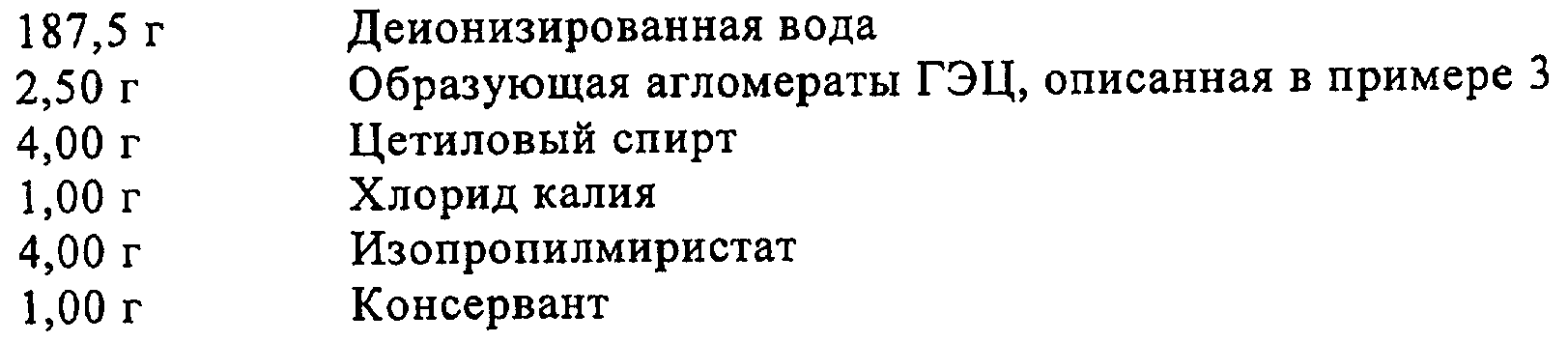
Образующую агломераты ГЭЦ, описанную в примере 3, добавляли в воду при перемешивании в воронку завихрения и перемешивали до полного растворения. Затем раствор нагревали до 65°C на водяной бане, добавляли цетиловый спирт и перемешивали до образования гомогенной смеси, раствор охлаждали до 50°C и при перемешивании добавляли хлорид калия. Затем в раствор добавляли изопропилмиристат и перемешивали до образования гомогенной смеси, при этом получали кондиционер.The SCE agglomerates described in Example 3 were added to water with stirring in a swirl funnel and mixed until completely dissolved. Then the solution was heated to 65 ° C in a water bath, cetyl alcohol was added and stirred until a homogeneous mixture was formed, the solution was cooled to 50 ° C, and potassium chloride was added with stirring. Then isopropyl myristate was added to the solution and mixed until a homogeneous mixture was formed, and an air conditioner was obtained.
Величину pH кондиционера доводили до величины в интервале от 5,25 до 5,5 при добавлении 5% лимонной кислоты и/или 5% раствора гидроксида натрия. Конечный кондиционер характеризовался равномерной консистенцией и не содержал гелеобразных частиц. Конечная вязкость кондиционера составляла 9600 сП.The pH of the conditioner was adjusted to a value in the range of 5.25 to 5.5 with the addition of 5% citric acid and / or 5% sodium hydroxide solution. The final conditioner was characterized by a uniform consistency and did not contain gel-like particles. The final viscosity of the air conditioner was 9600 cP.
Получали кондиционер, как описано в примере 4, за исключением того, что вместо образующей агломераты ГЭЦ, описанной в примере 3, использовали образующую агломераты ГЭЦ, описанную в примере 5 для сравнения. Конечный сравнительный кондиционер содержал некоторое количество гелеобразных частиц. Вязкость конечного сравнительного кондиционера не измеряли вследствие присутствия гелеобразных частиц.An air conditioner was prepared as described in Example 4, except that instead of the agglomerate forming SCE described in Example 3, the agglomerate forming SCE described in Example 5 was used for comparison. The final comparative conditioner contained a certain amount of gel particles. The viscosity of the final comparative conditioner was not measured due to the presence of gel particles.
Кондиционер для сравнения получали аналогичным образом, за исключением того, что вместо образующей агломераты ГЭЦ, описанной в примере 3, использовали образующую агломераты ГЭЦ, описанную в примере 1 для сравнения. Кондиционер содержал некоторое количество гелеобразных частиц небольшого размера. Конечная вязкость сравнительного кондиционера составляла 9000 сП.A conditioner for comparison was obtained in a similar manner, except that instead of the agglomerate-forming SCE described in Example 3, the agglomerate-forming SCE described in Example 1 was used for comparison. The conditioner contained a small amount of gel particles. The final viscosity of the comparative air conditioner was 9000 cP.
Пример 5Example 5
Лосьон для кожиSkin lotion
Образец лосьона для кожи получали с использованием образующей агломераты ГЭЦ, описанной в предыдущих примерах.A sample of skin lotion was prepared using the agglomerate forming SCE described in the previous examples.
Компоненты:Components:
Глицерин: фирмы Spectrum, степень чистоты согласно фармакопеи СШАGlycerin: Spectrum, USP purity
Стеарат гликоля: продукт Kessco® EGMS фирмы StepanGlycol stearate: Stepan's Kessco® EGMS product
Стеариновая кислота: продукт Industrene® 5016 фирмы Witco CorpStearic acid: Industrene® 5016 from Witco Corp
Минеральное масло: продукт Drakeol® 7 фирмы PenrecoMineral oil: Penreco Drakeol® 7
Ацетилированный ланолин: продукт Lipolan® 98 фирмы Lipo ChemicalsAcetylated Lanolin: Lipo Chemicals Lipolan® 98
Цетиловый спирт: продукт Crodacol® C95 фирмы Croda IncCetyl alcohol: Croda Inc Crodacol® C95
Триэтаноламин, степень чистоты 99%, фирмы AcrosTriethanolamine, 99% purity, Acros
Образующая агломераты ГЭЦ, описанная в примере 3 (гидроксиэтилцеллюлоза - продукт Natrosol® 250 HH-GF НЕС фирмы Hercules Incorporated)The SCE agglomerate described in Example 3 (hydroxyethyl cellulose - product Natrosol® 250 HH-GF HEC from Hercules Incorporated)
Пример 1 для сравненияExample 1 for comparison
Пример 5 для сравненияExample 5 for comparison
Консервант: продукт Germaben® II фирмы ISP CorpPreservative: ISP Corp Germaben® II
Получали лосьон для кожи следующего состава.Received skin lotion of the following composition.
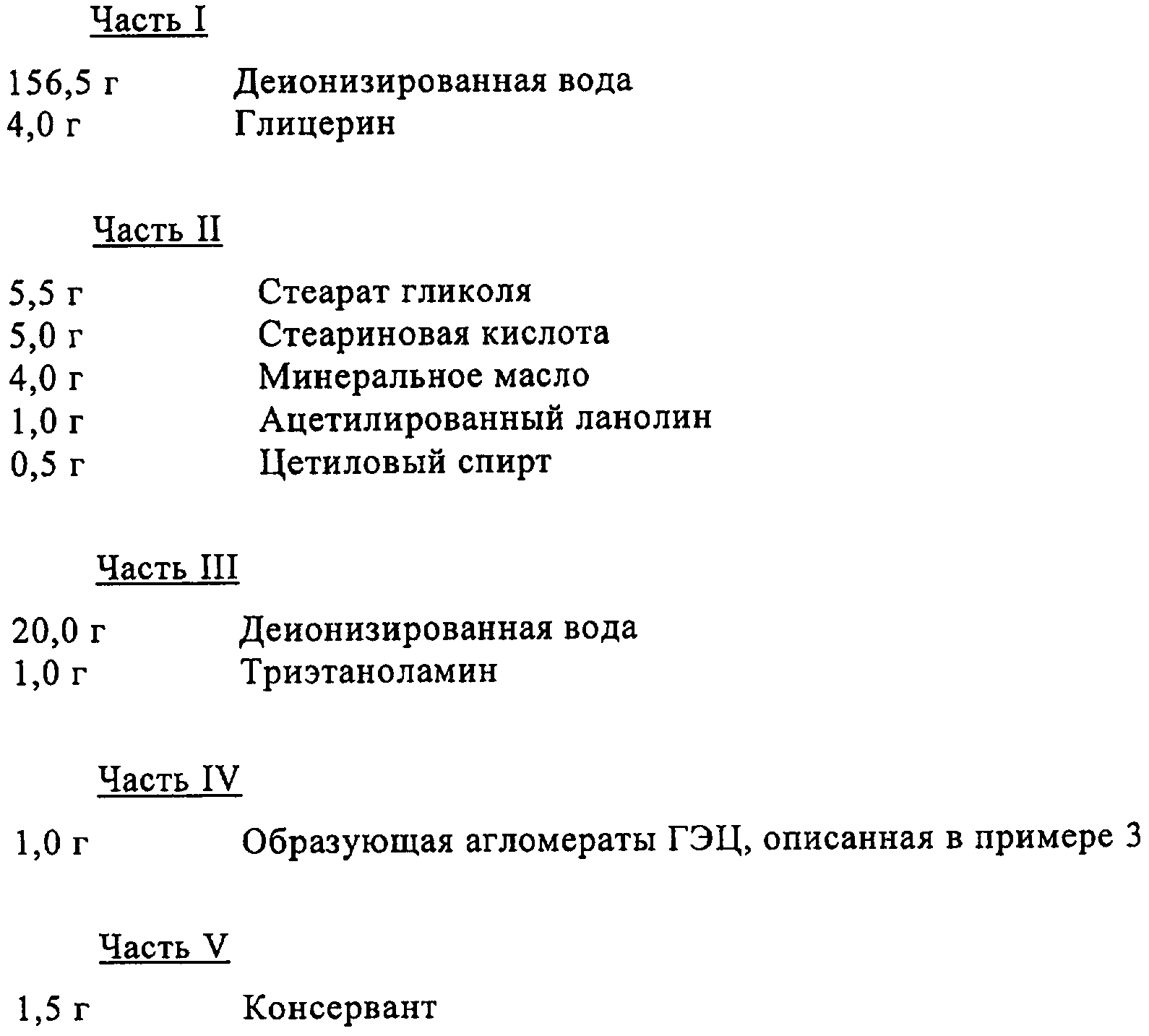
Лосьон для кожи получали по следующей методике. Компоненты части II смешивали в стакане и нагревали до 80°C. В отдельном стакане смешивали компоненты части I и нагревали до 80°C. Затем часть I добавляли в смесь части II при перемешивании. В третьем отдельном стакане смешивали компоненты части III и затем добавляли в смесь частей I и II при перемешивании при 80°C. Затем образующую агломераты ГЭЦ, описанную в примере 3, добавляли в воронку завихрения в смесь частей I, II и III. Перемешивание продолжали в течение приблизительно 10 мин и затем смесь охлаждали до 40°C. После охлаждения смеси до 40°C pH эмульсии доводили до величины в интервале от 6,0 до 6,5. Затем добавляли консервант и смесь охлаждали до комнатной температуры при перемешивании, при этом получали конечный лосьон для кожи.Skin lotion was prepared according to the following procedure. The components of Part II were mixed in a beaker and heated to 80 ° C. The components of Part I were mixed in a separate beaker and heated to 80 ° C. Then part I was added to the mixture of part II with stirring. In a third separate beaker, the components of part III were mixed and then added to the mixture of parts I and II with stirring at 80 ° C. Then, the SCE agglomerates described in Example 3 were added to the swirl funnel in a mixture of parts I, II, and III. Stirring was continued for approximately 10 minutes and then the mixture was cooled to 40 ° C. After cooling the mixture to 40 ° C, the pH of the emulsion was adjusted to a value in the range from 6.0 to 6.5. Then a preservative was added and the mixture was cooled to room temperature with stirring, and a final skin lotion was obtained.
Конечный лосьон для кожи характеризовался однородной консистенцией и не содержал гелеобразных частиц. Конечная вязкость лосьона для кожи составляла 13400 сП.The final skin lotion was characterized by a uniform consistency and did not contain gel-like particles. The final viscosity of the skin lotion was 13,400 cps.
Для сравнения повторяли методику получения лосьона для кожи, как описано в примере 5, за исключением того, что вместо образующей агломераты ГЭЦ, описанной в примере 3, использовали ГЭЦ, обработанную глиоксалем, как описано в примере 5 для сравнения. При добавлении ГЭЦ, обработанной глиоксалем, описанной в примере 5 для сравнения, в смесь, содержащую части I, II и III, наблюдалась некоторая степень комкования, время растворения ГЭЦ, обработанной глиоксалем, описанной в примере 5 для сравнения, увеличивалось по сравнению с образующей агломераты ГЭЦ, описанной в примере 3, по настоящему изобретению. Полученный сравнительный лосьон для кожи не содержал гелеобразных частиц. Конечная вязкость сравнительного лосьона для кожи составляла 18600 сП.For comparison, the procedure for preparing skin lotion was repeated as described in Example 5, except that instead of the agglomerate-forming SCE described in Example 3, the SCE treated with glyoxal was used as described in Example 5 for comparison. When adding the SCE treated with glyoxal, described in Example 5 for comparison, to a mixture containing parts I, II, and III, a certain degree of clumping was observed, the dissolution time of the SCE treated with glyoxal described in Example 5 for comparison was increased compared with the agglomerate forming The SCE described in Example 3 of the present invention. The resulting comparative skin lotion did not contain gel particles. The final viscosity of the comparative skin lotion was 18600 cP.
Для сравнения повторяли методику получения лосьона для кожи, как описано в примере 5, за исключением того, что вместо образующей агломераты ГЭЦ, описанной в примере 3, использовали ГЭЦ, обработанную глиоксалем, описанную в примере 1 для сравнения. При получении сравнительного лосьона для кожи было установлено, что для растворения обработанной глиоксалем ГЭЦ, описанной в примере 1 для сравнения, необходимо некоторое количество теплоты, иначе время ее растворения увеличивается по сравнению с образующей агломераты ГЭЦ, описанной в примере 3. Полученный сравнительный лосьон для кожи характеризовался однородной консистенцией. Конечная вязкость сравнительного лосьона для кожи составляла 10600 сП.For comparison, the procedure for preparing skin lotion was repeated as described in Example 5, except that instead of the agglomerate-forming SCE described in Example 3, the glyoxal-treated SCE described in Example 1 was used for comparison. Upon receipt of the comparative skin lotion, it was found that in order to dissolve the glyoxal-treated HEC described in Example 1 for comparison, a certain amount of heat is needed, otherwise its dissolution time is increased compared to the forming HEC agglomerate described in Example 3. The obtained comparative skin lotion characterized by a uniform consistency. The final viscosity of the comparative skin lotion was 10,600 cP.
Пример 6Example 6
Шампунь-кондиционерShampoo Conditioner
Образец шампуня-кондиционера получали с использованием образующей агломераты ГЭЦ, описанной в предыдущих примерах.A conditioner shampoo sample was prepared using the SCE agglomerates described in the previous examples.
Компоненты:Components:
Лаурилсульфат натрия 2ЕО (SLES): продукт Texapon® N70NA фирмы Cognis2EO Sodium Lauryl Sulfate (SLES): Cognis Texapon® N70NA
Кокамидопропилбетаин (САРВ): продукт Velvetex® ВА35 фирмы CognisCocamidopropyl Betaine (CAPB): Cognis Velvetex® BA35
Диэтаноламид жирной кислоты из кокосового масла: продукт Comperlan® COD фирмы CognisCoconut Oil Fatty Acid Diethanolamide: Cognis Comperlan® COD Product
Образующая агломераты ГЭЦ, описанная в примере 3 (гидроксиэтилцеллюлоза - продукт Natrosol® 250 HH-GF НЕС фирмы Hercules Incorporated)The SCE agglomerate described in Example 3 (hydroxyethyl cellulose - product Natrosol® 250 HH-GF HEC from Hercules Incorporated)
Пример 1 для сравненияExample 1 for comparison
Пример 5 для сравненияExample 5 for comparison
Катионная гуаровая камедь: продукт N-Hance® 3205 фирмы AqualonCationic Guar Gum: N-Hance® 3205 Aqualon Product
Силиконовая эмульсия: продукт Dow Corning 1784 фирмы Dow CorningSilicone Emulsion: Dow Corning 1784 Dow Corning Product
Консервант: гидантоин DMDM, глидант фирмы LonzaPreservative: hydantoin DMDM, glidant from Lonza
Получали шампунь-кондиционер следующего состава.Received shampoo-conditioner of the following composition.

Шампунь-кондиционер получали по следующей методике. Катионную гуаровую камедь добавляли в воду в воронку завихрения и камедь перемешивали в течение 30 мин. Затем образующую агломераты ГЭЦ, описанную в примере 3, добавляли в смесь катионной гуаровой камеди и перемешивали в течение еще 30 мин, в полученную смесь добавляли остальные компоненты, указанные выше, в порядке, указанном выше. Перед добавлением каждого следующего компонента смесь перемешивали до образования гомогенной смеси. После добавления лаурилсульфата натрия требовалось перемешивание в течение более длительного периода. Величину pH конечного шампуня-кондиционера доводили до величины в интервале от 5,0 до 5,5 с использованием лимонной кислоты. Конечный шампунь-кондиционер характеризовался однородной консистенцией, матовостью и не содержал гелеобразных частиц. Конечная вязкость шампуня-кондиционера составляла приблизительно 8500 сП.Conditioner shampoo was prepared according to the following procedure. Cationic guar gum was added to water in a swirl funnel and the gum was mixed for 30 minutes. Then, the SCE agglomerates described in Example 3 were added to the cationic guar gum mixture and mixed for another 30 minutes, the remaining components mentioned above were added to the mixture in the order described above. Before adding each subsequent component, the mixture was stirred until a homogeneous mixture was formed. After the addition of sodium lauryl sulfate, stirring was required for a longer period. The pH value of the final conditioner shampoo was adjusted to a value in the range from 5.0 to 5.5 using citric acid. The final conditioner shampoo was characterized by a uniform consistency, haze and did not contain gel-like particles. The final viscosity of the shampoo conditioner was approximately 8500 cP.
Для сравнения повторяли методику получения шампуня-кондиционера, как описано в примере 6, за исключением того, что вместо образующей агломераты ГЭЦ, описанной в примере 3, использовали ГЭЦ, обработанную глиоксалем, описанную в примере 5 для сравнения. Конечный сравнительный шампунь-кондиционер содержал небольшое количество крупных гелеобразных частиц. Конечная вязкость сравнительного шампуня-кондиционера составляла 15800 сП.For comparison, the procedure for preparing the conditioner shampoo was repeated as described in Example 6, except that instead of the agglomerate-forming SCE described in Example 3, the glyoxal-treated SCE described in Example 5 was used for comparison. The final comparative conditioning shampoo contained a small amount of large gel-like particles. The final viscosity of the comparative conditioner shampoo was 15800 cP.
Для сравнения повторяли методику получения шампуня-кондиционера, как описано в примере 6, за исключением того, что вместо образующей агломераты ГЭЦ, описанной в примере 3, использовали ГЭЦ, обработанную глиоксалем, описанную в примере 1 для сравнения. ГЭЦ, описанная в примере 1 для сравнения, не растворяется также быстро, как образующая агломераты ГЭЦ, описанная в примере 3. Конечный сравнительный шампунь-кондиционер характеризовался стабильностью, матовостью и его вязкость составляла 7500 сП.For comparison, the procedure for preparing conditioner shampoo was repeated as described in Example 6, except that instead of the agglomerate-forming SCE described in Example 3, the glyoxal-treated SCE described in Example 1 was used for comparison. The HEC described in Example 1 for comparison does not dissolve as quickly as the HEC agglomerates described in Example 3. The final comparative conditioning shampoo was stable, haze and had a viscosity of 7500 cP.
Пример 7Example 7
ШампуньShampoo
Образец шампуня получали с использованием образующей агломераты ГЭЦ, описанной в предыдущих примерах.A shampoo sample was prepared using the agglomerate forming SCE described in the previous examples.
Компоненты:Components:
Лаурилсульфат натрия 3ЕО (SLES): продукт Steol® CS330 фирмы Cognis3EO Sodium Lauryl Sulfate (SLES): Cognis Steol® CS330
Кокамидопропилбетаин (САРВ): продукт Amphosol® СА фирмы StepanCocamidopropyl Betaine (CAPB): Stepan Amphosol® CA Product
Лаурилсакозинат натрия: продукт Crodasinic® LS-30 фирмы Croda CorpSodium Lauryl Sacosinate: Crodasinic® LS-30 from Croda Corp
Образующая агломераты ГЭЦ, описанная в примере 3 (гидроксиэтилцеллюлоза - продукт Natrosol® 250 HH-GF НЕС фирмы Hercules Incorporated)The SCE agglomerate described in Example 3 (hydroxyethyl cellulose - product Natrosol® 250 HH-GF HEC from Hercules Incorporated)
Пример 1 для сравненияExample 1 for comparison
Пример 5 для сравненияExample 5 for comparison
Консервант: продукт Kathon® CG фирмы LonzaPreservative: Lonza Kathon® CG
Получали шампунь следующего состава.Received a shampoo of the following composition.
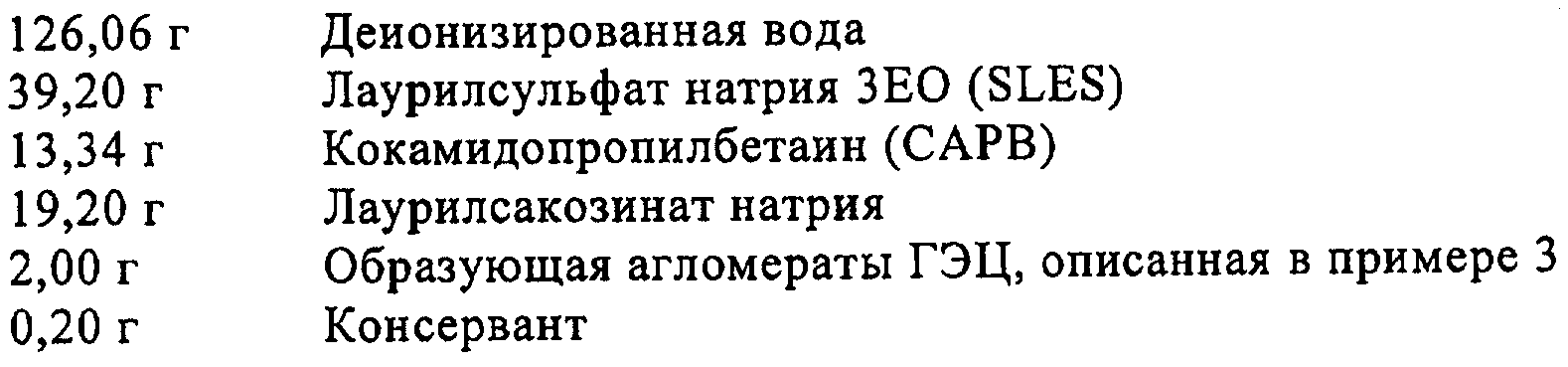
Шампунь получали по следующей методике. Компоненты добавляли в воду в воронку завихрения в порядке, указанном выше. Перед добавлением каждого следующего компонента раствор перемешивали до образования гомогенной смеси. Конечный шампунь характеризовался равномерной консистенцией, незначительной мутностью и не содержал гелеобразных частиц. Конечная вязкость шампуня составляла приблизительно 6000 сП.Shampoo was prepared according to the following procedure. The components were added to the water in a swirl funnel in the order indicated above. Before adding each subsequent component, the solution was stirred until a homogeneous mixture was formed. The final shampoo was characterized by a uniform consistency, slight turbidity and did not contain gel-like particles. The final viscosity of the shampoo was approximately 6000 cP.
Для сравнения повторяли методику получения шампуня-кондиционера, как описано в примере 7, за исключением того, что вместо образующей агломераты ГЭЦ, описанной в примере 3, использовали ГЭЦ, обработанную глиоксалем, описанную в примере 5 для сравнения. Время растворения обработанной глиоксалем ГЭЦ, описанной в примере 5 для сравнения, повышалось по сравнению с образующей агломераты ГЭЦ, описанной в примере 3, и в начальный момент времени наблюдалась некоторая степень комкования. Конечный шампунь характеризовался однородной консистенцией, незначительной мутностью и не содержал гелеобразных частиц. Конечная вязкость сравнительного шампуня составляла приблизительно 6000 сП.For comparison, the procedure for preparing conditioner shampoo was repeated as described in Example 7, except that instead of the agglomerating HEC described in Example 3, the glyoxal treated HEC described in Example 5 was used for comparison. The dissolution time of the glyoxal-treated HEC described in Example 5 for comparison was increased compared to the agglomerate-forming HEC described in Example 3, and some degree of clumping was observed at the initial time. The final shampoo was characterized by a uniform consistency, slight turbidity and did not contain gel-like particles. The final viscosity of the comparative shampoo was approximately 6000 cP.
Для сравнения повторяли методику получения шампуня, как описано в примере 7, за исключением того, что вместо образующей агломераты ГЭЦ, описанной в примере 3, использовали ГЭЦ, обработанную глиоксалем, описанную в примере 1 для сравнения. ГЭЦ, описанная в примере 1 для сравнения, не растворяется также быстро, как образующая агломераты ГЭЦ, описанная в примере 3. Конечный шампунь характеризовался зернистой консистенцией, незначительной мутностью и не содержал гелеобразных частиц. Конечная вязкость сравнительного шампуня составляла приблизительно 5900 сП.For comparison, the shampoo preparation procedure was repeated as described in Example 7, except that instead of the agglomerate-forming SCE described in Example 3, the glyoxal-treated SCE described in Example 1 was used for comparison. The HEC described in Example 1 for comparison does not dissolve as quickly as the agglomerates forming the HEC described in Example 3. The final shampoo was characterized by a granular texture, slight turbidity and did not contain gel-like particles. The final viscosity of the comparative shampoo was approximately 5900 cP.
Пример 8Example 8
Состав для душаShower Composition
Образец состава для душа получали с использованием образующей агломераты ГЭЦ, описанной в предыдущих примерах.A sample of the composition for the shower was obtained using the forming agglomerates of the SCE described in the previous examples.
Компоненты:Components:
Образующая агломераты ГЭЦ, описанная в примере 3 (гидроксиэтилцеллюлоза - продукт Natrosol® 250 HH-GF НЕС фирмы Hercules Incorporated)The SCE agglomerate described in Example 3 (hydroxyethyl cellulose - product Natrosol® 250 HH-GF HEC from Hercules Incorporated)
Пример 1 для сравненияExample 1 for comparison
Пример 5 для сравненияExample 5 for comparison
Лаурилсульфат натрия (SLES): продукт Steol® CS330 фирмы StepanSodium Lauryl Sulfate (SLES): Stepan Steol® CS330
Кокамидопропилбетаин (САРВ): продукт Amphosol® CA фирмы StepanCocamidopropyl Betaine (CAPB): Stepan Amphosol® CA Product
Катионная гуаровая камедь: продукт AquaCat® CG фирмы Hercules IncorporatedCationic Guar Gum: AquaCat® CG from Hercules Incorporated
Метилглюцет 20: продукт Glucam® E20 фирмы NoveonMethylglucet 20: Noveon's Glucam® E20
Консервант: глидант фирмы LonzaPreservative: Lonza Glidant
Получали состав для душа следующего состава.Received the composition for the shower of the following composition.
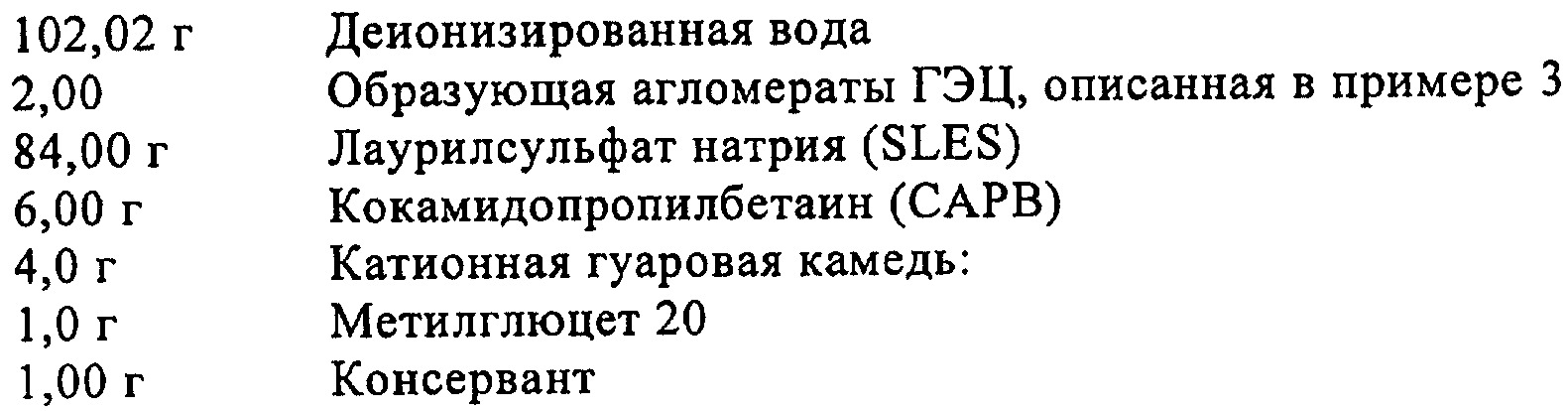
Состав для душа получали по следующей методике. Образующую агломераты ГЭЦ, описанную в примере 3, добавляли в воду в воронку завихрения при перемешивании. Затем добавляли остальные компоненты в порядке, как указано выше, в раствор в воронку завихрения при перемешивании, при этом перед добавлением каждого следующего компонента раствор перемешивали до образования гомогенной смеси. Величину pH конечного состава для душа доводили до величины в интервале от 5,0 до 6,0 с использованием лимонной кислоты. Конечный состав для душа характеризовался однородной консистенцией, незначительной мутностью и не содержал гелеобразных частиц. Конечная вязкость состава для душа составляла приблизительно 6200 сП.The composition for the shower was obtained according to the following procedure. The SCE agglomerates described in Example 3 were added to water in a swirl funnel with stirring. Then the remaining components were added in the order, as described above, into the solution in a swirl funnel with stirring, while before adding each subsequent component, the solution was mixed until a homogeneous mixture was formed. The pH of the final composition for the shower was adjusted to a value in the range from 5.0 to 6.0 using citric acid. The final composition for the shower was characterized by a uniform consistency, slight turbidity and did not contain gel-like particles. The final viscosity of the shower formulation was approximately 6200 cP.
Для сравнения повторяли методику получения состава для душа, как описано в примере 8, за исключением того, что вместо образующей агломераты ГЭЦ, описанной в примере 3, использовали ГЭЦ, обработанную глиоксалем, описанную в примере 5 для сравнения. Обработанная глиоксалем ГЭЦ, описанная в примере 5 для сравнения, в начальный период растворялась неполностью. Конечный сравнительный состав для душа характеризовался однородной консистенцией, незначительной мутностью и не содержал гелеобразных частиц. Конечная вязкость сравнительного состава для душа составляла приблизительно 6800 сП.For comparison, the procedure for preparing the shower composition was repeated as described in Example 8, except that instead of the agglomerate-forming SCE described in Example 3, the glyoxal-treated SCE described in Example 5 was used for comparison. Treated with glyoxal HEC, described in example 5 for comparison, in the initial period was not completely dissolved. The final comparative composition for the shower was characterized by a uniform consistency, slight turbidity and did not contain gel-like particles. The final viscosity of the comparative composition for the shower was approximately 6800 SP.
Для сравнения повторяли методику получения состава для душа, как описано в примере 8, за исключением того, что вместо образующей агломераты ГЭЦ, описанной в примере 3, использовали ГЭЦ, обработанную глиоксалем, описанную в примере 1 для сравнения. ГЭЦ, описанная в примере 1 для сравнения, в начальный период не растворяется также быстро, как образующая агломераты ГЭЦ, описанная в примере 3. Конечный сравнительный состав для душа характеризовался зернистой консистенцией, незначительной мутностью и не содержал гелеобразных частиц. Конечная вязкость сравнительного состава для душа составляла приблизительно 5000 сП.For comparison, the procedure for preparing the shower composition was repeated as described in Example 8, except that instead of the agglomerate-forming SCE described in Example 3, the glyoxal-treated SCE described in Example 1 was used for comparison. The SCE described in Example 1 for comparison does not dissolve in the initial period as quickly as the agglomerates forming the SCE described in Example 3. The final comparative composition for the shower was characterized by a granular consistency, slight turbidity and did not contain gel-like particles. The final viscosity of the comparative shower formulation was approximately 5000 cP.
Пример 9Example 9
Шампунь (с добавлением ГЭЦ после добавления остальных компонентов)Shampoo (with the addition of HEC after adding the remaining components)
Образец шампуня получали с использованием образующей агломераты ГЭЦ, описанной в предыдущих примерах. Данный пример предназначен для оценки возможности добавления в готовый шампунь образующей агломераты ГЭЦ по настоящему изобретению для стабилизации продукта.A shampoo sample was prepared using the agglomerate forming SCE described in the previous examples. This example is intended to assess the feasibility of adding the SCE agglomerate-forming agglomerates of the present invention to the finished shampoo to stabilize the product.
Компоненты:Components:
Образующая агломераты ГЭЦ, описанная в примере 3 (гидроксиэтилцеллюлоза - продукт Natrosol® 250 HH-GF НЕС фирмы Hercules Incorporated)The SCE agglomerate described in Example 3 (hydroxyethyl cellulose - product Natrosol® 250 HH-GF HEC from Hercules Incorporated)
Пример 1 для сравненияExample 1 for comparison
Пример 5 для сравненияExample 5 for comparison
Лаурилсульфат натрия (SLES): продукт Steol® CS330 фирмы StepanSodium Lauryl Sulfate (SLES): Stepan Steol® CS330
Кокамидопропилбетаин (САРВ): продукт Amphosol® CA фирмы StepanCocamidopropyl Betaine (CAPB): Stepan Amphosol® CA Product
Катионная гуаровая камедь: продукт AquaCat® CG фирмы Hercules IncorporatedCationic Guar Gum: AquaCat® CG from Hercules Incorporated
Метилглюцет 20: продукт Glucam® E20 фирмы NoveonMethylglucet 20: Noveon's Glucam® E20
Консервант: глидант фирмы LonzaPreservative: Lonza Glidant
Получали шампунь следующего состава.Received a shampoo of the following composition.
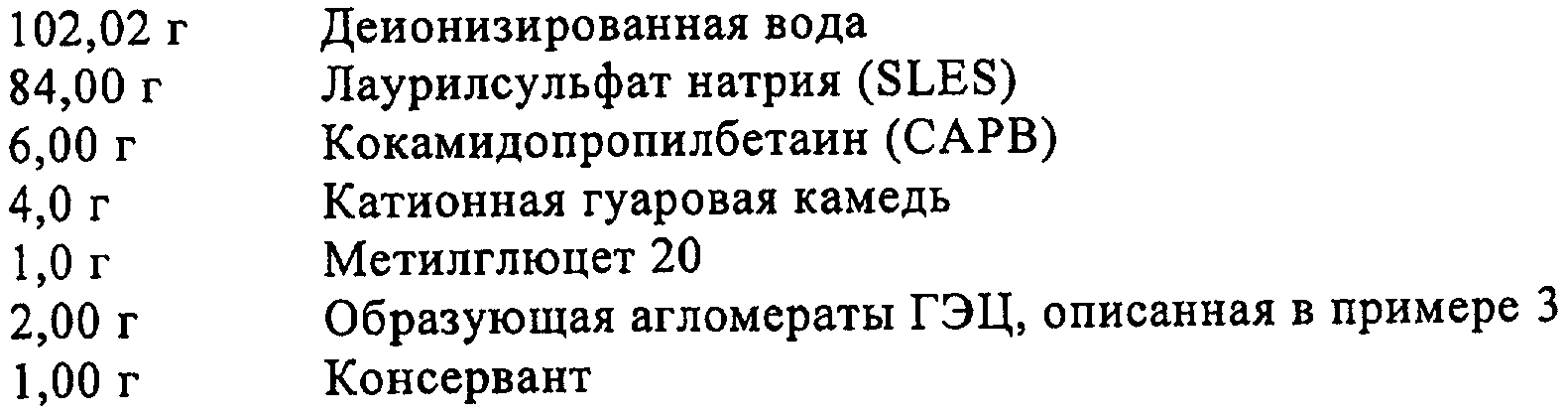
Компоненты добавляли в порядке, как указано выше, в воду в воронку завихрения при перемешивании, при этом перед добавлением каждого следующего компонента раствор перемешивали до образования гомогенной смеси. Величину pH конечного шампуня доводили до величины в интервале от 5,0 до 6,0 с использованием лимонной кислоты. Конечный шампунь характеризовался однородной консистенцией, незначительной мутностью и не содержал гелеобразных частиц. Конечная вязкость шампуня составляла приблизительно 6100 сП.The components were added in the order, as described above, into water in a swirl funnel with stirring, while before adding each subsequent component, the solution was mixed until a homogeneous mixture was formed. The pH of the final shampoo was adjusted to a value in the range from 5.0 to 6.0 using citric acid. The final shampoo was characterized by a uniform consistency, slight turbidity and did not contain gel-like particles. The final viscosity of the shampoo was approximately 6100 cP.
Для сравнения повторяли методику получения шампуня, как описано в примере 9, за исключением того, что вместо образующей агломераты ГЭЦ, описанной в примере 3, использовали ГЭЦ, обработанную глиоксалем, описанную в примере 5 для сравнения. Обработанная глиоксалем ГЭЦ, описанная в примере 5 для сравнения, растворялась неполностью. Конечный сравнительный шампунь содержал слой геля. Конечная вязкость сравнительного шампуня составляла приблизительно 7200 сП.For comparison, the shampoo preparation procedure was repeated as described in Example 9, except that instead of the agglomerate-forming SCE described in Example 3, the glyoxal-treated SCE described in Example 5 was used for comparison. Treated with glyoxal HEC, described in example 5 for comparison, was not completely dissolved. The final comparative shampoo contained a gel layer. The final viscosity of the comparative shampoo was approximately 7200 cP.
Для сравнения повторяли методику получения шампуня, как описано в примере 9, за исключением того, что вместо образующей агломераты ГЭЦ, описанной в примере 3, использовали ГЭЦ, обработанную глиоксалем, описанную в примере 1 для сравнения. Обработанная глиоксалем ГЭЦ, описанная в примере 1 для сравнения, не растворялась. Конечный сравнительный шампунь содержал слой геля. Конечную вязкость шампуня не измеряли в связи с наличием слоя геля.For comparison, the shampoo preparation procedure was repeated as described in Example 9, except that instead of the agglomerate-forming SCE described in Example 3, the glyoxal-treated SCE described in Example 1 was used for comparison. The glyoxal-treated HEC described in Example 1 for comparison did not dissolve. The final comparative shampoo contained a gel layer. The final viscosity of the shampoo was not measured due to the presence of a gel layer.
В данном примере было установлено, что образующую агломераты ГЭЦ, описанную в примере 3, можно добавлять в готовый шампунь и получать стабильный шампунь, в то время как добавление обработанных глиоксалем ГЭЦ, описанных в примерах 1 и 5 для сравнения, в готовый шампунь не приводит к его стабилизации.In this example, it was found that the agglomerates forming the SCE described in Example 3 can be added to the finished shampoo and obtain a stable shampoo, while the addition of glyoxal-treated SCEs described in Examples 1 and 5 to the comparison does not lead to its stabilization.
Пример 10Example 10
Средство для мытья полаFloor Cleaner
Образец средства для мытья пола получали с использованием образующей агломераты ГЭЦ, описанной в предыдущих примерах.A sample of floor cleaning was obtained using the SCE agglomerates described in the previous examples.
Компоненты:Components:
Метиловый эфир соевого масла: продукт Steposol® SB-W фирмы StepanSoybean Oil Methyl Ester: Stepan's Steposol® SB-W
D-лимонен фирмы Florida Chemical Co.D-limonene from Florida Chemical Co.
Жирный алканамид: продукт Ninol® 11-CM фирмы StepanFatty alkanamide: Stepan's Ninol® 11-CM
Триэтаноламин фирмы AcrosAcros Triethanolamine
ПропиленгликольPropylene glycol
Образующая агломераты ГЭЦ, описанная в примере 3 (гидроксиэтилцеллюлоза - продукт Natrosol® 250 HH-GF НЕС фирмы Hercules Incorporated)The SCE agglomerate described in Example 3 (hydroxyethyl cellulose - product Natrosol® 250 HH-GF HEC from Hercules Incorporated)
Консервант: гидантоин DMDM, глидант фирмы LonzaPreservative: hydantoin DMDM, glidant from Lonza
Получали средство для мытья пола следующего состава.Received a means for mopping the following composition.

Средство для мытья пола получали по следующей методике: компоненты части I добавляли в порядке, как указано выше, и перемешивали в течение 10 мин перед добавлением каждого следующего компонента.The floor cleaner was prepared according to the following procedure: the components of Part I were added in the order described above, and mixed for 10 minutes before each subsequent component was added.
Затем в смесь очень медленно добавляли деионизированную воду и смесь перемешивали в течение приблизительно 1 ч. Скорость перемешивания подбирали таким образом, чтобы обеспечить тщательное перемешивание всех компонентов. Наконец добавляли пропиленгликоль и полученную смесь перемешивали в течение приблизительно 30 мин до образования гомогенной смеси. После проведения указанных стадий получали концентрат средства для мытья пола (часть I).Then deionized water was added very slowly to the mixture and the mixture was stirred for approximately 1 hour. The stirring speed was selected so as to ensure thorough mixing of all components. Finally, propylene glycol was added and the resulting mixture was stirred for approximately 30 minutes until a homogeneous mixture was formed. After these steps, a concentrate for mopping was obtained (part I).
Для получения части II добавляли образующую агломераты ГЭЦ, описанную в примере 3, при перемешивании в деионизированную воду. Раствор перемешивали в течение приблизительно 15 мин и затем в раствор добавляли консервант гидантоин DMDM. Полученную смесь перемешивали в течение приблизительно 5 мин.To obtain part II, the agglomerates forming the SCE described in Example 3 were added with stirring to deionized water. The solution was stirred for approximately 15 minutes and then the hydantoin DMDM preservative was added to the solution. The resulting mixture was stirred for approximately 5 minutes.
Часть III (смесь частей 1 и 2). Концентрат средства для мытья пола (часть I) добавляли в раствор образующей агломераты ГЭЦ, описанной в примере 3 (часть II). Раствор перемешивали в течение приблизительно 15 мин, при этом получали конечное средство для мытья пола.Part III (mixture of parts 1 and 2). A floor cleaning agent concentrate (part I) was added to the solution of the agglomerate-forming SCE described in Example 3 (part II). The solution was stirred for approximately 15 minutes to give the final floor cleaner.
Конечная вязкость средства для мытья пола составляла 4760 сП, а величина pH составляла 9,16. Конечное средство для мытья пола представляет собой прозрачную жидкость желтого цвета.The final viscosity of the floor cleaner was 4760 cP and the pH was 9.16. The final floor cleaner is a clear yellow liquid.
Контрольный пример средства для мытья пола получали, как описано в примере 10, но без добавления образующей агломераты ГЭЦ, описанной в примере 3. Вязкость полученного сравнительного средства для мытья пола составляла только 350 сП.A control example of a floor cleaning agent was prepared as described in Example 10, but without adding the SCE agglomerate forming agent described in Example 3. The viscosity of the obtained comparative floor cleaning agent was only 350 cP.
Пример 11Example 11
Жидкость для мытья посудыDishwashing liquid
Образец жидкости для мытья посуды получали с использованием образующей агломераты ГЭЦ, описанной в предыдущих примерах.A dishwashing liquid sample was prepared using the SCE agglomerates described in the previous examples.
Компоненты:Components:
Образующая агломераты ГЭЦ, описанная в примере 3HEC agglomerates described in Example 3
(гидроксиэтилцеллюлоза - продукт Natrosol® 250 HH-GF НЕС фирмы Hercules Incorporated)(hydroxyethyl cellulose - Natrosol® 250 HH-GF HEC product of Hercules Incorporated)
Лаурилсульфат аммония: продукт Steol® CA460 фирмы StepanAmmonium Lauryl Sulfate: Stean® CA460 from Stepan
Натриевая соль α-сульфометилового эфира (и) динатриевая соль α-сульфометилового эфира (С12-С18)жирных кислот: продукт Alpha-Step МС-48 фирмы StepanSodium salt of α-sulfomethyl ether (s) disodium salt of α-sulfomethyl ether (C 12 -C 18 ) fatty acids: Alpha-Step MC-48 from Stepan
Кокамидопропилбетаин (САРВ): продукт Amphosol® CA фирмы StepanCocamidopropyl Betaine (CAPB): Stepan Amphosol® CA Product
Оксид лаурамина: продукт Ammonyx® фирмы StepanLauramine Oxide: Stepan's Ammonyx® Product
ЭтанолEthanol
Консервант: гидантоин DMDM, глидант фирмы LonzaPreservative: hydantoin DMDM, glidant from Lonza
Получали жидкость для мытья посуды следующего состава.Received dishwashing liquid of the following composition.

Жидкость для мытья посуды получали по следующей методике. Образующую агломераты ГЭЦ, описанную в примере 3, добавляли в деионизированную воду при перемешивании. Полученный раствор перемешивали в течение приблизительно 15 мин. Затем в раствор добавляли гидантоин DMDM и раствор перемешивали в течение приблизительно еще 5 мин. Остальные компоненты добавляли в порядке, как указано выше, при непрерывном перемешивании. После добавления каждого компонента и перед добавлением каждого следующего компонента полученный раствор перемешивали в течение приблизительно 10 мин или до образования гомогенного раствора. Величину pH конечной жидкости для мытья посуды доводили до величины 7,6 с использованием лимонной кислоты.The dishwashing liquid was prepared according to the following procedure. The agglomerates forming the SCE described in Example 3 were added to deionized water with stirring. The resulting solution was stirred for approximately 15 minutes. Then, DMDM hydantoin was added to the solution, and the solution was stirred for approximately another 5 minutes. The remaining components were added in the order described above with continuous stirring. After adding each component and before adding each subsequent component, the resulting solution was stirred for approximately 10 minutes or until a homogeneous solution was formed. The pH of the final dishwashing liquid was adjusted to a value of 7.6 using citric acid.
Вязкость конечной жидкости для мытья посуды составляла 99 сП, величина pH составляла 7,55, и она представляла собой прозрачную жидкость.The viscosity of the final dishwashing liquid was 99 cP, the pH was 7.55, and it was a clear liquid.
Контрольный пример жидкости для мытья посуды получали, как описано в примере 11, но без добавления образующей агломераты ГЭЦ, описанной в примере 3. Вязкость полученной сравнительной жидкости для мытья посуды составляла только 30 сП, и она представляла собой прозрачную жидкость.A control example of a dishwashing liquid was prepared as described in Example 11, but without adding the SCE agglomerate forming agent described in Example 3. The viscosity of the obtained dishwashing liquid was only 30 cP, and it was a clear liquid.
Несмотря на то что настоящее изобретение описано на примере его различных вариантов или модификаций, которые предполагается использовать на практике, его объем не ограничивается ими, и после ознакомления с настоящим описанием можно предложить другие модификации или варианты осуществления настоящего изобретения, которые включены в объем и сущность настоящего изобретения.Despite the fact that the present invention is described by the example of its various options or modifications that are intended to be used in practice, its scope is not limited to them, and after reading the present description, you can offer other modifications or embodiments of the present invention, which are included in the scope and essence of the present inventions.
Claims (10)
а) композицию образующей агломераты гидроксиэтилцеллюлозы (ГЭЦ),
б) активный ингредиент продукта широкого потребления и
в) воду,
где композиция образующей агломераты гидроксиэтилцеллюлозы содержит частицы гидроксиэтилцелюллозы и композицию низкомолекулярной гидроксиэтилцеллюлозы, и где продукт широкого потребления выбирают из группы, включающей фармацевтические препараты, средства личной гигиены (за исключением перорального применения) и хозяйственные товары, и где низкомолекулярная гидроксиэтилцеллюлоза имеет молекулярную массу меньше, чем частицы гидроксиэтилцеллюлозы, и характеризуются вязкостью в 2% водном растворе менее 350 мПа·с (сП).1. A consumer product, including
a) the composition of the forming agglomerates of hydroxyethyl cellulose (SCE),
b) the active ingredient of the consumer product and
in water,
where the hydroxyethyl cellulose agglomerate composition contains hydroxyethyl cellulose particles and a low molecular weight hydroxyethyl cellulose composition, and where the consumer product is selected from the group consisting of pharmaceuticals, personal care products (except for oral use) and household goods, and where the low molecular weight hydroxyethyl cellulose has a molecular weight of less than hydroxyethyl cellulose, and are characterized by a viscosity in a 2% aqueous solution of less than 350 MPa · s (cP).
Applications Claiming Priority (3)
| Application Number | Priority Date | Filing Date | Title |
|---|---|---|---|
| US87985507P | 2007-01-10 | 2007-01-10 | |
| US60/879,855 | 2007-01-10 | ||
| PCT/US2008/000350 WO2008086023A1 (en) | 2007-01-10 | 2008-01-09 | Use of agglomerated hydroxyethylcellulose in pharmaceutical, personal care and household care applications |
Publications (2)
| Publication Number | Publication Date |
|---|---|
| RU2009130454A RU2009130454A (en) | 2011-02-20 |
| RU2470626C2 true RU2470626C2 (en) | 2012-12-27 |
Family
ID=39345369
Family Applications (1)
| Application Number | Title | Priority Date | Filing Date |
|---|---|---|---|
| RU2009130454/15A RU2470626C2 (en) | 2007-01-10 | 2008-01-09 | Use of agglomerate-forming hydroxyethyl cellulose for producing pharmaceutical agents, personal hygiene products and household supplies |
Country Status (10)
| Country | Link |
|---|---|
| US (1) | US8728448B2 (en) |
| EP (1) | EP2101722B1 (en) |
| JP (1) | JP5622396B2 (en) |
| KR (2) | KR20150010981A (en) |
| CN (1) | CN101663021B (en) |
| BR (1) | BRPI0806540B1 (en) |
| ES (1) | ES2543090T3 (en) |
| MX (1) | MX2009007392A (en) |
| RU (1) | RU2470626C2 (en) |
| WO (1) | WO2008086023A1 (en) |
Families Citing this family (6)
| Publication number | Priority date | Publication date | Assignee | Title |
|---|---|---|---|---|
| US9187572B2 (en) | 2010-09-22 | 2015-11-17 | Dow Global Technologies Llc | Treatment of polysaccarides with dialdehydes |
| KR101166798B1 (en) | 2011-12-19 | 2012-07-26 | 김대현 | A pharmaceutical composition for the treatment or prevention of an allergic disease comprising dead bacteria of Lactobacillus asiophilus L. |
| US10201481B2 (en) * | 2014-03-07 | 2019-02-12 | The Procter & Gamble Company | Personal care compositions and methods of making same |
| WO2019165115A1 (en) * | 2018-02-21 | 2019-08-29 | Act + Acre, Inc. | Apparatus, methods and systems for low energy processing of consumer personal hygiene products; formulations of the same |
| US11905070B2 (en) | 2020-03-12 | 2024-02-20 | Illinois Tool Works Inc. | Repulpable zipper for zip packaging |
| CN120958104A (en) * | 2023-05-10 | 2025-11-14 | 乐天精密化学株式会社 | Environmentally friendly soil conditioner and its manufacturing method |
Citations (5)
| Publication number | Priority date | Publication date | Assignee | Title |
|---|---|---|---|---|
| EP0572768A2 (en) * | 1992-05-30 | 1993-12-08 | GOLDWELL GmbH | Process for preparing powdery agents for human hair dyeing |
| WO2001032132A2 (en) * | 1999-11-03 | 2001-05-10 | Hercules Incorporated | Process for making toothpaste using agglomerated dispersible polymers |
| EP0934054B1 (en) * | 1996-06-21 | 2004-02-25 | Hercules Incorporated | Dispersible water-soluble or water-swellable polymers |
| RU2224777C2 (en) * | 1997-07-17 | 2004-02-27 | Хенкель Коммандитгезелльшафт ауф Акциен | Agglomerates from substances constituting aqueous system of binder |
| WO2006088953A1 (en) * | 2005-02-17 | 2006-08-24 | Hercules Incorporated | Blocky hydroxyethylcellulose, derivatives thereof, process of making, and uses thereof |
Family Cites Families (10)
| Publication number | Priority date | Publication date | Assignee | Title |
|---|---|---|---|---|
| US4886660A (en) * | 1987-06-11 | 1989-12-12 | Colgate-Palmolive Company | Shine hair conditioner |
| US6936277B2 (en) * | 1995-01-09 | 2005-08-30 | J. Rettenmaier & Soehne Gmbh & Co. Kg | Pharmaceutical excipient having improved compressibility |
| JPH08323785A (en) * | 1995-03-24 | 1996-12-10 | Teijin Ltd | Cellulose acylate film and method for producing the same |
| JP2857343B2 (en) * | 1995-03-28 | 1999-02-17 | 株式会社神戸製鋼所 | Method for producing resin-based precoated fin material for heat exchanger having excellent hydrophilicity |
| JP2000234291A (en) * | 1999-02-10 | 2000-08-29 | Asahi Chem Ind Co Ltd | Method for coating cellulose solution |
| GB0204771D0 (en) * | 2002-02-28 | 2002-04-17 | Phoqus Ltd | Fast disintegrating tablets |
| JP3884681B2 (en) * | 2002-08-14 | 2007-02-21 | 株式会社ファンケル | Cosmetics |
| JP2004315713A (en) * | 2003-04-18 | 2004-11-11 | Shin Etsu Chem Co Ltd | Method for producing nonionic cellulose ether and granulated nonionic cellulose ether obtained by the method |
| WO2006088963A1 (en) * | 2005-02-17 | 2006-08-24 | Bayer Cropscience Ag | Improved process for preparing (disubstitutedpropenyl) phenylalkyl substituted dihydrobenzofurans |
| BRPI0706777A2 (en) * | 2006-01-30 | 2011-04-05 | Hercules Inc | process for making cold water dispersible cellulose ethers and uses thereof |
-
2008
- 2008-01-09 JP JP2009545598A patent/JP5622396B2/en active Active
- 2008-01-09 US US12/008,217 patent/US8728448B2/en active Active
- 2008-01-09 KR KR1020147034844A patent/KR20150010981A/en not_active Ceased
- 2008-01-09 RU RU2009130454/15A patent/RU2470626C2/en active
- 2008-01-09 CN CN200880004922.2A patent/CN101663021B/en active Active
- 2008-01-09 WO PCT/US2008/000350 patent/WO2008086023A1/en not_active Ceased
- 2008-01-09 EP EP08705549.7A patent/EP2101722B1/en active Active
- 2008-01-09 KR KR1020097016512A patent/KR101494021B1/en active Active
- 2008-01-09 MX MX2009007392A patent/MX2009007392A/en active IP Right Grant
- 2008-01-09 BR BRPI0806540A patent/BRPI0806540B1/en active IP Right Grant
- 2008-01-09 ES ES08705549.7T patent/ES2543090T3/en active Active
Patent Citations (5)
| Publication number | Priority date | Publication date | Assignee | Title |
|---|---|---|---|---|
| EP0572768A2 (en) * | 1992-05-30 | 1993-12-08 | GOLDWELL GmbH | Process for preparing powdery agents for human hair dyeing |
| EP0934054B1 (en) * | 1996-06-21 | 2004-02-25 | Hercules Incorporated | Dispersible water-soluble or water-swellable polymers |
| RU2224777C2 (en) * | 1997-07-17 | 2004-02-27 | Хенкель Коммандитгезелльшафт ауф Акциен | Agglomerates from substances constituting aqueous system of binder |
| WO2001032132A2 (en) * | 1999-11-03 | 2001-05-10 | Hercules Incorporated | Process for making toothpaste using agglomerated dispersible polymers |
| WO2006088953A1 (en) * | 2005-02-17 | 2006-08-24 | Hercules Incorporated | Blocky hydroxyethylcellulose, derivatives thereof, process of making, and uses thereof |
Non-Patent Citations (1)
| Title |
|---|
| NATROSOL. Types, grades and specifications. Hercules Incorporated, 2000, найдено в Интернет: http://aguachem.co.kr/product/Agualon/natrosol.htm. * |
Also Published As
| Publication number | Publication date |
|---|---|
| ES2543090T3 (en) | 2015-08-14 |
| US8728448B2 (en) | 2014-05-20 |
| CN101663021B (en) | 2016-01-20 |
| BRPI0806540A2 (en) | 2014-04-22 |
| US20080166311A1 (en) | 2008-07-10 |
| KR101494021B1 (en) | 2015-02-16 |
| EP2101722A1 (en) | 2009-09-23 |
| EP2101722B1 (en) | 2015-07-08 |
| WO2008086023A1 (en) | 2008-07-17 |
| KR20090108704A (en) | 2009-10-16 |
| CN101663021A (en) | 2010-03-03 |
| JP2010515735A (en) | 2010-05-13 |
| JP5622396B2 (en) | 2014-11-12 |
| RU2009130454A (en) | 2011-02-20 |
| BRPI0806540B1 (en) | 2016-06-07 |
| KR20150010981A (en) | 2015-01-29 |
| MX2009007392A (en) | 2009-08-07 |
Similar Documents
| Publication | Publication Date | Title |
|---|---|---|
| JP4662637B2 (en) | Emulsification system and emulsion | |
| JP3662592B2 (en) | Starch-containing cosmetic composition and cleaning composition | |
| EP1032358B1 (en) | Fluidized polymer suspensions of cationic polysaccharides in emollients and use thereof in preparing personal care compositions | |
| CN102028630B (en) | Compositions containing superhydrophilic amphiphilic copolymer and micellar thickener | |
| US20090214608A1 (en) | Polysaccharide-based products with improved easiness of use, process to make the same, and applications of the same | |
| RU2470626C2 (en) | Use of agglomerate-forming hydroxyethyl cellulose for producing pharmaceutical agents, personal hygiene products and household supplies | |
| KR100943105B1 (en) | Polysaccharide-containing compositions and uses thereof | |
| BR112012007486A2 (en) | Superhydrophilic amphiphilic copolymer and process for making a superhydrophilic amphiphilic copolymer | |
| JP2001520180A (en) | Use of essentially amorphous cellulose nanofibrils in combination with at least one polyhydroxylated organic compound in a cosmetic formulation | |
| JP2005232271A (en) | Foam stabilizer | |
| JP2981975B2 (en) | Cosmetic composition | |
| CN105431133A (en) | Colloidally stable dispersions based on modified galactomannans | |
| WO2004061043A1 (en) | Spraying composition | |
| JP2016008181A (en) | Kit for skin external preparation | |
| CN102415955A (en) | emulsified composition | |
| TWI746564B (en) | Skin cleansing composition | |
| US20030139502A1 (en) | Cosmetic compositions comprising a cationic polymer/anionic surfactant mixture and use of said mixture as conditioning agent | |
| JP6628197B2 (en) | Skin preparation kit | |
| JP4149285B2 (en) | Ceramide-containing gel composition | |
| JP6500020B2 (en) | Low temperature process to produce dry cellulose ether foam | |
| JP6424355B2 (en) | Skin external preparation kit | |
| JP2003252724A (en) | Cosmetics containing low-substituted hydroxypropylcellulose | |
| JP2011037771A (en) | Cosmetic composition | |
| JP2007119350A (en) | Cosmetic composition comprising low viscosity cationically modified galactomannan polysaccharide | |
| MXPA00004754A (en) | Fluidized polymer suspensions of cationic polysaccharides in polyols and use thereof in preparing personal care compositions |
Legal Events
| Date | Code | Title | Description |
|---|---|---|---|
| PC43 | Official registration of the transfer of the exclusive right without contract for inventions |
Effective date: 20180606 |