RU2454981C2 - Hygienic product for women, containing printed and embossed image - Google Patents
Hygienic product for women, containing printed and embossed image Download PDFInfo
- Publication number
- RU2454981C2 RU2454981C2 RU2009141776/12A RU2009141776A RU2454981C2 RU 2454981 C2 RU2454981 C2 RU 2454981C2 RU 2009141776/12 A RU2009141776/12 A RU 2009141776/12A RU 2009141776 A RU2009141776 A RU 2009141776A RU 2454981 C2 RU2454981 C2 RU 2454981C2
- Authority
- RU
- Russia
- Prior art keywords
- layer
- product
- core
- printed
- embossed
- Prior art date
Links
- 238000004519 manufacturing process Methods 0.000 claims abstract description 11
- 230000002745 absorbent Effects 0.000 claims description 47
- 239000002250 absorbent Substances 0.000 claims description 47
- 239000004744 fabric Substances 0.000 claims description 9
- 238000000034 method Methods 0.000 abstract description 12
- 230000003203 everyday effect Effects 0.000 abstract description 9
- 239000007788 liquid Substances 0.000 abstract description 7
- 230000000694 effects Effects 0.000 abstract description 5
- 239000000126 substance Substances 0.000 abstract description 4
- 239000003814 drug Substances 0.000 abstract 1
- 238000001179 sorption measurement Methods 0.000 abstract 1
- 239000010410 layer Substances 0.000 description 152
- 239000000463 material Substances 0.000 description 25
- 238000004049 embossing Methods 0.000 description 16
- 239000011248 coating agent Substances 0.000 description 13
- 238000000576 coating method Methods 0.000 description 13
- 239000000975 dye Substances 0.000 description 12
- 239000000853 adhesive Substances 0.000 description 8
- 230000001070 adhesive effect Effects 0.000 description 8
- 239000000976 ink Substances 0.000 description 7
- 241000196324 Embryophyta Species 0.000 description 6
- 239000000835 fiber Substances 0.000 description 6
- 239000012530 fluid Substances 0.000 description 5
- 239000002985 plastic film Substances 0.000 description 5
- 229920006255 plastic film Polymers 0.000 description 5
- 239000002904 solvent Substances 0.000 description 5
- 230000008901 benefit Effects 0.000 description 4
- 238000005259 measurement Methods 0.000 description 4
- 229920000642 polymer Polymers 0.000 description 4
- 229920000098 polyolefin Polymers 0.000 description 4
- 239000004094 surface-active agent Substances 0.000 description 4
- XLYOFNOQVPJJNP-UHFFFAOYSA-N water Substances O XLYOFNOQVPJJNP-UHFFFAOYSA-N 0.000 description 4
- 238000010521 absorption reaction Methods 0.000 description 3
- 239000003086 colorant Substances 0.000 description 3
- 238000004806 packaging method and process Methods 0.000 description 3
- 230000035515 penetration Effects 0.000 description 3
- 229920000728 polyester Polymers 0.000 description 3
- -1 polyethylene Polymers 0.000 description 3
- 238000010561 standard procedure Methods 0.000 description 3
- 229920000247 superabsorbent polymer Polymers 0.000 description 3
- 229920001169 thermoplastic Polymers 0.000 description 3
- 239000004416 thermosoftening plastic Substances 0.000 description 3
- KAKZBPTYRLMSJV-UHFFFAOYSA-N Butadiene Chemical compound C=CC=C KAKZBPTYRLMSJV-UHFFFAOYSA-N 0.000 description 2
- 229920003043 Cellulose fiber Polymers 0.000 description 2
- 239000004698 Polyethylene Substances 0.000 description 2
- PPBRXRYQALVLMV-UHFFFAOYSA-N Styrene Chemical compound C=CC1=CC=CC=C1 PPBRXRYQALVLMV-UHFFFAOYSA-N 0.000 description 2
- 206010046543 Urinary incontinence Diseases 0.000 description 2
- 239000011230 binding agent Substances 0.000 description 2
- 229920001400 block copolymer Polymers 0.000 description 2
- 238000011109 contamination Methods 0.000 description 2
- 229920001577 copolymer Polymers 0.000 description 2
- 150000002148 esters Chemical class 0.000 description 2
- 230000029142 excretion Effects 0.000 description 2
- 239000006260 foam Substances 0.000 description 2
- 230000002209 hydrophobic effect Effects 0.000 description 2
- 230000002175 menstrual effect Effects 0.000 description 2
- 239000003973 paint Substances 0.000 description 2
- 239000000123 paper Substances 0.000 description 2
- 229920000573 polyethylene Polymers 0.000 description 2
- 239000005871 repellent Substances 0.000 description 2
- 229920005989 resin Polymers 0.000 description 2
- 239000011347 resin Substances 0.000 description 2
- 230000028327 secretion Effects 0.000 description 2
- 210000002700 urine Anatomy 0.000 description 2
- HLLSOEKIMZEGFV-UHFFFAOYSA-N 4-(dibutylsulfamoyl)benzoic acid Chemical compound CCCCN(CCCC)S(=O)(=O)C1=CC=C(C(O)=O)C=C1 HLLSOEKIMZEGFV-UHFFFAOYSA-N 0.000 description 1
- 241000887125 Chaptalia nutans Species 0.000 description 1
- 206010020751 Hypersensitivity Diseases 0.000 description 1
- 244000178870 Lavandula angustifolia Species 0.000 description 1
- 235000010663 Lavandula angustifolia Nutrition 0.000 description 1
- 239000000020 Nitrocellulose Substances 0.000 description 1
- 239000004677 Nylon Substances 0.000 description 1
- 239000004952 Polyamide Substances 0.000 description 1
- 239000004820 Pressure-sensitive adhesive Substances 0.000 description 1
- 229920001131 Pulp (paper) Polymers 0.000 description 1
- 229920001247 Reticulated foam Polymers 0.000 description 1
- 229920001800 Shellac Polymers 0.000 description 1
- 229910000831 Steel Inorganic materials 0.000 description 1
- 239000000654 additive Substances 0.000 description 1
- 238000004026 adhesive bonding Methods 0.000 description 1
- 239000003463 adsorbent Substances 0.000 description 1
- 150000001298 alcohols Chemical class 0.000 description 1
- 150000007824 aliphatic compounds Chemical class 0.000 description 1
- 150000001338 aliphatic hydrocarbons Chemical class 0.000 description 1
- 230000007815 allergy Effects 0.000 description 1
- 210000003484 anatomy Anatomy 0.000 description 1
- 150000001491 aromatic compounds Chemical class 0.000 description 1
- 230000004888 barrier function Effects 0.000 description 1
- 239000008280 blood Substances 0.000 description 1
- 210000004369 blood Anatomy 0.000 description 1
- 210000000988 bone and bone Anatomy 0.000 description 1
- DQXBYHZEEUGOBF-UHFFFAOYSA-N but-3-enoic acid;ethene Chemical compound C=C.OC(=O)CC=C DQXBYHZEEUGOBF-UHFFFAOYSA-N 0.000 description 1
- 229920002678 cellulose Polymers 0.000 description 1
- 239000001913 cellulose Substances 0.000 description 1
- 210000003756 cervix mucus Anatomy 0.000 description 1
- 239000003795 chemical substances by application Substances 0.000 description 1
- 230000003749 cleanliness Effects 0.000 description 1
- 238000004040 coloring Methods 0.000 description 1
- 230000006835 compression Effects 0.000 description 1
- 238000007906 compression Methods 0.000 description 1
- 238000007796 conventional method Methods 0.000 description 1
- 230000002354 daily effect Effects 0.000 description 1
- 238000005034 decoration Methods 0.000 description 1
- 230000001419 dependent effect Effects 0.000 description 1
- 239000003085 diluting agent Substances 0.000 description 1
- 238000001035 drying Methods 0.000 description 1
- 238000005530 etching Methods 0.000 description 1
- STVZJERGLQHEKB-UHFFFAOYSA-N ethylene glycol dimethacrylate Chemical compound CC(=C)C(=O)OCCOC(=O)C(C)=C STVZJERGLQHEKB-UHFFFAOYSA-N 0.000 description 1
- 239000005038 ethylene vinyl acetate Substances 0.000 description 1
- 238000005187 foaming Methods 0.000 description 1
- 239000007789 gas Substances 0.000 description 1
- 239000011521 glass Substances 0.000 description 1
- PCHJSUWPFVWCPO-UHFFFAOYSA-N gold Chemical compound [Au] PCHJSUWPFVWCPO-UHFFFAOYSA-N 0.000 description 1
- 229910052737 gold Inorganic materials 0.000 description 1
- 239000010931 gold Substances 0.000 description 1
- 229920000591 gum Polymers 0.000 description 1
- 230000036541 health Effects 0.000 description 1
- 238000010438 heat treatment Methods 0.000 description 1
- 230000006872 improvement Effects 0.000 description 1
- 238000009776 industrial production Methods 0.000 description 1
- 238000003475 lamination Methods 0.000 description 1
- 238000010147 laser engraving Methods 0.000 description 1
- 239000001102 lavandula vera Substances 0.000 description 1
- 235000018219 lavender Nutrition 0.000 description 1
- 239000007791 liquid phase Substances 0.000 description 1
- 239000006210 lotion Substances 0.000 description 1
- 239000011159 matrix material Substances 0.000 description 1
- 238000002844 melting Methods 0.000 description 1
- 230000008018 melting Effects 0.000 description 1
- 230000003821 menstrual periods Effects 0.000 description 1
- 229920001220 nitrocellulos Polymers 0.000 description 1
- 239000004745 nonwoven fabric Substances 0.000 description 1
- 229920001778 nylon Polymers 0.000 description 1
- 238000012856 packing Methods 0.000 description 1
- 238000010422 painting Methods 0.000 description 1
- 239000003415 peat Substances 0.000 description 1
- 239000012071 phase Substances 0.000 description 1
- 239000000049 pigment Substances 0.000 description 1
- 239000004033 plastic Substances 0.000 description 1
- 229920003023 plastic Polymers 0.000 description 1
- 229920001200 poly(ethylene-vinyl acetate) Polymers 0.000 description 1
- 229920002647 polyamide Polymers 0.000 description 1
- 239000002861 polymer material Substances 0.000 description 1
- 229920001296 polysiloxane Polymers 0.000 description 1
- 238000002360 preparation method Methods 0.000 description 1
- 230000008569 process Effects 0.000 description 1
- QQONPFPTGQHPMA-UHFFFAOYSA-N propylene Natural products CC=C QQONPFPTGQHPMA-UHFFFAOYSA-N 0.000 description 1
- 125000004805 propylene group Chemical group [H]C([H])([H])C([H])([*:1])C([H])([H])[*:2] 0.000 description 1
- 238000004080 punching Methods 0.000 description 1
- 230000029058 respiratory gaseous exchange Effects 0.000 description 1
- 238000005096 rolling process Methods 0.000 description 1
- 239000004208 shellac Substances 0.000 description 1
- ZLGIYFNHBLSMPS-ATJNOEHPSA-N shellac Chemical compound OCCCCCC(O)C(O)CCCCCCCC(O)=O.C1C23[C@H](C(O)=O)CCC2[C@](C)(CO)[C@@H]1C(C(O)=O)=C[C@@H]3O ZLGIYFNHBLSMPS-ATJNOEHPSA-N 0.000 description 1
- 229940113147 shellac Drugs 0.000 description 1
- 235000013874 shellac Nutrition 0.000 description 1
- 229910052709 silver Inorganic materials 0.000 description 1
- 239000004332 silver Substances 0.000 description 1
- 239000002356 single layer Substances 0.000 description 1
- 210000004872 soft tissue Anatomy 0.000 description 1
- 238000003892 spreading Methods 0.000 description 1
- 230000007480 spreading Effects 0.000 description 1
- 238000007447 staining method Methods 0.000 description 1
- 239000010959 steel Substances 0.000 description 1
- 238000003860 storage Methods 0.000 description 1
- 239000004583 superabsorbent polymers (SAPs) Substances 0.000 description 1
- 229920002994 synthetic fiber Polymers 0.000 description 1
- 239000012209 synthetic fiber Substances 0.000 description 1
- 239000012815 thermoplastic material Substances 0.000 description 1
- 238000012546 transfer Methods 0.000 description 1
- 210000005239 tubule Anatomy 0.000 description 1
- 206010046901 vaginal discharge Diseases 0.000 description 1
- 235000013311 vegetables Nutrition 0.000 description 1
- 230000000007 visual effect Effects 0.000 description 1
- 239000002699 waste material Substances 0.000 description 1
Images


Classifications
-
- A—HUMAN NECESSITIES
- A61—MEDICAL OR VETERINARY SCIENCE; HYGIENE
- A61F—FILTERS IMPLANTABLE INTO BLOOD VESSELS; PROSTHESES; DEVICES PROVIDING PATENCY TO, OR PREVENTING COLLAPSING OF, TUBULAR STRUCTURES OF THE BODY, e.g. STENTS; ORTHOPAEDIC, NURSING OR CONTRACEPTIVE DEVICES; FOMENTATION; TREATMENT OR PROTECTION OF EYES OR EARS; BANDAGES, DRESSINGS OR ABSORBENT PADS; FIRST-AID KITS
- A61F13/00—Bandages or dressings; Absorbent pads
- A61F13/15—Absorbent pads, e.g. sanitary towels, swabs or tampons for external or internal application to the body; Supporting or fastening means therefor; Tampon applicators
- A61F13/51—Absorbent pads, e.g. sanitary towels, swabs or tampons for external or internal application to the body; Supporting or fastening means therefor; Tampon applicators characterised by the outer layers of the pads
- A61F13/514—Backsheet, i.e. the impermeable cover or layer furthest from the skin
- A61F13/51496—Backsheet, i.e. the impermeable cover or layer furthest from the skin having visual effects
-
- A—HUMAN NECESSITIES
- A61—MEDICAL OR VETERINARY SCIENCE; HYGIENE
- A61F—FILTERS IMPLANTABLE INTO BLOOD VESSELS; PROSTHESES; DEVICES PROVIDING PATENCY TO, OR PREVENTING COLLAPSING OF, TUBULAR STRUCTURES OF THE BODY, e.g. STENTS; ORTHOPAEDIC, NURSING OR CONTRACEPTIVE DEVICES; FOMENTATION; TREATMENT OR PROTECTION OF EYES OR EARS; BANDAGES, DRESSINGS OR ABSORBENT PADS; FIRST-AID KITS
- A61F13/00—Bandages or dressings; Absorbent pads
- A61F13/15—Absorbent pads, e.g. sanitary towels, swabs or tampons for external or internal application to the body; Supporting or fastening means therefor; Tampon applicators
- A61F13/45—Absorbent pads, e.g. sanitary towels, swabs or tampons for external or internal application to the body; Supporting or fastening means therefor; Tampon applicators characterised by the shape
- A61F13/47—Sanitary towels, incontinence pads or napkins
- A61F13/472—Sanitary towels, incontinence pads or napkins specially adapted for female use
-
- A—HUMAN NECESSITIES
- A61—MEDICAL OR VETERINARY SCIENCE; HYGIENE
- A61F—FILTERS IMPLANTABLE INTO BLOOD VESSELS; PROSTHESES; DEVICES PROVIDING PATENCY TO, OR PREVENTING COLLAPSING OF, TUBULAR STRUCTURES OF THE BODY, e.g. STENTS; ORTHOPAEDIC, NURSING OR CONTRACEPTIVE DEVICES; FOMENTATION; TREATMENT OR PROTECTION OF EYES OR EARS; BANDAGES, DRESSINGS OR ABSORBENT PADS; FIRST-AID KITS
- A61F13/00—Bandages or dressings; Absorbent pads
- A61F13/15—Absorbent pads, e.g. sanitary towels, swabs or tampons for external or internal application to the body; Supporting or fastening means therefor; Tampon applicators
- A61F13/51—Absorbent pads, e.g. sanitary towels, swabs or tampons for external or internal application to the body; Supporting or fastening means therefor; Tampon applicators characterised by the outer layers of the pads
- A61F13/511—Topsheet, i.e. the permeable cover or layer facing the skin
- A61F13/51104—Topsheet, i.e. the permeable cover or layer facing the skin the top sheet having a three-dimensional cross-section, e.g. corrugations, embossments, recesses or projections
-
- A—HUMAN NECESSITIES
- A61—MEDICAL OR VETERINARY SCIENCE; HYGIENE
- A61F—FILTERS IMPLANTABLE INTO BLOOD VESSELS; PROSTHESES; DEVICES PROVIDING PATENCY TO, OR PREVENTING COLLAPSING OF, TUBULAR STRUCTURES OF THE BODY, e.g. STENTS; ORTHOPAEDIC, NURSING OR CONTRACEPTIVE DEVICES; FOMENTATION; TREATMENT OR PROTECTION OF EYES OR EARS; BANDAGES, DRESSINGS OR ABSORBENT PADS; FIRST-AID KITS
- A61F13/00—Bandages or dressings; Absorbent pads
- A61F13/15—Absorbent pads, e.g. sanitary towels, swabs or tampons for external or internal application to the body; Supporting or fastening means therefor; Tampon applicators
- A61F13/51—Absorbent pads, e.g. sanitary towels, swabs or tampons for external or internal application to the body; Supporting or fastening means therefor; Tampon applicators characterised by the outer layers of the pads
- A61F13/511—Topsheet, i.e. the permeable cover or layer facing the skin
- A61F13/513—Topsheet, i.e. the permeable cover or layer facing the skin characterised by its function or properties, e.g. stretchability, breathability, rewet, visual effect; having areas of different permeability
-
- A—HUMAN NECESSITIES
- A61—MEDICAL OR VETERINARY SCIENCE; HYGIENE
- A61F—FILTERS IMPLANTABLE INTO BLOOD VESSELS; PROSTHESES; DEVICES PROVIDING PATENCY TO, OR PREVENTING COLLAPSING OF, TUBULAR STRUCTURES OF THE BODY, e.g. STENTS; ORTHOPAEDIC, NURSING OR CONTRACEPTIVE DEVICES; FOMENTATION; TREATMENT OR PROTECTION OF EYES OR EARS; BANDAGES, DRESSINGS OR ABSORBENT PADS; FIRST-AID KITS
- A61F13/00—Bandages or dressings; Absorbent pads
- A61F13/15—Absorbent pads, e.g. sanitary towels, swabs or tampons for external or internal application to the body; Supporting or fastening means therefor; Tampon applicators
- A61F13/51—Absorbent pads, e.g. sanitary towels, swabs or tampons for external or internal application to the body; Supporting or fastening means therefor; Tampon applicators characterised by the outer layers of the pads
- A61F13/514—Backsheet, i.e. the impermeable cover or layer furthest from the skin
- A61F13/51498—Details not otherwise provided for
-
- A—HUMAN NECESSITIES
- A61—MEDICAL OR VETERINARY SCIENCE; HYGIENE
- A61F—FILTERS IMPLANTABLE INTO BLOOD VESSELS; PROSTHESES; DEVICES PROVIDING PATENCY TO, OR PREVENTING COLLAPSING OF, TUBULAR STRUCTURES OF THE BODY, e.g. STENTS; ORTHOPAEDIC, NURSING OR CONTRACEPTIVE DEVICES; FOMENTATION; TREATMENT OR PROTECTION OF EYES OR EARS; BANDAGES, DRESSINGS OR ABSORBENT PADS; FIRST-AID KITS
- A61F13/00—Bandages or dressings; Absorbent pads
- A61F13/15—Absorbent pads, e.g. sanitary towels, swabs or tampons for external or internal application to the body; Supporting or fastening means therefor; Tampon applicators
- A61F13/53—Absorbent pads, e.g. sanitary towels, swabs or tampons for external or internal application to the body; Supporting or fastening means therefor; Tampon applicators characterised by the absorbing medium
-
- A—HUMAN NECESSITIES
- A61—MEDICAL OR VETERINARY SCIENCE; HYGIENE
- A61F—FILTERS IMPLANTABLE INTO BLOOD VESSELS; PROSTHESES; DEVICES PROVIDING PATENCY TO, OR PREVENTING COLLAPSING OF, TUBULAR STRUCTURES OF THE BODY, e.g. STENTS; ORTHOPAEDIC, NURSING OR CONTRACEPTIVE DEVICES; FOMENTATION; TREATMENT OR PROTECTION OF EYES OR EARS; BANDAGES, DRESSINGS OR ABSORBENT PADS; FIRST-AID KITS
- A61F13/00—Bandages or dressings; Absorbent pads
- A61F13/15—Absorbent pads, e.g. sanitary towels, swabs or tampons for external or internal application to the body; Supporting or fastening means therefor; Tampon applicators
- A61F13/53—Absorbent pads, e.g. sanitary towels, swabs or tampons for external or internal application to the body; Supporting or fastening means therefor; Tampon applicators characterised by the absorbing medium
- A61F13/539—Absorbent pads, e.g. sanitary towels, swabs or tampons for external or internal application to the body; Supporting or fastening means therefor; Tampon applicators characterised by the absorbing medium characterised by the connection of the absorbent layers with each other or with the outer layers
-
- A—HUMAN NECESSITIES
- A61—MEDICAL OR VETERINARY SCIENCE; HYGIENE
- A61F—FILTERS IMPLANTABLE INTO BLOOD VESSELS; PROSTHESES; DEVICES PROVIDING PATENCY TO, OR PREVENTING COLLAPSING OF, TUBULAR STRUCTURES OF THE BODY, e.g. STENTS; ORTHOPAEDIC, NURSING OR CONTRACEPTIVE DEVICES; FOMENTATION; TREATMENT OR PROTECTION OF EYES OR EARS; BANDAGES, DRESSINGS OR ABSORBENT PADS; FIRST-AID KITS
- A61F13/00—Bandages or dressings; Absorbent pads
- A61F13/15—Absorbent pads, e.g. sanitary towels, swabs or tampons for external or internal application to the body; Supporting or fastening means therefor; Tampon applicators
- A61F13/551—Packaging before or after use
- A61F13/5513—Packaging before or after use packaging of feminine sanitary napkins
- A61F13/55135—Packaging before or after use packaging of feminine sanitary napkins before use
- A61F13/5514—Packaging before or after use packaging of feminine sanitary napkins before use each item packaged single
-
- A—HUMAN NECESSITIES
- A61—MEDICAL OR VETERINARY SCIENCE; HYGIENE
- A61F—FILTERS IMPLANTABLE INTO BLOOD VESSELS; PROSTHESES; DEVICES PROVIDING PATENCY TO, OR PREVENTING COLLAPSING OF, TUBULAR STRUCTURES OF THE BODY, e.g. STENTS; ORTHOPAEDIC, NURSING OR CONTRACEPTIVE DEVICES; FOMENTATION; TREATMENT OR PROTECTION OF EYES OR EARS; BANDAGES, DRESSINGS OR ABSORBENT PADS; FIRST-AID KITS
- A61F13/00—Bandages or dressings; Absorbent pads
- A61F13/15—Absorbent pads, e.g. sanitary towels, swabs or tampons for external or internal application to the body; Supporting or fastening means therefor; Tampon applicators
- A61F13/56—Supporting or fastening means
- A61F13/5605—Supporting or fastening means specially adapted for sanitary napkins or the like
- A61F13/5611—Supporting or fastening means specially adapted for sanitary napkins or the like using fastening strips, e.g. adhesive, on the undergarment-facing side
-
- A—HUMAN NECESSITIES
- A61—MEDICAL OR VETERINARY SCIENCE; HYGIENE
- A61F—FILTERS IMPLANTABLE INTO BLOOD VESSELS; PROSTHESES; DEVICES PROVIDING PATENCY TO, OR PREVENTING COLLAPSING OF, TUBULAR STRUCTURES OF THE BODY, e.g. STENTS; ORTHOPAEDIC, NURSING OR CONTRACEPTIVE DEVICES; FOMENTATION; TREATMENT OR PROTECTION OF EYES OR EARS; BANDAGES, DRESSINGS OR ABSORBENT PADS; FIRST-AID KITS
- A61F13/00—Bandages or dressings; Absorbent pads
- A61F13/15—Absorbent pads, e.g. sanitary towels, swabs or tampons for external or internal application to the body; Supporting or fastening means therefor; Tampon applicators
- A61F13/56—Supporting or fastening means
- A61F13/5605—Supporting or fastening means specially adapted for sanitary napkins or the like
- A61F13/5616—Supporting or fastening means specially adapted for sanitary napkins or the like using flaps, e.g. adhesive, for attachment to the undergarment
-
- A—HUMAN NECESSITIES
- A61—MEDICAL OR VETERINARY SCIENCE; HYGIENE
- A61F—FILTERS IMPLANTABLE INTO BLOOD VESSELS; PROSTHESES; DEVICES PROVIDING PATENCY TO, OR PREVENTING COLLAPSING OF, TUBULAR STRUCTURES OF THE BODY, e.g. STENTS; ORTHOPAEDIC, NURSING OR CONTRACEPTIVE DEVICES; FOMENTATION; TREATMENT OR PROTECTION OF EYES OR EARS; BANDAGES, DRESSINGS OR ABSORBENT PADS; FIRST-AID KITS
- A61F13/00—Bandages or dressings; Absorbent pads
- A61F13/15—Absorbent pads, e.g. sanitary towels, swabs or tampons for external or internal application to the body; Supporting or fastening means therefor; Tampon applicators
- A61F13/84—Accessories, not otherwise provided for, for absorbent pads
-
- B—PERFORMING OPERATIONS; TRANSPORTING
- B32—LAYERED PRODUCTS
- B32B—LAYERED PRODUCTS, i.e. PRODUCTS BUILT-UP OF STRATA OF FLAT OR NON-FLAT, e.g. CELLULAR OR HONEYCOMB, FORM
- B32B3/00—Layered products comprising a layer with external or internal discontinuities or unevennesses, or a layer of non-planar shape; Layered products comprising a layer having particular features of form
- B32B3/26—Layered products comprising a layer with external or internal discontinuities or unevennesses, or a layer of non-planar shape; Layered products comprising a layer having particular features of form characterised by a particular shape of the outline of the cross-section of a continuous layer; characterised by a layer with cavities or internal voids ; characterised by an apertured layer
- B32B3/30—Layered products comprising a layer with external or internal discontinuities or unevennesses, or a layer of non-planar shape; Layered products comprising a layer having particular features of form characterised by a particular shape of the outline of the cross-section of a continuous layer; characterised by a layer with cavities or internal voids ; characterised by an apertured layer characterised by a layer formed with recesses or projections, e.g. hollows, grooves, protuberances, ribs
-
- A—HUMAN NECESSITIES
- A61—MEDICAL OR VETERINARY SCIENCE; HYGIENE
- A61F—FILTERS IMPLANTABLE INTO BLOOD VESSELS; PROSTHESES; DEVICES PROVIDING PATENCY TO, OR PREVENTING COLLAPSING OF, TUBULAR STRUCTURES OF THE BODY, e.g. STENTS; ORTHOPAEDIC, NURSING OR CONTRACEPTIVE DEVICES; FOMENTATION; TREATMENT OR PROTECTION OF EYES OR EARS; BANDAGES, DRESSINGS OR ABSORBENT PADS; FIRST-AID KITS
- A61F13/00—Bandages or dressings; Absorbent pads
- A61F13/15—Absorbent pads, e.g. sanitary towels, swabs or tampons for external or internal application to the body; Supporting or fastening means therefor; Tampon applicators
- A61F13/45—Absorbent pads, e.g. sanitary towels, swabs or tampons for external or internal application to the body; Supporting or fastening means therefor; Tampon applicators characterised by the shape
- A61F13/47—Sanitary towels, incontinence pads or napkins
- A61F2013/4708—Panty-liner
-
- A—HUMAN NECESSITIES
- A61—MEDICAL OR VETERINARY SCIENCE; HYGIENE
- A61F—FILTERS IMPLANTABLE INTO BLOOD VESSELS; PROSTHESES; DEVICES PROVIDING PATENCY TO, OR PREVENTING COLLAPSING OF, TUBULAR STRUCTURES OF THE BODY, e.g. STENTS; ORTHOPAEDIC, NURSING OR CONTRACEPTIVE DEVICES; FOMENTATION; TREATMENT OR PROTECTION OF EYES OR EARS; BANDAGES, DRESSINGS OR ABSORBENT PADS; FIRST-AID KITS
- A61F13/00—Bandages or dressings; Absorbent pads
- A61F13/15—Absorbent pads, e.g. sanitary towels, swabs or tampons for external or internal application to the body; Supporting or fastening means therefor; Tampon applicators
- A61F13/51—Absorbent pads, e.g. sanitary towels, swabs or tampons for external or internal application to the body; Supporting or fastening means therefor; Tampon applicators characterised by the outer layers of the pads
- A61F13/511—Topsheet, i.e. the permeable cover or layer facing the skin
- A61F13/513—Topsheet, i.e. the permeable cover or layer facing the skin characterised by its function or properties, e.g. stretchability, breathability, rewet, visual effect; having areas of different permeability
- A61F2013/51377—Topsheet, i.e. the permeable cover or layer facing the skin characterised by its function or properties, e.g. stretchability, breathability, rewet, visual effect; having areas of different permeability having decoration properties
-
- A—HUMAN NECESSITIES
- A61—MEDICAL OR VETERINARY SCIENCE; HYGIENE
- A61F—FILTERS IMPLANTABLE INTO BLOOD VESSELS; PROSTHESES; DEVICES PROVIDING PATENCY TO, OR PREVENTING COLLAPSING OF, TUBULAR STRUCTURES OF THE BODY, e.g. STENTS; ORTHOPAEDIC, NURSING OR CONTRACEPTIVE DEVICES; FOMENTATION; TREATMENT OR PROTECTION OF EYES OR EARS; BANDAGES, DRESSINGS OR ABSORBENT PADS; FIRST-AID KITS
- A61F13/00—Bandages or dressings; Absorbent pads
- A61F13/15—Absorbent pads, e.g. sanitary towels, swabs or tampons for external or internal application to the body; Supporting or fastening means therefor; Tampon applicators
- A61F13/51—Absorbent pads, e.g. sanitary towels, swabs or tampons for external or internal application to the body; Supporting or fastening means therefor; Tampon applicators characterised by the outer layers of the pads
- A61F13/514—Backsheet, i.e. the impermeable cover or layer furthest from the skin
- A61F13/51474—Backsheet, i.e. the impermeable cover or layer furthest from the skin characterised by its structure
- A61F2013/51486—Backsheet, i.e. the impermeable cover or layer furthest from the skin characterised by its structure with specially shaped backsheets
- A61F2013/5149—Backsheet, i.e. the impermeable cover or layer furthest from the skin characterised by its structure with specially shaped backsheets being embossed
-
- A—HUMAN NECESSITIES
- A61—MEDICAL OR VETERINARY SCIENCE; HYGIENE
- A61F—FILTERS IMPLANTABLE INTO BLOOD VESSELS; PROSTHESES; DEVICES PROVIDING PATENCY TO, OR PREVENTING COLLAPSING OF, TUBULAR STRUCTURES OF THE BODY, e.g. STENTS; ORTHOPAEDIC, NURSING OR CONTRACEPTIVE DEVICES; FOMENTATION; TREATMENT OR PROTECTION OF EYES OR EARS; BANDAGES, DRESSINGS OR ABSORBENT PADS; FIRST-AID KITS
- A61F13/00—Bandages or dressings; Absorbent pads
- A61F13/15—Absorbent pads, e.g. sanitary towels, swabs or tampons for external or internal application to the body; Supporting or fastening means therefor; Tampon applicators
- A61F13/53—Absorbent pads, e.g. sanitary towels, swabs or tampons for external or internal application to the body; Supporting or fastening means therefor; Tampon applicators characterised by the absorbing medium
- A61F2013/530007—Absorbent pads, e.g. sanitary towels, swabs or tampons for external or internal application to the body; Supporting or fastening means therefor; Tampon applicators characterised by the absorbing medium being made from pulp
- A61F2013/530036—Absorbent pads, e.g. sanitary towels, swabs or tampons for external or internal application to the body; Supporting or fastening means therefor; Tampon applicators characterised by the absorbing medium being made from pulp being made in chemically-modified cellulosic material, e.g. Rayon
-
- A—HUMAN NECESSITIES
- A61—MEDICAL OR VETERINARY SCIENCE; HYGIENE
- A61F—FILTERS IMPLANTABLE INTO BLOOD VESSELS; PROSTHESES; DEVICES PROVIDING PATENCY TO, OR PREVENTING COLLAPSING OF, TUBULAR STRUCTURES OF THE BODY, e.g. STENTS; ORTHOPAEDIC, NURSING OR CONTRACEPTIVE DEVICES; FOMENTATION; TREATMENT OR PROTECTION OF EYES OR EARS; BANDAGES, DRESSINGS OR ABSORBENT PADS; FIRST-AID KITS
- A61F13/00—Bandages or dressings; Absorbent pads
- A61F13/15—Absorbent pads, e.g. sanitary towels, swabs or tampons for external or internal application to the body; Supporting or fastening means therefor; Tampon applicators
- A61F13/53—Absorbent pads, e.g. sanitary towels, swabs or tampons for external or internal application to the body; Supporting or fastening means therefor; Tampon applicators characterised by the absorbing medium
- A61F13/539—Absorbent pads, e.g. sanitary towels, swabs or tampons for external or internal application to the body; Supporting or fastening means therefor; Tampon applicators characterised by the absorbing medium characterised by the connection of the absorbent layers with each other or with the outer layers
- A61F2013/5395—Absorbent pads, e.g. sanitary towels, swabs or tampons for external or internal application to the body; Supporting or fastening means therefor; Tampon applicators characterised by the absorbing medium characterised by the connection of the absorbent layers with each other or with the outer layers with thermoplastic agent, i.e. softened by heat
-
- A—HUMAN NECESSITIES
- A61—MEDICAL OR VETERINARY SCIENCE; HYGIENE
- A61F—FILTERS IMPLANTABLE INTO BLOOD VESSELS; PROSTHESES; DEVICES PROVIDING PATENCY TO, OR PREVENTING COLLAPSING OF, TUBULAR STRUCTURES OF THE BODY, e.g. STENTS; ORTHOPAEDIC, NURSING OR CONTRACEPTIVE DEVICES; FOMENTATION; TREATMENT OR PROTECTION OF EYES OR EARS; BANDAGES, DRESSINGS OR ABSORBENT PADS; FIRST-AID KITS
- A61F13/00—Bandages or dressings; Absorbent pads
- A61F13/15—Absorbent pads, e.g. sanitary towels, swabs or tampons for external or internal application to the body; Supporting or fastening means therefor; Tampon applicators
- A61F13/84—Accessories, not otherwise provided for, for absorbent pads
- A61F2013/8497—Accessories, not otherwise provided for, for absorbent pads having decorations or indicia means
Landscapes
- Health & Medical Sciences (AREA)
- Epidemiology (AREA)
- Engineering & Computer Science (AREA)
- Biomedical Technology (AREA)
- Heart & Thoracic Surgery (AREA)
- Vascular Medicine (AREA)
- Life Sciences & Earth Sciences (AREA)
- Animal Behavior & Ethology (AREA)
- General Health & Medical Sciences (AREA)
- Public Health (AREA)
- Veterinary Medicine (AREA)
- Dermatology (AREA)
- Absorbent Articles And Supports Therefor (AREA)
- Details Of Garments (AREA)
Abstract
Description
Область примененияApplication area
Настоящее изобретение относится к абсорбирующим изделиям для личной гигиены женщин, таким как гигиенические прокладки на каждый день и гигиенические салфетки. Изделия согласно изобретению содержат печатный рисунок и тисненый рисунок.The present invention relates to absorbent articles for personal hygiene of women, such as daily sanitary napkins and sanitary napkins. Products according to the invention comprise a printed pattern and an embossed pattern.
Уровень техникиState of the art
Женские гигиенические изделия, такие как гигиенические салфетки (называемые также прокладки), могут использоваться женщинами во время периода менструации для сбора менструальных и других выделений организма. Женские гигиенические изделия, часто называемые гигиенические прокладки на каждый день, могут использоваться женщинами также при меньших физических потребностях или вне периода менструации в целях общей гигиены и чистоты. Другие женские гигиенические изделия, такие как прокладки для страдающих недержанием мочи, аналогичным образом помещаются между урогенитальной зоной пользователя и нижним бельем для контроля легкого недержания мочи.Feminine hygiene products, such as sanitary napkins (also called pads), can be used by women during the menstrual period to collect menstrual and other body secretions. Feminine hygiene products, often referred to as everyday sanitary pads, can also be used by women for less physical needs or outside of their period for general hygiene and cleanliness. Other feminine hygiene products, such as pads for urinary incontinence, are similarly placed between the user's urogenital area and underwear to control mild urinary incontinence.
Ориентированная к телу поверхность женских гигиенических изделий (т.е. верхний слой) обычно тисненая. Желобки тиснения могут быть полезны тем, что, например, улучшают впитывание жидкости, предотвращают боковую утечку и/или улучшают комфортность изделия. Тиснение можно использовать также для связывания различных слоев и/или улучшения внешнего вида ориентированной к телу поверхности изделия.The body-oriented surface of feminine hygiene products (i.e. the top layer) is usually embossed. Embossing grooves can be useful in that, for example, they improve the absorption of liquids, prevent lateral leakage and / or improve the comfort of the product. Embossing can also be used to bond different layers and / or improve the appearance of the body-oriented surface of the product.
Женские гигиенические изделия иногда содержат печатный рисунок, нанесенный на один из слоев изделия. Однако у потребителя существует предубеждение против присутствия краски или чернил в прямом контакте с кожей, т.е. на верхней стороне изделия. Вследствие этого лишь немногие женские гигиенические изделия содержат декоративный печатный рисунок.Feminine hygiene products sometimes contain a printed pattern printed on one of the layers of the product. However, the consumer has a prejudice against the presence of paint or ink in direct contact with the skin, i.e. on the upper side of the product. As a result, only a few feminine hygiene products contain a decorative printed pattern.
WO 2004/006818 A1 относится к абсорбирующему изделию, имеющему рисунок, видимый через контактирующую с телом поверхность, при этом рисунок напечатан на ориентированной к телу поверхности тыльного слоя или на ориентированной к одежде поверхности верхнего слоя. На верхний слой и абсорбирующую сердцевину могут быть нанесены желобки тиснения.WO 2004/006818 A1 relates to an absorbent article having a pattern that is visible through a surface in contact with the body, the pattern being printed on the body-oriented surface of the back layer or on the clothing-oriented surface of the upper layer. Embossing grooves may be applied to the top layer and the absorbent core.
Нерешенной проблемой является обеспечение улучшения общего внешнего вида женского гигиенического изделия. В частности, существует потребность в изделии с улучшенным общим внешним видом, но у которого краска или чернила не были бы нанесены на верхний слой изделия.An unresolved issue is to provide an improvement in the overall appearance of the feminine hygiene product. In particular, there is a need for an article with an improved overall appearance, but in which paint or ink would not be applied to the top layer of the article.
Сущность изобретенияSUMMARY OF THE INVENTION
Настоящее изобретение относится к женскому гигиеническому изделию, содержащему верхний слой и тыльный слой. Изделие дополнительно содержит печатный рисунок и тисненый рисунок. Тисненый рисунок содержит, по меньшей мере, один тисненый декоративный элемент. Первым аспектом изобретения является то, что печатный рисунок содержит печатный декоративный элемент, который практически аналогичен тисненому декоративному элементу. Вторым аспектом настоящего изобретения является то, что между верхним слоем и тыльным слоем находится абсорбирующая сердцевина, а печатный рисунок нанесен на расположенный под абсорбирующей сердцевиной слой изделия, т.е. на тыльный слой. Кроме того, в рамках второго аспекта настоящего изобретения печатный рисунок виден, по меньшей мере, через часть поверхности верхнего слоя, расположенную вне зоны сердцевины верхнего слоя (области, находящейся над сердцевиной), а тисненый рисунок, по меньшей мере, частично нанесен внутри зоны сердцевины.The present invention relates to a feminine hygiene product comprising a top layer and a back layer. The product further comprises a printed pattern and an embossed pattern. An embossed pattern comprises at least one embossed decorative element. A first aspect of the invention is that the printed pattern comprises a printed decorative element that is substantially similar to an embossed decorative element. A second aspect of the present invention is that an absorbent core is located between the top layer and the back layer, and a printed pattern is applied to the product layer located beneath the absorbent core, i.e. on the back layer. In addition, in the second aspect of the present invention, the printed pattern is visible at least through a portion of the surface of the top layer located outside the core zone of the top layer (the area above the core), and the embossed pattern is at least partially applied inside the core zone .
Краткое описание рисунковBrief Description of Drawings
Хотя в конце настоящего описания содержится формула, в которой четко формулируется изобретение, мы полагаем, что его суть будет более понятна из последующего описания наиболее предпочтительных вариантов исполнения изделия в совокупности с рисунками, на которых идентичные номера позиций соответствуют идентичным элементам:Although the end of the present description contains a formula that clearly formulates the invention, we believe that its essence will be more clear from the following description of the most preferred product variants in conjunction with the drawings, in which identical position numbers correspond to identical elements:
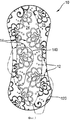
Фиг.1. Вид сверху ориентированной к телу поверхности варианта исполнения настоящего изобретения.Figure 1. Top view of a body oriented surface of an embodiment of the present invention.
Фиг.2. Вид изделия, изображенного на фиг.1, в разобранном виде, показывающий различные слои, из которых состоит примерный вариант исполнения изобретения, изображенный на фиг.1.Figure 2. An exploded view of the product shown in FIG. 1, showing the various layers that make up the exemplary embodiment of the invention shown in FIG.
Фиг.3. Вид нетканого материала с печатным рисунком, содержащим несколько декоративных элементов, имеющих конфигурацию, подобную обоям, перед формированием из него тыльного слоя, в соответствии с изобретением.Figure 3. Type of non-woven material with a printed pattern containing several decorative elements having a configuration similar to wallpaper, before forming a back layer from it, in accordance with the invention.
Фиг.4. Вид сверху ориентированной к телу поверхности другого варианта исполнения настоящего изобретения.Figure 4. Top view of a body oriented surface of another embodiment of the present invention.
Фиг.5. Вид сверху ориентированной к телу поверхности другого варианта исполнения настоящего изобретения.Figure 5. Top view of a body oriented surface of another embodiment of the present invention.
Фиг.6. Вид сверху ориентированной к телу поверхности другого варианта исполнения настоящего изобретения.6. Top view of a body oriented surface of another embodiment of the present invention.
Фиг.7. Вид сверху ориентированной к телу поверхности другого варианта исполнения настоящего изобретения.7. Top view of a body oriented surface of another embodiment of the present invention.
Фиг.8. Вид сверху ориентированной к телу поверхности другого варианта исполнения настоящего изобретения.Fig. 8. Top view of a body oriented surface of another embodiment of the present invention.
Фиг.9. Вид сверху тыльного слоя изделия, изображенного на фиг.8.Fig.9. Top view of the back layer of the product shown in Fig.8.
Подробное описание изобретенияDETAILED DESCRIPTION OF THE INVENTION
Хотя в конце настоящего описания содержится формула, в которой четко формулируется изобретение, мы полагаем, что его суть будет более понятна из нижеследующего описания.Although at the end of the present description contains a formula that clearly formulates the invention, we believe that its essence will be more clear from the following description.
ОпределенияDefinitions
Если четко не оговорено иначе, термин «содержащий» в настоящем документе следует понимать в открытом смысле, то есть что к уже имеющимся могут добавляться другие особенности, шаги или составные части, подходящие для женского абсорбирующего гигиенического изделия. Если четко не указано иное, под большинством понятий или элементов следует понимать как «один из многих». Например, «декоративный элемент» означает «один из многих декоративных элементов».Unless clearly stated otherwise, the term “comprising” in this document should be understood in an open sense, that is, other features, steps or components suitable for a feminine absorbent hygiene product may be added to existing ones. Unless clearly stated otherwise, most concepts or elements should be understood as “one of many.” For example, “decorative element” means “one of many decorative elements”.
Термин «женское гигиеническое изделие» в настоящем документе означает тип абсорбирующих изделий, применяемых женщинами наружно, обычно для абсорбции влагалищных выделений и/или утечки мочи. Термин «женское гигиеническое изделие» относится к изделиям, которые обычно называются прокладки, гигиенические прокладки на каждый день, гигиенические салфетки, гигиенические полотенца или межгубные средства. Эти изделия обычно прикрепляются к нижнему белью потребителя в месте, прилегающем к лобковой области, с помощью клейкого вещества или другими способами.The term “feminine hygiene product” as used herein refers to the type of absorbent product used externally by women, usually to absorb vaginal discharge and / or urine leakage. The term “feminine hygiene product” refers to products that are commonly referred to as pantyliners, sanitary towels for every day, sanitary napkins, sanitary towels or inter-lip products. These products are usually attached to the underwear of the consumer in a place adjacent to the pubic region, using an adhesive or other methods.
Термин «рисунок» в настоящем документе означает любые формы, конфигурации, рисунки, символы и их комбинации. Например, рисунками могут быть чисто абстрактные геометрические фигуры, такие как окружности или волны, и/или изображения, вызывающие ассоциацию с природными элементами, такие как узоры из растительных элементов, и/или определенной текстурой ткани, такой как кружева. Тисненый рисунок или печатный рисунок в соответствии с изобретением обычно могут быть зрительно узнаваемы. Тисненый рисунок может быть также распознаваем на ощупь.The term "drawing" in this document means any forms, configurations, drawings, symbols and combinations thereof. For example, patterns can be purely abstract geometric shapes, such as circles or waves, and / or images that are associated with natural elements, such as patterns from plant elements, and / or a specific fabric texture, such as lace. An embossed pattern or a printed pattern in accordance with the invention can usually be visually recognizable. An embossed pattern can also be recognized by touch.
Абсорбирующее изделие 10
На фиг.1 показан вид сверху примера женского гигиенического изделия 10 в соответствии с изобретением. Приведенный отдельно взятый вариант изобретения является примером гигиенической прокладки на каждый день (называемой также иногда «прокладка»), но настоящее изобретение не ограничивается этим. Женские гигиенические изделия обычно имеют плоскую ориентированную к телу поверхность, и достаточную гибкость для адаптации к анатомии и движениям пользователя. Они могут быть также сложены до использования, например, для уменьшения размера упаковки. Изделия, соответствующие изобретению, содержат печатный рисунок 12 и тисненый рисунок 14.Figure 1 shows a top view of an example of a
На фиг.2 представлено изделие, изображенное на фиг.1, в разобранном виде. Данное изделие имеет следующие слои, сверху вниз: верхний слой 16, имеющий зону сердцевины 24; абсорбирующую сердцевину 18; и тыльный слой 20. Показано также съемное покрытие 22, которое может использоваться для защиты клейкого вещества на внешней поверхности тыльного слоя 20. Термин «верх» изделия в данном документе соответствует поверхности изделия, ориентированной к телу пользователя, а «низ» в данном документе соответствует противоположной поверхности изделия, т.е. поверхности, которая обычно контактирует с женским нижним бельем. Термин «зона сердцевины» в данном документе соответствует области 24 верхнего слоя (т.е. ориентированной к телу части изделия), лежащей непосредственно над абсорбирующей сердцевиной 18.Figure 2 presents the product shown in figure 1, in disassembled form. This product has the following layers, from top to bottom: top layer 16 having a
Как показано на фиг.2, печатный рисунок 12 может быть нанесен на слой, расположенный ниже сердцевины 18, и таким образом можно избежать прямого контакта чернил с кожей пользователя. Слоем, на который нанесен печатный рисунок 12, может быть сам тыльный слой 20, как показано на фигурах, или другой слой, если он имеется. Тисненый рисунок может быть нанесен на верхний слой и/или на сердцевину, если она имеется, как представлено на фигурах.As shown in FIG. 2, a printed
Женские гигиенические изделия обычно имеют съемное покрытие 22. Съемное покрытие может защищать клейкое вещество, которое может иметься на внешней поверхности тыльного слоя, до использования изделия. Съемное покрытие обычно выбрасывается пользователем при помещении абсорбирующего изделия 10 на нижнее белье. Хотя на съемном покрытии, если оно имеется, может быть печатный рисунок, оно не рассматривается как слой, на который нанесен печатный рисунок в соответствии с изобретением, так как оно выбрасывается непосредственно перед использованием. Аналогично, при упоминании толщины изделия в данном документе толщина съемного покрытия не учитывается.Feminine hygiene products typically have a removable coating 22. The removable coating may protect the adhesive that may be present on the outer surface of the back layer before using the product. A removable coating is typically thrown away by the user when the
Печатный рисунок 12Printed Figure 12
Женские гигиенические изделия, соответствующие изобретению, содержат печатный рисунок 12, который может быть нанесен на любой слой изделия. Однако желательно, чтобы печатный рисунок 12 не наносился на верхний слой, во избежание контакта печатного слоя с кожей пользователя. Таким образом, можно избежать контакта красителя или чернил, которые используются для создания печатного рисунка, с кожей пользователя. Это может быть желательным, потому что некоторые пользователи опасаются, что любые чернила или красители могут наносить вред здоровью, например вызывать аллергию. Другим преимуществом отсутствия печатного рисунка на верхнем слое является то, что это позволяет ограничить возможное растекание печатного рисунка 12, которое может вызвать лосьон, когда он наносится на верхний слой для обеспечения лучших ощущений.The feminine hygiene products of the invention comprise a printed
Печатный рисунок 12 может быть, в частности, нанесен на один из слоев, расположенных ниже абсорбирующей сердцевины 18, если таковая имеется. В вариантах изобретения, изображенных на фигурах, печатный рисунок 12 нанесен на обычно белый тыльный слой 20 изделия, но не исключено, что, кроме этого или вместо этого, печатный рисунок 12 может быть нанесен на другой слой, расположенный ниже сердцевины 18, например, он может располагаться на дополнительном тыльном слое, если таковой имеется.The printed
Площадь поверхности, которую покрывает печатный рисунок 12 на печатном слое, может быть различной. Однако желательно, чтобы площадь поверхности, покрытая печатным рисунком, составляла от примерно 2% до примерно 40% общей площади поверхности печатного слоя. Если окрашено менее 2% площади, этого может быть недостаточно. Окраска более 40% поверхности печатного слоя вызовет неприемлемый рост себестоимости изделия в связи с повышенным расходом краски и времени сушки. Поэтому наиболее приемлемой с точки зрения экономического эффекта представляется окраска от 8 до 25% поверхности.The surface area covered by the
Печатный рисунок 12 может наноситься любым из традиционных методов окрашивания, например флексо-принт или ротогравюра. Печатный рисунок должен преимущественно быть сделан достаточно сильной краской, чтобы быть видимым, по меньшей мере, через часть 25 верхнего слоя 16 изделия 10, находящуюся вне зоны сердцевины 24. Могут использоваться любые цветные краски, включая, но ограничиваясь ими, следующие: от черного до таких цветных, как, например, розовая, фиолетовая, зеленая, пурпурная, голубая, желтая, золотая, серебряная и др. или любые комбинации различных цветов. Кроме печатных рисунков, полученных традиционными методами, термин «печатный рисунок» относится также к рисункам, полученным способами, которые, как правило, не могут быть названы печатью, но которые дают такой же или аналогичный эффект. Например, похожий визуальный эффект достигается термообработкой пластичного нетканого слоя (например, тыльного слоя), при которой термообработанная часть слоя становится полупрозрачной. При этом если у пользователя цветное нижнее белье, цвет нижнего белья становится более видимым через термообработанный участок.Printed
У традиционных абсорбирующих изделий верхний слой или чаще, все слои, кроме абсорбирующей сердцевины, до некоторой степени прозрачны или полупрозрачны. Таким образом, даже если печатный рисунок нанесен на другой, а не на верхний слой, он все равно может быть виден, по меньшей мере, через область 25 верхнего слоя, лежащую вне области сердцевины 24, даже при использовании красителя относительно низкой насыщенности. Даже если имеется второй верхний слой, этот слой обычно, по меньшей мере, частично полупрозрачен. Термин «виден» в данном документе означает, что человек с нормальным зрением на оба глаза (10/10) может видеть печатный рисунок на расстоянии около 50 см в ярко освещенной лампами накаливания комнате. С другой стороны, большинство материалов, традиционно использующихся для изготовления сердцевины, непрозрачны, так что печатный рисунок 12 обычно не виден через зону сердцевины 24, когда он нанесен на слой 20, расположенный ниже сердцевины 18. Однако в этом случае печатный рисунок 12 обычно виден через область 25 верхнего слоя 16, расположенную вне зоны сердцевины 24 верхнего слоя 16.In traditional absorbent articles, the upper layer or more often, all layers except the absorbent core are to some extent transparent or translucent. Thus, even if the printed pattern is printed on a different layer, rather than on the top layer, it can still be visible through at least the
Хотя природа настоящего изобретения этого не требует, предпочтительным является использование гидрофобного красителя, во избежание вытягивания красителем воды из сердцевины. Большинство представленных на рынке красителей изготовлены на основе растворителей и поэтому и обладают достаточными водоотталкивающими свойствами. Более того, при желании к имеющимся в продаже красителям можно добавить дополнительные водоотталкивающие агенты, такие как масло или воск. Красители на основе растворителей не содержат воду в качестве подвижной фазы, несущей пигменты, смолы, связующие или прочие добавки. В качестве растворителей в таких красителях используются спирты, эфиры, алифатические или ароматические соединения или их сочетания. Растворители, хорошо разжижающие смолы, называются активными, в то время как прочие виды называют «разбавителями». В случае, относящемся к данному изобретению, для использования наиболее пригодны красители на основе растворителей из алифатических углеводородов с традиционными связующими, такими как полиамиды, шеллак, смолистые эфиры, нитроцеллюлоза и стирол-малон. Примерами подходящих красителей являются предлагаемые Sunchemical/Hartmann Niederhausen/TS под торговым именем Р-3228 / 811 PMS 270 (лавандовый) или торговым именем V8185/811 PMS 382 (зеленый). В красителях на водной основе в качестве жидкой фазы используется вода. Такие красители в принципе также могут быть пригодны для настоящего изобретения, если они не оказывают существенного отрицательного эффекта на работу изделия.Although the nature of the present invention does not require this, it is preferable to use a hydrophobic dye to prevent the dye from drawing water from the core. Most of the dyes on the market are solvent-based and therefore have sufficient water-repellent properties. Moreover, if desired, additional water-repellent agents such as oil or wax can be added to commercially available dyes. Solvent-based dyes do not contain water as a mobile phase that carries pigments, resins, binders or other additives. Alcohols, esters, aliphatic or aromatic compounds, or combinations thereof, are used as solvents in such dyes. Solvents that dilute resins well are called active, while other types are called “diluents.” In the case of this invention, solvent-based dyes from aliphatic hydrocarbons with conventional binders such as polyamides, shellac, gum esters, nitrocellulose and styrene-malone are most suitable for use. Examples of suitable colorants are those offered by Sunchemical / Hartmann Niederhausen / TS under the trade name P-3228/811 PMS 270 (lavender) or the trade name V8185 / 811 PMS 382 (green). In water-based dyes, water is used as the liquid phase. Such dyes, in principle, can also be suitable for the present invention, if they do not have a significant negative effect on the operation of the product.
Тисненый рисунок 14Embossed Figure 14
Изделие, соответствующее изобретению, содержит тисненый рисунок 14, который может располагаться на верхнем слое 16 изделия 10. Как показано на рисунках, тисненый рисунок 14 может быть нанесен практически полностью внутри зоны сердцевины 24 верхнего слоя и располагаться непосредственно над абсорбирующей сердцевиной 18, если она имеется. На абсорбирующую сердцевину 18, если она имеется, или, по меньшей мере, на ее часть также может быть нанесен тисненый рисунок 14. При традиционном способе тиснения верхний слой и абсорбирующая сердцевина при тиснении обычно связываются между собой, но это не является обязательным требованием. В соответствии с изобретением наличие сердцевины 18 не является обязательным требованием, потому что иногда верхний слой (или другие слои) являются достаточно толстыми, чтобы на него можно было нанести тисненый рисунок, например, если они изготовлены из пористого картона. Однако в соответствии с настоящим изобретением желательно, чтобы между верхним и тыльным слоем имелась сердцевина с целью увеличения абсорбционной способности изделия и/или для того, чтобы облегчать нанесение тисненого рисунка. Тиснение может также присутствовать в области 25 верхнего слоя, расположенной вне зоны сердцевины 24.The product corresponding to the invention contains an
Получение тисненого рисунка может достигаться стандартными методами, такими как термическое связывание, ультразвуковое связывание и/или давление. Примером подходящего метода является термическое связывание, при котором слои прокатываются между двумя стальными валками, на одном из которых выгравирован требуемый рисунок, а второй имеет ровную и гладкую поверхность. При определенных исполнениях изделия один или оба валка нагреваются до необходимой температуры, при которой наступает, по меньшей мере, частичное плавление одного или более слоев (типичный диапазон: 90-170°C).The embossed pattern can be achieved by standard methods such as thermal bonding, ultrasonic bonding and / or pressure. An example of a suitable method is thermal bonding, in which layers are rolled between two steel rolls, one of which engraves the desired pattern, and the second has a flat and smooth surface. In certain product versions, one or both rolls are heated to the required temperature at which at least partial melting of one or more layers occurs (typical range: 90-170 ° C).
Нанесение гравировки на валок может выполняться любым традиционным способом, например, для большинства тисненых рисунков, токарной обработкой, но более предпочтительными представляются кислотное травление или лазерная гравировка, так как они позволяют получить более тонкую гравировку, и, следовательно, более тонкий тисненый рисунок. Это может быть желательным, так как тисненый рисунок содержит относительно тонкие элементы, которые намного тоньше канальцев тиснения в ранее описанном изделии, к которому относится изобретение WO 2004/006818. Тонкие элементы тиснения обычно придают изделию более женственный и изящный внешний вид. Поэтому станок для тиснения должен обеспечивать тиснение с высокой четкостью, в частности с разрешением (минимальной толщиной линий тиснения) менее чем около 0,75 мм, в частности в диапазоне от примерно 0,35 мм до примерно 0,60 мм, хотя данный диапазон не является обязательным. Аналогично, разрешение печатного рисунка (минимальная толщина печатных линий) может быть менее чем около 0,75 мм, в частности в диапазоне от примерно 0,35 мм до примерно 0,60 мм, хотя данный диапазон не является обязательным.The engraving on the roll can be done by any conventional method, for example, for most embossed designs, by turning, but acid etching or laser engraving is more preferable, since they allow finer engraving, and therefore a finer embossed pattern. This may be desirable since the embossed pattern contains relatively thin elements that are much thinner than the embossing tubules in the previously described product to which the invention WO 2004/006818 relates. Subtle embossing elements usually give the product a more feminine and elegant appearance. Therefore, the embossing machine must provide embossing with high definition, in particular with a resolution (minimum embossing line thickness) of less than about 0.75 mm, in particular in the range from about 0.35 mm to about 0.60 mm, although this range is not is a must. Similarly, the resolution of the printed pattern (minimum thickness of the printed lines) may be less than about 0.75 mm, in particular in the range from about 0.35 mm to about 0.60 mm, although this range is not mandatory.
Печатный декоративный элемент 120 и тисненый декоративный элемент 140Printed
Печатный, тисненый рисунок 12, 14 в соответствии с изобретением содержит, по меньшей мере, один печатный, тисненый декоративный элемент 120, 140. Термин «декоративный элемент» в настоящем документе означает элемент печатного, тисненого рисунка 12, 14, главной функцией которого является улучшение эстетического вида изделия, хотя декоративный элемент может выполнять и другие полезные функции, помимо чисто эстетических. Например, тисненый рисунок 14 обычно также улучшает поглощение жидкости или связывание слоев. Однако если тисненые элементы играют только или преимущественно функциональную роль, такую как канальцы тиснения изделия, которому соответствует изобретение WO 2004/006818, то эти элементы не считаются декоративными в смысле настоящего применения. Чаще всего печатный рисунок 12 не имеет других функций, кроме декоративных, так что он обычно всегда содержит печатный декоративный элемент 120, являющийся самим печатным рисунком.The printed, embossed
Изобретатели обнаружили, что тисненый рисунок, содержащий тисненый декоративный элемент, и печатный рисунок, могут улучшать внешний вид изделия, в частности, когда печатный рисунок содержит печатный декоративный элемент, который практически аналогичен тисненому декоративному элементу. Термин «практически аналогичен» в настоящем документе означает, что печатный декоративный элемент 120 и тисненый декоративный элемент 140 имеют практически одинаковый узор и имеют практически одинаковый размер. Термин «практически одинаковый узор» в настоящем документе означает, что узор печатного декоративного элемента и узор тисненого декоративного элемента практически одинаковы, хотя способы выражения узора тисненого и печатного декоративных элементов могут различаться. Например, печатный декоративный элемент может быть нанесен непрерывной линией, в то время как соответствующий тисненый декоративный элемент может быть нанесен пунктирной или прерывистой линией, или может быть толще или тоньше, чем печатный декоративный элемент, или наоборот. Если декоративные элементы ориентированы в разных направлениях или являются зеркальными отражениями друг друга, то также считается, что они имеют практически одинаковый узор. Термин «практически одинаковый размер» в настоящем документе означает, что соотношение размеров печатного декоративного элемента и тисненого декоративного элемента может лежать в диапазоне от примерно 25% до примерно 400%, включая соотношение от примерно 50% до примерно 200%.The inventors have found that an embossed pattern containing an embossed decorative element and a printed pattern can improve the appearance of the product, in particular when the printed pattern contains a printed decorative element that is almost similar to an embossed decorative element. The term “substantially similar” in this document means that the printed
На фиг.1-7 показаны примеры, где печатный рисунок 12 и тисненый рисунок 14 содержат цветочные или, в более общем смысле, растительные декоративные элементы 120, 140. На фиг.1, например, печатный декоративный элемент 120 и тисненый декоративный элемент 140 содержат стилизованный цветок.Figure 1-7 shows examples where the printed
Как упомянуто выше, потребителям часто не нравится, когда печатный рисунок находится на слое изделия, прямо контактирующем с кожей, которым обычно является верхний слой 16. Решением проблемы является нанесение печатного рисунка 12 на тыльный слой 20 или другой слой, расположенный ниже сердцевины 18, во избежание прямого или тесного контакта между печатным рисунком 12 и кожей потребителя. Однако абсорбирующая сердцевина 18 часто непрозрачна, и, следовательно, печатный рисунок 12 виден только через область 25 верхнего слоя 16, расположенную вне зоны сердцевины 24. Это оставляет относительно большую зону сердцевины 24 верхнего слоя 16 без видимого украшения. Изобретатели обнаружили, что можно придать лучший внешний вид всей ориентированной к телу стороне изделия путем нанесения на верхний слой и, в частности, на зону сердцевины 24 тисненого рисунка 14, имеющего декоративный элемент 140. В частности, тисненый декоративный элемент может быть практически аналогичен декоративному элементу 120 печатного рисунка 12. Улучшение внешнего вида изделия может быть также достигнуто другими способами. Например, несмотря на вышесказанное, на весь верхний слой или на его часть можно нанести печатный рисунок вдоль его продольных сторон, и тисненый рисунок, имеющийся в зоне сердцевины, также будет придавать изделию улучшенный внешний вид, благодаря комбинации печатного и тисненого рисунка, в частности, если эти рисунки имеют практически аналогичные декоративные элементы.As mentioned above, consumers often do not like it when the printed pattern is on the product layer in direct contact with the skin, which is usually the top layer 16. The solution is to apply the printed
Если изделие имеет абсорбирующую сердцевину, то тисненый рисунок 14 может улучшать внешний вид зоны сердцевины 24 верхнего слоя, при этом нет необходимости наносить печатный рисунок на зону сердцевины 24 верхнего слоя 16. Внешний вид области 25 верхнего слоя, находящейся вне зоны сердцевины 24, можно улучшить печатным рисунком, который виден на просвет через верхний слой, если он напечатан на слое, лежащем ниже сердцевины. Дополнительным преимуществом того, что печатный рисунок и тисненый рисунок содержат практически аналогичные декоративные элементы, является то, что таким образом может быть создано впечатление бесшовной или единой поверхности на верхнем слое между зоной сердцевины 24 и областью 25 верхнего слоя, лежащей вне зоны сердцевины, при этом отсутствует необходимость наносить печатный рисунок на всю поверхность верхнего слоя.If the product has an absorbent core, the
Печатный рисунок 12 и тисненый рисунок 14 могут быть совмещены, хотя это не обязательно. На практике, вследствие высокой скорости современного производства и всеобщей тенденции к минимизации отходов, может быть трудно и/или дорого добиться совмещения обоих рисунков. Таким образом, не обязательно выбирать печатный и тисненый рисунки так, чтобы их конфигурация полностью совмещалась, даже в не совмещенном виде они все равно будут обеспечивать преимущество настоящего изобретения (например, как показано ни фиг.1).The printed
Декоративный элемент 120 внутри печатного рисунка 12 может появляться во многих местах. Тисненый декоративный элемент 140 может появляться во многих местах внутри тисненого рисунка 14. В этом случае может быть использовано расположение декоративных элементов по типу обоев в печатном рисунке 12, в тисненом рисунке 14, или в обоих рисунках. Декоративные элементы также могут быть ориентированы в разных направлениях или являться зеркальным отражением друг друга внутри соответствующих рисунков.The
Например, как показано на фиг.1, печатный декоративный элемент 120 и тисненый декоративный элемент 140 могут быть видны неполностью в некоторых или даже во всех своих многочисленных местах расположения. Например, при овальной форме сердцевины, как представлено на фиг.1, в такой сужающейся области, как зона сердцевины, нормальным является присутствие усеченного тисненого декоративного элемента. Аналогично, некоторые или все печатные декоративные элементы могут быть до некоторой степени усеченными там, где был обрезан печатный слой или где расположена сердцевина, если она имеется.For example, as shown in FIG. 1, a printed
Вариант изобретения, изображенный на фиг.4, представляет собой пример изделия, у которого печатные декоративные элементы 120 немного больше, чем тисненые декоративные элементы 140, в то же время они все же являются практически аналогичными и придают улучшенный и целостный внешний вид ориентированной к телу поверхности изделия.The embodiment of FIG. 4 is an example of an article in which the printed
Печатный рисунок 12 и тисненый рисунок 14, показанные на фиг.5, содержат декоративные элементы 120 и 140, напоминающие элементы растений. Как показано на фиг.5, тисненый рисунок 14 и/или печатный рисунок 12 могут содержать дополнительные декоративные элементы, которые не являются практически аналогичными ни с каким из декоративных элементов, присутствующих на другом рисунке. Например, печатный рисунок 12 изделия, изображенного на фиг.5, помимо растительного печатного декоративного элемента 120, содержит также декоративный элемент 26, напоминающий сетку. Считается, что наличие дополнительных отличающихся декоративных элементов на печатном и/или тисненом рисунке не ухудшает внешнего вида изделия. Однако если печатный и тисненый рисунки содержат печатный декоративный элемент и тисненый декоративный элемент, которые являются практически аналогичными, желательно иметь практически аналогичные декоративные элементы ясно видимыми внутри печатного и тисненого рисунков.The printed
На фиг.6 показан пример варианта настоящего изобретения, в котором печатный декоративный элемент 120 нанесен непрерывной линией, в то время как тисненый декоративный элемент 140 нанесен в виде серии точек. Однако тисненые декоративные элементы, состоящие из точек, и печатные декоративные элементы имеют практически одинаковый узор.Figure 6 shows an example of a variant of the present invention in which the printed
На фиг.7 показан вариант настоящего изобретения, в котором печатный и тисненый декоративные элементы 120 и 140 также напоминают растения. Часть тисненого растительного декоративного элемента на тисненом рисунке 14 представлена непрерывными линиями, а часть точечными.7 shows a variant of the present invention, in which printed and embossed
На фиг.8 представлен вариант изобретения, в котором общий декоративный элемент 120, 140 не является растительным элементом, а является комбинацией тонко тисненых и печатных точек и штрихов, что может, например, напоминать традиционные кружева и формировать соответственно печатный рисунок 12 и тисненый рисунок 14. Тыльный слой 20, как печатный слой, показан отдельно на фиг.9.On Fig presents a variant of the invention in which the common
Эффект кружевLace effect
Было также обнаружено, что растительные декоративные элементы печатных рисунков и тисненых рисунков, показанных на фиг.1-7, и не растительные декоративные элементы, показанные на фиг.8, создают вид кружев или, по меньшей мере, у пользователя появляется впечатление наличия кружевной ткани на изделиях, на которые они нанесены. Кружевные ткани традиционно использовались при изготовлении женского нижнего белья. Применяемые печатные или тисненые рисунки могут, по меньшей мере, частично воспроизводить некоторые элементы узоров, традиционно применяемых на кружевных тканях, например растительные элементы, примеры которых приведены на фиг.1-7 и/или тонкие прерывистые элементы, пример которых представлен на фиг.8. Другим фактором, необходимым для придания изделию вида кружев, является использование тиснения и печати высокой четкости, как указано выше. Желательно, чтобы, по меньшей мере, на части как печатного, так и тисненого рисунков достигалось разрешение менее 0,75 мм, например, от примерно 0,35 мм до примерно 0,60 мм. При печати и тиснении с высоким разрешением могут быть нанесены тонкие линии или другие элементы, имеющие толщину внутри диапазона разрешения, что помогает придать изделию вид тонкой кружевной ткани. На печатном рисунке и тисненом рисунке могут также иметься и более толстые линии (или другие элементы).It was also found that the plant-based decorative elements of the printed patterns and embossed figures shown in Figs. 1-7 and the non-plant-based decorative elements shown in Fig. 8 create a lace look, or at least the user has the impression of having lace fabric on the products on which they are applied. Lacy fabrics have traditionally been used in the manufacture of women's underwear. Used printed or embossed patterns can at least partially reproduce some elements of patterns traditionally used on lace fabrics, for example, plant elements, examples of which are shown in Figs. 1-7 and / or thin intermittent elements, an example of which is shown in Fig. 8 . Another factor necessary to give the product the appearance of lace is the use of embossing and high-definition printing, as described above. It is desirable that at least a portion of both the printed and the embossed patterns achieve a resolution of less than 0.75 mm, for example, from about 0.35 mm to about 0.60 mm. When printing and stamping with high resolution, thin lines or other elements having a thickness within the resolution range can be applied, which helps to give the product the appearance of a thin lace fabric. The printed pattern and the embossed pattern may also have thicker lines (or other elements).
Тыльный слой 20Back layer 20
Тыльный слой может быть изготовлен из любого подходящего для изготовления данного слоя материала, пригодного для нанесения рисунка, например полиолефиновые пленки или нетканые полотна. В некоторых исполнениях тыльный слой может быть непроницаемым для неприятно пахнущих газов, исходящих от поглощенных выделений организма, чтобы они не распространялись наружу. Тыльный слой может быть «дышащим» и может и не быть таковым. Примером подходящего материала для изготовления тыльного слоя является полиэтиленовая пленка толщиной от примерно 0,01 до примерно 0,08 мм. Может, например, использоваться полиэтиленовая пленка модели Х-813, предлагаемая Tredegar Corporation (Тер-От, Индиана, США). Кроме того, тыльный слой может быть изготовлен из материала типа мягкой ткани, гидрофобного по отношению к верхнему слою, например из материала из полиэфирных или полиолефиновых волокон.The backing layer can be made of any material suitable for the application of a pattern suitable for producing this layer, for example polyolefin films or non-woven fabrics. In some implementations, the back layer may be impervious to unpleasantly smelling gases emanating from the absorbed secretions of the body so that they do not spread outward. The back layer may be “breathing” and may not be so. An example of a suitable material for the manufacture of the back layer is a polyethylene film with a thickness of from about 0.01 to about 0.08 mm For example, a plastic film of model X-813 offered by Tredegar Corporation (Ter-Ot, Indiana, USA) can be used. In addition, the back layer may be made of a material such as soft tissue hydrophobic with respect to the upper layer, for example, of a material made of polyester or polyolefin fibers.
На фиг.3 представлен вид нетканого материала с напечатанным в виде обоев рисунком, который используется для изготовления тыльного слоя изделия в соответствии с настоящим изобретением. На фиг.9 отдельно вынесен тыльный слой изделия в исполнении, показанном на фиг.8.Figure 3 presents a view of the non-woven material printed in the form of wallpaper pattern, which is used for the manufacture of the back layer of the product in accordance with the present invention. In Fig. 9, the back layer of the product in the embodiment shown in Fig. 8 is separately rendered.
Печатный рисунок 12 может наноситься с любой стороны печатного слоя, но если при этом печатный слой одновременно является тыльным слоем, предпочтительным представляется нанесение печатного рисунка «сверху», то есть на стороне тыльного слоя, обращенной к телу, хотя данное требование не является обязательным.A printed
Верхний слой 16Top layer 16
Для верхнего слоя в рамках данного изобретения могут использоваться любые традиционно применяемые материалы. Верхний слой может изготавливаться из нетканых материалов или перфорированных полиолефиновых пленок. При желании верхний слой может быть пропитан поверхностно-активным веществом (ПАВ) для облегчения проникновения жидкости к сердцевине. Верхний слой и в особенности его центральная часть, принимающая жидкость, может быть гидрофильным. Обычно достаточной концентрацией ПАВ является примерно 0,01 мг на см2 площади. Подходящим ПАВ является Pegosperse 200 ML, предлагаемый Glyco Chemical, Inc. (Гринвич, Коннектикут, США).For the top layer, any conventionally used materials may be used within the scope of this invention. The top layer can be made of nonwoven materials or perforated polyolefin films. If desired, the top layer may be impregnated with a surface-active substance (surfactant) to facilitate the penetration of liquid to the core. The top layer, and in particular its central portion receiving the fluid, may be hydrophilic. Typically, a sufficient concentration of surfactant is about 0.01 mg per cm 2 area. A suitable surfactant is Pegosperse 200 ML offered by Glyco Chemical, Inc. (Greenwich, Connecticut, USA).
В верхнем слое могут быть сделаны многочисленные отверстия для облегчения проникновения жидкости к сердцевине. Обычно для изготовления верхнего слоя применяется перфорированная пленка, у которой площадь отверстий составляет от примерно 5% до примерно 50% площади слоя, обычно 25%, а толщина - от примерно 0,01 мм до примерно 0,05 мм до перфорирования и от примерно 0,42 мм до примерно 0,51 мм после нанесения перфорации.Numerous openings can be made in the top layer to facilitate the penetration of liquid to the core. Typically, a perforated film is used to make the top layer, in which the hole area is from about 5% to about 50% of the area of the layer, usually 25%, and the thickness is from about 0.01 mm to about 0.05 mm before punching and from about 0 42 mm to about 0.51 mm after perforation.
В качестве перфорированного верхнего слоя изделия в рамках настоящего изобретения может быть использован верхний слой из нетканого материала. Подходящие нетканые материалы для верхнего слоя включают волокнистые нетканые материалы типа картон, спанбонд, или полученные при помощи процесса плавки со вспениванием, в которых расплавленный полимерный материал продавливается через решетку, разделяющую полимер на отдельные волокна и постепенно уменьшающую их диаметр, после чего волокна укладываются на образующей поверхности. Полимерными материалами, подходящими для получения таких волокнистых нетканых материалов, являются полиолефины, такие как полиэтилен и пропилен, полиэфиры, нейлон, этилен винил ацетат, этилен метакрилат, сополимеры вышеприведенных материалов, блок-сополимеры, такие как блок-сополимеры стирола и бутадиена типа A-B-A и прочие.As the perforated top layer of the article, a non-woven top layer can be used in the framework of the present invention. Suitable non-woven materials for the top layer include fibrous non-woven materials such as cardboard, spunbond, or obtained by the foaming process, in which the molten polymer material is pressed through a grating that separates the polymer into individual fibers and gradually reduces their diameter, after which the fibers are laid on the forming surface. Polymeric materials suitable for the preparation of such fibrous nonwoven materials are polyolefins such as polyethylene and propylene, polyesters, nylon, ethylene vinyl acetate, ethylene methacrylate, copolymers of the above materials, block copolymers such as block copolymers of styrene and butadiene type ABA and others.
Абсорбирующая сердцевина 18Absorbent core 18
Между верхним слоем 16 и тыльным слоем 20 изделия, как правило, находится абсорбирующая сердцевина 18. В настоящем описании термин «абсорбирующая сердцевина» подразумевает материал, или набор материалов, подходящие для поглощения, распределения и хранения жидкостей, таких как моча, кровь, менструальные выделения и прочие выделения организма. Так как адсорбирующая сердцевина в женских гигиенических изделиях, как правило, толще и объемней других слоев, нанесение тиснения на нее легче, чем тиснение прочих слоев изделия.Between the top layer 16 and the back layer 20 of the product, as a rule, there is an absorbent core 18. In the present description, the term “absorbent core” refers to a material or set of materials suitable for absorbing, distributing and storing fluids such as urine, blood, menstrual flow and other body excretions. Since the absorbent core in feminine hygiene products is usually thicker and bulkier than other layers, embossing on it is easier than embossing other layers of the product.
Размер и форма абсорбирующей сердцевины 18 таковы, что площадь поверхности зоны сердцевины 24 существенно меньше площади поверхности верхнего слоя изделия. Выражение «существенно меньшая» в данном документе означает, что площадь зоны сердцевины 24, по меньшей мере, примерно на 10% меньше площади поверхности верхнего слоя 16. Желательно, чтобы соотношение площади зоны сердцевины 24 и общей площади поверхности верхнего слоя 16 лежало в любом из следующих диапазонов: от примерно 15% до примерно 90%, от примерно 30% до примерно 70%, от примерно 40% до примерно 60%. Данное соотношение обычно легко выполняется, если сердцевина имеет овальную форму, а изделие - практически прямоугольную или форму «собачьей кости», как показано на фигурах. То, что абсорбирующая сердцевина имеет площадь меньше площади поверхности верхнего слоя, дает ряд преимуществ. Во-первых, уменьшается количество материала, необходимого для изготовления сердцевины, и тем самым снижается себестоимость изделия. Во-вторых, меньшая площадь сердцевины повышает общую гибкость изделия, так как области изделия, свободные от сердцевины, менее жестки, чем область, где расположена сердцевина.The size and shape of the absorbent core 18 are such that the surface area of the
Абсорбирующая сердцевина (если она есть) обычно располагается по центру изделия и немного отстоит от периферии изделия для обеспечения лучшей гибкости изделия по краям.The absorbent core (if any) is usually located in the center of the product and slightly spaced from the periphery of the product to provide better flexibility of the product at the edges.
На фигурах показана абсорбирующая сердцевина овальной формы, однако естественно, что она может иметь любую подходящую форму, например часового стекла. Типичной является прямоугольная форма сердцевины, что значительно упрощает процесс ее изготовления. Однако гибкость изделия выше, если сердцевина имеет сглаженную форму и не содержит прямых углов.The figures show an absorbent oval-shaped core, but it is natural that it can have any suitable shape, such as a watch glass. The rectangular shape of the core is typical, which greatly simplifies the manufacturing process. However, the flexibility of the product is higher if the core has a smooth shape and does not contain right angles.
Абсорбирующая сердцевина может быть изготовлена из любых подходящих материалов. Примерный, но не ограниченный перечень подходящих абсорбирующих жидкость материалов включает: измельченную древесную пульпу, которая обычно называется воздушным войлоком; набивку из слоистой целлюлозы; абсорбирующие гелеобразные материалы, в том числе суперабсорбирующие полимеры, такие как полимерные гелеобразные вещества, образующие гидрогели; химически усиленные, модифицированные или перекрестно связанные волокна целлюлозы; расплавленно-вспененные полимеры, включая сополимеры; синтетические волокна, включая скрученные полиэфирные волокна; ткани, в том числе свернутые и ламинированные; волокна с капиллярными каналами; абсорбирующие пены; абсорбирующие губки; синтетические слоистые волокна; торфяной мох; любые прочие эквивалентные материалы или их сочетания.The absorbent core may be made of any suitable material. An exemplary but not limited list of suitable liquid absorbent materials includes: shredded wood pulp, which is commonly referred to as airfelt; layered cellulose packing; absorbent gel materials, including superabsorbent polymers, such as hydrogel-forming polymer gel substances; chemically enhanced, modified or cross-linked cellulose fibers; molten-foamed polymers, including copolymers; synthetic fibers, including twisted polyester fibers; fabrics, including rolled and laminated; fibers with capillary channels; absorbent foams; absorbent sponges; synthetic layered fibers; peat moss; any other equivalent materials or combinations thereof.
Если предполагается изготавливать изделия, которые будут использоваться как прокладки на каждый день, толщина сердцевины, как правило, будет относительно небольшой, особенно по сравнению с более толстыми гигиеническими изделиями, в особенности прокладками типа «ультра», толщина которых обычно превышает 5 мм. Поэтому абсорбирующая сердцевина прокладок на каждый день, как правило, содержит суперадсорбирующий полимер (САП), распределенный внутри матрицы из волокон целлюлозы.If you intend to make products that will be used as pads for every day, the thickness of the core will usually be relatively small, especially compared to thicker hygiene products, especially pads such as "ultra", the thickness of which usually exceeds 5 mm. Therefore, the absorbent core of the pads for every day, as a rule, contains a superabsorbent polymer (SAP) distributed within the matrix of cellulose fibers.
Абсорбирующая сердцевина может быть монослойной, а может состоять из двух или более слоев, соединенных между собой методом ламинирования. Так, сердцевина может содержать непроницаемый барьерный слой (например, из полиэтиленовой пленки), располагаемый на стороне, обращенной к тыльному слою и препятствующий проникновению жидкости через прокладку и дальнейшему загрязнению одежды. Примером подходящей полиэтиленовой пленки является пленка плотностью 25 г/м2, предлагаемая Britton Taco (Великобритания) под торговым именем ST-012A-White (белая).The absorbent core may be monolayer, or may consist of two or more layers interconnected by lamination. So, the core may contain an impermeable barrier layer (for example, from a plastic film) located on the side facing the back layer and preventing the penetration of liquid through the pad and further contamination of clothing. An example of a suitable plastic film is a film with a density of 25 g / m 2 , offered by Britton Taco (UK) under the trade name ST-012A-White (white).
Дополнительная информация об адсорбирующих сердцевинах содержится в предыдущих патентных публикациях, например WO 0207662 A1 и WO 9119471.Further information on adsorbent cores is contained in previous patent publications, for example WO 0207662 A1 and WO 9119471.
Дополнительный верхний слойOptional top coat
Изделия, к которым относится настоящее изобретение, могут содержать дополнительный (второй) верхний слой, расположенный между верхним слоем 16 и абсорбирующей сердцевиной 18. Данный слой может быть изготовлен из разнообразных материалов, таких как тканые, нетканые или полимерные материалы, например перфорированные термопластические пленки, перфорированные пластические пленки, пленки из термопластических материалов, полученные методом гидроформовки, пористые пены, сетчатые пены, сетчатые термопластические пленки и термопластические сетки. Для изготовления дополнительного верхнего слоя может быть использован любой материал, описанный в данном документе ранее, применяемый для изготовления верхнего слоя. В некоторых исполнениях дополнительный слой простирается под всей поверхностью верхнего слоя, то есть доходит до его краев по всему периметру, так что дополнительный верхний слой покрывает всю внутреннюю поверхность верхнего слоя.Products to which the present invention relates may include an additional (second) top layer located between the top layer 16 and the absorbent core 18. This layer can be made of a variety of materials, such as woven, non-woven or polymeric materials, such as perforated thermoplastic films, perforated plastic films, films of thermoplastic materials obtained by the method of hydroforming, porous foams, reticulated foams, reticulated thermoplastic films and thermoplastic se tki. For the manufacture of an additional top layer, any material described previously herein that is used to make the top layer can be used. In some embodiments, the additional layer extends beneath the entire surface of the upper layer, that is, extends to its edges along the entire perimeter, so that the additional upper layer covers the entire inner surface of the upper layer.
Основное назначение дополнительного верхнего слоя - быстрый перенос выделений организма от верхнего слоя к абсорбирующей сердцевине, причем не только в вертикальной плоскости в толщину дополнительного верхнего слоя, но также по направлениям в длину и в ширину абсорбирующего изделия. Это помогает наиболее полно использовать накопительную емкость находящегося под данным слоем абсорбирующего слоя.The main purpose of the additional upper layer is the rapid transfer of body excretions from the upper layer to the absorbent core, not only in the vertical plane in the thickness of the additional upper layer, but also in the directions in length and width of the absorbent product. This helps to make full use of the storage capacity of the absorbent layer located beneath this layer.
Дополнительный тыльный слой.Additional back layer.
Изделия, к которым относится настоящее изобретение, могут содержать дополнительный (второй) тыльный слой, между тыльным слоем 20 и абсорбирующей сердцевиной 18. Основное назначение дополнительного тыльного слоя - замедлять или препятствовать прохождению жидкости от абсорбирующей сердцевины к внешней стороне изделия и при этом позволять воздуху свободно циркулировать через него. Примером дополнительного тыльного слоя является эластичное трехмерное полимерное полотно, состоящее из непроницаемой пленки с капиллярными или коническими отверстиями. Пленка с капиллярными или коническими отверстиями может быть ориентирована таким образом, что вершины конусов обращены к абсорбирующей сердцевине, что препятствует прохождению жидкости. Конусы и капилляры могут иметь косую форму, что приводит к полному или частичному закрытию отверстий при сжатии слоя.Products to which the present invention relates may contain an additional (second) back layer between the back layer 20 and the absorbent core 18. The main purpose of the additional back layer is to slow down or prevent the passage of fluid from the absorbent core to the outside of the product and at the same time allow air to freely circulate through it. An example of an additional backing layer is an elastic three-dimensional polymer web consisting of an impermeable film with capillary or conical holes. The film with capillary or conical holes can be oriented so that the tops of the cones face the absorbent core, which prevents the passage of fluid. Cones and capillaries can have an oblique shape, which leads to complete or partial closure of the holes during compression of the layer.
Средства крепленияFasteners
Обращенная к одежде сторона тыльного слоя 20 может иметь средства крепления изделия к нижнему белью пользователя. Общепринятым является использование для этой цели хорошо зарекомендовавших себя клейких веществ, чувствительных к давлению. Клейкий участок может быть непрерывным или состоять из нескольких областей. Клейкое вещество может быть нанесено полосками или по всей поверхности тыльного слоя. Клейкое вещество может наноситься любым подходящим методом, например прямого нанесения прокаткой; возможны и другие методы. Может быть также предусмотрен небольшой участок внешнего слоя, на который не нанесено клейкое вещество, для облегчения отделения съемного покрытия от внешнего слоя пользователем изделия.The garment side of the back layer 20 may have means for attaching the product to the underwear of the user. It is generally accepted to use well-established, pressure sensitive adhesives for this purpose. The adhesive portion may be continuous or consist of several areas. The adhesive can be applied in strips or over the entire surface of the back layer. The adhesive may be applied by any suitable method, for example, direct rolling application; other methods are possible. A small portion of the outer layer, on which no adhesive is applied, may also be provided to facilitate removal of the removable coating from the outer layer by the wearer of the product.
Съемное покрытие 22Removable cover 22
На часть или всю поверхность тыльного слоя наносится клейкое вещество, для защиты которого от загрязнения до использования изделия применяется съемное покрытие. Съемное покрытие, как правило, следует удалить непосредственно перед использованием изделия. Съемное покрытие может быть выполнено из бумаги с силиконовым покрытием, полиэтиленовой пленки или другого легко удаляемого материала. Съемное покрытие может состоять из одной или из нескольких частей, например закрывающих несколько клейких участков внешнего слоя. Съемное покрытие может выполнять и другие функции, например служить индивидуальной упаковкой изделия или облегчать его выбрасывание. Для его изготовления возможно использование любой из предлагаемых на рынке бумаги или пленки. Например, подходят пленки BL 30 MG-A SILOX EI/O, BL 30 MG-A SILOX 4 P/O, предлагаемые Akrosil Corporation и пленки M&W, предлагаемые Gronau (Германия) под кодом Х-5432.A sticky substance is applied to part or all of the surface of the back layer, a removable coating is used to protect it from contamination before using the product. The removable coating should generally be removed immediately before using the product. The removable coating can be made of silicone-coated paper, plastic film or other easily removable material. The removable coating may consist of one or several parts, for example, covering several adhesive areas of the outer layer. The removable coating can perform other functions, for example, to serve as an individual packaging of the product or to facilitate its throwing out. For its manufacture, you can use any of the paper or film on the market. For example, BL 30 MG-A SILOX EI / O, BL 30 MG-A SILOX 4 P / O films offered by Akrosil Corporation and M&W films offered by Gronau (Germany) under the code X-5432 are suitable.
Общие замечанияGeneral remarks
Изделия, к которым относится настоящее изобретение, могут иметь любую подходящую форму и/или размеры. Обычно длина подобных изделий лежит в диапазоне от примерно 8 до примерно 20 см, а ширина может быть от примерно 3 до примерно 9 см. Общая площадь поверхности изделия (как правило, это площадь тыльного и верхнего слоев) также может лежать в типичном диапазоне для подобных изделий, то есть от примерно 40 см2 до примерно 250 см2. Например, размеры изделия могут быть такими, как приведено на рисунках, где изображена гигиеническая прокладка на каждый день длиной около 15 см, шириной (в центре) около 4,8 см, общей площадью поверхности изделия около 79 см2 и площадью поверхности зоны сердцевины около 38 см2. В качестве примера взята толщина изделия, равная около 0,9 мм.Products to which the present invention relates may be of any suitable shape and / or size. Typically, the length of such products ranges from about 8 to about 20 cm, and the width can be from about 3 to about 9 cm. The total surface area of the product (usually the area of the back and top layers) can also lie in a typical range for such products, that is, from about 40 cm 2 to about 250 cm 2 . For example, the dimensions of the product can be as shown in the figures, which shows a sanitary towel for each day about 15 cm long, about 4.8 cm wide (in the center), about 79 cm 2 of the product’s total surface area and about 38 cm 2 . As an example, taken the thickness of the product, equal to about 0.9 mm
Толщина абсорбирующих изделий, к которым относится настоящее изобретение, значительно меньше толщины многих женских абсорбирующих изделий, таких как, например, обычные гигиенические прокладки. Изделия, к которым относится настоящее изобретение, в особенности гигиенические прокладки на каждый день, обычно имеют толщину (называемую также «калибр» не более 5 мм (при измерении стандартным методом, описанным ниже). Желательно, чтобы изделия были еще более тонкими и, следовательно, еще более незаметными. Наименьший предел толщины изделия определяется техническими возможностями. Оптимальная толщина изделия, к которому относится настоящее изобретение, находится в диапазонах от примерно 0,4 до примерно 3 мм и от около 0,6 до около 2 мм. В данном документе термин «толщина изделия» означает величину толщины изделия, измеренную в его центре, то есть с учетом толщины сердцевины (если она есть).The thickness of the absorbent products to which the present invention relates is significantly less than the thickness of many female absorbent products, such as, for example, conventional sanitary napkins. The products to which the present invention relates, in particular sanitary napkins for every day, usually have a thickness (also called “gauge” of not more than 5 mm (when measured by the standard method described below). It is desirable that the products are even thinner and therefore The smallest limit of the thickness of the product is determined by technical capabilities. The optimal thickness of the product to which the present invention relates is in the range from about 0.4 to about 3 mm and from about 0.6 to about 2 mm. In this document, the term "product thickness" means the value of the thickness of the product, measured at its center, that is, taking into account the thickness of the core (if any).
Изделие может содержать (хотя и не обязательно) «крылышки» - выступающие по краям элементы, загибаемые наружу для крепления изделия к одежде. Однако такие крылышки чаще всего делаются у обычных гигиенических прокладок и, как правило, отсутствуют у гигиенических прокладок на каждый день.The product may contain (although not necessarily) “wings” - protruding along the edges of the elements, bent outward for attaching the product to clothing. However, such wings are most often made with conventional sanitary pads and, as a rule, are absent with sanitary pads for every day.
Изделия, к которым относится настоящее изобретение, после использования выбрасываются, то есть их повторное использование или стирка не предусматриваются.Products to which the present invention relates are discarded after use, that is, they are not intended to be reused or washed.
Метод изготовленияManufacturing method
Гигиенические изделия, которым соответствует настоящее изобретение, предназначены для промышленного изготовления любым пригодным для этого способом. Слои изделия соединяются между собой стандартными способами, например тиснение (в том числе горячее) или склеивание, или их сочетание. Возможна печать рисунка на внешнем слое изделия прямо на сборочной линии. Однако более простым представляется нанесение рисунка на внешний слой вне сборочной линии, то есть до соединения его с каким-либо из остальных слоев.Hygienic products to which the present invention is intended for industrial production by any suitable method. The layers of the product are interconnected by standard methods, for example embossing (including hot) or gluing, or a combination thereof. You can print the picture on the outer layer of the product directly on the assembly line. However, it seems simpler to apply a pattern to the outer layer outside the assembly line, that is, before connecting it to any of the other layers.
Измерение толщиныThickness measurement
Настоящее изобретение относится, в частности, к гигиеническим прокладкам на каждый день, которые, как правило, достаточно тонкие и не очень объемные. Для изделий такого типа результат измерения толщины изделия будет гораздо меньше зависеть от прилагаемого давления, чем, например, при измерении толщины более объемных изделий, таких как обычные гигиенические прокладки. Однако для обеспечения воспроизводимости результатов рекомендуется использовать следующий метод измерения толщины изделий в соответствии с изобретением. Измерение может проводиться прибором, позволяющим измерять толщину с точностью до 0,01 мм. Такие приборы производятся, например, Ono Sokki (www.onosokki.net). Подойдет, например, их микрометр Caliper Gauge GS-503 с цифровым считывателем DG 2610 с диаметром стержня 24,13 мм. Подходящее давление при измерении толщины - 0.689 кПа.The present invention relates, in particular, to sanitary pads for every day, which are usually quite thin and not very voluminous. For products of this type, the result of measuring the thickness of the product will be much less dependent on the applied pressure than, for example, when measuring the thickness of more bulky products, such as conventional sanitary napkins. However, to ensure reproducible results, it is recommended to use the following method for measuring the thickness of products in accordance with the invention. The measurement can be carried out with a device that allows you to measure the thickness with an accuracy of 0.01 mm. Such devices are manufactured, for example, Ono Sokki (www.onosokki.net). For example, their Caliper Gauge GS-503 micrometer with a digital reader DG 2610 with a rod diameter of 24.13 mm is suitable. Suitable pressure for measuring thickness is 0.689 kPa.
Последовательность проведения измерения примерно следующая. Убедиться, что на микрометре выставлен ноль. Изделие без съемного покрытия поместить на основание микрометра, верхним слоем кверху. Если изделие предоставляется на измерение в сжатом состоянии (что возможно при некоторых видах упаковки), перед измерением толщины необходимо дать ему полежать в свободном состоянии не менее 10 минут. Подобным образом, если изделие было свернуто, его необходимо открыть и оставить в развернутом (плоском состоянии) не менее 10 мин. Помещать изделие на основание следует так, чтобы при опускании измерительного стержня его центр оказался примерно в центре изделия. Стержню нужно позволить опуститься на изделие плавно, под собственным весом, со скоростью примерно 5±2 мм/с. Через 10 с после того, как стержень полностью опустился и остановился, считать показание. При диаметре измерительного стержня 24.13 мм стержень вместе с валом давят на изделие с весом примерно 32 г и оказывают давление 0.69±0.02 кПа.The measurement sequence is approximately as follows. Make sure that the micrometer is set to zero. Place the product without a removable coating on the base of the micrometer, with the top layer up. If the product is provided for measurement in a compressed state (which is possible with some types of packaging), before measuring the thickness, it is necessary to allow it to lie down in a free state for at least 10 minutes. Similarly, if the product has been rolled up, it must be opened and left unfolded (flat) for at least 10 minutes. Place the product on the base so that when lowering the measuring rod, its center is approximately in the center of the product. The rod must be allowed to descend onto the product smoothly, under its own weight, at a speed of approximately 5 ± 2 mm / s. 10 s after the rod has completely lowered and stopped, read the reading. With a diameter of the measuring rod of 24.13 mm, the rod together with the shaft is pressed against the product with a weight of approximately 32 g and a pressure of 0.69 ± 0.02 kPa is exerted.
Числовые значенияNumeric values
Размеры и их значения, содержащиеся в данном документе, не следует рассматривать как строгие. Если не сказано иное, указанные значения включают данное значение в точности и все значения, находящиеся в функционально эквивалентной его окрестности. Так, например, значение, обозначенное как 40 мм, следует рассматривать как «около 40 мм».The dimensions and their values contained in this document should not be construed as strict. Unless stated otherwise, the indicated values include the given value exactly and all values that are in a functionally equivalent neighborhood. So, for example, a value designated as 40 mm should be considered as “about 40 mm”.
Claims (8)
Applications Claiming Priority (2)
| Application Number | Priority Date | Filing Date | Title |
|---|---|---|---|
| EP07108949A EP1994917B1 (en) | 2007-05-25 | 2007-05-25 | Feminine hygiene article with printed pattern and embossed pattern |
| EP07108949.4 | 2007-05-25 |
Publications (2)
| Publication Number | Publication Date |
|---|---|
| RU2009141776A RU2009141776A (en) | 2011-07-10 |
| RU2454981C2 true RU2454981C2 (en) | 2012-07-10 |
Family
ID=38739339
Family Applications (1)
| Application Number | Title | Priority Date | Filing Date |
|---|---|---|---|
| RU2009141776/12A RU2454981C2 (en) | 2007-05-25 | 2008-05-23 | Hygienic product for women, containing printed and embossed image |
Country Status (18)
| Country | Link |
|---|---|
| US (4) | US8536401B2 (en) |
| EP (2) | EP2250984B1 (en) |
| JP (1) | JP5048126B2 (en) |
| KR (1) | KR20100005140A (en) |
| CN (1) | CN101677885B (en) |
| AR (1) | AR066675A1 (en) |
| AT (1) | ATE513536T1 (en) |
| AU (1) | AU2008256307A1 (en) |
| BR (1) | BRPI0812301A2 (en) |
| CA (1) | CA2688350A1 (en) |
| CL (1) | CL2008001508A1 (en) |
| EG (1) | EG25697A (en) |
| ES (2) | ES2461165T3 (en) |
| IL (1) | IL202294A0 (en) |
| MX (1) | MX2009012736A (en) |
| RU (1) | RU2454981C2 (en) |
| WO (1) | WO2008146222A1 (en) |
| ZA (1) | ZA200907713B (en) |
Cited By (4)
| Publication number | Priority date | Publication date | Assignee | Title |
|---|---|---|---|---|
| RU2606067C2 (en) * | 2012-08-30 | 2017-01-10 | Кимберли-Кларк Ворлдвайд, Инк. | Absorbent product with a dedicated passive barrier |
| RU2606068C2 (en) * | 2012-08-30 | 2017-01-10 | Кимберли-Кларк Ворлдвайд, Инк. | Absorbing product with dedicated active barrier |
| RU2724086C1 (en) * | 2017-01-24 | 2020-06-19 | Эссити Хайджин Энд Хелт Актиеболаг | Disposable hygienic article |
| RU2738639C1 (en) * | 2017-09-29 | 2020-12-15 | Кимберли-Кларк Ворлдвайд, Инк. | Absorbing article with improved fluid retention |
Families Citing this family (109)
| Publication number | Priority date | Publication date | Assignee | Title |
|---|---|---|---|---|
| DE60323810D1 (en) | 2003-02-12 | 2008-11-13 | Procter & Gamble | Comfortable diaper |
| EP2177189B1 (en) | 2003-02-12 | 2015-11-04 | The Procter and Gamble Company | Absorbent core for an absorbent article |
| US20080243100A1 (en) * | 2007-03-29 | 2008-10-02 | Tyco Healthcare Retail Services Ag | Absorbent article having fluid transfer layer |
| EP2250984B1 (en) * | 2007-05-25 | 2014-03-05 | The Procter and Gamble Company | Feminine hygiene article with printed pattern and embossed pattern |
| RU2465877C2 (en) | 2007-06-18 | 2012-11-10 | Дзе Проктер Энд Гэмбл Компани | Disposable absorbing product with virtually continuous distribution of granular polymer material and method of its manufacturing |
| EP2157956B1 (en) | 2007-06-18 | 2013-07-17 | The Procter and Gamble Company | Disposable absorbent article with sealed absorbent core with substantially continuously distributed absorbent particulate polymer material |
| EP2274481A1 (en) * | 2008-04-07 | 2011-01-19 | Sca Hygiene Products AB | Hygiene or wiping product comprising at least one patterned ply and method for patterning the ply |
| CA2722538C (en) | 2008-04-29 | 2014-08-12 | The Procter & Gamble Company | Process for making an absorbent core with strain resistant core cover |
| US8292864B2 (en) * | 2008-08-08 | 2012-10-23 | The Procter And Gamble Company | Absorbent article having a multilayer visual signal |
| US8262633B2 (en) | 2008-08-08 | 2012-09-11 | The Procter And Gamble Company | Absorbent article having a multi-component visual signal |
| US9456936B2 (en) | 2009-10-16 | 2016-10-04 | Kimberly-Clark Worldwide, Inc. | Disposable absorbent articles incorporating black-free colorants |
| KR101651675B1 (en) | 2009-10-30 | 2016-08-29 | 유한킴벌리 주식회사 | Absorbent article with annular absorbent member |
| EP2329803B1 (en) | 2009-12-02 | 2019-06-19 | The Procter & Gamble Company | Apparatus and method for transferring particulate material |
| US10639212B2 (en) | 2010-08-20 | 2020-05-05 | The Procter & Gamble Company | Absorbent article and components thereof having improved softness signals, and methods for manufacturing |
| WO2012024576A1 (en) | 2010-08-20 | 2012-02-23 | The Procter & Gamble Company | Absorbent article and components thereof having improved softness signals, and methods for manufacturing |
| JP5755856B2 (en) * | 2010-09-01 | 2015-07-29 | ユニ・チャーム株式会社 | Absorbent articles |
| JP5739440B2 (en) * | 2010-09-28 | 2015-06-24 | 住友精化株式会社 | Absorbent sheet structure |
| MX2013003898A (en) * | 2010-10-07 | 2013-05-20 | Procter & Gamble | Sanitary tissue products and methods for making same. |
| WO2012051467A1 (en) * | 2010-10-15 | 2012-04-19 | The Procter & Gamble Company | Absorbent article having surface visual texture |
| US8859842B2 (en) | 2010-10-28 | 2014-10-14 | The Procter & Gamble Company | Embossed absorbent article |
| ES2464144T3 (en) * | 2010-10-28 | 2014-05-30 | The Procter & Gamble Company | Printed absorbent article |
| WO2012074512A1 (en) * | 2010-11-30 | 2012-06-07 | Kimberly-Clark Worldwide, Inc. | Absorbent article having asymmetric printed patterns for providing a functional cue |
| JP5703043B2 (en) * | 2011-01-31 | 2015-04-15 | ユニ・チャーム株式会社 | Absorbent structure and absorbent wearing article using the same |
| US8657114B2 (en) | 2011-06-03 | 2014-02-25 | Kimberly-Clark Worldwide, Inc. | Package with contrasting graphics |
| US8939955B2 (en) | 2011-06-03 | 2015-01-27 | Kimberly-Clark Worldwide, Inc. | Absorbent article with contrasting wrapper graphics |
| SG195105A1 (en) | 2011-06-10 | 2013-12-30 | Procter & Gamble | Absorbent core for disposable absorbent articles |
| PL2532332T5 (en) | 2011-06-10 | 2018-07-31 | The Procter And Gamble Company | Disposable diapers with a reduced connection between the absorbent body and the underlayer |
| MX2013014588A (en) | 2011-06-10 | 2014-01-24 | Procter & Gamble | Absorbent structure for absorbent articles. |
| EP2532329B1 (en) | 2011-06-10 | 2018-09-19 | The Procter and Gamble Company | Method and apparatus for making absorbent structures with absorbent material |
| CA3042501C (en) | 2011-06-10 | 2020-06-23 | The Procter & Gamble Company | An absorbent core for disposable diapers comprising longitudinal channels |
| ES2459724T3 (en) | 2011-06-10 | 2014-05-12 | The Procter & Gamble Company | Method and apparatus for making absorbent structures with absorbent material |
| JP5797469B2 (en) * | 2011-06-10 | 2015-10-21 | ユニ・チャーム株式会社 | Absorbent articles |
| DE202012013564U1 (en) | 2011-06-10 | 2017-11-13 | The Procter & Gamble Company | Absorption structure for absorbent article |
| US9168732B2 (en) * | 2011-12-21 | 2015-10-27 | Sca Hygiene Products Ab | Method for imparting different visually detectable features to a plurality of items, and a package comprising items each having a different visually detectable feature |
| RU2605893C2 (en) | 2012-04-25 | 2016-12-27 | Кимберли-Кларк Ворлдвайд, Инк. | Personal hygiene absorbent product having longitudinally oriented layers with separate sections |
| USD723158S1 (en) * | 2012-06-21 | 2015-02-24 | Fempro I Inc. | Sanitary napkin |
| CN108464888B (en) * | 2012-08-01 | 2021-07-30 | 宝洁公司 | Absorbent article comprising patterned nonwoven material |
| CN105380754B (en) | 2012-11-13 | 2020-11-27 | 宝洁公司 | Absorbent article with channels and indicia |
| RU2608806C2 (en) | 2012-12-04 | 2017-01-24 | Кимберли-Кларк Ворлдвайд, Инк. | Absorbent article with multilayer upper sheet |
| US9216118B2 (en) | 2012-12-10 | 2015-12-22 | The Procter & Gamble Company | Absorbent articles with channels and/or pockets |
| EP2740450B1 (en) | 2012-12-10 | 2025-12-31 | The Procter & Gamble Company | Absorbent item with a high proportion of superabsorbent material |
| US9216116B2 (en) | 2012-12-10 | 2015-12-22 | The Procter & Gamble Company | Absorbent articles with channels |
| EP2740452B1 (en) | 2012-12-10 | 2021-11-10 | The Procter & Gamble Company | Absorbent article with high absorbent material content |
| US10639215B2 (en) | 2012-12-10 | 2020-05-05 | The Procter & Gamble Company | Absorbent articles with channels and/or pockets |
| EP2740449B1 (en) | 2012-12-10 | 2019-01-23 | The Procter & Gamble Company | Absorbent article with high absorbent material content |
| US9308137B2 (en) | 2013-03-28 | 2016-04-12 | Kimberly-Clark Worldwide, Inc. | Transitional absorbent pad and pantiliner |
| US9173782B2 (en) * | 2013-03-28 | 2015-11-03 | Kimberly-Clark Worldwide, Inc. | Coordinated apertured and embossed topsheet layer materials, and absorbent articles containing such |
| PL2813201T3 (en) | 2013-06-14 | 2018-04-30 | The Procter And Gamble Company | Absorbent article and absorbent core forming channels when wet |
| US9987176B2 (en) | 2013-08-27 | 2018-06-05 | The Procter & Gamble Company | Absorbent articles with channels |
| CA2922316A1 (en) | 2013-08-27 | 2015-03-05 | The Procter & Gamble Company | Absorbent articles with channels |
| FR3010631A1 (en) * | 2013-09-16 | 2015-03-20 | Procter & Gamble | ABSORBENT ARTICLES WITH CHANNELS AND SIGNALS |
| EP2851048B1 (en) | 2013-09-19 | 2018-09-05 | The Procter and Gamble Company | Absorbent cores having material free areas |
| US9789009B2 (en) | 2013-12-19 | 2017-10-17 | The Procter & Gamble Company | Absorbent articles having channel-forming areas and wetness indicator |
| PL2886092T3 (en) | 2013-12-19 | 2017-03-31 | The Procter And Gamble Company | Absorbent cores having channel-forming areas and c-wrap seals |
| EP3096840A1 (en) | 2014-01-24 | 2016-11-30 | The Procter & Gamble Company | Disposable absorbent articles comprising skin health composition(s) and related methods |
| EP2905001B1 (en) | 2014-02-11 | 2017-01-04 | The Procter and Gamble Company | Method and apparatus for making an absorbent structure comprising channels |
| CN106061454A (en) | 2014-03-06 | 2016-10-26 | 宝洁公司 | 3D base |
| EP3113742B1 (en) | 2014-03-06 | 2020-02-19 | The Procter and Gamble Company | Multi-component topsheets |
| US10285874B2 (en) | 2014-03-06 | 2019-05-14 | The Procter & Gamble Company | Multi-component topsheets |
| US10271997B2 (en) | 2014-04-08 | 2019-04-30 | The Procter & Gamble Company | Absorbent articles having substrates having zonal treatments |
| EP3139882B1 (en) | 2014-05-08 | 2021-10-27 | The Procter & Gamble Company | Length to side silhouettes of adult disposable absorbent articles and arrays |
| US20150320613A1 (en) | 2014-05-08 | 2015-11-12 | The Procter & Gamble Company | Waist-to-side silhouettes of adult disposable absorbent articles and arrays |
| CN106659604B (en) | 2014-05-08 | 2020-12-22 | 宝洁公司 | Hip-to-side profile ratio for adult disposable absorbent articles and series |
| ES2849555T3 (en) | 2014-05-08 | 2021-08-19 | Procter & Gamble | Silhouettes between length and waist of disposable absorbent articles and sets for adults |
| BR112016026078B1 (en) * | 2014-05-15 | 2021-12-21 | Essity Hygiene And Health Aktiebolag | ABSORBENT PRODUCT |
| BR112016026077A8 (en) | 2014-05-15 | 2021-05-18 | Essity Hygiene & Health Ab | absorbent core and process for producing absorbent core |
| EP2949300B1 (en) | 2014-05-27 | 2017-08-02 | The Procter and Gamble Company | Absorbent core with absorbent material pattern |
| ES2643577T3 (en) | 2014-05-27 | 2017-11-23 | The Procter & Gamble Company | Absorbent core with absorbent material design |
| JP6129124B2 (en) * | 2014-06-27 | 2017-05-17 | ユニ・チャーム株式会社 | Wearing article |
| MX2017001618A (en) | 2014-08-05 | 2017-04-27 | Procter & Gamble | Fibrous structures. |
| US10132042B2 (en) | 2015-03-10 | 2018-11-20 | The Procter & Gamble Company | Fibrous structures |
| CN106659606A (en) * | 2014-08-21 | 2017-05-10 | 宝洁公司 | Absorbent articles with graphics |
| US10034801B2 (en) | 2014-10-03 | 2018-07-31 | The Procter & Gamble Company | Adult disposable absorbent articles and arrays comprising improved product lengths |
| US20160100999A1 (en) | 2014-10-09 | 2016-04-14 | The Procter & Gamble Company | Adult disposable absorbent articles and arrays of absorbent articles comprising improved designs |
| EP3203957A1 (en) | 2014-10-09 | 2017-08-16 | The Procter and Gamble Company | Length-to-side and hip-to-waist silhouettes of adult disposable absorbent articles and arrays |
| CN117084866A (en) | 2015-01-16 | 2023-11-21 | 宝洁公司 | Range of adult disposable absorbent articles including absorbent cores with channels |
| WO2016149251A1 (en) | 2015-03-16 | 2016-09-22 | The Procter & Gamble Company | Absorbent articles with improved cores |
| JP2018508291A (en) | 2015-03-16 | 2018-03-29 | ザ プロクター アンド ギャンブル カンパニー | Absorbent articles having improved strength |
| EP3270854B1 (en) | 2015-03-20 | 2021-05-05 | The Procter & Gamble Company | Disposable absorbent articles and arrays of said articles comprising visual characteristics |
| CA2985807A1 (en) | 2015-05-12 | 2016-11-17 | The Procter & Gamble Company | Absorbent article with improved core-to-backsheet adhesive |
| CN107683126A (en) | 2015-05-29 | 2018-02-09 | 宝洁公司 | Absorbent article with groove and wetness indicator |
| EP3313344B1 (en) | 2015-06-25 | 2021-12-15 | The Procter & Gamble Company | Adult disposable absorbent articles and arrays of said articles comprising improved capacity profiles |
| JP2018522680A (en) | 2015-08-13 | 2018-08-16 | ザ プロクター アンド ギャンブル カンパニー | Belted structure with figures |
| WO2017034796A1 (en) | 2015-08-26 | 2017-03-02 | The Procter & Gamble Company | Absorbent articles having three-dimensional substrates and indicia |
| US20170056257A1 (en) | 2015-08-27 | 2017-03-02 | The Procter & Gamble Company | Belted structure |
| US20170135874A1 (en) * | 2015-11-16 | 2017-05-18 | Mondi Consumer Packaging Technologies Gmbh | Multilayer wrapper film for hygiene product |
| EP3389586A2 (en) | 2015-12-15 | 2018-10-24 | The Procter and Gamble Company | Belted structure with tackifier-free adhesive |
| RU2687645C1 (en) | 2016-05-03 | 2019-05-15 | Эссити Хайджин Энд Хелт Актиеболаг | Absorbent product with absorbing zone |
| WO2017192992A1 (en) | 2016-05-06 | 2017-11-09 | The Procter & Gamble Company | Absorbent articles comprising elastics in the crotch region |
| EP3478235B1 (en) | 2016-07-01 | 2020-10-14 | The Procter and Gamble Company | Absorbent articles with improved topsheet dryness |
| JP6726135B2 (en) * | 2017-06-15 | 2020-07-22 | ユニ・チャーム株式会社 | Absorbent sheet for pets |
| JP2020525082A (en) | 2017-06-30 | 2020-08-27 | ザ プロクター アンド ギャンブル カンパニーThe Procter & Gamble Company | Hip-side and waist-side silhouettes for bikini/low rise brief disposable absorbent articles and arrays |
| JP2020525090A (en) | 2017-06-30 | 2020-08-27 | ザ プロクター アンド ギャンブル カンパニーThe Procter & Gamble Company | Bikini/Lowrise Brief Disposable Absorbent Articles and Array Long-Side Silhouettes |
| JP2020525085A (en) | 2017-06-30 | 2020-08-27 | ザ プロクター アンド ギャンブル カンパニーThe Procter & Gamble Company | Disposable absorbent article length vs hips and length vs lumbar silhouettes and groups |
| US11432973B2 (en) | 2017-06-30 | 2022-09-06 | The Procter & Gamble Company | Hip-to-side silhouettes for boxer brief type disposable absorbent articles and arrays |
| JP2020524041A (en) | 2017-06-30 | 2020-08-13 | ザ プロクター アンド ギャンブル カンパニーThe Procter & Gamble Company | Boxer Briefs/Boy Shorts Disposable Absorbent Article Length-Side Silhouettes and Groups |
| MX2020002005A (en) | 2017-08-22 | 2020-07-20 | Essity Hygiene & Health Ab | DISPOSABLE HYGIENIC ARTICLE WITH SIDE BARRIERS FOR LIQUIDS. |
| AU2018427768B2 (en) * | 2018-06-15 | 2022-07-28 | Essity Hygiene And Health Aktiebolag | Absorbent article comprising a skin beneficial agent and an ink composition, and method for printing a material layer of an absorbent article |
| EP3628293B1 (en) * | 2018-09-26 | 2024-11-06 | The Procter & Gamble Company | Adaptable absorbent article |
| US11408129B2 (en) | 2018-12-10 | 2022-08-09 | The Procter & Gamble Company | Fibrous structures |
| CN113811274A (en) * | 2019-05-15 | 2021-12-17 | 金伯利-克拉克环球有限公司 | absorbent article |
| WO2020242356A1 (en) * | 2019-05-29 | 2020-12-03 | Essity Hygiene And Health Aktiebolag | Absorbent pad with elastic elements |
| WO2020242357A1 (en) | 2019-05-29 | 2020-12-03 | Essity Hygiene And Health Aktiebolag | Absorbent pad with first and second printing pattern |
| ES3041420T3 (en) * | 2019-06-03 | 2025-11-12 | Procter & Gamble | Disposable absorbent articles |
| US11065165B2 (en) * | 2019-08-24 | 2021-07-20 | David Hairabedian | Child sanitary napkin method and apparatus |
| CN112237510A (en) * | 2020-09-25 | 2021-01-19 | 陕西毅和生物科技有限公司 | High-comfort traditional Chinese medicine protective pad for preventing and treating hemorrhoids |
| JP7603480B2 (en) * | 2021-02-26 | 2024-12-20 | 花王株式会社 | Absorbent articles |
| HUE071888T2 (en) * | 2021-03-26 | 2025-09-28 | Essity Hygiene & Health Ab | Method and a thermoplastic film for use in a printed packaging of absorbent hygienic articles |
| US20230338200A1 (en) * | 2022-04-18 | 2023-10-26 | Moons, Inc. | Catamenial protection kit |
Citations (1)
| Publication number | Priority date | Publication date | Assignee | Title |
|---|---|---|---|---|
| US4518481A (en) * | 1980-06-17 | 1985-05-21 | Exxon Research & Engineering Co. | Process for production of oxidation-resistant hydrocarbon oil composition, and oxidation-resistant composition made thereby |
Family Cites Families (32)
| Publication number | Priority date | Publication date | Assignee | Title |
|---|---|---|---|---|
| US4518451A (en) * | 1982-09-02 | 1985-05-21 | Personal Products Company | Embossed panty liner |
| US4623340A (en) * | 1983-09-16 | 1986-11-18 | Personal Products Company | Absorbent product with color contrasted cover pattern |
| US4950264A (en) * | 1988-03-31 | 1990-08-21 | The Procter & Gamble Company | Thin, flexible sanitary napkin |
| EP0719123B1 (en) * | 1993-09-16 | 2001-11-28 | The Procter & Gamble Company | Sanitary napkin having core predisposed to a convex upward configuration |
| EP0779898B1 (en) * | 1994-09-09 | 1998-08-05 | Minnesota Mining And Manufacturing Company | Process for the packaged polymerization of olefinic monomers |
| CA2152407A1 (en) * | 1994-09-30 | 1996-03-31 | Duane Girard Uitenbroek | Laminate material and absorbent garment comprising same |
| US6861571B1 (en) * | 1994-11-28 | 2005-03-01 | The Procter & Gamble Company | Article having a lotioned topsheet |
| JP3053561B2 (en) * | 1995-10-19 | 2000-06-19 | ユニ・チャーム株式会社 | Sanitary napkin |
| US6293932B1 (en) * | 1998-04-09 | 2001-09-25 | Kimberly-Clark Worldwide, Inc. | Individually wrapped absorbent article which uses a minimum amount of wrapper material |
| US20030026945A1 (en) * | 1999-11-09 | 2003-02-06 | Vincent P. Lasko | Nonwoven material comprising an adhesive and apertures |
| US6780270B2 (en) * | 2001-10-17 | 2004-08-24 | Sca Hygiene Products Ab | Method and device for web for embossing and printing a web of flexible material, such as paper and nonwoven, and a web material produced by the method |
| US20030088224A1 (en) * | 2001-11-02 | 2003-05-08 | Ceman Glory F. | Absorbent article having message |
| US20040015145A1 (en) * | 2002-07-16 | 2004-01-22 | The Procter & Gamble Company | Absorbent article having a graphic visible through body contacting surface |
| SE0203801D0 (en) * | 2002-12-20 | 2002-12-20 | Sca Hygiene Prod Ab | Preparation of a colored patterned web |
| US7686790B2 (en) * | 2003-03-04 | 2010-03-30 | Kimberly-Clark Worldwide, Inc. | Nonlinear, undulating perimeter embossing in an absorbent article |
| US20040265544A1 (en) * | 2003-06-30 | 2004-12-30 | Di Salvo Anthony L. | Enhanced embossing and related methods |
| US20050065489A1 (en) * | 2003-09-24 | 2005-03-24 | Driskell Stacy J. | Disposable Absorbent Artcle with Wetness Indicator |
| US8231590B2 (en) * | 2003-12-30 | 2012-07-31 | Kimberly-Clark Worldwide, Inc. | Visually coordinated absorbent product |
| US8314285B2 (en) * | 2004-03-01 | 2012-11-20 | The Procter And Gamble Company | Pantiliner |
| JP4090453B2 (en) * | 2004-04-28 | 2008-05-28 | 花王株式会社 | Absorbent articles |
| US8167862B2 (en) * | 2004-05-24 | 2012-05-01 | The Procter And Gamble Company | Absorbent article having a fit guide |
| CA2585455A1 (en) * | 2004-10-28 | 2006-05-11 | Mcneil-Ppc, Inc. | Disposable absorbent article having viewable indicia |
| US8378165B2 (en) * | 2004-12-15 | 2013-02-19 | The Procter And Gamble Company | Array of absorbent articles having functional enhancement indicators |
| US8304597B2 (en) * | 2004-12-15 | 2012-11-06 | The Procter And Gamble Company | Method of using an absorbent article having a functional enhancement indicator |
| US8197455B2 (en) * | 2004-12-21 | 2012-06-12 | Kimberly-Clark Worldwide, Inc. | Absorbent articles and/or packaging components each having different patterns in a single container |
| JP4632779B2 (en) * | 2004-12-28 | 2011-02-16 | 花王株式会社 | Absorbent articles |
| US7432412B2 (en) * | 2004-12-28 | 2008-10-07 | Kao Corporation | Absorbent article |
| EP1779874A1 (en) * | 2005-10-26 | 2007-05-02 | The Procter & Gamble Company | Sanitary article with ink to increase the hydrophobicity of certain area |
| EP1842512B1 (en) * | 2006-04-07 | 2011-09-28 | The Procter & Gamble Company | Feminine hygienic article with wavy pattern |
| EP2250984B1 (en) * | 2007-05-25 | 2014-03-05 | The Procter and Gamble Company | Feminine hygiene article with printed pattern and embossed pattern |
| ATE525994T1 (en) * | 2007-05-25 | 2011-10-15 | Procter & Gamble | ABSORBENT ITEM WITH PRINTED LAYER |
| JP5383064B2 (en) * | 2008-03-04 | 2014-01-08 | ユニ・チャーム株式会社 | Absorbent article with pattern |
-
2007
- 2007-05-25 EP EP10169558.3A patent/EP2250984B1/en not_active Revoked
- 2007-05-25 ES ES10169558.3T patent/ES2461165T3/en active Active
- 2007-05-25 EP EP07108949A patent/EP1994917B1/en not_active Revoked
- 2007-05-25 AT AT07108949T patent/ATE513536T1/en not_active IP Right Cessation
- 2007-05-25 ES ES07108949T patent/ES2368352T3/en active Active
-
2008
- 2008-05-20 US US12/123,705 patent/US8536401B2/en not_active Expired - Fee Related
- 2008-05-22 AR ARP080102166A patent/AR066675A1/en not_active Application Discontinuation
- 2008-05-23 CL CL2008001508A patent/CL2008001508A1/en unknown
- 2008-05-23 CA CA002688350A patent/CA2688350A1/en not_active Abandoned
- 2008-05-23 CN CN2008800174171A patent/CN101677885B/en active Active
- 2008-05-23 AU AU2008256307A patent/AU2008256307A1/en not_active Abandoned
- 2008-05-23 KR KR1020097024405A patent/KR20100005140A/en not_active Ceased
- 2008-05-23 WO PCT/IB2008/052046 patent/WO2008146222A1/en not_active Ceased
- 2008-05-23 RU RU2009141776/12A patent/RU2454981C2/en not_active IP Right Cessation
- 2008-05-23 JP JP2010508962A patent/JP5048126B2/en not_active Expired - Fee Related
- 2008-05-23 BR BRPI0812301-2A2A patent/BRPI0812301A2/en not_active IP Right Cessation
- 2008-05-23 MX MX2009012736A patent/MX2009012736A/en active IP Right Grant
-
2009
- 2009-11-03 ZA ZA200907713A patent/ZA200907713B/en unknown
- 2009-11-22 EG EG2009111703A patent/EG25697A/en active
- 2009-11-24 IL IL202294A patent/IL202294A0/en unknown
-
2013
- 2013-08-16 US US13/968,655 patent/US20130338621A1/en not_active Abandoned
-
2014
- 2014-11-21 US US14/549,620 patent/US20150080824A1/en not_active Abandoned
-
2016
- 2016-08-29 US US15/249,941 patent/US20160367412A1/en not_active Abandoned
Patent Citations (1)
| Publication number | Priority date | Publication date | Assignee | Title |
|---|---|---|---|---|
| US4518481A (en) * | 1980-06-17 | 1985-05-21 | Exxon Research & Engineering Co. | Process for production of oxidation-resistant hydrocarbon oil composition, and oxidation-resistant composition made thereby |
Cited By (5)
| Publication number | Priority date | Publication date | Assignee | Title |
|---|---|---|---|---|
| RU2606067C2 (en) * | 2012-08-30 | 2017-01-10 | Кимберли-Кларк Ворлдвайд, Инк. | Absorbent product with a dedicated passive barrier |
| RU2606068C2 (en) * | 2012-08-30 | 2017-01-10 | Кимберли-Кларк Ворлдвайд, Инк. | Absorbing product with dedicated active barrier |
| RU2724086C1 (en) * | 2017-01-24 | 2020-06-19 | Эссити Хайджин Энд Хелт Актиеболаг | Disposable hygienic article |
| US10940053B2 (en) | 2017-01-24 | 2021-03-09 | Essity Hygiene And Health Aktiebolag | Disposable hygiene article |
| RU2738639C1 (en) * | 2017-09-29 | 2020-12-15 | Кимберли-Кларк Ворлдвайд, Инк. | Absorbing article with improved fluid retention |
Also Published As
| Publication number | Publication date |
|---|---|
| CN101677885B (en) | 2013-06-12 |
| US20150080824A1 (en) | 2015-03-19 |
| ES2461165T3 (en) | 2014-05-19 |
| AU2008256307A1 (en) | 2008-12-04 |
| BRPI0812301A2 (en) | 2014-11-25 |
| EP1994917A1 (en) | 2008-11-26 |
| ZA200907713B (en) | 2010-07-28 |
| WO2008146222A1 (en) | 2008-12-04 |
| CA2688350A1 (en) | 2008-12-04 |
| EG25697A (en) | 2012-05-22 |
| US20160367412A1 (en) | 2016-12-22 |
| EP2250984B1 (en) | 2014-03-05 |
| KR20100005140A (en) | 2010-01-13 |
| ATE513536T1 (en) | 2011-07-15 |
| EP1994917B1 (en) | 2011-06-22 |
| RU2009141776A (en) | 2011-07-10 |
| CL2008001508A1 (en) | 2009-02-20 |
| EP2250984A1 (en) | 2010-11-17 |
| CN101677885A (en) | 2010-03-24 |
| ES2368352T3 (en) | 2011-11-16 |
| JP2010527682A (en) | 2010-08-19 |
| IL202294A0 (en) | 2010-06-30 |
| AR066675A1 (en) | 2009-09-02 |
| US8536401B2 (en) | 2013-09-17 |
| JP5048126B2 (en) | 2012-10-17 |
| US20130338621A1 (en) | 2013-12-19 |
| MX2009012736A (en) | 2009-12-10 |
| US20080294140A1 (en) | 2008-11-27 |
Similar Documents
| Publication | Publication Date | Title |
|---|---|---|
| RU2454981C2 (en) | Hygienic product for women, containing printed and embossed image | |
| RU2450795C2 (en) | Absorbent product with printed picture | |
| RU2608806C2 (en) | Absorbent article with multilayer upper sheet | |
| JP5383063B2 (en) | Absorbent articles | |
| US5478335A (en) | Hygienic absorbent devices | |
| JP5220821B2 (en) | Disposable absorbent article with printed wetness indicator | |
| TW200404523A (en) | Absorbent article having a graphic visible through body contacting surface | |
| US20030078553A1 (en) | Absorbent article and package thereof | |
| JP2009207687A (en) | Absorbent article with pattern | |
| KR20080109825A (en) | Feminine hygiene article with wavy patterns | |
| JP2008522770A (en) | Arrangement of absorbent articles with enhanced markers | |
| WO2007049237A2 (en) | Sanitary article with ink to increase the hydrophobicity of certain area | |
| JPH11299825A (en) | Disposable body fluid absorptive article | |
| JP2008522671A (en) | Absorbent article with function-enhancing label | |
| JP2012502776A (en) | Gynecological hygiene articles with visual indicators | |
| JP6485682B2 (en) | Absorbent articles | |
| JP2020069299A (en) | Individual package of absorbent article | |
| JP2003102772A (en) | Absorbent article | |
| WO2009110481A1 (en) | Absorptive article | |
| MXPA06011307A (en) | Disposable absorbent articles having printed wetness indicators | |
| MXPA06011315A (en) | Disposable absorbent articles having wetness appearing graphics |
Legal Events
| Date | Code | Title | Description |
|---|---|---|---|
| MM4A | The patent is invalid due to non-payment of fees |
Effective date: 20160524 |