RU2426172C1 - Method and system for isolating foreground object image proceeding from colour and depth data - Google Patents
Method and system for isolating foreground object image proceeding from colour and depth data Download PDFInfo
- Publication number
- RU2426172C1 RU2426172C1 RU2010101846/09A RU2010101846A RU2426172C1 RU 2426172 C1 RU2426172 C1 RU 2426172C1 RU 2010101846/09 A RU2010101846/09 A RU 2010101846/09A RU 2010101846 A RU2010101846 A RU 2010101846A RU 2426172 C1 RU2426172 C1 RU 2426172C1
- Authority
- RU
- Russia
- Prior art keywords
- image
- difference
- mask
- background
- data
- Prior art date
Links
Images


Classifications
-
- H—ELECTRICITY
- H04—ELECTRIC COMMUNICATION TECHNIQUE
- H04N—PICTORIAL COMMUNICATION, e.g. TELEVISION
- H04N5/00—Details of television systems
- H04N5/222—Studio circuitry; Studio devices; Studio equipment
- H04N5/262—Studio circuits, e.g. for mixing, switching-over, change of character of image, other special effects ; Cameras specially adapted for the electronic generation of special effects
- H04N5/272—Means for inserting a foreground image in a background image, i.e. inlay, outlay
-
- G—PHYSICS
- G06—COMPUTING OR CALCULATING; COUNTING
- G06T—IMAGE DATA PROCESSING OR GENERATION, IN GENERAL
- G06T7/00—Image analysis
- G06T7/10—Segmentation; Edge detection
- G06T7/11—Region-based segmentation
-
- G—PHYSICS
- G06—COMPUTING OR CALCULATING; COUNTING
- G06T—IMAGE DATA PROCESSING OR GENERATION, IN GENERAL
- G06T7/00—Image analysis
- G06T7/10—Segmentation; Edge detection
- G06T7/194—Segmentation; Edge detection involving foreground-background segmentation
-
- G—PHYSICS
- G06—COMPUTING OR CALCULATING; COUNTING
- G06V—IMAGE OR VIDEO RECOGNITION OR UNDERSTANDING
- G06V10/00—Arrangements for image or video recognition or understanding
- G06V10/20—Image preprocessing
- G06V10/28—Quantising the image, e.g. histogram thresholding for discrimination between background and foreground patterns
-
- G—PHYSICS
- G06—COMPUTING OR CALCULATING; COUNTING
- G06T—IMAGE DATA PROCESSING OR GENERATION, IN GENERAL
- G06T2207/00—Indexing scheme for image analysis or image enhancement
- G06T2207/10—Image acquisition modality
- G06T2207/10028—Range image; Depth image; 3D point clouds
-
- H—ELECTRICITY
- H04—ELECTRIC COMMUNICATION TECHNIQUE
- H04N—PICTORIAL COMMUNICATION, e.g. TELEVISION
- H04N13/00—Stereoscopic video systems; Multi-view video systems; Details thereof
- H04N13/20—Image signal generators
- H04N13/204—Image signal generators using stereoscopic image cameras
- H04N13/239—Image signal generators using stereoscopic image cameras using two 2D image sensors having a relative position equal to or related to the interocular distance
-
- H—ELECTRICITY
- H04—ELECTRIC COMMUNICATION TECHNIQUE
- H04N—PICTORIAL COMMUNICATION, e.g. TELEVISION
- H04N13/00—Stereoscopic video systems; Multi-view video systems; Details thereof
- H04N2013/0074—Stereoscopic image analysis
Landscapes
- Engineering & Computer Science (AREA)
- Physics & Mathematics (AREA)
- General Physics & Mathematics (AREA)
- Theoretical Computer Science (AREA)
- Multimedia (AREA)
- Computer Vision & Pattern Recognition (AREA)
- Signal Processing (AREA)
- Image Analysis (AREA)
Abstract
Description
Изобретение относится к области цифровой фотографии, а более конкретно - к способу и системе для выделения целевого объекта из фонового изображения и изображения объекта путем создания маски, используемой для выделения целевого объекта. Подобные системы широко используются в задачах сегментации человеческого силуэта и фона для дальнейшего распознавания.The invention relates to the field of digital photography, and more particularly, to a method and system for extracting a target from a background image and an image of an object by creating a mask used to highlight the target. Such systems are widely used in the problems of segmentation of the human silhouette and background for further recognition.
Одно из конкретных применений подобной системы - это хромакей-метод (способ цветовой рирпроекции), где равномерно освещенный монохроматический фон используется для того, чтобы снять объект таким образом, чтобы впоследствии он мог быть заменен другим изображением (The Television Society technical Report, vol.12, pp.29-34, 1988) [1]. Данная система представляет собой самый простой случай, где фон можно легко распознать на изображении. Более сложные случаи включают фон.One specific application of such a system is the chromakey method (color rear projection method), where a uniformly lit monochromatic background is used to capture an object so that it can later be replaced by another image (The Television Society technical Report, vol. 12 , pp.29-34, 1988) [1]. This system is the simplest case where the background can be easily recognized in the image. More complex cases include background.
Выделение фона, хотя это упрощенно определятся как разность между фоновым изображением без целевых объектов и наблюдаемым изображением, предполагает необходимость решения множества проблем, таких как наличие одинаково окрашенных объектов и теней объектов. Этим проблемам посвящены многочисленные исследования.Background highlighting, although this is simplistically defined as the difference between a background image without targets and the observed image, suggests the need to solve many problems, such as the presence of identically colored objects and object shadows. Numerous studies have been devoted to these problems.
Например, в патенте США №6167167 [2] маску объекта определяют на основе изображения целевого объекта и изображения фона только за счет введения порогового значения различий между этими изображениями. Данный подход ненадежен, так как встает вопрос о методике выбора порогового значения.For example, in US Pat. No. 6,167,167 [2], an object mask is determined based on the image of the target object and the background image only by introducing a threshold value for the differences between these images. This approach is unreliable, since the question arises about the methodology for choosing a threshold value.
В патентах США №6661918 [3] и №7317830 [4] объект и фон сегментируют путем моделирования фонового изображения, которое изначально недоступно. При этом для моделирования фона используют данные о дальности (глубине). Однако в случае, когда фоновое изображение доступно, результаты сегментации являются намного более надежными.In US patent No. 6661918 [3] and No. 7317830 [4] the object and background are segmented by modeling a background image that is not initially available. In this case, to simulate the background using data on the range (depth). However, when the background image is available, the segmentation results are much more reliable.
Данные о дальности (глубине) используются также в патенте США №6188777 [5], где Булева маска, соответствующая силуэту человека, изначально рассчитывается как «объединение всех связанных, слабо отличающихся значений дальности (глубины)». Это означает, что для выделения силуэта используются только данные о глубине. Однако в случае, когда человек стоит на полу, значения глубины ног человека очень близки к значениям глубины пола под ногами. Поэтому данные о глубине не могут надежно помогать в выделении силуэта стоящего человека. Несмотря на указанный недостаток, решение [5] выбрано в качестве прототипа заявляемого изобретения.The data on the range (depth) is also used in US patent No. 6188777 [5], where the Boolean mask corresponding to the silhouette of a person is initially calculated as "the union of all related, slightly different values of the range (depth)". This means that only depth data is used to highlight the silhouette. However, when a person is standing on the floor, the depth of the person’s legs is very close to the depth of the floor under his feet. Therefore, data on the depth cannot reliably help in highlighting the silhouette of a standing person. Despite this drawback, the solution [5] is selected as a prototype of the claimed invention.
Анализ известных решений показал, что способы, основанные исключительно на пороговом принципе, страдают от недостоверности при выборе порога. Если данные о глубине не используются, то маска объекта может быть ненадежной из-за некоторых ограничений, таких как тени и одинаково окрашенные объекты. В случае, если данные о глубине доступны, а целевой объект (далее упоминаемый как «объект») размещен на некоторой поверхности, то его основание имеет такой же показатель о глубине, как и поверхность, поэтому использование только данных о глубине не обеспечит точного решения, для этого необходимо изображение фона. Фоновые условия (например, освещение, тени и т.д.) могут измениться и в случае продолжительного отслеживания объекта во времени, именно поэтому изображение постоянного фона смещается все дальше от реального фона объекта с течением времени, что может сильно сказаться на точности отделения объекта от фона на изображении.An analysis of the known solutions showed that methods based solely on the threshold principle suffer from inaccuracy when choosing a threshold. If depth data are not used, then the object mask may be unreliable due to some restrictions, such as shadows and identically colored objects. If the depth data is available and the target object (hereinafter referred to as the “object”) is placed on some surface, then its base has the same depth indicator as the surface, so using only depth data will not provide an accurate solution, This requires a background image. Background conditions (for example, lighting, shadows, etc.) can change in the case of continuous tracking of an object in time, which is why the image of a constant background shifts further and further from the real background of the object over time, which can greatly affect the accuracy of separation of the object from background on the image.
Таким образом, задача, на решение которой направлено заявляемое изобретение, состоит в том, чтобы разработать усовершенствованный способ выделения данных об изображении объекта из последовательности видеокадров и продолжить систему, реализующую такой усовершенствованный способ.Thus, the task to which the claimed invention is directed is to develop an improved method for extracting data about an image of an object from a sequence of video frames and to continue a system that implements such an improved method.
Технический результат достигается за счет разработки нового способа выделения данных об изображении объекта из последовательности видеокадров, из изображения фона, не содержащего данных об изображении объекта, и из последовательности данных о глубине, соответствующих видеокадрам, на основе создаваемой маски объекта для каждого видеокадра, при этом заявляемый способ предусматривает выполнение следующих операций:The technical result is achieved by developing a new method of extracting data about the image of the object from a sequence of video frames, from a background image that does not contain data about the image of the object, and from a sequence of data on the depth corresponding to the video frames, based on the created object mask for each video frame, The method involves the following operations:
- создание скалярного изображения разности изображения объекта и фона на основе разности освещенности (lightness), а в областях, где разность освещенности ниже заранее установленного порогового значения, - на основе разности цвета;- creating a scalar image of the difference between the image of the object and the background based on the difference of lightness, and in areas where the difference in illumination is below a predetermined threshold value, based on the color difference;
- инициализация маски по результатам, полученным из предыдущего видеокадра, где скалярное изображение разности меньше заранее установленного порога, если эти результаты доступны, и нулей в ином случае;- initialization of the mask according to the results obtained from the previous video frame, where the scalar image of the difference is less than a predetermined threshold, if these results are available, and zeros otherwise;
- кластеризация скалярного изображения разности и данных о глубине на основе нескольких кластеров;- clustering a scalar image of the difference and depth data based on several clusters;
- создание маски для каждого положения пикселя видеокадра, используя центры тяжести кластеров скалярной разности и центры тяжести кластеров данных о глубине для текущего положения пикселя;- creating a mask for each pixel position of the video frame using the centers of gravity of the clusters of the scalar difference and the centers of gravity of the clusters of depth data for the current pixel position;
- компенсация изменений фона сцены во времени путем обновления изображения фона на основе использования созданной и изображения разности.- compensation of changes in the background of the scene over time by updating the background image based on the use of the created and the difference image.
Для реализации заявляемого способа разработана система, включающая в себя две цифровые видеокамеры, удаленные одна от другой и выполненные с возможностью съемки сцены в стереоформате, причем одна из цифровых видеокамер выполняет роль эталонной камеры; обработчик данных по цвету, выполненный с возможностью преобразования данных от камер в цветовые данные RGB; обработчик данных о дальности (глубине), выполненный с возможностью определения соответствия между пикселями в изображениях от каждой из двух цифровых видеокамер: обработчик данных по фону, выполненный с возможностью обработки фона для каждого видеокадра и запускающийся цветным цифровым изображением сцены, не содержащей целевого объекта, от эталонной камеры; оценщик разности, выполненный с возможностью вычисления разности в освещенности и цвете фонового и текущего видеокадра; детектор фона/переднего плана, выполненный с возможностью определения принадлежности конкретного пикселя фону или целевому объекту.To implement the proposed method, a system has been developed that includes two digital video cameras that are remote from one another and configured to record a scene in stereo format, one of the digital video cameras acting as a reference camera; a color data processor configured to convert data from cameras to RGB color data; a distance (depth) data processor configured to determine the correspondence between pixels in images from each of two digital video cameras: a background data processor configured to process a background for each video frame and triggered by a color digital image of a scene that does not contain a target object from reference camera; difference estimator, configured to calculate the difference in illumination and color of the background and current video frame; a background / foreground detector, configured to determine whether a particular pixel belongs to the background or target.
В качестве отличительных признаков заявляемого изобретения следует отметить следующие моменты, что это решение предлагаетAs distinctive features of the claimed invention, the following points should be noted that this solution offers
- вычисление цветовой разности только для пикселей, где разность в освещенности является достаточно малой;- the calculation of the color difference only for pixels, where the difference in illumination is small enough;
- данные о цветовой разнице и данные по глубине кластеризуются с помощью кластеризации k-средних;- color difference data and depth data are clustered using k-means clustering;
- одновременное использование кластеризованных данных по цветовой разнице и глубине для сегментации объекта и видео.- simultaneous use of clustered data by color difference and depth for segmentation of an object and video.
Далее сущность заявляемого изобретения поясняется с привлечением графических материалов.Further, the essence of the claimed invention is illustrated with the use of graphic materials.
Фиг.1. Схема основных компонентов системы.Figure 1. Scheme of the main components of the system.
Фиг.2. Основные этапы способа.Figure 2. The main stages of the method.
Фиг.3. Процесс вычисления изображения разности между текущим видеокадром и изображением фона.Figure 3. The process of calculating the difference image between the current video frame and the background image.
Фиг.4. Процесс маски объекта.Figure 4. The process of masking an object.
Сегментация фонового объекта и объекта на переднем плане в изображении основано на одновременном использовании данных о глубине и данных о цвете. Данные о глубине независимы от данных цветного изображения и, следовательно, не затронуты ограничениями, связанными с сегментацией, основанной на цвете, такими как тени и одинаково окрашенные объекты.The segmentation of the background object and the foreground object in the image is based on the simultaneous use of depth data and color data. Depth data is independent of color image data and therefore is not affected by the restrictions associated with color-based segmentation, such as shadows and identically colored objects.
Фиг.1 описывает схему функционирования основных компонентов системы, которые реализуют заявляемый способ сегментации. Изображения сцены снимаются парой цифровых видеокамер 101, 102, которые разнесены одна от другой, чтобы обеспечить стереоизображение сцены. Эти камеры откалиброваны и выдают два типа данных для каждого пикселя каждого изображения в видеопоследовательности. Один тип данных - это цветовые величины пикселя в RGB (иди другом цветовом пространстве). Одна из этих двух камер, например камера 101, может быть выбрана в качестве эталонной (опорной) камеры, и значения RGB от этой камеры передаются в обработчик 103 данных по цвету, аналогичный описанному в [4], как данные по цвету для каждого изображения в последовательности видеоизображений. Другой тип данных - это значение расстояния d для каждого пикселя в сцене. Значение расстояния вычисляется в обработчике 105 данных о глубине (дальности) путем определения соответствия между пикселями в изображениях, полученных от каждой из этих двух камер 101 и 102. Расстояние (дальность) между положениями соответствующих пикселей называют диспарантностью (или глубиной). В сущности, диспарантность обратно пропорциональна расстоянию до объекта, представленного этим пикселем. Из уровня техники известно большое число методов вычисления диспарантности, которые могут быть реализованы в обработчике 105 данных о глубине (дальности).Figure 1 describes the functioning of the main components of the system that implement the inventive method of segmentation. Scene images are captured by a pair of digital video cameras 101, 102 that are spaced apart from one another to provide a stereo image of the scene. These cameras are calibrated and produce two types of data for each pixel of each image in the video sequence. One data type is the color values of a pixel in RGB (go with another color space). One of these two cameras, for example camera 101, can be selected as the reference (reference) camera, and the RGB values from this camera are transmitted to the color data processor 103, similar to that described in [4], as color data for each image in sequence of video images. Another type of data is the distance value d for each pixel in the scene. The distance value is calculated in the depth (range) data processor 105 by determining the correspondence between the pixels in the images obtained from each of these two cameras 101 and 102. The distance (range) between the positions of the respective pixels is called disparity (or depth). In essence, disparity is inversely proportional to the distance to the object represented by this pixel. The prior art there are a large number of methods for calculating the disparity, which can be implemented in the processor 105 data on the depth (range).
В рассматриваемом примере в составе системы были использованы известные из уровня техники устройства, в частности:In this example, the system used devices known from the prior art, in particular:
обработчик данных по цвету, известный из [4],a color data processor known from [4],
обработчик данных по глубине, известный, например, из RU 200814011 [6], RU 2008144840 [7], RU 2009110511 [8] или публикации D.Scharstein and R.Szeliski. «А taxonomy and evaluation of dense two-frame stereo correspondence algorithms», International Journal of Computer Vision, 47(1/2/3):7-42, April-June 2002 [9].depth data processor, known, for example, from RU 200814011 [6], RU 2008144840 [7], RU 2009110511 [8] or publication D.Scharstein and R.Szeliski. "A taxonomy and evaluation of dense two-frame stereo correspondence algorithms," International Journal of Computer Vision, 47 (1/2/3): 7-42, April-June 2002 [9].
Описанный пример реализации не исключает и других конкретных вариантов осуществления изобретения.The described implementation example does not exclude other specific embodiments of the invention.
Информация, получаемая из снятых видеокамерами изображений, включает в себя многомерную величину данных (R, G, В, d) для каждого пикселя в каждом кадре видеопоследовательности. Эти данные, наряду с фоновым изображением B от обработчика 106 данных по фону, передаются в оценщик 104 разности, который вычисляет разность ΔI по освещенности и цвету между фоновым изображением и текущим видеокадром (детали вычисления приведены ниже и проиллюстрированы на Фиг.3). В приведенном примере реализации изобретения фоновое изображение B инициализируется с самого начала цветным цифровым изображением сцены, в которой отсутствует целевой объект, полученной от эталонной камеры. После этого с помощью детектора 107 фона/переднего плана для каждого пикселя определяют (выносят решение), принадлежит ли он фону, или целевому объекту, и на основе таких решений строят маску М объекта: там, где пиксель принадлежит объекту, маске M присваивается значение 1, там, где пиксель не принадлежит объекту, маске М присваивается значение 0. Работа детектора 107 в деталях иллюстрируется на Фиг.4 и описывается ниже. Затем обработчик 106 данных по фону обновляет фоновое изображение B в тех пикселях, где маска M объекта, полученная от детектора 107 фона/переднего плана, равна 0, по формуле (4), используя текущее фоновое изображение Bold, заданный параметр α. Каждый компонент заявляемой системы может быть реализован в виде интегральной схемы (ИС).Information obtained from images captured by video cameras includes a multidimensional data value (R, G, B, d) for each pixel in each frame of the video sequence. This data, along with the background image B from the background data processor 106, is transferred to the difference estimator 104, which calculates the difference ΔI in terms of illumination and color between the background image and the current video frame (calculation details are given below and are illustrated in FIG. 3). In the example embodiment of the invention, the background image B is initialized from the very beginning with a color digital image of a scene in which there is no target received from the reference camera. After that, using the background / foreground detector 107 for each pixel, it is determined (a decision is made) whether it belongs to the background or to the target object, and based on such decisions, the mask M of the object is built: where the pixel belongs to the object, the mask M is assigned the value 1 , where the pixel does not belong to the object, the mask M is assigned the value 0. The operation of the detector 107 is illustrated in detail in FIG. 4 and described below. Then, the background data processor 106 updates the background image B in those pixels where the object mask M obtained from the background / foreground detector 107 is 0, according to formula (4), using the current background image B old , the specified parameter α. Each component of the claimed system can be implemented in the form of an integrated circuit (IC).
В другом варианте реализации система состоит из одной цифровой видеокамеры 101, камеры 102, измеряющей глубину, как например, Minolta VIVID 700 Non-Contact 3D Digitizer, или такая, как описано, например, в патенте США №6897946 [10]. RGB изображение передается от камеры 101 в обработчик 103 данных по цвету, а данные по глубине обрабатываются в обработчике 105 данных по глубине.In another embodiment, the system consists of one digital video camera 101, a camera 102 measuring depth, such as, for example, Minolta VIVID 700 Non-Contact 3D Digitizer, or such as described, for example, in US patent No. 6897946 [10]. An RGB image is transmitted from the camera 101 to the color data processor 103, and the depth data is processed in the depth data processor 105.
Фиг.2 иллюстрирует последовательность основных этапов заявляемого способа сегментации объекта переднего плана с помощью данных по цвету и глубине. Сначала на шаге 201 оценщик 104 разности вычисляет скалярное изображение разности между видеокадром объекта и фоновым изображением (детали вычислений представлены ниже). На шаге 202 инициализируется маска объекта: для каждого пикселя, где разность изображения ниже значения некоторого порога, значение маски задается равным результату, полученному для предыдущего кадра. В ином случае (или в случае, когда данные по предыдущему кадру недоступны) для данного пикселя маска задается равной нулю. На шаге 203 детектор 107 фона/переднего плана заполняет маску объекта нулями и единицами, где единица означает, что соответствующий пиксель принадлежит объекту, нуль - в ином случае (детали представлены ниже). На шаге 204 обработчик 106 данных по фону обновляют фоновые изображения с помощью вычислительной маски и текущего видеокадра, чтобы согласовать возможные изменения в освещении и тенях.Figure 2 illustrates the sequence of the main steps of the proposed method for segmenting a foreground object using color and depth data. First, in
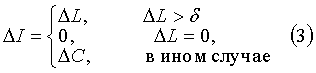
Фиг.3 иллюстрирует работу оценщика 104, который вычисляет изображение разности ΔI по освещенности и цвету между фоновым изображением и текущим видеокадром. Процесс выполняется для каждого пикселя, начиная с начала (шаг 301). Пусть Ib={Rb,Gb,Bb} - цветное изображение фона и I={R,G,B} - цветной видеокадр, ΔL - разность в освещенности, ΔС - разность в цвете, ΔI - изображение разностей. ТогдаFigure 3 illustrates the operation of the evaluator 104, which calculates the image of the difference ΔI in light and color between the background image and the current video frame. A process is performed for each pixel, starting from the beginning (step 301). Let I b = {R b , G b , B b } be the color image of the background and I = {R, G, B} be the color video frame, ΔL be the difference in illumination, ΔС be the difference in color, and ΔI be the image of differences. Then


На шаге 302 вычисляют значение D максимальной разности в цветовых каналах. Далее проверяется условие 303, выбирается константа δ в пределах 25-30 для 24-битового цветного изображения (где значения в цветовых каналах меняется от 0 до 255). Если D<δ, то цветовая разность вычисляется по формуле, приведенной выше. Суммируя все вышесказанное,At
Если текущий пиксель оказывается последним (шаг 306), процесс останавливают, определяют (выносят решение), принадлежит ли он фону, или целевому объекту.If the current pixel is the last (step 306), the process is stopped, it is determined (a decision is made) whether it belongs to the background or to the target.
Фиг.4 иллюстрирует работу детектора 107 фона/переднего плана, результатом вычисления которого является маска объекта, на шагах 401 и 402 выполняют кластеризацию k-средних для данных о глубине и скалярного изображения разности. Для первого видеокадра центры тяжести кластеров равномерно распределяют в интервале [0, MAX_DEPTH] и [0, 255] соответственно. На последующих кадрах центры тяжести кластеров инициализируются от предыдущих кадров. Начиная с первого пикселя (шаг 403), маску объекта заполняют для каждого положения пикселя. Для текущего положения пикселя определяют размер и центр тяжести кластера (шаг 404), при этом данные о глубине и скалярная разность в этом положении пикселя принадлежат:Figure 4 illustrates the operation of the background / foreground detector 107, the result of which is the mask of the object, at
Cd - центру тяжести класса глубины текущего положения пикселя.C d - the center of gravity of the depth class of the current pixel position.
Ci - центру тяжести класса скалярной разности текущего положения пикселя.C i - the center of gravity of the scalar difference class of the current pixel position.
Nd - Cd - размер класса.N d - C d - class size.
Затем на шагах 405-407 проверяют выполнение нескольких условий. Если все эти условия выполнены, то выносят решение, что текущее положение пикселя принадлежит целевому объекту, и маску объекта для этого положения заполняют единицами. В ином случае, если хотя бы одно из условий не выполнено, то маску объекта в этом положении задают нулем. Константы T1, T2 и T3 являются достаточно очевидными и основаны на здравом смысле:Then, at steps 405-407, several conditions are checked. If all these conditions are met, then they decide that the current pixel position belongs to the target object, and the object mask for this position is filled with units. Otherwise, if at least one of the conditions is not satisfied, then the mask of the object in this position is set to zero. The constants T 1 , T 2 and T 3 are fairly obvious and are based on common sense:
T1: разность изображения должна превышать некоторое значение для того, чтобы показать, что разность действительно существует. В приведенном примере реализации T1 задано, как 10 (максимально возможным значением, которое принимает Ci - это 255).T 1 : the difference of the image must exceed some value in order to show that the difference really exists. In the given implementation example, T 1 is set as 10 (the maximum possible value that C i takes is 255).
T2 и T3: обычно T2 известна из модуля вычисления глубины, это минимальная глубина, которая может быть достоверно определена. T3 может быть оценена априорно на основе длины базы устройства ввода (стереокамеры). Также она может быть вычислена из тех пикселей, где разность изображения является достаточно существенной, с тем, чтобы можно было с уверенностью утверждать, что местоположение этих пикселей соответствует целевому объекту.T 2 and T 3 : usually T 2 is known from the depth calculation module; this is the minimum depth that can be reliably determined. T 3 can be estimated a priori based on the length of the base of the input device (stereo camera). It can also be calculated from those pixels where the image difference is significant enough so that it can be confidently stated that the location of these pixels corresponds to the target.
T4: размер класса текущей глубины должен быть заметно существенным. В рассматриваемом варианте реализации изобретения примера осуществления, по меньшей мере, десять пикселей должны принадлежать данному классу (что составляет менее 0,02% от общего числа положений пикселей).T 4 : the class size of the current depth should be noticeably significant. In the present embodiment, at least ten pixels must belong to this class (which is less than 0.02% of the total number of pixel positions).
Следует отметить, что все вышеупомянутые условия достаточно приблизительные; ни одно из них не может самостоятельно гарантировать примерный результат. Но при совместном использовании они могут обеспечить достаточно приемлемую точность.It should be noted that all of the above conditions are approximate; none of them can independently guarantee an approximate result. But when used together, they can provide reasonably acceptable accuracy.
На шаге 410 проверяется условие, достигнут ли последний пиксель. Если так, то процесс прекращается. В ином случае вычисления продолжают в отношении следующего пикселя.At
После вычисления маски объекта обработчик 106 данных по фону обновляет фоновое изображение B с помощью маски объекта. Пиксели фонового изображения в положениях, где маска равна нулю и где разность меньше некоторого значения (например, меньше чем 15 для 8-битовой разности), обрабатывают с помощью метода «скользящего среднего»:After calculating the object mask, the background data processor 106 updates the background image B with the object mask. The pixels of the background image at positions where the mask is zero and where the difference is less than a certain value (for example, less than 15 for an 8-bit difference) is processed using the "moving average" method:

где α является показателем того, насколько быстро фоновое изображение аккомодируется к изменению освещенности сцены. Значения, близкие к еденице, свидетельствуют о замедленной аккомодации, а значения ниже 0,5 свидетельствуют о слишком быстрой аккомодации. Быстрая аккомодация может привести к ненужным изменениям в изображении фона, что вызовет появление артефактов в маске объекта. Поэтому значения α в пределах от 0,9 до 0,99 ведут к хорошим результатам.where α is an indicator of how quickly the background image accommodates to a change in the brightness of the scene. Values close to one indicate delayed accommodation, and values below 0.5 indicate too fast accommodation. Fast accommodation can lead to unnecessary changes in the background image, which will cause artifacts to appear in the mask of the object. Therefore, α values ranging from 0.9 to 0.99 lead to good results.
Заявляемое изобретение предназначено, в первую очередь, для практического применения в программном обеспечении систем съемки движения человека. Кроме того, заявляемый способ может найти применение в мониторах, снабженных стереокамерами, или в системах съемки движения на основе двух цифровых видеокамер. Возможно также применение заявляемого изобретения в интерактивных играх, графических спецэффектах и т.д.The claimed invention is intended, first of all, for practical use in software systems for recording motion of a person. In addition, the inventive method can find application in monitors equipped with stereo cameras, or in motion recording systems based on two digital video cameras. It is also possible to use the claimed invention in interactive games, graphic special effects, etc.
Следует отметить, что помимо описанного варианта реализации заявляемых способа и системы возможны и другие варианты осуществления изобретения, не выходящие за границы притязаний, изложенных в материалах данной заявки. При этом подразумевается, что чертежи и описание должны рассматриваться лишь в качестве иллюстративных материалов.It should be noted that in addition to the described embodiment of the inventive method and system, other embodiments of the invention are possible without going beyond the scope of the claims set forth in the materials of this application. It is understood that the drawings and description are to be regarded only as illustrative materials.
Claims (12)
- создают скалярное изображение разности изображения объекта и фона на основе разности освещенности, а в областях, где разность освещенности ниже заранее установленного порогового значения, на основе разности цвета;
- инициализируют маску по результатам, полученным из предыдущего видеокадра, где скалярное изображение разности меньше заранее установленного порога, если эти результаты доступны, при этом маску объекта заполняют нулями и единицами, где единица означает, что соответствующий пиксель принадлежит объекту, и нуль в ином случае;
- кластеризуют скалярное изображение разности и данные о глубине на основе нескольких кластеров;
- создают маску для каждого положения пикселя видео кадра на основе использования данных относительно центров тяжести кластеров скалярной разности и данных о глубине для текущего положения пикселя;
- компенсируют изменения фона сцены во времени путем обновления изображения фона на основе использования созданной маски и изображения разности.1. The method of extracting data about the image of the object from a sequence of video frames, from a background image that does not contain data about the image of the object, and from a sequence of data on the depth corresponding to the video frames, based on the created mask of the object for each video frame, while the inventive method involves the following operations :
- create a scalar image of the difference in the image of the object and the background based on the difference in illumination, and in areas where the difference in illumination is below a predetermined threshold value, based on the color difference;
- initialize the mask according to the results obtained from the previous video frame, where the scalar image of the difference is less than a predetermined threshold, if these results are available, while the object mask is filled with zeros and ones, where one means that the corresponding pixel belongs to the object, and zero otherwise;
- cluster the scalar image of the difference and depth data based on several clusters;
- create a mask for each pixel position of the video frame based on the use of data regarding the centers of gravity of the clusters of scalar difference and depth data for the current pixel position;
- compensate for changes in the background of the scene over time by updating the background image based on the use of the created mask and the difference image.

где ΔС - разность в цвете, ΔI - изображение разностей, ΔL - разность в освещенности, δ - константа в пределах 25-30 для 24-битового цветного изображения.6. The method according to claim 1, characterized in that the image of the differences ΔI is calculated using the following equation:
where ΔС is the difference in color, ΔI is the image of differences, ΔL is the difference in illumination, δ is a constant in the range of 25-30 for a 24-bit color image.

где Rb, Gb, Bb - характеризуют цветное изображение фона, R, G, В - характеризуют цветной видео кадр.7. The method according to claim 6, characterized in that the difference in illumination of the image ΔL is calculated using the following equation
where R b , G b , B b - characterize the color image of the background, R, G, B - characterize the color video frame.

Priority Applications (2)
| Application Number | Priority Date | Filing Date | Title |
|---|---|---|---|
| RU2010101846/09A RU2426172C1 (en) | 2010-01-21 | 2010-01-21 | Method and system for isolating foreground object image proceeding from colour and depth data |
| US13/011,419 US20110175984A1 (en) | 2010-01-21 | 2011-01-21 | Method and system of extracting the target object data on the basis of data concerning the color and depth |
Applications Claiming Priority (1)
| Application Number | Priority Date | Filing Date | Title |
|---|---|---|---|
| RU2010101846/09A RU2426172C1 (en) | 2010-01-21 | 2010-01-21 | Method and system for isolating foreground object image proceeding from colour and depth data |
Publications (1)
| Publication Number | Publication Date |
|---|---|
| RU2426172C1 true RU2426172C1 (en) | 2011-08-10 |
Family
ID=44277337
Family Applications (1)
| Application Number | Title | Priority Date | Filing Date |
|---|---|---|---|
| RU2010101846/09A RU2426172C1 (en) | 2010-01-21 | 2010-01-21 | Method and system for isolating foreground object image proceeding from colour and depth data |
Country Status (2)
| Country | Link |
|---|---|
| US (1) | US20110175984A1 (en) |
| RU (1) | RU2426172C1 (en) |
Cited By (5)
| Publication number | Priority date | Publication date | Assignee | Title |
|---|---|---|---|---|
| RU2517266C1 (en) * | 2012-03-08 | 2014-05-27 | Мицубиси Электрик Корпорейшн | Image construction device |
| RU2542876C2 (en) * | 2013-05-27 | 2015-02-27 | Федеральное государственное бюджетное образовательное учреждение высшего профессионального образования "Южно-Российский государственный университет экономики и сервиса" (ФГБОУ ВПО "ЮРГУЭС") | Apparatus for selecting highly detailed objects on scene image |
| RU2557484C1 (en) * | 2014-03-27 | 2015-07-20 | Федеральное государственное бюджетное образовательное учреждение высшего профессионального образования "Тамбовский государственный технический университет" ФГБОУ ВПО ТГТУ | Image segmentation method |
| RU2572377C1 (en) * | 2014-12-30 | 2016-01-10 | Федеральное государственное бюджетное образовательное учреждение высшего профессионального образования "Донской государственный технический университет" (ФГБОУ ВПО "ДГТУ") | Video sequence editing device |
| RU2669470C1 (en) * | 2017-12-25 | 2018-10-12 | федеральное государственное бюджетное образовательное учреждение высшего образования "Донской государственный технический университет" (ДГТУ) | Device for removing logos and subtitles from video sequences |
Families Citing this family (36)
| Publication number | Priority date | Publication date | Assignee | Title |
|---|---|---|---|---|
| US8565479B2 (en) | 2009-08-13 | 2013-10-22 | Primesense Ltd. | Extraction of skeletons from 3D maps |
| US8787663B2 (en) * | 2010-03-01 | 2014-07-22 | Primesense Ltd. | Tracking body parts by combined color image and depth processing |
| EP2548147B1 (en) * | 2010-03-13 | 2020-09-16 | Carnegie Mellon University | Method to recognize and classify a bare-root plant |
| US8594425B2 (en) * | 2010-05-31 | 2013-11-26 | Primesense Ltd. | Analysis of three-dimensional scenes |
| US9208571B2 (en) * | 2011-06-06 | 2015-12-08 | Microsoft Technology Licensing, Llc | Object digitization |
| US20130063556A1 (en) * | 2011-09-08 | 2013-03-14 | Prism Skylabs, Inc. | Extracting depth information from video from a single camera |
| AU2011224051B2 (en) * | 2011-09-14 | 2014-05-01 | Canon Kabushiki Kaisha | Determining a depth map from images of a scene |
| US9117281B2 (en) | 2011-11-02 | 2015-08-25 | Microsoft Corporation | Surface segmentation from RGB and depth images |
| US8879120B2 (en) * | 2012-01-12 | 2014-11-04 | Kofax, Inc. | Systems and methods for mobile image capture and processing |
| US11321772B2 (en) | 2012-01-12 | 2022-05-03 | Kofax, Inc. | Systems and methods for identification document processing and business workflow integration |
| US9047507B2 (en) | 2012-05-02 | 2015-06-02 | Apple Inc. | Upper-body skeleton extraction from depth maps |
| CN102881018B (en) * | 2012-09-27 | 2014-10-29 | 清华大学深圳研究生院 | Method for generating depth maps of images |
| TWI489090B (en) * | 2012-10-31 | 2015-06-21 | Pixart Imaging Inc | Detection system |
| CN103808305B (en) * | 2012-11-07 | 2017-11-07 | 原相科技股份有限公司 | Detection system |
| US10127636B2 (en) | 2013-09-27 | 2018-11-13 | Kofax, Inc. | Content-based detection and three dimensional geometric reconstruction of objects in image and video data |
| US10783615B2 (en) | 2013-03-13 | 2020-09-22 | Kofax, Inc. | Content-based object detection, 3D reconstruction, and data extraction from digital images |
| US11620733B2 (en) | 2013-03-13 | 2023-04-04 | Kofax, Inc. | Content-based object detection, 3D reconstruction, and data extraction from digital images |
| US9191643B2 (en) * | 2013-04-15 | 2015-11-17 | Microsoft Technology Licensing, Llc | Mixing infrared and color component data point clouds |
| US9852519B2 (en) | 2013-06-25 | 2017-12-26 | Pixart Imaging Inc. | Detection system |
| US10467465B2 (en) | 2015-07-20 | 2019-11-05 | Kofax, Inc. | Range and/or polarity-based thresholding for improved data extraction |
| US10242285B2 (en) | 2015-07-20 | 2019-03-26 | Kofax, Inc. | Iterative recognition-guided thresholding and data extraction |
| US10043279B1 (en) | 2015-12-07 | 2018-08-07 | Apple Inc. | Robust detection and classification of body parts in a depth map |
| US10587858B2 (en) * | 2016-03-14 | 2020-03-10 | Symbol Technologies, Llc | Device and method of dimensioning using digital images and depth data |
| US10366278B2 (en) | 2016-09-20 | 2019-07-30 | Apple Inc. | Curvature-based face detector |
| JP7098601B2 (en) * | 2017-03-31 | 2022-07-11 | ソニーセミコンダクタソリューションズ株式会社 | Image processing equipment, imaging equipment, image processing methods, and programs |
| TWM547115U (en) * | 2017-05-15 | 2017-08-11 | Lips Corp | Expandable dual-lens device |
| CN107368188B (en) * | 2017-07-13 | 2020-05-26 | 河北中科恒运软件科技股份有限公司 | Foreground extraction method and system based on multiple spatial positioning in mediated reality |
| CN107742306B (en) * | 2017-09-20 | 2021-03-23 | 徐州工程学院 | Moving target tracking algorithm in intelligent vision |
| US11062176B2 (en) | 2017-11-30 | 2021-07-13 | Kofax, Inc. | Object detection and image cropping using a multi-detector approach |
| US10515463B2 (en) * | 2018-04-20 | 2019-12-24 | Sony Corporation | Object segmentation in a sequence of color image frames by background image and background depth correction |
| US11774593B2 (en) * | 2019-12-27 | 2023-10-03 | Automotive Research & Testing Center | Method of simultaneous localization and mapping |
| CN111862511B (en) * | 2020-08-10 | 2021-08-24 | 湖南海森格诺信息技术有限公司 | Target intrusion detection device and method based on binocular stereo vision |
| CN112702615B (en) * | 2020-11-27 | 2023-08-08 | 深圳市创成微电子有限公司 | Network direct broadcast audio and video processing method and system |
| CN112991293B (en) * | 2021-03-12 | 2024-04-26 | 东南大学 | A fast and adaptive real-time color background extraction method |
| CN113902938B (en) * | 2021-10-26 | 2022-08-30 | 稿定(厦门)科技有限公司 | Image clustering method, device and equipment |
| KR20240066746A (en) * | 2022-11-08 | 2024-05-16 | 삼성전자주식회사 | Method and apparatus for composing traffic image |
Citations (4)
| Publication number | Priority date | Publication date | Assignee | Title |
|---|---|---|---|---|
| US6188777B1 (en) * | 1997-08-01 | 2001-02-13 | Interval Research Corporation | Method and apparatus for personnel detection and tracking |
| WO2006003611A2 (en) * | 2004-07-02 | 2006-01-12 | Koninklijke Philips Electronics N.V. | Video processing |
| RU2276407C2 (en) * | 2001-10-22 | 2006-05-10 | Интел Зао | Method and device for background segmentation on basis of movement localization |
| RU2370817C2 (en) * | 2004-07-29 | 2009-10-20 | Самсунг Электроникс Ко., Лтд. | System and method for object tracking |
Family Cites Families (2)
| Publication number | Priority date | Publication date | Assignee | Title |
|---|---|---|---|---|
| JP3679512B2 (en) * | 1996-07-05 | 2005-08-03 | キヤノン株式会社 | Image extraction apparatus and method |
| AU1930700A (en) * | 1998-12-04 | 2000-06-26 | Interval Research Corporation | Background estimation and segmentation based on range and color |
-
2010
- 2010-01-21 RU RU2010101846/09A patent/RU2426172C1/en not_active IP Right Cessation
-
2011
- 2011-01-21 US US13/011,419 patent/US20110175984A1/en not_active Abandoned
Patent Citations (4)
| Publication number | Priority date | Publication date | Assignee | Title |
|---|---|---|---|---|
| US6188777B1 (en) * | 1997-08-01 | 2001-02-13 | Interval Research Corporation | Method and apparatus for personnel detection and tracking |
| RU2276407C2 (en) * | 2001-10-22 | 2006-05-10 | Интел Зао | Method and device for background segmentation on basis of movement localization |
| WO2006003611A2 (en) * | 2004-07-02 | 2006-01-12 | Koninklijke Philips Electronics N.V. | Video processing |
| RU2370817C2 (en) * | 2004-07-29 | 2009-10-20 | Самсунг Электроникс Ко., Лтд. | System and method for object tracking |
Non-Patent Citations (1)
| Title |
|---|
| DARRELL Т. et al, A virtual mirror interface using real-time robust face tracking, PROCEEDINGS THIRD IEEE INTERNATIONAL CONFERENCE ON AUTOMATIC FACE AND GESTURE RECOGNITION, PROCEEDINGS THIRD IEEE INTERNATIONAL CONFERENCE ON AUTOMATIC FACE AND GESTURE RECOGNITION, Japan, 14-16 April 1998, c.c.616-621. ГОНСАЛЕС P., ВУДС Р. Цифровая обработка изображений, Техносфера. - М., 2006, глава 10, 12, с.872-873, 893-904. ШАПИРО Л., СТОКМАН ДЖ. Компьютерное зрение, Бином. Лаборатория знаний. - М., 2006, с.363-377. * |
Cited By (5)
| Publication number | Priority date | Publication date | Assignee | Title |
|---|---|---|---|---|
| RU2517266C1 (en) * | 2012-03-08 | 2014-05-27 | Мицубиси Электрик Корпорейшн | Image construction device |
| RU2542876C2 (en) * | 2013-05-27 | 2015-02-27 | Федеральное государственное бюджетное образовательное учреждение высшего профессионального образования "Южно-Российский государственный университет экономики и сервиса" (ФГБОУ ВПО "ЮРГУЭС") | Apparatus for selecting highly detailed objects on scene image |
| RU2557484C1 (en) * | 2014-03-27 | 2015-07-20 | Федеральное государственное бюджетное образовательное учреждение высшего профессионального образования "Тамбовский государственный технический университет" ФГБОУ ВПО ТГТУ | Image segmentation method |
| RU2572377C1 (en) * | 2014-12-30 | 2016-01-10 | Федеральное государственное бюджетное образовательное учреждение высшего профессионального образования "Донской государственный технический университет" (ФГБОУ ВПО "ДГТУ") | Video sequence editing device |
| RU2669470C1 (en) * | 2017-12-25 | 2018-10-12 | федеральное государственное бюджетное образовательное учреждение высшего образования "Донской государственный технический университет" (ДГТУ) | Device for removing logos and subtitles from video sequences |
Also Published As
| Publication number | Publication date |
|---|---|
| US20110175984A1 (en) | 2011-07-21 |
Similar Documents
| Publication | Publication Date | Title |
|---|---|---|
| RU2426172C1 (en) | Method and system for isolating foreground object image proceeding from colour and depth data | |
| US10867430B2 (en) | Method and system of 3D reconstruction with volume-based filtering for image processing | |
| US11443454B2 (en) | Method for estimating the pose of a camera in the frame of reference of a three-dimensional scene, device, augmented reality system and computer program therefor | |
| Crabb et al. | Real-time foreground segmentation via range and color imaging | |
| US9426449B2 (en) | Depth map generation from a monoscopic image based on combined depth cues | |
| CN107025635B (en) | Processing method, processing device and electronic device for image saturation based on depth of field | |
| CN109949347B (en) | Human body tracking method, device, system, electronic equipment and storage medium | |
| JP6489551B2 (en) | Method and system for separating foreground from background in a sequence of images | |
| Weinzaepfel et al. | Learning to detect motion boundaries | |
| KR100953076B1 (en) | Multipoint Matching Method and Device Using Object or Background Separation | |
| CN111340749B (en) | Image quality detection method, device, equipment and storage medium | |
| KR102525030B1 (en) | Apparatus and method for generating point cloud | |
| US20170124717A1 (en) | Method and system of background-foreground segmentation for image processing | |
| Fernandez-Sanchez et al. | Background subtraction model based on color and depth cues | |
| CN107018323B (en) | Control method, control device and electronic device | |
| CN106993112A (en) | Background virtualization method and device based on depth of field and electronic device | |
| JP7163049B2 (en) | Information processing device, information processing method and program | |
| WO2018053952A1 (en) | Video image depth extraction method based on scene sample library | |
| CN107481267A (en) | A kind of shooting projection interactive system and method based on binocular vision | |
| CN115035235A (en) | Three-dimensional reconstruction method and device | |
| Camplani et al. | Accurate depth-color scene modeling for 3D contents generation with low cost depth cameras | |
| Zhao et al. | Real-time and temporal-coherent foreground extraction with commodity RGBD camera | |
| Prasad et al. | Epipolar geometry based learning of multi-view depth and ego-motion from monocular sequences | |
| CN112308875A (en) | Unsupervised image segmentation based on background likelihood estimation | |
| Calagari et al. | Data driven 2-D-to-3-D video conversion for soccer |
Legal Events
| Date | Code | Title | Description |
|---|---|---|---|
| MM4A | The patent is invalid due to non-payment of fees |
Effective date: 20160122 |