RU2317361C2 - Composition for manufacture of paper and method for increasing extent of retention and/or dehydration in the same - Google Patents
Composition for manufacture of paper and method for increasing extent of retention and/or dehydration in the same Download PDFInfo
- Publication number
- RU2317361C2 RU2317361C2 RU2005113160/12A RU2005113160A RU2317361C2 RU 2317361 C2 RU2317361 C2 RU 2317361C2 RU 2005113160/12 A RU2005113160/12 A RU 2005113160/12A RU 2005113160 A RU2005113160 A RU 2005113160A RU 2317361 C2 RU2317361 C2 RU 2317361C2
- Authority
- RU
- Russia
- Prior art keywords
- solvent
- composition
- phenolic resin
- retention
- paper
- Prior art date
Links
- 230000014759 maintenance of location Effects 0.000 title claims abstract description 78
- 239000000203 mixture Substances 0.000 title claims abstract description 42
- 230000018044 dehydration Effects 0.000 title claims abstract description 26
- 238000006297 dehydration reaction Methods 0.000 title claims abstract description 26
- 238000000034 method Methods 0.000 title claims description 13
- 238000004519 manufacturing process Methods 0.000 title abstract description 16
- 229920003171 Poly (ethylene oxide) Polymers 0.000 claims abstract description 66
- 239000005011 phenolic resin Substances 0.000 claims abstract description 59
- 229920006317 cationic polymer Polymers 0.000 claims abstract description 41
- 239000000945 filler Substances 0.000 claims abstract description 25
- 125000002091 cationic group Chemical group 0.000 claims abstract description 16
- 239000002904 solvent Substances 0.000 claims abstract description 8
- 230000003311 flocculating effect Effects 0.000 claims abstract description 5
- 239000007788 liquid Substances 0.000 claims abstract description 5
- 229920001568 phenolic resin Polymers 0.000 claims description 64
- KXGFMDJXCMQABM-UHFFFAOYSA-N 2-methoxy-6-methylphenol Chemical compound [CH]OC1=CC=CC([CH])=C1O KXGFMDJXCMQABM-UHFFFAOYSA-N 0.000 claims description 54
- 239000000123 paper Substances 0.000 claims description 51
- 239000000835 fiber Substances 0.000 claims description 16
- 239000003795 chemical substances by application Substances 0.000 claims description 15
- 239000006185 dispersion Substances 0.000 claims description 6
- XLYOFNOQVPJJNP-UHFFFAOYSA-N water Substances O XLYOFNOQVPJJNP-UHFFFAOYSA-N 0.000 claims description 6
- 239000013043 chemical agent Substances 0.000 claims description 5
- 239000002245 particle Substances 0.000 claims description 5
- 239000007787 solid Substances 0.000 claims description 3
- 239000008394 flocculating agent Substances 0.000 claims 1
- 239000000126 substance Substances 0.000 abstract description 2
- 239000004815 dispersion polymer Substances 0.000 abstract 1
- 230000000694 effects Effects 0.000 abstract 1
- 229920000642 polymer Polymers 0.000 description 17
- 230000008901 benefit Effects 0.000 description 11
- 230000015572 biosynthetic process Effects 0.000 description 11
- SLGWESQGEUXWJQ-UHFFFAOYSA-N formaldehyde;phenol Chemical compound O=C.OC1=CC=CC=C1 SLGWESQGEUXWJQ-UHFFFAOYSA-N 0.000 description 8
- 239000000725 suspension Substances 0.000 description 8
- 229920001131 Pulp (paper) Polymers 0.000 description 6
- 238000002474 experimental method Methods 0.000 description 6
- 239000010419 fine particle Substances 0.000 description 5
- 229920002401 polyacrylamide Polymers 0.000 description 5
- 239000004698 Polyethylene Substances 0.000 description 4
- 239000004927 clay Substances 0.000 description 4
- 239000000356 contaminant Substances 0.000 description 4
- 229920000573 polyethylene Polymers 0.000 description 4
- 230000008569 process Effects 0.000 description 4
- 229920003043 Cellulose fiber Polymers 0.000 description 3
- 229920002472 Starch Polymers 0.000 description 3
- 238000010586 diagram Methods 0.000 description 3
- GRWZHXKQBITJKP-UHFFFAOYSA-L dithionite(2-) Chemical compound [O-]S(=O)S([O-])=O GRWZHXKQBITJKP-UHFFFAOYSA-L 0.000 description 3
- 239000002655 kraft paper Substances 0.000 description 3
- 230000007246 mechanism Effects 0.000 description 3
- 239000002957 persistent organic pollutant Substances 0.000 description 3
- 238000002203 pretreatment Methods 0.000 description 3
- 230000009467 reduction Effects 0.000 description 3
- 239000011122 softwood Substances 0.000 description 3
- 239000008107 starch Substances 0.000 description 3
- 235000019698 starch Nutrition 0.000 description 3
- 238000012360 testing method Methods 0.000 description 3
- 239000007900 aqueous suspension Substances 0.000 description 2
- 238000006243 chemical reaction Methods 0.000 description 2
- 230000002349 favourable effect Effects 0.000 description 2
- 230000009931 harmful effect Effects 0.000 description 2
- 229920005989 resin Polymers 0.000 description 2
- 239000011347 resin Substances 0.000 description 2
- OKTJSMMVPCPJKN-UHFFFAOYSA-N Carbon Chemical compound [C] OKTJSMMVPCPJKN-UHFFFAOYSA-N 0.000 description 1
- 229920001410 Microfiber Polymers 0.000 description 1
- BPQQTUXANYXVAA-UHFFFAOYSA-N Orthosilicate Chemical compound [O-][Si]([O-])([O-])[O-] BPQQTUXANYXVAA-UHFFFAOYSA-N 0.000 description 1
- 239000004952 Polyamide Substances 0.000 description 1
- 239000004236 Ponceau SX Substances 0.000 description 1
- QAOWNCQODCNURD-UHFFFAOYSA-L Sulfate Chemical compound [O-]S([O-])(=O)=O QAOWNCQODCNURD-UHFFFAOYSA-L 0.000 description 1
- UCKMPCXJQFINFW-UHFFFAOYSA-N Sulphide Chemical compound [S-2] UCKMPCXJQFINFW-UHFFFAOYSA-N 0.000 description 1
- 239000000654 additive Substances 0.000 description 1
- 238000004061 bleaching Methods 0.000 description 1
- 150000001768 cations Chemical class 0.000 description 1
- 238000004140 cleaning Methods 0.000 description 1
- 239000000701 coagulant Substances 0.000 description 1
- 230000006378 damage Effects 0.000 description 1
- 230000008021 deposition Effects 0.000 description 1
- 230000001627 detrimental effect Effects 0.000 description 1
- 239000002270 dispersing agent Substances 0.000 description 1
- 238000001035 drying Methods 0.000 description 1
- 239000003344 environmental pollutant Substances 0.000 description 1
- 239000004744 fabric Substances 0.000 description 1
- 238000005189 flocculation Methods 0.000 description 1
- 230000016615 flocculation Effects 0.000 description 1
- 239000012634 fragment Substances 0.000 description 1
- 229920006158 high molecular weight polymer Polymers 0.000 description 1
- 125000004435 hydrogen atom Chemical group [H]* 0.000 description 1
- 238000005470 impregnation Methods 0.000 description 1
- 230000003993 interaction Effects 0.000 description 1
- 238000009533 lab test Methods 0.000 description 1
- 238000005259 measurement Methods 0.000 description 1
- 239000003658 microfiber Substances 0.000 description 1
- 238000002156 mixing Methods 0.000 description 1
- 230000004048 modification Effects 0.000 description 1
- 238000012986 modification Methods 0.000 description 1
- 239000000178 monomer Substances 0.000 description 1
- 239000000025 natural resin Substances 0.000 description 1
- 238000010606 normalization Methods 0.000 description 1
- 238000004806 packaging method and process Methods 0.000 description 1
- 239000011087 paperboard Substances 0.000 description 1
- 231100000719 pollutant Toxicity 0.000 description 1
- 229920002647 polyamide Polymers 0.000 description 1
- 239000002952 polymeric resin Substances 0.000 description 1
- 239000000843 powder Substances 0.000 description 1
- 238000005086 pumping Methods 0.000 description 1
- 239000002994 raw material Substances 0.000 description 1
- 239000002689 soil Substances 0.000 description 1
- 238000001179 sorption measurement Methods 0.000 description 1
- 239000011885 synergistic combination Substances 0.000 description 1
- 238000003786 synthesis reaction Methods 0.000 description 1
- 229920003002 synthetic resin Polymers 0.000 description 1
- 230000007704 transition Effects 0.000 description 1
- 239000002699 waste material Substances 0.000 description 1
Images


Classifications
-
- D—TEXTILES; PAPER
- D21—PAPER-MAKING; PRODUCTION OF CELLULOSE
- D21H—PULP COMPOSITIONS; PREPARATION THEREOF NOT COVERED BY SUBCLASSES D21C OR D21D; IMPREGNATING OR COATING OF PAPER; TREATMENT OF FINISHED PAPER NOT COVERED BY CLASS B31 OR SUBCLASS D21G; PAPER NOT OTHERWISE PROVIDED FOR
- D21H23/00—Processes or apparatus for adding material to the pulp or to the paper
- D21H23/76—Processes or apparatus for adding material to the pulp or to the paper characterised by choice of auxiliary compounds which are added separately from at least one other compound, e.g. to improve the incorporation of the latter or to obtain an enhanced combined effect
- D21H23/765—Addition of all compounds to the pulp
-
- D—TEXTILES; PAPER
- D21—PAPER-MAKING; PRODUCTION OF CELLULOSE
- D21H—PULP COMPOSITIONS; PREPARATION THEREOF NOT COVERED BY SUBCLASSES D21C OR D21D; IMPREGNATING OR COATING OF PAPER; TREATMENT OF FINISHED PAPER NOT COVERED BY CLASS B31 OR SUBCLASS D21G; PAPER NOT OTHERWISE PROVIDED FOR
- D21H21/00—Non-fibrous material added to the pulp, characterised by its function, form or properties; Paper-impregnating or coating material, characterised by its function, form or properties
- D21H21/06—Paper forming aids
- D21H21/10—Retention agents or drainage improvers
Landscapes
- Paper (AREA)
Abstract
Description
Область, к которой относится изобретениеFIELD OF THE INVENTION
Данное изобретение относится к изготовлению бумаги. Более конкретно, оно относится к композиции для изготовления бумаги, которая содержит вспомогательное средство для удерживания на основе не содержащего растворитель катионного полимера в сочетании с фенольной смолой и полиэтиленоксидом (ПЭО) для повышения удерживания и/или обезвоживания композиции.This invention relates to the manufacture of paper. More specifically, it relates to a composition for making paper, which contains a retention aid based on a solvent-free cationic polymer in combination with a phenolic resin and polyethylene oxide (PEO) to increase retention and / or dewatering of the composition.
Предпосылки создания изобретенияBACKGROUND OF THE INVENTION
В процессе производства бумаги водную суспензию целлюлозных волокон, возможно, содержащую наполнитель и катионный крахмал, а также другие химические агенты для изготовления бумаги, наносят на проволоку или ткань, при этом вода удаляется с образованием волокнистого холста или листа. Такая водная суспензия или пульпа называется "композицией для изготовления бумаги". Для эффективного получения и увеличения скорости процесса, а также снижения стоимости изготовления бумаги высокого качества очень важны удаление воды или обезвоживание композиции, а также удерживание мелких частиц, наполнителей и других химических агентов в бумажном листе.In the paper manufacturing process, an aqueous suspension of cellulosic fibers, possibly containing a filler and cationic starch, as well as other chemical agents for making paper, is applied to the wire or fabric, and the water is removed to form a fibrous canvas or sheet. Such an aqueous suspension or pulp is called a “paper making composition”. To effectively obtain and increase the speed of the process, as well as reduce the cost of manufacturing high quality paper, it is very important to remove water or dehydrate the composition, as well as to keep small particles, fillers and other chemical agents in the paper sheet.
Хорошо известно использование комбинации фенольной смолы и полиэтиленоксида в качестве флоккулента для увеличения удерживания и обезвоживания в процессе изготовления бумаги и бумажного картона, особенно газетной бумаги, когда механическая пульпа, содержащая растворенные органические загрязняющие вещества, оказывает вредное влияние. В таких системах фенольную смолу обычно добавляют в композицию первой до места сдвига при помощи лопастного насоса, а ПЭО добавляют вторым, обычно вблизи напорного ящика бумагоделательной машины для того, чтобы свести к минимуму сдвиг. Как известно, сдвиг осуществляется на одной или нескольких стадиях очистки, смешения и закачивания в бумагоделательном процессе, этот сдвиг приводит к разрушению обрезков волокон, образованных высокомолеулярным полимером, на микроволокна, которые в дальнейшем агломерируют, например, в присутствии катионного крахмала.It is well known to use a combination of phenolic resin and polyethylene oxide as a flocculant to increase retention and dehydration during the manufacture of paper and paper board, especially newsprint, when a mechanical pulp containing dissolved organic pollutants has a harmful effect. In such systems, the phenolic resin is usually added to the composition first to the point of shear using a vane pump, and PEO is added second, usually near the headbox of the paper machine, in order to minimize shear. As you know, shear is carried out at one or several stages of cleaning, mixing and pumping in a paper-making process, this shift leads to the destruction of fiber fragments formed by a high molecular weight polymer into microfibers, which subsequently agglomerate, for example, in the presence of cationic starch.
Предполагают, что механизм удерживания двухкомпонентной системой фенольная смола - ПЭО заключается, во-первых, в адсорбции фенольной смолы волокнами и мелкими частицами с последующим присоединением ПЭО к фенольным гидроксилам смолы и также в ускорении обезвоживания. Примеры таких двухкомпонентных систем удерживания описаны, например, в патентах США №№4070236 и 5472570.It is believed that the retention mechanism of the two-component phenolic resin – PEO system consists, first, in the adsorption of the phenolic resin by fibers and small particles, followed by the addition of PEO to the phenolic resin hydroxyls and also in accelerating dehydration. Examples of such two-component retention systems are described, for example, in US patent No. 4070236 and 5472570.
Двухкомпонентная система фенольная смола/ПЭО имеет преимущество, заключающееся в том, что она является независимой от большинства растворенных и коллоидных загрязнений в водном контуре, так как она действует по механизму связывания атомов водорода. В противоположность этому, катионные полиакриламиды, которые общеизвестны как вспомогательные средства для удерживания, подвергаются вредному воздействию растворенных и коллоидных загрязняющих частиц, находящихся в механической пульпе.The two-component phenolic resin / PEO system has the advantage that it is independent of most dissolved and colloidal contaminants in the water circuit, since it acts by the mechanism of binding of hydrogen atoms. In contrast, cationic polyacrylamides, which are commonly known as retention aids, are exposed to the harmful effects of dissolved and colloidal contaminants in a mechanical pulp.
Кроме того, двухкомпонентная система фенольная смола/ПЭО имеет несколько других преимуществ по сравнению с катионными полиамидами, включая благоприятное воздействие на образование конечного листа и контроль за смолой, что связано со способностью системы фиксировать органические загрязняющие вещества в бумажном листе, препятствуя их осаждению на частях оборудования на фабриках, что вызывает возможные перерывы в работе.In addition, the two-component phenolic resin / PEO system has several other advantages compared to cationic polyamides, including a favorable effect on the formation of the final sheet and control of the resin, which is associated with the ability of the system to fix organic pollutants in the paper sheet, preventing their deposition on parts of the equipment in factories, which causes possible interruptions in work.
Тем не менее, несмотря на эти преимущества, система удерживания фенольной смолы/ПЭО и обезвоживания не используется на фабриках, где изготавливают такие сорта бумаги, как высоконаполненная специальная содержащая древесную массу бумага, мелкозернистая бумага (когда механическая пульпа из хвойной древесины не является значительной частью композиции), папиросная и оберточная бумага. В этих случаях преобладает применение полиакриламидов.However, despite these advantages, the phenolic resin / PEO retention system and dewatering system are not used in factories where paper grades such as highly filled special pulp-containing paper or fine-grained paper are used (when softwood pulp is not a significant part of the composition ), tissue and wrapping paper. In these cases, the use of polyacrylamides predominates.
Основной причиной неудачи с использованием системы фенольная смола/ПЭО в вышеупомянутых случаях являются ухудшенные характеристики вследствие отсутствия органических загрязняющих веществ в композициях по сравнению со свойствами бумаги, полученной из механической пульпы хвойных пород, применяемой при изготовлении многих видов газетной бумаги. Эти загрязняющие вещества участвуют в механизме образования сетчатой структуры, благодаря которой эта система удерживания функционирует; и их отсутствие в других композициях, таких как сульфатная пульпа и переработанная для вторичного использования, не содержащая печатной краски пульпа, привело к преобладанию других систем удерживания, особенно катионных полиакриламидов. Кроме того, было установлено, что наличие остаточного силиката в пульпе после некоторых операций отбеливания и удаления печатной краски иногда оказывает вредное воздействие на полиэтиленоксид, вызывая потерю удерживания или обезвоживания (см. Rahman and Tay Tappi Proceedings, 1986, Papermakers Conference, p. 189-198).The main reason for the failure to use the phenolic resin / PEO system in the above cases is the deteriorated performance due to the absence of organic contaminants in the compositions compared to the properties of paper obtained from softwood pulp used in the manufacture of many types of newsprint. These pollutants are involved in the mechanism of formation of the mesh structure, due to which this retention system operates; and their absence in other compositions, such as sulfate pulp and recycled ink-free pulp, has led to the predominance of other retention systems, especially cationic polyacrylamides. In addition, it was found that the presence of residual silicate in the pulp after some bleaching and ink removal operations sometimes has a detrimental effect on polyethylene oxide, causing loss of retention or dehydration (see Rahman and Tay Tappi Proceedings, 1986, Papermakers Conference, p. 189- 198).
Таким образом, существует потребность в улучшенных системах удерживания на основе фенольной смолы/ПЭО, которые позволят преодолеть указанные недостатки и повысить степень удерживания и степень обезвоживания, особенно, в таких композициях, как сульфидная пульпа и переработанная для вторичного использования и очищенная от печатной краски пульпа.Thus, there is a need for improved phenolic resin / PEO retention systems that overcome these disadvantages and increase retention and dehydration, especially in compositions such as sulfide pulp and recycled ink-free pulp.
Цели и сущность изобретенияOBJECTS AND SUMMARY OF THE INVENTION
Цель данного изобретения состоит в создании композиции для изготовления бумаги с повышенной степенью удерживания и обезвоживания на основе системы удерживания, содержащей фенольную смолу/ПЭО.The purpose of this invention is to provide a composition for the manufacture of paper with an increased degree of retention and dehydration based on a retention system containing phenolic resin / PEO.
Еще одной целью является создание способа увеличения степени удерживания и обезвоживания композиции для изготовления бумаги при сохранении хорошего качества листов бумаги при пониженной стоимости.Another goal is to create a way to increase the degree of retention and dewatering of the composition for making paper while maintaining good quality sheets of paper at a reduced cost.
Дальнейшая цель состоит в создании композиции для изготовления бумаги на основе системы удерживания, содержащей сочетание фенольной смолы/ПЭО, которая была бы пригодной для производства высоконаполненной содержащей древесную массу бумаги, мелкозернистой бумаги, папиросной и оберточной бумаги.A further objective is to provide a paper making composition based on a retention system comprising a phenolic resin / PEO combination that is suitable for the production of highly filled pulp-containing paper, fine-grained paper, tissue paper and brown paper.
Другие цели и преимущества изобретения станут очевидными из следующего описания.Other objectives and advantages of the invention will become apparent from the following description.
Заявители неожиданно обнаружили, что вспомогательное средство для удерживания, состоящее из не содержащего растворитель катионного полимера, который находится в виде свободной от масляной фазы водорастворимой дисперсии, в сочетании с фенольной смолой, такой как фенолформальдегидная смола, обеспечивает повышенную степень удерживания и обезвоживания, а также другие преимущества, такие как сниженная стоимость при использовании вместе с полиэтиленоксидом (ПЭО). Когда не содержащие растворителя катионный полимер в качестве средства для удерживания и фенольная смола добавляются к композиции, они образуют структуру, которая обеспечивает более эффективную реакцию с полиэтиленоксидом, когда он добавляется в композицию. Удерживание, а именно удерживание волокон, удерживание наполнителя и удерживание COD (природных смол и других органических загрязнений), и обезвоживание возрастают до такой степени, что такую систему используют при производстве мелкозернистой бумаги, упаковочных сортов бумаги и других видов печатной продукции. Достигается дополнительное увеличение удерживания наполнителей и мелких частиц, которое позволяет применять только сочетание ПЭО и фенольной смолы или только не содержащего растворитель катионного полимера.Applicants have unexpectedly discovered that a retention aid consisting of a solvent-free cationic polymer, which is in the form of an oil-free water-soluble dispersion, in combination with a phenolic resin such as phenol-formaldehyde resin provides an increased degree of retention and dehydration, as well as others benefits such as reduced cost when used with polyethylene oxide (PEO). When a solvent-free cationic polymer as a retention aid and a phenolic resin are added to the composition, they form a structure that provides a more effective reaction with polyethylene oxide when it is added to the composition. The retention, namely retention of fibers, retention of filler and retention of COD (natural resins and other organic pollutants), and dehydration increase to such an extent that such a system is used in the production of fine-grained paper, packaging paper and other types of printed products. An additional increase in the retention of fillers and fine particles is achieved, which allows the use of only a combination of PEO and phenolic resin or only a solvent-free cationic polymer.
Средства для удерживания не содержащего растворитель катионного полимера, подходящие для целей данного изобретения, характеризуются тем, что они не содержат никакой масляной фазы. Они являются жидкими, водными не содержащими растворителей дисперсиями катионных полимеров с обычной плотностью зарядов от 20 до 75% мол., содержанием твердых частиц от 2 до 70% и вязкостью 1%-ного раствора в воде, равной 2000-20000 мПа·с.Solvent-free cationic polymer retention agents suitable for the purposes of this invention are characterized in that they do not contain any oil phase. They are liquid, aqueous solvent-free dispersions of cationic polymers with a usual charge density of 20 to 75 mol%, a solids content of 2 to 70% and a viscosity of a 1% solution in water of 2000-20000 MPa · s.
Синтез таких полимерных дисперсий описан, например, в патенте США № 5480934, где также указано, что они могут быть использованы в качестве агентов для удерживания при производстве бумаги, для пропитки почвы или в качестве диспергатора. Однако в этом патенте нет предположения, что они могут применяться в качестве компонента системы фенольная смола/ПЭО, обеспечивая вышеописанные преимущества.The synthesis of such polymer dispersions is described, for example, in US patent No. 5480934, which also indicates that they can be used as retention agents in the manufacture of paper, for soil impregnation or as a dispersant. However, there is no suggestion in this patent that they can be used as a component of the phenolic resin / PEO system, providing the above advantages.
Не содержащий растворителя катионный полимер и фенольная смола могут вводиться в композицию по отдельности в двух разных точках добавления или вместе в одной точке, то есть их добавляют последовательно или вместе, и их сочетание более благоприятно взаимодействует с ПЭО, чем в случае, если любой компонент используется один. Вспомогательное средство для удерживания на основе не содержащего растворителя катионного полимера и фенольную смолу можно добавлять в композицию или до, или после добавления ПЭО.The solvent-free cationic polymer and phenolic resin can be introduced separately at two different points of addition or together at one point, that is, they are added sequentially or together, and their combination interacts more favorably with PEO than if any component is used one. A solvent-based cationic polymer retention aid and phenolic resin can be added to the composition either before or after the addition of PEO.
Не содержащие растворителя катионные полимеры пригодны для целей данного изобретения независимо от числа, типа или концентрации мономеров, используемых для их получения, они могут быть в виде жидкости или порошка. Примеры таких полимеров изготавливает Degussa под торговыми наименованиями Praestaret К-325 и Praestaret К-350, а также Praestol E-125 и Praestor E-150.Solvent-free cationic polymers are suitable for the purposes of this invention, regardless of the number, type or concentration of monomers used to prepare them, they can be in the form of a liquid or powder. Examples of such polymers are manufactured by Degussa under the trade names Praestaret K-325 and Praestaret K-350, as well as Praestol E-125 and Praestor E-150.
Таким образом, данное изобретение обеспечивает композицию для изготовления бумаги, содержащую комбинацию не содержащего растворителя катионного полимерного средства для удерживания с фенольной смолой и полиэтиленоксидом в качестве системы для удерживания мелких частиц, наполнителей и других химических агентов в листе бумаги.Thus, the present invention provides a paper making composition comprising a combination of a solvent-free cationic polymeric retention aid with a phenolic resin and polyethylene oxide as a system for holding fine particles, fillers and other chemical agents in a sheet of paper.
Согласно предпочтительному варианту количество не содержащего растворитель вспомогательного средства для удерживания составляет 0,05-10 кг/т в расчете на вес сухих волокон; количество фенольной смолы равно 0,05-10 кг смолы в том виде, как она продается, на тонну сухих волокон и количество полиэтиленоксида равно 5-500 г/т в расчете на вес сухих волокон («т» означает метрическую тонну).According to a preferred embodiment, the amount of solvent-free retention aid is 0.05-10 kg / ton based on the weight of dry fibers; the amount of phenolic resin is 0.05-10 kg of resin as it is sold per tonne of dry fibers and the amount of polyethylene oxide is 5-500 g / t based on the weight of dry fibers (“t” means metric ton).
Предпочтительное отношение не содержащего растворитель вспомогательного средства для удерживания к фенольной смоле составляет от 200:1 до 1:200, отношение фенольной смолы к ПЭО составляет от 100:1 до 1:100 и отношение не содержащего растворитель вспомогательного средства для удерживания к ПЭО равно от 1:2000 до 2000:1.The preferred ratio of solvent-free retention aid to phenolic resin is from 200: 1 to 1: 200, the ratio of phenolic resin to PEO is from 100: 1 to 1: 100, and the ratio of solvent-free retention aid to PEO is from 1 : 2000 to 2000: 1.
Изобретение включает также способ повышения степени удерживания и обезвоживания в композиции для изготовления бумаги путем добавления к композиции эффективного количества не содержащего растворитель катионного полимерного средства для удерживания в сочетании с фенольной смолой и полиэтиленоксидом. Эффективное количество зависит от типа обезвоживаемой пульпы и от других используемых добавок. Оно может быть легко установлено опытным путем методом проб и ошибок. Предпочтительные количества указаны выше.The invention also includes a method of increasing retention and dehydration in a paper composition by adding to the composition an effective amount of a solvent-free cationic polymeric retention agent in combination with a phenolic resin and polyethylene oxide. The effective amount depends on the type of dehydrated pulp and other additives used. It can be easily installed empirically by trial and error. Preferred amounts are indicated above.
Согласно еще одному варианту данного изобретения было установлено, что дальнейшее увеличение степени обезвоживания листа и скорости машины достигается, когда не содержащий растворителя катионный полимерный агент для удерживания добавляется последним после введения ПЭО и после последней точки сдвига.According to another embodiment of the present invention, it was found that a further increase in the degree of dehydration of the sheet and the speed of the machine is achieved when the solvent-free cationic polymer retention agent is added last after the introduction of PEO and after the last shear point.
Согласно еще одному варианту данного изобретения наполнитель предварительно обрабатывают не содержащим растворителя катионным полимерным средством для удерживания прежде, чем он вводится в сырье. Эта предварительная обработка является предварительной флоккуляцией и приводит к лучшему диспергированию наполнителя в сырье, большей степени удерживания мелких частиц/наполнителя и большей матовости. Предварительно обработанный наполнитель дозируется в сырье до последней точки сдвига и ПЭО предпочтительно дозировать вблизи напорного ящика, таким образом, захватываются частицы наполнителя, а также другие мелкие частицы и волокна в пространственной сетчатой структуре.According to another embodiment of the invention, the filler is pretreated with a solvent-free cationic polymer retention aid before it is introduced into the feed. This pre-treatment is pre-flocculation and leads to better dispersion of the filler in the feed, a greater degree of retention of fine particles / filler and more haze. The pre-treated filler is dosed in the feedstock to the last shear point and PEO is preferably dosed near the headbox, so that filler particles and other small particles and fibers are captured in the spatial mesh structure.
Суммируя, можно сказать, что данное изобретение использует синергизм между фенольной смолой и не содержащим растворителя катионным полимерным средством для удерживания для улучшения сочетания с полиэтиленоксидом и для того, чтобы сделать возможным применение полиэтиленоксида и фенольной смолы в различных областях и для усовершенствования производства существующей газетной бумаги. Далее, синергическое сочетание фенольная смола/вспомогательное средство удерживания, являющееся не содержащим растворитель катионным полимером, приводит также к дополнительным преимуществам, если не содержащее растворитель катионное полимерное вспомогательное средство удерживания предварительно смешивают с наполнителем перед дозированием и реакцией с полиэтиленоксидом.Summarizing, it can be said that the present invention utilizes synergies between a phenolic resin and a solvent-free cationic polymeric retention agent to improve combination with polyethylene oxide and to make it possible to use polyethylene oxide and phenolic resin in various fields and to improve the production of existing newsprint. Further, the synergistic combination phenolic resin / retention aid, which is a solvent-free cationic polymer, also leads to additional advantages if the solvent-free cationic polymer retention aid is pre-mixed with the filler before dosing and reaction with polyethylene oxide.
Осуществление данного изобретения позволяет использовать преимущества введения полиэтиленоксида в большем количестве областей изготовления бумаги, чем это возможно в настоящее время. Эти преимущества включают более благоприятное формирование листов, чем в случае применения полиакриламидных агентов удерживания, способность фиксировать смолистые загрязняющие вещества в листе и меньшую скорость дозирования по сравнению с полиакриламидными системами, что приводит к меньшему потреблению пара в сушилках вследствие меньшего количества связанной воды. Другими преимуществами, получаемыми при использовании данного изобретения, являются взаимодействие с крахмалом и способность обеспечивать более эффективную флоккулирующую предварительную обработку наполнителя для того, чтобы активированный наполнитель лучше диспергировался в исходном сырье до его захвата при добавлении полиэтиленоксида. Обеспечение превосходной флоккулирующей предварительной обработки наполнителя позволяет последнему добиться лучшей укрывистости, в то время как в то же самое время его «захват» полиэтиленоксидом обеспечивает хорошее удерживание наполнителя.The implementation of this invention allows you to take advantage of the introduction of polyethylene oxide in more areas of paper manufacture than is currently possible. These advantages include more favorable sheet formation than polyacrylamide retention agents, the ability to fix resinous contaminants in the sheet, and a lower dosing rate compared to polyacrylamide systems, which leads to lower steam consumption in dryers due to less bound water. Other advantages obtained by using the present invention are the interaction with starch and the ability to provide a more effective flocculating pre-treatment of the filler so that the activated filler is better dispersed in the feedstock before it is captured when polyethylene oxide is added. Providing excellent flocculating pre-treatment of the filler allows the latter to achieve better hiding power, while at the same time, its "capture" by polyethylene oxide provides good retention of the filler.
Краткое описание чертежейBrief Description of the Drawings
Предпочтительные варианты изобретения будут описаны ниже со ссылкой на чертежи, на которых:Preferred embodiments of the invention will be described below with reference to the drawings, in which:
на Фиг.1 представлено схематическое изображение устройства, в котором не содержащий растворителя полимер и фенольную смолу вводят вместе в композицию для изготовления бумаги;1 is a schematic illustration of a device in which a solvent-free polymer and a phenolic resin are introduced together into a paper making composition;
на Фиг.2 представлена схема, согласно которой не содержащий растворителя полимер и фенольную смолу вводят по отдельности в композицию для изготовления бумаги;figure 2 presents a diagram according to which a solvent-free polymer and a phenolic resin are separately introduced into the composition for making paper;
на Фиг.3 представлена схема, согласно которой не содержащий растворителя полимер добавляют в композицию для изготовления бумаги последним;figure 3 presents a diagram according to which the solvent-free polymer is added to the composition for making paper last;
на Фиг.4 приведена схема, согласно которой наполнитель предварительно обрабатывают не содержащим растворителя полимером.Figure 4 shows a diagram according to which the filler is pre-treated with a solvent-free polymer.
Подробное описание изобретенияDETAILED DESCRIPTION OF THE INVENTION
Ниже изобретение описано со ссылкой на имеющиеся чертежи, которые иллюстрируют некоторые предпочтительные варианты и на которых одинаковые элементы имеют одну и ту же нумерацию.Below the invention is described with reference to the drawings, which illustrate some preferred options and in which the same elements have the same numbering.
Так, на Фиг.1 показана схема процесса изготовления бумаги, согласно которой лопастной насос 10 образует последнюю точку сдвига, после которой композиция попадает на сито 12 и оттуда в напорный ящик 14. Согласно этому варианту не содержащий растворителя полимер и фенольную смолу вводят в композицию вместе между насосом 10 и ситом 12 перед введением ПЭО.Thus, FIG. 1 shows a papermaking process, according to which the
Согласно варианту, показанному на Фиг.2, не содержащий растворителя полимер добавляют в композицию до насоса 10 и перед введением фенольной смолы и ПЭО, которые добавляют в точке между насосом 10 и ситом 12. Не содержащий растворителя полимер вводится как микрополимер предварительной обработки волокна.According to the embodiment of FIG. 2, a solvent-free polymer is added to the composition prior to pump 10 and before the introduction of phenolic resin and PEO, which are added at the point between
Согласно варианту, изображенному на Фиг.3, не содержащий растворителя полимер добавляют последним после сита 12 и непосредственно перед напорным ящиком 14. Он действует как средство для осушения.According to the embodiment of FIG. 3, the solvent-free polymer is added last after the
Наконец, согласно варианту, представленному на Фиг.4, не содержащий растворителя полимер вводится вместе с наполнителем, который предварительно обрабатывается этим полимером до насоса 10. В этом случае фенольную смолу также вводят до насоса, но после предварительно обработанного наполнителя. ПЭО добавляют между насосом 10 и ситом 12.Finally, according to the embodiment of FIG. 4, a solvent-free polymer is introduced together with a filler that is pretreated with this polymer before
Следует иметь в виду, что вышеописанные схемы никоим образом не ограничивают изобретение.It should be borne in mind that the above schemes in no way limit the invention.
Примеры.Examples.
Для воплощения данного изобретения были выполнены следующие лабораторные опыты.The following laboratory experiments were performed to implement this invention.
Для осуществления определения степени удерживания без образования стопы бумаги и испытания мутности использовали сосуд для обезвоживания Dynamic (DDJ) с направляющим цилиндром, скорость мешалки составляла 500-1000 об/мин.To determine the degree of retention without the formation of a stack of paper and test the turbidity, a Dynamic Dehydration Vessel (DDJ) with a guide cylinder was used, the stirrer speed was 500-1000 rpm.
Для исследования удерживания с образованием стопы бумаги, обезвоживания и изучения образования листов использовали анализатор осушения Dynamic Drainage Analyzer (DDA). Целью использования DDA было максимальное приближение к условиям изготовления бумаги. DDA предназначен для измерения скорости обезвоживания при образовании стопы бумаги. В результате измерения удерживание оказалось выше, чем при использовании DDJ, где стопа бумаги образуется. Поскольку во время эксперимента образуется стопа бумаги, может быть также достигнуто формирование мокрого листа.A Dynamic Drainage Analyzer (DDA) was used to study retention with paper stack formation, dehydration, and study sheet formation. The purpose of using the DDA was to bring the paper manufacturing environment as close as possible. DDA is designed to measure the rate of dehydration when a stack of paper is formed. As a result of the measurement, the retention was higher than when using DDJ, where a stack of paper is formed. Since a stack of paper is formed during the experiment, wet sheet formation can also be achieved.
Обезвоживание.Dehydration.
Степень обезвоживания в DDA оценивалась как промежуток времени от начала опыта до начала всасывания воздуха через лист, и она автоматически фиксируется компьютером в течение одной сотой секунды. На обезвоживание оказывают влияние многие факторы, например «grammage», величина вакуума, объем образца, тип сырья, температура, проволочная плетенка и химические агенты. Обычно желательно применять такую же консистенцию композиции, как на фабрике. Однако для композиций с высокой текучестью и быстрым обезвоживанием можно повысить точность опыта, если используются большее содержание твердых веществ или больший объем образца.The degree of dehydration in the DDA was estimated as the time interval from the start of the experiment to the start of air intake through the sheet, and it is automatically recorded by the computer for one hundredth of a second. Many factors influence dehydration, such as grammage, vacuum, sample volume, type of raw material, temperature, wire braid and chemical agents. It is usually desirable to use the same consistency of the composition as in the factory. However, for compositions with high fluidity and rapid dehydration, the accuracy of the experiment can be improved if a higher solids content or a larger sample volume is used.
Удерживание.Retention.
Удерживание оценивается как количество волокна, удержанного на проволочной плетенке по сравнению с количеством волокна, прошедшим через нее. Степень удерживания во время опытов в DDA выше, чем на бумогоделательной машине. Однако она очень хорошо коррелируется с величинами, полученными в сосуде Britt. Данное изобретение иллюстрируется следующими примерами, не ограничивающими, однако, объем изобретения.Retention is estimated as the amount of fiber held on the wire braid compared to the amount of fiber passed through it. The degree of retention during the experiments in the DDA is higher than on a paper machine. However, it correlates very well with the values obtained in the Britt vessel. The invention is illustrated by the following non-limiting examples, however, the scope of the invention.
Пример 1.Example 1
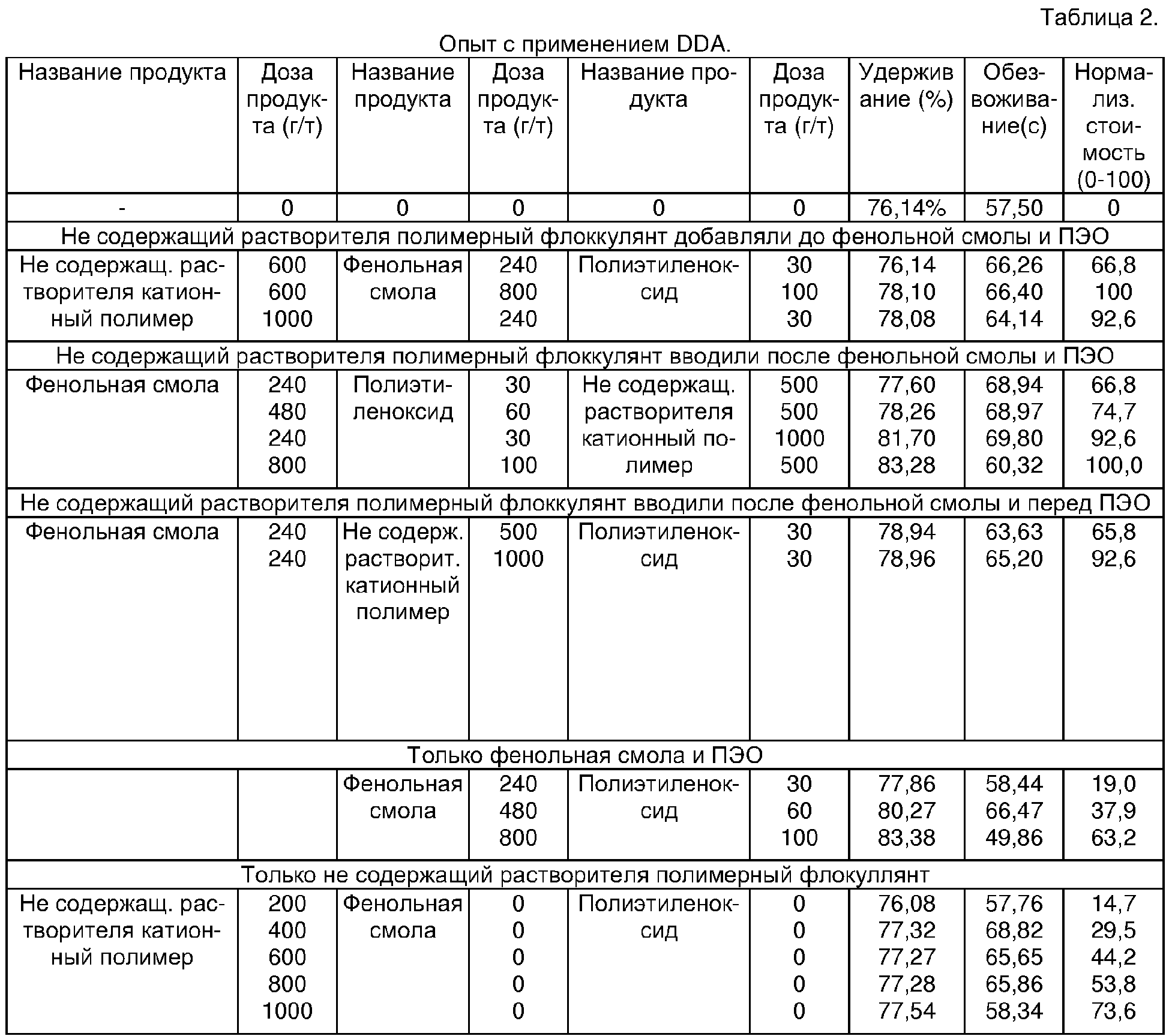
1,06% суспензия целлюлозных волокон, состоящая из 50% ТМР (термомеханическая пульпа, отбеленная гидросульфитом), 20% DIP (пульпа, не содержащая печатной краски) и 30% отходов, была получена на фабрике газетной бумаги. Суспензия содержала 20% наполнителя - глины. рН суспензии доводили до 4,5.A 1.06% suspension of cellulose fibers consisting of 50% TMP (thermomechanical pulp bleached with hydrosulfite), 20% DIP (pulp free of printing ink) and 30% of the waste was obtained in a newsprint factory. The suspension contained 20% filler - clay. The pH of the suspension was adjusted to 4.5.
Для определения степени удерживания и укрывистости использовали сосуд для обезвоживания (DDJ) с направляющим цилиндром, скорость мешалки была равна 550 об/мин. Для определения использовали образец объемом 500 мл. FPR означает удерживание при первом проходе.To determine the degree of retention and hiding power, a dehydration vessel (DDJ) was used with a guide cylinder; the stirrer speed was 550 rpm. A 500 ml sample was used for determination. FPR means holding on the first pass.
Для определения обезвоживания, структуры и удерживания (с образованием стопы бумаги) использовали анализатор обезвоживания (DDA) с направляющим цилиндром, скорость мешалки составляла 1000 об/мин. Для определения использовали образец объемом 800 мл. Величина вакуума была равна 500 мбар.To determine the dehydration, structure and retention (with the formation of a stack of paper), a dehydration analyzer (DDA) with a guide cylinder was used, the stirrer speed was 1000 rpm. A 800 ml sample was used for determination. The vacuum value was 500 mbar.
Ниже в Таблицах 1 и 2 показаны результаты сравнения обычной системы удерживания фенолформальдегидная смола - полиэтиленоксид с системой фенолформальдегидная смола - полиэтиленоксид - не содержащий растворителя катионный полимерный флоккулянт. В таблицах мутность приведена в нефелометрических единицах мутности (нту).Tables 1 and 2 below show the results of comparing a conventional phenol-formaldehyde resin-polyethylene oxide retention system with a phenol-formaldehyde resin-polyethylene oxide-solvent-free cationic polymer flocculant system. In the tables, turbidity is given in nephelometric turbidity units (NTU).

Пример 2.Example 2
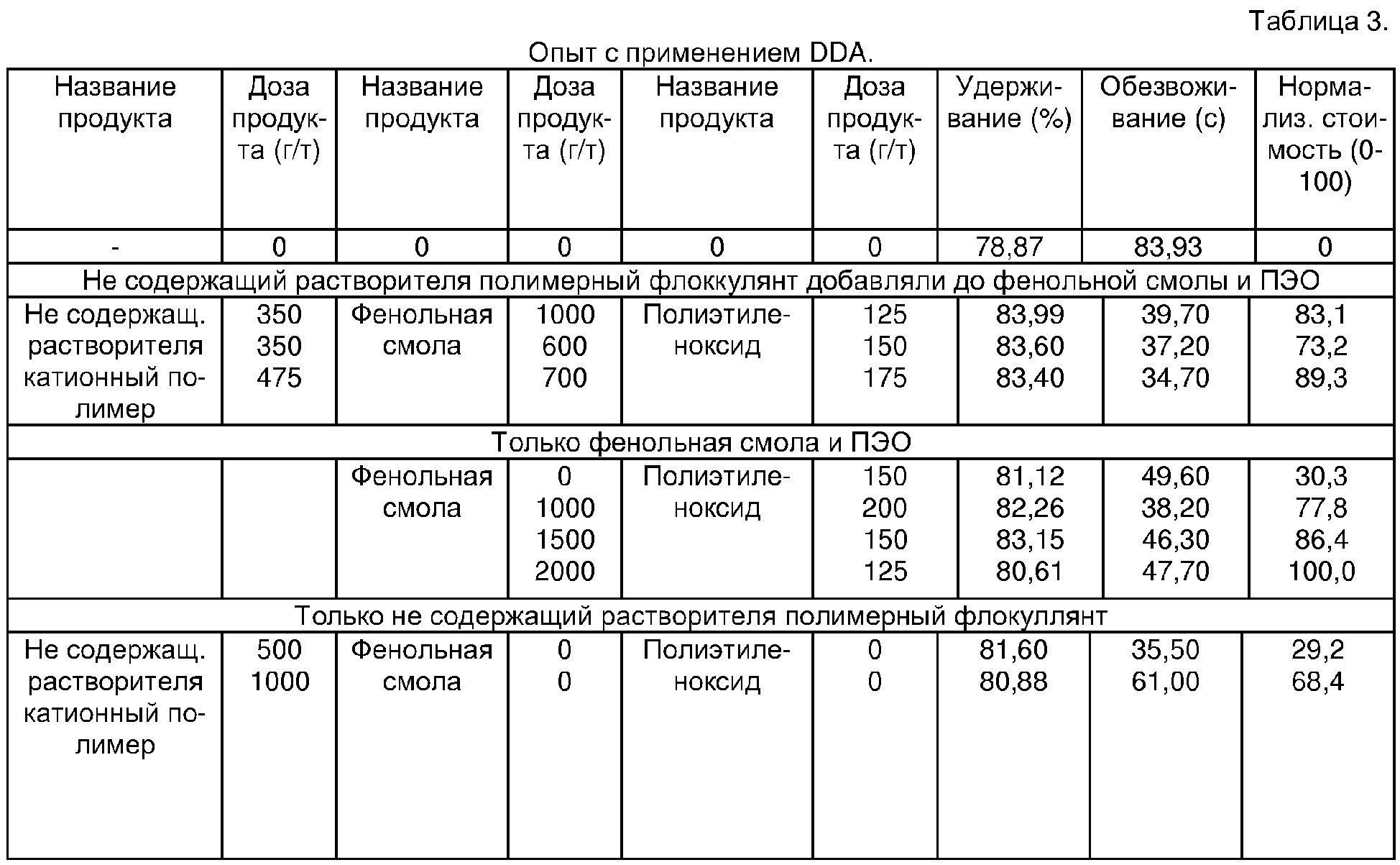
0,992% суспензию целлюлозного волокна, состоящую из 10% пульпы Крафт и 90% ТМП (термомеханическая пульпа, отбеленная гидросульфитом), получали на фабрике специальной газетной бумаги. Суспензия содержала 10% наполнителя - глины. рН суспензии устанавливали равным 6,0.A 0.992% suspension of cellulose fiber consisting of 10% Kraft pulp and 90% TMP (thermomechanical pulp bleached with hydrosulfite) was obtained at a special newsprint factory. The suspension contained 10% filler - clay. The pH of the suspension was adjusted to 6.0.
Для определения степени обезвоживания, формирования и удерживания (с образованием стопы) использовали опыт с применением анализатора обезвоживания (DDA) с направляющим цилиндром, скорость мешалки составляла 1000 об/мин. Для испытаний брали образец объемом 800 мл. Вакуум был равен 500 мбар.To determine the degree of dehydration, formation and retention (with the formation of the foot), we used an experiment using a dehydration analyzer (DDA) with a guide cylinder; the stirrer speed was 1000 rpm. A 800 ml sample was taken for testing. The vacuum was equal to 500 mbar.
В Таблице 3 ниже показаны результаты сравнения обычной системы удерживания фенолформальдегидная смола - полиэтиленоксид с системой фенолформальдегидная смола - полиэтиленоксид - не содержащий растворителя катионный полимерный флоккулянт.Table 3 below shows the results of comparing a conventional phenol-formaldehyde resin-polyethylene oxide retention system with a phenol-formaldehyde resin-polyethylene oxide-solvent-free cationic polymer flocculant system.
Пример 3.Example 3
1,12% суспензию целлюлозных волокон, содержащую 5% пульпы Крафт, 70% ТМП (термомеханическая пульпа, отбеленная гидросульфитом) и 25% пульпы, не содержащей печатной краски (DIP), получали на фабрике специальной газетной бумаги, использующей переработанные для вторичного использования волокна. Содержание глинистого наполнителя составляло 30%. рН суспензии устанавливали равным 6,2.A 1.12% suspension of cellulose fibers containing 5% Kraft pulp, 70% TMP (thermomechanical pulp bleached with hydrosulfite) and 25% ink-free pulp (DIP) was obtained in a special newsprint factory using recycled fibers . The clay filler content was 30%. The pH of the suspension was adjusted to 6.2.
Для определения степени удерживания и мутности использовали сосуд для обезвоживания (DDJ) с направляющим цилиндром. Скорость мешалки составляла 550 об/мин. Для опыта использовали образец объемом 500 мл. FPR означает удерживание при первом проходе, FPAR - удерживание золы при первом проходе.A dehydration vessel (DDJ) with a guide cylinder was used to determine retention and turbidity. The stirrer speed was 550 rpm. For the experiment, a 500 ml sample was used. FPR means retention on the first pass, FPAR means retention of ash on the first pass.
В Таблице 4 ниже приведены результаты сравнения обычной системы удерживания фенолформальдегидная смола - полиэтиленоксид с системой фенолформальдегидная смола - полиэтиленоксид - не содержащий растворителя катионный полимерный флоккулянт.Table 4 below shows the results of comparing a conventional phenol-formaldehyde resin-polyethylene oxide retention system with a phenol-formaldehyde resin-polyethylene oxide-solvent-free cationic polymer flocculant system.
420
7000
420
700
60
10060
60
one hundred
42,9/64,8
41,3/43,337.1 / 47.8
42.9 / 64.8
41.3 / 43.3
40,7
42,635.7
40.7
42.6
60,1
100,026.2
60.1
100.0
Были также проведены испытания на машине той же фабрики. Не содержащий растворителя катионный флоккулянт добавляли перед введением фенольной смолы и ПЭО (вязкое сырье). В таблице ниже показаны результаты сравнения обычной системы удерживания фенолформальдегидная смола - полиэтиленоксид с системой фенолформальдегидная смола - полиэтиленоксид - не содержащий растворителя катионный полимерный флоккулянт.Tests were also conducted on a machine of the same factory. A solvent-free cationic flocculant was added before the introduction of phenolic resin and PEO (viscous feed). The table below shows the results of comparing a conventional phenol-formaldehyde resin-polyethylene oxide retention system with a phenol-formaldehyde resin-polyethylene oxide-solvent-free cationic polymer flocculant system.
Все релевантные параметры машины и количество полимера приведены в Таблице 5.All relevant machine parameters and polymer quantities are shown in Table 5.
Снижение стоимости продукции на 12,6% является значительным преимуществом процесса изготовления бумаги.A 12.6% reduction in product cost is a significant advantage of the papermaking process.
Вышеуказанные результаты ясно показывают, что комбинация не содержащий растворителя катионный полимер - фенольная смола - ПЭО представляет собой лучшую систему по экономическим соображениям. Системы удерживания, использующие сочетание фенольная смола/ПЭО в комбинации с не содержащим растворителя катионным полимером, позволяют получить самую высокую степень удерживания мелких частиц с применением DDJ и DDA, самую низкую степень мутности и самую высокую скорость обезвоживания, что является доказательством способности этих систем удерживать мелкие частицы и коллоидные вещества.The above results clearly show that the combination of solvent-free cationic polymer - phenolic resin - PEO is the best system for economic reasons. Retention systems using a combination of phenolic resin / PEO in combination with a solvent-free cationic polymer provide the highest degree of retention of fine particles using DDJ and DDA, the lowest degree of turbidity and the highest dehydration rate, which is evidence of the ability of these systems to retain fine particles and colloidal substances.
Это особенно верно в случае следующей последовательности добавления компонентов: не содержащий растворителя катионный полимер /фенольная смола/ полиэтиленоксид. В противоположность этому, не содержащий растворителя катионный полимер или система фенольная смола/полиэтиленоксид, используемые в отдельности, приводят к более низкой степени удерживания и/или более высокой мутности.This is especially true for the following sequence of adding components: solvent free cationic polymer / phenolic resin / polyethylene oxide. In contrast, a solvent-free cationic polymer or phenolic resin / polyethylene oxide system, used alone, results in lower retention and / or higher turbidity.
На основании этих результатов можно сделать вывод, что наблюдается не только синергизм между системой фенольная смола/ПЭО и не содержащим растворителя катионным полимером, но и значительное снижение расходов.Based on these results, it can be concluded that there is not only a synergy between the phenolic resin / PEO system and the solvent-free cationic polymer, but also a significant reduction in costs.
Следует отметить, что конкретные описанные выше варианты и примеры не ограничивают объем изобретения, специалистам очевидно, что можно осуществить различные модификации данного изобретения, не выходя за рамки изобретения, объем которого определяется формулой изобретения.It should be noted that the specific options and examples described above do not limit the scope of the invention, it is obvious to those skilled in the art that various modifications of the invention can be made without departing from the scope of the invention, the scope of which is defined by the claims.
Claims (11)
Applications Claiming Priority (2)
| Application Number | Priority Date | Filing Date | Title |
|---|---|---|---|
| CA002405649A CA2405649C (en) | 2002-09-27 | 2002-09-27 | Papermaking furnish comprising solventless cationic polymer retention aid combined with phenolic resin and polyethylene oxide |
| CA2,405,649 | 2002-09-27 |
Publications (2)
| Publication Number | Publication Date |
|---|---|
| RU2005113160A RU2005113160A (en) | 2006-03-20 |
| RU2317361C2 true RU2317361C2 (en) | 2008-02-20 |
Family
ID=32034681
Family Applications (1)
| Application Number | Title | Priority Date | Filing Date |
|---|---|---|---|
| RU2005113160/12A RU2317361C2 (en) | 2002-09-27 | 2003-09-16 | Composition for manufacture of paper and method for increasing extent of retention and/or dehydration in the same |
Country Status (9)
| Country | Link |
|---|---|
| US (1) | US20060000568A1 (en) |
| EP (1) | EP1546460A1 (en) |
| CN (1) | CN1694990A (en) |
| AU (1) | AU2003266087A1 (en) |
| BR (1) | BR0314771A (en) |
| CA (1) | CA2405649C (en) |
| NZ (1) | NZ539024A (en) |
| RU (1) | RU2317361C2 (en) |
| WO (1) | WO2004029360A1 (en) |
Families Citing this family (7)
| Publication number | Priority date | Publication date | Assignee | Title |
|---|---|---|---|---|
| WO2007096242A1 (en) * | 2006-02-20 | 2007-08-30 | Clariant International Ltd | Improved process for the manufacture of paper and board |
| US7981250B2 (en) | 2006-09-14 | 2011-07-19 | Kemira Oyj | Method for paper processing |
| CA2798041C (en) * | 2011-12-07 | 2021-08-03 | Owens Corning Intellectual Capital, Llc | Methods for reducing odors in asphalt |
| CN102718297B (en) * | 2012-06-13 | 2017-06-23 | 丰信精细化工(上海)有限公司 | A kind of high concentration macromolecule poly-silicate flocculant |
| FR3009830B1 (en) | 2013-08-22 | 2015-08-14 | Snf Sas | NOVEL WATER-SOLUBLE POLYMER COMPLEXES AND USES THEREOF |
| WO2016165027A1 (en) | 2015-04-17 | 2016-10-20 | University Of British Columbia | Process for leaching metal sulfides with reagents having thiocarbonyl functional groups |
| US11859263B2 (en) | 2016-10-19 | 2024-01-02 | Jetti Resources, Llc | Process for leaching metal sulfides with reagents having thiocarbonyl functional groups |
Citations (6)
| Publication number | Priority date | Publication date | Assignee | Title |
|---|---|---|---|---|
| RU2023783C1 (en) * | 1985-04-03 | 1994-11-30 | Ека Нобель Актиеболаг | Method of paper producing |
| US5472570A (en) * | 1993-03-25 | 1995-12-05 | Hercules Incorporated | Phenolic compound/polyethylene oxide retention system |
| US5480934A (en) * | 1993-05-14 | 1996-01-02 | Roehm Gmbh Chemische Fabrik | Method for the production of a low-viscosity, water-soluble polymeric dispersion |
| US5516405A (en) * | 1993-09-20 | 1996-05-14 | Macmillan Bloedel Limited | Retention aids |
| RU2081060C1 (en) * | 1992-08-31 | 1997-06-10 | Ека Нобель Актиеболаг | Sol of silicic acid and method for manufacturing paper |
| US5755930A (en) * | 1994-02-04 | 1998-05-26 | Allied Colloids Limited | Production of filled paper and compositions for use in this |
Family Cites Families (6)
| Publication number | Priority date | Publication date | Assignee | Title |
|---|---|---|---|---|
| DE2549089C3 (en) * | 1974-11-15 | 1978-12-14 | Sandoz-Patent-Gmbh, 7850 Loerrach | Process for improving the retention and drainage effect in paper manufacture |
| US5098520A (en) * | 1991-01-25 | 1992-03-24 | Nalco Chemcial Company | Papermaking process with improved retention and drainage |
| US5571380A (en) * | 1992-01-08 | 1996-11-05 | Nalco Chemical Company | Papermaking process with improved retention and maintained formation |
| US5472470A (en) * | 1994-05-27 | 1995-12-05 | Glasstech, Inc. | Glass sheet press forming and quenching ring |
| BR0009394A (en) * | 1999-03-31 | 2001-12-26 | Pulp Paper Res Inst | Papermaking process, process to increase the retention of pulp components and additives in an aqueous papermaking charge, retention aid system for use in a papermaking charge, aromatic resin co-factor for a depoli retention aid (oxyethylene ) in papermaking, and the process for producing it |
| GB0109087D0 (en) * | 2001-04-11 | 2001-05-30 | Ciba Spec Chem Water Treat Ltd | Treatment of suspensions |
-
2002
- 2002-09-27 CA CA002405649A patent/CA2405649C/en not_active Expired - Fee Related
-
2003
- 2003-09-16 RU RU2005113160/12A patent/RU2317361C2/en not_active IP Right Cessation
- 2003-09-16 EP EP03798022A patent/EP1546460A1/en not_active Withdrawn
- 2003-09-16 BR BR0314771-1A patent/BR0314771A/en not_active IP Right Cessation
- 2003-09-16 CN CN03824833.6A patent/CN1694990A/en active Pending
- 2003-09-16 NZ NZ539024A patent/NZ539024A/en unknown
- 2003-09-16 US US10/525,320 patent/US20060000568A1/en not_active Abandoned
- 2003-09-16 WO PCT/CA2003/001415 patent/WO2004029360A1/en not_active Ceased
- 2003-09-16 AU AU2003266087A patent/AU2003266087A1/en not_active Abandoned
Patent Citations (6)
| Publication number | Priority date | Publication date | Assignee | Title |
|---|---|---|---|---|
| RU2023783C1 (en) * | 1985-04-03 | 1994-11-30 | Ека Нобель Актиеболаг | Method of paper producing |
| RU2081060C1 (en) * | 1992-08-31 | 1997-06-10 | Ека Нобель Актиеболаг | Sol of silicic acid and method for manufacturing paper |
| US5472570A (en) * | 1993-03-25 | 1995-12-05 | Hercules Incorporated | Phenolic compound/polyethylene oxide retention system |
| US5480934A (en) * | 1993-05-14 | 1996-01-02 | Roehm Gmbh Chemische Fabrik | Method for the production of a low-viscosity, water-soluble polymeric dispersion |
| US5516405A (en) * | 1993-09-20 | 1996-05-14 | Macmillan Bloedel Limited | Retention aids |
| US5755930A (en) * | 1994-02-04 | 1998-05-26 | Allied Colloids Limited | Production of filled paper and compositions for use in this |
Also Published As
| Publication number | Publication date |
|---|---|
| CA2405649C (en) | 2006-05-16 |
| CA2405649A1 (en) | 2004-03-27 |
| NZ539024A (en) | 2006-06-30 |
| CN1694990A (en) | 2005-11-09 |
| BR0314771A (en) | 2005-08-02 |
| US20060000568A1 (en) | 2006-01-05 |
| WO2004029360A1 (en) | 2004-04-08 |
| EP1546460A1 (en) | 2005-06-29 |
| AU2003266087A1 (en) | 2004-04-19 |
| RU2005113160A (en) | 2006-03-20 |
Similar Documents
| Publication | Publication Date | Title |
|---|---|---|
| RU2150543C1 (en) | Method of preparing aqueous suspension for manufacturing paper (versions), paper | |
| FI126216B (en) | Method for making board | |
| US5755930A (en) | Production of filled paper and compositions for use in this | |
| US8088251B2 (en) | Process for improving paper strength | |
| US20090025895A1 (en) | Process for the Manufacture of Paper and Board | |
| NO168959B (en) | PROCEDURE FOR PAPER AND CARTON MANUFACTURING | |
| US6468396B2 (en) | Dendrimeric polymers for the production of paper and board | |
| KR20210102314A (en) | Process for making paper or board and product thereof | |
| RU2317361C2 (en) | Composition for manufacture of paper and method for increasing extent of retention and/or dehydration in the same | |
| Lindqvist | Improvement of wet and dry web properties in papermaking by controlling water and fiber quality | |
| US11926966B2 (en) | Method of increasing efficiency of chemical additives in a papermaking system | |
| Zhang et al. | Characteristics of dissolved and colloidal substances in high yield pulp and their impact on filler retention | |
| AU761303B2 (en) | An acid colloid in a microparticle system used in papermaking | |
| WO1993010305A1 (en) | A method for reducing the level of interference chemicals in the water circulation of wood-based fibre suspension processes | |
| EP0621369A1 (en) | Phenolic compound and polyethylene oxide paper-making retention aid | |
| Truong et al. | Effect of primary fines and surface charge of hardwood pulps on AKD sizing | |
| Xie et al. | Preparation and application of cationized pulp fiber as a papermaking wet-end additive | |
| Krogerus et al. | Fines in closed circuits-Final report | |
| Zakrajšek et al. | The influence of modified starch on the process water quality in papermaking and the paper properties | |
| WO2025006743A2 (en) | Use of amphoteric emulsion polymers with strength resins as retention and drainage aids | |
| Au et al. | The use of retention and drainage aids in the wet-end | |
| KR20230093303A (en) | How to Increase the Efficiency of Chemical Additives in Papermaking Systems | |
| Ondaral | The performance of anionic polyacrylamide as a retention aid in newsprint production | |
| Wegner | Polymeric additive performance in closed whitewater systems | |
| EP0893538A1 (en) | Use of blends of dispersion polymers and coagulants for papermaking |
Legal Events
| Date | Code | Title | Description |
|---|---|---|---|
| MM4A | The patent is invalid due to non-payment of fees |
Effective date: 20100917 |