RU2311928C2 - Composition containing alpha-2-adrenergic agonists - Google Patents
Composition containing alpha-2-adrenergic agonists Download PDFInfo
- Publication number
- RU2311928C2 RU2311928C2 RU2003101321/15A RU2003101321A RU2311928C2 RU 2311928 C2 RU2311928 C2 RU 2311928C2 RU 2003101321/15 A RU2003101321/15 A RU 2003101321/15A RU 2003101321 A RU2003101321 A RU 2003101321A RU 2311928 C2 RU2311928 C2 RU 2311928C2
- Authority
- RU
- Russia
- Prior art keywords
- alpha
- component
- solubility
- compositions
- adrenergic agonists
- Prior art date
Links
- 239000000203 mixture Substances 0.000 title claims abstract description 139
- 239000000048 adrenergic agonist Substances 0.000 title description 70
- 239000001768 carboxy methyl cellulose Substances 0.000 claims abstract description 30
- 229920002134 Carboxymethyl cellulose Polymers 0.000 claims abstract description 27
- 235000010948 carboxy methyl cellulose Nutrition 0.000 claims abstract description 27
- 239000008112 carboxymethyl-cellulose Substances 0.000 claims abstract description 27
- 239000000384 adrenergic alpha-2 receptor agonist Substances 0.000 claims abstract description 23
- 230000001225 therapeutic effect Effects 0.000 claims abstract description 7
- 230000002708 enhancing effect Effects 0.000 claims abstract description 6
- -1 chloroxy Chemical group 0.000 claims description 27
- 239000007788 liquid Substances 0.000 claims description 27
- QZHBYNSSDLTCRG-UHFFFAOYSA-N 5-bromo-n-(4,5-dihydro-1h-imidazol-2-yl)quinoxalin-6-amine;2,3-dihydroxybutanedioate;hydron Chemical compound OC(=O)C(O)C(O)C(O)=O.C1=CC2=NC=CN=C2C(Br)=C1NC1=NCCN1 QZHBYNSSDLTCRG-UHFFFAOYSA-N 0.000 claims description 4
- 230000009286 beneficial effect Effects 0.000 claims 1
- 239000000126 substance Substances 0.000 abstract description 19
- XYLJNLCSTIOKRM-UHFFFAOYSA-N Alphagan Chemical compound C1=CC2=NC=CN=C2C(Br)=C1NC1=NCCN1 XYLJNLCSTIOKRM-UHFFFAOYSA-N 0.000 abstract description 8
- 230000000694 effects Effects 0.000 abstract description 8
- 239000003814 drug Substances 0.000 abstract description 6
- 230000002411 adverse Effects 0.000 abstract 1
- 230000003247 decreasing effect Effects 0.000 abstract 1
- IWEGDQUCWQFKHS-UHFFFAOYSA-N 1-(1,3-dioxolan-2-ylmethyl)-4-(4,4,5,5-tetramethyl-1,3,2-dioxaborolan-2-yl)pyrazole Chemical compound O1C(C)(C)C(C)(C)OB1C1=CN(CC2OCCO2)N=C1 IWEGDQUCWQFKHS-UHFFFAOYSA-N 0.000 description 38
- 229960001724 brimonidine tartrate Drugs 0.000 description 37
- 239000003755 preservative agent Substances 0.000 description 31
- XSCHRSMBECNVNS-UHFFFAOYSA-N quinoxaline Chemical compound N1=CC=NC2=CC=CC=C21 XSCHRSMBECNVNS-UHFFFAOYSA-N 0.000 description 24
- 229920000858 Cyclodextrin Polymers 0.000 description 20
- 150000001875 compounds Chemical class 0.000 description 19
- 229910052751 metal Inorganic materials 0.000 description 18
- 239000002184 metal Substances 0.000 description 18
- 230000002335 preservative effect Effects 0.000 description 18
- 235000010443 alginic acid Nutrition 0.000 description 16
- 229920000615 alginic acid Polymers 0.000 description 16
- 239000000523 sample Substances 0.000 description 16
- 230000001965 increasing effect Effects 0.000 description 14
- 235000002639 sodium chloride Nutrition 0.000 description 14
- XLYOFNOQVPJJNP-UHFFFAOYSA-N water Substances O XLYOFNOQVPJJNP-UHFFFAOYSA-N 0.000 description 13
- 102000030484 alpha-2 Adrenergic Receptor Human genes 0.000 description 11
- 108020004101 alpha-2 Adrenergic Receptor Proteins 0.000 description 11
- 239000000178 monomer Substances 0.000 description 10
- 150000002148 esters Chemical class 0.000 description 9
- 239000000243 solution Substances 0.000 description 9
- MHAJPDPJQMAIIY-UHFFFAOYSA-N Hydrogen peroxide Chemical compound OO MHAJPDPJQMAIIY-UHFFFAOYSA-N 0.000 description 8
- FAPWRFPIFSIZLT-UHFFFAOYSA-M Sodium chloride Chemical compound [Na+].[Cl-] FAPWRFPIFSIZLT-UHFFFAOYSA-M 0.000 description 8
- 125000000129 anionic group Chemical group 0.000 description 8
- 239000000539 dimer Substances 0.000 description 8
- OSVXSBDYLRYLIG-UHFFFAOYSA-N dioxidochlorine(.) Chemical compound O=Cl=O OSVXSBDYLRYLIG-UHFFFAOYSA-N 0.000 description 8
- 229920000642 polymer Polymers 0.000 description 8
- 241001465754 Metazoa Species 0.000 description 7
- QBWCMBCROVPCKQ-UHFFFAOYSA-N chlorous acid Chemical class OCl=O QBWCMBCROVPCKQ-UHFFFAOYSA-N 0.000 description 7
- 229940097362 cyclodextrins Drugs 0.000 description 7
- 239000002609 medium Substances 0.000 description 7
- 239000012528 membrane Substances 0.000 description 7
- 150000003839 salts Chemical class 0.000 description 7
- 239000001116 FEMA 4028 Substances 0.000 description 6
- WCUXLLCKKVVCTQ-UHFFFAOYSA-M Potassium chloride Chemical compound [Cl-].[K+] WCUXLLCKKVVCTQ-UHFFFAOYSA-M 0.000 description 6
- 229920006321 anionic cellulose Polymers 0.000 description 6
- 229920001586 anionic polysaccharide Polymers 0.000 description 6
- 150000004836 anionic polysaccharides Chemical class 0.000 description 6
- 229960004853 betadex Drugs 0.000 description 6
- 150000002500 ions Chemical class 0.000 description 6
- 150000003252 quinoxalines Chemical class 0.000 description 6
- 239000000783 alginic acid Substances 0.000 description 5
- 229960001126 alginic acid Drugs 0.000 description 5
- 150000004781 alginic acids Chemical class 0.000 description 5
- 229910052784 alkaline earth metal Inorganic materials 0.000 description 5
- 235000001014 amino acid Nutrition 0.000 description 5
- 238000005119 centrifugation Methods 0.000 description 5
- 238000006243 chemical reaction Methods 0.000 description 5
- 238000004090 dissolution Methods 0.000 description 5
- 238000001914 filtration Methods 0.000 description 5
- 230000009931 harmful effect Effects 0.000 description 5
- 150000002632 lipids Chemical class 0.000 description 5
- 230000007935 neutral effect Effects 0.000 description 5
- 229920001282 polysaccharide Polymers 0.000 description 5
- 239000005017 polysaccharide Substances 0.000 description 5
- 150000004804 polysaccharides Chemical class 0.000 description 5
- 239000011780 sodium chloride Substances 0.000 description 5
- 239000004155 Chlorine dioxide Substances 0.000 description 4
- 229920002148 Gellan gum Polymers 0.000 description 4
- WQZGKKKJIJFFOK-GASJEMHNSA-N Glucose Natural products OC[C@H]1OC(O)[C@H](O)[C@@H](O)[C@@H]1O WQZGKKKJIJFFOK-GASJEMHNSA-N 0.000 description 4
- 230000001800 adrenalinergic effect Effects 0.000 description 4
- 150000001413 amino acids Chemical class 0.000 description 4
- 239000008365 aqueous carrier Substances 0.000 description 4
- 125000003118 aryl group Chemical group 0.000 description 4
- 230000008901 benefit Effects 0.000 description 4
- WQZGKKKJIJFFOK-VFUOTHLCSA-N beta-D-glucose Chemical compound OC[C@H]1O[C@@H](O)[C@H](O)[C@@H](O)[C@@H]1O WQZGKKKJIJFFOK-VFUOTHLCSA-N 0.000 description 4
- 230000015572 biosynthetic process Effects 0.000 description 4
- 239000000872 buffer Substances 0.000 description 4
- 235000019398 chlorine dioxide Nutrition 0.000 description 4
- 230000007423 decrease Effects 0.000 description 4
- 235000003599 food sweetener Nutrition 0.000 description 4
- 235000010492 gellan gum Nutrition 0.000 description 4
- 239000000216 gellan gum Substances 0.000 description 4
- 239000004615 ingredient Substances 0.000 description 4
- 230000003993 interaction Effects 0.000 description 4
- 150000002739 metals Chemical class 0.000 description 4
- 230000001590 oxidative effect Effects 0.000 description 4
- 230000036961 partial effect Effects 0.000 description 4
- 239000000546 pharmaceutical excipient Substances 0.000 description 4
- 238000002360 preparation method Methods 0.000 description 4
- 239000000047 product Substances 0.000 description 4
- 239000008213 purified water Substances 0.000 description 4
- 230000002829 reductive effect Effects 0.000 description 4
- 238000003756 stirring Methods 0.000 description 4
- 239000003765 sweetening agent Substances 0.000 description 4
- 210000001519 tissue Anatomy 0.000 description 4
- NIXOWILDQLNWCW-UHFFFAOYSA-N 2-Propenoic acid Natural products OC(=O)C=C NIXOWILDQLNWCW-UHFFFAOYSA-N 0.000 description 3
- 229920001661 Chitosan Polymers 0.000 description 3
- IAYPIBMASNFSPL-UHFFFAOYSA-N Ethylene oxide Chemical compound C1CO1 IAYPIBMASNFSPL-UHFFFAOYSA-N 0.000 description 3
- DGAQECJNVWCQMB-PUAWFVPOSA-M Ilexoside XXIX Chemical compound C[C@@H]1CC[C@@]2(CC[C@@]3(C(=CC[C@H]4[C@]3(CC[C@@H]5[C@@]4(CC[C@@H](C5(C)C)OS(=O)(=O)[O-])C)C)[C@@H]2[C@]1(C)O)C)C(=O)O[C@H]6[C@@H]([C@H]([C@@H]([C@H](O6)CO)O)O)O.[Na+] DGAQECJNVWCQMB-PUAWFVPOSA-M 0.000 description 3
- 239000004372 Polyvinyl alcohol Substances 0.000 description 3
- DNIAPMSPPWPWGF-UHFFFAOYSA-N Propylene glycol Chemical compound CC(O)CO DNIAPMSPPWPWGF-UHFFFAOYSA-N 0.000 description 3
- HEMHJVSKTPXQMS-UHFFFAOYSA-M Sodium hydroxide Chemical compound [OH-].[Na+] HEMHJVSKTPXQMS-UHFFFAOYSA-M 0.000 description 3
- DPXJVFZANSGRMM-UHFFFAOYSA-N acetic acid;2,3,4,5,6-pentahydroxyhexanal;sodium Chemical compound [Na].CC(O)=O.OCC(O)C(O)C(O)C(O)C=O DPXJVFZANSGRMM-UHFFFAOYSA-N 0.000 description 3
- 239000002253 acid Substances 0.000 description 3
- HFHDHCJBZVLPGP-RWMJIURBSA-N alpha-cyclodextrin Chemical compound OC[C@H]([C@H]([C@@H]([C@H]1O)O)O[C@H]2O[C@@H]([C@@H](O[C@H]3O[C@H](CO)[C@H]([C@@H]([C@H]3O)O)O[C@H]3O[C@H](CO)[C@H]([C@@H]([C@H]3O)O)O[C@H]3O[C@H](CO)[C@H]([C@@H]([C@H]3O)O)O3)[C@H](O)[C@H]2O)CO)O[C@@H]1O[C@H]1[C@H](O)[C@@H](O)[C@@H]3O[C@@H]1CO HFHDHCJBZVLPGP-RWMJIURBSA-N 0.000 description 3
- 239000007900 aqueous suspension Substances 0.000 description 3
- 150000001768 cations Chemical class 0.000 description 3
- 239000003795 chemical substances by application Substances 0.000 description 3
- 229910001919 chlorite Inorganic materials 0.000 description 3
- 229910052619 chlorite group Inorganic materials 0.000 description 3
- KRKNYBCHXYNGOX-UHFFFAOYSA-N citric acid Chemical compound OC(=O)CC(O)(C(O)=O)CC(O)=O KRKNYBCHXYNGOX-UHFFFAOYSA-N 0.000 description 3
- 239000007859 condensation product Substances 0.000 description 3
- 239000013068 control sample Substances 0.000 description 3
- 210000004087 cornea Anatomy 0.000 description 3
- 235000014113 dietary fatty acids Nutrition 0.000 description 3
- 229940079593 drug Drugs 0.000 description 3
- 239000000839 emulsion Substances 0.000 description 3
- 239000000194 fatty acid Substances 0.000 description 3
- 229930195729 fatty acid Natural products 0.000 description 3
- 150000004665 fatty acids Chemical class 0.000 description 3
- 238000004128 high performance liquid chromatography Methods 0.000 description 3
- 230000007794 irritation Effects 0.000 description 3
- 230000010534 mechanism of action Effects 0.000 description 3
- 238000002156 mixing Methods 0.000 description 3
- ACYGVAVUNGWGBY-UHFFFAOYSA-N n-(4,5-dihydro-1h-imidazol-2-yl)quinoxalin-2-amine Chemical compound N1CCN=C1NC1=CN=C(C=CC=C2)C2=N1 ACYGVAVUNGWGBY-UHFFFAOYSA-N 0.000 description 3
- 231100000252 nontoxic Toxicity 0.000 description 3
- 230000003000 nontoxic effect Effects 0.000 description 3
- 229940054534 ophthalmic solution Drugs 0.000 description 3
- 239000002997 ophthalmic solution Substances 0.000 description 3
- 150000002978 peroxides Chemical class 0.000 description 3
- 229920002451 polyvinyl alcohol Polymers 0.000 description 3
- 230000001242 postsynaptic effect Effects 0.000 description 3
- 239000001103 potassium chloride Substances 0.000 description 3
- 235000011164 potassium chloride Nutrition 0.000 description 3
- 239000012488 sample solution Substances 0.000 description 3
- HFHDHCJBZVLPGP-UHFFFAOYSA-N schardinger α-dextrin Chemical compound O1C(C(C2O)O)C(CO)OC2OC(C(C2O)O)C(CO)OC2OC(C(C2O)O)C(CO)OC2OC(C(O)C2O)C(CO)OC2OC(C(C2O)O)C(CO)OC2OC2C(O)C(O)C1OC2CO HFHDHCJBZVLPGP-UHFFFAOYSA-N 0.000 description 3
- 229910052708 sodium Inorganic materials 0.000 description 3
- 239000011734 sodium Substances 0.000 description 3
- 235000019812 sodium carboxymethyl cellulose Nutrition 0.000 description 3
- 229920001027 sodium carboxymethylcellulose Polymers 0.000 description 3
- 239000000725 suspension Substances 0.000 description 3
- 230000002588 toxic effect Effects 0.000 description 3
- SFLSHLFXELFNJZ-QMMMGPOBSA-N (-)-norepinephrine Chemical compound NC[C@H](O)C1=CC=C(O)C(O)=C1 SFLSHLFXELFNJZ-QMMMGPOBSA-N 0.000 description 2
- YZOUYRAONFXZSI-SBHWVFSVSA-N (1S,3R,5R,6R,8R,10R,11R,13R,15R,16R,18R,20R,21R,23R,25R,26R,28R,30R,31S,33R,35R,36R,37S,38R,39S,40R,41S,42R,43S,44R,45S,46R,47S,48R,49S)-5,10,15,20,25,30,35-heptakis(hydroxymethyl)-37,39,40,41,42,43,44,45,46,47,48,49-dodecamethoxy-2,4,7,9,12,14,17,19,22,24,27,29,32,34-tetradecaoxaoctacyclo[31.2.2.23,6.28,11.213,16.218,21.223,26.228,31]nonatetracontane-36,38-diol Chemical compound O([C@@H]([C@H]([C@@H]1OC)OC)O[C@H]2[C@@H](O)[C@@H]([C@@H](O[C@@H]3[C@@H](CO)O[C@@H]([C@H]([C@@H]3O)OC)O[C@@H]3[C@@H](CO)O[C@@H]([C@H]([C@@H]3OC)OC)O[C@@H]3[C@@H](CO)O[C@@H]([C@H]([C@@H]3OC)OC)O[C@@H]3[C@@H](CO)O[C@@H]([C@H]([C@@H]3OC)OC)O3)O[C@@H]2CO)OC)[C@H](CO)[C@H]1O[C@@H]1[C@@H](OC)[C@H](OC)[C@H]3[C@@H](CO)O1 YZOUYRAONFXZSI-SBHWVFSVSA-N 0.000 description 2
- HMXQIFUGFZEJEO-UHFFFAOYSA-N 1,2-dihydropyrrol-3-one Chemical compound O=C1CNC=C1 HMXQIFUGFZEJEO-UHFFFAOYSA-N 0.000 description 2
- SMZOUWXMTYCWNB-UHFFFAOYSA-N 2-(2-methoxy-5-methylphenyl)ethanamine Chemical compound COC1=CC=C(C)C=C1CCN SMZOUWXMTYCWNB-UHFFFAOYSA-N 0.000 description 2
- PRAMZQXXPOLCIY-UHFFFAOYSA-N 2-(2-methylprop-2-enoyloxy)ethanesulfonic acid Chemical compound CC(=C)C(=O)OCCS(O)(=O)=O PRAMZQXXPOLCIY-UHFFFAOYSA-N 0.000 description 2
- XHZPRMZZQOIPDS-UHFFFAOYSA-N 2-Methyl-2-[(1-oxo-2-propenyl)amino]-1-propanesulfonic acid Chemical class OS(=O)(=O)CC(C)(C)NC(=O)C=C XHZPRMZZQOIPDS-UHFFFAOYSA-N 0.000 description 2
- SQVSEQUIWOQWAH-UHFFFAOYSA-N 2-hydroxy-3-(2-methylprop-2-enoyloxy)propane-1-sulfonic acid Chemical class CC(=C)C(=O)OCC(O)CS(O)(=O)=O SQVSEQUIWOQWAH-UHFFFAOYSA-N 0.000 description 2
- OULQIRTYSJHFKP-UHFFFAOYSA-N 4h-imidazol-5-amine Chemical class N=C1CNC=N1 OULQIRTYSJHFKP-UHFFFAOYSA-N 0.000 description 2
- FHVDTGUDJYJELY-UHFFFAOYSA-N 6-{[2-carboxy-4,5-dihydroxy-6-(phosphanyloxy)oxan-3-yl]oxy}-4,5-dihydroxy-3-phosphanyloxane-2-carboxylic acid Chemical compound O1C(C(O)=O)C(P)C(O)C(O)C1OC1C(C(O)=O)OC(OP)C(O)C1O FHVDTGUDJYJELY-UHFFFAOYSA-N 0.000 description 2
- 244000215068 Acacia senegal Species 0.000 description 2
- PAYRUJLWNCNPSJ-UHFFFAOYSA-N Aniline Chemical compound NC1=CC=CC=C1 PAYRUJLWNCNPSJ-UHFFFAOYSA-N 0.000 description 2
- OYPRJOBELJOOCE-UHFFFAOYSA-N Calcium Chemical compound [Ca] OYPRJOBELJOOCE-UHFFFAOYSA-N 0.000 description 2
- 229920002101 Chitin Polymers 0.000 description 2
- XTEGARKTQYYJKE-UHFFFAOYSA-M Chlorate Chemical class [O-]Cl(=O)=O XTEGARKTQYYJKE-UHFFFAOYSA-M 0.000 description 2
- 241000206575 Chondrus crispus Species 0.000 description 2
- HTIRHQRTDBPHNZ-UHFFFAOYSA-N Dibutyl sulfide Chemical compound CCCCSCCCC HTIRHQRTDBPHNZ-UHFFFAOYSA-N 0.000 description 2
- PEDCQBHIVMGVHV-UHFFFAOYSA-N Glycerine Chemical compound OCC(O)CO PEDCQBHIVMGVHV-UHFFFAOYSA-N 0.000 description 2
- 229920000084 Gum arabic Polymers 0.000 description 2
- XQFRJNBWHJMXHO-RRKCRQDMSA-N IDUR Chemical compound C1[C@H](O)[C@@H](CO)O[C@H]1N1C(=O)NC(=O)C(I)=C1 XQFRJNBWHJMXHO-RRKCRQDMSA-N 0.000 description 2
- 239000000232 Lipid Bilayer Substances 0.000 description 2
- TWRXJAOTZQYOKJ-UHFFFAOYSA-L Magnesium chloride Chemical compound [Mg+2].[Cl-].[Cl-] TWRXJAOTZQYOKJ-UHFFFAOYSA-L 0.000 description 2
- 241000124008 Mammalia Species 0.000 description 2
- CERQOIWHTDAKMF-UHFFFAOYSA-N Methacrylic acid Chemical compound CC(=C)C(O)=O CERQOIWHTDAKMF-UHFFFAOYSA-N 0.000 description 2
- KFSLWBXXFJQRDL-UHFFFAOYSA-N Peracetic acid Chemical compound CC(=O)OO KFSLWBXXFJQRDL-UHFFFAOYSA-N 0.000 description 2
- DLRVVLDZNNYCBX-UHFFFAOYSA-N Polydextrose Polymers OC1C(O)C(O)C(CO)OC1OCC1C(O)C(O)C(O)C(O)O1 DLRVVLDZNNYCBX-UHFFFAOYSA-N 0.000 description 2
- ZLMJMSJWJFRBEC-UHFFFAOYSA-N Potassium Chemical compound [K] ZLMJMSJWJFRBEC-UHFFFAOYSA-N 0.000 description 2
- 229920002472 Starch Polymers 0.000 description 2
- 229920001615 Tragacanth Polymers 0.000 description 2
- 235000010489 acacia gum Nutrition 0.000 description 2
- 239000000205 acacia gum Substances 0.000 description 2
- 150000001252 acrylic acid derivatives Chemical class 0.000 description 2
- 239000000556 agonist Substances 0.000 description 2
- 229940072056 alginate Drugs 0.000 description 2
- 239000003513 alkali Substances 0.000 description 2
- 229910052783 alkali metal Inorganic materials 0.000 description 2
- 150000001340 alkali metals Chemical class 0.000 description 2
- 150000001342 alkaline earth metals Chemical class 0.000 description 2
- 150000003863 ammonium salts Chemical class 0.000 description 2
- 229920006318 anionic polymer Polymers 0.000 description 2
- 150000001538 azepines Chemical class 0.000 description 2
- 229960000686 benzalkonium chloride Drugs 0.000 description 2
- CADWTSSKOVRVJC-UHFFFAOYSA-N benzyl(dimethyl)azanium;chloride Chemical compound [Cl-].C[NH+](C)CC1=CC=CC=C1 CADWTSSKOVRVJC-UHFFFAOYSA-N 0.000 description 2
- WHGYBXFWUBPSRW-FOUAGVGXSA-N beta-cyclodextrin Chemical compound OC[C@H]([C@H]([C@@H]([C@H]1O)O)O[C@H]2O[C@@H]([C@@H](O[C@H]3O[C@H](CO)[C@H]([C@@H]([C@H]3O)O)O[C@H]3O[C@H](CO)[C@H]([C@@H]([C@H]3O)O)O[C@H]3O[C@H](CO)[C@H]([C@@H]([C@H]3O)O)O[C@H]3O[C@H](CO)[C@H]([C@@H]([C@H]3O)O)O3)[C@H](O)[C@H]2O)CO)O[C@@H]1O[C@H]1[C@H](O)[C@@H](O)[C@@H]3O[C@@H]1CO WHGYBXFWUBPSRW-FOUAGVGXSA-N 0.000 description 2
- 235000011175 beta-cyclodextrine Nutrition 0.000 description 2
- KGBXLFKZBHKPEV-UHFFFAOYSA-N boric acid Chemical compound OB(O)O KGBXLFKZBHKPEV-UHFFFAOYSA-N 0.000 description 2
- 239000004327 boric acid Substances 0.000 description 2
- 239000007975 buffered saline Substances 0.000 description 2
- 239000011575 calcium Substances 0.000 description 2
- 229960005069 calcium Drugs 0.000 description 2
- 229910052791 calcium Inorganic materials 0.000 description 2
- 235000010418 carrageenan Nutrition 0.000 description 2
- 229920001525 carrageenan Polymers 0.000 description 2
- 239000000679 carrageenan Substances 0.000 description 2
- 229940113118 carrageenan Drugs 0.000 description 2
- 239000000969 carrier Substances 0.000 description 2
- 210000000845 cartilage Anatomy 0.000 description 2
- OSASVXMJTNOKOY-UHFFFAOYSA-N chlorobutanol Chemical group CC(C)(O)C(Cl)(Cl)Cl OSASVXMJTNOKOY-UHFFFAOYSA-N 0.000 description 2
- 239000003086 colorant Substances 0.000 description 2
- 230000001627 detrimental effect Effects 0.000 description 2
- 239000008121 dextrose Substances 0.000 description 2
- CDMADVZSLOHIFP-UHFFFAOYSA-N disodium;3,7-dioxido-2,4,6,8,9-pentaoxa-1,3,5,7-tetraborabicyclo[3.3.1]nonane;decahydrate Chemical compound O.O.O.O.O.O.O.O.O.O.[Na+].[Na+].O1B([O-])OB2OB([O-])OB1O2 CDMADVZSLOHIFP-UHFFFAOYSA-N 0.000 description 2
- 238000002474 experimental method Methods 0.000 description 2
- 239000000706 filtrate Substances 0.000 description 2
- GDSRMADSINPKSL-HSEONFRVSA-N gamma-cyclodextrin Chemical compound OC[C@H]([C@H]([C@@H]([C@H]1O)O)O[C@H]2O[C@@H]([C@@H](O[C@H]3O[C@H](CO)[C@H]([C@@H]([C@H]3O)O)O[C@H]3O[C@H](CO)[C@H]([C@@H]([C@H]3O)O)O[C@H]3O[C@H](CO)[C@H]([C@@H]([C@H]3O)O)O[C@H]3O[C@H](CO)[C@H]([C@@H]([C@H]3O)O)O[C@H]3O[C@H](CO)[C@H]([C@@H]([C@H]3O)O)O3)[C@H](O)[C@H]2O)CO)O[C@@H]1O[C@H]1[C@H](O)[C@@H](O)[C@@H]3O[C@@H]1CO GDSRMADSINPKSL-HSEONFRVSA-N 0.000 description 2
- 239000008103 glucose Substances 0.000 description 2
- 150000002357 guanidines Chemical class 0.000 description 2
- BXWNKGSJHAJOGX-UHFFFAOYSA-N hexadecan-1-ol Chemical compound CCCCCCCCCCCCCCCCO BXWNKGSJHAJOGX-UHFFFAOYSA-N 0.000 description 2
- 235000010979 hydroxypropyl methyl cellulose Nutrition 0.000 description 2
- 239000001866 hydroxypropyl methyl cellulose Substances 0.000 description 2
- 229920003088 hydroxypropyl methyl cellulose Polymers 0.000 description 2
- UFVKGYZPFZQRLF-UHFFFAOYSA-N hydroxypropyl methyl cellulose Chemical compound OC1C(O)C(OC)OC(CO)C1OC1C(O)C(O)C(OC2C(C(O)C(OC3C(C(O)C(O)C(CO)O3)O)C(CO)O2)O)C(CO)O1 UFVKGYZPFZQRLF-UHFFFAOYSA-N 0.000 description 2
- WQYVRQLZKVEZGA-UHFFFAOYSA-N hypochlorite Chemical class Cl[O-] WQYVRQLZKVEZGA-UHFFFAOYSA-N 0.000 description 2
- 229960004716 idoxuridine Drugs 0.000 description 2
- 150000002460 imidazoles Chemical class 0.000 description 2
- 150000002462 imidazolines Chemical class 0.000 description 2
- 230000000670 limiting effect Effects 0.000 description 2
- 229940057995 liquid paraffin Drugs 0.000 description 2
- 150000002734 metacrylic acid derivatives Chemical class 0.000 description 2
- 238000000034 method Methods 0.000 description 2
- 239000002480 mineral oil Substances 0.000 description 2
- 235000010446 mineral oil Nutrition 0.000 description 2
- 239000000025 natural resin Substances 0.000 description 2
- 230000000324 neuroprotective effect Effects 0.000 description 2
- 229960002748 norepinephrine Drugs 0.000 description 2
- SFLSHLFXELFNJZ-UHFFFAOYSA-N norepinephrine Natural products NCC(O)C1=CC=C(O)C(O)=C1 SFLSHLFXELFNJZ-UHFFFAOYSA-N 0.000 description 2
- 239000003921 oil Substances 0.000 description 2
- 239000004006 olive oil Substances 0.000 description 2
- 235000008390 olive oil Nutrition 0.000 description 2
- 150000002918 oxazolines Chemical class 0.000 description 2
- VLTRZXGMWDSKGL-UHFFFAOYSA-N perchloric acid Chemical class OCl(=O)(=O)=O VLTRZXGMWDSKGL-UHFFFAOYSA-N 0.000 description 2
- 125000000864 peroxy group Chemical group O(O*)* 0.000 description 2
- 235000010482 polyoxyethylene sorbitan monooleate Nutrition 0.000 description 2
- 239000000244 polyoxyethylene sorbitan monooleate Substances 0.000 description 2
- 229920000053 polysorbate 80 Polymers 0.000 description 2
- 229910052700 potassium Inorganic materials 0.000 description 2
- 239000011591 potassium Substances 0.000 description 2
- 230000003518 presynaptic effect Effects 0.000 description 2
- 125000002924 primary amino group Chemical group [H]N([H])* 0.000 description 2
- 102000005962 receptors Human genes 0.000 description 2
- 108020003175 receptors Proteins 0.000 description 2
- 239000008107 starch Substances 0.000 description 2
- 235000019698 starch Nutrition 0.000 description 2
- 239000006228 supernatant Substances 0.000 description 2
- 238000012360 testing method Methods 0.000 description 2
- BYJAVTDNIXVSPW-UHFFFAOYSA-N tetryzoline Chemical compound N1CCN=C1C1C2=CC=CC=C2CCC1 BYJAVTDNIXVSPW-UHFFFAOYSA-N 0.000 description 2
- 150000004897 thiazines Chemical class 0.000 description 2
- 239000002562 thickening agent Substances 0.000 description 2
- 231100000331 toxic Toxicity 0.000 description 2
- 235000015112 vegetable and seed oil Nutrition 0.000 description 2
- 239000008158 vegetable oil Substances 0.000 description 2
- UHVMMEOXYDMDKI-JKYCWFKZSA-L zinc;1-(5-cyanopyridin-2-yl)-3-[(1s,2s)-2-(6-fluoro-2-hydroxy-3-propanoylphenyl)cyclopropyl]urea;diacetate Chemical compound [Zn+2].CC([O-])=O.CC([O-])=O.CCC(=O)C1=CC=C(F)C([C@H]2[C@H](C2)NC(=O)NC=2N=CC(=CC=2)C#N)=C1O UHVMMEOXYDMDKI-JKYCWFKZSA-L 0.000 description 2
- PCWPQSDFNIFUPO-VDQKLNDWSA-N (1S,3R,5R,6S,8R,10R,11S,13R,15R,16S,18R,20R,21S,23R,25R,26S,28R,30R,31S,33R,35R,36R,37S,38R,39S,40R,41S,42R,43S,44R,45S,46R,47S,48R,49S)-37,39,41,43,45,47,49-heptakis(2-hydroxyethoxy)-5,10,15,20,25,30,35-heptakis(hydroxymethyl)-2,4,7,9,12,14,17,19,22,24,27,29,32,34-tetradecaoxaoctacyclo[31.2.2.23,6.28,11.213,16.218,21.223,26.228,31]nonatetracontane-36,38,40,42,44,46,48-heptol Chemical compound OCCO[C@H]1[C@H](O)[C@@H]2O[C@H]3O[C@H](CO)[C@@H](O[C@H]4O[C@H](CO)[C@@H](O[C@H]5O[C@H](CO)[C@@H](O[C@H]6O[C@H](CO)[C@@H](O[C@H]7O[C@H](CO)[C@@H](O[C@H]8O[C@H](CO)[C@@H](O[C@H]1O[C@@H]2CO)[C@@H](O)[C@@H]8OCCO)[C@@H](O)[C@@H]7OCCO)[C@@H](O)[C@@H]6OCCO)[C@@H](O)[C@@H]5OCCO)[C@@H](O)[C@@H]4OCCO)[C@@H](O)[C@@H]3OCCO PCWPQSDFNIFUPO-VDQKLNDWSA-N 0.000 description 1
- LNAZSHAWQACDHT-XIYTZBAFSA-N (2r,3r,4s,5r,6s)-4,5-dimethoxy-2-(methoxymethyl)-3-[(2s,3r,4s,5r,6r)-3,4,5-trimethoxy-6-(methoxymethyl)oxan-2-yl]oxy-6-[(2r,3r,4s,5r,6r)-4,5,6-trimethoxy-2-(methoxymethyl)oxan-3-yl]oxyoxane Chemical compound CO[C@@H]1[C@@H](OC)[C@H](OC)[C@@H](COC)O[C@H]1O[C@H]1[C@H](OC)[C@@H](OC)[C@H](O[C@H]2[C@@H]([C@@H](OC)[C@H](OC)O[C@@H]2COC)OC)O[C@@H]1COC LNAZSHAWQACDHT-XIYTZBAFSA-N 0.000 description 1
- ZORQXIQZAOLNGE-UHFFFAOYSA-N 1,1-difluorocyclohexane Chemical compound FC1(F)CCCCC1 ZORQXIQZAOLNGE-UHFFFAOYSA-N 0.000 description 1
- IXPNQXFRVYWDDI-UHFFFAOYSA-N 1-methyl-2,4-dioxo-1,3-diazinane-5-carboximidamide Chemical compound CN1CC(C(N)=N)C(=O)NC1=O IXPNQXFRVYWDDI-UHFFFAOYSA-N 0.000 description 1
- IIZPXYDJLKNOIY-JXPKJXOSSA-N 1-palmitoyl-2-arachidonoyl-sn-glycero-3-phosphocholine Chemical compound CCCCCCCCCCCCCCCC(=O)OC[C@H](COP([O-])(=O)OCC[N+](C)(C)C)OC(=O)CCC\C=C/C\C=C/C\C=C/C\C=C/CCCCC IIZPXYDJLKNOIY-JXPKJXOSSA-N 0.000 description 1
- PLHMLIDUVYHXHF-ZQSHRCRISA-N 2,6-di-o-ethyl-β-cyclodextrin Chemical compound CCOC[C@H]([C@H]([C@@H]([C@H]1OCC)O)O[C@H]2O[C@@H]([C@@H](O[C@H]3O[C@H](COCC)[C@H]([C@@H]([C@H]3OCC)O)O[C@H]3O[C@H](COCC)[C@H]([C@@H]([C@H]3OCC)O)O[C@H]3O[C@H](COCC)[C@H]([C@@H]([C@H]3OCC)O)O[C@H]3O[C@H](COCC)[C@H]([C@@H]([C@H]3OCC)O)O3)[C@H](O)[C@H]2OCC)COCC)O[C@@H]1O[C@H]1[C@H](O)[C@@H](OCC)[C@@H]3O[C@@H]1COCC PLHMLIDUVYHXHF-ZQSHRCRISA-N 0.000 description 1
- 229920000536 2-Acrylamido-2-methylpropane sulfonic acid Polymers 0.000 description 1
- CUJVBAPGYBSBHJ-YWBSARSQSA-N 2-[[(1R,3R,5R,6S,8R,10R,11S,13R,15R,16S,18R,20R,21R,23R,25R,26R,28R,30R,31R,33R,35R,36R,37R,38R,39R,40R,41R,42R,43R,44R,45R,46R,47R,48R,49R)-36,38,40,42-tetrakis(carboxymethoxy)-10,15-bis(carboxymethoxymethyl)-37,39,41,43,44,45,46,47,48,49-decahydroxy-20,25,30,35-tetrakis(hydroxymethyl)-2,4,7,9,12,14,17,19,22,24,27,29,32,34-tetradecaoxaoctacyclo[31.2.2.23,6.28,11.213,16.218,21.223,26.228,31]nonatetracontan-5-yl]methoxy]acetic acid Chemical compound OC[C@H]1O[C@@H]2O[C@H]3[C@H](O)[C@@H](O)[C@H](O[C@@H]3COCC(O)=O)O[C@H]3[C@H](O)[C@@H](O)[C@H](O[C@@H]3COCC(O)=O)O[C@H]3[C@H](O)[C@@H](O)[C@H](O[C@@H]3COCC(O)=O)O[C@@H]3[C@@H](CO)O[C@H](O[C@@H]4[C@@H](CO)O[C@H](O[C@@H]5[C@@H](CO)O[C@H](O[C@H]1[C@H](OCC(O)=O)[C@H]2O)[C@H](O)[C@H]5OCC(O)=O)[C@H](O)[C@H]4OCC(O)=O)[C@H](O)[C@H]3OCC(O)=O CUJVBAPGYBSBHJ-YWBSARSQSA-N 0.000 description 1
- IBZYPBGPOGJMBF-UHFFFAOYSA-N 3,6 anhydrogalactose Chemical group CCC=CCC1C(CC(=O)NC(C(C)CC)C(O)=O)CCC1=O IBZYPBGPOGJMBF-UHFFFAOYSA-N 0.000 description 1
- WZYRMLAWNVOIEX-BGPJRJDNSA-N 3,6-anhydro-D-galactose Chemical group O=C[C@H](O)[C@H]1OC[C@@H](O)[C@@H]1O WZYRMLAWNVOIEX-BGPJRJDNSA-N 0.000 description 1
- UBLAMKHIFZBBSS-UHFFFAOYSA-N 3-Methylbutyl pentanoate Chemical compound CCCCC(=O)OCCC(C)C UBLAMKHIFZBBSS-UHFFFAOYSA-N 0.000 description 1
- DCQFFOLNJVGHLW-UHFFFAOYSA-N 4'-Me ether-Punctatin+ Chemical group O1C(O)C(O)C2OCC1C2O DCQFFOLNJVGHLW-UHFFFAOYSA-N 0.000 description 1
- SQDAZGGFXASXDW-UHFFFAOYSA-N 5-bromo-2-(trifluoromethoxy)pyridine Chemical compound FC(F)(F)OC1=CC=C(Br)C=N1 SQDAZGGFXASXDW-UHFFFAOYSA-N 0.000 description 1
- HBLPYIOKPJVFQW-UHFFFAOYSA-N 6-ethyl-4,5,7,8-tetrahydro-[1,3]oxazolo[4,5-d]azepin-2-amine;hydron;dichloride Chemical compound Cl.Cl.C1CN(CC)CCC2=C1OC(N)=N2 HBLPYIOKPJVFQW-UHFFFAOYSA-N 0.000 description 1
- 229920001450 Alpha-Cyclodextrin Polymers 0.000 description 1
- 241000179442 Anacharis Species 0.000 description 1
- 241000416162 Astragalus gummifer Species 0.000 description 1
- 241000894006 Bacteria Species 0.000 description 1
- WKBOTKDWSSQWDR-UHFFFAOYSA-N Bromine atom Chemical compound [Br] WKBOTKDWSSQWDR-UHFFFAOYSA-N 0.000 description 1
- ZAMOUSCENKQFHK-UHFFFAOYSA-N Chlorine atom Chemical compound [Cl] ZAMOUSCENKQFHK-UHFFFAOYSA-N 0.000 description 1
- 241000251730 Chondrichthyes Species 0.000 description 1
- 229920001287 Chondroitin sulfate Polymers 0.000 description 1
- GJSURZIOUXUGAL-UHFFFAOYSA-N Clonidine Chemical compound ClC1=CC=CC(Cl)=C1NC1=NCCN1 GJSURZIOUXUGAL-UHFFFAOYSA-N 0.000 description 1
- IVOMOUWHDPKRLL-KQYNXXCUSA-N Cyclic adenosine monophosphate Chemical compound C([C@H]1O2)OP(O)(=O)O[C@H]1[C@@H](O)[C@@H]2N1C(N=CN=C2N)=C2N=C1 IVOMOUWHDPKRLL-KQYNXXCUSA-N 0.000 description 1
- FBPFZTCFMRRESA-FSIIMWSLSA-N D-Glucitol Natural products OC[C@H](O)[C@H](O)[C@@H](O)[C@H](O)CO FBPFZTCFMRRESA-FSIIMWSLSA-N 0.000 description 1
- FBPFZTCFMRRESA-KVTDHHQDSA-N D-Mannitol Chemical compound OC[C@@H](O)[C@@H](O)[C@H](O)[C@H](O)CO FBPFZTCFMRRESA-KVTDHHQDSA-N 0.000 description 1
- FBPFZTCFMRRESA-JGWLITMVSA-N D-glucitol Chemical compound OC[C@H](O)[C@@H](O)[C@H](O)[C@H](O)CO FBPFZTCFMRRESA-JGWLITMVSA-N 0.000 description 1
- 241001269524 Dura Species 0.000 description 1
- 102000004190 Enzymes Human genes 0.000 description 1
- 108090000790 Enzymes Proteins 0.000 description 1
- VGGSQFUCUMXWEO-UHFFFAOYSA-N Ethene Chemical compound C=C VGGSQFUCUMXWEO-UHFFFAOYSA-N 0.000 description 1
- 239000005977 Ethylene Substances 0.000 description 1
- DBVJJBKOTRCVKF-UHFFFAOYSA-N Etidronic acid Chemical group OP(=O)(O)C(O)(C)P(O)(O)=O DBVJJBKOTRCVKF-UHFFFAOYSA-N 0.000 description 1
- PXGOKWXKJXAPGV-UHFFFAOYSA-N Fluorine Chemical compound FF PXGOKWXKJXAPGV-UHFFFAOYSA-N 0.000 description 1
- WHUUTDBJXJRKMK-UHFFFAOYSA-N Glutamic acid Natural products OC(=O)C(N)CCC(O)=O WHUUTDBJXJRKMK-UHFFFAOYSA-N 0.000 description 1
- 229920002683 Glycosaminoglycan Polymers 0.000 description 1
- WDZVGELJXXEGPV-YIXHJXPBSA-N Guanabenz Chemical compound NC(N)=N\N=C\C1=C(Cl)C=CC=C1Cl WDZVGELJXXEGPV-YIXHJXPBSA-N 0.000 description 1
- HTTJABKRGRZYRN-UHFFFAOYSA-N Heparin Chemical compound OC1C(NC(=O)C)C(O)OC(COS(O)(=O)=O)C1OC1C(OS(O)(=O)=O)C(O)C(OC2C(C(OS(O)(=O)=O)C(OC3C(C(O)C(O)C(O3)C(O)=O)OS(O)(=O)=O)C(CO)O2)NS(O)(=O)=O)C(C(O)=O)O1 HTTJABKRGRZYRN-UHFFFAOYSA-N 0.000 description 1
- 241000282412 Homo Species 0.000 description 1
- VEXZGXHMUGYJMC-UHFFFAOYSA-N Hydrochloric acid Chemical compound Cl VEXZGXHMUGYJMC-UHFFFAOYSA-N 0.000 description 1
- 229920001612 Hydroxyethyl starch Polymers 0.000 description 1
- CKLJMWTZIZZHCS-REOHCLBHSA-N L-aspartic acid Chemical compound OC(=O)[C@@H](N)CC(O)=O CKLJMWTZIZZHCS-REOHCLBHSA-N 0.000 description 1
- WHUUTDBJXJRKMK-VKHMYHEASA-N L-glutamic acid Chemical compound OC(=O)[C@@H](N)CCC(O)=O WHUUTDBJXJRKMK-VKHMYHEASA-N 0.000 description 1
- WHXSMMKQMYFTQS-UHFFFAOYSA-N Lithium Chemical compound [Li] WHXSMMKQMYFTQS-UHFFFAOYSA-N 0.000 description 1
- FYYHWMGAXLPEAU-UHFFFAOYSA-N Magnesium Chemical compound [Mg] FYYHWMGAXLPEAU-UHFFFAOYSA-N 0.000 description 1
- 229920002774 Maltodextrin Polymers 0.000 description 1
- 229930195725 Mannitol Natural products 0.000 description 1
- DJDFFEBSKJCGHC-UHFFFAOYSA-N Naphazoline Chemical compound Cl.C=1C=CC2=CC=CC=C2C=1CC1=NCCN1 DJDFFEBSKJCGHC-UHFFFAOYSA-N 0.000 description 1
- 240000007817 Olea europaea Species 0.000 description 1
- 235000019483 Peanut oil Nutrition 0.000 description 1
- 229920001100 Polydextrose Polymers 0.000 description 1
- 239000004743 Polypropylene Substances 0.000 description 1
- 241000589516 Pseudomonas Species 0.000 description 1
- 241000206572 Rhodophyta Species 0.000 description 1
- CQXADFVORZEARL-UHFFFAOYSA-N Rilmenidine Chemical compound C1CC1C(C1CC1)NC1=NCCO1 CQXADFVORZEARL-UHFFFAOYSA-N 0.000 description 1
- CNIIGCLFLJGOGP-UHFFFAOYSA-N SJ000285664 Natural products C=1C=CC2=CC=CC=C2C=1CC1=NCCN1 CNIIGCLFLJGOGP-UHFFFAOYSA-N 0.000 description 1
- VYPSYNLAJGMNEJ-UHFFFAOYSA-N Silicium dioxide Chemical compound O=[Si]=O VYPSYNLAJGMNEJ-UHFFFAOYSA-N 0.000 description 1
- 229930006000 Sucrose Natural products 0.000 description 1
- CZMRCDWAGMRECN-UGDNZRGBSA-N Sucrose Chemical compound O[C@H]1[C@H](O)[C@@H](CO)O[C@@]1(CO)O[C@@H]1[C@H](O)[C@@H](O)[C@H](O)[C@@H](CO)O1 CZMRCDWAGMRECN-UGDNZRGBSA-N 0.000 description 1
- 239000000219 Sympatholytic Substances 0.000 description 1
- DPQAXNSOFFYKDS-UHFFFAOYSA-N Talipexole dihydrochloride Chemical compound Cl.Cl.C1CN(CC=C)CCC2=C1N=C(N)S2 DPQAXNSOFFYKDS-UHFFFAOYSA-N 0.000 description 1
- GSEJCLTVZPLZKY-UHFFFAOYSA-N Triethanolamine Chemical compound OCCN(CCO)CCO GSEJCLTVZPLZKY-UHFFFAOYSA-N 0.000 description 1
- IVOMOUWHDPKRLL-UHFFFAOYSA-N UNPD107823 Natural products O1C2COP(O)(=O)OC2C(O)C1N1C(N=CN=C2N)=C2N=C1 IVOMOUWHDPKRLL-UHFFFAOYSA-N 0.000 description 1
- OGEOUNCNJHYHIE-UHFFFAOYSA-M [Na+].Cl.[O-]Cl=O Chemical compound [Na+].Cl.[O-]Cl=O OGEOUNCNJHYHIE-UHFFFAOYSA-M 0.000 description 1
- 230000004308 accommodation Effects 0.000 description 1
- 230000002378 acidificating effect Effects 0.000 description 1
- 150000007513 acids Chemical class 0.000 description 1
- 239000004480 active ingredient Substances 0.000 description 1
- WQZGKKKJIJFFOK-PHYPRBDBSA-N alpha-D-galactose Chemical group OC[C@H]1O[C@H](O)[C@H](O)[C@@H](O)[C@H]1O WQZGKKKJIJFFOK-PHYPRBDBSA-N 0.000 description 1
- 229940043377 alpha-cyclodextrin Drugs 0.000 description 1
- 150000001412 amines Chemical class 0.000 description 1
- 229940027983 antiseptic and disinfectant quaternary ammonium compound Drugs 0.000 description 1
- 238000013459 approach Methods 0.000 description 1
- IEJXVRYNEISIKR-UHFFFAOYSA-N apraclonidine Chemical compound ClC1=CC(N)=CC(Cl)=C1NC1=NCCN1 IEJXVRYNEISIKR-UHFFFAOYSA-N 0.000 description 1
- 229960002610 apraclonidine Drugs 0.000 description 1
- 239000012736 aqueous medium Substances 0.000 description 1
- 235000003704 aspartic acid Nutrition 0.000 description 1
- 238000003556 assay Methods 0.000 description 1
- 239000000305 astragalus gummifer gum Substances 0.000 description 1
- XYOVOXDWRFGKEX-UHFFFAOYSA-N azepine Chemical compound N1C=CC=CC=C1 XYOVOXDWRFGKEX-UHFFFAOYSA-N 0.000 description 1
- 235000013871 bee wax Nutrition 0.000 description 1
- 239000012166 beeswax Substances 0.000 description 1
- 102000012740 beta Adrenergic Receptors Human genes 0.000 description 1
- 108010079452 beta Adrenergic Receptors Proteins 0.000 description 1
- OQFSQFPPLPISGP-UHFFFAOYSA-N beta-carboxyaspartic acid Natural products OC(=O)C(N)C(C(O)=O)C(O)=O OQFSQFPPLPISGP-UHFFFAOYSA-N 0.000 description 1
- 210000004204 blood vessel Anatomy 0.000 description 1
- 230000037396 body weight Effects 0.000 description 1
- 229960003679 brimonidine Drugs 0.000 description 1
- GDTBXPJZTBHREO-UHFFFAOYSA-N bromine Substances BrBr GDTBXPJZTBHREO-UHFFFAOYSA-N 0.000 description 1
- 229910052794 bromium Inorganic materials 0.000 description 1
- 230000003139 buffering effect Effects 0.000 description 1
- 125000000484 butyl group Chemical group [H]C([*])([H])C([H])([H])C([H])([H])C([H])([H])[H] 0.000 description 1
- LLSDKQJKOVVTOJ-UHFFFAOYSA-L calcium chloride dihydrate Chemical compound O.O.[Cl-].[Cl-].[Ca+2] LLSDKQJKOVVTOJ-UHFFFAOYSA-L 0.000 description 1
- 229940052299 calcium chloride dihydrate Drugs 0.000 description 1
- 125000002057 carboxymethyl group Chemical group [H]OC(=O)C([H])([H])[*] 0.000 description 1
- 229920003090 carboxymethyl hydroxyethyl cellulose Polymers 0.000 description 1
- 150000003943 catecholamines Chemical class 0.000 description 1
- 210000000170 cell membrane Anatomy 0.000 description 1
- 229920002301 cellulose acetate Polymers 0.000 description 1
- 159000000006 cesium salts Chemical class 0.000 description 1
- 229960000541 cetyl alcohol Drugs 0.000 description 1
- 239000000460 chlorine Substances 0.000 description 1
- 229910052801 chlorine Inorganic materials 0.000 description 1
- 150000001805 chlorine compounds Chemical class 0.000 description 1
- 125000001309 chloro group Chemical group Cl* 0.000 description 1
- 229960004926 chlorobutanol Drugs 0.000 description 1
- 230000001713 cholinergic effect Effects 0.000 description 1
- KXKPYJOVDUMHGS-OSRGNVMNSA-N chondroitin sulfate Chemical compound CC(=O)N[C@H]1[C@H](O)O[C@H](OS(O)(=O)=O)[C@H](O)[C@@H]1O[C@H]1[C@H](O)[C@@H](O)[C@H](O)[C@@H](C(O)=O)O1 KXKPYJOVDUMHGS-OSRGNVMNSA-N 0.000 description 1
- 229940059329 chondroitin sulfate Drugs 0.000 description 1
- 230000001886 ciliary effect Effects 0.000 description 1
- WZYRMLAWNVOIEX-UHFFFAOYSA-N cinnamtannin B-2 Chemical group O=CC(O)C1OCC(O)C1O WZYRMLAWNVOIEX-UHFFFAOYSA-N 0.000 description 1
- 229960002896 clonidine Drugs 0.000 description 1
- 239000003240 coconut oil Substances 0.000 description 1
- 235000019864 coconut oil Nutrition 0.000 description 1
- 238000009833 condensation Methods 0.000 description 1
- 230000005494 condensation Effects 0.000 description 1
- 230000008602 contraction Effects 0.000 description 1
- 229920001577 copolymer Polymers 0.000 description 1
- 230000008878 coupling Effects 0.000 description 1
- 238000010168 coupling process Methods 0.000 description 1
- 238000005859 coupling reaction Methods 0.000 description 1
- 229940095074 cyclic amp Drugs 0.000 description 1
- JXMXDKHEZLKQPB-UHFFFAOYSA-N detomidine Chemical compound CC1=CC=CC(CC=2[N]C=NC=2)=C1C JXMXDKHEZLKQPB-UHFFFAOYSA-N 0.000 description 1
- 229960001894 detomidine Drugs 0.000 description 1
- HRLIOXLXPOHXTA-NSHDSACASA-N dexmedetomidine Chemical compound C1([C@@H](C)C=2C(=C(C)C=CC=2)C)=CN=C[N]1 HRLIOXLXPOHXTA-NSHDSACASA-N 0.000 description 1
- 229960004253 dexmedetomidine Drugs 0.000 description 1
- 235000005911 diet Nutrition 0.000 description 1
- 230000037213 diet Effects 0.000 description 1
- 229940090960 diethylenetriamine pentamethylene phosphonic acid Drugs 0.000 description 1
- 238000009792 diffusion process Methods 0.000 description 1
- NSNHWTBQMQIDCF-UHFFFAOYSA-N dihydrate;hydrochloride Chemical compound O.O.Cl NSNHWTBQMQIDCF-UHFFFAOYSA-N 0.000 description 1
- 239000012470 diluted sample Substances 0.000 description 1
- 239000003085 diluting agent Substances 0.000 description 1
- 201000010099 disease Diseases 0.000 description 1
- 208000037265 diseases, disorders, signs and symptoms Diseases 0.000 description 1
- 239000002552 dosage form Substances 0.000 description 1
- DUYCTCQXNHFCSJ-UHFFFAOYSA-N dtpmp Chemical compound OP(=O)(O)CN(CP(O)(O)=O)CCN(CP(O)(=O)O)CCN(CP(O)(O)=O)CP(O)(O)=O DUYCTCQXNHFCSJ-UHFFFAOYSA-N 0.000 description 1
- 239000003995 emulsifying agent Substances 0.000 description 1
- 238000011067 equilibration Methods 0.000 description 1
- NLVXSWCKKBEXTG-UHFFFAOYSA-M ethenesulfonate Chemical compound [O-]S(=O)(=O)C=C NLVXSWCKKBEXTG-UHFFFAOYSA-M 0.000 description 1
- 125000001495 ethyl group Chemical group [H]C([H])([H])C([H])([H])* 0.000 description 1
- 230000029142 excretion Effects 0.000 description 1
- 238000000605 extraction Methods 0.000 description 1
- 238000000855 fermentation Methods 0.000 description 1
- 230000004151 fermentation Effects 0.000 description 1
- 239000000945 filler Substances 0.000 description 1
- 239000000796 flavoring agent Substances 0.000 description 1
- 235000019634 flavors Nutrition 0.000 description 1
- 229910052731 fluorine Inorganic materials 0.000 description 1
- 239000011737 fluorine Substances 0.000 description 1
- 229930182830 galactose Natural products 0.000 description 1
- 229940080345 gamma-cyclodextrin Drugs 0.000 description 1
- 239000007789 gas Substances 0.000 description 1
- 235000013922 glutamic acid Nutrition 0.000 description 1
- 239000004220 glutamic acid Substances 0.000 description 1
- 235000011187 glycerol Nutrition 0.000 description 1
- 159000000011 group IA salts Chemical class 0.000 description 1
- 229960004553 guanabenz Drugs 0.000 description 1
- 150000004820 halides Chemical class 0.000 description 1
- 230000036541 health Effects 0.000 description 1
- 229920000669 heparin Polymers 0.000 description 1
- 229960002897 heparin Drugs 0.000 description 1
- 150000004687 hexahydrates Chemical class 0.000 description 1
- CBCIHIVRDWLAME-UHFFFAOYSA-N hexanitrodiphenylamine Chemical compound [O-][N+](=O)C1=CC([N+](=O)[O-])=CC([N+]([O-])=O)=C1NC1=C([N+]([O-])=O)C=C([N+]([O-])=O)C=C1[N+]([O-])=O CBCIHIVRDWLAME-UHFFFAOYSA-N 0.000 description 1
- 229920001519 homopolymer Polymers 0.000 description 1
- 239000000416 hydrocolloid Substances 0.000 description 1
- 239000001257 hydrogen Substances 0.000 description 1
- 229910052739 hydrogen Inorganic materials 0.000 description 1
- 230000002209 hydrophobic effect Effects 0.000 description 1
- 229940050526 hydroxyethylstarch Drugs 0.000 description 1
- 238000000338 in vitro Methods 0.000 description 1
- 238000001727 in vivo Methods 0.000 description 1
- 230000002401 inhibitory effect Effects 0.000 description 1
- 230000005764 inhibitory process Effects 0.000 description 1
- 230000030214 innervation Effects 0.000 description 1
- 150000002484 inorganic compounds Chemical group 0.000 description 1
- 229910010272 inorganic material Inorganic materials 0.000 description 1
- 230000003834 intracellular effect Effects 0.000 description 1
- PNDPGZBMCMUPRI-UHFFFAOYSA-N iodine Chemical compound II PNDPGZBMCMUPRI-UHFFFAOYSA-N 0.000 description 1
- 235000010445 lecithin Nutrition 0.000 description 1
- 239000000787 lecithin Substances 0.000 description 1
- 229940067606 lecithin Drugs 0.000 description 1
- 210000003041 ligament Anatomy 0.000 description 1
- 229910052744 lithium Inorganic materials 0.000 description 1
- 239000000314 lubricant Substances 0.000 description 1
- 239000011777 magnesium Substances 0.000 description 1
- 229910052749 magnesium Inorganic materials 0.000 description 1
- 229960002337 magnesium chloride Drugs 0.000 description 1
- 229910001629 magnesium chloride Inorganic materials 0.000 description 1
- 229940050906 magnesium chloride hexahydrate Drugs 0.000 description 1
- DHRRIBDTHFBPNG-UHFFFAOYSA-L magnesium dichloride hexahydrate Chemical compound O.O.O.O.O.O.[Mg+2].[Cl-].[Cl-] DHRRIBDTHFBPNG-UHFFFAOYSA-L 0.000 description 1
- 229940091250 magnesium supplement Drugs 0.000 description 1
- 239000000594 mannitol Substances 0.000 description 1
- 235000010355 mannitol Nutrition 0.000 description 1
- 238000004519 manufacturing process Methods 0.000 description 1
- 239000000463 material Substances 0.000 description 1
- 230000007246 mechanism Effects 0.000 description 1
- HRLIOXLXPOHXTA-UHFFFAOYSA-N medetomidine Chemical compound C=1C=CC(C)=C(C)C=1C(C)C1=CN=C[N]1 HRLIOXLXPOHXTA-UHFFFAOYSA-N 0.000 description 1
- 229960002140 medetomidine Drugs 0.000 description 1
- 230000037353 metabolic pathway Effects 0.000 description 1
- 239000002207 metabolite Substances 0.000 description 1
- 125000005395 methacrylic acid group Chemical class 0.000 description 1
- 229920000609 methyl cellulose Polymers 0.000 description 1
- 125000002496 methyl group Chemical group [H]C([H])([H])* 0.000 description 1
- 235000010981 methylcellulose Nutrition 0.000 description 1
- 239000001923 methylcellulose Substances 0.000 description 1
- 230000003020 moisturizing effect Effects 0.000 description 1
- 210000003205 muscle Anatomy 0.000 description 1
- 229960005016 naphazoline Drugs 0.000 description 1
- 229930014626 natural product Natural products 0.000 description 1
- 210000001640 nerve ending Anatomy 0.000 description 1
- 230000001537 neural effect Effects 0.000 description 1
- 239000012053 oil suspension Substances 0.000 description 1
- 235000019198 oils Nutrition 0.000 description 1
- 150000007530 organic bases Chemical class 0.000 description 1
- 239000007800 oxidant agent Substances 0.000 description 1
- 239000012188 paraffin wax Substances 0.000 description 1
- 238000005192 partition Methods 0.000 description 1
- 239000000312 peanut oil Substances 0.000 description 1
- 230000035515 penetration Effects 0.000 description 1
- 150000004965 peroxy acids Chemical class 0.000 description 1
- 239000008194 pharmaceutical composition Substances 0.000 description 1
- 230000010399 physical interaction Effects 0.000 description 1
- 229920002492 poly(sulfone) Polymers 0.000 description 1
- 229920002401 polyacrylamide Polymers 0.000 description 1
- 229920002239 polyacrylonitrile Polymers 0.000 description 1
- 229920000447 polyanionic polymer Polymers 0.000 description 1
- 235000013856 polydextrose Nutrition 0.000 description 1
- 239000001259 polydextrose Substances 0.000 description 1
- 229940035035 polydextrose Drugs 0.000 description 1
- 229920001155 polypropylene Polymers 0.000 description 1
- 229920001343 polytetrafluoroethylene Polymers 0.000 description 1
- 239000004810 polytetrafluoroethylene Substances 0.000 description 1
- 239000001267 polyvinylpyrrolidone Substances 0.000 description 1
- 229920000036 polyvinylpyrrolidone Polymers 0.000 description 1
- 235000013855 polyvinylpyrrolidone Nutrition 0.000 description 1
- 239000011148 porous material Substances 0.000 description 1
- 229960002816 potassium chloride Drugs 0.000 description 1
- 239000000843 powder Substances 0.000 description 1
- 239000002243 precursor Substances 0.000 description 1
- 238000004321 preservation Methods 0.000 description 1
- 230000002265 prevention Effects 0.000 description 1
- UIIIBRHUICCMAI-UHFFFAOYSA-N prop-2-ene-1-sulfonic acid Chemical compound OS(=O)(=O)CC=C UIIIBRHUICCMAI-UHFFFAOYSA-N 0.000 description 1
- 125000001436 propyl group Chemical group [H]C([*])([H])C([H])([H])C([H])([H])[H] 0.000 description 1
- 238000004445 quantitative analysis Methods 0.000 description 1
- 150000003856 quaternary ammonium compounds Chemical class 0.000 description 1
- 230000009467 reduction Effects 0.000 description 1
- 239000011347 resin Substances 0.000 description 1
- 229920005989 resin Polymers 0.000 description 1
- 230000004044 response Effects 0.000 description 1
- 229960000764 rilmenidine Drugs 0.000 description 1
- 229910052701 rubidium Inorganic materials 0.000 description 1
- IGLNJRXAVVLDKE-UHFFFAOYSA-N rubidium atom Chemical compound [Rb] IGLNJRXAVVLDKE-UHFFFAOYSA-N 0.000 description 1
- CVHZOJJKTDOEJC-UHFFFAOYSA-N saccharin Chemical compound C1=CC=C2C(=O)NS(=O)(=O)C2=C1 CVHZOJJKTDOEJC-UHFFFAOYSA-N 0.000 description 1
- 229940081974 saccharin Drugs 0.000 description 1
- 235000019204 saccharin Nutrition 0.000 description 1
- 239000000901 saccharin and its Na,K and Ca salt Substances 0.000 description 1
- 230000035945 sensitivity Effects 0.000 description 1
- 239000008159 sesame oil Substances 0.000 description 1
- 235000011803 sesame oil Nutrition 0.000 description 1
- 210000002356 skeleton Anatomy 0.000 description 1
- 210000000329 smooth muscle myocyte Anatomy 0.000 description 1
- 235000010413 sodium alginate Nutrition 0.000 description 1
- 239000000661 sodium alginate Substances 0.000 description 1
- 229940005550 sodium alginate Drugs 0.000 description 1
- 229960002668 sodium chloride Drugs 0.000 description 1
- 229960001922 sodium perborate Drugs 0.000 description 1
- PFUVRDFDKPNGAV-UHFFFAOYSA-N sodium peroxide Chemical compound [Na+].[Na+].[O-][O-] PFUVRDFDKPNGAV-UHFFFAOYSA-N 0.000 description 1
- 235000010339 sodium tetraborate Nutrition 0.000 description 1
- 239000007787 solid Substances 0.000 description 1
- 235000011069 sorbitan monooleate Nutrition 0.000 description 1
- 239000001593 sorbitan monooleate Substances 0.000 description 1
- 229940035049 sorbitan monooleate Drugs 0.000 description 1
- 239000000600 sorbitol Substances 0.000 description 1
- 239000008347 soybean phospholipid Substances 0.000 description 1
- 241000894007 species Species 0.000 description 1
- 239000003381 stabilizer Substances 0.000 description 1
- 239000005720 sucrose Substances 0.000 description 1
- BDHFUVZGWQCTTF-UHFFFAOYSA-M sulfonate Chemical compound [O-]S(=O)=O BDHFUVZGWQCTTF-UHFFFAOYSA-M 0.000 description 1
- 239000004094 surface-active agent Substances 0.000 description 1
- 239000000375 suspending agent Substances 0.000 description 1
- 230000002889 sympathetic effect Effects 0.000 description 1
- 210000002820 sympathetic nervous system Anatomy 0.000 description 1
- 230000000948 sympatholitic effect Effects 0.000 description 1
- 235000020357 syrup Nutrition 0.000 description 1
- 239000006188 syrup Substances 0.000 description 1
- 210000002435 tendon Anatomy 0.000 description 1
- 229960000337 tetryzoline Drugs 0.000 description 1
- 229940124597 therapeutic agent Drugs 0.000 description 1
- 231100000563 toxic property Toxicity 0.000 description 1
- 231100000419 toxicity Toxicity 0.000 description 1
- 230000001988 toxicity Effects 0.000 description 1
- 235000010487 tragacanth Nutrition 0.000 description 1
- 239000000196 tragacanth Substances 0.000 description 1
- 229940116362 tragacanth Drugs 0.000 description 1
- QQJLHRRUATVHED-UHFFFAOYSA-N tramazoline Chemical compound N1CCN=C1NC1=CC=CC2=C1CCCC2 QQJLHRRUATVHED-UHFFFAOYSA-N 0.000 description 1
- 229960001262 tramazoline Drugs 0.000 description 1
- 238000012546 transfer Methods 0.000 description 1
- ODLHGICHYURWBS-LKONHMLTSA-N trappsol cyclo Chemical compound CC(O)COC[C@H]([C@H]([C@@H]([C@H]1O)O)O[C@H]2O[C@@H]([C@@H](O[C@H]3O[C@H](COCC(C)O)[C@H]([C@@H]([C@H]3O)O)O[C@H]3O[C@H](COCC(C)O)[C@H]([C@@H]([C@H]3O)O)O[C@H]3O[C@H](COCC(C)O)[C@H]([C@@H]([C@H]3O)O)O[C@H]3O[C@H](COCC(C)O)[C@H]([C@@H]([C@H]3O)O)O3)[C@H](O)[C@H]2O)COCC(O)C)O[C@@H]1O[C@H]1[C@H](O)[C@@H](O)[C@@H]3O[C@@H]1COCC(C)O ODLHGICHYURWBS-LKONHMLTSA-N 0.000 description 1
- AQLJVWUFPCUVLO-UHFFFAOYSA-N urea hydrogen peroxide Chemical compound OO.NC(N)=O AQLJVWUFPCUVLO-UHFFFAOYSA-N 0.000 description 1
- 239000003981 vehicle Substances 0.000 description 1
- NLVXSWCKKBEXTG-UHFFFAOYSA-N vinylsulfonic acid Chemical compound OS(=O)(=O)C=C NLVXSWCKKBEXTG-UHFFFAOYSA-N 0.000 description 1
- BPICBUSOMSTKRF-UHFFFAOYSA-N xylazine Chemical compound CC1=CC=CC(C)=C1NC1=NCCCS1 BPICBUSOMSTKRF-UHFFFAOYSA-N 0.000 description 1
- 229960001600 xylazine Drugs 0.000 description 1
Images

Classifications
-
- A—HUMAN NECESSITIES
- A61—MEDICAL OR VETERINARY SCIENCE; HYGIENE
- A61K—PREPARATIONS FOR MEDICAL, DENTAL OR TOILETRY PURPOSES
- A61K31/00—Medicinal preparations containing organic active ingredients
- A61K31/70—Carbohydrates; Sugars; Derivatives thereof
- A61K31/715—Polysaccharides, i.e. having more than five saccharide radicals attached to each other by glycosidic linkages; Derivatives thereof, e.g. ethers, esters
- A61K31/734—Alginic acid
-
- A—HUMAN NECESSITIES
- A61—MEDICAL OR VETERINARY SCIENCE; HYGIENE
- A61K—PREPARATIONS FOR MEDICAL, DENTAL OR TOILETRY PURPOSES
- A61K31/00—Medicinal preparations containing organic active ingredients
- A61K31/33—Heterocyclic compounds
- A61K31/395—Heterocyclic compounds having nitrogen as a ring hetero atom, e.g. guanethidine or rifamycins
- A61K31/495—Heterocyclic compounds having nitrogen as a ring hetero atom, e.g. guanethidine or rifamycins having six-membered rings with two or more nitrogen atoms as the only ring heteroatoms, e.g. piperazine or tetrazines
- A61K31/498—Pyrazines or piperazines ortho- and peri-condensed with carbocyclic ring systems, e.g. quinoxaline, phenazine
-
- A—HUMAN NECESSITIES
- A61—MEDICAL OR VETERINARY SCIENCE; HYGIENE
- A61K—PREPARATIONS FOR MEDICAL, DENTAL OR TOILETRY PURPOSES
- A61K31/00—Medicinal preparations containing organic active ingredients
- A61K31/70—Carbohydrates; Sugars; Derivatives thereof
- A61K31/715—Polysaccharides, i.e. having more than five saccharide radicals attached to each other by glycosidic linkages; Derivatives thereof, e.g. ethers, esters
-
- A—HUMAN NECESSITIES
- A61—MEDICAL OR VETERINARY SCIENCE; HYGIENE
- A61K—PREPARATIONS FOR MEDICAL, DENTAL OR TOILETRY PURPOSES
- A61K31/00—Medicinal preparations containing organic active ingredients
- A61K31/70—Carbohydrates; Sugars; Derivatives thereof
- A61K31/715—Polysaccharides, i.e. having more than five saccharide radicals attached to each other by glycosidic linkages; Derivatives thereof, e.g. ethers, esters
- A61K31/716—Glucans
-
- A—HUMAN NECESSITIES
- A61—MEDICAL OR VETERINARY SCIENCE; HYGIENE
- A61K—PREPARATIONS FOR MEDICAL, DENTAL OR TOILETRY PURPOSES
- A61K31/00—Medicinal preparations containing organic active ingredients
- A61K31/74—Synthetic polymeric materials
- A61K31/765—Polymers containing oxygen
- A61K31/78—Polymers containing oxygen of acrylic acid or derivatives thereof
-
- A—HUMAN NECESSITIES
- A61—MEDICAL OR VETERINARY SCIENCE; HYGIENE
- A61K—PREPARATIONS FOR MEDICAL, DENTAL OR TOILETRY PURPOSES
- A61K47/00—Medicinal preparations characterised by the non-active ingredients used, e.g. carriers or inert additives; Targeting or modifying agents chemically bound to the active ingredient
- A61K47/30—Macromolecular organic or inorganic compounds, e.g. inorganic polyphosphates
- A61K47/32—Macromolecular compounds obtained by reactions only involving carbon-to-carbon unsaturated bonds, e.g. carbomers, poly(meth)acrylates, or polyvinyl pyrrolidone
-
- A—HUMAN NECESSITIES
- A61—MEDICAL OR VETERINARY SCIENCE; HYGIENE
- A61K—PREPARATIONS FOR MEDICAL, DENTAL OR TOILETRY PURPOSES
- A61K47/00—Medicinal preparations characterised by the non-active ingredients used, e.g. carriers or inert additives; Targeting or modifying agents chemically bound to the active ingredient
- A61K47/30—Macromolecular organic or inorganic compounds, e.g. inorganic polyphosphates
- A61K47/36—Polysaccharides; Derivatives thereof, e.g. gums, starch, alginate, dextrin, hyaluronic acid, chitosan, inulin, agar or pectin
- A61K47/38—Cellulose; Derivatives thereof
-
- A—HUMAN NECESSITIES
- A61—MEDICAL OR VETERINARY SCIENCE; HYGIENE
- A61K—PREPARATIONS FOR MEDICAL, DENTAL OR TOILETRY PURPOSES
- A61K9/00—Medicinal preparations characterised by special physical form
- A61K9/0012—Galenical forms characterised by the site of application
- A61K9/0048—Eye, e.g. artificial tears
-
- A—HUMAN NECESSITIES
- A61—MEDICAL OR VETERINARY SCIENCE; HYGIENE
- A61P—SPECIFIC THERAPEUTIC ACTIVITY OF CHEMICAL COMPOUNDS OR MEDICINAL PREPARATIONS
- A61P27/00—Drugs for disorders of the senses
- A61P27/02—Ophthalmic agents
-
- A—HUMAN NECESSITIES
- A61—MEDICAL OR VETERINARY SCIENCE; HYGIENE
- A61P—SPECIFIC THERAPEUTIC ACTIVITY OF CHEMICAL COMPOUNDS OR MEDICINAL PREPARATIONS
- A61P43/00—Drugs for specific purposes, not provided for in groups A61P1/00-A61P41/00
Landscapes
- Health & Medical Sciences (AREA)
- Life Sciences & Earth Sciences (AREA)
- Chemical & Material Sciences (AREA)
- Veterinary Medicine (AREA)
- Public Health (AREA)
- Medicinal Chemistry (AREA)
- General Health & Medical Sciences (AREA)
- Animal Behavior & Ethology (AREA)
- Pharmacology & Pharmacy (AREA)
- Epidemiology (AREA)
- Molecular Biology (AREA)
- Inorganic Chemistry (AREA)
- Ophthalmology & Optometry (AREA)
- Organic Chemistry (AREA)
- Nuclear Medicine, Radiotherapy & Molecular Imaging (AREA)
- General Chemical & Material Sciences (AREA)
- Chemical Kinetics & Catalysis (AREA)
- Engineering & Computer Science (AREA)
- Bioinformatics & Cheminformatics (AREA)
- Pharmaceuticals Containing Other Organic And Inorganic Compounds (AREA)
- Medicinal Preparation (AREA)
- Acyclic And Carbocyclic Compounds In Medicinal Compositions (AREA)
- Medicines That Contain Protein Lipid Enzymes And Other Medicines (AREA)
Abstract
Description
Настоящее изобретение относится к композициям, содержащим альфа-2-адренергические агонисты. В частности, изобретение относится к таким композициям, в которых альфа-2-адренергические агонисты обладают повышенной растворимостью при терапевтически эффективных концентрациях.The present invention relates to compositions containing alpha-2-adrenergic agonists. In particular, the invention relates to such compositions in which alpha-2-adrenergic agonists have increased solubility at therapeutically effective concentrations.
Альфа-2-адренергические агонисты включают такие химические структуры, как соединения, ионы, комплексы и тому подобное, которые эффективно воздействуют на альфа-2-адренергические рецепторы или связываются с ними и обеспечивают терапевтическое воздействие. Под альфа-2-адренергическими агонистами подразумеваются сами агонисты, а также любые их предшественники, метаболиты и их комбинации. Одна из постоянных проблем создания композиций, содержащих в качестве активного компонента альфа-2-адренергические агонисты, заключается в том, чтобы сделать эти компоненты более эффективными. Например, на альфа-2-адренергических агонистах в жидких композициях часто благотворно сказывается увеличение их растворимости в жидких носителях таких композиций. Подобная растворимость способствует равномерному и точному введению активного компонента.Alpha-2-adrenergic agonists include chemical structures such as compounds, ions, complexes, and the like, that effectively act on or bind to alpha-2-adrenergic receptors and provide a therapeutic effect. Under alpha-2-adrenergic agonists are meant the agonists themselves, as well as any of their precursors, metabolites, and combinations thereof. One of the constant problems in creating compositions containing alpha-2-adrenergic agonists as an active component is to make these components more effective. For example, alpha-2-adrenergic agonists in liquid compositions are often beneficially enhanced by their solubility in the liquid carriers of such compositions. Such solubility promotes uniform and accurate administration of the active component.
Кроме того, приготовленные или введенные альфа-2-адренергические агонисты должны быть преимущественно растворимы в биологических системах или средах, например, для эффективной или повышенной диффузии in vivo через клеточные мембраны или липидные бислои. Некоторые альфа-2-адренергические агонисты с более высокими значениями рКа, например, больше приблизительно 7, имеют тенденцию к очень хорошему проникновению через липидные мембраны при значениях рН, близких к их собственным значениям рКа, поскольку в этих случаях они преимущественно не ионизированы в биологических средах со значением рН от нейтрального до щелочного. Однако некоторые из таких альфа-2-адренергических агонистов при биологических значениях рН от нейтрального до щелочного становятся нерастворимьми. Подобная нерастворимость может снижать способность к проникновению через мембраны, делая альфа-2-адренергические агонисты менее эффективными, а их терапевтическое воздействие более непостоянным при данной дозировке. Кроме того, растворимые альфа-2-адренергические агонисты обеспечивают другие преимущества, например пониженное раздражение тканей, взаимодействующих с альфа-2-адренергическими агонистами.In addition, prepared or introduced alpha-2-adrenergic agonists should be predominantly soluble in biological systems or media, for example, for effective or enhanced in vivo diffusion across cell membranes or lipid bilayers. Some alpha-2-adrenergic agonists with higher pKa values, for example, greater than about 7, tend to penetrate very well through lipid membranes at pH values close to their own pKa values, since in these cases they are mostly not ionized in biological media pH neutral to alkaline. However, some of these alpha-2-adrenergic agonists at biological pH values from neutral to alkaline become insoluble. Such insolubility can reduce the ability to penetrate through membranes, making alpha-2-adrenergic agonists less effective, and their therapeutic effect is more unstable at this dosage. In addition, soluble alpha-2-adrenergic agonists provide other benefits, for example, reduced irritation of tissues interacting with alpha-2-adrenergic agonists.
Поэтому существует потребность в новых композициях, содержащих в качестве активного компонента альфа-2-адренергические агонисты.Therefore, there is a need for new compositions containing alpha-2-adrenergic agonists as an active component.
КРАТКОЕ ОПИСАНИЕ ИЗОБРЕТЕНИЯSUMMARY OF THE INVENTION
Раскрыты новые композиции, содержащие в качестве терапевтически активного компонента альфа-2-адренергические агонисты. Настоящие композиции содержат некоторые вещества, которые, по меньшей мере, облегчают или содействуют увеличению растворимости альфа-2-адренергических агонистов в композициях и, предпочтительней, в средах (условиях), для которых композиции применяются или в которые они вводятся, например, в такие биологические среды, как глаз человека. Предпочтительней, чтобы увеличение растворимости альфа-2- адренергических агонистов согласно настоящему изобретению облегчало транспортировку этих агонистов через липидные мембраны. Предпочтительней также, чтобы такое увеличение растворимости обеспечивало более надежные и воспроизводимые лекарственные формы препарата. Кроме того, раскрыты такие композиции, содержащие альфа-2-адренергические агонисты, которые включают консерванты, обеспечивающие существенные преимущества, например, снижение нежелательных взаимодействий между компонентами композиции и/или вредного воздействия на пациентов, которым вводят композиции, в течение всего времени, пока сохраняется эффективность консервантов.New compositions are disclosed containing alpha-2-adrenergic agonists as therapeutically active component. The present compositions contain some substances that at least facilitate or facilitate the increase of the solubility of alpha-2-adrenergic agonists in the compositions and, more preferably, in the media (conditions) for which the compositions are applied or into which they are introduced, for example, into such biological environment like the human eye. Preferably, the increased solubility of the alpha-2-adrenergic agonists of the present invention facilitates the transport of these agonists across lipid membranes. It is also preferable that such an increase in solubility provides a more reliable and reproducible dosage form of the drug. In addition, such compositions are disclosed containing alpha-2-adrenergic agonists, which include preservatives that provide significant benefits, for example, reducing unwanted interactions between the components of the composition and / or the harmful effects on patients who are administered the composition, as long as it remains the effectiveness of preservatives.
Настоящие композиции предпочтительно повышают эффективность альфа-2-адренергических агонистов путем увеличения их растворимости в воде, предпочтительней при значениях рН выше нейтрального. Настоящие композиции включают, кроме адренергических агонистов, компоненты, повышающие растворимость ("КПР"), в количествах, эффективных для увеличения растворимости альфа-2-адренергических агонистов. Предпочтительней, чтобы альфа-2-адренергические агонисты были более растворимы в данных композициях, имеющих значения рН, например, около 7 или выше, по сравнению с аналогичными композициями без "КПР". Согласно другому воплощению, альфа-2-адренергические агонисты данных композиций более растворимы в нейтральных, предпочтительней, щелочных биологических средах, в которые композиции вводятся, по сравнению с альфа-2-адренергическими агонистами в аналогичных композициях без "КПР".The present compositions preferably increase the effectiveness of alpha-2-adrenergic agonists by increasing their solubility in water, preferably at pH values above neutral. The present compositions include, in addition to adrenergic agonists, solubility enhancing components ("CRC"), in amounts effective to increase the solubility of alpha-2 adrenergic agonists. It is preferable that alpha-2-adrenergic agonists are more soluble in these compositions having a pH value of, for example, about 7 or higher, compared with similar compositions without "CRC". According to another embodiment, the alpha-2-adrenergic agonists of these compositions are more soluble in neutral, preferably alkaline, biological environments into which the compositions are administered, compared to alpha-2-adrenergic agonists in similar compositions without "CRC".
Согласно одному из воплощений альфа-2-адренергические агонисты включают иминоимидазолины, имидазолины, имидазолы, азепины, тиазины, оксазолины, гуанидины, катехинамины, их биологически совместимые соли и эфиры, а также их смеси. Предпочтительней, чтобы альфа-2-адренергические агонисты включали хиноксалиновые компоненты. Хиноксалиновые компоненты включают хиноксалин, его биологически совместимые соли, эфиры и другие производные, и тому подобное, а также их смеси. Не ограничивающие примеры производных хиноксалина включают (2-имидазолин-2-иламино)хиноксалин, 5-бром-6-(2-имидазолин-2-иламино)хиноксалин и их биологически совместимые соли и эфиры, предпочтительней, тартрат 5-бром-6-(2-имидазолин-2-иламино)хиноксалина, и тому подобное, и их смеси. В дальнейшем тартрат 5-бром-6-(2-имидазолин-2-иламино)хиноксалина называется "тартрат бримонидина".In one embodiment, alpha-2-adrenergic agonists include iminoimidazolines, imidazolines, imidazoles, azepines, thiazines, oxazolines, guanidines, catechinamines, their biocompatible salts and esters, as well as mixtures thereof. Preferably, alpha-2-adrenergic agonists include quinoxaline components. Quinoxaline components include quinoxaline, its biocompatible salts, esters and other derivatives, and the like, as well as mixtures thereof. Non-limiting examples of quinoxaline derivatives include (2-imidazolin-2-ylamino) quinoxaline, 5-bromo-6- (2-imidazolin-2-ylamino) quinoxaline and their biocompatible salts and esters, more preferably 5-bromo-6- tartrate (2-imidazolin-2-ylamino) quinoxaline, and the like, and mixtures thereof. Hereinafter, 5-bromo-6- (2-imidazolin-2-ylamino) quinoxaline tartrate is called "brimonidine tartrate".
Согласно предпочтительному воплощению альфа-2-адренергические агонисты, такие как те, что указаны выше, являются специфическими для альфа-2А-адренергических рецепторов, альфа-2В-адренергических рецепторов и/или альфа-2D-адренергических рецепторов.According to a preferred embodiment, alpha-2-adrenergic agonists, such as those described above, are specific for alpha-2A-adrenergic receptors, alpha-2B-adrenergic receptors and / or alpha-2D-adrenergic receptors.
Согласно одному из воплощений альфа-2-адренергические агонисты находятся в композициях в неионизированной форме. Предпочтительней, чтобы альфа-2-адренергические агонисты находились в неионизированной форме также в биологической среде, в которую вводят композиции.According to one embodiment, alpha-2 adrenergic agonists are in the compositions in non-ionized form. Preferably, the alpha-2-adrenergic agonists are in non-ionized form also in the biological medium into which the compositions are administered.
Согласно предпочтительному воплощению "КПР" включает полианионный компонент. Использующийся здесь термин "полианионный компонент" относится к химическим структурам, например, к заряженным ионньм структурам, таким как заряженное полимерное вещество, которое имеет более одного дискретного анионного заряда, то есть является мультидискретным анионным зарядом. Предпочтительней, чтобы полианионный компонент был выбран из полимерных материалов, содержащих мультианионные заряды, и их смесей.According to a preferred embodiment, “CRC” includes a polyanionic component. As used herein, the term "polyanionic component" refers to chemical structures, for example, charged ionic structures, such as a charged polymeric substance, which has more than one discrete anionic charge, i.e., is a multi-discrete anionic charge. Preferably, the polyanionic component is selected from polymeric materials containing multi-anionic charges, and mixtures thereof.
Особенно предпочтительные полианионные компоненты выбраны из анионных полимеров, производных акриловой кислоты (тех, которые включают полимеры акриловой кислоты, акрилаты и тому подобное, а также их смесей), анионных полимеров, производных метакриловой кислоты (тех, которые включают полимеры метакриловой кислоты, метакрилаты и тому подобное, а также их смесей), альгиновой кислоты (тех, которые включают полимеры альгиновой кислоты, альгинаты и тому подобное, а также их смесей), анионных полимеров аминокислот (тех, которые включают полимеры аминокислот, соли аминокислот и тому подобное, и их смесей), и тому подобного, а также их смесей. Самыми предпочтительньми полианионными компонентами являются соединения, выбранные из анионных производных целлюлозы и их смесей, особенно карбоксиметицеллюлозы.Particularly preferred polyanionic components are selected from anionic polymers derived from acrylic acid (those that include polymers of acrylic acid, acrylates and the like, and mixtures thereof), anionic polymers derived from methacrylic acid (those that include polymers of methacrylic acid, methacrylates and the like the like, and also mixtures thereof), alginic acid (those that include polymers of alginic acid, alginates and the like, and also mixtures thereof), anionic amino acid polymers (those that include polymers amino acids, salts of amino acids and the like, and mixtures thereof), and the like, as well as mixtures thereof. The most preferred polyanionic components are compounds selected from anionic cellulose derivatives and mixtures thereof, especially carboxymethyl cellulose.
Полианионный компонент предпочтительней имеет достаточный заряд для того, чтобы увеличивать растворимость альфа-2-адренергических компонентов. Предпочтительней, чтобы альфа-2-адренергические агонисты практически полностью растворялись при терапевтически эффективных концентрациях. Количество "КПР" в композиции предпочтительней лежит в диапазоне приблизительно от 0,1% (вес./об.) до 30% (вес./об.), более предпочтительней, приблизительно от 0,2% (вес./об.) до 10% (вес./об.), и еще более предпочтительней, приблизительно от 0,2% (вес./об.) до 0,6% (вес./об.).Preferably, the polyanionic component has a sufficient charge to increase the solubility of the alpha-2-adrenergic components. Preferably, alpha-2-adrenergic agonists are almost completely dissolved at therapeutically effective concentrations. The amount of "CRC" in the composition is preferably in the range of about 0.1% (w / v) to 30% (w / v), more preferably about 0.2% (w / v) up to 10% (w / v), and even more preferably from about 0.2% (w / v) to 0.6% (w / v).
Композиции включают компоненты-носители, например водные жидкие носители. Согласно одному из воплощений композиции имеют значение рН приблизительно 7 и выше, предпочтительней, приблизительно от 7 до 9, и являются офтальмологически приемлемыми.Compositions include carrier components, for example, aqueous liquid carriers. According to one embodiment, the compositions have a pH of about 7 and higher, more preferably from about 7 to 9, and are ophthalmologically acceptable.
Согласно предпочтительному воплощению предоставляется композиция, содержащая альфа-2-адренергический агонист в количестве, эффективном для обеспечения, по меньшей мере, одного терапевтического воздействия на пациента, которому вводят композицию, анионное производное целлюлозы в количестве, эффективном для увеличения растворимости альфа-2-адренергического агониста, а также жидкий водный носитель. Альфа-2-адренергический агонист предпочтительней включает тартрат 5-бром-6-(2-имидазолин-2-иламино)-хиноксалина. Анионное производное целлюлозы предпочтительней включает карбоксиметилцеллюлозу. Концентрация анионного производного целлюлозы должна составлять приблизительно от 0,2% (вес./об.) до 0,6% (вес./об.).According to a preferred embodiment, there is provided a composition comprising an alpha-2 adrenergic agonist in an amount effective to provide at least one therapeutic effect on the patient to whom the composition is administered, an anionic cellulose derivative in an amount effective to increase the solubility of the alpha-2 adrenergic agonist as well as a liquid aqueous carrier. An alpha-2-adrenergic agonist preferably includes 5-bromo-6- (2-imidazolin-2-ylamino) -quinoxaline tartrate. Anionic cellulose derivatives preferably include carboxymethyl cellulose. The concentration of the anionic cellulose derivative should be from about 0.2% (w / v) to 0.6% (w / v).
Согласно предпочтительному воплощению данные композиции являются офтальмологически приемлемыми, то есть композиции не обладают ядовитым или токсическим действием, которое может причинить вред глазу человека или животного, которым вводят композиции.According to a preferred embodiment, these compositions are ophthalmologically acceptable, that is, the compositions do not have a toxic or toxic effect that could be harmful to the human or animal eye that the compositions are administered.
Согласно широкому аспекту изобретения в композициях образуются комплексы. В одном воплощении комплексы включают мономерные единицы, производные, по меньшей мере, одного хиноксалинового компонента. В предпочтительном воплощении комплексы настоящего изобретения представляют собой димеры. В особенно предпочтительном воплощении комплексы представляют собой, главным образом, димеры тартрата бримонидина.According to a broad aspect of the invention, complexes are formed in the compositions. In one embodiment, the complexes include monomer units derived from at least one quinoxaline component. In a preferred embodiment, the complexes of the present invention are dimers. In a particularly preferred embodiment, the complexes are mainly brimonidine tartrate dimers.
Согласно другому широкому аспекту настоящего изобретения предоставляются композиции, включающие альфа-2-адренергический агонист и компонент-консервант в количестве, эффективном для, по крайней мере, сохранения композиций. Предпочтительней, чтобы консерванты включали хлороксипроизводные, такие как соединения, ионы, комплексы и тому подобное, являющиеся биологически приемлемыми, химически стабильными и не оказывающими существенного или значительного вредного воздействия на содержащийся в смесях альфа-2-адренергический агонист или на пациентов, которым композиции введены. Предпочтительней, чтобы такие композиции практически не содержали циклодекстринов в смесях или у пациентов, которым композиции введены.According to another broad aspect of the present invention, compositions are provided comprising an alpha-2 adrenergic agonist and a preservative component in an amount effective to at least preserve the compositions. Preferably, the preservatives include chloro derivatives, such as compounds, ions, complexes and the like, which are biologically acceptable, chemically stable and do not have a significant or significant harmful effect on the alpha-2-adrenergic agonist contained in the mixtures or on patients to whom the compositions are administered. Preferably, such compositions are substantially free of cyclodextrins in mixtures or in patients to whom the compositions are administered.
Любой отличительный признак или комбинация признаков, описанных здесь, находится в пределах объема настоящего изобретения при условии, что признаки, входящие в любую такую комбинацию, не являются взаимоисключающими, как будет ясно из контекста, данного описания изобретения и знаний среднего специалиста в этой области.Any distinguishing feature or combination of features described herein is within the scope of the present invention, provided that the features included in any such combination are not mutually exclusive, as will be clear from the context, this description of the invention and the knowledge of one of ordinary skill in the art.
Дополнительные преимущества и аспекты настоящего изобретения подробно описаны в описании и в формуле изобретения.Additional advantages and aspects of the present invention are described in detail in the description and in the claims.
Чертеж представляет собой график зависимости растворимости тартрата бримонидина от рН при различных концентрациях карбоксиметилцеллюлозы.The drawing is a graph of the dependence of the solubility of brimonidine tartrate on pH at various concentrations of carboxymethyl cellulose.
ПОДРОБНОЕ ОПИСАНИЕ ИЗОБРЕТЕНИЯDETAILED DESCRIPTION OF THE INVENTION
Композиции изобретения содержат альфа-2-адренергические агонисты и компоненты, повышающие их растворимость ("КПР"). Альфа-2-адренергические агонисты в данных композициях более растворимы и могут более эффективно использоваться в качестве терапевтических средств. "КПР", использованные в данных композициях, могут быть эффективньми для увеличения растворимости ионизированных альфа-2-адренергических агонистов, неионизированных альфа-2-адренергических агонистов или и тех и других. Настоящие композиции включают жидкий носитель и имеют свойства жидкости, например водных жидкостей, растворов.The compositions of the invention contain alpha-2-adrenergic agonists and components that increase their solubility ("CRC"). Alpha-2-adrenergic agonists in these compositions are more soluble and can be more effectively used as therapeutic agents. "CRC" used in these compositions can be effective in increasing the solubility of ionized alpha-2 adrenergic agonists, non-ionized alpha-2 adrenergic agonists, or both. The present compositions include a liquid carrier and have the properties of a liquid, for example, aqueous liquids, solutions.
Предпочтительней, чтобы альфа-2-адренергические агонисты имели в данных композициях более высокую растворимость при значениях рН выше 7, по сравнению с теми же альфа-2-адренергическими агонистами при аналогичных концентрациях в тех же композициях, но без "КПР". Более предпочтительней, чтобы альфа-2-адренергические агонисты имели в данных композициях повышенную растворимость в диапазоне рН приблизительно от 7 до 10, по сравнению с теми же компонентами в аналогичных композициях при аналогичных концентрациях без "КПР".It is preferable that alpha-2-adrenergic agonists in these compositions have a higher solubility at pH values higher than 7, compared with the same alpha-2-adrenergic agonists at similar concentrations in the same compositions, but without "CRC". It is more preferable that alpha-2-adrenergic agonists in these compositions have an increased solubility in the pH range of about 7 to 10, compared with the same components in similar compositions at similar concentrations without "CRC".
Не желая ограничиваться какой-либо теорией или механизмом действия, авторы изобретения предполагают, что более растворимые альфа-2-адренергические агонисты могут лучше проходить через липидные мембраны, чем нерастворимые альфа-2-адренергические агонисты. Кроме того, авторы изобретения предполагают, что растворимые альфа-2-адренергические агонисты обладают меньшими физическими размерами и, таким образом, в большей степени способны физически проникать или диффундировать через липидные мембраны.Without wishing to be limited by any theory or mechanism of action, the inventors suggest that more soluble alpha-2-adrenergic agonists can better pass through lipid membranes than insoluble alpha-2-adrenergic agonists. In addition, the inventors suggest that soluble alpha-2-adrenergic agonists have smaller physical dimensions and are thus more able to physically penetrate or diffuse across lipid membranes.
Согласно одному из воплощений "КПР" настоящего изобретения способны увеличивать растворимость альфа-2-адренергических агонистов в биологических средах, в которые их вводят в терапевтически эффективных концентрациях. Предпочтительней, чтобы биологические среды, в которые вводят настоящие композиции, имели значения рН в диапазоне приблизительно от 7 до 9. Например, композиция, включающая "КПР" и альфа-2-адренергический агонист, может вводиться в роговицу глаза, имеющую значение рН около 7, при котором альфа-2-адренергический агонист в значительной степени растворим в области введения. Кроме того, согласно одному из воплощений, альфа-2-адренергические агонисты, более растворимые благодаря "КПР", в области введения легче диффундируют через биологические липидные мембраны, чем альфа-2-адренергические агонисты, растворимость которых не увеличивается с помощью "КПР". Увеличение растворимости альфа-2-адренергических агонистов предпочтительней уменьшает раздражение чувствительных тканей в зоне контакта или взаимодействия с альфа-2-адренергическими агонистами.According to one embodiment, the “CRC" of the present invention is capable of increasing the solubility of alpha-2-adrenergic agonists in biological media into which they are administered at therapeutically effective concentrations. It is preferred that the biological media into which the present compositions are administered have a pH in the range of about 7 to 9. For example, a composition comprising “CRC” and an alpha-2 adrenergic agonist can be introduced into the cornea of the eye having a pH of about 7 wherein the alpha-2-adrenergic agonist is substantially soluble in the administration area. In addition, according to one of the embodiments, alpha-2-adrenergic agonists, more soluble due to "CRC" in the field of administration diffuse more easily through biological lipid membranes than alpha-2-adrenergic agonists, the solubility of which does not increase with the help of "CRC". Increasing the solubility of alpha-2-adrenergic agonists more preferably reduces irritation of sensitive tissues in the contact area or interaction with alpha-2-adrenergic agonists.
В настоящее время альфа-2-адренергические агонисты предпочтительней выбирают таким образом, чтобы извлечь пользу от присутствия "КПР". В большинстве случаев, благодаря присутствию "КПР" альфа-2-адренергические агонисты приобретают повышенную растворимость, предпочтительней, повышенную растворимость в воде.Currently, alpha-2-adrenergic agonists are preferably selected in such a way as to benefit from the presence of "CRC". In most cases, due to the presence of "CRC" alpha-2-adrenergic agonists acquire increased solubility, preferably, increased solubility in water.
Примеры альфа-2-адренергических агонистов включают молекулы, содержащие амины. Альфа-2-адренергические агонисты предпочтительней представляют собой аминосодержащие молекулы с величиной рКа больше приблизительно 7, более предпочтительней, приблизительно от 7 до 9.Examples of alpha-2-adrenergic agonists include molecules containing amines. Alpha-2-adrenergic agonists are more preferably amino-containing molecules with a pKa value greater than about 7, more preferably from about 7 to 9.
Композиции по данному изобретению в качестве активных компонентов включают альфа-2-адренергические агонисты. Использующийся здесь термин альфа-2-адренергический агонист включает химические структуры, такие как соединения, ионы, комплексы и тому подобное, которые вызывают реакцию симпатолитической сети, приводящую к повышенной аккомодации, например, путем связывания с пресинаптическими альфа-2-рецепторами на симпатических постганглионарных нервных окончаниях или, например, с постсинаптическими альфа-2-рецепторами на гладко-мышечных клетках. Симпатолитическая реакция характеризуется ингибированием, уменьшением или предотвращением влияния импульсов, переданных симпатической нервной системой. Альфа-2-адренергические агонисты изобретения связываются с альфа-2-адренергическими рецепторами пресинаптически, вызывая отрицательную ответную реакцию, приводящую к уменьшению выделения нейронного норэпинефрина (норадреналина). Кроме того, они также работают на альфа-2-адренергических рецепторах постсинаптически, ингибируя стимулированное бета-адренергическими рецепторами образование циклического АМФ, способствующего релаксации ресничной мышцы, в дополнение к воздействию постсинаптических альфа-2-адренергических рецепторов на другие внутриклеточные пути метаболизма. Активность в отношении либо пре-, либо постсинаптических альфа-2-адренергических рецепторов будет приводить к уменьшению адренергического влияния. Снижение адренергического влияния приводит к повышению сокращений, проистекающему из холинергической иннервации. Альфа-2-адренергические агонисты также включают соединения, обладающие нейропротекторной активностью. Например, 5-бром-б-(2-имидазолин-2-иламино)хиноксалин является альфа-2-адренергическим агонистом, обладающим нейропротекторной активностью, механизм которой не известен.The compositions of this invention as active components include alpha-2-adrenergic agonists. The term alpha-2 adrenergic agonist as used herein includes chemical structures, such as compounds, ions, complexes and the like, which cause a sympatholytic network reaction leading to increased accommodation, for example, by binding to presynaptic alpha-2 receptors on the sympathetic postganglionic nerve endings or, for example, with postsynaptic alpha-2 receptors on smooth muscle cells. A sympatolytic reaction is characterized by inhibition, reduction or prevention of the influence of impulses transmitted by the sympathetic nervous system. The alpha-2-adrenergic agonists of the invention bind presynaptically to alpha-2-adrenergic receptors, causing a negative response leading to a decrease in the release of neural norepinephrine (norepinephrine). In addition, they also work on alpha-2-adrenergic receptors postsynaptically, inhibiting the formation of cyclic AMP stimulated by beta-adrenergic receptors, which promotes relaxation of the ciliary muscle, in addition to the effects of postsynaptic alpha-2-adrenergic receptors on other intracellular metabolic pathways. Activity against either pre- or postsynaptic alpha-2-adrenergic receptors will lead to a decrease in adrenergic effects. A decrease in adrenergic effect leads to an increase in contractions resulting from cholinergic innervation. Alpha-2-adrenergic agonists also include compounds with neuroprotective activity. For example, 5-bromo-b- (2-imidazolin-2-ylamino) quinoxaline is an alpha-2-adrenergic agonist with neuroprotective activity, the mechanism of which is not known.
Ниже представлен перечень типичных представителей альфа-2-адренергаческих агонистов, предпочтительных для настоящего изобретения, но не ограничивающих изобретение перечисленными конкретными группами и соединениями: иминоимидазолины, включая клонидин, апраклонидин;The following is a list of representative alpha-2-adrenergic agonists that are preferred for the present invention, but not limiting the invention to the specific groups and compounds listed: iminoimidazolines, including clonidine, apraclonidine;
имидазолины, включая нафазолин, ксиметазолин, тетрагидрозолин и трамазолин;imidazolines, including naphazoline, ximetazoline, tetrahydrozoline and tramazoline;
имидазолы, включая детомидин, медетомидин и дексмедетомидин; азепины, включая В-НТ 920 (б-аллил-2-амино-5,6,7,8-тетрагидро-4Н-тиазоло[4,5-с1]азепин) и В-НТ 933; тиазины, включая ксилазин; оксазолины, включая рилменидин;imidazoles, including detomidine, medetomidine and dexmedetomidine; azepines, including B-HT 920 (b-allyl-2-amino-5,6,7,8-tetrahydro-4H-thiazolo [4,5-c1] azepine) and B-HT 933; thiazines, including xylazine; oxazolines, including rilmenidine;
гуанидины, включая гуанабенз и гуанфацин; катехоламины и тому подобное, а также их производные.guanidines, including guanabenz and guanfacin; catecholamines and the like, as well as their derivatives.
Особенно предпочтительные альфа-2-адренергические агонисты включают хиноксалиновые компоненты. Согласно одному из воплощений хиноксалиновые компоненты включают хиноксалин, его производные и их смеси. Производные хиноксалина предпочтительней включают (2-имидазолин-2-иламино)хиноксалин. Более предпочтительней, производные хиноксалина включают 5-галогенид-6-(2-имидазолин-2-иламино)хиноксалин. "Галогенид" в 5-галогенид-6-(2-имидазолин-2-иламино)хиноксалине может быть фтором, хлором, йодом или, предпочтительней, бромом, с образованием 5-бром-6-(2-имидазолин-2-иламино)хиноксалина. Еще более предпочтительней, чтобы производные хиноксалина, которые следует использовать согласно настоящему изобретению, включали тартрат 5-бром-6-(2-имидазолин-2-иламино)хиноксалина, или тартрат бримонидина.Particularly preferred alpha-2-adrenergic agonists include quinoxaline components. According to one embodiment, the quinoxaline components include quinoxaline, its derivatives and mixtures thereof. Quinoxaline derivatives more preferably include (2-imidazolin-2-ylamino) quinoxaline. More preferably, quinoxaline derivatives include 5-halide-6- (2-imidazolin-2-ylamino) quinoxaline. The “halide” in 5-halide-6- (2-imidazolin-2-ylamino) quinoxaline may be fluorine, chlorine, iodine, or more preferably bromine, to form 5-bromo-6- (2-imidazolin-2-ylamino) quinoxaline. It is even more preferred that the quinoxaline derivatives to be used according to the present invention include 5-bromo-6- (2-imidazolin-2-ylamino) quinoxaline tartrate, or brimonidine tartrate.
Широко известны другие полезные производные хиноксалина. Например, полезные производные хиноксалина включают производные, раскрытые Витке с соавт. в патенте US 5703077. Смотри также Danielwicz с соавт. Патент №3890319.Other useful quinoxaline derivatives are widely known. For example, useful quinoxaline derivatives include those disclosed by Witke et al. in US patent 5703077. See also Danielwicz et al. Patent No. 3890319.
Хиноксалин и его производные, например тартрат бримонидина, представляют собой аминосодержащие соединения и предпочтительней имеют величину рКа больше 7, предпочтительней приблизительно от 7,5 до 9.Quinoxaline and its derivatives, for example brimonidine tartrate, are amino-containing compounds and more preferably have a pKa value greater than 7, more preferably from about 7.5 to 9.
В частности, предполагается, что аналоги приведенных выше соединений, действующие как альфа-2-адренергические агонисты, также должны быть охвачены изобретением.In particular, it is contemplated that analogues of the above compounds, acting as alpha-2 adrenergic agonists, should also be encompassed by the invention.
Предпочтительней альфа-2-адренергические агонисты, которые, как и перечисленные выше соединения, активируют альфа-2А-адренергические рецепторы, альфа-2В-адренергические рецепторы и альфа-2D-адренергические рецепторы.Alpha-2-adrenergic agonists are preferred, which, like the above compounds, activate alpha-2A-adrenergic receptors, alpha-2B-adrenergic receptors and alpha-2D-adrenergic receptors.
Согласно одному из воплощений альфа-2-адренергические агонисты, например тартрат бримонидина, присутствуют в композициях в основном в ионизированной форме. Согласно другому воплощению адренергические соединения являются в основном ионизированными в среде, в которую их вводят, например в роговице. Не желая ограничиваться какой-либо теорией или механизмом действия, авторы изобретения предполагают, что ионизированные формы адренергических соединений способствуют их проникновению через мембранные липидные бислои.According to one embodiment, alpha-2-adrenergic agonists, for example brimonidine tartrate, are present in the compositions substantially in ionized form. According to another embodiment, the adrenergic compounds are mainly ionized in the medium into which they are introduced, for example in the cornea. Without wishing to be limited by any theory or mechanism of action, the inventors suggest that ionized forms of adrenergic compounds facilitate their penetration through membrane lipid bilayers.
Согласно настоящему изобретению может использоваться любой подходящий "КПР". В одном воплощении изобретения "КПР" включают пирролинидоновые компоненты. Примерами пирролинидоновых компонентов служат поливинилпирролинидоны и их производные. В предпочтительном воплощении "КПР" включают полианионные компоненты. Предпочтительные полианионные компоненты включают, но не исчерпываются перечнем, такие вещества, которые увеличивают растворимость, предпочтительней растворимость в воде, умеренно растворимых альфа-2-адренергических агонистов и/или повышают стабильность альфа-2-адренергических агонистов и/или уменьшают нежелательные побочные эффекты альфа-2-адренергических агонистов. Кроме того, желательно, чтобы полианионный компонент являлся офтальмологически приемлемым при используемых концентрациях. Желательно также, чтобы полианионный компонент включал три (3) или более анионных (или отрицательных) заряда. В том случае, когда полианионный компонент представляет собой полимерное вещество, желательно, чтобы каждое из повторяющихся звеньев полимерного вещества включало дискретный анионный заряд. Наиболее предпочтительными анионными компонентами являются те, которые растворимы в воде, а именно те компоненты, которые растворимы при концентрациях, использующихся в предпочтительной в данный момент жидкой водной среде, которая содержит альфа-2-адренергические компоненты.Any suitable "CRC" may be used according to the present invention. In one embodiment of the invention, "CRC" includes pyrrolinidone components. Examples of pyrrolinidone components are polyvinylpyrrolinidones and their derivatives. In a preferred embodiment, “CRC” includes polyanionic components. Preferred polyanionic components include, but are not limited to, substances that increase solubility, preferably water solubility, sparingly soluble alpha-2-adrenergic agonists and / or increase the stability of alpha-2-adrenergic agonists and / or reduce undesirable side effects of alpha 2-adrenergic agonists. In addition, it is desirable that the polyanionic component is ophthalmologically acceptable at the concentrations used. It is also desirable that the polyanionic component includes three (3) or more anionic (or negative) charges. In the case where the polyanionic component is a polymeric substance, it is desirable that each of the repeating units of the polymeric substance includes a discrete anionic charge. The most preferred anionic components are those that are soluble in water, namely those components that are soluble at the concentrations used in the currently preferred liquid aqueous medium that contains alpha-2-adrenergic components.
Полианионный компонент предпочтительней является достаточно анионным для взаимодействия с альфа-2-адренергическим агонистом. Предполагается, что такое взаимодействие является желательным для увеличения растворимости альфа-2-адренергического агониста и/или для поддержания такого альфа-2-адренергического агониста в растворенном виде в компоненте-носителе, например в жидкой среде.The polyanionic component is more preferably anionic enough to interact with an alpha-2-adrenergic agonist. It is believed that this interaction is desirable to increase the solubility of the alpha-2-adrenergic agonist and / or to maintain such an alpha-2-adrenergic agonist in dissolved form in the carrier component, for example in a liquid medium.
Полианионные компоненты также включают одно или более полимерных веществ, содержащих многочисленные анионные заряды. Примеры включают:Polyanionic components also include one or more polymeric substances containing multiple anionic charges. Examples include:
металл-карбоксиметилкрахмалы;metal carboxymethyl starch;
металл-карбоксиметилгидроксиэтилкрахмалы;metal carboxymethyl hydroxyethyl starch;
гидролизованные полиакриламиды и полиакрилонитрилы;hydrolyzed polyacrylamides and polyacrylonitriles;
гепарин;heparin;
гомополимеры и сополимеры одного или более компонентов:homopolymers and copolymers of one or more components:
акриловой и метакриловой кислот,acrylic and methacrylic acids,
акрилатов и метакрилатов металлов,metal acrylates and methacrylates,
альгиновой кислоты,alginic acid
альгинатов металлов,metal alginates,
винилсульфоновой кислоты,vinyl sulfonic acid,
винилсульфоната металла,metal vinyl sulfonate,
аминокислот, таких как аспаргиновая кислота, глутаминовая кислота и им подобные,amino acids such as aspartic acid, glutamic acid and the like,
металлических солей аминокислот,metal salts of amino acids,
n-стиролсульфоновой кислоты,n-styrenesulfonic acid,
n-стиролсульфоната металла,n-styrene sulfonate metal,
2-метакрилоилоксиэтилсульфоновых кислот,2-methacryloyloxyethyl sulfonic acid,
2-метакрилоилоксиэтилсульфонатов металлов,Metal 2-methacryloyloxyethyl sulfonates,
3-метакрилоилокси-2-гидроксипропилсульфоновых кислот, 3 -метакрилоилокси-2-гидроксипропилсульфонатов металлов, 2-акриламидо-2-метилпропансульфоновых кислот, 2-акриламидо-2-метилпропансульфонатов металлов, аллилсульфоновой кислоты, аллилсульфоната металла и тому подобное.3-methacryloyloxy-2-hydroxypropyl sulfonic acids, 3-methacryloyloxy-2-hydroxypropyl sulfonates of metals, 2-acrylamido-2-methylpropanesulfonic acids, 2-acrylamido-2-methylpropanesulfonates of metals, allyl sulfonic acid, metal allylsulfonate and the like.
Согласно другому воплощению, полианионные компоненты включают анионные полисахариды, которые при более высоких значениях рН, например при рН около 7 и выше, имеют тенденцию к существованию в ионизированных формах. Далее приведены некоторые примеры анионных полисахаридов, которые могут применяться согласно данному изобретению.According to another embodiment, the polyanionic components include anionic polysaccharides, which at higher pH values, for example at a pH of about 7 and above, tend to exist in ionized forms. The following are some examples of anionic polysaccharides that can be used according to this invention.
Полидекстроза представляет собой произвольно связанный конденсированный полимер декстрозы, который лишь частично метаболизируется у млекопитающих. Полимер может содержать незначительное количество связанного сорбита, лимонной кислоты и глюкозы.Polydextrose is an optionally linked condensed dextrose polymer that is only partially metabolized in mammals. The polymer may contain a minor amount of bound sorbitol, citric acid, and glucose.
Хондроитинсульфат, известный также как хондроитинсульфат натрия, представляет собой мукополисахарид, обнаруженный во всех тканях человека, особенно в хрящах, скелете, сухожилиях, связках и стенках сосудов. Этот полисахарид экстрагируют и очищают из акульих хрящей.Chondroitin sulfate, also known as sodium chondroitin sulfate, is a mucopolysaccharide found in all human tissues, especially cartilage, skeleton, tendons, ligaments and blood vessels. This polysaccharide is extracted and purified from shark cartilage.
Каррагенан представляет собой линейный полисахарид, содержащий повторяющиеся звенья галактозы и 3,6-ангидрогалактозы, соединенные чередующимися 1→3- и бета-1→4-гликозидными связями; те и другие звенья могут быть сульфатированными либо несульфатированными. Каррагенан является гидроколлоидом, который получают тепловой экстракцией из некоторых видов красных морских водорослей и ирландского мха (каррагена).Carrageenan is a linear polysaccharide containing repeating units of galactose and 3,6-anhydrogalactose connected by alternating 1 → 3- and beta-1 → 4-glycosidic bonds; those and other units may be sulfated or non-sulfated. Carrageenan is a hydrocolloid that is obtained by thermal extraction from certain species of red algae and Irish moss (carrageen).
Мальтодекстрины представляют собой водорастворимые полимеры глюкозы, которые образуются при реакции крахмала с кислотой и/или ферментами в присутствии воды.Maltodextrins are water-soluble glucose polymers that are formed by the reaction of starch with acid and / or enzymes in the presence of water.
Другими анионными полисахаридами, предпочтительными для данного изобретения, являются гидрофильные коллоидные вещества, которые включают природные смолы, такие как геллановую смолу, альгинатные смолы, то есть аммонийные соли и соли щелочных металлов альгиновой кислоты, а также их смеси.Other anionic polysaccharides preferred for the present invention are hydrophilic colloidal substances, which include natural resins such as gellan gum, alginate resins, i.e. ammonium salts and alkaline salts of alginic acid, and mixtures thereof.
Предпочтительным является также хитозан, который вообще обозначает дезацетилированный хитин. Хитин - природное соединение, включающее поли-CN-ацетил-D-глюкозамин). Геллановая смола образуется при ферментации элодеи {elodea) бактериями рода Pseudomonas, приводящей к образованию внеклеточного гетерополисахарида. Альгинаты и хитозан имеются в продаже в виде сухих порошков от фирмы Protan, Inc., Commack, Нью-Йорк. Геллановая смола имеется в продаже от фирмы Keiko Division ofMerck & Co., Inc., Сан-Диего, Калифорния.Chitosan, which is generally deacetylated chitin, is also preferred. Chitin is a natural compound including poly-CN-acetyl-D-glucosamine). Gellan gum is formed during the fermentation of Elodea by bacteria of the genus Pseudomonas, resulting in the formation of an extracellular heteropolysaccharide. Alginates and chitosan are commercially available as dry powders from Protan, Inc., Commack, New York. Gellan gum is commercially available from Keiko Division of Merck & Co., Inc. of San Diego, California.
Как правило, альгинаты могут быть любыми водорастворимыми альгинатами, включая альгинаты щелочных металлов, такие как натриевые, калиевые, литиевые, рубидиевые и цезиевые соли альгиновой кислоты, а также аммонийными солями, и растворимыми альгинатами органических оснований, такими как альгинаты моно-, ди- или триэтаноламина, анилинальгинаты и тому подобные вещества. Для получения гелевых композиций изобретения в большинстве случаев используют приблизительно от 0,2 до 1 вес.%, предпочтительней приблизительно от 0,5 до 3,0 вес.% ионных полисахаридов: геллановой смолы, альгината или хитозана, от общего веса композиции.Typically, alginates can be any water-soluble alginates, including alkali metal alginates, such as sodium, potassium, lithium, rubidium and cesium salts of alginic acid, as well as ammonium salts, and soluble organic base alginates, such as mono-, di- or alginates triethanolamine, aniline alginates and the like. In most cases, from 0.2 to 1 wt.%, More preferably from about 0.5 to 3.0 wt.% Of ionic polysaccharides: gellan gum, alginate or chitosan, based on the total weight of the composition, are used to prepare the gel compositions of the invention.
Предпочтительней использовать циклизированные анионные полисахариды. Более предпочтительней использовать циклизированные анионные полисахариды, которые включают менее десяти мономерных звеньев. Еще более предпочтительней использовать циклизированные полисахариды, которые включают менее шести мономерных звеньев.It is preferable to use cyclized anionic polysaccharides. It is more preferable to use cyclized anionic polysaccharides that include less than ten monomer units. Even more preferable to use cyclized polysaccharides, which include less than six monomer units.
Согласно одному из воплощений особенно предпочтительная группа циклизированных анионных полисахаридов включает циклодекстрины. Примерами циклодектстринов являются, но не исчерпываются перечнем, следующие соединения: α-циклодекстрин, производные α-циклодекстрина, β-циклодекстрин, производные α-циклодекстрина, γ-циклодекстрин, производные у-циклодекстрина, карбоксиметил-β-циклодекстрин, карбоксиметилэтил-β-циклодекстрин, диэтил-β-циклодекстрин, диметил-β-циклодекстрин, метил-β-циклодекстрин, произвольный метил-β-циклодекстрин, глюкозил-β-циклодекстрин, мальтозил-β-циклодекстрин, гидроксиэтил-β-циклодекстрин, гидроксипропил- β-циклодекстрин, бутиловый тиоэфир β-циклодекстрина и тому подобное, а также их смеси. Согласно настоящему изобретению предпочтительным циклизированным полисахаридом является бутиловый тиоэфир β-циклодекстрина. Желательно, чтобы "КПР", включая упомянутые выше циклодекстрины, в использованной концентрации были нетоксичными для млекопитающих, человека. Использованный здесь термин "производные", относящийся к циклодекстрину, означает любое замещенное или иным образом модифицированное соединение, имеющее характерную химическую структуру циклодекстрина, достаточную для того, чтобы оно могло действовать в качестве циклодекстринового компонента, например, увеличивало растворимость и/или стабильность активных компонентов, и/или уменьшало нежелательные побочные действия активных компонентов, и/или образовывало комплексы включения с активными компонентами, как описано здесь.In one embodiment, a particularly preferred group of cyclized anionic polysaccharides includes cyclodextrins. Examples of cyclodextrins are, but are not limited to, the following compounds: α-cyclodextrin, derivatives of α-cyclodextrin, β-cyclodextrin, derivatives of α-cyclodextrin, γ-cyclodextrin, derivatives of γ-cyclodextrin, carboxymethyl-β-cyclodextrin, carboxymethylethyl-β-cyclodextrin , diethyl-β-cyclodextrin, dimethyl-β-cyclodextrin, methyl-β-cyclodextrin, arbitrary methyl-β-cyclodextrin, glucosyl-β-cyclodextrin, maltosyl-β-cyclodextrin, hydroxyethyl-β-cyclodextrin, hydroxypropyl-β-cyclodextrin, butyl thioether -cyclodextrin and the like, and mixtures thereof. According to the present invention, the preferred cyclized polysaccharide is β-cyclodextrin butyl thioether. It is desirable that the "CRC", including the aforementioned cyclodextrins, in the concentration used be non-toxic to mammals, humans. The term “derivatives” as used herein, referring to cyclodextrin, means any substituted or otherwise modified compound having a characteristic chemical structure of cyclodextrin sufficient to act as a cyclodextrin component, for example, to increase the solubility and / or stability of the active components, and / or reduced unwanted side effects of the active components, and / or formed inclusion complexes with the active components, as described herein.
Хотя циклодекстрины и/или их производные могут использоваться в качестве "КПР", одно из воплощений изобретения может включать "КПР", отличные от циклодекстринов и/или их производных.Although cyclodextrins and / or their derivatives can be used as "CRC", one embodiment of the invention may include "CRC" other than cyclodextrins and / or their derivatives.
Особенно полезный и предпочтительный класс полианионных компонентов включает анионные производные целлюлозы. Анионные производные целлюлозы включают металл-карбоксиметилцеллюлозы, металл-карбоксиметилгидроксиэтилцеллюлозы и гидроксипропилметилцеллюлозы, а также их производные.A particularly useful and preferred class of polyanionic components includes anionic cellulose derivatives. Anionic cellulose derivatives include metal carboxymethyl cellulose, metal carboxymethyl hydroxyethyl cellulose and hydroxypropyl methyl cellulose, as well as their derivatives.
Данные полианионные компоненты часто могут находиться в неионизированном состоянии, например в твердом виде, в сочетании с одноименным или противоположно заряженным ионом, в частности с совокупностью дискретных катионов, равной по числу количеству дискретных анионных зарядов, так что неионизированный полианионный компонент является электрически нейтральным. Например, данные неионизированные полианионные компоненты могут присутствовать в виде кислоты и/или в сочетании с одним или более металлов. Так как полианионные компоненты предпочтительней являются офтальмологически приемлемыми, желательно, чтобы металл, ассоциированный с неионизированным полианионным компонентом, был офтальмологически приемлемым при используемых концентрациях. Особенно предпочтительная группа металлов включает щелочные металлы, например натрий и калий, щелочноземельные металлы, например кальций и магний, и их смеси. Натрий является предпочтительным в качестве противоположно заряженного иона в неионизированном полианионном компоненте. В настоящем изобретении могут быть использованы полианионные компоненты, которые в неионизированном состоянии объединяются с катионами, отличными от Н"*" и катионов металлов.These polyanionic components can often be in a non-ionized state, for example, in solid form, in combination with the ion of the same name or oppositely charged, in particular with a set of discrete cations, equal in number of discrete anionic charges, so that the nonionized polyanionic component is electrically neutral. For example, these non-ionized polyanionic components may be present as an acid and / or in combination with one or more metals. Since the polyanionic components are more preferably ophthalmologically acceptable, it is desirable that the metal associated with the non-ionized polyanion component be ophthalmologically acceptable at the concentrations used. A particularly preferred group of metals includes alkali metals, for example sodium and potassium, alkaline earth metals, for example calcium and magnesium, and mixtures thereof. Sodium is preferred as an oppositely charged ion in the non-ionized polyanionic component. Polyanionic components that combine in a non-ionized state with cations other than H "*" and metal cations can be used in the present invention.
Количество "КПР" в данных композициях не имеет решающего значения, поскольку наличие в композиции "КПР" повышает растворимость альфа-2-адренергического агониста, присутствующего в биологически приемлемом количестве, независимо от его концентрации. Количество альфа-2-адренергического агониста должно быть эффективным для достижения желаемого терапевтического эффекта после введения человеку или животному. Согласно одному из воплощений количество "КПР" предпочтительней полианионного компонента, является достаточным для того, чтобы образовывать комплекс, по крайней мере, с большим количеством альфа-2-адренергического агониста, и более предпочтительней, практически со всем количеством альфа-2-адренергического агониста в данной композиции. В одном предпочтительном воплощении количество полианионного компонента в данной композиции составляет приблизительно от 0,1% (вес./об.) до 30% (вес./об.) или более. Предпочтительней, чтобы количество полианионного компонента находилось в диапазоне приблизительно от 0,2% (вес./об.) до 10% (вес./об.). Более предпочтительней, чтобы количество полианионного компонента находилось в диапазоне приблизительно от 0,2% (вес./об.) до 0,6% (вес./об.). Еще более предпочтительней, чтобы полианионный компонент представлял собой карбоксиметилцеллюлозу и присутствовал в композиции в количестве приблизительно от 0,2% (вес./об.) до 0,6% (вес./об.). Особенно предпочтительная концентрация карбоксиметилцеллюлозы в настоящей композиции составляет приблизительно 0,5% (вес./об.).The amount of "CRC" in these compositions is not critical, since the presence of "CRC" in the composition increases the solubility of the alpha-2-adrenergic agonist present in a biologically acceptable amount, regardless of its concentration. The amount of alpha-2-adrenergic agonist should be effective to achieve the desired therapeutic effect after administration to a human or animal. According to one embodiment, the amount of "CRC" is preferable to the polyanionic component, is sufficient to complex with at least a large amount of alpha-2-adrenergic agonist, and more preferably, with almost the entire amount of alpha-2-adrenergic agonist in this composition. In one preferred embodiment, the amount of the polyanionic component in the composition is from about 0.1% (w / v) to 30% (w / v) or more. Preferably, the amount of the polyanionic component is in the range of about 0.2% (w / v) to 10% (w / v). More preferably, the amount of the polyanionic component is in the range of about 0.2% (w / v) to 0.6% (w / v). Even more preferred, the polyanionic component is carboxymethyl cellulose and is present in the composition in an amount of about 0.2% (w / v) to 0.6% (w / v). A particularly preferred concentration of carboxymethyl cellulose in the present composition is about 0.5% (w / v).
В одном из воплощений, "КПР", например карбоксиметилцеллюлоза, способствуют растворению альфа-2-адренергических агонистов в композициях. Хотя "КПР" способствуют растворению ионизированных альфа-2-адренергических агонистов, желательно, чтобы "КПР", использующиеся в данном изобретении, могли бы содействовать растворению и неионизированных альфа-2-адренергических агонистов. Например, в одном из воплощений, карбоксиметилцеллюлоза может содействовать растворению ионизированных альфа-2-адренергических агонистов. В другом воплощении, карбоксиметилцеллюлоза может содействовать растворению неионизированных альфа-2-адренергических агонистов. В предпочтительном воплощении карбоксиметилцеллюлоза способствует растворению в композициях ионизированного тартрата бримонидина. В более предпочтительном воплощении карбоксиметилцеллюлоза способствует растворению в композициях неионизированного тартрата бримонидина.In one embodiment, “CRC”, for example carboxymethyl cellulose, promotes the dissolution of alpha-2-adrenergic agonists in the compositions. Although "CRC" promotes the dissolution of ionized alpha-2-adrenergic agonists, it is desirable that the "CRC" used in this invention could facilitate the dissolution of non-ionized alpha-2-adrenergic agonists. For example, in one embodiment, carboxymethyl cellulose can facilitate the dissolution of ionized alpha-2 adrenergic agonists. In another embodiment, carboxymethyl cellulose may facilitate the dissolution of non-ionized alpha-2-adrenergic agonists. In a preferred embodiment, carboxymethyl cellulose helps dissolve brimonidine tartrate in the compositions. In a more preferred embodiment, carboxymethyl cellulose helps dissolve the non-ionized brimonidine tartrate in the compositions.
Согласно одному из воплощений композиции могут также включать консервирующие компоненты или компоненты, которые способствуют сохранению композиции. Консервирующие компоненты выбраны таким образом, чтобы они были эффективными и действовали в качестве консервантов в настоящих композициях, то есть в присутствии полианионных компонентов, и желательно, чтобы они имели пониженную токсичность и еще более желательно, чтобы они были практически нетоксичными при введении композиций человеку или животному.According to one embodiment, the compositions may also include preservative components or components that contribute to the preservation of the composition. The preservative components are selected so that they are effective and act as preservatives in the present compositions, that is, in the presence of polyanionic components, and it is desirable that they have reduced toxicity and even more preferably that they are practically non-toxic when the compositions are administered to a human or animal .
Консерванты или компоненты, способствующие сохранению композиции, которые обычно используются в фармацевтических композициях, часто менее эффективны при их применении в присутствии агентов, увеличивающих растворимость. В некоторых случаях такая сниженная эффективность консерванта может компенсироваться за счет использования повышенных количеств консерванта. Однако когда такая композиция применяется для чувствительной ткани тела, такой подход неприемлем, поскольку консервант сам по себе может вызывать некоторую болезненную реакцию или чувствительность у человека или животного, которым вводят композицию.Preservatives or preservative components that are commonly used in pharmaceutical compositions are often less effective when used in the presence of solubility enhancing agents. In some cases, such reduced preservative efficacy may be offset by the use of increased amounts of preservative. However, when such a composition is used for sensitive body tissue, this approach is unacceptable, since the preservative itself may cause some painful reaction or sensitivity in the person or animal that is administered the composition.
Предпочтительней, чтобы данные консервирующие компоненты или компоненты, способствующие сохранению композиции, предпочтительно содержащихся в ней альфа-2-адренергических агонистов, были эффективны в концентрациях менее приблизительно 1% (вес./об.) или 0,8% (вес./об.), и могли бы составлять 500 м.д. (миллионных долей) (вес./об.) или менее, например, в диапазоне приблизительно от 10 м.д. (вес./об.) или менее до приблизительно 200 м.д. (вес./об.). Консервирующие компоненты согласно настоящему изобретению включают, но не исчерпываются перечнем, соединения, образующие комплексы с полианионным компонентом в меньшей степени, чем хлорид бензалкония.Preferably, these preservative or preservative components, preferably alpha-2-adrenergic agonists contained therein, are effective in concentrations of less than about 1% (w / v) or 0.8% (w / v) ), and could be 500 ppm. (ppm) (w / v) or less, for example, in the range of about 10 ppm. (wt./about.) or less to about 200 ppm (weight./vol.). Preservative components according to the present invention include, but are not limited to, compounds that form complexes with the polyanionic component to a lesser extent than benzalkonium chloride.
Предпочтительные примеры данных консервирующих компонентов включают, но не исчерпываются перечнем, окислительные консервирующие компоненты, например, хлороксисоединения, пероксиды, надсоли, надкислоты и им подобные соединения, а также их смеси. Конкретные примеры хлороксисоединений, предпочтительных в качестве консервирующих компонентов согласно настоящему изобретению, включают соединения типа гипохлоритов, например гипохлориты;Preferred examples of these preservative components include, but are not limited to, oxidative preservative components, for example, chloroxy compounds, peroxides, supernatants, acidic acids and the like, and mixtures thereof. Specific examples of chloroxy compounds preferred as preservative components according to the present invention include compounds such as hypochlorites, for example hypochlorites;
соединения типа хлоратов, например хлораты; соединения типа перхлоратов например перхлораты; и соединения типа хлоритов. Примеры соединений типа хлоритов включают стабилизированный диоксид хлора (СДХ), хлориты металлов, например хлориты щелочных и щелочноземельных металлов, и тому подобное, а также их смеси. Хлорит натрия технической чистоты (или чистоты USP, удовлетворяющей требованиям Фармакопеи США) является предпочтительным консервирующим компонентом. Химический состав многих компонентов хлоритного типа, например СДХ, точно не известен. Производство или получение некоторых компонентов хлоритного типа описаны McNicholas в патенте US 3278447, который полностью приведен здесь в виде ссылки. Конкретные примеры предпочтительных СДХ включают продукты, продаваемые под товарным знаком Dura Klor компанией Rio Linda Chemical Company, Inc., и продукты, продаваемые под товарным знаком Anthium Dioxide компанией Inemational Dioxide, Inc. Наиболее предпочтительным СДХ является продукт, продаваемый под товарным знаком Purite™ компанией Allergan, Inc. Другие примеры окислительных консервантов включают пероксисоединения. Например, следовые количества пероксисоединений, стабилизированных стабилизатором перекиси водорода, таким как диэтилен-триаминпентаметиленфосфоновая кислота или 1-гидроксиэтилиден-1,1-ди-фосфоновая кислота, могут использоваться в качестве консервантов компонентов, предназначенных для использования в глазной среде. Фактически может использоваться любое пероксисоединение, поскольку оно гидролизуется в воде с образованием перекиси водорода. Примеры таких источников перекиси водорода, дающих в результате эффективное количество перекиси водорода, включают декагидрат пербората натрия, пероксид натрия и пероксид мочевины. Установлено, что надуксусная кислота, органическое пероксисоединение, может быть нестабильной в данной системе. См., например, патент US 5725887 (Martin с соавт.).compounds such as chlorates, for example chlorates; compounds such as perchlorates, for example perchlorates; and chlorite type compounds. Examples of compounds such as chlorites include stabilized chlorine dioxide (CHC), metal chlorites, for example alkali and alkaline earth metal chlorites, and the like, and mixtures thereof. Technical Chloride Sodium Chlorite (or USP Purity Satisfying USP) is the preferred preservative. The chemical composition of many components of the chlorite type, for example, SDC, is not exactly known. The manufacture or preparation of certain components of the chlorite type is described by McNicholas in US Pat. No. 3,278,447, which is incorporated herein by reference in its entirety. Specific examples of preferred SDH include products sold under the trademark Dura Klor by Rio Linda Chemical Company, Inc., and products sold under the trademark Anthium Dioxide by Inemational Dioxide, Inc. Most preferred SDH is a product sold under the trademark Purite ™ by Allergan, Inc. Other examples of oxidizing preservatives include peroxy compounds. For example, trace amounts of peroxy compounds stabilized with a hydrogen peroxide stabilizer such as diethylene triamine pentamethylene phosphonic acid or 1-hydroxyethylidene 1,1-di-phosphonic acid can be used as preservatives for components intended for use in the ophthalmic environment. In fact, any peroxy compound can be used since it hydrolyzes in water to form hydrogen peroxide. Examples of such sources of hydrogen peroxide, resulting in an effective amount of hydrogen peroxide, include sodium perborate decahydrate, sodium peroxide and urea peroxide. It has been established that peracetic acid, an organic peroxy compound, may be unstable in this system. See, for example, US Pat. No. 5,725,887 (Martin et al.).
В композиции могут быть включены консерванты, отличные от окислительных консервирующих компонентов. Выбор консервантов может зависеть от способа введения. Консерванты, пригодные для композиций, подлежащих введению одним способом, могут обладать вредными свойствами, препятствующими их введению другим способом. Для назальных и глазных композиций предпочтительные консерванты включают четвертичные аммониевые соединения, в частности смесь алкилбензилдиметиламмониевых соединений и им подобных, известную под общим названием "хлорид бензалкония". Для композиций, предназначенных для ингаляций, предпочтительным консервантом является хлорбутанол и ему подобные соединения. Другие консерванты, которые могут использоваться, в частности, для композиций, предназначенных для ректального применения, включают алкиловые эфиры n-гидроксибензойной кислоты и их смеси, такие как смесь метилового, этилового, пропилового, бутилового и им подобных эфиров, продаваемая под торговым названием "Nipastat".Preservatives other than oxidizing preservative components may be included in the composition. The choice of preservatives may depend on the route of administration. Preservatives suitable for compositions to be administered in one way may have harmful properties that prevent them from being administered in another way. For nasal and ophthalmic compositions, preferred preservatives include quaternary ammonium compounds, in particular a mixture of alkylbenzyl dimethyl ammonium compounds and the like, known collectively as benzalkonium chloride. For compositions intended for inhalation, a preferred preservative is chlorobutanol and the like. Other preservatives that can be used, in particular for compositions intended for rectal administration, include n-hydroxybenzoic acid alkyl esters and mixtures thereof, such as a mixture of methyl, ethyl, propyl, butyl and the like, sold under the trade name "Nipastat "
Согласно другому широкому аспекту настоящего изобретения, предоставляются композиции, содержащие альфа-2-адренергический агонист, консервирующий компонент в количестве, эффективном для консервации композиций, и жидкий компонент-носитель. Желательно, чтобы консервирующие компоненты включали хлороксикомпоненты, такие как соединения, ионы, комплексы и тому подобное, которые (1) не оказывают существенного вредного воздействия на альфа-2-адренергические агонисты в композициях или на пациентов, которым вводят эти композиции, и (2) являются, по существу, биологически приемлемыми и химически стабильными. Такие композиции согласно настоящему изобретению содержат альфа-2-адренергический агонист, хлороксикомпонент и жидкий компонент-носитель и предпочтительней практически не содержат циклодекстринов.According to another broad aspect of the present invention, compositions are provided comprising an alpha-2 adrenergic agonist, a preservative component in an amount effective to preserve the compositions, and a liquid carrier component. It is desirable that the preservative components include chloroxy components, such as compounds, ions, complexes and the like, which (1) do not have a significant detrimental effect on alpha-2-adrenergic agonists in the compositions or on patients who are administered these compositions, and (2) are essentially biologically acceptable and chemically stable. Such compositions according to the present invention contain an alpha-2-adrenergic agonist, a chloroxy component and a liquid carrier component, and more preferably practically do not contain cyclodextrins.
Предпочтительные компоненты-носители для настоящего изобретения выбраны таким образом, чтобы они были нетоксичными и не обладали существенным вредным воздействием на композиции или на человека или животного, которым вводят композиции. Согласно одному из воплощений компонент-носитель является жидким носителем. Согласно предпочтительному воплощению компонент-носитель является жидким водным носителем. Наиболее предпочтительный жидкий водный компонент-носитель представляет собой носитель, полученный из солевого раствора, например стандартный физиологический раствор или стандартный буферный солевой раствор. Предпочтительней, чтобы водный жидкий носитель имел величину рН в диапазоне приблизительно от 6 до 9 или 10, более предпочтительней, приблизительно от 6 до 8, еще более предпочтительней, около 7,5. Жидкая среда предпочтительней имеет офтальмологически приемлемую осмолярность, например, по меньшей мере, около 200 миллиосмоль/кг, более предпочтительней, в диапазоне приблизительно от 200 до 400 миллиосмоль/кг. В особенно предпочтительном воплощении осмолярность компонента-носителя в основном соответствует тоничности жидкой среды глаза, в частности глаза человека.Preferred carrier components for the present invention are selected so that they are non-toxic and do not have a significant detrimental effect on the composition or on the person or animal to which the compositions are administered. According to one embodiment, the carrier component is a liquid carrier. According to a preferred embodiment, the carrier component is a liquid aqueous carrier. The most preferred liquid aqueous carrier component is a carrier prepared from saline, for example, standard saline or standard buffered saline. Preferably, the aqueous liquid carrier has a pH in the range of from about 6 to 9 or 10, more preferably from about 6 to 8, even more preferably about 7.5. The liquid medium preferably has an ophthalmologically acceptable osmolarity, for example at least about 200 milliosmol / kg, more preferably in the range of about 200 to 400 milliosmol / kg. In a particularly preferred embodiment, the osmolarity of the carrier component mainly corresponds to the tonicity of the liquid medium of the eye, in particular the human eye.
Согласно одному из воплощений компоненты-носители, содержащие "КПР" и альфа-2-адренергические агонисты, могут иметь вязкость больше приблизительно 0,01 сантипуаз (сПз) при 25°С, предпочтительней, больше приблизительно 1 сПз при 25°С, еще более предпочтительней, больше приблизительно 10 сПз при 25°С. Согласно предпочтительному воплощению, композиция имеет вязкость около 50 сПз при 25°С и содержит стандартный буферный солевой раствор, карбоксиметилцеллюлозу и тартрат бримонидина.According to one embodiment, carrier components comprising “CRC” and alpha-2-adrenergic agonists can have a viscosity greater than about 0.01 centipoise (cPs) at 25 ° C., more preferably more than about 1 cPa at 25 ° C., even more more preferably greater than about 10 centipoise at 25 ° C. According to a preferred embodiment, the composition has a viscosity of about 50 cps at 25 ° C. and contains standard buffered saline, carboxymethyl cellulose and brimonidine tartrate.
Для сохранения величины рН водного жидкого компонента-носителя и, таким образом, рН композиции, в требуемом диапазоне водный жидкий компонент-носитель может включать, по меньшей мере, один буферный компонент. Хотя может использоваться любой подходящий буферный компонент, желательно выбрать такой компонент, который не производит значительного количества диоксида хлора или не выделяет значительных количеств газа, например, СО2. Предпочтительней, чтобы буферный компонент представлял собой неорганическое соединение. В соответствии с настоящим изобретением предпочтительней использовать буферные компоненты, содержащие щелочные и щелочноземельные металлы.To maintain the pH of the aqueous liquid carrier component and, thus, the pH of the composition, in the desired range, the aqueous liquid carrier component may include at least one buffer component. Although any suitable buffer component may be used, it is desirable to select a component that does not produce a significant amount of chlorine dioxide or does not emit significant amounts of gas, for example, CO 2 . Preferably, the buffer component is an inorganic compound. In accordance with the present invention, it is preferable to use buffer components containing alkali and alkaline earth metals.
Любой компонент или компоненты с подходящей офтальмологически приемлемой тоничностью могут использоваться при условии, что такой компонент или компоненты являются совместимыми с другими ингредиентами жидкого водного компонента-носителя и не обладают вредными или токсическими свойствами, которые могут причинить вред человеку или животному, которым вводят данные композиции. Примеры компонентов с предпочтительной осмолярностью включают хлорид натрия, хлорид калия, маннит, декстрозу, глицерин, пропиленгликоль и их смеси. Согласно одному из воплощений компонент, обладающий предпочтительной тоничностью, выбран из неорганических солей и их смесей.Any component or components with suitable ophthalmologically acceptable tonicity may be used provided that such component or components are compatible with other ingredients of the liquid aqueous carrier component and do not have harmful or toxic properties that could harm the person or animal that is administered with these compositions. Examples of components with preferred osmolarity include sodium chloride, potassium chloride, mannitol, dextrose, glycerin, propylene glycol, and mixtures thereof. According to one embodiment, the preferred tonicity component is selected from inorganic salts and mixtures thereof.
Данные композиции могут быть представлены в виде растворов или суспензий в водных или неводных жидкостях, либо в виде жидких эмульсий типа "масло в воде" или "вода в масле". Настоящие композиции могут включать один или более дополнительных ингредиентов, таких как разбавители, вкусовые и ароматические вещества, поверхностно-активные вещества, загустители, смазывающие вещества и тому подобное, например, такие дополнительные ингредиенты, которые обычно применяют в композициях подобного типа.These compositions can be presented in the form of solutions or suspensions in aqueous or non-aqueous liquids, or as liquid emulsions of the oil-in-water or water-in-oil type. The present compositions may include one or more additional ingredients, such as diluents, flavors and aromatics, surfactants, thickeners, lubricants and the like, for example, such additional ingredients that are commonly used in compositions of a similar type.
Композиции настоящего изобретения, представленные в виде водных суспензий, могут включать наполнители, подходящие для приготовления водных суспензий. Такими наполнителями являются суспендирующие агенты, например натрий-карбоксиметилцеллюлоза, метилцеллюлоза, гидроксипропилметил-целлюлоза, альгинат натрия, поливинилпирролидон, трагакантовая смола и аравийская камедь; диспергирующие или увлажняющие агенты, которые могут быть представлены встречающимся в природе фосфатидом, например лецитином, либо продуктами конденсации окиси этилена с алифатическими спиртами с длинной цепью, например гептадекаэтиленоксицетанолом, или продуктами конденсации окиси этилена с неполными эфирами, полученными из жирных кислот и гексита, такими как моноолеат полиоксиэтиленсорбита, или продуктами конденсации окиси этилена с неполными эфирами, полученными из жирных кислот и ангидридов гексита, например, моноолеатом полиоксиэтиленсорбитана, и тому подобным, а также их смесями. Такие водные суспензии также могут содержать один или более красителей, одно или более вкусовых и ароматических веществ и один или более подсластителей, например сахарозу, сахарин, и тому подобное, а также их смеси.Compositions of the present invention, presented in the form of aqueous suspensions, may include excipients suitable for the preparation of aqueous suspensions. Such excipients are suspending agents, for example sodium carboxymethyl cellulose, methyl cellulose, hydroxypropyl methyl cellulose, sodium alginate, polyvinylpyrrolidone, tragacanth gum and gum arabic; dispersing or moisturizing agents that can be represented by a naturally occurring phosphatide, for example, lecithin, or long chain chain condensation products of ethylene oxide with aliphatic alcohols, or partial reaction ester condensation products of ethylene oxide, from fatty acids and hexite, such as polyoxyethylene sorbitan monooleate, or products of condensation of ethylene oxide with partial esters derived from fatty acids and hexite anhydrides, for example, poly monooleate ksietilensorbitana, and the like, and mixtures thereof. Such aqueous suspensions may also contain one or more coloring agents, one or more flavoring and aromatic substances, and one or more sweetening agents, for example, sucrose, saccharin, and the like, as well as mixtures thereof.
Композиции настоящего изобретения, представленные в виде масляных суспензий, могут быть приготовлены на основе растительного масла, например оливкового масла, кунжутного масла или кокосового масла, либо на основе минерального масла, например жидкого парафина. Такие суспензии могут содержать загуститель, например пчелиный воск, твердый парафин или цетиловый спирт. Перечисленные выше подсластители и вкусовые и ароматические вещества могут добавляться для обеспечения приятного вкуса препарата, предназначенного для перорального приема.The compositions of the present invention, presented in the form of oil suspensions, can be prepared on the basis of vegetable oil, for example olive oil, sesame oil or coconut oil, or on the basis of mineral oil, for example liquid paraffin. Such suspensions may contain a thickening agent, for example beeswax, hard paraffin or cetyl alcohol. The aforementioned sweeteners and flavoring and aromatic substances can be added to provide a pleasant taste for the preparation intended for oral administration.
Настоящие композиции могут быть представлены также в виде эмульсий типа "масло в воде". Масляная фаза может представлять собой растительное масло, например оливковое или арахисовое масло, либо минеральное масло, например жидкий парафин и тому подобное, а также их смеси. Подходящие эмульгирующие агенты могут представлять собой природные смолы, например аравийскую камедь или трагакант, природные фосфатиды, например соевый лецитин, и эфиры или неполные эфиры, полученные из жирных кислот и ангидридов гексита, например моноолеат сорбитана, а также продукты конденсации указанных выше неполных эфиров с окисью этилена, например моноолеат полиоксиэтиленсорбитана. Эмульсии также могут содержать подсластители и вкусовые и ароматические вещества.The present compositions may also be presented as oil-in-water emulsions. The oil phase may be a vegetable oil, for example olive or peanut oil, or mineral oil, for example liquid paraffin and the like, as well as mixtures thereof. Suitable emulsifying agents can be natural resins, for example, gum arabic or tragacanth, natural phosphatides, for example soya lecithin, and esters or partial esters derived from fatty acids and hexite anhydrides, such as sorbitan monooleate, as well as condensation products of the above partial esters with oxide ethylene, for example polyoxyethylene sorbitan monooleate. Emulsions may also contain sweeteners and flavoring and aromatic substances.
Данные композиции, представленные в виде сиропов и эликсиров, могут быть приготовлены с использованием подсластителей, описанных выше. Такие лекарственные препараты могут содержать средство для уменьшения раздражения, а также вкусовые и ароматические вещества и красители.These compositions, presented in the form of syrups and elixirs, can be prepared using the sweeteners described above. Such drugs may contain a means to reduce irritation, as well as flavoring and aromatic substances and colorants.
Конкретный размер дозы для какого-либо конкретного человека или животного зависит от различных факторов, включающих активность использующегося активного компонента, возраст, вес тела, общее состояние здоровья, пол, пищевой рацион, время введения, способ введения, скорость выделения, сочетание лекарственных препаратов и тяжесть заболевания.The specific dose size for a particular person or animal depends on various factors, including the activity of the active ingredient used, age, body weight, general health, gender, diet, time of administration, route of administration, rate of excretion, combination of drugs and severity diseases.
Согласно широкому аспекту изобретения в данных композициях образуются комплексы. В одном воплощении изобретения комплекс включает, по меньшей мере, одно мономерное звено хиноксалинового компонента. Примеры хиноксалиновых компонентов включают хиноксалин, (2-имидазолин-2-иламино)хиноксалин, 5-бром-6-(2-имидазолин-2-иламино)хиноксалин, их соли, эфиры, другие их производные и тому подобное, а также их смеси. Например, в одном из воплощений, комплекс настоящего изобретения может включать конъюгат мономерных звеньев 5-бром-6-(2-имидазолин-2-иламино)хиноксалина. Согласно другому воплощению комплекс может включать объединение мономерных звеньев 5-бром-6-(2-имидазолин-2-иламино)хиноксалина и мономерных звеньев тартрата бримонидина.According to a broad aspect of the invention, complexes are formed in these compositions. In one embodiment of the invention, the complex comprises at least one monomeric unit of the quinoxaline component. Examples of quinoxaline components include quinoxaline, (2-imidazolin-2-ylamino) quinoxaline, 5-bromo-6- (2-imidazolin-2-ylamino) quinoxaline, their salts, esters, other derivatives thereof and the like, as well as mixtures thereof . For example, in one embodiment, the complex of the present invention may include a conjugate of 5-bromo-6- (2-imidazolin-2-ylamino) quinoxaline monomer units. According to another embodiment, the complex may include a combination of monomeric units of 5-bromo-6- (2-imidazolin-2-ylamino) quinoxaline and monomeric units of brimonidine tartrate.
В предпочтительном воплощении комплексы настоящего изобретения представляют собой димеры. Например, димер согласно настоящему изобретению может включать хиноксалин и 5-бром-6-(2-имидазолин-2-иламино)хиноксалин. Предпочтительней, чтобы димер согласно настоящему изобретению включал два мономерных звена тартрата бримонидина.In a preferred embodiment, the complexes of the present invention are dimers. For example, a dimer according to the present invention may include quinoxaline and 5-bromo-6- (2-imidazolin-2-ylamino) quinoxaline. Preferably, the dimer according to the present invention includes two monomeric units of brimonidine tartrate.
Не желая ограничивать изобретение какой-либо теорией или механизмом действия, предполагается, что любой агент, образующий перекись, или сильный окислительный агент, такой как окислительные консерванты, например хлороксисоединения, перекиси, надсоли, надкислоты, и тому подобное, а также их смеси, могут способствовать образованию комплексов, предпочтительней, комплексов альфа-2-адренергических агонистов. Например, предполагается, что димеры мономерных звеньев тартрата бримонидина должны образовываться в присутствии хлоритов, предпочтительней, стабилизированного диоксида хлора.Without wishing to limit the invention to any theory or mechanism of action, it is contemplated that any peroxide forming agent or strong oxidizing agent, such as oxidizing preservatives, for example chloro compounds, peroxides, salt salts, peroxy acids, and the like, as well as mixtures thereof, promote the formation of complexes, preferably complexes of alpha-2-adrenergic agonists. For example, it is contemplated that dimers of the monomer units of brimonidine tartrate should form in the presence of chlorites, more preferably stabilized chlorine dioxide.
Кроме того, предполагается, что взаимодействия между мономерами, служащие для того, чтобы удерживать мономеры или мономерные субъединицы друг с другом с образованием комплекса, предпочтительней, олигомера, а более предпочтительней, димера, могут включать, но не исчерпываются перечнем, ковалентную связь, ионную связь, гидрофобную связь, электростатическую связь, водородную связь, другие виды химических и/или физических взаимодействий и тому подобное, а также их комбинации. Такие комплексы могут диссоциировать в жидкой среде, например, водной жидкой среде. В одном из воплощений изобретения мономеры или мономерные субъединицы удерживаются вместе с помощью иной, не ковалентной связи. В одном из воплощений изобретения мономеры или мономерные субъединицы удерживаются вместе с помощью электростатической связи или сил.In addition, it is assumed that interactions between monomers serving to hold monomers or monomeric subunits with each other to form a complex, preferably an oligomer, and more preferably a dimer, may include, but are not limited to, a covalent bond, an ionic bond hydrophobic bond, electrostatic bond, hydrogen bond, other types of chemical and / or physical interactions and the like, as well as combinations thereof. Such complexes can dissociate in a liquid medium, for example, an aqueous liquid medium. In one embodiment of the invention, the monomers or monomeric subunits are held together by a different, non-covalent bond. In one embodiment of the invention, the monomers or monomeric subunits are held together by electrostatic coupling or forces.
Следующие примеры иллюстрируют основные аспекты настоящего изобретения без ограничения объема охраны изобретения.The following examples illustrate the main aspects of the present invention without limiting the scope of protection of the invention.
ПРИМЕР 1 EXAMPLE 1
Тартрат бримонидина имеет значение рКа около 7,78. В интервале рН приблизительно от 5 до 8 при 23°С была определена зависимость рН -растворимость для 0,5% (вес/об) тартрата бримонидина в глазном растворе. Таблица 1. Условимся, что концентрации адренергических агонистов, отличные от 0,5%, могут использоваться при условии, что они имеют терапевтическую активность. Таким же образом может быть изменена температура, например, кривые растворимости могут быть выполнены при 37°С (98,6°F). Наполнитель для композиции готовили, предварительно растворяя поливиниловый спирт в воде. Поливиниловый спирт прибавляли приблизительно к 1/3 необходимого общего количества очищенной воды при постоянном перемешивании. Суспензию перемешивали в течение 20-30 минут, после чего нагревали до 80-95°С при постоянном перемешивании. Смесь удаляли от источника тепла не позднее, чем через 1 час после достижения температуры 80-90°С и перемешивали еще 10 минут до гомогенности (Часть I). В отдельной емкости в дополнительной 1/3 требуемого общего количества очищенной воды растворяли остальные ингредиенты глазного раствора, за исключением тартрата бримонидина (Часть II). Затем смесь поливинилового спирта (Часть I) количественно переносили в Часть II с помощью нескольких ополаскиваний очищенной водой. Раствор доводили до конечного объема с помощью очищенной воды без подведения рН.Brimonidine tartrate has a pKa value of about 7.78. In the pH range of about 5 to 8 at 23 ° C., the pH solubility was determined for 0.5% (w / v) brimonidine tartrate in an ophthalmic solution. Table 1. We agree that concentrations of adrenergic agonists, other than 0.5%, can be used provided that they have therapeutic activity. The temperature can be changed in the same way, for example, solubility curves can be performed at 37 ° C (98.6 ° F). A filler for the composition was prepared by pre-dissolving polyvinyl alcohol in water. Polyvinyl alcohol was added to approximately 1/3 of the required total amount of purified water with constant stirring. The suspension was stirred for 20-30 minutes, after which it was heated to 80-95 ° C with constant stirring. The mixture was removed from the heat source no later than 1 hour after reaching a temperature of 80-90 ° C and stirred for another 10 minutes until homogeneous (Part I). In a separate container, an additional 1/3 of the required total amount of purified water was dissolved in the remaining ingredients of the ophthalmic solution, with the exception of brimonidine tartrate (Part II). The polyvinyl alcohol mixture (Part I) was then quantitatively transferred to Part II with a few rinses with purified water. The solution was brought to the final volume using purified water without adjusting the pH.
Тартрат бримонидина взвешивали и переносили в аналитическую пробирку емкостью 10 мл, содержащую 5 мл описанного выше наполнителя для композиции. Затем рН каждого образца доводили до нужного значения с помощью разбавленного раствора гидроксида натрия и/или разбавленной соляной кислоты. Образцы помещали в штатив на перемешивающей пластине и перемешивали в течение 2 дней с высокой скоростью для получения однородной массы; для предотвращения любой теплопередачи от перемешивающей пластины к образцам между штативом и перемешивающей пластиной помещали перегородку. На протяжении всего опыта температуру в лаборатории контролировали и установили, что она составляет 23±1°С.Brimonidine tartrate was weighed and transferred to a 10 ml assay tube containing 5 ml of the excipient described above for the composition. Then the pH of each sample was adjusted to the desired value using a dilute solution of sodium hydroxide and / or dilute hydrochloric acid. Samples were placed in a tripod on a mixing plate and stirred for 2 days at high speed to obtain a homogeneous mass; to prevent any heat transfer from the mixing plate to the samples, a partition was placed between the tripod and the mixing plate. Throughout the experiment, the temperature in the laboratory was monitored and found to be 23 ± 1 ° C.
После двух дней перемешивания измеряли величину рН каждого образца, затем приблизительно по 1 мл каждого образца помещали в микроцентрифужную (полипропиленовую) пробирку и центрифугировали при 4000 об/мин в течение 10 минут. Супернатант фильтровали через 1 мкм фильтр (Whatman, 13 мм, PTFE -политетрафторэтилен). Первые 3-4 капли фильтрата отбрасывали; получали остальной фильтрат и количественно разбавляли подвижной фазой для ВЭЖХ. Затем разбавленный образец сразу же вводили в колонку ВЭЖХ (Dupont Zorbax, 250 мм x 4,6 мм, 5 мкм) для количественного анализа тартрата бримонидина. Контрольный образец 10,05% тартрата бримонидина готовили в наполнителе для композиции при рН 6,3-6,5 и анализировали до (необработанный) и после (обработанный) центрифугирования и фильтрации. Это делали для оценки возможной потери тартрата бримонидина на этих двух стадиях приготовления образца. Для обеспечения воспроизводимости. опыт повторяли в течение последующих нескольких дней.After two days of stirring, the pH of each sample was measured, then approximately 1 ml of each sample was placed in a microcentrifuge (polypropylene) tube and centrifuged at 4000 rpm for 10 minutes. The supernatant was filtered through a 1 μm filter (Whatman, 13 mm, PTFE-polytetrafluoroethylene). The first 3-4 drops of the filtrate were discarded; the remaining filtrate was obtained and quantitatively diluted with the mobile phase for HPLC. The diluted sample was then immediately injected onto an HPLC column (Dupont Zorbax, 250 mm x 4.6 mm, 5 μm) for quantitative analysis of brimonidine tartrate. A control sample of 10.05% brimonidine tartrate was prepared in a vehicle for the composition at pH 6.3-6.5 and analyzed before (untreated) and after (processed) centrifugation and filtration. This was done to assess the possible loss of brimonidine tartrate in these two stages of sample preparation. To ensure reproducibility. the experiment was repeated over the next few days.
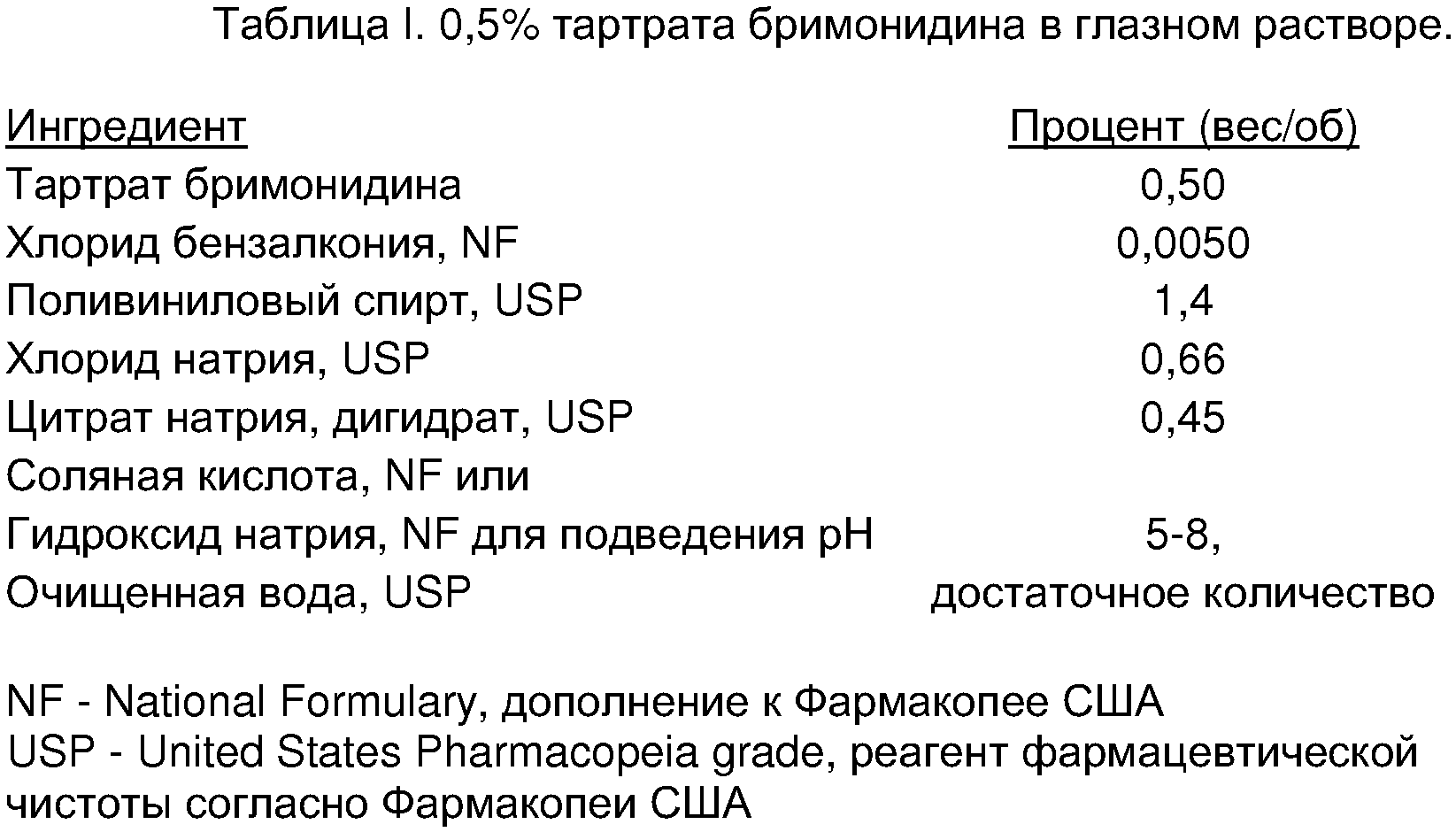
Значения растворимости тартрата бримонидина в наполнителях для композиции представлены в Таблице II. Результаты показывают, что растворимость тартрата бримонидина сильно зависит от рН и составляет более двух порядков величины в интервале рН от 5 до 8. Растворимость резко понижается с увеличением рН. Результаты для обработанных и необработанных контрольных образцов очень близки, что подтверждает, что центрифугирование и фильтрация не вызывают какой-либо значительной потери тартрата бримонидина. Две кривые растворимости, полученные в течение нескольких дней подряд, согласуются друг с другом.The solubility values of brimonidine tartrate in the excipients for the composition are presented in Table II. The results show that the solubility of brimonidine tartrate strongly depends on pH and is more than two orders of magnitude in the pH range from 5 to 8. Solubility decreases sharply with increasing pH. The results for the treated and untreated control samples are very close, which confirms that centrifugation and filtration do not cause any significant loss of brimonidine tartrate. Two solubility curves obtained over several consecutive days are consistent with each other.
Растворимость тартрата бримонидина в глазном растворе в диапазоне рН от 5 до 8.Table II.
The solubility of brimonidine tartrate in an ophthalmic solution in the pH range from 5 to 8.
b Представлены теоретические значения концентрации на основании веса образца. Раствор образца был прозрачным, что указывает на то, что весь тартрат бримонидина растворился.
c Концентрация тартрата бримонидина в контрольном образце перед стадией центрифугирования и фильтрации.
d Концентрация тартрата бримонидина в контрольном образце после стадии центрифугирования и фильтрации.
e % (вес./об.). a Measured after stirring for two days before taking the sample for centrifugation and filtration.
b Theoretical concentration values are presented based on the weight of the sample. The sample solution was clear, indicating that all brimonidine tartrate had dissolved.
c The concentration of brimonidine tartrate in the control sample before the centrifugation and filtration step.
d The concentration of brimonidine tartrate in the control sample after the centrifugation and filtration step.
e % (w / v).
ПРИМЕР 2EXAMPLE 2
Были определены графики зависимости растворимости тартрата бримонидина от рН в композициях (растворах), содержащих "КПР" и хлороксикомпоненты. В частности, было определено влияние натрий-карбоксиметилцеллюлозы (КМЦ), "КПР" на растворимость тартрата бримонидина при различных значениях рН.Graphs of the dependence of the solubility of brimonidine tartrate on pH were determined in compositions (solutions) containing "CRC" and chloroxy components. In particular, the effect of sodium carboxymethyl cellulose (CMC), "CRC" on the solubility of brimonidine tartrate at various pH values was determined.
Различные концентрации КМЦ, изучавшиеся с тартратом бримонидина, составляли 0%, 0,056%, 0,17%, 0,5%, 1,5% (вес./об.). Таблица III.The various concentrations of CMC studied with brimonidine tartrate were 0%, 0.056%, 0.17%, 0.5%, 1.5% (w / v). Table III.
Исследуемые образцы также содержали изотонические компоненты, буферные компоненты и стабилизированный диоксид хлора (Purite™), Таблица III. Натрий-карбоксиметилцеллюлоза, хлорид натрия, хлорид калия, дигидрат хлорида кальция и гексагидрат хлорида магния были чистоты USP. Борная кислота и декагидрат бората натрия были чистоты NF.Test samples also contained isotonic components, buffering components, and stabilized chlorine dioxide (Purite ™), Table III. Sodium carboxymethyl cellulose, sodium chloride, potassium chloride, calcium chloride dihydrate and magnesium chloride hexahydrate were of USP purity. Boric acid and sodium borate decahydrate were NF purity.
а Продается под торговьм знаком Purite™ компанией Allergan, Inc. a Sold under the trademark Purite ™ by Allergan, Inc.
Каждый образец (с 1 по 5) исследовали при различных значениях рН приблизительно от 7 до 10. Пробирки, содержащие раствор образца, помещали на лабораторный ротатор и оставляли на пятнадцать дней при комнатной температуре (~21°С) для уравновешивания. Растворы образцов фильтровали через фильтр насосного типа из ацетата полисульфонцеллюлозы диаметром 25 мм с размером пор 0,45 мкм. Профильтрованные растворы анализировали на содержание бримонидина.Each sample (1 to 5) was examined at various pH values from approximately 7 to 10. Tubes containing the sample solution were placed on a laboratory rotator and left for fifteen days at room temperature (~ 21 ° C) for equilibration. Sample solutions were filtered through a pump-type filter made of polysulfone cellulose acetate with a diameter of 25 mm and a pore size of 0.45 μm. Filtered solutions were analyzed for brimonidine content.
Для регистрации и определения концентраций растворенного тартрата бримонидина использовали стандартные методы ВЭЖХ и регистрации. Таблица IV. Построена кривая зависимости растворимости от рН для каждой концентрации КМЦ. Экспериментальные точки соответствовали модифицированному уравнению Henderson-Hasselbalch, использующему нелинейный метод наименьших квадратов (Deltagraph version 4.0 Deltapoint, Inc.), Фиг.1. Величины R2, что степень соответствия между экспериментальными данными и теоретическими данными, полученными из уравнения выше 0,991.For registration and determination of concentrations of dissolved brimonidine tartrate, standard HPLC and registration methods were used. Table IV. A pH solubility curve was constructed for each CMC concentration. The experimental points corresponded to the modified Henderson-Hasselbalch equation using the nonlinear least squares method (Deltagraph version 4.0 Deltapoint, Inc.), FIG. 1. The values of R 2 are that the degree of correspondence between the experimental data and the theoretical data obtained from the equation is above 0.991.

Фиг.1 демонстрирует, что растворимость тартрата бримонидина увеличивается по мере роста концентраций КМЦ. Например, при рН 7,5 образец, содержащий 0% КМЦ, давал 1000 м.д. тартрата бримонидина; образец, содержащий 0,056% КМЦ - 1300 м.д.; 0,17% КМЦ - 1300 м.д.; и 0,5% - 1600 м.д. При рН 7,5 образец, содержащий 1,5% КМЦ, давал около 1400 м.д., что меньше, чем для аналогичного раствора, содержащего 0,5% КМЦ. На данном этапе не ясно, в чем причина такого результата. Тем не менее, тартрат бримонидина лучше растворим в растворах, содержащих 1,5% КМЦ, чем в растворах, не содержащих КМЦ.Figure 1 shows that the solubility of brimonidine tartrate increases with increasing CMC concentrations. For example, at pH 7.5, a sample containing 0% CMC gave 1000 ppm. brimonidine tartrate; a sample containing 0.056% CMC - 1300 ppm; 0.17% CMC - 1300 ppm; and 0.5% - 1600 ppm. At pH 7.5, a sample containing 1.5% CMC gave about 1400 ppm, which is less than for a similar solution containing 0.5% CMC. At this stage, it is not clear what is the reason for this result. However, brimonidine tartrate is better soluble in solutions containing 1.5% CMC than in solutions not containing CMC.
КМЦ является также эффективной для увеличения растворимости тартрата бримонидина в биологической среде, например, в биологической среде роговицы.CMC is also effective for increasing the solubility of brimonidine tartrate in a biological environment, for example, in a biological environment of the cornea.
ПРИМЕР 3 Димеры тартрата бримонидина.EXAMPLE 3 Dimers of brimonidine tartrate.
Тартрат бримонидина добавляли в пробирку со смесью, содержащей хлорит. Пробирку оставляли для уравновешивания на десять дней. Полученные в пробирке образцы анализировали. Было обнаружено, что часть мономерных звеньев тартрата бримонидина конъюгировала с образованием димеров.Brimonidine tartrate was added to the test tube with a mixture containing chlorite. The tube was left to balance for ten days. In vitro samples were analyzed. It was found that part of the monomer units of brimonidine tartrate conjugated with the formation of dimers.
Хотя данное изобретение было описано в отношении различных конкретных примеров и воплощений, должно быть понятно, что изобретение не ограничивается этим и что оно может быть различным образом осуществлено в объеме следующих притязаний.Although the invention has been described with respect to various specific examples and embodiments, it should be understood that the invention is not limited to this and that it can be variously carried out within the scope of the following claims.
Claims (8)
Applications Claiming Priority (2)
| Application Number | Priority Date | Filing Date | Title |
|---|---|---|---|
| US21820000P | 2000-07-14 | 2000-07-14 | |
| US60/218200 | 2000-07-14 |
Publications (2)
| Publication Number | Publication Date |
|---|---|
| RU2003101321A RU2003101321A (en) | 2004-06-27 |
| RU2311928C2 true RU2311928C2 (en) | 2007-12-10 |
Family
ID=22814143
Family Applications (1)
| Application Number | Title | Priority Date | Filing Date |
|---|---|---|---|
| RU2003101321/15A RU2311928C2 (en) | 2000-07-14 | 2001-07-09 | Composition containing alpha-2-adrenergic agonists |
Country Status (19)
| Country | Link |
|---|---|
| US (4) | US6627210B2 (en) |
| EP (1) | EP1365811A2 (en) |
| JP (3) | JP4927298B2 (en) |
| KR (1) | KR100757656B1 (en) |
| CN (2) | CN101897704B (en) |
| AR (1) | AR033539A1 (en) |
| AU (2) | AU7326901A (en) |
| BR (1) | BR0109317A (en) |
| CA (1) | CA2402405C (en) |
| HU (1) | HUP0303197A3 (en) |
| IL (2) | IL151530A0 (en) |
| MX (1) | MXPA02008930A (en) |
| NO (1) | NO333367B1 (en) |
| NZ (1) | NZ521185A (en) |
| PL (1) | PL360707A1 (en) |
| RU (1) | RU2311928C2 (en) |
| TW (1) | TWI287998B (en) |
| WO (1) | WO2002005853A2 (en) |
| ZA (1) | ZA200207413B (en) |
Families Citing this family (72)
| Publication number | Priority date | Publication date | Assignee | Title |
|---|---|---|---|---|
| CA2416169C (en) * | 2000-07-14 | 2008-09-23 | Allergan, Inc. | Compositions containing therapeutically active components having enhanced solubility |
| US8858961B2 (en) | 2000-07-14 | 2014-10-14 | Allergan, Inc. | Compositions containing alpha-2-adrenergic agonist components |
| US20050026924A1 (en) * | 2000-07-14 | 2005-02-03 | Allergan, Inc. | Compositions containing alpha-2-adrenergic agonist components |
| RU2311928C2 (en) * | 2000-07-14 | 2007-12-10 | Аллерган Инк. | Composition containing alpha-2-adrenergic agonists |
| US20040214829A1 (en) * | 2000-07-14 | 2004-10-28 | Allergan, Inc. | Compositions containing alpha-2-adrenergic agonist components |
| AU2011250793B2 (en) * | 2000-07-14 | 2012-11-29 | Allergan, Inc. | Compositions containing alpha-2-adrenergic agonist components |
| US20020198209A1 (en) | 2001-05-03 | 2002-12-26 | Allergan Sales Inc. | Compositions having enhanced pharmacokinetic characteristics |
| AU2002256471B2 (en) * | 2001-05-03 | 2007-05-24 | Allergan, Inc. | Compositions having enhanced pharmacokinetic characteristics |
| US6753017B2 (en) * | 2001-11-07 | 2004-06-22 | Jrs Pharma Lp | Process for preparing dry extracts |
| US7030149B2 (en) | 2002-04-19 | 2006-04-18 | Allergan, Inc. | Combination of brimonidine timolol for topical ophthalmic use |
| US7642258B2 (en) * | 2002-04-19 | 2010-01-05 | Allergan, Inc. | Combination of brimonidine and timolol for topical ophthalmic use |
| US6982079B2 (en) * | 2002-04-26 | 2006-01-03 | Allergan, Inc. | Compositions for treating hyperemia |
| US20040266776A1 (en) * | 2003-06-25 | 2004-12-30 | Gil Daniel W. | Methods of preventing and reducing the severity of stress-associated conditions |
| JP2006504741A (en) * | 2002-10-08 | 2006-02-09 | アラーガン、インコーポレイテッド | Use of (2-imidazolin-2-ylamino) quinoxaline in the treatment of dementia and Parkinson's disease |
| ATE429216T1 (en) * | 2002-10-08 | 2009-05-15 | Allergan Inc | ALPHA 2B OR 2B/2C ADRENOCEPTOR AGONISTS FOR THE TREATMENT OF ALZHEIMER'S DISEASE AND PARKINSON'S DISEASE |
| US20040137079A1 (en) * | 2003-01-08 | 2004-07-15 | Cook James N. | Contact lens and eye drop rewetter compositions and methods |
| US20040191332A1 (en) * | 2003-03-27 | 2004-09-30 | Allergan, Inc. | Preserved ophthalmic compositions |
| US7439241B2 (en) | 2003-05-27 | 2008-10-21 | Galderma Laboratories, Inc. | Compounds, formulations, and methods for treating or preventing rosacea |
| EP1654002B2 (en) | 2003-08-07 | 2014-01-29 | Allergan, Inc. | Compositions for delivery of therapeutics into the eyes |
| US20050196439A1 (en) * | 2003-10-24 | 2005-09-08 | J. Rettenmaier & Soehne Gmbh + Co. Kg | Process for co-spray drying agents with dry silicified MCC |
| US8673341B2 (en) * | 2004-04-30 | 2014-03-18 | Allergan, Inc. | Intraocular pressure reduction with intracameral bimatoprost implants |
| US8529927B2 (en) * | 2004-04-30 | 2013-09-10 | Allergan, Inc. | Alpha-2 agonist polymeric drug delivery systems |
| US8425929B2 (en) * | 2004-04-30 | 2013-04-23 | Allergan, Inc. | Sustained release intraocular implants and methods for preventing retinal dysfunction |
| US7799336B2 (en) | 2004-04-30 | 2010-09-21 | Allergan, Inc. | Hypotensive lipid-containing biodegradable intraocular implants and related methods |
| US8722097B2 (en) | 2004-04-30 | 2014-05-13 | Allergan, Inc. | Oil-in-water method for making polymeric implants containing a hypotensive lipid |
| US20050244463A1 (en) * | 2004-04-30 | 2005-11-03 | Allergan, Inc. | Sustained release intraocular implants and methods for treating ocular vasculopathies |
| US9498457B2 (en) | 2004-04-30 | 2016-11-22 | Allergan, Inc. | Hypotensive prostamide-containing biodegradable intraocular implants and related implants |
| US7993634B2 (en) | 2004-04-30 | 2011-08-09 | Allergan, Inc. | Oil-in-oil emulsified polymeric implants containing a hypotensive lipid and related methods |
| US20050244469A1 (en) | 2004-04-30 | 2005-11-03 | Allergan, Inc. | Extended therapeutic effect ocular implant treatments |
| CA2505836C (en) * | 2004-05-06 | 2013-08-27 | Alcon Inc. | Topical brimonidine tartrate formulations that lack chlorine dioxide |
| CN104490884A (en) * | 2004-05-25 | 2015-04-08 | 桑斯罗萨医药发展公司 | Compounds, Formulations, And Methods For Treating Or Preventing Rosacea |
| JP4789454B2 (en) * | 2004-12-03 | 2011-10-12 | 株式会社キーエンス | Fluorescence microscope |
| US20060228487A1 (en) * | 2005-04-11 | 2006-10-12 | J. Rettenmaier & Söehne GmbH + Co. KG | Methods of combining active agents with augmented microcrystalline cellulose |
| AR056043A1 (en) * | 2005-08-25 | 2007-09-12 | Schering Corp | ALFA2C FUNCTIONALLY SELECTIVE ADRENERGIC RECEIVERS AGONISTS |
| US7700592B2 (en) * | 2005-08-25 | 2010-04-20 | Schering Corporation | α2C adrenoreceptor agonists |
| ATE478069T1 (en) * | 2005-08-25 | 2010-09-15 | Schering Corp | 3,4-DIHYDRO-2H-BENZOÄ1,4ÜOXAZINE AND 3,4-DIHYDRO-2H-BENZOÄ1,4ÜTHIAZINE COMPOUNDS AS ALPHA2C ADRENORECEPTOR ANTAGONISTS |
| US8003624B2 (en) * | 2005-08-25 | 2011-08-23 | Schering Corporation | Functionally selective ALPHA2C adrenoreceptor agonists |
| EP2218442A1 (en) | 2005-11-09 | 2010-08-18 | CombinatoRx, Inc. | Methods, compositions, and kits for the treatment of ophthalmic disorders |
| US20070238732A1 (en) * | 2006-04-10 | 2007-10-11 | Allergan, Inc. | Brimonidine and timolol compositions |
| US8969415B2 (en) * | 2006-12-01 | 2015-03-03 | Allergan, Inc. | Intraocular drug delivery systems |
| CN101951903A (en) * | 2008-02-15 | 2011-01-19 | 骨治疗公司 | Pharmaceutical composition for use in the treatment or prevention of osteoarticular diseases |
| JP2011512345A (en) * | 2008-02-15 | 2011-04-21 | ボーン・セラピューティクス | Pharmaceutical composition for use in treatment and / or prevention of bone and joint diseases |
| US7842714B2 (en) * | 2008-03-03 | 2010-11-30 | Allergan, Inc. | Ketorolac tromethamine compositions for treating ocular pain |
| US9192571B2 (en) | 2008-03-03 | 2015-11-24 | Allergan, Inc. | Ketorolac tromethamine compositions for treating or preventing ocular pain |
| US8952011B2 (en) | 2008-08-01 | 2015-02-10 | Eye Therapies Llc | Compositions and methods for the treatment of nasal conditions |
| US20100203165A1 (en) | 2008-08-01 | 2010-08-12 | Gerald Horn | Compositions and methods for treatment of disorders or conditions of the eye |
| US20120156244A1 (en) * | 2008-08-01 | 2012-06-21 | Alpha Synergy Development Inc. | Nasal Compositions and Uses Thereof |
| US20100197694A1 (en) * | 2008-08-01 | 2010-08-05 | Gerald Horn | Compositions and methods for treatment of diseases and conditions with increased vascular permeability |
| US12246013B2 (en) | 2008-08-01 | 2025-03-11 | Eye Therapies Llc | Vasoconstriction compositions and methods of use |
| US20100202979A1 (en) * | 2008-08-01 | 2010-08-12 | Gerald Horn | Compositions and methods for treatment of pulmonary diseases and conditions |
| US8338421B2 (en) * | 2008-08-01 | 2012-12-25 | Alpha Synergy Development, Inc. | Compositions and methods for reversing rebound hyperemia |
| US20110003823A1 (en) * | 2008-08-01 | 2011-01-06 | Alpha Synergy Development, Inc. | Compositions and methods for treatment of diseases and conditions associated with vasodilation and/or vascular leakage |
| WO2010017120A1 (en) * | 2008-08-04 | 2010-02-11 | Schering Corporation | Cyclopropylchromene derivatives as modulators of the alpha-2c receptor |
| AR073628A1 (en) | 2008-10-07 | 2010-11-17 | Schering Corp | BIARIL ANALOGS ESPIROAMINOOXAZOLINA AND ESPIROAMINODIAZOLINA MODULATORS OF ADRENERGIC RECEPTORS ALFA2C, PHARMACEUTICAL COMPOSITIONS THAT INCLUDE THEM AND USE OF THE SAME IN ALLERGIC RHINITIS, CARDIAC DISORDERS AND OTHER DISEASES |
| US20110293549A1 (en) | 2009-02-03 | 2011-12-01 | Athena Cosmetics, Inc. | Composition, method and kit for enhancing hair |
| US8987270B2 (en) | 2009-07-27 | 2015-03-24 | Eye Therapies Llc | Formulations of selective alpha-2 agonists and methods of use thereof |
| RU2567792C2 (en) | 2009-11-09 | 2015-11-10 | Аллерган, Инк. | Compositions and methods for hair growth stimulation |
| US20110152271A1 (en) * | 2009-12-17 | 2011-06-23 | Gerald Horn | Compositions and methods for ophthalmic delivery of nasal decongestants |
| US9522153B2 (en) | 2009-12-22 | 2016-12-20 | Allergan, Inc. | Compositions and methods for lowering intraocular pressure |
| EP3085358B1 (en) | 2010-01-22 | 2017-11-01 | Allergan, Inc. | Intracameral sustained release therapeutic agent implants |
| JP5747391B2 (en) | 2010-03-26 | 2015-07-15 | ガルデルマ・リサーチ・アンド・デヴェロップメント | Improved methods and compositions for safe and effective treatment of erythema |
| US8445526B2 (en) | 2011-02-03 | 2013-05-21 | Glaucoma & Nasal Therapies Llc | Compositions and methods for treatment of glaucoma |
| US9744168B2 (en) | 2011-10-19 | 2017-08-29 | Galderma Laboratories, Inc. | Method of reducing facial flushing associated with systemic use of phosphodiesterase type 5 inhibitors |
| CA2901280A1 (en) | 2013-02-15 | 2014-08-21 | Allergan, Inc. | Sustained drug delivery implant |
| US8999938B2 (en) | 2013-06-21 | 2015-04-07 | Gnt Llc | Ophthalmic lipophilic drug delivery vehicle formulations |
| SG11201603383VA (en) | 2013-10-31 | 2016-05-30 | Allergan Inc | Prostamide-containing intraocular implants and methods of use thereof |
| UA117768C2 (en) * | 2013-12-24 | 2018-09-25 | Сентісс Фарма Прайвет Лімітед | Topical brimonidine tartrate ophthalmic solution |
| AU2016233125A1 (en) * | 2015-03-19 | 2017-09-14 | Allergan, Inc. | Fixed dose combination of bromonidine and timolol |
| EP3496662A4 (en) | 2016-08-12 | 2019-10-30 | Silk Technologies Ltd. | PROTEIN DERIVED FROM SILK FOR THE TREATMENT OF INFLAMMATION |
| AU2020264808B2 (en) | 2019-05-01 | 2025-01-02 | Clexio Biosciences Ltd. | Methods of treating pruritus |
| KR102678138B1 (en) | 2022-09-29 | 2024-06-25 | 주식회사태준제약 | Ophthalmic composition comprising brimonidine |
| KR20250049934A (en) | 2023-10-05 | 2025-04-14 | 주식회사태준제약 | Ophthalmic composition comprising brimonidine |
Citations (3)
| Publication number | Priority date | Publication date | Assignee | Title |
|---|---|---|---|---|
| US5834470A (en) * | 1993-12-17 | 1998-11-10 | The Procter & Gamble Company | 6-(2-imidazolinylamino) quinoxaline compounds useful as α-2 adrenoreceptor agonists |
| RU2125557C1 (en) * | 1993-05-27 | 1999-01-27 | Юцб | Substituted 2-hydroxy-3-[1-(1h-imidazole-4-yl)-alkyl]-benzene carboximideamides, their optical isomers and their racemic mixtures or their nontoxic ophthalmologically acceptable acid salts |
| WO2000012137A1 (en) * | 1998-09-02 | 2000-03-09 | Allergan Sales, Inc. | Preserved cyclodextrin-containing compositions |
Family Cites Families (32)
| Publication number | Priority date | Publication date | Assignee | Title |
|---|---|---|---|---|
| DE1154119B (en) * | 1961-11-30 | 1963-09-12 | Boehringer Sohn Ingelheim | Process for the preparation of 2- (2 ', 4', 6'-trimethylbenzyl) -1, 3-diazacyclopentene- (2) and its salts |
| US3278447A (en) | 1963-12-02 | 1966-10-11 | Cloro Bac Products Inc | Process for stabilizing chlorine dioxide solution |
| BE795970A (en) | 1972-02-29 | 1973-08-27 | Pfizer | NEW DERIVATIVES OF QUINOLEINE, QUINOXALINE AND QUINAZOLINE ER PHARMACEUTICAL COMPOSITION CONTAINING THEM |
| US4530920A (en) | 1983-11-07 | 1985-07-23 | Syntex (U.S.A.) Inc. | Nonapeptide and decapeptide analogs of LHRH, useful as LHRH agonist |
| US4806556A (en) | 1985-12-12 | 1989-02-21 | Regents Of The University Of Minnesota | Gut-selective opiates |
| US5719197A (en) | 1988-03-04 | 1998-02-17 | Noven Pharmaceuticals, Inc. | Compositions and methods for topical administration of pharmaceutically active agents |
| US5607698A (en) | 1988-08-04 | 1997-03-04 | Ciba-Geigy Corporation | Method of preserving ophthalmic solution and compositions therefor |
| US5202128A (en) | 1989-01-06 | 1993-04-13 | F. H. Faulding & Co. Limited | Sustained release pharmaceutical composition |
| CA2007181C (en) | 1989-01-06 | 1998-11-24 | Angelo Mario Morella | Sustained release pharmaceutical composition |
| JPH085779B2 (en) * | 1989-09-22 | 1996-01-24 | 杏林製薬株式会社 | Fleroxacin eye drops |
| US5352796A (en) | 1989-10-30 | 1994-10-04 | The Salk Institute For Biological Studies | Amino acids useful in making GnRH analogs |
| US5021416A (en) * | 1989-10-31 | 1991-06-04 | Allergan, Inc. | Method for using (2-imidazolin-2-ylamino) quinoxalines to reduce or maintain intraocular pressure |
| US5215991A (en) * | 1990-01-26 | 1993-06-01 | Allergan, Inc. | Combination of selective alpha-adrenergic agonists and Na+ /H+ ex |
| GB9017353D0 (en) | 1990-08-08 | 1990-09-19 | Merck Sharp & Dohme | Chemical process |
| IT1252692B (en) * | 1991-11-27 | 1995-06-23 | Zambon Spa | PHARMACEUTICAL COMPOSITION FOR OPHTHALMIC USE CONTAINING A NON-STEROID ANTI-INFLAMMATORY AND A DECONGESTANT AS ACTIVE INGREDIENTS |
| JPH05271053A (en) * | 1992-03-27 | 1993-10-19 | Lion Corp | Stable eye drops |
| US5459133A (en) * | 1992-06-05 | 1995-10-17 | Telor Ophthalmic Pharmaceuticals, Inc. | Methods and products for treating presbyopia |
| WO1994016685A1 (en) | 1993-01-28 | 1994-08-04 | University Of Iowa Research Foundation | Ophthalmic uses of signa agonists |
| JP3683908B2 (en) | 1993-10-13 | 2005-08-17 | アラーガン、インコーポレイテッド | Method of using (2-imidazolin-2-ylamino) quinoxaline derivative |
| US5994110A (en) | 1995-02-10 | 1999-11-30 | Mosbach; Klaus | Methods for direct synthesis of compounds having complementary structure to a desired molecular entity and use thereof |
| US6294563B1 (en) * | 1994-10-27 | 2001-09-25 | Allergan Sales, Inc. | Combinations of prostaglandins and brimonidine or derivatives thereof |
| US5856329A (en) * | 1995-06-28 | 1999-01-05 | Allergan | Method of using (2-imidazolin-2-ylamino) quinoxalines in treating ocular neural injury |
| ZA965837B (en) | 1995-07-11 | 1997-01-31 | Merck & Co Inc | A triazolylmethyl-indole ethylamine bisulfate salt |
| EP0834308A1 (en) | 1996-09-30 | 1998-04-08 | LG Chemical Limited | Ophthalmic formulation for treating myopia comprising dopamine agonist and cyclodextrin |
| CA2286797C (en) | 1997-04-18 | 2008-07-15 | Abbott Laboratories | A process for the preparation of highly pure 6,7-dichloro-5-nitro-2,3-dihydroquinoxaline-2,3-dione |
| MY116782A (en) * | 1997-12-22 | 2004-03-31 | Otsuka Pharma Co Ltd | Water-soluble eye drop |
| WO1999043299A2 (en) | 1998-02-26 | 1999-09-02 | Abbott Laboratories | Oral formulation for hydrophilic drugs |
| DE69909768T2 (en) | 1998-04-07 | 2004-06-17 | Alcon Manufacturing Ltd., Fort Worth | XANTHAN GUM CONTAINING YELLOWING OPHTHALMIC COMPOSITIONS |
| WO2000019981A1 (en) | 1998-10-08 | 2000-04-13 | Karagoezian Hampar L | Synergistic antimicrobial, dermatological and ophthalmic preparations containing chlorite and hydrogen peroxide |
| IN185228B (en) * | 1999-02-03 | 2000-12-09 | Bakulesh Mafatlal Dr Khamar | |
| RU2311928C2 (en) * | 2000-07-14 | 2007-12-10 | Аллерган Инк. | Composition containing alpha-2-adrenergic agonists |
| CA2416169C (en) * | 2000-07-14 | 2008-09-23 | Allergan, Inc. | Compositions containing therapeutically active components having enhanced solubility |
-
2001
- 2001-07-09 RU RU2003101321/15A patent/RU2311928C2/en active
- 2001-07-09 CA CA002402405A patent/CA2402405C/en not_active Expired - Lifetime
- 2001-07-09 BR BR0109317-7A patent/BR0109317A/en not_active Application Discontinuation
- 2001-07-09 CN CN200910247188.9A patent/CN101897704B/en not_active Expired - Lifetime
- 2001-07-09 EP EP01952528A patent/EP1365811A2/en not_active Ceased
- 2001-07-09 JP JP2002511784A patent/JP4927298B2/en not_active Expired - Lifetime
- 2001-07-09 AU AU7326901A patent/AU7326901A/en active Pending
- 2001-07-09 WO PCT/US2001/021552 patent/WO2002005853A2/en not_active Ceased
- 2001-07-09 NZ NZ521185A patent/NZ521185A/en not_active IP Right Cessation
- 2001-07-09 HU HU0303197A patent/HUP0303197A3/en not_active Application Discontinuation
- 2001-07-09 IL IL15153001A patent/IL151530A0/en unknown
- 2001-07-09 MX MXPA02008930A patent/MXPA02008930A/en active IP Right Grant
- 2001-07-09 PL PL36070701A patent/PL360707A1/en not_active Application Discontinuation
- 2001-07-09 AU AU2001273269A patent/AU2001273269B2/en not_active Expired
- 2001-07-09 KR KR1020027014270A patent/KR100757656B1/en not_active Expired - Lifetime
- 2001-07-09 CN CNB018073395A patent/CN100569291C/en not_active Expired - Lifetime
- 2001-07-10 US US09/904,018 patent/US6627210B2/en not_active Expired - Lifetime
- 2001-07-13 TW TW090117220A patent/TWI287998B/en not_active IP Right Cessation
- 2001-07-13 AR ARP010103344A patent/AR033539A1/en not_active Application Discontinuation
-
2002
- 2002-08-28 IL IL151530A patent/IL151530A/en unknown
- 2002-09-04 NO NO20024221A patent/NO333367B1/en not_active IP Right Cessation
- 2002-09-06 US US10/236,566 patent/US6641834B2/en not_active Expired - Lifetime
- 2002-09-16 ZA ZA200207413A patent/ZA200207413B/en unknown
- 2002-11-19 US US10/299,386 patent/US6673337B2/en not_active Expired - Lifetime
-
2003
- 2003-10-22 US US10/691,912 patent/US20040063689A1/en not_active Abandoned
-
2008
- 2008-06-02 JP JP2008144707A patent/JP2008231122A/en active Pending
-
2011
- 2011-12-27 JP JP2011286579A patent/JP2012067128A/en active Pending
Patent Citations (3)
| Publication number | Priority date | Publication date | Assignee | Title |
|---|---|---|---|---|
| RU2125557C1 (en) * | 1993-05-27 | 1999-01-27 | Юцб | Substituted 2-hydroxy-3-[1-(1h-imidazole-4-yl)-alkyl]-benzene carboximideamides, their optical isomers and their racemic mixtures or their nontoxic ophthalmologically acceptable acid salts |
| US5834470A (en) * | 1993-12-17 | 1998-11-10 | The Procter & Gamble Company | 6-(2-imidazolinylamino) quinoxaline compounds useful as α-2 adrenoreceptor agonists |
| WO2000012137A1 (en) * | 1998-09-02 | 2000-03-09 | Allergan Sales, Inc. | Preserved cyclodextrin-containing compositions |
Non-Patent Citations (2)
| Title |
|---|
| SU 1829937 АЗ 31.07.1993. * |
| В.И. МОРОЗОВ, А.А.ЯКОВЛЕВ Фармакотерапия глазных болезней М., Медицина 1989 с.199-200. * |
Also Published As
Similar Documents
| Publication | Publication Date | Title |
|---|---|---|
| RU2311928C2 (en) | Composition containing alpha-2-adrenergic agonists | |
| AU2001273269A1 (en) | Compositions containing alpha-2-adrenergic agonist components | |
| JP2012246304A (en) | COMPOSITION CONTAINING α-2-ADRENERGIC AGONIST COMPONENT | |
| US20200069576A1 (en) | Compositions containing alpha-2-adrenergic agonist components | |
| US20040214829A1 (en) | Compositions containing alpha-2-adrenergic agonist components | |
| US20040219219A1 (en) | Compositions containing alpha-2-adrenergic agonist components | |
| CA2474280C (en) | Compositions containing alpha-2-adrenergic agonist components | |
| AU2005220199B2 (en) | Compositions containing alpha-2-adrenergic agonist components | |
| AU2011250793B2 (en) | Compositions containing alpha-2-adrenergic agonist components | |
| AU2007202599B2 (en) | Compositions containing alpha-2-adrenergic agonist components |