RU2263407C2 - Data protection method - Google Patents
Data protection method Download PDFInfo
- Publication number
- RU2263407C2 RU2263407C2 RU2002106746/09A RU2002106746A RU2263407C2 RU 2263407 C2 RU2263407 C2 RU 2263407C2 RU 2002106746/09 A RU2002106746/09 A RU 2002106746/09A RU 2002106746 A RU2002106746 A RU 2002106746A RU 2263407 C2 RU2263407 C2 RU 2263407C2
- Authority
- RU
- Russia
- Prior art keywords
- data
- biometric parameter
- digitized
- secret
- authentication
- Prior art date
Links
Images



Classifications
-
- G—PHYSICS
- G06—COMPUTING OR CALCULATING; COUNTING
- G06F—ELECTRIC DIGITAL DATA PROCESSING
- G06F21/00—Security arrangements for protecting computers, components thereof, programs or data against unauthorised activity
- G06F21/10—Protecting distributed programs or content, e.g. vending or licensing of copyrighted material ; Digital rights management [DRM]
- G06F21/109—Protecting distributed programs or content, e.g. vending or licensing of copyrighted material ; Digital rights management [DRM] by using specially-adapted hardware at the client
-
- H—ELECTRICITY
- H04—ELECTRIC COMMUNICATION TECHNIQUE
- H04L—TRANSMISSION OF DIGITAL INFORMATION, e.g. TELEGRAPHIC COMMUNICATION
- H04L63/00—Network architectures or network communication protocols for network security
- H04L63/04—Network architectures or network communication protocols for network security for providing a confidential data exchange among entities communicating through data packet networks
- H04L63/0428—Network architectures or network communication protocols for network security for providing a confidential data exchange among entities communicating through data packet networks wherein the data content is protected, e.g. by encrypting or encapsulating the payload
- H04L63/0442—Network architectures or network communication protocols for network security for providing a confidential data exchange among entities communicating through data packet networks wherein the data content is protected, e.g. by encrypting or encapsulating the payload wherein the sending and receiving network entities apply asymmetric encryption, i.e. different keys for encryption and decryption
-
- G—PHYSICS
- G06—COMPUTING OR CALCULATING; COUNTING
- G06F—ELECTRIC DIGITAL DATA PROCESSING
- G06F21/00—Security arrangements for protecting computers, components thereof, programs or data against unauthorised activity
- G06F21/30—Authentication, i.e. establishing the identity or authorisation of security principals
- G06F21/31—User authentication
- G06F21/32—User authentication using biometric data, e.g. fingerprints, iris scans or voiceprints
-
- G—PHYSICS
- G06—COMPUTING OR CALCULATING; COUNTING
- G06F—ELECTRIC DIGITAL DATA PROCESSING
- G06F21/00—Security arrangements for protecting computers, components thereof, programs or data against unauthorised activity
- G06F21/50—Monitoring users, programs or devices to maintain the integrity of platforms, e.g. of processors, firmware or operating systems
- G06F21/55—Detecting local intrusion or implementing counter-measures
- G06F21/556—Detecting local intrusion or implementing counter-measures involving covert channels, i.e. data leakage between processes
-
- G—PHYSICS
- G06—COMPUTING OR CALCULATING; COUNTING
- G06F—ELECTRIC DIGITAL DATA PROCESSING
- G06F21/00—Security arrangements for protecting computers, components thereof, programs or data against unauthorised activity
- G06F21/70—Protecting specific internal or peripheral components, in which the protection of a component leads to protection of the entire computer
- G06F21/82—Protecting input, output or interconnection devices
- G06F21/83—Protecting input, output or interconnection devices input devices, e.g. keyboards, mice or controllers thereof
-
- G—PHYSICS
- G07—CHECKING-DEVICES
- G07C—TIME OR ATTENDANCE REGISTERS; REGISTERING OR INDICATING THE WORKING OF MACHINES; GENERATING RANDOM NUMBERS; VOTING OR LOTTERY APPARATUS; ARRANGEMENTS, SYSTEMS OR APPARATUS FOR CHECKING NOT PROVIDED FOR ELSEWHERE
- G07C9/00—Individual registration on entry or exit
- G07C9/20—Individual registration on entry or exit involving the use of a pass
- G07C9/22—Individual registration on entry or exit involving the use of a pass in combination with an identity check of the pass holder
- G07C9/25—Individual registration on entry or exit involving the use of a pass in combination with an identity check of the pass holder using biometric data, e.g. fingerprints, iris scans or voice recognition
- G07C9/257—Individual registration on entry or exit involving the use of a pass in combination with an identity check of the pass holder using biometric data, e.g. fingerprints, iris scans or voice recognition electronically
-
- H—ELECTRICITY
- H04—ELECTRIC COMMUNICATION TECHNIQUE
- H04L—TRANSMISSION OF DIGITAL INFORMATION, e.g. TELEGRAPHIC COMMUNICATION
- H04L63/00—Network architectures or network communication protocols for network security
- H04L63/08—Network architectures or network communication protocols for network security for authentication of entities
- H04L63/0861—Network architectures or network communication protocols for network security for authentication of entities using biometrical features, e.g. fingerprint, retina-scan
-
- H—ELECTRICITY
- H04—ELECTRIC COMMUNICATION TECHNIQUE
- H04L—TRANSMISSION OF DIGITAL INFORMATION, e.g. TELEGRAPHIC COMMUNICATION
- H04L63/00—Network architectures or network communication protocols for network security
- H04L63/12—Applying verification of the received information
-
- H—ELECTRICITY
- H04—ELECTRIC COMMUNICATION TECHNIQUE
- H04L—TRANSMISSION OF DIGITAL INFORMATION, e.g. TELEGRAPHIC COMMUNICATION
- H04L69/00—Network arrangements, protocols or services independent of the application payload and not provided for in the other groups of this subclass
- H04L69/04—Protocols for data compression, e.g. ROHC
-
- H—ELECTRICITY
- H04—ELECTRIC COMMUNICATION TECHNIQUE
- H04L—TRANSMISSION OF DIGITAL INFORMATION, e.g. TELEGRAPHIC COMMUNICATION
- H04L9/00—Cryptographic mechanisms or cryptographic arrangements for secret or secure communications; Network security protocols
- H04L9/32—Cryptographic mechanisms or cryptographic arrangements for secret or secure communications; Network security protocols including means for verifying the identity or authority of a user of the system or for message authentication, e.g. authorization, entity authentication, data integrity or data verification, non-repudiation, key authentication or verification of credentials
- H04L9/3226—Cryptographic mechanisms or cryptographic arrangements for secret or secure communications; Network security protocols including means for verifying the identity or authority of a user of the system or for message authentication, e.g. authorization, entity authentication, data integrity or data verification, non-repudiation, key authentication or verification of credentials using a predetermined code, e.g. password, passphrase or PIN
- H04L9/3231—Biological data, e.g. fingerprint, voice or retina
-
- G—PHYSICS
- G06—COMPUTING OR CALCULATING; COUNTING
- G06F—ELECTRIC DIGITAL DATA PROCESSING
- G06F2221/00—Indexing scheme relating to security arrangements for protecting computers, components thereof, programs or data against unauthorised activity
- G06F2221/21—Indexing scheme relating to G06F21/00 and subgroups addressing additional information or applications relating to security arrangements for protecting computers, components thereof, programs or data against unauthorised activity
- G06F2221/2153—Using hardware token as a secondary aspect
-
- H—ELECTRICITY
- H04—ELECTRIC COMMUNICATION TECHNIQUE
- H04L—TRANSMISSION OF DIGITAL INFORMATION, e.g. TELEGRAPHIC COMMUNICATION
- H04L2209/00—Additional information or applications relating to cryptographic mechanisms or cryptographic arrangements for secret or secure communication H04L9/00
- H04L2209/56—Financial cryptography, e.g. electronic payment or e-cash
Landscapes
- Engineering & Computer Science (AREA)
- Computer Security & Cryptography (AREA)
- Computer Hardware Design (AREA)
- Theoretical Computer Science (AREA)
- General Engineering & Computer Science (AREA)
- Software Systems (AREA)
- Signal Processing (AREA)
- Computer Networks & Wireless Communication (AREA)
- Physics & Mathematics (AREA)
- General Physics & Mathematics (AREA)
- Computing Systems (AREA)
- Biomedical Technology (AREA)
- General Health & Medical Sciences (AREA)
- Health & Medical Sciences (AREA)
- Human Computer Interaction (AREA)
- Life Sciences & Earth Sciences (AREA)
- Biodiversity & Conservation Biology (AREA)
- Multimedia (AREA)
- Technology Law (AREA)
- Collating Specific Patterns (AREA)
- Emergency Protection Circuit Devices (AREA)
- Storage Device Security (AREA)
- Reverberation, Karaoke And Other Acoustics (AREA)
Abstract
Description
Настоящее изобретение относится к способу защиты данных, прежде всего обеспечения подлинности и достоверности (целостности) цифровых данных на основании биометрических параметров.The present invention relates to a method for data protection, primarily to ensure the authenticity and reliability (integrity) of digital data based on biometric parameters.
В ходе возрастающей глобализации, охватывающей практически все области экономики, все большее значение придается прежде всего новым информационным технологиям. При этом в первую очередь следует отметить непрерывно возрастающее использование электронных сетей передачи данных, наиболее известной из которых является сеть Интернет. Вместе с ростом объемов международной торговли товарами и предоставления услуг с использованием информационных сетей неизбежно возникает необходимость обеспечения безопасной передачи информации. В настоящее время объем финансовых операций (транзакций) в денежном выражении многократно превышает объем товарообмена. Подобный обмен информацией осуществляется в настоящее время в различных формах по электронным сетям передачи данных (например электронные транзакции типа электронной торговли). Однако при подобной форме взаимодействия необходимо наличие условий, при которых участвующие в сделке стороны при осуществлении транзакции могли бы в полной мере полагаться на "высказывания" (прежде всего на волеизъявление) другой стороны как по сути сделки, так и в вопросе подлинности каждого из участников сделки аналогично тому, как это имеет место при личном общении в неэлектронной сфере. Поскольку, однако, при осуществлении подобных электронных сделок (транзакций в режиме "он-лайн") ее участники, как правило, не вступают в непосредственный контакт между собой, а вся информация существует только в электронном виде, подобные условия, которые обычно имеют место при личном общении между заинтересованными сторонами, не существуют. Поэтому при отсутствии возможности аутентификации и защиты данных о транзакции от несанкционированного манипулирования с ними совершение соответствующей сделки невозможно. Кроме того, большое значение имеет также надежный контроль подлинности данных с точки зрения защиты персональных данных, хранящихся в электронном виде. При этом подлинность и достоверность данных можно обеспечить с помощью цифровой подписи. При использовании подобной цифровой подписи вносить изменения в данные могут только уполномоченные лица, группы лиц или машины. Помимо этого, каждый из них может установить подлинность такой подписи.In the course of increasing globalization, covering almost all areas of the economy, more and more importance is given primarily to new information technologies. First of all, it should be noted the continuously increasing use of electronic data transmission networks, the most famous of which is the Internet. Along with the growth in international trade in goods and the provision of services using information networks, the need inevitably arises to ensure the safe transfer of information. Currently, the volume of financial operations (transactions) in monetary terms is many times higher than the volume of goods exchange. Such exchange of information is currently carried out in various forms via electronic data transfer networks (for example, electronic transactions such as electronic commerce). However, with this form of interaction, it is necessary to have conditions under which the parties to the transaction in the transaction could fully rely on the “statements” (primarily on the will of the other party) both on the substance of the transaction and on the authenticity of each of the participants in the transaction in the same way as it occurs in personal communication in the non-electronic field. Since, however, when carrying out such electronic transactions (transactions on-line), its participants, as a rule, do not come into direct contact with each other, and all information exists only in electronic form, similar conditions that usually occur when personal communication between interested parties do not exist. Therefore, in the absence of the possibility of authentication and protection of transaction data from unauthorized manipulation with them, the transaction is impossible. In addition, reliable control of data authenticity from the point of view of protecting personal data stored in electronic form is also of great importance. At the same time, the authenticity and reliability of the data can be ensured by digital signature. When using such a digital signature, only authorized persons, groups of persons or machines may make changes to the data. In addition, each of them can establish the authenticity of such a signature.
При этом в известных методах защиты данных с помощью цифровой подписи используется так называемый метод асимметричного шифрования (криптография с открытым ключом). Основные принципы этого метода кратко рассмотрены ниже.At the same time, the so-called asymmetric encryption method (public-key cryptography) is used in well-known data protection methods using a digital signature. The basic principles of this method are briefly discussed below.
В соответствии с этим методом для каждого участника, использующего систему с простановкой цифровой подписи, генерируется пара ключей, например один секретный и один открытый ключ, которые связаны между собой определенным математическим отношением. Для создания цифровой подписи отправитель использует свой секретный ключ, обычно в виде особого параметра подписи. Сначала подписываемое сообщение (текст) уплотняется в соответствии с так называемой процедурой хеширования, затем полученные таким путем сжатые данные логически объединяются в соответствии с заданным алгоритмом с секретным ключом и полученный в результате код "прикрепляется" в виде цифровой подписи к передаваемому сообщению или документу. Получатель в свою очередь также уплотняет соответствующее сообщение или документ и сравнивает полученные сжатые данные с содержащимися в цифровой подписи сжатыми данными, полученными в результате расшифровки цифровой подписи с помощью открытого ключа отправителя. Совпадение между указанными данными свидетельствует о том, что полученный текст идентичен переданному тексту, т.е. об отсутствии несанкционированного манипулирования с данными и отсутствии ошибок при передаче. Помимо этого такое совпадение однозначно указывает и на тот факт, что эту подпись мог поставить только отправитель, обладающий секретным ключом, поскольку в противном случае открытый ключ просто не "подошел" бы для расшифровки сообщения, т.е. сжатые данные не удалось бы преобразовать в исходный вид.In accordance with this method, for each participant using a digitally signed system, a pair of keys is generated, for example, one secret and one public key, which are interconnected by a certain mathematical relation. To create a digital signature, the sender uses his private key, usually in the form of a special signature parameter. First, the signed message (text) is compressed in accordance with the so-called hashing procedure, then the compressed data obtained in this way are logically combined in accordance with the specified algorithm with the secret key, and the resulting code is “attached” as a digital signature to the transmitted message or document. The recipient, in turn, also compresses the corresponding message or document and compares the received compressed data with the compressed data contained in the digital signature obtained by decrypting the digital signature using the sender’s public key. The coincidence between the indicated data indicates that the received text is identical to the transmitted text, i.e. the absence of unauthorized manipulation of data and the absence of errors during transmission. In addition, such a coincidence unambiguously indicates the fact that only a sender with a secret key could put this signature, because otherwise the public key would simply not “fit” to decrypt the message, i.e. compressed data could not be converted to its original form.
Надежность современных алгоритмов цифровой подписи основана на том факте, что согласно современному уровню развития науки и техники секретный ключ, используемый для создания цифровой подписи, нельзя расшифровать даже при условии, что в распоряжении злоумышленника имеются открытый (т.е. незашифрованный) текст, текст с цифровой подписью и соответствующий открытый ключ, используемый для создания цифровой подписи. В качестве примера метода асимметричного шифрования можно назвать алгоритм RSA. Свое название алгоритм RSA получил по первым буквам фамилий его разработчиков Ronald L. Rivest, Adi Shamir и Leonard Adleman (в русскоязычной литературе этот алгоритм называется также алгоритмом цифровой подписи Райвеста-Шамира-Адлемана), которые опубликовали этот алгоритм шифрования в 1977 г. ("On Digital Signatures and Public Key Cryptosystems", MIT Laboratory for Computer Science Technical Memorandum 82, апрель 1977 г.), соответственно в 1978 г. ("A Method for Obtaining Digital Signatures and Public-Key Cryptosystems", Communications of the ACM 2/1978). В основу алгоритма RSA заложены положения теории чисел, согласно которым предполагается, что факторизация больших чисел, т.е. их разложение на простые множители, является исключительно сложной процедурой. Иными словами, речь в данном случае идет о так называемой проблеме факторизации. Затраты машинного времени при этом для решения такой задачи столь велики, что при приемлемом выборе ключей несанкционированная попытка расшифровать ("взломать") зашифрованные данные методом "грубой силы" ("в лоб") практически не дает положительных результатов. Публикации о попытках "взлома" ключей криптоаналитическими методами в данной области техники отсутствуют.The reliability of modern digital signature algorithms is based on the fact that, according to the modern level of development of science and technology, the secret key used to create a digital signature cannot be decrypted even if the attacker has open (i.e., unencrypted) text, text with a digital signature and the corresponding public key used to create the digital signature. An example of an asymmetric encryption method is the RSA algorithm. The RSA algorithm got its name from the first letters of the names of its developers Ronald L. Rivest, Adi Shamir and Leonard Adleman (in Russian-language literature this algorithm is also called the Rayvest-Shamir-Adleman digital signature algorithm), which published this encryption algorithm in 1977 (" On Digital Signatures and Public Key Cryptosystems ", MIT Laboratory for Computer Science Technical Memorandum 82, April 1977), respectively in 1978 (" A Method for Obtaining Digital Signatures and Public-Key Cryptosystems ", Communications of the ACM 2 / 1978). The RSA algorithm is based on the principles of number theory, according to which it is assumed that factorization of large numbers, i.e. their factorization is an extremely complicated procedure. In other words, in this case we are talking about the so-called factorization problem. At the same time, the cost of computer time for solving such a problem is so great that with an acceptable choice of keys, an unauthorized attempt to decrypt ("crack") the encrypted data using the brute force ("head-on") method practically does not give positive results. There are no publications on attempts to “crack” keys using cryptanalytical methods in this technical field.
Таким образом, при применении подобного метода асимметричного шифрования содержащий цифровую подпись документ можно однозначно сопоставить с конкретным ключом, используемым для создания цифровой подписи. Однако вместе с тем продолжает оставаться проблема однозначной принадлежности подписанного документа определенному лицу или организации. Решить эту проблему можно лишь при обязательном соблюдении указанных ниже условий, первое из которых состоит в том, что доступ к своему секретному ключу, используемому для создания цифровой подписи, должен иметь только его законный владелец, а второе заключается в том, что каждый открытый ключ должен быть однозначно "привязан" к законному владельцу соответствующего секретного ключа.Thus, using a similar method of asymmetric encryption, a document containing a digital signature can be unambiguously correlated with the specific key used to create the digital signature. However, at the same time, the problem of the unambiguous belonging of the signed document to a specific person or organization remains. This problem can be solved only if the following conditions are mandatory, the first of which is that only its rightful owner must have access to its secret key used to create a digital signature, and the second is that each public key must be uniquely “attached” to the rightful owner of the corresponding secret key.
Для соблюдения первого из указанных условий существует возможность идентифицировать законного владельца ключа, используемого для создания цифровой подписи, с помощью биометрических параметров.To comply with the first of these conditions, it is possible to identify the legal owner of the key used to create a digital signature using biometric parameters.
Для соблюдения второго условия во многих системах предусматривается привлечение так называемых "доверенных посредников", т.е. третьей стороны, которая сама не принимают непосредственного участия в транзакции (сделке), но надежность которой может рассматриваться участниками сделки как не вызывающая сомнений. Подобную систему, основанную на взаимном доверии и контроле, часто называют "доверительной" моделью.To comply with the second condition, many systems provide for the involvement of so-called "trusted intermediaries", i.e. a third party, which itself does not directly participate in the transaction (transaction), but whose reliability can be considered by the parties to the transaction as not in doubt. Such a system, based on mutual trust and control, is often called the "trust" model.
В качестве конкретных примеров применения метода цифровой подписи для аутентификации и проверки достоверности данных можно назвать заключение различного рода договоров, совершаемых в электронном виде через сеть Интернет или иную сеть передачи данных, осуществление электронных транзакций или сделок (ключевое слово "электронная торговля"), контроль доступа к различного рода информационным ресурсам (например каналам передачи данных или внешним системам хранения данных), доступ к данным для управления производственными процессами, экспортируемым в соответствующих системах управления и вводимым в устройства управления технологическим оборудованием, управление персональными данными (например управление данными о пациентах или ведение электронных картотек в органах власти) и т.п.As specific examples of the application of the digital signature method for authentication and data validation, we can mention the conclusion of various kinds of contracts made electronically through the Internet or another data network, electronic transactions or transactions (the keyword "electronic commerce"), access control to various kinds of information resources (for example, data transmission channels or external data storage systems), access to data to control production processes, exp rtiruemym in the respective control systems and inputted in the process equipment control devices, personal data management (e.g. patient data management or maintenance of the electronic card files the authorities), etc.
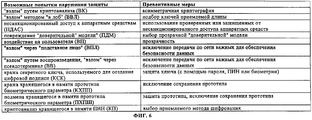
Как и любая система обеспечения безопасности, все известные в настоящее время методы защиты с помощью цифровой подписи в той или иной степени обладают "слабыми местами", так называемой уязвимостью, что делает их потенциальным объектом многочисленных попыток "взлома". Возможные типы подобной уязвимости представлены в таблице на фиг.6.Like any security system, all currently known methods of protection using digital signature to one degree or another have "weaknesses", the so-called vulnerability, which makes them a potential target of numerous attempts to "hack". Possible types of such vulnerabilities are presented in the table in Fig.6.
Среди известных систем защиты с помощью цифровой подписи в качестве примера можно назвать системы, использующие смарт-карты (карты со встроенной микросхемой). Многие основанные на применении смарт-карт системы обеспечивают вполне удовлетворительную защиту от несанкционированных попыток "взлома" самого ключа ("взлом" путем криптоанализа (ВК)), от попыток нарушения защиты информации методом "в лоб" ("взлом" методом "в лоб" (ВВЛ)), а также от попыток нарушения защиты путем несанкционированного доступа к аппаратным средствам, в которых хранится ключ. В отличие от этого относительно более успешными могут оказаться попытки нарушения защиты путем воспроизведения (подделки) и с использованием псевдотерминалов ("взлом" путем воспроизведения (ВВ)), а также попытки нарушения защиты путем оказания давления на самих пользователей, т.е. в отношении таких попыток нарушения защиты использующие смарт-карты системы являются достаточно уязвимыми.Among the known security systems using digital signatures, systems using smart cards (cards with an integrated microcircuit) can be mentioned as an example. Many systems based on the use of smart cards provide quite satisfactory protection against unauthorized attempts to “hack” the key itself (“hacking” by cryptanalysis (VK)), from attempting to violate information protection by the forehead method (“hacking” by the forehead method) (VVL)), as well as from attempts to violate protection by unauthorized access to the hardware in which the key is stored. In contrast, attempts to violate protection by reproducing (fake) and using pseudo-terminals (“hacking” by reproducing (BB)), as well as attempts to violate protection by exerting pressure on users themselves, may be relatively more successful. with respect to such attempts to breach security, systems using smart cards are quite vulnerable.
В некоторых системах предпринимается попытка защитить пользователей от кражи ключа, используемого для создания цифровой подписи. С этой целью применяются персональный идентификационный номер (ПИН), а также методы, основанные на использовании биометрических параметров. Следует отметить, что большинством разработчиков систем аутентификации еще ни разу не обсуждался вопрос касательно защиты от попыток "взлома" "доверительной" модели (ВДМ).Some systems attempt to protect users from theft of a key used to create a digital signature. For this purpose, a personal identification number (PIN), as well as methods based on the use of biometric parameters, are used. It should be noted that most developers of authentication systems have never yet discussed the issue of protection against attempts to "crack" the "trust" model (VDM).
Ниже рассмотрена обычная система, основанная на использовании цифровой подписи в сочетании с определением биометрических параметров. В этой системе используемый для создания цифровой подписи секретный ключ пользователя, равно как и образец или прототип (так называемый шаблон) цифрового представления измеренного биометрического параметра хранятся в памяти. Процесс аутентификации предусматривает выполнение следующих отдельных операций. На первой стадии пользователь должен идентифицировать себя, например, путем ввода ПИН или путем считывания некоторого его биометрического параметра. Далее проверяется достоверность биометрических данных путем их сравнения с шаблоном. Если степень расхождения или несоответствия между измеренным параметром и прототипом меньше некоторого порогового значения, то выдается разрешение на осуществление транзакции. Подобное сравнение осуществляется в устройствах ввода или в центре обмена информацией (клиринговом центре). В последнем случае биометрические данные передаются по сети в зашифрованном виде или в виде открытого текста. Далее раз блокируется секретный ключ, используемый для создания цифровой подписи. Пользователь идентифицирует себя, добавляя к документу цифровую подпись. В большинстве случаев при этом используется алгоритм RSA или иной метод асимметричного шифрования. Обычно такой алгоритм реализован на смарт-карте или иных защищенных от несанкционированного манипулирования (защищенных от несанкционированного доступа) аппаратных средствах. После этого подписанный документ передается по сети. Достоверность криптографической операции проверяется с помощью используемого для создания цифровой подписи открытого ключа пользователя.Below is a conventional system based on the use of a digital signature in combination with the determination of biometric parameters. In this system, the user's secret key used to create the digital signature, as well as the sample or prototype (the so-called template) of the digital representation of the measured biometric parameter, are stored in memory. The authentication process involves the following individual operations. At the first stage, the user must identify himself, for example, by entering the PIN or by reading some of his biometric parameter. Next, the validity of the biometric data is checked by comparing it with the template. If the degree of discrepancy or discrepancy between the measured parameter and the prototype is less than a certain threshold value, then a permission is issued for the transaction. A similar comparison is carried out in input devices or in the information exchange center (clearing center). In the latter case, biometric data is transmitted over the network in encrypted form or in plain text. Next, the secret key used to create the digital signature is locked. The user identifies himself by adding a digital signature to the document. In most cases, this uses the RSA algorithm or another asymmetric encryption method. Typically, such an algorithm is implemented on a smart card or other hardware protected from unauthorized manipulation (protected against unauthorized access). After that, the signed document is transmitted over the network. The validity of the cryptographic operation is checked using the user's public key used to create a digital signature.
Надежность этого метода основана на том, что используемый для создания цифровой подписи секретный ключ не "покидает" смарт-карту. В результате до тех пор, пока смарт-карта остается в руках ее законного владельца, исключается возможность нарушения защиты с помощью "подставного лица" ("взлом" через "подставное лицо" (ВПЛ)) путем получения доступа к собственно секретному ключу, используемому для создания цифровой подписи.The reliability of this method is based on the fact that the secret key used to create a digital signature does not "leave" the smart card. As a result, as long as the smart card remains in the hands of its rightful owner, the possibility of violation of protection by means of a “fake person” (“hacking” through a “fake person” (IDP)) by gaining access to the secret key itself used to create a digital signature.
Пример осуществления способа, в котором предусмотрено хранение в памяти используемого для создания цифровой подписи секретного ключа пользователя и прототипа цифрового представления измеренного биометрического параметра, описан в заявке WO 99/12144 А1.An example implementation of the method, which provides for the storage in memory of the user’s secret key used to create a digital signature and a prototype of a digital representation of the measured biometric parameter, is described in WO 99/12144 A1.
В этом известном из WO 99/12144 А1 способе предлагается хранить шаблон в записанном на носитель виде в центре обмена информацией. Такой центр обмена информацией снабжает документ цифровой подписью от имени пользователя, если расхождение между измеренным биометрическим параметром и прототипом меньше некоторого порогового значения.This method, known from WO 99/12144 A1, proposes to store the template in a recorded form on a medium in an information exchange center. Such an information exchange center provides the document with a digital signature on behalf of the user if the discrepancy between the measured biometric parameter and the prototype is less than a certain threshold value.
Однако недостаток предложенного в WO 99/12144 А1 способа состоит в том, что ему изначально присущи некоторые проблемы, связанные с обеспечением безопасности данных. Во-первых, пользователь должен доверять устройству ввода, с помощью которого считывается биометрический параметр, центру обмена информацией и сетям передачи данных общего пользования. В результате не исключены попытки нарушения защиты с помощью псевдотерминалов. Помимо этого, в устройство ввода можно ввести цифровое представление биометрического параметра (так называемый "взлом" путем воспроизведения (ВВ)). Во-вторых, не исключены попытки нарушения защиты путем несанкционированного доступа к устройству ввода или объекту в базе данных, в котором хранится шаблон. Целью подобных попыток нарушения защиты является считывание шаблона цифрового представления измеренного биометрического параметра. Подобные попытки нарушения защиты могут предприниматься и режиме "он-лайн" (ВПЛ). В-третьих, не исключена подмена данных, поставленных в соответствие шаблону цифрового представления измеренного биометрического параметра (подмена хранящегося в памяти шаблона (ПХПШ)).However, a drawback of the method proposed in WO 99/12144 A1 is that it initially has some problems associated with data security. First, the user must trust the input device with which the biometric parameter is read out to the information exchange center and public data networks. As a result, attempts to violate protection using pseudo-terminals are not ruled out. In addition, a digital representation of the biometric parameter (so-called “hacking” by means of playback (BB)) can be introduced into the input device. Secondly, attempts to violate protection by unauthorized access to an input device or an object in the database in which the template is stored are not ruled out. The purpose of such attempts to violate the protection is to read a digital representation template of the measured biometric parameter. Similar attempts to violate protection can be made on-line (IDP). Thirdly, the substitution of data set in accordance with the digital representation template of the measured biometric parameter (substitution of the template stored in the memory (PCPS)) is not ruled out.
В заявке WO 98/50875 описан способ так называемой биометрической идентификации, предусматривающий применение метода цифровой подписи и биометрии. В этом способе подмену шаблона цифрового представления измеренного биометрического параметра (ПХПШ) предлагается предотвращать путем сохранения этого шаблона в так называемом биометрическом сертификате. При этом достоверность шаблона, а также относящихся к нему сведений о пользователе проверяется в центре сертификации и снабжается в этом центре цифровой подписью. Такой подход исключает возможность подмены сведений о пользователе, связанных с шаблоном. Однако недостаток этого способа состоит в том, что он не исключает возможности "взлома" защиты путем воспроизведения.WO 98/50875 describes a method of so-called biometric identification involving the use of digital signature and biometrics. In this method, it is proposed to prevent the substitution of the digital representation template of the measured biometric parameter (PHPS) by storing this template in the so-called biometric certificate. At the same time, the validity of the template, as well as the information about the user related to it, is checked in a certification center and is digitally signed in this center. This approach eliminates the possibility of spoofing user information associated with the template. However, the disadvantage of this method is that it does not exclude the possibility of “breaking” the protection by reproduction.
В заявке WO 98/52317 также описан способ защиты с использованием цифровой подписи. В предлагаемом в этой заявке WO 98/52317 способе предпринимается попытка предотвратить нарушение защиты в результате кражи хранящегося в памяти прототипа биометрического параметра (КХПП) и ПХПШ, для чего предлагается отказаться от сохранения цифрового представления (шаблона) биометрического параметра (БП). При этом в фазе инициализации на основании БП формируется так называемый экземпляр, т.е. представитель, соответственно конкретный пример определенного класса объектов, конкретной задачи, решением которой является БП. Таким образом, цифровое представление сохраняется не в явном виде, а в скрытом в экземпляре задачи виде. В заявке WO 98/52317 предлагается формулировать задачу таким образом, чтобы скрывать (камуфлировать) цифровое представление в массиве сходных данных.WO 98/52317 also describes a security method using a digital signature. In the method proposed in this application WO 98/52317, an attempt is made to prevent a security breach as a result of the theft of a stored biometric parameter prototype (KHPP) and PHPS, in which it is proposed to refuse to save the digital representation (template) of the biometric parameter (BP). At the same time, in the initialization phase, on the basis of the BP, a so-called instance is formed, i.e. a representative, respectively, a specific example of a certain class of objects, a specific task, the solution of which is BP. Thus, the digital representation is not stored explicitly, but in a form hidden in the task instance. WO 98/52317 proposes to formulate the problem in such a way as to hide (camouflage) a digital representation in an array of similar data.
При регистрации биометрического параметра полученная информация для возможности ее дальнейшей компьютерной обработки подвергается аналого-цифровому преобразованию, которое всегда обладает конечной, хотя и достаточно высокой разрешающей способностью и поэтому часто вносит погрешности округления в оцифрованные измеренные значения. Помимо этого нереально предполагать, что при регистрации биометрических параметров пользователь всегда сможет точно занимать одно и то же положение относительно сенсоров. При измерении поведенческих биометрических параметров возникает дополнительная проблема, которая связана с тем, что пользователь не способен дважды абсолютно точно воспроизвести свое поведение. Однако смысл применения биометрических параметров (например отпечатка пальца, рисунка сетчатки глаза и т.п.) как раз и заключается в их абсолютно однозначной принадлежности конкретному человеку. По этой причине требуется информация о величине необходимой допустимой погрешности (отказоустойчивости), соответственно информация о том, каким образом на основании варьирующихся результатов измерений можно однозначно определить принадлежность тех или иных биометрических параметров конкретному лицу. Однако в WO 98/52317 отсутствуют какие-либо сведения о величине погрешности, допустимой при осуществлении этого способа. Помимо этого не ясно также, насколько большим должен быть объем маскирующих данных, чтобы можно было надежно исключить выявление информации, позволяющей найти вышеуказанное решение задачи. Это условие является необходимым для количественной оценки или по меньшей мере для оценки степени надежности предложенного в этой заявке способа.When registering a biometric parameter, the obtained information, for the possibility of its further computer processing, undergoes an analog-to-digital conversion, which always has a finite, although rather high resolution, and therefore often introduces rounding errors in the digitized measured values. In addition, it is unrealistic to assume that when registering biometric parameters, the user can always precisely occupy the same position relative to the sensors. When measuring behavioral biometric parameters, an additional problem arises, which is related to the fact that the user is not able to absolutely accurately reproduce his behavior twice. However, the meaning of applying biometric parameters (for example, a fingerprint, a pattern of the retina, etc.) lies precisely in their absolutely unambiguous belonging to a particular person. For this reason, information is required on the value of the necessary permissible error (fault tolerance), respectively, information on how, on the basis of varying measurement results, it is possible to unambiguously determine the belonging of certain biometric parameters to a specific person. However, in WO 98/52317 there is no information about the magnitude of the error allowed by the implementation of this method. In addition, it is also not clear how large the volume of masking data should be in order to reliably exclude the identification of information that allows finding the above solution to the problem. This condition is necessary for a quantitative assessment, or at least to assess the degree of reliability of the method proposed in this application.
Согласно описанному в заявке DE 4243908 А1 решению предпринимается попытка исключить нарушение защиты в результате кражи секретного ключа (КСК), используемого для создания цифровой подписи, несанкционированного доступа к аппаратным средствам (НДАС), КХПП и ПХПШ, для чего предлагается отказаться от сохранения в памяти секретного ключа, используемого для создания цифровой подписи, и цифрового представления биометрического параметра. Для этого согласно указанной заявке предлагается выполнять следующие операции. Сначала измеряют биометрический параметр в аналоговом виде (АБП). После этого такой биометрический параметр преобразуют в цифровую форму (оцифровывают). На основании цифрового представления биометрического параметра вычисляют так называемый индивидуальный показатель (ИП) фиксированной длины. На основании этого индивидуального показателя ИП далее вычисляют используемый для создания цифровой подписи секретный ключ отправителя СК(O). В последующем соответствующее электронное сообщение шифруется с помощью этого ключа СК(O).According to the decision described in application DE 4243908 A1, an attempt is made to eliminate a security breach resulting from the theft of a secret key (KSK) used to create a digital signature, unauthorized access to hardware (NDAS), KHPP and PHPSh, for which it is proposed to refuse to keep the secret in memory the key used to create the digital signature and the digital representation of the biometric parameter. To do this, according to the specified application is proposed to perform the following operations. First measure the biometric parameter in analog form (ABP). After that, such a biometric parameter is converted to digital form (digitized). Based on the digital representation of the biometric parameter, a so-called individual measure (PI) of a fixed length is calculated. Based on this individual indicator, the IP further calculates the sender's secret key SK (O) used to create the digital signature. Subsequently, the corresponding electronic message is encrypted using this key SK (O).
Однако недостаток подобного подхода состоит в том, что вычисление ИП должно выполняться с помощью некоторой функции f, характеризующейся определенной величиной допустимой погрешности, при этом не ясно, каким образом для подобной функции следует определять величину этой допустимой погрешности, которая является решающим фактором, влияющим на конечный результат. Согласно указанной заявке требуется лишь, чтобы возможность присвоения с помощью такой функции двум пользователям одного и того же индивидуального показателя имела "столь малую вероятность, которую следует согласовывать с необходимой степенью надежности системы". Еще один недостаток состоит в том, что остается не ясным, какие функции или классы функций должны удовлетворять необходимым согласно указанной заявке условиям. Более того, из описания указанной заявки следует, что хотя, с одной стороны, функция f и должна быть бесконфликтной, т.е. должна быть исключена возможность присвоения двум различным входным величинам одного и того же значения функции, тем не менее, с другой стороны, получаемый с ее помощью результат должен обладать определенной допустимой погрешностью. Однако подобной функции, которая удовлетворяла бы таким диаметрально противоположным требованиям, по определению существовать не может. Вследствие этого можно поставить под сомнение возможность генерировать с постоянно воспроизводимыми результатами один и тот же секретный ключ на основании новых результатов измерения того же самого биометрического параметра, т.е. отсутствует возможность идентифицировать, соответственно аутентифицировать с помощью известных открытых ключей снабженные цифровой подписью документы или данные.However, the disadvantage of this approach is that the calculation of the PI should be performed using some function f, characterized by a certain value of the permissible error, while it is not clear how to determine the value of this permissible error for such a function, which is a decisive factor affecting the final result. According to this application, it is only required that the possibility of assigning, with the help of such a function to two users of the same individual indicator, have “such a low probability that should be coordinated with the necessary degree of system reliability”. Another disadvantage is that it is not clear which functions or classes of functions must satisfy the conditions necessary according to the specified application. Moreover, it follows from the description of the said application that although, on the one hand, the function f should be conflict-free, i.e. the possibility of assigning two different input values to the same function value should be excluded, however, on the other hand, the result obtained with its help should have a certain permissible error. However, such a function, which would satisfy such diametrically opposite requirements, by definition, cannot exist. As a result of this, it is possible to question the possibility of generating the same secret key with constantly reproduced results on the basis of new results of measuring the same biometric parameter, i.e. it is not possible to identify, respectively authenticate using well-known public keys, digitally signed documents or data.
В патенте US 5832091 описан способ получения однозначно определенной величины на основании отпечатка пальца. В этом способе используется следующий подход. На первой стадии характеризующие отпечаток пальца данные подвергаются преобразованию Фурье. После этого коэффициенты Фурье подвергаются отображению, которое зависит от качества шаблона отпечатка пальца и разрешающей способности измерительного прибора. В результате обратного преобразования получают однозначно определенную величину, на основании которой можно определить ключ, используемый для создания цифровой подписи. Однако этот способ также обладает определенными недостатками, а именно: такой способ предназначен для работы только с отпечатками пальцев, требует проведения преобразования Фурье, для отображения, которое зависит от качества шаблона, нельзя определить, какой объем информации о шаблоне теряется в результате этого отображения. В результате невозможно количественно оценить надежность этого способа, обеспечиваемую при попытке нарушить защиту методом "в лоб", и сам этот способ позволяет корректировать лишь ошибки, обусловленные разрешающей способностью измерительного прибора. При этом остается не ясным, можно ли корректировать также ошибки, возникшие, например, из-за загрязнения или небольших повреждений на подушечках пальцев.US Pat. No. 5,832,091 describes a method for obtaining a uniquely determined value based on a fingerprint. This method uses the following approach. At the first stage, the data characterizing the fingerprint are subjected to Fourier transform. After that, the Fourier coefficients are displayed, which depends on the quality of the fingerprint template and the resolution of the measuring device. As a result of the inverse transformation, a uniquely determined value is obtained, based on which you can determine the key used to create the digital signature. However, this method also has certain disadvantages, namely: this method is designed to work only with fingerprints, requires a Fourier transform, for display, which depends on the quality of the template, it is impossible to determine how much information about the template is lost as a result of this display. As a result, it is impossible to quantify the reliability of this method provided when trying to violate the protection method "on the forehead", and this method itself allows you to correct only errors due to the resolution of the measuring device. However, it remains unclear whether it is also possible to correct errors that have occurred, for example, due to contamination or small injuries on the fingertips.
Таким образом, общий недостаток всех рассмотренных выше способов состоит в том, что они не позволяют количественно оценить затраты машинного времени на вычисления при попытке нарушить защиту методом "в лоб", а тем самым оценить и степень защиты от расшифровывания. Следовательно, обеспечиваемая этими способами степень защиты, предусматривающей использование биометрических параметров, не поддается количественной оценке.Thus, the common drawback of all the above methods is that they do not allow to quantify the time spent on computer computing when trying to violate the protection method "head-on", and thereby evaluate the degree of protection against decryption. Therefore, the degree of protection provided by these methods involving the use of biometric parameters cannot be quantified.
Исходя из вышеизложенного, в основу настоящего изобретения была положена задача разработать способ защиты данных, который обеспечивал был более высокую степень защиты конфиденциальной информации от несанкционированного доступа по сравнению с известными из уровня техники решениями.Based on the foregoing, the present invention was based on the task of developing a data protection method that would provide a higher degree of protection of confidential information from unauthorized access compared to solutions known from the prior art.
Еще одна задача изобретения состояла в разработке способа, который обеспечивал бы более надежное шифрование ключа, используемого для создания цифровой подписи, с помощью биометрических параметров.Another objective of the invention was to develop a method that would provide more reliable encryption of the key used to create a digital signature using biometric parameters.
Следующая задача изобретения состояла в обеспечении возможности количественной оценки степени защиты шифрования с помощью биометрических параметров при осуществлении подобного способа.The next objective of the invention was to provide a quantitative assessment of the degree of encryption protection using biometric parameters when implementing this method.
Указанные задачи решаются с помощью отличительных признаков, представленных в п.1 или 21 формулы изобретения.These tasks are solved using the distinguishing features presented in
Согласно настоящему изобретению предусмотрено применение способа защиты данных с помощью цифровой подписи, при этом личный, соответственно секретный ключ (ключ, используемый для создания цифровой подписи) шифруют с помощью данных, которые получают на основании биометрического параметра владельца секретного ключа. В результате подобного шифрования можно достичь такого уровня надежности, когда любое лицо, проставившее цифровую подпись с помощью используемого для ее создания ключа, будет идентифицировано как законный владелец этой подписи.According to the present invention, there is provided the application of a method of protecting data using a digital signature, wherein the private or secret key (the key used to create the digital signature) is encrypted using data that is obtained based on the biometric parameter of the owner of the secret key. As a result of such encryption, it is possible to achieve a level of reliability where any person who affixes a digital signature using the key used to create it will be identified as the legal owner of this signature.
С этой целью на первой стадии в фазе аутентификации (верификации) подготавливают биометрический параметр владельца ключа, используемого для создания цифровой подписи, при этом в качестве подобного параметра предпочтительно использовать рукописную подпись владельца указанного ключа. Для этого получают данные измерений биометрического параметра.For this purpose, at the first stage, in the authentication (verification) phase, a biometric parameter of the key holder used to create the digital signature is prepared, and it is preferable to use the handwritten signature of the owner of the specified key as such a parameter. For this, measurement data of the biometric parameter is obtained.
На второй стадии данные измерений биометрического параметра оцифровывают для первичного сбора информации и ее последующей обработки.At the second stage, the measurement data of the biometric parameter is digitized for the initial collection of information and its subsequent processing.
На третьей стадии восстанавливают ключ, используемый для создания цифровой подписи. С этой целью сначала такой ключ расшифровывают на основании измеренного в фазе аутентификации биометрического параметра и затем восстанавливают на основании используемого в теории кодирования метода. В другом варианте сначала можно также восстановить измеренный в фазе инициализации биометрический параметр с помощью используемого в теории кодирования метода на основании биометрического параметра, измеренного в фазе аутентификации. Затем с помощью этого восстановленного биометрического параметра расшифровывают ключ, используемый для создания цифровой подписи. Объем исправляемых соответствующим методом ошибок задается произвольно, т.е. первоначальную закодированную отказоустойчивым методом величину можно восстановить только в том случае, если входные данные, обрабатываемые методом исправления ошибок, отклоняются от этой величины на не слишком большое значение.In the third stage, the key used to create the digital signature is restored. To this end, first such a key is decrypted based on the biometric parameter measured in the authentication phase and then restored based on the method used in coding theory. In another embodiment, you can also first restore the biometric parameter measured in the initialization phase using the method used in coding theory based on the biometric parameter measured in the authentication phase. Then, using this recovered biometric parameter, the key used to create the digital signature is decrypted. The volume of errors corrected by the corresponding method is set arbitrarily, i.e. the value encoded by the fail-safe method can be restored only if the input data processed by the error correction method deviates from this value by a not too large value.
Согласно предлагаемому в изобретении способу секретные данные, т.е. ключ, используемый для создания цифровой подписи, а также данные оцифрованного биометрического параметра или их секретные части, никогда не сохраняются, и поэтому подмена или кража прототипа биометрического параметра невозможны. Тем самым предлагаемый в изобретении способ обеспечивает неуязвимость к следующим типам попыток нарушения защиты:According to the method of the invention, the secret data, i.e. the key used to create the digital signature, as well as the data of the digitized biometric parameter or their secret parts, are never stored, and therefore substitution or theft of the prototype of the biometric parameter is impossible. Thus, the proposed invention provides a method of invulnerability to the following types of attempts to violate protection:
- обеспечена защита от ВК благодаря применению метода асимметричного шифрования,- protection against VK is provided due to the use of asymmetric encryption method,
- нарушение защиты путем КСК не возможно, поскольку ключ, используемый для создания цифровой подписи, не сохраняется,- violation of protection by KSK is not possible, since the key used to create the digital signature is not saved,
- нарушение защиты в результате КХПП и ПХПШ исключено, поскольку цифровое представление биометрического параметра или его соответствующая секретная часть не сохраняются,- a violation of protection as a result of KHPP and PHPSh is excluded, since the digital representation of the biometric parameter or its corresponding secret part is not saved,
- нарушение защиты путем ВПЛ исключено, поскольку биометрический параметр не передается по сети передачи данных,- violation of protection by IDPs is excluded, since the biometric parameter is not transmitted over the data network,
- нарушение защиты путем ВВ предотвращается в предпочтительном варианте благодаря тому, что исключается считывание биометрического параметра "чужим" устройством ввода. В другом предпочтительном варианте, в котором предполагается использование "чужого" устройства ввода, нарушение защиты путем ВВ значительно затруднено по сравнению с уровнем техники, поскольку в способе, прежде всего согласно п.7 формулы изобретения, предусмотрен отказ в доступе при появлении двух абсолютно одинаковых цифровых представлений биометрического параметра.- violation of protection by means of explosives is prevented in the preferred embodiment due to the fact that excluding the reading of the biometric parameter by a "foreign" input device. In another preferred embodiment, in which it is intended to use a “foreign” input device, violation of protection by means of explosives is significantly more difficult compared to the prior art, since the method, primarily according to claim 7, denies access when two absolutely identical digital devices appear representations of the biometric parameter.
В п.2 формулы изобретения представлен предпочтительный вариант осуществления фазы инициализации (регистрации), проводимой в дополнение к фазе аутентификации, предусмотренной предлагаемым в изобретении способом. При этом на первой стадии соответствующий биометрический параметр оцифровывают пригодным для этой цели методом. На следующей стадии подготавливают секретные данные. Используя метод шифрования с открытым ключом, генерируют ключ, необходимый для асимметричного шифрования с помощью цифровой подписи, т.е. генерируют ключ, используемый для создания цифровой подписи. На следующей стадии секретные данные кодируют в отказоустойчивом режиме с помощью используемого в теории кодирования метода и шифруют с помощью биометрического параметра.Claim 2 provides a preferred embodiment of the initialization (registration) phase, carried out in addition to the authentication phase provided by the method of the invention. In this case, at the first stage, the corresponding biometric parameter is digitized by a method suitable for this purpose. In the next step, secret data is prepared. Using the public key encryption method, a key is generated that is necessary for asymmetric encryption using a digital signature, i.e. generate the key used to create the digital signature. At the next stage, secret data is encoded in fault-tolerant mode using the method used in coding theory and encrypted using a biometric parameter.
В п.3 формулы изобретения представлен предпочтительный вариант осуществления фазы инициализации. При этом сначала в отказоустойчивом режиме шифруют секретные, соответственно конфиденциальные данные. Длина полученного в результате кодового слова больше длины исходного сообщения, при этом избыточная информация позволяет декодировать сообщение, в котором некоторые биты по тем или иным причинам имеют обратное значение (1 вместо 0 или 0 вместо 1). После этого кодовое слово шифруют с помощью биометрического параметра.Claim 3 provides a preferred embodiment of the initialization phase. At the same time, secret, respectively confidential data is encrypted first in fault-tolerant mode. The length of the resulting code word is greater than the length of the original message, while redundant information allows you to decode a message in which some bits for one reason or another have the opposite value (1 instead of 0 or 0 instead of 1). After that, the codeword is encrypted using a biometric parameter.
В п.4 формулы изобретения представлен предпочтительный вариант осуществления способа, указанного в п.3. При этом формируют кодовое слово, перемножая секретные данные с порождающей матрицей. Подобный подход является, в частности, эффективным методом задания пространства допустимых кодовых слов.Claim 4 provides a preferred embodiment of the method specified in Claim 3. At the same time, a codeword is formed by multiplying the secret data with the generating matrix. Such an approach is, in particular, an effective method for specifying the space of valid codewords.
В п.5 формулы изобретения представлен один из вариантов фазы инициализации. При этом секретные данные (сообщение) не изменяют путем кодирования. Вместо этого формируют отдельные корректировочные данные. Эти данные описывают пространство допустимых кодовых слов.In paragraph 5 of the claims presents one of the options for the initialization phase. In this case, the secret data (message) is not changed by encoding. Instead, separate adjustment data is generated. This data describes the space of valid codewords.
В п.6 формулы изобретения представлен предпочтительный вариант фазы аутентификации. При этом сначала на основании биометрического параметра расшифровывают зашифрованное кодовое слово. Алгоритм шифрования должен обладать такими свойствами, которые исключали бы какое-либо влияние отдельных битов, имеющих некорректное обратное значение, на другие биты. Пригодным при этом методом шифрования является побитовое выполнение логической операции Исключающее ИЛИ.Claim 6 provides a preferred authentication phase. In this case, first, based on the biometric parameter, the encrypted codeword is decrypted. The encryption algorithm must have such properties that would exclude any influence of individual bits having an incorrect inverse value on other bits. A suitable method of encryption is the bitwise execution of the logical operation Exclusive OR.
В п.7 формулы изобретения представлен еще один вариант фазы инициализации. При этом в зависимости от биометрического параметра формируют отдельные корректировочные данные.Claim 7 provides another embodiment of the initialization phase. Moreover, depending on the biometric parameter, separate correction data is generated.
В п.8 формулы изобретения представлен вариант фазы аутентификации. При этом сначала в зависимости от биометрического параметра формируют отдельные корректировочные данные. На следующей стадии восстанавливают измеренный в фазе инициализации биометрический параметр. Эта операция выполняется на основании указанных корректировочных данных, а именно на основании сформированных в фазе инициализации корректировочных данных и измеренного в фазе аутентификации биометрического параметра. На следующей стадии секретные данные расшифровывают с помощью восстановленных данных биометрического параметра.Claim 8 provides an authentication phase option. In this case, first, depending on the biometric parameter, separate correction data is generated. At the next stage, the biometric parameter measured in the initialization phase is restored. This operation is performed on the basis of the indicated correction data, namely, on the basis of the correction data generated in the initialization phase and the biometric parameter measured in the authentication phase. In the next step, the secret data is decrypted using the recovered biometric parameter data.
В п.9 формулы изобретения представлен вариант осуществления способа, указанного в п.7. При этом корректировочные данные формируют, вычисляя по модулю n показатели, которые были получены на основании биометрического параметра. На основании этих данных те величины, отклонение которых от истинной величины меньше или равно n, отображают на такую истинную величину, тогда как величины, отклонение которых от истинной величины больше n, отображают на случайную величину.Claim 9 provides an embodiment of the method specified in Claim 7. In this case, the correction data is generated by calculating modulo n indicators that were obtained on the basis of the biometric parameter. Based on these data, those quantities whose deviation from the true value is less than or equal to n are mapped to such a true value, while values whose deviation from the true value is greater than n are mapped to a random value.
В п.10 формулы изобретения представлен вариант осуществления способа, указанного в п.8. В этом варианте аналогично описанному выше варианту, представленному в п.9, формируют корректировочные данные при аутентификации, вычисляя по модулю n показатели, которые были получены на основании аутентификационных данных биометрического параметра. Для восстановления данных биометрического параметра вычисляют разность между остатками. Эта разность и является разностью между величинами, когда отклонение меньше n.Claim 10 provides an embodiment of the method specified in Claim 8. In this embodiment, similarly to the variant described above, presented in claim 9, correction data is generated during authentication, calculating modulo n indicators that were obtained based on the authentication data of the biometric parameter. To recover the biometric parameter data, the difference between the residuals is calculated. This difference is the difference between the quantities when the deviation is less than n.
В п.11 формулы изобретения представлен вариант осуществления изобретения, в котором предусмотрено использование ориентированного на конкретного пользователя метода исправления ошибок. Тем самым создается возможность согласовать объем исправляемых ошибок с дисперсией биометрических параметров, характерной для конкретного пользователя.Claim 11 provides an embodiment of the invention that provides for the use of a user-centered error correction method. This creates the opportunity to coordinate the amount of correctable errors with the dispersion of biometric parameters specific to a particular user.
Согласно п.12 формулы изобретения на второй стадии данные оцифрованного биометрического параметра разделяют на общедоступную и не общедоступную (секретную) части, что позволяет количественно оценить затраты машинного времени при попытке нарушить защиту методом "в лоб", а также дать количественную оценку всей системе в целом при ее соответствующей конфигурации с точки зрения уровня защиты с помощью биометрии. Благодаря тому, что для шифрования ключа, используемого для создания цифровой подписи, применяется только секретная часть данных биометрического параметра, становится возможным количественно оценивать затраты машинного времени при попытке нарушения защиты методом "в лоб".According to paragraph 12 of the claims in the second stage, the data of the digitized biometric parameter is divided into public and non-public (secret) parts, which allows you to quantify the cost of machine time when trying to violate the protection method "in the forehead", as well as to quantify the whole system with its corresponding configuration in terms of the level of protection using biometrics. Due to the fact that only the secret part of the biometric parameter data is used to encrypt the key used to create the digital signature, it becomes possible to quantify the amount of computer time when attempting to violate the “head-on” protection method.
Согласно п.13 формулы изобретения для разделения данных оцифрованного биометрического параметра предпочтительно использовать эмпирические данные, поскольку в настоящее время подобный подход является наиболее простым.According to claim 13, it is preferable to use empirical data to separate the data of the digitized biometric parameter, since at present such an approach is the simplest.
Согласно п.14 формулы изобретения для кодирования секретного ключа, соответственно ключа, используемого для создания цифровой подписи, предпочтительно получать значение хеш-функции данных оцифрованного биометрического параметра, соответственно их секретной части. Преимущество подобного подхода состоит в сокращении объема данных биометрического параметра до одной битовой строки постоянной длины, а тем самым и в упрощении кодирования соответствующего ключа, используемого для создания цифровой подписи, при этом такое кодирование достаточно просто можно осуществлять в последующем, например, путем выполнения логической операции Исключающее ИЛИ.According to claim 14, for encoding a secret key, respectively a key used to create a digital signature, it is preferable to obtain a hash value of the data of the digitized biometric parameter, respectively, of their secret part. The advantage of this approach is to reduce the amount of biometric parameter data to one bit string of constant length, and thereby simplify the encoding of the corresponding key used to create a digital signature, and this encoding can be quite simple in the future, for example, by performing a logical operation Exclusive OR.
Согласно п.15 формулы изобретения предпочтительно далее получать значение хеш-функции данных оцифрованного биометрического параметра, сформированных в фазе аутентификации, и сравнивать это значение с уже сохраненными значениями хеш-функции данных, полученных в предыдущие циклы аутентификации. Поскольку хеш-функция является наиболее ярким представителем так называемых однонаправленных функций, она обладает свойством бесконфликтности. В криптографии под "бесконфликтностью" понимается соблюдение условия, при котором схожие, но не полностью идентичные тексты должны давать абсолютно различные контрольные суммы. При этом каждый бит (двоичный разряд) текста должен влиять на контрольную сумму. Проще говоря, это означает, что при идентичных входных величинах результатом применения к ним такой функции всегда является получение абсолютно идентичной выходной величины постоянной длины в битах. Именно это свойство используется в предлагаемом в изобретении способе, поскольку, как уже говорилось выше, при повторной регистрации одного и того же биометрического параметра практически невозможно получить два абсолютно идентичных набора данных измерений. Поэтому, если при сравнении фактических значений хеш-функции с хранящимся в памяти значениями хеш-функции результат такого сравнения окажется положительным, то подобный результат служит убедительным указанием на возможную попытку нарушения защиты системы путем ВВ. В результате безопасность системы можно обеспечить, прервав процесс аутентификации.According to claim 15, it is preferable to further obtain the hash value of the digitized biometric parameter data generated in the authentication phase and compare this value with the already saved hash values of the data obtained in previous authentication cycles. Since the hash function is the most prominent representative of the so-called unidirectional functions, it has the property of conflict-free. In cryptography, “conflict-free” refers to the observance of a condition under which similar, but not completely identical texts must produce completely different checksums. Moreover, each bit (binary bit) of the text should affect the checksum. Simply put, this means that with identical input values, the result of applying such a function to them is always to obtain an absolutely identical output value of constant length in bits. It is this property that is used in the method proposed in the invention, since, as mentioned above, when re-registering the same biometric parameter, it is practically impossible to obtain two absolutely identical sets of measurement data. Therefore, if, when comparing the actual values of the hash function with the values of the hash function stored in the memory, the result of such a comparison will be positive, then such a result serves as a convincing indication of a possible attempt to violate the protection of the system by means of explosives. As a result, system security can be ensured by interrupting the authentication process.
Согласно п.п.16 и 17 формулы изобретения в предлагаемом способе в качестве биометрических параметров предпочтительно использовать параметры поведенческой биометрии. Преимущество, связанное с применением таких параметров, состоит в том, что их исключительно сложно сымитировать. При этом простое копирование образцов или биометрических параметров практически полностью исключено.According to claims 16 and 17 of the claims, it is preferable to use the parameters of behavioral biometry as biometric parameters in the proposed method. The advantage associated with the use of such parameters is that they are extremely difficult to imitate. In this case, simple copying of samples or biometric parameters is almost completely excluded.
Согласно п.17 в предлагаемом в изобретении способе в качестве параметра поведенческой биометрии предлагается использовать рукописную подпись, поскольку информацию о ней достаточно просто разделить на динамическую и статическую составляющие, которые в свою очередь можно использовать для разделения данных биометрического параметра на секретную и общедоступную части.According to clause 17, in the method proposed in the invention, it is proposed to use a handwritten signature as a parameter of behavioral biometry, since information about it can simply be divided into dynamic and static components, which in turn can be used to separate the biometric parameter data into secret and public parts.
Согласно п.18 информацию или данные о рукописной подписи предпочтительно разделять на общедоступную и секретную части таким образом, чтобы секретная часть данных о подписи представляла собой истинное подмножество динамической информации, в результате чего становится, соответственно остается возможной количественная оценка.According to p. 18, the information or data on the handwritten signature is preferably divided into the public and secret parts so that the secret part of the signature data is a true subset of the dynamic information, as a result of which it becomes possible, therefore, to quantify.
Согласно п.19 предлагается многократно измерять и оцифровывать представляющий интерес биометрический параметр с целью повысить отказоустойчивость, соответственно улучшить определение дисперсии при сборе данных биометрического параметра в цифровой форме.According to p. 19, it is proposed to repeatedly measure and digitize the biometric parameter of interest in order to increase fault tolerance, and accordingly improve the dispersion determination when collecting biometric parameter data in digital form.
Согласно п.20 для формирования ключа предпочтительно использовать обычный метод шифрования с открытым ключом, поскольку такой метод широко распространен и является надежным.According to claim 20, it is preferable to use the usual public key encryption method for generating the key, since such a method is widespread and reliable.
В п.п.21-23 формулы изобретения предлагается устройство, позволяющее простым путем осуществлять предлагаемый в изобретении способ.In claims 21-23 of the claims, a device is proposed that makes it possible to carry out the method according to the invention in a simple way.
С учетом всего сказанного выше можно констатировать, что предлагаемый в изобретении способ обеспечивает существенно более высокую степень защиты данных по сравнению с известными решениями. Помимо этого предлагаемый в изобретении способ позволяет кодировать, соответственно шифровать используемый для создания цифровой подписи ключ, не предоставляя в распоряжение злоумышленника никаких новых "зацепок", которыми такой злоумышленник мог бы воспользоваться при условии сохранения секретных данных при попытке нарушить защиту системы, обеспечиваемую с помощью цифровой подписи. Кроме того, предлагаемый в изобретении спосо6, а также предлагаемое в изобретении устройство обеспечивают надежную аутентификацию лиц или групп. Предлагаемый в изобретении способ позволяет далее с высокой степенью воспроизводимости определять на основании биометрического параметра некоторую характерную для него величину, которую можно использовать в качестве входной величины для криптографического алгоритма, такого, например, как алгоритм, предусматривающий использование ПИН, или алгоритм RSA. Кроме того, такие способ и устройство в принципе позволяют количественно оценить степень защиты системы, предусматривающей использование биометрических параметров, т.е. оценить затраты машинного времени на вычисления при попытке нарушить защиту методом "в лоб". В отличие от предлагаемого в изобретении способа известные из уровня техники решения не исключают возможности потенциального нарушения защиты системы другими методами типа КХПП и ПХПШ, т.е. не позволяют утверждать, что единственно возможным при их осуществлении методом "взлома" системы является попытка нарушения защиты методом "в лоб". Однако в отличие, например, от кражи биометрического прототипа или иного подобного метода нарушение защиты методом "в лоб" является единственным методом, который вообще допускает количественную оценку степени защиты от него. Если, например, секретная часть данных биометрического параметра имеет по меньшей мере такую же длину, что и собственно ключ, используемый для создания цифровой подписи, то попытка нарушить защиту путем получения несанкционированного доступа к данным биометрического параметра требует по меньшей мере столь же высоких затрат машинного времени, что и нарушение защиты методом "в лоб" при попытке получить несанкционированный доступ, соответственно расшифровать ключ, используемый для создания цифровой подписи. Тем самым, однако, создается возможность количественно оценить затраты машинного времени, которые необходимы по меньшей мере для решения задачи по угадыванию (расшифровыванию) ключа, используемому для создания цифровой подписи, методом "в лоб". Таким образом, степень защиты, обеспечиваемая предлагаемым в изобретении способом, в котором для защиты данных используется метод защиты с помощью цифровой подписи с дополнительным шифрованием используемого для создания цифровой подписи ключа с помощью биометрических параметров, поддается количественной оценке.In view of the foregoing, it can be stated that the method of the invention provides a significantly higher degree of data protection compared to known solutions. In addition, the method proposed in the invention allows you to encode, respectively encrypt, a key used to create a digital signature, without providing the attacker with any new “clues” that such an attacker could exploit if secret data is kept in an attempt to violate the system’s protection provided by digital signatures. In addition, the method of the invention 6 and the device of the invention provide reliable authentication of individuals or groups. The method proposed in the invention further allows, with a high degree of reproducibility, to determine, based on the biometric parameter, a certain characteristic value that can be used as an input value for a cryptographic algorithm, such as, for example, an algorithm involving the use of PIN or RSA algorithm. In addition, such a method and apparatus in principle allow a quantitative assessment of the degree of protection of a system involving the use of biometric parameters, i.e. Estimate the amount of computer time spent on calculations when attempting to violate protection by the forehead method. In contrast to the method proposed in the invention, the solutions known from the prior art do not exclude the possibility of potential violation of the system protection by other methods such as KHPP and PHPS, i.e. they do not allow us to assert that the only possible way to implement them by “hacking” the system is an attempt to violate protection by the “forehead” method. However, unlike, for example, theft of a biometric prototype or other similar method, a forehead violation of protection is the only method that generally allows a quantitative assessment of the degree of protection against it. If, for example, the secret part of the biometric parameter data has at least the same length as the key used to create the digital signature, then attempting to violate protection by gaining unauthorized access to the biometric parameter data requires at least the same high amount of computer time as a violation of protection by the “forehead” method when trying to gain unauthorized access, respectively decrypt the key used to create a digital signature. Thus, however, it is possible to quantify the cost of computer time, which is necessary at least to solve the problem of guessing (decrypting) the key used to create a digital signature by the forehead method. Thus, the degree of protection provided by the method according to the invention, in which the data protection method is used using digital signature protection with additional encryption used to create a digital signature key using biometric parameters, can be quantified.
Другие преимущества и отличительные особенности изобретения представлены в зависимых пунктах формулы и более подробно рассмотрены ниже на примере одного из вариантов его осуществления со ссылкой на прилагаемые чертежи, на которых показано:Other advantages and distinguishing features of the invention are presented in the dependent claims and are discussed in more detail below on the example of one of the options for its implementation with reference to the accompanying drawings, which show:
на фиг.1 - схема, иллюстрирующая процесс осуществления транзакции в обычной системе со смарт-картой с использованием метода аутентификации с помощью цифровой подписи,figure 1 is a diagram illustrating the process of a transaction in a conventional system with a smart card using the authentication method using digital signature,
на фиг.2 - схема, иллюстрирующая процесс осуществления обычной транзакции с применением цифровых подписей,figure 2 is a diagram illustrating the process of conducting a normal transaction using digital signatures,
на фиг.3 - схема, иллюстрирующая процесс осуществления обычной транзакции с применением цифровых подписей и дополнительной стадией аутентификации,figure 3 is a diagram illustrating the process of conducting a normal transaction using digital signatures and an additional authentication step,
на фиг.4 - схема, иллюстрирующая сравнение корректировочных данных, получаемых согласно изобретению в фазах инициализации и аутентификации,figure 4 is a diagram illustrating a comparison of the correction data obtained according to the invention in the initialization and authentication phases,
на фиг.5 - блок-схема, иллюстрирующая последовательность операций, выполняемых в предлагаемых в изобретении фазах инициализации и аутентификации,figure 5 is a flowchart illustrating the sequence of operations performed in the proposed in the invention phases of initialization and authentication,
на фиг.6 - таблица, в которой представлены возможные методы нарушения защиты, предусматривающей применение цифровой подписи и дополнительно использующей биометрические параметры, и ответные (превентивные) меры, иFig.6 is a table that shows possible methods of violation of protection, providing for the use of a digital signature and additionally using biometric parameters, and response (preventive) measures, and
на фиг.7 - схема, иллюстрирующая возможность использования алгоритма кодирования и декодирования, предусмотренного в используемом в теории кодирования методе, применительно к коррекции содержащих ошибки данных, описывающих биометрические параметры.7 is a diagram illustrating the possibility of using the encoding and decoding algorithm provided for in the method used in coding theory, as applied to the correction of error-containing data describing biometric parameters.
Ниже метод инициализации и аутентификации рассмотрен на примере его применения при совершении электронных деловых операций, называемых далее транзакциями.The initialization and authentication method is considered below as an example of its application in electronic business transactions, hereinafter referred to as transactions.
При осуществлении электронных транзакций основное значение имеет возможность однозначной идентификации участников транзакции, а также достоверность данных транзакции и их целостность. Для аутентификации участников транзакции используются различные подходы.When conducting electronic transactions, the ability to uniquely identify participants in a transaction, as well as the reliability of transaction data and its integrity, is of primary importance. Various approaches are used to authenticate transaction participants.
При идентификации на основе знания определенных сведений такая идентификация осуществляется с помощью совместно используемых секретных данных, которыми на практике в большинстве случаев являются пароль в виде одного слова или целой фразы или ПИН, при идентификации на основе владения определенными объектами такая идентификация осуществляется с помощью ключа, используемого для создания цифровой подписи, удостоверения личности и т.п., а при идентификации на основе биометрии идентификация осуществляется по отпечатку пальца, по сетчатке глаза и т.п..When identifying on the basis of knowledge of certain information, such identification is carried out using shared secret data, which in practice in most cases is a password in the form of a single word or an entire phrase or PIN, when identifying on the basis of ownership of certain objects, such identification is carried out using the key used to create a digital signature, identity card, etc., and for identification based on biometrics, identification is carried out by fingerprint, retina eyes etc ..
Для идентификации указанные подходы можно также использовать в различных сочетаниях. Так, например, при совершении операции с банковской картой типа "Eurocheque" пользователь идентифицирует себя на основе владения объектом (картой) и знания определенных сведений (ПИН).For identification, these approaches can also be used in various combinations. So, for example, when making a transaction with a bank card of the "Eurocheque" type, the user identifies himself on the basis of ownership of the object (card) and knowledge of certain information (PIN).
Некоторые методы аутентификации не могут удовлетворять высоким требованиям, предъявляемым к защите информации. Так, в частности, при идентификации на основе знания определенных сведений всегда существует опасность, что пользователи, чтобы не забыть пароль или ПИН, запишут его на чем-нибудь. Кроме того, пароль или ПИН можно выявить путем криптоанализа хранящихся в памяти данных. Во избежание подобного риска в более новых методах аутентификации предусмотрено использование цифровой подписи.Some authentication methods cannot satisfy the high requirements for protecting information. So, in particular, during identification based on knowledge of certain information, there is always a danger that users, in order not to forget the password or PIN, will write it down on something. In addition, a password or PIN can be detected by cryptanalysis of data stored in memory. To avoid this risk, newer authentication methods use a digital signature.
Цифровые подписи обладают еще одним преимуществом, которое состоит в том, что они одновременно обеспечивают целостность снабженных ими данных, т.е. цифровая подпись и данные неразрывно связаны ("переплетены") между собой.Digital signatures have another advantage, which is that they simultaneously ensure the integrity of the data they provide, i.e. digital signature and data are inextricably linked ("intertwined") with each other.
Цифровые подписи, хранящиеся в памяти смарт-карты или иного портативного носителя, представляют собой только частный случай "идентификации на основе знания определенных сведений". Поэтому часто используют дополнительную защиту с помощью ПИН или биометрических параметров.Digital signatures stored in the memory of a smart card or other portable medium are just a special case of “identification based on knowledge of certain information”. Therefore, additional protection is often used with the help of PIN or biometric parameters.
На фиг.2 показана схема осуществления обычной транзакции с применением цифровой подписи. Подобная транзакция предусматривает выполнение следующих операций. Центр сертификации выдает сертификаты и ведет списки, в которых указан законный владелец каждой цифровой подписи. Владелец цифровой подписи подписывает договор. Получатель платежа проверяет подлинность цифровой подписи с помощью открытого ключа владельца подписи. При необходимости получатель платежа может обратиться к списку пользователей, имеющемуся в центре сертификации.Figure 2 shows a diagram of a conventional transaction using a digital signature. Such a transaction involves the following operations. The certification authority issues certificates and maintains lists that indicate the legal owner of each digital signature. The owner of the digital signature signs the contract. The payee verifies the authenticity of the digital signature using the public key of the owner of the signature. If necessary, the payee can refer to the list of users available at the certification center.
Подобная форма транзакции обладает несколькими недостатками, состоящими в том, что в распоряжение получателя платежа предоставляется открытый ключ подписавшего электронное сообщение пользователя, и поэтому в конечном итоге платеж сопоставляется только с секретным ключом, т.е. прежде всего остается не ясным, является ли законный владелец ключа тем лицом, которое подписало договор, и что клиент и получатель платежа должны договориться о формате предоставления данных.This form of transaction has several drawbacks in that the payee is provided with the public key of the user who signed the electronic message, and therefore, in the end, the payment is mapped only to the secret key, i.e. First of all, it remains unclear whether the legal owner of the key is the person who signed the contract, and that the client and the payee must agree on the format for providing the data.
В некоторых методах клиент может подписать договор только в том случае, если он предварительно идентифицировал себя. В последующем процесс протекает в соответствии с представленными на фиг.1 и 3 схемами. На фиг.1 данные, которые существуют только временно, представлены в рамке, изображенной прерывистой линией, а данные, которые существуют гораздо более длительное время, заключены в рамки, изображенные сплошными линиями. На фиг.3 представлена схема обычной транзакции, осуществляемой с использованием цифровой подписи и аутентификации. При этом аутентификация может происходить путем измерения некоторого биометрического параметра. В этом варианте получателю платежа предоставляется открытый ключ и образец биометрического параметра подписавшегося лица. Следует отметить, что цифровое представление измеренного биометрического параметра передается в данном случае по сети передачи данных. В завершение продавец сравнивает измеренный биометрический параметр с хранящимся в памяти образцом (шаблоном). При этом возможны попытки нарушения защиты, а именно ВПЛ, ВВ, КХПП, ПХПШ.In some methods, a client can sign a contract only if he has previously identified himself. Subsequently, the process proceeds in accordance with the diagrams shown in FIGS. 1 and 3. In Fig. 1, data that exists only temporarily is presented in a frame depicted by a dashed line, and data that exists for a much longer time is enclosed in frames depicted by solid lines. Figure 3 presents a diagram of a conventional transaction carried out using digital signature and authentication. In this case, authentication can occur by measuring some biometric parameter. In this option, the payee is provided with a public key and a sample biometric parameter of the signatory. It should be noted that the digital representation of the measured biometric parameter is transmitted in this case via a data network. In conclusion, the seller compares the measured biometric parameter with a sample (template) stored in memory. At the same time, attempts to violate protection are possible, namely IDPs, BBs, KHPP, PHPSh.
На фиг.5 представлена блок-схема, на которой проиллюстрирован принцип, лежащий в основе предлагаемого в изобретении способа защиты с помощью цифровой подписи. При этом обе осуществляемые независимо фазы инициализации и аутентификации представлены совместно. В предлагаемом в изобретении способе предусмотрено выполнение следующих стадий. Во-первых, в фазе инициализации измеряют и оцифровывают биометрический параметр пользователя. В оцифрованном виде этот параметр обозначен как прототип Р биометрического параметра. При необходимости биометрический параметр измеряют несколько раз. В этом случае прототип Р определяют на основании результатов нескольких измерений и используют для инициализации устройства. После этого прототип Р в оптимальном случае разделяется на общедоступную и секретную части. В полном объеме биометрический параметр, а также его секретные части или его прототип не сохраняются ни при каких условиях. Во-вторых, на второй стадии фазы инициализации на основании прототипа Р вычисляются корректировочные данные, которые позволяют реконструировать измеренные биометрические параметры, если описывающие их фактические значения лежат в некоторых произвольно задаваемых допустимых пределах. В-третьих, на третьей стадии фазы инициализации вычисляются данные, которые необходимы для выполнения криптографического алгоритма. В-четвертых, на четвертой стадии фазы инициализации секретные данные, полученные в результате выполнения криптографического алгоритма, соответствующим образом логически комбинируются или объединяются с прототипом Р или его частями. В-пятых, в фазе аутентификации вновь измеряют и оцифровывают биометрический параметр пользователя. В предпочтительном варианте в качестве биометрического параметра используют подпись пользователя, при этом дополнительно определяют динамические характеристики простановки подписи. Пользователь, например, может проставить подпись на дисплее устройства. При этом следует учитывать, что пользователь не должен допускать считывание его биометрического параметра на "чужих" устройствах. В результате существенно затрудняется кража информации о биометрическом параметре. В-шестых, информацию о биометрическом параметре при необходимости разделяют на "классификационную" и "верификационную" части. При этом "классификационная" часть содержит только общедоступную информацию. Если на основании информации, содержащейся в "классификационной" части, не удается предварительно сопоставить биометрический параметр конкретному пользователю, то пользователь получает отказ в доступе. "Верификационная" часть содержит только закрытую для общего доступа информацию. В предпочтительном варианте в качестве такой информации можно использовать динамические характеристики простановки подписи. В-седьмых, на основании информации, содержащейся в "верификационной" части, либо на основании какой-либо иной информации, доступной только законному владельцу секретного ключа, реконструируется прототип Р или вычисленная на его основе величина, которая поставлена в однозначное соответствие конкретному пользователю. При этом правило такого сопоставления должно обеспечивать бесконфликтность в отношении различных пользователей. В-восьмых, на основании этой величины, а при необходимости и на основании дополнительных наборов данных, с помощью бесконфликтной функции, вычисление обратной функции которой является сложной процедурой, формируется величина постоянной длины. В качестве примера подобной функции можно назвать функцию Message Digest 5 (профиль сообщения) (MD5). Эта величина служит исходной величиной для определения секретного ключа, используемого для создания цифровой подписи. В другом варианте секретный ключ, используемый для создания цифровой подписи, определяют непосредственно на основании прототипа Р. В-девятых, устройство снабжает счет или его части цифровой подписью. После этого ключ, использовавшийся для создания цифровой подписи, сразу же уничтожается.Figure 5 presents a block diagram that illustrates the principle underlying the proposed in the invention method of protection using a digital signature. In this case, both independently performed initialization and authentication phases are presented together. In the proposed invention, the method provides for the following stages. Firstly, in the initialization phase, the user’s biometric parameter is measured and digitized. In digitalized form, this parameter is designated as the prototype P of the biometric parameter. If necessary, the biometric parameter is measured several times. In this case, the prototype P is determined based on the results of several measurements and is used to initialize the device. After this, the prototype P is optimally divided into the public and secret parts. In full, the biometric parameter, as well as its secret parts or its prototype, are not stored under any conditions. Secondly, in the second stage of the initialization phase, based on the prototype P, correction data are calculated that allow reconstructing the measured biometric parameters if the actual values describing them lie in some arbitrarily set permissible limits. Thirdly, at the third stage of the initialization phase, the data that is necessary to execute the cryptographic algorithm is calculated. Fourthly, in the fourth stage of the initialization phase, secret data obtained as a result of the cryptographic algorithm are logically combined or combined with the prototype P or its parts accordingly. Fifth, in the authentication phase, the user’s biometric parameter is measured and digitized again. In a preferred embodiment, the user signature is used as the biometric parameter, and the dynamic characteristics of the signature placement are further determined. The user, for example, can put a signature on the display of the device. It should be borne in mind that the user should not allow the reading of his biometric parameter on "alien" devices. As a result, theft of information about a biometric parameter is significantly more difficult. Sixth, information about the biometric parameter, if necessary, is divided into the "classification" and "verification" parts. Moreover, the "classification" part contains only publicly available information. If, based on the information contained in the "classification" part, it is not possible to preliminarily map the biometric parameter to a specific user, the user is denied access. The "verification" part contains only information that is closed to the public. In a preferred embodiment, the dynamic characteristics of the signature can be used as such information. Seventh, based on the information contained in the "verification" part, or on the basis of any other information available only to the rightful owner of the secret key, the prototype P or a value calculated on its basis is reconstructed, which is unambiguously corresponded to a specific user. At the same time, the rule of such a comparison should ensure non-conflict with respect to various users. Eighth, based on this value, and, if necessary, on the basis of additional data sets, using a conflict-free function, the calculation of the inverse function of which is a complicated procedure, a constant length is formed. An example of such a function is the Message Digest 5 (Message Profile) (MD5) function. This value serves as the initial value for determining the secret key used to create the digital signature. In another embodiment, the secret key used to create the digital signature is determined directly on the basis of the prototype R. Ninth, the device supplies the account or parts thereof with a digital signature. After that, the key used to create the digital signature is immediately destroyed.
Ниже более подробно рассмотрен процесс реконструирования прототипа Р в фазе аутентификации. Для отображения на прототип Р используется алгоритм, который обладает следующими свойствами.The process of reconstructing the prototype P in the authentication phase is described in more detail below. To display the prototype P, an algorithm is used that has the following properties.
а) Этот алгоритм позволяет надежно отображать легитимные входные данные, например оцифрованные биометрические параметры, на величину W. В рассматриваемом случае такой величиной является прототип Р.a) This algorithm makes it possible to reliably display legitimate input data, for example, digitized biometric parameters, by a value of W. In this case, this value is the prototype R.
б) Этот алгоритм не отображает нелигитимные входные данные на величину W.b) This algorithm does not display illegitimate input data by the value of W.
в) Этот алгоритм допускает его масштабирование с учетом допустимой дисперсии легитимных величин.c) This algorithm allows its scaling taking into account the allowable variance of legitimate quantities.
г) Функция отображения дискретна вне интервала, в котором лежат легитимные входные данные. Это означает, что методы градиента не применимы.d) The mapping function is discrete outside the interval in which the legitimate input data lies. This means that gradient methods are not applicable.
д) Этот алгоритм не позволяет получить сведения о свойствах легитимных входных данных.e) This algorithm does not allow obtaining information about the properties of legitimate input data.
Свойства (а), (б) и (в) отражают надежность способа. Свойства (г) и (д) свидетельствуют о том, что злоумышленник при попытке проанализировать метод расчета величины W не сможет получить никаких результатов. Это означает, что затраты машинного времени при попытке нарушить защиту системы соответствуют затратам при попытке "взломать" защиту системы методом "в лоб". Однако сказанное справедливо только в том случае, если входные данные, например части биометрических данных, являются секретными и к ним исключен общий доступ.Properties (a), (b) and (c) reflect the reliability of the method. Properties (d) and (e) indicate that an attacker, when trying to analyze the method of calculating the value of W, will not be able to get any results. This means that the cost of computer time when trying to violate the protection of the system corresponds to the costs of trying to "crack" the protection of the system by the forehead method. However, the above is true only if the input data, for example, parts of biometric data, are secret and public access is excluded.
Указанные выше требования можно соблюсти, использовав алгоритмы декодирования в соответствии с общеизвестными методами исправления ошибок. Предпосылкой применения подобных методов является тот факт, что величина W, на которую должно проводиться отображение, присутствует в выходной величине в закодированном с избыточностью виде.The above requirements can be met by using decoding algorithms in accordance with well-known error correction methods. A prerequisite for the application of such methods is the fact that the value of W, which should be displayed, is present in the output value in the form encoded with redundancy.
На фиг.7 показана схема, иллюстрирующая возможность использования алгоритма кодирования и декодирования, предусмотренного в используемом в теории кодирования или шифрования методе, применительно к коррекции содержащих ошибки данных, описывающих биометрические параметры. В верхней части этой схемы представлена фаза инициализации. В нижней части схемы представлена фаза аутентификации. В фазе инициализации сначала с помощью порождающей матрицы (или порождающего многочлена) секретные данные (например секретный ключ в методе шифрования с открытым ключом) отображаются на допустимое кодовое слово. С помощью оцифрованного биометрического параметра (БП при инициализации) это кодовое слово шифруется путем побитового выполнения логической операции Исключающее ИЛИ.7 is a diagram illustrating the possibility of using the encoding and decoding algorithm provided for in the method used in the theory of coding or encryption, in relation to the correction of error-containing data describing biometric parameters. At the top of this diagram is the initialization phase. At the bottom of the diagram is the authentication phase. In the initialization phase, first, using the generating matrix (or the generating polynomial), secret data (for example, a secret key in the public key encryption method) is mapped to a valid codeword. Using the digitized biometric parameter (BP at initialization), this code word is encrypted by bitwise execution of the logical operation Exclusive OR.
В фазе аутентификации (нижняя часть схемы) зашифрованное кодовое слово расшифровывается с помощью биометрического параметра (БП при аутентификации), который был измерен в более поздний момент времени. Поскольку биометрический параметр, измеренный при аутентификации, не точно совпадает с измеренным в фазе инициализации биометрическим параметром, полученное в результате кодовое слово содержит ошибки. Такое кодовое слово можно реконструировать с помощью алгоритма декодирования, предусмотренного в используемом в теории кодирования методе.In the authentication phase (lower part of the scheme), the encrypted code word is decrypted using a biometric parameter (BP during authentication), which was measured at a later point in time. Since the biometric parameter measured during authentication does not exactly match the biometric parameter measured during the initialization phase, the resulting code word contains errors. Such a codeword can be reconstructed using the decoding algorithm provided for in the method used in coding theory.
Ниже более подробно рассмотрен предпочтительный вариант осуществления предлагаемого в изобретении способа защиты с помощью цифровой подписи, основные принципы которого уже представлены в приведенном выше описании.The following describes in more detail a preferred embodiment of the digital signature protection method of the invention, the basic principles of which are already presented in the above description.
1. Фаза инициализации1. Initialization phase
(а) В фазе инициализации законный владелец несколько раз проставляет подпись на дисплее устройства.(a) In the initialization phase, the rightful owner signs several times on the display of the device.
(б) Подпись оцифровывают. При этом собирают статическую и динамическую информацию.(b) The signature is digitized. In this case, static and dynamic information is collected.
(в) Рассчитывают образец или прототип Р подписи.(c) A signature sample or prototype P is calculated.
(г) Определяют дисперсию оцифрованных подписей.(d) Determine the variance of the digitized signatures.
(д) Статическую информацию о подписи сохраняют для целей классификации.(e) Static signature information is retained for classification purposes.
(е) Динамическую информацию о подписи сравнивают со статистической и психологической информацией о подписях всех пользователей. Динамическую информацию, которую невозможно получить на основании сведений о статических свойствах подписей и которая является характерной особенностью для автора подписи, классифицируют как "секретную".(e) Dynamic signature information is compared with statistical and psychological information about the signatures of all users. Dynamic information that cannot be obtained on the basis of information about the static properties of signatures and which is a characteristic feature for the author of the signature is classified as “secret”.
(ж) Двоичное представление биометрического параметра располагают в квадратах с длиной стороны n, как это показано на фиг.4. Конкретное значение n не играет существенной роли для описания способа. Чем больше n, тем меньше частота появления ошибок, которые необходимо исправлять при осуществлении способа. Величину n следует подбирать с таким расчетом, чтобы способ обеспечивал исправление необходимого числа ошибок. Эту величину выбирают с учетом выявленной при определенных условиях на шаге 1(г) дисперсии, а также с учетом статистических, психологических или иных сведений таким образом, чтобы можно было исправлять ошибки при той частоте их появления, которой следует ожидать для измеренных биометрических показателей пользователя. При этом для различных отдельных биометрических параметров можно принять различную частоту появления ошибок. Размерность массива данных, описывающих тот или иной биометрический параметр, не является секретной. Если последний квадрат нельзя заполнить полностью, то можно использовать прямоугольник. В этом случае в качестве недостающих разрядов (битов) используют нули.(g) The binary representation of the biometric parameter is arranged in squares with side length n, as shown in FIG. 4. The specific value of n does not play a significant role in describing the method. The greater n, the lower the frequency of errors that must be corrected when implementing the method. The value of n should be selected so that the method provides the correction of the required number of errors. This value is selected taking into account the variance identified under certain conditions in step 1 (d), as well as taking into account statistical, psychological or other information in such a way that errors can be corrected at the frequency of their appearance, which should be expected for the measured biometric indicators of the user. Moreover, for different individual biometric parameters, you can take a different frequency of errors. The dimension of the data array describing a particular biometric parameter is not secret. If the last square cannot be completely filled, then a rectangle can be used. In this case, zeros are used as the missing bits (bits).
(з) Для каждой строки и каждого столбца указывают четность. Количество независимых значений составляет при этом 2n-1.(h) For each row and each column indicate parity. The number of independent values is 2n-1.
(и) Данные о четности сохраняют, например, в предлагаемом в изобретении устройстве. Хотя в принципе данные о четности также можно было бы соответствующим образом защитить, в дальнейшем они рассматриваются как открытая информация. Таким образом, в каждом квадрате секретными остаются (n-1)2 битов.(i) The parity data is stored, for example, in the device according to the invention. Although, in principle, parity data could also be appropriately protected, they will be treated as public information in the future. Thus, in each square, (n-1) 2 bits remain secret.
(к) В последнем квадрате объединяются данные о четности по нескольким столбцам, и поэтому такие данные о четности относятся к столбцам постоянной длины.(k) The last square combines the parity data for several columns, and therefore such parity data refers to columns of constant length.
(л) Удаляют (уничтожают) все подписи.(k) Delete (destroy) all signatures.
(м) Генерируют пару ключей с использованием пригодного для этой цели метода шифрования с открытым ключом.(m) A key pair is generated using a public key encryption method suitable for this purpose.
(н) Секретный ключ защищают с помощью двоичного представления биометрического параметра, для чего, например, сохраняют результат, полученный путем побитового выполнения логической операции Исключающее ИЛИ над секретным ключом и данными о биометрическом параметре (или его значением хеш-функции) и секретный ключ уничтожают.(m) The secret key is protected using the binary representation of the biometric parameter, for which, for example, they save the result obtained by bitwise performing the logical operation Exclusive OR on the secret key and data on the biometric parameter (or its hash value) and the secret key is destroyed.
(о) С использованием статистических данных о всем населении, которые следует рассматривать как общедоступные, определяют число N битов биометрического параметра, которые следует рассматривать как секретные, поскольку их нельзя ни угадать, ни использовать для исправления ошибок. На основании информации об исправлении ошибок число угадываемых при попытке нарушить защиту бит можно уменьшить в 2n-1 раз на один квадрат, поскольку злоумышленнику известен метод или алгоритм коррекции. Получаемое при этом число является показателем надежности способа.(o) Using statistics on the entire population, which should be considered as public, determine the number N of bits of the biometric parameter, which should be considered as secret, since they can neither be guessed nor used to correct errors. Based on the error correction information, the number of guessed bits when trying to violate the protection of bits can be reduced by 2n-1 times by one square, because the attacker knows the correction method or algorithm. The resulting number is an indicator of the reliability of the method.
(п) Уничтожают все секретные части прототипа подписи.(o) Destroy all secret parts of the signature prototype.
(р) Генерируют пару ключей, состоящую из открытого и секретного ключей.(p) A key pair consisting of a public and a secret key is generated.
(с) Уничтожают прототип Р и секретный ключ, используемый для создания цифровой подписи.(c) Destroy the prototype P and the secret key used to create the digital signature.
2. Фаза аутентификации2. Authentication phase
(а) На стадии аутентификации законный владелец расписывается на дисплее устройства.(a) At the authentication stage, the legal owner signs on the display of the device.
(б) Подпись с помощью пригодного для этой цели устройства ввода оцифровывают, при этом получают статическую и динамическую информацию. Указанным устройством может служить прежде всего то же устройство, которое используется в фазе инициализации.(b) The signature is digitized using an input device suitable for this purpose, and static and dynamic information is obtained. The indicated device may primarily serve the same device that is used in the initialization phase.
(в) Вычисляют значение хеш-функции оцифрованной подписи. Это значение можно использовать в последующих фазах аутентификации для сравнения со значениями хеш-функций новых подписей. Такие оцифрованные подписи, которые в точности совпадают с проставленными ранее подписями, отклоняются как поддельные. Тем самым затрудняется "взлом" системы при попытке нарушить защиту путем воспроизведения.(c) The value of the hash function of the digitized signature is calculated. This value can be used in subsequent authentication phases to compare with the hash functions of the new signatures. Digitized signatures that exactly match the previously signed signatures are rejected as fake. This makes it difficult to “hack” the system when trying to violate protection by playing.
(г) Открытую информацию о подписи используют в целях классификации, если устройство было инициализировано для многих пользователей.(d) Open signature information is used for classification purposes if the device has been initialized for many users.
(д) Двоичное представление биометрического параметра вносят в квадраты, использовавшиеся в фазе инициализации.(e) The binary representation of the biometric parameter is entered in the squares used in the initialization phase.
(е) Рассчитывают четности строк и столбцов.(e) Calculate the parity of rows and columns.
(ж) По отдельным битам выявляют и исправляют возможные ошибки путем сравнения с сохраненными данными о четности (см. фиг.4).(g) For individual bits, possible errors are detected and corrected by comparison with the stored parity data (see Fig. 4).
(з) Если в одном квадрате имеется более одной ошибки, то коррекцию прекращают. Подобная ситуация всегда имеет место в том случае, когда была введена грубо подделанная информация.(h) If there is more than one error in one square, then the correction is terminated. A similar situation always occurs when grossly falsified information has been entered.
(и) Скорректированный параметр используют для восстановления секретного ключа в методе шифрования с открытым ключом. При этом в соответствии с методом, описанным в качестве примера в п.1(н), осуществляют побитовое выполнение логической операции Исключающее ИЛИ над данными, описывающими биометрический параметр (или его значением хеш-функции), и результатом, полученным на стадии 1(н). Полученная величина является секретным ключом.(i) The adjusted parameter is used to recover the secret key in the public key encryption method. Moreover, in accordance with the method described as an example in claim 1 (n), the exclusive logical operation is bitwise performed on the data describing the biometric parameter (or its hash value) and the result obtained in stage 1 (n ) The value obtained is the secret key.
(к) Подписываемый документ подписывают с помощью вновь сгенерированного секретного ключа.(k) The document to be signed is signed using the newly generated secret key.
(л) Уничтожают секретный ключ, использовавшийся для создания цифровой подписи.(k) Destroy the secret key used to create the digital signature.
(м) Передают подписанный документ.(m) Submit the signed document.
(н) Функция исправления ошибок не позволяет получить сведения о том, насколько далеко от границ интервала коррекции отстоит оцифрованный биометрический параметр. Поэтому не существует никаких приемлемых "зацепок" при попытке нарушить защиту методом градиента.(m) The error correction function does not provide information on how far the digitized biometric parameter is from the boundaries of the correction interval. Therefore, there are no acceptable "hooks" when trying to break the protection by the gradient method.
Claims (23)
Applications Claiming Priority (2)
| Application Number | Priority Date | Filing Date | Title |
|---|---|---|---|
| DE19940341.4 | 1999-08-25 | ||
| DE19940341A DE19940341A1 (en) | 1999-08-25 | 1999-08-25 | Data protection procedures |
Publications (2)
| Publication Number | Publication Date |
|---|---|
| RU2002106746A RU2002106746A (en) | 2003-09-20 |
| RU2263407C2 true RU2263407C2 (en) | 2005-10-27 |
Family
ID=7919577
Family Applications (1)
| Application Number | Title | Priority Date | Filing Date |
|---|---|---|---|
| RU2002106746/09A RU2263407C2 (en) | 1999-08-25 | 2000-08-04 | Data protection method |
Country Status (13)
| Country | Link |
|---|---|
| US (1) | US7526653B1 (en) |
| EP (1) | EP1214812B1 (en) |
| JP (1) | JP4819269B2 (en) |
| KR (1) | KR100757350B1 (en) |
| CN (1) | CN100399737C (en) |
| AT (1) | ATE456211T1 (en) |
| AU (1) | AU7272400A (en) |
| DE (2) | DE19940341A1 (en) |
| ES (1) | ES2335642T3 (en) |
| HK (1) | HK1048031B (en) |
| RU (1) | RU2263407C2 (en) |
| WO (1) | WO2001015378A1 (en) |
| ZA (1) | ZA200201303B (en) |
Cited By (8)
| Publication number | Priority date | Publication date | Assignee | Title |
|---|---|---|---|---|
| RU2346397C1 (en) * | 2007-06-26 | 2009-02-10 | Александр Иванович Иванов | Method of protecting personal biometrical identification and authentification data |
| RU2371765C2 (en) * | 2008-01-14 | 2009-10-27 | Александр Иванович Иванов | Anonymous biometric person's registration method |
| RU2435218C2 (en) * | 2005-12-19 | 2011-11-27 | Интернэшнл Фронтьер Текнолоджи Лэборетери, Инк. | Card with possibility of authentication |
| RU2438239C2 (en) * | 2009-11-02 | 2011-12-27 | Владимир Иванович Винокуров | Method of transmitting and receiving information |
| RU2439697C2 (en) * | 2006-03-29 | 2012-01-10 | Морфо | Processing of biometric data in multidimensional system of coordinates |
| US8235286B2 (en) | 2005-12-19 | 2012-08-07 | International Frontier Technology Laboratory, Inc. | Card capable of authentication |
| RU2579990C2 (en) * | 2010-11-08 | 2016-04-10 | Морфо | Protection from passive sniffing |
| RU2841872C1 (en) * | 2024-11-08 | 2025-06-18 | Дабл-Ю Джи Эм Ай Айти Инфрастракчур ЭлЭлСи | Information protection method |
Families Citing this family (33)
| Publication number | Priority date | Publication date | Assignee | Title |
|---|---|---|---|---|
| GB0113255D0 (en) * | 2001-05-31 | 2001-07-25 | Scient Generics Ltd | Number generator |
| WO2002065693A2 (en) * | 2001-02-14 | 2002-08-22 | Scientific Generics Limited | Cryptographic key generation apparatus and method |
| EP1258795A1 (en) * | 2001-05-15 | 2002-11-20 | Siemens Aktiengesellschaft | Apparatus for secure generation of signatures for personal computers and mobile phones |
| US7006673B2 (en) | 2001-07-25 | 2006-02-28 | Activcard Ireland Limited | Method of hash string extraction |
| NO316489B1 (en) * | 2001-10-01 | 2004-01-26 | Genkey As | System, portable device and method for digital authentication, encryption and signing by generating volatile but consistent and repeatable crypton keys |
| FR2830395A1 (en) * | 2001-10-02 | 2003-04-04 | Guedevanichvili Michel | Verification of user with biometric template uses information recorded in both server and workstation for full authentication |
| WO2003103217A1 (en) * | 2002-01-20 | 2003-12-11 | Scientific Generics Limited | Biometric authentication system |
| DE10207056A1 (en) * | 2002-02-20 | 2003-09-04 | Giesecke & Devrient Gmbh | Procedure for proving a person's authorization to use a portable data carrier |
| GB0228434D0 (en) * | 2002-12-05 | 2003-01-08 | Scient Generics Ltd | Error correction |
| DE102004001855A1 (en) * | 2004-01-13 | 2005-08-04 | Giesecke & Devrient Gmbh | Biometric authentication |
| GB2413672B (en) * | 2004-04-28 | 2006-08-16 | Motorola Inc | Access control system and method |
| EP1758294A4 (en) * | 2004-06-08 | 2011-09-07 | Nec Corp | Data communication method and system |
| GB0413034D0 (en) | 2004-06-10 | 2004-07-14 | Scient Generics Ltd | Secure workflow engine |
| DE102004049998A1 (en) * | 2004-10-14 | 2006-04-20 | Giesecke & Devrient Gmbh | Device and method for the visual display of measured values |
| WO2006044917A2 (en) | 2004-10-15 | 2006-04-27 | The Regents Of The University Of Colorado, A Body Corporate | Revocable biometrics with robust distance metrics |
| US7620818B2 (en) * | 2004-12-07 | 2009-11-17 | Mitsubishi Electric Research Laboratories, Inc. | Biometric based user authentication and data encryption |
| DE102005008257A1 (en) * | 2005-02-23 | 2006-08-24 | Giesecke & Devrient Gmbh | Person authenticating method for use in test control unit, involves reconstructing error corrected un-alienated authentication data from alienated data and authenticating person based on un-alienated data and reference authentication data |
| US8363837B2 (en) * | 2005-02-28 | 2013-01-29 | HGST Netherlands B.V. | Data storage device with data transformation capability |
| DE102005018561A1 (en) | 2005-04-21 | 2006-11-02 | Giesecke & Devrient Gmbh | Method for operating a system with a portable data carrier and a terminal |
| WO2007036822A1 (en) * | 2005-09-29 | 2007-04-05 | Koninklijke Philips Electronics N.V. | Secure protection of biometric templates |
| WO2007094165A1 (en) | 2006-02-15 | 2007-08-23 | Nec Corporation | Id system and program, and id method |
| CN101459514B (en) * | 2007-12-11 | 2013-01-30 | 财团法人工业技术研究院 | Biometric identification method and device and encryption method for biometric data |
| US8170212B2 (en) * | 2008-03-17 | 2012-05-01 | Intel Corporation | Device, system, and method of establishing secure wireless communication |
| ES2572159T3 (en) | 2009-11-12 | 2016-05-30 | Morpho Cards Gmbh | A method of assigning a secret to a security token, a method of operation of a security token, a storage medium and a security token |
| DE102009055947A1 (en) | 2009-11-30 | 2011-06-01 | Christoph Busch | Authenticated transmission of data |
| US8745405B2 (en) * | 2010-02-17 | 2014-06-03 | Ceelox Patents, LLC | Dynamic seed and key generation from biometric indicia |
| FR3019672B1 (en) * | 2014-04-02 | 2018-06-22 | Idemia France | METHOD OF MAKING A SECURITY DEVICE |
| US10860739B2 (en) * | 2014-12-12 | 2020-12-08 | Lenovo (Singapore) Pte. Ltd. | Encryption of media based on content |
| DE102016204055B4 (en) * | 2016-03-11 | 2019-04-04 | Universität Ulm | Method and device for generating a digital signature |
| FR3054905B1 (en) * | 2016-08-04 | 2019-10-18 | Safran Identity & Security | KEY GENERATION METHOD AND ACCESS CONTROL METHOD |
| EP4002179B1 (en) * | 2020-11-17 | 2025-01-01 | ABB Schweiz AG | Protecting the integrity of measurement data acquired by a sensor device |
| IT202100008489A1 (en) * | 2021-04-06 | 2021-07-06 | Dna10 Tech Srls | SYSTEM FOR STORAGE OF THE BIOMETRIC DATA OF A PERSON WITH METHOD OF PROTECTION AND AUTHORIZATION FOR USE ON THE USER SIDE |
| CN114338134A (en) * | 2021-12-27 | 2022-04-12 | 新疆航天信息有限公司 | Data acquisition management method based on state secret |
Citations (4)
| Publication number | Priority date | Publication date | Assignee | Title |
|---|---|---|---|---|
| DE4243908A1 (en) * | 1992-12-23 | 1994-06-30 | Gao Ges Automation Org | Digital signature signal generation |
| RU2093890C1 (en) * | 1995-09-08 | 1997-10-20 | Серебренников Олег Александрович | Method for person recognition and device which implements said method |
| RU2121162C1 (en) * | 1992-11-05 | 1998-10-27 | Комс 21 Лимитед | Device for control of safe access |
| WO1999033219A1 (en) * | 1997-12-19 | 1999-07-01 | Koninklijke Philips Electronics N.V. | Administration and utilization of private keys in a networked environment |
Family Cites Families (39)
| Publication number | Priority date | Publication date | Assignee | Title |
|---|---|---|---|---|
| US4202626A (en) * | 1978-02-24 | 1980-05-13 | A Patent Partnership | Signature verification and authentication systems |
| JPH01161938A (en) * | 1987-12-18 | 1989-06-26 | Secom Co Ltd | Encrypted information communication system |
| US4879747A (en) * | 1988-03-21 | 1989-11-07 | Leighton Frank T | Method and system for personal identification |
| JPH0373633A (en) * | 1989-08-14 | 1991-03-28 | Nippon Telegr & Teleph Corp <Ntt> | Cryptographic communication system |
| JPH03104338A (en) * | 1989-09-19 | 1991-05-01 | Toshiba Corp | Cryptographic device |
| US5131038A (en) * | 1990-11-07 | 1992-07-14 | Motorola, Inc. | Portable authentification system |
| FR2671210A1 (en) | 1990-12-28 | 1992-07-03 | Villa Pierre | METHOD FOR IDENTIFYING AND AUTHENTICATING INFORMATION CHARACTERIZING AN INDIVIDUAL |
| JP2905368B2 (en) * | 1993-08-10 | 1999-06-14 | 富士通株式会社 | Error detection and correction method |
| DE4413678C1 (en) * | 1994-04-20 | 1995-05-04 | Siemens Ag | Electronic registration method during data transmission |
| WO1996003821A1 (en) * | 1994-07-26 | 1996-02-08 | International Data Matrix, Inc. | Methods and systems for creating and authenticating unalterable self-verifying articles |
| US5541994A (en) | 1994-09-07 | 1996-07-30 | Mytec Technologies Inc. | Fingerprint controlled public key cryptographic system |
| EP0763802A3 (en) * | 1995-09-19 | 1997-05-21 | Sc Info & Inno Technologie Inf | Psychometrical authentication method |
| JP3564673B2 (en) * | 1995-11-21 | 2004-09-15 | 日本電信電話株式会社 | Personal authentication system, personal authentication card and center device |
| DE19631484C1 (en) * | 1996-08-03 | 1998-03-05 | Dieter Bartmann | Method for verifying the identity of a user of a data processing system to be operated with a keyboard for generating alphanumeric characters |
| GB9621274D0 (en) * | 1996-10-11 | 1996-11-27 | Certicom Corp | Signature protocol for mail delivery |
| DE19702049C1 (en) * | 1997-01-22 | 1998-05-14 | Ibm | Chipcard cryptographic key certification method |
| JPH10262951A (en) * | 1997-01-23 | 1998-10-06 | Toshiba Corp | Finger verification system |
| JPH10261082A (en) * | 1997-03-19 | 1998-09-29 | Kiyadeitsukusu:Kk | Registered signature data preparing method for computer signature collating system |
| DE19715644A1 (en) * | 1997-04-15 | 1998-10-22 | Iks Gmbh Information Kommunika | Identity verification procedures |
| KR100486062B1 (en) | 1997-05-09 | 2005-04-29 | 지티이 서비스 코포레이션 | Biometric certificates |
| US5991408A (en) * | 1997-05-16 | 1999-11-23 | Veridicom, Inc. | Identification and security using biometric measurements |
| JPH1173103A (en) * | 1997-08-30 | 1999-03-16 | Nec Corp | Method of controlling encoding and recording medium having recorde program readable by machine |
| CA2302200A1 (en) | 1997-09-02 | 1999-03-11 | Cadix Inc. | Digital signature generating server and digital signature generating method |
| US6185316B1 (en) * | 1997-11-12 | 2001-02-06 | Unisys Corporation | Self-authentication apparatus and method |
| US6035398A (en) * | 1997-11-14 | 2000-03-07 | Digitalpersona, Inc. | Cryptographic key generation using biometric data |
| US6330345B1 (en) * | 1997-11-17 | 2001-12-11 | Veridicom, Inc. | Automatic adjustment processing for sensor devices |
| JPH11149453A (en) * | 1997-11-18 | 1999-06-02 | Canon Inc | Information processing apparatus and method |
| JPH11187007A (en) * | 1997-12-17 | 1999-07-09 | Casio Comput Co Ltd | Encryption / decryption apparatus and method |
| US6314519B1 (en) | 1997-12-22 | 2001-11-06 | Motorola, Inc. | Secure messaging system overlay for a selective call signaling system |
| US6038666A (en) * | 1997-12-22 | 2000-03-14 | Trw Inc. | Remote identity verification technique using a personal identification device |
| US6151676A (en) * | 1997-12-24 | 2000-11-21 | Philips Electronics North America Corporation | Administration and utilization of secret fresh random numbers in a networked environment |
| US6279133B1 (en) * | 1997-12-31 | 2001-08-21 | Kawasaki Steel Corporation | Method and apparatus for significantly improving the reliability of multilevel memory architecture |
| JP3819608B2 (en) * | 1998-01-06 | 2006-09-13 | 株式会社東芝 | Electronic document falsification prevention system and recording medium |
| US6075987A (en) * | 1998-02-27 | 2000-06-13 | Ericsson Inc. | Stand alone global positioning system (GPS) and method with high sensitivity |
| US20020124176A1 (en) * | 1998-12-14 | 2002-09-05 | Michael Epstein | Biometric identification mechanism that preserves the integrity of the biometric information |
| CA2362882A1 (en) * | 1999-02-11 | 2000-08-31 | Rsa Security Inc. | A fuzzy commitment scheme |
| US6560741B1 (en) * | 1999-02-24 | 2003-05-06 | Datastrip (Iom) Limited | Two-dimensional printed code for storing biometric information and integrated off-line apparatus for reading same |
| US6697947B1 (en) * | 1999-06-17 | 2004-02-24 | International Business Machines Corporation | Biometric based multi-party authentication |
| JP4519963B2 (en) * | 1999-06-21 | 2010-08-04 | 富士通株式会社 | Biometric information encryption / decryption method and apparatus, and personal authentication system using biometric information |
-
1999
- 1999-08-25 DE DE19940341A patent/DE19940341A1/en not_active Withdrawn
-
2000
- 2000-08-04 CN CNB008148198A patent/CN100399737C/en not_active Expired - Fee Related
- 2000-08-04 EP EP00960396A patent/EP1214812B1/en not_active Expired - Lifetime
- 2000-08-04 HK HK03100120.0A patent/HK1048031B/en not_active IP Right Cessation
- 2000-08-04 RU RU2002106746/09A patent/RU2263407C2/en not_active IP Right Cessation
- 2000-08-04 KR KR1020027002437A patent/KR100757350B1/en not_active Expired - Fee Related
- 2000-08-04 JP JP2001518980A patent/JP4819269B2/en not_active Expired - Fee Related
- 2000-08-04 ES ES00960396T patent/ES2335642T3/en not_active Expired - Lifetime
- 2000-08-04 US US10/049,632 patent/US7526653B1/en not_active Expired - Fee Related
- 2000-08-04 DE DE50015853T patent/DE50015853D1/en not_active Expired - Lifetime
- 2000-08-04 AU AU72724/00A patent/AU7272400A/en not_active Abandoned
- 2000-08-04 AT AT00960396T patent/ATE456211T1/en active
- 2000-08-04 WO PCT/EP2000/007597 patent/WO2001015378A1/en not_active Ceased
-
2002
- 2002-02-15 ZA ZA200201303A patent/ZA200201303B/en unknown
Patent Citations (4)
| Publication number | Priority date | Publication date | Assignee | Title |
|---|---|---|---|---|
| RU2121162C1 (en) * | 1992-11-05 | 1998-10-27 | Комс 21 Лимитед | Device for control of safe access |
| DE4243908A1 (en) * | 1992-12-23 | 1994-06-30 | Gao Ges Automation Org | Digital signature signal generation |
| RU2093890C1 (en) * | 1995-09-08 | 1997-10-20 | Серебренников Олег Александрович | Method for person recognition and device which implements said method |
| WO1999033219A1 (en) * | 1997-12-19 | 1999-07-01 | Koninklijke Philips Electronics N.V. | Administration and utilization of private keys in a networked environment |
Cited By (8)
| Publication number | Priority date | Publication date | Assignee | Title |
|---|---|---|---|---|
| RU2435218C2 (en) * | 2005-12-19 | 2011-11-27 | Интернэшнл Фронтьер Текнолоджи Лэборетери, Инк. | Card with possibility of authentication |
| US8235286B2 (en) | 2005-12-19 | 2012-08-07 | International Frontier Technology Laboratory, Inc. | Card capable of authentication |
| RU2439697C2 (en) * | 2006-03-29 | 2012-01-10 | Морфо | Processing of biometric data in multidimensional system of coordinates |
| RU2346397C1 (en) * | 2007-06-26 | 2009-02-10 | Александр Иванович Иванов | Method of protecting personal biometrical identification and authentification data |
| RU2371765C2 (en) * | 2008-01-14 | 2009-10-27 | Александр Иванович Иванов | Anonymous biometric person's registration method |
| RU2438239C2 (en) * | 2009-11-02 | 2011-12-27 | Владимир Иванович Винокуров | Method of transmitting and receiving information |
| RU2579990C2 (en) * | 2010-11-08 | 2016-04-10 | Морфо | Protection from passive sniffing |
| RU2841872C1 (en) * | 2024-11-08 | 2025-06-18 | Дабл-Ю Джи Эм Ай Айти Инфрастракчур ЭлЭлСи | Information protection method |
Also Published As
| Publication number | Publication date |
|---|---|
| DE19940341A1 (en) | 2001-03-01 |
| CN100399737C (en) | 2008-07-02 |
| HK1048031B (en) | 2008-08-29 |
| AU7272400A (en) | 2001-03-19 |
| EP1214812A1 (en) | 2002-06-19 |
| HK1048031A1 (en) | 2003-03-14 |
| ZA200201303B (en) | 2002-12-24 |
| KR20020047131A (en) | 2002-06-21 |
| CN1382332A (en) | 2002-11-27 |
| DE50015853D1 (en) | 2010-03-11 |
| KR100757350B1 (en) | 2007-09-10 |
| WO2001015378A1 (en) | 2001-03-01 |
| EP1214812B1 (en) | 2010-01-20 |
| JP4819269B2 (en) | 2011-11-24 |
| ATE456211T1 (en) | 2010-02-15 |
| JP2003507964A (en) | 2003-02-25 |
| ES2335642T3 (en) | 2010-03-31 |
| US7526653B1 (en) | 2009-04-28 |
Similar Documents
| Publication | Publication Date | Title |
|---|---|---|
| RU2263407C2 (en) | Data protection method | |
| US11803633B1 (en) | Method and system for securing user access, data at rest and sensitive transactions using biometrics for mobile devices with protected, local templates | |
| CN109522698B (en) | User authentication method based on block chain and terminal equipment | |
| US7131009B2 (en) | Multiple factor-based user identification and authentication | |
| CN101057448B (en) | Safely Computing Similarity Measures | |
| US7269277B2 (en) | Perfectly secure authorization and passive identification with an error tolerant biometric system | |
| Joshi et al. | Security vulnerabilities against fingerprint biometric system | |
| US20070180261A1 (en) | Biometric template protection and feature handling | |
| US20030101348A1 (en) | Method and system for determining confidence in a digital transaction | |
| US20060235729A1 (en) | Application-specific biometric templates | |
| JP2022541919A (en) | Systems and methods for biometric protocol standards | |
| US7272245B1 (en) | Method of biometric authentication | |
| Uludag | Secure biometric systems | |
| GB2386803A (en) | Protecting a digital certificate stored on a physical token using biometric authentication | |
| Mark et al. | A secured online voting system by using blockchain as the medium | |
| US20070106903A1 (en) | Multiple Factor-Based User Identification and Authentication | |
| CN110445756B (en) | Implementation method of searchable encrypted audit log in cloud storage | |
| Babu et al. | Cloud Data security enhancements through the biometric and encryption system | |
| Chenu | Biometric based Fingerprint Verification System using Deep Learning for Secure Cloud Storage | |
| Tams et al. | Current challenges for IT security with focus on Biometry | |
| AU2002339767A1 (en) | Authentication using application-specific biometric templates |
Legal Events
| Date | Code | Title | Description |
|---|---|---|---|
| MM4A | The patent is invalid due to non-payment of fees |
Effective date: 20120805 |