RU2114456C1 - Method and device for avoiding critical operation modes of operator-object system - Google Patents
Method and device for avoiding critical operation modes of operator-object system Download PDFInfo
- Publication number
- RU2114456C1 RU2114456C1 RU96121575A RU96121575A RU2114456C1 RU 2114456 C1 RU2114456 C1 RU 2114456C1 RU 96121575 A RU96121575 A RU 96121575A RU 96121575 A RU96121575 A RU 96121575A RU 2114456 C1 RU2114456 C1 RU 2114456C1
- Authority
- RU
- Russia
- Prior art keywords
- manned
- parameters
- current
- operator
- block
- Prior art date
Links
- 238000000034 method Methods 0.000 title claims abstract description 24
- 230000033001 locomotion Effects 0.000 claims abstract description 63
- 230000009471 action Effects 0.000 claims description 44
- 231100001261 hazardous Toxicity 0.000 claims description 37
- 238000012546 transfer Methods 0.000 claims description 3
- 230000000694 effects Effects 0.000 abstract description 2
- 238000001514 detection method Methods 0.000 abstract 3
- 230000010006 flight Effects 0.000 abstract 1
- 239000000126 substance Substances 0.000 abstract 1
- 230000007423 decrease Effects 0.000 description 5
- 230000015572 biosynthetic process Effects 0.000 description 4
- 230000008859 change Effects 0.000 description 4
- 230000006866 deterioration Effects 0.000 description 4
- 230000002411 adverse Effects 0.000 description 3
- 230000006870 function Effects 0.000 description 3
- 230000002265 prevention Effects 0.000 description 2
- 230000003304 psychophysiological effect Effects 0.000 description 2
- 238000011160 research Methods 0.000 description 2
- 101100460702 Aspergillus sp. (strain MF297-2) notH gene Proteins 0.000 description 1
- 101000795074 Homo sapiens Tryptase alpha/beta-1 Proteins 0.000 description 1
- 101000662819 Physarum polycephalum Terpene synthase 1 Proteins 0.000 description 1
- 101150082608 TPN1 gene Proteins 0.000 description 1
- 102100029639 Tryptase alpha/beta-1 Human genes 0.000 description 1
- 208000027418 Wounds and injury Diseases 0.000 description 1
- 230000001133 acceleration Effects 0.000 description 1
- 230000006378 damage Effects 0.000 description 1
- 238000013461 design Methods 0.000 description 1
- 238000011161 development Methods 0.000 description 1
- 238000010586 diagram Methods 0.000 description 1
- 208000014674 injury Diseases 0.000 description 1
- 238000011835 investigation Methods 0.000 description 1
- 230000002427 irreversible effect Effects 0.000 description 1
- 238000012423 maintenance Methods 0.000 description 1
- 230000007257 malfunction Effects 0.000 description 1
- 238000002844 melting Methods 0.000 description 1
- 230000008018 melting Effects 0.000 description 1
- 210000000056 organ Anatomy 0.000 description 1
- 230000009467 reduction Effects 0.000 description 1
- 230000011664 signaling Effects 0.000 description 1
- 230000006641 stabilisation Effects 0.000 description 1
- 238000011105 stabilization Methods 0.000 description 1
- 230000007704 transition Effects 0.000 description 1
Images

Landscapes
- Traffic Control Systems (AREA)
Abstract
Description
Изобретение относится к средствам сигнализации и управления для широкого класса человеко-машинных систем, в т.ч. для пилотируемых подвижных объектов, таких как водные, подводные и воздушные суда, космические корабли и т.д. The invention relates to signaling and control means for a wide class of human-machine systems, including for manned mobile objects such as watercraft, submarines and aircraft, spacecraft, etc.
В человеко-машинных системах существует проблема принятия решений в сложных и аварийных ситуациях, обусловленных неисправностями объекта и его систем, внешними воздействиями и ошибками человека-оператора, как правило, в условиях дефицита времени на принятие решения. Трудность принятия решения в таких ситуациях, называемых далее особыми, определяется большим объемом информации, который необходимо переработать за короткое время, и большим, достигающим десятков и сотен тысяч, количеством возможных особых ситуаций. In human-machine systems, there is the problem of decision-making in complex and emergency situations, due to malfunctions of the object and its systems, external influences and errors of the human operator, as a rule, in conditions of lack of time for decision-making. The difficulty of making decisions in such situations, hereinafter referred to as special, is determined by the large amount of information that needs to be processed in a short time, and the large number of possible special situations reaching tens and hundreds of thousands.
Известны случаи, в которых ошибочные решения оператора повлекли катастрофические последствия. Таковы, например, катастрофа на Чернобыльский АЭС 26 апреля 1986 г. и катастрофа аэробуса А-310 под Междуреченском 22 марта 1994 г. Анализ материалов расследования авиационных происшествий отечественных гражданских самолетов с газотурбинными двигателями 1-3 классов за последние 10 лет показывает, что большинство из них (84%) происходили в результате отклонений от нормы в работе экипажа по выдерживанию параметров полета и по работе с системами самолета. There are known cases in which erroneous decisions of the operator entailed catastrophic consequences. Such, for example, the disaster at the Chernobyl nuclear power plant on April 26, 1986 and the crash of the A-310 airbus near Mezhdurechensk on March 22, 1994. An analysis of the materials of the investigation into the accidents of domestic civil aircraft with gas turbine engines of 1-3 classes over the past 10 years shows that most of of them (84%) occurred as a result of deviations from the norm in the work of the crew in maintaining flight parameters and in working with aircraft systems.
В таких ситуациях необходимо предупредить выход системы оператор-объек на критические режимы работы. Под критическими режимами работы понимаются режимы, ведущие к полной, либо частичной утрате системой выполняемых функций, либо утрате объекта, либо утрате объекта и гибели оператора (экипажа). In such situations, it is necessary to prevent the operator-facility system from reaching critical operating conditions. Critical operating modes are understood as modes leading to complete or partial loss by the system of its functions, or loss of an object, or loss of an object and the death of an operator (crew).
Известен способ и система ручного управления самолетом, при которых измеряются параметры технического состояния самолета (Доброленский Ю.П. и др. Методы инженерно психологических исследований в авиации. -М.: Машиностроение, 1975, с.32). Указанная информация через систему отображения информации представляется экипажу. A known method and system for manual control of an aircraft, in which the parameters of the technical condition of the aircraft are measured (Dobrolensky Yu.P. et al. Methods of engineering psychological research in aviation. -M.: Mashinostroenie, 1975, p.32). The specified information through the information display system is presented to the crew.
Известны также способ и система полуавтоматического управления самолетом, при которых измеряются параметры положения и движения самолета, параметры технического состояния самолета, параметры положения органов управления самолетом (Доброленский Ю.П. и др. Методы инженерно психологических исследований в авиации. М.: Машиностроение, 1975 г., с.34). При этом способе управления также осуществляется формирование командных сигналов, которые поступают на командный прибор и служат для управления самолетом на определенных режимах: стабилизация высоты, скорости и т.д. There is also a known method and system of semi-automatic control of an airplane, in which the parameters of the position and movement of the airplane, the parameters of the technical condition of the airplane, and the parameters of the position of the airplane’s controls are measured (Dobrolensky Yu.P. et al. Methods of psychological engineering research in aviation. M.: Mashinostroenie, 1975 g., p. 34). With this control method, command signals are also generated that are sent to the command device and serve to control the aircraft in certain modes: stabilization of altitude, speed, etc.
Известны способ и устройство управления, предназначенные для предотвращения потери создания летчика, путем ограничения величины и времени действия перегрузки. При этом способе измеряются параметры движения и положения самолета и формируются сигналы управления для предотвращения выхода параметров самолета за ограничения (патент США N 4821982, кл. B 64 C 13/16 НКИ 244-76К). A known method and control device designed to prevent the loss of the creation of the pilot, by limiting the magnitude and duration of the overload. With this method, the parameters of the movement and the position of the aircraft are measured and control signals are generated to prevent the aircraft parameters from exceeding the restrictions (US patent N 4821982, CL B 64 C 13/16 NKI 244-76K).
Известна система предупреждения критических режимов, использующаяся на самолетах ИЛ-96-300, ТУ-204 (Руководство по технической эксплуатации N 6Э2.528.011 РЭ системы предупреждения критических режимов СПКР-85. Ульяновское конструкторское бюро приборостроения, 1992). Эта система осуществляет предупреждение экипажа самолета о выходе параметров полета самолета (высота, скорость, угол атаки) на предельные эксплуатационные значения, однако при этом не учитывается техническое состояние самолета, возможности экипажа по управлению самолетом в текущей ситуации. The known critical warning system used on aircraft IL-96-300, TU-204 (Technical Maintenance Manual N 6E2.528.011 RE of the critical warning system SPKR-85. Ulyanovsk Instrument Design Bureau, 1992). This system alerts the aircraft crew about the flight parameters of the aircraft (altitude, speed, angle of attack) to operating limits, but this does not take into account the technical condition of the aircraft, the crew’s ability to control the aircraft in the current situation.
В указанных способах и системах не решается задача прогнозирования и предупреждения критических режимов на основе учета всех неблагоприятных факторов, действующих в текущей ситуации. In these methods and systems, the problem of predicting and preventing critical conditions is not solved based on taking into account all the adverse factors operating in the current situation.
В основу изобретения положено решение задачи повышения эффективности (безопасности) функционирования системы оператор-объект путем предупреждения выхода системы оператор-объект на критические режимы и в частности предупреждения выхода пилотируемого подвижного объекта на критические режимы полета. The basis of the invention is the solution to the problem of increasing the efficiency (safety) of the functioning of the operator-object system by preventing the operator-object system from reaching critical modes and, in particular, preventing the manned mobile object from reaching critical flight modes.
Предупреждение критических режимов осуществляется за счет оказания помощи оператору по действиям в сложных и аварийных ситуациях. Эти ситуации характеризуются высокой вероятностью перехода в необратимые (катастрофические) ситуации (подробные пояснения используемых терминов даны в конце раздела). Critical modes are prevented by assisting the operator with actions in complex and emergency situations. These situations are characterized by a high probability of transition to irreversible (catastrophic) situations (detailed explanations of the terms used are given at the end of the section).
Поставленная цель достигается тем, что в способе предупреждения критических режимов, в том числе в способе предупреждения критических режимов пилотируемого подвижного объекта, измеряют параметры состояния (положения и движения, технического состояния, положения органов управления пилотируемого подвижного объекта) системы оператор-объект, запоминают опасные факторы, определяют текущие опасные факторы, формируют показатель сложности управления, при необходимости формируют и выдают оператору команды для вывода системы оператор-объект из сложившейся ситуации, согласно изобретению запоминают команды, соответствующие опасным факторам, определяют для каждого текущего опасного фактора приращение показателя сложности управления, определяют те текущие опасные факторы, для которых величина приращения показателя сложности управления превышает пороговое значение, и выдают оператору команды, соответствующие этим текущим опасным факторам, в последовательности, зависящей от величин указанных приращений показателя сложности управления. This goal is achieved by the fact that in the method for preventing critical conditions, including the method for preventing critical modes of a manned moving object, the state parameters (position and movement, technical condition, position of controls of the manned moving object) of the operator-object system are measured, hazardous factors are stored , determine the current dangerous factors, form an indicator of the complexity of management, if necessary, form and issue instructions to the operator to display the operator-object system from the current situation, according to the invention, the teams corresponding to dangerous factors are stored, the increment of the control difficulty indicator is determined for each current dangerous factor, those current dangerous factors are determined for which the increment of the control difficulty indicator exceeds a threshold value, and instructions are issued to the operator corresponding to these current dangerous factors, in a sequence depending on the values of the indicated increments of the indicator of control complexity.
Особое значение изобретение имеет для обеспечения безопасности пилотируемых подвижных объектов, поскольку нарушение безопасности движения пилотируемого подвижного объекта может приводить либо к аварии либо к катастрофе. The invention is of particular importance for ensuring the safety of manned moving objects, since a violation of the safety of the movement of a manned moving object can lead either to an accident or to a disaster.
Указанный способ может быть реализован в устройстве предупреждения критических режимов пилотируемого подвижного объекта, содержащем блок датчиков параметров положения и движения пилотируемого подвижного объекта, блок датчиков параметров технического состояния пилотируемого подвижного объекта, блок датчиков параметров положения органов управления пилотируемого подвижного объекта, блок отображения информации отличающееся тем, что в него введены последовательно соединенные блок определения текущих опасных факторов системы экипаж-пилотируемый подвижный объект, входы которого соединены с блоком датчиков параметров положения и движения пилотируемого подвижного объекта, блоком датчиков параметров технического состояния пилотируемого подвижного объекта, блоком датчиков параметров положения органов управления пилотируемого подвижного объекта, формирователь показателя сложности управления и формирователь команд для перевода пилотируемого подвижного объекта в состояние, характеризующееся допустимым уровнем показателя сложности управления, второй вход которого соединен со вторым выходом формирователя показателя сложности управления, а выход - с блоком отображения информации, причем формирователь показателя сложности управления выполнен с возможностью определения показателя сложности управления, характеризующего вероятность ошибки экипажа при действии текущих опасных факторов, а формирователь команд для перевода пилотируемого подвижного объекта в состояние, характеризующееся допустимым уровнем показателя сложности управления, выполнен с возможностью формирования команд в зависимости от величины показателя сложности управления и их ранжирования в зависимости от величин приращений показателя сложности управления для соответствующих им текущих опасных факторов. The specified method can be implemented in a critical modes warning device for a manned moving object, comprising a block of sensors for the parameters of the position and motion of the manned moving object, a block of sensors for the parameters of the technical condition of the manned moving object, a block of sensors for the position parameters of the controls of the manned moving object, an information display unit characterized in that the crew unit for determining the current hazardous factors of the crew system is introduced in series - a manned movable object, the inputs of which are connected to a block of sensors of the parameters of the position and motion of the manned mobile object, a block of sensors of the parameters of the technical condition of the manned mobile object, a block of sensors of the parameters of the position of the controls of the manned mobile object, a driver of the complexity control indicator and a command generator for translating the manned mobile object into a state characterized by an acceptable level of indicator of control complexity, the second input of which the second is connected to the second output of the driver of the control difficulty indicator, and the output is to the information display unit, the driver of the control difficulty indicator configured to determine the control difficulty indicator characterizing the probability of crew error under the action of current dangerous factors, and the command generator to translate the manned moving object into a condition characterized by an acceptable level of management complexity indicator is made with the possibility of forming teams depending and on the magnitude of the indicator of complexity of management and their ranking depending on the magnitude of the increments of the indicator of complexity of management for the corresponding current hazardous factors.
Основная задача включает две частные задачи. The main task includes two particular tasks.
Первая частная задача - получение количественной оценки показателя сложности управления, характеризующего вероятность ошибки экипажа (оператора). The first particular task is to obtain a quantitative assessment of the management complexity indicator characterizing the probability of crew error (operator).
Вторая частная задача - формирование команд экипажу по управлению объектом и его системами, обеспечивающих вывод из опасной ситуации. The second particular task is the formation of commands for the crew to manage the facility and its systems, providing a way out of a dangerous situation.
Первая частная задача решается в два этапа. The first particular problem is solved in two stages.
На первом этапе осуществляется определение текущих опасных факторов. Опасные факторы задаются экспертами, они характеризуются минимальным числом необходимых признаков (опорных значений параметров состояния объекта), позволяющих отнести их к ситуации усложнения условий функционирования (движения, полета), либо к сложным, либо к аварийным ситуациям. (Опорное значение параметра - некоторый интервал из области изменения параметра). Определение текущих опасных факторов позволяет выявить условия, состоящие как в изменении отдельных параметров состояния системы оператор-объект, так и их всевозможные сочетания, определяющие сложность принятия решения оператором и представляющие потенциальную опасность для функционирования системы оператор-объект. At the first stage, current hazardous factors are determined. Hazardous factors are set by experts, they are characterized by the minimum number of necessary signs (reference values of the state parameters of the object) that allow them to be attributed to a situation of increasing complexity of functioning conditions (movement, flight), or to complex or emergency situations. (The reference value of the parameter is a certain interval from the region of variation of the parameter). The determination of current hazardous factors makes it possible to identify conditions consisting both in changing individual parameters of the state of the operator-object system, and their various combinations that determine the complexity of decision-making by the operator and pose a potential danger to the functioning of the operator-object system.
Определение текущих опасных факторов осуществляется на основе способа, при котором запоминают опасные факторы, согласно изобретению запоминают опорные значения параметров состояния системы оператор-объект, сравнивают их с измеренными параметрами состояния системы оператор-объект и определяют текущие опорные значения параметров состояния системы оператор-объект, которые сравнивают с опасными факторами и определяют текущие опасные факторы. The determination of current hazardous factors is carried out on the basis of the method in which hazardous factors are stored, according to the invention, the reference values of the state parameters of the operator-object system are stored, compared with the measured parameters of the state of the operator-object system, and the current reference values of the state parameters of the operator-object system are determined, which compare with the hazards and determine the current hazards.
Для определения текущих опасных факторов системы экипаж-пилотирумый подвижный объект запоминают опорные значения параметров положения и движения пилотируемого подвижного объекта, опорные значения параметров технического состояния пилотируемого подвижного объекта, опорные значения резервов времени до выхода параметров движения пилотируемого подвижного объекта на ограничения, величины ограничений заданных параметров движения пилотируемого подвижного объекта, и опасные факторы системы экипаж-пилотируемый подвижный объект, для каждого заданного параметра движения пилотируемого подвижного объекта определяют скорость его изменения и текущее значение резерва времени до выхода параметра ограничение, сравнивают указанные текущие значения резервов времени с их опорными значениями и регистрируют текущие опорные значения резервов времени до выхода параметров движения пилотируемого подвижного объекта на ограничения, сравнивают измеренные параметры положения и движения пилотируемого подвижного объекта с опорными значениями параметров положения и движения пилотируемого подвижного объекта и регистрируют текущие опорные значения параметров положения и движения пилотируемого подвижного объекта, сравнивают измеренные параметры технического состояния пилотируемого подвижного объекта с опорными значениями параметров технического состояния пилотируемого подвижного объекта и регистрируют текущие опорные значения параметров технического состояния пилотируемого подвижного объекта, сравнивают измеренные параметры положения органов управления пилотируемого подвижного объекта с опорными значениями параметров положения органов управления пилотируемого подвижного объекта и регистрируют текущие опорные значения параметров положения органов управления пилотируемого подвижного объекта, сравнивают текущие опорные значения резервов времени до выхода параметров движения пилотируемого подвижного объекта на ограничения, текущие опорные значения параметров положения и движения пилотируемого подвижного объекта, текущие опорные значения параметров положения органов управления пилотируемого подвижного объекта, текущие опорные значения параметров технического состояния пилотируемого подвижного объекта с опасными факторами системы экипаж-пилотируемый подвижный объект и регистрируют текущие опасные факторы системы экипаж-пилотируемый подвижный объект. To determine the current dangerous factors of the system, the crew-manned mobile object remembers the reference values of the position and motion parameters of the manned mobile object, the reference values of the technical state parameters of the manned mobile object, the reference values of the time reserves until the motion parameters of the manned mobile object reach the limits, the limits of the set motion parameters manned moving object, and the hazards of the crew-manned moving object system, for Once a given parameter of the motion of a manned mobile object is determined, its rate of change and the current value of the time reserve before the output of the restriction parameter are compared, the indicated current values of the time reserves with their reference values are compared, and the current reference values of the time reserves until the parameters of the movement of the manned mobile object are limited, the measured values are compared. position and motion parameters of a manned moving object with reference values of the position and motion parameters of the pilot the moving mobile object and register the current reference values of the position and movement parameters of the manned mobile object, compare the measured parameters of the technical condition of the manned mobile object with the reference values of the technical conditions of the manned mobile object and record the current reference values of the technical condition of the manned mobile object, compare the measured parameters of the organs control of a manned moving object with reference values by means of the position parameters of the controls of the manned mobile object and register the current reference values of the parameters of the controls of the manned mobile object, compare the current reference values of the time reserves until the motion parameters of the manned mobile object reach the constraints, the current reference values of the position and motion parameters of the manned mobile object, the current reference the values of the position parameters of the controls of the manned moving object, the current reference the values of the technical condition parameters of the manned mobile object with dangerous factors of the crew-manned mobile object system and the current dangerous factors of the crew-manned mobile system are recorded.
Этот способ может быть реализован в устройстве предупреждения критических режимов пилотируемого подвижного объекта, содержащем блок датчиков параметров положения и движения пилотируемого подвижного объекта, блок датчиков параметров технического состояния пилотируемого подвижного объекта, блок датчиков параметров положения органов управления пилотируемого подвижного объекта, блок отображения информации, отличающемся тем, что блок определения текущих опасных факторов системы экипаж-пилотируемый подвижный объект выполнен в виде последовательно соединенных блока памяти опорных значений параметров положения и движения пилотируемого подвижного объекта, первого компаратора и регистратора текущих опорных значений параметров положения и движения пилотируемого подвижного объекта, последовательно соединенных блока памяти опорных значений параметров технического состояния пилотируемого подвижного объекта, второго компаратора и регистратора текущих опорных значений параметров технического состояния пилотируемого подвижного объекта, последовательно соединенных блока питания опорных значений параметров положения органов управления пилотируемого подвижного объекта, третьего компаратора и регистратора текущих опорных значений параметров положения органов управления пилотируемого подвижного объекта, последовательно соединенных блока памяти опорных значений резервов времени до выхода параметров движения пилотируемого подвижного объекта на ограничения, четвертого компаратора и регистратора текущих опорных значений резервов времени до выхода параметров движения пилотируемого подвижного объекта на ограничения, формирователя резервов времени до выхода параметров движения пилотируемого подвижного объекта на ограничения, соединенного со вторым входом четвертого компаратора, блока памяти опасных факторов системы экапаж-пилотируемый подвижный объект соединенного с пятым компаратором, другие входы соединены с регистратором текущих опорных значений параметров положения и движения пилотируемого подвижного объекта, регистратором текущих опорных значений параметров технического состояния пилотируемого подвижного объекта, регистратором текущих опорных значений параметров положения органов управления пилотируемого подвижного объекта, регистратором текущих опорных значений резервов времени до выхода параметров движения пилотируемого подвижного объекта на ограничения, а выход с блоком запоминания текущих опасных факторов, выход которого является выходом блока, причем вход формирователя резервов времени до выхода параметров движения пилотируемого подвижного объекта на ограничения и второй вход первого компаратора соединены с блоком датчиков параметров положения и движения пилотируемого подвижного объекта, второй вход второго компаратора соединен с блоком датчиков параметров технического состояния пилотируемого подвижного объекта, второй вход третьего компаратора соединен с блоком датчиков параметров положения органов управления пилотируемого подвижного объекта. This method can be implemented in a critical modes warning device for a manned moving object, comprising a block of sensors for the position and motion parameters of the manned moving object, a block for sensors of the technical condition of the manned moving object, a block of sensors for the position parameters of the controls of the manned moving object, an information display unit, characterized in that the unit for determining the current dangerous factors of the crew-manned moving object system is made in the form of therefore, the connected memory block of the reference values of the parameters of the position and movement of the manned mobile object, the first comparator and the registrar of the current reference values of the parameters of the position and the movement of the manned mobile object, the series-connected memory block of the reference values of the technical parameters of the manned mobile object, the second comparator and the recorder of the current reference values of the parameters technical condition of a manned moving object, connected in series x power supply of the reference values of the position parameters of the controls of the manned mobile object, the third comparator and the registrar of the current reference values of the parameters of the position of the controls of the manned mobile object, the memory blocks of the reference values of the time reserves until the motion parameters of the manned mobile object are constrained, the fourth comparator and the registrar the current reference values of the time reserves until the output of the motion parameters of the manned mobile the object for restrictions, the shaper of time reserves before the movement parameters of the manned mobile object move to the restrictions connected to the second input of the fourth comparator, the memory block of hazardous factors of the Ekapage-piloted mobile object connected to the fifth comparator, other inputs are connected to the recorder of the current reference values of position parameters and the movement of a manned moving object by the registrar of the current reference values of the parameters of the technical condition of the manned moving object one, a registrar of current reference values of the position parameters of the controls of the manned mobile object, a registrar of current reference values of the time reserves until the motion parameters of the manned mobile object are limited, and an output with a memory unit for memorizing current dangerous factors, the output of which is the output of the block, the input of the shaper of time reserves before the motion parameters of the manned moving object reach the restrictions and the second input of the first comparator is connected to the sensor unit in pairs meters of the position and movement of the manned moving object, the second input of the second comparator is connected to the sensor unit of the technical parameters of the manned mobile object, the second input of the third comparator is connected to the sensor block of the position parameters of the controls of the manned moving object.
На втором этапе решения первой частной задачи осуществляется формирование показателя сложности управления. Показатель сложности управления возможно формировать как вероятность ошибки оператора при действии текущих опасных факторов в приоритетной последовательности, которую определяют по величине разности между условной вероятностью ошибки оператора при действии данного опасного фактора при условии истинности гипотезы о возможности ошибки оператора и условной вероятностью ошибки оператора при действии данного опасного фактора при условии ложности гипотезы о возможности ошибки оператора, которые предварительно запоминают. At the second stage of solving the first particular problem, an indicator of management complexity is formed. It is possible to formulate the indicator of control complexity as the probability of an operator error under the action of current hazardous factors in a priority sequence, which is determined by the difference between the conditional probability of an operator error under the action of a given dangerous factor, provided the hypothesis of the possibility of an operator error and the conditional probability of an operator error under the action of this dangerous factor, provided that the hypothesis about the possibility of operator error, which is previously stored, is false.
Для определения вероятности ошибки оператора при действии текущих опасных факторов запоминают априорную вероятность ошибки оператора, и для каждого текущего опасного фактора в порядке приоритетной последовательности, вычисляют вероятность ошибки оператора при действии указанного текущего опасного фактора, как частное от деления произведения вероятности истинности гипотезы о возможности ошибки оператора на условную вероятность ошибки оператора при действии указанного текущего опасного фактора при условии истинности гипотезы о возможности ошибки оператора, на сумму указанного произведения и произведения условной вероятности ошибки оператора при действии указанного текущего опасного фактора при условии ложности гипотезы о возможности ошибки оператора на разность между единицей и вероятностью истинности гипотезы о возможности ошибки оператора, причем в качестве вероятности истинности гипотезы о возможности ошибки оператора используют: для первого, по приоритету, текущего опасного фактора - заданную априорную вероятность ошибки оператора, а для следующего, по приоритету, текущего опасного фактора - вероятность ошибки оператора при действии предыдущего, по приоритету, текущего опасного фактора, при этом вероятность ошибки оператора при действии текущих опасных факторов приравнивают к величине вероятности ошибки оператора при действии последнего в приоритетной последовательности текущего опасного фактора. To determine the probability of operator error under the action of current hazardous factors, remember the a priori probability of operator error, and for each current hazard factor, in order of priority sequence, calculate the probability of operator error under the action of the specified current hazard factor, as the quotient of the product of the probability of the truth of the hypothesis of the possibility of operator error on the conditional probability of operator error under the action of the indicated current dangerous factor, provided that the hypothesis about the probability of operator error, by the sum of the specified product and the product of the conditional probability of operator error under the action of the specified current dangerous factor, provided the hypothesis about the possibility of operator error is false by the difference between unity and the probability of the truth of the hypothesis about the possibility of operator error, and as the probability of the truth of the hypothesis of the possibility of error the operator is used: for the first, according to priority, current hazard factor - the given a priori probability of operator error, and for the next, according to the priority of the current hazard is the probability of operator error when the previous, priority, current hazard occurs, while the probability of operator error when the current hazards are equated to the probability of operator error when the latter acts in the priority sequence of the current hazard.
Способ формирования показателя сложности управления может быть реализован в устройстве предупреждения критических режимов пилотируемого подвижного объекта, содержащем блок датчиков параметров положения и движения пилотируемого подвижного объекта, блок датчиков параметров технического состояния пилотируемого подвижного объекта, блок датчиков параметров положения органов управления пилотируемого подвижного объекта, блок отображения информации, отличающемся, что формирователь показателя сложности управления выполнен в виде блока памяти априорных вероятностей ошибки экипажа, блока памяти условных вероятностей ошибки экипажа при действии каждого опасного фактора системы экипаж-пилотируемый подвижный объект при условии истинности и ложности гипотезы о возможности ошибки экипажа и вычислителя показателя сложности управления, входы которых соединены с блоком определения текущих опасных факторов системы экипаж-пилотируемый подвижный объект и являются входом блока, выходы блока памяти априорных вероятностей ошибки экипажа и блока памяти условных вероятностей ошибки экипажа при действии каждого опасного фактора системы экипаж-пилотируемый подвижный объект при условии истинности и ложности гипотезы о возможности ошибки экипажа соединены с другими входами вычислителя показателя сложности управления, первый и второй выходы которого являются первым и вторым выходами блока соответственно. A method for generating a control complexity indicator can be implemented in a critical mode warning device for a manned mobile object, comprising a block of sensors for the parameters of the position and motion of the manned mobile object, a block of sensors for the technical parameters of the manned mobile object, a block of sensors for the position parameters of the controls of the manned mobile object, an information display unit characterized in that the shaper of the indicator of control complexity is made in the form of a block the memory of the a priori probabilities of a crew error, the memory block of the conditional probabilities of a crew error under the action of each dangerous factor of the crew-manned mobile object system, provided that the hypothesis about the possibility of a crew error and a calculator of the control difficulty indicator, the inputs of which are connected to the unit for determining the current dangerous factors of the crew system, is true and false. are a piloted moving object and are the input of the block, the outputs of the memory block of the a priori probabilities of the crew error and the memory block of conditional probabilities Errors by the action of the crew each hazard system crew piloted movable object provided truth and falsity of the hypothesis that crew errors connected with the other inputs of the calculator control complexity index, the first and second outputs which are first and second output block, respectively.
Априорные вероятности ошибки оператора (экипажа) при увеличении рабочей (психофизиологической) нагрузки сверх нормально требуемого уровня условные вероятности ошибки оператора при увеличении рабочей (психофизической) нагрузки из-за действия опасного фактора системы оператор-объект (экипаж-пилотируемый подвижный объект) при условии истинности и ложности гипотезы о возможности ошибки экипажа, задаются на основе экспертных знаний об особенностях объекта (пилотируемого подвижного объекта) и его систем, возможностях оператора (экипажа) по управлению объектом при наличии опасного фактора. A priori probabilities of an operator (crew) error with an increase in the work (psychophysiological) load above the normally required level; conditional probabilities of an operator error with an increase in the work (psychophysical) load due to the action of a dangerous factor of the operator-object system (crew-manned moving object) under the condition of truth and falsities of the hypothesis about the possibility of a crew error are set on the basis of expert knowledge about the features of the object (manned moving object) and its systems, the capabilities of the operator (crew) about managing the facility in the presence of a hazard.
Кроме того, при уровне показателя сложности управления превышающем 2-е пороговое значение, формируют признак необходимости предотвращения критического режима и выдают сигнал управления на средства автоматического управления объекта для перевода системы оператор-объект в состояние, характеризуемое допустимым уровнем показателя сложности управления. In addition, when the level of the indicator of control complexity exceeds the 2nd threshold value, a sign of the need to prevent critical mode is generated and a control signal is issued to the facility’s automatic control means to transfer the operator-object system to a state characterized by an acceptable level of control complexity indicator.
Это позволяет предотвратить опасное развитие ситуации в случае, когда оператор по каким-либо причинам не в состоянии реализовать выданную ему подсказку. This helps to prevent a dangerous development of the situation when the operator for some reason is not able to implement the prompt issued to him.
Вторая частная задача состоит в формировании сигнала (команд) управления. Команды для перевода системы оператор-объект (пилотируемого подвижного объекта) в состояние, характеризующееся допустимым уровнем показателя сложности управления, возможно формировать в виде команд управления объектом (которые предварительно запоминают), соответствующих тем текущим опасным факторам, для которых приращение вероятности ошибки оператора (экипажа) превышает пороговое значение для величины приращения вероятности ошибки экипажа и в последовательности, определяемой величинами указанных приращений вероятности ошибки экипажа. Пороговое значение для величины приращения вероятности ошибки экипажа задают в зависимости от величины показателя сложности управления, чем больше показатель сложности управления, тем больше пороговое значение для величины приращения вероятности ошибки экипажа. При этом обеспечивается уменьшение показателя сложности управления до соответствующего уровня, так как выполнение команды обеспечивает устранение соответствующего опасного фактора. Команды управления объектом (каждой команде соответствует определенный опасный фактор) задаются экспертами. The second particular task is to generate a control signal (s). Commands for translating the operator-object system (manned moving object) into a state characterized by an acceptable level of control complexity indicator can be generated in the form of object control commands (which are previously stored) corresponding to those current dangerous factors for which the increment of the probability of operator (crew) error exceeds the threshold value for the increment of the probability of error of the crew and in the sequence determined by the values of the indicated increments of the probability of error of the eki page. The threshold value for the increment of the probability of crew error is set depending on the magnitude of the indicator of complexity of control, the greater the indicator of complexity of control, the greater the threshold value for the increment of probability of error of the crew. This ensures a decrease in the indicator of control complexity to the appropriate level, since the execution of the command eliminates the corresponding hazardous factor. The facility management teams (each team has a specific hazard) are set by experts.
Этот способ может быть реализован в устройстве предупреждения критических режимов пилотируемого подвижного объекта, содержащем блок датчиков параметров положения и движения пилотируемого подвижного объекта, блок датчиков параметров технического состояния пилотируемого подвижного объекта, блок датчиков параметров положения органов управления пилотируемого подвижного объекта, блок отображения информации, отличающемся тем, что формирователь команд для перевода пилотируемого подвижного объекта в состояние, характеризующееся допустимым уровнем показателя сложности управления, выполнен в виде последовательно соединенных блока памяти пороговых значений приращений вероятности ошибки экипажа, формирователя порогового значения для величины приращения вероятности ошибки экипажа и вычислителя команд для перевода пилотируемого подвижного объекта в состояние, характеризующееся допустимым уровнем показателя сложности управления, а также блока памяти и команд, причем первый, второй и третий входы вычислителя команд для перевода пилотируемого подвижного объекта в состояние, характеризующееся допустимым уровнем показателя сложности управления, соединены с формирователем порогового значения для величины приращения вероятности ошибки экипажа, блоком памяти и команд, и вторым выходом формирователя показателя сложности управления соответственно, а выход - с блоком отображения информации, а второй вход формирователя порогового значения для величины приращения вероятности ошибки экипажа соединен с первым выходом формирователя показателя сложности управления, при этом второй вход формирователя порогового значения для величины приращения вероятности ошибки экипажа является первым входом блока, третий вход вычислителя команд для перевода пилотируемого подвижного объекта в состояние, характеризующееся допустимым уровнем показателя сложности управления, является вторым входом блока, а его выход является выходом блока. This method can be implemented in a critical modes warning device for a manned moving object, comprising a block of sensors for the position and motion parameters of the manned moving object, a block for sensors of the technical condition of the manned moving object, a block of sensors for the position parameters of the controls of the manned moving object, an information display unit, characterized in that the shaper commands to translate a manned mobile object into a state characterized by an allowance with a level of complexity indicator of control, made in the form of a series-connected memory block of threshold values for increments of the probability of crew error, a shaper of a threshold value for the magnitude of the increment of probability of crew error and a command calculator for translating a manned moving object into a state characterized by an acceptable level of indicator of complexity of control, as well as a block memory and commands, and the first, second and third inputs of the command calculator for translating a manned moving object into a melting characterized by an acceptable level of the indicator of complexity of control is connected to a threshold value generator for the increment of the probability of crew error, a memory and command block, and a second output of the control complexity indicator, respectively, and the output to the information display unit, and the second input of the threshold value generator for the magnitude of the increment in the probability of crew error is connected to the first output of the driver of the indicator of difficulty control, while the second input of the driver threshold The new value for the increment of the probability of crew error is the first input of the block, the third input of the command calculator for translating the manned mobile object into a state characterized by an acceptable level of control complexity indicator is the second input of the block, and its output is the output of the block.
Признаки и термины, посредством которых охарактеризована сущность изобретения имеют указанные далее значения:
1. Особая ситуация - ситуация, возникающая в процессе функционирования системы оператор-объект (полете) в результате воздействия неблагоприятных факторов или их сочетаний, приводящих к снижению эффективности (безопасности) функционирования системы (движения).Signs and terms by which the essence of the invention is characterized have the following meanings:
1. A special situation is a situation that occurs during the operation of the operator-object system (flight) as a result of exposure to adverse factors or their combinations, leading to a decrease in the efficiency (safety) of the functioning of the system (movement).
Особые ситуации классифицируются с использованием следующих критериев:
а. Ухудшение характеристик объекта, характеристик устойчивости и управляемости, прочности и работы систем, характеристик решаемых задач.Exceptions are classified using the following criteria:
a. Deterioration of the characteristics of an object, characteristics of stability and controllability, strength and operation of systems, characteristics of tasks to be solved.
б. Увеличение рабочей (психофизической) нагрузки на экипаж сверх нормально требуемого уровня. b. An increase in the working (psychophysical) load on the crew in excess of the normally required level.
в. Дискомфорт, травмирование или гибель находящихся на борту людей. in. Discomfort, injury or death to people on board.
2. Ситуация усложнения условий функционирования (полета) - особая ситуация, характеризующаяся ухудшением характеристик системы оператор-объект. 2. The situation of complicating operating conditions (flight) is a special situation characterized by a deterioration in the characteristics of the operator-object system.
3. Сложная ситуация - особая ситуация характеризующаяся:
заметным ухудшением характеристик и/или выходом одного или нескольких параметров за эксплуатационные ограничения, но без достижения предельных ограничений, или
уменьшением способности экипажа справиться с неблагоприятными условиями (возникшей ситуацией) как из-за увеличения рабочей нагрузки, так и из-за условий, понижающих эффективность действий экипажа.3. A difficult situation - a special situation characterized by:
a noticeable deterioration in the characteristics and / or the output of one or more parameters beyond the operational limits, but without reaching the limit limits, or
a decrease in the crew’s ability to cope with adverse conditions (the situation that has arisen) both due to an increase in workload and because of conditions that reduce the effectiveness of the crew’s actions.
4. Аварийная ситуация - особая ситуация, характеризующаяся:
значительный ухудшением характеристик и/или достижением (превышением) предельных ограничений и/или частичной либо полной утратой выполняемых функций или
физическим утомлением или рабочей нагрузкой экипажа, что уже нельзя полагаться на то, что он выполнит свои задачи точно или полностью.4. Emergency - a special situation characterized by:
a significant deterioration in performance and / or achievement (exceeding) of limiting restrictions and / or partial or complete loss of the functions performed or
physical fatigue or the workload of the crew, which can no longer rely on the fact that he will complete his tasks accurately or completely.
5. Катастрофическая ситуация - особая ситуация, для которой принимается, что при ее возникновении предотвращение гибели людей оказывается практически невозможным. 5. A catastrophic situation is a special situation for which it is accepted that when it occurs, the prevention of death is almost impossible.
6. Критические режимы работы системы оператор-объект - аварийные либо катастрофические ситуации. 6. Critical operating modes of the operator-object system - emergency or catastrophic situations.
7. Предупреждение критических режимов - любые действия, направленные на недопущение аварийных, катастрофических ситуаций либо на вывод из аварийных ситуаций. 7. Prevention of critical conditions - any actions aimed at preventing emergency, catastrophic situations or to remove from emergency situations.
8. Ошибка экипажа - всякие его неправильные действия (или бездействие) без наличия умысла действовать в нарушение установленных правил. 8. Crew error - all sorts of wrong actions (or inaction) without intent to act in violation of established rules.
9. Опорное значение параметра - пара значений параметра, левая и правая граница интервала, характеризующая некоторый интервал из диапазона изменения значений параметра, например, диапазон изменения крена от 0o до 180o разбивается на несколько интервалов. Для параметра, имеющего значения типа "включено, выключено" указанные значения и являются опорными.9. The reference value of the parameter is a pair of parameter values, the left and right border of the interval characterizing a certain interval from the range of variation of the parameter values, for example, the range of the roll from 0 o to 180 o is divided into several intervals. For a parameter that has values of the "on, off" type, the indicated values are the reference ones.
10. Текущее опорное значение параметра - опорное значение параметра, которому принадлежит текущее значение параметра. 10. Current parameter reference value - reference parameter value to which the current parameter value belongs.
11. Опасный фактор - событие в системе оператор-объект, которое может быть отнесено к ситуации усложнения условий функционирования, либо к сложной ситуации, либо к аварийной ситуации, характеризуется одним либо совокупностью нескольких опорных значений параметров состояния системы оператор-объект. 11. A dangerous factor is an event in the operator-object system, which can be attributed to a situation of increasing complexity of operating conditions, or to a difficult situation, or to an emergency, characterized by one or a combination of several reference values of the state-of-the-art operator-object system state parameters.
12. Текущий (действующий) опасный фактор - опасный фактор, характеризующийся одним либо совокупностью опорных значений параметров состояния системы оператор-объект, которым принадлежат текущие значения указанных параметров. 12. The current (current) hazard factor is a hazard factor characterized by one or a combination of reference values of the state parameters of the operator-object system to which the current values of these parameters belong.
13. Гипотеза о возможности ошибки оператора - предположение, заключающееся в том, что при увеличении рабочей (психофизиологической) нагрузки оператора сверх нормально требуемого уровня оператор может совершить ошибку. 13. The hypothesis of the possibility of operator error is the assumption that, with an increase in the operator's (psychophysiological) workload beyond the normally required level, the operator may make an error.
14. Гипотеза о возможности ошибки оператора (экипажа) истинна (событие H) - имеет место ошибка оператора при увеличении рабочей нагрузки оператора сверх нормально требуемого уровня. 14. The hypothesis about the possibility of an operator (crew) error is true (event H) - an operator error occurs when the operator's workload increases beyond the normally required level.
Гипотеза о возможности ошибки оператора ложна (событие неH) - ошибка оператора отсутствует при увеличении рабочей нагрузки оператора сверх нормально требуемого уровня. The hypothesis about the possibility of operator error is false (event notH) - there is no operator error when the operator's workload increases beyond the normally required level.
15. Ошибка оператора при действии N-го опасного фактора (событие En) - событие, состоящее в том, что при действии N-го опасного фактора оператор совершит ошибку. 15. Operator error under the action of the Nth hazard factor (event En) - an event consisting in the fact that the operator will make an error under the action of the Nth hazard factor.
16. Априорная вероятность ошибки оператора (PHO - заданное значение вероятности ошибки оператора при увеличении его рабочей нагрузки сверх нормально требуемого уровня, определяется экспертами для определенной области пространства состояний системы оператор-объект.16. The a priori probability of operator error (P HO is the set value of the probability of operator error with an increase in its workload beyond the normally required level, is determined by experts for a certain area of the state space of the operator-object system.
17. Вероятность истинности гипотезы о возможности ошибки оператора (Pн - вероятность ошибки оператора при возрастании его рабочей нагрузки в текущей ситуации сверх нормально требуемого уровня.17. The probability of the truth of the hypothesis of the possibility of an operator error (P n is the probability of an operator error with an increase in his workload in the current situation in excess of the normally required level.
Априорное значение равно априорной вероятности ошибки оператора. The a priori value is equal to the a priori probability of operator error.
Текущее значение (при действии опасных факторов) - равно апостериорной вероятности ошибки оператора при действии указанных опасных факторов системы. The current value (under the influence of dangerous factors) is equal to the posterior probability of operator error under the influence of the indicated dangerous factors of the system.
18. Условная вероятность ошибки оператора при действии N-го опасного фактора системы (оператор-объект при условии истинности гипотезы о возможности ошибки оператора (Pe/н) - заданное значение вероятности ошибки оператора при возрастании его рабочей нагрузки из-за действия N-го опасного фактора системы оператор-объект при условии, что ошибка оператора имеет место при увеличении рабочей нагрузки оператора сверх нормально требуемого уровня, определяется экспертами для каждого опасного фактора системы оператор-объект. 18. The conditional probability of operator error under the action of the Nth hazardous factor of the system (the operator-object, provided the hypothesis of the possibility of operator error (Pe / n) is true, is the specified value of the probability of operator error with an increase in its workload due to the action of the Nth hazardous factor of the operator-object system, provided that the operator error occurs when the operator's workload increases above the normally required level, experts determine for each dangerous factor of the operator-object system.
19. Условная вероятность ошибки оператора при действии N-го опасного фактора системы оператор-объект при условии ложности гипотезы о возможности ошибки оператора (Pe/не н) - заданное значение вероятности ошибки оператора при возрастании его рабочей нагрузки из-за действия N-го опасного фактора при условии, что ошибка оператора не имеет место при увеличении рабочей нагрузки оператора сверх нормально требуемого уровня, определяется экспертами для каждого опасного фактора системы оператор-объект. 19. The conditional probability of operator error under the action of the nth dangerous factor of the operator-object system, provided that the hypothesis about the possibility of operator error (Pe / not n) is false - the set value of the probability of operator error with an increase in its workload due to the action of the nth dangerous factor, provided that the operator’s error does not occur when the operator’s workload increases beyond the normally required level, it is determined by experts for each dangerous factor of the operator-object system.
20. Вероятность ошибки оператора при действии текущих опасных факторов системы оператор-объект - апостериорная вероятность ошибки оператора в условиях увеличения его рабочей нагрузки при действии текущих опасных факторов системы оператор-объект может определяться с использованием формулы Байеса, при предложении о независимости опасных факторов. 20. The probability of operator error under the action of current dangerous factors of the operator-object system is the posterior probability of operator error in the conditions of an increase in its workload under the action of current dangerous factors of the operator-object system using the Bayes formula when proposing independence of hazardous factors.
Формула Байеса - устанавливает зависимость между апостериорной вероятностью ошибки оператора (экипажа) при действии N-го опасного фактора системы оператор - объект (системы экипаж - пилотируемый подвижный объект), вероятностями истинности и ложности гипотезы о возможности ошибки оператора (экипажа) и условными вероятностями ошибки оператора (экипажа) при действии N-го текущего опасного фактора системы оператор-объект (системы экипаж - пилотируемый подвижный объект) при условии истинности и ложности гипотезы о возможности ошибки оператора. Bayes formula - establishes the relationship between the posterior probability of an operator (crew) error under the action of the Nth dangerous factor of the operator-object system (crew-manned mobile object system), the probabilities of the truth and falsehood of the hypothesis of the possibility of operator (crew) error, and the conditional probability of operator error (crew) under the action of the N-th current hazard factor of the operator-object system (crew system - manned moving object), provided the truth and falsity of the hypothesis of the possibility of operator error .
Если указанный N-ный текущий опасный фактор системы оператор-объект (системы экипаж - пилотируемый подвижный объект) является единственным, то в соответствии с формулой апостериорная вероятность ошибки оператора при действии N-го текущего опасного фактора системы оператор-объект (системы экипаж - пилотируемый подвижный объект (Pн/En) равна частному от деления произведения априорной вероятности ошибки оператора на условную вероятность ошибки оператора при действии N-го текущего опасного фактора при условии истинности гипотезы о возможности ошибки оператора на сумму указанного произведения с произведением условной вероятности ошибки оператора при действии N-го текущего опасного фактора системы оператор-объект при условии ложности гипотезы о возможности ошибки оператора на разность между единицей и априорной вероятностью истинности гипотезы о возможности ошибки оператора (экипажа).If the indicated N-th current hazard factor of the operator-object system (crew-manned mobile object system) is unique, then, in accordance with the formula, the posterior probability of operator error under the action of the N-th current hazard factor of the operator-object system (crew-manned mobile system object (P n / En) is equal to the quotient of the product of the a priori probability of operator error in the conditional probability of human error by the action of N-th current hazard provided truth of hypotheses may ti operator error in the amount of said product with the product of the conditional probability of human error by the action of N-th current hazard system operator object provided falsity hypothesis the possibility of operator error in the difference between the unit and the a priori probability of truth of a hypothesis the possibility of the operator (crew) error.
21. Приоритетность текущих опасных факторов системы оператор-объект - последовательность текущих опасных факторов системы оператор-объект, в которой приоритет убывает по мере увеличения номера в последовательности, приоритет N-го текущего опасного фактора системы оператор-объект определяется по разности между условными вероятностями ошибки оператора при действии N-го текущего опасного фактора системы оператор-объект при условии истинности гипотезы о возможности ошибки оператора и при условии ложности гипотезы о возможности ошибки оператора. 21. The priority of the current dangerous factors of the operator-object system is the sequence of the current dangerous factors of the operator-object system, in which the priority decreases as the number in the sequence increases, the priority of the Nth current dangerous factor of the operator-object system is determined by the difference between the conditional probabilities of the operator error under the action of the Nth current dangerous factor of the operator-object system, provided that the hypothesis about the possibility of operator error is true and the hypothesis that the error is possible is false operators.
22. Приращение вероятности ошибки оператора для N-го текущего опасного фактора системы оператор-объект - величина разности между вероятностью ошибки оператора при действии N-го текущего опасного фактора системы оператор-объект и вероятностью ошибки оператора при действии предыдущего (большего) по приоритету текущего опасного фактора системы "оператор-объект". 22. The increment in the probability of operator error for the N-th current dangerous factor of the operator-object system is the difference between the probability of operator error under the action of the Nth current dangerous factor of the operator-object system and the probability of operator error when the previous (greater) priority of the current dangerous factor system "operator-object".
23. Резерв времени до выхода параметра движения пилотируемого подвижного объекта на ограничение - параметр положения пилотируемого подвижного объекта; текущее значение параметра (резерва времени) величина времени, за которое параметр движения пилотируемого подвижного объекта, может измениться от текущего значения до величины ограничения, может вычисляться на основе текущей либо прогнозируемой скорости изменения параметра движения пилотируемого подвижного объекта. 23. The time reserve until the movement parameter of the manned mobile object reaches a limit — the position parameter of the manned mobile object; the current value of the parameter (time reserve) is the amount of time over which the motion parameter of the manned moving object can change from the current value to the limit value, can be calculated based on the current or predicted rate of change of the motion parameter of the manned moving object.
24. Опорное значение параметра (резерва времени) - два значения времени, характеризующие некоторый интервал из диапазона изменения параметра (резерва времени). 24. The reference value of the parameter (time reserve) is two values of time characterizing a certain interval from the range of variation of the parameter (time reserve).
25. Опасный фактор системы экипаж, пилотируемый подвижный объект, - событие, которое может привести к нарушению нормального функционирования пилотируемого подвижного объекта и вызвать особую ситуацию, характеризуется одним либо совокупностью нескольких опорных значений параметров положения и движения пилотируемого подвижного объекта, параметров технического состояния пилотируемого подвижного объекта, параметров положения органов управления пилотируемого подвижного объекта, резервов времени до выхода параметров движения пилотируемого подвижного объекта на ограничения. 25. A dangerous factor of the crew system, a manned mobile object, an event that can lead to a disruption in the normal functioning of the manned mobile object and cause a special situation, is characterized by one or a combination of several reference values of the position and movement parameters of the manned mobile object, technical parameters of the manned mobile object , the position parameters of the controls of the manned mobile object, the time reserves until the output of the motion parameters of a moving object for restrictions.
26. Текущий опасный фактор системы экипаж, пилотируемый подвижный объект, - опасный фактор системы экипаж, пилотируемый подвижный объект, характеризующийся одним либо совокупностью опорных значений параметров (положения и движения, технического состояния, резерв времени, положения органов управления), которым принадлежит текущие значения указанных параметров. 26. The current dangerous factor of the crew system, a manned mobile object, is the dangerous factor of the crew system, a manned mobile object, characterized by one or a combination of reference values of parameters (position and movement, technical condition, time reserve, position of governing bodies) to which the current values of the indicated parameters.
Пример не должен рассматриваться ни как ограничивающий объем изобретения, ни как предпочтительная, для всех случаев форма его реализации. An example should not be construed either as limiting the scope of the invention, or as the preferred, in all cases, form of its implementation.
На фиг. 1 представлена блок-схема устройства. Устройство предупреждения критических режимов пилотируемого подвижного объекта содержит блок 1 датчиков параметров положения и движения пилотируемого подвижного объекта, блок 2 датчиков параметров технического состояния пилотируемого подвижного объекта, блок 3 датчиков параметров положения органов управления пилотируемого подвижного объекта, блок 4 отображения информации, регистратор 5 текущих опасных факторов, формирователь 6 показателя сложности управления, формирователь 8 сигнала управления для перевода пилотируемого подвижного объекта в состояние, характеризуемое допустимым уровнем показателя сложности управления. In FIG. 1 shows a block diagram of a device. The critical modes warning device for a manned moving object contains a block 1 of sensors for the position and motion parameters of the manned moving object, a block 2 for sensors of the technical condition of the manned moving object, a block of 3 sensors for the position parameters of the controls of the manned moving object, an information display unit 4, and a recorder 5 of current dangerous factors , driver 6 of the control difficulty indicator, driver 8 of the control signal for translating a manned mobile object in a state characterized by an acceptable level of performance management complexity.
Блок 1 может включать бортовые датчики полетной информации высоты, скорости, узлов тангажа, крена, курса и атаки, угловой скорости, перегрузки и т.д., а также бортовые датчики параметров положения и движения пилотируемого подвижного объекта (летательного аппарата) относительно внешних объектов (аэродромов, целей и т.д.), (не показаны). Block 1 may include airborne sensors for flight information of altitude, speed, pitch, roll, heading and attack, angular velocity, overload, etc., as well as airborne sensors for the position and movement of a manned moving object (aircraft) relative to external objects ( airfields, targets, etc.), (not shown).
Блок 2 может включать бортовые датчики исправности систем самолета: силовой установки, гидросистем, системы управления и т.д. (не показаны). Block 2 may include on-board sensors of serviceability of aircraft systems: power plant, hydraulic systems, control systems, etc. (not shown).
Блок 3 может включать датчики положения: ручки управления самолетом, ручек управления двигателем, шасси и т.д. (не показаны). Block 3 may include position sensors: aircraft control knobs, engine control knobs, chassis, etc. (not shown).
Блок 4 может включать индикатор и речевой информатор, например, фирм Collins либо Sextant, либо Honeywel 1 (не показаны). Block 4 may include an indicator and a voice informant, for example, Collins or Sextant, or Honeywel 1 (not shown).
Блоки 5, 6, 8 - вычислители на базе, например, процессора типа Intel 276, либо Intel 376. Blocks 5, 6, 8 are computers based, for example, on a processor such as Intel 276 or Intel 376.
Блок 5 содержит формирователь 9 резервов времени до выхода параметров движения пилотируемого подвижного объекта на ограничения, блок 10 памяти опорных значений параметров положения и движения пилотируемого подвижного объекта, первый компаратор 11, регистратор 12 текущих опорных значений параметров положения и движения пилотируемого подвижного объекта, блок 13 памяти опорных значений параметров технического состояния пилотируемого подвижного объекта, второй компаратор 14, регистратор 15 текущих опорных значений параметров технического состояния пилотируемого подвижного объекта, блок 16 памяти опорных значений параметров положения органов управления пилотируемого подвижного объекта, третий компаратор 17, регистратор 18 текущих опорных параметров положения органов управления пилотируемого подвижного объекта, блок 19 памяти опорных значений резервов времени до выхода параметров движения пилотируемого подвижного объекта на ограничения, четвертый компаратор 20, регистратор 21 текущих опорных значений резервов времени - до выхода параметров движения пилотируемого подвижного объекта на ограничения, блок 22 памяти опасных факторов, пятый компаратор 23, блок 24 запоминания текущих опасных факторов. Block 5 contains a shaper 9 of time reserves until the parameters of the motion of the manned mobile object reach restrictions, a block 10 of the memory of the reference values of the parameters of the position and movement of the manned mobile object, a first comparator 11, a recorder 12 of the current reference values of the parameters of the position and movement of the manned mobile object, memory block 13 reference values of the parameters of the technical condition of the manned mobile object, the second comparator 14, the registrar 15 of the current reference values of the parameters of the technical the state of the manned moving object, the memory block 16 of the reference values of the position parameters of the controls of the manned mobile object, the third comparator 17, the recorder 18 of the current reference parameters of the controls of the manned mobile object, the block 19 of the memory of the reference values of the time reserves until the motion parameters of the manned moving object are subject to restrictions , the fourth comparator 20, the registrar 21 of the current reference values of the time reserves - until the output of the motion parameters of the manned mobile Object of the limitations of memory block 22 of hazards, the fifth comparator 23, a block 24 storing the current hazard.
Блок 6 содержит блок 24 памяти априорных вероятностей ошибки экипажа, блок 25 памяти условных вероятностей ошибки экипажа при действии каждого опасного фактора при условии ложности и истинности гипотезы о возможности ошибки экипажа и вычислитель 26 показателя сложности управления. Block 6 contains a block 24 of the memory of a priori probabilities of a crew error, a block 25 of memory of the conditional probabilities of a crew error under the action of each hazard factor, provided the hypothesis about the possibility of a crew error is false and true, and a calculator 26 of the control complexity index.
Блок 8 содержит блок 30 памяти пороговых значений приращений вероятности ошибки экипажа, блок 31 памяти управлений, формирователь 32 порогового значения для величины приращения вероятности ошибка экипажа и вычислитель 33 сигнала управления для перевода пилотируемого летательного аппарата в состояние, характеризующееся допустимым уровнем показателя сложности управления. Block 8 contains a block 30 of threshold values for increments of the probability of crew error, block 31 of memory controls, a threshold value generator 32 for the value of the increment of probability of crew error and a calculator 33 of the control signal for translating a manned aircraft into a state characterized by an acceptable level of control complexity index.
Блоки 10, 11, 12 соединены последовательно. Второй вход блока 11 соединен с выходом блока 1, который также подключен ко входу блока 9. Блоки 13, 14, 15 соединены последовательно. Второй вход блока 14 соединен с блоком 2. Blocks 10, 11, 12 are connected in series. The second input of block 11 is connected to the output of block 1, which is also connected to the input of block 9. Blocks 13, 14, 15 are connected in series. The second input of block 14 is connected to block 2.
Блоки 16, 17, 18 соединены последовательно, второй вход блока 17 соединен с блоком 3. Блоки 19, 20, 21 соединены последовательно. Второй вход блока 20 соединен с блоком 9. Блоки 22, 23, 24 соединены последовательно. Другие входы блока 23 соединены с блоками 12, 15, 18, 21. Выход блока 24 соединен со входами блоков 25, 26, 27. Другие входы блока 27 соединены с блоками 25, 26. Вход блока 33 соединены с блоками 31, 32 и вторым выходом блока 27. Первый выход блока 33 соединен с блоком 4, второй выход с блоком 31. Входы блока 32 соединены с первым выходом блока 27 и блоком 30. Blocks 16, 17, 18 are connected in series, the second input of block 17 is connected to block 3. Blocks 19, 20, 21 are connected in series. The second input of block 20 is connected to block 9. Blocks 22, 23, 24 are connected in series. Other inputs of block 23 are connected to blocks 12, 15, 18, 21. The output of block 24 is connected to inputs of blocks 25, 26, 27. Other inputs of block 27 are connected to blocks 25, 26. The input of block 33 is connected to blocks 31, 32 and the second the output of block 27. The first output of block 33 is connected to block 4, the second output to block 31. The inputs of block 32 are connected to the first output of block 27 and block 30.
Далее описана работа устройства применительно к управлению самолетом. The following describes the operation of the device in relation to aircraft control.
Блок 1 измеряет параметры положения и движения самолета: высоту, составляющие скорости, углы тангажа, крена, курса, атаки, составляющие ускорения, составляющие угловой скорости и т.д. Block 1 measures the parameters of the position and movement of the aircraft: altitude, velocity components, pitch, roll, heading, attack, acceleration components, angular velocity components, etc.
Блок 2 определяет параметры технического состояния самолета: состояние двигателей, исправности гидросистем, системы управления и т.д., наличие пожара, обледенения и т.д. Block 2 determines the parameters of the technical condition of the aircraft: condition of engines, serviceability of hydraulic systems, control systems, etc., the presence of fire, icing, etc.
Блок 3 измеряет параметры положения органов управления самолета: +ручки управления самолета, ручек управлениями двигателями, педалей управления рулем направления, ручки управления уборкой-выпуском шасси, закрылков и т.д. Block 3 measures the parameters of the position of the aircraft controls: + aircraft control knobs, engine control knobs, rudder pedals, landing gear release knobs, flaps, etc.
В блок вычисляются резервы времени до выхода параметров движения самолета на заданные ограничения: по высоте, скорости, перегрузке, углу атаки и т. д. The unit computes the time reserves until the aircraft’s motion parameters reach the specified limits: altitude, speed, overload, angle of attack, etc.
Резерв времени вычисляется по формуле:

где
Aгр - заданные граничные значения параметра A;
A' - скорость изменения параметра A, в случае если A' не измеряется, она вычисляется в блоке по измеряемым параметрам.The time reserve is calculated by the formula:
Where
A gr - the specified boundary values of the parameter A;
A 'is the rate of change of parameter A, if A' is not measured, it is calculated in the block according to the measured parameters.
Например, для высоты полета

где
Hоп - значение опасной высоты;
HТ - измеренное значение высоты;
Vy - вертикальная скорость.For example, for flight altitude
Where
H op - the value of the dangerous height;
H T - the measured value of the height;
V y - vertical speed.
В блок 10 хранятся опорные значения ряда параметров положения и движения самолета, таких как высота, скорость, угол крена и т.д. Block 10 stores reference values of a number of parameters of the position and movement of the aircraft, such as height, speed, roll angle, etc.
Например: для крена опорные значения равны: (Г0,Г1) = [0,30] град, (Г1, Г2) = [30,45] град, (Г3,Г4) = [45, 70] град. For example: for the roll, the reference values are: (Г0, Г1) = [0.30] deg, (Г1, Г2) = [30.45] deg, (Г3, Г4) = [45, 70] deg.
для высоты (H0,H1) = [0,100]м, (H1,H2) = [100,600]м. for height (H0, H1) = [0,100] m, (H1, H2) = [100,600] m.
В блоке 11 осуществляется сравнение текущего значения параметра из блока 1 с его опорным значением из блока 10 и формируется текущее опорное значение, которое поступает в блок 12, где запоминается. In block 11, the current value of the parameter from block 1 is compared with its reference value from block 10, and the current reference value is generated, which enters block 12, where it is stored.
Например : при 30 град ≥ 0 град тек.оп равно (Г0,Г1);
при 100 < H < 600 Hтек.оп равно (Н1,Н2).For example: at 30 deg ≥ 0 deg tech.op is (Г0, Г1);
at 100 <H <600 Htekop it is equal to (Н1, Н2).
В блоке 13 хранятся опорные значения ряда параметров технического состояния пилотируемого летательного аппарата. Block 13 stores reference values of a number of parameters of the technical condition of the manned aircraft.
Например, для двигателей в качестве опорных значений используются сигналы: 1-й двигатель выключен (Д1), 2-й двигатель выключен (Д2) и т.д. For example, for engines, the following signals are used as reference values: 1st engine off (D1), 2nd engine off (D2), etc.
В блоке 14 осуществляется сравнение параметров технического состояния из блока 2 с опорными значениями из блока 13 и формирование текущих опорных значений, которые поступают в блок 15. In block 14, a comparison is made of the technical state parameters from block 2 with the reference values from block 13 and the formation of the current reference values, which are received in block 15.
Например, при выключении 1-го двигателя текущее опорное значение (Дтек. опорное) равно Д1. For example, when the 1st motor is turned off, the current reference value (Dtec reference) is equal to D1.
В блоке 16 хранятся опорные значения параметров положения органов управления пилотируемым летательным аппаратом. Block 16 stores reference values of the position parameters of the controls of the manned aircraft.
В блоке 17 осуществляется сравнение измеренных параметров положения органов управления пилотируемым летательным аппаратом из блока 3 с их опорными значениями из блока 16 и формируются текущие опорные значения параметров положения органов управления пилотируемым летательным аппаратом, которые поступают в блок 18, где запоминаются. Например, если шасси убрано текущее значение шасси равно Ш1. In block 17, the measured position parameters of the controls of the manned aircraft from block 3 are compared with their reference values from block 16 and the current reference values of the parameters of the position of the controls of the manned aircraft are generated, which are received in block 18, where they are stored. For example, if the chassis is removed the current value of the chassis is equal to Ш1.
В блоке 19 хранятся опорные значения резервов времени. Block 19 stores reference values of the time reserves.
Например, для резерва времени по высоте (Тн) опорные значения равны: (Тн0,Тн1) = [0,1]с, (Тн1,Тн2) = (1,3) с, (Тн2,Тн3) = (3,5)с. For example, for the reserve of time in height (Tn), the reference values are: (Tn0, Tn1) = [0.1] s, (Tn1, Tn2) = (1.3) s, (Tn2, Tn3) = (3.5 )from.
В блоке 20 осуществляется сравнение текущих значений резервов времени с опорными значениями и формируются текущие опорные значения резервов времени. Например, для высоты полета, если текущее значение резерва времени по высоте меньше 5 с и больше 3 с то оно записывается в виде:
Тн тек.оп.=(Тн2,Тн3).In block 20, the current values of the time reserves are compared with the reference values and the current reference values of the time reserves are formed. For example, for the flight altitude, if the current value of the reserve of time for altitude is less than 5 s and more than 3 s, then it is written as:
Tn tec. = (Tn2, Tn3).
В блоке 21 запоминаются текущие опорные значения резервов времени параметров движения пилотируемого летательного аппарата. In block 21, the current reference values of the time reserves of the motion parameters of the manned aircraft are stored.
В блок 22 хранятся параметры, характеризующие опасные факторы системы экипаж, пилотируемый летательный аппарат. Block 22 stores the parameters characterizing the dangerous factors of the crew system, manned aircraft.
Опасный фактор представляет собой такое сочетание опорных значений параметров состояния пилотируемого летательного аппарата, которое представляет определенную сложность управления (опасность). Например, если при наборе высоты высота полета меньше 600 м и шасси убрано и отказывает один двигатель, то указанный опасный фактор имеет вид:
ОФ1-(Н1,Н2,Д1,Ш1)
где
Н1, Н2 - опорное значение высоты, соответствующее интервалу 100 < H < 600;
Д1 - опорное значение состояния двигателя, соответствующее выключению левого двигателя;
Ш1 - опорное значение состояния шасси, соответствующее положению шасси убрано.A hazardous factor is such a combination of reference values of the state parameters of a manned aircraft that represents a certain control complexity (danger). For example, if during a climb, the flight altitude is less than 600 m and the landing gear is removed and one engine fails, then this dangerous factor has the form:
OF1- (N1, H2, D1, Sh1)
Where
Н1, Н2 - reference height value corresponding to the interval 100 <H <600;
D1 - the reference value of the state of the engine, corresponding to the shutdown of the left engine;
Ш1 - reference value of the state of the chassis corresponding to the position of the chassis removed.
Если при наборе высоты и выключении одного двигателя ручка управления двигателем на стоп не установлена, то это является также опасным фактором:
ОФ2=(Н1,Н2,Ш1,Д1,РД11)
где
РД11 - опорное значение положения РУД 1-го двигателя соответствующее любому положению РУД кроме положения стоп.If the engine control knob is not set to stop when you climb and turn off one engine, this is also a dangerous factor:
OF2 = (Н1, Н2, Ш1, Д1, РД11)
Where
RD11 - the reference value of the throttle position of the 1st engine corresponding to any throttle position other than the stop position.
Если при наборе высоты высота меньше 600 м, шасси убрано и вертикальная скорость меньше требуемой скорости набора высоты либо это скорость снижения (Vy < 0), то это также является опасным фактором:
ОФЗ=(Н1,Н2,Vyo, Ш1)
где
Vyo - опорное значение вертикальной скорости, соответствующее интервалу Vy < Vyo.If during the climb, the height is less than 600 m, the chassis is retracted and the vertical speed is less than the required climb speed, or it is the reduction speed (V y <0), then this is also a dangerous factor:
OFZ = (Н1, Н2, V yo , Ш1)
Where
V yo is the reference value of the vertical velocity corresponding to the interval V y <V yo .
Если имеет место действие всех указанных факторов, то текущая полетная ситуация (ТПС1) имеет вид:
ТПС1=(Н1,Н2,Ш1,Д1,РД11,Vyo).If there is an effect of all these factors, then the current flight situation (TPN1) has the form:
TPS1 = (H1, H2, W1, D1, RD11, V yo ).
В блоке 23 осуществляется сравнение текущих опорных значений параметров, поступающих с блоков 12, 15, 18, 21 с параметрами, характеризующими опасные факторы, и хранящимися в блоке 22 и выделяются параметры, характеризующие текущие опасные факторы. In block 23, the current reference values of the parameters coming from blocks 12, 15, 18, 21 are compared with the parameters characterizing the dangerous factors and stored in block 22 and the parameters characterizing the current dangerous factors are highlighted.
В рассматриваемом примере это ОФ1, ОФ2, ОФ3. Указанные параметры (текущие опасные факторы) поступают в блок запоминания 24, где они хранятся. In this example, these are OF1, OF2, OF3. The specified parameters (current hazardous factors) enter the memorization unit 24, where they are stored.
В блок памяти 25 хранятся априорные значения вероятностей ошибки экипажа. Для этапа набора высоты указанное значение, определенное экспертным путем равно
PHO=0,203.The memory block 25 stores the a priori values of the probabilities of the crew error. For the climb stage, the specified value determined by experts is
P HO = 0.203.
В блоке памяти 26 хранятся, также определенные экспертным путем значения условных вероятностей ошибки экипажа при действии каждого опасного фактора системы экипаж, пилотируемый летательный аппарат, при условии истинности (Ре/н) либо ложности (Ре/не н) гипотезы о возможности ошибки экипажа. The memory block 26 also stores the values of the conditional probabilities of the crew error under the action of each dangerous factor of the system, the crew, the manned aircraft, subject to the truth (Re / n) or falsity (Re / not n) of the hypothesis about the possibility of a crew error.
Для рассматриваемых в примере опасных факторов указанные вероятности сведены в табл. 1
В вычислителе 27 осуществляется расчет апостериорной вероятности ошибки экипажа в полетной ситуации, характеризуемой текущими опасными факторами, с использованием формулы Байеса.For the hazards considered in the example, these probabilities are summarized in table. 1
Calculator 27 calculates the posterior probability of crew error in a flight situation characterized by current hazards using the Bayes formula.
Выполняются следующие вычисления:
первичное ранжирование текущих опасных факторов путем вычисления разности
ΔPi= P
где
i - номер опасного фактора.The following calculations are performed:
primary ranking of current hazards by calculating the difference
ΔP i = P
Where
i is the number of the hazard factor.
Для рассматриваемого примера приоритетная последовательность имеет вид:
ОФ3, ОФ1, ОФ2 (см. табл. 1);
вычисление апостериорной вероятности ошибки экипажа для каждого текущего опасного фактора в приоритетной последовательности, причем апостериорная вероятность на текущем шаге используется в качестве априорной на последующем:
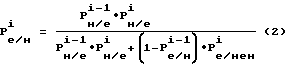
где
i = 1 - N номер в приоритетной последовательности, P
OF3, OF1, OF2 (see tab. 1);
the calculation of the posterior probability of crew error for each current hazard in a priority sequence, and the posterior probability at the current step is used as a priori at the next:
Where
i = 1 - N number in priority sequence, P
Для рассматриваемого примера значения Pн/е приведены в табл. 1. For this example, the values of Pn / e are given in table. one.
Значение апостериорной вероятности ошибки экипажа на N-м шаге (i-N), где N равно количеству опасных факторов, характеризует вероятность ошибки экипажа в данной полетной ситуации и показатель сложности управления, для рассматриваемого примера Pн/е = 0,51. The value of the posterior probability of crew error at the N-th step (i-N), where N is equal to the number of dangerous factors, characterizes the probability of crew error in a given flight situation and an indicator of control complexity, for the considered example, Pн / е = 0.51.
Из блока 27 выдаются:
в блоки 32 - показатель сложности управления (1-й выход);
в блок 33 - значения апостериорной вероятности ошибки экипажа для каждого текущего опасного фактора в последовательности первичной ранжировки (2-й выход).From block 27 are issued:
in blocks 32 - an indicator of the complexity of management (1st exit);
in block 33 - the values of the posterior probability of crew error for each current hazard in the initial ranking sequence (2nd exit).
В блоке памяти 30 хранятся пороговые значения для величин приращений вероятности ошибки экипажа (U30-1, U30-2, U30-3, U30-4) и соответствующие им уровни (U30-11, U30-21, U30-31, U30-41), которые поступают в блок 32. The memory unit 30 stores threshold values for increments of the probability of crew error (U30-1, U30-2, U30-3, U30-4) and their corresponding levels (U30-11, U30-21, U30-31, U30-41 ) that enter block 32.
В блоке памяти 31 хранятся команды для всех опасных факторов. Для указанных опасных факторов команды имеют следующий вид:
для первого опасного фактора команда отсутствует,
для второго опасного фактора - РУД НА СТОП,
для третьего опасного фактора - ПРЕКРАТИ СНИЖЕНИЕ.The memory unit 31 stores commands for all dangerous factors. For these dangerous factors, the teams have the following form:
for the first dangerous factor, the team is missing,
for the second hazard factor - ORE TO STOP,
for the third hazard - STOP REDUCING.
Из блока 31 в блок 33 выдаются команды, соответствующие значимым опасным факторам, номера которых поступают в блок 31 из блока 33. From block 31 to block 33 commands are issued that correspond to significant hazardous factors, the numbers of which are sent to block 31 from block 33.
В блоке 32 осуществляется формирование порогового значения для величины приращения вероятности ошибки экипажа (P н2), которое поступает в блок 33, в виде ступенчатой функции от величины показателя сложности управления, поступающего с первого выхода блока 27, (табл. 2), причем величина "ступеней" задается с выхода блока 30: Рн 2 = U30-i при Рн/е<U30-i1, где i = 1oC4 (4).In block 32, a threshold value is generated for the increment of the probability of crew error (P n2), which enters block 33, in the form of a step function of the magnitude of the control complexity indicator received from the first output of block 27 (Table 2), and the value " steps "is set from the output of block 30: Pn 2 = U30-i with Pn / e <U30-i1, where i = 1 o C4 (4).
В блоке 33 осуществляется формирование команд, поступающих в блок 4. Осуществляются следующие вычисления:
вторичная ранжировка текущих опасных факторов путем вычисления и запоминания приращения величины вероятности ошибки оператора для каждого текущего опасного фактора по сигналам со второго выхода блока 27, в виде:
▽P
где
i - номер текущего опасного фактора;
j - номер предшествовавшего опасного фактора, определенного по формуле (1),
для первого по приоритету опасного фактора величина приращения вычисляется по отношению к априорному значению вероятности ошибки экипажа:
▽P
где
i - номер первого по приоритету опасного фактора.In block 33, the formation of teams entering block 4. is carried out. The following calculations are carried out:
secondary ranking of current hazardous factors by calculating and storing the increment of the probability of operator error for each current hazardous factor by signals from the second output of block 27, in the form:
▽ P
Where
i is the number of the current hazard;
j is the number of the previous hazard factor determined by the formula (1),
for the first priority hazard factor, the increment value is calculated with respect to the a priori value of the probability of crew error:
▽ P
Where
i is the number of the first priority hazardous factor.
Для рассматриваемого примера ▽Pi приведены в табл. 1. Приоритетная последовательность по результатам вторичной ранжировки имеет вид: ОФ3,ОФ1, ОФ2;
поскольку Рн/е=0,51 < 0,7 то Рн2 = U30-3=0,15
определение номеров значимых опасных факторов осуществляется путем сравнения полученных величин приращений вероятности ошибки экипажа для каждого опасного фактора (Рн/е) с пороговым значением (Рн2) с блока 32, для значимых опасных факторов величина приращения вероятности ошибки экипажа должна превышать указанное пороговое значение, указанные номера опасных факторов (2-й выход блока 33) выдаются в блок 31.For the considered example, ▽ Pi are given in table. 1. The priority sequence according to the results of the secondary ranking is: OF3, OF1, OF2;
since Rn / e = 0.51 <0.7, then Rn2 = U30-3 = 0.15
the determination of the numbers of significant hazardous factors is carried out by comparing the obtained increments of the probability of crew error for each hazard factor (Рн / е) with the threshold value (Рн2) from block 32, for significant dangerous factors, the increment of the probability of crew error must exceed the specified threshold value, the indicated numbers hazardous factors (2nd output of block 33) are issued to block 31.
В рассматриваемом примере значимым является третий опасный фактор (ОФ3). In the considered example, the third dangerous factor (OF3) is significant.
▽P3 = ▽P
формирование команд, для выдачи в блок 4, осуществляется путем организации последовательности из команд, поступивших из блока 31, приоритетность в которой определяется результатами вторичной ранжировки.▽ P3 = ▽ P
the formation of teams for issuance to block 4 is carried out by organizing a sequence of commands received from block 31, the priority of which is determined by the results of the secondary ranking.
В рассматриваемом примере это команда соответствующая третьему опасному фактору: "прекрати снижение". In this example, this is the command corresponding to the third dangerous factor: "stop the decline."
Из блока 33 выдаются:
в блок 4, команды управления в последовательности вторичной ранжировки (1-й выход);
в блок 31, номера опасных факторов, для которых приращение величины вероятности ошибки экипажа, превышает пороговый уровень, (2-й выход).From block 33 are issued:
in block 4, control commands in the secondary ranking sequence (1st output);
in block 31, the numbers of hazardous factors for which the increment of the probability of crew error exceeds the threshold level, (2nd exit).
Полунатурное моделирование предложенной системы применительно к легкому самолету (40 т) на этапах взлета, набор высоты, маршрутного полета в условиях действия одиночных и групповых отказов показало возможность снижения показателя аварийности, обусловленного ошибками экипажа, в 1.5-2 раза. The semi-natural modeling of the proposed system as applied to a light aircraft (40 t) at take-off stages, climb, route flight under single and group failure conditions showed the possibility of reducing the accident rate due to crew errors by 1.5-2 times.
Claims (12)
Priority Applications (1)
| Application Number | Priority Date | Filing Date | Title |
|---|---|---|---|
| RU96121575A RU2114456C1 (en) | 1996-11-12 | 1996-11-12 | Method and device for avoiding critical operation modes of operator-object system |
Applications Claiming Priority (1)
| Application Number | Priority Date | Filing Date | Title |
|---|---|---|---|
| RU96121575A RU2114456C1 (en) | 1996-11-12 | 1996-11-12 | Method and device for avoiding critical operation modes of operator-object system |
Publications (2)
| Publication Number | Publication Date |
|---|---|
| RU2114456C1 true RU2114456C1 (en) | 1998-06-27 |
| RU96121575A RU96121575A (en) | 1999-01-20 |
Family
ID=20187086
Family Applications (1)
| Application Number | Title | Priority Date | Filing Date |
|---|---|---|---|
| RU96121575A RU2114456C1 (en) | 1996-11-12 | 1996-11-12 | Method and device for avoiding critical operation modes of operator-object system |
Country Status (1)
| Country | Link |
|---|---|
| RU (1) | RU2114456C1 (en) |
Cited By (14)
| Publication number | Priority date | Publication date | Assignee | Title |
|---|---|---|---|---|
| RU2151714C1 (en) * | 1999-02-22 | 2000-06-27 | АООТ "ОКБ Сухого" | Flight safety system for manned flying vehicle |
| RU2205442C1 (en) * | 2001-10-02 | 2003-05-27 | Сухолитко Валентин Афанасьевич | Method of support of flying vehicle operator in dangerous situations |
| RU2228885C2 (en) * | 2001-11-15 | 2004-05-20 | Федеральное государственное унитарное предприятие Летно-исследовательский институт им. М.М. Громова | System of protection of aircraft against mishandling and intentional actions resulting in accident |
| RU2240587C1 (en) * | 2004-01-21 | 2004-11-20 | Сухолитко Валентин Афанасьевич | Method for determination of location of vehicle suffering disaster and support of vehicle operator |
| RU2357278C2 (en) * | 2002-03-01 | 2009-05-27 | Фишер-Роузмаунт Системз, Инк. | Creation of integrated warning in processing installations |
| US7557702B2 (en) | 1999-02-22 | 2009-07-07 | Evren Eryurek | Integrated alert generation in a process plant |
| US8073967B2 (en) | 2002-04-15 | 2011-12-06 | Fisher-Rosemount Systems, Inc. | Web services-based communications for use with process control systems |
| US8417595B2 (en) | 2001-03-01 | 2013-04-09 | Fisher-Rosemount Systems, Inc. | Economic calculations in a process control system |
| RU2503585C1 (en) * | 2012-05-21 | 2014-01-10 | Федеральное государственное бюджетное образовательное учреждение высшего профессионального образования "Уфимский государственный авиационный технический университет" | Aircraft bank angle bank and angular speed limiting automatic control system |
| RU2508229C2 (en) * | 2012-05-15 | 2014-02-27 | Федеральное Государственное Бюджетное Учреждение "Институт Прикладной Геофизики Имени Академика Е.К. Федорова" (Фгбу "Ипг") | System of spacecraft geophysical safety |
| RU2601061C2 (en) * | 2012-06-18 | 2016-10-27 | Зе Боинг Компани | Stall control system |
| RU2606153C2 (en) * | 2013-02-20 | 2017-01-10 | Федеральное государственное бюджетное образовательное учреждение высшего профессионального образования "Санкт-Петербургский государственный университет гражданской авиации" | Method of distribution of functions of aircraft control and system for its implementation |
| US9927788B2 (en) | 2011-05-19 | 2018-03-27 | Fisher-Rosemount Systems, Inc. | Software lockout coordination between a process control system and an asset management system |
| RU2759370C1 (en) * | 2020-12-15 | 2021-11-12 | Сергей Николаевич Низов | Sideslip prevention system |
-
1996
- 1996-11-12 RU RU96121575A patent/RU2114456C1/en not_active IP Right Cessation
Non-Patent Citations (1)
| Title |
|---|
| Кравец В.Г., Любинский В.Е. Основы управления космическими полетами. М.: Машиностроение, 1983, раздел 3, 4. * |
Cited By (17)
| Publication number | Priority date | Publication date | Assignee | Title |
|---|---|---|---|---|
| RU2151714C1 (en) * | 1999-02-22 | 2000-06-27 | АООТ "ОКБ Сухого" | Flight safety system for manned flying vehicle |
| US7557702B2 (en) | 1999-02-22 | 2009-07-07 | Evren Eryurek | Integrated alert generation in a process plant |
| US8417595B2 (en) | 2001-03-01 | 2013-04-09 | Fisher-Rosemount Systems, Inc. | Economic calculations in a process control system |
| US8620779B2 (en) | 2001-03-01 | 2013-12-31 | Fisher-Rosemount Systems, Inc. | Economic calculations in a process control system |
| RU2205442C1 (en) * | 2001-10-02 | 2003-05-27 | Сухолитко Валентин Афанасьевич | Method of support of flying vehicle operator in dangerous situations |
| RU2228885C2 (en) * | 2001-11-15 | 2004-05-20 | Федеральное государственное унитарное предприятие Летно-исследовательский институт им. М.М. Громова | System of protection of aircraft against mishandling and intentional actions resulting in accident |
| RU2357278C2 (en) * | 2002-03-01 | 2009-05-27 | Фишер-Роузмаунт Системз, Инк. | Creation of integrated warning in processing installations |
| US8073967B2 (en) | 2002-04-15 | 2011-12-06 | Fisher-Rosemount Systems, Inc. | Web services-based communications for use with process control systems |
| US9094470B2 (en) | 2002-04-15 | 2015-07-28 | Fisher-Rosemount Systems, Inc. | Web services-based communications for use with process control systems |
| US9760651B2 (en) | 2002-04-15 | 2017-09-12 | Fisher-Rosemount Systems, Inc. | Web services-based communications for use with process control systems |
| RU2240587C1 (en) * | 2004-01-21 | 2004-11-20 | Сухолитко Валентин Афанасьевич | Method for determination of location of vehicle suffering disaster and support of vehicle operator |
| US9927788B2 (en) | 2011-05-19 | 2018-03-27 | Fisher-Rosemount Systems, Inc. | Software lockout coordination between a process control system and an asset management system |
| RU2508229C2 (en) * | 2012-05-15 | 2014-02-27 | Федеральное Государственное Бюджетное Учреждение "Институт Прикладной Геофизики Имени Академика Е.К. Федорова" (Фгбу "Ипг") | System of spacecraft geophysical safety |
| RU2503585C1 (en) * | 2012-05-21 | 2014-01-10 | Федеральное государственное бюджетное образовательное учреждение высшего профессионального образования "Уфимский государственный авиационный технический университет" | Aircraft bank angle bank and angular speed limiting automatic control system |
| RU2601061C2 (en) * | 2012-06-18 | 2016-10-27 | Зе Боинг Компани | Stall control system |
| RU2606153C2 (en) * | 2013-02-20 | 2017-01-10 | Федеральное государственное бюджетное образовательное учреждение высшего профессионального образования "Санкт-Петербургский государственный университет гражданской авиации" | Method of distribution of functions of aircraft control and system for its implementation |
| RU2759370C1 (en) * | 2020-12-15 | 2021-11-12 | Сергей Николаевич Низов | Sideslip prevention system |
Similar Documents
| Publication | Publication Date | Title |
|---|---|---|
| RU2114456C1 (en) | Method and device for avoiding critical operation modes of operator-object system | |
| Moray | The role of attention in the detection of errors and the diagnosis of failures in man-machine systems | |
| Parasuraman et al. | Automation and human performance in aviation | |
| RU2541902C2 (en) | Intelligent system of crew support | |
| RU2151714C1 (en) | Flight safety system for manned flying vehicle | |
| RU2388663C1 (en) | Computer-aided highly smart system (cahss) to ensure aircraft flight safety | |
| CN113496343A (en) | Method and apparatus for managing risks and alerts | |
| Cappello et al. | Aircraft dynamics model augmentation for RPAS navigation and guidance | |
| RU2339547C9 (en) | Automated high-intelligent system for aircraft flight safety providing | |
| Bolshakov | Algorithm of a device designed to support decision making to counter the threat of an aviation accident | |
| Onken et al. | Assistant systems for aircraft guidance: cognitive man-machine cooperation | |
| RU2370416C1 (en) | Automated system for manned aircraft flight safety provision | |
| Ismayilov | Interaction between human-machine interface and avionics on aircraft cockpit | |
| Kulik | Artificial intelligence-based aircraft accident threat parrying method | |
| RU2755097C1 (en) | Information and control complex with intelligent crew support | |
| RU6079U1 (en) | CRITICAL MODE PREVENTION PREVENTION SYSTEM | |
| Fedunov | Tactical-level onboard real-time advisory expert systems for manned aircraft as development and maintenance entities | |
| RU2228885C2 (en) | System of protection of aircraft against mishandling and intentional actions resulting in accident | |
| Burian et al. | Autonomous, context-sensitive, task management systems and decision support tools II: Contextual constraints and information sources | |
| RU2755554C1 (en) | Aircraft control method during combat maneuverance | |
| Awal et al. | Application of logic programming technique on maritime accident analysis | |
| RU2767406C1 (en) | Method for intellectual support of the crew | |
| Vakil et al. | Analysis of complexity evolution management and human performance issues in commercial aircraft automation systems | |
| Hryshchenko et al. | Telecommunication warning of the crew about the failure of on-board radio altimeters | |
| Grevtsov et al. | Intellectual support of commander of escort jet fighter group in solving the task for the returning subgroup, which repulsed an attack of enemy jet fighters |
Legal Events
| Date | Code | Title | Description |
|---|---|---|---|
| MM4A | The patent is invalid due to non-payment of fees |
Effective date: 20081113 |