[go: up one dir, main page]

RU2004110409A - METHOD FOR AUTOSTEREOSCOPIC PLAYBACK OF IMAGES USING A WAVE FILTER MATRIX - Google Patents

METHOD FOR AUTOSTEREOSCOPIC PLAYBACK OF IMAGES USING A WAVE FILTER MATRIX Download PDF

Info

Publication number
RU2004110409A
RU2004110409A RU2004110409/09A RU2004110409A RU2004110409A RU 2004110409 A RU2004110409 A RU 2004110409A RU 2004110409/09 A RU2004110409/09 A RU 2004110409/09A RU 2004110409 A RU2004110409 A RU 2004110409A RU 2004110409 A RU2004110409 A RU 2004110409A
Authority
RU
Russia
Prior art keywords
image
reproducing
visual information
ckl
elements
Prior art date
Application number
RU2004110409/09A
Other languages
Russian (ru)
Other versions
RU2290769C2 (en
RU2290769C9 (en
Inventor
КЛИППШТАЙН Маркус (DE)
КЛИППШТАЙН Маркус
РЕЛЬКЕ Инго (DE)
РЕЛЬКЕ Инго
Original Assignee
Х3Д Технологиз Гмбх (De)
Х3Д Технологиз Гмбх
Priority date (The priority date is an assumption and is not a legal conclusion. Google has not performed a legal analysis and makes no representation as to the accuracy of the date listed.)
Filing date
Publication date
Application filed by Х3Д Технологиз Гмбх (De), Х3Д Технологиз Гмбх filed Critical Х3Д Технологиз Гмбх (De)
Publication of RU2004110409A publication Critical patent/RU2004110409A/en
Publication of RU2290769C2 publication Critical patent/RU2290769C2/en
Application granted granted Critical
Publication of RU2290769C9 publication Critical patent/RU2290769C9/en

Links

Classifications

    • HELECTRICITY
    • H04ELECTRIC COMMUNICATION TECHNIQUE
    • H04NPICTORIAL COMMUNICATION, e.g. TELEVISION
    • H04N13/00Stereoscopic video systems; Multi-view video systems; Details thereof
    • H04N13/30Image reproducers
    • H04N13/324Colour aspects
    • GPHYSICS
    • G02OPTICS
    • G02BOPTICAL ELEMENTS, SYSTEMS OR APPARATUS
    • G02B30/00Optical systems or apparatus for producing three-dimensional [3D] effects, e.g. stereoscopic images
    • G02B30/20Optical systems or apparatus for producing three-dimensional [3D] effects, e.g. stereoscopic images by providing first and second parallax images to an observer's left and right eyes
    • G02B30/26Optical systems or apparatus for producing three-dimensional [3D] effects, e.g. stereoscopic images by providing first and second parallax images to an observer's left and right eyes of the autostereoscopic type
    • HELECTRICITY
    • H04ELECTRIC COMMUNICATION TECHNIQUE
    • H04NPICTORIAL COMMUNICATION, e.g. TELEVISION
    • H04N13/00Stereoscopic video systems; Multi-view video systems; Details thereof
    • H04N13/30Image reproducers
    • H04N13/302Image reproducers for viewing without the aid of special glasses, i.e. using autostereoscopic displays
    • H04N13/31Image reproducers for viewing without the aid of special glasses, i.e. using autostereoscopic displays using parallax barriers
    • HELECTRICITY
    • H04ELECTRIC COMMUNICATION TECHNIQUE
    • H04NPICTORIAL COMMUNICATION, e.g. TELEVISION
    • H04N13/00Stereoscopic video systems; Multi-view video systems; Details thereof
    • H04N13/30Image reproducers
    • H04N13/302Image reproducers for viewing without the aid of special glasses, i.e. using autostereoscopic displays
    • H04N13/317Image reproducers for viewing without the aid of special glasses, i.e. using autostereoscopic displays using slanted parallax optics
    • HELECTRICITY
    • H04ELECTRIC COMMUNICATION TECHNIQUE
    • H04NPICTORIAL COMMUNICATION, e.g. TELEVISION
    • H04N13/00Stereoscopic video systems; Multi-view video systems; Details thereof
    • H04N13/20Image signal generators
    • H04N13/204Image signal generators using stereoscopic image cameras
    • HELECTRICITY
    • H04ELECTRIC COMMUNICATION TECHNIQUE
    • H04NPICTORIAL COMMUNICATION, e.g. TELEVISION
    • H04N13/00Stereoscopic video systems; Multi-view video systems; Details thereof
    • H04N13/30Image reproducers
    • H04N13/302Image reproducers for viewing without the aid of special glasses, i.e. using autostereoscopic displays
    • H04N13/305Image reproducers for viewing without the aid of special glasses, i.e. using autostereoscopic displays using lenticular lenses, e.g. arrangements of cylindrical lenses

Landscapes

  • Engineering & Computer Science (AREA)
  • Multimedia (AREA)
  • Signal Processing (AREA)
  • Physics & Mathematics (AREA)
  • Optics & Photonics (AREA)
  • General Physics & Mathematics (AREA)
  • Testing, Inspecting, Measuring Of Stereoscopic Televisions And Televisions (AREA)
  • Image Processing (AREA)
  • Processing Or Creating Images (AREA)
  • Image Generation (AREA)
  • Control Of Indicators Other Than Cathode Ray Tubes (AREA)
  • Stereoscopic And Panoramic Photography (AREA)
  • Controls And Circuits For Display Device (AREA)

Claims (10)

1. Способ создания пространственного изображения сцены или предмета на основе нескольких ее, соответственно его видов (Ас), при осуществлении которого виды (Ас) раскладывают на множество отдельных несущих визуальную информацию элементов (аckl), характеризующихся их длиной волны, представляя их в виде состоящих из столбцов (k) и строк (1) растров, где с=1, ..., n, a n равняется общему количеству видов, отдельные несущие визуальную информацию элементы (ackl) воспроизводят с возможностью их зрительного восприятия на воспроизводящих изображение элементах (αij), расположенных в виде растра, состоящего из столбцов (i) и строк (j), при этом соседние воспроизводящие изображение элементы (αij) испускают видимое излучение с различающимися между собой длинами (λ) волн, соответственно в различающихся между собой диапазонах (Δλ) длин волн, и для испускаемого видимого излучения направление его распространения задают с помощью одной или нескольких матриц из множества отдельных, расположенных столбцами (р) и строками (q) волновых фильтров (βpq), прозрачных для излучения с различными длинами (λ) волн или в различных диапазонах (Δλ) длин волн и расположенных в направлении линии зрения перед или позади растра из воспроизводящих изображение элементов (αij), при этом каждый воспроизводящий изображение элемент (αij) взаимодействует с несколькими соответствующими волновыми фильтрами (βpq) или один волновой фильтр (βpq) взаимодействует с несколькими соответствующими воспроизводящими изображение элементами (αij) таким образом, что каждая из прямых, соединяющих между собой центры тяжести поперечных сечений видимых участков воспроизводящего изображение элемента (αij) и волнового фильтра (βpq), проходит в направлении распространения излучения, вследствие чего смотрящий на изображение человек из любого его положения в находящемся перед воспроизводимым изображением пространстве одним глазом выборочно зрительно воспринимает преимущественно первую, а другим глазом - преимущественно вторую группу отдельных несущих визуальную информацию элементов из всего их количества, на которое разложены виды (Ас), отличающийся тем, что по меньшей мере одному воспроизводящему изображение элементу (аij) одновременно ставят в соответствие отдельные несущие визуальную информацию элементы (ackl), относящиеся по меньшей мере к двум различным видам (Ас), с соблюдением при этом условия, согласно которому длина волны этого отдельного несущего визуальную информацию элемента (ackl) всегда совпадает с длиной (λ) волны или лежит в диапазоне (Δλ) длин волн видимого излучения, испускаемого воспроизводящим изображение элементом (αij), которому поставлен в соответствие этот отдельный несущий визуальную информацию элемент.1. A method of creating a spatial image of a scene or object based on several of it, respectively, of its types (A c ), in the implementation of which the types (A c ) are laid out on many separate elements carrying visual information (a ckl ), characterized by their wavelength, representing them in the form of rasters consisting of columns (k) and rows (1), where c = 1, ..., n, an is equal to the total number of species, individual elements carrying visual information (a ckl ) are reproduced with the possibility of their visual perception on reproducing images eleme ntach (α ij ) arranged in the form of a raster consisting of columns (i) and rows (j), while adjacent image-reproducing elements (α ij ) emit visible radiation with wavelengths (λ) that differ from each other, respectively, differing between ranges (Δλ) of wavelengths, and for the emitted visible radiation, the direction of its propagation is specified using one or more matrices from a variety of separate wave filters (β pq ) arranged in columns (p) and rows (q), transparent for radiation with different lengths (λ) waves or in different ranges (Δλ) of wavelengths and located in the direction of the line of sight in front of or behind the raster of image-reproducing elements (α ij ), while each image-reproducing element (α ij ) interacts with several corresponding wave filters (β pq ) or one wave the filter (β pq ) interacts with several corresponding image-reproducing elements (α ij ) in such a way that each of the straight lines connecting the centers of gravity of the cross sections of the visible sections of the reproducing the reflection of the element (α ij ) and the wave filter (β pq ) takes place in the direction of radiation propagation, as a result of which the person looking at the image from any position in the space in front of the reproduced image with one eye selectively visually perceives mainly the first and the other eye mainly the second a group of individual elements carrying visual information from their total number, into which the types are decomposed (A c ), characterized in that at least one image reproducing ele the element (a ij ) at the same time associate the individual elements carrying visual information (a ckl ) related to at least two different types (A c ), subject to the condition according to which the wavelength of this individual element carrying visual information (a ckl ) always coincides with the wavelength (λ) of the wave or lies in the range (Δλ) of the wavelengths of the visible radiation emitted by the image-reproducing element (α ij ) to which this separate visual information-bearing element is associated. 2. Способ по п.1, отличающийся тем, что отдельные несущие визуальную информацию элементы (ackl) ставят в соответствие воспроизводящим изображение элементам (αij) согласно следующему правилу:2. The method according to claim 1, characterized in that the individual elements carrying visual information (a ckl ) are aligned with the image reproducing elements (α ij ) according to the following rule:
Figure 00000001
Figure 00000001
где g представляет собой тензор пятого ранга, компоненты gcklij которого представляют собой вещественные числа и выполняют функцию весовых коэффициентов, которыми определяется вес соответствующего отдельного несущего визуальную информацию элемента (ackl) в воспроизводящем изображение элементе (αij).where g is a fifth-rank tensor whose components g cklij are real numbers and perform the function of weight coefficients that determine the weight of the corresponding individual element carrying visual information (a ckl ) in the image-reproducing element (α ij ).
3. Способ по п.1, отличающийся тем, что индекс k приравнивают индексу i, а индекс 1 приравнивают индексу j и отдельные несущие визуальную информацию элементы (ackl) ставят в соответствие воспроизводящим изображение элементам (αij) согласно следующему правилу:3. The method according to claim 1, characterized in that the index k is equated with index i, and index 1 is equated with index j and the individual elements carrying visual information (a ckl ) are mapped to image-reproducing elements (α ij ) according to the following rule:
Figure 00000002
Figure 00000002
за счет чего каждому воспроизводящему изображение элементу (αij) в соответствие ставят только те отдельные несущие визуальную информацию элементы (ackl), которые занимают одно и то же положение (i,j) в растрах (Rc) различных видов (Аc), при этом величина df представляет собой коэффициент плотности, значениями которого могут служить вещественные числа и которым определяется среднее количество видов, относящиеся к которым отдельные несущие визуальную информацию элементы (αcij) ставятся в соответствие одному воспроизводящему изображение элементу (αij), причем для каждого воспроизводящего изображение элемента (αij) взвешенная сумма поставленных ему в соответствие отдельных несущих визуальную информацию элементов (ackl) нормирована на 1.due to which each element reproducing the image (α ij ) is assigned only those individual elements carrying visual information (a ckl ) that occupy the same position (i, j) in rasters (R c ) of various types (A c ) wherein the value of d f is a density coefficient, the values of which can be real numbers and which determines the average number of species, related to which individual elements carrying visual information (α cij ) are mapped to one element reproducing the image ntu (α ij ), moreover, for each element reproducing the image (α ij ), the weighted sum of the individual elements carrying visual information (a ckl ) that are assigned to it is normalized to 1.
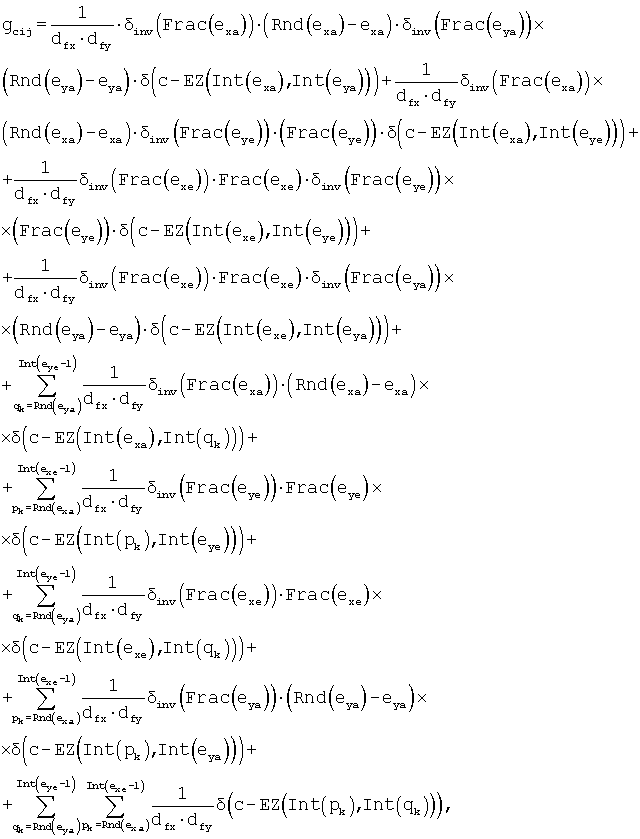
4. Способ по п.3, отличающийся тем, что весовые коэффициенты gcij определяют согласно следующему правилу:4. The method according to claim 3, characterized in that the weight coefficients g cij are determined according to the following rule:
Figure 00000003
Figure 00000003
где коэффициент плотности df имеет одинаковое значение для всех воспроизводящих изображение элементов (αij) и принимает значение больше 1, предпочтительно принимает значение в интервале от 1,3 до 2,0, δ(х) представляет собой функцию, удовлетворяющую следующим условиям δ(х=0)=1 и δ(х≠0)=0, Rnd(x) представляет собой функцию, значением которой для аргументов х≥0 при условии, что стоящая после запятой дробная часть аргумента х не равна нулю, является ближайшее большее по величине целое число, а во всех остальных случаях является сам аргумент х, "mod" обозначает класс вычетов для некоторого делителя, Frac(x) представляет собой функцию, значением которой для аргументов х≥0 является стоящая после запятой дробная часть аргумента х, a t представляет собой целое число, при этом сумма приравнивается нулю, когда верхний предел суммирования меньше нижнего предела суммирования.where the density coefficient d f has the same value for all image reproducing elements (α ij ) and takes a value greater than 1, preferably takes a value in the range from 1.3 to 2.0, δ (x) is a function satisfying the following conditions δ ( x = 0) = 1 and δ (x ≠ 0) = 0, Rnd (x) is a function whose value for the arguments x≥0, provided that the decimal part of the argument x that is after the decimal point is not equal to zero, is the nearest the value is an integer, and in all other cases is the argument x itself, "mod" is calculates the residue class for some divisor, Frac (x) is a function whose value for the arguments x≥0 is the decimal part of the argument x, at is an integer, and the sum is equal to zero when the upper limit of summation is less than the lower limit summation.
5. Способ по п.1, отличающийся тем, что коэффициент плотности df определяют в соответствии со следующим правилом:5. The method according to claim 1, characterized in that the density coefficient d f is determined in accordance with the following rule: df=f,d f = f где f представляет собой положительное вещественное число, которое определяют в соответствии со следующим правилом:where f is a positive real number, which is determined in accordance with the following rule:
Figure 00000004
Figure 00000004
где z представляет собой расстояние между растром из воспроизводящих изображение элементов (αij) и матрицей волновых фильтров (βpq), a da представляет собой произвольно задаваемое воспроизводимым изображением и смотрящим на него человеком, которое в основном соответствует среднему значению, усредненному по всем возможным расстояниям между растром из воспроизводящих изображение элементов (αij) и смотрящим на изображение человеком, соответственно его местоположением во всем находящемся перед воспроизводимым изображением пространстве.where z is the distance between the raster of the image-reproducing elements (α ij ) and the wave filter matrix (β pq ), ad a is an arbitrarily defined reproduction image and the person looking at it, which basically corresponds to the average value averaged over all possible distances between the raster of the image reproducing elements (α ij ) and the person looking at the image, respectively, its location in the entire space in front of the reproduced image.
6. Способ по п.3, отличающийся тем, что весовые коэффициенты определяют в соответствии со следующим правилом:6. The method according to claim 3, characterized in that the weights are determined in accordance with the following rule:
Figure 00000005
Figure 00000005
где коэффициент плотности df зависит от положения (i,j) воспроизводящих изображение элементов (αij) в растре.where the density coefficient d f depends on the position (i, j) of the image-reproducing elements (α ij ) in the raster.
7. Способ по п.6, отличающийся тем, что коэффициент плотности df описывают функцией7. The method according to claim 6, characterized in that the density coefficient d f is described by a function
Figure 00000006
Figure 00000006
где смакс представляет собой произвольно задаваемый вещественный и положительный параметр,
Figure 00000007
представляет собой произвольно задаваемый вещественный и положительный параметр, обеспечивающий смещение значений функции в сторону больших значений, а функция Int(x) представляет собой функцию, значением которой является наибольшее целое число, не превышающее ее аргумент х.
where c max is an arbitrary given real and positive parameter,
Figure 00000007
represents an arbitrarily specified real and positive parameter that provides a shift of the function values towards large values, and the function Int (x) is a function whose value is the largest integer that does not exceed its argument x.
8. Способ создания пространственного изображения сцены или предмета на основе нескольких ее, соответственно его видов (Ас), при осуществлении которого виды (Ас) раскладывают на множество отдельных несущих визуальную информацию элементов (ackl), характеризующихся их длиной волны, представляя их в виде состоящих из столбцов (k) и строк (1) растров, где с=1, ..., n, a n равняется общему количеству видов, отдельные несущие визуальную информацию элементы (ackl) воспроизводят с возможностью их зрительного восприятия на воспроизводящих изображение элементах (αij), расположенных в виде растра, состоящего из столбцов (i) и строк (j), при этом соседние воспроизводящие изображение элементы (αij) испускают видимое излучение с различающимися между собой длинами (λ) волн, соответственно в различающихся между собой диапазонах (Δλ) длин волн, и для испускаемого видимого излучения направление его распространения задают с помощью цилиндрических линз, отличающийся тем, что по меньшей мере одному воспроизводящему изображение элементу (αij) одновременно ставят в соответствие отдельные несущие визуальную информацию элементы (ackl), относящиеся по меньшей мере к двум различным видам (Ас), с соблюдением при этом условия, согласно которому длина волны этого отдельного несущего визуальную информацию элемента (ackl) всегда совпадает с длиной (λ) волны или лежит в диапазоне (Δλ) длин волн видимого излучения, испускаемого воспроизводящим изображение элементом (αij), которому поставлен в соответствие этот отдельный несущий визуальную информацию элемент.8. A method of creating a spatial image of a scene or object based on several of its, respectively, its types (A c ), in the implementation of which the types (A c ) are laid out on many separate elements carrying visual information (a ckl ), characterized by their wavelength, representing them in the form of rasters consisting of columns (k) and rows (1), where c = 1, ..., n, an is equal to the total number of species, individual elements carrying visual information (a ckl ) are reproduced with the possibility of their visual perception on reproducing images eleme max (α ij), arranged in a raster, consisting of the columns (i) and row (j), wherein adjacent reproducing image elements (α ij) emits visible radiation with different interconnected lengths (λ) of waves respectively differing a ranges (Δλ) wavelengths, and the emitted visible radiation direction of propagation is given by the cylindrical lens, characterized in that at least one reproducing image element (α ij) simultaneously sets in accordance individual carriers visually information items (a ckl), relating to at least two different types (A c) with observance of the conditions under which the wavelength of a separate bearing visual information element (a ckl) always coincides with the length (λ) wave or lies in the range (Δλ) of the wavelengths of visible radiation emitted by the image-reproducing element (α ij ), to which this separate element carrying visual information is associated. 9. Способ создания пространственного изображения сцены или предмета на основе нескольких ее, соответственно его монохромных видов (Ас), при осуществлении которого виды (Ас) раскладывают на множество отдельных несущих визуальную информацию элементов (ackl), представляя их в виде состоящих из столбцов (k) и строк (1) растров, где с=1, ..., n, a n равняется общему количеству видов, отдельные несущие визуальную информацию элементы (ackl) воспроизводят с возможностью их зрительного восприятия на воспроизводящих изображение элементах (αij), расположенных в виде растра, состоящего из столбцов (i) и строк (j), при этом все воспроизводящие изображение элементы (αij) испускают видимое излучение с одной и той же длиной (λ) волны или в одном и том же диапазоне (Δλ) длин волн, и для испускаемого видимого излучения направление его распространения задают с помощью одной или нескольких матриц из множества отдельных, расположенных столбцами (р) и строками (q) волновых фильтров (βpq), прозрачных для излучения с различными длинами (λ) волн или в различных диапазонах (Δλ) длин волн и расположенных в направлении линии зрения перед или позади растра из воспроизводящих изображение элементов (αij), при этом каждый воспроизводящий изображение элемент (αij) взаимодействует с несколькими соответствующими волновыми фильтрами (βpq) или один волновой фильтр (βpq) взаимодействует с несколькими соответствующими воспроизводящими изображение элементами (αij) таким образом, что каждая из прямых, соединяющих между собой центры тяжести поперечных сечений видимых участков воспроизводящего изображение элемента (αij) и волнового фильтра (βpq), проходит в направлении распространения излучения, вследствие чего смотрящий на изображение человек из любого его положения в находящемся перед воспроизводимым изображением пространстве одним глазом выборочно зрительно воспринимает преимущественно первую, а другим глазом - преимущественно вторую группу отдельных несущих визуальную информацию элементов из всего их количества, на которое разложены виды (Ас), отличающийся тем, что по меньшей мере одному воспроизводящему изображение элементу (αij) одновременно ставят в соответствие отдельные несущие визуальную информацию элементы (ackl), относящиеся по меньшей мере к двум различным видам (Ас).9. A method of creating a spatial image of a scene or object based on several of its, respectively, its monochrome views (A c ), in the implementation of which the types (A c ) are laid out on many separate elements carrying visual information (a ckl ), representing them as consisting of columns (k) and rows (1) of rasters, where c = 1, ..., n, an is the total number of species, individual elements carrying visual information (a ckl ) are reproduced with the possibility of their visual perception on image-reproducing elements (α ij ) located x in the form of a raster consisting of columns (i) and rows (j), while all image-reproducing elements (α ij ) emit visible radiation with the same wavelength (λ) or in the same range (Δλ) wavelengths, and for the emitted visible radiation, the direction of its propagation is set using one or more matrices from a variety of separate wave filters (β pq ) arranged in columns (p) and rows (q), transparent to radiation with different wavelengths (λ) or in different ranges (Δλ) of wavelengths and located in the direction inii view in front or behind the raster of reproducing image elements (α ij), wherein each reproducing an image element (α ij) interacts with several corresponding wave filters (β pq) or one wave filter (β pq) is reacted with several corresponding reproducing image elements (α ij ) in such a way that each of the lines connecting the centers of gravity of the cross sections of the visible sections of the image-reproducing element (α ij ) and the wave filter (β pq ) passes in the direction radiation propagation, as a result of which a person looking at the image from any position in the space in front of the reproduced image selectively visually perceives primarily the first, and the other eye, predominantly the second group of individual elements carrying visual information from their total number into which the views are decomposed ( A c ), characterized in that at least one image reproducing element (α ij ) is simultaneously associated with individual visa visas The basic information elements (a ckl ) relating to at least two different species (A c ). 10. Способ по п.3, 8 или 9, заключающийся в том, что индекс k приравнивают индексу i, а индекс 1 приравнивают индексу j и отдельные несущие визуальную информацию элементы (ackl) ставят в соответствие воспроизводящим изображение элементам (αij) согласно следующему правилу:10. The method according to claim 3, 8 or 9, namely, that index k is equated with index i, and index 1 is equated with index j and individual elements carrying visual information (a ckl ) are aligned with image-reproducing elements (α ij ) according to the following rule:
Figure 00000008
Figure 00000008
определяя при этом весовые коэффициенты gcij в соответствии со следующим правилом:while determining the weighting coefficients g cij in accordance with the following rule:
Figure 00000009
Figure 00000009
где exa, еxe, еуа, eуа и eye представляет собой вспомогательные переменные, для которых справедливы следующие отношения:where e xa , e xe , e уа , e уа and e ye are auxiliary variables for which the following relations are true: еха=i·dfx+смещениеех, еxe=(i+1)·dfx+смещениеех,e ha = i · d fx + displacement ex , е xe = (i + 1) · d fx + displacement ex , eуа=j·dfy+смещениееу, eye=(j+1)·dfy+смещениееу,e уа = j · d fy + displacement еу , e ye = (j + 1) · d fy + displacement еу , при этом каждая сумма приравнивается нулю, когда верхний предел суммирования меньше нижнего предела суммирования, справедливы следующие соотношения: δinv(х=0)=0 и δinv(х≠0)=1, EZ(v,w) представляет собой двумерную матрицу из v столбцов и w строк, элементы которой, стоящие в месте (v, w), соответствует номеру определенного вида, a dfx и dfy представляет собой два различных коэффициента плотности для различного соответственно по столбцам и по строкам уплотнения.each sum is equal to zero when the upper limit of summation is less than the lower limit of summation, the following relations are true: δ inv (x = 0) = 0 and δ inv (x ≠ 0) = 1, EZ (v, w) is a two-dimensional matrix of v columns and w rows, the elements of which, standing in the place (v, w), correspond to a number of a certain type, ad fx and d fy are two different density coefficients for different densities respectively in columns and in compression lines.
RU2004110409/09A 2001-09-06 2002-09-05 Method for auto-stereoscopic reproduction of image by means of wave filter matrix RU2290769C9 (en)

Applications Claiming Priority (2)

Application Number Priority Date Filing Date Title
DE10145133.4 2001-09-06
DE10145133A DE10145133C1 (en) 2001-09-06 2001-09-06 Spatial representation method

Publications (3)

Publication Number Publication Date
RU2004110409A true RU2004110409A (en) 2005-08-27
RU2290769C2 RU2290769C2 (en) 2006-12-27
RU2290769C9 RU2290769C9 (en) 2007-05-20

Family

ID=7698903

Family Applications (1)

Application Number Title Priority Date Filing Date
RU2004110409/09A RU2290769C9 (en) 2001-09-06 2002-09-05 Method for auto-stereoscopic reproduction of image by means of wave filter matrix

Country Status (10)

Country Link
US (1) US7321343B2 (en)
EP (1) EP1423979A1 (en)
JP (2) JP4132048B2 (en)
KR (1) KR100582667B1 (en)
CN (1) CN1552162A (en)
AU (1) AU2002339501B2 (en)
CA (1) CA2475927A1 (en)
DE (1) DE10145133C1 (en)
RU (1) RU2290769C9 (en)
WO (1) WO2003024122A1 (en)

Cited By (1)

* Cited by examiner, † Cited by third party
Publication number Priority date Publication date Assignee Title
RU2485573C2 (en) * 2006-10-12 2013-06-20 Конинклейке Филипс Электроникс Н.В. System and method of controlling light

Families Citing this family (27)

* Cited by examiner, † Cited by third party
Publication number Priority date Publication date Assignee Title
DE50109951D1 (en) * 2000-01-25 2006-07-06 Newsight Gmbh PROCESS AND ARRANGEMENT FOR SPATIAL PRESENTATION
DE10241475A1 (en) * 2002-09-03 2004-03-11 4D-Vision Gmbh simulation methods
DE10309194B4 (en) * 2003-02-26 2008-10-09 Newsight Gmbh Method and arrangement for spatial representation
DE10318258A1 (en) * 2003-04-16 2004-11-04 X3D Technologies Gmbh Arrangement for two- or three-dimensional representation
DE10325146A1 (en) 2003-05-30 2004-12-16 X3D Technologies Gmbh Method and arrangement for spatial representation
DE10344323A1 (en) * 2003-09-22 2005-04-21 X3D Technologies Gmbh Method and arrangement for spatial representation
DE10349506A1 (en) * 2003-10-22 2005-05-25 X3D Technologies Gmbh Spatial presentation set-up e.g. for presentation of large pictures, has flexible substrate, on which two pictures are visibly applied, one picture at same time, shows partial information from two angles of scene
DE102004027334A1 (en) * 2004-06-02 2005-12-29 X3D Technologies Gmbh Navigation system for motor vehicles, aircraft, water craft or space vehicles displays graphics/text data on an autostereoscopic display device
FR2876805B1 (en) 2004-10-18 2007-01-05 Artistic Images Sarl DEVICE AND METHOD FOR AUTOSTEREOSCOPIC VISUALIZATION BASED ON LENTICULAR, AND METHOD FOR SYNTHESIZING AUTOSTEREOSCOPIC IMAGES
KR100753517B1 (en) 2005-10-12 2007-08-31 엘지전자 주식회사 A mobile communication terminal having a stereoscopic image display function and a stereoscopic image display method using the same
DE102007045385B3 (en) * 2007-09-20 2009-04-23 Visumotion Gmbh A method for shortening or extending a viewing distance between the viewer and an arrangement for spatially perceptible presentation
EP2353045A2 (en) * 2008-11-07 2011-08-10 Dimension Technologies, Inc. Backlighting system for a 2d/3d autostereoscopic multiview display
US8947605B2 (en) 2008-11-07 2015-02-03 Dimension Technologies, Inc. Image data placement method for a time multiplexed autostereoscopic display
DE102008062790A1 (en) 2008-12-19 2010-06-24 Visumotion Gmbh Method and arrangement for spatial representation
DE102009013912A1 (en) 2009-03-20 2010-09-23 Visumotion Gmbh Method for autostereoscopic visualization of scene or object, involves partially seeing different image elements and/or parts of image elements by observers with both eyes due to vision limitation effect of parallax barrier screen
DE102009022049B4 (en) 2009-05-18 2011-02-03 Visumotion Gmbh Method and arrangement for spatial representation
EP2497274B1 (en) * 2009-11-03 2019-10-23 Koninklijke Philips N.V. Autostereoscopic display device
KR101651294B1 (en) * 2009-12-30 2016-09-05 엘지디스플레이 주식회사 3-dimensional image system
KR101632340B1 (en) * 2010-01-11 2016-06-22 삼성디스플레이 주식회사 Method for displaying image and display apparatus for performing the same
CN101859029A (en) * 2010-05-20 2010-10-13 友达光电股份有限公司 stereoscopic display
EP2461238B1 (en) 2010-12-02 2017-06-28 LG Electronics Inc. Image display apparatus including an input device
KR101076705B1 (en) * 2011-02-06 2011-10-28 이종오 Parallax barrier and stereoscopic display device including the same
US9420268B2 (en) 2011-06-23 2016-08-16 Lg Electronics Inc. Apparatus and method for displaying 3-dimensional image
US20130088485A1 (en) * 2011-10-10 2013-04-11 John Gerald Chapman Method of storing or transmitting auto-stereoscopic images
DE102014000082A1 (en) 2014-01-02 2015-07-02 Wolfgang Tzschoppe Method and arrangement for autoparallactic display
WO2015101373A1 (en) 2014-01-02 2015-07-09 Wolfgang Tzschoppe Method and arrangement for auto-parallactic and auto-stereoscopic display
CN108028916B (en) * 2015-09-05 2020-07-24 镭亚股份有限公司 Super-sampled 3D display with improved angular resolution

Family Cites Families (29)

* Cited by examiner, † Cited by third party
Publication number Priority date Publication date Assignee Title
US4113353A (en) * 1974-04-20 1978-09-12 Akira Matsushita Information processing optical device
US5300942A (en) * 1987-12-31 1994-04-05 Projectavision Incorporated High efficiency light valve projection system with decreased perception of spaces between pixels and/or hines
US6005916A (en) * 1992-10-14 1999-12-21 Techniscan, Inc. Apparatus and method for imaging with wavefields using inverse scattering techniques
RU2121768C1 (en) * 1993-03-26 1998-11-10 Тибор Балог Method for generation of three-dimensional picture and device which implements said method
FR2705008B1 (en) 1993-05-05 1995-07-21 Le Particulier Editions Sa AUTOSTEREOSCOPIC DEVICE AND VIDEO SYSTEM
BE1008076A3 (en) * 1994-02-15 1996-01-09 Agfa Gevaert Nv COLOR NEGATIVE SCANNING AND TRANSFORMATION IN COLORS OF ORIGINAL scene.
RU2090979C1 (en) * 1994-04-05 1997-09-20 Альберт Леонидович Логутко Three-dimensional image reproducing device
GB9411561D0 (en) * 1994-06-07 1994-08-03 Richmond Holographic Res Stereoscopic display
US6184969B1 (en) * 1994-10-25 2001-02-06 James L. Fergason Optical display system and method, active and passive dithering using birefringence, color image superpositioning and display enhancement
US6351321B1 (en) * 1995-02-14 2002-02-26 Eastman Kodak Company Data scanning and conversion system for photographic image reproduction
JPH08233658A (en) * 1995-02-24 1996-09-13 Olympus Optical Co Ltd Spectroscope and spectral image recorder
DE19506648C2 (en) * 1995-02-25 1998-08-06 Lueder Ernst Method and device for the autostereoscopic display of three-dimensional structures
DE69603374T2 (en) * 1995-12-09 2000-02-10 Graham Stewart B. Street AUTOSTEREOSCOPIC DISPLAY
US6064424A (en) * 1996-02-23 2000-05-16 U.S. Philips Corporation Autostereoscopic display apparatus
US6459425B1 (en) * 1997-08-25 2002-10-01 Richard A. Holub System for automatic color calibration
AU5651298A (en) 1996-12-18 1998-07-15 Technische Universitat Dresden Method and device for the three-dimensional representation of information
US6028608A (en) * 1997-05-09 2000-02-22 Jenkins; Barry System and method of perception-based image generation and encoding
US5933277A (en) * 1998-05-29 1999-08-03 General Motors Corporation Imaging system combining visible and non-visible electromagnetic radiation for enhanced vision
DE19827590C2 (en) * 1998-06-20 2001-05-03 Christoph Grosmann Method and device for autostereoscopy
US6175431B1 (en) * 1999-07-09 2001-01-16 Digilens, Inc. Projection systems based on reconfigurable holographic optics
FR2782438B1 (en) 1998-08-13 2002-01-04 Pierre Allio AUTOSTEREOSCOPIC DISPLAY METHOD AND AUTOSTEREOSCOPIC IMAGE
US6504583B2 (en) 1998-10-02 2003-01-07 3M Innovative Properties Company Anti-microbial touch panel and method of making same using homeotropic liquid crystal silanes
US6157041A (en) * 1998-10-13 2000-12-05 Rio Grande Medical Technologies, Inc. Methods and apparatus for tailoring spectroscopic calibration models
AU1912200A (en) 1998-11-12 2000-05-29 Stereographics Corporation Parallax panoramagram having improved depth and sharpness
US6452595B1 (en) * 1999-12-06 2002-09-17 Nvidia Corporation Integrated graphics processing unit with antialiasing
DE20002149U1 (en) * 2000-01-25 2000-04-20 4D-Vision GmbH, 07749 Jena Arrangement for the spatial representation of a scene / an object
DE10003326C2 (en) * 2000-01-25 2002-04-18 4D Vision Gmbh Method and arrangement for spatial representation
DE50109951D1 (en) * 2000-01-25 2006-07-06 Newsight Gmbh PROCESS AND ARRANGEMENT FOR SPATIAL PRESENTATION
DE10309194B4 (en) * 2003-02-26 2008-10-09 Newsight Gmbh Method and arrangement for spatial representation

Cited By (1)

* Cited by examiner, † Cited by third party
Publication number Priority date Publication date Assignee Title
RU2485573C2 (en) * 2006-10-12 2013-06-20 Конинклейке Филипс Электроникс Н.В. System and method of controlling light

Also Published As

Publication number Publication date
KR20050025293A (en) 2005-03-14
EP1423979A1 (en) 2004-06-02
JP2008262195A (en) 2008-10-30
JP2005502969A (en) 2005-01-27
RU2290769C2 (en) 2006-12-27
US7321343B2 (en) 2008-01-22
AU2002339501B2 (en) 2006-03-16
KR100582667B1 (en) 2006-05-22
RU2290769C9 (en) 2007-05-20
WO2003024122A1 (en) 2003-03-20
JP4132048B2 (en) 2008-08-13
CN1552162A (en) 2004-12-01
CA2475927A1 (en) 2003-03-20
DE10145133C1 (en) 2003-04-30
AU2002339501A2 (en) 2003-03-24
US20040245440A1 (en) 2004-12-09

Similar Documents

Publication Publication Date Title
RU2004110409A (en) METHOD FOR AUTOSTEREOSCOPIC PLAYBACK OF IMAGES USING A WAVE FILTER MATRIX
Zaharia et al. Adaptive 3D-DCT compression algorithm for continuous parallax 3D integral imaging
JP2005502969A5 (en)
US4549212A (en) Image processing method using a collapsed Walsh-Hadamard transform
Chang et al. Effective use of spatial and spectral correlations for color filter array demosaicking
US7126598B2 (en) 3D image synthesis from depth encoded source view
RU2005129545A (en) METHOD AND SYSTEM FOR CREATING SPATIAL IMAGES
EP1395041A2 (en) Colour correction of images
US7092570B2 (en) Removing color aliasing artifacts from color digital images
Yamaguchi et al. Stereoscopic images disparity for predictive coding
Baharav et al. Hierarchical interpretation of fractal image coding and its application to fast decoding
Eichenauer-Herrmann et al. A remark on long-range correlations in multiplicative congruential pseudo random number generators
EP0860794A1 (en) High-pass filtering process for focussing images, particularly digital images
KR101217906B1 (en) Image processing apparatus and method, and recording medium
Stuller et al. Two-dimensional Markov representations of sampled images
Santos et al. Lossless light-field compression using reversible colour transformations
Dinstein et al. Compression of stereo images using subsampling and transform coding
EP1087615A2 (en) Method and device of compressing digital image data
Liu et al. Depth of field synthesis from sparse views
Greenfield Mathematical building blocks for evolving expressions
KR101305868B1 (en) Saturation optics
JP7334509B2 (en) 3D geometric model generation system, 3D geometric model generation method and program
WO2012128209A1 (en) Image encoding device, image decoding device, program, and encoded data
Lee et al. Reduction of the distortion due to non-ideal lens alignment in lenticular 3D displays
Cho et al. Improvement on Demosaicking in Plenoptic Cameras by Use of Masking Information

Legal Events

Date Code Title Description
TH4A Reissue of patent specification
MM4A The patent is invalid due to non-payment of fees

Effective date: 20080906