KR910008277B1 - Solid catalyst olefin polymerization and process its preparation - Google Patents
Solid catalyst olefin polymerization and process its preparation Download PDFInfo
- Publication number
- KR910008277B1 KR910008277B1 KR1019880701044A KR880701044A KR910008277B1 KR 910008277 B1 KR910008277 B1 KR 910008277B1 KR 1019880701044 A KR1019880701044 A KR 1019880701044A KR 880701044 A KR880701044 A KR 880701044A KR 910008277 B1 KR910008277 B1 KR 910008277B1
- Authority
- KR
- South Korea
- Prior art keywords
- aminooxane
- group
- transition metal
- catalyst
- olefin polymerization
- Prior art date
- Legal status (The legal status is an assumption and is not a legal conclusion. Google has not performed a legal analysis and makes no representation as to the accuracy of the status listed.)
- Expired
Links
Classifications
-
- C—CHEMISTRY; METALLURGY
- C08—ORGANIC MACROMOLECULAR COMPOUNDS; THEIR PREPARATION OR CHEMICAL WORKING-UP; COMPOSITIONS BASED THEREON
- C08F—MACROMOLECULAR COMPOUNDS OBTAINED BY REACTIONS ONLY INVOLVING CARBON-TO-CARBON UNSATURATED BONDS
- C08F10/00—Homopolymers and copolymers of unsaturated aliphatic hydrocarbons having only one carbon-to-carbon double bond
-
- C—CHEMISTRY; METALLURGY
- C08—ORGANIC MACROMOLECULAR COMPOUNDS; THEIR PREPARATION OR CHEMICAL WORKING-UP; COMPOSITIONS BASED THEREON
- C08F—MACROMOLECULAR COMPOUNDS OBTAINED BY REACTIONS ONLY INVOLVING CARBON-TO-CARBON UNSATURATED BONDS
- C08F110/00—Homopolymers of unsaturated aliphatic hydrocarbons having only one carbon-to-carbon double bond
- C08F110/02—Ethene
-
- C—CHEMISTRY; METALLURGY
- C08—ORGANIC MACROMOLECULAR COMPOUNDS; THEIR PREPARATION OR CHEMICAL WORKING-UP; COMPOSITIONS BASED THEREON
- C08F—MACROMOLECULAR COMPOUNDS OBTAINED BY REACTIONS ONLY INVOLVING CARBON-TO-CARBON UNSATURATED BONDS
- C08F210/00—Copolymers of unsaturated aliphatic hydrocarbons having only one carbon-to-carbon double bond
- C08F210/16—Copolymers of ethene with alpha-alkenes, e.g. EP rubbers
-
- C—CHEMISTRY; METALLURGY
- C08—ORGANIC MACROMOLECULAR COMPOUNDS; THEIR PREPARATION OR CHEMICAL WORKING-UP; COMPOSITIONS BASED THEREON
- C08F—MACROMOLECULAR COMPOUNDS OBTAINED BY REACTIONS ONLY INVOLVING CARBON-TO-CARBON UNSATURATED BONDS
- C08F4/00—Polymerisation catalysts
- C08F4/42—Metals; Metal hydrides; Metallo-organic compounds; Use thereof as catalyst precursors
- C08F4/44—Metals; Metal hydrides; Metallo-organic compounds; Use thereof as catalyst precursors selected from light metals, zinc, cadmium, mercury, copper, silver, gold, boron, gallium, indium, thallium, rare earths or actinides
- C08F4/60—Metals; Metal hydrides; Metallo-organic compounds; Use thereof as catalyst precursors selected from light metals, zinc, cadmium, mercury, copper, silver, gold, boron, gallium, indium, thallium, rare earths or actinides together with refractory metals, iron group metals, platinum group metals, manganese, rhenium technetium or compounds thereof
- C08F4/62—Refractory metals or compounds thereof
- C08F4/64—Titanium, zirconium, hafnium or compounds thereof
- C08F4/659—Component covered by group C08F4/64 containing a transition metal-carbon bond
- C08F4/65912—Component covered by group C08F4/64 containing a transition metal-carbon bond in combination with an organoaluminium compound
-
- C—CHEMISTRY; METALLURGY
- C08—ORGANIC MACROMOLECULAR COMPOUNDS; THEIR PREPARATION OR CHEMICAL WORKING-UP; COMPOSITIONS BASED THEREON
- C08F—MACROMOLECULAR COMPOUNDS OBTAINED BY REACTIONS ONLY INVOLVING CARBON-TO-CARBON UNSATURATED BONDS
- C08F4/00—Polymerisation catalysts
- C08F4/42—Metals; Metal hydrides; Metallo-organic compounds; Use thereof as catalyst precursors
- C08F4/44—Metals; Metal hydrides; Metallo-organic compounds; Use thereof as catalyst precursors selected from light metals, zinc, cadmium, mercury, copper, silver, gold, boron, gallium, indium, thallium, rare earths or actinides
- C08F4/60—Metals; Metal hydrides; Metallo-organic compounds; Use thereof as catalyst precursors selected from light metals, zinc, cadmium, mercury, copper, silver, gold, boron, gallium, indium, thallium, rare earths or actinides together with refractory metals, iron group metals, platinum group metals, manganese, rhenium technetium or compounds thereof
- C08F4/62—Refractory metals or compounds thereof
- C08F4/64—Titanium, zirconium, hafnium or compounds thereof
- C08F4/659—Component covered by group C08F4/64 containing a transition metal-carbon bond
- C08F4/65916—Component covered by group C08F4/64 containing a transition metal-carbon bond supported on a carrier, e.g. silica, MgCl2, polymer
-
- C—CHEMISTRY; METALLURGY
- C08—ORGANIC MACROMOLECULAR COMPOUNDS; THEIR PREPARATION OR CHEMICAL WORKING-UP; COMPOSITIONS BASED THEREON
- C08F—MACROMOLECULAR COMPOUNDS OBTAINED BY REACTIONS ONLY INVOLVING CARBON-TO-CARBON UNSATURATED BONDS
- C08F4/00—Polymerisation catalysts
- C08F4/42—Metals; Metal hydrides; Metallo-organic compounds; Use thereof as catalyst precursors
- C08F4/44—Metals; Metal hydrides; Metallo-organic compounds; Use thereof as catalyst precursors selected from light metals, zinc, cadmium, mercury, copper, silver, gold, boron, gallium, indium, thallium, rare earths or actinides
- C08F4/60—Metals; Metal hydrides; Metallo-organic compounds; Use thereof as catalyst precursors selected from light metals, zinc, cadmium, mercury, copper, silver, gold, boron, gallium, indium, thallium, rare earths or actinides together with refractory metals, iron group metals, platinum group metals, manganese, rhenium technetium or compounds thereof
- C08F4/62—Refractory metals or compounds thereof
- C08F4/64—Titanium, zirconium, hafnium or compounds thereof
- C08F4/659—Component covered by group C08F4/64 containing a transition metal-carbon bond
- C08F4/6592—Component covered by group C08F4/64 containing a transition metal-carbon bond containing at least one cyclopentadienyl ring, condensed or not, e.g. an indenyl or a fluorenyl ring
-
- Y—GENERAL TAGGING OF NEW TECHNOLOGICAL DEVELOPMENTS; GENERAL TAGGING OF CROSS-SECTIONAL TECHNOLOGIES SPANNING OVER SEVERAL SECTIONS OF THE IPC; TECHNICAL SUBJECTS COVERED BY FORMER USPC CROSS-REFERENCE ART COLLECTIONS [XRACs] AND DIGESTS
- Y10—TECHNICAL SUBJECTS COVERED BY FORMER USPC
- Y10S—TECHNICAL SUBJECTS COVERED BY FORMER USPC CROSS-REFERENCE ART COLLECTIONS [XRACs] AND DIGESTS
- Y10S526/00—Synthetic resins or natural rubbers -- part of the class 520 series
- Y10S526/943—Polymerization with metallocene catalysts
Landscapes
- Chemical & Material Sciences (AREA)
- Health & Medical Sciences (AREA)
- Chemical Kinetics & Catalysis (AREA)
- Medicinal Chemistry (AREA)
- Polymers & Plastics (AREA)
- Organic Chemistry (AREA)
- Transition And Organic Metals Composition Catalysts For Addition Polymerization (AREA)
- Addition Polymer Or Copolymer, Post-Treatments, Or Chemical Modifications (AREA)
Abstract
내용 없음.No content.
Description
[발명의 명칭][Name of invention]
올레핀 중합용 고체촉매 및 그 제조법Solid catalyst for olefin polymerization and preparation method thereof
[발명의 상세한 설명]Detailed description of the invention
[기술분야][Technical Field]
본 발명은 올레핀 중합용 고체촉매 및 그 제법에 관한 것이다. 더 상세히는 본 발명은 미립자 담체, 주기율표 IVB족의 천이금속 화합물의 촉매성분 및 알미노옥산으로 된 올레핀중합용 고체촉매 및 그 제법에 관한 것이다.The present invention relates to a solid catalyst for olefin polymerization and a method for producing the same. More specifically, the present invention relates to a particulate carrier, a catalyst component of a transition metal compound of group IVB of the periodic table, and a solid catalyst for olefin polymerization of aminooxane, and a method of manufacturing the same.
[배경기술][Background]
종래 α-올레핀 중합체 특히 에틸렌 단독중합체 또는 에틸렌, α-올레핀 공중합체의 제조방법으로서는 티탄화합물과 유기알미늄 화합물로 된 티탄계 촉매 또는 바나듐 화합물과 유기알미늄화물로 된 바나듐계 촉매의 존재하에 에틸렌을 중합시키든지 또는 에틸렌 및 α-올레핀을 공중합시키는 방법이 알려졌다.Conventional α-olefin polymers, in particular, ethylene homopolymers or ethylene, α-olefin copolymers are prepared by polymerizing ethylene in the presence of a titanium catalyst composed of a titanium compound and an organoaluminum compound or a vanadium catalyst composed of an vanadium compound and an organoaluminide. Either or a method of copolymerizing ethylene and α-olefins is known.
한편 새로운 지그라형 올레핀 중합촉매로서 질코늄화합물 및 알미노옥산으로 된 촉매가 최근 제안되어 있다.On the other hand, a catalyst made of a zirconium compound and an alminooxane has recently been proposed as a new Zigra type olefin polymerization catalyst.
특개소 58-19309호 공보에는 하기식,Japanese Patent Laid-Open No. 58-19309 discloses the following formula,
(시크로펜타디에틸)2MeRHal(Cyclopentadiethyl) 2 MeRHal
여기서, R는 시크로펜타디에닐, C1-C6-알킬, 할로겐이며, Me는 천이금속이고, Hal는 할로겐이다.Wherein R is cyclopentadienyl, C 1 -C 6 -alkyl, halogen, Me is a transition metal, and Hal is halogen.
로 표시되는 천이금속 함유화합물과 하기식,The transition metal-containing compound represented by

여기서, R는 메틸 또는 에틸이고, n는 4-20의 수이다.Wherein R is methyl or ethyl and n is a number from 4-20.
로 표시되는 선상알미노옥산 또는 하기식,Linear aminooxane or the following formula represented by:

여기서, R 및 n의 정의는 상기와 같다.Here, the definitions of R and n are as above.
로 표시되는 환상알미노옥산으로 된 촉매의 존재하 에틸렌 및 C3-C12의 α-올레핀의 1종 또는 2종이상을 -50℃ -200℃의 온도에서 중합시키는 방법이 기재되어 있다.A method of polymerizing one or two or more of ethylene and an α-olefin of C 3 -C 12 at the temperature of -50 ° C -200 ° C in the presence of a catalyst of cyclic aminooxane represented by is described.
특개소 59-95292호 공보예는 하기식,Japanese Patent Application Laid-Open No. 59-95292 has the following formula,
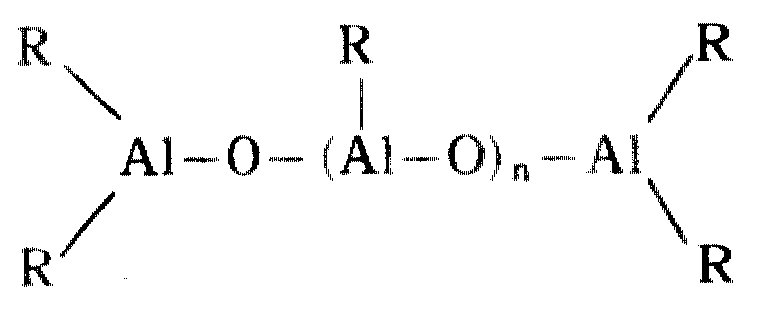
여기서, n는 2-40이고, R는 C1-C6알킬이다.Wherein n is 2-40 and R is C 1 -C 6 alkyl.
로 표시되는 선상 알미노옥산 및 하기식Linear aminooxanes represented by

여기서, n 및 R의 정의는 상기와 같다.Here, the definitions of n and R are as described above.
로 표시되는 환상알미노옥산의 제조법에 관한 발명이 기재되어 있다. 동 공보에는 동 제조법에 의해서 제조된 예를들면 메틸 알미노옥산을 티탄 또는 질코늄의 비스(시크로펜타디에닐)화합물과 혼합하여 올레핀의 중합을 행하는 구체예가 개시되어 있다.The invention regarding the manufacturing method of cyclic aminooxane represented by is described. The publication discloses an embodiment in which olefin is polymerized by mixing, for example, methyl aminooxane produced by the production method with a bis (cyclopentadienyl) compound of titanium or zirconium.
특개소 60-35005호 공보예는 하기식,Japanese Patent Application Laid-Open No. 60-35005 shows the following formula,
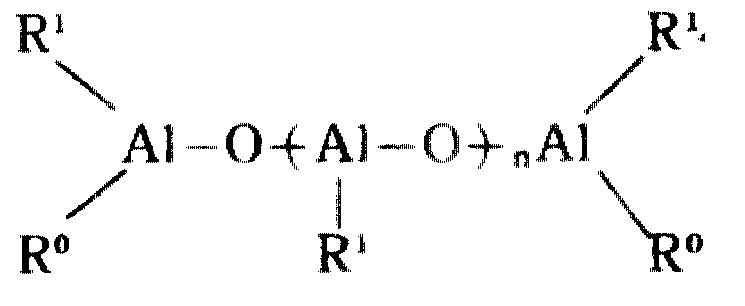
여기서, R1는 C1-C10알킬이며, R0는 R1이든지 또는 결합되어 -O-를 나타낸다.Wherein R 1 is C 1 -C 10 alkyl and R 0 is either R 1 or combined to represent —O—.
로 표시되는 알미노옥산 화합물을 우선 마그네슘 화합물과 반응시키고, 이어서 반응생성물을 염소화하고, 또 Ti, V, Zr 또는 Cr이 화합물로 처리하여 올레핀용 중합촉매를 제조하는 방법이 개시되어있다. 동 공보예는 상기 촉매가 에틸렌과 C3-C12α-올레핀 화합물의 공중합에 특히 적합하다고 기재되어 있다.A method for producing an olefin polymerization catalyst is disclosed by first reacting an aminooxane compound represented by a magnesium compound, followed by chlorination of the reaction product, and further treatment of Ti, V, Zr or Cr with the compound. The publication describes that the catalyst is particularly suitable for the copolymerization of ethylene and a C 3 -C 12 α-olefin compound.
특개소 60-35006호 공보에는 반응기 브랜드 폴리머 제조용 촉매계로서 상이한 2종이상의 천이금속의 모노, 디 또는 트리-시크로펜타디에틸 또는 그 유도체(a)와 알목산(알미노옥산)(b)이 조합이 개시되어 있다.Japanese Patent Application Laid-Open No. 60-35006 discloses mono, di or tri-cyclopentadiethyl or derivatives thereof of two or more different transition metals as catalyst systems for producing a reactor brand polymer (a) and aloxane (alminooxane) (b). Combination is disclosed.
특개소 60-35007호 공보에는 에틸렌을 단독으로 또는 탄소수 3이상의 α-올레핀과 함께 메탈로센과 하기식Japanese Patent Application Laid-Open No. 60-35007 discloses ethylene alone or together with a metallocene and

여기서, R은 탄소수 1-5의 알킬기이고, n는 1- 약 20의 정수이다.Wherein R is an alkyl group having 1 to 5 carbon atoms and n is an integer of 1 to about 20.
로 표시되는 환상 알목산 또는 하기식Cyclic aloxane or

여기서, R 및 n의 정의는 상기와 같다.Here, the definitions of R and n are as above.
로 표시되는 선상알목산을 포함하는 촉매계의 존재하에 중합시키는 방법이 기재되어 있다.A process for polymerizing in the presence of a catalyst system comprising linear alkalic acid represented by is described.
또 특개소 60-35008호 공보에는 적어도 2종의 메탈로센과 알목산을 포함하는 촉매계를 사용함으로써 폭넓은 분자량 분포를 갖는 폴리에틸렌 또는 에틸렌과 C3-C10의 α-올레핀의 공중합체가 제조됨이 기재되어 있다.In addition, Japanese Patent Application Laid-Open No. 60-35008 uses a catalyst system containing at least two metallocenes and aloxanes to prepare copolymers of polyethylene or ethylene having a broad molecular weight distribution and α-olefins of C 3 -C 10 . This is described.
이들의 천이금속화합물 및 알미노옥산으로 형성되는 촉매는 종래로부터 알려져 있는 촉매계에 비해서 중합활성이 매우 우수하지만 이들의 촉매계가 가용성이고, 생성중합체의 숭비중이 작고 분체성상이 우수한 중합체를 얻기 어려웠다.Catalysts formed from these transition metal compounds and aminooxanes have excellent polymerization activity compared with conventionally known catalyst systems, but these catalyst systems are soluble, and it is difficult to obtain polymers having a low weight of the produced polymer and excellent powder properties.
한편 상기 천이금속화합물을 실리카, 실리카·알미나, 알미나등의 다공성 무기산화물 담체에 담지시킨 고체촉매 성분과 알미노옥산으로 형성된 촉매를 사용하는 방법도 상기 특개소 60-35006호 공보, 특개소 60-35007호 공보, 특개소 60-35008호 공보에도 제안되어 있고, 또 특개소 61-31404호 공보, 특개소 61-108610호 공보 및 특개소 60-106808호 공보에는 유사한 다공성 무기산화물 담체에 담지된 고체촉매 성분을 사용하는 방법이 제안되어 있다. 이들의 선행기술에 기재된 방법으로는 담지고체성분을 채용함으로써 중합활성이 저하되든지 얻어진 중합체의 숭비중등의 분체상이 불충분한 것이 많았다.In addition, Japanese Patent Application Laid-Open No. 60-35006, Japanese Patent Application Laid-Open No. 60-35006 discloses a method of using a catalyst formed of a solid catalyst component and an aminooxane supported on a porous inorganic oxide support such as silica, silica, alumina, or alumina. 60-35007 and JP-A-60-35008 are proposed, and JP-A-61-31404, JP-A-61-108610 and JP-A-60-106808 are supported on similar porous inorganic oxide carriers. A method of using the solid catalyst component has been proposed. In the methods described in these prior arts, many of the powdery phases, such as the cultivation of the obtained polymer, were inadequate even if the polymerization activity was reduced by employing a supported body component.
[발명의 개시][Initiation of invention]
본 발명의 목적은 올레핀 중합용 촉매를 제공하는데 있다.It is an object of the present invention to provide a catalyst for olefin polymerization.
본 발명의 목적은 주기율표 IVB족의 천이금속 화합물의 촉매성분과 알미노옥산의 촉매성분으로 된 올레핀 중합용 촉매를 제공하는데 있다.An object of the present invention is to provide a catalyst for olefin polymerization comprising a catalyst component of a transition metal compound of group IVB of the periodic table and a catalyst component of aminooxane.
본 발명의 또 다른 목적은 숭비중이 크고 분체성상이 우수한 올레핀 중합체를 얻을 수 있고, 또 중합활성이 큰 올레핀 중합용 고체촉매를 제공하는데 있다.It is still another object of the present invention to provide an olefin polymer having a high weight and excellent powdery phase and a solid catalyst for olefin polymerization having a high polymerization activity.
본 발명의 또다른 목적은 상기와 같은 본 발명의 촉매를 제조하는 방법을 제공하는데 있다.It is another object of the present invention to provide a method for preparing the catalyst of the present invention as described above.
본 발명의 또 다른 목적 및 이점은 아래의 설명에서 명백해질 것이다.Still other objects and advantages of the present invention will become apparent from the following description.
본 발명에 의하면 본 발명의 이와같은 목적 및 이점은 (A)(A1) 주기율표 IVB족의 천이금속화합물의 촉매성분, (A2)알미노옥산의 촉매성분 및 (A3) 미립자 유기 또는 무기화합물 담체로 되고, (B) 미립자 담체 100그람당 천이금속원자 0.5-500 밀리그램 원자 및 알미늄원자 5-50,000밀리그램 원자를 함유하고, (C) 천이금속원자(M)에 대한 알미늄원자(Al)의 원자비(Al/M)가 1-1,000범위이고, 또 (D) 평균입자경이 5-200㎛의 범위에 있다.According to the present invention, the objects and advantages of the present invention are: (A) (A 1 ) catalytic component of the transition metal compound of group IVB of the periodic table, (A 2 ) catalytic component of aminooxane and (A 3 ) particulate organic or inorganic A compound carrier, (B) containing 0.5-500 milligrams of transition metal atoms and 5-50,000 milligrams of aluminum atoms per 100 grams of particulate carrier, and (C) of the aluminum atoms (Al) with respect to the transition metal atoms (M) The atomic ratio (Al / M) is in the range of 1-1,000, and (D) the average particle diameter is in the range of 5-200 µm.
는 것을 특징으로하는 올레핀 중합용 고체촉매에 의해서 달성된다.It is achieved by a solid catalyst for olefin polymerization, characterized in that.
촉매성분(A1)에 있어서의 주기율표 IVB족의 천이금속은 예를들면 티탄, 질코늄 및 하프늄으로 된 군으로부터 선택되는 것이다.The transition metal of Group IVB of the periodic table in the catalyst component (A 1 ) is selected from the group consisting of titanium, zirconium and hafnium, for example.
촉매성분(A1)에 있어서의 천이금속으로서는 티탄 및 질코늄이 바람직하고 질코늄이 특히 바람직하다.As the transition metal in the catalyst component (A 1 ), titanium and zirconium are preferable, and zirconium is particularly preferable.
촉매성분(A1)에 있어서의 주기율표 IVB족의 천이금속의 화합물의 예로서는 공역 π전자를 갖는 기를 배위자로 한 질코늄 화합물을 들 수 있다.There may be mentioned the catalyst component (A 1) a zirconium compound to be a ligand group having a conjugated π electron examples of the compound of the transition metal of the periodic table Group IVB of the.
상기 공역 π전자를 갖는 기를 배위자로 한 질코늄 화합물로서는 예를들면 하기식(1)As a zirconium compound which made the group which has the said conjugated (pi) electron as ligand, for example, following formula (1)

여기서, R1은 시크로알카디에닐기를 나타내고, R2, R3및 R4는 시크로알카디에닐기, 아릴기, 알킬기, 시크로알킬기, 아랄킬기, 할로겐원자, 수소, ORa, SRb, NR2 c또는 PRd 2이고, Ra, Rb, Rc및 Rd는 알킬기, 시크로알킬기, 아릴기, 아랄킬기등의 탄화수소기, 실릴기이며, 2개의 RC및 Rd가 연결되어 환을 형성할 수도 있고, k
로 표시되는 화합물이 바람직하게 사용된다. 시크로알카디에닐기로서는 예를들면 시크로펜타디에닐기, 메틸시크로펜타디에닐기, 에틸시크로펜타디에닐기, 펜타메틸시크로펜타디에닐기, 디메틸시크로펜타디에닐기, 인데닐기, 테트라하이드로인데닐기등을 예시할 수 있다. 알킬기로서는 예를들면 메틸기, 에틸기, 프로필기, 이소프로필기, 브틸기, 헥실기, 옥틸기, 2-에틸헥실기, 데실기, 오레일기등을 예시할 수 있다. 아릴기로서는 예를들면 페닐기, 토릴기등을 예시할 수 있다. 아랄킬기로서는 벤질기, 네오필기등을 예시할 수 있다. 시크로알킬기로서는 시크로펜틸기, 시크로헥실기, 시크로옥틸기, 놀보닐기, 비시크로노닐기 및 이들의 기의 알킬치환기를 예시할 수 있다. 기타 비닐기, 아릴기, 프로페닐기, 이소프로페닐기, 1-브테닐기등의 불포화지방족기나 시크로헥세닐기등의 불포화지환식기에 대해서도 예시할 수 있다. 할로겐원자로서는 불소, 염소, 취소등을 예시할 수 있다. 실릴기로서는 트리메틸실릴기, 트리에틸실릴기, 페닐디메틸실릴기, 트리페닐실릴기등을 예시할 수 있다.The compound represented by is used preferably. As the cycloalkadienyl group, for example, cyclopentadienyl, methylcyclopentadienyl, ethylcyclopentadienyl, pentamethylcyclopentadienyl, dimethylcyclopentadienyl, indenyl and tetrahydro A nil group etc. can be illustrated. As an alkyl group, a methyl group, an ethyl group, a propyl group, isopropyl group, a butyl group, hexyl group, octyl group, 2-ethylhexyl group, a decyl group, an oleyl group etc. can be illustrated, for example. As an aryl group, a phenyl group, a toryl group, etc. can be illustrated, for example. As an aralkyl group, a benzyl group, a neofill group, etc. can be illustrated. As a cycloalkyl group, a cyclopentyl group, a cyclohexyl group, a cyclooctyl group, a novolyl group, a bicyclononyl group, and the alkyl substituent of these groups can be illustrated. Other unsaturated alicyclic groups, such as unsaturated aliphatic groups, such as a vinyl group, an aryl group, a propenyl group, an isopropenyl group, and 1- butenyl group, and a cyclohexenyl group, can also be illustrated. Examples of the halogen atom include fluorine, chlorine and cancellation. Examples of the silyl group include trimethylsilyl group, triethylsilyl group, phenyldimethylsilyl group, triphenylsilyl group and the like.
질코늄 화합물로서는 다음 화합물을 예시할 수 있다.Examples of the zirconium compound include the following compounds.
비스(시크로펜타디에닐)질코늄모노크로라이드모노하이드라이드, 비스(시크로펜타디에닐)질코늄모노브로마이드모노하이드라이드, 비스(시크로펜타디에닐)메틸질모늄하이드라이드, 비스(시크로펜타디에닐)에틸질코늄하이드라이드, 비스(시크로펜타디에닐)시크로헥실질코늄하이드라이드, 비스(시크로펜타디에닐)페닐질코늄하이드라이드, 비스(시크로펜타디에닐)벤질질코늄하이드라이드, 비스(시크로펜타디에닐)네오펜틸질코늄하이드라이드, 비스(메텔시크로펜타디에닐)질코늄모노크로라이드모노하이드라이드, 비스(인데닐)질코늄모노크로라이드모노하이드라이드, 비스(시크로펜타디에닐)질코늄디크로라이드, 비스(시크로펜타디에닐)질코늄디브로바이드, 비스(시크로팬타디에닐)메틸질코늄모노크로라이드, 비스(시크로펜타디에닐)에틸질코늄모노크로라이드, 비스(시크로펜타디에닐)시크로헥실질코늄모노크로라이드, 비스(시크로펜타디에닐)페닐질코늄모노크로라이드, 비스(시크로펜타디에닐)벤질질코늄모노크로라이드, 비스(시크로펜타디에닐)질코늄디크로라이드, 비스(인데닐)질코늄디크로라이드, 비스(인데닐)질코늄디브로마이드, 비스(시크로펜타디에닐)질코늄디페닐, 비스(시크로펜타디에닐)질코늄디벤질, 비스(시크로펜타디에닐)메톡시질코늄크로라이드, 비스(시크로펜타디에닐)에톡시질코늄크로라이드, 비스(시크로펜타디에닐)브톡시질코늄크로라이드, 비스(시크로펜타디에닐)2-에틸헥속시질코늄크로라이드, 비스(시크로펜타디에닐)메틸질코늄에톡시드, 비스(시크로펜타디에닐)메틸질코늄브톡시드, 비스(시크로펜타디에닐)에틸질코늄에톡시드, 비스(시크로펜타디에닐)페닐질코늄에톡시드, 비스(시크로펜타디에닐)벤질질코늄에톡시드, 비스(메틸시크로펜타디에닐)에톡시질코늄크로라이드, 비스 인데닐에톡시질코늄크로라이드, 비스(시크로펜타디에닐)에톡시질코늄, 비스(시크로펜타디에닐)브톡시질코늄, 비스(시크로펜타디에닐)2-에틸헥속시질코늄, 비스(시크로펜타디에닐)페녹시질코늄크로라이드, 비스(시크로펜타디에닐)시크로헥속시질코늄크로라이드, 비스(시크로펜타디에닐)페닐메톡시질코늄크로라이드, 비스(시크로펜타디에닐)메틸질코늄페닐메톡시드, 비스(시크로펜타디에닐)트리메틸시록시질코늄크로라이드, 비스(시크로펜다디에닐)트리페닐시록시질코늄크로라이드, 비스(시크로펜타디에닐)티오페닐질코늄크로라이드, 비스(시크로펜타디에닐)티오에틸질코늄크로라이드, 비스(시크로펜타디에닐)비스(디메틸아미드)질코늄, 비스(시크로펜타디에닐)디에틸아미드질코늄크로라이드, 에틸렌비스(인데닐)에톡시질코늄크로라이드, 에틸렌비스(4,5,6,7-테트라하이드로-1-인데닐)에톡시질코늄크로라이드, 에틸렌비스(인데닐)디메틸질코늄, 에틸렌비스(인데닐)디에틸질코늄, 에틸렌비스(인데닐)디페틸질코늄, 에틸렌비스(인데닐)디벤틸질코늄, 에틸렌비스(인데닐)메틸질코늄모노브로마이드, 에틸렌비스(인데닐)에틸질코늄모노크로라이드, 에틸렌비스(인데닐)벤질질코늄모노크로라이드, 에틸렌비스(인데닐)메틸질코늄모노크로라이드, 에틸렌비스(인데닐)질코늄디크로라이드, 에틸렌비스(인데닐)질코늄디브로마이드, 에틸렌비스(4,5,6,7-테트라하이드로-1-인데닐)디메틸질코늄, 에틸렌비스(4,5,6,7-테트라하이드로-1-인데닐)메틸질코늄모노크로라이드, 에틸렌비스(4,5,6,7-테트라하이드로-1-인데닐)질코늄디크로라이드, 에틸렌비스(4,5,6,7-테트라하이드로-1-인데닐)질코늄디브로마이드, 에틸렌비스(4-메틸-1-인데닐)질코늄디크로라이드, 에틸렌비스(5-메틸-1-인데닐)질코늄디크로라이드, 에틸렌비스(6-메틸-1-인데닐)질코늄디크로라이드, 에틸렌비스(7-메틸-1-인데닐)질코늄디크로라이드, 에틸렌비스(5-메톡시-1-인데닐)질코늄디크로라이드, 에틸렌비스(2,3-디메틸-1-인데닐)질코늄디크로라이드, 에틸렌비스(4,7-디메틸-1-인데닐)질코늄디크로라이드, 에틸렌비스(4,7-디메톡시-1-인데닐)질코늄디크로라이드, 에틸렌비스(인데닐)질코늄디메톡시드, 에틸렌비스(인데닐)질코늄디에톡시드, 에틸렌비스(인데닐)메톡시질코늄크로라이드, 에틸렌비스(인데닐)에톡시질코늄크로라이드, 에틸렌비스(인데닐)메틸질코늄에톡시드, 에틸렌비스(4,5,6,7-테트라하이드로-1-인데실)질코늄디메톡시드, 에틸렌비스(4,5,6,7-테트라하이드로-1-인데실)질코늄디에톡시드, 에틸렌비스(4,5,6,7-테트라하이드로-1-인데실)메톡시질코늄크로라이드, 에틸렌비스(4,5,6,7-테트라하이드로-1-인데실)에톡시질코늄크로라이드, 에틸렌비스(4,5,6,7-테트라하이드로-1-인데실)메틸질코늄에톡시드, 티탄화합물로서는 다음 화합물을 예시할 수 있다.Bis (cyclopentadienyl) zirconium monochromide monohydride, bis (cyclopentadienyl) zirconium monobromide monohydride, bis (cyclopentadienyl) methyl zirmonium hydride, bis (seek Lofendienyl) ethylzylconium hydride, bis (cyclopentadienyl) cyclohexylsilconium hydride, bis (cyclopentadienyl) phenylzylconium hydride, bis (cyclopentadienyl) ben Nitrogen chromium hydride, bis (cyclopentadienyl) neopentyl zirconia hydride, bis (methelcyclopentadienyl) zirconium monochromide monohydride, bis (indenyl) zirconium monochromide monohydrate Ride, bis (cyclopentadienyl) zylconium dichromide, bis (cyclopentadienyl) zilconium dibrobide, bis (cyclopentadienyl) methylzylconium monochromide, bis (cyclopenta) Dienyl) ethylzylconium Nocride, bis (cyclopentadienyl) cyclohexylsiliconium monochromide, bis (cyclopentadienyl) phenylzylconium monochromide, bis (cyclopentadienyl) benzylconium monochloride , Bis (cyclopentadienyl) zirconium dichromide, bis (indenyl) zirconium dichromide, bis (indenyl) zirconium dibromide, bis (cyclopentadienyl) zirconium diphenyl, bis (Cyclopentadienyl) zirconium dibenzyl, bis (cyclopentadienyl) methoxy zirconium chromide, bis (cyclopentadienyl) ethoxy zirconium chromide, bis (cyclopentadienyl) Butoxyzyl Cornium Chloride, Bis (Cyclopentadienyl) 2-ethyl Hexoxysicholiconium Chloride, Bis (Cyclopentadienyl) methylzylconium ethoxide, Bis (Cyclopentadienyl) methyl Conium Butoxide, Bis (cyclopentadienyl) ethylzylconium ethoxide, Bis (cyclopentadienyl) phenyl Nitnium ethoxide, bis (cyclopentadienyl) benzyl zirconium ethoxide, bis (methyl cyclopentadienyl) ethoxy zirconium chloride, bis indenyl ethoxy zirconium chloride, bis (cyclo Pentadienyl) ethoxyzylconium, bis (cyclopentadienyl) butoxyzylconium, bis (cyclopentadienyl) 2-ethylhexoxysichiconium, bis (cyclopentadienyl) phenoxyzirconium Chloride, bis (cyclopentadienyl) cyclohexoxyconium chromide, bis (cyclopentadienyl) phenylmethoxyzylconium chromide, bis (cyclopentadienyl) methylzylconiumphenylmethoxide , Bis (cyclopentadienyl) trimethyl hydroxy zirconium chromide, bis (cyclopentadienyl) triphenyl oxy oxy zyl nium chromide, bis (cyclopentadienyl) thio phenyl zirconium chromide, Bis (cyclopentadienyl) thioethylzylconium chloride, bis (cyclopentadienyl) bis (dimethyla D) zylconium, bis (cyclopentadienyl) diethylamidezylconium chromide, ethylenebis (indenyl) ethoxyzylconium chromide, ethylenebis (4,5,6,7-tetrahydro-1- Indenyl) ethoxyzylconium chloride, ethylenebis (indenyl) dimethylzylconium, ethylenebis (indenyl) diethylzylconium, ethylenebis (indenyl) dipetylzylconium, ethylenebis (indenyl) dibenylzylconium , Ethylene bis (indenyl) methyl zirconium monobromide, ethylene bis (indenyl) ethyl zirconium monochromide, ethylene bis (indenyl) benzylconium monochromide, ethylene bis (indenyl) methyl zirconium monochrom Ride, ethylenebis (indenyl) zirconium dichromide, ethylenebis (indenyl) zirconium dibromide, ethylenebis (4,5,6,7-tetrahydro-1-indenyl) dimethylzirconium, ethylenebis (4,5,6,7-tetrahydro-1-indenyl) methylzylconium monochromide, ethylenebis (4,5,6,7-te Lahydro-1-indenyl) zirconium dichromide, ethylenebis (4,5,6,7-tetrahydro-1-indenyl) zirconium dibromide, ethylenebis (4-methyl-1-indenyl) Zirconium Dichromide, Ethylenebis (5-methyl-1-indenyl) Zirconium Dichromide, Ethylenebis (6-methyl-1-indenyl) Zirconium Dichromide, Ethylenebis (7-methyl-1 Indenyl) zirconium dichromide, ethylene bis (5-methoxy-1-indenyl) zirconium dichromide, ethylene bis (2,3-dimethyl-1-indenyl) zirconium dichromide, ethylene Bis (4,7-dimethyl-1-indenyl) zirconium dichromide, ethylenebis (4,7-dimethoxy-1-indenyl) zirconium dichromide, ethylenebis (indenyl) zirconium dimethoxide On seeds, ethylenebis (indenyl) zylconium diethoxide, ethylenebis (indenyl) methoxyzylconium chromide, ethylenebis (indenyl) ethoxyzylconium chromide, ethylenebis (indenyl) methylzylconium Toxide, ethylenebis (4,5,6,7- Trihydro-1-indesil) zilconium dimethoxide, ethylenebis (4,5,6,7-tetrahydro-1-indesil) zilconium diethoxide, ethylenebis (4,5,6,7- Tetrahydro-1-indesil) methoxyzylconium chromide, ethylenebis (4,5,6,7-tetrahydro-1-indeyl) ethoxyzylconium chromide, ethylenebis (4,5,6, Examples of the 7-tetrahydro-1-indeyl) methylzylconium ethoxide and titanium compound include the following compounds.
비스(시크로펜타디에닐)티타늄모노크로라이드 모노하이드라이드, 비스(시크로펜타디에닐)메틸티타늄하이드라이드, 비스(시크로펜타디에닐)페닐티타늄크로라이드, 비스(시크로펜타디에닐)벤질티타늄크로라이드, 비스(시크로펜타디에닐)티타늄크로라이드, 비스(시크로펜타디에닐)티타늄디벤질, 비스(시크로펜타디에닐)에톡시티탄크로라이드, 비스(시크로펜타디에닐)브톡시티탄크로라이드, 비스(시크로펜타디에닐)메틸티탄에톡시드, 비스(시크로펜타디에닐)페톡시티탄크로라이드, 비스(시크로펜타디에닐)트리메틸시록시티탄크로라이드, 비스(시크로펜타디에닐)티오페닐티탄크로라이드, 비스(시크로펜타디에닐)비스(디메틸아미드)티탄, 비스(시크로펜타디에닐)에톡시티탄, 에틸렌비스(인데닐)티타늄디크로라이드, 에틸렌비스(4,5,6,7-테트라하이드로-1-인데닐)티타늄디크로라이드, 하프늄화합물로서는 다음 화합물을 예시할 수 있다.Bis (cyclopentadienyl) titanium monochromide monohydride, bis (cyclopentadienyl) methyltitanium hydride, bis (cyclopentadienyl) phenyltitanium chromide, bis (cyclopentadienyl) Benzyl titanium chloride, bis (cyclopentadienyl) titanium chloride, bis (cyclopentadienyl) titaniumdibenzyl, bis (cyclopentadienyl) ethoxytitanium chloride, bis (cyclopentadienyl) ) Bitoxy titanium chloride, bis (cyclopentadienyl) methyl titanium ethoxide, bis (cyclopentadienyl) phenoxy titanium chromide, bis (cyclopentadienyl) trimethyl oxy titanium chloride, Bis (cyclopentadienyl) thiophenyltitanium chloride, bis (cyclopentadienyl) bis (dimethylamide) titanium, bis (cyclopentadienyl) ethoxytitanium, ethylenebis (indenyl) titaniumdicro Ride, ethylenebis (4,5,6,7-tetrahydro 1-indenyl) titanium fluoride as thickeners, as the hafnium compounds may be mentioned the following compounds.
비스(시크로펜타디에닐)하프늄모노크로라이드모노하이드라이드, 비스(시크로펜타디에닐)에틸하프늄하이드라이드, 비스(시크로펜타디에닐)페닐하프늄크로라이드, 비스(시크로펜타디에닐)하프늄디크로라이드, 비스(시크로펜타디에닐)하프늄디벤질, 비스(시크로펜타디에닐)에톡시하프늄크로라이드, 비스(시크로펜타디에닐)브톡시하프늄크로라이드, 비스(시크로펜타디에닐)메틸하프늄에톡시드, 비스(시크로펜타디에닐)페녹시하프늄크로라이드, 비스(시크로펜타디에닐)티오페닐하프늄크로라이드, 비스(시크로펜타디에닐)비스(디에틸아미드)하프늄, 에틸렌비스(인데닐)하프늄디크로라이드, 에틸렌비스(4,5,6,7-테트라하이드로-1-인데닐)하프늄디크로라이드, 촉매성분(A2)은 알미노옥산이다.Bis (cyclopentadienyl) hafnium monochloride monohydride, bis (cyclopentadienyl) ethyl hafnium hydride, bis (cyclopentadienyl) phenylhafnium chromide, bis (cyclopentadienyl) Hafnium dichromide, bis (cyclopentadienyl) hafniumdibenzyl, bis (cyclopentadienyl) ethoxyhafnium chromide, bis (cyclopentadienyl) butoxyhafnium chromide, bis (cyclopenta) Dienyl) methylhafnium ethoxide, bis (cyclopentadienyl) phenoxyhafnium chromide, bis (cyclopentadienyl) thiophenylhafnium chromide, bis (cyclopentadienyl) bis (diethylamide ) Halfnium, ethylenebis (indenyl) hafnium dichromide, ethylenebis (4,5,6,7-tetrahydro-1-indenyl) hafnium dichromide, the catalyst component (A 2 ) is aminooxane.
촉매 성분(A2)으로서 사용되는 알미노옥산으로서 일반식(Ⅱ) 및 일반식(Ⅲ)Alminooxanes used as catalyst component (A 2 ) as general formula (II) and general formula (III)


로 표시되는 유기 알미늄 화합물을 예시할 수 있다. 이 알미노옥산에 있어서 R는 메틸기, 에틸기, n-프로필기, 이소프로필기, n-브틸기, 이소브틸기등의 탄화수소기이고, 바람직하기로는 메틸기, 에틸기, 이소브틸기, 특히 바람직하기로는 메틸기이다. m는 2이상 바람직하기로는 5이상의 정수이다.The organic aluminum compound represented by can be illustrated. In this aminooxane, R is a hydrocarbon group such as methyl group, ethyl group, n-propyl group, isopropyl group, n-butyl group, isobutyl group, preferably methyl group, ethyl group, isobutyl group, and particularly preferably Methyl group. m is 2 or more, Preferably it is an integer of 5 or more.
상기 알미노옥산은 다음과 같이하여 제조할 수 있다.The aminooxane can be prepared as follows.
(1) 흡착수를 함유하는 화합물, 결정수를 함유하는 염류 예를들면 염화마크네슘 수화물, 황산동수화물, 황산알미늄수화물, 황산니켈수화물, 염화제1세륨수화물등의 탄화수소 매체현탁액에 트리알킬알미늄을 첨가하여 반응시키는 방법.(1) Trialkylaluminum is added to hydrocarbon medium suspensions such as compounds containing adsorbed water and salts containing crystallized water such as, for example, chloride chloride hydrate, copper sulfate hydrate, aluminum sulfate hydrate, nickel sulfate hydrate, and cerium chloride monohydrate. To react.
(2) 벤젠, 톨루엔, 에틸에테르, 테트라하이드로후란등의 매체중에서 트리알킬알미늄에 직접 물을 작용시키는 방법.(2) A method of directly reacting water with trialkylaluminum in a medium such as benzene, toluene, ethyl ether, tetrahydrofuran or the like.
이들의 방법중에서 (1)의 방법을 채용하는 것이 바람직하다. 또 이 알미노옥산에는 소량의 유기금속성분을 함유하고 있어도 지장없다.It is preferable to employ | adopt the method of (1) among these methods. Moreover, even if it contains a small amount of organometallic components, this aminooxane does not interfere.
미립자담체(A3)는 유기 및 무기중 어느 것이라도 좋다.The particulate carrier (A 3 ) may be either organic or inorganic.
유기화합물 담체로서는 예를들면 폴리에틸렌, 폴리프로필렌, 폴리 1-브텐, 폴리 4-메틸-1-펜텐등의 폴리올레핀 및 이들 화합물의 원료로서 사용하는 모노머를 공중합시켜서 얻어지는 폴리올레핀 또는 각종 폴리 에스테르, 폴리아미드, 폴리염화비닐, 폴리메타크릴산 메틸, 폴리아크릴산 메틸, 폴리스티렌 기타 각종 천연고분자나 각종 단량체 화합물을 예시할 수 있다.Examples of the organic compound carrier include polyolefins obtained by copolymerizing polyolefins such as polyethylene, polypropylene, poly 1-butene, poly 4-methyl-1-pentene and monomers used as raw materials of these compounds, or various polyesters, polyamides, Polyvinyl chloride, polymethyl methacrylate, polymethyl methyl acrylate, polystyrene, various natural polymers, and various monomer compounds can be illustrated.
이들 담체의 분자량은 이들 화합물이 고체상 물질로서 존재할 수 있는 정도의 분자량이면 된다. 예를들면 폴리에틸렌을 예로들면 약 1,000부터 10,000,000범위의 평균분자량을 갖는 폴리에틸렌이 사용 가능하다.The molecular weight of these carriers should just be such a molecular weight that these compounds can exist as a solid substance. For example, polyethylene, for example, polyethylene having an average molecular weight in the range of about 1,000 to 10,000,000 can be used.
본 발명에 있어서는 담체로서 사용하는 유기화합물이 단지 촉매지지체로서 작용할 뿐만 아니라 생성폴리머의 물성에 대해서도 영향을 주는 경우가 있다. 예를들면 중량평균 분자량 약 200만의 폴리에틸렌을 사용함으로써 생성폴리에틸렌의 용융강도의 증대가 기대되고 한편 중량평균분자량 약 5만의 폴리에틸렌을 담체로서 사용함으로써 생성에틸렌 공중합체 필름의 투명성의 향상이 기대된다.In the present invention, the organic compound used as the carrier may not only act as a catalyst support but also affect the physical properties of the resulting polymer. For example, the use of polyethylene having a weight average molecular weight of about 2 million is expected to increase the melt strength of the resulting polyethylene, while the use of polyethylene having a weight average molecular weight of about 50,000 as the carrier is expected to improve the transparency of the resulting ethylene copolymer film.
무기화합물 담체로서는 다공질 산화물이 바람직하고, 구체적으로는, SiO2, Al2O3,MgO, ZrO2, TiO2, B2O3, CaO, ZnO, BaO, ThO2등 또는 이들의 혼합물, 예를들면, SiO2-MgO, SiO2-A12O3, SiO2-TiO2, SiO2-V2O5,SiO2-Cr2O3,SiO2-TiO2-MgO 등을 예시할 수 있다. 이들중에서, SiO2및 A12O3로 된 군으로부터 선택된 적어도 1종의 성분을 주성분으로서 함유하는 담체가 바람직하다.As the inorganic compound carrier, a porous oxide is preferable, and specifically, SiO 2 , Al 2 O 3 , MgO, ZrO 2 , TiO 2 , B 2 O 3 , CaO, ZnO, BaO, ThO 2 , or a mixture thereof, eg For example, SiO 2 -MgO, SiO 2 -A1 2 O 3 , SiO 2 -TiO 2 , SiO 2 -V 2 O 5, SiO 2 -Cr 2 O 3, SiO 2 -TiO 2 -MgO and the like can be exemplified. have. Among them, a carrier containing as a main component at least one component selected from the group consisting of SiO 2 and A1 2 O 3 is preferred.
상기 무기산화물에는 소량의 Na2CO3, K2CO3, CaCO3, MgCO3, Na2SO4, A12(SO4)3, BaSO4, KNO3, Mg(NO3)2, A1(NO3)3, Na2O, K2O, Li2O 등의 탄산염, 황산염, 초산염, 산화물 성분을 함유하고 있어도 지장없다.The inorganic oxide includes a small amount of Na 2 CO 3 , K 2 CO 3 , CaCO 3 , MgCO 3 , Na 2 SO 4 , A1 2 (SO 4 ) 3 , BaSO 4 , KNO 3 , Mg (NO 3 ) 2 , A1 ( nO 3) 3, Na 2 O , may contain the carbonate, sulfate, nitrate, oxide component, such as K 2 O, Li 2 O does not interfere.
이 다공무기담체는 그 종류 및 제법에 따라서 성상은 상이 하지만, 본 발명에 바람직하게 사용되는 담체는 비표면적이 50 내지 1000㎡/g, 더 바람직하기로는 100 내지 700㎡/g, 세공용적이 0.3 내지 2.5㎡/g의 것이다. 이 담체는 통상 150 내지 1000℃, 바람직하기로는 200 내지 800℃에서 소성해서 사용된다.The porous inorganic carriers have different properties depending on their type and preparation method, but the carrier preferably used in the present invention has a specific surface area of 50 to 1000 m 2 / g, more preferably 100 to 700 m 2 / g, and a pore volume of 0.3. To 2.5 m 2 / g. This carrier is usually used by firing at 150 to 1000 캜, preferably at 200 to 800 캜.
이 담체는 그 종류 및 제법에 따라서 성상은 다르나 본 발명에 바람직하게 사용되는 담체는 입경이 5 내지 200㎛, 더 바람직하기로는 10 내지 150㎛, 특히 바람직하게는 20 내지 100㎛이다.Although the carriers differ in properties depending on their type and preparation method, the carriers preferably used in the present invention have a particle diameter of 5 to 200 µm, more preferably 10 to 150 µm, particularly preferably 20 to 100 µm.
본 발명의 올레핀 중합용 고체촉매는 위에서 설명한 미립자 유기 또는 무기화합물 담체, 주기율표 IVB족의 천이금속화합물 및 알미노옥산으로 형성되고 이 미립자유기 또는 무기화합물 담체 100g당 천이금속원자로서 0.5 내지 500밀리그램원자의 천이금속화합물 및 알미늄원자로서 5 내지 50,000밀리그램 원자의 알미노옥산을 함유하고 이 천이금속(M)에 대한 알미늄(A1)의 원자비(A1/M)가 1 내지 1000의 범위이고, 또 평균 입자경이 5 내지 200㎛인 것을 특징으로 하고 있다.The solid catalyst for olefin polymerization of the present invention is formed of the particulate organic or inorganic compound carrier described above, the transition metal compound of Group IVB of the periodic table, and the aminooxane, and 0.5 to 500 milligram atoms as the transition metal atom per 100 g of the particulate organic or inorganic compound carrier. A transition metal compound and an aluminum atom containing 5 to 50,000 milligrams of aminooxane, and the atomic ratio (A1 / M) of aluminum (A1) to the transition metal (M) is in the range of 1 to 1000, and on average It is characterized by the particle diameter of 5-200 micrometers.
본 발명의 올레핀 중합용 고체촉매는 미립자유기 또는 무기화합물 담체 100g당, 천이금속원자로서 촉매당 활성 및 천이금속화합물당 활성의 관점에서 통상 0.5 내지 500밀리그램 원자, 바람직하기로는 200밀리그램원자, 더 바람직하기로는 3 내지 50밀리그램 원자의 천이금속화합물을 함유하고 있다.The solid catalyst for olefin polymerization of the present invention is usually 0.5 to 500 milligram atoms, preferably 200 milligram atoms, more preferably, per 100 g of particulate organic or inorganic compound carrier, in terms of activity per catalyst and activity per transition metal compound as transition metal atoms. The following contains a transition metal compound of 3 to 50 milligram atoms.
또 본 발명의 올레핀 중합용 고체촉매는 중합활성 및 경제성의 관점에서 통상미립자 담체 100g당 알미늄 원자로서 5 내지 50,000밀리그램 원자, 바람직하기로는 50 내지 10,000밀리그램원자, 더 바람직하기로는 100 내지 4,000 밀리그램 원자의 알미노옥산을 함유하고 있다.In addition, the solid catalyst for olefin polymerization of the present invention is composed of 5 to 50,000 milligram atoms, preferably 50 to 10,000 milligram atoms, and more preferably 100 to 4,000 milligram atoms, per 100 g of the particulate support, from the viewpoint of polymerization activity and economic efficiency. Contains aminooxane.
본 발명의 올레핀 중합용 고체촉매에 있어서 천이금속에 대한 알미늄의 원자비(A/M)는 촉매당 중합활성 및 A1원자당의 중합활성의 관점에서 통상 1 내지 1,000, 바람직하기로는 6 내지 600, 더 바람직하기로는 15 내지 300의 범위이다.In the solid catalyst for olefin polymerization of the present invention, the atomic ratio (A / M) of aluminum to transition metal is usually 1 to 1,000, preferably 6 to 600, more from the viewpoint of polymerization activity per catalyst and polymerization activity of A1 atom. Preferably it is the range of 15-300.
본 발명의 올레핀 중합용 고체촉매의 평균입자경은 통상 5 내지 200㎛, 바람직하기로는 10 내지 150㎛, 더 바람직하기로는 20 내지 100㎛이다. 상기 평균입자경의 범위인 본 발명의 올레핀 중합용 고체촉매를 사용하는 기상중합, 슬러리중합등의 중합으로 얻어진 중합체중에서 미분말상 폴리머 입자의 생성량이 적고, 중합체는 숭비중이 크고 분말형상이 우수한 것이 얻어진다. 또 얻어진 중합체중에 거칠고 큰 폴리머 입자가 생성되지 않아 폴리머 입자 배출구를 폐쇄하는 결점이 발생되지 않는다.The average particle diameter of the solid catalyst for olefin polymerization of this invention is 5-200 micrometers normally, Preferably it is 10-150 micrometers, More preferably, it is 20-100 micrometers. Among the polymers obtained by polymerization such as gas phase polymerization or slurry polymerization using the solid catalyst for olefin polymerization of the present invention in the range of the average particle diameter, a small amount of fine powdery polymer particles is produced, and the polymer has a high weight in powder and has excellent powder form. Lose. In addition, coarse and large polymer particles are not produced in the obtained polymer, so that a defect of closing the polymer particle outlet is not generated.
상기 본 발명의 올레핀 중합용 고체촉매는 알미노옥산, 주기율표 IVB족의 천이금속화합물 및 미립자 유기 또는 무기화합물 담체로 올레핀 중합용 고체촉매를 형성시키는 방법이고, 알미노옥산의 용액과 알미노옥산의 불용성 내지 난용성 용매를 미립자 담체의 존재하에 접촉시켜 미립자 담체상에 알미노옥산을 석출시키는 공정을 적어도 포함하는 것을 특징으로하는 올레핀 중합용 고체촉매의 제법에 의해서 제조할 수 있다.The solid catalyst for olefin polymerization of the present invention is a method of forming a solid catalyst for olefin polymerization with an alminooxane, a transition metal compound of group IVB of the periodic table, and a particulate organic or inorganic compound carrier, and a solution of an alminooxane and an alminooxane. It can be produced by a method for producing a solid catalyst for olefin polymerization, comprising the step of contacting an insoluble to poorly soluble solvent in the presence of a particulate carrier to precipitate alminooxane on the particulate carrier.
더 구체적으로는 다음에 나타낸 제법을 예시할 수 있다.More specifically, the manufacturing method shown next can be illustrated.
본 발명의 올레핀 중합용 고체촉매는 첫째로, (1) 알미노옥산의 용액중에 분산시킨 미립자유기 또는 무기화합물 담체의 현탁액과 알미노옥산의 불용성 내지 난용성 용매를 접촉시켜서 알미노옥산 담지미립자 유기 또는 무기 화합물 담체를 형성하고, 또 (2) 이 알미노옥산 담지미립자 유기 또는 무기화합물 담체를 주기율표 IVB족의 천이금속화합물의 용액과 접촉시킴으로써 제조할 수 있다.The solid catalyst for olefin polymerization of the present invention is firstly prepared by (1) contacting a suspension of a particulate organic or inorganic compound carrier dispersed in a solution of aminooxane with an insoluble to poorly soluble solvent of aminooxane to form an aminooxane-supported particulate. Or an inorganic compound carrier and (2) contacting the aminooxane-supported particulate organic or inorganic compound carrier with a solution of a transition metal compound of group IVB of the periodic table.
알미노옥산의 용매로서는 예를들면 벤젠, 톨루엔, 에틸벤젠, 프로필벤젠, 브틸벤젠, 키실렌, 크로로벤젠등의 방향족 탄화수소를 들 수 있다.As a solvent of an aminooxane, aromatic hydrocarbons, such as benzene, toluene, ethylbenzene, propylbenzene, a butylbenzene, xylene, and chlorobenzene, are mentioned, for example.
알미노옥산의 불용성 내지 난용성 용매로서는 예를들면 펜탄, 헥산, 데칸, 도데칸, 등유, 시크로헥산등의 직지상 또는 분지 지방족 탄화수소 및 시크로헥산, 놀볼난, 에틸시크로헥산등의 지환식 탄화수소를 들 수 있다.Examples of insoluble to poorly soluble solvents of alminooxanes include straight-chain or branched aliphatic hydrocarbons such as pentane, hexane, decane, dodecane, kerosene, and cyclohexane, and alicyclic compounds such as cyclohexane, novolanane, and ethyl cyclohexane. And hydrocarbons.
알미노옥산의 불용성 내지 난용성 용매로서는 알미노옥산의 용액을 얻을 때에 사용하는 용매보다도 높은 비등점을 갖는 용매를 사용하는 것이 바람직하다.As the insoluble or poorly soluble solvent of the aminooxane, it is preferable to use a solvent having a boiling point higher than that of the solvent used when obtaining the solution of the aminooxane.
또 주기율표 IVB족 천이금속화합물의 용매로서는 예를들면 벤젠, 톨루엔, 에틸벤젠, 프로필벤젠, 브틸벤젠, 키실렌등의 방향족 탄화수소 및 크로로벤젠, 디크로로에탄등의 할로겐 함유 탄화수소를 예시할 수 있다.Examples of the solvent of the Group IVB transition metal compound of the periodic table include aromatic hydrocarbons such as benzene, toluene, ethylbenzene, propylbenzene, butylbenzene, and xylene, and halogen-containing hydrocarbons such as chlorobenzene and dichloroethane. have.
또 주기율표 IVB족 천이금속화합물의 불용성 내지 난용성 용매로서는 예를들면 펜탄, 헥산, 데칸, 도데칸, 등유, 시크로헥산등의 지방족 또는 지환식 탄화수소를 들 수 있다.Examples of insoluble or poorly soluble solvents of the Group IVB transition metal compound of the periodic table include aliphatic or alicyclic hydrocarbons such as pentane, hexane, decane, dodecane, kerosene and cyclohexane.
상기 방법은 예를들면 알미노옥산의 용액과 미립자 무기화합물 담체로 된 현탁액에 알미노옥산의 불용성 내지 난용성 용매를 가하거나 또는 이 불용성 내지 난용성 용매에 알미노옥산의 용액과 이 담체로 된 현탁액을 가함으로써 알미노옥산을 석출시키고 또 경우에 따라서는 알미노옥산의 용해에 사용한 용매를 상기 혼합 현탁액으로부터 증발제거함으로써 알미노옥산의 석출을 촉진시켜서 알미노옥산 담지미립자 담체를 얻고 이어서 이 알미노옥산 담지담체와 알미노옥산의 불용성내지 난용성 용매로 된 현탁액을 주기율표 IVB족의 천이금속 화합물의 용액과 접촉시킴으로써 천이금속화합물 촉매성분을 이 알미노옥산 담지담체에 더 담지시켜 올레핀 중합용 고체촉매를 조제함으로써 실시할 수 있다.The process is, for example, by adding an insoluble to poorly soluble solvent of aminooxane to a suspension of a solution of aminooxane and a particulate inorganic compound carrier, or a solution of aminooxane to this insoluble or poorly soluble solvent Alminooxanes are precipitated by adding a suspension, and in some cases, the solvent used for dissolving the aminooxanes is evaporated from the mixed suspension to promote precipitation of the aminooxanes, thereby obtaining an aminooxane-supported fine particle carrier. By contacting a suspension of an insoluble or poorly soluble solvent of a minoxane carrier and an aminooxane with a solution of a transition metal compound of Group IVB of the periodic table, the catalyst component of the transition metal compound is further supported on the aminooxane carrier to solidify the olefin polymerization. It can carry out by preparing a catalyst.
알미노옥산의 용액과 미립자 담체로 된 현탁액에 알미노옥산의 불용성내지 난용성 용매를 접촉시키는 공정에서 알미노옥산의 용액 100중량부에 대해서 알미노옥산의 불용성내지 난용성 용매는 통상 10 내지 10,000중량부, 바람직하기로는 100 내지 1,000중량부의 범위에서 사용된다. 접촉시의 온도는 통상 -100 내지 300℃, 바람직하기로는 -50 내지 100℃, 더 바람직하기로는 -30 내지 50℃의 범위이다. 접촉은 통상 교반하에 실시된다.The insoluble to poorly soluble solvent of the aminooxane is usually 10 to 10,000 with respect to 100 parts by weight of the solution of the aminooxane in the step of contacting the insoluble or poorly soluble solvent of the aminooxane to a suspension of the aminooxane solution and the particulate carrier. It is used in a weight part, preferably 100 to 1,000 parts by weight. The temperature at the time of contact is usually in the range of -100 to 300 ° C, preferably -50 to 100 ° C, more preferably -30 to 50 ° C. Contact is usually carried out under stirring.
상기 알미노옥산의 용액은 적어도 알미노옥산 및 전술한 알미노옥산의 용해에 사용되는 용매에 의해서 형성된다. 알미노옥산의 용액을 얻는 방법으로서는 단지 양 화합물을 혼합하는 방법, 또는 가열하여 혼합하는 방법등을 예시할 수 있다. 이 알미노옥산의 용액에 있어서의 용매의 양은 알미노옥산중의 알미늄 1그람당 예를들면 0.1 내지 50ℓ, 바람직하기로는 0.2 내지 10ℓ, 더 바람직하기로는 0.3 내지 2ℓ의 범위이다.The solution of aminooxane is formed by at least the solvent used for dissolving the aminooxane and the above-described aminooxane. As a method of obtaining the solution of an aminooxane, the method of mixing only both compounds, the method of heating and mixing, etc. can be illustrated. The amount of the solvent in the solution of the alminooxane is in the range of, for example, 0.1 to 50 L, preferably 0.2 to 10 L, more preferably 0.3 to 2 L per gram of aluminum in the alminooxane.
또 상기 알미노옥산의 용액중에 분산시킨 미립자 담체의 현탁액중의 담체량은 알미노옥산의 용액 1ℓ당 예를들면 1 내지 500g, 바람직하기로는 10 내지 200g, 더 바람직하기로는 20 내지 100g의 범위이다.The amount of the carrier in the suspension of the particulate carrier dispersed in the solution of the aminooxane is, for example, in the range of 1 to 500 g, preferably 10 to 200 g, more preferably 20 to 100 g per 1 L of the solution of the aminooxane. .
또 접촉에 있어서 고체상 알미노옥산 현탁액중의 알미늄 1그람원자에 대해서 사용되는 천이금속화합물의 양은 0.0005 내지 1그람원자, 바람직하기로는 0.001 내지 0.1그람원자, 더 바람직하기로는 0.002 내지 0.04그람원자의 범위이다.In addition, the amount of the transition metal compound used in contact with the aluminum gram atom in the solid aminooxane suspension is 0.0005 to 1 gram atom, preferably 0.001 to 0.1 gram atom, more preferably 0.002 to 0.04 gram atom to be.
또 이 접촉시의 온도는 통상 -50 내지 200℃, 바람직하기로는 -20 내지 100℃, 더 바람직하기로는 -10 내지 50℃의 범위이다. 이 접촉은 통상 교반하에 실시된다.Moreover, the temperature at the time of this contact is -50-200 degreeC normally, Preferably it is -20-100 degreeC, More preferably, it is the range of -10-50 degreeC. This contact is usually carried out under stirring.
상기 천이금속 화합물의 용액은 적어도 이 천이금속화합물 및 전술한 천이금속화합물의 용해에 사용되는 용매에 의해서 형성된다. 천이금속화합물의 용액을 얻는 방법으로는 단지 양 화합물을 혼합하는 방법, 또는 가열해서 혼합하는 방법등을 예시할 수 있다. 이 천이금속화합물의 용액에 있어서의 용매량은 천이금속화합물 1그람원자당 예를들면 1 내지 500ℓ, 바람직하기로는 3 내지 100ℓ의 범위이다.The solution of the transition metal compound is formed by at least the transition metal compound and the solvent used for dissolving the aforementioned transition metal compound. As a method of obtaining the solution of a transition metal compound, only the method of mixing both compounds, the method of heating and mixing, etc. can be illustrated. The amount of solvent in the solution of the transition metal compound is, for example, 1 to 500 L, preferably 3 to 100 L, per gram atom of the transition metal compound.
상기 본 발명의 올레핀 중합용 고체촉매는 둘째로 (1) 알미노옥산과 주기율표 IVB족의 천이금속혼합물의 용액중에 미립자유기 또는 무기화합물 담체를 분산시킨 현탁액을 준비하고, (2) 이 현탁액과 알미노옥산의 불용성내지 난용성의 용매를 접촉시킴으로써 제조할 수 있다.The solid catalyst for olefin polymerization of the present invention is prepared by (1) preparing a suspension in which a particulate organic or inorganic compound carrier is dispersed in a solution of an aminooxane and a transition metal mixture of group IVB of the periodic table, and (2) the suspension and an egg. It can be prepared by contacting an insoluble or poorly soluble solvent of minoxane.
이 방법은 예를들면 알미노옥산 및 주기율표 IVB족의 천이금속 화합물과 미립자 담체로 된 현탁액에 알미노옥산의 불용성내지 난용성 용매를 가함으로써 또는 이 불용성 내지 난용성 용매에 알미노옥산 및 주기율표 IVB족의 천이금속화합물과 미립자 담체로 된 현탁액을 가함으로써 알미노옥산 및 천이금속화합물을 석출시키고 또 경우에 따라서는 알미노옥산의 용해에 사용한 용매를 상기 혼합용액으로부터 증발제거함으로써 알미노옥산 및/또는 천이금속화합물의 석출을 촉진시킴으로써 천이금속화합물 및 알미노옥산이 미립자 담체에 담지된 올레핀 중합용 고체촉매를 조제하는 방법에 의해서 실시할 수 있다.This method is, for example, by adding an insoluble or poorly soluble solvent of aminooxane to a suspension of aluminoic acid and a transition metal compound of group IVB of the periodic table and a particulate carrier, or by adding an aminooxane and a periodic table IVB to this insoluble to poorly soluble solvent. Alminooxanes and / or transition metal compounds are precipitated by adding a suspension of the transition metal compound and the particulate carrier of the group, and in some cases, the solvent used for dissolving the alminooxane is evaporated and removed from the mixed solution. Or it can carry out by the method of preparing the solid catalyst for olefin polymerization in which the transition metal compound and the aminooxane are supported by the microparticle support | carrier by promoting precipitation of a transition metal compound.
알미노옥산 및 주기율표 IVB족의 천이금속화합물의 용액과 미립자 담체로된 현탁액을 알미노옥산의 불용성 내지는 난용성 용매와 접촉시키는 공정에 있어서 이 알미노옥산 및 주기율표 IVB족의 천이금속화합물의 용액 100중량부에 대해서 이 알미노옥산의 불용성내지는 난용성 용매는 통상 10 내지 10,000중량부, 바람직하기로는 100 내지 1,000중량부의 범위에서 사용된다. 접촉시의 온도는 통상 -100 내지 300℃, 바람직하기로는 -50 내지 100℃, 더 바람직하기로는 -30 내지 50℃의 범위이다. 접촉은 통상 교반하에 실시된다.A solution of aluminoxane and a transition metal compound of group IVB of the periodic table in a process of contacting a solution of aluminoic acid and a transition metal compound of group IVB with a particulate carrier with an insoluble or poorly soluble solvent of aminooxane. The insoluble to poorly soluble solvent of this aminooxane with respect to a weight part is usually used in the range of 10 to 10,000 parts by weight, preferably 100 to 1,000 parts by weight. The temperature at the time of contact is usually in the range of -100 to 300 ° C, preferably -50 to 100 ° C, more preferably -30 to 50 ° C. Contact is usually carried out under stirring.
상기 알미노옥산 및 천이금속화합물의 용액은 적어도 알미노옥산 및 천이금속화합물 및 전술한 알미노옥산의 용해에 사용하는 용매에 의해서 형성된다. 이 용액을 얻는 방법으로는 단지 양화합물을 혼합하는 방법, 또는 가열에서 혼합하는 방법등을 예시할 수 있다. 이 용액에 있어서 용매량은 알미노옥산중의 알미늄 1그람원자당 예를들면 0.1 내지 50ℓ, 바람직하기로는 0.2 내지 10ℓ, 더 바람직하기로는 0.3 내지 2ℓ의 범위이다.The solution of the aminooxane and the transition metal compound is formed by at least the solvent used for dissolving the aminooxane and the transition metal compound and the above-described aminooxane. As a method of obtaining this solution, only the method of mixing both compounds, or the method of mixing by heating, etc. can be illustrated. The solvent amount in this solution is, for example, 0.1 to 50 liters per gram atom of aluminum in the aminooxane, Preferably it is 0.2-10 L, More preferably, it is the range of 0.3-2 L.
이 용액중의 알미노옥산과 천이금속화합물의 양비는 알미노옥산중의 알미늄 1그람원자에 대해서 천이금속화합물이 0.0005 내지 1그람원자, 바람직하기로는 0.001 내지 0.1 그람원자, 더 바람직하기로는 0.002 내지 0.04그람원자로 되는 범위이다.The ratio of the amount of the aminooxane and the transition metal compound in the solution is 0.0005 to 1 gram atom, preferably 0.001 to 0.1 gram atom, more preferably 0.002 to 0.04 atom for the 1 gram atom of aluminum in the alminooxane. It is the range that becomes gram atom.
또 상기 알미노옥산 및 천이금속화합물의 용액중에 분산시킨 미립자 무기화합물 담체의 현탁액중의 담체량은 용액 1ℓ당 예를 들면 1 내지 500g, 바람직하기로는 10 내지 200g, 더 바람직하기로는 20 내지 100g의범위이다.The amount of the carrier in the suspension of the particulate inorganic compound carrier dispersed in the aminooxane and the transition metal compound solution is, for example, 1 to 500 g, preferably 10 to 200 g, more preferably 20 to 100 g per liter of the solution. Range.
또 접촉시의 온도는 통상 -100 내지 300℃, 바람직하기로는 -50 내지 100℃, 더 바람직하기로는 -30 내지 50℃의 범위이다. 접촉은 통상 교반하에 실시된다.Moreover, the temperature at the time of contact is usually -100-300 degreeC, Preferably it is -50-100 degreeC, More preferably, it is the range of -30-50 degreeC. Contact is usually carried out under stirring.
상기 본 발명의 올레핀 중합체용 고체촉매는 셋째로 (1) 알미노옥산의 불용성내지 난용성의 용매중에 분산시킨 미립자 유기 또는 무기화합물담체의 현탁액과 알미노옥산의 용액을 접촉시켜 알미노옥산 담지미립자유기 또는 무기화합물 담체를 형성시키고, (2) 이 알미노옥산 담지미립자 유기 또는 무기화합물 담체를 주기율표 IVB족의 천이금속 화합물의 용액과 접촉시킴으로써 제조할 수 있다.The solid catalyst for the olefin polymer of the present invention is (1) an aminooxane-supported fine particle by contacting a suspension of a particulate organic or inorganic compound carrier dispersed in an insoluble or poorly soluble solvent of an alminooxane with a solution of an aminooxane. It can be prepared by forming an organic or inorganic compound carrier and (2) contacting the aminooxane-supported particulate organic or inorganic compound carrier with a solution of a transition metal compound of group IVB of the periodic table.
이 방법는 예를들면 알미노옥산의 불용성내지 난용성 용매에 분산시킨 미립자 담체의 현탁액에 알미노옥산 용액을 가함으로써, 또는 알미노옥산의 용액에 알미노옥산의 불용성 내지는 난용성 용매와 미립자 담체로 된 현탁액을 가함으로써 알미노옥산을 석출시키고 또 경우에 따라서는 알미노옥산의 용해에 사용한 용매를 상기 혼합현탁액으로부터 증류제거함으로써 알미노옥산 및/또는 천이금속화합물의 석출을 촉진시켜 알미노옥산 담지 미립자 유기 또는 무기화합물 담체를 얻고 이어서 이 알미노옥산 담지담체와 알미노옥산의 불용성내지 난용성용매로 된 현탁액을 주기율표 IVB족의 천이금속화합물의 용액을 접촉시킴으로써 천이금속화합물 촉매성분을 알미노옥산 담지담체에 담지시켜 올레핀 중합용 고체촉매를 조제함으로써 실시할 수 있다.This method is, for example, by adding an aminooxane solution to a suspension of a particulate carrier dispersed in an insoluble or poorly soluble solvent of aminooxane, or as an insoluble or poorly soluble solvent and an insoluble solvent of aminooxane in a solution of the aminooxane. Alminooxane is precipitated by adding the prepared suspension, and in some cases, the solvent used to dissolve the alminooxane is distilled off from the mixed suspension to promote precipitation of the aminooxane and / or the transition metal compound, thereby supporting the aminooxane. The catalyst for transition metal compound catalyst is obtained by obtaining a particulate organic or inorganic compound carrier and then contacting a solution of the insoluble or poorly soluble solvent of the aminooxane carrier and the aminooxane with a solution of the transition metal compound of group IVB of the periodic table. This can be carried out by preparing a solid catalyst for olefin polymerization by supporting the supported carrier. .
알미노옥산의 불용성 내지 난용성용매 및 미립자 담체로 형성된 현탁액에 있어서 담체의 양은 용매 1ℓ당 통상 1 내지 500g, 바람직하기로는 10 내지 200g, 더 바람직하기로는 20 내지 100g의 범위이다. 또 이 현탁액과 알미노옥산 용액의 접촉은 통상 -100 내지 300℃, 바람직하기로는 -50 내지 100℃, 더 바람직하기로는 -30 내지 50℃의 범위에서 행해진다. 또 이 접촉은 통상 교반하에 실시된다. 접촉시의 알미노옥산의 용액량은 현탁액 100중량부에 대해서 통상 1 내지 1000중량부, 바람직하기로는 10 내지 100중량부의 범위이다.In suspensions formed with insoluble to poorly soluble solvents and particulate carriers of aminooxane, the amount of carrier is usually in the range of 1 to 500 g, preferably 10 to 200 g, more preferably 20 to 100 g per liter of solvent. In addition, the contact between the suspension and the aminooxane solution is usually carried out in the range of -100 to 300 ° C, preferably -50 to 100 ° C, more preferably -30 to 50 ° C. This contact is usually carried out under stirring. The amount of the aminooxane solution at the time of contacting is usually 1 to 1000 parts by weight, preferably 10 to 100 parts by weight with respect to 100 parts by weight of the suspension.
접촉에 사용하는 알미노옥산의 용액은 적어도 알미노옥산과 전술한 알미노옥산의 용해에 사용하는 용매에 의해서 형성된다. 이 용액을 얻는 방법으로는 단지 양 화합물을 혼합하는 방법 또는 가열해서 혼합하는 방법등을 예시할 수 있다. 이 용액에 있어서의 용매량은 알미노옥산중의 알미늄 1그램 원자당 예를들면 0.1 내지 50ℓ, 바람직하기로는 0.2 내지 10ℓ, 더 바람직하기로는 0.3 내지 2ℓ의 범위이다. 또 알미노옥산 담지 미립자 담체와 주기율표 IVB족의 천이금속화합물의 용액의 접촉시에는 이 담지담체중의 알미늄 1그람원자당 이 주기율표 IVB 족의 천이금속화합물이 0.0005 내지 1그람원자, 바람직하기로는 0.001 내지 0.1그람원자, 더 바람직하기로는 0.002 내지 0.04 그람원자의 범위에서 사용된다.The solution of the alminooxane used for the contact is formed by at least the solvent used for dissolving the alminooxane and the above-described alminooxane. As a method of obtaining this solution, only the method of mixing both compounds, the method of mixing by heating, etc. can be illustrated. The amount of solvent in this solution is in the range of, for example, 0.1 to 50 liters, preferably 0.2 to 10 liters, more preferably 0.3 to 2 liters per gram atom of aluminum in the aminooxane. When the aminooxane-supported particulate carrier and the solution of the transition metal compound of group IVB of the periodic table are contacted, the transition metal compound of group IVB of the periodic table is 0.0005 to 1 gram atom, preferably 0.001 per 1 gram atom of aluminum in the carrier. To 0.1 gram atoms, more preferably 0.002 to 0.04 gram atoms.
또 접촉시의 온도는 통상 -50 내지 200℃, 바람직하기로는 -20 내지 100℃, 더 바람직하기로는 -10 내지 50℃의 범위이다. 이 접촉은 통상 교반하에 실시된다.Moreover, the temperature at the time of contact is -50-200 degreeC normally, Preferably it is -20-100 degreeC, More preferably, it is the range of -10-50 degreeC. This contact is usually carried out under stirring.
상기 천이금속화합물의 용액은 적어도 천이금속화합물 및 전술한 천이금속화합물의 용해에 사용되는 용매에 의해서 형성된다. 천이금속화합물의 용액을 얻는 방법으로서는 단지 양 화합물을 혼합하는 방법 또는 가열해서 혼합하는 방법등을 예시할 수 있다. 천이금속화합물의 용액에 있어서의 용매량은 천이금속화합물 1그람원자당 예를들면 1 내지 500ℓ, 바람직하기로는 2 내지 200ℓ, 더 바람직하기로는 3 내지 100ℓ의 범위이다.The solution of the transition metal compound is formed by at least the transition metal compound and a solvent used for dissolving the aforementioned transition metal compound. As a method of obtaining the solution of a transition metal compound, only the method of mixing both compounds, the method of mixing by heating, etc. can be illustrated. The amount of solvent in the solution of the transition metal compound is in the range of, for example, 1 to 500 L, preferably 2 to 200 L, more preferably 3 to 100 L per gram atom of the transition metal compound.
본 발명의 올레핀 중합용 고체촉매는 넷째로, (1) 알미노옥산의 불용성 내지 난용성의 용매중에 미립자유기 또는 무기화합물 담체가 분산된 현탁액과 알미노옥산 및 주기율표 IVB족의 천이금속화합물의 용액을 준비하고, (2) 상기 현탁액과 상기 용액을 접촉시킴으로써 제조할 수 있다.Fourthly, the solid catalyst for olefin polymerization of the present invention is (1) a suspension of fine organic or inorganic compound carriers dispersed in an insoluble to poorly soluble solvent of aminooxane and a solution of aminooxane and transition metal compound of group IVB of the periodic table. And (2) it can be prepared by contacting the suspension with the solution.
이 방법은 예를들면 알미노옥산의 불용성 내지 난용성 용매에 분산시킨 미립자 담체의 현탁액에 알미노옥산 및 주기율표 IVB족의 천이금속화합물의 용액을 가함으로써 또는 알미노옥산의 용액에 알미노옥산의 불용성 내지 난용성 용매와 미립자 담체로 되는 현탁액을 가함으로써 알미노옥산 및 천이금속화합물을 석출시키고 또 경우에 따라서는 알미노옥산 및 천이금속화합물의 용해에 사용한 용매를 상기 혼합현탁액으로부터 증류제거함으로써 알미노옥산 및/또는 천이금속화합물의 석출을 촉진시킴으로써 천이금속화합물 및 알미노옥산이 미립자 담체에 담지시킨 올레핀 중합용 고체촉매를 조제하는 방법에 의해서 실시할 수 있다.This method is, for example, by adding a solution of aminooxane and a transition metal compound of Group IVB of the Periodic Table to a suspension of a particulate carrier dispersed in an insoluble to poorly soluble solvent of aminooxane or to a solution of aminooxane. By adding a suspension consisting of an insoluble to poorly soluble solvent and a particulate carrier, the aminooxane and transition metal compound are precipitated, and in some cases, the solvent used for dissolving the aminooxane and transition metal compound is distilled off from the mixed suspension. It can be carried out by a method of preparing a solid catalyst for olefin polymerization in which the transition metal compound and the alminooxane are supported on the fine particle carrier by promoting precipitation of the minoxane and / or the transition metal compound.
알미노옥산의 불용성 내지 난용성용매 및 미립자 담체로 형성된 현탁액에 있어서, 담체의 양은 용매 1ℓ당 통상 1 내지 500그람, 바람직하기로는 10 내지 200그람, 더 바람직하기로는 20 내지 100그람의 범위이다. 또 현탁액과 알미노옥산 및 주기율표 IVB족의 천이금속화합물의 용액의 접촉은 통상 -100 내지 300℃, 바람직하기로는 -50 내지 100℃, 더 바람직하기로는 50℃의 범위의 온도에서 행해진다. 또 이 접촉은 통상 교반하에 실시된다. 접촉시의 알미노옥산 및 천이금속화합물의 용액의 양은 현탁액 100중량부에 대해서 1 내지 1000중량부, 바람직하기로는 10 내지 100중량부의 범위이다.In a suspension formed of an insoluble to poorly soluble solvent and a particulate carrier of aminooxane, the amount of the carrier is usually in the range of 1 to 500 grams, preferably 10 to 200 grams, more preferably 20 to 100 grams per liter of solvent. In addition, the contact of the suspension with the solution of the aminooxane and the transition metal compound of the group IVB of the periodic table is usually performed at a temperature in the range of -100 to 300 ° C, preferably -50 to 100 ° C, more preferably 50 ° C. This contact is usually carried out under stirring. The amount of the solution of the aminooxane and the transition metal compound at the time of contacting is in the range of 1 to 1000 parts by weight, preferably 10 to 100 parts by weight based on 100 parts by weight of the suspension.
촉매에 사용하는 알미노옥산과 이 천이금속화합물의 용액은 적어도 알미노옥산, 천이금속화합물 및 전술한 알미노옥산의 용해에 사용하는 용액에 의해서 형성된다. 이 용액을 얻는 방법으로는 단지 양 화합물을 혼합하는 방법, 또는 가열해서 혼합하는 방법등을 예시할 수 있다. 이 용액에서의 용매량은 알미노옥산중의 알미늄 1그람원자당 예를들면 0.1 내지 50ℓ, 바람직하기로는 0.2 내지 10ℓ, 더 바람직하기로는 0.3 내지 2ℓ의 범위이다.The solution of the alminooxane used for the catalyst and this transition metal compound is formed by at least the solution used for dissolving the aminooxane, the transition metal compound and the above-described aminooxane. As a method of obtaining this solution, only the method of mixing both compounds, the method of mixing by heating, etc. can be illustrated. The amount of solvent in this solution is in the range of, for example, 0.1 to 50 liters, preferably 0.2 to 10 liters, more preferably 0.3 to 2 liters per gram atom of aluminum in the aminooxane.
또 이용액중의 천이금속화합물의 양은 알미늄 1그람원자당 천이금속화합물이 0.0005 내지 1그람원자, 바람직하기로는 0.001 내지 0.1그람원자, 더 바람직하기로는 0.002 내지 0.04그람원자로 되는 범위이다.The amount of the transition metal compound in the used solution is in a range such that the transition metal compound is 0.0005 to 1 gram atom, preferably 0.001 to 0.1 gram atom, and more preferably 0.002 to 0.04 gram atom per gram atom of aluminum.
또 접촉은 통상 -50 내지 200℃, 바람직하기로는 -20 내지 100℃, 더 바람직하기로는 -10 내지 50℃ 범위에서 행해진다. 이 접촉은 통상 교반하에 실시된다.The contact is usually performed in the range of -50 to 200 ° C, preferably -20 to 100 ° C, and more preferably -10 to 50 ° C. This contact is usually carried out under stirring.
본 발명의 촉매는 올레핀 중합체 특히 에틸렌중합체 및 에틸렌과 α-올레핀의 공중합체의 제조에 유효하다.The catalyst of the present invention is effective for the production of olefin polymers, in particular ethylene polymers and copolymers of ethylene and α-olefins.
본 발명의 촉매에 의해서 중합할 수 있는 올레핀의 예로서, 탄소수가 2 내지 20의 α-올레핀, 예를들면 에틸렌, 프로필렌, 1-브텐, 1-헥센, 4-메틸-1-펜텐, 1-옥텐, 1-데센, 1-도데센, 1-테트라데센, 1-헥사데센, 1-옥타데센, 1-에이코센 등을 들 수 있다. 이들중 에틸렌의 중합 또는 에틸렌과 `탄소수 3 내지 10의 α-올레핀의 공중합이 적합하다.Examples of olefins which can be polymerized by the catalyst of the present invention include α-olefins having 2 to 20 carbon atoms, such as ethylene, propylene, 1-butene, 1-hexene, 4-methyl-1-pentene, 1- Octene, 1-decene, 1-dodecene, 1- tetradecene, 1-hexadecene, 1-octadecene, 1-eicosene, etc. are mentioned. Among them, polymerization of ethylene or copolymerization of ethylene and an α-olefin having 3 to 10 carbon atoms is suitable.
본 발명의 촉매를 사용하는 중합방법에 있어서 올레핀 중합은 통상 기상 또는 슬러리상으로 행해진다. 슬러리 중합에 있어서는 불활성 탄화수소를 용매로 하여도 좋고, 올레핀 자신을 용매로 할 수도 있다.In the polymerization method using the catalyst of the present invention, olefin polymerization is usually carried out in gas phase or slurry form. In slurry polymerization, an inert hydrocarbon may be used as a solvent and olefin itself may be used as a solvent.
탄화수소 촉매는 구체적으로는 브탄, 이소브탄, 펜탄, 헥산, 옥탄, 데칸, 도데칸, 헥사데칸, 옥타데칸등의 지방족계 탄화수소, 시크로펜탄, 메틸시크로펜탄, 시크로헥산, 시크로옥탄등의 지환족계 탄화수소, 등유, 경유등의 석유류분등을 들 수 있다.Specific examples of the hydrocarbon catalyst include aliphatic hydrocarbons such as butane, isobutane, pentane, hexane, octane, decane, dodecane, hexadecane, and octadecane, cyclopentane, methylcyclopentane, cyclohexane and cyclooctane. And aliphatic hydrocarbons such as kerosene and light oil.
본 발명의 촉매를 사용하여 슬러리 중합법을 실시할 때에는 통상 중합온도는 -50 내지 120℃, 바람직하기로는 0 내지 100℃의 범위이다.When carrying out the slurry polymerization method using the catalyst of the present invention, the polymerization temperature is usually in the range of -50 to 120 ° C, preferably 0 to 100 ° C.
본 발명의 촉매를 사용하여 기상중합법을 실시할 때에는 통상중합온도는 0 내지 120℃, 바람직하기로는 20 내지 100℃의 범위이다.When performing gas phase polymerization using the catalyst of the present invention, the polymerization temperature is usually in the range of 0 to 120 캜, preferably 20 to 100 캜.
본 발명의 촉매를 슬러리 중합법 또는 기상중합법에 사용할 때의 천이금속화합물의 사용비율은 중합반응계내의 천이금속원자의 농도로서 통상은 10-8내지 10-2그람원자/ℓ바람직하기로는 10-7내지 10-3그람원자/ℓ의 범위이다.The ratio of the transition metal compound of using the catalyst of the present invention in the slurry polymerization or gas phase polymerization method is a concentration of the transition metal atom in the polymerization reaction system is usually 10 -8 to 10 -2 gram atom / ℓ preferably 10 - 7 to 10 −3 gram atom / l.
또 상기 중합반응에 있어서는 알미노옥산이나 일반식In the polymerization reaction, aminooxane or general formula

식중, RH는 탄소수 1 내지 10의 탄화수소기, 바람직하기로는 탄소수 1 내지 6의 알킬기, 알케닐기, 시크로알킬기 또는 아릴기이며, Ri는 탄소수 1 내지 6의 알콕시기, 아릴옥시기이고, X는 할로겐 원자이고, 3


로 표시되는 유기알미늄을 추가사용할 수 있다. 특히 트리이소브틸 알미늄이나 이소프렌 알미늄과 같은 분기쇄상기를 갖는 유기알미늄 화합물의 첨가는 중합활성의 향상에 효과를 발휘한다.The organic aluminum represented by can be used additionally. In particular, the addition of an organoaluminum compound having a branched chain such as triisobutyl aluminum and isoprene aluminum exerts an effect in improving the polymerization activity.
중합압력은 통상 상압 내지 100g/㎠, 바람직하기로는 2 내지 50kg/㎠의 가압이다. 중합은 회분식, 반연속식, 연속식중 어느 방법으로도 행할 수 있다.The polymerization pressure is usually at normal pressure to 100 g / cm 2, preferably 2 to 50 kg / cm 2. The polymerization can be carried out by any of batch, semicontinuous and continuous methods.
또 중합을 반응조건이 다른 2단 이상으로 나누어 행할 수도 있다.Moreover, superposition | polymerization can also be performed in 2 or more steps from which reaction conditions differ.
본 발명의 방법에서 올레핀의 중합에 앞서서 상기 고체촉매의 존재하에 올레핀의 예비중합을 행하는 것이 바람직하다. 예비 중합은 고체촉매중의(A1) 주기율표 IVB족의 천이금속화합물 촉매성분 1그람원자당 1-1000g, 바람직하기로는 5-500g, 더 바람직하기로는 10-200g의 올레핀을 중합시킴으로써 행해진다. 예비중합에 사용되는 올레핀으로서는 에틸렌 및 탄소수가 3-20의 α-올레핀, 예를들면 프로필렌, 1-브텐, 4-메틸-1-펜텐, 1-헥센, 1-옥텐, 1-데센, 1-도데센, 1-테트라데센등을 예시할 수 있다. 이들 중에서 에틸렌이 바람직하다.In the process of the present invention, it is preferred to prepolymerize the olefins in the presence of the solid catalyst prior to the polymerization of the olefins. The prepolymerization is carried out by polymerizing 1-1000 g, preferably 5-500 g, more preferably 10-200 g of olefins per gram atom of the transition metal compound catalyst component of Group IVB of the periodic table (A 1 ) in the solid catalyst. Examples of the olefins used for the prepolymerization are ethylene and α-olefins having 3 to 20 carbon atoms, such as propylene, 1-butene, 4-methyl-1-pentene, 1-hexene, 1-octene, 1-decene, 1- Dodecene, 1- tetradecene, etc. can be illustrated. Of these, ethylene is preferred.
예비중합온도는 -20℃-70℃, 바람직하기로는 -10℃-60℃, 더 바람직하기로는 0℃-50℃범위이다.The prepolymerization temperature is in the range of -20 ° C-70 ° C, preferably -10 ° C-60 ° C, more preferably 0 ° C-50 ° C.
이 처리는 회분식 또는 연속식중의 어느 것을 채용할 수도 있고, 상압 또는 가압하 어느것으로도 행할 수 있다. 예비중합에 있어서는 수소와 같은 분자량 조절제를 공존시켜도 좋으나 적어도 135℃의 데카린중에서 측정한 극한점도 {n}가 0.2d1/g 이상, 바람직하기로는 0.5 내지 20d1/g의 예비중합체를 제조할 수 있는 양으로 억제하는 것이 좋다.This treatment may be any of batch or continuous, and may be performed under normal pressure or under pressure. In the prepolymerization, a molecular weight modifier such as hydrogen may coexist, but the intrinsic viscosity {n} measured in decarin at least 135 ° C. is 0.2d1 / g or more, and preferably 0.5-20d1 / g can be prepared. It is good to suppress the amount.
예비중합은 무용매하 또는 불활성 탄화수소 매체중에서 행해진다. 조작성이란 점에서 불활성 탄화수소매체중에서의 예비중합이 바람직하다. 이 예비중합에 사용되는 불활성 탄화수소 매체로서는 알미노옥산의 불용성 내지 난용성 용매로서 전술한 용매를 예시할 수 있다. 예비중합에 있어서의 예비중합 반응계내의 고체촉매의 농도로서 통상은 고체촉매중의 천이금속 원자의 농도로서 10-6-1그람원자/ℓ, 바람직하기로는 10-4-10-2그람원자/ℓ의 범위이다.Prepolymerization is carried out in a solventless or inert hydrocarbon medium. In view of operability, prepolymerization in an inert hydrocarbon medium is preferred. As an inert hydrocarbon medium used for this prepolymerization, the above-mentioned solvent can be illustrated as an insoluble to poorly soluble solvent of aminooxane. The concentration of the solid catalyst in the prepolymerization reaction system in prepolymerization is usually 10 -6 -1 gram atom / l, preferably 10 -4 -10 -2 gram atom / l as the concentration of the transition metal atom in the solid catalyst. Range.
[알미노옥산의 합성][Synthesis of Alminooxane]
충분히 질소치환된 400ml의 교반기부 유리제 플라스크에 A12(SO4)3·14H2O 37g와 톨루엔 125ml을 장입하고 0℃로 냉각 후 트리메틸알미늄 50ml를 함유하는 톨루엔 125ml를 1시간 걸려서 적하했다. 이어서 3시간 걸려서 40℃로 승온시키고 그 온도에서 48시간 반응을 계속했다. 반응 후 여과에 의해서 고액분리를 행하고 분리액으로부터 저비등점물을 에바포레이터를 사용하여 제거하고 남은 고체에 톨루엔을 가하고 톨루엔용액으로 채취했다.37 g of A1 2 (SO 4 ) 3 .14H 2 O and 125 ml of toluene were charged into a 400 ml stirrer portion glass flask sufficiently nitrogen-substituted, and 125 ml of toluene containing 50 ml of trimethyl aluminum was added dropwise over 1 hour after cooling to 0 ° C. Subsequently, it heated up at 40 degreeC over 3 hours, and continued reaction at that temperature for 48 hours. After the reaction, solid-liquid separation was carried out by filtration, and the low boiling point was removed from the separation liquid using an evaporator, toluene was added to the remaining solid, and the toluene solution was collected.
또 벤젠중의 응고점 강하로 구한 분자량은 1879이고, 따라서 이 알미노옥산의 중합도는 15였다.Moreover, the molecular weight calculated | required by the freezing point drop in benzene was 1879, Therefore, the polymerization degree of this aminooxane was 15.
[실시예 1]Example 1
[고체촉매의 조제][Preparation of Solid Catalyst]
300ml의 감압가능한 교반기부 반응기에 100밀리몰의 A1원자에 상당하는 상기 메틸알미노옥산을 함유하는 67ml의 톨루엔 용액 및 500℃에서 12시간 소성시킨 실리카(데비손사 #952) 2g을 가하고 실온에서 교반하 100ml의 정제 n-데칸을 약 0.5시간 걸려서 가함으로써 메틸알미노옥산을 석출시켰다. 이어서 진공펌프를 사용하여 반응기내를 4torr로 감압하면서 반응기내의 온도를 약 3시간 걸려서 35℃로 상승시킴으로써 반응기중의 톨루엔을 제거하고 메틸알미노옥산을 더 석출시켰다. 이 반응액을 필터를 사용하여 여과하고 액상부를 제거한 후에 고체부를 n-데칸에 재현탁시키고 이것에 0.2밀리몰의 비스(시크로펜타디에닐)질코늄디크로라이드를 함유하는 5ml의 톨루엔 용액을 가했다. 약 1시간 실온에서 혼합 후 필터를 사용하여 액상부를 제거하고 올레핀 중합용 고체촉매를 조제했다.To a 300 ml pressure sensitive stirrer unit reactor was added 67 ml of toluene solution containing methylalminooxane corresponding to 100 mmol of A1 atom and 2 g of silica (Devison # 952) calcined at 500 ° C. for 12 hours and stirred at room temperature. Methyl aminooxane was precipitated by adding 100 ml of purified n-decane over about 0.5 hour. Subsequently, toluene in the reactor was removed by further raising the temperature in the reactor to 35 ° C. while reducing the pressure in the reactor to 4 torr using a vacuum pump to further precipitate methylalminooxane. The reaction solution was filtered using a filter, the liquid phase was removed, the solid part was resuspended in n-decane, and 5 ml of toluene solution containing 0.2 mmol of bis (cyclopentadienyl) zirconium dichromide was added thereto. . After mixing at room temperature for about 1 hour, the liquid phase was removed using a filter to prepare a solid catalyst for olefin polymerization.
얻어진 고체촉매중의 Zr 함유량은 담체로서 사용한 실리카 100g당 7밀리몰 A1 함유량은 담체로서 사용한 실리카 100당 2.4몰이고, 현미경 관찰에 의해서 구한 평균촉매입자경은 약 40㎛이었다.The Zr content in the obtained solid catalyst was 7 mmol per 100 g of silica used as the carrier, and 2.4 mol per 100 silica used as the carrier, and the average catalyst particle size determined by microscopic observation was about 40 μm.
[예비중합][Preliminary Polymerization]
400ml 교반기부 반응기중에 질소분위기하 100ml의 정제 n-데칸, 및 상기 고체촉매를 0.1밀리몰의 Zr 상당량 가한 후에 4N1/시의 속도로 에틸렌을 1시간 공급했다. 이 동안의 온도는 20℃로 보지했다. 에틸렌의 공급종료 후에 계내를 질소로 치환시킨 후 정제헥산을 사용하여 1회 세정하고 헥산에 재현탁시켜 촉매병에 보존했다.In a 400 ml stirrer section reactor, 100 ml of purified n-decane under a nitrogen atmosphere, and 0.1 mmol of Zr equivalent amount of the solid catalyst were added, and ethylene was supplied at a rate of 4N1 / hr for 1 hour. The temperature during this time was hold | maintained at 20 degreeC. After completion of the ethylene supply, the system was replaced with nitrogen, washed once with purified hexane, resuspended in hexane, and stored in a catalyst bottle.
[중합][polymerization]
충분히 질소치환된 내용적 2ℓ의 오토크레이브에 분산제로서 염화나크륨 250g를 가하고 90℃로 가열하면서 오토크레이브의 내압이 50mmHg 이하가 되도록 진공펌프로 2시간 감압처리를 행하였다. 이어서 오토크레이브의 온도를 75℃로 내리고 오토크레이브내를 에틸렌치환시틴 후에 상기 예비중합을 행한 고체촉매성분을 질코늄원자 환산으로 0.007밀리몰 첨가한 후에 오토크레이브를 밀폐계로 하여 수소 50Nml를 가하고 에틸렌으로 오토크레이브의 내압이 8kg/㎠·G 가 되도록 가압했다. 교반속도를 300rpm으로 올리고 80℃에서 1시간 중합을 행하였다.250 g of sodium chloride as a dispersant was added to a sufficiently nitrogen-substituted 2 liter autoclave and heated to 90 DEG C, followed by a vacuum treatment for 2 hours using a vacuum pump so that the internal pressure of the autoclave was 50 mmHg or less. Subsequently, the temperature of the autoclave was lowered to 75 ° C., and then 0.007 mmol of the solid catalyst component obtained by preliminary polymerization was added to the autoclave in terms of zirconium atoms, and then 50Nml of hydrogen was added to the autoclave as a closed system. The autoclave was pressurized so that the internal pressure might be 8 kg / cm <2> * G. The stirring rate was raised to 300 rpm and the polymerization was carried out at 80 ° C for 1 hour.
중합종료후에 오토크레이브내의 폴리머 및 염화나트륨을 전량 꺼내고 약 1ℓ의 수중에 투입했다. 약 5분간의 교반에 의해서 염화나트륨은 거의 전량 물에 용해되고 폴리머만이 수면상에 떠 있었다. 이 부유하고 있는 폴리머를 회수하고 메타놀로 충분히 세정한 후에 80℃ 감압하에 하룻밤 건조를 행하였다. 얻어진 폴리머의 수량은 120.8이고, MFR는 2.6dg/min, 겉보기숭밀도는 0.46g/ml였다. 또 105㎛이하의 미분말상 폴리머는 전량의 0.1wt%이고, 한편 1120㎛ 이상의 조대폴리머는 볼 수 없었다. 또 GPC의 측정에 의해서 구한
[실시예 2]Example 2
[고체촉매의 조제][Preparation of Solid Catalyst]
300ml의 감압가능한 교반기부 반응기에 100밀리몰의 A1원자에 상당하는 상기 메틸알미노옥산을 함유하는 67ml의 톨루엔용액 0.2밀리몰의 비스(시크로펜타디에닐)질코늄디크로라이드를 함유하는 5ml의 톨루엔용액 및 실시예 1과 같은 소성을 행한 실리카(후지데비손사제 #952) 2g을 가한 후에 실온에서 교반하 100ml의 정제 n-데칸을 약 1시간 걸려서 가함으로써 메틸알미노옥산 및 비스(시크로펜타디에닐)질코늄디크로라이드로 된 입자를 석출시켰다. 이어서 진공펌프를 사용하여 반응기내를 4torr로 감압하면서 반응기내의 온도를 약 3시간 걸려서 35℃로 상승시킴으로써 반응기중의 톨루엔을 증발제거하고 메틸알미노옥산 및 비스(시크로펜타디에닐)질코늄디크로라이드로 된 입자를 석출시켰다. 이 반응현탁액을 필터를 사용 액상부를 제거함으로써 고체부를 채취했다. 얻어진 고체촉매의 Zr 및 Al 함유량, 평균촉매입자경을 표 1에 나타냈다.5 ml of toluene containing 0.2 mmol of bis (cyclopentadienyl) zirconium dichromide in 67 ml of toluene solution containing methylalminooxane corresponding to 100 mmol of A1 atom in a 300 ml pressure-reducing agitator reactor After adding 2 g of a solution and calcined silica (Fuji Devison Co., Ltd. # 952) as in Example 1, 100 ml of purified n-decane was added to the mixture under stirring at room temperature for about 1 hour, to obtain methylalminooxane and bis (cyclopenta). The particle | grains which consisted of dienyl) zirconium dichromide were deposited. Subsequently, the toluene in the reactor was evaporated and removed by evaporating methylalminooxane and bis (cyclopentadienyl) zirconium dike by using a vacuum pump to reduce the temperature in the reactor to 4 tor while raising the temperature in the reactor to 35 ° C. over about 3 hours. The particles made of roride were precipitated. The solid part was extract | collected by removing the liquid part using the filter for this reaction suspension. Table 1 shows the Zr and Al contents and the average catalyst particle diameter of the obtained solid catalyst.
예비중합 및 에틸렌의 기상중합을 실시예 1과 같은 방법으로 행하였다. 결과를 표 1에 나타냈다.Prepolymerization and gas phase polymerization of ethylene were carried out in the same manner as in Example 1. The results are shown in Table 1.
[비교예 1]Comparative Example 1
실시예 2에 있어서 메틸알미노옥산의 난용성 용매인 n-데칸을 사용하지 않고 톨루엔을 증발시킴으로써 고체상 촉매를 조제하고 예비중합 및 에틸렌의 기상중합을 행하였다. 즉, 300ml의 감압가능한 교반기부 반응기에 100밀리몰의 A1원자에 상당하는 상기 메틸알미노옥산을 함유하는 67ml의 톨루엔 용액, 0.2 밀리몰의 비스(시크로펜타디에닐)질코늄디크로라이드를 함유하는 5ml의 톨루엔용액 및 실시예 2에서 사용한 것과 같은 실리카 2g을 가한 후에 교반하 반응기내를 4torr로 감압하면서 반응기내의 온도를 약 3시간 걸려서 35℃로 상승시킴으로써 반응기중의 톨루엔을 완전히 증발시켜 메틸알미노옥산, 비스(시크로펜타디에닐)질코늄디크로라이드 및 실리카 입자로 된 고체입자를 얻었다. 실시예 1과 같은 조작에 의해서 예비중합 및 에틸렌 기상중합을 행하였다. 결과를 표 1에 나타냈다.In Example 2, toluene was evaporated without using n-decane, a poorly soluble solvent of methylalminooxane, to prepare a solid catalyst, prepolymerization and gas phase polymerization of ethylene. That is, a 67 ml toluene solution containing 0.2 mmol of the methylalminooxane corresponding to 100 mmol of the A1 atom in a 300 ml pressure-sensitive stirrer section reactor containing 0.2 mmol of bis (cyclopentadienyl) zirconium dichromide. After adding 5 ml of toluene solution and 2 g of the same silica as used in Example 2, the temperature in the reactor was raised to 35 ° C. over about 3 hours while reducing the pressure in the reactor to 4 torr under stirring to completely evaporate toluene in the reactor and methylalamino. Solid particles of oxane, bis (cyclopentadienyl) zirconium dichromide and silica particles were obtained. By the same operation as in Example 1, prepolymerization and ethylene gas phase polymerization were carried out. The results are shown in Table 1.
[실시예 3]Example 3
실시예 1에서 비스(시크로펜타디에닐)질코늄디크로라이드의 용해에 사용하는 용매를 톨루엔으로부터 1,2-디크로로에탄으로 바뀐 것 이외는 실시예 1과 같은 방법으로 고체촉매를 조제하고 예비중합 및 에틸렌 기상중합을 행하였다. 결과를 표 1에 나타냈다.A solid catalyst was prepared in the same manner as in Example 1 except that the solvent used for dissolving bis (cyclopentadienyl) zirconium dichromide was changed from toluene to 1,2-dichloroethane in Example 1. Preliminary polymerization and ethylene gas phase polymerization were carried out. The results are shown in Table 1.
[실시예 4]Example 4
실시예 1에서 메틸알미노옥산의 용해에 사용하는 용매를 톨루엔으로부터 에틸벤젠으로 바꾼 것 이외는 실시예 1과 같은 방법으로 고체촉매를 조제하고 예비중합 및 에틸렌 기상중합을 행하였다. 결과를 표 1에 나타냈다.A solid catalyst was prepared in the same manner as in Example 1 except that the solvent used for dissolving methylalminooxane was changed from toluene to ethylbenzene in Example 1, and prepolymerization and ethylene gas phase polymerization were performed. The results are shown in Table 1.
[표 1]TABLE 1

[실시예 5]Example 5
기상중합으로 에틸렌. 1-헥센 공중합을 행하였다. 즉, 실시예 1에 기재된 예비중합을 행한 고체촉매를 사용하고 헥센 10ml를 촉매성분의 첨가 후에 가한 것 및 중합시간을 1시간에서 20분으로 단축시킨 것을 제외하고는 실시예 1과 같은 방법에 의해 에틸렌. 1-헥센 공중합을 행하였다. 결과를 표 2에 나타냈다.Ethylene by gas phase polymerization. 1-hexene copolymerization was performed. Namely, except that 10 ml of hexene was added after the addition of the catalyst component and the polymerization time was shortened from 1 hour to 20 minutes using the prepolymerized solid catalyst described in Example 1. Ethylene. 1-hexene copolymerization was performed. The results are shown in Table 2.
[실시예 6]Example 6
실시예 1의 고체촉매를 사용하여 슬러리중합을 행하였다. 즉 충분히 에틸렌치환된 내용적 2ℓ의 오토크레이브에 액화 이소브탄 450그람을 첨가한 후에 60℃로 승온하고 실시예 1 기재의 예비중합을 행한 고체촉매성분을 질코늄 원자환산으로 0.008밀리몰 첨가한 후에 80ml의 4메틸 펜텐-1 및 수소를 50Nml 가하고 이어서 에틸렌을 도입하여 오토크레이브 내압을 3.5kg/㎠·G로 1시간 유지했다. 그동안의 온도는 70℃로 제어했다. 1시간 경과 후에 오토크레이브내에 약 2ml의 메타놀을 첨가하여 중합을 완전히 멈춘 후에 탈압을 행하였다. 얻어진 폴리머를 회수하고 80℃ 감압하에 하룻밤 건조했다. 얻어진 결과를 표 2에 나타냈다.Slurry polymerization was carried out using the solid catalyst of Example 1. That is, after adding 450 grams of liquefied isobutane to a fully ethylene-substituted 2 liter autoclave, the temperature was raised to 60 ° C, and 0.008 mmol of the solid catalyst component obtained in the preliminary polymerization described in Example 1 was added to 80 ml after the conversion of the atomic weight of zirconium. 50 Nml of 4methylpentene-1 and hydrogen were added, ethylene was then introduced, and the autoclave internal pressure was maintained at 3.5 kg / cm 2 · G for 1 hour. The temperature in the meantime was controlled at 70 degreeC. After 1 hour, about 2 ml of methanol was added to the autoclave to completely terminate the polymerization, and then depressurized. The obtained polymer was collected and dried overnight at 80 ° C. under reduced pressure. The obtained results are shown in Table 2.
[실시예 7]Example 7
[고체촉매의 조제][Preparation of Solid Catalyst]
300ml의 감압가능한 교반기부 반응기에 100ml의 정제 n-데칸 및 500℃에서 12시간 소성시킨 실리카(데비손사제 #952) 2g을 가하고 실온에서 이 현탁액을 교반하면서 100밀리몰의 Al 원자에 상당하는 상기 메틸알미노옥산을 함유하는 67ml의 톨루엔용액을 약 0.5시간 걸려서 가했다. 이어서 진공펌프를 사용하여 반응기내를 4torr로 감압시키면서 반응기내의 온도를 약 3시간 걸려서 35℃로 올림으로써 반응기중의 톨루엔을 제거했다. 이어서 이 현탁액에 0.2 밀리몰의 비스(시크로 펜타디에닐)질코늄디크로라이드를 함유하는 5ml의 톨루엔용액을 가했다. 약 1시간 실온에서 혼합 후에 필터를 사용하여 액상부를 제거하고 올레핀 중합용고체촉매를 조제했다.100 ml of purified n-decane and 2 g of silica (Devison's # 952) calcined at 500 ° C. for 12 hours were added to a 300 ml pressure sensitive stirrer reactor and the methyl equivalent of 100 mmol Al atom was stirred while stirring the suspension at room temperature. 67 ml of toluene solution containing aminooxane was added over about 0.5 hours. Subsequently, toluene in the reactor was removed by raising the temperature in the reactor to 35 ° C. over about 3 hours while reducing the pressure in the reactor to 4 torr using a vacuum pump. To this suspension was then added 5 ml of toluene solution containing 0.2 mmol of bis (cyclopentadienyl) zirconium dichromide. After mixing at room temperature for about 1 hour, the liquid phase was removed using a filter to prepare a solid catalyst for olefin polymerization.
이상의 실험결과를 표 2에 나타냈다.Table 2 shows the results of the above experiment.
[실시예 8]Example 8
실시예 1의 고체촉매의 조제에 있어서의 비스(시크로펜타디에닐)질코늄디크로라이드의 사용량을 0.2밀리몰로부터 0.33밀리몰로 바꾼이외는 실시예 1과 같은 방법으로 고체촉매를 조제하고 예비중합 및 기상에틸렌 중합을 행하였다. 결과를 표 2에 나타냈다.A solid catalyst was prepared and prepolymerized in the same manner as in Example 1, except that the amount of bis (cyclopentadienyl) zirconium dichromide used in the preparation of the solid catalyst of Example 1 was changed from 0.2 to 0.33 mmol. And gas phase ethylene polymerization. The results are shown in Table 2.
[실시예 9]Example 9
실시예 8의 기상에틸렌중합에 있어서 1.3밀리몰의 이소브틸알미늄을 예비중합을 행한 고체촉매성분을 오토크레이브에 가하기 직전에 첨가한 이외는 실시예 8과 같은 방법에 의해서 기상에틸렌중합을 행하였다. 결과를 표 2에 나타냈다.In the gas phase ethylene polymerization of Example 8, gas phase ethylene polymerization was carried out in the same manner as in Example 8 except that the solid catalyst component preliminarily prepolymerized with 1.3 mmol of isobutyl aluminum was added to the autoclave. The results are shown in Table 2.
[표 2]TABLE 2
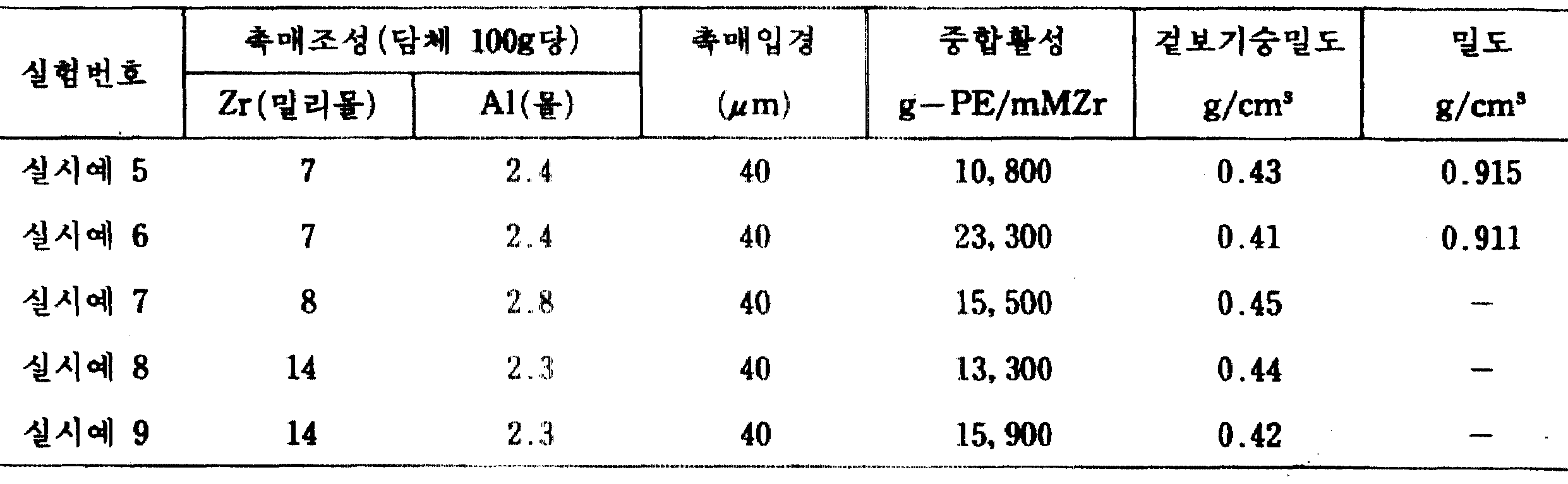
[실시예 10]Example 10
실시예 1의 방법에 있어서 고체촉매를 조제할 때에 실리카 2g 대신 평균입자경 35㎛의 폴리에틸렌 분말(미쓰이 세끼유 가가꾸 고오교오 가부시기가이샤제 상품명 미페론(R)) 2g을 사용하고 기타는 똑같이 하여 고체촉매를 얻었다.In preparing the solid catalyst in Example 1, 2 g of polyethylene powder (trade name Miferon (R) manufactured by Mitsui Seki Oil Chemical Co., Ltd., product name Miferon (R) ) instead of 2 g of silica was used. To obtain a solid catalyst.
얻어진 고체촉매중의 함유량을 담체로서 사용한 폴리에틸렌 100g당 9밀리몰, A1함유량은 담체로서 사용한 폴리에틸렌 100당 2.0몰이고, 현미경 관찰에 의해서 구한 평균촉매 입자경은 약 40㎛였다.The content of the obtained solid catalyst was 9 mmol per 100 g of polyethylene used as the carrier, and the A1 content was 2.0 mol per 100 polyethylene used as the carrier, and the average catalyst particle size determined by microscopic observation was about 40 µm.
예비중합은 실시예 1의 방법과 똑같이 행하였다. 또 중합도 실시예 1의 방법과 똑같은 조건하에 실시했다.Prepolymerization was performed similarly to the method of Example 1. The polymerization was also carried out under the same conditions as in the method of Example 1.
얻어진 폴리머의 수량은 128.2g이고, MFR은 1.6dg/min, 겉보기숭밀도는 0.46g/ml였다. 또 105㎛ 이하의 미분말상 폴리머는 전량의 0.1wt%이고, 한편 1120㎛ 이상의 조대폴리머는 볼 수 없었다. 또 GPC의 측정에 의해서 구한
[실시예 11]Example 11
실시예 2의 방법에서 고체촉매의 조제시에 실리카 2g대신 약 35㎛의 평균입자경의 폴리에틸렌 분말(미쓰이 세끼유 가가꾸 고오교오 가부시끼가이샤제 상품명 미페론(R)) 2g을 사용했다. 얻어진 고체촉매의 Zr 및 A1 함유량, 평균촉매입자경을 표 3에 나타냈다. 예비중합 및 에틸렌의 기상중합을 실시예 10과 같은 방법에 의해서 행하였다. 결과를 표 3에 나타냈다.In preparing the solid catalyst in the method of Example 2, 2 g of polyethylene powder (trade name Miferon (R) manufactured by Mitsui Seki Oil Chemical Co., Ltd.) was used instead of 2 g of silica. Table 3 shows the Zr, A1 content, and average catalyst particle diameter of the obtained solid catalyst. Prepolymerization and gas phase polymerization of ethylene were carried out in the same manner as in Example 10. The results are shown in Table 3.
[비교예 2]Comparative Example 2
비교예 1에서 실리카 2g 대신 실시예 11에서 사용한 것과 같은 폴리에틸렌 분말 2g을 사용하고 기타는 똑같이하여 메틸알미노옥산, 비스(시크로펜타디에닐)질코늄크로라이드 및 폴리에틸렌입자로 된 고체입자를 얻었다. 실시예 10과 같은 조작에 의해서 예비중합 및 에틸렌의 기상중합을 행하였다. 결과를 표 3에 나타냈다.In Comparative Example 1, instead of 2 g of silica, 2 g of polyethylene powder as used in Example 11 was used, and the same was followed to obtain solid particles composed of methylalminooxane, bis (cyclopentadienyl) zylconium chloride and polyethylene particles. . By the same operation as in Example 10, prepolymerization and gas phase polymerization of ethylene were performed. The results are shown in Table 3.
[실시예 12]Example 12
실시예 10에 있어서 비스(시크로펜타디에닐)질코늄크로라이드의 용해에 사용하는 용매를 톨루엔으로부터 1,2-디크로로에탄으로 바꾼 것 이외는 실시예 10과 같은 방법으로 교체촉매를 조제하고 예비중합 및 에틸렌 기상중합을 행하였다. 결과를 표 3에 나타냈다.A replacement catalyst was prepared in the same manner as in Example 10 except that the solvent used for dissolving the bis (cyclopentadienyl) zirconium chloride was changed from toluene to 1,2-dichloroethane. Preliminary polymerization and ethylene gas phase polymerization were carried out. The results are shown in Table 3.
[실시예 13]Example 13
실시예 10에서 메틸알미노옥산의 용해에 사용한 용매를 톨루엔으로부터 에틸벤젠으로 바꾼 것이외는 실시예 10과 같은 방법으로 고체촉매를 조제하고 예비중합 및 에틸렌 기상중합을 행하였다. 결과를 표 3에 나타냈다.A solid catalyst was prepared in the same manner as in Example 10 except that the solvent used for dissolving methylalminooxane was changed from toluene to ethylbenzene in Example 10, and preliminary polymerization and ethylene gas phase polymerization were performed. The results are shown in Table 3.
[표 3]TABLE 3
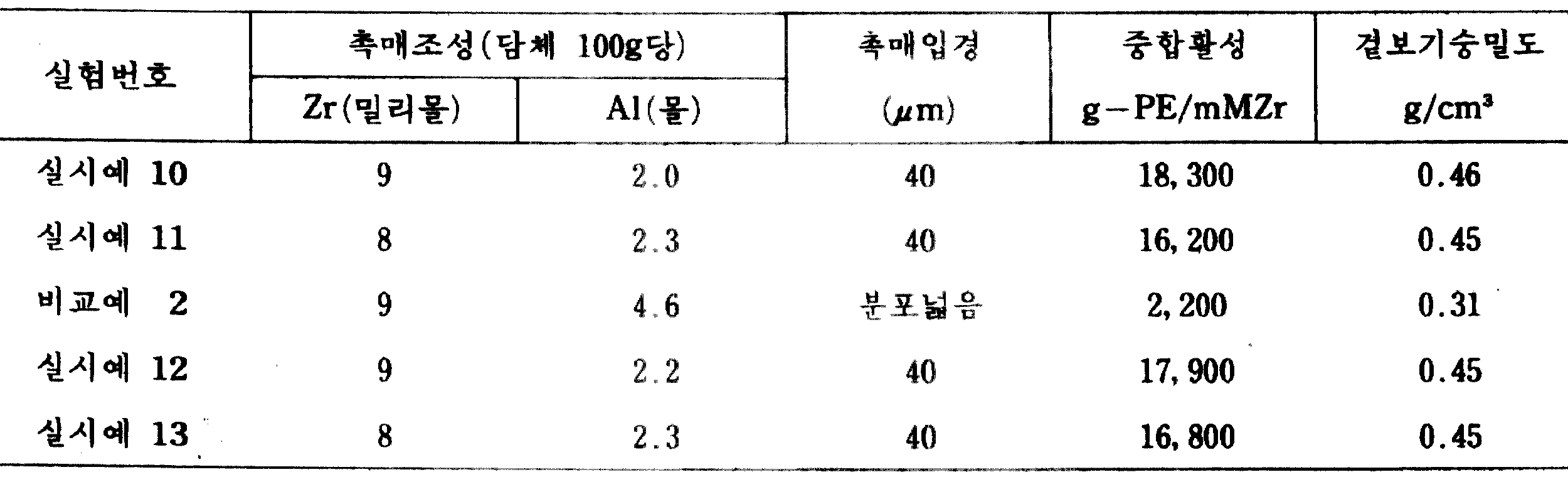
[실시예 14]Example 14
기상중합으로 에틸렌. 1-헥센 공중합을 행하였다. 즉, 실시예 10 기재의 예비중합을 행한 고체촉매를 사용하고 헥센 10ml을 촉매성분의 첨가후에 가한 것 및 중합시간을 1시간으로부터 20분으로 단축한 것을 제외하고는 실시예 10과 같은 방법에 의해서 에틸렌. 1-헥센공중합을 행하였다. 결과를 표 4에 나타냈다.Ethylene by gas phase polymerization. 1-hexene copolymerization was performed. In other words, except that 10 ml of hexene was added after the addition of the catalyst component and the polymerization time was shortened from 1 hour to 20 minutes using a solid catalyst subjected to prepolymerization as described in Example 10. Ethylene. 1-hexene copolymerization was carried out. The results are shown in Table 4.
[실시예 15]Example 15
실시예 10의 고체촉매를 사용하여 슬러리 중합을 행하였다. 즉 충분히 에틸렌 치환된 내용적 2ℓ의 오토크레이브에 액화이소브탄 450그람을 첨가한 후에 60℃로 승온하고 실시예 10기재의 예비중합을 행한 고체촉매 성분을 질코늄 환산으로 0.008 밀리몰 첨가한 후에 80ml의 4-메틸펜텐-1 및 수소를 50Nml가한 후에 이어서 에틸렌을 도입하여 오토크레이브 내압을 3.5kg/㎠G로 1시간 보지했다. 그 사이의 온도는 70℃로 제어했다. 1시간 경과후에 오토크레이브 내에 약 2ml의 메타놀을 첨가하여 중합을 완전히 멈춘 후 탈압을 행하였다. 얻어진 폴리머를 회수하고 80℃ 감압하에서 하룻밤 건조했다. 얻어진 결과를 표 4에 나타냈다.Slurry polymerization was carried out using the solid catalyst of Example 10. That is, after adding 450 grams of liquefied isobutane to a fully ethylene-substituted 2 liter autoclave, the temperature was raised to 60 ° C. and 0.008 mmol of the solid catalyst component subjected to prepolymerization in Example 10 was added to 80 ml of After 50 Nml of 4-methylpentene-1 and hydrogen were added, ethylene was then introduced, and the autoclave internal pressure was held at 3.5 kg / cm 2 G for 1 hour. The temperature in the meantime was controlled at 70 degreeC. After 1 hour, about 2 ml of methanol was added to the autoclave to completely terminate the polymerization, and then depressurized. The obtained polymer was recovered and dried overnight at 80 ° C. under reduced pressure. The obtained results are shown in Table 4.
[실시예 16]Example 16
실시예 10에서 담체로서 사용한 폴리에틸렌을 약 30㎛의 입자경을 갖는 거의 구상의 폴리스티렌분말(이스트만 코닥사제 #200-400) 2g로 바꾼 것 이외는 실시예 1과 같은 방법에 의해서 고체촉매를 조제하고 예비중합 실시후 기상에틸렌 중합을 행하였다. 결과를 표 4에 나타냈다.A solid catalyst was prepared and prepared in the same manner as in Example 1 except that the polyethylene used as the carrier in Example 10 was changed to 2 g of a nearly spherical polystyrene powder (# 200-400 manufactured by Eastman Kodak) having a particle diameter of about 30 μm. After the polymerization was carried out, gas phase ethylene polymerization was carried out. The results are shown in Table 4.
[실시예 17]Example 17
[고체촉매의 조제][Preparation of Solid Catalyst]
300ml의 감압가능한 교반기부 반응기에 100ml 정제 n-데칸 및 평균입자경 35㎛의 폴리에틸넬 분말(미쓰이 세끼유 가가꾸 고오교오 가부시기가이샤제 상품명 미페론(R)) 2g을 가하고 실온에서 그 현탁액을 교반하면서 100밀리몰의 A1원자에 상당하는 상기 메틸알미노옥산을 함유하는 67ml의 톨루엔 용액을 약 0.5시간 걸려서 가했다. 이어서 진공펌프를 사용하여 반응기내를 4torr로 감압시키면서 반응기내의 온도를 약 3시간 걸려서 35℃로 상승시킴으로써 반응기중의 톨루엔을 제거했다. 이어서 이 현탁액에 0.3 밀리몰의 비스(시크로펜타디에닐)질코늄디크로라이드를 함유하는 5ml의 톨루엔 용액을 가했다. 약 1시간 실온에서 혼합후에 필터를 사용하여 액상부를 제거하고 올레핀 중합용 고체촉매를 조제했다. 이상의 실험결과를 표 4에 나타냈다.To a 300 ml pressure sensitive stirrer reactor, 2 g of 100 ml purified n-decane and 35 µm polyethylenel powder (trade name Miferon (R) manufactured by Mitsui Seki Oil Chemical Co., Ltd.) were added and the suspension was stirred at room temperature. While stirring, 67 ml of the toluene solution containing the methylalminooxane corresponding to 100 mmol of A1 atom was added over about 0.5 hours. Subsequently, toluene in the reactor was removed by raising the temperature in the reactor to 35 ° C. over about 3 hours while reducing the pressure in the reactor to 4 torr using a vacuum pump. To this suspension was then added 5 ml of toluene solution containing 0.3 mmol of bis (cyclopentadienyl) zirconium dichromide. After mixing at room temperature for about 1 hour, the liquid phase was removed using a filter to prepare a solid catalyst for olefin polymerization. Table 4 shows the results of the above experiment.
[실시예 18]Example 18
실시예 10의 고체촉매의 조제에서 비스(시크로펜타디에닐)질코늄 디크로라이드의 사용량을 0.2밀리몰로부터 0.33밀리몰로 바꾼 이외는 실시예 10가 같은방법으로 고체촉매를 조제하고 예비중합 및 기상 에틸렌 중합을 행하였다. 결과를 표 4에 나타냈다.A solid catalyst was prepared in the same manner as in Example 10 except that the amount of bis (cyclopentadienyl) zirconium dichromide was changed from 0.2 mmol to 0.33 mmol in the preparation of the solid catalyst of Example 10. Ethylene polymerization was performed. The results are shown in Table 4.
[실시예 19]Example 19
실시예 18의 기상에틸렌 중합에 있어서 1.3밀리몰의 트리이소브틸 알미늄을 예비중합을 행한 고체촉매성분을 오토크레이브에 가하기 직전에 첨가한 것 이외는 실시예 18과 같은 방법에 의해서 기상에틸렌 중합을 행하였다. 결과를 표 4에 나타냈다.In the gas phase ethylene polymerization of Example 18, gas phase ethylene polymerization was carried out in the same manner as in Example 18, except that the solid catalyst component preliminarily prepolymerized with 1.3 mmol of triisobutyl aluminum was added to the autoclave. . The results are shown in Table 4.
[표 4]TABLE 4
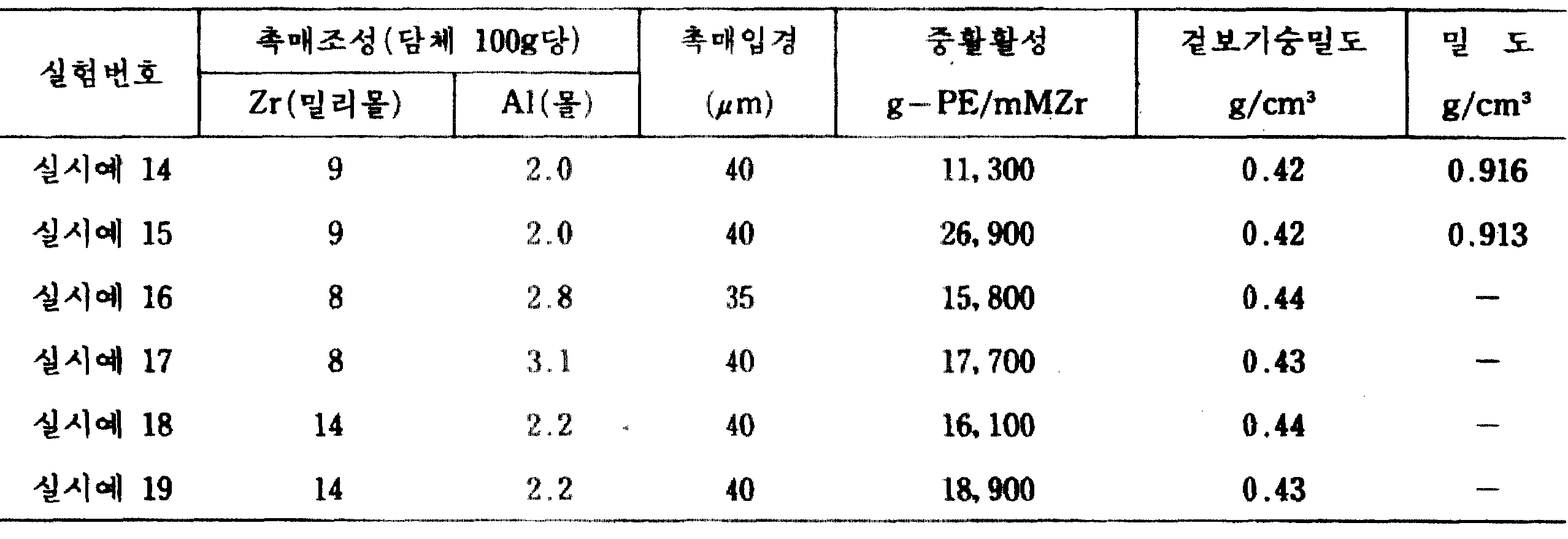
[산업상의 이용가능성 및 효과][Industry availability and effect]
본 발명은 올레핀의 단독중합 및 공중합에 대한 중합활성이 극히 큰 올레핀 중합용 고체촉매이다. 이 촉매는 숭비중이 크고 입도가 고르고 미분이 적고 분자량 분포가 좁고 또 공중합의 경우는 조성분포가 좁은 중합체 및 공중합체를 제공한다.The present invention is a solid catalyst for olefin polymerization with extremely high polymerization activity for homopolymerization and copolymerization of olefins. This catalyst provides polymers and copolymers having a high weight, an even particle size, a fine powder, a narrow molecular weight distribution, and a narrow compositional distribution in the case of copolymerization.
Claims (12)



Applications Claiming Priority (7)
| Application Number | Priority Date | Filing Date | Title |
|---|---|---|---|
| JP311287 | 1986-12-03 | ||
| JP31128686 | 1986-12-30 | ||
| JP61-311286 | 1986-12-30 | ||
| JP31128786 | 1986-12-30 | ||
| JP61-311287 | 1986-12-30 | ||
| JP311286 | 1986-12-30 | ||
| PCT/JP1987/001047 WO1988005058A1 (en) | 1986-12-30 | 1987-12-28 | Solid catalyst for olefin polymerization and process for its preparation |
Publications (2)
| Publication Number | Publication Date |
|---|---|
| KR890700138A KR890700138A (en) | 1989-03-10 |
| KR910008277B1 true KR910008277B1 (en) | 1991-10-12 |
Family
ID=26566662
Family Applications (1)
| Application Number | Title | Priority Date | Filing Date |
|---|---|---|---|
| KR1019880701044A Expired KR910008277B1 (en) | 1986-12-03 | 1987-12-28 | Solid catalyst olefin polymerization and process its preparation |
Country Status (7)
| Country | Link |
|---|---|
| US (1) | US4921825A (en) |
| EP (1) | EP0295312B1 (en) |
| JP (1) | JP2889205B2 (en) |
| KR (1) | KR910008277B1 (en) |
| AT (1) | ATE104682T1 (en) |
| DE (1) | DE3789666T2 (en) |
| WO (1) | WO1988005058A1 (en) |
Families Citing this family (99)
| Publication number | Priority date | Publication date | Assignee | Title |
|---|---|---|---|---|
| DE3782243T2 (en) * | 1986-08-26 | 1993-03-04 | Mitsui Petrochemical Ind | CATALYST FOR POLYMERIZING ALPHA OLEFIN AND METHOD. |
| US4794096A (en) * | 1987-04-03 | 1988-12-27 | Fina Technology, Inc. | Hafnium metallocene catalyst for the polymerization of olefins |
| IL87717A0 (en) * | 1987-09-14 | 1989-02-28 | Exxon Chemical Patents Inc | Preparation of an active metallocene-alumoxane catalyst in situ during polymerization |
| IT1237398B (en) * | 1989-01-31 | 1993-06-01 | Ausimont Srl | CATALYSTS FOR THE POLYMERIZATION OF OLEFINE. |
| ES2141797T5 (en) * | 1990-01-02 | 2008-06-01 | Exxonmobil Chemical Patents Inc. | IONIC METALOCENE CATALYSTS SUPPORTED FOR OLEFIN POLYMERIZATION. |
| DE69219668T2 (en) * | 1991-03-29 | 1997-09-11 | Chevron Usa Inc | Alpha-olefin polymerization catalysts containing cyclopentadienyl group based on a metal of the 6B group and process for the polymerization of alpha-olefins |
| US5418200A (en) * | 1991-03-29 | 1995-05-23 | Chevron Chemical Company | Cyclopentadienyl group 6B metal α-olefin polymerization catalysts and process for polymerizing α-olefins |
| CA2069995C (en) * | 1991-05-31 | 1996-04-09 | Mitsui Chemicals, Incorporated | Olefin polymerization solid catalyst, olefin polymerization catalyst and olefin polymerization |
| DE4119343A1 (en) * | 1991-06-12 | 1992-12-17 | Basf Ag | INSULATED, SUPPORTED CATALYST SYSTEM FOR THE POLYMERIZATION OF C (DOWN ARROW) 2 (DOWN ARROW) - TO C (DOWN ARROW) 1 (DOWN ARROW) (DOWN ARROW) 0 (DOWN ARROW) -ALK-1-END |
| EP0519746A1 (en) * | 1991-06-20 | 1992-12-23 | Mitsui Petrochemical Industries, Ltd. | Catalyst for olefin polymerization, process for the polymerization of olefin, and transition metal compound employable for the catalyst |
| DE4121368A1 (en) * | 1991-06-28 | 1993-01-07 | Hoechst Ag | CATALYST AND METHOD FOR THE PRODUCTION OF HIGH-MOLECULAR POLYOLEFINES |
| US5411925A (en) * | 1993-02-12 | 1995-05-02 | Phillips Petroleum Company | Organo-aluminoxy product and use |
| US5362824A (en) * | 1991-12-13 | 1994-11-08 | Mobil Oil Corporation | Olefin polymerization catalysts |
| US5461017A (en) * | 1991-12-13 | 1995-10-24 | Mobil Oil Corporation | Olefin polymerization catalysts |
| FI112233B (en) * | 1992-04-01 | 2003-11-14 | Basell Polyolefine Gmbh | Catalyst for olefin polymerization, process for its preparation and its use |
| US6143854A (en) | 1993-08-06 | 2000-11-07 | Exxon Chemical Patents, Inc. | Polymerization catalysts, their production and use |
| US5602067A (en) * | 1992-12-28 | 1997-02-11 | Mobil Oil Corporation | Process and a catalyst for preventing reactor fouling |
| US5332706A (en) * | 1992-12-28 | 1994-07-26 | Mobil Oil Corporation | Process and a catalyst for preventing reactor fouling |
| IT1264680B1 (en) | 1993-07-07 | 1996-10-04 | Spherilene Srl | SUPPORTED CATALYSTS FOR THE POLYMERIZATION OF OLEFINS |
| DE4336659A1 (en) * | 1993-10-27 | 1995-05-04 | Witco Gmbh | Process for the preparation of alkylaluminoxanes on inert carrier materials |
| US5491207A (en) * | 1993-12-14 | 1996-02-13 | Exxon Chemical Patents Inc. | Process of producing high molecular weight ethylene-α-olefin elastomers with an indenyl metallocene catalyst system |
| US6391817B1 (en) | 1993-12-28 | 2002-05-21 | Exxonmobil Chemical Patents Inc. | Method for producing a prepolymerized catalyst |
| CN1149297A (en) * | 1994-01-11 | 1997-05-07 | 埃克森化学专利公司 | Use of gel-free alumoxane solution |
| EP0748340A4 (en) * | 1994-03-01 | 1997-11-19 | Mobil Oil Corp | OLEFIN POLYMERIZATION CATALYSTS |
| WO1995025129A1 (en) * | 1994-03-17 | 1995-09-21 | Exxon Chemical Patents Inc. | Spray dried polymer for catalyst support |
| DE4409249A1 (en) * | 1994-03-18 | 1995-09-21 | Witco Gmbh | Process for the preparation of alkylaluminoxane on inert support materials |
| FR2717816B1 (en) | 1994-03-23 | 1996-04-26 | Atochem Elf Sa | Catalytic component for the polymerization of olefins obtained by impregnating a prepolymer with a solution of a catalytic component. Prepolymer and polymer obtained from said catalytic component. |
| US5593931A (en) * | 1995-03-03 | 1997-01-14 | Chevron Chemical Company | Cyclopentadienyl group 6b metal alpha-olefin polymerization catalysts and process for polymerizing alpha-olefins |
| US6533988B2 (en) | 1995-05-02 | 2003-03-18 | Borealis Technology Oy | Rotational moulding process of ethylene polymers or copolymers having a controlled particle size and morphology |
| FI105195B (en) * | 1995-05-02 | 2000-06-30 | Borealis As | Polyethylene with controlled particle size and morphology |
| US5587439A (en) * | 1995-05-12 | 1996-12-24 | Quantum Chemical Corporation | Polymer supported catalyst for olefin polymerization |
| US5661095A (en) * | 1995-06-06 | 1997-08-26 | Quantum Chemical Corporation | Olefin polymerization catalyst component supported on a copolymer of an olefin and an unsaturated silane |
| CN1045446C (en) * | 1995-07-14 | 1999-10-06 | 中国石油化工总公司 | Process for producing low-polymer alumin oxyane |
| CN1047388C (en) * | 1995-07-14 | 1999-12-15 | 中国石油化工总公司 | Prepn of carried type metallocene compound/aluminoxyane catalyst |
| US5610115A (en) * | 1995-07-20 | 1997-03-11 | Samsung General Chemicals Co., Ltd. | Organic carrier supported metallocene catalyst for olefin polymerization |
| DE19527652A1 (en) * | 1995-07-28 | 1997-01-30 | Hoechst Ag | Metallocene compound |
| DE59500197D1 (en) * | 1995-09-13 | 1997-05-28 | Witco Gmbh | Process for the production of metallocene catalyst systems on inert support materials |
| EP0763546B1 (en) * | 1995-09-13 | 1997-05-28 | Witco GmbH | Process for producing metallocene catalysts on inert carriers using gas phase reactors |
| US6486089B1 (en) | 1995-11-09 | 2002-11-26 | Exxonmobil Oil Corporation | Bimetallic catalyst for ethylene polymerization reactions with uniform component distribution |
| US6090740A (en) * | 1996-02-08 | 2000-07-18 | Exxon Chemical Patents Inc. | Supported metallocene catalyst systems |
| US6265339B1 (en) * | 1996-07-04 | 2001-07-24 | Basf Aktiengesellschaft | Process for preparing carrier-borne transition metal catalysts |
| DE69703728T2 (en) | 1996-10-31 | 2001-06-28 | Repsol Quimica S.A., Madrid | Catalyst systems for the polymerization and copolymerization of alpha olefins |
| BR9806952A (en) | 1997-02-07 | 2000-03-21 | Exxon Chemical Patents Inc | Preparation of macromers containing vinyl. |
| EP0958314B1 (en) | 1997-02-07 | 2002-11-06 | ExxonMobil Chemical Patents Inc. | Propylene polymers incorporating polyethylene macromers |
| US5965477A (en) * | 1997-02-21 | 1999-10-12 | Council Of Scientific & Industrial Research | Process for the preparation of supported metallocene catalyst |
| US6451938B1 (en) | 1997-02-25 | 2002-09-17 | Exxon Mobil Chemical Patents Inc. | Polymerization catalyst system comprising heterocyclic fused cyclopentadienide ligands |
| US6153551A (en) | 1997-07-14 | 2000-11-28 | Mobil Oil Corporation | Preparation of supported catalyst using trialkylaluminum-metallocene contact products |
| US6184327B1 (en) | 1997-12-10 | 2001-02-06 | Exxon Chemical Patents, Inc. | Elastomeric propylene polymers |
| US6197910B1 (en) | 1997-12-10 | 2001-03-06 | Exxon Chemical Patents, Inc. | Propylene polymers incorporating macromers |
| US6117962A (en) * | 1997-12-10 | 2000-09-12 | Exxon Chemical Patents Inc. | Vinyl-containing stereospecific polypropylene macromers |
| ES2211013T3 (en) | 1998-04-27 | 2004-07-01 | Repsol Quimica S.A. | CATALYTIC SYSTEMS FOR THE POLYMERIZATION AND COPOLYMERIZATION OF ALFA-OLEFINS. |
| PT955306E (en) * | 1998-04-29 | 2003-06-30 | Repsol Quimica Sa | FUNCTIONALIZED METALOCENE COMPOUNDS SYNTHESIS AND USES PROCESS |
| CN1130392C (en) | 1998-05-13 | 2003-12-10 | 埃克森美孚化学专利公司 | Propylene homopolymers and methods for making the same |
| US6306960B1 (en) | 1998-05-13 | 2001-10-23 | Exxonmobil Chemical Patents Inc. | Articles formed from foamable polypropylene polymer |
| US6784269B2 (en) | 1998-05-13 | 2004-08-31 | Exxonmobil Chemical Patents Inc. | Polypropylene compositions methods of making the same |
| DE19821949A1 (en) | 1998-05-15 | 1999-11-18 | Basf Ag | Supported catalysts for ethylene and propylene polymerization |
| DE19833170A1 (en) | 1998-07-23 | 2000-01-27 | Targor Gmbh | Metal containing catalyst support, especially for metallocene catalysts, useful for attachment of carbon-carbon or carbon-heteroatom covalent bonds obtained by streaming steeping solution containing metal through the support material |
| JP5407099B2 (en) | 1998-08-26 | 2014-02-05 | エクソンモービル・ケミカル・パテンツ・インク | Branched polypropylene composition |
| DE19844167A1 (en) * | 1998-09-25 | 2000-04-06 | Ticona Gmbh | Activated carbon filter |
| DE19908938A1 (en) * | 1999-03-02 | 2000-09-07 | Targor Gmbh | Transition metal compound, catalyst system, process for its preparation and its use for the polymerization of olefins |
| US6174930B1 (en) | 1999-04-16 | 2001-01-16 | Exxon Chemical Patents, Inc. | Foamable polypropylene polymer |
| DE19927766A1 (en) | 1999-06-17 | 2000-12-21 | Basf Ag | Supported catalyst for olefin polymerization comprises copolymer support, metallocene complex and metallocenium ion forming compound |
| ES2210015T3 (en) | 1999-11-04 | 2004-07-01 | Exxonmobil Chemical Patents Inc. | PROPYLENE COPOLYMER FOAMS AND ITS USE. |
| US6281155B1 (en) | 1999-11-19 | 2001-08-28 | Equistar Chemicals, L.P. | Supported olefin polymerization catalysts |
| US6977287B2 (en) * | 1999-12-10 | 2005-12-20 | Exxonmobil Chemical Patents Inc. | Propylene diene copolymers |
| ES2239631T3 (en) * | 1999-12-10 | 2005-10-01 | Exxonmobil Chemical Patents Inc. | COMPOLIMERIZED PROPYLENE AND DIENO POLYMERS. |
| US6809168B2 (en) * | 1999-12-10 | 2004-10-26 | Exxonmobil Chemical Patents Inc. | Articles formed from propylene diene copolymers |
| NO20013880L (en) | 2000-08-22 | 2002-02-25 | Rohm & Haas | Matrix and process for the production of polyolefins |
| GC0000293A (en) | 2000-10-10 | 2006-11-01 | Saudi Basic Ind Corp | Catalyst composition and process for olfin polymerization and copolymerization using supported metallocene catalyst systems |
| EP1355958A2 (en) | 2000-12-22 | 2003-10-29 | Basell Poliolefine Italia S.p.A. | Process for the preparation of porous polymers and polymers obtainable thereof |
| WO2003002583A2 (en) | 2001-06-29 | 2003-01-09 | Exxonmobil Chemical Patents Inc. | Metallocenes and catalyst compositions derived therefrom |
| KR20050035183A (en) * | 2001-11-30 | 2005-04-15 | 엑손모빌 케미칼 패턴츠 인코포레이티드 | Ethylene/alpha-olefin copolymer made with a non-single-site/single-site catalyst combination, its preparation and use |
| CA2412488C (en) | 2001-12-11 | 2009-09-08 | Crompton Gmbh | Process for preparing partial hydrolysates of organometallic compounds or transition metal catalysts immobilized on inert support materials |
| DE60137638D1 (en) | 2001-12-19 | 2009-03-26 | Borealis Tech Oy | Preparation of supported catalysts for olefin polymerization |
| US6969747B2 (en) * | 2002-01-25 | 2005-11-29 | Reliance Industries Limited | Olefin polymerization titanium catalyst |
| US6884749B2 (en) | 2002-10-17 | 2005-04-26 | Equistar Chemicals L.P. | Supported catalysts which reduce sheeting in olefin polymerization, process for the preparation and the use thereof |
| CN100351275C (en) | 2003-03-21 | 2007-11-28 | 陶氏环球技术公司 | Morphology controlled olefin polymerization process |
| US6953764B2 (en) | 2003-05-02 | 2005-10-11 | Dow Global Technologies Inc. | High activity olefin polymerization catalyst and process |
| EP1829897B1 (en) | 2004-12-17 | 2014-12-10 | Yangzi Petrochemical Company Co., Ltd. | Supported non-metallocene olefin polymerization catalyst, and preparation and use thereof |
| EP1803747A1 (en) | 2005-12-30 | 2007-07-04 | Borealis Technology Oy | Surface-modified polymerization catalysts for the preparation of low-gel polyolefin films |
| EP1847555A1 (en) * | 2006-04-18 | 2007-10-24 | Borealis Technology Oy | Multi-branched Polypropylene |
| EP1939226B1 (en) | 2006-12-28 | 2013-07-17 | Borealis Technology Oy | Process for producing a polymer, a process for producing a prepolymerized catalyst, such prepolymerized catalyst and its use |
| TW200932762A (en) | 2007-10-22 | 2009-08-01 | Univation Tech Llc | Polyethylene compositions having improved properties |
| EP2119732A1 (en) | 2008-05-16 | 2009-11-18 | Borealis Technology Oy | Metallocene catalyst compositions with improved properties, process for its preparation and use for preparing polyolefin homo- or copolymers |
| RU2509782C2 (en) | 2008-09-25 | 2014-03-20 | Базелль Полиолефине Гмбх | Impact-resistant linear low density polyethylene and films made therefrom |
| US8957158B2 (en) | 2008-09-25 | 2015-02-17 | Basell Polyolefine Gmbh | Impact resistant LLDPE composition and films made thereof |
| CN102257017B (en) | 2008-12-18 | 2014-02-12 | 尤尼威蒂恩技术有限责任公司 | Method for polymerization seed bed treatment |
| JP5661645B2 (en) | 2009-01-08 | 2015-01-28 | ユニベーション・テクノロジーズ・エルエルシー | Additives for polyolefin polymerization processes |
| WO2010080871A1 (en) | 2009-01-08 | 2010-07-15 | Univation Technologies, Llc | Additive for gas phase polymerization processes |
| WO2011011427A1 (en) | 2009-07-23 | 2011-01-27 | Univation Technologies, Llc | Polymerization reaction system |
| WO2011078923A1 (en) | 2009-12-23 | 2011-06-30 | Univation Technologies, Llc | Methods for producing catalyst systems |
| WO2012087560A1 (en) | 2010-12-22 | 2012-06-28 | Univation Technologies, Llc | Additive for polyolefin polymerization processes |
| BR112015011215B1 (en) | 2012-11-26 | 2018-11-21 | Braskem S.A. | METALOCENAL CATALYST SUPPORTED IN HYBRID SUPPORT, PROCEDURE FOR OBTAINING IT, POLYMERIZATION PROCESS FOR OBTAINING AN EOMIC HOMOPOLYMER OR COPOLYMER WITH DISTRIBUTION OF LARGE OR METAL BALODIUM OF THE METAL PIPELINE AND METALBALL DIMENSION BIMODAL |
| ES2823768T3 (en) | 2012-12-28 | 2021-05-10 | Univation Tech Llc | Methods to integrate aluminoxane production into catalyst production |
| CA2897456C (en) | 2013-01-14 | 2021-08-31 | Univation Technologies, Llc | Methods for preparing catalyst systems with increased productivity |
| GB201420215D0 (en) * | 2014-11-13 | 2014-12-31 | Scg Chemicals Co Ltd | Catalysts |
| SG11201703623SA (en) * | 2014-11-13 | 2017-06-29 | Scg Chemicals Co Ltd | Catalysts |
| CA2974392C (en) | 2015-01-21 | 2023-10-17 | Univation Technologies, Llc | Methods for controlling polymer chain scission |
| US10682797B2 (en) | 2015-01-21 | 2020-06-16 | Univation Technologies, Llc | Methods for gel reduction in polyolefins |
Family Cites Families (9)
| Publication number | Priority date | Publication date | Assignee | Title |
|---|---|---|---|---|
| US4530914A (en) * | 1983-06-06 | 1985-07-23 | Exxon Research & Engineering Co. | Process and catalyst for producing polyethylene having a broad molecular weight distribution |
| JPS60106808A (en) * | 1983-11-14 | 1985-06-12 | Idemitsu Kosan Co Ltd | Method for producing polyethylene composition |
| JPH0788403B2 (en) * | 1984-11-01 | 1995-09-27 | 昭和電工株式会社 | Method for producing polyolefin |
| US4808561A (en) * | 1985-06-21 | 1989-02-28 | Exxon Chemical Patents Inc. | Supported polymerization catalyst |
| CA1268754A (en) * | 1985-06-21 | 1990-05-08 | Howard Curtis Welborn, Jr. | Supported polymerization catalyst |
| US4701432A (en) * | 1985-11-15 | 1987-10-20 | Exxon Chemical Patents Inc. | Supported polymerization catalyst |
| US4752597A (en) * | 1985-12-12 | 1988-06-21 | Exxon Chemical Patents Inc. | New polymerization catalyst |
| US4794096A (en) * | 1987-04-03 | 1988-12-27 | Fina Technology, Inc. | Hafnium metallocene catalyst for the polymerization of olefins |
| JP3098634B2 (en) * | 1992-10-20 | 2000-10-16 | 株式会社日立メディコ | Print data transmission device and image diagnostic device |
-
1987
- 1987-12-28 KR KR1019880701044A patent/KR910008277B1/en not_active Expired
- 1987-12-28 US US07/245,399 patent/US4921825A/en not_active Expired - Fee Related
- 1987-12-28 DE DE3789666T patent/DE3789666T2/en not_active Expired - Fee Related
- 1987-12-28 EP EP88900593A patent/EP0295312B1/en not_active Expired - Lifetime
- 1987-12-28 WO PCT/JP1987/001047 patent/WO1988005058A1/en not_active Ceased
-
1988
- 1988-07-19 AT AT8888900593T patent/ATE104682T1/en active
-
1997
- 1997-02-10 JP JP9041455A patent/JP2889205B2/en not_active Expired - Lifetime
Also Published As
| Publication number | Publication date |
|---|---|
| US4921825A (en) | 1990-05-01 |
| JPH09176224A (en) | 1997-07-08 |
| EP0295312A1 (en) | 1988-12-21 |
| DE3789666D1 (en) | 1994-05-26 |
| ATE104682T1 (en) | 1994-05-15 |
| DE3789666T2 (en) | 1994-08-04 |
| WO1988005058A1 (en) | 1988-07-14 |
| EP0295312A4 (en) | 1989-05-16 |
| JPH0816128B1 (en) | 1996-02-21 |
| EP0295312B1 (en) | 1994-04-20 |
| KR890700138A (en) | 1989-03-10 |
| JP2889205B2 (en) | 1999-05-10 |
Similar Documents
| Publication | Publication Date | Title |
|---|---|---|
| KR910008277B1 (en) | Solid catalyst olefin polymerization and process its preparation | |
| KR910008276B1 (en) | Olefin polymerization catalyst and preparation method thereof | |
| KR910004488B1 (en) | Finely divided alumninoxane | |
| KR910005670B1 (en) | Solid catalysis for olefin polymerization | |
| US5122491A (en) | Catalyst for polymerizing an olefin and process for polymerizing an olefin | |
| US5206199A (en) | Catalyst for polymerizing an olefin and process for polymerizing an olefin | |
| EP0279863B1 (en) | Catalyst for polymerizing alpha-olefin and polymerization process | |
| US5654248A (en) | Catalyst for polymerizing alpha-olefins and process for polymerization | |
| JP2641459B2 (en) | Process for producing α-olefin polymer | |
| US6063726A (en) | Catalyst for polymerizing alpha-olefins and process for polymerization | |
| JPH0780936B2 (en) | Olefin Polymerization Method | |
| JP2618386B2 (en) | Olefin polymerization method | |
| JPH0832733B2 (en) | Olefin Polymerization Method | |
| KR920002769B1 (en) | Olefin polymerization catalyst and process for polymerizing olefin | |
| CA1314537C (en) | Solid catalyst for olefin polymerization and processes for its production | |
| JPH0819183B2 (en) | Method for producing solid catalyst for olefin polymerization | |
| JPH07110885B2 (en) | Olefin Polymerization Method | |
| JPH0816128B2 (en) | Solid catalyst for olefin polymerization and method for producing the same | |
| JPH0819182B2 (en) | Method for producing solid catalyst component for olefin polymerization | |
| JPWO1988005058A1 (en) | Solid catalyst for olefin polymerization and method for producing same | |
| JPH0565309A (en) | Catalyst and process for polymerizing olefin | |
| JPH0565308A (en) | Olefin polymerization catalyst and method for olefin polymerization | |
| JPH08143616A (en) | Olefin polymerization catalyst and olefin polymerization method | |
| JPH10110012A (en) | Olefin polymerization catalyst and olefin polymerization method | |
| JPH0780935B2 (en) | Method for polymerizing α-olefin |
Legal Events
| Date | Code | Title | Description |
|---|---|---|---|
| A201 | Request for examination | ||
| PA0105 | International application |
St.27 status event code: A-0-1-A10-A15-nap-PA0105 |
|
| PA0201 | Request for examination |
St.27 status event code: A-1-2-D10-D11-exm-PA0201 |
|
| R17-X000 | Change to representative recorded |
St.27 status event code: A-3-3-R10-R17-oth-X000 |
|
| PG1501 | Laying open of application |
St.27 status event code: A-1-1-Q10-Q12-nap-PG1501 |
|
| G160 | Decision to publish patent application | ||
| PG1605 | Publication of application before grant of patent |
St.27 status event code: A-2-2-Q10-Q13-nap-PG1605 |
|
| E701 | Decision to grant or registration of patent right | ||
| PE0701 | Decision of registration |
St.27 status event code: A-1-2-D10-D22-exm-PE0701 |
|
| GRNT | Written decision to grant | ||
| PR0701 | Registration of establishment |
St.27 status event code: A-2-4-F10-F11-exm-PR0701 |
|
| PR1002 | Payment of registration fee |
St.27 status event code: A-2-2-U10-U12-oth-PR1002 Fee payment year number: 1 |
|
| PR1001 | Payment of annual fee |
St.27 status event code: A-4-4-U10-U11-oth-PR1001 Fee payment year number: 4 |
|
| PR1001 | Payment of annual fee |
St.27 status event code: A-4-4-U10-U11-oth-PR1001 Fee payment year number: 5 |
|
| PR1001 | Payment of annual fee |
St.27 status event code: A-4-4-U10-U11-oth-PR1001 Fee payment year number: 6 |
|
| PR1001 | Payment of annual fee |
St.27 status event code: A-4-4-U10-U11-oth-PR1001 Fee payment year number: 7 |
|
| PR1001 | Payment of annual fee |
St.27 status event code: A-4-4-U10-U11-oth-PR1001 Fee payment year number: 8 |
|
| PN2301 | Change of applicant |
St.27 status event code: A-5-5-R10-R13-asn-PN2301 St.27 status event code: A-5-5-R10-R11-asn-PN2301 |
|
| PR1001 | Payment of annual fee |
St.27 status event code: A-4-4-U10-U11-oth-PR1001 Fee payment year number: 9 |
|
| PR1001 | Payment of annual fee |
St.27 status event code: A-4-4-U10-U11-oth-PR1001 Fee payment year number: 10 |
|
| FPAY | Annual fee payment |
Payment date: 20011004 Year of fee payment: 11 |
|
| PR1001 | Payment of annual fee |
St.27 status event code: A-4-4-U10-U11-oth-PR1001 Fee payment year number: 11 |
|
| LAPS | Lapse due to unpaid annual fee | ||
| PC1903 | Unpaid annual fee |
St.27 status event code: A-4-4-U10-U13-oth-PC1903 Not in force date: 20021013 Payment event data comment text: Termination Category : DEFAULT_OF_REGISTRATION_FEE |
|
| PC1903 | Unpaid annual fee |
St.27 status event code: N-4-6-H10-H13-oth-PC1903 Ip right cessation event data comment text: Termination Category : DEFAULT_OF_REGISTRATION_FEE Not in force date: 20021013 |
|
| R18-X000 | Changes to party contact information recorded |
St.27 status event code: A-5-5-R10-R18-oth-X000 |
|
| P22-X000 | Classification modified |
St.27 status event code: A-4-4-P10-P22-nap-X000 |
|
| P22-X000 | Classification modified |
St.27 status event code: A-4-4-P10-P22-nap-X000 |
|
| R18-X000 | Changes to party contact information recorded |
St.27 status event code: A-5-5-R10-R18-oth-X000 |