KR880001008B1 - Alkylsulfonamidophenylalkylamine and preparation method thereof - Google Patents
Alkylsulfonamidophenylalkylamine and preparation method thereof Download PDFInfo
- Publication number
- KR880001008B1 KR880001008B1 KR1019850007530A KR850007530A KR880001008B1 KR 880001008 B1 KR880001008 B1 KR 880001008B1 KR 1019850007530 A KR1019850007530 A KR 1019850007530A KR 850007530 A KR850007530 A KR 850007530A KR 880001008 B1 KR880001008 B1 KR 880001008B1
- Authority
- KR
- South Korea
- Prior art keywords
- phenyl
- butyl
- compound
- alkyl
- ethyl
- Prior art date
- Legal status (The legal status is an assumption and is not a legal conclusion. Google has not performed a legal analysis and makes no representation as to the accuracy of the status listed.)
- Expired
Links
Classifications
-
- C—CHEMISTRY; METALLURGY
- C07—ORGANIC CHEMISTRY
- C07C—ACYCLIC OR CARBOCYCLIC COMPOUNDS
- C07C303/00—Preparation of esters or amides of sulfuric acids; Preparation of sulfonic acids or of their esters, halides, anhydrides or amides
- C07C303/36—Preparation of esters or amides of sulfuric acids; Preparation of sulfonic acids or of their esters, halides, anhydrides or amides of amides of sulfonic acids
- C07C303/38—Preparation of esters or amides of sulfuric acids; Preparation of sulfonic acids or of their esters, halides, anhydrides or amides of amides of sulfonic acids by reaction of ammonia or amines with sulfonic acids, or with esters, anhydrides, or halides thereof
-
- A—HUMAN NECESSITIES
- A61—MEDICAL OR VETERINARY SCIENCE; HYGIENE
- A61K—PREPARATIONS FOR MEDICAL, DENTAL OR TOILETRY PURPOSES
- A61K31/00—Medicinal preparations containing organic active ingredients
- A61K31/16—Amides, e.g. hydroxamic acids
- A61K31/18—Sulfonamides
-
- A—HUMAN NECESSITIES
- A61—MEDICAL OR VETERINARY SCIENCE; HYGIENE
- A61P—SPECIFIC THERAPEUTIC ACTIVITY OF CHEMICAL COMPOUNDS OR MEDICINAL PREPARATIONS
- A61P9/00—Drugs for disorders of the cardiovascular system
- A61P9/06—Antiarrhythmics
-
- C—CHEMISTRY; METALLURGY
- C07—ORGANIC CHEMISTRY
- C07C—ACYCLIC OR CARBOCYCLIC COMPOUNDS
- C07C311/00—Amides of sulfonic acids, i.e. compounds having singly-bound oxygen atoms of sulfo groups replaced by nitrogen atoms, not being part of nitro or nitroso groups
- C07C311/01—Sulfonamides having sulfur atoms of sulfonamide groups bound to acyclic carbon atoms
- C07C311/02—Sulfonamides having sulfur atoms of sulfonamide groups bound to acyclic carbon atoms of an acyclic saturated carbon skeleton
-
- C—CHEMISTRY; METALLURGY
- C07—ORGANIC CHEMISTRY
- C07C—ACYCLIC OR CARBOCYCLIC COMPOUNDS
- C07C311/00—Amides of sulfonic acids, i.e. compounds having singly-bound oxygen atoms of sulfo groups replaced by nitrogen atoms, not being part of nitro or nitroso groups
- C07C311/01—Sulfonamides having sulfur atoms of sulfonamide groups bound to acyclic carbon atoms
- C07C311/02—Sulfonamides having sulfur atoms of sulfonamide groups bound to acyclic carbon atoms of an acyclic saturated carbon skeleton
- C07C311/08—Sulfonamides having sulfur atoms of sulfonamide groups bound to acyclic carbon atoms of an acyclic saturated carbon skeleton having the nitrogen atom of at least one of the sulfonamide groups bound to a carbon atom of a six-membered aromatic ring
Landscapes
- Chemical & Material Sciences (AREA)
- Organic Chemistry (AREA)
- Health & Medical Sciences (AREA)
- Animal Behavior & Ethology (AREA)
- Veterinary Medicine (AREA)
- Public Health (AREA)
- General Health & Medical Sciences (AREA)
- Pharmacology & Pharmacy (AREA)
- Medicinal Chemistry (AREA)
- Life Sciences & Earth Sciences (AREA)
- Epidemiology (AREA)
- Chemical Kinetics & Catalysis (AREA)
- Bioinformatics & Cheminformatics (AREA)
- Nuclear Medicine, Radiotherapy & Molecular Imaging (AREA)
- General Chemical & Material Sciences (AREA)
- Engineering & Computer Science (AREA)
- Heart & Thoracic Surgery (AREA)
- Cardiology (AREA)
- Acyclic And Carbocyclic Compounds In Medicinal Compositions (AREA)
- Organic Low-Molecular-Weight Compounds And Preparation Thereof (AREA)
- Medicinal Preparation (AREA)
- Pharmaceuticals Containing Other Organic And Inorganic Compounds (AREA)
Abstract
내용 없음.No content.
Description
본 발명은 항부정맥 특성을 갖는 것으로 밝혀진 신규의 설폰아미도 유도체의 부류에 관한 것이다.The present invention relates to a class of novel sulfonamido derivatives found to have antiarrhythmic properties.
미합중국 특허 제4,389,787호에는 항부정맥제로서 유용하며 심장 조직의 활동 가능 기간(action potential duration)을 연장시키는데 효과적인 페닐알킬 4급 암모늄 염의 그룹이 기술되어 있다. 이들 그룹중 한 화합물인 4-클로로-N, N-디에틸-N-헵틸벤젠부탄아미늄 포스페이트는 광범위한 생물학적 평가를 행한 결과 현재 클로필륨(clifillium)으로 공지되어 있다.US Pat. No. 4,389,787 describes a group of phenylalkyl quaternary ammonium salts that are useful as antiarrhythmic agents and effective for prolonging the action potential duration of heart tissue. One of these groups, 4-chloro-N, N-diethyl-N-heptylbenzenebutaneaminium phosphate, is now known as clifillium as a result of extensive biological evaluation.
이 화합물의 효능이 하기 문헌에 요약되어 있다 〔참조 : New Drugs Annual : Cardiovascular Drugs, vol.2, 103,Alexander Scriabine, Raven Press, New York(1984)〕.The efficacy of this compound is summarized in the following references: New Drugs Annual: Cardiovascular Drugs, vol. 2, 103, Alexander Scriabine, Raven Press, New York (1984).
클로필륨, 및 클로필륨의 구조와 유사한 4급 암모늄 염은 매우 효능있는 항부정맥제인 것으로 밝혀졌으며, 이들의 임상적 유용성은 경구적인 생물학적 효능의 한계성 때문에 다소 제한되어 왔다. 분자의 4급 암모늄 부분의 하전된 성질 때문에 경구적인 생물학적 효능이 비교적 낮은 것으로 생각된다.Clopilium, and quaternary ammonium salts, similar in structure to clopilium, have been found to be very potent antiarrhythmic agents, and their clinical utility has been somewhat limited due to the limitations of oral biological efficacy. Due to the charged nature of the quaternary ammonium portion of the molecule it is believed that the oral biological efficacy is relatively low.
미합중국 특허 제4, 289, 787호에 기술되어 있는 4급 암모늄 화합물은 일반적으로 이들이 유도된 상응하는 2급 및 3급 아민보다 훨씬 효능있는 항부정맥제이며, 특정의 2급 및 3급 아민은 클로필륨과 같은 제제와 비교해 볼때 대단히 우수한 항부정맥 활성을 갖는 것으로 기술되어 있다 〔참조 : 미합중국 특허 제4,336,269호〕. 상기 특허에 청구된 특정 그룹의 화합물들은 페닐그룹에 파라-니트로 치환제가 함유되어야 하는 페닐 알킬아민이다.Quaternary ammonium compounds described in US Pat. Nos. 4, 289, and 787 are generally antiarrhythmic agents that are much more potent than the corresponding secondary and tertiary amines from which they are derived, and certain secondary and tertiary amines are clopilium It is described as having a very good antiarrhythmic activity when compared to an agent such as US Pat. No. 4,336,269. Certain groups of compounds claimed in this patent are phenyl alkylamines in which a phenyl group should contain a para-nitro substituent.
파라-니트로 페닐알킬아민은 심장조직의 활동 가능 기간을 연장시키는 매우 효능있는 항부정맥제이며, 이러한 니트로 화합물은 특정의 생물계(예 : 의식있는 개 모델)에 의해 그 효능이 헌저히 감소된 제제로 신속히 대사된다고 밝혀졌다. 가능한 대사 생성물중 한 가지는 항부정백제로서는 거의 불활성이라고 밝혀진, 상응하는 아미노 치환된 페닐알킬아민일 수 있다.Para-nitrophenylalkylamine is a very potent antiarrhythmic agent that extends the duration of cardiac activity, and these nitro compounds are rapidly formulated with agents whose efficacy has been significantly reduced by certain biological systems (eg conscious dog models). It is found to be metabolized. One of the possible metabolic products may be the corresponding amino substituted phenylalkylamine, which has been found to be nearly inert as an anti-whitening agent.
본 발명자들은 근래에, 효능있는 항부정맥제이며, 우수한 경구적 생물학적 유용성을 가지며, 생체내에서 전술한 제제와 같이 신속히 불활성화되지 않는 것으로 밝혀진 페닐알킬아민의 그룹을 발견하였다. 그러므로 본 발명의 목적은 재-돌입성 심장 부정맥을 임상적으로 치료하는데 사용될 수 있는 신규의 페닐알킬아민 부류를 제공하는 것이다.We have recently discovered a group of phenylalkylamines that have been found to be potent antiarrhythmic agents, have good oral biological utility and are not found to be inactivated as rapidly as the aforementioned agents in vivo. It is therefore an object of the present invention to provide a new class of phenylalkylamines that can be used to clinically treat re-invasive cardiac arrhythmias.
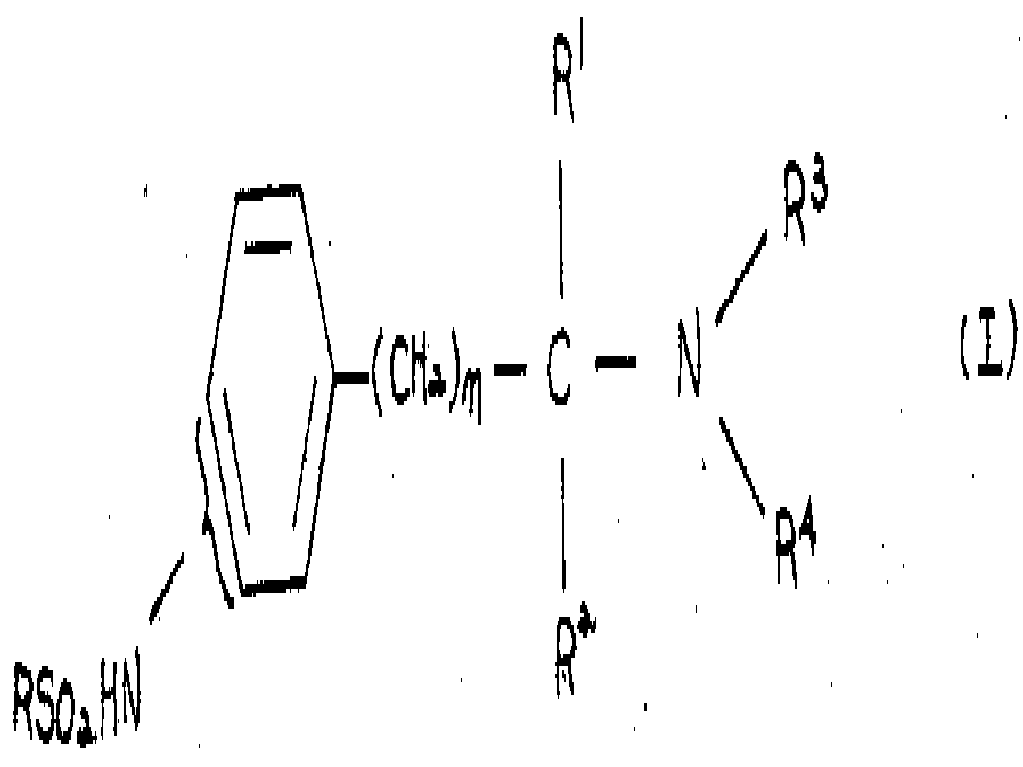
본 발명은 알킬설폰아미도 치환된 페닐알킬아민으로 특징지워지는 신규한 화합물에 관한 것이다. 본 발명은 더욱 특히 하기 일반식(Ⅰ)의 화합물 및 이의 약제학적으로 허용되는 산 부가염에 관한 것이다.The present invention relates to novel compounds characterized by alkylsulfonamido substituted phenylalkylamines. The present invention more particularly relates to compounds of the general formula (I) and pharmaceutically acceptable acid addition salts thereof.
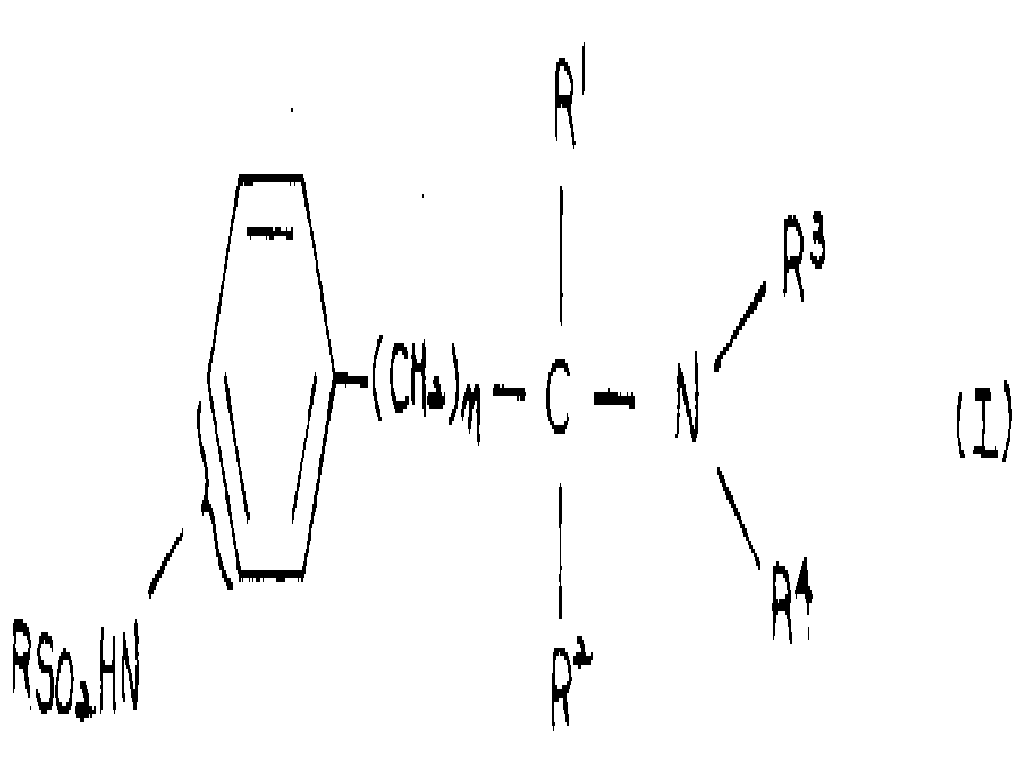
상기식에서,In the above formula,
R은 C1-C6알킬이고 ;R is C 1 -C 6 alkyl;
R1는 수소, 메틸 또는 에틸이며 ;R 1 is hydrogen, methyl or ethyl;
R2는 수소 또는 C1-C3알킬이고 ;R 2 is hydrogen or C 1 -C 3 alkyl;
R3는 수소 또는 C1-C8알킬이며 ;R 3 is hydrogen or C 1 -C 8 alkyl;
R4는 C1-C10알킬이고 ;R 4 is C 1 -C 10 alkyl;
n은 2, 3, 4 또는 5이다.n is 2, 3, 4 or 5.
본 발명은 또한 상기 일반식(Ⅰ)의 화합물 및 이에 대해 약제학적으로 허용되는 담체, 희석제 또는 부형제로 이루어진 약제학적 조성물도 제공한다.The present invention also provides a pharmaceutical composition comprising the compound of formula (I) and a pharmaceutically acceptable carrier, diluent or excipient.
본 발명의 또 다른 태양은 부정맥에 걸린 포유류 또는 부정맥이 나타날 가망성이 있는 포유류에게 상기 일반식(Ⅰ)의 화합물을 투여함을 특징으로 하여, 포유류의 심장 부정맥을 치료하는 방법이다.Another aspect of the present invention is a method for treating a cardiac arrhythmia of a mammal, characterized in that the compound of formula (I) is administered to a mammal having arrhythmia or a mammal having a potential for arrhythmia.
상기 일반식(Ⅰ)에서, 용어 C1-C6알킬은 탄소수 1내지 6의 직쇄 또는 측쇄 알킬을 나타낸다. 대표적인 C1-C6알킬 그룹에는 메틸, 에틸, n-프로필 , 이소프로필, n-부틸, 2급-부틸, 이소펜틸, n-헥실 및 이소헥실이 포함된다.In the general formula (I), the term C 1 -C 6 alkyl denotes straight or branched chain alkyl of 1 to 6 carbon atoms. Representative C 1 -C 6 alkyl groups include methyl, ethyl, n-propyl, isopropyl, n-butyl, secondary-butyl, isopentyl, n-hexyl and isohexyl.
용어 C1-C3알킬은 메틸, 에틸, n-프로필 및 이소프로필을 나타낸다.The term C 1 -C 3 alkyl denotes methyl, ethyl, n-propyl and isopropyl.
C1-C8 알킬에는 메틸, 에틸, 이소프로필, n-헥실, 1, 1-디메틸헥실, 1, 2-디메틸펜틸 및 n-옥틸과 같은 직쇄 및 측쇄 알킬이 포함된다.C 1 -C 8 alkyl includes straight and branched chain alkyl such as methyl, ethyl, isopropyl, n-hexyl, 1, 1-dimethylhexyl, 1, 2-dimethylpentyl and n-octyl.
C1-C10알킬에는 메틸, 에틸, n-펜틸, 이소헥실, 2-에틸헵틸, n-헵틸, 3-메틸헵틸, 1,2-디메틸헵틸, 1,2디메틸옥틸, 1, 1-디메틸헵틸, n-노닐, n-대실 및 관련 알킬그룹이 포함된다.C 1 -C 10 alkyl includes methyl, ethyl, n-pentyl, isohexyl, 2-ethylheptyl, n-heptyl, 3-methylheptyl, 1,2-dimethylheptyl, 1,2dimethyloctyl, 1, 1-dimethyl Heptyl, n-nonyl, n-meryl and related alkyl groups.
바람직한 태양에서, R은 메틸이고, n은 3이며, R1은 수소 또는 메틸이고, R2는 수소이며, R3는 C2-C4알킬이고 R4는 C2-C10알킬이다. R3는 이상적으로는 에틸 또는 부틸이고, R4는 바람직하게는 헵틸이다. 설폰아미드 그룹은 바람직하게는 페닐환의 4-위치에 존재한다.In a preferred embodiment, R is methyl, n is 3, R 1 is hydrogen or methyl, R 2 is hydrogen, R 3 is C 2 -C 4 alkyl and R 4 is C 2 -C 10 alkyl. R 3 is ideally ethyl or butyl and R 4 is preferably heptyl. The sulfonamide group is preferably at the 4-position of the phenyl ring.
상술한 바와같이, 본 발명은 상기 일반식(Ⅰ)화합물의 약제학적으로 허용되는 산 부가염을 포함한다. 본 발명의 화합물은 2급 및 3급 아민으로 본래 염기성이며 따라서 여러가지 무기 및 유기 산과 반응하여 약제학적으로 허용되는 산 부가염을 형성한다.이러한 염을 형성하는데 통상적으로 사용되는 산에는 염산, 브롬화 수소산, 황산 및 인산과 같은 무기 산, 및 팔라톨루엔설폰산, 메탄설폰산, 옥살산, 파라-브로모페닐설폰산, 카본산, 숙신산, 시트르산, 벤조산 및 아세트산과 같은 유기산, 및 관련 무기 및 유기산이 포함된다. 약제학적으로허용되는 바람직한 산 부가염에는 염산 및 브롬화수소산과 같은 무기산과 함께 형성된 염, 및 옥살산 및 시트르산과 같은 유기산과 함께 형성된 염이 포함된다.As mentioned above, the present invention includes pharmaceutically acceptable acid addition salts of the above general formula (I) compounds. The compounds of the present invention are secondary and tertiary amines which are inherently basic and thus react with various inorganic and organic acids to form pharmaceutically acceptable acid addition salts. Acids commonly used to form such salts include hydrochloric acid, hydrobromic acid. , Inorganic acids such as sulfuric acid and phosphoric acid, and organic acids such as pallatoluenesulfonic acid, methanesulfonic acid, oxalic acid, para-bromophenylsulfonic acid, carbonic acid, succinic acid, citric acid, benzoic acid and acetic acid, and related inorganic and organic acids do. Preferred pharmaceutically acceptable acid addition salts include salts formed with inorganic acids such as hydrochloric acid and hydrobromic acid, and salts formed with organic acids such as oxalic acid and citric acid.
본 발명 화합물은 니트로페닐 유도체를 상응하는 아미노페닐 유도체로 환원시키고 이를 알킬설포닐 아실화제로 아실화시키는 방법으로 합성하는 것이 바람직하다. 이 반응은 다음 도식으로 나타낼 수 있다 :The compounds of the present invention are preferably synthesized by reducing the nitrophenyl derivative to the corresponding aminophenyl derivative and acylating it with an alkylsulfonyl acylating agent. This reaction can be represented by the following scheme:
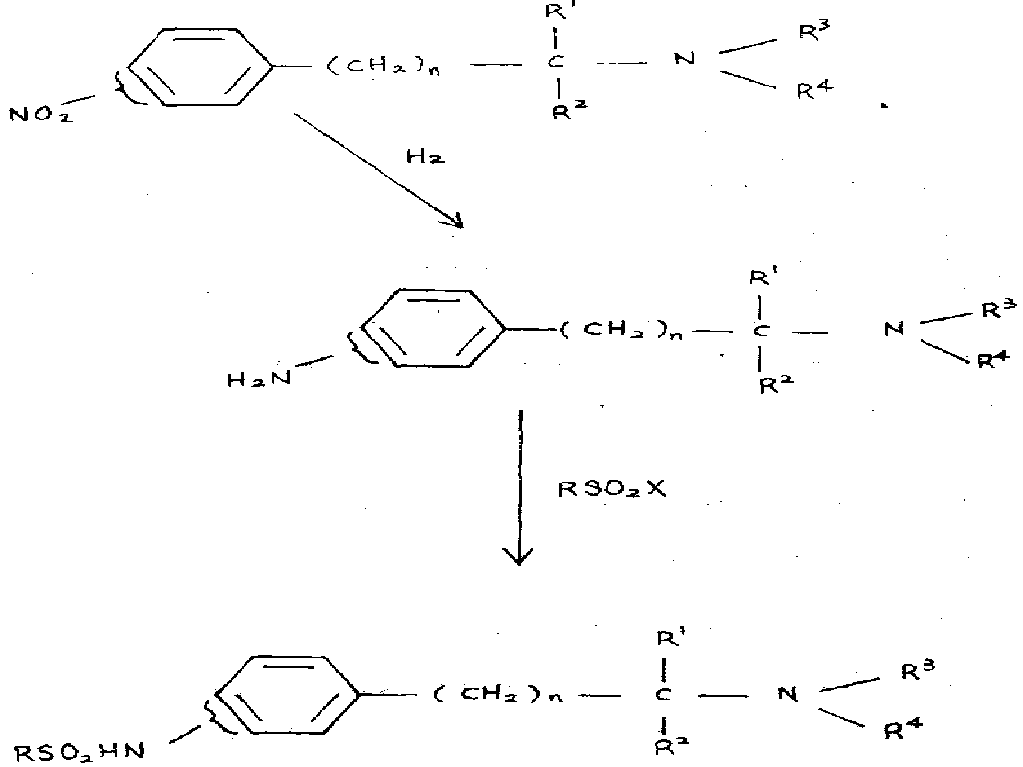
상기식에서, R, R1, R2, R3, R4및 n은 상기 정의된 바와같고 X는 할로(예 : 클로로 또는 브로모)와 같은 이탈그룹이다.Wherein R, R 1 , R 2 , R 3 , R 4 and n are as defined above and X is a leaving group such as halo (eg chloro or bromo).
상술한 반응과정의 첫단계는 니트로페닐 유도체를 상응하는 아미노페닐 유도체로 전환시키는 것을 포함하며 당해 분야의 전문가에게 공지된 방법으로 수행한다. 니트로 화합물은 통상적으로 수소 가스 및 촉매적 충분량의 적절한 촉매(예 : 라니 닉켈, 팔라듐 및 특히 탄소상팔라듐) 존재하에서 아미노 화합물로 수소화 시킨다. 촉매의 촉매적 충분량은 촉매 1중량부에 대해 니트로 페닐유도체 약 1/10중량부 내지 약 100중량부 범위 일 수 있다. 필요한 경우 특정 조건에 따라 더 많은 량 또는 더 적은 량의 촉매를 사용할 수 있다는 것을 주지해야 한다.The first step of the reaction process described above involves the conversion of nitrophenyl derivatives to the corresponding aminophenyl derivatives and is carried out by methods known to those skilled in the art. The nitro compound is usually hydrogenated with an amino compound in the presence of hydrogen gas and a catalytically sufficient amount of a suitable catalyst, such as raninickel, palladium and especially palladium on carbon. The catalytically sufficient amount of catalyst may range from about 1/10 part to about 100 parts by weight of the nitro phenyl derivative per 1 part by weight of catalyst. It should be noted that more or less catalyst may be used if necessary depending on the specific conditions.
환원은 수소 가스 존재하에서 일반적으로 평방인치당 약 표준 압력 내지 대략 100파운드의 압력 범위에서 수행한다. 약 15℃내지 약 100℃, 더욱 바람직하게는 약 20℃내지 약 50℃의 온도에서 수행하는 경우 반응은 약 1내지 24시간 후에 거의 완결된다.Reduction is generally carried out in the presence of hydrogen gas at pressures ranging from about standard pressure per square inch to about 100 pounds. When carried out at a temperature of about 15 ° C. to about 100 ° C., more preferably about 20 ° C. to about 50 ° C., the reaction is almost complete after about 1 to 24 hours.
일단 반응이 완결되면, 생성물을 표준방법에 따라 분리시킬 수 있다. 통상적으로 반응 혼합물을 적층토를 통해 여과하여 잔류 촉매를 제거한다. 이어서 여액을 통상적으로 감압하에서 농축시켜 적절한 아미노 페닐 유도체를 수득한다. 이렇게 하여 분리된 생성물을 필요한 경우 통상적인 용매(예 : 에틸 아세테이트 또는 클로로포름)로 부터의 결정화 또는 고체 지지체(예 : 실리카겔 또는 알루미나)상에서의 칼럼 크로마토그래피와 같은 여러가지 통상적인 기술중 하나를 사용하여 더 정제할 수 있다.Once the reaction is complete, the product can be separated according to standard methods. Typically the reaction mixture is filtered through a layered earth to remove residual catalyst. The filtrate is then typically concentrated under reduced pressure to give the appropriate amino phenyl derivative. The separated product is thus further subjected, if necessary, using one of several conventional techniques, such as crystallization from conventional solvents such as ethyl acetate or chloroform or column chromatography on a solid support such as silica gel or alumina. It can be purified.
아미노페닐 중간체를 본 발명의 상응하는 알킬설폰아미도 치환된 페닐알킬아민으로 전환시키는 것은 본 분야에 공지된 방법으로 수행한다. 아미노페닐 유도체는 바람직하게는 유기용매, 및 산 스캐빈저로서 작용할 수 있는 적절한 염기 존재하에서 알킬설포닐 할라이드와 반응시킨다. 통상적인 유기용매에는 클로로포름, 메틸렌클로라이드, DMF, 벤젠, 톨루엔 및 유사한 다른 비양자성 용매가 포함된다. 적절한 염기에는 트리에틸아민과 같은 유기 염기 및 중탄산 나트륨 또는 탄산칼륨과 같은 무기 염기가 포함된다. 피리딘과 같은 용매를 사용하는 경우, 산 스캐빈저를 더 가할 필요가 없으므로 바람직하다. 약 0℃내지 약 150℃범위의 온도에서 수행하는 경우, 통상적으로 반응은 약 1내지 72시간후에 거의 완결된다.The conversion of aminophenyl intermediates to the corresponding alkylsulfonamido substituted phenylalkylamines of the invention is carried out by methods known in the art. The aminophenyl derivative is preferably reacted with an alkylsulfonyl halide in the presence of an organic solvent and a suitable base that can act as an acid scavenger. Typical organic solvents include chloroform, methylene chloride, DMF, benzene, toluene and similar other aprotic solvents. Suitable bases include organic bases such as triethylamine and inorganic bases such as sodium bicarbonate or potassium carbonate. If a solvent such as pyridine is used, it is preferable since no acid scavenger needs to be added. When performed at a temperature in the range of about 0 ° C. to about 150 ° C., the reaction is typically nearly complete after about 1 to 72 hours.
이렇게하여 제조된 생성물은 표준 방법으로 분리할 수 있다. 통상적으로 휘발성물질은 감압하에서 증발 시키고 잔류물은 물중에서 교반하다. 생성된 슬러리를 예를들어 수산화암모늄과 같은 여러가지 염기 중 하나를 가하여 pH 약 8내지 10이 되도록 염기성화 한다. 생성물은 편리하게는 알칼리 수용액을 에틸 아세테이트 또는 클로로포름과 같은 적절한 수혼화성 유기용매로 추출하고 추출물로부터 용매를 증발시킴으로써 분리시킬수 있다. 이렇게하여 분리된 생성물은 표준 방법에 따라 예를들어 고압액체 크로마토그래피 하거나 결정화시킴으로써 더 정제할 수 있다.The product thus prepared can be separated by standard methods. Typically the volatiles are evaporated under reduced pressure and the residue is stirred in water. The resulting slurry is basified to pH about 8 to 10 by addition of one of several bases, for example ammonium hydroxide. The product can conveniently be separated by extracting the aqueous alkaline solution with a suitable water miscible organic solvent such as ethyl acetate or chloroform and evaporating the solvent from the extract. The product thus separated can be further purified by, for example, high pressure liquid chromatography or crystallization according to standard methods.
본 발명에 따르는 알킬설폰아미도 치환된 페닐알킬아민은 다른 여러가지 일반적인 화학적 방법으로 제조할 수도 있다. 대표적인 방법은, 예를들어 우선 1급 또는 2급 알킬설폰아미도 치환된 페닐알킬아민을 아실화시켜 상응하는 아미드를 형성시킨 다음 아미드를 디보란, 수소화 붕소 나트륨, 수소화 리듐 알루이늄 등과 같은 환원제와 반응시켜 환원시키는 방법이다.Alkylsulfonamido substituted phenylalkylamines according to the invention may also be prepared by a variety of other common chemical methods. Exemplary methods include, for example, acylating primary or secondary alkylsulfonamido substituted phenylalkylamines to form the corresponding amides, and then reducing the amides with reducing agents such as diborane, sodium borohydride, lithium aluminium hydride and the like. It is a method of reacting and reducing.
예를들어, N-[4-[4-(메틸아미노)부틸]페닐]메탄설폰아미드와 같은 아민은 아세틸클로라이드와 같은 아실화제와 반응시킴으로써 아실화 되어 상응하는 아세트 아미드 유도체를 형성할 수 있다. 아미드를 환원시켜 상응하는 본 발명의 아민, 즉, N-[4-[4-(메틸에틸아미노)부틸]페닐]메탄 설폰아미드를 수득한다. 또는, n-헵틸아민과 같은 아민을 3-(4-에틸설폰아미도 페닐)프로파노일 클로라이드와 같은 페닐알카노일 할라이드로 아실화시켜 상응하는 프로피온 아미드 유도체를 형성시킬 수 있다. 이 아마드를 환원시켜 상응하는 본 발명의 아민을 수측한다. 적절한 아실화제, 예를들면 아세틸 브로마이드로 더 아실화시킨 다음 환원시켜 본 발명의 3급 아민, 예를들면, N-[4-[3-(에틸헵틸아미노)프로필]페닐]-메탄설폰아미드를 수득한다.For example, amines such as N- [4- [4- (methylamino) butyl] phenyl] methanesulfonamide can be acylated by reacting with an acylating agent such as acetylchloride to form the corresponding acetamide derivatives. Reduction of the amide yields the corresponding amine of the invention, ie N- [4- [4- (methylethylamino) butyl] phenyl] methane sulfonamide. Alternatively, amines such as n-heptylamine can be acylated with phenylalkanoyl halides such as 3- (4-ethylsulfonamido phenyl) propanoyl chloride to form the corresponding propion amide derivatives. This amide is reduced to measure the corresponding amine of the present invention. Further acylation with an appropriate acylating agent, for example acetyl bromide, followed by reduction, yields tertiary amines of the invention such as N- [4- [3- (ethylheptylamino) propyl] phenyl] -methanesulfonamide To obtain.
본 발명의 약제학적으로 허용되는 산 부가염은 통상적으로 본 발명의 2급 또는 3급 아민을 동몰량 또는 과량의 산과 반응시켜 제조한다. 반응물을 일반적으로 디에틸에테르 또는 벤젠과 같은 상호 용매 중에서 혼합하면 염이 일반적으로 약 1시간 내지 약 10일 내에 용액으로부터 침전되는데, 이를 여과하여 분리할 수 있다.Pharmaceutically acceptable acid addition salts of the present invention are typically prepared by reacting secondary or tertiary amines of the present invention with equimolar or excess acid. When the reactants are generally mixed in a mutual solvent such as diethyl ether or benzene, the salts generally precipitate from the solution within about 1 hour to about 10 days, which can be separated by filtration.
본 발명의 바람직한 방법에서 출발물질로서 사용되는 니트로페닐 유도체는 본 분야에 공지되어 있으며, 본 명세서에 참고로 인용한 미합중국 특허 제 4,289,787호에 약술된 방법중 하나로 제조할 수 있다. 본 발명에 사용되는 다른 출발물질은 시판되고 있거나 공지되어 있으며 선행기술 방법으로 용이하게 제조할 수 있다.Nitrophenyl derivatives used as starting materials in preferred methods of the present invention are known in the art and may be prepared by one of the methods outlined in US Pat. No. 4,289,787, which is incorporated herein by reference. Other starting materials for use in the present invention are commercially available or known and can be readily prepared by the prior art methods.
다음 실시예는 본 발명 화합물의 합성을 더 설명해 준다. 본 발명을 이들 실시예로 제한하려는 것은 아니며 그렇게 이해해서도 안된다.The following examples further illustrate the synthesis of the compounds of the present invention. It is not intended to be exhaustive or to limit the invention to these examples.
[실시예 1]Example 1
N-[4-[4-(에틸헵틸아미노)부틸]페틸]메탄설폰아미드 에탄디오에이트N- [4- [4- (ethylheptylamino) butyl] fetyl] methanesulfonamide ethanedioate
A. N-에틸-N-헵틸-4-니트로벤젠부탄아미드A. N-ethyl-N-heptyl-4-nitrobenzenebutanamide
부가 깔대기 및 황산 칼슘 건조 튜브가 장치된 500ml 들이 환저 플라스크에 사염화탄소 180ml중의 4-(4-니트로페닐)부티르산 8.0g(0.03몰)을 넣는다. 이러한 교반 용액에 옥살릴 클로라이드 16.5ml(0.19몰)를 적가한다. 부가 깔대기 제거하고 플라스크에 냉각기를 장치한다. 반응 혼합물을 3시간 동안 환류시키고 냉각시킨 다음 과량의 옥살릴 클로라이드를 감압하에서 증발시킨다. 이 용액에 무수 디에틸 에테르 약 100ml를 가한 다음 얼음 중에서 냉각시킨다. 이러한 냉각 용액에 디에틸 에테르 약 60ml중에 용해된 에틸헵틸아민 16.3g(0.115몰)을 가한다. 생성된 반응 혼합물을 실온에서 일야 교반하고 물과 디에틸 에테르의 혼합물로 희석한다. 수성상을 분리하고 디에틸 에테르로 3회 더 추출한다. 유기 추출물을 합하고 물, 염산, 물(2X), 10%탄산나트륨 수용액 및 염화 나트륨 포화용액으로 세척한다. 유기 상을 분리하고 무수 황산 나트륨 중에서 건조시키고 감압하에서 증발 건고시켜 N-에틸-N-헵틸-4-니트로벤젠부탄아미드 12.847g을 오일로서 수득한다.In a 500 ml round bottom flask equipped with an addition funnel and a calcium sulfate drying tube, 8.0 g (0.03 mol) of 4- (4-nitrophenyl) butyric acid in 180 ml of carbon tetrachloride were added. 16.5 ml (0.19 mol) of oxalyl chloride are added dropwise to this stirred solution. Remove the addition funnel and equip the flask with a cooler. The reaction mixture is refluxed for 3 hours, cooled and excess oxalyl chloride is evaporated under reduced pressure. To this solution is added about 100 ml of anhydrous diethyl ether and then cooled in ice. To this cooling solution was added 16.3 g (0.115 mol) of ethylheptylamine dissolved in about 60 ml of diethyl ether. The resulting reaction mixture is stirred overnight at room temperature and diluted with a mixture of water and diethyl ether. The aqueous phase is separated and extracted three more times with diethyl ether. Combine the organic extracts and wash with water, hydrochloric acid, water (2X), 10% aqueous sodium carbonate solution and saturated sodium chloride solution. The organic phase is separated, dried over anhydrous sodium sulfate and evaporated to dryness under reduced pressure to give 12.847 g of N-ethyl-N-heptyl-4-nitrobenzenebutanamide as an oil.
B. N-에틸-N-헵틸-4-니트로벤젠부틸 아미늄 옥살레이트B. N-ethyl-N-heptyl-4-nitrobenzenebutyl aluminum oxalate
유리솜 건조튜브, 온도계 및 부가깔대기가 장치된 500ml들이 3-구 환저 플라스크에 THF(Aldrich chemical)중의 디보란 114ml(0.114몰)를 넣는다. 외부 수욕을 사용하여 반응 혼합물의 온도를 30℃이하로 유지시키면서 THF 50ml중의 N-에틸-N-헵틸-4-니트로벤젠부탄아미드 12.847g(0.038몰)용액을 상기 용액에 가한다. 반응 혼합물을 실온에서 일야 교반하고 얼음 중에서 냉각시킨다. 얼음 중에서 냉각된 용액에 충분량의 2N 염산을 가해 과량의 디보란을 분해시키고 반응 혼합물을 감압하에서 농축시킨다. 생성된 잔류물을 2N 염산 150ml와 혼합하고 약 30분 동안 환류시킨다. 생성된 혼합물을 냉각시키고 5N 수산화나트륨으로 염기성화 한다. 알칼리성 용액을 디에틸 에테르로 3회 추출하고 유기추출물을 합한 다음 물로 2회, 2N 황산으로 2회, 물로 4회, 5N 수산화 나트륨으로 1회 및 염화 나트륨 포화용액으로 1회 세척한다. 유기상을 무수 황산나트륨상에서 건조시키고 감압하에서 증발 건고시켜 물질 2.33g을 수득한 다음 이를 경사시켜 제거한다. 황산 추출물을 5N 수산화 나트륨으로 염기성화 시키고 디에틸 에테르로 3회 추출한다. 생성된 유기상을 염화나트륨 포화용액으로 세척하고 무수 황산 나트륨 상에서 건조시킨 다음 감압하에서 증발시켜 박층 크로마토그래피상에 두개의 반점을 갖는 물질 10.547g을 수득한다. 이 물질을 무수 아세트산 60ml에 용해시키고, 여기에 아세트산 10방울을 가한다.In a 500 ml three-necked round bottom flask equipped with glass wool drying tube, thermometer and addition funnel, 114 ml (0.114 mole) of diborane in THF (Aldrich chemical) was added. A solution of 12.847 g (0.038 mol) of N-ethyl-N-heptyl-4-nitrobenzenebutanamide in 50 ml of THF is added to the solution while maintaining the temperature of the reaction mixture below 30 ° C using an external water bath. The reaction mixture is stirred overnight at room temperature and cooled in ice. Sufficient 2N hydrochloric acid is added to the cooled solution in ice to decompose excess diborane and the reaction mixture is concentrated under reduced pressure. The resulting residue is mixed with 150 ml of 2N hydrochloric acid and refluxed for about 30 minutes. The resulting mixture is cooled and basified with 5N sodium hydroxide. The alkaline solution is extracted three times with diethyl ether and the combined organic extracts are washed twice with water, twice with 2N sulfuric acid, four times with water, once with 5N sodium hydroxide and once with saturated sodium chloride solution. The organic phase is dried over anhydrous sodium sulfate and evaporated to dryness under reduced pressure to afford 2.33 g of material which is then decanted off. The sulfuric acid extract is basified with 5N sodium hydroxide and extracted three times with diethyl ether. The resulting organic phase is washed with saturated sodium chloride solution, dried over anhydrous sodium sulfate and evaporated under reduced pressure to yield 10.547 g of material with two spots on thin layer chromatography. This substance is dissolved in 60 ml of acetic anhydride, and 10 drops of acetic acid are added thereto.
반응 혼합물을 1.5시간 동안 환류시키고 냉각시킨 다음 빙수 500ml에 서서히 붓는다. 혼합물을 진공 중에서 농축시키고 잔류물을 용해시키고 5N 수산화 나트륨으로 염기성화 시킨다. 이 혼합물을 디에틸 에테르로 3회 추출하고 생성된 유기 추출물을 합한 다음 물 및 염화나트륨 포화용액으로 세척하고 건조시키고, 농축시켜 N-에틸-N-헵틸-4-니트로벤젠부탄아민 10.334g을 오일로서 수득한다. 이 물질을 에틸 아세테이트에 용해시키고, 에틸 아세테이트에 용해된 옥살산 2.92g과 혼합한다. 침전된 고체를 여과하여 수거하고 에틸 아세테이트 약 300ml로부터 재결정화시켜 N-에틸-N-헵틸-4-니트로벤젠 부틸아미늄 옥살레이트 8.963g을 수득한다. 융점=115°내지 117℃ 4.The reaction mixture is refluxed for 1.5 hours, cooled and slowly poured into 500 ml of ice water. The mixture is concentrated in vacuo, the residue is dissolved and basified with 5N sodium hydroxide. The mixture was extracted three times with diethyl ether and the resulting organic extracts were combined, washed with water and saturated sodium chloride solution, dried and concentrated to give 10.334 g of N-ethyl-N-heptyl-4-nitrobenzenebutanamine as an oil. To obtain. This material is dissolved in ethyl acetate and mixed with 2.92 g of oxalic acid dissolved in ethyl acetate. The precipitated solid was collected by filtration and recrystallized from about 300 ml of ethyl acetate to give 8.963 g of N-ethyl-N-heptyl-4-nitrobenzene butylaluminum oxalate. Melting point = 115 ° to 117 ° C 4.
C21H34H2O6에 대한 원소분석Elemental Analysis for C 21 H 34 H 2 O 6
이론치 : C, 61.44 ; H, 8.35 ; N, 6.82 ;Theoretic value: C, 61.44; H, 8. 35; N, 6.82;
실측치 : C, 61.67 ; H, 8.48 ; N, 6.98.Found: C, 61.67; H, 8. 48; N, 6.98.
C. 4-아미노-N-에틸-N-헵틸벤젠부탄아민C. 4-Amino-N-ethyl-N-heptylbenzenebutanamine
상기와 같이 제조한 N-에틸-N-헵틸-4-니트로벤젠부틸아미늄 옥살레이트 4.4g을 수산화 암모늄을 사용하여 유리 염기로 전환시킨다. 수용액을 디에틸 에테르로 추출하고 유기상을 진공중에서 농축시켜 유리 염기 3.466g을 수득한다. 유리 염기를 에탄올 95ml에 용해시키고 5% pd/c 1g 존재하에 실온에서 30분 동안 수소화 시킨다. 100%의 수소가 흡입된 것으로 관찰되었다. 반응 혼합물을 셀라이트에 통과시켜 여과하고 여액을 감압하에서 증발 건고시켜 4-아미노-N-에틸-N-헵틸벤젠부탄아미드 3.114g을 수득한다. 부가적인 량의 이 물질은 상술한 방법으로 제조한다.4.4 g of N-ethyl-N-heptyl-4-nitrobenzenebutylaluminum oxalate prepared as above are converted to the free base using ammonium hydroxide. The aqueous solution is extracted with diethyl ether and the organic phase is concentrated in vacuo to afford 3.466 g of free base. The free base is dissolved in 95 ml of ethanol and hydrogenated for 30 minutes at room temperature in the presence of 1 g of 5% pd / c. 100% hydrogen was observed to be inhaled. The reaction mixture was filtered through celite and the filtrate was evaporated to dryness under reduced pressure to afford 3.114 g of 4-amino-N-ethyl-N-heptylbenzenebutanamide. Additional amounts of this material are prepared by the method described above.
D. 온도계, 부가 깔대기 및 황산 칼슘 건조 튜브가 장치된 250ml 들이 3-구 환저 플라스프에 4-아미노-N-에틸-N-헵틸벤젠부탄아민 4.292g(0.015몰)및 피리딘 50ml를 넣는다. 반응 혼합물을 약 10℃로 냉각 시키고 메탄설포닐 클로라이드 1.5ml(0.019몰)를 적가한다. 혼합물을 실온에서 일야 교반하고 감압하에서 증발시킨다. 잔류물을 물과 혼합하고 생성된 현탁액의 pH를 농수산화 암모늄을 사용하여 약 5.5내지 약 9.5로 조정한다. 염기성 혼합물을 클로로포름으로 4회 추출하고 유기 추출물을 합한 다음 염화나트륨 포화 수용액으로 세척하고 감압하에서 증발 건고시켜 N-[4-[4-(에틸헵틸아미노)부틸]페닐]메탄설폰아미드를 함유하는 물질 5.916g을 오일로서 수득한다. 물질을 박층 크로마토그래피하면 출발 물질이 없는 것으로 나타난다.D. Add 250 ml of 4-amino-N-ethyl-N-heptylbenzenebutanamine and 50 ml of pyridine to a 250 ml three-neck round bottom flask equipped with thermometer, addition funnel and calcium sulfate drying tube. The reaction mixture is cooled to about 10 ° C. and 1.5 ml (0.019 mol) of methanesulfonyl chloride are added dropwise. The mixture is stirred overnight at room temperature and evaporated under reduced pressure. The residue is mixed with water and the pH of the resulting suspension is adjusted to between about 5.5 and about 9.5 using ammonium hydroxide. The basic mixture was extracted four times with chloroform, the combined organic extracts were washed with saturated aqueous sodium chloride solution and evaporated to dryness under reduced pressure to give N- [4- [4- (ethylheptylamino) butyl] phenyl] methanesulfonamide 5.916 g is obtained as an oil. Thin layer chromatography of the material shows no starting material.
상기에서 제조한 물질 5.916g은 고압 액체 크로마토그래피하면 사용하여 정제한다. 용매 구배는 메틸렌 클로라이드 내지 2.5% 메탄올/메틸렌 클로라이드/1% 수사나화 암모늄이다. 분획 26내지 32를 합하고 이로부터 용매를 증발 제거시켜 물질 4.069g을 수득한다. 이 물질을 에틸 아세테이트에 용해시키고, 여기게 에틸 아세테이트에 용해된 옥살산 1g(0.012몰)을 가한다. 침전된 고체를 여과하여 수거하고 에틸 아세테이트/메탄올로 부터 재결정화시켜 N-[4-[4-(에틸헵틸아미노)부틸]페닐]메탄설폰아미드 에탄디오에이트 3.667g을 수득한다. 융점=120°내지 122℃5.916 g of the material prepared above is purified using high pressure liquid chromatography. The solvent gradient is methylene chloride to 2.5% methanol / methylene chloride / 1% ammonium sulphate. Fractions 26 to 32 are combined and the solvent is evaporated off to yield 4.069 g of material. This material is dissolved in ethyl acetate and 1 g (0.012 mol) of oxalic acid dissolved in ethyl acetate is added thereto. The precipitated solid is collected by filtration and recrystallized from ethyl acetate / methanol to give 3.667 g of N- [4- [4- (ethylheptylamino) butyl] phenyl] methanesulfonamide ethanedioate. Melting point = 120 ° to 122 ° C
C22H38N2O6S에 대한 원소분석Elemental Analysis for C 22 H 38 N 2 O 6 S
이론치 : C, 57.62 ; H, 8.35 ; N, 6.11 ; S, 6.99Theoretic value: C, 57.62; H, 8. 35; N, 6.11; S, 6.99
실측치 : C, 57.71 ; H, 8.22 ; N, 5.92 ; S, 6.92Found: C, 57.71; H, 8.22; N, 5.92; S, 6.92
[실시예 2]Example 2
N-[4-[4-(에틸헵틸아미노)펜틸]페닐]메탄설폰아미드 2-하이드록시-1, 2, 3-프로판트리카복실레이트N- [4- [4- (ethylheptylamino) pentyl] phenyl] methanesulfonamide 2-hydroxy-1, 2, 3-propanetricarboxylate
A. 4-니트로스티렌A. 4-nitrostyrene
500ml들이 3-구 환저 플라스크에 온도계 및 증기 증류 장치를 설치한다. 이 플라스크에 4-니트로펜에틸 브로마이드 12.5g(0.054몰), 트리에탄올아민 75ml(0.565몰) 및 물 50ml를 넣는다. 반응 혼합물을 환류로 가열하고 혼합물을 서서히 증기 증류 되도록 한다. 수득된 증류액에 하이드로퀴논 약 100mg을 가하여 중합화를 방지한다. 증류액을 디에틸 에테르로 3회 추출하고, 유기상을 합하여 차례로 물, 1N염산, 물 및 염화나트륨 포화용액으로 세척한다. 유기상을 무수 황산나트륨 상에서 건조시키고 감압하에서 증발 건고시켜 4-니트로스티렌 7.193g을 오일로서 수득한 다음, 이를 냉각시켜 고체화 한다. 부가적인 량의 이 물질은 상술한 일반적인 방법으로 제조한다.A 500 ml three-neck round bottom flask is equipped with a thermometer and steam distillation apparatus. 12.5 g (0.054 mol) of 4-nitrophenethyl bromide, 75 ml (0.565 mol) of triethanolamine, and 50 ml of water were added to the flask. The reaction mixture is heated to reflux and the mixture is allowed to steam distillate slowly. About 100 mg of hydroquinone is added to the obtained distillate to prevent polymerization. The distillate is extracted three times with diethyl ether, and the organic phases are combined and washed successively with water, IN hydrochloric acid, water, and saturated sodium chloride solution. The organic phase is dried over anhydrous sodium sulfate and evaporated to dryness under reduced pressure to afford 7.193 g of 4-nitrostyrene as an oil, which is then cooled and solidified. Additional amounts of this material are prepared by the general method described above.
B. α-아세틸-4-니트로벤젠부타노산, 에틸 에스테르B. α-acetyl-4-nitrobenzenebutanoic acid, ethyl ester
나트륨 금속 700mg을 온도계, 콘덴서 및 황산 칼슘 건조 튜브가 장치된 500ml들이 4-구 환저 플라스크 내에서 질소 대기하에 교반하면서 무수 에탄올 65ml에 가한다. 혼합물을 약 70℃로 가열하여 나트륨 금속을 완전히 용해시킨 다음 실온으로 냉각시킨다. 혼합물에 에틸 아세토아세테이트 19.5g(0.091몰) 및 4-니트로스티렌 14.1G(0.095몰)을 가한다. 반응 혼합물을 약 6시간 동안 환류시키고 실온에서 일야 교반한다. 혼합물을 농염산 4ml을 함유하는 물 1ℓ에 붓는다. 수용액을 디에틸에테르로 3회 추출하고, 유기 추출물을 합하여, 물로 2회 및 염화 나트륨 포화 용액으로 1회 세척한다. 유기상을 무수 황산 나트륨 상에서 건조시키고 감압하에서 농축 건고시켜 생성물 26.101g을 오일로서 수득한다. 오일을 디에틸 에테르 100ml에 용해시키고 약 60시간 동안 약 0℃로 냉각시킨다. 소량의 고체를 여과하여 수거하고 여액을 진공중에서 농축시켜 α-아세틸-4-니트로벤젠부타노산, 에틸 에스테르 22.3g을 정제된 형태의 오일로서 수득한다.700 mg of sodium metal is added to 65 ml of anhydrous ethanol while stirring under nitrogen atmosphere in a 500 ml four-neck round bottom flask equipped with thermometer, condenser and calcium sulfate drying tube. The mixture is heated to about 70 ° C. to completely dissolve the sodium metal and then cool to room temperature. To the mixture was added 19.5 g (0.091 mol) of ethyl acetoacetate and 14.1 G (0.095 mol) of 4-nitrostyrene. The reaction mixture is refluxed for about 6 hours and stirred overnight at room temperature. The mixture is poured into 1 l of water containing 4 ml of concentrated hydrochloric acid. The aqueous solution is extracted three times with diethyl ether, the combined organic extracts are washed twice with water and once with saturated sodium chloride solution. The organic phase is dried over anhydrous sodium sulfate and concentrated to dryness under reduced pressure to give 26.101 g of product as an oil. The oil is dissolved in 100 ml of diethyl ether and cooled to about 0 ° C. for about 60 hours. A small amount of solid is collected by filtration and the filtrate is concentrated in vacuo to give 22.3 g of α-acetyl-4-nitrobenzenebutanoic acid, ethyl ester as oil in purified form.
C. 5-(4-니트로페닐)-2-펜탄온C. 5- (4-nitrophenyl) -2-pentanone
THF 500ml중의 α-아세틸-4-니트로벤젠부타노산, 에틸 에스테르 22.3g(0.080몰)의 혼합물에 6N염산 250ml를 가한 다음 일야 환류 시킨다. 반응 혼합물을 냉각시키고 감압하에서 증발 건고시킨다. 잔류물을 물로 희석하고 디에틸 에테르로 3회 추출한다. 유기 추출물을 분리하고, 1N 수산화 나트륨으로 2회, 물로 3회 및 염호나트륨 포화 용액으로 1회 세척한다. 유기 용액을 무수 황산 나트륨 상에서 건조시키고 감압하에서 증발시킨다. 잔류물을 증류시켜 4-클로로부탄올을 제거한다. 이 증류액의 잔류물을 6인치 재킷 비그레욱수컬럼(vigreaux column)을 통과시켜 더 증류시키고 분획 2로부터 5-(4-니트로페닐)-2-펜탄온 6.681g을 수득한다.250 ml of 6N hydrochloric acid was added to a mixture of α-acetyl-4-nitrobenzenebutanoic acid and 22.3 g (0.080 mol) of ethyl ester in 500 ml of THF, followed by refluxing overnight. The reaction mixture is cooled and evaporated to dryness under reduced pressure. The residue is diluted with water and extracted three times with diethyl ether. The organic extract is separated and washed twice with 1N sodium hydroxide, three times with water and once with saturated sodium chloride solution. The organic solution is dried over anhydrous sodium sulfate and evaporated under reduced pressure. The residue is distilled off to remove 4-chlorobutanol. The residue of this distillate is further distilled through a 6 inch jacketed vigreaux column to give 6.681 g of 5- (4-nitrophenyl) -2-pentanone from fraction 2.
D. N-에틸-α-메틸-4-니트로벤젠부탄아민D. N-ethyl-α-methyl-4-nitrobenzenebutanamine
황산칼슘 건조 튜브가 장치된 300ml 들이 환저 플라스크에 메탄올 100ml중의 5-(4-니트로페닐)-2-펜탄온 6.681g(0.0322몰)을 넣는다. 이 혼합물에 에틸아민 하이드로클로라이드 13.2g(0.161몰) 및 나트륨 시아노보로하이드라이드 2.03g(0.0322몰)을 가한다. 생성된 현탁액을 실온에서 주말(약 72시간)에 걸쳐 교반하고 농염산으로 산성화시킨다. 휘발성 물질을 감압하면서 증발시키고 잔류물에 물 300ml를 가한다. 혼합물을 디에틸 에테르로 2회 추출하고 유기상을 물 및 염화나트륨 포화 용액으로 세척한다. 유기상을 무수 황산 나트륨상에서 건조시키고 증발 건조시킨다. 이 물질을 경사시켜 제거한다. 수성상을 5N 수산화 나트륨으로 염기성화 시키고 디에틸 에테르로 3회 추출한다. 유기 추출물을 합하고, 염화 나트륨 포화 용액으로 세척한 다음 무수 황산 나트륨 상에서 건조시킨다. 용매를 증발시켜 N-에틸-α-메틸-4-니트로벤젠 부탄아민 6.838g을 수득한다.Into a 300 ml round bottom flask equipped with a calcium sulfate drying tube was placed 6.681 g (0.0322 mol) of 5- (4-nitrophenyl) -2-pentanone in 100 ml of methanol. To this mixture was added 13.2 g (0.161 mol) of ethylamine hydrochloride and 2.03 g (0.0322 mol) of sodium cyanoborohydride. The resulting suspension is stirred at room temperature over the weekend (about 72 hours) and acidified with concentrated hydrochloric acid. The volatiles are evaporated under reduced pressure and 300 ml of water is added to the residue. The mixture is extracted twice with diethyl ether and the organic phase is washed with water and saturated sodium chloride solution. The organic phase is dried over anhydrous sodium sulfate and evaporated to dryness. This material is tilted and removed. The aqueous phase is basified with 5N sodium hydroxide and extracted three times with diethyl ether. The organic extracts are combined, washed with saturated sodium chloride solution and dried over anhydrous sodium sulfate. Evaporate the solvent to afford 6.838 g of N-ethyl-α-methyl-4-nitrobenzene butanamine.
E. N-에틸-N-[1-메틸-4-(4-니트로페닐)부틸]헵탄아미드E. N-ethyl-N- [1-methyl-4- (4-nitrophenyl) butyl] heptanamide
온도계 및 부가 깔대기가 장치된 500ml 들이 3-구 환저 플라스크에 탄산나트륨 7.65g 및 물 70ml를 넣는다. 이 혼합물에 N-에틸-α-메틸-4니트로벤젠 부탄아민 6.8g(0.029몰) 및 아세톤 70ml를 가한다. 생성된 혼합물을 25℃보다 조금 낮은 온도로 냉각시키고 혼합물의 온도를 약 20°내지 25℃범위로 유지시키면서 헵타노일 클로라이드 4.5ml(0.029몰) 및 아세톤 70ml를 가한다. 현탁액을 실온에서 일야 교반하교 감압하에서 증발 건고시킨다. 잔류물을 슬러리화 시키고, 디에틸 에테르로 3회 추출한다. 유기 추출물을 합하고 물, 2N 염산, 물(2회), 마지막으로 염화 나트륨 포화용액으로 세척한다. 유기상을 무수 황산나트륨 상에서 건조시키고 감압하에서 증발 건조시켜 N-에틸-N-[1-메틸-4-(4-니트로페닐)부틸]헵탄아미드 7.723g을 오일로서 수득한다.In a 500 ml three-necked round bottom flask equipped with a thermometer and an addition funnel, 7.65 g of sodium carbonate and 70 ml of water are added. To this mixture was added 6.8 g (0.029 mol) of N-ethyl-α-methyl-4nitrobenzene butanamine and 70 ml of acetone. The resulting mixture is cooled to a temperature slightly below 25 ° C. and 4.5 ml (0.029 mol) of heptanoyl chloride and 70 ml of acetone are added while maintaining the temperature of the mixture in the range of about 20 ° to 25 ° C. The suspension is stirred at room temperature overnight and evaporated to dryness under reduced pressure. The residue is slurried and extracted three times with diethyl ether. Combine the organic extracts and wash with water, 2N hydrochloric acid, water (twice), and finally saturated sodium chloride solution. The organic phase is dried over anhydrous sodium sulfate and evaporated to dryness under reduced pressure to yield 7.723 g of N-ethyl-N- [1-methyl-4- (4-nitrophenyl) butyl] heptanamide as an oil.
F. N-에틸-N-헵틸-α-메틸-4-니트로벤젠부탄아민F. N-ethyl-N-heptyl-α-methyl-4-nitrobenzenebutanamine
500ml 들이 3-구 환저 플라스크에 콘덴서 및 유리솜 건조 튜브를 장치한다. 이 플라스크에 THF중의 1M 디보란 60ml를 넣고 THF 50ml중의 N-에틸-N-[1-메틸-4-(4-니트로페닐)부틸]헵탄아미드 7.7g(0.022몰)을 적가한다. 생성된 반응 혼합물을 일야 환류시키고 냉각 시킨다. 2N 염산 25ml의 용액을 적가하여 과량의 디보란이 분해되도록 한다. 혼합물을 감압하에서 증발시키고 2N 염산 150ml를 더 가한다. 이 혼합물을 1시간 동안 환류시키고 냉각시킨 다음, 5N 수산화 나트륨으로 염기성화 시킨다. 혼합물을 디에틸 에테르로 3회 추출하고 유기상을 물 및 염화나트륨 포화용액으로 세척한다. 유기상을 황산 나트륨 상에서 건조시키고 증발 건고시켜 N-에틸-N-헵틸-α-메틸-4-니트로벤젠부탄아민 7.389g을 오일로서 수득한다.A 500 ml three-neck round bottom flask is equipped with a condenser and glass wool drying tubes. 60 ml of 1 M diborane in THF was added to the flask and 7.7 g (0.022 mol) of N-ethyl-N- [1-methyl-4- (4-nitrophenyl) butyl] heptanamide in 50 ml of THF was added dropwise. The resulting reaction mixture is refluxed and cooled overnight. A solution of 25 ml of 2N hydrochloric acid is added dropwise to allow the excess diborane to decompose. The mixture is evaporated under reduced pressure and 150 ml of 2N hydrochloric acid is further added. The mixture is refluxed for 1 hour, cooled and basified with 5N sodium hydroxide. The mixture is extracted three times with diethyl ether and the organic phase is washed with water and saturated sodium chloride solution. The organic phase is dried over sodium sulfate and evaporated to dryness to give 7.389 g of N-ethyl-N-heptyl-α-methyl-4-nitrobenzenebutanamine as an oil.
G. N-에틸-N-헵틸-α-메틸-4-아미노벤젠부탄아민G. N-ethyl-N-heptyl-α-methyl-4-aminobenzenebutanamine
에탄올 92ml중의 N-에틸-N-헵틸-α-메틸-4-니트로벤젠부탄아민 7.389g(0.022몰)의 혼합물을 5% pd/c 0.74g 존재하에 실온에서 일야 수소화 시킨다. 이론치의 총 87%의 수소가 흡입된 것으로 관찰되었다. 반응 혼합물을 셀라이트에 통과시켜 여과하고 감압하에서 증발건고시켜 N-에틸-N-헵틸-α-4-아미노벤젠부탄아민 6.312g을 오일로서 수득한다.A mixture of 7.389 g (0.022 mol) of N-ethyl-N-heptyl-α-methyl-4-nitrobenzenebutanamine in 92 ml of ethanol is hydrogenated overnight at room temperature in the presence of 0.74 g of 5% pd / c. A total of 87% of theoretical hydrogen was observed to be inhaled. The reaction mixture was passed through celite, filtered and evaporated to dryness under reduced pressure to yield 6.312 g of N-ethyl-N-heptyl-α-4-aminobenzenebutanamine as an oil.
H. 온도계, 부가 깔대기 및 황산칼슘 건조튜브가 장치된 250ml들이 3-구 환저 플라스크에 N-에틸-N-헵틸-α-메틸-4-아미노벤젠부탄아민 6.3g(0.021몰) 및 무수 피리딘 90ml를 넣는다. 생성된 혼합물을 외부 빙욕을 사용하여 15℃까지 냉각시키고 대략 15℃ 이하의 온도를 유지시키면서 메탄설포닐 클로라이드 2.2ml(0.026몰)를 가한다. 외부 냉각욕을 제거하고 반응 혼합물을 실온에서 일야 교반한다. 휘발성 물질을 감압하에서 증발시키고 잔류물에 물을 가한다. 농수산화 암모늄을 사용하여 혼합물의 pH를 약 5.7내지 약 9로 조정한다. 수성상을 클로로포름으로 3회 추출하고 유기 추출물을 합하여 염화 나트륨 포화 용액으로 세척한다. 유기상을 무수 황산 나트륨 상에서 건조시키고 농축시켜 흑색 오일 9.045g을 수득한다.H. 6.3 g (0.021 mol) of N-ethyl-N-heptyl-α-methyl-4-aminobenzenebutanamine and 90 ml of anhydrous pyridine in a 250 ml three-neck round bottom flask equipped with thermometer, addition funnel and calcium sulfate dry tube Put it. The resulting mixture is cooled to 15 ° C. using an external ice bath and 2.2 ml (0.026 mol) of methanesulfonyl chloride is added while maintaining a temperature of approximately 15 ° C. or less. The external cooling bath is removed and the reaction mixture is stirred overnight at room temperature. The volatiles are evaporated under reduced pressure and water is added to the residue. The pH of the mixture is adjusted to between about 5.7 and about 9 using ammonium hydroxide. The aqueous phase is extracted three times with chloroform and the combined organic extracts are washed with saturated sodium chloride solution. The organic phase is dried over anhydrous sodium sulfate and concentrated to give 9.045 g of black oil.
생성된 물질을 고압 액체 크로마토그래피하여 정제한다. 물질 3.289g을 함유하는 분획 31내지 35를 에틸 아세테이트 중의 시트르산 일수화물 1.98g과 혼합한다. 침전된 고체를 여과하여 수거하고 에탄올/아세톤(95 : 5V/V)으로 부터 재결정화시켜 N-[4-[4-(에틸헵틸아미노)펜틸]페닐]메탄설폰아미드 2-하이드록시-1, 2, 3-프로판트리카복실레이트 4,516g을 수득한다. 융점=73°내지 76℃The resulting material is purified by high pressure liquid chromatography. Fractions 31 to 35 containing 3.289 g of material are mixed with 1.98 g of citric acid monohydrate in ethyl acetate. The precipitated solid was collected by filtration and recrystallized from ethanol / acetone (95: 5V / V) to give N- [4- [4- (ethylheptylamino) pentyl] phenyl] methanesulfonamide 2-hydroxy-1, 4,516 g of 2, 3-propanetricarboxylate are obtained. Melting point = 73 ° -76 ° C
C27H38N2O9S에 대한 원소분석Elemental Analysis for C 27 H 38 N 2 O 9 S
이론치 : C, 56.43 ; H, 8.07 ; N, 4.87 ; S, 5.58 ;Theoretic value: C, 56.43; H, 8.07; N, 4.87; S, 5.58;
실측치 : C, 56.70 ; H, 7.86 ; N, 4.76 ; S, 5.34.Found: C, 56.70; H, 7.86; N, 4.76; S, 5.34.
[실시예 3]Example 3
N-[4-[4-(부틸헵틸아미노)부틸]페닐]메탄설폰아미드 에탄디오에이트N- [4- [4- (butylheptylamino) butyl] phenyl] methanesulfonamide ethanedioate
A. N-부틸-N-헵틸-4-아미노벤젠부탄아민A. N-butyl-N-heptyl-4-aminobenzenebutanamine
N-부틸-N-헵틸-4-니트로벤젠부틸아미늄 옥살레이트(12.01g, 0.027몰)를 디에틸 에테르 및 수산화암모늄에 슬러리화 시킴으로써 유리 염기로 전환시킨다. 유기상을 분리하고 감압하에서 증발시켜 유리 염기 9.519(0.027몰)을 수득한다. 이 물질을 메탄올 139ml와 혼합하고 5%pd/c 1g 존재하에 실온에서 일야 수소화 시킨다. 관찰된 수소 흡입량은 이론치의 88%이다. 반응 혼합물을 셀라이트를 통해 여과시키고 진공중에서 농축시킨다. 잔류물을 에테르에 용해시키고 감압하에서 증발건고시켜 N-부틸-N-헵틸-4-아미노벤젠부탄아민 8.584g을 수득한다.N-butyl-N-heptyl-4-nitrobenzenebutylaluminum oxalate (12.01 g, 0.027 mol) is converted to the free base by slurrying in diethyl ether and ammonium hydroxide. The organic phase is separated and evaporated under reduced pressure to yield 9.519 (0.027 moles) of free base. This material is mixed with 139 ml of methanol and hydrogenated overnight at room temperature in the presence of 1 g of 5% pd / c. The observed hydrogen intake is 88% of theory. The reaction mixture is filtered through celite and concentrated in vacuo. The residue is dissolved in ether and evaporated to dryness under reduced pressure to yield 8.584 g of N-butyl-N-heptyl-4-aminobenzenebutanamine.
B. 온도계, 부가 깔대기 및 황산 칼슘 건조튜브가 장치된 250ml 들이 3-구 환저 플라스크에 N-부틸-N-헵틸-4-아미노벤젠부탄아민 8.5g(0.027몰) 및 무수 피리딘 90ml를 넣는다. 반응 혼합물을 약 10°내지 15℃의 온도로 냉각시키고 약 15℃ 이하의 온도를 유지하면서 메탄설포닐 클로라이드 2.6ml(0.034몰)를 가한다. 외부 빙욕을 제거하고 반응 혼합물을 실온에서 일야 교반한다. 휘발성 물질을 감압하에서 증발시키고 물 및 농수산화 암모늄을 가하여 반응 혼합물의 pH를 약 9로 만든다. 수용액을 클로로포름으로 4회 추출하고, 유기 추출물을 합하여 염화나트륨 포화 용액으로 세척한 다음 무수 황산 나트륨 상에서 건조시킨다. 유기상을 농축시켜 N-[4-[4-(부틸헵틸아미노)부틸]페닐]메탄설폰아미드 12.246g을 오일로서 수득한다.B. Add 250 g of N-butyl-N-heptyl-4-aminobenzenebutanamine and 90 ml of anhydrous pyridine to a 250 ml three-necked round bottom flask equipped with thermometer, addition funnel and calcium sulfate dry tube. The reaction mixture is cooled to a temperature of about 10 ° to 15 ° C. and 2.6 ml (0.034 mol) of methanesulfonyl chloride are added while maintaining a temperature of about 15 ° C. or less. The external ice bath is removed and the reaction mixture is stirred overnight at room temperature. The volatiles are evaporated under reduced pressure and water and ammonium hydroxide are added to bring the pH of the reaction mixture to about 9. The aqueous solution is extracted four times with chloroform and the combined organic extracts are washed with saturated sodium chloride solution and dried over anhydrous sodium sulfate. The organic phase is concentrated to give 12.246 g of N- [4- [4- (butylheptylamino) butyl] phenyl] methanesulfonamide as an oil.
상기와 같이 제조한 생성물을 고압 액체 크로마토그래피하여 정제한다. 분획 26내지 32를 합하고, 이로부터 용매를 증발시켜 물질 6.01g을 수득한다. 이 물질을 에틸 아세테이트에 용해시키고, 여기에 에틸 아세테이트에 용해된 옥살산 1.43g을 가한다. 침전된 고체를 여과하여 수거하고 에틸 아세테이트로부터 2회 재결정화시켜 융점 49°내지 52℃인 N-[4-[4-(부틸헵틸아미노)부틸]페닐]메탄설폰아미드 에탄디오에이트 2.934g을 수득한다.The product thus prepared is purified by high pressure liquid chromatography. Fractions 26 to 32 are combined, from which the solvent is evaporated to yield 6.01 g of material. This material is dissolved in ethyl acetate, to which 1.43 g of oxalic acid dissolved in ethyl acetate is added. The precipitated solid was collected by filtration and recrystallized twice from ethyl acetate to give 2.934 g of N- [4- [4- (butylheptylamino) butyl] phenyl] methanesulfonamide ethanedioate having a melting point of 49 ° to 52 ° C. do.
C24H42N2O6에 대한 원소분석Elemental Analysis for C 24 H 42 N 2 O 6
이론치 : C, 59.23 ; H, 8.70 ; N, 5.76 ; S, 6.59 ;Theoretic value: C, 59.23; H, 8. 70; N, 5.76; S, 6.59;
실측치 : C, 59.47 ; H, 8.48 ; N, 5.74 ; S, 6.58Found: C, 59.47; H, 8. 48; N, 5.74; S, 6.58
[실시예 4]Example 4
N-[4-[4-(부틸헵틸아미노)펜틸]페닐]메탄설폰아미드N- [4- [4- (butylheptylamino) pentyl] phenyl] methanesulfonamide
A. 4-아미노-N-부틸-N-헵틸-α-메틸벤젠부탄아민A. 4-Amino-N-butyl-N-heptyl-α-methylbenzenebutanamine
에탄올 182ml 중의 N-부틸-N-헵틸-α-메틸-4-니트로벤젠부탄아민 16.2g(0.045몰)의 용액을 5% pd/c 1.6g 존재하에 실온에서 일야 수소화 시킨다. 관찰된 수소 흡입량은 이론치의 74%이다. 반응 혼합물을 셀라이트를 통해 여과시키고 여액을 감압하에서 증발시킨다. 생성된 물질을 박층 크로마토그래피에 의해 하나의 반점의 존재로 확인되며 4-아미노-N-부틸-N-헵틸-α-메틸 벤젠부탄아민 13.56g이 오일로서 수득된다.A solution of 16.2 g (0.045 mol) of N-butyl-N-heptyl-α-methyl-4-nitrobenzenebutanamine in 182 ml of ethanol is hydrogenated overnight at room temperature in the presence of 1.6 g of 5% pd / c. The observed hydrogen intake is 74% of theory. The reaction mixture is filtered through celite and the filtrate is evaporated under reduced pressure. The resulting material is confirmed by thin layer chromatography in the presence of one spot and 13.56 g of 4-amino-N-butyl-N-heptyl-α-methyl benzenebutanamine are obtained as an oil.
B. 온도계, 황산칼슘 건조튜브 및 부가 깔대기가 장치된 250ml 들이 3-구 환저 플라스크에 무수 피리된 175ml 중의 4-아미노-N-부틸-N-헵틸-α-메틸벤젠부탄아민13.56g(0.041몰)을 넣는다. 반응 혼합물을 대략 15℃ 까지 냉각시키고, 여기에 반응 혼합물의 온도를 약 15℃이하로 유지시키면서 메탄 설포닐 클로라이드 4.15ml(0.052몰)를 가한다. 반응 혼합물을 실온에서 일야 교반하고 휘발성 물질을 감압하에서 증발시킨다. 잔류물을 물에 슬러리화 하고 농수산화 암모늄을 사용하여 pH를 약 5.4내지 약10으로 조정한다. 수용액을 클로로포름으로 3회 추출하고 유기 추출물을 합한 다음, 물로 2회 및 염화나트륨 포화 용액으로 1회 세척한다. 유기상을 무수 황산 나트륨 상에서 건조시키고 감압하에 증발시켜 오일 23.159g을 수득한다.B. 13.56 g (0.041 mol) of 4-amino-N-butyl-N-heptyl-α-methylbenzenebutanamine in 175 ml anhydrous pyriated in a 250 ml three-neck round bottom flask equipped with thermometer, calcium sulfate drying tube and addition funnel ). The reaction mixture is cooled to approximately 15 ° C., and 4.15 ml (0.052 mol) of methane sulfonyl chloride is added thereto while maintaining the temperature of the reaction mixture below about 15 ° C. The reaction mixture is stirred overnight at room temperature and the volatiles are evaporated under reduced pressure. The residue is slurried in water and the pH is adjusted to between about 5.4 and about 10 using ammonium hydroxide. The aqueous solution is extracted three times with chloroform and the organic extracts are combined, then washed twice with water and once with saturated sodium chloride solution. The organic phase is dried over anhydrous sodium sulfate and evaporated under reduced pressure to yield 23.159 g of oil.
이렇게 하여 수득된 오일을 고압 액체 크로마토그래피 하여 정제한다. 주성분을 함우하는 분획을 합하고 이로부터 용매를 증발시킨다. 잔류물을 0.02mm 압력에서 증류하고 약 225℃ 내지 약 240℃로 비등하는 분획을 수거하여 N-[4-[4-(부틸헵틸아미노)펜틸]페닐]메탄설폰아미드 4.619g을 수득한다.The oil thus obtained is purified by high pressure liquid chromatography. Fractions containing the main constituents are combined and the solvent is evaporated therefrom. The residue is distilled at 0.02 mm pressure and the fractions boiling from about 225 ° C. to about 240 ° C. are collected to yield 4.619 g of N- [4- [4- (butylheptylamino) pentyl] phenyl] methanesulfonamide.
C23H42N2O2S 에 대한 원소분석Elemental Analysis for C 23 H 42 N 2 O 2 S
이론치 : C, 76.27 ; H, 10.31 ; N, 6.82 ; S, 7.81;Theoretic value: C, 76.27; H, 10.31; N, 6.82; S, 7.81;
실측치 : C, 67.09 ; H, 10.08 ; N, 6.93 ; S, 7.61.Found: C, 67.09; H, 10.08; N, 6.93; S, 7.61.
[실시예 5]Example 5
N-[4-[4-(에틸헵틸아미노)부틸]페닐]메탄설폰아미드 모노하이드로브로마이드N- [4- [4- (ethylheptylamino) butyl] phenyl] methanesulfonamide monohydrobromide
실시예 1에 기술된 방법에 따라 제조된 N-[4-[4-(에틸헵틸아미노)부틸]페닐]메탄설폰아미드 (5.56g, 0.015몰)를 디에틸 에테르에 용해시킨다. 용액을 드라이아이스/아세톤 욕으로 냉각시키고, 여기에 브롬화 수소로 포화된 디에틸 에테르를 가한다. 휘발성 물질을 감압하에서 증발시키고, 잔류물에 에틸 아세테이트 100ml를 가한다. 용액을 연마하고 결정 약 6g을 수거한다. 고체를 이소프로필 알콜로 재결정화시켜 융점이 98°내지 100℃인 N-[4-[4-(에틸헵틸아미노)부틸]페닐]메탄설폰아미드 모노하이드로브로마이드 2.5g을 수득한다. 수율 : 37%.N- [4- [4- (ethylheptylamino) butyl] phenyl] methanesulfonamide (5.56 g, 0.015 mol) prepared according to the method described in Example 1 is dissolved in diethyl ether. The solution is cooled in a dry ice / acetone bath, to which diethyl ether saturated with hydrogen bromide is added. The volatiles are evaporated under reduced pressure and 100 ml of ethyl acetate is added to the residue. The solution is polished and approximately 6 g of crystals are collected. The solid is recrystallized with isopropyl alcohol to give 2.5 g of N- [4- [4- (ethylheptylamino) butyl] phenyl] methanesulfonamide monohydrobromide having a melting point of 98 ° to 100 ° C. Yield 37%.
C20H37BrN2O2S에 대한 원소분석Elemental Analysis for C 20 H 37 BrN 2 O 2 S
이론치 : C, 53.44 ; H, 8.30 ; N, 6.23 ; S, 7.31 ; Br, 17.78 ;Theoretic value: C, 53.44; H, 8. 30; N, 6. 23; S, 7.31; Br, 17.78;
실측치 : C, 53.66 ; H, 8.57 ; N, 6.23 ; S, 7.00 ; Br, 17.59.Found: C, 53.66; H, 8.57; N, 6. 23; S, 7.00; Br, 17.59.
상술한 방법에 따라 하기 화합물을 제조한다.The following compounds were prepared according to the method described above.
[실시예 6]Example 6
N-[4-[4-(에틸헵틸아미노)부틸]페닐]메탄설폰아미드 4-메틸벤젠설포네이트, 융점=101°내지 103℃.N- [4- [4- (ethylheptylamino) butyl] phenyl] methanesulfonamide 4-methylbenzenesulfonate, melting point = 101 ° to 103 ° C.
C27H44N2O5S2에 대한 원소분석Elemental Analysis for C 27 H 44 N 2 O 5 S 2
이론치 : C, 59.97 ; H, 8.20 ; N, 5.18 ; S, 11.86 ;Theoretic value: C, 59.97; H, 8. 20; N, 5.18; S, 11.86;
실측치 : C, 60.18 ; H, 8.03 ; N, 5.10 ; S, 11.85.Found: C, 60.18; H, 8.03; N, 5.10; S, 11.85.
[실시예 7]Example 7
N-[3-[4-(에틸헵틸아미노)부틸]페닐]메탄설폰아미드, 비점=215℃/0.03mm.N- [3- [4- (ethylheptylamino) butyl] phenyl] methanesulfonamide, boiling point = 215 ° C./0.03 mm.
C21H38N2O2S에 대한 원소분석Elemental Analysis for C 21 H 38 N 2 O 2 S
이론치 : C, 65.17 ; H, 9.85 ; N, 7.60 ; S, 8.70 ;Theoretic value: C, 65.17; H, 9.85; N, 7. 60; S, 8.70;
실측치 : C, 64.92 ; H, 9.58 ; N, 7.73 ; S, 8.96.Found: C, 64.92; H, 9.58; N, 7.73; S, 8.96.
[실시예 8]Example 8
N-[4-[4-(에틸헵틸아미노)부틸]페닐]에탄설폰아미드, 비점=205°내지 220℃/0.03mm.N- [4- [4- (ethylheptylamino) butyl] phenyl] ethanesulfonamide, boiling point = 205 ° to 220 ° C./0.03 mm.
C21H38N2O2S에 대한 원소분석Elemental Analysis for C 21 H 38 N 2 O 2 S
이론치 : C, 65.92 ; H, 10.01 ; N, 7.32 ;Theoretic value: C, 65.92; H, 10.01; N, 7. 32;
실측치 : C, 65.89 ; H, 9.82 ; N, 7.03.Found: C, 65.89; H, 9. 82; N, 7.03.
[실시예 9]Example 9
N-[4-[3-(디메틸아미노)프로필]페닐]메탄설폰아미드, 융점=108°내지 111℃.N- [4- [3- (dimethylamino) propyl] phenyl] methanesulfonamide, melting point = 108 ° to 111 ° C.
C12H28N2O2S에 대한 원소분석Elemental Analysis for C 12 H 28 N 2 O 2 S
이론치 : C, 56.22 ; H, 7.86 ; N, 10.93 ;Theoretic value: C, 56.22; H, 7.86; N, 10.93;
실측치 : C, 56.30 ; H, 7.86 ; N, 10.86.Found: C, 56.30; H, 7.86; N, 10.86.
[실시예 10]Example 10
N-[4-[4-(부틸헵틸아미노)펜틸]페닐]메탄설폰아미드 모노하이드로클로라이드, 융점=99°내지 101℃.N- [4- [4- (butylheptylamino) pentyl] phenyl] methanesulfonamide monohydrochloride, melting point = 99 ° to 101 ° C.
C23H43BrN2O2S에 대한 원소분석Elemental Analysis for C 23 H 43 BrN 2 O 2 S
이론치 : C, 56.20 ; H, 8.82 ; N, 5.70 ;Theoretic value: C, 56.20; H, 8. 82; N, 5.70;
Br, 16.25 ; S, 6.52 ;Br, 16.25; S, 6.52;
실측치 : C, 56.39 ; H, 8.64 ; N, 5.60 ;Found: C, 56.39; H, 8. 64; N, 5.60;
Br, 16.48 ; S, 6.46.Br, 16.48; S, 6.46.
[실시예 11]Example 11
N-[4-[4-(에틸헵틸아미노)펜틸]페닐]메탄설폰아미드 모노라이드로클로라이드, 융점-99°내지 101℃.N- [4- [4- (ethylheptylamino) pentyl] phenyl] methanesulfonamide monoliderochloride, melting point -99 ° to 101 ° C.
C20H37ClN2O2S에 대한 원소분석Elemental Analysis for C 20 H 37 ClN 2 O 2 S
이론치 : C, 59.31 ; H, 9.21 ; N, 6.92 ;Theoretic value: C, 59.31; H, 9. 21; N, 6.92;
Cl, 8.75 ; S, 7.92 ;C1, 8.75; S, 7.92;
실측치 : C, 59.55 ; H, 9.07 ; N, 7.01 ;Found: C, 59.55; H, 9.07; N, 7.0 1;
Cl, 8.95 ; S, 8.02.Cl, 8.95; S, 8.02.
상술한 바와같이, 본 발명 화합물은 재돌입성 부정맥을 치료하거나 예방하는데 유용하다. 그러므로, 본 발명의 또 다른 태양은 부정맥에 걸리고 치료할 필요가 있는 포유류 또는 부정맥이 발병할 가능성이 있는 포유류에게 약제학적 유효량의 본 발명 화합물을 투여함을 특징으로 하여 포유류의 부정맥을 치료하는 방법이다.As mentioned above, the compounds of the present invention are useful for treating or preventing reentrant arrhythmias. Therefore, another aspect of the present invention is a method for treating arrhythmia in a mammal characterized by administering a pharmaceutically effective amount of the compound of the present invention to a mammal suffering from arrhythmia and in need of treatment.
본 명세서에 사용되는 용어, "약제학적 유효량"은 재돌입성 부정맥을 치료하거나 예방할 수 있는 본 발명화합물의 양을 나타낸다. 본 발명에 따라 투여되는 화합물의 특정용량은 투여할 화합물, 투여경로, 치료해야할 특정 부정맥 등과 같은 특정·조건에 따라 결정될 수 있다. 화합물은 경구, 직장내, 경피, 피하, 정맥내, 근육내 또는 비내 경로를 포함하는 여러가지 경로로 투여할 수 있다. 본 발명 화합물의 특징은 이들의 실질적으로 효능있는 항부정맥 효과가 손실됨이 없이 우수한 경구의 생물학적 효능을 갖는다는 것이다. 예방 치료용의 대표적인 단일용량 형은 경구 투여하는 경우에 본 발명의 활성 화합물 약 0.2mg/kg 내지 약 20mg/kg을 함유할 수 있다. 바람직한 경구 용량은 약 0.5내지 약 10mg/kg, 이상적으로는 약 1내지 약 5mg/kg일 것이다. 본 발명 화합물을 경구 투여하는 경우, 화합물을 하루에 1회 이상, 예를들어 약 매8시간 마다 투여할 수 있다. 거환제로 4회 투여하는 경우, 용량은 약 1.0㎍/㎏ 내지 약 300㎍/㎏, 바람직하게는 약 50㎍/㎏ 내지 약 500㎍/㎏이다.As used herein, the term "pharmaceutically effective amount" refers to the amount of a compound of the present invention that can treat or prevent reentrant arrhythmias. The specific dose of the compound administered according to the present invention may be determined according to the specific conditions such as the compound to be administered, the route of administration, the specific arrhythmia to be treated, and the like. The compound can be administered by a variety of routes including the oral, rectal, transdermal, subcutaneous, intravenous, intramuscular or nasal route. A feature of the compounds of the present invention is that they have good oral biological efficacy without losing their substantially effective antiarrhythmic effects. Representative single-dose forms for prophylactic treatment may contain about 0.2 mg / kg to about 20 mg / kg of the active compound of the present invention when administered orally. Preferred oral doses will be about 0.5 to about 10 mg / kg, ideally about 1 to about 5 mg / kg. In the case of oral administration of a compound of the present invention, the compound may be administered at least once a day, for example about every 8 hours. In the case of four administrations of the cyclic agent, the dose is about 1.0 μg / kg to about 300 μg / kg, preferably about 50 μg / kg to about 500 μg / kg.
본 발명 화합물은 심장조직의 활동 가능 기간을 연장시키는, 이들의 효능적이고도 선택적인 활성으로 인해 특히 중요하다. 따라서, 본 발명 화합물은 전기적 수축 시간을 연장시킴으로써 재-돌입성 심방 및 심실파 및 심방 및 실실세동에 대한 심장의 이손성을 감소시켜 부정맥을 치료하는데 유용하다. 본 화합물은 심장의 전기적 안정성을 증신시키므로 빈박성-부정맥, 예를들어 심실 빈맥 및 심실세동을 정지시키기 위한 외부의 전기적 장치를 혼용하기에 유용하다.The compounds of the present invention are particularly important because of their potent and selective activity, which extends the duration of activity of heart tissue. Thus, the compounds of the present invention are useful for treating arrhythmias by reducing electrical dexterity to re-invasive atrial and ventricular waves and atrial and ventricular fibrillation by prolonging electrical contraction time. The compound enhances the electrical stability of the heart and is therefore useful to mix external electrical devices for stopping tachy-arrhythmias such as ventricular tachycardia and ventricular fibrillation.
본 발명 화합물은 심방 및 심실 조직 모두의 무반응을 연장시킴으로써 심방 및 심실 조동, 세동 또는 급한 빈맥을 정상 동율동으로 바꾸는데 효과적이다. 본 화합물은 급한 심실파가 존재하는 경우, 특히 심실 조기 흥분 빈박성 부정맥의 경우에 유용하다. 본 화합물은 바람직하게는 인체의 재-돌입성 부정맥을 치료하고 심실세동으로 인한 급사를 방지하는데 유용하다. 따라서 본 화합물은 예방 치료용으로 가장 유용하다고 생각된다.The compounds of the present invention are effective in converting atrial and ventricular pacing, fibrillation or rapid tachycardia into normal rhythms by prolonging no response of both atrial and ventricular tissues. The compounds are useful in the presence of sudden ventricular waves, especially in the case of ventricular prematurely pulsatile arrhythmia. The compounds are preferably useful for treating re-invasive arrhythmias in the human body and preventing sudden death due to ventricular fibrillation. Therefore, the present compounds are considered to be most useful for prophylactic treatment.
재분극이 균질할수록 재-돌입성 부정맥이 쉽게 재발하지 않는다고 밝혀졌다. Qtc 간격의 과도한 연장은 일반적으로 심장내의 심세포의 불-균질한 재분극을 일으킨다. 본 화합물의 잇점은 정맥내로 투여할 경우 이들 화합물에는 미합중국 특허 제4,289,787호에 기술된 클로필륨, 및 미합중국 특허 제4,277,501호에 기술된 제제와 같은 다른 공지된 항부정맥제와 비교해 볼때 불응성이 일정량 증가되도록 Qtc 간격의 연장을 감소시키는 활성이 있다는 점이다.It has been found that the more homogeneous the repolarization, the easier the reentrant arrhythmias recur. Excessive prolongation of the Qtc interval generally results in heterogeneous repolarization of cardiac cells in the heart. The advantage of the compounds is that when administered intravenously these compounds have a certain amount of non-responsiveness compared to other known antiarrhythmic agents, such as clopilium described in US Pat. No. 4,289,787, and formulations described in US Pat. No. 4,277,501. Is an activity that reduces the extension of the Qtc interval.
본 발명 화합물은 투여하기 전에 제형화하는 것이 바람직하다. 그러므로, 본 발명의 또 다른 태양은 본 발명 화합물 및 이에 대해 약제학적으로 허용되는 담체, 희석제 또는 부형제로 이루어진 약제학적 조성물에 관한 것이다.The compounds of the invention are preferably formulated prior to administration. Therefore, another aspect of the present invention relates to a pharmaceutical composition consisting of the compound of the present invention and a pharmaceutically acceptable carrier, diluent or excipient thereof.
본 약제학적 조성물은 공지되어 있고 시판되고 있는 성분을 사용하여 공지된 방법으로 제조한다. 본 발명의 조성물을 제조함에 있어서, 활성성분은 일반적으로 담체와 혼합하거나, 담체로 희석하거나, 캅셀, 사킷(Sachet), 종이 또는 다른 용기 형태일 수 있는 담체내에 넣을 수 있다. 담체가 희석제로서 제공되는 경우, 이는 활성 성분에 대한 매질, 부형제 또는 비히클로 작용하는 액체, 반고체 또는 고체일 수 있다. 따라서 조성물은 정제, 환제, 산제, 로젠지제, 사킷제, 카킷(cachet)제, 엘릭시르제, 현탁제, 유제, 용액제, 시럽제, 에어로졸제(고체로서 또는 액체 매질 중에서), 예를들어 활성 화합물 10중량% 까지를 함유하는 연고제, 연질 및 경질 젤라틴 캅셀제, 좌제, 멸균 주사용 용액제 및 멸균 포장된 살제 형태일 수 있다.The pharmaceutical compositions are prepared by known methods using known and commercially available ingredients. In preparing the compositions of the present invention, the active ingredient may generally be mixed with the carrier, diluted with the carrier, or contained in a carrier, which may be in the form of a capsule, sachet, paper or other container. If the carrier is provided as a diluent, it may be a liquid, semisolid or solid which acts as a medium, excipient or vehicle for the active ingredient. Thus the composition may be used in tablets, pills, powders, lozenges, sachets, cachets, elixirs, suspensions, emulsions, solutions, syrups, aerosols (as a solid or in a liquid medium), for example the active compound It may be in the form of ointments, soft and hard gelatin capsules, suppositories, sterile injectable solutions and sterile packaged pesticides containing up to 10% by weight.
적절한 담체, 부형제, 및 희석제의 예를들면 락토오즈, 덱스트로오즈, 슈크로오즈, 소르비톨, 만니톨, 전분, 아카시아 고무, 인산칼슘, 알기네이트, 트라가칸트, 젤라틴, 규산칼슘, 미세결정형 셀룰로오즈, 폴리비닐 피롤리돈, 셀룰로오즈, 물, 시럽, 메틸셀룰로오즈, 메틸-및 프로필-히이드록시벤조에이트, 탈크, 마그네슘 스테아레이트 및 광유가 있다. 제제는 부가적으로 윤활제, 습윤제, 유화 및 현탁화제, 보존제, 감미제 또는 향료를 포함할 수 있다. 본 발명 조성물은 환자에게 투여된 후 활성성분이 신속히 방출되거나, 지속적으로 방출되거나, 서 방출되도록 당해 분야에 공지된 방법을 사용하여 제형화할 수 있다.Examples of suitable carriers, excipients, and diluents include lactose, dextrose, sucrose, sorbitol, mannitol, starch, acacia rubber, calcium phosphate, alginate, tragacanth, gelatin, calcium silicate, microcrystalline cellulose, Polyvinyl pyrrolidone, cellulose, water, syrup, methylcellulose, methyl- and propyl-hydroxybenzoate, talc, magnesium stearate and mineral oil. The formulations may additionally include lubricants, wetting agents, emulsifying and suspending agents, preservatives, sweeteners or flavoring agents. The compositions of the present invention can be formulated using methods known in the art such that, after administration to a patient, the active ingredient is rapidly released, sustained or released.
본 조성물은 각 용량형이 약 5내지 약 500mg, 더욱 일반적으로는 약 25내지 약 300mg의 활성 성분을 함유하는 단위 용량 형으로 제형화 하는 것이 바람직하다. 용어 "단위용량형(unit dosage form)"은 인체 및 다른 포유류용 단위 용량형으로 적합한 물리적 개별 단위를 나타내며, 각 단위는 적절한 약제학적 담체와 혼합되어 바람직한 치료효과를 내도록 계산된 양의 활성물질을 함유한다.The compositions are preferably formulated in unit dosage forms containing from about 5 to about 500 mg, more generally from about 25 to about 300 mg of the active ingredient. The term “unit dosage form” refers to physically discrete units suitable as unitary dosage forms for humans and other mammals, each unit being combined with an appropriate pharmaceutical carrier to calculate an amount of the active substance calculated to produce the desired therapeutic effect. It contains.
다음 제형화 실시예는 단지 설명하기 위한 것이며 본 발명의 범위를 제한하는 것은 아니다.The following formulation examples are merely illustrative and do not limit the scope of the invention.
[제형화 실시예 1][Formulation Example 1]
경질 젤라틴 캅셀제는 하기 성분들을 사용하여 제조한다 :Hard gelatin capsules are prepared using the following ingredients:
양(mg/캅셀제)Quantity (mg / capsule product)
N-[4-[4-(에틸헵틸아미노)부틸]페닐]N- [4- [4- (ethylheptylamino) butyl] phenyl]
메탄설폰아미드 에탄디오에이트 250Methanesulfonamide ethanedioate 250
건조된 전분 200Dried Starch 200
마그네슘 스테아레이트 10Magnesium Stearate 10
합계 460mg460 mg in total
상기 성분들을 혼합한 다음 460mg양으로 경질 젤라틴 캅셀에 충진시킨다.The ingredients are mixed and then filled into hard gelatin capsules in an amount of 460 mg.
[제형화 실시예 2]Formulation Example 2
정제는 하기 성분들을 사용하여 제조한다 :Tablets are made using the following ingredients:
양(mg/정제)Amount (mg / tablet)
N-[4-[4-(부틸헵틸아미노)부틸]페닐]N- [4- [4- (butylheptylamino) butyl] phenyl]
메탄설폰아미드 에탄디오에이트 250Methanesulfonamide ethanedioate 250
미세결정형 셀룰로오즈 400Microcrystalline Cellulose 400
발연 이산화실리콘 10Fuming silicon dioxide 10
스테아르산 5Stearic acid 5
합계 665mg665 mg in total
상기 성분들을 혼합한 다음 중량이 각각 665mg인 정제로 압착 제형화 한다.The ingredients are mixed and then compressed into tablets weighing 665 mg each.
[제형화 실시예 3]Formulation Example 3
하기 성분들을 함유하는 에어로졸 용액을 제조한다 :An aerosol solution containing the following ingredients is prepared:
중량%weight%
N-[4-[4-(에틸헵틸아미노)펜틸]페닐]N- [4- [4- (ethylheptylamino) pentyl] phenyl]
메탄설폰아미드2-히이드록시-1, 2, 3- 0.25Methanesulfonamide2-hydroxy-1, 2, 3- 0.25
프로판-트리카복실레이트Propane-tricarboxylate
에탄올 29.75Ethanol 29.75
프로펠런트 22(클로로디플루오로메탄) 70.00Propeller 22 (Chlorodifluoromethane) 70.00
합계 100.000Total 100.000
활성 화합물을 에탄올과 혼합한 다음 혼합물을 소량의 프로펠런트 22에 가하고, -30℃로 냉가시킨 후 충진 장치에 옮긴다. 이어서 필요량을 스텐레스스틸 용기에 넣고 나머지의 플로펠런트로 희석한다. 이어서 밸브 유니트를 용기에 장치한다.The active compound is mixed with ethanol and then the mixture is added to a small amount of propelant 22, cooled to -30 ° C and transferred to a filling device. The required amount is then placed in a stainless steel container and diluted with the remaining flopelant. The valve unit is then installed in the vessel.
[제형화 실시예 4]Formulation Example 4
각각 활성 성분 60mg을 함유하는 정제를 하기와 같이 제조한다 :Tablets each containing 60 mg of the active ingredient are prepared as follows:
N-[4-[4-(부틸헵틸아미노)펜틸]페닐]N- [4- [4- (butylheptylamino) pentyl] phenyl]
메탄설폰아미드 60mgMethanesulfonamide 60mg
전분 45mgStarch 45mg
미세결정형 셀룰로오즈 35mgMicrocrystalline Cellulose 35mg
폴리비닐피롤리돈(물중의 10%용액) 4mg4 mg polyvinylpyrrolidone (10% solution in water)
나트륨카복시메틸 전분 4.5mgSodium Carboxymethyl Starch 4.5mg
마그네슘 스테아레이트 0.5mgMagnesium Stearate 0.5mg
탈크 1mgTalc 1mg
합계 150mgTotal 150 mg
활성성분, 전분 및 셀룰로오즈를 45번 메쉬 유. 에스. 체(U, S, sieve)에 통과시키고 충분히 혼합한다. 폴리비닐피롤리돈의 용액을 생성된 분말과 혼합한 다음 이를 14번 메쉬 유. 에스. 체에 통과시킨다. 이렇게 하여 생성된 과립을 50°내지 60℃에서 건조시키고 18번 메쉬 유. 에스. 체에 통과시킨다. 이어서 과립제, 미리 60번 메시 유. 에스. 체에 통과시킨, 나트륨 카복시메틸 전분, 마그네슘 스테아레이트 및 탈크를 가하여 혼합한 후 정제기 상에서 압착하여 각각의 중량이 150mg인 정제를 수득한다.45 mesh mesh of active ingredient, starch and cellulose. s. Pass through sieve (U, S, sieve) and mix thoroughly. A solution of polyvinylpyrrolidone was mixed with the resulting powder and then mesh mesh 14. s. Pass it through a sieve. The granules thus produced are dried at 50 ° to 60 ° C. and mesh no. s. Pass it through a sieve. Then granules, 60 mesh in advance. s. Sodium carboxymethyl starch, magnesium stearate and talc, passed through a sieve, are added, mixed and compressed on a tablet to give tablets of 150 mg each weight.
[제형화 실시예 5]Formulation Example 5
약제 80mg을 함유하는 캅셀제는 하기와 같이 제조한다 :Capsules containing the drug 80 mg are prepared as follows:
N-[4-[4-(에틸헵틸아미노)부틸]페닐]N- [4- [4- (ethylheptylamino) butyl] phenyl]
메탄설폰아미드 80mgMethanesulfonamide 80mg
전분 59mgStarch 59mg
미세결정형 셀룰로오즈 59mgMicrocrystalline Cellulose 59mg
마그네슘 스테아레이트 2mgMagnesium Stearate 2mg
합계 200mgTotal 200 mg
활성성분, 셀룰로오즈, 전분 및 마그네슘 스테아레이트를 혼합하고 45번 유. 에스. 체에 통과시킨 다음 경질 젤라틴 캅셀에 200mg양으로 충진시킨다. 이러한 경구용 제제는 전기적 세동제거 장치로 치료받는 환자에게 적합하다.Mix active ingredient, cellulose, starch and magnesium stearate and oil 45. s. After passing through a sieve, the hard gelatin capsules are filled in an amount of 200 mg. Such oral formulations are suitable for patients being treated with an electrical defibrillation device.
[제형화 실시예 6]Formulation Example 6
각각 활성 성분 225mg을 함유하는 좌제는 하기와 같이 제조할 수 있다 :Suppositories each containing 225 mg of the active ingredient can be prepared as follows:
N-[4-[4-(에틸헵틸아미노)부틸]페닐]N- [4- [4- (ethylheptylamino) butyl] phenyl]
에탄설폰아미드 225mgEthanesulfonamide 225 mg
포화된 지방산 글리세라이드 2.000mgSaturated Fatty Acid Glyceride 2.000mg
합계 2.225mg2.225 mg in total
활성 성분을 60번 메쉬 유. 에스. 체에 통과시키고 필요한 최저 열을 사용하여 미리 용융시킨 포화 지방산 글리세라이드에 현탁시킨다. 이어서 혼합물을 공칭 2g 용량의 좌제 주형에 붓고 냉각시킨다.60 times the active ingredient mesh. s. Pass through a sieve and suspend in pre-melted saturated fatty acid glycerides using the lowest heat required. The mixture is then poured into suppository molds of nominal 2 g capacity and cooled.
[제형화 실시예 7]Formulation Example 7
5ml 용량 당 약제 50mg을 함유하는 현탁제는 하기와 같이 제조한다 :Suspensions containing 50 mg of the drug per 5 ml dose are prepared as follows:
N-[4-[4-(디메틸아미노)프로필]페닐]N- [4- [4- (dimethylamino) propyl] phenyl]
메탄설폰아미드 50mgMethanesulfonamide 50mg
나트륨 카복시메틸 셀룰로오즈 50mgSodium Carboxymethyl Cellulose 50mg
시럽 1.25mlSyrup 1.25ml
벤조산 용액 0.10ml0.10ml benzoic acid solution
향 료 적당량Fragrance
색 소 적당량Suitable amount of color
정제된 물을 가하여 5ml로 만든다.Purified water is added to make 5 ml.
약제를 45번 메쉬 유. 에스. 체에 통과시키고 나트륨 카복시메틸 셀룰로오즈 및 시럽과 혼합하여 고르게 섞인 페이스트를 제조한다. 벤조산 용액, 향료 및 색소를 약간의 물로 희석하여 교반하면서 가한다. 이어서 충분향의 물을 가하여 목적하는 용적으로 만든다.Medication 45 mesh. s. Pass through a sieve and mix with sodium carboxymethyl cellulose and syrup to make an evenly mixed paste. The benzoic acid solution, the fragrance and the pigment are diluted with some water and added with stirring. Sufficient water is then added to the desired volume.
[제형화 실시예 8]Formulation Example 8
정맥내 투여용 제제는 하기와 같이 제조할 수 있다 :Formulations for intravenous administration can be prepared as follows:
N-[3-[4-(에틸헵틸아미노)부틸]페닐]N- [3- [4- (ethylheptylamino) butyl] phenyl]
메탄설폰아미드 100mgMethanesulfonamide 100mg
등장 식염수 1000mlIsotonic saline 1000ml
상기 성분들의 용액을 분당 1ml의 속도록 심실성 세동에 걸린 환자에게 정맥내로 투여한다.A solution of these components is administered intravenously to a patient with ventricular fibrillation at a rate of 1 ml per minute.
본 발명 화합물의 항부정맥 활성은 시험관내에서 35℃의 링겔 용액으로 과융해 시키고 일정한 주파수 1HZ에서 만든 정상적인 개 푸르키니에(purkinje) 섬유의 정지 가능, 활동 가능 진폭, 기간, 증가율 및 효과적인 불응기를 측정하는 표준 전기 생리학적 기술을 사용하여 측정한다. 표 1은 여러가지 본 발명 화합물에 이 실험을 행하여 수득된 데이타를 수록한 것이다. 이 데이타는 10-7M에서, 총 분극의 95%에서의 활동 가능 기간의 증가 퍼센트이다.The antiarrhythmic activity of the compounds of the present invention was determined by ingestion of intact, active amplitude, duration, rate of increase, and effective retardance of normal canine purkinje fibers made at a constant frequency of 1 HZ by infusion with a 35 ° C. ringgel solution in vitro. Measurements are made using standard electrophysiological techniques. Table 1 lists the data obtained by performing this experiment on various compounds of the present invention. This data is the percent increase in viability at 95% of total polarization at 10 −7 M.
[표 1]TABLE 1

본 화합물은 미합중국 특허 제4,277,501호에 기술된 호합물과는 대조적으로, 의식있는 개 모델에서도 활성이 있다.The compounds are also active in conscious dog models, in contrast to the compounds described in US Pat. No. 4,277,501.
유효 심실불응기를 증가시키는 화합물의 효과를 평가하기 위해 본 발명의 특정 화합물을 할로탄-마취시킨개에서 시험한다. 표 2는 정맥내 또는 십이지장 내로 투여할 경우 전술한 불응기를 30msec 증가시키는데 필요한 특정 화합물의 양(mg/kg)을 수록한 것이다. 화합물을 대조할 목적으로 클로필륨 및 N-에틸-N-헵틸-4-니트로벤젠부탄아민, 에탄디오산에 대해 시험한다.Certain compounds of the invention are tested in halotan-anesthetized dogs to assess the effect of compounds that increase effective ventricular refractory. Table 2 lists the amount of specific compounds (mg / kg) needed to increase the aforementioned refractory 30 msec when administered intravenously or duodenum. Compounds are tested for clopilium and N-ethyl-N-heptyl-4-nitrobenzenebutanamine, ethanedioic acid for the purpose of control.
[표 2]TABLE 2

Claims (15)

Applications Claiming Priority (3)
| Application Number | Priority Date | Filing Date | Title |
|---|---|---|---|
| US660816 | 1984-10-15 | ||
| US660.816 | 1984-10-15 | ||
| US06/660,816 US4569801A (en) | 1984-10-15 | 1984-10-15 | Alkylsulfonamidophenylalkylamines |
Publications (2)
| Publication Number | Publication Date |
|---|---|
| KR860003210A KR860003210A (en) | 1986-05-21 |
| KR880001008B1 true KR880001008B1 (en) | 1988-06-13 |
Family
ID=24651088
Family Applications (1)
| Application Number | Title | Priority Date | Filing Date |
|---|---|---|---|
| KR1019850007530A Expired KR880001008B1 (en) | 1984-10-15 | 1985-10-14 | Alkylsulfonamidophenylalkylamine and preparation method thereof |
Country Status (18)
| Country | Link |
|---|---|
| US (1) | US4569801A (en) |
| EP (1) | EP0178874B1 (en) |
| JP (1) | JPS6197256A (en) |
| KR (1) | KR880001008B1 (en) |
| CN (1) | CN1004133B (en) |
| AR (1) | AR241528A1 (en) |
| AT (1) | ATE41922T1 (en) |
| AU (1) | AU586644B2 (en) |
| CA (1) | CA1291165C (en) |
| DK (1) | DK164450C (en) |
| ES (1) | ES8609229A1 (en) |
| GR (1) | GR852496B (en) |
| HU (1) | HU195479B (en) |
| IL (1) | IL76707A0 (en) |
| NZ (1) | NZ213812A (en) |
| PT (1) | PT81299B (en) |
| SU (1) | SU1424730A3 (en) |
| ZA (1) | ZA857871B (en) |
Families Citing this family (47)
| Publication number | Priority date | Publication date | Assignee | Title |
|---|---|---|---|---|
| US5155268A (en) * | 1984-05-04 | 1992-10-13 | The Upjohn Company | Antiarrhythmic N-aminoalkylene alkyl and aryl sulfonamides |
| GB8609630D0 (en) * | 1986-04-19 | 1986-05-21 | Pfizer Ltd | Anti-arrhythmia agents |
| EG18188A (en) * | 1986-05-01 | 1992-09-30 | Pfizer Ltd | Process for preparation anti-arhythmia agents |
| GB8706662D0 (en) * | 1987-03-20 | 1987-04-23 | Pfizer Ltd | Anti-arrhythmia agents |
| DE3732094A1 (en) * | 1987-09-24 | 1989-04-06 | Basf Ag | BISPID DERIVATIVES AS CLASS III ANTIARRHYTHMICS |
| US4906634A (en) * | 1988-03-08 | 1990-03-06 | Schering A.G. | Novel N-[4-(aminosubstituted)phenyl]methanesulfonamides and their use as cardiovascular agents |
| ZA892517B (en) * | 1988-04-08 | 1990-12-28 | Lilly Co Eli | Propanamine derivatives |
| US5238959A (en) * | 1988-04-08 | 1993-08-24 | Eli Lilly And Company | 3-phenyloxy-3-phenyl propanamines |
| US5405997A (en) * | 1989-07-25 | 1995-04-11 | The Upjohn Company | Antiarrhythmic methanesulfonamides |
| CA2196064A1 (en) * | 1994-09-12 | 1996-03-21 | Jackson B. Hester, Jr. | 4-(4-methanesulfonamidophenyl)butylamine derivatives with antiarrhythmic activity |
| US5874475A (en) * | 1995-12-21 | 1999-02-23 | Pharmacia & Upjohn Company | Antiarrhythmic (S)-enantiomers of methanesulfonamides |
| US6012457A (en) * | 1997-07-08 | 2000-01-11 | The Regents Of The University Of California | Device and method for forming a circumferential conduction block in a pulmonary vein |
| US6024740A (en) * | 1997-07-08 | 2000-02-15 | The Regents Of The University Of California | Circumferential ablation device assembly |
| US5971983A (en) * | 1997-05-09 | 1999-10-26 | The Regents Of The University Of California | Tissue ablation device and method of use |
| US6997925B2 (en) * | 1997-07-08 | 2006-02-14 | Atrionx, Inc. | Tissue ablation device assembly and method for electrically isolating a pulmonary vein ostium from an atrial wall |
| US6966908B2 (en) | 1997-07-08 | 2005-11-22 | Atrionix, Inc. | Tissue ablation device assembly and method for electrically isolating a pulmonary vein ostium from an atrial wall |
| US6245064B1 (en) | 1997-07-08 | 2001-06-12 | Atrionix, Inc. | Circumferential ablation device assembly |
| US6500174B1 (en) | 1997-07-08 | 2002-12-31 | Atrionix, Inc. | Circumferential ablation device assembly and methods of use and manufacture providing an ablative circumferential band along an expandable member |
| US6514249B1 (en) | 1997-07-08 | 2003-02-04 | Atrionix, Inc. | Positioning system and method for orienting an ablation element within a pulmonary vein ostium |
| US6164283A (en) * | 1997-07-08 | 2000-12-26 | The Regents Of The University Of California | Device and method for forming a circumferential conduction block in a pulmonary vein |
| US6869431B2 (en) | 1997-07-08 | 2005-03-22 | Atrionix, Inc. | Medical device with sensor cooperating with expandable member |
| US6652515B1 (en) | 1997-07-08 | 2003-11-25 | Atrionix, Inc. | Tissue ablation device assembly and method for electrically isolating a pulmonary vein ostium from an atrial wall |
| WO2000010557A1 (en) * | 1998-08-25 | 2000-03-02 | Nippon Shinyaku Co.,Ltd. | Stabilized solid preparations |
| US6607502B1 (en) | 1998-11-25 | 2003-08-19 | Atrionix, Inc. | Apparatus and method incorporating an ultrasound transducer onto a delivery member |
| US6758830B1 (en) | 1999-05-11 | 2004-07-06 | Atrionix, Inc. | Catheter positioning system |
| WO2000067832A2 (en) | 1999-05-11 | 2000-11-16 | Atrionix, Inc. | Balloon anchor wire |
| CA2409716C (en) * | 2000-05-16 | 2010-11-30 | Atrionix, Inc. | Apparatus and method incorporating an ultrasound transducer onto a delivery member |
| ES2240470T3 (en) | 2000-06-13 | 2005-10-16 | Atrionix, Inc. | SURGICAL ABLATION PROBE THAT ALLOWS TO PERFORM A CIRCULAR INJURY. |
| EP1227766B1 (en) | 2000-09-08 | 2005-05-18 | Atrionix, Inc. | Medical device with sensor cooperating with expandable member |
| US6755822B2 (en) | 2001-06-01 | 2004-06-29 | Cryocor, Inc. | Device and method for the creation of a circumferential cryogenic lesion in a pulmonary vein |
| US20040106896A1 (en) * | 2002-11-29 | 2004-06-03 | The Regents Of The University Of California | System and method for forming a non-ablative cardiac conduction block |
| US6932804B2 (en) | 2003-01-21 | 2005-08-23 | The Regents Of The University Of California | System and method for forming a non-ablative cardiac conduction block |
| AU2003239418B2 (en) * | 2002-05-08 | 2008-01-31 | The Regents Of The University Of California | System and method for forming a non-ablative cardiac conduction block |
| US6786202B2 (en) * | 2002-09-24 | 2004-09-07 | Caterpillar Inc | Hydraulic pump circuit |
| US7317950B2 (en) * | 2002-11-16 | 2008-01-08 | The Regents Of The University Of California | Cardiac stimulation system with delivery of conductive agent |
| US7670335B2 (en) | 2003-07-21 | 2010-03-02 | Biosense Webster, Inc. | Ablation device with spiral array ultrasound transducer |
| US7247269B2 (en) * | 2003-07-21 | 2007-07-24 | Biosense Webster, Inc. | Method for making a spiral array ultrasound transducer |
| CA2552165C (en) * | 2003-12-31 | 2013-10-22 | Biosense Webster, Inc. | Circumferential ablation device assembly with dual expandable members |
| US20060270900A1 (en) * | 2005-05-26 | 2006-11-30 | Chin Albert K | Apparatus and methods for performing ablation |
| US8932208B2 (en) * | 2005-05-26 | 2015-01-13 | Maquet Cardiovascular Llc | Apparatus and methods for performing minimally-invasive surgical procedures |
| US20070185479A1 (en) * | 2006-02-06 | 2007-08-09 | Liming Lau | Methods and devices for performing ablation and assessing efficacy thereof |
| US20070225697A1 (en) * | 2006-03-23 | 2007-09-27 | Ketan Shroff | Apparatus and methods for cardiac ablation |
| US20080039879A1 (en) * | 2006-08-09 | 2008-02-14 | Chin Albert K | Devices and methods for atrial appendage exclusion |
| US8728073B2 (en) | 2006-10-10 | 2014-05-20 | Biosense Webster, Inc. | Multi-region staged inflation balloon |
| US8512387B2 (en) * | 2007-09-07 | 2013-08-20 | Robert S. Fishel | Esophageal cooling system for ablation procedures associated with cardiac arrhythmias |
| WO2009045265A1 (en) | 2007-10-05 | 2009-04-09 | Maquet Cardiovascular, Llc | Devices and methods for minimally-invasive surgical procedures |
| US20090209986A1 (en) * | 2008-02-15 | 2009-08-20 | Stewart Michael C | Devices, Tools and Methods for Atrial Appendage Exclusion |
Family Cites Families (8)
| Publication number | Priority date | Publication date | Assignee | Title |
|---|---|---|---|---|
| FR152F (en) * | 1962-01-24 | |||
| US3574741A (en) * | 1969-04-14 | 1971-04-13 | Mead Johnson & Co | Sulfonamidophenalkylamines |
| HU173192B (en) * | 1973-08-13 | 1979-03-28 | Fujisawa Pharmaceutical Co | Process for producing new phenylglycine derivatives |
| US4289787A (en) * | 1977-12-19 | 1981-09-15 | Eli Lilly And Company | Quaternary ammonium antiarrhythmic drugs |
| US4277501A (en) * | 1977-12-19 | 1981-07-07 | Eli Lilly And Company | Para-nitrophenylalkylamines and pharmaceutical compositions |
| CA1120058A (en) * | 1978-07-03 | 1982-03-16 | Jack Mills | Phenethanolamines, formulations and potentiation of oncolytic drugs |
| US4336269A (en) * | 1979-12-10 | 1982-06-22 | Eli Lilly And Company | Para-nitrophenylalkylamines |
| EP0164865B1 (en) * | 1984-05-04 | 1988-12-21 | The Upjohn Company | N-(aminoalkylphenyl)sulfonamides their preparation and therapeutic use |
-
1984
- 1984-10-15 US US06/660,816 patent/US4569801A/en not_active Expired - Fee Related
-
1985
- 1985-10-14 SU SU853961255A patent/SU1424730A3/en active
- 1985-10-14 HU HU853969A patent/HU195479B/en not_active IP Right Cessation
- 1985-10-14 CN CN85107020.5A patent/CN1004133B/en not_active Expired
- 1985-10-14 AU AU48558/85A patent/AU586644B2/en not_active Ceased
- 1985-10-14 AT AT85307338T patent/ATE41922T1/en not_active IP Right Cessation
- 1985-10-14 IL IL76707A patent/IL76707A0/en not_active IP Right Cessation
- 1985-10-14 ES ES547840A patent/ES8609229A1/en not_active Expired
- 1985-10-14 NZ NZ213812A patent/NZ213812A/en unknown
- 1985-10-14 AR AR85301936A patent/AR241528A1/en active
- 1985-10-14 EP EP85307338A patent/EP0178874B1/en not_active Expired
- 1985-10-14 ZA ZA857871A patent/ZA857871B/en unknown
- 1985-10-14 PT PT81299A patent/PT81299B/en not_active IP Right Cessation
- 1985-10-14 DK DK468185A patent/DK164450C/en not_active IP Right Cessation
- 1985-10-14 KR KR1019850007530A patent/KR880001008B1/en not_active Expired
- 1985-10-15 GR GR852496A patent/GR852496B/el unknown
- 1985-10-15 JP JP60230895A patent/JPS6197256A/en active Pending
- 1985-10-15 CA CA000493000A patent/CA1291165C/en not_active Expired - Lifetime
Also Published As
| Publication number | Publication date |
|---|---|
| JPS6197256A (en) | 1986-05-15 |
| NZ213812A (en) | 1989-01-06 |
| ATE41922T1 (en) | 1989-04-15 |
| PT81299A (en) | 1985-11-01 |
| GR852496B (en) | 1986-02-18 |
| HUT38610A (en) | 1986-06-30 |
| SU1424730A3 (en) | 1988-09-15 |
| PT81299B (en) | 1988-02-17 |
| ES547840A0 (en) | 1986-09-01 |
| AU586644B2 (en) | 1989-07-20 |
| EP0178874B1 (en) | 1989-04-05 |
| CA1291165C (en) | 1991-10-22 |
| DK164450B (en) | 1992-06-29 |
| US4569801A (en) | 1986-02-11 |
| CN1004133B (en) | 1989-05-10 |
| ES8609229A1 (en) | 1986-09-01 |
| DK164450C (en) | 1992-11-16 |
| IL76707A0 (en) | 1986-02-28 |
| EP0178874A1 (en) | 1986-04-23 |
| ZA857871B (en) | 1987-05-27 |
| KR860003210A (en) | 1986-05-21 |
| CN85107020A (en) | 1986-04-10 |
| DK468185D0 (en) | 1985-10-14 |
| AR241528A1 (en) | 1992-08-31 |
| AU4855885A (en) | 1986-04-24 |
| HU195479B (en) | 1988-05-30 |
| DK468185A (en) | 1986-04-16 |
Similar Documents
| Publication | Publication Date | Title |
|---|---|---|
| KR880001008B1 (en) | Alkylsulfonamidophenylalkylamine and preparation method thereof | |
| JP2637737B2 (en) | New drugs | |
| OA12631A (en) | Anthranilic acid amides with a heteroarylsulfonyl side chain, process for their preparation, their use as medicaments or diagnostic agents and pharmaceutical preparations comprising said compounds. | |
| AU641676B2 (en) | Antiarrhythmic tertiary amine-alkenyl-phenyl-alkanesulfonamides | |
| US4596827A (en) | Alkylsulfonamidophenylalkylamine compounds used for treating arrhythmia | |
| HK1000507B (en) | Antiarrhythmic tertiary amine-alkenyl-phenyl-alkanesulfonamides | |
| US5028616A (en) | N-benzylpiperidine amides | |
| EP0891344A1 (en) | Alpha 1-adrenergic receptor antagonists | |
| EP0201400B1 (en) | 4-phenyl propyl indole derivatives and their salts, process for their preparation, their use as medicines and compositions containing them | |
| JPS63255258A (en) | N-phenethylaminoalkyl-benzamide antiarrhythmic agent | |
| EP0304271A2 (en) | Omega-arylsulphonamidoalkanoic acids for treatment of thromboxane medited diseases | |
| EP0626959A1 (en) | Benzopyran class iii antiarrhythmic agents | |
| JPH03167184A (en) | N-benzyltropane amides | |
| US5405997A (en) | Antiarrhythmic methanesulfonamides | |
| JPH0465067B2 (en) | ||
| EP1453796B1 (en) | Propanolaminomethyltetralines, their preparation and pharmaceutical composition comprising same | |
| KR950005774B1 (en) | Benzenesulphonamides useful as anti-arrythmic agents | |
| KR830001683B1 (en) | Preparation method of quaternary ammonium arrhythmia treatment | |
| AU688117B2 (en) | 4-(4-methanesulfonamidophenyl)butylamine derivatives with antiarrhythmic activity | |
| FR2710065A1 (en) | Novel compounds, process for their preparation and their use as medicaments | |
| FR2729140A1 (en) | New cyclo-alkylene-di:amine derivs | |
| FR2710059A1 (en) | Novel compounds, process for their preparation and their use as medicaments | |
| PT802900E (en) | ANTI-ARRHYTHMIC METANOSULPHONAMID SANTANES | |
| FR2729143A1 (en) | New arylamino-piperidine derivs. are antiarrhythmic agents | |
| FR2729146A1 (en) | New arylamine derivs. are antiarrhythmic agents |
Legal Events
| Date | Code | Title | Description |
|---|---|---|---|
| A201 | Request for examination | ||
| PA0109 | Patent application |
St.27 status event code: A-0-1-A10-A12-nap-PA0109 |
|
| PA0201 | Request for examination |
St.27 status event code: A-1-2-D10-D11-exm-PA0201 |
|
| R17-X000 | Change to representative recorded |
St.27 status event code: A-3-3-R10-R17-oth-X000 |
|
| PG1501 | Laying open of application |
St.27 status event code: A-1-1-Q10-Q12-nap-PG1501 |
|
| E902 | Notification of reason for refusal | ||
| PE0902 | Notice of grounds for rejection |
St.27 status event code: A-1-2-D10-D21-exm-PE0902 |
|
| T11-X000 | Administrative time limit extension requested |
St.27 status event code: U-3-3-T10-T11-oth-X000 |
|
| P11-X000 | Amendment of application requested |
St.27 status event code: A-2-2-P10-P11-nap-X000 |
|
| P13-X000 | Application amended |
St.27 status event code: A-2-2-P10-P13-nap-X000 |
|
| P11-X000 | Amendment of application requested |
St.27 status event code: A-2-2-P10-P11-nap-X000 |
|
| P13-X000 | Application amended |
St.27 status event code: A-2-2-P10-P13-nap-X000 |
|
| E902 | Notification of reason for refusal | ||
| PE0902 | Notice of grounds for rejection |
St.27 status event code: A-1-2-D10-D21-exm-PE0902 |
|
| P11-X000 | Amendment of application requested |
St.27 status event code: A-2-2-P10-P11-nap-X000 |
|
| P13-X000 | Application amended |
St.27 status event code: A-2-2-P10-P13-nap-X000 |
|
| G160 | Decision to publish patent application | ||
| PG1605 | Publication of application before grant of patent |
St.27 status event code: A-2-2-Q10-Q13-nap-PG1605 |
|
| E701 | Decision to grant or registration of patent right | ||
| PE0701 | Decision of registration |
St.27 status event code: A-1-2-D10-D22-exm-PE0701 |
|
| GRNT | Written decision to grant | ||
| PR0701 | Registration of establishment |
St.27 status event code: A-2-4-F10-F11-exm-PR0701 |
|
| PR1002 | Payment of registration fee |
St.27 status event code: A-2-2-U10-U11-oth-PR1002 Fee payment year number: 1 |
|
| PR1001 | Payment of annual fee |
St.27 status event code: A-4-4-U10-U11-oth-PR1001 Fee payment year number: 4 |
|
| FPAY | Annual fee payment |
Payment date: 19920427 Year of fee payment: 5 |
|
| PR1001 | Payment of annual fee |
St.27 status event code: A-4-4-U10-U11-oth-PR1001 Fee payment year number: 5 |
|
| LAPS | Lapse due to unpaid annual fee | ||
| PC1903 | Unpaid annual fee |
St.27 status event code: A-4-4-U10-U13-oth-PC1903 Not in force date: 19930614 Payment event data comment text: Termination Category : DEFAULT_OF_REGISTRATION_FEE |
|
| PC1903 | Unpaid annual fee |
St.27 status event code: N-4-6-H10-H13-oth-PC1903 Ip right cessation event data comment text: Termination Category : DEFAULT_OF_REGISTRATION_FEE Not in force date: 19930614 |
|
| P22-X000 | Classification modified |
St.27 status event code: A-4-4-P10-P22-nap-X000 |
|
| R18-X000 | Changes to party contact information recorded |
St.27 status event code: A-5-5-R10-R18-oth-X000 |