KR830001488B1 - Method of Making Insecticide Composition - Google Patents
Method of Making Insecticide Composition Download PDFInfo
- Publication number
- KR830001488B1 KR830001488B1 KR1019790002648A KR790002648A KR830001488B1 KR 830001488 B1 KR830001488 B1 KR 830001488B1 KR 1019790002648 A KR1019790002648 A KR 1019790002648A KR 790002648 A KR790002648 A KR 790002648A KR 830001488 B1 KR830001488 B1 KR 830001488B1
- Authority
- KR
- South Korea
- Prior art keywords
- microcapsules
- methyl
- metomil
- solution
- diisocyanate
- Prior art date
- Legal status (The legal status is an assumption and is not a legal conclusion. Google has not performed a legal analysis and makes no representation as to the accuracy of the status listed.)
- Expired
Links
- 239000000203 mixture Substances 0.000 title claims description 44
- 239000002917 insecticide Substances 0.000 title description 6
- 238000004519 manufacturing process Methods 0.000 title 1
- YMWUJEATGCHHMB-UHFFFAOYSA-N Dichloromethane Chemical compound ClCCl YMWUJEATGCHHMB-UHFFFAOYSA-N 0.000 claims description 57
- 239000003094 microcapsule Substances 0.000 claims description 47
- 239000000575 pesticide Substances 0.000 claims description 26
- 239000004094 surface-active agent Substances 0.000 claims description 16
- -1 methylcarbamoyl Chemical group 0.000 claims description 15
- 229920002396 Polyurea Polymers 0.000 claims description 12
- 239000005056 polyisocyanate Substances 0.000 claims description 12
- 229920001228 polyisocyanate Polymers 0.000 claims description 12
- 239000002775 capsule Substances 0.000 claims description 11
- 125000005442 diisocyanate group Chemical group 0.000 claims description 11
- 229910052757 nitrogen Inorganic materials 0.000 claims description 10
- 239000002904 solvent Substances 0.000 claims description 10
- DLFVBJFMPXGRIB-UHFFFAOYSA-N Acetamide Chemical compound CC(N)=O DLFVBJFMPXGRIB-UHFFFAOYSA-N 0.000 claims description 8
- 125000000066 S-methyl group Chemical group [H]C([H])([H])S* 0.000 claims description 8
- 229920000768 polyamine Polymers 0.000 claims description 8
- 150000004985 diamines Chemical class 0.000 claims description 7
- CVRALZAYCYJELZ-UHFFFAOYSA-N O-(4-bromo-2,5-dichlorophenyl) O-methyl phenylphosphonothioate Chemical compound C=1C=CC=CC=1P(=S)(OC)OC1=CC(Cl)=C(Br)C=C1Cl CVRALZAYCYJELZ-UHFFFAOYSA-N 0.000 claims description 6
- 239000000839 emulsion Substances 0.000 claims description 6
- LCCNCVORNKJIRZ-UHFFFAOYSA-N parathion Chemical compound CCOP(=S)(OCC)OC1=CC=C([N+]([O-])=O)C=C1 LCCNCVORNKJIRZ-UHFFFAOYSA-N 0.000 claims description 6
- STUSTWKEFDQFFZ-UHFFFAOYSA-N Chlordimeform Chemical compound CN(C)C=NC1=CC=C(Cl)C=C1C STUSTWKEFDQFFZ-UHFFFAOYSA-N 0.000 claims description 5
- 239000005946 Cypermethrin Substances 0.000 claims description 5
- 239000005893 Diflubenzuron Substances 0.000 claims description 5
- 229960005424 cypermethrin Drugs 0.000 claims description 5
- KAATUXNTWXVJKI-UHFFFAOYSA-N cypermethrin Chemical compound CC1(C)C(C=C(Cl)Cl)C1C(=O)OC(C#N)C1=CC=CC(OC=2C=CC=CC=2)=C1 KAATUXNTWXVJKI-UHFFFAOYSA-N 0.000 claims description 5
- 229960002483 decamethrin Drugs 0.000 claims description 5
- OWZREIFADZCYQD-NSHGMRRFSA-N deltamethrin Chemical compound CC1(C)[C@@H](C=C(Br)Br)[C@H]1C(=O)O[C@H](C#N)C1=CC=CC(OC=2C=CC=CC=2)=C1 OWZREIFADZCYQD-NSHGMRRFSA-N 0.000 claims description 5
- 229940019503 diflubenzuron Drugs 0.000 claims description 5
- 229960000490 permethrin Drugs 0.000 claims description 5
- RLLPVAHGXHCWKJ-UHFFFAOYSA-N permethrin Chemical compound CC1(C)C(C=C(Cl)Cl)C1C(=O)OCC1=CC=CC(OC=2C=CC=CC=2)=C1 RLLPVAHGXHCWKJ-UHFFFAOYSA-N 0.000 claims description 5
- AIGRXSNSLVJMEA-UHFFFAOYSA-N EPN Chemical compound C=1C=CC=CC=1P(=S)(OCC)OC1=CC=C([N+]([O-])=O)C=C1 AIGRXSNSLVJMEA-UHFFFAOYSA-N 0.000 claims description 4
- QGLZXHRNAYXIBU-WEVVVXLNSA-N aldicarb Chemical compound CNC(=O)O\N=C\C(C)(C)SC QGLZXHRNAYXIBU-WEVVVXLNSA-N 0.000 claims description 4
- RLBIQVVOMOPOHC-UHFFFAOYSA-N parathion-methyl Chemical compound COP(=S)(OC)OC1=CC=C([N+]([O-])=O)C=C1 RLBIQVVOMOPOHC-UHFFFAOYSA-N 0.000 claims description 4
- 125000000325 methylidene group Chemical group [H]C([H])=* 0.000 claims description 2
- 229960005286 carbaryl Drugs 0.000 claims 1
- CVXBEEMKQHEXEN-UHFFFAOYSA-N carbaryl Chemical compound C1=CC=C2C(OC(=O)NC)=CC=CC2=C1 CVXBEEMKQHEXEN-UHFFFAOYSA-N 0.000 claims 1
- QQQYTWIFVNKMRW-UHFFFAOYSA-N diflubenzuron Chemical compound FC1=CC=CC(F)=C1C(=O)NC(=O)NC1=CC=C(Cl)C=C1 QQQYTWIFVNKMRW-UHFFFAOYSA-N 0.000 claims 1
- UHXUZOCRWCRNSJ-QPJJXVBHSA-N methomyl Chemical compound CNC(=O)O\N=C(/C)SC UHXUZOCRWCRNSJ-QPJJXVBHSA-N 0.000 description 36
- 239000000243 solution Substances 0.000 description 27
- XLYOFNOQVPJJNP-UHFFFAOYSA-N water Substances O XLYOFNOQVPJJNP-UHFFFAOYSA-N 0.000 description 24
- 238000009472 formulation Methods 0.000 description 16
- KZAUOCCYDRDERY-UHFFFAOYSA-N oxamyl Chemical compound CNC(=O)ON=C(SC)C(=O)N(C)C KZAUOCCYDRDERY-UHFFFAOYSA-N 0.000 description 16
- 150000001412 amines Chemical class 0.000 description 12
- 239000004480 active ingredient Substances 0.000 description 11
- 239000002245 particle Substances 0.000 description 11
- 239000012074 organic phase Substances 0.000 description 10
- 239000005950 Oxamyl Substances 0.000 description 9
- 238000000034 method Methods 0.000 description 9
- 229920000642 polymer Polymers 0.000 description 9
- 238000003756 stirring Methods 0.000 description 9
- 241000196324 Embryophyta Species 0.000 description 8
- PIICEJLVQHRZGT-UHFFFAOYSA-N Ethylenediamine Chemical compound NCCN PIICEJLVQHRZGT-UHFFFAOYSA-N 0.000 description 7
- 230000000694 effects Effects 0.000 description 7
- 239000012948 isocyanate Substances 0.000 description 7
- 150000002513 isocyanates Chemical class 0.000 description 7
- 239000000047 product Substances 0.000 description 7
- DVKJHBMWWAPEIU-UHFFFAOYSA-N toluene 2,4-diisocyanate Chemical compound CC1=CC=C(N=C=O)C=C1N=C=O DVKJHBMWWAPEIU-UHFFFAOYSA-N 0.000 description 7
- RPNUMPOLZDHAAY-UHFFFAOYSA-N Diethylenetriamine Chemical compound NCCNCCN RPNUMPOLZDHAAY-UHFFFAOYSA-N 0.000 description 6
- 238000004458 analytical method Methods 0.000 description 6
- 239000003085 diluting agent Substances 0.000 description 6
- 239000012071 phase Substances 0.000 description 6
- 239000002002 slurry Substances 0.000 description 6
- 239000007787 solid Substances 0.000 description 6
- 241000238631 Hexapoda Species 0.000 description 5
- 238000005538 encapsulation Methods 0.000 description 5
- 239000000843 powder Substances 0.000 description 5
- XUNYDVLIZWUPAW-UHFFFAOYSA-N (4-chlorophenyl) n-(4-methylphenyl)sulfonylcarbamate Chemical compound C1=CC(C)=CC=C1S(=O)(=O)NC(=O)OC1=CC=C(Cl)C=C1 XUNYDVLIZWUPAW-UHFFFAOYSA-N 0.000 description 4
- IJGRMHOSHXDMSA-UHFFFAOYSA-N Atomic nitrogen Chemical compound N#N IJGRMHOSHXDMSA-UHFFFAOYSA-N 0.000 description 4
- 239000004372 Polyvinyl alcohol Substances 0.000 description 4
- 241000607479 Yersinia pestis Species 0.000 description 4
- 150000001875 compounds Chemical class 0.000 description 4
- 239000006185 dispersion Substances 0.000 description 4
- 239000000463 material Substances 0.000 description 4
- 238000002156 mixing Methods 0.000 description 4
- 238000006116 polymerization reaction Methods 0.000 description 4
- 229920002451 polyvinyl alcohol Polymers 0.000 description 4
- 239000007921 spray Substances 0.000 description 4
- CSCPPACGZOOCGX-UHFFFAOYSA-N Acetone Chemical compound CC(C)=O CSCPPACGZOOCGX-UHFFFAOYSA-N 0.000 description 3
- ZAMOUSCENKQFHK-UHFFFAOYSA-N Chlorine atom Chemical compound [Cl] ZAMOUSCENKQFHK-UHFFFAOYSA-N 0.000 description 3
- 229920000742 Cotton Polymers 0.000 description 3
- LFQSCWFLJHTTHZ-UHFFFAOYSA-N Ethanol Chemical compound CCO LFQSCWFLJHTTHZ-UHFFFAOYSA-N 0.000 description 3
- 241000219146 Gossypium Species 0.000 description 3
- 241000124008 Mammalia Species 0.000 description 3
- OKKJLVBELUTLKV-UHFFFAOYSA-N Methanol Chemical compound OC OKKJLVBELUTLKV-UHFFFAOYSA-N 0.000 description 3
- 241000244206 Nematoda Species 0.000 description 3
- 239000004793 Polystyrene Substances 0.000 description 3
- DNIAPMSPPWPWGF-UHFFFAOYSA-N Propylene glycol Chemical compound CC(O)CO DNIAPMSPPWPWGF-UHFFFAOYSA-N 0.000 description 3
- DBMJMQXJHONAFJ-UHFFFAOYSA-M Sodium laurylsulphate Chemical compound [Na+].CCCCCCCCCCCCOS([O-])(=O)=O DBMJMQXJHONAFJ-UHFFFAOYSA-M 0.000 description 3
- NINIDFKCEFEMDL-UHFFFAOYSA-N Sulfur Chemical compound [S] NINIDFKCEFEMDL-UHFFFAOYSA-N 0.000 description 3
- 239000007864 aqueous solution Substances 0.000 description 3
- 239000000460 chlorine Substances 0.000 description 3
- 229910052801 chlorine Inorganic materials 0.000 description 3
- 238000001816 cooling Methods 0.000 description 3
- 238000011156 evaluation Methods 0.000 description 3
- 238000001914 filtration Methods 0.000 description 3
- 239000004615 ingredient Substances 0.000 description 3
- 239000007788 liquid Substances 0.000 description 3
- 239000000178 monomer Substances 0.000 description 3
- 239000005645 nematicide Substances 0.000 description 3
- 230000000361 pesticidal effect Effects 0.000 description 3
- 229920002223 polystyrene Polymers 0.000 description 3
- 239000011593 sulfur Substances 0.000 description 3
- 229910052717 sulfur Inorganic materials 0.000 description 3
- 238000012360 testing method Methods 0.000 description 3
- RUELTTOHQODFPA-UHFFFAOYSA-N toluene 2,6-diisocyanate Chemical compound CC1=C(N=C=O)C=CC=C1N=C=O RUELTTOHQODFPA-UHFFFAOYSA-N 0.000 description 3
- 239000004552 water soluble powder Substances 0.000 description 3
- VEXZGXHMUGYJMC-UHFFFAOYSA-N Hydrochloric acid Chemical compound Cl VEXZGXHMUGYJMC-UHFFFAOYSA-N 0.000 description 2
- DGAQECJNVWCQMB-PUAWFVPOSA-M Ilexoside XXIX Chemical compound C[C@@H]1CC[C@@]2(CC[C@@]3(C(=CC[C@H]4[C@]3(CC[C@@H]5[C@@]4(CC[C@@H](C5(C)C)OS(=O)(=O)[O-])C)C)[C@@H]2[C@]1(C)O)C)C(=O)O[C@H]6[C@@H]([C@H]([C@@H]([C@H](O6)CO)O)O)O.[Na+] DGAQECJNVWCQMB-PUAWFVPOSA-M 0.000 description 2
- 239000005916 Methomyl Substances 0.000 description 2
- NBIIXXVUZAFLBC-UHFFFAOYSA-N Phosphoric acid Chemical compound OP(O)(O)=O NBIIXXVUZAFLBC-UHFFFAOYSA-N 0.000 description 2
- 231100000674 Phytotoxicity Toxicity 0.000 description 2
- GLUUGHFHXGJENI-UHFFFAOYSA-N Piperazine Chemical compound C1CNCCN1 GLUUGHFHXGJENI-UHFFFAOYSA-N 0.000 description 2
- XSQUKJJJFZCRTK-UHFFFAOYSA-N Urea Chemical compound NC(N)=O XSQUKJJJFZCRTK-UHFFFAOYSA-N 0.000 description 2
- 239000002253 acid Substances 0.000 description 2
- 239000008346 aqueous phase Substances 0.000 description 2
- 239000004305 biphenyl Substances 0.000 description 2
- 239000004202 carbamide Substances 0.000 description 2
- 238000005119 centrifugation Methods 0.000 description 2
- 238000007796 conventional method Methods 0.000 description 2
- 229920001577 copolymer Polymers 0.000 description 2
- ZBCBWPMODOFKDW-UHFFFAOYSA-N diethanolamine Chemical compound OCCNCCO ZBCBWPMODOFKDW-UHFFFAOYSA-N 0.000 description 2
- 238000001035 drying Methods 0.000 description 2
- 239000000417 fungicide Substances 0.000 description 2
- NAQMVNRVTILPCV-UHFFFAOYSA-N hexane-1,6-diamine Chemical compound NCCCCCCN NAQMVNRVTILPCV-UHFFFAOYSA-N 0.000 description 2
- IQPQWNKOIGAROB-UHFFFAOYSA-N isocyanate group Chemical group [N-]=C=O IQPQWNKOIGAROB-UHFFFAOYSA-N 0.000 description 2
- 125000002496 methyl group Chemical group [H]C([H])([H])* 0.000 description 2
- 229920003229 poly(methyl methacrylate) Polymers 0.000 description 2
- 239000004926 polymethyl methacrylate Substances 0.000 description 2
- 150000003141 primary amines Chemical class 0.000 description 2
- KIDHWZJUCRJVML-UHFFFAOYSA-N putrescine Chemical compound NCCCCN KIDHWZJUCRJVML-UHFFFAOYSA-N 0.000 description 2
- 230000002829 reductive effect Effects 0.000 description 2
- 229920005989 resin Polymers 0.000 description 2
- 239000011347 resin Substances 0.000 description 2
- 150000003335 secondary amines Chemical group 0.000 description 2
- 239000011734 sodium Substances 0.000 description 2
- 229910052708 sodium Inorganic materials 0.000 description 2
- 239000000126 substance Substances 0.000 description 2
- 239000006228 supernatant Substances 0.000 description 2
- 231100000419 toxicity Toxicity 0.000 description 2
- 230000001988 toxicity Effects 0.000 description 2
- AYCUWIWOZKQLMI-UHFFFAOYSA-N 1,2,3,5-tetrachloro-4,6-diisocyanatobenzene Chemical compound ClC1=C(Cl)C(N=C=O)=C(Cl)C(N=C=O)=C1Cl AYCUWIWOZKQLMI-UHFFFAOYSA-N 0.000 description 1
- WSLDOOZREJYCGB-UHFFFAOYSA-N 1,2-Dichloroethane Chemical compound ClCCCl WSLDOOZREJYCGB-UHFFFAOYSA-N 0.000 description 1
- SBJCUZQNHOLYMD-UHFFFAOYSA-N 1,5-Naphthalene diisocyanate Chemical compound C1=CC=C2C(N=C=O)=CC=CC2=C1N=C=O SBJCUZQNHOLYMD-UHFFFAOYSA-N 0.000 description 1
- VILCJCGEZXAXTO-UHFFFAOYSA-N 2,2,2-tetramine Chemical compound NCCNCCNCCN VILCJCGEZXAXTO-UHFFFAOYSA-N 0.000 description 1
- CDOUZKKFHVEKRI-UHFFFAOYSA-N 3-bromo-n-[(prop-2-enoylamino)methyl]propanamide Chemical compound BrCCC(=O)NCNC(=O)C=C CDOUZKKFHVEKRI-UHFFFAOYSA-N 0.000 description 1
- 241000555375 Campanile Species 0.000 description 1
- 241001070941 Castanea Species 0.000 description 1
- 235000014036 Castanea Nutrition 0.000 description 1
- VEXZGXHMUGYJMC-UHFFFAOYSA-M Chloride anion Chemical compound [Cl-] VEXZGXHMUGYJMC-UHFFFAOYSA-M 0.000 description 1
- 241000254171 Curculionidae Species 0.000 description 1
- 240000002024 Gossypium herbaceum Species 0.000 description 1
- 235000004341 Gossypium herbaceum Nutrition 0.000 description 1
- 239000005057 Hexamethylene diisocyanate Substances 0.000 description 1
- GQSIVKYXTYPKIX-UHFFFAOYSA-N N=C=O.N=C=O.C=1C=CC=CC=1C(Cl)(Cl)C1=CC=CC=C1 Chemical compound N=C=O.N=C=O.C=1C=CC=CC=1C(Cl)(Cl)C1=CC=CC=C1 GQSIVKYXTYPKIX-UHFFFAOYSA-N 0.000 description 1
- WMTLVUCMBWBYSO-UHFFFAOYSA-N N=C=O.N=C=O.C=1C=CC=CC=1OC1=CC=CC=C1 Chemical compound N=C=O.N=C=O.C=1C=CC=CC=1OC1=CC=CC=C1 WMTLVUCMBWBYSO-UHFFFAOYSA-N 0.000 description 1
- 244000046052 Phaseolus vulgaris Species 0.000 description 1
- 229920000538 Poly[(phenyl isocyanate)-co-formaldehyde] Polymers 0.000 description 1
- 239000004952 Polyamide Substances 0.000 description 1
- PPBRXRYQALVLMV-UHFFFAOYSA-N Styrene Natural products C=CC1=CC=CC=C1 PPBRXRYQALVLMV-UHFFFAOYSA-N 0.000 description 1
- 230000000895 acaricidal effect Effects 0.000 description 1
- 239000000642 acaricide Substances 0.000 description 1
- 239000013543 active substance Substances 0.000 description 1
- 239000000654 additive Substances 0.000 description 1
- 150000001298 alcohols Chemical class 0.000 description 1
- 229910000147 aluminium phosphate Inorganic materials 0.000 description 1
- 125000003118 aryl group Chemical group 0.000 description 1
- 229960000892 attapulgite Drugs 0.000 description 1
- 235000010290 biphenyl Nutrition 0.000 description 1
- 239000000969 carrier Substances 0.000 description 1
- 230000015556 catabolic process Effects 0.000 description 1
- 238000006243 chemical reaction Methods 0.000 description 1
- 150000001805 chlorine compounds Chemical class 0.000 description 1
- 238000011109 contamination Methods 0.000 description 1
- 230000007797 corrosion Effects 0.000 description 1
- 238000005260 corrosion Methods 0.000 description 1
- 238000004132 cross linking Methods 0.000 description 1
- 238000006731 degradation reaction Methods 0.000 description 1
- 239000003599 detergent Substances 0.000 description 1
- 238000007865 diluting Methods 0.000 description 1
- 235000019329 dioctyl sodium sulphosuccinate Nutrition 0.000 description 1
- YDEXUEFDPVHGHE-GGMCWBHBSA-L disodium;(2r)-3-(2-hydroxy-3-methoxyphenyl)-2-[2-methoxy-4-(3-sulfonatopropyl)phenoxy]propane-1-sulfonate Chemical compound [Na+].[Na+].COC1=CC=CC(C[C@H](CS([O-])(=O)=O)OC=2C(=CC(CCCS([O-])(=O)=O)=CC=2)OC)=C1O YDEXUEFDPVHGHE-GGMCWBHBSA-L 0.000 description 1
- 238000004090 dissolution Methods 0.000 description 1
- 239000000428 dust Substances 0.000 description 1
- 235000013601 eggs Nutrition 0.000 description 1
- 230000001804 emulsifying effect Effects 0.000 description 1
- 230000007613 environmental effect Effects 0.000 description 1
- 239000012530 fluid Substances 0.000 description 1
- 239000006260 foam Substances 0.000 description 1
- 125000000524 functional group Chemical group 0.000 description 1
- 230000000855 fungicidal effect Effects 0.000 description 1
- 150000002334 glycols Chemical class 0.000 description 1
- 238000010438 heat treatment Methods 0.000 description 1
- RRAMGCGOFNQTLD-UHFFFAOYSA-N hexamethylene diisocyanate Chemical compound O=C=NCCCCCCN=C=O RRAMGCGOFNQTLD-UHFFFAOYSA-N 0.000 description 1
- 238000005286 illumination Methods 0.000 description 1
- 239000003701 inert diluent Substances 0.000 description 1
- 230000000749 insecticidal effect Effects 0.000 description 1
- 239000000543 intermediate Substances 0.000 description 1
- 150000002576 ketones Chemical class 0.000 description 1
- 230000003902 lesion Effects 0.000 description 1
- 238000004811 liquid chromatography Methods 0.000 description 1
- TWXDDNPPQUTEOV-FVGYRXGTSA-N methamphetamine hydrochloride Chemical compound Cl.CN[C@@H](C)CC1=CC=CC=C1 TWXDDNPPQUTEOV-FVGYRXGTSA-N 0.000 description 1
- 229920000609 methyl cellulose Polymers 0.000 description 1
- 239000001923 methylcellulose Substances 0.000 description 1
- 235000010981 methylcellulose Nutrition 0.000 description 1
- 230000000813 microbial effect Effects 0.000 description 1
- VLKZOEOYAKHREP-UHFFFAOYSA-N n-Hexane Chemical compound CCCCCC VLKZOEOYAKHREP-UHFFFAOYSA-N 0.000 description 1
- 230000001069 nematicidal effect Effects 0.000 description 1
- 231100000252 nontoxic Toxicity 0.000 description 1
- 230000003000 nontoxic effect Effects 0.000 description 1
- 239000007764 o/w emulsion Substances 0.000 description 1
- 150000002894 organic compounds Chemical class 0.000 description 1
- 238000004806 packaging method and process Methods 0.000 description 1
- 238000012856 packing Methods 0.000 description 1
- 229910052625 palygorskite Inorganic materials 0.000 description 1
- 125000001997 phenyl group Chemical group [H]C1=C([H])C([H])=C(*)C([H])=C1[H] 0.000 description 1
- ZUOUZKKEUPVFJK-UHFFFAOYSA-N phenylbenzene Natural products C1=CC=CC=C1C1=CC=CC=C1 ZUOUZKKEUPVFJK-UHFFFAOYSA-N 0.000 description 1
- 231100000208 phytotoxic Toxicity 0.000 description 1
- 230000000885 phytotoxic effect Effects 0.000 description 1
- 229920002647 polyamide Polymers 0.000 description 1
- 238000012643 polycondensation polymerization Methods 0.000 description 1
- 229920006389 polyphenyl polymer Polymers 0.000 description 1
- 238000000926 separation method Methods 0.000 description 1
- 235000019333 sodium laurylsulphate Nutrition 0.000 description 1
- GOZDTZWAMGHLDY-UHFFFAOYSA-L sodium picosulfate Chemical compound [Na+].[Na+].C1=CC(OS(=O)(=O)[O-])=CC=C1C(C=1N=CC=CC=1)C1=CC=C(OS([O-])(=O)=O)C=C1 GOZDTZWAMGHLDY-UHFFFAOYSA-L 0.000 description 1
- 239000002689 soil Substances 0.000 description 1
- 239000008247 solid mixture Substances 0.000 description 1
- 238000003860 storage Methods 0.000 description 1
- BDHFUVZGWQCTTF-UHFFFAOYSA-M sulfonate Chemical compound [O-]S(=O)=O BDHFUVZGWQCTTF-UHFFFAOYSA-M 0.000 description 1
- 239000000375 suspending agent Substances 0.000 description 1
- 239000000725 suspension Substances 0.000 description 1
- FAGUFWYHJQFNRV-UHFFFAOYSA-N tetraethylenepentamine Chemical compound NCCNCCNCCNCCN FAGUFWYHJQFNRV-UHFFFAOYSA-N 0.000 description 1
- 239000002562 thickening agent Substances 0.000 description 1
- YXFVVABEGXRONW-UHFFFAOYSA-N toluene Substances CC1=CC=CC=C1 YXFVVABEGXRONW-UHFFFAOYSA-N 0.000 description 1
- 231100000331 toxic Toxicity 0.000 description 1
- 230000002588 toxic effect Effects 0.000 description 1
- 239000002023 wood Substances 0.000 description 1
Classifications
-
- A—HUMAN NECESSITIES
- A01—AGRICULTURE; FORESTRY; ANIMAL HUSBANDRY; HUNTING; TRAPPING; FISHING
- A01N—PRESERVATION OF BODIES OF HUMANS OR ANIMALS OR PLANTS OR PARTS THEREOF; BIOCIDES, e.g. AS DISINFECTANTS, AS PESTICIDES OR AS HERBICIDES; PEST REPELLANTS OR ATTRACTANTS; PLANT GROWTH REGULATORS
- A01N25/00—Biocides, pest repellants or attractants, or plant growth regulators, characterised by their forms, or by their non-active ingredients or by their methods of application, e.g. seed treatment or sequential application; Substances for reducing the noxious effect of the active ingredients to organisms other than pests
- A01N25/26—Biocides, pest repellants or attractants, or plant growth regulators, characterised by their forms, or by their non-active ingredients or by their methods of application, e.g. seed treatment or sequential application; Substances for reducing the noxious effect of the active ingredients to organisms other than pests in coated particulate form
- A01N25/28—Microcapsules or nanocapsules
Landscapes
- Life Sciences & Earth Sciences (AREA)
- General Health & Medical Sciences (AREA)
- Health & Medical Sciences (AREA)
- Toxicology (AREA)
- Pest Control & Pesticides (AREA)
- Plant Pathology (AREA)
- Agronomy & Crop Science (AREA)
- Engineering & Computer Science (AREA)
- Dentistry (AREA)
- Wood Science & Technology (AREA)
- Zoology (AREA)
- Environmental Sciences (AREA)
- Agricultural Chemicals And Associated Chemicals (AREA)
Abstract
내용 없음.No content.
Description
본 발명은 메토밀(S-메틸 N-[(메틸카바모일)옥시티오 아세트 아미드]), 옥사밀(S-메틸 N,N'-디메틸-N-[(메틸카바모일)옥시]-1-티오옥삼이미데이트) 및 옥사밀, 알디카브, 디플루벤주론, 클로르디메포름, 메틸 파라티온, 에틸 파라티온, EPN, 펜발레레이트, 퍼메트린, 데카메트린, 사이퍼메트린, 카바릴 및 렙토포스로 이루어진 그룹 중에서 선택된 살충제와 메토밀의 혼합물로 이루어진 그룹중에서 선택된 살충제의 핵 및 교차 결합된 폴리우레아의 외부 캅셀벽으로 구성됨을 특징으로 하는 거의 용매를 함유하지 않는 마이크로 캅셀의 제조방법에 관한 것이다.The present invention relates to metomyl (S-methyl N-[(methylcarbamoyl) oxythio acetamide]), oxamyl (S-methyl N, N'-dimethyl-N-[(methylcarbamoyl) oxy] -1- Thioxamimidate) and selected from the group consisting of oxamyl, aldicarb, diflubenzuron, chlordimeform, methyl parathion, ethyl parathion, EPN, penvalerate, permethrin, decamethrin, cypermethrin, cabaril and leptophos A method for preparing a microcapsule containing almost no solvent, characterized in that it consists of the outer capsule wall of the crosslinked polyurea and the nucleus of the pesticide selected from the group consisting of a mixture of pesticides and metomil.
메토밀 및 옥사밀은 중요한 살충제로 알려져 있다. 이들은 화학적으로 S-메틸 N-[메(틸카바모일)옥시티오 아세트 아미드](메토밀) 및 S-메틸 N,N'-디메틸-N[(메틸카바모일)옥시]-1-티오옥삼이미데이트(옥사밀)로 공지되어 있다.Metomil and oxamyl are known as important pesticides. These are chemically S-methyl N- [meth (tilcarbamoyl) oxythio acetamide] (methomyl) and S-methyl N, N'-dimethyl-N [(methylcarbamoyl) oxy] -1-thiooxamimi Known as a date (oxamyl).
그러나 이들 살충제는 약간의 단점을 가지고 있다. 메토밀은 목화 꼬투리의 바구미를 억제하지만 어떤조건하에서는 목화에 대한 식물독성이 있다. 또한 메토밀은 활성의 잔류기간이 짧으며, 즉, 약 3일내에 비독성 화합물로 파괴되며, 이것은 환경 안전성의 견지에서는 이점이 되지만 효과적인 해충 억제를 위해서는 수회의 적용이 필요하다는 단점이 있다. 또한, 메토밀과 옥사밀은 포유 동물에 대해 독성이 있으므로 취급 및 사용에 주의가 필요하다.However, these pesticides have some drawbacks. Metomil suppresses weevils in cotton pods, but under certain conditions they are phytotoxic to cotton. Metomil also has a short duration of activity, that is, it breaks down into non-toxic compounds within about 3 days, which is advantageous in terms of environmental safety but has the disadvantage of requiring several applications for effective pest control. In addition, metomil and oxamyl are toxic to mammals and care must be taken in their handling and use.
메틸 및 에틸 파라티온 살충제의 포유동물에 대한 독성 및 식물독성을 감소시키고 잔유 활성을 증가시키기 위한 기술은 미합중국 특허 제3,959,464호에 기술되어 있다. 그 기술은 액체 살충제 및 다기능성단량체(산클로라이드 또는 이소시아네이트)를 물내에 유화시키고, 보조 단량체를 가하여, 단량체를 반응시켜 교차-결합된 폴리아미드 폴리우레아를 형성시킴에 의해 교차 결합된 폴리아미드-폴리우레아의 벽내에서 살충제를 캅셀화함을 포함한다. 생성된 마이크로캅셀은 약 30내지 130마이크론의 평균입자크기를 가지며, 살충제와 중합체의 중량비는 2 : 1내지 10 : 1의 범위로 함유된다. 미합중국 특허 제3,959,464호의 기술은 메토밀과옥사밀을 캅셀화 하는데는 적합하지 않으며, 왜냐하면 이들 물질이 파라티온과는 달리 실온에서 고체이기 때문이다. 또한, 메토밀과 옥사밀은 수용성 고체로 수용성상에서 유화되지 않는다.Techniques for reducing the toxicity and phytotoxicity of mammals and ethyl parathion insecticides to mammals and increasing their residual activity are described in US Pat. No. 3,959,464. The technique is crosslinked polyamide-poly by emulsifying liquid insecticides and multifunctional monomers (acid chlorides or isocyanates) in water and adding auxiliary monomers to react the monomers to form cross-linked polyamide polyureas. Encapsulating the pesticide in the walls of the urea. The resulting microcapsules have an average particle size of about 30 to 130 microns, and the weight ratio of the pesticide to the polymer is contained in the range of 2: 1 to 10: 1. The technique of US Pat. No. 3,959,464 is not suitable for encapsulating metomil and oxamyl because these materials are solid at room temperature, unlike parathion. Metomil and oxamyl are also water-soluble solids and are not emulsified in the aqueous phase.
영국 특허 제1,371,179호의 실시예 XII에는 납사내에서 고체살충제 및 이소시아네이트의 혼합물을 용해시키고, 이 용액을 물에 가하고, 교반하여 유제를 형성시킴에 의한 고체 살충제의 캅셀화가 기술되어있다. 이소시아네이트의 일부를 가수분해하여 아민으로 만들고 다음에 아민을 이소시아네이트와 반응시켜 폴리우레아캅셀외피를 형성한다. 이 공정의 단점은 납사 용매가 살충제와 함께 캅셀에 충진되기 때문에 살충제의 비율을 감소시키며 생성물의 취급, 포장, 저장및 사용시에 다른 문제를 야기시키는데 있다.Example XII of British Patent No. 1,371,179 describes the encapsulation of solid pesticides by dissolving a mixture of solid pesticides and isocyanates in naphtha, adding this solution to water and stirring to form an emulsion. Some of the isocyanates are hydrolyzed to amines and the amines are then reacted with isocyanates to form the polyureacapsule envelope. The disadvantage of this process is that the naphtha solvent is filled into the capsule with the pesticide, reducing the proportion of the pesticide and causing other problems in the handling, packaging, storage and use of the product.
본 발명은 본질적으로 메토밀, 옥사밀 및 옥사밀, 알디카브, 디플루벤주론, 클로르디메포름, 메틸파라티온, 에틸파라티온, EPN, 펜발레레이트, 퍼메트린, 데카메트린, 사이퍼메트린, 카바릴 및 렙토포스로 이루어진 그룹중에서 선택된 살충제의 핵 및 교차-결합된 폴리우레아의 외부캅셀벽으로 구성된 거의 용매를 함유하지 않는 마이크로캅셀에 관한 것이며 함유된 살충제의 총량은 마이크캅셀의 10 내지 약 75중량 %이다. 마이크로캅셀은(a)메토밀, 옥사밀 또는 메토밀과 상술한 것 중에서 선택한 다른 살충제와의 혼합물을 폴리이소시아네이트 또는 폴리이소시아네이트와 디이소시아네이트의 혼합물을 함유하는 염화 메틸렌내에 용해시키고, (b) 이 용액을 냉각된 계면활성제 수용액 내에서 유화시켜서, (c) 디아민 또는 폴리아민 또는 이 2가지의 혼합물을 가하여 유화된 용액의 소적(droplets)주위에 교차-결합된 폴리우레아 캅셀외피를 형성시키고, (d) 염화메틸렌을 제거함에 의해 제조할 수 있다.The invention consists essentially of metomil, oxamil and oxamil, aldicarb, diflubenzuron, chlordimeform, methylparathion, ethylparathion, EPN, penvalerate, permethrin, decamethrin, cypermethrin, cabaril and leptophos. It relates to a microcapsule containing little solvent consisting of the outer capsule wall of the nucleus and cross-linked polyurea of the pesticide selected from the group consisting of and the total amount of the pesticide contained is 10 to about 75% by weight of the microcapsules. Microcapsules are prepared by (a) dissolving a mixture of methomil, oxamyl or metomil with other pesticides selected from those described above in methylene chloride containing polyisocyanate or a mixture of polyisocyanate and diisocyanate, and (b) Emulsified in a cooled aqueous surfactant solution, (c) diamine or polyamine or a mixture of the two is added to form a cross-linked polyurea capsule shell around droplets of the emulsified solution, and (d) chloride It can be prepared by removing methylene.
본 발명의 마이크로캅셀을 제조하는데 용매로 사용된 염화 메틸렌은 활성 성분보다 더 큰 휘발성을 가지며, 놀라웁게도 캅셀 벽에 어떠한 손상도 주지 않으면서 폴리우레아 캅셀벽을 통과한다. 그러므로, 본 발명의 살충제 마이크로캅셀은 거의 용매를 함유하지 않는다. 본 명세서에서 사용된 “거의 용매를 함유하지 않는다” 및 “용매를 함유하지 않는다”는 용어는 마이크로캅셀이 1중량 %이하의 용매를 함유하는 것을 의미한다.The methylene chloride used as a solvent to prepare the microcapsules of the present invention has greater volatility than the active ingredient and surprisingly passes through the polyurea capsule wall without causing any damage to the capsule wall. Therefore, the insecticide microcapsules of the present invention contain little solvent. As used herein, the terms "contain almost no solvent" and "contain no solvent" mean that the microcapsules contain less than 1% by weight of solvent.
용매를 함유하지 않는 생성물은 본 분야에서 공지된 납사 용액 캅셀화 생성물을 능가하는 뚜렷한 이점을 가지고 있다. 용매를 함유하지 않는 마이크로캅셀은 더 고농도의 활성 성분을 함유하며 포장 및 취급이 더용이하고 안전하다. 그러므로, 인체에 대한 독성의 위험이 적고, 생성물을 농작물에 더 용이하게 적용한다.Products containing no solvent have the distinct advantage over naphtha solution encapsulation products known in the art. Microcapsules that do not contain solvents contain higher concentrations of active ingredients and are easier and safer to package and handle. Therefore, there is less risk of toxicity to the human body, and the product is more easily applied to crops.
본 발명의 마이크로캅셀은 다음 공정에 의해 제조한다 : A. 염화 메틸렌 용액 A는 다음과 같이 함유하도록 제조된다 :The microcapsules of the present invention are prepared by the following process: A. Methylene chloride solution A is prepared to contain as follows:
(1) 메틸밀, 옥사밀 또는 메토밀과 옥사밀, 알디카브, 디플루벤주론, 클로르디메포름, 메틸파라티온, 에틸파라티온, EPN, 펜발레레이트, 퍼메트린, 데카메트린, 사이퍼메트린, 카바릴, 및 렙토포스로부터 선택된 살충제와의 혼합물인 활성 성분 10내지 50중량 %. 활성 성분으로는 메토밀과 옥사밀이 바람직하다. 활성성분의 목적하는 비율은 그의 혼합물이 캅셀에 충진되는 경우에 적용될 수 있다.(1) Methylmill, oxamil or metomil and oxamil, aldicarb, diflubenzuron, chlordimeform, methylparathion, ethylparathion, EPN, penvalerate, permethrin, decamethrin, cypermethrin, cabaryl, and lepto 10-50% by weight of active ingredient in admixture with a pesticide selected from phos. Metomil and oxamyl are preferred as active ingredients. The desired ratio of active ingredient can be applied when the mixture thereof is filled in capsules.
(2) 최종 마이크로캅셀 중량중의 폴리메틸메타크릴레이트, 폴리스티렌, 스티렌 공중합체 또는 메틸메타크릴레이트 공중합체 등과 같은 염화메틸렌 가용성 불활성 중합체 0내지 30중량 %.(2) 0 to 30% by weight of a methylene chloride soluble inert polymer such as polymethylmethacrylate, polystyrene, styrene copolymer or methylmethacrylate copolymer, etc. in the final microcapsule weight.
(3) 폴리이소시아네이트 또는 폴리이소시아네이트와 디이소시아네이트의 혼합물. 바람직한 것은 방향족디이소시아네이트와 폴리이소시아네이트의 혼합물이며, 바람직한 디이소시아네이트는 2,4-톨루엔 디이소시아네이트이다.(3) polyisocyanate or a mixture of polyisocyanate and diisocyanate. Preferred are mixtures of aromatic diisocyanates and polyisocyanates, preferred diisocyanates being 2,4-toluene diisocyanate.
본 명세서에 사용된 용어“폴리이소시아네이트”는 3개 이상의 기능성 이소시아네이트 그룹을 갖는 유기화합물을 의미한다. 본 발명에서 사용하기에 바람직한 것은 다음과 같은 방향족 폴리이소시아네이트이다 : 폴리메틸렌 폴리페닐이소시아네이트, [폴리메틸렌 페닐 이소시아네이트-PAPI
적합한 디이소시아네이트의 예는 다음과 같다 :Examples of suitable diisocyanates are as follows:
2,4-톨루엔 디이소시아네이트.2,4-toluene diisocyanate.
2,6-톨루엔 디이소시아네이트.2,6-toluene diisocyanate.
2,4- 및 2,6-톨루엔 디이소시아네이트의 혼합물.Mixtures of 2,4- and 2,6-toluene diisocyanate.
헥사메틸렌 디이소시아네이트.Hexamethylene diisocyanate.
파라-메틸렌 디이소시아네이트.Para-methylene diisocyanate.
메타-메틸렌 디이소시아네이트.Meta-methylene diisocyanate.
나프탈렌-1,5-디이소시아네이트.Naphthalene-1,5-diisocyanate.
테트 라클로로-m-페닐렌 디이소시아네이트.Tetrachloro-m-phenylene diisocyanate.
디클로로 디페닐 메탄 디이소시아네이트.Dichloro diphenyl methane diisocyanate.
4,4-디페닐 디이소시아네이트.4,4-diphenyl diisocyanate.
비토릴렌 디이소시아네이트.Vitorylene diisocyanate.
디페닐에테르 디이소시아네이트.Diphenylether diisocyanate.
디메틸 디페닐 디이소시아네이트.Dimethyl diphenyl diisocyanate.
디이소시아네이트가 사용되는 경우에, 폴리이소시아네이트의 양은 디이소시아네이트를 기준으로 10몰 %이상이어야 한다. 바람직하게는 디이소시아네이트를 기준으로 폴리이소시아네이트가 10내지 25몰 %인 것이다.If diisocyanate is used, the amount of polyisocyanate should be at least 10 mol% based on the diisocyanate. Preferably from 10 to 25 mole percent polyisocyanate based on diisocyanate.
이소시아네이트의 총량(디이소시아네이트+폴리이소시아네이트)은, 최종 마이크로캅셀 내에 살충제의 농도가 약 10내지 75중량 %, 바람직하게는 20내지 55중량 %로 되도록 하는 양이어야 한다.The total amount of isocyanate (diisocyanate + polyisocyanate) should be such that the concentration of the pesticide in the final microcapsules is about 10 to 75% by weight, preferably 20 to 55% by weight.
B. 용액 A를 폴리비닐 알콜과 같은 적합한 계면활성제 또는 계면활성제의 혼합물의 냉각된(0내지15℃)수용액 B에 가한다. 계면활성제는 B내에서 A를 유화시키며, 중합(단계 C)이 일어나서 마이크로캅셀의 벽이 형성될때까지 분산을 유지한다. 필요한 계면활성제의 양은 본 분야에서 숙련된 사람에 의해서 측정될 수 있으나, 계면활성제는 목적하는 유제가 형성되기에 충분한 양이어야 한다. A대 B의 용량비내 A가 A+B의 30 내지 50용량%가 되도록 한다. A의 용량%의 범위의 상한은 수중유형 유제를 유지하고 유제 전환을 피하기 위한 필요에 의해 결정된다. 목적하는 입자크기(5내지 150μ), 바람직하게는 10내지 50μ의 소적을 함유하는 유제를 형성시키기 위해 A와 B의 혼합물을 교반한다. 150내지 750μ 입자크기의 더 큰 소적은 마이크로 캅셀제형의 최종 용도에 따라 제조될 수도 있다.B. Solution A is added to a cooled (0-15 ° C.) aqueous solution B of a suitable surfactant or mixture of surfactants such as polyvinyl alcohol. The surfactant emulsifies A in B and maintains dispersion until polymerization (step C) takes place to form the walls of the microcapsules. The amount of surfactant required may be determined by those skilled in the art, but the surfactant should be an amount sufficient to form the desired emulsion. A in the volume ratio of A to B is 30 to 50% by volume of A + B. The upper limit of the range of volume% of A is determined by the need to maintain the oil-in-water emulsion and avoid tanning. The mixture of A and B is stirred to form an emulsion containing droplets of the desired particle size (5 to 150 microns), preferably 10 to 50 microns. Larger droplets of 150 to 750 micron particle size may be prepared depending on the end use of the microcapsules formulation.
C. A+B 유제에 0내지 15℃에서, 에틸렌디아민과 같은 디아민(총아민의 0내지 100중량%), 또는 디에틸렌트 리아민과 같은 폴리아민(총아민의 0내지 100중량%), 또는 디-및 폴리아민의 혼합물을 가한다.C. diamine (0-100 wt.% Of the total amine), such as ethylenediamine, or polyamine (0-100 wt.% Of the total amine), at 0-15 ° C. in the A + B emulsion, or A mixture of di- and polyamines is added.
본 명세서에 사용된 용어 “폴리아민”은 3개 이상의 1급 또는 2급 아민그룹을 갖는 지방족 아민을 의미하며, 예를들면 디에틸렌트리아민, 트리에틸렌테트라민, 테트 라에틸렌펜타민, 펜타에틸렌헥사민이다.The term "polyamine" as used herein refers to an aliphatic amine having at least three primary or secondary amine groups, for example diethylenetriamine, triethylenetetramine, tetraethylenepentamine, pentaethylenehexa Min.
용어 “디아민”은 2개의 1급 또는 2급 아민 그룹을 갖는 지방족 아민을 의미하며, 예를들면 에틸렌디아민, 헥사메틸렌디아민, 피페라진, 테트라메틸렌디아민이다.The term “diamine” refers to an aliphatic amine having two primary or secondary amine groups, for example ethylenediamine, hexamethylenediamine, piperazine, tetramethylenediamine.
폴리아민 또는 디아민이 다 사용될 수 있지만, 아민 조성은 디아민 50내지 100몰% 및 폴리아민 0내지 50몰%인 것이 바람직하다. 본 발명의 가장 바람직한 태양에 있어서, 아민 조성은 디아민 75내지 85몰%및 폴리아민 15내지 25몰%이어야 한다. 중합단계 중에, 온도는 10내지 35℃에서 유지한다. 아민은 그자체로 가할 수 있으나, 20중량%이상의 아민을 함유하는 수용액으로 가하는 것이 바람직하다. 이소시아네이트에 대한 아민의 비율은 95내지 300몰%, 바람직하게는 110내지 200몰 %이다. 중합이 완결된 후에, 과잉의 아민을 염산 또는 인산과 같은 산을 사용하여 PH가 5내지 8의 범위가 되도록 중화하여 수용성상에 존재하는 메토밀 또는 옥사밀의 염기 분해를 방지할 수 있다.Although both polyamines or diamines can be used, the amine composition is preferably 50 to 100 mol% of diamines and 0 to 50 mol% of polyamines. In the most preferred aspect of the present invention, the amine composition should be 75 to 85 mole percent diamine and 15 to 25 mole percent polyamine. During the polymerization step, the temperature is maintained at 10 to 35 ° C. The amine can be added by itself, but is preferably added in an aqueous solution containing 20% by weight or more of the amine. The ratio of amine to isocyanate is 95 to 300 mole%, preferably 110 to 200 mole%. After the polymerization is completed, the excess amine can be neutralized with an acid such as hydrochloric acid or phosphoric acid so that the pH is in the range of 5 to 8 to prevent the base degradation of metomil or oxamil present in the aqueous phase.
D. 중합 단계로, 염화 메틸렌을 또한 함유하는 목적하는 살충제 마이크로캅셀을 수득한다. 이때에, 폴리우레아 중합체 캅셀벽은 팽윤되고 끈적끈적하게 되며, 입자, 즉 마이크로 캅셀은 서로 접착되는 경향이 있어서 이들을 분리하기가 매우 어렵게 된다. 그러므로, 염화 메틸렌은 마이크로캅셀로 부터 의드시 제거되어야 하며, 이것은 단계 C의 슬러리반 표면상에 공기 또는 질소류를 통과시키거나 이들에 진공을 적용시킴에의해 성취될 수 있다. 매우 뜻밖에도, 염화 메틸렌은 폴리우레아에 손상을 주지 않은채 마이크로 캅셀을 통과한다. 살충제 핵은 캅셀벽내에 완전한 상태로 유지된다.D. In the polymerization step, the desired pesticide microcapsules also containing methylene chloride are obtained. At this time, the polyurea polymer capsule wall becomes swelled and sticky, and the particles, ie microcapsules, tend to adhere to each other, making it very difficult to separate them. Therefore, methylene chloride must be removed from the microcapsules, which can be accomplished by passing air or nitrogen on the slurry half surface of step C or applying a vacuum to them. Very unexpectedly, methylene chloride passes through the microcapsules without damaging the polyurea. Pesticide nuclei remain intact within the capsule wall.
E. 크기가 일반적으로 약 5내지 150μ인 마이크로 캅셀을 통상적인 기술, 예를들면 농축 또는 여과에 의해 분리할 수 있으며, 다음에 물로 세척한다. 및 경우에, 분리단계를 삭제하는 것이 바람직할 수 있으며 생성물은 그대로 사용하거나, 또는 물 또는 제제 특성을 개선하는 점중제와 같은 추가물질로 희석하여 사용한다.E. Microcapsules generally of about 5 to 150 microns in size can be separated by conventional techniques, for example by concentration or filtration, and then washed with water. And in some cases, it may be desirable to eliminate the separation step and the product may be used as such or diluted with additional material such as water or a thickening agent that improves formulation properties.
메토밀은 해충에 국소적으로 사용하였을때 높은 정도의 접촉 활성도를 가지고 있다. 만일, 메토밀을 캅셀화하고, 해충의 외부 표면과 접촉시키는 것이 불가능하다면 이러한 활성중의 약간은 소실될 수 있다. 그러므로, 캅셀화 되지 알은 메토밀 양간을 마이크로캅셀화된 제형과 혼합하여 접촉 살충활성을 나누어 주는 것이 바람직할 수 있다. 또한, 다른 목적하는 살충효과를 나누도록, 메토밀 마이크로캅셀을 디플루벤주론, 클로르디메포름, 펜발레레이트, 퍼메트린, 데카메트린, 사이퍼메트린 또는 메틸 파라리온 마이크로캅셀(미합중국 특허 제3,959,464호에 따라 제조됨)과 같은 다른 살충제와 혼합하는 것이 바람직할 수 있다.Metomil has a high degree of contact activity when used topically on pests. If it is not possible to encapsulate metomil and contact the outer surface of the pest, some of this activity may be lost. Therefore, it may be desirable to impart contact pesticidal activity by mixing the encapsulated non-encapsulated eggs with the microencapsulated formulation. In addition, to share other desired insecticidal effects, the metomil microcapsules may be prepared by diflubenzuron, chlordimeform, penvalerate, permethrin, decamethrin, cypermethrin or methyl paralion microcapsules (according to US Pat. No. 3,959,464). Mixed with other pesticides).
다음 실시예는 본 발명의 구체적인 예이다. 다른 지시가 없는한, 모든 부는 중량부이며, 모든 온도는 ℃이다.The following examples are specific examples of the present invention. Unless otherwise indicated, all parts are parts by weight and all temperatures are degrees Celsius.
모든 실시예에서, 사용된 계면활성제는 폴리비닐알콜인 에바놀

본 명세서에서 사용된, 용어 “교차 결합된 폴리우레아” 및 “교차 결합된 폴리우레아 중합체”는 아민과 선상체인 증가에 사용되지 않는 이소시아네이트 기능성의 반응에 의해 형성된 인접한 중합체 체인 사이의 결합과 반복되는 우레이도 그룹의 중합체를 의미한다. 축합 중합에 있어서 교차 결합은 일반적으로 2개 이상의 기능성 그룹을 함유하는 중합성 물질(예·교차 결합된 폴리 우레아의 경우에는 트리아민 및 트리이소시아네이트)을 사용함에 의해 이루어진다.As used herein, the terms “cross-linked polyurea” and “cross-linked polyurea polymer” refer to a urea that repeats with bonding between adjacent polymer chains formed by the reaction of amines with isocyanate functionality that is not used for linearity increase. Means a polymer of the group. Crosslinking in condensation polymerization is generally accomplished by using polymerizable materials containing two or more functional groups (eg triamines and triisocyanates in the case of crosslinked polyureas).
[실시예 1]Example 1
다음 용액을 제조한다.Prepare the following solution.
A. 유기상은 사용하기 직전에 제조한다.A. The organic phase is prepared just before use.
15mι 염화 메틸렌 2.6mι 2,4-톨루엔디이소시아네이트15mι methylene chloride 2.6mι 2,4-toluene diisocyanate
15g 메토밀 0.7g PAPI
폴리페닐 이소시아네이트Polyphenyl isocyanate
B. 수용성 상B. Water Soluble Phase
60mι 0.5%수용성 엘바놀
50-42폴리비닐 알콜 용액50-42 polyvinyl alcohol solution
C. 아민 용액C. Amine Solution
20mι 물 1.4mι 디에틸렌트리아민20mι Water 1.4mι Diethylenetriamine
3.6mι 에틸렌디아민 자기교반기가 장치된 250mι250mι with 3.6mι ethylenediamine magnetic stirrer
삼각플라스크에 0.5% 폴리비닐알콜 용액 B 60mι를 가한다. 빙욕중에서 용액 B를 약 5℃로 냉각한 후에 격렬히 교반하면서 유기상 용액 A를 가한다. 혼합물을 30초 동안 교반하여 안정한 유제를 형성시키고, 그 후에 미리 냉각된 아민 용액 C를 가하여(온도를 15℃미만으로 조절하면서)교반 속도를 늦춘다. 마이크로캅셀의 생성된 슬러리를 실온으로 가온하고 표면 상에 공기류를 통과시켜 주면서 밤새 실온에서 교반하여 염화 에틸렌을 제거한다.To the Erlenmeyer flask is added 60 mM of 0.5% polyvinyl alcohol solution B. After cooling solution B to about 5 ° C. in an ice bath, the organic phase solution A is added with vigorous stirring. The mixture is stirred for 30 seconds to form a stable emulsion, after which the pre-cooled amine solution C is added (adjusting the temperature below 15 ° C.) to slow down the stirring speed. The resulting slurry of microcapsules is warmed to room temperature and stirred overnight at room temperature while passing an air stream over the surface to remove ethylene chloride.
마이크로캅셀은 1차 원심분리하여 상등액을 제거하고 물로 세턱하여 여과함에 의해 분리된다. 생성된 황갈색 분말을 깔때기 상에서 건조시킨다. 분리된 분말10.0g을 60메쉬 체로 걸른다. 황원소 분석은 평형교차 결합된 폴리우레아 중합체로 53.5%의 메토밀 농도를 나타낸다. 염소 원소분석에 의해 측정된 바와 같이 0.2%미만의 염화 메틸렌이 존재한다. 마이크로캅셀의 입자크기는 현미경 검사에 의해 측정된 바로써 30내지 70μ이다.The microcapsules are separated by primary centrifugation to remove the supernatant, followed by filtration with water. The resulting tan powder is dried on a funnel. Filter 10.0 g of the separated powder through a 60 mesh sieve. Sulfur element analysis showed a metomil concentration of 53.5% with an equilibrium bound polyurea polymer. Less than 0.2% methylene chloride is present as determined by elemental chlorine analysis. The particle size of the microcapsules is 30 to 70 mu as determined by microscopic examination.
[실시예 2]Example 2
본 실시예에서는, 불활성 중합체인 폴리(메틸메타크릴레이트)[엘바사이트

A. 유기상A. Organic Phase
20mι 염화 메틸렌 2.6mι 2,4-톨루엔 디이소시아네이트20mι methylene chloride 2.6mι 2,4-toluene diisocyanate
4.2g 엘바사이트

17g 메토밀17g Metomil
B. 수용성상B. Water Soluble Phase
50mι 0.5% 수용성 엘바놀
C. 아민 용액C. Amine Solution
10mι 물 1.4mι 디에틸렌트 리아민10mι Water 1.4mι Diethylenetriamine
3.6mι 에틸렌디아민3.6mι Ethylenediamine
실시예 1에서와 동일한 공정에 따라 수행한다. 마이크로캅셀 17.2g을 분리하여 이것을 황원소 분석에 의해 분석하면 48%메토밀이고, 염소 원소 분석에 의해 측정하면 0.2% 미만의 염화 메틸렌을 함유한다. 입자크기를 현미경 검사로 측정하면 30내지 70μ이다.It is carried out according to the same process as in Example 1. 17.2 g of microcapsules were separated and analyzed by sulfur element analysis, which was 48% metomil, and by chlorine element analysis, contained less than 0.2% methylene chloride. The particle size is 30 to 70 microns measured by microscopic examination.
[실시예 3]Example 3
본 실시예에서는, 유기상에 가해지는 불활성 중합체로 폴리스티렌(쉘 314)을 사용한다. 다음 용액을 제조한다.In this embodiment, polystyrene (shell 314) is used as the inert polymer applied to the organic phase. Prepare the following solution.
A. 유기상A. Organic Phase
20mι 염화 메틸렌 2.6mι 2,4-톨루스엔 디이소시아네이트20mι methylene chloride 2.6mι 2,4-toluene diisocyanate
4.2g 폴리스티렌(쉘 314) 1.0g PAPI
17g 메토밀17g Metomil
B. 수용성상B. Water Soluble Phase
60mι 0.5% 수용성 엘바놀
C. 아민용액C. Amine Solution
10mι 물 1.4mι 디에틸렌트리아민10mι Water 1.4mι Diethylenetriamine
3.6mι 에틸렌디아민3.6mι Ethylenediamine
실시예 1에서와 동일한 공정에 따라 수행하여 분리된 마이크로캅셀 16.0g을 수득하며, 이것을 황 분석에의해 분석하면 27.8%의 메토밀이고, 염소 원소 분석으로 측정하면 0.2%미만의 염화 메틸렌을 함유한다.16.0 g of isolated microcapsules were obtained by following the same procedure as in Example 1, which was 27.8% metomil as determined by sulfur analysis and less than 0.2% methylene chloride as determined by elemental chlorine analysis. .
현미경 검사에 의해 측정하면 입자크기는 30내지 70μ이다.The particle size is 30 to 70 mu as determined by microscopic examination.
[실시예 4]Example 4
다음 용액을 제조한다.Prepare the following solution.
A. 유기상A. Organic Phase
90mι 염화 메틸렌 46.2mι 2,4-톨루엔 디이소시아네이트90mι methylene chloride 46.2mι 2,4-toluene diisocyanate
90g 메토밀 21.6g PAPI
B. 수용성상B. Water Soluble Phase
290mι 0.5% 수용성 엘바놀
C. 아민용액C. Amine Solution
50mι 물 16.6mι 디에틸렌트 리아민50mι water 16.6mι diethylenetriamine
40.8mι 에틸렌디아민 500mι의 조절판이 있는 수지 용기(baffled resin kettle)에 용액 B 290mι를 가한다, 빙욕 중에서 15℃로 냉각한 후에, 유기상 용액 A를 격렬하게 교반하면서 가한다. 2분 동안 교반한 후에, 교반 속도를 늦추고, 미리 냉각된 용액 C를 가한다. 혼합물의 온도는 갑자기 32℃로 상승하며, 30분에 걸쳐 서서히 냉각한다. 빙욕을 치우고 6시간 동안 슬러리의 표면상에 공기류를 통과시켜 염화 메틸렌을 제거한다.290 mι of solution B is added to a baffled resin kettle of 40.8 mι ethylenediamine 500 mι. After cooling to 15 ° C. in an ice bath, the organic phase solution A is added with vigorous stirring. After stirring for 2 minutes, the stirring speed is slowed and a pre-cooled solution C is added. The temperature of the mixture suddenly rises to 32 ° C. and slowly cools over 30 minutes. The ice bath is removed and methylene chloride is removed by passing an air stream over the surface of the slurry for 6 hours.
원심분리하여 상등액을 제거하고, 물 150mι내에 재분산시켜, 여과하고 공기 건조시킴에 의해 분리하여 카울터 측정기(Coulter Counter)로 측정하여 평균 입자 크기가 21μ이며 입자크기의 범위가 10내지 40μ인 41.9%의 메토밀을 함유하는 황갈색 분말 149.0g을 수득한다.The supernatant is removed by centrifugation, redispersed in 150mι of water, separated by filtration and air-dried, measured by Coulter Counter. 41.9 having an average particle size of 21 μ and a particle size ranging from 10 to 40 μ. 149.0 g of a tan powder containing% metomil is obtained.
[실시예 5]Example 5
본 실시예에서, 디이소시아네이트로 2,4-및 2,6-톨루엔 디이소시아네이트 80/20 중량 혼합물인 하일렌

다음 용액들을 제조한다.Prepare the following solutions.
A. 유기상A. Organic Phase
15mι 염화 메틸렌 5.2mι 2,4-및 2,6-톨루엔15mι methylene chloride 5.2mι 2,4- and 2,6-toluene
15g 메토밀 디이소시아네이트 80/20 혼합물15 g Metomil diisocyanate 80/20 mixture
1.4g PAPI
B. 수용성상B. Water Soluble Phase
50mι 0.5% 수용성 엘바놀
C. 아민용액C. Amine Solution
10mι 물 2.8mι 디에틸렌트 리아민10mι water 2.8mι diethylenetriamine
7.2mι 에틸렌디아민 50mι의 조절판이 있는 수지7.2mι Ethylenediamine Resin with throttle of 50mι
용기에 용액 B 50mι를 가한다. 빙욕중에서 10℃로 냉각한 후에, 격렬히 교반하면서 유기상인 용액 A를 가한다. 45초 동안 교반한 후에, 교반속도를 늦추고 미리 냉각한 용액 C를 가한다. 생성된 슬러리를 30분동안 교반한 후에 2시간 동안 표면상에 공기류를 통과시켜 염화 메틸렌을 제거한다.Add 50 mι of solution B to the vessel. After cooling to 10 ° C. in an ice bath, Solution A, an organic phase, is added with vigorous stirring. After stirring for 45 seconds, the stirring speed is slowed and pre-cooled solution C is added. The resulting slurry is stirred for 30 minutes and then passed through an air stream over the surface for 2 hours to remove methylene chloride.
마이크로캅셀을 전술한 실시예에서와 같이 분리하여, 액체 크로마토그라피로 분석하면 44.9%메토밀인 황갈색 분말 13.2g을 수득한다. 현미경 검사로 측정하면 평균 입자 크기는 18내지 20μ이다.The microcapsules were separated as in the above examples and analyzed by liquid chromatography to yield 13.2 g of a tan powder, 44.9% metomil. Microscopically, the average particle size is between 18 and 20 microns.
제형Formulation
전술한 실시예에서 기술한 마이크로캅셀의 유용한 제형은 통성적인 방법에 의해 수화성 분제(Wettable powder) 또는 수용성 현탁제로 제조될 수 있다. 이들 분무용 제형은 적합한 매질내에서 증량시킬 수 있으며, 에이커당수 파인트 내지 수백 갤론의 분무용량을 사용할 수 있다. 고역가 조성물은 주로 다른 제형을 제조하는 중간체로 사용한다. 제형은 광범하게 약 10내지 99중량 %의 마이크로캅셀및 (a) 약 1%내지 20%의 계면활성제(들) 및 (b) 약 9내지 99%의 고체 또는 액체 불활성 희석제(들) 중의 하나 이상을 함유한다. 더욱 특히, 제형은 다음과 같은 적절한 비율로 이들 성분을 함유한다.Useful formulations of the microcapsules described in the above examples can be prepared with wettable powders or water-soluble suspensions by conventional methods. These spray formulations can be extended in a suitable medium, and spray doses of pints per acre to hundreds of gallons can be used. High titer compositions are primarily used as intermediates for preparing other formulations. The formulation may be in the range of about 10 to 99% by weight of microcapsules and at least one of (a) about 1% to 20% of the surfactant (s) and (b) about 9 to 99% of the solid or liquid inert diluent (s) It contains. More particularly, the formulations contain these ingredients in suitable proportions as follows.
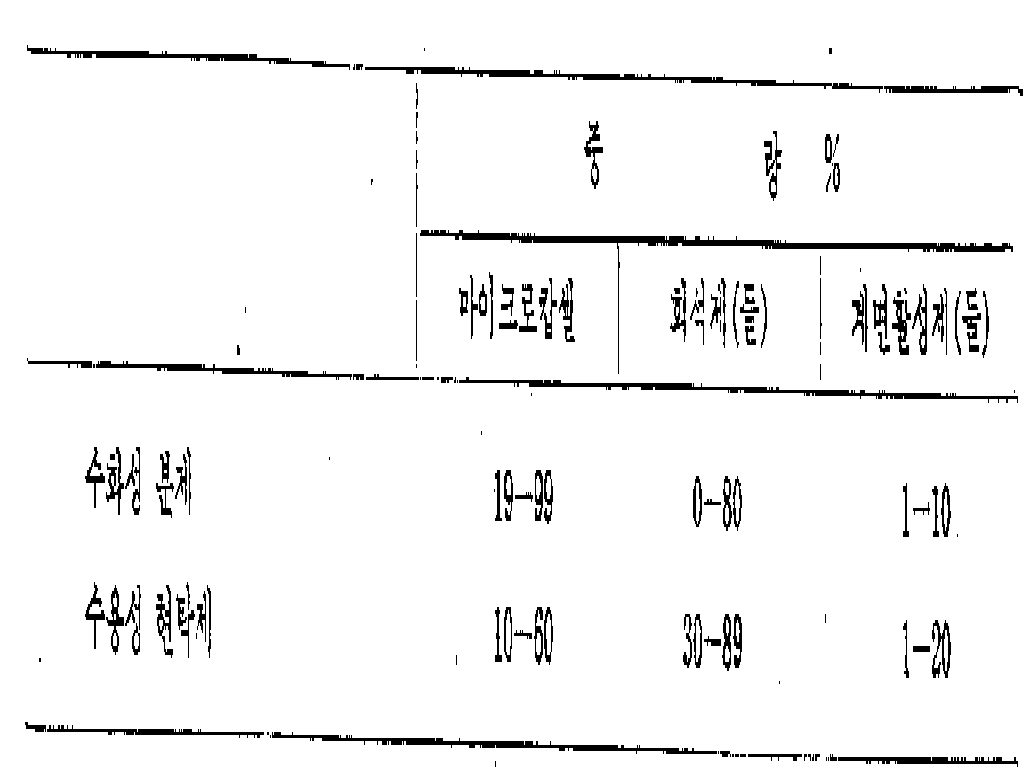
*마이크로 캅셀의 중량에 계면활성제 또는 희석제하나 이상의 중량을 더하면 100중량 %와 같다.* The weight of the microcapsule plus one or more of the surfactant or diluent is equal to 100% by weight.
가끔 활성성분에 대한 계면활성제의 더 높은 비율이 바람직하며, 이것은 제형과 결합시키거나 탱크에서 혼합하여 이루어진다.Sometimes a higher ratio of surfactant to active ingredient is desired, which is achieved by combining with the formulation or mixing in a tank.
대표적인 고체 희석제는 문헌[Watkins et al, “Handbook of Insecticide Dust Diluents and Carriers”, 2nd Ed n., Dorland Books, Caldwell, N.J.]에 기술되어 있다. 본 발명의 수화성 분제에는 더욱 미세하게 분할된 희석제가 바람직하다. 물이 바람직한 액체 희석제이지만, 알콜, 글리콜 또는 케톤과 같은 다른 수용성 물질을 함유시켜 동결 저항성을 개선시킬수 있고, 예를들면 메탄올, 에탄올, 프로필렌 글리콜, 아세톤등이 있다. 에계[“McCutcheon′s Detergents and Emlsifiers Annual”, McCutcheon Division, MC Publishing Co., Ridgewood, New Jersey, 및 Sisely and Wood. “Encyclopedia of Surface Active Agents”, Chemical Publ. Co., Inc., New York, 1964] 면활성제가 기재되어 있으며, 사용하도록 추천되었다. 모든 제형은 포움, 케이킹, 부식, 미생물 성장 등을 감소시키고 또는 pH 를 완충시키기 위해 소량의 첨가제를 함유할 수 있다.Representative solid diluents are described in Watkins et al, “Handbook of Insecticide Dust Diluents and Carriers,” 2nd Ed n., Dorland Books, Caldwell, N.J. More finely divided diluents are preferred for the water-soluble powder of the present invention. Water is the preferred liquid diluent, but it can contain other water-soluble substances such as alcohols, glycols or ketones to improve freeze resistance, such as methanol, ethanol, propylene glycol, acetone and the like. "CcCutcheon's Detergents and Emlsifiers Annual", McCutcheon Division, MC Publishing Co., Ridgewood, New Jersey, and Sisely and Wood. "Encyclopedia of Surface Active Agents", Chemical Publ. Co., Inc., New York, 1964] surfactants are described and recommended for use. All formulations may contain small amounts of additives to reduce foam, caking, corrosion, microbial growth, etc. or to buffer pH.
이러한 조성물의 제조방법은 잘 알려져 있다. 미세 고체 조성물은 혼합하여 제조한다.Methods of making such compositions are well known. Fine solid compositions are prepared by mixing.
수용성 현탁제는 가온 및 또는 슬러리에 공기 또는 질소를 통과시킴에 의해, 염화 메틸렌을 제거하여 건조된 마이크로캅셀을 분리하지 않고 캅셀화 슬러리로 부터 직접 수득할 수 있다. 다음에 원하는 추가의 희석제 또는 계면활성제를 가할 수 있다.Water-soluble suspending agents can be obtained directly from the encapsulating slurry without removing methylene chloride to separate the dried microcapsules by heating or or passing air or nitrogen through the slurry. Additional desired diluents or surfactants may then be added.
제형의 분야에서 숙련된 사람에게는 상기 제형이 단지 제형의 대표적인 예이며, 다른 생성물형도 가능하다는 것이 명백하다.It is clear to those skilled in the art of formulation that the formulation is merely a representative example of the formulation and that other product types are possible.
다음 실시예에 있어서, 성분 비율은 중량에 의한 것이다.In the following examples, the component proportions are by weight.
[실시예 6]Example 6
수화성 분제Water-soluble powder
메토밀 마이크로 캅셀 40% 저점도 메틸 셀룰로오즈 1.5%Metomil Microcapsules 40% Low Viscosity Methyl Cellulose 1.5%
디옥틸 나트륨 설포석시네이트 1.5% 애타펄자이트 54%Dioctyl Sodium Sulfosuccinate 1.5% Attapulgite 54%
나트륨 리그닌 설포네이트 3%Sodium Lignin Sulfonate 3%
성분들을 완전히 혼합하고, 포장하기전에 U.S.S. 50호체(0.3mm오프닝)를 통하여 거른다. 원하는 경우에 마이크로캅셀을 제외한 모든 성분들은 햄머 또는 유체에너지밀로 분쇄하여 이들 성분의 입자크기를 감소시킬 수 있다. 다음에 마이크로캅셀을 이 분쇄 예비 혼합물내에 혼합할 수 있다.Completely mix the ingredients and before packing Filter through No. 50 body (0.3 mm opening). If desired, all components except microcapsules can be ground with a hammer or fluid energy mill to reduce the particle size of these components. Microcapsules can then be mixed into this ground premix.
[실시예 7]Example 7
수화성 분제Water-soluble powder
메토밀 마이크로캅셀 96% 나트륨 리그닐설포네이트 2%Metomil Microcapsules 96% Sodium LignylSulfonate 2%
나트륨 알칼나프탈렌 설포네이트 2%Sodium Alkalnaphthalene Sulfonate 2%
성분들을 완전히 혼합하여, 포장하기 전에 U.S.S. 50호체(0.3mm오프닝)를 통하여 거른다.Completely mix the ingredients so that U.S.S. Filter through No. 50 body (0.3 mm opening).
용도Usage
본 발명의 마이크로캅셀은 메토밀, 옥사밀 및 메토밀과 전술한 다른 살충제와의 혼합물에 의해 억제되는 곤충 및 선충의 방제를 위해 농업용으로 유용하다. 다음 실시예에서 설명하는 바와 같이, 개선된 잔유 살충성 및 살선충성 및 감소된 식물독성이 서방출성 메토밀 마이크로캅셀로 얻어진다.The microcapsules of the present invention are useful for agriculture for the control of insects and nematodes inhibited by a mixture of metomil, oxamil and metomil with other pesticides described above. As demonstrated in the following examples, improved residual pesticidal and nematicidal and reduced phytotoxicity are obtained with slow-release metomil microcapsules.
곤충은 마이크로캅셀을 침습 병소, 보호되어야 하는 지역 또는 해충 자체에 적용함으로써 방제된다. 농작물에 대한 곤충을 방제하기 위해서는, 일반적으로 마이크로캅셀을 잎 또는 침습되었거나 보호되어야 하는식물의 다른 부위에 적용한다. 적용되는 유효량은 사용된 특정 화합물, 방제되는 곤충종, 곤충의 생활기 크기 및 위치, 강우량, 계절, 습도, 온도, 토양형, 처리되는 지역의 %, 적용 형태 및 다른 여러 용인에 따라 좌우된다. 일반적으로, 선충의 방제를 위해서는 헥타아르당 활성성분 3내지 30㎏이 필요할 수 있으며, 대부분의 경우에는 일반적으로 헥타아르당 5내지 10㎏으로 충분하다.Insects are controlled by applying microcapsules to invasive lesions, areas to be protected, or the pests themselves. In order to control insects on crops, microcapsules are generally applied to leaves or other parts of plants that are invasive or to be protected. The effective amount applied depends on the specific compound used, the insect species being controlled, the size and location of the insect's life stage, rainfall, season, humidity, temperature, soil type,% of area treated, application type and many other tolerances. In general, 3 to 30 kg of active ingredient per hectare may be required for the control of nematodes, and in most cases, 5 to 10 kg per hectare is sufficient.
메토밀 마이크로캅셀은 선행기술 화합물을 능가하는 뚜렷한 이점을 가지고 있다. 예를들어, 이들의 개선된 잔유 살충성 및 살선충성은 경제적인 부담이 큰, 짧은 간격을 둔 수회 적용의 필요성을 감소시킬 수 있으며, 환경에 대한 살충제의 오염을 감소시킨다. 이들은 또한, 이러한 방법으로 적용된 살충제의 식물에 대한 손상발현을 감소시킨다. 이 형태의 특이한 이점은 목화에 대한 감소된 부작용이다. 처리된 잎들은 녹색을 유지하였고, 동일한 살충제를 다른 형태로 적용했을때 나타날 수 있는 적화 현상이 나타나지 않았다.Methyl microcapsules have distinct advantages over prior art compounds. For example, their improved residual pesticides and nematicides can reduce the need for short intervals of multiple applications, which are economically burdensome, and reduce the contamination of pesticides to the environment. They also reduce the onset of damage to plants of pesticides applied in this way. A particular advantage of this form is the reduced side effects on cotton. The treated leaves remained green and did not exhibit any reddening that could occur when the same pesticide was applied in different forms.
본 발명의 마이크로캅샐은 최소의 시간, 노력 및 물질을 소비하여 원하는 결과를 얻기 위해, 살진균제 살균제, 살비제 및 다른 살선충제, 살충제, 또는 생물학적으성 활로인 화합물과 혼합할 수 있다. 본 발명조성물의 각 중량부에 가해지는 이들 생물학적으로 활성인 물질의 양은 0.05내지 25중량 %로 변화할 수 있다.The microcapsules of the present invention can be mixed with fungicide fungicides, acaricides and other nematicides, insecticides, or biologically active compounds, in order to achieve the desired results with minimal time, effort and material. The amount of these biologically active substances added to each part of the composition of the present invention may vary from 0.05 to 25% by weight.
본 발명의 마이크로캅셀은 또한 적용한 후 즉시 캅셀화에 의해 유도된 개선된 잔유 살충성또는 살선충성으로 증진된 효과를 얻기 위해, 캅셀화하지 않은 메토밀, 옥사밀 또는 다른 살충제 또는 살선충제와 혼합할수 있다. 이러한 혼합물은 결합된 단일 포장 생성물의 형태를 이룰 수 있으며, 또는 이들은 분부 탱크내에서 탱크 혼합하여 형성될 수 있다. 캅셀화 활성 성분에 대한 캅셀화하지 않은 활성성분의 비율은 광범하게 변화할 수 있지만 일반적으로는 1 : 10내지 10 :10이다The microcapsules of the present invention are also mixed with unencapsulated metomil, oxamil or other pesticides or nematicides, in order to obtain an enhanced effect with improved residual pesticidal or nematode induced by encapsulation immediately after application. can do. Such mixtures may take the form of a combined single packaged product, or they may be formed by tank mixing in a split tank. The ratio of the unencapsulated active ingredient to the encapsulating active ingredient may vary widely but is generally from 1:10 to 10:10.
[실시예 8]Example 8
2엽기에 있는 붉은 강낭콩 식물의 잎에 여러 농도의 본 발명 마이크로하셀의 분산액을 흐르도록 분무한다. 분산액은 마이크로캅셀의 적절하게 평량된 양을 나트륨 라우릴 설페이이트(Duponol

*활성 성분은 분무중의 메토밀 농도를 말한다.* Active ingredient refers to the concentration of metomil in the spray.
[실시예 9]Example 9
5개 내지 6개의 진엽을 가진 약 30㎝키의 화분에 심은 목화식물에 500ppm의 본 발명의 다음 마이크로캅셀제형의 수용성 분산액을 흐르도록 분무한다. 분무액은 1 : 500농도의 계면활성제(Duponol
마이크로캅셀 제형(500ppm AI )1평가2(8일) 마이크로캅셀 제형 평가일Microcapsule Formulation (500ppm AI) 1 Evaluation 2 (8 days) Microcapsule Formulation Date of Evaluation
시험 AExam A
실시예 1 0 캅셀화하지 않은 메토밀 5RExample 1 0 Uncapsulated Metomil 5R
실시예 3 3R 비처리 대조군 0Example 3 3R Untreated Control 0
시험 BExam B
실시예 2 0.2R 비처리 대조군 0Example 2 0.2R Untreated Control 0
캅셀화하지 않은 메토밀 4RMethylyl 4R without encapsulation
시험 CExam C
실시예 4 0 비처리 대조군 0Example 4 0 Untreated Control 0
캅셀화하지 않은 메토밀 3RMethylyl 3R without encapsulation
시 험 DTest D
실시예 5 0.25R 비처리 대조군 0Example 5 0.25R Untreated Control 0
캅셀화하지 않은 메토밀 4R 4RMethylyl 4R 4R without capsules
주) 1. AI-활성 성분(메토밀)Note 1) AI-active ingredient (methomyl)
2. “R”은 대표적인 메토밀 효과, 즉 노엽의 단풍, 어린잎의 약간 움츠러드는 것과 검은 반점을 나타낸다. 평가는 0내지 10을 기초로 하며 10은 잎의 전체 면적이 침습 당한 것을 나타낸다.2. “R” shows the typical metomil effect, that is, the foliage of young leaves, the slight withdrawal of young leaves and the black spots. The evaluation is based on 0 to 10, with 10 indicating that the entire area of the leaf has been invaded.
Claims (1)
Applications Claiming Priority (2)
| Application Number | Priority Date | Filing Date | Title |
|---|---|---|---|
| US4219179A | 1979-05-29 | 1979-05-29 | |
| US42191 | 1979-05-29 |
Publications (2)
| Publication Number | Publication Date |
|---|---|
| KR830000843A KR830000843A (en) | 1983-04-28 |
| KR830001488B1 true KR830001488B1 (en) | 1983-08-03 |
Family
ID=21920545
Family Applications (1)
| Application Number | Title | Priority Date | Filing Date |
|---|---|---|---|
| KR1019790002648A Expired KR830001488B1 (en) | 1979-05-29 | 1979-08-03 | Method of Making Insecticide Composition |
Country Status (1)
| Country | Link |
|---|---|
| KR (1) | KR830001488B1 (en) |
-
1979
- 1979-08-03 KR KR1019790002648A patent/KR830001488B1/en not_active Expired
Also Published As
| Publication number | Publication date |
|---|---|
| KR830000843A (en) | 1983-04-28 |
Similar Documents
| Publication | Publication Date | Title |
|---|---|---|
| EP0008207B1 (en) | Insecticidal compositions, and preparation and use thereof | |
| AP926A (en) | Microencapsulated Compositions | |
| CN102413683B (en) | Microencapsulated insecticide formulations | |
| DK149341B (en) | PROCEDURE FOR ENCAPPING HYDROPHOPHIC SUBSTANCES BY INTERFACE POLICY CONDENSATION | |
| US4235872A (en) | Microencapsulated methomyl insecticide | |
| US6133197A (en) | Microencapsulated compositions | |
| KR20010015572A (en) | Microcapsules with readily adjustable release rates | |
| PL196973B1 (en) | Acid-triggered release microcapsules | |
| CS249110B2 (en) | Method of water non-miscible substance encapsulation | |
| HU215771B (en) | Capsules containing herbicidal 2-chloro-n-(ethoxymetil)-6'-ethyl-o-acetotoluidide and process for producing thereof | |
| PL198545B1 (en) | Base-triggered release microcapsules | |
| CN107529756B (en) | Agricultural formulation with microcapsules of sulfonate and co-dispersant | |
| Koestler | Microencapsulation by interfacial polymerization techniques—Agricultural applications | |
| JP2532894B2 (en) | Microencapsulated bactericide | |
| US20020068169A1 (en) | Acid-triggered microcapsules | |
| KR20110132354A (en) | Microencapsulated Pesticides with Improved Residual Activity | |
| KR850001266B1 (en) | Methods for pesticide composition having a reduced toxity against plants | |
| KR830001488B1 (en) | Method of Making Insecticide Composition | |
| JPH05504776A (en) | Impregnated porous granules for controlled release of liquid substances and methods for their preparation | |
| US5700475A (en) | Stabilized pesticidal compositions and their use | |
| KR930002952B1 (en) | Micro Encapsulated Acetochlor | |
| Koestler | TECHNIQUES–AGRICULTURAL APPLICATIONS | |
| KR100481932B1 (en) | Microencapsulated Compositions | |
| RU99123179A (en) | CAPSULATION METHOD AND CAPSULATED PRODUCTS | |
| MXPA00002307A (en) | Microcapsules with readily adjustable release rates |
Legal Events
| Date | Code | Title | Description |
|---|---|---|---|
| PA0109 | Patent application |
Patent event code: PA01091R01D Comment text: Patent Application Patent event date: 19790803 |
|
| PE0902 | Notice of grounds for rejection |
Comment text: Notification of reason for refusal Patent event date: 19820908 Patent event code: PE09021S01D |
|
| PG1501 | Laying open of application | ||
| PG1605 | Publication of application before grant of patent |
Comment text: Decision on Publication of Application Patent event code: PG16051S01I Patent event date: 19830701 |
|
| PE0701 | Decision of registration |
Patent event code: PE07011S01D Comment text: Decision to Grant Registration Patent event date: 19831018 |
|
| PC1904 | Unpaid initial registration fee |