KR20250107249A - Polyoxyalkylene-1,2-dimyristoyl-glycerol compound wherein the polyoxyalkylene is a poly(ethylene oxide) having a C1 to C3-alkyloxymethyl side chain - Google Patents
Polyoxyalkylene-1,2-dimyristoyl-glycerol compound wherein the polyoxyalkylene is a poly(ethylene oxide) having a C1 to C3-alkyloxymethyl side chain Download PDFInfo
- Publication number
- KR20250107249A KR20250107249A KR1020257019267A KR20257019267A KR20250107249A KR 20250107249 A KR20250107249 A KR 20250107249A KR 1020257019267 A KR1020257019267 A KR 1020257019267A KR 20257019267 A KR20257019267 A KR 20257019267A KR 20250107249 A KR20250107249 A KR 20250107249A
- Authority
- KR
- South Korea
- Prior art keywords
- saturated
- compound
- hydrocarbon group
- rna
- chain
- Prior art date
- Legal status (The legal status is an assumption and is not a legal conclusion. Google has not performed a legal analysis and makes no representation as to the accuracy of the status listed.)
- Pending
Links
Images


Classifications
-
- C—CHEMISTRY; METALLURGY
- C08—ORGANIC MACROMOLECULAR COMPOUNDS; THEIR PREPARATION OR CHEMICAL WORKING-UP; COMPOSITIONS BASED THEREON
- C08G—MACROMOLECULAR COMPOUNDS OBTAINED OTHERWISE THAN BY REACTIONS ONLY INVOLVING UNSATURATED CARBON-TO-CARBON BONDS
- C08G65/00—Macromolecular compounds obtained by reactions forming an ether link in the main chain of the macromolecule
- C08G65/02—Macromolecular compounds obtained by reactions forming an ether link in the main chain of the macromolecule from cyclic ethers by opening of the heterocyclic ring
- C08G65/32—Polymers modified by chemical after-treatment
- C08G65/329—Polymers modified by chemical after-treatment with organic compounds
- C08G65/331—Polymers modified by chemical after-treatment with organic compounds containing oxygen
-
- A—HUMAN NECESSITIES
- A61—MEDICAL OR VETERINARY SCIENCE; HYGIENE
- A61K—PREPARATIONS FOR MEDICAL, DENTAL OR TOILETRY PURPOSES
- A61K9/00—Medicinal preparations characterised by special physical form
- A61K9/48—Preparations in capsules, e.g. of gelatin, of chocolate
- A61K9/50—Microcapsules having a gas, liquid or semi-solid filling; Solid microparticles or pellets surrounded by a distinct coating layer, e.g. coated microspheres, coated drug crystals
- A61K9/51—Nanocapsules; Nanoparticles
- A61K9/5107—Excipients; Inactive ingredients
- A61K9/5123—Organic compounds, e.g. fats, sugars
-
- C—CHEMISTRY; METALLURGY
- C07—ORGANIC CHEMISTRY
- C07C—ACYCLIC OR CARBOCYCLIC COMPOUNDS
- C07C69/00—Esters of carboxylic acids; Esters of carbonic or haloformic acids
- C07C69/02—Esters of acyclic saturated monocarboxylic acids having the carboxyl group bound to an acyclic carbon atom or to hydrogen
- C07C69/22—Esters of acyclic saturated monocarboxylic acids having the carboxyl group bound to an acyclic carbon atom or to hydrogen having three or more carbon atoms in the acid moiety
- C07C69/30—Esters of acyclic saturated monocarboxylic acids having the carboxyl group bound to an acyclic carbon atom or to hydrogen having three or more carbon atoms in the acid moiety esterified with trihydroxylic compounds
-
- C—CHEMISTRY; METALLURGY
- C07—ORGANIC CHEMISTRY
- C07D—HETEROCYCLIC COMPOUNDS
- C07D201/00—Preparation, separation, purification or stabilisation of unsubstituted lactams
-
- C—CHEMISTRY; METALLURGY
- C08—ORGANIC MACROMOLECULAR COMPOUNDS; THEIR PREPARATION OR CHEMICAL WORKING-UP; COMPOSITIONS BASED THEREON
- C08G—MACROMOLECULAR COMPOUNDS OBTAINED OTHERWISE THAN BY REACTIONS ONLY INVOLVING UNSATURATED CARBON-TO-CARBON BONDS
- C08G65/00—Macromolecular compounds obtained by reactions forming an ether link in the main chain of the macromolecule
- C08G65/02—Macromolecular compounds obtained by reactions forming an ether link in the main chain of the macromolecule from cyclic ethers by opening of the heterocyclic ring
- C08G65/26—Macromolecular compounds obtained by reactions forming an ether link in the main chain of the macromolecule from cyclic ethers by opening of the heterocyclic ring from cyclic ethers and other compounds
-
- C—CHEMISTRY; METALLURGY
- C08—ORGANIC MACROMOLECULAR COMPOUNDS; THEIR PREPARATION OR CHEMICAL WORKING-UP; COMPOSITIONS BASED THEREON
- C08G—MACROMOLECULAR COMPOUNDS OBTAINED OTHERWISE THAN BY REACTIONS ONLY INVOLVING UNSATURATED CARBON-TO-CARBON BONDS
- C08G65/00—Macromolecular compounds obtained by reactions forming an ether link in the main chain of the macromolecule
- C08G65/02—Macromolecular compounds obtained by reactions forming an ether link in the main chain of the macromolecule from cyclic ethers by opening of the heterocyclic ring
- C08G65/32—Polymers modified by chemical after-treatment
- C08G65/329—Polymers modified by chemical after-treatment with organic compounds
-
- C—CHEMISTRY; METALLURGY
- C08—ORGANIC MACROMOLECULAR COMPOUNDS; THEIR PREPARATION OR CHEMICAL WORKING-UP; COMPOSITIONS BASED THEREON
- C08G—MACROMOLECULAR COMPOUNDS OBTAINED OTHERWISE THAN BY REACTIONS ONLY INVOLVING UNSATURATED CARBON-TO-CARBON BONDS
- C08G65/00—Macromolecular compounds obtained by reactions forming an ether link in the main chain of the macromolecule
- C08G65/02—Macromolecular compounds obtained by reactions forming an ether link in the main chain of the macromolecule from cyclic ethers by opening of the heterocyclic ring
- C08G65/32—Polymers modified by chemical after-treatment
- C08G65/329—Polymers modified by chemical after-treatment with organic compounds
- C08G65/333—Polymers modified by chemical after-treatment with organic compounds containing nitrogen
-
- C—CHEMISTRY; METALLURGY
- C08—ORGANIC MACROMOLECULAR COMPOUNDS; THEIR PREPARATION OR CHEMICAL WORKING-UP; COMPOSITIONS BASED THEREON
- C08L—COMPOSITIONS OF MACROMOLECULAR COMPOUNDS
- C08L63/00—Compositions of epoxy resins; Compositions of derivatives of epoxy resins
- C08L63/10—Epoxy resins modified by unsaturated compounds
-
- C—CHEMISTRY; METALLURGY
- C08—ORGANIC MACROMOLECULAR COMPOUNDS; THEIR PREPARATION OR CHEMICAL WORKING-UP; COMPOSITIONS BASED THEREON
- C08L—COMPOSITIONS OF MACROMOLECULAR COMPOUNDS
- C08L71/00—Compositions of polyethers obtained by reactions forming an ether link in the main chain; Compositions of derivatives of such polymers
-
- C—CHEMISTRY; METALLURGY
- C12—BIOCHEMISTRY; BEER; SPIRITS; WINE; VINEGAR; MICROBIOLOGY; ENZYMOLOGY; MUTATION OR GENETIC ENGINEERING
- C12N—MICROORGANISMS OR ENZYMES; COMPOSITIONS THEREOF; PROPAGATING, PRESERVING, OR MAINTAINING MICROORGANISMS; MUTATION OR GENETIC ENGINEERING; CULTURE MEDIA
- C12N15/00—Mutation or genetic engineering; DNA or RNA concerning genetic engineering, vectors, e.g. plasmids, or their isolation, preparation or purification; Use of hosts therefor
- C12N15/09—Recombinant DNA-technology
- C12N15/87—Introduction of foreign genetic material using processes not otherwise provided for, e.g. co-transformation
- C12N15/88—Introduction of foreign genetic material using processes not otherwise provided for, e.g. co-transformation using microencapsulation, e.g. using amphiphile liposome vesicle
Landscapes
- Chemical & Material Sciences (AREA)
- Health & Medical Sciences (AREA)
- Organic Chemistry (AREA)
- Medicinal Chemistry (AREA)
- Engineering & Computer Science (AREA)
- Bioinformatics & Cheminformatics (AREA)
- Genetics & Genomics (AREA)
- Life Sciences & Earth Sciences (AREA)
- Polymers & Plastics (AREA)
- Chemical Kinetics & Catalysis (AREA)
- Biomedical Technology (AREA)
- Biotechnology (AREA)
- General Engineering & Computer Science (AREA)
- Wood Science & Technology (AREA)
- Zoology (AREA)
- Physics & Mathematics (AREA)
- General Chemical & Material Sciences (AREA)
- General Health & Medical Sciences (AREA)
- Biochemistry (AREA)
- Nanotechnology (AREA)
- Optics & Photonics (AREA)
- Microbiology (AREA)
- Pharmacology & Pharmacy (AREA)
- Epidemiology (AREA)
- Animal Behavior & Ethology (AREA)
- Public Health (AREA)
- Veterinary Medicine (AREA)
- Plant Pathology (AREA)
- Molecular Biology (AREA)
- Biophysics (AREA)
- Pharmaceuticals Containing Other Organic And Inorganic Compounds (AREA)
- Medicinal Preparation (AREA)
- Medicines That Contain Protein Lipid Enzymes And Other Medicines (AREA)
- Polyethers (AREA)
- Organic Low-Molecular-Weight Compounds And Preparation Thereof (AREA)
Abstract
본 발명은 신규한 폴리옥시알킬렌 기재 화합물 및 그의 제조 방법 뿐만 아니라 적어도 1종의 신규한 폴리옥시알킬렌 기재 화합물 및 적어도 1종의 활성 작용제를 포함하는 조성물에 관한 것이다. 또한, 본 발명은 본 발명의 조성물의 제조 뿐만 아니라 포유동물 또는 인간의 질병의 치료를 위한 그의 용도에 관한 것이다.The present invention relates to novel polyoxyalkylene-based compounds and processes for their preparation, as well as compositions comprising at least one novel polyoxyalkylene-based compound and at least one active agent. The present invention also relates to the preparation of the compositions of the present invention, as well as their use for the treatment of diseases in mammals or humans.
Description
본 발명은 신규한 폴리옥시알킬렌 기재 화합물 및 그의 제조 방법 뿐만 아니라 적어도 1종의 신규한 폴리옥시알킬렌 기재 화합물 및 적어도 1종의 활성 작용제를 포함하는 조성물에 관한 것이다. 특히, 화합물은 다른 지질 구성요소를 임의적으로 함유할 수 있는 지질 나노입자로서 적합한 조성물에 사용될 수 있는 신규한 지질로서 적합하다. 조성물은 적어도 1종의 활성 작용제를 위한, 특히 치료용 핵산의 세포내 전달을 용이하게 하기 위한 전달 비히클로서 적합하다.The present invention relates to novel polyoxyalkylene-based compounds and processes for their preparation, as well as to compositions comprising at least one novel polyoxyalkylene-based compound and at least one active agent. In particular, the compounds are suitable as novel lipids which can be used in compositions suitable as lipid nanoparticles which may optionally contain other lipid components. The compositions are suitable as delivery vehicles for at least one active agent, particularly for facilitating intracellular delivery of therapeutic nucleic acids.
폴리에틸렌 옥시드 (PEO)를 기재로 하는 지질은 중요한 부형제 부류이다. 이러한 지질에 관한 초기 간행물은 문헌 [Frisch et al., Bioconjugate Chemistry (2004), 15(4), 754-764]을 포함한다. 이들은 지질 나노입자 제형 예를 들어 Covid-19 백신에 사용된다. PEO의 주요 기능은 환자의 세망내피계에 의한 인식을 회피하는, 소위 "스텔스 효과"이다. PEO의 중대한 우려사항은, 예를 들어 문헌 [J. Selva et al., ACS Nano (2022), 16(8), 11769-11780]에 개시된 바와 같이, 항-PEO 항체의 형성을 유도할 수 있는 환자 신체의 면역 반응이다. 항-PEO 항체는 목적하는 "스텔스 효과"의 상실, 약물의 기능 상실, 및 알레르기 반응을 유발할 수 있다.Lipids based on polyethylene oxide (PEO) are an important class of excipients. Early publications on these lipids include Frisch et al., Bioconjugate Chemistry (2004), 15(4), 754-764. They are used in lipid nanoparticle formulations, e.g., in Covid-19 vaccines. A major function of PEOs is the so-called “stealth effect”, which evades recognition by the patient’s reticuloendothelial system. A major concern with PEOs is the immune response of the patient’s body, which can induce the formation of anti-PEO antibodies, as disclosed, e.g., in J. Selva et al., ACS Nano (2022), 16(8), 11769-11780. Anti-PEO antibodies can result in loss of the desired “stealth effect”, loss of drug function, and allergic reactions.
따라서, "스텔스 효과"를 보유하지만, 항체의 형성, 즉, 면역원성 잠재능을 덜 나타내거나 또는 전혀 나타내지 않는 대안의 화합물이 요구된다.Therefore, alternative compounds are needed that possess the "stealth effect" but exhibit less or no antibody formation, i.e., immunogenic potential.
본 발명의 발명자들은 놀랍게도 PEO와는 상이한 폴리옥시알킬렌 단위를 보유하는, 본 발명에 따른 특정한 폴리옥시알킬렌 기재 화합물에 의해 상기 언급된 목적이 해결될 수 있다는 것을 밝혀내었다. 게다가, 수득된 화합물은 놀랍게도 유사한 통상의 PEO 지질과 비교하여 더 우수한 저장 안정성을 제시한다.The inventors of the present invention surprisingly found that the above-mentioned objects can be solved by a specific polyoxyalkylene-based compound according to the present invention, which has a polyoxyalkylene unit different from PEO. Furthermore, the obtained compound surprisingly exhibits a better storage stability compared to similar conventional PEO lipids.
따라서, 제1 측면에서 본 발명은 하기 화학식 (I)을 갖는 화합물로서:Therefore, in a first aspect, the present invention provides a compound having the following chemical formula (I):

여기서 R1 및 R2는 서로 독립적으로 포화 또는 3개 이하의 -C=C- 결합을 갖는 불포화, 분지쇄 또는 직쇄 C3-C20 탄화수소 기 또는 -H로부터 선택되며, 단, R1 및 R2 중 적어도 하나는 -H가 아니고;wherein R 1 and R 2 are independently selected from a saturated or unsaturated, branched or straight-chain C 3 -C 20 hydrocarbon group having 3 or fewer -C=C- bonds or -H, provided that at least one of R 1 and R 2 is not -H;
여기서 R3은 폴리옥시알킬렌 기 A의 탄소 원자에 결합되고, 폴리옥시알킬렌 기 A는 산소 원자를 통해 R3의 반대 쪽의 나머지 분자에 결합되고;Here, R 3 is bonded to a carbon atom of the polyoxyalkylene group A, and the polyoxyalkylene group A is bonded to the remaining molecule on the opposite side of R 3 via an oxygen atom;
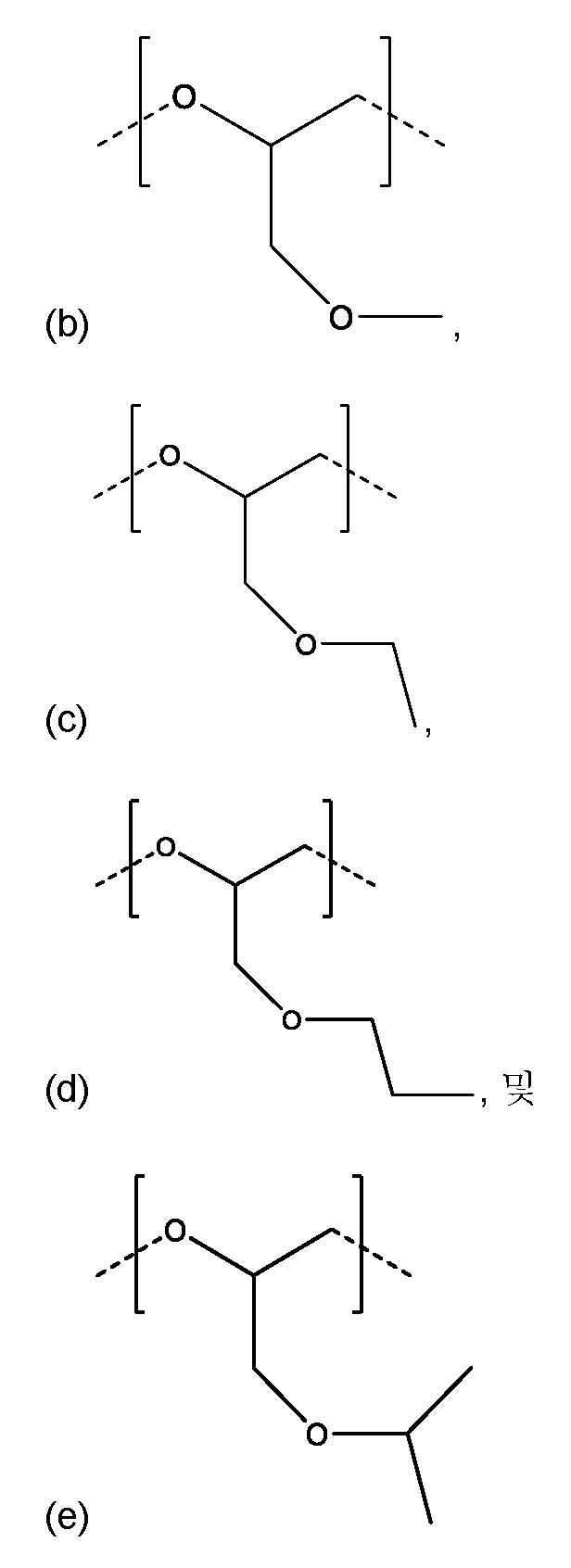
A는 적어도 하나의 하기 단위:A has at least one of the following units:

및 하기의 군으로부터 선택된 적어도 하나의 단위를 포함하는 폴리옥시알킬렌 기이고:and a polyoxyalkylene group comprising at least one unit selected from the group consisting of:

R3은 -H; -OH; -SH; -NH2; -NHR4, -NR4R5, -OR6, -SR6, 또는 20개 이하의 탄소 원자를 갖는 선형, 분지형 또는 고리형 알킬 기로부터 선택되고; 여기서R 3 is selected from -H; -OH; -SH; -NH 2 ; -NHR 4 , -NR 4 R 5 , -OR 6 , -SR 6 , or a linear, branched or cyclic alkyl group having 20 or fewer carbon atoms; wherein
R4 내지 R6은 독립적으로 20개 이하의 탄소 원자를 갖는 선형, 분지형 또는 고리형 알킬 기로부터 선택되며, 여기서 5개 이하의 탄소 원자는 산소 또는 황 원자로 치환될 수 있고;R 4 to R 6 are independently selected from linear, branched or cyclic alkyl groups having up to 20 carbon atoms, wherein up to 5 carbon atoms may be replaced by oxygen or sulfur atoms;
여기서 -A-R3은 1100 내지 7500 g/mol의 분자량을 갖는 것인Here, -AR 3 has a molecular weight of 1100 to 7500 g/mol.
화합물에 관한 것이다.It's about compounds.
제2 측면에서, 본 발명은 본 발명에 따른 화학식 (I)의 적어도 1종의 화합물 및 적어도 1종의 활성 작용제를 포함하는 조성물에 관한 것이다.In a second aspect, the present invention relates to a composition comprising at least one compound of formula (I) according to the present invention and at least one active agent.
제3 측면에서, 본 발명은 하기 단계를 포함하거나 또는 하기 단계로 이루어진, 본 발명에 따른 화학식 (I)의 화합물을 제조하는 방법에 관한 것이다:In a third aspect, the present invention relates to a process for preparing a compound of formula (I) according to the present invention, comprising or consisting of the following steps:
(i) A 및 R3이 화학식 (I)에서 정의된 바와 같은 것인 전구체 화합물 H-A-R3을 제공하는 단계;(i) providing a precursor compound HAR 3 wherein A and R 3 are as defined in formula (I);
(ii) -H를, 치환 반응을 진행할 수 있는 이탈기 -X로 대체하는 단계;(ii) a step of replacing -H with a leaving group -X capable of undergoing a substitution reaction;
(iii) 그 후에, X-A-R3과 

(iv) 이어서, 화합물 (III)을 양성자화하여 화합물 
(v) 그 후에, Y가 -OH 기의 -H와 에스테르화 반응을 진행할 수 있는 이탈기이고, R1 및 R2가 화학식 (I)에서 정의된 바와 같은 것인 

제4 측면에서, 본 발명은 본 발명에 따른 조성물을 제조하는 방법으로서, 본 발명에 따른 화학식 (I)의 적어도 1종의 화합물, 적어도 1종의 활성 작용제 및 임의적으로 추가의 성분을 제공하는 단계; 및 모든 성분을 조합하여 본 발명에 따른 조성물을 수득하는 단계를 포함하는 방법에 관한 것이다.In a fourth aspect, the present invention relates to a method for preparing a composition according to the present invention, comprising the steps of providing at least one compound of formula (I) according to the present invention, at least one active agent and optionally further ingredients; and combining all the ingredients to obtain a composition according to the present invention.
제5 측면에서, 본 발명은 인간의 질병의 치료를 위한 본 발명에 따른 조성물에 관한 것이다.In a fifth aspect, the present invention relates to a composition according to the present invention for the treatment of human diseases.
제6 측면에서, 본 발명은 포유동물의 질병의 치료를 위한 본 발명에 따른 조성물에 관한 것이다.In a sixth aspect, the present invention relates to a composition according to the present invention for the treatment of diseases in mammals.
본 발명의 이들 및 다른 측면, 실시양태, 특색, 및 이점은 하기 상세한 설명 및 청구범위의 검토를 통해 관련 기술분야의 통상의 기술자에게 명백해질 것이다. 본 발명의 한 측면으로부터의 임의의 특색은 본 발명의 임의의 다른 측면에서 사용될 수 있다. 게다가, 본원에 포함된 실시예는 본 발명을 제한하려는 것이 아니라 설명하고 예시하도록 의도된 것이며, 특히, 본 발명이 이들 실시예로 제한되지 않는다는 것이 용이하게 이해될 것이다.These and other aspects, embodiments, features, and advantages of the present invention will become apparent to those skilled in the art upon review of the following detailed description and claims. Any feature from one aspect of the present invention may be used in any other aspect of the present invention. Furthermore, the examples included herein are intended to illustrate and illustrate the invention rather than to limit it, and in particular, it will be readily understood that the invention is not limited to these examples.
도 1a: M: RNA 래더
도 1b: 상이한 PEO/GME-지질을 사용하여 제형화된 LNP의 아가로스 겔 전기영동 (AGE). 1: 자유 FLuc mRNA, 2: PEO2k-DMG LNP, 3: g(9).
도 2: 상이한 세포주에서 루시페라제 검정에 의해 평가된, 상이한 PEO/GME-지질을 사용하여 제형화된 LNP의 형질감염 효율.
도 3: 상이한 (1,2-디미리스토일-글리세롤) (DMG) 지질을 사용한 ELISA 검정. Figure 1a : M: RNA ladder
Figure 1b : Agarose gel electrophoresis (AGE) of LNPs formulated using different PEO/GME-lipids. 1: free FLuc mRNA, 2: PEO2k-DMG LNP, 3: g(9).
Figure 2 : Transfection efficiency of LNPs formulated using different PEO/GME-lipids as assessed by luciferase assay in different cell lines.
Figure 3 : ELISA assay using different (1,2-dimyristoyl-glycerol) (DMG) lipids.
본원에 사용된 하기 용어들은, 달리 명시되지 않는 한, 그에 부여된 의미를 갖는다.The following terms used herein have the meanings assigned to them, unless otherwise specified.
문맥상 달리 요구되지 않는 한, 본 명세서 및 청구범위 전반에 걸쳐, 단어 "포함하다" 및 그의 변형어, 예컨대, "포함한다", "포함하는", "함유한다" 및 "함유하는"은 개방적이고 포괄적인 의미로, 즉, "포함하나 이에 제한되지는 않는다"로 해석되어야 한다.Unless the context otherwise requires, throughout this specification and claims, the word “comprise” and variations thereof, such as “comprises,” “comprising,” “includes,” and “containing,” are to be construed in their open and inclusive sense, i.e., “including but not limited to.”
달리 정의되지 않는 한, 본원에 사용된 모든 기술 과학 용어는 관련 기술분야의 통상의 기술자에 의해 통상적으로 이해되는 것과 동일한 의미를 갖는다. 본 명세서 및 청구범위에 사용된 단수 형태는, 문맥이 달리 명백하게 지시하지 않는 한, 복수 지시대상을 포함한다.Unless otherwise defined, all technical and scientific terms used herein have the same meaning as commonly understood by one of ordinary skill in the art. As used in the specification and claims, the singular forms "a," "an," and "the" include plural referents unless the context clearly dictates otherwise.
"x 내지 y" 형식으로 지시된 수치 범위는 언급된 값을 또한 포함한다. 여러 개의 바람직한 수치 범위가 이러한 형식으로 지시된다면, 다양한 종점의 조합으로부터 얻어지는 모든 범위가 또한 포함된다는 것이 자명하다.A numerical range indicated in the format "x to y" also includes the stated values. If multiple preferred numerical ranges are indicated in this format, it is self-evident that all ranges resulting from combinations of the various endpoints are also included.
본원에 사용된 "하나 이상"은 적어도 하나를 나타내며, 1, 2, 3, 4, 5, 6, 7, 8, 9개 또는 그 초과의 언급된 종류를 포함한다. 마찬가지로, "적어도 하나"는 하나 이상, 즉, 1, 2, 3, 4, 5, 6, 7, 8, 9개 또는 그 초과를 의미한다. 임의의 구성요소와 관련하여 본원에 사용된 "적어도 1종"은 분자의 총수가 아니라, 화학적으로 상이한 분자의 수, 즉, 언급된 종류의 상이한 유형의 수를 나타낸다. 예를 들어, "적어도 1종의 치료제"는 치료제에 대한 정의에 포함되는 적어도 1종의 유형의 분자가 사용되며, 뿐만 아니라 해당 정의에 포함되는 2종 이상의 상이한 유형의 치료제도 존재할 수 있다는 것을 의미하지만, 단 1가지 유형의 치료제의 1개 이상의 분자가 존재한다는 것을 의미하지는 않는다.As used herein, "one or more" means at least one, and includes 1, 2, 3, 4, 5, 6, 7, 8, 9 or more of the mentioned kind. Likewise, "at least one" means one or more, i.e., 1, 2, 3, 4, 5, 6, 7, 8, 9 or more. As used herein, "at least one" with respect to any component refers not to the total number of molecules, but rather to the number of chemically different molecules, i.e., different types of the mentioned kind. For example, "at least one therapeutic agent" means that at least one type of molecule included in the definition of a therapeutic agent is used, and that two or more different types of therapeutic agents included in that definition may also be present, but does not mean that more than one molecule of only one type of therapeutic agent is present.
조성물과 관련하여 본원에 제공된 모든 백분율은, 달리 명백하게 언급되지 않는 한, 해당 조성물의 총 중량에 대한 wt.-%를 나타낸다.All percentages provided herein with respect to a composition represent wt.-% with respect to the total weight of the composition, unless expressly stated otherwise.
화합물과 관련하여 본 발명에 따른 "본질적으로 함유하지 않는다"는 것은 화합물이 조성물의 특징에 영향을 미치지 않는 양으로만 존재할 수 있다는 것을 의미하며, 특히 해당 화합물이 조성물의 총 중량을 기준으로 하여 3 wt.-%, 바람직하게는 1 wt.-%, 보다 바람직하게는 0.01 wt.-% 미만으로 존재하거나 또는 전혀 존재하지 않는다는 것을 의미한다.“Essentially free” according to the present invention in relation to a compound means that the compound may be present only in an amount which does not affect the characteristics of the composition, and in particular means that the compound is present in an amount of less than 3 wt.-%, preferably less than 1 wt.-%, more preferably less than 0.01 wt.-%, or not present at all, based on the total weight of the composition.
본원에 사용된 용어 "핵산(들)"은 단일- 또는 이중- 또는 삼중-가닥의 형태로 적어도 2개의 데옥시리보뉴클레오티드 또는 리보뉴클레오티드를 함유하는 화합물(들)을 지칭하며, DNA, RNA, 및 그의 혼성체를 포함한다. DNA는 안티센스 분자, 플라스미드 DNA (pDNA), 선형 또는 원형 DNA, PCR 산물, 또는 벡터의 형태일 수 있다. RNA는 자가-증폭 RNA (saRNA) 또는 소형 헤어핀 RNA (shRNA), 소형 간섭 RNA (siRNA), 화학적으로 변형된 또는 비변형된 메신저 RNA (mRNA), 안티센스 RNA, 적어도 하나의 코딩 서열을 포함하는 원형 RNA (circRNA), 마이크로 RNA (miRNA), micRNA, 다가 RNA, 전달 RNA (tRNA), 단일 가이드 RNA (sgRNA), 복제 RNA (repRNA), 다이서 기질 RNA 또는 바이러스 RNA (vRNA), 안티센스 올리고뉴클레오티드 (ASO), 이중-가닥 RNA (dsRNA) 및 그의 조합의 형태일 수 있다. 핵산은 참조 핵산과 유사한 결합 특성을 가지며 인공적인, 자연 발생된, 그리고 자연 발생되지 않은, 공지된 뉴클레오티드 유사체 또는 변형된 백본 잔기 또는 연결을 함유하는 핵산을 포함한다. 이러한 유사체의 예는, 비제한적으로, 포스포로티오에이트, 포스포르아미데이트, 메틸 포스포네이트, 키랄-메틸 포스포네이트, 2'-O-메틸 리보뉴클레오티드, 및 펩티드-핵산 (PNA)을 포함한다. 구체적으로 제한되지 않는 한, 상기 용어는 참조 핵산과 유사한 결합 특성을 갖는 천연 뉴클레오티드의 공지된 유사체를 함유하는 핵산을 포괄한다. 달리 지시되지 않는 한, 특정한 핵산 서열은 명시적으로 지시된 서열 뿐만 아니라, 또한 그의 보존적으로 변형된 변이체 (예를 들어, 축중성 코돈 치환), 대립유전자, 오르토로그, 단일 뉴클레오티드 다형체, 및 상보적 서열을 함축적으로 포괄한다.The term "nucleic acid(s)" as used herein refers to compound(s) containing at least two deoxyribonucleotides or ribonucleotides in single- or double- or triple-stranded form, including DNA, RNA, and hybrids thereof. The DNA can be in the form of an antisense molecule, plasmid DNA (pDNA), linear or circular DNA, a PCR product, or a vector. The RNA can be in the form of self-amplifying RNA (saRNA) or small hairpin RNA (shRNA), small interfering RNA (siRNA), chemically modified or unmodified messenger RNA (mRNA), antisense RNA, circular RNA (circRNA) comprising at least one coding sequence, micro RNA (miRNA), micRNA, multivalent RNA, transfer RNA (tRNA), single guide RNA (sgRNA), replicative RNA (repRNA), dicer substrate RNA or viral RNA (vRNA), antisense oligonucleotides (ASO), double-stranded RNA (dsRNA), and combinations thereof. Nucleic acids include nucleic acids containing known analogues of nucleotides or modified backbone residues or linkages, both artificial and naturally occurring, and non-naturally occurring, having similar binding properties to the reference nucleic acid. Examples of such analogues include, but are not limited to, phosphorothioates, phosphoramidates, methyl phosphonates, chiral-methyl phosphonates, 2'-O-methyl ribonucleotides, and peptide-nucleic acids (PNAs). Unless specifically limited, the term encompasses nucleic acids containing known analogues of natural nucleotides having similar binding properties to the reference nucleic acid. Unless otherwise indicated, a particular nucleic acid sequence implicitly encompasses not only the explicitly indicated sequence, but also conservatively modified variants thereof (e.g., degenerate codon substitutions), alleles, orthologs, single nucleotide polymorphisms, and complementary sequences.
용어 "지질"은, 지방산의 에스테르를 비제한적으로 포함하며, 일반적으로 물에서는 불량한 가용성을 갖지만 많은 유기 용매에 가용성인 것을 특징으로 하는 유기 화합물 군을 지칭한다. 이들은 통상적으로 적어도 3가지의 부류로 분류된다: (1) 지방 및 오일 뿐만 아니라 왁스를 포함한 "단순 지질"; (2) 인지질 및 당지질을 포함한 "복합 지질"; 및 (3) 스테로이드와 같은 "유도 지질".The term "lipids" refers to a group of organic compounds, including but not limited to esters of fatty acids, which are generally characterized by poor solubility in water but soluble in many organic solvents. They are usually classified into at least three classes: (1) "simple lipids", which include fats and oils as well as waxes; (2) "complex lipids", which include phospholipids and glycolipids; and (3) "derived lipids", such as steroids.
"양이온성 지질"은 양으로 하전될 수 있는 지질을 지칭한다. 예시적인 양이온성 지질은 양전하를 보유하는 1개 이상의 아민 기(들)를 포함한다. 바람직한 양이온성 지질은 이들이 pH에 따라 양으로 하전되거나 또는 중성 형태로 존재할 수 있도록 이온화가능하다. 양이온성 지질의 이온화는 상이한 pH 조건 하에 지질 나노입자의 표면 전하에 영향을 미친다."Cationic lipid" refers to a lipid that can be positively charged. Exemplary cationic lipids include one or more amine group(s) that carry a positive charge. Preferred cationic lipids are ionizable such that they can exist in either a positively charged or neutral form depending on the pH. Ionization of the cationic lipid affects the surface charge of the lipid nanoparticle under different pH conditions.
용어 "중성 지질"은 선택된 pH 값에서 비하전되거나 또는 중성인 쯔비터이온성 형태로 존재하는 다수의 지질 종류 중 어느 하나를 지칭한다.The term "neutral lipid" refers to any one of a number of lipid classes that exist in an uncharged or neutral zwitterionic form at a selected pH value.
용어 "이온화가능한 지질"은 유용한 생리학적 범위, 예를 들어, pH ~3 내지 pH ~9 내에서 pH에 상관없이 양으로 하전되거나 또는 음으로 하전된 형태로 존재하는 다수의 지질 종류 중 어느 하나를 지칭한다. 이온화가능한 지질은 합성 지질이거나 또는 자연 유래된 지질일 수 있다.The term "ionizable lipid" refers to any of a number of lipid classes that exist in either a positively charged or negatively charged form, independent of pH, within a useful physiological range, e.g., pH ~3 to pH ~9. An ionizable lipid can be a synthetic lipid or a naturally occurring lipid.
핵산과 같은 활성 작용제의 "유효량" 또는 "치료 유효량"은 목적하는 효과, 예를 들어, 핵산의 부재 하에 검출되는 보통의 발현 수준과 비교하여 표적 서열의 발현의 증가 또는 억제를 유발하기에 충분한 양이다. 표적 서열의 발현의 증가는, 핵산의 부재 하에서는 존재하지 않는 발현 산물의 경우에, 임의의 측정가능한 수준이 검출될 때 달성된다. 발현 산물이 핵산과의 접촉 전에도 어느 정도의 수준으로 존재하는 경우에는, 대조군에 비해 mRNA와 같은 핵산을 사용하여 획득된 값의 배수 증가가 약 1.05, 1.1, 1.2, 1.3, 1.4, 1.5, 1.75, 2, 2.5, 3, 4, 5, 6, 7, 8, 9, 10, 15, 20, 25, 30, 40, 50, 75, 100, 250, 500, 750, 1000, 5000, 10000, 또는 그 초과일 때 발현의 증가가 달성된다. 표적 유전자 또는 표적 서열의 발현의 억제는 대조군에 비해 안티센스 올리고뉴클레오티드와 같은 핵산을 사용하여 획득된 값이 약 95%, 90%, 85%, 80%, 75%, 70%, 65%, 60%, 55%, 50%, 45%, 40%, 35%, 30%, 25%, 20%, 15%, 10%, 5%, 또는 0%일 때 달성된다. 표적 유전자 또는 표적 서열의 발현을 측정하기 위한 적합한 검정은, 예를 들어, 관련 기술분야의 통상의 기술자에게 공지된 기술 예컨대 적합한 리포터 단백질의 도트 블롯, 노던 블롯, 계내 혼성화, ELISA, 면역침전, 효소 기능, 형광, 또는 발광을 사용하는 단백질 또는 RNA 수준의 검사, 뿐만 아니라 관련 기술분야의 통상의 기술자에게 공지된 표현형 검정을 포함한다.An "effective amount" or "therapeutically effective amount" of an active agent, such as a nucleic acid, is an amount sufficient to cause the desired effect, e.g., an increase or inhibition of expression of a target sequence, compared to the normal level of expression detected in the absence of the nucleic acid. An increase in expression of a target sequence is achieved when any measurable level of expression product is detected that is not present in the absence of the nucleic acid. An increase in expression is achieved when the fold increase in the value obtained using a nucleic acid, such as mRNA, over a control is about 1.05, 1.1, 1.2, 1.3, 1.4, 1.5, 1.75, 2, 2.5, 3, 4, 5, 6, 7, 8, 9, 10, 15, 20, 25, 30, 40, 50, 75, 100, 250, 500, 750, 1000, 5000, 10000, or more, where the expression product is present at some level prior to contact with the nucleic acid. Inhibition of expression of a target gene or target sequence is achieved when the value obtained using a nucleic acid, such as an antisense oligonucleotide, is about 95%, 90%, 85%, 80%, 75%, 70%, 65%, 60%, 55%, 50%, 45%, 40%, 35%, 30%, 25%, 20%, 15%, 10%, 5%, or 0% relative to a control. Suitable assays for measuring expression of a target gene or target sequence include, for example, techniques known to those of ordinary skill in the art, such as dot blot, northern blot, in situ hybridization, ELISA, immunoprecipitation, enzyme function, fluorescence, or luminescence of a suitable reporter protein, as well as testing for protein or RNA levels using phenotypic assays known to those of ordinary skill in the art.
본원에 개시된 개시내용은 또한 제약상 허용되는 염 및/또는 하나 이상의 원자가 상이한 원자 질량 또는 질량수를 갖는 원자에 의해 대체됨으로써 동위원소 표지된 것인, 화학식 (I)의 화합물의 모든 제약상 허용되는 화합물을 포괄하도록 의도된다. 개시된 화합물에 혼입될 수 있는 동위원소의 예는 수소, 탄소, 질소, 산소, 인, 플루오린, 염소, 및 아이오딘의 동위원소를 포함한다.The present disclosure is also intended to encompass pharmaceutically acceptable salts and/or all pharmaceutically acceptable compounds of the compound of formula (I) which are isotopically labeled whereby one or more atoms are replaced by an atom having a different atomic mass or mass number. Examples of isotopes that may be incorporated into the disclosed compounds include isotopes of hydrogen, carbon, nitrogen, oxygen, phosphorus, fluorine, chlorine, and iodine.
본원에 개시된 실시양태는 또한 본 발명에 따른 화합물의 생체내 대사 산물을 포괄하도록 의도된다. 이러한 산물은, 예를 들어, 투여된 화합물의 산화, 환원, 가수분해, 아미드화, 에스테르화 등으로부터, 주로 효소적 프로세스로 인해, 생성될 수 있다. 따라서, 본 개시내용의 실시양태는 본 개시내용의 화합물을 그의 대사 산물을 생성하기에 충분한 기간 동안 포유동물에게 투여하는 것을 포함하는 방법에 의해 생성된 화합물을 포함한다.The embodiments disclosed herein are also intended to encompass in vivo metabolic products of the compounds according to the invention. Such products may be produced, for example, by oxidation, reduction, hydrolysis, amidation, esterification, etc. of the administered compound, primarily due to enzymatic processes. Accordingly, embodiments of the present disclosure encompass compounds produced by a method comprising administering to a mammal a compound of the present disclosure for a period of time sufficient to produce a metabolic product thereof.
제약상 허용되는 염을 포함한, 본 발명의 화합물은 하나 이상의 입체중심을 함유할 수 있으며, 따라서 거울상이성질체, 부분입체이성질체, 및 절대 입체화학의 관점에서 (R)- 또는 (S)-로서, 또는 아미노산에 대해 (D)- 또는 (L)-로서 정의될 수 있는 그 외 다른 입체이성질체 형태를 발생시킬 수 있다. 본 발명은 모든 이러한 가능한 이성질체, 뿐만 아니라 그의 라세미 형태 및 광학적으로 순수한 형태를 포함하도록 의도된다. 광학 활성 (+) 및 (-), (R)- 및 (S)-, 또는 (D)- 및 (L)- 이성질체는 키랄 합성단위체 또는 키랄 시약을 사용하여 제조될 수 있거나, 또는 통상적인 기술, 예를 들어, 크로마토그래피 및 분별 결정화를 사용하여 분해될 수 있다. 개별 거울상이성질체의 제조/단리를 위한 통상적인 기술은 적합한 광학적으로 순수한 전구체로부터의 키랄 합성, 또는 예를 들어 키랄 고압 액체 크로마토그래피 (HPLC)를 사용하는 라세미체 (또는 염 또는 유도체의 라세미체)의 분해를 포함한다. 본원에 기재된 화합물이 올레핀계 이중 결합 또는 다른 기하학적 비대칭 중심을 함유하는 경우에, 달리 명시되지 않는 한, 화합물은 E 및 Z 기하 이성질체 둘 다를 포함하도록 의도된다. 마찬가지로, 모든 호변이성질체 형태가 또한 포함되도록 의도된다.The compounds of the present invention, including pharmaceutically acceptable salts, may contain one or more stereocenters and thus may give rise to enantiomers, diastereoisomers, and other stereoisomeric forms which may be defined in terms of absolute stereochemistry as (R)- or (S)-, or for amino acids as (D)- or (L)-. The present invention is intended to include all such possible enantiomers, as well as racemic and optically pure forms thereof. The optically active (+) and (-), (R)- and (S)-, or (D)- and (L)- isomers may be prepared using chiral synthetomers or chiral reagents, or may be resolved using conventional techniques, such as chromatography and fractional crystallization. Conventional techniques for the preparation/isolation of individual enantiomers include chiral synthesis from suitable optically pure precursors, or resolution of the racemate (or racemate of a salt or derivative) using, for example, chiral high pressure liquid chromatography (HPLC). When the compounds described herein contain an olefinic double bond or other center of geometric asymmetricity, unless otherwise specified, the compounds are intended to include both the E and Z geometric isomers. Likewise, all tautomeric forms are also intended to be included.
"입체이성질체"는 동일한 결합에 의해 결합된 동일한 원자로 구성되지만, 상호교환가능하지 않은 상이한 3차원 구조를 갖는 화합물을 지칭한다. 본 발명은 다양한 입체이성질체 및 그의 혼합물을 고려하며, 분자가 서로 중첩가능하지 않은 거울상인 2종의 입체이성질체를 지칭하는 "거울상이성질체"를 포함한다."Stereoisomers" refer to compounds that are composed of identical atoms joined by identical bonds, but have different, non-interchangeable three-dimensional structures. The present invention contemplates various stereoisomers and mixtures thereof, and includes "enantiomers" which refer to two stereoisomers whose molecules are non-superimposable mirror images of one another.
"호변이성질체"는 분자의 한 원자로부터 동일한 분자의 또 다른 원자로의 양성자 이동을 지칭한다. 본 개시내용은 임의의 상기 화합물의 호변이성질체를 포함한다."Tautomerism" refers to the transfer of a proton from one atom of a molecule to another atom of the same molecule. The present disclosure includes tautomers of any of the above compounds.
"제약상 허용되는 염"은 산 부가염 및 염기 부가염 둘 다를 포함한다.“Pharmaceutically acceptable salts” include both acid addition salts and base addition salts.
"제약상 허용되는 산 부가염"은, 유리 염기의 생물학적 유효성 및 특성을 보유하고, 생물학적으로 또는 그 외에도 바람직하지 않은 것이 아니며, 무기 산 예컨대, 비제한적으로, 염산, 브로민화수소산, 황산, 질산, 인산 등, 및 유기 산 예컨대, 비제한적으로, 아세트산, 2,2-디클로로아세트산, 아디프산, 알긴산, 아스코르브산, 아스파르트산, 벤젠술폰산, 벤조산, 4-아세트아미도벤조산, 캄포르산, 캄포르-10-술폰산, 카프르산, 카프로산, 카프릴산, 탄산, 신남산, 시트르산, 시클람산, 도데실황산, 에탄-1,2-디술폰산, 에탄술폰산, 2-히드록시에탄술폰산, 포름산, 푸마르산, 갈락타르산, 겐티스산, 글루코헵톤산, 글루콘산, 글루쿠론산, 글루탐산, 글루타르산, 2-옥소-글루타르산, 글리세로인산, 글리콜산, 히푸르산, 이소부티르산, 락트산, 락토비온산, 라우르산, 말레산, 말산, 말론산, 만델산, 메탄술폰산, 뮤신산, 나프탈렌-1,5-디술폰산, 나프탈렌-2-술폰산, 1-히드록시-2-나프토산, 니코틴산, 올레산, 오로트산, 옥살산, 팔미트산, 파모산, 프로피온산, 피로글루탐산, 피루브산, 살리실산, 4-아미노살리실산, 세바스산, 스테아르산, 숙신산, 타르타르산, 티오시안산, 톨루엔술폰산, 트리플루오로아세트산, 운데실렌산 등을 사용하여 형성된 염을 지칭한다."Pharmaceutically acceptable acid addition salts" are salts which retain the biological effectiveness and properties of the free base and are not biologically or otherwise undesirable and which include, but are not limited to, inorganic acids such as, but not limited to, hydrochloric acid, hydrobromic acid, sulfuric acid, nitric acid, phosphoric acid, and the like, and organic acids such as, but not limited to, acetic acid, 2,2-dichloroacetic acid, adipic acid, alginic acid, ascorbic acid, aspartic acid, benzenesulfonic acid, benzoic acid, 4-acetamidobenzoic acid, camphoric acid, camphor-10-sulfonic acid, capric acid, caproic acid, caprylic acid, carbonic acid, cinnamic acid, citric acid, cyclamic acid, dodecylsulfonic acid, ethane-1,2-disulfonic acid, ethanesulfonic acid, 2-hydroxyethanesulfonic acid, formic acid, fumaric acid, galactaric acid, gentisic acid, glucoheptonic acid, gluconic acid, It refers to salts formed using glucuronic acid, glutamic acid, glutaric acid, 2-oxo-glutaric acid, glycerophosphoric acid, glycolic acid, hippuric acid, isobutyric acid, lactic acid, lactobionic acid, lauric acid, maleic acid, malic acid, malonic acid, mandelic acid, methanesulfonic acid, mucic acid, naphthalene-1,5-disulfonic acid, naphthalene-2-sulfonic acid, 1-hydroxy-2-naphthoic acid, nicotinic acid, oleic acid, orotic acid, oxalic acid, palmitic acid, pamoic acid, propionic acid, pyroglutamic acid, pyruvic acid, salicylic acid, 4-aminosalicylic acid, sebacic acid, stearic acid, succinic acid, tartaric acid, thiocyanic acid, toluenesulfonic acid, trifluoroacetic acid, undecylenic acid, etc.
본 발명은 특히 하기 화학식 (I)을 갖는 화합물로서:The present invention relates in particular to a compound having the following chemical formula (I):

여기서 R1 및 R2는 서로 독립적으로 포화 또는 3개 이하의 -C=C- 결합을 갖는 불포화, 분지쇄 또는 직쇄 C3-C20 탄화수소 기 또는 -H로부터 선택되며, 단, R1 및 R2 중 적어도 하나는 -H가 아니고, 바람직하게는 R1 및 R2는 독립적으로 포화 직쇄 C12-18, 보다 바람직하게는 C12-16, 가장 바람직하게는 C12-14 탄화수소 기로부터 선택되고; 바람직하게는 R1 및 R2는 동일하고; 가장 바람직하게는 둘 다 C14 탄화수소 기이고;wherein R 1 and R 2 are independently selected from a saturated or unsaturated, branched or straight-chain C 3 -C 20 hydrocarbon group having 3 or fewer -C=C- bonds or -H, with the proviso that at least one of R 1 and R 2 is not -H, preferably R 1 and R 2 are independently selected from a saturated straight-chain C 12-18 , more preferably C 12-16 , most preferably C 12-14 hydrocarbon group; preferably R 1 and R 2 are the same; most preferably both are C 14 hydrocarbon groups;
여기서 R3은 폴리옥시알킬렌 기 A의 탄소 원자, 바람직하게는 말단 탄소 원자에 결합되고, 폴리옥시알킬렌 기 A는 산소 원자, 바람직하게는 말단 산소 원자를 통해 R3의 반대 쪽의 나머지 분자에 결합되고;wherein R 3 is bonded to a carbon atom of the polyoxyalkylene group A, preferably a terminal carbon atom, and the polyoxyalkylene group A is bonded to the remaining molecule on the opposite side of R 3 via an oxygen atom, preferably a terminal oxygen atom;
A는 적어도 하나의 하기 단위:A has at least one of the following units:

및 하기의 군으로부터 선택된 적어도 하나의 단위를 포함하는 폴리옥시알킬렌 기이고:and a polyoxyalkylene group comprising at least one unit selected from the group consisting of:
R3은 -H; -OH; -SH; -NH2; -NHR4, -NR4R5, -OR6, -SR6, 또는 20개 이하의 탄소 원자를 갖는 선형, 분지형 또는 고리형 알킬 기로부터 선택되고;R 3 is selected from -H; -OH; -SH; -NH 2 ; -NHR 4 , -NR 4 R 5 , -OR 6 , -SR 6 , or a linear, branched or cyclic alkyl group having 20 or fewer carbon atoms;
여기서 R4 내지 R6은 독립적으로 20개 이하의 탄소 원자를 갖는 선형, 분지형 또는 고리형 알킬 기로부터 선택되며, 여기서 5개 이하의 탄소 원자는 산소 또는 황 원자로 치환될 수 있고;wherein R 4 to R 6 are independently selected from linear, branched or cyclic alkyl groups having 20 or fewer carbon atoms, wherein 5 or fewer carbon atoms may be substituted with oxygen or sulfur atoms;
바람직하게는 R3은 -OR6이고, 여기서 R6은 20개 이하의 탄소 원자를 갖는 선형, 분지형 또는 고리형 알킬 기로부터 선택되며, 여기서 5개 이하의 탄소 원자는 산소 원자로 치환될 수 있고;Preferably R 3 is -OR 6 , wherein R 6 is selected from a linear, branched or cyclic alkyl group having 20 or fewer carbon atoms, wherein 5 or fewer carbon atoms may be replaced by oxygen atoms;
보다 바람직하게는 R3은 메톡시, 에톡시, 프로폭시, 부톡시, 펜톡시, 헥속시, 헵톡시, 옥톡시, 노녹시, 데칸옥시, 2-에틸헥속시, 도데칸-1-옥시, 1-메톡시-3-(2-메톡시에톡시)프로판-2-옥시, 1-옥타데칸옥시, 3-메틸부탄-1-옥시, 페닐메탄옥시, 3-에틸-부톡시, 및 2,3-디알콕시프로폭시, 1-메톡시-3-(2-메톡시에톡시)프로폭시로부터 선택되고;More preferably R 3 is selected from methoxy, ethoxy, propoxy, butoxy, pentoxy, hexoxy, heptoxy, octoxy, nonoxy, decanoxy, 2-ethylhexoxy, dodecane-1-oxy, 1-methoxy-3-(2-methoxyethoxy)propane-2-oxy, 1-octadecanoxy, 3-methylbutane-1-oxy, phenylmethaneoxy, 3-ethyl-butoxy, and 2,3-dialkoxypropoxy, 1-methoxy-3-(2-methoxyethoxy)propoxy;
여기서 -A-R3은 1100 내지 7500 g/mol, 바람직하게는 1500 내지 3500 g/mol, 보다 바람직하게는 2000 내지 3000 g/mol의 분자량을 갖는 것인Here, -AR 3 has a molecular weight of 1100 to 7500 g/mol, preferably 1500 to 3500 g/mol, more preferably 2000 to 3000 g/mol.
화합물에 관한 것이다.It's about compounds.
분자량은 화학 분야에서 행해지는 바와 같이 산출된 -A-R3의 이론적 분자량일 수 있으며, 예를 들어 단위 

화학식 (I)의 화합물은 지질로서 적합하다.The compound of formula (I) is suitable as a lipid.
한 실시양태에서, R1 및 R2는 서로 독립적으로 포화 또는 2개 이하의 -C=C- 결합을 갖는 불포화, 분지쇄 또는 직쇄 C4-C20 탄화수소 기 또는 -H로부터 선택된다.In one embodiment, R 1 and R 2 are independently selected from a saturated or unsaturated, branched or straight chain C 4 -C 20 hydrocarbon group having up to two -C=C- bonds or -H.
한 실시양태에서, R1 및 R2는 서로 독립적으로 포화 또는 2개 이하의 -C=C- 결합을 갖는 불포화, 직쇄 C4-C20 탄화수소 기 또는 -H로부터 선택된다.In one embodiment, R 1 and R 2 are independently selected from a saturated or unsaturated, straight-chain C 4 -C 20 hydrocarbon group having up to two -C=C- bonds or -H.
한 실시양태에서, R1 및 R2는 서로 독립적으로 포화 또는 1개의 -C=C- 결합을 갖는 불포화, 분지쇄 또는 직쇄 C4-C20 탄화수소 기 또는 -H로부터 선택된다.In one embodiment, R 1 and R 2 are independently selected from a saturated or unsaturated, branched or straight chain C 4 -C 20 hydrocarbon group having one -C=C- bond or -H.
한 실시양태에서, R1 및 R2는 서로 독립적으로 포화 또는 1개의 -C=C- 결합을 갖는 불포화, 직쇄 C4-C20 탄화수소 기 또는 -H로부터 선택된다.In one embodiment, R 1 and R 2 are independently selected from a saturated or unsaturated, straight-chain C 4 -C 20 hydrocarbon group having one -C=C- bond or -H.
한 실시양태에서, R1 및 R2는 서로 독립적으로 포화, 분지쇄 또는 직쇄 C4-C20 탄화수소 기 또는 -H로부터 선택된다.In one embodiment, R 1 and R 2 are independently selected from a saturated, branched or straight chain C 4 -C 20 hydrocarbon group or -H.
한 실시양태에서, R1 및 R2는 서로 독립적으로 포화 직쇄 C4-C20 탄화수소 기 또는 -H로부터 선택된다.In one embodiment, R 1 and R 2 are independently selected from a saturated straight chain C 4 -C 20 hydrocarbon group or -H.
한 실시양태에서, R1 및 R2는 서로 독립적으로 포화 또는 2개 이하의 -C=C- 결합을 갖는 불포화, 분지쇄 또는 직쇄 C8-C18 탄화수소 기 또는 -H로부터 선택된다.In one embodiment, R 1 and R 2 are independently selected from a saturated or unsaturated, branched or straight chain C 8 -C 18 hydrocarbon group having up to two -C=C- bonds or -H.
한 실시양태에서, R1 및 R2는 서로 독립적으로 포화 또는 2개 이하의 -C=C- 결합을 갖는 불포화, 직쇄 C8-C18 탄화수소 기 또는 -H로부터 선택된다.In one embodiment, R 1 and R 2 are independently selected from a saturated or unsaturated, straight-chain C 8 -C 18 hydrocarbon group having up to two -C=C- bonds or -H.
한 실시양태에서, R1 및 R2는 서로 독립적으로 포화 또는 1개의 -C=C- 결합을 갖는 불포화, 분지쇄 또는 직쇄 C8-C18 탄화수소 기 또는 -H로부터 선택된다.In one embodiment, R 1 and R 2 are independently selected from a saturated or unsaturated, branched or straight chain C 8 -C 18 hydrocarbon group having one -C=C- bond or -H.
한 실시양태에서, R1 및 R2는 서로 독립적으로 포화 또는 1개의 -C=C- 결합을 갖는 불포화, 직쇄 C8-C18 탄화수소 기 또는 -H로부터 선택된다.In one embodiment, R 1 and R 2 are independently selected from a saturated or unsaturated, straight-chain C 8 -C 18 hydrocarbon group having one -C=C- bond or -H.
한 실시양태에서, R1 및 R2는 서로 독립적으로 포화, 분지쇄 또는 직쇄 C8-C18 탄화수소 기 또는 -H로부터 선택된다.In one embodiment, R 1 and R 2 are independently selected from a saturated, branched or straight chain C 8 -C 18 hydrocarbon group or -H.
한 실시양태에서, R1 및 R2는 서로 독립적으로 포화 직쇄 C8-C18 탄화수소 기 또는 -H로부터 선택된다.In one embodiment, R 1 and R 2 are independently selected from a saturated straight chain C 8 -C 18 hydrocarbon group or -H.
한 실시양태에서, R1 및 R2는 서로 독립적으로 포화 또는 2개 이하의 -C=C- 결합을 갖는 불포화, 분지쇄 또는 직쇄 C12-C17 탄화수소 기 또는 -H로부터 선택된다.In one embodiment, R 1 and R 2 are independently selected from a saturated or unsaturated, branched or straight chain C 12 -C 17 hydrocarbon group having up to two -C=C- bonds or -H.
한 실시양태에서, R1 및 R2는 서로 독립적으로 포화 또는 2개 이하의 -C=C- 결합을 갖는 불포화, 직쇄 C12-C17 탄화수소 기 또는 -H로부터 선택된다.In one embodiment, R 1 and R 2 are independently selected from a saturated or unsaturated, straight-chain C 12 -C 17 hydrocarbon group having up to two -C=C- bonds or -H.
한 실시양태에서, R1 및 R2는 서로 독립적으로 포화 또는 1개의 -C=C- 결합을 갖는 불포화, 분지쇄 또는 직쇄 C12-C17 탄화수소 기 또는 -H로부터 선택된다.In one embodiment, R 1 and R 2 are independently selected from a saturated or unsaturated, branched or straight chain C 12 -C 17 hydrocarbon group having one -C=C- bond or -H.
한 실시양태에서, R1 및 R2는 서로 독립적으로 포화 또는 1개의 -C=C- 결합을 갖는 불포화, 직쇄 C12-C17 탄화수소 기 또는 -H로부터 선택된다.In one embodiment, R 1 and R 2 are independently selected from a saturated or unsaturated, straight-chain C 12 -C 17 hydrocarbon group having one -C=C- bond or -H.
한 실시양태에서, R1 및 R2는 서로 독립적으로 포화, 분지쇄 또는 직쇄 C12-C17 탄화수소 기 또는 -H로부터 선택된다.In one embodiment, R 1 and R 2 are independently selected from a saturated, branched or straight chain C 12 -C 17 hydrocarbon group or -H.
한 실시양태에서, R1 및 R2는 서로 독립적으로 포화 직쇄 C12-C17 탄화수소 기 또는 -H로부터 선택된다.In one embodiment, R 1 and R 2 are independently selected from a saturated straight chain C 12 -C 17 hydrocarbon group or -H.
한 실시양태에서, R1 및 R2는 서로 독립적으로 포화 직쇄 C12-C14 탄화수소 기 또는 -H로부터 선택된다.In one embodiment, R 1 and R 2 are independently selected from a saturated straight chain C 12 -C 14 hydrocarbon group or -H.
한 바람직한 실시양태에서, R1 및 R2는 동일하다.In one preferred embodiment, R 1 and R 2 are the same.
기 -A-R3은 전구체 H-A-R3의 제공을 통해 수득되며, 여기서 -H는 단위 A의 말단 산소 원자에 결합된다. 그 후에, H-A-R3이 추가로 변형된 다음에, 치환 반응이 수행되어 화학식 (I)의 화합물이 수득된다.-AR 3 is obtained by providing a precursor HAR 3 , wherein -H is bonded to the terminal oxygen atom of unit A. HAR 3 is then further modified, followed by a substitution reaction to obtain a compound of formula (I).
H-A-R3은 바람직하게는 염기의 존재 하에서의 하기의 음이온성 개환 공중합에 의해 수득된다:HAR 3 is preferably obtained by the following anionic ring-opening copolymerization in the presence of a base:
에틸렌 옥시드와Ethylene oxide and
하기로부터 선택된 적어도 1종의 공단량체로서:At least one comonomer selected from the following:
2-(메톡시메틸)옥시란 (글리시딜 메틸 에테르), 1,2-에폭시-3-에톡시프로판, 1,2-에폭시-3-n-프로폭시프로판, 1,2-에폭시-3-이소-프로폭시프로판; 바람직하게는 2-(메톡시메틸)옥시란인 적어도 1종의 공단량체; 및2-(methoxymethyl)oxirane (glycidyl methyl ether), 1,2-epoxy-3-ethoxypropane, 1,2-epoxy-3-n-propoxypropane, 1,2-epoxy-3-iso-propoxypropane; at least one comonomer which is preferably 2-(methoxymethyl)oxirane; and
화학식 (I)의 화합물에서 정의된 바와 같은 -R3을 형성하기에 적합한 개시제로서, 바람직하게는 1-메톡시-3-(2-메톡시에톡시)프로판-2-올인 개시제.An initiator suitable for forming -R 3 as defined in the compound of formula (I), preferably a 1-methoxy-3-(2-methoxyethoxy)propan-2-ol initiator.
바람직하게는 염기는 적어도 16, 바람직하게는 적어도 19의 pka를 갖는 염기이고, 보다 바람직하게는 칼륨 tert-부톡시드이다.Preferably, the base is a base having a pka of at least 16, preferably at least 19, more preferably potassium tert-butoxide.
바람직한 실시양태에서, 소량의 순수한 에틸렌 옥시드가 공중합 단계 후에 첨가되어, 에틸렌 옥시드로부터 유래된 2 내지 5개의 추가의 단위가 A의 한쪽 또는 양쪽 말단에 존재한다.In a preferred embodiment, a small amount of pure ethylene oxide is added after the copolymerization step, so that from 2 to 5 additional units derived from ethylene oxide are present at one or both ends of A.
음이온성 개환 공중합을 통한 HOCH2CH2-A-R3의 합성이 예를 들어 참조로 포함되는 PCT/EP2022/062896에 기재되어 있으며, 상기 문헌에서 HOCH2CH2-A-R3은 중합체라 지칭된다.The synthesis of HOCH 2 CH 2 -AR 3 via anionic ring-opening copolymerization is described, for example, in PCT/EP2022/062896, incorporated herein by reference, where HOCH 2 CH 2 -AR 3 is referred to as a polymer.
음이온성 개환 공중합은 바람직하게는 -10 내지 90℃, 보다 바람직하게는 -10 내지 70℃, 가장 바람직하게는 -10 내지 60℃의 범위의 온도에서 수행된다.The anionic ring-opening copolymerization is preferably carried out at a temperature in the range of -10 to 90°C, more preferably -10 to 70°C, and most preferably -10 to 60°C.
화학식 (I)의 화합물을 수득하기 위한, A 및 R3이 화학식 (I)에서 정의된 바와 같은 것인 전구체 H-A-R3을 수득한 후에,After obtaining the precursor HAR 3 , wherein A and R 3 are as defined in formula (I), to obtain the compound of formula (I),
-H가 치환 반응을 진행할 수 있는 이탈기 -X, 예를 들어 토실레이트, 토실, 또는 메실레이트 기, 바람직하게는 토실레이트 또는 토실 기로 대체되고;-H is replaced by a leaving group -X capable of undergoing a substitution reaction, for example a tosylate, tosyl, or mesylate group, preferably a tosylate or tosyl group;
그 후에, X-A-R3과 

화합물 (III)이 양성자화되어 화합물 
그 후에, Y가 -OH 기의 -H와 에스테르화 반응을 진행할 수 있는 이탈기, 예를 들어 -Cl, -F, -Br, -I이고, R1 및 R2가 화학식 (I)에서 정의된 바와 같은 것인 

이탈기 -X의 도입은 관련 기술분야의 통상의 기술자에게 널리 공지되어 있다.The introduction of the -X transition is widely known to those skilled in the art.
폴리옥시알킬렌 기 A는 단위 (a) 및 단위 (b) 내지 (e) 중 적어도 하나를 포함한다. 한 실시양태에서, 폴리옥시알킬렌 기 A는 단위 (a) 및 단위 (b) 내지 (e) 중 적어도 하나로 본질적으로 이루어지거나 또는 그로 이루어진다. 특히, 폴리옥시알킬렌 기 A는 잔기를 본질적으로 함유하지 않거나 또는 잔기를 함유하지 않는다.The polyoxyalkylene group A comprises at least one of the units (a) and (b) to (e). In one embodiment, the polyoxyalkylene group A consists essentially of or consists of the unit (a) and at least one of the units (b) to (e). In particular, the polyoxyalkylene group A is essentially free of or contains no moieties.
한 바람직한 실시양태에서, 폴리옥시알킬렌 기 A는 단위 (a) 및 (b) 및 임의적으로 (c) 내지 (e)로부터 선택된 추가의 단위를 포함하거나 또는 그로 이루어진다. 한 바람직한 실시양태에서, 폴리옥시알킬렌 기 A는 단위 (a) 및 (b)를 포함하거나 또는 그로 이루어진다.In one preferred embodiment, the polyoxyalkylene group A comprises or consists of units (a) and (b) and optionally additional units selected from (c) to (e). In one preferred embodiment, the polyoxyalkylene group A comprises or consists of units (a) and (b).
명확하게 하기 위해, 단위 (a)를 포함한다는 어구는 단 하나의 단위 (a)가 존재한다는 것이 아니라, (a)의 적어도 하나의 단위가 기에 존재한다는 것을 의미하며, 즉, 에틸렌 옥시드로부터 유래된 여러 개의 단량체 단위가 존재할 수 있다는 것을 의미한다. 예를 들어, 1 내지 20개의 단위 (a)가 기 A에 존재할 수 있다. 이는 적어도 하나의 단위 (b) 내지 (e)라는 어구에도 동일하게 적용된다. 그러나, 달리 명백하게 정의되지 않는 한, 단 하나 (1개의 수)의 단위 (a) 또는 단 하나 (1개의 수)의 단위 (b) 내지 (e)가 기 A에 존재하는 것도 가능하다.For clarity, the phrase comprising a unit (a) does not mean that only one unit (a) is present, but rather that at least one unit of (a) is present in the group A, i.e. multiple monomer units derived from ethylene oxide may be present. For example, 1 to 20 units (a) may be present in the group A. The same applies to the phrase at least one unit (b) to (e). However, unless explicitly defined otherwise, it is also possible that only one (a number) of unit (a) or only one (a number) of units (b) to (e) are present in the group A.
바람직한 실시양태에서, 단위 (a)가 기 A의 5 내지 95%를 구성하는 한편, 나머지 다른 단위가 합쳐서 100%를 구성한다. 추가의 바람직한 실시양태에서, 단위 (b)가 기 A의 70% 이하로 존재하고, 보다 바람직하게는 단위 (b)가 기 A의 30 내지 70%로 존재하고, 가장 바람직하게는 단위 (a)가 추가적으로 30 내지 70%로 존재하여, 합쳐서 100%를 구성한다.In a preferred embodiment, unit (a) constitutes 5 to 95% of group A, while the remaining other units together constitute 100%. In a further preferred embodiment, unit (b) is present in up to 70% of group A, more preferably unit (b) is present in 30 to 70% of group A, and most preferably unit (a) is present in an additional 30 to 70%, together constitute 100%.
바람직한 실시양태에서, (a) 대 (b) 내지 (e), 바람직하게는 (a) 대 (b)의 몰비는 1 대 9 내지 9 대 1, 바람직하게는 2 대 8 내지 8 대 2, 보다 바람직하게는 3 대 7 내지 7 대 3이다.In a preferred embodiment, the molar ratio of (a) to (b) to (e), preferably (a) to (b), is 1 to 9 to 9 to 1, preferably 2 to 8 to 8 to 2, more preferably 3 to 7 to 7 to 3.
바람직한 실시양태에서, -A-R3의 분산도 (PDI)는 1.15 이하, 보다 바람직하게는 1.10 이하, 가장 바람직하게는 1.08 이하이며, 여기서 바람직하게는 중량 평균 및 수 평균 분자량은 상기에서 Mw에 대해 기재된 바와 같은 크기-배제 크로마토그래피로 결정된다. 크기-배제 크로마토그래피는 바람직하게는 50℃에서 폴리(2-히드록시에틸메타크릴레이트) (PHEMA) 300/100/40 칼럼 상에서 이동상 (유량 1 mL/min)으로서 디메틸포름아미드 (1 g/L의 LiBr이 함유된 DMF)를 사용하여 수행될 수 있다. 중합체 농도는 1 mg/mL이다. 폴리(에틸렌 글리콜) 표준물 (독일 마인츠 소재의 폴리머 스탠다드 서비스 제조)을 사용하는 보정이 수행된다.In a preferred embodiment, the polydispersity (PDI) of -AR 3 is at most 1.15, more preferably at most 1.10 and most preferably at most 1.08, wherein preferably the weight-average and number-average molecular weights are determined by size-exclusion chromatography as described above for Mw. The size-exclusion chromatography can preferably be performed at 50° C. on a poly(2-hydroxyethylmethacrylate) (PHEMA) 300/100/40 column using dimethylformamide (DMF containing 1 g/L LiBr) as mobile phase (flow
한 실시양태에서, -A-R3은 1500 내지 3500 g/mol, 바람직하게는 2000 내지 3000 g/mol의 분자량, 바람직하게는 중량 평균 분자량을 갖는다. 한 실시양태에서, -A-R3은 1500 g/mol, 1550 g/mol, 1600 g/mol, 1650 g/mol, 1700 g/mol, 1750 g/mol, 1800 g/mol, 1850 g/mol, 1900 g/mol, 1950 g/mol 또는 2000 g/mol의 임의의 하한치와 1550 g/mol, 1600 g/mol, 1650 g/mol, 1700 g/mol, 1750 g/mol, 1800 g/mol, 1850 g/mol, 1900 g/mol, 1950 g/mol, 2000 g/mol, 2050 g/mol, 2100 g/mol, 2150 g/mol, 2200 g/mol, 2250 g/mol, 2300 g/mol, 2350 g/mol, 2400 g/mol, 2450 g/mol, 2500 g/mol, 2550 g/mol, 2600 g/mol, 2650 g/mol, 2700 g/mol, 2750 g/mol, 2800 g/mol, 2850 g/mol, 2900 g/mol, 2950 g/mol, 3000 g/mol, 3050 g/mol, 3100 g/mol, 3150 g/mol, 3200 g/mol, 3250 g/mol, 3300 g/mol, 3350 g/mol, 3400 g/mol, 3450 g/mol 또는 3500 g/mol의 임의의 상한치를 조합한 범위의 분자량, 바람직하게는 중량 평균 분자량을 갖는다.In one embodiment, -AR 3 has a molecular weight of 1500 to 3500 g/mol, preferably 2000 to 3000 g/mol, preferably a weight average molecular weight. In one embodiment, -AR 3 is any lower limit of 1500 g/mol, 1550 g/mol, 1600 g/mol, 1650 g/mol, 1700 g/mol, 1750 g/mol, 1800 g/mol, 1850 g/mol, 1900 g/mol, 1950 g/mol or 2000 g/mol and any lower limit of 1550 g/mol, 1600 g/mol, 1650 g/mol, 1700 g/mol, 1750 g/mol, 1800 g/mol, 1850 g/mol, 1900 g/mol, 1950 g/mol, 2000 g/mol, 2050 g/mol, 2100 g/mol, 2150 g/mol, 2200 g/mol, a molecular weight, preferably a weight, in a range combining any upper limit of 2250 g/mol, 2300 g/mol, 2350 g/mol, 2400 g/mol, 2450 g/mol, 2500 g/mol, 2550 g/mol, 2600 g/mol, 2650 g/mol, 2700 g/mol, 2750 g/mol, 2800 g/mol, 2850 g/mol, 2900 g/mol, 2950 g/mol, 3000 g/mol, 3050 g/mol, 3100 g/mol, 3150 g/mol, 3200 g/mol, 3250 g/mol, 3300 g/mol, 3350 g/mol, 3400 g/mol, 3450 g/mol or 3500 g/mol It has an average molecular weight.
기 R3은 전구체 H-A-R3의 제조에서 적합한 개시제를 선택함으로써 및/또는 음이온성 개환 공중합 동안에 초기에 형성된 말단 기를 화학적으로 변형시킴으로써 변형될 수 있다. 이러한 반응은 관련 기술분야에 널리 공지되어 있다. R3은 예를 들어 아세탈 (디알콕시), 알데히드 (포르밀), 아미드 (카르복스아미도), 아지드, 카르보네이트 ((알콕시카르보닐)옥시), 카르복실 (카르복시), 카르복실산 무수물, 에스테르 (알콕시카르보닐), 에테르, 할로, 할로포르밀 (카르보노할로리도일), 헤미아세탈 (알콕시올), 헤미케탈 (알콕시올), 히드록시, 이미드 (이미도), 이민 (이미노), 케탈 (디알콕시), 케톤 (오일), 오르토에스테르 (트리알콕시), 1급, 2급, 3급 아미노 기, 1급, 2급 및 3급 알콕시 기, 술프히드릴 (술파닐, H-S-), 티오에테르 및 그의 조합으로부터 선택된 관능기일 수 있다. 바람직한 실시양태에서, 말단 기는 알킬, 수소, 히드록시, 알콕시, 술파닐, 프탈이미드, 아미드, 아민 및 그의 조합으로 이루어진 군으로부터 선택된다. 말단 기는 화학식 R-(CH2)n-O-로부터 선택된 1급 알콕시 기일 수 있으며, 여기서 R은 선형, 분지형 또는 고리형 알킬 또는 페닐이고, n은 1 내지 20이다.The group R 3 can be modified by selecting a suitable initiator in the preparation of the precursor HAR 3 and/or by chemically modifying the terminal groups initially formed during the anionic ring-opening copolymerization. Such reactions are well known in the art. R 3 can be a functional group selected from, for example, acetal (dialkoxy), aldehyde (formyl), amide (carboxamido), azide, carbonate ((alkoxycarbonyl)oxy), carboxyl (carboxy), carboxylic anhydride, ester (alkoxycarbonyl), ether, halo, haloformyl (carbonohaloridoyl), hemiacetal (alkoxyol), hemiketal (alkoxyol), hydroxy, imide (imido), imine (imino), ketal (dialkoxy), ketone (oyl), orthoester (trialkoxy), primary, secondary, tertiary amino groups, primary, secondary and tertiary alkoxy groups, sulfhydryl (sulfanyl, HS-), thioether and combinations thereof. In a preferred embodiment, the terminal group is selected from the group consisting of alkyl, hydrogen, hydroxy, alkoxy, sulfanyl, phthalimide, amide, amine and combinations thereof. The terminal group can be a primary alkoxy group selected from the formula R-(CH 2 ) n -O-, wherein R is linear, branched or cyclic alkyl or phenyl and n is from 1 to 20.
바람직한 실시양태에서, R3은 -OR6이고, 여기서 R6은 20개 이하의 탄소 원자를 갖는 선형, 분지형 또는 고리형 알킬 기로부터 선택되며, 여기서 5개 이하의 탄소 원자는 산소 원자로 치환될 수 있고; 보다 바람직하게는 R3은 메톡시, 에톡시, 프로폭시, 부톡시, 펜톡시, 헥속시, 헵톡시, 옥톡시, 노녹시, 데칸옥시, 2-에틸헥속시, 도데칸-1-옥시, 1-메톡시-3-(2-메톡시에톡시)프로판-2-옥시, 1-옥타데칸옥시, 3-메틸부탄-1-옥시, 페닐메탄옥시, 3-에틸-부톡시, 및 2,3-디알콕시프로폭시, 1-메톡시-3-(2-메톡시에톡시)프로폭시로부터 선택된다. 말단 기는 적합한 개시제에 의해 도입될 수 있으며, 이는 알킬 음이온 및 히드라이드 음이온, 예컨대 상기 언급된 말단 기 -R3의 금속 알킬 또는 금속 히드라이드 화합물일 수 있다. 그러나, 바람직하게는, 알콕시 음이온 및 티오알콕시 음이온은 3급 알콕시 음이온이 아니다. 이미드 음이온은 바람직하게는 프탈이미드 음이온이다. 금속 반대이온은 바람직하게는 Na+, K+ 또는 Cs+이다.In a preferred embodiment, R 3 is -OR 6 , wherein R 6 is selected from a linear, branched or cyclic alkyl group having up to 20 carbon atoms, wherein up to 5 carbon atoms may be substituted with oxygen atoms; more preferably R 3 is selected from methoxy, ethoxy, propoxy, butoxy, pentoxy, hexoxy, heptoxy, octoxy, nonoxy, decanoxy, 2-ethylhexoxy, dodecane-1-oxy, 1-methoxy-3-(2-methoxyethoxy)propane-2-oxy, 1-octadecanoxy, 3-methylbutane-1-oxy, phenylmethaneoxy, 3-ethyl-butoxy, and 2,3-dialkoxypropoxy, 1-methoxy-3-(2-methoxyethoxy)propoxy. The terminal groups can be introduced by suitable initiators, which can be alkyl anions and hydride anions, such as metal alkyl or metal hydride compounds of the terminal groups -R 3 mentioned above. However, preferably, the alkoxy anions and thioalkoxy anions are not tertiary alkoxy anions. The imide anion is preferably a phthalimide anion. The metal counterion is preferably Na + , K + or Cs + .
한 실시양태에서, 개시제는 MeOCH2CH2O-, MeO(CH2CH2O)2 -, 벤질OCH2CH2O-, BzO(CH2CH2O)2 -, (Bz)2N-CH2CH2O-, (Bz)2N-(CH2CH2O)2 -, 프탈이미드-CH2CH2O-, 프탈이미드-(CH2CH2O)2 -의 염이며, 여기서 Me는 메틸이고, Bz는 벤질이다. 가장 바람직한 것은 MeO(CH2CH2O)2 -, BzOCH2CH2O- 및 (Bz)2N-CH2CH2O-이다. 반대이온은 바람직하게는 Na+, K+ 또는 Cs+이다.In one embodiment, the initiator is a salt of MeOCH 2 CH 2 O - , MeO(CH 2 CH 2 O) 2 - , benzylOCH 2 CH 2 O - , BzO(CH 2 CH 2 O) 2 - , (Bz) 2 N-CH 2 CH 2 O - , (Bz) 2 N-(CH 2 CH 2 O) 2 - , phthalimide-CH 2 CH 2 O - , phthalimide-(CH 2 CH 2 O) 2 - , wherein Me is methyl and Bz is benzyl. Most preferred are MeO(CH 2 CH 2 O) 2 - , BzOCH 2 CH 2 O - and (Bz) 2 N-CH 2 CH 2 O - . The counterion is preferably Na + , K + or Cs + .
개시제는 불활성 용매 중에 제공될 수 있다. 용매는 바람직하게는 비-양성자성 용매, 가장 바람직하게는 디메틸 술폭시드 (DMSO) 또는 톨루엔이다. 또한, 공중합 반응이 바람직하게는 동일한 용매 중에서 수행된다.The initiator may be provided in an inert solvent. The solvent is preferably a non-protic solvent, most preferably dimethyl sulfoxide (DMSO) or toluene. In addition, the copolymerization reaction is preferably carried out in the same solvent.
본 발명의 기 -A-R3의 말단-기 충실도는 해당 전구체 H-A-R3에 대해 공지된 방법에 의해 MALDI TOF를 통해 또는 MALDI TOF와 1H NMR의 조합을 통해 결정될 수 있다. 본 발명의 기 -A-R3은 바람직하게는 적어도 95%, 보다 바람직하게는 적어도 98%의 말단-기 충실도를 갖는다.The end-group fidelity of the -AR 3 of the present invention can be determined by methods known for the corresponding precursor HAR 3 via MALDI TOF or via a combination of MALDI TOF and 1 H NMR. The -AR 3 of the present invention preferably has an end-group fidelity of at least 95%, more preferably at least 98%.
본 발명의 폴리옥시알킬렌 기 A는 랜덤 공중합체일 수 있다. 이러한 기는, 이들이 면역계에 항체에 대한 청사진을 제공하지 않기 때문에, 가장 낮은 면역원성을 제공한다. 이들은 본질적으로 면역 반응에 대해 내성을 가지며, 따라서 본 발명의 바람직한 실시양태이다.The polyoxyalkylene group A of the present invention may be a random copolymer. Such groups provide the lowest immunogenicity because they do not provide the immune system with a blueprint for antibodies. They are inherently resistant to immune responses and are therefore a preferred embodiment of the present invention.
대안적 실시양태에서, 본 발명의 폴리옥시알킬렌 기 A는 블록형 구조 또는 테이퍼형 또는 구배 구조를 가질 수 있다. 이러한 중합체를 제조하는 방법은 폴리옥시알킬렌 분야의 통상의 기술자에게 공지되어 있다. 이러한 실시양태에서, 기 A의 5% 이하가 15개 초과의 에틸렌 옥시드 유래된 반복 단위를 갖는 블록을 포함하는 것이 바람직하고, 중합체의 거대분자의 5% 이하가 8개 초과의 에틸렌 옥시드 유래된 반복 단위를 갖는 블록을 포함하는 것이 보다 바람직하다.In an alternative embodiment, the polyoxyalkylene group A of the present invention can have a block-like structure or a tapered or gradient structure. Methods for preparing such polymers are known to those skilled in the art of polyoxyalkylenes. In such an embodiment, it is preferred that not more than 5% of the groups A comprise blocks having more than 15 ethylene oxide derived repeat units, and more preferably not more than 5% of the macromolecules of the polymer comprise blocks having more than 8 ethylene oxide derived repeat units.
종종 결정화를 통해 본 발명의 화합물의 용매화물이 생성된다. 본원에 사용된 용어 "용매화물"은 본 발명의 화합물의 하나 이상의 분자를 용매의 하나 이상의 분자와 함께 포함하는 집합체를 지칭한다. 용매는 물일 수 있으며, 이러한 경우에 용매화물은 수화물일 수 있다. 대안적으로, 용매는 유기 용매일 수 있다. 따라서, 본 발명의 화합물은 1수화물, 2수화물, 반수화물, 1.5수화물, 3수화물, 4수화물 등을 포함한 수화물, 뿐만 아니라 상응하는 용매화된 형태로 존재할 수 있다. 본 발명의 화합물의 용매화물이 진정한 용매화물일 수도 있지만, 다른 경우에 본 발명의 화합물은 단지 우발적 물 또는 물과 일부 우발적 용매의 혼합물을 보유하는 것 뿐일 수도 있다.Solvates of the compounds of the present invention are often formed by crystallization. The term "solvate" as used herein refers to a complex comprising one or more molecules of a compound of the present invention together with one or more molecules of a solvent. The solvent may be water, in which case the solvate may be a hydrate. Alternatively, the solvent may be an organic solvent. Thus, the compounds of the present invention may exist as hydrates, including monohydrates, dihydrates, hemihydrates, pentahydrates, trihydrates, tetrahydrates, and the like, as well as corresponding solvated forms. While solvates of the compounds of the present invention may be true solvates, in other cases the compounds of the present invention may merely have adventitious water or a mixture of water and some adventitious solvent.
또한, 본 발명은 본 발명에 따른 화학식 (I)의 적어도 1종의 화합물 및 적어도 1종의 활성 작용제를 포함하는 조성물에 관한 것이다. 적어도 1종의 활성 작용제는 바람직하게는 유효량으로 포함된다.The present invention also relates to a composition comprising at least one compound of formula (I) according to the present invention and at least one active agent. The at least one active agent is preferably included in an effective amount.
본원에 사용된 활성 작용제는 세포, 조직, 기관, 또는 대상체에 대해 목적하는 효과를 발휘할 수 있는 임의의 분자 또는 화합물을 포함한다. 이러한 효과는 예를 들어 생물학적, 생리학적, 또는 미용학적 효과일 수 있다. 활성 작용제는, 예를 들어, 핵산, 핵산 유사체, 펩티드 및 폴리펩티드, 예컨대, 예를 들어, 항체, 예컨대, 예를 들어, 폴리클로날 항체, 모노클로날 항체, 항체 단편; 인간화된 항체, 재조합 항체, 재조합 인간 항체, 및 프리마티즈드(Primatized)™ 항체, 시토카인, 성장 인자, 아폽토시스 인자, 분화-유도 인자, 세포 표면 수용체 및 그의 리간드; 호르몬; 및 소분자, 예컨대 소형 유기 분자 또는 화합물을 포함한 임의의 유형의 분자 또는 화합물일 수 있다.An active agent as used herein includes any molecule or compound capable of exerting a desired effect on a cell, tissue, organ, or subject. Such an effect may be, for example, a biological, physiological, or cosmetic effect. The active agent may be any type of molecule or compound, including, for example, nucleic acids, nucleic acid analogs, peptides and polypeptides, such as, for example, antibodies, such as, for example, polyclonal antibodies, monoclonal antibodies, antibody fragments; humanized antibodies, recombinant antibodies, recombinant human antibodies, and Primatized™ antibodies; cytokines, growth factors, apoptotic factors, differentiation-inducing factors, cell surface receptors and their ligands; hormones; and small molecules, such as small organic molecules or compounds.
한 실시양태에서, 활성 작용제는 치료제, 또는 그의 염 또는 유도체이다. 치료제 유도체는 그 자체로 치료 활성을 가질 수 있거나 또는 추가의 변형 시 활성이 되는 전구약물일 수 있다.In one embodiment, the active agent is a therapeutic agent, or a salt or derivative thereof. The therapeutic agent derivative may have therapeutic activity itself or may be a prodrug that becomes active upon further modification.
한 실시양태에서, 치료제는 임의의 치료상 유효한 작용제 또는 약물, 예컨대 항염증 화합물, 항우울제, 자극제, 진통제, 항생제, 피임약, 해열제, 혈관확장제, 항혈관신생제, 세포혈관제, 신호 전달 억제제, 심혈관 약물, 예를 들어, 항부정맥제, 혈관수축제, 호르몬, 및 스테로이드를 포함한다.In one embodiment, the therapeutic agent comprises any therapeutically effective agent or drug, such as an anti-inflammatory compound, an antidepressant, a stimulant, an analgesic, an antibiotic, a contraceptive, an antipyretic, a vasodilator, an antiangiogenic agent, a cytotoxic agent, a signal transduction inhibitor, a cardiovascular drug, e.g., an antiarrhythmic agent, a vasoconstrictor, a hormone, and a steroid.
한 실시양태에서, 치료제는 종양학 약물이며, 이는 또한 항종양 약물, 항암 약물, 종양 약물, 항신생물제 등으로도 지칭될 수 있다. 본 발명에 따라 사용될 수 있는 종양학 약물의 예는 아드리아마이신, 알케란, 알로퓨리놀, 알트레타민, 아미포스틴, 아나스트로졸, 삼산화비소, 아자티오프린, 벡사로텐, 비크뉴(biCNU), 블레오마이신, 정맥내 부술판, 경구 부술판, 카페시타빈 (젤로다(Xeloda)), 카르보플라틴, 카르무스틴, CCNU, 셀레콕시브, 클로람부실, 시스플라틴, 클라드리빈, 시클로스포린 A, 시타라빈, 시토신 아라비노시드, 다우노루비신, 시톡산, 다우노루비신, 덱사메타손, 덱스라족산, 도세탁셀, 독소루비신, 독소루비신, DTIC, 에피루비신, 에스트라무스틴, 에토포시드 포스페이트, 에토포시드 및 VP-16, 엑세메스탄, FK506, 플루다라빈, 플루오로우라실, 5-FU, 겜시타빈 (겜자르(Gemzar)), 겜투주맙-오조가미신, 고세렐린 아세테이트, 히드레아, 히드록시우레아, 이다루비신, 이포스파미드, 이마티닙 메실레이트, 인터페론, 이리노테칸 (캄프토사르(Camptosar), CPT-111), 레트로졸, 류코보린, 류스타틴, 류프롤리드, 레바미솔, 리트레티노인, 메게스트롤, 멜팔란, L-PAM, 메스나, 메토트렉세이트, 메톡살렌, 미트라마이신, 미토마이신, 미톡산트론, 질소 머스타드, 파클리탁셀, 파미드로네이트, 페가데마제, 펜토스타틴, 포르피머 나트륨, 프레드니손, 리툭산, 스트렙토조신, STI-571, 타목시펜, 탁소테레, 테모졸라미드, 테니포시드, VM-26, 토포테칸 (하이캄틴(Hycamtin)), 토레미펜, 트레티노인, ATRA, 발루비신, 벨반, 빈블라스틴, 빈크리스틴, VP16, 및 비노렐빈을 포함하나 이에 제한되지는 않는다. 본 발명에 따라 사용될 수 있는 종양학 약물의 다른 예는 엘립티신 및 엘립티신 유사체 또는 유도체, 에포틸론, 세포내 키나제 억제제 및 캄프토테신이다.In one embodiment, the therapeutic agent is an oncology drug, which may also be referred to as an antineoplastic drug, an anticancer drug, an oncology drug, an antineoplastic agent, or the like. Examples of oncology drugs which can be used according to the present invention include adriamycin, alkeran, allopurinol, altretamine, amifostine, anastrozole, arsenic trioxide, azathioprine, bexarotene, biCNU, bleomycin, intravenous busulfan, oral busulfan, capecitabine (Xeloda), carboplatin, carmustine, CCNU, celecoxib, chlorambucil, cisplatin, cladribine, cyclosporin A, cytarabine, cytosine arabinoside, daunorubicin, cytoxan, daunorubicin, dexamethasone, dexrazoxane, docetaxel, doxorubicin, doxorubicin, DTIC, epirubicin, estramustine, etoposide phosphate, etoposide and VP-16, exemestane, FK506, fludarabine, fluorouracil, 5-FU, gemcitabine (Gemzar), gemtuzumab-ozogamicin, goserelin acetate, hydrazone, hydroxyurea, idarubicin, ifosfamide, imatinib mesylate, interferon, irinotecan (Camptosar, CPT-111), letrozole, leucovorin, leutatin, leuprolide, levamisole, ritretinoin, megestrol, melphalan, L-PAM, mesna, methotrexate, methoxsalen, mithramycin, mitomycin, mitoxantrone, nitrogen mustard, paclitaxel, pamidronate, pegademase, pentostatin, porfimer sodium, prednisone, rituxan, streptozocin, STI-571, tamoxifen, taxotere, temozolamide, teniposide, VM-26, topotecan (Hycamtin), toremifene, tretinoin, ATRA, valrubicin, velvan, vinblastine, vincristine, VP16, and vinorelbine. Other examples of oncology drugs that may be used in accordance with the present invention are ellipticine and ellipticine analogues or derivatives, epothilones, intracellular kinase inhibitors, and camptothecins.
바람직한 실시양태에서, 적어도 1종의 활성 작용제는 단백질, 펩티드, 탄수화물, 핵산 및 핵산 유사체, 1000 g/mol 이하의 분자량을 갖는 유기 분자 및 그의 조합으로 이루어진 군으로부터 선택된다.In a preferred embodiment, at least one active agent is selected from the group consisting of proteins, peptides, carbohydrates, nucleic acids and nucleic acid analogues, organic molecules having a molecular weight of less than or equal to 1000 g/mol, and combinations thereof.
임의의 공지된 단백질이 일반적으로 적합하다. 예시적인 단백질은 당단백질 및 아포지단백질을 포함한다. 본원에 사용된 용어 "아포지단백질" 또는 "지단백질"은 관련 기술분야의 통상의 기술자에게 공지된 아포지단백질, 및 그의 변이체 및 단편, 및 아포지단백질 효능제, 그의 유사체 또는 단편 뿐만 아니라 아포지단백질의 키메라 구조를 지칭한다. 본 발명에서 이용되는 아포지단백질은 또한 재조합, 합성, 반합성 또는 정제된 아포지단백질을 포함한다.Any known protein is generally suitable. Exemplary proteins include glycoproteins and apolipoproteins. The terms "apolipoprotein" or "lipoprotein" as used herein refer to apolipoproteins, and variants and fragments thereof, and apolipoprotein agonists, analogs or fragments thereof, as well as chimeric structures of apolipoproteins, known to those skilled in the art. Apolipoproteins utilized in the present invention also include recombinant, synthetic, semi-synthetic or purified apolipoproteins.
임의의 공지된 펩티드가 일반적으로 적합하다. 본 발명에 따른 펩티드라는 용어는 펩티드모방체를 포함한다. 펩티드 또는 펩티드모방체는 약 5 내지 50개의 아미노산의 길이, 예를 들어, 약 5, 10, 15, 20, 25, 30, 35, 40, 45, 또는 50개의 아미노산의 길이를 가질 수 있다. "세포 투과 펩티드"는 세포, 예를 들어, 미생물 세포, 예컨대 박테리아 또는 진균 세포, 또는 포유동물 세포, 예컨대 인간 세포를 투과할 수 있다. 미생물 세포-투과 펩티드는, 예를 들어, α-나선 구조의 선형 펩티드 (예를 들어, LL-37 또는 세로핀 PI), 디술피드 결합-함유 펩티드 (예를 들어, α-데펜신, β-데펜신 또는 박테네신), 또는 단 1종 또는 2종의 우세 아미노산을 함유하는 펩티드 (예를 들어, PR-39 또는 인돌리시딘)일 수 있다. 세포 투과 펩티드는 또한 핵 위치화 신호 (NLS)를 포함할 수 있다. 예를 들어, 세포 투과 펩티드는 HIV-1 gp41의 융합 펩티드 도메인 및 SV40 거대 T의 NLS로부터 유래된 MPG와 같은 이분 양친매성 펩티드일 수 있다.Any known peptide is generally suitable. The term peptide according to the present invention includes peptidomimetics. The peptide or peptidomimetic can have a length of about 5 to 50 amino acids, for example, a length of about 5, 10, 15, 20, 25, 30, 35, 40, 45, or 50 amino acids. A "cell penetrating peptide" is capable of penetrating a cell, for example, a microbial cell, such as a bacterial or fungal cell, or a mammalian cell, such as a human cell. A microbial cell-penetrating peptide can be, for example, a linear peptide having an α-helical structure (e.g., LL-37 or seropin PI), a disulfide bond-containing peptide (e.g., an α-defensin, a β-defensin, or a bactenecin), or a peptide containing only one or two predominant amino acids (e.g., PR-39 or indolicidin). The cell penetrating peptide may also contain a nuclear localization signal (NLS). For example, the cell penetrating peptide may be a bipartite amphipathic peptide such as MPG, which is derived from the fusion peptide domain of HIV-1 gp41 and the NLS of SV40 large T.
한 실시양태에서, iRNA 작용제 및/또는 담체 올리고머에 테더링된 표적화 펩티드는 양친매성 α-나선형 펩티드일 수 있다.In one embodiment, the targeting peptide tethered to the iRNA agent and/or carrier oligomer can be an amphipathic α-helical peptide.
펩티드 및 펩티드모방체 리간드는 자연 발생된 또는 변형된 펩티드, 예를 들어, D- 또는 L-펩티드; α-, β-, 또는 γ-펩티드; N-메틸 펩티드; 아자펩티드; 하나 이상의 아미드를 갖는, 즉, 펩티드 연결이 하나 이상의 우레아, 티오우레아, 카르바메이트, 또는 술포닐 우레아 연결로 대체된 펩티드; 또는 고리형 펩티드를 갖는 것들을 포함한다.Peptide and peptidomimetic ligands include naturally occurring or modified peptides, such as D- or L-peptides; α-, β-, or γ-peptides; N-methyl peptides; azapeptides; peptides having one or more amides, i.e., peptide linkages are replaced with one or more urea, thiourea, carbamate, or sulfonylurea linkages; or cyclic peptides.
임의의 공지된 탄수화물이 일반적으로 적합하다. 예시적인 탄수화물은 덱스트란, 풀루란, 키틴, 키토산, 이눌린, 시클로덱스트린 또는 히알루론산을 포함한다.Any known carbohydrate is generally suitable. Exemplary carbohydrates include dextran, pullulan, chitin, chitosan, inulin, cyclodextrin, or hyaluronic acid.
본원에 기재된 바와 같이, 본 발명의 조성물은, 예를 들어, siRNA 분자, mRNA 분자, 플라스미드, 마이크로 RNA, 안타고미르, 압타머, 및 리보자임을 포함한 핵산 또는 핵산 유사체의 전달에 특히 유용하다. 따라서, 본 발명의 조성물은 표적 유전자 발현을 감소시키는 핵산, 예를 들어, siRNA 또는 마이크로 RNA, 또는 목적하는 단백질의 발현을 증가시키기 위해 사용될 수 있는 핵산, 예를 들어, 목적하는 단백질을 코딩하는 mRNA 또는 플라스미드와 회합된 본 발명의 조성물과 세포를 접촉시킴으로써 시험관내 및 생체내 둘 다에서 표적 유전자 및 단백질의 발현을 조정하는데 사용될 수 있다.As described herein, the compositions of the present invention are particularly useful for the delivery of nucleic acids or nucleic acid analogues, including, for example, siRNA molecules, mRNA molecules, plasmids, microRNAs, antagomirs, aptamers, and ribozymes. Thus, the compositions of the present invention can be used to modulate the expression of target genes and proteins both in vitro and in vivo by contacting a cell with a composition of the present invention associated with a nucleic acid that decreases target gene expression, for example, an siRNA or microRNA, or a nucleic acid that can be used to increase expression of a protein of interest, for example, an mRNA or plasmid encoding a protein of interest.
임의의 공지된 핵산 및 핵산 유사체 또는 플라스미드가 일반적으로 적합하다. 이들의 제조 방법은 화학적 합성 및 보다 긴 전구체의 효소적, 화학적 절단 또는 시험관내 전사를 포함하나 이에 제한되지는 않는다. DNA 및 RNA 뉴클레오티드를 합성하는 방법은 관련 기술분야에서 광범위하게 사용되고 있으며 널리 공지되어 있다.Any known nucleic acid and nucleic acid analogue or plasmid is generally suitable. Methods for their preparation include, but are not limited to, chemical synthesis and enzymatic, chemical cleavage of longer precursors or in vitro transcription. Methods for synthesizing DNA and RNA nucleotides are widely used and well known in the art.
핵산 및 핵산 유사체는 단일- 또는 이중- 또는 삼중-가닥의 형태로 적어도 2개의 데옥시리보뉴클레오티드 또는 리보뉴클레오티드를 함유하는 중합체를 포함하며, DNA, RNA, 및 그의 혼성체를 포함한다. DNA는 선형 DNA, 원형 DNA, 플라스미드 DNA (pDNA), 안티센스 분자, PCR 산물, 또는 벡터의 형태일 수 있다. RNA는 화학적으로 변형된 또는 비변형된 메신저 RNA (mRNA), 자가-증폭 RNA (saRNA), 적어도 하나의 코딩 서열을 포함하는 원형 RNA (circRNA), 소형 헤어핀 RNA (shRNA), 소형 간섭 RNA (siRNA), 마이크로 RNA (miRNA), 다이서 기질 RNA, 안티센스 올리고뉴클레오티드 (ASO), 전달 RNA (tRNA), 단일 가이드 RNA (sgRNA) 또는 바이러스 RNA (vRNA) 및 그의 조합의 형태일 수 있다. 핵산은 하나 이상의 올리고뉴클레오티드 변형을 포함할 수 있다.Nucleic acids and nucleic acid analogues include polymers containing at least two deoxyribonucleotides or ribonucleotides in the form of single- or double- or triple-stranded, including DNA, RNA, and hybrids thereof. The DNA can be in the form of linear DNA, circular DNA, plasmid DNA (pDNA), an antisense molecule, a PCR product, or a vector. The RNA can be in the form of chemically modified or unmodified messenger RNA (mRNA), self-amplifying RNA (saRNA), circular RNA (circRNA) comprising at least one coding sequence, small hairpin RNA (shRNA), small interfering RNA (siRNA), micro RNA (miRNA), dicer substrate RNA, antisense oligonucleotides (ASOs), transfer RNA (tRNA), single guide RNA (sgRNA), or viral RNA (vRNA), and combinations thereof. The nucleic acids can include one or more oligonucleotide modifications.
본 발명의 핵산은, 일반적으로 핵산의 특정한 형태에 따라 달라지는 다양한 길이를 가질 수 있다. 예를 들어, 특정한 실시양태에서, 플라스미드 또는 유전자는 약 1,000 내지 100,000개의 뉴클레오티드 잔기의 길이를 가질 수 있다. 특정한 실시양태에서, 올리고뉴클레오티드는 약 10 내지 100개의 범위의 뉴클레오티드의 길이를 가질 수 있다. 다양한 관련된 실시양태에서, 단일-가닥, 이중-가닥, 및 삼중-가닥의 올리고뉴클레오티드는 약 10 내지 약 50개의 범위의 뉴클레오티드, 약 20 내지 약 50개의 범위의 뉴클레오티드, 약 15 내지 약 30개의 범위의 뉴클레오티드, 약 20 내지 약 30개의 범위의 뉴클레오티드의 길이를 가질 수 있다.The nucleic acids of the present invention can have a variety of lengths, which generally depend on the particular form of the nucleic acid. For example, in certain embodiments, the plasmid or gene can have a length of about 1,000 to 100,000 nucleotide residues. In certain embodiments, the oligonucleotides can have a length in the range of about 10 to 100 nucleotides. In various related embodiments, the single-stranded, double-stranded, and triple-stranded oligonucleotides can have a length in the range of about 10 to about 50 nucleotides, in the range of about 20 to about 50 nucleotides, in the range of about 15 to about 30 nucleotides, in the range of about 20 to about 30 nucleotides.
용어 "원형 DNA"는 폐쇄된 루프를 형성하며 말단을 갖지 않는 임의의 DNA를 포함한다. 원형 DNA의 예는 플라스미드 DNA, 미니서클 DNA 및 도기본 DNA (dbDNA™)이다.The term "circular DNA" includes any DNA that forms a closed loop and has no ends. Examples of circular DNA are plasmid DNA, minicircle DNA, and dbDNA™.
본 발명의 실시양태와 함께 사용하기 위한 플라스미드 DNA의 제조는 관심 플라스미드를 함유하는 박테리아의 액체 배양물에서 플라스미드 DNA를 시험관내 증폭시키고 단리하는 것을 통상적으로 이용하나 이에 제한되지는 않는다. 관심 플라스미드에서의 특정 항생제 (페니실린, 카나마이신 등)에 대한 내성을 코딩하는 유전자의 존재는 관심 플라스미드를 함유하는 박테리아가 항생제-함유 배양물에서 선택적으로 성장하도록 한다. 플라스미드 DNA를 단리하는 방법은 관련 기술분야에서 광범위하게 사용되고 있으며 널리 공지되어 있다. 플라스미드 단리는 플라스미드 플러스(Plasmid Plus) (퀴아젠(Qiagen)), 젠젯 플라스미드 맥시프렙(GenJET plasmid MaxiPrep) (써모(Thermo)), 및 퓨어 일드 맥시프렙(Pure Yield MaxiPrep) (프로메가(Promega)) 키트를 포함하나 이에 제한되지는 않는 다양한 상업적으로 입수가능한 키트 뿐만 아니라 상업적으로 입수가능한 시약을 사용하여 수행될 수 있다.Preparation of plasmid DNA for use with embodiments of the present invention typically utilizes, but is not limited to, in vitro amplification and isolation of plasmid DNA from liquid cultures of bacteria containing the plasmid of interest. The presence of a gene encoding resistance to a particular antibiotic (e.g., penicillin, kanamycin, etc.) in the plasmid of interest allows bacteria containing the plasmid of interest to grow selectively in antibiotic-containing cultures. Methods for isolating plasmid DNA are widely used and well known in the art. Plasmid isolation can be performed using a variety of commercially available kits, including but not limited to the Plasmid Plus (Qiagen), GenJET plasmid MaxiPrep (Thermo), and Pure Yield MaxiPrep (Promega) kits, as well as commercially available reagents.
바람직한 실시양태에서, 본 발명은 특히 mRNA 또는 siRNA 분자의 전달을 위한 조성물에 관한 것이다.In a preferred embodiment, the present invention relates particularly to compositions for the delivery of mRNA or siRNA molecules.
mRNA의 주요 제조 방법론으로는 길고 서열-특이적인 mRNA를 생산하기 위한 가장 효율적인 방법을 현재 대표하는 효소적 합성 (또한 시험관내 전사라고도 함)이 있으나 이에 제한되지는 않는다. 시험관내 전사는 관심 유전자를 코딩하는 하류 서열에 연결된 상류 박테리오파지 (예를 들어, T7, T3 및 SP6 콜라이파지를 포함하나 이에 제한되지는 않음) 프로모터 서열로 구성되도록 조작된 DNA 주형으로부터의 RNA 분자의 주형-유도 합성 방법을 기술한다. 시험관내 전사를 위한 주형 DNA는 플라스미드 DNA 및 폴리머라제 연쇄 반응 증폭을 포함하나 이에 제한되지는 않는, 관련 기술분야에 널리 공지되어 있는 적절한 기술로 다수의 공급원으로부터 제조될 수 있다.The primary manufacturing methodologies for mRNA include, but are not limited to, enzymatic synthesis (also called in vitro transcription), which currently represents the most efficient method for producing long, sequence-specific mRNAs. In vitro transcription describes the template-directed synthesis of RNA molecules from a DNA template engineered to consist of an upstream bacteriophage (e.g., including but not limited to, T7, T3, and SP6 coli phages) promoter sequence linked to a downstream sequence encoding a gene of interest. Template DNA for in vitro transcription can be prepared from a number of sources by suitable techniques well known in the art, including but not limited to, plasmid DNA and polymerase chain reaction amplification.
RNA의 전사는 시험관내에서 생성된 mRNA 전사체의 잠재적인 분해를 최소화하면서 폴리머라제 활성을 촉진하는 조건 하에, 상응하는 RNA 폴리머라제 및 아데노신, 구아노신, 우리딘, 및 시티딘 리보뉴클레오시드 트리포스페이트 (rNTP)의 존재 하에 선형화된 DNA 주형을 사용하여 이루어진다. 시험관내 전사는 리보맥스(RiboMax) 대규모 RNA 생산 시스템 (프로메가), 메가스크립트(MegaScript) 전사 키트 (라이프 테크놀로지스(Life Technologies))를 포함하나 이에 제한되지는 않는 다양한 상업적으로 입수가능한 키트 뿐만 아니라 RNA 폴리머라제 및 rNTP를 포함한 상업적으로 입수가능한 시약을 사용하여 수행될 수 있다. mRNA의 시험관내 전사를 위한 방법론은 관련 기술분야에 널리 공지되어 있다.Transcription of RNA is accomplished using a linearized DNA template in the presence of a corresponding RNA polymerase and adenosine, guanosine, uridine, and cytidine ribonucleoside triphosphates (rNTPs) under conditions that promote polymerase activity while minimizing potential degradation of the mRNA transcripts produced in vitro. In vitro transcription can be performed using a variety of commercially available kits including, but not limited to, the RiboMax large-scale RNA production system (Promega), the MegaScript transcription kit (Life Technologies), as well as commercially available reagents including RNA polymerase and rNTPs. Methodologies for in vitro transcription of mRNA are well known in the art.
이어서, 목적하는 시험관내 전사된 mRNA는 전사 또는 그와 연관된 반응의 원치 않는 구성요소 (혼입되지 않은 rNTP, 단백질 효소, 염, 짧은 RNA 올리고 등을 포함함)로부터 정제된다. mRNA 전사체의 단리 기술은 관련 기술분야에 널리 공지되어 있다. 널리 공지된 절차는 페놀/클로로포름 추출 또는 1가 양이온 또는 염화리튬의 존재 하에서의 알콜 (에탄올, 이소프로판올)을 이용한 침전을 포함한다.Subsequently, the desired in vitro transcribed mRNA is purified from unwanted components of the transcription or associated reactions (including unincorporated rNTPs, protein enzymes, salts, short RNA oligos, etc.). Techniques for isolating mRNA transcripts are well known in the art. Well-known procedures include phenol/chloroform extraction or precipitation with alcohols (ethanol, isopropanol) in the presence of monovalent cations or lithium chloride.
사용될 수 있는 정제 절차의 추가적인 비제한적 예는 크기 배제 크로마토그래피, 실리카-기반 친화성 크로마토그래피 및 폴리아크릴아미드 겔 전기영동을 포함한다. 정제는 SV 토탈 단리 시스템 (프로메가) 및 시험관내 전사 클린업 및 농축 키트 (노르겐 바이오텍(Norgen Biotek))를 포함하나 이에 제한되지는 않는 다양한 상업적으로 입수가능한 키트를 사용하여 수행될 수 있다.Additional non-limiting examples of purification procedures that may be used include size exclusion chromatography, silica-based affinity chromatography, and polyacrylamide gel electrophoresis. Purification can be performed using a variety of commercially available kits, including but not limited to the SV Total Isolation System (Promega) and the In Vitro Transcription Cleanup and Concentration Kit (Norgen Biotek).
또한 역전사도 다량의 mRNA를 생성할 수 있지만, 산물이 전장 mRNA 제제로부터 제거될 필요가 있을 수 있는 원치 않는 폴리머라제 활성과 연관된 다수의 비정상적인 RNA 불순물을 함유할 수 있다. 이들은 중단 전사 개시로부터 생성된 짧은 RNA 뿐만 아니라 RNA-의존성 RNA 폴리머라제 활성, RNA 주형으로부터의 RNA-프라이밍된 전사 및 자가-상보적 3' 연장에 의해 발생된 이중-가닥 RNA (dsRNA)를 포함한다. dsRNA 구조를 갖는 이들 오염물은 특이적인 핵산 구조를 인식하고 강력한 면역 반응을 유도하는 기능을 하는 진핵 세포 내의 다양한 내재성 면역 센서와의 상호작용을 통해 원치 않는 면역자극 활성을 유도할 수 있는 것으로 입증되었다. 내재성 세포 면역 반응 동안에 단백질 합성이 감소되기 때문에, 이는 결과적으로 mRNA 번역을 현저히 감소시킬 수 있다. 따라서, 확장가능한 HPLC 정제를 포함하나 이에 제한되지는 않는, 이들 dsRNA 오염물을 제거하기 위한 추가의 기술이 개발되었으며 관련 기술분야에 공지되어 있다. HPLC 정제된 mRNA는, 특히 1차 세포 및 생체내에서 훨씬 더 높은 수준으로 번역되는 것으로 보고되었다.Although reverse transcription can also produce large quantities of mRNA, the product may contain a number of aberrant RNA impurities associated with unwanted polymerase activities that may need to be removed from the full-length mRNA preparation. These include short RNAs generated from aborted transcription initiation, as well as double-stranded RNA (dsRNA) generated by RNA-dependent RNA polymerase activity, RNA-primed transcription from an RNA template, and self-complementary 3' extension. These contaminants with dsRNA structures have been demonstrated to induce unwanted immunostimulatory activities through interactions with a variety of innate immune sensors in eukaryotic cells that function to recognize specific nucleic acid structures and induce a strong immune response. Since protein synthesis is reduced during the innate cellular immune response, this can result in a significant reduction in mRNA translation. Accordingly, additional techniques have been developed and are known in the art to remove these dsRNA contaminants, including but not limited to scalable HPLC purification. HPLC-purified mRNA has been reported to be translated at much higher levels, particularly in primary cells and in vivo.
시험관내 전사된 mRNA의 특정한 특성을 변경시키고 그의 유용성을 개선시키기 위해 사용되는 상당히 다양한 변형이 관련 기술분야에서 기술되었다. 이들은 mRNA의 5' 및 3' 말단에 대한 변형을 포함하나 이에 제한되지는 않는다. 내인성 진핵 mRNA는 전형적으로 성숙한 분자의 5'-말단 상에 캡 구조를 함유하며, 이는 mRNA 캡 결합 단백질 (CBP)의 결합을 매개하는데 중요한 역할을 하여, 결과적으로 세포에서의 mRNA 안정성 및 mRNA 번역 효율의 향상을 담당한다. 따라서, 캡핑된 mRNA 전사체에 의해 가장 높은 수준의 단백질 발현이 달성된다. 5'-캡은 5'-최말단 뉴클레오티드와 구아닌 뉴클레오티드 사이의 5'-5'-트리포스페이트 연결을 함유한다. 접합된 구아닌 뉴클레오티드는 N7 위치에서 메틸화된다. 추가의 변형은 2'-히드록실 기 상에서의 최말단 및 최말단에서 두번째의 5'-뉴클레오티드의 메틸화를 포함한다.A considerable variety of modifications have been described in the art that are used to alter specific properties of in vitro transcribed mRNA and to improve its utility. These include, but are not limited to, modifications to the 5' and 3' ends of the mRNA. Endogenous eukaryotic mRNA typically contains a cap structure on the 5'-end of the mature molecule, which plays a key role in mediating the binding of mRNA cap binding protein (CBP), thereby enhancing mRNA stability and mRNA translation efficiency in the cell. Thus, the highest levels of protein expression are achieved by capped mRNA transcripts. The 5'-cap contains a 5'-5'-triphosphate linkage between the 5'-most nucleotide and a guanine nucleotide. The conjugated guanine nucleotide is methylated at the N7 position. Additional modifications include methylation of the most and penultimate 5'-nucleotides on the 2'-hydroxyl group.
시험관내 전사된 합성 mRNA의 5'-캡을 생성하기 위해 다수의 별개의 캡 구조가 사용될 수 있다. 합성 mRNA의 5'-캡핑은 화학적 캡 유사체를 사용하여 전사와 공동으로 수행될 수 있다 (즉, 시험관내 전사 중에 캡핑됨). 예를 들어, 안티-리버스 캡 유사체 (ARCA) 캡은 5'-5'-트리포스페이트 구아닌-구아닌 연결을 함유하며, 여기서 하나의 구아닌은 N7 메틸 기 뿐만 아니라 3'-O-메틸 기를 함유한다. 그러나, 이러한 공동-전사 프로세스 동안 전사체의 최대 20%가 캡핑되지 않은 상태로 남아 있고, 합성 캡 유사체는 실제 세포 mRNA의 5'-캡 구조와 동일하지 않아서, 잠재적으로 번역가능성 및 세포 안정성을 감소시킨다. 대안적으로, 합성 mRNA 분자는 또한 전사 후에 효소적으로 캡핑될 수 있다. 이들은 내인성 5'-캡을 구조적으로 또는 기능적으로 보다 유사하게 모방한 더욱 정확한 5'-캡 구조를 생성할 수 있어, 캡 결합 단백질의 향상된 결합, 증가된 반감기 및 5' 엔도뉴클레아제에 대한 감소된 감수성 및/또는 감소된 5' 디캡핑을 갖는다. mRNA 안정성 및 번역가능성을 향상시키기 위한 다수의 합성 5'-캡 유사체가 개발되었으며 관련 기술분야에 공지되어 있다.A number of distinct cap structures can be used to generate 5'-caps for in vitro transcribed synthetic mRNAs. 5'-Capping of synthetic mRNAs can be accomplished co-transcriptionally (i.e., capped during in vitro transcription) using chemical cap analogs. For example, the anti-reverse cap analog (ARCA) cap contains a 5'-5'-triphosphate guanine-guanine linkage, where one guanine contains a 3'-O-methyl group in addition to the N7 methyl group. However, up to 20% of the transcript remains uncapped during this co-transcription process, and the synthetic cap analogs are not identical to the 5'-cap structures of real cellular mRNAs, potentially reducing translatability and cellular stability. Alternatively, the synthetic mRNA molecules can also be enzymatically capped post-transcriptionally. These can generate more precise 5'-cap structures that structurally or functionally more closely mimic the endogenous 5'-cap, resulting in improved binding of cap-binding proteins, increased half-life and reduced susceptibility to 5' endonucleases and/or reduced 5' decapping. A number of synthetic 5'-cap analogues have been developed and are known in the art to improve mRNA stability and translatability.
RNA 프로세싱 동안에 통상적으로 아데닌 뉴클레오티드의 긴 쇄 (폴리-A 테일)가 mRNA 분자에 3'-말단 상에서 첨가된다. 전사 직후에, 전사체의 3' 말단은 자유 3' 히드록실로 절단되며, 여기에 폴리아데닐화라고 하는 프로세스를 통해 폴리-A 폴리머라제가 RNA에 아데닌 뉴클레오티드 쇄를 첨가한다. 폴리-A 테일은 mRNA의 번역 효율 및 안정성 둘 다를 향상시키는 것으로 포괄적으로 제시되었다.During RNA processing, a long chain of adenine nucleotides (poly-A tail) is typically added to the 3'-end of the mRNA molecule. Immediately after transcription, the 3' end of the transcript is cleaved to a free 3' hydroxyl, to which poly-A polymerase adds a chain of adenine nucleotides to the RNA in a process called polyadenylation. The poly-A tail has been comprehensively proposed to enhance both translation efficiency and stability of mRNA.
시험관내 전사된 mRNA의 폴리 (A) 테일링은 DNA 주형으로의 폴리 (T) 분절의 클로닝 또는 폴리 (A) 폴리머라제를 사용하는 전사후 첨가를 포함하나 이에 제한되지는 않는 다양한 접근법을 사용하여 달성될 수 있다. 첫번째 경우는 폴리 (T) 분절의 크기에 따라 정해진 길이의 폴리 (A) 테일을 갖는 mRNA의 시험관내 전사를 가능하게 하지만, 주형의 추가의 조작을 요구한다. 후자의 경우는 RNA의 3' 말단 상으로의 아데닌 잔기의 혼입을 촉매하는 폴리 (A) 폴리머라제를 사용하여 시험관내 전사된 mRNA에 폴리 (A) 테일을 효소적으로 첨가하는 것을 수반하며, 이는 DNA 주형의 추가의 조작을 요구하지는 않지만, 동일하지 않은 길이의 폴리(A) 테일을 갖는 mRNA를 생성한다. 5'-캡핑 및 3'-폴리 (A) 테일링은 폴리 (A) 폴리머라제 테일링 키트 (에피센터(Epicenter)), mMESSAGE mMACHINE T7 울트라 키트 및 폴리 (A) 테일링 키트 (라이프 테크놀로지스)를 포함하나 이에 제한되지는 않는 다양한 상업적으로 입수가능한 키트 뿐만 아니라 상업적으로 입수가능한 시약, 다양한 ARCA 캡, 폴리 (A) 폴리머라제 등을 사용하여 수행될 수 있다.Poly(A) tailing of in vitro transcribed mRNA can be achieved using a variety of approaches, including but not limited to cloning of poly(T) segments onto a DNA template or posttranscriptional addition using poly(A) polymerase. The first case allows in vitro transcription of mRNA with poly(A) tails of defined length depending on the size of the poly(T) segment, but requires further manipulation of the template. The latter case involves enzymatic addition of poly(A) tails to in vitro transcribed mRNA using poly(A) polymerase, which catalyzes the incorporation of an adenine residue onto the 3' end of the RNA, which does not require further manipulation of the DNA template, but produces mRNA with poly(A) tails of unequal length. 5'-Capping and 3'-poly(A) tailing can be performed using various commercially available kits including but not limited to the poly(A) polymerase tailing kit (Epicenter), mMESSAGE mMACHINE T7 Ultra kit, and poly(A) tailing kit (Life Technologies), as well as commercially available reagents, various ARCA caps, poly(A) polymerases, etc.
5' 캡 및 3' 폴리아데닐화 외에도, 번역 효율 및 안정성과 관련하여 이점을 제공하는 시험관내 전사체의 다른 변형이 보고되었다. 병원성 DNA 및 RNA가 진핵생물 내에서 다양한 센서에 의해 인식되어 강력한 선천성 면역 반응을 촉발할 수 있다는 것이 관련 기술분야에 널리 공지되어 있다. 천연 기원의 대부분의 핵산이 변형된 뉴클레오시드를 함유하기 때문에, 병원성 및 본래의 DNA 및 RNA를 구별하는 능력은 적어도 부분적으로 구조 및 뉴클레오시드 변형에 기반하는 것으로 제시되었다. 그에 반해, 시험관내 합성된 RNA는 이들 변형이 결여되어 있기 때문에, 면역자극성이 되고, 이는 결과적으로 상기에 서술된 바와 같은 효과적인 mRNA 번역을 억제할 수 있다. 변형된 뉴클레오시드의 시험관내 전사된 mRNA로의 도입이 RNA 센서의 인식 및 활성화를 방지하여, 그 결과 이러한 원치 않는 면역자극 활성을 완화시키고 번역 능력을 향상시키는데 사용될 수 있다. 변형된 RNA의 합성에 사용되는 변형된 뉴클레오시드 및 뉴클레오티드는 관련 기술분야에 공지된 일반적인 방법 및 절차를 사용하여 제조되고, 모니터링되고, 활용될 수 있다. 매우 다양한 뉴클레오시드 변형이 이용가능하며, 이는, 예를 들어, US 2012/0251618에 개시된 바와 같이, 시험관내 전사된 mRNA로 단독으로 또는 어느 정도까지 다른 변형된 뉴클레오시드와 조합되어 혼입될 수 있다. 뉴클레오시드-변형된 mRNA의 시험관내 합성은 면역 센서를 활성화시키는 능력을 감소시키는 동시에 번역 능력을 향상시키는 것으로 보고되었다.In addition to 5' caps and 3' polyadenylation, other modifications of in vitro transcripts have been reported that provide advantages with respect to translation efficiency and stability. It is well known in the art that pathogenic DNA and RNA can be recognized by a variety of sensors in eukaryotes and trigger a strong innate immune response. Since most nucleic acids of natural origin contain modified nucleosides, the ability to distinguish between pathogenic and native DNA and RNA has been proposed to be based at least in part on structural and nucleoside modifications. In contrast, in vitro synthesized RNAs lack these modifications and are therefore immunostimulatory, which can consequently inhibit effective mRNA translation as described above. Incorporation of modified nucleosides into in vitro transcribed mRNAs can be used to prevent recognition and activation of RNA sensors, thereby mitigating this unwanted immunostimulatory activity and enhancing translational capacity. Modified nucleosides and nucleotides used in the synthesis of modified RNAs can be prepared, monitored, and utilized using common methods and procedures known in the art. A wide variety of nucleoside modifications are available and can be incorporated into in vitro transcribed mRNA, either alone or to some extent in combination with other modified nucleosides, as disclosed, for example, in US 2012/0251618. In vitro synthesis of nucleoside-modified mRNA has been reported to enhance translational capacity while reducing its ability to activate immune sensors.
번역가능성 및 안정성의 관점에서 이익을 제공하도록 변형될 수 있는 mRNA의 다른 구성요소는 5' 및 3' 비번역 영역 (UTR)을 포함한다. UTR (유리한 5' 및 3' UTR은 세포 또는 바이러스 RNA로부터 수득될 수 있음)의 최적화는, 함께 또는 독립적으로, mRNA 안정성 및 시험관내 전사된 mRNA의 번역 효율을 증가시키는 것으로 제시되었다.Other components of mRNA that can be modified to provide advantages in terms of translatability and stability include the 5' and 3' untranslated regions (UTRs). Optimization of UTRs (the favorable 5' and 3' UTRs can be obtained from cellular or viral RNA) has been shown to increase mRNA stability and translation efficiency of in vitro transcribed mRNA, either together or independently.
한 실시양태에서, RNA는 자가-증폭 RNA이다. 자가-증폭 RNA 분자 (레플리콘)는, 척추동물 세포에 전달되는 경우에 심지어 임의의 단백질 없이도, 그 자체로부터의 전사를 통해 (그 자체로부터 생성되는 안티센스 카피를 통해) 여러 개의 딸 RNA의 생산을 유도할 수 있다. 따라서, 특정 실시양태에서, 자가-증폭 RNA 분자는 세포로의 전달 후에 직접 번역될 수 있는 (+) 가닥 분자이고, 이러한 번역은 전달된 RNA로부터 안티센스 및 센스 전사체 둘 다를 생산하는 RNA-의존성 RNA 폴리머라제를 제공한다. 그에 따라, 전달된 RNA는 여러 개의 딸 RNA의 생산을 유도한다. 이들 딸 RNA, 뿐만 아니라 공선적인 서브게놈 전사체는 자체적으로 번역되어 코딩된 단백질의 계내 발현을 제공할 수 있거나, 또는 전달된 RNA와 동일한 센스를 갖는 추가의 전사체를 제공하도록 전사되어, 단백질의 계내 발현을 제공하도록 번역될 수 있다. 이러한 일련의 전사의 종합적인 결과는 도입된 자가-증폭 RNA의 수에서의 증폭이며, 따라서 코딩된 단백질이 숙주 세포의 주요 폴리펩티드 산물이 된다.In one embodiment, the RNA is a self-amplifying RNA. A self-amplifying RNA molecule (replicon) can, when delivered to a vertebrate cell, even without any protein, induce the production of multiple daughter RNAs through transcription from itself (via antisense copies produced from itself). Thus, in certain embodiments, the self-amplifying RNA molecule is a (+) strand molecule that can be directly translated after delivery to the cell, and this translation provides an RNA-dependent RNA polymerase that produces both antisense and sense transcripts from the delivered RNA. Thus, the delivered RNA induces the production of multiple daughter RNAs. These daughter RNAs, as well as the co-linear subgenomic transcripts, can be translated by themselves to provide in situ expression of the encoded protein, or can be transcribed to provide additional transcripts with the same sense as the delivered RNA, which can be translated to provide in situ expression of the protein. The overall result of this series of transcriptions is an amplification in the number of introduced self-amplifying RNAs, so that the encoded protein becomes the primary polypeptide product of the host cell.
한 실시양태에서, RNA는 단일-가닥 RNA의 한 유형인 원형 RNA (circRNA)이며, 이는 선형 RNA와 달리, RNA 분자에 통상적으로 존재하는 3' 및 5' 말단을 연결함으로써 공유적으로 폐쇄된 연속 루프를 형성한다. mRNA와 마찬가지로, circRNA는 단백질을 코딩하고 발현하도록 설계될 수 있다. 특정한 실시양태에서, 본 발명의 올리고뉴클레오티드 (또는 그의 가닥)는 표적 폴리뉴클레오티드에 특이적으로 혼성화되거나 또는 그에 대해 상보적이다.In one embodiment, the RNA is a circular RNA (circRNA), a type of single-stranded RNA, which, unlike linear RNA, forms a covalently closed continuous loop by joining the 3' and 5' ends that are normally present in RNA molecules. Like mRNA, circRNA can be designed to encode and express a protein. In certain embodiments, an oligonucleotide (or strand thereof) of the invention specifically hybridizes to or is complementary to a target polynucleotide.
한 실시양태에서, RNA는 17, 18, 19, 29, 21, 22, 23, 24, 또는 25개에 해당되는 또는 그 이상의 뉴클레오티드 쌍의 듀플렉스 영역을 갖는 헤어핀 siRNA이다. 듀플렉스 영역은 200, 100, 또는 50개에 해당되는 또는 그 미만의 길이를 가질 수 있다. 특정 실시양태에서, 듀플렉스 영역은 15 내지 30개, 17 내지 23개, 19 내지 23개, 및 19 내지 21개의 범위의 뉴클레오티드 쌍의 길이를 갖는다. 헤어핀은 단일 가닥 돌출부 또는 말단의 쌍형성되지 않은 영역을 가질 수 있다. 특정 실시양태에서, 돌출부는 2 내지 3개의 뉴클레오티드의 길이를 갖는다. 돌출부는 일부 실시양태에서는 헤어핀의 센스 측에 위치하고, 일부 실시양태에서는 헤어핀의 안티센스 측에 위치한다.In one embodiment, the RNA is a hairpin siRNA having a duplex region of 17, 18, 19, 29, 21, 22, 23, 24, or 25 or more nucleotide pairs. The duplex region can have a length of 200, 100, or 50 or less. In certain embodiments, the duplex region has a length of 15 to 30, 17 to 23, 19 to 23, and 19 to 21 nucleotide pairs. The hairpin can have a single stranded overhang or an unpaired region at the end. In certain embodiments, the overhang is 2 to 3 nucleotides in length. The overhang is located on the sense side of the hairpin in some embodiments, and on the antisense side of the hairpin in some embodiments.
한 실시양태에서, RNA는 SiRNA이다. siRNA는 통상적으로 16 내지 30개의 뉴클레오티드의 길이의 RNA 듀플렉스로서, RNAi-유도 침묵 복합체 (RISC)로 공지되어 있는 세포질 다중-단백질 복합체와 회합될 수 있다. siRNA가 로딩된 RISC는 상동성 mRNA 전사체의 분해를 매개하며, 따라서 siRNA는 높은 특이성으로 단백질 발현 녹다운을 유도하도록 설계될 수 있다. 다른 안티센스 기술과 달리, siRNA는 비-코딩 RNA를 통해 유전자 발현을 제어하도록 진화된 자연 발생적인 메카니즘을 통해 기능한다.In one embodiment, the RNA is siRNA. siRNA is an RNA duplex, typically 16 to 30 nucleotides in length, that can associate with a cytoplasmic multi-protein complex known as the RNAi-induced silencing complex (RISC). The RISC loaded with siRNA mediates the degradation of homologous mRNA transcripts, so siRNA can be designed to induce protein expression knockdown with high specificity. Unlike other antisense technologies, siRNA functions through a naturally occurring mechanism that has evolved to control gene expression via non-coding RNA.
본원에 사용된 "단일 가닥 siRNA 화합물"은 단일 분자로 구성된 siRNA 화합물이다. 이는 가닥내 쌍형성에 의해 형성된 듀플렉스 영역을 포함할 수 있으며, 예를 들어, 헤어핀 또는 팬-핸들 구조일 수 있거나 또는 이러한 구조를 포함할 수 있다. 단일 가닥 siRNA 화합물은 표적 분자에 대해 안티센스일 수 있다.As used herein, a "single-stranded siRNA compound" is an siRNA compound consisting of a single molecule. It may include a duplex region formed by intrastrand pairing, and may be, or may include, a hairpin or pan-handle structure, for example. The single-stranded siRNA compound may be antisense to the target molecule.
단일 가닥 siRNA 화합물은 RISC로 들어가서 표적 mRNA의 RISC 매개되는 절단에 관여할 수 있도록 충분히 길 수 있다. 단일 가닥 siRNA 화합물은 적어도 14개, 그리고 다른 실시양태에서는 적어도 15, 20, 25, 29, 35, 40, 또는 50개의 뉴클레오티드의 길이를 갖는다. 특정 실시양태에서, 이는 200, 100, 또는 60개 미만의 뉴클레오티드의 길이를 갖는다.The single-stranded siRNA compound can be sufficiently long to be able to enter RISC and engage in RISC-mediated cleavage of a target mRNA. The single-stranded siRNA compound has a length of at least 14, and in other embodiments at least 15, 20, 25, 29, 35, 40, or 50 nucleotides. In certain embodiments, it has a length of less than 200, 100, or 60 nucleotides.
본원에 사용된 "이중 가닥 siRNA 화합물"은 쇄간 혼성화가 듀플렉스 구조의 영역을 형성할 수 있는, 1개 초과, 그리고 일부 경우에는 2개의 가닥을 포함하는 siRNA 화합물이다.As used herein, a “double-stranded siRNA compound” is a siRNA compound comprising more than one, and in some cases two, strands capable of interstrand hybridization to form a region of a duplex structure.
이중 가닥 siRNA 화합물의 안티센스 가닥은 14, 15, 16, 17, 18, 19, 25, 29, 40, 또는 60개에 해당되는 또는 그 이상의 뉴클레오티드의 길이를 가질 수 있다. 이는 200, 100, 또는 50개에 해당되는 또는 그 미만의 뉴클레오티드의 길이를 가질 수 있다. 17 내지 25개, 19 내지 23개, 및 19 내지 21개의 범위의 뉴클레오티드의 길이일 수 있다. 본원에 사용된 용어 "안티센스 가닥"은 표적 분자, 예를 들어, 표적 RNA에 대해 충분히 상보적인 siRNA 화합물의 가닥을 의미한다.The antisense strand of the double stranded siRNA compound can have a length of 14, 15, 16, 17, 18, 19, 25, 29, 40, or 60 nucleotides or more. It can have a length of 200, 100, or 50 nucleotides or less. It can be in the range of 17 to 25, 19 to 23, and 19 to 21 nucleotides in length. The term "antisense strand" as used herein means the strand of the siRNA compound that is sufficiently complementary to a target molecule, e.g., a target RNA.
이중 가닥 siRNA 화합물의 센스 가닥은 14, 15, 16, 17, 18, 19, 25, 29, 40, 또는 60개에 해당되는 또는 그 이상의 뉴클레오티드의 길이를 가질 수 있다. 이는 200, 100, 또는 50개에 해당되는 또는 그 미만의 뉴클레오티드의 길이를 가질 수 있다. 17 내지 25개, 19 내지 23개, 및 19 내지 21개의 범위의 뉴클레오티드의 길이일 수 있다.The sense strand of the double-stranded siRNA compound can have a length of 14, 15, 16, 17, 18, 19, 25, 29, 40, or 60 nucleotides or more. It can have a length of 200, 100, or 50 nucleotides or less. It can be in the range of 17 to 25, 19 to 23, and 19 to 21 nucleotides in length.
이중 가닥 siRNA 화합물의 이중 가닥 부분은 14, 15, 16, 17, 18, 19, 20, 21, 22, 23, 24, 25, 29, 40, 또는 60개에 해당되는 또는 그 이상의 뉴클레오티드 쌍의 길이를 가질 수 있다. 이는 200, 100, 또는 50개에 해당되는 또는 그 미만의 뉴클레오티드 쌍의 길이를 가질 수 있다.The double-stranded portion of the double-stranded siRNA compound can have a length of 14, 15, 16, 17, 18, 19, 20, 21, 22, 23, 24, 25, 29, 40, or 60 nucleotide pairs or more. It can have a length of 200, 100, or 50 nucleotide pairs or less.
15 내지 30개, 17 내지 23개, 19 내지 23개, 및 19 내지 21개의 범위의 뉴클레오티드 쌍의 길이일 수 있다.It can have a length in the range of 15 to 30, 17 to 23, 19 to 23, and 19 to 21 nucleotide pairs.
많은 실시양태에서, siRNA 화합물은 내인성 분자, 예를 들어, 다이서에 의해 절단되어 보다 작은 siRNA 화합물, 예를 들어, siRNA 작용제를 생산할 수 있도록 충분히 크다.In many embodiments, the siRNA compound is sufficiently large that it can be cleaved by an endogenous molecule, e.g., Dicer, to produce a smaller siRNA compound, e.g., an siRNA agent.
센스 및 안티센스 가닥은 이중-가닥 siRNA 화합물이 분자의 한쪽 또는 양쪽 말단에 단일 가닥 또는 쌍형성되지 않은 영역을 포함하도록 선택될 수 있다. 따라서, 이중-가닥 siRNA 화합물은 돌출부, 예를 들어, 1 또는 2개의 5' 또는 3' 돌출부, 또는 1 내지 3개의 뉴클레오티드의 3' 돌출부를 함유하도록 쌍형성된, 센스 및 안티센스 가닥을 함유할 수 있다. 돌출부는 하나의 가닥이 다른 가닥보다 더 길어서 생긴 결과이거나, 또는 동일한 길이의 2개의 가닥이 엇갈려서 생긴 결과일 수 있다. 일부 실시양태는 적어도 하나의 3' 돌출부를 가질 것이다. 한 실시양태에서, siRNA 분자의 양쪽 말단이 3' 돌출부를 가질 것이다. 일부 실시양태에서, 돌출부는 2개의 뉴클레오티드이다.The sense and antisense strands can be selected such that the double-stranded siRNA compound comprises a single stranded or unpaired region at one or both ends of the molecule. Thus, the double-stranded siRNA compound can contain sense and antisense strands that are paired to contain overhangs, for example, one or two 5' or 3' overhangs, or a 3' overhang of one to three nucleotides. The overhangs can result from one strand being longer than the other, or from two strands of the same length being staggered. Some embodiments will have at least one 3' overhang. In one embodiment, both ends of the siRNA molecule will have 3' overhangs. In some embodiments, the overhangs are two nucleotides.
특정 실시양태에서, 듀플렉스 영역의 길이는, 예를 들어, 상기에 논의된 siRNA 화합물 범위에서 15 내지 30개, 또는 18, 19, 20, 21, 22, 및 23개의 뉴클레오티드의 길이이다. siRNA 화합물은 긴 dsiRNA로부터 유래된 자연 발생적인 다이서 프로세싱된 산물과 길이 및 구조가 유사할 수 있다. siRNA 화합물의 2개의 가닥이 연결된, 예를 들어, 공유 연결된 실시양태가 또한 포함된다. 헤어핀, 또는 요구되는 이중 가닥 영역을 제공하는 다른 단일 가닥 구조, 및 3' 돌출부가 또한 본 발명에 포함된다.In certain embodiments, the length of the duplex region is, for example, from 15 to 30, or 18, 19, 20, 21, 22, and 23 nucleotides in length, within the ranges of siRNA compounds discussed above. The siRNA compounds can be similar in length and structure to naturally occurring Dicer processed products derived from longer dsiRNAs. Also included are embodiments in which the two strands of the siRNA compound are linked, for example, covalently linked. Hairpins, or other single stranded structures that provide the required duplex region, and 3' overhangs are also included in the present invention.
이중-가닥 siRNA 화합물 및 단일-가닥 siRNA 화합물을 포함한, 본원에 기재된 siRNA 화합물은 표적 RNA, 예를 들어, mRNA, 예를 들어, 단백질을 코딩하는 유전자의 전사체의 침묵을 매개할 수 있다. 편의상, 상기 mRNA는 또한 본원에서 침묵될 mRNA라고도 지칭된다. 이러한 유전자는 또한 표적 유전자라고도 지칭된다. 일반적으로, 침묵될 RNA는 내인성 유전자 또는 병원성 유전자이다. 추가로, mRNA 이외의 RNA, 예를 들어, tRNA, 및 바이러스 RNA가 또한 표적화될 수 있다.The siRNA compounds described herein, including double-stranded siRNA compounds and single-stranded siRNA compounds, can mediate silencing of a target RNA, e.g., an mRNA, e.g., a transcript of a gene encoding a protein. For convenience, the mRNA is also referred to herein as an mRNA to be silenced. Such a gene is also referred to as a target gene. Typically, the RNA to be silenced is an endogenous gene or a pathogenic gene. Additionally, RNA other than mRNA, e.g., tRNA, and viral RNA, can also be targeted.
본원에 사용된 어구 "RNAi를 매개한다"는 표적 RNA를 서열 특이적 방식으로 침묵시키는 능력을 지칭한다. 이론에 얽매이는 것을 원하지는 않지만, 침묵은 RNAi 기구 또는 프로세스 및 가이드 RNA, 예를 들어, 21 내지 23개의 뉴클레오티드의 siRNA 화합물을 사용하는 것으로 여겨진다.As used herein, the phrase "mediates RNAi" refers to the ability to silence a target RNA in a sequence-specific manner. Without wishing to be bound by theory, the silencing is believed to utilize the RNAi machinery or process and a guide RNA, e.g., an siRNA compound of 21 to 23 nucleotides.
한 실시양태에서, siRNA 화합물은 표적 RNA, 예를 들어, 표적 mRNA에 대해 "충분히 상보적"이므로, 표적 mRNA에 의해 코딩되는 단백질의 생산이 siRNA 화합물에 의해 침묵된다. 또 다른 실시양태에서, siRNA 화합물은 표적 RNA에 대해 "완전히 상보적"이고, 예를 들어, 표적 RNA 및 siRNA 화합물이 어닐링되어, 예를 들어 완전한 상보성 영역에서 왓슨-크릭(Watson-Crick) 염기 쌍만으로 구성된 혼성체를 형성한다. "충분히 상보적인" 표적 RNA는 표적 RNA에 대해 완전히 상보적인 (예를 들어, 적어도 10개의 뉴클레오티드의) 내부 영역을 포함할 수 있다. 또한, 특정 실시양태에서, siRNA 화합물은 단일-뉴클레오티드 차이를 특이적으로 구별한다. 이러한 경우에, siRNA 화합물은 단일-뉴클레오티드 차이의 (예를 들어, 7개 이내의 뉴클레오티드의) 영역에서 완전한 상보성이 확인되는 경우에만 RNAi를 매개한다.In one embodiment, the siRNA compound is "sufficiently complementary" to a target RNA, e.g., a target mRNA, such that production of a protein encoded by the target mRNA is silenced by the siRNA compound. In another embodiment, the siRNA compound is "fully complementary" to the target RNA, e.g., such that the target RNA and the siRNA compound anneal to form a hybrid consisting solely of Watson-Crick base pairs, e.g., in the region of complete complementarity. A "sufficiently complementary" target RNA can include an internal region (e.g., of at least 10 nucleotides) that is fully complementary to the target RNA. Furthermore, in certain embodiments, the siRNA compound specifically discriminates between single-nucleotide differences. In such cases, the siRNA compound mediates RNAi only when complete complementarity is established in the region of the single-nucleotide difference (e.g., of no more than 7 nucleotides).
통상적인 siRNA 이외에, 다이서 기질 siRNA가 면역원성이 낮은 대안으로서 이용될 수 있다. dsiRNA는 25 내지 30개의 뉴클레오티드의 길이를 가지며, 세포 흡수 후에 다이서 효소에 의해 추가로 절단되고 프로세싱되어, 활성 형태로 전환된 후에 RISC와 회합된다.In addition to conventional siRNA, Dicer substrate siRNA can be used as an alternative with low immunogenicity. dsiRNA is 25 to 30 nucleotides in length and is further cleaved and processed by Dicer enzyme after cellular uptake, converted to active form and then associated with RISC.
안티센스 RNA는 표적 폴리뉴클레오티드에 대해 지시된다. 용어 "안티센스 RNA" 또는 간단히 "안티센스"는 표적화된 폴리뉴클레오티드 서열에 대해 상보적인 RNA를 포함하는 것을 의미한다. 안티센스 RNA는 선택된 서열, 예를 들어, 표적 유전자 mRNA에 대해 상보적인 RNA의 단일 가닥이다. 안티센스 RNA는 상보적인 mRNA에 결합함으로써 유전자 발현을 억제하는 것으로 여겨진다. 표적 mRNA에 대한 결합은 그에 대한 결합을 통해 상보적인 mRNA 가닥의 번역을 저해함으로써, 또는 표적 mRNA의 분해를 유도함으로써 유전자 발현의 억제를 유도할 수 있다. 특정한 실시양태에서, 안티센스 RNA는 약 10 내지 약 50개의 뉴클레오티드, 보다 바람직하게는 약 15 내지 약 30개의 뉴클레오티드를 함유한다. 상기 용어는 또한 목적하는 표적 유전자에 대해 완전히 상보적이지 않을 수 있는 안티센스 RNA를 포괄한다.Antisense RNA is directed against a target polynucleotide. The term "antisense RNA" or simply "antisense" means comprising RNA that is complementary to a targeted polynucleotide sequence. Antisense RNA is a single strand of RNA that is complementary to a selected sequence, for example, a target gene mRNA. Antisense RNA is believed to inhibit gene expression by binding to the complementary mRNA. Binding to the target mRNA can result in inhibition of gene expression by inhibiting translation of the complementary mRNA strand through binding thereto, or by inducing degradation of the target mRNA. In certain embodiments, the antisense RNA contains from about 10 to about 50 nucleotides, more preferably from about 15 to about 30 nucleotides. The term also encompasses antisense RNA that may not be completely complementary to the target gene of interest.
마이크로 RNA (miRNA)는 식물 및 동물의 게놈에서 DNA로부터 전사되지만 단백질로 번역되지는 않는 고도로 보존된 소형 RNA 분자의 부류이다. 프로세싱된 miRNA는 RNA-유도 침묵 복합체 (RISC)로 혼입되는, 17 내지 25개의 뉴클레오티드 (nt)로 구성된 단일 가닥 RNA 분자이며, 발생, 세포 증식, 아폽토시스 및 분화의 주요 조절인자로서 규명되었다.MicroRNAs (miRNAs) are a class of highly conserved small RNA molecules that are transcribed from DNA in the genomes of plants and animals but are not translated into proteins. Processed miRNAs are single-stranded RNA molecules consisting of 17 to 25 nucleotides (nt) that are incorporated into the RNA-induced silencing complex (RISC), and have been identified as key regulators of development, cell proliferation, apoptosis, and differentiation.
한 실시양태에서, RNA는 전달 RNA (tRNA)이다. 전달 RNA는 mRNA와 단백질의 아미노산 서열을 물리적으로 연결하는 역할을 하는, 전형적으로 76 내지 90개의 뉴클레오티드의 길이의 RNA로 구성된 어댑터 분자이다. 전달 RNA는 리보솜이라 칭해지는, 세포의 단백질 합성 기구에 아미노산을 운반함으로써 이러한 역할을 수행한다. tRNA의 3-뉴클레오티드 안티코돈에 의한 메신저 RNA (mRNA)의 3-뉴클레오티드 코돈의 상보성이 mRNA 코드에 기반하는 단백질 합성을 초래한다. 따라서, tRNA는 유전자 코드에 따른 새로운 단백질의 생물학적 합성인, 번역의 필수 구성요소이다.In one embodiment, the RNA is transfer RNA (tRNA). Transfer RNA is an adapter molecule, typically 76 to 90 nucleotides in length, consisting of RNA that serves to physically link the amino acid sequence of mRNA and protein. Transfer RNA performs this function by carrying amino acids to the protein synthesis machinery of the cell, called the ribosome. The complementarity of the 3-nucleotide codon of messenger RNA (mRNA) with the 3-nucleotide anticodon of tRNA results in protein synthesis based on the mRNA code. Thus, tRNA is an essential component of translation, the biological synthesis of new proteins according to the genetic code.
한 실시양태에서, 핵산은 적용되어 CRISPR/Cas9 매개되는 유전자 편집을 지시하는 단일 가이드 RNA이다. 단일 가이드 RNA는 세포의 게놈에서 표적 서열과 혼성화되고 표적 부위에서 Cas9 단백질과 복합체를 형성하여, 단일 또는 이중 가닥 절단을 개시한다.In one embodiment, the nucleic acid is a single guide RNA that is applied to direct CRISPR/Cas9-mediated gene editing. The single guide RNA hybridizes to a target sequence in the genome of the cell and forms a complex with the Cas9 protein at the target site, thereby initiating a single or double stranded cleavage.
한 실시양태에서, 적어도 1종의 활성 작용제는 안타고미르, 압타머, 리보자임, 면역자극성 올리고뉴클레오티드, 디코이 올리고뉴클레오티드, 슈퍼미르, miRNA 모방체, 안티미르 또는 miRNA 억제제 및 U1 어댑터로부터 선택된다.In one embodiment, at least one active agent is selected from an antagomir, an aptamer, a ribozyme, an immunostimulatory oligonucleotide, a decoy oligonucleotide, a supermir, a miRNA mimic, an antimir or miRNA inhibitor, and a U1 adaptor.
안타고미르는 RNAse 보호 및 약리학적 특성, 예컨대 향상된 조직 및 세포 흡수를 위해 다양한 변형을 보유하는 RNA-유사 올리고뉴클레오티드이다. 이들은, 예를 들어, 당의 완전한 2'-O-메틸화, 포스포로티오에이트 백본, 및 예를 들어 3'-말단에서의 콜레스테롤-모이어티에 의해 일반적인 RNA와 상이하다.Antagomirs are RNA-like oligonucleotides that have various modifications for RNAse protection and pharmacological properties, such as improved tissue and cellular uptake. They differ from conventional RNAs, for example, by complete 2'-O-methylation of the sugars, a phosphorothioate backbone, and a cholesterol moiety, for example, at the 3'-end.
압타머는 특정한 관심 분자에 높은 친화성 및 특이성으로 결합하는 핵산 또는 펩티드 분자이다. 거대 단백질부터 소형 유기 분자에 이르는 많은 상이한 독립체와 결합하는, DNA 또는 RNA 압타머가 성공적으로 생산된 바 있다. 압타머는 RNA 또는 DNA에 기반할 수 있으며, 리보스위치를 포함할 수 있다. 리보스위치는 소형 표적 분자에 직접 결합할 수 있는 mRNA 분자의 부분으로서, 그의 표적의 결합이 유전자의 활성에 영향을 미친다. 압타머는 합성, 재조합, 및 정제 방법을 포함한, 임의의 공지된 방법에 의해 제조될 수 있으며, 단독으로 또는 동일한 표적에 대해 특이적인 다른 압타머와 조합되어 사용될 수 있다. 추가로, 본원에서 보다 자세히 기재된 바와 같이, 용어 "압타머"는 특히 주어진 표적에 대한 2개 이상의 공지된 압타머를 비교하여 도출된 컨센서스 서열을 함유하는 "2차 압타머"를 포함한다.Aptamers are nucleic acid or peptide molecules that bind with high affinity and specificity to a specific molecule of interest. DNA or RNA aptamers have been successfully produced that bind to many different entities ranging from large proteins to small organic molecules. Aptamers can be based on RNA or DNA and can include a riboswitch. A riboswitch is a portion of an mRNA molecule that can bind directly to a small target molecule, such that binding to its target affects the activity of the gene. Aptamers can be produced by any known method, including synthetic, recombinant, and purification methods, and can be used alone or in combination with other aptamers that are specific for the same target. Additionally, as described in more detail herein, the term "aptamer" particularly includes "secondary aptamers" that contain a consensus sequence derived by comparing two or more known aptamers for a given target.
리보자임은 엔도뉴클레아제 활성을 보유하는 특이적인 촉매 도메인을 갖는 RNA 분자 복합체이다. 예를 들어, 다수의 리보자임은 포스포에스테르 전이 반응을, 종종 올리고뉴클레오티드 기질의 여러 개의 포스포에스테르 중 단 하나만을 절단하기도 하는 고도의 특이성으로 가속화한다. 이러한 특이성은 기질이 화학적 반응 전에 리보자임의 내부 가이드 서열 ("IGS")에 특이적인 염기-쌍형성 상호작용을 통해 결합해야 하는 요건 때문이다.Ribozymes are RNA molecule complexes that have specific catalytic domains that possess endonuclease activity. For example, many ribozymes accelerate phosphoesterase reactions with a high degree of specificity, often cleaving only one of several phosphoesters of an oligonucleotide substrate. This specificity is due to the requirement that the substrate bind to the ribozyme's internal guide sequence ("IGS") through specific base-pairing interactions prior to the chemical reaction.
본 발명의 지질 입자와 회합되는 핵산은 포유동물 또는 그 외 다른 환자일 수 있는 대상체에게 투여될 때 면역 반응을 유도할 수 있는 면역자극성 올리고뉴클레오티드 (ISS; 단일- 또는 이중-가닥)와 같이, 면역자극성일 수 있다.The nucleic acid associated with the lipid particle of the present invention may be immunostimulatory, such as an immunostimulatory oligonucleotide (ISS; single- or double-stranded) that is capable of inducing an immune response when administered to a subject, which may be a mammal or other patient.
전사 인자는 주위 게놈 DNA의 부재 하에서도 그의 상대적으로 짧은 결합 서열을 인식하기 때문에, 특정한 전사 인자의 컨센서스 결합 서열을 보유하는 짧은 올리고뉴클레오티드가 살아있는 세포에서 유전자 발현을 조작하기 위한 툴로서 사용될 수 있다. 이러한 전략은 "디코이 올리고뉴클레오티드"의 세포내 전달을 수반하며, 이는 이어서 표적 인자에 의해 인식되고 결합된다. 전사 인자의 DNA-결합 부위를 디코이가 차지하면, 후속적으로 전사 인자가 표적 유전자의 프로모터 영역에 결합할 수 없게 된다.Since transcription factors recognize their relatively short binding sequences even in the absence of surrounding genomic DNA, short oligonucleotides containing the consensus binding sequence of a particular transcription factor can be used as tools for manipulating gene expression in living cells. This strategy involves intracellular delivery of a "decoy oligonucleotide", which is then recognized and bound by the target factor. When the decoy occupies the DNA-binding site of the transcription factor, the transcription factor is subsequently unable to bind to the promoter region of the target gene.
슈퍼미르는 miRNA와 실질적으로 동일하고 그의 표적에 대해 안티센스인 뉴클레오티드 서열을 갖는, 리보핵산 (RNA) 또는 데옥시리보핵산 (DNA) 또는 이들 둘 다의 단일 가닥, 이중 가닥 또는 부분 이중 가닥 올리고머 또는 중합체 또는 그의 변형을 지칭한다. 상기 용어는, 자연-발생 핵염기, 당 및 공유 뉴클레오시드간 (백본) 연결로 구성되며, 유사하게 기능하는 적어도 하나의 비-자연 발생 부분을 함유하는 올리고뉴클레오티드를 포함한다. 이러한 변형된 또는 치환된 올리고뉴클레오티드는, 예를 들어, 향상된 세포 흡수, 핵산 표적에 대한 향상된 친화성 및 뉴클레아제의 존재 하에서의 증가된 안정성과 같은 목적하는 특성으로 인해 천연 형태보다 바람직하다.Supermir refers to a single-stranded, double-stranded, or partially double-stranded oligomer or polymer of ribonucleic acid (RNA) or deoxyribonucleic acid (DNA) or both, or a modification thereof, having a nucleotide sequence substantially identical to a miRNA and antisense to its target. The term includes oligonucleotides comprising naturally-occurring nucleobases, sugars, and covalent internucleoside (backbone) linkages, and containing at least one non-naturally occurring moiety that functions similarly. Such modified or substituted oligonucleotides are preferred over the native form due to desired properties, such as, for example, enhanced cellular uptake, enhanced affinity for the nucleic acid target, and increased stability in the presence of nucleases.
miRNA 모방체는 하나 이상의 miRNA의 유전자 침묵 능력을 모방하기 위해 사용될 수 있는 분자의 부류를 나타낸다. 따라서, 용어 "마이크로RNA 모방체"는 RNAi 경로로 들어가 유전자 발현을 조절할 수 있는 합성 비-코딩 RNA (즉, miRNA는 내인성 miRNA의 공급원으로부터의 정제에 의해 수득되지 않음)를 지칭한다. miRNA 모방체는 성숙한 분자 (예를 들어, 단일 가닥) 또는 모방체 전구체 (예를 들어, pri- 또는 pre-miRNA)로서 설계될 수 있다.miRNA mimics refer to a class of molecules that can be used to mimic the gene silencing ability of one or more miRNAs. Thus, the term "microRNA mimic" refers to a synthetic non-coding RNA (i.e., the miRNA is not obtained by purification from an endogenous source of miRNA) that can enter the RNAi pathway and modulate gene expression. miRNA mimics can be designed as mature molecules (e.g., single-stranded) or as mimic precursors (e.g., pri- or pre-miRNA).
용어 "안티미르", "마이크로RNA 억제제", "miR 억제제" 또는 "억제제"는 동의어로서, 특정한 miRNA의 능력을 방해하는 올리고뉴클레오티드 또는 변형된 올리고뉴클레오티드를 지칭한다. 일반적으로, 억제제는 RNA, 변형된 RNA, DNA, 변형된 DNA, 잠금 핵산 (LNA), 또는 상기의 임의의 조합을 포함하는 올리고뉴클레오티드를 포함한, 본질적으로 핵산 또는 변형된 핵산이다. 변형은 전달, 안정성, 특이성, 세포내 구획화, 또는 효력에 영향을 미칠 수 있는, 2' 변형 및 뉴클레오티드간 변형 (예를 들어, 포스포로티오에이트 변형)을 포함한다. 추가로, miRNA 억제제는 전달, 세포내 구획화, 안정성, 및/또는 효력에 영향을 미칠 수 있는 접합체를 포함할 수 있다. 억제제는 단일 가닥, 이중 가닥 (RNA/RNA 또는 RNA/DNA 듀플렉스), 및 헤어핀 설계를 포함한 다양한 구성을 채택할 수 있다. 일반적으로, 마이크로RNA 억제제는 표적화될 miRNA의 성숙한 가닥 (또는 가닥들)과 상보적이거나 또는 부분적으로 상보적인 하나 이상의 서열 또는 서열의 부분을 포함한다. 추가로, miRNA 억제제는 또한 성숙한 miRNA의 역 상보체인 서열에 대해 5' 및 3'에 위치하는 추가의 서열을 포함할 수 있다. 추가의 서열은 성숙한 miRNA가 유래되는 pri-miRNA에서 성숙한 miRNA에 인접한 서열의 역 상보체일 수 있거나, 또는 추가의 서열은 임의적인 서열 (A, G, C, 또는 U가 혼합됨)일 수 있다.The terms "antimir", "microRNA inhibitor", "miR inhibitor" or "inhibitor" are synonymous and refer to an oligonucleotide or modified oligonucleotide that interferes with the ability of a specific miRNA. In general, the inhibitor is essentially a nucleic acid or a modified nucleic acid, including an oligonucleotide comprising RNA, modified RNA, DNA, modified DNA, locked nucleic acid (LNA), or any combination of the foregoing. Modifications include 2' modifications and internucleotide modifications (e.g., phosphorothioate modifications) that can affect delivery, stability, specificity, intracellular compartmentalization, or potency. Additionally, the miRNA inhibitor can include a conjugate that can affect delivery, intracellular compartmentalization, stability, and/or potency. The inhibitor can adopt a variety of configurations, including single-stranded, double-stranded (RNA/RNA or RNA/DNA duplex), and hairpin designs. In general, the microRNA inhibitor comprises one or more sequences or portions of sequences that are complementary or partially complementary to the mature strand (or strands) of the miRNA to be targeted. Additionally, the miRNA inhibitor can also include additional sequences positioned 5' and 3' to the sequence that is the reverse complement of the mature miRNA. The additional sequence can be the reverse complement of a sequence adjacent to the mature miRNA in the pri-miRNA from which the mature miRNA is derived, or the additional sequence can be any sequence (mixed A, G, C, or U).
U1 어댑터는 폴리 A 부위를 억제하는 것으로, 표적 유전자의 말단 엑손 내의 부위에 대해 상보적인 표적 도메인 및 U1 snRNP의 U1 소형 핵 RNA 구성요소에 결합하는 'U1 도메인'을 갖는 이관능성 올리고뉴클레오티드이다. U1 snRNP는 pre-mRNA의 엑손-인트론 경계에 결합함으로써 스플라이세오솜 형성에서의 초기 단계를 지시하는 주요 기능을 갖는 리보핵단백질 복합체이다. U1 snRNA 염기 쌍의 5' 말단의 뉴클레오티드 2-11은 pre-mRNA의 5'ss와 결합한다. 한 실시양태에서, 본 발명의 올리고뉴클레오티드는 U1 어댑터이다.The U1 adaptor is a bifunctional oligonucleotide having a targeting domain complementary to a site within the terminal exon of a target gene and a 'U1 domain' that binds to the U1 small nuclear RNA component of U1 snRNP, which suppresses the poly A site. U1 snRNP is a ribonucleoprotein complex whose primary function is to direct the initial step in spliceosome formation by binding to the exon-intron boundary of pre-mRNA. Nucleotides 2-11 of the 5' end of the U1 snRNA base pair bind to the 5'ss of the pre-mRNA. In one embodiment, the oligonucleotide of the invention is a U1 adaptor.
바람직한 실시양태에서, 적어도 1종의 활성 작용제는 선형 또는 원형 DNA, 플라스미드 DNA (pDNA), 자가-증폭 RNA (saRNA), 화학적으로 변형된 또는 비변형된 메신저 RNA (mRNA), 적어도 하나의 코딩 서열을 포함하는 원형 RNA (circRNA); 소형 헤어핀 RNA (shRNA), 소형 간섭 RNA (siRNA), 마이크로RNA (miRNA), 다이서 기질 RNA, 안티센스 올리고뉴클레오티드 (ASO), 전달 RNA (tRNA), 단일 가이드 RNA (sgRNA) 또는 바이러스 RNA (vRNA); 및 그의 조합으로 이루어진 군으로부터 선택된다.In a preferred embodiment, at least one active agent is selected from the group consisting of linear or circular DNA, plasmid DNA (pDNA), self-amplifying RNA (saRNA), chemically modified or unmodified messenger RNA (mRNA), circular RNA (circRNA) comprising at least one coding sequence; small hairpin RNA (shRNA), small interfering RNA (siRNA), microRNA (miRNA), dicer substrate RNA, antisense oligonucleotide (ASO), transfer RNA (tRNA), single guide RNA (sgRNA) or viral RNA (vRNA); and combinations thereof.
한 실시양태에서, 적어도 1종의 활성 작용제는 제약 분야에서 소분자라고도 지칭되는, 1000 g/mol 이하의 분자량을 갖는 유기 분자이고, 바람직하게는 유기 분자는 파클리탁셀, 독소루비신, 이리노테칸, 빈크리스틴 및 옥살리플라틴으로부터 선택된다.In one embodiment, at least one active agent is an organic molecule having a molecular weight of less than or equal to 1000 g/mol, also referred to in the pharmaceutical field as a small molecule, preferably the organic molecule is selected from paclitaxel, doxorubicin, irinotecan, vincristine and oxaliplatin.
본 발명에 따른 조성물은 화학식 (I)의 화합물과는 상이한 지질, 예컨대 이온화가능한 지질, 양이온성 지질, 중성 지질 또는 구조적 지질, 스테롤 또는 스테롤 유도체; 완충제, 제약상 허용되는 염, 동결보호제 또는 그의 임의의 조합으로부터 선택된 화합물을 추가로 포함할 수 있다.The composition according to the present invention may additionally comprise a compound selected from a lipid different from the compound of formula (I), such as an ionizable lipid, a cationic lipid, a neutral lipid or a structural lipid, a sterol or a sterol derivative; a buffer, a pharmaceutically acceptable salt, a cryoprotectant or any combination thereof.
추가로 존재할 수 있는, 본 발명에 따른 화학식 (I)의 화합물과는 상이한 적합한 지질은 예를 들어 디아실포스파티딜콜린, 디아실포스파티딜에탄올아민, 세라미드, 스핑고미엘린, 디히드로스핑고미엘린, 세팔린, 및 세레브로시드 또는 그의 혼합물이다. 다양한 쇄 길이 및 포화도의 다양한 아실 쇄 기를 갖는 지질이 입수가능하거나, 또는 널리 공지된 기술에 의해 단리되거나 또는 합성될 수 있다. 한 실시양태에서, C10 내지 C20의 범위의 탄소 쇄 길이를 갖는 포화 지방산을 함유하는 지질이 바람직하다. 한 실시양태에서, C10 내지 C20의 범위의 탄소 쇄 길이를 갖는 단일- 또는 이중불포화 지방산을 갖는 지질이 사용된다. 추가적으로, 포화 및 불포화 지방산 쇄의 혼합물을 갖는 지질이 사용될 수 있다. 바람직한 지질은 1,2-디올레오일-sn-글리세로-3-포스포에탄올아민 (DOPE), 1,2-디스테아로일-sn-글리세로-3-포스포콜린 (DSPC), 1-팔미토일-2-올레오일-sn-글리세로-3-포스포콜린 (POPC), 디팔미토일포스파티딜콜린 (DPPC) 또는 임의의 관련된 포스파티딜콜린이다.Suitable lipids which may additionally be present, other than the compounds of formula (I) according to the present invention, are for example diacylphosphatidylcholines, diacylphosphatidylethanolamines, ceramides, sphingomyelins, dehydrosphingomyelins, cephalins, and cerebrosides or mixtures thereof. Lipids having a variety of acyl chain groups of various chain lengths and degrees of saturation are available or can be isolated or synthesized by well-known techniques. In one embodiment, lipids containing saturated fatty acids having a carbon chain length in the range of C10 to C20 are preferred. In one embodiment, lipids having mono- or diunsaturated fatty acids having a carbon chain length in the range of C10 to C20 are used. Additionally, lipids having a mixture of saturated and unsaturated fatty acid chains can be used. Preferred lipids are 1,2-dioleoyl-sn-glycero-3-phosphoethanolamine (DOPE), 1,2-distearoyl-sn-glycero-3-phosphocholine (DSPC), 1-palmitoyl-2-oleoyl-sn-glycero-3-phosphocholine (POPC), dipalmitoylphosphatidylcholine (DPPC) or any related phosphatidylcholine.
추가의 적합한 지질은 스핑고미엘린, 디히드로스핑고미엘린, 또는 그 외 다른 헤드 기, 예컨대 세린 및 이노시톨을 갖는 인지질 뿐만 아니라 스테롤, 특히 콜레스테롤 및 피토스테롤로 구성된다.Additional suitable lipids include phospholipids having sphingomyelin, dehydrosphingomyelin, or other head groups such as serine and inositol, as well as sterols, particularly cholesterol and phytosterols.
한 실시양태에서, 추가의 지질은 이온화가능한 지질이며, 바람직하게는 1,2-디스테아로일-3-디메틸암모늄-프로판, 1,2-디팔미토일-3-디메틸암모늄-프로판, 1,2-디미리스토일-3-디메틸암모늄-프로판, 1,2-디올레오일-3-디메틸암모늄-프로판, 1,2-디올레일옥시-3-디메틸아미노프로판, (6Z,9Z,28Z,31Z)-헵타트리아콘트-6,9,28,31-테트라엔-19-일 4-(디메틸아미노)부타노에이트, 9-헵타데카닐 8-{(2-히드록시에틸)[6-옥소-6-(운데실옥시)헥실]아미노}옥타노에이트, N,N-디메틸-2,2-디-(9Z,12Z)-9,12-옥타데카디엔-1-일-1,3-디옥솔란-4-에탄아민, [(4-히드록시부틸)아잔디일]디(헥산-6,1-디일) 비스(2-헥실데카노에이트)로부터 선택된다.In one embodiment, the additional lipid is an ionizable lipid, preferably 1,2-distearoyl-3-dimethylammonium-propane, 1,2-dipalmitoyl-3-dimethylammonium-propane, 1,2-dimyristoyl-3-dimethylammonium-propane, 1,2-dioleoyl-3-dimethylammonium-propane, 1,2-dioleyloxy-3-dimethylaminopropane, (6Z,9Z,28Z,31Z)-heptatriacont-6,9,28,31-tetraen-19-yl 4-(dimethylamino)butanoate, 9-heptadecanyl 8-{(2-hydroxyethyl)[6-oxo-6-(undecyloxy)hexyl]amino}octanoate, N,N-dimethyl-2,2-di-(9Z,12Z)-9,12-octadecadien-1-yl-1,3-dioxolane-4-ethanamine, [(4-hydroxybutyl)azanediyl]di(hexane-6,1-diyl)bis(2-hexyldecanoate).
한 실시양태에서, 추가의 지질은 양이온성 지질이며, 바람직하게는 1,2-디-O-옥타데세닐-3-트리메틸암모늄 프로판, 1,2-디올레오일-3-트리메틸암모늄-프로판, N1-[2-((1S)-1-[(3-아미노프로필)아미노]-4-[디(3-아미노-프로필)아미노]부틸카르복스아미도)에틸]-3,4-디[올레일옥시]-벤즈아미드, N4-콜레스테릴-스페르민, 3β-[N-(N',N'-디메틸아미노에탄)-카르바모일]콜레스테롤, O,O'-디테트라데카노일-N-(α-트리메틸암모니오아세틸)디에탄올아민, 1,2-디라우로일-sn-글리세로-3-에틸포스포콜린, 1,2-디미리스토일-sn-글리세로-3-에틸포스포콜린, 1,2-디팔미토일-sn-글리세로-3-에틸포스포콜린, 1,2-디스테아로일-sn-글리세로-3-에틸포스포콜린, 1,2-디올레오일-sn-글리세로-3-에틸포스포콜린, 1-팔미토일-2-올레오일-sn-글리세로-3-에틸포스포콜린, 1,2-디미리스톨레오일-sn-글리세로-3-에틸포스포콜린, 디메틸디옥타데실암모늄, 1,2-디미리스토일-3-트리메틸암모늄-프로판, 1,2-디팔미토일-3-트리메틸암모늄-프로판, 1,2-스테아로일-3-트리메틸암모늄-프로판, N-(4-카르복시벤질)-N,N-디메틸-2,3-비스(올레오일옥시)프로판-1-아미늄 및 3β-[N-(N',N'-디메틸아미노에탄)-카르바모일]콜레스테롤의 염으로부터 선택된다. 염은 임의의 제약상 허용되는 염일 수 있으며, 바람직하게는 플루오라이드 또는 클로라이드 염이다.In one embodiment, the additional lipid is a cationic lipid, preferably 1,2-di-O-octadecenyl-3-trimethylammonium propane, 1,2-dioleoyl-3-trimethylammonium-propane, N1-[2-((1S)-1-[(3-aminopropyl)amino]-4-[di(3-amino-propyl)amino]butylcarboxamido)ethyl]-3,4-di[oleyloxy]-benzamide, N4 -cholesteryl-spermine, 3β-[N-(N',N'-dimethylaminoethane)-carbamoyl]cholesterol, O,O'-ditetradecanoyl-N-(α-trimethylammonioacetyl)diethanolamine, 1,2-dilauroyl-sn-glycero-3-ethylphosphocholine, 1,2-Dimyristoyl-sn-glycero-3-ethylphosphocholine, 1,2-dipalmitoyl-sn-glycero-3-ethylphosphocholine, 1,2-distearoyl-sn-glycero-3-ethylphosphocholine, 1,2-dioleoyl-sn-glycero-3-ethylphosphocholine, 1-palmitoyl-2-oleoyl-sn-glycero-3-ethylphosphocholine, 1,2-dimyristoleoyl-sn-glycero-3-ethylphosphocholine, dimethyldioctadecylammonium, 1,2-dimyristoyl-3-trimethylammonium-propane, 1,2-dipalmitoyl-3-trimethylammonium-propane, 1,2-stearoyl-3-trimethylammonium-propane, A salt selected from N-(4-carboxybenzyl)-N,N-dimethyl-2,3-bis(oleoyloxy)propan-1-aminum and 3β-[N-(N',N'-dimethylaminoethane)-carbamoyl]cholesterol. The salt can be any pharmaceutically acceptable salt, preferably a fluoride or chloride salt.
본 발명의 조성물에 적합한 추가의 지질은 포스파티딜글리세롤, 카르디올리핀, 디아실포스파티딜세린, 디아실포스파티드산, N-도데카노일 포스파티딜에탄올아민, N-숙시닐 포스파티딜에탄올아민, N-글루타릴 포스파티딜에탄올아민, 리실포스파티딜글리세롤, 및 중성 지질에 연결된 그 외 다른 음이온성 변형 기를 포함하나 이에 제한되지는 않는다.Additional lipids suitable for the compositions of the present invention include, but are not limited to, phosphatidylglycerol, cardiolipin, diacylphosphatidylserine, diacylphosphatidic acid, N-dodecanoyl phosphatidylethanolamine, N-succinyl phosphatidylethanolamine, N-glutaryl phosphatidylethanolamine, lysylphosphatidylglycerol, and other anionic modifying groups linked to a neutral lipid.
한 실시양태에서, 추가의 지질은 인지질, 아미노지질, 및 스핑고지질로부터 선택된다. 대표적인 인지질은 스핑고미엘린, 포스파티딜콜린, 포스파티딜에탄올아민, 포스파티딜세린, 포스파티딜이노시톨, 포스파티드산, 팔미토일올레오일 포스파티딜콜린, 리소포스파티딜콜린, 리소포스파티딜에탄올아민, 디팔미토일포스파티딜콜린, 디올레오일포스파티딜콜린, 디스테아로일포스파티딜콜린, 또는 디리놀레오일포스파티딜콜린을 포함한다. 다른 인-결여 화합물, 예컨대 스핑고지질, 글리코스핑고지질 패밀리, 디아실글리세롤, 및 β-아실옥시산이 또한 사용될 수 있다. 추가적으로, 이러한 양친매성 지질은 트리글리세리드 및 스테롤과 같은 다른 지질과 용이하게 혼합될 수 있다.In one embodiment, the additional lipid is selected from phospholipids, aminolipids, and sphingolipids. Representative phospholipids include sphingomyelin, phosphatidylcholine, phosphatidylethanolamine, phosphatidylserine, phosphatidylinositol, phosphatidic acid, palmitoyloleoyl phosphatidylcholine, lysophosphatidylcholine, lysophosphatidylethanolamine, dipalmitoylphosphatidylcholine, dioleoylphosphatidylcholine, distearoylphosphatidylcholine, or dilinoleoylphosphatidylcholine. Other phosphorus-deficient compounds, such as sphingolipids, the glycosphingolipid family, diacylglycerols, and β-acyloxy acids, may also be used. Additionally, such amphipathic lipids can be readily mixed with other lipids, such as triglycerides and sterols.
한 실시양태에서, 추가의 지질은 폴리소르베이트 80 (또한 트윈(Tween) 80으로도 공지되어 있음, IUPAC 명칭: 2-[2-[3,4-비스(2-히드록시에톡시)옥솔란-2-일]-2-(2-히드록시에톡시)에톡시]에틸옥타데스-9-에노에이트), 미르즈52(Myrj52) (폴리옥시에틸렌 (40) 스테아레이트), 및 브리즈(Brij)™ S10 (폴리옥시에틸렌 (10) 스테아릴 에테르) 또는 그의 조합으로부터 선택된다. 이들 지질은 관련 분야에서 안정화제로서 공지되어 있으며, 본 발명의 화합물 (I) 및 본원에 기재된 임의의 추가의 지질에 추가적으로 본 발명의 조성물에 존재할 수 있다.In one embodiment, the additional lipid is selected from polysorbate 80 (also known as Tween 80, IUPAC name: 2-[2-[3,4-bis(2-hydroxyethoxy)oxolan-2-yl]-2-(2-hydroxyethoxy)ethoxy]ethyloctadec-9-enoate), Myrj52 (polyoxyethylene (40) stearate), and Brij™ S10 (polyoxyethylene (10) stearyl ether) or combinations thereof. These lipids are known in the art as stabilizers and may be present in the compositions of the present invention in addition to compound (I) of the present invention and any of the additional lipids described herein.
동결보호제는 냉동 및 해동 시에 겪게 되는 불리한 효과로부터 조성물을 보호하는 작용제이다. 예를 들어, 본 발명에서는, 특히 폴리올 및/또는 탄수화물과 같은 동결보호제가 실질적인 입자 응집을 방지하기 위해 첨가될 수 있다.Cryoprotectants are agents that protect the composition from the adverse effects experienced during freezing and thawing. For example, in the present invention, cryoprotectants such as polyols and/or carbohydrates may be added to prevent substantial particle agglomeration.
완충제가 또한 포함될 수 있다. 적합한 완충제는 예를 들어 포스페이트, 아세테이트, 시트레이트, 4-(2-히드록시에틸)-1-피페라진에탄술폰산, 아미노산 및 그 외 다른 유기 화합물; 아스코르브산 및 메티오닌을 포함한 항산화제이다.Buffering agents may also be included. Suitable buffering agents are, for example, phosphate, acetate, citrate, 4-(2-hydroxyethyl)-1-piperazineethanesulfonic acid, amino acids and other organic compounds; antioxidants including ascorbic acid and methionine.
또한, 하기 첨가제 중 적어도 1종이 조성물에 추가로 존재할 수 있다: 보존제 (예컨대 옥타데실디메틸벤질 암모늄 클로라이드; 헥사메토늄 클로라이드; 벤즈알코늄 클로라이드, 벤제토늄 클로라이드; 페놀, 부틸 또는 벤질 알콜; 알킬 파라벤 예컨대 메틸 또는 프로필 파라벤; 카테콜; 레조르시놀; 시클로헥산올; 3-펜탄올; 및 m-크레졸); 저분자량 (약 10개 미만의 잔기) 폴리펩티드; 단백질, 예컨대 혈청 알부민, 젤라틴, 또는 이뮤노글로불린; 친수성 중합체 예컨대 폴리비닐피롤리돈; 아미노산 예컨대 글리신, 글루타민, 아스파라긴, 히스티딘, 아르기닌, 또는 리신; 탄수화물 예컨대 모노사카라이드, 디사카라이드, 및 그 외 다른 당 화합물 예컨대 글루코스, 만노스, 또는 덱스트린; 킬레이트화제 예컨대 EDTA; 당 예컨대 수크로스, 만니톨, 트레할로스 또는 소르비톨; 염-형성 반대-이온 예컨대 나트륨; 금속 복합체 (예를 들어, Zn-단백질 복합체), 비히클, 결합제, 붕해제, 면역학적 아주반트 예컨대 세포 투과 펩티드, 예를 들어 인간 락토페린 단백질 또는 그의 단편, Tat, Ant, Rev, FHV, HSV-1 단백질 VP22, C6, C6M1, PF20, NAP, POD, 폴리아르기닌, 폴리리신, PTD-5, 트랜스포르탄, MAP, TP10, Pep-7, 아주린 p18, 아주린 p28, hCT18-32, Bac 7, CTP, K5-FGF, HAP-1, 293P-1, KALA, GALA, LAH4-L1, 멜리틴, 페네트라틴, EB1, MPG, CADY, Pep4, 바람직하게는 인간 락토페린 단백질 또는 그의 단편, 충전제 (희석제), 윤활제, 활택제 (유동 향상제), 압축 보조제, 착색제, 감미제, 현탁화제/분산제, 필름 형성제/코팅제, 향미제, 인쇄 잉크.In addition, at least one of the following additives may be additionally present in the composition: preservatives (e.g., octadecyldimethylbenzyl ammonium chloride; hexamethonium chloride; benzalkonium chloride, benzethonium chloride; phenol, butyl or benzyl alcohol; alkyl parabens such as methyl or propyl paraben; catechol; resorcinol; cyclohexanol; 3-pentanol; and m-cresol); low molecular weight (less than about 10 residues) polypeptides; proteins such as serum albumin, gelatin, or immunoglobulins; hydrophilic polymers such as polyvinylpyrrolidone; amino acids such as glycine, glutamine, asparagine, histidine, arginine, or lysine; carbohydrates such as monosaccharides, disaccharides, and other sugar compounds such as glucose, mannose, or dextrins; chelating agents such as EDTA; sugars such as sucrose, mannitol, trehalose or sorbitol; salt-forming counter-ions such as sodium; Metal complexes (e.g. Zn-protein complexes), vehicles, binders, disintegrants, immunological adjuvants such as cell penetrating peptides, e.g. human lactoferrin protein or fragments thereof, Tat, Ant, Rev, FHV, HSV-1 proteins VP22, C6, C6M1, PF20, NAP, POD, polyarginine, polylysine, PTD-5, transportan, MAP, TP10, Pep-7, azurin p18, azurin p28, hCT18-32, Bac 7, CTP, K5-FGF, HAP-1, 293P-1, KALA, GALA, LAH4-L1, melittin, penetratin, EB1, MPG, CADY, Pep4, preferably human lactoferrin protein or fragments thereof, fillers (diluents), lubricants, glidants (flow enhancers), compression aids, Colorants, sweeteners, suspending/dispersing agents, film formers/coating agents, flavoring agents, printing inks.
한 실시양태에서, 조성물, 바람직하게는 지질 나노입자는 적어도 1종의 활성 작용제 대 화학식 (I)의 화합물을 1:0.01 내지 1:100의 중량 대 중량 비로 포함한다.In one embodiment, the composition, preferably the lipid nanoparticle, comprises at least one active agent to a compound of formula (I) in a weight to weight ratio of from 1:0.01 to 1:100.
한 실시양태에서, 조성물, 바람직하게는 지질 나노입자는 화학식 (I)의 화합물과는 상이한 1종 이상의 지질; 완충제; 완충제와는 상이한 제약상 허용되는 염; 동결보호제 또는 그의 임의의 조합으로부터 선택된 적어도 1종의 추가의 화합물을 포함한다. 바람직한 실시양태에서, 조성물, 바람직하게는 지질 나노입자는 화학식 (I)의 화합물과는 상이한 1종 이상의 지질을 추가로 포함하고, 보다 바람직하게는 화학식 (I)의 화합물과는 상이한 1, 2 또는 3종의 추가의 지질을 추가로 포함한다. 바람직한 실시양태에서, 조성물, 바람직하게는 지질 나노입자는 화학식 (I)의 화합물, 적어도 1종의 활성 작용제, 및 화학식 (I)의 화합물과는 상이한 1종 이상의 지질, 보다 바람직하게는 화학식 (I)의 화합물과는 상이한 1, 2 또는 3종의 추가의 지질로 이루어진다.In one embodiment, the composition, preferably the lipid nanoparticle, comprises at least one additional compound selected from: one or more lipids different from the compound of formula (I); a buffer; a pharmaceutically acceptable salt different from the buffer; a cryoprotectant or any combination thereof. In a preferred embodiment, the composition, preferably the lipid nanoparticle, further comprises one or more lipids different from the compound of formula (I), more preferably further comprises one, two or three additional lipids different from the compound of formula (I). In a preferred embodiment, the composition, preferably the lipid nanoparticle, comprises a compound of formula (I), at least one active agent, and one or more lipids different from the compound of formula (I), more preferably one, two or three additional lipids different from the compound of formula (I).
조성물, 바람직하게는 지질 나노입자의 한 실시양태에서, 화학식 (I)의 화합물은 총 지질 함량을 기준으로 하여 약 0.1 내지 약 10 mol%의 비로 존재한다. 한 실시양태에서, 화학식 (I)의 화합물은 총 지질 함량을 기준으로 하여 10 mol% 초과의 비로 존재한다. 한 실시양태에서, 화학식 (I)의 화합물은 총 지질 함량을 기준으로 하여 0.5 mol% 내지 5 mol%의 비로 존재한다. 일부 실시양태에서, 화학식 (I)의 화합물은 1.5 mol%의 비로 존재한다.In one embodiment of the composition, preferably the lipid nanoparticle, the compound of formula (I) is present in an amount of from about 0.1 to about 10 mol %, based on the total lipid content. In one embodiment, the compound of formula (I) is present in an amount greater than 10 mol %, based on the total lipid content. In one embodiment, the compound of formula (I) is present in an amount of from 0.5 mol % to 5 mol %, based on the total lipid content. In some embodiments, the compound of formula (I) is present in an amount of 1.5 mol %.
화학식 (I)의 화합물과는 상이한 추가의 지질이 함유되며 그것이 양이온성 지질인 조성물, 바람직하게는 지질 나노입자의 한 실시양태에서, 양이온성 지질은 바람직하게는 총 지질 함량을 기준으로 하여 약 10 내지 약 80 mol%의 비로 존재한다. 한 실시양태에서, 양이온성 지질은 총 지질 함량을 기준으로 하여 약 50 mol%의 비로 존재한다.In one embodiment of the composition, preferably the lipid nanoparticle, which comprises an additional lipid different from the compound of formula (I) and which is a cationic lipid, the cationic lipid is preferably present in a proportion of about 10 to about 80 mol %, based on the total lipid content. In one embodiment, the cationic lipid is present in a proportion of about 50 mol %, based on the total lipid content.
화학식 (I)의 화합물과는 상이한 추가의 지질이 함유되며 그것이 이온화가능한 지질인 조성물, 바람직하게는 지질 나노입자의 한 실시양태에서, 이온화가능한 지질은 바람직하게는 총 지질 함량을 기준으로 하여 약 10 내지 약 80 mol%의 비로 존재한다. 한 실시양태에서, 이온화가능한 지질은 총 지질 함량을 기준으로 하여 약 50 mol%의 비로 존재한다.In one embodiment of the composition, preferably the lipid nanoparticle, which comprises an additional lipid different from the compound of formula (I) and which is an ionizable lipid, the ionizable lipid is preferably present in a ratio of about 10 to about 80 mol %, based on the total lipid content. In one embodiment, the ionizable lipid is present in a ratio of about 50 mol %, based on the total lipid content.
화학식 (I)의 화합물과는 상이한 추가의 지질이 함유되며, 그것이 중성 또는 음성의 순 전하를 갖는 "헬퍼 지질"로도 공지된, 구조적 지질인 조성물, 바람직하게는 지질 나노입자의 한 실시양태에서, 구조적 지질은 바람직하게는 총 지질 함량을 기준으로 하여 약 10 내지 약 40 mol%의 비로 존재한다. 한 실시양태에서, 구조적 지질은 총 지질 함량을 기준으로 하여 약 10 mol%의 비로 존재한다.In one embodiment of the composition, preferably the lipid nanoparticle, wherein the structural lipid comprises an additional lipid different from the compound of formula (I), also known as a "helper lipid" having a net charge of neutral or negative, the structural lipid is preferably present in a ratio of about 10 to about 40 mol %, based on the total lipid content. In one embodiment, the structural lipid is present in a ratio of about 10 mol %, based on the total lipid content.
화학식 (I)의 화합물과는 상이한 추가의 지질이 함유되며 그것이 스테롤 예컨대 콜레스테롤 또는 피토스테롤 또는 그의 유도체인 조성물, 바람직하게는 지질 나노입자의 한 실시양태에서, 스테롤은 바람직하게는 총 지질 함량을 기준으로 하여 약 10 내지 약 60 mol%의 비로 존재한다. 한 실시양태에서, 스테롤은 총 지질 함량을 기준으로 하여 약 35 내지 약 41 mol%의 비로 존재한다. 한 실시양태에서, 스테롤은 총 지질 함량을 기준으로 하여 약 38.5 mol%의 비로 존재한다.In one embodiment of the composition, preferably the lipid nanoparticle, which comprises an additional lipid different from the compound of formula (I) and which is a sterol such as cholesterol or a phytosterol or a derivative thereof, the sterol is preferably present in a proportion of about 10 to about 60 mol % based on the total lipid content. In one embodiment, the sterol is present in a proportion of about 35 to about 41 mol % based on the total lipid content. In one embodiment, the sterol is present in a proportion of about 38.5 mol % based on the total lipid content.
화학식 (I)의 화합물과는 상이한 추가의 지질이 함유되며 그것이 안정화제인 조성물, 바람직하게는 지질 나노입자의 한 실시양태에서, 안정화제는 바람직하게는 총 지질 함량을 기준으로 하여 약 0 내지 약 10 mol%의 비로 존재한다.In one embodiment of the composition, preferably the lipid nanoparticle, which comprises an additional lipid different from the compound of formula (I) and which is a stabilizer, the stabilizer is preferably present in a ratio of about 0 to about 10 mol % based on the total lipid content.
적어도 1종의 완충제가 존재하는 조성물, 바람직하게는 지질 나노입자의 한 실시양태에서, 적어도 1종의 완충제는 조성물이 분산된 상의 총 부피에 대해 0.1 mM 내지 1000 mM의 몰 농도로 존재한다.In one embodiment of the composition, preferably the lipid nanoparticles, wherein at least one buffering agent is present, the at least one buffering agent is present in a molar concentration of from 0.1 mM to 1000 mM relative to the total volume of the phase in which the composition is dispersed.
적어도 1종의 동결보호제가 존재하는 조성물, 바람직하게는 지질 나노입자의 한 실시양태에서, 적어도 1종의 동결보호제는 조성물이 분산된 상의 총 부피에 대해 0.1 wt% 내지 50 wt%의 질량 농도로 존재한다.In one embodiment of the composition, preferably the lipid nanoparticles, wherein at least one cryoprotectant is present, the at least one cryoprotectant is present in a mass concentration of from 0.1 wt % to 50 wt % based on the total volume of the phase in which the composition is dispersed.
본 발명의 조성물은 고체, 반고체, 액체 또는 기체상 형태의 제제, 예컨대 정제, 캡슐, 분말, 과립, 연고, 용액, 현탁액, 좌제, 주사제, 흡입제, 겔, 마이크로구체, 및 에어로졸로 제형화될 수 있다. 이러한 제약 조성물의 전형적인 투여 경로는, 비제한적으로, 경구, 국소, 경피, 흡입, 비경구, 설하, 협측, 직장, 질, 및 비강내 투여 경로를 포함한다. 본원에 사용된 비경구라는 용어는 피하 주사, 정맥내, 근육내, 피내, 수조내 주사 또는 주입 기술을 포함한다.The compositions of the present invention may be formulated as preparations in solid, semisolid, liquid or gaseous forms, such as tablets, capsules, powders, granules, ointments, solutions, suspensions, suppositories, injections, inhalants, gels, microspheres, and aerosols. Typical routes of administration of such pharmaceutical compositions include, but are not limited to, oral, topical, transdermal, inhalation, parenteral, sublingual, buccal, rectal, vaginal, and intranasal routes of administration. The term parenteral as used herein includes subcutaneous injection, intravenous, intramuscular, intradermal, intracisternal injection or infusion techniques.
본 발명의 조성물, 바람직하게는 제약 조성물은, 환자에게 조성물을 투여하였을 때, 그에 함유된 활성 성분이 생체이용가능하도록 제형화된다. 일부 실시양태에서, 대상체 또는 환자에게 투여될 조성물은 하나 이상의 투여 단위의 형태를 취하며, 여기서 예를 들어 정제는 단일 투여 단위일 수 있고, 에어로졸 형태의 본 발명의 화학식 (I)의 화합물의 용기는 복수의 투여 단위를 보유할 수 있다. 이러한 투여 형태를 제조하는 실제 방법은 관련 기술분야의 통상의 기술자에게 공지되어 있거나 또는 명백할 것이다. 일부 실시양태에서, 투여될 조성물은, 임의의 경우에, 본 발명의 화학식 (I)의 화합물 또는 그의 제약상 허용되는 염을 본 개시내용의 교시에 따라 관심 질환 또는 병태를 치료하기 위한 치료 유효량으로 함유할 것이다.The composition of the present invention, preferably the pharmaceutical composition, is formulated so that the active ingredient contained therein is bioavailable when the composition is administered to a patient. In some embodiments, the composition to be administered to a subject or patient takes the form of one or more dosage units, wherein, for example, a tablet may be a single dosage unit, and a container of a compound of formula (I) of the present invention in an aerosol form may hold a plurality of dosage units. Actual methods of preparing such dosage forms are known or will be apparent to those skilled in the art. In some embodiments, the composition to be administered will contain, in any case, a compound of formula (I) of the present invention, or a pharmaceutically acceptable salt thereof, in a therapeutically effective amount for treating a disease or condition of interest according to the teachings of the present disclosure.
본 발명의 조성물, 바람직하게는 제약 조성물은 고체 또는 액체의 형태일 수 있다. 한 측면에서, 담체(들)가 미립자이므로, 조성물은, 예를 들어, 정제 또는 분말의 형태이다. 담체(들)는 액체일 수 있으며, 여기서 조성물은, 예를 들어, 경구용 시럽, 주사액, 또는 예를 들어 흡입 투여에 유용한 에어로졸이다.The composition of the present invention, preferably a pharmaceutical composition, may be in the form of a solid or a liquid. In one aspect, the carrier(s) are particulates, so that the composition is in the form of, for example, a tablet or a powder. The carrier(s) may be liquid, so that the composition is, for example, an oral syrup, an injection, or an aerosol useful for, for example, inhalation administration.
경구 투여용으로 의도되는 경우에, 본 발명의 조성물, 바람직하게는 제약 조성물은 바람직하게는 고체 또는 액체의 형태이며, 여기서 본원에서 고체 또는 액체로 간주되는 형태에는 반고체, 반액체, 현탁액 및 겔 형태가 포함된다.When intended for oral administration, the compositions of the present invention, preferably pharmaceutical compositions, are preferably in the form of a solid or a liquid, wherein forms considered to be solid or liquid herein include semi-solid, semi-liquid, suspension and gel forms.
경구 투여를 위한 고체 조성물로서, 조성물, 바람직하게는 제약 조성물은 분말, 과립, 압축 정제, 환제, 캡슐, 츄잉 검, 또는 웨이퍼로 제형화될 수 있다. 이러한 고체 조성물은 전형적으로 1종 이상의 불활성 희석제 또는 식용 담체를 함유할 것이다. 또한, 하기 중 1종 이상이 존재할 수 있다: 결합제 예컨대 카르복시메틸셀룰로스, 에틸 셀룰로스, 미세결정질 셀룰로스, 트라가칸트 검 또는 젤라틴; 부형제 예컨대 전분, 락토스 또는 덱스트린; 붕해제 예컨대 알긴산, 알긴산나트륨, 프리모겔(Primogel), 옥수수 전분 등; 윤활제 예컨대 스테아르산마그네슘 또는 스테로텍스(Sterotex); 활택제 예컨대 콜로이드성 이산화규소; 감미제 예컨대 수크로스 또는 사카린; 향미제 예컨대 페퍼민트, 메틸 살리실레이트 또는 오렌지 향미제; 및 착색제. 일부 실시양태의 제약 조성물이 캡슐, 예를 들어, 젤라틴 캡슐의 형태인 경우에, 이는 상기 유형의 물질에 추가적으로 액체 담체 예컨대 폴리에틸렌 글리콜 또는 오일을 함유할 수 있다.As a solid composition for oral administration, the composition, preferably the pharmaceutical composition, may be formulated as a powder, granules, compressed tablets, pills, capsules, chewing gum, or wafers. Such solid compositions will typically contain one or more inert diluents or edible carriers. In addition, one or more of the following may be present: a binder such as carboxymethylcellulose, ethyl cellulose, microcrystalline cellulose, gum tragacanth, or gelatin; an excipient such as starch, lactose, or dextrin; a disintegrant such as alginic acid, sodium alginate, Primogel, corn starch, or the like; a lubricant such as magnesium stearate or Sterotex; a glidant such as colloidal silicon dioxide; a sweetener such as sucrose or saccharin; a flavoring agent such as peppermint, methyl salicylate, or orange flavoring; and a coloring agent. When the pharmaceutical composition of some embodiments is in the form of a capsule, for example a gelatin capsule, it may contain in addition to the above type of material a liquid carrier such as polyethylene glycol or an oil.
본 발명의 조성물, 바람직하게는 제약 조성물은 액체, 예를 들어, 엘릭시르, 시럽, 용액, 에멀젼 또는 현탁액의 형태일 수 있다. 액체는, 2가지 예를 들면, 경구 투여를 위한 것 또는 주사에 의한 전달을 위한 것일 수 있다. 경구 투여용으로 의도되는 경우에, 바람직한 조성물은 화학식 (I)의 화합물에 추가적으로 감미제, 보존제, 염료/착색제 및 향미 증진제 중 1종 이상을 함유한다. 주사에 의한 투여를 위한 것으로 의도되는 조성물에는, 계면활성제, 보존제, 습윤제, 분산제, 현탁화제, 완충제, 안정화제 및 등장화제 중 1종 이상이 포함될 수 있다.The composition of the present invention, preferably a pharmaceutical composition, may be in the form of a liquid, for example an elixir, syrup, solution, emulsion or suspension. The liquid may be for oral administration or for delivery by injection, to name two examples. When intended for oral administration, preferred compositions contain, in addition to the compound of formula (I), one or more of a sweetening agent, a preservative, a dye/coloring agent and a flavor enhancing agent. Compositions intended for administration by injection may contain one or more of a surfactant, a preservative, a wetting agent, a dispersing agent, a suspending agent, a buffering agent, a stabilizer and an isotonic agent.
본 발명의 액체 조성물, 바람직하게는 액체 제약 조성물은, 이들이 용액이든, 현탁액이든, 또는 그 외 다른 유사한 형태이든, 하기 아주반트 중 1종 이상을 포함할 수 있다: 멸균 희석제 예컨대 주사용수, 염수 용액, 바람직하게는 생리 염수, 링거액, 등장성 염화나트륨, 고정 오일 예컨대 용매 또는 현탁 매질로서 작용할 수 있는 합성 모노 또는 디글리세리드, 폴리에틸렌 글리콜, 글리세린, 프로필렌 글리콜 또는 그 외 다른 용매; 항박테리아제 예컨대 벤질 알콜 또는 메틸 파라벤; 항산화제 예컨대 아스코르브산 또는 중아황산나트륨; 킬레이트화제 예컨대 에틸렌디아민테트라아세트산; 완충제 예컨대 아세테이트, 시트레이트 또는 포스페이트; 및 장성 조정제 예컨대 염화나트륨 또는 덱스트로스; 동결보호제로서 작용하는 작용제 예컨대 수크로스 또는 트레할로스. 비경구 제제는 유리 또는 플라스틱으로 만들어진 앰플, 일회용 시린지 또는 다회 용량 바이알에 봉입될 수 있다. 생리 염수가 바람직한 아주반트이다. 주사가능한 제약 조성물은 바람직하게는 멸균성이다.The liquid compositions of the present invention, preferably liquid pharmaceutical compositions, whether they are solutions, suspensions or other similar forms, may contain one or more of the following adjuvants: sterile diluents such as water for injection, saline solution, preferably physiological saline, Ringer's solution, isotonic sodium chloride, fixed oils such as synthetic mono- or diglycerides, polyethylene glycols, glycerin, propylene glycol or other solvents which can act as solvents or suspending media; antibacterial agents such as benzyl alcohol or methyl paraben; antioxidants such as ascorbic acid or sodium bisulfite; chelating agents such as ethylenediaminetetraacetic acid; buffers such as acetates, citrates or phosphates; and tonicity adjusting agents such as sodium chloride or dextrose; agents which act as cryoprotectants such as sucrose or trehalose. The parenteral preparations may be enclosed in ampoules, disposable syringes or multi-dose vials made of glass or plastic. Normal saline is a preferred adjuvant. The injectable pharmaceutical composition is preferably sterile.
본 발명의 조성물, 바람직하게는 제약 조성물은 국소 투여용으로 의도될 수 있으며, 이러한 경우에 담체는 적합하게는 용액, 에멀젼, 연고 또는 겔 기제를 포함할 수 있다. 기제는, 예를 들어, 하기 중 1종 이상을 포함할 수 있다: 페트롤라툼, 라놀린, 폴리에틸렌 글리콜, 밀랍, 미네랄 오일, 희석제 예컨대 물 및 알콜, 및 유화제 및 안정화제. 국소 투여를 위한 제약 조성물에는 증점제가 존재할 수 있다. 경피 투여용으로 의도되는 경우에, 조성물은 경피 패치 또는 이온영동 디바이스를 포함할 수 있다.The composition of the present invention, preferably a pharmaceutical composition, may be intended for topical administration, in which case the carrier may suitably comprise a solution, emulsion, ointment or gel base. The base may comprise, for example, one or more of the following: petrolatum, lanolin, polyethylene glycol, beeswax, mineral oil, diluents such as water and alcohols, and emulsifiers and stabilizers. A thickening agent may be present in the pharmaceutical composition for topical administration. If intended for transdermal administration, the composition may comprise a transdermal patch or an iontophoresis device.
본 발명의 조성물, 바람직하게는 제약 조성물은 직장 투여용으로, 예를 들어, 직장에서 용융되어 약물을 방출시킬 좌제의 형태로 의도될 수 있다. 직장 투여를 위한 조성물은 적합한 비-자극성 부형제로서 유질 기제를 함유할 수 있다. 이러한 기제는, 비제한적으로, 라놀린, 코코아 버터 및 폴리에틸렌 글리콜을 포함한다.The composition of the present invention, preferably the pharmaceutical composition, may be intended for rectal administration, for example in the form of a suppository which will melt in the rectum to release the drug. The composition for rectal administration may contain an oily base as a suitable non-irritating excipient. Such bases include, but are not limited to, lanolin, cocoa butter and polyethylene glycol.
본 발명의 조성물, 바람직하게는 제약 조성물은 고체 또는 액체 투여 단위의 물리적 형태를 변형시키는 다양한 물질을 포함할 수 있다. 예를 들어, 조성물은 활성 성분 주위에 코팅 쉘을 형성하는 물질을 포함할 수 있다. 코팅 쉘을 형성하는 물질은 전형적으로 불활성이며, 예를 들어, 당, 쉘락, 및 그 외 다른 장용 코팅 작용제로부터 선택될 수 있다.The composition of the present invention, preferably the pharmaceutical composition, may contain various materials that modify the physical form of the solid or liquid dosage unit. For example, the composition may contain a material that forms a coating shell around the active ingredient. The material that forms the coating shell is typically inert and may be selected from, for example, sugars, shellac, and other enteric coating agents.
본 발명의 조성물, 바람직하게는 제약 조성물은 에어로졸로 투여될 수 있는 투여 단위로 이루어질 수 있다. 에어로졸이라는 용어는 콜로이드성 성질의 시스템부터 가압 패키지로 이루어진 시스템에 이르는 다양한 시스템을 나타내기 위해 사용된다. 전달은 액화되거나 또는 압축된 기체에 의해 또는 활성 성분을 분배하는 적합한 펌프 시스템에 의해 이루어질 수 있다. 본 발명의 화학식 (I)의 화합물의 에어로졸은 1상, 2상, 또는 3상 시스템으로 전달되어 활성 성분(들)을 전달할 수 있다. 에어로졸의 전달은 필수 용기, 작동기, 밸브, 부속-용기 등을 포함하며, 이들은 함께 키트를 형성할 수 있다.The composition of the present invention, preferably the pharmaceutical composition, may be formed into a dosage unit which can be administered as an aerosol. The term aerosol is used to refer to a variety of systems ranging from systems of colloidal nature to systems formed as pressurized packages. Delivery may be by liquefied or compressed gas or by a suitable pump system dispensing the active ingredient. The aerosol of the compound of formula (I) of the present invention may be delivered in a one-phase, two-phase, or three-phase system to deliver the active ingredient(s). The delivery of the aerosol comprises the necessary containers, actuators, valves, accessory containers, etc., which together may form a kit.
한 바람직한 실시양태에서, 조성물은 지질 나노입자이다. 특정한 실시양태에서, 활성 작용제는 지질 나노입자의 수성 내부에 캡슐화된다. 다른 실시양태에서, 활성 작용제는 지질 나노입자의 하나 이상의 지질 층에 존재한다. 다른 실시양태에서, 활성 작용제는 지질 나노입자의 외부 또는 내부 지질 표면에 결합된다. 지질 나노입자는 리포솜을 포함하나 이에 제한되지는 않는다. 본원에 사용된 리포솜은 수성 내부를 둘러싸는 지질-함유 막을 갖는 구조이다. 리포솜은 하나 이상의 지질 막을 가질 수 있다. 리포솜은 유니라멜라로 지칭되는 단일층, 또는 멀티라멜라로 지칭되는 다중층일 수 있다. 핵산과 복합체를 형성할 때, 지질 입자는 또한 DNA 층 사이에 개재된 양이온성 지질 이중층으로 구성된 리포플렉스일 수 있다.In one preferred embodiment, the composition is a lipid nanoparticle. In certain embodiments, the active agent is encapsulated in the aqueous interior of the lipid nanoparticle. In other embodiments, the active agent is present in one or more lipid layers of the lipid nanoparticle. In other embodiments, the active agent is bound to the exterior or interior lipid surface of the lipid nanoparticle. Lipid nanoparticles include, but are not limited to, liposomes. As used herein, a liposome is a structure having a lipid-containing membrane surrounding an aqueous interior. A liposome can have one or more lipid membranes. A liposome can be unilamellar, referred to as unilamellar, or multilamellar, referred to as multilamellar. When complexed with a nucleic acid, the lipid particle can also be a lipoplex comprised of a cationic lipid bilayer sandwiched between layers of DNA.
본 발명의 지질 나노입자는, 예를 들어, 제약 조성물로서 제형화될 수 있으며, 이는 투여 경로 및 표준 제약 실시에 따라 선택된, 제약상 허용되는 희석제, 부형제, 또는 담체, 예컨대 생리 염수 또는 포스페이트 완충제를 추가로 포함한다.The lipid nanoparticles of the present invention may be formulated, for example, as a pharmaceutical composition, which further comprises a pharmaceutically acceptable diluent, excipient, or carrier, such as saline or a phosphate buffer, selected depending on the route of administration and standard pharmaceutical practice.
특정한 실시양태에서, 본 발명의 지질 나노입자는 표준 기술에 따라 제조되며, 제약상 허용되는 담체를 추가로 포함한다. 일반적으로, 생리 식염수가 제약상 허용되는 담체로서 이용될 것이다. 그 외 다른 적합한 담체는, 예를 들어, 물, 완충수, 0.9% 염수, 0.3% 글리신 등을 포함하며, 예컨대 향상된 안정성을 위한 당단백질, 예컨대 알부민, 지단백질, 글로불린 등도 포함된다. 염수 또는 그 외 다른 염 함유 담체를 포함하는 조성물에서, 담체는 바람직하게는 지질 입자의 형성 이후에 첨가된다. 따라서, 지질 나노입자가 형성된 후에, 조성물이 제약상 허용되는 담체 예컨대 생리 식염수로 희석될 수 있다.In certain embodiments, the lipid nanoparticles of the present invention are prepared according to standard techniques and further comprise a pharmaceutically acceptable carrier. Typically, saline will be used as the pharmaceutically acceptable carrier. Other suitable carriers include, for example, water, buffered water, 0.9% saline, 0.3% glycine, and the like, as well as glycoproteins such as albumin, lipoproteins, globulins, and the like for enhanced stability. In compositions comprising saline or other salt-containing carriers, the carrier is preferably added after the formation of the lipid particles. Thus, after the lipid nanoparticles are formed, the composition can be diluted with a pharmaceutically acceptable carrier such as saline.
생성된 제약 제제는 통상적인, 널리 공지된 멸균 기술에 의해 멸균될 수 있다. 이어서, 수성 용액은 사용을 위해 패키징되거나, 또는 무균 조건 하에 여과되고 동결건조될 수 있으며, 여기서 동결건조된 제제는 투여 전에 멸균 수성 용액과 조합된다. 조성물은, 필요에 따라, 생리학적 조건과 비슷하게 하기 위한 제약상 허용되는 보조 물질, 예컨대 pH 조정제 및 완충제, 장성 조정제 등, 예를 들어, 아세트산나트륨, 락트산나트륨, 염화나트륨, 염화칼륨, 염화칼슘 등을 함유할 수 있다. 추가적으로, 지질 현탁액은 저장 시 지질을 자유-라디칼 및 지질-과산화성 손상으로부터 보호하는 지질-보호제를 포함할 수 있다. 친지성 자유-라디칼 켄처, 예컨대 α-토코페롤, 및 수용성 철-특이적 킬레이터, 예컨대 페리옥사민이 적합하다.The resulting pharmaceutical formulation can be sterilized by conventional, well-known sterilization techniques. The aqueous solution can then be packaged for use, or filtered and lyophilized under aseptic conditions, wherein the lyophilized formulation is combined with the sterile aqueous solution prior to administration. The composition can contain, if desired, pharmaceutically acceptable auxiliary substances to mimic physiological conditions, such as pH adjusters and buffers, tonicity adjusters, and the like, for example, sodium acetate, sodium lactate, sodium chloride, potassium chloride, calcium chloride, and the like. Additionally, the lipid suspension can comprise a lipid-protecting agent to protect the lipid from free-radical and lipid-peroxidative damage during storage. Lipophilic free-radical quenchers, such as α-tocopherol, and water-soluble iron-specific chelators, such as ferrioxamine, are suitable.
용어 "지질 나노입자"는 화학식 (I)의 화합물 중 1종 이상을 포함하는, 적어도 하나의 치수가 대략 나노미터 (예를 들어, 1-1,000 nm) 정도인 입자를 지칭한다. 일부 실시양태에서, 화학식 (I)의 적어도 1종의 화합물을 포함하는 지질 나노입자는 치료제, 예컨대 핵산 (예를 들어, mRNA)을 관심 표적 부위 (예를 들어, 세포, 조직, 기관, 종양 등)에 전달하는데 사용될 수 있는 제형에 포함된다. 일부 실시양태에서, 지질 나노입자는 화학식 (I)의 화합물 및 핵산을 포함한다. 일부 실시양태에서, 치료제, 예컨대 핵산은 지질 나노입자의 지질 부분 또는 지질 나노입자의 지질 부분의 일부 또는 전부에 의해 둘러싸인 수성 공간에 캡슐화되며, 이로써 효소적 분해, 또는 숙주 유기체 또는 세포의 메카니즘에 의해 유도되는 그 외 다른 바람직하지 않은 효과, 예를 들어, 불리한 면역 반응으로부터 보호될 수 있다.The term "lipid nanoparticle" refers to a particle comprising at least one compound of Formula (I) having at least one dimension on the order of a nanometer (e.g., 1-1,000 nm). In some embodiments, a lipid nanoparticle comprising at least one compound of Formula (I) is included in a formulation that can be used to deliver a therapeutic agent, such as a nucleic acid (e.g., mRNA), to a target site of interest (e.g., a cell, tissue, organ, tumor, etc.). In some embodiments, the lipid nanoparticle comprises a compound of Formula (I) and a nucleic acid. In some embodiments, the therapeutic agent, such as a nucleic acid, is encapsulated in an aqueous space surrounded by the lipid portion of the lipid nanoparticle, or part or all of the lipid portion of the lipid nanoparticle, such that it is protected from enzymatic degradation or other undesirable effects induced by mechanisms of the host organism or cell, such as an adverse immune response.
다양한 실시양태에서, 지질 나노입자는 약 30 nm 내지 약 150 nm, 약 40 nm 내지 약 150 nm, 약 50 nm 내지 약 150 nm, 약 60 nm 내지 약 130 nm, 약 70 nm 내지 약 110 nm, 약 70 nm 내지 약 100 nm, 약 80 nm 내지 약 100 nm, 약 90 nm 내지 약 100 nm, 약 70 내지 약 90 nm, 약 80 nm 내지 약 90 nm, 약 70 nm 내지 약 80 nm, 또는 약 30 nm, 35 nm, 40 nm, 45 nm, 50 nm, 55 nm, 60 nm, 65 nm, 70 nm, 75 nm, 80 nm, 85 nm, 90 nm, 95 nm, 100 nm, 105 nm, 110 nm, 115 nm, 120 nm, 125 nm, 130 nm, 135 nm, 140 nm, 145 nm, 또는 150 nm의 평균 직경을 가지며, 이는 바람직하게는 ISO 22412:2017에 따라 동적 광 산란을 통해 측정되며, 여기서 샘플은 5 ng/μL의 RNA 농도에 상응하게 RNAse를 함유하지 않는 물로 1:10 희석되었다. 바람직하게는, 측정은 말번 제타사이저 나노ZS(Malvern Zetasizer NanoZS)를 사용하여 수행될 수 있다.In various embodiments, the lipid nanoparticles have a size of about 30 nm to about 150 nm, about 40 nm to about 150 nm, about 50 nm to about 150 nm, about 60 nm to about 130 nm, about 70 nm to about 110 nm, about 70 nm to about 100 nm, about 80 nm to about 100 nm, about 90 nm to about 100 nm, about 70 to about 90 nm, about 80 nm to about 90 nm, about 70 nm to about 80 nm, or about 30 nm, 35 nm, 40 nm, 45 nm, 50 nm, 55 nm, 60 nm, 65 nm, 70 nm, 75 nm, 80 nm, 85 nm, 90 nm, 95 nm, 100 nm, 105 nm, 110 nm, 115 nm, having a mean diameter of 120 nm, 125 nm, 130 nm, 135 nm, 140 nm, 145 nm, or 150 nm, which is preferably measured by dynamic light scattering according to ISO 22412:2017, wherein the sample is diluted 1:10 with RNAse-free water corresponding to an RNA concentration of 5 ng/μL. Preferably, the measurement can be performed using a Malvern Zetasizer NanoZS.
일부 투여 기술은 특정 활성 작용제의 전신 전달을 유도할 수 있지만, 그렇지 않은 투여 기술도 있다. 전신 전달은 유용한 양, 바람직하게는 치료량의 활성 작용제가 신체 대부분에 노출되는 것을 의미한다. 지질 나노입자의 전신 전달은, 예를 들어, 정맥내, 동맥내, 피하, 및 복강내 전달을 포함한, 관련 기술분야에 공지된 임의의 수단에 의해 이루어질 수 있다. 일부 실시양태에서, 지질 나노입자의 전신 전달은 정맥내 전달에 의해 이루어진다.Some administration techniques can result in systemic delivery of a particular active agent, while others do not. Systemic delivery means that a useful amount, preferably a therapeutic amount, of the active agent is exposed to most of the body. Systemic delivery of lipid nanoparticles can be accomplished by any means known in the art, including, for example, intravenous, intraarterial, subcutaneous, and intraperitoneal delivery. In some embodiments, systemic delivery of lipid nanoparticles is accomplished by intravenous delivery.
본원에 사용된 "국부 전달"은 유기체 내의 표적 부위에 직접 활성 작용제를 전달하는 것을 지칭한다. 예를 들어, 작용제는 종양과 같은 질환 부위, 염증 부위와 같은 그 외 다른 표적 부위, 또는 간, 심장, 췌장, 신장 등과 같은 표적 기관으로 직접 주사함으로써 국부적으로 전달될 수 있다. 국부 전달은 또한 국소 도포 또는 국부 주사 기술 예컨대 근육내, 피하, 또는 피내 주사를 포함할 수 있다. 국부 전달은 전신에 영향을 주는 약리학적 효과를 배제하지 않는다.As used herein, "local delivery" refers to delivering an active agent directly to a target site within an organism. For example, the agent may be delivered locally by direct injection into a disease site, such as a tumor, another target site, such as an inflammation site, or a target organ, such as the liver, heart, pancreas, kidney, etc. Local delivery may also include topical application or local injection techniques, such as intramuscular, subcutaneous, or intradermal injection. Local delivery does not preclude systemic pharmacological effects.
본 발명의 조성물은 또한 1종 이상의 다른 활성 작용제의 투여와 동시에, 그 전에 또는 그 후에 투여될 수 있다. 이러한 조합 요법은 본 발명의 조성물 및 1종 이상의 추가의 활성 작용제의 단일 제약 투여 제형의 투여, 뿐만 아니라 본 발명의 조성물 및 각각의 활성 작용제의 그 자체의 개별 제약 투여 제형으로의 투여를 포함한다. 예를 들어, 본 발명의 조성물 및 다른 활성 작용제는 단일 경구 투여 조성물 예컨대 정제 또는 캡슐로 함께 환자에게 투여될 수 있거나, 또는 각각의 작용제가 개별 경구 투여 제형으로 투여될 수 있다. 개별 투여 제형이 사용되는 경우에, 본 발명의 화학식 (I)의 화합물 및 1종 이상의 추가의 활성 작용제는 본질적으로 동시에, 즉, 공동으로, 또는 개별적으로 시차를 두고, 즉, 순차적으로 투여될 수 있으며; 조합 요법은 모든 이들 레지멘을 포함하는 것으로 이해된다.The composition of the present invention may also be administered simultaneously with, prior to, or subsequent to the administration of one or more other active agents. Such combination therapy includes administration of the composition of the present invention and the one or more additional active agents in a single pharmaceutical dosage form, as well as administration of the composition of the present invention and each active agent in its own separate pharmaceutical dosage form. For example, the composition of the present invention and the other active agent may be administered to the patient together in a single oral dosage form, such as a tablet or capsule, or each agent may be administered in separate oral dosage forms. When separate dosage forms are used, the compound of formula (I) of the present invention and the one or more additional active agents may be administered essentially simultaneously, i.e., concurrently, or separately, i.e., sequentially; it is understood that combination therapy includes all of these regimens.
본 발명의 조성물, 바람직하게는 제약 조성물은 제약 기술분야에 널리 공지된 방법론에 의해 제조될 수 있다. 예를 들어, 주사를 통해 투여되도록 의도되는 제약 조성물은 본 발명의 지질 나노입자를 멸균 증류수 또는 그 외 다른 담체와 조합하여 분산액을 형성함으로써 제조될 수 있다. 계면활성제가 균질한 용액 또는 현탁액의 형성을 용이하게 하기 위해 첨가될 수 있다. 계면활성제는 본 개시내용의 화합물과 비-공유적으로 상호작용하여, 수성 전달 시스템 중의 화합물의 용해 또는 균질한 현탁을 용이하게 하는 화합물이다.The compositions of the present invention, preferably pharmaceutical compositions, can be prepared by methodologies well known in the pharmaceutical art. For example, pharmaceutical compositions intended to be administered by injection can be prepared by combining the lipid nanoparticles of the present invention with sterile distilled water or other carriers to form a dispersion. A surfactant can be added to facilitate the formation of a homogeneous solution or suspension. A surfactant is a compound that non-covalently interacts with a compound of the present disclosure to facilitate the dissolution or homogeneous suspension of the compound in an aqueous delivery system.
본 발명의 조성물은 치료 유효량으로 투여되며, 이는 이용되는 특정한 치료제의 활성; 치료제의 대사 안정성 및 작용 기간; 환자의 연령, 체중, 전반적인 건강 상태, 성별, 및 식이; 투여 방식 및 시간; 배설 속도; 약물 조합; 특정한 장애 또는 병태의 중증도; 및 요법을 진행하는 대상체를 포함한 다양한 인자에 따라 달라질 것이다.The compositions of the present invention are administered in a therapeutically effective amount, which will vary depending on a variety of factors, including the activity of the particular therapeutic agent employed; the metabolic stability and duration of action of the therapeutic agent; the age, weight, general health, sex, and diet of the patient; the method and time of administration; the rate of excretion; the drug combination; the severity of the particular disorder or condition; and the subject undergoing therapy.
바람직한 실시양태에서, 본 발명의 조성물은 인간의 질병의 치료를 위한 제약 조성물이다. 추가의 바람직한 실시양태에서, 본 발명의 조성물은 포유동물의 질병의 치료를 위한 제약 조성물이다.In a preferred embodiment, the composition of the present invention is a pharmaceutical composition for the treatment of a disease in a human. In a further preferred embodiment, the composition of the present invention is a pharmaceutical composition for the treatment of a disease in a mammal.
실시예Example
폴리옥시알킬렌 공중합체의 합성Synthesis of polyoxyalkylene copolymer
시약 및 화학물질Reagents and chemicals
시약 및 화학물질은, 달리 나타내지 않는 한, TCI (일본 도쿄 소재), 써모 피셔 사이언티픽 (Thermo Fisher Scientific; 미국 매사추세츠주 월섬 소재), 카를 로스 게엠베하 (Carl Roth GmbH; 독일 카를스루에 소재) 및 머크 카게아아 (Merck KGaA; 독일 다름슈타트 소재)로부터 구입되었다. 에틸렌 옥시드 (EO)는 에어 리퀴드 (Air Liquide; 프랑스 파리 소재)로부터 입수되었다. 테트라히드로푸란 (THF)은 사용 전에 염기성 산화알루미늄 상에서 플래싱되었다. 글리시딜 메틸 에테르 (GME)는 수소화칼슘 (CaH2) 상에서 건조되고, 중합 전에 동결-전달되었다.Reagents and chemicals, unless otherwise noted, were purchased from TCI (Tokyo, Japan), Thermo Fisher Scientific (Waltham, MA, USA), Carl Roth GmbH (Karlsruhe, Germany), and Merck KGaA (Darmstadt, Germany). Ethylene oxide (EO) was obtained from Air Liquide (Paris, France). Tetrahydrofuran (THF) was flashed over basic aluminum oxide prior to use. Glycidyl methyl ether (GME) was dried over calcium hydride (CaH 2 ) and freeze-transferred prior to polymerization.
실시예 1: 글리시딜 메틸 에테르 (GME)의 합성Example 1: Synthesis of glycidyl methyl ether (GME)

1-클로로-3-메톡시-프로판-2-올 (50.0 g, 401 mmol)을 자기 교반기가 장착된 플라스크에 첨가하고, 빙조로 냉각시켰다. 미분된 수산화나트륨 (NaOH, 20.9 g, 522 mmol)을 교반 하에 조금씩 나누어 첨가하였다. 완전한 반응 (TLC 제어) 후에, 조질 생성물을 진공 하에 반응 플라스크로부터 동결-전달하고, 빙조로의 냉각 하에 CaH2 상에서 건조시켰다. 추가의 동결-전달 및 여과 단계 후에, GME (30.1 g, 85%)가 무색 액체로서 수득되었다.1-Chloro-3-methoxy-propan-2-ol (50.0 g, 401 mmol) was added to a flask equipped with a magnetic stirrer and cooled in an ice-bath. Finely divided sodium hydroxide (NaOH, 20.9 g, 522 mmol) was added in portions under stirring. After complete reaction (TLC control), the crude product was freeze-transferred from the reaction flask under vacuum and dried over CaH 2 under ice-bath cooling. After further freeze-transfer and filtration steps, GME (30.1 g, 85%) was obtained as a colorless liquid.
실시예 2: 1-메톡시-3-(2-메톡시에톡시)프로판-2-올의 합성Example 2: Synthesis of 1-methoxy-3-(2-methoxyethoxy)propan-2-ol

에틸렌 글리콜 모노메틸 에테르 (8.64 g, 9.00 mL, 113 mmol)를 환류 응축기가 장착된 플라스크에 첨가하였다. NaOH 용액 (19 M, 3 mL)을 교반 하에 첨가하고, 생성된 용액을 55℃로 가열하였다. GME (5.00 g, 5.10 mL, 56.7 mmol)를 첨가하고, 용액을 밤새 교반하였다. 용액을 실온으로 냉각시키고, 디클로로메탄 (DCM, 50 mL)으로 3회 추출하였다. 합한 유기 상을 황산마그네슘 (MgSO4) 상에서 건조시켰다. 여과 후에, 용매를 감압 하에 증발시켰다. 잔류물의 분별 증류 후에, 1-메톡시-3-(2-메톡시에톡시)프로판-2-올 (3.74 g, 40%)이 무색 액체로서 수득되었다.Ethylene glycol monomethyl ether (8.64 g, 9.00 mL, 113 mmol) was added to a flask equipped with a reflux condenser. NaOH solution (19 M, 3 mL) was added under stirring, and the resulting solution was heated to 55 °C. GME (5.00 g, 5.10 mL, 56.7 mmol) was added, and the solution was stirred overnight. The solution was cooled to room temperature and extracted three times with dichloromethane (DCM, 50 mL). The combined organic phases were dried over magnesium sulfate (MgSO 4 ). After filtration, the solvent was evaporated under reduced pressure. After fractional distillation of the residue, 1-methoxy-3-(2-methoxyethoxy)propan-2-ol (3.74 g, 40%) was obtained as a colorless liquid.
실시예 3: mP(EO15-코-GME15) (항목 b)의 합성Example 3: Synthesis of mP(EO 15 -co-GME 15 ) (item b)

칼륨-tert-부톡시드 (KOtBu, 1.01 g, 8.95 mmol)를 안정화제-무함유 THF 및 소량의 밀리포어(Millipore) 물에 용해시키고, 테플론 스톱콕 및 격막이 장착된 화염-건조되고 아르곤-플러싱된 플라스크로 전달하였다. 실시예 2로부터의 1-메톡시-3-(2-메톡시에톡시)프로판-2-올 (1.50 g, 9.14 mmol)을 벤젠에 용해시키고, 플라스크로 전달하였다. 고진공을 플라스크에 적용하고, 용매를 고진공 하에 제거하였다. 생성된 개시제 염을 고진공 하에 55℃에서 밤새 건조시켰다. 잔류물을 건조 디메틸 술폭시드 (DMSO, 86 mL)에 용해시켰다. 생성된 용액을 -80℃에서 냉동시킨 후에, 실시예 1로부터의 GME (11.3 g, 11.5 mL, 128 mmol)를 시린지를 통해 플라스크에 첨가하였다. EO (5.63 g, 5.81 mL, 128 mmol)를 눈금 앰플로부터 동결-전달을 통해 플라스크에 첨가하였다. 냉각조를 제거하고, 스톱콕을 닫은 상태로 반응 혼합물을 고진공 하에 30℃에서 2 d 동안 교반하였다. 용매를 고진공 하에 50℃에서 증발시켰다. 밀리포어 물 (100 mL) 및 산성 이온-교환 수지 (다우엑스(DOWEX)) (1 g)를 잔류물에 첨가하였다. 생성된 현탁액을 밤새 교반하였다. 현탁액을 여과하고, 생성된 용액을 동결건조시켰다. 잔류물을 디에틸 에테르 (400 mL)에 용해시켰다. 생성된 현탁액을 여과하고, 유기 상을 MgSO4 상에서 건조시켰다. 여과 단계 후에, 용매를 증발시키면 통계적 공중합체 mP(EO15-코-GME15) (15.2 g, 83%)가 점성 액체로서 수득되었다.Potassium tert-butoxide (KOtBu, 1.01 g, 8.95 mmol) was dissolved in stabilizer-free THF and a small amount of Millipore water and transferred to a flame-dried and argon-flushed flask equipped with a Teflon stopcock and septum. 1-Methoxy-3-(2-methoxyethoxy)propan-2-ol (1.50 g, 9.14 mmol) from Example 2 was dissolved in benzene and transferred to the flask. High vacuum was applied to the flask and the solvent was removed under high vacuum. The resulting initiator salt was dried under high vacuum at 55 °C overnight. The residue was dissolved in dry dimethyl sulfoxide (DMSO, 86 mL). After freezing the resulting solution at -80°C, GME (11.3 g, 11.5 mL, 128 mmol) from Example 1 was added to the flask via syringe. EO (5.63 g, 5.81 mL, 128 mmol) was added to the flask via freeze-transfer from a graduated ampoule. The cooling bath was removed, and the reaction mixture was stirred under high vacuum at 30°C for 2 d with the stopcock closed. The solvent was evaporated under high vacuum at 50°C. Millipore water (100 mL) and acidic ion-exchange resin (DOWEX) (1 g) were added to the residue. The resulting suspension was stirred overnight. The suspension was filtered and the resulting solution was lyophilized. The residue was dissolved in diethyl ether (400 mL). The resulting suspension was filtered and the organic phase was dried over MgSO 4 . After the filtration step, the solvent was evaporated to give statistical copolymer mP(EO 15 -co-GME 15 ) (15.2 g, 83%) as a viscous liquid.
추가로, 동일한 절차에 따라 상이한 화학량론을 갖는 mP(EO-코-GME)를 제조하였다 (표 1 및 2의 항목 a, c 및 d).Additionally, mP(EO-co-GME) with different stoichiometries were prepared by the same procedure (entries a, c and d in Tables 1 and 2).
실시예 4: mP(EO15-코-GME15)-b-PEO2 (항목 e)의 합성Example 4: Synthesis of mP(EO 15 -co-GME 15 )-b-PEO 2 (entry e)

KOtBu (489 mg, 4.36 mmol)를 안정화제-무함유 THF 및 소량의 밀리포어 물에 용해시키고, 테플론 스톱콕 및 격막이 장착된 화염-건조되고 아르곤-플러싱된 플라스크로 전달하였다. 실시예 2로부터의 1-메톡시-3-(2-메톡시에톡시)프로판-2-올 (730 mg, 4.45 mmol)을 벤젠에 용해시키고, 플라스크로 전달하였다. 고진공을 플라스크에 적용하고, 용매를 고진공 하에 제거하였다. 생성된 개시제 염을 고진공 하에 55℃에서 밤새 건조시켰다. 잔류물을 건조 DMSO (42 mL)에 용해시켰다. 생성된 용액을 -80℃에서 냉동시킨 후에, 실시예 1로부터의 GME (5.48 g, 5.60 mL, 62.2 mmol)를 시린지를 통해 플라스크에 첨가하였다. EO (2.74 g, 2.83 mL, 62.2 mmol)를 눈금 앰플로부터 동결-전달을 통해 플라스크에 첨가하였다. 냉각조를 제거하고, 반응 혼합물을 고진공 하에 30℃에서 1 d 동안 교반하였다. 용액을 -80℃로 냉각시키고, EO (392 mg, 404 μL, 8.89 mmol)를 눈금 앰플로부터 동결-전달을 통해 플라스크에 첨가하였다. 냉각조를 제거하고, 반응 혼합물을 고진공 하에 30℃에서 1 d 동안 교반하였다. 용매를 고진공 하에 50℃에서 증발시켰다. 밀리포어 물 (100 mL) 및 산성 이온-교환 수지 (다우엑스) (500 mg)를 잔류물에 첨가하였다. 생성된 현탁액을 밤새 교반하였다. 현탁액을 여과하고, 생성된 용액을 동결건조시켰다. 잔류물을 디에틸 에테르 (400 mL)에 용해시켰다. 생성된 현탁액을 여과하고, 유기 상을 MgSO4 상에서 건조시켰다. 여과 단계 후에, 용매를 증발시키면 mP(EO15-코-GME15)-b-PEO2 (7.19 g, 77%)가 점성 액체로서 수득되었다.KOtBu (489 mg, 4.36 mmol) was dissolved in stabilizer-free THF and a small amount of Millipore water and transferred to a flame-dried and argon-flushed flask equipped with a Teflon stopcock and septum. 1-Methoxy-3-(2-methoxyethoxy)propan-2-ol (730 mg, 4.45 mmol) from Example 2 was dissolved in benzene and transferred to the flask. High vacuum was applied to the flask and the solvent was removed under high vacuum. The resulting initiator salt was dried under high vacuum at 55 °C overnight. The residue was dissolved in dry DMSO (42 mL). After the resulting solution was frozen at -80 °C, GME (5.48 g, 5.60 mL, 62.2 mmol) from Example 1 was added to the flask via syringe. EO (2.74 g, 2.83 mL, 62.2 mmol) was added to the flask via freeze-transfer from a graduated ampoule. The cooling bath was removed and the reaction mixture was stirred under high vacuum at 30 °C for 1 d. The solution was cooled to -80 °C and EO (392 mg, 404 μL, 8.89 mmol) was added to the flask via freeze-transfer from a graduated ampoule. The cooling bath was removed and the reaction mixture was stirred under high vacuum at 30 °C for 1 d. The solvent was evaporated under high vacuum at 50 °C. Millipore water (100 mL) and acidic ion-exchange resin (DOWEX) (500 mg) were added to the residue. The resulting suspension was stirred overnight. The suspension was filtered and the resulting solution was lyophilized. The residue was dissolved in diethyl ether (400 mL). The resulting suspension was filtered and the organic phase was dried over MgSO 4 . After the filtration step, the solvent was evaporated to give mP(EO 15 -co-GME 15 )-b-PEO 2 (7.19 g, 77%) as a viscous liquid.
추가로, 동일한 절차에 따라 상이한 화학량론을 갖는 mP(EO21-코-GME22)-b-PEO2를 제조하였다 (표 1 및 2의 항목 f).Additionally, mP(EO 21 -co-GME 22 )-b-PEO 2 with different stoichiometry was prepared by the same procedure (entry f in Tables 1 and 2).
실시예 5: 중합체 샘플의 1급 및 2급 알콜 말단 기의 비의 정량화Example 5: Quantification of the ratio of primary and secondary alcohol end groups in polymer samples
20 mg의 중합체 b (3), e (4) 또는 f (4)를 중수소화된 아세토니트릴 (CD3CN) (1 mL)에 용해시켰다. 트리플루오로아세트산 무수물 (50 μL)을 첨가하고, 생성된 용액을 10 min 동안 진탕시켰다. 0.6 mL의 용액을 NMR 튜브로 전달하고, 1H NMR 스펙트럼을 측정하였다. 중합체 샘플의 1급 히드록실 말단 기 대 2급 히드록실 말단 기의 비는 CD3CN 중에서의 히드록실 말단 기와 과잉량의 트리플루오로아세트산 무수물의 정량적 에스테르화를 통해 결정되었다. 에스테르화 반응 후의 중합체의 1H NMR 스펙트럼은 5.35 ppm (CHOC(O)) 및 4.45 ppm (CH 2OC(O))에서 2개의 구별된 신호를 제시한다. 신호 적분의 비는 중합체 샘플의 1급 및 2급 히드록실 말단 기의 백분율과 직접적인 상관관계가 있다. 중합체 b (3), e (4) 및 f (4)에 대해, 샘플의 1급 히드록실 말단 기의 양은 각각 47%, 87% 및 71%였다. 이들 결과는 중합체 e (4) 및 f (4)의 EO 말단 캡핑 단계를 통한 쇄 말단에서의 1급 히드록실 기의 효율적인 축적을 확인시켜 준다.20 mg of polymer b (3), e (4), or f (4) was dissolved in deuterated acetonitrile (CD 3 CN) (1 mL). Trifluoroacetic anhydride (50 μL) was added, and the resulting solution was shaken for 10 min. 0.6 mL of the solution was transferred to an NMR tube, and 1 H NMR spectrum was measured. The ratio of primary to secondary hydroxyl end groups of the polymer samples was determined by quantitative esterification of the hydroxyl end groups with excess trifluoroacetic anhydride in CD 3 CN. The 1 H NMR spectrum of the polymer after esterification reaction presents two distinct signals at 5.35 ppm (C H OC(O)) and 4.45 ppm (C H 2 OC(O)). The ratio of the signal integrals is directly correlated to the percentage of primary and secondary hydroxyl end groups in the polymer samples. For polymers b (3), e (4) and f (4), the amount of primary hydroxyl end groups in the samples was 47%, 87% and 71%, respectively. These results confirm the efficient accumulation of primary hydroxyl groups at the chain ends via the EO end-capping step in polymers e (4) and f (4).
실시예 6: mPEO46 (항목 g)의 합성Example 6: Synthesis of mPEO 46 (item g)

KOtBu (289 mg, 2.57 mmol)를 안정화제-무함유 THF 및 소량의 밀리포어 물에 용해시키고, 테플론 스톱콕 및 격막이 장착된 화염-건조되고 아르곤-플러싱된 플라스크로 전달하였다. 트리에틸렌 글리콜 모노메틸 에테르 (431 mg, 2.62 mmol)를 벤젠에 용해시키고, 플라스크로 전달하였다. 고진공을 플라스크에 적용하고, 용매를 고진공 하에 제거하였다. 생성된 개시제 염을 고진공 하에 55℃에서 밤새 건조시켰다. 잔류물을 건조 DMSO (24 mL)에 용해시켰다. 생성된 용액을 -80℃에서 냉동시킨 후에, EO (4.86 g, 5.01 mL, 110 mmol)를 눈금 앰플로부터 동결-전달을 통해 플라스크에 첨가하였다. 냉각조를 제거하고, 반응 혼합물을 고진공 하에 30℃에서 1 d 동안 교반하였다. 용매를 고진공 하에 50℃에서 증발시켰다. 밀리포어 물 (75 mL) 및 산성 이온-교환 수지 (다우엑스) (260 mg)를 잔류물에 첨가하였다. 생성된 현탁액을 밤새 교반하였다. 현탁액을 여과하고, 생성된 용액을 동결건조시켰다. 잔류물을 클로로포름 (350 mL)에 용해시켰다. 생성된 현탁액을 여과하고, 유기 상을 MgSO4 상에서 건조시켰다. 여과 단계 후에, 용매를 증발시키면 mPEO46 (4.04 g, 76%)이 고체로서 수득되었다. 46의 중합도 (DP)는 1H NMR 분광분석법에 의해 결정되었다.KOtBu (289 mg, 2.57 mmol) was dissolved in stabilizer-free THF and a small amount of Millipore water and transferred to a flame-dried and argon-flushed flask equipped with a Teflon stopcock and septum. Triethylene glycol monomethyl ether (431 mg, 2.62 mmol) was dissolved in benzene and transferred to the flask. High vacuum was applied to the flask, and the solvent was removed under high vacuum. The resulting initiator salt was dried overnight at 55 °C under high vacuum. The residue was dissolved in dry DMSO (24 mL). After the resulting solution was frozen at -80 °C, EO (4.86 g, 5.01 mL, 110 mmol) was added to the flask via freeze-transfer from a graduated ampoule. The cooling bath was removed, and the reaction mixture was stirred under high vacuum at 30 °C for 1 d. The solvent was evaporated under high vacuum at 50°C. Millipore water (75 mL) and acidic ion-exchange resin (DOWEX) (260 mg) were added to the residue. The resulting suspension was stirred overnight. The suspension was filtered and the resulting solution was lyophilized. The residue was dissolved in chloroform (350 mL). The resulting suspension was filtered and the organic phase was dried over MgSO 4 . After the filtration step, the solvent was evaporated to give mPEO 46 (4.04 g, 76%) as a solid. The degree of polymerization (DP) of 46 was determined by 1 H NMR spectroscopy.
표 1: 제조된 중합체의 조성Table 1: Composition of manufactured polymers

DP = 중합도 DP = degree of polymerization
표 2: 제조된 중합체의 특징화 데이터Table 2: Characterization data of manufactured polymers
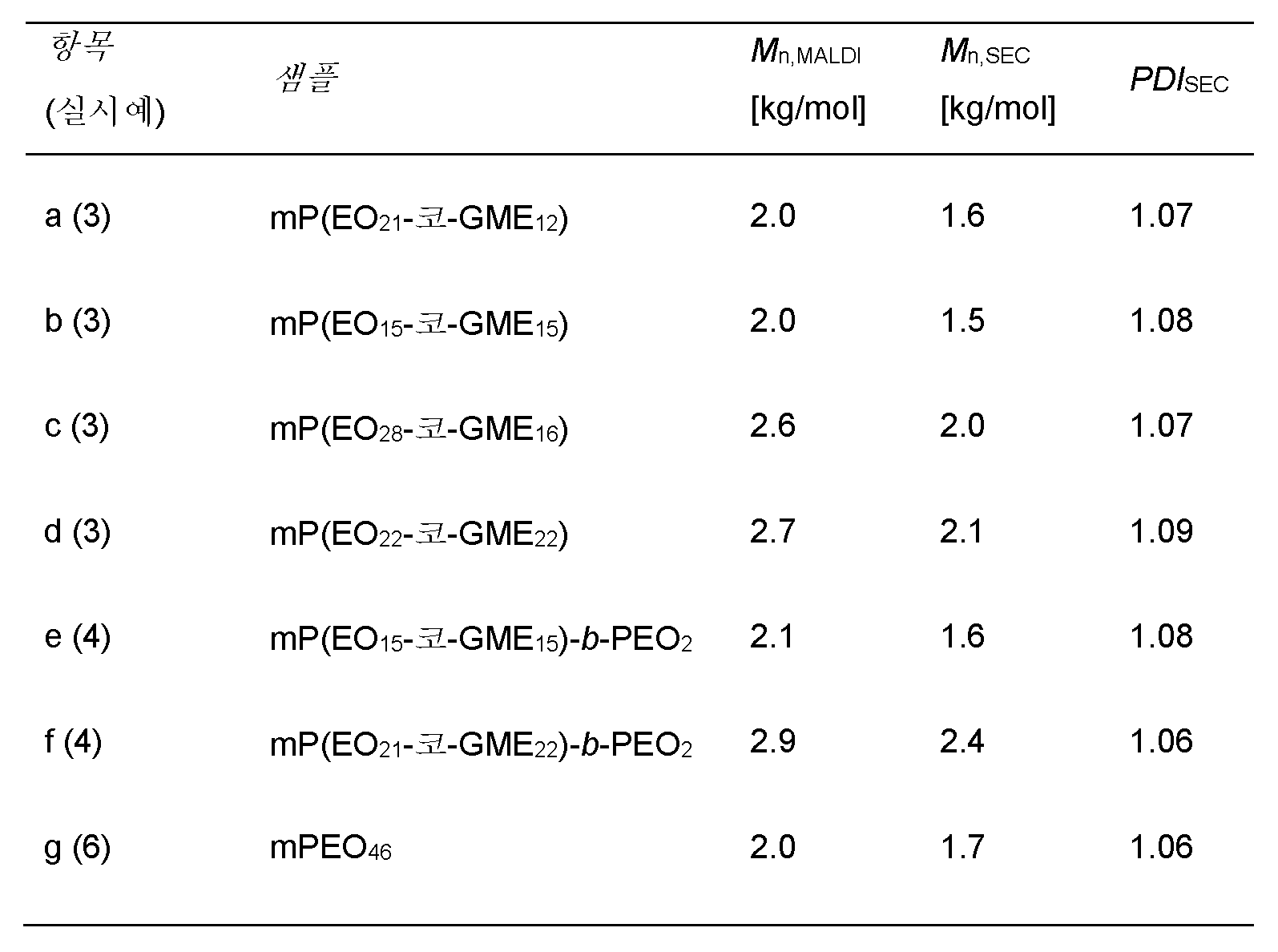
폴리옥시알킬렌 공중합체의 특징화 방법Method for characterizing polyoxyalkylene copolymers
1H NMR 스펙트럼은 브루커 아반스(Bruker Avance) III HD 300 분광계 상에서 300 MHz로 기록되었으며, 중수소화된 용매의 잔류 양성자 신호를 내부 기준으로 하였다. 1H NMR spectra were recorded at 300 MHz on a Bruker Avance III HD 300 spectrometer, with the residual proton signal of the deuterated solvent used as an internal reference.
모든 샘플의 Mw, Mn 및 분산도 (Mw/Mn = PDI)는 상응하는 크기 배제 크로마토그램 (굴절률 (RI) 검출기, DMF, PEO 표준물을 사용한 보정)으로부터 결정되었다. 크기-배제 크로마토그래피 (SEC) 측정은 50℃에서 폴리(2-히드록시에틸메타크릴레이트) (PHEMA) 300/100/40 칼럼 상에서 이동상 (유량 1 mL/min)으로서 디메틸포름아미드 (1 g/L의 브로민화리튬 (LiBr)이 함유된 DMF)를 사용하여 수행되었다. 중합체 농도는 1 mg/mL였다. PEO 표준물 (독일 마인츠 소재의 폴리머 스탠다드 서비스 제조)을 사용하는 보정이 수행되었다.M w , M n and polydispersity (M w /M n = PDI) of all samples were determined from the corresponding size exclusion chromatograms (refractive index (RI) detector, DMF, calibration using PEO standards). Size-exclusion chromatography (SEC) measurements were performed on a poly(2-hydroxyethyl methacrylate) (PHEMA) 300/100/40 column at 50 °C using dimethylformamide (DMF containing 1 g/L lithium bromide (LiBr)) as mobile phase (flow
매트릭스-보조 레이저-탈착-이온화 비행 시간 질량 분광분석법 (MALDI-ToF MS) 측정은 브루커 오토플렉스(Bruker autoflex) maX MALDI-TOF/TOF로 수행되었다. 트리플루오로아세트산의 칼륨 염 및 트랜스-2-[3-(4-tert-부틸페닐)-2-메틸-2-프로페닐리덴]말로노니트릴 (DCTB)이 각각 이온화 염 및 매트릭스로서 사용되었다.Matrix-assisted laser-desorption-ionization time-of-flight mass spectrometry (MALDI-ToF MS) measurements were performed on a Bruker autoflex maX MALDI-TOF/TOF. The potassium salt of trifluoroacetic acid and trans-2-[3-(4-tert-butylphenyl)-2-methyl-2-propenylidene]malononitrile (DCTB) were used as the ionizing salt and matrix, respectively.
mP(EO-코-GME)-CHmP(EO-CO-GME)-CH 22 CHCH 22 -DMG (1,2-디미리스토일-글리세롤)의 합성-Synthesis of DMG (1,2-dimyristoyl-glycerol)
시약 및 화학물질Reagents and chemicals
DCM, 트리에틸아민 (NEt3), 황산나트륨 (Na2SO4), 1 M 염산 (HCl) 용액, Py, 무수 테트라히드로푸란 (THF, 최대 0.05% H2O), 미리스트산 클로라이드 (MyCl, 97%), 4-디메틸아미노피리딘 (DMAP), 1,2-이소프로필리덴-rac-글리세롤 (IPG) (97%), KOtBu 및 아세토니트릴 (ACN)은 머크 카게아아로부터 입수되었다. p-톨루엔술포닐 클로라이드 (TsCl)는 TCI 케미칼스 (TCI Chemicals; 일본 도쿄 소재)로부터 구입되었다. 모든 실험에 탈이온수가 사용되었다.DCM, triethylamine ( NEt3 ), sodium sulfate ( Na2SO4 ), 1 M hydrochloric acid (HCl) solution, Py, anhydrous tetrahydrofuran (THF, max. 0.05% H2O ), myristic chloride (MyCl, 97%), 4-dimethylaminopyridine (DMAP), 1,2-isopropylidene-rac-glycerol (IPG) (97%), KOtBu and acetonitrile (ACN) were obtained from Merck KGaA. p-Toluenesulfonyl chloride (TsCl) was purchased from TCI Chemicals (Tokyo, Japan). Deionized water was used in all experiments.
실시예 7: mP(EO27-코-GME16)-CH2CH2-OTs (p-톨루엔술포닐)의 합성Example 7: Synthesis of mP(EO 27 -co-GME 16 )-CH 2 CH 2 -OTs (p-toluenesulfonyl)

실온에서 50 mL 둥근 바닥 플라스크에 mP(EO28-코-GME16) (2.46 g, 910 μmol, 실시예 3으로부터의 화합물 c) 및 DCM (2.46 mL)을 충전하였다. 용액을 교반 하에 0-5℃로 냉각시켰다. 그 후에, DMAP (11.2 mg, 91.7 μmol), NEt3 (166 mg, 1.64 mmol) 및 p-톨루올술포닐 클로라이드 TsCl (263 mg, 1.37 mmol)을 연속적으로 첨가하였다. 반응 혼합물을 0-5℃에서 추가로 1 h 동안 교반하고, 이어서 20-25℃로 가열하고, 72 h 동안 교반하였다. 전환을 HPLC에 의해 정량화하였다. 출발 물질의 불완전한 전환으로 인해, NEt3 (55.3 mg, 546 μmol) 및 TsCl (87.7 mg, 460 μmol)을 20-25℃에서 첨가하고, 추가로 18 h 동안 교반을 계속하였다. 이어서, DCM (22.1 mL) 및 물 (14.8 mL)을 첨가하고, 2상 혼합물을 5 min 동안 격렬히 교반하였다. 상을 분리하고, 유기 층을 물 (4.92 mL) 및 1 N HCl 용액 (0.54 mL)과 혼합하였다. 10 min 동안 교반한 후에, 상을 분리하고, 유기 층을 물 (4.92 mL)로 세척하였다. 유기 상을 무수 Na2SO4 상에서 건조시키고, 여과하고, 700-5 mbar의 압력에서 60℃의 수조 온도로 회전 증발기 상에서 농축시켰다. mP(EO27-코-GME16)-CH2CH2-OTs가 오렌지색 오일로서 단리되었다 (2.14 g, 749 μmol, 82.3% 수율). 순도를 HPLC를 통해 결정하였다 (88.7%a).A 50 mL round bottom flask was charged with mP(EO 28 -co-GME 16 ) (2.46 g, 910 μmol, compound c from Example 3) and DCM (2.46 mL) at room temperature. The solution was cooled to 0-5 °C with stirring. Then, DMAP (11.2 mg, 91.7 μmol), NEt 3 (166 mg, 1.64 mmol) and p-toluolsulfonyl chloride TsCl (263 mg, 1.37 mmol) were added successively. The reaction mixture was stirred at 0-5 °C for additional 1 h, then heated to 20-25 °C and stirred for 72 h. The conversion was quantified by HPLC. Due to incomplete conversion of the starting material, NEt 3 (55.3 mg, 546 μmol) and TsCl (87.7 mg, 460 μmol) were added at 20-25 °C and stirring was continued for an additional 18 h. Then DCM (22.1 mL) and water (14.8 mL) were added and the biphasic mixture was stirred vigorously for 5 min. The phases were separated and the organic layer was mixed with water (4.92 mL) and 1 N HCl solution (0.54 mL). After stirring for 10 min, the phases were separated and the organic layer was washed with water (4.92 mL). The organic phase was dried over anhydrous Na 2 SO 4 , filtered and concentrated on a rotary evaporator at a pressure of 700-5 mbar and a water bath temperature of 60 °C. mP(EO 27 -co-GME 16 )-CH 2 CH 2 -OTs was isolated as an orange oil (2.14 g, 749 μmol, 82.3% yield). The purity was determined by HPLC (88.7%a).
실시예 8: mP(EO27-코-GME16)-CH2CH2-DHG (디히드록시 글리세롤)의 합성Example 8: Synthesis of mP(EO 27 -co-GME 16 )-CH 2 CH 2 -DHG (dihydroxyglycerol)

50 mL 둥근 바닥 플라스크에 실시예 7로부터의 mP(EO27-코-GME16)-CH2CH2-OTs (1.00 g; 350 μmol; 88.7%a 순도), 무수 THF (4 mL)를 충전하고, 30℃로 가열하였다. 별도의 유리 용기에서 IPG (92.6 mg, 700 μmol) 및 KOtBu (78.6 mg, 700 μmol)를 무수 THF (3 mL) 중에 혼합하였다. 오렌지색 현탁액을 mP(EO27-코-GME16)-CH2CH2-OTs 용액에 조금씩 나누어 첨가하고, 30℃에서 6 h 동안 교반을 계속하였다. 물 (4 mL)을 첨가하고, THF를 400-150 mbar의 압력에서 60℃의 수조 온도로 회전 증발기 상에서 제거하였다. 잔류하는 수성 용액을 DCM (8 mL)으로 추출하고, 유기 층을 700-20 mbar의 압력에서 60℃의 수조 온도로 회전 증발기 상에서 농축시켰다. 중간체 mP(EO27-코-GME16)-CH2CH2-IPG (0.63 g)가 오렌지색 오일로서 단리되었다.A 50 mL round-bottomed flask was charged with mP(EO 27 -co-GME 16 )-CH 2 CH 2 -OTs (1.00 g; 350 μmol; 88.7%a purity) from Example 7 and anhydrous THF (4 mL) and heated to 30 °C. In a separate glass vessel, IPG (92.6 mg, 700 μmol) and KOtBu (78.6 mg, 700 μmol) were mixed in anhydrous THF (3 mL). The orange suspension was added portionwise to the mP(EO 27 -co-GME 16 )-CH 2 CH 2 -OTs solution and stirring was continued at 30 °C for 6 h. Water (4 mL) was added and the THF was removed on a rotary evaporator at a pressure of 400-150 mbar and a water bath temperature of 60 °C. The remaining aqueous solution was extracted with DCM (8 mL) and the organic layer was concentrated on a rotary evaporator at a bath temperature of 60 °C and a pressure of 700-20 mbar. The intermediate mP(EO 27 -co-GME 16 )-CH 2 CH 2 -IPG (0.63 g) was isolated as an orange oil.
그 후에, mP(EO27-코-GME16)-CH2CH2-IPG 중간체를 물 (6.30 mL)에 용해시키고, 0.1 N HCl 용액 (227 μL)을 사용하여 pH를 1.5-1.6으로 조정하였다. 황색 용액을 75 min 동안 40℃로 가열하고, 실온으로 냉각시키고, DCM (2x12.6 mL)으로 추출하였다. 유기 상을 합하여, 700-5 mbar의 압력에서 60℃의 수조 온도로 회전 증발기 상에서 농축시켰다. mP(EO27-코-GME16)-CH2CH2-DHG (430 mg; 160 μmol)가 오렌지색 오일로서 단리되었다. 생성물을 HPLC에 의해 분석하였다.Afterwards, mP(EO 27 -co-GME 16 )-CH 2 CH 2 -IPG intermediate was dissolved in water (6.30 mL) and the pH was adjusted to 1.5-1.6 using 0.1 N HCl solution (227 μL). The yellow solution was heated to 40 °C for 75 min, cooled to room temperature and extracted with DCM (2x12.6 mL). The organic phases were combined and concentrated on a rotary evaporator at a pressure of 700-5 mbar and a water bath temperature of 60 °C. mP(EO 27 -co-GME 16 )-CH 2 CH 2 -DHG (430 mg; 160 μmol) was isolated as an orange oil. The product was analyzed by HPLC.
실시예 9: mP(EO27-코-GME16)-CH2CH2-DMG의 합성Example 9: Synthesis of mP(EO 27 -co-GME 16 )-CH 2 CH 2 -DMG

50 mL 둥근 바닥 플라스크에 실시예 8로부터의 mP(EO27-코-GME16)-CH2CH2-DHG (430 mg; 160 μmol) 및 DCM (2.2 mL)을 충전하였다. 용액을 주위 조건 하에 5 min 동안 교반하였다. Py (61.6 mg; 780 μmol) 및 MyCl (173 mg; 700 μmol)을 조금씩 나누어 첨가하고, 반응 혼합물을 실온에서 40 h 동안 교반하였다. DCM (3.2 mL) 및 물 (1.7 mL)을 조질 생성물 혼합물에 첨가하고, 1 M HCl 용액 (0.15 mL)을 사용하여 pH를 1.5로 조정하였다. DCM 상을 분리하고, 물 (3.9 mL)로 세척하고, 유기 용매를 700-5 mbar의 압력에서 60℃의 수조 온도로 회전 증발기 상에서 제거하여 조질 mP(EO27-코-GME16)-CH2CH2-DMG (359 mg)를 오일로서 수득하였다. 정제를 위해, 조질 생성물을 ACN (3.85 mL)에 용해시키고, 50℃로 가열하고, 여과하였다. 4 g의 마슈레이-나겔 (Macherey-Nagel; 독일 뒤렌 소재)의 크로마본드(CHROMABOND) 플래시 RS 4 SiOH 카트리지 (40-63 μm), ACN → iPrOH 구배, 및 5 mL/min의 유량을 사용하여 뷔히 (Buchi; 독일 에센 소재)의 퓨어 C-850 플래시프렙(FlashPrep) 시스템 상에서의 플래시 칼럼 크로마토그래피에 의해 추가의 정제를 수행하였다. 생성물 함유 분획을 합하여 농축시켰다. 그 후에, 물질을 12 g의 뷔히의 플래시퓨어 에코플렉스(FlashPure EcoFlex) C18 카트리지 (40-60 μm), ACN/물 (1:1) → iPrOH 구배, 및 20 mL/min의 유량을 사용하여 정제하였다. 화합물 h, 즉, mP(EO27-코-GME16)-CH2CH2-DMG (45.6 mg, 14.3 μmol; 8.9%)가 오렌지색 오일로서 단리되었다. 생성물을 1H-NMR 분광분석법 및 HPLC에 의해 특징화하였다 (순도 67%a).A 50 mL round bottom flask was charged with mP(EO 27 -co-GME 16 )-CH 2 CH 2 -DHG (430 mg; 160 μmol) from Example 8 and DCM (2.2 mL). The solution was stirred under ambient conditions for 5 min. Py (61.6 mg; 780 μmol) and MyCl (173 mg; 700 μmol) were added portionwise, and the reaction mixture was stirred at room temperature for 40 h. DCM (3.2 mL) and water (1.7 mL) were added to the crude product mixture, and the pH was adjusted to 1.5 with 1 M HCl solution (0.15 mL). The DCM phase was separated, washed with water (3.9 mL) and the organic solvent was removed on a rotary evaporator at a pressure of 700-5 mbar and a bath temperature of 60 °C to give crude mP(EO 27 -co-GME 16 )-CH 2 CH 2 -DMG (359 mg) as an oil. For purification, the crude product was dissolved in ACN (3.85 mL), heated to 50 °C and filtered. Further purification was carried out by flash column chromatography on a Pure C-850 FlashPrep system from Buchi (Essen, Germany) using a 4 g CHROMABOND Flash RS 4 SiOH cartridge (40-63 μm) from Macherey-Nagel (Düren, Germany), an ACN → iPrOH gradient, and a flow rate of 5 mL/min. The product containing fractions were combined and concentrated. The material was then purified using a 12 g FlashPure EcoFlex C18 cartridge (40-60 μm), an ACN/water (1:1) → iPrOH gradient, and a flow rate of 20 mL/min. Compound h, i.e., mP(EO 27 -co-GME 16 )-CH 2 CH 2 -DMG (45.6 mg, 14.3 μmol; 8.9%), was isolated as an orange oil. The product was characterized by 1 H-NMR spectroscopy and HPLC (purity 67%a).
지질 나노입자 (LNP)의 제조 및 생물학적 평가Preparation and biological evaluation of lipid nanoparticles (LNPs)
LNP의 제조 및 생물학적 검정을 위한 물질Materials for the manufacture and bioassay of LNPs
클린캡(CleanCap)® Fluc mRNA는 트리링크 바이오테크놀로지스 (TriLink BioTechnologies; 미국 캘리포니아주 샌디에고 소재)로부터 입수되었다. D-Lin-MC3-DMA는 메드켐익스프레스 (MedChemExpress; 미국 뉴저지주 몬머스 정션 소재)로부터 입수되었고, 콜레스테롤 및 PEO2k-DMG는 머크 카게아아로부터 구입되었고, DSPC는 NOF (미국 뉴욕주 화이트 플레인즈 소재)로부터 입수되었다. 모든 세포주는 독일 미생물 수집 및 세포 배양 연구소 (German Collection of Microorganisms and Cell Cultures GmbH; DSMZ, 독일 브라운슈바이크 소재)에 의해 공급되었다.CleanCap® Fluc mRNA was obtained from TriLink BioTechnologies (San Diego, CA, USA). D-Lin-MC3-DMA was obtained from MedChemExpress (Monmouth Junction, NJ, USA), cholesterol and PEO2k-DMG were purchased from Merck KGaA, and DSPC was obtained from NOF (White Plains, NY, USA). All cell lines were supplied by the German Collection of Microorganisms and Cell Cultures GmbH (DSMZ, Braunschweig, Germany).
실시예 10: LNP의 제조Example 10: Preparation of LNPs
0.133 g/L의 FLuc mRNA 및 11 mM의 아세트산을 함유하는 수성 상을 총 9.43 mM의 지질 (50 mol% DLin-MC3-DMA, 38.5 mol% 콜레스테롤, 10 mol% DSPC, 1.5 mol% PEO 지질 또는 mP(EO-코-GME) 지질)을 함유하는 에탄올계 상과 3:1의 부피비로 혼합하였다. 조질 LNP 콜로이드성 분산액을 포스페이트-완충 염수 (PBS)로 3 h 동안 투석하였다 (3x 완충제 교환). 정제된 LNP를 추가로 사용할 때까지 4℃에서 저장하였다.An aqueous phase containing 0.133 g/L FLuc mRNA and 11 mM acetic acid was mixed in a 3:1 volume ratio with an ethanolic phase containing 9.43 mM total lipids (50 mol% DLin-MC3-DMA, 38.5 mol% cholesterol, 10 mol% DSPC, 1.5 mol% PEO lipid or mP(EO-co-GME) lipid). The crude LNP colloidal dispersion was dialyzed against phosphate-buffered saline (PBS) for 3 h (3× buffer exchange). The purified LNPs were stored at 4°C until further use.
실시예 11: LNP의 평균 직경 (z-ave.) 및 제타 전위 (z-pot.)의 결정Example 11: Determination of average diameter (z-ave.) and zeta potential (z-pot.) of LNPs
측정은 말번 인스트루먼츠 게엠베하 (Malvern Instruments GmbH; 독일 헤렌베르크 소재)로부터의 제타사이저 나노ZS를 사용하여 수행되었다. 말번 패널리티컬 게엠베하 (Malvern Panalytical GmbH; 독일 카셀 소재)로부터의 DTS 1070 투명 일회용 접이식 모세관 셀이 사용되었다. 입자 크기의 측정을 위해서는, 샘플을 5 ng/μL의 RNA 농도에 상응하게 RNAse를 함유하지 않는 물로 1:10 희석하였다. z-pot.의 측정을 위해서는, 실시예 10으로부터의 콜로이드성 LNP 분산액을 1.67 ng/μL의 RNA 농도에 상응하게 RNAse를 함유하지 않는 물로 1:30 희석하였다. 적어도 10회의 실행의 데이터로부터 다분산 지수 (PDI)로서 나타내어지는, 피팅된 가우스(Gaussian) 분포의 폭으로서의 Z-ave. 뿐만 아니라 평균 z-pot. 값을 산출하였다.Measurements were performed using a Zetasizer NanoZS from Malvern Instruments GmbH (Herrenberg, Germany). A DTS 1070 transparent disposable foldable capillary cell from Malvern Panalytical GmbH (Kassel, Germany) was used. For particle size measurements, the samples were diluted 1:10 with RNAse-free water to a RNA concentration of 5 ng/μL. For z-pot. measurements, the colloidal LNP dispersion from Example 10 was diluted 1:30 with RNAse-free water to a RNA concentration of 1.67 ng/μL. Z-ave as well as the mean z-pot. values were calculated from data of at least 10 runs, expressed as the polydispersity index (PDI) as well as the width of the fitted Gaussian distribution.
표 3: LNP의 크기 및 제타 전위Table 3: Size and zeta potential of LNPs

실시예 12: 3-(4,5-디메틸티아졸-2-일)-5-(3-카르복시메톡시페닐)-2-(4-술포페닐)-2H-테트라졸륨 (MTS) 검정Example 12: 3-(4,5-dimethylthiazol-2-yl)-5-(3-carboxymethoxyphenyl)-2-(4-sulfophenyl)-2H-tetrazolium (MTS) assay
HeLa 세포를 사용하여 MTS 검정을 수행하였다. 형질감염 하루 전에, 100 μL의 부피의 각각의 배지 (10% FBS 및 30 μg/mL 겐타미신을 함유함) 중 웰당 10,000개의 세포를 96-웰 플레이트에 시딩하고, 37℃ 및 5% CO2에서 24 h 동안 배양하였다. 제2일에, 오래된 배지를 제거하고, 90 μL의 새로운 배지를 세포에 첨가하였다. 중합체 시험을 위해서는, 실시예 3 및 6으로부터의 화합물을 표 4에 제시된 최종 농도에 맞게 멸균수에 용해시키고, 샘플을 10 μL의 부피로 첨가하였다. LNP 시험을 위해서는, 실시예 10으로부터의 콜로이드성 LNP 분산액을 리보뉴클레아제를 함유하지 않는 희석수를 사용하여 5-20 ng/μL의 mRNA 농도로 조정하였다. 10 μL의 각각의 희석된 샘플을 100 μL의 총 부피 중 웰당 50-200 ng의 mRNA의 양에 상응하게 세포에 첨가하였다. 세포를 37℃ 및 5% CO2에서 24 h 동안 추가로 인큐베이션하였다. 제3일에, 세포 생존율을 제조업체의 프로토콜 (프로메가 게엠베하)에 따라 셀타이터(CellTiter) 96® 수성 비-방사성 세포 증식 검정 (MTS)을 사용하여 결정하였다. 흡광도 신호 (400 nm)를 멀티플레이트 판독기 (인피니트(Infinite)® 200 PRO, 스위스 만네도르프 소재의 테칸(Tecan))를 사용하여 정량화하였다.MTS assays were performed using HeLa cells. One day prior to transfection, 10,000 cells per well in 100 μL of each medium (containing 10% FBS and 30 μg/mL gentamicin) were seeded in 96-well plates and cultured for 24 h at 37°C and 5% CO 2 . On


실시예 13: 아가로스 겔 전기영동 (AGE)에 의한 LNP의 특징화Example 13: Characterization of LNPs by agarose gel electrophoresis (AGE)
실시예 10으로부터의 콜로이드성 LNP 분산액을 아가로스 겔 전기영동에 의해 특징화하였다. 검정은 써모 피셔 사이언티픽의 E-Gel™ 파워 스냅 전기영동 시스템을 사용하여 수행되었다. 샘플의 평가를 위해, 웰당 20 μL의 부피 용량으로 1% 아가로스 겔이 사용되었다. 그 결과가 도 1a 및 1b에 요약되어 있다. 아가로스 겔 전기영동은 모든 시험된 LNP 조성물에 대해 mRNA의 완전한 캡슐화를 입증한다 (SYBR 세이프(SYBR Safe) 염색의 검출 범위 내에서). 따라서, mP(EO-코-GME) 지질을 사용하여 제조된 LNP는 통상적인 PEO 지질을 사용하여 제조된 참조물과 유사한 mRNA 캡슐화를 나타낸다.The colloidal LNP dispersions from Example 10 were characterized by agarose gel electrophoresis. The assay was performed using an E-Gel™ Power Snap Electrophoresis System from Thermo Fisher Scientific. For the evaluation of the samples, 1% agarose gels were used at a volume volume of 20 μL per well. The results are summarized in Figures 1A and 1B. Agarose gel electrophoresis demonstrated complete encapsulation of mRNA for all tested LNP compositions (within the detection range of SYBR Safe staining). Thus, LNPs prepared using mP(EO-co-GME) lipids exhibit similar mRNA encapsulation as the reference prepared using conventional PEO lipids.
실시예 14: 리보그린 검정에 의한 LNP의 특징화Example 14: Characterization of LNPs by Ribogreen assay
실시예 10으로부터의 콜로이드성 LNP 분산액을 리보그린 검정에 의해 특징화하였다. 써모 피셔 Quant-iT™ 리보그린(RiboGreen)™ RNA 검정 키트가 사용되었다. 제조업체의 프로토콜을 약간 조정하여 절차가 수행되었다. 샘플을 TE 완충제 또는 트리톤 완충제를 사용하여 0.4 μg/mL의 이론적 RNA 농도로 희석하고, 100 μL의 부피로 96 웰 플레이트에 첨가하였다. 트리톤-완충제의 존재 하에 LNP의 용해를 위해, 플레이트를 37℃ 및 5% CO2에서 10분 동안 인큐베이터에 넣어 두었다. 100 μL의 염료 용액을 각각의 웰에 첨가한 후에, 철저하게 피펫팅하였다. 형광 신호를 인피니트® 200 PRO 마이크로플레이트 판독기를 사용하여 480 / 520 nm에서의 여기 / 방출 값으로 측정하였다. 모든 샘플 및 표준물을 이중으로 측정하였다.Colloidal LNP dispersions from Example 10 were characterized by the RiboGreen assay. The Thermo Fisher Quant-iT™ RiboGreen™ RNA Assay Kit was used. The procedure was performed with minor modifications to the manufacturer's protocol. Samples were diluted to a theoretical RNA concentration of 0.4 μg/mL using TE buffer or Triton buffer and added to a 96-well plate in a volume of 100 μL. To dissolve the LNPs in the presence of Triton-buffer, the plates were placed in an incubator at 37°C and 5% CO 2 for 10 minutes. 100 μL of dye solution was added to each well followed by thorough pipetting. Fluorescence signals were measured using an Infinite® 200 PRO microplate reader with excitation/emission values at 480/520 nm. All samples and standards were measured in duplicate.
표 6: LNP에 대한 리보그린 검정 결과Table 6: Ribogreen assay results for LNPs

실시예 15: 루시페라제 검정에 의한 LNP의 형질감염 효율의 결정Example 15: Determination of transfection efficiency of LNPs by luciferase assay
HeLa 세포를 사용하여 루시페라제 검정을 수행하였다. 세포주는 표준 세포 배양 조건에 따라 성장시켰다. 형질감염 하루 전에, 100 μL의 부피의 각각의 배지 (10% FBS 및 30 μg/mL 겐타미신을 함유함) 중 웰당 10,000개의 세포를 96-웰 플레이트에 시딩하고, 37℃ 및 5% CO2에서 24 h 동안 배양하였다. 제2일에, 오래된 배지를 제거하고, 90 μL의 새로운 배지 (FBS 및 항생제를 함유하지 않음)를 세포에 첨가하였다. 실시예 10에 따라 제조된 LNP 나노분산액을 리보뉴클레아제를 함유하지 않는 희석수를 사용하여 10 ng/μL의 mRNA 농도로 조정하였다. 10 μL의 각각의 희석된 샘플을 100 μL의 총 부피 중 웰당 100 ng의 mRNA의 양에 상응하게 세포에 첨가하였다. 4 h 후에, 잔류하는 샘플을 함유하는 오래된 배지를 제거하고, 100 μL의 새로운 배지 (10% FBS 및 30 μg/mL 겐타미신을 함유함)로 대체하였다. 세포를 37℃ 및 5% CO2에서 20 h 동안 추가로 인큐베이션하였다. 제3일에, 형질감염 효율을 듀얼-루시페라제(Dual-Luciferase)® 리포터 검정 시스템 (독일 발도르프 소재의 프로메가 게엠베하)을 사용하여 결정하였다. 발광 신호를 인피니트® 200 PRO 멀티플레이트 판독기를 사용하여 정량화하였다. 모든 형질감염 실험에서, 제트메신저(jetMessenger)가 양성 대조군으로서 사용되었다. 시약은 제조업체의 프로토콜에 따라 제조되었으며, 웰당 시험 샘플과 동일한 RNA 용량으로 적용되었다. 그 결과가 도 2에 요약되어 있다.Luciferase assays were performed using HeLa cells. Cell lines were grown under standard cell culture conditions. One day prior to transfection, 10,000 cells per well in 100 μL of each medium (containing 10% FBS and 30 μg/mL gentamicin) were seeded in 96-well plates and cultured for 24 h at 37°C and 5% CO 2 . On
Claims (15)

여기서 R1 및 R2는 서로 독립적으로 포화 또는 3개 이하의 -C=C- 결합을 갖는 불포화, 분지쇄 또는 직쇄 C3-C20 탄화수소 기 또는 -H로부터 선택되며, 단, R1 및 R2 중 적어도 하나는 -H가 아니고;
여기서 R3은 폴리옥시알킬렌 기 A의 탄소 원자에 결합되고, 폴리옥시알킬렌 기 A는 산소 원자를 통해 R3의 반대 쪽의 나머지 분자에 결합되고;
A는 적어도 하나의 하기 단위:

및 하기의 군으로부터 선택된 적어도 하나의 단위를 포함하는 폴리옥시알킬렌 기이고:

R3은 -H; -OH; -SH; -NH2; -NHR4, -NR4R5, -OR6, -SR6, 또는 20개 이하의 탄소 원자를 갖는 선형, 분지형 또는 고리형 알킬 기로부터 선택되고; 여기서
R4 내지 R6은 독립적으로 20개 이하의 탄소 원자를 갖는 선형, 분지형 또는 고리형 알킬 기로부터 선택되며, 여기서 5개 이하의 탄소 원자는 산소 또는 황 원자로 치환될 수 있고;
여기서 -A-R3은 1100 내지 7500 g/mol의 분자량을 갖는 것인
화합물.A compound having the following chemical formula (I):
wherein R 1 and R 2 are independently selected from a saturated or unsaturated, branched or straight-chain C 3 -C 20 hydrocarbon group having 3 or fewer -C=C- bonds or -H, provided that at least one of R 1 and R 2 is not -H;
Here, R 3 is bonded to a carbon atom of the polyoxyalkylene group A, and the polyoxyalkylene group A is bonded to the remaining molecule on the opposite side of R 3 via an oxygen atom;
A has at least one of the following units:
and a polyoxyalkylene group comprising at least one unit selected from the group consisting of:
R 3 is selected from -H; -OH; -SH; -NH 2 ; -NHR 4 , -NR 4 R 5 , -OR 6 , -SR 6 , or a linear, branched or cyclic alkyl group having 20 or fewer carbon atoms; wherein
R 4 to R 6 are independently selected from linear, branched or cyclic alkyl groups having up to 20 carbon atoms, wherein up to 5 carbon atoms may be replaced by oxygen or sulfur atoms;
Here, -AR 3 has a molecular weight of 1100 to 7500 g/mol.
compound.
i) 포화 또는 2개 이하의 -C=C- 결합을 갖는 불포화, 분지쇄 또는 직쇄 C4-C20 탄화수소 기 또는 -H; 또는
ii) 포화 또는 2개 이하의 -C=C- 결합을 갖는 불포화, 직쇄 C4-C20 탄화수소 기 또는 -H; 또는
iii) 포화 또는 1개의 -C=C- 결합을 갖는 불포화, 분지쇄 또는 직쇄 C4-C20 탄화수소 기 또는 -H; 또는
iv) 포화 또는 1개의 -C=C- 결합을 갖는 불포화, 직쇄 C4-C20 탄화수소 기 또는 -H; 또는
v) 포화, 분지쇄 또는 직쇄 C4-C20 탄화수소 기 또는 -H; 또는
vi) 포화 직쇄 C4-C20 탄화수소 기 또는 -H; 또는
vii) 포화 또는 2개 이하의 -C=C- 결합을 갖는 불포화, 분지쇄 또는 직쇄 C8-C18 탄화수소 기 또는 -H; 또는
viii) 포화 또는 2개 이하의 -C=C- 결합을 갖는 불포화, 직쇄 C8-C18 탄화수소 기 또는 -H; 또는
ix) 포화 또는 1개의 -C=C- 결합을 갖는 불포화, 분지쇄 또는 직쇄 C8-C18 탄화수소 기 또는 -H; 또는
x) 포화 또는 1개의 -C=C- 결합을 갖는 불포화, 직쇄 C8-C18 탄화수소 기 또는 -H; 또는
xi) 포화, 분지쇄 또는 직쇄 C8-C18 탄화수소 기 또는 -H; 또는
xii) 포화 직쇄 C8-C18 탄화수소 기 또는 -H; 또는
xiii) 포화 또는 2개 이하의 -C=C- 결합을 갖는 불포화, 분지쇄 또는 직쇄 C12-C17 탄화수소 기 또는 -H; 또는
xiv) 포화 또는 2개 이하의 -C=C- 결합을 갖는 불포화, 직쇄 C12-C17 탄화수소 기 또는 -H; 또는
xv) 포화 또는 1개의 -C=C- 결합을 갖는 불포화, 분지쇄 또는 직쇄 C12-C17 탄화수소 기 또는 -H; 또는
xvi) 포화 또는 1개의 -C=C- 결합을 갖는 불포화, 직쇄 C12-C17 탄화수소 기 또는 -H; 또는
xvii) 포화, 분지쇄 또는 직쇄 C12-C17 탄화수소 기 또는 -H; 또는
xviii) 포화 직쇄 C12-C18 탄화수소 기 또는 -H; 또는
xix) 포화 직쇄 C12-C17 탄화수소 기 또는 -H; 또는
xx) 포화 직쇄 C12-C16 탄화수소 기 또는 -H; 또는
xx) 포화 직쇄 C12-C14 탄화수소 기 또는 -H; 또는
xxi) 포화 직쇄 C14 탄화수소 기 또는 -H.In the first paragraph, a compound wherein R 1 and R 2 are independently selected from the following:
i) an unsaturated, branched or straight-chain C 4 -C 20 hydrocarbon group having saturated or not more than two -C=C- bonds or -H; or
ii) a saturated or unsaturated, straight-chain C 4 -C 20 hydrocarbon group having not more than two -C=C- bonds or -H; or
iii) an unsaturated, branched or straight-chain C 4 -C 20 hydrocarbon group having a saturated or one -C=C- bond or -H; or
iv) a saturated or unsaturated, straight-chain C 4 -C 20 hydrocarbon group having one -C=C- bond or -H; or
v) a saturated, branched or straight chain C 4 -C 20 hydrocarbon group or -H; or
vi) a saturated straight chain C 4 -C 20 hydrocarbon group or -H; or
vii) an unsaturated, branched or straight-chain C 8 -C 18 hydrocarbon group having saturated or not more than two -C=C- bonds or -H; or
viii) a saturated or unsaturated, straight-chain C 8 -C 18 hydrocarbon group having not more than two -C=C- bonds or -H; or
ix) an unsaturated, branched or straight-chain C 8 -C 18 hydrocarbon group having saturated or one -C=C- bond or -H; or
x) a saturated or unsaturated, straight-chain C 8 -C 18 hydrocarbon group having one -C=C- bond or -H; or
xi) a saturated, branched or straight chain C 8 -C 18 hydrocarbon group or -H; or
xii) a saturated straight chain C 8 -C 18 hydrocarbon group or -H; or
xiii) an unsaturated, branched or straight-chain C 12 -C 17 hydrocarbon group having saturated or not more than two -C=C- bonds or -H; or
xiv) a saturated or unsaturated, straight-chain C 12 -C 17 hydrocarbon group having not more than two -C=C- bonds or -H; or
xv) an unsaturated, branched or straight-chain C 12 -C 17 hydrocarbon group having saturated or one -C=C- bond or -H; or
xvi) a saturated or unsaturated, straight-chain C 12 -C 17 hydrocarbon group having one -C=C- bond or -H; or
xvii) a saturated, branched or straight chain C 12 -C 17 hydrocarbon group or -H; or
xviii) a saturated straight chain C 12 -C 18 hydrocarbon group or -H; or
xix) a saturated straight chain C 12 -C 17 hydrocarbon group or -H; or
xx) a saturated straight chain C 12 -C 16 hydrocarbon group or -H; or
xx) a saturated straight chain C 12 -C 14 hydrocarbon group or -H; or
xxi) Saturated straight chain C 14 hydrocarbon group or -H.
(i) A 및 R3이 화학식 (I)에서 정의된 바와 같은 것인 전구체 화합물 H-A-R3을 제공하는 단계;
(ii) -H를, 치환 반응을 진행할 수 있는 이탈기 -X로 대체하는 단계;
(iii) 그 후에, X-A-R3과


(iv) 이어서, 화합물 (III)을 양성자화하여 화합물

(v) 그 후에, Y가 -OH 기의 -H와 에스테르화 반응을 진행할 수 있는 이탈기이고, R1 및 R2가 화학식 (I)에서 정의된 바와 같은 것인


(i) providing a precursor compound HAR 3 wherein A and R 3 are as defined in formula (I);
(ii) a step of replacing -H with a leaving group -X capable of undergoing a substitution reaction;
(iii) After that, XAR 3 and
(iv) Then, compound (III) is protonated to obtain compound
(v) After that, Y is a leaving group capable of undergoing an esterification reaction with -H of the -OH group, and R 1 and R 2 are as defined in chemical formula (I).
Applications Claiming Priority (3)
| Application Number | Priority Date | Filing Date | Title |
|---|---|---|---|
| EP22207388.4 | 2022-11-15 | ||
| EP22207388 | 2022-11-15 | ||
| PCT/EP2023/081823 WO2024105071A1 (en) | 2022-11-15 | 2023-11-15 | Polyoxyalkylene-1,2-dimyristoyl-glycerol compounds, wherein the polyoxyalkylene is a poly(ethylene oxide) having c1 to c3-alkyloxymethyl side chains |
Publications (1)
| Publication Number | Publication Date |
|---|---|
| KR20250107249A true KR20250107249A (en) | 2025-07-11 |
Family
ID=88793158
Family Applications (1)
| Application Number | Title | Priority Date | Filing Date |
|---|---|---|---|
| KR1020257019267A Pending KR20250107249A (en) | 2022-11-15 | 2023-11-15 | Polyoxyalkylene-1,2-dimyristoyl-glycerol compound wherein the polyoxyalkylene is a poly(ethylene oxide) having a C1 to C3-alkyloxymethyl side chain |
Country Status (8)
| Country | Link |
|---|---|
| EP (1) | EP4619454A1 (en) |
| JP (1) | JP2025539101A (en) |
| KR (1) | KR20250107249A (en) |
| CN (1) | CN120239716A (en) |
| AU (1) | AU2023382536A1 (en) |
| IL (1) | IL320164A (en) |
| MX (1) | MX2025005575A (en) |
| WO (1) | WO2024105071A1 (en) |
Family Cites Families (6)
| Publication number | Priority date | Publication date | Assignee | Title |
|---|---|---|---|---|
| US7803397B2 (en) * | 2003-09-15 | 2010-09-28 | Protiva Biotherapeutics, Inc. | Polyethyleneglycol-modified lipid compounds and uses thereof |
| US8193246B2 (en) * | 2006-12-19 | 2012-06-05 | Marina Biotech, Inc. | Lipids and lipid assemblies comprising transfection enhancer elements |
| MX2011012823A (en) * | 2009-06-02 | 2012-06-25 | Wu Nian | Pure peg-lipid conjugates. |
| WO2011075656A1 (en) * | 2009-12-18 | 2011-06-23 | The University Of British Columbia | Methods and compositions for delivery of nucleic acids |
| WO2012122144A1 (en) * | 2011-03-07 | 2012-09-13 | Wu Nian | Highly monodisperse branched peg-lipid conjugates |
| US8710200B2 (en) | 2011-03-31 | 2014-04-29 | Moderna Therapeutics, Inc. | Engineered nucleic acids encoding a modified erythropoietin and their expression |
-
2023
- 2023-11-15 WO PCT/EP2023/081823 patent/WO2024105071A1/en not_active Ceased
- 2023-11-15 IL IL320164A patent/IL320164A/en unknown
- 2023-11-15 JP JP2025528295A patent/JP2025539101A/en active Pending
- 2023-11-15 CN CN202380079364.0A patent/CN120239716A/en active Pending
- 2023-11-15 EP EP23805607.1A patent/EP4619454A1/en active Pending
- 2023-11-15 AU AU2023382536A patent/AU2023382536A1/en active Pending
- 2023-11-15 KR KR1020257019267A patent/KR20250107249A/en active Pending
-
2025
- 2025-05-13 MX MX2025005575A patent/MX2025005575A/en unknown
Also Published As
| Publication number | Publication date |
|---|---|
| IL320164A (en) | 2025-06-01 |
| WO2024105071A1 (en) | 2024-05-23 |
| EP4619454A1 (en) | 2025-09-24 |
| MX2025005575A (en) | 2025-06-02 |
| CN120239716A (en) | 2025-07-01 |
| JP2025539101A (en) | 2025-12-03 |
| AU2023382536A1 (en) | 2025-06-26 |
Similar Documents
| Publication | Publication Date | Title |
|---|---|---|
| TWI841639B (en) | Modified amine lipids | |
| JP7485659B2 (en) | Ionizable amine lipids | |
| CN114127044A (en) | Ionizable amine lipids and lipid nanoparticles | |
| CN114901253A (en) | Improved lipid nanoparticles for delivery of nucleic acids | |
| TW202016301A (en) | Extrahepatic delivery technology | |
| WO2016071857A1 (en) | Compositions and methods for silencing ebola virus expression | |
| TW202329986A (en) | Lipid compounds and lipid nanoparticle compositions | |
| US10196637B2 (en) | Retinoid-lipid drug carrier | |
| EP4121018A2 (en) | Cationic lipids for lipid nanoparticle delivery of therapeutics to hepatic stellate cells | |
| WO2013032643A2 (en) | Lipids capable of conformational change and their use in formulations to deliver therapeutic agents to cells | |
| CN106456661A (en) | Ckap5-gene-silencing rnai pharmaceutical composition | |
| WO2025017476A1 (en) | Lipid nanoparticles comprising polymer-conjugated lipids and uses thereof | |
| KR20250107249A (en) | Polyoxyalkylene-1,2-dimyristoyl-glycerol compound wherein the polyoxyalkylene is a poly(ethylene oxide) having a C1 to C3-alkyloxymethyl side chain | |
| EP4372027A1 (en) | Use of polyethylenoxide polymers for the preparation of lipids conjugated with poly(ethylene oxide) having c1 to c3-alkyloxymethyl side chains | |
| KR20250107903A (en) | Polyoxyalkylene-N,N-ditetradecylacetamide compound, wherein the polyoxyalkylene is a poly(ethylene oxide) having a C1 to C3-alkyloxymethyl side chain | |
| KR20250107904A (en) | Lipids conjugated with poly(ethylene oxide) having C1 to C3-alkyloxymethyl side chains | |
| WO2025237830A1 (en) | Polyoxyalkylene-1,2-di(alkyloxy)propanoxy-carbonylaminopropyl compounds, wherein the polyoxyalkylene is a poly(ethylene oxide) having c1 to c3-alkyloxymethyl side chains | |
| TW201815736A (en) | Cationic lipid compound | |
| HK40069512A (en) | Ionizable amine lipids and lipid nanoparticles | |
| HK40053394A (en) | Ionizable amine lipids | |
| AU2013202932A1 (en) | Novel lipid formulations for nucleic acid delivery |
Legal Events
| Date | Code | Title | Description |
|---|---|---|---|
| PA0105 | International application |
St.27 status event code: A-0-1-A10-A15-nap-PA0105 |
|
| PG1501 | Laying open of application |
St.27 status event code: A-1-1-Q10-Q12-nap-PG1501 |
|
| Q12 | Application published |
Free format text: ST27 STATUS EVENT CODE: A-1-1-Q10-Q12-NAP-PG1501 (AS PROVIDED BY THE NATIONAL OFFICE) |