KR20250057122A - Lipid composition - Google Patents
Lipid composition Download PDFInfo
- Publication number
- KR20250057122A KR20250057122A KR1020257012513A KR20257012513A KR20250057122A KR 20250057122 A KR20250057122 A KR 20250057122A KR 1020257012513 A KR1020257012513 A KR 1020257012513A KR 20257012513 A KR20257012513 A KR 20257012513A KR 20250057122 A KR20250057122 A KR 20250057122A
- Authority
- KR
- South Korea
- Prior art keywords
- group
- ethyl
- carbon atoms
- amino
- lipid
- Prior art date
- Legal status (The legal status is an assumption and is not a legal conclusion. Google has not performed a legal analysis and makes no representation as to the accuracy of the status listed.)
- Pending
Links
Classifications
-
- A—HUMAN NECESSITIES
- A61—MEDICAL OR VETERINARY SCIENCE; HYGIENE
- A61K—PREPARATIONS FOR MEDICAL, DENTAL OR TOILETRY PURPOSES
- A61K9/00—Medicinal preparations characterised by special physical form
- A61K9/10—Dispersions; Emulsions
- A61K9/127—Synthetic bilayered vehicles, e.g. liposomes or liposomes with cholesterol as the only non-phosphatidyl surfactant
-
- A—HUMAN NECESSITIES
- A61—MEDICAL OR VETERINARY SCIENCE; HYGIENE
- A61K—PREPARATIONS FOR MEDICAL, DENTAL OR TOILETRY PURPOSES
- A61K48/00—Medicinal preparations containing genetic material which is inserted into cells of the living body to treat genetic diseases; Gene therapy
- A61K48/0008—Medicinal preparations containing genetic material which is inserted into cells of the living body to treat genetic diseases; Gene therapy characterised by an aspect of the 'non-active' part of the composition delivered, e.g. wherein such 'non-active' part is not delivered simultaneously with the 'active' part of the composition
-
- A—HUMAN NECESSITIES
- A61—MEDICAL OR VETERINARY SCIENCE; HYGIENE
- A61K—PREPARATIONS FOR MEDICAL, DENTAL OR TOILETRY PURPOSES
- A61K31/00—Medicinal preparations containing organic active ingredients
- A61K31/70—Carbohydrates; Sugars; Derivatives thereof
- A61K31/7088—Compounds having three or more nucleosides or nucleotides
-
- A—HUMAN NECESSITIES
- A61—MEDICAL OR VETERINARY SCIENCE; HYGIENE
- A61K—PREPARATIONS FOR MEDICAL, DENTAL OR TOILETRY PURPOSES
- A61K47/00—Medicinal preparations characterised by the non-active ingredients used, e.g. carriers or inert additives; Targeting or modifying agents chemically bound to the active ingredient
- A61K47/06—Organic compounds, e.g. natural or synthetic hydrocarbons, polyolefins, mineral oil, petrolatum or ozokerite
- A61K47/08—Organic compounds, e.g. natural or synthetic hydrocarbons, polyolefins, mineral oil, petrolatum or ozokerite containing oxygen, e.g. ethers, acetals, ketones, quinones, aldehydes, peroxides
- A61K47/10—Alcohols; Phenols; Salts thereof, e.g. glycerol; Polyethylene glycols [PEG]; Poloxamers; PEG/POE alkyl ethers
-
- A—HUMAN NECESSITIES
- A61—MEDICAL OR VETERINARY SCIENCE; HYGIENE
- A61K—PREPARATIONS FOR MEDICAL, DENTAL OR TOILETRY PURPOSES
- A61K47/00—Medicinal preparations characterised by the non-active ingredients used, e.g. carriers or inert additives; Targeting or modifying agents chemically bound to the active ingredient
- A61K47/06—Organic compounds, e.g. natural or synthetic hydrocarbons, polyolefins, mineral oil, petrolatum or ozokerite
- A61K47/08—Organic compounds, e.g. natural or synthetic hydrocarbons, polyolefins, mineral oil, petrolatum or ozokerite containing oxygen, e.g. ethers, acetals, ketones, quinones, aldehydes, peroxides
- A61K47/14—Esters of carboxylic acids, e.g. fatty acid monoglycerides, medium-chain triglycerides, parabens or PEG fatty acid esters
-
- A—HUMAN NECESSITIES
- A61—MEDICAL OR VETERINARY SCIENCE; HYGIENE
- A61K—PREPARATIONS FOR MEDICAL, DENTAL OR TOILETRY PURPOSES
- A61K47/00—Medicinal preparations characterised by the non-active ingredients used, e.g. carriers or inert additives; Targeting or modifying agents chemically bound to the active ingredient
- A61K47/06—Organic compounds, e.g. natural or synthetic hydrocarbons, polyolefins, mineral oil, petrolatum or ozokerite
- A61K47/16—Organic compounds, e.g. natural or synthetic hydrocarbons, polyolefins, mineral oil, petrolatum or ozokerite containing nitrogen, e.g. nitro-, nitroso-, azo-compounds, nitriles, cyanates
-
- A—HUMAN NECESSITIES
- A61—MEDICAL OR VETERINARY SCIENCE; HYGIENE
- A61K—PREPARATIONS FOR MEDICAL, DENTAL OR TOILETRY PURPOSES
- A61K47/00—Medicinal preparations characterised by the non-active ingredients used, e.g. carriers or inert additives; Targeting or modifying agents chemically bound to the active ingredient
- A61K47/06—Organic compounds, e.g. natural or synthetic hydrocarbons, polyolefins, mineral oil, petrolatum or ozokerite
- A61K47/16—Organic compounds, e.g. natural or synthetic hydrocarbons, polyolefins, mineral oil, petrolatum or ozokerite containing nitrogen, e.g. nitro-, nitroso-, azo-compounds, nitriles, cyanates
- A61K47/18—Amines; Amides; Ureas; Quaternary ammonium compounds; Amino acids; Oligopeptides having up to five amino acids
-
- A—HUMAN NECESSITIES
- A61—MEDICAL OR VETERINARY SCIENCE; HYGIENE
- A61K—PREPARATIONS FOR MEDICAL, DENTAL OR TOILETRY PURPOSES
- A61K47/00—Medicinal preparations characterised by the non-active ingredients used, e.g. carriers or inert additives; Targeting or modifying agents chemically bound to the active ingredient
- A61K47/06—Organic compounds, e.g. natural or synthetic hydrocarbons, polyolefins, mineral oil, petrolatum or ozokerite
- A61K47/20—Organic compounds, e.g. natural or synthetic hydrocarbons, polyolefins, mineral oil, petrolatum or ozokerite containing sulfur, e.g. dimethyl sulfoxide [DMSO], docusate, sodium lauryl sulfate or aminosulfonic acids
-
- A—HUMAN NECESSITIES
- A61—MEDICAL OR VETERINARY SCIENCE; HYGIENE
- A61K—PREPARATIONS FOR MEDICAL, DENTAL OR TOILETRY PURPOSES
- A61K47/00—Medicinal preparations characterised by the non-active ingredients used, e.g. carriers or inert additives; Targeting or modifying agents chemically bound to the active ingredient
- A61K47/06—Organic compounds, e.g. natural or synthetic hydrocarbons, polyolefins, mineral oil, petrolatum or ozokerite
- A61K47/22—Heterocyclic compounds, e.g. ascorbic acid, tocopherol or pyrrolidones
-
- A—HUMAN NECESSITIES
- A61—MEDICAL OR VETERINARY SCIENCE; HYGIENE
- A61K—PREPARATIONS FOR MEDICAL, DENTAL OR TOILETRY PURPOSES
- A61K47/00—Medicinal preparations characterised by the non-active ingredients used, e.g. carriers or inert additives; Targeting or modifying agents chemically bound to the active ingredient
- A61K47/06—Organic compounds, e.g. natural or synthetic hydrocarbons, polyolefins, mineral oil, petrolatum or ozokerite
- A61K47/28—Steroids, e.g. cholesterol, bile acids or glycyrrhetinic acid
-
- A—HUMAN NECESSITIES
- A61—MEDICAL OR VETERINARY SCIENCE; HYGIENE
- A61K—PREPARATIONS FOR MEDICAL, DENTAL OR TOILETRY PURPOSES
- A61K48/00—Medicinal preparations containing genetic material which is inserted into cells of the living body to treat genetic diseases; Gene therapy
-
- A—HUMAN NECESSITIES
- A61—MEDICAL OR VETERINARY SCIENCE; HYGIENE
- A61K—PREPARATIONS FOR MEDICAL, DENTAL OR TOILETRY PURPOSES
- A61K48/00—Medicinal preparations containing genetic material which is inserted into cells of the living body to treat genetic diseases; Gene therapy
- A61K48/0008—Medicinal preparations containing genetic material which is inserted into cells of the living body to treat genetic diseases; Gene therapy characterised by an aspect of the 'non-active' part of the composition delivered, e.g. wherein such 'non-active' part is not delivered simultaneously with the 'active' part of the composition
- A61K48/0025—Medicinal preparations containing genetic material which is inserted into cells of the living body to treat genetic diseases; Gene therapy characterised by an aspect of the 'non-active' part of the composition delivered, e.g. wherein such 'non-active' part is not delivered simultaneously with the 'active' part of the composition wherein the non-active part clearly interacts with the delivered nucleic acid
- A61K48/0041—Medicinal preparations containing genetic material which is inserted into cells of the living body to treat genetic diseases; Gene therapy characterised by an aspect of the 'non-active' part of the composition delivered, e.g. wherein such 'non-active' part is not delivered simultaneously with the 'active' part of the composition wherein the non-active part clearly interacts with the delivered nucleic acid the non-active part being polymeric
-
- A—HUMAN NECESSITIES
- A61—MEDICAL OR VETERINARY SCIENCE; HYGIENE
- A61K—PREPARATIONS FOR MEDICAL, DENTAL OR TOILETRY PURPOSES
- A61K9/00—Medicinal preparations characterised by special physical form
- A61K9/0012—Galenical forms characterised by the site of application
- A61K9/0019—Injectable compositions; Intramuscular, intravenous, arterial, subcutaneous administration; Compositions to be administered through the skin in an invasive manner
-
- A—HUMAN NECESSITIES
- A61—MEDICAL OR VETERINARY SCIENCE; HYGIENE
- A61K—PREPARATIONS FOR MEDICAL, DENTAL OR TOILETRY PURPOSES
- A61K9/00—Medicinal preparations characterised by special physical form
- A61K9/48—Preparations in capsules, e.g. of gelatin, of chocolate
- A61K9/50—Microcapsules having a gas, liquid or semi-solid filling; Solid microparticles or pellets surrounded by a distinct coating layer, e.g. coated microspheres, coated drug crystals
- A61K9/51—Nanocapsules; Nanoparticles
- A61K9/5107—Excipients; Inactive ingredients
- A61K9/5123—Organic compounds, e.g. fats, sugars
-
- C—CHEMISTRY; METALLURGY
- C07—ORGANIC CHEMISTRY
- C07C—ACYCLIC OR CARBOCYCLIC COMPOUNDS
- C07C219/00—Compounds containing amino and esterified hydroxy groups bound to the same carbon skeleton
- C07C219/02—Compounds containing amino and esterified hydroxy groups bound to the same carbon skeleton having esterified hydroxy groups and amino groups bound to acyclic carbon atoms of the same carbon skeleton
- C07C219/04—Compounds containing amino and esterified hydroxy groups bound to the same carbon skeleton having esterified hydroxy groups and amino groups bound to acyclic carbon atoms of the same carbon skeleton the carbon skeleton being acyclic and saturated
- C07C219/16—Compounds containing amino and esterified hydroxy groups bound to the same carbon skeleton having esterified hydroxy groups and amino groups bound to acyclic carbon atoms of the same carbon skeleton the carbon skeleton being acyclic and saturated having at least one of the hydroxy groups esterified by an inorganic acid or a derivative thereof
-
- C—CHEMISTRY; METALLURGY
- C12—BIOCHEMISTRY; BEER; SPIRITS; WINE; VINEGAR; MICROBIOLOGY; ENZYMOLOGY; MUTATION OR GENETIC ENGINEERING
- C12N—MICROORGANISMS OR ENZYMES; COMPOSITIONS THEREOF; PROPAGATING, PRESERVING, OR MAINTAINING MICROORGANISMS; MUTATION OR GENETIC ENGINEERING; CULTURE MEDIA
- C12N15/00—Mutation or genetic engineering; DNA or RNA concerning genetic engineering, vectors, e.g. plasmids, or their isolation, preparation or purification; Use of hosts therefor
- C12N15/09—Recombinant DNA-technology
- C12N15/87—Introduction of foreign genetic material using processes not otherwise provided for, e.g. co-transformation
- C12N15/88—Introduction of foreign genetic material using processes not otherwise provided for, e.g. co-transformation using microencapsulation, e.g. using amphiphile liposome vesicle
-
- C—CHEMISTRY; METALLURGY
- C12—BIOCHEMISTRY; BEER; SPIRITS; WINE; VINEGAR; MICROBIOLOGY; ENZYMOLOGY; MUTATION OR GENETIC ENGINEERING
- C12N—MICROORGANISMS OR ENZYMES; COMPOSITIONS THEREOF; PROPAGATING, PRESERVING, OR MAINTAINING MICROORGANISMS; MUTATION OR GENETIC ENGINEERING; CULTURE MEDIA
- C12N15/00—Mutation or genetic engineering; DNA or RNA concerning genetic engineering, vectors, e.g. plasmids, or their isolation, preparation or purification; Use of hosts therefor
- C12N15/09—Recombinant DNA-technology
- C12N15/11—DNA or RNA fragments; Modified forms thereof; Non-coding nucleic acids having a biological activity
- C12N15/111—General methods applicable to biologically active non-coding nucleic acids
-
- C—CHEMISTRY; METALLURGY
- C12—BIOCHEMISTRY; BEER; SPIRITS; WINE; VINEGAR; MICROBIOLOGY; ENZYMOLOGY; MUTATION OR GENETIC ENGINEERING
- C12N—MICROORGANISMS OR ENZYMES; COMPOSITIONS THEREOF; PROPAGATING, PRESERVING, OR MAINTAINING MICROORGANISMS; MUTATION OR GENETIC ENGINEERING; CULTURE MEDIA
- C12N15/00—Mutation or genetic engineering; DNA or RNA concerning genetic engineering, vectors, e.g. plasmids, or their isolation, preparation or purification; Use of hosts therefor
- C12N15/09—Recombinant DNA-technology
- C12N15/11—DNA or RNA fragments; Modified forms thereof; Non-coding nucleic acids having a biological activity
- C12N15/113—Non-coding nucleic acids modulating the expression of genes, e.g. antisense oligonucleotides; Antisense DNA or RNA; Triplex- forming oligonucleotides; Catalytic nucleic acids, e.g. ribozymes; Nucleic acids used in co-suppression or gene silencing
-
- C—CHEMISTRY; METALLURGY
- C12—BIOCHEMISTRY; BEER; SPIRITS; WINE; VINEGAR; MICROBIOLOGY; ENZYMOLOGY; MUTATION OR GENETIC ENGINEERING
- C12N—MICROORGANISMS OR ENZYMES; COMPOSITIONS THEREOF; PROPAGATING, PRESERVING, OR MAINTAINING MICROORGANISMS; MUTATION OR GENETIC ENGINEERING; CULTURE MEDIA
- C12N2320/00—Applications; Uses
- C12N2320/30—Special therapeutic applications
- C12N2320/32—Special delivery means, e.g. tissue-specific
Landscapes
- Health & Medical Sciences (AREA)
- Chemical & Material Sciences (AREA)
- Life Sciences & Earth Sciences (AREA)
- General Health & Medical Sciences (AREA)
- Engineering & Computer Science (AREA)
- Epidemiology (AREA)
- Pharmacology & Pharmacy (AREA)
- Animal Behavior & Ethology (AREA)
- Medicinal Chemistry (AREA)
- Public Health (AREA)
- Veterinary Medicine (AREA)
- General Chemical & Material Sciences (AREA)
- Oil, Petroleum & Natural Gas (AREA)
- Chemical Kinetics & Catalysis (AREA)
- Bioinformatics & Cheminformatics (AREA)
- Molecular Biology (AREA)
- Genetics & Genomics (AREA)
- Organic Chemistry (AREA)
- Biotechnology (AREA)
- Biomedical Technology (AREA)
- Physics & Mathematics (AREA)
- Optics & Photonics (AREA)
- Nanotechnology (AREA)
- Proteomics, Peptides & Aminoacids (AREA)
- General Engineering & Computer Science (AREA)
- Zoology (AREA)
- Biochemistry (AREA)
- Wood Science & Technology (AREA)
- Dispersion Chemistry (AREA)
- Inorganic Chemistry (AREA)
- Microbiology (AREA)
- Biophysics (AREA)
- Dermatology (AREA)
- Plant Pathology (AREA)
- Organic Low-Molecular-Weight Compounds And Preparation Thereof (AREA)
- Pharmaceuticals Containing Other Organic And Inorganic Compounds (AREA)
- Medicines That Contain Protein Lipid Enzymes And Other Medicines (AREA)
- Medicinal Preparation (AREA)
Abstract
본 발명의 과제는, 폭넓은 종류의 핵산에 대하여 우수한 핵산 송달을 실현할 수 있는 지질 조성물을 제공하는 것이다. 본 발명에 의하면, 식 (1)로 나타나는 지질 또는 그 염인 제1 지질, 스테롤류, 및 핵산을 포함하는 지질 조성물로서, 지질 조성물 중의 제1 지질의 몰수의, 지질 조성물 중의 스테롤류의 몰수에 대한 비가 0.300 이상 1.299 미만인, 지질 조성물이 제공된다.
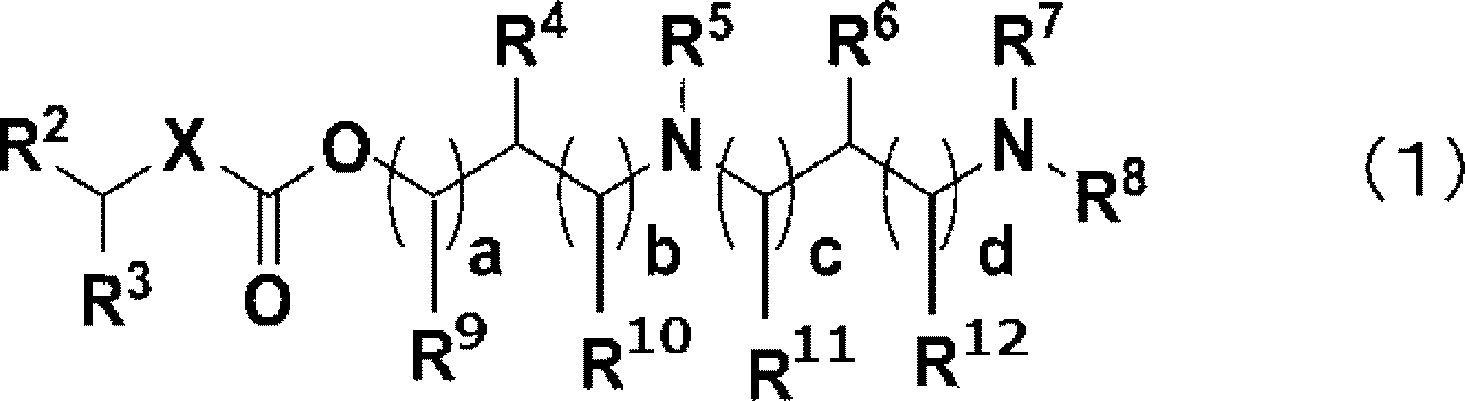
식 중, X는 -NR1- 또는 -O-를 나타내고, R1은, 수소 원자, 탄화 수소기 등을 나타내며, R2 및 R3은 각각 독립적으로, 수소 원자, 탄화 수소기 등을 나타내고, R4, R5, R6, R7, R8, R9, R10, R11, 및 R12는 각각 독립적으로, 수소 원자 또는 알킬기를 나타내며,
R4 및 R5, R10 및 R5, R5 및 R12, R4 및 R6, R5 및 R6, R6 및 R7, R6 및 R10, R12 및 R7, 및 R7 및 R8 중 어느 1세트 이상은 서로 연결되어 O 원자를 포함하고 있어도 되는 4~7원환을 형성해도 되고, a, b, c, 및 d는 각각 독립적으로 0~3의 정수를 나타내며, 단, a+b는 1 이상이고, c+d는 1 이상이다.The object of the present invention is to provide a lipid composition capable of realizing excellent nucleic acid delivery for a wide variety of nucleic acids. According to the present invention, a lipid composition comprising a first lipid, which is a lipid represented by formula (1) or a salt thereof, sterols, and a nucleic acid, is provided, wherein the ratio of the molar number of the first lipid in the lipid composition to the molar number of the sterols in the lipid composition is 0.300 or more and less than 1.299.
In the formula, X represents -NR 1 - or -O-, R 1 represents a hydrogen atom, a hydrocarbon group, etc., R 2 and R 3 each independently represent a hydrogen atom, a hydrocarbon group, etc., R 4 , R 5 , R 6 , R 7 , R 8 , R 9 , R 10 , R 11 , and R 12 each independently represent a hydrogen atom or an alkyl group,
At least one set of R 4 and R 5 , R 10 and R 5 , R 5 and R 12 , R 4 and R 6 , R 5 and R 6 , R 6 and R 7 , R 6 and R 10 , R 12 and R 7 , and R 7 and R 8 may be linked to each other to form a 4- to 7-membered ring which may contain an O atom, and a, b, c, and d each independently represent an integer from 0 to 3, provided that a + b is 1 or greater, and c + d is 1 or greater.
Description
본 발명은, 지질(脂質) 및 핵산(核酸)을 포함하는 지질 조성물에 관한 것이다.The present invention relates to a lipid composition comprising lipids and nucleic acids.
핵산을 세포에 송달(送達)할 수 있는 기술이 개발되어 온 점에서, 핵산 의약품의 개발이 활발하게 행해지고 있다. 핵산의 송달 기술의 하나로서, 핵산을 입자(리포솜 또는 지질 입자)에 내포한 핵산 함유 입자를 투여하는 방법이 알려져 있다. 이 기술에 있어서는, 아미노기 등을 갖고 저pH로 양이온이 되는 지질을 이용하여 핵산 함유 입자를 조제하고 있지만, 입자에 적절한 전하를 부여함으로써 핵산의 송달을 실현하고 있다. 예를 들면, 지질 입자에 함유시키는 화합물로서, 특허문헌 1에는, 지방족기와 아미노기를 연결하는 연결기로서 에스터기, 아세탈기 등을 갖는 화합물이 개시되어 있다. 특허문헌 2에는, 지방족기와 아미노기를 연결하는 연결기로서 바이닐옥시기나 아마이드기, 옥심기 등을 갖는 화합물이 개시되어 있다. 또한, 본 명세서 중에서는 상기, 아미노기 등을 갖고 저pH로 양이온이 되는 지질을 양이온성 지질이라고 부르는 경우가 있다.As a technology capable of delivering nucleic acids to cells has been developed, the development of nucleic acid pharmaceuticals is being actively carried out. As one of the nucleic acid delivery technologies, a method of administering nucleic acid-containing particles encapsulating nucleic acids in particles (liposomes or lipid particles) is known. In this technology, nucleic acid-containing particles are prepared using lipids having an amino group or the like and being cationic at low pH, and delivery of nucleic acids is realized by imparting an appropriate charge to the particles. For example, as a compound to be contained in a lipid particle, Patent Document 1 discloses a compound having an ester group, an acetal group, or the like as a linking group connecting an aliphatic group and an amino group. Patent Document 2 discloses a compound having a vinyloxy group, an amide group, an oxime group, or the like as a linking group connecting an aliphatic group and an amino group. In addition, in this specification, the lipids having an amino group or the like and being cationic at low pH are sometimes referred to as cationic lipids.
또, 특허문헌 3에는, 생물학적 활성제를 세포 및 조직에 송달하기 위한 양이온성 지질이 기재되어 있다. 특허문헌 4에는, 양이온성 지질로서 DLin-MC3-DMA라고 칭해지는 화합물을 포함하는 지질 나노 입자가 기재되어 있다.Also, patent document 3 describes a cationic lipid for delivering a biologically active agent to cells and tissues. patent document 4 describes a lipid nanoparticle comprising a compound called DLin-MC3-DMA as a cationic lipid.
또한 핵산 함유 입자를 제조할 때에 사용하는 지질 화합물의 종류 및 조성비를 변경하는 것에 대해서도 검토되고 있다. 특허문헌 5에는, (a) 핵산; (b) 입자 중에 존재하는 총지질의 약 50mol%~약 85mol%를 구성하는 양이온성 지질; (c) 입자 중에 존재하는 총지질의 약 13mol%~약 49.5mol%를 구성하는 비양이온성 지질; 및 (d) 입자 중에 존재하는 총지질의 약 0.5mol%~약 2mol%를 구성하는, 입자의 응집을 저해하는 복합화 지질을 포함하는 핵산-지질 입자가 기재되어 있다. 특허문헌 6에는, 40~65%의 특정 구조의 양이온성 지질, 5~10%의 중성 지질, 25~40%의 스테롤, 및 0.5~10%의 PEG 또는 PEG 수식 지질을 포함하는 지질 제제가 기재되어 있다.Also being considered is changing the type and composition ratio of lipid compounds used when manufacturing nucleic acid-containing particles. Patent Document 5 discloses a nucleic acid-lipid particle comprising (a) nucleic acid; (b) a cationic lipid constituting about 50 mol% to about 85 mol% of the total lipid present in the particle; (c) a non-cationic lipid constituting about 13 mol% to about 49.5 mol% of the total lipid present in the particle; and (d) a complexed lipid that inhibits particle aggregation constituting about 0.5 mol% to about 2 mol% of the total lipid present in the particle. Patent Document 6 discloses a lipid formulation comprising 40 to 65% of a cationic lipid having a specific structure, 5 to 10% of a neutral lipid, 25 to 40% of a sterol, and 0.5 to 10% of a PEG or PEG-modified lipid.
상기한 바와 같이, 지질 및 핵산을 포함하는 지질 조성물의 보고는 있지만, 폭넓은 종류의 핵산을 송달할 수 있는 지질 조성물이 요망되고 있다. 또, 아미노기를 갖는 지질은 독성을 갖는 것이 알려져 있는 점에서, 핵산을 더 효율적으로 송달할 수 있는 기술이 요구되고 있다.As mentioned above, there are reports of lipid compositions containing lipids and nucleic acids, but there is a demand for lipid compositions capable of delivering a wide range of nucleic acids. In addition, since lipids containing amino groups are known to be toxic, there is a demand for a technology capable of delivering nucleic acids more efficiently.
본 발명은, 이러한 상황을 감안하여, 폭넓은 종류의 핵산에 대하여 우수한 핵산 송달을 실현할 수 있는 지질 조성물을 제공하는 것을 해결해야 할 과제로 했다.In consideration of these circumstances, the present invention has as its object the provision of a lipid composition capable of achieving excellent nucleic acid delivery for a wide variety of nucleic acids.
본 발명자들은, 상기 과제를 해결하기 위하여 예의 검토한 결과, 식 (1)로 나타나는 지질 또는 그 염인 제1 지질, 스테롤류, 및 핵산을 포함하는 지질 조성물에 있어서, 지질 조성물 중의 제1 지질의 몰수의, 지질 조성물 중의 스테롤류의 몰수에 대한 비를 0.300 이상 1.299 미만으로 함으로써, 우수한 핵산 송달을 달성할 수 있는 것을 확인하고, 본 발명을 완성하기에 이르렀다. 본 발명에 의하면, 이하의 발명이 제공된다.The present inventors, as a result of intensive studies to solve the above-mentioned problem, have confirmed that, in a lipid composition comprising a first lipid, which is a lipid or a salt thereof represented by formula (1), sterols, and nucleic acids, excellent nucleic acid delivery can be achieved by setting the ratio of the number of moles of the first lipid in the lipid composition to the number of moles of the sterols in the lipid composition to 0.300 or more and less than 1.299, thereby completing the present invention. According to the present invention, the following invention is provided.
<1> 식 (1)로 나타나는 지질 또는 그 염인 제1 지질, 스테롤류, 및 핵산을 포함하는 지질 조성물로서, 지질 조성물 중의 제1 지질의 몰수의, 지질 조성물 중의 스테롤류의 몰수에 대한 비가 0.300 이상 1.299 미만인, 지질 조성물.<1> A lipid composition comprising a first lipid, a sterol, and a nucleic acid, which is a lipid or a salt thereof represented by formula (1), wherein the ratio of the number of moles of the first lipid in the lipid composition to the number of moles of the sterol in the lipid composition is 0.300 or more and less than 1.299.
[화학식 1][Chemical Formula 1]
식 중, X는 -NR1- 또는 -O-를 나타내고,In the formula, X represents -NR 1 - or -O-,
R1은, 수소 원자, 탄소수 6~24의 탄화 수소기, 또는 R21-L1-R22-로 나타나는 기를 나타내며, R21은 탄소수 1~24의 탄화 수소기를 나타내고, L1은, -O(CO)O-, -O(CO)-, -(CO)O-, -O-, 또는R 1 represents a hydrogen atom, a hydrocarbon group having 6 to 24 carbon atoms, or a group represented by R 21 -L 1 -R 22 -, R 21 represents a hydrocarbon group having 1 to 24 carbon atoms, and L 1 represents -O(CO)O-, -O(CO)-, -(CO)O-, -O-, or
[화학식 2][Chemical formula 2]
를 나타내며, R22는 2가의 연결기이고 탄소수 1~18의 탄화 수소 연결기를 나타내며,, R 22 is a divalent linking group and represents a hydrocarbon linking group having 1 to 18 carbon atoms.
R2 및 R3은 각각 독립적으로, 수소 원자, 탄소수 3~24의 탄화 수소기, 또는 R31-L2-R32-로 나타나는 기를 나타내고, R31은 탄소수 1~24의 탄화 수소기를 나타내며, L2는, -O(CO)O-, -O(CO)-, -(CO)O-, -O-, 또는R 2 and R 3 each independently represent a hydrogen atom, a hydrocarbon group having 3 to 24 carbon atoms, or a group represented by R 31 -L 2 -R 32 -, R 31 represents a hydrocarbon group having 1 to 24 carbon atoms, and L 2 represents -O(CO)O-, -O(CO)-, -(CO)O-, -O-, or
[화학식 3][Chemical Formula 3]
를 나타내고, R32는 2가의 연결기이며 탄소수 1~18의 탄화 수소 연결기를 나타내고,, R 32 is a divalent linking group and represents a hydrocarbon linking group having 1 to 18 carbon atoms.
R4, R5, R6, R7, R8, R9, R10, R11, 및 R12는 각각 독립적으로, 수소 원자 또는 치환되어도 되는 탄소수 1~18의 알킬기를 나타내며,R 4 , R 5 , R 6 , R 7 , R 8 , R 9 , R 10 , R 11 , and R 12 each independently represent a hydrogen atom or an alkyl group having 1 to 18 carbon atoms which may be substituted,
R4 및 R5, R10 및 R5, R5 및 R12, R4 및 R6, R5 및 R6, R6 및 R7, R6 및 R10, R12 및 R7, 및 R7 및 R8 중 어느 1세트 이상은 서로 연결되어 O 원자를 포함하고 있어도 되는 4~7원환을 형성해도 되고,At least one set of R 4 and R 5 , R 10 and R 5 , R 5 and R 12 , R 4 and R 6 , R 5 and R 6 , R 6 and R 7 , R 6 and R 10 , R 12 and R 7 , and R 7 and R 8 may be connected to each other to form a 4- to 7-membered ring which may contain an O atom,
치환되어도 되는 탄소수 1~18의 알킬기 상의 치환기는, 하이드록실기, 카복실기, -NR45R46으로 나타나는 아미노기, 치환 혹은 무치환의 아릴기, 치환 혹은 무치환의 헤테로아릴기, -O(CO)O-R41, -O(CO)-R42, -(CO)O-R43, 또는 -O-R44로 나타나는 기이고, R41, R42, R43, R44, R45 및 R46은 각각 독립적으로, 탄소수 1~18의 탄화 수소기를 나타내며,A substituent on an alkyl group having 1 to 18 carbon atoms which may be substituted is a hydroxyl group, a carboxyl group, an amino group represented by -NR 45 R 46 , a substituted or unsubstituted aryl group, a substituted or unsubstituted heteroaryl group, a group represented by -O(CO)OR 41 , -O(CO)-R 42 , -(CO)OR 43 , or -OR 44 , and R 41 , R 42 , R 43 , R 44 , R 45 and R 46 each independently represent a hydrocarbon group having 1 to 18 carbon atoms,
치환 혹은 무치환의 아릴기, 및 치환 혹은 무치환의 헤테로아릴기 상의 치환기는, 탄소수 1~18의 알킬기, 하이드록실기, 카복실기, -NR45R46으로 나타나는 아미노기, -O(CO)O-R41, -O(CO)-R42, -(CO)O-R43, 또는 -O-R44로 나타나는 기이고, R41, R42, R43, R44, R45 및 R46은 각각 독립적으로, 탄소수 1~18의 탄화 수소기를 나타내며,A substituent on a substituted or unsubstituted aryl group and a substituted or unsubstituted heteroaryl group is an alkyl group having 1 to 18 carbon atoms, a hydroxyl group, a carboxyl group, an amino group represented by -NR 45 R 46 , a group represented by -O(CO)OR 41 , -O(CO)-R 42 , -(CO)OR 43 , or -OR 44 , and R 41 , R 42 , R 43 , R 44 , R 45 and R 46 each independently represent a hydrocarbon group having 1 to 18 carbon atoms,
a, b, c, 및 d는 각각 독립적으로 0~3의 정수를 나타내고, 단, a+b는 1 이상이며, c+d는 1 이상이다.a, b, c, and d each independently represent an integer from 0 to 3, provided that a+b is 1 or greater, and c+d is 1 or greater.
<2> 스테롤류가 콜레스테롤 또는 그 유도체인, <1>에 기재된 지질 조성물.<2> A lipid composition as described in <1>, wherein the sterol is cholesterol or a derivative thereof.
<3> 비이온성 친수성 고분자 구조를 갖는 지질을 더 포함하는, <1> 또는 <2>에 기재된 지질 조성물.<3> A lipid composition according to <1> or <2>, further comprising a lipid having a nonionic hydrophilic polymer structure.
<4> 비이온성 친수성 고분자 구조를 갖는 지질이, 폴리에틸렌글라이콜 구조를 갖는 지질인, <3>에 기재된 지질 조성물.<4> A lipid composition as described in <3>, wherein the lipid having a nonionic hydrophilic polymer structure is a lipid having a polyethylene glycol structure.
<5> 폴리에틸렌글라이콜 구조를 갖는 지질이, 다이아실글리세롤 구조와 폴리에틸렌글라이콜 구조를 갖는 지질인, <4>에 기재된 지질 조성물.<5> A lipid composition as described in <4>, wherein the lipid having a polyethylene glycol structure is a lipid having a diacylglycerol structure and a polyethylene glycol structure.
<6> 전체 지질에 대한 비이온성 친수성 고분자 구조를 갖는 지질의 함유량이 0.2~10몰%인, <3> 내지 <5> 중 어느 하나에 기재된 지질 조성물.<6> A lipid composition according to any one of <3> to <5>, wherein the content of a lipid having a nonionic hydrophilic polymer structure relative to the total lipid is 0.2 to 10 mol%.
<7> 전체 지질에 대한 제1 지질의 함유량이 20~55몰%인, <1> 내지 <6> 중 어느 하나에 기재된 지질 조성물.<7> A lipid composition according to any one of <1> to <6>, wherein the content of the first lipid is 20 to 55 mol% with respect to the total lipid.
<8> 전체 지질에 대한 스테롤류의 함유량이 20~70몰%인, <1> 내지 <7> 중 어느 하나에 기재된 지질 조성물.<8> A lipid composition according to any one of <1> to <7>, wherein the content of sterols with respect to the total lipid is 20 to 70 mol%.
<9> 전체 지질에 대한 핵산의 함유량이 1~25질량%인, <1> 내지 <8> 중 어느 하나에 기재된 지질 조성물.<9> A lipid composition according to any one of <1> to <8>, wherein the content of nucleic acid relative to the total lipid is 1 to 25 mass%.
<10> 식 (1)로 나타나는 화합물이, 식 (2)로 나타나는 화합물인, <1> 내지 <9> 중 어느 하나에 기재된 지질 조성물.<10> A lipid composition according to any one of <1> to <9>, wherein the compound represented by formula (1) is a compound represented by formula (2).
[화학식 4][Chemical Formula 4]
식 중, R2 및 R3은 각각 독립적으로, 수소 원자, 탄소수 3~24의 탄화 수소기, 또는 R31-L2-R32-로 나타나는 기를 나타내고,In the formula, R 2 and R 3 each independently represent a hydrogen atom, a hydrocarbon group having 3 to 24 carbon atoms, or a group represented by R 31 -L 2 -R 32 -,
R31은, 탄소수 1~24의 탄화 수소기를 나타내며,R 31 represents a hydrocarbon group having 1 to 24 carbon atoms.
L2는, -O(CO)O-, -O(CO)-, -(CO)O-, -O-, 또는L 2 is -O(CO)O-, -O(CO)-, -(CO)O-, -O-, or
[화학식 5][Chemical Formula 5]
를 나타내고,Indicates,
R32는, 2가의 연결기이며 탄소수 1~18의 탄화 수소 연결기를 나타내고,R 32 is a divalent linker and represents a hydrocarbon linker having 1 to 18 carbon atoms.
R5는, 수소 원자, 또는 치환되어도 되는 탄소수 1~18의 알킬기를 나타내며,R 5 represents a hydrogen atom or an alkyl group having 1 to 18 carbon atoms which may be substituted,
R7 및 R8은, 각각 독립적으로, 수소 원자, 또는 치환되어도 되는 탄소수 1~18의 알킬기를 나타내고,R 7 and R 8 each independently represent a hydrogen atom or an alkyl group having 1 to 18 carbon atoms which may be substituted,
치환되어도 되는 탄소수 1~18의 알킬기 상의 치환기는, 하이드록실기, 카복실기, -NR45R46으로 나타나는 아미노기, 치환 혹은 무치환의 아릴기, 치환 혹은 무치환의 헤테로아릴기, -O(CO)O-R41, -O(CO)-R42, -(CO)O-R43, 또는 -O-R44로 나타나는 기이고, R41, R42, R43, R44, R45 및 R46은 각각 독립적으로, 탄소수 1~18의 탄화 수소기를 나타내며,A substituent on an alkyl group having 1 to 18 carbon atoms which may be substituted is a hydroxyl group, a carboxyl group, an amino group represented by -NR 45 R 46 , a substituted or unsubstituted aryl group, a substituted or unsubstituted heteroaryl group, a group represented by -O(CO)OR 41 , -O(CO)-R 42 , -(CO)OR 43 , or -OR 44 , and R 41 , R 42 , R 43 , R 44 , R 45 and R 46 each independently represent a hydrocarbon group having 1 to 18 carbon atoms,
치환 혹은 무치환의 아릴기, 및 치환 혹은 무치환의 헤테로아릴기 상의 치환기는, 탄소수 1~18의 알킬기, 하이드록실기, 카복실기, -NR45R46으로 나타나는 아미노기, -O(CO)O-R41, -O(CO)-R42, -(CO)O-R43, 또는 -O-R44로 나타나는 기이고, R41, R42, R43, R44, R45 및 R46은 각각 독립적으로, 탄소수 1~18의 탄화 수소기를 나타내며,A substituent on a substituted or unsubstituted aryl group and a substituted or unsubstituted heteroaryl group is an alkyl group having 1 to 18 carbon atoms, a hydroxyl group, a carboxyl group, an amino group represented by -NR 45 R 46 , a group represented by -O(CO)OR 41 , -O(CO)-R 42 , -(CO)OR 43 , or -OR 44 , and R 41 , R 42 , R 43 , R 44 , R 45 and R 46 each independently represent a hydrocarbon group having 1 to 18 carbon atoms,
e는 2 또는 3을 나타낸다.e represents 2 or 3.
<11> 식 (2)에 있어서,<11> In equation (2),
R2 및 R3 중 적어도 하나는 1개 이상의 불포화 결합을 포함하는 탄소수 3~24의 탄화 수소기를 나타내거나; R2 및 R3이 각각 독립적으로 R31-L2-R32-로 나타나는 기를 나타내거나: 혹은 R2 및 R3 중 일방이 R31-L2-R32-로 나타나는 기를 나타내고, R2 및 R3 중 타방이 탄소수 3~24의 탄화 수소기를 나타내며;At least one of R 2 and R 3 represents a hydrocarbon group having 3 to 24 carbon atoms and containing one or more unsaturated bonds; or R 2 and R 3 each independently represent a group represented by R 31 -L 2 -R 32 -: or one of R 2 and R 3 represents a group represented by R 31 -L 2 -R 32 -, and the other of R 2 and R 3 represents a hydrocarbon group having 3 to 24 carbon atoms;
R5는, 무치환의 탄소수 1~18의 알킬기, 혹은 -O(CO)-R42 또는 -(CO)O-R43으로 치환된 탄소수 1~18의 알킬기를 나타내고; R 5 represents an unsubstituted alkyl group having 1 to 18 carbon atoms, or an alkyl group having 1 to 18 carbon atoms substituted with -O(CO)-R 42 or -(CO)OR 43 ;
R7 및 R8은, 각각 독립적으로, 탄소수 1~4의 알킬기를 나타내며;R 7 and R 8 each independently represent an alkyl group having 1 to 4 carbon atoms;
R31, L2, R32, R42 및 R43은, <10>에 있어서의 정의와 동일한 의미인,R 31 , L 2 , R 32 , R 42 and R 43 have the same meaning as defined in <10>.
<10>에 기재된 지질 조성물.Lipid composition described in <10>.
<12> 약학적으로 허용되는 담체를 더 포함하는, <1> 내지 <11> 중 어느 하나에 기재된 지질 조성물.<12> A lipid composition according to any one of <1> to <11>, further comprising a pharmaceutically acceptable carrier.
<13> 세포에 핵산을 도입하기 위한 조성물인, <1> 내지 <12> 중 어느 하나에 기재된 지질 조성물.<13> A lipid composition according to any one of <1> to <12>, which is a composition for introducing nucleic acids into cells.
<14> in vivo에서의 핵산 송달을 위한 조성물인, <1> 내지 <12> 중 어느 하나에 기재된 지질 조성물.<14> A lipid composition according to any one of <1> to <12>, which is a composition for nucleic acid delivery in vivo.
본 발명의 지질 조성물은, 우수한 핵산 송달을 실현할 수 있다.The lipid composition of the present invention can realize excellent nucleic acid delivery.
이하, 본 발명에 대하여 상세하게 설명한다.Hereinafter, the present invention will be described in detail.
본 명세서에 있어서 "~"는, 그 전후에 기재되는 수치를 각각 최솟값 및 최댓값으로서 포함하는 범위를 나타낸다.In this specification, “~” indicates a range that includes the numerical values described before and after it as the minimum and maximum values, respectively.
본 발명의 지질 조성물은, 식 (1)로 나타나는 지질 또는 그 염인 제1 지질, 스테롤류, 및 핵산을 포함하는 지질 조성물로서, 지질 조성물 중의 제1 지질의 몰수의, 지질 조성물 중의 스테롤류의 몰수에 대한 비가 0.300 이상 1.299 미만인, 지질 조성물이다.The lipid composition of the present invention is a lipid composition comprising a first lipid, which is a lipid represented by formula (1) or a salt thereof, sterols, and a nucleic acid, wherein the ratio of the number of moles of the first lipid in the lipid composition to the number of moles of sterols in the lipid composition is 0.300 or more and less than 1.299.
<지질 조성물 중의 제1 지질의 몰수의, 지질 조성물 중의 스테롤류의 몰수에 대한 비에 대하여><Regarding the ratio of the mole number of the first lipid in the lipid composition to the mole number of sterols in the lipid composition>
본 발명의 지질 조성물에 있어서는, 지질 조성물 중의 제1 지질의 몰수의, 지질 조성물 중의 스테롤류의 몰수에 대한 비는 0.300 이상 1.299 미만이며, 이로써 본 발명의 지질 조성물은, 우수한 핵산 송달을 달성할 수 있다.In the lipid composition of the present invention, the ratio of the mole number of the first lipid in the lipid composition to the mole number of sterols in the lipid composition is 0.300 or more and less than 1.299, whereby the lipid composition of the present invention can achieve excellent nucleic acid delivery.
지질 조성물 중의 제1 지질의 몰수의, 지질 조성물 중의 스테롤류의 몰수에 대한 비의 하한값은, 0.350 이상이 바람직하고, 0.400 이상, 0.500 이상, 또는 0.600 이상이어도 된다.The lower limit of the ratio of the mole number of the first lipid in the lipid composition to the mole number of the sterols in the lipid composition is preferably 0.350 or more, and may be 0.400 or more, 0.500 or more, or 0.600 or more.
지질 조성물 중의 제1 지질의 몰수의, 지질 조성물 중의 스테롤류의 몰수에 대한 비의 상한값은, 1.250 이하가 바람직하고, 1.200 이하여도 된다.The upper limit of the ratio of the mole number of the first lipid in the lipid composition to the mole number of sterols in the lipid composition is preferably 1.250 or less, and may be 1.200 or less.
<식 (1)로 나타나는 지질 또는 그 염><Lipid or its salt represented by Equation (1)>
본 발명의 지질 조성물은, 식 (1)로 나타나는 지질 또는 그 염을 포함한다.The lipid composition of the present invention comprises a lipid represented by formula (1) or a salt thereof.
[화학식 6][Chemical formula 6]
식 중, X는 -NR1- 또는 -O-를 나타내고,In the formula, X represents -NR 1 - or -O-,
R1은, 수소 원자, 탄소수 6~24의 탄화 수소기, 또는 R21-L1-R22-로 나타나는 기를 나타내며, R21은 탄소수 1~24의 탄화 수소기를 나타내고, L1은, -O(CO)O-, -O(CO)-, -(CO)O-, -O-, 또는R 1 represents a hydrogen atom, a hydrocarbon group having 6 to 24 carbon atoms, or a group represented by R 21 -L 1 -R 22 -, R 21 represents a hydrocarbon group having 1 to 24 carbon atoms, and L 1 represents -O(CO)O-, -O(CO)-, -(CO)O-, -O-, or
[화학식 7][Chemical formula 7]
를 나타내며, R22는 2가의 연결기이고 탄소수 1~18의 탄화 수소 연결기를 나타내며,, R 22 is a divalent linking group and represents a hydrocarbon linking group having 1 to 18 carbon atoms.
R2 및 R3은 각각 독립적으로, 수소 원자, 탄소수 3~24의 탄화 수소기, 또는 R31-L2-R32-로 나타나는 기를 나타내고, R31은 탄소수 1~24의 탄화 수소기를 나타내며, L2는, -O(CO)O-, -O(CO)-, -(CO)O-, -O-, 또는R 2 and R 3 each independently represent a hydrogen atom, a hydrocarbon group having 3 to 24 carbon atoms, or a group represented by R 31 -L 2 -R 32 -, R 31 represents a hydrocarbon group having 1 to 24 carbon atoms, and L 2 represents -O(CO)O-, -O(CO)-, -(CO)O-, -O-, or
[화학식 8][Chemical formula 8]
를 나타내고, R32는 2가의 연결기이며 탄소수 1~18의 탄화 수소 연결기를 나타내고,, R 32 is a divalent linking group and represents a hydrocarbon linking group having 1 to 18 carbon atoms.
R4, R5, R6, R7, R8, R9, R10, R11, 및 R12는 각각 독립적으로, 수소 원자 또는 치환되어도 되는 탄소수 1~18의 알킬기를 나타내며,R 4 , R 5 , R 6 , R 7 , R 8 , R 9 , R 10 , R 11 , and R 12 each independently represent a hydrogen atom or an alkyl group having 1 to 18 carbon atoms which may be substituted,
R4 및 R5, R10 및 R5, R5 및 R12, R4 및 R6, R5 및 R6, R6 및 R7, R6 및 R10, R12 및 R7, 및 R7 및 R8 중 어느 1세트 이상은 서로 연결되어 O 원자를 포함하고 있어도 되는 4~7원환을 형성해도 되고,At least one set of R 4 and R 5 , R 10 and R 5 , R 5 and R 12 , R 4 and R 6 , R 5 and R 6 , R 6 and R 7 , R 6 and R 10 , R 12 and R 7 , and R 7 and R 8 may be connected to each other to form a 4- to 7-membered ring which may contain an O atom,
치환되어도 되는 탄소수 1~18의 알킬기 상의 치환기는, 하이드록실기, 카복실기, -NR45R46으로 나타나는 아미노기, 치환 혹은 무치환의 아릴기, 치환 혹은 무치환의 헤테로아릴기, -O(CO)O-R41, -O(CO)-R42, -(CO)O-R43, 또는 -O-R44로 나타나는 기이고, R41, R42, R43, R44, R45 및 R46은 각각 독립적으로, 탄소수 1~18의 탄화 수소기를 나타내며,A substituent on an alkyl group having 1 to 18 carbon atoms which may be substituted is a hydroxyl group, a carboxyl group, an amino group represented by -NR 45 R 46 , a substituted or unsubstituted aryl group, a substituted or unsubstituted heteroaryl group, a group represented by -O(CO)OR 41 , -O(CO)-R 42 , -(CO)OR 43 , or -OR 44 , and R 41 , R 42 , R 43 , R 44 , R 45 and R 46 each independently represent a hydrocarbon group having 1 to 18 carbon atoms,
치환 혹은 무치환의 아릴기, 및 치환 혹은 무치환의 헤테로아릴기의 치환기는, 탄소수 1~18의 알킬기, 하이드록실기, 카복실기, -NR45R46으로 나타나는 아미노기, -O(CO)O-R41, -O(CO)-R42, -(CO)O-R43, 또는 -O-R44로 나타나는 기이며, R41, R42, R43, R44, R45 및 R46은 각각 독립적으로, 탄소수 1~18의 탄화 수소기를 나타내고,The substituent of the substituted or unsubstituted aryl group and the substituted or unsubstituted heteroaryl group is an alkyl group having 1 to 18 carbon atoms, a hydroxyl group, a carboxyl group, an amino group represented by -NR 45 R 46 , a group represented by -O(CO)OR 41 , -O(CO)-R 42 , -(CO)OR 43 , or -OR 44 , and R 41 , R 42 , R 43 , R 44 , R 45 and R 46 each independently represent a hydrocarbon group having 1 to 18 carbon atoms,
a, b, c, 및 d는 각각 독립적으로 0~3의 정수를 나타내고, 단, a+b는 1 이상이며, c+d는 1 이상이다.a, b, c, and d each independently represent an integer from 0 to 3, provided that a+b is 1 or greater, and c+d is 1 or greater.
R1에 있어서의 탄소수 6~24의 탄화 수소기, 및 R2 및 R3에 있어서의 탄소수 3~24의 탄화 수소기로서는, 알킬기, 알켄일기 또는 알카인일기인 것이 바람직하고, 알킬기 또는 알켄일기인 것이 보다 바람직하다. 탄소수 6~24의 알킬기 및 탄소수 3~24의 알킬기는 직쇄여도 되고 분기여도 되며, 쇄상이어도 되고 환상이어도 된다. 탄소수 6~24의 알킬기는 탄소수 6~20의 알킬기인 것이 바람직하고, 탄소수 3~24의 알킬기는, 탄소수 6~20의 알킬기인 것이 보다 바람직하다. 구체적으로는, 헥실기, 헵틸기, 옥틸기, 노닐기, 데실기, 운데실기, 도데실기, 트라이데실기, 트라이메틸도데실기(바람직하게는, 3,7,11-트라이메틸도데실기), 테트라데실기, 펜타데실기, 헥사데실기, 테트라메틸헥사데실기(바람직하게는, 3,7,11,15-테트라메틸헥사데실기), 헵타데실기, 옥타데실기, 노나데실기, 아이코실기 등을 들 수 있다. 탄소수 6~24의 알켄일기 및 탄소수 3~24의 알켄일기는 직쇄여도 되고 분기여도 되며, 쇄상이어도 되고 환상이어도 된다. 탄소수 6~24의 알켄일기는 탄소수 6~20의 알켄일기인 것이 바람직하고, 탄소수 3~24의 알켄일기는, 탄소수 6~20의 알켄일기인 것이 보다 바람직하다. 구체적으로는, 헥센일기, 헵텐일기, 옥텐일기, 노넨일기, 데센일기, 운데센일기, 도데센일기, 도데카다이엔일기, 트라이데센일기, 테트라데센일기, 펜타데센일기, 헥사데센일기(바람직하게는, (Z)-헥사데카-9-엔일기), 헥사데카다이엔일기, 헵타데센일기(바람직하게는, (Z)-헵타데카-8-엔일기), 헵타데카다이엔일기(바람직하게는, (8Z,11Z)-헵타데카-8,11-다이엔일기), 옥타데센일기(바람직하게는, (Z)-옥타데카-9-엔일기), 옥타데카다이엔일기(바람직하게는, (9Z,12Z)-옥타데카-9,12-다이엔일기), 노나데센일기, 이코센일기(바람직하게는, (Z)-이코사-11-엔일기), 이코사다이엔일기(바람직하게는, (11Z,14Z)-이코사-11,14-다이엔일기), 등을 들 수 있다. 탄소수 6~24의 알카인일기는 탄소수 6~20의 알카인일기인 것이 바람직하고, 탄소수 3~24의 알카인일기는, 탄소수 6~20의 알카인일기인 것이 보다 바람직하다. 구체적으로는, 헥사인일기, 헵타인일기, 옥타인일기, 노닌일기, 데신일기, 운데신일기, 도데신일기, 테트라데신일기, 펜타데신일기, 헥사데신일기, 헵타데신일기, 옥타데신일기 등을 들 수 있다. 상기의 알켄일기는 모두 이중 결합을 1개 또는 2개 갖는 것이 바람직하고, 알카인일기는 모두 삼중 결합을 1개 또는 2개 갖는 것이 바람직하다.The hydrocarbon group having 6 to 24 carbon atoms for R 1 and the hydrocarbon group having 3 to 24 carbon atoms for R 2 and R 3 are preferably an alkyl group, an alkenyl group or an alkynyl group, and more preferably an alkyl group or an alkenyl group. The alkyl group having 6 to 24 carbon atoms and the alkyl group having 3 to 24 carbon atoms may be linear or branched, and may be linear or cyclic. The alkyl group having 6 to 24 carbon atoms is preferably an alkyl group having 6 to 20 carbon atoms, and the alkyl group having 3 to 24 carbon atoms is more preferably an alkyl group having 6 to 20 carbon atoms. Specifically, examples thereof include a hexyl group, a heptyl group, an octyl group, a nonyl group, a decyl group, an undecyl group, a dodecyl group, a tridecyl group, a trimethyldodecyl group (preferably a 3,7,11-trimethyldodecyl group), a tetradecyl group, a pentadecyl group, a hexadecyl group, a tetramethylhexadecyl group (preferably a 3,7,11,15-tetramethylhexadecyl group), a heptadecyl group, an octadecyl group, a nonadecyl group, an eicosyl group, and the like. An alkenyl group having 6 to 24 carbon atoms and an alkenyl group having 3 to 24 carbon atoms may be straight or branched, and may be chain or cyclic. The alkenyl group having 6 to 24 carbon atoms is preferably an alkenyl group having 6 to 20 carbon atoms, and the alkenyl group having 3 to 24 carbon atoms is more preferably an alkenyl group having 6 to 20 carbon atoms. Specifically, a hexenyl group, a heptenyl group, an octenyl group, a nonenyl group, a decenyl group, an undecenyl group, a dodecenyl group, a dodecadienyl group, a tridecenyl group, a tetradecenyl group, a pentadecenyl group, a hexadecenyl group (preferably, (Z)-hexadeca-9-enyl group), a hexadecadienyl group, a heptadecenyl group (preferably, (Z)-heptadeca-8-enyl group), a heptadecadienyl group (preferably, (8Z,11Z)-heptadeca-8,11-dienyl group), an octadecenyl group (preferably, (Z)-octadeca-9-enyl group), an octadecadienyl group (preferably, Examples thereof include (9Z,12Z)-octadeca-9,12-dienyl group, nonadecenoyl group, icosenoyl group (preferably, (Z)-icosa-11-enyl group), icosadienyl group (preferably, (11Z,14Z)-icosa-11,14-dienyl group), etc. The alkynyl group having 6 to 24 carbon atoms is preferably an alkynyl group having 6 to 20 carbon atoms, and the alkynyl group having 3 to 24 carbon atoms is more preferably an alkynyl group having 6 to 20 carbon atoms. Specifically, examples thereof include a hexaynyl group, a heptynyl group, an octynyl group, a nonynyl group, a decynyl group, an undecynyl group, a dodecynyl group, a tetradecynyl group, a pentadecynyl group, a hexadecynyl group, a heptadecynyl group, an octadecynyl group, and the like. It is preferable that the above alkenyl groups all have one or two double bonds, and it is preferable that the above alkynyl groups all have one or two triple bonds.
R21 및 R31에 대한 탄소수 1~24의 탄화 수소기로서는, 탄소수 10~24의 알킬기, 탄소수 10~24의 알켄일기 또는 탄소수 10~24의 알카인일기인 것이 바람직하다. 탄소수 10~24의 알킬기는 직쇄여도 되고 분기여도 되며, 쇄상이어도 되고 환상이어도 된다. 탄소수 10~24의 알킬기는 탄소수 12~24의 알킬기인 것이 바람직하다. 구체적으로는, 데실기, 운데실기, 도데실기, 트라이데실기, 트라이메틸도데실기(바람직하게는, 3,7,11-트라이메틸도데실기), 테트라데실기, 펜타데실기, 헥사데실기, 테트라메틸헥사데실기(바람직하게는, 3,7,11,15-테트라메틸헥사데실기), 헵타데실기, 옥타데실기, 2-뷰틸헥실기, 2-뷰틸옥틸기, 1-펜틸헥실기, 2-펜틸헵틸기, 3-펜틸옥틸기, 1-헥실헵틸기, 1-헥실노닐기, 2-헥실옥틸기, 2-헥실데실기, 3-헥실노닐기, 1-헵틸옥틸기, 2-헵틸노닐기, 2-헵틸운데실기, 3-헵틸데실기, 1-옥틸노닐기, 2-옥틸데실기, 2-옥틸도데실기, 3-옥틸운데실기, 2-노닐운데실기, 3-노닐도데실기, 2-데실도데실기, 2-데실테트라데실기, 3-데실트라이데실기, 2-(4,4-다이메틸펜탄-2-일)-5,7,7-트라이메틸옥틸기 등을 들 수 있다. 탄소수 10~24의 알켄일기는 직쇄여도 되고 분기여도 되며, 쇄상이어도 되고 환상이어도 된다. 구체적으로는, 데센일기, 운데센일기, 도데센일기, 도데카다이엔일기, 트라이데센일기(바람직하게는, (Z)-트라이데카-8-엔일기), 테트라데센일기(바람직하게는, 테트라데카-9-엔일기), 펜타데센일기(바람직하게는, (Z)-펜타데카-8-엔일기), 헥사데센일기(바람직하게는, (Z)-헥사데카-9-엔일기), 헥사데카다이엔일기, 헵타데센일기(바람직하게는, (Z)-헵타데카-8-엔일기), 헵타데카다이엔일기(바람직하게는, (8Z,11Z)-헵타데카-8,11-다이엔일기), 옥타데센일기(바람직하게는, (Z)-옥타데카-9-엔일기), 옥타데카다이엔일기(바람직하게는, (9Z,12Z)-옥타데카-9,12-다이엔일기) 등을 들 수 있다. 탄소수 10~24의 알카인일기는 직쇄여도 되고 분기여도 되며, 쇄상이어도 되고 환상이어도 된다. 구체적으로는, 데신일기, 운데신일기, 도데신일기, 테트라데신일기, 펜타데신일기, 헥사데신일기, 헵타데신일기, 옥타데신일기 등을 들 수 있다. 상기의 알켄일기는 모두 이중 결합을 1개 또는 2개 갖는 것이 바람직하고, 알카인일기는 모두 삼중 결합을 1개 또는 2개 갖는 것이 바람직하다.As the hydrocarbon group having 1 to 24 carbon atoms for R 21 and R 31 , an alkyl group having 10 to 24 carbon atoms, an alkenyl group having 10 to 24 carbon atoms, or an alkynyl group having 10 to 24 carbon atoms is preferable. The alkyl group having 10 to 24 carbon atoms may be straight-chain or branched, and may be linear or cyclic. The alkyl group having 10 to 24 carbon atoms is preferably an alkyl group having 12 to 24 carbon atoms. Specifically, a decyl group, an undecyl group, a dodecyl group, a tridecyl group, a trimethyldodecyl group (preferably a 3,7,11-trimethyldodecyl group), a tetradecyl group, a pentadecyl group, a hexadecyl group, a tetramethylhexadecyl group (preferably a 3,7,11,15-tetramethylhexadecyl group), a heptadecyl group, an octadecyl group, a 2-butylhexyl group, a 2-butyloctyl group, a 1-pentylhexyl group, a 2-pentylheptyl group, a 3-pentyloctyl group, a 1-hexylheptyl group, a 1-hexylnonyl group, a 2-hexyloctyl group, a 2-hexyldecyl group, a 3-hexylnonyl group, a 1-heptyloctyl group, a 2-heptylnonyl group, a 2-heptylundecyl group, a 3-heptyldecyl group, Examples thereof include 1-octylnonyl group, 2-octyldecyl group, 2-octyldodecyl group, 3-octylundecyl group, 2-nonylundecyl group, 3-nonyldodecyl group, 2-decyldodecyl group, 2-decyltetradecyl group, 3-decyltridecyl group, and 2-(4,4-dimethylpentan-2-yl)-5,7,7-trimethyloctyl group. An alkenyl group having 10 to 24 carbon atoms may be straight or branched, and may be linear or cyclic. Specifically, a decenoyl group, an undecenoyl group, a dodecenoyl group, a dodecadienyl group, a tridecenoyl group (preferably, (Z)-trideca-8-enyl group), a tetradecenoyl group (preferably, a tetradeca-9-enyl group), a pentadecenoyl group (preferably, (Z)-pentadeca-8-enyl group), a hexadecenoyl group (preferably, (Z)-hexadeca-9-enyl group), a hexadecadienyl group, a heptadeca-8-enyl group (preferably, (Z)-heptadeca-8-enyl group), a heptadecadienyl group (preferably, (8Z,11Z)-heptadeca-8,11-dienyl group), an octadecenyl group (preferably, (Z)-octadeca-9-enyl group), Examples thereof include an octadecadienyl group (preferably, (9Z,12Z)-octadeca-9,12-dienyl group). An alkynyl group having 10 to 24 carbon atoms may be straight or branched, and may be chain or cyclic. Specific examples thereof include a decynyl group, an undecynyl group, a dodecynyl group, a tetradecynyl group, a pentadecynyl group, a hexadecynyl group, a heptadecinyl group, and an octadecinyl group. It is preferable that the above alkenyl groups all have 1 or 2 double bonds, and it is preferable that the alkynyl groups all have 1 or 2 triple bonds.
R22 및 R32에 대한, 2가의 연결기이며 탄소수 1~18의 탄화 수소 연결기로서는, 탄소수 1~18의 알킬렌기 또는 탄소수 2~18의 알켄일렌기인 것이 바람직하다. 탄소수 1~18의 알킬렌기는 직쇄여도 되고 분기여도 되며, 쇄상이어도 되고 환상이어도 된다. 탄소수는 1~12가 바람직하고, 1~10이 보다 바람직하며, 2~10이 더 바람직하다. 구체적으로는, 메틸렌기, 에틸렌기, 트라이메틸렌기, 테트라메틸렌기, 펜타메틸렌기, 헥사메틸렌기, 헵타메틸렌기, 옥타메틸렌기, 노나메틸렌기, 데카메틸렌기, 운데카메틸렌기, 도데카메틸렌기 등을 들 수 있다. 탄소수 2~18의 알켄일렌기는 직쇄여도 되고 분기여도 되며, 쇄상이어도 되고 환상이어도 된다. 탄소수는 1~12가 바람직하고, 2~10이 보다 바람직하다.For R 22 and R 32 , the divalent linking group and the hydrocarbon linking group having 1 to 18 carbon atoms are preferably an alkylene group having 1 to 18 carbon atoms or an alkenylene group having 2 to 18 carbon atoms. The alkylene group having 1 to 18 carbon atoms may be linear or branched, and may be chain-like or cyclic. The number of carbon atoms is preferably 1 to 12, more preferably 1 to 10, and even more preferably 2 to 10. Specific examples thereof include a methylene group, an ethylene group, a trimethylene group, a tetramethylene group, a pentamethylene group, a hexamethylene group, a heptamethylene group, an octamethylene group, a nonamethylene group, a decamethylene group, an undecamethylene group, and a dodecamethylene group. The alkenylene group having 2 to 18 carbon atoms may be linear or branched, and may be chain-like or cyclic. The number of carbon atoms is preferably 1 to 12, more preferably 2 to 10.
L1의 바람직한 범위로서는, -O(CO)O-, -O(CO)-, 또는 -(CO)O-가 바람직하고, -O(CO)- 또는 -(CO)O-가 보다 바람직하다.As a preferred range of L 1 , -O(CO)O-, -O(CO)-, or -(CO)O- are preferred, and -O(CO)- or -(CO)O- are more preferred.
L2의 바람직한 범위로서는, -O(CO)O-, -O(CO)-, 또는 -(CO)O-가 바람직하고, -O(CO)- 또는 -(CO)O-가 보다 바람직하다.As a preferred range of L 2 , -O(CO)O-, -O(CO)-, or -(CO)O- are preferred, and -O(CO)- or -(CO)O- are more preferred.
R4, R6, R9, R10, R11, 및 R12에 대한, 치환되어도 되는 탄소수 1~18의 알킬기는, 직쇄여도 되고 분기여도 되며, 쇄상이어도 되고 환상이어도 된다. 탄소수는 1~12가 바람직하다. 구체적으로는, 메틸기, 에틸기, 프로필기, 아이소프로필기, 사이클로프로필기, 뷰틸기, 아이소뷰틸기, tert-뷰틸기, 사이클로뷰틸기, 펜틸기, 사이클로펜틸기, 헥실기, 사이클로헥실기, 헵틸기, 옥틸기, 노닐기, 데실기, 운데실기, 도데실기 등을 들 수 있다. 알킬기가 치환기를 갖는 경우의 치환기는, 하이드록실기, 카복실기, -O(CO)O-R41, -O(CO)-R42, -(CO)O-R43, 또는 -O-R44로 나타나는 기가 바람직하고, -O(CO)-R42 또는 -(CO)O-R43으로 나타나는 기가 보다 바람직하다.The optionally substituted alkyl group having 1 to 18 carbon atoms for R 4 , R 6 , R 9 , R 10 , R 11 , and R 12 may be linear or branched, linear or cyclic. The preferred number of carbon atoms is 1 to 12. Specific examples thereof include a methyl group, an ethyl group, a propyl group, an isopropyl group, a cyclopropyl group, a butyl group, an isobutyl group, a tert-butyl group, a cyclobutyl group, a pentyl group, a cyclopentyl group, a hexyl group, a cyclohexyl group, a heptyl group, an octyl group, a nonyl group, a decyl group, an undecyl group, a dodecyl group, and the like. When an alkyl group has a substituent, the substituent is preferably a hydroxyl group, a carboxyl group, a group represented by -O(CO)OR 41 , -O(CO)-R 42 , -(CO)OR 43 , or -OR 44 , and a group represented by -O(CO)-R 42 or -(CO)OR 43 is more preferable.
R5, R7, 및 R8에 대한, 치환되어도 되는 탄소수 1~18의 알킬기는, 직쇄여도 되고 분기여도 되며, 쇄상이어도 되고 환상이어도 된다. 탄소수는 1~12가 바람직하고, 1~8이 보다 바람직하다. 구체적으로는, 메틸기, 에틸기, 프로필기, 아이소프로필기, 사이클로프로필기, 뷰틸기, 아이소뷰틸기, tert-뷰틸기, 사이클로뷰틸기, 펜틸기, 사이클로펜틸기, 헥실기, 사이클로헥실기, 헵틸기, 옥틸기, 노닐기, 데실기, 운데실기, 도데실기 등을 들 수 있다. 알킬기가 치환기를 갖는 경우의 치환기는, 하이드록실기, 카복실기, -O(CO)O-R41, -O(CO)-R42, -(CO)O-R43, 또는 -O-R44로 나타나는 기가 바람직하고, -O(CO)-R42, -(CO)O-R43, 또는 -O-R44로 나타나는 기가 보다 바람직하다.The optionally substituted alkyl group having 1 to 18 carbon atoms for R 5 , R 7 , and R 8 may be linear or branched, linear or cyclic. The number of carbon atoms is preferably 1 to 12, more preferably 1 to 8. Specific examples thereof include a methyl group, an ethyl group, a propyl group, an isopropyl group, a cyclopropyl group, a butyl group, an isobutyl group, a tert-butyl group, a cyclobutyl group, a pentyl group, a cyclopentyl group, a hexyl group, a cyclohexyl group, a heptyl group, an octyl group, a nonyl group, a decyl group, an undecyl group, a dodecyl group, and the like. When an alkyl group has a substituent, the substituent is preferably a hydroxyl group, a carboxyl group, a group represented by -O(CO)OR 41 , -O(CO)-R 42 , -(CO)OR 43 , or -OR 44 , and a group represented by -O(CO)-R 42 , -(CO)OR 43 , or -OR 44 is more preferable.
O 원자를 포함하고 있어도 되는 4~7원환으로서는 아제티딘환, 피롤리딘환, 피페리딘환, 모폴린환, 아제판환을 들 수 있으며, 6원환인 것이 바람직하고, 피페리딘환, 모폴린환이 바람직하다.Examples of 4-7 membered rings that may contain an O atom include an azetidine ring, a pyrrolidine ring, a piperidine ring, a morpholine ring, and an azepane ring. A 6-membered ring is preferable, and a piperidine ring or a morpholine ring is preferable.
R4, R5, R6, R7, R8, R9, R10, R11, 및 R12에 대하여, 치환되어도 되는 탄소수 1~18의 알킬기에 있어서의 치환기가 치환 혹은 무치환의 아릴기인 경우에 있어서의 아릴기로서는, 탄소수 6~22가 바람직하고, 6~18이 보다 바람직하며, 6~10이 더 바람직하다. 구체적으로는, 페닐기, 나프틸기, 안트라센일기, 페난트렌일기 등을 들 수 있다. 아릴기 상의 치환기로서는, 탄소수 1~18의 알킬기, 하이드록실기, 카복실기, -NR45R46으로 나타나는 아미노기, -O(CO)O-R41, -O(CO)-R42, -(CO)O-R43, 또는 -O-R44로 나타나는 기가 바람직하고, 하이드록실기 또는 카복실기가 보다 바람직하다. 치환 아릴기로서는, 구체적으로는, 하이드록시페닐기, 카복시페닐기 등을 들 수 있다.In the case where the substituent in the optionally substituted alkyl group having 1 to 18 carbon atoms for R 4 , R 5 , R 6 , R 7 , R 8 , R 9 , R 10 , R 11 , and R 12 is a substituted or unsubstituted aryl group, the aryl group is preferably one having 6 to 22 carbon atoms, more preferably 6 to 18, and even more preferably 6 to 10. Specific examples thereof include a phenyl group, a naphthyl group, an anthracenyl group, and a phenanthrenyl group. As a substituent on the aryl group, an alkyl group having 1 to 18 carbon atoms, a hydroxyl group, a carboxyl group, an amino group represented by -NR 45 R 46 , a group represented by -O(CO)OR 41 , -O(CO)-R 42 , -(CO)OR 43 , or -OR 44 is preferable, and a hydroxyl group or a carboxyl group is more preferable. Specific examples of the substituted aryl group include a hydroxyphenyl group, a carboxyphenyl group, and the like.
R4, R5, R6, R7, R8, R9, R10, R11, 및 R12에 대하여, 치환되어도 되는 탄소수 1~18의 알킬기에 있어서의 치환기가 치환 혹은 무치환의 헤테로아릴기인 경우에 있어서의 헤테로아릴기로서는, 탄소수 1~12가 바람직하고, 1~6이 보다 바람직하다. 구체적으로는, 피리딜기, 피라졸일기, 이미다졸일기, 벤즈이미다졸일기, 싸이아졸일기, 옥사졸일기 등을 들 수 있다. 헤테로아릴기 상의 치환기로서는, 탄소수 1~18의 알킬기, 하이드록실기, 카복실기, -NR45R46으로 나타나는 아미노기, -O(CO)O-R41, -O(CO)-R42, -(CO)O-R43, 또는 -O-R44로 나타나는 기가 바람직하고, 하이드록실기 또는 카복실기가 보다 바람직하다. 치환 혹은 무치환의 헤테로아릴기로서는, 구체적으로는, 하이드록시피리딜기, 카복시피리딜기, 피리도닐기 등을 들 수 있다.In the case where the substituent in the optionally substituted alkyl group having 1 to 18 carbon atoms for R 4 , R 5 , R 6 , R 7 , R 8 , R 9 , R 10 , R 11 , and R 12 is a substituted or unsubstituted heteroaryl group, the heteroaryl group preferably has 1 to 12 carbon atoms, more preferably 1 to 6. Specific examples thereof include a pyridyl group, a pyrazolyl group, an imidazolyl group, a benzimidazolyl group, a thiazolyl group, and an oxazolyl group. As a substituent on the heteroaryl group, an alkyl group having 1 to 18 carbon atoms, a hydroxyl group, a carboxyl group, an amino group represented by -NR 45 R 46 , a group represented by -O(CO)OR 41 , -O(CO)-R 42 , -(CO)OR 43 , or -OR 44 is preferable, and a hydroxyl group or a carboxyl group is more preferable. Specific examples of the substituted or unsubstituted heteroaryl group include a hydroxypyridyl group, a carboxypyridyl group, a pyridonyl group, and the like.
R41, R42, R43, R44, R45 및 R46에 대한 탄소수 1~18의 탄화 수소기로서는, 탄소수 1~18의 알킬기, 탄소수 2~18의 알켄일기 또는 탄소수 2~18의 알카인일기인 것이 바람직하고, 탄소수 1~18의 알킬기 또는 탄소수 2~18의 알켄일기인 것이 보다 바람직하다. 탄소수 1~18의 알킬기는 직쇄여도 되고 분기여도 되며, 쇄상이어도 되고 환상이어도 된다. 탄소수는 3~18이 바람직하고, 5~18이 보다 바람직하다. 구체적으로는, 프로필기, 아이소프로필기, 사이클로프로필기, 뷰틸기, 아이소뷰틸기, tert-뷰틸기, 사이클로뷰틸기, 펜틸기, 사이클로펜틸기, 헥실기, 사이클로헥실기, 헵틸기, 옥틸기, 노닐기, 데실기, 운데실기, 도데실기, 트라이데실기, 트라이메틸도데실기(바람직하게는, 3,7,11-트라이메틸도데실기), 테트라데실기, 펜타데실기, 헥사데실기, 헵타데실기, 옥타데실기 등을 들 수 있다. 탄소수 2~18의 알켄일기는 직쇄여도 되고 분기여도 되며, 쇄상이어도 되고 환상이어도 된다. 탄소수는 3~18이 바람직하고, 5~18이 보다 바람직하다. 구체적으로는, 알릴기, 프렌일기, 펜텐일기, 헥센일기, 헵텐일기, 옥텐일기, 노넨일기(바람직하게는, (Z)-2-노넨일기 또는, (E)-2-노넨일기), 데센일기, 운데센일기, 도데센일기, 도데카다이엔일기, 트라이데센일기(바람직하게는, (Z)-트라이데카-8-엔일기), 테트라데센일기(바람직하게는, 테트라데카-9-엔일기), 펜타데센일기(바람직하게는, (Z)-펜타데카-8-엔일기), 헥사데센일기(바람직하게는, (Z)-헥사데카-9-엔일기), 헥사데카다이엔일기, 헵타데센일기(바람직하게는, (Z)-헵타데카-8-엔일기), 헵타데카다이엔일기(바람직하게는, (8Z,11Z)-헵타데카-8,11-다이엔일기), 옥타데센일기(바람직하게는, (Z)-옥타데카-9-엔일기), 옥타데카다이엔일기(바람직하게는, (9Z,12Z)-옥타데카-9,12-다이엔일기) 등을 들 수 있다. 탄소수 2~18의 알카인일기는 직쇄여도 되고 분기여도 되며, 쇄상이어도 되고 환상이어도 된다. 탄소수는 3~18이 바람직하고, 5~18이 보다 바람직하다. 구체적으로는, 프로파길기, 뷰타인일기, 펜타인일기, 헥사인일기, 헵타인일기, 옥타인일기, 노닌일기, 데신일기, 운데신일기, 도데신일기, 테트라데신일기, 펜타데신일기, 헥사데신일기, 헵타데신일기, 옥타데신일기 등을 들 수 있다.As the hydrocarbon group having 1 to 18 carbon atoms for R 41 , R 42 , R 43 , R 44 , R 45 and R 46 , an alkyl group having 1 to 18 carbon atoms, an alkenyl group having 2 to 18 carbon atoms or an alkynyl group having 2 to 18 carbon atoms is preferable, and an alkyl group having 1 to 18 carbon atoms or an alkenyl group having 2 to 18 carbon atoms is more preferable. The alkyl group having 1 to 18 carbon atoms may be linear or branched, and may be linear or cyclic. The number of carbon atoms is preferably 3 to 18, and more preferably 5 to 18. Specifically, examples thereof include a propyl group, an isopropyl group, a cyclopropyl group, a butyl group, an isobutyl group, a tert-butyl group, a cyclobutyl group, a pentyl group, a cyclopentyl group, a hexyl group, a cyclohexyl group, a heptyl group, an octyl group, a nonyl group, a decyl group, an undecyl group, a dodecyl group, a tridecyl group, a trimethyldodecyl group (preferably a 3,7,11-trimethyldodecyl group), a tetradecyl group, a pentadecyl group, a hexadecyl group, a heptadecyl group, an octadecyl group, and the like. The alkenyl group having 2 to 18 carbon atoms may be straight or branched, and may be linear or cyclic. The number of carbon atoms is preferably 3 to 18, and more preferably 5 to 18. Specifically, an allyl group, a prenyl group, a pentenyl group, a hexenyl group, a heptenyl group, an octenyl group, a nonenyl group (preferably, (Z)-2-nonenyl group or (E)-2-nonenyl group), a decenyl group, an undecenyl group, a dodecenyl group, a dodecadienyl group, a tridecenyl group (preferably, (Z)-trideca-8-enyl group), a tetradecenyl group (preferably, a tetradeca-9-enyl group), a pentadecenyl group (preferably, (Z)-pentadeca-8-enyl group), a hexadecenyl group (preferably, (Z)-hexadeca-9-enyl group), a hexadecadienyl group, a heptadecenyl group (preferably, (Z)-heptadeca-8-enyl group), Examples thereof include a heptadeca-dienyl group (preferably, (8Z,11Z)-heptadeca-8,11-dienyl group), an octadecenyl group (preferably, (Z)-octadeca-9-enyl group), and an octadeca-dienyl group (preferably, (9Z,12Z)-octadeca-9,12-dienyl group). The alkynyl group having 2 to 18 carbon atoms may be linear or branched, and may be linear or cyclic. The number of carbon atoms is preferably 3 to 18, and more preferably 5 to 18. Specifically, examples thereof include a propargyl group, a butyne group, a pentyne group, a hexanyne group, a heptynyl group, an octynyl group, a nonyne group, a decynyl group, an undecynyl group, a dodecynyl group, a tetradecynyl group, a pentadecynyl group, a hexadecynyl group, a heptadecyne group, and an octadecyne group.
X가 -NR1-을 나타낼 때, R1이 탄소수 6~24의 탄화 수소기, 또는 R21-L1-R22-로 나타나는 기를 나타내는 것이 바람직하다. 이때, R2 및 R3 중 일방이, 수소 원자이며; R2 및 R3 중 타방이, 탄소수 6~24의 탄화 수소기, 또는 R31-L2-R32-로 나타나는 기를 나타내는 것이 바람직하다.When X represents -NR 1 -, it is preferable that R 1 represents a hydrocarbon group having 6 to 24 carbon atoms, or a group represented by R 21 -L 1 -R 22 -. At this time, it is preferable that one of R 2 and R 3 is a hydrogen atom; and the other of R 2 and R 3 represents a hydrocarbon group having 6 to 24 carbon atoms, or a group represented by R 31 -L 2 -R 32 -.
X가 -O-를 나타낼 때, R2 및 R3은 각각 독립적으로, 탄소수 6~24의 탄화 수소기, 또는 R31-L2-R32-로 나타나는 기를 나타내는 것이 바람직하다.When X represents -O-, it is preferable that R 2 and R 3 each independently represent a hydrocarbon group having 6 to 24 carbon atoms, or a group represented by R 31 -L 2 -R 32 -.
R4, R6, R9, R10, R11, 및 R12는 수소 원자인 것이 바람직하다.It is preferred that R 4 , R 6 , R 9 , R 10 , R 11 , and R 12 are hydrogen atoms.
R5는, 수소 원자, 탄소수 1~18의 알킬기, -O(CO)-R42 또는 -(CO)O-R43으로 치환되어도 되는 탄소수 1~18의 알킬기, 아릴기로 치환되어도 되는 탄소수 1~18의 알킬기, 하이드록실기로 치환되어도 되는 탄소수 1~18의 알킬기인 것이 바람직하고, 알킬기일 때 R4, R6, R10 및 R12와 서로 연결되어 O 원자를 포함하고 있어도 되는 환을 형성하고 있어도 된다. 그중에서도, 탄소수 1~18의 알킬기, -O(CO)-R42 또는 -(CO)O-R43으로 치환되어도 되는 탄소수 1~18의 알킬기, 아릴기로 치환되어도 되는 탄소수 1~12의 알킬기, 하이드록실기로 치환되어도 되는 탄소수 1~8의 알킬기인 것이 바람직하고, 탄소수 1~18의 알킬기, -O(CO)-R42 또는 -(CO)O-R43으로 치환되어도 되는 탄소수 1~18의 알킬기인 것이 보다 바람직하다.R 5 is preferably a hydrogen atom, an alkyl group having 1 to 18 carbon atoms, an alkyl group having 1 to 18 carbon atoms which may be substituted with -O(CO)-R 42 or -(CO)OR 43 , an alkyl group having 1 to 18 carbon atoms which may be substituted with an aryl group, or an alkyl group having 1 to 18 carbon atoms which may be substituted with a hydroxyl group, and when it is an alkyl group, it may be connected to R 4 , R 6 , R 10 and R 12 to form a ring which may include an O atom. Among them, an alkyl group having 1 to 18 carbon atoms, an alkyl group having 1 to 18 carbon atoms which may be substituted with -O(CO)-R 42 or -(CO)OR 43 , an alkyl group having 1 to 12 carbon atoms which may be substituted with an aryl group, an alkyl group having 1 to 8 carbon atoms which may be substituted with a hydroxyl group are preferable, and an alkyl group having 1 to 18 carbon atoms, an alkyl group having 1 to 18 carbon atoms which may be substituted with -O(CO)-R 42 or -(CO)OR 43 are more preferable.
R7 및 R8이 각각 독립적으로, 수소 원자, 탄소수 1~18의 탄화 수소기, -O(CO)-R42 또는 -(CO)O-R43으로 치환되어도 되는 탄소수 1~18의 알킬기, 아릴기로 치환되어도 되는 탄소수 1~8의 알킬기, 또는 하이드록실기로 치환되어도 되는 탄소수 1~8의 알킬기이거나, R7 및 R8이 서로 연결되어 O 원자를 포함하고 있어도 되는 4~7원환을 형성하고 있는 것이 바람직하다.It is preferable that R 7 and R 8 are each independently a hydrogen atom, a hydrocarbon group having 1 to 18 carbon atoms, an alkyl group having 1 to 18 carbon atoms which may be substituted with -O(CO)-R 42 or -(CO)OR 43 , an alkyl group having 1 to 8 carbon atoms which may be substituted with an aryl group, or an alkyl group having 1 to 8 carbon atoms which may be substituted with a hydroxyl group, or R 7 and R 8 are connected to each other to form a 4 to 7-membered ring which may contain an O atom.
R5와 R7 또는 R8은, 서로 연결되는 경우는 없고, 환을 형성하는 경우는 없다.R 5 and R 7 or R 8 are never connected to each other and do not form a ring.
a+b는 1 또는 2인 것이 바람직하고, 1인 것이 보다 바람직하다. c+d는 1 또는 2인 것이 바람직하고, 1인 것이 보다 바람직하다.It is preferable that a+b is 1 or 2, and more preferably 1. It is preferable that c+d is 1 or 2, and more preferably 1.
식 (1)로 나타나는 화합물은, 하기 식 (1-1)로 나타나는 화합물인 것이 바람직하다.The compound represented by formula (1) is preferably a compound represented by the following formula (1-1).
[화학식 9][Chemical formula 9]
R24는, 수소 원자, 탄소수 6~24의 탄화 수소기, 또는 R21-L1-R22-로 나타나는 기를 나타내고, R21은 탄소수 1~24의 탄화 수소기를 나타내며, L1은, -O(CO)O-, -O(CO)-, -(CO)O-, -O-, 또는R 24 represents a hydrogen atom, a hydrocarbon group having 6 to 24 carbon atoms, or a group represented by R 21 -L 1 -R 22 -, R 21 represents a hydrocarbon group having 1 to 24 carbon atoms, and L 1 represents -O(CO)O-, -O(CO)-, -(CO)O-, -O-, or
[화학식 10][Chemical Formula 10]
를 나타내고, R22는 2가의 연결기이며 탄소수 1~18의 탄화 수소 연결기를 나타낸다., and R 22 is a divalent linking group and represents a hydrocarbon linking group having 1 to 18 carbon atoms.
R25는, 수소 원자, 탄소수 3~24의 탄화 수소기, 또는 R31-L2-R32-로 나타나는 기를 나타내고, R31은 탄소수 1~24의 탄화 수소기를 나타내며, L2는, -O(CO)O-, -O(CO)-, -(CO)O-, -O-, 또는R 25 represents a hydrogen atom, a hydrocarbon group having 3 to 24 carbon atoms, or a group represented by R 31 -L 2 -R 32 -, R 31 represents a hydrocarbon group having 1 to 24 carbon atoms, and L 2 represents -O(CO)O-, -O(CO)-, -(CO)O-, -O-, or
[화학식 11][Chemical Formula 11]
를 나타내고, R32는 2가의 연결기이며 탄소수 1~18의 탄화 수소 연결기를 나타낸다., and R 32 is a divalent linking group and represents a hydrocarbon linking group having 1 to 18 carbon atoms.
R4, R5, R6, R7, R8, R10, 및 R12는 각각 독립적으로, 수소 원자, 또는 치환되어도 되는 탄소수 1~18의 알킬기를 나타내고,R 4 , R 5 , R 6 , R 7 , R 8 , R 10 , and R 12 each independently represent a hydrogen atom or an alkyl group having 1 to 18 carbon atoms which may be substituted,
R4 및 R5, R10 및 R5, R5 및 R12, R4 및 R6, R5 및 R6, R6 및 R7, R6 및 R10, R12 및 R7, 및 R7 및 R8 중 어느 1세트 이상은 서로 연결되어 O 원자를 포함하고 있어도 되는 4~7원환을 형성해도 된다. 단, 바람직하게는, R5와 R7 또는 R8은, 서로 연결되는 경우는 없고, 환을 형성하는 경우는 없다.At least one set of R 4 and R 5 , R 10 and R 5 , R 5 and R 12 , R 4 and R 6 , R 5 and R 6 , R 6 and R 7 , R 6 and R 10 , R 12 and R 7 , and R 7 and R 8 may be connected to each other to form a 4- to 7-membered ring which may contain an O atom. However, preferably, R 5 and R 7 or R 8 are not connected to each other and do not form a ring.
치환되어도 되는 탄소수 1~18의 알킬기 상의 치환기는, 하이드록실기, 카복실기, -NR45R46으로 나타나는 아미노기, 치환 혹은 무치환의 아릴기, 치환 혹은 무치환의 헤테로아릴기, -O(CO)O-R41, -O(CO)-R42, -(CO)O-R43, 또는 -O-R44로 나타나는 기이고, R41, R42, R43, R44, R45 및 R46은 각각 독립적으로, 탄소수 1~18의 탄화 수소기를 나타내며,A substituent on an alkyl group having 1 to 18 carbon atoms which may be substituted is a hydroxyl group, a carboxyl group, an amino group represented by -NR 45 R 46 , a substituted or unsubstituted aryl group, a substituted or unsubstituted heteroaryl group, a group represented by -O(CO)OR 41 , -O(CO)-R 42 , -(CO)OR 43 , or -OR 44 , and R 41 , R 42 , R 43 , R 44 , R 45 and R 46 each independently represent a hydrocarbon group having 1 to 18 carbon atoms,
치환 혹은 무치환의 아릴기, 및 치환 혹은 무치환의 헤테로아릴기 상의 치환기는, 탄소수 1~18의 알킬기, 하이드록실기, 카복실기, -NR45R46으로 나타나는 아미노기, -O(CO)O-R41, -O(CO)-R42, -(CO)O-R43, 또는 -O-R44로 나타나는 기이며, R41, R42, R43, R44, R45 및 R46은 각각 독립적으로, 탄소수 1~18의 탄화 수소기를 나타낸다.A substituent on a substituted or unsubstituted aryl group and a substituted or unsubstituted heteroaryl group is an alkyl group having 1 to 18 carbon atoms, a hydroxyl group, a carboxyl group, an amino group represented by -NR 45 R 46 , a group represented by -O(CO)OR 41 , -O(CO)-R 42 , -(CO)OR 43 , or -OR 44 , and R 41 , R 42 , R 43 , R 44 , R 45 and R 46 each independently represent a hydrocarbon group having 1 to 18 carbon atoms.
식 (1-1)에 있어서의 R4, R5, R6, R7, R8, R10, 및 R12의 정의 및 바람직한 범위는 식 (1)의 것과 동일하다.The definitions and preferred ranges of R 4 , R 5 , R 6 , R 7 , R 8 , R 10 , and R 12 in formula (1-1) are the same as those in formula (1).
식 (1-1)의 R24는 탄소수 6~24의 알킬기 또는 알켄일기인 것이 바람직하다. 탄소수 6~24의 알킬기는 직쇄여도 되고 분기여도 되며, 쇄상이어도 되고 환상이어도 된다. 탄소수 6~24의 알킬기는 탄소수 8~20의 알킬기인 것이 바람직하다. 구체적으로는, 옥틸기, 노닐기, 데실기, 운데실기, 도데실기, 트라이데실기, 트라이메틸도데실기(바람직하게는, 3,7,11-트라이메틸도데실기), 테트라데실기, 펜타데실기, 헥사데실기, 테트라메틸헥사데실기(바람직하게는, 3,7,11,15-테트라메틸헥사데실기), 헵타데실기, 옥타데실기, 노나데실기, 아이코실기 등을 들 수 있다. 탄소수 6~24의 알켄일기는 직쇄여도 되고 분기여도 되며, 쇄상이어도 되고 환상이어도 된다. 탄소수 6~24의 알켄일기는 탄소수 8~20의 알켄일기인 것이 바람직하다. 구체적으로는, 옥텐일기, 노넨일기, 데센일기, 운데센일기, 도데센일기, 도데카다이엔일기, 트라이데센일기, 테트라데센일기, 펜타데센일기, 헥사데센일기(바람직하게는, (Z)-헥사데카-9-엔일기), 헥사데카다이엔일기, 헵타데센일기(바람직하게는, (Z)-헵타데카-8-엔일기), 헵타데카다이엔일기(바람직하게는, (8Z,11Z)-헵타데카-8,11-다이엔일기), 옥타데센일기(바람직하게는, (Z)-옥타데카-9-엔일기), 옥타데카다이엔일기(바람직하게는, (9Z,12Z)-옥타데카-9,12-다이엔일기), 노나데센일기, 이코센일기(바람직하게는, (Z)-이코사-11-엔일기), 이코사다이엔일기(바람직하게는, (11Z,14Z)-이코사-11,14-다이엔일기), 등을 들 수 있다.In formula (1-1), R 24 is preferably an alkyl group or alkenyl group having 6 to 24 carbon atoms. The alkyl group having 6 to 24 carbon atoms may be linear or branched, and may be linear or cyclic. The alkyl group having 6 to 24 carbon atoms is preferably an alkyl group having 8 to 20 carbon atoms. Specific examples thereof include an octyl group, a nonyl group, a decyl group, an undecyl group, a dodecyl group, a tridecyl group, a trimethyldodecyl group (preferably a 3,7,11-trimethyldodecyl group), a tetradecyl group, a pentadecyl group, a hexadecyl group, a tetramethylhexadecyl group (preferably a 3,7,11,15-tetramethylhexadecyl group), a heptadecyl group, an octadecyl group, a nonadecyl group, an eicosyl group, and the like. An alkenyl group having 6 to 24 carbon atoms may be straight-chain or branched, chain-like or cyclic. An alkenyl group having 6 to 24 carbon atoms is preferably an alkenyl group having 8 to 20 carbon atoms. Specifically, an octenyl group, a nonenyl group, a decenyl group, an undecenyl group, a dodecenyl group, a dodecadienyl group, a tridecenyl group, a tetradecenyl group, a pentadecenyl group, a hexadecenyl group (preferably, (Z)-hexadeca-9-enyl group), a hexadecadienyl group, a heptadeca-8-enyl group (preferably, (Z)-heptadeca-8,11-dienyl group), an octadeca-9-enyl group (preferably, (Z)-octadeca-9-enyl group), an octadeca-9,12-dienyl group, a nonadeca-9, Examples include icosenoyl groups (preferably (Z)-icosa-11-enyl groups), icosadienyl groups (preferably (11Z,14Z)-icosa-11,14-dienyl groups), etc.
상기의 알켄일기는 모두 이중 결합을 1개 또는 2개 갖는 것이 바람직하다.It is preferable that the above alkenyl groups all have one or two double bonds.
식 (1-1)의 R25는 탄소수 6~24의 알킬기 또는 알켄일기인 것이 바람직하다. 탄소수 6~24의 알킬기는 직쇄여도 되고 분기여도 되며, 쇄상이어도 되고 환상이어도 된다. 탄소수 6~24의 알킬기는 탄소수 7~20의 알킬기인 것이 바람직하다. 구체적으로는, 헥실기, 헵틸기, 옥틸기, 노닐기, 데실기, 운데실기, 도데실기, 트라이데실기, 트라이메틸도데실기(바람직하게는, 3,7,11-트라이메틸도데실기), 테트라데실기, 펜타데실기, 헥사데실기, 테트라메틸헥사데실기(바람직하게는, 3,7,11,15-테트라메틸헥사데실기), 헵타데실기, 옥타데실기 등을 들 수 있다. 탄소수 6~24의 알켄일기는 직쇄여도 되고 분기여도 되며, 쇄상이어도 되고 환상이어도 된다. 탄소수 6~24의 알켄일기는 탄소수 8~20의 알켄일기인 것이 바람직하다. 구체적으로는, 옥텐일기, 노넨일기, 데센일기, 운데센일기, 도데센일기, 도데카다이엔일기, 트라이데센일기, 테트라데센일기, 펜타데센일기, 헥사데센일기(바람직하게는, (Z)-헥사데카-9-엔일기), 헥사데카다이엔일기, 헵타데센일기(바람직하게는, (Z)-헵타데카-8-엔일기), 헵타데카다이엔일기(바람직하게는, (8Z,11Z)-헵타데카-8,11-다이엔일기), 옥타데센일기(바람직하게는, (Z)-옥타데카-9-엔일기), 옥타데카다이엔일기(바람직하게는, (9Z,12Z)-옥타데카-9,12-다이엔일기), 노나데센일기, 이코센일기(바람직하게는, (Z)-이코사-11-엔일기), 이코사다이엔일기(바람직하게는, (11Z,14Z)-이코사-11,14-다이엔일기), 등을 들 수 있다.In formula (1-1), R 25 is preferably an alkyl group or alkenyl group having 6 to 24 carbon atoms. The alkyl group having 6 to 24 carbon atoms may be straight or branched, and may be chain or cyclic. The alkyl group having 6 to 24 carbon atoms is preferably an alkyl group having 7 to 20 carbon atoms. Specifically, examples thereof include a hexyl group, a heptyl group, an octyl group, a nonyl group, a decyl group, an undecyl group, a dodecyl group, a tridecyl group, a trimethyldodecyl group (preferably a 3,7,11-trimethyldodecyl group), a tetradecyl group, a pentadecyl group, a hexadecyl group, a tetramethylhexadecyl group (preferably a 3,7,11,15-tetramethylhexadecyl group), a heptadecyl group, an octadecyl group, and the like. An alkenyl group having 6 to 24 carbon atoms may be straight-chain or branched, chain-like or cyclic. An alkenyl group having 6 to 24 carbon atoms is preferably an alkenyl group having 8 to 20 carbon atoms. Specifically, an octenyl group, a nonenyl group, a decenyl group, an undecenyl group, a dodecenyl group, a dodecadienyl group, a tridecenyl group, a tetradecenyl group, a pentadecenyl group, a hexadecenyl group (preferably, (Z)-hexadeca-9-enyl group), a hexadecadienyl group, a heptadeca-8-enyl group (preferably, (Z)-heptadeca-8,11-dienyl group), an octadeca-9-enyl group (preferably, (Z)-octadeca-9-enyl group), an octadeca-9,12-dienyl group, a nonadeca-9, Examples include icosenoyl groups (preferably (Z)-icosa-11-enyl groups), icosadienyl groups (preferably (11Z,14Z)-icosa-11,14-dienyl groups), etc.
상기의 알켄일기는 모두 이중 결합을 1개 또는 2개 갖는 것이 바람직하다.It is preferable that the above alkenyl groups all have one or two double bonds.
바람직한 양태에 있어서는,In a preferred embodiment,
X가 -O-를 나타내고;X represents -O-;
R2, R3, R31, L2, 및 R32의 정의는, 식 (1)에 있어서의 정의와 동일한 의미이며,The definitions of R 2 , R 3 , R 31 , L 2 , and R 32 have the same meanings as those in formula (1).
R4, R5, R6, R7, R8, R9, R10, R11, 및 R12는 각각 독립적으로, 수소 원자 또는 치환되어도 되는 탄소수 1~18의 알킬기를 나타내며,R 4 , R 5 , R 6 , R 7 , R 8 , R 9 , R 10 , R 11 , and R 12 each independently represent a hydrogen atom or an alkyl group having 1 to 18 carbon atoms which may be substituted,
치환되어도 되는 탄소수 1~18의 알킬기 상의 치환기, 및 치환 혹은 무치환의 아릴기, 및 치환 혹은 무치환의 헤테로아릴기 상의 치환기의 정의는, 식 (1)에 있어서의 정의와 동일한 의미이며,The definitions of the substituents on the alkyl group having 1 to 18 carbon atoms that may be substituted, the substituted or unsubstituted aryl group, and the substituents on the substituted or unsubstituted heteroaryl group have the same meaning as the definitions in formula (1).
a+b는 1이고, c+d는 1 또는 2이다.a+b is 1, and c+d is 1 or 2.
더 바람직한 양태에 있어서는, 식 (1)로 나타나는 화합물이, 하기 식 (2)로 나타나는 화합물이다.In a more preferred embodiment, the compound represented by formula (1) is a compound represented by the following formula (2).
[화학식 12][Chemical Formula 12]
식 중, R2 및 R3은 각각 독립적으로, 수소 원자, 탄소수 3~24의 탄화 수소기, 또는 R31-L2-R32-로 나타나는 기를 나타내고,In the formula, R 2 and R 3 each independently represent a hydrogen atom, a hydrocarbon group having 3 to 24 carbon atoms, or a group represented by R 31 -L 2 -R 32 -,
R31은, 탄소수 1~24의 탄화 수소기를 나타내며,R 31 represents a hydrocarbon group having 1 to 24 carbon atoms.
L2는, -O(CO)O-, -O(CO)-, -(CO)O-, -O-, 또는L 2 is -O(CO)O-, -O(CO)-, -(CO)O-, -O-, or
[화학식 13][Chemical Formula 13]
를 나타내고,Indicates,
R32는, 2가의 연결기이며 탄소수 1~18의 탄화 수소 연결기를 나타내고,R 32 is a divalent linker and represents a hydrocarbon linker having 1 to 18 carbon atoms.
R5는, 수소 원자, 또는 치환되어도 되는 탄소수 1~18의 알킬기를 나타내며,R 5 represents a hydrogen atom or an alkyl group having 1 to 18 carbon atoms which may be substituted,
R7 및 R8은, 각각 독립적으로, 수소 원자, 또는 치환되어도 되는 탄소수 1~18의 알킬기를 나타내고,R 7 and R 8 each independently represent a hydrogen atom or an alkyl group having 1 to 18 carbon atoms which may be substituted,
치환되어도 되는 탄소수 1~18의 알킬기 상의 치환기는, 하이드록실기, 카복실기, -NR45R46으로 나타나는 아미노기, 치환 혹은 무치환의 아릴기, 치환 혹은 무치환의 헤테로아릴기, -O(CO)O-R41, -O(CO)-R42, -(CO)O-R43, 또는 -O-R44로 나타나는 기이고, R41, R42, R43, R44, R45 및 R46은 각각 독립적으로, 탄소수 1~18의 탄화 수소기를 나타내며,A substituent on an alkyl group having 1 to 18 carbon atoms which may be substituted is a hydroxyl group, a carboxyl group, an amino group represented by -NR 45 R 46 , a substituted or unsubstituted aryl group, a substituted or unsubstituted heteroaryl group, a group represented by -O(CO)OR 41 , -O(CO)-R 42 , -(CO)OR 43 , or -OR 44 , and R 41 , R 42 , R 43 , R 44 , R 45 and R 46 each independently represent a hydrocarbon group having 1 to 18 carbon atoms,
치환 혹은 무치환의 아릴기, 및 치환 혹은 무치환의 헤테로아릴기 상의 치환기는, 탄소수 1~18의 알킬기, 하이드록실기, 카복실기, -NR45R46으로 나타나는 아미노기, -O(CO)O-R41, -O(CO)-R42, -(CO)O-R43, 또는 -O-R44로 나타나는 기이고, R41, R42, R43, R44, R45 및 R46은 각각 독립적으로, 탄소수 1~18의 탄화 수소기를 나타내며,A substituent on a substituted or unsubstituted aryl group and a substituted or unsubstituted heteroaryl group is an alkyl group having 1 to 18 carbon atoms, a hydroxyl group, a carboxyl group, an amino group represented by -NR 45 R 46 , a group represented by -O(CO)OR 41 , -O(CO)-R 42 , -(CO)OR 43 , or -OR 44 , and R 41 , R 42 , R 43 , R 44 , R 45 and R 46 each independently represent a hydrocarbon group having 1 to 18 carbon atoms,
e는 2 또는 3을 나타낸다.e represents 2 or 3.
R2, R3, R5, R7 및 R8의 정의는 식 (1)의 것과 동일하다.The definitions of R 2 , R 3 , R 5 , R 7 and R 8 are the same as in equation (1).
식 (2)에 있어서, 바람직하게는, R7 및 R8은, 각각 독립적으로, 수소 원자, 또는 탄소수 1~18의 알킬기를 나타내고, R5에 대한, 치환되어도 되는 탄소수 1~18의 알킬기 상의 치환기는, 하이드록실기, 치환 혹은 무치환의 아릴기, -O(CO)O-R41, -O(CO)-R42, -(CO)O-R43, 또는 -O-R44로 나타나는 기이며, R41, R42, R43, R44, R45 및 R46은 각각 독립적으로, 탄소수 1~18의 탄화 수소기를 나타내고, 치환 혹은 무치환의 아릴기 상의 치환기는, 탄소수 1~18의 알킬기, 하이드록실기, 카복실기, -NR45R46으로 나타나는 아미노기, -O(CO)O-R41, -O(CO)-R42, -(CO)O-R43, 또는 -O-R44로 나타나는 기이며, R41, R42, R43, R44, R45 및 R46은 각각 독립적으로, 탄소수 1~18의 탄화 수소기를 나타낸다.In formula (2), preferably, R 7 and R 8 each independently represent a hydrogen atom or an alkyl group having 1 to 18 carbon atoms, and a substituent on the optionally substituted alkyl group having 1 to 18 carbon atoms for R 5 is a hydroxyl group, a substituted or unsubstituted aryl group, a group represented by -O(CO)OR 41 , -O(CO)-R 42 , -(CO)OR 43 , or -OR 44 , and R 41 , R 42 , R 43 , R 44 , R 45 and R 46 each independently represent a hydrocarbon group having 1 to 18 carbon atoms, and a substituent on the substituted or unsubstituted aryl group is an alkyl group having 1 to 18 carbon atoms, a hydroxyl group, a carboxyl group, an amino group represented by -NR 45 R 46 , -O(CO)OR 41 , A group represented by -O(CO)-R 42 , -(CO)OR 43 , or -OR 44 , and R 41 , R 42 , R 43 , R 44 , R 45 , and R 46 each independently represent a hydrocarbon group having 1 to 18 carbon atoms.
식 (2)에 있어서, 더 바람직하게는, R2 및 R3은 각각 독립적으로, 탄소수 3~24의 탄화 수소기, 또는 R31-L2-R32-로 나타나는 기를 나타내고, L2는, -O(CO)-, 또는 -(CO)O-를 나타내며, R7 및 R8은, 각각 독립적으로, 수소 원자, 또는 탄소수 1~18의 알킬기를 나타내고, 치환되어도 되는 탄소수 1~18의 알킬기 상의 치환기는, 무치환의 아릴기, -O(CO)-R42, 또는 -(CO)O-R43이며, R42 및 R43은 각각 독립적으로, 탄소수 1~18의 탄화 수소기를 나타낸다.In formula (2), more preferably, R 2 and R 3 each independently represent a hydrocarbon group having 3 to 24 carbon atoms, or a group represented by R 31 -L 2 -R 32 -, L 2 represents -O(CO)-, or -(CO)O-, R 7 and R 8 each independently represent a hydrogen atom, or an alkyl group having 1 to 18 carbon atoms, and a substituent on the alkyl group having 1 to 18 carbon atoms, which may be substituted, is an unsubstituted aryl group, -O(CO)-R 42 , or -(CO)OR 43 , and R 42 and R 43 each independently represent a hydrocarbon group having 1 to 18 carbon atoms.
식 (2)에 있어서, 더 바람직하게는, R2 및 R3은 각각 독립적으로, 수소 원자, 또는 탄소수 3~24의 탄화 수소기를 나타내고, R7 및 R8은, 각각 독립적으로, 수소 원자, 또는 탄소수 1~18의 알킬기를 나타내며, 치환되어도 되는 탄소수 1~18의 알킬기 상의 치환기는, 무치환의 아릴기, -O(CO)-R42, 또는 -(CO)O-R43으로 나타나는 기이고, R42, 및 R43은 각각 독립적으로, 탄소수 1~18의 탄화 수소기를 나타낸다.In formula (2), more preferably, R 2 and R 3 each independently represent a hydrogen atom or a hydrocarbon group having 3 to 24 carbon atoms, R 7 and R 8 each independently represent a hydrogen atom or an alkyl group having 1 to 18 carbon atoms, and a substituent on the alkyl group having 1 to 18 carbon atoms which may be substituted is an unsubstituted aryl group, a group represented by -O(CO)-R 42 , or -(CO)OR 43 , and R 42 and R 43 each independently represent a hydrocarbon group having 1 to 18 carbon atoms.
식 (2)에 있어서, 바람직하게는, R2 및 R3 중 적어도 일방이, R31-L2-R32-로 나타나는 기를 나타내고, L2는, -O(CO)-, 또는 -(CO)O-를 나타내며, R7 및 R8은, 각각 독립적으로, 수소 원자, 또는 탄소수 1~18의 알킬기를 나타내고, 치환되어도 되는 탄소수 1~18의 알킬기 상의 치환기는, 무치환의 아릴기, -O(CO)-R42, 또는 -(CO)O-R43으로 나타나는 기이며, R42, 및 R43은 각각 독립적으로, 탄소수 1~18의 탄화 수소기를 나타낸다.In formula (2), preferably, at least one of R 2 and R 3 represents a group represented by R 31 -L 2 -R 32 -, L 2 represents -O(CO)-, or -(CO)O-, R 7 and R 8 each independently represent a hydrogen atom or an alkyl group having 1 to 18 carbon atoms, and a substituent on the alkyl group having 1 to 18 carbon atoms, which may be substituted, is an unsubstituted aryl group, a group represented by -O(CO)-R 42 , or -(CO)OR 43 , and R 42 and R 43 each independently represent a hydrocarbon group having 1 to 18 carbon atoms.
식 (2)에 있어서, 더 바람직하게는, R2 및 R3이 각각 독립적으로, R31-L2-R32-로 나타나는 기를 나타내고, L2는, -O(CO)-, 또는 -(CO)O-를 나타내며, R7 및 R8은, 각각 독립적으로, 수소 원자, 또는 탄소수 1~18의 알킬기를 나타내고, 치환되어도 되는 탄소수 1~18의 알킬기 상의 치환기는, 무치환의 아릴기, -O(CO)-R42, 또는 -(CO)O-R43으로 나타나는 기이며, R42, 및 R43은 각각 독립적으로, 탄소수 1~18의 탄화 수소기를 나타낸다.In formula (2), more preferably, R 2 and R 3 each independently represent a group represented by R 31 -L 2 -R 32 -, L 2 represents -O(CO)-, or -(CO)O-, R 7 and R 8 each independently represent a hydrogen atom or an alkyl group having 1 to 18 carbon atoms, and a substituent on the alkyl group having 1 to 18 carbon atoms which may be substituted is an unsubstituted aryl group, a group represented by -O(CO)-R 42 , or -(CO)OR 43 , and R 42 and R 43 each independently represent a hydrocarbon group having 1 to 18 carbon atoms.
식 (2)에 있어서, 바람직하게는, R2 및 R3 중 일방이, R31-L2-R32-로 나타나는 기를 나타내고, R2 및 R3 중 타방이, 탄소수 3~24의 탄화 수소기를 나타내며, L2는, -O(CO)-, 또는 -(CO)O-를 나타내고, R7 및 R8은, 각각 독립적으로, 수소 원자, 또는 탄소수 1~18의 알킬기를 나타내고, 치환되어도 되는 탄소수 1~18의 알킬기 상의 치환기는, 무치환의 아릴기, -O(CO)-R42, 또는 -(CO)O-R43으로 나타나는 기이며, R42, 및 R43은 각각 독립적으로, 탄소수 1~18의 탄화 수소기를 나타낸다.In formula (2), preferably, one of R 2 and R 3 represents a group represented by R 31 -L 2 -R 32 -, the other of R 2 and R 3 represents a hydrocarbon group having 3 to 24 carbon atoms, L 2 represents -O(CO)- or -(CO)O-, R 7 and R 8 each independently represent a hydrogen atom or an alkyl group having 1 to 18 carbon atoms, and the substituent on the alkyl group having 1 to 18 carbon atoms, which may be substituted, is an unsubstituted aryl group, a group represented by -O(CO)-R 42 , or -(CO)OR 43 , and R 42 and R 43 each independently represent a hydrocarbon group having 1 to 18 carbon atoms.
식 (2)에 있어서, 더 바람직하게는, R2 및 R3 중 일방이, R31-L2-R32-로 나타나는 기를 나타내고, R2 및 R3 중 타방이, 탄소수 6의 탄화 수소기를 나타내며, L2는, -O(CO)-, 또는 -(CO)O-를 나타내고, R7 및 R8은, 각각 독립적으로, 수소 원자, 또는 탄소수 1~18의 알킬기를 나타내며, 치환되어도 되는 탄소수 1~18의 알킬기 상의 치환기는, -O(CO)-R42, 또는 -(CO)O-R43으로 나타나는 기이고, R42, 및 R43은 각각 독립적으로, 탄소수 1~18의 탄화 수소기를 나타낸다.In formula (2), more preferably, one of R 2 and R 3 represents a group represented by R 31 -L 2 -R 32 -, the other of R 2 and R 3 represents a hydrocarbon group having 6 carbon atoms, L 2 represents -O(CO)-, or -(CO)O-, R 7 and R 8 each independently represent a hydrogen atom or an alkyl group having 1 to 18 carbon atoms, and a substituent on the alkyl group having 1 to 18 carbon atoms which may be substituted is a group represented by -O(CO)-R 42 , or -(CO)OR 43 , and R 42 and R 43 each independently represent a hydrocarbon group having 1 to 18 carbon atoms.
식 (2)에 있어서, 더 바람직하게는, R2 및 R3 중 일방이, R31-L2-R32-로 나타나는 기를 나타내고, R2 및 R3 중 타방이, 탄소수 6의 탄화 수소기를 나타내며, L2는, -O(CO)-, 또는 -(CO)O-를 나타내고, R5는, 수소 원자, 또는 탄소수 1~18의 알킬기를 나타내며, R7 및 R8은, 각각 독립적으로, 수소 원자, 또는 탄소수 1~18의 알킬기를 나타낸다.In formula (2), more preferably, one of R 2 and R 3 represents a group represented by R 31 -L 2 -R 32 -, the other of R 2 and R 3 represents a hydrocarbon group having 6 carbon atoms, L 2 represents -O(CO)-, or -(CO)O-, R 5 represents a hydrogen atom or an alkyl group having 1 to 18 carbon atoms, and R 7 and R 8 each independently represent a hydrogen atom or an alkyl group having 1 to 18 carbon atoms.
식 (2)에 있어서, 더 바람직하게는, R2 및 R3 중 일방이, R31-L2-R32-로 나타나는 기를 나타내고, R2 및 R3 중 타방이, 탄소수 6의 탄화 수소기를 나타내며, L2는, -O(CO)-, 또는 -(CO)O-를 나타내고, R5는, 수소 원자, 또는 탄소수 1~18의 알킬기를 나타내며, R7 및 R8은, 각각 독립적으로, 수소 원자, 또는 탄소수 1~18의 알킬기를 나타내고, e는 2를 나타낸다.In formula (2), more preferably, one of R 2 and R 3 represents a group represented by R 31 -L 2 -R 32 -, the other of R 2 and R 3 represents a hydrocarbon group having 6 carbon atoms, L 2 represents -O(CO)- or -(CO)O-, R 5 represents a hydrogen atom or an alkyl group having 1 to 18 carbon atoms, R 7 and R 8 each independently represent a hydrogen atom or an alkyl group having 1 to 18 carbon atoms, and e represents 2.
식 (2)에 있어서, 더 바람직하게는, R2 및 R3 중 일방이, R31-L2-R32-로 나타나는 기를 나타내고, R2 및 R3 중 타방이, 탄소수 3~5의 탄화 수소기를 나타내며, L2는, -O(CO)-, 또는 -(CO)O-를 나타내고, R5는, 수소 원자, 또는 탄소수 1~18의 알킬기를 나타내며, R7 및 R8은, 각각 독립적으로, 수소 원자, 또는 탄소수 1~18의 알킬기를 나타낸다.In formula (2), more preferably, one of R 2 and R 3 represents a group represented by R 31 -L 2 -R 32 -, the other of R 2 and R 3 represents a hydrocarbon group having 3 to 5 carbon atoms, L 2 represents -O(CO)- or -(CO)O-, R 5 represents a hydrogen atom or an alkyl group having 1 to 18 carbon atoms, and R 7 and R 8 each independently represent a hydrogen atom or an alkyl group having 1 to 18 carbon atoms.
식 (2)에 있어서, 더 바람직하게는, R2 및 R3 중 일방이, R31-L2-R32-로 나타나는 기를 나타내고, R2 및 R3 중 타방이, 탄소수 3~5의 탄화 수소기를 나타내며, L2는, -O(CO)-, 또는 -(CO)O-를 나타내고, R5는, 수소 원자, 또는 탄소수 1~18의 알킬기를 나타내며, R7 및 R8은, 각각 독립적으로, 수소 원자, 또는 탄소수 1~18의 알킬기를 나타내고, e는 2를 나타낸다.In formula (2), more preferably, one of R 2 and R 3 represents a group represented by R 31 -L 2 -R 32 -, the other of R 2 and R 3 represents a hydrocarbon group having 3 to 5 carbon atoms, L 2 represents -O(CO)- or -(CO)O-, R 5 represents a hydrogen atom or an alkyl group having 1 to 18 carbon atoms, R 7 and R 8 each independently represent a hydrogen atom or an alkyl group having 1 to 18 carbon atoms, and e represents 2.
식 (2)에 있어서, 더 바람직하게는, R2 및 R3 중 일방이, R31-L2-R32-로 나타나는 기를 나타내고, R2 및 R3 중 타방이, 탄소수 6의 탄화 수소기를 나타내며, L2는, -O(CO)-, 또는 -(CO)O-를 나타내고, R5는, 수소 원자, 또는 치환된 탄소수 1~18의 알킬기를 나타내며, R7 및 R8은, 각각 독립적으로, 수소 원자, 또는 탄소수 1~18의 알킬기를 나타내고, 치환된 탄소수 1~18의 알킬기 상의 치환기는, -O(CO)-R42, 또는 -(CO)O-R43으로 나타나는 기이며, R42, 및 R43은 각각 독립적으로, 탄소수 1~18의 탄화 수소기를 나타낸다.In formula (2), more preferably, one of R 2 and R 3 represents a group represented by R 31 -L 2 -R 32 -, the other of R 2 and R 3 represents a hydrocarbon group having 6 carbon atoms, L 2 represents -O(CO)- or -(CO)O-, R 5 represents a hydrogen atom or a substituted alkyl group having 1 to 18 carbon atoms, R 7 and R 8 each independently represent a hydrogen atom or an alkyl group having 1 to 18 carbon atoms, and the substituent on the substituted alkyl group having 1 to 18 carbon atoms is a group represented by -O(CO)-R 42 , or -(CO)OR 43 , and R 42 and R 43 each independently represent a hydrocarbon group having 1 to 18 carbon atoms.
식 (2)에 있어서, 더 바람직하게는, R2 및 R3 중 일방이, R31-L2-R32-로 나타나는 기를 나타내고, R2 및 R3 중 타방이, 탄소수 6의 탄화 수소기를 나타내며, L2는, -O(CO)-, 또는 -(CO)O-를 나타내고, R5는, 수소 원자, 또는 치환된 탄소수 1~18의 알킬기를 나타내며, R7 및 R8은, 각각 독립적으로, 수소 원자, 또는 탄소수 1~18의 알킬기를 나타내고, 치환된 탄소수 1~18의 알킬기 상의 치환기는, -O(CO)-R42, 또는 -(CO)O-R43으로 나타나는 기이며, R42, 및 R43은 각각 독립적으로, 탄소수 1~18의 탄화 수소기를 나타내고, e는 2를 나타낸다.In formula (2), more preferably, one of R 2 and R 3 represents a group represented by R 31 -L 2 -R 32 -, the other of R 2 and R 3 represents a hydrocarbon group having 6 carbon atoms, L 2 represents -O(CO)-, or -(CO)O-, R 5 represents a hydrogen atom or a substituted alkyl group having 1 to 18 carbon atoms, R 7 and R 8 each independently represent a hydrogen atom or an alkyl group having 1 to 18 carbon atoms, and the substituent on the substituted alkyl group having 1 to 18 carbon atoms is a group represented by -O(CO)-R 42 , or -(CO)OR 43 , R 42 and R 43 each independently represent a hydrocarbon group having 1 to 18 carbon atoms, and e represents 2.
식 (2)에 있어서, 바람직한 양태는,In equation (2), the preferred embodiment is,
R2 및 R3 중 적어도 하나는 1개 이상의 불포화 결합을 포함하는 탄소수 3~24의 탄화 수소기를 나타내거나; R2 및 R3이 각각 독립적으로 R31-L2-R32-로 나타나는 기를 나타내거나: 혹은 R2 및 R3 중 일방이 R31-L2-R32-로 나타나는 기를 나타내고, R2 및 R3 중 타방이 탄소수 3~24의 탄화 수소기를 나타내며;At least one of R 2 and R 3 represents a hydrocarbon group having 3 to 24 carbon atoms and containing one or more unsaturated bonds; or R 2 and R 3 each independently represent a group represented by R 31 -L 2 -R 32 -: or one of R 2 and R 3 represents a group represented by R 31 -L 2 -R 32 -, and the other of R 2 and R 3 represents a hydrocarbon group having 3 to 24 carbon atoms;
R5는, 무치환의 탄소수 1~18의 알킬기, 혹은 -O(CO)-R42 또는 -(CO)O-R43으로 치환된 탄소수 1~18의 알킬기를 나타내고; R 5 represents an unsubstituted alkyl group having 1 to 18 carbon atoms, or an alkyl group having 1 to 18 carbon atoms substituted with -O(CO)-R 42 or -(CO)OR 43 ;
R7 및 R8은, 각각 독립적으로, 탄소수 1~4의 알킬기를 나타내는; R 7 and R 8 each independently represent an alkyl group having 1 to 4 carbon atoms;
(여기에서, R31, L2, R32, R42, 및 R43은, 식 (2)에 있어서의 정의와 동일한 의미이다)(Here, R 31 , L 2 , R 32 , R 42 , and R 43 have the same meanings as defined in formula (2))
경우이다.This is the case.
식 (1)로 나타나는 화합물은 염을 형성하고 있어도 된다.The compound represented by formula (1) may form a salt.
염기성기에 있어서의 염으로서는, 예를 들면, 염산, 브로민화 수소산, 질산 및 황산 등의 광산의 염; 폼산, 아세트산, 시트르산, 옥살산, 푸마르산, 말레산, 석신산, 말산, 타타르산, 아스파라진산, 트라이클로로아세트산 및 트라이플루오로아세트산 등의 유기 카복실산의 염; 및 메테인설폰산, 벤젠설폰산, p-톨루엔설폰산, 메시틸렌설폰산 및 나프탈렌설폰산 등의 설폰산의 염을 들 수 있다.As salts in basic groups, examples thereof include salts of mineral acids such as hydrochloric acid, hydrobromic acid, nitric acid and sulfuric acid; salts of organic carboxylic acids such as formic acid, acetic acid, citric acid, oxalic acid, fumaric acid, maleic acid, succinic acid, malic acid, tartaric acid, aspartic acid, trichloroacetic acid and trifluoroacetic acid; and salts of sulfonic acids such as methanesulfonic acid, benzenesulfonic acid, p-toluenesulfonic acid, mesitylenesulfonic acid and naphthalenesulfonic acid.
산성기에 있어서의 염으로서는, 예를 들면, 나트륨 및 칼륨 등의 알칼리 금속과의 염; 칼슘 및 마그네슘 등의 알칼리 토류 금속과의 염; 암모늄염; 및 트라이메틸아민, 트라이에틸아민, 트라이뷰틸아민, 피리딘, N,N-다이메틸아닐린, N-메틸피페리딘, N-메틸모폴린, 다이에틸아민, 다이사이클로헥실아민, 프로카인, 다이벤질아민, N-벤질-β-펜에틸아민, 1-에펜아민 및 N,N'-다이벤질에틸렌다이아민 등의 함질소 유기 염기와의 염 등을 들 수 있다.As salts in an acidic group, examples thereof include salts with alkali metals such as sodium and potassium; salts with alkaline earth metals such as calcium and magnesium; ammonium salts; and salts with nitrogen-containing organic bases such as trimethylamine, triethylamine, tributylamine, pyridine, N,N-dimethylaniline, N-methylpiperidine, N-methylmorpholine, diethylamine, dicyclohexylamine, procaine, dibenzylamine, N-benzyl-β-phenethylamine, 1-ephenamine, and N,N'-dibenzylethylenediamine.
상기한 염 중에서, 바람직한 염으로서는, 약리학적으로 허용되는 염을 들 수 있다.Among the above salts, preferred salts include pharmacologically acceptable salts.
식 (1)로 나타나는 화합물의 바람직한 구체예로서는, 후기(後記)하는 실시예 1~실시예 135에 기재된 화합물을 들 수 있지만, 본 발명이 이것에 의하여 한정되어 해석되는 것은 아니다.Preferred specific examples of the compound represented by formula (1) include the compounds described in Examples 1 to 135 below, but the present invention is not limited thereto.
실시예 1~실시예 135에 기재된 화합물은, 각각 화합물 1~화합물 135라고 칭한다.The compounds described in Examples 1 to 135 are referred to as Compound 1 to Compound 135, respectively.
상기 중에서도, 화합물 24, 화합물 30, 화합물 31, 화합물 50, 화합물 56, 화합물 69, 화합물 88, 화합물 89, 화합물 91, 화합물 93, 화합물 103, 화합물 112, 화합물 118, 화합물 119, 화합물 134 및 화합물 135가 특히 바람직하다.Among the above, compound 24, compound 30, compound 31, compound 50, compound 56, compound 69, compound 88, compound 89, compound 91, compound 93, compound 103, compound 112, compound 118, compound 119, compound 134 and compound 135 are particularly preferred.
식 (1)로 나타나는 화합물의 제조법에 대하여 설명한다.A method for producing a compound represented by Equation (1) is described.
식 (1)로 나타나는 화합물은, 공지의 방법을 조합함으로써 제조할 수 있지만, 예를 들면, 이하에 나타내는 제조법에 따라, 제조할 수 있다.The compound represented by formula (1) can be manufactured by combining known methods, but can be manufactured, for example, according to the manufacturing method shown below.
[제조법 1][Manufacturing method 1]
[화학식 14][Chemical Formula 14]
“식 중, Ra 및 Rb는, 탈리기를; Rc, Rd 및 Re는, 아미노 보호기 또는 이미노 보호기를; R1, R2, R3, R4, R5, R6, R7, R8, R9, R10, R11 및 R12는, 상기와 동일한 의미를 갖는다.” 탈리기로서, 예를 들면, 클로로기, 플루오로기, 브로모기, 트라이클로로메톡시기, 4-나이트로-페녹시기, 2,4-다이나이트로페녹시기, 2,4,6-트라이클로로페녹시기, 펜타플루오로페녹시기, 2,3,5,6-테트라플루오로페녹시기, 이미다졸일기, 트라이아졸일기, 3,5-다이옥소-4-메틸-1,2,4-옥사다이아졸리딜기, N-하이드록시석신이미딜기 등을 들 수 있다. 아미노 보호기 또는 이미노 보호기로서, 예를 들면, tert-뷰톡시카보닐기, 벤질옥시카보닐기, 2-나이트로벤젠설폰일기, 벤질기 등을 들 수 있다.“Wherein, R a and R b are a leaving group; R c , R d and R e are an amino protecting group or an imino protecting group; R 1 , R 2 , R 3 , R 4 , R 5 , R 6 , R 7 , R 8 , R 9 , R 10 , R 11 and R 12 have the same meanings as defined above.” As the leaving group, examples thereof include a chloro group, a fluoro group, a bromo group, a trichloromethoxy group, a 4-nitrophenoxy group, a 2,4-dinitrophenoxy group, a 2,4,6-trichlorophenoxy group, a pentafluorophenoxy group, a 2,3,5,6-tetrafluorophenoxy group, an imidazolyl group, a triazolyl group, a 3,5-dioxo-4-methyl-1,2,4-oxadiazolidyl group, and an N-hydroxysuccinimidyl group. As the amino protecting group or imino protecting group, examples thereof include a tert-butoxycarbonyl group, a benzyloxycarbonyl group, a 2-nitrobenzenesulfonyl group, and a benzyl group.
(1-1)(1-1)
식 [3]의 화합물로서, 예를 들면, 클로로폼산 4-나이트로페닐, 1,1'-카보닐다이이미다졸, 트라이포스젠 및 포스젠 등이 알려져 있다.As compounds of formula [3], for example, 4-nitrophenyl chloroformate, 1,1'-carbonyldiimidazole, triphosgene, and phosgene are known.
식 [4]의 화합물은, 염기의 존재하, 식 [2]의 화합물을 식 [3]의 화합물과 반응시킴으로써 제조할 수 있다.The compound of formula [4] can be prepared by reacting the compound of formula [2] with the compound of formula [3] in the presence of a base.
이 반응에 사용되는 용매로서는, 반응에 영향을 미치지 않는 것이라면 특별히 한정되지 않지만, 예를 들면, 할로젠 탄화 수소류, 에터류, 에스터류, 아마이드류, 나이트릴류, 설폭사이드류 및 방향족 탄화 수소류를 들 수 있으며, 이들 용매는 혼합하여 사용해도 된다.The solvent used in this reaction is not particularly limited as long as it does not affect the reaction, and examples thereof include halogen hydrocarbons, ethers, esters, amides, nitriles, sulfoxides, and aromatic hydrocarbons, and these solvents may be used in mixtures.
바람직한 용매로서는, 에터류를 들 수 있으며, 테트라하이드로퓨란이 보다 바람직하다.Preferred solvents include ethers, with tetrahydrofuran being more preferred.
용매의 사용량은, 특별히 한정되지 않지만, 식 [2]의 화합물에 대하여, 1~500배량(v/w)이면 된다.The amount of solvent used is not particularly limited, but can be 1 to 500 times (v/w) the amount of the compound of formula [2].
이 반응에 이용되는 염기로서는, 무기 염기 또는 유기 염기를 들 수 있다. 염기는 유기 염기가 바람직하고, 구체적으로는, 트라이에틸아민, N,N-다이아이소프로필에틸아민, 4-메틸모폴린, 피리딘, 또는 N,N-다이메틸아미노피리딘 등을 들 수 있다.As the base used in this reaction, an inorganic base or an organic base can be mentioned. The base is preferably an organic base, and specifically, triethylamine, N,N-diisopropylethylamine, 4-methylmorpholine, pyridine, or N,N-dimethylaminopyridine can be mentioned.
염기의 사용량은, 식 [2]의 화합물에 대하여, 1~50배몰, 바람직하게는, 1~10배몰이면 된다.The amount of base used is 1 to 50 times molar, preferably 1 to 10 times molar, relative to the compound of formula [2].
식 [3]의 화합물의 사용량은, 특별히 한정되지 않지만, 식 [2]의 화합물에 대하여, 0.3~10배량(v/w)이면 된다.The amount of the compound of formula [3] used is not particularly limited, but may be 0.3 to 10 times (v/w) the amount of the compound of formula [2].
이 반응은, -30~150℃, 바람직하게는 0~100℃에서 5분간~48시간 실시하면 된다.This reaction can be carried out at -30 to 150°C, preferably 0 to 100°C, for 5 minutes to 48 hours.
(1-2)(1-2)
식 [5]의 화합물로서, 예를 들면, 다이((9Z,12Z)-옥타데카-9,12-다이엔-1-일)아민 및 다이헥사데실아민 등이 알려져 있다.As compounds of formula [5], for example, di((9Z,12Z)-octadeca-9,12-dien-1-yl)amine and dihexadecylamine are known.
식 [6]의 화합물은, 염기의 존재하, 식 [4]의 화합물을 식 [5]의 화합물과 반응시킴으로써 제조할 수 있다.The compound of formula [6] can be prepared by reacting the compound of formula [4] with the compound of formula [5] in the presence of a base.
이 반응에 사용되는 용매로서는, 반응에 영향을 미치지 않는 것이라면 특별히 한정되지 않지만, 예를 들면, 할로젠 탄화 수소류, 에터류, 에스터류, 아마이드류, 나이트릴류, 설폭사이드류 및 방향족 탄화 수소류를 들 수 있으며, 이들 용매는 혼합하여 사용해도 된다.The solvent used in this reaction is not particularly limited as long as it does not affect the reaction, and examples thereof include halogen hydrocarbons, ethers, esters, amides, nitriles, sulfoxides, and aromatic hydrocarbons, and these solvents may be used in mixtures.
바람직한 용매로서는, 에터류를 들 수 있으며, 테트라하이드로퓨란이 보다 바람직하다.Preferred solvents include ethers, with tetrahydrofuran being more preferred.
용매의 사용량은, 특별히 한정되지 않지만, 식 [4]의 화합물에 대하여, 1~500배량(v/w)이면 된다.The amount of solvent used is not particularly limited, but can be 1 to 500 times (v/w) the amount of the compound of formula [4].
이 반응에 이용되는 염기로서는, 무기 염기 또는 유기 염기를 들 수 있다. 염기는 유기 염기가 바람직하고, 구체적으로는, 트라이에틸아민, N,N-다이아이소프로필에틸아민, 4-메틸모폴린, 피리딘, 또는 N,N-다이메틸아미노피리딘 등을 들 수 있다.As the base used in this reaction, an inorganic base or an organic base can be mentioned. The base is preferably an organic base, and specifically, triethylamine, N,N-diisopropylethylamine, 4-methylmorpholine, pyridine, or N,N-dimethylaminopyridine can be mentioned.
염기의 사용량은, 식 [4]의 화합물에 대하여, 1~50배몰, 바람직하게는, 1~10배몰이면 된다.The amount of base used may be 1 to 50 times molar, preferably 1 to 10 times molar, relative to the compound of formula [4].
식 [5]의 화합물의 사용량은, 특별히 한정되지 않지만, 식 [4]의 화합물에 대하여, 1~10배량(v/w)이면 된다.The amount of the compound of formula [5] used is not particularly limited, but may be 1 to 10 times (v/w) the amount of the compound of formula [4].
이 반응은, -30~150℃, 바람직하게는 0~100℃에서 5분간~48시간 실시하면 된다.This reaction can be carried out at -30 to 150°C, preferably 0 to 100°C, for 5 minutes to 48 hours.
(1-3)(1-3)
식 [2A]의 화합물로서, 예를 들면, tert-뷰틸(2-((tert-뷰톡시카보닐)아미노)에틸)(2-하이드록시에틸)카바메이트 및 tert-뷰틸(2-((2-하이드록시에틸)(메틸)아미노)에틸)카바메이트 등이 알려져 있다.As compounds of formula [2A], for example, tert-butyl(2-((tert-butoxycarbonyl)amino)ethyl)(2-hydroxyethyl)carbamate and tert-butyl(2-((2-hydroxyethyl)(methyl)amino)ethyl)carbamate are known.
식 [6A]의 화합물은, 염기의 존재하, 식 [2A]의 화합물을 식 [3]의 화합물과 반응시킨 후, 염기의 존재하, 식 [4A]의 화합물을 식 [5]의 화합물과 반응시킴으로써 제조할 수 있다.The compound of formula [6A] can be prepared by reacting the compound of formula [2A] with the compound of formula [3] in the presence of a base, and then reacting the compound of formula [4A] with the compound of formula [5] in the presence of a base.
이 반응은, 제조법 (1-1) 및 (1-2)에 준하여 행하면 된다.This reaction can be carried out according to manufacturing methods (1-1) and (1-2).
(1-4)(1-4)
식 [6]의 화합물은, 식 [6A]의 화합물을 탈보호함으로써 제조할 수 있다.The compound of formula [6] can be prepared by deprotecting the compound of formula [6A].
이 반응은, 예를 들면, T. W. 그린(T. W. Greene), 프로텍티브·그룹스·인·오가닉·신더시스(Protective Groups in Organic Synthesis) 제4판, 제696~926페이지, 2007년, 존·와일리·앤·선즈사(John Wiley & Sons, INC.)에 기재된 방법에 준하여 행하면 된다.This reaction may be carried out, for example, according to the method described in T. W. Greene, Protective Groups in Organic Synthesis, 4th Edition, pp. 696-926, 2007, John Wiley & Sons, INC.
[제조법 2][Manufacturing method 2]
[화학식 15][Chemical Formula 15]
“식 중, Ra 및 Rb는, 탈리기를; Rc, Rd 및 Re는, 아미노 보호기 또는 이미노 보호기를; R1, R2, R3, R4, R5, R6, R7, R8, R9, R10, R11 및 R12는, 상기와 동일한 의미를 갖는다.” 탈리기로서, 예를 들면, 클로로기, 플루오로기, 브로모기, 트라이클로로메톡시기, 4-나이트로-페녹시기, 2,4-다이나이트로페녹시기, 2,4,6-트라이클로로페녹시기, 펜타플루오로페녹시기, 2,3,5,6-테트라플루오로페녹시기, 이미다졸일기, 트라이아졸일기, 3,5-다이옥소-4-메틸-1,2,4-옥사다이아졸리딜기, N-하이드록시석신이미딜기 등을 들 수 있다. 아미노 보호기 또는 이미노 보호기로서, 예를 들면, tert-뷰톡시카보닐기, 벤질옥시카보닐기, 2-나이트로벤젠설폰일기, 벤질기 등을 들 수 있다.“Wherein, R a and R b are a leaving group; R c , R d and R e are an amino protecting group or an imino protecting group; R 1 , R 2 , R 3 , R 4 , R 5 , R 6 , R 7 , R 8 , R 9 , R 10 , R 11 and R 12 have the same meanings as defined above.” As the leaving group, examples thereof include a chloro group, a fluoro group, a bromo group, a trichloromethoxy group, a 4-nitrophenoxy group, a 2,4-dinitrophenoxy group, a 2,4,6-trichlorophenoxy group, a pentafluorophenoxy group, a 2,3,5,6-tetrafluorophenoxy group, an imidazolyl group, a triazolyl group, a 3,5-dioxo-4-methyl-1,2,4-oxadiazolidyl group, and an N-hydroxysuccinimidyl group. As the amino protecting group or imino protecting group, examples thereof include a tert-butoxycarbonyl group, a benzyloxycarbonyl group, a 2-nitrobenzenesulfonyl group, and a benzyl group.
(2-1)(2-1)
식 [3]의 화합물로서, 예를 들면, 클로로폼산 4-나이트로페닐, 1,1'-카보닐다이이미다졸, 트라이포스젠 및 포스젠 등이 알려져 있다.As compounds of formula [3], for example, 4-nitrophenyl chloroformate, 1,1'-carbonyldiimidazole, triphosgene, and phosgene are known.
식 [8]의 화합물은, 염기의 존재하, 식 [7]의 화합물을 식 [3]의 화합물과 반응시킴으로써 제조할 수 있다.The compound of formula [8] can be prepared by reacting the compound of formula [7] with the compound of formula [3] in the presence of a base.
이 반응은, 제조법 (1-1)에 준하여 행하면 된다.This reaction can be carried out according to manufacturing method (1-1).
(2-2)(2-2)
식 [9]의 화합물은, 염기의 존재하, 식 [8]의 화합물을 식 [2]의 화합물과 반응시킴으로써 제조할 수 있다.The compound of formula [9] can be prepared by reacting the compound of formula [8] with the compound of formula [2] in the presence of a base.
이 반응에 사용되는 용매로서는, 반응에 영향을 미치지 않는 것이라면 특별히 한정되지 않지만, 예를 들면, 할로젠 탄화 수소류, 에터류, 에스터류, 아마이드류, 나이트릴류, 설폭사이드류 및 방향족 탄화 수소류를 들 수 있으며, 이들 용매는 혼합하여 사용해도 된다.The solvent used in this reaction is not particularly limited as long as it does not affect the reaction, and examples thereof include halogen hydrocarbons, ethers, esters, amides, nitriles, sulfoxides, and aromatic hydrocarbons, and these solvents may be used in mixtures.
바람직한 용매로서는, 에터류를 들 수 있으며, 테트라하이드로퓨란이 보다 바람직하다.Preferred solvents include ethers, with tetrahydrofuran being more preferred.
용매의 사용량은, 특별히 한정되지 않지만, 식 [8]의 화합물에 대하여, 1~500배량(v/w)이면 된다.The amount of solvent used is not particularly limited, but can be 1 to 500 times (v/w) the amount of the compound of formula [8].
이 반응에 이용되는 염기로서는, 무기 염기 또는 유기 염기를 들 수 있다. 염기는 유기 염기가 바람직하고, 구체적으로는, 트라이에틸아민, N,N-다이아이소프로필에틸아민, 4-메틸모폴린, 피리딘, 또는 N,N-다이메틸아미노피리딘 등을 들 수 있다.As the base used in this reaction, an inorganic base or an organic base can be mentioned. The base is preferably an organic base, and specifically, triethylamine, N,N-diisopropylethylamine, 4-methylmorpholine, pyridine, or N,N-dimethylaminopyridine can be mentioned.
염기의 사용량은, 식 [8]의 화합물에 대하여, 1~50배몰, 바람직하게는, 1~10배몰이면 된다.The amount of base used may be 1 to 50 times molar, preferably 1 to 10 times molar, relative to the compound of formula [8].
식 [2]의 화합물의 사용량은, 특별히 한정되지 않지만, 식 [8]의 화합물에 대하여, 1~10배량(v/w)이면 된다.The amount of the compound of formula [2] used is not particularly limited, but may be 1 to 10 times (v/w) the amount of the compound of formula [8].
이 반응은, -30~150℃, 바람직하게는 0~100℃에서 5분간~48시간 실시하면 된다.This reaction can be carried out at -30 to 150°C, preferably 0 to 100°C, for 5 minutes to 48 hours.
(2-3)(2-3)
식 [2A]의 화합물은, 예를 들면, tert-뷰틸(2-((tert-뷰톡시카보닐)아미노)에틸)(2-하이드록시에틸)카바메이트 및 tert-뷰틸(2-((2-하이드록시에틸)(메틸)아미노)에틸)카바메이트 등이 알려져 있다.Compounds of formula [2A] are known, for example, tert-butyl(2-((tert-butoxycarbonyl)amino)ethyl)(2-hydroxyethyl)carbamate and tert-butyl(2-((2-hydroxyethyl)(methyl)amino)ethyl)carbamate.
식 [9]의 화합물은, 염기의 존재하, 식 [8]의 화합물을 식 [2A]의 화합물과 반응시킨 후, 염기의 존재하, 식 [9A]의 화합물을 탈보호함으로써 제조할 수 있다.The compound of formula [9] can be prepared by reacting the compound of formula [8] with the compound of formula [2A] in the presence of a base, and then deprotecting the compound of formula [9A] in the presence of a base.
이 반응은, 제조법 (2-2) 및 (1-4)에 준하여 행하면 된다.This reaction can be carried out according to manufacturing methods (2-2) and (1-4).
[제조법 3][Manufacturing method 3]
[화학식 16][Chemical Formula 16]
“식 중, Ra, Rb 및 Rg는, 탈리기를; Rf는, 탄소수 1~18의 알킬기를; R1, R2, R3, R4, R5, R6, R7, R8, R9, R10, R11, R12 및 R42는, 상기와 동일한 의미를 갖는다.” 탈리기로서, 예를 들면, 클로로기, 플루오로기, 브로모기, 트라이클로로메톡시기, 4-나이트로-페녹시기, 2,4-다이나이트로페녹시기, 2,4,6-트라이클로로페녹시기, 펜타플루오로페녹시기, 2,3,5,6-테트라플루오로페녹시기, 이미다졸일기, 트라이아졸일기, 3,5-다이옥소-4-메틸-1,2,4-옥사다이아졸리딜기, N-하이드록시석신이미딜기 등을 들 수 있다.“Wherein, R a , R b and R g are leaving groups; R f is an alkyl group having 1 to 18 carbon atoms; R 1 , R 2 , R 3 , R 4 , R 5 , R 6 , R 7 , R 8 , R 9 , R 10 , R 11 , R 12 and R 42 have the same meanings as above.” As the leaving group, examples thereof include a chloro group, a fluoro group, a bromo group, a trichloromethoxy group, a 4-nitro-phenoxy group, a 2,4-dinitrophenoxy group, a 2,4,6-trichlorophenoxy group, a pentafluorophenoxy group, a 2,3,5,6-tetrafluorophenoxy group, an imidazolyl group, a triazolyl group, a 3,5-dioxo-4-methyl-1,2,4-oxadiazolidyl group, and an N-hydroxysuccinimidyl group.
(3-1)(3-1)
식 [3]의 화합물로서, 예를 들면, 클로로폼산 4-나이트로페닐, 1,1'-카보닐다이이미다졸, 트라이포스젠 및 포스젠 등이 알려져 있다.As compounds of formula [3], for example, 4-nitrophenyl chloroformate, 1,1'-carbonyldiimidazole, triphosgene, and phosgene are known.
식 [8]의 화합물은, 염기의 존재하, 식 [7]의 화합물을 식 [3]의 화합물과 반응시킴으로써 제조할 수 있다.The compound of formula [8] can be prepared by reacting the compound of formula [7] with the compound of formula [3] in the presence of a base.
이 반응은, 제조법 (1-1)에 준하여 행하면 된다.This reaction can be carried out according to manufacturing method (1-1).
(3-2)(3-2)
식 [2B]의 화합물로서, 예를 들면, 2,2'-((2-(다이에틸아미노)에틸)아잔다이일)비스(에탄-1-올) 및 2,2'-((3-(다이에틸아미노)프로필)아잔다이일)비스(에탄-1-올) 등이 알려져 있다.As compounds of formula [2B], for example, 2,2'-((2-(diethylamino)ethyl)azanediyl)bis(ethan-1-ol) and 2,2'-((3-(diethylamino)propyl)azanediyl)bis(ethan-1-ol) are known.
식 [9B]의 화합물은, 염기의 존재하, 식 [8]의 화합물을 식 [2B]의 화합물과 반응시킴으로써 제조할 수 있다.The compound of formula [9B] can be prepared by reacting the compound of formula [8] with the compound of formula [2B] in the presence of a base.
이 반응은, 제조법 (2-2)에 준하여 행하면 된다.This reaction can be carried out according to manufacturing method (2-2).
(3-3)(3-3)
식 [10A]의 화합물로서, 예를 들면, 도데칸산, 데칸산, 노난산 및 옥탄산 등이 알려져 있다.As compounds of formula [10A], for example, dodecanoic acid, decanoic acid, nonanoic acid, and octanoic acid are known.
식 [9C]의 화합물은, 축합제 또는 산할로젠화물의 존재하, 염기의 존재하, 식 [9B]의 화합물을 식 [10A]의 화합물과 반응시킴으로써 제조할 수 있다.The compound of formula [9C] can be prepared by reacting the compound of formula [9B] with the compound of formula [10A] in the presence of a condensing agent or an acid halide and in the presence of a base.
이 반응에 사용되는 용매로서는, 반응에 영향을 미치지 않는 것이라면 특별히 한정되지 않지만, 예를 들면, 할로젠 탄화 수소류, 에터류, 에스터류, 아마이드류, 나이트릴류, 설폭사이드류 및 방향족 탄화 수소류를 들 수 있으며, 이들 용매는 혼합하여 사용해도 된다.The solvent used in this reaction is not particularly limited as long as it does not affect the reaction, and examples thereof include halogen hydrocarbons, ethers, esters, amides, nitriles, sulfoxides, and aromatic hydrocarbons, and these solvents may be used in mixtures.
바람직한 용매로서는, 에터류를 들 수 있으며, 테트라하이드로퓨란이 보다 바람직하다.Preferred solvents include ethers, with tetrahydrofuran being more preferred.
용매의 사용량은, 특별히 한정되지 않지만, 식 [9B]의 화합물에 대하여, 1~500배량(v/w)이면 된다.The amount of solvent used is not particularly limited, but may be 1 to 500 times (v/w) the amount of the compound of formula [9B].
이 반응에 이용되는 염기로서는, 무기 염기 또는 유기 염기를 들 수 있다. 염기는 유기 염기가 바람직하고, 구체적으로는, 트라이에틸아민, N,N-다이아이소프로필에틸아민, 4-메틸모폴린, 피리딘, 또는 N,N-다이메틸아미노피리딘 등을 들 수 있다.As the base used in this reaction, an inorganic base or an organic base can be mentioned. The base is preferably an organic base, and specifically, triethylamine, N,N-diisopropylethylamine, 4-methylmorpholine, pyridine, or N,N-dimethylaminopyridine can be mentioned.
염기의 사용량은, 식 [9B]의 화합물에 대하여, 1~50배몰, 바람직하게는, 1~10배몰이면 된다.The amount of base used may be 1 to 50 times molar, preferably 1 to 10 times molar, relative to the compound of formula [9B].
이 반응에 사용되는 축합제로서는, 예를 들면, N,N'-다이사이클로헥실카보다이이미드 및 1-에틸-3-(3-다이메틸아미노프로필)카보다이이미드 등의 카보다이이미드류; 카보닐다이이미다졸 등의 카보닐류; 다이페닐포스포릴아자이드 등의 산아자이드류; 다이에틸포스포릴사이아나이드 등의 산사이아나이드류; 2-에톡시-1-에톡시카보닐-1,2-다이하이드로퀴놀린; O-벤조트라이아졸-1-일-1,1,3,3-테트라메틸우로늄=헥사플루오로포스페이트 및 O-(7-아자벤조트라이아졸-1-일)-1,1,3,3-테트라메틸우로늄=헥사플루오로포스페이트 등을 들 수 있다.Condensing agents used in this reaction include, for example, carbodiimides such as N,N'-dicyclohexylcarbodiimide and 1-ethyl-3-(3-dimethylaminopropyl)carbodiimide; carbonyls such as carbonyldiimidazole; acid azides such as diphenylphosphoryl azide; acid cyanides such as diethylphosphoryl cyanide; 2-ethoxy-1-ethoxycarbonyl-1,2-dihydroquinoline; O-benzotriazol-1-yl-1,1,3,3-tetramethyluronium=hexafluorophosphate and O-(7-azabenzotriazol-1-yl)-1,1,3,3-tetramethyluronium=hexafluorophosphate.
이 반응에 사용되는 산할로젠화물로서는, 예를 들면, 염화 아세틸 및 트라이플루오로아세틸 클로라이드 등의 카복실산 할로젠화물류; 염화 메테인설폰일 및 염화 토실 등의 설폰산 할로젠화물류; 클로로폼산 에틸 및 클로로폼산 아이소뷰틸 등의 클로로폼산 에스터류 등을 들 수 있다.Examples of the acid halides used in this reaction include carboxylic acid halides such as acetyl chloride and trifluoroacetyl chloride; sulfonic acid halides such as methanesulfonyl chloride and tosyl chloride; and chloroformic acid esters such as ethyl chloroformate and isobutyl chloroformate.
식 [10A]의 화합물의 사용량은, 특별히 한정되지 않지만, 식 [9B]의 화합물에 대하여, 1~10배량(v/w)이면 된다.The amount of the compound of formula [10A] to be used is not particularly limited, but may be 1 to 10 times (v/w) the amount of the compound of formula [9B].
이 반응은, -30~150℃, 바람직하게는 0~100℃에서 5분간~48시간 실시하면 된다.This reaction can be carried out at -30 to 150°C, preferably 0 to 100°C, for 5 minutes to 48 hours.
(3-4)(3-4)
식 [10B]의 화합물로서, 예를 들면, 도데칸산 클로라이드, 데칸산 클로라이드, 노난산 클로라이드 및 옥탄산 클로라이드 등이 알려져 있다.As compounds of formula [10B], for example, dodecanoic acid chloride, decanoic acid chloride, nonanoic acid chloride, and octanoic acid chloride are known.
식 [9C]의 화합물은, 염기의 존재하, 식 [9B]의 화합물을 식 [10B]의 화합물과 반응시킴으로써 제조할 수 있다.The compound of formula [9C] can be prepared by reacting the compound of formula [9B] with the compound of formula [10B] in the presence of a base.
식 [10B]의 화합물은, 식 [10A]의 화합물을 싸이오닐 클로라이드 또는 옥살일 클로라이드 등과 반응시킴으로써 제조할 수 있다.The compound of formula [10B] can be prepared by reacting the compound of formula [10A] with thionyl chloride, oxalyl chloride, or the like.
이 반응에 사용되는 용매로서는, 반응에 영향을 미치지 않는 것이라면 특별히 한정되지 않지만, 예를 들면, 할로젠 탄화 수소류, 에터류, 에스터류, 아마이드류, 나이트릴류, 설폭사이드류 및 방향족 탄화 수소류를 들 수 있으며, 이들 용매는 혼합하여 사용해도 된다.The solvent used in this reaction is not particularly limited as long as it does not affect the reaction, and examples thereof include halogen hydrocarbons, ethers, esters, amides, nitriles, sulfoxides, and aromatic hydrocarbons, and these solvents may be used in mixtures.
바람직한 용매로서는, 에터류를 들 수 있으며, 테트라하이드로퓨란이 보다 바람직하다.Preferred solvents include ethers, with tetrahydrofuran being more preferred.
용매의 사용량은, 특별히 한정되지 않지만, 식 [9B]의 화합물에 대하여, 1~500배량(v/w)이면 된다.The amount of solvent used is not particularly limited, but may be 1 to 500 times (v/w) the amount of the compound of formula [9B].
이 반응에 이용되는 염기로서는, 무기 염기 또는 유기 염기를 들 수 있다.The base used in this reaction may be an inorganic base or an organic base.
염기의 사용량은, 식 [9B]의 화합물에 대하여, 1~50배몰, 바람직하게는, 1~10배몰이면 된다.The amount of base used may be 1 to 50 times molar, preferably 1 to 10 times molar, relative to the compound of formula [9B].
식 [10B]의 화합물의 사용량은, 특별히 한정되지 않지만, 식 [2B]의 화합물에 대하여, 1~10배량(v/w)이면 된다.The amount of the compound of formula [10B] to be used is not particularly limited, but may be 1 to 10 times (v/w) the amount of the compound of formula [2B].
이 반응은, -30~150℃, 바람직하게는 0~100℃에서 5분간~48시간 실시하면 된다.This reaction can be carried out at -30 to 150°C, preferably 0 to 100°C, for 5 minutes to 48 hours.
다음으로 본 발명의 화합물의 제조의 원료인 식 [2]의 화합물의 합성에 대하여 설명한다.Next, the synthesis of the compound of formula [2], which is a raw material for producing the compound of the present invention, is described.
[제조법 4][Manufacturing method 4]
[화학식 17][Chemical Formula 17]
“식 중, Rh 및 Ri는, 탈리기를; R4, R5, R6, R7, R8, R9, R10, R11 및 R12는 상기와 동일한 의미를 갖는다.” 탈리기로서, 예를 들면, 클로로기, 브로모기, 아이오도기, 메테인설폰일기, 4-톨루엔설폰일기, 클로로메테인설폰일기, 트라이플루오로메테인설폰일기 등을 들 수 있다.“In the formula, R h and R i represent a leaving group; R 4 , R 5 , R 6 , R 7 , R 8 , R 9 , R 10 , R 11 and R 12 have the same meanings as described above.” As the leaving group, examples thereof include a chloro group, a bromo group, an iodo group, a methanesulfonyl group, a 4-toluenesulfonyl group, a chloromethanesulfonyl group, and a trifluoromethanesulfonyl group.
(4-1)(4-1)
식 [12]의 화합물로서, 예를 들면, 2-클로로-N,N-다이메틸에탄-1-아민, 4-(2-클로로에틸)모폴린 및 2-클로로-N,N-다이에틸에탄-1-아민, 2-브로모-N,N-다이에틸에탄-1-아민, 3-클로로-N,N-다이에틸에탄-1-아민 등이 알려져 있다.As compounds of formula [12], for example, 2-chloro-N,N-dimethylethan-1-amine, 4-(2-chloroethyl)morpholine, and 2-chloro-N,N-diethylethan-1-amine, 2-bromo-N,N-diethylethan-1-amine, 3-chloro-N,N-diethylethan-1-amine, etc. are known.
식 [2]의 화합물은, 염기의 존재하 혹은 부존재하, 식 [11]의 화합물을 식 [12]의 화합물과 반응시킴으로써 제조할 수 있다.The compound of formula [2] can be prepared by reacting the compound of formula [11] with the compound of formula [12] in the presence or absence of a base.
이 반응에 사용되는 용매로서는, 반응에 영향을 미치지 않는 것이라면 특별히 한정되지 않지만, 예를 들면, 알코올류, 할로젠 탄화 수소류, 에터류, 에스터류, 아마이드류, 나이트릴류, 설폭사이드류, 방향족 탄화 수소류 및 물을 들 수 있으며, 이들 용매는 혼합하여 사용해도 된다.The solvent used in this reaction is not particularly limited as long as it does not affect the reaction, and examples thereof include alcohols, halogen hydrocarbons, ethers, esters, amides, nitriles, sulfoxides, aromatic hydrocarbons, and water, and these solvents may be used in mixtures.
용매의 사용량은, 특별히 한정되지 않지만, 식 [11]의 화합물에 대하여, 1~500배량(v/w)이면 된다.The amount of solvent used is not particularly limited, but can be 1 to 500 times (v/w) the amount of the compound of formula [11].
이 반응에 이용되는 염기로서는, 무기 염기 또는 유기 염기를 들 수 있다. 염기의 사용량은, 식 [11]의 화합물에 대하여, 1~10000배몰, 바람직하게는, 1~5000배몰이면 된다.As the base used in this reaction, an inorganic base or an organic base can be mentioned. The amount of the base used is 1 to 10,000 times molar, preferably 1 to 5,000 times molar, relative to the compound of formula [11].
식 [12]의 화합물의 사용량은, 특별히 한정되지 않지만, 식 [11]의 화합물에 대하여, 1~10배량(v/w)이면 된다.The amount of the compound of formula [12] used is not particularly limited, but may be 1 to 10 times (v/w) the amount of the compound of formula [11].
이 반응은, -30~150℃, 바람직하게는 0~100℃에서 5분간~48시간 실시하면 된다.This reaction can be carried out at -30 to 150°C, preferably 0 to 100°C, for 5 minutes to 48 hours.
(4-2)(4-2)
식 [14]의 화합물로서, 예를 들면, 2-브로모에탄-1-올 및 3-브로모프로판-1-올 등이 알려져 있다.As compounds of formula [14], for example, 2-bromoethane-1-ol and 3-bromopropan-1-ol are known.
식 [2]의 화합물은, 염기의 존재하 혹은 부존재하, 식 [13]의 화합물을 식 [14]의 화합물과 반응시킴으로써 제조할 수 있다.The compound of formula [2] can be prepared by reacting the compound of formula [13] with the compound of formula [14] in the presence or absence of a base.
이 반응은, 제조법 (4-1)에 준하여 행하면 된다.This reaction can be carried out according to manufacturing method (4-1).
[제조법 5][Recipe 5]
[화학식 18][Chemical Formula 18]
“식 중, Rj는, 탈리기를; Rk는, 탄소수 1~18의 알킬기를; R4, R5, R6, R7, R8, R9, R10, R11, R12 및 R43은 상기와 동일한 의미를 갖는다.” 탈리기로서, 예를 들면, 클로로기, 브로모기, 아이오도기, 메테인설폰일기, 4-톨루엔설폰일기, 클로로메테인설폰일기, 트라이플루오로메테인설폰일기 등을 들 수 있다.“Wherein, R j represents a leaving group; R k represents an alkyl group having 1 to 18 carbon atoms; and R 4 , R 5 , R 6 , R 7 , R 8 , R 9 , R 10 , R 11 , R 12 and R 43 have the same meanings as described above.” As the leaving group, examples thereof include a chloro group, a bromo group, an iodo group, a methanesulfonyl group, a 4-toluenesulfonyl group, a chloromethanesulfonyl group, and a trifluoromethanesulfonyl group.
(5-1)(5-1)
식 [15A]의 화합물로서, 예를 들면, 헵틸아크릴레이트 등이 알려져 있다.As compounds of formula [15A], for example, heptyl acrylate and the like are known.
식 [2]의 화합물은, 염기의 존재하 혹은 부존재하, 식 [2C]의 화합물을 식 [15A]의 화합물과 반응시킴으로써 제조할 수 있다.The compound of formula [2] can be prepared by reacting the compound of formula [2C] with the compound of formula [15A] in the presence or absence of a base.
이 반응에 사용되는 용매로서는, 반응에 영향을 미치지 않는 것이라면 특별히 한정되지 않지만, 예를 들면, 알코올류, 할로젠 탄화 수소류, 에터류, 에스터류, 아마이드류, 나이트릴류, 설폭사이드류, 방향족 탄화 수소류 및 물을 들 수 있으며, 이들 용매는 혼합하여 사용해도 된다.The solvent used in this reaction is not particularly limited as long as it does not affect the reaction, and examples thereof include alcohols, halogen hydrocarbons, ethers, esters, amides, nitriles, sulfoxides, aromatic hydrocarbons, and water, and these solvents may be used in mixtures.
바람직한 용매로서는, 에터류 또는 나이트릴류를 들 수 있으며, 테트라하이드로퓨란 또는 아세토나이트릴이 보다 바람직하다.Preferred solvents include ethers or nitriles, with tetrahydrofuran or acetonitrile being more preferred.
용매의 사용량은, 특별히 한정되지 않지만, 식 [2C]의 화합물에 대하여, 1~500배량(v/w)이면 된다.The amount of solvent used is not particularly limited, but may be 1 to 500 times (v/w) the amount of the compound of formula [2C].
이 반응에 이용되는 염기로서는, 무기 염기 또는 유기 염기를 들 수 있다.The base used in this reaction may be an inorganic base or an organic base.
염기의 사용량은, 식 [2C]의 화합물에 대하여, 1~10000배몰, 바람직하게는, 1~5000배몰이면 된다.The amount of base used may be 1 to 10,000 times molar, preferably 1 to 5,000 times molar, relative to the compound of formula [2C].
식 [15A]의 화합물의 사용량은, 특별히 한정되지 않지만, 식 [13]의 화합물에 대하여, 1~10배량(v/w)이면 된다.The amount of the compound of formula [15A] used is not particularly limited, but may be 1 to 10 times (v/w) the amount of the compound of formula [13].
이 반응은, -30~150℃, 바람직하게는 0~100℃에서 5분간~48시간 실시하면 된다.This reaction can be carried out at -30 to 150°C, preferably 0 to 100°C, for 5 minutes to 48 hours.
(5-2)(5-2)
식 [15B]의 화합물로서, 예를 들면, 3-클로로프로판산 헵틸 등이 알려져 있다.As compounds of formula [15B], for example, heptyl 3-chloropropanoic acid is known.
식 [2]의 화합물은, 염기의 존재하 혹은 부존재하, 식 [2C]의 화합물을 식 [15B]의 화합물과 반응시킴으로써 제조할 수 있다.The compound of formula [2] can be prepared by reacting the compound of formula [2C] with the compound of formula [15B] in the presence or absence of a base.
이 반응은, 제조법 (4-1)에 준하여 행하면 된다.This reaction can be carried out according to manufacturing method (4-1).
[제조법 6][Manufacturing method 6]
[화학식 19][Chemical Formula 19]
“식 중, Rg 및 Rl은, 탈리기를; Rm은, 탄소수 1~18의 알킬기를; R4, R5, R6, R7, R8, R9, R10, R11, R12 및 R42는 상기와 동일한 의미를 갖는다.” 탈리기로서, 예를 들면, 클로로기, 브로모기, 아이오도기, 메테인설폰일기, 4-톨루엔설폰일기, 클로로메테인설폰일기, 트라이플루오로메테인설폰일기, 트라이클로로메톡시기, 4-나이트로-페녹시기, 2,4-다이나이트로페녹시기, 2,4,6-트라이클로로페녹시기, 펜타플루오로페녹시기, 2,3,5,6-테트라플루오로페녹시기, 이미다졸일기, 트라이아졸일기, 3,5-다이옥소-4-메틸-1,2,4-옥사다이아졸리딜기, N-하이드록시석신이미딜기 등을 들 수 있다.“In the formula, R g and R l are leaving groups; R m is an alkyl group having 1 to 18 carbon atoms; R 4 , R 5 , R 6 , R 7 , R 8 , R 9 , R 10 , R 11 , R 12 and R 42 have the same meanings as above.” As the leaving group, examples thereof include a chloro group, a bromo group, an iodo group, a methanesulfonyl group, a 4-toluenesulfonyl group, a chloromethanesulfonyl group, a trifluoromethanesulfonyl group, a trichloromethoxy group, a 4-nitro-phenoxy group, a 2,4-dinitrophenoxy group, a 2,4,6-trichlorophenoxy group, a pentafluorophenoxy group, a 2,3,5,6-tetrafluorophenoxy group, an imidazolyl group, a triazolyl group, a 3,5-dioxo-4-methyl-1,2,4-oxadiazolidyl group, and an N-hydroxysuccinimidyl group.
(6-1)(6-1)
식 [10A]의 화합물로서, 예를 들면, 도데칸산, 데칸산, 노난산 및 옥탄산 등이 알려져 있다.As compounds of formula [10A], for example, dodecanoic acid, decanoic acid, nonanoic acid, and octanoic acid are known.
식 [2]의 화합물은, 축합제 또는 산할로젠화물의 존재하, 염기의 존재하, 식 [2B]의 화합물을 식 [10A]의 화합물과 반응시킴으로써 제조할 수 있다.The compound of formula [2] can be prepared by reacting the compound of formula [2B] with the compound of formula [10A] in the presence of a condensing agent or an acid halide and in the presence of a base.
이 반응은, 제조법 (3-3)에 준하여 행하면 된다.This reaction can be carried out according to manufacturing method (3-3).
(6-2)(6-2)
식 [10B]의 화합물로서, 예를 들면, 도데칸산 클로라이드, 데칸산 클로라이드, 노난산 클로라이드 및 옥탄산 클로라이드 등이 알려져 있다.As compounds of formula [10B], for example, dodecanoic acid chloride, decanoic acid chloride, nonanoic acid chloride, and octanoic acid chloride are known.
식 [2]의 화합물은, 염기의 존재하, 식 [2B]의 화합물을 식 [10B]의 화합물과 반응시킴으로써 제조할 수 있다.The compound of formula [2] can be prepared by reacting the compound of formula [2B] with the compound of formula [10B] in the presence of a base.
이 반응은, 제조법 (3-4)에 준하여 행하면 된다.This reaction can be carried out according to manufacturing method (3-4).
(6-3)(6-3)
식 [16]의 화합물로서, 예를 들면, 3-클로로프로판산 헵틸 등이 알려져 있다.As compounds of formula [16], for example, heptyl 3-chloropropanoic acid is known.
식 [2]의 화합물은, 염기의 존재하 혹은 부존재하, 식 [2C]의 화합물을 식 [16]의 화합물과 반응시킴으로써 제조할 수 있다.The compound of formula [2] can be prepared by reacting the compound of formula [2C] with the compound of formula [16] in the presence or absence of a base.
이 반응은, 제조법 (4-1)에 준하여 행하면 된다.This reaction can be carried out according to manufacturing method (4-1).
[제조법 7][Manufacturing method 7]
[화학식 20][Chemical formula 20]
"식 중, Rn, Ro 및 Rp는, 탄소수 1~17의 알킬기를; R4, R5, R6, R7, R8, R9, R10, R11, R12, R42 및 R43은 상기와 동일한 의미를 갖는다.""In the formula, R n , R o and R p are alkyl groups having 1 to 17 carbon atoms; R 4 , R 5 , R 6 , R 7 , R 8 , R 9 , R 10 , R 11 , R 12 , R 42 and R 43 have the same meanings as above."
(7-1)(7-1)
식 [17A]의 화합물로서, 예를 들면, 폼알데하이드, 아세트알데하이드, 프로파날, 뷰타날, 펜타날, 헥사날, 헵타날 및 옥타날 등이 알려져 있다.As compounds of formula [17A], for example, formaldehyde, acetaldehyde, propanal, butanal, pentanal, hexanal, heptanal, and octanal are known.
식 [2]의 화합물은, 환원제의 존재하, 환원 촉매의 존재하 혹은 부존재하, 산의 존재하 혹은 부존재하, 식 [2C]의 화합물을 식 [17A]의 화합물과 반응시킴으로써 제조할 수 있다.The compound of formula [2] can be prepared by reacting the compound of formula [2C] with the compound of formula [17A] in the presence of a reducing agent, in the presence or absence of a reduction catalyst, and in the presence or absence of an acid.
이 반응에 사용되는 용매로서는, 반응에 영향을 미치지 않는 것이라면 특별히 한정되지 않지만, 예를 들면, 알코올류, 할로젠 탄화 수소류, 에터류, 에스터류, 아마이드류, 나이트릴류, 설폭사이드류, 방향족 탄화 수소류 및 물을 들 수 있으며, 이들 용매는 혼합하여 사용해도 된다.The solvent used in this reaction is not particularly limited as long as it does not affect the reaction, and examples thereof include alcohols, halogen hydrocarbons, ethers, esters, amides, nitriles, sulfoxides, aromatic hydrocarbons, and water, and these solvents may be used in mixtures.
용매의 사용량은, 특별히 한정되지 않지만, 식 [2C]의 화합물에 대하여, 1~500배량(v/w)이면 된다.The amount of solvent used is not particularly limited, but may be 1 to 500 times (v/w) the amount of the compound of formula [2C].
이 반응에 이용되는 산으로서는, 무기산 또는 유기산을 들 수 있다.Acids used in this reaction include inorganic acids and organic acids.
산의 사용량은, 식 [2C]의 화합물에 대하여, 0.01~10000배몰, 바람직하게는, 0.05~100배몰이면 된다.The amount of the acid used is 0.01 to 10,000 times mole, preferably 0.05 to 100 times mole, relative to the compound of formula [2C].
이 반응에 사용되는 환원제로서는, 예를 들면, 트라이아세톡시 수소화 붕소 나트륨, 사이아노 수소화 붕소 나트륨, 2-피콜린보레인, 폼산 및 수소 등을 들 수 있다.Reducing agents used in this reaction include, for example, sodium triacetoxyborohydride, sodium cyanoborohydride, 2-picoline borane, formic acid, and hydrogen.
이 반응에 사용되는 환원 촉매로서는, 예를 들면, 팔라듐-탄소, 수산화 팔라듐-탄소, 백금-탄소, 로듐-탄소 및 루테늄-탄소 등을 들 수 있다.Reduction catalysts used in this reaction include, for example, palladium-carbon, palladium hydroxide-carbon, platinum-carbon, rhodium-carbon, and ruthenium-carbon.
식 [17A]의 화합물의 사용량은, 특별히 한정되지 않지만, 식 [13]의 화합물에 대하여, 1~10배량(v/w)이면 된다.The amount of the compound of formula [17A] used is not particularly limited, but may be 1 to 10 times (v/w) the amount of the compound of formula [13].
이 반응은, -30~150℃, 바람직하게는 0~100℃에서 5분간~48시간 실시하면 된다.This reaction can be carried out at -30 to 150°C, preferably 0 to 100°C, for 5 minutes to 48 hours.
(7-2)(7-2)
식 [17B]의 화합물로서, 예를 들면, 2-옥소에틸옥타노에이트 및 2-옥소에틸노나노에이트 등이 알려져 있다.As compounds of formula [17B], for example, 2-oxoethyloctanoate and 2-oxoethylnonanoate are known.
식 [2]의 화합물은, 환원제의 존재하, 환원 촉매의 존재하 혹은 부존재하, 산의 존재하 혹은 부존재하, 식 [2C]의 화합물을 식 [17B]의 화합물과 반응시킴으로써 제조할 수 있다.The compound of formula [2] can be prepared by reacting the compound of formula [2C] with the compound of formula [17B] in the presence of a reducing agent, in the presence or absence of a reduction catalyst, and in the presence or absence of an acid.
이 반응은, 제조법 (7-1)에 준하여 행하면 된다.This reaction can be carried out according to manufacturing method (7-1).
(7-3)(7-3)
식 [17C]의 화합물로서, 예를 들면, 헵틸 3-옥소프로파노에이트 및 옥틸 3-옥소프로파노에이트 등이 알려져 있다.As compounds of formula [17C], for example, heptyl 3-oxopropanoate and octyl 3-oxopropanoate are known.
식 [2]의 화합물은, 환원제의 존재하, 환원 촉매의 존재하 혹은 부존재하, 산의 존재하 혹은 부존재하, 식 [2C]의 화합물을 식 [17C]의 화합물과 반응시킴으로써 제조할 수 있다.The compound of formula [2] can be prepared by reacting the compound of formula [2C] with the compound of formula [17C] in the presence of a reducing agent, in the presence or absence of a reduction catalyst, and in the presence or absence of an acid.
이 반응은, 제조법 (7-1)에 준하여 행하면 된다.This reaction can be carried out according to manufacturing method (7-1).
상기한 제조법에서 사용되는 화합물에 있어서, 이성체(예를 들면, 광학 이성체, 기하 이성체 및 호변 이성체 등)가 존재하는 경우, 이들 이성체도 사용할 수 있다.In the compound used in the above-mentioned manufacturing method, if isomers (e.g., optical isomers, geometric isomers, tautomers, etc.) exist, these isomers can also be used.
또, 용매화물, 수화물 및 다양한 형상의 결정이 존재하는 경우, 이들 용매화물, 수화물 및 다양한 형상의 결정도 사용할 수 있다.Additionally, when solvates, hydrates and crystals of various shapes exist, these solvates, hydrates and crystals of various shapes can also be used.
상기한 제조법에서 사용되는 화합물에 있어서, 예를 들면, 아미노기, 하이드록실기 또는 카복실기 등을 갖고 있는 화합물은, 미리 이들 기를 통상의 보호기로 보호해 두고, 반응 후, 자체 공지의 방법으로 이들 보호기를 탈리할 수 있다.In the compounds used in the above-mentioned manufacturing method, for example, compounds having an amino group, a hydroxyl group, or a carboxyl group, these groups can be protected in advance with a conventional protecting group, and after the reaction, these protecting groups can be removed by a method known per se.
상기한 제조법으로 얻어지는 화합물은, 예를 들면, 축합, 부가, 산화, 환원, 전위, 치환, 할로젠화, 탈수 혹은 가수분해 등의 자체 공지의 반응에 사용함으로써, 또는, 그들의 반응을 적절히 조합함으로써, 다른 화합물로 유도할 수 있다.The compound obtained by the above-described manufacturing method can be derived into another compound by using it in a known reaction such as condensation, addition, oxidation, reduction, rearrangement, substitution, halogenation, dehydration or hydrolysis, or by appropriately combining these reactions.
본 발명의 지질 조성물에 있어서, 전체 지질에 대한 식 (1)로 나타나는 지질 또는 그 염의 함유량은, 20몰% 이상 55몰% 이하인 것이 바람직하고, 22몰% 이상 55몰% 이하인 것이 보다 바람직하다. 핵산이 mRNA인 경우에는, 전체 지질에 대한 식 (1)로 나타나는 지질 또는 그 염의 함유량은, 25몰% 이상 52몰% 이하인 것이 보다 바람직하고, 32몰% 이상 48몰% 이하인 것이 더 바람직하다. 핵산이 siRNA인 경우에는, 전체 지질에 대한 식 (1)로 나타나는 지질 또는 그 염의 함유량은, 32몰% 이상 55몰% 이하인 것이 보다 바람직하며, 37몰% 이상 55몰% 이하인 것이 더 바람직하고, 47몰% 이상 55몰% 이하인 것이 특히 바람직하다.In the lipid composition of the present invention, the content of the lipid represented by formula (1) or its salt with respect to the total lipid is preferably 20 mol% or more and 55 mol% or less, and more preferably 22 mol% or more and 55 mol% or less. When the nucleic acid is mRNA, the content of the lipid represented by formula (1) or its salt with respect to the total lipid is more preferably 25 mol% or more and 52 mol% or less, and more preferably 32 mol% or more and 48 mol% or less. When the nucleic acid is siRNA, the content of the lipid represented by formula (1) or its salt with respect to the total lipid is more preferably 32 mol% or more and 55 mol% or less, more preferably 37 mol% or more and 55 mol% or less, and particularly preferably 47 mol% or more and 55 mol% or less.
<스테롤류><Sterols>
본 발명의 지질 조성물은, 스테롤류를 포함한다.The lipid composition of the present invention contains sterols.
본 발명의 지질 조성물에 있어서는, 유상(油相)에 스테롤류를 포함함으로써, 막유동성을 저하시켜, 지질 입자의 안정화 효과를 얻을 수 있다.In the lipid composition of the present invention, by including sterols in the oil phase, membrane fluidity can be reduced, thereby obtaining a stabilizing effect on lipid particles.
스테롤류로서는, 특별히 한정되지 않지만, 콜레스테롤, 파이토스테롤(시토스테롤, 스티그마스테롤, 푸코스테롤, 스피나스테롤, 브라시카스테롤 등), 에르고스테롤, 콜레스타논, 콜레스테논, 코프로스탄올, 콜레스테릴-2'-하이드록시에틸에터, 콜레스테릴-4'-하이드록시뷰틸에터 등을 들 수 있다. 이들 중에서도, 콜레스테롤 또는 그 유도체가 바람직하다.As sterols, there may be mentioned, but are not particularly limited, cholesterol, phytosterols (sitosterol, stigmasterol, fucosterol, spinasterol, brassicasterol, etc.), ergosterol, cholestanone, cholesterol, coprostanol, cholesteryl-2'-hydroxyethyl ether, cholesteryl-4'-hydroxybutyl ether, etc. Among these, cholesterol or a derivative thereof is preferable.
본 발명의 지질 조성물에 있어서, 전체 지질에 대한 스테롤류의 함유량은, 20몰%~70몰%인 것이 바람직하다. 핵산이 mRNA인 경우에는, 전체 지질에 대한 스테롤류의 함유량은, 30몰%~66몰%인 것이 보다 바람직하고, 30~60몰%인 것이 더 바람직하다. 핵산이 siRNA인 경우에는, 전체 지질에 대한 스테롤류의 함유량은, 45몰%~68몰%인 것이 보다 바람직하고, 45몰%~63몰%인 것이 더 바람직하며, 45몰%~52몰%인 것이 특히 바람직하다.In the lipid composition of the present invention, the content of sterols with respect to the total lipid is preferably 20 mol% to 70 mol%. When the nucleic acid is mRNA, the content of sterols with respect to the total lipid is more preferably 30 mol% to 66 mol%, and even more preferably 30 to 60 mol%. When the nucleic acid is siRNA, the content of sterols with respect to the total lipid is more preferably 45 mol% to 68 mol%, and even more preferably 45 mol% to 63 mol%, and especially preferably 45 mol% to 52 mol%.
<비이온성 친수성 고분자 구조를 갖는 지질><Lipids with nonionic hydrophilic polymer structure>
본 발명의 지질 조성물은, 비이온성 친수성 고분자 구조를 갖는 지질을 포함한다.The lipid composition of the present invention comprises a lipid having a nonionic hydrophilic polymer structure.
유상에 비이온성 친수성 고분자 구조를 갖는 지질을 포함함으로써, 지질 입자의 분산 안정화 효과를 얻을 수 있다.By including a lipid having a nonionic hydrophilic polymer structure in the oil phase, a dispersion stabilization effect of lipid particles can be obtained.
비이온성 친수성 고분자의 예로서는, 특별히 한정되지 않지만, 비이온성의 바이닐계 고분자, 비이온성 폴리아미노산, 비이온성 폴리에스터, 비이온성 폴리에터, 비이온성 천연 고분자, 비이온성 개변(改變) 천연 고분자, 이들 중 2종 이상의 고분자를 구성 단위로 하는 블록 중합체 또는 그래프트 공중합체를 들 수 있다.Examples of nonionic hydrophilic polymers include, but are not particularly limited to, nonionic vinyl polymers, nonionic polyamino acids, nonionic polyesters, nonionic polyethers, nonionic natural polymers, nonionic modified natural polymers, and block polymers or graft copolymers comprising two or more of these polymers as constituent units.
이들 비이온성 친수성 고분자 중, 바람직하게는 비이온성 폴리에터, 비이온성 폴리에스터, 비이온성 폴리아미노산 혹은 비이온성 합성 폴리펩타이드이고, 더 바람직하게는 비이온성 폴리에터 또는 비이온성 폴리에스터, 더 바람직하게는 비이온성 폴리에터 또는 비이온성 모노알콕시폴리에터이며, 특히 바람직하게는 폴리에틸렌글라이콜(폴리에틸렌글라이콜은, 이하에 있어서 PEG라고도 칭한다)이다. 즉, 비이온성 친수성 고분자 구조를 갖는 지질로서는, 폴리에틸렌글라이콜 구조를 갖는 지질인 것이 바람직하다.Among these nonionic hydrophilic polymers, preferably, a nonionic polyether, a nonionic polyester, a nonionic polyamino acid or a nonionic synthetic polypeptide is used, more preferably, a nonionic polyether or a nonionic polyester, more preferably, a nonionic polyether or a nonionic monoalkoxypolyether is used, and particularly preferably, polyethylene glycol (polyethylene glycol is also referred to as PEG hereinafter). That is, as the lipid having a nonionic hydrophilic polymer structure, a lipid having a polyethylene glycol structure is preferable.
비이온성 친수성 고분자를 갖는 지질로서는, 특별히 한정되지 않지만, PEG 수식 포스포에탄올아민, 다이아실글리세롤 PEG 유도체, 다이알킬글리세롤 PEG 유도체, 콜레스테롤 PEG 유도체, 세라마이드 PEG 유도체 등을 들 수 있다. 이들 중에서도, 다이아실글리세롤 PEG가 바람직하다. 즉, 폴리에틸렌글라이콜 구조를 갖는 지질로서는, 다이아실글리세롤 구조와 폴리에틸렌글라이콜 구조를 갖는 지질인 것이 바람직하다. 다이아실글리세롤 부분의 아실기는, 탄소수 12~22의 아실기인 것이 보다 바람직하다.As lipids having a nonionic hydrophilic polymer, there may be mentioned, but are not particularly limited, PEG-modified phosphoethanolamine, diacylglycerol PEG derivatives, dialkylglycerol PEG derivatives, cholesterol PEG derivatives, ceramide PEG derivatives, etc. Among these, diacylglycerol PEG is preferable. That is, as the lipid having a polyethylene glycol structure, it is preferable that it is a lipid having a diacylglycerol structure and a polyethylene glycol structure. It is more preferable that the acyl group of the diacylglycerol moiety is an acyl group having 12 to 22 carbon atoms.
비이온성 친수성 고분자를 갖는 지질이 PEG쇄를 갖는 경우, PEG쇄의 중량 평균 분자량은, 500~5000이 바람직하고, 750~3000이 보다 바람직하다.When the lipid having a nonionic hydrophilic polymer has a PEG chain, the weight average molecular weight of the PEG chain is preferably 500 to 5,000, more preferably 750 to 3,000.
비이온성 친수성 고분자쇄는, 분기되어 있어도 되고, 하이드록시메틸기와 같은 치환기를 갖고 있어도 된다.The nonionic hydrophilic polymer chain may be branched and may have a substituent such as a hydroxymethyl group.
본 발명의 지질 조성물에 있어서, 전체 지질에 대한 비이온성 친수성 고분자 구조를 갖는 지질의 함유량은, 0.2몰%~10몰%인 것이 바람직하고, 0.2몰%~5몰%가 보다 바람직하다. 핵산이 mRNA인 경우에는, 전체 지질에 대한 비이온성 친수성 고분자 구조를 갖는 지질의 함유량은, 0.2몰%~5몰%인 것이 보다 바람직하고, 0.2몰%~3몰%인 것이 더 바람직하며, 0.5몰%~2.5몰%인 것이 가장 바람직하다. 핵산이 siRNA인 경우에는, 전체 지질에 대한 비이온성 친수성 고분자 구조를 갖는 지질의 함유량은, 0.2몰%~2.3몰%인 것이 보다 바람직하고, 1.2몰%~2.3몰%인 것이 더 바람직하다.In the lipid composition of the present invention, the content of the lipid having a nonionic hydrophilic polymer structure with respect to the total lipid is preferably 0.2 mol% to 10 mol%, more preferably 0.2 mol% to 5 mol%. When the nucleic acid is mRNA, the content of the lipid having a nonionic hydrophilic polymer structure with respect to the total lipid is more preferably 0.2 mol% to 5 mol%, more preferably 0.2 mol% to 3 mol%, and most preferably 0.5 mol% to 2.5 mol%. When the nucleic acid is siRNA, the content of the lipid having a nonionic hydrophilic polymer structure with respect to the total lipid is more preferably 0.2 mol% to 2.3 mol%, and more preferably 1.2 mol% to 2.3 mol%.
<쌍성 이온성 지질><Binary ionic lipids>
본 발명의 지질 조성물은, 쌍성 이온성 지질을 포함하고 있어도 되고, 또는 쌍성 이온성 지질을 포함하지 않아도 된다.The lipid composition of the present invention may or may not contain a zwitterionic lipid.
쌍성 이온성 지질로서는, 인지질이 바람직하다. 인지질로서는, 특별히 한정되지 않지만, 포스파티딜콜린, 포스파티딜에탄올아민, 스핑고미엘린 등을 들 수 있으며, 포스파티딜콜린 및 포스파티딜에탄올아민이 바람직하다. 또, 쌍성 이온성 지질로서는, 단독이어도 되고, 복수의 상이한 쌍성 이온성 지질을 조합해도 된다.As the zwitterionic lipid, phospholipids are preferred. As the phospholipids, there are no particular limitations, but examples thereof include phosphatidylcholine, phosphatidylethanolamine, sphingomyelin, etc., and phosphatidylcholine and phosphatidylethanolamine are preferred. In addition, the zwitterionic lipid may be a single zwitterionic lipid or a combination of multiple different zwitterionic lipids.
포스파티딜콜린으로서는, 특별히 한정되지 않지만, 대두 레시틴(SPC), 수소 첨가 대두 레시틴(HSPC), 난황 레시틴(EPC), 수소 첨가 난황 레시틴(HEPC), 1,2-다이미리스톨일-sn-글리세로-3-포스포콜린(DMPC), 1,2-다이팔미토일-sn-글리세로-3-포스포콜린(DPPC), 1,2-다이스테아로일-sn-글리세로-3-포스포콜린(DSPC), 1-팔미토일-2-올레오일-sn-글리세로-3-포스포콜린(POPC), 1,2-다이올레오일-sn-글리세로-3-포스포콜린(DOPC) 등을 들 수 있다.Examples of phosphatidylcholines include, but are not limited to, soybean lecithin (SPC), hydrogenated soybean lecithin (HSPC), egg yolk lecithin (EPC), hydrogenated egg yolk lecithin (HEPC), 1,2-dimyristolyl-sn-glycero-3-phosphocholine (DMPC), 1,2-dipalmitoyl-sn-glycero-3-phosphocholine (DPPC), 1,2-distearoyl-sn-glycero-3-phosphocholine (DSPC), 1-palmitoyl-2-oleoyl-sn-glycero-3-phosphocholine (POPC), 1,2-dioleoyl-sn-glycero-3-phosphocholine (DOPC), etc.
상기 중에서도, 1,2-다이미리스톨일-sn-글리세로-3-포스포콜린(DMPC), 1,2-다이팔미토일-sn-글리세로-3-포스포콜린(DPPC), 1,2-다이스테아로일-sn-글리세로-3-포스포콜린(DSPC), 1,2-다이올레오일-sn-글리세로-3-포스포콜린(DOPC)이 보다 바람직하다.Among the above, 1,2-dimyristolyl-sn-glycero-3-phosphocholine (DMPC), 1,2-dipalmitoyl-sn-glycero-3-phosphocholine (DPPC), 1,2-distearoyl-sn-glycero-3-phosphocholine (DSPC), and 1,2-dioleoyl-sn-glycero-3-phosphocholine (DOPC) are more preferable.
포스파티딜에탄올아민으로서는 특별히 한정되지 않지만, 1,2-다이미리스톨일-sn-글리세로-3-포스포에탄올아민(DMPE), 1,2-다이팔미토일-sn-글리세로-3-포스포에탄올아민(DPPE), 1,2-다이스테아로일-sn-글리세로-3-포스포에탄올아민(DSPE), 1,2-다이올레오일-sn-글리세로-3-포스포에탄올아민(DOPE), 1,2-다이리놀레오일-sn-글리세로-3-포스포에탄올아민(DLoPE), 1,2-다이피탄오일-sn-글리세로-3-포스포에탄올아민(D(Phy)PE), 1-팔미토일 2-올레오일-sn-글리세로-3-포스포에탄올아민(POPE), 1,2-다이테트라데실-sn-글리세로-3-포스포에탄올아민, 1,2-다이헥사데실-sn-글리세로-3-포스포에탄올아민, 1,2-다이옥타데실-sn-글리세로-3-포스포에탄올아민, 1,2-다이피탄일-sn-글리세로-3-포스포에탄올아민 등을 들 수 있다.Phosphatidylethanolamines are not particularly limited, but include 1,2-dimyristolyl-sn-glycero-3-phosphoethanolamine (DMPE), 1,2-dipalmitoyl-sn-glycero-3-phosphoethanolamine (DPPE), 1,2-distearoyl-sn-glycero-3-phosphoethanolamine (DSPE), 1,2-dioleoyl-sn-glycero-3-phosphoethanolamine (DOPE), 1,2-dilinoleoyl-sn-glycero-3-phosphoethanolamine (DLoPE), 1,2-dipitanoyl-sn-glycero-3-phosphoethanolamine (D(Phy)PE), 1-palmitoyl 2-oleoyl-sn-glycero-3-phosphoethanolamine (POPE), Examples thereof include 1,2-ditetradecyl-sn-glycero-3-phosphoethanolamine, 1,2-dihexadecyl-sn-glycero-3-phosphoethanolamine, 1,2-dioctadecyl-sn-glycero-3-phosphoethanolamine, and 1,2-dipitanyl-sn-glycero-3-phosphoethanolamine.
상기 중에서도, 1,2-다이올레오일-sn-글리세로-3-포스포에탄올아민(DOPE)이 보다 바람직하다.Among the above, 1,2-dioleoyl-sn-glycero-3-phosphoethanolamine (DOPE) is more preferable.
스핑고미엘린으로서는, 특별히 한정되지 않지만, 난황 유래 스핑고미엘린, 우유 유래 스핑고미엘린 등을 들 수 있다.Examples of sphingomyelin include, but are not limited to, sphingomyelin derived from egg yolk and sphingomyelin derived from milk.
본 발명의 지질 조성물에 있어서, 전체 지질에 대한 쌍성 이온성 지질의 함유량은, 0몰%~35몰%인 것이 바람직하다. 핵산이 mRNA인 경우에는, 전체 지질에 대한 쌍성 이온성 지질의 함유량은, 0몰%~35몰%인 것이 바람직하고, 0몰%~30몰%인 것이 보다 바람직하며, 0몰%~25몰%인 것이 더 바람직하다. 핵산이 siRNA인 경우에는, 전체 지질에 대한 쌍성 이온성 지질의 함유량은, 0몰%인 것이 바람직하다.In the lipid composition of the present invention, the content of the zwitterionic lipid with respect to the total lipid is preferably 0 mol% to 35 mol%. When the nucleic acid is mRNA, the content of the zwitterionic lipid with respect to the total lipid is preferably 0 mol% to 35 mol%, more preferably 0 mol% to 30 mol%, and even more preferably 0 mol% to 25 mol%. When the nucleic acid is siRNA, the content of the zwitterionic lipid with respect to the total lipid is preferably 0 mol%.
본 발명의 지질 조성물이, 쌍성 이온성 지질을 포함하는 경우에는, 전체 지질에 대한 쌍성 이온성 지질의 함유량의 하한은 특별히 한정되지 않지만, 일반적으로는 0.5몰% 이상이고, 바람직하게는 1몰% 이상이고, 더 바람직하게는 2몰% 이상이다.When the lipid composition of the present invention includes a zwitterionic lipid, the lower limit of the content of the zwitterionic lipid relative to the total lipid is not particularly limited, but is generally 0.5 mol% or more, preferably 1 mol% or more, and more preferably 2 mol% or more.
<핵산><Nucleic acid>
본 발명의 지질 조성물은 핵산을 포함한다. 핵산으로서는 플라스미드, 1개쇄 DNA, 2개쇄 DNA, siRNA(small interfering RNA), miRNA(micro RNA), mRNA, 안티센스 핵산, 리보자임, 압타머, saRNA, sgRNA 등을 들 수 있으며, 어느 것을 포함해도 된다. 또, 수식화된 핵산을 포함해도 된다.The lipid composition of the present invention comprises a nucleic acid. As the nucleic acid, there may be mentioned plasmid, single-stranded DNA, double-stranded DNA, siRNA (small interfering RNA), miRNA (micro RNA), mRNA, antisense nucleic acid, ribozyme, aptamer, saRNA, sgRNA, etc., and any of them may be included. In addition, a modified nucleic acid may be included.
본 발명의 지질 조성물에 있어서, 전체 지질에 대한 핵산의 함유량은, 바람직하게는 0.5~50질량%이며, 보다 바람직하게는 1~25질량%이고, 더 바람직하게는 1.5~20질량%이며, 특히 바람직하게는 2~15질량%이다. 또, 핵산에 대한 전체 지질의 함유율은, 바람직하게는 2~200이고, 보다 바람직하게는 4~200이며, 더 바람직하게는 6~100이고, 특히 바람직하게는 8~75이다.In the lipid composition of the present invention, the content of nucleic acids relative to the total lipid is preferably 0.5 to 50 mass%, more preferably 1 to 25 mass%, even more preferably 1.5 to 20 mass%, and particularly preferably 2 to 15 mass%. In addition, the content ratio of nucleic acids relative to the total lipid is preferably 2 to 200, more preferably 4 to 200, even more preferably 6 to 100, and particularly preferably 8 to 75.
<지질 조성물의 제조 방법><Method for producing lipid composition>
본 발명의 지질 조성물의 제조 방법에 대하여 설명한다.A method for producing a lipid composition of the present invention is described.
지질 조성물의 제조 방법은 한정되지 않지만, 지질 조성물의 구성 성분 모두 또는 일부의 유용성 성분을 유기 용매 등에 용해시켜 유상으로 하고, 수용성 성분을 물에 용해시켜 수상으로 하며, 유상과 수상을 혼합하여 제조할 수 있다. 혼합에는 마이크로 믹서를 사용해도 되고, 호모지나이저 등의 유화기, 초음파 유화기, 고압 분사 유화기 등에 의하여 유화시켜도 된다.The method for producing the lipid composition is not limited, but all or part of the components of the lipid composition may be dissolved in an organic solvent to form an oil phase, the water-soluble components may be dissolved in water to form an aqueous phase, and the oil phase and the aqueous phase may be mixed to produce the composition. A micro mixer may be used for mixing, or emulsification may be performed using an emulsifier such as a homogenizer, an ultrasonic emulsifier, a high-pressure spray emulsifier, or the like.
혹은, 지질을 포함하는 용액을 증발기 등에 의한 감압 건고 또는 분무 건조기 등에 의한 분무 건조 등에 의하여 지질을 포함하는 건조한 혼합물을 조제하고, 이 혼합물을 수계 용매에 첨가하여, 추가로 상술한 유화기 등으로 유화시킴으로써 제조할 수도 있다.Alternatively, the invention may be produced by preparing a dry mixture containing lipids by drying the solution containing lipids under reduced pressure using an evaporator or the like, spray drying using a spray dryer or the like, adding the mixture to an aqueous solvent, and further emulsifying the mixture using the emulsifier or the like described above.
핵산을 포함하는 지질 조성물의 제조 방법의 일례로서는,As an example of a method for producing a lipid composition containing a nucleic acid,
지질 조성물의 구성 성분을 유기 용매에 용해하여 유상을 얻는 공정 (a); A process for obtaining an oil phase by dissolving the components of a lipid composition in an organic solvent (a);
공정 (a)에서 얻은 유상과, 핵산 등의 수용성 성분을 포함하는 수상을 혼합하는 공정 (b); A process (b) of mixing the oil phase obtained in process (a) and the aqueous phase containing water-soluble components such as nucleic acids;
공정 (b)에서 얻은 유상 및 수상을 포함하는 혼합액을 희석하여, 지질 입자의 분산액을 얻는 공정 (c); A process (c) of diluting a mixture containing oil and water phases obtained in process (b) to obtain a dispersion of lipid particles;
공정 (c)에서 얻어진 지질 입자의 분산액으로부터 상기 유기 용매를 제거하는 공정 (d); A process (d) of removing the organic solvent from the dispersion of lipid particles obtained in process (c);
공정 (d)에서 얻어진 지질 입자의 분산액의 농도를 조절하는 공정 (e)를 포함하는 방법을 들 수 있다.A method may be exemplified, including a process (e) for controlling the concentration of a dispersion of lipid particles obtained in process (d).
공정 (a)에 있어서는, 지질로 분류되는 구성 성분을, 유기 용매(에탄올 등의 알코올, 또는 에스터 등)에 용해시키는 것을 포함한다. 유기 용매에 용해시킨 후의 총지질 농도는 특별히 한정되지 않지만, 일반적으로는 1mmol/L~100mmol/L이고, 바람직하게는 5mmol/L~50mmol/L이며, 보다 바람직하게는 10mmol/L~30mmol/L이다.In process (a), the component classified as lipid is dissolved in an organic solvent (alcohol such as ethanol, or ester, etc.). The total lipid concentration after dissolving in the organic solvent is not particularly limited, but is generally 1 mmol/L to 100 mmol/L, preferably 5 mmol/L to 50 mmol/L, and more preferably 10 mmol/L to 30 mmol/L.
공정 (b)에 있어서, 수상은, 핵산(예를 들면, siRNA, 안티센스 핵산, miRNA(micro RNA), mRNA 등)을, 물 또는 완충액에 용해시킴으로써 얻을 수 있다. 필요에 따라 산화 방지제 등의 성분을 첨가할 수 있다. 수상과 유상을 혼합하는 비율(질량비)은, 5:1~1:1이 바람직하고, 4:1~2:1이 보다 바람직하다.In process (b), the water phase can be obtained by dissolving a nucleic acid (e.g., siRNA, antisense nucleic acid, miRNA (micro RNA), mRNA, etc.) in water or a buffer. If necessary, an antioxidant or other component can be added. The mixing ratio (mass ratio) of the water phase and the oil phase is preferably 5:1 to 1:1, and more preferably 4:1 to 2:1.
공정 (d)에 있어서, 지질 입자의 분산액으로부터 유기 용매를 제거하는 방법으로서는, 특별히 한정되지 않고, 일반적인 수법을 사용할 수 있지만, 예를 들면, 인산 완충 생리 식염수, 수크로스·트리스 완충액 등의 용액을 이용하여 투석을 행함으로써 유기 용매를 제거할 수 있다.In process (d), the method for removing the organic solvent from the lipid particle dispersion is not particularly limited, and a general method can be used. For example, the organic solvent can be removed by performing dialysis using a solution such as phosphate buffered saline, sucrose-Tris buffer, etc.
공정 (e)에 있어서, 공정 (d)에서 얻어진 분산액의 농도를 조정할 수 있다. 희석하는 경우는, 인산 완충 생리 식염수, 생리 식염수, 수크로스·트리스 완충액 등의 용액을 희석액으로서 이용하여 적절한 농도로 희석할 수 있다. 농축하는 경우는, 공정 (d)에서 얻어진 분산액을 한외 여과막을 이용한 한외 여과 등에 의하여 농축할 수 있다. 농축한 분산액을 그대로 이용해도 바람직하고, 농축한 후에 상기 희석액을 이용하여 원하는 농도로 조정해도 바람직하다.In process (e), the concentration of the dispersion obtained in process (d) can be adjusted. In the case of dilution, a solution such as phosphate buffered saline, saline, or sucrose-Tris buffer can be used as a diluent to dilute to an appropriate concentration. In the case of concentration, the dispersion obtained in process (d) can be concentrated by ultrafiltration using an ultrafiltration membrane, etc. It is preferable to use the concentrated dispersion as it is, or it is also preferable to adjust the concentration to the desired concentration using the dilution solution after concentration.
공정 (d)에 있어서의 투석이나, 공정 (e)에 있어서의 희석에 있어서 이용할 수 있는 용액으로서는, 부형제(賦形劑), 완충제를 첨가해도 된다. 부형제로서는 당류를 들 수 있다. 당류로서는, 예를 들면 수크로스, 트레할로스, 말토오스, 글루코스, 락토스, 프룩토스, 만니톨, 소비톨, 이노시톨, 자일리톨 등을 들 수 있다. 완충제로서는, 예를 들면, ACES, BES, Bicine, CAPS, CHES, DIPSO, EPPS, HEPES, HEPPSO, MES, MOPS, MOPSO, TAPS, TAPSO, TES, Tricine 등을 들 수 있다.In the dialysis in process (d) or the dilution in process (e), an excipient or buffer may be added to the solution. Examples of the excipient include sugars. Examples of the sugars include sucrose, trehalose, maltose, glucose, lactose, fructose, mannitol, sorbitol, inositol, xylitol, etc. Examples of the buffer include ACES, BES, Bicine, CAPS, CHES, DIPSO, EPPS, HEPES, HEPPSO, MES, MOPS, MOPSO, TAPS, TAPSO, TES, Tricine, etc.
본 발명의 지질 입자의 분산액을 의약 조성물로 하기 위하여, 무균 여과를 행하는 것이 바람직하다. 여과 방법으로서는, 중공사(中空絲)막, 역침투막, 멤브레인 필터 등을 이용하여, 지질 입자의 분산액으로부터 불필요한 것을 제거할 수 있다. 본 발명에서는, 특별히 한정되지 않지만, 멸균할 수 있는 구멍 직경을 갖는 필터(바람직하게는 0.2μm의 여과 멸균 필터)에 의하여 여과하는 것이 바람직하다. 또, 무균 여과를 행하는 것은, 공정 (c) 또는 공정 (d) 후가 바람직하다.In order to make the dispersion of lipid particles of the present invention into a pharmaceutical composition, it is preferable to perform aseptic filtration. As a filtration method, a hollow fiber membrane, a reverse osmosis membrane, a membrane filter, etc. can be used to remove unnecessary substances from the dispersion of lipid particles. In the present invention, although not particularly limited, it is preferable to perform filtration using a filter having a pore diameter that can be sterilized (preferably a filtration sterilization filter of 0.2 μm). In addition, it is preferable to perform aseptic filtration after step (c) or step (d).
또한 필요에 따라 본 발명의 지질 입자의 분산액을, 동결이나 동결 건조를 실시할 수 있다. 본 발명의 지질 입자의 분산액은, 일반적인 방법에 의하여 동결이나 동결 건조를 실시할 수 있고, 그 수법은 특별히 한정되지 않는다.In addition, the dispersion of lipid particles of the present invention can be subjected to freezing or freeze-drying as needed. The dispersion of lipid particles of the present invention can be subjected to freezing or freeze-drying by a general method, and the method is not particularly limited.
<지질 조성물에 대하여><About lipid composition>
본 발명의 조성물은, 지질 입자로 구성되는 것이 바람직하다. 지질 입자란, 지질로 구성되는 입자를 의미하고, 지질이 응집되어 있는 지질 응집체, 미셀, 리포솜으로부터 선택되는 어느 하나의 구조를 갖는 조성물이 포함되지만, 지질을 포함하는 조성물인 한 지질 입자의 구조는 이들에 한정되지 않는다. 리포솜으로서는, 지질 이중층 구조를 갖고, 내부에 수상을 가지며, 이중막이 단층의 리포솜, 다수층상으로 겹쳐진 다중층 리포솜이 있다. 본 발명에는 어느 쪽의 리포솜이 포함되어도 된다.The composition of the present invention is preferably composed of lipid particles. The lipid particle means a particle composed of lipid, and includes a composition having any one structure selected from lipid aggregates, micelles, and liposomes in which lipids are aggregated, but the structure of the lipid particle is not limited to these as long as it is a composition containing lipids. As liposomes, there are liposomes having a lipid bilayer structure, having an aqueous phase inside, and having a single-layer liposome and a multilayer liposome in which the bilayer membrane is overlapped in a multilayer shape. Either type of liposome may be included in the present invention.
지질 입자의 형태는, 전자 현미경 관찰 또는 X선을 이용한 구조 해석 등에 의하여 확인할 수 있다. 예를 들면, Cryo 투과형 전자 현미경 관찰(CryoTEM법)을 이용한 방법에 의하여, 리포솜과 같이 지질 입자가 지질 2분자 막구조(라멜라 구조) 및 내수층을 갖는 구조인지, 입자 내부에 전자 밀도가 높은 코어를 갖고, 지질을 비롯한 구성 성분이 채워진 구조를 갖고 있는지, 등을 확인할 수 있다. X선 소각(小角) 산란(SAXS) 측정에 의해서도, 지질 입자에 대한 지질 2분자 막구조(라멜라 구조)의 유무를 확인할 수 있다.The shape of a lipid particle can be confirmed by electron microscope observation or structural analysis using X-rays. For example, by using a cryo transmission electron microscope observation (CryoTEM method), it is possible to confirm whether the lipid particle has a structure with a lipid bilayer membrane structure (lamellar structure) and an inner water layer, such as a liposome, or whether the particle has a structure with a high electron density core and filled with components including lipids. The presence or absence of a lipid bilayer membrane structure (lamellar structure) in a lipid particle can also be confirmed by small-angle X-ray scattering (SAXS) measurement.
지질 입자의 입자경은 특별히 한정되지 않지만, 바람직하게는 10~1000nm이고, 보다 바람직하게는 30~500nm이며, 더 바람직하게는 50~250nm이고, 특히 바람직하게는 50~200nm이다. 지질 입자의 입자경은, 일반적인 방법(예를 들면, 동적 광산란법, 레이저 회절법 등)에 의하여 측정할 수 있다.The particle size of the lipid particles is not particularly limited, but is preferably 10 to 1,000 nm, more preferably 30 to 500 nm, even more preferably 50 to 250 nm, and particularly preferably 50 to 200 nm. The particle size of the lipid particles can be measured by a general method (e.g., dynamic light scattering, laser diffraction, etc.).
<지질 조성물의 이용><Use of lipid composition>
본 발명에 있어서의 지질 조성물의 이용의 일례로서는, 핵산을 포함하는 지질 조성물을 세포에 도입함으로써, 세포에 핵산(예를 들면, 유전자 등)을 도입할 수 있다. 또, 본 발명에 있어서의 지질 조성물에, 의약 용도를 갖는 핵산을 포함하는 경우, 지질 조성물은 핵산 의약으로서 생체에 투여할 수 있다. 즉, 본 발명의 지질 조성물은, 바람직하게는, 세포에 핵산을 도입하기 위한 조성물이다.As an example of the use of the lipid composition in the present invention, by introducing a lipid composition containing a nucleic acid into a cell, a nucleic acid (e.g., a gene, etc.) can be introduced into a cell. In addition, when the lipid composition of the present invention contains a nucleic acid having a pharmaceutical use, the lipid composition can be administered to a living body as a nucleic acid medicine. That is, the lipid composition of the present invention is preferably a composition for introducing a nucleic acid into a cell.
본 발명에 있어서의 지질 조성물을 핵산 의약으로서 사용하는 경우에는, 본 발명의 지질 조성물은 단독으로 또는 약학적으로 허용되는 담체(투여 매체라고도 한다. 예를 들면, 생리 식염수 또는 인산 완충액)와 혼합하여, 생체에 투여할 수 있다. When the lipid composition of the present invention is used as a nucleic acid medicine, the lipid composition of the present invention can be administered to a living body alone or mixed with a pharmaceutically acceptable carrier (also called an administration medium; for example, saline solution or phosphate buffer).
약학적으로 허용되는 담체와의 혼합물 중에 있어서의 지질 조성물(지질 입자)의 농도는, 특별히 한정되지 않고, 일반적으로는 0.05질량% 내지 90질량%로 할 수 있다. 또, 본 발명의 지질 조성물을 포함하는 핵산 의약은, 약학적으로 허용되는 다른 첨가 물질, 예를 들면, pH 조정 완충제, 침투압 조정제 등을 첨가해도 된다.The concentration of the lipid composition (lipid particles) in the mixture with the pharmaceutically acceptable carrier is not particularly limited, and can generally be from 0.05 mass% to 90 mass%. In addition, the nucleic acid medicine comprising the lipid composition of the present invention may have other pharmaceutically acceptable additives added thereto, such as a pH adjusting buffer, an osmotic pressure adjusting agent, etc.
본 발명의 지질 조성물을 포함하는 핵산 의약을 투여할 때의 투여 경로는, 특별히 한정되지 않고, 임의의 방법으로 투여할 수 있다. 투여 방법으로서는, 경구 투여, 비경구 투여(관절 내 투여, 정맥 내 투여, 동맥 내 투여, 피하 투여, 피 내 투여, 유리체 내 투여, 복강 내 투여, 근육 내 투여, 질 내 투여, 방광 내 투여, 수막강 내 투여, 폐투여, 직장 투여, 결장 투여, 뺨 투여, 코 투여, 대조(大槽) 내 투여, 흡입 등)를 들 수 있다. 비경구 투여가 바람직하고, 투여 방법으로서는 정맥 주사, 피하 주사, 피 내 주사 또는 근육 내 주사가 바람직하다. 본 발명의 지질 조성물을 포함하는 핵산 의약은, 질환 부위에 직접 주사함으로써 투여할 수도 있다.The route of administration when administering a nucleic acid pharmaceutical comprising the lipid composition of the present invention is not particularly limited, and can be administered by any method. Examples of the administration method include oral administration, parenteral administration (intra-articular administration, intravenous administration, intra-arterial administration, subcutaneous administration, intradermal administration, intravitreal administration, intraperitoneal administration, intramuscular administration, intravaginal administration, intravesical administration, intrathecal administration, pulmonary administration, rectal administration, colonic administration, buccal administration, nasal administration, intratracheal administration, inhalation, etc.). Parenteral administration is preferred, and intravenous injection, subcutaneous injection, intradermal injection, or intramuscular injection is preferred as the administration method. The nucleic acid pharmaceutical comprising the lipid composition of the present invention can also be administered by direct injection into a diseased site.
본 발명의 지질 조성물의 제형은, 특별히 한정되지 않지만, 경구 투여를 행하는 경우에는, 본 발명의 지질 조성물은, 적당한 부형제와 조합하여, 정제, 트로치제, 캡슐제, 환제, 현탁제, 시럽제 등의 형태로 사용할 수 있다. 또, 비경구 투여를 행하는 경우에는, 본 발명의 지질 조성물과, 산화 방지제, 완충제, 정균약, 및 등장멸균 주사제, 현탁화제, 용해 보조제, 점조(粘稠)화제, 안정화제 또는 보존료 등의 첨가제를 적절히 조합할 수 있다.The formulation of the lipid composition of the present invention is not particularly limited, but in the case of oral administration, the lipid composition of the present invention can be used in the form of tablets, troches, capsules, pills, suspensions, syrups, etc., in combination with appropriate excipients. In addition, in the case of parenteral administration, the lipid composition of the present invention can be appropriately combined with additives such as antioxidants, buffers, bacteriostatic agents, and isotonic sterilizing injections, suspending agents, solubilizing agents, viscosifying agents, stabilizers, or preservatives.
<핵산 송달 캐리어><Nucleic acid delivery carrier>
본 발명의 지질 조성물은, 높은 내포율로 핵산을 유지하는 것이 가능하기 때문에, 핵산 송달 캐리어로서 매우 유용하다. 본 발명을 이용한 핵산 송달 캐리어에 의하면, 예를 들면, 지질 조성물을, in vitro 또는 in vivo로 세포에 트랜스펙션을 함으로써, 세포에 핵산 등을 도입할 수 있다. 또, 본 발명을 이용한 핵산 송달 캐리어는, 핵산 의약에 있어서의 핵산 송달 캐리어로서도 유용하다. 즉, 본 발명의 지질 조성물은, in vitro 또는 in vivo(바람직하게는 in vivo)에서의 핵산 송달을 위한 조성물로서 유용하다.The lipid composition of the present invention is very useful as a nucleic acid delivery carrier because it is capable of maintaining nucleic acids at a high inclusion rate. According to the nucleic acid delivery carrier using the present invention, for example, nucleic acids or the like can be introduced into cells by transfecting the lipid composition into cells in vitro or in vivo. In addition, the nucleic acid delivery carrier using the present invention is also useful as a nucleic acid delivery carrier in nucleic acid medicine. That is, the lipid composition of the present invention is useful as a composition for nucleic acid delivery in vitro or in vivo (preferably in vivo).
다음으로, 본 발명에 대하여 실시예를 들어 설명하지만, 본 발명은, 이들에 한정되는 것은 아니다.Next, the present invention will be described by way of examples, but the present invention is not limited to these.
실시예Example
특별히 기재가 없는 경우, 칼럼 크로마토그래피에 의한 정제는, 자동 정제 장치 ISOLERA(Biotage사) 또는 중압 액체 크로마토그래프 YFLC W-prep 2XY(야마젠 주식회사)를 사용했다.Unless otherwise specified, purification by column chromatography was performed using an automatic purification device ISOLERA (Biotage) or a medium-pressure liquid chromatograph YFLC W-prep 2XY (Yamazen Co., Ltd.).
특별히 기재가 없는 경우, 실리카젤 칼럼 크로마토그래피에 있어서의 담체는, Chromatorex Q-Pack SI 50(후지 실리시아 가가쿠 주식회사), 하이 플래시 칼럼 W001, W002, W003, W004 또는 W005(야마젠 주식회사)를 사용했다.Unless otherwise specified, the carrier used in silica gel column chromatography was Chromatorex Q-Pack SI 50 (Fuji Silicia Chemical Co., Ltd.), and high flash columns W001, W002, W003, W004, or W005 (Yamazen Co., Ltd.).
NH 실리카젤은, Chromatorex Q-Pack NH 60(후지 실리시아 가가쿠 주식회사)을 사용했다.NH silica gel used was Chromatorex Q-Pack NH 60 (Fuji Silicia Chemical Co., Ltd.).
NMR 스펙트럼은, 내부 기준으로서 테트라메틸실레인을 이용하고, Bruker AV300(Bruker사제) 또는 Bruker AV400(Bruker사제)을 이용하여 측정하며, 전체 δ값을 ppm으로 나타냈다.NMR spectra were measured using Bruker AV300 (Bruker) or Bruker AV400 (Bruker) using tetramethylsilane as an internal standard, and the total δ value was expressed in ppm.
MS 스펙트럼은, ACQUITY SQD LC/MS System(Waters사제)을 이용하여 측정했다.MS spectra were measured using an ACQUITY SQD LC/MS System (Waters).
<화합물의 합성><Synthesis of compounds>
[실시예 1][Example 1]
(1)(1)
[화학식 21][Chemical Formula 21]
(6Z,9Z)-18-브로모옥타데카-6,9-다이엔(131g), 2-나이트로벤젠설폰아마이드(34.4g)의 N,N-다이메틸폼아마이드(830mL) 용액에, 탄산 칼륨(70.4g), 아이오딘화 나트륨(2.54g)을 더하여, 80℃에서 5시간 교반했다. 반응 혼합물을 실온까지 냉각하고, 헥세인(300mL) 및 물(600mL)을 더했다. 유기층을 분취한 후, 얻어진 혼합물을 실리카젤 칼럼 크로마토그래피(아세트산 에틸-헥세인)로 정제하여, 2-나이트로-N,N-다이((9Z,12Z)-옥타데카-9,12-다이엔-1-일)벤젠설폰아마이드(96.7g)를 얻었다.To a solution of (6Z,9Z)-18-bromooctadeca-6,9-diene (131 g) and 2-nitrobenzenesulfonamide (34.4 g) in N,N-dimethylformamide (830 mL), potassium carbonate (70.4 g) and sodium iodide (2.54 g) were added, and the mixture was stirred at 80°C for 5 hours. The reaction mixture was cooled to room temperature, and hexane (300 mL) and water (600 mL) were added. After separating the organic layer, the obtained mixture was purified by silica gel column chromatography (ethyl acetate-hexane) to obtain 2-nitro-N,N-di((9Z,12Z)-octadeca-9,12-dien-1-yl)benzenesulfonamide (96.7 g).
1H-NMR(CDCl3)δ: 8.03-7.99 (1H, m), 7.69-7.58 (3H, m), 5.43-5.28 (8H, m), 3.26 (4H, t, J=6.0Hz), 2.77 (4H, t, J=6.0Hz), 2.09-2.00 (8H, m), 1.56-1.45 (4H, m), 1.40-1.19 (32H, m), 0.89 (6H, t, J=6.0Hz). 1 H-NMR(CDCl 3 )δ: 8.03-7.99 (1H, m), 7.69-7.58 (3H, m), 5.43-5.28 (8H, m), 3.26 (4H, t, J=6.0Hz), 2.77 (4H, t, J=6.0Hz), 2.09-2.00 (8H, m), 1.56-1.45 (4H, m), 1.40-1.19 (32H, m), 0.89 (6H, t, J=6.0Hz).
(2)(2)
[화학식 22][Chemical Formula 22]
2-나이트로-N,N-다이((9Z,12Z)-옥타데카-9,12-다이엔-1-일)벤젠설폰아마이드(96.7g), 도데케인싸이올(54.9mL), 아세토나이트릴(400mL) 및 테트라하이드로퓨란(400mL)의 혼합물에, 10.0mol/L 수산화 칼륨 수용액(47.5mL)을 더하여, 40℃에서 2시간 교반했다. 반응 혼합물을 실온까지 냉각하고, 헥세인(400mL), tert-뷰틸메틸에터(100mL) 및 물(200mL)을 더하여, 유기층을 분취 후, 무수 황산 마그네슘으로 건조하고, 용매를 감압 증류 제거했다. 얻어진 잔류물을 실리카젤 칼럼 크로마토그래피(아세트산 에틸-헥세인)로 정제하여, 다이((9Z,12Z)-옥타데카-9,12-다이엔-1-일)아민 57.7g을 얻었다.10.0 mol/L potassium hydroxide aqueous solution (47.5 mL) was added to a mixture of 2-nitro-N,N-di((9Z,12Z)-octadeca-9,12-dien-1-yl)benzenesulfonamide (96.7 g), dodecanethiol (54.9 mL), acetonitrile (400 mL), and tetrahydrofuran (400 mL), and the mixture was stirred at 40°C for 2 hours. The reaction mixture was cooled to room temperature, and hexane (400 mL), tert-butyl methyl ether (100 mL), and water (200 mL) were added. The organic layer was separated, dried over anhydrous magnesium sulfate, and the solvent was distilled off under reduced pressure. The obtained residue was purified by silica gel column chromatography (ethyl acetate-hexane) to obtain 57.7 g of di((9Z,12Z)-octadeca-9,12-dien-1-yl)amine.
1H-NMR(CDCl3)δ: 5.43-5.28 (8H, m), 2.77 (4H, t, J=6.0Hz), 2.58 (4H, t, J=6.0Hz), 2.09-1.99 (8H, m), 1.56-1.45 (4H, m), 1.40-1.19 (32H, m), 0.89 (6H, t, J=6.0Hz). 1 H-NMR(CDCl 3 )δ: 5.43-5.28 (8H, m), 2.77 (4H, t, J=6.0Hz), 2.58 (4H, t, J=6.0Hz), 2.09-1.99 (8H, m), 1.56-1.45 (4H, m), 1.40-1.19 (32H, m), 0.89 (6H, t, J=6.0Hz).
MSm/z(M+H): 514.MSm/z(M+H): 514.
(3)(3)
[화학식 23][Chemical Formula 23]
클로로폼산 4-나이트로페닐(11.7g)의 테트라하이드로퓨란(150mL) 용액에, 2-((2-(다이메틸아미노)에틸)(메틸)아미노)에탄-1-올(9.36mL)을 더하여, 실온에서 1시간 교반했다. 반응 혼합물에, 다이((9Z,12Z)-옥타데카-9,12-다이엔-1-일)아민(15.0g), 트라이에틸아민(16.3mL)을 더하여, 50℃에서 4시간 교반했다. 반응 혼합물을 실온까지 냉각하고, 아세트산 에틸(150mL) 및 물(100mL)을 더하여, 유기층을 분취 후, 무수 황산 마그네슘으로 건조하고, 용매를 감압 증류 제거하여, 얻어진 잔류물을 실리카젤 칼럼 크로마토그래피(메탄올-클로로폼)로 정제했다. 얻어진 유상물을 실리카젤 칼럼 크로마토그래피(아세트산 에틸-헥세인, NH 실리카젤)로 정제하여, 2-((2-(다이메틸아미노)에틸)(메틸)아미노)에틸 다이((9Z,12Z)-옥타데카-9,12-다이엔-1-일)카바메이트(11.2g)를 얻었다.2-((2-(dimethylamino)ethyl)(methyl)amino)ethan-1-ol (9.36 mL) was added to a solution of 4-nitrophenyl chloroformate (11.7 g) in tetrahydrofuran (150 mL), and the mixture was stirred at room temperature for 1 hour. To the reaction mixture, di((9Z,12Z)-octadeca-9,12-dien-1-yl)amine (15.0 g) and triethylamine (16.3 mL) were added, and the mixture was stirred at 50°C for 4 hours. The reaction mixture was cooled to room temperature, ethyl acetate (150 mL) and water (100 mL) were added, the organic layer was separated, dried over anhydrous magnesium sulfate, the solvent was distilled off under reduced pressure, and the obtained residue was purified by silica gel column chromatography (methanol-chloroform). The obtained oily substance was purified by silica gel column chromatography (ethyl acetate-hexane, NH silica gel) to obtain 2-((2-(dimethylamino)ethyl)(methyl)amino)ethyl di((9Z,12Z)-octadeca-9,12-dien-1-yl)carbamate (11.2 g).
1H-NMR(CDCl3)δ: 5.42-5.23 (8H, m), 4.17 (2H, t, J=6.0Hz), 3.26-3.08 (4H, m), 2.77 (4H, t, J=6.0Hz), 2.67 (2H, t, J=6.0Hz), 2.54 (2H, t, J=6.0Hz), 2.39 (2H, t, J=6.0Hz), 2.32 (3H, s), 2.24 (6H, s), 2.12-1.97 (8H, m), 1.57-1.43 (4H, m), 1.42-1.18 (32H, m), 0.89 (6H, t, J=6.0Hz). 1 H-NMR(CDCl 3 )δ: 5.42-5.23 (8H, m), 4.17 (2H, t, J=6.0Hz), 3.26-3.08 (4H, m), 2.77 (4H, t, J=6.0Hz), 2.67 (2H, t, J=6.0Hz), 2.54 (2H, t, J=6.0Hz), 2.39 (2H, t, J=6.0Hz), 2.32 (3H, s), 2.24 (6H, s), 2.12-1.97 (8H, m), 1.57-1.43 (4H, m), 1.42-1.18 (32H, m), 0.89 (6H, t, J=6.0Hz).
MSm/z(M+H): 687.MSm/z(M+H): 687.
[실시예 2][Example 2]
(1)(1)
[화학식 24][Chemical Formula 24]
3-브로모프로판-1-올(1.67mL)의 에탄올(10mL) 용액에, N,N,N'-트라이메틸에테인-1,2-다이아민(5mL)을 더하여, 60℃에서 8시간 교반했다. 반응 혼합물의 용매를 감압 증류 제거하여, 얻어진 잔류물을 실리카젤 칼럼 크로마토그래피(아세트산 에틸-헥세인, NH 실리카젤)로 정제하여, 3-((2-(다이메틸아미노)에틸)(메틸)아미노)프로판-1-올(1.2g)를 얻었다.To a solution of 3-bromopropan-1-ol (1.67 mL) in ethanol (10 mL) was added N,N,N'-trimethylethane-1,2-diamine (5 mL), and the mixture was stirred at 60°C for 8 hours. The solvent in the reaction mixture was distilled off under reduced pressure, and the obtained residue was purified by silica gel column chromatography (ethyl acetate-hexane, NH silica gel) to obtain 3-((2-(dimethylamino)ethyl)(methyl)amino)propan-1-ol (1.2 g).
MSm/z(M+H): 161.MSm/z(M+H): 161.
(2)(2)
[화학식 25][Chemical Formula 25]
실시예 1(3)에 있어서, 2-((2-(다이메틸아미노)에틸)(메틸)아미노)에탄-1-올을 이용한 대신에 3-((2-(다이메틸아미노)에틸)(메틸)아미노)프로판-1-올을 이용하는 것 이외에는 실시예 1(3)과 동일한 방법으로, 3-((2-(다이메틸아미노)에틸)(메틸)아미노)프로필다이((9Z,12Z)-옥타데카-9,12-다이엔-1-일)카바메이트를 얻었다.In Example 1(3), 3-((2-(dimethylamino)ethyl)(methyl)amino)propan-1-ol was used instead of 2-((2-(dimethylamino)ethyl)(methyl)amino)ethanol-1-ol, and in the same manner as Example 1(3), 3-((2-(dimethylamino)ethyl)(methyl)amino)propyldi((9Z,12Z)-octadeca-9,12-dien-1-yl)carbamate was obtained.
1H-NMR(CDCl3)δ: 5.44-5.27 (8H, m), 4.09 (2H, t, J=6.0Hz), 3.25-3.09 (4H, m), 2.77 (4H, t, J=6.0Hz), 2.50-2.34 (6H, m), 2.25 (3H, s), 2.24 (6H, s), 2.10-1.99 (8H, m), 1.86-1.74 (2H, m), 1.58-1.43 (4H, m), 1.42-1.18 (32H, m), 0.89 (6H, t, J=6.0Hz) 1 H-NMR(CDCl 3 )δ: 5.44-5.27 (8H, m), 4.09 (2H, t, J=6.0Hz), 3.25-3.09 (4H, m), 2.77 (4H, t, J=6.0Hz), 2.50-2.34 (6H, m), 2.25 (3H, s), 2.24 (6H, s), 2.10-1.99 (8H, m), 1.86-1.74 (2H, m), 1.58-1.43 (4H, m), 1.42-1.18 (32H, m), 0.89 (6H, t, J=6.0Hz)
MSm/z(M+H): 701.MSm/z(M+H): 701.
[실시예 3][Example 3]
(1)(1)
[화학식 26][Chemical Formula 26]
피페리딘-4-올(2.0g), 2-클로로-N,N-다이메틸에탄-1-아민 염산염(5.69g)의 물(5mL) 용액에, 12.0mol/L 수산화 나트륨 수용액(5mL)을 더하여, 실온에서 9시간 교반했다. 반응 혼합물에, 다이클로로메테인 및 물을 더하여, 유기층을 분취하고, 수층을 다이클로로메테인으로 추출했다. 유기층과 추출액을 함께, 무수 황산 나트륨으로 건조하고, 용매를 감압 증류 제거했다. 얻어진 잔류물을 실리카젤 칼럼 크로마토그래피(아세트산 에틸-헥세인, NH 실리카젤)로 정제하여, 1-(2-(다이메틸아미노)에틸)피페리딘-4-올(1.3g)을 얻었다.To a solution of piperidin-4-ol (2.0 g) and 2-chloro-N,N-dimethylethan-1-amine hydrochloride (5.69 g) in water (5 mL) was added 12.0 mol/L sodium hydroxide aqueous solution (5 mL), and the mixture was stirred at room temperature for 9 hours. Dichloromethane and water were added to the reaction mixture, the organic layer was separated, and the aqueous layer was extracted with dichloromethane. The organic layer and the extract were dried together over anhydrous sodium sulfate, and the solvent was distilled off under reduced pressure. The obtained residue was purified by silica gel column chromatography (ethyl acetate-hexane, NH silica gel) to obtain 1-(2-(dimethylamino)ethyl)piperidin-4-ol (1.3 g).
MSm/z(M+H): 173.MSm/z(M+H): 173.
(2)(2)
[화학식 27][Chemical Formula 27]
실시예 1(3)에 있어서, 2-((2-(다이메틸아미노)에틸)(메틸)아미노)에탄-1-올을 이용한 대신에 1-(2-(다이메틸아미노)에틸)피페리딘-4-올을 이용하는 것 이외에는 실시예 1(3)과 동일한 방법으로, 1-(2-(다이메틸아미노)에틸)피페리딘-4-일 다이((9Z,12Z)-옥타데카-9,12-다이엔-1-일)카바메이트를 얻었다.In Example 1(3), 1-(2-(dimethylamino)ethyl)piperidin-4-ol was used instead of 2-((2-(dimethylamino)ethyl)(methyl)amino)ethanol-1-ol, and in the same manner as in Example 1(3), 1-(2-(dimethylamino)ethyl)piperidin-4-yl di((9Z,12Z)-octadeca-9,12-dien-1-yl)carbamate was obtained.
1H-NMR(CDCl3)δ: 5.43-5.28 (8H, m), 4.75-4.66 (1H, m), 3.24-3.10 (4H, m), 2.77 (4H, t, J=6.0Hz), 2.72-2.60 (2H, m), 2.50-2.39 (4H, m), 2.37-2.27 (2H, m), 2.24 (6H, s), 2.09-1.99 (8H, m), 1.97-1.85 (2H, m), 1.76-1.65 (2H, m), 1.66-1.58 (8H, m), 1.56-1.43 (4H, m), 1.41-1.19 (32H, m), 0.89 (6H, t, J=6.0Hz). 1 H-NMR(CDCl 3 )δ: 5.43-5.28 (8H, m), 4.75-4.66 (1H, m), 3.24-3.10 (4H, m), 2.77 (4H, t, J=6.0Hz), 2.72-2.60 (2H, m), 2.50-2.39 (4H, m), 2.37-2.27 (2H, m), 2.24 (6H, s), 2.09-1.99 (8H, m), 1.97-1.85 (2H, m), 1.76-1.65 (2H, m), 1.66-1.58 (8H, m), 1.56-1.43 (4H, m), 1.41-1.19 (32H, m), 0.89 (6H, t, J=6.0Hz).
MSm/z(M+H): 713.MSm/z(M+H): 713.
[실시예 4][Example 4]
(1)(1)
[화학식 28][Chemical formula 28]
실시예 3(1)에 있어서, 피페리딘-4-올을 이용한 대신에 피페리딘-3-올을 이용하는 것 이외에는 실시예 3(1)과 동일한 방법으로, 1-(2-(다이메틸아미노)에틸)피페리딘-3-올을 얻었다.In Example 3(1), 1-(2-(dimethylamino)ethyl)piperidin-3-ol was obtained in the same manner as in Example 3(1), except that piperidin-3-ol was used instead of piperidin-4-ol.
MSm/z(M+H): 173.MSm/z(M+H): 173.
(2)(2)
[화학식 29][Chemical formula 29]
실시예 1(3)에 있어서, 2-((2-(다이메틸아미노)에틸)(메틸)아미노)에탄-1-올을 이용한 대신에 1-(2-(다이메틸아미노)에틸)피페리딘-3-올을 이용하는 것 이외에는 실시예 1(3)과 동일한 방법으로, 1-(2-(다이메틸아미노)에틸)피페리딘-3-일 다이((9Z,12Z)-옥타데카-9,12-다이엔-1-일)카바메이트를 얻었다.In Example 1(3), 1-(2-(dimethylamino)ethyl)piperidin-3-ol was used instead of 2-((2-(dimethylamino)ethyl)(methyl)amino)ethanol-1-ol, and in the same manner as in Example 1(3), 1-(2-(dimethylamino)ethyl)piperidin-3-yl di((9Z,12Z)-octadeca-9,12-dien-1-yl)carbamate was obtained.
1H-NMR(CDCl3)δ: 5.43-5.28 (8H, m), 4.78-4.68 (1H, m), 3.26-3.06 (4H, m), 2.94-2.87 (1H, m), 2.77 (4H, t, J=6.0Hz), 2.70-2.61 (1H, m), 2.52-2.38 (4H, m), 2.24 (6H, s), 2.16-1.99 (10H, m), 1.97-1.87 (1H, m), 1.77-1.43 (7H, m), 1.41-1.19 (32H, m), 0.89 (6H, t, J=6.0Hz). 1 H-NMR(CDCl 3 )δ: 5.43-5.28 (8H, m), 4.78-4.68 (1H, m), 3.26-3.06 (4H, m), 2.94-2.87 (1H, m), 2.77 (4H, t, J=6.0Hz), 2.70-2.61 (1H, m), 2.52-2.38 (4H, m), 2.24 (6H, s), 2.16-1.99 (10H, m), 1.97-1.87 (1H, m), 1.77-1.43 (7H, m), 1.41-1.19 (32H, m), 0.89 (6H, t, J=6.0Hz).
MSm/z(M+H): 713.MSm/z(M+H): 713.
[실시예 5][Example 5]
(1)(1)
[화학식 30][Chemical formula 30]
2-(메틸아미노)에탄-1-올(3.0g), 탄산 칼륨(22.1g)의 에탄올(60mL) 현탁액에, 4-(2-클로로에틸)모폴린 염산염(14.9g)을 더하여, 60℃에서 4시간, 환류하에서 3시간 교반했다. 반응 혼합물을 실온까지 냉각한 후, 불용물을 여과하여, 용매를 감압 증류 제거했다. 얻어진 잔류물을 실리카젤 칼럼 크로마토그래피(아세트산 에틸-헥세인, NH 실리카젤)로 정제하여, 2-(메틸(2-모폴리노에틸)아미노)에탄-1-올(5.5g)을 얻었다.4-(2-chloroethyl)morpholine hydrochloride (14.9 g) was added to a suspension of 2-(methylamino)ethan-1-ol (3.0 g) and potassium carbonate (22.1 g) in ethanol (60 mL), and the mixture was stirred at 60°C for 4 hours and under reflux for 3 hours. After the reaction mixture was cooled to room temperature, the insoluble matter was filtered off, and the solvent was distilled off under reduced pressure. The obtained residue was purified by silica gel column chromatography (ethyl acetate-hexane, NH silica gel) to obtain 2-(methyl(2-morpholinoethyl)amino)ethan-1-ol (5.5 g).
MSm/z(M+H): 189.MSm/z(M+H): 189.
(2)(2)
[화학식 31][Chemical Formula 31]
실시예 1(3)에 있어서, 2-((2-(다이메틸아미노)에틸)(메틸)아미노)에탄-1-올을 이용한 대신에 2-(메틸(2-모폴리노에틸)아미노)에탄-1-올을 이용하는 것 이외에는 실시예 1(3)과 동일한 방법으로, 2-(메틸(2-모폴리노에틸)아미노)에틸 다이((9Z,12Z)-옥타데카-9,12-다이엔-1-일)카바메이트를 얻었다.In Example 1(3), 2-(methyl(2-morpholinoethyl)amino)ethanol was used instead of 2-((2-(dimethylamino)ethyl)(methyl)amino)ethanol-1-ol, and in the same manner as in Example 1(3), 2-(methyl(2-morpholinoethyl)amino)ethyl di((9Z,12Z)-octadeca-9,12-dien-1-yl)carbamate was obtained.
1H-NMR(CDCl3)δ: 5.46-5.25 (8H, m), 4.16 (2H, t, J=6.0Hz), 3.71 (4H, t, J=6.0Hz), 3.25-3.09 (4H, m), 2.27 (4H, t, J=6.0Hz), 2.67 (2H, t, J=6.0Hz), 2.62-2.53 (2H, m), 2.52-2.42 (6H, m), 2.32 (3H, s), 2.11-1.97 (8H, m), 1.55-1.44 (4H, m), 1.42-1.17 (32H, m), 0.89 (6H, t, J=6.0Hz). 1 H-NMR(CDCl 3 )δ: 5.46-5.25 (8H, m), 4.16 (2H, t, J=6.0Hz), 3.71 (4H, t, J=6.0Hz), 3.25-3.09 (4H, m), 2.27 (4H, t, J=6.0Hz), 2.67 (2H, t, J=6.0Hz), 2.62-2.53 (2H, m), 2.52-2.42 (6H, m), 2.32 (3H, s), 2.11-1.97 (8H, m), 1.55-1.44 (4H, m), 1.42-1.17 (32H, m), 0.89 (6H, t, J=6.0Hz).
MSm/z(M+H): 729.MSm/z(M+H): 729.
[실시예 6][Example 6]
(1)(1)
[화학식 32][Chemical Formula 32]
실시예 5(1)에 있어서, 2-(메틸아미노)에탄-1-올을 이용한 대신에 2-(에틸아미노)에탄-1-올을 이용하는 것 이외에는 실시예 5(1)과 동일한 방법으로, 2-(에틸(2-모폴리노에틸)아미노)에탄-1-올을 얻었다.In Example 5(1), 2-(ethylamino)ethanol-1-ol was used instead of 2-(methylamino)ethanol-1-ol, and 2-(ethyl(2-morpholinoethyl)amino)ethanol-1-ol was obtained in the same manner as in Example 5(1).
MSm/z(M+H): 203.MSm/z(M+H): 203.
(2)(2)
[화학식 33][Chemical formula 33]
실시예 1(3)에 있어서, 2-((2-(다이메틸아미노)에틸)(메틸)아미노)에탄-1-올을 이용한 대신에 2-(에틸(2-모폴리노에틸)아미노)에탄-1-올을 이용하는 것 이외에는 실시예 1(3)과 동일한 방법으로, 2-(에틸(2-모폴리노에틸)아미노)에틸 다이((9Z,12Z)-옥타데카-9,12-다이엔-1-일)카바메이트를 얻었다.In Example 1(3), 2-(ethyl(2-morpholinoethyl)amino)ethanol was used instead of 2-((2-(dimethylamino)ethyl)(methyl)amino)ethanol-1-ol, and the same method as in Example 1(3) was used to obtain 2-(ethyl(2-morpholinoethyl)amino)ethyl di((9Z,12Z)-octadeca-9,12-dien-1-yl)carbamate.
1H-NMR(CDCl3)δ: 5.45-5.24 (8H, m), 4.12 (2H, t, J=6.0Hz), 3.70 (4H, t, J=6.0Hz), 3.27-3.06 (4H, m), 2.82-2.69 (6H, m), 2.69-2.54 (4H, m), 2.52-2.39 (6H, m), 2.12-1.97 (8H, m), 1.55-1.42 (4H, m), 1.41-1.17 (32H, m), 1.03 (3H, t, J=6.0Hz), 0.89 (6H, t, J=6.0Hz). 1 H-NMR(CDCl 3 )δ: 5.45-5.24 (8H, m), 4.12 (2H, t, J=6.0Hz), 3.70 (4H, t, J=6.0Hz), 3.27-3.06 (4H, m), 2.82-2.69 (6H, m), 2.69-2.54 (4H, m), 2.52-2.39 (6H, m), 2.12-1.97 (8H, m), 1.55-1.42 (4H, m), 1.41-1.17 (32H, m), 1.03 (3H, t, J=6.0Hz), 0.89 (6H, t, J=6.0Hz).
MSm/z(M+H): 743.MSm/z(M+H): 743.
[실시예 7][Example 7]
(1)(1)
[화학식 34][Chemical Formula 34]
실시예 5(1)에 있어서, 4-(2-클로로에틸)모폴린 염산염을 이용한 대신에 2-클로로-N,N-다이에틸에탄-1-아민 염산염을 이용하는 것 이외에는 실시예 5(1)과 동일한 방법으로, 2-((2-(다이에틸아미노)에틸)(메틸)아미노)에탄-1-올을 얻었다.In Example 5(1), 2-((2-(diethylamino)ethyl)(methyl)amino)ethan-1-ol was obtained in the same manner as in Example 5(1), except that 2-chloro-N,N-diethylethan-1-amine hydrochloride was used instead of 4-(2-chloroethyl)morpholine hydrochloride.
MSm/z(M+H): 175.MSm/z(M+H): 175.
(2)(2)
[화학식 35][Chemical Formula 35]
실시예 1(3)에 있어서, 2-((2-(다이메틸아미노)에틸)(메틸)아미노)에탄-1-올을 이용한 대신에 2-((2-(다이에틸아미노)에틸)(메틸)아미노)에탄-1-올을 이용하는 것 이외에는 실시예 1(3)과 동일한 방법으로, 2-((2-(다이에틸아미노)에틸)(메틸)아미노)에틸 다이((9Z,12Z)-옥타데카-9,12-다이엔-1-일)카바메이트를 얻었다.In Example 1(3), 2-((2-(diethylamino)ethyl)(methyl)amino)ethanol-1-ol was used instead of 2-((2-(diethylamino)ethyl)(methyl)amino)ethanol-1-ol, and in the same manner as Example 1(3), 2-((2-(diethylamino)ethyl)(methyl)amino)ethyl di((9Z,12Z)-octadeca-9,12-dien-1-yl)carbamate was obtained.
1H-NMR(CDCl3)δ: 5.45-5.26 (8H, m), 4.16 (2H, t, J=6.0Hz), 3.25-3.09 (4H, m), 2.77 (4H, t, J=6.0Hz), 2.67 (2H, t, J=6.0Hz), 2.60-2.49 (8H, m), 2.32 (3H, s), 2.12-1.96 (8H, m), 1.56-1.44 (4H, m), 1.42-1.17 (32H, m), 1.02 (6H, t, J=6.0Hz), 0.89 (6H, t, J=6.0Hz). 1 H-NMR(CDCl 3 )δ: 5.45-5.26 (8H, m), 4.16 (2H, t, J=6.0Hz), 3.25-3.09 (4H, m), 2.77 (4H, t, J=6.0Hz), 2.67 (2H, t, J=6.0Hz), 2.60-2.49 (8H, m), 2.32 (3H, s), 2.12-1.96 (8H, m), 1.56-1.44 (4H, m), 1.42-1.17 (32H, m), 1.02 (6H, t, J=6.0Hz), 0.89 (6H, t, J=6.0Hz).
MSm/z(M+H): 715.MSm/z(M+H): 715.
[실시예 8][Example 8]
(1)(1)
[화학식 36][Chemical formula 36]
실시예 2(1)에 있어서, 3-브로모프로판-1-올을 이용한 대신에 2-브로모에탄-1-올을, N,N,N'-트라이메틸에테인-1,2-다이아민을 이용한 대신에 N,N,N'-트라이메틸프로페인-1,3-다이아민을 이용하는 것 이외에는 실시예 2(1)과 동일한 방법으로, 2-((3-(다이메틸아미노)프로필)(메틸)아미노)에탄-1-올을 얻었다.In Example 2(1), 2-bromoethane-1-ol was used instead of 3-bromopropan-1-ol, and N,N,N'-trimethylpropane-1,3-diamine was used instead of N,N,N'-trimethylethane-1,2-diamine, respectively, but in the same manner as Example 2(1), 2-((3-(dimethylamino)propyl)(methyl)amino)ethane-1-ol was obtained.
MSm/z(M+H): 161.MSm/z(M+H): 161.
(2)(2)
[화학식 37][Chemical Formula 37]
실시예 1(3)에 있어서, 2-((2-(다이메틸아미노)에틸)(메틸)아미노)에탄-1-올을 이용한 대신에 2-((3-(다이메틸아미노)프로필)(메틸)아미노)에탄-1-올을 이용하는 것 이외에는 실시예 1(3)과 동일한 방법으로, 2-((3-(다이메틸아미노)프로필)(메틸)아미노)에틸 다이((9Z,12Z)-옥타데카-9,12-다이엔-1-일)카바메이트를 얻었다.In Example 1(3), 2-((3-(dimethylamino)propyl)(methyl)amino)ethanol was used instead of 2-((2-(dimethylamino)ethyl)(methyl)amino)ethanol-1-ol, and in the same manner as in Example 1(3), 2-((3-(dimethylamino)propyl)(methyl)amino)ethyl di((9Z,12Z)-octadeca-9,12-dien-1-yl)carbamate was obtained.
1H-NMR(CDCl3)δ: 5.43-5.28 (8H, m), 4.16 (2H, t, J=6.0Hz), 3.25-3.10 (4H, m), 2.77 (4H, t, J=6.0Hz), 2.63 (2H, t, J=6.0Hz), 2.42 (2H, t, J=6.0Hz), 2.28 (3H, s), 2.27 (2H, t, J=6.0Hz), 2.21 (6H, s), 2.04 (8H, q, J=6.0 Ha), 1.67-1.58 (2H, m), 1.56-1.43 (4H, m), 1.40-1.19 (32H, m), 0.89 (6H, t, J=6.0Hz). 1 H-NMR(CDCl 3 )δ: 5.43-5.28 (8H, m), 4.16 (2H, t, J=6.0Hz), 3.25-3.10 (4H, m), 2.77 (4H, t, J=6.0Hz), 2.63 (2H, t, J=6.0Hz), 2.42 (2H, t, J=6.0Hz), 2.28 (3H, s), 2.27 (2H, t, J=6.0Hz), 2.21 (6H, s), 2.04 (8H, q, J=6.0 Ha), 1.67-1.58 (2H, m), 1.56-1.43 (4H, m), 1.40-1.19 (32H, m), 0.89 (6H, t, J=6.0Hz).
MSm/z(M+H): 701.MSm/z(M+H): 701.
[실시예 9][Example 9]
(1)(1)
[화학식 38][Chemical formula 38]
실시예 1(3)에 있어서, 2-((2-(다이메틸아미노)에틸)(메틸)아미노)에탄-1-올을 이용한 대신에 tert-뷰틸(2-((tert-뷰톡시카보닐)아미노)에틸)(2-하이드록시에틸)카바메이트를 이용하는 것 이외에는 실시예 1(3)과 동일한 방법으로, 2-((tert-뷰톡시카보닐)(2-((tert-뷰톡시카보닐)아미노)에틸)아미노)에틸 다이((9Z,12Z)-옥타데카-9,12-다이엔-1-일)카바메이트를 얻었다.In Example 1(3), 2-((2-(dimethylamino)ethyl)(methyl)amino)ethanol-1-ol was used instead of tert-butyl(2-((tert-butoxycarbonyl)amino)ethyl)(2-hydroxyethyl)carbamate, and the same method as Example 1(3) was used to obtain 2-((tert-butoxycarbonyl)(2-((tert-butoxycarbonyl)amino)ethyl)amino)ethyl di((9Z,12Z)-octadeca-9,12-dien-1-yl)carbamate.
1H-NMR(CDCl3)δ: 5.44-5.27 (8H, m), 4.20-4.09 (1H, m), 3.51-3.10 (10H, m), 2.77 (4H, t, J=6.0Hz), 2.10-1.99 (8H, m), 1.64-1.48 (4H, m), 1.41-1.23 (32H, m), 0.89 (6H, t, J=6.0Hz). 1 H-NMR(CDCl 3 )δ: 5.44-5.27 (8H, m), 4.20-4.09 (1H, m), 3.51-3.10 (10H, m), 2.77 (4H, t, J=6.0Hz), 2.10-1.99 (8H, m), 1.64-1.48 (4H, m), 1.41-1.23 (32H, m), 0.89 (6H, t, J=6.0Hz).
(2)(2)
[화학식 39][Chemical Formula 39]
2-((tert-뷰톡시카보닐)(2-((tert-뷰톡시카보닐)아미노)에틸)아미노)에틸 다이((9Z,12Z)-옥타데카-9,12-다이엔-1-일)카바메이트(0.6g), 물(0.2mL) 및 다이클로로메테인(0.5mL)의 혼합물에, 트라이플루오로아세트산(2mL)을 더하여, 실온에서 30분간 교반했다. 반응 혼합물에 톨루엔을 더하여, 용매를 감압 증류 제거했다. 얻어진 잔류물을 실리카젤 칼럼 크로마토그래피(메탄올-클로로폼, NH 실리카젤)로 정제하여, 2-((2-아미노에틸)아미노)에틸 다이((9Z,12Z)-옥타데카-9,12-다이엔-1-일)카바메이트(0.3g)를 얻었다.2-((tert-butoxycarbonyl)(2-((tert-butoxycarbonyl)amino)ethyl)amino)ethyl di((9Z,12Z)-octadeca-9,12-dien-1-yl)carbamate (0.6 g), water (0.2 mL), and dichloromethane (0.5 mL), trifluoroacetic acid (2 mL) was added, and the mixture was stirred at room temperature for 30 minutes. Toluene was added to the reaction mixture, and the solvent was distilled off under reduced pressure. The obtained residue was purified by silica gel column chromatography (methanol-chloroform, NH silica gel) to obtain 2-((2-aminoethyl)amino)ethyl di((9Z,12Z)-octadeca-9,12-dien-1-yl)carbamate (0.3 g).
1H-NMR(CDCl3)δ: 5.43-5.28 (8H, m), 4.18 (2H, t, J=6.0Hz), 3.24-3.11 (4H, m), 2.87 (2H, t, J=6.0Hz), 2.80 (2H, t, J=6.0Hz), 2.77 (4H, t, J=6.0Hz), 2.70 (2H, t, J=6.0Hz), 2.09-2.00 (8H, m), 1.59-1.44 (4H, m), 1.40-1.19 (32H, m), 0.89 (6H, t, J=6.0Hz). 1 H-NMR(CDCl 3 )δ: 5.43-5.28 (8H, m), 4.18 (2H, t, J=6.0Hz), 3.24-3.11 (4H, m), 2.87 (2H, t, J=6.0Hz), 2.80 (2H, t, J=6.0Hz), 2.77 (4H, t, J=6.0Hz), 2.70 (2H, t, J=6.0Hz), 2.09-2.00 (8H, m), 1.59-1.44 (4H, m), 1.40-1.19 (32H, m), 0.89 (6H, t, J=6.0Hz).
MSm/z(M+H): 645.MSm/z(M+H): 645.
[실시예 10][Example 10]
[화학식 40][Chemical formula 40]
실시예 1(3)에 있어서, 다이((9Z,12Z)-옥타데카-9,12-다이엔-1-일)아민을 이용한 대신에 다이헥사데실아민을 이용하는 것 이외에는 실시예 1(3)과 동일한 방법으로, 2-((2-(다이메틸아미노)에틸)(메틸)아미노)에틸 다이헥사데실카바메이트를 얻었다.In Example 1(3), 2-((2-(dimethylamino)ethyl)(methyl)amino)ethyl dihexadecyl carbamate was obtained in the same manner as in Example 1(3), except that dihexadecylamine was used instead of di((9Z,12Z)-octadeca-9,12-dien-1-yl)amine.
1H-NMR(CDCl3)δ: 4.17 (2H, t, J=6.0Hz), 3.23-3.12 (4H, m), 2.67 (2H, t, J=6.0Hz), 2.54 (2H, t, J=6.0Hz), 2.39 (2H, t, J=6.0Hz), 2.32 (3H, s), 2.24 (6H, s), 1.55-1.38 (4H, m), 1.35-1.18 (52H, m), 0.88 (6H, t, J=6.0Hz). 1 H-NMR(CDCl 3 )δ: 4.17 (2H, t, J=6.0Hz), 3.23-3.12 (4H, m), 2.67 (2H, t, J=6.0Hz), 2.54 (2H, t, J=6.0Hz), 2.39 (2H, t, J=6.0Hz), 2.32 (3H, s), 2.24 (6H, s), 1.55-1.38 (4H, m), 1.35-1.18 (52H, m), 0.88 (6H, t, J=6.0Hz).
MSm/z(M+H): 639.MSm/z(M+H): 639.
[실시예 11][Example 11]
[화학식 41][Chemical Formula 41]
실시예 1(3)에 있어서, 다이((9Z,12Z)-옥타데카-9,12-다이엔-1-일)아민을 이용한 대신에, WO2016/081029A1에 기재된 방법에 따라 합성한 다이((Z)-논-2-엔-1-일)8,8'-아자네딜다이옥타노에이트를 이용하는 것 이외에는 실시예 1(3)과 동일한 방법으로, (Z)-논-2-엔-1-일 2,5-다이메틸-10-(8-(((Z)-논-2-엔-1-일)옥시)-8-옥소옥틸)-9-옥소-8-옥사-2,5,10-트라이아자옥타데칸-18-오에이트를 얻었다.In Example 1(3), instead of using di((9Z,12Z)-octadeca-9,12-dien-1-yl)amine, di((Z)-non-2-en-1-yl)8,8'-azanedyldioctanoate synthesized according to the method described in WO2016/081029A1 was used, and in the same manner as Example 1(3), (Z)-non-2-en-1-yl 2,5-dimethyl-10-(8-(((Z)-non-2-en-1-yl)oxy)-8-oxooctyl)-9-oxo-8-oxa-2,5,10-triazaoctadecan-18-oate was obtained.
1H-NMR(CDCl3)δ: 5.70-5.46 (4H, m), 4.61 (4H, d, J=6.0Hz), 4.16 (2H, t, J=6.0Hz), 3.23-3.09 (4H, m), 2.66 (2H, t, J=6.0Hz), 2.61-2.45 (2H, m), 2.42-2.25 (2H, m), 2.31 (3H, s), 2.23 (6H, s), 2.15-2.05 (4H, m), 1.65-1.56 (4H, m), 1.55-1.43 (4H, m), 1.39-1.20 (32H, m), 0.88 (6H, t, J=6.0Hz). 1 H-NMR(CDCl 3 )δ: 5.70-5.46 (4H, m), 4.61 (4H, d, J=6.0Hz), 4.16 (2H, t, J=6.0Hz), 3.23-3.09 (4H, m), 2.66 (2H, t, J=6.0Hz), 2.61-2.45 (2H, m), 2.42-2.25 (2H, m), 2.31 (3H, s), 2.23 (6H, s), 2.15-2.05 (4H, m), 1.65-1.56 (4H, m), 1.55-1.43 (4H, m), 1.39-1.20 (32H, m), 0.88 (6H, t, J=6.0Hz).
MSm/z(M+H): 723.MSm/z(M+H): 723.
[실시예 12][Example 12]
[화학식 42][Chemical formula 42]
실시예 1(3)에 있어서, 다이((9Z,12Z)-옥타데카-9,12-다이엔-1-일)아민을 이용한 대신에, WO2016/081029A1에 기재된 방법에 따라 합성한 다이((E)-논-2-엔-1-일) 8,8'-아자네딜다이옥타노에이트를 이용하는 것 이외에는 실시예 1(3)과 동일한 방법으로, (E)-논-2-엔-1-일 2,5-다이메틸-10-(8-(((E)-논-2-엔-1-일)옥시)-8-옥소옥틸)-9-옥소-8-옥사-2,5,10-트라이아자옥타데칸-18-오에이트를 얻었다.In Example 1(3), instead of using di((9Z,12Z)-octadeca-9,12-dien-1-yl)amine, di((E)-non-2-en-1-yl) 8,8'-azanedyldioctanoate synthesized according to the method described in WO2016/081029A1 was used, and in the same manner as Example 1(3), (E)-non-2-en-1-yl 2,5-dimethyl-10-(8-(((E)-non-2-en-1-yl)oxy)-8-oxooctyl)-9-oxo-8-oxa-2,5,10-triazaoctadecan-18-oate was obtained.
1H-NMR(CDCl3)δ: 5.83-5.70 (2H, m), 5.61-5.49 (2H, m), 4.50 (4H, d, J=6.0Hz), 4.16 (2H, t, J=6.0Hz), 3.24-3.09 (4H, m), 2.67 (2H, t, J=6.0Hz), 2.54 (2H, t, J=6.0Hz), 2.38 (2H, t, J=6.0Hz), 2.31 (3H, s), 2.24 (6H, s), 2.09-2.00 (4H, m), 1.65-1.56 (4H, m), 1.55-1.44 (4H, m), 1.41-1.23 (32H, m), 0.88 (6H, t, J=6.0Hz). 1 H-NMR(CDCl 3 )δ: 5.83-5.70 (2H, m), 5.61-5.49 (2H, m), 4.50 (4H, d, J=6.0Hz), 4.16 (2H, t, J=6.0Hz), 3.24-3.09 (4H, m), 2.67 (2H, t, J=6.0Hz), 2.54 (2H, t, J=6.0Hz), 2.38 (2H, t, J=6.0Hz), 2.31 (3H, s), 2.24 (6H, s), 2.09-2.00 (4H, m), 1.65-1.56 (4H, m), 1.55-1.44 (4H, m), 1.41-1.23 (32H, m), 0.88 (6H, t, J=6.0Hz).
MSm/z(M+H): 723.MSm/z(M+H): 723.
[실시예 13][Example 13]
[화학식 43][Chemical formula 43]
실시예 1(3)에 있어서, 다이((9Z,12Z)-옥타데카-9,12-다이엔-1-일)아민을 이용한 대신에, WO2016/081029A1에 기재된 방법에 따라 합성한 다이노닐 8,8'-아자네딜다이옥타노에이트를 이용하는 것 이외에는 실시예 1(3)과 동일한 방법으로, 노닐 2,5-다이메틸-10-(8-(노닐옥시)-8-옥소옥틸)-9-옥소-8-옥사-2,5,10-트라이아자옥타데칸-18-오에이트를 얻었다.In Example 1(3), instead of using di((9Z,12Z)-octadeca-9,12-dien-1-yl)amine, dinonyl 8,8'-azanedyldioctanoate synthesized according to the method described in WO2016/081029A1 was used, and in the same manner as Example 1(3), nonyl 2,5-dimethyl-10-(8-(nonyloxy)-8-oxooctyl)-9-oxo-8-oxa-2,5,10-triazaoctadecan-18-oate was obtained.
1H-NMR(CDCl3)δ: 4.20-4.01 (6H, m), 3.24-3.09 (4H, m), 2.71-2.51 (4H, m), 2.44-2.38 (2H, m), 2.31 (3H, s), 2.26 (6H, s), 1.79-1.43 (12H, m), 1.37-1.23 (40H, m), 0.88 (6H, t, J=6.0Hz). 1 H-NMR(CDCl 3 )δ: 4.20-4.01 (6H, m), 3.24-3.09 (4H, m), 2.71-2.51 (4H, m), 2.44-2.38 (2H, m), 2.31 (3H, s), 2.26 (6H, s), 1.79-1.43 (12H, m), 1.37-1.23 (40H, m), 0.88 (6H, t, J=6.0Hz).
MSm/z(M+H): 727.MSm/z(M+H): 727.
[실시예 14][Example 14]
(1)(1)
[화학식 44][Chemical Formula 44]
실시예 1(1)에 있어서, (6Z,9Z)-18-브로모옥타데카-6,9-다이엔을 이용한 대신에 6-브로모헥산-1-올을 이용하는 것 이외에는 실시예 1(1)과 동일한 방법으로, N,N-비스(6-하이드록시헥실)-2-나이트로벤젠설폰아마이드를 얻었다.In Example 1(1), N,N-bis(6-hydroxyhexyl)-2-nitrobenzenesulfonamide was obtained in the same manner as in Example 1(1), except that 6-bromohexan-1-ol was used instead of (6Z,9Z)-18-bromooctadeca-6,9-diene.
얻어진 N,N-비스(6-하이드록시헥실)-2-나이트로벤젠설폰아마이드(2.13g), 트라이에틸아민(0.58mL) 및 테트라하이드로퓨란(5mL)의 혼합물에, (Z)-논-2-엔-1-일 카보노클로라이데이트(3.15g)를 더하여, 실온에서 1시간 교반했다. 반응 혼합물에 물 및 아세트산 에틸을 더하여, 유기층을 분취하고, 물로 세정 후, 무수 황산 나트륨으로 건조하고, 감압하 용매를 증류 제거하여, (Z)-6-((N-(6-하이드록시헥실)-2-나이트로페닐)설폰아마이드)헥실 논-2-엔-1-일 카보네이트(1.67g)를 얻었다.To a mixture of the obtained N,N-bis(6-hydroxyhexyl)-2-nitrobenzenesulfonamide (2.13 g), triethylamine (0.58 mL) and tetrahydrofuran (5 mL), (Z)-non-2-en-1-yl carbonochloride (3.15 g) was added, and the mixture was stirred at room temperature for 1 hour. Water and ethyl acetate were added to the reaction mixture, the organic layer was separated, washed with water, dried over anhydrous sodium sulfate, and the solvent was distilled off under reduced pressure to obtain (Z)-6-((N-(6-hydroxyhexyl)-2-nitrophenyl)sulfonamide)hexyl non-2-en-1-yl carbonate (1.67 g).
1H-NMR(CDCl3)δ: 8.04-7.97 (1H, m), 7.71-7.59 (3H, m), 5.72-5.51 (2H, m), 4.68 (2H, d, J=6.0Hz), 4.12 (2H, t, J=6.0Hz), 3.65-3.59 (2H, m), 3.30-3.24 (4H, m), 2.14-2.07 (2H, m), 1.66-1.48 (8H, m), 1.40-1.22 (16H, m), 0.88 (3H, t, J=6.0Hz). 1 H-NMR(CDCl 3 )δ: 8.04-7.97 (1H, m), 7.71-7.59 (3H, m), 5.72-5.51 (2H, m), 4.68 (2H, d, J=6.0Hz), 4.12 (2H, t, J=6.0Hz), 3.65-3.59 (2H, m), 3.30-3.24 (4H, m), 2.14-2.07 (2H, m), 1.66-1.48 (8H, m), 1.40-1.22 (16H, m), 0.88 (3H, t, J=6.0Hz).
얻어진 (Z)-6-((N-(6-하이드록시헥실)-2-나이트로페닐)설폰아마이드)헥실 논-2-엔-1-일 카보네이트(1.67g), (Z)-4-나이트로페닐 논-2-엔-1-일 카보네이트(1.84g), 트라이에틸아민(1.7mL) 및 테트라하이드로퓨란(17mL)의 혼합물에, 4-다이메틸아미노피리딘(0.37g)을 더하여, 50℃에서 6시간 교반했다. 반응 혼합물을 실온까지 냉각한 후, 감압하 용매를 증류 제거했다. 얻어진 잔류물을 실리카젤 칼럼 크로마토그래피(아세트산 에틸-헥세인)로 정제하여, (((2-나이트로페닐)설폰일)아자네딜)비스(헥세인-6,1-다이일) 다이((Z)-논-2-엔-1-일)비스(카보네이트)(1.96g)를 얻었다.To a mixture of (Z)-6-((N-(6-hydroxyhexyl)-2-nitrophenyl)sulfonamide)hexyl non-2-en-1-yl carbonate (1.67 g), (Z)-4-nitrophenyl non-2-en-1-yl carbonate (1.84 g), triethylamine (1.7 mL), and tetrahydrofuran (17 mL), 4-dimethylaminopyridine (0.37 g) was added, and the mixture was stirred at 50°C for 6 hours. After the reaction mixture was cooled to room temperature, the solvent was distilled off under reduced pressure. The obtained residue was purified by silica gel column chromatography (ethyl acetate-hexane) to obtain (((2-nitrophenyl)sulfonyl)azaneyl)bis(hexane-6,1-diyl) di((Z)-non-2-en-1-yl)bis(carbonate) (1.96 g).
1H-NMR(CDCl3)δ: 8.04-7.97 (1H, m), 7.71-7.59 (3H, m), 5.72-5.51 (4H, m), 4.68 (4H, d, J=6.0Hz), 4.12 (4H, t, J=6.0Hz), 3.27 (4H, t, J=6.0Hz), 2.14-2.07 (4H, m), 1.66-1.48 (8H, m), 1.40-1.22 (24H, m), 0.88 (6H, t, J=6.0Hz). 1 H-NMR(CDCl 3 )δ: 8.04-7.97 (1H, m), 7.71-7.59 (3H, m), 5.72-5.51 (4H, m), 4.68 (4H, d, J=6.0Hz), 4.12 (4H, t, J=6.0Hz), 3.27 (4H, t, J=6.0Hz), 2.14-2.07 (4H, m), 1.66-1.48 (8H, m), 1.40-1.22 (24H, m), 0.88 (6H, t, J=6.0Hz).
(2)(2)
[화학식 45][Chemical Formula 45]
(((2-나이트로페닐)설폰일)아자네딜)비스(헥세인-6,1-다이일) 다이((Z)-논-2-엔-1-일)비스(카보네이트)(1.01g), 도데케인-1-싸이올(1.05mL) 및 아세토나이트릴(10mL)의 혼합물에, 탄산 세슘(2.51g)을 더하여, 50℃에서 10시간 교반했다. 반응 혼합물을 실온까지 냉각하고, 물 및 아세트산 에틸을 더하여, 유기층을 분취하고, 무수 황산 나트륨으로 건조한 후, 감압하 용매를 증류 제거했다. 얻어진 잔류물을 실리카젤 칼럼 크로마토그래피(아세트산 에틸-헥세인)로 정제하여, 아자네딜비스(헥세인-6,1-다이일) 다이((Z)-논-2-엔-1-일)비스(카보네이트)(1.59g)를 얻었다.(((2-nitrophenyl)sulfonyl)azanedyl)bis(hexane-6,1-diyl) di((Z)-non-2-en-1-yl)bis(carbonate) (1.01 g), dodecane-1-thiol (1.05 mL) and acetonitrile (10 mL), cesium carbonate (2.51 g) was added, and the mixture was stirred at 50°C for 10 hours. The reaction mixture was cooled to room temperature, water and ethyl acetate were added, the organic layer was separated, dried over anhydrous sodium sulfate, and the solvent was distilled off under reduced pressure. The obtained residue was purified by silica gel column chromatography (ethyl acetate-hexane) to obtain azanedylbis(hexane-6,1-diyl) di((Z)-non-2-en-1-yl)bis(carbonate) (1.59 g).
1H-NMR(CDCl3)δ: 5.73-5.50 (4H, m), 4.68 (4H, d, J=6.0Hz), 4.12 (4H, t, J=6.0Hz), 2.61 (4H, t, J=6.0Hz), 2.15-2.05 (4H, m), 1.73-1.46 (8H, m), 1.42-1.24 (24H, m), 0.88 (6H, t, J=6.0Hz). 1 H-NMR(CDCl 3 )δ: 5.73-5.50 (4H, m), 4.68 (4H, d, J=6.0Hz), 4.12 (4H, t, J=6.0Hz), 2.61 (4H, t, J=6.0Hz), 2.15-2.05 (4H, m), 1.73-1.46 (8H, m), 1.42-1.24 (24H, m), 0.88 (6H, t, J=6.0Hz).
(3)(3)
[화학식 46][Chemical Formula 46]
실시예 1(3)에 있어서, 다이((9Z,12Z)-옥타데카-9,12-다이엔-1-일)아민을 이용한 대신에 아자네딜비스(헥세인-6,1-다이일) 다이((Z)-논-2-엔-1-일)비스(카보네이트)를 이용하는 것 이외에는 실시예 1(3)과 동일한 방법으로, 2-((2-(다이메틸아미노)에틸)(메틸)아미노)에틸 비스(6-(((((Z)-논-2-엔-1-일)옥시)카보닐)옥시)헥실)카바메이트를 얻었다.In Example 1(3), azanedylbis(hexane-6,1-diyl)di((Z)-non-2-en-1-yl)bis(carbonate) was used instead of di((9Z,12Z)-octadeca-9,12-dien-1-yl)amine, but in the same manner as Example 1(3), 2-((2-(dimethylamino)ethyl)(methyl)amino)ethyl bis(6-((((Z)-non-2-en-1-yl)oxy)carbonyl)oxy)hexyl)carbamate was obtained.
1H-NMR(CDCl3)δ: 5.73-5.50 (4H, m), 4.67 (4H, d, J=6.0Hz), 4.20-4.08 (6H, m), 3.24-3.10 (4H, m), 2.66 (2H, d, J=6.0Hz), 2.53 (2H, t, J=6.0Hz), 2.38 (2H, t, J=6.0Hz), 2.31 (3H, s), 2.24 (6H, s), 2.15-2.06 (4H, m), 1.72-1.45 (8H, m), 1.42-1.23 (24H, m), 0.88 (6H, t, J=6.0Hz). 1 H-NMR(CDCl 3 )δ: 5.73-5.50 (4H, m), 4.67 (4H, d, J=6.0Hz), 4.20-4.08 (6H, m), 3.24-3.10 (4H, m), 2.66 (2H, d, J=6.0Hz), 2.53 (2H, t, J=6.0Hz), 2.38 (2H, t, J=6.0Hz), 2.31 (3H, s), 2.24 (6H, s), 2.15-2.06 (4H, m), 1.72-1.45 (8H, m), 1.42-1.23 (24H, m), 0.88 (6H, t, J=6.0Hz).
MSm/z(M+H): 727.MSm/z(M+H): 727.
[실시예 15][Example 15]
(1)(1)
[화학식 47][Chemical formula 47]
노네인-1-아민(1.95g) 및 탄산 칼륨(1.87g)의 N,N-다이메틸폼아마이드(20mL) 현탁액에, (Z)-1-브로모옥타데카-9-엔(4.53g)을 더하여, 80℃에서 9시간 교반했다. 반응 혼합물을 실온까지 냉각하고, 물(40mL) 및 헥세인(40mL)을 더했다. 유기층을 분취한 후, 감압하 용매를 증류 제거하여, 얻어진 잔류물을 실리카젤 칼럼 크로마토그래피(아세트산 에틸-헥세인)로 정제하여, (Z)-N-노닐옥타데카-9-엔-1-아민(1.72g)을 얻었다.To a suspension of nonane-1-amine (1.95 g) and potassium carbonate (1.87 g) in N,N-dimethylformamide (20 mL) was added (Z)-1-bromooctadeca-9-ene (4.53 g), and the mixture was stirred at 80°C for 9 hours. The reaction mixture was cooled to room temperature, and water (40 mL) and hexane (40 mL) were added. The organic layer was separated, and the solvent was distilled off under reduced pressure, and the resulting residue was purified by silica gel column chromatography (ethyl acetate-hexane) to obtain (Z)-N-nonyloctadeca-9-en-1-amine (1.72 g).
MSm/z(M+H): 394.MSm/z(M+H): 394.
(2)(2)
[화학식 48][Chemical formula 48]
실시예 1(3)에 있어서, 다이((9Z,12Z)-옥타데카-9,12-다이엔-1-일)아민을 이용한 대신에 (Z)-N-노닐옥타데카-9-엔-1-아민을 이용하는 것 이외에는 실시예 1(3)과 동일한 방법으로, 2-((2-(다이메틸아미노)에틸)(메틸)아미노)에틸 (Z)-노닐(옥타데카-9-엔-1-일)카바메이트를 얻었다.In Example 1(3), 2-((2-(dimethylamino)ethyl)(methyl)amino)ethyl (Z)-nonyl(octadeca-9-en-1-yl)carbamate was obtained in the same manner as in Example 1(3), except that (Z)-N-nonyloctadeca-9-en-1-amine was used instead of di((9Z,12Z)-octadeca-9,12-dien-1-yl)amine.
1H-NMR(CDCl3)δ: 5.41-5.29 (2H, m), 4.17 (2H, t, J=6.0Hz), 3.24-3.11 (4H, m), 2.68 (2H, t, J=6.0Hz), 2.54 (2H, t, J=6.0Hz), 2.38 (2H, t, J=6.0Hz), 2.32 (3H, s), 2.24 (6H, s), 2.08-1.93 (4H, m), 1.56-1.43 (4H, m), 1.38-1.18 (34H, m), 0.89 (6H, t, J=6.0Hz). 1 H-NMR(CDCl 3 )δ: 5.41-5.29 (2H, m), 4.17 (2H, t, J=6.0Hz), 3.24-3.11 (4H, m), 2.68 (2H, t, J=6.0Hz), 2.54 (2H, t, J=6.0Hz), 2.38 (2H, t, J=6.0Hz), 2.32 (3H, s), 2.24 (6H, s), 2.08-1.93 (4H, m), 1.56-1.43 (4H, m), 1.38-1.18 (34H, m), 0.89 (6H, t, J=6.0Hz).
MSm/z(M+H): 567.MSm/z(M+H): 567.
[실시예 16][Example 16]
(1)(1)
[화학식 49][Chemical Formula 49]
실시예 15(1)에 있어서, (Z)-1-브로모옥타데카-9-엔을 이용한 대신에 (6Z,9Z)-18-브로모옥타데카-6,9-다이엔을 이용하는 것 이외에는 실시예 15(1)과 동일한 방법으로, (9Z,12Z)-N-노닐옥타데카-9,12-다이엔-1-아민을 얻었다.In Example 15(1), (6Z,9Z)-18-bromooctadeca-6,9-dien was used instead of (Z)-1-bromooctadeca-9-ene, and in the same manner as Example 15(1), (9Z,12Z)-N-nonyloctadeca-9,12-dien-1-amine was obtained.
MSm/z(M+H): 392.MSm/z(M+H): 392.
(2)(2)
[화학식 50][Chemical formula 50]
실시예 1(3)에 있어서, 다이((9Z,12Z)-옥타데카-9,12-다이엔-1-일)아민을 이용한 대신에 (9Z,12Z)-N-노닐옥타데카-9,12-다이엔-1-아민을 이용하는 것 이외에는 실시예 1(3)과 동일한 방법으로, 2-((2-(다이메틸아미노)에틸)(메틸)아미노)에틸 노닐((9Z,12Z)-옥타데카-9,12-다이엔-1-일)카바메이트를 얻었다.In Example 1(3), 2-((2-(dimethylamino)ethyl)(methyl)amino)ethyl nonyl((9Z,12Z)-octadeca-9,12-dien-1-yl)carbamate was obtained in the same manner as in Example 1(3) except that (9Z,12Z)-N-nonyloctadeca-9,12-dien-1-amine was used instead of di((9Z,12Z)-octadeca-9,12-dien-1-yl)amine.
1H-NMR(CDCl3)δ: 5.43-5.29 (4H, m), 4.17 (2H, t, J=6.0Hz), 3.25-3.11 (4H, m), 2.77 (2H, t, J=6.0Hz), 2.68 (2H, t, J=6.0Hz), 2.54 (2H, t, J=6.0Hz), 2.38 (2H, t, J=6.0Hz), 2.32 (3H, s), 2.24 (6H, s), 2.10-1.99 (4H, m), 1.56-1.43 (4H, m), 1.41-1.19 (28H, m), 0.92-0.85 (6H, m). 1 H-NMR(CDCl 3 )δ: 5.43-5.29 (4H, m), 4.17 (2H, t, J=6.0Hz), 3.25-3.11 (4H, m), 2.77 (2H, t, J=6.0Hz), 2.68 (2H, t, J=6.0Hz), 2.54 (2H, t, J=6.0Hz), 2.38 (2H, t, J=6.0Hz), 2.32 (3H, s), 2.24 (6H, s), 2.10-1.99 (4H, m), 1.56-1.43 (4H, m), 1.41-1.19 (28H, m), 0.92-0.85 (6H, m).
MSm/z(M+H): 565.MSm/z(M+H): 565.
[실시예 17][Example 17]
[화학식 51][Chemical Formula 51]
실시예 1(3)에 있어서, 다이((9Z,12Z)-옥타데카-9,12-다이엔-1-일)아민을 이용한 대신에 다이옥틸아민을 이용하는 것 이외에는 실시예 1(3)과 동일한 방법으로, 2-((2-(다이메틸아미노)에틸)(메틸)아미노)에틸 다이옥틸카바메이트를 얻었다.In Example 1(3), 2-((2-(dimethylamino)ethyl)(methyl)amino)ethyl dioctylcarbamate was obtained in the same manner as in Example 1(3), except that dioctylamine was used instead of di((9Z,12Z)-octadeca-9,12-dien-1-yl)amine.
1H-NMR(CDCl3)δ: 4.17 (2H, t, J=6.0Hz), 3.24-3.12 (4H, m), 2.68 (2H, t, J=6.0Hz), 2.54 (2H, t, J=6.0Hz), 2.39 (2H, t, J=6.0Hz), 2.32 (3H, s), 2.24 (6H, s), 1.55-1.43 (4H, m), 1.34-1.19 (20H, m), 0.88 (6H, t, J=6.0Hz). 1 H-NMR(CDCl 3 )δ: 4.17 (2H, t, J=6.0Hz), 3.24-3.12 (4H, m), 2.68 (2H, t, J=6.0Hz), 2.54 (2H, t, J=6.0Hz), 2.39 (2H, t, J=6.0Hz), 2.32 (3H, s), 2.24 (6H, s), 1.55-1.43 (4H, m), 1.34-1.19 (20H, m), 0.88 (6H, t, J=6.0Hz).
MSm/z(M+H): 414.MSm/z(M+H): 414.
[실시예 18][Example 18]
[화학식 52][Chemical formula 52]
실시예 1(3)에 있어서, 다이((9Z,12Z)-옥타데카-9,12-다이엔-1-일)아민을 이용한 대신에 다이노닐아민을 이용하는 것 이외에는 실시예 1(3)과 동일한 방법으로, 2-((2-(다이메틸아미노)에틸)(메틸)아미노)에틸 다이노닐카바메이트를 얻었다.In Example 1(3), 2-((2-(dimethylamino)ethyl)(methyl)amino)ethyl dinonylcarbamate was obtained in the same manner as in Example 1(3), except that dinonylamine was used instead of di((9Z,12Z)-octadeca-9,12-dien-1-yl)amine.
1H-NMR(CDCl3)δ: 4.17 (2H, t, J=6.0Hz), 3.24-3.12 (4H, m), 2.68 (2H, t, J=6.0Hz), 2.54 (2H, t, J=6.0Hz), 2.39 (2H, t, J=6.0Hz), 2.32 (3H, s), 2.24 (6H, s), 1.55-1.43 (4H, m), 1.34-1.19 (24H, m), 0.88 (6H, t, J=6.0Hz). 1 H-NMR(CDCl 3 )δ: 4.17 (2H, t, J=6.0Hz), 3.24-3.12 (4H, m), 2.68 (2H, t, J=6.0Hz), 2.54 (2H, t, J=6.0Hz), 2.39 (2H, t, J=6.0Hz), 2.32 (3H, s), 2.24 (6H, s), 1.55-1.43 (4H, m), 1.34-1.19 (24H, m), 0.88 (6H, t, J=6.0Hz).
MSm/z(M+H): 442.MSm/z(M+H): 442.
[실시예 19][Example 19]
[화학식 53][Chemical formula 53]
실시예 1(3)에 있어서, 다이((9Z,12Z)-옥타데카-9,12-다이엔-1-일)아민을 이용한 대신에 다이데실아민을 이용하는 것 이외에는 실시예 1(3)과 동일한 방법으로, 2-((2-(다이메틸아미노)에틸)(메틸)아미노)에틸 다이데실카바메이트를 얻었다.In Example 1(3), 2-((2-(dimethylamino)ethyl)(methyl)amino)ethyl didecyl carbamate was obtained in the same manner as in Example 1(3), except that didecylamine was used instead of di((9Z,12Z)-octadeca-9,12-dien-1-yl)amine.
1H-NMR(CDCl3)δ: 4.17 (2H, t, J=6.0Hz), 3.23-3.12 (4H, m), 2.67 (2H, t, J=6.0Hz), 2.54 (2H, t, J=6.0Hz), 2.39 (2H, t, J=6.0Hz), 2.32 (3H, s), 2.24 (6H, s), 1.55-1.38 (4H, m), 1.35-1.18 (28H, m), 0.88 (6H, t, J=6.0Hz). 1 H-NMR(CDCl 3 )δ: 4.17 (2H, t, J=6.0Hz), 3.23-3.12 (4H, m), 2.67 (2H, t, J=6.0Hz), 2.54 (2H, t, J=6.0Hz), 2.39 (2H, t, J=6.0Hz), 2.32 (3H, s), 2.24 (6H, s), 1.55-1.38 (4H, m), 1.35-1.18 (28H, m), 0.88 (6H, t, J=6.0Hz).
MSm/z(M+H): 470.MSm/z(M+H): 470.
[실시예 20][Example 20]
(1)(1)
[화학식 54][Chemical Formula 54]
WO2010/054401A1에 기재된 방법에 따라 합성한 (6Z,9Z,28Z,31Z)-헵타트라이아콘타-6,9,28,31-테트라엔-19-올(5.0g), 트라이에틸아민(4.0mL) 및 테트라하이드로퓨란(25mL)의 혼합물에, 클로로폼산 4-나이트로페닐(3.8g)을 더하여, 실온에서 6시간 교반했다. 반응 혼합물에 물 및 아세트산 에틸을 더하여, 유기층을 분취하고, 물로 세정 후, 무수 황산 나트륨으로 건조하고, 감압하 용매를 증류 제거했다. 얻어진 잔류물을 실리카젤 칼럼 크로마토그래피(아세트산 에틸-헥세인)로 정제하여, (6Z,9Z,28Z,31Z)-헵타트라이아콘타-6,9,28,31-테트라엔-19-일(4-나이트로페닐)카보네이트(6.25g)를 얻었다.According to the method described in WO2010/054401A1, (6Z,9Z,28Z,31Z)-heptatriaconta-6,9,28,31-tetraen-19-ol (5.0 g), triethylamine (4.0 mL), and tetrahydrofuran (25 mL) were synthesized. 4-Nitrophenyl chloroformate (3.8 g) was added to the mixture, and the mixture was stirred at room temperature for 6 hours. Water and ethyl acetate were added to the reaction mixture, the organic layer was separated, washed with water, dried over anhydrous sodium sulfate, and the solvent was distilled off under reduced pressure. The obtained residue was purified by silica gel column chromatography (ethyl acetate-hexane) to obtain (6Z,9Z,28Z,31Z)-heptatriaconta-6,9,28,31-tetraen-19-yl(4-nitrophenyl)carbonate (6.25 g).
1H-NMR(CDCl3)δ: 8.31-8.24 (2H, m), 7.42-7.35 (2H, m), 5.44-5.27 (8H, m), 4.87-4.76 (1H, m), 2.77 (4H, t, J=6.0Hz), 2.11-1.99 (8H, m), 1.74-1.57 (4H, m), 1.44-1.21 (36H, m), 0.89 (6H, t, J=6.0Hz). 1 H-NMR(CDCl 3 )δ: 8.31-8.24 (2H, m), 7.42-7.35 (2H, m), 5.44-5.27 (8H, m), 4.87-4.76 (1H, m), 2.77 (4H, t, J=6.0Hz), 2.11-1.99 (8H, m), 1.74-1.57 (4H, m), 1.44-1.21 (36H, m), 0.89 (6H, t, J=6.0Hz).
(2)(2)
[화학식 55][Chemical formula 55]
(6Z,9Z,28Z,31Z)-헵타트라이아콘타-6,9,28,31-테트라엔-19-일(4-나이트로페닐)카보네이트(0.89g), 2-((2-(다이메틸아미노)에틸)(메틸)아미노)에탄-1-올(0.30mL), 트라이에틸아민(0.27mL) 및 테트라하이드로퓨란(5mL)의 혼합물에, 4-다이메틸아미노피리딘(0.23g)을 더하여, 60℃에서 6시간 교반했다. 반응 혼합물을 실온까지 냉각하고, 물 및 아세트산 에틸을 더하여, 유기층을 분취하고, 물로 세정 후, 무수 황산 나트륨으로 건조하고, 감압하 용매를 증류 제거했다. 얻어진 잔류물을 실리카젤 칼럼 크로마토그래피(아세트산 에틸-헥세인)로 정제하여, 2-((2-(다이메틸아미노)에틸)(메틸)아미노)에틸((6Z,9Z,28Z,31Z)-헵타트라이아콘타-6,9,28,31-테트라엔-19-일)카보네이트(0.36g)를 얻었다.(6Z,9Z,28Z,31Z)-Heptatriaconta-6,9,28,31-tetraen-19-yl(4-nitrophenyl)carbonate (0.89 g), 2-((2-(dimethylamino)ethyl)(methyl)amino)ethan-1-ol (0.30 mL), triethylamine (0.27 mL), and tetrahydrofuran (5 mL), 4-dimethylaminopyridine (0.23 g) was added, and the mixture was stirred at 60°C for 6 hours. The reaction mixture was cooled to room temperature, water and ethyl acetate were added, the organic layer was separated, washed with water, dried over anhydrous sodium sulfate, and the solvent was distilled off under reduced pressure. The obtained residue was purified by silica gel column chromatography (ethyl acetate-hexane) to obtain 2-((2-(dimethylamino)ethyl)(methyl)amino)ethyl((6Z,9Z,28Z,31Z)-heptatriaconta-6,9,28,31-tetraen-19-yl)carbonate (0.36 g).
1H-NMR(CDCl3)δ: 5.44-5.27 (8H, m), 4.73-4.62 (1H, m), 4.22 (2H, t, J=6.0Hz), 2.77 (4H, t, J=6.0Hz), 2.71 (2H, t, J=6.0Hz), 2.58-2.50 (2H, m), 2.43-2.35 (2H, m), 2.32 (3H, s), 2.24 (6H, s), 2.11-1.97 (8H, m), 1.63-1.48 (4H, m), 1.42-1.19(36H, m), 0.89 (6H, t, J=6.0Hz). 1 H-NMR(CDCl 3 )δ: 5.44-5.27 (8H, m), 4.73-4.62 (1H, m), 4.22 (2H, t, J=6.0Hz), 2.77 (4H, t, J=6.0Hz), 2.71 (2H, t, J=6.0Hz), 2.58-2.50 (2H, m), 2.43-2.35 (2H, m), 2.32 (3H, s), 2.24 (6H, s), 2.11-1.97 (8H, m), 1.63-1.48 (4H, m), 1.42-1.19(36H, m), 0.89 (6H, t, J=6.0Hz).
MSm/z(M+H): 702.MSm/z(M+H): 702.
[실시예 21][Example 21]
[화학식 56][Chemical formula 56]
실시예 20(2)에 있어서, 2-((2-(다이메틸아미노)에틸)(메틸)아미노)에탄-1-올을 이용한 대신에 실시예 5(1)에서 합성한 2-(메틸(2-모폴리노에틸)아미노)에탄-1-올을 이용하는 것 이외에는 실시예 20(2)와 동일한 방법으로, 2-(메틸(2-모폴리노에틸)아미노)에틸((6Z,9Z,28Z,31Z)-헵타트라이아콘타-6,9,28,31-테트라엔-19-일)카보네이트를 얻었다.In Example 20(2), 2-(methyl(2-morpholinoethyl)amino)ethanol-1-ol synthesized in Example 5(1) was used instead of 2-((2-(dimethylamino)ethyl)(methyl)amino)ethanol-1-ol, and in the same manner as Example 20(2), 2-(methyl(2-morpholinoethyl)amino)ethyl((6Z,9Z,28Z,31Z)-heptatriaconta-6,9,28,31-tetraen-19-yl)carbonate was obtained.
1H-NMR(CDCl3)δ: 5.46-5.25 (8H, m), 4.73-4.61 (1H, m), 4.21 (2H, t, J=6.0Hz), 3.71 (4H, t, J=6.0Hz), 2.77 (4H, t, J=6.0Hz), 2.71 (2H, t, J=6.0Hz), 2.62-2.54 (2H, m), 2.51-2.43 (6H, m), 2.32 (3H, s), 2.13-1.98 (8H, m), 1.65-1.46 (4H, m), 1.43-1.20 (36H, m), 0.89 (6H, t, J=6.0Hz). 1 H-NMR(CDCl 3 )δ: 5.46-5.25 (8H, m), 4.73-4.61 (1H, m), 4.21 (2H, t, J=6.0Hz), 3.71 (4H, t, J=6.0Hz), 2.77 (4H, t, J=6.0Hz), 2.71 (2H, t, J=6.0Hz), 2.62-2.54 (2H, m), 2.51-2.43 (6H, m), 2.32 (3H, s), 2.13-1.98 (8H, m), 1.65-1.46 (4H, m), 1.43-1.20 (36H, m), 0.89 (6H, t, J=6.0Hz).
MSm/z(M+H): 744.MSm/z(M+H): 744.
[실시예 22][Example 22]
[화학식 57][Chemical formula 57]
실시예 20(2)에 있어서, 2-((2-(다이메틸아미노)에틸)(메틸)아미노)에탄-1-올을 이용한 대신에 실시예 6(1)으로 합성한 2-(에틸(2-모폴리노에틸)아미노)에탄-1-올을 이용하는 것 이외에는 실시예 20(2)와 동일한 방법으로, 2-(에틸(2-모폴리노에틸)아미노)에틸((6Z,9Z,28Z,31Z)-헵타트라이아콘타-6,9,28,31-테트라엔-19-일)카보네이트를 얻었다.In Example 20(2), 2-(ethyl(2-morpholinoethyl)amino)ethanol-1-ol synthesized in Example 6(1) was used instead of 2-((2-(dimethylamino)ethyl)(methyl)amino)ethanol-1-ol, and in the same manner as in Example 20(2), 2-(ethyl(2-morpholinoethyl)amino)ethyl((6Z,9Z,28Z,31Z)-heptatriaconta-6,9,28,31-tetraen-19-yl)carbonate was obtained.
1H-NMR(CDCl3)δ: 5.45-5.26 (8H, m), 4.74-4.60 (1H, m), 4.17 (2H, t, J=6.0Hz), 3.71 (4H, t, J=6.0Hz), 2.84-2.72 (6H, m), 2.70-2.54 (4H, m), 2.52-2.39 (6H, m), 2.12-1.94 (8H, m), 1.66-1.47 (4H, m), 1.44-1.18 (36H, m), 1.03 (3H, t, J=6.0Hz), 0.89 (6H, t, J=6.0Hz). 1 H-NMR(CDCl 3 )δ: 5.45-5.26 (8H, m), 4.74-4.60 (1H, m), 4.17 (2H, t, J=6.0Hz), 3.71 (4H, t, J=6.0Hz), 2.84-2.72 (6H, m), 2.70-2.54 (4H, m), 2.52-2.39 (6H, m), 2.12-1.94 (8H, m), 1.66-1.47 (4H, m), 1.44-1.18 (36H, m), 1.03 (3H, t, J=6.0Hz), 0.89 (6H, t, J=6.0Hz).
MSm/z(M+H): 758.MSm/z(M+H): 758.
[실시예 23][Example 23]
[화학식 58][Chemical formula 58]
실시예 20(2)에 있어서, 2-((2-(다이메틸아미노)에틸)(메틸)아미노)에탄-1-올을 이용한 대신에 실시예 7(1)으로 합성한 2-((2-(다이에틸아미노)에틸)(메틸)아미노)에탄-1-올을 이용하는 것 이외에는 실시예 20(2)과 동일한 방법으로, 2-((2-(다이에틸아미노)에틸)(메틸)아미노)에틸((6Z,9Z,28Z,31Z)-헵타트라이아콘타-6,9,28,31-테트라엔-19-일)카보네이트를 얻었다.In Example 20(2), 2-((2-(diethylamino)ethyl)(methyl)amino)ethanol-1-ol synthesized in Example 7(1) was used instead of 2-((2-(diethylamino)ethyl)(methyl)amino)ethanol-1-ol, and in the same manner as Example 20(2), 2-((2-(diethylamino)ethyl)(methyl)amino)ethyl((6Z,9Z,28Z,31Z)-heptatriaconta-6,9,28,31-tetraen-19-yl)carbonate was obtained.
1H-NMR(CDCl3)δ: 5.44-5.27 (8H, m), 4.72-4.61 (1H, m), 4.21 (2H, t, J=6.0Hz), 2.77 (4H, t, J=6.0), 2.70 (2H, t, J=6.0Hz), 2.59-2.49 (8H, m), 2.31 (3H, s), 2.14-1.94 (8H, m), 1.64-1.47 (4H, m), 1.43-1.19 (36H, m), 1.02 (6H, t, J=6.0Hz), 0.89 (6H, t, J=6.0Hz). 1 H-NMR(CDCl 3 )δ: 5.44-5.27 (8H, m), 4.72-4.61 (1H, m), 4.21 (2H, t, J=6.0Hz), 2.77 (4H, t, J=6.0), 2.70 (2H, t, J=6.0Hz), 2.59-2.49 (8H, m), 2.31 (3H, s), 2.14-1.94 (8H, m), 1.64-1.47 (4H, m), 1.43-1.19 (36H, m), 1.02 (6H, t, J=6.0Hz), 0.89 (6H, t, J=6.0Hz).
MSm/z(M+H): 730.MSm/z(M+H): 730.
[실시예 24][Example 24]
(1)(1)
[화학식 59][Chemical formula 59]
실시예 5(1)에 있어서, 4-(2-클로로에틸)모폴린 염산염을 이용한 대신에 2-클로로-N,N-다이메틸에탄-1-아민 염산염을, 2-(메틸아미노)에탄-1-올을 이용한 대신에 2-(에틸아미노)에탄-1-올을 이용하는 것 이외에는 실시예 5(1)과 동일한 방법으로, 2-((2-(다이메틸아미노)에틸)(에틸)아미노)에탄-1-올을 얻었다.In Example 5(1), 2-chloro-N,N-dimethylethan-1-amine hydrochloride was used instead of 4-(2-chloroethyl)morpholine hydrochloride, and 2-(ethylamino)ethan-1-ol was used instead of 2-(methylamino)ethan-1-ol, and the same method as Example 5(1) was used to obtain 2-((2-(dimethylamino)ethyl)(ethyl)amino)ethan-1-ol.
MSm/z(M+H): 161.MSm/z(M+H): 161.
(2)(2)
[화학식 60][Chemical formula 60]
실시예 20(2)에 있어서, 2-((2-(다이메틸아미노)에틸)(메틸)아미노)에탄-1-올을 이용한 대신에 2-((2-(다이메틸아미노)에틸)(에틸)아미노)에탄-1-올을 이용하는 것 이외에는 실시예 20(2)와 동일한 방법으로, 2-((2-(다이메틸아미노)에틸)(에틸)아미노)에틸((6Z,9Z,28Z,31Z)-헵타트라이아콘타-6,9,28,31-테트라엔-19-일)카보네이트를 얻었다.In Example 20(2), 2-((2-(dimethylamino)ethyl)(ethyl)amino)ethanol-1-ol was used instead of 2-((2-(dimethylamino)ethyl)(ethyl)amino)ethanol-1-ol, and in the same manner as Example 20(2), 2-((2-(dimethylamino)ethyl)(ethyl)amino)ethyl((6Z,9Z,28Z,31Z)-heptatriaconta-6,9,28,31-tetraen-19-yl)carbonate was obtained.
1H-NMR(CDCl3)δ: 5.45-5.26 (8H, m), 4.73-4.61 (1H, m), 4.18 (2H, t, J=6.0Hz), 2.83-2.71 (6H, m), 2.67-2.55 (4H, m), 2.42-2.33 (2H, m), 2.24 (6H, s), 2.12-1.98 (8H, m), 1.64-1.50 (4H, m), 1.45-1.19 (36H, m), 1.03 (3H, t, J=6.0Hz), 0.89 (6H, t, J=6.0Hz). 1 H-NMR(CDCl 3 )δ: 5.45-5.26 (8H, m), 4.73-4.61 (1H, m), 4.18 (2H, t, J=6.0Hz), 2.83-2.71 (6H, m), 2.67-2.55 (4H, m), 2.42-2.33 (2H, m), 2.24 (6H, s), 2.12-1.98 (8H, m), 1.64-1.50 (4H, m), 1.45-1.19 (36H, m), 1.03 (3H, t, J=6.0Hz), 0.89 (6H, t, J=6.0Hz).
MSm/z(M+H): 716.MSm/z(M+H): 716.
[실시예 25][Example 25]
(1)(1)
[화학식 61][Chemical formula 61]
실시예 5(1)에 있어서, 4-(2-클로로에틸)모폴린 염산염을 이용한 대신에 2-클로로-N,N-다이메틸에탄-1-아민 염산염을, 2-(메틸아미노)에탄-1-올을 이용한 대신에 2-(아이소프로필아미노)에탄-1-올을 이용하는 것 이외에는 실시예 5(1)과 동일한 방법으로, 2-((2-(다이메틸아미노)에틸)(아이소프로필)아미노)에탄-1-올을 얻었다.In Example 5(1), 2-chloro-N,N-dimethylethan-1-amine hydrochloride was used instead of 4-(2-chloroethyl)morpholine hydrochloride, and 2-(isopropylamino)ethan-1-ol was used instead of 2-(methylamino)ethan-1-ol, and the same method as Example 5(1) was used to obtain 2-((2-(dimethylamino)ethyl)(isopropyl)amino)ethan-1-ol.
MSm/z(M+H): 175.MSm/z(M+H): 175.
(2)(2)
[화학식 62][Chemical formula 62]
실시예 20(2)에 있어서, 2-((2-(다이메틸아미노)에틸)(메틸)아미노)에탄-1-올을 이용한 대신에 2-((2-(다이메틸아미노)에틸)(아이소프로필)아미노)에탄-1-올을 이용하는 것 이외에는 실시예 20(2)와 동일한 방법으로, 2-((2-(다이메틸아미노)에틸)(아이소프로필)아미노)에틸((6Z,9Z,28Z,31Z)-헵타트라이아콘타-6,9,28,31-테트라엔-19-일)카보네이트를 얻었다.In Example 20(2), 2-((2-(dimethylamino)ethyl)(isopropyl)amino)ethanol-1-ol was used instead of 2-((2-(dimethylamino)ethyl)(methyl)amino)ethanol-1-ol, and the same method as Example 20(2) was used to obtain 2-((2-(dimethylamino)ethyl)(isopropyl)amino)ethyl((6Z,9Z,28Z,31Z)-heptatriaconta-6,9,28,31-tetraen-19-yl)carbonate.
1H-NMR(CDCl3)δ: 5.46-5.26 (8H, m), 4.73-4.61 (1H, m), 4.10 (2H, t, J=6.0Hz), 2.98-2.85 (1H, m), 2.77 (4H, t, J=6.0Hz), 2.69 (2H, t, J=6.0Hz), 2.60-2.52 (2H, m), 2.37-2.29 (2H, m), 2.24 (6H, s), 2.10-1.99 (8H, m), 1.58-1.49 (4H, m), 1.45-1.20 (36H, m), 0.99 (6H, d, J=6.0Hz), 0.89 (6H, t, J=6.0Hz). 1 H-NMR(CDCl 3 )δ: 5.46-5.26 (8H, m), 4.73-4.61 (1H, m), 4.10 (2H, t, J=6.0Hz), 2.98-2.85 (1H, m), 2.77 (4H, t, J=6.0Hz), 2.69 (2H, t, J=6.0Hz), 2.60-2.52 (2H, m), 2.37-2.29 (2H, m), 2.24 (6H, s), 2.10-1.99 (8H, m), 1.58-1.49 (4H, m), 1.45-1.20 (36H, m), 0.99 (6H, d, J=6.0Hz), 0.89 (6H, t, J=6.0Hz).
MSm/z(M+H): 730.MSm/z(M+H): 730.
[실시예 26][Example 26]
(1)(1)
[화학식 63][Chemical formula 63]
실시예 5(1)에 있어서, 4-(2-클로로에틸)모폴린 염산염을 이용한 대신에 tert-뷰틸(2-브로모에틸)카바메이트를 이용하는 것 이외에는 실시예 5(1)과 동일한 방법으로, tert-뷰틸(2-((2-하이드록시에틸)(메틸)아미노)에틸)카바메이트를 얻었다.In Example 5(1), tert-butyl(2-bromoethyl)carbamate was used instead of 4-(2-chloroethyl)morpholine hydrochloride, and tert-butyl(2-((2-hydroxyethyl)(methyl)amino)ethyl)carbamate was obtained in the same manner as in Example 5(1).
MSm/z(M+H): 219.MSm/z(M+H): 219.
(2)(2)
[화학식 64][Chemical formula 64]
실시예 20(2)에 있어서, 2-((2-(다이메틸아미노)에틸)(메틸)아미노)에탄-1-올을 이용한 대신에 tert-뷰틸(2-((2-하이드록시에틸)(메틸)아미노)에틸)카바메이트를 이용하는 것 이외에는 실시예 20(2)와 동일한 방법으로, tert-뷰틸(2-((2-(((((6Z,9Z,28Z,31Z)-헵타트라이아콘타-6,9,28,31-테트라엔-19-일)옥시)카보닐)옥시)에틸)(메틸)아미노)에틸)카바메이트를 얻었다.In Example 20(2), tert-butyl(2-((2-hydroxyethyl)(methyl)amino)ethyl)carbamate was used instead of 2-((2-(dimethylamino)ethyl)(methyl)amino)ethanol-1-ol, and the same method as Example 20(2) was used to obtain tert-butyl(2-((2-((((6Z,9Z,28Z,31Z)-heptatriaconta-6,9,28,31-tetraen-19-yl)oxy)carbonyl)oxy)ethyl)(methyl)amino)ethyl)carbamate.
1H-NMR(CDCl3)δ: 5.45-5.26 (8H, m), 5.04 (1H, bs), 4.76-4.62 (1H, m), 4.20 (2H, t, J=6.0Hz), 3.25-3.12 (2H, m), 2.77 (4H, t, J=6.0Hz), 2.68 (2H, t, J=6.0Hz), 2.52 (2H, t, J=6.0Hz), 2.28 (3H, s), 2.12-1.96 (8H, m), 1.62-1.50 (4H, m), 1.45 (9H, s), 1.62-1.50 (36H, m), 0.89 (6H, t, J=6.0Hz). 1 H-NMR(CDCl 3 )δ: 5.45-5.26 (8H, m), 5.04 (1H, bs), 4.76-4.62 (1H, m), 4.20 (2H, t, J=6.0Hz), 3.25-3.12 (2H, m), 2.77 (4H, t, J=6.0Hz), 2.68 (2H, t, J=6.0Hz), 2.52 (2H, t, J=6.0Hz), 2.28 (3H, s), 2.12-1.96 (8H, m), 1.62-1.50 (4H, m), 1.45 (9H, s), 1.62-1.50 (36H, m), 0.89 (6H, t, J=6.0Hz).
MSm/z(M+H): 774.MSm/z(M+H): 774.
(3)(3)
[화학식 65][Chemical formula 65]
실시예 9(2)에 있어서, 2-((tert-뷰톡시카보닐)(2-((tert-뷰톡시카보닐)아미노)에틸)아미노)에틸 다이((9Z,12Z)-옥타데카-9,12-다이엔-1-일)카바메이트를 이용한 대신에 실시예 26(2)로 합성한 tert-뷰틸(2-((2-(((((6Z,9Z,28Z,31Z)-헵타트라이아콘타-6,9,28,31-테트라엔-19-일)옥시)카보닐)옥시)에틸)(메틸)아미노)에틸)카바메이트를 이용하는 것 이외에는 실시예 9(2)와 동일한 방법으로, 2-((2-아미노에틸)(메틸)아미노)에틸((6Z,9Z,28Z,31Z)-헵타트라이아콘타-6,9,28,31-테트라엔-19-일)카보네이트를 얻었다.In Example 9(2), instead of using 2-((tert-butoxycarbonyl)(2-((tert-butoxycarbonyl)amino)ethyl)amino)ethyl di((9Z,12Z)-octadeca-9,12-dien-1-yl)carbamate, tert-butyl(2-((2-((((6Z,9Z,28Z,31Z)-heptatriaconta-6,9,28,31-tetraen-19-yl)oxy)carbonyl)oxy)ethyl)(methyl)amino)ethyl)carbamate synthesized in Example 26(2) was used, except that the same method as Example 9(2) was used. 2-((2-Aminoethyl)(methyl)amino)ethyl((6Z,9Z,28Z,31Z)-heptatriaconta-6,9,28,31-tetraen-19-yl)carbonate was obtained.
1H-NMR(CDCl3)δ: 5.45-5.26 (8H, m), 4.73-4.61 (1H, m), 4.22 (2H, t, J=6.0Hz), 2.82-2.72 (6H, m), 2.68 (2H, t, J=6.0Hz), 2.47 (2H, t, J=6.0Hz), 2.29 (3H, s), 2.11-1.98 (8H, m), 1.62-1.44 (4H, m), 1.42-1.19 (36H, m), 0.89 (6H, t, J=6.0Hz). 1 H-NMR(CDCl 3 )δ: 5.45-5.26 (8H, m), 4.73-4.61 (1H, m), 4.22 (2H, t, J=6.0Hz), 2.82-2.72 (6H, m), 2.68 (2H, t, J=6.0Hz), 2.47 (2H, t, J=6.0Hz), 2.29 (3H, s), 2.11-1.98 (8H, m), 1.62-1.44 (4H, m), 1.42-1.19 (36H, m), 0.89 (6H, t, J=6.0Hz).
MSm/z(M+H): 674.MSm/z(M+H): 674.
[실시예 27][Example 27]
(1)(1)
[화학식 66][Chemical formula 66]
N,N'-다이메틸에테인-1,2-다이아민(5.0g) 및 탄산 칼륨(17.2g)의 에탄올(50mL) 현탁액에, 2-브로모에탄-1-올(14.2g)을 더하여, 60℃에서 5시간 교반했다. 반응 혼합물을 실온까지 냉각하고, 불용물을 여과한 후, 용매를 감압 증류 제거하여, 2,2'-(에테인-1,2-다이일비스(메틸아자네딜))비스(에탄-1-올)(10.2g)을 얻었다.2-Bromoethane-1-ol (14.2 g) was added to a suspension of N,N'-dimethylethane-1,2-diamine (5.0 g) and potassium carbonate (17.2 g) in ethanol (50 mL), and the mixture was stirred at 60°C for 5 hours. The reaction mixture was cooled to room temperature, the insoluble matter was filtered, and the solvent was distilled off under reduced pressure to obtain 2,2'-(ethane-1,2-diylbis(methylazenedyl))bis(ethane-1-ol) (10.2 g).
MSm/z(M+H): 177.MSm/z(M+H): 177.
(2)(2)
[화학식 67][Chemical formula 67]
실시예 20(2)에 있어서, 2-((2-(다이메틸아미노)에틸)(메틸)아미노)에탄-1-올을 이용한 대신에 2,2'-(에테인-1,2-다이일비스(메틸아자네딜))비스(에탄-1-올)을 이용하는 것 이외에는 실시예 20(2)와 동일한 방법으로, (6Z,9Z,28Z,31Z)-헵타트라이아콘타-6,9,28,31-테트라엔-19-일(2-((2-((2-하이드록시에틸)(메틸)아미노)에틸)(메틸)아미노)에틸)카보네이트를 얻었다.In Example 20(2), 2-((2-(dimethylamino)ethyl)(methyl)amino)ethan-1-ol was replaced with 2,2'-(ethane-1,2-diylbis(methylazenedyl))bis(ethan-1-ol), and in the same manner as Example 20(2), (6Z,9Z,28Z,31Z)-heptatriaconta-6,9,28,31-tetraen-19-yl(2-((2-((2-hydroxyethyl)(methyl)amino)ethyl)(methyl)amino)ethyl)carbonate was obtained.
1H-NMR(CDCl3)δ: 5.44-5.27 (8H, m), 4.73-4.61 (1H, m), 4.23 (2H, t, J=6.0Hz), 3.56 (2H, t, J=6.0Hz), 2.82-2.67 (6H, m), 2.58-2.52 (6H, m), 2.31 (6H, s), 2.11-1.99 (8H, m), 1.63-1.46 (4H, m), 1.42-1.20 (36H, m), 0.89 (6H, t, J=6.0Hz). 1 H-NMR(CDCl 3 )δ: 5.44-5.27 (8H, m), 4.73-4.61 (1H, m), 4.23 (2H, t, J=6.0Hz), 3.56 (2H, t, J=6.0Hz), 2.82-2.67 (6H, m), 2.58-2.52 (6H, m), 2.31 (6H, s), 2.11-1.99 (8H, m), 1.63-1.46 (4H, m), 1.42-1.20 (36H, m), 0.89 (6H, t, J=6.0Hz).
MSm/z(M+H): 732.MSm/z(M+H): 732.
[실시예 28][Example 28]
(1)(1)
[화학식 68][Chemical formula 68]
실시예 5(1)에 있어서, 2-(메틸아미노)에탄-1-올을 이용한 대신에 2,2'-아자네딜비스(에탄-1-올)을, 4-(2-클로로에틸)모폴린 염산염을 이용한 대신에 2-클로로-N,N-다이메틸에탄-1-아민 염산염을 이용하는 것 이외에는 실시예 5(1)과 동일한 방법으로, 2,2'-((2-(다이메틸아미노)에틸)아자네딜)비스(에탄-1-올)을 얻었다.In Example 5(1), 2,2'-azanedylbis(ethan-1-ol) was used instead of 2-(methylamino)ethan-1-ol, and 2-chloro-N,N-dimethylethan-1-amine hydrochloride was used instead of 4-(2-chloroethyl)morpholine hydrochloride, respectively, but in the same manner as in Example 5(1), 2,2'-((2-(dimethylamino)ethyl)azanedyl)bis(ethan-1-ol) was obtained.
MSm/z(M+H): 177.MSm/z(M+H): 177.
(2)(2)
[화학식 69][Chemical formula 69]
실시예 20(2)에 있어서, 2-((2-(다이메틸아미노)에틸)(메틸)아미노)에탄-1-올을 이용한 대신에 2,2'-((2-(다이메틸아미노)에틸)아자네딜)비스(에탄-1-올)을 이용하는 것 이외에는 실시예 20(2)와 동일한 방법으로, 2-((2-(다이메틸아미노)에틸)(2-하이드록시에틸)아미노)에틸)((6Z,9Z,28Z,31Z)-헵타트라이아콘타-6,9,28,31-테트라엔-19-일)카보네이트를 얻었다.In Example 20(2), 2-((2-(dimethylamino)ethyl)(methyl)amino)ethan-1-ol was replaced with 2,2'-((2-(dimethylamino)ethyl)azaneyl)bis(ethan-1-ol), and the same method as Example 20(2) was used to obtain 2-((2-(dimethylamino)ethyl)(2-hydroxyethyl)amino)ethyl)((6Z,9Z,28Z,31Z)-heptatriaconta-6,9,28,31-tetraen-19-yl)carbonate.
1H-NMR(CDCl3)δ: 5.45-5.25 (8H, m), 4.73-4.62 (1H, m), 4.21 (2H, t, J=6.0Hz), 3.53 (2H, t, J=6.0Hz), 2.89 (2H, t, J=6.0Hz), 2.77 (4H, t, J=6.0Hz), 2.73-2.64 (4H, m), 2.37 (2H, t, J=6.0Hz), 2.23 (6H, s), 2.10-1.98 (8H, m), 1.65-1.46 (4H, m), 1.43-1.18 (36H, m), 0.89 (6H, t, J=6.0Hz). 1 H-NMR(CDCl 3 )δ: 5.45-5.25 (8H, m), 4.73-4.62 (1H, m), 4.21 (2H, t, J=6.0Hz), 3.53 (2H, t, J=6.0Hz), 2.89 (2H, t, J=6.0Hz), 2.77 (4H, t, J=6.0Hz), 2.73-2.64 (4H, m), 2.37 (2H, t, J=6.0Hz), 2.23 (6H, s), 2.10-1.98 (8H, m), 1.65-1.46 (4H, m), 1.43-1.18 (36H, m), 0.89 (6H, t, J=6.0Hz).
MSm/z(M+H): 732.MSm/z(M+H): 732.
[실시예 29][Example 29]
(1)(1)
[화학식 70][Chemical formula 70]
WO2015/005253A1에 기재된 방법에 따라 합성한 ((19Z,22Z)-옥타코사-19,22-다이엔-11-올(1.0g), 트라이에틸아민(1.0mL) 및 테트라하이드로퓨란(5.0mL)의 혼합물에, 클로로폼산 4-나이트로페닐(1.0g)을 더하여, 실온에서 2시간 교반했다. 반응 혼합물에 물 및 아세트산 에틸을 더하여, 유기층을 분취하고, 무수 황산 나트륨으로 건조한 후, 용매를 감압 증류 제거했다. 얻어진 잔류물을 실리카젤 칼럼 크로마토그래피(아세트산 에틸-헥세인)로 정제하여, 4-나이트로페닐((19Z,22Z)-옥타코사-19,22-다이엔-11-일)카보네이트(2.0g)를 얻었다.According to the method described in WO2015/005253A1, 4-nitrophenyl chloroformate (1.0 g) was added to a mixture of ((19Z,22Z)-octacosa-19,22-dien-11-ol (1.0 g), triethylamine (1.0 mL), and tetrahydrofuran (5.0 mL), and the mixture was stirred at room temperature for 2 hours. Water and ethyl acetate were added to the reaction mixture, the organic layer was separated, dried over anhydrous sodium sulfate, and the solvent was distilled off under reduced pressure. The obtained residue was purified by silica gel column chromatography (ethyl acetate-hexane) to obtain 4-nitrophenyl ((19Z,22Z)-octacosa-19,22-dien-11-yl)carbonate (2.0 g).
1H-NMR(CDCl3)δ: 8.28 (2H, d, J=9.0Hz), 7.38 (2H, d, J=9.0Hz), 5.43-5.28 (4H, m), 4.87-4.77 (1H, m), 2.77 (2H, t, J=6.0Hz), 2.10-1.99 (4H, m), 1.76-1.60 (4H, m), 1.43-1.20 (32H, m), 0.92-0.83 (6H, m). 1 H-NMR(CDCl 3 )δ: 8.28 (2H, d, J=9.0Hz), 7.38 (2H, d, J=9.0Hz), 5.43-5.28 (4H, m), 4.87-4.77 (1H, m), 2.77 (2H, t, J=6.0Hz), 2.10-1.99 (4H, m), 1.76-1.60 (4H, m), 1.43-1.20 (32H, m), 0.92-0.83 (6H, m).
(2)(2)
[화학식 71][Chemical formula 71]
실시예 20(2)에 있어서, (6Z,9Z,28Z,31Z)-헵타트라이아콘타-6,9,28,31-테트라엔-19-일(4-나이트로페닐)카보네이트를 이용한 대신에 4-나이트로페닐((19Z,22Z)-옥타코사-19,22-다이엔-11-일)카보네이트를 이용하는 것 이외에는 실시예 20(2)와 동일한 방법으로, 2-((2-(다이메틸아미노)에틸)(메틸)아미노)에틸((19Z,22Z)-옥타코사-19,22-다이엔-11-일)카보네이트를 얻었다.In Example 20(2), 4-nitrophenyl((19Z,22Z)-octacosa-19,22-dien-11-yl)carbonate was used instead of (6Z,9Z,28Z,31Z)-heptatriaconta-6,9,28,31-tetraen-19-yl(4-nitrophenyl)carbonate, but in the same manner as Example 20(2), 2-((2-(dimethylamino)ethyl)(methyl)amino)ethyl((19Z,22Z)-octacosa-19,22-dien-11-yl)carbonate was obtained.
1H-NMR(CDCl3)δ: 5.44-5.26 (4H, m), 4.73-4.62 (1H, m), 4.22 (2H, t, J=6.0Hz), 2.77 (2H, t, J=6.0Hz), 2.71 (2H, t, J=6.0Hz), 2.54 (2H, t, J=6.0Hz), 2.39 (2H, t, J=6.0Hz), 2.31 (3H, s), 2.24 (6H, s), 2.11-1.97 (4H, m), 1.65-1.45 (4H, m), 1.42-1.19 (32H, m), 0.93-0.84 (6H, m). 1 H-NMR(CDCl 3 )δ: 5.44-5.26 (4H, m), 4.73-4.62 (1H, m), 4.22 (2H, t, J=6.0Hz), 2.77 (2H, t, J=6.0Hz), 2.71 (2H, t, J=6.0Hz), 2.54 (2H, t, J=6.0Hz), 2.39 (2H, t, J=6.0Hz), 2.31 (3H, s), 2.24 (6H, s), 2.11-1.97 (4H, m), 1.65-1.45 (4H, m), 1.42-1.19 (32H, m), 0.93-0.84 (6H, m).
MSm/z(M+H): 580.MSm/z(M+H): 580.
[실시예 30][Example 30]
(1)(1)
[화학식 72][Chemical formula 72]
2-(에틸아미노)에탄-1-올(4.0g), 2-브로모-N,N-다이에틸에탄-1-아민브로민화 수소산염(17.6g) 및 에탄올(80mL)의 혼합물에, 탄산 칼륨(18.6g)을 더하여, 가열 환류하에서 7시간 교반했다. 반응 혼합물을 실온까지 냉각하고, 불용물을 여과하여, 용매를 감압 증류 제거했다. 얻어진 잔류물을 실리카젤 칼럼 크로마토그래피(아세트산 에틸-헥세인, NH 실리카젤)로 정제하여, 담황색 유상물의 2-((2-(다이에틸아미노)에틸)(에틸)아미노)에탄-1-올(6.5g)을 얻었다.2-(Ethylamino)ethan-1-ol (4.0 g), 2-bromo-N,N-diethylethan-1-amine hydrobromide (17.6 g), and ethanol (80 mL) were added potassium carbonate (18.6 g), and the mixture was stirred under reflux for 7 hours. The reaction mixture was cooled to room temperature, the insoluble matter was filtered off, and the solvent was distilled off under reduced pressure. The obtained residue was purified by silica gel column chromatography (ethyl acetate-hexane, NH silica gel) to obtain 2-((2-(diethylamino)ethyl)(ethyl)amino)ethan-1-ol (6.5 g) as a pale yellow oil.
MSm/z(M+H): 189.MSm/z(M+H): 189.
(2)(2)
[화학식 73][Chemical formula 73]
실시예 20(2)에 있어서, 2-((2-(다이메틸아미노)에틸)(메틸)아미노)에탄-1-올을 이용한 대신에 2-((2-(다이에틸아미노)에틸)(에틸)아미노)에탄-1-올을 이용하는 것 이외에는 실시예 20(2)와 동일한 방법으로, 무색 유상물의 2-((2-(다이에틸아미노)에틸)(에틸)아미노)에틸((6Z,9Z,28Z,31Z)-헵타트라이아콘타-6,9,28,31-테트라엔-19-일)카보네이트를 얻었다.In Example 20(2), 2-((2-(diethylamino)ethyl)(ethyl)amino)ethanol-1-ol was used instead of 2-((2-(diethylamino)ethyl)(ethyl)amino)ethanol-1-ol, and in the same manner as Example 20(2), 2-((2-(diethylamino)ethyl)(ethyl)amino)ethyl((6Z,9Z,28Z,31Z)-heptatriaconta-6,9,28,31-tetraen-19-yl)carbonate was obtained as a colorless oily product.
1H-NMR(CDCl3)δ: 5.45-5.26 (8H, m), 4.72-4.60 (1H, m), 4.17 (2H, t, J=6.6Hz), 2.83-2.69 (6H, m), 2.65-2.46 (10H, m), 2.13-1.96 (8H, m), 1.65-1.47 (4H, m), 1.43-1.20 (36H, m), 1.09-0.98 (9H, m), 0.89 (6H, t, J=6.6Hz). 1 H-NMR(CDCl 3 )δ: 5.45-5.26 (8H, m), 4.72-4.60 (1H, m), 4.17 (2H, t, J=6.6Hz), 2.83-2.69 (6H, m), 2.65-2.46 (10H, m), 2.13-1.96 (8H, m), 1.65-1.47 (4H, m), 1.43-1.20 (36H, m), 1.09-0.98 (9H, m), 0.89 (6H, t, J=6.6Hz).
MSm/z(M+H): 744.MSm/z(M+H): 744.
[실시예 31][Example 31]
(1)(1)
[화학식 74][Chemical formula 74]
2-(프로필아미노)에탄-1-올(2.0g), 2-클로로-N,N-다이메틸에탄-1-아민 염산염(4.2g) 및 에탄올(40mL)의 혼합물에, 탄산 칼륨(8.0g)을 더하여, 가열 환류하에서 9시간 교반했다. 반응 혼합물을 실온까지 냉각하고, 불용물을 여과하여, 용매를 감압 증류 제거했다. 얻어진 잔류물을 실리카젤 칼럼 크로마토그래피(아세트산 에틸-헥세인, NH 실리카젤)로 정제하여, 황색 유상물의 2-((2-(다이메틸아미노)에틸)(프로필)아미노)에탄-1-올(0.87g)을 얻었다.2-(propylamino)ethan-1-ol (2.0 g), 2-chloro-N,N-dimethylethan-1-amine hydrochloride (4.2 g), and ethanol (40 mL) were added potassium carbonate (8.0 g), and the mixture was stirred under reflux for 9 hours. The reaction mixture was cooled to room temperature, the insoluble matter was filtered off, and the solvent was distilled off under reduced pressure. The obtained residue was purified by silica gel column chromatography (ethyl acetate-hexane, NH silica gel) to obtain 2-((2-(dimethylamino)ethyl)(propyl)amino)ethan-1-ol (0.87 g) as a yellow oil.
MSm/z(M+H): 175.MSm/z(M+H): 175.
(2)(2)
[화학식 75][Chemical formula 75]
실시예 20(2)에 있어서, 2-((2-(다이메틸아미노)에틸)(메틸)아미노)에탄-1-올을 이용한 대신에 2-((2-(다이메틸아미노)에틸)(프로필)아미노)에탄-1-올을 이용하는 것 이외에는 실시예 20(2)와 동일한 방법으로, 무색 유상물의 2-((2-(다이메틸아미노)에틸)(프로필)아미노)에틸((6Z,9Z,28Z,31Z)-헵타트라이아콘타-6,9,28,31-테트라엔-19-일)카보네이트를 얻었다.In Example 20(2), 2-((2-(dimethylamino)ethyl)(propyl)amino)ethanol-1-ol was used instead of 2-((2-(dimethylamino)ethyl)(methyl)amino)ethanol-1-ol, and in the same manner as Example 20(2), 2-((2-(dimethylamino)ethyl)(propyl)amino)ethyl((6Z,9Z,28Z,31Z)-heptatriaconta-6,9,28,31-tetraen-19-yl)carbonate was obtained as a colorless oily product.
1H-NMR(CDCl3)δ: 5.45-5.26 (8H, m), 4.73-4.61 (1H, m), 4.17 (2H, t, J=6.0Hz), 2.85-2.70 (6H, m), 2.66-2.56 (2H, m), 2.51-2.41 (2H, m), 2.41-2.32 (2H, m), 2.24 (6H, s), 2.12-1.95 (8H, m), 1.66-1.18(42H, m), 0.96-0.81 (9H, m). 1 H-NMR(CDCl 3 )δ: 5.45-5.26 (8H, m), 4.73-4.61 (1H, m), 4.17 (2H, t, J=6.0Hz), 2.85-2.70 (6H, m), 2.66-2.56 (2H, m), 2.51-2.41 (2H, m), 2.41-2.32 (2H, m), 2.24 (6H, s), 2.12-1.95 (8H, m), 1.66-1.18(42H, m), 0.96-0.81 (9H, m).
MSm/z(M+H): 730.MSm/z(M+H): 730.
[실시예 32][Example 32]
(1)(1)
[화학식 76][Chemical formula 76]
실시예 31(1)에 있어서, 2-(프로필아미노)에탄-1-올을 이용한 대신에 2-(사이클로헥실아미노)에탄-1-올을 이용하는 것 이외에는 실시예 31(1)과 동일한 방법으로, 황색 유상물의 2-(사이클로헥실(2-(다이메틸아미노)에틸)아미노)에탄-1-올을 얻었다.In Example 31(1), 2-(cyclohexylamino)ethanol-1-ol was used instead of 2-(propylamino)ethanol-1-ol, and 2-(cyclohexyl(2-(dimethylamino)ethyl)amino)ethanol-1-ol was obtained as a yellow oily substance in the same manner as in Example 31(1).
MSm/z(M+H): 215.MSm/z(M+H): 215.
(2)(2)
[화학식 77][Chemical formula 77]
실시예 20(2)에 있어서, 2-((2-(다이메틸아미노)에틸)(메틸)아미노)에탄-1-올을 이용한 대신에 2-(사이클로헥실(2-(다이메틸아미노)에틸)아미노)에탄-1-올을 이용하는 것 이외에는 실시예 20(2)와 동일한 방법으로, 무색 유상물의 2-(사이클로헥실(2-(다이메틸아미노)에틸)아미노)에틸((6Z,9Z,28Z,31Z)-헵타트라이아콘타-6,9,28,31-테트라엔-19-일)카보네이트를 얻었다.In Example 20(2), 2-(cyclohexyl(2-(dimethylamino)ethyl)amino)ethanol-1-ol was used instead of 2-((2-(dimethylamino)ethyl)(methyl)amino)ethanol-1-ol, and in the same manner as Example 20(2), 2-(cyclohexyl(2-(dimethylamino)ethyl)amino)ethyl((6Z,9Z,28Z,31Z)-heptatriaconta-6,9,28,31-tetraen-19-yl)carbonate was obtained as a colorless oily product.
1H-NMR(CDCl3)δ: 5.45-5.25 (8H, m), 4.74-4.59 (1H, m), 4.08 (2H, t, J=6.6Hz), 2.85-2.70 (6H, m), 2.68-2.57 (2H, m), 2.48-2.37 (1H, m), 2.37-2.29(2H, m), 2.24 (6H, s), 2.13-1.94 (8H, m), 1.85-1.69 (4H, m), 1.66-1.49 (4H, m), 1.46-1.09 (42H, m), 0.89 (6H, t, J=6.6Hz). 1 H-NMR(CDCl 3 )δ: 5.45-5.25 (8H, m), 4.74-4.59 (1H, m), 4.08 (2H, t, J=6.6Hz), 2.85-2.70 (6H, m), 2.68-2.57 (2H, m), 2.48-2.37 (1H, m), 2.37-2.29 (2H, m), 2.24 (6H, s), 2.13-1.94 (8H, m), 1.85-1.69 (4H, m), 1.66-1.49 (4H, m), 1.46-1.09 (42H, m), 0.89 (6H, t, J=6.6Hz).
MSm/z(M+H): 770.MSm/z(M+H): 770.
[실시예 33][Example 33]
[화학식 78][Chemical formula 78]
실시예 29(2)에 있어서, 2-((2-(다이메틸아미노)에틸)(메틸)아미노)에탄-1-올을 이용한 대신에 2-((2-(다이메틸아미노)에틸)(에틸)아미노)에탄-1-올을 이용하는 것 이외에는 실시예 29(2)와 동일한 방법으로, 무색 유상물의 2-((2-(다이메틸아미노)에틸)(에틸)아미노)에틸((19Z,22Z)-옥타코사-19,22-다이엔-11-일)카보네이트를 얻었다.In Example 29(2), 2-((2-(dimethylamino)ethyl)(ethyl)amino)ethanol-1-ol was used instead of 2-((2-(dimethylamino)ethyl)(ethyl)amino)ethanol-1-ol, and in the same manner as Example 29(2), 2-((2-(dimethylamino)ethyl)(ethyl)amino)ethyl((19Z,22Z)-octacosa-19,22-dien-11-yl)carbonate was obtained as a colorless oily substance.
1H-NMR(CDCl3)δ: 5.45-5.27 (4H, m), 4.73-4.62 (1H, m), 4.18 (2H, t, J=4.8Hz), 2.83-2.71 (4H, m), 2.67-2.55 (4H, m), 2.42-2.34 (2H, m), 2.24 (6H, s), 2.12-1.97 (4H, m), 1.67-1.47 (4H, m), 1.43-1.19 (32H, m), 1.03 (3H, t, J=5.4Hz), 0.95-0.82 (6H, m). 1 H-NMR(CDCl 3 )δ: 5.45-5.27 (4H, m), 4.73-4.62 (1H, m), 4.18 (2H, t, J=4.8Hz), 2.83-2.71 (4H, m), 2.67-2.55 (4H, m), 2.42-2.34 (2H, m), 2.24 (6H, s), 2.12-1.97 (4H, m), 1.67-1.47 (4H, m), 1.43-1.19 (32H, m), 1.03 (3H, t, J=5.4Hz), 0.95-0.82 (6H, m).
MSm/z(M+H): 594.MSm/z(M+H): 594.
[실시예 34][Example 34]
[화학식 79][Chemical formula 79]
프로페인-1,2,3-트라이올(2.0g), 올레산(12.3g), 4-다이메틸아미노피리딘(5.3g) 및 테트라하이드로퓨란(100mL)의 혼합물에, N,N'-다이사이클로헥실카보다이이미드(9.0g)를 더하여, 실온에서 12시간 교반했다. 반응 혼합물에 물 및 아세트산 에틸을 더하여, 유기층을 분취하고, 포화 염화 나트륨 수용액으로 세정 후, 무수 황산 나트륨으로 건조하고, 감압하 용매를 증류 제거했다. 얻어진 잔류물을 실리카젤 칼럼 크로마토그래피(아세트산 에틸-헥세인)로 정제하여, 무색 유상물의 2-하이드록시프로페인-1,3-다이일다이올리에이트(2.5g)를 얻었다.N,N'-Dicyclohexylcarbodiimide (9.0 g) was added to a mixture of propane-1,2,3-triol (2.0 g), oleic acid (12.3 g), 4-dimethylaminopyridine (5.3 g), and tetrahydrofuran (100 mL), and the mixture was stirred at room temperature for 12 hours. Water and ethyl acetate were added to the reaction mixture, the organic layer was separated, washed with a saturated aqueous sodium chloride solution, dried over anhydrous sodium sulfate, and the solvent was distilled off under reduced pressure. The obtained residue was purified by silica gel column chromatography (ethyl acetate-hexane) to obtain 2-hydroxypropane-1,3-diyldioleate (2.5 g) as a colorless oil.
1H-NMR(CDCl3)δ: 5.41-5.28 (4H, m), 4.22-4.04 (5H, m), 2.35 (4H, t, J=7.2Hz), 2.05-1.97 (8H, m), 1.68-1.56 (4H, m), 1.40-1.23 (40H, m), 0.88 (6H, t, J=7.5Hz). 1 H-NMR(CDCl 3 )δ: 5.41-5.28 (4H, m), 4.22-4.04 (5H, m), 2.35 (4H, t, J=7.2Hz), 2.05-1.97 (8H, m), 1.68-1.56 (4H, m), 1.40-1.23 (40H, m), 0.88 (6H, t, J=7.5Hz).
2-하이드록시프로페인-1,3-다이일다이올리에이트(500mg), 트라이에틸아민(0.34mL) 및 테트라하이드로퓨란(5mL)의 혼합물에, 클로로폼산 4-나이트로페닐(246mg)을 더하여, 실온에서 5시간 교반했다. 반응 혼합물에 2-((2-(다이에틸아미노)에틸)(에틸)아미노)에탄-1-올(0.26g), 트라이에틸아민(0.23mL) 및 4-다이메틸아미노피리딘(0.20g)을 더하여, 70℃에서 5시간 교반했다. 반응 혼합물에 물 및 아세트산 에틸을 더하여, 유기층을 분취하고, 포화 염화 나트륨 수용액으로 세정 후, 무수 황산 나트륨으로 건조하고, 감압하 용매를 증류 제거했다. 얻어진 잔류물을 실리카젤 칼럼 크로마토그래피(메탄올-아세트산 에틸) 및 실리카젤 칼럼 크로마토그래피(아세트산 에틸-헥세인, NH 실리카젤)로 정제하여, 무색 유상물의 2-(((2-((2-(다이메틸아미노)에틸)(에틸)아미노)에톡시)카보닐)옥시)프로페인-1,3-다이일다이올리에이트(74mg)를 얻었다.4-Nitrophenyl chloroformate (246 mg) was added to a mixture of 2-hydroxypropane-1,3-diyl dioleate (500 mg), triethylamine (0.34 mL), and tetrahydrofuran (5 mL), and the mixture was stirred at room temperature for 5 hours. To the reaction mixture, 2-((2-(diethylamino)ethyl)(ethyl)amino)ethan-1-ol (0.26 g), triethylamine (0.23 mL), and 4-dimethylaminopyridine (0.20 g) were added, and the mixture was stirred at 70°C for 5 hours. Water and ethyl acetate were added to the reaction mixture, the organic layer was separated, washed with a saturated aqueous sodium chloride solution, dried over anhydrous sodium sulfate, and the solvent was distilled off under reduced pressure. The obtained residue was purified by silica gel column chromatography (methanol-ethyl acetate) and silica gel column chromatography (ethyl acetate-hexane, NH silica gel) to obtain 2-(((2-((2-(dimethylamino)ethyl)(ethyl)amino)ethoxy)carbonyl)oxy)propane-1,3-diyldioleate (74 mg) as a colorless oily product.
1H-NMR(CDCl3)δ: 5.42-5.27 (4H, m), 5.13-5.04 (1H, m), 4.38-4.27 (2H, m), 4.25-4.10 (4H, m), 2.83-2.73 (2H, m), 2.67-2.54 (4H, m), 2.43-2.29 (6H, m), 2.24 (6H, s), 2.08-1.93 (8H, m), 1.68-1.46 (4H, m), 1.40-1.18 (40H, m), 1.03 (3H, t, J=5.1Hz), 0.88 (6H, t, J=5.4Hz). 1 H-NMR(CDCl 3 )δ: 5.42-5.27 (4H, m), 5.13-5.04 (1H, m), 4.38-4.27 (2H, m), 4.25-4.10 (4H, m), 2.83-2.73 (2H, m), 2.67-2.54 (4H, m), 2.43-2.29 (6H, m), 2.24 (6H, s), 2.08-1.93 (8H, m), 1.68-1.46 (4H, m), 1.40-1.18 (40H, m), 1.03 (3H, t, J=5.1Hz), 0.88 (6H, t, J=5.4Hz).
MSm/z(M+H): 808.MSm/z(M+H): 808.
[실시예 35][Example 35]
[화학식 80][Chemical formula 80]
실시예 34에 있어서, 올레산을 이용한 대신에 (9Z,12Z)-옥타데카-9,12-다이엔산을 이용하는 것 이외에는 실시예 34와 동일한 방법으로, 무색 유상물의 2-(((2-((2-(다이메틸아미노)에틸)(에틸)아미노)에톡시)카보닐)옥시)프로페인-1,3-다이일(9Z,9'Z,12Z,12'Z)-비스(옥타데카-9,12-다이에노에이트)를 얻었다.In Example 34, except that (9Z,12Z)-octadeca-9,12-dienic acid was used instead of oleic acid, a colorless oily product of 2-(((2-((2-(dimethylamino)ethyl)(ethyl)amino)ethoxy)carbonyl)oxy)propane-1,3-diyl (9Z,9'Z,12Z,12'Z)-bis(octadeca-9,12-dienic acid) was obtained in the same manner as in Example 34.
1H-NMR(CDCl3)δ: 5.44-5.28 (8H, m), 5.13-5.03 (1H, m), 4.38-4.29 (2H, m), 4.25-4.13 (4H, m), 2.83-2.72 (6H, m), 2.66-2.55 (4H, m), 2.42-2.28 (6H, m), 2.24 (6H, s), 2.13-1.95 (8H, m), 1.68-1.50 (4H, m), 1.42-1.23 (28H, m), 1.03 (3H, t, J=5.4Hz), 0.89 (6H, t, J=5.4Hz). 1 H-NMR(CDCl 3 )δ: 5.44-5.28 (8H, m), 5.13-5.03 (1H, m), 4.38-4.29 (2H, m), 4.25-4.13 (4H, m), 2.83-2.72 (6H, m), 2.66-2.55 (4H, m), 2.42-2.28 (6H, m), 2.24 (6H, s), 2.13-1.95 (8H, m), 1.68-1.50 (4H, m), 1.42-1.23 (28H, m), 1.03 (3H, t, J=5.4Hz), 0.89 (6H, t, J=5.4Hz).
MSm/z(M+H): 804.MSm/z(M+H): 804.
[실시예 36][Example 36]
(1)(1)
[화학식 81][Chemical formula 81]
벤즈알데하이드(30.0g), 6-브로모헥산-1-올(56.1g), 트라이에틸실레인(67.5mL), 톨루엔(300mL)의 혼합물에, 빙랭하에서 삼불화 붕소 다이에틸에터 착체(46.2mL)를 더하여, 동온도에서 40분 교반했다. 반응 혼합물에 물을 더하여, 유기층을 분취하고, 포화 탄산 수소 나트륨 수용액으로 세정 후, 감압하 용매를 증류 제거했다. 얻어진 잔류물을 실리카젤 칼럼 크로마토그래피(아세트산 에틸-헥세인)로 정제하여, 무색 유상물의 (((6-브로모헥실)옥시)메틸)벤젠(73.5g)을 얻었다.To a mixture of benzaldehyde (30.0 g), 6-bromohexan-1-ol (56.1 g), triethylsilane (67.5 mL), and toluene (300 mL) was added boron trifluoride diethyl ether complex (46.2 mL) under ice cooling, and the mixture was stirred at the same temperature for 40 minutes. Water was added to the reaction mixture, the organic layer was separated, washed with a saturated aqueous sodium bicarbonate solution, and the solvent was distilled off under reduced pressure. The obtained residue was purified by silica gel column chromatography (ethyl acetate-hexane) to obtain (((6-bromohexyl)oxy)methyl)benzene (73.5 g) as a colorless oil.
1H-NMR(CDCl3)δ: 7.38-7.23 (5H, m), 4.50 (2H, s), 3.47 (2H, t, J=6.6Hz), 3.40 (2H, t, J=6.6Hz), 1.92-1.81 (2H, m), 1.68-1.58 (2H, m), 1.52-1.35 (4H, m). 1 H-NMR(CDCl 3 )δ: 7.38-7.23 (5H, m), 4.50 (2H, s), 3.47 (2H, t, J=6.6Hz), 3.40 (2H, t, J=6.6Hz), 1.92-1.81 (2H, m), 1.68-1.58 (2H, m), 1.52-1.35 (4H, m).
(((6-브로모헥실)옥시)메틸)벤젠(66.7g) 및 테트라하이드로퓨란(200mL)의 혼합물을, 마그네슘(7.5g) 및 테트라하이드로퓨란(40mL)의 혼합물에 적하하고, 실온에서 1시간 교반했다. 반응 혼합물에 빙랭하에서 폼산 에틸(8.3g) 및 테트라하이드로퓨란(100mL)의 혼합물을 더하여, 동온도에서 1시간 교반했다. 반응 혼합물을 빙랭하에서10% 황산 수용액(330mL)에 부어 넣은 후, 헥세인(300mL)을 더하여, 유기층을 분취하고, 무수 황산 마그네슘으로 건조한 후, 감압하 용매를 증류 제거했다. 얻어진 잔류물에, 테트라하이드로퓨란(200mL), 에탄올(100mL) 및 10mol/L 수산화 칼륨 수용액을 더하여, 40℃에서 1시간 교반했다. 반응 혼합물에 헥세인(200mL) 및 물(100mL)을 더하여, 유기층을 분취한 후, 무수 황산 마그네슘으로 건조하고, 감압하 용매를 증류 제거했다. 얻어진 잔류물을 실리카젤 칼럼 크로마토그래피(아세트산 에틸-헥세인)으로 정제하여, 무색 유상물의 1,13-비스(벤질옥시)트라이데칸-7-올(25.3g)을 얻었다.A mixture of (((6-bromohexyl)oxy)methyl)benzene (66.7 g) and tetrahydrofuran (200 mL) was added dropwise to a mixture of magnesium (7.5 g) and tetrahydrofuran (40 mL), and the mixture was stirred at room temperature for 1 hour. A mixture of ethyl formate (8.3 g) and tetrahydrofuran (100 mL) was added to the reaction mixture under ice cooling, and the mixture was stirred at the same temperature for 1 hour. The reaction mixture was poured into a 10% sulfuric acid aqueous solution (330 mL) under ice cooling, and hexane (300 mL) was added. The organic layer was separated, dried over anhydrous magnesium sulfate, and the solvent was distilled off under reduced pressure. To the obtained residue, tetrahydrofuran (200 mL), ethanol (100 mL), and a 10 mol/L potassium hydroxide aqueous solution were added, and the mixture was stirred at 40°C for 1 hour. Hexane (200 mL) and water (100 mL) were added to the reaction mixture, the organic layer was separated, dried over anhydrous magnesium sulfate, and the solvent was distilled off under reduced pressure. The obtained residue was purified by silica gel column chromatography (ethyl acetate-hexane) to obtain 1,13-bis(benzyloxy)tridecan-7-ol (25.3 g) as a colorless oil.
1H-NMR(CDCl3)δ: 7.36-7.24 (10H, m), 4.50 (4H, s), 3.61-3.54 (1H, m), 3.46 (4H, t, J=6.6Hz), 1.68-1.56 (4H, m), 1.48-1.26 (16H, m). 1 H-NMR(CDCl 3 )δ: 7.36-7.24 (10H, m), 4.50 (4H, s), 3.61-3.54 (1H, m), 3.46 (4H, t, J=6.6Hz), 1.68-1.56 (4H, m), 1.48-1.26 (16H, m).
1,13-비스(벤질옥시)트라이데칸-7-올(24.0g), 10% 수산화 팔라듐-탄소(10.0g) 및 메탄올(240mL)의 혼합물을, 수소 분위기하, 50℃에서 3시간 교반했다. 반응 혼합물을 실온까지 냉각하고, 불용물을 셀라이트 여과한 후, 감압하에서 용매를 증류 제거했다. 얻어진 잔류물에 아세트산 에틸(40mL)을 더하여, 고형물을 여과 채취하고, 아세트산 에틸로 세정 후, 감압하에서 건조시켜, 백색 고체의 트라이데케인-1,7,13-트라이올(11.7g)을 얻었다.A mixture of 1,13-bis(benzyloxy)tridecan-7-ol (24.0 g), 10% palladium hydroxide-carbon (10.0 g), and methanol (240 mL) was stirred at 50°C for 3 hours under a hydrogen atmosphere. The reaction mixture was cooled to room temperature, the insoluble matter was filtered through Celite, and the solvent was distilled off under reduced pressure. Ethyl acetate (40 mL) was added to the obtained residue, the solid was collected by filtering, washed with ethyl acetate, and dried under reduced pressure to obtain tridecane-1,7,13-triol (11.7 g) as a white solid.
1H-NMR(CDCl3)δ: 3.70-3.55 (5H, m), 1.64-1.24 (20H, m). 1 H-NMR(CDCl 3 )δ: 3.70-3.55 (5H, m), 1.64-1.24 (20H, m).
(2)(2)
[화학식 82][Chemical formula 82]
트라이데케인-1,7,13-트라이올(5.0g), 올레산(13.4g), 트라이에틸아민(18.2mL), 4-다이메틸아미노피리딘(0.26g) 및 N,N-다이메틸폼아마이드(25mL)의 혼합물에, 1-에틸-3-(3-다이메틸아미노프로필)카보다이이미드 염산염(10.3g)을 더하여, 실온에서 15시간 교반했다. 반응 혼합물에 물 및 아세트산 에틸을 더하여, 유기층을 분취하고, 포화 염화 나트륨 수용액으로 세정 후, 무수 황산 나트륨으로 건조하고, 감압하 용매를 증류 제거했다. 얻어진 잔류물을 실리카젤 칼럼 크로마토그래피(아세트산 에틸-헥세인)로 정제하여, 무색 유상물의 7-하이드록시트라이데케인-1,3-다이일다이올리에이트(3.6g)를 얻었다.1-Ethyl-3-(3-dimethylaminopropyl)carbodiimide hydrochloride (10.3 g) was added to a mixture of tridecane-1,7,13-triol (5.0 g), oleic acid (13.4 g), triethylamine (18.2 mL), 4-dimethylaminopyridine (0.26 g), and N,N-dimethylformamide (25 mL), and the mixture was stirred at room temperature for 15 hours. Water and ethyl acetate were added to the reaction mixture, the organic layer was separated, washed with a saturated aqueous sodium chloride solution, dried over anhydrous sodium sulfate, and the solvent was distilled off under reduced pressure. The obtained residue was purified by silica gel column chromatography (ethyl acetate-hexane) to obtain 7-hydroxytridecane-1,3-diyldioleate (3.6 g) as a colorless oil.
1H-NMR(CDCl3)δ: 5.41-5.28 (4H, m), 4.06 (4H, t, J= 6.6Hz), 3.63-3.53 (1H, m), 2.29 (4H, t, J=7.2Hz), 2.06-1.96 (8H, m), 1.68-1.20 (64H, m), 0.88 (6H, t, J=7.2Hz). 1 H-NMR(CDCl 3 )δ: 5.41-5.28 (4H, m), 4.06 (4H, t, J=6.6Hz), 3.63-3.53 (1H, m), 2.29 (4H, t, J=7.2Hz), 2.06-1.96 (8H, m), 1.68-1.20 (64H, m), 0.88 (6H, t, J=7.2Hz).
7-하이드록시트라이데케인-1,3-다이일다이올리에이트(400mg), 트라이에틸아민(0.22mL) 및 테트라하이드로퓨란(4mL)의 혼합물에, 클로로폼산 4-나이트로페닐(161mg)을 더하여, 실온에서 5시간 교반했다. 반응 혼합물에 2-((2-(다이메틸아미노)에틸)(에틸)아미노)에탄-1-올(0.26g), 트라이에틸아민(0.22mL) 및 4-다이메틸아미노피리딘(0.19g)을 더하여, 70℃에서 4시간 교반했다. 반응 혼합물에 물 및 아세트산 에틸을 더하여, 유기층을 분취하고, 포화 염화 나트륨 수용액으로 세정 후, 감압하 용매를 증류 제거했다. 얻어진 잔류물을 실리카젤 칼럼 크로마토그래피(메탄올-아세트산 에틸) 및 실리카젤 칼럼 크로마토그래피(아세트산 에틸-헥세인, NH 실리카젤)로 정제하여, 무색 유상물의 7-(((2-((2-(다이메틸아미노)에틸)(에틸)아미노)에톡시)카보닐)옥시)트라이데케인-1,13-다이일다이올리에이트(138mg)를 얻었다.4-Nitrophenyl chloroformate (161 mg) was added to a mixture of 7-hydroxytridecane-1,3-diyl dioleate (400 mg), triethylamine (0.22 mL), and tetrahydrofuran (4 mL), and the mixture was stirred at room temperature for 5 hours. To the reaction mixture, 2-((2-(dimethylamino)ethyl)(ethyl)amino)ethan-1-ol (0.26 g), triethylamine (0.22 mL), and 4-dimethylaminopyridine (0.19 g) were added, and the mixture was stirred at 70°C for 4 hours. Water and ethyl acetate were added to the reaction mixture, the organic layer was separated, washed with a saturated sodium chloride aqueous solution, and the solvent was distilled off under reduced pressure. The obtained residue was purified by silica gel column chromatography (methanol-ethyl acetate) and silica gel column chromatography (ethyl acetate-hexane, NH silica gel) to obtain 7-(((2-((2-(dimethylamino)ethyl)(ethyl)amino)ethoxy)carbonyl)oxy)tridecane-1,13-diyldioleate (138 mg) as a colorless oily product.
1H-NMR(CDCl3)δ: 5.41-5.26(4H, m), 4.72-4.63 (1H, m), 4.18 (2H, t, J=6.4Hz), 4.04 (4H, t, J=6.8Hz), 2.77 (2H, t, J=6.8Hz), 2.66-2.56 (4H, m), 2.43-2.34 (2H, m), 2.34-2.25 (4H, m), 2.24 (6H, s), 2.09-1.94 (8H, m), 1.70-1.47 (12H, m), 1.44-1.19 (52H, m), 1.03 (3H, t, J=7.2), 0.88 (6H, t, J=6.8Hz). 1 H-NMR(CDCl 3 )δ: 5.41-5.26(4H, m), 4.72-4.63 (1H, m), 4.18 (2H, t, J=6.4Hz), 4.04 (4H, t, J=6.8Hz), 2.77 (2H, t, J=6.8Hz), 2.66-2.56 (4H, m), 2.43-2.34 (2H, m), 2.34-2.25 (4H, m), 2.24 (6H, s), 2.09-1.94 (8H, m), 1.70-1.47 (12H, m), 1.44-1.19 (52H, m), 1.03 (3H, t, J=7.2), 0.88 (6H, t, J=6.8Hz).
MSm/z(M+H): 948.MSm/z(M+H): 948.
[실시예 37][Example 37]
(1)(1)
[화학식 83][Chemical formula 83]
2-((2-(다이메틸아미노)에틸)아미노)에탄-1-올(250mg), 헥사날(0.35mL), 아세트산(0.16mL) 및 테트라하이드로퓨란(2.5mL)의 혼합물에, 수소화 트라이아세톡시붕소 나트륨(1.8g)을 더하여, 실온에서 2시간 교반했다. 반응 혼합물에 빙랭하에서 메탄올을 더하여, 실리카젤 칼럼 크로마토그래피(아세트산 에틸-헥세인, NH 실리카젤)로 정제하여, 무색 유상물의 2-((2-(다이메틸아미노)에틸)(헥실)아미노)에탄-1-올(400mg)을 얻었다.2-((2-(dimethylamino)ethyl)amino)ethan-1-ol (250 mg), hexanal (0.35 mL), acetic acid (0.16 mL), and tetrahydrofuran (2.5 mL), sodium triacetoxyboron hydride (1.8 g) was added, and the mixture was stirred at room temperature for 2 hours. Methanol was added to the reaction mixture under ice-cooling, and the mixture was purified by silica gel column chromatography (ethyl acetate-hexane, NH silica gel) to obtain 2-((2-(dimethylamino)ethyl)(hexyl)amino)ethan-1-ol (400 mg) as a colorless oil.
MSm/z(M+H): 217.MSm/z(M+H): 217.
(2)(2)
[화학식 84][Chemical formula 84]
실시예 20(2)에 있어서, 2-((2-(다이메틸아미노)에틸)(메틸)아미노)에탄-1-올을 이용한 대신에 2-((2-(다이메틸아미노)에틸)(헥실)아미노)에탄-1-올을 이용하는 것 이외에는 실시예 20(2)와 동일한 방법으로, 무색 유상물의 2-((2-(다이메틸아미노)에틸)(헥실)아미노)에틸((6Z,9Z,28Z,31Z)-헵타트라이아콘타-6,9,28,31-테트라엔-19-일)카보네이트를 얻었다.In Example 20(2), 2-((2-(dimethylamino)ethyl)(hexyl)amino)ethanol-1-ol was used instead of 2-((2-(dimethylamino)ethyl)(methyl)amino)ethanol-1-ol, and in the same manner as Example 20(2), 2-((2-(dimethylamino)ethyl)(hexyl)amino)ethyl((6Z,9Z,28Z,31Z)-heptatriaconta-6,9,28,31-tetraen-19-yl)carbonate was obtained as a colorless oily product.
1H-NMR(CDCl3)δ: 5.45-5.27 (8H, m), 4.72-4.62 (1H, m), 4.17 (2H, t, J=6.4Hz), 2.84-2.71 (6H, m), 2.65-2.57 (2H, m), 2.53-2.54 (2H, m), 2.41-2.32 (2H, m), 2.23 (6H, s), 2.12-1.97 (8H, m), 1.68-1.49 (4H, m), 1.48-1.20 (44H, m), 0.97-0.83 (9H, m). 1 H-NMR(CDCl 3 )δ: 5.45-5.27 (8H, m), 4.72-4.62 (1H, m), 4.17 (2H, t, J=6.4Hz), 2.84-2.71 (6H, m), 2.65-2.57 (2H, m), 2.53-2.54 (2H, m), 2.41-2.32 (2H, m), 2.23 (6H, s), 2.12-1.97 (8H, m), 1.68-1.49 (4H, m), 1.48-1.20 (44H, m), 0.97-0.83 (9H, m).
MSm/z(M+H): 772.MSm/z(M+H): 772.
[실시예 38][Example 38]
(1)(1)
[화학식 85][Chemical formula 85]
실시예 31(1)에 있어서, 2-(프로필아미노)에탄-1-올을 이용한 대신에 2-(뷰틸아미노)에탄-1-올을 이용하는 것 이외에는 실시예 31(1)과 동일한 방법으로, 황색 유상물의 2-(뷰틸(2-(다이메틸아미노)에틸)아미노)에탄-1-올을 얻었다.In Example 31(1), 2-(butylamino)ethanol-1-ol was used instead of 2-(propylamino)ethanol-1-ol, and 2-(butyl(2-(dimethylamino)ethyl)amino)ethanol-1-ol was obtained as a yellow oily substance in the same manner as in Example 31(1).
MSm/z(M+H): 189.MSm/z(M+H): 189.
(2)(2)
[화학식 86][Chemical formula 86]
실시예 20(2)에 있어서, 2-((2-(다이메틸아미노)에틸)(메틸)아미노)에탄-1-올을 이용한 대신에 2-(뷰틸(2-(다이메틸아미노)에틸)아미노)에탄-1-올을 이용하는 것 이외에는 실시예 20(2)와 동일한 방법으로, 무색 유상물의 2-(뷰틸(2-(다이메틸아미노)에틸)아미노)에틸((6Z,9Z,28Z,31Z)-헵타트라이아콘타-6,9,28,31-테트라엔-19-일)카보네이트를 얻었다.In Example 20(2), 2-(butyl(2-(dimethylamino)ethyl)amino)ethanol-1-ol was used instead of 2-((2-(dimethylamino)ethyl)(methyl)amino)ethanol-1-ol, and in the same manner as Example 20(2), 2-(butyl(2-(dimethylamino)ethyl)amino)ethyl((6Z,9Z,28Z,31Z)-heptatriaconta-6,9,28,31-tetraen-19-yl)carbonate was obtained as a colorless oily product.
1H-NMR(CDCl3)δ: 5.44-5.26 (8H, m), 4.72-4.61 (1H, m), 4.17 (2H, t, J=6.4Hz), 2.84-2.71 (6H, m), 2.67-2.57 (2H, m), 2.54-2.44 (2H, m), 2.42-2.33 (2H, m), 2.23 (6H, s), 2.12-1.96 (8H, m), 1.67-1.48 (4H, m), 1.48-1.19 (40H, m), 0.97-0.84 (9H, m). 1 H-NMR(CDCl 3 )δ: 5.44-5.26 (8H, m), 4.72-4.61 (1H, m), 4.17 (2H, t, J=6.4Hz), 2.84-2.71 (6H, m), 2.67-2.57 (2H, m), 2.54-2.44 (2H, m), 2.42-2.33 (2H, m), 2.23 (6H, s), 2.12-1.96 (8H, m), 1.67-1.48 (4H, m), 1.48-1.19 (40H, m), 0.97-0.84 (9H, m).
MSm/z(M+H): 744.MSm/z(M+H): 744.
[실시예 39][Example 39]
(1)(1)
[화학식 87][Chemical formula 87]
실시예 30(1)에 있어서, 2-(에틸아미노)에탄-1-올을 이용한 대신에 2-(뷰틸아미노)에탄-1-올을 이용하는 것 이외에는 실시예 30(1)과 동일한 방법으로, 담황색 유상물의 2-(뷰틸(2-(다이에틸아미노)에틸)아미노)에탄-1-올을 얻었다.In Example 30(1), 2-(butylamino)ethanol-1-ol was used instead of 2-(ethylamino)ethanol-1-ol, and 2-(butyl(2-(diethylamino)ethyl)amino)ethanol-1-ol was obtained as a light yellow oily substance in the same manner as in Example 30(1).
MSm/z(M+H): 217.MSm/z(M+H): 217.
(2)(2)
[화학식 88][Chemical formula 88]
실시예 20(2)에 있어서, 2-((2-(다이메틸아미노)에틸)(메틸)아미노)에탄-1-올을 이용한 대신에 2-(뷰틸(2-(다이에틸아미노)에틸)아미노)에탄-1-올을 이용하는 것 이외에는 실시예 20(2)와 동일한 방법으로, 무색 유상물의 2-(뷰틸(2-(다이에틸아미노)에틸)아미노)에틸((6Z,9Z,28Z,31Z)-헵타트라이아콘타-6,9,28,31-테트라엔-19-일)카보네이트를 얻었다.In Example 20(2), 2-(butyl(2-(diethylamino)ethyl)amino)ethanol-1-ol was used instead of 2-((2-(dimethylamino)ethyl)(methyl)amino)ethanol-1-ol, and in the same manner as Example 20(2), 2-(butyl(2-(diethylamino)ethyl)amino)ethyl((6Z,9Z,28Z,31Z)-heptatriaconta-6,9,28,31-tetraen-19-yl)carbonate was obtained as a colorless oily product.
1H-NMR(CDCl3)δ: 5.43-5.28 (8H, m), 4.71-4.62 (1H, m), 4.16 (2H, t, J=6.4Hz), 2.83-2.70 (6H, m), 2.65-2.43 (10H, m), 2.11-1.96 (8H, m), 1.65-1.49 (4H, m), 1.46-1.19 (40H, m), 1.02 (6H, t, J=7.2Hz), 0.96-0.83 (9H, m). 1 H-NMR(CDCl 3 )δ: 5.43-5.28 (8H, m), 4.71-4.62 (1H, m), 4.16 (2H, t, J=6.4Hz), 2.83-2.70 (6H, m), 2.65-2.43 (10H, m), 2.11-1.96 (8H, m), 1.65-1.49 (4H, m), 1.46-1.19 (40H, m), 1.02 (6H, t, J=7.2Hz), 0.96-0.83 (9H, m).
MSm/z(M+H): 772.MSm/z(M+H): 772.
[실시예 40][Example 40]
(1)(1)
[화학식 89][Chemical formula 89]
실시예 31(1)에 있어서, 2-(프로필아미노)에탄-1-올을 이용한 대신에 2-(펜틸아미노)에탄-1-올을 이용하는 것 이외에는 실시예 31(1)과 동일한 방법으로, 갈색 유상물의 2-((2-(다이메틸아미노)에틸)(펜틸)아미노)에탄-1-올을 얻었다.In Example 31(1), 2-((2-(dimethylamino)ethyl)(pentyl)amino)ethanol-1-ol was used instead of 2-(propylamino)ethanol-1-ol, and 2-((2-(dimethylamino)ethyl)(pentyl)amino)ethanol-1-ol was obtained as a brown oily substance in the same manner as in Example 31(1).
MSm/z(M+H): 203.MSm/z(M+H): 203.
(2)(2)
[화학식 90][Chemical formula 90]
실시예 20(2)에 있어서, 2-((2-(다이메틸아미노)에틸)(메틸)아미노)에탄-1-올을 이용한 대신에 2-((2-(다이메틸아미노)에틸)(펜틸)아미노)에탄-1-올을 이용하는 것 이외에는 실시예 20(2)와 동일한 방법으로, 무색 유상물의 2-((2-(다이메틸아미노)에틸)(펜틸)아미노)에틸((6Z,9Z,28Z,31Z)-헵타트라이아콘타-6,9,28,31-테트라엔-19-일)카보네이트를 얻었다.In Example 20(2), 2-((2-(dimethylamino)ethyl)(pentyl)amino)ethanol-1-ol was used instead of 2-((2-(dimethylamino)ethyl)(methyl)amino)ethanol-1-ol, and in the same manner as Example 20(2), 2-((2-(dimethylamino)ethyl)(pentyl)amino)ethyl((6Z,9Z,28Z,31Z)-heptatriaconta-6,9,28,31-tetraen-19-yl)carbonate was obtained as a colorless oily product.
1H-NMR(CDCl3)δ: 5.43-5.26 (8H, m), 4.72-4.61 (1H, m), 4.17 (2H, t, J=6.0Hz), 2.83-2.70 (6H, m), 2.65-2.57 (2H, m), 2.53-2.43 (2H, m), 2.41-2.32 (2H, m), 2.23 (6H, s), 2.11-1.97 (8H, m), 1.65-1.49 (4H, m), 1.48-1.19 (42H, m), 0.95-0.83 (9H, m). 1 H-NMR(CDCl 3 )δ: 5.43-5.26 (8H, m), 4.72-4.61 (1H, m), 4.17 (2H, t, J=6.0Hz), 2.83-2.70 (6H, m), 2.65-2.57 (2H, m), 2.53-2.43 (2H, m), 2.41-2.32 (2H, m), 2.23 (6H, s), 2.11-1.97 (8H, m), 1.65-1.49 (4H, m), 1.48-1.19 (42H, m), 0.95-0.83 (9H, m).
MSm/z(M+H): 758.MSm/z(M+H): 758.
[실시예 41][Example 41]
(1)(1)
[화학식 91][Chemical formula 91]
트라이데케인-1,7,13-트라이올(5.0g), 올레산(13.4g), 트라이에틸아민(18.2mL), 4-다이메틸아미노피리딘(0.26g) 및 N,N-다이메틸폼아마이드(25mL)의 혼합물에, 1-에틸-3-(3-다이메틸아미노프로필)카보다이이미드 염산염(10.3g)을 더하여, 실온에서 15시간 교반했다. 반응 혼합물에 물 및 아세트산 에틸을 더하여, 유기층을 분취하고, 포화 염화 나트륨 수용액으로 세정 후, 무수 황산 나트륨으로 건조하고, 감압하 용매를 증류 제거했다. 얻어진 잔류물을 실리카젤 칼럼 크로마토그래피(아세트산 에틸-헥세인)로 정제하여, 무색 유상물의 7-하이드록시트라이데케인-1,3-다이일다이올리에이트(3.6g)를 얻었다.1-Ethyl-3-(3-dimethylaminopropyl)carbodiimide hydrochloride (10.3 g) was added to a mixture of tridecane-1,7,13-triol (5.0 g), oleic acid (13.4 g), triethylamine (18.2 mL), 4-dimethylaminopyridine (0.26 g), and N,N-dimethylformamide (25 mL), and the mixture was stirred at room temperature for 15 hours. Water and ethyl acetate were added to the reaction mixture, the organic layer was separated, washed with a saturated aqueous sodium chloride solution, dried over anhydrous sodium sulfate, and the solvent was distilled off under reduced pressure. The obtained residue was purified by silica gel column chromatography (ethyl acetate-hexane) to obtain 7-hydroxytridecane-1,3-diyldioleate (3.6 g) as a colorless oil.
1H-NMR(CDCl3)δ: 5.41-5.28 (4H, m), 4.06 (4H, t, J= 6.6Hz), 3.63-3.53 (1H, m), 2.29 (4H, t, J=7.2Hz), 2.06-1.96 (8H, m), 1.68-1.20 (64H, m), 0.88 (6H, t, J=7.2Hz). 1 H-NMR(CDCl 3 )δ: 5.41-5.28 (4H, m), 4.06 (4H, t, J=6.6Hz), 3.63-3.53 (1H, m), 2.29 (4H, t, J=7.2Hz), 2.06-1.96 (8H, m), 1.68-1.20 (64H, m), 0.88 (6H, t, J=7.2Hz).
7-하이드록시트라이데케인-1,3-다이일다이올리에이트(3.6g), 트라이에틸아민(2.0mL) 및 테트라하이드로퓨란(36mL)의 혼합물에, 클로로폼산 4-나이트로페닐(1.4g)을 더하여, 실온에서 1시간 교반했다. 반응 혼합물에 물 및 아세트산 에틸을 더하여, 유기층을 분취하고, 포화 염화 나트륨 수용액으로 세정 후, 무수 황산 나트륨으로 건조하고, 감압하 용매를 증류 제거했다. 얻어진 잔류물을 실리카젤 칼럼 크로마토그래피(아세트산 에틸-헥세인)로 정제하여, 담황색 유상물의 7-(((4-나이트로페녹시)카보닐)옥시)트라이데케인-1,13-다이일다이올리에이트(4.1g)를 얻었다.4-Nitrophenyl chloroformate (1.4 g) was added to a mixture of 7-hydroxytridecane-1,3-diyl dioleate (3.6 g), triethylamine (2.0 mL), and tetrahydrofuran (36 mL), and the mixture was stirred at room temperature for 1 hour. Water and ethyl acetate were added to the reaction mixture, the organic layer was separated, washed with a saturated aqueous sodium chloride solution, dried over anhydrous sodium sulfate, and the solvent was distilled off under reduced pressure. The obtained residue was purified by silica gel column chromatography (ethyl acetate-hexane) to obtain 7-(((4-nitrophenoxy)carbonyl)oxy)tridecane-1,13-diyl dioleate (4.1 g) as a pale yellow oil.
1H-NMR(CDCl3)δ: 8.28 (2H, dd, J=7.2Hz, 2.1Hz), 7.39 (2H, dd, J=7.2Hz, 2.1Hz), 5.40-5.28 (4H, m), 4.86-4.76 (1H, m), 4.06 (4H, t, J=6.6Hz), 2.29 (4H, t, J=7.2Hz), 2.05-1.96 (8H, m), 1.74-1.56 (12H, m), 1.42-1.21 (52H, m), 0.88 (6H, t, J=7.2Hz). 1 H-NMR(CDCl 3 )δ: 8.28 (2H, dd, J=7.2Hz, 2.1Hz), 7.39 (2H, dd, J=7.2Hz, 2.1Hz), 5.40-5.28 (4H, m), 4.86-4.76 (1H, m), 4.06 (4H, t, J=6.6Hz), 2.29 (4H, t, J=7.2Hz), 2.05-1.96 (8H, m), 1.74-1.56 (12H, m), 1.42-1.21 (52H, m), 0.88 (6H, t, J=7.2Hz).
(2)(2)
[화학식 92][Chemical formula 92]
7-(((4-나이트로페녹시)카보닐)옥시)트라이데케인-1,13-다이일다이올리에이트(2.0g), 2-((2-(다이에틸아미노)에틸)(에틸)아미노)에탄-1-올(1.2g), 트라이에틸아민(0.91mL) 및 테트라하이드로퓨란(20mL)의 혼합물에, 4-다이메틸아미노피리딘(0.79g)을 더하여, 가열 환류하에서 8시간 교반했다. 반응 혼합물을 실온까지 냉각하고, 물 및 아세트산 에틸을 더하여, 유기층을 분취하며, 포화 염화 나트륨 수용액으로 세정 후, 무수 황산 나트륨으로 건조하고, 감압하 용매를 증류 제거했다. 얻어진 잔류물을 실리카젤 칼럼 크로마토그래피(메탄올-아세트산 에틸) 및 실리카젤 칼럼 크로마토그래피(아세트산 에틸-헥세인, NH 실리카젤)로 정제하여, 무색 유상물의 7-(((2-((2-(다이에틸아미노)에틸)(에틸)아미노)에톡시)카보닐)옥시)트라이데케인-1,13-다이일다이올리에이트(1.7g)를 얻었다.4-Dimethylaminopyridine (0.79 g) was added to a mixture of 7-(((4-nitrophenoxy)carbonyl)oxy)tridecane-1,13-diyldioleate (2.0 g), 2-((2-(diethylamino)ethyl)(ethyl)amino)ethan-1-ol (1.2 g), triethylamine (0.91 mL), and tetrahydrofuran (20 mL), and the mixture was stirred under reflux for 8 hours. The reaction mixture was cooled to room temperature, water and ethyl acetate were added, the organic layer was separated, washed with a saturated aqueous sodium chloride solution, dried over anhydrous sodium sulfate, and the solvent was distilled off under reduced pressure. The obtained residue was purified by silica gel column chromatography (methanol-ethyl acetate) and silica gel column chromatography (ethyl acetate-hexane, NH silica gel) to obtain 7-(((2-((2-(diethylamino)ethyl)(ethyl)amino)ethoxy)carbonyl)oxy)tridecane-1,13-diyldioleate (1.7 g) as a colorless oily product.
1H-NMR(CDCl3)δ: 5.39-5.27 (4H, m), 4.71-4.62 (1H, m), 4.17 (2H, t, J=6.4Hz), 4.04 (4H, t, J=6.8Hz), 2.76 (2H, t, J=6.0Hz), 2.66-2.46 (10H, m), 2.29 (4H, t, J=7.6Hz), 2.08-1.94 (8H, m), 1.69-1.48 (12H, m), 1.41-1.19 (52H, m), 1.07-0.97 (9H, m), 0.88 (6H, t, J=7.2Hz). 1 H-NMR(CDCl 3 )δ: 5.39-5.27 (4H, m), 4.71-4.62 (1H, m), 4.17 (2H, t, J=6.4Hz), 4.04 (4H, t, J=6.8Hz), 2.76 (2H, t, J=6.0Hz), 2.66-2.46 (10H, m), 2.29 (4H, t, J=7.6Hz), 2.08-1.94 (8H, m), 1.69-1.48 (12H, m), 1.41-1.19 (52H, m), 1.07-0.97 (9H, m), 0.88 (6H, t, J=7.2Hz).
MSm/z(M+H): 976.MSm/z(M+H): 976.
[실시예 42][Example 42]
(1)(1)
[화학식 93][Chemical formula 93]
2-(아이소프로필아미노)에탄-1-올(2.0g), 2-브로모-N,N-다이에틸에탄-1-아민브로민화 수소산염(7.6g) 및 에탄올(20mL)의 혼합물에, 탄산 칼륨(8.0g)을 더하여, 가열 환류하에서 7시간 교반했다. 반응 혼합물을 실온까지 냉각하고, 불용물을 여과하여, 용매를 감압 증류 제거했다. 얻어진 잔류물을 실리카젤 칼럼 크로마토그래피(아세트산 에틸-헥세인, NH 실리카젤)로 정제하여, 담황색 유상물의 2-((2-(다이에틸아미노)에틸)(아이소프로필)아미노)에탄-1-올(3.5g)을 얻었다.2-(Isopropylamino)ethan-1-ol (2.0 g), 2-bromo-N,N-diethylethan-1-amine hydrobromide (7.6 g), and ethanol (20 mL) was added potassium carbonate (8.0 g), and the mixture was stirred under reflux for 7 hours. The reaction mixture was cooled to room temperature, the insoluble matter was filtered off, and the solvent was distilled off under reduced pressure. The obtained residue was purified by silica gel column chromatography (ethyl acetate-hexane, NH silica gel) to obtain 2-((2-(diethylamino)ethyl)(isopropyl)amino)ethan-1-ol (3.5 g) as a pale yellow oil.
MSm/z(M+H): 203.MSm/z(M+H): 203.
(2)(2)
[화학식 94][Chemical formula 94]
실시예 20(2)에 있어서, 2-((2-(다이메틸아미노)에틸)(메틸)아미노)에탄-1-올을 이용한 대신에 2-((2-(다이에틸아미노)에틸)(아이소프로필)아미노)에탄-1-올을 이용하는 것 이외에는 실시예 20(2)와 동일한 방법으로, 무색 유상물의 2-((2-(다이에틸아미노)에틸)(아이소프로필)아미노)에틸((6Z,9Z,28Z,31Z)-헵타트라이아콘타-6,9,28,31-테트라엔-19-일)카보네이트를 얻었다.In Example 20(2), 2-((2-(diethylamino)ethyl)(isopropyl)amino)ethanol-1-ol was used instead of 2-((2-(dimethylamino)ethyl)(methyl)amino)ethanol-1-ol, and in the same manner as Example 20(2), 2-((2-(diethylamino)ethyl)(isopropyl)amino)ethyl((6Z,9Z,28Z,31Z)-heptatriaconta-6,9,28,31-tetraen-19-yl)carbonate was obtained as a colorless oily product.
1H-NMR(CDCl3)δ: 5.45-5.27 (8H, m), 4.72-4.61 (1H, m), 4.10 (2H, t, J=6.8Hz), 2.96-2.85 (1H, m), 2.83-2.74 (4H, m), 2.68 (2H, t, J=6.8Hz), 2.60-2.41 (8H, m), 2.12-1.96 (8H, m), 1.65-1.48 (4H, m), 1.45-1.19 (36H, m), 1.10-0.95 (12H, m), 0.89 (6H, t, J=6.8Hz). 1 H-NMR(CDCl 3 )δ: 5.45-5.27 (8H, m), 4.72-4.61 (1H, m), 4.10 (2H, t, J=6.8Hz), 2.96-2.85 (1H, m), 2.83-2.74 (4H, m), 2.68 (2H, t, J=6.8Hz), 2.60-2.41 (8H, m), 2.12-1.96 (8H, m), 1.65-1.48 (4H, m), 1.45-1.19 (36H, m), 1.10-0.95 (12H, m), 0.89 (6H, t, J=6.8Hz).
MSm/z(M+H): 758.MSm/z(M+H): 758.
[실시예 43][Example 43]
[화학식 95][Chemical formula 95]
실시예 41(2)에 있어서, 2-((2-(다이에틸아미노)에틸)(에틸)아미노)에탄-1-올을 이용한 대신에 2-((2-(다이메틸아미노)에틸)(헥실)아미노)에탄-1-올을 이용하는 것 이외에는 실시예 41(2)와 동일한 방법으로, 무색 유상물의 7-(((2-((2-(다이메틸아미노)에틸)(헥실)아미노)에톡시)카보닐)옥시)트라이데케인-1,13-다이일다이올리에이트를 얻었다.In Example 41(2), 2-((2-(dimethylamino)ethyl)(hexyl)amino)ethanol-1-ol was used instead of 2-((2-(diethylamino)ethyl)(ethyl)amino)ethanol-1-ol, and a colorless oily substance, 7-(((2-((2-(dimethylamino)ethyl)(hexyl)amino)ethoxy)carbonyl)oxy)tridecane-1,13-diyldioleate, was obtained in the same manner as in Example 41(2).
1H-NMR(CDCl3)δ: 5.42-5.26 (4H, m), 4.73-4.60 (1H, m), 4.17 (2H, t, J=5.7Hz), 4.04 (4H, t, J=6.6Hz), 2.76 (2H, t, J=6.6Hz), 2.67-2.56 (2H, m), 2.55-2.44 (2H, m), 2.42-2.34 (2H, m), 2.29 (4H, t, J=7.5Hz), 2.23 (6H, s), 2.10-1.93 (8H, m), 1.69-1.49 (12H, m), 1.48-1.19 (60H, m), 0.95-0.81 (9H, m). 1 H-NMR(CDCl 3 )δ: 5.42-5.26 (4H, m), 4.73-4.60 (1H, m), 4.17 (2H, t, J=5.7Hz), 4.04 (4H, t, J=6.6Hz), 2.76 (2H, t, J=6.6Hz), 2.67-2.56 (2H, m), 2.55-2.44 (2H, m), 2.42-2.34 (2H, m), 2.29 (4H, t, J=7.5Hz), 2.23 (6H, s), 2.10-1.93 (8H, m), 1.69-1.49 (12H, m), 1.48-1.19 (60H, m), 0.95-0.81 (9H, m).
MSm/z(M+H): 1004.MSm/z(M+H): 1004.
[실시예 44][Example 44]
(1)(1)
[화학식 96][Chemical formula 96]
실시예 30(1)에 있어서, 2-(에틸아미노)에탄-1-올을 이용한 대신에 2-(프로필아미노)에탄-1-올을 이용하는 것 이외에는 실시예 30(1)과 동일한 방법으로, 담황색 유상물의 2-((2-(다이에틸아미노)에틸)(프로필)아미노)에탄-1-올을 얻었다.In Example 30(1), 2-((2-(diethylamino)ethyl)(propyl)amino)ethan-1-ol was used instead of 2-(ethylamino)ethan-1-ol, and 2-((2-(diethylamino)ethyl)(propyl)amino)ethan-1-ol was obtained as a light yellow oily substance in the same manner as in Example 30(1).
MSm/z(M+H): 203.MSm/z(M+H): 203.
(2)(2)
[화학식 97][Chemical formula 97]
실시예 20(2)에 있어서, 2-((2-(다이메틸아미노)에틸)(메틸)아미노)에탄-1-올을 이용한 대신에 2-((2-(다이에틸아미노)에틸)(프로필)아미노)에탄-1-올을 이용하는 것 이외에는 실시예 20(2)와 동일한 방법으로, 무색 유상물의 2-((2-(다이에틸아미노)에틸)(프로필)아미노)에틸((6Z,9Z,28Z,31Z)-헵타트라이아콘타-6,9,28,31-테트라엔-19-일)카보네이트를 얻었다.In Example 20(2), 2-((2-(diethylamino)ethyl)(propyl)amino)ethanol-1-ol was used instead of 2-((2-(diethylamino)ethyl)(methyl)amino)ethanol-1-ol, and in the same manner as Example 20(2), 2-((2-(diethylamino)ethyl)(propyl)amino)ethyl((6Z,9Z,28Z,31Z)-heptatriaconta-6,9,28,31-tetraen-19-yl)carbonate was obtained as a colorless oily product.
1H-NMR(CDCl3)δ: 5.46-5.24 (8H, m), 4.73-4.61 (1H, m), 4.16 (2H, t, J=6.6Hz), 2.83-2.70 (6H, m), 2.65-2.41 (10H, m), 2.11-1.96 (8H, m), 1.64-1.51 (4H, m), 1.49-1.21 (38H, m), 1.02 (6H, t, J=7.2Hz), 0.95-0.81 (9H, m). 1 H-NMR(CDCl 3 )δ: 5.46-5.24 (8H, m), 4.73-4.61 (1H, m), 4.16 (2H, t, J=6.6Hz), 2.83-2.70 (6H, m), 2.65-2.41 (10H, m), 2.11-1.96 (8H, m), 1.64-1.51 (4H, m), 1.49-1.21 (38H, m), 1.02 (6H, t, J=7.2Hz), 0.95-0.81 (9H, m).
MSm/z(M+H): 758.MSm/z(M+H): 758.
[실시예 45][Example 45]
[화학식 98][Chemical formula 98]
실시예 41(1) 및 (2)에 있어서, 올레산을 이용한 대신에 (9Z,12Z)-옥타데카-9,12-다이엔산을 이용하는 것 이외에는 실시예 41(1) 및 (2)와 동일한 방법으로, 무색 유상물의 7-(((2-((2-(다이에틸아미노)에틸)(에틸)아미노)에톡시)카보닐)옥시)트라이데케인-1,13-다이일(9Z,9'Z,12Z,12'Z)-비스(옥타데카-9,12-다이에노에이트)를 얻었다.In Examples 41(1) and (2), except that (9Z,12Z)-octadeca-9,12-dienic acid was used instead of oleic acid, 7-(((2-((2-(diethylamino)ethyl)(ethyl)amino)ethoxy)carbonyl)oxy)tridecane-1,13-diyl (9Z,9'Z,12Z,12'Z)-bis(octadeca-9,12-dienic acid) was obtained as a colorless oily product in the same manner as in Examples 41(1) and (2).
1H-NMR(CDCl3)δ: 5.46-5.24 (8H, m), 4.73-4.61 (1H, m), 4.17 (2H, t, J=6.6Hz), 4.04 (4H, t, J=6.6Hz), 2.83-2.71 (6H, m), 2.66-2.47 (10H, m), 2.29 (4H, t, J=8.1Hz), 2.13-1.96 (8H, m), 1.69-1.50 (12H, m), 1.44-1.21 (40H, m), 1.08-0.97 (9H, m), 0.89 (6H, t, J=6.6Hz). 1 H-NMR(CDCl 3 )δ: 5.46-5.24 (8H, m), 4.73-4.61 (1H, m), 4.17 (2H, t, J=6.6Hz), 4.04 (4H, t, J=6.6Hz), 2.83-2.71 (6H, m), 2.66-2.47 (10H, m), 2.29 (4H, t, J=8.1Hz), 2.13-1.96 (8H, m), 1.69-1.50 (12H, m), 1.44-1.21 (40H, m), 1.08-0.97 (9H, m), 0.89 (6H, t, J=6.6Hz).
MSm/z(M+H): 972.MSm/z(M+H): 972.
[실시예 46][Example 46]
[화학식 99][Chemical formula 99]
실시예 41(1) 및 (2)에 있어서, 올레산을 이용한 대신에 (Z)-헥사데카-9-엔산을 이용하는 것 이외에는 실시예 41(1) 및 (2)와 동일한 방법으로, 무색 유상물의 7-(((2-((2-(다이에틸아미노)에틸)(에틸)아미노)에톡시)카보닐)옥시)트라이데케인-1,13-다이일(9Z,9'Z)-비스(헥사데카-9-에노에이트)를 얻었다.In Examples 41(1) and (2), 7-(((2-((2-(diethylamino)ethyl)(ethyl)amino)ethoxy)carbonyl)oxy)tridecane-1,13-diyl(9Z,9'Z)-bis(hexadeca-9-enoate) was obtained as a colorless oily product in the same manner as in Examples 41(1) and (2) except that (Z)-hexadeca-9-enoic acid was used instead of oleic acid.
1H-NMR(CDCl3)δ: 5.40-5.27 (4H, m), 4.73-4.61 (1H, m), 4.17 (2H, t, J=6.6Hz), 4.04 (4H, t, J=6.6Hz), 2.76 (2H, t, J=6.6Hz), 2.66-2.45 (10H, m), 2.29 (4H, t, J=7.2Hz), 2.09-1.93(8H, m), 1.70-1.48 (12H, m), 1.43-1.20 (44H, m), 1.11-0.97 (9H, m), 0.88 (6H, t, J=6.6Hz). 1 H-NMR(CDCl 3 )δ: 5.40-5.27 (4H, m), 4.73-4.61 (1H, m), 4.17 (2H, t, J=6.6Hz), 4.04 (4H, t, J=6.6Hz), 2.76 (2H, t, J=6.6Hz), 2.66-2.45 (10H, m), 2.29 (4H, t, J=7.2Hz), 2.09-1.93(8H, m), 1.70-1.48 (12H, m), 1.43-1.20 (44H, m), 1.11-0.97 (9H, m), 0.88 (6H, t, J=6.6Hz).
MSm/z(M+H): 920.MSm/z(M+H): 920.
[실시예 47][Example 47]
[화학식 100][Chemical Formula 100]
실시예 41(1) 및 (2)에 있어서, 올레산을 이용한 대신에 (Z)-테트라데크-9-엔산을 이용하는 것 이외에는 실시예 41(1) 및 (2)와 동일한 방법으로, 무색 유상물의 7-(((2 - ((2-(다이에틸아미노)에틸)(에틸)아미노)에톡시)카보닐)옥시)트라이데케인-1,13-다이일(9Z,9'Z)-비스(테트라데카-9-에노에이트)를 얻었다.In Examples 41(1) and (2), 7-(((2-((2-(diethylamino)ethyl)(ethyl)amino)ethoxy)carbonyl)oxy)tridecane-1,13-diyl(9Z,9'Z)-bis(tetradeca-9-enoate) was obtained as a colorless oily product in the same manner as in Examples 41(1) and (2) except that (Z)-tetradeca-9-enoic acid was used instead of oleic acid.
1H-NMR(CDCl3)δ: 5.44-5.24 (4H, m), 4.73-4.61 (1H, m), 4.17 (2H, t, J=6.0Hz), 4.04 (4H, t, J=6.6Hz), 2.76 (2H, t, J=6.6Hz), 2.67-2.46 (10H, m), 2.29 (4H, t, J=7.8Hz), 2.11-1.92 (8H, m), 1.71-1.47 (12H, m), 1.45-1.21 (36H, m), 1.09-0.96 (9H, m), 0.95-0.83 (6H, m). 1 H-NMR(CDCl 3 )δ: 5.44-5.24 (4H, m), 4.73-4.61 (1H, m), 4.17 (2H, t, J=6.0Hz), 4.04 (4H, t, J=6.6Hz), 2.76 (2H, t, J=6.6Hz), 2.67-2.46 (10H, m), 2.29 (4H, t, J=7.8Hz), 2.11-1.92 (8H, m), 1.71-1.47 (12H, m), 1.45-1.21 (36H, m), 1.09-0.96 (9H, m), 0.95-0.83 (6H, m).
MSm/z(M+H): 864.MSm/z(M+H): 864.
[실시예 48][Example 48]
[화학식 101][Chemical Formula 101]
실시예 41(1) 및 (2)에 있어서, 2-((2-(다이에틸아미노)에틸)(에틸)아미노)에탄-1-올을 이용한 대신에 2-((2-(다이에틸아미노)에틸)(아이소프로필)아미노)에탄-1-올을 이용하는 것 이외에는 실시예 41(1) 및 (2)와 동일한 방법으로, 무색 유상물의 7-(((2-((2-(다이에틸아미노)에틸)(아이소프로필)아미노)에톡시)카보닐)옥시)트라이데케인-1,13-다이일다이올리에이트를 얻었다.In Examples 41(1) and (2), 2-((2-(diethylamino)ethyl)(isopropyl)amino)ethanol-1-ol was used instead of 2-((2-(diethylamino)ethyl)(ethyl)amino)ethanol-1-ol, and in the same manner as in Examples 41(1) and (2), 7-(((2-((2-(diethylamino)ethyl)(isopropyl)amino)ethoxy)carbonyl)oxy)tridecane-1,13-diyldioleate was obtained as a colorless oily substance.
1H-NMR(CDCl3)δ: 5.41-5.27 (4H, m), 4.72-4.61 (1H, m), 4.17-3.99 (6H, m), 2.95-2.86 (1H, m), 2.68 (2H, t, J=6.4Hz), 2.60-2.42 (8H, m), 2.28 (4H, t, J=8.0Hz), 2.08-1.93 (8H, m), 1.69-1.48 (12H, m), 1.43-1.20 (52H, m), 1.09-0.95 (12H, m), 0.88 (6H, t, J=6.8Hz). 1 H-NMR(CDCl 3 )δ: 5.41-5.27 (4H, m), 4.72-4.61 (1H, m), 4.17-3.99 (6H, m), 2.95-2.86 (1H, m), 2.68 (2H, t, J=6.4Hz), 2.60-2.42 (8H, m), 2.28 (4H, t, J=8.0Hz), 2.08-1.93 (8H, m), 1.69-1.48 (12H, m), 1.43-1.20 (52H, m), 1.09-0.95 (12H, m), 0.88 (6H, t, J=6.8Hz).
MSm/z(M+H): 990.MSm/z(M+H): 990.
[실시예 49][Example 49]
(1)(1)
[화학식 102][Chemical Formula 102]
실시예 30(1)에 있어서, 2-브로모-N,N-다이에틸에탄-1-아민브로민화 수소산염을 이용한 대신에 N-(2-브로모에틸)-N-프로필프로페인-1-아민브로민화 수소산염을 이용하는 것 이외에는 실시예 30(1)과 동일한 방법으로, 무색 유상물의 2-((2-(다이프로필아미노)에틸)(에틸)아미노)에탄-1-올을 얻었다.In Example 30(1), 2-((2-(dipropylamino)ethyl)(ethyl)amino)ethan-1-ol was obtained as a colorless oily substance in the same manner as in Example 30(1), except that N-(2-bromoethyl)-N-propylpropan-1-amine hydrobromide was used instead of 2-bromo-N,N-diethylethan-1-amine hydrobromide.
MSm/z(M+H): 217.MSm/z(M+H): 217.
(2)(2)
[화학식 103][Chemical Formula 103]
실시예 20(2)에 있어서, 2-((2-(다이메틸아미노)에틸)(메틸)아미노)에탄-1-올을 이용한 대신에 2-((2-(다이프로필아미노)에틸)(에틸)아미노)에탄-1-올을 이용하는 것 이외에는 실시예 20(2)와 동일한 방법으로, 무색 유상물의 2-((2-(다이프로필아미노)에틸)(에틸)아미노)에틸((6Z,9Z,28Z,31Z)-헵타트라이아콘타-6,9,28,31-테트라엔-19-일)카보네이트를 얻었다.In Example 20(2), 2-((2-(dipropylamino)ethyl)(ethyl)amino)ethanol-1-ol was used instead of 2-((2-(dimethylamino)ethyl)(methyl)amino)ethanol-1-ol, and in the same manner as Example 20(2), 2-((2-(dipropylamino)ethyl)(ethyl)amino)ethyl((6Z,9Z,28Z,31Z)-heptatriaconta-6,9,28,31-tetraen-19-yl)carbonate was obtained as a colorless oily product.
1H-NMR(CDCl3)δ: 5.45-5.26 (8H, m), 4.74-4.61 (1H, m), 4.17 (2H, t, J=6.0Hz), 2.84-2.70 (6H, m), 2.65-2.46 (6H, m), 2.43-2.31 (4H, m), 2.13-1.97 (8H, m), 1.66-1.52 (4H, m), 1.50-1.21 (40H, m), 1.03 (3H, t, J=6.6Hz), 0.95-0.80 (12H, m). 1 H-NMR(CDCl 3 )δ: 5.45-5.26 (8H, m), 4.74-4.61 (1H, m), 4.17 (2H, t, J=6.0Hz), 2.84-2.70 (6H, m), 2.65-2.46 (6H, m), 2.43-2.31 (4H, m), 2.13-1.97 (8H, m), 1.66-1.52 (4H, m), 1.50-1.21 (40H, m), 1.03 (3H, t, J=6.6Hz), 0.95-0.80 (12H, m).
MSm/z(M+H): 772.MSm/z(M+H): 772.
[실시예 50][Example 50]
(1)(1)
[화학식 104][Chemical Formula 104]
10-에톡시-10-옥소데칸산(22.0g), 염화 싸이오닐(22.0mL) 및 N,N-다이메틸폼아마이드(0.1mL)의 혼합물을, 가열 환류하에서 1시간 30분 교반했다. 용매를 감압 증류 제거하여, 담황색 유상물의 에틸 10-클로로-10-옥소데카노에이트를 조(粗)생성물로서 얻었다.A mixture of 10-ethoxy-10-oxodecanoic acid (22.0 g), thionyl chloride (22.0 mL), and N,N-dimethylformamide (0.1 mL) was stirred under reflux for 1 hour and 30 minutes. The solvent was distilled off under reduced pressure to obtain ethyl 10-chloro-10-oxodecanoate as a crude product as a pale yellow oil.
염화 아연(II)(13.0g)의 테트라하이드로퓨란(284mL) 현탁액에, -78℃에서 1.0mol/L 도데실마그네슘 브로마이드-다이에틸에터 용액(190mL)을 적하하고, 0℃까지 승온한 후, 동온도에서 30분 교반했다. 반응 혼합물에 테트라키스(트라이페닐포스핀)팔라듐(0)(2.8g) 및 에틸 10-클로로-10-옥소데카노에이트를 더하여, 0℃에서 1시간 교반했다. 반응 혼합물에 1.0mol/L 염산 수용액(50mL) 및 아세트산 에틸을 더하여, 유기층을 분취하고, 포화 염화 나트륨 수용액으로 세정 후, 무수 황산 나트륨으로 건조하고, 용매를 감압 증류 제거했다. 얻어진 잔류물을 실리카젤 칼럼 크로마토그래피(아세트산 에틸-헥세인)로 정제하여, 갈색 유상물의 에틸 10-옥소도코세인산(13.2g)을 얻었다.To a suspension of zinc(II) chloride (13.0 g) in tetrahydrofuran (284 mL) at -78°C was added dropwise 1.0 mol/L dodecylmagnesium bromide-diethyl ether solution (190 mL), the mixture was heated to 0°C, and the mixture was stirred at the same temperature for 30 minutes. To the reaction mixture, tetrakis(triphenylphosphine)palladium(0) (2.8 g) and ethyl 10-chloro-10-oxodecanoate were added, and the mixture was stirred at 0°C for 1 hour. To the reaction mixture, a 1.0 mol/L hydrochloric acid aqueous solution (50 mL) and ethyl acetate were added, the organic layer was separated, washed with a saturated sodium chloride aqueous solution, dried over anhydrous sodium sulfate, and the solvent was distilled off under reduced pressure. The obtained residue was purified by silica gel column chromatography (ethyl acetate-hexane) to obtain ethyl 10-oxodocenoic acid (13.2 g) as a brown oily substance.
에틸 10-옥소도코세인산(22.0g) 및 2-뷰틸옥탄-1-올(31.9g)의 혼합물에, 오쏘타이타늄산 테트라아이소프로필(1.7g)을 더하여, 110℃에서 17시간 교반했다. 반응 혼합물에 물 및 아세트산 에틸을 더하여, 유기층을 분취하고, 무수 황산 나트륨으로 건조한 후, 용매를 감압 증류 제거했다. 얻어진 잔류물을 실리카젤 칼럼 크로마토그래피(아세트산 에틸-헥세인)로 정제하여, 담황색 고체의 2-뷰틸옥틸 10-옥소도코세인산(11.7g)을 얻었다.Tetraisopropyl orthotitanate (1.7 g) was added to a mixture of ethyl 10-oxodococenoic acid (22.0 g) and 2-butyloctan-1-ol (31.9 g), and the mixture was stirred at 110°C for 17 hours. Water and ethyl acetate were added to the reaction mixture, the organic layer was separated, dried over anhydrous sodium sulfate, and the solvent was distilled off under reduced pressure. The obtained residue was purified by silica gel column chromatography (ethyl acetate-hexane) to obtain 2-butyloctyl 10-oxodococenoic acid (11.7 g) as a pale yellow solid.
2-뷰틸옥틸 10-옥소도코세인산(11.7g), 메탄올(47mL) 및 테트라하이드로퓨란(47mL)의 혼합물에, 빙랭하에서 수소화 붕소 나트륨(4.2g)을 더하여, 실온에서 1시간 교반했다. 반응 혼합물을 얼음 및 물의 혼합물에 부어 넣은 후, 1.0mol/L 염산 수용액(22mL)을 더하여, 유기층을 분취하고, 무수 황산 나트륨으로 건조한 후, 용매를 감압 증류 제거했다. 얻어진 잔류물을 실리카젤 칼럼 크로마토그래피(아세트산 에틸-헥세인)로 정제하여, 백색 고체의 2-뷰틸옥틸 10-하이드록시도코사노에이트(7.8g)를 얻었다.2-Butyloctyl 10-oxodocosenoic acid (11.7 g), methanol (47 mL), and tetrahydrofuran (47 mL) was added sodium borohydride (4.2 g) under ice cooling, and the mixture was stirred at room temperature for 1 hour. After the reaction mixture was poured into a mixture of ice and water, 1.0 mol/L hydrochloric acid aqueous solution (22 mL) was added, the organic layer was separated, dried over anhydrous sodium sulfate, and the solvent was distilled off under reduced pressure. The obtained residue was purified by silica gel column chromatography (ethyl acetate-hexane) to obtain 2-butyloctyl 10-hydroxydocosanoate (7.8 g) as a white solid.
1H-NMR(CDCl3)δ: 3.96-3.98 (2H, d), 3.58 (1H, s), 2.27-2.31 (2H, t), 1.60-1.63 (2H, t), 1.38-1.43 (6H, d), 1.26-1.29 (46H, m), 0.86-0.89 (9H, m). 1 H-NMR(CDCl 3 )δ: 3.96-3.98 (2H, d), 3.58 (1H, s), 2.27-2.31 (2H, t), 1.60-1.63 (2H, t), 1.38-1.43 (6H, d), 1.26-1.29 (46H, m), 0.86-0.89 (9H, m).
(2)(2)
[화학식 105][Chemical Formula 105]
2-뷰틸옥틸 10-하이드록시도코사노에이트(500mg), 트라이에틸아민(0.43mL) 및 테트라하이드로퓨란(5mL)의 혼합물에, 클로로폼산 4-나이트로페닐(408mg)을 더하여, 실온에서 3시간 교반했다. 반응 혼합물에 물 및 아세트산 에틸을 더하여, 유기층을 분취하고, 포화 염화 나트륨 수용액으로 세정 후, 황산 나트륨으로 건조하며, 용매를 감압 증류 제거했다. 얻어진 잔류물을 실리카젤 칼럼 크로마토그래피(아세트산 에틸-헥세인)로 정제하여, 무색 유상물의 2-뷰틸옥틸 10-(((4-나이트로페녹시)카보닐)옥시)도코사노에이트(750mg)를 얻었다.4-Nitrophenyl chloroformate (408 mg) was added to a mixture of 2-butyloctyl 10-hydroxydocosanoate (500 mg), triethylamine (0.43 mL), and tetrahydrofuran (5 mL), and the mixture was stirred at room temperature for 3 hours. Water and ethyl acetate were added to the reaction mixture, the organic layer was separated, washed with a saturated aqueous sodium chloride solution, dried over sodium sulfate, and the solvent was distilled off under reduced pressure. The obtained residue was purified by silica gel column chromatography (ethyl acetate-hexane) to obtain 2-butyloctyl 10-(((4-nitrophenoxy)carbonyl)oxy)docosanoate (750 mg) as a colorless oil.
1H-NMR(CDCl3)δ: 8.28 (2H, dd, J=7.2Hz, 2,1Hz), 7.39 (2H, dd, J=7.2Hz, 2.1Hz), 4.86-4.77 (1H, m), 3.97 (2H, d, J=6.0Hz), 2.30 (2H, t, J=7.2Hz), 1.74-1.55 (7H, m), 1.40-1.21 (46H, m), 0.92-0.85 (9H, m). 1 H-NMR(CDCl 3 )δ: 8.28 (2H, dd, J=7.2Hz, 2,1Hz), 7.39 (2H, dd, J=7.2Hz, 2.1Hz), 4.86-4.77 (1H, m), 3.97 (2H, d, J=6.0Hz), 2.30 (2H, t, J=7.2Hz), 1.74-1.55 (7H, m), 1.40-1.21 (46H, m), 0.92-0.85 (9H, m).
(3)(3)
[화학식 106][Chemical formula 106]
실시예 41(2)에 있어서, 7-(((4-나이트로페녹시)카보닐)옥시)트라이데케인-1,13-다이일다이올리에이트를 이용한 대신에 2-뷰틸옥틸 10-(((4-나이트로페녹시)카보닐)옥시)도코사노에이트를 이용하는 것 이외에는 실시예 41(2)와 동일한 방법으로, 무색 유상물의 2-뷰틸옥틸 12-도데실-3,6-다이에틸-10-옥소-9,11-다이옥사-3,6-다이아자헨이코산-21-오에이트를 얻었다.In Example 41(2), 2-butyloctyl 10-(((4-nitrophenoxy)carbonyl)oxy)docosanoate was used instead of 7-(((4-nitrophenoxy)carbonyl)oxy)tridecane-1,13-diyldioleate, and the same method as Example 41(2) was used to obtain 2-butyloctyl 12-dodecyl-3,6-diethyl-10-oxo-9,11-dioxa-3,6-diazahenicosane-21-oate as a colorless oily substance.
1H-NMR(CDCl3)δ: 4.73-4.61 (1H, m), 4.17 (2H, t, J=6.6Hz), 3.97 (2H, d, J=6.0Hz), 2.76 (2H, t, J=6.6Hz), 2.67-2.46 (10H, m), 2.29 (2H, t, J=7.8Hz), 1.67-1.48 (7H, m), 1.39-1.18 (46H, m), 1.10-0.98 (9H, m), 0.96-0.82 (9H, m). 1 H-NMR(CDCl 3 )δ: 4.73-4.61 (1H, m), 4.17 (2H, t, J=6.6Hz), 3.97 (2H, d, J=6.0Hz), 2.76 (2H, t, J=6.6Hz), 2.67-2.46 (10H, m), 2.29 (2H, t, J=7.8Hz), 1.67-1.48 (7H, m), 1.39-1.18 (46H, m), 1.10-0.98 (9H, m), 0.96-0.82 (9H, m).
MSm/z(M+H): 740.MSm/z(M+H): 740.
[실시예 51][Example 51]
(1)(1)
[화학식 107][Chemical Formula 107]
실시예 30(1)에 있어서, 2-(에틸아미노)에탄-1-올을 이용한 대신에 2-(벤질아미노)에탄-1-올을 이용하는 것 이외에는 실시예 30(1)과 동일한 방법으로, 담황색 유상물의 2-(벤질(2-(다이에틸아미노)에틸)아미노)에탄-1-올을 얻었다.In Example 30(1), 2-(benzylamino)ethanol-1-ol was used instead of 2-(ethylamino)ethanol-1-ol, and the same method as Example 30(1) was followed to obtain 2-(benzyl(2-(diethylamino)ethyl)amino)ethanol-1-ol as a light yellow oily substance.
MSm/z(M+H): 251.MSm/z(M+H): 251.
(2)(2)
[화학식 108][Chemical formula 108]
실시예 20(2)에 있어서, 2-((2-(다이메틸아미노)에틸)(메틸)아미노)에탄-1-올을 이용한 대신에 2-(벤질(2-(다이에틸아미노)에틸)아미노)에탄-1-올을 이용하는 것 이외에는 실시예 20(2)와 동일한 방법으로, 무색 유상물의 2-(벤질(2-(다이에틸아미노)에틸)아미노)에틸((6Z,9Z,28Z,31Z) - 헵타트라이아콘타-6,9,28,31-테트라엔-19-일)카보네이트를 얻었다.In Example 20(2), 2-(benzyl(2-(diethylamino)ethyl)amino)ethanol-1-ol was used instead of 2-((2-(dimethylamino)ethyl)(methyl)amino)ethanol-1-ol, and in the same manner as Example 20(2), 2-(benzyl(2-(diethylamino)ethyl)amino)ethyl((6Z,9Z,28Z,31Z) - heptatriaconta-6,9,28,31-tetraen-19-yl)carbonate was obtained as a colorless oily substance.
1H-NMR(CDCl3)δ: 7.36-7.19 (5H, m), 5.46-5.27 (8H, m), 4.72-4.61 (1H, m), 4.18 (2H, t, J=6.0Hz), 3.68 (2H, s), 2.84-2.73 (6H, m), 2.69-2.42 (8H, m), 2.13-1.97 (8H, m), 1.65-1.49 (4H, m), 1.42-1.19 (36H, m), 0.98 (6H, t, J=7.2Hz), 0.89 (6H, t, J=6.6Hz). 1 H-NMR(CDCl 3 )δ: 7.36-7.19 (5H, m), 5.46-5.27 (8H, m), 4.72-4.61 (1H, m), 4.18 (2H, t, J=6.0Hz), 3.68 (2H, s), 2.84-2.73 (6H, m), 2.69-2.42 (8H, m), 2.13-1.97 (8H, m), 1.65-1.49 (4H, m), 1.42-1.19 (36H, m), 0.98 (6H, t, J=7.2Hz), 0.89 (6H, t, J=6.6Hz).
MSm/z(M+H): 806.MSm/z(M+H): 806.
[실시예 52][Example 52]
(1)(1)
[화학식 109][Chemical Formula 109]
실시예 37(1)에 있어서, 헥사날을 이용한 대신에 옥타날을 이용하는 것 이외에는 실시예 37(1)과 동일한 방법으로, 무색 유상물의 2-((2-다이메틸아미노)에틸)(옥틸)아미노)에탄-1-올을 얻었다.In Example 37(1), 2-((2-dimethylamino)ethyl)(octyl)amino)ethanol-1-ol was obtained as a colorless oily substance in the same manner as in Example 37(1), except that octanal was used instead of hexanal.
MSm/z(M+H): 245.MSm/z(M+H): 245.
(2)(2)
[화학식 110][Chemical formula 110]
실시예 20(2)에 있어서, 2-((2-(다이메틸아미노)에틸)(메틸)아미노)에탄-1-올을 이용한 대신에 2-((2-다이메틸아미노)에틸)(옥틸)아미노)에탄-1-올을 이용하는 것 이외에는 실시예 20(2)와 동일한 방법으로, 무색 유상물의 2-((2-(다이메틸아미노)에틸)(옥틸)아미노)에틸((6Z,9Z,28Z,31Z)-헵타트라이아콘타-6,9,28,31-테트라엔-19-일)카보네이트를 얻었다.In Example 20(2), 2-((2-dimethylamino)ethyl)(octyl)amino)ethanol-1-ol was used instead of 2-((2-(dimethylamino)ethyl)(methyl)amino)ethanol-1-ol, and in the same manner as Example 20(2), 2-((2-(dimethylamino)ethyl)(octyl)amino)ethyl((6Z,9Z,28Z,31Z)-heptatriaconta-6,9,28,31-tetraen-19-yl)carbonate was obtained as a colorless oily product.
1H-NMR(CDCl3)δ: 5.45-5.24 (8H, m), 4.73-4.62 (1H, m), 4.17 (2H, t, J=6.0Hz), 2.84-2.71 (6H, m), 2.67-2.56 (2H, m), 2.53-2.43 (2H, m), 2.43-2.31 (2H, m), 2.23 (6H, s), 2.12-1.96 (8H, m), 1.66-1.51 (4H, m), 1.47-1.19 (48H, m), 0.96-0.80 (9H, m). 1 H-NMR(CDCl 3 )δ: 5.45-5.24 (8H, m), 4.73-4.62 (1H, m), 4.17 (2H, t, J=6.0Hz), 2.84-2.71 (6H, m), 2.67-2.56 (2H, m), 2.53-2.43 (2H, m), 2.43-2.31 (2H, m), 2.23 (6H, s), 2.12-1.96 (8H, m), 1.66-1.51 (4H, m), 1.47-1.19 (48H, m), 0.96-0.80 (9H, m).
MSm/z(M+H): 800.MSm/z(M+H): 800.
[실시예 53][Example 53]
(1)(1)
[화학식 111][Chemical formula 111]
실시예 37(1)에 있어서, 헥사날을 이용한 대신에 도데카날을 이용하는 것 이외에는 실시예 37(1)과 동일한 방법으로, 무색 유상물의 2-((2-(다이메틸아미노)에틸)(도데실)아미노)에탄-1-올을 얻었다.In Example 37(1), 2-((2-(dimethylamino)ethyl)(dodecyl)amino)ethan-1-ol was obtained as a colorless oily substance in the same manner as in Example 37(1), except that dodecanal was used instead of hexanal.
MSm/z(M+H): 301.MSm/z(M+H): 301.
(2)(2)
[화학식 112][Chemical formula 112]
실시예 20(2)에 있어서, 2-((2-(다이메틸아미노)에틸)(메틸)아미노)에탄-1-올을 이용한 대신에 2-((2-(다이메틸아미노)에틸)(도데실)아미노)에탄-1-올을 이용하는 것 이외에는 실시예 20(2)와 동일한 방법으로, 무색 유상물의 2-((2-(다이메틸아미노)에틸)(도데실)아미노)에틸((6Z,9Z,28Z,31Z)-헵타트라이아콘타-6,9,28,31-테트라엔-19-일)카보네이트를 얻었다.In Example 20(2), 2-((2-(dimethylamino)ethyl)(dodecyl)amino)ethanol-1-ol was used instead of 2-((2-(dimethylamino)ethyl)(methyl)amino)ethanol-1-ol, and in the same manner as Example 20(2), 2-((2-(dimethylamino)ethyl)(dodecyl)amino)ethyl((6Z,9Z,28Z,31Z)-heptatriaconta-6,9,28,31-tetraen-19-yl)carbonate was obtained as a colorless oily product.
1H-NMR(CDCl3)δ: 5.46-5.25 (8H, m), 4.72-4.61 (1H, m), 4.17 (2H, t, J=6.6Hz), 2.85-2.70 (6H, m), 2.66-2.57 (2H, m), 2.54-2.43 (2H, m), 2.42-2.32 (2H, m), 2.23 (6H, s), 2.11-1.97 (8H, m), 1.66-1.50 (4H, m), 1.47-1.17 (56H, m), 0.97-0.81 (9H, m). 1 H-NMR(CDCl 3 )δ: 5.46-5.25 (8H, m), 4.72-4.61 (1H, m), 4.17 (2H, t, J=6.6Hz), 2.85-2.70 (6H, m), 2.66-2.57 (2H, m), 2.54-2.43 (2H, m), 2.42-2.32 (2H, m), 2.23 (6H, s), 2.11-1.97 (8H, m), 1.66-1.50 (4H, m), 1.47-1.17 (56H, m), 0.97-0.81 (9H, m).
MSm/z(M+H): 856.MSm/z(M+H): 856.
[실시예 54][Example 54]
[화학식 113][Chemical formula 113]
실시예 41(2)에 있어서, 2-((2-(다이에틸아미노)에틸)(에틸)아미노)에탄-1-올을 이용한 대신에 2-((2-(다이프로필아미노)에틸)(에틸)아미노)에탄-1-올을 이용하는 것 이외에는 실시예 41(2)와 동일한 방법으로, 무색 유상물의 7-(((2-((2-(다이프로필아미노)에틸)(에틸)아미노)에톡시)카보닐)옥시)트라이데케인-1,13-다이일다이올리에이트를 얻었다.In Example 41(2), 2-((2-(diethylamino)ethyl)(ethyl)amino)ethan-1-ol was used instead of 2-((2-(dipropylamino)ethyl)(ethyl)amino)ethan-1-ol, and a colorless oily substance, 7-(((2-((2-(dipropylamino)ethyl)(ethyl)amino)ethoxy)carbonyl)oxy)tridecane-1,13-diyldioleate, was obtained in the same manner as in Example 41(2).
1H-NMR(CDCl3)δ: 5.41-5.26 (4H, m), 4.73-4.60 (1H, m), 4.17 (2H, t, J=6.0Hz), 4.04 (4H, t, J=6.6Hz), 2.75 (2H, t, J=6.6Hz), 2.65-2.46 (6H, m), 2.43-2.34 (4H, m), 2.28 (4H, t, J=7.2Hz), 2.10-1.95 (8H, m), 1.69-1.51 (12H, m), 1.50-1.19 (56H, m), 1.03 (3H, t, J=7.5Hz), 0.94-0.81 (12H, m). 1 H-NMR(CDCl 3 )δ: 5.41-5.26 (4H, m), 4.73-4.60 (1H, m), 4.17 (2H, t, J=6.0Hz), 4.04 (4H, t, J=6.6Hz), 2.75 (2H, t, J=6.6Hz), 2.65-2.46 (6H, m), 2.43-2.34 (4H, m), 2.28 (4H, t, J=7.2Hz), 2.10-1.95 (8H, m), 1.69-1.51 (12H, m), 1.50-1.19 (56H, m), 1.03 (3H, t, J=7.5Hz), 0.94-0.81 (12H, m).
MSm/z(M+H): 1004.MSm/z(M+H): 1004.
[실시예 55][Example 55]
[화학식 114][Chemical formula 114]
실시예 41(2)에 있어서, 2-((2-(다이에틸아미노)에틸)(에틸)아미노)에탄-1-올을 이용한 대신에 2-(벤질(2-(다이에틸아미노)에틸)아미노)에탄-1-올을 이용하는 것 이외에는 실시예 41(2)와 동일한 방법으로, 무색 유상물의 7-(((2-(벤질(2-(다이에틸아미노)에틸)아미노)에톡시)카보닐)옥시)트라이데케인-1,13-다이일다이올리에이트를 얻었다.In Example 41(2), 7-(((2-(benzyl(2-(diethylamino)ethyl)amino)ethanol)ethan-1-ol was used instead of 2-((2-(diethylamino)ethyl)(ethyl)amino)ethanol-1-ol, and a colorless oily substance, 7-(((2-(benzyl(2-(diethylamino)ethyl)amino)ethoxy)carbonyl)oxy)tridecane-1,13-diyldioleate, was obtained in the same manner as in Example 41(2).
1H-NMR(CDCl3)δ: 7.36-7.17 (5H, m), 5.42-5.27 (4H, m), 4.71-4.61 (1H, m), 4.19 (2H, t, J=6.6Hz), 4.04 (4H, t, J=7.2Hz), 3.68 (2H, s), 2.79 (2H, t, J=6.0Hz), 2.67-2.42 (8H, m), 2.28 (4H, t, J=8.1Hz), 2.08-1.93 (8H, m), 1.69-1.49 (12H, m), 1.42-1.20 (52H, m), 0.97 (6H, t, J=7.2Hz), 0.88 (6H, t, J=6.6Hz). 1 H-NMR(CDCl 3 )δ: 7.36-7.17 (5H, m), 5.42-5.27 (4H, m), 4.71-4.61 (1H, m), 4.19 (2H, t, J=6.6Hz), 4.04 (4H, t, J=7.2Hz), 3.68 (2H, s), 2.79 (2H, t, J=6.0Hz), 2.67-2.42 (8H, m), 2.28 (4H, t, J=8.1Hz), 2.08-1.93 (8H, m), 1.69-1.49 (12H, m), 1.42-1.20 (52H, m), 0.97 (6H, t, J=7.2Hz), 0.88 (6H, t, J=6.6Hz).
MSm/z(M+H): 1038.MSm/z(M+H): 1038.
[실시예 56][Example 56]
(1)(1)
[화학식 115][Chemical Formula 115]
실시예 41(1)에 있어서, 올레산을 이용한 대신에 2-헥실데칸산을 이용하는 것 이외에는 실시예 41(1)과 동일한 방법으로, 무색 유상물의 7-(((4-나이트로페녹시)카보닐)옥시)트라이데케인-1,13-다이일비스(2-헥실데카노에이트)를 얻었다.In Example 41(1), 7-(((4-nitrophenoxy)carbonyl)oxy)tridecane-1,13-diylbis(2-hexyldecanoate) was obtained as a colorless oily substance in the same manner as in Example 41(1), except that 2-hexyldecanoic acid was used instead of oleic acid.
1H-NMR(CDCl3)δ: 8.28 (2H, dd, J=7.2Hz, 2,1Hz), 7.39 (2H, dd, J=7.2Hz, 2.1Hz), 4.86-4.76 (1H, m), 4.07 (4H, t, J=6.6Hz), 2.36-2.25 (2H, m), 1.72-1.20 (68H, m), 0.87 (12H, t, J=6.0Hz). 1 H-NMR(CDCl 3 )δ: 8.28 (2H, dd, J=7.2Hz, 2,1Hz), 7.39 (2H, dd, J=7.2Hz, 2.1Hz), 4.86-4.76 (1H, m), 4.07 (4H, t, J=6.6Hz), 2.36-2.25 (2H, m), 1.72-1.20 (68H, m), 0.87 (12H, t, J=6.0Hz).
(2)(2)
[화학식 116][Chemical formula 116]
실시예 41(2)에 있어서, 7-(((4-나이트로페녹시)카보닐)옥시)트라이데케인-1,13-다이일다이올리에이트를 이용한 대신에 7-(((4-나이트로페녹시)카보닐)옥시)트라이데케인-1,13-다이일비스(2-헥실데카노에이트)를 이용하는 것 이외에는 실시예 41(2)와 동일한 방법으로, 무색 유상물의 7-(((2-((2-(다이에틸아미노)에틸)(에틸)아미노)에톡시)카보닐)옥시)트라이데케인-1,13-다이일비스(2-헥실데카노에이트)를 얻었다.In Example 41(2), 7-(((4-nitrophenoxy)carbonyl)oxy)tridecane-1,13-diylbis(2-hexyldecanoate) was used instead of 7-(((4-nitrophenoxy)carbonyl)oxy)tridecane-1,13-diyldioleate, but in the same manner as Example 41(2), 7-(((2-((2-(diethylamino)ethyl)(ethyl)amino)ethoxy)carbonyl)oxy)tridecane-1,13-diylbis(2-hexyldecanoate) was obtained as a colorless oily product.
1H-NMR(CDCl3)δ: 4.73-4.61 (1H, m), 4.17 (2H, t, J=6.6Hz), 4.05 (4H, t, J=6.6Hz), 2.76 (2H, t, J=6.6Hz), 2.67-2.46 (10H, m), 2.36-2.23 (2H, m), 1.68-1.16 (68H, m), 1.09-0.97 (9H, m), 0.94-0.81 (12H, m). 1 H-NMR(CDCl 3 )δ: 4.73-4.61 (1H, m), 4.17 (2H, t, J=6.6Hz), 4.05 (4H, t, J=6.6Hz), 2.76 (2H, t, J=6.6Hz), 2.67-2.46 (10H, m), 2.36-2.23 (2H, m), 1.68-1.16 (68H, m), 1.09-0.97 (9H, m), 0.94-0.81 (12H, m).
MSm/z(M+H): 924.MSm/z(M+H): 924.
[실시예 57][Example 57]
[화학식 117][Chemical formula 117]
실시예 41(1) 및 (2)에 있어서, 올레산을 이용한 대신에 European Journal of Medicinal Chemistry, 2016, 109, p 134-145에 기재된 방법에 따라 합성한 8-(2-옥틸사이클로프로필)옥탄산을 이용하는 것 이외에는 실시예 41(1) 및 (2)와 동일한 방법으로, 무색 유상물의 7-(((2-((2-(다이에틸아미노)에틸)(에틸)아미노)에톡시)카보닐)옥시)트라이데케인-1,13-다이일비스(8-(2-옥틸사이클로프로필)옥탄산))을 얻었다.In Examples 41(1) and (2), 7-(((2-((2-(diethylamino)ethyl)(ethyl)amino)ethoxy)carbonyl)oxy)tridecane-1,13-diylbis(8-(2-octylcyclopropyl)octanoic acid)) was obtained as a colorless oily product in the same manner as in Examples 41(1) and (2) except that 8-(2-octylcyclopropyl)octanoic acid synthesized according to the method described in European Journal of Medicinal Chemistry, 2016, 109, p 134-145 was used instead of oleic acid.
1H-NMR(CDCl3)δ: 4.72-4.62 (1H, m), 4.18 (2H, t, J=6.6Hz), 4.05 (4H, t, J=6.6Hz), 2.76 (2H, t, J=6.6Hz), 2.66-2.47 (10H, m), 2.29 (4H, t, J=8.1Hz), 1.69-1.48 (12H, m), 1.45-1.08 (60H, m), 1.08-0.97 (9H, m), 0.88 (6H, t, J=7.2Hz), 0.71-0.51 (6H, m), -0.29 - -0.38 (2H, m). 1 H-NMR(CDCl 3 )δ: 4.72-4.62 (1H, m), 4.18 (2H, t, J=6.6Hz), 4.05 (4H, t, J=6.6Hz), 2.76 (2H, t, J=6.6Hz), 2.66-2.47 (10H, m), 2.29 (4H, t, J=8.1Hz), 1.69-1.48 (12H, m), 1.45-1.08 (60H, m), 1.08-0.97 (9H, m), 0.88 (6H, t, J=7.2Hz), 0.71-0.51 (6H, m), -0.29 - -0.38 (2H, m).
MSm/z(M+H): 1004.MSm/z(M+H): 1004.
[실시예 58][Example 58]
[화학식 118][Chemical formula 118]
실시예 41(1) 및 (2)에 있어서, 올레산을 이용한 대신에 2-헵틸운데칸산을 이용하는 것 이외에는 실시예 41(1) 및 (2)와 동일한 방법으로, 무색 유상물의 7-(((2-((2-(다이에틸아미노)에틸)(에틸)아미노)에톡시)카보닐)옥시)트라이데케인-1,13-다이일비스(2-헵틸운데칸산)을 얻었다.In Examples 41(1) and (2), 7-(((2-((2-(diethylamino)ethyl)(ethyl)amino)ethoxy)carbonyl)oxy)tridecane-1,13-diylbis(2-heptylundecanoic acid) was obtained as a colorless oily substance in the same manner as in Examples 41(1) and (2) except that 2-heptylundecanoic acid was used instead of oleic acid.
1H-NMR(CDCl3)δ: 4.72-4.62 (1H, m), 4.17 (2H, t, J=6.6Hz), 4.05 (4H, t, J=6.6Hz), 2.76 (2H, t, J=5.7Hz), 2.65-2.47 (10H, m), 2.36-2.24 (2H, m), 1.69-1.17 (76H, m), 1.08-0.98 (9H, m), 0.88 (12H, t, J=7.5Hz). 1 H-NMR(CDCl 3 )δ: 4.72-4.62 (1H, m), 4.17 (2H, t, J=6.6Hz), 4.05 (4H, t, J=6.6Hz), 2.76 (2H, t, J=5.7Hz), 2.65-2.47 (10H, m), 2.36-2.24 (2H, m), 1.69-1.17 (76H, m), 1.08-0.98 (9H, m), 0.88 (12H, t, J=7.5Hz).
MSm/z(M+H): 980.MSm/z(M+H): 980.
[실시예 59][Example 59]
[화학식 119][Chemical Formula 119]
실시예 41(1) 및 (2)에 있어서, 올레산을 이용한 대신에 2-(4,4-다이메틸펜탄-2-일)-5,7,7-트라이메틸옥탄산을 이용하는 것 이외에는 실시예 41(1) 및 (2)와 동일한 방법으로, 무색 유상물의 7-(((2-((2-(다이에틸아미노)에틸)(에틸)아미노)에톡시)카보닐)옥시)트라이데케인-1,13-다이일비스(2-(4,4-다이메틸펜탄-2-일)-5,7,7-트라이메틸옥타노에이트)를 얻었다.In Examples 41(1) and (2), 7-(((2-((2-(diethylamino)ethyl)(ethyl)amino)ethoxy)carbonyl)oxy)tridecane-1,13-diylbis(2-(4,4-dimethylpentan-2-yl)-5,7,7-trimethyloctanoate) was obtained as a colorless oily substance in the same manner as in Examples 41(1) and (2) except that 2-(4,4-dimethylpentan-2-yl)-5,7,7-trimethyloctanoate was used instead of oleic acid.
1H-NMR(CDCl3)δ: 4.73-4.62 (1H, m), 4.17 (2H, t, J=6.6Hz), 4.11-3.95 (4H, m), 2.76 (2H, t, J=6.0Hz), 2.65-2.46 (10H, m), 2.19-2.06 (2H, m), 1.86-1.13 (40H, m), 1.10-0.79 (57H, m). 1 H-NMR(CDCl 3 )δ: 4.73-4.62 (1H, m), 4.17 (2H, t, J=6.6Hz), 4.11-3.95 (4H, m), 2.76 (2H, t, J=6.0Hz), 2.65-2.46 (10H, m), 2.19-2.06 (2H, m), 1.86-1.13 (40H, m), 1.10-0.79 (57H, m).
MSm/z(M+H): 980.MSm/z(M+H): 980.
[실시예 60][Example 60]
[화학식 120][Chemical formula 120]
실시예 41(1) 및 (2)에 있어서, 올레산을 이용한 대신에 2-펜틸헵탄산을 이용하는 것 이외에는 실시예 41(1) 및 (2)와 동일한 방법으로, 무색 유상물의 7-(((2-((2-(다이에틸아미노)에틸)(에틸)아미노)에톡시)카보닐)옥시)트라이데케인-1,13-다이일비스(2-펜틸헵타노에이트)를 얻었다.In Examples 41(1) and (2), 7-(((2-((2-(diethylamino)ethyl)(ethyl)amino)ethoxy)carbonyl)oxy)tridecane-1,13-diylbis(2-pentylheptanoate) was obtained as a colorless oily substance in the same manner as in Examples 41(1) and (2) except that 2-pentylheptanoic acid was used instead of oleic acid.
1H-NMR(CDCl3)δ: 4.73-4.61 (1H, m), 4.17 (2H, t, J=6.6Hz), 4.05 (4H, t, J=6.6Hz), 2.76 (2H, t, J=6.0Hz), 2.65-2.47 (10H, m), 2.37-2.25 (2H, m), 1.69-1.19 (52H, m), 1.07-0.98 (9H, m), 0.87 (12H, t, J=6.6Hz). 1 H-NMR(CDCl 3 )δ: 4.73-4.61 (1H, m), 4.17 (2H, t, J=6.6Hz), 4.05 (4H, t, J=6.6Hz), 2.76 (2H, t, J=6.0Hz), 2.65-2.47 (10H, m), 2.37-2.25 (2H, m), 1.69-1.19 (52H, m), 1.07-0.98 (9H, m), 0.87 (12H, t, J=6.6Hz).
MSm/z(M+H): 812.MSm/z(M+H): 812.
[실시예 61][Example 61]
[화학식 121][Chemical Formula 121]
실시예 50(3)에 있어서, 2-((2-(다이에틸아미노)에틸)(에틸)아미노)에탄-1-올을 이용한 대신에 2-((2-(다이에틸아미노)에틸)(아이소프로필)아미노)에탄-1-올을 이용하는 것 이외에는 실시예 50(3)과 동일한 방법으로, 무색 유상물의 2-뷰틸옥틸 12-도데실-3-에틸-6-아이소프로필-10-옥소-9,11-다이옥사-3,6-다이아자헨이코산-21-오에이트를 얻었다.In Example 50(3), 2-((2-(diethylamino)ethyl)(isopropyl)amino)ethanol-1-ol was used instead of 2-((2-(diethylamino)ethyl)(ethyl)amino)ethanol-1-ol, and in the same manner as Example 50(3), 2-butyloctyl 12-dodecyl-3-ethyl-6-isopropyl-10-oxo-9,11-dioxa-3,6-diazahenicosane-21-oate was obtained as a colorless oily substance.
1H-NMR(CDCl3)δ: 4.73-4.60 (1H, m), 4.10 (2H, t, J=6.6Hz), 3.97 (2H, d, J=6.0Hz), 2.97-2.85 (1H, m), 2.68 (2H, t, J=7.2Hz), 2.60-2.41 (8H, m), 2.29 (2H, t, J=7.8Hz), 1.66-1.48 (7H, m), 1.40-1.20 (46H, m), 1.07-0.95 (12H, m), 0.94-0.81 (9H, m). 1 H-NMR(CDCl 3 )δ: 4.73-4.60 (1H, m), 4.10 (2H, t, J=6.6Hz), 3.97 (2H, d, J=6.0Hz), 2.97-2.85 (1H, m), 2.68 (2H, t, J=7.2Hz), 2.60-2.41 (8H, m), 2.29 (2H, t, J=7.8Hz), 1.66-1.48 (7H, m), 1.40-1.20 (46H, m), 1.07-0.95 (12H, m), 0.94-0.81 (9H, m).
MSm/z(M+H): 754.MSm/z(M+H): 754.
[실시예 62][Example 62]
[화학식 122][Chemical formula 122]
실시예 56(2)에 있어서, 2-((2-(다이에틸아미노)에틸)(에틸)아미노)에탄-1-올을 이용한 대신에 2-((2-(다이에틸아미노)에틸)(아이소프로필)아미노)에탄-1-올을 이용하는 것 이외에는 실시예 56(2)와 동일한 방법으로, 무색 유상물의 7-(((2-((2-(다이에틸아미노)에틸)(아이소프로필)아미노)에톡시)카보닐)옥시)트라이데케인-1,13-다이일비스(2-헥실데카노에이트)를 얻었다.In Example 56(2), 2-((2-(diethylamino)ethyl)(isopropyl)amino)ethanol-1-ol was used instead of 2-((2-(diethylamino)ethyl)(ethyl)amino)ethanol-1-ol, and in the same manner as Example 56(2), 7-(((2-((2-(diethylamino)ethyl)(isopropyl)amino)ethoxy)carbonyl)oxy)tridecane-1,13-diylbis(2-hexyldecanoate) was obtained as a colorless oily substance.
1H-NMR(CDCl3)δ: 4.73-4.61 (1H, m), 4.15-3.99 (6H, m), 2.97-2.84 (1H, m), 2.68 (2H, t, J=6.6Hz), 2.60-2.41 (8H, m), 2.37-2.23 (2H, m), 1.69-1.16 (68H, m), 1.10-0.95 (12H, m), 0.87 (12H, t, J=6.6Hz). 1 H-NMR(CDCl 3 )δ: 4.73-4.61 (1H, m), 4.15-3.99 (6H, m), 2.97-2.84 (1H, m), 2.68 (2H, t, J=6.6Hz), 2.60-2.41 (8H, m), 2.37-2.23 (2H, m), 1.69-1.16 (68H, m), 1.10-0.95 (12H, m), 0.87 (12H, t, J=6.6Hz).
MSm/z(M+H): 938.MSm/z(M+H): 938.
[실시예 63][Example 63]
(1)(1)
[화학식 123][Chemical formula 123]
2-(메틸아미노)에탄-1-올(3g), 탄산 칼륨(6.6g), 1-브로모프로페인(5.6mL) 및 아세토나이트릴(30mL)의 혼합물을 60℃에서 9시간 30분간 교반했다. 반응 혼합물에, 포화 탄산 수소 나트륨 수용액을 더하여, 클로로폼으로 추출했다. 유기층을 포화 식염수로 세정하고, 무수 황산 나트륨으로 건조했다. 감압하에서 용매를 증류 제거하여, 무색 유상물의2-(메틸(프로필)아미노)에탄-1-올(4.3g)을 얻었다.A mixture of 2-(methylamino)ethan-1-ol (3 g), potassium carbonate (6.6 g), 1-bromopropane (5.6 mL), and acetonitrile (30 mL) was stirred at 60°C for 9 hours and 30 minutes. A saturated aqueous sodium bicarbonate solution was added to the reaction mixture, and the mixture was extracted with chloroform. The organic layer was washed with saturated brine and dried over anhydrous sodium sulfate. The solvent was distilled off under reduced pressure to obtain 2-(methyl(propyl)amino)ethan-1-ol (4.3 g) as a colorless oil.
MSm/z(M+H): 118.MSm/z(M+H): 118.
2-(메틸(프로필)아미노)에탄-1-올(1.2g) 및 아세토나이트릴(10mL)의 혼합물에, 빙랭하에서 메테인설폰산 무수물(1.9g)을 적하하고, 0℃에서 30분간 교반한 후, 실온에서 30분간 교반했다. 반응 혼합물에, 2-(아이소프로필아미노)에탄-1-올(2.0g) 및 N,N-다이아이소프로필에틸아민(2.0mL)을 더하여, 70℃에서 25시간 30분간 교반했다. 반응 혼합물을 실온까지 냉각한 후, 탄산 칼륨 및 물을 더하여, 아세트산 에틸로 추출했다. 유기층을 포화 식염수로 세정하고, 무수 황산 나트륨으로 건조했다. 감압하에서 용매를 증류 제거하여, 얻어진 잔사를 실리카젤 칼럼 크로마토그래피(메탄올-클로로폼)로 정제하여, 황색 유상물의 2-(아이소프로필(2-(메틸(프로필)아미노)에틸)아미노)에탄-1-올(0.3g)을 얻었다.To a mixture of 2-(methyl(propyl)amino)ethan-1-ol (1.2 g) and acetonitrile (10 mL) was added methanesulfonic anhydride (1.9 g) dropwise under ice cooling, and the mixture was stirred at 0°C for 30 minutes and then at room temperature for 30 minutes. To the reaction mixture, 2-(isopropylamino)ethan-1-ol (2.0 g) and N,N-diisopropylethylamine (2.0 mL) were added, and the mixture was stirred at 70°C for 25 hours and 30 minutes. After the reaction mixture was cooled to room temperature, potassium carbonate and water were added, and the mixture was extracted with ethyl acetate. The organic layer was washed with saturated brine and dried over anhydrous sodium sulfate. The solvent was distilled off under reduced pressure, and the resulting residue was purified by silica gel column chromatography (methanol-chloroform) to obtain 2-(isopropyl(2-(methyl(propyl)amino)ethyl)amino)ethan-1-ol (0.3 g) as a yellow oily product.
MSm/z(M+H): 203.MSm/z(M+H): 203.
(2)(2)
[화학식 124][Chemical Formula 124]
실시예 20(2)에 있어서, 2-((2-(다이메틸아미노)에틸)(메틸)아미노)에탄-1-올을 이용한 대신에 2-(아이소프로필(2-(메틸(프로필)아미노)에틸)아미노)에탄-1-올을 이용하는 것 이외에는 실시예 20(2)와 동일한 방법으로, 무색 유상물의 (6Z,9Z,28Z,31Z)-헵타트라이아콘타-6,9,28,31-테트라엔-19-일(2-(아이소프로필(2-(메틸(프로필)아미노)에틸)아미노)에틸)카보네이트를 얻었다.In Example 20(2), 2-((2-(dimethylamino)ethyl)(methyl)amino)ethan-1-ol was used instead of 2-(isopropyl(2-(methyl(propyl)amino)ethyl)amino)ethan-1-ol, and in the same manner as Example 20(2), (6Z,9Z,28Z,31Z)-heptatriaconta-6,9,28,31-tetraen-19-yl(2-(isopropyl(2-(methyl(propyl)amino)ethyl)amino)ethyl)carbonate was obtained as a colorless oily substance.
1H-NMR(CDCl3)δ: 5.45-5.26 (8H, m), 4.73-4.62 (1H, m), 4.09 (2H, t, J=6.6Hz), 2.97-2.86 (1H, m), 2.77 (4H, t, J=6.0Hz), 2.69 (2H, t, J=7.2Hz), 2.62-2.51 (2H, m), 2.44-2.35 (2H, m), 2.35-2.27 (2H, m), 2.23 (3H, s), 2.11-1.96 (8H, m), 1.66-1.20 (42H, m), 0.98 (6H, d, J=6.6Hz), 0.94-0.82 (9H, m). 1 H-NMR(CDCl 3 )δ: 5.45-5.26 (8H, m), 4.73-4.62 (1H, m), 4.09 (2H, t, J=6.6Hz), 2.97-2.86 (1H, m), 2.77 (4H, t, J=6.0Hz), 2.69 (2H, t, J=7.2Hz), 2.62-2.51 (2H, m), 2.44-2.35 (2H, m), 2.35-2.27 (2H, m), 2.23 (3H, s), 2.11-1.96 (8H, m), 1.66-1.20 (42H, m), 0.98 (6H, d, J=6.6Hz), 0.94-0.82 (9H, m).
MSm/z(M+H): 758.MSm/z(M+H): 758.
[실시예 64][Example 64]
(1)(1)
[화학식 125][Chemical formula 125]
2-(아이소프로필아미노)에탄-1-올(3g)의 다이클로로메테인(30mL) 용액에, 빙랭하에서 아이오딘화 메틸(1.9mL)을 적하했다. 동온도에서 1시간 15분간 교반한 후, 실온에서 6시간 50분간 교반했다. 반응 혼합물에, 탄산 칼륨 및 물을 더하여, 클로로폼으로 추출했다. 유기층을 포화 식염수로 세정하고, 무수 황산 나트륨으로 건조했다. 감압하에서 용매를 증류 제거하여, 얻어진 잔사를 실리카젤 칼럼 크로마토그래피(메탄올-클로로폼, NH 실리카젤)로 정제하여, 무색 유상물의 2-(아이소프로필(메틸)아미노)에탄-1-올(2.2g)을 얻었다.2-(Isopropylamino)ethan-1-ol (3 g) was added dropwise to a solution of dichloromethane (30 mL) under ice cooling, methyl iodide (1.9 mL). The mixture was stirred at the same temperature for 1 hour and 15 minutes, and then at room temperature for 6 hours and 50 minutes. Potassium carbonate and water were added to the reaction mixture, and the mixture was extracted with chloroform. The organic layer was washed with saturated brine and dried over anhydrous sodium sulfate. The solvent was distilled off under reduced pressure, and the obtained residue was purified by silica gel column chromatography (methanol-chloroform, NH silica gel) to obtain 2-(isopropyl(methyl)amino)ethan-1-ol (2.2 g) as a colorless oil.
MSm/z(M+H): 118.MSm/z(M+H): 118.
2-(아이소프로필(메틸)아미노)에탄-1-올(1.5g), N,N-다이아이소프로필에틸아민(2.5mL) 및 아세토나이트릴(15mL)의 혼합물에, 빙랭하에서 메테인설폰산 무수물(2.6g)을 더하여, 실온에서 4시간 50분간 교반했다. 반응 혼합물에, 2-(프로필아미노)에탄-1-올(4.3mL)을 더하여, 70℃에서 23시간 30분간 교반했다. 반응 혼합물을 실온까지 냉각한 후, 포화 탄산 수소 나트륨 수용액을 더하여, 아세트산 에틸로 추출했다. 유기층을 포화 식염수로 세정하고, 무수 황산 나트륨으로 건조했다. 감압하에서 용매를 증류 제거하여, 얻어진 잔사를 실리카젤 칼럼 크로마토그래피(메탄올-클로로폼)로 정제하여, 황색 유상물의 2-((2-(아이소프로필(메틸)아미노)에틸)(프로필)아미노)에탄-1-올(0.7g)을 얻었다.To a mixture of 2-(isopropyl(methyl)amino)ethan-1-ol (1.5 g), N,N-diisopropylethylamine (2.5 mL), and acetonitrile (15 mL), methanesulfonic anhydride (2.6 g) was added under ice cooling, and the mixture was stirred at room temperature for 4 hours and 50 minutes. To the reaction mixture, 2-(propylamino)ethan-1-ol (4.3 mL) was added, and the mixture was stirred at 70°C for 23 hours and 30 minutes. After the reaction mixture was cooled to room temperature, a saturated aqueous sodium bicarbonate solution was added, and the mixture was extracted with ethyl acetate. The organic layer was washed with saturated brine and dried over anhydrous sodium sulfate. The solvent was distilled off under reduced pressure, and the resulting residue was purified by silica gel column chromatography (methanol-chloroform) to obtain 2-((2-(isopropyl(methyl)amino)ethyl)(propyl)amino)ethan-1-ol (0.7 g) as a yellow oily product.
MSm/z(M+H): 203.MSm/z(M+H): 203.
(2)(2)
[화학식 126][Chemical formula 126]
실시예 20(2)에 있어서, 2-((2-(다이메틸아미노)에틸)(메틸)아미노)에탄-1-올을 이용한 대신에 2-((2-(아이소프로필(메틸)아미노)에틸)(프로필)아미노)에탄-1-올을 이용하는 것 이외에는 실시예 20(2)와 동일한 방법으로, 무색 유상물의 (6Z,9Z,28Z,31Z)-헵타트라이아콘타-6,9,28,31-테트라엔-19-일(2-((2-(아이소프로필(메틸)아미노)에틸)(프로필)아미노)에틸)카보네이트를 얻었다.In Example 20(2), 2-((2-(isopropyl(methyl)amino)ethyl)(propyl)amino)ethanol-1-ol was used instead of 2-((2-(dimethylamino)ethyl)(methyl)amino)ethanol-1-ol, and in the same manner as Example 20(2), (6Z,9Z,28Z,31Z)-heptatriaconta-6,9,28,31-tetraen-19-yl(2-((2-(isopropyl(methyl)amino)ethyl)(propyl)amino)ethyl)carbonate was obtained as a colorless oily substance.
1H-NMR(CDCl3)δ: 5.46-5.26 (8H, m), 4.74-4.60 (1H, m), 4.17 (2H, t, J=6.6Hz), 2.87-2.70 (7H, m), 2.65-2.54 (2H, m), 2.51-2.40 (4H, m), 2.21 (3H, s), 2.12-1.95 (8H, m), 1.64-1.20 (42H, m), 1.00 (6H, d, J=6.6Hz), 0.94-0.81 (9H, m). 1 H-NMR(CDCl 3 )δ: 5.46-5.26 (8H, m), 4.74-4.60 (1H, m), 4.17 (2H, t, J=6.6Hz), 2.87-2.70 (7H, m), 2.65-2.54 (2H, m), 2.51-2.40 (4H, m), 2.21 (3H, s), 2.12-1.95 (8H, m), 1.64-1.20 (42H, m), 1.00 (6H, d, J=6.6Hz), 0.94-0.81 (9H, m).
MSm/z(M+H): 758.MSm/z(M+H): 758.
[실시예 65][Example 65]
(1)(1)
[화학식 127][Chemical formula 127]
60wt% 수소화 나트륨(1.7g)의 테트라하이드로퓨란(60mL) 현탁액에, 빙랭하에서 2-(다이에톡시포스포릴)아세트산 에틸(9.4mL)을 적하하고, 동온도에서 30분간 교반했다. 반응 혼합물에 헵타데칸-9-온(1.5g)을 더하여, 가열 환류하에서 16시간 교반했다. 반응 혼합물을 실온까지 냉각하고, 반응 혼합물을 얼음물에 부어 넣은 후, 아세트산 에틸을 더했다. 유기층을 분취하고, 포화 염화 나트륨 수용액으로 세정한 후, 감압하 용매를 증류 제거하여, 얻어진 잔류물을 실리카젤 칼럼 크로마토그래피(아세트산 에틸-헥세인)로 정제하여, 무색 유상물의 에틸 3-옥틸운데카-2-에노에이트(1.2g)를 얻었다.To a suspension of 60 wt% sodium hydride (1.7 g) in tetrahydrofuran (60 mL) was added dropwise 2-(diethoxyphosphoryl) ethyl acetate (9.4 mL) under ice-cooling, and the mixture was stirred at the same temperature for 30 minutes. Heptadecan-9-one (1.5 g) was added to the reaction mixture, and the mixture was stirred under reflux for 16 hours. The reaction mixture was cooled to room temperature, poured into ice water, and ethyl acetate was added. The organic layer was separated, washed with a saturated aqueous sodium chloride solution, and the solvent was distilled off under reduced pressure, and the obtained residue was purified by silica gel column chromatography (ethyl acetate-hexane) to obtain ethyl 3-octylundeca-2-enoate (1.2 g) as a colorless oil.
1H-NMR(CDCl3)δ: 5.61 (1H, s), 4.14 (2H, q, J=6.6Hz), 2.58 (2H, t, J=7.2Hz), 2.12 (2H, t, J=7.2Hz), 1.50-1.20 (27H, m), 0.91-0.85 (6H, m). 1 H-NMR(CDCl 3 )δ: 5.61 (1H, s), 4.14 (2H, q, J=6.6Hz), 2.58 (2H, t, J=7.2Hz), 2.12 (2H, t, J=7.2Hz), 1.50-1.20 (27H, m), 0.91-0.85 (6H, m).
에틸 3-옥틸운데카-2-에노에이트(1.2g), 10% 팔라듐-탄소(0.35g), 및 메탄올(24mL)의 혼합물에, 폼산 암모늄(1.4g)을 더하여, 가열 환류하에서 4시간 교반했다. 반응 혼합물을 실온까지 냉각하고, 불용물을 셀라이트 여과한 후, 감압하에서 용매를 증류 제거했다. 얻어진 잔류물을 실리카젤 칼럼 크로마토그래피(아세트산 에틸-헥세인)로 정제하여, 무색 유상물의 3-옥틸운데칸산 에틸(1.1g)을 얻었다.Ammonium formate (1.4 g) was added to a mixture of ethyl 3-octyldenoate (1.2 g), 10% palladium-carbon (0.35 g), and methanol (24 mL), and the mixture was stirred under reflux for 4 hours. The reaction mixture was cooled to room temperature, the insoluble matter was filtered through Celite, and the solvent was distilled off under reduced pressure. The obtained residue was purified by silica gel column chromatography (ethyl acetate-hexane) to obtain ethyl 3-octyldenodecanoate (1.1 g) as a colorless oil.
1H-NMR(CDCl3)δ: 4.12 (2H, q, J=7.2Hz), 2.21 (2H, d, J=6.6Hz), 2.05-2.04 (1H, m), 1.34-1.20 (31H, m), 0.88 (6H, 6.6Hz). 1 H-NMR(CDCl 3 )δ: 4.12 (2H, q, J=7.2Hz), 2.21 (2H, d, J=6.6Hz), 2.05-2.04 (1H, m), 1.34-1.20 (31H, m), 0.88 (6H, 6.6Hz).
3-옥틸운데칸산 에틸(1.1g) 및 에탄올(10mL)의 혼합물에, 5mol/L 수산화 나트륨 수용액(5mL)을 더하여, 80℃에서 5시간 교반했다. 반응 혼합물을 실온까지 냉각하고, 산성이 될 때까지 1mol/L 염산 수용액을 더한 후, 아세트산 에틸을 더했다. 유기층을 분취하고, 포화 염화 나트륨 수용액으로 세정한 후, 감압하 용매를 증류 제거하여, 얻어진 잔류물을 실리카젤 칼럼 크로마토그래피(아세트산 에틸-헥세인)로 정제하여, 무색 유상물의 3-옥틸운데칸산(1.1g)을 얻었다.3-Octylundecanoic acid ethyl (1.1 g) and ethanol (10 mL) were added 5 mol/L aqueous sodium hydroxide solution (5 mL), and the mixture was stirred at 80°C for 5 hours. The reaction mixture was cooled to room temperature, 1 mol/L aqueous hydrochloric acid solution was added until it became acidic, and then ethyl acetate was added. The organic layer was separated, washed with a saturated aqueous sodium chloride solution, and the solvent was distilled off under reduced pressure, and the obtained residue was purified by silica gel column chromatography (ethyl acetate-hexane) to obtain 3-octylundecanoic acid (1.1 g) as a colorless oil.
1H-NMR(CDCl3)δ: 2.28 (2H, d, J=6.6Hz), 1.90-1.79 (1H, m), 1.35-1.19 (28H, m), 0.88 (6H, t, J=6.6Hz). 1 H-NMR(CDCl 3 )δ: 2.28 (2H, d, J=6.6Hz), 1.90-1.79 (1H, m), 1.35-1.19 (28H, m), 0.88 (6H, t, J=6.6Hz).
(2)(2)
[화학식 128][Chemical formula 128]
실시예 41(1) 및 (2)에 있어서, 올레산을 이용한 대신에 3-옥틸운데칸산을 이용하는 것 이외에는 실시예 41(1) 및 (2)와 동일한 방법으로, 무색 유상물의 7-(((2-((2-(다이에틸아미노)에틸)(에틸)아미노)에톡시)카보닐)옥시)트라이데케인-1,13-다이일비스(3-옥틸운데칸산)을 얻었다.In Examples 41(1) and (2), 7-(((2-((2-(diethylamino)ethyl)(ethyl)amino)ethoxy)carbonyl)oxy)tridecane-1,13-diylbis(3-octylundecanoic acid) was obtained as a colorless oily substance in the same manner as in Examples 41(1) and (2) except that 3-octylundecanoic acid was used instead of oleic acid.
1H-NMR(CDCl3)δ: 4.74-4.62 (1H, m), 4.17 (2H, t, J=6.6Hz), 4.04 (4H, t, J=6.6Hz), 2.76 (2H, t, J=6.6Hz), 2.66-2.47 (10H, m), 2.22 (4H, d, J=6.6Hz), 1.90-1.76 (2H, m), 1.70-1.17 (76H, m), 1.10-0.97 (9H, m), 0.88 (12H, t, J=6.6Hz). 1 H-NMR(CDCl 3 )δ: 4.74-4.62 (1H, m), 4.17 (2H, t, J=6.6Hz), 4.04 (4H, t, J=6.6Hz), 2.76 (2H, t, J=6.6Hz), 2.66-2.47 (10H, m), 2.22 (4H, d, J=6.6Hz), 1.90-1.76 (2H, m), 1.70-1.17 (76H, m), 1.10-0.97 (9H, m), 0.88 (12H, t, J=6.6Hz).
MSm/z(M+H): 1008MSm/z(M+H): 1008
[실시예 66][Example 66]
[화학식 129][Chemical Formula 129]
실시예 50(1), (2) 및 (3)에 있어서, 10-에톡시-10-옥소데칸산을 이용한 대신에 12-에톡시-12-옥소도데칸산을, 1.0mol/L 도데실마그네슘 브로마이드-다이에틸에터 용액을 이용한 대신에 1.0mol/L 데실마그네슘 브로마이드-다이에틸에터 용액을 이용하는 것 이외에는 실시예 50(1), (2) 및 (3)과 동일한 방법으로, 무색 유상물의 2-뷰틸옥틸 12-데실-3,6-다이에틸-10-옥소-9,11-다이옥사-3,6-다이아자트리코산-23-오에이트를 얻었다.In Examples 50(1), (2), and (3), 12-ethoxy-12-oxododecanoic acid was used instead of 10-ethoxy-10-oxodecanoic acid, and 1.0 mol/L decylmagnesium bromide-diethyl ether solution was used instead of 1.0 mol/L dodecylmagnesium bromide-diethyl ether solution, respectively, to obtain 2-butyloctyl 12-decyl-3,6-diethyl-10-oxo-9,11-dioxa-3,6-diazatricosan-23-oate as a colorless oily substance.
1H-NMR(CDCl3)δ: 4.73-4.61 (1H, m), 4.17 (2H, t, J=6.6Hz), 3.97(2H, d, J=5.7Hz), 2.76 (2H, t, J=6.6Hz), 2.66-2.46 (10H, m), 2.30 (2H, t, J=7.2Hz), 1.70-1.47 (7H, m), 1.41-1.20 (46H, m), 1.11-0.98 (9H, m), 0.95-0.82 (9H, m). 1 H-NMR(CDCl 3 )δ: 4.73-4.61 (1H, m), 4.17 (2H, t, J=6.6Hz), 3.97(2H, d, J=5.7Hz), 2.76 (2H, t, J=6.6Hz), 2.66-2.46 (10H, m), 2.30 (2H, t, J=7.2Hz), 1.70-1.47 (7H, m), 1.41-1.20 (46H, m), 1.11-0.98 (9H, m), 0.95-0.82 (9H, m).
MSm/z(M+H): 740.MSm/z(M+H): 740.
[실시예 67][Example 67]
[화학식 130][Chemical formula 130]
실시예 65(1) 및 (2)에 있어서, 헵타데칸-9-온을 이용한 대신에 트라이데칸-7-온을 이용하는 것 이외에는 실시예 65(1) 및 (2)와 동일한 방법으로, 무색 유상물의 7-(((2-((2-(다이에틸아미노)에틸)(에틸)아미노)에톡시)카보닐)옥시)트라이데케인-1,13-다이일비스(3-헥실노난산)을 얻었다.In Examples 65(1) and (2), 7-(((2-((2-(diethylamino)ethyl)(ethyl)amino)ethoxy)carbonyl)oxy)tridecane-1,13-diylbis(3-hexylnonanoic acid) was obtained as a colorless oily substance in the same manner as in Examples 65(1) and (2) except that tridecane-7-one was used instead of heptadecan-9-one.
1H-NMR(CDCl3)δ: 4.73-4.62 (1H, m), 4.17 (2H, t, J=6.6Hz), 4.04 (4H, t, J=6.6Hz), 2.76 (2H, t, J=6.6Hz), 2.67-2.45 (10H, m), 2.22 (4H, d, J=6.6Hz), 1.89-1.77 (2H, m), 1.67-1.17 (60H, m), 1.08-0.98 (9H, m), 0.88 (12H, t, J=6.6Hz). 1 H-NMR(CDCl 3 )δ: 4.73-4.62 (1H, m), 4.17 (2H, t, J=6.6Hz), 4.04 (4H, t, J=6.6Hz), 2.76 (2H, t, J=6.6Hz), 2.67-2.45 (10H, m), 2.22 (4H, d, J=6.6Hz), 1.89-1.77 (2H, m), 1.67-1.17 (60H, m), 1.08-0.98 (9H, m), 0.88 (12H, t, J=6.6Hz).
MSm/z(M+H): 896.MSm/z(M+H): 896.
[실시예 68][Example 68]
[화학식 131][Chemical Formula 131]
실시예 50(1), (2) 및 (3)에 있어서, 1.0mol/L 도데실마그네슘 브로마이드-다이에틸에터 용액을 이용한 대신에 1.0mol/L 데실마그네슘 브로마이드-다이에틸에터 용액을 이용하는 것 이외에는 실시예 50(1), (2) 및 (3)과 동일한 방법으로, 무색 유상물의 2-뷰틸옥틸 12-데실-3,6-다이에틸-10-옥소-9,11-다이옥사-3,6-다이아자헨이코산-21-오에이트를 얻었다.In Examples 50(1), (2), and (3), except that a 1.0 mol/L decyl magnesium bromide-diethyl ether solution was used instead of a 1.0 mol/L dodecyl magnesium bromide-diethyl ether solution, 2-butyloctyl 12-decyl-3,6-diethyl-10-oxo-9,11-dioxa-3,6-diazahenicosane-21-oate was obtained as a colorless oily substance in the same manner as in Examples 50(1), (2), and (3).
1H-NMR(CDCl3)δ: 4.73-4.60 (1H, m), 4.17 (2H, t, J=6.6Hz), 3.97 (2H, J=5.4Hz), 2.76 (2H, t, J=6.0Hz), 2.67-2.46 (10H, m), 2.29 (2H, t, J=7.8Hz), 1.68-1.50. (7H, m), 1.39-1.20 (42H, m), 1.07-0.98 (9H, m), 0.94-0.83 (9H, m). 1 H-NMR(CDCl 3 )δ: 4.73-4.60 (1H, m), 4.17 (2H, t, J=6.6Hz), 3.97 (2H, J=5.4Hz), 2.76 (2H, t, J=6.0Hz), 2.67-2.46 (10H, m), 2.29 (2H, t, J=7.8Hz), 1.68-1.50. (7H, m), 1.39-1.20 (42H, m), 1.07-0.98 (9H, m), 0.94-0.83 (9H, m).
MSm/z(M+H): 712.MSm/z(M+H): 712.
[실시예 69][Example 69]
[화학식 132][Chemical formula 132]
실시예 68에 있어서, 2-((2-(다이에틸아미노)에틸)(에틸)아미노)에탄-1-올을 이용한 대신에 2-((2-(다이에틸아미노)에틸)(아이소프로필)아미노)에탄-1-올을 이용하는 것 이외에는 실시예 68과 동일한 방법으로, 무색 유상물의 2-뷰틸옥틸 12-데실-3-에틸-6-아이소프로필-10-옥소-9,11-다이옥사-3,6-다이아자헨이코산-21-오에이트를 얻었다.In Example 68, 2-butyloctyl 12-decyl-3-ethyl-6-isopropyl-10-oxo-9,11-dioxa-3,6-diazahenicosane-21-oate was obtained as a colorless oily substance in the same manner as in Example 68, except that 2-((2-(diethylamino)ethyl)(ethyl)amino)ethan-1-ol was used instead of 2-((2-(diethylamino)ethyl)(isopropyl)amino)ethan-1-ol.
1H-NMR(CDCl3)δ: 4.73-4.61 (1H, m), 4.10 (2H, t, J=6.6Hz), 3.97 (2H, d, J=6.0Hz), 2.99-2.83 (1H, m), 2.68 (2H, t, J=6.6Hz), 2.62-2.41 (8H, m), 2.29 (2H, t, J=7.2Hz), 1.69-1.47 (7H, m), 1.40-1.19 (42H, m), 1.10-0.96 (12H, m), 0.94-0.83 (9H, m). 1 H-NMR(CDCl 3 )δ: 4.73-4.61 (1H, m), 4.10 (2H, t, J=6.6Hz), 3.97 (2H, d, J=6.0Hz), 2.99-2.83 (1H, m), 2.68 (2H, t, J=6.6Hz), 2.62-2.41 (8H, m), 2.29 (2H, t, J=7.2Hz), 1.69-1.47 (7H, m), 1.40-1.19 (42H, m), 1.10-0.96 (12H, m), 0.94-0.83 (9H, m).
MSm/z(M+H): 726.MSm/z(M+H): 726.
[실시예 70][Example 70]
(1)(1)
[화학식 133][Chemical formula 133]
실시예 65(1)에 있어서, 헵타데칸-9-온을 이용한 대신에 펜타데칸-8-온을 이용하는 것 이외에는 실시예 65(1)과 동일한 방법으로, 무색 유상물의 3-헵틸데칸산을 얻었다.In Example 65(1), 3-heptyldecanoic acid was obtained as a colorless oily substance in the same manner as in Example 65(1), except that pentadecane-8-one was used instead of heptadecan-9-one.
1H-NMR(CDCl3)δ: 2.28 (2H, d, J=6.6Hz), 1.90-1.79 (1H, m), 1.35-1.19 (24H, m), 0.88 (6H, t, J=6.6Hz). 1 H-NMR(CDCl 3 )δ: 2.28 (2H, d, J=6.6Hz), 1.90-1.79 (1H, m), 1.35-1.19 (24H, m), 0.88 (6H, t, J=6.6Hz).
(2)(2)
[화학식 134][Chemical Formula 134]
3-헵틸데칸산(974mg), 트라이데케인-1,7,13-트라이올(2.49g), 트라이에틸아민(3.5mL), 4-다이메틸아미노피리딘(51mg) 및 다이클로로메테인(20mL)의 혼합물에, 1-에틸-3-(3-다이메틸아미노프로필)카보다이이미드 염산염(1.07g)을 더하여, 실온에서 4일간 교반했다. 반응 혼합물에 물 및 아세트산 에틸을 더하여, 유기층을 분취하고, 포화 염화 나트륨 수용액으로 세정 후, 무수 황산 나트륨으로 건조하고, 감압하 용매를 증류 제거했다. 얻어진 잔류물을 실리카젤 칼럼 크로마토그래피(아세트산 에틸-헥세인)로 정제하여, 무색 유상물의 7-하이드록시트라이데케인-1,13-다이일비스(3-헵틸데카노에이트)(1.03g) 및 무색 유상물의 7,13-다이하이드록시트라이데실 3-헵틸데카노에이트(1.03g)를 얻었다.1-Ethyl-3-(3-dimethylaminopropyl)carbodiimide hydrochloride (1.07 g) was added to a mixture of 3-heptyldecanoic acid (974 mg), tridecane-1,7,13-triol (2.49 g), triethylamine (3.5 mL), 4-dimethylaminopyridine (51 mg), and dichloromethane (20 mL), and the mixture was stirred at room temperature for 4 days. Water and ethyl acetate were added to the reaction mixture, the organic layer was separated, washed with a saturated aqueous sodium chloride solution, dried over anhydrous sodium sulfate, and the solvent was distilled off under reduced pressure. The obtained residue was purified by silica gel column chromatography (ethyl acetate-hexane) to obtain 7-hydroxytridecane-1,13-diylbis(3-heptyldecanoate) (1.03 g) as a colorless oil and 7,13-dihydroxytridecyl 3-heptyldecanoate (1.03 g) as a colorless oil.
7-하이드록시트라이데케인-1,13-다이일비스(3-헵틸데카노에이트) 1H-NMR(CDCl3)δ: 4.05(4H, t, J=6.6Hz), 3.61-3.54 (1H, m), 2.22 (4H, d, J=7.2Hz), 1.88-1.20 (70H, m), 0.88 (12H, t, J=6.6Hz).7-Hydroxytridecane-1,13-diylbis(3-heptyldecanoate) 1 H-NMR(CDCl 3 ) δ: 4.05(4H, t, J=6.6Hz), 3.61-3.54 (1H, m), 2.22 (4H, d, J=7.2Hz), 1.88-1.20 (70H, m), 0.88 (12H, t, J=6.6Hz).
7,13-다이하이드록시트라이데실 3-헵틸데카노에이트 1H-NMR(CDCl3)δ: 4.05(2H, t, J=6.6Hz), 3.68-3.55 (3H, m), 2.22 (2H, d, J=6.6Hz), 1.88-1.77 (1H, m), 1.68-1.20 (44H, m), 0.88 (6H, t, J=6.6Hz).7,13-Dihydroxytridecyl 3-heptyldecanoate 1 H-NMR (CDCl 3 ) δ: 4.05 (2H, t, J=6.6 Hz), 3.68-3.55 (3H, m), 2.22 (2H, d, J=6.6 Hz), 1.88-1.77 (1H, m), 1.68-1.20 (44H, m), 0.88 (6H, t, J=6.6 Hz).
(3)(3)
[화학식 135][Chemical Formula 135]
실시예 20(1) 및 (2)에 있어서, (6Z,9Z,28Z,31Z)-헵타트라이아콘타-6,9,28,31-테트라엔-19-올을 이용한 대신에 7-하이드록시트라이데케인-1,13-다이일비스(3-헵틸데카노에이트)를, 2-((2-(다이메틸아미노)에틸)(메틸)아미노)에탄-1-올을 이용한 대신에 2-((2-(다이에틸아미노)에틸)(에틸)아미노)에탄-1-올을 이용하는 것 이외에는 실시예 20(1) 및 (2)와 동일한 방법으로, 무색 유상물의 7-(((2-((2-(다이에틸아미노)에틸)(에틸)아미노)에톡시)카보닐)옥시)트라이데케인-1,13-다이일비스(3-헵틸데카노에이트)를 얻었다.In Examples 20(1) and (2), 7-hydroxytridecane-1,13-diylbis(3-heptyldecanoate) was used instead of (6Z,9Z,28Z,31Z)-heptatriaconta-6,9,28,31-tetraen-19-ol, and 2-((2-(diethylamino)ethyl)(ethyl)amino)ethanol-1-ol was used instead of 2-((2-(diethylamino)ethyl)(ethyl)amino)ethanol-1-ol, to obtain 7-(((2-((2-(diethylamino)ethyl)(ethyl)amino)ethoxy)carbonyl)oxy)tridecane-1,13-diylbis(3-heptyldecanoate) as a colorless oily substance, in the same manner as in Examples 20(1) and (2).
1H-NMR(CDCl3)δ: 4.73-4.61 (1H, m), 4.17 (2H, t, J=6.6Hz), 4.04 (4H, t, J=7.2Hz), 2.76 (2H, t, J=6.0Hz), 2.66-2.46 (10H, m), 2.22 (4H, d, J=7.2Hz), 1.91-1.76 (2H, m), 1.67-1.15 (68H, m), 1.08-0.97 (9H, m), 0.88 (12H, t, J=6.6Hz). 1 H-NMR(CDCl 3 )δ: 4.73-4.61 (1H, m), 4.17 (2H, t, J=6.6Hz), 4.04 (4H, t, J=7.2Hz), 2.76 (2H, t, J=6.0Hz), 2.66-2.46 (10H, m), 2.22 (4H, d, J=7.2Hz), 1.91-1.76 (2H, m), 1.67-1.15 (68H, m), 1.08-0.97 (9H, m), 0.88 (12H, t, J=6.6Hz).
MSm/z(M+H): 952.MSm/z(M+H): 952.
[실시예 71][Example 71]
(1)(1)
[화학식 136][Chemical formula 136]
실시예 36(1)에 있어서, 6-브로모헥산-1-올을 이용한 대신에, 5-브로모펜탄-1-올을 이용하는 것 이외에는 실시예 36(1)과 동일한 방법으로, 백색 고체의 운데케인-1,6,11-트라이올을 얻었다.In Example 36(1), undecane-1,6,11-triol as a white solid was obtained in the same manner as in Example 36(1), except that 5-bromopentan-1-ol was used instead of 6-bromohexan-1-ol.
1H-NMR(CDCl3)δ: 3.70-3.55 (5H, m), 1.64-1.24 (16H, m). 1 H-NMR(CDCl 3 )δ: 3.70-3.55 (5H, m), 1.64-1.24 (16H, m).
(2)(2)
[화학식 137][Chemical formula 137]
실시예 56(1) 및 (2)에 있어서, 트라이데케인-1,7,13-트라이올을 이용한 대신에, 운데케인-1,6,11-트라이올을 이용하는 것 이외에는 실시예 56(1) 및 (2)와 동일한 방법으로, 무색 유상물의 6-(((2-((2-(다이에틸아미노)에틸)(에틸)아미노)에톡시)카보닐)옥시)운데케인-1,11-다이일비스(2-헥실데카노에이트)를 얻었다.In Examples 56(1) and (2), 6-(((2-((2-(diethylamino)ethyl)(ethyl)amino)ethoxy)carbonyl)oxy)undecane-1,11-diylbis(2-hexyldecanoate) was obtained as a colorless oily substance in the same manner as in Examples 56(1) and (2) except that undecane-1,6,11-triol was used instead of tridecane-1,7,13-triol.
1H-NMR(CDCl3)δ: 4.72-4.63 (1H, m), 4.17 (2H, t, J=6.6Hz), 4.05 (4H, t, J=6.6Hz), 2.76 (2H, t, J=6.6Hz), 2.66-2.47 (10H, m), 2.37-2.23 (2H, m), 1.71-1.18 (64H, m), 1.10-0.98 (9H, m), 0.88 (12H, t, J=7.2Hz). 1 H-NMR(CDCl 3 )δ: 4.72-4.63 (1H, m), 4.17 (2H, t, J=6.6Hz), 4.05 (4H, t, J=6.6Hz), 2.76 (2H, t, J=6.6Hz), 2.66-2.47 (10H, m), 2.37-2.23 (2H, m), 1.71-1.18 (64H, m), 1.10-0.98 (9H, m), 0.88 (12H, t, J=7.2Hz).
MSm/z(M+H): 896.MSm/z(M+H): 896.
[실시예 72][Example 72]
(1)(1)
[화학식 138][Chemical formula 138]
3-옥소펜테인 이산 다이에틸(4.0g) 및 20% 나트륨에톡사이드-에탄올 용액(6.7g)의 혼합물을, 80℃에서 20분간 교반한 후, 에틸 8-브로모옥타노에이트(5.0g)를 더하여, 4시간 교반했다. 반응 혼합물에20% 나트륨에톡사이드-에탄올 용액(6.7g)을 더하여, 5분간 교반한 후, 에틸 8-브로모옥타노에이트(5.0g)를 더하여, 3시간 교반했다. 반응 혼합물을 실온까지 냉각한 후, 헥세인 및 20% 염화 암모늄 수용액(10mL)을 더하여, 유기층을 분리한 후, 감압하 용매를 증류 제거하여, 테트라에틸9-옥소헵타데케인-1,8,10,17-테트라카복실레이트(10.3g)를 조생성물로서 얻었다.A mixture of 3-oxopentane diacid diethyl (4.0 g) and 20% sodium ethoxide-ethanol solution (6.7 g) was stirred at 80°C for 20 minutes, then ethyl 8-bromooctanoate (5.0 g) was added and stirred for 4 hours. A 20% sodium ethoxide-ethanol solution (6.7 g) was added to the reaction mixture, stirred for 5 minutes, then ethyl 8-bromooctanoate (5.0 g) was added and stirred for 3 hours. After the reaction mixture was cooled to room temperature, hexane and a 20% ammonium chloride aqueous solution (10 mL) were added, the organic layer was separated, and the solvent was distilled off under reduced pressure to obtain tetraethyl 9-oxoheptadecane-1,8,10,17-tetracarboxylate (10.3 g) as a crude product.
얻어진 테트라에틸9-옥소헵타데케인-1,8,10,17-테트라카복실레이트(2.5g), 아세트산(4.0mL) 및 30% 염산 수용액(8.0mL)의 혼합물을, 115℃에서 6시간 교반했다. 반응 혼합물을 실온까지 냉각한 후, 감압하 용매를 증류 제거하여, 물 및 아세톤을 더했다. 고형물을 여과 채취하고, 물 및 아세톤으로 세정 후, 감압하에서 건조시켜, 백색 고체의 10-옥소노나데칸이산(0.6g)을 얻었다.A mixture of the obtained tetraethyl 9-oxoheptadecane-1,8,10,17-tetracarboxylate (2.5 g), acetic acid (4.0 mL), and 30% aqueous hydrochloric acid solution (8.0 mL) was stirred at 115°C for 6 hours. After the reaction mixture was cooled to room temperature, the solvent was distilled off under reduced pressure, and water and acetone were added. The solid was filtered off, washed with water and acetone, and dried under reduced pressure to obtain 10-oxononadecanedioic acid (0.6 g) as a white solid.
1H-NMR(DMSO-d6)δ: 2.38 (4H, t, J=7.2Hz), 2.18 (4H, t, J=7.2Hz), 1.54-1.38 (8H, m), 1.31-1.18 (16H, m). 1 H-NMR(DMSO-d 6 )δ: 2.38 (4H, t, J=7.2Hz), 2.18 (4H, t, J=7.2Hz), 1.54-1.38 (8H, m), 1.31-1.18 (16H, m).
10-옥소노나데칸이산(610mg), 2-뷰틸옥탄-1-올(663mg), 트라이에틸아민(1.25mL), 4-다이메틸아미노피리딘(217mg) 및 다이클로로메테인(6mL)의 혼합물에, 1-에틸-3-(3-다이메틸아미노프로필)카보다이이미드 염산염(853mg)을 더하여, 실온에서 2일간 교반했다. 반응 혼합물에10% 황산 수소 칼륨 수용액(12mL), 헥세인(6mL) 및 아세트산 에틸(6mL)을 더하여, 유기층을 분취한 후, 무수 황산 나트륨으로 건조하고, 감압하 용매를 증류 제거했다. 얻어진 잔류물을 실리카젤 칼럼 크로마토그래피(아세트산 에틸-헥세인)로 정제하여, 무색 유상물의 비스(2-뷰틸옥틸)10-옥소노나데칸이산(612mg)을 얻었다.1-Ethyl-3-(3-dimethylaminopropyl)carbodiimide hydrochloride (853 mg) was added to a mixture of 10-oxononadecane acid (610 mg), 2-butyloctan-1-ol (663 mg), triethylamine (1.25 mL), 4-dimethylaminopyridine (217 mg), and dichloromethane (6 mL), and the mixture was stirred at room temperature for 2 days. To the reaction mixture, a 10% aqueous solution of potassium hydrogen sulfate (12 mL), hexane (6 mL), and ethyl acetate (6 mL) were added, the organic layer was separated, dried over anhydrous sodium sulfate, and the solvent was distilled off under reduced pressure. The obtained residue was purified by silica gel column chromatography (ethyl acetate-hexane) to obtain bis(2-butyloctyl)10-oxononadecanedioic acid (612 mg) as a colorless oily product.
1H-NMR(CDCl3)δ: 3.97 (4H, d, J=6.0Hz), 2.38 (4H, t, J=7.2Hz), 2.30 (4H, t, J=7.2Hz), 1.66-1.49 (10H, m), 1.36-1.23 (48H, m), 0.92-0.83 (12H, m). 1 H-NMR(CDCl 3 )δ: 3.97 (4H, d, J=6.0Hz), 2.38 (4H, t, J=7.2Hz), 2.30 (4H, t, J=7.2Hz), 1.66-1.49 (10H, m), 1.36-1.23 (48H, m), 0.92-0.83 (12H, m).
비스(2-뷰틸옥틸)10-옥소노나데칸이산(612mg) 및 메탄올(6mL)의 혼합물에, 빙랭하에서 수소화 붕소 나트륨(35mg)을 더하여, 동온도에서 1시간 교반했다. 반응 혼합물에 빙랭하에서10% 황산 수소 칼륨 수용액(6mL) 및 헥세인(6mL)을 더하여, 유기층을 분취하고, 무수 황산 나트륨으로 건조한 후, 용매를 감압 증류 제거했다. 얻어진 잔류물을 실리카젤 칼럼 크로마토그래피(아세트산 에틸-헥세인)로 정제하여, 무색 유상물의 비스(2-뷰틸옥틸)10-하이드록시노나데케인다이온산(369mg)을 얻었다.To a mixture of bis(2-butyloctyl)10-oxononadecanedioic acid (612 mg) and methanol (6 mL), sodium borohydride (35 mg) was added under ice cooling, and the mixture was stirred at the same temperature for 1 hour. To the reaction mixture, a 10% aqueous potassium hydrogen sulfate solution (6 mL) and hexane (6 mL) were added under ice cooling, the organic layer was separated, dried over anhydrous sodium sulfate, and the solvent was distilled off under reduced pressure. The obtained residue was purified by silica gel column chromatography (ethyl acetate-hexane) to obtain bis(2-butyloctyl)10-hydroxynonadecanedionic acid (369 mg) as a colorless oil.
1H-NMR(CDCl3)δ: 3.97 (4H, d, J=6.0Hz), 3.62-3.52 (1H, m), 2.30 (4H, t, J=7.2Hz), 1.66-1.53 (10H, m), 1.45-1.20 (52H, m), 0.92-0.83 (12H, m). 1 H-NMR(CDCl 3 )δ: 3.97 (4H, d, J=6.0Hz), 3.62-3.52 (1H, m), 2.30 (4H, t, J=7.2Hz), 1.66-1.53 (10H, m), 1.45-1.20 (52H, m), 0.92-0.83 (12H, m).
비스(2-뷰틸옥틸)10-하이드록시노나데케인다이온산(369mg), 트라이에틸아민(0.30mL) 및 테트라하이드로퓨란(2mL)의 혼합물에, 클로로폼산 4-나이트로페닐(218mg)을 더하여, 실온에서 17시간 교반했다. 반응 혼합물에 물 및 아세트산 에틸을 더하여, 유기층을 분취하고, 물로 세정 후, 무수 황산 나트륨으로 건조하고, 감압하 용매를 증류 제거했다. 얻어진 잔류물을 실리카젤 칼럼 크로마토그래피(아세트산 에틸-헥세인)로 정제하여, 무색 유상물의 비스(2-뷰틸옥틸)10-(((4-나이트로페녹시)카보닐)옥시)노나데칸다이오에이트(436mg)를 얻었다.To a mixture of bis(2-butyloctyl)10-hydroxynonadecanedione (369 mg), triethylamine (0.30 mL), and tetrahydrofuran (2 mL) was added 4-nitrophenyl chloroformate (218 mg), and the mixture was stirred at room temperature for 17 hours. Water and ethyl acetate were added to the reaction mixture, the organic layer was separated, washed with water, dried over anhydrous sodium sulfate, and the solvent was distilled off under reduced pressure. The obtained residue was purified by silica gel column chromatography (ethyl acetate-hexane) to obtain bis(2-butyloctyl)10-(((4-nitrophenoxy)carbonyl)oxy)nonadecanedioate (436 mg) as a colorless oil.
1H-NMR(CDCl3)δ: 8.28 (2H, dd, J=7.2Hz, 1.8Hz), 7.38 (2H, dd, J=7.2Hz, 1.8Hz), 4.86-4.74 (1H, m), 3.97 (4H, d, J=6.0Hz), 2.30 (4H, t, J=7.2Hz), 1.66-1.53 (10H, m), 1.45-1.20 (52H, m), 0.92-0.83 (12H, m). 1 H-NMR(CDCl 3 )δ: 8.28 (2H, dd, J=7.2Hz, 1.8Hz), 7.38 (2H, dd, J=7.2Hz, 1.8Hz), 4.86-4.74 (1H, m), 3.97 (4H, d, J=6.0Hz), 2.30 (4H, t, J=7.2Hz), 1.66-1.53 (10H, m), 1.45-1.20 (52H, m), 0.92-0.83 (12H, m).
(2)(2)
[화학식 139][Chemical Formula 139]
실시예 41(2)에 있어서, 7-(((4-나이트로페녹시)카보닐)옥시)트라이데케인-1,13-다이일다이올리에이트를 이용한 대신에 비스(2-뷰틸옥틸)10-(((4-나이트로페녹시)카보닐)옥시)노나데케인다이오에이트를 이용하는 것 이외에는 실시예 41(2)와 동일한 방법으로, 무색 유상물의 비스(2-뷰틸옥틸)10-(((2-((2-(다이에틸아미노)에틸)(에틸)아미노)에톡시)카보닐)옥시)노나데칸지오에이트를 얻었다.In Example 41(2), bis(2-butyloctyl)10-(((4-nitrophenoxy)carbonyl)oxy)nonadecanedioate was used instead of 7-(((4-nitrophenoxy)carbonyl)oxy)tridecane-1,13-diyldioleate, and a colorless oily substance, bis(2-butyloctyl)10-(((2-((2-(diethylamino)ethyl)(ethyl)amino)ethoxy)carbonyl)oxy)nonadecandioate, was obtained in the same manner as in Example 41(2).
1H-NMR(CDCl3)δ: 4.71-4.62 (1H, m), 4.17 (2H, t, J=6.6Hz), 3.96 (4H, d, J=6.0Hz), 2.76 (2H, t, J=6.6Hz), 2.64-2.48 (10H, m), 2.29 (4H, t, J=7.2Hz), 1.66-1.50 (10H, m), 1.36-1.20 (52H, m), 1.03 (3H, t, J=7.2Hz), 1.02 (6H, t, J=7.2Hz), 0.93-0.84 (12H, m). 1 H-NMR(CDCl 3 )δ: 4.71-4.62 (1H, m), 4.17 (2H, t, J=6.6Hz), 3.96 (4H, d, J=6.0Hz), 2.76 (2H, t, J=6.6Hz), 2.64-2.48 (10H, m), 2.29 (4H, t, J=7.2Hz), 1.66-1.50 (10H, m), 1.36-1.20 (52H, m), 1.03 (3H, t, J=7.2Hz), 1.02 (6H, t, J=7.2Hz), 0.93-0.84 (12H, m).
MSm/z(M+H): 896.MSm/z(M+H): 896.
[실시예 73][Example 73]
(1)(1)
[화학식 140][Chemical formula 140]
실시예 36(1)에 있어서, 6-브로모헥산-1-올을 이용한 대신에, 4-브로모뷰탄-1-올을 이용하는 것 이외에는 실시예 36(1)과 동일한 방법으로, 백색 고체의 노네인-1,5,9-트라이올을 얻었다.In Example 36(1), nonane-1,5,9-triol as a white solid was obtained in the same manner as in Example 36(1), except that 4-bromobutan-1-ol was used instead of 6-bromohexan-1-ol.
1H-NMR(CDCl3)δ: 3.70-3.55 (5H, m), 1.64-1.24 (12H, m). 1 H-NMR(CDCl 3 )δ: 3.70-3.55 (5H, m), 1.64-1.24 (12H, m).
(2)(2)
[화학식 141][Chemical Formula 141]
실시예 56(1) 및 (2)에 있어서, 트라이데케인-1,7,13-트라이올을 이용한 대신에, 노네인-1,5,9-트라이올을 이용하는 것 이외에는 실시예 56(1) 및 (2)와 동일한 방법으로, 무색 유상물의 5-(((2-((2-(다이에틸아미노)에틸)(에틸)아미노)에톡시)카보닐)옥시)노네인-1,9-다이일비스(2-헥실데카노에이트)를 얻었다.In Examples 56(1) and (2), 5-(((2-((2-(diethylamino)ethyl)(ethyl)amino)ethoxy)carbonyl)oxy)nonane-1,9-diylbis(2-hexyldecanoate) was obtained as a colorless oily substance in the same manner as in Examples 56(1) and (2) except that nonane-1,5,9-triol was used instead of tridecane-1,7,13-triol.
1H-NMR(CDCl3)δ: 4.74-4.63 (1H, m), 4.17 (2H, t, J=5.7Hz), 4.05 (4H, t, J=6.6Hz), 2.76 (2H, t, J=6.6Hz), 2.66-2.48 (10H, m), 2.36-2.24 (2H, m), 1.70-1.16 (60H, m), 1.09-0.98 (9H, m), 0.88 (12H, t, J=6.6Hz). 1 H-NMR(CDCl 3 )δ: 4.74-4.63 (1H, m), 4.17 (2H, t, J=5.7Hz), 4.05 (4H, t, J=6.6Hz), 2.76 (2H, t, J=6.6Hz), 2.66-2.48 (10H, m), 2.36-2.24 (2H, m), 1.70-1.16 (60H, m), 1.09-0.98 (9H, m), 0.88 (12H, t, J=6.6Hz).
MSm/z(M+H): 868.MSm/z(M+H): 868.
[실시예 74][Example 74]
(1)(1)
[화학식 142][Chemical formula 142]
60wt% 수소화 나트륨의 테트라하이드로퓨란(30mL) 현탁액에, 빙랭하에서 데칸산(3.0g)을 적하하고, 동온도에서 30분간 교반했다. 반응 혼합물에 동온도에서 1.5mol/L 리튬다이아이소프로필아마이드-테트라하이드로퓨란-헵테인-에틸벤젠용액(13.9mL)을 더하여, 실온에서 30분간 교반한 후, 1-아이오도옥테인(3.8mL)을 적하하고, 45℃에서 6시간 교반했다.Decanoic acid (3.0 g) was added dropwise to a 60 wt% sodium hydride suspension in tetrahydrofuran (30 mL) under ice cooling, and the mixture was stirred at the same temperature for 30 minutes. A 1.5 mol/L lithium diisopropylamide-tetrahydrofuran-heptane-ethylbenzene solution (13.9 mL) was added to the reaction mixture at the same temperature, and the mixture was stirred at room temperature for 30 minutes. Then, 1-iodooctane (3.8 mL) was added dropwise, and the mixture was stirred at 45°C for 6 hours.
반응 혼합물을 빙랭하에서 1mol/L 염산 수용액 및 아세트산 에틸의 혼합물에 부어 넣은 후, 유기층을 분취하여, 포화 염화 나트륨 수용액으로 세정하고, 무수 황산 마그네슘으로 건조한 후, 감압하 용매를 증류 제거했다. 얻어진 잔류물을 실리카젤 칼럼 크로마토그래피(아세트산 에틸-헥세인)로 정제하여, 황색 유상물의 2-옥틸데칸산(2.62g)을 얻었다.The reaction mixture was poured into a mixture of 1 mol/L hydrochloric acid aqueous solution and ethyl acetate under ice cooling, the organic layer was separated, washed with a saturated sodium chloride aqueous solution, dried over anhydrous magnesium sulfate, and the solvent was distilled off under reduced pressure. The obtained residue was purified by silica gel column chromatography (ethyl acetate-hexane) to obtain 2-octyldecanoic acid (2.62 g) as a yellow oil.
1H-NMR(CDCl3)δ: 2.43-2.30 (1H, m), 1.72-1.20 (28H, m), 0.88 (6H, t, J=6.6Hz). 1 H-NMR(CDCl 3 )δ: 2.43-2.30 (1H, m), 1.72-1.20 (28H, m), 0.88 (6H, t, J=6.6Hz).
(2)(2)
[화학식 143][Chemical formula 143]
실시예 41(1) 및 (2)에 있어서, 올레산을 이용한 대신에 2-옥틸데칸산을 이용하는 것 이외에는 실시예 41(1) 및 (2)와 동일한 방법으로, 무색 유상물의 7-(((2-((2-(다이에틸아미노)에틸)(에틸)아미노)에톡시)카보닐)옥시)트라이데케인-1,13-다이일비스(2-옥틸데카노에이트)를 얻었다.In Examples 41(1) and (2), 7-(((2-((2-(diethylamino)ethyl)(ethyl)amino)ethoxy)carbonyl)oxy)tridecane-1,13-diylbis(2-octyldecanoate) was obtained as a colorless oily substance in the same manner as in Examples 41(1) and (2) except that 2-octyldecanoic acid was used instead of oleic acid.
1H-NMR(CDCl3)δ: 4.73-4.60 (1H, m), 4.17 (2H, t, J=6.6Hz), 4.05 (4H, t, J=6.6Hz), 2.76 (2H, t, J=6.0Hz), 2.66-2.47 (10H, m), 2.37-2.24 (2H, m), 1.70-1.16 (76H, m), 1.11-0.98 (9H, m), 0.88 (12H, t, J=6.6Hz). 1 H-NMR(CDCl 3 )δ: 4.73-4.60 (1H, m), 4.17 (2H, t, J=6.6Hz), 4.05 (4H, t, J=6.6Hz), 2.76 (2H, t, J=6.0Hz), 2.66-2.47 (10H, m), 2.37-2.24 (2H, m), 1.70-1.16 (76H, m), 1.11-0.98 (9H, m), 0.88 (12H, t, J=6.6Hz).
MSm/z(M+H): 980.MSm/z(M+H): 980.
[실시예 75][Example 75]
[화학식 144][Chemical formula 144]
실시예 50에 있어서, 1.0mol/L 도데실마그네슘 브로마이드-다이에틸에터 용액을 이용한 대신에 1.0mol/L 노닐마그네슘 브로마이드-다이에틸에터 용액을 이용하는 것 이외에는 실시예 50과 동일한 방법으로, 무색 유상물의 2-뷰틸옥틸 3,6-다이에틸-12-노닐-10-옥소-9,11-다이옥사-3,6-다이아자헨이코산-21-오에이트를 얻었다.In Example 50, 2-butyloctyl 3,6-diethyl-12-nonyl-10-oxo-9,11-dioxa-3,6-diazahenicosane-21-oate was obtained as a colorless oily substance in the same manner as in Example 50, except that a 1.0 mol/L nonylmagnesium bromide-diethyl ether solution was used instead of a 1.0 mol/L dodecylmagnesium bromide-diethyl ether solution.
1H-NMR(CDCl3)δ: 4.73-4.60 (1H, m), 4.18 (2H, t, J=6.6Hz), 3.97 (2H, d, J=5.7Hz), 2.76 (2H, t, J=6.6Hz), 2.66-2.47 (10H, m), 2.30(2H, t, J=7.8Hz), 1.69-1.47 (7H, m), 1.41-1.19 (40H, m), 1.09-0.97 (9H, m), 0.94-0.83 (9H, m). 1 H-NMR(CDCl 3 )δ: 4.73-4.60 (1H, m), 4.18 (2H, t, J=6.6Hz), 3.97 (2H, d, J=5.7Hz), 2.76 (2H, t, J=6.6Hz), 2.66-2.47 (10H, m), 2.30(2H, t, J=7.8Hz), 1.69-1.47 (7H, m), 1.41-1.19 (40H, m), 1.09-0.97 (9H, m), 0.94-0.83 (9H, m).
MSm/z(M+H): 698.MSm/z(M+H): 698.
[실시예 76][Example 76]
[화학식 145][Chemical formula 145]
실시예 74(1) 및 (2)에 있어서, 데칸산을 이용한 대신에 노난산을, 1-아이오도옥테인을 이용한 대신에 1-아이오도헵테인을 이용하는 것 이외에는 실시예 74(1) 및 (2)와 동일한 방법으로, 무색 유상물의 7-(((2-((2-(다이에틸아미노)에틸)(에틸)아미노)에톡시)카보닐)옥시)트라이데케인-1,13-다이일비스(2-헵틸노난산)을 얻었다.In Examples 74(1) and (2), 7-(((2-((2-(diethylamino)ethyl)(ethyl)amino)ethoxy)carbonyl)oxy)tridecane-1,13-diylbis(2-heptylnonanoic acid) was obtained as a colorless oily substance in the same manner as in Examples 74(1) and (2), except that nonanoic acid was used instead of decanoic acid and 1-iodoheptane was used instead of 1-iodooctane.
1H-NMR(CDCl3)δ: 4.73-4.61 (1H, m), 4.18 (2H, t, J=6.6Hz), 4.05 (4H, t, J=6.6Hz), 2.76 (2H, t, J=6.6Hz), 2.66-2.48 (10H, m), 2.37-2.23 (2H, m), 1.68-1.16 (68H, m), 1.08-0.97 (9H, m), 0.87 (12H, t, J=6.6Hz). 1 H-NMR(CDCl 3 )δ: 4.73-4.61 (1H, m), 4.18 (2H, t, J=6.6Hz), 4.05 (4H, t, J=6.6Hz), 2.76 (2H, t, J=6.6Hz), 2.66-2.48 (10H, m), 2.37-2.23 (2H, m), 1.68-1.16 (68H, m), 1.08-0.97 (9H, m), 0.87 (12H, t, J=6.6Hz).
MSm/z(M+H): 924.MSm/z(M+H): 924.
[실시예 77][Example 77]
[화학식 146][Chemical formula 146]
실시예 74(1) 및 (2)에 있어서, 데칸산을 이용한 대신에 옥탄산을, 1-아이오도옥테인을 이용한 대신에 1-아이오도헥세인을 이용하는 것 이외에는 실시예 74(1) 및 (2)와 동일한 방법으로, 무색 유상물의 7-(((2-((2-(다이에틸아미노)에틸)(에틸)아미노)에톡시)카보닐)옥시)트라이데케인-1,13-다이일비스(2-헥실옥타노에이트)를 얻었다.In Examples 74(1) and (2), except that octanoic acid was used instead of decanoic acid and 1-iodohexane was used instead of 1-iodooctane, 7-(((2-((2-(diethylamino)ethyl)(ethyl)amino)ethoxy)carbonyl)oxy)tridecane-1,13-diylbis(2-hexyloctanoate) was obtained as a colorless oily substance in the same manner as in Examples 74(1) and (2).
1H-NMR(CDCl3)δ: 4.73-4.60 (1H, m), 4.17 (2H, t, J=6.6Hz), 4.05 (4H, t, J=6.6Hz), 2.76 (2H, t, J=6.6Hz), 2.67-2.45 (10H, m), 2.37-2.24 (2H, m), 1.72-1.15 (60H, m), 1.12-0.96 (9H, m), 0.87 (12H, t, J=6.6Hz). 1 H-NMR(CDCl 3 )δ: 4.73-4.60 (1H, m), 4.17 (2H, t, J=6.6Hz), 4.05 (4H, t, J=6.6Hz), 2.76 (2H, t, J=6.6Hz), 2.67-2.45 (10H, m), 2.37-2.24 (2H, m), 1.72-1.15 (60H, m), 1.12-0.96 (9H, m), 0.87 (12H, t, J=6.6Hz).
MSm/z(M+H): 868.MSm/z(M+H): 868.
[실시예 78][Example 78]
(1)(1)
[화학식 147][Chemical formula 147]
실시예 70(1) 및 (2)에서 합성한 7,13-다이하이드록시트라이데실 3-헵틸데카노에이트(500mg), 데칸산(195mg), 트라이에틸아민(0.43mL), 4-다이메틸아미노피리딘(38mg) 및 다이클로로메테인(10mL)의 혼합물에, 1-에틸-3-(3-다이메틸아미노프로필)카보다이이미드 염산염(126mg)을 더하여, 실온에서 18시간 교반했다. 반응 혼합물에 물 및 아세트산 에틸을 더하여, 유기층을 분취하고, 포화 염화 나트륨 수용액으로 세정한 후, 무수 황산 나트륨으로 건조하여, 감압하 용매를 증류 제거했다. 얻어진 잔류물을 실리카젤 칼럼 크로마토그래피(아세트산 에틸-헥세인)로 정제하여, 무색 유상물의 13-(데칸오일옥시)-7-하이드록시트라이데실 3-헵틸데카노에이트(469mg)를 얻었다.To a mixture of 7,13-dihydroxytridecyl 3-heptyldecanoate (500 mg), decanoic acid (195 mg), triethylamine (0.43 mL), 4-dimethylaminopyridine (38 mg), and dichloromethane (10 mL) synthesized in Examples 70(1) and (2), 1-ethyl-3-(3-dimethylaminopropyl)carbodiimide hydrochloride (126 mg) was added, and the mixture was stirred at room temperature for 18 hours. Water and ethyl acetate were added to the reaction mixture, the organic layer was separated, washed with a saturated aqueous sodium chloride solution, dried over anhydrous sodium sulfate, and the solvent was distilled off under reduced pressure. The obtained residue was purified by silica gel column chromatography (ethyl acetate-hexane) to obtain 13-(decanoyloxy)-7-hydroxytridecyl 3-heptyldecanoate (469 mg) as a colorless oily substance.
1H-NMR(CDCl3)δ: 4.06 (4H, t, J=6.6Hz), 3.63-3.53 (1H, m), 2.29 (2H, t, J=7.2Hz), 2.22 (2H, d, J=7.2Hz), 1.88-1.78 (1H, m), 1.68-1.20 (60H, m), 0.88 (9H, t, J=6.6Hz). 1 H-NMR(CDCl 3 )δ: 4.06 (4H, t, J=6.6Hz), 3.63-3.53 (1H, m), 2.29 (2H, t, J=7.2Hz), 2.22 (2H, d, J=7.2Hz), 1.88-1.78 (1H, m), 1.68-1.20 (60H, m), 0.88 (9H, t, J=6.6Hz).
(2)(2)
[화학식 148][Chemical formula 148]
실시예 20(1) 및 (2)에 있어서, (6Z,9Z,28Z,31Z)-헵타트라이아콘타-6,9,28,31-테트라엔-19-올을 이용한 대신에 13-(데칸오일옥시)-7-하이드록시트라이데실 3-헵틸데카노에이트를, 2-((2-(다이메틸아미노)에틸)(메틸)아미노)에탄-1-올을 이용한 대신에 2-((2-(다이에틸아미노)에틸)(에틸)아미노)에탄-1-올을 이용하는 것 이외에는 실시예 20(1) 및 (2)와 동일한 방법으로, 무색 유상물의 12-(6-(데칸오일옥시)헥실)-3,6-다이에틸-10-옥소-9,11-다이옥사-3,6-다이아조옥타데칸-18-일3-헵틸데카노에이트를 얻었다.In Examples 20(1) and (2), 13-(decanoyloxy)-7-hydroxytridecyl 3-heptyldecanoate was used instead of (6Z,9Z,28Z,31Z)-heptatriaconta-6,9,28,31-tetraen-19-ol, and 2-((2-(diethylamino)ethyl)(ethyl)amino)ethan-1-ol was used instead of 2-((2-(diethylamino)ethyl)(ethyl)amino)ethan-1-ol, to obtain 12-(6-(decanoyloxy)hexyl)-3,6-diethyl-10-oxo-9,11-dioxa-3,6-diazooctadecan-18-yl 3-heptyldecanoate as a colorless oily substance in the same manner as in Examples 20(1) and (2).
1H-NMR(CDCl3)δ: 4.72-4.61 (1H, m), 4.17 (2H, t, J=6.0Hz), 4.04 (4H, t, J=6.6Hz), 2.76 (2H, t, J=6.6Hz), 2.67-2.45 (10H, m), 2.29 (2H, t, J=8.1Hz), 2.22 (2H, d, J=7.2Hz), 1.87-1.78 (1H, m), 1.70-1.18 (58H, m), 1.11-0.97 (9H, m), 0.93-0.82 (9H, m). 1 H-NMR(CDCl 3 )δ: 4.72-4.61 (1H, m), 4.17 (2H, t, J=6.0Hz), 4.04 (4H, t, J=6.6Hz), 2.76 (2H, t, J=6.6Hz), 2.67-2.45 (10H, m), 2.29 (2H, t, J=8.1Hz), 2.22 (2H, d, J=7.2Hz), 1.87-1.78 (1H, m), 1.70-1.18 (58H, m), 1.11-0.97 (9H, m), 0.93-0.82 (9H, m).
MSm/z(M+H): 854.MSm/z(M+H): 854.
[실시예 79][Example 79]
(1)(1)
[화학식 149][Chemical formula 149]
2-(메틸아미노)에탄-1-올(3.0g)의 아세토나이트릴 용액(30mL)에, 빙랭하에서 아이오딘화 에틸(3.4mL)을 적하하고, 동온도에서 1시간 45분간 교반한 후, 60℃에서 3시간 10분간 교반했다. 반응 혼합물에, 탄산 칼륨 및 물을 더하여, 클로로폼으로 추출했다. 유기층을 포화 식염수로 세정하고, 무수 황산 나트륨으로 건조했다. 감압하에서 용매를 증류 제거하여, 무색 유상물의 2-(에틸(메틸)아미노)에탄-1-올(3.4g)을 얻었다.To an acetonitrile solution (30 mL) of 2-(methylamino)ethan-1-ol (3.0 g) was added dropwise ethyl iodide (3.4 mL) under ice cooling, and the mixture was stirred at the same temperature for 1 hour and 45 minutes, and then stirred at 60°C for 3 hours and 10 minutes. Potassium carbonate and water were added to the reaction mixture, and the mixture was extracted with chloroform. The organic layer was washed with saturated brine and dried over anhydrous sodium sulfate. The solvent was distilled off under reduced pressure to obtain 2-(ethyl(methyl)amino)ethan-1-ol (3.4 g) as a colorless oil.
MSm/z(M+H): 104.MSm/z(M+H): 104.
2-(에틸(메틸)아미노)에탄-1-올(3.0g), 4-다이메틸아미노피리딘(0.36g), N,N-다이아이소프로필에틸아민(9.9mL) 및 테트라하이드로퓨란(60mL)의 혼합물에, 빙랭하에서 메테인설폰산 무수물(7.6g)의 테트라하이드로퓨란 용액(20mL)을 적하하고, 0℃에서 15분간 교반한 후, 실온에서 3시간 45분간 교반했다. 반응 혼합물에, 2-(tert-뷰틸아미노)에탄-1-올(6.0g), 아이오딘화 나트륨(0.45g) 및 물(1mL)을 더하여, 75℃에서 30시간 교반했다. 반응 혼합물을 실온까지 냉각한 후, 감압하에서 용매를 증류 제거한 후, 물 및 2mol/L 수산화 나트륨 수용액을 더하여, 아세트산 에틸로 추출했다. 유기층을 포화 식염수로 세정하고, 무수 황산 나트륨으로 건조했다. 감압하에서 용매를 증류 제거하여, 얻어진 잔류물을 실리카젤 칼럼 크로마토그래피(아세트산 에틸-헥세인, NH 실리카젤)로 정제하여, 황색 유상물의 2-(tert-뷰틸(2-(에틸(메틸)아미노)에틸)아미노)에탄-1-올(0.15g)을 얻었다.To a mixture of 2-(ethyl(methyl)amino)ethan-1-ol (3.0 g), 4-dimethylaminopyridine (0.36 g), N,N-diisopropylethylamine (9.9 mL), and tetrahydrofuran (60 mL), a tetrahydrofuran solution (20 mL) of methanesulfonic anhydride (7.6 g) was added dropwise under ice cooling, and the mixture was stirred at 0°C for 15 minutes and then at room temperature for 3 hours and 45 minutes. To the reaction mixture, 2-(tert-butylamino)ethan-1-ol (6.0 g), sodium iodide (0.45 g), and water (1 mL) were added, and the mixture was stirred at 75°C for 30 hours. After the reaction mixture was cooled to room temperature, the solvent was distilled off under reduced pressure, water and a 2 mol/L sodium hydroxide aqueous solution were added, and the mixture was extracted with ethyl acetate. The organic layer was washed with saturated brine and dried over anhydrous sodium sulfate. The solvent was distilled off under reduced pressure, and the obtained residue was purified by silica gel column chromatography (ethyl acetate-hexane, NH silica gel) to obtain 2-(tert-butyl(2-(ethyl(methyl)amino)ethyl)amino)ethan-1-ol (0.15 g) as a yellow oily product.
MSm/z(M+H): 203.MSm/z(M+H): 203.
(2)(2)
[화학식 150][Chemical formula 150]
실시예 20(2)에 있어서, 2-((2-(다이메틸아미노)에틸)(메틸)아미노)에탄-1-올을 이용한 대신에 2-(tert-뷰틸(2-(에틸(메틸)아미노)에틸)아미노)에탄-1-올을 이용하는 것 이외에는 실시예 20(2)와 동일한 방법으로, 무색 유상물의 2-(tert-뷰틸(2-(에틸(메틸)아미노)에틸)아미노)에틸((6Z,9Z,28Z,31Z)-헵타트라이아콘타-6,9,28,31-테트라엔-19-일)카보네이트를 얻었다.In Example 20(2), 2-(tert-butyl(2-(ethyl(methyl)amino)ethyl)amino)ethanol-1-ol was used instead of 2-((2-(dimethylamino)ethyl)(methyl)amino)ethanol-1-ol, and in the same manner as Example 20(2), 2-(tert-butyl(2-(ethyl(methyl)amino)ethyl)amino)ethyl((6Z,9Z,28Z,31Z)-heptatriaconta-6,9,28,31-tetraen-19-yl)carbonate was obtained as a colorless oily product.
1H-NMR(CDCl3)δ: 5.44-5.25 (8H, m), 4.73-4.62 (1H, m), 4.06 (2H, t, J=7.5Hz), 2.84-2.73 (6H, m), 2.72-2.59 (2H, m), 2.50-2.34 (4H, m), 2.25 (3H, s), 2.11-1.97 (8H, m), 1.65-1.48 (4H, m), 1.43-1.19 (36H, m), 1.12-1.01 (12H, m), 0.89 (6H, t, J=6.6Hz). 1 H-NMR(CDCl 3 )δ: 5.44-5.25 (8H, m), 4.73-4.62 (1H, m), 4.06 (2H, t, J=7.5Hz), 2.84-2.73 (6H, m), 2.72-2.59 (2H, m), 2.50-2.34 (4H, m), 2.25 (3H, s), 2.11-1.97 (8H, m), 1.65-1.48 (4H, m), 1.43-1.19 (36H, m), 1.12-1.01 (12H, m), 0.89 (6H, t, J=6.6Hz).
MSm/z(M+H): 758.MSm/z(M+H): 758.
[실시예 80][Example 80]
(1)(1)
[화학식 151][Chemical Formula 151]
글루타르산 무수물(27.3g)의 테트라하이드로퓨란(273mL) 용액에, 빙랭하에서 1mol/L 헥실마그네슘 브로마이드-테트라하이드로퓨란 용액(200mL)을 적하하고, 동온도에서 1시간 교반했다. 반응 혼합물에 빙랭하에서 2mol/L 염산 수용액(240mL)을 더한 후, 아세트산 에틸(270mL)을 더하여, 유기층을 분취하고, 물 및 포화 염화 나트륨 수용액으로 세정하여, 무수 황산 마그네슘으로 건조 후, 용매를 감압 증류 제거했다. 얻어진 잔류물을 실리카젤 칼럼 크로마토그래피(아세트산 에틸-헥세인)로 정제한 후, 헥세인(10mL)을 더하여, 고형물을 여과 채취하고, 헥세인으로 세정 후, 감압하에서 건조시켜, 백색 고체의 5-옥소운데칸산(16.0g)을 얻었다.To a solution of glutaric anhydride (27.3 g) in tetrahydrofuran (273 mL) was added dropwise 1 mol/L hexylmagnesium bromide-tetrahydrofuran solution (200 mL) under ice cooling, and the mixture was stirred at the same temperature for 1 hour. A 2 mol/L hydrochloric acid aqueous solution (240 mL) was added to the reaction mixture under ice cooling, followed by adding ethyl acetate (270 mL). The organic layer was separated, washed with water and a saturated sodium chloride aqueous solution, dried over anhydrous magnesium sulfate, and the solvent was distilled off under reduced pressure. The obtained residue was purified by silica gel column chromatography (ethyl acetate-hexane), hexane (10 mL) was added, the solid was filtered out, washed with hexane, and dried under reduced pressure to obtain 5-oxoundecanoic acid (16.0 g) as a white solid.
1H-NMR(CDCl3)δ: 2.50 (2H, t, J=7.2Hz), 2.40 (4H, t, J=7.2Hz), 2.02-1.80 (2H, m), 1.63-1.48 (2H, m), 1.37-1.20 (6H, m), 0.88 (3H, t, J=6.6Hz). 1 H-NMR(CDCl 3 )δ: 2.50 (2H, t, J=7.2Hz), 2.40 (4H, t, J=7.2Hz), 2.02-1.80 (2H, m), 1.63-1.48 (2H, m), 1.37-1.20 (6H, m), 0.88 (3H, t, J=6.6Hz).
5-옥소운데칸산(4.0g), 2-뷰틸옥탄-1-올(3.7g), 트라이에틸아민(8.4mL), 4-다이메틸아미노피리딘(1.22g) 및 다이클로로메테인(40mL)의 혼합물에, 1-에틸-3-(3-다이메틸아미노프로필)카보다이이미드 염산염(5.8g)을 더하여, 40℃에서 3시간 교반했다. 반응 혼합물에 물 및 아세트산 에틸을 더하여, 유기층을 분취하고, 물로 세정 후, 무수 황산 마그네슘으로 건조하여, 감압하 용매를 증류 제거했다. 얻어진 잔류물을 실리카젤 칼럼 크로마토그래피(아세트산 에틸-헥세인)로 정제하여, 무색 유상물의 2-뷰틸옥틸5-옥소운데칸산(7.3g)을 얻었다.1-Ethyl-3-(3-dimethylaminopropyl)carbodiimide hydrochloride (5.8 g) was added to a mixture of 5-oxoundecanoic acid (4.0 g), 2-butyloctan-1-ol (3.7 g), triethylamine (8.4 mL), 4-dimethylaminopyridine (1.22 g), and dichloromethane (40 mL), and the mixture was stirred at 40°C for 3 hours. Water and ethyl acetate were added to the reaction mixture, the organic layer was separated, washed with water, dried over anhydrous magnesium sulfate, and the solvent was distilled off under reduced pressure. The obtained residue was purified by silica gel column chromatography (ethyl acetate-hexane) to obtain 2-butyloctyl-5-oxoundecanoic acid (7.3 g) as a colorless oil.
1H-NMR(CDCl3)δ: 3.97 (2H, d, J=5.1Hz), 2.47 (2H, t, J=7.2Hz), 2.39 (2H, t, J=7.2Hz), 2.33 (2H, t, J=7.2Hz), 1.95-1.83 (2H, m), 1.66-1.49 (3H, m), 1.36-1.20 (22H, m), 0.92-0.82 (9H, m). 1 H-NMR(CDCl 3 )δ: 3.97 (2H, d, J=5.1Hz), 2.47 (2H, t, J=7.2Hz), 2.39 (2H, t, J=7.2Hz), 2.33 (2H, t, J=7.2Hz), 1.95-1.83 (2H, m), 1.66-1.49 (3H, m), 1.36-1.20 (22H, m), 0.92-0.82 (9H, m).
2-뷰틸옥틸5-옥소운데칸산(7.3g), 테트라하이드로퓨란(35mL), 및 메탄올(35mL)의 혼합물에, 빙랭하에서 수소화 붕소 나트륨(1.1g)을 더하여, 동온도에서 30분간 교반했다. 반응 혼합물에 빙랭하에서 2.0mol/L 염산 수용액(35mL) 및 헥세인(35mL)을 더하여, 유기층을 분취한 후, 포화 염화 나트륨 수용액으로 세정하고, 무수 황산 나트륨으로 건조한 후, 용매를 감압 증류 제거했다. 얻어진 잔류물을 실리카젤 칼럼 크로마토그래피(아세트산 에틸-헥세인)로 정제하여, 무색 유상물의 2-뷰틸옥틸5-하이드록시운데카노에이트(6.3g)를 얻었다.To a mixture of 2-butyloctyl-5-oxoundecanoic acid (7.3 g), tetrahydrofuran (35 mL), and methanol (35 mL), sodium borohydride (1.1 g) was added under ice cooling, and the mixture was stirred at the same temperature for 30 minutes. To the reaction mixture, 2.0 mol/L aqueous hydrochloric acid solution (35 mL) and hexane (35 mL) were added under ice cooling, the organic layer was separated, washed with a saturated aqueous sodium chloride solution, dried over anhydrous sodium sulfate, and the solvent was distilled off under reduced pressure. The obtained residue was purified by silica gel column chromatography (ethyl acetate-hexane) to obtain 2-butyloctyl-5-hydroxyundecanoate (6.3 g) as a colorless oil.
1H-NMR(CDCl3)δ: 3.97 (2H, d, J=5.7Hz), 3.65-3.53 (1H, m), 2.35 (2H, t, J=7.2Hz), 1.87-1.20 (32H, m), 0.92-0.84 (9H, m). 1 H-NMR(CDCl 3 )δ: 3.97 (2H, d, J=5.7Hz), 3.65-3.53 (1H, m), 2.35 (2H, t, J=7.2Hz), 1.87-1.20 (32H, m), 0.92-0.84 (9H, m).
2-뷰틸옥틸5-하이드록시운데카노에이트(1.62g), 트라이에틸아민(2.38mL) 및 테트라하이드로퓨란(16mL)의 혼합물에, 클로로폼산 4-나이트로페닐(1.71g)을 더하여, 실온에서 4시간 교반했다. 반응 혼합물에 물 및 아세트산 에틸을 더하여, 유기층을 분취하고, 물로 세정 후, 무수 황산 나트륨으로 건조하고, 감압하 용매를 증류 제거했다. 얻어진 잔류물을 실리카젤 칼럼 크로마토그래피(아세트산 에틸-헥세인)로 정제하여, 무색 유상물의 2-뷰틸옥틸5-(((4-나이트로페녹시)카보닐)옥시)운데칸산(1.99g)을 얻었다.4-Nitrophenyl chloroformate (1.71 g) was added to a mixture of 2-butyloctyl 5-hydroxyundecanoate (1.62 g), triethylamine (2.38 mL), and tetrahydrofuran (16 mL), and the mixture was stirred at room temperature for 4 hours. Water and ethyl acetate were added to the reaction mixture, the organic layer was separated, washed with water, dried over anhydrous sodium sulfate, and the solvent was distilled off under reduced pressure. The obtained residue was purified by silica gel column chromatography (ethyl acetate-hexane) to obtain 2-butyloctyl 5-(((4-nitrophenoxy)carbonyl)oxy)undecanoic acid (1.99 g) as a colorless oil.
1H-NMR(CDCl3)δ: 8.28 (2H, d, J=9.3Hz), 7.39 (2H, d, J=9.3Hz), 4.88-4.77 (1H, m), 3.99 (2H, d, J=6.0Hz), 2.41-2.31 (2H, m), 1.80-1.48 (7H, m), 1.44-1.20 (24H, m), 0.92-0.83 (9H, m). 1 H-NMR(CDCl 3 )δ: 8.28 (2H, d, J=9.3Hz), 7.39 (2H, d, J=9.3Hz), 4.88-4.77 (1H, m), 3.99 (2H, d, J=6.0Hz), 2.41-2.31 (2H, m), 1.80-1.48 (7H, m), 1.44-1.20 (24H, m), 0.92-0.83 (9H, m).
(2)(2)
[화학식 152][Chemical formula 152]
2-뷰틸옥틸5-(((4-나이트로페녹시)카보닐)옥시)운데칸산(500mg), 2-((2-(다이에틸아미노)에틸)(에틸)아미노)에탄-1-올(527mg), 트라이에틸아민(0.787mL) 및 테트라하이드로퓨란(2.5mL)의 혼합물에, 4-다이메틸아미노피리딘(342mg)을 더하여, 60℃에서 10시간 교반했다. 반응 혼합물을 실온까지 냉각하고, 물 및 아세트산 에틸을 더하여, 유기층을 분취하며, 포화 염화 나트륨 수용액으로 세정 후, 무수 황산 나트륨으로 건조하고, 감압하 용매를 증류 제거했다. 얻어진 잔류물을 실리카젤 칼럼 크로마토그래피(메탄올-아세트산 에틸) 및 실리카젤 칼럼 크로마토그래피(아세트산 에틸-헥세인, NH 실리카젤)로 정제하여, 무색 유상물의 2-뷰틸옥틸 3,6-다이에틸-12-헥실-10-옥소-9,11-다이옥사-3,6-다이아자헥사데칸-16-오에이트(356mg)를 얻었다.4-Dimethylaminopyridine (342 mg) was added to a mixture of 2-butyloctyl-5-(((4-nitrophenoxy)carbonyl)oxy)undecanoic acid (500 mg), 2-((2-(diethylamino)ethyl)(ethyl)amino)ethan-1-ol (527 mg), triethylamine (0.787 mL), and tetrahydrofuran (2.5 mL), and the mixture was stirred at 60°C for 10 hours. The reaction mixture was cooled to room temperature, water and ethyl acetate were added, the organic layer was separated, washed with a saturated aqueous sodium chloride solution, dried over anhydrous sodium sulfate, and the solvent was distilled off under reduced pressure. The obtained residue was purified by silica gel column chromatography (methanol-ethyl acetate) and silica gel column chromatography (ethyl acetate-hexane, NH silica gel) to obtain 2-butyloctyl 3,6-diethyl-12-hexyl-10-oxo-9,11-dioxa-3,6-diazahexadecane-16-oate (356 mg) as a colorless oily substance.
1H-NMR(CDCl3)δ: 4.73-4.64 (1H, m), 4.22-4.12 (2H, m), 3.97 (2H, d, J=5.1Hz), 2.76 (2H, t, J=6.6Hz), 2.64-2.49 (10H, m), 2.32 (2H, t, J=6.6Hz), 1.73-1.50 (7H, m), 1.36-1.20 (24H, m), 1.06-0.99 (9H, m), 0.92-0.84 (9H, m). 1 H-NMR(CDCl 3 )δ: 4.73-4.64 (1H, m), 4.22-4.12 (2H, m), 3.97 (2H, d, J=5.1Hz), 2.76 (2H, t, J=6.6Hz), 2.64-2.49 (10H, m), 2.32 (2H, t, J=6.6Hz), 1.73-1.50 (7H, m), 1.36-1.20 (24H, m), 1.06-0.99 (9H, m), 0.92-0.84 (9H, m).
MSm/z(M+H): 586.MSm/z(M+H): 586.
[실시예 81][Example 81]
[화학식 153][Chemical Formula 153]
실시예 80(2)에 있어서, 2-((2-(다이에틸아미노)에틸)(에틸)아미노)에탄-1-올을 이용한 대신에 2-((2-(다이에틸아미노)에틸)(아이소프로필)아미노)에탄-1-올을 이용하는 것 이외에는 실시예 80(2)와 동일한 방법으로, 무색 유상물의 2-뷰틸옥틸 3-에틸-12-헥실-6-아이소프로필-10-옥소-9,11-다이옥사-3,6-다이아자헥사데칸-16-오에이트를 얻었다.In Example 80(2), 2-((2-(diethylamino)ethyl)(isopropyl)amino)ethanol-1-ol was used instead of 2-((2-(diethylamino)ethyl)(ethyl)amino)ethanol-1-ol, and in the same manner as Example 80(2), 2-butyloctyl 3-ethyl-12-hexyl-6-isopropyl-10-oxo-9,11-dioxa-3,6-diazahexadecane-16-oate was obtained as a colorless oily substance.
1H-NMR(CDCl3)δ: 4.73-4.64 (1H, m), 4.15-4.04 (2H, m), 3.97 (2H, d, J=5.4Hz), 2.97-2.83 (1H, m), 2.68 (2H, t, 6.6Hz), 2.58-2.43 (8H, m), 2.32 (2H, t, J=6.6Hz), 1.73-1.50 (7H, m), 1.36-1.20 (24H, m), 1.06-0.96 (12H, m), 0.92-0.84 (9H, m). 1 H-NMR(CDCl 3 )δ: 4.73-4.64 (1H, m), 4.15-4.04 (2H, m), 3.97 (2H, d, J=5.4Hz), 2.97-2.83 (1H, m), 2.68 (2H, t, 6.6Hz), 2.58-2.43 (8H, m), 2.32 (2H, t, J=6.6Hz), 1.73-1.50 (7H, m), 1.36-1.20 (24H, m), 1.06-0.96 (12H, m), 0.92-0.84 (9H, m).
MSm/z(M+H): 600.MSm/z(M+H): 600.
[실시예 82][Example 82]
(1)(1)
[화학식 154][Chemical Formula 154]
실시예 80(1)에 있어서, 2-뷰틸옥탄-1-올을 이용한 대신에 2-헥실데칸-1-올을 이용하는 것 이외에는 실시예 80(1)과 동일한 방법으로, 무색 유상물의 2-헥실데실5-(((4-나이트로페녹시)카보닐)옥시)운데칸산을 얻었다.In Example 80(1), 2-hexyldecyl-5-(((4-nitrophenoxy)carbonyl)oxy)undecanoic acid was obtained as a colorless oily substance in the same manner as in Example 80(1), except that 2-hexyldecane-1-ol was used instead of 2-butyloctan-1-ol.
1H-NMR(CDCl3)δ: 8.27 (2H, dd, J=6.6Hz, 1.8Hz), 7.38 (2H, dd, J=6.6Hz, 1.8Hz), 4.88-4.78 (1H, m), 3.98 (2H, d, J=6.0Hz), 2.41-2.30 (2H, m), 1.79-1.53 (7H, m), 1.42-1.20 (32H, m), 0.92-0.83 (9H, m). 1 H-NMR(CDCl 3 )δ: 8.27 (2H, dd, J=6.6Hz, 1.8Hz), 7.38 (2H, dd, J=6.6Hz, 1.8Hz), 4.88-4.78 (1H, m), 3.98 (2H, d, J=6.0Hz), 2.41-2.30 (2H, m), 1.79-1.53 (7H, m), 1.42-1.20 (32H, m), 0.92-0.83 (9H, m).
(2)(2)
[화학식 155][Chemical Formula 155]
실시예 80(2)에 있어서, 2-뷰틸옥틸5-(((4-나이트로페녹시)카보닐)옥시)운데칸산을 이용한 대신에 2-헥실데실5-(((4-나이트로페녹시)카보닐)옥시)운데칸산을 이용하는 것 이외에는 실시예 80(2)과 동일한 방법으로, 무색 유상물의 2-헥실데실 3,6-다이에틸-12-헥실-10-옥소-9,11-다이옥사-3,6-다이아자헥사데칸-16-오에이트를 얻었다.In Example 80(2), 2-hexyldecyl 5-(((4-nitrophenoxy)carbonyl)oxy)undecanoic acid was used instead of 2-butyloctyl 5-(((4-nitrophenoxy)carbonyl)oxy)undecanoic acid, and the same method as Example 80(2) was used to obtain 2-hexyldecyl 3,6-diethyl-12-hexyl-10-oxo-9,11-dioxa-3,6-diazahexadecane-16-oate as a colorless oily substance.
1H-NMR(CDCl3)δ: 4.73-4.64 (1H, m), 4.23-4.12 (2H, m), 3.97 (2H, d, J=5.7Hz), 2.76 (2H, t, J=6.6Hz), 2.64-2.48 (10H, m), 2.32 (2H, t, J=6.6Hz), 1.75-1.50 (7H, m), 1.36-1.20 (32H, m), 1.06-0.99 (9H, m), 0.92-0.84 (9H, m). 1 H-NMR(CDCl 3 )δ: 4.73-4.64 (1H, m), 4.23-4.12 (2H, m), 3.97 (2H, d, J=5.7Hz), 2.76 (2H, t, J=6.6Hz), 2.64-2.48 (10H, m), 2.32 (2H, t, J=6.6Hz), 1.75-1.50 (7H, m), 1.36-1.20 (32H, m), 1.06-0.99 (9H, m), 0.92-0.84 (9H, m).
MSm/z(M+H): 642.MSm/z(M+H): 642.
[실시예 83][Example 83]
[화학식 156][Chemical formula 156]
실시예 82(2)에 있어서, 2-((2-(다이에틸아미노)에틸)(에틸)아미노)에탄-1-올을 이용한 대신에 2-((2-(다이에틸아미노)에틸)(아이소프로필)아미노)에탄-1-올을 이용하는 것 이외에는 실시예 82(2)와 동일한 방법으로, 무색 유상물의 2-헥실데실 3-에틸-12-헥실-6-아이소프로필-10-옥소-9,11-다이옥사-3,6-다이아자헥사데칸-16-오에이트를 얻었다.In Example 82(2), 2-((2-(diethylamino)ethyl)(isopropyl)amino)ethanol-1-ol was used instead of 2-((2-(diethylamino)ethyl)(ethyl)amino)ethanol-1-ol, and in the same manner as Example 82(2), 2-hexyldecyl 3-ethyl-12-hexyl-6-isopropyl-10-oxo-9,11-dioxa-3,6-diazahexadecane-16-oate was obtained as a colorless oily substance.
1H-NMR(CDCl3)δ: 4.73-4.64 (1H, m), 4.17-4.03 (2H, m), 3.97 (2H, d, J=6.0Hz), 2.97-2.84 (1H, m), 2.68 (2H, t, J=6.6Hz), 2.57-2.42 (8H, m), 2.32 (2H, t, J=6.6Hz), 1.73-1.50 (7H, m), 1.38-1.19 (32H, m), 1.06-0.96 (12H, m), 0.92-0.84 (9H, m). 1 H-NMR(CDCl 3 )δ: 4.73-4.64 (1H, m), 4.17-4.03 (2H, m), 3.97 (2H, d, J=6.0Hz), 2.97-2.84 (1H, m), 2.68 (2H, t, J=6.6Hz), 2.57-2.42 (8H, m), 2.32 (2H, t, J=6.6Hz), 1.73-1.50 (7H, m), 1.38-1.19 (32H, m), 1.06-0.96 (12H, m), 0.92-0.84 (9H, m).
MSm/z(M+H): 656.MSm/z(M+H): 656.
[실시예 84][Example 84]
(1)(1)
[화학식 157][Chemical formula 157]
10-메톡시-10-옥소데칸산(47.6g), 염화 싸이오닐(47.6mL) 및 N,N-다이메틸폼아마이드(0.1mL)의 혼합물을, 가열 환류하에서 1시간 교반했다. 용매를 감압 증류 제거하여, 갈색 유상물의 메틸 10-클로로-10-옥소데카노에이트(59.7g)를 얻었다.A mixture of 10-methoxy-10-oxodecanoic acid (47.6 g), thionyl chloride (47.6 mL), and N,N-dimethylformamide (0.1 mL) was stirred under reflux for 1 hour. The solvent was distilled off under reduced pressure to obtain methyl 10-chloro-10-oxodecanoate (59.7 g) as a brown oil.
1H-NMR(CDCl3)δ: 3.67 (3H, s), 2.88 (2H, t, J=7.2Hz), 2.30 (2H, t, J=7.2Hz), 1.75-1.57 (4H, m), 1.38-1.25 (8H, m). 1 H-NMR(CDCl 3 )δ: 3.67 (3H, s), 2.88 (2H, t, J=7.2Hz), 2.30 (2H, t, J=7.2Hz), 1.75-1.57 (4H, m), 1.38-1.25 (8H, m).
염화 아연(II)(30.0g)의 테트라하이드로퓨란(500mL) 현탁액에, -78℃에서 1.0mol/L 헥실마그네슘 브로마이드-다이에틸에터 용액(440mL)을 적하하고, 0℃까지 승온한 후, 동온도에서 30분 교반했다. 반응 혼합물에 빙랭하에서 테트라키스(트라이페닐포스핀)팔라듐(0)(6.4g)을 더한 후, 메틸 10-클로로-10-옥소데카노에이트(59.7g)를 동온도에서 적하하고, 동온도에서 1시간 교반했다. 반응 혼합물에 1.0mol/L 염산 수용액(200mL) 및 아세트산 에틸(600mL)을 더하여, 유기층을 분취하고, 포화 염화 나트륨 수용액(560mL)으로 세정 후, 무수 황산 나트륨으로 건조하여, 용매를 감압 증류 제거했다. 얻어진 잔류물을 실리카젤 칼럼 크로마토그래피(아세트산 에틸-헥세인)로 정제하여, 백색 고체의 10-옥소헥사데칸산 메틸(50.6g)을 얻었다.To a suspension of zinc(II) chloride (30.0 g) in tetrahydrofuran (500 mL) at -78°C, 1.0 mol/L hexylmagnesium bromide-diethyl ether solution (440 mL) was added dropwise, the temperature was raised to 0°C, and the mixture was stirred at the same temperature for 30 minutes. To the reaction mixture, tetrakis(triphenylphosphine)palladium(0) (6.4 g) was added under ice cooling, and methyl 10-chloro-10-oxodecanoate (59.7 g) was added dropwise at the same temperature, and the mixture was stirred at the same temperature for 1 hour. 1.0 mol/L hydrochloric acid aqueous solution (200 mL) and ethyl acetate (600 mL) were added to the reaction mixture, the organic layer was separated, washed with a saturated sodium chloride aqueous solution (560 mL), dried over anhydrous sodium sulfate, and the solvent was distilled off under reduced pressure. The obtained residue was purified by silica gel column chromatography (ethyl acetate-hexane) to obtain methyl 10-oxohexadecanoate (50.6 g) as a white solid.
1H-NMR(CDCl3)δ: 3.67 (3H, s), 2.38 (4H, t, J=7.2Hz), 2.30 (2H, t, 7.2Hz), 1.65-1.49 (6H, m), 1.35-1.20 (14H, m), 0.88 (3H, t, J=7.2Hz). 1 H-NMR(CDCl 3 )δ: 3.67 (3H, s), 2.38 (4H, t, J=7.2Hz), 2.30 (2H, t, 7.2Hz), 1.65-1.49 (6H, m), 1.35-1.20 (14H, m), 0.88 (3H, t, J=7.2Hz).
10-옥소헥사데칸산 메틸(15.0g) 및 2-뷰틸옥탄-1-올(14.7g)의 혼합물에, 오쏘타이타늄산 테트라아이소프로필(1.5g)을 더하여, 110℃에서 1시간 교반했다. 반응 혼합물에 물(1mL)을 더하여, 실온에서 15분간 교반한 후, 실리카젤 칼럼 크로마토그래피(아세트산 에틸-헥세인)로 정제하여, 무색 유상물의 2-뷰틸옥틸 10-옥소헥사데카노에이트(21.6g)를 얻었다.Tetraisopropyl orthotitanate (1.5 g) was added to a mixture of methyl 10-oxohexadecanoate (15.0 g) and 2-butyloctan-1-ol (14.7 g), and the mixture was stirred at 110°C for 1 hour. Water (1 mL) was added to the reaction mixture, and the mixture was stirred at room temperature for 15 minutes. The mixture was purified by silica gel column chromatography (ethyl acetate-hexane) to obtain 2-butyloctyl 10-oxohexadecanoate (21.6 g) as a colorless oil.
1H-NMR(CDCl3)δ: 3.97 (2H, d, J=5.6Hz), 2.38 (4H, t, J=7.6Hz), 2.29 (2H, t, J=7.6Hz), 1.65-1.50 (7H, m), 1.35-1.20 (30H, m), 0.92-0.83 (9H, m). 1 H-NMR(CDCl 3 )δ: 3.97 (2H, d, J=5.6Hz), 2.38 (4H, t, J=7.6Hz), 2.29 (2H, t, J=7.6Hz), 1.65-1.50 (7H, m), 1.35-1.20 (30H, m), 0.92-0.83 (9H, m).
2-뷰틸옥틸 10-옥소헥사데카노에이트(21.6g), 메탄올(86mL) 및 테트라하이드로퓨란(86mL)의 혼합물에, 빙랭하에서 수소화 붕소 나트륨(2.8g)을 더하여, 동온도에서 30분간 교반했다. 반응 혼합물을 얼음(80g) 및 물(80g)의 혼합물에 부어 넣은 후, 1.0mol/L 염산 수용액(110mL) 및 아세트산 에틸(200mL)을 더하여, 유기층을 분취한 후, 포화 염화 나트륨 수용액(200mL)으로 세정하고, 무수 황산 나트륨으로 건조한 후, 용매를 감압 증류 제거했다. 얻어진 잔류물을 실리카젤 칼럼 크로마토그래피(아세트산 에틸-헥세인)로 정제하여, 무색 유상물의 2-뷰틸옥틸 10-하이드록시헥사데카노에이트(18.0g)를 얻었다.To a mixture of 2-butyloctyl 10-oxohexadecanoate (21.6 g), methanol (86 mL), and tetrahydrofuran (86 mL) was added sodium borohydride (2.8 g) under ice cooling, and the mixture was stirred at the same temperature for 30 minutes. The reaction mixture was poured into a mixture of ice (80 g) and water (80 g), 1.0 mol/L aqueous hydrochloric acid solution (110 mL) and ethyl acetate (200 mL) were added, the organic layer was separated, washed with a saturated aqueous sodium chloride solution (200 mL), dried over anhydrous sodium sulfate, and the solvent was distilled off under reduced pressure. The obtained residue was purified by silica gel column chromatography (ethyl acetate-hexane) to obtain 2-butyloctyl 10-hydroxyhexadecanoate (18.0 g) as a colorless oily substance.
1H-NMR(CDCl3)δ: 3.97 (2H, d, J=6.0Hz), 3.61-3.54 (1H, m), 2.30 (2H, t, J=7.6Hz), 1.65-1.56 (3H, m), 1.48-1.22 (38H, m), 0.92-0.83 (9H, m). 1 H-NMR(CDCl 3 )δ: 3.97 (2H, d, J=6.0Hz), 3.61-3.54 (1H, m), 2.30 (2H, t, J=7.6Hz), 1.65-1.56 (3H, m), 1.48-1.22 (38H, m), 0.92-0.83 (9H, m).
2-뷰틸옥틸 10-하이드록시헥사데카노에이트(1.50g), 트라이에틸아민(1.43mL) 및 테트라하이드로퓨란(15mL)의 혼합물에, 클로로폼산 4-나이트로페닐(1.03g)을 더하여, 실온에서 4시간 교반했다. 반응 혼합물에 물 및 아세트산 에틸을 더하여, 유기층을 분취하고, 물로 세정 후, 무수 황산 나트륨으로 건조하고, 감압하 용매를 증류 제거했다. 얻어진 잔류물을 실리카젤 칼럼 크로마토그래피(아세트산 에틸-헥세인)로 정제하여, 무색 유상물의 2-뷰틸옥틸 10-(((4-나이트로페녹시)카보닐)옥시)헥사데칸산(2.07g)을 얻었다.4-Nitrophenyl chloroformate (1.03 g) was added to a mixture of 2-butyloctyl 10-hydroxyhexadecanoate (1.50 g), triethylamine (1.43 mL), and tetrahydrofuran (15 mL), and the mixture was stirred at room temperature for 4 hours. Water and ethyl acetate were added to the reaction mixture, the organic layer was separated, washed with water, dried over anhydrous sodium sulfate, and the solvent was distilled off under reduced pressure. The obtained residue was purified by silica gel column chromatography (ethyl acetate-hexane) to obtain 2-butyloctyl 10-(((4-nitrophenoxy)carbonyl)oxy)hexadecanoic acid (2.07 g) as a colorless oil.
1H-NMR(CDCl3)δ: 8.28 (2H, dd, J=7.2Hz, 2.1Hz), 7.39 (2H, dd, J=7.2Hz, 2.1Hz), 4.86-4.76 (1H, m), 3.97 (2H, d, J=5.7Hz), 2.30 (2H, t, J=7.2Hz), 1.74-1.20 (41H, m), 0.92-0.85 (9H, m). 1 H-NMR(CDCl 3 )δ: 8.28 (2H, dd, J=7.2Hz, 2.1Hz), 7.39 (2H, dd, J=7.2Hz, 2.1Hz), 4.86-4.76 (1H, m), 3.97 (2H, d, J=5.7Hz), 2.30 (2H, t, J=7.2Hz), 1.74-1.20 (41H, m), 0.92-0.85 (9H, m).
(2)(2)
[화학식 158][Chemical formula 158]
2-뷰틸옥틸 10-(((4-나이트로페녹시)카보닐)옥시)헥사데칸산(300mg), 2-((2-(다이에틸아미노)에틸)(아이소프로필)아미노)에탄-1-올(304mg), 트라이에틸아민(0.211mL) 및 테트라하이드로퓨란(6mL)의 혼합물에, 4-다이메틸아미노피리딘(183mg)을 더하여, 80℃에서 8시간 교반했다. 반응 혼합물을 실온까지 냉각하고, 물 및 아세트산 에틸을 더하여, 유기층을 분취하며, 포화 염화 나트륨 수용액으로 세정 후, 무수 황산 나트륨으로 건조하고, 감압하 용매를 증류 제거했다. 얻어진 잔류물을 실리카젤 칼럼 크로마토그래피(메탄올-아세트산 에틸) 및 실리카젤 칼럼 크로마토그래피(아세트산 에틸-헥세인, NH 실리카젤)로 정제하여, 무색 유상물의 2-뷰틸옥틸 3-에틸-12-헥실-6-아이소프로필-10-옥소-9,11-다이옥사-3,6-다이아자헨이코산-21-오에이트(296mg)를 얻었다.4-Dimethylaminopyridine (183 mg) was added to a mixture of 2-butyloctyl 10-(((4-nitrophenoxy)carbonyl)oxy)hexadecanoic acid (300 mg), 2-((2-(diethylamino)ethyl)(isopropyl)amino)ethan-1-ol (304 mg), triethylamine (0.211 mL), and tetrahydrofuran (6 mL), and the mixture was stirred at 80°C for 8 hours. The reaction mixture was cooled to room temperature, water and ethyl acetate were added, the organic layer was separated, washed with a saturated aqueous sodium chloride solution, dried over anhydrous sodium sulfate, and the solvent was distilled off under reduced pressure. The obtained residue was purified by silica gel column chromatography (methanol-ethyl acetate) and silica gel column chromatography (ethyl acetate-hexane, NH silica gel) to obtain 2-butyloctyl 3-ethyl-12-hexyl-6-isopropyl-10-oxo-9,11-dioxa-3,6-diazahenicosane-21-oate (296 mg) as a colorless oily substance.
1H-NMR(CDCl3)δ: 4.73-4.61 (1H, m), 4.10 (2H, t, J=6.6Hz), 3.97 (2H, d, J=6.0Hz), 2.97-2.85 (1H, m), 2.68 (2H, t, J=7.2Hz), 2.63-2.40 (8H, m), 2.29 (2H, t, J=7.2Hz), 1.68-1.47 (7H, m), 1.40-1.19 (34H, m), 1.10-0.96 (12H, m), 0.95-0.79 (9H, m). 1 H-NMR(CDCl 3 )δ: 4.73-4.61 (1H, m), 4.10 (2H, t, J=6.6Hz), 3.97 (2H, d, J=6.0Hz), 2.97-2.85 (1H, m), 2.68 (2H, t, J=7.2Hz), 2.63-2.40 (8H, m), 2.29 (2H, t, J=7.2Hz), 1.68-1.47 (7H, m), 1.40-1.19 (34H, m), 1.10-0.96 (12H, m), 0.95-0.79 (9H, m).
MSm/z(M+H): 670.MSm/z(M+H): 670.
[실시예 85][Example 85]
(1)(1)
[화학식 159][Chemical Formula 159]
2,2'-아잔다이일비스(에탄-1-올)(2.0g), 2-브로모-N,N-다이에틸에탄-1-아민브로민화 수소산염(7.4g) 및 에탄올(40mL)의 혼합물에, 탄산 칼륨(7.9g)을 더하여, 가열 환류하에서 8시간 교반했다. 반응 혼합물을 실온까지 냉각하고, 불용물을 여과하여, 용매를 감압 증류 제거했다. 얻어진 잔류물을 실리카젤 칼럼 크로마토그래피(아세트산 에틸-헥세인, NH 실리카젤)로 정제하여, 담황색 유상물의 2,2'-((2-(다이에틸아미노)에틸)아잔다이일)비스(에탄-1-올)(2.3g)을 얻었다.Potassium carbonate (7.9 g) was added to a mixture of 2,2'-azanediylbis(ethan-1-ol) (2.0 g), 2-bromo-N,N-diethylethan-1-amine hydrobromide (7.4 g), and ethanol (40 mL), and the mixture was stirred under reflux for 8 hours. The reaction mixture was cooled to room temperature, the insoluble matter was filtered off, and the solvent was distilled off under reduced pressure. The obtained residue was purified by silica gel column chromatography (ethyl acetate-hexane, NH silica gel) to obtain 2,2'-((2-(diethylamino)ethyl)azanediyl)bis(ethan-1-ol) (2.3 g) as a pale yellow oil.
MSm/z(M+H): 205.MSm/z(M+H): 205.
(2)(2)
[화학식 160][Chemical formula 160]
실시예 84(2)에 있어서, 2-((2-(다이에틸아미노)에틸)(아이소프로필)아미노)에탄-1-올을 이용한 대신에 2,2'-((2-(다이에틸아미노)에틸)아잔다이일)비스(에탄-1-올)을 이용하는 것 이외에는 실시예 84(2)와 동일한 방법으로, 무색 유상물의 2-뷰틸옥틸 3-에틸-12-헥실-6-(2-하이드록시에틸)-10-옥소-9,11-다이옥사-3,6-다이아자헨이코산-21-오에이트를 얻었다.In Example 84(2), 2-((2-(diethylamino)ethyl)(isopropyl)amino)ethan-1-ol was replaced with 2,2'-((2-(diethylamino)ethyl)azanediyl)bis(ethan-1-ol), and a colorless oily substance, 2-butyloctyl 3-ethyl-12-hexyl-6-(2-hydroxyethyl)-10-oxo-9,11-dioxa-3,6-diazahenicosane-21-oate, was obtained in the same manner as in Example 84(2).
1H-NMR(CDCl3)δ: 4.75-4.61 (1H, m), 4.21 (2H, t, J=6.6Hz), 3.97 (2H, d, J=5.7Hz), 3.55 (2H, t, J=5.1Hz), 2.89 (2H, t, J=6.6Hz), 2.76-2.65 (4H, m), 2.64-2.41 (6H, m), 2.30 (2H, t, J=8.1Hz), 1.72-1.45 (7H, m), 1.40-1.20 (34H, m), 1.13-0.98 (6H, m), 0.96-0.81 (9H, m). 1 H-NMR(CDCl 3 )δ: 4.75-4.61 (1H, m), 4.21 (2H, t, J=6.6Hz), 3.97 (2H, d, J=5.7Hz), 3.55 (2H, t, J=5.1Hz), 2.89 (2H, t, J=6.6Hz), 2.76-2.65 (4H, m), 2.64-2.41 (6H, m), 2.30 (2H, t, J=8.1Hz), 1.72-1.45 (7H, m), 1.40-1.20 (34H, m), 1.13-0.98 (6H, m), 0.96-0.81 (9H, m).
MSm/z(M+H): 672.MSm/z(M+H): 672.
[실시예 86][Example 86]
[화학식 161][Chemical formula 161]
실시예 85(2)에서 합성한 2-뷰틸옥틸 3-에틸-12-헥실-6-(2-하이드록시에틸)-10-옥소-9,11-다이옥사-3,6-다이아자헨이코산-21-오에이트(250mg), 도데칸산(112mg), 트라이에틸아민(0.31mL), 4-다이메틸아미노피리딘(136mg) 및 다이클로로메테인(5mL)의 혼합물에, 1-에틸-3-(3-다이메틸아미노프로필)카보다이이미드 염산염(142mg)을 더하여, 실온에서 6시간 교반했다. 반응 혼합물에 물 및 아세트산 에틸을 더하여, 유기층을 분취하고, 물로 세정 후, 무수 황산 마그네슘으로 건조하여, 감압하 용매를 증류 제거했다. 얻어진 잔류물을 실리카젤 칼럼 크로마토그래피(메탄올-아세트산 에틸) 및 실리카젤 칼럼 크로마토그래피(아세트산 에틸-헥세인, NH 실리카젤)로 정제하여, 무색 유상물의 2-뷰틸옥틸 6-(2-(도데칸오일옥시)에틸)-3-에틸-12-헥실-10-옥소-9,11-다이옥사-3,6-다이아자헨이코산-21-오에이트(177mg)를 얻었다.In Example 85(2), 2-butyloctyl 3-ethyl-12-hexyl-6-(2-hydroxyethyl)-10-oxo-9,11-dioxa-3,6-diazahenicosane-21-oate (250 mg), dodecanoic acid (112 mg), triethylamine (0.31 mL), 4-dimethylaminopyridine (136 mg), and dichloromethane (5 mL) were synthesized. 1-Ethyl-3-(3-dimethylaminopropyl)carbodiimide hydrochloride (142 mg) was added, and the mixture was stirred at room temperature for 6 hours. Water and ethyl acetate were added to the reaction mixture, the organic layer was separated, washed with water, dried over anhydrous magnesium sulfate, and the solvent was distilled off under reduced pressure. The obtained residue was purified by silica gel column chromatography (methanol-ethyl acetate) and silica gel column chromatography (ethyl acetate-hexane, NH silica gel) to obtain 2-butyloctyl 6-(2-(dodecanoyloxy)ethyl)-3-ethyl-12-hexyl-10-oxo-9,11-dioxa-3,6-diazahenicosane-21-oate (177 mg) as a colorless oily product.
1H-NMR(CDCl3)δ: 4.72-4.60 (1H, m), 4.21-4.08 (4H, m), 3.97 (2H, d, J=6.0Hz), 2.88-2.75 (4H, m), 2.73-2.43 (8H, m), 2.29 (4H, t, J=7.5Hz), 1.70-1.46 (9H, m), 1.39-1.18 (50H, m), 1.12-0.97 (6H, m), 0.95-0.81 (12H, m) . 1 H-NMR(CDCl 3 )δ: 4.72-4.60 (1H, m), 4.21-4.08 (4H, m), 3.97 (2H, d, J=6.0Hz), 2.88-2.75 (4H, m), 2.73-2.43 (8H, m), 2.29 (4H, t, J=7.5Hz), 1.70-1.46 (9H, m), 1.39-1.18 (50H, m), 1.12-0.97 (6H, m), 0.95-0.81 (12H, m).
MSm/z(M+H): 854.MSm/z(M+H): 854.
[실시예 87][Example 87]
[화학식 162][Chemical formula 162]
실시예 86에 있어서, 도데칸산을 이용한 대신에 데칸산을 이용하는 것 이외에는 실시예 86과 동일한 방법으로, 무색 유상물의 2-뷰틸옥틸 6-(2-(데칸오일옥시)에틸)-3-에틸-12-헥실-10-옥소-9,11-다이옥사-3,6-다이아자헨이코산-21-오에이트를 얻었다.In Example 86, 2-butyloctyl 6-(2-(decanoyloxy)ethyl)-3-ethyl-12-hexyl-10-oxo-9,11-dioxa-3,6-diazahenicosane-21-oate was obtained as a colorless oily substance in the same manner as in Example 86, except that decanoic acid was used instead of dodecanoic acid.
1H-NMR(CDCl3)δ: 4.72-4.61 (1H, m), 4.22-4.07 (4H, m), 3.97 (2H, d, J=6.0Hz), 2.89-2.77 (4H, m), 2.74-2.43 (8H, m), 2.30 (4H, t, J=8.1Hz), 1.68-1.46 (9H, m), 1.40-1.18 (46H, m), 1.13-0.97 (6H, m), 0.95-0.80 (12H, m). 1 H-NMR(CDCl 3 )δ: 4.72-4.61 (1H, m), 4.22-4.07 (4H, m), 3.97 (2H, d, J=6.0Hz), 2.89-2.77 (4H, m), 2.74-2.43 (8H, m), 2.30 (4H, t, J=8.1Hz), 1.68-1.46 (9H, m), 1.40-1.18 (46H, m), 1.13-0.97 (6H, m), 0.95-0.80 (12H, m).
MSm/z(M+H): 826.MSm/z(M+H): 826.
[실시예 88][Example 88]
[화학식 163][Chemical formula 163]
실시예 86에 있어서, 도데칸산을 이용한 대신에 옥탄산을 이용하는 것 이외에는 실시예 86과 동일한 방법으로, 무색 유상물의 2-뷰틸옥틸 3-에틸-12-헥실-6-(2-(옥탄오일옥시)에틸)-10-옥소-9,11-다이옥사-3,6-다이아자헨이코산-21-오에이트를 얻었다.In Example 86, 2-butyloctyl 3-ethyl-12-hexyl-6-(2-(octanoyloxy)ethyl)-10-oxo-9,11-dioxa-3,6-diazahenicosane-21-oate was obtained as a colorless oily substance in the same manner as in Example 86, except that octanoic acid was used instead of dodecanoic acid.
1H-NMR(CDCl3)δ: 4.71-4.62 (1H, m), 4.20-4.08 (4H, m), 3.97 (2H, d, J=5.6Hz), 2.89-2.77 (4H, m), 2.73-2.42 (8H, m), 2.29 (4H, t, J=7.6Hz), 1.68-1.48 (9H, m), 1.39-1.18 (42H, m), 1.10-0.98 (6H, m), 0.94-0.81 (12H, m). 1 H-NMR(CDCl 3 )δ: 4.71-4.62 (1H, m), 4.20-4.08 (4H, m), 3.97 (2H, d, J=5.6Hz), 2.89-2.77 (4H, m), 2.73-2.42 (8H, m), 2.29 (4H, t, J=7.6Hz), 1.68-1.48 (9H, m), 1.39-1.18 (42H, m), 1.10-0.98 (6H, m), 0.94-0.81 (12H, m).
MSm/z(M+H): 798.MSm/z(M+H): 798.
[실시예 89][Example 89]
(1)(1)
[화학식 164][Chemical formula 164]
실시예 84(1)에 있어서, 2-뷰틸옥탄-1-올을 이용한 대신에 2-헥실데칸-1-올을 이용하는 것 이외에는 실시예 84(1)과 동일한 방법으로, 무색 유상물의 2-헥실데실 10-(((4-나이트로페녹시)카보닐)옥시)헥사데카노에이트를 얻었다.In Example 84(1), 2-hexyldecyl 10-(((4-nitrophenoxy)carbonyl)oxy)hexadecanoate was obtained as a colorless oily substance in the same manner as in Example 84(1), except that 2-hexyldecan-1-ol was used instead of 2-butyloctan-1-ol.
1H-NMR(CDCl3)δ: 8.28 (2H, dd, J=7.2Hz, 2.4Hz), 7.39 (2H, dd, J=7.2Hz, 2.4Hz), 4.85-4.77 (1H, m), 3.97 (2H, d, J=5.6Hz), 2.30 (2H, t, J=7.6Hz), 1.72-1.20 (49H, m), 0.92-0.85 (9H, m). 1 H-NMR(CDCl 3 )δ: 8.28 (2H, dd, J=7.2Hz, 2.4Hz), 7.39 (2H, dd, J=7.2Hz, 2.4Hz), 4.85-4.77 (1H, m), 3.97 (2H, d, J=5.6Hz), 2.30 (2H, t, J=7.6Hz), 1.72-1.20 (49H, m), 0.92-0.85 (9H, m).
(2)(2)
[화학식 165][Chemical formula 165]
실시예 84(2)에 있어서, 2-뷰틸옥틸 10-(((4-나이트로페녹시)카보닐)옥시)헥사데칸산을 이용한 대신에 2-헥실데실 10-(((4-나이트로페녹시)카보닐)옥시)헥사데카노에이트를 이용하는 것 이외에는 실시예 84(2)와 동일한 방법으로, 무색 유상물의 2-헥실데실 3-에틸-12-헥실-6-아이소프로필-10-옥소-9,11-다이옥사-3,6-다이아자헨이코산-21-오에이트를 얻었다.In Example 84(2), 2-hexyldecyl 10-(((4-nitrophenoxy)carbonyl)oxy)hexadecanoate was used instead of 2-butyloctyl 10-(((4-nitrophenoxy)carbonyl)oxy)hexadecanoic acid, and in the same manner as Example 84(2), 2-hexyldecyl 3-ethyl-12-hexyl-6-isopropyl-10-oxo-9,11-dioxa-3,6-diazahenicosane-21-oate was obtained as a colorless oily substance.
1H-NMR(CDCl3)δ: 4.72-4.61 (1H, m), 4.10 (2H, t, J=6.6Hz), 3.97 (2H, d, J=5.7Hz), 2.97-2.87 (1H, m), 2.68 (2H, t, J=6.6Hz), 2.62-2.40 (8H, m), 2.29 (2H, t, J=7.2Hz), 1.69-1.49 (7H, m), 1.40-1.19 (42H, m), 1.12-0.95 (12H, m), 0.93-0.82 (9H, m). 1 H-NMR(CDCl 3 )δ: 4.72-4.61 (1H, m), 4.10 (2H, t, J=6.6Hz), 3.97 (2H, d, J=5.7Hz), 2.97-2.87 (1H, m), 2.68 (2H, t, J=6.6Hz), 2.62-2.40 (8H, m), 2.29 (2H, t, J=7.2Hz), 1.69-1.49 (7H, m), 1.40-1.19 (42H, m), 1.12-0.95 (12H, m), 0.93-0.82 (9H, m).
MSm/z(M+H): 726.MSm/z(M+H): 726.
[실시예 90][Example 90]
(1)(1)
[화학식 166][Chemical formula 166]
실시예 85(1)에 있어서, 2-브로모-N,N-다이에틸에탄-1-아민브로민화 수소산염을 이용한 대신에 3-클로로-N,N-다이에틸프로페인-1-아민을 이용하는 것 이외에는 실시예 85(1)과 동일한 방법으로, 무색 유상물의 2,2'-((3-(다이에틸아미노)프로필)아잔다이일)비스(에탄-1-올)을 얻었다.In Example 85(1), 2,2'-((3-(diethylamino)propyl)azanediyl)bis(ethan-1-ol) was obtained as a colorless oily substance in the same manner as in Example 85(1), except that 3-chloro-N,N-diethylpropan-1-amine was used instead of 2-bromo-N,N-diethylethan-1-amine hydrobromide.
MSm/z(M+H): 219.MSm/z(M+H): 219.
(2)(2)
[화학식 167][Chemical formula 167]
실시예 85(2)에 있어서, 2,2'-((2-(다이에틸아미노)에틸)아잔다이일)비스(에탄-1-올)을 이용한 대신에 2,2'-((3-(다이에틸아미노)프로필)아잔다이일)비스(에탄-1-올)을 이용하는 것 이외에는 실시예 85(2)와 동일한 방법으로, 무색 유상물의 2-뷰틸옥틸 3-에틸-13-헥실-7-(2-하이드록시에틸)-11-옥소-10,12-다이옥사-3,7-다이아자도코산-22-오에이트를 얻었다.In Example 85(2), 2-butyloctyl 3-ethyl-13-hexyl-7-(2-hydroxyethyl)-11-oxo-10,12-dioxa-3,7-diazadococosan-22-oate was obtained as a colorless oily substance in the same manner as in Example 85(2) except that 2,2'-((2-(diethylamino)ethyl)azanediyl)bis(ethan-1-ol) was used instead of 2,2'-((3-(diethylamino)propyl)azanediyl)bis(ethan-1-ol).
1H-NMR(CDCl3)δ: 4.73-4.61 (1H, m), 4.17 (2H, t, J=6.0Hz), 3.97 (2H, d, J=6.0Hz), 3.58 (2H, t, J=5.4Hz), 2.76 (2H, t, J=5.7Hz), 2.67-2.40 (10H, m), 2.30 (2H, t, J=8.1Hz), 1.76-1.46 (9H, m), 1.38-1.19 (34H, m), 1.12-0.98 (6H, m), 0.94-0.82 (9H, m). 1 H-NMR(CDCl 3 )δ: 4.73-4.61 (1H, m), 4.17 (2H, t, J=6.0Hz), 3.97 (2H, d, J=6.0Hz), 3.58 (2H, t, J=5.4Hz), 2.76 (2H, t, J=5.7Hz), 2.67-2.40 (10H, m), 2.30 (2H, t, J=8.1Hz), 1.76-1.46 (9H, m), 1.38-1.19 (34H, m), 1.12-0.98 (6H, m), 0.94-0.82 (9H, m).
MSm/z(M+H): 686.MSm/z(M+H): 686.
[실시예 91][Example 91]
[화학식 168][Chemical formula 168]
실시예 86에 있어서, 도데칸산을 이용한 대신에 올레산을 이용하는 것 이외에는 실시예 86과 동일한 방법으로, 무색 유상물의 2-뷰틸옥틸 3-에틸-12-헥실-6-(2-(올레오일옥시)에틸)-10-옥소-9,11-다이옥사-3,6-다이아자헨이코산-21-오에이트를 얻었다.In Example 86, 2-butyloctyl 3-ethyl-12-hexyl-6-(2-(oleoyloxy)ethyl)-10-oxo-9,11-dioxa-3,6-diazahenicosane-21-oate was obtained as a colorless oily substance in the same manner as in Example 86, except that oleic acid was used instead of dodecanoic acid.
1H-NMR(CDCl3)δ: 5.38-5.28 (2H, m), 4.72-4.63 (1H, m), 4.21-4.06 (4H, m), 3.97 (2H, d, J=6.0Hz), 2.90-2.76 (4H, m), 2.74-2.44 (8H, m), 2.29 (4H, t, J=7.8Hz), 2.07-1.93 (4H, m), 1.68-1.45 (9H, m), 1.38-1.17 (54H, m), 1.11-0.96 (6H, m), 0.94-0.81 (12H, m). 1 H-NMR(CDCl 3 )δ: 5.38-5.28 (2H, m), 4.72-4.63 (1H, m), 4.21-4.06 (4H, m), 3.97 (2H, d, J=6.0Hz), 2.90-2.76 (4H, m), 2.74-2.44 (8H, m), 2.29 (4H, t, J=7.8Hz), 2.07-1.93 (4H, m), 1.68-1.45 (9H, m), 1.38-1.17 (54H, m), 1.11-0.96 (6H, m), 0.94-0.81 (12H, m).
MSm/z(M+H): 936.MSm/z(M+H): 936.
[실시예 92][Example 92]
[화학식 169][Chemical formula 169]
실시예 84(1) 및 (2)에 있어서, 10-메톡시-10-옥소데칸산을 이용한 대신에 8-메톡시-8-옥소옥탄산을 이용하는 것 이외에는 실시예 84(1) 및 (2)와 동일한 방법으로, 무색 유상물의 2-뷰틸옥틸 3-에틸-12-헥실-6-아이소프로필-10-옥소-9,11-다이옥사-3,6-다이아자노나데칸-19-오에이트를 얻었다.In Examples 84(1) and (2), 2-butyloctyl 3-ethyl-12-hexyl-6-isopropyl-10-oxo-9,11-dioxa-3,6-diazanonadecan-19-oate was obtained as a colorless oily substance in the same manner as in Examples 84(1) and (2), except that 8-methoxy-8-oxooctanoic acid was used instead of 10-methoxy-10-oxodecanoic acid.
1H-NMR(CDCl3)δ: 4.72-4.59 (1H, m), 4.17-4.04 (2H, m), 3.97 (2H, d, J=5.4Hz), 2.97-2.84 (1H, m), 2.69 (2H, t, J=6.6Hz), 2.64-2.42 (8H, m), 2.29 (2H, t, J=7.2Hz), 1.68-1.46 (7H, m), 1.40-1.18 (30H, m), 1.14-0.94 (12H, m), 0.93-0.82 (9H, m). 1 H-NMR(CDCl 3 )δ: 4.72-4.59 (1H, m), 4.17-4.04 (2H, m), 3.97 (2H, d, J=5.4Hz), 2.97-2.84 (1H, m), 2.69 (2H, t, J=6.6Hz), 2.64-2.42 (8H, m), 2.29 (2H, t, J=7.2Hz), 1.68-1.46 (7H, m), 1.40-1.18 (30H, m), 1.14-0.94 (12H, m), 0.93-0.82 (9H, m).
MSm/z(M+H): 642.MSm/z(M+H): 642.
[실시예 93][Example 93]
[화학식 170][Chemical formula 170]
실시예 86에 있어서, 2-뷰틸옥틸 3-에틸-12-헥실-6-(2-하이드록시에틸)-10-옥소-9,11-다이옥사-3,6-다이아자헨이코산-21-오에이트를 이용한 대신 2-뷰틸옥틸 3-에틸-13-헥실-7-(2-하이드록시에틸)-11-옥소-10,12-다이옥사-3,7-다이아자도코산-22-오에이트를, 도데칸산을 이용한 대신에 올레산을 이용하는 것 이외에는 실시예 86과 동일한 방법으로, 무색 유상물의 2-뷰틸옥틸 3-에틸-13-헥실-7-(2-(올레오일옥시)에틸)-11-옥소-10,12-다이옥사-3,7-다이아자도코산-22-오에이트를 얻었다.In Example 86, 2-butyloctyl 3-ethyl-13-hexyl-7-(2-hydroxyethyl)-11-oxo-10,12-dioxa-3,7-diazadococosan-22-oate was used instead of 2-butyloctyl 3-ethyl-12-hexyl-6-(2-hydroxyethyl)-10-oxo-9,11-dioxa-3,6-diazahenicosane-21-oate, and oleic acid was used instead of dodecanoic acid, to obtain 2-butyloctyl 3-ethyl-13-hexyl-7-(2-(oleoyloxy)ethyl)-11-oxo-10,12-dioxa-3,7-diazadococosan-22-oate as a colorless oily product.
1H-NMR(CDCl3)δ: 5.42-5.27 (2H, m), 4.72-4.59 (1H, m), 4.21-4.07 (4H, m), 3.97 (2H, d, J=6.0Hz), 2.86-2.71 (4H, m), 2.65-2.35 (8H, m), 2.29 (4H, t, J=7.2H), 2.07-1.94 (4H, m), 1.70-1.48 (11H, m), 1.41-1.19 (54H, m), 1.11-0.97 (6H, m), 0.96-0.82 (12H, m). 1 H-NMR(CDCl 3 )δ: 5.42-5.27 (2H, m), 4.72-4.59 (1H, m), 4.21-4.07 (4H, m), 3.97 (2H, d, J=6.0Hz), 2.86-2.71 (4H, m), 2.65-2.35 (8H, m), 2.29 (4H, t, J=7.2H), 2.07-1.94 (4H, m), 1.70-1.48 (11H, m), 1.41-1.19 (54H, m), 1.11-0.97 (6H, m), 0.96-0.82 (12H, m).
MSm/z(M+H): 950.MSm/z(M+H): 950.
[실시예 94][Example 94]
[화학식 171][Chemical Formula 171]
실시예 92에 있어서, 2-뷰틸옥탄-1-올을 이용한 대신에 2-헥실데칸-1-올을 이용하는 것 이외에는 실시예 92와 동일한 방법으로, 무색 유상물의 2-헥실데실 3-에틸-12-헥실-6-아이소프로필-10-옥소-9,11-다이옥사-3,6-다이아자노나데칸-19-오에이트를 얻었다.In Example 92, 2-hexyldecyl 3-ethyl-12-hexyl-6-isopropyl-10-oxo-9,11-dioxa-3,6-diazanonadecan-19-oate was obtained as a colorless oily substance in the same manner as in Example 92, except that 2-hexyldecane-1-ol was used instead of 2-butyloctan-1-ol.
1H-NMR(CDCl3)δ: 4.71-4.62 (1H, m), 4.16-4.04 (2H, m), 3.96 (2H, d, J=6.0Hz), 2.97-2.85 (1H, m), 2.68 (2H, t, J=6.6Hz), 2.64-2.41 (8H, m), 2.29 (2H, t, J=7.5Hz), 1.70-1.47 (7H, m), 1.41-1.19 (38H, m), 1.11-0.95 (12H, m), 0.93-0.83 (9H, m). 1 H-NMR(CDCl 3 )δ: 4.71-4.62 (1H, m), 4.16-4.04 (2H, m), 3.96 (2H, d, J=6.0Hz), 2.97-2.85 (1H, m), 2.68 (2H, t, J=6.6Hz), 2.64-2.41 (8H, m), 2.29 (2H, t, J=7.5Hz), 1.70-1.47 (7H, m), 1.41-1.19 (38H, m), 1.11-0.95 (12H, m), 0.93-0.83 (9H, m).
MSm/z(M+H): 698.MSm/z(M+H): 698.
[실시예 95][Example 95]
[화학식 172][Chemical formula 172]
실시예 84(1) 및 (2)에 있어서, 10-메톡시-10-옥소데칸산을 이용한 대신에 6-메톡시-6-옥소헥산산을 이용하는 것 이외에는 실시예 84(1) 및 (2)와 동일한 방법으로, 무색 유상물의 2-뷰틸옥틸 3-에틸-12-헥실-6-아이소프로필-10-옥소-9,11-다이옥사-3,6-다이아자헵타데칸-17-오에이트를 얻었다.In Examples 84(1) and (2), 2-butyloctyl 3-ethyl-12-hexyl-6-isopropyl-10-oxo-9,11-dioxa-3,6-diazaheptadecan-17-oate was obtained as a colorless oily substance in the same manner as in Examples 84(1) and (2), except that 6-methoxy-6-oxohexanoic acid was used instead of 10-methoxy-10-oxodecanoic acid.
1H-NMR(CDCl3)δ: 4.73-4.61 (1H, m), 4.16-4.04 (2H, m), 3.96 (2H, d, J=5.7Hz), 2.97-2.85 (1H, m), 2.68 (2H, t, J=6.6Hz), 2.63-2.42 (8H, m), 2.30 (2H, t, J=8.1Hz), 1.69-1.49 (7H, m), 1.44-1.20 (26H, m), 1.12-0.95 (12H, m), 0.94-0.82 (9H, m). 1 H-NMR(CDCl 3 )δ: 4.73-4.61 (1H, m), 4.16-4.04 (2H, m), 3.96 (2H, d, J=5.7Hz), 2.97-2.85 (1H, m), 2.68 (2H, t, J=6.6Hz), 2.63-2.42 (8H, m), 2.30 (2H, t, J=8.1Hz), 1.69-1.49 (7H, m), 1.44-1.20 (26H, m), 1.12-0.95 (12H, m), 0.94-0.82 (9H, m).
MSm/z(M+H): 614.MSm/z(M+H): 614.
[실시예 96][Example 96]
[화학식 173][Chemical formula 173]
실시예 95에 있어서, 2-뷰틸옥탄-1-올을 이용한 대신에 2-헥실데칸-1-올을 이용하는 것 이외에는 실시예 95와 동일한 방법으로, 무색 유상물의 2-헥실데실 3-에틸-12-헥실-6-아이소프로필-10-옥소-9,11-다이옥사-3,6-다이아자헵타데칸-17-오에이트를 얻었다.In Example 95, 2-hexyldecyl 3-ethyl-12-hexyl-6-isopropyl-10-oxo-9,11-dioxa-3,6-diazaheptadecan-17-oate was obtained as a colorless oily substance in the same manner as in Example 95, except that 2-hexyldecane-1-ol was used instead of 2-butyloctan-1-ol.
1H-NMR(CDCl3)δ: 4.73-4.62 (1H, m), 4.17-4.04 (2H, m), 3.96 (2H, d, J=5.7Hz), 2.98-2.83 (1H, m), 2.68 (2H, t, J=6.6Hz), 2.62-2.41 (8H, m), 2.30 (2H, t, J=7.8Hz), 1.69-1.49 (7H, m), 1.42-1.18 (34H, m), 1.12-0.96 (12H, m), 0.93-0.81 (9H, m). 1 H-NMR(CDCl 3 )δ: 4.73-4.62 (1H, m), 4.17-4.04 (2H, m), 3.96 (2H, d, J=5.7Hz), 2.98-2.83 (1H, m), 2.68 (2H, t, J=6.6Hz), 2.62-2.41 (8H, m), 2.30 (2H, t, J=7.8Hz), 1.69-1.49 (7H, m), 1.42-1.18 (34H, m), 1.12-0.96 (12H, m), 0.93-0.81 (9H, m).
MSm/z(M+H): 670.MSm/z(M+H): 670.
[실시예 97][Example 97]
[화학식 174][Chemical Formula 174]
실시예 85에 있어서, 2-뷰틸옥틸 10-(((4-나이트로페녹시)카보닐)옥시)헥사데칸산을 이용한 대신에 2-헥실데실 10-(((4-나이트로페녹시)카보닐)옥시)헥사데카노에이트를 이용하는 것 이외에는 실시예 85와 동일한 방법으로, 무색 유상물의 2-헥실데실 3-에틸-12-헥실-6-(2-하이드록시에틸)-10-옥소-9,11-다이옥사-3,6-다이아자헨이코산-21-오에이트를 얻었다.In Example 85, 2-hexyldecyl 10-(((4-nitrophenoxy)carbonyl)oxy)hexadecanoate was used instead of 2-butyloctyl 10-(((4-nitrophenoxy)carbonyl)oxy)hexadecanoate, and the same method as Example 85 was used to obtain 2-hexyldecyl 3-ethyl-12-hexyl-6-(2-hydroxyethyl)-10-oxo-9,11-dioxa-3,6-diazahenicosane-21-oate as a colorless oily product.
1H-NMR(CDCl3)δ: 4.73-4.61 (1H, m), 4.20 (2H, t, J=6.6Hz), 3.96 (2H, d, J=5.4Hz), 3.54 (2H, t, J=5.4Hz), 2.89 (2H, t, J=6.0Hz), 2.76-2.63 (4H, m), 2.62-2.42 (6H, m), 2.29 (2H, t, J=7.5Hz), 1.72-1.46 (7H, m), 1.39-1.18 (42H, m), 1.04 (6H, t, J=7.2Hz), 0.94-0.80 (9H, m). 1 H-NMR(CDCl 3 )δ: 4.73-4.61 (1H, m), 4.20 (2H, t, J=6.6Hz), 3.96 (2H, d, J=5.4Hz), 3.54 (2H, t, J=5.4Hz), 2.89 (2H, t, J=6.0Hz), 2.76-2.63 (4H, m), 2.62-2.42 (6H, m), 2.29 (2H, t, J=7.5Hz), 1.72-1.46 (7H, m), 1.39-1.18 (42H, m), 1.04 (6H, t, J=7.2Hz), 0.94-0.80 (9H, m).
MSm/z(M+H): 728.MSm/z(M+H): 728.
[실시예 98][Example 98]
[화학식 175][Chemical formula 175]
실시예 86에 있어서, 2-뷰틸옥틸 3-에틸-12-헥실-6-(2-하이드록시에틸)-10-옥소-9,11-다이옥사-3,6-다이아자헨이코산-21-오에이트를 이용한 대신에 2-헥실데실 3-에틸-12-헥실-6-(2-하이드록시에틸)-10-옥소-9,11-다이옥사-3,6-다이아자헨이코산-21-오에이트를, 도데칸산을 이용한 대신에 데칸산을 이용하는 것 이외에는 실시예 86과 동일한 방법으로, 무색 유상물의 2-헥실데실6-(2-(데칸오일옥시)에틸)-3-에틸-12-헥실-10-옥소-9,11-다이옥사-3,6-다이아자헨이코산-21-오에이트를 얻었다.In Example 86, instead of using 2-butyloctyl 3-ethyl-12-hexyl-6-(2-hydroxyethyl)-10-oxo-9,11-dioxa-3,6-diazahenicosane-21-oate, 2-hexyldecyl 3-ethyl-12-hexyl-6-(2-hydroxyethyl)-10-oxo-9,11-dioxa-3,6-diazahenicosane-21-oate, and instead of using dodecanoic acid, decanoic acid was used, to obtain 2-hexyldecyl 6-(2-(decanoyloxy)ethyl)-3-ethyl-12-hexyl-10-oxo-9,11-dioxa-3,6-diazahenicosane-21-oate as a colorless oily product.
1H-NMR(CDCl3)δ: 4.72-4.63 (1H, m), 4.22-4.08 (4H, m), 3.96 (2H, d, J=5.4Hz), 2.88-2.76 (4H, m), 2.75-2.43 (8H, m), 2.29 (4H, t, J=7.2Hz), 1.68-1.50 (9H, m), 1.39-1.16 (54H, m), 1.03 (6H, t, J=6.6Hz), 0.95-0.82 (12H, m). 1 H-NMR(CDCl 3 )δ: 4.72-4.63 (1H, m), 4.22-4.08 (4H, m), 3.96 (2H, d, J=5.4Hz), 2.88-2.76 (4H, m), 2.75-2.43 (8H, m), 2.29 (4H, t, J=7.2Hz), 1.68-1.50 (9H, m), 1.39-1.16 (54H, m), 1.03 (6H, t, J=6.6Hz), 0.95-0.82 (12H, m).
MSm/z(M+H): 882.MSm/z(M+H): 882.
[실시예 99][Example 99]
[화학식 176][Chemical formula 176]
실시예 98에 있어서, 데칸산을 이용한 대신에 옥탄산을 이용하는 것 이외에는 실시예 98과 동일한 방법으로, 무색 유상물의 2-헥실데실 3-에틸-12-헥실-6-(2-(옥탄오일옥시)에틸)-10-옥소-9,11-다이옥사-3,6-다이아자헨이코산-21-오에이트를 얻었다.In Example 98, 2-hexyldecyl 3-ethyl-12-hexyl-6-(2-(octanoyloxy)ethyl)-10-oxo-9,11-dioxa-3,6-diazahenicosane-21-oate was obtained as a colorless oily substance in the same manner as in Example 98, except that octanoic acid was used instead of decanoic acid.
1H-NMR(CDCl3)δ: 4.72-4.61 (1H, m), 4.21-4.07 (4H, m), 3.96 (2H, d, J=5.1Hz), 2.90-2.76 (4H, m), 2.76-2.42 (8H, m), 2.29 (4H, t, J=7.8Hz), 1.68-1.47 (9H, m), 1.39-1.19 (50H, m), 1.12-0.96 (6H, m), 0.95-0.82 (12H, m). 1 H-NMR(CDCl 3 )δ: 4.72-4.61 (1H, m), 4.21-4.07 (4H, m), 3.96 (2H, d, J=5.1Hz), 2.90-2.76 (4H, m), 2.76-2.42 (8H, m), 2.29 (4H, t, J=7.8Hz), 1.68-1.47 (9H, m), 1.39-1.19 (50H, m), 1.12-0.96 (6H, m), 0.95-0.82 (12H, m).
MSm/z(M+H): 854.MSm/z(M+H): 854.
[실시예 100][Example 100]
[화학식 177][Chemical formula 177]
실시예 98에 있어서, 데칸산을 이용한 대신에 헥산산을 이용하는 것 이외에는 실시예 98과 동일한 방법으로, 무색 유상물의 2-헥실데실 3-에틸-6-(2-(헥산오일옥시)에틸)-12-헥실-10-옥소-9,11-다이옥사-3,6-다이아자헨이코산-21-오에이트를 얻었다.In Example 98, 2-hexyldecyl 3-ethyl-6-(2-(hexanoyloxy)ethyl)-12-hexyl-10-oxo-9,11-dioxa-3,6-diazahenicosane-21-oate was obtained as a colorless oily substance in the same manner as in Example 98, except that hexanoic acid was used instead of decanoic acid.
1H-NMR(CDCl3)δ: 4.72-4.61 (1H, m), 4.21-4.07 (4H, m), 3.96 (2H, d, J=5.7Hz), 2.90-2.77 (4H, m), 2.73-2.41 (8H, m), 2.29 (4H, t, J=7.2Hz), 1.70-1.46 (9H, m), 1.42-1.18 (46H, m), 1.13-0.97 (6H, m), 0.95-0.81 (12H, m). 1 H-NMR(CDCl 3 )δ: 4.72-4.61 (1H, m), 4.21-4.07 (4H, m), 3.96 (2H, d, J=5.7Hz), 2.90-2.77 (4H, m), 2.73-2.41 (8H, m), 2.29 (4H, t, J=7.2Hz), 1.70-1.46 (9H, m), 1.42-1.18 (46H, m), 1.13-0.97 (6H, m), 0.95-0.81 (12H, m).
MSm/z(M+H): 826.MSm/z(M+H): 826.
[실시예 101][Example 101]
[화학식 178][Chemical formula 178]
실시예 80(2)에 있어서, 2-((2-(다이에틸아미노)에틸)(에틸)아미노)에탄-1-올을 이용한 대신에 2,2'-((2-(다이에틸아미노)에틸)아잔다이일)비스(에탄-1-올)을 이용하는 것 이외에는 실시예 80(2)와 동일한 방법으로, 무색 유상물의 2-뷰틸옥틸 3-에틸-12-헥실-6-(2-하이드록시에틸)-10-옥소-9,11-다이옥사-3,6-다이아자헥사데칸-16-오에이트를 얻었다.In Example 80(2), 2-((2-(diethylamino)ethyl)(ethyl)amino)ethan-1-ol was replaced with 2,2'-((2-(diethylamino)ethyl)azanediyl)bis(ethan-1-ol), and a colorless oily substance, 2-butyloctyl 3-ethyl-12-hexyl-6-(2-hydroxyethyl)-10-oxo-9,11-dioxa-3,6-diazahexadecane-16-oate, was obtained in the same manner as in Example 80(2).
1H-NMR(CDCl3)δ: 4.75-4.64 (1H, m), 4.25-4.15 (2H, m), 3.97 (2H, d, J=6.0Hz), 3.54 (2H, t, J=5.4Hz), 2.89 (2H, t, J=6.6Hz), 2.75-2.63 (4H, m), 2.60-2.42 (6H, m), 2.33 (2H, t, J=6.6Hz), 1.73-1.50 (7H, m), 1.39-1.20 (24H, m), 1.03 (6H, t, J=7.2Hz), 0.95-0.81 (9H, m). 1 H-NMR(CDCl 3 )δ: 4.75-4.64 (1H, m), 4.25-4.15 (2H, m), 3.97 (2H, d, J=6.0Hz), 3.54 (2H, t, J=5.4Hz), 2.89 (2H, t, J=6.6Hz), 2.75-2.63 (4H, m), 2.60-2.42 (6H, m), 2.33 (2H, t, J=6.6Hz), 1.73-1.50 (7H, m), 1.39-1.20 (24H, m), 1.03 (6H, t, J=7.2Hz), 0.95-0.81 (9H, m).
MSm/z(M+H): 602.MSm/z(M+H): 602.
[실시예 102][Example 102]
[화학식 179][Chemical Formula 179]
실시예 85(2)에 있어서, 2-뷰틸옥틸 10-(((4-나이트로페녹시)카보닐)옥시)헥사데칸산을 이용한 대신에 2-헥실데실5-(((4-나이트로페녹시)카보닐)옥시)운데칸산을 이용하는 것 이외에는 실시예 85(2)와 동일한 방법으로, 무색 유상물의 2-헥실데실 3-에틸-12-헥실-6-(2-하이드록시에틸)-10-옥소-9,11-다이옥사-3,6-다이아자헥사데칸-16-오에이트를 얻었다.In Example 85(2), 2-hexyldecyl 5-(((4-nitrophenoxy)carbonyl)oxy)undecanoic acid was used instead of 2-butyloctyl 10-(((4-nitrophenoxy)carbonyl)oxy)hexadecanoic acid, and in the same manner as Example 85(2), 2-hexyldecyl 3-ethyl-12-hexyl-6-(2-hydroxyethyl)-10-oxo-9,11-dioxa-3,6-diazahexadecane-16-oate was obtained as a colorless oily substance.
1H-NMR(CDCl3)δ: 4.75-4.63 (1H, m) 4.25-4.14 (2H, m), 3.97 (2H, d, J=6.0Hz), 3.54 (2H, t, J=4.8Hz), 2.89 (2H, t, J=6.0Hz), 2.76-2.63 (4H, m), 2.60-2.43 (6H, m), 2.33 (2H, t, J=7.5Hz), 1.73-1.48 (7H, m), 1.40-1.17 (32H, m), 1.03 (6H, t, J=7.2Hz), 0.96-0.78 (9H, m). 1 H-NMR(CDCl 3 )δ: 4.75-4.63 (1H, m) 4.25-4.14 (2H, m), 3.97 (2H, d, J=6.0Hz), 3.54 (2H, t, J=4.8Hz), 2.89 (2H, t, J=6.0Hz), 2.76-2.63 (4H, m), 2.60-2.43 (6H, m), 2.33 (2H, t, J=7.5Hz), 1.73-1.48 (7H, m), 1.40-1.17 (32H, m), 1.03 (6H, t, J=7.2Hz), 0.96-0.78 (9H, m).
MSm/z(M+H): 658.MSm/z(M+H): 658.
[실시예 103][Example 103]
[화학식 180][Chemical Formula 180]
실시예 86에 있어서, 도데칸산을 이용한 대신에 노난산을 이용하는 것 이외에는 실시예 86과 동일한 방법으로, 무색 유상물의 2-뷰틸옥틸 3-에틸-12-헥실-6-(2-(노난오일옥시)에틸)-10-옥소-9,11-다이옥사-3,6-다이아자헨이코산-21-오에이트를 얻었다.In Example 86, 2-butyloctyl 3-ethyl-12-hexyl-6-(2-(nonanoyloxy)ethyl)-10-oxo-9,11-dioxa-3,6-diazahenicosane-21-oate was obtained as a colorless oily substance in the same manner as in Example 86, except that nonanoic acid was used instead of dodecanoic acid.
1H-NMR(CDCl3)δ: 4.72-4.61 (1H, m), 4.21-4.09 (4H, m), 3.97 (2H, d, J=6.0Hz), 2.88-2.47 (4H, m), 2.72-2.62 (2H, m), 2.58-2.46 (6H, m), 2.29 (4H, t, J=7.8Hz), 1.69-1.50 (9H, m), 1.40-1.19 (44H, m), 1.01 (6H, t, J=7.2Hz), 0.95-0.82 (12H, m). 1 H-NMR(CDCl 3 )δ: 4.72-4.61 (1H, m), 4.21-4.09 (4H, m), 3.97 (2H, d, J=6.0Hz), 2.88-2.47 (4H, m), 2.72-2.62 (2H, m), 2.58-2.46 (6H, m), 2.29 (4H, t, J=7.8Hz), 1.69-1.50 (9H, m), 1.40-1.19 (44H, m), 1.01 (6H, t, J=7.2Hz), 0.95-0.82 (12H, m).
MSm/z(M+H): 812.MSm/z(M+H): 812.
[실시예 104][Example 104]
[화학식 181][Chemical Formula 181]
실시예 86에 있어서, 도데칸산을 이용한 대신에 헵탄산을 이용하는 것 이외에는 실시예 86과 동일한 방법으로, 무색 유상물의 2-뷰틸옥틸 3-에틸-6-(2-(헵탄오일옥시)에틸)-12-헥실-10-옥소-9,11-다이옥사-3,6-다이아자헨이코산-21-오에이트를 얻었다.In Example 86, 2-butyloctyl 3-ethyl-6-(2-(heptanoyloxy)ethyl)-12-hexyl-10-oxo-9,11-dioxa-3,6-diazahenicosane-21-oate was obtained as a colorless oily substance in the same manner as in Example 86, except that heptanoic acid was used instead of dodecanoic acid.
1H-NMR(CDCl3)δ: 4.72-4.60 (1H, m), 4.20-4.06 (4H, m), 3.97 (2H, d, J=5.1Hz), 2.89-2.76 (4H, m), 2.71-2.62 (2H, m), 2.58-2.46 (6H, m), 2.30 (4H, t, J=8.1Hz), 1.68-1.47 (9H, m), 1.39-1.19 (40H, m), 1.02 (6H, t, J=6.6Hz), 0.95-0.83 (12H, m). 1 H-NMR(CDCl 3 )δ: 4.72-4.60 (1H, m), 4.20-4.06 (4H, m), 3.97 (2H, d, J=5.1Hz), 2.89-2.76 (4H, m), 2.71-2.62 (2H, m), 2.58-2.46 (6H, m), 2.30 (4H, t, J=8.1Hz), 1.68-1.47 (9H, m), 1.39-1.19 (40H, m), 1.02 (6H, t, J=6.6Hz), 0.95-0.83 (12H, m).
MSm/z(M+H): 784.MSm/z(M+H): 784.
[실시예 105][Example 105]
[화학식 182][Chemical formula 182]
실시예 86에 있어서, 도데칸산을 이용한 대신에 헥산산을 이용하는 것 이외에는 실시예 86과 동일한 방법으로, 무색 유상물의 2-뷰틸옥틸 3-에틸-6-(2-(헥산오일옥시)에틸)-12-헥실-10-옥소-9,11-다이옥사-3,6-다이아자헨이코산-21-오에이트를 얻었다.In Example 86, 2-butyloctyl 3-ethyl-6-(2-(hexanoyloxy)ethyl)-12-hexyl-10-oxo-9,11-dioxa-3,6-diazahenicosane-21-oate was obtained as a colorless oily substance in the same manner as in Example 86, except that hexanoic acid was used instead of dodecanoic acid.
1H-NMR(CDCl3)δ: 4.73-4.61 (1H, m), 4.21-4.08 (4H, m), 3.97 (2H, d, J=5.4Hz), 2.89-2.76 (4H, m), 2.72-2.62 (2H, m), 2.59-2.45 (6H, m), 2.30 (4H, t, J=8.1Hz), 1.71-1.47 (9H, m), 1.40-1.19 (38H, m), 1.02 (6H, t, J=6.6Hz), 0.94-0.82 (12H, m). 1 H-NMR(CDCl 3 )δ: 4.73-4.61 (1H, m), 4.21-4.08 (4H, m), 3.97 (2H, d, J=5.4Hz), 2.89-2.76 (4H, m), 2.72-2.62 (2H, m), 2.59-2.45 (6H, m), 2.30 (4H, t, J=8.1Hz), 1.71-1.47 (9H, m), 1.40-1.19 (38H, m), 1.02 (6H, t, J=6.6Hz), 0.94-0.82 (12H, m).
MSm/z(M+H): 770.MSm/z(M+H): 770.
[실시예 106][Example 106]
[화학식 183][Chemical formula 183]
실시예 86에 있어서, 2-뷰틸옥틸 3-에틸-12-헥실-6-(2-하이드록시에틸)-10-옥소-9,11-다이옥사-3,6-다이아자헨이코산-21-오에이트를 이용한 대신에 2-뷰틸옥틸 3-에틸-12-헥실-6-(2-하이드록시에틸)-10-옥소-9,11-다이옥사-3,6-다이아자헥사데칸-16-오에이트를 이용하는 것 이외에는 실시예 86과 동일한 방법으로, 무색 유상물의 2-뷰틸옥틸 6-(2-(도데칸오일옥시)에틸)-3-에틸-12-헥실-10-옥소-9,11-다이옥사-3,6-다이아자헥사데칸-16-오에이트를 얻었다.In Example 86, instead of using 2-butyloctyl 3-ethyl-12-hexyl-6-(2-hydroxyethyl)-10-oxo-9,11-dioxa-3,6-diazahenicosane-21-oate, a colorless oily substance, 2-butyloctyl 6-(2-(dodecanoyloxy)ethyl)-3-ethyl-12-hexyl-10-oxo-9,11-dioxa-3,6-diazahexadecane-16-oate was obtained in the same manner as in Example 86.
1H-NMR(CDCl3)δ: 4.74-4.64 (1H, m), 4.21-4.07 (4H, m), 3.97 (2H, d, J=6.0Hz), 2.89-2.76 (4H, m), 2.72-2.63 (2H, m), 2.58-2.46 (6H, m), 2.37-2.25 (4H, m), 1.74-1.50 (9H, m), 1.39-1.19 (40H, m), 1.02 (6H, t, J=6.6Hz), 0.95-0.83 (12H, m). 1 H-NMR(CDCl 3 )δ: 4.74-4.64 (1H, m), 4.21-4.07 (4H, m), 3.97 (2H, d, J=6.0Hz), 2.89-2.76 (4H, m), 2.72-2.63 (2H, m), 2.58-2.46 (6H, m), 2.37-2.25 (4H, m), 1.74-1.50 (9H, m), 1.39-1.19 (40H, m), 1.02 (6H, t, J=6.6Hz), 0.95-0.83 (12H, m).
MSm/z(M+H): 784.MSm/z(M+H): 784.
[실시예 107][Example 107]
[화학식 184][Chemical formula 184]
실시예 106에 있어서, 도데칸산을 이용한 대신에 데칸산을 이용하는 것 이외에는 실시예 106과 동일한 방법으로, 무색 유상물의 2-뷰틸옥틸 6-(2-(데칸오일옥시)에틸)-3-에틸-12-헥실-10-옥소-9,11-다이옥사-3,6-다이아자헥사데칸-16-오에이트를 얻었다.In Example 106, 2-butyloctyl 6-(2-(decanoyloxy)ethyl)-3-ethyl-12-hexyl-10-oxo-9,11-dioxa-3,6-diazahexadecane-16-oate was obtained as a colorless oily substance in the same manner as in Example 106, except that decanoic acid was used instead of dodecanoic acid.
1H-NMR(CDCl3)δ: 4.74-4.64 (1H, m), 4.22-4.07 (4H, m), 3.97 (2H, d, J=6.0Hz), 2.88-2.75 (4H, m), 2.72-2.62 (2H, m), 2.58-2.46 (6H, m), 2.37-2.25 (4H, m), 1.74-1.52 (9H, m), 1.40-1.19 (36H, m), 1.02 (6H, t, J=7.2Hz), 0.94-0.82 (12H, m). 1 H-NMR(CDCl 3 )δ: 4.74-4.64 (1H, m), 4.22-4.07 (4H, m), 3.97 (2H, d, J=6.0Hz), 2.88-2.75 (4H, m), 2.72-2.62 (2H, m), 2.58-2.46 (6H, m), 2.37-2.25 (4H, m), 1.74-1.52 (9H, m), 1.40-1.19 (36H, m), 1.02 (6H, t, J=7.2Hz), 0.94-0.82 (12H, m).
MSm/z(M+H): 756.MSm/z(M+H): 756.
[실시예 108][Example 108]
[화학식 185][Chemical formula 185]
실시예 106에 있어서, 도데칸산을 이용한 대신에 옥탄산을 이용하는 것 이외에는 실시예 106과 동일한 방법으로, 무색 유상물의 2-뷰틸옥틸 3-에틸-12-헥실-6-(2-(옥탄오일옥시)에틸)-10-옥소-9,11-다이옥사-3,6-다이아자헥사데칸-16-오에이트를 얻었다.In Example 106, 2-butyloctyl 3-ethyl-12-hexyl-6-(2-(octanoyloxy)ethyl)-10-oxo-9,11-dioxa-3,6-diazahexadecane-16-oate was obtained as a colorless oily substance in the same manner as in Example 106, except that octanoic acid was used instead of dodecanoic acid.
1H-NMR(CDCl3)δ: 4.74-4.64 (1H, m), 4.21-4.08 (4H, m), 3.97 (2H, d, J=6.0Hz), 2.88-2.76 (4H, m), 2.72-2.62 (2H, m), 2.58-2.46 (6H, m), 2.37-2.27 (4H, m), 1.74-1.50 (9H, m), 1.40-1.19 (32H, m), 1.02 (6H, t, J=7.2Hz), 0.95-0.83 (12H, m). 1 H-NMR(CDCl 3 )δ: 4.74-4.64 (1H, m), 4.21-4.08 (4H, m), 3.97 (2H, d, J=6.0Hz), 2.88-2.76 (4H, m), 2.72-2.62 (2H, m), 2.58-2.46 (6H, m), 2.37-2.27 (4H, m), 1.74-1.50 (9H, m), 1.40-1.19 (32H, m), 1.02 (6H, t, J=7.2Hz), 0.95-0.83 (12H, m).
MSm/z(M+H): 728.MSm/z(M+H): 728.
[실시예 109][Example 109]
[화학식 186][Chemical formula 186]
실시예 86에 있어서, 2-뷰틸옥틸 3-에틸-12-헥실-6-(2-하이드록시에틸)-10-옥소-9,11-다이옥사-3,6-다이아자헨이코산-21-오에이트를 이용한 대신에 2-헥실데실 3-에틸-12-헥실-6-(2-하이드록시에틸)-10-옥소-9,11-다이옥사-3,6-다이아자헥사데칸-16-오에이트를 이용하는 것 이외에는 실시예 86과 동일한 방법으로, 무색 유상물의 2-헥실데실6-(2-(도데칸오일옥시)에틸)-3-에틸-12-헥실-10-옥소-9,11-다이옥사-3,6-다이아자헥사데칸-16-오에이트를 얻었다.In Example 86, instead of using 2-butyloctyl 3-ethyl-12-hexyl-6-(2-hydroxyethyl)-10-oxo-9,11-dioxa-3,6-diazahenicosane-21-oate, 2-hexyldecyl 3-ethyl-12-hexyl-6-(2-hydroxyethyl)-10-oxo-9,11-dioxa-3,6-diazahexadecane-16-oate was used, but in the same manner as in Example 86, 2-hexyldecyl 6-(2-(dodecanoyloxy)ethyl)-3-ethyl-12-hexyl-10-oxo-9,11-dioxa-3,6-diazahexadecane-16-oate was obtained as a colorless oily product.
1H-NMR(CDCl3)δ: 4.74-4.64 (1H, m), 4.21-4.06 (4H, m), 3.97 (2H, d, J=5.4Hz), 2.88-2.76 (4H, m), 2.71-2.63 (2H, m), 2.57-2.46 (6H, m), 2.36-2.25 (4H, m), 1.72-1.52 (9H, m), 1.39-1.20 (48H, m), 1.02 (6H, t, J=7.5Hz), 0.95-0.81 (12H, m). 1 H-NMR(CDCl 3 )δ: 4.74-4.64 (1H, m), 4.21-4.06 (4H, m), 3.97 (2H, d, J=5.4Hz), 2.88-2.76 (4H, m), 2.71-2.63 (2H, m), 2.57-2.46 (6H, m), 2.36-2.25 (4H, m), 1.72-1.52 (9H, m), 1.39-1.20 (48H, m), 1.02 (6H, t, J=7.5Hz), 0.95-0.81 (12H, m).
MSm/z(M+H): 840.MSm/z(M+H): 840.
[실시예 110][Example 110]
[화학식 187][Chemical formula 187]
실시예 109에 있어서, 도데칸산을 이용한 대신에 데칸산을 이용하는 것 이외에는 실시예 109와 동일한 방법으로, 무색 유상물의 2-헥실데실6-(2-(데칸오일옥시)에틸)-3-에틸-12-헥실-10-옥소-9,11-다이옥사-3,6-다이아자헥사데칸-16-오에이트를 얻었다.In Example 109, 2-hexyldecyl 6-(2-(decanoyloxy)ethyl)-3-ethyl-12-hexyl-10-oxo-9,11-dioxa-3,6-diazahexadecane-16-oate was obtained as a colorless oily substance in the same manner as in Example 109, except that decanoic acid was used instead of dodecanoic acid.
1H-NMR(CDCl3)δ: 4.75-4.63 (1H, m), 4.21-4.07 (4H, m), 3.97 (2H, d, J=5.7Hz), 2.88-2.76 (4H, m), 2.71-2.62 (2H, m), 2.58-2.45 (6H, m), 2.36-2.26 (4H, m), 1.73-1.52 (9H, m), 1.38-1.19 (44H, m), 1.02 (6H, t, J=7.2Hz), 0.95-0.81 (12H, m). 1 H-NMR(CDCl 3 )δ: 4.75-4.63 (1H, m), 4.21-4.07 (4H, m), 3.97 (2H, d, J=5.7Hz), 2.88-2.76 (4H, m), 2.71-2.62 (2H, m), 2.58-2.45 (6H, m), 2.36-2.26 (4H, m), 1.73-1.52 (9H, m), 1.38-1.19 (44H, m), 1.02 (6H, t, J=7.2Hz), 0.95-0.81 (12H, m).
MSm/z(M+H): 812.MSm/z(M+H): 812.
[실시예 111][Example 111]
[화학식 188][Chemical formula 188]
실시예 109에 있어서, 도데칸산을 이용한 대신에 옥탄산을 이용하는 것 이외에는 실시예 109와 동일한 방법으로, 무색 유상물의 2-헥실데실 3-에틸-12-헥실-6-(2-(옥탄오일옥시)에틸)-10-옥소-9,11-다이옥사-3,6-다이아자헥사데칸-16-오에이트를 얻었다.In Example 109, 2-hexyldecyl 3-ethyl-12-hexyl-6-(2-(octanoyloxy)ethyl)-10-oxo-9,11-dioxa-3,6-diazahexadecane-16-oate was obtained as a colorless oily substance in the same manner as in Example 109, except that octanoic acid was used instead of dodecanoic acid.
1H-NMR(CDCl3)δ: 4.75-4.63 (1H, m), 4.22-4.07 (4H, m), 3.96 (2H, d, J=5.1Hz), 2.88-2.76 (4H, m), 2.71-2.63 (2H, m), 2.58-2.45 (6H, m), 2.37-2.24 (4H, m), 1.74-1.52 (9H, m), 1.39-1.19 (40H, m), 1.02 (6H, t, J=6.6Hz), 0.96-0.83 (12H, m). 1 H-NMR(CDCl 3 )δ: 4.75-4.63 (1H, m), 4.22-4.07 (4H, m), 3.96 (2H, d, J=5.1Hz), 2.88-2.76 (4H, m), 2.71-2.63 (2H, m), 2.58-2.45 (6H, m), 2.37-2.24 (4H, m), 1.74-1.52 (9H, m), 1.39-1.19 (40H, m), 1.02 (6H, t, J=6.6Hz), 0.96-0.83 (12H, m).
MSm/z(M+H): 784.MSm/z(M+H): 784.
[실시예 112][Example 112]
[화학식 189][Chemical Formula 189]
실시예 80(1) 및 (2)에 있어서, 2-뷰틸옥탄-1-올을 이용한 대신에 2-옥틸도데칸-1-올을, 2-((2-(다이에틸아미노)에틸)(에틸)아미노)에탄-1-올을 이용한 대신에 2-((2-(다이에틸아미노)에틸)(아이소프로필)아미노)에탄-1-올을 이용하는 것 이외에는 실시예 80(1) 및 (2)와 동일한 방법으로, 무색 유상물의 2-옥틸도데실 3-에틸-12-헥실-6-아이소프로필-10-옥소-9,11-다이옥사-3,6-다이아자헥사데칸-16-오에이트를 얻었다.In Examples 80(1) and (2), 2-octyldodecane-1-ol was used instead of 2-butyloctan-1-ol, and 2-((2-(diethylamino)ethyl)(ethyl)amino)ethan-1-ol was used instead of 2-((2-(diethylamino)ethyl)(isopropyl)amino)ethan-1-ol, and the same method as in Examples 80(1) and (2) was used to obtain 2-octyldodecyl 3-ethyl-12-hexyl-6-isopropyl-10-oxo-9,11-dioxa-3,6-diazahexadecane-16-oate as a colorless oily substance.
1H-NMR(CDCl3)δ: 4.75-4.63 (1H, m), 4.18-4.02 (2H, m), 3.96 (2H, d, J=6.0Hz), 2.97-2.83 (1H, m), 2.68 (2H, t, J=7.2Hz), 2.60-2.41 (8H, m), 2.32 (2H, t, J=6.6Hz), 1.74-1.50 (7H, m), 1.39-1.16 (40H, m), 1.09-0.95 (12H, m), 0.93-0.80 (9H, m). 1 H-NMR(CDCl 3 )δ: 4.75-4.63 (1H, m), 4.18-4.02 (2H, m), 3.96 (2H, d, J=6.0Hz), 2.97-2.83 (1H, m), 2.68 (2H, t, J=7.2Hz), 2.60-2.41 (8H, m), 2.32 (2H, t, J=6.6Hz), 1.74-1.50 (7H, m), 1.39-1.16 (40H, m), 1.09-0.95 (12H, m), 0.93-0.80 (9H, m).
MSm/z(M+H): 712.MSm/z(M+H): 712.
[실시예 113][Example 113]
[화학식 190][Chemical formula 190]
실시예 80(1) 및 (2)에 있어서, 2-뷰틸옥탄-1-올을 이용한 대신에 2-데실테트라데칸-1-올을, 2-((2-(다이에틸아미노)에틸)(에틸)아미노)에탄-1-올을 이용한 대신에 2-((2-(다이에틸아미노)에틸)(아이소프로필)아미노)에탄-1-올을 이용하는 것 이외에는 실시예 80(1) 및 (2)와 동일한 방법으로, 무색 유상물의 2-데실테트라데실 3-에틸-12-헥실-6-아이소프로필-10-옥소-9,11-다이옥사-3,6-다이아자헥사데칸-16-오에이트를 얻었다.In Examples 80(1) and (2), 2-decyltetradecane-1-ol was used instead of 2-butyloctan-1-ol, and 2-((2-(diethylamino)ethyl)(ethyl)amino)ethan-1-ol was used instead of 2-((2-(diethylamino)ethyl)(isopropyl)amino)ethan-1-ol, and the same method as in Examples 80(1) and (2) was used to obtain 2-decyltetradecyl 3-ethyl-12-hexyl-6-isopropyl-10-oxo-9,11-dioxa-3,6-diazahexadecane-16-oate as a colorless oily substance.
1H-NMR(CDCl3)δ: 4.75-4.63 (1H, m), 4.17-4.02 (2H, m), 3.96 (2H, d, J=5.4Hz), 2.97-2.85 (1H, m), 2.68 (2H, t, J=6.6Hz), 2.60-2.42 (8H, m), 2.32 (2H, t, J=7.2Hz), 1.74-1.49 (7H, m), 1.39-1.17 (48H, m), 1.09-0.95 (12H, m), 0.94-0.81 (9H, m). 1 H-NMR(CDCl 3 )δ: 4.75-4.63 (1H, m), 4.17-4.02 (2H, m), 3.96 (2H, d, J=5.4Hz), 2.97-2.85 (1H, m), 2.68 (2H, t, J=6.6Hz), 2.60-2.42 (8H, m), 2.32 (2H, t, J=7.2Hz), 1.74-1.49 (7H, m), 1.39-1.17 (48H, m), 1.09-0.95 (12H, m), 0.94-0.81 (9H, m).
MSm/z(M+H): 768.MSm/z(M+H): 768.
[실시예 114][Example 114]
[화학식 191][Chemical Formula 191]
실시예 84(1) 및 (2)에 있어서, 10-메톡시-10-옥소데칸산을 이용한 대신에 4-에톡시-4-옥소뷰탄산을, 2-뷰틸옥탄-1-올을 이용한 대신에 2-헥실데칸-1-올을 이용하는 것 이외에는 실시예 84(1) 및 (2)와 동일한 방법으로, 무색 유상물의 2-헥실데실 3-에틸-12-헥실-6-아이소프로필-10-옥소-9,11-다이옥사-3,6-다이아자펜타데칸-15-오에이트를 얻었다.In Examples 84(1) and (2), 4-ethoxy-4-oxobutanoic acid was used instead of 10-methoxy-10-oxodecanoic acid, and 2-hexyldecan-1-ol was used instead of 2-butyloctan-1-ol, and in the same manner as in Examples 84(1) and (2), 2-hexyldecyl 3-ethyl-12-hexyl-6-isopropyl-10-oxo-9,11-dioxa-3,6-diazapentadecan-15-oate was obtained as a colorless oily substance.
1H-NMR(CDCl3)δ: 4.77-4.67 (1H, m), 4.18-4.04 (2H, m), 3.97 (2H, d, J=5.4Hz), 2.97-2.84 (1H, m), 2.68 (2H, t, J=7.5Hz), 2.61-2.30 (10H, m), 2.02-1.78 (2H, m), 1.70-1.48 (3H, m), 1.41-1.17 (32H, m), 1.11-0.95 (12H, m), 0.94-0.81 (9H, m). 1 H-NMR(CDCl 3 )δ: 4.77-4.67 (1H, m), 4.18-4.04 (2H, m), 3.97 (2H, d, J=5.4Hz), 2.97-2.84 (1H, m), 2.68 (2H, t, J=7.5Hz), 2.61-2.30 (10H, m), 2.02-1.78 (2H, m), 1.70-1.48 (3H, m), 1.41-1.17 (32H, m), 1.11-0.95 (12H, m), 0.94-0.81 (9H, m).
MSm/z(M+H): 642.MSm/z(M+H): 642.
[실시예 115][Example 115]
[화학식 192][Chemical formula 192]
실시예 80(1) 및 (2)에 있어서, 2-뷰틸옥탄-1-올을 이용한 대신에 (Z)-옥타데카-9-엔-1-올을, 2-((2-(다이에틸아미노)에틸)(에틸)아미노)에탄-1-올을 이용한 대신에 2-((2-(다이에틸아미노)에틸)(아이소프로필)아미노)에탄-1-올을 이용하는 것 이외에는 실시예 80(1) 및 (2)와 동일한 방법으로, 무색 유상물의 (Z)-옥타데카-9-엔-1-일3-에틸-12-헥실-6-아이소프로필-10-옥소-9,11-다이옥사-3,6-다이아자헥사데칸-16-오에이트를 얻었다.In Examples 80(1) and (2), (Z)-octadeca-9-en-1-ol was used instead of 2-butyloctan-1-ol, and 2-((2-(diethylamino)ethyl)(ethyl)amino)ethan-1-ol was used instead of 2-((2-(diethylamino)ethyl)(isopropyl)amino)ethan-1-ol, to obtain (Z)-octadeca-9-en-1-yl-3-ethyl-12-hexyl-6-isopropyl-10-oxo-9,11-dioxa-3,6-diazahexadecane-16-oate as a colorless oily substance, in the same manner as in Examples 80(1) and (2).
1H-NMR(CDCl3)δ: 5.41-5.26 (2H, m), 4.74-4.64 (1H, m), 4.15-4.01 (4H, m), 2.97-2.85 (1H, m), 2.68 (2H, t, J=6.6Hz), 2.60-2.42 (8H, m), 2.31 (2H, t, J=7.2Hz), 2.08-1.94 (4H, m), 1.74-1.50 (10H, m), 1.41-1.19 (28H, m), 1.07-0.95 (12H, m), 0.92-0.82 (6H, m). 1 H-NMR(CDCl 3 )δ: 5.41-5.26 (2H, m), 4.74-4.64 (1H, m), 4.15-4.01 (4H, m), 2.97-2.85 (1H, m), 2.68 (2H, t, J=6.6Hz), 2.60-2.42 (8H, m), 2.31 (2H, t, J=7.2Hz), 2.08-1.94 (4H, m), 1.74-1.50 (10H, m), 1.41-1.19 (28H, m), 1.07-0.95 (12H, m), 0.92-0.82 (6H, m).
MSm/z(M+H): 682.MSm/z(M+H): 682.
[실시예 116][Example 116]
[화학식 193][Chemical formula 193]
실시예 84(1) 및 (2)에 있어서, 10-메톡시-10-옥소데칸산을 이용한 대신에 7-에톡시-7-옥소헵탄산을, 2-뷰틸옥탄-1-올을 이용한 대신에 2-헥실데칸-1-올을 이용하는 것 이외에는 실시예 84(1) 및 (2)와 동일한 방법으로, 무색 유상물의 2-헥실데실 3-에틸-12-헥실-6-아이소프로필-10-옥소-9,11-다이옥사-3,6-다이아조옥타데칸-18-오에이트를 얻었다.In Examples 84(1) and (2), 7-ethoxy-7-oxoheptanoic acid was used instead of 10-methoxy-10-oxodecanoic acid, and 2-hexyldecan-1-ol was used instead of 2-butyloctan-1-ol, and in the same manner as in Examples 84(1) and (2), 2-hexyldecyl 3-ethyl-12-hexyl-6-isopropyl-10-oxo-9,11-dioxa-3,6-diazooctadecan-18-oate was obtained as a colorless oily substance.
1H-NMR(CDCl3)δ: 4.72-4.62 (1H, m), 4.17-4.03 (2H, m), 3.96 (2H, d, J=6.0Hz), 2.97-2.85 (1H, m), 2.68 (2H, t, J=7.5Hz), 2.60-2.41 (8H, m), 2.29 (2H, t, J=7.8Hz), 1.68-1.48 (7H, m), 1.41-1.18 (36H, m), 1.08-0.95 (12H, m), 0.93-0.81 (9H, m). 1 H-NMR(CDCl 3 )δ: 4.72-4.62 (1H, m), 4.17-4.03 (2H, m), 3.96 (2H, d, J=6.0Hz), 2.97-2.85 (1H, m), 2.68 (2H, t, J=7.5Hz), 2.60-2.41 (8H, m), 2.29 (2H, t, J=7.8Hz), 1.68-1.48 (7H, m), 1.41-1.18 (36H, m), 1.08-0.95 (12H, m), 0.93-0.81 (9H, m).
MSm/z(M+H): 684.MSm/z(M+H): 684.
[실시예 117][Example 117]
[화학식 194][Chemical Formula 194]
실시예 84(1) 및 (2)에 있어서, 10-메톡시-10-옥소데칸산을 이용한 대신에 9-메톡시-9-옥소노난산을, 2-뷰틸옥탄-1-올을 이용한 대신에 2-헥실데칸-1-올을 이용하는 것 이외에는 실시예 84(1) 및 (2)와 동일한 방법으로, 무색 유상물의 2-헥실데실 3-에틸-12-헥실-6-아이소프로필-10-옥소-9,11-다이옥사-3,6-다이아자이코산-20-오에이트를 얻었다.In Examples 84(1) and (2), 9-methoxy-9-oxononanoic acid was used instead of 10-methoxy-10-oxodecanoic acid, and 2-hexyldecan-1-ol was used instead of 2-butyloctan-1-ol, and in the same manner as in Examples 84(1) and (2), 2-hexyldecyl 3-ethyl-12-hexyl-6-isopropyl-10-oxo-9,11-dioxa-3,6-diazaicosane-20-oate was obtained as a colorless oily substance.
1H-NMR(CDCl3)δ: 4.73-4.61 (1H, m), 4.15-4.03 (2H, m), 3.96 (2H, d, J=5.1Hz), 2.98-2.84 (1H, m), 2.68 (2H, t, J=6.6Hz), 2.60-2.42 (8H, m), 2.29 (2H, t, J=7.2Hz), 1.68-1.47 (7H, m), 1.40-1.19 (40H, m), 1.08-0.95 (12H, m), 0.93-0.81 (9H, m). 1 H-NMR(CDCl 3 )δ: 4.73-4.61 (1H, m), 4.15-4.03 (2H, m), 3.96 (2H, d, J=5.1Hz), 2.98-2.84 (1H, m), 2.68 (2H, t, J=6.6Hz), 2.60-2.42 (8H, m), 2.29 (2H, t, J=7.2Hz), 1.68-1.47 (7H, m), 1.40-1.19 (40H, m), 1.08-0.95 (12H, m), 0.93-0.81 (9H, m).
MSm/z(M+H): 712.MSm/z(M+H): 712.
[실시예 118][Example 118]
[화학식 195][Chemical Formula 195]
실시예 98에 있어서, 데칸산을 이용한 대신에 올레산을 이용하는 것 이외에는 실시예 98과 동일한 방법으로, 무색 유상물의 2-헥실데실 3-에틸-12-헥실-6-(2-(올레오일옥시)에틸)-10-옥소-9,11-다이옥사-3,6-다이아자헨이코산-21-오에이트를 얻었다.In Example 98, 2-hexyldecyl 3-ethyl-12-hexyl-6-(2-(oleoyloxy)ethyl)-10-oxo-9,11-dioxa-3,6-diazahenicosane-21-oate was obtained as a colorless oily product in the same manner as in Example 98, except that oleic acid was used instead of decanoic acid.
1H-NMR(CDCl3)δ: 5.38-5.28 (2H, m), 4.71-4.61 (1H, m), 4.21-4.08 (4H, m), 3.96 (2H, d, J=6.0Hz), 2.87-2.76 (4H, m), 2.71-2.63 (2H, m), 2.57-2.45 (6H, m), 2.29 (4H, t, J=7.2Hz), 2.06-1.94 (4H, m), 1.67-1.49 (9H, m), 1.39-1.18 (62H, m), 1.02 (6H, t, J=7.2Hz), 0.95-0.82 (12H, m). 1 H-NMR(CDCl 3 )δ: 5.38-5.28 (2H, m), 4.71-4.61 (1H, m), 4.21-4.08 (4H, m), 3.96 (2H, d, J=6.0Hz), 2.87-2.76 (4H, m), 2.71-2.63 (2H, m), 2.57-2.45 (6H, m), 2.29 (4H, t, J=7.2Hz), 2.06-1.94 (4H, m), 1.67-1.49 (9H, m), 1.39-1.18 (62H, m), 1.02 (6H, t, J=7.2Hz), 0.95-0.82 (12H, m).
MSm/z(M+H): 992.MSm/z(M+H): 992.
[실시예 119][Example 119]
[화학식 196][Chemical formula 196]
실시예 106에 있어서, 도데칸산을 이용한 대신에 올레산을 이용하는 것 이외에는 실시예 106과 동일한 방법으로, 무색 유상물의 2-뷰틸옥틸 3-에틸-12-헥실-6-(2-(올레오일옥시)에틸)-10-옥소-9,11-다이옥사-3,6-다이아자헥사데칸-16-오에이트를 얻었다.In Example 106, 2-butyloctyl 3-ethyl-12-hexyl-6-(2-(oleoyloxy)ethyl)-10-oxo-9,11-dioxa-3,6-diazahexadecane-16-oate was obtained as a colorless oily substance in the same manner as in Example 106, except that oleic acid was used instead of dodecanoic acid.
1H-NMR(CDCl3)δ: 5.40-5.28 (2H, m), 4.74-4.63 (1H, m), 4.22-4.07 (4H, m), 3.97 (2H, d, J=6.0Hz), 2.88-2.76 (4H, m), 2.73-2.62 (2H, m), 2.59-2.45 (6H, m), 2.37-2.25 (4H, m), 2.08-1.94 (4H, m), 1.73-1.50 (9H, m), 1.41-1.18 (44H, m), 1.02 (6H, t, J=6.6Hz), 0.96-0.82 (12H, m). 1 H-NMR(CDCl 3 )δ: 5.40-5.28 (2H, m), 4.74-4.63 (1H, m), 4.22-4.07 (4H, m), 3.97 (2H, d, J=6.0Hz), 2.88-2.76 (4H, m), 2.73-2.62 (2H, m), 2.59-2.45 (6H, m), 2.37-2.25 (4H, m), 2.08-1.94 (4H, m), 1.73-1.50 (9H, m), 1.41-1.18 (44H, m), 1.02 (6H, t, J=6.6Hz), 0.96-0.82 (12H, m).
MSm/z(M+H): 866.MSm/z(M+H): 866.
[실시예 120][Example 120]
[화학식 197][Chemical formula 197]
실시예 109에 있어서, 도데칸산을 이용한 대신에 올레산을 이용하는 것 이외에는 실시예 109와 동일한 방법으로, 무색 유상물의 2-헥실데실 3-에틸-12-헥실-6-(2-(올레오일옥시)에틸)-10-옥소-9,11-다이옥사-3,6-다이아자헥사데칸-16-오에이트를 얻었다.In Example 109, 2-hexyldecyl 3-ethyl-12-hexyl-6-(2-(oleoyloxy)ethyl)-10-oxo-9,11-dioxa-3,6-diazahexadecane-16-oate was obtained as a colorless oily substance in the same manner as in Example 109, except that oleic acid was used instead of dodecanoic acid.
1H-NMR(CDCl3)δ: 5.40-5.28 (2H, m), 4.73-4.64 (1H, m), 4.21-4.07 (4H, m), 3.96 (2H, d, J=5.1Hz), 2.88-2.76 (4H, m), 2.72-2.62 (2H, m), 2.58-2.45 (6H, m), 2.37-2.24 (4H, m), 2.07-1.94 (4H, m), 1.73-1.51 (9H, m), 1.39-1.19 (52H, m), 1.02 (6H, t, J=6.6Hz), 0.94-0.81 (12H, m). 1 H-NMR(CDCl 3 )δ: 5.40-5.28 (2H, m), 4.73-4.64 (1H, m), 4.21-4.07 (4H, m), 3.96 (2H, d, J=5.1Hz), 2.88-2.76 (4H, m), 2.72-2.62 (2H, m), 2.58-2.45 (6H, m), 2.37-2.24 (4H, m), 2.07-1.94 (4H, m), 1.73-1.51 (9H, m), 1.39-1.19 (52H, m), 1.02 (6H, t, J=6.6Hz), 0.94-0.81 (12H, m).
MSm/z(M+H): 922.MSm/z(M+H): 922.
[실시예 121][Example 121]
[화학식 198][Chemical formula 198]
실시예 84(1) 및 (2)에 있어서, 2-뷰틸옥탄-1-올을 이용한 대신에 2-옥틸도데칸-1-올을 이용하는 것 이외에는 실시예 84(1) 및 (2)와 동일한 방법으로, 무색 유상물의 2-옥틸도데실 3-에틸-12-헥실-6-아이소프로필-10-옥소-9,11-다이옥사-3,6-다이아자헨이코산-21-오에이트를 얻었다.In Examples 84(1) and (2), 2-octyldodecyl 3-ethyl-12-hexyl-6-isopropyl-10-oxo-9,11-dioxa-3,6-diazahenicosane-21-oate was obtained as a colorless oily substance in the same manner as in Examples 84(1) and (2), except that 2-octyldodecan-1-ol was used instead of 2-butyloctan-1-ol.
1H-NMR(CDCl3)δ: 4.73-4.61 (1H, m), 4.15-4.06 (2H, m), 3.96 (2H, d, J=6.0Hz), 2.97-2.84 (1H, m), 2.68 (2H, t, J=6.6Hz), 2.59-2.42 (8H, m), 2.29 (2H, t, J=8.1Hz), 1.68-1.48 (7H, m), 1.38-1.19 (50H, m), 1.09-0.96 (12H, m), 0.93-0.82 (9H, m). 1 H-NMR(CDCl 3 )δ: 4.73-4.61 (1H, m), 4.15-4.06 (2H, m), 3.96 (2H, d, J=6.0Hz), 2.97-2.84 (1H, m), 2.68 (2H, t, J=6.6Hz), 2.59-2.42 (8H, m), 2.29 (2H, t, J=8.1Hz), 1.68-1.48 (7H, m), 1.38-1.19 (50H, m), 1.09-0.96 (12H, m), 0.93-0.82 (9H, m).
MSm/z(M+H): 782.MSm/z(M+H): 782.
[실시예 122][Example 122]
(1)(1)
[화학식 199][Chemical Formula 199]
헵탄-1-올(0.86mL), 트라이에틸아민(1.55mL) 및 테트라하이드로퓨란(5.00mL)의 혼합물에, 빙랭하에서 아크릴산 클로라이드(0.45mL)를 더하여, 실온에서 2시간 교반했다. 반응 혼합물에 물 및 아세트산 에틸을 더하여, 유기층을 분취하고, 포화 염화 나트륨 수용액으로 세정 후, 무수 황산 나트륨으로 건조하고, 감압하 용매를 증류 제거했다. 얻어진 잔류물을 실리카젤 칼럼 크로마토그래피(아세트산 에틸-헥세인)로 정제하여, 무색 유상물의 헵틸아크릴레이트(0.57g)를 얻었다.To a mixture of heptane-1-ol (0.86 mL), triethylamine (1.55 mL), and tetrahydrofuran (5.00 mL) was added acrylic acid chloride (0.45 mL) under ice cooling, and the mixture was stirred at room temperature for 2 hours. Water and ethyl acetate were added to the reaction mixture, the organic layer was separated, washed with a saturated aqueous sodium chloride solution, dried over anhydrous sodium sulfate, and the solvent was distilled off under reduced pressure. The obtained residue was purified by silica gel column chromatography (ethyl acetate-hexane) to obtain heptyl acrylate (0.57 g) as a colorless oil.
얻어진 헵틸아크릴레이트(0.57g), 2-((2-(다이에틸아미노)에틸)아미노)에탄-1-올 이염산염(0.52g) 및 테트라하이드로퓨란(10mL)의 혼합물에, 트라이에틸아민(1.24mL)을 더하여, 가열 환류하에서 8시간 교반했다. 반응 혼합물을 실온까지 냉각하고, 용매를 감압 증류 제거했다. 얻어진 잔류물을 실리카젤 칼럼 크로마토그래피(아세트산 에틸-헥세인, NH 실리카젤)로 정제하여, 무색 유상물의 헵틸 3-((2-(다이에틸아미노)에틸)(2-하이드록시에틸)아미노)프로파노에이트(0.21g)를 얻었다.Triethylamine (1.24 mL) was added to a mixture of the obtained heptyl acrylate (0.57 g), 2-((2-(diethylamino)ethyl)amino)ethan-1-ol dihydrochloride (0.52 g) and tetrahydrofuran (10 mL), and the mixture was stirred under reflux for 8 hours. The reaction mixture was cooled to room temperature, and the solvent was distilled off under reduced pressure. The obtained residue was purified by silica gel column chromatography (ethyl acetate-hexane, NH silica gel) to obtain heptyl 3-((2-(diethylamino)ethyl)(2-hydroxyethyl)amino)propanoate (0.21 g) as a colorless oil.
MSm/z(M+H): 331.MSm/z(M+H): 331.
(2)(2)
[화학식 200][Chemical formula 200]
실시예 84(2)에 있어서, 2-((2-(다이에틸아미노)에틸)(아이소프로필)아미노)에탄-1-올을 이용한 대신에 헵틸 3-((2-(다이에틸아미노)에틸)(2-하이드록시에틸)아미노)프로파노에이트를 이용하는 것 이외에는 실시예 84(2)와 동일한 방법으로, 무색 유상물의 2-뷰틸옥틸 3-에틸-6-(3-(헵틸옥시)-3-옥소프로필)-12-헥실-10-옥소-9,11-다이옥사-3,6-다이아자헨이코산-21-오에이트를 얻었다.In Example 84(2), 2-butyloctyl 3-ethyl-6-(3-(heptyloxy)-3-oxopropyl)-12-hexyl-10-oxo-9,11-dioxa-3,6-diazahenicosane-21-oate was obtained as a colorless oily substance in the same manner as in Example 84(2) except that heptyl 3-((2-(diethylamino)ethyl)(isopropyl)amino)ethanol was used instead of 2-((2-(diethylamino)ethyl)(isopropyl)amino)ethanol-1-ol.
1H-NMR(CDCl3)δ: 4.72-4.61 (1H, m), 4.20-4.11 (2H, m), 4.06 (2H, t, J=6.6Hz), 3.96 (2H, d, J=6.0Hz), 2.87 (2H, t, J=6.6Hz), 2.77 (2H, d, J=6.0Hz), 2.64-2.41 (10H, m), 2.29 (2H, t, J=7.2Hz), 1.66-1.50 (9H, m), 1.37-1.22 (42H, m), 1.02 (6H, t, J=6.6Hz), 0.92-0.84 (12H, m). 1 H-NMR(CDCl 3 )δ: 4.72-4.61 (1H, m), 4.20-4.11 (2H, m), 4.06 (2H, t, J=6.6Hz), 3.96 (2H, d, J=6.0Hz), 2.87 (2H, t, J=6.6Hz), 2.77 (2H, d, J=6.0Hz), 2.64-2.41 (10H, m), 2.29 (2H, t, J=7.2Hz), 1.66-1.50 (9H, m), 1.37-1.22 (42H, m), 1.02 (6H, t, J=6.6Hz), 0.92-0.84 (12H, m).
MSm/z(M+H): 798.MSm/z(M+H): 798.
[실시예 123][Example 123]
(1)(1)
[화학식 201][Chemical Formula 201]
60wt% 수소화 나트륨(3.3g)의 테트라하이드로퓨란(80mL) 현탁액에, 빙랭하에서 2-(다이에톡시포스포릴)아세트산 에틸(18.8mL)을 적하하고, 동온도에서 30분간 교반했다. 반응 혼합물에 운데칸-6-온(2.0g)을 더하여, 가열 환류하에서 5시간 교반했다. 반응 혼합물을 실온까지 냉각하고, 반응 혼합물을 얼음물에 부어 넣은 후, 아세트산 에틸을 더했다. 유기층을 분취하고, 포화 염화 나트륨 수용액으로 세정한 후, 감압하 용매를 증류 제거하여, 얻어진 잔류물을 실리카젤 칼럼 크로마토그래피(아세트산 에틸-헥세인)로 정제하여, 무색 유상물의 에틸 3-펜틸옥트-2-에노에이트(2.8g)를 얻었다.To a suspension of 60 wt% sodium hydride (3.3 g) in tetrahydrofuran (80 mL) was added dropwise 2-(diethoxyphosphoryl) ethyl acetate (18.8 mL) under ice-cooling, and the mixture was stirred at the same temperature for 30 minutes. Undecan-6-one (2.0 g) was added to the reaction mixture, and the mixture was stirred under reflux for 5 hours. The reaction mixture was cooled to room temperature, poured into ice water, and ethyl acetate was added. The organic layer was separated, washed with a saturated aqueous sodium chloride solution, and the solvent was distilled off under reduced pressure, and the obtained residue was purified by silica gel column chromatography (ethyl acetate-hexane) to obtain ethyl 3-pentyloct-2-enoate (2.8 g) as a colorless oil.
1H-NMR(CDCl3)δ: 5.61 (1H, s), 4.14 (2H, q, J=6.6Hz), 2.58 (2H, t, J=7.2Hz), 2.12 (2H, t, J=7.2Hz), 1.50-1.20 (15H, m), 0.89 (6H, t, J=6.6Hz). 1 H-NMR(CDCl 3 )δ: 5.61 (1H, s), 4.14 (2H, q, J=6.6Hz), 2.58 (2H, t, J=7.2Hz), 2.12 (2H, t, J=7.2Hz), 1.50-1.20 (15H, m), 0.89 (6H, t, J=6.6Hz).
에틸 3-펜틸옥트-2-에노에이트(2.8g), 10% 팔라듐-탄소(0.84g), 및 메탄올(56mL)의 혼합물에, 폼산 암모늄(4.4g)을 더하여, 가열 환류하에서 3시간 교반했다. 반응 혼합물을 실온까지 냉각하고, 불용물을 셀라이트 여과한 후, 감압하에서 용매를 증류 제거했다. 얻어진 잔류물을 실리카젤 칼럼 크로마토그래피(아세트산 에틸-헥세인)로 정제하여, 무색 유상물의 3-펜틸옥탄산 에틸(2.8g)을 얻었다.Ammonium formate (4.4 g) was added to a mixture of ethyl 3-pentyloct-2-enoate (2.8 g), 10% palladium-carbon (0.84 g), and methanol (56 mL), and the mixture was stirred under reflux for 3 hours. The reaction mixture was cooled to room temperature, the insoluble matter was filtered through Celite, and the solvent was distilled off under reduced pressure. The obtained residue was purified by silica gel column chromatography (ethyl acetate-hexane) to obtain ethyl 3-pentyloctanoate (2.8 g) as a colorless oil.
1H-NMR(CDCl3)δ: 4.12 (2H, q, J=7.2Hz), 2.22 (2H, t, J=6.6Hz), 2.05-2.04 (1H, m), 1.34-1.20 (19H, m), 0.88 (6H, t, J=6.6Hz). 1 H-NMR(CDCl 3 )δ: 4.12 (2H, q, J=7.2Hz), 2.22 (2H, t, J=6.6Hz), 2.05-2.04 (1H, m), 1.34-1.20 (19H, m), 0.88 (6H, t, J=6.6Hz).
2.5mol/L 수소화 리튬알루미늄-테트라하이드로퓨란 용액(9.3mL) 및 테트라하이드로퓨란(50mL)의 혼합물에, 3-펜틸옥탄산 에틸(2.8g)의 테트라하이드로퓨란(10mL) 용액을 빙랭하에서 적하하고, 동온도에서 30분간 교반한 후, 실온에서 2시간 교반했다. 반응 혼합물에 아세트산 에틸을 더하여, 빙랭하에서 얼음물에 부어 넣은 후, 불용물을 셀라이트 여과했다. 유기층을 분취하고, 포화 염화 나트륨 수용액으로 세정 후, 무수 황산 나트륨으로 건조하고, 감압하에서 용매를 증류 제거했다. 얻어진 잔류물을 실리카젤 칼럼 크로마토그래피(아세트산 에틸-헥세인)로 정제하여, 무색 유상물의 3-펜틸옥탄-1-올(2.2g)을 얻었다.To a mixture of 2.5 mol/L lithium aluminum hydride-tetrahydrofuran solution (9.3 mL) and tetrahydrofuran (50 mL), a solution of 3-pentyloctanoic acid ethyl (2.8 g) in tetrahydrofuran (10 mL) was added dropwise under ice cooling, and the mixture was stirred at the same temperature for 30 minutes and then at room temperature for 2 hours. Ethyl acetate was added to the reaction mixture, and the mixture was poured into ice water under ice cooling, and the insoluble matter was filtered through Celite. The organic layer was separated, washed with a saturated aqueous sodium chloride solution, dried over anhydrous sodium sulfate, and the solvent was distilled off under reduced pressure. The obtained residue was purified by silica gel column chromatography (ethyl acetate-hexane) to obtain 3-pentyloctane-1-ol (2.2 g) as a colorless oil.
1H-NMR(CDCl3)δ: 3.71-3.62 (2H, m), 1.57-1.49 (2H, m), 1.35-1.20 (17H, m), 0.88 (6H, t, J=6.6Hz). 1 H-NMR(CDCl 3 )δ: 3.71-3.62 (2H, m), 1.57-1.49 (2H, m), 1.35-1.20 (17H, m), 0.88 (6H, t, J=6.6Hz).
(2)(2)
[화학식 202][Chemical formula 202]
실시예 84(1)에 있어서, 2-뷰틸옥탄-1-올을 이용한 대신에 3-펜틸옥탄-1-올을 이용하는 것 이외에는 실시예 84(1)과 동일한 방법으로, 무색 유상물의 3-펜틸옥틸 10-(((4-나이트로페녹시)카보닐)옥시)헥사데칸산을 얻었다.In Example 84(1), 3-pentyloctyl 10-(((4-nitrophenoxy)carbonyl)oxy)hexadecanoic acid was obtained as a colorless oily substance in the same manner as in Example 84(1), except that 3-pentyloctane-1-ol was used instead of 2-butyloctane-1-ol.
1H-NMR(CDCl3)δ: 8.31-8.25 (2H, m), 7.41-7.36 (2H, m), 4.86-4.77 (1H, m), 3.97 (2H, d, J=5.4Hz), 2.30 (2H, t, J=7.5Hz), 1.72-1.20 (43H, m), 0.92-0.85 (9H, m). 1 H-NMR(CDCl 3 )δ: 8.31-8.25 (2H, m), 7.41-7.36 (2H, m), 4.86-4.77 (1H, m), 3.97 (2H, d, J=5.4Hz), 2.30 (2H, t, J=7.5Hz), 1.72-1.20 (43H, m), 0.92-0.85 (9H, m).
(3)(3)
[화학식 203][Chemical formula 203]
실시예 85(2)에 있어서, 2-뷰틸옥틸 10-(((4-나이트로페녹시)카보닐)옥시)헥사데칸산을 이용한 대신에 3-펜틸옥틸 10-(((4-나이트로페녹시)카보닐)옥시)헥사데칸산을 이용하는 것 이외에는 실시예 85(2)와 동일한 방법으로, 무색 유상물의 3-펜틸옥틸 3-에틸-12-헥실-6-(2-하이드록시에틸)-10-옥소-9,11-다이옥사-3,6-다이아자헨이코산-21-오에이트를 얻었다.In Example 85(2), 3-pentyloctyl 10-(((4-nitrophenoxy)carbonyl)oxy)hexadecanoic acid was used instead of 2-butyloctyl 10-(((4-nitrophenoxy)carbonyl)oxy)hexadecanoic acid, and in the same manner as Example 85(2), 3-pentyloctyl 3-ethyl-12-hexyl-6-(2-hydroxyethyl)-10-oxo-9,11-dioxa-3,6-diazahenicosane-21-oate was obtained as a colorless oily product.
1H-NMR(CDCl3)δ: 4.74-4.06 (1H, m), 4.20 (2H, t, J=6.0Hz), 4.08 (2H, t, J=6.6Hz), 3.54 (2H, t, J=4.5Hz), 2.88 (2H,, t, J=5.7Hz), 2.75-2.63 (4H, m), 2.60-2.41 (6H, m), 2.28 (2H, t, J=7.8Hz), 1.72-1.47 (8H, m), 1.44-1.14 (35H, m), 1.03 (6H, t, J=7.2Hz), 0.94-0.81 (9H, m). 1 H-NMR(CDCl 3 )δ: 4.74-4.06 (1H, m), 4.20 (2H, t, J=6.0Hz), 4.08 (2H, t, J=6.6Hz), 3.54 (2H, t, J=4.5Hz), 2.88 (2H,, t, J=5.7Hz), 2.75-2.63 (4H, m), 2.60-2.41 (6H, m), 2.28 (2H, t, J=7.8Hz), 1.72-1.47 (8H, m), 1.44-1.14 (35H, m), 1.03 (6H, t, J=7.2Hz), 0.94-0.81 (9H, m).
MSm/z(M+H): 686.MSm/z(M+H): 686.
[실시예 124][Example 124]
(1)(1)
[화학식 204][Chemical formula 204]
실시예 74(1)에 있어서, 데칸산을 이용한 대신에 운데칸산을, 1-아이오도옥테인을 이용한 대신에 1-아이오도노네인을 이용하는 것 이외에는 실시예 74(1)와 동일한 방법으로, 무색 유상물의 2-노닐운데칸산을 얻었다.In Example 74(1), 2-nonylundecanoic acid was obtained as a colorless oily substance in the same manner as in Example 74(1), except that undecanoic acid was used instead of decanoic acid and 1-iodononane was used instead of 1-iodooctane.
1H-NMR(CDCl3)δ: 2.29-2.41 (1H, m), 1.68-1.20 (32H, m), 0.88 (6H, t, J=6.6Hz). 1 H-NMR(CDCl 3 )δ: 2.29-2.41 (1H, m), 1.68-1.20 (32H, m), 0.88 (6H, t, J=6.6Hz).
(2)(2)
[화학식 205][Chemical formula 205]
2.5mol/L 수소화 리튬알루미늄-테트라하이드로퓨란 용액(7.6mL) 및 테트라하이드로퓨란(60mL)의 혼합물에, 2-노닐운데칸산(3.0g)의 테트라하이드로퓨란(10mL) 용액을 빙랭하에서 적하하고, 동온도에서 30분간 교반한 후, 실온에서 6시간 교반했다. 반응 혼합물에 아세트산 에틸을 더하여, 빙랭하에서 얼음물에 부어 넣은 후, 불용물을 셀라이트 여과했다. 유기층을 분취하고, 포화 염화 나트륨 수용액으로 세정 후, 무수 황산 나트륨으로 건조하고, 감압하에서 용매를 증류 제거했다. 얻어진 잔류물을 실리카젤 칼럼 크로마토그래피(아세트산 에틸-헥세인)로 정제하여, 무색 유상물의 2-노닐운데칸-1-올(2.8g)을 얻었다.To a mixture of 2.5 mol/L lithium aluminum hydride-tetrahydrofuran solution (7.6 mL) and tetrahydrofuran (60 mL), a solution of 2-nonylidene decanoic acid (3.0 g) in tetrahydrofuran (10 mL) was added dropwise under ice cooling, and the mixture was stirred at the same temperature for 30 minutes and then at room temperature for 6 hours. Ethyl acetate was added to the reaction mixture, and the mixture was poured into ice water under ice cooling, and the insoluble matter was filtered through Celite. The organic layer was separated, washed with a saturated aqueous sodium chloride solution, dried over anhydrous sodium sulfate, and the solvent was distilled off under reduced pressure. The obtained residue was purified by silica gel column chromatography (ethyl acetate-hexane) to obtain 2-nonylidene-1-ol (2.8 g) as a colorless oil.
1H-NMR(CDCl3)δ: 3.57-3.51 (2H, m), 1.50-1.20 (33H, m), 0.88 (6H, t, J=6.6Hz). 1 H-NMR(CDCl 3 )δ: 3.57-3.51 (2H, m), 1.50-1.20 (33H, m), 0.88 (6H, t, J=6.6Hz).
(3)(3)
[화학식 206][Chemical formula 206]
실시예 84(1) 및 (2)에 있어서, 2-뷰틸옥탄-1-올을 이용한 대신에 2-노닐운데칸-1-올을 이용하는 것 이외에는 실시예 84(1) 및 (2)와 동일한 방법으로, 무색 유상물의 2-노닐운데실 3-에틸-12-헥실-6-아이소프로필-10-옥소-9,11-다이옥사-3,6-다이아자헥사데칸-16-오에이트를 얻었다.In Examples 84(1) and (2), 2-nonylidecyl 3-ethyl-12-hexyl-6-isopropyl-10-oxo-9,11-dioxa-3,6-diazahexadecane-16-oate was obtained as a colorless oily substance in the same manner as in Examples 84(1) and (2), except that 2-nonylidecyl-1-ol was used instead of 2-butyloctan-1-ol.
1H-NMR(CDCl3)δ: 4.76-4.62 (1H, m), 4.18-4.02 (2H, m), 3.96 (2H, d, J=5.7Hz), 2.97-2.84 (1H, m), 2.68 (2H, t, J=7.2Hz), 2.60-2.42 (8H, m), 2.36-2.27 (2H, m), 1.76-1.49 (7H, m), 1.39-1.19 (40H, m), 1.09-0.94 (12H, m), 0.93-0.83 (9H, m). 1 H-NMR(CDCl 3 )δ: 4.76-4.62 (1H, m), 4.18-4.02 (2H, m), 3.96 (2H, d, J=5.7Hz), 2.97-2.84 (1H, m), 2.68 (2H, t, J=7.2Hz), 2.60-2.42 (8H, m), 2.36-2.27 (2H, m), 1.76-1.49 (7H, m), 1.39-1.19 (40H, m), 1.09-0.94 (12H, m), 0.93-0.83 (9H, m).
MSm/z(M+H): 712.MSm/z(M+H): 712.
[실시예 125][Example 125]
[화학식 207][Chemical formula 207]
실시예 86에 있어서, 2-뷰틸옥틸 3-에틸-12-헥실-6-(2-하이드록시에틸)-10-옥소-9,11-다이옥사-3,6-다이아자헨이코산-21-오에이트를 이용한 대신에 3-펜틸옥틸 3-에틸-12-헥실-6-(2-하이드록시에틸)-10-옥소-9,11-다이옥사-3,6-다이아자헨이코산-21-오에이트를, 도데칸산을 이용한 대신에 옥탄산을 이용하는 것 이외에는 실시예 86과 동일한 방법으로, 무색 유상물의 3-펜틸옥틸 3-에틸-12-헥실-6-(2-(옥탄오일옥시)에틸)-10-옥소-9,11-다이옥사-3,6-다이아자헨이코산-21-오에이트를 얻었다.In Example 86, 3-pentyloctyl 3-ethyl-12-hexyl-6-(2-hydroxyethyl)-10-oxo-9,11-dioxa-3,6-diazahenicosane-21-oate was used instead of 2-butyloctyl 3-ethyl-12-hexyl-6-(2-hydroxyethyl)-10-oxo-9,11-dioxa-3,6-diazahenicosane-21-oate and octanoic acid was used instead of dodecanoic acid, to obtain 3-pentyloctyl 3-ethyl-12-hexyl-6-(2-(octanoyloxy)ethyl)-10-oxo-9,11-dioxa-3,6-diazahenicosane-21-oate as a colorless oily substance.
1H-NMR(CDCl3)δ: 4.72-4.61 (1H, m), 4.21-4.02 (6H, m), 2.88-2.75 (4H, m), 2.71-2.62 (2H, m), 2.58-2.45 (6H, m), 2.34-2.22 (4H, m), 1.68-1.48 (10H, m), 1.44-1.17 (43H, m), 1.02 (6H, t, J=6.6Hz), 0.94-0.81 (12H, m). 1 H-NMR(CDCl 3 )δ: 4.72-4.61 (1H, m), 4.21-4.02 (6H, m), 2.88-2.75 (4H, m), 2.71-2.62 (2H, m), 2.58-2.45 (6H, m), 2.34-2.22 (4H, m), 1.68-1.48 (10H, m), 1.44-1.17 (43H, m), 1.02 (6H, t, J=6.6Hz), 0.94-0.81 (12H, m).
MSm/z(M+H): 812.MSm/z(M+H): 812.
[실시예 126][Example 126]
[화학식 208][Chemical formula 208]
실시예 86에 있어서, 2-뷰틸옥틸 3-에틸-12-헥실-6-(2-하이드록시에틸)-10-옥소-9,11-다이옥사-3,6-다이아자헨이코산-21-오에이트를 이용한 대신에 3-펜틸옥틸 3-에틸-12-헥실-6-(2-하이드록시에틸)-10-옥소-9,11-다이옥사-3,6-다이아자헨이코산-21-오에이트를, 도데칸산을 이용한 대신에 노난산을 이용하는 것 이외에는 실시예 86과 동일한 방법으로, 무색 유상물의 3-펜틸옥틸 3-에틸-12-헥실-6-(2-(노난오일옥시)에틸)-10-옥소-9,11-다이옥사-3,6-다이아자헨이코산-21-오에이트를 얻었다.In Example 86, 3-pentyloctyl 3-ethyl-12-hexyl-6-(2-hydroxyethyl)-10-oxo-9,11-dioxa-3,6-diazahenicosane-21-oate was used instead of 2-butyloctyl 3-ethyl-12-hexyl-6-(2-hydroxyethyl)-10-oxo-9,11-dioxa-3,6-diazahenicosane-21-oate, and nonanoic acid was used instead of dodecanoic acid, to obtain 3-pentyloctyl 3-ethyl-12-hexyl-6-(2-(nonanoyloxy)ethyl)-10-oxo-9,11-dioxa-3,6-diazahenicosane-21-oate as a colorless oily product.
1H-NMR(CDCl3)δ: 4.73-4.59 (1H, m), 4.23-4.01 (6H, m), 2.90-2.76 (4H, m), 2.72-2.62 (2H, m), 2.58-2.45 (6H, m), 2.35-2.22 (4H, m), 1.69-1.47 (10H, m), 1.44-1.18 (45H, m), 1.02 (6H, t, J=7.5Hz), 0.96-0.80 (12H, m). 1 H-NMR(CDCl 3 )δ: 4.73-4.59 (1H, m), 4.23-4.01 (6H, m), 2.90-2.76 (4H, m), 2.72-2.62 (2H, m), 2.58-2.45 (6H, m), 2.35-2.22 (4H, m), 1.69-1.47 (10H, m), 1.44-1.18 (45H, m), 1.02 (6H, t, J=7.5Hz), 0.96-0.80 (12H, m).
MSm/z(M+H): 826.MSm/z(M+H): 826.
[실시예 127][Example 127]
(1)(1)
[화학식 209][Chemical formula 209]
실시예 84(1)에 있어서, 1.0mol/L 헥실마그네슘 브로마이드-다이에틸에터 용액을 이용한 대신에 1.0mol/L 펜틸마그네슘 브로마이드-테트라하이드로퓨란 용액을, 2-뷰틸옥탄-1-올을 이용한 대신에 2-헥실데칸-1-올을 이용하는 것 이외에는 실시예 84(1)과 동일한 방법으로, 무색 유상물의 2-헥실데실 10-(((4-나이트로페녹시)카보닐)옥시)펜타데칸산을 얻었다.In Example 84(1), 1.0 mol/L pentylmagnesium bromide-tetrahydrofuran solution was used instead of 1.0 mol/L hexylmagnesium bromide-diethyl ether solution, and 2-hexyldecan-1-ol was used instead of 2-butyloctan-1-ol, to obtain 2-hexyldecyl 10-(((4-nitrophenoxy)carbonyl)oxy)pentadecanoic acid as a colorless oily substance in the same manner as in Example 84(1).
1H-NMR(CDCl3)δ: 8.31-8.25 (2H, m), 7.41-7.35 (2H, m), 4.87-4.75 (1H, m), 3.96 (2H, d, J=6.0Hz), 2.30 (2H, t, J=7.2Hz), 1.72-1.20 (47H, m), 0.93-0.83 (9H, m). 1 H-NMR(CDCl 3 )δ: 8.31-8.25 (2H, m), 7.41-7.35 (2H, m), 4.87-4.75 (1H, m), 3.96 (2H, d, J=6.0Hz), 2.30 (2H, t, J=7.2Hz), 1.72-1.20 (47H, m), 0.93-0.83 (9H, m).
(2)(2)
[화학식 210][Chemical formula 210]
실시예 84(2)에 있어서, 2-뷰틸옥틸 10-(((4-나이트로페녹시)카보닐)옥시)헥사데칸산을 이용한 대신에 2-헥실데실 10-(((4-나이트로페녹시)카보닐)옥시)펜타데칸산을 이용하는 것 이외에는 실시예 84(2)와 동일한 방법으로, 무색 유상물의 2-헥실데실 3-에틸-6-아이소프로필-10-옥소-12-펜틸-9,11-다이옥사-3,6-다이아자헨이코산-21-오에이트를 얻었다.In Example 84(2), 2-hexyldecyl 10-(((4-nitrophenoxy)carbonyl)oxy)pentadecanoic acid was used instead of 2-butyloctyl 10-(((4-nitrophenoxy)carbonyl)oxy)hexadecanoic acid, and in the same manner as Example 84(2), 2-hexyldecyl 3-ethyl-6-isopropyl-10-oxo-12-pentyl-9,11-dioxa-3,6-diazahenicosane-21-oate was obtained as a colorless oily substance.
1H-NMR(CDCl3)δ: 4.72-4.62 (1H, m), 4.10 (2H, t, J=6.6Hz), 3.96 (2H, d, J=6.0Hz), 2.98-2.82 (1H, m), 2.68 (2H, t, J=6.6Hz), 2.59-2.42 (8H, m), 2.29 (2H, t, J=7.2Hz), 1.66-1.47 (7H, m), 1.40-1.18 (40H, m), 1.06-0.96 (12H, m), 0.92-0.84 (9H, m). 1 H-NMR(CDCl 3 )δ: 4.72-4.62 (1H, m), 4.10 (2H, t, J=6.6Hz), 3.96 (2H, d, J=6.0Hz), 2.98-2.82 (1H, m), 2.68 (2H, t, J=6.6Hz), 2.59-2.42 (8H, m), 2.29 (2H, t, J=7.2Hz), 1.66-1.47 (7H, m), 1.40-1.18 (40H, m), 1.06-0.96 (12H, m), 0.92-0.84 (9H, m).
MSm/z(M+H): 712.MSm/z(M+H): 712.
[실시예 128][Example 128]
(1)(1)
[화학식 211][Chemical formula 211]
실시예 124(2)에 있어서, 2-노닐운데칸산을 이용한 대신에 2-펜틸헵탄산을 이용하는 것 이외에는 실시예 124(2)와 동일한 방법으로, 무색 유상물의 2-펜틸헵탄-1-올을 얻었다.In Example 124(2), 2-pentylheptan-1-ol was obtained as a colorless oily substance in the same manner as in Example 124(2), except that 2-pentylheptanoic acid was used instead of 2-nonylundecanoic acid.
1H-NMR(CDCl3)δ: 3.57-3.51 (2H, m), 1.50-1.20 (17H, m), 0.88 (6H, t, J=6.6Hz). 1 H-NMR(CDCl 3 )δ: 3.57-3.51 (2H, m), 1.50-1.20 (17H, m), 0.88 (6H, t, J=6.6Hz).
(2)(2)
[화학식 212][Chemical formula 212]
실시예 84(1)에 있어서, 2-뷰틸옥탄-1-올을 이용한 대신에 2-펜틸헵탄-1-올을 이용하는 것 이외에는 실시예 84(1)과 동일한 방법으로, 무색 유상물의 2-펜틸헵틸 10-(((4-나이트로페녹시)카보닐)옥시)헥사데칸산을 얻었다.In Example 84(1), 2-pentylheptan-1-ol was used instead of 2-butyloctan-1-ol, and in the same manner as Example 84(1), 2-pentylheptyl 10-(((4-nitrophenoxy)carbonyl)oxy)hexadecanoic acid was obtained as a colorless oily substance.
1H-NMR(CDCl3)δ: 8.28 (2H, dd, J=7.2Hz, 2.1Hz), 7.39 (2H, dd, J=7.2Hz, 2.1Hz), 4.86-4.76 (1H, m), 3.97 (2H, d, J=6.0Hz), 2.30 (2H, t, J=7.2Hz), 1.74-1.20 (41H, m), 0.92-0.85 (9H, m). 1 H-NMR(CDCl 3 )δ: 8.28 (2H, dd, J=7.2Hz, 2.1Hz), 7.39 (2H, dd, J=7.2Hz, 2.1Hz), 4.86-4.76 (1H, m), 3.97 (2H, d, J=6.0Hz), 2.30 (2H, t, J=7.2Hz), 1.74-1.20 (41H, m), 0.92-0.85 (9H, m).
(3)(3)
[화학식 213][Chemical formula 213]
실시예 85(2)에 있어서, 2-뷰틸옥틸 10-(((4-나이트로페녹시)카보닐)옥시)헥사데칸산을 이용한 대신에 2-펜틸헵틸 10-(((4-나이트로페녹시)카보닐)옥시)헥사데칸산을 이용하는 것 이외에는 실시예 85(2)와 동일한 방법으로, 무색 유상물의 2-펜틸헵틸 3-에틸-12-헥실-6-(2-하이드록시에틸)-10-옥소-9,11-다이옥사-3,6-다이아자헨이코산-21-오에이트를 얻었다.In Example 85(2), 2-pentylheptyl 10-(((4-nitrophenoxy)carbonyl)oxy)hexadecanoic acid was used instead of 2-butyloctyl 10-(((4-nitrophenoxy)carbonyl)oxy)hexadecanoic acid, and in the same manner as Example 85(2), 2-pentylheptyl 3-ethyl-12-hexyl-6-(2-hydroxyethyl)-10-oxo-9,11-dioxa-3,6-diazahenicosane-21-oate was obtained as a colorless oily product.
1H-NMR(CDCl3)δ: 4.73-4.61 (1H, m), 4.20 (2H, t, J=6.0Hz), 3.97 (2H, d, J=5.4Hz), 3.54 (2H, t, J=4.5Hz), 2.88 (2H, t, J=6.6Hz), 2.74-2.64 (4H, m), 2.59-2.44 (6H, m), 2.29 (2H, t, J=7.2Hz), 1.75-1.45 (7H, m), 1.40-1.19 (34H, m), 1.02 (6H, t, J=7.2Hz), 0.92-0.84 (9H, m). 1 H-NMR(CDCl 3 )δ: 4.73-4.61 (1H, m), 4.20 (2H, t, J=6.0Hz), 3.97 (2H, d, J=5.4Hz), 3.54 (2H, t, J=4.5Hz), 2.88 (2H, t, J=6.6Hz), 2.74-2.64 (4H, m), 2.59-2.44 (6H, m), 2.29 (2H, t, J=7.2Hz), 1.75-1.45 (7H, m), 1.40-1.19 (34H, m), 1.02 (6H, t, J=7.2Hz), 0.92-0.84 (9H, m).
MSm/z(M+H): 672.MSm/z(M+H): 672.
[실시예 129][Example 129]
[화학식 214][Chemical formula 214]
실시예 86에 있어서, 2-뷰틸옥틸 3-에틸-12-헥실-6-(2-하이드록시에틸)-10-옥소-9,11-다이옥사-3,6-다이아자헨이코산-21-오에이트를 이용한 대신에 2-펜틸헵틸 3-에틸-12-헥실-6-(2-하이드록시에틸)-10-옥소-9,11-다이옥사-3,6-다이아자헨이코산-21-오에이트를, 도데칸산을 이용한 대신에 옥탄산을 이용하는 것 이외에는 실시예 86과 동일한 방법으로, 무색 유상물의 2-펜틸헵틸 3-에틸-12-헥실-6-(2-(옥탄오일옥시)에틸)-10-옥소-9,11-다이옥사-3,6-다이아자헨이코산-21-오에이트를 얻었다.In Example 86, 2-pentylheptyl 3-ethyl-12-hexyl-6-(2-hydroxyethyl)-10-oxo-9,11-dioxa-3,6-diazahenicosane-21-oate was used instead of 2-butyloctyl 3-ethyl-12-hexyl-6-(2-hydroxyethyl)-10-oxo-9,11-dioxa-3,6-diazahenicosane-21-oate, and octanoic acid was used instead of dodecanoic acid, to obtain 2-pentylheptyl 3-ethyl-12-hexyl-6-(2-(octanoyloxy)ethyl)-10-oxo-9,11-dioxa-3,6-diazahenicosane-21-oate as a colorless oily substance.
1H-NMR(CDCl3)δ: 4.73-4.61 (1H, m), 4.21-4.07 (4H, m), 3.97 (2H, d, J=5.4Hz), 2.88-2.77 (4H, m), 2.72-2.62 (2H, m), 2.58-2.45 (6H, m), 2.29 (4H, t, J=7.2Hz), 1.69-1.48 (9H, m), 1.41-1.18 (42H, m), 1.02 (6H, t, J=7.2Hz), 0.94-0.82 (12H, m). 1 H-NMR(CDCl 3 )δ: 4.73-4.61 (1H, m), 4.21-4.07 (4H, m), 3.97 (2H, d, J=5.4Hz), 2.88-2.77 (4H, m), 2.72-2.62 (2H, m), 2.58-2.45 (6H, m), 2.29 (4H, t, J=7.2Hz), 1.69-1.48 (9H, m), 1.41-1.18 (42H, m), 1.02 (6H, t, J=7.2Hz), 0.94-0.82 (12H, m).
MSm/z(M+H): 798.MSm/z(M+H): 798.
[실시예 130][Example 130]
[화학식 215][Chemical formula 215]
실시예 86에 있어서, 2-뷰틸옥틸 3-에틸-12-헥실-6-(2-하이드록시에틸)-10-옥소-9,11-다이옥사-3,6-다이아자헨이코산-21-오에이트를 이용한 대신에 2-펜틸헵틸 3-에틸-12-헥실-6-(2-하이드록시에틸)-10-옥소-9,11-다이옥사-3,6-다이아자헨이코산-21-오에이트를, 도데칸산을 이용한 대신에 노난산을 이용하는 것 이외에는 실시예 86과 동일한 방법으로, 무색 유상물의 2-펜틸헵틸 3-에틸-12-헥실-6-(2-(노난오일옥시)에틸)-10-옥소-9,11-다이옥사-3,6-다이아자헨이코산-21-오에이트를 얻었다.In Example 86, 2-pentylheptyl 3-ethyl-12-hexyl-6-(2-hydroxyethyl)-10-oxo-9,11-dioxa-3,6-diazahenicosane-21-oate was used instead of 2-butyloctyl 3-ethyl-12-hexyl-6-(2-hydroxyethyl)-10-oxo-9,11-dioxa-3,6-diazahenicosane-21-oate, and nonanoic acid was used instead of dodecanoic acid, to obtain 2-pentylheptyl 3-ethyl-12-hexyl-6-(2-(nonanoyloxy)ethyl)-10-oxo-9,11-dioxa-3,6-diazahenicosane-21-oate as a colorless oily substance.
1H-NMR(CDCl3)δ: 4.72-4.61 (1H, m), 4.22-4.08 (4H, m), 3.97 (2H, d, J=6.0Hz), 2.88-2.75 (4H, m), 2.72-2.62 (2H, m), 2.60-2.46 (6H, m), 2.29 (4H, t, J=7.5Hz), 1.70-1.47 (9H, m), 1.41-1.18 (44H, m), 1.02 (6H, t, J=6.6Hz), 0.95-0.81 (12H, m). 1 H-NMR(CDCl 3 )δ: 4.72-4.61 (1H, m), 4.22-4.08 (4H, m), 3.97 (2H, d, J=6.0Hz), 2.88-2.75 (4H, m), 2.72-2.62 (2H, m), 2.60-2.46 (6H, m), 2.29 (4H, t, J=7.5Hz), 1.70-1.47 (9H, m), 1.41-1.18 (44H, m), 1.02 (6H, t, J=6.6Hz), 0.95-0.81 (12H, m).
MSm/z(M+H): 812.MSm/z(M+H): 812.
[실시예 131][Example 131]
[화학식 216][Chemical formula 216]
실시예 85(2)에 있어서, 2-뷰틸옥틸 10-(((4-나이트로페녹시)카보닐)옥시)헥사데칸산을 이용한 대신에 2-헥실데실 10-(((4-나이트로페녹시)카보닐)옥시)펜타데칸산을 이용하는 것 이외에는 실시예 85(2)와 동일한 방법으로, 무색 유상물의 2-헥실데실 3-에틸-6-(2-하이드록시에틸)-10-옥소-12-펜틸-9,11-다이옥사-3,6-다이아자헨이코산-21-오에이트를 얻었다.In Example 85(2), 2-hexyldecyl 10-(((4-nitrophenoxy)carbonyl)oxy)pentadecanoic acid was used instead of 2-butyloctyl 10-(((4-nitrophenoxy)carbonyl)oxy)hexadecanoic acid, and in the same manner as Example 85(2), 2-hexyldecyl 3-ethyl-6-(2-hydroxyethyl)-10-oxo-12-pentyl-9,11-dioxa-3,6-diazahenicosane-21-oate was obtained as a colorless oily product.
1H-NMR(CDCl3)δ: 4.74-4.62 (1H, m), 4.20 (2H, t, J=6.0Hz), 3.96 (2H, d, J=5.7Hz), 3.54 (2H, t, J=4.5Hz), 2.89 (2H, t, J=6.0Hz), 2.75-2.64 (4H, m), 2.60-2.43 (6H, m), 2.29 (2H, t, J=7.8Hz), 1.67-1.49 (7H, m), 1.41-1.19 (40H, m), 1.02 (6H, t, J=7.2Hz), 0.94-0.82 (9H, m). 1 H-NMR(CDCl 3 )δ: 4.74-4.62 (1H, m), 4.20 (2H, t, J=6.0Hz), 3.96 (2H, d, J=5.7Hz), 3.54 (2H, t, J=4.5Hz), 2.89 (2H, t, J=6.0Hz), 2.75-2.64 (4H, m), 2.60-2.43 (6H, m), 2.29 (2H, t, J=7.8Hz), 1.67-1.49 (7H, m), 1.41-1.19 (40H, m), 1.02 (6H, t, J=7.2Hz), 0.94-0.82 (9H, m).
MSm/z(M+H): 714.MSm/z(M+H): 714.
[실시예 132][Example 132]
[화학식 217][Chemical formula 217]
실시예 86에 있어서, 2-뷰틸옥틸 3-에틸-12-헥실-6-(2-하이드록시에틸)-10-옥소-9,11-다이옥사-3,6-다이아자헨이코산-21-오에이트를 이용한 대신에 2-헥실데실 3-에틸-6-(2-하이드록시에틸)-10-옥소-12-펜틸-9,11-다이옥사-3,6-다이아자헨이코산-21-오에이트를, 도데칸산을 이용한 대신에 옥탄산을 이용하는 것 이외에는 실시예 86과 동일한 방법으로, 무색 유상물의 2-헥실데실 3-에틸-6-(2-(옥탄오일옥시)에틸)-10-옥소-12-펜틸-9,11-다이옥사-3,6-다이아자헨이코산-21-오에이트를 얻었다.In Example 86, instead of using 2-butyloctyl 3-ethyl-12-hexyl-6-(2-hydroxyethyl)-10-oxo-9,11-dioxa-3,6-diazahenicosane-21-oate, 2-hexyldecyl 3-ethyl-6-(2-hydroxyethyl)-10-oxo-12-pentyl-9,11-dioxa-3,6-diazahenicosane-21-oate, and instead of using dodecanoic acid, octanoic acid was used, to obtain 2-hexyldecyl 3-ethyl-6-(2-(octanoyloxy)ethyl)-10-oxo-12-pentyl-9,11-dioxa-3,6-diazahenicosane-21-oate as a colorless oil.
1H-NMR(CDCl3)δ: 4.72-4.61 (1H, m), 4.22-4.06 (4H, m), 3.96 (2H, d, J=6.0Hz), 2.88-2.76 (4H, m), 2.72-2.62 (2H, m), 2.58-2.45 (6H, m), 2.29 (4H, t, J=7.2Hz), 1.68-1.48 (9H, m), 1.39-1.18 (48H, m), 1.02 (6H, t, J=6.6Hz), 0.94-0.82 (12H, m). 1 H-NMR(CDCl 3 )δ: 4.72-4.61 (1H, m), 4.22-4.06 (4H, m), 3.96 (2H, d, J=6.0Hz), 2.88-2.76 (4H, m), 2.72-2.62 (2H, m), 2.58-2.45 (6H, m), 2.29 (4H, t, J=7.2Hz), 1.68-1.48 (9H, m), 1.39-1.18 (48H, m), 1.02 (6H, t, J=6.6Hz), 0.94-0.82 (12H, m).
MSm/z(M+H): 840.MSm/z(M+H): 840.
[실시예 133][Example 133]
(1)(1)
[화학식 218][Chemical formula 218]
실시예 124(1) 및 (2)에 있어서, 운데칸산을 이용한 대신에 노난산을, 1-아이오도노네인을 이용한 대신에 1-아이오도헵테인을 이용하는 것 이외에는 실시예 124(1) 및 (2)와 동일한 방법으로, 무색 유상물의 2-헵틸노난-1-올을 얻었다.In Examples 124(1) and (2), 2-heptylnonan-1-ol was obtained as a colorless oily substance in the same manner as in Examples 124(1) and (2), except that nonanoic acid was used instead of undecanoic acid and 1-iodoheptane was used instead of 1-iodononane.
1H-NMR(CDCl3)δ: 3.57-3.51 (2H, m), 1.50-1.20 (25H, m), 0.88 (6H, t, J=6.6Hz). 1 H-NMR(CDCl 3 )δ: 3.57-3.51 (2H, m), 1.50-1.20 (25H, m), 0.88 (6H, t, J=6.6Hz).
(2)(2)
[화학식 219][Chemical Formula 219]
실시예 84(1) 및 (2)에 있어서, 2-뷰틸옥탄-1-올을 이용한 대신에 2-헵틸노네인-1-올을 이용하는 것 이외에는 실시예 84(1) 및 (2)와 동일한 방법으로, 무색 유상물의 2-헵틸노닐 3-에틸-12-헥실-6-아이소프로필-10-옥소-9,11-다이옥사-3,6-다이아자헨이코산-21-오에이트를 얻었다.In Examples 84(1) and (2), 2-heptylnonane-1-ol was used instead of 2-butyloctan-1-ol, and in the same manner as in Examples 84(1) and (2), 2-heptylnonyl 3-ethyl-12-hexyl-6-isopropyl-10-oxo-9,11-dioxa-3,6-diazahenicosane-21-oate was obtained as a colorless oily substance.
1H-NMR(CDCl3)δ: 4.72-4.62 (1H, m), 4.10 (2H, t, J=6.6Hz), 3.96 (2H, d, J=6.0Hz), 2.97-2.85 (1H, m), 2.68 (2H, t, J=6.9Hz), 2.60-2.41 (8H, m), 2.29 (2H, t, J=7.2Hz), 1.67-1.47 (7H, m), 1.39-1.19 (42H, m), 1.08-0.95 (12H, m), 0.94-0.82 (9H, m). 1 H-NMR(CDCl 3 )δ: 4.72-4.62 (1H, m), 4.10 (2H, t, J=6.6Hz), 3.96 (2H, d, J=6.0Hz), 2.97-2.85 (1H, m), 2.68 (2H, t, J=6.9Hz), 2.60-2.41 (8H, m), 2.29 (2H, t, J=7.2Hz), 1.67-1.47 (7H, m), 1.39-1.19 (42H, m), 1.08-0.95 (12H, m), 0.94-0.82 (9H, m).
MSm/z(M+H): 726.MSm/z(M+H): 726.
[실시예 134][Example 134]
(1)(1)
[화학식 220][Chemical formula 220]
10-브로모데칸산(4.0g)의 다이클로로메테인(80mL) 용액에, 2-헥실-1-옥탄올(4.4g), 1-(3-다이메틸아미노프로필)-3-에틸카보다이이미드 염산염(3.9g), 4-다이메틸아미노피리딘(0.9g), 및 트라이에틸아민(8.6mL)을 실온에서 더하여, 동온도에서 하룻밤 교반했다. 반응 혼합물에, 아세트산 에틸 및 물을 더했다. 유기층을 분취하고, 포화 염화 나트륨 수용액으로 세정 후, 무수 황산 나트륨으로 건조시켜, 용매를 감압 증류 제거했다. 얻어진 잔류물을 실리카젤 칼럼 크로마토그래피(아세트산 에틸-헥세인)로 정제하여, 무색 유상물의 10-브로모데칸산2-헥실옥틸(3.4g)을 얻었다.To a solution of 10-bromodecanoic acid (4.0 g) in dichloromethane (80 mL) were added 2-hexyl-1-octanol (4.4 g), 1-(3-dimethylaminopropyl)-3-ethylcarbodiimide hydrochloride (3.9 g), 4-dimethylaminopyridine (0.9 g), and triethylamine (8.6 mL) at room temperature, and the mixture was stirred at the same temperature overnight. Ethyl acetate and water were added to the reaction mixture. The organic layer was separated, washed with a saturated aqueous sodium chloride solution, dried over anhydrous sodium sulfate, and the solvent was distilled off under reduced pressure. The obtained residue was purified by silica gel column chromatography (ethyl acetate-hexane) to obtain 10-bromodecanoic acid 2-hexyloctyl (3.4 g) as a colorless oil.
1H-NMR(CDCl3)δ: 3.97 (2H, d, J=6.0Hz), 3.41 (2H, t, J=6.6Hz), 2.30 (2H, t, J=7.5Hz), 1.91-1.78 (2H, m), 1.69-1.19 (33H, m), 0.89 (6H, t, J=7.5Hz). 1 H-NMR(CDCl 3 )δ: 3.97 (2H, d, J=6.0Hz), 3.41 (2H, t, J=6.6Hz), 2.30 (2H, t, J=7.5Hz), 1.91-1.78 (2H, m), 1.69-1.19 (33H, m), 0.89 (6H, t, J=7.5Hz).
(2)(2)
[화학식 221][Chemical formula 221]
10-브로모데칸산 2-헥실옥틸(1.0g)의 N,N-다이메틸폼아마이드(5mL) 용액에, N-옥틸아민(1.1mL) 및 탄산 칼륨(1.9g)을 실온에서 더하여, 60℃에서 4시간 교반했다. 반응 혼합물을 실온까지 냉각한 후, 아세트산 에틸 및 물을 더했다. 유기층을 분취하고, 포화 염화 나트륨 수용액으로 세정 후, 무수 황산 나트륨으로 건조시켜, 용매를 감압 증류 제거했다. 얻어진 잔류물을 실리카젤 칼럼 크로마토그래피(메탄올-아세트산 에틸)로 정제하여, 담황색 유상물의 10-(옥틸아미노)데칸산 2-헥실옥틸(806mg)을 얻었다.To a solution of 10-bromodecanoic acid 2-hexyloctyl (1.0 g) in N,N-dimethylformamide (5 mL) were added N-octylamine (1.1 mL) and potassium carbonate (1.9 g) at room temperature, and the mixture was stirred at 60°C for 4 hours. After the reaction mixture was cooled to room temperature, ethyl acetate and water were added. The organic layer was separated, washed with a saturated aqueous sodium chloride solution, dried over anhydrous sodium sulfate, and the solvent was distilled off under reduced pressure. The obtained residue was purified by silica gel column chromatography (methanol-ethyl acetate) to obtain 10-(octylamino)decanoic acid 2-hexyloctyl (806 mg) as a pale yellow oil.
1H-NMR(CDCl3)δ: 3.97 (2H, d, J=6.0Hz), 2.58 (4H, t, J=7.2Hz), 2.29 (2H, t, J=7.2Hz), 1.68-1.20 (47H, m), 0.92-0.84 (9H, m). 1 H-NMR(CDCl 3 )δ: 3.97 (2H, d, J=6.0Hz), 2.58 (4H, t, J=7.2Hz), 2.29 (2H, t, J=7.2Hz), 1.68-1.20 (47H, m), 0.92-0.84 (9H, m).
(3)(3)
[화학식 222][Chemical formula 222]
2,2'-((2-(다이에틸아미노)에틸)아잔다이일)비스(에탄-1-올)(1.0g)의 다이클로로메테인(20mL) 용액에, 옥탄산(0.79mL), 1-(3-다이메틸아미노프로필)-3-에틸카보다이이미드 염산염(1.4g), 4-다이메틸아미노피리딘(1.2g) 및 트라이에틸아민(2.1mL)을 실온에서 더하여, 동온도에서 12시간 교반했다. 반응 혼합물에 아세트산 에틸 및 물을 더했다. 유기층을 분취하고, 포화 염화 나트륨 수용액으로 세정 후, 무수 황산 나트륨으로 건조시켜, 용매를 감압 증류 제거했다. 얻어진 잔류물을 실리카젤 칼럼 크로마토그래피(아세트산 에틸-헥세인, NH 실리카젤)로 정제하여, 무색 유상물의 2-((2-(다이에틸아미노)에틸)(2-하이드록시에틸)아미노)에틸옥타노에이트(541mg)를 얻었다.To a solution of 2,2'-((2-(diethylamino)ethyl)azanediyl)bis(ethan-1-ol) (1.0 g) in dichloromethane (20 mL) were added octanoic acid (0.79 mL), 1-(3-dimethylaminopropyl)-3-ethylcarbodiimide hydrochloride (1.4 g), 4-dimethylaminopyridine (1.2 g), and triethylamine (2.1 mL) at room temperature, and the mixture was stirred at the same temperature for 12 hours. Ethyl acetate and water were added to the reaction mixture. The organic layer was separated, washed with a saturated aqueous sodium chloride solution, dried over anhydrous sodium sulfate, and the solvent was distilled off under reduced pressure. The obtained residue was purified by silica gel column chromatography (ethyl acetate-hexane, NH silica gel) to obtain 2-((2-(diethylamino)ethyl)(2-hydroxyethyl)amino)ethyloctanoate (541 mg) as a colorless oily substance.
1H-NMR(CDCl3)δ: 4.15 (2H, t, J=5.4Hz), 3.54 (2H, t, J=5.4Hz), 2.84 (2H, t, J=6.0Hz), 2.72-2.63 (4H, m), 2.59-2.44 (6H, m), 2.30 (2H, t, J=7.2Hz), 1.78-1.19 (10H, m), 1.03 (6H, t, J=7.2Hz), 0.88 (3H, t, J=6.6Hz). 1 H-NMR(CDCl 3 )δ: 4.15 (2H, t, J=5.4Hz), 3.54 (2H, t, J=5.4Hz), 2.84 (2H, t, J=6.0Hz), 2.72-2.63 (4H, m), 2.59-2.44 (6H, m), 2.30 (2H, t, J=7.2Hz), 1.78-1.19 (10H, m), 1.03 (6H, t, J=7.2Hz), 0.88 (3H, t, J=6.6Hz).
(4)(4)
[화학식 223][Chemical formula 223]
2-((2-(다이에틸아미노)에틸)(2-하이드록시에틸)아미노)에틸옥타노에이트(500mg)의 테트라하이드로퓨란(6mL) 용액에, 4-나이트로페닐클로로폼에이트(311mg)를 실온에서 더하여, 동온도에서 1시간 교반했다. 반응 혼합물에, 10-(옥틸아미노)데칸산 2-헥실옥틸(300mg) 및 트라이에틸아민(0.34mL)을 실온에서 더하여, 60℃에서 3시간 교반했다. 반응 혼합물을 실온까지 냉각한 후, 아세트산 에틸 및 물을 더했다. 유기층을 분취하고, 포화 염화 나트륨 수용액으로 세정 후, 무수 황산 나트륨으로 건조시켜, 용매를 감압 증류 제거했다. 얻어진 잔류물을 실리카젤 칼럼 크로마토그래피(메탄올-아세트산 에틸) 및 실리카젤 칼럼 크로마토그래피(아세트산 에틸-헥세인, NH 실리카젤)로 정제하여, 무색 유상물의 2-헥실옥틸 3-에틸-6-(2-(옥탄오일옥시)에틸)-11-옥틸-10-옥소-9-옥사-3,6,11-트라이아자헨이코산-21-오에이트(117mg)를 얻었다.4-Nitrophenylchloroformate (311 mg) was added to a solution of 2-((2-(diethylamino)ethyl)(2-hydroxyethyl)amino)ethyloctanoate (500 mg) in tetrahydrofuran (6 mL) at room temperature, and the mixture was stirred at the same temperature for 1 hour. To the reaction mixture, 2-hexyloctyl 10-(octylamino)decanoate (300 mg) and triethylamine (0.34 mL) were added at room temperature, and the mixture was stirred at 60°C for 3 hours. After the reaction mixture was cooled to room temperature, ethyl acetate and water were added. The organic layer was separated, washed with a saturated aqueous sodium chloride solution, dried over anhydrous sodium sulfate, and the solvent was distilled off under reduced pressure. The obtained residue was purified by silica gel column chromatography (methanol-ethyl acetate) and silica gel column chromatography (ethyl acetate-hexane, NH silica gel) to obtain 2-hexyloctyl 3-ethyl-6-(2-(octanoyloxy)ethyl)-11-octyl-10-oxo-9-oxa-3,6,11-triazahenicosane-21-oate (117 mg) as a colorless oil.
1H-NMR(CDCl3)δ: 4.16-4.07 (4H, m), 3.97 (2H, d, J=6.0Hz), 3.24-3.09 (4H, m), 2.84-2.75 (4H, m), 2.71-2.61 (2H, m), 2.58-2.46 (6H, m), 2.34-2.23 (4H, m), 1.68-1.42 (5H, m), 1.36-1.18 (52H, m), 1.02 (6H, t, J=7.5Hz), 0.93-0.83 (12H, m). 1 H-NMR(CDCl 3 )δ: 4.16-4.07 (4H, m), 3.97 (2H, d, J=6.0Hz), 3.24-3.09 (4H, m), 2.84-2.75 (4H, m), 2.71-2.61 (2H, m), 2.58-2.46 (6H, m), 2.34-2.23 (4H, m), 1.68-1.42 (5H, m), 1.36-1.18 (52H, m), 1.02 (6H, t, J=7.5Hz), 0.93-0.83 (12H, m).
MSm/z(M+H): 853.MSm/z(M+H): 853.
[실시예 135][Example 135]
(1)(1)
[화학식 224][Chemical formula 224]
글루타르산 무수물(27.3g)의 테트라하이드로퓨란(273mL) 용액에, 빙랭하에서 1mol/L 헥실마그네슘 브로마이드-테트라하이드로퓨란 용액(200mL)을 적하하고, 동온도에서 1시간 교반했다. 반응 혼합물에 빙랭하에서 2mol/L 염산 수용액(240mL)을 더한 후, 아세트산 에틸(270mL)을 더하여, 유기층을 분취하고, 물(80mL) 및 포화 염화 나트륨 수용액(80mL)으로 세정하여, 무수 황산 마그네슘으로 건조 후, 용매를 감압 증류 제거했다. 얻어진 잔류물을 실리카젤 칼럼 크로마토그래피(아세트산 에틸-헥세인)로 정제한 후, 헥세인(10mL)을 더하여, 고형물을 여과 채취하고, 헥세인(10mL)으로 세정 후, 감압하에서 건조시켜, 백색 고체의 5-옥소운데칸산(16.0g)을 얻었다.To a solution of glutaric anhydride (27.3 g) in tetrahydrofuran (273 mL) was added dropwise 1 mol/L hexylmagnesium bromide-tetrahydrofuran solution (200 mL) under ice cooling, and the mixture was stirred at the same temperature for 1 hour. To the reaction mixture, 2 mol/L hydrochloric acid aqueous solution (240 mL) was added under ice cooling, followed by adding ethyl acetate (270 mL). The organic layer was separated, washed with water (80 mL) and a saturated sodium chloride aqueous solution (80 mL), dried over anhydrous magnesium sulfate, and the solvent was distilled off under reduced pressure. The obtained residue was purified by silica gel column chromatography (ethyl acetate-hexane), hexane (10 mL) was added, the solid was filtered, washed with hexane (10 mL), and dried under reduced pressure to obtain 5-oxoundecanoic acid (16.0 g) as a white solid.
1H-NMR(CDCl3)δ: 2.50 (2H, t, J=7.2Hz), 2.40 (4H, t, J=7.2Hz), 2.02-1.80 (2H, m), 1.63-1.48 (2H, m), 1.37-1.20 (6H, m), 0.88 (3H, t, J=6.6Hz). 1 H-NMR(CDCl 3 )δ: 2.50 (2H, t, J=7.2Hz), 2.40 (4H, t, J=7.2Hz), 2.02-1.80 (2H, m), 1.63-1.48 (2H, m), 1.37-1.20 (6H, m), 0.88 (3H, t, J=6.6Hz).
5-옥소운데칸산(2.8g), 2-펜틸헵탄-1-올(2.3g), 및 톨루엔(5.6mL)의 혼합물에, p-톨루엔설폰산 일수화물(0.13g)을 더하여, 110℃에서 1.5시간 교반했다. 반응 혼합물을 실온까지 냉각한 후, 실리카젤 칼럼 크로마토그래피(아세트산 에틸-헥세인)로 정제하여, 무색 유상물의 2-펜틸헵틸 5-옥소운데카노에이트(3.8g)를 얻었다.p-Toluenesulfonic acid monohydrate (0.13 g) was added to a mixture of 5-oxoundecanoic acid (2.8 g), 2-pentylheptan-1-ol (2.3 g), and toluene (5.6 mL), and the mixture was stirred at 110°C for 1.5 hours. After the reaction mixture was cooled to room temperature, it was purified by silica gel column chromatography (ethyl acetate-hexane) to obtain 2-pentylheptyl 5-oxoundecanoate (3.8 g) as a colorless oil.
1H-NMR(CDCl3)δ: 3.97 (2H, d, J=5.1Hz), 2.47 (2H, t, J=7.2Hz), 2.39 (2H, t, J=7.2Hz), 2.33 (2H, t, J=7.2Hz), 1.95-1.83 (2H, m), 1.66-1.49 (3H, m), 1.36-1.20 (22H, m), 0.92-0.82 (9H, m). 1 H-NMR(CDCl 3 )δ: 3.97 (2H, d, J=5.1Hz), 2.47 (2H, t, J=7.2Hz), 2.39 (2H, t, J=7.2Hz), 2.33 (2H, t, J=7.2Hz), 1.95-1.83 (2H, m), 1.66-1.49 (3H, m), 1.36-1.20 (22H, m), 0.92-0.82 (9H, m).
2-펜틸헵틸 5-옥소운데카노에이트(3.8g), 메탄올(15mL) 및 톨루엔(15mL)의 혼합물에, 빙랭하에서 수소화 붕소 나트륨(0.47g)을 더하여, 동온도에서 30분간 교반했다. 반응 혼합물을 동온도에서 물(6mL)을 더하고, 1.0mol/L 염산 수용액(6mL)을 더하여, 유기층을 분취하며, 무수 황산 나트륨으로 건조한 후, 용매를 감압 증류 제거했다. 얻어진 잔류물을 실리카젤 칼럼 크로마토그래피(아세트산 에틸-헥세인)로 정제하여, 담황색 유상물의 2-펜틸헵틸 5-하이드록시운데카노에이트(3.5g)를 얻었다.2-Pentylheptyl 5-oxoundecanoate (3.8 g), methanol (15 mL), and toluene (15 mL) were added sodium borohydride (0.47 g) under ice cooling, and the mixture was stirred at the same temperature for 30 minutes. Water (6 mL) was added to the reaction mixture at the same temperature, and a 1.0 mol/L hydrochloric acid solution (6 mL) was added. The organic layer was separated, dried over anhydrous sodium sulfate, and the solvent was distilled off under reduced pressure. The obtained residue was purified by silica gel column chromatography (ethyl acetate-hexane) to obtain 2-pentylheptyl 5-hydroxyundecanoate (3.5 g) as a pale yellow oil.
1H-NMR(CDCl3)δ: 3.97 (2H, d, J=5.7Hz), 3.65-3.53 (1H, m), 2.35 (2H, t, J=7.2Hz), 1.87-1.20 (32H, m), 0.92-0.84 (9H, m). 1 H-NMR(CDCl 3 )δ: 3.97 (2H, d, J=5.7Hz), 3.65-3.53 (1H, m), 2.35 (2H, t, J=7.2Hz), 1.87-1.20 (32H, m), 0.92-0.84 (9H, m).
2-펜틸헵틸 5-하이드록시운데카노에이트(0.50g)의 테트라하이드로퓨란(5.0mL) 용액에, 1,1'-카보닐다이이미다졸(0.33g)을 더하여, 실온에서 30시간 교반했다. 반응 혼합물에 물(10mL) 및 헥세인(20mL)을 더하고, 유기층을 분취한 후, 물 및 포화 염화 나트륨 수용액으로 세정하며, 무수 황산 나트륨으로 건조 후, 용매를 감압 증류 제거하여, 담황색 유상물의 1-옥소-1-((2-펜틸헵틸)옥시)운데칸-5-일 1H-이미다졸-1-카복실레이트(0.64g)를 얻었다.1,1'-Carbonyldiimidazole (0.33 g) was added to a solution of 2-pentylheptyl 5-hydroxyundecanoate (0.50 g) in tetrahydrofuran (5.0 mL), and the mixture was stirred at room temperature for 30 hours. Water (10 mL) and hexane (20 mL) were added to the reaction mixture, the organic layer was separated, washed with water and a saturated aqueous sodium chloride solution, dried over anhydrous sodium sulfate, and the solvent was distilled off under reduced pressure to obtain 1-oxo-1-((2-pentylheptyl)oxy)undecan-5-yl 1H-imidazole-1-carboxylate (0.64 g) as a pale yellow oil.
1H-NMR(CDCl3)δ: 8.14-8.12 (1H, m), 7.43-7.41 (1H, m), 7.08-7.06 (1H, m), 5.11-5.04 (1H, m), 3.97 (2H, d, J=5.6Hz), 2.38-2.32 (2H, m), 1.80-1.54 (7H, m), 1.40-1.22 (24H, m), 0.91-0.85 (9H, m). 1 H-NMR(CDCl 3 )δ: 8.14-8.12 (1H, m), 7.43-7.41 (1H, m), 7.08-7.06 (1H, m), 5.11-5.04 (1H, m), 3.97 (2H, d, J=5.6Hz), 2.38-2.32 (2H, m), 1.80-1.54 (7H, m), 1.40-1.22 (24H, m), 0.91-0.85 (9H, m).
(2)(2)
[화학식 225][Chemical formula 225]
데칸산(15.8g), 2-브로모에탄올(10.0g), 및 톨루엔(30mL)의 혼합물에, p-톨루엔설폰산 일수화물(0.41g)을 더하여, 130℃에서 2시간 교반했다. 반응 혼합물을 실온까지 냉각한 후, 물(100mL)을 더하여, 유기층을 분취했다. 10% 탄산 수소 나트륨 수용액(55mL) 및 포화 염화 나트륨 수용액(50mL)으로 세정하고, 무수 황산 나트륨으로 건조 후, 용매를 감압 증류 제거하여, 담황색 유상물의 데칸산 2-브로모에틸(22.2g)을 얻었다.p-Toluenesulfonic acid monohydrate (0.41 g) was added to a mixture of decanoic acid (15.8 g), 2-bromoethanol (10.0 g), and toluene (30 mL), and the mixture was stirred at 130°C for 2 hours. After the reaction mixture was cooled to room temperature, water (100 mL) was added, and the organic layer was separated. It was washed with a 10% aqueous sodium bicarbonate solution (55 mL) and a saturated aqueous sodium chloride solution (50 mL), dried over anhydrous sodium sulfate, and the solvent was distilled off under reduced pressure to obtain 2-bromoethyl decanoate (22.2 g) as a pale yellow oil.
1H-NMR(CDCl3)δ: 4.38 (2H, t, J=6.4Hz), 3.51 (2H, t, J=6.4Hz), 2.35 (2H, t, J=7.6Hz), 1.68-1.60 (2H, m), 1.35-1.20 (12H, m), 0.88 (3H, t, J=7.2Hz). 1 H-NMR(CDCl 3 )δ: 4.38 (2H, t, J=6.4Hz), 3.51 (2H, t, J=6.4Hz), 2.35 (2H, t, J=7.6Hz), 1.68-1.60 (2H, m), 1.35-1.20 (12H, m), 0.88 (3H, t, J=7.2Hz).
2-((2-(다이에틸아미노)에틸)아미노)에탄-1-올(5.0g), 탄산 칼륨(8.6g) 및 아세토나이트릴(25mL)의 혼합물에, 데칸산 2-브로모에틸(9.6g)을 더하여, 80℃에서 1.5시간 교반했다. 반응 혼합물을 실온까지 냉각한 후, 물(25mL) 및 아세트산 에틸(50mL)을 더하고, 유기층을 분취하여, 용매를 감압 증류 제거했다. 얻어진 잔류물에 30% 염산 수용액(12.5mL), 물(12.5mL) 및 아세트산 에틸(50mL)을 더하여, 수성층을 분취했다. 얻어진 수성층에10% 수산화 나트륨 수용액(55mL)을 더하고, pH 10으로 조정한 후, 아세트산 에틸을 더하며, 유기층을 분취하여, 무수 황산 나트륨으로 건조했다. 용매를 감압 증류 제거한 후, 얻어진 잔류물을 실리카젤 칼럼 크로마토그래피(NH 실리카 젤, 아세트산 에틸-헥세인)로 정제하여, 무색 유상물의 2-((2-(다이에틸아미노)에틸)(2-하이드록시에틸)아미노)데칸산 에틸(2.54g)을 얻었다.2-Bromoethyl decanoate (9.6 g) was added to a mixture of 2-((2-(diethylamino)ethyl)amino)ethan-1-ol (5.0 g), potassium carbonate (8.6 g), and acetonitrile (25 mL), and the mixture was stirred at 80°C for 1.5 hours. After the reaction mixture was cooled to room temperature, water (25 mL) and ethyl acetate (50 mL) were added, the organic layer was separated, and the solvent was distilled off under reduced pressure. To the obtained residue, a 30% aqueous hydrochloric acid solution (12.5 mL), water (12.5 mL), and ethyl acetate (50 mL) were added, and the aqueous layer was separated. A 10% aqueous sodium hydroxide solution (55 mL) was added to the obtained aqueous layer, and after adjusting the pH to 10, ethyl acetate was added, the organic layer was separated, and dried over anhydrous sodium sulfate. After the solvent was distilled off under reduced pressure, the obtained residue was purified by silica gel column chromatography (NH silica gel, ethyl acetate-hexane) to obtain ethyl 2-((2-(diethylamino)ethyl)(2-hydroxyethyl)amino)decanoate (2.54 g) as a colorless oily product.
1H-NMR(CDCl3)δ: 4.15 (2H, t, J=6.0Hz), 3.55-3.53 (2H, m), 2.84 (2H, t, J=6.0Hz), 2.71-2.64 (4H, m), 2.58-2.45 (6H, m), 2.30 (2H, t, J=7.2Hz), 1.64-1.57 (2H, m), 1.35-1.22 (12H, m), 1.03 (6H, t, J=7.2Hz), 0.88 (3H, t, J=7.2Hz). 1 H-NMR(CDCl 3 )δ: 4.15 (2H, t, J=6.0Hz), 3.55-3.53 (2H, m), 2.84 (2H, t, J=6.0Hz), 2.71-2.64 (4H, m), 2.58-2.45 (6H, m), 2.30 (2H, t, J=7.2Hz), 1.64-1.57 (2H, m), 1.35-1.22 (12H, m), 1.03 (6H, t, J=7.2Hz), 0.88 (3H, t, J=7.2Hz).
(3)(3)
[화학식 226][Chemical formula 226]
1-옥소-1-((2-펜틸헵틸)옥시)운데칸-5-일 1H-이미다졸-1-카복실레이트(0.64g), 2-((2-(다이에틸아미노)에틸)(2-하이드록시에틸)아미노)데칸산 에틸(0.56g) 및 아세토나이트릴(2.5mL)의 혼합물에, 탄산 칼륨(0.20g)을 더하여, 80℃에서 2시간 교반했다. 반응 혼합물을 실온까지 냉각한 후, 아세트산 에틸(5mL)을 더하고, 불용물을 여과하여, 용매를 감압 증류 제거했다. 얻어진 잔류물에 아세트산 에틸(20mL)을 첨가 후, 물(10mL) 및 포화 염화 나트륨 수용액으로 세정하고, 무수 황산 나트륨으로 건조 후, 용매를 감압 증류 제거하며, 얻어진 잔류물을 실리카젤 컬럼 크로마토그래피(메탄올-아세트산 에틸-헥세인)로 정제하여, 무색 유상물로서 2-펜틸헵틸 6-(2-(데칸오일옥시)에틸)-3-에틸-12-헥실-10-옥소-9,11-다이옥사-3,6-다이아자헥사데칸-16-오에이트(0.68g)를 얻었다.Potassium carbonate (0.20 g) was added to a mixture of 1-oxo-1-((2-pentylheptyl)oxy)undecan-5-yl 1H-imidazole-1-carboxylate (0.64 g), 2-((2-(diethylamino)ethyl)(2-hydroxyethyl)amino)decanoate ethyl (0.56 g), and acetonitrile (2.5 mL), and the mixture was stirred at 80°C for 2 hours. After the reaction mixture was cooled to room temperature, ethyl acetate (5 mL) was added, the insoluble matter was filtered off, and the solvent was distilled off under reduced pressure. To the obtained residue, ethyl acetate (20 mL) was added, washed with water (10 mL) and a saturated aqueous sodium chloride solution, dried over anhydrous sodium sulfate, and the solvent was distilled off under reduced pressure. The obtained residue was purified by silica gel column chromatography (methanol-ethyl acetate-hexane) to obtain 2-pentylheptyl 6-(2-(decanoyloxy)ethyl)-3-ethyl-12-hexyl-10-oxo-9,11-dioxa-3,6-diazahexadecane-16-oate (0.68 g) as a colorless oily substance.
1H-NMR(CDCl3)δ: 4.72-4.65 (1H, m), 4.22-4.09 (4H, m), 3.97 (2H, d, J=5.6Hz), 2.86-2.77 (4H, m), 2.70-2.64 (2H, m), 2.55-2.48 (6H, m), 2.35-2.27 (4H, m), 1.71-1.55 (9H, m), 1.36-1.20 (36H, m), 1.02 (6H, t, J=7.2Hz), 0.94-0.82 (12H, m). 1 H-NMR(CDCl 3 )δ: 4.72-4.65 (1H, m), 4.22-4.09 (4H, m), 3.97 (2H, d, J=5.6Hz), 2.86-2.77 (4H, m), 2.70-2.64 (2H, m), 2.55-2.48 (6H, m), 2.35-2.27 (4H, m), 1.71-1.55 (9H, m), 1.36-1.20 (36H, m), 1.02 (6H, t, J=7.2Hz), 0.94-0.82 (12H, m).
MSm/z(M+H): 755.MSm/z(M+H): 755.
시험예 1: 핵산 지질 입자의 제작과 마우스에 있어서의 리포터 단백 녹다운율의 측정Experimental Example 1: Production of nucleic acid lipid particles and measurement of reporter protein knockdown rate in mice
<핵산 지질 입자의 조제><Preparation of Nucleic Acid Lipid Particles>
상기 실시예에 있어서 제조한 화합물 24, 화합물 30, 화합물 31, 화합물 50, 화합물 56, 화합물 69, 화합물 88, 화합물 89, 화합물 103, 화합물 112, 화합물 118, 화합물 119, 및 화합물 134를, 제1 지질로서 사용했다.In the above examples, compounds 24, 30, 31, 50, 56, 69, 88, 89, 103, 112, 118, 119, and 134 manufactured were used as the first lipid.
또, 비교용으로는, 이하의 구조를 갖는 지질(비교 화합물 C)을 특허문헌 6에 기재된 방법으로 합성하여 사용했다.In addition, for comparison purposes, a lipid (comparative compound C) having the following structure was synthesized and used by the method described in Patent Document 6.
[화학식 227][Chemical formula 227]
비교용으로는, 이하의 구조를 더 갖는 지질(비교 화합물 D)을, 특허문헌 3에 기재된 방법으로 합성하여 사용했다.For comparison, a lipid (comparative compound D) having the following structure was synthesized and used by the method described in Patent Document 3.
WO2015/95340의 실시예 13의 화합물의 구조Structure of the compound of Example 13 of WO2015/95340
[화학식 228][Chemical formula 228]
상기의 제1 지질, DSPC(1,2-다이스테아로일-sn-글리세로-3-포스포콜린(1,2-Distearoyl-sn-glycero-3-phosphocholine), 제품명: COATSOME MC-8080; NOF corporation), 콜레스테롤(제품명: Cholesterol HP; 닛폰 세이카 주식회사), DMG-PEG2000(제품명: SUNBRIGHT(R) GM-020; NOF corporation)을, 표 1에 기재된 몰비로, 총지질 농도가 20mmol/L가 되도록 에탄올에 용해시켜, 유상을 얻었다.The above first lipid, DSPC (1,2-Distearoyl-sn-glycero-3-phosphocholine, product name: COATSOME MC-8080; NOF corporation), cholesterol (product name: Cholesterol HP; Nippon Seika Co., Ltd.), and DMG-PEG2000 (product name: SUNBRIGHT(R) GM-020; NOF corporation) were dissolved in ethanol at the molar ratio shown in Table 1 so that the total lipid concentration became 20 mmol/L, to obtain an oily phase.
Molecular Therapy(2009) 17, 878페이지에 기재된 배열의 siFVII 5mg을 멸균수 1mL에 용해하고, pH 4의 10mmol/L 아세트산 버퍼로 핵산 농도가 19.7μmol/L가 되도록 희석하여 수상을 얻었다. 계속해서 수상과 유상의 체적비가 수상:유상=3:1이 되도록 시린지 펌프를 이용하여 마이크로 믹서(일본 특허공보 제5288254호를 참조)로 혼합하고, 혼합액을 인산 완충 생리 식염수(PBS)로 2배 희석하여 핵산 지질 입자의 분산물을 얻었다.5 mg of siFVII of the array described in Molecular Therapy (2009) 17, page 878 was dissolved in 1 mL of sterilized water and diluted with 10 mmol/L acetate buffer, pH 4, to a nucleic acid concentration of 19.7 μmol/L to obtain an aqueous phase. Subsequently, the aqueous phase and oil phase were mixed using a micro mixer (refer to Japanese Patent Publication No. 5288254) using a syringe pump so that the volume ratio of the aqueous phase and oil phase was aqueous:oil phase = 3:1, and the mixture was diluted twice with phosphate buffered saline (PBS) to obtain a dispersion of nucleic acid lipid particles.
지질 조성물 중의 제1 지질의 몰수의, 지질 조성물 중의 스테롤류의 몰수에 대한 비를 표 1에 기재했다.The ratio of the mole number of the first lipid in the lipid composition to the mole number of sterols in the lipid composition is shown in Table 1.
혼합 시의 전체 지질에 대한 핵산의 중량비도 표 1에 기재했다.The weight ratio of nucleic acids to total lipids during mixing is also shown in Table 1.
[표 1][Table 1]
<입자경의 측정><Measurement of particle size>
지질 입자의 입자경은, 지질 입자 분산액에 대하여, 원액인 상태로 측정했다.The particle size of lipid particles was measured in the original solution state for lipid particle dispersion.
측정 결과를 표 2에 나타낸다.The measurement results are shown in Table 2.
<siRNA의 내포율의 평가><Evaluation of siRNA inclusion rate>
(총 핵산 농도 정량)(Quantification of total nucleic acid concentration)
핵산을 유지하는 지질 입자 60μL에, 3mol/L 아세트산 나트륨 수용액 30μL와 글리코젠 9μL를 첨가하고, 계속해서 에탄올 1.5mL를 첨가함으로써 지질을 용해하여, 핵산만을 침전시켰다. 그 후, 원심분리를 행하여, 상등액을 제거했다. 15분 이상 풍건시킨 후, 물을 더하여, 재용해시켜, 나노 드롭 NF1000(Thermo Fisher Scientific)를 이용하여 농도 측정함으로써, 총 핵산 농도를 정량했다.To 60 μL of lipid particles retaining nucleic acids, 30 μL of 3 mol/L sodium acetate aqueous solution and 9 μL of glycogen were added, and then 1.5 mL of ethanol was added to dissolve the lipids and precipitate only the nucleic acids. Thereafter, centrifugation was performed, and the supernatant was removed. After air-drying for 15 minutes or more, water was added to re-dissolve, and the total nucleic acid concentration was quantified by measuring the concentration using Nano Drop NF1000 (Thermo Fisher Scientific).
(외수상에 있어서의 핵산 농도의 정량)(Quantification of nucleic acid concentration in external sources)
Quant-iT RiboGreen RNA Assay Kit(Thermo Fisher Scientific)를 이용하여, 프로토콜에 따라 정량했다. 먼저, 상술한 키트에 포함되는 20×TE 버퍼를 물로 희석하여, 1×TE 버퍼로 했다. 또한, TE는, Tris/EDTA(에틸렌다이아민 사아세트산)를 나타낸다. 외수상의 핵산만을 정량하기 위하여, 핵산을 유지하는 지질 입자 분산액을 1×TE 버퍼로 10000배로 희석했다.Quantification was performed according to the protocol using the Quant-iT RiboGreen RNA Assay Kit (Thermo Fisher Scientific). First, the 20× TE buffer included in the above-mentioned kit was diluted with water to make 1× TE buffer. In addition, TE represents Tris/EDTA (ethylenediamine tetraacetic acid). In order to quantify only the nucleic acid in the aqueous phase, the lipid particle dispersion holding the nucleic acid was diluted 10,000 times with 1× TE buffer.
10000배로 희석한 지질 입자 분산액 100μL를, 96웰 플레이트에 넣고, 계속해서 1×TE 버퍼로 2000배로 희석한 RiboGreen 시약(상기한 Quanti-iT Ribogreen RNA Assay Kit에 포함되어 있는 시약) 100μL를 샘플에 더하여, 플레이트 리더 Infinite F200(TECAN)을 이용하여 형광(여기 파장: 485nm, 형광 파장: 535nm)을 측정함으로써, 외수상에 있어서의 핵산 농도를 정량했다.100 μL of a 10,000-fold diluted lipid particle dispersion was added to a 96-well plate, and 100 μL of RiboGreen reagent (reagent included in the above-mentioned Quanti-iT Ribogreen RNA Assay Kit) diluted 2,000-fold with 1× TE buffer was added to the sample. The nucleic acid concentration in the external phase was quantified by measuring fluorescence (excitation wavelength: 485 nm, fluorescence wavelength: 535 nm) using a plate reader Infinite F200 (TECAN).
(내포율의 산출)(Calculation of inclusion rate)
상술한 공정에서 얻어진 총 핵산 농도 및 외수상에서의 핵산 농도의 정량 결과를 이용하여, 하기 식에 따라, 핵산 지질 입자의 핵산 내포율을 산출했다.Using the quantitative results of the total nucleic acid concentration and the nucleic acid concentration in the external phase obtained in the above-described process, the nucleic acid inclusion rate of the nucleic acid lipid particle was calculated according to the following formula.
핵산 내포율(%)=(총 핵산 농도-외수상에 있어서의 핵산 농도)÷총 핵산 농도×100Nucleic acid inclusion rate (%) = (total nucleic acid concentration - nucleic acid concentration in external phase) ÷ total nucleic acid concentration × 100
산출의 결과를 표 2에 나타낸다.The results of the calculation are shown in Table 2.
<Factor VII(FVII) 단백 측정><Factor VII (FVII) protein measurement>
Factor VII(FVII) 단백 측정은, Nature Biotechnology(2010) 28, 172-176에 기재된 방법에 따랐다. C57BL6/J 마우스를 랜덤으로 군별(n=3)했다. <핵산 지질 입자의 조제>에 있어서 조제한 핵산 지질 입자의 분산액을 0.1mg/kg이 되도록 미정맥(尾靜脈) 투여했다. 또, 비교용으로는 동체적의 PBS를 미정맥 투여했다. 투여 24시간 후에 후대정맥으로부터 채혈을 행하여, 혈장을 얻었다. 얻어진 혈장을 이용하여 Biophen FVII assay kit(Aniara)를 사용하여 FVII 단백량을 정량했다.Factor VII (FVII) protein measurement was performed according to the method described in Nature Biotechnology (2010) 28, 172-176. C57BL6/J mice were randomly divided into groups (n=3). In <Preparation of Nucleic Acid Lipid Particles>, the prepared nucleic acid lipid particle dispersion was administered via the caudal vein at a dose of 0.1 mg/kg. In addition, for comparison, the same volume of PBS was administered via the caudal vein. 24 hours after administration, blood was collected from the posterior vena cava to obtain plasma. The amount of FVII protein was quantified using the Biophen FVII assay kit (Aniara) using the obtained plasma.
PBS 투여군의 각 개체의 혈장 샘플 중의 FVII양을 100%로 하여, 각 개체의 혈장 샘플 중의 FVII양의 상대 비율을 측정값으로 했다. 결과를 표 2에 나타낸다.The amount of FVII in the plasma sample of each individual in the PBS administration group was set as 100%, and the relative ratio of the amount of FVII in the plasma sample of each individual was used as the measurement value. The results are shown in Table 2.
[표 2][Table 2]
비교예의 핵산 지질 조성물과 비교하여, 본 발명의 핵산 지질 조성물은, 강한 FVII 억제 활성을 나타내고, 우수한 핵산 송달 효과를 나타냈다.Compared with the nucleic acid lipid composition of the comparative example, the nucleic acid lipid composition of the present invention exhibited strong FVII inhibitory activity and excellent nucleic acid delivery effect.
시험예 2: 약물 동태(PK) 데이터(간장 집적)의 측정Test Example 2: Measurement of Pharmacokinetic (PK) Data (Liver Accumulation)
<핵산 지질 입자의 조제><Preparation of Nucleic Acid Lipid Particles>
상기 실시예에 있어서 제조한 화합물 56, 화합물 88, 및 화합물 89를, 제1 지질로서 사용했다. 시험예 1의 <핵산 지질 입자의 조제>와 동일하게 하여, 표 3에 기재된 핵산 지질 입자의 분산물을 얻었다.Compounds 56, 88, and 89 manufactured in the above examples were used as the first lipid. In the same manner as in <Preparation of Nucleic Acid Lipid Particles> of Test Example 1, a dispersion of nucleic acid lipid particles described in Table 3 was obtained.
지질 조성물 중의 제1 지질의 몰수의, 지질 조성물 중의 스테롤류의 몰수에 대한 비를 표 3에 기재했다.The ratio of the mole number of the first lipid in the lipid composition to the mole number of sterols in the lipid composition is shown in Table 3.
혼합 시의 전체 지질에 대한 핵산의 중량비도 표 3에 기재했다.The weight ratio of nucleic acids to total lipids during mixing is also shown in Table 3.
[표 3][Table 3]
<입자경의 측정><Measurement of particle size>
지질 입자의 입자경은, 시험예 1과 동일하게 행했다.The particle size of the lipid particles was the same as in Test Example 1.
측정 결과를 표 4에 나타낸다.The measurement results are shown in Table 4.
<siRNA의 내포율의 평가><Evaluation of siRNA inclusion rate>
siRNA의 내포율의 평가는, 시험예 1과 동일하게 행했다.Evaluation of the inclusion rate of siRNA was performed in the same manner as in Test Example 1.
산출의 결과를 표 4에 나타낸다.The results of the calculation are shown in Table 4.
<간장 집적의 측정><Measurement of soy sauce accumulation>
C57BL6/J 마우스에 <핵산 지질 입자의 조제>에 있어서 조제한 핵산 지질 입자의 분산액을 0.1mg/kg이 되도록 미정맥 투여했다. 투여 24시간 후에 간장을 적출하고, 액체 질소로 급속 동결한 후, 멀티 비즈 쇼커로 동결 분쇄했다. 빙상에서 융해 후, 0.25% Triton-PBS를 첨가하여, 간장 호모지네이트를 얻었다. 얻어진 간장 호모지네이트를 Taqman MicroRNA Reverse Transcription kit(Applied Biosystems, 4366597), FactorVII 역전사 프라이머(Applied Biosystems)를 사용하여 역전사했다. 역전사한 샘플을 Taqman MGB 유전자 발현 키트(Applied Biosystems, 4324036), Taqman Universal PCR Master Mix, No AmpErase UNG(Applied Biosystems, 4364341)를 사용하여 Real-time PCR에 의하여 정량했다.In <Preparation of Nucleic Acid Lipid Particles>, the dispersion of nucleic acid lipid particles was intravenously administered to C57BL6/J mice at a dose of 0.1 mg/kg. Twenty-four hours after administration, the liver was removed, rapidly frozen in liquid nitrogen, and then freeze-pulverized with a multi-bead shocker. After thawing on ice, 0.25% Triton-PBS was added to obtain a liver homogenate. The obtained liver homogenate was reverse transcribed using a Taqman MicroRNA Reverse Transcription kit (Applied Biosystems, 4366597) and FactorVII reverse transcription primer (Applied Biosystems). The reverse-transcribed sample was quantified by real-time PCR using a Taqman MGB gene expression kit (Applied Biosystems, 4324036), Taqman Universal PCR Master Mix, No AmpErase UNG (Applied Biosystems, 4364341).
측정의 결과를 표 4에 나타낸다.The results of the measurement are shown in Table 4.
[표 4][Table 4]
비교예의 핵산 지질 조성물과 비교하여, 본 발명의 핵산 지질 조성물은, 간장에 강하게 집적하는 것이 나타났다.Compared to the nucleic acid lipid composition of the comparative example, the nucleic acid lipid composition of the present invention was shown to strongly accumulate in the liver.
시험예 3: mRNA 내포 지질 입자의 조제와 마우스에 있어서의 리포터 단백 발현율의 측정Experimental Example 3: Preparation of mRNA-encapsulating lipid particles and measurement of reporter protein expression rate in mice
<EPO mRNA 내포 지질 입자의 조제><Preparation of EPO mRNA-encapsulated lipid particles>
표 5에 기재된 화합물, 1,2-다이스테아로일-sn-글리세로-3-포스포콜린(제품명: COATSOME(R) MC-8080; NOF corporation), L-α-다이올레오일포스파티딜에탄올아민(제품명: COATSOME(R) MC-8181; NOF corporation), 콜레스테롤(제품명: Cholesterol HP; 니혼 파인 케미컬 주식회사), 1,2-다이미리스톨일-rac-글리세로-3-(메틸폴리옥시에틸렌 2000)(이하, DMG-PEG2000)(제품명: SUNBRIGHT(R) GM-020; NOF corporation)을, 표 5에 기재된 몰비로, 총지질 농도가 20mmol/L가 되도록 에탄올에 용해시켜, 유상을 얻었다.The compounds described in Table 5, 1,2-distearoyl-sn-glycero-3-phosphocholine (product name: COATSOME(R) MC-8080; NOF corporation), L-α-dioleoylphosphatidylethanolamine (product name: COATSOME(R) MC-8181; NOF corporation), cholesterol (product name: Cholesterol HP; Nippon Fine Chemical Co., Ltd.), 1,2-dimyristolyl-rac-glycero-3-(methylpolyoxyethylene 2000) (hereinafter, DMG-PEG2000) (product name: SUNBRIGHT(R) GM-020; NOF corporation), were dissolved in ethanol at the molar ratio described in Table 5 so that the total lipid concentration became 20 mmol/L, to obtain an oily phase.
EPO mRNA(제품명: CleanCap EPO mRNA(5moU); TriLink)를 pH 4의 50mmol/L 시트르산 버퍼로, 총지질 농도의 mRNA 농도에 대한 중량비가 약 16:1~64:1이 되도록 희석하여 수상을 얻었다. 계속해서 수상과 유상의 체적비가 수상:유상=3:1이 되도록 NanoAssemblr(Precision NanoSystems)을 사용하여 혼합하고, 혼합액을 인산 완충 생리 식염수(PBS)로 1.5배 희석하여 mRNA 지질 입자의 분산액을 얻었다. 이 분산액을 10% 수크로스 수용액으로 투석 카세트(Slide-A-Lyzer G2, MWCO: 10kD, Thermo Fisher Scientific)를 이용하여 투석함으로써 에탄올의 제거를 행하여, EPO mRNA 내포 지질 입자를 얻었다.EPO mRNA (product name: CleanCap EPO mRNA (5 moU); TriLink) was diluted with 50 mmol/L citric acid buffer, pH 4, so that the weight ratio of total lipid concentration to mRNA concentration was approximately 16:1 to 64:1 to obtain an aqueous phase. Then, the aqueous and oil phases were mixed using NanoAssemblr (Precision NanoSystems) so that the volume ratio of the aqueous phase:oil phase = 3:1, and the mixture was diluted 1.5-fold with phosphate-buffered saline (PBS) to obtain a dispersion of mRNA lipid particles. This dispersion was dialyzed against a 10% sucrose aqueous solution using a dialysis cassette (Slide-A-Lyzer G2, MWCO: 10 kD, Thermo Fisher Scientific) to remove ethanol, thereby obtaining EPO mRNA-encapsulated lipid particles.
<FLuc mRNA 내포 지질 입자의 조제><Preparation of FLuc mRNA-encapsulated lipid particles>
표 6에 기재된 화합물, 1,2-다이스테아로일-sn-글리세로-3-포스포콜린(제품명: COATSOME(R) MC-8080; NOF corporation), L-α-다이올레오일포스파티딜에탄올아민(제품명: COATSOME(R) MC-8181; NOF corporation), 콜레스테롤(제품명: Cholesterol HP; 니혼 파인 케미컬 주식회사), 1,2-다이미리스톨일-rac-글리세로-3-(메틸폴리옥시에틸렌 2000)(이하, DMG-PEG2000)(제품명: SUNBRIGHT(R) GM-020; NOF corporation)을, 표 6에 기재된 몰비로, 총지질 농도가 20mmol/L가 되도록 에탄올에 용해시켜, 유상을 얻었다.The compounds described in Table 6, 1,2-distearoyl-sn-glycero-3-phosphocholine (product name: COATSOME(R) MC-8080; NOF corporation), L-α-dioleoylphosphatidylethanolamine (product name: COATSOME(R) MC-8181; NOF corporation), cholesterol (product name: Cholesterol HP; Nippon Fine Chemical Co., Ltd.), 1,2-dimyristolyl-rac-glycero-3-(methylpolyoxyethylene 2000) (hereinafter, DMG-PEG2000) (product name: SUNBRIGHT(R) GM-020; NOF corporation), were dissolved in ethanol at the molar ratio described in Table 6 so that the total lipid concentration became 20 mmol/L, to obtain an oily phase.
FLuc mRNA(제품명: CleanCap FLuc mRNA(5moU); TriLink)를 pH 4의 50mmol/L 시트르산 버퍼로, 총지질 농도의 mRNA 농도에 대한 중량비가 약 19:1~64:1이 되도록 희석하여 수상을 얻었다. 계속해서 수상과 유상의 체적비가 수상:유상=3:1이 되도록 NanoAssemblr(Precision NanoSystems)을 사용하여 혼합하고, 혼합액을 인산 완충 생리 식염수(PBS)로 1.5배 희석하여 mRNA 지질 입자의 분산액을 얻었다. 이 분산액을 10% 수크로스 수용액으로 투석 카세트(Slide-A-Lyzer G2, MWCO: 10kD, Thermo Fisher Scientific)를 이용하여 투석함으로써 에탄올의 제거를 행하여, FLuc mRNA 내포 지질 입자를 얻었다.FLuc mRNA (product name: CleanCap FLuc mRNA (5 moU); TriLink) was diluted with 50 mmol/L citric acid buffer, pH 4, so that the weight ratio of total lipid concentration to mRNA concentration was approximately 19:1 to 64:1 to obtain an aqueous phase. Then, the aqueous and oil phases were mixed using NanoAssemblr (Precision NanoSystems) so that the volume ratio of the aqueous phase:oil phase = 3:1, and the mixture was diluted 1.5-fold with phosphate-buffered saline (PBS) to obtain a dispersion of mRNA lipid particles. This dispersion was dialyzed against a 10% sucrose aqueous solution using a dialysis cassette (Slide-A-Lyzer G2, MWCO: 10 kD, Thermo Fisher Scientific) to remove ethanol, thereby obtaining FLuc mRNA-encapsulated lipid particles.
[표 5][Table 5]
[표 6][Table 6]
<입자경의 측정><Measurement of particle size>
mRNA 내포 지질 입자의 입자경은, 지질 입자 분산액에 대하여, 제타 전위·입경 측정 시스템 ELS-Z2(오쓰카 덴시)를 이용하고, 인산 완충 생리 식염수(PBS)로 10배 희석하여, 측정했다. 결과를 표 7 및 표 8에 나타낸다.The particle size of mRNA-encapsulated lipid particles was measured using a zeta potential/particle size measurement system ELS-Z2 (Otsuka Electronics) for lipid particle dispersions, diluted 10-fold with phosphate buffered saline (PBS). The results are shown in Tables 7 and 8.
<mRNA의 내포율의 평가><Evaluation of mRNA inclusion rate>
(총 mRNA 농도 정량)(Quantification of total mRNA concentration)
mRNA를 유지하는 지질 입자 30~60μL에, 3mol/L 아세트산 나트륨 수용액 15~30μL와 글리코젠 4.5~9μL를 첨가하고, 계속해서 에탄올 0.75~1.5mL를 첨가함으로써 지질을 용해하여, mRNA만을 침전시켰다. 그 후, 원심분리를 행하여, 상등액을 제거했다. 15분 이상 풍건시킨 후, 물을 더하여 재용해시키고, 나노 드롭 NF1000(Thermo Fisher Scientific)을 이용하여 농도 측정함으로써, 총 mRNA 농도를 정량했다.To 30–60 μL of lipid particles retaining mRNA, 15–30 μL of 3 mol/L sodium acetate aqueous solution and 4.5–9 μL of glycogen were added, and then 0.75–1.5 mL of ethanol was added to dissolve the lipid and precipitate only the mRNA. Thereafter, centrifugation was performed, and the supernatant was removed. After air-drying for 15 minutes or more, water was added to re-dissolve, and the total mRNA concentration was quantified by measuring the concentration using Nano Drop NF1000 (Thermo Fisher Scientific).
(외수상에 있어서의 mRNA 농도의 정량)(Quantification of mRNA concentration in external sources)
Quant-iT RiboGreen RNA Assay Kit(Thermo Fisher Scientific)를 이용하여, 프로토콜에 따라 정량했다. 먼저, 상술한 키트에 포함되는 20×TE 버퍼를 물로 희석하여, 1×TE 버퍼로 했다. 또한, TE는, Tris/EDTA(에틸렌다이아민 사아세트산)를 나타낸다. 외수상의 mRNA만을 정량하기 위하여, mRNA를 유지하는 지질 입자 분산액을 1×TE 버퍼로 10000배로 희석했다. 10000배로 희석한 지질 입자 분산액 100μL를, 96웰 플레이트에 넣고, 계속해서 1×TE 버퍼로 2000배로 희석한 RiboGreen 시약(상기한 Quanti-iT Ribogreen RNA Assay Kit에 포함되어 있는 시약) 100μL를 샘플에 더여, 플레이트 리더 Infinite F200(TECAN)을 이용하여 형광(여기 파장: 485nm, 형광 파장: 535nm)을 측정함으로써, 외수상에 있어서의 mRNA 농도를 정량했다.Quantification was performed according to the protocol using the Quant-iT RiboGreen RNA Assay Kit (Thermo Fisher Scientific). First, the 20× TE buffer included in the above-mentioned kit was diluted with water to make 1× TE buffer. In addition, TE represents Tris/EDTA (ethylenediamine tetraacetic acid). In order to quantify only the mRNA in the outer membrane, the lipid particle dispersion holding the mRNA was diluted 10,000-fold with 1× TE buffer. 100 μL of the 10,000-fold diluted lipid particle dispersion was added to a 96-well plate, and 100 μL of the RiboGreen reagent (reagent included in the above-mentioned Quanti-iT Ribogreen RNA Assay Kit) diluted 2,000-fold with 1× TE buffer was added to the sample. The mRNA concentration in the external phase was quantified by measuring fluorescence (excitation wavelength: 485 nm, fluorescence wavelength: 535 nm) using a plate reader Infinite F200 (TECAN).
(내포율의 산출)(Calculation of inclusion rate)
상술한 공정에서 얻어진 총 mRNA 농도 및 외수상에서의 mRNA 농도의 정량 결과를 이용하여, 하기 식에 따라, mRNA 지질 입자의 mRNA 내포율을 산출했다. 결과를 표 7 및 표 8에 나타낸다.Using the quantitative results of total mRNA concentration and mRNA concentration in the external phase obtained in the above-described process, the mRNA inclusion rate of mRNA lipid particles was calculated according to the following formula. The results are shown in Tables 7 and 8.
mRNA 내포율(%)=(총 mRNA 농도-외수상에 있어서의 mRNA 농도)÷총 mRNA 농도×100mRNA inclusion rate (%) = (total mRNA concentration - mRNA concentration in the external phase) ÷ total mRNA concentration × 100
<EPO 효소 활성 측정><Measurement of EPO enzyme activity>
C57BL/6J 마우스에 상기 <EPO mRNA 내포 지질 입자의 조제>에 있어서 조제한 mRNA 지질 입자의 분산액을 mRNA 투여량으로서 0.1mg/kg이 되도록 정맥 투여했다. 투여 20~24시간 후에 후대정맥으로부터 채혈을 행하여, 혈장을 얻었다. 얻어진 혈장을 이용하여 ab119522 Erythropoietin (EPO) Human Elisa Kit(Abcam)를 사용하여 인간 EPO 효소 활성을 정량했다.In the <Preparation of EPO mRNA-encapsulating lipid particles> above, the mRNA lipid particle dispersion was administered intravenously to C57BL/6J mice at an mRNA dosage of 0.1 mg/kg. 20 to 24 hours after administration, blood was collected from the posterior vena cava to obtain plasma. The obtained plasma was used to quantify human EPO enzyme activity using ab119522 Erythropoietin (EPO) Human Elisa Kit (Abcam).
결과를 표 7에 나타낸다.The results are shown in Table 7.
<Luciferase 발광 측정><Luciferase luminescence measurement>
C57BL/6J 마우스에, 상기 <FLuc mRNA 내포 지질 입자의 조제>에 있어서 조제한 mRNA 지질 입자의 분산액을 0.1mg/kg이 되도록 미정맥 투여했다. 투여 5시간 후에 150mg/kg의 D-루시페린칼륨(후지필름 와코 준야쿠(주))을 복강 내 투여하고, 방혈에 의한 안락사 처치 후, 간장을 채취했다. IVIS Imaging System(PerkinElmer)을 이용하여 그 발광 강도를 정량했다.In the <Preparation of FLuc mRNA-encapsulating lipid particles> described above, the mRNA lipid particle dispersion was intravenously administered at 0.1 mg/kg to C57BL/6J mice. Five hours after the administration, 150 mg/kg of D-luciferin potassium (Fujifilm Wako Purechemical Co., Ltd.) was administered intraperitoneally, and the livers were collected after euthanasia by exsanguination. The luminescence intensity was quantified using an IVIS Imaging System (PerkinElmer).
결과를 표 8에 나타낸다. 표 8에 있어서의 Luciferase[P/S]는, Photons/sec(광의 강도)를 나타낸다.The results are shown in Table 8. Luciferase[P/S] in Table 8 represents Photons/sec (light intensity).
[표 7][Table 7]
[표 8][Table 8]
비교예의 핵산 지질 조성물과 비교하여, 본 발명의 핵산 지질 조성물은, 리포터 단백 발현율의 억제 활성이 강한 것이 나타났다.Compared to the nucleic acid lipid composition of the comparative example, the nucleic acid lipid composition of the present invention was shown to have a strong inhibitory activity on the reporter protein expression rate.
시험예 4: mRNA 내포 지질 입자의 조제와 마우스에 있어서의 리포터 단백 발현율의 측정Experimental Example 4: Preparation of mRNA-encapsulating lipid particles and measurement of reporter protein expression rate in mice
<핵산 지질 입자의 조제><Preparation of Nucleic Acid Lipid Particles>
상기 실시예에 있어서 제조한 화합물 107, 129, 135를, 제1 지질로서 사용했다.Compounds 107, 129, and 135 manufactured in the above examples were used as the first lipid.
<EPO mRNA 내포 지질 입자의 조제><Preparation of EPO mRNA-encapsulated lipid particles>
표 9에 기재된 화합물, 1,2-다이스테아로일-sn-글리세로-3-포스포콜린(제품명: COATSOME(R) MC-8080; NOF corporation), 1,2-다이올레오일포스파티딜에탄올아민(제품명: COATSOME(R) ME-8181; NOF corporation), 콜레스테롤(제품명: Cholesterol HP; 니혼 파인 케미컬 주식회사), 1,2-다이미리스톨일-rac-글리세로-3-(메틸폴리옥시에틸렌 2000)(이하, DMG-PEG2000)(제품명: SUNBRIGHT(R) GM-020; NOF corporation)을, 표 9에 기재된 몰비로, 총지질 농도가 12.5mmol/L가 되도록 에탄올에 용해시켜, 유상을 얻었다.The compounds described in Table 9, 1,2-distearoyl-sn-glycero-3-phosphocholine (product name: COATSOME(R) MC-8080; NOF corporation), 1,2-dioleoylphosphatidylethanolamine (product name: COATSOME(R) ME-8181; NOF corporation), cholesterol (product name: Cholesterol HP; Nippon Fine Chemical Co., Ltd.), 1,2-dimyristolyl-rac-glycero-3-(methylpolyoxyethylene 2000) (hereinafter, DMG-PEG2000) (product name: SUNBRIGHT(R) GM-020; NOF corporation), were dissolved in ethanol at the molar ratio described in Table 9 so that the total lipid concentration became 12.5 mmol/L, to obtain an oily phase.
EPO mRNA(제품명: CleanCap EPO mRNA(5moU); TriLink)를 pH 4의 50mmol/L 시트르산 버퍼로, 유상과의 혼합 후에 총지질과 mRNA의 중량비가 약 16:1~64:1이 되도록, mRNA를 CA 버퍼로 용해하여 수상을 얻었다. 계속해서 수상과 유상의 체적비가 수상:유상=3:1이 되도록 NanoAssemblr(Precision NanoSystems)을 사용하여 혼합하고, 혼합액을 인산 완충 생리 식염수(PBS)로 1.5배 희석하여 mRNA 지질 입자의 분산액을 얻었다. 이 분산액을 8% 수크로스를 포함하는 20mM 트리스 완충액에 대하여 투석 카세트(Slide-A-Lyzer G2, MWCO: 10kD, Thermo Fisher Scientific)를 이용하여 투석함으로써 에탄올의 제거를 행하여, EPO mRNA 내포 지질 입자를 얻었다.EPO mRNA (product name: CleanCap EPO mRNA (5 moU); TriLink) was dissolved in CA buffer at 50 mmol/L citric acid buffer, pH 4, so that the weight ratio of total lipid to mRNA after mixing with the oil phase was approximately 16:1 to 64:1 to obtain an aqueous phase. Subsequently, the aqueous and oil phases were mixed using NanoAssemblr (Precision NanoSystems) so that the volume ratio of the aqueous phase:oil phase = 3:1, and the mixture was diluted 1.5-fold with phosphate-buffered saline (PBS) to obtain a dispersion of mRNA lipid particles. This dispersion was dialyzed against 20 mM Tris buffer containing 8% sucrose using a dialysis cassette (Slide-A-Lyzer G2, MWCO: 10 kD, Thermo Fisher Scientific) to remove ethanol, thereby obtaining EPO mRNA-encapsulated lipid particles.
[표 9][Table 9]
<FLuc mRNA 내포 지질 입자의 조제><Preparation of FLuc mRNA-encapsulated lipid particles>
표 10에 기재된 화합물, 1,2-다이올레오일포스파티딜에탄올아민(제품명: COATSOME(R) ME-8181; NOF corporation), 1,2-다이올레오일-sn-글리세로-3-포스포콜린(이하, DOPC)(제품명: COATSOME(R) MC-8181; NOF corporation), 콜레스테롤(제품명: Cholesterol HP; 니혼 파인 케미컬 주식회사), 1,2-다이미리스톨일-rac-글리세로-3-(메틸폴리옥시에틸렌 2000)(이하, DMG-PEG2000)(제품명: SUNBRIGHT(R) GM-020; NOF corporation)을, 표 10에 기재된 몰비로, 총지질 농도가 12.5mmol/L가 되도록 에탄올에 용해시켜, 유상을 얻었다.The compounds described in Table 10, 1,2-dioleoylphosphatidylethanolamine (product name: COATSOME(R) ME-8181; NOF corporation), 1,2-dioleoyl-sn-glycero-3-phosphocholine (hereinafter, DOPC) (product name: COATSOME(R) MC-8181; NOF corporation), cholesterol (product name: Cholesterol HP; Nippon Fine Chemical Co., Ltd.), 1,2-dimyristolyl-rac-glycero-3-(methylpolyoxyethylene 2000) (hereinafter, DMG-PEG2000) (product name: SUNBRIGHT(R) GM-020; NOF corporation), were dissolved in ethanol at the molar ratio described in Table 10 so that the total lipid concentration became 12.5 mmol/L, to obtain an oily phase.
FLuc mRNA(제품명: CleanCap FLuc mRNA; TriLink)를 pH 4의 50mmol/L 시트르산 버퍼로, 유상과의 혼합 후에 총지질과 mRNA의 중량비가 약 16:1~64:1이 되도록, mRNA를 CA 버퍼로 용해하여 수상을 얻었다. 계속해서 수상과 유상의 체적비가 수상:유상=3:1이 되도록 NanoAssemblr(Precision NanoSystems)을 사용하여 혼합하고, 혼합액을 인산 완충 생리 식염수(PBS)로 1.5배 희석하여 mRNA 지질 입자의 분산액을 얻었다. 이 분산액을 8% 수크로스를 포함하는 20mM 트리스 완충액에 대하여 투석 카세트(Slide-A-Lyzer G2, MWCO: 10kD, Thermo Fisher Scientific)를 이용하여 투석함으로써 에탄올의 제거를 행하여, FLuc mRNA 내포 지질 입자를 얻었다.FLuc mRNA (product name: CleanCap FLuc mRNA; TriLink) was dissolved in CA buffer at 50 mmol/L citric acid buffer, pH 4, so that the weight ratio of total lipid to mRNA after mixing with the oil phase was approximately 16:1 to 64:1 to obtain an aqueous phase. Then, the aqueous and oil phases were mixed using NanoAssemblr (Precision NanoSystems) so that the volume ratio of the aqueous phase:oil phase = 3:1, and the mixture was diluted 1.5-fold with phosphate-buffered saline (PBS) to obtain a dispersion of mRNA lipid particles. This dispersion was dialyzed against 20 mM Tris buffer containing 8% sucrose using a dialysis cassette (Slide-A-Lyzer G2, MWCO: 10 kD, Thermo Fisher Scientific) to remove ethanol, thereby obtaining FLuc mRNA-encapsulated lipid particles.
[표 10][Table 10]
<입자경의 측정><Measurement of particle size>
mRNA 내포 지질 입자의 입자경은, 지질 입자 분산액에 대하여, 제타 전위·입경 측정 시스템 ELS-Z2(오쓰카 덴시)를 이용하고, 인산 완충 생리 식염수(PBS)로 5배 희석하여, 측정했다. 결과를 표11 및 표 12에 나타낸다.The particle size of mRNA-encapsulated lipid particles was measured using a zeta potential/particle size measurement system ELS-Z2 (Otsuka Electronics) for lipid particle dispersions, diluted 5-fold with phosphate buffered saline (PBS). The results are shown in Tables 11 and 12.
<mRNA의 내포율의 평가><Evaluation of mRNA inclusion rate>
(총 mRNA 농도 정량)(Quantification of total mRNA concentration)
mRNA 및 mRNA를 내포하는 지질 입자 100μL에, 메탄올 900μL 첨가함으로써 지질을 용해하고, 흡광도계(Thermo Fisher Scientific)를 이용하여 260nm의 흡광도를 측정함으로써, 총 mRNA 농도를 정량했다.The lipids were dissolved by adding 900 μL of methanol to 100 μL of mRNA and mRNA-containing lipid particles, and the total mRNA concentration was quantified by measuring the absorbance at 260 nm using an absorbance meter (Thermo Fisher Scientific).
(외수상에 있어서의 mRNA 농도의 정량)(Quantification of mRNA concentration in external sources)
Quant-iT RiboGreen RNA Assay Kit(Thermo Fisher Scientific)를 이용하여, 프로토콜에 따라 정량했다. 먼저, 상술한 키트에 포함되는 20×TE 버퍼를 물로 희석하여, 1×TE 버퍼로 했다. 또한, TE는, Tris/EDTA(에틸렌다이아민 사아세트산)를 나타낸다. 외수상의 핵산만을 정량하기 위하여, mRNA를 유지하는 지질 입자 분산액을 1×TE 버퍼로 50배로 희석했다. 50배로 희석한 지질 입자 분산액 100μL를, 96웰 플레이트에 넣고, 계속해서 1×TE 버퍼로 2000배로 희석한 RiboGreen 시약(상기한 Quanti-iT Ribogreen RNA Assay Kit에 포함되어 있는 시약) 100μL를 샘플에 더하여, 플레이트 리더 Infinit F200(TECAN)을 이용하여 형광(여기 파장: 485nm, 형광 파장: 535nm)을 측정함으로써, 외수상에 있어서의 mRNA 농도를 정량했다.Quantification was performed according to the protocol using the Quant-iT RiboGreen RNA Assay Kit (Thermo Fisher Scientific). First, the 20× TE buffer included in the above-mentioned kit was diluted with water to make 1× TE buffer. In addition, TE represents Tris/EDTA (ethylenediamine tetraacetic acid). In order to quantify only the nucleic acid in the outer aqueous phase, the lipid particle dispersion containing mRNA was diluted 50-fold with 1× TE buffer. 100 μL of the 50-fold diluted lipid particle dispersion was added to a 96-well plate, and 100 μL of the RiboGreen reagent (reagent included in the above-mentioned Quanti-iT Ribogreen RNA Assay Kit) diluted 2000-fold with 1× TE buffer was added to the sample. The mRNA concentration in the external phase was quantified by measuring fluorescence (excitation wavelength: 485 nm, fluorescence wavelength: 535 nm) using a plate reader Infinit F200 (TECAN).
(내포율의 산출)(Calculation of inclusion rate)
상술한 공정에서 얻어진 총 mRNA 농도 및 외수상에서의 mRNA 농도의 정량 결과를 이용하여, 하기 식에 따라, 핵산 지질 입자의 mRNA 내포율을 산출했다. 결과를 표11 및 표 12에 나타낸다.Using the quantitative results of total mRNA concentration and mRNA concentration in the external phase obtained in the above-described process, the mRNA inclusion rate of the nucleic acid lipid particle was calculated according to the following formula. The results are shown in Tables 11 and 12.
mRNA 내포율(%)=(총 mRNA 농도-외수상에 있어서의 mRNA 농도)÷총 mRNA 농도×100mRNA inclusion rate (%) = (total mRNA concentration - mRNA concentration in the external phase) ÷ total mRNA concentration × 100
<EPO 효소 활성 측정><Measurement of EPO enzyme activity>
ICR 마우스에 상기 <EPO mRNA 내포 지질 입자의 조제>에 있어서 조제한 mRNA 지질 입자의 분산액을 mRNA 투여량으로서 0.1mg/kg이 되도록 정맥 투여했다. 투여 6시간 후에 후대정맥으로부터 채혈을 행하여, 혈장을 얻었다. 얻어진 혈장을 이용하여 ab119522 Erythropoietin (EPO) Human Elisa Kit(Abcam)를 사용하여 인간 EPO 효소 활성을 정량했다.In the <Preparation of EPO mRNA-containing lipid particles> above, the mRNA lipid particle dispersion was administered intravenously to ICR mice at an mRNA dosage of 0.1 mg/kg. Six hours after administration, blood was collected from the posterior vena cava to obtain plasma. The obtained plasma was used to quantify human EPO enzyme activity using ab119522 Erythropoietin (EPO) Human Elisa Kit (Abcam).
결과를 표 11에 나타낸다.The results are shown in Table 11.
[표 11][Table 11]
비교예의 핵산 지질 조성물과 비교하여, 본 발명의 핵산 지질 조성물은, 리포터 단백 발현율이 높은 것이 나타났다.Compared to the nucleic acid lipid composition of the comparative example, the nucleic acid lipid composition of the present invention was shown to have a high reporter protein expression rate.
<Luciferase 발광 측정><Luciferase luminescence measurement>
ICR 마우스에, 상기 <FLuc mRNA 내포 지질 입자의 조제>에 있어서 조제한 mRNA 지질 입자의 분산액을 mRNA 투여량으로서 1μg이 되도록 배측으로부터 대퇴직근 내에 단회 투여했다. 투여 5시간 50분 후에 150mg/kg의 D-루시페린칼륨(후지필름 와코 준야쿠(주))을 복강 내 투여하고, 아이소플루란 가스 마취하, 투여 6시간 후에 복와위(伏臥位)에서의 IVIS Imaging System(PerkinElmer)을 이용하여 발광을 측정했다. 투여한 측의 하지(下肢)가 모두 들어오도록 ROI를 설정하고, Living Image Software(PerkinElmer)로 발광량(Photons/Sec)을 정량했다.In the <Preparation of FLuc mRNA-encapsulating lipid particles> above, the mRNA lipid particle dispersion prepared was administered once into the rectus femoris from the dorsal side at an mRNA dosage of 1 μg. Five hours and 50 minutes after the administration, 150 mg/kg of D-luciferin potassium (Fujifilm Wako Purechemical Co., Ltd.) was administered intraperitoneally, and 6 hours after the administration, luminescence was measured using an IVIS Imaging System (PerkinElmer) in the prone position under isoflurane gas anesthesia. The ROI was set so that the entire lower limb on the side to which the administration was administered was included, and the luminescence amount (Photons/Sec) was quantified using Living Image Software (PerkinElmer).
결과를 표 12에 나타낸다.The results are shown in Table 12.
[표 12][Table 12]
비교예의 핵산 지질 조성물과 비교하여, 본 발명의 핵산 지질 조성물은, 양호한 발광을 나타냈다.Compared with the nucleic acid lipid composition of the comparative example, the nucleic acid lipid composition of the present invention exhibited good luminescence.
Claims (8)
식 중,
R24는, 탄소수 6∼24의 탄화 수소기를 나타내며,
R25는, R31-L2-R32-로 나타나는 기를 나타내고, R31은 탄소수 1∼24의 탄화 수소기를 나타내며, L2는, -O(CO)O-, -O(CO)-, 또는 -(CO) O- 를 나타내고, R32는 2가의 연결기이며 탄소수 1∼18의 탄화 수소 연결기를 나타내고,
R4, R5, R6, R7, R8, R10, 및 R12는 각각 독립적으로, 수소 원자, 또는 치환되어도 되는 탄소수 1∼18의 알킬기를 나타내며,
치환되어도 되는 탄소수 1∼18의 알킬기 상의 치환기는, -O(CO)O-R41, -O(CO)-R42, 또는 -(CO) O-R43으로 나타나는 기이고, R41, R42 및 R43은 각각 독립적으로, 탄소수 1∼18의 탄화 수소기를 나타낸다.
식 중,
R2 및 R3 은 각각 독립적으로, 수소 원자, 탄소수 3∼24의 탄화 수소기, 또는 R31 -L2-R32-로 나타나는 기를 나타내고, 단, R2 및 R3 중 적어도 하나는 1 개 이상의 불포화 결합을 포함하는 탄소수 3∼24의 탄화 수소기를 나타내거나 ; R2 및 R3이 각각 독립적으로 R31 -L2-R32-로 나타나는 기를 나타내거나 혹은 R2 및 R3 중 일방이 R31 -L2-R32-로 나타나는 기를 나타내고,
R2 및 R3 중 타방이 탄소수 3∼24의 탄화 수소기를 나타내며 ;
R31은 탄소수 1∼24의 탄화 수소기를 나타내며,
L2는, -O(CO)O-, -O(CO)-, -(CO) O-, 또는 -O- 를 나타내고,
R32는 2가의 연결기이며 탄소수 1∼18의 탄화 수소 연결기를 나타내고,
R5, R7 및 R8은, 무치환의 탄소수 1∼18의 알킬기, 혹은 -O(CO)-R42 또는 -(CO)O-R43으로 치환된 탄소수 1 ∼ 18의 알킬기를 나타내고,
R42 및 R43은 각각 독립적으로, 탄소수 1∼18의 탄화 수소기를 나타내며,
e는 2 또는 3을 나타낸다.A nucleic acid delivery carrier comprising a lipid composition comprising a first lipid, which is a lipid or a salt thereof represented by formula (1-1) or formula (2), cholesterol, a lipid having a polyethylene glycol structure, and a nucleic acid, wherein the ratio of the number of moles of the first lipid in the lipid composition to the number of moles of the cholesterol in the lipid composition is 0.300 or more and less than 1.299.
During the meal,
R 24 represents a hydrocarbon group having 6 to 24 carbon atoms.
R 25 represents a group represented by R 31 -L 2 -R 32 -, R 31 represents a hydrocarbon group having 1 to 24 carbon atoms, L 2 represents -O(CO)O-, -O(CO)-, or -(CO) O-, R 32 is a divalent linking group representing a hydrocarbon linking group having 1 to 18 carbon atoms,
R 4 , R 5 , R 6 , R 7 , R 8 , R 10 , and R 12 each independently represent a hydrogen atom or an alkyl group having 1 to 18 carbon atoms which may be substituted,
A substituent on an alkyl group having 1 to 18 carbon atoms which may be substituted is a group represented by -O(CO)OR 41 , -O(CO)-R 42 , or -(CO) OR 43 , and R 41 , R 42 and R 43 each independently represent a hydrocarbon group having 1 to 18 carbon atoms.
During the meal,
R 2 and R 3 each independently represent a hydrogen atom, a hydrocarbon group having 3 to 24 carbon atoms, or a group represented by R 31 -L 2 -R 32 -, provided that at least one of R 2 and R 3 represents a hydrocarbon group having 3 to 24 carbon atoms containing one or more unsaturated bonds; or R 2 and R 3 each independently represent a group represented by R 31 -L 2 -R 32 -, or one of R 2 and R 3 represents a group represented by R 31 -L 2 -R 32 -,
The other of R 2 and R 3 represents a hydrocarbon group having 3 to 24 carbon atoms;
R 31 represents a hydrocarbon group having 1 to 24 carbon atoms.
L 2 represents -O(CO)O-, -O(CO)-, -(CO) O-, or -O-,
R 32 is a divalent linker and represents a hydrocarbon linker with 1 to 18 carbon atoms.
R 5 , R 7 and R 8 represent an unsubstituted alkyl group having 1 to 18 carbon atoms, or an alkyl group having 1 to 18 carbon atoms substituted with -O(CO)-R 42 or -(CO)OR 43 ,
R 42 and R 43 each independently represent a hydrocarbon group having 1 to 18 carbon atoms,
e represents 2 or 3.
폴리에틸렌글라이콜 구조를 갖는 지질이, 다이아실글리세롤 구조와 폴리에틸렌글라이콜 구조를 갖는 지질인, 핵산 송달 캐리어.In claim 1,
A nucleic acid delivery carrier, wherein the lipid has a polyethylene glycol structure, and the lipid has a diacylglycerol structure and a polyethylene glycol structure.
전체 지질에 대한 폴리에틸렌글라이콜 구조를 갖는 지질의 함유량이 0.2~10몰%인, 핵산 송달 캐리어.In claim 1 or claim 2,
A nucleic acid delivery carrier having a lipid content of 0.2 to 10 mol% having a polyethylene glycol structure relative to the total lipid content.
전체 지질에 대한 제1 지질의 함유량이 20~55몰%인, 핵산 송달 캐리어.In claim 1 or claim 2,
A nucleic acid delivery carrier having a first lipid content of 20 to 55 mol% with respect to the total lipid content.
전체 지질에 대한 콜레스테롤의 함유량이 20~70몰%인, 핵산 송달 캐리어.In claim 1 or claim 2,
A nucleic acid delivery carrier having a cholesterol content of 20 to 70 mol% relative to total lipids.
전체 지질에 대한 핵산의 함유량이 1~25질량%인, 핵산 송달 캐리어.In claim 1 or claim 2,
A nucleic acid delivery carrier having a nucleic acid content of 1 to 25 mass% relative to the total lipid.
식 (2)에 있어서, R7 및 R8은, 각각 독립적으로, 탄소수 1~4의 알킬기를 나타내는, 핵산 송달 캐리어.In claim 1,
In formula (2), R 7 and R 8 each independently represent an alkyl group having 1 to 4 carbon atoms, a nucleic acid delivery carrier.
세포에 핵산을 도입하기 위한 조성물인, 핵산 송달 캐리어.In claim 1 or claim 2,
A nucleic acid delivery carrier, which is a composition for introducing nucleic acids into cells.
Applications Claiming Priority (4)
| Application Number | Priority Date | Filing Date | Title |
|---|---|---|---|
| JP2019207118 | 2019-11-15 | ||
| JPJP-P-2019-207118 | 2019-11-15 | ||
| PCT/JP2020/042513 WO2021095876A1 (en) | 2019-11-15 | 2020-11-13 | Lipid composition |
| KR1020227016279A KR20220082885A (en) | 2019-11-15 | 2020-11-13 | Lipid composition |
Related Parent Applications (1)
| Application Number | Title | Priority Date | Filing Date |
|---|---|---|---|
| KR1020227016279A Division KR20220082885A (en) | 2019-11-15 | 2020-11-13 | Lipid composition |
Publications (1)
| Publication Number | Publication Date |
|---|---|
| KR20250057122A true KR20250057122A (en) | 2025-04-28 |
Family
ID=75912395
Family Applications (4)
| Application Number | Title | Priority Date | Filing Date |
|---|---|---|---|
| KR1020227016279A Ceased KR20220082885A (en) | 2019-11-15 | 2020-11-13 | Lipid composition |
| KR1020257039932A Pending KR20250171478A (en) | 2019-11-15 | 2020-11-13 | Lipid composition |
| KR1020247016735A Ceased KR20240090627A (en) | 2019-11-15 | 2020-11-13 | Lipid composition |
| KR1020257012513A Pending KR20250057122A (en) | 2019-11-15 | 2020-11-13 | Lipid composition |
Family Applications Before (3)
| Application Number | Title | Priority Date | Filing Date |
|---|---|---|---|
| KR1020227016279A Ceased KR20220082885A (en) | 2019-11-15 | 2020-11-13 | Lipid composition |
| KR1020257039932A Pending KR20250171478A (en) | 2019-11-15 | 2020-11-13 | Lipid composition |
| KR1020247016735A Ceased KR20240090627A (en) | 2019-11-15 | 2020-11-13 | Lipid composition |
Country Status (11)
| Country | Link |
|---|---|
| US (1) | US20220273817A1 (en) |
| EP (2) | EP4059505B1 (en) |
| JP (2) | JP7389134B2 (en) |
| KR (4) | KR20220082885A (en) |
| CN (1) | CN114728016B (en) |
| CA (1) | CA3158293C (en) |
| DK (1) | DK4328309T3 (en) |
| ES (1) | ES3036322T3 (en) |
| FI (1) | FI4328309T3 (en) |
| PL (1) | PL4328309T3 (en) |
| WO (1) | WO2021095876A1 (en) |
Families Citing this family (19)
| Publication number | Priority date | Publication date | Assignee | Title |
|---|---|---|---|---|
| KR102591743B1 (en) | 2018-06-08 | 2023-10-19 | 후지필름 가부시키가이샤 | Compound or its salt and lipid particles |
| CA3143865A1 (en) | 2019-06-07 | 2020-12-10 | Fujifilm Corporation | Lipid composition |
| CN117279888A (en) * | 2021-04-28 | 2023-12-22 | 富士胶片株式会社 | Compound or salt thereof, lipid particle and pharmaceutical composition |
| CN114149337B (en) * | 2021-07-07 | 2022-04-29 | 天津键凯科技有限公司 | Novel ionizable lipid for nucleic acid delivery and LNP composition thereof |
| CN116514672B (en) * | 2022-01-30 | 2025-06-27 | 康希诺生物股份公司 | Ionizable lipid for nucleic acid delivery, LNP composition and vaccine thereof |
| EP4691500A2 (en) | 2022-03-15 | 2026-02-11 | FUJIFILM Corporation | Lipid composition |
| EP4495130A4 (en) | 2022-03-15 | 2025-12-17 | Fujifilm Corp | COMPOUND AND LIPID COMPOSITION |
| JP2025512763A (en) | 2022-03-23 | 2025-04-22 | ナノベーション・セラピューティクス・インコーポレイテッド | Sterol-rich lipid nanoparticles |
| AU2023305255A1 (en) | 2022-07-11 | 2025-01-23 | Fujifilm Corporation | Compound serving as production intermediate of amino lipid or salt thereof, and method for producing amino lipid compound using same |
| WO2024026308A2 (en) | 2022-07-29 | 2024-02-01 | Massachusetts Institute Of Technology | COMPOSITIONS AND METHODS FOR INHIBITING EXPRESSION OF THE SIGNAL REGULATORY PROTEIN ALPHA (SIRPα) GENE |
| EP4612122A1 (en) * | 2022-11-03 | 2025-09-10 | Shanghai Circode Biomed Co., Ltd | Lipid compounds, lipid nanoparticles, and pharmaceutical compositions |
| CN120603811A (en) * | 2023-01-27 | 2025-09-05 | 富士胶片株式会社 | Compound or its salt, lipid composition, pharmaceutical composition and delivery vector |
| EP4682138A1 (en) | 2023-03-13 | 2026-01-21 | FUJIFILM Corporation | Compound or salt thereof, lipid composition, pharmaceutical composition, and delivery carrier |
| WO2025070702A1 (en) * | 2023-09-27 | 2025-04-03 | 富士フイルム株式会社 | Method for producing antibody, and lipid composition for use in method for producing antibody |
| WO2025143232A1 (en) * | 2023-12-28 | 2025-07-03 | 富士フイルム株式会社 | Agent for delivering nucleic acid to immune cells and method for delivering nucleic acid to immune cells |
| WO2025192731A1 (en) * | 2024-03-15 | 2025-09-18 | 富士フイルム株式会社 | Compound or salt thereof, lipid composition, pharmaceutical composition, and delivery carrier |
| WO2026004828A1 (en) * | 2024-06-24 | 2026-01-02 | 富士フイルム株式会社 | Method for producing lipid nanoparticles |
| WO2026004829A1 (en) * | 2024-06-24 | 2026-01-02 | 富士フイルム株式会社 | Method for producing lipid nanoparticles |
| CN120535478A (en) * | 2025-01-23 | 2025-08-26 | 上海环码生物医药有限公司 | Lipid compounds, lipid nanoparticles and pharmaceutical compositions |
Citations (4)
| Publication number | Priority date | Publication date | Assignee | Title |
|---|---|---|---|---|
| WO2009127060A1 (en) | 2008-04-15 | 2009-10-22 | Protiva Biotherapeutics, Inc. | Novel lipid formulations for nucleic acid delivery |
| WO2010054405A1 (en) | 2008-11-10 | 2010-05-14 | Alnylam Pharmaceuticals, Inc. | Novel lipids and compositions for the delivery of therapeutics |
| WO2010144740A1 (en) | 2009-06-10 | 2010-12-16 | Alnylam Pharmaceuticals, Inc. | Improved lipid formulation |
| WO2015095340A1 (en) | 2013-12-19 | 2015-06-25 | Novartis Ag | Lipids and lipid compositions for the delivery of active agents |
Family Cites Families (11)
| Publication number | Priority date | Publication date | Assignee | Title |
|---|---|---|---|---|
| JP5288254B2 (en) | 2008-10-17 | 2013-09-11 | 株式会社ニコン | Lens system |
| PL2791160T3 (en) | 2011-12-16 | 2022-06-20 | Modernatx, Inc. | Modified mrna compositions |
| JP2013245107A (en) | 2012-05-29 | 2013-12-09 | Kuma Lift Gijutsu Kenkyusho:Kk | Chair type stair lift |
| TW201534578A (en) | 2013-07-08 | 2015-09-16 | Daiichi Sankyo Co Ltd | Novel lipid |
| WO2015095346A1 (en) * | 2013-12-19 | 2015-06-25 | Novartis Ag | Lipids and lipid compositions for the delivery of active agents |
| EP3160938B1 (en) * | 2014-06-25 | 2020-09-16 | Acuitas Therapeutics Inc. | Novel lipids and lipid nanoparticle formulations for delivery of nucleic acids |
| LT3221293T (en) | 2014-11-18 | 2023-03-27 | Arcturus Therapeutics, Inc. | Ionizable cationic lipid for rna delivery |
| KR20190093816A (en) * | 2016-10-26 | 2019-08-26 | 큐어백 아게 | Lipid nanoparticle mRNA vaccine |
| JP7075669B2 (en) * | 2016-11-08 | 2022-05-26 | ラモット アット テル アビブ ユニバーシティ, リミテッド | Cationic lipids for nucleic acid delivery and their preparations |
| KR102591743B1 (en) * | 2018-06-08 | 2023-10-19 | 후지필름 가부시키가이샤 | Compound or its salt and lipid particles |
| CA3143865A1 (en) * | 2019-06-07 | 2020-12-10 | Fujifilm Corporation | Lipid composition |
-
2020
- 2020-11-13 KR KR1020227016279A patent/KR20220082885A/en not_active Ceased
- 2020-11-13 FI FIEP24150973.6T patent/FI4328309T3/en active
- 2020-11-13 EP EP20886910.7A patent/EP4059505B1/en active Active
- 2020-11-13 CN CN202080079111.XA patent/CN114728016B/en active Active
- 2020-11-13 KR KR1020257039932A patent/KR20250171478A/en active Pending
- 2020-11-13 JP JP2021556193A patent/JP7389134B2/en active Active
- 2020-11-13 CA CA3158293A patent/CA3158293C/en active Active
- 2020-11-13 PL PL24150973.6T patent/PL4328309T3/en unknown
- 2020-11-13 WO PCT/JP2020/042513 patent/WO2021095876A1/en not_active Ceased
- 2020-11-13 ES ES24150973T patent/ES3036322T3/en active Active
- 2020-11-13 EP EP24150973.6A patent/EP4328309B1/en active Active
- 2020-11-13 KR KR1020247016735A patent/KR20240090627A/en not_active Ceased
- 2020-11-13 DK DK24150973.6T patent/DK4328309T3/en active
- 2020-11-13 KR KR1020257012513A patent/KR20250057122A/en active Pending
-
2022
- 2022-05-13 US US17/743,584 patent/US20220273817A1/en active Pending
-
2023
- 2023-06-08 JP JP2023094459A patent/JP7566078B2/en active Active
Patent Citations (5)
| Publication number | Priority date | Publication date | Assignee | Title |
|---|---|---|---|---|
| WO2009127060A1 (en) | 2008-04-15 | 2009-10-22 | Protiva Biotherapeutics, Inc. | Novel lipid formulations for nucleic acid delivery |
| WO2010054405A1 (en) | 2008-11-10 | 2010-05-14 | Alnylam Pharmaceuticals, Inc. | Novel lipids and compositions for the delivery of therapeutics |
| WO2010054401A1 (en) | 2008-11-10 | 2010-05-14 | Alnylam Pharmaceuticals, Inc. | Novel lipids and compositions for the delivery of therapeutics |
| WO2010144740A1 (en) | 2009-06-10 | 2010-12-16 | Alnylam Pharmaceuticals, Inc. | Improved lipid formulation |
| WO2015095340A1 (en) | 2013-12-19 | 2015-06-25 | Novartis Ag | Lipids and lipid compositions for the delivery of active agents |
Also Published As
| Publication number | Publication date |
|---|---|
| EP4328309B1 (en) | 2025-07-02 |
| EP4328309A3 (en) | 2024-09-25 |
| EP4328309A2 (en) | 2024-02-28 |
| CA3158293C (en) | 2024-06-25 |
| KR20220082885A (en) | 2022-06-17 |
| WO2021095876A1 (en) | 2021-05-20 |
| JPWO2021095876A1 (en) | 2021-05-20 |
| EP4059505A4 (en) | 2023-01-11 |
| EP4059505A1 (en) | 2022-09-21 |
| DK4328309T3 (en) | 2025-08-18 |
| JP2023116626A (en) | 2023-08-22 |
| CN114728016A (en) | 2022-07-08 |
| PL4328309T3 (en) | 2025-11-17 |
| CN114728016B (en) | 2024-10-29 |
| JP7566078B2 (en) | 2024-10-11 |
| FI4328309T3 (en) | 2025-09-09 |
| CN117417265A (en) | 2024-01-19 |
| EP4059505B1 (en) | 2024-02-21 |
| KR20240090627A (en) | 2024-06-21 |
| CA3158293A1 (en) | 2021-05-20 |
| US20220273817A1 (en) | 2022-09-01 |
| KR20250171478A (en) | 2025-12-08 |
| ES3036322T3 (en) | 2025-09-17 |
| JP7389134B2 (en) | 2023-11-29 |
Similar Documents
| Publication | Publication Date | Title |
|---|---|---|
| JP7566078B2 (en) | Lipid Composition | |
| JP7241869B2 (en) | Lipid composition | |
| JP7541151B2 (en) | Compound or salt thereof and lipid particles | |
| CN117417265B (en) | lipid compositions |
Legal Events
| Date | Code | Title | Description |
|---|---|---|---|
| A107 | Divisional application of patent | ||
| PA0104 | Divisional application for international application |
Comment text: Divisional Application for International Patent Patent event code: PA01041R01D Patent event date: 20250416 Application number text: 1020227016279 Filing date: 20220513 |
|
| PG1501 | Laying open of application | ||
| A201 | Request for examination | ||
| PA0201 | Request for examination |
Patent event code: PA02012R01D Patent event date: 20250515 Comment text: Request for Examination of Application |