KR20250047766A - Chimeric antigen receptor specific for GPRC5D and BCMA - Google Patents
Chimeric antigen receptor specific for GPRC5D and BCMA Download PDFInfo
- Publication number
- KR20250047766A KR20250047766A KR1020257006596A KR20257006596A KR20250047766A KR 20250047766 A KR20250047766 A KR 20250047766A KR 1020257006596 A KR1020257006596 A KR 1020257006596A KR 20257006596 A KR20257006596 A KR 20257006596A KR 20250047766 A KR20250047766 A KR 20250047766A
- Authority
- KR
- South Korea
- Prior art keywords
- region
- binding domain
- seq
- gprc5d
- bcma
- Prior art date
- Legal status (The legal status is an assumption and is not a legal conclusion. Google has not performed a legal analysis and makes no representation as to the accuracy of the status listed.)
- Pending
Links
Images


Classifications
-
- C—CHEMISTRY; METALLURGY
- C07—ORGANIC CHEMISTRY
- C07K—PEPTIDES
- C07K14/00—Peptides having more than 20 amino acids; Gastrins; Somatostatins; Melanotropins; Derivatives thereof
- C07K14/435—Peptides having more than 20 amino acids; Gastrins; Somatostatins; Melanotropins; Derivatives thereof from animals; from humans
- C07K14/705—Receptors; Cell surface antigens; Cell surface determinants
- C07K14/70503—Immunoglobulin superfamily
- C07K14/7051—T-cell receptor (TcR)-CD3 complex
-
- A—HUMAN NECESSITIES
- A61—MEDICAL OR VETERINARY SCIENCE; HYGIENE
- A61K—PREPARATIONS FOR MEDICAL, DENTAL OR TOILETRY PURPOSES
- A61K35/00—Medicinal preparations containing materials or reaction products thereof with undetermined constitution
- A61K35/12—Materials from mammals; Compositions comprising non-specified tissues or cells; Compositions comprising non-embryonic stem cells; Genetically modified cells
- A61K35/14—Blood; Artificial blood
- A61K35/17—Lymphocytes; B-cells; T-cells; Natural killer cells; Interferon-activated or cytokine-activated lymphocytes
-
- A—HUMAN NECESSITIES
- A61—MEDICAL OR VETERINARY SCIENCE; HYGIENE
- A61K—PREPARATIONS FOR MEDICAL, DENTAL OR TOILETRY PURPOSES
- A61K31/00—Medicinal preparations containing organic active ingredients
- A61K31/33—Heterocyclic compounds
- A61K31/395—Heterocyclic compounds having nitrogen as a ring hetero atom, e.g. guanethidine or rifamycins
- A61K31/41—Heterocyclic compounds having nitrogen as a ring hetero atom, e.g. guanethidine or rifamycins having five-membered rings with two or more ring hetero atoms, at least one of which being nitrogen, e.g. tetrazole
- A61K31/4164—1,3-Diazoles
- A61K31/4184—1,3-Diazoles condensed with carbocyclic rings, e.g. benzimidazoles
-
- A—HUMAN NECESSITIES
- A61—MEDICAL OR VETERINARY SCIENCE; HYGIENE
- A61K—PREPARATIONS FOR MEDICAL, DENTAL OR TOILETRY PURPOSES
- A61K31/00—Medicinal preparations containing organic active ingredients
- A61K31/66—Phosphorus compounds
- A61K31/675—Phosphorus compounds having nitrogen as a ring hetero atom, e.g. pyridoxal phosphate
-
- A—HUMAN NECESSITIES
- A61—MEDICAL OR VETERINARY SCIENCE; HYGIENE
- A61K—PREPARATIONS FOR MEDICAL, DENTAL OR TOILETRY PURPOSES
- A61K31/00—Medicinal preparations containing organic active ingredients
- A61K31/70—Carbohydrates; Sugars; Derivatives thereof
- A61K31/7042—Compounds having saccharide radicals and heterocyclic rings
- A61K31/7052—Compounds having saccharide radicals and heterocyclic rings having nitrogen as a ring hetero atom, e.g. nucleosides, nucleotides
- A61K31/706—Compounds having saccharide radicals and heterocyclic rings having nitrogen as a ring hetero atom, e.g. nucleosides, nucleotides containing six-membered rings with nitrogen as a ring hetero atom
- A61K31/7064—Compounds having saccharide radicals and heterocyclic rings having nitrogen as a ring hetero atom, e.g. nucleosides, nucleotides containing six-membered rings with nitrogen as a ring hetero atom containing condensed or non-condensed pyrimidines
- A61K31/7076—Compounds having saccharide radicals and heterocyclic rings having nitrogen as a ring hetero atom, e.g. nucleosides, nucleotides containing six-membered rings with nitrogen as a ring hetero atom containing condensed or non-condensed pyrimidines containing purines, e.g. adenosine, adenylic acid
-
- A—HUMAN NECESSITIES
- A61—MEDICAL OR VETERINARY SCIENCE; HYGIENE
- A61K—PREPARATIONS FOR MEDICAL, DENTAL OR TOILETRY PURPOSES
- A61K40/00—Cellular immunotherapy
- A61K40/10—Cellular immunotherapy characterised by the cell type used
- A61K40/11—T-cells, e.g. tumour infiltrating lymphocytes [TIL] or regulatory T [Treg] cells; Lymphokine-activated killer [LAK] cells
-
- A—HUMAN NECESSITIES
- A61—MEDICAL OR VETERINARY SCIENCE; HYGIENE
- A61K—PREPARATIONS FOR MEDICAL, DENTAL OR TOILETRY PURPOSES
- A61K40/00—Cellular immunotherapy
- A61K40/30—Cellular immunotherapy characterised by the recombinant expression of specific molecules in the cells of the immune system
- A61K40/31—Chimeric antigen receptors [CAR]
-
- A—HUMAN NECESSITIES
- A61—MEDICAL OR VETERINARY SCIENCE; HYGIENE
- A61K—PREPARATIONS FOR MEDICAL, DENTAL OR TOILETRY PURPOSES
- A61K40/00—Cellular immunotherapy
- A61K40/40—Cellular immunotherapy characterised by antigens that are targeted or presented by cells of the immune system
- A61K40/41—Vertebrate antigens
- A61K40/42—Cancer antigens
- A61K40/4202—Receptors, cell surface antigens or cell surface determinants
-
- A—HUMAN NECESSITIES
- A61—MEDICAL OR VETERINARY SCIENCE; HYGIENE
- A61K—PREPARATIONS FOR MEDICAL, DENTAL OR TOILETRY PURPOSES
- A61K40/00—Cellular immunotherapy
- A61K40/40—Cellular immunotherapy characterised by antigens that are targeted or presented by cells of the immune system
- A61K40/41—Vertebrate antigens
- A61K40/42—Cancer antigens
- A61K40/4202—Receptors, cell surface antigens or cell surface determinants
- A61K40/4214—Receptors for cytokines
- A61K40/4215—Receptors for tumor necrosis factors [TNF], e.g. lymphotoxin receptor [LTR], CD30
-
- A—HUMAN NECESSITIES
- A61—MEDICAL OR VETERINARY SCIENCE; HYGIENE
- A61P—SPECIFIC THERAPEUTIC ACTIVITY OF CHEMICAL COMPOUNDS OR MEDICINAL PREPARATIONS
- A61P35/00—Antineoplastic agents
-
- A—HUMAN NECESSITIES
- A61—MEDICAL OR VETERINARY SCIENCE; HYGIENE
- A61P—SPECIFIC THERAPEUTIC ACTIVITY OF CHEMICAL COMPOUNDS OR MEDICINAL PREPARATIONS
- A61P35/00—Antineoplastic agents
- A61P35/02—Antineoplastic agents specific for leukemia
-
- C—CHEMISTRY; METALLURGY
- C07—ORGANIC CHEMISTRY
- C07K—PEPTIDES
- C07K16/00—Immunoglobulins [IGs], e.g. monoclonal or polyclonal antibodies
- C07K16/18—Immunoglobulins [IGs], e.g. monoclonal or polyclonal antibodies against material from animals or humans
- C07K16/28—Immunoglobulins [IGs], e.g. monoclonal or polyclonal antibodies against material from animals or humans against receptors, cell surface antigens or cell surface determinants
-
- C—CHEMISTRY; METALLURGY
- C07—ORGANIC CHEMISTRY
- C07K—PEPTIDES
- C07K16/00—Immunoglobulins [IGs], e.g. monoclonal or polyclonal antibodies
- C07K16/18—Immunoglobulins [IGs], e.g. monoclonal or polyclonal antibodies against material from animals or humans
- C07K16/28—Immunoglobulins [IGs], e.g. monoclonal or polyclonal antibodies against material from animals or humans against receptors, cell surface antigens or cell surface determinants
- C07K16/2878—Immunoglobulins [IGs], e.g. monoclonal or polyclonal antibodies against material from animals or humans against receptors, cell surface antigens or cell surface determinants against the NGF-receptor/TNF-receptor superfamily, e.g. CD27, CD30, CD40, CD95
-
- C—CHEMISTRY; METALLURGY
- C12—BIOCHEMISTRY; BEER; SPIRITS; WINE; VINEGAR; MICROBIOLOGY; ENZYMOLOGY; MUTATION OR GENETIC ENGINEERING
- C12N—MICROORGANISMS OR ENZYMES; COMPOSITIONS THEREOF; PROPAGATING, PRESERVING, OR MAINTAINING MICROORGANISMS; MUTATION OR GENETIC ENGINEERING; CULTURE MEDIA
- C12N15/00—Mutation or genetic engineering; DNA or RNA concerning genetic engineering, vectors, e.g. plasmids, or their isolation, preparation or purification; Use of hosts therefor
- C12N15/09—Recombinant DNA-technology
- C12N15/63—Introduction of foreign genetic material using vectors; Vectors; Use of hosts therefor; Regulation of expression
- C12N15/79—Vectors or expression systems specially adapted for eukaryotic hosts
- C12N15/85—Vectors or expression systems specially adapted for eukaryotic hosts for animal cells
- C12N15/86—Viral vectors
-
- C—CHEMISTRY; METALLURGY
- C12—BIOCHEMISTRY; BEER; SPIRITS; WINE; VINEGAR; MICROBIOLOGY; ENZYMOLOGY; MUTATION OR GENETIC ENGINEERING
- C12N—MICROORGANISMS OR ENZYMES; COMPOSITIONS THEREOF; PROPAGATING, PRESERVING, OR MAINTAINING MICROORGANISMS; MUTATION OR GENETIC ENGINEERING; CULTURE MEDIA
- C12N5/00—Undifferentiated human, animal or plant cells, e.g. cell lines; Tissues; Cultivation or maintenance thereof; Culture media therefor
- C12N5/06—Animal cells or tissues; Human cells or tissues
- C12N5/0602—Vertebrate cells
- C12N5/0634—Cells from the blood or the immune system
- C12N5/0636—T lymphocytes
-
- A—HUMAN NECESSITIES
- A61—MEDICAL OR VETERINARY SCIENCE; HYGIENE
- A61K—PREPARATIONS FOR MEDICAL, DENTAL OR TOILETRY PURPOSES
- A61K39/00—Medicinal preparations containing antigens or antibodies
- A61K2039/51—Medicinal preparations containing antigens or antibodies comprising whole cells, viruses or DNA/RNA
- A61K2039/515—Animal cells
- A61K2039/5156—Animal cells expressing foreign proteins
-
- A—HUMAN NECESSITIES
- A61—MEDICAL OR VETERINARY SCIENCE; HYGIENE
- A61K—PREPARATIONS FOR MEDICAL, DENTAL OR TOILETRY PURPOSES
- A61K2239/00—Indexing codes associated with cellular immunotherapy of group A61K40/00
- A61K2239/10—Indexing codes associated with cellular immunotherapy of group A61K40/00 characterized by the structure of the chimeric antigen receptor [CAR]
- A61K2239/11—Antigen recognition domain
- A61K2239/13—Antibody-based
-
- A—HUMAN NECESSITIES
- A61—MEDICAL OR VETERINARY SCIENCE; HYGIENE
- A61K—PREPARATIONS FOR MEDICAL, DENTAL OR TOILETRY PURPOSES
- A61K2239/00—Indexing codes associated with cellular immunotherapy of group A61K40/00
- A61K2239/10—Indexing codes associated with cellular immunotherapy of group A61K40/00 characterized by the structure of the chimeric antigen receptor [CAR]
- A61K2239/17—Hinge-spacer domain
-
- A—HUMAN NECESSITIES
- A61—MEDICAL OR VETERINARY SCIENCE; HYGIENE
- A61K—PREPARATIONS FOR MEDICAL, DENTAL OR TOILETRY PURPOSES
- A61K2239/00—Indexing codes associated with cellular immunotherapy of group A61K40/00
- A61K2239/10—Indexing codes associated with cellular immunotherapy of group A61K40/00 characterized by the structure of the chimeric antigen receptor [CAR]
- A61K2239/21—Transmembrane domain
-
- A—HUMAN NECESSITIES
- A61—MEDICAL OR VETERINARY SCIENCE; HYGIENE
- A61K—PREPARATIONS FOR MEDICAL, DENTAL OR TOILETRY PURPOSES
- A61K2239/00—Indexing codes associated with cellular immunotherapy of group A61K40/00
- A61K2239/10—Indexing codes associated with cellular immunotherapy of group A61K40/00 characterized by the structure of the chimeric antigen receptor [CAR]
- A61K2239/22—Intracellular domain
-
- A—HUMAN NECESSITIES
- A61—MEDICAL OR VETERINARY SCIENCE; HYGIENE
- A61K—PREPARATIONS FOR MEDICAL, DENTAL OR TOILETRY PURPOSES
- A61K2239/00—Indexing codes associated with cellular immunotherapy of group A61K40/00
- A61K2239/27—Indexing codes associated with cellular immunotherapy of group A61K40/00 characterized by targeting or presenting multiple antigens
- A61K2239/29—Multispecific CARs
-
- A—HUMAN NECESSITIES
- A61—MEDICAL OR VETERINARY SCIENCE; HYGIENE
- A61K—PREPARATIONS FOR MEDICAL, DENTAL OR TOILETRY PURPOSES
- A61K2239/00—Indexing codes associated with cellular immunotherapy of group A61K40/00
- A61K2239/38—Indexing codes associated with cellular immunotherapy of group A61K40/00 characterised by the dose, timing or administration schedule
-
- A—HUMAN NECESSITIES
- A61—MEDICAL OR VETERINARY SCIENCE; HYGIENE
- A61K—PREPARATIONS FOR MEDICAL, DENTAL OR TOILETRY PURPOSES
- A61K2239/00—Indexing codes associated with cellular immunotherapy of group A61K40/00
- A61K2239/46—Indexing codes associated with cellular immunotherapy of group A61K40/00 characterised by the cancer treated
- A61K2239/48—Blood cells, e.g. leukemia or lymphoma
-
- C—CHEMISTRY; METALLURGY
- C07—ORGANIC CHEMISTRY
- C07K—PEPTIDES
- C07K2317/00—Immunoglobulins specific features
- C07K2317/30—Immunoglobulins specific features characterized by aspects of specificity or valency
- C07K2317/31—Immunoglobulins specific features characterized by aspects of specificity or valency multispecific
-
- C—CHEMISTRY; METALLURGY
- C07—ORGANIC CHEMISTRY
- C07K—PEPTIDES
- C07K2317/00—Immunoglobulins specific features
- C07K2317/60—Immunoglobulins specific features characterized by non-natural combinations of immunoglobulin fragments
- C07K2317/62—Immunoglobulins specific features characterized by non-natural combinations of immunoglobulin fragments comprising only variable region components
- C07K2317/622—Single chain antibody (scFv)
-
- C—CHEMISTRY; METALLURGY
- C07—ORGANIC CHEMISTRY
- C07K—PEPTIDES
- C07K2319/00—Fusion polypeptide
- C07K2319/01—Fusion polypeptide containing a localisation/targetting motif
- C07K2319/02—Fusion polypeptide containing a localisation/targetting motif containing a signal sequence
-
- C—CHEMISTRY; METALLURGY
- C07—ORGANIC CHEMISTRY
- C07K—PEPTIDES
- C07K2319/00—Fusion polypeptide
- C07K2319/01—Fusion polypeptide containing a localisation/targetting motif
- C07K2319/03—Fusion polypeptide containing a localisation/targetting motif containing a transmembrane segment
-
- C—CHEMISTRY; METALLURGY
- C07—ORGANIC CHEMISTRY
- C07K—PEPTIDES
- C07K2319/00—Fusion polypeptide
- C07K2319/33—Fusion polypeptide fusions for targeting to specific cell types, e.g. tissue specific targeting, targeting of a bacterial subspecies
-
- C—CHEMISTRY; METALLURGY
- C12—BIOCHEMISTRY; BEER; SPIRITS; WINE; VINEGAR; MICROBIOLOGY; ENZYMOLOGY; MUTATION OR GENETIC ENGINEERING
- C12N—MICROORGANISMS OR ENZYMES; COMPOSITIONS THEREOF; PROPAGATING, PRESERVING, OR MAINTAINING MICROORGANISMS; MUTATION OR GENETIC ENGINEERING; CULTURE MEDIA
- C12N2510/00—Genetically modified cells
Landscapes
- Health & Medical Sciences (AREA)
- Life Sciences & Earth Sciences (AREA)
- Chemical & Material Sciences (AREA)
- General Health & Medical Sciences (AREA)
- Organic Chemistry (AREA)
- Immunology (AREA)
- Veterinary Medicine (AREA)
- Animal Behavior & Ethology (AREA)
- Public Health (AREA)
- Medicinal Chemistry (AREA)
- Epidemiology (AREA)
- Genetics & Genomics (AREA)
- Molecular Biology (AREA)
- Pharmacology & Pharmacy (AREA)
- Biochemistry (AREA)
- Engineering & Computer Science (AREA)
- Biophysics (AREA)
- Zoology (AREA)
- Proteomics, Peptides & Aminoacids (AREA)
- Biomedical Technology (AREA)
- Biotechnology (AREA)
- Cell Biology (AREA)
- Bioinformatics & Cheminformatics (AREA)
- Wood Science & Technology (AREA)
- Chemical Kinetics & Catalysis (AREA)
- Nuclear Medicine, Radiotherapy & Molecular Imaging (AREA)
- General Engineering & Computer Science (AREA)
- General Chemical & Material Sciences (AREA)
- Hematology (AREA)
- Virology (AREA)
- Microbiology (AREA)
- Toxicology (AREA)
- Gastroenterology & Hepatology (AREA)
- Physics & Mathematics (AREA)
- Plant Pathology (AREA)
- Developmental Biology & Embryology (AREA)
- Oncology (AREA)
- Micro-Organisms Or Cultivation Processes Thereof (AREA)
- Peptides Or Proteins (AREA)
- Medicines Containing Material From Animals Or Micro-Organisms (AREA)
Abstract
G 단백질-커플링된 수용체 부류 C 군 5 구성원 D (GPRC5D) 및 B-세포 성숙 항원 (BCMA)에 결합하는 세포외 항원-결합 도메인을 함유하는 키메라 항원 수용체 (CAR)가 제공된다. 본 개시내용은 추가로 이러한 CAR을 발현하는 유전자 조작된 세포 및 입양 세포 요법에서의 그의 용도에 관한 것이다.Chimeric antigen receptors (CARs) containing an extracellular antigen-binding domain that binds G protein-coupled receptor class C group 5 member D (GPRC5D) and B-cell maturation antigen (BCMA) are provided. The present disclosure further relates to genetically engineered cells expressing such CARs and their use in adoptive cell therapy.

Description
관련 출원에 대한 상호-참조Cross-reference to related applications
본 출원은 2022년 8월 5일에 출원된 미국 가출원 번호 63/395,702 (발명의 명칭: GPRC5D 및 BCMA에 대해 특이적인 키메라 항원 수용체)를 우선권 주장하며, 상기 가출원의 내용은 그 전문이 본원에 참조로 포함된다.This application claims the benefit of U.S. Provisional Application No. 63/395,702, filed August 5, 2022, entitled Chimeric Antigen Receptor Specific for GPRC5D and BCMA, the contents of which are incorporated herein by reference in their entirety.
분야field
본 개시내용은 일부 측면에서 G 단백질-커플링된 수용체 부류 C 군 5 구성원 D (GPRC5D) 및 B-세포 성숙 항원 (BCMA)에 결합하는 세포외 항원-결합 도메인을 함유하는 키메라 항원 수용체 (CAR)에 관한 것이다. 본 개시내용은 추가로 이러한 CAR을 발현하는 유전자 조작된 세포 및 입양 세포 요법에서의 그의 용도에 관한 것이다.The present disclosure relates, in some aspects, to chimeric antigen receptors (CARs) containing an extracellular antigen-binding domain that binds G protein-coupled receptor
서열 목록의 참조에 의한 포함Inclusion by reference in the sequence list
본 출원은 전자 포맷의 서열 목록과 함께 출원된다. 서열 목록은 크기가 224,174 바이트인, 2023년 8월 4일에 생성된 파일명 735042026340SeqList.xml로서 제공된다. 전자 포맷의 서열 목록 내의 정보는 그 전문이 참조로 포함된다.This application is filed together with a sequence listing in electronic format. The sequence listing is provided as a file named 735042026340SeqList.xml, created on August 4, 2023, and having a size of 224,174 bytes. The information in the sequence listing in electronic format is incorporated by reference in its entirety.
G-단백질 커플링된 수용체 부류 C 군 5 구성원 D (GPRC5D)는 다른 혈액 악성종양을 갖는 환자의 골수 샘플에서의 GPRC5D의 최소 발현과 비교하여 다발성 골수종 (MM)을 갖는 환자의 골수 샘플에서 고도로 발현되는 G-단백질 커플링된 수용체이다. B-세포 성숙 항원 (BCMA)은 성숙 B 림프구 상에서 발현되는 막횡단 유형 III 단백질이다. 다양한 GPRC5D-결합 키메라 항원 수용체 (CAR), BCMA-결합 CAR 및 이러한 CAR을 발현하는 세포가 이용가능하다. 그러나, GPRC5D 및 BCMA 둘 다에 결합하는 개선된 CAR, 및 예컨대 입양 세포 요법에 사용하기 위한 그를 발현하는 조작된 세포에 대한 필요가 남아있다. 이러한 필요를 충족시키는 실시양태가 본원에 제공된다.G-protein coupled receptor
GPRC5D에 결합하는 GPRC5D-결합 도메인 및 BCMA에 결합하는 BCMA-결합 도메인을 포함하는 세포외 도메인을 포함하는 이중특이적 키메라 항원 수용체 (CAR)가 본원에 제공된다.Provided herein are bispecific chimeric antigen receptors (CARs) comprising an extracellular domain comprising a GPRC5D-binding domain that binds GPRC5D and a BCMA-binding domain that binds BCMA.
또한, (a) 중쇄 가변 (VH) 영역 및 경쇄 가변 (VL) 영역을 포함하는, GPRC5D에 결합하는 GPRC5D-결합 도메인; 및 VH 영역 및 VL 영역을 포함하는, BCMA에 결합하는 BCMA-결합 도메인을 포함하는 세포외 도메인이며, 여기서 세포외 도메인은 아미노 말단에서 카르복시 말단으로의 순서로: (i) GPRC5D-결합 도메인의 VH 영역 및 VL 영역 중 하나, BCMA-결합 도메인의 VH 영역 및 VL 영역 중 하나, BCMA-결합 도메인의 VH 영역 및 VL 영역 중 다른 하나, 및 GPRC5D-결합 도메인의 VH 영역 및 VL 영역 중 다른 하나; 또는 (ii) BCMA-결합 도메인의 VH 영역 및 VL 영역 중 하나, GPRC5D-결합 도메인의 VH 영역 및 VL 영역 중 하나, GPRC5D-결합 도메인의 VH 영역 및 VL 영역 중 다른 하나, 및 BCMA-결합 도메인의 VH 영역 및 VL 영역 중 다른 하나를 포함하는 것인 세포외 도메인; (b) 스페이서; (c) 막횡단 도메인; 및 (d) 세포내 신호전달 도메인을 포함하는 이중특이적 키메라 항원 수용체 (CAR)가 본원에 제공된다.Also provided is an extracellular domain comprising: (a) a GPRC5D-binding domain comprising a heavy chain variable (VH) region and a light chain variable (VL) region, which binds GPRC5D; and a BCMA-binding domain comprising a VH region and a VL region, which binds BCMA, wherein the extracellular domains comprise, in order from the amino terminus to the carboxy terminus: (i) one of the VH region and the VL region of the GPRC5D-binding domain, one of the VH region and the VL region of the BCMA-binding domain, another one of the VH region and the VL region of the BCMA-binding domain, and another one of the VH region and the VL region of the GPRC5D-binding domain; or (ii) an extracellular domain comprising one of the VH region and the VL region of a BCMA-binding domain, one of the VH region and the VL region of a GPRC5D-binding domain, the other of the VH region and the VL region of the GPRC5D-binding domain, and the other of the VH region and the VL region of the BCMA-binding domain; (b) a spacer; (c) a transmembrane domain; and (d) an intracellular signaling domain.
일부 실시양태에서, 세포외 도메인은 아미노 말단에서 카르복시 말단으로의 순서로 (i)을 포함한다. 일부 실시양태에서, 세포외 도메인은 아미노 말단에서 카르복시 말단으로의 순서로: GPRC5D-결합 도메인의 VH 영역, BCMA-결합 도메인의 VH 영역, BCMA-결합 도메인의 VL 영역 및 GPRC5D-결합 도메인의 VL 영역을 포함한다.In some embodiments, the extracellular domain comprises, in order from amino terminus to carboxy terminus: (i). In some embodiments, the extracellular domain comprises, in order from amino terminus to carboxy terminus: a VH region of a GPRC5D-binding domain, a VH region of a BCMA-binding domain, a VL region of a BCMA-binding domain, and a VL region of a GPRC5D-binding domain.
또한, (a) 중쇄 가변 (VH) 영역 및 경쇄 가변 (VL) 영역을 포함하는, GPRC5D에 결합하는 GPRC5D-결합 도메인; 및 VH 영역 및 VL 영역을 포함하는, BCMA에 결합하는 BCMA-결합 도메인을 포함하는 세포외 도메인이며, 여기서 세포외 도메인은 아미노 말단에서 카르복시 말단으로의 순서로: GPRC5D-결합 도메인의 VH 영역, BCMA-결합 도메인의 VH 영역, BCMA-결합 도메인의 VL 영역 및 GPRC5D-결합 도메인의 VL 영역을 포함하는 것인 세포외 도메인; (b) 스페이서; (c) 막횡단 도메인; 및 (d) 세포내 신호전달 도메인을 포함하는 이중특이적 키메라 항원 수용체 (CAR)가 본원에 제공된다.Also provided herein is a bispecific chimeric antigen receptor (CAR) comprising: (a) an extracellular domain comprising a GPRC5D-binding domain comprising a heavy chain variable (VH) region and a light chain variable (VL) region, wherein the GPRC5D-binding domain binds GPRC5D; and a BCMA-binding domain comprising a VH region and a VL region, wherein the extracellular domain comprises, in order from amino terminus to carboxy terminus: a VH region of the GPRC5D-binding domain, a VH region of the BCMA-binding domain, a VL region of the BCMA-binding domain, and a VL region of the GPRC5D-binding domain; (b) a spacer; (c) a transmembrane domain; and (d) an intracellular signaling domain.
일부 실시양태에서, 세포외 도메인은 아미노 말단에서 카르복시 말단으로의 순서로: GPRC5D-결합 도메인의 VH 영역, BCMA-결합 도메인의 VL 영역, BCMA-결합 도메인의 VH 영역 및 GPRC5D-결합 도메인의 VL 영역을 포함한다.In some embodiments, the extracellular domain comprises, in order from amino terminus to carboxy terminus: a VH region of a GPRC5D-binding domain, a VL region of a BCMA-binding domain, a VH region of a BCMA-binding domain, and a VL region of a GPRC5D-binding domain.
또한, (a) 중쇄 가변 (VH) 영역 및 경쇄 가변 (VL) 영역을 포함하는, GPRC5D에 결합하는 GPRC5D-결합 도메인; 및 VH 영역 및 VL 영역을 포함하는, BCMA에 결합하는 BCMA-결합 도메인을 포함하는 세포외 도메인이며, 여기서 세포외 도메인은 아미노 말단에서 카르복시 말단으로의 순서로: GPRC5D-결합 도메인의 VH 영역, BCMA-결합 도메인의 VL 영역, BCMA-결합 도메인의 VH 영역 및 GPRC5D-결합 도메인의 VL 영역을 포함하는 것인 세포외 도메인; (b) 스페이서; (c) 막횡단 도메인; 및 (d) 세포내 신호전달 도메인을 포함하는 이중특이적 키메라 항원 수용체 (CAR)가 본원에 제공된다.Also provided herein is a bispecific chimeric antigen receptor (CAR) comprising: (a) an extracellular domain comprising a GPRC5D-binding domain that binds GPRC5D, wherein the GPRC5D-binding domain comprises a heavy chain variable (VH) region and a light chain variable (VL) region; and a BCMA-binding domain that binds BCMA, wherein the BCMA-binding domain comprises a VH region and a VL region, wherein the extracellular domain comprises, in order from amino terminus to carboxy terminus: a VH region of the GPRC5D-binding domain, a VL region of the BCMA-binding domain, a VH region of the BCMA-binding domain, and a VL region of the GPRC5D-binding domain; (b) a spacer; (c) a transmembrane domain; and (d) an intracellular signaling domain.
일부 실시양태에서, 세포외 도메인은 아미노 말단에서 카르복시 말단으로의 순서로: GPRC5D-결합 도메인의 VL 영역, BCMA-결합 도메인의 VH 영역, BCMA-결합 도메인의 VL 영역 및 GPRC5D-결합 도메인의 VH 영역을 포함한다.In some embodiments, the extracellular domain comprises, in order from amino terminus to carboxy terminus: a VL region of a GPRC5D-binding domain, a VH region of a BCMA-binding domain, a VL region of a BCMA-binding domain, and a VH region of a GPRC5D-binding domain.
또한, (a) 중쇄 가변 (VH) 영역 및 경쇄 가변 (VL) 영역을 포함하는, GPRC5D에 결합하는 GPRC5D-결합 도메인; 및 VH 영역 및 VL 영역을 포함하는, BCMA에 결합하는 BCMA-결합 도메인을 포함하는 세포외 도메인이며, 여기서 세포외 도메인은 아미노 말단에서 카르복시 말단으로의 순서로: GPRC5D-결합 도메인의 VL 영역, BCMA-결합 도메인의 VH 영역, BCMA-결합 도메인의 VL 영역 및 GPRC5D-결합 도메인의 VH 영역을 포함하는 것인 세포외 도메인; (b) 스페이서; (c) 막횡단 도메인; 및 (d) 세포내 신호전달 도메인을 포함하는 이중특이적 키메라 항원 수용체 (CAR)가 본원에 제공된다.Also provided herein is a bispecific chimeric antigen receptor (CAR) comprising: (a) an extracellular domain comprising a GPRC5D-binding domain that binds GPRC5D, wherein the GPRC5D-binding domain comprises a heavy chain variable (VH) region and a light chain variable (VL) region; and a BCMA-binding domain that binds BCMA, wherein the BCMA-binding domain comprises a VH region and a VL region, wherein the extracellular domain comprises, in order from amino terminus to carboxy terminus: a VL region of the GPRC5D-binding domain, a VH region of the BCMA-binding domain, a VL region of the BCMA-binding domain, and a VH region of the GPRC5D-binding domain; (b) a spacer; (c) a transmembrane domain; and (d) an intracellular signaling domain.
일부 실시양태에서, 세포외 도메인은 아미노 말단에서 카르복시 말단으로의 순서로: GPRC5D-결합 도메인의 VL 영역, BCMA-결합 도메인의 VL 영역, BCMA-결합 도메인의 VH 영역 및 GPRC5D-결합 도메인의 VH 영역을 포함한다.In some embodiments, the extracellular domain comprises, in order from amino terminus to carboxy terminus: a VL region of a GPRC5D-binding domain, a VL region of a BCMA-binding domain, a VH region of a BCMA-binding domain, and a VH region of a GPRC5D-binding domain.
또한, (a) 중쇄 가변 (VH) 영역 및 경쇄 가변 (VL) 영역을 포함하는, GPRC5D에 결합하는 GPRC5D-결합 도메인; 및 VH 영역 및 VL 영역을 포함하는, BCMA에 결합하는 BCMA-결합 도메인을 포함하는 세포외 도메인이며, 여기서 세포외 도메인은 아미노 말단에서 카르복시 말단으로의 순서로: GPRC5D-결합 도메인의 VL 영역, BCMA-결합 도메인의 VL 영역, BCMA-결합 도메인의 VH 영역 및 GPRC5D-결합 도메인의 VH 영역을 포함하는 것인 세포외 도메인; (b) 스페이서; (c) 막횡단 도메인; 및 (d) 세포내 신호전달 도메인을 포함하는 이중특이적 키메라 항원 수용체 (CAR)가 본원에 제공된다.Also provided herein is a bispecific chimeric antigen receptor (CAR) comprising: (a) an extracellular domain comprising a GPRC5D-binding domain comprising a heavy chain variable (VH) region and a light chain variable (VL) region, wherein the GPRC5D-binding domain binds GPRC5D; and a BCMA-binding domain comprising a VH region and a VL region, wherein the extracellular domain comprises, in order from amino terminus to carboxy terminus: a VL region of the GPRC5D-binding domain, a VL region of the BCMA-binding domain, a VH region of the BCMA-binding domain, and a VH region of the GPRC5D-binding domain; (b) a spacer; (c) a transmembrane domain; and (d) an intracellular signaling domain.
일부 실시양태에서, 세포외 도메인은 아미노 말단에서 카르복시 말단으로의 순서로 (ii)를 포함한다. 일부 실시양태에서, 세포외 도메인은 아미노 말단에서 카르복시 말단으로의 순서로: BCMA-결합 도메인의 VH 영역, GPRC5D-결합 도메인의 VH 영역, GPRC5D-결합 도메인의 VL 영역 및 BCMA-결합 도메인의 VL 영역을 포함한다.In some embodiments, the extracellular domain comprises, in order from the amino terminus to the carboxy terminus: (ii). In some embodiments, the extracellular domain comprises, in order from the amino terminus to the carboxy terminus: a VH region of a BCMA-binding domain, a VH region of a GPRC5D-binding domain, a VL region of a GPRC5D-binding domain, and a VL region of a BCMA-binding domain.
또한, (a) 중쇄 가변 (VH) 영역 및 경쇄 가변 (VL) 영역을 포함하는, GPRC5D에 결합하는 GPRC5D-결합 도메인; 및 VH 영역 및 VL 영역을 포함하는, BCMA에 결합하는 BCMA-결합 도메인을 포함하는 세포외 도메인이며, 여기서 세포외 도메인은 아미노 말단에서 카르복시 말단으로의 순서로: BCMA-결합 도메인의 VH 영역, GPRC5D-결합 도메인의 VH 영역, GPRC5D-결합 도메인의 VL 영역 및 BCMA-결합 도메인의 VL 영역을 포함하는 것인 세포외 도메인; (b) 스페이서; (c) 막횡단 도메인; 및 (d) 세포내 신호전달 도메인을 포함하는 이중특이적 키메라 항원 수용체 (CAR)가 본원에 제공된다.Also provided herein is a bispecific chimeric antigen receptor (CAR) comprising: (a) an extracellular domain comprising a GPRC5D-binding domain that binds GPRC5D, wherein the GPRC5D-binding domain comprises a heavy chain variable (VH) region and a light chain variable (VL) region; and a BCMA-binding domain that binds BCMA, wherein the extracellular domain comprises, in order from amino terminus to carboxy terminus: a VH region of the BCMA-binding domain, a VH region of the GPRC5D-binding domain, a VL region of the GPRC5D-binding domain, and a VL region of the BCMA-binding domain; (b) a spacer; (c) a transmembrane domain; and (d) an intracellular signaling domain.
일부 실시양태에서, 세포외 도메인은 아미노 말단에서 카르복시 말단으로의 순서로: BCMA-결합 도메인의 VH 영역, GPRC5D-결합 도메인의 VL 영역, GPRC5D-결합 도메인의 VH 영역 및 BCMA-결합 도메인의 VL 영역을 포함한다.In some embodiments, the extracellular domain comprises, in order from amino terminus to carboxy terminus: a VH region of a BCMA-binding domain, a VL region of a GPRC5D-binding domain, a VH region of a GPRC5D-binding domain, and a VL region of a BCMA-binding domain.
또한, (a) 중쇄 가변 (VH) 영역 및 경쇄 가변 (VL) 영역을 포함하는, GPRC5D에 결합하는 GPRC5D-결합 도메인; 및 VH 영역 및 VL 영역을 포함하는, BCMA에 결합하는 BCMA-결합 도메인을 포함하는 세포외 도메인이며, 여기서 세포외 도메인은 아미노 말단에서 카르복시 말단으로의 순서로: BCMA-결합 도메인의 VH 영역, GPRC5D-결합 도메인의 VL 영역, GPRC5D-결합 도메인의 VH 영역 및 BCMA-결합 도메인의 VL 영역을 포함하는 것인 세포외 도메인; (b) 스페이서; (c) 막횡단 도메인; 및 (d) 세포내 신호전달 도메인을 포함하는 이중특이적 키메라 항원 수용체 (CAR)가 본원에 제공된다.Also provided herein is a bispecific chimeric antigen receptor (CAR) comprising: (a) an extracellular domain comprising a GPRC5D-binding domain that binds GPRC5D, wherein the GPRC5D-binding domain comprises a heavy chain variable (VH) region and a light chain variable (VL) region; and a BCMA-binding domain that binds BCMA, wherein the extracellular domain comprises, in order from amino terminus to carboxy terminus: a VH region of the BCMA-binding domain, a VL region of the GPRC5D-binding domain, a VH region of the GPRC5D-binding domain, and a VL region of the BCMA-binding domain; (b) a spacer; (c) a transmembrane domain; and (d) an intracellular signaling domain.
일부 실시양태에서, 세포외 도메인은 아미노 말단에서 카르복시 말단으로의 순서로: BCMA-결합 도메인의 VL 영역, GPRC5D-결합 도메인의 VH 영역, GPRC5D-결합 도메인의 VL 영역 및 BCMA-결합 도메인의 VH 영역을 포함한다.In some embodiments, the extracellular domain comprises, in order from amino terminus to carboxy terminus: a VL region of a BCMA-binding domain, a VH region of a GPRC5D-binding domain, a VL region of a GPRC5D-binding domain, and a VH region of a BCMA-binding domain.
또한, (a) 중쇄 가변 (VH) 영역 및 경쇄 가변 (VL) 영역을 포함하는, GPRC5D에 결합하는 GPRC5D-결합 도메인; 및 VH 영역 및 VL 영역을 포함하는, BCMA에 결합하는 BCMA-결합 도메인을 포함하는 세포외 도메인이며, 여기서 세포외 도메인은 아미노 말단에서 카르복시 말단으로의 순서로: BCMA-결합 도메인의 VL 영역, GPRC5D-결합 도메인의 VH 영역, GPRC5D-결합 도메인의 VL 영역 및 BCMA-결합 도메인의 VH 영역을 포함하는 것인 세포외 도메인; (b) 스페이서; (c) 막횡단 도메인; 및 (d) 세포내 신호전달 도메인을 포함하는 이중특이적 키메라 항원 수용체가 본원에 제공된다.Also provided herein is a bispecific chimeric antigen receptor comprising: (a) an extracellular domain comprising a GPRC5D-binding domain that binds GPRC5D, comprising a heavy chain variable (VH) region and a light chain variable (VL) region; and a BCMA-binding domain that binds BCMA, comprising a VH region and a VL region, wherein the extracellular domain comprises, in order from amino terminus to carboxy terminus: a VL region of the BCMA-binding domain, a VH region of the GPRC5D-binding domain, a VL region of the GPRC5D-binding domain, and a VH region of the BCMA-binding domain; (b) a spacer; (c) a transmembrane domain; and (d) an intracellular signaling domain.
일부 실시양태에서, 세포외 도메인은 아미노 말단에서 카르복시 말단으로의 순서로: BCMA-결합 도메인의 VL 영역, GPRC5D-결합 도메인의 VL 영역, GPRC5D-결합 도메인의 VH 영역 및 BCMA-결합 도메인의 VH 영역을 포함한다.In some embodiments, the extracellular domain comprises, in order from amino terminus to carboxy terminus: a VL region of a BCMA-binding domain, a VL region of a GPRC5D-binding domain, a VH region of a GPRC5D-binding domain, and a VH region of a BCMA-binding domain.
또한, (a) 중쇄 가변 (VH) 영역 및 경쇄 가변 (VL) 영역을 포함하는, GPRC5D에 결합하는 GPRC5D-결합 도메인; 및 VH 영역 및 VL 영역을 포함하는, BCMA에 결합하는 BCMA-결합 도메인을 포함하는 세포외 도메인이며, 여기서 세포외 도메인은 아미노 말단에서 카르복시 말단으로의 순서로: BCMA-결합 도메인의 VL 영역, GPRC5D-결합 도메인의 VL 영역, GPRC5D-결합 도메인의 VH 영역 및 BCMA-결합 도메인의 VH 영역을 포함하는 것인 세포외 도메인; (b) 스페이서; (c) 막횡단 도메인; 및 (d) 세포내 신호전달 도메인을 포함하는 이중특이적 키메라 항원 수용체 (CAR)가 본원에 제공된다.Also provided herein is a bispecific chimeric antigen receptor (CAR) comprising: (a) an extracellular domain comprising a GPRC5D-binding domain that binds GPRC5D, wherein the GPRC5D-binding domain comprises a heavy chain variable (VH) region and a light chain variable (VL) region; and a BCMA-binding domain that binds BCMA, wherein the extracellular domain comprises, in order from amino terminus to carboxy terminus: a VL region of the BCMA-binding domain, a VL region of the GPRC5D-binding domain, a VH region of the GPRC5D-binding domain, and a VH region of the BCMA-binding domain; (b) a spacer; (c) a transmembrane domain; and (d) an intracellular signaling domain.
일부 실시양태에서, (a) GPRC5D-결합 도메인의 VH 영역 또는 VL 영역; 및 (b) BCMA-결합 도메인의 VH 영역 또는 VL 영역은 링커에 의해 연결된다.In some embodiments, (a) the VH region or the VL region of the GPRC5D-binding domain; and (b) the VH region or the VL region of the BCMA-binding domain are connected by a linker.
일부 실시양태에서, 링커는 가요성 펩티드 링커이다. 일부 실시양태에서, 링커는 4 내지 12개 아미노산의 길이이다. 일부 실시양태에서, 링커는 서열식별번호(SEQ ID NO): 19, 서열식별번호: 21 또는 서열식별번호: 22에 제시된 아미노산 서열이거나 또는 그를 포함한다. 일부 실시양태에서, 링커는 서열식별번호: 19에 제시된 아미노산 서열이거나 또는 그를 포함한다. 일부 실시양태에서, 링커는 서열식별번호: 21에 제시된 아미노산 서열이거나 또는 그를 포함한다. 일부 실시양태에서, 링커는 서열식별번호: 22에 제시된 아미노산 서열이거나 또는 그를 포함한다.In some embodiments, the linker is a flexible peptide linker. In some embodiments, the linker is 4 to 12 amino acids in length. In some embodiments, the linker is or comprises an amino acid sequence set forth in SEQ ID NO: 19, SEQ ID NO: 21 or SEQ ID NO: 22. In some embodiments, the linker is or comprises an amino acid sequence set forth in SEQ ID NO: 19. In some embodiments, the linker is or comprises an amino acid sequence set forth in SEQ ID NO: 21. In some embodiments, the linker is or comprises an amino acid sequence set forth in SEQ ID NO: 22.
일부 실시양태에서, (a) GPRC5D-결합 도메인의 VH 영역 및 VL 영역은 링커에 의해 연결되거나; 또는 (b) BCMA-결합 도메인의 VH 영역 및 VL 영역은 링커에 의해 연결된다. 일부 실시양태에서, GPRC5D-결합 도메인의 VH 영역 및 VL 영역은 링커에 의해 연결된다. 일부 실시양태에서, BCMA-결합 도메인의 VH 영역 및 VL 영역은 링커에 의해 연결된다.In some embodiments, (a) the VH region and the VL region of the GPRC5D-binding domain are connected by a linker; or (b) the VH region and the VL region of the BCMA-binding domain are connected by a linker. In some embodiments, the VH region and the VL region of the GPRC5D-binding domain are connected by a linker. In some embodiments, the VH region and the VL region of the BCMA-binding domain are connected by a linker.
일부 실시양태에서, 링커는 서열식별번호: 17 또는 서열식별번호: 18에 제시된 아미노산 서열을 포함한다. 일부 실시양태에서, 링커는 서열식별번호: 17에 제시된 아미노산 서열을 포함한다. 일부 실시양태에서, 링커는 서열식별번호: 18에 제시된 아미노산 서열을 포함한다.In some embodiments, the linker comprises an amino acid sequence set forth in SEQ ID NO: 17 or SEQ ID NO: 18. In some embodiments, the linker comprises an amino acid sequence set forth in SEQ ID NO: 17. In some embodiments, the linker comprises an amino acid sequence set forth in SEQ ID NO: 18.
또한, (a) 중쇄 가변 (VH) 영역 및 경쇄 가변 (VL) 영역을 포함하는, GPRC5D에 결합하는 GPRC5D-결합 도메인; 및 VH 영역 및 VL 영역을 포함하는, BCMA에 결합하는 BCMA-결합 도메인을 포함하는 세포외 도메인이며, 여기서 세포외 도메인은 아미노 말단에서 카르복시 말단으로의 순서로: (i) GPRC5D-결합 도메인의 VH 영역; (ii) 서열식별번호: 21에 제시된 링커; (iii) BCMA-결합 도메인의 VL 영역; (iv) 서열식별번호: 17에 제시된 링커; (v) BCMA-결합 도메인의 VH 영역; (vi) 서열식별번호: 21에 제시된 링커; 및 (vii) GPRC5D-결합 도메인의 VL 영역을 포함하는 것인 세포외 도메인; (b) 스페이서; (c) 막횡단 도메인; 및 (d) 세포내 신호전달 도메인을 포함하는 이중특이적 키메라 항원 수용체 (CAR)가 본원에 제공된다.Also provided is an extracellular domain comprising: (a) a GPRC5D-binding domain comprising a heavy chain variable (VH) region and a light chain variable (VL) region, wherein the GPRC5D-binding domain binds to GPRC5D; and a BCMA-binding domain comprising a VH region and a VL region, wherein the extracellular domain comprises, in order from the amino terminus to the carboxy terminus: (i) a VH region of the GPRC5D-binding domain; (ii) a linker set forth in SEQ ID NO: 21; (iii) a VL region of the BCMA-binding domain; (iv) a linker set forth in SEQ ID NO: 17; (v) a VH region of the BCMA-binding domain; (vi) a linker set forth in SEQ ID NO: 21; and (vii) a VL region of the GPRC5D-binding domain; (b) a spacer; (c) a transmembrane domain; and (d) a bispecific chimeric antigen receptor (CAR) comprising an intracellular signaling domain.
또한, (a) (i) 중쇄 가변 (VH) 영역 및 경쇄 가변 (VL) 영역을 포함하는, GPRC5D에 결합하는 GPRC5D-결합 도메인; 및 (ii) VH 영역 및 VL 영역을 포함하는, BCMA에 결합하는 BCMA-결합 도메인을 포함하는 세포외 도메인이며, 여기서 세포외 도메인은 아미노 말단에서 카르복시 말단으로의 순서로: BCMA-결합 도메인의 VH 영역 및 VL 영역 중 하나; BCMA-결합 도메인의 VH 영역 및 VL 영역 중 다른 하나; GPRC5D-결합 도메인의 VH 영역 및 VL 영역 중 하나; 및 GPRC5D-결합 도메인의 VH 영역 및 VL 영역 중 다른 하나를 포함하는 것인 세포외 도메인; (b) 스페이서; (c) 막횡단 도메인; 및 (d) 세포내 신호전달 도메인을 포함하는 이중특이적 키메라 항원 수용체 (CAR)가 본원에 제공된다.Also provided herein is a bispecific chimeric antigen receptor (CAR) comprising: (a) an extracellular domain comprising (i) a GPRC5D-binding domain comprising a heavy chain variable (VH) region and a light chain variable (VL) region, wherein the GPRC5D-binding domain binds to GPRC5D; and (ii) a BCMA-binding domain comprising a VH region and a VL region, wherein the extracellular domain comprises, in order from amino terminus to carboxy terminus: one of the VH region and the VL region of the BCMA-binding domain; the other of the VH region and the VL region of the BCMA-binding domain; one of the VH region and the VL region of the GPRC5D-binding domain; and the other of the VH region and the VL region of the GPRC5D-binding domain; (b) a spacer; (c) a transmembrane domain; and (d) an intracellular signaling domain.
또한, (a) (i) 중쇄 가변 (VH) 영역 및 경쇄 가변 (VL) 영역을 포함하는, GPRC5D에 결합하는 GPRC5D-결합 도메인; 및 (ii) VH 영역 및 VL 영역을 포함하는, BCMA에 결합하는 BCMA-결합 도메인을 포함하는 세포외 도메인이며, 여기서 세포외 도메인은 아미노 말단에서 카르복시 말단으로의 순서로: GPRC5D-결합 도메인의 VL 영역; GPRC5D-결합 도메인의 VH 영역; BCMA-결합 도메인의 VH 영역 및 VL 영역 중 하나; 및 BCMA-결합 도메인의 VH 및 VL 영역 중 다른 하나를 포함하는 것인 세포외 도메인; (b) 스페이서; (c) 막횡단 도메인; 및 (d) 세포내 신호전달 도메인을 포함하는 이중특이적 키메라 항원 수용체 (CAR)가 본원에 제공된다.Also provided herein is a bispecific chimeric antigen receptor (CAR) comprising: (a) an extracellular domain comprising (i) a GPRC5D-binding domain comprising a heavy chain variable (VH) region and a light chain variable (VL) region, wherein the GPRC5D-binding domain binds to GPRC5D; and (ii) a BCMA-binding domain comprising a VH region and a VL region, wherein the extracellular domain comprises, in order from amino terminus to carboxy terminus: a VL region of the GPRC5D-binding domain; a VH region of the GPRC5D-binding domain; one of the VH region and the VL region of the BCMA-binding domain; and the other one of the VH and VL regions of the BCMA-binding domain; (b) a spacer; (c) a transmembrane domain; and (d) an intracellular signaling domain.
일부 실시양태에서, GPRC5D-결합 영역 및 BCMA-결합 영역은 링커에 의해 연결된다. 일부 실시양태에서, 링커는 가요성 펩티드 링커이다. 일부 실시양태에서, 링커는 4 내지 12개 아미노산의 길이이다. 일부 실시양태에서, 링커는 서열식별번호: 19, 서열식별번호: 21 또는 서열식별번호: 24에 제시된 아미노산 서열을 포함한다. 일부 실시양태에서, 링커는 서열식별번호: 19에 제시된 아미노산 서열을 포함한다. 일부 실시양태에서, 링커는 서열식별번호: 21에 제시된 아미노산 서열을 포함한다. 일부 실시양태에서, 링커는 서열식별번호: 24에 제시된 아미노산 서열을 포함한다. 일부 실시양태에서, BCMA-결합 도메인의 VH 영역 및 VL 영역은 서열식별번호: 17에 제시된 아미노산 서열을 포함하는 링커에 의해 연결된다.In some embodiments, the GPRC5D-binding region and the BCMA-binding region are connected by a linker. In some embodiments, the linker is a flexible peptide linker. In some embodiments, the linker is 4 to 12 amino acids in length. In some embodiments, the linker comprises an amino acid sequence set forth in SEQ ID NO: 19, SEQ ID NO: 21, or SEQ ID NO: 24. In some embodiments, the linker comprises an amino acid sequence set forth in SEQ ID NO: 19. In some embodiments, the linker comprises an amino acid sequence set forth in SEQ ID NO: 21. In some embodiments, the linker comprises an amino acid sequence set forth in SEQ ID NO: 24. In some embodiments, the VH region and the VL region of the BCMA-binding domain are connected by a linker comprising an amino acid sequence set forth in SEQ ID NO: 17.
또한, (a) (i) 중쇄 가변 (VH) 영역 및 경쇄 가변 (VL) 영역을 포함하는, GPRC5D에 결합하는 GPRC5D-결합 도메인; 및 (ii) VH 영역 및 VL 영역을 포함하는, BCMA에 결합하는 BCMA-결합 도메인을 포함하는 세포외 도메인이며, 여기서 세포외 도메인은 아미노 말단에서 카르복시 말단으로의 순서로: GPRC5D-결합 도메인의 VH 영역; GPRC5D-결합 도메인의 VL 영역; BCMA-결합 도메인의 VH 영역 및 VL 영역 중 하나; 및 BCMA-결합 도메인의 VH 및 VL 영역 중 다른 하나를 포함하는 것인 세포외 도메인; (b) 스페이서; (c) 막횡단 도메인; 및 (d) 세포내 신호전달 도메인을 포함하며, 여기서 GPRC5D-결합 도메인 및 BCMA-결합 도메인은 서열식별번호: 19 또는 서열식별번호: 21에 제시된 서열을 포함하는 링커에 의해 연결된 것인 이중특이적 키메라 항원 수용체 (CAR)가 본원에 제공된다.Also provided is an extracellular domain comprising (a) (i) a GPRC5D-binding domain that binds GPRC5D, comprising a heavy chain variable (VH) region and a light chain variable (VL) region; and (ii) a BCMA-binding domain that binds BCMA, comprising a VH region and a VL region, wherein the extracellular domain comprises, in order from the amino terminus to the carboxy terminus: a VH region of the GPRC5D-binding domain; a VL region of the GPRC5D-binding domain; one of the VH region and the VL region of the BCMA-binding domain; and the other one of the VH and VL regions of the BCMA-binding domain; (b) a spacer; (c) a transmembrane domain; and (d) an intracellular signaling domain, wherein the GPRC5D-binding domain and the BCMA-binding domain are linked by a linker comprising the sequence set forth in SEQ ID NO: 19 or SEQ ID NO: 21.
일부 실시양태에서, GPRC5D-결합 도메인의 VH 영역은 각각 서열식별번호: 1, 서열식별번호: 2 및 서열식별번호: 3에 제시된 아미노산 서열을 포함하는 CDR-1, CDR-2 및 CDR-3을 포함한다. 일부 실시양태에서, GPRC5D-결합 도메인의 VL 영역은 각각 서열식별번호: 4, 서열식별번호: 5 및 서열식별번호: 6에 제시된 아미노산 서열을 포함하는 CDR-1, CDR-2 및 CDR-3을 포함한다. 일부 실시양태에서, GPRC5D-결합 도메인의 VH 영역은 각각 서열식별번호: 1, 서열식별번호: 2 및 서열식별번호: 3에 제시된 아미노산 서열을 포함하는 CDR-1, CDR-2 및 CDR-3을 포함하고; GPRC5D-결합 도메인의 VL 영역은 각각 서열식별번호: 4, 서열식별번호: 5 및 서열식별번호: 6에 제시된 아미노산 서열을 포함하는 CDR-1, CDR-2 및 CDR-3을 포함한다. 일부 실시양태에서, GPRC5D-결합 도메인의 VH 영역은 서열식별번호: 7에 제시된 아미노산 서열에 대해 적어도 약 90% 서열 동일성을 갖는 아미노산 서열을 포함한다. 일부 실시양태에서, GPRC5D-결합 도메인의 VL 영역은 서열식별번호: 8에 제시된 아미노산 서열에 대해 적어도 약 90% 서열 동일성을 갖는 아미노산 서열을 포함한다. 일부 실시양태에서, GPRC5D-결합 도메인의 VH 영역은 서열식별번호: 7에 제시된 아미노산 서열에 대해 적어도 약 90% 서열 동일성을 갖는 아미노산 서열을 포함하고; GPRC5D-결합 도메인의 VL 영역은 서열식별번호: 8에 제시된 아미노산 서열에 대해 적어도 약 90% 서열 동일성을 갖는 아미노산 서열을 포함한다. 일부 실시양태에서, GPRC5D-결합 도메인의 VH 영역은 서열식별번호: 7에 제시된 아미노산 서열을 포함한다. 일부 실시양태에서, GPRC5D-결합 도메인의 VL 영역은 서열식별번호: 8에 제시된 아미노산 서열을 포함한다. 일부 실시양태에서, GPRC5D-결합 도메인의 VH 영역은 서열식별번호: 7에 제시된 아미노산 서열을 포함하고; GPRC5D-결합 도메인의 VL 영역은 서열식별번호: 8에 제시된 아미노산 서열을 포함한다.In some embodiments, the VH region of the GPRC5D-binding domain comprises CDR-1, CDR-2 and CDR-3 comprising the amino acid sequences set forth in SEQ ID NO: 1, SEQ ID NO: 2 and SEQ ID NO: 3, respectively. In some embodiments, the VL region of the GPRC5D-binding domain comprises CDR-1, CDR-2 and CDR-3 comprising the amino acid sequences set forth in SEQ ID NO: 4, SEQ ID NO: 5 and SEQ ID NO: 6, respectively. In some embodiments, the VH region of the GPRC5D-binding domain comprises CDR-1, CDR-2 and CDR-3 comprising the amino acid sequences set forth in SEQ ID NO: 1, SEQ ID NO: 2 and SEQ ID NO: 3, respectively; The VL region of the GPRC5D-binding domain comprises CDR-1, CDR-2 and CDR-3 comprising the amino acid sequences set forth in SEQ ID NO: 4, SEQ ID NO: 5 and SEQ ID NO: 6, respectively. In some embodiments, the VH region of the GPRC5D-binding domain comprises an amino acid sequence having at least about 90% sequence identity to the amino acid sequence set forth in SEQ ID NO: 7. In some embodiments, the VL region of the GPRC5D-binding domain comprises an amino acid sequence having at least about 90% sequence identity to the amino acid sequence set forth in SEQ ID NO: 8. In some embodiments, the VH region of the GPRC5D-binding domain comprises an amino acid sequence having at least about 90% sequence identity to the amino acid sequence set forth in SEQ ID NO: 7; and the VL region of the GPRC5D-binding domain comprises an amino acid sequence having at least about 90% sequence identity to the amino acid sequence set forth in SEQ ID NO: 8. In some embodiments, the VH region of the GPRC5D-binding domain comprises the amino acid sequence set forth in SEQ ID NO: 7. In some embodiments, the VL region of the GPRC5D-binding domain comprises the amino acid sequence set forth in SEQ ID NO: 8. In some embodiments, the VH region of the GPRC5D-binding domain comprises the amino acid sequence set forth in SEQ ID NO: 7; and the VL region of the GPRC5D-binding domain comprises the amino acid sequence set forth in SEQ ID NO: 8.
일부 실시양태에서, BCMA-결합 도메인의 VH 영역은 각각 서열식별번호: 9, 서열식별번호: 10 및 서열식별번호: 11에 제시된 아미노산 서열을 포함하는 CDR-1, CDR-2 및 CDR-3을 포함한다. 일부 실시양태에서, BCMA-결합 도메인의 VL 영역은 각각 서열식별번호: 12, 서열식별번호: 13 및 서열식별번호: 14에 제시된 아미노산 서열을 포함하는 CDR-1, CDR-2 및 CDR-3을 포함한다. 일부 실시양태에서, BCMA-결합 도메인의 VH 영역은 서열식별번호: 15에 제시된 아미노산 서열에 대해 적어도 약 90% 서열 동일성을 갖는 아미노산 서열을 포함한다. 일부 실시양태에서, BCMA-결합 도메인의 VL 영역은 서열식별번호: 16에 제시된 아미노산 서열에 대해 적어도 약 90% 서열 동일성을 갖는 아미노산 서열을 포함한다. 일부 실시양태에서, BCMA-결합 도메인의 VH 영역은 서열식별번호: 15에 제시된 아미노산 서열에 대해 적어도 약 90% 서열 동일성을 갖는 아미노산 서열을 포함하고; BCMA-결합 도메인의 VL 영역은 서열식별번호: 16에 제시된 아미노산 서열에 대해 적어도 약 90% 서열 동일성을 갖는 아미노산 서열을 포함한다. 일부 실시양태에서, BCMA-결합 도메인의 VH 영역은 서열식별번호: 15에 제시된 아미노산 서열을 포함한다. 일부 실시양태에서, BCMA-결합 도메인의 VL 영역은 서열식별번호: 16에 제시된 아미노산 서열을 포함한다. 일부 실시양태에서, BCMA-결합 도메인의 VH 영역은 서열식별번호: 15에 제시된 아미노산 서열을 포함하고; BCMA-결합 도메인의 VL 영역은 서열식별번호: 16에 제시된 아미노산 서열을 포함한다.In some embodiments, the VH region of the BCMA-binding domain comprises CDR-1, CDR-2 and CDR-3 comprising the amino acid sequences set forth in SEQ ID NO: 9, SEQ ID NO: 10, and SEQ ID NO: 11, respectively. In some embodiments, the VL region of the BCMA-binding domain comprises CDR-1, CDR-2 and CDR-3 comprising the amino acid sequences set forth in SEQ ID NO: 12, SEQ ID NO: 13, and SEQ ID NO: 14, respectively. In some embodiments, the VH region of the BCMA-binding domain comprises an amino acid sequence having at least about 90% sequence identity to the amino acid sequence set forth in SEQ ID NO: 15. In some embodiments, the VL region of the BCMA-binding domain comprises an amino acid sequence having at least about 90% sequence identity to the amino acid sequence set forth in SEQ ID NO: 16. In some embodiments, the VH region of the BCMA-binding domain comprises an amino acid sequence having at least about 90% sequence identity to the amino acid sequence set forth in SEQ ID NO: 15; and the VL region of the BCMA-binding domain comprises an amino acid sequence having at least about 90% sequence identity to the amino acid sequence set forth in SEQ ID NO: 16. In some embodiments, the VH region of the BCMA-binding domain comprises the amino acid sequence set forth in SEQ ID NO: 15. In some embodiments, the VL region of the BCMA-binding domain comprises the amino acid sequence set forth in SEQ ID NO: 16. In some embodiments, the VH region of the BCMA-binding domain comprises the amino acid sequence set forth in SEQ ID NO: 15; and the VL region of the BCMA-binding domain comprises the amino acid sequence set forth in SEQ ID NO: 16.
일부 실시양태에서, 이중특이적 CAR의 세포외 결합 도메인은 서열식별번호: 77, 78, 79 및 80 중 어느 하나에 제시된 아미노산 서열을 포함한다. 일부 실시양태에서, 이중특이적 CAR의 세포외 결합 도메인은 서열식별번호: 81, 82, 83, 84, 85, 86, 87, 88, 89 및 90에 제시된 아미노산 서열을 포함한다. 일부 실시양태에서, 이중특이적 CAR의 세포외 결합 도메인은 서열식별번호: 83에 제시된 아미노산 서열을 포함한다. 일부 실시양태에서, 이중특이적 CAR의 세포외 결합 도메인은 서열식별번호: 84에 제시된 아미노산 서열을 포함한다. 일부 실시양태에서, 이중특이적 CAR의 세포외 결합 도메인은 서열식별번호: 87에 제시된 아미노산 서열을 포함한다. 일부 실시양태에서, 이중특이적 CAR의 세포외 결합 도메인은 서열식별번호: 81에 제시된 아미노산 서열을 포함한다. 일부 실시양태에서, 이중특이적 CAR의 세포외 결합 도메인은 서열식별번호: 85에 제시된 아미노산 서열을 포함한다. 일부 실시양태에서, 이중특이적 CAR의 세포외 결합 도메인은 서열식별번호: 86에 제시된 아미노산 서열을 포함한다. 일부 실시양태에서, 이중특이적 CAR의 세포외 결합 도메인은 서열식별번호: 90에 제시된 아미노산 서열을 포함한다.In some embodiments, the extracellular binding domain of the bispecific CAR comprises an amino acid sequence set forth in any one of SEQ ID NOs: 77, 78, 79, and 80. In some embodiments, the extracellular binding domain of the bispecific CAR comprises an amino acid sequence set forth in SEQ ID NOs: 81, 82, 83, 84, 85, 86, 87, 88, 89, and 90. In some embodiments, the extracellular binding domain of the bispecific CAR comprises an amino acid sequence set forth in SEQ ID NO: 83. In some embodiments, the extracellular binding domain of the bispecific CAR comprises an amino acid sequence set forth in SEQ ID NO: 84. In some embodiments, the extracellular binding domain of the bispecific CAR comprises an amino acid sequence set forth in SEQ ID NO: 87. In some embodiments, the extracellular binding domain of the bispecific CAR comprises an amino acid sequence set forth in SEQ ID NO: 81. In some embodiments, the extracellular binding domain of the bispecific CAR comprises the amino acid sequence set forth in SEQ ID NO: 85. In some embodiments, the extracellular binding domain of the bispecific CAR comprises the amino acid sequence set forth in SEQ ID NO: 86. In some embodiments, the extracellular binding domain of the bispecific CAR comprises the amino acid sequence set forth in SEQ ID NO: 90.
일부 실시양태에서, 스페이서는 이뮤노글로불린의 적어도 한 부분 또는 그의 변이체를 포함한다. 일부 실시양태에서, 스페이서는 이뮤노글로불린의 힌지 영역 또는 그의 변이체를 포함한다. 일부 실시양태에서, 이뮤노글로불린의 힌지 영역은 IgG4 힌지 영역이다. 일부 실시양태에서, 힌지 영역은 인간 IgG4 힌지 영역 또는 그의 변이체를 포함한다.In some embodiments, the spacer comprises at least a portion of an immunoglobulin or a variant thereof. In some embodiments, the spacer comprises a hinge region of an immunoglobulin or a variant thereof. In some embodiments, the hinge region of the immunoglobulin is an IgG4 hinge region. In some embodiments, the hinge region comprises a human IgG4 hinge region or a variant thereof.
일부 실시양태에서, 스페이서는 정확히 또는 약 15개 미만의 아미노산의 길이이다. 일부 실시양태에서, 스페이서는 12 내지 15개 아미노산의 길이이다. 일부 실시양태에서, 스페이서는 약 12개 아미노산의 길이이다. 일부 실시양태에서, 스페이서는 약 13개 아미노산의 길이이다. 일부 실시양태에서, 스페이서는 약 14개 아미노산의 길이이다. 일부 실시양태에서, 스페이서는 약 15개 아미노산의 길이이다. 일부 실시양태에서, 스페이서는 서열식별번호: 25에 제시된 아미노산 서열 또는 서열식별번호: 25에 제시된 아미노산 서열에 대해 적어도 약 90% 서열 동일성을 갖는 아미노산 서열을 포함한다. 일부 실시양태에서, 스페이서는 서열식별번호: 25에 제시된 아미노산 서열을 포함한다. 일부 실시양태에서, 스페이서는 이뮤노글로불린의 CH3 영역을 포함한다. 일부 실시양태에서, 스페이서는 약 100 내지 125개 아미노산의 길이이다. 일부 실시양태에서, 스페이서는 약 119개 아미노산의 길이이다. 일부 실시양태에서, 스페이서는 서열식별번호: 26에 제시된 아미노산 서열 또는 서열식별번호: 26에 제시된 아미노산 서열에 대해 적어도 약 90% 서열 동일성을 갖는 아미노산 서열을 포함한다. 일부 실시양태에서, 스페이서는 서열식별번호: 26에 제시된 아미노산 서열을 포함한다. 일부 실시양태에서, 스페이서는 200 내지 250개 아미노산의 길이이다. 일부 실시양태에서, 스페이서는 220 내지 240개 아미노산의 길이이다. 일부 실시양태에서, 스페이서는 이뮤노글로불린의 힌지 영역, 이뮤노글로불린의 CH2 영역 또는 2종의 상이한 이뮤노글로불린의 키메라 CH2 영역 및 이뮤노글로불린의 CH3 영역을 포함한다. 일부 실시양태에서, 스페이서는 IgG4 힌지 영역 또는 그의 변이체, IgG4 CH2의 부분 및 IgG2 CH2의 부분을 포함하는 키메라 CH2 영역 (IgG2/4 CH2 영역) 및 IgG4 CH3 영역을 포함한다. 일부 실시양태에서, 스페이서는 서열식별번호: 27에 제시된 아미노산 서열 또는 서열식별번호: 27에 제시된 아미노산 서열에 대해 적어도 약 90% 서열 동일성을 갖는 아미노산 서열을 포함한다. 일부 실시양태에서, 스페이서는 서열식별번호: 27에 제시된 아미노산 서열을 포함한다.In some embodiments, the spacer is exactly or less than about 15 amino acids in length. In some embodiments, the spacer is between 12 and 15 amino acids in length. In some embodiments, the spacer is about 12 amino acids in length. In some embodiments, the spacer is about 13 amino acids in length. In some embodiments, the spacer is about 14 amino acids in length. In some embodiments, the spacer is about 15 amino acids in length. In some embodiments, the spacer comprises an amino acid sequence set forth in SEQ ID NO: 25 or an amino acid sequence that has at least about 90% sequence identity to an amino acid sequence set forth in SEQ ID NO: 25. In some embodiments, the spacer comprises an amino acid sequence set forth in SEQ ID NO: 25. In some embodiments, the spacer comprises a CH3 region of an immunoglobulin. In some embodiments, the spacer is about 100 to 125 amino acids in length. In some embodiments, the spacer is about 119 amino acids in length. In some embodiments, the spacer comprises an amino acid sequence set forth in SEQ ID NO: 26 or an amino acid sequence having at least about 90% sequence identity to an amino acid sequence set forth in SEQ ID NO: 26. In some embodiments, the spacer comprises an amino acid sequence set forth in SEQ ID NO: 26. In some embodiments, the spacer is 200 to 250 amino acids in length. In some embodiments, the spacer is 220 to 240 amino acids in length. In some embodiments, the spacer comprises a hinge region of an immunoglobulin, a CH2 region of an immunoglobulin or a chimeric CH2 region of two different immunoglobulins and a CH3 region of an immunoglobulin. In some embodiments, the spacer comprises an IgG4 hinge region or a variant thereof, a chimeric CH2 region comprising a portion of an IgG4 CH2 and a portion of an IgG2 CH2 (IgG2/4 CH2 region) and an IgG4 CH3 region. In some embodiments, the spacer comprises an amino acid sequence set forth in SEQ ID NO: 27 or an amino acid sequence having at least about 90% sequence identity to an amino acid sequence set forth in SEQ ID NO: 27. In some embodiments, the spacer comprises an amino acid sequence set forth in SEQ ID NO: 27.
일부 실시양태에서, 막횡단 도메인은 CD4, CD28 또는 CD8로부터의 막횡단 도메인이거나 또는 그를 포함한다. 일부 실시양태에서, 막횡단 도메인은 인간 CD4, 인간 CD28 또는 인간 CD8로부터의 막횡단 도메인이거나 또는 그를 포함한다. 일부 실시양태에서, 막횡단 도메인은 인간 CD4로부터의 막횡단 도메인이거나 또는 그를 포함한다. 일부 실시양태에서, 막횡단 도메인은 인간 CD28로부터의 막횡단 도메인이거나 또는 그를 포함한다. 일부 실시양태에서, 막횡단 도메인은 인간 CD8로부터의 막횡단 도메인이거나 또는 그를 포함한다. 일부 실시양태에서, 막횡단 도메인은 서열식별번호: 28에 제시된 아미노산 서열 또는 서열식별번호: 28에 제시된 아미노산 서열에 대해 적어도 약 90% 서열 동일성을 갖는 아미노산 서열을 포함한다. 일부 실시양태에서, 막횡단 도메인은 서열식별번호: 28에 제시된 아미노산 서열을 포함한다.In some embodiments, the transmembrane domain is or comprises a transmembrane domain from CD4, CD28 or CD8. In some embodiments, the transmembrane domain is or comprises a transmembrane domain from human CD4, human CD28 or human CD8. In some embodiments, the transmembrane domain is or comprises a transmembrane domain from human CD4. In some embodiments, the transmembrane domain is or comprises a transmembrane domain from human CD28. In some embodiments, the transmembrane domain is or comprises a transmembrane domain from human CD8. In some embodiments, the transmembrane domain comprises an amino acid sequence set forth in SEQ ID NO: 28 or an amino acid sequence having at least about 90% sequence identity to an amino acid sequence set forth in SEQ ID NO: 28. In some embodiments, the transmembrane domain comprises an amino acid sequence set forth in SEQ ID NO: 28.
일부 실시양태에서, 세포내 신호전달 도메인은 T 세포 수용체 (TCR) 성분으로부터의 도메인이거나 또는 면역수용체 티로신-기반 활성화 모티프 (ITAM)를 포함한다. 일부 실시양태에서, 세포내 신호전달 도메인은 CD3-제타 쇄의 세포질 신호전달 도메인을 포함한다. 일부 실시양태에서, 세포내 신호전달 도메인은 인간 CD3-제타 쇄의 세포질 신호전달 도메인을 포함한다. 일부 실시양태에서, 세포내 신호전달 도메인은 서열식별번호: 30에 제시된 아미노산 서열 또는 서열식별번호: 30에 제시된 아미노산 서열에 대해 적어도 약 90% 서열 동일성을 갖는 아미노산 서열을 포함한다. 일부 실시양태에서, 세포내 신호전달 도메인은 서열식별번호: 30에 제시된 아미노산 서열을 포함한다. 일부 실시양태에서, 세포내 신호전달 도메인은 공동자극 신호전달 영역을 추가로 포함한다. 일부 실시양태에서, 공동자극 신호전달 영역은 막횡단 영역과 세포내 신호전달 도메인 사이에 위치한다. 일부 실시양태에서, 공동자극 신호전달 영역은 T 세포 공동자극 분자의 세포내 신호전달 도메인 또는 그의 신호전달 부분을 포함한다. 일부 실시양태에서, 공동자극 신호전달 영역은 CD28, 4-1BB 또는 ICOS의 세포내 신호전달 도메인 또는 그의 신호전달 부분을 포함한다. 일부 실시양태에서, 공동자극 신호전달 영역은 인간 CD28, 인간 4-1BB 또는 인간 ICOS의 세포내 신호전달 도메인을 포함한다. 일부 실시양태에서, 공동자극 신호전달 영역은 4-1BB의 세포내 신호전달 도메인 또는 그의 신호전달 부분을 포함한다. 일부 실시양태에서, 공동자극 신호전달 영역은 인간 4-1BB의 세포내 신호전달 도메인을 포함한다. 일부 실시양태에서, 공동자극 신호전달 영역은 서열식별번호: 29에 제시된 아미노산 서열 또는 서열식별번호: 29에 제시된 아미노산 서열에 대해 적어도 약 90% 서열 동일성을 갖는 아미노산 서열을 포함한다. 일부 실시양태에서, 공동자극 신호전달 영역은 서열식별번호: 29에 제시된 아미노산 서열을 포함한다.In some embodiments, the intracellular signaling domain is a domain from a T cell receptor (TCR) component or comprises an immunoreceptor tyrosine-based activation motif (ITAM). In some embodiments, the intracellular signaling domain comprises a cytoplasmic signaling domain of a CD3-zeta chain. In some embodiments, the intracellular signaling domain comprises a cytoplasmic signaling domain of a human CD3-zeta chain. In some embodiments, the intracellular signaling domain comprises an amino acid sequence set forth in SEQ ID NO: 30 or an amino acid sequence having at least about 90% sequence identity to an amino acid sequence set forth in SEQ ID NO: 30. In some embodiments, the intracellular signaling domain comprises an amino acid sequence set forth in SEQ ID NO: 30. In some embodiments, the intracellular signaling domain further comprises a costimulatory signaling domain. In some embodiments, the costimulatory signaling domain is located between the transmembrane region and the intracellular signaling domain. In some embodiments, the costimulatory signaling region comprises an intracellular signaling domain of a T cell costimulatory molecule or a signaling portion thereof. In some embodiments, the costimulatory signaling region comprises an intracellular signaling domain of CD28, 4-1BB or ICOS or a signaling portion thereof. In some embodiments, the costimulatory signaling region comprises an intracellular signaling domain of human CD28, human 4-1BB or human ICOS. In some embodiments, the costimulatory signaling region comprises an intracellular signaling domain of 4-1BB or a signaling portion thereof. In some embodiments, the costimulatory signaling region comprises an intracellular signaling domain of human 4-1BB. In some embodiments, the costimulatory signaling region comprises an amino acid sequence set forth in SEQ ID NO: 29 or an amino acid sequence having at least about 90% sequence identity to an amino acid sequence set forth in SEQ ID NO: 29. In some embodiments, the co-stimulatory signal transduction domain comprises the amino acid sequence set forth in SEQ ID NO: 29.
일부 실시양태에서, CAR은 서열식별번호: 31, 서열식별번호: 32, 서열식별번호: 33, 서열식별번호: 34, 서열식별번호: 35, 서열식별번호: 36, 서열식별번호: 37, 서열식별번호: 38, 서열식별번호: 39, 서열식별번호: 40, 서열식별번호: 41, 서열식별번호: 42, 서열식별번호: 43 또는 서열식별번호: 44 중 어느 하나에 대해 적어도 약 85%, 적어도 약 86%, 적어도 약 87%, 적어도 약 88%, 적어도 약 89%, 적어도 약 90%, 적어도 약 91%, 적어도 약 92%, 적어도 약 93%, 적어도 약 94%, 적어도 약 95%, 적어도 약 96%, 적어도 약 97%, 적어도 약 98% 또는 적어도 약 98% 서열 동일성을 갖는 아미노산 서열을 포함한다.In some embodiments, the CAR has at least about 85%, at least about 86%, at least about 87%, at least about 88%, at least about 89%, at least about 90%, at least about 91%, at least about 92%, at least about 93%, at least about 94%, at least about 95%, at least about 96%, at least about 97%, at least about 98% or at least about 98% sequence identity to any one of SEQ ID NO: 31, SEQ ID NO: 32, SEQ ID NO: 33, SEQ ID NO: 34, SEQ ID NO: 35, SEQ ID NO: 36, SEQ ID NO: 37, SEQ ID NO: 38, SEQ ID NO: 39, SEQ ID NO: 40, SEQ ID NO: 41, SEQ ID NO: 42, SEQ ID NO: 43 or SEQ ID NO: 44. Contains amino acid sequence.
일부 실시양태에서, CAR은 서열식별번호: 31, 서열식별번호: 32, 서열식별번호: 33, 서열식별번호: 34, 서열식별번호: 35, 서열식별번호: 36, 서열식별번호: 37, 서열식별번호: 38, 서열식별번호: 39, 서열식별번호: 40, 서열식별번호: 41, 서열식별번호: 42, 서열식별번호: 43 또는 서열식별번호: 44에 제시된 아미노산 서열을 포함한다. 일부 실시양태에서, CAR은 서열식별번호: 31에 제시된 아미노산 서열을 포함한다. 일부 실시양태에서, CAR은 서열식별번호: 32에 제시된 아미노산 서열을 포함한다. 일부 실시양태에서, CAR은 서열식별번호: 33에 제시된 아미노산 서열을 포함한다. 일부 실시양태에서, CAR은 서열식별번호: 34에 제시된 아미노산 서열을 포함한다. 일부 실시양태에서, CAR은 서열식별번호: 35에 제시된 아미노산 서열을 포함한다. 일부 실시양태에서, CAR은 서열식별번호: 36에 제시된 아미노산 서열을 포함한다. 일부 실시양태에서, CAR은 서열식별번호: 37에 제시된 아미노산 서열을 포함한다. 일부 실시양태에서, CAR은 서열식별번호: 38에 제시된 아미노산 서열을 포함한다. 일부 실시양태에서, CAR은 서열식별번호: 39에 제시된 아미노산 서열을 포함한다. 일부 실시양태에서, CAR은 서열식별번호: 40에 제시된 아미노산 서열을 포함한다. 일부 실시양태에서, CAR은 서열식별번호: 41에 제시된 아미노산 서열을 포함한다. 일부 실시양태에서, CAR은 서열식별번호: 42에 제시된 아미노산 서열을 포함한다. 일부 실시양태에서, CAR은 서열식별번호: 43에 제시된 아미노산 서열을 포함한다. 일부 실시양태에서, CAR은 서열식별번호: 44에 제시된 아미노산 서열을 포함한다.In some embodiments, the CAR comprises an amino acid sequence set forth in SEQ ID NO: 31, SEQ ID NO: 32, SEQ ID NO: 33, SEQ ID NO: 34, SEQ ID NO: 35, SEQ ID NO: 36, SEQ ID NO: 37, SEQ ID NO: 38, SEQ ID NO: 39, SEQ ID NO: 40, SEQ ID NO: 41, SEQ ID NO: 42, SEQ ID NO: 43, or SEQ ID NO: 44. In some embodiments, the CAR comprises the amino acid sequence set forth in SEQ ID NO: 31. In some embodiments, the CAR comprises the amino acid sequence set forth in SEQ ID NO: 32. In some embodiments, the CAR comprises the amino acid sequence set forth in SEQ ID NO: 33. In some embodiments, the CAR comprises the amino acid sequence set forth in SEQ ID NO: 34. In some embodiments, the CAR comprises the amino acid sequence set forth in SEQ ID NO: 35. In some embodiments, the CAR comprises the amino acid sequence set forth in SEQ ID NO: 36. In some embodiments, the CAR comprises the amino acid sequence set forth in SEQ ID NO: 37. In some embodiments, the CAR comprises the amino acid sequence set forth in SEQ ID NO: 38. In some embodiments, the CAR comprises the amino acid sequence set forth in SEQ ID NO: 39. In some embodiments, the CAR comprises the amino acid sequence set forth in SEQ ID NO: 40. In some embodiments, the CAR comprises the amino acid sequence set forth in SEQ ID NO: 41. In some embodiments, the CAR comprises the amino acid sequence set forth in SEQ ID NO: 42. In some embodiments, the CAR comprises the amino acid sequence set forth in SEQ ID NO: 43. In some embodiments, the CAR comprises the amino acid sequence set forth in SEQ ID NO: 44.
또한, (a) 중쇄 가변 (VH) 영역 및 경쇄 가변 (VL) 영역을 포함하는, GPRC5D에 결합하는 GPRC5D-결합 도메인; 및 VH 영역 및 VL 영역을 포함하는, BCMA에 결합하는 BCMA-결합 도메인을 포함하는 세포외 도메인이며, 여기서 세포외 도메인은 아미노 말단에서 카르복시 말단으로의 순서로: (i) 각각 서열식별번호: 1, 서열식별번호: 2 및 서열식별번호: 3에 제시된 아미노산 서열을 포함하는 CDR-1, CDR-2 및 CDR-3을 포함하는 GPRC5D-결합 도메인의 VH 영역; (ii) 서열식별번호: 21에 제시된 링커; (iii) 각각 서열식별번호: 12, 서열식별번호: 13 및 서열식별번호: 14에 제시된 아미노산 서열을 포함하는 CDR-1, CDR-2 및 CDR-3을 포함하는 BCMA-결합 도메인의 VL 영역; (iv) 서열식별번호: 17에 제시된 링커; (v) 각각 서열식별번호: 9, 서열식별번호: 10 및 서열식별번호: 11에 제시된 아미노산 서열을 포함하는 CDR-1, CDR-2 및 CDR-3을 포함하는 BCMA-결합 도메인의 VH 영역; (vi) 서열식별번호: 21에 제시된 링커; 및 (vii) 각각 서열식별번호: 4, 서열식별번호: 5 및 서열식별번호: 6에 제시된 아미노산 서열을 포함하는 CDR-1, CDR-2 및 CDR-3을 포함하는 GPRC5D-결합 도메인의 VL 영역을 포함하는 것인 세포외 도메인; (b) 서열식별번호: 27에 제시된 아미노산 서열을 포함하는 스페이서; (c) 서열식별번호: 28에 제시된 아미노산 서열을 포함하는 막횡단 도메인; 및 (d) 서열식별번호: 29 및 30에 제시된 아미노산 서열을 포함하는 세포내 신호전달 도메인을 포함하는 이중특이적 키메라 항원 수용체 (CAR)가 본원에 제공된다.Also provided is an extracellular domain comprising: (a) a GPRC5D-binding domain comprising a heavy chain variable (VH) region and a light chain variable (VL) region, wherein the GPRC5D-binding domain binds to GPRC5D; and a BCMA-binding domain comprising a VH region and a VL region, wherein the extracellular domain comprises, in order from amino terminus to carboxy terminus: (i) a VH region of the GPRC5D-binding domain comprising CDR-1, CDR-2 and CDR-3 comprising the amino acid sequences set forth in SEQ ID NO: 1, SEQ ID NO: 2 and SEQ ID NO: 3, respectively; (ii) a linker set forth in SEQ ID NO: 21; (iii) a VL region of the BCMA-binding domain comprising CDR-1, CDR-2 and CDR-3 comprising the amino acid sequences set forth in SEQ ID NO: 12, SEQ ID NO: 13 and SEQ ID NO: 14, respectively; (iv) a linker as set forth in SEQ ID NO: 17; (v) a VH region of a BCMA-binding domain comprising CDR-1, CDR-2 and CDR-3 comprising the amino acid sequences set forth in SEQ ID NO: 9, SEQ ID NO: 10 and SEQ ID NO: 11, respectively; (vi) a linker as set forth in SEQ ID NO: 21; and (vii) a VL region of a GPRC5D-binding domain comprising CDR-1, CDR-2 and CDR-3 comprising the amino acid sequences set forth in SEQ ID NO: 4, SEQ ID NO: 5 and SEQ ID NO: 6, respectively; (b) a spacer comprising the amino acid sequence set forth in SEQ ID NO: 27; (c) a transmembrane domain comprising the amino acid sequence set forth in SEQ ID NO: 28; And (d) a bispecific chimeric antigen receptor (CAR) comprising an intracellular signaling domain comprising the amino acid sequences set forth in SEQ ID NOs: 29 and 30.
일부 실시양태에서, 이중특이적 CAR의 세포외 결합 도메인은 서열식별번호: 83에 제시된 아미노산 서열을 포함한다. 일부 실시양태에서, CAR은 서열식별번호: 37에 제시된 아미노산 서열을 포함한다. 일부 실시양태에서, 이중특이적 CAR은 서열식별번호: 119에 제시된 뉴클레오티드 서열에 의해 코딩된다.In some embodiments, the extracellular binding domain of the bispecific CAR comprises the amino acid sequence set forth in SEQ ID NO: 83. In some embodiments, the CAR comprises the amino acid sequence set forth in SEQ ID NO: 37. In some embodiments, the bispecific CAR is encoded by the nucleotide sequence set forth in SEQ ID NO: 119.
또한, (a) 중쇄 가변 (VH) 영역 및 경쇄 가변 (VL) 영역을 포함하는, GPRC5D에 결합하는 GPRC5D-결합 도메인; 및 VH 영역 및 VL 영역을 포함하는, BCMA에 결합하는 BCMA-결합 도메인을 포함하는 세포외 도메인이며, 여기서 세포외 도메인은 아미노 말단에서 카르복시 말단으로의 순서로: (i) 각각 서열식별번호: 12, 서열식별번호: 13 및 서열식별번호: 14에 제시된 아미노산 서열을 포함하는 CDR-1, CDR-2 및 CDR-3을 포함하는 BCMA-결합 도메인의 VL 영역; (ii) 서열식별번호: 21에 제시된 링커; (iii) 각각 서열식별번호: 4, 서열식별번호: 5 및 서열식별번호: 6에 제시된 아미노산 서열을 포함하는 CDR-1, CDR-2 및 CDR-3을 포함하는 GPRC5D-결합 도메인의 VL 영역; (iv) 서열식별번호: 17에 제시된 링커; (v) 각각 서열식별번호: 1, 서열식별번호: 2 및 서열식별번호: 3에 제시된 아미노산 서열을 포함하는 CDR-1, CDR-2 및 CDR-3을 포함하는 GPRC5D-결합 도메인의 VH 영역; (vi) 서열식별번호: 21에 제시된 링커; 및 (vii) 각각 서열식별번호: 9, 서열식별번호: 10 및 서열식별번호: 11에 제시된 아미노산 서열을 포함하는 CDR-1, CDR-2 및 CDR-3을 포함하는 BCMA-결합 도메인의 VH 영역을 포함하는 것인 세포외 도메인; (b) 서열식별번호: 27에 제시된 아미노산 서열을 포함하는 스페이서; (c) 서열식별번호: 28에 제시된 아미노산 서열을 포함하는 막횡단 도메인; 및 (d) 서열식별번호: 29 및 30에 제시된 아미노산 서열을 포함하는 세포내 신호전달 도메인을 포함하는 이중특이적 키메라 항원 수용체 (CAR)가 본원에 제공된다.Also provided is an extracellular domain comprising: (a) a GPRC5D-binding domain comprising a heavy chain variable (VH) region and a light chain variable (VL) region, wherein the GPRC5D-binding domain binds to GPRC5D; and a BCMA-binding domain comprising a VH region and a VL region, wherein the extracellular domain comprises, in order from amino terminus to carboxy terminus: (i) a VL region of the BCMA-binding domain comprising CDR-1, CDR-2 and CDR-3 comprising the amino acid sequences set forth in SEQ ID NO: 12, SEQ ID NO: 13 and SEQ ID NO: 14, respectively; (ii) a linker set forth in SEQ ID NO: 21; (iii) a VL region of the GPRC5D-binding domain comprising CDR-1, CDR-2 and CDR-3 comprising the amino acid sequences set forth in SEQ ID NO: 4, SEQ ID NO: 5 and SEQ ID NO: 6, respectively; (iv) a linker as set forth in SEQ ID NO: 17; (v) a VH region of a GPRC5D-binding domain comprising CDR-1, CDR-2 and CDR-3 comprising the amino acid sequences set forth in SEQ ID NO: 1, SEQ ID NO: 2 and SEQ ID NO: 3, respectively; (vi) a linker as set forth in SEQ ID NO: 21; and (vii) a VH region of a BCMA-binding domain comprising CDR-1, CDR-2 and CDR-3 comprising the amino acid sequences set forth in SEQ ID NO: 9, SEQ ID NO: 10 and SEQ ID NO: 11, respectively; (b) a spacer comprising the amino acid sequence set forth in SEQ ID NO: 27; (c) a transmembrane domain comprising the amino acid sequence set forth in SEQ ID NO: 28; And (d) a bispecific chimeric antigen receptor (CAR) comprising an intracellular signaling domain comprising the amino acid sequences set forth in SEQ ID NOs: 29 and 30.
일부 실시양태에서, 이중특이적 CAR의 세포외 결합 도메인은 서열식별번호: 86에 제시된 아미노산 서열을 포함한다. 일부 실시양태에서, CAR은 서열식별번호: 40에 제시된 아미노산 서열을 포함한다. 일부 실시양태에서, 이중특이적 CAR은 서열식별번호: 120에 제시된 뉴클레오티드 서열에 의해 코딩된다.In some embodiments, the extracellular binding domain of the bispecific CAR comprises the amino acid sequence set forth in SEQ ID NO: 86. In some embodiments, the CAR comprises the amino acid sequence set forth in SEQ ID NO: 40. In some embodiments, the bispecific CAR is encoded by the nucleotide sequence set forth in SEQ ID NO: 120.
또한, 본원에 제공된 CAR 중 임의의 것을 코딩하는 폴리뉴클레오티드가 본원에 제공된다. 일부 실시양태에서, 폴리뉴클레오티드는 서열식별번호: 105-120 중 어느 하나에 제시된 뉴클레오티드 서열을 포함한다. 또한, 서열식별번호: 105-120 중 어느 하나에 제시된 뉴클레오티드 서열을 포함하는 폴리뉴클레오티드가 본원에 제공된다. 일부 실시양태에서, 폴리뉴클레오티드는 서열식별번호: 5에 제시된 뉴클레오티드 서열을 포함한다. 일부 실시양태에서, 폴리뉴클레오티드는 서열식별번호: 6에 제시된 뉴클레오티드 서열을 포함한다. 일부 실시양태에서, 폴리뉴클레오티드는 서열식별번호: 7에 제시된 뉴클레오티드 서열을 포함한다. 일부 실시양태에서, 폴리뉴클레오티드는 서열식별번호: 8에 제시된 뉴클레오티드 서열을 포함한다. 일부 실시양태에서, 폴리뉴클레오티드는 서열식별번호: 9에 제시된 뉴클레오티드 서열을 포함한다. 일부 실시양태에서, 폴리뉴클레오티드는 서열식별번호: 10에 제시된 뉴클레오티드 서열을 포함한다. 일부 실시양태에서, 폴리뉴클레오티드는 서열식별번호: 11에 제시된 뉴클레오티드 서열을 포함한다. 일부 실시양태에서, 폴리뉴클레오티드는 서열식별번호: 12에 제시된 뉴클레오티드 서열을 포함한다. 일부 실시양태에서, 폴리뉴클레오티드는 서열식별번호: 13에 제시된 뉴클레오티드 서열을 포함한다. 일부 실시양태에서, 폴리뉴클레오티드는 서열식별번호: 14에 제시된 뉴클레오티드 서열을 포함한다. 일부 실시양태에서, 폴리뉴클레오티드는 서열식별번호: 15에 제시된 뉴클레오티드 서열을 포함한다. 일부 실시양태에서, 폴리뉴클레오티드는 서열식별번호: 16에 제시된 뉴클레오티드 서열을 포함한다. 일부 실시양태에서, 폴리뉴클레오티드는 서열식별번호: 17에 제시된 뉴클레오티드 서열을 포함한다. 일부 실시양태에서, 폴리뉴클레오티드는 서열식별번호: 18에 제시된 뉴클레오티드 서열을 포함한다. 일부 실시양태에서, 폴리뉴클레오티드는 서열식별번호: 19에 제시된 뉴클레오티드 서열을 포함한다. 일부 실시양태에서, 폴리뉴클레오티드는 서열식별번호: 20에 제시된 뉴클레오티드 서열을 포함한다. 일부 실시양태에서, 폴리뉴클레오티드는 스플라이스 부위 제거에 의해 최적화된다. 일부 실시양태에서, 폴리뉴클레오티드는 인간 세포에서의 발현을 위해 코돈-최적화된다. 일부 실시양태에서, 폴리뉴클레오티드는 서열식별번호: 119에 제시된 뉴클레오티드 서열을 포함한다. 일부 실시양태에서, 폴리뉴클레오티드는 서열식별번호: 120에 제시된 뉴클레오티드 서열을 포함한다.Also provided herein are polynucleotides encoding any of the CARs provided herein. In some embodiments, the polynucleotide comprises a nucleotide sequence set forth in any one of SEQ ID NOs: 105-120. Also provided herein are polynucleotides comprising a nucleotide sequence set forth in any one of SEQ ID NOs: 105-120. In some embodiments, the polynucleotide comprises a nucleotide sequence set forth in SEQ ID NO: 5. In some embodiments, the polynucleotide comprises a nucleotide sequence set forth in SEQ ID NO: 6. In some embodiments, the polynucleotide comprises a nucleotide sequence set forth in SEQ ID NO: 7. In some embodiments, the polynucleotide comprises a nucleotide sequence set forth in SEQ ID NO: 8. In some embodiments, the polynucleotide comprises a nucleotide sequence set forth in SEQ ID NO: 9. In some embodiments, the polynucleotide comprises a nucleotide sequence set forth in SEQ ID NO: 10. In some embodiments, the polynucleotide comprises the nucleotide sequence set forth in SEQ ID NO: 11. In some embodiments, the polynucleotide comprises the nucleotide sequence set forth in SEQ ID NO: 12. In some embodiments, the polynucleotide comprises the nucleotide sequence set forth in SEQ ID NO: 13. In some embodiments, the polynucleotide comprises the nucleotide sequence set forth in SEQ ID NO: 14. In some embodiments, the polynucleotide comprises the nucleotide sequence set forth in SEQ ID NO: 15. In some embodiments, the polynucleotide comprises the nucleotide sequence set forth in SEQ ID NO: 16. In some embodiments, the polynucleotide comprises the nucleotide sequence set forth in SEQ ID NO: 17. In some embodiments, the polynucleotide comprises the nucleotide sequence set forth in SEQ ID NO: 18. In some embodiments, the polynucleotide comprises the nucleotide sequence set forth in SEQ ID NO: 19. In some embodiments, the polynucleotide comprises the nucleotide sequence set forth in SEQ ID NO: 20. In some embodiments, the polynucleotide is optimized by splice site removal. In some embodiments, the polynucleotide is codon-optimized for expression in a human cell. In some embodiments, the polynucleotide comprises the nucleotide sequence set forth in SEQ ID NO: 119. In some embodiments, the polynucleotide comprises the nucleotide sequence set forth in SEQ ID NO: 120.
또한, 본원에 제공된 폴리뉴클레오티드 중 임의의 것을 포함하는 벡터가 본원에 제공된다. 일부 실시양태에서, 벡터는 바이러스 벡터이다. 일부 실시양태에서, 벡터는 레트로바이러스 벡터이다. 일부 실시양태에서, 벡터는 렌티바이러스 벡터 또는 아데노-연관 바이러스 (AAV) 벡터이다. 일부 실시양태에서, 벡터는 렌티바이러스 벡터이다. 일부 실시양태에서, 벡터는 아데노-연관 바이러스 (AAV) 벡터이다.Also provided herein are vectors comprising any of the polynucleotides provided herein. In some embodiments, the vector is a viral vector. In some embodiments, the vector is a retroviral vector. In some embodiments, the vector is a lentiviral vector or an adeno-associated virus (AAV) vector. In some embodiments, the vector is a lentiviral vector. In some embodiments, the vector is an adeno-associated virus (AAV) vector.
또한, 본원에 제공된 임의의 CAR을 포함하는 세포가 본원에 제공된다.Also provided herein are cells comprising any of the CARs provided herein.
또한, 본원에 제공된 임의의 폴리뉴클레오티드를 포함하는 세포가 본원에 제공된다.Also provided herein are cells comprising any of the polynucleotides provided herein.
또한, 본원에 제공된 임의의 벡터를 포함하는 세포가 본원에 제공된다. 일부 실시양태에서, 세포는 면역 세포이다. 일부 실시양태에서, 세포는 림프구이다. 일부 실시양태에서, 세포는 NK 세포 또는 T 세포이다. 일부 실시양태에서, 세포는 T 세포이다. 일부 실시양태에서, T 세포는 CD4+ T 세포 또는 CD8+ T 세포이다. 일부 실시양태에서, T 세포는 CD4+ T 세포이다. 일부 실시양태에서, T 세포는 CD8+ T 세포이다. 일부 실시양태에서, T 세포는 1차 T 세포이다. 일부 실시양태에서, 세포는 줄기 세포이다. 일부 실시양태에서, 줄기 세포는 다능 및 만능 줄기 세포이다. 일부 실시양태에서, 줄기 세포는 유도된 만능 줄기 세포 (iPSC)이다. 일부 실시양태에서, 세포는 유도된 만능 줄기 세포로부터 분화되었다. 일부 실시양태에서, 세포는 동종 세포이다. 일부 실시양태에서, 세포는 저면역이도록 조작된다.Also provided herein are cells comprising any of the vectors provided herein. In some embodiments, the cell is an immune cell. In some embodiments, the cell is a lymphocyte. In some embodiments, the cell is an NK cell or a T cell. In some embodiments, the cell is a T cell. In some embodiments, the T cell is a CD4+ T cell or a CD8+ T cell. In some embodiments, the T cell is a CD4+ T cell. In some embodiments, the T cell is a CD8+ T cell. In some embodiments, the T cell is a primary T cell. In some embodiments, the cell is a stem cell. In some embodiments, the stem cell is a multipotent and pluripotent stem cell. In some embodiments, the stem cell is an induced pluripotent stem cell (iPSC). In some embodiments, the cell has been differentiated from an induced pluripotent stem cell. In some embodiments, the cell is an allogeneic cell. In some embodiments, the cell is engineered to be hypoimmune.
일부 실시양태에서, 세포는 GPRC5D+ 세포, BCMA+ 세포 또는 GPRC5D+/BCMA+ 세포에 대해 세포독성 활성을 나타낸다. 일부 실시양태에서, 세포는 GPRC5D+ 세포에 대해 세포독성 활성을 나타낸다. 일부 실시양태에서, 세포는 BCMA+ 세포에 대해 세포독성 활성을 나타낸다. 일부 실시양태에서, 세포는 GPRC5D+/BCMA+ 세포에 대해 세포독성 활성을 나타낸다. 일부 실시양태에서, 세포는 GPRC5D+ 세포, BCMA+ 세포 및 GPRC5D+/BCMA+ 세포에 대해 세포독성 활성을 나타낸다.In some embodiments, the cell exhibits cytotoxic activity against GPRC5D+ cells, BCMA+ cells, or GPRC5D+/BCMA+ cells. In some embodiments, the cell exhibits cytotoxic activity against GPRC5D+ cells. In some embodiments, the cell exhibits cytotoxic activity against BCMA+ cells. In some embodiments, the cell exhibits cytotoxic activity against GPRC5D+/BCMA+ cells. In some embodiments, the cell exhibits cytotoxic activity against GPRC5D+ cells, BCMA+ cells, and GPRC5D+/BCMA+ cells.
또한, 본원에 제공된 복수의 임의의 세포를 포함하는 조성물이 본원에 제공된다. 일부 실시양태에서, 조성물은 제약상 허용되는 부형제를 포함한다.Also provided herein are compositions comprising any of a plurality of cells provided herein. In some embodiments, the composition comprises a pharmaceutically acceptable excipient.
또한, 본원에 제공된 복수의 임의의 세포 및 제약상 허용되는 부형제를 포함하는 제약 조성물이 본원에 제공된다.Also provided herein are pharmaceutical compositions comprising any of a plurality of cells provided herein and pharmaceutically acceptable excipients.
일부 실시양태에서, 조성물은 CD4+ T 세포 및 CD8+ T 세포를 포함한다. 일부 실시양태에서, 조성물은 약 1:3 내지 약 3:1인 CD4+ T 세포 대 CD8+ T 세포의 비를 포함한다. 일부 실시양태에서, 조성물은 약 1:2 내지 약 2:1인 CD4+ T 세포 대 CD8+ T 세포의 비를 포함한다. 일부 실시양태에서, 조성물은 약 1:1인 CD4+ T 세포 대 CD8+ T 세포의 비를 포함한다.In some embodiments, the composition comprises CD4+ T cells and CD8+ T cells. In some embodiments, the composition comprises a ratio of CD4+ T cells to CD8+ T cells of about 1:3 to about 3:1. In some embodiments, the composition comprises a ratio of CD4+ T cells to CD8+ T cells of about 1:2 to about 2:1. In some embodiments, the composition comprises a ratio of CD4+ T cells to CD8+ T cells of about 1:1.
일부 실시양태에서, 조성물 중 약 90% 초과, 약 95% 초과 또는 약 99% 초과의 세포는 CD3+ T 세포이다. 일부 실시양태에서, 조성물 중 세포의 적어도 약 40%, 적어도 약 50%, 적어도 약 60%, 적어도 약 70%, 적어도 약 80% 또는 적어도 약 90%는 CAR을 발현한다. 일부 실시양태에서, 조성물 중 CAR을 발현하는 복수의 세포 중에서, 세포의 약 10%, 약 9%, 약 8%, 약 7%, 약 5%, 약 4%, 약 3%, 약 2% 또는 약 1% 미만은 토닉(tonic) 신호전달을 나타낸다.In some embodiments, greater than about 90%, greater than about 95%, or greater than about 99% of the cells in the composition are CD3+ T cells. In some embodiments, at least about 40%, at least about 50%, at least about 60%, at least about 70%, at least about 80%, or at least about 90% of the cells in the composition express a CAR. In some embodiments, of the plurality of cells in the composition expressing a CAR, less than about 10%, about 9%, about 8%, about 7%, about 5%, about 4%, about 3%, about 2%, or about 1% of the cells exhibit tonic signaling.
일부 실시양태에서, 조성물은 약 1.0 x 10⁷개 CAR-발현 T 세포 내지 1.2 x 10⁹개 CAR-발현 T 세포, 약 1.0 x 10⁷개 CAR-발현 T 세포 내지 6.5 x 10⁸개 CAR-발현 T 세포, 약 1.5 x 10⁷개 CAR-발현 T 세포 내지 6.5 x 10⁸개 CAR-발현 T 세포, 약 1.5 x 10⁷개 CAR-발현 T 세포 내지 6.0 x 10⁸개 CAR-발현 T 세포, 약 2.5 x 10⁷개 CAR-발현 T 세포 내지 6.0 x 10⁸개 CAR-발현 T 세포, 약 5.0 x 10⁷개 CAR-발현 T 세포 내지 6.0 x 10⁸개 CAR-발현 T 세포, 약 1.25 x 10⁷개 CAR-발현 T 세포 내지 1.2 x 10⁹개 CAR-발현 T 세포, 약 1.5 x 10⁷개 CAR-발현 T 세포 내지 1.2 x 10⁹개 CAR-발현 T 세포, 약 5.0 x 10⁷개 CAR-발현 T 세포 내지 4.5 x 10⁸개 CAR-발현 T 세포, 또는 약 1.5 x 10⁸개 CAR-발현 T 세포 내지 3.0 x 10⁸개 CAR-발현 T 세포 (각각 경계값 포함)를 포함한다. 일부 실시양태에서, 조성물은 정확히 또는 약 1.5 x 10⁷개, 정확히 또는 약 2.5 x 10⁷개, 정확히 또는 약 5.0 x 10⁷개, 정확히 또는 약 7.5 x 10⁷개, 정확히 또는 약 1.0 x 10⁸개, 정확히 또는 약 1.25 x 10⁸개, 정확히 또는 약 1.5 x 10⁸개, 정확히 또는 약 1.75 x 10⁸개, 정확히 또는 약 2 x 10⁸개, 정확히 또는 약 2.25 x 10⁸개, 정확히 또는 약 2.5 x 10⁸개, 정확히 또는 약 3.0 x 10⁸개, 정확히 또는 약 3.5 x 10⁸개, 정확히 또는 약 4 x 10⁸개, 정확히 또는 약 4.5 x 10⁸개, 정확히 또는 약 6.0 x 10⁸개, 정확히 또는 약 8.0 x 10⁸개, 또는 정확히 또는 약 1.2 x 10⁹개 CAR-발현 T 세포를 포함한다.In some embodiments, the composition comprises about 1.0 x 10 7 CAR-expressing T cells to 1.2 x 10 9 CAR-expressing T cells, about 1.0 x 10 7 CAR-expressing T cells to 6.5 x 10 8 CAR-expressing T cells, about 1.5 x 10 7 CAR-expressing T cells to 6.5 x 10 8 CAR-expressing T cells, about 1.5 x 10 7 CAR-expressing T cells to 6.0 x 10 8 CAR-expressing T cells, about 2.5 x 10 7 CAR-expressing T cells to 6.0 x 10 8 CAR-expressing T cells, about 5.0 x 10 7 CAR-expressing T cells to 6.0 x 10 8 CAR-expressing T cells, about 1.25 x 10 7 CAR-expressing T cells to 1.2 x 10 9 CAR-expressing T cells, about 1.5 x 10 7 CAR-expressing T cells to 1.2 x 10 9 CAR-expressing T cells, about 5.0 x 10 7 CAR-expressing T cells to 4.5 x 10 8 CAR-expressing T cells, or about 1.5 x 10 8 CAR-expressing T cells to 3.0 x 10 8 CAR-expressing T cells (each inclusive). In some embodiments, the composition comprises exactly or about 1.5 x 10 7 , exactly or about 2.5 x 10 7 , exactly or about 5.0 x 10 7 , exactly or about 7.5 x 10 7 , exactly or about 1.0 x 10 8 , exactly or about 1.25 x 10 8 , exactly or about 1.5 x 10 8 , exactly or about 1.75 x 10 8 , exactly or about 2 x 10 8 , exactly or about 2.25 x 10 8 , exactly or about 2.5 x 10 8 , exactly or about 3.0 x 10 8 , exactly or about 3.5 x 10 8 , exactly or about 4 x 10 8 , exactly or about 4.5 x 10 8 , exactly or about 6.0 x 10 8 A dog comprising exactly or about 8.0 x 10 8 , or exactly or about 1.2 x 10 9 CAR-expressing T cells.
또한, 대상체에게 본원에 제공된 임의의 세포를 투여하는 것을 포함하는, 질환 또는 상태를 치료하는 방법이 본원에 제공된다. 일부 실시양태에서, 세포는 정확히 또는 약 1 x 10⁷개 CAR-발현 T 세포 내지 약 1 x 10⁹개 CAR-발현 T 세포의 용량으로 대상체에게 투여된다. 일부 실시양태에서, 세포는 정확히 또는 약 2.5 x 10⁷개 CAR-발현 T 세포 내지 약 4.5 x 10⁸개 CAR-발현 T 세포의 용량으로 대상체에게 투여된다. 일부 실시양태에서, 세포는 정확히 또는 약 2.5 x 10⁷개 CAR-발현 T 세포의 용량으로 대상체에게 투여된다. 일부 실시양태에서, 세포는 정확히 또는 약 7.5 x 10⁷개 CAR-발현 T 세포의 용량으로 대상체에게 투여된다. 일부 실시양태에서, 세포는 정확히 또는 약 1.5 x 10⁸개 CAR-발현 T 세포의 용량으로 대상체에게 투여된다. 일부 실시양태에서, 세포는 정확히 또는 약 3.0 x 10⁸개 CAR-발현 T 세포의 용량으로 대상체에게 투여된다. 일부 실시양태에서, 세포는 정확히 또는 약 4.5 x 10⁸개 CAR-발현 T 세포의 용량으로 대상체에게 투여된다.Also provided herein are methods of treating a disease or condition, comprising administering to a subject any of the cells provided herein. In some embodiments, the cells are administered to the subject at a dose of exactly or about 1 x 10 7 CAR-expressing T cells to about 1 x 10 9 CAR-expressing T cells. In some embodiments, the cells are administered to the subject at a dose of exactly or about 2.5 x 10 7 CAR-expressing T cells to about 4.5 x 10 8 CAR-expressing T cells. In some embodiments, the cells are administered to the subject at a dose of exactly or about 2.5 x 10 7 CAR-expressing T cells. In some embodiments, the cells are administered to the subject at a dose of exactly or about 7.5 x 10 7 CAR-expressing T cells. In some embodiments, the cells are administered to the subject at a dose of exactly or about 1.5 x 10 8 CAR-expressing T cells. In some embodiments, the cells are administered to the subject at a dose of exactly or about 3.0 x 10 8 CAR-expressing T cells. In some embodiments, the cells are administered to the subject at a dose of exactly or about 4.5 x 10 8 CAR-expressing T cells.
청구항 제133항 내지 제140항의 일부 실시양태에서, 방법은 대상체에게 CAR-발현 T 세포의 용량의 투여 전에 림프구고갈 요법을 투여하는 것을 추가로 포함한다. 일부 실시양태에서, 림프구고갈 요법은 CAR-발현 T 세포의 용량의 투여의 개시 전 약 7일 내에 완료된다. 일부 실시양태에서, 림프구고갈 요법의 투여는 조작된 T 세포의 용량의 투여의 개시 전 약 2 내지 7일 내에 완료된다. 일부 실시양태에서, 림프구고갈 요법은 플루다라빈 및/또는 시클로포스파미드의 투여를 포함한다. 일부 실시양태에서, 림프구고갈 요법은 플루다라빈 및 시클로포스파미드의 투여를 포함한다. 일부 실시양태에서, 림프구고갈 요법은 1일 정확히 또는 약 200-400 mg/m2 (경계값 포함)의 시클로포스파미드의 투여를 포함한다. 일부 실시양태에서, 림프구고갈 요법은 1일 정확히 또는 약 300 mg/m2의 시클로포스파미드의 투여를 포함한다. 일부 실시양태에서, 림프구고갈 요법은 1일 정확히 또는 약 20-40 mg/m2 (경계값 포함)의 플루다라빈의 투여를 포함한다. 일부 실시양태에서, 림프구고갈 요법은 1일 정확히 또는 약 30 mg/m2의 플루다라빈의 투여를 포함한다. 일부 실시양태에서, 림프구고갈 요법은 2-4일 동안의 플루다라빈 및 시클로포스파미드의 투여를 포함한다. 일부 실시양태에서, 림프구고갈 요법은 3일 동안의 플루다라빈 및 시클로포스파미드의 투여를 포함한다.In some embodiments of claims 133-140, the method further comprises administering to the subject a lymphodepleting regimen prior to administering the dose of the CAR-expressing T cells. In some embodiments, the lymphodepleting regimen is completed within about 7 days prior to initiating the administration of the dose of the CAR-expressing T cells. In some embodiments, the administration of the lymphodepleting regimen is completed within about 2 to 7 days prior to initiating the administration of the dose of the engineered T cells. In some embodiments, the lymphodepleting regimen comprises administration of fludarabine and/or cyclophosphamide. In some embodiments, the lymphodepleting regimen comprises administration of fludarabine and cyclophosphamide. In some embodiments, the lymphodepleting regimen comprises administration of exactly or about 200-400 mg/m 2 (inclusive) of cyclophosphamide per day. In some embodiments, the lymphodepleting regimen comprises administration of exactly or about 300 mg/m 2 of cyclophosphamide per day. In some embodiments, the lymphodepleting regimen comprises administration of fludarabine at a dose of exactly or about 20-40 mg/m 2 (inclusive) per day. In some embodiments, the lymphodepleting regimen comprises administration of fludarabine at a dose of exactly or about 30 mg/m 2 per day. In some embodiments, the lymphodepleting regimen comprises administration of fludarabine and cyclophosphamide for 2-4 days. In some embodiments, the lymphodepleting regimen comprises administration of fludarabine and cyclophosphamide for 3 days.
일부 실시양태에서, 림프구고갈 요법은 벤다무스틴의 투여를 포함한다. 일부 실시양태에서, 림프구고갈 요법은 1일 정확히 또는 약 50-130 mg/m2 (경계값 포함)의 벤다무스틴의 투여를 포함한다. 일부 실시양태에서, 림프구고갈 요법은 1일 정확히 또는 약 90 mg/m2의 벤다무스틴의 투여를 포함한다. 일부 실시양태에서, 림프구고갈 요법은 1-3일 동안의 벤다무스틴의 투여를 포함한다. 일부 실시양태에서, 림프구고갈 요법은 2일 동안의 벤다무스틴의 투여를 포함한다.In some embodiments, the lymphodepleting regimen comprises administration of bendamustine. In some embodiments, the lymphodepleting regimen comprises administration of bendamustine at a dose of exactly or about 50-130 mg/m 2 (inclusive) per day. In some embodiments, the lymphodepleting regimen comprises administration of bendamustine at a dose of exactly or about 90 mg/m 2 per day. In some embodiments, the lymphodepleting regimen comprises administration of bendamustine for 1-3 days. In some embodiments, the lymphodepleting regimen comprises administration of bendamustine for 2 days.
대상체에서 질환 또는 상태를 치료하기 위한 의약의 제조를 위한 본원에 제공된 임의의 세포의 용도가 또한 본원에 제공된다. 또한, 대상체에서의 질환 또는 상태의 치료를 위한 본원에 제공된 임의의 세포의 용도가 본원에 제공된다. 또한, 대상체에서의 질환 또는 상태의 치료를 위한 본원에 제공된 임의의 세포가 본원에 제공된다.Also provided herein is the use of any of the cells provided herein for the manufacture of a medicament for treating a disease or condition in a subject. Also provided herein is the use of any of the cells provided herein for treating a disease or condition in a subject. Also provided herein is the use of any of the cells provided herein for treating a disease or condition in a subject.
또한, 대상체에게 본원에 제공된 임의의 조성물을 투여하는 것을 포함하는, 질환 또는 상태를 치료하는 방법이 본원에 제공된다. 또한, 대상체에서 질환 또는 상태를 치료하기 위한 의약의 제조를 위한 본원에 제공된 임의의 조성물의 용도가 본원에 제공된다. 또한, 대상체에서의 질환 또는 상태의 치료를 위한 본원에 제공된 임의의 조성물의 용도가 본원에 제공된다. 또한, 대상체에서의 질환 또는 상태의 치료를 위한 본원에 제공된 임의의 조성물이 본원에 제공된다.Also provided herein is a method of treating a disease or condition, comprising administering to a subject any of the compositions provided herein. Also provided herein is a use of any of the compositions provided herein for the manufacture of a medicament for treating a disease or condition in a subject. Also provided herein is a use of any of the compositions provided herein for treating a disease or condition in a subject. Also provided herein is a composition of any of the compositions provided herein for treating a disease or condition in a subject.
일부 실시양태에서, 질환 또는 상태는 암이다. 일부 실시양태에서, 질환 또는 상태는 형질 세포 악성종양이다. 일부 실시양태에서, 질환 또는 상태는 BCMA-발현 암 및/또는 GPRC5D-발현 암이다. 일부 실시양태에서, 질환 또는 상태는 BCMA-발현 암이다. 일부 실시양태에서, 질환 또는 상태는 GPRC5D-발현 암이다. 일부 실시양태에서, 질환 또는 상태는 BCMA-발현 암 및 GPRC5D-발현 암이다. 일부 실시양태에서, 질환 또는 상태는 다발성 골수종이다. 일부 실시양태에서, 질환 또는 상태는 재발성/불응성 다발성 골수종이다.In some embodiments, the disease or condition is cancer. In some embodiments, the disease or condition is a plasma cell malignancy. In some embodiments, the disease or condition is a BCMA-expressing cancer and/or a GPRC5D-expressing cancer. In some embodiments, the disease or condition is a BCMA-expressing cancer. In some embodiments, the disease or condition is a GPRC5D-expressing cancer. In some embodiments, the disease or condition is a BCMA-expressing cancer and a GPRC5D-expressing cancer. In some embodiments, the disease or condition is multiple myeloma. In some embodiments, the disease or condition is relapsed/refractory multiple myeloma.
일부 실시양태에서, 대상체는 1회 이상의 선행 요법을 받았다. 일부 실시양태에서, 대상체는 적어도 1회, 그러나 3회 이하의 선행 요법을 받았다. 일부 실시양태에서, 선행 요법은 프로테아솜 억제제, 면역조정제, 항-CD38 항체, 자가 조혈 줄기 세포 이식 (HSCT)을 포함한 선행 요법 또는 상기 중 임의의 것의 조합이다. 일부 실시양태에서, 세포 또는 조성물은 대상체에서 질환 또는 상태를 치료하기 위한 의약의 제조에 사용될 수 있다. 일부 실시양태에서, 세포 또는 조성물은 대상체에서의 질환 또는 상태의 치료에 사용될 수 있다. 일부 실시양태에서, 질환 또는 상태는 암, 임의로 형질 세포 악성종양이다. 일부 실시양태에서, 질환 또는 상태는 BCMA-발현 암 및/또는 GPRC5D-발현 암이다. 일부 실시양태에서, 질환 또는 상태는 다발성 골수종이다. 일부 실시양태에서, 질환 또는 상태는 재발성/불응성 다발성 골수종 (RRMM)이다.In some embodiments, the subject has received one or more prior therapies. In some embodiments, the subject has received at least one, but no more than three prior therapies. In some embodiments, the prior therapies are prior therapies including a proteasome inhibitor, an immunomodulator, an anti-CD38 antibody, an autologous hematopoietic stem cell transplantation (HSCT), or a combination of any of the foregoing. In some embodiments, the cells or compositions can be used in the manufacture of a medicament for treating a disease or condition in a subject. In some embodiments, the cells or compositions can be used for treating a disease or condition in a subject. In some embodiments, the disease or condition is cancer, optionally a plasma cell malignancy. In some embodiments, the disease or condition is a BCMA-expressing cancer and/or a GPRC5D-expressing cancer. In some embodiments, the disease or condition is multiple myeloma. In some embodiments, the disease or condition is relapsed/refractory multiple myeloma (RRMM).
일부 실시양태에서, 대상체는 1회 이상의 선행 요법을 받았다. 일부 실시양태에서, 대상체는 적어도 1회, 그러나 3회 이하의 선행 요법을 받았다. 일부 실시양태에서, 선행 요법은 프로테아솜 억제제, 면역조정제, 항-CD38 항체, 자가 조혈 줄기 세포 이식 (HSCT)을 포함한 선행 요법 또는 상기 중 임의의 것의 조합이다. 일부 실시양태에서, 세포 또는 조성물은 대상체에서의 질환 또는 상태의 치료를 위한 것일 수 있다. 일부 실시양태에서, 질환 또는 상태는 암, 임의로 형질 세포 악성종양이다. 일부 실시양태에서, 질환 또는 상태는 BCMA-발현 암 및/또는 GPRC5D-발현 암이다. 일부 실시양태에서, 질환 또는 상태는 다발성 골수종이다. 일부 실시양태에서, 질환 또는 상태는 재발성/불응성 다발성 골수종 (RRMM)이다. 일부 실시양태에서, 대상체는 1회 이상의 선행 요법을 받았다. 일부 실시양태에서, 대상체는 적어도 1회, 그러나 3회 이하의 선행 요법을 받았다. 일부 실시양태에서, 선행 요법은 프로테아솜 억제제, 면역조정제, 항-CD38 항체, 자가 조혈 줄기 세포 이식 (HSCT)을 포함한 선행 요법 또는 상기 중 임의의 것의 조합이다.In some embodiments, the subject has received one or more prior therapies. In some embodiments, the subject has received at least one, but no more than three prior therapies. In some embodiments, the prior therapies are prior therapies including a proteasome inhibitor, an immunomodulator, an anti-CD38 antibody, an autologous hematopoietic stem cell transplantation (HSCT), or a combination of any of the foregoing. In some embodiments, the cells or compositions may be for the treatment of a disease or condition in the subject. In some embodiments, the disease or condition is a cancer, optionally a plasma cell malignancy. In some embodiments, the disease or condition is a BCMA-expressing cancer and/or a GPRC5D-expressing cancer. In some embodiments, the disease or condition is multiple myeloma. In some embodiments, the disease or condition is relapsed/refractory multiple myeloma (RRMM). In some embodiments, the subject has received one or more prior therapies. In some embodiments, the subject has received at least one, but no more than three prior therapies. In some embodiments, the prior therapy is a prior therapy including a proteasome inhibitor, an immunomodulator, an anti-CD38 antibody, autologous hematopoietic stem cell transplantation (HSCT), or a combination of any of the above.
또한, 본원에 제공된 임의의 CAR, 폴리뉴클레오티드, 벡터, 세포 또는 조성물 및 사용에 대한 지침서를 포함하는 키트가 본원에 제공된다. 일부 실시양태에서, 지침서는 CAR, 세포 또는 조성물의 투여에 대한 것이다. 일부 실시양태에서, 지침서는 CAR, 세포 또는 조성물을 질환 또는 장애를 갖는 대상체에게 투여하는 것을 명시한다.Also provided herein are kits comprising any of the CARs, polynucleotides, vectors, cells or compositions provided herein and instructions for use. In some embodiments, the instructions are directed to administering the CAR, cell or composition. In some embodiments, the instructions specify administering the CAR, cell or composition to a subject having a disease or disorder.
또한, 본원에 제공된 임의의 CAR, 폴리뉴클레오티드, 벡터, 세포, 조성물 또는 키트를 포함하는 제조 물품이 본원에 제공된다.Also provided herein are articles of manufacture comprising any of the CARs, polynucleotides, vectors, cells, compositions or kits provided herein.
도 1a 및 1b는 유동 세포측정법에 의해 평가된 바와 같은 다양한 종양 세포주 상에서의 인간 GPRC5D 및 인간 BCMA의 발현을 보여준다.
도 2a는 세포 막 근위에 GPRC5D-결합 도메인 (좌측 패널) 또는 BCMA-결합 도메인 (우측 패널)을 갖는, GPRC5D 및 BCMA를 표적화하는 예시적인 생성된 이중특이적 선형 탠덤 CAR의 구조를 보여준다.
도 2b는 세포 막 근위에 GPRC5D-결합 도메인 (좌측 패널) 또는 BCMA-결합 도메인 (우측 패널)을 갖는, GPRC5D 및 BCMA를 표적화하는 예시적인 생성된 이중특이적 루프 탠덤 CAR의 구조를 보여준다.
도 3a 및 3b는 예시적인 생성된 이중특이적 탠덤 CAR을 발현하는 Nurkat 리포터 세포 단독의 또는 GPRC5D 및 BCMA를 발현하는 표적 세포와의 공동-배양 후의 항원-비의존성 (토닉) 신호전달 (도 3a) 및 항원-의존성 신호전달 (도 3b)을 각각 보여준다.
도 4a 및 4b는 GPRC5D 또는 BCMA에 대해 녹아웃된 각각 MM.1S 또는 OPM-2 세포와의 공동-배양 후, 예시적인 생성된 이중특이적 탠덤 CAR을 발현하는 Nurkat 리포터 세포의 단일 항원을 통한 항원-의존성 활성화를 보여준다.
도 5는 유동 세포측정법에 의해 평가된 바와 같은 각각의 CAR의 발현에 대해 표면 양성인 세포의 백분율을 보여준다 (상위 14개의 탠덤 CAR 구축물의 명칭이 번호로 표시됨).
도 6a는 21일의 공동-배양 후에 표적 세포 (좌측에서 우측으로: MM.1S, MM.1S BCMA KO 및 MM.1S GPRC5D KO)를 용해시키는, 표시된 탠덤 CAR 구축물을 발현하는 T 세포의 능력을 보여준다. *CAR T 세포는 MM.1S BCMA KO 세포에 대해 제21일까지 생존하는 데 실패하였다. ^CAR T 세포는 MM.1S GPRC5D KO 세포에 대해 제21일까지 생존하는 데 실패하였다.
도 6b 및 6c는 각각 BCMA (도 6b) 또는 GPRC5D (도 6c)에 대해 녹아웃된 MM.1S 세포와의 공동-배양 7, 14 및 21일 후, 선형 탠덤 CAR 구축물 (둥근 점), 루프 탠덤 CAR 구축물 (둥근 점), 단일-표적화 (GPRC5D 또는 BCMA) CAR 구축물 (각각 정사각형 및 다이아몬드형) 또는 비시스트론 CAR 구축물 (삼각형)을 발현하는 CAR T 세포의 증식을 보여준다.
도 7a 및 7b는 각각 표시된 CAR을 발현하는 T 세포의 고용량 (2 x 10⁶개) (도 7a) 또는 저용량 (0.5 x 10⁶개) (도 7b)을 사용한 처리 후, 다발성 골수종의 MM.1S 마우스 모델에서 제49일까지의 종양 부담의 개별 플롯을 보여준다.
도 8a 및 8b는 각각 표시된 CAR을 발현하는 T 세포의 고용량 (2 x 10⁶개) 또는 저용량 (0.5 x 10⁶개)을 사용한 처리 후, 다발성 골수종의 MM.1S 마우스 모델에서 제49일까지의 종양 제어 지수 (TCI)를 보여준다.
도 9a 및 9b는 각각 표시된 CAR을 발현하는 T 세포의 고용량 (2 x 10⁶개) (도 9a) 또는 저용량 (0.5 x 10⁶개) (도 9b)을 사용한 처리 후, 다발성 골수종의 RPMI-8226 마우스 모델에서 제49일까지의 종양 부담의 개별 플롯을 보여준다.
도 10a 및 10b는 각각 표시된 CAR을 발현하는 T 세포의 고용량 (2 x 10⁶개) 또는 저용량 (0.5 x 10⁶개)을 사용한 처리 후, 다발성 골수종의 RPMI-8226 마우스 모델에서 제49일까지의 종양 제어 지수 (TCI)를 보여준다.
도 11a는 표시된 CAR을 발현하는 4 x 10⁶개 T 세포 (실선) 또는 모의-가공된 T 세포 (점선)를 사용한 처리 후, 다발성 골수종 항원 이질성의 마우스 모델에서 제28일까지의 종양 부담의 개별 플롯을 보여준다.
도 11b 및 11c는 표시된 CAR을 발현하는 4 x 10⁶개 T 세포를 사용한 처리 후, 다발성 골수종 항원 이질성의 마우스 모델에서 제28일까지의 생물발광 영상화 (BLI)에 의한 종양 제어 지수 (TCI) 및 종양 부담을 각각 보여준다.
도 12a 및 12b는 탠덤 CAR 5, 항-BCMA CAR 또는 항-GPRC5D CAR로 형질도입된 3명의 인간 공여자로부터의 T 세포 또는 모의 형질도입된 세포에서의 항-GPRC5D scFv (y-축) 및 항-BCMA scFv (x-축) 둘 다의 발현을 보여준다.
도 13a 및 13b는 다양한 세포주와의 공동-배양 후, 이중특이적 탠덤 CAR 5, 항-BCMA CAR 또는 항-GPRC5D CAR로 형질도입된 T 세포 또는 모의 형질도입된 T 세포의 증식 및 CD25 발현을 각각 보여준다.
도 13c 및 13d는 다양한 세포주와의 공동-배양 후, 이중특이적 탠덤 CAR 5, 항-BCMA CAR 또는 항-GPRC5D CAR로 형질도입된 T 세포 또는 모의 형질도입된 T 세포에 의한 IFNγ (도 13c, 상부 패널), IL-2 (도 13c, 하부 패널) 및 TNFα (도 13d)의 분비를 보여준다. 그래프는 염증유발 시토카인의 평균 농도를 보여주고, 데이터 포인트는 개별 공여자로부터의 시토카인 수준을 나타낸다.
도 14a는 다양한 세포주와의 공동-배양 후, 이중특이적 탠덤 CAR 5, 항-BCMA CAR 또는 항-GPRC5D CAR로 형질도입된 T 세포 또는 모의 형질도입된 T 세포에 의한 CD25의 발현을 보여준다. 데이터 포인트는 개별 공여자로부터의 CAR T 세포로부터의 값을 나타낸다.
도 14b 및 14c는 다양한 세포주와의 공동-배양 후, 이중특이적 탠덤 CAR 5 (도 14b), 항-BCMA CAR (도 14b) 또는 항-GPRC5D CAR (도 14c)로 형질도입된 T 세포에 의한 IFNγ, IL-2 및 TNFα의 분비 (각각 좌측, 중간 및 우측 패널)를 보여준다. 그래프는 염증유발 시토카인의 평균 농도를 보여주고, 데이터 포인트는 개별 공여자로부터의 값을 나타낸다.
도 15는 가변 수준의 BCMA 및 GPRC5D를 발현하는 종양 세포주에 대한 CAR 5, 항-BCMA CAR 및 항-GPRC5D CAR T 세포의 세포독성 활성을 보여준다. 데이터는 3명의 공여자에 걸친 평균 및 표준 편차로서 플롯팅되어 있다.
도 16a는 5 x 10⁵개 (저용량; 좌측 패널) 또는 2 x 10⁶개 (고용량; 우측 패널) CAR T 세포로 처리된 MM.1S 이종이식편 마우스에서 말초 혈액 마이크로리터당 CAR+ 인간 CD3+ T 세포의 수를 보여준다.
도 16b (상부 패널)는 5 x 10⁵개 (저용량; 좌측 패널) 또는 2 x 10⁶개 (고용량; 우측 패널) 이중특이적 탠덤 CAR 5, 항-BCMA CAR 또는 항-GPRC5D CAR T 세포 또는 모의 형질도입된 T 세포로 처리된 MM.1S 이종이식편 마우스의 군에 대한 평균 종양 부피를 보여준다. 도 16b (하부 패널)는 5 x 10⁵개 (저용량; 좌측 패널) 또는 2 x 10⁶개 (고용량; 우측 패널) 항-GPRC5D CAR T 세포 또는 모의 형질도입된 T 세포로 처리된 MM.1S 이종이식편 마우스에 대한 개별 종양 부피를 보여준다.
도 16c (상부 패널)는 5 x 10⁵개 (저용량; 좌측 패널) 또는 2 x 10⁶개 (고용량; 우측 패널) 항-BCMA CAR T 세포 또는 모의 형질도입된 T 세포로 처리된 MM.1S 이종이식편 마우스에 대한 개별 종양 부피를 보여준다. 도 16c (하부 패널)는 5 x 10⁵개 (저용량; 좌측 패널) 또는 2 x 10⁶개 (고용량; 우측 패널) 이중특이적 탠덤 CAR 5 T 세포 또는 모의 형질도입된 T 세포로 처리된 MM.1S 이종이식편 마우스에 대한 개별 종양 부피를 보여준다.
도 16d는 5 x 10⁵개 (저용량) 또는 2 x 10⁶개 (고용량) 탠덤 CAR 5, 항-BCMA CAR 또는 항-GPRC5D CAR T 세포 또는 모의 형질도입된 T 세포로 처리된 MM.1S 이종이식편 마우스에 대한 종양 제어 지수를 보여준다.
도 16e는 5 x 10⁵개 (저용량) 또는 2 x 10⁶개 (고용량) 탠덤 CAR 5, 항-BCMA CAR 또는 항-GPRC5D CAR T 세포 또는 모의 형질도입된 T 세포로 처리된 MM.1S 이종이식편 마우스에 대한 생존 확률을 보여준다.
도 17a (상부 패널)는 5 x 10⁵개 (저용량) 또는 2 x 10⁶개 (고용량) 탠덤 CAR 5, 항-BCMA CAR 또는 항-GPRC5D CAR T 세포 또는 모의 형질도입된 T 세포로 처리된 OPM-2 이종이식편 마우스의 군에 대한 평균 종양 부담을 보여준다. 도 17a (하부 패널)는 5 x 10⁵개 (저용량) 또는 2 x 10⁶개 (고용량) 항-GPRC5D CAR T 세포 또는 모의 형질도입된 T 세포로 처리된 OPM-2 이종이식편 마우스에 대한 개별 종양 부담을 보여준다.
도 17b (상부 패널)는 5 x 10⁵개 (저용량) 또는 2 x 10⁶개 (고용량) 항-BCMA CAR T 세포 또는 모의 형질도입된 T 세포로 처리된 OPM-2 이종이식편 마우스에 대한 개별 종양 부담을 보여준다. 도 17b (하부 패널)는 5 x 10⁵개 (저용량) 또는 2 x 10⁶개 (고용량) 탠덤 CAR 5 T 세포 또는 모의 형질도입된 T 세포로 처리된 OPM-2 이종이식편 마우스에 대한 개별 종양 부담을 보여준다.
도 17c는 5 x 10⁵개 (저용량) 또는 2 x 10⁶개 (고용량) 탠덤 CAR 5, 항-BCMA CAR 또는 항-GPRC5D CAR T 세포 또는 모의 형질도입된 T 세포로 처리된 OPM-2 이종이식편 마우스에 대한 종양 제어 지수를 보여준다.
도 17d는 5 x 10⁵개 (저용량) 또는 2 x 10⁶개 (고용량) 탠덤 CAR 5, 항-BCMA CAR 또는 항-GPRC5D CAR T 세포 또는 모의 형질도입된 T 세포로 처리된 OPM-2 이종이식편 마우스에 대한 생존 확률을 보여준다.Figures 1a and 1b show the expression of human GPRC5D and human BCMA on various tumor cell lines as assessed by flow cytometry.
Figure 2a shows the structures of exemplary generated bispecific linear tandem CARs targeting GPRC5D and BCMA, with the GPRC5D-binding domain (left panel) or the BCMA-binding domain (right panel) located proximal to the cell membrane.
Figure 2b shows the structures of exemplary generated bispecific loop tandem CARs targeting GPRC5D and BCMA, with the GPRC5D-binding domain (left panel) or the BCMA-binding domain (right panel) located proximal to the cell membrane.
Figures 3a and 3b show antigen-independent (tonic) signaling (Figure 3a) and antigen-dependent signaling (Figure 3b), respectively, of Nurkat reporter cells expressing the exemplary generated bispecific tandem CAR alone or after co-culture with target cells expressing GPRC5D and BCMA.
Figures 4a and 4b show antigen-dependent activation of Nurkat reporter cells expressing exemplary generated bispecific tandem CARs through single antigen following co-culture with MM.1S or OPM-2 cells knocked out for GPRC5D or BCMA, respectively.
Figure 5 shows the percentage of surface-positive cells for expression of each CAR as assessed by flow cytometry (the names of the top 14 tandem CAR constructs are indicated by numbers).
Figure 6a shows the ability of T cells expressing the indicated tandem CAR constructs to lyse target cells (from left to right: MM.1S, MM.1S BCMA KO, and MM.1S GPRC5D KO) after 21 days of co-culture. *CAR T cells failed to survive through
Figures 6b and 6c show the proliferation of CAR T cells expressing linear tandem CAR constructs (round dots), looped tandem CAR constructs (round dots), single-targeting (GPRC5D or BCMA) CAR constructs (squares and diamonds, respectively), or bicistronic CAR constructs (triangles) after 7, 14, and 21 days of co-culture with MM.1S cells knocked out for BCMA (Figure 6b) or GPRC5D (Figure 6c), respectively.
Figures 7a and 7b show individual plots of tumor burden through
Figures 8a and 8b show the tumor control index (TCI) through
Figures 9a and 9b show individual plots of tumor burden through
Figures 10a and 10b show the tumor control index (TCI) through
Figure 11a shows individual plots of tumor burden through
Figures 11b and 11c show tumor control index (TCI) and tumor burden by bioluminescence imaging (BLI), respectively, up to
Figures 12a and 12b show expression of both anti-GPRC5D scFv (y-axis) and anti-BCMA scFv (x-axis) in T cells from three human donors transduced with
Figures 13a and 13b show proliferation and CD25 expression of T cells transduced with the
Figures 13c and 13d show secretion of IFNγ (Figure 13c, upper panel), IL-2 (Figure 13c, lower panel), and TNFα (Figure 13d) by T cells transduced with the
Figure 14a shows the expression of CD25 by T cells transduced with the
Figures 14b and 14c show secretion of IFNγ, IL-2, and TNFα (left, middle, and right panels, respectively) by T cells transduced with the bispecific tandem CAR 5 (Fig. 14b), anti-BCMA CAR (Fig. 14b), or anti-GPRC5D CAR (Fig. 14c) after co-culture with various cell lines. The graphs show mean concentrations of proinflammatory cytokines, and data points represent values from individual donors.
Figure 15 shows the cytotoxic activity of
Figure 16a shows the number of CAR+ human CD3+ T cells per microliter of peripheral blood in MM.1S xenograft mice treated with 5 x 10 5 (low dose; left panel) or 2 x 10 6 (high dose; right panel) CAR T cells.
Figure 16b (upper panel) shows the mean tumor volume for groups of MM.1S xenograft mice treated with 5 x 10 5 (low dose; left panel) or 2 x 10 6 (high dose; right panel) of
Figure 16c (upper panel) shows individual tumor volumes for MM.1S xenograft mice treated with 5 x 10 5 (low dose; left panel) or 2 x 10 6 (high dose; right panel) anti-BCMA CAR T cells or mock-transduced T cells. Figure 16c (lower panel) shows individual tumor volumes for MM.1S xenograft mice treated with 5 x 10 5 (low dose; left panel) or 2 x 10 6 (high dose; right panel) bispecific tandem CAR 5 T cells or mock-transduced T cells.
Figure 16d shows tumor control indices for MM.1S xenograft mice treated with 5 x 10 5 (low dose) or 2 x 10 6 (high dose)
Figure 16e shows the survival probability for MM.1S xenograft mice treated with 5 x 10 5 (low dose) or 2 x 10 6 (high dose)
Figure 17a (upper panel) shows the mean tumor burden for groups of OPM-2 xenograft mice treated with 5 x 10 5 (low dose) or 2 x 10 6 (high dose)
Figure 17b (upper panel) shows individual tumor burden for OPM-2 xenograft mice treated with 5 x 10 5 (low dose) or 2 x 10 6 (high dose) anti-BCMA CAR T cells or mock-transduced T cells. Figure 17b (lower panel) shows individual tumor burden for OPM-2 xenograft mice treated with 5 x 10 5 (low dose) or 2 x 10 6 (high dose) tandem CAR 5 T cells or mock-transduced T cells.
Figure 17c shows the tumor control index for OPM-2 xenograft mice treated with 5 x 10 5 (low dose) or 2 x 10 6 (high dose)
Figure 17d shows the survival probability for OPM-2 xenograft mice treated with 5 x 10 5 (low dose) or 2 x 10 6 (high dose)
G 단백질-커플링된 수용체 부류 C 군 5 구성원 D (GPRC5D) 및 B 세포 성숙 항원 (BCMA)을 표적화하거나 또는 그에 대해 지시된 이중특이적 키메라 항원 수용체 (CAR) ("이중-표적화" CAR로도 또한 지칭됨)가 본원에 제공된다. 일부 실시양태에서, 제공된 이중특이적 CAR은 GPRC5D- 및/또는 BCMA-발현 세포 및 질환을 표적화하거나 또는 그에 대해 지시된다. 또한, 제공된 이중특이적 CAR을 발현하도록 조작된 세포, 예컨대 T 세포 및 이러한 세포를 함유하는 조성물이 제공된다. GPRC5D는 특정 질환 및 상태, 예컨대 악성종양에서, 또는 조직 또는 그의 세포 상에서, 예를 들어 악성 형질 세포, 예컨대 재발성 또는 새로 진단된 골수종 환자로부터의 세포 상에서 발현, 예를 들어 불균질하게 발현되며, 예를 들어 정상 조직에서는 거의 발현되지 않는 것으로 관찰된다. 제공된 실시양태 중에는 질환 및 상태의 치료 및/또는 이러한 세포 유형의 표적화에 유용한 접근법이 있으며, 여기에는 GPRC5D- 및 BCMA-결합 도메인, 예컨대 키메라 항원 수용체 (CAR)를 코딩하는 핵산 분자, 및 코딩된 수용체, 예컨대 코딩된 CAR, 및 그를 포함하는 조성물 및 제조 물품이 포함된다. 수용체는 일반적으로 GPRC5D 및 BCMA에 특이적인 항체 (항원-결합 항체 단편, 예컨대 중쇄 가변 (VH) 영역, 단일 도메인 항체 단편 및 단일 쇄 단편, 예컨대 scFv 포함)를 함유할 수 있다. 또한, 이러한 GPRC5D- 및 BCMA-결합 수용체, 예를 들어 이중특이적 CAR을 발현하고/거나 이러한 수용체를 코딩하는 핵산을 함유하는 세포, 예컨대 조작된 또는 재조합 세포, 및 이러한 세포를 함유하는 조성물 및 제조 물품 및 치료 용량이 제공된다.Provided herein are bispecific chimeric antigen receptors (CARs) that target or are directed against G protein-coupled receptor
제공된 실시양태는 다발성 골수종의 치료를 위한 GPRC5D 및 BCMA 둘 다를 표적화하는 CAR T 세포에 관한 것이다. GPRC5D (유니프롯(Uniprot) 수탁 번호 Q9NZD1, 예를 들어 서열식별번호: 59에 제시됨)는 RAIG (레티노산-유도성 유전자-1) 패밀리에 속하는 G 단백질 커플링된 수용체 부류 C, 군 5 구성원 D이다. 이는 2종의 보고된 이소형을 갖는 7개의 막횡단 헬릭스 39kDa G-단백질 커플링된 수용체이며, 이소형 차이는 단백질의 세포내 C 말단에서 발생한다. 본원의 결과는 GPRC5D가 다발성 골수종에서 높은 수준으로 발현되고, 전반적으로 대부분의 정상 조직에서는 낮은 수준으로 발현된다는 것을 보여준다. BCMA (유니프롯 수탁 번호 Q02223, 예를 들어 서열식별번호: 60에 제시됨)는 성숙 B 림프구 상에서 발현된 막횡단 유형 III 단백질이다. BCMA의 그의 리간드, TNF 패밀리의 B 세포 활성화제 (BAFF) 또는 증식 유도 리간드 (APRIL)에 대한 결합 후, 생존촉진 세포 신호가 B 세포에 전달되며, 이는 형질 세포 생존에 요구되는 것으로 밝혀졌다.The embodiments provided relate to CAR T cells targeting both GPRC5D and BCMA for the treatment of multiple myeloma. GPRC5D (Uniprot Accession No. Q9NZD1, e.g., as set forth in SEQ ID NO: 59) is a G protein-coupled receptor class C,
다발성 골수종 (MM)은 모노클로날 이뮤노글로불린의 과다-생산 및 면역억제를 유발하는 골수에서의 모노클로날 형질 세포의 비제어된 증식을 특징으로 하는 혈액 악성종양이다 (Al-Hujaily 2016; Dimopoulos, 2015). 입양 T 세포 요법, 예컨대 CAR-T 세포 요법은 다발성 골수종을 치료할 가능성을 보여주었으며, 임상 노력은 주로 B 세포 성숙 항원 (BCMA)을 표적화하는 것에 초점을 맞추었다. 실제로, 최근에 B-세포 성숙 항원 (BCMA)을 표적화하는 2종의 키메라 항원 수용체 (CAR) T 세포 요법의 FDA 승인을 포함한, MM에 대한 치료 옵션에서의 여러 진보가 있었다. 그러나, BCMA는 많은 악성 형질 세포 상에서 발현되지만, 일부 경우에 발현 수준이 불균질할 수 있다. 일부 측면에서, 표적 항원 발현의 불균질성은 가변적 또는 비일관적 반응으로 이어질 수 있다. 일부 측면에서, 세포 표면 상의 BCMA의 발현은 세포외 도메인의 감마 세크레타제-매개 배출로 인해 시간 경과에 따라 달라지는 것으로 또한 관찰되었다. 여러 임상 시험이 높은 전체 반응률을 입증하였지만, 대부분의 환자는 결국 재발되고, CAR T 세포 요법 후 감소된 BCMA 발현이 관찰되었다 (Brudno et al. (2018) J. Clin. Oncol., JCO2018778084, Cohen et al. (2017) Blood 130:505). MM에서의 제2 항원을 표적화하는 것은 항원 하향조절 또는 손실을 극복할 수 있고, 따라서 면역 회피 기회를 감소시킨다. 예를 들어, BCMA 및 GPRC5D는 둘 다 MM에서 고도로 발현되지만, 그의 발현은 서로 비의존성이어서 이들을 이중 표적화를 위한 유망한 조합이 되게 한다 (Smith et al., Sci Transl Med (2019) 11(485):aau7746). 특히, 본원에 제공된 CAR은 인지가능한 재조합 (예를 들어, 상동 재조합)을 입증하지 않는다. 대조적으로, 단일 벡터로부터 2개의 비의존성 CAR의 발현을 가능하게 하는 비시스트론 배열로 포맷화된 이중-표적화 CAR은 벡터의 상이한 부분 (예를 들어, 각각의 비의존성 CAR의 동일하거나 유사한 성분을 코딩하는 부분) 사이의 높은 서열 상동성으로 인해 예상외의 또는 원치않는 재조합을 나타낼 수 있다. 문헌 [Lam et al., Blood (2021) 138 (Suppl. 1):4808].Multiple myeloma (MM) is a hematological malignancy characterized by the uncontrolled proliferation of monoclonal plasma cells in the bone marrow, leading to overproduction of monoclonal immunoglobulins and immunosuppression (Al-Hujaily 2016; Dimopoulos, 2015). Adoptive T cell therapies, such as CAR-T cell therapies, have shown promise in treating multiple myeloma, with clinical efforts primarily focused on targeting the B-cell maturation antigen (BCMA). Indeed, there have been several advances in treatment options for MM, including the recent FDA approval of two chimeric antigen receptor (CAR) T cell therapies targeting the B-cell maturation antigen (BCMA). However, although BCMA is expressed on many malignant plasma cells, its expression levels can be heterogeneous in some cases. In some respects, heterogeneity in target antigen expression can lead to variable or inconsistent responses. In some respects, expression of BCMA on the cell surface has also been observed to vary over time due to gamma secretase-mediated shedding of the extracellular domain. Although several clinical trials have demonstrated high overall response rates, most patients eventually relapse, and reduced BCMA expression has been observed following CAR T cell therapy (Brudno et al. (2018) J. Clin. Oncol., JCO2018778084, Cohen et al. (2017) Blood 130:505). Targeting a second antigen in MM may overcome antigen downregulation or loss, thus reducing the opportunity for immune evasion. For example, both BCMA and GPRC5D are highly expressed in MM, but their expression is independent of each other, making them a promising combination for dual targeting (Smith et al., Sci Transl Med (2019) 11(485):aau7746). In particular, the CARs provided herein do not demonstrate appreciable recombination (e.g., homologous recombination). In contrast, dual-targeting CARs formatted in a bicistronic arrangement that allows expression of two independent CARs from a single vector may exhibit unexpected or undesired recombination due to the high sequence homology between different portions of the vectors (e.g., portions encoding identical or similar components of each independent CAR). Lam et al., Blood (2021) 138 (Suppl. 1):4808.
또한, 일부 문맥에서, 재조합 수용체는 항원-비의존성 활성 또는 신호전달 ("토닉 신호전달"로도 또한 공지됨)을 나타낼 수 있으며, 이는 예컨대 재조합 수용체를 발현하는 T 세포의 증가된 분화 및/또는 소진으로 인해 바람직하지 않은 효과를 유도할 수 있다. 일부 측면에서, 이러한 활성은 T 세포의 활성, 효과 또는 효력을 제한할 수 있다. 일부 경우에, 재조합 수용체 발현을 위한 세포의 조작 및 생체외 확장 동안, 세포는 재조합 수용체를 통한 토닉 신호전달로 인해 소진을 나타내는 표현형을 나타낼 수 있다. 일부 경우에, 대안적 또는 추가의 MM-표적화 T 세포 요법 접근법이 필요하다.Additionally, in some contexts, the recombinant receptor may exhibit antigen-independent activity or signaling (also known as "tonic signaling"), which may induce undesirable effects, such as due to increased differentiation and/or exhaustion of T cells expressing the recombinant receptor. In some aspects, such activity may limit the activity, efficacy, or potency of the T cells. In some cases, during manipulation and ex vivo expansion of cells for recombinant receptor expression, the cells may exhibit a phenotype indicative of exhaustion due to tonic signaling via the recombinant receptor. In some cases, alternative or additional MM-targeted T cell therapy approaches are needed.
제공된 조작된 세포 중에는 BCMA- 및 GPRC5D-결합 도메인 둘 다의 높은 발현, 뿐만 아니라 낮은 토닉 신호전달을 디스플레이함으로써, 항원-비의존성 (토닉) 신호전달의 가능성을 최소화하는 키메라 항원 수용체를 포함하는 것이 있다. 특히, 본원에 제공된 이중특이적 CAR은 높은 항원-의존성 활성화 및 최소 토닉 신호전달을 갖는 CAR을 포함한다.Among the engineered cells provided are those comprising chimeric antigen receptors that display high expression of both BCMA- and GPRC5D-binding domains, as well as low tonic signaling, thereby minimizing the possibility of antigen-independent (tonic) signaling. In particular, the bispecific CARs provided herein comprise CARs with high antigen-dependent activation and minimal tonic signaling.
다발성 골수종 형질 세포에 대한 치료제로서 사용하기 위한 자가 1차 T 세포 상에서 발현된 GPRC5D 및 BCMA 둘 다를 표적화하는 이중특이적 CAR을 이용하는 단독요법 접근법이 제공된다. 일부 실시양태에서, 단독요법 접근법은 낮은 또는 불균질한 BCMA-발현 MM 형질 세포를 갖는 것으로 공지되거나 의심되거나 선택된 대상체에서 바람직할 수 있다. GPRC5D 및 BCMA는 특정 질환 및 상태, 예컨대 악성종양에서, 또는 조직 또는 그의 세포 상에서, 예를 들어 악성 형질 세포, 예컨대 재발성 또는 새로 진단된 골수종 환자로부터의 세포 상에서 발현, 예를 들어 불균질하게 발현되며, 예를 들어 정상 조직에서는 거의 발현되지 않거나 낮게 발현되는 것으로 관찰된다. 암을 포함한 다양한 질환 및 상태에서의 GPRC5D 및 BCMA의 역할로 인해, GPRC5D 및 BCMA 둘 다는 치료 표적이다.A monotherapy approach utilizing a bispecific CAR targeting both GPRC5D and BCMA expressed on autologous primary T cells for use as a therapeutic for multiple myeloma plasma cells is provided. In some embodiments, a monotherapy approach may be preferred in subjects known, suspected, or selected to have low or heterogeneous BCMA-expressing MM plasma cells. GPRC5D and BCMA are found to be expressed, e.g., heterogeneously, in certain diseases and conditions, such as malignancies, or on tissues or cells thereof, e.g., on malignant plasma cells, such as cells from patients with relapsed or newly diagnosed myeloma, and to be expressed at low or little levels in normal tissues, e.g., due to the role of GPRC5D and BCMA in various diseases and conditions, including cancer, both GPRC5D and BCMA are therapeutic targets.
일부 경우에, 본원에 제공된 바와 같은 항원 둘 다를 동시에 표적화하는 것은 항원 회피로 인한 재발을 최소화하는 것에 추가로, 환자에 걸친 반응의 깊이 및 지속성을 개선시킬 수 있다. B-세포 악성종양에서의 CAR T-세포 시험으로부터의 데이터에 의해 입증된 바와 같은 CAR T-세포 요법에 대한 저항성의 메카니즘은 표적 항원의 손실 또는 하향조절 ("회피")일 수 있다. (Robbie G. Majzner and Crystal L. Mackall, Cancer Discov August 22 2018; DOI 10.1158/2159-8290.CD-18-0442). 이러한 이중 표적화 전략은 단지 단일 항원만의 표적화를 수반하는 접근법과 비교하여 2개의 항원의 표적화에 기초한 상승작용적 또는 개선된 종양 반응을 달성할 수 있다. 이중 표적화 접근법은 항원 손실에 대한 잠재력으로 인한 문제를 극복하는 데 및/또는 MM에서 항원 표적화를 최대화하는 데 유리할 수 있다.In some cases, targeting both antigens simultaneously as provided herein may improve the depth and durability of responses across patients, in addition to minimizing relapse due to antigen avoidance. A mechanism of resistance to CAR T-cell therapy may be loss or downregulation (“evasion”) of the target antigen, as demonstrated by data from CAR T-cell trials in B-cell malignancies. (Robbie G. Majzner and Crystal L. Mackall, Cancer Discov August 22 2018; DOI 10.1158/2159-8290.CD-18-0442). Such dual targeting strategies may achieve synergistic or improved tumor responses based on targeting two antigens, compared to approaches that involve targeting only a single antigen. A dual targeting approach may be advantageous in overcoming challenges due to the potential for antigen loss and/or in maximizing antigen targeting in MM.
추가로, 본원에 제공된 CAR은 3종의 상이한 다발성 골수종 세포주에 대해 강한 시험관내 기능 및 3종의 상이한 다발성 골수종 모델에 걸쳐 강건한 생체내 효능을 나타냈으며, 이는 다양한 항원 수준 (완전한 항원 손실까지 및 이를 포함)의 존재 하에 그의 적합성을 입증한다. 이를 위해, 본원의 관찰은 제공된 CAR이 단일 결합 도메인을 통한 신호전달 시 고도로 기능적이라는 것을 나타내며, 이는 CAR이 단지 단일 항원만 (즉, GPRC5D 또는 BCMA)의 존재 하에, 예컨대 항원 손실의 경우에 항종양 효능을 나타낼 것이라는 관찰과 일치한다.Additionally, the CARs provided herein demonstrated robust in vitro function against three different multiple myeloma cell lines and robust in vivo efficacy across three different multiple myeloma models, demonstrating their suitability in the presence of a range of antigen levels (up to and including complete antigen loss). To this end, the observations herein indicate that the provided CARs are highly functional when signaling via a single binding domain, which is consistent with the observation that CARs will exhibit anti-tumor efficacy in the presence of only a single antigen (i.e., GPRC5D or BCMA), such as in the case of antigen loss.
제공된 실시양태 중에는 질환 및 상태의 치료 및/또는 이러한 세포 유형의 표적화에 유용한 접근법이 있으며, 여기에는 GPRC5D 및 BCMA 둘 다에 결합하는 이중특이적 키메라 항원 수용체 (CAR)를 코딩하는 핵산 분자, 및 코딩된 수용체, 예컨대 코딩된 CAR, 및 그를 포함하는 조성물 및 제조 물품이 포함된다. 수용체는 일반적으로 GPRC5D 및 BCMA에 특이적인 항체 (항원-결합 항체 단편, 예컨대 중쇄 가변 (VH) 영역, 단일 도메인 항체 단편 및 단일 쇄 단편, 예컨대 단일 쇄 가변 단편 (scFv) 포함)를 함유할 수 있다. 또한, 이러한 CAR을 발현하고/거나 이러한 수용체를 코딩하는 핵산을 함유하는 세포, 예컨대 조작된 또는 재조합 세포, 및 이러한 세포를 함유하는 조성물 및 제조 물품 및 치료 용량이 제공된다.Among the embodiments provided are approaches useful for treating diseases and conditions and/or targeting such cell types, including nucleic acid molecules encoding bispecific chimeric antigen receptors (CARs) that bind both GPRC5D and BCMA, and encoded receptors, such as the encoded CARs, and compositions and articles of manufacture comprising them. The receptors can generally comprise antibodies specific for GPRC5D and BCMA (including antigen-binding antibody fragments, such as heavy chain variable (V H ) regions, single domain antibody fragments, and single chain fragments, such as single chain variable fragment (scFv)). Also provided are cells, such as engineered or recombinant cells, expressing such CARs and/or containing nucleic acids encoding such receptors, and compositions and articles of manufacture containing such cells and therapeutic doses.
본 출원에서 언급된 특허 문헌, 과학 논문 및 데이터베이스를 포함한 모든 공개 문헌은 각각의 개별 공개 문헌이 개별적으로 참조로 포함된 것과 동일한 정도로 모든 목적을 위해 그 전문이 참조로 포함된다. 본원에 제시된 정의가 본원에 참조로 포함된 특허, 출원, 공개된 출원 및 다른 공개 문헌에 제시된 정의와 상반되거나 또는 달리 모순되는 경우에, 본원에 제시된 정의는 본원에 참조로 포함된 정의보다 우선한다.All published documents, including patent documents, scientific papers, and databases, referred to in this application are incorporated by reference in their entirety for all purposes to the same extent as if each individual published document was individually incorporated by reference. In the event that a definition set forth herein conflicts with or is otherwise inconsistent with a definition set forth in a patent, application, published application, or other published document incorporated by reference herein, the definition set forth herein shall take precedence over the definition incorporated by reference herein.
본원에 사용된 섹션 표제는 단지 조직화 목적을 위한 것이며, 기재된 대상을 제한하는 것으로 해석되어서는 안된다.The section headings used herein are for organizational purposes only and should not be construed to limit the subject matter described.
I. 재조합 수용체 (예를 들어, 키메라 항원 수용체)I. Recombinant receptors (e.g., chimeric antigen receptors)
일부 측면에서, GPRC5D- 및 BCMA-결합제, 예컨대 GPRC5D 및 BCMA 둘 다에 결합하는 세포외 결합 도메인을 포함하는 재조합 수용체 또는 키메라 항원 수용체 (CAR)가 제공된다. 세포외 결합 도메인은 GPRC5D에 결합하는 GPRC5D-결합 도메인 및 BCMA에 결합하는 BCMA-결합 도메인을 포함한다. GPRC5D-결합 도메인은 GPRC5D (예를 들어, 인간 GPRC5D 단백질)에 특이적으로 결합하는 항체 (예를 들어, 항원-결합 항체 단편) 및/또는 다른 결합 펩티드를 함유하는 세포 표면 단백질을 포함한다. BCMA-결합 도메인은 BCMA (예를 들어, 인간 BCMA)에 특이적으로 결합하는 항체 (예를 들어, 항원-결합 항체 단편) 및/또는 다른 결합 펩티드를 함유하는 세포 표면 단백질을 포함한다. 일부 측면에서, 결합 도메인은 GPRC5D의 세포외 부분에 결합한다. 일부 측면에서, GPRC5D-결합 도메인은 GPRC5D의 세포외 부분에 결합한다. 일부 측면에서, 결합 도메인은 BCMA의 세포외 부분에 결합한다. 일부 측면에서, BCMA-결합 도메인은 BCMA의 세포외 부분에 결합한다.In some aspects, a recombinant receptor or chimeric antigen receptor (CAR) is provided that comprises an extracellular binding domain that binds to both GPRC5D and BCMA, such as GPRC5D and BCMA. The extracellular binding domain comprises a GPRC5D-binding domain that binds GPRC5D and a BCMA-binding domain that binds BCMA. The GPRC5D-binding domain comprises a cell surface protein that contains an antibody (e.g., an antigen-binding antibody fragment) and/or other binding peptide that specifically binds GPRC5D (e.g., a human GPRC5D protein). The BCMA-binding domain comprises a cell surface protein that contains an antibody (e.g., an antigen-binding antibody fragment) and/or other binding peptide that specifically binds BCMA (e.g., human BCMA). In some aspects, the binding domain binds to an extracellular portion of GPRC5D. In some aspects, the GPRC5D-binding domain binds to an extracellular portion of GPRC5D. In some aspects, the binding domain binds to the extracellular portion of BCMA. In some aspects, the BCMA-binding domain binds to the extracellular portion of BCMA.
제공된 폴리뉴클레오티드 중에는 GPRC5D 및 BCMA에 특이적으로 결합하는 재조합 수용체, 예컨대 항원 수용체를 코딩하는 것이 있다. 일부 측면에서, 코딩된 수용체, 예컨대 GPRC5D- 및 BCMA-결합 폴리펩티드를 함유하는 것, 및 그의 조성물 및 제조 물품 및 용도가 또한 제공된다.Among the polynucleotides provided are those encoding recombinant receptors, such as antigen receptors, that specifically bind to GPRC5D and BCMA. In some aspects, those containing the encoded receptors, such as GPRC5D- and BCMA-binding polypeptides, and compositions and articles of manufacture and uses thereof are also provided.
GPRC5D- 및 BCMA-결합 도메인 중에는 항체, 예컨대 단일-쇄 항체 (예를 들어, 항원 결합 항체 단편) 또는 그의 부분이 있다. 일부 예에서, 재조합 수용체는 키메라 항원 수용체, 예컨대 항-GPRC5D 항체 또는 그의 항원-결합 단편 및 항-BCMA 항체 또는 그의 항원-결합 단편을, 예컨대 탠덤으로 함유하는 것이다. 제공된 폴리뉴클레오티드는 구축물, 예컨대 데옥시리보핵산 (DNA) 또는 RNA 구축물, 예컨대 코딩된 재조합 GPRC5D- 및 BCMA-결합 도메인의 발현을 위해 세포 내로 도입될 수 있는 구축물 내로 혼입될 수 있다.Among the GPRC5D- and BCMA-binding domains are antibodies, such as single-chain antibodies (e.g., antigen-binding antibody fragments) or portions thereof. In some examples, the recombinant receptor is a chimeric antigen receptor, such as an anti-GPRC5D antibody or antigen-binding fragment thereof and an anti-BCMA antibody or antigen-binding fragment thereof, such as in tandem. The provided polynucleotides can be incorporated into a construct, such as a deoxyribonucleic acid (DNA) or RNA construct, such as a construct that can be introduced into a cell for expression of the encoded recombinant GPRC5D- and BCMA-binding domains.
제공된 재조합 수용체는 일반적으로 세포외 결합 도메인 및 세포내 신호전달 도메인을 함유한다. 제공된 수용체 중에는 항체, 예컨대 항-GPRC5D 항체 및 항-BCMA 항체를 함유하는 폴리펩티드가 있다. 이러한 수용체는 이러한 항체를 함유하는 키메라 항원 수용체를 포함한다.The recombinant receptors provided generally contain an extracellular binding domain and an intracellular signaling domain. Among the receptors provided are polypeptides containing antibodies, such as anti-GPRC5D antibodies and anti-BCMA antibodies. Such receptors include chimeric antigen receptors containing such antibodies.
제공된 재조합 수용체 중에는 GPRC5D-결합 도메인 및 BCMA-결합 도메인을 포함하는 세포외 결합 도메인이 있다. 재조합 수용체는 GPRC5D에 특이적으로 결합하는 GPRC5D-결합 도메인, 예컨대 항-GPRC5D 항체, 예를 들어 GPRC5D 항원-결합 단편을 포함한다. 재조합 수용체는 또한 BCMA에 특이적으로 결합하는 BCMA-결합 도메인, 예컨대 항-BCMA 항체, 예를 들어 BCMA 항원-결합 단편을 포함한다. 항원 수용체 중에는 기능적 비-TCR 항원 수용체, 예컨대 키메라 항원 수용체 (CAR)가 있다. 또한, 재조합 수용체를 발현하는 세포 및 입양 세포 요법, 예컨대 GPRC5D 발현, BCMA 발현 또는 둘 다와 연관된 질환 및 장애, 예를 들어 다발성 골수종의 치료에서의 그의 용도가 제공된다.Among the recombinant receptors provided are those having an extracellular binding domain comprising a GPRC5D-binding domain and a BCMA-binding domain. The recombinant receptor comprises a GPRC5D-binding domain that specifically binds GPRC5D, such as an anti-GPRC5D antibody, e.g., a GPRC5D antigen-binding fragment. The recombinant receptor also comprises a BCMA-binding domain that specifically binds BCMA, such as an anti-BCMA antibody, e.g., a BCMA antigen-binding fragment. Among the antigen receptors are functional non-TCR antigen receptors, such as chimeric antigen receptors (CARs). Also provided are cells expressing the recombinant receptors and uses thereof in adoptive cell therapy, such as the treatment of diseases and disorders associated with GPRC5D expression, BCMA expression, or both, e.g., multiple myeloma.
키메라 수용체 중에는 키메라 항원 수용체 (CAR)가 있다. CAR은 일반적으로 GPRC5D-결합 도메인 및 BCMA-결합 도메인을 포함하는 세포외 결합 도메인, 막횡단 도메인 및 세포내 신호전달 도메인을 포함한다. CAR은 또한 일반적으로 세포외 결합 도메인과 막횡단 도메인 사이에 스페이서 서열 (예를 들어, 힌지 서열을 함유함)을 포함한다. 제공된 CAR의 예시적인 특색은 하기 하위섹션에 기재된다.Among chimeric receptors are chimeric antigen receptors (CARs). CARs typically include an extracellular binding domain comprising a GPRC5D-binding domain and a BCMA-binding domain, a transmembrane domain, and an intracellular signaling domain. CARs also typically include a spacer sequence (e.g., containing a hinge sequence) between the extracellular binding domain and the transmembrane domain. Exemplary features of provided CARs are described in the subsections below.
1. 세포외 항원-결합 도메인1. Extracellular antigen-binding domain
키메라 수용체, 예컨대 CAR은 일반적으로 항-GPRC5D 항체 및 항-BCMA 항체를 포함하거나, 이들이거나 또는 이들이 포함되는 세포외 결합 도메인을 포함한다. 따라서, 키메라 수용체, 예를 들어 CAR은 전형적으로 그의 세포외 부분에 GPRC5D-결합 도메인 및 BCMA-결합 도메인, 예컨대 항원-결합 단편, 도메인 또는 부분, 또는 1개 이상의 항체 가변 영역 및/또는 항체 분자, 예컨대 본원에 기재된 것을 포함한다.A chimeric receptor, e.g., a CAR, typically comprises an extracellular binding domain comprising, or being, an anti-GPRC5D antibody and an anti-BCMA antibody. Thus, a chimeric receptor, e.g., a CAR, typically comprises in its extracellular portion a GPRC5D-binding domain and a BCMA-binding domain, such as an antigen-binding fragment, domain or portion, or one or more antibody variable regions and/or antibody molecules, such as those described herein.
일부 실시양태에서, 세포외 항원 결합 도메인은 GPRC5D-결합 도메인 및 BCMA-결합 도메인을 포함한다. 일부 실시양태에서, GPRC5D-결합 도메인은 항-GPRC5D 항체 또는 그의 항원-결합 단편을 포함한다. 일부 실시양태에서, BCMA-결합 도메인은 항-BCMA 항체 또는 그의 항원-결합 단편을 포함한다.In some embodiments, the extracellular antigen binding domain comprises a GPRC5D-binding domain and a BCMA-binding domain. In some embodiments, the GPRC5D-binding domain comprises an anti-GPRC5D antibody or an antigen-binding fragment thereof. In some embodiments, the BCMA-binding domain comprises an anti-BCMA antibody or an antigen-binding fragment thereof.
본원에서 용어 "항체"는 가장 넓은 의미로 사용되고, 폴리클로날 및 모노클로날 항체, 예컨대 무손상 항체 및 기능적 (항원-결합) 항체 단편, 예컨대 단편 항원 결합 (Fab) 단편, F(ab')2 단편, Fab' 단편, Fv 단편, 재조합 IgG (rIgG) 단편, 항원에 특이적으로 결합할 수 있는 중쇄 가변 (VH) 영역, 단일 쇄 항체 단편, 예컨대 단일 쇄 가변 단편 (scFv) 및 단일 도메인 항체 (예를 들어, sdAb, sdFv, 나노바디) 단편을 포함한다. 상기 용어는 유전자 조작된 및/또는 달리 변형된 형태의 이뮤노글로불린, 예컨대 인트라바디, 펩티바디, 키메라 항체, 완전 인간 항체, 인간화 항체 및 이종접합체 항체, 다중특이적, 예를 들어 이중특이적 또는 삼중특이적 항체, 디아바디, 트리아바디 및 테트라바디, 탠덤 디-scFv, 탠덤 트리-scFv를 포괄한다. 달리 언급되지 않는 한, 용어 "항체"는 본원에서 "항원-결합 단편"으로도 또한 지칭되는 그의 기능적 항체 단편을 포괄하는 것으로 이해되어야 한다. 상기 용어는 또한 IgG 및 그의 하위부류, IgM, IgE, IgA 및 IgD를 포함한 임의의 부류 또는 하위부류의 항체를 포함한 무손상 또는 전장 항체를 포괄한다.The term "antibody" herein is used in the broadest sense and includes polyclonal and monoclonal antibodies, such as intact antibodies and functional (antigen-binding) antibody fragments, such as fragment antigen binding (Fab) fragments, F(ab')2 fragments, Fab' fragments, Fv fragments, recombinant IgG (rIgG) fragments, heavy chain variable (V H ) regions capable of specifically binding to an antigen, single-chain antibody fragments, such as single-chain variable fragment (scFv) and single-domain antibody (e.g., sdAb, sdFv, nanobodies) fragments. The term encompasses genetically engineered and/or otherwise modified forms of immunoglobulins, such as intrabodies, peptibodies, chimeric antibodies, fully human antibodies, humanized antibodies and heteroconjugate antibodies, multispecific, e.g. bispecific or trispecific antibodies, diabodies, triabodies and tetrabodies, tandem di-scFv, tandem tri-scFv. Unless otherwise stated, the term "antibody" is to be understood to encompass functional antibody fragments thereof, also referred to herein as "antigen-binding fragments". The term also encompasses intact or full-length antibodies, including antibodies of any class or subclass, including IgG and its subclasses, IgM, IgE, IgA and IgD.
용어 "상보성 결정 영역" 및 "CDR"은 "초가변 영역" 또는 "HVR"과 동의어로, 항원 특이성 및/또는 결합 친화도를 부여하는 항체 가변 영역 내의 아미노산의 비-인접 서열을 지칭하는 것으로 공지되어 있다. 일반적으로, 각각의 중쇄 가변 영역에 3개의 CDR (CDR-H1, CDR-H2, CDR-H3) 및 각각의 경쇄 가변 영역에 3개의 CDR (CDR-L1, CDR-L2, CDR-L3)이 존재한다. "프레임워크 영역" 및 "FR"은 중쇄 및 경쇄의 가변 영역의 비-CDR 부분을 지칭하는 것으로 공지되어 있다. 일반적으로, 각각의 전장 중쇄 가변 영역에 4개의 FR (FR-H1, FR-H2, FR-H3 및 FR-H4) 및 각각의 전장 경쇄 가변 영역에 4개의 FR (FR-L1, FR-L2, FR-L3 및 FR-L4)이 존재한다.The terms "complementarity determining region" and "CDR" are known to be synonymous with "hypervariable region" or "HVR" and refer to the non-contiguous sequences of amino acids within an antibody variable region that confer antigen specificity and/or binding affinity. Typically, there are three CDRs in each heavy chain variable region (CDR-H1, CDR-H2, CDR-H3) and three CDRs in each light chain variable region (CDR-L1, CDR-L2, CDR-L3). The terms "framework region" and "FR" are known to refer to the non-CDR portions of the variable regions of the heavy and light chains. Typically, there are four FRs in each full-length heavy chain variable region (FR-H1, FR-H2, FR-H3 and FR-H4) and four FRs in each full-length light chain variable region (FR-L1, FR-L2, FR-L3 and FR-L4).
주어진 CDR 또는 FR의 정확한 아미노산 서열 경계는 문헌 [Kabat et al. (1991), "Sequences of Proteins of Immunological Interest," 5th Ed. Public Health Service, National Institutes of Health, Bethesda, MD] ("카바트" 넘버링 스킴); 문헌 [Al-Lazikani et al., J Mol Biol, 1997; 273(4):927-48] ("코티아" 넘버링 스킴); 문헌 [MacCallum et al., J. Mol. Biol, 1996; 262:732-745] ("접촉" 넘버링 스킴); 문헌 [Lefranc MP et al., Dev Comp Immunol, 2003; 27(1):55-77] ("IMGT" 넘버링 스킴); 문헌 [Honegger A and Plueckthun A, J Mol Biol, 2001; 309(3):657-70] ("Aho" 넘버링 스킴); 문헌 [Martin et al., PNAS, 1989; 86(23):9268-9272] ("AbM" 넘버링 스킴); 및 문헌 [Ye et al., Nucleic Acids Res. 2013; 41(Web Server issue):W34-40] ("IgBLAST 넘버링 스킴)에 기재된 것을 포함한, 다수의 널리 공지된 스킴 중 임의의 것을 사용하여 용이하게 결정될 수 있다. 다양한 넘버링 스킴에 관한 세부사항은 또한, 예를 들어 문헌 [Jarasch et al., Proteins, 2017; 85(1):65-71; Martin et al., Bioinformatics tools for antibody engineering. In: Duebel, S. (editor) Handbook of Therapeutic Antibodies, Vol. 1. Wiley-VCH, Weinheim, Germany; Martin, A.C.R. (2010). Protein Sequence and Structure Analysis of Antibody Variable Domains. In: Kontermann, R., Duebel, S. (eds) Antibody Engineering. Springer Protocols Handbooks. Springer, Berlin, Heidelberg; and Martin, ACR, Antibody Information: How to identify the CDRs by looking at a sequence [online] bioinf.org.uk/abs/info.html] (이들 모두는 그 전문이 참조로 포함됨)에 기재되어 있다. 항체 잔기 및 CDR을 넘버링하기 위한 다양한 예측 알고리즘 도구가 이용가능하고 공지되어 있다 (예를 들어, AbYsis, Abnum, AbYmod, AbRSA, IgBLAST, IMGT 또는 ANARCI).The precise amino acid sequence boundaries of a given CDR or FR are determined as described in Kabat et al. (1991), "Sequences of Proteins of Immunological Interest," 5th Ed. Public Health Service, National Institutes of Health, Bethesda, MD ("Kabat" numbering scheme); Al-Lazikani et al., J Mol Biol, 1997; 273(4):927-48 ("Chothia" numbering scheme); MacCallum et al., J. Mol. Biol, 1996; 262:732-745 ("Contact" numbering scheme); Lefranc MP et al., Dev Comp Immunol, 2003; 27(1):55-77 ("IMGT" numbering scheme); Honegger A and Plueckthun A, J Mol Biol, 2001; 309(3):657-70] ("Aho" numbering scheme); Martin et al., PNAS, 1989; 86(23):9268-9272] ("AbM" numbering scheme); and Ye et al., Nucleic Acids Res. 2013; 41(Web Server issue):W34-40] ("IgBLAST numbering schemes"). Details regarding various numbering schemes are also found, for example, in the literature [Jarasch et al., Proteins, 2017; 85(1):65-71; Martin et al., Bioinformatics tools for antibody engineering. In: Duebel, S. (editor) Handbook of Therapeutic Antibodies, Vol. 1. Wiley-VCH, Weinheim, Germany; Martin, A.C.R. (2010). Protein Sequence and Structure Analysis of Antibody Variable Domains. In: Kontermann, R., Duebel, S. (eds) Antibody Engineering. Springer Protocols Handbooks. Springer, Berlin, Heidelberg; and Martin, ACR, Antibody Information: How to identify the CDRs by looking at a sequence [online] bioinf.org.uk/abs/info.html] (all of which are incorporated by reference in their entirety). A variety of predictive algorithm tools for numbering antibody residues and CDRs are available and known (e.g., AbYsis, Abnum, AbYmod, AbRSA, IgBLAST, IMGT or ANARCI).
주어진 CDR 또는 FR의 경계는 확인에 사용된 스킴에 따라 달라질 수 있다. 예를 들어, 카바트 스킴은 구조적 정렬에 기초하는 반면, 코티아 스킴은 구조적 정보에 기초한다. 카바트 및 코티아 스킴 둘 다에 대한 넘버링은, 일부 경우에 삽입을 갖는, 가장 통상의 항체 영역 서열 길이에 기초한다. 표준 넘버링 스킴에 대한 서열 내의 삽입은 삽입 문자 코드를 사용하여 표시된다. 예를 들어, 잔기 L30과 L31 사이에 삽입된 잔기는 L31A, L31B 등으로 표시된다. 표준 스킴에 대한 서열 내의 결실은 숫자를 스킵핑함으로써 수용된다. 2개의 스킴은 상이한 위치에 특정 삽입 및 결실 ("indel")을 배치하여, 차등 넘버링을 생성한다. 예를 들어, 코티아 넘버링 스킴은 카바트 넘버링 스킴과 거의 동일하지만, 예외로 삽입이 구조적 위치에 배치되고, 위상학적으로 등가인 잔기는 동일한 숫자를 할당받는다. 접촉 스킴은 복잡한 결정 구조의 분석에 기초하고, 많은 측면에서 코티아 넘버링 스킴과 유사하다. AbM 스킴은 옥스포드 몰레큘라(Oxford Molecular)의 AbM 항체 모델링 소프트웨어에 의해 사용된 것에 기초한 카바트와 코티아 정의 사이의 절충안이다. IgBLAST 스킴은 배선 V, D 및 J 유전자에 대한 매칭에 기초하고, 국립 생물 정보 센터 (NCBI)의 IgBLAST 도구를 사용하여 결정될 수 있다.The boundaries of a given CDR or FR may vary depending on the scheme used for identification. For example, the Kabat scheme is based on structural alignment, whereas the Chothia scheme is based on structural information. Numbering for both the Kabat and Chothia schemes is based on the length of the most common antibody region sequence, with insertions in some cases. Insertions within the sequence for the standard numbering scheme are indicated using insertion letter codes. For example, a residue inserted between residues L30 and L31 is indicated as L31A, L31B, etc. Deletions within the sequence for the standard scheme are accommodated by skipping numbers. The two schemes place certain insertions and deletions ("indels") at different locations, resulting in differential numbering. For example, the Chothia numbering scheme is nearly identical to the Kabat numbering scheme, except that insertions are placed in structural locations, and topologically equivalent residues are assigned the same number. The contact scheme is based on analysis of complex crystal structures and is similar in many respects to the Chothia numbering scheme. The AbM scheme is a compromise between the Kabat and Chothia definitions, based on that used by Oxford Molecular's AbM antibody modeling software. The IgBLAST scheme is based on matching to the germline V, D, and J genes, and can be determined using the IgBLAST tool of the National Center for Biotechnology Information (NCBI).
일부 실시양태에서, 카바트 넘버링은, 예를 들어 문헌 [Kabat et al. (1991), "Sequences of Proteins of Immunological Interest," 5th Ed. Public Health Service, National Institutes of Health, Bethesda, MD]에 기재된 바와 같은 공지된 서열 규칙에 의해 결정될 수 있다. 일부 실시양태에서, 카바트 넘버링 스킴은 일부 측면에서 CDR을 지정하기 위한 하기 규칙 중 임의의 것을 포함할 수 있다: CDR-L1은 대략 경쇄의 잔기 24에서 시작하고, 항상 선행 C 잔기를 갖고, 항상 후속 W 잔기를 갖고; CDR-L1의 단부는 3개의 잔기의 스트레치에 의해 정의되고, 여기서 W 잔기에 이어서 Y, L 또는 F에 이어서 Q 또는 L이 존재할 수 있고; CDR-1은 10 내지 17개 잔기의 길이를 갖고; CDR-L2는 항상 CDR-L1의 단부 뒤에 16개의 잔기에서 시작하고; CDR-L2 앞의 2개의 잔기는 I 및 Y이지만, 또한 V 및 Y, I 및 K 또는 I 및 F일 수 있고; CDR-L2는 항상 7개 잔기의 길이이고; CDR-L3은 항상 CDR-L2의 단부 뒤에 33개의 잔기에서 시작하고, 항상 선행 C 잔기를 갖고, 엄격하게 이어서 F-G-X-G 서열 모티프가 존재하고, 여기서 X는 임의의 아미노산이고; CDR-L3은 7 내지 11개 잔기의 길이를 갖고; CDR-H1은 중쇄의 대략 위치 26에서 시작하고; CDR-H1 내의 제1 아미노산은 항상 보존된 C 잔기 뒤에 9개의 잔기이고; CDR-H1에 이어서 불변 W 잔기에 이어서 전형적으로 V이지만, 또한 I 또는 A일 수 있고; CDR-H1은 5 내지 7개 잔기의 길이를 갖고; CDR-H2는 항상 CDR-H1의 단부 뒤에 15개의 잔기에서 시작하고; CDR-H2 내의 제1 잔기 앞에 통상적으로 서열 모티프 L-E-W-I-G가 선행하지만, 다수의 변이가 존재하고; CDR-H2의 단부는 3개의 잔기의 모티프에 의해 정의되고 - 3개의 잔기의 모티프의 제1 잔기는 K 또는 R일 수 있고, 3개의 잔기의 모티프의 제2 잔기는 L, I, V, F, T 또는 A일 수 있고, 3개의 잔기의 모티프의 제3 잔기는 T, S, I 또는 A일 수 있고; CDR-H2는 16 내지 19개 잔기의 길이를 갖고; CDR-H3은 항상 CDR-H2의 단부 뒤에 33개의 잔기에서 시작하고, 항상 C 잔기 뒤에 3개의 잔기이고 - CDR-H3의 제1 잔기 앞에 보존된 C 잔기에 이어서 2개의 잔기가 선행하고, 이는 통상적으로 A-R이고; CDR-H3 뒤의 잔기에 이어서 엄격하게 W-G-X-G 서열 모티프가 존재하고, 여기서 X는 임의의 아미노산이고; CDR-H3은 전형적으로 3 내지 25개 잔기의 길이를 갖고; CDR-H3은 25개의 잔기보다 훨씬 더 길 수 있다.In some embodiments, the Kabat numbering can be determined by known sequence rules, such as those described in, for example, Kabat et al. (1991), "Sequences of Proteins of Immunological Interest," 5th Ed. Public Health Service, National Institutes of Health, Bethesda, MD. In some embodiments, the Kabat numbering scheme can include any of the following rules for designating CDRs in some aspects: CDR-L1 starts at approximately residue 24 of the light chain and always has a preceding C residue and always has a following W residue; the end of CDR-L1 is defined by a stretch of three residues, wherein the W residue can be followed by Y, L, or F, followed by Q or L; CDR-1 is 10 to 17 residues in length; CDR-L2 always starts 16 residues after the end of CDR-L1; The two residues preceding CDR-L2 are I and Y, but can also be V and Y, I and K or I and F; CDR-L2 is always 7 residues in length; CDR-L3 always starts 33 residues after the end of CDR-L2, always has a preceding C residue, strictly followed by a F-G-X-G sequence motif, where X is any amino acid; CDR-L3 is 7 to 11 residues in length; CDR-H1 starts at approximately position 26 of the heavy chain; the first amino acid in CDR-H1 is always 9 residues after the conserved C residue; CDR-H1 is followed by an invariant W residue, typically V, but can also be I or A; CDR-H1 is 5 to 7 residues in length; CDR-H2 always starts 15 residues after the end of CDR-H1; The first residue in CDR-H2 is usually preceded by the sequence motif L-E-W-I-G, although there are many variations; the end of CDR-H2 is defined by a motif of three residues - the first residue of the three residues motif can be K or R, the second residue of the three residues motif can be L, I, V, F, T or A and the third residue of the three residues motif can be T, S, I or A; CDR-H2 has a length of 16 to 19 residues; CDR-H3 always starts 33 residues after the end of CDR-H2 and is always preceded by a C residue and three residues - the first residue of CDR-H3 is preceded by a conserved C residue followed by two residues, which are usually A-R; The residues following CDR-H3 are strictly followed by a W-G-X-G sequence motif, where X is any amino acid; CDR-H3 is typically 3 to 25 residues in length; however, CDR-H3 can be much longer than 25 residues.
일부 경우에, 코티아 넘버링 스킴에 따르면, 특정 CDR의 정확한 경계 위치는 CDR에 대한 상이한 정의에 기초하여 상이할 수 있다 (예를 들어, 문헌 [Martin, ACR, Antibody Information: How to identify the CDRs by looking at a sequence [online] bioinf.org.uk/abs/info.html] 참조). 예를 들어, 일부 경우에, 코티아 넘버링에 따른 CDR-L1에 대한 경계 위치는 L26--L32일 수 있다 (Chothia et al., Science, 1986; 233(4765):755-8 및 Chothia C. and Lesk A.M. J Mol Biol, 1987; 196(4):901-17). 일부 경우에, CDR-L1에 대한 경계 위치는 L25--L32일 수 있다 (Al-Lazikani et al., J Mol Biol, 1997; 273(4):927-48). 일부 경우에, CDR-L2에 대한 경계 위치는 L50--L52일 수 있고, CDR-L3에 대한 경계 위치는 L91--L96일 수 있다 (Chothia et al., Science, 1986; 233(4765):755-8; Chothia C. and Lesk A.M. J Mol Biol, 1987; 196(4):901-17; 및 Al-Lazikani et al., J Mol Biol, 1997; 273(4):927-48). 일부 경우에, 코티아 넘버링에 따른 CDR-H1에 대한 경계 위치는 H26--H32일 수 있다 (Chothia et al., Science, 1986; 233(4765):755-8; Chothia C. and Lesk A.M. J Mol Biol, 1987; 196(4):901-17; 및 Al-Lazikani et al., J Mol Biol, 1997; 273(4):927-48). 일부 경우에, CDR-H2에 대한 경계 위치는 H53--H55 (Chothia et al., Science, 1986; 233(4765):755-8 및 Chothia C. and Lesk A.M. J Mol Biol, 1987, 196(4):901-17); H52a--H55 (Tramontano et al., J Mol Biol, 1990, 215(1): 175-82) 또는 H52--H56 (Al-Lazikani et al., J Mol Biol., 1997; 273(4):927-48)일 수 있다. 일부 경우에, CDR-H3에 대한 경계 위치는 H96--H101일 수 있다 (Chothia et al., Science, 1986; 233(4765):755-8 및 Chothia C. and Lesk A.M. J Mol Biol., 1987; 196(4):901-17). 일부 경우에, CDR-H3에 대한 경계 위치는 H92--H104일 수 있다 (Morea et al., Biophys Chem, 1997; 68(1-3): 9-16 및 Morea et al., J Mol Biol., 1998; 275(2): 269-94).In some cases, the exact boundary position of a particular CDR according to the Chothia numbering scheme may be different based on different definitions of the CDR (see, e.g., Martin, ACR, Antibody Information: How to identify the CDRs by looking at a sequence [online] bioinf.org.uk/abs/info.html). For example, in some cases, the boundary position for CDR-L1 according to Chothia numbering may be L26--L32 (Chothia et al., Science, 1986; 233(4765):755-8 and Chothia C. and Lesk A.M. J Mol Biol, 1987; 196(4):901-17). In some cases, the boundary position for CDR-L1 may be L25--L32 (Al-Lazikani et al., J Mol Biol, 1997; 273(4):927-48). In some cases, the boundary position for CDR-L2 may be L50--L52, and the boundary position for CDR-L3 may be L91--L96 (Chothia et al., Science, 1986; 233(4765):755-8; Chothia C. and Lesk A.M. J Mol Biol, 1987; 196(4):901-17; and Al-Lazikani et al., J Mol Biol, 1997; 273(4):927-48). In some cases, the boundary position for CDR-H1 according to Chothia numbering can be H26--H32 (Chothia et al., Science, 1986; 233(4765):755-8; Chothia C. and Lesk A.M. J Mol Biol, 1987; 196(4):901-17; and Al-Lazikani et al., J Mol Biol, 1997; 273(4):927-48). In some cases, the boundary position for CDR-H2 can be H53--H55 (Chothia et al., Science, 1986; 233(4765):755-8 and Chothia C. and Lesk A.M. J Mol Biol, 1987, 196(4):901-17); It can be H52a--H55 (Tramontano et al., J Mol Biol, 1990, 215(1): 175-82) or H52--H56 (Al-Lazikani et al., J Mol Biol., 1997; 273(4):927-48). In some cases, the boundary position for CDR-H3 can be H96--H101 (Chothia et al., Science, 1986; 233(4765):755-8 and Chothia C. and Lesk A.M. J Mol Biol., 1987; 196(4):901-17). In some cases, the boundary position for CDR-H3 may be H92--H104 (Morea et al., Biophys Chem, 1997; 68(1-3): 9-16 and Morea et al., J Mol Biol., 1998; 275(2): 269-94).
하기 표 1은 예시적인 넘버링을 예시하며, 각각 카바트, 코티아, AbM 및 접촉 스킴에 의해 확인된 바와 같은 CDR-L1, CDR-L2, CDR-L3 및 CDR-H1, CDR-H2, CDR-H3의 예시적인 위치 경계를 열거한다. CDR-H1에 대해, 잔기 넘버링은 카바트 및 코티아 넘버링 스킴 둘 다를 사용하여 열거된다. FR은 CDR 사이에 위치하고, 예를 들어 FR-L1은 CDR-L1 앞에 위치하고, FR-L2는 CDR-L1과 CDR-L2 사이에 위치하고, FR-L3은 CDR-L2와 CDR-L3 사이에 위치하는 등이다. 제시된 카바트 넘버링 스킴은 H35A 및 H35B에 삽입을 배치하기 때문에, 제시된 카바트 넘버링 규정을 사용하여 넘버링될 때 코티아 CDR-H1 루프의 단부는 루프의 길이에 따라 H32와 H34 사이에서 달라진다는 것을 주목한다.Table 1 below illustrates exemplary numbering and lists exemplary position boundaries of CDR-L1, CDR-L2, CDR-L3 and CDR-H1, CDR-H2, CDR-H3 as identified by Kabat, Chothia, AbM and contact schemes, respectively. For CDR-H1, residue numbering is listed using both the Kabat and Chothia numbering schemes. FRs are located between CDRs, e.g., FR-L1 is located before CDR-L1, FR-L2 is located between CDR-L1 and CDR-L2, FR-L3 is located between CDR-L2 and CDR-L3, etc. Note that since the proposed Kabat numbering scheme places the insertion at H35A and H35B, when numbered using the proposed Kabat numbering convention, the end of the Chothia CDR-H1 loop varies between H32 and H34 depending on the length of the loop.

1 - 문헌 [Kabat et al. (1991), "Sequences of Proteins of Immunological Interest," 5th Ed. Public Health Service, National Institutes of Health, Bethesda, MD]1 - Literature [Kabat et al. (1991), “Sequences of Proteins of Immunological Interest,” 5th Ed. Public Health Service, National Institutes of Health, Bethesda, MD]
2 - 문헌 [Al-Lazikani et al., J Mol Biol., 1997; 273(4):927-48].2 - Al-Lazikani et al., J Mol Biol., 1997; 273(4):927-48].
따라서, 달리 명시되지 않는 한, 주어진 항체 또는 그의 영역, 예컨대 그의 가변 영역의 "CDR" 또는 "상보성 결정 영역" 또는 개별 명시된 CDR (예를 들어, CDR-H1, CDR-H2, CDR-H3)은 임의의 상기 언급된 스킴 또는 다른 공지된 스킴에 의해 정의된 바와 같은 상보성 결정 영역 (또는 특정 상보성 결정 영역)을 포괄하는 것으로 이해되어야 한다. 예를 들어, 특정한 CDR (예를 들어, CDR-H3)이 주어진 VH 또는 VL 영역 아미노산 서열에서 상응하는 CDR의 아미노산 서열을 함유하는 것으로 언급되는 경우에, 이러한 CDR은 임의의 상기 언급된 스킴 또는 다른 공지된 스킴에 의해 정의된 바와 같은 가변 영역 내의 상응하는 CDR (예를 들어, CDR-H3)의 서열을 갖는 것으로 이해된다. 일부 실시양태에서, 항체 또는 그의 항원-결합 단편이 주어진 VH 영역 아미노산 서열 내에 함유된 바와 같은 CDR-H1, CDR-H2 및 CDR-H3 및 주어진 VL 영역 아미노산 서열 내에 함유된 바와 같은 CDR-L1, CDR-L2 및 CDR-L3을 포함하는 것으로 언급되는 경우에, CDR은 임의의 상기 언급된 스킴, 예컨대 카바트, 코티아, AbM, IgBLAST, IMGT 또는 접촉 방법 또는 다른 공지된 스킴에 의해 정의될 수 있다. 일부 실시양태에서, 특정 CDR 서열이 명시된다. 제공된 항체의 예시적인 CDR 서열은 다양한 넘버링 스킴을 사용하여 기재되지만, 제공된 항체는 임의의 다른 상기 언급된 넘버링 스킴 또는 다른 공지된 넘버링 스킴에 따라 기재된 바와 같은 CDR을 포함할 수 있는 것으로 이해된다.Thus, unless otherwise specified, references to a "CDR" or "complementarity determining region" of a given antibody or region thereof, such as a variable region thereof, or an individually specified CDR (e.g., CDR-H1, CDR-H2, CDR-H3) should be understood to encompass a complementarity determining region (or a particular complementarity determining region) as defined by any of the aforementioned schemes or other known schemes. For example, if a particular CDR (e.g., CDR-H3) is referred to as containing the amino acid sequence of a corresponding CDR in a given V H or V L region amino acid sequence, such CDR is understood to have the sequence of the corresponding CDR (e.g., CDR-H3) in the variable region as defined by any of the aforementioned schemes or other known schemes. In some embodiments, when an antibody or antigen-binding fragment thereof is said to comprise CDR-H1, CDR-H2, and CDR-H3 as contained within a given V H region amino acid sequence, and CDR-L1, CDR-L2, and CDR-L3 as contained within a given V L region amino acid sequence, the CDRs can be defined by any of the aforementioned schemes, such as Kabat, Chothia, AbM, IgBLAST, IMGT or Contact Method or other well-known schemes. In some embodiments, specific CDR sequences are specified. While exemplary CDR sequences of provided antibodies are described using various numbering schemes, it is to be understood that provided antibodies may comprise CDRs as described according to any other of the aforementioned numbering schemes or other well-known numbering schemes.
마찬가지로, 달리 명시되지 않는 한, 주어진 항체 또는 그의 영역, 예컨대 그의 가변 영역의 FR 또는 개별 명시된 FR(들) (예를 들어, FR-H1, FR-H2, FR-H3, FR-H4, FR-L1, FR-L2, FR-L3 및/또는 FR-L4)은 임의의 공지된 스킴에 의해 정의된 바와 같은 (또는 특정) 프레임워크 영역을 포괄하는 것으로 이해되어야 한다. 일부 경우에, 특정한 CDR, FR 또는 FR들 또는 CDR들의 확인을 위한 스킴, 예컨대 카바트, 코티아, AbM, IgBLAST, IMGT 또는 접촉 방법 또는 다른 공지된 스킴에 의해 정의된 바와 같은 CDR이 명시된다. 다른 경우에, CDR 또는 FR의 특정한 아미노산 서열이 주어진다. 일부 실시양태에서, 항체 또는 그의 항원-결합 단편이 주어진 VH 영역 아미노산 서열 내에 함유된 바와 같은 FR-H1, FR-H2, FR-H3 및 FR-H4 및 주어진 VL 영역 아미노산 서열 내에 함유된 바와 같은 FR-L1, FR-L2, FR-L3 및 FR-L4를 포함하는 것으로 언급되는 경우에, FR은 임의의 상기 언급된 스킴, 예컨대 카바트, 코티아, AbM, IgBLAST, IMGT 또는 접촉 방법 또는 다른 공지된 스킴에 의해 정의될 수 있다.Likewise, unless otherwise specified, a given antibody or region thereof, such as a FR or individually specified FR(s) of a variable region thereof (e.g., FR-H1, FR-H2, FR-H3, FR-H4, FR-L1, FR-L2, FR-L3 and/or FR-L4), should be understood to encompass (or specify) framework regions as defined by any known scheme. In some cases, a CDR is specified, such as by a scheme for identification of a particular CDR, FR or FRs or CDRs, such as by Kabat, Chothia, AbM, IgBLAST, IMGT or the Contact method or other known scheme. In other cases, the particular amino acid sequence of the CDR or FR is given. In some embodiments, when an antibody or antigen-binding fragment thereof is said to comprise FR-H1, FR-H2, FR-H3 and FR-H4 as contained within a given V H region amino acid sequence and FR-L1, FR-L2, FR-L3 and FR-L4 as contained within a given V L region amino acid sequence, the FRs can be defined by any of the aforementioned schemes, such as Kabat, Chothia, AbM, IgBLAST, IMGT or the Contact method or other known schemes.
용어 "가변 영역" 또는 "가변 도메인"은 항원에 대한 항체 결합에 수반되는 항체 중쇄 또는 경쇄의 도메인을 지칭한다. 천연 항체의 중쇄 및 경쇄의 가변 영역 (각각 VH 및 VL)은 일반적으로 유사한 구조를 갖고, 각각의 도메인은 4개의 보존된 프레임워크 영역 (FR) 및 3개의 CDR을 포함한다 (예를 들어, 문헌 [Kindt et al. Kuby Immunology, 6th ed., W.H. Freeman and Co., page 91 (2007)] 참조). 단일 VH 또는 VL 도메인은 항원-결합 특이성을 부여하기에 충분할 수 있다. 추가로, 특정한 항원에 결합하는 항체는 각각 상보적 VL 또는 VH 도메인의 라이브러리를 스크리닝하기 위해 항원에 결합하는 항체로부터의 VH 또는 VL 도메인을 사용하여 단리될 수 있다. 예를 들어, 문헌 [Portolano et al., J. Immunol. 150:880-887 (1993); Clarkson et al., Nature 352:624-628 (1991)]을 참조한다.The term "variable region" or "variable domain" refers to the domain of an antibody heavy or light chain that is involved in antibody binding to an antigen. The variable regions of the heavy and light chains of native antibodies (V H and V L , respectively) generally have a similar structure, each domain comprising four conserved framework regions (FRs) and three CDRs (see, e.g., Kindt et al. Kuby Immunology, 6th ed., WH Freeman and Co., page 91 (2007)). A single V H or V L domain may be sufficient to confer antigen-binding specificity. Additionally, antibodies that bind to a particular antigen can be isolated using the V H or V L domain from an antibody that binds the antigen to screen a library of complementary V L or V H domains, respectively. See, e.g., Portolano et al., J. Immunol. 150:880-887 (1993); See Clarkson et al., Nature 352:624-628 (1991).
제공된 항체 중에는 항체 단편이 있다. "항체 단편" 또는 "항원-결합 단편"은 무손상 항체가 결합하는 항원에 결합하는 무손상 항체의 부분을 포함하는 무손상 항체 이외의 분자를 지칭한다. 항체 단편의 예는 Fv, Fab, Fab', Fab'-SH, F(ab')2; 디아바디; 선형 항체; 중쇄 가변 (VH) 영역, 단일-쇄 항체 분자, 예컨대 VH 영역만을 포함하는 scFv 및 단일-도메인 항체; 및 항체 단편으로부터 형성된 다중특이적 항체를 포함하나 이에 제한되지는 않는다. 일부 실시양태에서, 항체는 가변 중쇄 (VH) 및 가변 경쇄 (VL) 영역을 포함하는 항체 단편이거나 또는 그를 포함한다. 특정한 실시양태에서, 항체는 중쇄 가변 (VH) 영역 및/또는 경쇄 가변 (VL) 영역을 포함하는 단일-쇄 항체 단편, 예컨대 scFv이다.Among the antibodies provided are antibody fragments. "Antibody fragment" or "antigen-binding fragment" refers to a molecule other than an intact antibody that comprises a portion of an intact antibody that binds to an antigen to which the intact antibody binds. Examples of antibody fragments include, but are not limited to, Fv, Fab, Fab', Fab'-SH, F(ab') 2 ; diabodies; linear antibodies; heavy chain variable (V H ) regions, single-chain antibody molecules, such as scFvs and single-domain antibodies comprising only the V H region; and multispecific antibodies formed from antibody fragments. In some embodiments, the antibody is or comprises an antibody fragment comprising a variable heavy (V H ) and a variable light (V L ) region. In particular embodiments, the antibody is a single-chain antibody fragment, such as a scFv, comprising a heavy chain variable (V H ) region and/or a light chain variable (V L ) region.
단일-도메인 항체 (sdAb)는 항체의 중쇄 가변 영역의 모두 또는 부분 또는 경쇄 가변 영역의 모두 또는 부분을 포함하는 항체 단편이다. 특정 실시양태에서, 단일-도메인 항체는 인간 단일-도메인 항체이다.A single-domain antibody (sdAb) is an antibody fragment comprising all or part of the heavy chain variable region or all or part of the light chain variable region of an antibody. In certain embodiments, the single-domain antibody is a human single-domain antibody.
항체 단편은 무손상 항체의 단백질분해적 소화뿐만 아니라 재조합 숙주 세포에 의한 생산을 포함하나 이에 제한되지는 않는 다양한 기술에 의해 제조될 수 있다. 일부 실시양태에서, 항체는 재조합적으로 생산된 단편, 예컨대 자연적으로 발생하지 않는 배열, 예컨대 합성 링커, 예를 들어 펩티드 링커에 의해 연결된 2개 이상의 항체 영역 또는 쇄를 갖는 것 및/또는 자연 발생 무손상 항체의 효소 소화에 의해 생산되지 않을 수 있는 배열을 포함하는 단편이다. 일부 측면에서, 항체 단편은 scFv이다.Antibody fragments can be prepared by a variety of techniques, including but not limited to, proteolytic digestion of intact antibodies, as well as production by recombinant host cells. In some embodiments, the antibody is a recombinantly produced fragment, such as a fragment comprising a non-naturally occurring configuration, such as having two or more antibody regions or chains joined by a synthetic linker, e.g., a peptide linker, and/or a configuration that may not be produced by enzymatic digestion of a naturally occurring intact antibody. In some aspects, the antibody fragment is a scFv.
"인간화" 항체는 모든 또는 실질적으로 모든 CDR 아미노산 잔기가 비-인간 CDR로부터 유래되고, 모든 또는 실질적으로 모든 FR 아미노산 잔기가 인간 FR로부터 유래된 항체이다. 인간화 항체는 임의로 인간 항체로부터 유래된 항체 불변 영역의 적어도 한 부분을 포함할 수 있다. 비-인간 항체의 "인간화 형태"는 전형적으로 모 비-인간 항체의 특이성 및 친화도를 보유하면서 인간에 대한 면역원성을 감소시키기 위해 인간화를 거친 비-인간 항체의 변이체를 지칭한다. 일부 실시양태에서, 인간화 항체 내의 일부 FR 잔기는, 예를 들어 항체 특이성 또는 친화도를 회복 또는 개선시키기 위해 비-인간 항체 (예를 들어, CDR 잔기가 유래된 항체)로부터의 상응하는 잔기로 치환된다.A "humanized" antibody is one in which all or substantially all of the CDR amino acid residues are derived from non-human CDRs, and all or substantially all of the FR amino acid residues are derived from human FRs. The humanized antibody may optionally comprise at least a portion of an antibody constant region derived from a human antibody. A "humanized form" of a non-human antibody typically refers to a variant of a non-human antibody that has been humanized to reduce immunogenicity toward humans while retaining the specificity and affinity of the parent non-human antibody. In some embodiments, some of the FR residues in a humanized antibody are substituted with corresponding residues from a non-human antibody (e.g., the antibody from which the CDR residues are derived), e.g., to restore or improve antibody specificity or affinity.
제공된 항체 중에는 인간 항체가 있다. "인간 항체"는 인간 또는 인간 세포, 또는 인간 항체 레퍼토리 또는 다른 인간 항체-코딩 서열, 예컨대 인간 항체 라이브러리를 이용하는 비-인간 공급원에 의해 생산된 항체의 것에 상응하는 아미노산 서열을 갖는 항체이다. 상기 용어는 모든 또는 실질적으로 모든 CDR이 비-인간 CDR인 것과 같은 비-인간 항원-결합 영역을 포함하는 비-인간 항체의 인간화 형태는 배제한다. 상기 용어는 인간 항체의 항원-결합 단편을 포함한다.Among the antibodies provided are human antibodies. A "human antibody" is an antibody having an amino acid sequence corresponding to that of an antibody produced by a human or a human cell, or a non-human source utilizing a human antibody repertoire or other human antibody-coding sequence, such as a human antibody library. The term excludes humanized forms of non-human antibodies that comprise non-human antigen-binding regions, such that all or substantially all of the CDRs are non-human CDRs. The term includes antigen-binding fragments of human antibodies.
인간 항체는 항원 챌린지에 반응하여 무손상 인간 항체 또는 인간 가변 영역을 갖는 무손상 항체를 생산하도록 변형된 트랜스제닉 동물에게 면역원을 투여함으로써 제조될 수 있다. 이러한 동물은 전형적으로 내인성 이뮤노글로불린 유전자좌를 대체하거나 또는 염색체외에 존재하거나 또는 동물의 염색체 내로 무작위로 통합된 인간 이뮤노글로불린 유전자좌의 모두 또는 부분을 함유한다. 이러한 트랜스제닉 동물에서, 내인성 이뮤노글로불린 유전자좌는 일반적으로 불활성화되었다. 인간 항체는 또한 인간 레퍼토리로부터 유래된 항체-코딩 서열을 함유하는, 파지 디스플레이 및 무세포 라이브러리를 포함한 인간 항체 라이브러리로부터 유래될 수 있다.Human antibodies can be prepared by administering an immunogen to a transgenic animal that has been modified to produce intact human antibodies or intact antibodies having human variable regions in response to an antigen challenge. Such animals typically contain all or part of the human immunoglobulin loci, which replace the endogenous immunoglobulin loci or which are present extrachromosomally or randomly integrated into the chromosomes of the animal. In such transgenic animals, the endogenous immunoglobulin loci have generally been inactivated. Human antibodies can also be derived from human antibody libraries, including phage display and cell-free libraries, containing antibody-coding sequences derived from the human repertoire.
제공된 항체 중에는 모노클로날 항체 단편을 포함한 모노클로날 항체가 있다. 본원에 사용된 용어 "모노클로날 항체"는 실질적으로 동종인 항체의 집단으로부터 또는 집단 내에서 수득된 항체를 지칭하며, 즉 집단에 포함되는 개별 항체는 자연 발생 돌연변이를 함유하거나 또는 모노클로날 항체 제제의 생산 동안 발생하는 가능한 변이체를 제외하고는 동일하고, 이러한 변이체는 일반적으로 소량으로 존재한다. 전형적으로 상이한 에피토프에 대해 지시된 상이한 항체를 포함하는 폴리클로날 항체 제제와 대조적으로, 모노클로날 항체 제제의 각각의 모노클로날 항체는 항원 상의 단일 에피토프에 대해 지시된다. 상기 용어는 임의의 특정한 방법에 의한 항체의 생산을 요구하는 것으로 해석되어서는 안된다. 모노클로날 항체는 하이브리도마로부터의 생성, 재조합 DNA 방법, 파지-디스플레이 및 다른 항체 디스플레이 방법을 포함하나 이에 제한되지는 않는 다양한 기술에 의해 제조될 수 있다.Among the antibodies provided are monoclonal antibodies, including monoclonal antibody fragments. The term "monoclonal antibody" as used herein refers to an antibody obtained from or within a population of substantially homogeneous antibodies, i.e., the individual antibodies included in the population are identical except for possible variants that may contain naturally occurring mutations or arise during the production of the monoclonal antibody preparation, which variants are generally present in minor amounts. In contrast to polyclonal antibody preparations, which typically include different antibodies directed against different epitopes, each monoclonal antibody of a monoclonal antibody preparation is directed against a single epitope on the antigen. The term should not be construed as requiring production of the antibody by any particular method. Monoclonal antibodies may be produced by a variety of techniques, including but not limited to production from hybridomas, recombinant DNA methods, phage-display, and other antibody display methods.
일부 실시양태에서, GPRC5D-결합 도메인은 중쇄 가변 (VH) 영역 및 경쇄 가변 (VL) 영역을 포함한다. 일부 실시양태에서, BCMA-결합 도메인은 중쇄 가변 (VH) 영역 및 경쇄 가변 (VL) 영역을 포함한다.In some embodiments, the GPRC5D-binding domain comprises a heavy chain variable (V H ) region and a light chain variable (V L ) region. In some embodiments, the BCMA-binding domain comprises a heavy chain variable (V H ) region and a light chain variable (V L ) region.
일부 실시양태에서, 세포외 결합 도메인은 루프 포맷을 포함한다. 일부 실시양태에서, N-말단에서 C-말단으로, 세포외 결합 도메인은 BCMA-결합 도메인의 VH 영역 및 VL 영역 중 하나; GPRC5D-결합 도메인의 VH 영역 및 VL 영역 중 하나; GPRC5D-결합 도메인의 VH 영역 및 VL 영역 중 다른 하나; 및 BCMA-결합 도메인의 VH 영역 및 VL 영역 중 다른 하나를 포함한다.In some embodiments, the extracellular binding domain comprises a loop format. In some embodiments, from N-terminus to C-terminus, the extracellular binding domain comprises: one of the V H region and the V L region of a BCMA-binding domain; one of the V H region and the V L region of a GPRC5D-binding domain; the other of the V H region and the V L region of a GPRC5D-binding domain; and the other of the V H region and the V L region of a BCMA-binding domain.
일부 실시양태에서, 세포외 결합 도메인은 루프 포맷을 포함한다. 일부 실시양태에서, N-말단에서 C-말단으로, 세포외 결합 도메인은 GPRC5D-결합 도메인의 VH 영역 및 VL 영역 중 하나; BCMA-결합 도메인의 VH 영역 및 VL 영역 중 하나; BCMA-결합 도메인의 VH 영역 및 VL 영역 중 다른 하나; 및 GPRC5D-결합 도메인의 VH 영역 및 VL 영역 중 다른 하나를 포함한다.In some embodiments, the extracellular binding domain comprises a loop format. In some embodiments, from N-terminus to C-terminus, the extracellular binding domain comprises: one of the V H region and the V L region of a GPRC5D-binding domain; one of the V H region and the V L region of a BCMA-binding domain; the other of the V H region and the V L region of a BCMA-binding domain; and the other of the V H region and the V L region of a GPRC5D-binding domain.
일부 실시양태에서, 세포외 결합 도메인은 선형 포맷을 포함한다. 일부 실시양태에서, N-말단에서 C-말단으로, 세포외 결합 도메인은 GPRC5D-결합 도메인의 VH 영역 및 VL 영역 중 하나; GPRC5D-결합 도메인의 VH 영역 및 VL 영역 중 다른 하나; BCMA-결합 도메인의 VH 영역 및 VL 영역 중 하나; 및 BCMA-결합 도메인의 VH 영역 및 VL 영역 중 다른 하나를 포함한다.In some embodiments, the extracellular binding domain comprises a linear format. In some embodiments, from N-terminus to C-terminus, the extracellular binding domain comprises: one of the V H region and the V L region of a GPRC5D-binding domain; the other of the V H region and the V L region of a GPRC5D-binding domain; one of the V H region and the V L region of a BCMA-binding domain; and the other of the V H region and the V L region of a BCMA-binding domain.
일부 실시양태에서, 세포외 결합 도메인은 선형 포맷을 포함한다. 일부 실시양태에서, N-말단에서 C-말단으로, 세포외 결합 도메인은 BCMA-결합 도메인의 VH 영역 및 VL 영역 중 하나; BCMA-결합 도메인의 VH 영역 및 VL 영역 중 다른 하나; GPRC5D-결합 도메인의 VH 영역 및 VL 영역 중 하나; 및 GPRC5D-결합 도메인의 VH 영역 및 VL 영역 중 다른 하나를 포함한다.In some embodiments, the extracellular binding domain comprises a linear format. In some embodiments, from N-terminus to C-terminus, the extracellular binding domain comprises: one of the V H region and the V L region of a BCMA-binding domain; the other of the V H region and the V L region of a BCMA-binding domain; one of the V H region and the V L region of a GPRC5D-binding domain; and the other of the V H region and the V L region of a GPRC5D-binding domain.
a. GPRC5D-결합 도메인a. GPRC5D-binding domain
일부 실시양태에서, 제공된 CAR의 제공된 GPRC5D-결합 도메인은 제공된 CAR의 GPRC5D-결합 특성을 부여하는 항체, 예컨대 항-GPRC5D 항체 또는 그의 항원-결합 단편을 함유한다. 일부 실시양태에서, CAR은 항체, 예컨대 항체의 중쇄 가변 (VH) 영역 및/또는 경쇄 가변 (VL) 영역을 포함하는 GPRC5D-결합 도메인을 포함한다. 일부 실시양태에서, GPRC5D-결합 도메인의 (VH) 영역 및 (VL) 영역은 BCMA-결합 도메인과의 탠덤 포맷의 이중 표적화 CAR의 일부이다. 일부 실시양태에서, GPRC5D-결합 도메인의 (VH) 영역 및 (VL) 영역은 링커에 의해 연결된다. 일부 실시양태에서, GPRC5D-결합 도메인의 (VH) 영역 및 (VL) 영역은 scFv 항체 단편을 포함한다. 일부 실시양태에서, 항체 또는 항원-결합 도메인은 기재된 임의의 항-GPRC5D 항체일 수 있거나 또는 기재된 임의의 항-GPRC5D 항체로부터 유래될 수 있다 (예를 들어, WO 2016/090312, WO 2016/090329, WO 2018/017786, WO2020148677, WO2019154890, WO2021018859, WO2021018925 및 WO2018147245 참조). 임의의 이러한 항-GPRC5D 항체 또는 항원-결합 단편은 제공된 CAR에 사용될 수 있다. 일부 실시양태에서, CAR은 WO 2016/090312, WO 2016/090329, WO 2018/017786, WO2020148677, WO2019154890, WO2021018859, WO2021018925 또는 WO2018147245에 기재된 항체로부터 유래된 가변 중쇄 (VH) 및/또는 가변 경쇄 (VL) 영역을 함유한다.In some embodiments, the GPRC5D-binding domain of the provided CAR comprises an antibody, such as an anti-GPRC5D antibody or an antigen-binding fragment thereof, that confers the GPRC5D-binding property of the provided CAR. In some embodiments, the CAR comprises a GPRC5D-binding domain comprising a heavy chain variable (V H ) region and/or a light chain variable (V L ) region of an antibody, such as an antibody. In some embodiments, the (V H ) region and (V L ) region of the GPRC5D-binding domain are part of a dual targeting CAR in tandem format with a BCMA-binding domain. In some embodiments, the (V H ) region and (V L ) region of the GPRC5D-binding domain are connected by a linker. In some embodiments, the (V H ) region and (V L ) region of the GPRC5D-binding domain comprise a scFv antibody fragment. In some embodiments, the antibody or antigen-binding domain can be any of the anti-GPRC5D antibodies described or can be derived from any of the anti-GPRC5D antibodies described (see, e.g., WO 2016/090312, WO 2016/090329, WO 2018/017786, WO2020148677, WO2019154890, WO2021018859, WO2021018925 and WO2018147245). Any of these anti-GPRC5D antibodies or antigen-binding fragments can be used in the provided CARs. In some embodiments, the CAR contains a variable heavy (V H ) and/or variable light (V L ) region derived from an antibody described in WO 2016/090312, WO 2016/090329, WO 2018/017786, WO2020148677, WO2019154890, WO2021018859, WO2021018925 or WO2018147245.
일부 실시양태에서, 항체, 예를 들어 항-GPRC5D 항체 또는 항원-결합 단편은 기재된 바와 같은 중쇄 및/또는 경쇄 가변 (VH 또는 VL) 영역 서열 또는 그의 충분한 항원-결합 부분을 함유한다. 일부 실시양태에서, 항-GPRC5D 항체, 예를 들어 항원-결합 단편은 기재된 바와 같은 CDR-H1, CDR-H2 및/또는 CDR-H3을 함유하는 VH 영역 서열 또는 그의 충분한 항원-결합 부분을 함유한다. 일부 실시양태에서, 항-GPRC5D 항체, 예를 들어 항원-결합 단편은 기재된 바와 같은 CDR-L1, CDR-L2 및/또는 CDR-L3을 함유하는 VL 영역 서열 또는 충분한 항원-결합 부분을 함유한다. 일부 실시양태에서, 항-GPRC5D 항체, 예를 들어 항원-결합 단편은 기재된 바와 같은 CDR-H1, CDR-H2 및/또는 CDR-H3을 함유하는 VH 영역 서열을 함유하고, 기재된 바와 같은 CDR-L1, CDR-L2 및/또는 CDR-L3을 함유하는 VL 영역 서열을 함유한다. 또한, 항체 중에는 이러한 서열에 대해 적어도 정확히 또는 약 90%, 정확히 또는 약 91%, 정확히 또는 약 92%, 정확히 또는 약 93%, 정확히 또는 약 94%, 정확히 또는 약 95%, 정확히 또는 약 96%, 정확히 또는 약 97%, 정확히 또는 약 98% 또는 정확히 또는 약 99% 동일한 서열을 갖는 것이 있다.In some embodiments, the antibody, e.g., an anti-GPRC5D antibody or antigen-binding fragment, comprises a heavy and/or light chain variable (V H or V L ) region sequence as described, or a sufficient antigen-binding portion thereof. In some embodiments, the anti-GPRC5D antibody, e.g., an antigen-binding fragment, comprises a V H region sequence comprising CDR-H1, CDR-H2, and/or CDR-H3 as described, or a sufficient antigen-binding portion thereof. In some embodiments, the anti-GPRC5D antibody, e.g., an antigen-binding fragment, comprises a V L region sequence comprising CDR-L1, CDR-L2, and/or CDR-L3 as described, or a sufficient antigen-binding portion thereof. In some embodiments, the anti-GPRC5D antibody, e.g., an antigen-binding fragment, comprises a V H region sequence comprising CDR-H1, CDR-H2, and/or CDR-H3 as described, and a V L region sequence comprising CDR-L1, CDR-L2, and/or CDR-L3 as described. Also included among the antibodies are those having a sequence that is at least exactly or about 90%, exactly or about 91%, exactly or about 92%, exactly or about 93%, exactly or about 94%, exactly or about 95%, exactly or about 96%, exactly or about 97%, exactly or about 98%, or exactly or about 99% identical to such sequence.
일부 실시양태에서, 제공된 CAR 내의 항체 또는 항체 단편은 WO 2016/090312, WO 2016/090329, WO 2018/017786, WO2020148677, WO2019154890, WO2021018859, WO2021018925 및 WO2018147245 중 임의의 것에 기재된 항체 또는 항체 결합 단편 중 임의의 것의 VH 영역을 갖는다.In some embodiments, the antibody or antibody fragment within the provided CAR has a V H region of any of the antibodies or antibody binding fragments described in any of WO 2016/090312, WO 2016/090329, WO 2018/017786, WO2020148677, WO2019154890, WO2021018859, WO2021018925, and WO2018147245.
일부 실시양태에서, CAR은 서열식별번호: 7에 제시된 아미노산 서열을 갖는 중쇄 가변 (VH) 영역 또는 서열식별번호: 7에 제시된 VH 영역 아미노산에 대해 적어도 정확히 또는 약 90%, 정확히 또는 약 91%, 정확히 또는 약 92%, 정확히 또는 약 93%, 정확히 또는 약 94%, 정확히 또는 약 95%, 정확히 또는 약 96%, 정확히 또는 약 97%, 정확히 또는 약 98%, 또는 정확히 또는 약 99% 서열 동일성을 갖는 아미노산 서열을 갖거나, 또는 이러한 VH 서열에 존재하는 CDR-H1, CDR-H2 및/또는 CDR-H3을 함유하는 항체 또는 그의 항원-결합 단편을 함유한다.In some embodiments, the CAR comprises a heavy chain variable (V H ) region having an amino acid sequence set forth in SEQ ID NO: 7, or an amino acid sequence having at least exactly or about 90%, exactly or about 91%, exactly or about 92%, exactly or about 93%, exactly or about 94%, exactly or about 95%, exactly or about 96%, exactly or about 97%, exactly or about 98%, or exactly or about 99% sequence identity to a V H region amino acid sequence set forth in SEQ ID NO: 7, or an antibody or antigen-binding fragment thereof comprising CDR-H1, CDR-H2 and/or CDR-H3 present in such V H sequence.
일부 실시양태에서, 항체 또는 그의 항원-결합 단편의 VH 영역은 카바트 넘버링에 따른 CDR-H1, CDR-H2 및/또는 CDR-H3을 포함한다. 일부 실시양태에서, 항체 또는 그의 항원-결합 단편의 VH 영역은 코티아 넘버링에 따른 CDR-H1, CDR-H2 및/또는 CDR-H3을 포함한다. 일부 실시양태에서, 항체 또는 그의 항원-결합 단편의 VH 영역은 AbM 넘버링에 따른 CDR-H1, CDR-H2 및/또는 CDR-H3을 포함한다.In some embodiments, the V H region of the antibody or antigen-binding fragment thereof comprises CDR-H1, CDR-H2 and/or CDR-H3 according to Kabat numbering. In some embodiments, the V H region of the antibody or antigen-binding fragment thereof comprises CDR-H1, CDR-H2 and/or CDR-H3 according to Chothia numbering. In some embodiments, the V H region of the antibody or antigen-binding fragment thereof comprises CDR-H1, CDR-H2 and/or CDR-H3 according to AbM numbering.
일부 실시양태에서, CAR은 서열식별번호: 1에 제시된 아미노산 서열을 포함하는 CDR-H1, 서열식별번호: 2에 제시된 아미노산 서열을 포함하는 CDR-H2 및 서열식별번호: 3에 제시된 아미노산 서열을 포함하는 CDR-H3을 포함하는 가변 중쇄 (VH) 영역을 갖는 항체 또는 그의 항원-결합 단편을 함유한다.In some embodiments, the CAR contains an antibody or antigen-binding fragment thereof having a variable heavy (V H ) region comprising a CDR-H1 comprising the amino acid sequence set forth in SEQ ID NO: 1, a CDR-H2 comprising the amino acid sequence set forth in SEQ ID NO: 2, and a CDR-H3 comprising the amino acid sequence set forth in SEQ ID NO: 3 .
일부 실시양태에서, 항체 또는 그의 항원-결합 단편은 각각 서열식별번호: 1, 2 및 3에 제시된 아미노산 서열을 포함하는 CDR-H1, CDR-H2 및 CDR-H3을 포함하는 VH 영역을 포함한다.In some embodiments, the antibody or antigen-binding fragment thereof comprises a V H region comprising CDR-H1, CDR-H2 and CDR-H3 comprising the amino acid sequences set forth in SEQ ID NOs: 1, 2 and 3, respectively.
일부 실시양태에서, 항체 또는 그의 항원-결합 단편은 서열식별번호: 1, 2 및 3에 제시된 아미노산 서열을 포함하는 VH 영역을 포함한다.In some embodiments, the antibody or antigen-binding fragment thereof comprises a V H region comprising amino acid sequences set forth in SEQ ID NOs: 1, 2, and 3.
일부 실시양태에서, 항체 또는 그의 항원-결합 단편은 서열식별번호: 7에 제시된 VH 영역 아미노산 서열 내에 함유된 CDR-H1, CDR-H2 및 CDR-H3의 아미노산 서열을 각각 포함하는 CDR-H1, CDR-H2 및 CDR-H3을 포함한다.In some embodiments, the antibody or antigen-binding fragment thereof comprises CDR-H1, CDR-H2 and CDR-H3, each of which comprises amino acid sequences of CDR-H1, CDR-H2 and CDR-H3 contained within the V H region amino acid sequence set forth in SEQ ID NO: 7.
본원에 제공된 항체 또는 그의 항원-결합 단편의 일부 실시양태에서, VH 영역은 기재된 바와 같은 CDR-H1, CDR-H2 및 CDR-H3 중 임의의 것을 포함하고, 서열식별번호: 7에 제시된 VH 영역 아미노산 서열 내에 함유된 프레임워크 영역 1 (FR1), FR2, FR3 및/또는 FR4에 대해 각각 적어도 정확히 또는 약 90%, 정확히 또는 약 91%, 정확히 또는 약 92%, 정확히 또는 약 93%, 정확히 또는 약 94%, 정확히 또는 약 95%, 정확히 또는 약 96%, 정확히 또는 약 97%, 정확히 또는 약 98%, 또는 정확히 또는 약 99% 서열 동일성을 갖는 FR1, FR2, FR3 및/또는 FR4를 포함한다.In some embodiments of the antibodies or antigen-binding fragments thereof provided herein, the V H region comprises any of CDR-H1, CDR-H2 and CDR-H3 as described, and comprises a framework region 1 (FR1), FR2, FR3 and/or FR4 that has at least exactly or about 90 % , exactly or about 91%, exactly or about 92%, exactly or about 93%, exactly or about 94%, exactly or about 95%, exactly or about 96%, exactly or about 97%, exactly or about 98%, or exactly or about 99% sequence identity to a V H region amino acid sequence set forth in SEQ ID NO: 7.
일부 실시양태에서, 항체 또는 그의 항원-결합 단편은 서열식별번호: 7에 제시된 아미노산 서열을 포함하는 VH 영역을 포함한다.In some embodiments, the antibody or antigen-binding fragment thereof comprises a V H region comprising the amino acid sequence set forth in SEQ ID NO: 7.
일부 실시양태에서, VH 영역을 포함하는 제공된 CAR 내의 항체 또는 항체 단편은 경쇄 또는 그의 충분한 항원 결합 부분을 추가로 포함한다. 예를 들어, 일부 실시양태에서, 항체 또는 그의 항원-결합 단편은 VH 영역 및 VL 영역 또는 VH 및 VL 영역의 충분한 항원-결합 부분을 함유한다. 이러한 실시양태에서, VH 영역 서열은 상기 기재된 VH 서열 중 임의의 것일 수 있다. 일부 이러한 실시양태에서, 항체는 항원-결합 단편, 예컨대 Fab 또는 scFv이다. 일부 이러한 실시양태에서, 항체는 불변 영역을 또한 함유하는 전장 항체이다.In some embodiments, the antibody or antibody fragment within the provided CAR comprising a V H region further comprises a light chain or a sufficient antigen-binding portion thereof. For example, in some embodiments, the antibody or antigen-binding fragment thereof comprises a V H region and a V L region or sufficient antigen-binding portions of the V H and V L regions. In such embodiments, the V H region sequence can be any of the V H sequences described above. In some such embodiments, the antibody is an antigen-binding fragment, such as a Fab or scFv. In some such embodiments, the antibody is a full-length antibody that also contains a constant region.
일부 실시양태에서, 본원에 제공된 CAR은 상기 VH 영역 중 임의의 것을 함유하고 가변 경쇄 영역 또는 그의 충분한 항원 결합 부분을 함유하는 항체, 예컨대 항-GPRC5D 항체 또는 그의 항원-결합 단편을 함유한다. 예를 들어, 일부 실시양태에서, CAR은 VH 영역 및 가변 경쇄 (VL) 영역 또는 VH 및 VL 영역의 충분한 항원-결합 부분을 함유하는 항체 또는 그의 항원-결합 단편을 함유한다. 이러한 실시양태에서, VH 영역 서열은 상기 기재된 VH 서열 중 임의의 것일 수 있다. 일부 이러한 실시양태에서, 항체는 항원-결합 단편, 예컨대 Fab 또는 scFv이다. 일부 이러한 실시양태에서, 항체는 불변 영역을 또한 함유하는 전장 항체이다.In some embodiments, the CAR provided herein comprises an antibody, such as an anti-GPRC5D antibody or antigen-binding fragment thereof, comprising any of the V H regions described above and a variable light chain region or a sufficient antigen-binding portion thereof. For example, in some embodiments, the CAR comprises an antibody or antigen-binding fragment thereof comprising a V H region and a variable light (V L ) region or sufficient antigen-binding portions of the V H and V L regions. In such embodiments, the V H region sequence can be any of the V H sequences described above. In some such embodiments, the antibody is an antigen-binding fragment, such as a Fab or scFv. In some such embodiments, the antibody is a full-length antibody that also contains a constant region.
일부 실시양태에서, 항체 또는 항원-결합 단편은 WO 2016/090312, WO 2016/090329, WO 2018/017786, WO2020148677, WO2019154890, WO2021018859, WO2021018925 및 WO2018147245 중 임의의 것에 기재된 VL 영역을 갖는다.In some embodiments, the antibody or antigen-binding fragment has a V L region described in any of WO 2016/090312, WO 2016/090329, WO 2018/017786, WO2020148677, WO2019154890, WO2021018859, WO2021018925, and WO2018147245.
일부 실시양태에서, CAR은 서열식별번호: 8에 제시된 아미노산 서열을 갖는 경쇄 가변 (VL) 영역 또는 서열식별번호: 8에 제시된 VL 영역 아미노산에 대해 적어도 정확히 또는 약 90%, 정확히 또는 약 91%, 정확히 또는 약 92%, 정확히 또는 약 93%, 정확히 또는 약 94%, 정확히 또는 약 95%, 정확히 또는 약 96%, 정확히 또는 약 97%, 정확히 또는 약 98%, 또는 정확히 또는 약 99% 서열 동일성을 갖는 아미노산 서열을 갖거나, 또는 이러한 VL 서열에 존재하는 CDR-L1, CDR-L2 및/또는 CDR-L3을 함유하는 항체 또는 그의 항원-결합 단편을 함유한다.In some embodiments, the CAR comprises a light chain variable (V L ) region having an amino acid sequence set forth in SEQ ID NO: 8, or an amino acid sequence having at least exactly or about 90%, exactly or about 91%, exactly or about 92%, exactly or about 93%, exactly or about 94%, exactly or about 95%, exactly or about 96%, exactly or about 97%, exactly or about 98%, or exactly or about 99% sequence identity to a V L region amino acid sequence set forth in SEQ ID NO: 8, or an antibody or antigen-binding fragment thereof comprising CDR-L1, CDR-L2 and/or CDR-L3 present in such V L sequence.
일부 실시양태에서, 항체 또는 그의 항원-결합 단편의 VL 영역은 카바트 넘버링에 따른 CDR-L1, CDR-L2 및/또는 CDR-L3을 포함한다. 일부 실시양태에서, 항체 또는 그의 항원-결합 단편의 VL 영역은 코티아 넘버링에 따른 CDR-L1, CDR-L2 및/또는 CDR-L3을 포함한다. 일부 실시양태에서, 항체 또는 그의 항원-결합 단편의 VL 영역은 AbM 넘버링에 따른 CDR-L1, CDR-L2 및/또는 CDR-L3을 포함한다.In some embodiments, the V L region of the antibody or antigen-binding fragment thereof comprises CDR-L1, CDR-L2 and/or CDR-L3 according to Kabat numbering. In some embodiments, the V L region of the antibody or antigen-binding fragment thereof comprises CDR-L1, CDR-L2 and/or CDR-L3 according to Chothia numbering. In some embodiments, the V L region of the antibody or antigen-binding fragment thereof comprises CDR-L1, CDR-L2 and/or CDR-L3 according to AbM numbering.
일부 실시양태에서, CAR은 서열식별번호: 4에 제시된 아미노산 서열을 포함하는 CDR-L1, 서열식별번호: 5에 제시된 아미노산 서열을 포함하는 CDR-L2 및 서열식별번호: 6에 제시된 아미노산 서열을 포함하는 CDR-L3을 포함하는 가변 경쇄 (VL) 영역을 갖는 항체 또는 그의 항원-결합 단편을 함유한다.In some embodiments, the CAR comprises an antibody or antigen-binding fragment thereof having a variable light (V L ) region comprising a CDR-L1 comprising the amino acid sequence set forth in SEQ ID NO: 4, a CDR-L2 comprising the amino acid sequence set forth in SEQ ID NO: 5, and a CDR-L3 comprising the amino acid sequence set forth in SEQ ID NO: 6 .
일부 실시양태에서, 항체 또는 그의 항원-결합 단편은 각각 서열식별번호: 4, 5 및 6에 제시된 아미노산 서열을 포함하는 CDR-L1, CDR-L2 및 CDR-L3을 포함하는 VL 영역을 포함한다.In some embodiments, the antibody or antigen-binding fragment thereof comprises a V L region comprising CDR-L1, CDR-L2 and CDR-L3 comprising amino acid sequences set forth in SEQ ID NOs: 4, 5 and 6, respectively.
일부 실시양태에서, 항체 또는 그의 항원-결합 단편은 서열식별번호: 8에 제시된 VL 영역 아미노산 서열 내에 함유된, 각각 CDR-L1, CDR-L2 및 CDR-L3을 함유한다.In some embodiments, the antibody or antigen-binding fragment thereof contains CDR-L1, CDR-L2 and CDR-L3, each contained within the V L region amino acid sequence set forth in SEQ ID NO: 8.
본원에 제공된 CAR 중에는, 제공된 CAR 내의 항체, 예컨대 항-GPRC5D 항체 또는 항체 단편이 서열식별번호: 7에 제시된 아미노산 서열에 대해 적어도 정확히 또는 약 90%, 정확히 또는 약 91%, 정확히 또는 약 92%, 정확히 또는 약 93%, 정확히 또는 약 94%, 정확히 또는 약 95%, 정확히 또는 약 96%, 정확히 또는 약 97%, 정확히 또는 약 98%, 또는 정확히 또는 약 99% 서열 동일성을 갖는 VH 영역 아미노산 서열, 및 서열식별번호: 8에 제시된 아미노산 서열에 대해 적어도 정확히 또는 약 90%, 정확히 또는 약 91%, 정확히 또는 약 92%, 정확히 또는 약 93%, 정확히 또는 약 94%, 정확히 또는 약 95%, 정확히 또는 약 96%, 정확히 또는 약 97%, 정확히 또는 약 98%, 또는 정확히 또는 약 99% 서열 동일성을 갖는 아미노산 서열을 포함하는 VL 영역을 포함하는 것인 CAR이 있다.Among the CARs provided herein, there is provided a CAR wherein the antibody, e.g., an anti-GPRC5D antibody or antibody fragment, in the CAR comprises a V H region amino acid sequence having at least exactly or about 90%, exactly or about 91%, exactly or about 92%, exactly or about 93%, exactly or about 94%, exactly or about 95%, exactly or about 96%, exactly or about 97%, exactly or about 98%, or exactly or about 99% sequence identity to the amino acid sequence set forth in SEQ ID NO: 7, and a V L region comprising an amino acid sequence having at least exactly or about 90%, exactly or about 91%, exactly or about 92%, exactly or about 93%, exactly or about 94%, exactly or about 95%, exactly or about 96%, exactly or about 97%, exactly or about 98%, or exactly or about 99% sequence identity to the amino acid sequence set forth in SEQ ID NO: 8. there is.
일부 실시양태에서, 항체 또는 그의 항원-결합 단편의 VH 영역은 서열식별번호: 7에 제시된 VH 영역 아미노산 서열 내에 함유된 CDR-H1, CDR-H2 및 CDR-H3의 아미노산 서열을 각각 포함하는 CDR-H1, CDR-H2 및 CDR-H3을 포함하고; 서열식별번호: 8에 제시된 VL 영역 아미노산 서열 내에 함유된, 각각 CDR-L1, CDR-L2 및 CDR-L3의 아미노산 서열을 각각 포함하는 CDR-L1, CDR-L2 및 CDR-L3을 포함한다.In some embodiments, the V H region of the antibody or antigen-binding fragment thereof comprises CDR-H1, CDR-H2 and CDR-H3, each comprising the amino acid sequences of CDR-H1, CDR-H2 and CDR-H3 contained within the V H region amino acid sequence set forth in SEQ ID NO: 7; and CDR-L1, CDR-L2 and CDR-L3, each comprising the amino acid sequences of CDR-L1, CDR-L2 and CDR-L3 contained within the V L region amino acid sequence set forth in SEQ ID NO: 8.
일부 실시양태에서, 항체 또는 그의 항원-결합 단편의 VH 영역은 서열식별번호: 7에 제시된 아미노산 서열을 포함하고, 항체 또는 항원-결합 단편의 VL 영역은 서열식별번호: 8에 제시된 아미노산 서열을 포함한다. 일부 실시양태에서, 항체 또는 그의 항원-결합 단편의 VH 및 VL 영역은 각각 서열식별번호: 7 및 8에 제시된 아미노산 서열 또는 상기 VH 및 VL 중 임의의 것에 대해 적어도 90% 서열 동일성, 예컨대 그에 대해 적어도 90%, 91%, 92%, 93%, 94%, 95%, 96%, 97%, 98% 또는 99% 서열 동일성을 갖는 임의의 항체 또는 그의 항원-결합 단편을 포함한다.In some embodiments, the V H region of the antibody or antigen-binding fragment thereof comprises the amino acid sequence set forth in SEQ ID NO: 7, and the V L region of the antibody or antigen-binding fragment thereof comprises the amino acid sequence set forth in SEQ ID NO: 8. In some embodiments, the V H and V L regions of the antibody or antigen-binding fragment thereof comprise the amino acid sequences set forth in SEQ ID NOs: 7 and 8, respectively, or any antibody or antigen - binding fragment thereof having at least 90% sequence identity thereto, such as at least 90%, 91%, 92%, 93%, 94%, 95%, 96%, 97%, 98% or 99% sequence identity thereto.
예를 들어, 본원에 제공된 항체 또는 그의 항원-결합 단편의 VH 및 VL 영역은 각각 서열식별번호: 7 및 8에 제시된 아미노산 서열을 포함한다.For example, the V H and V L regions of the antibodies or antigen-binding fragments thereof provided herein comprise the amino acid sequences set forth in SEQ ID NOs: 7 and 8, respectively.
제공된 CAR 중에는 GPRC5D-결합 도메인이 서열식별번호: 7에 제시된 서열 또는 서열식별번호: 7에 대해 적어도 정확히 또는 약 90%, 정확히 또는 약 91%, 정확히 또는 약 92%, 정확히 또는 약 93%, 정확히 또는 약 94%, 정확히 또는 약 95%, 정확히 또는 약 96%, 정확히 또는 약 97%, 정확히 또는 약 98%, 또는 정확히 또는 약 99% 동일성을 갖는 아미노산 서열을 포함하는 VH 영역을 함유하고; 서열식별번호: 8에 제시된 서열 또는 서열식별번호: 8에 대해 적어도 정확히 또는 약 90%, 정확히 또는 약 91%, 정확히 또는 약 92%, 정확히 또는 약 93%, 정확히 또는 약 94%, 정확히 또는 약 95%, 정확히 또는 약 96%, 정확히 또는 약 97%, 정확히 또는 약 98%, 또는 정확히 또는 약 99% 동일성을 갖는 아미노산 서열을 포함하는 VL 영역을 함유하는 것인 CAR이 있다. 일부 실시양태에서, 제공된 CAR의 GPRC5D-결합 도메인은 각각 서열식별번호: 1, 2 및 3의 아미노산 서열을 포함하는 CDRH1, CDRH2 및 CDRH3을 갖는 VH 영역 및 각각 서열식별번호: 4, 5 및 6의 아미노산 서열을 포함하는 CDRL1, CDRL2 및 CDRL3을 갖는 VL 영역을 함유한다. 일부 실시양태에서, VH 영역은 서열식별번호: 7에 제시된 서열을 포함하고, VL 영역은 서열식별번호: 8에 제시된 서열을 포함한다.Among the provided CARs, the GPRC5D-binding domain comprises a V H region comprising an amino acid sequence having at least exactly or about 90%, exactly or about 91%, exactly or about 92%, exactly or about 93%, exactly or about 94%, exactly or about 95%, exactly or about 96%, exactly or about 97%, exactly or about 98%, or exactly or about 99% identity to the sequence set forth in SEQ ID NO: 7 ; There is a CAR comprising a V L region comprising a sequence set forth in SEQ ID NO: 8 or an amino acid sequence that is at least exactly or about 90%, exactly or about 91%, exactly or about 92%, exactly or about 93%, exactly or about 94%, exactly or about 95%, exactly or about 96%, exactly or about 97%, exactly or about 98%, or exactly or about 99% identical to SEQ ID NO: 8. In some embodiments, the GPRC5D-binding domain of a provided CAR comprises a V H region having CDRH1, CDRH2 and CDRH3 comprising the amino acid sequences of SEQ ID NOs: 1, 2 and 3, respectively, and a V L region having CDRL1, CDRL2 and CDRL3 comprising the amino acid sequences of SEQ ID NOs : 4, 5 and 6, respectively. In some embodiments, the V H region comprises the sequence set forth in SEQ ID NO: 7 and the V L region comprises the sequence set forth in SEQ ID NO: 8.
일부 실시양태에서, 제공된 CAR 내의 GPRC5D-결합 도메인은 단일-쇄 항체 단편, 예컨대 단일 쇄 가변 단편 (scFv) 또는 디아바디 또는 단일 도메인 항체 (sdAb)인 항체 또는 그의 항원-결합 단편이다. 일부 실시양태에서, 항체 또는 항원-결합 단편은 VH 영역만을 포함하는 단일 도메인 항체이다. 일부 실시양태에서, 항체 또는 항원 결합 단편은 중쇄 가변 (VH) 영역 및 경쇄 가변 (VL) 영역을 포함한다. 일부 실시양태에서, 항체 또는 항원 결합 단편은 중쇄 가변 (VH) 영역 및 경쇄 가변 (VL) 영역을 포함하는 scFv이다. 일부 실시양태에서, 단일-쇄 항체 단편 (예를 들어, scFv)은 2개의 항체 도메인 또는 영역, 예컨대 중쇄 가변 (VH) 영역 및 경쇄 가변 (VL) 영역을 연결하는 1개 이상의 링커를 포함한다. 링커는 전형적으로 펩티드 링커, 예를 들어 가요성 및/또는 가용성 펩티드 링커이다. 링커 중에는 글리신 및 세린 및/또는 일부 경우에 트레오닌이 풍부한 것이 있다. 일부 실시양태에서, 링커는 용해도를 개선시킬 수 있는 하전된 잔기, 예컨대 리신 및/또는 글루타메이트를 추가로 포함한다. 일부 실시양태에서, 링커는 1개 이상의 프롤린을 추가로 포함한다.In some embodiments, the GPRC5D-binding domain in the provided CAR is an antibody or antigen-binding fragment thereof, which is a single-chain antibody fragment, such as a single chain variable fragment (scFv) or a diabody or single domain antibody (sdAb). In some embodiments, the antibody or antigen-binding fragment is a single domain antibody comprising only a V H region. In some embodiments, the antibody or antigen-binding fragment comprises a heavy chain variable (V H ) region and a light chain variable (V L ) region. In some embodiments, the antibody or antigen-binding fragment is a scFv comprising a heavy chain variable (V H ) region and a light chain variable (V L ) region. In some embodiments, the single-chain antibody fragment (e.g., an scFv) comprises one or more linkers connecting two antibody domains or regions, such as a heavy chain variable (V H ) region and a light chain variable (V L ) region. The linker is typically a peptide linker, e.g., a flexible and/or soluble peptide linker. Among the linkers are those enriched with glycine and serine and/or, in some cases, threonine. In some embodiments, the linker further comprises charged residues, such as lysine and/or glutamate, which may improve solubility. In some embodiments, the linker further comprises one or more prolines.
따라서, 일부 실시양태에서, 제공된 CAR은 전형적으로 2개의 항체 도메인 또는 영역, 예컨대 VH 및 VL 영역을 연결하는 링커(들)를 포함하는, 단일-쇄 항체 단편, 예컨대 scFv 및 디아바디, 특히 인간 단일-쇄 항체 단편을 포함하는 항-GPRC5D 항체를 함유한다. 일부 실시양태에서, 제공된 CAR은 전형적으로 2개의 항체 도메인 또는 영역, 예컨대 VH 및 VL 영역을 연결하는 링커(들)를 포함하는, 단일-쇄 항체 단편, 예컨대 scFv 및 디아바디, 특히 인간 단일-쇄 항체 단편을 포함하는 항-BCMA 항체를 함유한다. 링커는 전형적으로 펩티드 링커, 예를 들어 가요성 및/또는 가용성 펩티드 링커, 예컨대 글리신 및 세린이 풍부한 것이다.Thus, in some embodiments, the provided CAR comprises an anti-GPRC5D antibody comprising a single-chain antibody fragment, such as a scFv and a diabody, particularly a human single-chain antibody fragment, typically comprising a linker( s ) connecting two antibody domains or regions, such as the V H and V L regions. In some embodiments, the provided CAR comprises an anti-BCMA antibody comprising a single-chain antibody fragment, such as a scFv and a diabody, particularly a human single-chain antibody fragment, typically comprising a linker(s) connecting two antibody domains or regions, such as the V H and V L regions. The linker is typically a peptide linker, e.g., a flexible and/or soluble peptide linker, such as one rich in glycine and serine.
일부 실시양태에서, GPRC5D-결합 도메인의 VH 및 VL 영역 서열은 BCMA-결합 도메인의 적어도 1개의 개재 VH 및 VL 영역 서열에 의해 순서대로 연결된다. 일부 실시양태에서, CAR의 세포외 항원 결합 도메인은 GPRC5D-결합 도메인의 VH 및 VL 영역이 루프 CAR로서 다른 BCMA-결합 도메인의 VH 및 VL 영역 중 하나에 의해 분리된 것인 루프 포맷을 갖는다. 일부 실시양태에서, GPRC5D-결합 도메인의 VH 또는 VL 영역 서열 중 적어도 1개는 링커를 통해 BCMA-결합 도메인의 VH 및 VL 영역에 직접 연결된다.In some embodiments, the V H and V L region sequences of the GPRC5D-binding domain are sequentially linked by at least one intervening V H and V L region sequence of the BCMA-binding domain. In some embodiments, the extracellular antigen binding domain of the CAR has a loop format wherein the V H and V L regions of the GPRC5D-binding domain are separated by one of the V H and V L regions of another BCMA-binding domain as a loop CAR. In some embodiments, at least one of the V H or V L region sequences of the GPRC5D-binding domain is directly linked to the V H and V L regions of the BCMA-binding domain via a linker.
일부 실시양태에서, CAR은 루프 포맷을 포함한다. 일부 실시양태에서, BCMA-결합 도메인의 VH 또는 VL 영역은 링커에 의해 GPRC5D-결합 도메인의 VH 또는 VL 영역에 연결된다. 일부 실시양태에서, BCMA-결합 도메인의 VH 및 VL 영역 중 하나는 링커에 의해 BCMA-결합 도메인의 VH 및 VL 영역 중 다른 하나에 연결된다. 일부 실시양태에서, GPRC5D-결합 도메인의 VH 및 VL 영역 중 하나는 링커에 의해 GPRC5D-결합 도메인의 VH 및 VL 영역 중 다른 하나에 연결된다. 일부 실시양태에서, 링커는 서열식별번호: 17에 제시된다. 일부 실시양태에서, 링커는 서열식별번호: 18에 제시된다. 일부 실시양태에서, 링커는 서열식별번호: 19에 제시된다. 일부 실시양태에서, 링커는 서열식별번호: 21에 제시된다. 일부 실시양태에서, 링커는 서열식별번호: 22에 제시된다.In some embodiments, the CAR comprises a loop format. In some embodiments, the V H or V L region of the BCMA-binding domain is linked to the V H or V L region of the GPRC5D-binding domain by a linker. In some embodiments, one of the V H and V L regions of the BCMA-binding domain is linked to the other of the V H and V L regions of the BCMA-binding domain by a linker. In some embodiments, one of the V H and V L regions of the GPRC5D-binding domain is linked to the other of the V H and V L regions of the GPRC5D-binding domain by a linker. In some embodiments, the linker is set forth in SEQ ID NO: 17. In some embodiments, the linker is set forth in SEQ ID NO: 18. In some embodiments, the linker is set forth in SEQ ID NO: 19. In some embodiments, the linker is set forth in SEQ ID NO: 21. In some embodiments, the linker is set forth in SEQ ID NO: 22.
일부 실시양태에서, BCMA-결합 도메인의 VH 영역은 서열식별번호: 19에 제시된 링커에 의해 GPRC5D-결합 도메인의 VL 영역에 연결된다. 일부 실시양태에서, BCMA-결합 도메인의 VH 영역은 서열식별번호: 21에 제시된 링커에 의해 GPRC5D-결합 도메인의 VL 영역에 연결된다. 일부 실시양태에서, BCMA-결합 도메인의 VH 영역은 서열식별번호: 22에 제시된 링커에 의해 GPRC5D-결합 도메인의 VL 영역에 연결된다. 일부 실시양태에서, BCMA-결합 도메인의 VH 영역은 서열식별번호: 19에 제시된 링커에 의해 GPRC5D-결합 도메인의 VH 영역에 연결된다. 일부 실시양태에서, BCMA-결합 도메인의 VH 영역은 서열식별번호: 21에 제시된 링커에 의해 GPRC5D-결합 도메인의 VH 영역에 연결된다. 일부 실시양태에서, BCMA-결합 도메인의 VH 영역은 서열식별번호: 22에 제시된 링커에 의해 GPRC5D-결합 도메인의 VH 영역에 연결된다.In some embodiments, the V H region of the BCMA-binding domain is linked to the V L region of the GPRC5D-binding domain by a linker set forth in SEQ ID NO: 19. In some embodiments, the V H region of the BCMA-binding domain is linked to the V L region of the GPRC5D-binding domain by a linker set forth in SEQ ID NO: 21. In some embodiments, the V H region of the BCMA-binding domain is linked to the V L region of the GPRC5D-binding domain by a linker set forth in SEQ ID NO: 22. In some embodiments, the V H region of the BCMA-binding domain is linked to the V H region of the GPRC5D-binding domain by a linker set forth in SEQ ID NO: 19. In some embodiments, the V H region of the BCMA-binding domain is linked to the V H region of the GPRC5D-binding domain by a linker set forth in SEQ ID NO: 21 . In some embodiments, the V H region of the BCMA-binding domain is linked to the V H region of the GPRC5D-binding domain by a linker set forth in SEQ ID NO: 22.
일부 실시양태에서, BCMA-결합 도메인의 VL 영역은 서열식별번호: 19에 제시된 링커에 의해 GPRC5D-결합 도메인의 VL 영역에 연결된다. 일부 실시양태에서, BCMA-결합 도메인의 VL 영역은 서열식별번호: 21에 제시된 링커에 의해 GPRC5D-결합 도메인의 VL 영역에 연결된다. 일부 실시양태에서, BCMA-결합 도메인의 VL 영역은 서열식별번호: 22에 제시된 링커에 의해 GPRC5D-결합 도메인의 VL 영역에 연결된다. 일부 실시양태에서, BCMA-결합 도메인의 VL 영역은 서열식별번호: 19에 제시된 링커에 의해 GPRC5D-결합 도메인의 VH 영역에 연결된다. 일부 실시양태에서, BCMA-결합 도메인의 VL 영역은 서열식별번호: 21에 제시된 링커에 의해 GPRC5D-결합 도메인의 VH 영역에 연결된다. 일부 실시양태에서, BCMA-결합 도메인의 VL 영역은 서열식별번호: 22에 제시된 링커에 의해 GPRC5D-결합 도메인의 VH 영역에 연결된다.In some embodiments, the V L region of the BCMA-binding domain is linked to the V L region of the GPRC5D-binding domain by a linker set forth in SEQ ID NO: 19. In some embodiments, the V L region of the BCMA-binding domain is linked to the V L region of the GPRC5D-binding domain by a linker set forth in SEQ ID NO: 21. In some embodiments, the V L region of the BCMA-binding domain is linked to the V L region of the GPRC5D-binding domain by a linker set forth in SEQ ID NO: 22. In some embodiments, the V L region of the BCMA-binding domain is linked to the V H region of the GPRC5D-binding domain by a linker set forth in SEQ ID NO: 19. In some embodiments, the V L region of the BCMA-binding domain is linked to the V H region of the GPRC5D-binding domain by a linker set forth in SEQ ID NO: 21 . In some embodiments, the V L region of the BCMA-binding domain is linked to the V H region of the GPRC5D-binding domain by a linker set forth in SEQ ID NO: 22.
일부 실시양태에서, CAR의 세포외 항원 결합 도메인은 GPRC5D-결합 도메인의 VH 및 VL 영역이 링커에 의해 순서대로 직접 연결되고 (예를 들어, scFv로서), BCMA-결합 도메인의 VH 및 VL 영역이 링커에 의해 순서대로 직접 연결된 (예를 들어, scFv로서) 것인 선형 포맷을 갖는다. 일부 실시양태에서, GPRC5D-결합 도메인은 VH와 VL 영역 사이에 링커를 포함한다. 일부 실시양태에서, N-말단에서 C-말단으로의 순서로, GPRC5D-결합 도메인은 VH 및 VL 영역 중 하나, 링커, 및 VH 및 VL 영역 중 다른 하나를 포함한다. 일부 실시양태에서, 링커는 서열식별번호: 17에 제시된다. 따라서, 일부 실시양태에서, N-말단에서 C-말단으로의 순서로, GPRC5D-결합 도메인은 VH 및 VL 영역 중 하나, 서열식별번호: 17에 제시된 링커, 및 VH 및 VL 영역 중 다른 하나를 포함한다.In some embodiments, the extracellular antigen binding domain of the CAR has a linear format wherein the V H and V L regions of the GPRC5D-binding domain are directly connected in order by a linker (e.g., as a scFv), and the V H and V L regions of the BCMA-binding domain are directly connected in order by a linker (e.g., as a scFv). In some embodiments, the GPRC5D-binding domain comprises a linker between the V H and V L regions. In some embodiments, in order from N-terminus to C-terminus, the GPRC5D-binding domain comprises one of the V H and V L regions, a linker, and the other of the V H and V L regions. In some embodiments, the linker is set forth in SEQ ID NO: 17. Accordingly, in some embodiments, the GPRC5D-binding domain comprises one of the V H and V L regions, a linker set forth in SEQ ID NO: 17, and the other of the V H and V L regions.
일부 측면에서, 글리신 및 세린 (및/또는 트레오닌)이 풍부한 링커는 적어도 80%, 85%, 90%, 91%, 92%, 93%, 94%, 95%, 96%, 97%, 98% 또는 99%의 이러한 아미노산(들)을 포함한다. 일부 실시양태에서, 이들은 적어도 정확히 또는 약 50%, 55%, 60%, 70% 또는 75%의 글리신, 세린 및/또는 트레오닌을 포함한다. 일부 실시양태에서, 링커는 실질적으로 전적으로 글리신, 세린 및/또는 트레오닌으로 구성된다. 링커는 일반적으로 약 5 내지 약 50개 아미노산의 길이, 전형적으로 정확히 또는 약 10개 내지 정확히 또는 약 30개, 예를 들어 10, 11, 12, 13, 14, 15, 16, 17, 18, 19, 20, 21, 22, 23, 24, 25, 26, 27, 28, 29 또는 30개, 및 일부 예에서 10 내지 25개 아미노산의 길이이다. 예시적인 링커는 서열 GGGGS (4GS; 서열식별번호: 21) 또는 GGGS (3GS; 서열식별번호: 20)의 다양한 수의 반복부, 예컨대 이러한 서열의 2, 3, 4 및 5개의 반복부를 갖는 링커를 포함한다. 예시적인 링커는 서열식별번호: 22 (GGGGSGGGGS), 서열식별번호: 23 (GGGGSGGGGSGGGGS) 및 서열식별번호: 24 (GGGGSGGGGSGGGGSGGGGS)에 제시된 서열을 갖거나 또는 그로 이루어진 것을 포함한다. 예시적인 링커는 서열식별번호: 18 (GSTSGSGKPGSGEGSTKG), 서열식별번호: 17 (GSRGGGGSGGGGSGGGGSLEMA) 및 서열식별번호: 19 (EAAAK)에 제시된 서열을 갖거나 또는 그로 이루어진 것을 추가로 포함한다.In some aspects, the linker rich in glycine and serine (and/or threonine) comprises at least 80%, 85%, 90%, 91%, 92%, 93%, 94%, 95%, 96%, 97%, 98% or 99% of such amino acids. In some embodiments, they comprise at least exactly or about 50%, 55%, 60%, 70% or 75% of glycine, serine and/or threonine. In some embodiments, the linker consists substantially entirely of glycine, serine and/or threonine. Linkers are generally about 5 to about 50 amino acids in length, typically exactly or about 10 to exactly or about 30, for example, 10, 11, 12, 13, 14, 15, 16, 17, 18, 19, 20, 21, 22, 23, 24, 25, 26, 27, 28, 29 or 30, and in some examples, 10 to 25 amino acids in length. Exemplary linkers include linkers having various numbers of repeats of the sequence GGGGS (4GS; SEQ ID NO: 21) or GGGS (3GS; SEQ ID NO: 20), such as linkers having 2, 3, 4 and 5 repeats of such sequences. Exemplary linkers include those having or consisting of the sequences set forth in SEQ ID NO: 22 (GGGGSGGGGS), SEQ ID NO: 23 (GGGGSGGGGSGGGGS), and SEQ ID NO: 24 (GGGGSGGGGSGGGGSGGGGS). Exemplary linkers further include those having or consisting of the sequences set forth in SEQ ID NO: 18 (GSTSGSGKPGSGEGSTKG), SEQ ID NO: 17 (GSRGGGGSGGGGSGGGGSLEMA), and SEQ ID NO: 19 (EAAAK).
따라서, 일부 실시양태에서, 제공된 실시양태는 상기 언급된 링커, 예컨대 글리신/세린 풍부 링커, 예컨대 GGGS (서열식별번호: 20) 또는 GGGGS (서열식별번호: 21)의 반복부를 갖는 링커, 예컨대 서열식별번호: 17, 18, 19, 22, 23 또는 24에 제시된 링커 중 1개 이상을 포함하는 단일-쇄 항체 단편, 예를 들어 scFv를 포함한다. 일부 실시양태에서, 링커는 서열식별번호: 17에 제시된 서열을 포함한다. 일부 실시양태에서, 링커는 서열식별번호: 18에 제시된 서열을 포함한다. 일부 실시양태에서, 링커는 서열식별번호: 19에 제시된 서열을 포함한다. 일부 실시양태에서, 링커는 서열식별번호: 20에 제시된 서열을 포함한다. 일부 실시양태에서, 링커는 서열식별번호: 21에 제시된 서열을 포함한다. 일부 실시양태에서, 링커는 서열식별번호: 22에 제시된 서열을 포함한다. 일부 실시양태에서, 링커는 서열식별번호: 23에 제시된 서열을 포함한다. 일부 실시양태에서, 링커는 서열식별번호: 24에 제시된 서열을 포함한다.Accordingly, in some embodiments, the provided embodiments comprise a single-chain antibody fragment, e.g., a scFv, comprising one or more of the above-mentioned linkers, such as a glycine/serine rich linker, such as a linker having repeats of GGGS (SEQ ID NO: 20) or GGGGS (SEQ ID NO: 21), such as a linker set forth in SEQ ID NO: 17, 18, 19, 22, 23 or 24. In some embodiments, the linker comprises the sequence set forth in SEQ ID NO: 17. In some embodiments, the linker comprises the sequence set forth in SEQ ID NO: 18. In some embodiments, the linker comprises the sequence set forth in SEQ ID NO: 19. In some embodiments, the linker comprises the sequence set forth in SEQ ID NO: 20. In some embodiments, the linker comprises the sequence set forth in SEQ ID NO: 21. In some embodiments, the linker comprises the sequence set forth in SEQ ID NO: 22. In some embodiments, the linker comprises the sequence set forth in SEQ ID NO: 23. In some embodiments, the linker comprises the sequence set forth in SEQ ID NO: 24.
일부 실시양태에서, VH 영역은 VL 영역의 아미노 말단일 수 있다. 일부 실시양태에서, VH 영역은 VL 영역의 카르복시 말단일 수 있다. 특정한 실시양태에서, 단편, 예를 들어 scFv는 VH 영역 또는 그의 부분, 이어서 링커, 이어서 VL 영역 또는 그의 부분을 포함할 수 있다. 다른 실시양태에서, 단편, 예를 들어 scFv는 VL 영역 또는 그의 부분, 이어서 링커, 이어서 VH 영역 또는 그의 부분을 포함할 수 있다.In some embodiments, the V H region can be the amino terminus of the V L region. In some embodiments, the V H region can be the carboxy terminus of the V L region. In particular embodiments, a fragment, e.g., a scFv, can comprise a V H region or a portion thereof, followed by a linker, followed by a V L region or a portion thereof. In other embodiments, a fragment, e.g., a scFv, can comprise a V L region or a portion thereof, followed by a linker, followed by a V H region or a portion thereof.
일부 실시양태에서, CAR은 선형 포맷을 포함한다. 따라서, 일부 실시양태에서, CAR은 항-GPRC5D scFv 및 항-BCMA scFv를 포함한다. 일부 실시양태에서, 항-GPRC5D scFv 및 항-BCMA scFv는 링커에 의해 연결된다. 일부 실시양태에서, 링커는 서열식별번호: 19에 제시된다. 일부 실시양태에서, 링커는 서열식별번호: 21에 제시된다. 일부 실시양태에서, 링커는 서열식별번호: 24에 제시된다. 일부 실시양태에서, 항-GPRC5D scFv의 VH 및 VL 영역은 서열식별번호: 17에 제시된 링커에 의해 연결된다. 일부 실시양태에서, 항-BCMA scFv의 VH 및 VL 영역은 서열식별번호: 17에 제시된 링커에 의해 연결된다.In some embodiments, the CAR comprises a linear format. Accordingly, in some embodiments, the CAR comprises an anti-GPRC5D scFv and an anti-BCMA scFv. In some embodiments, the anti-GPRC5D scFv and the anti-BCMA scFv are connected by a linker. In some embodiments, the linker is set forth in SEQ ID NO: 19. In some embodiments, the linker is set forth in SEQ ID NO: 21. In some embodiments, the linker is set forth in SEQ ID NO: 24. In some embodiments, the V H and V L regions of the anti-GPRC5D scFv are connected by a linker set forth in SEQ ID NO: 17. In some embodiments, the V H and V L regions of the anti-BCMA scFv are connected by a linker set forth in SEQ ID NO: 17.
일부 측면에서, 본원에 제공된 scFv는 서열식별번호: 45 또는 서열식별번호: 46에 제시된 아미노산 서열을 포함하거나, 또는 서열식별번호: 45 또는 서열식별번호: 46에 제시된 아미노산 서열에 대해 적어도 정확히 또는 약 90%, 정확히 또는 약 91%, 정확히 또는 약 92%, 정확히 또는 약 93%, 정확히 또는 약 94%, 정확히 또는 약 95%, 정확히 또는 약 96%, 정확히 또는 약 97%, 정확히 또는 약 98%, 또는 정확히 또는 약 99% 서열 동일성을 갖는 아미노산 서열을 갖는다. 일부 측면에서, 본원에 제공된 scFv는 서열식별번호: 45에 제시된 아미노산 서열을 포함하거나, 또는 서열식별번호: 45에 제시된 아미노산 서열에 대해 적어도 정확히 또는 약 90%, 정확히 또는 약 91%, 정확히 또는 약 92%, 정확히 또는 약 93%, 정확히 또는 약 94%, 정확히 또는 약 95%, 정확히 또는 약 96%, 정확히 또는 약 97%, 정확히 또는 약 98%, 또는 정확히 또는 약 99% 서열 동일성을 갖는 아미노산 서열을 갖는다. 일부 측면에서, 본원에 제공된 scFv는 서열식별번호: 45에 제시된 아미노산 서열을 포함한다. 일부 측면에서, 본원에 제공된 scFv는 서열식별번호: 45에 제시된 아미노산 서열에 대해 적어도 정확히 또는 약 90%, 정확히 또는 약 91%, 정확히 또는 약 92%, 정확히 또는 약 93%, 정확히 또는 약 94%, 정확히 또는 약 95%, 정확히 또는 약 96%, 정확히 또는 약 97%, 정확히 또는 약 98%, 또는 정확히 또는 약 99% 서열 동일성을 갖는 아미노산 서열을 포함한다. 일부 측면에서, 본원에 제공된 scFv는 서열식별번호: 46에 제시된 아미노산 서열을 포함하거나, 또는 서열식별번호: 46에 제시된 아미노산 서열에 대해 적어도 정확히 또는 약 90%, 정확히 또는 약 91%, 정확히 또는 약 92%, 정확히 또는 약 93%, 정확히 또는 약 94%, 정확히 또는 약 95%, 정확히 또는 약 96%, 정확히 또는 약 97%, 정확히 또는 약 98%, 또는 정확히 또는 약 99% 서열 동일성을 갖는 아미노산 서열을 갖는다. 일부 측면에서, 본원에 제공된 scFv는 서열식별번호: 46에 제시된 아미노산 서열을 포함한다. 일부 측면에서, 본원에 제공된 scFv는 서열식별번호: 46에 제시된 아미노산 서열에 대해 적어도 정확히 또는 약 90%, 정확히 또는 약 91%, 정확히 또는 약 92%, 정확히 또는 약 93%, 정확히 또는 약 94%, 정확히 또는 약 95%, 정확히 또는 약 96%, 정확히 또는 약 97%, 정확히 또는 약 98%, 또는 정확히 또는 약 99% 서열 동일성을 갖는 아미노산 서열을 포함한다.In some aspects, the scFv provided herein comprises an amino acid sequence set forth in SEQ ID NO: 45 or SEQ ID NO: 46, or has an amino acid sequence that has at least exactly or about 90%, exactly or about 91%, exactly or about 92%, exactly or about 93%, exactly or about 94%, exactly or about 95%, exactly or about 96%, exactly or about 97%, exactly or about 98%, or exactly or about 99% sequence identity to an amino acid sequence set forth in SEQ ID NO: 45 or SEQ ID NO: 46. In some aspects, an scFv provided herein comprises an amino acid sequence set forth in SEQ ID NO: 45, or has an amino acid sequence that has at least exactly or about 90%, exactly or about 91%, exactly or about 92%, exactly or about 93%, exactly or about 94%, exactly or about 95%, exactly or about 96%, exactly or about 97%, exactly or about 98%, or exactly or about 99% sequence identity to the amino acid sequence set forth in SEQ ID NO: 45. In some aspects, an scFv provided herein comprises an amino acid sequence set forth in SEQ ID NO: 45. In some aspects, the scFv provided herein comprises an amino acid sequence having at least exactly or about 90%, exactly or about 91%, exactly or about 92%, exactly or about 93%, exactly or about 94%, exactly or about 95%, exactly or about 96%, exactly or about 97%, exactly or about 98%, or exactly or about 99% sequence identity to the amino acid sequence set forth in SEQ ID NO: 45. In some aspects, the scFv provided herein comprises an amino acid sequence set forth in SEQ ID NO: 46, or has an amino acid sequence having at least exactly or about 90%, exactly or about 91%, exactly or about 92%, exactly or about 93%, exactly or about 94%, exactly or about 95%, exactly or about 96%, exactly or about 97%, exactly or about 98%, or exactly or about 99% sequence identity to the amino acid sequence set forth in SEQ ID NO: 46. In some aspects, the scFv provided herein comprises an amino acid sequence set forth in SEQ ID NO: 46. In some aspects, the scFv provided herein comprises an amino acid sequence having at least exactly or about 90%, exactly or about 91%, exactly or about 92%, exactly or about 93%, exactly or about 94%, exactly or about 95%, exactly or about 96%, exactly or about 97%, exactly or about 98%, or exactly or about 99% sequence identity to the amino acid sequence set forth in SEQ ID NO: 46.
제공된 CAR 내의 항체, 예를 들어 항원-결합 단편 중에는 인간 항체가 있다. 제공된 인간 항-GPRC5D 항체, 예를 들어 항원-결합 단편의 일부 실시양태에서, 인간 항체는 배선 뉴클레오티드 인간 중쇄 V 절편에 의해 코딩된 아미노산 서열에 대해 적어도 95%, 96%, 97%, 98%, 99% 또는 100% 서열 동일성을 갖는 부분, 배선 뉴클레오티드 인간 중쇄 D 절편에 의해 코딩된 아미노산 서열에 대해 적어도 95%, 96%, 97%, 98%, 99% 또는 100% 서열 동일성을 갖는 부분 및/또는 배선 뉴클레오티드 인간 중쇄 J 절편에 의해 코딩된 아미노산 서열에 대해 적어도 95%, 96%, 97%, 98%, 99% 또는 100% 서열 동일성을 갖는 부분을 포함하는 VH 영역을 함유하고/거나; 배선 뉴클레오티드 인간 카파 또는 람다 쇄 V 절편에 의해 코딩된 아미노산 서열에 대해 적어도 95%, 96%, 97%, 98%, 99% 또는 100% 서열 동일성을 갖는 부분 및/또는 배선 뉴클레오티드 인간 카파 또는 람다 쇄 J 절편에 의해 코딩된 아미노산 서열에 대해 적어도 95%, 96%, 97%, 98%, 99% 또는 100% 서열 동일성을 갖는 부분을 포함하는 VL 영역을 함유한다. 일부 실시양태에서, VH 영역의 부분은 CDR-H1, CDR-H2 및/또는 CDR-H3에 상응한다. 일부 실시양태에서, VH 영역의 부분은 프레임워크 영역 1 (FR1), FR2, FR2 및/또는 FR4에 상응한다. 일부 실시양태에서, VL 영역의 부분은 CDR-L1, CDR-L2 및/또는 CDR-L3에 상응한다. 일부 실시양태에서, VL 영역의 부분은 FR1, FR2, FR2 및/또는 FR4에 상응한다.Among the antibodies, e.g., antigen-binding fragments, in the provided CAR are human antibodies. In some embodiments of the provided human anti-GPRC5D antibodies, e.g., antigen-binding fragments, the human antibody comprises a V H region comprising a portion having at least 95%, 96%, 97%, 98%, 99% or 100% sequence identity to an amino acid sequence encoded by a germline human heavy chain V segment, a portion having at least 95%, 96%, 97%, 98%, 99% or 100% sequence identity to an amino acid sequence encoded by a germline human heavy chain D segment, and/or a portion having at least 95%, 96%, 97%, 98%, 99% or 100% sequence identity to an amino acid sequence encoded by a germline human heavy chain J segment; A V L region comprising a portion having at least 95%, 96%, 97%, 98%, 99% or 100% sequence identity to an amino acid sequence encoded by a germline human kappa or lambda chain V segment and /or a portion having at least 95%, 96%, 97%, 98%, 99% or 100% sequence identity to an amino acid sequence encoded by a germline human kappa or lambda chain J segment. In some embodiments, a portion of the V H region corresponds to CDR-H1, CDR-H2 and/or CDR-H3. In some embodiments, a portion of the V H region corresponds to framework region 1 (FR1), FR2, FR2 and/or FR4. In some embodiments, a portion of the V L region corresponds to CDR-L1, CDR-L2 and/or CDR-L3. In some embodiments, a portion of the V L region corresponds to FR1, FR2, FR2 and/or FR4.
일부 실시양태에서, 인간 항체, 예를 들어 항원-결합 단편은 배선 뉴클레오티드 인간 중쇄 V 절편에 의해 코딩된 서열 내의 상응하는 CDR-H1 영역의 아미노산 서열에 대해 적어도 95%, 96%, 97%, 98%, 99% 또는 100% 서열 동일성을 갖는 CDR-H1을 함유한다. 예를 들어, 인간 항체는 일부 실시양태에서 배선 뉴클레오티드 인간 중쇄 V 절편에 의해 코딩된 서열 내의 상응하는 CDR-H1 영역과 비교하여 100% 동일하거나 또는 1, 2 또는 3개 이하의 아미노산 차이를 갖는 서열을 갖는 CDR-H1을 함유한다.In some embodiments, the human antibody, e.g., an antigen-binding fragment, contains a CDR-H1 having at least 95%, 96%, 97%, 98%, 99% or 100% sequence identity to the amino acid sequence of a corresponding CDR-H1 region within a sequence encoded by a germline nucleotide human heavy chain V segment. For example, the human antibody, in some embodiments, contains a CDR-H1 having a sequence that is 100% identical or has no more than 1, 2 or 3 amino acid differences compared to a corresponding CDR-H1 region within a sequence encoded by a germline nucleotide human heavy chain V segment.
일부 실시양태에서, 인간 항체, 예를 들어 항원-결합 단편은 배선 뉴클레오티드 인간 중쇄 V 절편에 의해 코딩된 서열 내의 상응하는 CDR-H2 영역의 아미노산 서열에 대해 적어도 95%, 96%, 97%, 98%, 99% 또는 100% 서열 동일성을 갖는 CDR-H2를 함유한다. 예를 들어, 인간 항체는 일부 실시양태에서 배선 뉴클레오티드 인간 중쇄 V 절편에 의해 코딩된 서열 내의 상응하는 CDR-H2 영역과 비교하여 100% 동일하거나 또는 1, 2 또는 3개 이하의 아미노산 차이를 갖는 서열을 갖는 CDR-H2를 함유한다.In some embodiments, the human antibody, e.g., an antigen-binding fragment, contains a CDR-H2 having at least 95%, 96%, 97%, 98%, 99% or 100% sequence identity to the amino acid sequence of a corresponding CDR-H2 region within a sequence encoded by a germline nucleotide human heavy chain V segment. For example, the human antibody, in some embodiments, contains a CDR-H2 having a sequence that is 100% identical or has no more than 1, 2 or 3 amino acid differences compared to a corresponding CDR-H2 region within a sequence encoded by a germline nucleotide human heavy chain V segment.
일부 실시양태에서, 인간 항체, 예를 들어 항원-결합 단편은 배선 뉴클레오티드 인간 중쇄 V 절편, D 절편 및 J 절편에 의해 코딩된 서열 내의 상응하는 CDR-H3 영역의 아미노산 서열에 대해 적어도 95%, 96%, 97%, 98%, 99% 또는 100% 서열 동일성을 갖는 CDR-H3을 함유한다. 예를 들어, 인간 항체는 일부 실시양태에서 배선 뉴클레오티드 인간 중쇄 V 절편, D 절편 및 J 절편에 의해 코딩된 서열 내의 상응하는 CDR-H3 영역과 비교하여 100% 동일하거나 또는 1, 2 또는 3개 이하의 아미노산 차이를 갖는 서열을 갖는 CDR-H3을 함유한다.In some embodiments, the human antibody, e.g., an antigen-binding fragment, contains a CDR-H3 having at least 95%, 96%, 97%, 98%, 99% or 100% sequence identity to the amino acid sequence of the corresponding CDR-H3 region within the sequence encoded by the germline human heavy chain V segment, D segment and J segment. For example, the human antibody, in some embodiments, contains a CDR-H3 having a sequence that is 100% identical or has no more than 1, 2 or 3 amino acid differences compared to the corresponding CDR-H3 region within the sequence encoded by the germline human heavy chain V segment, D segment and J segment.
일부 실시양태에서, 인간 항체, 예를 들어 항원-결합 단편은 배선 뉴클레오티드 인간 경쇄 V 절편에 의해 코딩된 서열 내의 상응하는 CDR-L1 영역의 아미노산 서열에 대해 적어도 95%, 96%, 97%, 98%, 99% 또는 100% 서열 동일성을 갖는 CDR-L1을 함유한다. 예를 들어, 인간 항체는 일부 실시양태에서 배선 뉴클레오티드 인간 경쇄 V 절편에 의해 코딩된 서열 내의 상응하는 CDR-L1 영역과 비교하여 100% 동일하거나 또는 1, 2 또는 3개 이하의 아미노산 차이를 갖는 서열을 갖는 CDR-L1을 함유한다.In some embodiments, the human antibody, e.g., an antigen-binding fragment, contains a CDR-L1 having at least 95%, 96%, 97%, 98%, 99% or 100% sequence identity to the amino acid sequence of a corresponding CDR-L1 region within a sequence encoded by a germline nucleotide human light chain V segment. For example, the human antibody, in some embodiments, contains a CDR-L1 having a sequence that is 100% identical or has no more than 1, 2 or 3 amino acid differences compared to a corresponding CDR-L1 region within a sequence encoded by a germline nucleotide human light chain V segment.
일부 실시양태에서, 인간 항체, 예를 들어 항원-결합 단편은 배선 뉴클레오티드 인간 경쇄 V 절편에 의해 코딩된 서열 내의 상응하는 CDR-L2 영역의 아미노산 서열에 대해 적어도 95%, 96%, 97%, 98%, 99% 또는 100% 서열 동일성을 갖는 CDR-L2를 함유한다. 예를 들어, 인간 항체는 일부 실시양태에서 배선 뉴클레오티드 인간 경쇄 V 절편에 의해 코딩된 서열 내의 상응하는 CDR-L2 영역과 비교하여 100% 동일하거나 또는 1, 2 또는 3개 이하의 아미노산 차이를 갖는 서열을 갖는 CDR-L2를 함유한다.In some embodiments, the human antibody, e.g., an antigen-binding fragment, contains a CDR-L2 having at least 95%, 96%, 97%, 98%, 99% or 100% sequence identity to the amino acid sequence of a corresponding CDR-L2 region within a sequence encoded by a germline nucleotide human light chain V segment. For example, the human antibody, in some embodiments, contains a CDR-L2 having a sequence that is 100% identical or has no more than 1, 2 or 3 amino acid differences compared to a corresponding CDR-L2 region within a sequence encoded by a germline nucleotide human light chain V segment.
일부 실시양태에서, 인간 항체, 예를 들어 항원-결합 단편은 배선 뉴클레오티드 인간 경쇄 V 절편 및 J 절편에 의해 코딩된 서열 내의 상응하는 CDR-L3 영역의 아미노산 서열에 대해 적어도 95%, 96%, 97%, 98%, 99% 또는 100% 서열 동일성을 갖는 CDR-L3을 함유한다. 예를 들어, 인간 항체는 일부 실시양태에서 배선 뉴클레오티드 인간 경쇄 V 절편 및 J 절편에 의해 코딩된 서열 내의 상응하는 CDR-L3 영역과 비교하여 100% 동일하거나 또는 1, 2 또는 3개 이하의 아미노산 차이를 갖는 서열을 갖는 CDR-L3을 함유한다.In some embodiments, the human antibody, e.g., an antigen-binding fragment, contains a CDR-L3 having at least 95%, 96%, 97%, 98%, 99% or 100% sequence identity to the amino acid sequence of a corresponding CDR-L3 region within the sequence encoded by a germline human light chain V segment and J segment. For example, the human antibody, in some embodiments, contains a CDR-L3 having a sequence that is 100% identical or has no more than 1, 2 or 3 amino acid differences compared to a corresponding CDR-L3 region within the sequence encoded by a germline human light chain V segment and J segment.
일부 실시양태에서, 인간 항체, 예를 들어 항원-결합 단편은 인간 배선 유전자 절편 서열을 함유하는 프레임워크 영역을 함유한다. 예를 들어, 일부 실시양태에서, 인간 항체는 프레임워크 영역, 예를 들어 FR1, FR2, FR3 및 FR4가 인간 배선 항체 절편, 예컨대 V 절편 및/또는 J 절편에 의해 코딩된 프레임워크 영역에 대해 적어도 95%, 96%, 97%, 98%, 99% 또는 100% 서열 동일성을 갖는 것인 VH 영역을 함유한다. 일부 실시양태에서, 인간 항체는 프레임워크 영역, 예를 들어 FR1, FR2, FR3 및 FR4가 인간 배선 항체 절편, 예컨대 V 절편 및/또는 J 절편에 의해 코딩된 프레임워크 영역에 대해 적어도 95%, 96%, 97%, 98%, 99% 또는 100% 서열 동일성을 갖는 것인 VL 영역을 함유한다. 예를 들어, 일부 이러한 실시양태에서, VH 영역 및/또는 VL 영역 내에 함유된 프레임워크 영역 서열은 인간 배선 항체 절편에 의해 코딩된 프레임워크 영역 서열과 비교하여 10개 이하의 아미노산, 예컨대 9, 8, 7, 6, 5, 4, 3, 2 또는 1개 이하의 아미노산만큼 상이하다.In some embodiments, the human antibody, e.g., antigen-binding fragment, contains a framework region that contains a human germline gene segment sequence. For example, in some embodiments, the human antibody contains a V H region, wherein the framework regions, e.g., FR1, FR2, FR3, and FR4, have at least 95%, 96%, 97%, 98%, 99%, or 100% sequence identity to a framework region encoded by a human germline antibody segment, such as a V segment and/or a J segment. In some embodiments, the human antibody contains a V L region, wherein the framework regions, e.g., FR1, FR2, FR3, and FR4, have at least 95%, 96%, 97%, 98%, 99%, or 100% sequence identity to a framework region encoded by a human germline antibody segment, such as a V segment and/or a J segment. For example, in some such embodiments, the framework region sequence contained within the V H region and/or the V L region differs by no more than 10 amino acids, such as no more than 9, 8, 7, 6, 5, 4, 3, 2 or 1 amino acid, compared to the framework region sequence encoded by the human germline antibody fragment.
b. BCMA-결합 도메인b. BCMA-binding domain
일부 실시양태에서, 제공된 CAR의 제공된 BCMA-결합 도메인은 제공된 CAR의 BCMA-결합 특성을 부여하는 항체, 예컨대 항-BCMA 항체 또는 그의 항원-결합 단편을 함유한다. 일부 실시양태에서, CAR은 항체, 예컨대 항체의 중쇄 가변 (VH) 영역 및/또는 경쇄 가변 (VL) 영역을 포함하는 BCMA-결합 도메인을 포함한다. 일부 실시양태에서, BCMA-결합 도메인의 (VH) 영역 및 (VL) 영역은 GPRC5D-결합 도메인과의 탠덤 포맷의 이중 표적화 CAR의 일부이다. 일부 실시양태에서, BCMA-결합 도메인의 (VH) 영역 및 (VL) 영역은 도메인내 링커에 의해 연결된다. 일부 실시양태에서, BCMA-결합 도메인의 (VH) 영역 및 (VL) 영역은 scFv 항체 단편을 포함한다. 일부 실시양태에서, 항체 또는 항원-결합 도메인은 기재된 임의의 항-BCMA 항체일 수 있거나 또는 기재된 임의의 항-BCMA 항체로부터 유래될 수 있다 (예를 들어, WO 2016/090320 또는 WO 2016/090327 참조). 임의의 이러한 항-BCMA 항체 또는 항원-결합 단편은 제공된 CAR에 사용될 수 있다. 일부 실시양태에서, CAR은 WO 2016/090320 또는 WO 2016/090327에 기재된 항체로부터 유래된 가변 중쇄 (VH) 및/또는 가변 경쇄 (VL) 영역을 함유한다.In some embodiments, the provided BCMA-binding domain of the provided CAR comprises an antibody, such as an anti-BCMA antibody or an antigen-binding fragment thereof, that confers BCMA-binding properties to the provided CAR. In some embodiments, the CAR comprises a BCMA-binding domain comprising a heavy chain variable (V H ) region and/or a light chain variable (V L ) region of an antibody, such as an antibody. In some embodiments, the (V H ) region and (V L ) region of the BCMA-binding domain are part of a dual targeting CAR in tandem format with a GPRC5D-binding domain. In some embodiments, the (V H ) region and (V L ) region of the BCMA-binding domain are connected by an intradomain linker. In some embodiments, the (V H ) region and (V L ) region of the BCMA-binding domain comprise a scFv antibody fragment. In some embodiments, the antibody or antigen-binding domain can be any of the anti-BCMA antibodies described or can be derived from any of the anti-BCMA antibodies described (see, e.g., WO 2016/090320 or WO 2016/090327). Any of such anti-BCMA antibodies or antigen-binding fragments can be used in the provided CAR. In some embodiments, the CAR contains variable heavy (V H ) and/or variable light (V L ) regions derived from an antibody described in WO 2016/090320 or WO 2016/090327.
일부 실시양태에서, 항체, 예를 들어 항-BCMA 항체 또는 항원-결합 단편은 기재된 바와 같은 중쇄 및/또는 경쇄 가변 (VH 또는 VL) 영역 서열 또는 그의 충분한 항원-결합 부분을 함유한다. 일부 실시양태에서, 항-BCMA 항체, 예를 들어 항원-결합 단편은 기재된 바와 같은 CDR-H1, CDR-H2 및/또는 CDR-H3을 함유하는 VH 영역 서열 또는 그의 충분한 항원-결합 부분을 함유한다. 일부 실시양태에서, 항-BCMA 항체, 예를 들어 항원-결합 단편은 기재된 바와 같은 CDR-L1, CDR-L2 및/또는 CDR-L3을 함유하는 VL 영역 서열 또는 충분한 항원-결합 부분을 함유한다. 일부 실시양태에서, 항-BCMA 항체, 예를 들어 항원-결합 단편은 기재된 바와 같은 CDR-H1, CDR-H2 및/또는 CDR-H3을 함유하는 VH 영역 서열을 함유하고, 기재된 바와 같은 CDR-L1, CDR-L2 및/또는 CDR-L3을 함유하는 VL 영역 서열을 함유한다. 또한, 항체 중에는 이러한 서열에 대해 적어도 정확히 또는 약 90%, 정확히 또는 약 91%, 정확히 또는 약 92%, 정확히 또는 약 93%, 정확히 또는 약 94%, 정확히 또는 약 95%, 정확히 또는 약 96%, 정확히 또는 약 97%, 정확히 또는 약 98% 또는 정확히 또는 약 99% 동일한 서열을 갖는 것이 있다.In some embodiments, the antibody, e.g., an anti-BCMA antibody or antigen-binding fragment, comprises a heavy and/or light chain variable (V H or V L ) region sequence as described, or a sufficient antigen-binding portion thereof. In some embodiments, the anti-BCMA antibody, e.g., an antigen-binding fragment, comprises a V H region sequence comprising CDR-H1, CDR-H2, and/or CDR-H3 as described, or a sufficient antigen-binding portion thereof. In some embodiments, the anti-BCMA antibody, e.g., an antigen-binding fragment, comprises a V L region sequence comprising CDR-L1, CDR-L2, and/or CDR-L3 as described, or a sufficient antigen-binding portion thereof. In some embodiments, the anti-BCMA antibody, e.g., an antigen-binding fragment, comprises a V H region sequence comprising CDR-H1, CDR-H2, and/or CDR-H3 as described, and a V L region sequence comprising CDR-L1, CDR-L2, and/or CDR-L3 as described. Additionally, among antibodies, there are those having sequences that are at least exactly or about 90%, exactly or about 91%, exactly or about 92%, exactly or about 93%, exactly or about 94%, exactly or about 95%, exactly or about 96%, exactly or about 97%, exactly or about 98%, or exactly or about 99% identical to these sequences.
일부 실시양태에서, 제공된 CAR 내의 항체 또는 항체 단편은 WO 2016/090320 또는 WO 2016/090327 중 임의의 것에 기재된 항체 또는 항체 결합 단편 중 임의의 것의 VH 영역을 갖는다.In some embodiments, the antibody or antibody fragment within the provided CAR has a V H region of any of the antibodies or antibody binding fragments described in any of WO 2016/090320 or WO 2016/090327.
일부 실시양태에서, CAR은 서열식별번호: 15에 제시된 아미노산 서열을 갖는 중쇄 가변 (VH) 영역 또는 서열식별번호: 15에 제시된 VH 영역 아미노산에 대해 적어도 정확히 또는 약 90%, 정확히 또는 약 91%, 정확히 또는 약 92%, 정확히 또는 약 93%, 정확히 또는 약 94%, 정확히 또는 약 95%, 정확히 또는 약 96%, 정확히 또는 약 97%, 정확히 또는 약 98%, 또는 정확히 또는 약 99% 서열 동일성을 갖는 아미노산 서열을 갖거나, 또는 이러한 VH 서열에 존재하는 CDR-H1, CDR-H2 및/또는 CDR-H3을 함유하는 항체 또는 그의 항원-결합 단편을 함유한다.In some embodiments, the CAR comprises a heavy chain variable (V H ) region having an amino acid sequence set forth in SEQ ID NO: 15, or an amino acid sequence having at least exactly or about 90%, exactly or about 91%, exactly or about 92%, exactly or about 93%, exactly or about 94%, exactly or about 95%, exactly or about 96%, exactly or about 97%, exactly or about 98%, or exactly or about 99% sequence identity to a V H region amino acid sequence set forth in SEQ ID NO: 15, or an antibody or antigen-binding fragment thereof comprising CDR-H1, CDR-H2 and/or CDR-H3 present in such V H sequence.
일부 실시양태에서, 항체 또는 그의 항원-결합 단편의 VH 영역은 카바트 넘버링에 따른 CDR-H1, CDR-H2 및/또는 CDR-H3을 포함한다. 일부 실시양태에서, 항체 또는 그의 항원-결합 단편의 VH 영역은 코티아 넘버링에 따른 CDR-H1, CDR-H2 및/또는 CDR-H3을 포함한다. 일부 실시양태에서, 항체 또는 그의 항원-결합 단편의 VH 영역은 AbM 넘버링에 따른 CDR-H1, CDR-H2 및/또는 CDR-H3을 포함한다.In some embodiments, the V H region of the antibody or antigen-binding fragment thereof comprises CDR-H1, CDR-H2 and/or CDR-H3 according to Kabat numbering. In some embodiments, the V H region of the antibody or antigen-binding fragment thereof comprises CDR-H1, CDR-H2 and/or CDR-H3 according to Chothia numbering. In some embodiments, the V H region of the antibody or antigen-binding fragment thereof comprises CDR-H1, CDR-H2 and/or CDR-H3 according to AbM numbering.
일부 실시양태에서, CAR은 서열식별번호: 9에 제시된 아미노산 서열을 포함하는 CDR-H1, 서열식별번호: 10에 제시된 아미노산 서열을 포함하는 CDR-H2 및 서열식별번호: 11에 제시된 아미노산 서열을 포함하는 CDR-H3을 포함하는 가변 중쇄 (VH) 영역을 갖는 항체 또는 그의 항원-결합 단편을 함유한다.In some embodiments, the CAR contains an antibody or antigen-binding fragment thereof having a variable heavy (V H ) region comprising a CDR-H1 comprising the amino acid sequence set forth in SEQ ID NO: 9, a CDR-H2 comprising the amino acid sequence set forth in SEQ ID NO: 10, and a CDR- H3 comprising the amino acid sequence set forth in SEQ ID NO: 11.
일부 실시양태에서, 항체 또는 그의 항원-결합 단편은 각각 서열식별번호: 9, 10 및 11에 제시된 아미노산 서열을 포함하는 CDR-H1, CDR-H2 및 CDR-H3을 포함하는 VH 영역을 포함한다.In some embodiments, the antibody or antigen-binding fragment thereof comprises a V H region comprising CDR-H1, CDR-H2 and CDR-H3 comprising amino acid sequences set forth in SEQ ID NOs: 9, 10 and 11, respectively.
일부 실시양태에서, 항체 또는 그의 항원-결합 단편은 서열식별번호: 9, 10 및 11에 제시된 아미노산 서열을 포함하는 VH 영역을 포함한다.In some embodiments, the antibody or antigen-binding fragment thereof comprises a V H region comprising amino acid sequences set forth in SEQ ID NOs: 9, 10, and 11.
일부 실시양태에서, 항체 또는 그의 항원-결합 단편은 서열식별번호: 15에 제시된 VH 영역 아미노산 서열 내에 함유된 CDR-H1, CDR-H2 및 CDR-H3의 아미노산 서열을 각각 포함하는 CDR-H1, CDR-H2 및 CDR-H3을 포함한다.In some embodiments, the antibody or antigen-binding fragment thereof comprises CDR-H1, CDR-H2 and CDR-H3, each of which comprises amino acid sequences of CDR-H1, CDR-H2 and CDR-H3 contained within the V H region amino acid sequence set forth in SEQ ID NO: 15.
본원에 제공된 항체 또는 그의 항원-결합 단편의 일부 실시양태에서, VH 영역은 기재된 바와 같은 CDR-H1, CDR-H2 및 CDR-H3 중 임의의 것을 포함하고, 서열식별번호: 15에 제시된 VH 영역 아미노산 서열 내에 함유된 프레임워크 영역 1 (FR1), FR2, FR3 및/또는 FR4에 대해 각각 적어도 정확히 또는 약 90%, 정확히 또는 약 91%, 정확히 또는 약 92%, 정확히 또는 약 93%, 정확히 또는 약 94%, 정확히 또는 약 95%, 정확히 또는 약 96%, 정확히 또는 약 97%, 정확히 또는 약 98%, 또는 정확히 또는 약 99% 서열 동일성을 갖는 FR1, FR2, FR3 및/또는 FR4를 포함한다.In some embodiments of the antibodies or antigen-binding fragments thereof provided herein, the V H region comprises any of CDR-H1, CDR-H2 and CDR-H3 as described, and comprises a FR1, FR2, FR3 and/or FR4 that has at least exactly or about 90%, exactly or about 91%, exactly or about 92%, exactly or about 93%, exactly or about 94%, exactly or about 95%, exactly or about 96%, exactly or about 97%, exactly or about 98%, or exactly or about 99% sequence identity to a framework region 1 (FR1), FR2, FR3 and/or FR4 contained within the V H region amino acid sequence set forth in SEQ ID NO: 15.
일부 실시양태에서, 항체 또는 그의 항원-결합 단편은 서열식별번호: 15에 제시된 아미노산 서열을 포함하는 VH 영역을 포함한다.In some embodiments, the antibody or antigen-binding fragment thereof comprises a V H region comprising the amino acid sequence set forth in SEQ ID NO: 15.
일부 실시양태에서, VH 영역을 포함하는 제공된 CAR 내의 항체 또는 항체 단편은 경쇄 또는 그의 충분한 항원 결합 부분을 추가로 포함한다. 예를 들어, 일부 실시양태에서, 항체 또는 그의 항원-결합 단편은 VH 영역 및 VL 영역 또는 VH 및 VL 영역의 충분한 항원-결합 부분을 함유한다. 이러한 실시양태에서, VH 영역 서열은 상기 기재된 VH 서열 중 임의의 것일 수 있다. 일부 이러한 실시양태에서, 항체는 항원-결합 단편, 예컨대 Fab 또는 scFv이다. 일부 이러한 실시양태에서, 항체는 불변 영역을 또한 함유하는 전장 항체이다.In some embodiments, the antibody or antibody fragment within the provided CAR comprising a V H region further comprises a light chain or a sufficient antigen-binding portion thereof. For example, in some embodiments, the antibody or antigen-binding fragment thereof comprises a V H region and a V L region or sufficient antigen-binding portions of the V H and V L regions. In such embodiments, the V H region sequence can be any of the V H sequences described above. In some such embodiments, the antibody is an antigen-binding fragment, such as a Fab or scFv. In some such embodiments, the antibody is a full-length antibody that also contains a constant region.
일부 실시양태에서, 본원에 제공된 CAR은 상기 VH 영역 중 임의의 것을 함유하고 가변 경쇄 영역 또는 그의 충분한 항원 결합 부분을 함유하는 항체, 예컨대 항-BCMA 항체 또는 그의 항원-결합 단편을 함유한다. 예를 들어, 일부 실시양태에서, CAR은 VH 영역 및 가변 경쇄 (VL) 영역 또는 VH 및 VL 영역의 충분한 항원-결합 부분을 함유하는 항체 또는 그의 항원-결합 단편을 함유한다. 이러한 실시양태에서, VH 영역 서열은 상기 기재된 VH 서열 중 임의의 것일 수 있다. 일부 이러한 실시양태에서, 항체는 항원-결합 단편, 예컨대 Fab 또는 scFv이다. 일부 이러한 실시양태에서, 항체는 불변 영역을 또한 함유하는 전장 항체이다.In some embodiments, the CAR provided herein comprises an antibody, such as an anti-BCMA antibody or antigen-binding fragment thereof, comprising any of the V H regions described above and a variable light chain region or a sufficient antigen-binding portion thereof. For example, in some embodiments, the CAR comprises an antibody or antigen-binding fragment thereof comprising a V H region and a variable light (V L ) region or a sufficient antigen-binding portion of the V H and V L regions. In such embodiments, the V H region sequence can be any of the V H sequences described above. In some such embodiments, the antibody is an antigen-binding fragment, such as a Fab or scFv. In some such embodiments, the antibody is a full-length antibody that also contains a constant region.
일부 실시양태에서, 항체 또는 항원-결합 단편은 WO 2016/090320 또는 WO 2016/090327 중 임의의 것에 기재된 VL 영역을 갖는다.In some embodiments, the antibody or antigen-binding fragment has a V L region described in any of WO 2016/090320 or WO 2016/090327.
일부 실시양태에서, CAR은 서열식별번호: 16에 제시된 아미노산 서열을 갖는 경쇄 가변 (VL) 영역 또는 서열식별번호: 16에 제시된 VL 영역 아미노산에 대해 적어도 정확히 또는 약 90%, 정확히 또는 약 91%, 정확히 또는 약 92%, 정확히 또는 약 93%, 정확히 또는 약 94%, 정확히 또는 약 95%, 정확히 또는 약 96%, 정확히 또는 약 97%, 정확히 또는 약 98%, 또는 정확히 또는 약 99% 서열 동일성을 갖는 아미노산 서열을 갖거나, 또는 이러한 VL 서열에 존재하는 CDR-L1, CDR-L2 및/또는 CDR-L3을 함유하는 항체 또는 그의 항원-결합 단편을 함유한다.In some embodiments, the CAR comprises a light chain variable (V L ) region having an amino acid sequence set forth in SEQ ID NO: 16, or an amino acid sequence having at least exactly or about 90%, exactly or about 91%, exactly or about 92%, exactly or about 93%, exactly or about 94%, exactly or about 95%, exactly or about 96%, exactly or about 97%, exactly or about 98%, or exactly or about 99% sequence identity to a V L region amino acid sequence set forth in SEQ ID NO: 16, or an antibody or antigen-binding fragment thereof comprising CDR-L1, CDR-L2 and/or CDR-L3 present in such V L sequence.
일부 실시양태에서, 항체 또는 그의 항원-결합 단편의 VL 영역은 카바트 넘버링에 따른 CDR-L1, CDR-L2 및/또는 CDR-L3을 포함한다. 일부 실시양태에서, 항체 또는 그의 항원-결합 단편의 VL 영역은 코티아 넘버링에 따른 CDR-L1, CDR-L2 및/또는 CDR-L3을 포함한다. 일부 실시양태에서, 항체 또는 그의 항원-결합 단편의 VL 영역은 AbM 넘버링에 따른 CDR-L1, CDR-L2 및/또는 CDR-L3을 포함한다.In some embodiments, the V L region of the antibody or antigen-binding fragment thereof comprises CDR-L1, CDR-L2 and/or CDR-L3 according to Kabat numbering. In some embodiments, the V L region of the antibody or antigen-binding fragment thereof comprises CDR-L1, CDR-L2 and/or CDR-L3 according to Chothia numbering. In some embodiments, the V L region of the antibody or antigen-binding fragment thereof comprises CDR-L1, CDR-L2 and/or CDR-L3 according to AbM numbering.
일부 실시양태에서, CAR은 서열식별번호: 12에 제시된 아미노산 서열을 포함하는 CDR-L1, 서열식별번호: 13에 제시된 아미노산 서열을 포함하는 CDR-L2 및 서열식별번호: 14에 제시된 아미노산 서열을 포함하는 CDR-L3을 포함하는 가변 경쇄 (VL) 영역을 갖는 항체 또는 그의 항원-결합 단편을 함유한다.In some embodiments, the CAR comprises an antibody or antigen-binding fragment thereof having a variable light (V L ) region comprising a CDR-L1 comprising the amino acid sequence set forth in SEQ ID NO: 12, a CDR-L2 comprising the amino acid sequence set forth in SEQ ID NO: 13, and a CDR- L3 comprising the amino acid sequence set forth in SEQ ID NO: 14.
일부 실시양태에서, 항체 또는 그의 항원-결합 단편은 각각 서열식별번호: 12, 13 및 14에 제시된 아미노산 서열을 포함하는 CDR-L1, CDR-L2 및 CDR-L3을 포함하는 VL 영역을 포함한다.In some embodiments, the antibody or antigen-binding fragment thereof comprises a V L region comprising CDR-L1, CDR-L2 and CDR-L3 comprising amino acid sequences set forth in SEQ ID NOs: 12, 13 and 14, respectively.
일부 실시양태에서, 항체 또는 그의 항원-결합 단편은 서열식별번호: 16에 제시된 VL 영역 아미노산 서열 내에 함유된, 각각 CDR-L1, CDR-L2 및 CDR-L3을 함유한다.In some embodiments, the antibody or antigen-binding fragment thereof contains CDR-L1, CDR-L2 and CDR-L3, each contained within the V L region amino acid sequence set forth in SEQ ID NO: 16.
본원에 제공된 CAR 중에는, 제공된 CAR 내의 항체, 예컨대 항-BCMA 항체 또는 항체 단편이 서열식별번호: 15에 제시된 아미노산 서열에 대해 적어도 정확히 또는 약 90%, 정확히 또는 약 91%, 정확히 또는 약 92%, 정확히 또는 약 93%, 정확히 또는 약 94%, 정확히 또는 약 95%, 정확히 또는 약 96%, 정확히 또는 약 97%, 정확히 또는 약 98%, 또는 정확히 또는 약 99% 서열 동일성을 갖는 VH 영역 아미노산 서열, 및 서열식별번호: 16에 제시된 아미노산 서열에 대해 적어도 정확히 또는 약 90%, 정확히 또는 약 91%, 정확히 또는 약 92%, 정확히 또는 약 93%, 정확히 또는 약 94%, 정확히 또는 약 95%, 정확히 또는 약 96%, 정확히 또는 약 97%, 정확히 또는 약 98%, 또는 정확히 또는 약 99% 서열 동일성을 갖는 아미노산 서열을 포함하는 VL 영역을 포함하는 것인 CAR이 있다.Among the CARs provided herein, there is provided a CAR wherein the antibody, e.g., an anti-BCMA antibody or antibody fragment, in the CAR comprises a V H region amino acid sequence having at least exactly or about 90%, exactly or about 91%, exactly or about 92%, exactly or about 93%, exactly or about 94%, exactly or about 95%, exactly or about 96%, exactly or about 97%, exactly or about 98%, or exactly or about 99% sequence identity to the amino acid sequence set forth in SEQ ID NO: 15, and a V L region comprising an amino acid sequence having at least exactly or about 90%, exactly or about 91%, exactly or about 92%, exactly or about 93%, exactly or about 94%, exactly or about 95%, exactly or about 96%, exactly or about 97%, exactly or about 98%, or exactly or about 99% sequence identity to the amino acid sequence set forth in SEQ ID NO: 16. there is.
일부 실시양태에서, 항체 또는 그의 항원-결합 단편의 VH 영역은 서열식별번호: 15에 제시된 VH 영역 아미노산 서열 내에 함유된 CDR-H1, CDR-H2 및 CDR-H3의 아미노산 서열을 각각 포함하는 CDR-H1, CDR-H2 및 CDR-H3을 포함하고; 서열식별번호: 16에 제시된 VL 영역 아미노산 서열 내에 함유된, 각각 CDR-L1, CDR-L2 및 CDR-L3의 아미노산 서열을 각각 포함하는 CDR-L1, CDR-L2 및 CDR-L3을 포함한다.In some embodiments, the V H region of the antibody or antigen-binding fragment thereof comprises CDR-H1, CDR-H2 and CDR-H3, each comprising the amino acid sequences of CDR-H1, CDR-H2 and CDR-H3 contained within the V H region amino acid sequence set forth in SEQ ID NO: 15; and CDR-L1, CDR-L2 and CDR-L3, each comprising the amino acid sequences of CDR-L1, CDR-L2 and CDR-L3 contained within the V L region amino acid sequence set forth in SEQ ID NO: 16.
일부 실시양태에서, 항체 또는 그의 항원-결합 단편의 VH 영역은 서열식별번호: 15에 제시된 아미노산 서열을 포함하고, 항체 또는 항원-결합 단편의 VL 영역은 서열식별번호: 16에 제시된 아미노산 서열을 포함한다. 일부 실시양태에서, 항체 또는 그의 항원-결합 단편의 VH 및 VL 영역은 각각 서열식별번호: 15 및 16에 제시된 아미노산 서열 또는 상기 VH 및 VL 중 임의의 것에 대해 적어도 90% 서열 동일성, 예컨대 그에 대해 적어도 90%, 91%, 92%, 93%, 94%, 95%, 96%, 97%, 98% 또는 99% 서열 동일성을 갖는 임의의 항체 또는 그의 항원-결합 단편을 포함한다.In some embodiments, the V H region of the antibody or antigen-binding fragment thereof comprises the amino acid sequence set forth in SEQ ID NO: 15, and the V L region of the antibody or antigen-binding fragment thereof comprises the amino acid sequence set forth in SEQ ID NO: 16. In some embodiments, the V H and V L regions of the antibody or antigen-binding fragment thereof comprise the amino acid sequences set forth in SEQ ID NOs: 15 and 16, respectively, or any antibody or antigen - binding fragment thereof having at least 90% sequence identity thereto, such as at least 90%, 91%, 92%, 93%, 94%, 95%, 96%, 97%, 98% or 99% sequence identity thereto.
예를 들어, 본원에 제공된 항체 또는 그의 항원-결합 단편의 VH 및 VL 영역은 각각 서열식별번호: 15 및 16에 제시된 아미노산 서열을 포함한다.For example, the V H and V L regions of the antibodies or antigen-binding fragments thereof provided herein comprise the amino acid sequences set forth in SEQ ID NOs: 15 and 16, respectively.
제공된 CAR 중에는 BCMA-결합 도메인이 서열식별번호: 15에 제시된 서열 또는 서열식별번호: 15에 대해 적어도 정확히 또는 약 90%, 정확히 또는 약 91%, 정확히 또는 약 92%, 정확히 또는 약 93%, 정확히 또는 약 94%, 정확히 또는 약 95%, 정확히 또는 약 96%, 정확히 또는 약 97%, 정확히 또는 약 98%, 또는 정확히 또는 약 99% 동일성을 갖는 아미노산 서열을 포함하는 VH 영역을 함유하고; 서열식별번호: 16에 제시된 서열 또는 서열식별번호: 16에 대해 적어도 정확히 또는 약 90%, 정확히 또는 약 91%, 정확히 또는 약 92%, 정확히 또는 약 93%, 정확히 또는 약 94%, 정확히 또는 약 95%, 정확히 또는 약 96%, 정확히 또는 약 97%, 정확히 또는 약 98%, 또는 정확히 또는 약 99% 동일성을 갖는 아미노산 서열을 포함하는 VL 영역을 함유하는 것인 CAR이 있다. 일부 실시양태에서, 제공된 CAR의 BCMA-결합 도메인은 각각 서열식별번호: 9, 10 및 11의 아미노산 서열을 포함하는 CDRH1, CDRH2 및 CDRH3을 갖는 VH 영역 및 각각 서열식별번호: 12, 13 및 14의 아미노산 서열을 포함하는 CDRL1, CDRL2 및 CDRL3을 갖는 VL 영역을 함유한다. 일부 실시양태에서, VH 영역은 서열식별번호: 15에 제시된 서열을 포함하고, VL 영역은 서열식별번호: 16에 제시된 서열을 포함한다.Among the CARs provided are those wherein the BCMA-binding domain comprises a V H region comprising an amino acid sequence having at least exactly or about 90%, exactly or about 91%, exactly or about 92%, exactly or about 93%, exactly or about 94%, exactly or about 95%, exactly or about 96%, exactly or about 97%, exactly or about 98%, or exactly or about 99% identity to the sequence set forth in SEQ ID NO : 15; There is a CAR comprising a V L region comprising a sequence set forth in SEQ ID NO: 16 or an amino acid sequence that is at least exactly or about 90%, exactly or about 91%, exactly or about 92%, exactly or about 93%, exactly or about 94%, exactly or about 95%, exactly or about 96%, exactly or about 97%, exactly or about 98%, or exactly or about 99% identical to SEQ ID NO: 16. In some embodiments, the BCMA-binding domain of a provided CAR comprises a V H region having CDRH1, CDRH2, and CDRH3 comprising the amino acid sequences of SEQ ID NOs: 9, 10, and 11, respectively, and a V L region having CDRL1, CDRL2, and CDRL3 comprising the amino acid sequences of SEQ ID NOs: 12, 13, and 14, respectively. In some embodiments, the V H region comprises the sequence set forth in SEQ ID NO: 15 and the V L region comprises the sequence set forth in SEQ ID NO: 16.
일부 실시양태에서, 제공된 CAR 내의 BCMA-결합 도메인은 단일-쇄 항체 단편, 예컨대 단일 쇄 가변 단편 (scFv) 또는 디아바디 또는 단일 도메인 항체 (sdAb)인 항체 또는 그의 항원-결합 단편이다. 일부 실시양태에서, 항체 또는 항원-결합 단편은 VH 영역만을 포함하는 단일 도메인 항체이다. 일부 실시양태에서, 항체 또는 항원 결합 단편은 중쇄 가변 (VH) 영역 및 경쇄 가변 (VL) 영역을 포함한다. 일부 실시양태에서, 항체 또는 항원 결합 단편은 중쇄 가변 (VH) 영역 및 경쇄 가변 (VL) 영역을 포함하는 scFv이다. 일부 실시양태에서, 단일-쇄 항체 단편 (예를 들어, scFv)은 2개의 항체 도메인 또는 영역, 예컨대 중쇄 가변 (VH) 영역 및 경쇄 가변 (VL) 영역을 연결하는 1개 이상의 링커를 포함한다. 링커는 전형적으로 펩티드 링커, 예를 들어 가요성 및/또는 가용성 펩티드 링커이다. 링커 중에는 글리신 및 세린 및/또는 일부 경우에 트레오닌이 풍부한 것이 있다. 일부 실시양태에서, 링커는 용해도를 개선시킬 수 있는 하전된 잔기, 예컨대 리신 및/또는 글루타메이트를 추가로 포함한다. 일부 실시양태에서, 링커는 1개 이상의 프롤린을 추가로 포함한다.In some embodiments, the BCMA-binding domain in a provided CAR is an antibody or antigen-binding fragment thereof that is a single-chain antibody fragment, such as a single chain variable fragment (scFv) or a diabody or single domain antibody (sdAb). In some embodiments, the antibody or antigen-binding fragment is a single domain antibody comprising only a V H region. In some embodiments, the antibody or antigen-binding fragment comprises a heavy chain variable (V H ) region and a light chain variable (V L ) region. In some embodiments, the antibody or antigen-binding fragment is a scFv comprising a heavy chain variable (V H ) region and a light chain variable (V L ) region. In some embodiments, the single-chain antibody fragment (e.g., an scFv) comprises one or more linkers connecting two antibody domains or regions, such as a heavy chain variable (V H ) region and a light chain variable (V L ) region. The linker is typically a peptide linker, e.g., a flexible and/or soluble peptide linker. Among the linkers are those enriched with glycine and serine and/or, in some cases, threonine. In some embodiments, the linker further comprises charged residues, such as lysine and/or glutamate, which may improve solubility. In some embodiments, the linker further comprises one or more prolines.
따라서, 일부 실시양태에서, 제공된 CAR은 전형적으로 2개의 항체 도메인 또는 영역, 예컨대 VH 및 VL 영역을 연결하는 링커(들)를 포함하는, 단일-쇄 항체 단편, 예컨대 scFv 및 디아바디, 특히 인간 단일-쇄 항체 단편을 포함하는 항-BCMA 항체를 함유한다. 링커는 전형적으로 펩티드 링커, 예를 들어 가요성 및/또는 가용성 펩티드 링커, 예컨대 글리신 및 세린이 풍부한 것이다.Thus, in some embodiments, the provided CAR comprises an anti-BCMA antibody, including a single-chain antibody fragment, such as a scFv and a diabody, particularly a human single-chain antibody fragment, typically comprising a linker( s ) connecting two antibody domains or regions, such as the V H and V L regions. The linker is typically a peptide linker, e.g., a flexible and/or soluble peptide linker, such as one rich in glycine and serine.
일부 실시양태에서, BCMA-결합 도메인의 VH 및 VL 영역 서열은 GPRC5D-결합 도메인의 적어도 1개의 개재 VH 및 VL 영역 서열에 의해 순서대로 연결된다. 일부 실시양태에서, CAR의 세포외 항원 결합 도메인은 BCMA-결합 도메인의 VH 및 VL 영역이 루프 CAR로서 다른 GPRC5D-결합 도메인의 VH 및 VL 영역 중 하나에 의해 분리된 것인 루프 포맷을 갖는다. 일부 실시양태에서, BCMA-결합 도메인의 VH 또는 VL 영역 서열 중 적어도 1개는 링커를 통해 GPRC5D-결합 도메인의 VH 및 VL 영역에 직접 연결된다.In some embodiments, the V H and V L region sequences of the BCMA-binding domain are sequentially linked by at least one intervening V H and V L region sequence of the GPRC5D-binding domain. In some embodiments, the extracellular antigen binding domain of the CAR has a loop format wherein the V H and V L regions of the BCMA-binding domain are separated by one of the V H and V L regions of another GPRC5D-binding domain as a loop CAR. In some embodiments, at least one of the V H or V L region sequences of the BCMA-binding domain is directly linked to the V H and V L regions of the GPRC5D-binding domain via a linker.
일부 실시양태에서, CAR은 루프 포맷을 포함한다. 일부 실시양태에서, BCMA-결합 도메인의 VH 또는 VL 영역은 링커에 의해 GPRC5D-결합 도메인의 VH 또는 VL 영역에 연결된다. 일부 실시양태에서, BCMA-결합 도메인의 VH 및 VL 영역 중 하나는 링커에 의해 BCMA-결합 도메인의 VH 및 VL 영역 중 다른 하나에 연결된다. 일부 실시양태에서, GPRC5D-결합 도메인의 VH 및 VL 영역 중 하나는 링커에 의해 GPRC5D-결합 도메인의 VH 및 VL 영역 중 다른 하나에 연결된다. 일부 실시양태에서, 링커는 서열식별번호: 17에 제시된다. 일부 실시양태에서, 링커는 서열식별번호: 18에 제시된다. 일부 실시양태에서, 링커는 서열식별번호: 19에 제시된다. 일부 실시양태에서, 링커는 서열식별번호: 21에 제시된다. 일부 실시양태에서, 링커는 서열식별번호: 22에 제시된다.In some embodiments, the CAR comprises a loop format. In some embodiments, the V H or V L region of the BCMA-binding domain is linked to the V H or V L region of the GPRC5D-binding domain by a linker. In some embodiments, one of the V H and V L regions of the BCMA-binding domain is linked to the other of the V H and V L regions of the BCMA-binding domain by a linker. In some embodiments, one of the V H and V L regions of the GPRC5D-binding domain is linked to the other of the V H and V L regions of the GPRC5D-binding domain by a linker. In some embodiments, the linker is set forth in SEQ ID NO: 17. In some embodiments, the linker is set forth in SEQ ID NO: 18. In some embodiments, the linker is set forth in SEQ ID NO: 19. In some embodiments, the linker is set forth in SEQ ID NO: 21. In some embodiments, the linker is set forth in SEQ ID NO: 22.
일부 실시양태에서, BCMA-결합 도메인의 VH 영역은 서열식별번호: 19에 제시된 링커에 의해 GPRC5D-결합 도메인의 VL 영역에 연결된다. 일부 실시양태에서, BCMA-결합 도메인의 VH 영역은 서열식별번호: 21에 제시된 링커에 의해 GPRC5D-결합 도메인의 VL 영역에 연결된다. 일부 실시양태에서, BCMA-결합 도메인의 VH 영역은 서열식별번호: 22에 제시된 링커에 의해 GPRC5D-결합 도메인의 VL 영역에 연결된다. 일부 실시양태에서, BCMA-결합 도메인의 VH 영역은 서열식별번호: 19에 제시된 링커에 의해 GPRC5D-결합 도메인의 VH 영역에 연결된다. 일부 실시양태에서, BCMA-결합 도메인의 VH 영역은 서열식별번호: 21에 제시된 링커에 의해 GPRC5D-결합 도메인의 VH 영역에 연결된다. 일부 실시양태에서, BCMA-결합 도메인의 VH 영역은 서열식별번호: 22에 제시된 링커에 의해 GPRC5D-결합 도메인의 VH 영역에 연결된다.In some embodiments, the V H region of the BCMA-binding domain is linked to the V L region of the GPRC5D-binding domain by a linker set forth in SEQ ID NO: 19. In some embodiments, the V H region of the BCMA-binding domain is linked to the V L region of the GPRC5D-binding domain by a linker set forth in SEQ ID NO: 21. In some embodiments, the V H region of the BCMA-binding domain is linked to the V L region of the GPRC5D-binding domain by a linker set forth in SEQ ID NO: 22. In some embodiments, the V H region of the BCMA-binding domain is linked to the V H region of the GPRC5D-binding domain by a linker set forth in SEQ ID NO: 19. In some embodiments, the V H region of the BCMA-binding domain is linked to the V H region of the GPRC5D-binding domain by a linker set forth in SEQ ID NO: 21 . In some embodiments, the V H region of the BCMA-binding domain is linked to the V H region of the GPRC5D-binding domain by a linker set forth in SEQ ID NO: 22.
일부 실시양태에서, BCMA-결합 도메인의 VL 영역은 서열식별번호: 19에 제시된 링커에 의해 GPRC5D-결합 도메인의 VL 영역에 연결된다. 일부 실시양태에서, BCMA-결합 도메인의 VL 영역은 서열식별번호: 21에 제시된 링커에 의해 GPRC5D-결합 도메인의 VL 영역에 연결된다. 일부 실시양태에서, BCMA-결합 도메인의 VL 영역은 서열식별번호: 22에 제시된 링커에 의해 GPRC5D-결합 도메인의 VL 영역에 연결된다. 일부 실시양태에서, BCMA-결합 도메인의 VL 영역은 서열식별번호: 19에 제시된 링커에 의해 GPRC5D-결합 도메인의 VH 영역에 연결된다. 일부 실시양태에서, BCMA-결합 도메인의 VL 영역은 서열식별번호: 21에 제시된 링커에 의해 GPRC5D-결합 도메인의 VH 영역에 연결된다. 일부 실시양태에서, BCMA-결합 도메인의 VL 영역은 서열식별번호: 22에 제시된 링커에 의해 GPRC5D-결합 도메인의 VH 영역에 연결된다.In some embodiments, the V L region of the BCMA-binding domain is linked to the V L region of the GPRC5D-binding domain by a linker set forth in SEQ ID NO: 19. In some embodiments, the V L region of the BCMA-binding domain is linked to the V L region of the GPRC5D-binding domain by a linker set forth in SEQ ID NO: 21. In some embodiments, the V L region of the BCMA-binding domain is linked to the V L region of the GPRC5D-binding domain by a linker set forth in SEQ ID NO: 22. In some embodiments, the V L region of the BCMA-binding domain is linked to the V H region of the GPRC5D-binding domain by a linker set forth in SEQ ID NO: 19. In some embodiments, the V L region of the BCMA-binding domain is linked to the V H region of the GPRC5D-binding domain by a linker set forth in SEQ ID NO: 21 . In some embodiments, the V L region of the BCMA-binding domain is linked to the V H region of the GPRC5D-binding domain by a linker set forth in SEQ ID NO: 22.
일부 실시양태에서, CAR의 세포외 항원 결합 도메인은 BCMA-결합 도메인의 VH 및 VL 영역이 링커에 의해 순서대로 직접 연결되고 (예를 들어, scFv로서), GPRC5D-결합 도메인의 VH 및 VL 영역이 링커에 의해 순서대로 직접 연결된 (예를 들어, scFv로서) 것인 선형 포맷을 갖는다. 일부 실시양태에서, BCMA-결합 도메인은 VH와 VL 영역 사이에 링커를 포함한다. 일부 실시양태에서, N-말단에서 C-말단으로의 순서로, BCMA-결합 도메인은 VH 및 VL 영역 중 하나, 링커 및 VH 및 VL 영역 중 다른 하나를 포함한다. 일부 실시양태에서, 링커는 서열식별번호: 17에 제시된다. 따라서, 일부 실시양태에서, N-말단에서 C-말단으로의 순서로, BCMA-결합 도메인은 VH 및 VL 영역 중 하나, 서열식별번호: 17에 제시된 링커 및 VH 및 VL 영역 중 다른 하나를 포함한다.In some embodiments, the extracellular antigen binding domain of the CAR has a linear format wherein the V H and V L regions of the BCMA-binding domain are directly linked in order by a linker (e.g., as a scFv), and the V H and V L regions of the GPRC5D-binding domain are directly linked in order by a linker (e.g., as a scFv). In some embodiments, the BCMA-binding domain comprises a linker between the V H and V L regions. In some embodiments, in order from N-terminus to C-terminus, the BCMA-binding domain comprises one of the V H and V L regions, a linker, and the other of the V H and V L regions. In some embodiments, the linker is set forth in SEQ ID NO: 17. Accordingly, in some embodiments, the BCMA-binding domain comprises one of the V H and V L regions, a linker set forth in SEQ ID NO: 17, and the other of the V H and V L regions.
일부 측면에서, 글리신 및 세린 (및/또는 트레오닌)이 풍부한 링커는 적어도 80%, 85%, 90%, 91%, 92%, 93%, 94%, 95%, 96%, 97%, 98% 또는 99%의 이러한 아미노산(들)을 포함한다. 일부 실시양태에서, 이들은 적어도 정확히 또는 약 50%, 55%, 60%, 70% 또는 75%의 글리신, 세린 및/또는 트레오닌을 포함한다. 일부 실시양태에서, 링커는 실질적으로 전적으로 글리신, 세린 및/또는 트레오닌으로 구성된다. 링커는 일반적으로 약 5 내지 약 50개 아미노산의 길이, 전형적으로 정확히 또는 약 10개 내지 정확히 또는 약 30개, 예를 들어 10, 11, 12, 13, 14, 15, 16, 17, 18, 19, 20, 21, 22, 23, 24, 25, 26, 27, 28, 29 또는 30개, 및 일부 예에서 10 내지 25개 아미노산의 길이이다. 예시적인 링커는 서열 GGGGS (4GS; 서열식별번호: 21) 또는 GGGS (3GS; 서열식별번호: 20)의 다양한 수의 반복부, 예컨대 이러한 서열의 2, 3, 4 및 5개의 반복부를 갖는 링커를 포함한다. 예시적인 링커는 서열식별번호: 22 (GGGGSGGGGS), 서열식별번호: 23 (GGGGSGGGGSGGGGS) 및 서열식별번호: 24 (GGGGSGGGGSGGGGSGGGGS)에 제시된 서열을 갖거나 또는 그로 이루어진 것을 포함한다. 예시적인 링커는 서열식별번호: 18 (GSTSGSGKPGSGEGSTKG), 서열식별번호: 17 (GSRGGGGSGGGGSGGGGSLEMA) 및 서열식별번호: 19 (EAAAK)에 제시된 서열을 갖거나 또는 그로 이루어진 것을 추가로 포함한다.In some aspects, the linker rich in glycine and serine (and/or threonine) comprises at least 80%, 85%, 90%, 91%, 92%, 93%, 94%, 95%, 96%, 97%, 98% or 99% of such amino acids. In some embodiments, they comprise at least exactly or about 50%, 55%, 60%, 70% or 75% of glycine, serine and/or threonine. In some embodiments, the linker consists substantially entirely of glycine, serine and/or threonine. Linkers are generally about 5 to about 50 amino acids in length, typically exactly or about 10 to exactly or about 30, for example, 10, 11, 12, 13, 14, 15, 16, 17, 18, 19, 20, 21, 22, 23, 24, 25, 26, 27, 28, 29 or 30, and in some examples, 10 to 25 amino acids in length. Exemplary linkers include linkers having various numbers of repeats of the sequence GGGGS (4GS; SEQ ID NO: 21) or GGGS (3GS; SEQ ID NO: 20), such as linkers having 2, 3, 4 and 5 repeats of such sequences. Exemplary linkers include those having or consisting of the sequences set forth in SEQ ID NO: 22 (GGGGSGGGGS), SEQ ID NO: 23 (GGGGSGGGGSGGGGS), and SEQ ID NO: 24 (GGGGSGGGGSGGGGSGGGGS). Exemplary linkers further include those having or consisting of the sequences set forth in SEQ ID NO: 18 (GSTSGSGKPGSGEGSTKG), SEQ ID NO: 17 (GSRGGGGSGGGGSGGGGSLEMA), and SEQ ID NO: 19 (EAAAK).
따라서, 일부 실시양태에서, 제공된 실시양태는 상기 언급된 링커, 예컨대 글리신/세린 풍부 링커, 예컨대 GGGS (서열식별번호: 20) 또는 GGGGS (서열식별번호: 21)의 반복부를 갖는 링커, 예컨대 서열식별번호: 17, 18, 19, 22, 23 또는 24에 제시된 링커 중 1개 이상을 포함하는 단일-쇄 항체 단편, 예를 들어 scFv를 포함한다. 일부 실시양태에서, 링커는 서열식별번호: 17에 제시된 서열을 포함한다. 일부 실시양태에서, 링커는 서열식별번호: 18에 제시된 서열을 포함한다. 일부 실시양태에서, 링커는 서열식별번호: 19에 제시된 서열을 포함한다. 일부 실시양태에서, 링커는 서열식별번호: 20에 제시된 서열을 포함한다. 일부 실시양태에서, 링커는 서열식별번호: 21에 제시된 서열을 포함한다. 일부 실시양태에서, 링커는 서열식별번호: 22에 제시된 서열을 포함한다. 일부 실시양태에서, 링커는 서열식별번호: 23에 제시된 서열을 포함한다. 일부 실시양태에서, 링커는 서열식별번호: 24에 제시된 서열을 포함한다.Accordingly, in some embodiments, the provided embodiments comprise a single-chain antibody fragment, e.g., a scFv, comprising one or more of the above-mentioned linkers, such as a glycine/serine rich linker, such as a linker having repeats of GGGS (SEQ ID NO: 20) or GGGGS (SEQ ID NO: 21), such as a linker set forth in SEQ ID NO: 17, 18, 19, 22, 23 or 24. In some embodiments, the linker comprises the sequence set forth in SEQ ID NO: 17. In some embodiments, the linker comprises the sequence set forth in SEQ ID NO: 18. In some embodiments, the linker comprises the sequence set forth in SEQ ID NO: 19. In some embodiments, the linker comprises the sequence set forth in SEQ ID NO: 20. In some embodiments, the linker comprises the sequence set forth in SEQ ID NO: 21. In some embodiments, the linker comprises the sequence set forth in SEQ ID NO: 22. In some embodiments, the linker comprises the sequence set forth in SEQ ID NO: 23. In some embodiments, the linker comprises the sequence set forth in SEQ ID NO: 24.
일부 실시양태에서, VH 영역은 VL 영역의 아미노 말단일 수 있다. 일부 실시양태에서, VH 영역은 VL 영역의 카르복시 말단일 수 있다. 특정한 실시양태에서, 단편, 예를 들어 scFv는 VH 영역 또는 그의 부분, 이어서 링커, 이어서 VL 영역 또는 그의 부분을 포함할 수 있다. 다른 실시양태에서, 단편, 예를 들어 scFv는 VL 영역 또는 그의 부분, 이어서 링커, 이어서 VH 영역 또는 그의 부분을 포함할 수 있다.In some embodiments, the V H region can be the amino terminus of the V L region. In some embodiments, the V H region can be the carboxy terminus of the V L region. In particular embodiments, a fragment, e.g., a scFv, can comprise a V H region or a portion thereof, followed by a linker, followed by a V L region or a portion thereof. In other embodiments, a fragment, e.g., a scFv, can comprise a V L region or a portion thereof, followed by a linker, followed by a V H region or a portion thereof.
일부 실시양태에서, CAR은 선형 포맷을 포함한다. 따라서, 일부 실시양태에서, CAR은 항-GPRC5D scFv 및 항-BCMA scFv를 포함한다. 일부 실시양태에서, 항-GPRC5D scFv 및 항-BCMA scFv는 링커에 의해 연결된다. 일부 실시양태에서, 링커는 서열식별번호: 19에 제시된다. 일부 실시양태에서, 링커는 서열식별번호: 21에 제시된다. 일부 실시양태에서, 링커는 서열식별번호: 24에 제시된다. 일부 실시양태에서, 항-GPRC5D scFv의 VH 및 VL 영역은 서열식별번호: 17에 제시된 링커에 의해 연결된다. 일부 실시양태에서, 항-BCMA scFv의 VH 및 VL 영역은 서열식별번호: 17에 제시된 링커에 의해 연결된다.In some embodiments, the CAR comprises a linear format. Accordingly, in some embodiments, the CAR comprises an anti-GPRC5D scFv and an anti-BCMA scFv. In some embodiments, the anti-GPRC5D scFv and the anti-BCMA scFv are connected by a linker. In some embodiments, the linker is set forth in SEQ ID NO: 19. In some embodiments, the linker is set forth in SEQ ID NO: 21. In some embodiments, the linker is set forth in SEQ ID NO: 24. In some embodiments, the V H and V L regions of the anti-GPRC5D scFv are connected by a linker set forth in SEQ ID NO: 17. In some embodiments, the V H and V L regions of the anti-BCMA scFv are connected by a linker set forth in SEQ ID NO: 17.
일부 측면에서, 본원에 제공된 scFv는 서열식별번호: 47 또는 서열식별번호: 48에 제시된 아미노산 서열을 포함하거나, 또는 서열식별번호: 47 또는 서열식별번호: 48에 제시된 아미노산 서열에 대해 적어도 정확히 또는 약 90%, 정확히 또는 약 91%, 정확히 또는 약 92%, 정확히 또는 약 93%, 정확히 또는 약 94%, 정확히 또는 약 95%, 정확히 또는 약 96%, 정확히 또는 약 97%, 정확히 또는 약 98%, 또는 정확히 또는 약 99% 서열 동일성을 갖는 아미노산 서열을 갖는다. 일부 측면에서, 본원에 제공된 scFv는 서열식별번호: 47에 제시된 아미노산 서열을 포함하거나, 또는 서열식별번호: 47에 제시된 아미노산 서열에 대해 적어도 정확히 또는 약 90%, 정확히 또는 약 91%, 정확히 또는 약 92%, 정확히 또는 약 93%, 정확히 또는 약 94%, 정확히 또는 약 95%, 정확히 또는 약 96%, 정확히 또는 약 97%, 정확히 또는 약 98%, 또는 정확히 또는 약 99% 서열 동일성을 갖는 아미노산 서열을 갖는다. 일부 측면에서, 본원에 제공된 scFv는 서열식별번호: 47에 제시된 아미노산 서열을 포함한다. 일부 측면에서, 본원에 제공된 scFv는 서열식별번호: 47에 제시된 아미노산 서열에 대해 적어도 정확히 또는 약 90%, 정확히 또는 약 91%, 정확히 또는 약 92%, 정확히 또는 약 93%, 정확히 또는 약 94%, 정확히 또는 약 95%, 정확히 또는 약 96%, 정확히 또는 약 97%, 정확히 또는 약 98%, 또는 정확히 또는 약 99% 서열 동일성을 갖는 아미노산 서열을 포함한다. 일부 측면에서, 본원에 제공된 scFv는 서열식별번호: 48에 제시된 아미노산 서열을 포함하거나, 또는 서열식별번호: 48에 제시된 아미노산 서열에 대해 적어도 정확히 또는 약 90%, 정확히 또는 약 91%, 정확히 또는 약 92%, 정확히 또는 약 93%, 정확히 또는 약 94%, 정확히 또는 약 95%, 정확히 또는 약 96%, 정확히 또는 약 97%, 정확히 또는 약 98%, 또는 정확히 또는 약 99% 서열 동일성을 갖는 아미노산 서열을 갖는다. 일부 측면에서, 본원에 제공된 scFv는 서열식별번호: 48에 제시된 아미노산 서열을 포함한다. 일부 측면에서, 본원에 제공된 scFv는 서열식별번호: 48에 제시된 아미노산 서열에 대해 적어도 정확히 또는 약 90%, 정확히 또는 약 91%, 정확히 또는 약 92%, 정확히 또는 약 93%, 정확히 또는 약 94%, 정확히 또는 약 95%, 정확히 또는 약 96%, 정확히 또는 약 97%, 정확히 또는 약 98%, 또는 정확히 또는 약 99% 서열 동일성을 갖는 아미노산 서열을 포함한다.In some aspects, the scFv provided herein comprises an amino acid sequence set forth in SEQ ID NO: 47 or SEQ ID NO: 48, or has an amino acid sequence having at least exactly or about 90%, exactly or about 91%, exactly or about 92%, exactly or about 93%, exactly or about 94%, exactly or about 95%, exactly or about 96%, exactly or about 97%, exactly or about 98%, or exactly or about 99% sequence identity to the amino acid sequence set forth in SEQ ID NO: 47 or SEQ ID NO: 48. In some aspects, an scFv provided herein comprises an amino acid sequence set forth in SEQ ID NO: 47, or has an amino acid sequence that has at least exactly or about 90%, exactly or about 91%, exactly or about 92%, exactly or about 93%, exactly or about 94%, exactly or about 95%, exactly or about 96%, exactly or about 97%, exactly or about 98%, or exactly or about 99% sequence identity to the amino acid sequence set forth in SEQ ID NO: 47. In some aspects, an scFv provided herein comprises an amino acid sequence set forth in SEQ ID NO: 47. In some aspects, the scFv provided herein comprises an amino acid sequence having at least exactly or about 90%, exactly or about 91%, exactly or about 92%, exactly or about 93%, exactly or about 94%, exactly or about 95%, exactly or about 96%, exactly or about 97%, exactly or about 98%, or exactly or about 99% sequence identity to the amino acid sequence set forth in SEQ ID NO: 47. In some aspects, the scFv provided herein comprises an amino acid sequence set forth in SEQ ID NO: 48, or has an amino acid sequence having at least exactly or about 90%, exactly or about 91%, exactly or about 92%, exactly or about 93%, exactly or about 94%, exactly or about 95%, exactly or about 96%, exactly or about 97%, exactly or about 98%, or exactly or about 99% sequence identity to the amino acid sequence set forth in SEQ ID NO: 48. In some aspects, the scFv provided herein comprises an amino acid sequence set forth in SEQ ID NO: 48. In some aspects, the scFv provided herein comprises an amino acid sequence having at least exactly or about 90%, exactly or about 91%, exactly or about 92%, exactly or about 93%, exactly or about 94%, exactly or about 95%, exactly or about 96%, exactly or about 97%, exactly or about 98%, or exactly or about 99% sequence identity to the amino acid sequence set forth in SEQ ID NO: 48.
제공된 CAR 내의 항체, 예를 들어 항원-결합 단편 중에는 인간 항체가 있다. 제공된 인간 항-BCMA 항체, 예를 들어 항원-결합 단편의 일부 실시양태에서, 인간 항체는 배선 뉴클레오티드 인간 중쇄 V 절편에 의해 코딩된 아미노산 서열에 대해 적어도 95%, 96%, 97%, 98%, 99% 또는 100% 서열 동일성을 갖는 부분, 배선 뉴클레오티드 인간 중쇄 D 절편에 의해 코딩된 아미노산 서열에 대해 적어도 95%, 96%, 97%, 98%, 99% 또는 100% 서열 동일성을 갖는 부분 및/또는 배선 뉴클레오티드 인간 중쇄 J 절편에 의해 코딩된 아미노산 서열에 대해 적어도 95%, 96%, 97%, 98%, 99% 또는 100% 서열 동일성을 갖는 부분을 포함하는 VH 영역을 함유하고/거나; 배선 뉴클레오티드 인간 카파 또는 람다 쇄 V 절편에 의해 코딩된 아미노산 서열에 대해 적어도 95%, 96%, 97%, 98%, 99% 또는 100% 서열 동일성을 갖는 부분 및/또는 배선 뉴클레오티드 인간 카파 또는 람다 쇄 J 절편에 의해 코딩된 아미노산 서열에 대해 적어도 95%, 96%, 97%, 98%, 99% 또는 100% 서열 동일성을 갖는 부분을 포함하는 VL 영역을 함유한다. 일부 실시양태에서, VH 영역의 부분은 CDR-H1, CDR-H2 및/또는 CDR-H3에 상응한다. 일부 실시양태에서, VH 영역의 부분은 프레임워크 영역 1 (FR1), FR2, FR2 및/또는 FR4에 상응한다. 일부 실시양태에서, VL 영역의 부분은 CDR-L1, CDR-L2 및/또는 CDR-L3에 상응한다. 일부 실시양태에서, VL 영역의 부분은 FR1, FR2, FR2 및/또는 FR4에 상응한다.Among the antibodies, e.g., antigen-binding fragments, in the provided CAR are human antibodies. In some embodiments of the provided human anti-BCMA antibodies, e.g., antigen-binding fragments, the human antibody comprises a V H region comprising a portion having at least 95%, 96%, 97%, 98%, 99% or 100% sequence identity to an amino acid sequence encoded by a germline human heavy chain V segment, a portion having at least 95%, 96%, 97%, 98%, 99% or 100% sequence identity to an amino acid sequence encoded by a germline human heavy chain D segment, and/or a portion having at least 95%, 96%, 97%, 98%, 99% or 100% sequence identity to an amino acid sequence encoded by a germline human heavy chain J segment; A V L region comprising a portion having at least 95%, 96%, 97%, 98%, 99% or 100% sequence identity to an amino acid sequence encoded by a germline human kappa or lambda chain V segment and /or a portion having at least 95%, 96%, 97%, 98%, 99% or 100% sequence identity to an amino acid sequence encoded by a germline human kappa or lambda chain J segment. In some embodiments, a portion of the V H region corresponds to CDR-H1, CDR-H2 and/or CDR-H3. In some embodiments, a portion of the V H region corresponds to framework region 1 (FR1), FR2, FR2 and/or FR4. In some embodiments, a portion of the V L region corresponds to CDR-L1, CDR-L2 and/or CDR-L3. In some embodiments, a portion of the V L region corresponds to FR1, FR2, FR2 and/or FR4.
일부 실시양태에서, 인간 항체, 예를 들어 항원-결합 단편은 배선 뉴클레오티드 인간 중쇄 V 절편에 의해 코딩된 서열 내의 상응하는 CDR-H1 영역의 아미노산 서열에 대해 적어도 95%, 96%, 97%, 98%, 99% 또는 100% 서열 동일성을 갖는 CDR-H1을 함유한다. 예를 들어, 인간 항체는 일부 실시양태에서 배선 뉴클레오티드 인간 중쇄 V 절편에 의해 코딩된 서열 내의 상응하는 CDR-H1 영역과 비교하여 100% 동일하거나 또는 1, 2 또는 3개 이하의 아미노산 차이를 갖는 서열을 갖는 CDR-H1을 함유한다.In some embodiments, the human antibody, e.g., an antigen-binding fragment, contains a CDR-H1 having at least 95%, 96%, 97%, 98%, 99% or 100% sequence identity to the amino acid sequence of a corresponding CDR-H1 region within a sequence encoded by a germline nucleotide human heavy chain V segment. For example, the human antibody, in some embodiments, contains a CDR-H1 having a sequence that is 100% identical or has no more than 1, 2 or 3 amino acid differences compared to a corresponding CDR-H1 region within a sequence encoded by a germline nucleotide human heavy chain V segment.
일부 실시양태에서, 인간 항체, 예를 들어 항원-결합 단편은 배선 뉴클레오티드 인간 중쇄 V 절편에 의해 코딩된 서열 내의 상응하는 CDR-H2 영역의 아미노산 서열에 대해 적어도 95%, 96%, 97%, 98%, 99% 또는 100% 서열 동일성을 갖는 CDR-H2를 함유한다. 예를 들어, 인간 항체는 일부 실시양태에서 배선 뉴클레오티드 인간 중쇄 V 절편에 의해 코딩된 서열 내의 상응하는 CDR-H2 영역과 비교하여 100% 동일하거나 또는 1, 2 또는 3개 이하의 아미노산 차이를 갖는 서열을 갖는 CDR-H2를 함유한다.In some embodiments, the human antibody, e.g., an antigen-binding fragment, contains a CDR-H2 having at least 95%, 96%, 97%, 98%, 99% or 100% sequence identity to the amino acid sequence of a corresponding CDR-H2 region within a sequence encoded by a germline nucleotide human heavy chain V segment. For example, the human antibody, in some embodiments, contains a CDR-H2 having a sequence that is 100% identical or has no more than 1, 2 or 3 amino acid differences compared to a corresponding CDR-H2 region within a sequence encoded by a germline nucleotide human heavy chain V segment.
일부 실시양태에서, 인간 항체, 예를 들어 항원-결합 단편은 배선 뉴클레오티드 인간 중쇄 V 절편, D 절편 및 J 절편에 의해 코딩된 서열 내의 상응하는 CDR-H3 영역의 아미노산 서열에 대해 적어도 95%, 96%, 97%, 98%, 99% 또는 100% 서열 동일성을 갖는 CDR-H3을 함유한다. 예를 들어, 인간 항체는 일부 실시양태에서 배선 뉴클레오티드 인간 중쇄 V 절편, D 절편 및 J 절편에 의해 코딩된 서열 내의 상응하는 CDR-H3 영역과 비교하여 100% 동일하거나 또는 1, 2 또는 3개 이하의 아미노산 차이를 갖는 서열을 갖는 CDR-H3을 함유한다.In some embodiments, the human antibody, e.g., an antigen-binding fragment, contains a CDR-H3 having at least 95%, 96%, 97%, 98%, 99% or 100% sequence identity to the amino acid sequence of the corresponding CDR-H3 region within the sequence encoded by the germline human heavy chain V segment, D segment and J segment. For example, the human antibody, in some embodiments, contains a CDR-H3 having a sequence that is 100% identical or has no more than 1, 2 or 3 amino acid differences compared to the corresponding CDR-H3 region within the sequence encoded by the germline human heavy chain V segment, D segment and J segment.
일부 실시양태에서, 인간 항체, 예를 들어 항원-결합 단편은 배선 뉴클레오티드 인간 경쇄 V 절편에 의해 코딩된 서열 내의 상응하는 CDR-L1 영역의 아미노산 서열에 대해 적어도 95%, 96%, 97%, 98%, 99% 또는 100% 서열 동일성을 갖는 CDR-L1을 함유한다. 예를 들어, 인간 항체는 일부 실시양태에서 배선 뉴클레오티드 인간 경쇄 V 절편에 의해 코딩된 서열 내의 상응하는 CDR-L1 영역과 비교하여 100% 동일하거나 또는 1, 2 또는 3개 이하의 아미노산 차이를 갖는 서열을 갖는 CDR-L1을 함유한다.In some embodiments, the human antibody, e.g., an antigen-binding fragment, contains a CDR-L1 having at least 95%, 96%, 97%, 98%, 99% or 100% sequence identity to the amino acid sequence of a corresponding CDR-L1 region within a sequence encoded by a germline nucleotide human light chain V segment. For example, the human antibody, in some embodiments, contains a CDR-L1 having a sequence that is 100% identical or has no more than 1, 2 or 3 amino acid differences compared to a corresponding CDR-L1 region within a sequence encoded by a germline nucleotide human light chain V segment.
일부 실시양태에서, 인간 항체, 예를 들어 항원-결합 단편은 배선 뉴클레오티드 인간 경쇄 V 절편에 의해 코딩된 서열 내의 상응하는 CDR-L2 영역의 아미노산 서열에 대해 적어도 95%, 96%, 97%, 98%, 99% 또는 100% 서열 동일성을 갖는 CDR-L2를 함유한다. 예를 들어, 인간 항체는 일부 실시양태에서 배선 뉴클레오티드 인간 경쇄 V 절편에 의해 코딩된 서열 내의 상응하는 CDR-L2 영역과 비교하여 100% 동일하거나 또는 1, 2 또는 3개 이하의 아미노산 차이를 갖는 서열을 갖는 CDR-L2를 함유한다.In some embodiments, the human antibody, e.g., an antigen-binding fragment, contains a CDR-L2 having at least 95%, 96%, 97%, 98%, 99% or 100% sequence identity to the amino acid sequence of a corresponding CDR-L2 region within a sequence encoded by a germline nucleotide human light chain V segment. For example, the human antibody, in some embodiments, contains a CDR-L2 having a sequence that is 100% identical or has no more than 1, 2 or 3 amino acid differences compared to a corresponding CDR-L2 region within a sequence encoded by a germline nucleotide human light chain V segment.
일부 실시양태에서, 인간 항체, 예를 들어 항원-결합 단편은 배선 뉴클레오티드 인간 경쇄 V 절편 및 J 절편에 의해 코딩된 서열 내의 상응하는 CDR-L3 영역의 아미노산 서열에 대해 적어도 95%, 96%, 97%, 98%, 99% 또는 100% 서열 동일성을 갖는 CDR-L3을 함유한다. 예를 들어, 인간 항체는 일부 실시양태에서 배선 뉴클레오티드 인간 경쇄 V 절편 및 J 절편에 의해 코딩된 서열 내의 상응하는 CDR-L3 영역과 비교하여 100% 동일하거나 또는 1, 2 또는 3개 이하의 아미노산 차이를 갖는 서열을 갖는 CDR-L3을 함유한다.In some embodiments, the human antibody, e.g., an antigen-binding fragment, contains a CDR-L3 having at least 95%, 96%, 97%, 98%, 99% or 100% sequence identity to the amino acid sequence of a corresponding CDR-L3 region within the sequence encoded by a germline human light chain V segment and J segment. For example, the human antibody, in some embodiments, contains a CDR-L3 having a sequence that is 100% identical or has no more than 1, 2 or 3 amino acid differences compared to a corresponding CDR-L3 region within the sequence encoded by a germline human light chain V segment and J segment.
일부 실시양태에서, 인간 항체, 예를 들어 항원-결합 단편은 인간 배선 유전자 절편 서열을 함유하는 프레임워크 영역을 함유한다. 예를 들어, 일부 실시양태에서, 인간 항체는 프레임워크 영역, 예를 들어 FR1, FR2, FR3 및 FR4가 인간 배선 항체 절편, 예컨대 V 절편 및/또는 J 절편에 의해 코딩된 프레임워크 영역에 대해 적어도 95%, 96%, 97%, 98%, 99% 또는 100% 서열 동일성을 갖는 것인 VH 영역을 함유한다. 일부 실시양태에서, 인간 항체는 프레임워크 영역, 예를 들어 FR1, FR2, FR3 및 FR4가 인간 배선 항체 절편, 예컨대 V 절편 및/또는 J 절편에 의해 코딩된 프레임워크 영역에 대해 적어도 95%, 96%, 97%, 98%, 99% 또는 100% 서열 동일성을 갖는 것인 VL 영역을 함유한다. 예를 들어, 일부 이러한 실시양태에서, VH 영역 및/또는 VL 영역 내에 함유된 프레임워크 영역 서열은 인간 배선 항체 절편에 의해 코딩된 프레임워크 영역 서열과 비교하여 10개 이하의 아미노산, 예컨대 9, 8, 7, 6, 5, 4, 3, 2 또는 1개 이하의 아미노산만큼 상이하다.In some embodiments, the human antibody, e.g., antigen-binding fragment, contains a framework region that contains a human germline gene segment sequence. For example, in some embodiments, the human antibody contains a V H region, wherein the framework regions, e.g., FR1, FR2, FR3, and FR4, have at least 95%, 96%, 97%, 98%, 99%, or 100% sequence identity to a framework region encoded by a human germline antibody segment, such as a V segment and/or a J segment. In some embodiments, the human antibody contains a V L region, wherein the framework regions, e.g., FR1, FR2, FR3, and FR4, have at least 95%, 96%, 97%, 98%, 99%, or 100% sequence identity to a framework region encoded by a human germline antibody segment, such as a V segment and/or a J segment. For example, in some such embodiments, the framework region sequence contained within the V H region and/or the V L region differs by no more than 10 amino acids, such as no more than 9, 8, 7, 6, 5, 4, 3, 2 or 1 amino acid, compared to the framework region sequence encoded by the human germline antibody fragment.
c. 예시적인 이중-표적화 세포외 항원-결합 도메인c. Exemplary dual-targeting extracellular antigen-binding domains
일부 실시양태에서, 세포외 결합 도메인은 루프 포맷을 포함한다. 일부 실시양태에서, N-말단에서 C-말단으로, 세포외 결합 도메인은 GPRC5D-결합 도메인의 VH 영역 및 VL 영역 중 하나; BCMA-결합 도메인의 VH 영역 및 VL 영역 중 하나; BCMA-결합 도메인의 VH 영역 및 VL 영역 중 다른 하나; 및 GPRC5D-결합 도메인의 VH 영역 및 VL 영역 중 다른 하나를 포함한다. 일부 실시양태에서, 세포외 결합 도메인은 GPRC5D-결합 도메인의 VH 영역 또는 VL 영역을 BCMA-결합 도메인의 VH 영역 또는 VL 영역으로부터 분리하는 도메인간 링커 (예를 들어, 제1 및 제2 도메인간 링커)를 함유한다. 일부 실시양태에서, 제1 및 제2 도메인간 링커가 존재하고, 링커는 동일하다. 일부 실시양태에서, 링커는 본원에 기재된 바와 같은 임의의 것이다. 일부 실시양태에서, 도메인간 링커는 서열식별번호: 19, 21, 22 또는 24 중 어느 하나에 제시된다. 일부 실시양태에서, 세포외 결합 도메인은 BCMA-결합 도메인의 VH 영역과 VL 영역을 분리하는 도메인내 링커를 함유한다. 일부 실시양태에서, 도메인내 링커는 본원에 기재된 바와 같은 임의의 것이다. 일부 실시양태에서, 도메인내 링커는 서열식별번호: 17 또는 서열식별번호: 18에 제시된다. 일부 실시양태에서, 세포외 결합 도메인은 서열식별번호: 83에 제시된 아미노산의 서열 또는 서열식별번호: 83에 대해 적어도 85%, 86%, 87%, 88%, 89%, 90%, 91%, 92%, 93%, 94%, 95%, 96%, 97%, 98% 또는 99% 서열 동일성을 나타내는 아미노산의 서열을 갖는다. 일부 실시양태에서, 세포외 결합 도메인은 서열식별번호: 84에 제시된 아미노산의 서열 또는 서열식별번호: 84에 대해 적어도 85%, 86%, 87%, 88%, 89%, 90%, 91%, 92%, 93%, 94%, 95%, 96%, 97%, 98% 또는 99% 서열 동일성을 나타내는 아미노산의 서열을 갖는다. 일부 실시양태에서, 세포외 결합 도메인은 서열식별번호: 87에 제시된 아미노산의 서열 또는 서열식별번호: 87에 대해 적어도 85%, 86%, 87%, 88%, 89%, 90%, 91%, 92%, 93%, 94%, 95%, 96%, 97%, 98% 또는 99% 서열 동일성을 나타내는 아미노산의 서열을 갖는다. 일부 임의의 이러한 실시양태에서, 세포외 항원 결합 도메인은 GPRC5D 및 BCMA의 이중 표적화를 위해 CAR의 결합을 표적화한다.In some embodiments, the extracellular binding domain comprises a loop format. In some embodiments, from N-terminus to C-terminus, the extracellular binding domain comprises one of the V H region and the V L region of the GPRC5D-binding domain; one of the V H region and the V L region of the BCMA-binding domain; the other of the V H region and the V L region of the BCMA-binding domain; and the other of the V H region and the V L region of the GPRC5D-binding domain. In some embodiments, the extracellular binding domain contains an interdomain linker (e.g., a first and second interdomain linker) that separates the V H region or the V L region of the GPRC5D-binding domain from the V H region or the V L region of the BCMA-binding domain. In some embodiments, the first and second interdomain linkers are present and the linkers are identical. In some embodiments, the linker is any of those described herein. In some embodiments, the interdomain linker is set forth in any one of SEQ ID NOs: 19, 21, 22, or 24. In some embodiments, the extracellular binding domain contains an intradomain linker separating the V H region and the V L region of the BCMA-binding domain. In some embodiments, the intradomain linker is any of those described herein. In some embodiments, the intradomain linker is set forth in SEQ ID NO: 17 or SEQ ID NO: 18. In some embodiments, the extracellular binding domain has a sequence of amino acids set forth in SEQ ID NO: 83 or a sequence of amino acids that exhibits at least 85%, 86%, 87%, 88%, 89%, 90%, 91%, 92%, 93%, 94%, 95%, 96%, 97%, 98% or 99% sequence identity to SEQ ID NO: 83. In some embodiments, the extracellular binding domain has a sequence of amino acids set forth in SEQ ID NO: 84 or a sequence of amino acids that exhibits at least 85%, 86%, 87%, 88%, 89%, 90%, 91%, 92%, 93%, 94%, 95%, 96%, 97%, 98% or 99% sequence identity to SEQ ID NO: 84. In some embodiments, the extracellular binding domain has a sequence of amino acids set forth in SEQ ID NO: 87 or a sequence of amino acids that exhibits at least 85%, 86%, 87%, 88%, 89%, 90%, 91%, 92%, 93%, 94%, 95%, 96%, 97%, 98% or 99% sequence identity to SEQ ID NO: 87. In some of these optional embodiments, the extracellular antigen binding domain targets binding of the CAR for dual targeting of GPRC5D and BCMA.
일부 실시양태에서, 세포외 결합 도메인은 루프 포맷을 포함한다. 일부 실시양태에서, N-말단에서 C-말단으로, 세포외 결합 도메인은 BCMA-결합 도메인의 VH 영역 및 VL 영역 중 하나; GPRC5D-결합 도메인의 VH 영역 및 VL 영역 중 하나; GPRC5D-결합 도메인의 VH 영역 및 VL 영역 중 다른 하나; 및 BCMA-결합 도메인의 VH 영역 및 VL 영역 중 다른 하나를 포함한다. 일부 실시양태에서, 세포외 결합 도메인은 BCMA-결합 도메인의 VH 영역 또는 VL 영역을 GPRC5D-결합 도메인의 VH 영역 또는 VL 영역으로부터 분리하는 도메인간 링커 (예를 들어, 제1 및 제2 도메인간 링커)를 함유한다. 일부 실시양태에서, 링커는 본원에 기재된 바와 같은 임의의 것이다. 일부 실시양태에서, 제1 및 제2 도메인간 링커가 존재하고, 링커는 동일하다. 일부 실시양태에서, 도메인간 링커는 서열식별번호: 19, 21, 22 또는 24 중 어느 하나에 제시된다. 일부 실시양태에서, 세포외 결합 도메인은 GPRC5D-결합 도메인의 VH 영역과 VL 영역을 분리하는 도메인내 링커를 함유한다. 일부 실시양태에서, 도메인내 링커는 본원에 기재된 바와 같은 임의의 것이다. 일부 실시양태에서, 도메인내 링커는 서열식별번호: 17 또는 서열식별번호: 18에 제시된다. 일부 실시양태에서, 세포외 결합 도메인은 서열식별번호: 81에 제시된 아미노산의 서열 또는 서열식별번호: 81에 대해 적어도 85%, 86%, 87%, 88%, 89%, 90%, 91%, 92%, 93%, 94%, 95%, 96%, 97%, 98% 또는 99% 서열 동일성을 나타내는 아미노산의 서열을 갖는다. 일부 실시양태에서, 세포외 결합 도메인은 서열식별번호: 82에 제시된 아미노산의 서열 또는 서열식별번호: 82에 대해 적어도 85%, 86%, 87%, 88%, 89%, 90%, 91%, 92%, 93%, 94%, 95%, 96%, 97%, 98% 또는 99% 서열 동일성을 나타내는 아미노산의 서열을 갖는다. 일부 실시양태에서, 세포외 결합 도메인은 서열식별번호: 85에 제시된 아미노산의 서열 또는 서열식별번호: 85에 대해 적어도 85%, 86%, 87%, 88%, 89%, 90%, 91%, 92%, 93%, 94%, 95%, 96%, 97%, 98% 또는 99% 서열 동일성을 나타내는 아미노산의 서열을 갖는다. 일부 실시양태에서, 세포외 결합 도메인은 서열식별번호: 86에 제시된 아미노산의 서열 또는 서열식별번호: 86에 대해 적어도 85%, 86%, 87%, 88%, 89%, 90%, 91%, 92%, 93%, 94%, 95%, 96%, 97%, 98% 또는 99% 서열 동일성을 나타내는 아미노산의 서열을 갖는다. 일부 실시양태에서, 세포외 결합 도메인은 서열식별번호: 88에 제시된 아미노산의 서열 또는 서열식별번호: 88에 대해 적어도 85%, 86%, 87%, 88%, 89%, 90%, 91%, 92%, 93%, 94%, 95%, 96%, 97%, 98% 또는 99% 서열 동일성을 나타내는 아미노산의 서열을 갖는다. 일부 실시양태에서, 세포외 결합 도메인은 서열식별번호: 89에 제시된 아미노산의 서열 또는 서열식별번호: 89에 대해 적어도 85%, 86%, 87%, 88%, 89%, 90%, 91%, 92%, 93%, 94%, 95%, 96%, 97%, 98% 또는 99% 서열 동일성을 나타내는 아미노산의 서열을 갖는다. 일부 실시양태에서, 세포외 결합 도메인은 서열식별번호: 90에 제시된 아미노산의 서열 또는 서열식별번호: 90에 대해 적어도 85%, 86%, 87%, 88%, 89%, 90%, 91%, 92%, 93%, 94%, 95%, 96%, 97%, 98% 또는 99% 서열 동일성을 나타내는 아미노산의 서열을 갖는다. 일부 임의의 이러한 실시양태에서, 세포외 항원 결합 도메인은 GPRC5D 및 BCMA의 이중 표적화를 위해 CAR의 결합을 표적화한다.In some embodiments, the extracellular binding domain comprises a loop format. In some embodiments, from N-terminus to C-terminus, the extracellular binding domain comprises one of the V H region and the V L region of the BCMA-binding domain; one of the V H region and the V L region of the GPRC5D-binding domain; the other of the V H region and the V L region of the GPRC5D-binding domain; and the other of the V H region and the V L region of the BCMA-binding domain. In some embodiments, the extracellular binding domain contains an interdomain linker (e.g., a first and second interdomain linker) that separates the V H region or the V L region of the BCMA-binding domain from the V H region or the V L region of the GPRC5D-binding domain. In some embodiments, the linker is any of those described herein. In some embodiments, the first and second interdomain linkers are present and the linkers are identical. In some embodiments, the interdomain linker is set forth in any one of SEQ ID NOs: 19, 21, 22, or 24. In some embodiments, the extracellular binding domain contains an intradomain linker separating the V H region and the V L region of the GPRC5D-binding domain. In some embodiments, the intradomain linker is any of those described herein. In some embodiments, the intradomain linker is set forth in SEQ ID NO: 17 or SEQ ID NO: 18. In some embodiments, the extracellular binding domain has a sequence of amino acids set forth in SEQ ID NO: 81 or a sequence of amino acids that exhibits at least 85%, 86%, 87%, 88%, 89%, 90%, 91%, 92%, 93%, 94%, 95%, 96%, 97%, 98% or 99% sequence identity to SEQ ID NO: 81. In some embodiments, the extracellular binding domain has a sequence of amino acids set forth in SEQ ID NO: 82 or a sequence of amino acids that exhibits at least 85%, 86%, 87%, 88%, 89%, 90%, 91%, 92%, 93%, 94%, 95%, 96%, 97%, 98% or 99% sequence identity to SEQ ID NO: 82. In some embodiments, the extracellular binding domain has a sequence of amino acids set forth in SEQ ID NO: 85 or a sequence of amino acids that exhibits at least 85%, 86%, 87%, 88%, 89%, 90%, 91%, 92%, 93%, 94%, 95%, 96%, 97%, 98% or 99% sequence identity to SEQ ID NO: 85. In some embodiments, the extracellular binding domain has a sequence of amino acids set forth in SEQ ID NO: 86 or a sequence of amino acids that exhibits at least 85%, 86%, 87%, 88%, 89%, 90%, 91%, 92%, 93%, 94%, 95%, 96%, 97%, 98% or 99% sequence identity to SEQ ID NO: 86. In some embodiments, the extracellular binding domain has a sequence of amino acids set forth in SEQ ID NO: 88 or a sequence of amino acids that exhibits at least 85%, 86%, 87%, 88%, 89%, 90%, 91%, 92%, 93%, 94%, 95%, 96%, 97%, 98% or 99% sequence identity to SEQ ID NO: 88. In some embodiments, the extracellular binding domain has a sequence of amino acids set forth in SEQ ID NO: 89 or a sequence of amino acids that exhibits at least 85%, 86%, 87%, 88%, 89%, 90%, 91%, 92%, 93%, 94%, 95%, 96%, 97%, 98% or 99% sequence identity to SEQ ID NO: 89. In some embodiments, the extracellular binding domain has a sequence of amino acids set forth in SEQ ID NO: 90 or a sequence of amino acids that exhibits at least 85%, 86%, 87%, 88%, 89%, 90%, 91%, 92%, 93%, 94%, 95%, 96%, 97%, 98% or 99% sequence identity to SEQ ID NO: 90. In some of these optional embodiments, the extracellular antigen binding domain targets binding of the CAR for dual targeting of GPRC5D and BCMA.
일부 실시양태에서, 세포외 결합 도메인은 선형 포맷을 포함한다. 일부 실시양태에서, N-말단에서 C-말단으로, 세포외 결합 도메인은 GPRC5D-결합 도메인의 VH 영역 및 VL 영역 중 하나; GPRC5D-결합 도메인의 VH 영역 및 VL 영역 중 다른 하나; BCMA-결합 도메인의 VH 영역 및 VL 영역 중 하나; 및 BCMA-결합 도메인의 VH 영역 및 VL 영역 중 다른 하나를 포함한다. 일부 실시양태에서, 세포외 결합 도메인은 GPRC5D-결합 도메인의 VH 영역과 VL 영역을 분리하는 도메인내 링커를 함유한다. 일부 실시양태에서, 세포외 결합 도메인은 BCMA-결합 도메인의 VH 영역과 VL 영역을 분리하는 도메인내 링커를 함유한다. 일부 실시양태에서, 도메인내 링커는 본원에 기재된 바와 같은 임의의 것이다. 일부 실시양태에서, 도메인내 링커는 서열식별번호: 17 또는 서열식별번호: 18에 제시된다. 일부 실시양태에서, 세포외 결합 도메인은 GPRC5D-결합 도메인의 VH 영역 또는 VL 영역을 BCMA-결합 도메인의 VH 영역 또는 VL 영역으로부터 분리하는 도메인간 링커를 함유한다. 일부 실시양태에서, 링커는 본원에 기재된 바와 같은 임의의 것이다. 일부 실시양태에서, 제1 및 제2 도메인간 링커가 존재하고, 링커는 동일하다. 일부 실시양태에서, 도메인간 링커는 서열식별번호: 19, 21, 22 또는 24 중 어느 하나에 제시된다. 일부 실시양태에서, 세포외 결합 도메인은 서열식별번호: 77에 제시된 아미노산의 서열 또는 서열식별번호: 77에 대해 적어도 85%, 86%, 87%, 88%, 89%, 90%, 91%, 92%, 93%, 94%, 95%, 96%, 97%, 98% 또는 99% 서열 동일성을 나타내는 아미노산의 서열을 갖는다. 일부 실시양태에서, 세포외 결합 도메인은 서열식별번호: 78에 제시된 아미노산의 서열 또는 서열식별번호: 78에 대해 적어도 85%, 86%, 87%, 88%, 89%, 90%, 91%, 92%, 93%, 94%, 95%, 96%, 97%, 98% 또는 99% 서열 동일성을 나타내는 아미노산의 서열을 갖는다. 일부 실시양태에서, 세포외 결합 도메인은 서열식별번호: 79에 제시된 아미노산의 서열 또는 서열식별번호: 79에 대해 적어도 85%, 86%, 87%, 88%, 89%, 90%, 91%, 92%, 93%, 94%, 95%, 96%, 97%, 98% 또는 99% 서열 동일성을 나타내는 아미노산의 서열을 갖는다. 일부 실시양태에서, 세포외 결합 도메인은 서열식별번호: 80에 제시된 아미노산의 서열 또는 서열식별번호: 80에 대해 적어도 85%, 86%, 87%, 88%, 89%, 90%, 91%, 92%, 93%, 94%, 95%, 96%, 97%, 98% 또는 99% 서열 동일성을 나타내는 아미노산의 서열을 갖는다. 일부 임의의 이러한 실시양태에서, 세포외 항원 결합 도메인은 GPRC5D 및 BCMA의 이중 표적화를 위해 CAR의 결합을 표적화한다.In some embodiments, the extracellular binding domain comprises a linear format. In some embodiments, from N-terminus to C-terminus, the extracellular binding domain comprises one of the V H region and the V L region of the GPRC5D-binding domain; the other of the V H region and the V L region of the GPRC5D-binding domain; one of the V H region and the V L region of the BCMA-binding domain; and the other of the V H region and the V L region of the BCMA-binding domain. In some embodiments, the extracellular binding domain contains an intradomain linker separating the V H region and the V L region of the GPRC5D-binding domain. In some embodiments, the extracellular binding domain contains an intradomain linker separating the V H region and the V L region of the BCMA-binding domain. In some embodiments, the intradomain linker is any of those described herein. In some embodiments, the intradomain linker is set forth in SEQ ID NO: 17 or SEQ ID NO: 18. In some embodiments, the extracellular binding domain contains an interdomain linker separating the V H region or the V L region of the GPRC5D-binding domain from the V H region or the V L region of the BCMA-binding domain. In some embodiments, the linker is any of those described herein. In some embodiments, a first and a second interdomain linker are present, and the linkers are identical. In some embodiments, the interdomain linker is set forth in any one of SEQ ID NOs: 19, 21, 22, or 24. In some embodiments, the extracellular binding domain has a sequence of amino acids set forth in SEQ ID NO: 77, or a sequence of amino acids that exhibits at least 85%, 86%, 87%, 88%, 89%, 90%, 91%, 92%, 93%, 94%, 95%, 96%, 97%, 98%, or 99% sequence identity to SEQ ID NO: 77. In some embodiments, the extracellular binding domain has a sequence of amino acids set forth in SEQ ID NO: 78 or a sequence of amino acids that exhibits at least 85%, 86%, 87%, 88%, 89%, 90%, 91%, 92%, 93%, 94%, 95%, 96%, 97%, 98% or 99% sequence identity to SEQ ID NO: 78. In some embodiments, the extracellular binding domain has a sequence of amino acids set forth in SEQ ID NO: 79 or a sequence of amino acids that exhibits at least 85%, 86%, 87%, 88%, 89%, 90%, 91%, 92%, 93%, 94%, 95%, 96%, 97%, 98% or 99% sequence identity to SEQ ID NO: 79. In some embodiments, the extracellular binding domain has a sequence of amino acids set forth in SEQ ID NO: 80 or a sequence of amino acids that exhibits at least 85%, 86%, 87%, 88%, 89%, 90%, 91%, 92%, 93%, 94%, 95%, 96%, 97%, 98% or 99% sequence identity to SEQ ID NO: 80. In some any of these embodiments, the extracellular antigen binding domain targets binding of a CAR for dual targeting of GPRC5D and BCMA.
일부 실시양태에서, 세포외 결합 도메인은 선형 포맷을 포함한다. 일부 실시양태에서, N-말단에서 C-말단으로, 세포외 결합 도메인은 BCMA-결합 도메인의 VH 영역 및 VL 영역 중 하나; BCMA-결합 도메인의 VH 영역 및 VL 영역 중 다른 하나; GPRC5D-결합 도메인의 VH 영역 및 VL 영역 중 하나; 및 GPRC5D-결합 도메인의 VH 영역 및 VL 영역 중 다른 하나를 포함한다. 일부 임의의 이러한 실시양태에서, 세포외 항원 결합 도메인은 GPRC5D 및 BCMA의 이중 표적화를 위해 CAR의 결합을 표적화한다.In some embodiments, the extracellular binding domain comprises a linear format. In some embodiments, from N-terminus to C-terminus, the extracellular binding domain comprises: one of the V H region and the V L region of a BCMA-binding domain; the other of the V H region and the V L region of a BCMA-binding domain; one of the V H region and the V L region of a GPRC5D-binding domain; and the other of the V H region and the V L region of a GPRC5D-binding domain. In some of any of these embodiments, the extracellular antigen binding domain targets binding of the CAR for dual targeting of GPRC5D and BCMA.
일부 실시양태에서, 세포외 결합 도메인은 서열식별번호: 77-90 중 어느 하나에 제시된 아미노산 서열을 포함한다. 일부 실시양태에서, 세포외 결합 도메인은 서열식별번호: 77에 제시된 아미노산 서열을 포함한다. 일부 실시양태에서, 세포외 결합 도메인은 서열식별번호: 78에 제시된 아미노산 서열을 포함한다. 일부 실시양태에서, 세포외 결합 도메인은 서열식별번호: 79에 제시된 아미노산 서열을 포함한다. 일부 실시양태에서, 세포외 결합 도메인은 서열식별번호: 80에 제시된 아미노산 서열을 포함한다. 일부 실시양태에서, 세포외 결합 도메인은 서열식별번호: 81에 제시된 아미노산 서열을 포함한다. 일부 실시양태에서, 세포외 결합 도메인은 서열식별번호: 82에 제시된 아미노산 서열을 포함한다. 일부 실시양태에서, 세포외 결합 도메인은 서열식별번호: 83에 제시된 아미노산 서열을 포함한다. 일부 실시양태에서, 세포외 결합 도메인은 서열식별번호: 84에 제시된 아미노산 서열을 포함한다. 일부 실시양태에서, 세포외 결합 도메인은 서열식별번호: 85에 제시된 아미노산 서열을 포함한다. 일부 실시양태에서, 세포외 결합 도메인은 서열식별번호: 86에 제시된 아미노산 서열을 포함한다. 일부 실시양태에서, 세포외 결합 도메인은 서열식별번호: 87에 제시된 아미노산 서열을 포함한다. 일부 실시양태에서, 세포외 결합 도메인은 서열식별번호: 88에 제시된 아미노산 서열을 포함한다. 일부 실시양태에서, 세포외 결합 도메인은 서열식별번호: 89에 제시된 아미노산 서열을 포함한다. 일부 실시양태에서, 세포외 결합 도메인은 서열식별번호: 90에 제시된 아미노산 서열을 포함한다.In some embodiments, the extracellular binding domain comprises an amino acid sequence set forth in any one of SEQ ID NOs: 77-90. In some embodiments, the extracellular binding domain comprises an amino acid sequence set forth in SEQ ID NO: 77. In some embodiments, the extracellular binding domain comprises an amino acid sequence set forth in SEQ ID NO: 78. In some embodiments, the extracellular binding domain comprises an amino acid sequence set forth in SEQ ID NO: 79. In some embodiments, the extracellular binding domain comprises an amino acid sequence set forth in SEQ ID NO: 80. In some embodiments, the extracellular binding domain comprises an amino acid sequence set forth in SEQ ID NO: 81. In some embodiments, the extracellular binding domain comprises an amino acid sequence set forth in SEQ ID NO: 82. In some embodiments, the extracellular binding domain comprises an amino acid sequence set forth in SEQ ID NO: 83. In some embodiments, the extracellular binding domain comprises an amino acid sequence set forth in SEQ ID NO: 84. In some embodiments, the extracellular binding domain comprises the amino acid sequence set forth in SEQ ID NO: 85. In some embodiments, the extracellular binding domain comprises the amino acid sequence set forth in SEQ ID NO: 86. In some embodiments, the extracellular binding domain comprises the amino acid sequence set forth in SEQ ID NO: 87. In some embodiments, the extracellular binding domain comprises the amino acid sequence set forth in SEQ ID NO: 88. In some embodiments, the extracellular binding domain comprises the amino acid sequence set forth in SEQ ID NO: 89. In some embodiments, the extracellular binding domain comprises the amino acid sequence set forth in SEQ ID NO: 90.
일부 실시양태에서, 세포외 결합 도메인은 서열식별번호: 77-80, 83, 84 및 87 중 어느 하나에 제시된 아미노산 서열을 포함한다. 일부 실시양태에서, 세포외 결합 도메인은 서열식별번호: 77에 제시된 아미노산 서열을 포함한다. 일부 실시양태에서, 세포외 결합 도메인은 서열식별번호: 78에 제시된 아미노산 서열을 포함한다. 일부 실시양태에서, 세포외 결합 도메인은 서열식별번호: 79에 제시된 아미노산 서열을 포함한다. 일부 실시양태에서, 세포외 결합 도메인은 서열식별번호: 80에 제시된 아미노산 서열을 포함한다. 일부 실시양태에서, 세포외 결합 도메인은 서열식별번호: 83에 제시된 아미노산 서열을 포함한다. 일부 실시양태에서, 세포외 결합 도메인은 서열식별번호: 84에 제시된 아미노산 서열을 포함한다. 일부 실시양태에서, 세포외 결합 도메인은 서열식별번호: 87에 제시된 아미노산 서열을 포함한다.In some embodiments, the extracellular binding domain comprises an amino acid sequence set forth in any one of SEQ ID NOs: 77-80, 83, 84, and 87. In some embodiments, the extracellular binding domain comprises an amino acid sequence set forth in SEQ ID NO: 77. In some embodiments, the extracellular binding domain comprises an amino acid sequence set forth in SEQ ID NO: 78. In some embodiments, the extracellular binding domain comprises an amino acid sequence set forth in SEQ ID NO: 79. In some embodiments, the extracellular binding domain comprises an amino acid sequence set forth in SEQ ID NO: 80. In some embodiments, the extracellular binding domain comprises an amino acid sequence set forth in SEQ ID NO: 83. In some embodiments, the extracellular binding domain comprises an amino acid sequence set forth in SEQ ID NO: 84. In some embodiments, the extracellular binding domain comprises an amino acid sequence set forth in SEQ ID NO: 87.
일부 실시양태에서, 세포외 결합 도메인은 GPRC5D-표적화 결합 도메인이 막횡단 도메인에 근위이도록 구성된다.In some embodiments, the extracellular binding domain is configured such that the GPRC5D-targeting binding domain is proximal to the transmembrane domain.
일부 실시양태에서, 세포외 결합 도메인은 서열식별번호: 83, 84 및 87 중 어느 하나에 제시된 아미노산 서열을 포함한다. 일부 실시양태에서, 세포외 결합 도메인은 서열식별번호: 83에 제시된 아미노산 서열을 포함한다. 일부 실시양태에서, 세포외 결합 도메인은 서열식별번호: 84에 제시된 아미노산 서열을 포함한다. 일부 실시양태에서, 세포외 결합 도메인은 서열식별번호: 87에 제시된 아미노산 서열을 포함한다.In some embodiments, the extracellular binding domain comprises an amino acid sequence set forth in any one of SEQ ID NOs: 83, 84, and 87. In some embodiments, the extracellular binding domain comprises an amino acid sequence set forth in SEQ ID NO: 83. In some embodiments, the extracellular binding domain comprises an amino acid sequence set forth in SEQ ID NO: 84. In some embodiments, the extracellular binding domain comprises an amino acid sequence set forth in SEQ ID NO: 87.
일부 실시양태에서, 세포외 결합 도메인은 BCMA-표적화 결합 도메인이 막횡단 도메인에 근위이도록 구성된다.In some embodiments, the extracellular binding domain is configured such that the BCMA-targeting binding domain is proximal to the transmembrane domain.
일부 실시양태에서, 세포외 결합 도메인은 서열식별번호: 77-80 중 어느 하나에 제시된 아미노산 서열을 포함한다. 일부 실시양태에서, 세포외 결합 도메인은 서열식별번호: 77에 제시된 아미노산 서열을 포함한다. 일부 실시양태에서, 세포외 결합 도메인은 서열식별번호: 78에 제시된 아미노산 서열을 포함한다. 일부 실시양태에서, 세포외 결합 도메인은 서열식별번호: 79에 제시된 아미노산 서열을 포함한다. 일부 실시양태에서, 세포외 결합 도메인은 서열식별번호: 80에 제시된 아미노산 서열을 포함한다.In some embodiments, the extracellular binding domain comprises an amino acid sequence set forth in any one of SEQ ID NOs: 77-80. In some embodiments, the extracellular binding domain comprises an amino acid sequence set forth in SEQ ID NO: 77. In some embodiments, the extracellular binding domain comprises an amino acid sequence set forth in SEQ ID NO: 78. In some embodiments, the extracellular binding domain comprises an amino acid sequence set forth in SEQ ID NO: 79. In some embodiments, the extracellular binding domain comprises an amino acid sequence set forth in SEQ ID NO: 80.
일부 실시양태에서, 세포외 결합 도메인은 서열식별번호: 81, 82, 85, 86, 88, 89 및 90 중 어느 하나에 제시된 아미노산 서열을 포함한다. 일부 실시양태에서, 세포외 결합 도메인은 서열식별번호: 81에 제시된 아미노산 서열을 포함한다. 일부 실시양태에서, 세포외 결합 도메인은 서열식별번호: 82에 제시된 아미노산 서열을 포함한다. 일부 실시양태에서, 세포외 결합 도메인은 서열식별번호: 85에 제시된 아미노산 서열을 포함한다. 일부 실시양태에서, 세포외 결합 도메인은 서열식별번호: 86에 제시된 아미노산 서열을 포함한다. 일부 실시양태에서, 세포외 결합 도메인은 서열식별번호: 88에 제시된 아미노산 서열을 포함한다. 일부 실시양태에서, 세포외 결합 도메인은 서열식별번호: 89에 제시된 아미노산 서열을 포함한다. 일부 실시양태에서, 세포외 결합 도메인은 서열식별번호: 90에 제시된 아미노산 서열을 포함한다.In some embodiments, the extracellular binding domain comprises an amino acid sequence set forth in any one of SEQ ID NOs: 81, 82, 85, 86, 88, 89, and 90. In some embodiments, the extracellular binding domain comprises an amino acid sequence set forth in SEQ ID NO: 81. In some embodiments, the extracellular binding domain comprises an amino acid sequence set forth in SEQ ID NO: 82. In some embodiments, the extracellular binding domain comprises an amino acid sequence set forth in SEQ ID NO: 85. In some embodiments, the extracellular binding domain comprises an amino acid sequence set forth in SEQ ID NO: 86. In some embodiments, the extracellular binding domain comprises an amino acid sequence set forth in SEQ ID NO: 88. In some embodiments, the extracellular binding domain comprises an amino acid sequence set forth in SEQ ID NO: 89. In some embodiments, the extracellular binding domain comprises an amino acid sequence set forth in SEQ ID NO: 90.
2. 스페이서2. Spacer
일부 실시양태에서, 재조합 수용체, 예컨대 본원에 제공된 세포외 항원-결합 도메인을 포함하는 CAR은 스페이서를 추가로 포함한다. 일부 실시양태에서, 스페이서는 이뮤노글로불린 불변 영역 또는 그의 변이체 또는 변형된 버전의 적어도 한 부분이거나 또는 그를 포함한다. 일부 실시양태에서, 이뮤노글로불린 불변 영역의 부분은 힌지 영역, 예를 들어 IgG4 힌지 영역 및/또는 CH1, CH2 또는 CH3 및/또는 Fc 영역을 포함한다. 일부 실시양태에서, 불변 영역 또는 부분은 인간 IgG, 예컨대 IgG4 또는 IgG1의 것이다. 일부 측면에서, 불변 영역의 부분은 항원-결합 도메인 또는 그의 부분 (예를 들어, GPRC5D-결합 도메인 또는 BCMA-결합 도메인의 VH 또는 VL)과 막횡단 도메인 사이의 스페이서 영역으로서의 역할을 한다. 일부 실시양태에서, 스페이서의 길이는 CAR-발현 세포, 예컨대 CAR-발현 T-세포와 CAR의 표적, 예컨대 GPRC5D-발현 또는 BCMA-발현 세포 사이의 생물물리학적 시냅스 거리를 최적화하도록 조정된다. 일부 실시양태에서, CAR은 T-세포에 의해 발현되고, 스페이서의 길이는 T-세포 활성화에 적합한 길이 또는 CAR T-세포 성능을 최적화하는 길이로 조정된다.In some embodiments, the recombinant receptor, such as a CAR comprising an extracellular antigen-binding domain provided herein, further comprises a spacer. In some embodiments, the spacer is or comprises at least a portion of an immunoglobulin constant region or a variant or modified version thereof. In some embodiments, the portion of the immunoglobulin constant region comprises a hinge region, e.g., an IgG4 hinge region and/or
일부 실시양태에서, 스페이서는 스페이서의 부재 하와 비교하여 또는 상이한 길이 (예를 들어, 더 짧은 길이)의 대안적 스페이서와 비교하여, 항원 결합 후에 세포의 증가된 반응성을 제공하는 길이일 수 있다. 일부 예에서, 스페이서는 정확히 또는 약 12개 아미노산의 길이이거나 또는 12개 이하 아미노산의 길이이다. 일부 실시양태에서, 스페이서는 적어도 100개 아미노산의 길이, 예컨대 적어도 110, 125, 130, 135, 140, 145, 150, 160, 170, 180, 190, 200, 210, 220, 230, 240 또는 250개 아미노산의 길이이다. 예시적인 스페이서는 적어도 약 10 내지 300개 아미노산, 약 10 내지 200개 아미노산, 약 50 내지 175개 아미노산, 약 50 내지 150개 아미노산, 약 10 내지 125개 아미노산, 약 50 내지 100개 아미노산, 약 100 내지 300개 아미노산, 약 100 내지 250개 아미노산, 약 125 내지 250개 아미노산, 또는 약 200 내지 250개 아미노산 (및 열거된 범위 중 임의의 것의 종점 사이의 임의의 정수 개수 포함)을 갖는 것을 포함한다. 일부 실시양태에서, 스페이서 영역은 적어도 약 12개 아미노산, 적어도 약 119개 아미노산, 적어도 약 125개 아미노산, 적어도 약 200개 아미노산 또는 적어도 약 220개 아미노산 또는 적어도 약 225개 아미노산의 길이이다.In some embodiments, the spacer can be of a length that provides increased reactivity of the cell following antigen binding, compared to the absence of the spacer or compared to an alternative spacer of a different length (e.g., a shorter length). In some examples, the spacer is exactly or about 12 amino acids in length, or less than or equal to 12 amino acids in length. In some embodiments, the spacer is at least 100 amino acids in length, such as at least 110, 125, 130, 135, 140, 145, 150, 160, 170, 180, 190, 200, 210, 220, 230, 240, or 250 amino acids in length. Exemplary spacers include those that are at least about 10 to 300 amino acids, about 10 to 200 amino acids, about 50 to 175 amino acids, about 50 to 150 amino acids, about 10 to 125 amino acids, about 50 to 100 amino acids, about 100 to 300 amino acids, about 100 to 250 amino acids, about 125 to 250 amino acids, or about 200 to 250 amino acids (and any integer number between the endpoints of any of the enumerated ranges). In some embodiments, the spacer region is at least about 12 amino acids, at least about 119 amino acids, at least about 125 amino acids, at least about 200 amino acids, or at least about 220 amino acids, or at least about 225 amino acids in length.
일부 실시양태에서, 스페이서는 125 내지 300개 아미노산의 길이, 125 내지 250개 아미노산의 길이, 125 내지 230개 아미노산의 길이, 125 내지 200개 아미노산의 길이, 125 내지 180개 아미노산의 길이, 125 내지 150개 아미노산의 길이, 150 내지 300개 아미노산의 길이, 150 내지 250개 아미노산의 길이, 150 내지 230개 아미노산의 길이, 150 내지 200개 아미노산의 길이, 150 내지 180개 아미노산의 길이, 180 내지 300개 아미노산의 길이, 180 내지 250개 아미노산의 길이, 180 내지 230개 아미노산의 길이, 180 내지 200개 아미노산의 길이, 200 내지 300개 아미노산의 길이, 200 내지 250개 아미노산의 길이, 200 내지 230개 아미노산의 길이, 230 내지 300개 아미노산의 길이, 230 내지 250개 아미노산의 길이 또는 250 내지 300개 아미노산의 길이의 길이를 갖는다. 일부 실시양태에서, 스페이서는 적어도 정확히 또는 적어도 약 또는 정확히 또는 약 130, 140, 150, 160, 170, 180, 190, 200, 210, 220, 221, 222, 223, 224, 225, 226, 227, 228 또는 229개 아미노산의 길이 또는 상기 중 임의의 것 사이의 길이이다.In some embodiments, the spacer is 125 to 300 amino acids in length, 125 to 250 amino acids in length, 125 to 230 amino acids in length, 125 to 200 amino acids in length, 125 to 180 amino acids in length, 125 to 150 amino acids in length, 150 to 300 amino acids in length, 150 to 250 amino acids in length, 150 to 230 amino acids in length, 150 to 200 amino acids in length, 150 to 180 amino acids in length, 180 to 300 amino acids in length, 180 to 250 amino acids in length, 180 to 230 amino acids in length, 180 to 200 amino acids in length, 200 to 300 amino acids in length, 200 to 250 amino acids in length. length, a length of from 200 to 230 amino acids, a length of from 230 to 300 amino acids, a length of from 230 to 250 amino acids or a length of from 250 to 300 amino acids. In some embodiments, the spacer is at least exactly or at least about or exactly or about 130, 140, 150, 160, 170, 180, 190, 200, 210, 220, 221, 222, 223, 224, 225, 226, 227, 228 or 229 amino acids in length or a length between any of the foregoing.
예시적인 스페이서는 IgG 힌지 단독, CH2 및 CH3 도메인 중 1개 이상에 연결된 IgG 힌지, 또는 CH3 도메인에 연결된 IgG 힌지를 포함한다. 일부 실시양태에서, IgG 힌지, CH2 및/또는 CH3은 모두 또는 부분적으로 IgG4 또는 IgG2로부터, 예컨대 모두 또는 부분적으로 인간 IgG4 또는 인간 IgG2로부터 유래될 수 있다. 일부 실시양태에서, 스페이서는 IgG4, IgG2 및/또는 IgG2 및 IgG4로부터 유래된 힌지, CH2 및/또는 CH3 서열(들) 중 1개 이상을 함유하는 키메라 폴리펩티드일 수 있다. 일부 실시양태에서, 힌지 영역은 IgG4 힌지 영역 및/또는 IgG2 힌지 영역의 모두 또는 부분을 포함하고, 여기서 IgG4 힌지 영역은 임의로 인간 IgG4 힌지 영역이고, IgG2 힌지 영역은 임의로 인간 IgG2 힌지 영역이고; CH2 영역은 IgG4 CH2 영역 및/또는 IgG2 CH2 영역의 모두 또는 부분을 포함하고, 여기서 IgG4 CH2 영역은 임의로 인간 IgG4 CH2 영역이고, IgG2 CH2 영역은 임의로 인간 IgG2 CH2 영역이고/거나; CH3 영역은 IgG4 CH3 영역 및/또는 IgG2 CH3 영역의 모두 또는 부분을 포함하고, 여기서 IgG4 CH3 영역은 임의로 인간 IgG4 CH3 영역이고, IgG2 CH3 영역은 임의로 인간 IgG2 CH3 영역이다. 일부 실시양태에서, 힌지, CH2 및 CH3은 IgG4로부터의 힌지 영역, CH2 및 CH3 각각의 모두 또는 부분을 포함한다. 일부 실시양태에서, 힌지 영역은 키메라이고, 인간 IgG4 및 인간 IgG2로부터의 힌지 영역을 포함하고/거나; CH2 영역은 키메라이고, 인간 IgG4 및 인간 IgG2로부터의 CH2 영역을 포함하고/거나; CH3 영역은 키메라이고, 인간 IgG4 및 인간 IgG2로부터의 CH3 영역을 포함한다. 일부 실시양태에서, 스페이서는 IgG4/2 키메라 힌지 또는 인간 IgG4 힌지 영역과 비교하여 적어도 1개의 아미노산 대체를 포함하는 변형된 IgG4 힌지; 인간 IgG2/4 키메라 CH2 영역; 및 인간 IgG4 CH3 영역을 포함한다.Exemplary spacers include an IgG hinge alone, an IgG hinge linked to one or more of a
일부 실시양태에서, 스페이서는 IgG4 및/또는 IgG2로부터 모두 또는 부분적으로 유래될 수 있고, 1개 이상의 도메인에 돌연변이, 예컨대 1개 이상의 단일 아미노산 돌연변이를 함유할 수 있다. 일부 예에서, 아미노산 변형은 IgG4의 힌지 영역 내 세린 (S)의 프롤린 (P)으로의 치환이다. 일부 실시양태에서, 아미노산 변형은 글리코실화 이질성을 감소시키기 위한 아스파라긴 (N)의 글루타민 (Q)으로의 치환, 예컨대 서열식별번호: 75에 제시된 전장 IgG4 Fc 서열의 CH2 영역 내 위치 177에서의 N177Q 돌연변이 또는 서열식별번호: 76에 제시된 전장 IgG2 Fc 서열의 CH2 영역 내 위치 176에서의 N176Q이다. 일부 실시양태에서, 스페이서는 IgG4/2 키메라 힌지 또는 변형된 IgG4 힌지; IgG2/4 키메라 CH2 영역; 및 IgG4 CH3 영역이거나 또는 그를 포함한다. 일부 실시양태에서, 스페이서는 약 228개 아미노산의 길이이다. 일부 실시양태에서, 스페이서는 서열식별번호: 27에 제시된다. 일부 실시양태에서, 스페이서는 하기 아미노산 서열을 포함한다:In some embodiments, the spacer can be derived in whole or in part from an IgG4 and/or an IgG2, and can contain mutations in one or more domains, such as one or more single amino acid mutations. In some examples, the amino acid modification is a substitution of serine (S) for proline (P) in the hinge region of an IgG4. In some embodiments, the amino acid modification is a substitution of asparagine (N) for glutamine (Q) to reduce glycosylation heterogeneity, such as an N177Q mutation at position 177 in the

일부 실시양태에서, 스페이서는 코돈 발현을 위해 및/또는 스플라이스 부위, 예컨대 잠재 스플라이스 부위를 제거하기 위해 최적화된 폴리뉴클레오티드에 의해 코딩된다. 일부 실시양태에서, 스페이서에 대한 코딩 서열은 서열식별번호: 49에 제시된 핵산 서열을 포함한다. 일부 실시양태에서, 스페이서에 대한 코딩 서열은 서열식별번호: 50에 제시된 핵산 서열을 포함한다. 일부 실시양태에서, 스페이서에 대한 코딩 서열은 서열식별번호: 73에 제시된 핵산 서열을 포함한다. 일부 실시양태에서, 스페이서에 대한 코딩 서열은 서열식별번호: 74에 제시된 핵산 서열을 포함한다.In some embodiments, the spacer is encoded by a polynucleotide optimized for codon expression and/or to remove a splice site, such as a potential splice site. In some embodiments, the coding sequence for the spacer comprises the nucleic acid sequence set forth in SEQ ID NO: 49. In some embodiments, the coding sequence for the spacer comprises the nucleic acid sequence set forth in SEQ ID NO: 50. In some embodiments, the coding sequence for the spacer comprises the nucleic acid sequence set forth in SEQ ID NO: 73. In some embodiments, the coding sequence for the spacer comprises the nucleic acid sequence set forth in SEQ ID NO: 74.
추가의 예시적인 스페이서는 문헌 [Hudecek et al. (2013) Clin. Cancer Res., 19:3153, Hudecek et al. (2015) Cancer Immunol. Res., 3(2):125-135] 또는 국제 특허 출원 공개 번호 WO2014031687에 기재된 것을 포함하나 이에 제한되지는 않는다. 일부 실시양태에서, 스페이서의 뉴클레오티드 서열은 발현 시 RNA 이질성을 감소시키도록 최적화된다. 일부 실시양태에서, 스페이서의 뉴클레오티드 서열은 잠재 스플라이스 부위를 감소시키거나 또는 스플라이스 부위에서 스플라이스 사건의 가능성을 감소시키도록 최적화된다.Additional exemplary spacers include, but are not limited to, those described in the literature [Hudecek et al. (2013) Clin. Cancer Res., 19:3153, Hudecek et al. (2015) Cancer Immunol. Res., 3(2):125-135] or International Patent Application Publication No. WO2014031687. In some embodiments, the nucleotide sequence of the spacer is optimized to reduce RNA heterogeneity upon expression. In some embodiments, the nucleotide sequence of the spacer is optimized to reduce potential splice sites or to reduce the likelihood of a splice event at a splice site.
일부 실시양태에서, 스페이서는 서열식별번호: 25에 제시된 아미노산 서열을 갖고, 서열식별번호: 51에 제시된 폴리뉴클레오티드 서열에 의해 코딩된다. 일부 실시양태에서, 스페이서는 서열식별번호: 26에 제시된 아미노산 서열을 갖는다. 일부 실시양태에서, 스페이서는 서열식별번호: 52에 제시된 아미노산 서열을 갖는다. 일부 실시양태에서, 스페이서는 서열식별번호: 54에 제시된 아미노산 서열을 갖고, 서열식별번호: 53에 제시된 폴리뉴클레오티드 서열에 의해 코딩된다.In some embodiments, the spacer has the amino acid sequence set forth in SEQ ID NO: 25 and is encoded by a polynucleotide sequence set forth in SEQ ID NO: 51. In some embodiments, the spacer has the amino acid sequence set forth in SEQ ID NO: 26. In some embodiments, the spacer has the amino acid sequence set forth in SEQ ID NO: 52. In some embodiments, the spacer has the amino acid sequence set forth in SEQ ID NO: 54 and is encoded by a polynucleotide sequence set forth in SEQ ID NO: 53.
일부 실시양태에서, 스페이서는 서열식별번호: 27에 대해 적어도 85%, 86%, 87%, 88%, 89%, 90%, 91%, 92%, 93%, 94%, 95%, 96%, 97%, 98%, 99% 또는 그 초과의 서열 동일성을 나타내는 아미노산 서열을 갖는다. 일부 실시양태에서, 스페이서는 서열식별번호: 27에 제시된 아미노산 서열을 갖는다. 일부 실시양태에서, 스페이서는 서열식별번호: 49, 50, 73 또는 74에 제시된 폴리뉴클레오티드 서열, 또는 서열식별번호: 49, 50, 73 또는 74에 대해 적어도 85%, 86%, 87%, 88%, 89%, 90%, 91%, 92%, 93%, 94%, 95%, 96%, 97%, 98%, 99% 또는 그 초과의 서열 동일성을 나타내는 폴리뉴클레오티드에 의해 코딩된다.In some embodiments, the spacer has an amino acid sequence that exhibits at least 85%, 86%, 87%, 88%, 89%, 90%, 91%, 92%, 93%, 94%, 95%, 96%, 97%, 98%, 99% or more sequence identity to SEQ ID NO: 27. In some embodiments, the spacer has the amino acid sequence set forth in SEQ ID NO: 27. In some embodiments, the spacer is encoded by a polynucleotide sequence set forth in SEQ ID NO: 49, 50, 73, or 74, or a polynucleotide exhibiting at least 85%, 86%, 87%, 88%, 89%, 90%, 91%, 92%, 93%, 94%, 95%, 96%, 97%, 98%, 99% or more sequence identity to SEQ ID NO: 49, 50, 73, or 74.
일부 실시양태에서, 스페이서는 코돈 사용을 위해 및/또는 RNA 이질성을 감소시키기 위해 임의로 최적화된 폴리뉴클레오티드에 의해 코딩된다. 예컨대 잠재 스플라이스 공여자 및/또는 수용자 부위를 제거함으로써 RNA 이질성을 감소시키는 방법이 하기 기재된다. 관찰은 CAR에 특정 이뮤노글로불린 스페이서가 존재하는 경우에 잠재 스플라이스 공여자 및/또는 수용자 부위가 그의 스페이서 영역에 존재한다는 것을 보여주었다. 일부 실시양태에서, 제공된 CAR 내의 스페이서는 1개 이상의 잠재 스플라이스 공여자 및/또는 수용자 부위가 제거되고/거나 세포에서의 발현 후 구축물로부터 전사된 RNA, 예컨대 mRNA의 이질성을 감소시키도록 변형된 것인 폴리뉴클레오티드에 의해 코딩된다. 일부 실시양태에서, 스페이서는 서열식별번호: 49에 제시된 뉴클레오티드 서열에 의해 코딩된다. 일부 실시양태에서, 스페이서는 서열식별번호: 50에 제시된 뉴클레오티드 서열에 의해 코딩된다. 일부 실시양태에서, 스페이서는 서열식별번호: 73에 제시된 뉴클레오티드 서열에 의해 코딩된다. 일부 실시양태에서, 스페이서는 서열식별번호: 74에 제시된 뉴클레오티드 서열에 의해 코딩된다.In some embodiments, the spacer is encoded by a polynucleotide that is optionally optimized for codon usage and/or to reduce RNA heterogeneity. Methods for reducing RNA heterogeneity, such as by removing potential splice donor and/or acceptor sites, are described below. Observations have shown that when a particular immunoglobulin spacer is present in the CAR, the potential splice donor and/or acceptor site is present in its spacer region. In some embodiments, the spacer in a provided CAR is encoded by a polynucleotide in which one or more potential splice donor and/or acceptor sites are removed and/or modified to reduce heterogeneity of RNA, such as mRNA, transcribed from the construct after expression in a cell. In some embodiments, the spacer is encoded by the nucleotide sequence set forth in SEQ ID NO: 49. In some embodiments, the spacer is encoded by the nucleotide sequence set forth in SEQ ID NO: 50. In some embodiments, the spacer is encoded by the nucleotide sequence set forth in SEQ ID NO: 73. In some embodiments, the spacer is encoded by the nucleotide sequence set forth in SEQ ID NO: 74.
3. 막횡단 도메인 및 세포내 신호전달 성분3. Transmembrane domain and intracellular signaling components
세포외 항원-결합 도메인 (즉, GPRC5D- 및 BCMA-결합 도메인)은 일반적으로 1개 이상의 세포내 신호전달 성분, 예컨대 CAR의 경우에 항원 수용체 복합체, 예컨대 TCR 복합체를 통한 활성화를 모방하고/거나 또 다른 세포 표면 수용체를 통해 신호를 전달하는 신호전달 성분에 연결된다. 따라서, 일부 실시양태에서, GPRC5D-결합 도메인 또는 그의 성분 또는 BCMA-결합 도메인 또는 그의 성분 (예를 들어, 항체 또는 그의 항원 결합 단편)은 본원에 기재된 것과 같은 1개 이상의 막횡단 도메인 및 본원에 기재된 것과 같은 1개 이상의 세포내 성분을 포함하는 세포내 신호전달 도메인에 연결된다. 일부 실시양태에서, 세포 막에 가장 근위인 결합 도메인의 VH 또는 VL은 막횡단 도메인에 연결된다. 전형적으로, 결합 도메인 또는 그의 성분 (예를 들어, VH 영역 또는 VL 영역 서열)은 스페이서 서열 (예를 들어, 섹션 I.2)을 통해 막횡단 도메인에 간접적으로 연결된다. 일부 실시양태에서, 막횡단 도메인은 세포외 도메인에 융합된다. 한 실시양태에서, 수용체, 예를 들어 CAR 내의 도메인 중 하나와 자연적으로 회합되는 막횡단 도메인이 사용된다. 일부 경우에, 막횡단 도메인은 이러한 도메인이 동일하거나 상이한 표면 막 단백질의 막횡단 도메인에 결합하는 것을 피하여 수용체 복합체의 다른 구성원과의 상호작용을 최소화하도록 선택되거나 또는 아미노산 치환에 의해 변형된다.The extracellular antigen-binding domain (i.e., the GPRC5D- and BCMA-binding domains) is generally linked to one or more intracellular signaling components, such as, in the case of a CAR, an antigen receptor complex, such as a TCR complex, and/or a signaling component that transmits a signal through another cell surface receptor. Thus, in some embodiments, the GPRC5D-binding domain or a component thereof or the BCMA-binding domain or a component thereof (e.g., an antibody or antigen-binding fragment thereof) is linked to an intracellular signaling domain comprising one or more transmembrane domains as described herein and one or more intracellular components as described herein. In some embodiments, the VH or VL of the binding domain that is most proximal to the cell membrane is linked to the transmembrane domain. Typically, the binding domain or a component thereof (e.g., a V H region or V L region sequence) is indirectly linked to the transmembrane domain via a spacer sequence (e.g., Section I.2). In some embodiments, the transmembrane domain is fused to the extracellular domain. In one embodiment, a transmembrane domain that naturally associates with one of the domains within a receptor, e.g., a CAR, is used. In some cases, the transmembrane domain is selected or modified by amino acid substitution to minimize interactions with other members of the receptor complex by avoiding binding of the domain to a transmembrane domain of the same or a different surface membrane protein.
막횡단 도메인은 일부 실시양태에서 천연 또는 합성 공급원으로부터 유래된다. 공급원이 천연인 경우에, 도메인은 일부 측면에서 임의의 막-결합 또는 막횡단 단백질로부터 유래된다. 막횡단 도메인은 T-세포 수용체, CD3 엡실론, CD4, CD5, CD8, CD9, CD16, CD22, CD28, CD33, CD37, CD45, CD64, CD80, CD86, CD134, CD137 및/또는 CD154의 알파, 베타 또는 제타 쇄로부터 유래된 것 (즉, 적어도 그의 막횡단 도메인(들)을 포함함)을 포함한다. 예를 들어, 일부 실시양태에서, 막횡단 도메인은 서열식별번호: 18에 제시된 아미노산의 서열을 포함하는 CD28 막횡단 도메인일 수 있으며, 예컨대 서열식별번호: 55 또는 서열식별번호: 56에 제시된 핵산 서열에 의해 코딩될 수 있다. 대안적으로, 막횡단 도메인은 일부 실시양태에서 합성이다. 일부 측면에서, 합성 막횡단 도메인은 주로 소수성 잔기, 예컨대 류신 및 발린을 포함한다. 일부 측면에서, 페닐알라닌, 트립토판 및 발린의 삼중체는 합성 막횡단 도메인의 각각의 단부에서 발견될 수 있다. 일부 실시양태에서, 연결은 링커, 스페이서 및/또는 막횡단 도메인(들)에 의해 이루어진다.The transmembrane domain is in some embodiments derived from a natural or synthetic source. When the source is natural, the domain is in some respect derived from any membrane-bound or transmembrane protein. The transmembrane domain comprises one derived from (i.e., comprises at least the transmembrane domain(s) thereof) the alpha, beta or zeta chain of the T-cell receptor, CD3 epsilon, CD4, CD5, CD8, CD9, CD16, CD22, CD28, CD33, CD37, CD45, CD64, CD80, CD86, CD134, CD137 and/or CD154. For example, in some embodiments, the transmembrane domain can be a CD28 transmembrane domain comprising the sequence of amino acids set forth in SEQ ID NO: 18, such as can be encoded by the nucleic acid sequence set forth in SEQ ID NO: 55 or SEQ ID NO: 56. Alternatively, the transmembrane domain is synthetic in some embodiments. In some aspects, the synthetic transmembrane domains comprise primarily hydrophobic residues, such as leucine and valine. In some aspects, a triad of phenylalanine, tryptophan, and valine can be found at each end of the synthetic transmembrane domain. In some embodiments, the connection is made by a linker, a spacer, and/or a transmembrane domain(s).
세포내 신호전달 도메인 중에는 천연 항원 수용체를 통한 신호, 이러한 수용체와 공동자극 수용체와의 조합을 통한 신호 및/또는 공동자극 수용체 단독을 통한 신호를 모방하거나 근사화하는 것이 있다. 일부 실시양태에서, 짧은 올리고- 또는 폴리펩티드 링커, 예를 들어 2 내지 10개 아미노산의 길이의 링커, 예컨대 글리신 및 세린을 함유하는 것, 예를 들어 글리신-세린 이중체가 존재하고, CAR의 막횡단 도메인과 세포내 신호전달 도메인 사이에 연결을 형성한다.Among the intracellular signaling domains are those that mimic or approximate signaling via native antigen receptors, signaling via such receptors in combination with costimulatory receptors, and/or signaling via costimulatory receptors alone. In some embodiments, a short oligo- or polypeptide linker, e.g., a linker of from 2 to 10 amino acids in length, such as one containing glycine and serine, e.g., a glycine-serine dimer, is present, forming a linkage between the transmembrane domain of the CAR and the intracellular signaling domain.
수용체, 예를 들어 CAR은 일반적으로 적어도 1개의 세포내 신호전달 성분 또는 성분들을 포함하는 세포내 신호전달 영역을 포함한다. 일부 실시양태에서, 수용체는 TCR 복합체의 세포내 성분 또는 신호전달 도메인, 예컨대 T-세포 활성화 및 세포독성을 매개하는 TCR CD3 쇄, 예를 들어 CD3 제타 (CD3-ζ) 쇄를 포함한다. 따라서, 일부 측면에서, GPRC5D- 또는 BCMA-결합 항체는 1개 이상의 세포 신호전달 모듈에 연결된다. 일부 실시양태에서, 세포 신호전달 모듈은 CD3 막횡단 도메인, CD3 세포내 신호전달 도메인 및/또는 다른 CD 막횡단 도메인을 포함한다. 일부 실시양태에서, 수용체, 예를 들어 CAR은 1종 이상의 추가의 분자, 예컨대 Fc 수용체 γ, CD8, CD4, CD25 또는 CD16의 부분을 추가로 포함한다. 예를 들어, 일부 측면에서, CAR은 CD3-제타 (CD3-ζ) 또는 Fc 수용체 γ와 CD8, CD4, CD25 또는 CD16 사이의 키메라 분자를 포함한다.A receptor, e.g., a CAR, generally comprises an intracellular signaling domain comprising at least one intracellular signaling component or components. In some embodiments, the receptor comprises an intracellular component or signaling domain of a TCR complex, such as a TCR CD3 chain, e.g., a CD3 zeta (CD3-ζ) chain, which mediates T-cell activation and cytotoxicity. Accordingly, in some aspects, the GPRC5D- or BCMA-binding antibody is linked to one or more cell signaling modules. In some embodiments, the cell signaling module comprises a CD3 transmembrane domain, a CD3 intracellular signaling domain, and/or another CD transmembrane domain. In some embodiments, the receptor, e.g., a CAR, further comprises one or more additional molecules, such as a portion of an Fc receptor γ, CD8, CD4, CD25, or CD16. For example, in some aspects, CARs comprise chimeric molecules between CD3-zeta (CD3-ζ) or the Fc receptor γ and CD8, CD4, CD25 or CD16.
일부 실시양태에서, CAR의 라이게이션 시, CAR의 세포질 도메인 또는 세포내 신호전달 도메인은 면역 세포, 예를 들어 CAR을 발현하도록 조작된 T 세포의 정상 이펙터 기능 또는 반응 중 적어도 하나를 자극 및/또는 활성화시킨다. 예를 들어, 일부 문맥에서, CAR은 T 세포의 기능, 예컨대 세포용해 활성 또는 T-헬퍼 활성, 예컨대 시토카인 또는 다른 인자의 분비를 유도한다. 일부 실시양태에서, 항원 수용체 성분 또는 공동자극 분자의 세포내 신호전달 도메인의 말단절단된 부분은, 예를 들어 그것이 이펙터 기능 신호를 전달하는 경우에 무손상 면역자극 쇄 대신에 사용된다. 일부 실시양태에서, 세포내 신호전달 도메인 또는 도메인들은 T 세포 수용체 (TCR)의 세포질 서열, 및 일부 측면에서 또한 천연 상황에서 항원 수용체 결속 후에 신호 전달을 개시하도록 이러한 수용체와 협력하여 작용하는 보조-수용체의 것, 및/또는 이러한 분자의 임의의 유도체 또는 변이체, 및/또는 동일한 기능적 능력을 갖는 임의의 합성 서열을 포함한다.In some embodiments, upon ligation of the CAR, the cytoplasmic domain or intracellular signaling domain of the CAR stimulates and/or activates at least one of the normal effector functions or responses of an immune cell, e.g., a T cell engineered to express the CAR. For example, in some contexts, the CAR induces a function of the T cell, such as cytolytic activity or T-helper activity, such as secretion of cytokines or other factors. In some embodiments, a truncated portion of the intracellular signaling domain of an antigen receptor component or a costimulatory molecule is used in place of an intact immunostimulatory chain, e.g., if it transduces an effector function signal. In some embodiments, the intracellular signaling domain or domains comprise a cytoplasmic sequence of a T cell receptor (TCR), and in some aspects also of a co-receptor that acts in concert with such receptors to initiate signal transduction following antigen receptor engagement in the natural context, and/or any derivative or variant of such a molecule, and/or any synthetic sequence having the same functional capability.
천연 TCR과 관련하여, 완전한 활성화는 일반적으로 TCR을 통한 신호전달뿐만 아니라 공동자극 신호를 요구한다. 따라서, 일부 실시양태에서, 완전한 활성화를 촉진하기 위해, 2차 또는 공동-자극 신호를 생성하기 위한 성분이 또한 CAR에 포함된다. 다른 실시양태에서, CAR은 공동자극 신호를 생성하기 위한 성분을 포함하지 않는다. 일부 측면에서, 추가의 CAR은 동일한 세포에서 발현되고, 2차 또는 공동자극 신호를 생성하기 위한 성분을 제공한다.With respect to native TCRs, full activation generally requires signaling via the TCR as well as a co-stimulatory signal. Therefore, in some embodiments, to facilitate full activation, a component for generating a secondary or co-stimulatory signal is also included in the CAR. In other embodiments, the CAR does not include a component for generating a co-stimulatory signal. In some aspects, an additional CAR is expressed in the same cell and provides a component for generating a secondary or co-stimulatory signal.
T 세포 활성화는 일부 측면에서 2가지 부류의 세포질 신호전달 서열에 의해 매개되는 것으로 기재된다: TCR을 통해 항원-의존성 1차 활성화를 개시하는 것 (1차 세포질 신호전달 서열) 및 항원-비의존성 방식으로 작용하여 2차 또는 공동-자극 신호를 제공하는 것 (2차 세포질 신호전달 서열). 일부 측면에서, CAR은 이러한 부류의 세포질 신호전달 서열 중 하나 또는 둘 다를 포함한다.T cell activation is described in some respects as being mediated by two classes of cytoplasmic signaling sequences: those that initiate antigen-dependent primary activation via the TCR (primary cytoplasmic signaling sequences) and those that act in an antigen-independent manner to provide secondary or co-stimulatory signals (secondary cytoplasmic signaling sequences). In some respects, a CAR comprises one or both of these classes of cytoplasmic signaling sequences.
일부 측면에서, CAR은 TCR 복합체의 1차 자극 및/또는 활성화를 조절하는 1차 세포질 신호전달 서열을 포함한다. 자극 방식으로 작용하는 1차 세포질 신호전달 서열은 면역수용체 티로신-기반 활성화 모티프 또는 ITAM으로 공지된 신호전달 모티프를 함유할 수 있다. 1차 세포질 신호전달 서열을 함유하는 ITAM의 예는 TCR 또는 CD3 제타, FcR 감마, CD3 감마, CD3 델타 및 CD3 엡실론으로부터 유래된 것을 포함한다. 일부 실시양태에서, CAR 내의 세포내 신호전달 영역은 CD3 제타로부터 유래된 세포질 신호전달 도메인, 그의 부분 또는 서열을 함유한다. 일부 실시양태에서, CD3 제타는 서열식별번호: 30에 제시된 아미노산의 서열을 포함한다. 일부 실시양태에서, CD3 제타는 서열식별번호: 55 또는 서열식별번호: 56에 제시된 핵산 서열에 의해 코딩된다.In some aspects, the CAR comprises a primary cytoplasmic signaling sequence that regulates primary stimulation and/or activation of the TCR complex. The primary cytoplasmic signaling sequence that acts in a stimulatory manner can contain a signaling motif known as an immunoreceptor tyrosine-based activation motif or ITAM. Examples of ITAMs that contain a primary cytoplasmic signaling sequence include those derived from a TCR or CD3 zeta, FcR gamma, CD3 gamma, CD3 delta, and CD3 epsilon. In some embodiments, the intracellular signaling region within the CAR comprises a cytoplasmic signaling domain, a portion or a sequence thereof, derived from CD3 zeta. In some embodiments, CD3 zeta comprises the sequence of amino acids set forth in SEQ ID NO: 30. In some embodiments, CD3 zeta is encoded by the nucleic acid sequence set forth in SEQ ID NO: 55 or SEQ ID NO: 56.
일부 실시양태에서, CAR은 공동자극 분자, 예컨대 T 세포 공동자극 분자의 신호전달 도메인 (예를 들어, 세포내 또는 세포질 신호전달 도메인) 및/또는 막횡단 부분을 포함한다. 예시적인 공동자극 분자는 CD28, 4-1BB, OX40, DAP10 및 ICOS를 포함한다. 예를 들어, 공동자극 분자는 4-1BB로부터 유래될 수 있고, 서열식별번호: 29에 제시된 아미노산 서열을 포함할 수 있다. 일부 실시양태에서, 4-1BB는 서열식별번호: 57 또는 서열식별번호: 58에 제시된 뉴클레오티드 서열에 의해 코딩된다. 일부 경우에, 공동자극 분자는 CD28로부터 유래될 수 있고, 서열식별번호: 100에 제시된 아미노산 서열을 포함할 수 있다. 일부 측면에서, 동일한 CAR은 자극 또는 활성화 성분 (예를 들어, 세포질 신호전달 서열) 및 공동자극 성분 둘 다를 포함한다.In some embodiments, the CAR comprises a signaling domain (e.g., an intracellular or cytoplasmic signaling domain) and/or a transmembrane portion of a costimulatory molecule, such as a T cell costimulatory molecule. Exemplary costimulatory molecules include CD28, 4-1BB, OX40, DAP10, and ICOS. For example, the costimulatory molecule can be derived from 4-1BB and can comprise the amino acid sequence set forth in SEQ ID NO: 29. In some embodiments, 4-1BB is encoded by the nucleotide sequence set forth in SEQ ID NO: 57 or SEQ ID NO: 58. In some cases, the costimulatory molecule can be derived from CD28 and can comprise the amino acid sequence set forth in SEQ ID NO: 100. In some aspects, the same CAR comprises both a stimulatory or activating component (e.g., a cytoplasmic signaling sequence) and a costimulatory component.
일부 실시양태에서, 자극 또는 활성화 성분은 하나의 CAR 내에 포함되는 반면, 공동자극 성분은 또 다른 항원을 인식하는 또 다른 CAR에 의해 제공된다. 일부 실시양태에서, CAR은 활성화 또는 자극 CAR 및 공동자극 CAR을 포함하며, 둘 다는 동일한 세포 상에서 발현된다 (WO 2014/055668 참조). 일부 측면에서, GPRC5D-표적화 CAR은 자극 또는 활성화 CAR이고; 다른 측면에서, 이는 공동자극 CAR이다. 일부 실시양태에서, 세포는 억제 CAR (iCAR, 문헌 [Fedorov et al., Sci. Transl. Medicine, 5(215) (December, 2013)] 참조), 예컨대 GPRC5D 이외의 항원을 인식하는 CAR을 추가로 포함하며, GPRC5D-표적화 CAR을 통해 전달되는 자극 또는 활성화 신호는 억제 CAR이 그의 리간드에 결합함으로써 감소 또는 억제되어, 예를 들어 오프-타겟 효과를 감소시킨다.In some embodiments, the stimulatory or activating component is comprised within one CAR, while the costimulatory component is provided by another CAR that recognizes another antigen. In some embodiments, the CAR comprises an activating or stimulatory CAR and a costimulatory CAR, both of which are expressed on the same cell (see WO 2014/055668). In some aspects, the GPRC5D-targeting CAR is a stimulatory or activating CAR; in other aspects, it is a costimulatory CAR. In some embodiments, the cell further comprises an inhibitory CAR (iCAR, see Fedorov et al., Sci. Transl. Medicine, 5(215) (December, 2013)), such as a CAR that recognizes an antigen other than GPRC5D, wherein the stimulatory or activating signal delivered via the GPRC5D-targeting CAR is reduced or inhibited by binding of the inhibitory CAR to its ligand, e.g., reducing off-target effects.
특정 실시양태에서, 세포내 신호전달 영역은 CD3 (예를 들어, CD3-제타) 세포내 도메인에 연결된 CD28 막횡단 및 신호전달 도메인을 포함한다. 일부 실시양태에서, 세포내 신호전달 도메인은 CD3 제타 세포내 도메인에 연결된 키메라 CD28 및 4-1BB (CD137; TNFRSF9) 공동-자극 도메인을 포함한다.In certain embodiments, the intracellular signaling domain comprises a CD28 transmembrane and signaling domain linked to a CD3 (e.g., CD3-zeta) intracellular domain. In some embodiments, the intracellular signaling domain comprises a chimeric CD28 and 4-1BB (CD137; TNFRSF9) co-stimulatory domain linked to a CD3 zeta intracellular domain.
일부 실시양태에서, CAR은 세포질 부분에 1개 이상, 예를 들어 2개 이상의 공동자극 도메인 및 자극 또는 활성화 도메인, 예를 들어 1차 활성화 도메인을 포괄한다. 예시적인 CAR은 CD3-제타, CD28 및 4-1BB의 세포내 성분을 포함한다.In some embodiments, the CAR comprises one or more, e.g., two or more, costimulatory domains and a stimulatory or activating domain, e.g., a primary activation domain, in the cytoplasmic portion. Exemplary CARs include intracellular components of CD3-zeta, CD28, and 4-1BB.
일부 실시양태에서, 항-GPRC5D CAR의 제공된 실시양태는 본원, 예컨대 섹션 I.1a에 기재된 임의의 항-GPRC5D 항체 또는 항원-결합 단편을 함유하는 세포외 항원-결합 도메인; IgG4/2 키메라 힌지 또는 변형된 IgG4 힌지, IgG2/4 키메라 CH2 영역 및 IgG4 CH3 영역, 예컨대 약 228개 아미노산의 길이의 것을 포함하는 스페이서, 또는 서열식별번호: 27에 제시된, 예컨대 서열식별번호: 49, 50, 73 및 74 중 임의의 것에 제시된 뉴클레오티드 서열에 의해 코딩된 스페이서; 막횡단 도메인, 예컨대 인간 CD28로부터의 막횡단 도메인; 및 CD3-제타 (CD3ζ) 쇄의 세포질 신호전달 도메인 및 T 세포 공동자극 분자의 세포내 신호전달 도메인을 포함하는 세포내 신호전달 영역을 함유한다. 또한, 이러한 키메라 항원 수용체를 코딩하는 폴리뉴클레오티드가 제공된다. 일부 실시양태에서, 막횡단 도메인은 서열식별번호: 28에 제시된 서열이거나 또는 그를 포함한다. 일부 실시양태에서, T 세포 공동자극 분자의 세포내 신호전달 도메인은 인간 CD28, 인간 4-1BB 또는 인간 ICOS의 세포내 신호전달 도메인 또는 그의 신호전달 부분이다. 일부 실시양태에서, 세포내 신호전달 도메인은 인간 4-1BB의 세포내 신호전달 도메인이다. 일부 실시양태에서, 세포내 신호전달 도메인은 서열식별번호: 29에 제시된 서열이거나 또는 그를 포함한다. 일부 실시양태에서, 세포질 신호전달 도메인은 서열식별번호: 30에 제시된 바와 같은 인간 CD3-제타 세포질 신호전달 도메인이다. 일부 실시양태에서, 세포내 신호전달 영역은 서열식별번호: 30 및 서열식별번호: 29에 제시된 서열을 포함한다.In some embodiments, the provided embodiment of an anti-GPRC5D CAR comprises an extracellular antigen-binding domain comprising any of the anti-GPRC5D antibodies or antigen-binding fragments described herein, e.g., in Section I.1a; a spacer comprising an IgG4/2 chimeric hinge or a modified IgG4 hinge, an IgG2/4
4. 예시적인 CAR4. Example CAR
일부 실시양태에서, CAR은 N-말단에서 C-말단으로의 순서로: GPRC5D-결합 도메인의 VL 영역, 서열식별번호: 17에 제시된 링커, GPRC5D-결합 도메인의 VH 영역, 서열식별번호: 19에 제시된 링커, BCMA-결합 도메인의 VH 영역, 서열식별번호: 17에 제시된 링커 및 BCMA-결합 도메인의 VL 영역을 포함하는 세포외 항원-결합 도메인을 포함한다.In some embodiments, the CAR comprises an extracellular antigen-binding domain comprising, in order from N-terminus to C-terminus: a V L region of a GPRC5D-binding domain, a linker set forth in SEQ ID NO: 17, a V H region of a GPRC5D-binding domain, a linker set forth in SEQ ID NO: 19, a V H region of a BCMA-binding domain, a linker set forth in SEQ ID NO: 17, and a V L region of a BCMA-binding domain.
일부 실시양태에서, CAR은 N-말단에서 C-말단으로의 순서로: GPRC5D-결합 도메인의 VL 영역, 서열식별번호: 17에 제시된 링커, GPRC5D-결합 도메인의 VH 영역, 서열식별번호: 24에 제시된 링커, BCMA-결합 도메인의 VH 영역, 서열식별번호: 17에 제시된 링커 및 BCMA-결합 도메인의 VL 영역을 포함하는 세포외 항원-결합 도메인을 포함한다.In some embodiments, the CAR comprises an extracellular antigen-binding domain comprising, in order from N-terminus to C-terminus: a V L region of a GPRC5D-binding domain, a linker set forth in SEQ ID NO: 17, a V H region of a GPRC5D-binding domain, a linker set forth in SEQ ID NO: 24, a V H region of a BCMA-binding domain, a linker set forth in SEQ ID NO: 17, and a V L region of a BCMA-binding domain.
일부 실시양태에서, CAR은 N-말단에서 C-말단으로의 순서로: GPRC5D-결합 도메인의 VH 영역, 서열식별번호: 17에 제시된 링커, GPRC5D-결합 도메인의 VL 영역, 서열식별번호: 21에 제시된 링커, BCMA-결합 도메인의 VH 영역, 서열식별번호: 17에 제시된 링커 및 BCMA-결합 도메인의 VL 영역을 포함하는 세포외 항원-결합 도메인을 포함한다.In some embodiments, the CAR comprises an extracellular antigen-binding domain comprising, in order from N-terminus to C-terminus: a V H region of a GPRC5D-binding domain, a linker set forth in SEQ ID NO: 17, a V L region of a GPRC5D-binding domain, a linker set forth in SEQ ID NO: 21, a V H region of a BCMA-binding domain, a linker set forth in SEQ ID NO: 17, and a V L region of a BCMA-binding domain.
일부 실시양태에서, CAR은 N-말단에서 C-말단으로의 순서로: GPRC5D-결합 도메인의 VH 영역, 서열식별번호: 17에 제시된 링커, GPRC5D-결합 도메인의 VL 영역, 서열식별번호: 24에 제시된 링커, BCMA-결합 도메인의 VL 영역, 서열식별번호: 17에 제시된 링커 및 BCMA-결합 도메인의 VH 영역을 포함하는 세포외 항원-결합 도메인을 포함한다.In some embodiments, the CAR comprises an extracellular antigen-binding domain comprising, in order from N-terminus to C-terminus: a V H region of a GPRC5D-binding domain, a linker set forth in SEQ ID NO: 17, a V L region of a GPRC5D-binding domain, a linker set forth in SEQ ID NO: 24, a V L region of a BCMA-binding domain, a linker set forth in SEQ ID NO: 17, and a V H region of a BCMA-binding domain.
일부 실시양태에서, CAR은 N-말단에서 C-말단으로의 순서로: BCMA-결합 도메인의 VH 영역, 서열식별번호: 19에 제시된 링커, GPRC5D-결합 도메인의 VL 영역, 서열식별번호: 17에 제시된 링커, GPRC5D-결합 도메인의 VH 영역, 서열식별번호: 19에 제시된 링커 및 BCMA-결합 도메인의 VL 영역을 포함하는 세포외 항원-결합 도메인을 포함한다.In some embodiments, the CAR comprises an extracellular antigen-binding domain comprising, in order from N-terminus to C-terminus: a V H region of a BCMA-binding domain, a linker set forth in SEQ ID NO: 19, a V L region of a GPRC5D-binding domain, a linker set forth in SEQ ID NO: 17, a V H region of a GPRC5D-binding domain, a linker set forth in SEQ ID NO: 19, and a V L region of a BCMA-binding domain.
일부 실시양태에서, CAR은 N-말단에서 C-말단으로의 순서로: BCMA-결합 도메인의 VL 영역, 서열식별번호: 19에 제시된 링커, GPRC5D-결합 도메인의 VH 영역, 서열식별번호: 24에 제시된 링커, GPRC5D-결합 도메인의 VL 영역, 서열식별번호: 19에 제시된 링커 및 BCMA-결합 도메인의 VH 영역을 포함하는 세포외 항원-결합 도메인을 포함한다.In some embodiments, the CAR comprises an extracellular antigen-binding domain comprising, in order from N-terminus to C-terminus: a V L region of a BCMA-binding domain, a linker set forth in SEQ ID NO: 19, a V H region of a GPRC5D-binding domain, a linker set forth in SEQ ID NO: 24, a V L region of a GPRC5D-binding domain, a linker set forth in SEQ ID NO: 19, and a V H region of a BCMA-binding domain.
일부 실시양태에서, CAR이 N-말단에서 C-말단으로의 순서로 GPRC5D-결합 도메인의 VH 영역, 서열식별번호: 21에 제시된 링커, BCMA-결합 도메인의 VL 영역, 서열식별번호: 17에 제시된 링커, BCMA-결합 도메인의 VH 영역, 서열식별번호: 21에 제시된 링커 및 GPRC5D-결합 도메인의 VL 영역을 포함하는 세포외 항원-결합 도메인을 포함한다.In some embodiments, the CAR comprises an extracellular antigen-binding domain comprising, in order from N-terminus to C-terminus, a V H region of a GPRC5D-binding domain, a linker set forth in SEQ ID NO: 21, a V L region of a BCMA-binding domain, a linker set forth in SEQ ID NO: 17, a V H region of a BCMA-binding domain, a linker set forth in SEQ ID NO: 21, and a V L region of a GPRC5D-binding domain.
일부 실시양태에서, CAR은 N-말단에서 C-말단으로의 순서로: GPRC5D-결합 도메인의 VL 영역, 서열식별번호: 21에 제시된 링커, BCMA-결합 도메인의 VH 영역, 서열식별번호: 17에 제시된 링커, BCMA-결합 도메인의 VL 영역, 서열식별번호: 21에 제시된 링커 및 GPRC5D-결합 도메인의 VH 영역을 포함하는 세포외 항원-결합 도메인을 포함한다.In some embodiments, the CAR comprises an extracellular antigen-binding domain comprising, in order from N-terminus to C-terminus: a V L region of a GPRC5D-binding domain, a linker set forth in SEQ ID NO: 21, a V H region of a BCMA-binding domain, a linker set forth in SEQ ID NO: 17, a V L region of a BCMA-binding domain, a linker set forth in SEQ ID NO: 21, and a V H region of a GPRC5D-binding domain.
일부 실시양태에서, CAR은 N-말단에서 C-말단으로의 순서로: BCMA-결합 도메인의 VL 영역, 서열식별번호: 21에 제시된 링커, GPRC5D-결합 도메인의 VH 영역, 서열식별번호: 17에 제시된 링커, GPRC5D-결합 도메인의 VL 영역, 서열식별번호: 21에 제시된 링커 및 BCMA-결합 도메인의 VH 영역을 포함하는 세포외 항원-결합 도메인을 포함한다.In some embodiments, the CAR comprises an extracellular antigen-binding domain comprising, in order from N-terminus to C-terminus: a V L region of a BCMA-binding domain, a linker set forth in SEQ ID NO: 21, a V H region of a GPRC5D-binding domain, a linker set forth in SEQ ID NO: 17, a V L region of a GPRC5D-binding domain, a linker set forth in SEQ ID NO: 21, and a V H region of a BCMA-binding domain.
일부 실시양태에서, CAR은 N-말단에서 C-말단으로의 순서로: BCMA-결합 도메인의 VL 영역, 서열식별번호: 21에 제시된 링커, GPRC5D-결합 도메인의 VL 영역, 서열식별번호: 17에 제시된 링커, GPRC5D-결합 도메인의 VH 영역, 서열식별번호: 21에 제시된 링커 및 BCMA-결합 도메인의 VH 영역을 포함하는 세포외 항원-결합 도메인을 포함한다.In some embodiments, the CAR comprises an extracellular antigen-binding domain comprising, in order from N-terminus to C-terminus: a V L region of a BCMA-binding domain, a linker set forth in SEQ ID NO: 21, a V L region of a GPRC5D-binding domain, a linker set forth in SEQ ID NO: 17, a V H region of a GPRC5D-binding domain, a linker set forth in SEQ ID NO: 21, and a V H region of a BCMA-binding domain.
일부 실시양태에서, CAR은 N-말단에서 C-말단으로의 순서로: GPRC5D-결합 도메인의 VH 영역, 서열식별번호: 22에 제시된 링커, BCMA-결합 도메인의 VL 영역, 서열식별번호: 17에 제시된 링커, BCMA-결합 도메인의 VH 영역, 서열식별번호: 22에 제시된 링커 및 GPRC5D-결합 도메인의 VL 영역을 포함하는 세포외 항원-결합 도메인을 포함한다.In some embodiments, the CAR comprises an extracellular antigen-binding domain comprising, in order from N-terminus to C-terminus: a V H region of a GPRC5D-binding domain, a linker set forth in SEQ ID NO: 22, a V L region of a BCMA-binding domain, a linker set forth in SEQ ID NO: 17, a V H region of a BCMA-binding domain, a linker set forth in SEQ ID NO: 22, and a V L region of a GPRC5D-binding domain.
일부 실시양태에서, CAR은 N-말단에서 C-말단으로의 순서로: BCMA-결합 도메인의 VH 영역, 서열식별번호: 22에 제시된 링커, GPRC5D-결합 도메인의 VH 영역, 서열식별번호: 17에 제시된 링커, GPRC5D-결합 도메인의 VL 영역, 서열식별번호: 22에 제시된 링커 및 BCMA-결합 도메인의 VL 영역을 포함하는 세포외 항원-결합 도메인을 포함한다.In some embodiments, the CAR comprises an extracellular antigen-binding domain comprising, in order from N-terminus to C-terminus: a V H region of a BCMA-binding domain, a linker set forth in SEQ ID NO: 22, a V H region of a GPRC5D-binding domain, a linker set forth in SEQ ID NO: 17, a V L region of a GPRC5D-binding domain, a linker set forth in SEQ ID NO: 22, and a V L region of a BCMA-binding domain.
일부 실시양태에서, CAR은 N-말단에서 C-말단으로의 순서로: BCMA-결합 도메인의 VL 영역, 서열식별번호: 22에 제시된 링커, GPRC5D-결합 도메인의 VH 영역, 서열식별번호: 17에 제시된 링커, GPRC5D-결합 도메인의 VL 영역, 서열식별번호: 22에 제시된 링커 및 BCMA-결합 도메인의 VH 영역을 포함하는 세포외 항원-결합 도메인을 포함한다.In some embodiments, the CAR comprises an extracellular antigen-binding domain comprising, in order from N-terminus to C-terminus: a V L region of a BCMA-binding domain, a linker set forth in SEQ ID NO: 22, a V H region of a GPRC5D-binding domain, a linker set forth in SEQ ID NO: 17, a V L region of a GPRC5D-binding domain, a linker set forth in SEQ ID NO: 22, and a V H region of a BCMA-binding domain.
일부 실시양태에서, CAR은 N-말단에서 C-말단으로의 순서로: BCMA-결합 도메인의 VL 영역, 서열식별번호: 22에 제시된 링커, GPRC5D-결합 도메인의 VH 영역, 서열식별번호: 24에 제시된 링커, GPRC5D-결합 도메인의 VL 영역, 서열식별번호: 22에 제시된 링커 및 BCMA-결합 도메인의 VH 영역을 포함하는 세포외 항원-결합 도메인을 포함한다.In some embodiments, the CAR comprises an extracellular antigen-binding domain comprising, in order from N-terminus to C-terminus: a V L region of a BCMA-binding domain, a linker set forth in SEQ ID NO: 22, a V H region of a GPRC5D-binding domain, a linker set forth in SEQ ID NO: 24, a V L region of a GPRC5D-binding domain, a linker set forth in SEQ ID NO: 22, and a V H region of a BCMA-binding domain.
일부 실시양태에서, CAR은 서열식별번호: 27에 제시된 스페이서를 포함하는 세포외 항원-결합 도메인을 포함한다. 일부 실시양태에서, CAR은 서열식별번호: 28에 제시된 막횡단 도메인을 포함한다. 일부 실시양태에서, CAR은 서열식별번호: 29 및 30에 제시된 아미노산 서열을 포함하는 세포내 신호전달 도메인을 포함한다.In some embodiments, the CAR comprises an extracellular antigen-binding domain comprising a spacer set forth in SEQ ID NO: 27. In some embodiments, the CAR comprises a transmembrane domain set forth in SEQ ID NO: 28. In some embodiments, the CAR comprises an intracellular signaling domain comprising the amino acid sequences set forth in SEQ ID NOs: 29 and 30.
일부 실시양태에서, CAR은 서열식별번호: 31-44 중 어느 하나에 제시된 아미노산 서열을 포함하거나 또는 서열식별번호: 105-120 중 어느 하나에 제시된 뉴클레오티드 서열에 의해 코딩된다. 일부 실시양태에서, CAR은 서열식별번호: 31-44 중 어느 하나에 제시된 아미노산 서열을 포함한다. 일부 실시양태에서, CAR은 서열식별번호: 105-120 중 어느 하나에 제시된 뉴클레오티드 서열에 의해 코딩된다.In some embodiments, the CAR comprises an amino acid sequence set forth in any one of SEQ ID NOs: 31-44 or is encoded by a nucleotide sequence set forth in any one of SEQ ID NOs: 105-120. In some embodiments, the CAR comprises an amino acid sequence set forth in any one of SEQ ID NOs: 31-44. In some embodiments, the CAR is encoded by a nucleotide sequence set forth in any one of SEQ ID NOs: 105-120.
일부 실시양태에서, CAR은 서열식별번호: 31에 대해 적어도 85%, 86%, 87%, 88%, 89%, 90%, 91%, 92%, 93%, 94%, 95%, 96%, 97%, 98% 또는 99%의 서열 동일성을 나타내는 아미노산의 서열을 포함한다. 일부 실시양태에서, CAR은 서열식별번호: 105에 대해 적어도 85%, 86%, 87%, 88%, 89%, 90%, 91%, 92%, 93%, 94%, 95%, 96%, 97%, 98% 또는 99%의 서열 동일성을 나타내는 뉴클레오티드 서열에 의해 코딩된다. 일부 실시양태에서, CAR은 서열식별번호: 31에 제시된 아미노산 서열을 포함하거나 또는 서열식별번호: 105에 제시된 뉴클레오티드 서열에 의해 코딩된다. 일부 실시양태에서, CAR은 서열식별번호: 105에 제시된 뉴클레오티드 서열에 의해 코딩된다. 일부 실시양태에서, CAR은 서열식별번호: 31에 제시된 아미노산 서열을 포함한다. 일부 임의의 이러한 실시양태에서, CAR은, 예컨대 세포 (예를 들어, 암 세포, 예컨대 다발성 골수종을 갖는 대상체로부터의 형질 세포)의 표면 상에서 발현된 GPRC5D 및 BCMA에 대한 결합을 지시하는 이중-표적화 CAR이다.In some embodiments, the CAR comprises a sequence of amino acids that exhibits at least 85%, 86%, 87%, 88%, 89%, 90%, 91%, 92%, 93%, 94%, 95%, 96%, 97%, 98% or 99% sequence identity to SEQ ID NO: 31. In some embodiments, the CAR is encoded by a nucleotide sequence that exhibits at least 85%, 86%, 87%, 88%, 89%, 90%, 91%, 92%, 93%, 94%, 95%, 96%, 97%, 98% or 99% sequence identity to SEQ ID NO: 105. In some embodiments, the CAR comprises the amino acid sequence set forth in SEQ ID NO: 31 or is encoded by the nucleotide sequence set forth in SEQ ID NO: 105. In some embodiments, the CAR is encoded by the nucleotide sequence set forth in SEQ ID NO: 105. In some embodiments, the CAR comprises the amino acid sequence set forth in SEQ ID NO: 31. In any of these embodiments, the CAR is a dual-targeting CAR that directs binding to GPRC5D and BCMA expressed on the surface of a cell (e.g., a cancer cell, such as a plasma cell from a subject having multiple myeloma).
일부 실시양태에서, CAR은 서열식별번호: 32에 대해 적어도 85%, 86%, 87%, 88%, 89%, 90%, 91%, 92%, 93%, 94%, 95%, 96%, 97%, 98% 또는 99%의 서열 동일성을 나타내는 아미노산의 서열을 포함한다. 일부 실시양태에서, CAR은 서열식별번호: 106에 대해 적어도 85%, 86%, 87%, 88%, 89%, 90%, 91%, 92%, 93%, 94%, 95%, 96%, 97%, 98% 또는 99%의 서열 동일성을 나타내는 뉴클레오티드 서열에 의해 코딩된다. 일부 실시양태에서, CAR은 서열식별번호: 32에 제시된 아미노산 서열을 포함하거나 또는 서열식별번호: 106에 제시된 뉴클레오티드 서열에 의해 코딩된다. 일부 실시양태에서, CAR은 서열식별번호: 32에 제시된 아미노산 서열을 포함한다. 일부 실시양태에서, CAR은 서열식별번호: 106에 제시된 뉴클레오티드 서열에 의해 코딩된다. 일부 임의의 이러한 실시양태에서, CAR은, 예컨대 세포 (예를 들어, 암 세포, 예컨대 다발성 골수종을 갖는 대상체로부터의 형질 세포)의 표면 상에서 발현된 GPRC5D 및 BCMA에 대한 결합을 지시하는 이중-표적화 CAR이다.In some embodiments, the CAR comprises a sequence of amino acids that exhibits at least 85%, 86%, 87%, 88%, 89%, 90%, 91%, 92%, 93%, 94%, 95%, 96%, 97%, 98% or 99% sequence identity to SEQ ID NO: 32. In some embodiments, the CAR is encoded by a nucleotide sequence that exhibits at least 85%, 86%, 87%, 88%, 89%, 90%, 91%, 92%, 93%, 94%, 95%, 96%, 97%, 98% or 99% sequence identity to SEQ ID NO: 106. In some embodiments, the CAR comprises the amino acid sequence set forth in SEQ ID NO: 32 or is encoded by the nucleotide sequence set forth in SEQ ID NO: 106. In some embodiments, the CAR comprises the amino acid sequence set forth in SEQ ID NO: 32. In some embodiments, the CAR is encoded by the nucleotide sequence set forth in SEQ ID NO: 106. In some any of these embodiments, the CAR is a dual-targeting CAR that directs binding to GPRC5D and BCMA expressed on the surface of a cell (e.g., a cancer cell, such as a plasma cell from a subject having multiple myeloma).
일부 실시양태에서, CAR은 서열식별번호: 33에 대해 적어도 85%, 86%, 87%, 88%, 89%, 90%, 91%, 92%, 93%, 94%, 95%, 96%, 97%, 98% 또는 99%의 서열 동일성을 나타내는 아미노산의 서열을 포함한다. 일부 실시양태에서, CAR은 서열식별번호: 107에 대해 적어도 85%, 86%, 87%, 88%, 89%, 90%, 91%, 92%, 93%, 94%, 95%, 96%, 97%, 98% 또는 99%의 서열 동일성을 나타내는 뉴클레오티드 서열에 의해 코딩된다. 일부 실시양태에서, CAR은 서열식별번호: 33에 제시된 아미노산 서열을 포함하거나 또는 서열식별번호: 107에 제시된 뉴클레오티드 서열에 의해 코딩된다. 일부 실시양태에서, CAR은 서열식별번호: 33에 제시된 아미노산 서열을 포함한다. 일부 실시양태에서, CAR은 서열식별번호: 107에 제시된 뉴클레오티드 서열에 의해 코딩된다. 일부 임의의 이러한 실시양태에서, CAR은, 예컨대 세포 (예를 들어, 암 세포, 예컨대 다발성 골수종을 갖는 대상체로부터의 형질 세포)의 표면 상에서 발현된 GPRC5D 및 BCMA에 대한 결합을 지시하는 이중-표적화 CAR이다.In some embodiments, the CAR comprises a sequence of amino acids that exhibits at least 85%, 86%, 87%, 88%, 89%, 90%, 91%, 92%, 93%, 94%, 95%, 96%, 97%, 98% or 99% sequence identity to SEQ ID NO: 33. In some embodiments, the CAR is encoded by a nucleotide sequence that exhibits at least 85%, 86%, 87%, 88%, 89%, 90%, 91%, 92%, 93%, 94%, 95%, 96%, 97%, 98% or 99% sequence identity to SEQ ID NO: 107. In some embodiments, the CAR comprises the amino acid sequence set forth in SEQ ID NO: 33 or is encoded by the nucleotide sequence set forth in SEQ ID NO: 107. In some embodiments, the CAR comprises the amino acid sequence set forth in SEQ ID NO: 33. In some embodiments, the CAR is encoded by the nucleotide sequence set forth in SEQ ID NO: 107. In some any of these embodiments, the CAR is a dual-targeting CAR that directs binding to GPRC5D and BCMA expressed on the surface of a cell (e.g., a cancer cell, such as a plasma cell from a subject having multiple myeloma).
일부 실시양태에서, CAR은 서열식별번호: 34에 대해 적어도 85%, 86%, 87%, 88%, 89%, 90%, 91%, 92%, 93%, 94%, 95%, 96%, 97%, 98% 또는 99%의 서열 동일성을 나타내는 아미노산의 서열을 포함한다. 일부 실시양태에서, CAR은 서열식별번호: 108에 대해 적어도 85%, 86%, 87%, 88%, 89%, 90%, 91%, 92%, 93%, 94%, 95%, 96%, 97%, 98% 또는 99%의 서열 동일성을 나타내는 뉴클레오티드 서열에 의해 코딩된다. 일부 실시양태에서, CAR은 서열식별번호: 34에 제시된 아미노산 서열을 포함하거나 또는 서열식별번호: 108에 제시된 뉴클레오티드 서열에 의해 코딩된다. 일부 실시양태에서, CAR은 서열식별번호: 34에 제시된 아미노산 서열을 포함한다. 일부 실시양태에서, CAR은 서열식별번호: 108에 제시된 뉴클레오티드 서열에 의해 코딩된다. 일부 임의의 이러한 실시양태에서, CAR은, 예컨대 세포 (예를 들어, 암 세포, 예컨대 다발성 골수종을 갖는 대상체로부터의 형질 세포)의 표면 상에서 발현된 GPRC5D 및 BCMA에 대한 결합을 지시하는 이중-표적화 CAR이다.In some embodiments, the CAR comprises a sequence of amino acids that exhibits at least 85%, 86%, 87%, 88%, 89%, 90%, 91%, 92%, 93%, 94%, 95%, 96%, 97%, 98%, or 99% sequence identity to SEQ ID NO: 34. In some embodiments, the CAR is encoded by a nucleotide sequence that exhibits at least 85%, 86%, 87%, 88%, 89%, 90%, 91%, 92%, 93%, 94%, 95%, 96%, 97%, 98%, or 99% sequence identity to SEQ ID NO: 108. In some embodiments, the CAR comprises the amino acid sequence set forth in SEQ ID NO: 34 or is encoded by the nucleotide sequence set forth in SEQ ID NO: 108. In some embodiments, the CAR comprises the amino acid sequence set forth in SEQ ID NO: 34. In some embodiments, the CAR is encoded by the nucleotide sequence set forth in SEQ ID NO: 108. In some any of these embodiments, the CAR is a dual-targeting CAR that directs binding to GPRC5D and BCMA expressed on the surface of a cell (e.g., a cancer cell, such as a plasma cell from a subject having multiple myeloma).
일부 실시양태에서, CAR은 서열식별번호: 35에 대해 적어도 85%, 86%, 87%, 88%, 89%, 90%, 91%, 92%, 93%, 94%, 95%, 96%, 97%, 98% 또는 99%의 서열 동일성을 나타내는 아미노산의 서열을 포함한다. 일부 실시양태에서, CAR은 서열식별번호: 109에 대해 적어도 85%, 86%, 87%, 88%, 89%, 90%, 91%, 92%, 93%, 94%, 95%, 96%, 97%, 98% 또는 99%의 서열 동일성을 나타내는 뉴클레오티드 서열에 의해 코딩된다. 일부 실시양태에서, CAR은 서열식별번호: 35에 제시된 아미노산 서열을 포함하거나 또는 서열식별번호: 109에 제시된 뉴클레오티드 서열에 의해 코딩된다. 일부 실시양태에서, CAR은 서열식별번호: 35에 제시된 아미노산 서열을 포함한다. 일부 실시양태에서, CAR은 서열식별번호: 109에 제시된 뉴클레오티드 서열에 의해 코딩된다. 일부 임의의 이러한 실시양태에서, CAR은, 예컨대 세포 (예를 들어, 암 세포, 예컨대 다발성 골수종을 갖는 대상체로부터의 형질 세포)의 표면 상에서 발현된 GPRC5D 및 BCMA에 대한 결합을 지시하는 이중-표적화 CAR이다.In some embodiments, the CAR comprises a sequence of amino acids that exhibits at least 85%, 86%, 87%, 88%, 89%, 90%, 91%, 92%, 93%, 94%, 95%, 96%, 97%, 98%, or 99% sequence identity to SEQ ID NO: 35. In some embodiments, the CAR is encoded by a nucleotide sequence that exhibits at least 85%, 86%, 87%, 88%, 89%, 90%, 91%, 92%, 93%, 94%, 95%, 96%, 97%, 98%, or 99% sequence identity to SEQ ID NO: 109. In some embodiments, the CAR comprises the amino acid sequence set forth in SEQ ID NO: 35 or is encoded by the nucleotide sequence set forth in SEQ ID NO: 109. In some embodiments, the CAR comprises the amino acid sequence set forth in SEQ ID NO: 35. In some embodiments, the CAR is encoded by the nucleotide sequence set forth in SEQ ID NO: 109. In some any of these embodiments, the CAR is a dual-targeting CAR that directs binding to GPRC5D and BCMA expressed on the surface of a cell (e.g., a cancer cell, such as a plasma cell from a subject having multiple myeloma).
일부 실시양태에서, CAR은 서열식별번호: 36에 대해 적어도 85%, 86%, 87%, 88%, 89%, 90%, 91%, 92%, 93%, 94%, 95%, 96%, 97%, 98% 또는 99%의 서열 동일성을 나타내는 아미노산의 서열을 포함한다. 일부 실시양태에서, CAR은 서열식별번호: 110에 대해 적어도 85%, 86%, 87%, 88%, 89%, 90%, 91%, 92%, 93%, 94%, 95%, 96%, 97%, 98% 또는 99%의 서열 동일성을 나타내는 뉴클레오티드 서열에 의해 코딩된다. 일부 실시양태에서, CAR은 서열식별번호: 36에 제시된 아미노산 서열을 포함하거나 또는 서열식별번호: 110에 제시된 뉴클레오티드 서열에 의해 코딩된다. 일부 실시양태에서, CAR은 서열식별번호: 36에 제시된 아미노산 서열을 포함한다. 일부 실시양태에서, CAR은 서열식별번호: 110에 제시된 뉴클레오티드 서열에 의해 코딩된다. 일부 임의의 이러한 실시양태에서, CAR은, 예컨대 세포 (예를 들어, 암 세포, 예컨대 다발성 골수종을 갖는 대상체로부터의 형질 세포)의 표면 상에서 발현된 GPRC5D 및 BCMA에 대한 결합을 지시하는 이중-표적화 CAR이다.In some embodiments, the CAR comprises a sequence of amino acids that exhibits at least 85%, 86%, 87%, 88%, 89%, 90%, 91%, 92%, 93%, 94%, 95%, 96%, 97%, 98% or 99% sequence identity to SEQ ID NO: 36. In some embodiments, the CAR is encoded by a nucleotide sequence that exhibits at least 85%, 86%, 87%, 88%, 89%, 90%, 91%, 92%, 93%, 94%, 95%, 96%, 97%, 98% or 99% sequence identity to SEQ ID NO: 110. In some embodiments, the CAR comprises the amino acid sequence set forth in SEQ ID NO: 36 or is encoded by the nucleotide sequence set forth in SEQ ID NO: 110. In some embodiments, the CAR comprises the amino acid sequence set forth in SEQ ID NO: 36. In some embodiments, the CAR is encoded by the nucleotide sequence set forth in SEQ ID NO: 110. In some any of these embodiments, the CAR is a dual-targeting CAR that directs binding to GPRC5D and BCMA expressed on the surface of a cell (e.g., a cancer cell, such as a plasma cell from a subject having multiple myeloma).
일부 실시양태에서, CAR은 서열식별번호: 37에 대해 적어도 85%, 86%, 87%, 88%, 89%, 90%, 91%, 92%, 93%, 94%, 95%, 96%, 97%, 98% 또는 99%의 서열 동일성을 나타내는 아미노산의 서열을 포함한다. 일부 실시양태에서, CAR은 서열식별번호: 111에 대해 적어도 85%, 86%, 87%, 88%, 89%, 90%, 91%, 92%, 93%, 94%, 95%, 96%, 97%, 98% 또는 99%의 서열 동일성을 나타내는 뉴클레오티드 서열에 의해 코딩된다. 일부 실시양태에서, CAR은 서열식별번호: 119에 대해 적어도 85%, 86%, 87%, 88%, 89%, 90%, 91%, 92%, 93%, 94%, 95%, 96%, 97%, 98% 또는 99%의 서열 동일성을 나타내는 뉴클레오티드 서열에 의해 코딩된다. 일부 실시양태에서, CAR은 서열식별번호: 37에 제시된 아미노산 서열을 포함하거나 또는 서열식별번호: 111에 제시된 뉴클레오티드 서열에 의해 코딩된다. 일부 실시양태에서, CAR은 서열식별번호: 37에 제시된 아미노산 서열을 포함하거나 또는 서열식별번호: 119에 제시된 뉴클레오티드 서열에 의해 코딩된다. 일부 실시양태에서, CAR은 서열식별번호: 37에 제시된 아미노산 서열을 포함한다. 일부 실시양태에서, CAR은 서열식별번호: 111에 제시된 뉴클레오티드 서열에 의해 코딩된다. 일부 실시양태에서, CAR은 서열식별번호: 119에 제시된 뉴클레오티드 서열에 의해 코딩된다. 일부 임의의 이러한 실시양태에서, CAR은, 예컨대 세포 (예를 들어, 암 세포, 예컨대 다발성 골수종을 갖는 대상체로부터의 형질 세포)의 표면 상에서 발현된 GPRC5D 및 BCMA에 대한 결합을 지시하는 이중-표적화 CAR이다.In some embodiments, the CAR comprises a sequence of amino acids that exhibits at least 85%, 86%, 87%, 88%, 89%, 90%, 91%, 92%, 93%, 94%, 95%, 96%, 97%, 98% or 99% sequence identity to SEQ ID NO: 37. In some embodiments, the CAR is encoded by a nucleotide sequence that exhibits at least 85%, 86%, 87%, 88%, 89%, 90%, 91%, 92%, 93%, 94%, 95%, 96%, 97%, 98% or 99% sequence identity to SEQ ID NO: 111. In some embodiments, the CAR is encoded by a nucleotide sequence that exhibits at least 85%, 86%, 87%, 88%, 89%, 90%, 91%, 92%, 93%, 94%, 95%, 96%, 97%, 98% or 99% sequence identity to SEQ ID NO: 119. In some embodiments, the CAR comprises the amino acid sequence set forth in SEQ ID NO: 37 or is encoded by the nucleotide sequence set forth in SEQ ID NO: 111. In some embodiments, the CAR comprises the amino acid sequence set forth in SEQ ID NO: 37 or is encoded by the nucleotide sequence set forth in SEQ ID NO: 119. In some embodiments, the CAR comprises the amino acid sequence set forth in SEQ ID NO: 37. In some embodiments, the CAR is encoded by the nucleotide sequence set forth in SEQ ID NO: 111. In some embodiments, the CAR is encoded by the nucleotide sequence set forth in SEQ ID NO: 119. In some any of these embodiments, the CAR is a dual-targeting CAR that directs binding to GPRC5D and BCMA expressed on the surface of a cell (e.g., a cancer cell, such as a plasma cell from a subject having multiple myeloma).
일부 실시양태에서, CAR은 서열식별번호: 38에 대해 적어도 85%, 86%, 87%, 88%, 89%, 90%, 91%, 92%, 93%, 94%, 95%, 96%, 97%, 98% 또는 99%의 서열 동일성을 나타내는 아미노산의 서열을 포함한다. 일부 실시양태에서, CAR은 서열식별번호: 112에 대해 적어도 85%, 86%, 87%, 88%, 89%, 90%, 91%, 92%, 93%, 94%, 95%, 96%, 97%, 98% 또는 99%의 서열 동일성을 나타내는 뉴클레오티드 서열에 의해 코딩된다. 일부 실시양태에서, CAR은 서열식별번호: 38에 제시된 아미노산 서열을 포함하거나 또는 서열식별번호: 112에 제시된 뉴클레오티드 서열에 의해 코딩된다. 일부 실시양태에서, CAR은 서열식별번호: 38에 제시된 아미노산 서열을 포함한다. 일부 실시양태에서, CAR은 서열식별번호: 112에 제시된 뉴클레오티드 서열에 의해 코딩된다. 일부 임의의 이러한 실시양태에서, CAR은, 예컨대 세포 (예를 들어, 암 세포, 예컨대 다발성 골수종을 갖는 대상체로부터의 형질 세포)의 표면 상에서 발현된 GPRC5D 및 BCMA에 대한 결합을 지시하는 이중-표적화 CAR이다.In some embodiments, the CAR comprises a sequence of amino acids that exhibits at least 85%, 86%, 87%, 88%, 89%, 90%, 91%, 92%, 93%, 94%, 95%, 96%, 97%, 98% or 99% sequence identity to SEQ ID NO: 38. In some embodiments, the CAR is encoded by a nucleotide sequence that exhibits at least 85%, 86%, 87%, 88%, 89%, 90%, 91%, 92%, 93%, 94%, 95%, 96%, 97%, 98% or 99% sequence identity to SEQ ID NO: 112. In some embodiments, the CAR comprises the amino acid sequence set forth in SEQ ID NO: 38 or is encoded by the nucleotide sequence set forth in SEQ ID NO: 112. In some embodiments, the CAR comprises the amino acid sequence set forth in SEQ ID NO: 38. In some embodiments, the CAR is encoded by the nucleotide sequence set forth in SEQ ID NO: 112. In some any of these embodiments, the CAR is a dual-targeting CAR that directs binding to GPRC5D and BCMA expressed on the surface of a cell (e.g., a cancer cell, such as a plasma cell from a subject having multiple myeloma).
일부 실시양태에서, CAR은 서열식별번호: 39에 대해 적어도 85%, 86%, 87%, 88%, 89%, 90%, 91%, 92%, 93%, 94%, 95%, 96%, 97%, 98% 또는 99%의 서열 동일성을 나타내는 아미노산의 서열을 포함한다. 일부 실시양태에서, CAR은 서열식별번호: 113에 대해 적어도 85%, 86%, 87%, 88%, 89%, 90%, 91%, 92%, 93%, 94%, 95%, 96%, 97%, 98% 또는 99%의 서열 동일성을 나타내는 뉴클레오티드 서열에 의해 코딩된다. 일부 실시양태에서, CAR은 서열식별번호: 39에 제시된 아미노산 서열을 포함하거나 또는 서열식별번호: 113에 제시된 뉴클레오티드 서열에 의해 코딩된다. 일부 실시양태에서, CAR은 서열식별번호: 39에 제시된 아미노산 서열을 포함한다. 일부 실시양태에서, CAR은 서열식별번호: 113에 제시된 뉴클레오티드 서열에 의해 코딩된다. 일부 실시양태에서, CAR은 서열식별번호: 112에 제시된 뉴클레오티드 서열에 의해 코딩된다. 일부 임의의 이러한 실시양태에서, CAR은, 예컨대 세포 (예를 들어, 암 세포, 예컨대 다발성 골수종을 갖는 대상체로부터의 형질 세포)의 표면 상에서 발현된 GPRC5D 및 BCMA에 대한 결합을 지시하는 이중-표적화 CAR이다.In some embodiments, the CAR comprises a sequence of amino acids that exhibits at least 85%, 86%, 87%, 88%, 89%, 90%, 91%, 92%, 93%, 94%, 95%, 96%, 97%, 98% or 99% sequence identity to SEQ ID NO: 39. In some embodiments, the CAR is encoded by a nucleotide sequence that exhibits at least 85%, 86%, 87%, 88%, 89%, 90%, 91%, 92%, 93%, 94%, 95%, 96%, 97%, 98% or 99% sequence identity to SEQ ID NO: 113. In some embodiments, the CAR comprises the amino acid sequence set forth in SEQ ID NO: 39 or is encoded by the nucleotide sequence set forth in SEQ ID NO: 113. In some embodiments, the CAR comprises the amino acid sequence set forth in SEQ ID NO: 39. In some embodiments, the CAR is encoded by the nucleotide sequence set forth in SEQ ID NO: 113. In some embodiments, the CAR is encoded by the nucleotide sequence set forth in SEQ ID NO: 112. In some any of these embodiments, the CAR is a dual-targeting CAR that directs binding to GPRC5D and BCMA expressed on the surface of a cell (e.g., a cancer cell, such as a plasma cell from a subject having multiple myeloma).
일부 실시양태에서, CAR은 서열식별번호: 40에 대해 적어도 85%, 86%, 87%, 88%, 89%, 90%, 91%, 92%, 93%, 94%, 95%, 96%, 97%, 98% 또는 99%의 서열 동일성을 나타내는 아미노산의 서열을 포함한다. 일부 실시양태에서, CAR은 서열식별번호: 114에 대해 적어도 85%, 86%, 87%, 88%, 89%, 90%, 91%, 92%, 93%, 94%, 95%, 96%, 97%, 98% 또는 99%의 서열 동일성을 나타내는 뉴클레오티드 서열에 의해 코딩된다. 일부 실시양태에서, CAR은 서열식별번호: 120에 대해 적어도 85%, 86%, 87%, 88%, 89%, 90%, 91%, 92%, 93%, 94%, 95%, 96%, 97%, 98% 또는 99%의 서열 동일성을 나타내는 뉴클레오티드 서열에 의해 코딩된다. 일부 실시양태에서, CAR은 서열식별번호: 40에 제시된 아미노산 서열을 포함하거나 또는 서열식별번호: 114에 제시된 뉴클레오티드 서열에 의해 코딩된다. 일부 실시양태에서, CAR은 서열식별번호: 40에 제시된 아미노산 서열을 포함하거나 또는 서열식별번호: 120에 제시된 뉴클레오티드 서열에 의해 코딩된다. 일부 실시양태에서, CAR은 서열식별번호: 40에 제시된 아미노산 서열을 포함한다. 일부 실시양태에서, CAR은 서열식별번호: 114에 제시된 뉴클레오티드 서열에 의해 코딩된다. 일부 실시양태에서, CAR은 서열식별번호: 120에 제시된 뉴클레오티드 서열에 의해 코딩된다. 일부 임의의 이러한 실시양태에서, CAR은, 예컨대 세포 (예를 들어, 암 세포, 예컨대 다발성 골수종을 갖는 대상체로부터의 형질 세포)의 표면 상에서 발현된 GPRC5D 및 BCMA에 대한 결합을 지시하는 이중-표적화 CAR이다.In some embodiments, the CAR comprises a sequence of amino acids that exhibits at least 85%, 86%, 87%, 88%, 89%, 90%, 91%, 92%, 93%, 94%, 95%, 96%, 97%, 98% or 99% sequence identity to SEQ ID NO: 40. In some embodiments, the CAR is encoded by a nucleotide sequence that exhibits at least 85%, 86%, 87%, 88%, 89%, 90%, 91%, 92%, 93%, 94%, 95%, 96%, 97%, 98% or 99% sequence identity to SEQ ID NO: 114. In some embodiments, the CAR is encoded by a nucleotide sequence that exhibits at least 85%, 86%, 87%, 88%, 89%, 90%, 91%, 92%, 93%, 94%, 95%, 96%, 97%, 98% or 99% sequence identity to SEQ ID NO: 120. In some embodiments, the CAR comprises the amino acid sequence set forth in SEQ ID NO: 40 or is encoded by the nucleotide sequence set forth in SEQ ID NO: 114. In some embodiments, the CAR comprises the amino acid sequence set forth in SEQ ID NO: 40 or is encoded by the nucleotide sequence set forth in SEQ ID NO: 120. In some embodiments, the CAR comprises the amino acid sequence set forth in SEQ ID NO: 40. In some embodiments, the CAR is encoded by the nucleotide sequence set forth in SEQ ID NO: 114. In some embodiments, the CAR is encoded by the nucleotide sequence set forth in SEQ ID NO: 120. In some any of these embodiments, the CAR is a dual-targeting CAR that directs binding to GPRC5D and BCMA expressed on the surface of a cell (e.g., a cancer cell, such as a plasma cell from a subject having multiple myeloma).
일부 실시양태에서, CAR은 서열식별번호: 41에 대해 적어도 85%, 86%, 87%, 88%, 89%, 90%, 91%, 92%, 93%, 94%, 95%, 96%, 97%, 98% 또는 99%의 서열 동일성을 나타내는 아미노산의 서열을 포함한다. 일부 실시양태에서, CAR은 서열식별번호: 115에 대해 적어도 85%, 86%, 87%, 88%, 89%, 90%, 91%, 92%, 93%, 94%, 95%, 96%, 97%, 98% 또는 99%의 서열 동일성을 나타내는 뉴클레오티드 서열에 의해 코딩된다. 일부 실시양태에서, CAR은 서열식별번호: 41에 제시된 아미노산 서열을 포함하거나 또는 서열식별번호: 115에 제시된 뉴클레오티드 서열에 의해 코딩된다. 일부 실시양태에서, CAR은 서열식별번호: 41에 제시된 아미노산 서열을 포함한다. 일부 실시양태에서, CAR은 서열식별번호: 115에 제시된 뉴클레오티드 서열에 의해 코딩된다. 일부 실시양태에서, CAR은 서열식별번호: 120에 제시된 뉴클레오티드 서열에 의해 코딩된다. 일부 임의의 이러한 실시양태에서, CAR은, 예컨대 세포 (예를 들어, 암 세포, 예컨대 다발성 골수종을 갖는 대상체로부터의 형질 세포)의 표면 상에서 발현된 GPRC5D 및 BCMA에 대한 결합을 지시하는 이중-표적화 CAR이다.In some embodiments, the CAR comprises a sequence of amino acids that exhibits at least 85%, 86%, 87%, 88%, 89%, 90%, 91%, 92%, 93%, 94%, 95%, 96%, 97%, 98% or 99% sequence identity to SEQ ID NO: 41. In some embodiments, the CAR is encoded by a nucleotide sequence that exhibits at least 85%, 86%, 87%, 88%, 89%, 90%, 91%, 92%, 93%, 94%, 95%, 96%, 97%, 98% or 99% sequence identity to SEQ ID NO: 115. In some embodiments, the CAR comprises the amino acid sequence set forth in SEQ ID NO: 41 or is encoded by the nucleotide sequence set forth in SEQ ID NO: 115. In some embodiments, the CAR comprises the amino acid sequence set forth in SEQ ID NO: 41. In some embodiments, the CAR is encoded by the nucleotide sequence set forth in SEQ ID NO: 115. In some embodiments, the CAR is encoded by the nucleotide sequence set forth in SEQ ID NO: 120. In some any of these embodiments, the CAR is a dual-targeting CAR that directs binding to GPRC5D and BCMA expressed on the surface of a cell (e.g., a cancer cell, such as a plasma cell from a subject having multiple myeloma).
일부 실시양태에서, CAR은 서열식별번호: 42에 대해 적어도 85%, 86%, 87%, 88%, 89%, 90%, 91%, 92%, 93%, 94%, 95%, 96%, 97%, 98% 또는 99%의 서열 동일성을 나타내는 아미노산의 서열을 포함한다. 일부 실시양태에서, CAR은 서열식별번호: 116에 대해 적어도 85%, 86%, 87%, 88%, 89%, 90%, 91%, 92%, 93%, 94%, 95%, 96%, 97%, 98% 또는 99%의 서열 동일성을 나타내는 뉴클레오티드 서열에 의해 코딩된다. 일부 실시양태에서, CAR은 서열식별번호: 42에 제시된 아미노산 서열을 포함하거나 또는 서열식별번호: 116에 제시된 뉴클레오티드 서열에 의해 코딩된다. 일부 실시양태에서, CAR은 서열식별번호: 42에 제시된 아미노산 서열을 포함한다. 일부 실시양태에서, CAR은 서열식별번호: 116에 제시된 뉴클레오티드 서열에 의해 코딩된다. 일부 임의의 이러한 실시양태에서, CAR은, 예컨대 세포 (예를 들어, 암 세포, 예컨대 다발성 골수종을 갖는 대상체로부터의 형질 세포)의 표면 상에서 발현된 GPRC5D 및 BCMA에 대한 결합을 지시하는 이중-표적화 CAR이다.In some embodiments, the CAR comprises a sequence of amino acids that exhibits at least 85%, 86%, 87%, 88%, 89%, 90%, 91%, 92%, 93%, 94%, 95%, 96%, 97%, 98%, or 99% sequence identity to SEQ ID NO: 42. In some embodiments, the CAR is encoded by a nucleotide sequence that exhibits at least 85%, 86%, 87%, 88%, 89%, 90%, 91%, 92%, 93%, 94%, 95%, 96%, 97%, 98%, or 99% sequence identity to SEQ ID NO: 116. In some embodiments, the CAR comprises the amino acid sequence set forth in SEQ ID NO: 42 or is encoded by the nucleotide sequence set forth in SEQ ID NO: 116. In some embodiments, the CAR comprises the amino acid sequence set forth in SEQ ID NO: 42. In some embodiments, the CAR is encoded by the nucleotide sequence set forth in SEQ ID NO: 116. In some any of these embodiments, the CAR is a dual-targeting CAR that directs binding to GPRC5D and BCMA expressed on the surface of a cell (e.g., a cancer cell, such as a plasma cell from a subject having multiple myeloma).
일부 실시양태에서, CAR은 서열식별번호: 43에 대해 적어도 85%, 86%, 87%, 88%, 89%, 90%, 91%, 92%, 93%, 94%, 95%, 96%, 97%, 98% 또는 99%의 서열 동일성을 나타내는 아미노산의 서열을 포함한다. 일부 실시양태에서, CAR은 서열식별번호: 117에 대해 적어도 85%, 86%, 87%, 88%, 89%, 90%, 91%, 92%, 93%, 94%, 95%, 96%, 97%, 98% 또는 99%의 서열 동일성을 나타내는 뉴클레오티드 서열에 의해 코딩된다. 일부 실시양태에서, CAR은 서열식별번호: 43에 제시된 아미노산 서열을 포함하거나 또는 서열식별번호: 117에 제시된 뉴클레오티드 서열에 의해 코딩된다. 일부 실시양태에서, CAR은 서열식별번호: 43에 제시된 아미노산 서열을 포함한다. 일부 실시양태에서, CAR은 서열식별번호: 117에 제시된 뉴클레오티드 서열에 의해 코딩된다. 일부 임의의 이러한 실시양태에서, CAR은, 예컨대 세포 (예를 들어, 암 세포, 예컨대 다발성 골수종을 갖는 대상체로부터의 형질 세포)의 표면 상에서 발현된 GPRC5D 및 BCMA에 대한 결합을 지시하는 이중-표적화 CAR이다.In some embodiments, the CAR comprises a sequence of amino acids that exhibits at least 85%, 86%, 87%, 88%, 89%, 90%, 91%, 92%, 93%, 94%, 95%, 96%, 97%, 98%, or 99% sequence identity to SEQ ID NO: 43. In some embodiments, the CAR is encoded by a nucleotide sequence that exhibits at least 85%, 86%, 87%, 88%, 89%, 90%, 91%, 92%, 93%, 94%, 95%, 96%, 97%, 98%, or 99% sequence identity to SEQ ID NO: 117. In some embodiments, the CAR comprises the amino acid sequence set forth in SEQ ID NO: 43 or is encoded by the nucleotide sequence set forth in SEQ ID NO: 117. In some embodiments, the CAR comprises the amino acid sequence set forth in SEQ ID NO: 43. In some embodiments, the CAR is encoded by the nucleotide sequence set forth in SEQ ID NO: 117. In some any of these embodiments, the CAR is a dual-targeting CAR that directs binding to GPRC5D and BCMA expressed on the surface of a cell (e.g., a cancer cell, such as a plasma cell from a subject having multiple myeloma).
일부 실시양태에서, CAR은 서열식별번호: 44에 대해 적어도 85%, 86%, 87%, 88%, 89%, 90%, 91%, 92%, 93%, 94%, 95%, 96%, 97%, 98% 또는 99%의 서열 동일성을 나타내는 아미노산의 서열을 포함한다. 일부 실시양태에서, CAR은 서열식별번호: 118에 대해 적어도 85%, 86%, 87%, 88%, 89%, 90%, 91%, 92%, 93%, 94%, 95%, 96%, 97%, 98% 또는 99%의 서열 동일성을 나타내는 뉴클레오티드 서열에 의해 코딩된다. 일부 실시양태에서, CAR은 서열식별번호: 44에 제시된 아미노산 서열을 포함하거나 또는 서열식별번호: 118에 제시된 뉴클레오티드 서열에 의해 코딩된다. 일부 실시양태에서, CAR은 서열식별번호: 44에 제시된 아미노산 서열을 포함한다. 일부 실시양태에서, CAR은 서열식별번호: 118에 제시된 뉴클레오티드 서열에 의해 코딩된다. 일부 임의의 이러한 실시양태에서, CAR은, 예컨대 세포 (예를 들어, 암 세포, 예컨대 다발성 골수종을 갖는 대상체로부터의 형질 세포)의 표면 상에서 발현된 GPRC5D 및 BCMA에 대한 결합을 지시하는 이중-표적화 CAR이다.In some embodiments, the CAR comprises a sequence of amino acids that exhibits at least 85%, 86%, 87%, 88%, 89%, 90%, 91%, 92%, 93%, 94%, 95%, 96%, 97%, 98% or 99% sequence identity to SEQ ID NO: 44. In some embodiments, the CAR is encoded by a nucleotide sequence that exhibits at least 85%, 86%, 87%, 88%, 89%, 90%, 91%, 92%, 93%, 94%, 95%, 96%, 97%, 98% or 99% sequence identity to SEQ ID NO: 118. In some embodiments, the CAR comprises the amino acid sequence set forth in SEQ ID NO: 44 or is encoded by the nucleotide sequence set forth in SEQ ID NO: 118. In some embodiments, the CAR comprises the amino acid sequence set forth in SEQ ID NO: 44. In some embodiments, the CAR is encoded by the nucleotide sequence set forth in SEQ ID NO: 118. In some any of these embodiments, the CAR is a dual-targeting CAR that directs binding to GPRC5D and BCMA expressed on the surface of a cell (e.g., a cancer cell, such as a plasma cell from a subject having multiple myeloma).
5. 예시적인 특색5. Exemplary features
일부 또는 임의의 제공된 실시양태에서, 이중특이적 CAR 및/또는 GPRC5D-결합 도메인, 항체 또는 항원 결합 단편은 GPRC5D, 예컨대 다발성 골수종 형질 세포의 표면 상의 GPRC5D에 특이적으로 결합한다. 일부 실시양태에서, 결합은 인간 GPRC5D, 마우스 GPRC5D 단백질 또는 비-인간 영장류 (예를 들어, 시노몰구스 원숭이) GPRC5D 단백질에 대한 것일 수 있다. 일부 실시양태에서, 제공된 이중특이적 CAR 및/또는 GPRC5D-결합 도메인 중에는 인간 GPRC5D 단백질에 결합하는 것이 있다. 항체 또는 다른 결합 분자가 GPRC5D 단백질에 결합하거나 또는 GPRC5D 단백질에 특이적으로 결합한다는 관찰은 그것이 모든 종의 GPRC5D 단백질에 결합한다는 것을 반드시 의미하지는 않는다. 예를 들어, 일부 실시양태에서, GPRC5D 단백질에 대한 결합의 특색, 예컨대 그에 특이적으로 결합하고/거나 그에 대한 결합에 대해 참조 항체와 경쟁하고/거나 특정한 친화도로 결합하거나 특정한 정도로 경쟁하는 능력은, 일부 실시양태에서, 인간 GPRC5D 단백질에 대한 능력을 지칭하고, 항체는 또 다른 종, 예컨대 마우스의 GPRC5D 단백질에 대해 이러한 특색을 갖지 않을 수 있다.In some or any of the embodiments provided, the bispecific CAR and/or GPRC5D-binding domain, antibody or antigen-binding fragment specifically binds to GPRC5D, such as GPRC5D on the surface of a multiple myeloma plasma cell. In some embodiments, the binding can be to human GPRC5D, mouse GPRC5D protein or non-human primate (e.g., cynomolgus monkey) GPRC5D protein. In some embodiments, among the bispecific CARs and/or GPRC5D-binding domains provided are those that bind to human GPRC5D protein. The observation that an antibody or other binding molecule binds to or specifically binds to a GPRC5D protein does not necessarily imply that it binds to GPRC5D proteins of all species. For example, in some embodiments, the characteristic of binding to a GPRC5D protein, such as the ability to specifically bind thereto and/or compete with a reference antibody for binding thereto and/or bind with a particular affinity or compete to a particular extent, refers, in some embodiments, to the ability to a human GPRC5D protein, and the antibody may not have such characteristic to a GPRC5D protein of another species, such as a mouse.
일부 실시양태에서, 항체는 인간 GPRC5D 단백질, 예컨대 인간 GPRC5D 단백질, 예컨대 서열식별번호: 59의 아미노산 서열을 포함하는 인간 GPRC5D 단백질 (유니프롯 Q9NZD1) 또는 그의 대립유전자 변이체 또는 스플라이스 변이체의 에피토프 또는 영역에 특이적으로 결합한다.In some embodiments, the antibody specifically binds to an epitope or region of a human GPRC5D protein, such as a human GPRC5D protein comprising the amino acid sequence of SEQ ID NO: 59 (UniProt Q9NZD1) or an allelic variant or splice variant thereof.
한 실시양태에서, 비관련, 비-GPRC5D 단백질, 예컨대 비-인간 GPRC5D 단백질 또는 다른 비-GPRC5D 단백질에 대한 항-GPRC5D 항체 또는 항원-결합 도메인 또는 CAR의 결합의 정도는, 예를 들어 방사선면역검정 (RIA)에 의한 측정 시, 인간 GPRC5D 단백질 또는 인간 막-결합된 GPRC5D에 대한 항체 또는 항원-결합 도메인 또는 CAR의 결합의 정확히 또는 약 10% 미만이다. 일부 실시양태에서, 제공된 CAR 내의 항체 또는 항원-결합 도메인 중에는 마우스 GPRC5D 단백질에 대한 결합이 인간 GPRC5D 단백질에 대한 항체의 결합의 정확히 또는 약 10%이거나 또는 그 미만인 항체 또는 항원-결합 도메인 또는 CAR이 있다. 일부 실시양태에서, 제공된 CAR 내의 항체 또는 항원-결합 도메인 중에는 시노몰구스 원숭이 GPRC5D 단백질에 대한 결합이 인간 GPRC5D 단백질에 대한 항체의 결합의 정확히 또는 약 10%이거나 또는 그 미만인 항체가 있다. 일부 실시양태에서, 제공된 CAR 내의 항체 또는 항원-결합 도메인 중에는 시노몰구스 원숭이 GPRC5D 단백질 및/또는 마우스 GPRC5D 단백질에 대한 결합이 인간 GPRC5D 단백질에 대한 항체의 결합과 유사하거나 또는 거의 동일한 것인 항체가 있다.In one embodiment, the extent of binding of the anti-GPRC5D antibody or antigen-binding domain or CAR to an unrelated, non-GPRC5D protein, such as a non-human GPRC5D protein or another non-GPRC5D protein, is less than or equal to about 10% of the binding of the antibody or antigen-binding domain or CAR to human GPRC5D protein or human membrane-bound GPRC5D, e.g., as measured by a radioimmunoassay (RIA). In some embodiments, among the antibodies or antigen-binding domains in a provided CAR are antibodies or antigen-binding domains or CARs whose binding to mouse GPRC5D protein is less than or equal to about 10% of the binding of the antibody to human GPRC5D protein. In some embodiments, among the antibodies or antigen-binding domains in a provided CAR are antibodies whose binding to cynomolgus monkey GPRC5D protein is less than or equal to about 10% of the binding of the antibody to human GPRC5D protein. In some embodiments, among the antibodies or antigen-binding domains within the provided CAR is an antibody whose binding to cynomolgus monkey GPRC5D protein and/or mouse GPRC5D protein is similar or nearly identical to that of the antibody to human GPRC5D protein.
일부 실시양태에서, 제공된 CAR 내의 항체는 다수의 공지된 방법 중 임의의 것에 의해 측정 시 적어도 특정 친화도로 GPRC5D 단백질, 예컨대 인간 GPRC5D 단백질에 결합할 수 있다. 일부 실시양태에서, 친화도는 평형 해리 상수 (KD)에 의해 나타내어지고; 일부 실시양태에서, 친화도는 EC50에 의해 나타내어진다.In some embodiments, the antibody within a provided CAR can bind to a GPRC5D protein, such as a human GPRC5D protein, with at least a particular affinity as measured by any of a number of known methods. In some embodiments, the affinity is represented by the equilibrium dissociation constant (K D ); in some embodiments, the affinity is represented by the EC 50 .
결합 친화도를 평가하고/거나 결합 분자 (예를 들어, 항체 또는 그의 단편)가 특정한 리간드 (예를 들어, 항원, 예컨대 GPRC5D 단백질)에 특이적으로 결합하는지 여부를 결정하기 위한 다양한 검정이 공지되어 있다. 항원, 예를 들어 GPRC5D, 예컨대 인간 GPRC5D 또는 시노몰구스 GPRC5D 또는 마우스 GPRC5D에 대한 결합 분자, 예를 들어 항체의 결합 친화도를, 예컨대 관련 기술분야에 널리 공지된 다수의 결합 검정 중 임의의 것을 사용하여 결정하는 것은 통상의 기술자의 수준 내에 있다. 예를 들어, 일부 실시양태에서, 비아코어(BIAcore)® 기기는 표면 플라즈몬 공명 (SPR) 분석을 사용하여 2종의 단백질 (예를 들어, 항체 또는 그의 단편 및 항원, 예컨대 GPRC5D 단백질) 사이의 복합체의 결합 동역학 및 상수를 결정하는 데 사용될 수 있다 (예를 들어, 문헌 [Scatchard et al., Ann. N.Y. Acad. Sci. 51:660, 1949; Wilson, Science 295:2103, 2002; Wolff et al., Cancer Res. 53:2560, 1993]; 및 미국 특허 번호 5,283,173, 5,468,614 또는 등가물 참조).A variety of assays are known to assess binding affinity and/or to determine whether a binding molecule (e.g., an antibody or fragment thereof) specifically binds to a particular ligand (e.g., an antigen, such as a GPRC5D protein). It is well within the level of one of ordinary skill in the art to determine the binding affinity of a binding molecule, e.g., an antibody, to an antigen, e.g., GPRC5D, such as human GPRC5D or cynomolgus GPRC5D or mouse GPRC5D, using, for example, any of a number of binding assays well known in the art. For example, in some embodiments, a BIAcore® instrument can be used to determine binding kinetics and constants of a complex between two proteins (e.g., an antibody or fragment thereof and an antigen, such as a GPRC5D protein) using surface plasmon resonance (SPR) analysis (see, e.g., Scatchard et al., Ann. N.Y. Acad. Sci. 51:660, 1949; Wilson, Science 295:2103, 2002; Wolff et al., Cancer Res. 53:2560, 1993; and U.S. Pat. Nos. 5,283,173, 5,468,614 or equivalents).
일부 또는 임의의 제공된 실시양태에서, 이중특이적 CAR 및/또는 BCMA-결합 도메인, 항체 또는 항원 결합 단편은 BCMA, 예컨대 다발성 골수종 형질 세포의 표면 상의 BCMA에 특이적으로 결합한다. 일부 실시양태에서, 결합은 인간 BCMA, 마우스 BCMA 단백질 또는 비-인간 영장류 (예를 들어, 시노몰구스 원숭이) BCMA 단백질에 대한 것일 수 있다. 일부 실시양태에서, 제공된 이중특이적 CAR 및/또는 BCMA-결합 도메인 중에는 인간 BCMA 단백질에 결합하는 것이 있다. 항체 또는 다른 결합 분자가 BCMA 단백질에 결합하거나 또는 BCMA 단백질에 특이적으로 결합한다는 관찰은 반드시 그것이 모든 종의 BCMA 단백질에 결합한다는 것을 의미하지는 않는다. 예를 들어, 일부 실시양태에서, BCMA 단백질에 대한 결합의 특색, 예컨대 그에 특이적으로 결합하고/거나 그에 대한 결합에 대해 참조 항체와 경쟁하고/거나 특정한 친화도로 결합하거나 특정한 정도로 경쟁하는 능력은, 일부 실시양태에서, 인간 BCMA 단백질에 대한 능력을 지칭하고, 항체는 또 다른 종, 예컨대 마우스의 BCMA 단백질에 대해 이러한 특색을 갖지 않을 수 있다.In some or any of the embodiments provided, the bispecific CAR and/or BCMA-binding domain, antibody or antigen-binding fragment specifically binds to BCMA, such as BCMA on the surface of a multiple myeloma plasma cell. In some embodiments, the binding may be to a human BCMA, a mouse BCMA protein or a non-human primate (e.g., cynomolgus monkey) BCMA protein. In some embodiments, among the bispecific CARs and/or BCMA-binding domains provided are those that bind to a human BCMA protein. The observation that an antibody or other binding molecule binds to a BCMA protein or specifically binds to a BCMA protein does not necessarily mean that it binds to BCMA proteins of all species. For example, in some embodiments, a characteristic of binding to a BCMA protein, such as the ability to specifically bind thereto and/or compete with a reference antibody for binding thereto and/or bind with a particular affinity or compete to a particular extent, in some embodiments refers to an ability to a human BCMA protein, and the antibody may not have such a characteristic for a BCMA protein of another species, such as a mouse.
일부 실시양태에서, 항체는 인간 BCMA 단백질, 예컨대 인간 BCMA 단백질, 예컨대 서열식별번호: 60의 아미노산 서열을 포함하는 인간 BCMA 단백질 (유니프롯 Q02223) 또는 그의 대립유전자 변이체 또는 스플라이스 변이체의 에피토프 또는 영역에 특이적으로 결합한다.In some embodiments, the antibody specifically binds to an epitope or region of a human BCMA protein, such as a human BCMA protein comprising the amino acid sequence of SEQ ID NO: 60 (UniProt Q02223) or an allelic variant or splice variant thereof.
한 실시양태에서, 비관련, 비-BCMA 단백질, 예컨대 비-인간 BCMA 단백질 또는 다른 비-BCMA 단백질에 대한 항-BCMA 항체 또는 항원-결합 도메인 또는 CAR의 결합의 정도는, 예를 들어 방사선면역검정 (RIA)에 의한 측정 시, 인간 BCMA 단백질 또는 인간 막-결합된 BCMA에 대한 항체 또는 항원-결합 도메인 또는 CAR의 결합의 정확히 또는 약 10% 미만이다. 일부 실시양태에서, 제공된 CAR 내의 항체 또는 항원-결합 도메인 중에는 마우스 BCMA 단백질에 대한 결합이 인간 BCMA 단백질에 대한 항체의 결합의 정확히 또는 약 10%이거나 또는 그 미만인 항체 또는 항원-결합 도메인 또는 CAR이 있다. 일부 실시양태에서, 제공된 CAR 내의 항체 또는 항원-결합 도메인 중에는 시노몰구스 원숭이 BCMA 단백질에 대한 결합이 인간 BCMA 단백질에 대한 항체의 결합의 정확히 또는 약 10%이거나 또는 그 미만인 항체가 있다. 일부 실시양태에서, 제공된 CAR 내의 항체 또는 항원-결합 도메인 중에는 시노몰구스 원숭이 BCMA 단백질 및/또는 마우스 BCMA 단백질에 대한 결합이 인간 BCMA 단백질에 대한 항체의 결합과 유사하거나 또는 거의 동일한 것인 항체가 있다.In one embodiment, the extent of binding of the anti-BCMA antibody or antigen-binding domain or CAR to an unrelated, non-BCMA protein, such as a non-human BCMA protein or other non-BCMA protein, is less than or equal to about 10% of the binding of the antibody or antigen-binding domain or CAR to a human BCMA protein or human membrane-bound BCMA, e.g., as measured by a radioimmunoassay (RIA). In some embodiments, among the antibodies or antigen-binding domains in a provided CAR are antibodies or antigen-binding domains or CARs whose binding to a mouse BCMA protein is less than or equal to about 10% of the binding of the antibody to a human BCMA protein. In some embodiments, among the antibodies or antigen-binding domains in a provided CAR are antibodies whose binding to a cynomolgus monkey BCMA protein is less than or equal to about 10% of the binding of the antibody to a human BCMA protein. In some embodiments, among the antibodies or antigen-binding domains within the provided CAR, there is an antibody whose binding to cynomolgus monkey BCMA protein and/or mouse BCMA protein is similar or nearly identical to that of the antibody to human BCMA protein.
일부 실시양태에서, 제공된 CAR 내의 항체는 다수의 공지된 방법 중 임의의 것에 의해 측정 시 적어도 특정 친화도로 BCMA 단백질, 예컨대 인간 BCMA 단백질에 결합할 수 있다. 일부 실시양태에서, 친화도는 평형 해리 상수 (KD)에 의해 나타내어지고; 일부 실시양태에서, 친화도는 EC50에 의해 나타내어진다.In some embodiments, the antibody within a provided CAR can bind to a BCMA protein, such as a human BCMA protein, with at least a particular affinity as measured by any of a number of known methods. In some embodiments, the affinity is represented by the equilibrium dissociation constant (K D ); in some embodiments, the affinity is represented by the EC 50 .
결합 친화도를 평가하고/거나 결합 분자 (예를 들어, 항체 또는 그의 단편)가 특정한 리간드 (예를 들어, 항원, 예컨대 BCMA 단백질)에 특이적으로 결합하는지 여부를 결정하기 위한 다양한 검정이 공지되어 있다. 항원, 예를 들어 BCMA, 예컨대 인간 BCMA 또는 시노몰구스 BCMA 또는 마우스 BCMA에 대한 결합 분자, 예를 들어 항체의 결합 친화도를, 예컨대 관련 기술분야에 널리 공지된 다수의 결합 검정 중 임의의 것을 사용하여 결정하는 것은 통상의 기술자의 수준 내에 있다. 예를 들어, 일부 실시양태에서, 비아코어® 기기는 표면 플라즈몬 공명 (SPR) 분석을 사용하여 2종의 단백질 (예를 들어, 항체 또는 그의 단편 및 항원, 예컨대 BCMA 단백질) 사이의 복합체의 결합 동역학 및 상수를 결정하는 데 사용될 수 있다 (예를 들어, 문헌 [Scatchard et al., Ann. N.Y. Acad. Sci. 51:660, 1949; Wilson, Science 295:2103, 2002; Wolff et al., Cancer Res. 53:2560, 1993]; 및 미국 특허 번호 5,283,173, 5,468,614 또는 등가물 참조).A variety of assays are known to assess binding affinity and/or to determine whether a binding molecule (e.g., an antibody or fragment thereof) specifically binds to a particular ligand (e.g., an antigen, such as a BCMA protein). It is well within the skill of one of ordinary skill in the art to determine the binding affinity of a binding molecule, e.g., an antibody, to an antigen, e.g., BCMA, such as human BCMA or cynomolgus BCMA or mouse BCMA, using, for example, any of a number of binding assays well known in the art. For example, in some embodiments, the Biacore® instrument can be used to determine binding kinetics and constants of a complex between two proteins (e.g., an antibody or fragment thereof and an antigen, such as a BCMA protein) using surface plasmon resonance (SPR) analysis (see, e.g., Scatchard et al., Ann. N.Y. Acad. Sci. 51:660, 1949; Wilson, Science 295:2103, 2002; Wolff et al., Cancer Res. 53:2560, 1993; and U.S. Pat. Nos. 5,283,173, 5,468,614 or equivalents).
SPR은 분자가 표면에 결합하거나 표면으로부터 해리될 때 센서 표면에서 분자의 농도 변화를 측정한다. SPR 신호의 변화는 표면에 근접한 질량 농도의 변화에 정비례하여, 2개의 분자 사이의 결합 동역학의 측정을 가능하게 한다. 복합체에 대한 해리 상수는 완충제가 칩 위를 통과할 때 시간에 따른 굴절률의 변화를 모니터링함으로써 결정될 수 있다. 한 단백질과 또 다른 단백질의 결합을 측정하기 위한 다른 적합한 검정은, 예를 들어 면역검정, 예컨대 효소 연결 면역흡착 검정 (ELISA) 및 방사선면역검정 (RIA), 또는 형광, UV 흡수, 원형 이색성 또는 핵 자기 공명 (NMR)을 통해 단백질의 분광학적 또는 광학적 특성의 변화를 모니터링하는 것에 의한 결합의 결정을 포함한다. 다른 예시적인 검정은 웨스턴 블롯, ELISA, 분석용 초원심분리, 분광분석법, 유동 세포측정법, 서열분석 및 발현된 폴리뉴클레오티드의 검출 또는 단백질의 결합을 위한 다른 방법을 포함하나 이에 제한되지는 않는다.SPR measures changes in the concentration of molecules at the sensor surface as they bind to or dissociate from the surface. The change in the SPR signal is directly proportional to the change in mass concentration near the surface, allowing measurement of the binding kinetics between the two molecules. The dissociation constant for the complex can be determined by monitoring the change in refractive index over time as the buffer passes over the chip. Other suitable assays for measuring binding of one protein to another include, for example, immunoassays, such as enzyme-linked immunosorbent assays (ELISAs) and radioimmunoassays (RIAs), or determining binding by monitoring changes in spectroscopic or optical properties of the proteins, such as fluorescence, UV absorption, circular dichroism, or nuclear magnetic resonance (NMR). Other exemplary assays include, but are not limited to, Western blot, ELISA, analytical ultracentrifugation, spectrometry, flow cytometry, sequencing, and other methods for detecting expressed polynucleotides or binding of proteins.
일부 실시양태에서, 결합 분자, 예를 들어 항체 또는 그의 단편 또는 CAR의 항원-결합 도메인은 항원, 예를 들어 GPRC5D 단백질 또는 그 내의 에피토프에 105 M-1 이상의 친화도 또는 KA (즉, 1/M의 단위를 갖는 특정한 결합 상호작용의 평형 회합 상수; 이 회합 반응에 대한 온-레이트 [kon 또는 ka] 대 오프-레이트 [koff 또는 kd]의 비와 동일함, 이분자 상호작용을 가정함)로 결합, 예컨대 특이적으로 결합한다. 일부 실시양태에서, 항체 또는 그의 단편 또는 CAR의 항원-결합 도메인은 10-5 M 이하의 KD (즉, M의 단위를 갖는 특정한 결합 상호작용의 평형 해리 상수; 이 회합 반응에 대한 오프-레이트 [koff 또는 kd] 대 온-레이트 [kon 또는 ka]의 비와 동일함, 이분자 상호작용을 가정함)를 갖는 펩티드 에피토프에 대한 결합 친화도를 나타낸다. 예를 들어, 평형 해리 상수 KD는 10-5 M 내지 10-13 M, 예컨대 10-7 M 내지 10-11 M, 10-8 M 내지 10-10 M, 또는 10-9 M 내지 10-10 M의 범위이다. 온-레이트 (회합률 상수; kon 또는 ka; 1/Ms의 단위) 및 오프-레이트 (해리율 상수; koff 또는 kd; 1/s의 단위)는 관련 기술분야에 공지된 임의의 검정 방법, 예를 들어 표면 플라즈몬 공명 (SPR)을 사용하여 결정될 수 있다.In some embodiments, the antigen-binding domain of the binding molecule, e.g., an antibody or fragment thereof or a CAR, binds, e.g., specifically, to an antigen, e.g., a GPRC5D protein or an epitope therein, with an affinity or K A (i.e., the equilibrium association constant for a particular binding interaction having units of 1 /M; equal to the ratio of the on-rate [k on or k a ] to the off-rate [k off or k d ] for that association reaction, assuming a bimolecular interaction) of greater than 10 5 M -1 . In some embodiments, the antigen-binding domain of the antibody or fragment thereof or a CAR exhibits a binding affinity for a peptide epitope with a K D (i.e., the equilibrium dissociation constant for a particular binding interaction having units of M; equal to the ratio of the off-rate [k off or k d ] to the on-rate [k on or k a ] for that association reaction, assuming a bimolecular interaction) of less than 10 -5 M. For example, the equilibrium dissociation constant K D ranges from 10 -5 M to 10 -13 M, such as from 10 -7 M to 10 -11 M, from 10 -8 M to 10 -10 M, or from 10 -9 M to 10 -10 M. The on-rate (association rate constant; k on or k a ; in units of 1/Ms) and off-rate (dissociation rate constant; k off or k d ; in units of 1/s) can be determined using any assay method known in the art, for example, surface plasmon resonance (SPR).
일부 실시양태에서, GPRC5D 단백질, 예컨대 인간 GPRC5D 단백질에 대한 항체 (예를 들어, 항원-결합 단편) 또는 CAR의 항원-결합 도메인의 결합 친화도 (EC50) 및/또는 해리 상수는 정확히 또는 약 0.01 nM 내지 약 500 nM, 정확히 또는 약 0.01 nM 내지 약 400 nM, 정확히 또는 약 0.01 nM 내지 약 100 nM, 정확히 또는 약 0.01 nM 내지 약 50 nM, 정확히 또는 약 0.01 nM 내지 약 10 nM, 정확히 또는 약 0.01 nM 내지 약 1 nM, 정확히 또는 약 0.01 nM 내지 약 0.1 nM, 정확히 또는 약 0.1 nM 내지 약 500 nM, 정확히 또는 약 0.1 nM 내지 약 400 nM, 정확히 또는 약 0.1 nM 내지 약 100 nM, 정확히 또는 약 0.1 nM 내지 약 50 nM, 정확히 또는 약 0.1 nM 내지 약 10 nM, 정확히 또는 약 0.1 nM 내지 약 1 nM, 정확히 또는 약 0.5 nM 내지 약 200 nM, 정확히 또는 약 1 nM 내지 약 500 nM, 정확히 또는 약 1 nM 내지 약 100 nM, 정확히 또는 약 1 nM 내지 약 50 nM, 정확히 또는 약 1 nM 내지 약 10 nM, 정확히 또는 약 2 nM 내지 약 50 nM, 정확히 또는 약 10 nM 내지 약 500 nM, 정확히 또는 약 10 nM 내지 약 100 nM, 정확히 또는 약 10 nM 내지 약 50 nM, 정확히 또는 약 50 nM 내지 약 500 nM, 정확히 또는 약 50 nM 내지 약 100 nM, 또는 정확히 또는 약 100 nM 내지 약 500 nM이다. 특정 실시양태에서, GPRC5D 단백질, 예컨대 인간 GPRC5D 단백질에 대한 항체의 결합 친화도 (EC50) 및/또는 평형 해리 상수 KD는 정확히 400 nM, 300 nM, 200 nM, 100 nM, 50 nM, 40 nM, 30 nM, 25 nM, 20 nM, 19 nM, 18 nM, 17 nM, 16 nM, 15 nM, 14 nM, 13 nM, 12 nM, 11 nM, 10 nM, 9 nM, 8 nM, 7 nM, 6 nM, 5 nM, 4 nM, 3 nM, 2 nM 또는 1 nM 또는 그 미만이거나 또는 상기 수치보다 작거나 또는 약 상기 수치이다. 일부 실시양태에서, 항체는 나노몰 미만의 결합 친화도로, 예를 들어 약 1 nM 미만, 예컨대 약 0.9 nM, 약 0.8 nM, 약 0.7 nM, 약 0.6 nM, 약 0.5 nM, 약 0.4 nM, 약 0.3 nM, 약 0.2 nM 또는 약 0.1 nM 또는 그 미만의 결합 친화도로 GPRC5D 단백질, 예컨대 인간 GPRC5D 단백질에 결합한다.In some embodiments, the binding affinity (EC 50 ) and/or dissociation constant of an antibody (e.g., an antigen-binding fragment) or an antigen-binding domain of a CAR to a GPRC5D protein, such as a human GPRC5D protein, is from exactly or about 0.01 nM to about 500 nM, from exactly or about 0.01 nM to about 400 nM, from exactly or about 0.01 nM to about 100 nM, from exactly or about 0.01 nM to about 50 nM, from exactly or about 0.01 nM to about 10 nM, from exactly or about 0.01 nM to about 1 nM, from exactly or about 0.01 nM to about 0.1 nM, from exactly or about 0.1 nM to about 500 nM, from exactly or about 0.1 nM to about 400 nM, from exactly or about 0.1 nM to about 100 nM, from exactly or about 0.1 nM to about 50 nM, exactly or about 0.1 nM to about 10 nM, exactly or about 0.1 nM to about 1 nM, exactly or about 0.5 nM to about 200 nM, exactly or about 1 nM to about 500 nM, exactly or about 1 nM to about 100 nM, exactly or about 1 nM to about 50 nM, exactly or about 1 nM to about 10 nM, exactly or about 2 nM to about 50 nM, exactly or about 10 nM to about 500 nM, exactly or about 10 nM to about 100 nM, exactly or about 10 nM to about 50 nM, exactly or about 50 nM to about 500 nM, exactly or about 50 nM to about 100 nM, or exactly or about 100 nM to about 500 nM. In certain embodiments, the binding affinity (EC 50 ) and/or equilibrium dissociation constant K D of the antibody to a GPRC5D protein, such as a human GPRC5D protein, is exactly 400 nM, 300 nM, 200 nM, 100 nM, 50 nM, 40 nM, 30 nM, 25 nM, 20 nM, 19 nM, 18 nM, 17 nM, 16 nM, 15 nM, 14 nM, 13 nM, 12 nM, 11 nM, 10 nM, 9 nM, 8 nM, 7 nM, 6 nM, 5 nM, 4 nM, 3 nM, 2 nM or 1 nM or less or less than or about these values. In some embodiments, the antibody binds to a GPRC5D protein, such as a human GPRC5D protein, with a binding affinity of less than a nanomolar, for example, less than about 1 nM, such as about 0.9 nM, about 0.8 nM, about 0.7 nM, about 0.6 nM, about 0.5 nM, about 0.4 nM, about 0.3 nM, about 0.2 nM, or about 0.1 nM or less.
일부 실시양태에서, 결합 친화도는 고친화도 또는 저친화도로 분류될 수 있다. 일부 경우에, 낮은 내지 중간 정도의 친화도 결합을 나타내는 결합 분자 (예를 들어, 항체 또는 그의 단편) 또는 CAR의 항원-결합 도메인은 최대 107 M-1, 최대 106 M-1, 최대 105 M-1의 KA를 나타낸다. 일부 경우에, 특정한 에피토프에 대한 고친화도 결합을 나타내는 결합 분자 (예를 들어, 항체 또는 그의 단편)는 이러한 에피토프와 적어도 107 M-1, 적어도 108 M-1, 적어도 109 M-1, 적어도 1010 M-1, 적어도 1011 M-1, 적어도 1012 M-1 또는 적어도 1013 M-1의 KA로 상호작용한다. 일부 실시양태에서, GPRC5D 단백질에 대한 결합 분자, 예를 들어 항-GPRC5D 항체 또는 그의 단편 또는 CAR의 항원-결합 도메인의 결합 친화도 (EC50) 및/또는 평형 해리 상수 KD는 정확히 또는 약 0.01 nM 내지 약 1 μM, 0.1 nM 내지 1 μM, 1 nM 내지 1 μM, 1 nM 내지 500 nM, 1 nM 내지 100 nM, 1 nM 내지 50 nM, 1 nM 내지 10 nM, 10 nM 내지 500 nM, 10 nM 내지 100 nM, 10 nM 내지 50 nM, 50 nM 내지 500 nM, 50 nM 내지 100 nM, 또는 100 nM 내지 500 nM이다. 특정 실시양태에서, GPRC5D 단백질에 대한 결합 분자, 예를 들어 항-GPRC5D 항체 또는 그의 단편 또는 CAR의 항원-결합 도메인의 결합 친화도 (EC50) 및/또는 평형 해리 상수의 해리 상수 KD는 정확히 또는 약 1 μM, 500 nM, 100 nM, 50 nM, 40 nM, 30 nM, 25 nM, 20 nM, 19 nM, 18 nM, 17 nM, 16 nM, 15 nM, 14 nM, 13 nM, 12 nM, 11 nM, 10 nM, 9 nM, 8 nM, 7 nM, 6 nM, 5 nM, 4 nM, 3 nM, 2 nM 또는 1 nM 또는 그 미만이거나 또는 정확히 또는 약 그 미만이다. 특정한 항체의 친화도 정도는 공지된 항체, 예컨대 참조 항체의 친화도와 비교될 수 있다.In some embodiments, binding affinity can be categorized as high affinity or low affinity. In some cases, a binding molecule (e.g., an antibody or fragment thereof) or antigen-binding domain of a CAR exhibiting low to intermediate affinity binding exhibits a K A of at least 10 7 M -1 , at most 10 6 M -1 , at most 10 5 M -1 . In some cases, a binding molecule (e.g., an antibody or fragment thereof) exhibiting high affinity binding to a particular epitope interacts with that epitope with a K A of at least 10 7 M -1 , at least 10 8 M -1 , at least 10 9 M -1 , at least 10 10 M -1 , at least 10 11 M -1 , at least 10 12 M -1 , or at least 10 13 M -1 . In some embodiments, the binding affinity (EC 50 ) and/or equilibrium dissociation constant K D of the binding molecule to a GPRC5D protein, e.g., an anti-GPRC5D antibody or fragment thereof or an antigen-binding domain of a CAR, is exactly or about 0.01 nM to about 1 μM, 0.1 nM to 1 μM, 1 nM to 1 μM, 1 nM to 500 nM, 1 nM to 100 nM, 1 nM to 50 nM, 1 nM to 10 nM, 10 nM to 500 nM, 10 nM to 100 nM, 10 nM to 50 nM, 50 nM to 500 nM, 50 nM to 100 nM, or 100 nM to 500 nM. In certain embodiments, the binding affinity (EC 50 ) and/or the equilibrium dissociation constant K D of the binding molecule for a GPRC5D protein, e.g., an anti-GPRC5D antibody or fragment thereof or an antigen-binding domain of a CAR, is exactly or about 1 μM, 500 nM, 100 nM, 50 nM, 40 nM, 30 nM, 25 nM, 20 nM, 19 nM, 18 nM, 17 nM, 16 nM, 15 nM, 14 nM, 13 nM, 12 nM, 11 nM, 10 nM, 9 nM, 8 nM, 7 nM, 6 nM, 5 nM, 4 nM, 3 nM, 2 nM or 1 nM or less or exactly or about less. The degree of affinity of a particular antibody can be compared to the affinity of a known antibody, such as a reference antibody.
일부 실시양태에서, 상이한 항원, 예를 들어 상이한 종으로부터의 GPRC5D 단백질에 대한 결합 분자, 예컨대 항-GPRC5D 항체 또는 CAR의 항원-결합 도메인의 결합 친화도를 비교하여 종 교차-반응성을 결정할 수 있다. 예를 들어, 종 교차-반응성은 높은 교차 반응성 또는 낮은 교차 반응성으로 분류될 수 있다. 일부 실시양태에서, 상이한 항원, 예를 들어 상이한 종, 예컨대 인간, 시노몰구스 원숭이 또는 마우스로부터의 GPRC5D 단백질에 대한 평형 해리 상수, KD를 비교하여 종 교차-반응성을 결정할 수 있다. 일부 실시양태에서, 항-GPRC5D 항체 또는 CAR의 항원-결합 도메인의 종 교차-반응성은 높을 수 있고, 예를 들어 항-GPRC5D 항체는 인간 GPRC5D 및 종 변이체 GPRC5D에 유사한 정도로 결합하고, 예를 들어 인간 GPRC5D에 대한 KD 및 종 변이체 GPRC5D에 대한 KD의 비는 정확히 또는 약 1이다. 일부 실시양태에서, 항-GPRC5D 항체 또는 CAR의 항원-결합 도메인의 종 교차-반응성은 낮을 수 있고, 예를 들어 항-GPRC5D 항체는 인간 GPRC5D에 대해 고친화도를 갖지만 종 변이체 GPRC5D에 대해 저친화도를 갖거나, 또는 그 반대의 경우이다. 예를 들어, 종 변이체 GPRC5D에 대한 KD 및 인간 GPRC5D에 대한 KD의 비는 10, 15, 20, 25, 30, 40, 50, 60, 70, 80, 90, 100, 200, 500, 1000, 2000 또는 그 초과보다 더 크고, 항-GPRC5D 항체는 낮은 종 교차-반응성을 갖는다. 종 교차-반응성의 정도는 공지된 항체, 예컨대 참조 항체의 종 교차-반응성과 비교될 수 있다.In some embodiments, species cross-reactivity can be determined by comparing the binding affinity of the antigen-binding domains of the binding molecules, such as anti-GPRC5D antibodies or CARs, to different antigens, e.g., GPRC5D proteins from different species. For example, species cross-reactivity can be categorized as high cross-reactivity or low cross-reactivity. In some embodiments, species cross-reactivity can be determined by comparing the equilibrium dissociation constants, K D , to different antigens, e.g., GPRC5D proteins from different species, such as human, cynomolgus monkey or mouse. In some embodiments, the species cross-reactivity of the antigen-binding domains of the anti-GPRC5D antibodies or CARs can be high, e.g., the anti-GPRC5D antibodies bind to human GPRC5D and species variant GPRC5D to a similar degree, e.g., the ratio of the K D for human GPRC5D and the K D for species variant GPRC5D is exactly or about 1. In some embodiments, the species cross-reactivity of the antigen-binding domain of the anti-GPRC5D antibody or CAR can be low, for example, the anti-GPRC5D antibody has high affinity for human GPRC5D but low affinity for the species variant GPRC5D, or vice versa. For example, the ratio of the K D for the species variant GPRC5D and the K D for human GPRC5D is greater than or equal to 10, 15, 20, 25, 30, 40, 50, 60, 70, 80, 90, 100, 200, 500, 1000, 2000 or more, and the anti-GPRC5D antibody has low species cross-reactivity. The degree of species cross-reactivity can be compared to the species cross-reactivity of a known antibody, such as a reference antibody.
제공된 이중특이적 CAR 중에는 항원-의존성 활성 또는 신호전달, 즉 항원, 예를 들어 GPRC5D의 부재 하에서는 측정가능하게 부재하거나 배경 수준인 신호전달 활성을 나타내는 CAR이 있다. 따라서, 일부 측면에서, 제공된 CAR은 존재하는 항원, 예를 들어 GPRC5D의 부재 하에 토닉 신호전달 또는 항원-비의존성 활성 또는 신호전달을 나타내지 않거나 또는 그의 배경 이하 또는 허용되는 또는 낮은 수준을 나타낸다. 일부 실시양태에서, 제공된 이중특이적 CAR-발현 세포는 세포독성 활성, 시토카인 생산 및 증식하는 능력을 포함한 생물학적 활성 또는 기능을 나타낸다.Among the bispecific CARs provided are CARs that exhibit antigen-dependent activity or signaling, i.e., signaling activity that is measurably absent or at background levels in the absence of an antigen, e.g., GPRC5D. Thus, in some aspects, the CARs provided do not exhibit tonic signaling or antigen-independent activity or signaling in the absence of a present antigen, e.g., GPRC5D, or exhibit subbackground or acceptable or low levels thereof. In some embodiments, the bispecific CAR-expressing cells provided exhibit biological activities or functions, including cytotoxic activity, cytokine production, and the ability to proliferate.
일부 실시양태에서, 결합 분자, 예를 들어 항체 또는 그의 단편 또는 CAR의 항원-결합 도메인은 항원, 예를 들어 BCMA 단백질 (예를 들어, 서열식별번호: 60) 또는 그 내의 에피토프에 105 M-1 이상의 친화도 또는 KA (즉, 1/M의 단위를 갖는 특정한 결합 상호작용의 평형 회합 상수; 이 회합 반응에 대한 온-레이트 [kon 또는 ka] 대 오프-레이트 [koff 또는 kd]의 비와 동일함, 이분자 상호작용을 가정함)로 결합, 예컨대 특이적으로 결합한다. 일부 실시양태에서, 항체 또는 그의 단편 또는 CAR의 항원-결합 도메인은 10-5 M 이하의 KD (즉, M의 단위를 갖는 특정한 결합 상호작용의 평형 해리 상수; 이 회합 반응에 대한 오프-레이트 [koff 또는 kd] 대 온-레이트 [kon 또는 ka]의 비와 동일함, 이분자 상호작용을 가정함)를 갖는 펩티드 에피토프에 대한 결합 친화도를 나타낸다. 예를 들어, 평형 해리 상수 KD는 10-5 M 내지 10-13 M, 예컨대 10-7 M 내지 10-11 M, 10-8 M 내지 10-10 M, 또는 10-9 M 내지 10-10 M의 범위이다. 온-레이트 (회합률 상수; kon 또는 ka; 1/Ms의 단위) 및 오프-레이트 (해리율 상수; koff 또는 kd; 1/s의 단위)는 관련 기술분야에 공지된 임의의 검정 방법, 예를 들어 표면 플라즈몬 공명 (SPR)을 사용하여 결정될 수 있다.In some embodiments, the antigen-binding domain of the binding molecule, e.g., an antibody or fragment thereof or a CAR, binds, e.g., specifically, to an antigen, e.g., a BCMA protein (e.g., SEQ ID NO: 60 ), or an epitope therein, with an affinity or K A (i.e., the equilibrium association constant for a particular binding interaction, which has units of 1/M; equal to the ratio of the on-rate [k on or k a ] to the off-rate [k off or k d ] for that association reaction, assuming a bimolecular interaction) of greater than 10 5 M . In some embodiments, the antigen-binding domain of the antibody or fragment thereof or a CAR exhibits a binding affinity for a peptide epitope with a K D (i.e., the equilibrium dissociation constant for a particular binding interaction, which has units of M; equal to the ratio of the off-rate [k off or k d ] to the on-rate [k on or k a ] for that association reaction, assuming a bimolecular interaction) of less than 10 -5 M . For example, the equilibrium dissociation constant K D ranges from 10 -5 M to 10 -13 M, such as from 10 -7 M to 10 -11 M, from 10 -8 M to 10 -10 M, or from 10 -9 M to 10 -10 M. The on-rate (association rate constant; k on or k a ; in units of 1/Ms) and off-rate (dissociation rate constant; k off or k d ; in units of 1/s) can be determined using any assay method known in the art, for example, surface plasmon resonance (SPR).
일부 실시양태에서, BCMA 단백질, 예컨대 인간 BCMA 단백질에 대한 항체 (예를 들어, 항원-결합 단편) 또는 CAR의 항원-결합 도메인의 결합 친화도 (EC50) 및/또는 해리 상수는 정확히 또는 약 0.01 nM 내지 약 500 nM, 정확히 또는 약 0.01 nM 내지 약 400 nM, 정확히 또는 약 0.01 nM 내지 약 100 nM, 정확히 또는 약 0.01 nM 내지 약 50 nM, 정확히 또는 약 0.01 nM 내지 약 10 nM, 정확히 또는 약 0.01 nM 내지 약 1 nM, 정확히 또는 약 0.01 nM 내지 약 0.1 nM, 정확히 또는 약 0.1 nM 내지 약 500 nM, 정확히 또는 약 0.1 nM 내지 약 400 nM, 정확히 또는 약 0.1 nM 내지 약 100 nM, 정확히 또는 약 0.1 nM 내지 약 50 nM, 정확히 또는 약 0.1 nM 내지 약 10 nM, 정확히 또는 약 0.1 nM 내지 약 1 nM, 정확히 또는 약 0.5 nM 내지 약 200 nM, 정확히 또는 약 1 nM 내지 약 500 nM, 정확히 또는 약 1 nM 내지 약 100 nM, 정확히 또는 약 1 nM 내지 약 50 nM, 정확히 또는 약 1 nM 내지 약 10 nM, 정확히 또는 약 2 nM 내지 약 50 nM, 정확히 또는 약 10 nM 내지 약 500 nM, 정확히 또는 약 10 nM 내지 약 100 nM, 정확히 또는 약 10 nM 내지 약 50 nM, 정확히 또는 약 50 nM 내지 약 500 nM, 정확히 또는 약 50 nM 내지 약 100 nM, 또는 정확히 또는 약 100 nM 내지 약 500 nM이다. 특정 실시양태에서, BCMA 단백질, 예컨대 인간 BCMA 단백질에 대한 항체의 결합 친화도 (EC50) 및/또는 평형 해리 상수 KD는 정확히 400 nM, 300 nM, 200 nM, 100 nM, 50 nM, 40 nM, 30 nM, 25 nM, 20 nM, 19 nM, 18 nM, 17 nM, 16 nM, 15 nM, 14 nM, 13 nM, 12 nM, 11 nM, 10 nM, 9 nM, 8 nM, 7 nM, 6 nM, 5 nM, 4 nM, 3 nM, 2 nM 또는 1 nM 또는 그 미만이거나 또는 상기 수치보다 작거나 또는 약 상기 수치이다. 일부 실시양태에서, 항체는 나노몰 미만의 결합 친화도로, 예를 들어 약 1 nM 미만, 예컨대 약 0.9 nM, 약 0.8 nM, 약 0.7 nM, 약 0.6 nM, 약 0.5 nM, 약 0.4 nM, 약 0.3 nM, 약 0.2 nM 또는 약 0.1 nM 또는 그 미만의 결합 친화도로 BCMA 단백질, 예컨대 인간 BCMA 단백질에 결합한다.In some embodiments, the binding affinity (EC 50 ) and/or dissociation constant of an antibody (e.g., an antigen-binding fragment) or an antigen-binding domain of a CAR to a BCMA protein, such as a human BCMA protein, is from exactly or about 0.01 nM to about 500 nM, from exactly or about 0.01 nM to about 400 nM, from exactly or about 0.01 nM to about 100 nM, from exactly or about 0.01 nM to about 50 nM, from exactly or about 0.01 nM to about 10 nM, from exactly or about 0.01 nM to about 1 nM, from exactly or about 0.01 nM to about 0.1 nM, from exactly or about 0.1 nM to about 500 nM, from exactly or about 0.1 nM to about 400 nM, from exactly or about 0.1 nM to about 100 nM, from exactly or about 0.1 nM to about About 50 nM, exactly or about 0.1 nM to about 10 nM, exactly or about 0.1 nM to about 1 nM, exactly or about 0.5 nM to about 200 nM, exactly or about 1 nM to about 500 nM, exactly or about 1 nM to about 100 nM, exactly or about 1 nM to about 50 nM, exactly or about 1 nM to about 10 nM, exactly or about 2 nM to about 50 nM, exactly or about 10 nM to about 500 nM, exactly or about 10 nM to about 100 nM, exactly or about 10 nM to about 50 nM, exactly or about 50 nM to about 500 nM, exactly or about 50 nM to about 100 nM, or exactly or about 100 nM to about 500 nM. In certain embodiments, the binding affinity (EC 50 ) and/or equilibrium dissociation constant, K D , of the antibody to a BCMA protein, such as a human BCMA protein, is exactly 400 nM, 300 nM, 200 nM, 100 nM, 50 nM, 40 nM, 30 nM, 25 nM, 20 nM, 19 nM, 18 nM, 17 nM, 16 nM, 15 nM, 14 nM, 13 nM, 12 nM, 11 nM, 10 nM, 9 nM, 8 nM, 7 nM, 6 nM, 5 nM, 4 nM, 3 nM, 2 nM or 1 nM or less or less than or about these values. In some embodiments, the antibody binds to a BCMA protein, such as a human BCMA protein, with a sub-nanomolar binding affinity, for example, with a binding affinity of less than about 1 nM, such as about 0.9 nM, about 0.8 nM, about 0.7 nM, about 0.6 nM, about 0.5 nM, about 0.4 nM, about 0.3 nM, about 0.2 nM, or about 0.1 nM or less.
일부 실시양태에서, 결합 친화도는 고친화도 또는 저친화도로 분류될 수 있다. 일부 경우에, 낮은 내지 중간 정도의 친화도 결합을 나타내는 결합 분자 (예를 들어, 항체 또는 그의 단편) 또는 CAR의 항원-결합 도메인은 최대 107 M-1, 최대 106 M-1, 최대 105 M-1의 KA를 나타낸다. 일부 경우에, 특정한 에피토프에 대한 고친화도 결합을 나타내는 결합 분자 (예를 들어, 항체 또는 그의 단편)는 이러한 에피토프와 적어도 107 M-1, 적어도 108 M-1, 적어도 109 M-1, 적어도 1010 M-1, 적어도 1011 M-1, 적어도 1012 M-1 또는 적어도 1013 M-1의 KA로 상호작용한다. 일부 실시양태에서, BCMA 단백질에 대한 결합 분자, 예를 들어 항-BCMA 항체 또는 그의 단편 또는 CAR의 항원-결합 도메인의 결합 친화도 (EC50) 및/또는 평형 해리 상수 KD는 정확히 또는 약 0.01 nM 내지 약 1 μM, 0.1 nM 내지 1 μM, 1 nM 내지 1 μM, 1 nM 내지 500 nM, 1 nM 내지 100 nM, 1 nM 내지 50 nM, 1 nM 내지 10 nM, 10 nM 내지 500 nM, 10 nM 내지 100 nM, 10 nM 내지 50 nM, 50 nM 내지 500 nM, 50 nM 내지 100 nM, 또는 100 nM 내지 500 nM이다. 특정 실시양태에서, BCMA 단백질에 대한 결합 분자, 예를 들어 항-BCMA 항체 또는 그의 단편 또는 CAR의 항원-결합 도메인의 결합 친화도 (EC50) 및/또는 평형 해리 상수의 해리 상수 KD는 정확히 또는 약 1 μM, 500 nM, 100 nM, 50 nM, 40 nM, 30 nM, 25 nM, 20 nM, 19 nM, 18 nM, 17 nM, 16 nM, 15 nM, 14 nM, 13 nM, 12 nM, 11 nM, 10 nM, 9 nM, 8 nM, 7 nM, 6 nM, 5 nM, 4 nM, 3 nM, 2 nM 또는 1 nM 또는 그 미만이거나 또는 정확히 또는 약 그 미만이다. 특정한 항체의 친화도 정도는 공지된 항체, 예컨대 참조 항체의 친화도와 비교될 수 있다.In some embodiments, binding affinity can be categorized as high affinity or low affinity. In some cases, a binding molecule (e.g., an antibody or fragment thereof) or antigen-binding domain of a CAR exhibiting low to intermediate affinity binding exhibits a K A of at least 10 7 M -1 , at most 10 6 M -1 , at most 10 5 M -1 . In some cases, a binding molecule (e.g., an antibody or fragment thereof) exhibiting high affinity binding to a particular epitope interacts with that epitope with a K A of at least 10 7 M -1 , at least 10 8 M -1 , at least 10 9 M -1 , at least 10 10 M -1 , at least 10 11 M -1 , at least 10 12 M -1 , or at least 10 13 M -1 . In some embodiments, the binding affinity (EC 50 ) and/or equilibrium dissociation constant K D of the binding molecule for a BCMA protein, e.g., an anti-BCMA antibody or fragment thereof or an antigen-binding domain of a CAR, is exactly or about 0.01 nM to about 1 μM, 0.1 nM to 1 μM, 1 nM to 1 μM, 1 nM to 500 nM, 1 nM to 100 nM, 1 nM to 50 nM, 1 nM to 10 nM, 10 nM to 500 nM, 10 nM to 100 nM, 10 nM to 50 nM, 50 nM to 500 nM, 50 nM to 100 nM, or 100 nM to 500 nM. In certain embodiments, the binding affinity (EC 50 ) and/or the equilibrium dissociation constant K D of the binding molecule for a BCMA protein, e.g., an anti-BCMA antibody or fragment thereof or the antigen-binding domain of a CAR, is exactly or about 1 μM, 500 nM, 100 nM, 50 nM, 40 nM, 30 nM, 25 nM, 20 nM, 19 nM, 18 nM, 17 nM, 16 nM, 15 nM, 14 nM, 13 nM, 12 nM, 11 nM, 10 nM, 9 nM, 8 nM, 7 nM, 6 nM, 5 nM, 4 nM, 3 nM, 2 nM or 1 nM or less or exactly or about less. The degree of affinity of a particular antibody can be compared to the affinity of a known antibody, such as a reference antibody.
일부 실시양태에서, 상이한 항원, 예를 들어 상이한 종으로부터의 BCMA 단백질에 대한 결합 분자, 예컨대 항-BCMA 항체 또는 CAR의 항원-결합 도메인의 결합 친화도를 비교하여 종 교차-반응성을 결정할 수 있다. 예를 들어, 종 교차-반응성은 높은 교차 반응성 또는 낮은 교차 반응성으로 분류될 수 있다. 일부 실시양태에서, 상이한 항원, 예를 들어 상이한 종, 예컨대 인간, 시노몰구스 원숭이 또는 마우스로부터의 BCMA 단백질에 대한 평형 해리 상수, KD를 비교하여 종 교차-반응성을 결정할 수 있다. 일부 실시양태에서, 항-BCMA 항체 또는 CAR의 항원-결합 도메인의 종 교차-반응성은 높을 수 있고, 예를 들어 항-BCMA 항체는 인간 BCMA 및 종 변이체 BCMA에 유사한 정도로 결합하고, 예를 들어 인간 BCMA에 대한 KD 및 종 변이체 BCMA에 대한 KD의 비는 정확히 또는 약 1이다. 일부 실시양태에서, 항-BCMA 항체 또는 CAR의 항원-결합 도메인의 종 교차-반응성은 낮을 수 있고, 예를 들어 항-BCMA 항체는 인간 BCMA에 대해 고친화도를 갖지만 종 변이체 BCMA에 대해 저친화도를 갖거나, 또는 그 반대의 경우이다. 예를 들어, 종 변이체 BCMA에 대한 KD 및 인간 BCMA에 대한 KD의 비는 10, 15, 20, 25, 30, 40, 50, 60, 70, 80, 90, 100, 200, 500, 1000, 2000 또는 그 초과보다 더 크고, 항-BCMA 항체는 낮은 종 교차-반응성을 갖는다. 종 교차-반응성의 정도는 공지된 항체, 예컨대 참조 항체의 종 교차-반응성과 비교될 수 있다.In some embodiments, species cross-reactivity can be determined by comparing the binding affinity of the binding molecule, e.g., the antigen-binding domain of an anti-BCMA antibody or CAR, to different antigens, e.g., BCMA proteins from different species. For example, species cross-reactivity can be categorized as high cross-reactivity or low cross-reactivity. In some embodiments, species cross-reactivity can be determined by comparing the equilibrium dissociation constants, K D , to different antigens, e.g., BCMA proteins from different species, such as human, cynomolgus monkey or mouse. In some embodiments, the species cross-reactivity of the antigen-binding domain of an anti-BCMA antibody or CAR can be high, e.g., the anti-BCMA antibody binds to human BCMA and species variant BCMA to a similar degree, e.g., the ratio of the K D for human BCMA and the K D for species variant BCMA is exactly or about 1. In some embodiments, the species cross-reactivity of the antigen-binding domain of the anti-BCMA antibody or CAR can be low, for example, the anti-BCMA antibody has high affinity for human BCMA but low affinity for the species variant BCMA, or vice versa. For example, the ratio of the K D for the species variant BCMA and the K D for human BCMA is greater than or equal to 10, 15, 20, 25, 30, 40, 50, 60, 70, 80, 90, 100, 200, 500, 1000, 2000 or more, and the anti-BCMA antibody has low species cross-reactivity. The degree of species cross-reactivity can be compared to the species cross-reactivity of a known antibody, such as a reference antibody.
제공된 이중특이적 CAR 중에는 항원-의존성 활성 또는 신호전달, 즉 항원, 예를 들어 BCMA의 부재 하에서는 측정가능하게 부재하거나 배경 수준인 신호전달 활성을 나타내는 CAR이 있다. 따라서, 일부 측면에서, 제공된 CAR은 존재하는 항원, 예를 들어 BCMA의 부재 하에 토닉 신호전달 또는 항원-비의존성 활성 또는 신호전달을 나타내지 않거나 또는 그의 배경 이하 또는 허용되는 또는 낮은 수준을 나타낸다. 일부 실시양태에서, 제공된 이중특이적 CAR-발현 세포는 세포독성 활성, 시토카인 생산 및 증식하는 능력을 포함한 생물학적 활성 또는 기능을 나타낸다.Among the bispecific CARs provided are CARs that exhibit antigen-dependent activity or signaling, i.e., signaling activity that is measurably absent or at background levels in the absence of an antigen, e.g., BCMA. Thus, in some aspects, the CARs provided do not exhibit tonic signaling or antigen-independent activity or signaling in the absence of a present antigen, e.g., BCMA, or exhibit subbackground or acceptable or low levels thereof. In some embodiments, the bispecific CAR-expressing cells provided exhibit biological activities or functions, including cytotoxic activity, cytokine production, and the ability to proliferate.
일부 실시양태에서, 키메라 수용체의 생물학적 활성 또는 기능적 활성, 예컨대 세포독성 활성은 다수의 공지된 방법 중 임의의 것을 사용하여 측정될 수 있다. 활성은 시험관내 또는 생체내에서 평가 또는 결정될 수 있다. 일부 실시양태에서, 활성은 세포가 대상체 (예를 들어, 인간)에게 투여되면 평가될 수 있다. 평가할 파라미터는, 예를 들어 생체내에서, 예를 들어 영상화에 의한 또는 생체외에서, 예를 들어 ELISA 또는 유동 세포측정법에 의한 항원에 대한 조작된 또는 천연 T 세포 또는 다른 면역 세포의 특이적 결합을 포함한다. 특정 실시양태에서, 표적 세포를 파괴하는 조작된 세포의 능력은 관련 기술분야에 공지된 임의의 적합한 방법, 예컨대, 예를 들어 문헌 [Kochenderfer et al., J. Immunotherapy, 32(7): 689-702 (2009) 및 Herman et al. J. Immunological Methods, 285(1): 25-40 (2004)]에 기재된 세포독성 검정을 사용하여 측정될 수 있다. 특정 실시양태에서, 세포의 생물학적 활성은 또한 특정 시토카인, 예컨대 인터류킨-2 (IL-2), 인터페론-감마 (IFNγ), 인터류킨-4 (IL-4), TNF-알파 (TNFα), 인터류킨-6 (IL-6), 인터류킨-10 (IL-10), 인터류킨-12 (IL-12), 과립구-대식세포 콜로니-자극 인자 (GM-CSF), CD107a 및/또는 TGF-베타 (TGFβ)의 발현 및/또는 분비를 검정함으로써 측정될 수 있다. 시토카인을 측정하기 위한 검정은 관련 기술분야에 널리 공지되어 있고, ELISA, 세포내 시토카인 염색, 세포측정 비드 어레이, RT-PCR, ELISPOT, 유동 세포측정법, 및 관련 시토카인에 대해 반응성인 세포를 시험 샘플의 존재 하에 반응성 (예를 들어, 증식)에 대해 시험하는 생물-검정을 포함하나 이에 제한되지는 않는다. 일부 측면에서, 생물학적 활성은 임상 결과, 예컨대 종양 부담 또는 부하의 감소를 평가함으로써 측정된다.In some embodiments, the biological activity or functional activity of the chimeric receptor, such as cytotoxic activity, can be measured using any of a number of known methods. Activity can be assessed or determined in vitro or in vivo. In some embodiments, activity can be assessed when the cell is administered to a subject (e.g., a human). Parameters to be assessed include, for example, specific binding of engineered or natural T cells or other immune cells to an antigen in vivo, e.g., by imaging, or ex vivo, e.g., by ELISA or flow cytometry. In certain embodiments, the ability of the engineered cells to destroy target cells can be measured using any suitable method known in the art, such as, for example, the cytotoxicity assays described in Kochenderfer et al., J. Immunotherapy, 32(7): 689-702 (2009) and Herman et al. J. Immunological Methods, 285(1): 25-40 (2004). In certain embodiments, the biological activity of the cells can also be measured by assaying the expression and/or secretion of certain cytokines, such as interleukin-2 (IL-2), interferon-gamma (IFNγ), interleukin-4 (IL-4), TNF-alpha (TNFα), interleukin-6 (IL-6), interleukin-10 (IL-10), interleukin-12 (IL-12), granulocyte-macrophage colony-stimulating factor (GM-CSF), CD107a, and/or TGF-beta (TGFβ). Assays for measuring cytokines are well known in the art and include, but are not limited to, ELISA, intracellular cytokine staining, cytometric bead arrays, RT-PCR, ELISPOT, flow cytometry, and bioassays that test cells responsive to the relevant cytokine for responsiveness (e.g., proliferation) in the presence of a test sample. In some aspects, biological activity is measured by assessing clinical outcomes, such as a reduction in tumor burden or load.
일부 측면에서, 리포터 세포주는 이중특이적 CAR-발현 세포를 통해 항원-비의존성 활성 및/또는 토닉 신호전달을 모니터링하는 데 사용될 수 있다. 일부 실시양태에서, T 세포주, 예컨대 Jurkat 세포주 (이는 BCMA-음성/GPRC5D-음성임)는 내인성 Nur77 전사 조절 요소의 제어 하에 발현된 리포터 분자, 예컨대 형광 단백질 또는 다른 검출가능한 분자, 예컨대 적색 형광 단백질을 함유한다. 일부 실시양태에서, Nur77 리포터 발현은 세포 내인성이고, T 세포에서의 1차 활성화 신호, T 세포 수용체 (TCR) 성분의 신호전달 도메인 및/또는 면역수용체 티로신-기반 활성화 모티프 (ITAM)를 포함하는 신호전달 도메인, 예컨대 CD3ζ 쇄를 함유하는 재조합 리포터를 통한 신호전달에 의존성이다. Nur77 발현은 일반적으로 다른 신호전달 경로, 예컨대 시토카인 신호전달 또는 톨-유사 수용체 (TLR) 신호전달에 의해 영향을 받지 않으며, 이는 세포 외인성 방식으로 작용할 수 있고, 재조합 수용체를 통한 신호전달에 의존하지 않을 수 있다. 따라서, 적절한 신호전달 영역을 함유하는 외인성 재조합 수용체, 예를 들어 이중특이적 CAR을 발현하는 세포만이 자극 (예를 들어, 특이적 항원의 결합) 시에 Nur77을 발현할 수 있다. 일부 경우에, Nur77 발현은 또한 자극 (예를 들어, 항원)의 양에 대해 용량-의존성 반응을 나타낼 수 있다.In some aspects, reporter cell lines can be used to monitor antigen-independent activation and/or tonic signaling via the bispecific CAR-expressing cells. In some embodiments, a T cell line, such as a Jurkat cell line (which is BCMA-negative/GPRC5D-negative), contains a reporter molecule, such as a fluorescent protein or other detectable molecule, such as a red fluorescent protein, expressed under the control of an endogenous Nur77 transcriptional regulatory element. In some embodiments, Nur77 reporter expression is endogenous to the cell and is dependent on signaling via a recombinant reporter containing a primary activation signal in the T cell, a signaling domain of a T cell receptor (TCR) component and/or a signaling domain comprising an immunoreceptor tyrosine-based activation motif (ITAM), such as the CD3ζ chain. Nur77 expression is generally not affected by other signaling pathways, such as cytokine signaling or toll-like receptor (TLR) signaling, which may act in a cell-extrinsic manner and may not depend on signaling via the recombinant receptor. Thus, only cells expressing an exogenous recombinant receptor containing the appropriate signaling domain, e.g., a bispecific CAR, can express Nur77 upon stimulation (e.g., binding of a specific antigen). In some cases, Nur77 expression may also exhibit a dose-dependent response to the amount of stimulus (e.g., antigen).
일부 실시양태에서, 제공된 이중특이적 CAR은, 예컨대 동일한 아미노산 서열을 갖지만 스플라이스 부위가 제거되지 않고/거나 코돈-최적화되지 않은 뉴클레오티드 서열에 의해 코딩된 대안적 CAR과 비교하여 세포의 표면 상에서 개선된 발현을 나타낸다. 일부 실시양태에서, 세포 표면 상에서의 재조합 수용체의 발현이 평가될 수 있다. 세포의 표면 상에서의 재조합 수용체의 발현을 결정하기 위한 접근법은 키메라 항원 수용체 (CAR)-특이적 항체 (예를 들어, 문헌 [Brentjens et al., Sci. Transl. Med. 2013 Mar; 5(177): 177ra38]), 단백질 L (문헌 [Zheng et al., J. Transl. Med. 2012 Feb; 10:29]), 에피토프 태그 및 CAR 폴리펩티드에 특이적으로 결합하는 모노클로날 항체 (국제 특허 출원 공개 번호 WO2014190273 참조)의 사용을 포함할 수 있다. 일부 실시양태에서, 세포, 예를 들어 1차 T 세포의 표면 상에서의 재조합 수용체의 발현은, 예를 들어 검출될 수 있는 재조합 수용체 또는 그의 부분에 결합할 수 있는 결합 분자를 사용하여 유동 세포측정법에 의해 평가될 수 있다. 일부 실시양태에서, 재조합 수용체의 발현을 검출하는 데 사용되는 결합 분자는 항-이디오타입 항체, 예를 들어 결합 도메인, 예를 들어 scFv 또는 그의 부분에 특이적인 항-이디오타입 효능제 항체이거나 또는 그를 포함한다. 일부 실시양태에서, 결합 분자는 단리 또는 정제된 항원, 예를 들어 재조합적으로 발현된 항원이거나 또는 그를 포함한다.In some embodiments, the bispecific CARs provided exhibit improved expression on the surface of a cell compared to an alternative CAR having the same amino acid sequence but without the splice site removed and/or encoded by a nucleotide sequence that is not codon-optimized. In some embodiments, expression of the recombinant receptor on the surface of a cell can be assessed. Approaches to determining expression of the recombinant receptor on the surface of a cell can include the use of chimeric antigen receptor (CAR)-specific antibodies (see, e.g., Brentjens et al., Sci. Transl. Med. 2013 Mar; 5(177): 177ra38), protein L (Zheng et al., J. Transl. Med. 2012 Feb; 10:29), epitope tags, and monoclonal antibodies that specifically bind to the CAR polypeptide (see International Patent Application Publication No. WO2014190273). In some embodiments, expression of the recombinant receptor on the surface of a cell, e.g., a primary T cell, can be assessed, e.g., by flow cytometry, using a binding molecule capable of binding to the recombinant receptor or a portion thereof that can be detected. In some embodiments, the binding molecule used to detect expression of the recombinant receptor is or comprises an anti-idiotypic antibody, e.g., an anti-idiotypic agonist antibody specific for the binding domain, e.g., a scFv or a portion thereof. In some embodiments, the binding molecule is or comprises an isolated or purified antigen, e.g., a recombinantly expressed antigen.
II. 재조합 수용체(들)를 코딩하는 폴리뉴클레오티드II. Polynucleotides encoding recombinant receptor(s)
또한, 키메라 항원 수용체 및/또는 그의 부분, 예를 들어 쇄를 코딩하는 폴리뉴클레오티드가 제공된다. 제공된 폴리뉴클레오티드 중에는 본원에 기재된 GPRC5D 및 BCMA에 결합하는 이중특이적 키메라 항원 수용체 (예를 들어, 항원-결합 단편)를 코딩하는 것이 있다. 폴리뉴클레오티드는 천연 및/또는 비-자연 발생 뉴클레오티드 및 염기를 포괄하는 것, 예를 들어, 예컨대 백본 변형을 갖는 것을 포함할 수 있다. 용어 "핵산 분자", "핵산" 및 "폴리뉴클레오티드"는 상호교환가능하게 사용될 수 있고, 뉴클레오티드의 중합체를 지칭한다. 이러한 뉴클레오티드의 중합체는 천연 및/또는 비-천연 뉴클레오티드를 함유할 수 있고, DNA, RNA 및 PNA를 포함하나 이에 제한되지는 않는다. "핵산 서열"은 핵산 분자 또는 폴리뉴클레오티드에 포함되는 뉴클레오티드의 선형 서열을 지칭한다.Also provided are polynucleotides encoding chimeric antigen receptors and/or portions thereof, e.g., chains. Among the polynucleotides provided are those encoding bispecific chimeric antigen receptors (e.g., antigen-binding fragments) that bind GPRC5D and BCMA as described herein. The polynucleotides can include those comprising natural and/or non-naturally occurring nucleotides and bases, e.g., those having backbone modifications. The terms "nucleic acid molecule," "nucleic acid," and "polynucleotide" are used interchangeably and refer to a polymer of nucleotides. Such polymers of nucleotides can contain natural and/or non-natural nucleotides, and include, but are not limited to, DNA, RNA, and PNA. "Nucleic acid sequence" refers to a linear sequence of nucleotides comprised in a nucleic acid molecule or polynucleotide.
일부 실시양태에서, 세포외 결합 도메인은 아미노-말단에서 카르복시-말단으로: GPRC5D-결합 도메인의 VH 영역 및 VL 영역 중 하나; GPRC5D-결합 도메인의 VH 영역 및 VL 영역 중 다른 하나; BCMA-결합 도메인의 VH 영역 및 VL 영역 중 하나; 및 BCMA-결합 도메인의 VH 영역 및 VL 영역 중 다른 하나를 포함한다. 일부 실시양태에서, 세포외 결합 도메인은 아미노-말단에서 카르복시-말단으로: GPRC5D-결합 도메인의 VH 영역 및 VL 영역 중 하나; BCMA-결합 도메인의 VH 영역 및 VL 영역 중 하나; BCMA-결합 도메인의 VH 영역 및 VL 영역 중 다른 하나; 및 GPRC5D-결합 도메인의 VH 영역 및 VL 영역 중 다른 하나를 포함한다. 일부 경우에, GPRC5D-결합 도메인을 코딩하는 폴리뉴클레오티드는, 일부 경우에 GPRC5D-결합 도메인을 코딩하는 핵산 서열의 상류에 코딩되거나 또는 GPRC5D-결합 도메인을 코딩하는 핵산 서열의 5' 말단에서 연결된 신호 펩티드를 코딩하는 신호 서열을 함유한다. 일부 경우에, GPRC5D-결합 도메인을 코딩하는 핵산 서열을 함유하는 폴리뉴클레오티드는 신호 펩티드를 코딩하는 신호 서열을 함유한다. 일부 측면에서, 신호 서열은 천연 폴리펩티드로부터 유래된 신호 펩티드를 코딩할 수 있다. 다른 측면에서, 신호 서열은 이종 또는 비-천연 신호 펩티드를 코딩할 수 있다. 일부 측면에서, 비제한적 예시적인 신호 펩티드는 서열식별번호: 92에 제시된 IgG 카파 쇄의 또는 서열식별번호: 91 또는 93-96에 제시된 뉴클레오티드 서열에 의해 코딩된 신호 펩티드를 포함한다. 일부 측면에서, 비제한적 예시적인 신호 펩티드는 서열식별번호: 98에 제시되고 서열식별번호: 97에 제시된 뉴클레오티드 서열에 의해 코딩된 GMCSFR 알파 쇄의 신호 펩티드를 포함한다. 일부 측면에서, 비제한적 예시적인 신호 펩티드는 서열식별번호: 99에 제시된 CD8 알파 신호 펩티드의 신호 펩티드를 포함한다. 일부 측면에서, 비제한적 예시적인 신호 펩티드는 서열식별번호: 72에 제시된 CD33 신호 펩티드의 신호 펩티드를 포함한다. 일부 경우에, GPRC5D-결합 도메인을 코딩하는 폴리뉴클레오티드는 추가의 분자, 예컨대 대용 마커 또는 다른 마커를 코딩하는 핵산 서열을 함유할 수 있거나, 또는 추가의 성분, 예컨대 프로모터, 조절 요소 및/또는 멀티시스트론 요소를 함유할 수 있다. 일부 실시양태에서, GPRC5D-결합 도메인을 코딩하는 핵산 서열은 임의의 추가의 성분에 작동가능하게 연결될 수 있다.In some embodiments, the extracellular binding domain comprises, from amino-terminus to carboxy-terminus: one of the V H region and the V L region of a GPRC5D-binding domain; the other of the V H region and the V L region of a GPRC5D-binding domain; one of the V H region and the V L region of a BCMA-binding domain; and the other of the V H region and the V L region of a BCMA-binding domain. In some embodiments, the extracellular binding domain comprises, from amino-terminus to carboxy-terminus: one of the V H region and the V L region of a GPRC5D-binding domain; one of the V H region and the V L region of a BCMA-binding domain; the other of the V H region and the V L region of a BCMA-binding domain; and the other of the V H region and the V L region of a GPRC5D-binding domain. In some cases, the polynucleotide encoding the GPRC5D-binding domain contains a signal sequence encoding a signal peptide, in some cases encoded upstream of the nucleic acid sequence encoding the GPRC5D-binding domain or linked to the 5' end of the nucleic acid sequence encoding the GPRC5D-binding domain. In some cases, the polynucleotide containing the nucleic acid sequence encoding the GPRC5D-binding domain contains a signal sequence encoding a signal peptide. In some aspects, the signal sequence can encode a signal peptide derived from a natural polypeptide. In other aspects, the signal sequence can encode a heterologous or non-naturally occurring signal peptide. In some aspects, a non-limiting exemplary signal peptide comprises a signal peptide encoded by the nucleotide sequence set forth in SEQ ID NO: 92 of the IgG kappa chain or set forth in SEQ ID NO: 91 or 93-96. In some aspects, a non-limiting exemplary signal peptide comprises the signal peptide of the GMCSFR alpha chain set forth in SEQ ID NO: 98 and encoded by the nucleotide sequence set forth in SEQ ID NO: 97. In some aspects, a non-limiting exemplary signal peptide comprises the signal peptide of the CD8 alpha signal peptide set forth in SEQ ID NO: 99. In some aspects, a non-limiting exemplary signal peptide comprises the signal peptide of the CD33 signal peptide set forth in SEQ ID NO: 72. In some cases, a polynucleotide encoding a GPRC5D-binding domain can contain a nucleic acid sequence encoding additional molecules, such as surrogate markers or other markers, or can contain additional components, such as promoters, regulatory elements and/or multicistronic elements. In some embodiments, a nucleic acid sequence encoding a GPRC5D-binding domain can be operably linked to any additional component.
일부 실시양태에서, 세포외 결합 도메인은 아미노-말단에서 카르복시-말단으로: BCMA-결합 도메인의 VH 영역 및 VL 영역 중 하나; BCMA-결합 도메인의 VH 영역 및 VL 영역 중 다른 하나; GPRC5D-결합 도메인의 VH 영역 및 VL 영역 중 하나; 및 GPRC5D-결합 도메인의 VH 영역 및 VL 영역 중 다른 하나를 포함한다. 일부 실시양태에서, 세포외 결합 도메인은 아미노-말단에서 카르복시-말단으로: BCMA-결합 도메인의 VH 영역 및 VL 영역 중 하나; GPRC5D-결합 도메인의 VH 영역 및 VL 영역 중 하나; GPRC5D-결합 도메인의 VH 영역 및 VL 영역 중 다른 하나; 및 BCMA-결합 도메인의 VH 영역 및 VL 영역 중 다른 하나를 포함한다. 일부 경우에, BCMA-결합 도메인을 코딩하는 폴리뉴클레오티드는, 일부 경우에 BCMA-결합 도메인을 코딩하는 핵산 서열의 상류에 코딩되거나 또는 BCMA-결합 도메인을 코딩하는 핵산 서열의 5' 말단에서 연결된 신호 펩티드를 코딩하는 신호 서열을 함유한다. 일부 경우에, BCMA-결합 도메인을 코딩하는 핵산 서열을 함유하는 폴리뉴클레오티드는 신호 펩티드를 코딩하는 신호 서열을 함유한다. 일부 측면에서, 신호 서열은 천연 폴리펩티드로부터 유래된 신호 펩티드를 코딩할 수 있다. 다른 측면에서, 신호 서열은 이종 또는 비-천연 신호 펩티드를 코딩할 수 있다. 일부 측면에서, 비제한적 예시적인 신호 펩티드는 서열식별번호: 92에 제시된 IgG 카파 쇄의 또는 서열식별번호: 271 또는 93-96에 제시된 뉴클레오티드 서열에 의해 코딩된 신호 펩티드를 포함한다. 일부 측면에서, 비제한적 예시적인 신호 펩티드는 서열식별번호: 98에 제시되고 서열식별번호: 97에 제시된 뉴클레오티드 서열에 의해 코딩된 GMCSFR 알파 쇄의 신호 펩티드를 포함한다. 일부 측면에서, 비제한적 예시적인 신호 펩티드는 서열식별번호: 99에 제시된 CD8 알파 신호 펩티드의 신호 펩티드를 포함한다. 일부 측면에서, 비제한적 예시적인 신호 펩티드는 서열식별번호: 72에 제시된 CD33 신호 펩티드의 신호 펩티드를 포함한다. 일부 경우에, BCMA-결합 도메인을 코딩하는 폴리뉴클레오티드는 추가의 분자, 예컨대 대용 마커 또는 다른 마커를 코딩하는 핵산 서열을 함유할 수 있거나, 또는 추가의 성분, 예컨대 프로모터, 조절 요소 및/또는 멀티시스트론 요소를 함유할 수 있다. 일부 실시양태에서, BCMA-결합 도메인을 코딩하는 핵산 서열은 임의의 추가의 성분에 작동가능하게 연결될 수 있다.In some embodiments, the extracellular binding domain comprises, from amino-terminus to carboxy-terminus: one of the V H region and the V L region of a BCMA-binding domain; the other of the V H region and the V L region of a BCMA-binding domain; one of the V H region and the V L region of a GPRC5D-binding domain; and the other of the V H region and the V L region of a GPRC5D-binding domain. In some embodiments, the extracellular binding domain comprises, from amino-terminus to carboxy-terminus: one of the V H region and the V L region of a BCMA-binding domain; one of the V H region and the V L region of a GPRC5D-binding domain; the other of the V H region and the V L region of a GPRC5D-binding domain; and the other of the V H region and the V L region of a BCMA-binding domain. In some cases, the polynucleotide encoding the BCMA-binding domain contains a signal sequence encoding a signal peptide, which in some cases is encoded upstream of the nucleic acid sequence encoding the BCMA-binding domain or is linked to the 5' end of the nucleic acid sequence encoding the BCMA-binding domain. In some cases, the polynucleotide containing the nucleic acid sequence encoding the BCMA-binding domain contains a signal sequence encoding a signal peptide. In some aspects, the signal sequence can encode a signal peptide derived from a natural polypeptide. In other aspects, the signal sequence can encode a heterologous or non-naturally occurring signal peptide. In some aspects, a non-limiting exemplary signal peptide comprises a signal peptide encoded by the nucleotide sequence set forth in SEQ ID NO: 92 of the IgG kappa chain or set forth in SEQ ID NO: 271 or 93-96. In some aspects, a non-limiting exemplary signal peptide comprises the signal peptide of the GMCSFR alpha chain set forth in SEQ ID NO: 98 and encoded by the nucleotide sequence set forth in SEQ ID NO: 97. In some aspects, a non-limiting exemplary signal peptide comprises the signal peptide of the CD8 alpha signal peptide set forth in SEQ ID NO: 99. In some aspects, a non-limiting exemplary signal peptide comprises the signal peptide of the CD33 signal peptide set forth in SEQ ID NO: 72. In some cases, a polynucleotide encoding a BCMA-binding domain can contain a nucleic acid sequence encoding additional molecules, such as surrogate markers or other markers, or can contain additional components, such as promoters, regulatory elements and/or multicistronic elements. In some embodiments, a nucleic acid sequence encoding a BCMA-binding domain can be operably linked to any additional component.
일부 실시양태에서, 본원에 제공된 CAR은 서열식별번호: 105-120 중 어느 하나에 제시된 뉴클레오티드 서열에 의해 코딩된다. 일부 실시양태에서, CAR은 서열식별번호: 105에 제시된 뉴클레오티드 서열에 의해 코딩된다. 일부 실시양태에서, CAR은 서열식별번호: 106에 제시된 뉴클레오티드 서열에 의해 코딩된다. 일부 실시양태에서, CAR은 서열식별번호: 107에 제시된 뉴클레오티드 서열에 의해 코딩된다. 일부 실시양태에서, CAR은 서열식별번호: 108에 제시된 뉴클레오티드 서열에 의해 코딩된다. 일부 실시양태에서, CAR은 서열식별번호: 109에 제시된 뉴클레오티드 서열에 의해 코딩된다. 일부 실시양태에서, CAR은 서열식별번호: 110에 제시된 뉴클레오티드 서열에 의해 코딩된다. 일부 실시양태에서, CAR은 서열식별번호: 111에 제시된 뉴클레오티드 서열에 의해 코딩된다. 일부 실시양태에서, CAR은 서열식별번호: 112에 제시된 뉴클레오티드 서열에 의해 코딩된다. 일부 실시양태에서, CAR은 서열식별번호: 113에 제시된 뉴클레오티드 서열에 의해 코딩된다. 일부 실시양태에서, CAR은 서열식별번호: 114에 제시된 뉴클레오티드 서열에 의해 코딩된다. 일부 실시양태에서, CAR은 서열식별번호: 115에 제시된 뉴클레오티드 서열에 의해 코딩된다. 일부 실시양태에서, CAR은 서열식별번호: 116에 제시된 뉴클레오티드 서열에 의해 코딩된다. 일부 실시양태에서, CAR은 서열식별번호: 117에 제시된 뉴클레오티드 서열에 의해 코딩된다. 일부 실시양태에서, CAR은 서열식별번호: 118에 제시된 뉴클레오티드 서열에 의해 코딩된다. 일부 실시양태에서, CAR은 서열식별번호: 119에 제시된 뉴클레오티드 서열에 의해 코딩된다. 일부 실시양태에서, CAR은 서열식별번호: 120에 제시된 뉴클레오티드 서열에 의해 코딩된다.In some embodiments, the CAR provided herein is encoded by a nucleotide sequence set forth in any one of SEQ ID NOs: 105-120. In some embodiments, the CAR is encoded by a nucleotide sequence set forth in SEQ ID NO: 105. In some embodiments, the CAR is encoded by a nucleotide sequence set forth in SEQ ID NO: 106. In some embodiments, the CAR is encoded by a nucleotide sequence set forth in SEQ ID NO: 107. In some embodiments, the CAR is encoded by a nucleotide sequence set forth in SEQ ID NO: 108. In some embodiments, the CAR is encoded by a nucleotide sequence set forth in SEQ ID NO: 109. In some embodiments, the CAR is encoded by a nucleotide sequence set forth in SEQ ID NO: 110. In some embodiments, the CAR is encoded by a nucleotide sequence set forth in SEQ ID NO: 111. In some embodiments, the CAR is encoded by the nucleotide sequence set forth in SEQ ID NO: 112. In some embodiments, the CAR is encoded by the nucleotide sequence set forth in SEQ ID NO: 113. In some embodiments, the CAR is encoded by the nucleotide sequence set forth in SEQ ID NO: 114. In some embodiments, the CAR is encoded by the nucleotide sequence set forth in SEQ ID NO: 115. In some embodiments, the CAR is encoded by the nucleotide sequence set forth in SEQ ID NO: 116. In some embodiments, the CAR is encoded by the nucleotide sequence set forth in SEQ ID NO: 117. In some embodiments, the CAR is encoded by the nucleotide sequence set forth in SEQ ID NO: 118. In some embodiments, the CAR is encoded by the nucleotide sequence set forth in SEQ ID NO: 119. In some embodiments, the CAR is encoded by the nucleotide sequence set forth in SEQ ID NO: 120.
일부 실시양태에서, 본원에 제공된 CAR 중에는 RNA 이질성을 감소시키고/거나, 세포 생성물 로트 중에서 코딩된 수용체의 발현, 예컨대 표면 발현을 변형시키기 위해, 예를 들어 증가시키거나 보다 일관되게 하기 위해 최적화되거나 또는 최적화를 위해, 예컨대 코돈 사용을 위해 설계된 특정 특색을 함유하는 폴리뉴클레오티드에 의해 코딩된 것이 있다. 일부 실시양태에서, GPRC5D-결합 도메인 또는 BCMA-결합 도메인을 코딩하는 폴리뉴클레오티드는 참조 폴리뉴클레오티드와 비교하여, 예컨대 잠재 또는 숨겨진 스플라이스 부위를 제거하여 RNA 이질성을 감소시키도록 변형된다. 일부 실시양태에서, GPRC5D-결합 및 BCMA-결합 도메인을 코딩하는 폴리뉴클레오티드는, 예컨대 포유동물, 예를 들어 인간 세포, 예컨대 인간 T 세포에서의 발현을 위해 코돈 최적화된다. 일부 측면에서, 변형된 폴리뉴클레오티드는 세포에서 발현되는 경우에 개선된, 예를 들어 증가된 또는 보다 균일한 또는 보다 일관된 수준의 발현, 예를 들어 표면 발현을 유발한다. 이러한 폴리뉴클레오티드는 코딩된 GPRC5D-결합 및 BCMA-결합 도메인을 발현하는 조작된 세포의 생성을 위한 구축물에 이용될 수 있다. 따라서, 또한 본원에 제공된 폴리뉴클레오티드에 의해 코딩된 재조합 수용체를 발현하는 세포, 및 입양 세포 요법, 예컨대 GPRC5D 및/또는 BCMA 발현과 연관된 질환 및 장애, 예를 들어 다발성 골수종의 치료에서의 그의 용도가 제공된다.In some embodiments, among the CARs provided herein are those encoded by polynucleotides that are optimized or contain specific features designed for optimization, such as codon usage, to reduce RNA heterogeneity and/or to modify, for example, increase or make more consistent, expression of the encoded receptor among cell product lots, such as surface expression. In some embodiments, the polynucleotide encoding the GPRC5D-binding domain or the BCMA-binding domain is modified to reduce RNA heterogeneity, such as by removing a cryptic or cryptic splice site, compared to the reference polynucleotide. In some embodiments, the polynucleotides encoding the GPRC5D-binding and BCMA-binding domains are codon optimized, such as for expression in a mammalian, e.g., human cell, such as a human T cell. In some aspects, the modified polynucleotide results in improved, for example, increased or more uniform or more consistent levels of expression, e.g., surface expression, when expressed in a cell. Such polynucleotides can be used in constructs for the generation of engineered cells expressing the encoded GPRC5D-binding and BCMA-binding domains. Accordingly, also provided herein are cells expressing a recombinant receptor encoded by the polynucleotides provided herein, and their use in adoptive cell therapy, such as the treatment of diseases and disorders associated with GPRC5D and/or BCMA expression, e.g., multiple myeloma.
또한, 제공된 폴리뉴클레오티드를 코딩하는 폴리뉴클레오티드, 예컨대 GPRC5D-결합 도메인 및 BCMA-결합 도메인을 코딩하는 폴리뉴클레오티드를 발현하도록 조작된 세포, 예컨대 T 세포 및 이러한 세포를 함유하는 조성물이 제공된다. 일부 실시양태에서, 폴리뉴클레오티드 구축물은 인간 세포에서의 발현을 위해 코돈 최적화된다. 일부 실시양태에서, 폴리뉴클레오티드 구축물 내의 1개 이상의 스플라이스 공여자 및/또는 수용자 부위는 세포에서의 발현 후 구축물로부터 전사된 RNA, 예컨대 mRNA의 이질성을 감소시키도록 변형된다.Also provided are cells, such as T cells, engineered to express a polynucleotide encoding a provided polynucleotide, such as a polynucleotide encoding a GPRC5D-binding domain and a BCMA-binding domain, and compositions containing such cells. In some embodiments, the polynucleotide construct is codon optimized for expression in a human cell. In some embodiments, one or more splice donor and/or acceptor sites within the polynucleotide construct are modified to reduce heterogeneity of RNA, such as mRNA, transcribed from the construct following expression in the cell.
1. 코돈 최적화1. Codon optimization
일부 실시양태에서, 폴리뉴클레오티드는 인간에서의 발현을 위한 코돈 최적화에 의해 변형된다. 일부 측면에서, 코돈 최적화는 스플라이스 부위 확인 및/또는 스플라이스 부위 제거를 위한 단계 전 및/또는 후에 및/또는 RNA 이질성을 감소시키기 위한 각각의 반복 단계에서 고려될 수 있다. 코돈 최적화는 일반적으로, 선택된 코돈의 백분율을, 예를 들어 인간 전달 RNA의 존재비, 예를 들어 공개된 존재비와 균형화시켜, 어느 것도 오버로딩되지 않거나 제한되지 않도록 하는 것을 수반한다. 일부 경우에, 이러한 균형화는 대부분의 아미노산이 1개 초과의 코돈에 의해 코딩되고 코돈 사용이 일반적으로 유기체마다 달라지기 때문에 필요하거나 유용하다. 형질감염 또는 형질도입된 유전자 또는 핵산과 숙주 세포 사이의 코돈 사용에서의 차이는 핵산 분자로부터의 단백질 발현에 영향을 미칠 수 있다. 하기 표 2는 예시적인 인간 코돈 사용 빈도 표를 제시한다. 일부 실시양태에서, 코돈-최적화된 핵산 서열을 생성하기 위해, 인간 사용 빈도와 균형을 이루는 코돈을 선택하기 위해 코돈이 선택된다. 아미노산에 대한 코돈의 중복성은 표 2에 도시된 바와 같이 상이한 코돈이 하나의 아미노산을 코딩하도록 한다. 대체를 위한 코돈을 선택하는 데 있어서, 생성된 돌연변이는 코돈 변화가 아미노산 서열에 영향을 미치지 않도록 하는 침묵 돌연변이인 것이 바람직하다. 일반적으로, 코돈의 마지막 뉴클레오티드 (예를 들어, 제3 위치)는 아미노산 서열에 영향을 미치지 않으면서 변화하지 않고 유지될 수 있다.In some embodiments, the polynucleotide is modified by codon optimization for expression in humans. In some aspects, codon optimization may be considered before and/or after the steps for splice site identification and/or splice site removal and/or at each iteration step to reduce RNA heterogeneity. Codon optimization generally involves balancing the percentage of selected codons with, for example, the abundance of human transfer RNA, e.g., the published abundance, so that none are overloaded or limited. In some cases, such balancing is necessary or useful because most amino acids are encoded by more than one codon and codon usage generally varies among organisms. Differences in codon usage between a transfected or transduced gene or nucleic acid and a host cell can affect protein expression from the nucleic acid molecule. Table 2 below provides an exemplary human codon usage table. In some embodiments, codons are selected to select codons that are balanced with human usage to generate a codon-optimized nucleic acid sequence. Codon redundancy for amino acids allows different codons to code for one amino acid, as shown in Table 2. In selecting a codon for replacement, it is desirable that the resulting mutation be a silent mutation, such that the codon change does not affect the amino acid sequence. Typically, the last nucleotide of the codon (e.g., the third position) can be left unchanged without affecting the amino acid sequence.
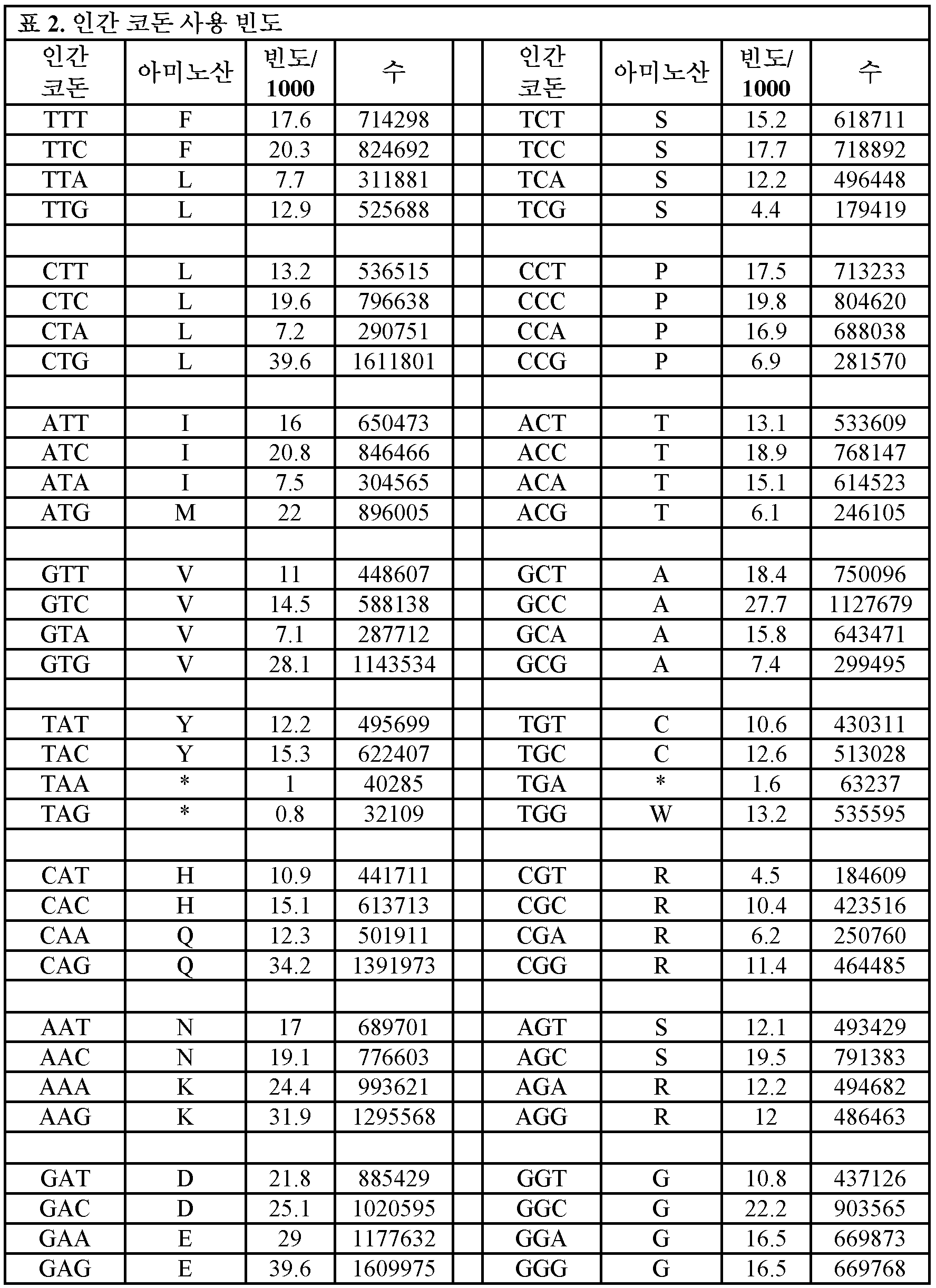
예를 들어, 코돈 TCT, TCC, TCA, TCG, AGT 및 AGC는 모두 세린을 코딩한다 (DNA 내의 T는 RNA 내의 U와 동등함을 주목함). 상기 표 2에 제시된 바와 같은 인간 코돈 사용 빈도로부터, 이들 코돈에 대한 상응하는 사용 빈도는 각각 15.2, 17.7, 12.2, 4.4, 12.1 및 19.5이다. TCG가 4.4%에 상응하기 때문에, 이 코돈이 유전자 합성에서 통상적으로 사용되는 경우에, 이 코돈에 대한 tRNA는 제한적일 것이다. 코돈 최적화에서, 목표는 각각의 코돈의 사용을 트랜스진이 발현되도록 의도된 동물 종에서의 정상 사용 빈도와 균형화시키는 것이다.For example, the codons TCT, TCC, TCA, TCG, AGT, and AGC all code for serine (note that T in DNA is equivalent to U in RNA). From the human codon usage frequencies shown in Table 2 above, the corresponding usage frequencies for these codons are 15.2, 17.7, 12.2, 4.4, 12.1, and 19.5, respectively. Since TCG corresponds to 4.4%, if this codon were to be commonly used in gene synthesis, tRNA for this codon would be limited. In codon optimization, the goal is to balance the usage of each codon with the normal usage in the animal species in which the transgene is intended to be expressed.
2. 스플라이스 부위2. Splice area
1개 이상의 잠재적 스플라이스 공여자 및/또는 스플라이스 수용자 부위가 확인되고 확인된 스플라이스 공여자 부위 중 1개 이상에서의 또는 그 근처에서의 핵산 서열이 변형된 것인 폴리뉴클레오티드가 본원에 제공된다. 일부 실시양태에서, 생성된 변형된 핵산 서열(들)은 이어서 합성되고, RNA 이질성에 의해 나타난 바와 같이 스플라이싱에 대해 시험하기 위해 세포를 형질도입하는 데 사용된다.Provided herein are polynucleotides in which one or more potential splice donor and/or splice acceptor sites are identified and the nucleic acid sequence at or near one or more of the identified splice donor sites is modified. In some embodiments, the resulting modified nucleic acid sequence(s) are then synthesized and used to transduce cells to test for splicing as indicated by RNA heterogeneity.
또한, 이질성을 감소시키도록 변형되거나 또는 본원에서 관찰된 1개 이상의 핵산 서열을 함유하여 (예컨대 최적화 방법에 의해) 별개의 참조 서열을 함유하거나 또는 변형되지 않은 것과 비교하여 폴리펩티드, 예컨대 CAR의 개선된 특색을 생성하는 폴리뉴클레오티드, 예컨대 본원에 제공된 임의의 항체, 수용체 (예컨대 항원 수용체, 예컨대 키메라 항원 수용체) 및/또는 GPRC5D-특이적 및/또는 BCMA-특이적 결합 도메인을 코딩하는 것이 본원에 제공된다. 이러한 특색 중에는 1개 이상의 스플라이스 부위, 예컨대 1개 이상의 잠재 스플라이스 부위의 존재로 인한 것과 같은 RNA 이질성의 개선, 및/또는 코딩된 단백질의 개선된 발현 및/또는 표면 발현, 예컨대 폴리펩티드를 발현하도록 조작된 세포 또는 상이한 치료 세포 조성물 사이의 발현의 증가된 수준, 균일성 또는 일관성이 포함된다.Also provided herein are polynucleotides encoding any of the antibodies, receptors (e.g., antigen receptors, such as chimeric antigen receptors) and/or GPRC5D-specific and/or BCMA-specific binding domains provided herein that are modified to reduce heterogeneity or contain one or more of the nucleic acid sequences observed herein (e.g., by optimization methods) to produce improved characteristics of a polypeptide, such as a CAR, as compared to a separate reference sequence or that is not modified. Such characteristics include improved RNA heterogeneity, such as due to the presence of one or more splice sites, such as one or more potential splice sites, and/or improved expression and/or surface expression of the encoded protein, such as increased levels, uniformity or consistency of expression between cells engineered to express the polypeptide or between different therapeutic cell compositions.
RNA를 발현 세포로부터 수거하고, 리버스 트랜스크립타제 폴리머라제 연쇄 반응 (RT-PCR)에 의해 증폭시키고, 아가로스 겔 전기영동에 의해 분해하여 출발 서열과 비교해 RNA의 이질성을 결정함으로써 폴리뉴클레오티드 서열에서 스플라이스 부위가 확인될 수 있다. 일부 경우에, 개선된 서열은 아가로스 겔 상의 RNA가 최소 RNA 이질성을 나타낼 때까지, 추가의 코돈 최적화 및 스플라이스 부위 제거를 위해 유전자 합성 판매업체에 재제출되고, 이어서 추가의 잠재 스플라이스 부위 평가, 변형, 합성 및 시험이 이어질 수 있다.Splice sites can be identified in a polynucleotide sequence by harvesting RNA from expressing cells, amplifying it by reverse transcriptase polymerase chain reaction (RT-PCR), resolving it by agarose gel electrophoresis, and comparing the RNA to the starting sequence to determine heterogeneity. In some cases, the improved sequence is resubmitted to a gene synthesis vendor for further codon optimization and splice site removal until the RNA on the agarose gel exhibits minimal RNA heterogeneity, followed by evaluation, modification, synthesis, and testing of additional potential splice sites.
또한, 스플라이스 부위, 예컨대 잠재 스플라이스 부위를 제거하도록 변형된 폴리뉴클레오티드가 제공된다. 게놈 핵산 서열은 일반적으로, 자연에서, 포유동물 세포에서, 전사와 동시에 또는 전사 직후에 프로세싱을 겪으며, 여기서 게놈 데옥시리보핵산 (DNA) 서열로부터 전사된 신생 전구체 메신저 리보핵산 (프리-mRNA)은 일부 경우에 스플라이싱에 의해 편집되어 인트론을 제거하고, 이어서 진핵 세포에서 엑손이 라이게이션된다. 스플라이스 부위에 대한 컨센서스 서열은 공지되어 있지만, 일부 측면에서 스플라이스 부위를 규정하는 특정 뉴클레오티드 정보는 복잡할 수 있고, 이용가능한 방법에 기초하여 자명하지 않을 수 있다. 잠재 스플라이스 부위는 표준 컨센서스 서열에 기초하여 예측되지 않고 가변적으로 활성화되는 스플라이스 부위이다. 따라서, 잠재 스플라이스 부위에서의 프리-mRNA의 가변적 스플라이싱은 진핵 세포에서의 발현 시 전사된 mRNA 생성물에서의 이질성으로 이어진다.Also provided are polynucleotides modified to remove splice sites, such as potential splice sites. Genomic nucleic acid sequences generally undergo processing in nature, in mammalian cells, either concurrently with or immediately following transcription, whereby nascent precursor messenger ribonucleic acid (pre-mRNA) transcribed from genomic deoxyribonucleic acid (DNA) sequences is edited, in some cases by splicing, to remove introns and subsequently ligate exons in eukaryotic cells. While consensus sequences for splice sites are known, the specific nucleotide information defining splice sites in some aspects can be complex and may not be obvious based on available methods. Potential splice sites are splice sites that are not predicted based on a standard consensus sequence and are variably activated. Thus, variable splicing of pre-mRNA at potential splice sites leads to heterogeneity in the transcribed mRNA product upon expression in eukaryotic cells.
트랜스진의 발현을 위해 생성된 폴리뉴클레오티드는 전형적으로 인트론을 함유하지 않는 핵산 서열, 예컨대 상보적 DNA (cDNA) 또는 그의 부분으로부터 구축된다. 따라서, 이러한 서열의 스플라이싱은 발생할 것으로 예상되지 않는다. 그러나, cDNA 서열 내의 잠재 스플라이스 부위의 존재는 의도하지 않거나 바람직하지 않은 스플라이싱 반응 및 전사된 mRNA에서의 이질성으로 이어질 수 있다. 이러한 이질성은 의도하지 않은 단백질 생성물, 예컨대 변형된 발현 및/또는 활성을 나타내는 가변적 아미노산 서열을 갖는 말단절단된 단백질 생성물의 번역을 유발한다.Polynucleotides generated for expression of transgenes are typically constructed from nucleic acid sequences that do not contain introns, such as complementary DNA (cDNA) or portions thereof. Therefore, splicing of such sequences is not expected to occur. However, the presence of potential splice sites within the cDNA sequence can lead to unintended or undesirable splicing reactions and heterogeneity in the transcribed mRNA. Such heterogeneity can result in translation of unintended protein products, such as truncated protein products having variable amino acid sequences that exhibit altered expression and/or activity.
일부 실시양태에서, 스플라이스 부위, 예컨대 잠재 스플라이스 부위를 제거하는 것은 트랜스진 생성물, 예컨대 트랜스진으로부터 번역된 폴리펩티드, 예컨대 이중특이적 CAR 폴리펩티드의 발현을 개선시키거나 최적화할 수 있다. 코딩된 트랜스진, 예컨대 GPRC5D-결합 도메인 및 BCMA-결합 도메인을 포함하는 코딩된 CAR의 잠재 스플라이스 부위에서의 스플라이싱은 감소된 단백질 발현, 예를 들어 세포 표면 상에서의 발현 및/또는 감소된 기능, 예를 들어 감소된 세포내 신호전달로 이어질 수 있다. 잠재 스플라이스 부위를 감소시키거나 제거하도록 최적화된 이중특이적 CAR 단백질을 코딩하는 폴리뉴클레오티드가 본원에 제공된다. 또한, 코돈 발현에 대해 최적화되고/거나 1개 이상의 서열, 예컨대 스플라이스 부위에 관하여 본원의 방법 또는 관찰에 의해 확인된 것이 존재하고/거나 확인된 스플라이스 부위, 예컨대 본원의 임의의 확인된 스플라이스 부위가 존재하지 않는 이중특이적 CAR 단백질을 코딩하는 폴리뉴클레오티드가 본원에 제공된다. 제공된 폴리뉴클레오티드 중에는 특정 조건 하에 발현되고/거나 명시된 세포 유형, 예컨대 인간 T 세포, 예컨대 1차 인간 T 세포, 및 이러한 폴리펩티드를 함유하고/거나 이러한 특성을 나타내는 세포 및 조성물 및 제조 물품 내로 도입되는 경우에, 특정 정도 미만의 RNA 이질성 또는 스플라이스 형태를 나타내는 것이 있다. 일부 실시양태에서, 전사된 RNA의 RNA 이질성은 잠재 스플라이스 부위를 제거하도록 및/또는 코돈 최적화에 의해 변형되지 않은 폴리뉴클레오티드와 비교하여 정확히 10%, 15%, 20%, 25%, 30%, 40%, 50% 또는 그 초과보다 더 크게 또는 약 상기 수치보다 더 크게 감소된다. 일부 실시양태에서, 이중특이적 CAR을 코딩하는 제공된 폴리뉴클레오티드는 적어도 70%, 75%, 80%, 85%, 90% 또는 95% 또는 그 초과인 전사된 RNA의 RNA 균질성을 나타낸다.In some embodiments, removal of a splice site, e.g., a potential splice site, can improve or optimize expression of a transgene product, e.g., a polypeptide translated from a transgene, e.g., a bispecific CAR polypeptide. Splicing of an encoded transgene, e.g., an encoded CAR comprising a GPRC5D-binding domain and a BCMA-binding domain, at a potential splice site can lead to reduced protein expression, e.g., expression on the cell surface, and/or reduced function, e.g., reduced intracellular signaling. Provided herein are polynucleotides encoding bispecific CAR proteins that are optimized to reduce or eliminate potential splice sites. Also provided herein are polynucleotides encoding bispecific CAR proteins that are optimized for codon expression and/or that have one or more sequences, e.g., those identified by the methods or observations herein with respect to splice sites, and/or that do not have an identified splice site, e.g., any of the identified splice sites herein. Among the provided polynucleotides are those that, when expressed under certain conditions and/or introduced into specified cell types, such as human T cells, such as primary human T cells, and cells and compositions and articles of manufacture containing and/or exhibiting such polypeptides, exhibit less than a certain degree of RNA heterogeneity or splice conformation. In some embodiments, the RNA heterogeneity of the transcribed RNA is reduced by greater than or equal to exactly 10%, 15%, 20%, 25%, 30%, 40%, 50% or more, or by about or greater than such values, as compared to a polynucleotide that is not modified to remove a potential splice site and/or by codon optimization. In some embodiments, the provided polynucleotides encoding a bispecific CAR exhibit an RNA homogeneity of the transcribed RNA that is at least 70%, 75%, 80%, 85%, 90% or 95% or more.
RNA 이질성은 본원에 제공되거나 기재되거나 공지된 임의의 다수의 방법에 의해 결정될 수 있다. 일부 실시양태에서, 전사된 핵산의 RNA 이질성은 전사된 핵산을 증폭시키고, 예컨대 리버스 트랜스크립타제 폴리머라제 연쇄 반응 (RT-PCR)에 의해 증폭시키고, 이어서 1개 이상의 증폭된 생성물에서 1개 이상의 차이, 예컨대 크기의 차이를 검출함으로써 결정된다. 일부 실시양태에서, RNA 이질성은 상이한 크기의 증폭된 생성물의 수 또는 다양한 상이한 크기의 증폭된 생성물의 비율에 기초하여 결정된다. 일부 실시양태에서, RNA, 예컨대 총 RNA 또는 세포질 폴리아데닐화 RNA를 세포로부터 수거하고, 최적화될 트랜스진을 발현시키고, 전사된 RNA 내 트랜스진의 상류에 위치하는, 일부 경우에는 발현 벡터 내 프로모터 서열의 한 부분에 상응하는 5' 비번역 영역 (5' UTR)에 특이적인 프라이머 및 전사된 RNA 서열 내 발현된 트랜스진의 하류에 위치하는 3' 비번역 영역 (3' UTR)에 특이적인 프라이머 또는 트랜스진 내의 서열에 특이적인 프라이머를 사용하여, 리버스 트랜스크립타제 폴리머라제 연쇄 반응 (RT-PCR)에 의해 증폭시킨다. 특정한 실시양태에서, 5' 비번역 영역 (UTR) 내 서열에 상보적인 적어도 1개의 프라이머 및 3' 비번역 영역 (UTR) 내 서열에 상보적인 적어도 1개의 프라이머를 트랜스진을 증폭시키는 데 사용한다. 통상의 기술자는 RNA, 예컨대 메신저 RNA를 분해하고, 여러 방법에 의해 그의 이질성을 분석할 수 있다. 비제한적 예시적인 방법은 아가로스 겔 전기영동, 칩-기반 모세관 전기영동, 분석 원심분리, 장 흐름 분획화 및 크로마토그래피, 예컨대 크기 배제 크로마토그래피 또는 액체 크로마토그래피를 포함한다.RNA heterogeneity can be determined by any of a number of methods provided, described, or known herein. In some embodiments, RNA heterogeneity of a transcribed nucleic acid is determined by amplifying the transcribed nucleic acid, such as by reverse transcriptase polymerase chain reaction (RT-PCR), and then detecting one or more differences, such as differences in size, in one or more amplified products. In some embodiments, RNA heterogeneity is determined based on the number of amplified products of different sizes or the ratio of amplified products of different sizes. In some embodiments, RNA, such as total RNA or cytoplasmic polyadenylated RNA, is harvested from a cell, the transgene to be optimized is expressed, and amplified by reverse transcriptase polymerase chain reaction (RT-PCR) using primers specific for the 5' untranslated region (5' UTR) located upstream of the transgene in the transcribed RNA, in some cases corresponding to a portion of a promoter sequence in an expression vector, and primers specific for the 3' untranslated region (3' UTR) located downstream of the expressed transgene in the transcribed RNA sequence, or primers specific for a sequence within the transgene. In particular embodiments, at least one primer complementary to a sequence within the 5' untranslated region (UTR) and at least one primer complementary to a sequence within the 3' untranslated region (UTR) are used to amplify the transgene. One of ordinary skill in the art can degrade RNA, such as messenger RNA, and analyze its heterogeneity by a number of methods. Non-limiting exemplary methods include agarose gel electrophoresis, chip-based capillary electrophoresis, analytical centrifugation, field flow fractionation, and chromatography, such as size exclusion chromatography or liquid chromatography.
일부 측면에서, 전사체, 예컨대 트랜스진 전사체에 존재하는 잠재적 잠재 스플라이스 부위 (스플라이스 공여자 및/또는 수용자 부위)의 존재는 세포에서의 발현 후에 전사체의 RNA 이질성을 유발할 수 있다. 일부 실시양태에서, 트랜스진 전사체에 존재할 수 있고/거나 바람직하지 않고/거나 다양한 기저 서열로부터의 트랜스진 전사체에 생성될 수 있는 1개 이상의 잠재적 스플라이스 부위는 전사체의 코돈 최적화 후에 및/또는 전사에서의 돌연변이 또는 실수 또는 오류에 의해 확인된다. 제공된 실시양태의 일부 측면에서, 스플라이스 공여자 부위 및 스플라이스 수용자 부위는 독립적으로 확인된다. 일부 실시양태에서, 스플라이스 수용자 및/또는 공여자 부위(들)는 정규, 비-정규 및/또는 잠재 스플라이스 수용자 및/또는 공여자 부위(들)이다.In some aspects, the presence of potential latent splice sites (splice donor and/or acceptor sites) present in a transcript, such as a transgene transcript, can cause RNA heterogeneity of the transcript after expression in a cell. In some embodiments, one or more potential splice sites that may be present in the transgene transcript and/or that may be undesirable and/or may be generated in the transgene transcript from a variety of underlying sequences are identified after codon optimization of the transcript and/or by mutations or mistakes or errors in transcription. In some aspects of the provided embodiments, the splice donor site and the splice acceptor site are independently identified. In some embodiments, the splice acceptor and/or donor site(s) are canonical, non-canonical, and/or latent splice acceptor and/or donor site(s).
일부 실시양태에서, RNA 이질성을 나타낼 수 있는 폴리뉴클레오티드, 예컨대 트랜스진, 예컨대 재조합 수용체를 코딩하는 폴리뉴클레오티드에서의 1개 이상의 잠재적 스플라이스 부위 (예를 들어, 정규, 비-정규 및/또는 잠재 스플라이스 수용자 및/또는 공여자 부위(들) 또는 분지 부위)가 확인되고/거나 변형된다. 또한, 이러한 참조 폴리뉴클레오티드와 비교하여 감소된 수의 이러한 스플라이스 부위를 갖는 폴리펩티드가 제공된다.In some embodiments, one or more potential splice sites (e.g., canonical, non-canonical, and/or potential splice acceptor and/or donor site(s) or branch site) in a polynucleotide capable of exhibiting RNA heterogeneity, such as a transgene, such as a polynucleotide encoding a recombinant acceptor, are identified and/or modified. Also provided are polypeptides having a reduced number of such splice sites compared to such reference polynucleotides.
일부 측면에서, 핵산 서열에서의 1개 이상의 스플라이스 부위의 확인은 반복적 과정이다. 일부 실시양태에서, 스플라이스 부위는 스플라이스 부위 및/또는 코돈 최적화 예측 도구를 사용하여, 예컨대 그 안에 포함된 트랜스진, 예컨대 이중특이적 CAR 또는 GPRC5D- 또는 BCMA-결합 도메인을 코딩하는 출발 또는 참조 서열을 데이터베이스, 유전자 합성 판매업체 또는 출발 또는 참조 서열을 컴퓨터적으로 또는 알고리즘적으로 비교하여 스플라이스 부위를 확인 또는 예측하고/거나 코돈 최적화 및/또는 스플라이스 부위 제거를 할 수 있는 다른 공급원에 제출함으로써 확인될 수 있다. 일부 실시양태에서, 코돈 최적화 및/또는 스플라이스 부위 제거를 위해 서열을 변형시킨 후에, 1개 이상의 다른 또는 추가의 스플라이스 부위 예측 도구(들)를 사용하여 스플라이스 부위 제거, 예컨대 잠재 스플라이스 부위에 대해 추가로 평가하기 위해 서열, 예컨대 수정된 또는 변형된 핵산 서열의 1회 이상의 추가의 평가가 수행된다.In some aspects, the identification of one or more splice sites in a nucleic acid sequence is an iterative process. In some embodiments, the splice sites can be identified by, for example, submitting a starting or reference sequence encoding a transgene, e.g., a bispecific CAR or a GPRC5D- or BCMA-binding domain, to a database, a gene synthesis vendor, or other source that can computationally or algorithmically compare the starting or reference sequence to identify or predict splice sites and/or perform codon optimization and/or splice site removal, using a splice site and/or codon optimization prediction tool. In some embodiments, after modifying a sequence for codon optimization and/or splice site removal, one or more additional evaluations of the sequence, e.g., the modified or modified nucleic acid sequence, are performed to further evaluate the sequence for splice site removal, e.g., potential splice sites, using one or more other or additional splice site prediction tool(s).
일부 측면에서, RNA 이질성은 진핵 세포에 존재하는 스플라이세오솜의 활성의 결과일 수 있다. 일부 측면에서, 스플라이싱은 전형적으로 스플라이세오솜에 의해 촉매되는 일련의 반응에서 수행된다. 스플라이스 부위에 대한 컨센서스 서열은 공지되어 있지만, 일부 측면에서 스플라이스 부위를 규정하는 특정 뉴클레오티드 정보는 복잡할 수 있고, 이용가능한 방법에 기초하여 자명하지 않을 수 있다. 잠재 스플라이스 부위는 표준 컨센서스 서열에 기초하여 예측되지 않고 가변적으로 활성화되는 스플라이스 부위이다. 따라서, 잠재 스플라이스 부위에서의 프리-mRNA의 가변적 스플라이싱은 진핵 세포에서의 발현 후 전사된 mRNA 생성물에서의 이질성으로 이어진다. 일부 경우에, 스플라이세오솜 인트론 내에서, 공여자 부위 (통상적으로 인트론의 5' 단부), 분지 부위 (인트론의 3' 단부 근처) 및 수용자 부위 (인트론의 3' 단부)가 스플라이싱 사건에 요구된다. 스플라이스 공여자 부위는 인트론의 5' 단부에 GU 서열을 포함할 수 있으며, 큰 덜 고도로 보존된 영역을 갖는다. 인트론의 3' 단부에서의 스플라이스 수용자 부위는 AG 서열로 종결될 수 있다.In some respects, RNA heterogeneity may be a result of the activity of the spliceosome present in eukaryotic cells. In some respects, splicing is typically carried out in a series of reactions catalyzed by the spliceosome. While consensus sequences for splice sites are known, in some respects the specific nucleotide information defining the splice site may be complex and may not be obvious based on available methods. Potential splice sites are splice sites that are not predicted based on the standard consensus sequence and are variably active. Thus, variable splicing of pre-mRNA at potential splice sites leads to heterogeneity in the transcribed mRNA product following expression in eukaryotic cells. In some cases, within a spliceosome intron, a donor site (typically at the 5' end of the intron), a branch site (near the 3' end of the intron), and an acceptor site (at the 3' end of the intron) are required for the splicing event. The splice donor site may contain a GU sequence at the 5' end of the intron, with a large less highly conserved region. The splice acceptor site at the 3' end of the intron may terminate in an AG sequence.
일부 실시양태에서, 잠재적 잠재 스플라이스 부위를 포함한 스플라이스 부위는 서열을 공지된 스플라이스 부위 서열, 예컨대 서열 데이터베이스에서의 것과 비교함으로써 확인될 수 있다. 일부 실시양태에서, 스플라이스 부위는 잠재적 스플라이스 부위 및 이러한 부위에서의 스플라이싱 사건의 확률을 확인하는 스플라이스 부위 예측 도구, 예컨대 인간 스플라이스 파인더 (Desmet et al., Nucl. Acids Res. 37(9):e67 (2009)), 신경망 스플라이스 부위 예측 도구, NN스플라이스(NNSplice) (Reese et al., J. Comput. Biol., 4(4):311 (1997)), 진스플라이서(GeneSplicer) (Pertea et al., Nucleic Acids Res. 2001 29(5): 1185-1190) 또는 NetUTR (Eden and Brunak, Nucleic Acids Res. 32(3):1131 (2004))에 의한 분석을 위해 뉴클레오티드 서열을 제출함으로써 컴퓨터적으로 확인될 수 있다. 추가의 스플라이스 예측 도구는 RegRNA, ESE파인더(ESEfinder) 및 MIT 스플라이스 예측인자를 포함한다. 스플라이스 부위 예측 도구, 예컨대 진스플라이서는 상이한 종, 예컨대 인간, 드로소필라 멜라노가스터(Drosophila melanogaster), 플라스모디움 팔시파룸(Plasmodium falciparum), 아라비돕시스 탈리아나(Arabidopsis thaliana) 및 벼에 대한 데이터베이스 상에서 성공적으로 훈련 및/또는 시험되었다. 일부 실시양태에서, 상이한 예측 도구는 상이한 데이터베이스 상에서 상이한 정도에 대해 및/또는 상이한 종에 대해 적합화될 수 있다. 일부 실시양태에서, 1개 이상의 예측 도구는 특정 데이터베이스에서의 및/또는 특정 종에 대한 그의 유용성에 기초하여 선택된다. 예를 들어, 문헌 [Saxonov et al., (2000) Nucleic Acids Res., 28, 185-190]을 참조한다.In some embodiments, splice sites, including potential potential splice sites, can be identified by comparing the sequence to known splice site sequences, such as those in a sequence database. In some embodiments, splice sites can be computationally identified by submitting the nucleotide sequence for analysis by a splice site prediction tool, such as Human Splice Finder (Desmet et al., Nucl. Acids Res. 37(9):e67 (2009)), the neural network splice site prediction tool, NNSplice (Reese et al., J. Comput. Biol., 4(4):311 (1997)), GeneSplicer (Pertea et al., Nucleic Acids Res. 2001 29(5): 1185-1190) or NetUTR (Eden and Brunak, Nucleic Acids Res. 32(3):1131 (2004)), which identifies potential splice sites and probabilities of splicing events at those sites. Additional splice prediction tools include RegRNA, ESEfinder, and MIT splice predictor. Splice site prediction tools, such as GeneSplicer, have been successfully trained and/or tested on databases for different species, such as human, Drosophila melanogaster, Plasmodium falciparum, Arabidopsis thaliana, and rice. In some embodiments, different prediction tools may be adapted to different degrees on different databases and/or for different species. In some embodiments, one or more prediction tools are selected based on their utility in a particular database and/or for a particular species. See, e.g., Saxonov et al., (2000) Nucleic Acids Res., 28, 185-190.
일부 실시양태에서, 1개 이상의 스플라이스 부위 예측 도구가 잠재적인 스플라이스 공여자 및/또는 수용자 부위를 결정하는 데 사용된다. 일부 실시양태에서, 로컬로 실행될 수 있고/거나, 사용자 사이트에서 데이터의 세트로 재훈련될 수 있고/거나, 특정한 종 (예컨대 인간)에 대한 데이터베이스를 사용할 수 있고/거나, 다중 플랫폼에 대해 컴파일링될 수 있고/거나, 서열 선택을 위한 실시간 예측을 가능하게 하고/거나, 특정한 도구 또는 플러그인이 변형될 수 있도록 OSI 인증된 오픈 소스 소프트웨어인 스플라이스 부위 예측 도구가 사용될 수 있다. 사용될 수 있는 예시적인 도구는 NN스플라이스, 진스플라이서 또는 둘 다를 포함한다.In some embodiments, one or more splice site prediction tools are used to determine potential splice donor and/or acceptor sites. In some embodiments, a splice site prediction tool may be used that is OSI certified open source software that can be run locally, retrained with a set of data at the user site, utilizes a database for a particular species (e.g., human), is compiled for multiple platforms, enables real-time prediction for sequence selection, and/or allows modification of a particular tool or plugin. Exemplary tools that may be used include NNSplice, GeneSplice, or both.
일부 측면에서, 스플라이스 부위 예측 도구는 서열, 예컨대 트랜스진 서열을 함유하는 폴리뉴클레오티드 서열에서 잠재적 스플라이스 공여자 및/또는 스플라이스 수용자 부위의 목록을 확인하는 데 사용될 수 있다. 일부 측면에서, 예측 도구는 또한 폴리뉴클레오티드 내의 1개 이상의 서열이 스플라이스 공여자 또는 수용자 부위 서열일 가능성을 나타낼 수 있는, 상기 1개 이상의 서열에 대한 1개 이상의 예측 점수를 생성할 수 있다.In some aspects, a splice site prediction tool can be used to identify a list of potential splice donor and/or splice acceptor sites in a polynucleotide sequence, such as a transgene sequence. In some aspects, the prediction tool can also generate one or more prediction scores for one or more sequences within the polynucleotide, which can indicate a likelihood that the one or more sequences are splice donor or acceptor site sequences.
일부 실시양태에서, 특정한 스플라이스 부위에 대한 예측 점수를 한계치 점수 또는 참조 점수와 비교하여 삭제 또는 제거를 위한 후보인 특정한 스플라이스 부위를 결정 또는 확인한다. 예를 들어, 일부 실시양태에서, 예측된 스플라이스 부위는 예측 점수가 한계치 점수 또는 참조 점수보다 더 크거나 그 이상일 때 잠재적 스플라이스 부위로서 확인된다. 일부 측면에서, 특정한 스플라이스 부위를 삭제 또는 제거하기 위한 고려사항은 참조 점수 또는 한계치 점수와 비교한 예측 점수; 및 특정한 스플라이스 부위가 바람직한지 또는 의도적인지 여부 (예를 들어, 스플라이싱 사건이 전사 및/또는 번역의 조절에 보다 유리하거나 또는 요구될 때)를 포함한다. 일부 측면에서, 생성된 스플라이스 변이체가 목적하는 기능을 상실하거나 또는 손상된 기능을 가질 가능성은 또한 삭제 또는 제거를 위한 특정한 공여자 및/또는 수용자 부위를 결정할 때 고려될 수 있다. 일부 측면에서, 1개 이상의 잠재적 스플라이스 공여자 및/또는 스플라이스 수용자 부위는 스플라이스 사건 또는 스플라이스 사건의 확률의 약 또는 적어도 약 0.7, 0.75, 0.8, 0.85, 0.9, 0.95 또는 1.0의 점수 (예를 들어, 최대 1.0의 척도로)를 나타내고, 부위는 스플라이스 부위 삭제 또는 제거를 위한 후보일 수 있다. 일부 측면에서, 1개 이상의 잠재적 스플라이스 공여자 및/또는 스플라이스 부위에서의, 예를 들어 진스플라이서에 의해 사용되는 점수는 참 마르코프 모델에 의해 그 서열에 대해 반환된 로그-오즈 점수와 거짓 마르코프 모델에 의해 계산된 점수 사이의 차이에 기초한다. 특정한 실시양태에서, 스플라이스 공여자 부위 및 스플라이스 수용자 부위는 독립적으로 또는 개별적으로 평가된다. 일부 실시양태에서, 스플라이스 공여자 부위 및 스플라이스 수용자 부위는 스플라이스 공여자/수용자 쌍으로서 평가된다.In some embodiments, a prediction score for a particular splice site is compared to a threshold score or reference score to determine or identify a particular splice site that is a candidate for deletion or removal. For example, in some embodiments, a predicted splice site is identified as a potential splice site when the prediction score is greater than or equal to the threshold score or reference score. In some aspects, considerations for deleting or removing a particular splice site include the predicted score compared to the reference score or threshold score; and whether the particular splice site is preferred or intentional (e.g., when the splicing event is more favorable or required for regulation of transcription and/or translation). In some aspects, the possibility that the resulting splice variant will lose a desired function or have impaired function may also be considered when determining a particular donor and/or acceptor site for deletion or removal. In some aspects, one or more of the potential splice donor and/or splice acceptor sites exhibit a score of about or at least about 0.7, 0.75, 0.8, 0.85, 0.9, 0.95 or 1.0 (e.g., on a scale of up to 1.0) of a splice event or a probability of a splice event, and the site may be a candidate for splice site deletion or removal. In some aspects, the score used by, for example, GeneSplicer, at one or more of the potential splice donor and/or splice sites is based on the difference between the log-odds score returned for that sequence by the true Markov model and the score calculated by the false Markov model. In certain embodiments, the splice donor sites and splice acceptor sites are evaluated independently or separately. In some embodiments, the splice donor sites and splice acceptor sites are evaluated as a splice donor/acceptor pair.
일부 실시양태에서, 1개 이상의 스플라이스 공여자 및/또는 스플라이스 수용자 부위(들), 예컨대 바람직하지 않거나 또는 바람직하지 않은 RNA 이질성을 유발하는 잠재 스플라이싱 사건에 수반될 수 있는 잠재적 스플라이스 공여자 및/또는 수용자 부위는 제거된다. 일부 실시양태에서, 1개 이상의 스플라이스 부위를 제거하는 것은 제거를 위한 후보인 스플라이스 공여자 및/또는 수용자 부위 내의, 그에 있는, 그를 함유하는 또는 그 근처의 1개 이상의 뉴클레오티드를 (예를 들어, 치환 또는 대체에 의해) 변형시키는 것을 포함한다. 일부 측면에서, 스플라이스 부위에 있거나, 그를 함유하거나 또는 그 근처에 있는 코돈 내의 특정한 뉴클레오티드는 변형된다 (예를 들어, 치환 또는 대체됨). 일부 측면에서, 변형 (예컨대 치환 또는 대체)은 부위에서 특정한 코돈에 의해 코딩된 아미노산을 보유하거나 보존함과 동시에, 잠재적인 스플라이스 공여자 및/또는 수용자 부위를 제거한다.In some embodiments, one or more splice donor and/or splice acceptor site(s), such as a potential splice donor and/or acceptor site that may be involved in a potential splicing event that results in undesirable or undesirable RNA heterogeneity, are removed. In some embodiments, removing one or more splice sites comprises modifying (e.g., by substitution or replacement) one or more nucleotides within, at, containing, or near the splice donor and/or acceptor site that is a candidate for removal. In some aspects, a particular nucleotide within a codon that is at, containing, or near the splice site is modified (e.g., substituted or replaced). In some aspects, a modification (e.g., a substitution or replacement) removes a potential splice donor and/or acceptor site while retaining or preserving the amino acid encoded by the particular codon at the site.
일부 실시양태에서, 변형을 위한 스플라이스 부위 또는 그 근처의 코돈은 잠재적 스플라이스 부위에서 2개의 뉴클레오티드 중 하나 또는 둘 다를 수반하는 1개 이상의 코돈을 포함한다 (일부 경우에 "스플라이스 부위 코돈"으로 지칭됨). 잠재적 스플라이싱이 코돈 내 2개의 뉴클레오티드 사이에 발생하는 것으로 예측되는 경우에, 코돈은 이 스플라이스 부위에 대한 유일한 스플라이스 부위 코돈이다. 잠재적 스플라이싱이 2개의 인접한 코돈 사이에, 예를 들어 제1 코돈의 마지막 뉴클레오티드와 다음 코돈의 제1 뉴클레오티드 사이에 발생할 것으로 예측되는 경우에, 2개의 코돈은 스플라이스 부위 코돈이다. 예를 들어, 2개의 코돈의 경계에 있는 것으로 예측되는 스플라이스 부위의 경우, 2개의 인접한 코돈은 뉴클레오티드 변형을 위한 후보일 수 있다. 일부 실시양태에서, 1개 이상의 코돈은 1개의 스플라이스 부위 코돈을 포함한다. 일부 실시양태에서, 1개 이상의 코돈은 두 스플라이스 부위 코돈을 포함한다. 일부 실시양태에서, 잠재적 스플라이스 공여자 부위는 하나 또는 둘 다의 스플라이스 부위 코돈을 변형시킴으로써 제거된다. 일부 실시양태에서, 잠재적 스플라이스 수용자 공여자 부위는 하나 또는 둘 다의 스플라이스 부위 코돈을 변형시킴으로써 제거된다. 일부 실시양태에서, 스플라이스 부위에서의 하나 또는 둘 다의 코돈은, 예를 들어 스플라이스 부위 코돈에 대한 동의 코돈이 없는 경우에 변형되지 않는다. 일부 실시양태에서, 특정한 스플라이스 부위 코돈에 대해 이용가능한 동의 코돈이 없는 경우에, 인근 코돈에서의 1개 이상의 뉴클레오티드가 변형될 수 있다. 일부 실시양태에서, 변형된 1개 이상의 코돈은 스플라이스 부위 코돈을 포함하며, 여기서 변형은 스플라이스 부위에서의 하나 또는 둘 다의 뉴클레오티드를 상이한 뉴클레오티드 또는 상이한 뉴클레오티드들로 변화시키는 것을 포함한다. 일부 실시양태에서, 일부 실시양태에서, 스플라이스 공여자 부위는 하나 또는 둘 다의 스플라이스 부위 코돈을 변형시킴으로써 제거되며, 여기서 변형은 스플라이스 부위에서의 뉴클레오티드 중 1 또는 2개를 상이한 뉴클레오티드로 변화시키는 것이 아니라, 인근 뉴클레오티드, 예를 들어 스플라이스 부위에 인접한 코돈의 일부가 변형된다. 일부 실시양태에서, 변형될 수 있는 인근 또는 인접 뉴클레오티드는 인근 또는 인접 코돈, 예컨대 스플라이스 부위 코돈의 상류 또는 하류의 1, 2, 3, 4, 5, 6, 7, 8, 9 또는 10개 코돈 내에 있는 코돈의 일부인 뉴클레오티드의 변형을 포함한다.In some embodiments, a splice site or codon near a splice site for modification comprises one or more codons that involve one or both of two nucleotides at a potential splice site (in some embodiments, referred to as a "splice site codon"). If the potential splicing is predicted to occur between two nucleotides within a codon, the codon is the only splice site codon for that splice site. If the potential splicing is predicted to occur between two adjacent codons, for example, between the last nucleotide of a first codon and the first nucleotide of a subsequent codon, the two codons are splice site codons. For example, for a splice site predicted to be on the border of two codons, the two adjacent codons may be candidates for a nucleotide modification. In some embodiments, the one or more codons comprise one splice site codon. In some embodiments, the one or more codons comprise two splice site codons. In some embodiments, a potential splice donor site is removed by modifying one or both splice site codons. In some embodiments, a potential splice acceptor donor site is removed by modifying one or both splice site codons. In some embodiments, one or both codons at a splice site are not modified, for example, if there is no synonymous codon for the splice site codon. In some embodiments, if there is no synonymous codon available for a particular splice site codon, one or more nucleotides at a nearby codon may be modified. In some embodiments, the one or more modified codons comprise a splice site codon, wherein the modification comprises changing one or both nucleotides at the splice site to a different nucleotide or to different nucleotides. In some embodiments, in some embodiments, a splice donor site is removed by modifying one or both splice site codons, wherein the modification is not such that one or both of the nucleotides at the splice site are changed to different nucleotides, but rather that a nearby nucleotide, for example, part of a codon adjacent to the splice site, is modified. In some embodiments, the nearby or adjacent nucleotides that can be modified include modifications of a nucleotide that is part of a nearby or adjacent codon, for example, a codon that is within 1, 2, 3, 4, 5, 6, 7, 8, 9, or 10 codons upstream or downstream of the splice site codon.
일부 경우에, 폴리뉴클레오티드는 예측된 스플라이스 부위의 확률을 감소시키기 위해 코딩된 아미노산 서열을 보존하면서 수동으로 변형될 수 있다. 일부 실시양태에서, 스플라이스 부위의 적어도 80%, 85%, 90% 또는 95% 확률을 갖는 예측된 스플라이스 부위 중 1개 이상은 스플라이싱 사건의 확률을 감소시키도록 수동으로 변형된다. 일부 실시양태에서, 1개 이상의 변형(들)은 1, 2, 3, 4, 5, 6 또는 7개 뉴클레오티드의 뉴클레오티드 대체 또는 치환에 의한 것이다. 일부 실시양태에서, 변형(들)은 스플라이스 공여자 부위의 접합부에 있거나 또는 스플라이스 수용자 부위의 접합부에 있다. 일부 실시양태에서, 1개 이상의 뉴클레오티드 변형 중 적어도 하나는 스플라이스 수용자 및/또는 스플라이스 공여자 부위의 스플라이스 부위 접합부의 1, 2, 3, 4, 5, 6, 7, 8, 9 또는 10개 잔기 내에 있다. 일부 실시양태에서, 변형된 핵산 서열의 라이브러리는 잠재 스플라이스 부위의 감소된 확률로 생성될 수 있다. 일부 실시양태에서, 스플라이스 공여자 부위 및 스플라이스 수용자 부위는 스플라이스 공여자/수용자 쌍으로서 평가된다. 특정한 실시양태에서, 스플라이스 공여자 부위 및 스플라이스 수용자 부위는 스플라이스 공여자/수용자 쌍으로서 부분적으로가 아니라 독립적으로 또는 개별적으로 평가된다. 일부 실시양태에서, 1개 이상의 예측된 스플라이스 부위는 제거되지 않는다. 일부 실시양태에서, 전사체의 프로모터 영역 내의 스플라이스 부위, 예컨대 공지된 또는 예측된 스플라이스 부위는 제거되지 않는다.In some cases, the polynucleotide may be manually modified while preserving the encoded amino acid sequence to reduce the probability of a predicted splice site. In some embodiments, one or more of the predicted splice sites having at least an 80%, 85%, 90%, or 95% probability of being a splice site are manually modified to reduce the probability of a splicing event. In some embodiments, the one or more modification(s) is by a nucleotide replacement or substitution of 1, 2, 3, 4, 5, 6, or 7 nucleotides. In some embodiments, the modification(s) is at a junction of a splice donor site or is at a junction of a splice acceptor site. In some embodiments, at least one of the one or more nucleotide modifications is within 1, 2, 3, 4, 5, 6, 7, 8, 9, or 10 residues of a splice site junction of a splice acceptor and/or splice donor site. In some embodiments, a library of modified nucleic acid sequences can be generated with a reduced probability of potential splice sites. In some embodiments, splice donor sites and splice acceptor sites are evaluated as a splice donor/acceptor pair. In certain embodiments, splice donor sites and splice acceptor sites are evaluated independently or individually, rather than partially as a splice donor/acceptor pair. In some embodiments, one or more predicted splice sites are not removed. In some embodiments, splice sites within a promoter region of a transcript, such as known or predicted splice sites, are not removed.
일부 실시양태에서, 1 또는 2개의 스플라이스 부위 코돈 또는 1개 이상의 인근 또는 인접 코돈 (예를 들어, 스플라이스 부위 코돈에 대해 동의 코돈이 이용가능하지 않은 경우)을 변형시킴으로써 1개 이상의 잠재적 공여자 스플라이스 부위가 제거된다. 일부 실시양태에서, 1 또는 2개의 스플라이스 부위 코돈 또는 1개 이상의 인근 또는 인접 코돈 (예를 들어, 스플라이스 부위 코돈에 대해 동의 코돈이 이용가능하지 않은 경우)을 변형시킴으로써 1개 이상의 잠재적 수용자 스플라이스 부위가 제거된다. 일부 실시양태에서, 변형에 적용되는 인근 또는 인접 코돈은 스플라이스 부위 코돈의 상류 또는 하류의 1, 2, 3, 4, 5, 6, 7, 8, 9 또는 10개 코돈 내에 있는 코돈, 예컨대 스플라이스 부위로부터 1, 2 또는 3개 코돈 내에 있는 코돈을 포함한다. 일부 실시양태에서, 스플라이싱을 위한 잠재적 분지 부위가 삭제 또는 제거된다. 일부 측면에서, 분지 부위의 또는 그 근처의 코돈 내의 뉴클레오티드는 변형, 예를 들어 치환 또는 대체되어 잠재 스플라이싱을 제거하고/거나 RNA 이질성을 감소시킬 수 있다. 일부 실시양태에서, 1개 이상의 뉴클레오티드의 변형은 스플라이싱에 수반될 수 있는 뉴클레오티드 중 1개의 치환 또는 대체 (예컨대 스플라이스 공여자 부위, 스플라이스 수용자 부위 또는 스플라이스 분지 부위에서)를 수반할 수 있으며, 코돈에 의해 코딩된 아미노산이 보존되고 뉴클레오티드 치환 또는 대체가 폴리뉴클레오티드에 의해 코딩된 폴리펩티드 서열을 변화시키지 않도록 한다. 일부 경우에, 코돈 내의 제3 위치는 다른 2개의 위치보다 더 축중성이다. 따라서, 다양한 동의 코돈이 특정한 아미노산을 코딩할 수 있다 (예를 들어, 상기 섹션 II.1. 참조). 일부 실시양태에서, 변형은 코돈을 폴리뉴클레오티드가 도입되는 세포의 종 (예를 들어, 인간)에서 사용되는 동의 코돈으로 대체하는 것을 포함한다. 일부 실시양태에서, 종은 인간이다. 일부 실시양태에서, 1개 이상의 코돈은 종에서 가장 빈번하게 사용되는 상응하는 동의 코돈 또는 상응하는 코돈과 유사한 사용 빈도 (예를 들어, 가장 가까운 사용 빈도)를 갖는 동의 코돈으로 대체된다 (예를 들어, 상기 섹션 II.1. 참조).In some embodiments, one or more potential donor splice sites are removed by modifying one or two splice site codons, or one or more nearby or adjacent codons (e.g., where a synonymous codon is not available for the splice site codon). In some embodiments, one or more potential acceptor splice sites are removed by modifying one or two splice site codons, or one or more nearby or adjacent codons (e.g., where a synonymous codon is not available for the splice site codon). In some embodiments, the nearby or adjacent codons to which a modification is applied include codons that are within 1, 2, 3, 4, 5, 6, 7, 8, 9, or 10 codons upstream or downstream of a splice site codon, such as codons that are within 1, 2, or 3 codons from a splice site. In some embodiments, a potential branch site for splicing is deleted or removed. In some aspects, a nucleotide within a codon at or near a branch site can be modified, e.g., substituted or replaced, to eliminate potential splicing and/or reduce RNA heterogeneity. In some embodiments, a modification of one or more nucleotides can involve a substitution or replacement of one of the nucleotides that can be involved in splicing (e.g., at a splice donor site, a splice acceptor site, or a splice branch site), such that the amino acid encoded by the codon is preserved and the nucleotide substitution or replacement does not change the polypeptide sequence encoded by the polynucleotide. In some cases, the third position within the codon is more degenerate than the other two positions. Thus, multiple synonymous codons can encode a particular amino acid (see, e.g., Section II.1., supra). In some embodiments, the modification comprises replacing a codon with a synonymous codon used in the species of cell into which the polynucleotide is introduced (e.g., a human). In some embodiments, the species is human. In some embodiments, one or more codons are replaced with a corresponding synonymous codon that is most frequently used in the species or a synonymous codon having a similar usage frequency (e.g., the closest usage frequency) to the corresponding codon (see, e.g., Section II.1. above).
일부 실시양태에서, 스플라이스 부위의 제거를 위한 트랜스진 후보는 초기 제안된 변형 후에 평가된다. 일부 측면에서, 변형 및/또는 코돈 최적화 후에 제안된 변형을 평가하고 임의의 추가의 잠재적 스플라이스 부위를 확인하기 위해 제안된 변형이 다시 평가될 수 있다. 일부 측면에서, 코돈 최적화 및/또는 스플라이스 부위 제거를 위해 서열을 변형시킨 후에, 동일한 또는 1개 이상의 다른 또는 추가의 스플라이스 부위 예측 도구(들)를 사용하여 스플라이스 부위 제거, 예컨대 잠재 스플라이스 부위에 대해 추가로 평가하기 위해 서열, 예컨대 수정된 또는 변형된 핵산 서열의 1개 이상의 추가의 평가가 수행된다. 일부 측면에서, 제안된 변형이 후속 단계에 대해 고려되고, 반복 최적화가 사용될 수 있다. 일부 측면에서, 방법의 임의의 확인 및/또는 변형 단계는, 예를 들어 전사체의 이질성이 초기에 결정된 바와 같은 전사체의 이질성과 비교하여 감소될 때까지 반복될 수 있다. 일부 실시양태에서, 추가의 또는 상이한 변형, 예컨대 동일한 코돈에서의 상이한 뉴클레오티드 대체 또는 상이한 위치 또는 코돈에서의 변형을 갖는 것은 반복 평가 및 판단 후에 수행될 수 있다. 일부 실시양태에서, 상응하는 상이한 동의 코돈, 예컨대 특정한 종에서 두번째로 가장 빈번하게 사용되는 코돈 또는 상응하는 코돈과 유사한 사용 빈도 (예를 들어, 다음 가장 가까운 사용 빈도)를 갖는 코돈이 사용될 수 있다 (예를 들어, 상기 섹션 II.1 참조).In some embodiments, the transgene candidate for splice site removal is evaluated after the initial proposed modification. In some aspects, the proposed modification may be evaluated again after modification and/or codon optimization to evaluate the proposed modification and identify any additional potential splice sites. In some aspects, after modifying the sequence for codon optimization and/or splice site removal, one or more additional evaluations of the sequence, e.g., the modified or modified nucleic acid sequence, are performed using the same or one or more other or additional splice site prediction tool(s) to further evaluate the splice site removal, e.g., for potential splice sites. In some aspects, the proposed modification is considered for subsequent steps, and iterative optimization may be used. In some aspects, any of the identifying and/or modifying steps of the method may be repeated, for example, until the heterogeneity of the transcript is reduced compared to the heterogeneity of the transcript as initially determined. In some embodiments, additional or different modifications, such as different nucleotide substitutions at the same codon or modifications at different positions or codons, may be performed after the iterative evaluation and determination. In some embodiments, a corresponding different synonymous codon may be used, such as the second most frequently used codon in a particular species or a codon having a similar usage frequency (e.g., the next closest usage frequency) as the corresponding codon (see, e.g., Section II.1 above).
일부 측면에서, 제안된 변형은, 예를 들어 변형이 폴리뉴클레오티드에서 바람직하지 않은 또는 추가의 제한 부위를 생성하는지 여부를 평가하기 위해 추가로 평가될 수 있다. 일부 측면에서, 추가의 제한 부위는 바람직하지 않을 수 있고, 추가의 또는 상이한 변형 (예를 들어, 동일한 코돈에서의 상이한 뉴클레오티드 대체 또는 상이한 위치 또는 코돈에서의 변형을 가짐)이 고려될 수 있다. 일부 측면에서, 특정한 제한 부위, 예컨대 지정된 제한 부위는 피해진다. 일부 측면에서, 변형이 스플라이스 부위 예측 점수를 실질적으로 감소시키지 않는 경우에, 추가의 또는 대안적 변형이 제안될 수 있다. 일부 실시양태에서, 스플라이스 부위 예측 점수는 방법의 1회 이상의 반복 후에 적어도 약 5%, 10%, 15%, 20%, 25%, 30%, 35%, 40%, 45%, 50%, 55%, 60%, 65%, 70% 또는 75%만큼 감소 또는 저하될 수 있다.In some aspects, the proposed modifications can be further evaluated, for example, to assess whether the modification creates an undesirable or additional restriction site in the polynucleotide. In some aspects, the additional restriction site may be undesirable, and additional or different modifications (e.g., having a different nucleotide substitution at the same codon or a modification at a different position or codon) may be considered. In some aspects, certain restriction sites, such as designated restriction sites, are avoided. In some aspects, additional or alternative modifications may be proposed where the modification does not substantially reduce the splice site prediction score. In some embodiments, the splice site prediction score can be reduced or decreased by at least about 5%, 10%, 15%, 20%, 25%, 30%, 35%, 40%, 45%, 50%, 55%, 60%, 65%, 70%, or 75% after one or more iterations of the method.
일부 실시양태에서, 컴퓨터 시스템은 1개 이상의 단계, 도구, 기능, 프로세스 또는 스크립트를 실행하는 데 사용될 수 있다. 일부 실시양태에서, 스플라이스 부위의 삭제 또는 제거를 위한 스플라이스 부위 예측, 평가 및 변형은 컴퓨터 구현 방법 및/또는 컴퓨터 구현 단계인 단계를 포함하는 방법에 의해 수행될 수 있다. 일부 실시양태에서, 서열을 공지된 데이터베이스와 비교하고, 스플라이스 부위 예측 점수를 계산하고, 잠재적 뉴클레오티드 변형, 코돈 최적화 및/또는 반복 단계 중 어느 하나를 결정하는 것은 컴퓨터에 의해 또는 컴퓨터-구현 단계, 도구, 기능, 프로세스 또는 스크립트를 사용하여 구현될 수 있다. 특정한 실시양태에서, 프로세서 및 메모리를 포함하는 컴퓨터 시스템이 제공되며, 여기서 메모리는 프로세서가 본원에 제공된 방법의 단계 중 어느 하나 이상을 수행하도록 하는 작동가능한 명령을 함유한다. 일부 실시양태에서, 단계, 기능, 프로세스 또는 스크립트는 컴퓨터적으로 수행되며, 예를 들어 1개 이상의 컴퓨터 프로그램을 사용하여 및/또는 컴퓨터 알고리즘의 사용을 통해 수행된다.In some embodiments, a computer system can be used to implement one or more of the steps, tools, functions, processes or scripts. In some embodiments, splice site prediction, evaluation and modification for deletion or removal of splice sites can be performed by a method comprising steps that are computer-implemented methods and/or computer-implemented steps. In some embodiments, comparing a sequence to a known database, calculating a splice site prediction score, and determining any one of the potential nucleotide modifications, codon optimization and/or repeat steps can be implemented by a computer or using computer-implemented steps, tools, functions, processes or scripts. In certain embodiments, a computer system is provided comprising a processor and a memory, wherein the memory contains operable instructions that cause the processor to perform any one or more of the steps of the methods provided herein. In some embodiments, the steps, functions, processes or scripts are performed computationally, such as by using one or more computer programs and/or through the use of a computer algorithm.
가능한 스플라이스 부위를 확인 및/또는 제거하기 위한 예시적인 단계, 기능, 프로세스 또는 스크립트는 서열을 선택하는 단계, FASTA 포맷 서열을 작성하는 단계, 코돈 표를 로딩하는 단계 (예를 들어, www.kazusa.or.jp/codon으로부터), 진스플라이서를 실행하는 단계, 예측을 로딩하는 단계, 코돈을 파싱하는 단계, 예측에서의 중첩을 결정하는 단계, 다음 최고 사용 동의 코돈을 확인하는 단계, 제한 부위를 검토하는 단계, 주석을 생성하는 단계 또는 다른 코돈을 평가하는 단계 중 1개 이상의 단계를 포함한다. 특정한 단계는 정방향 및 역방향 가닥 둘 다를 평가할 수 있다. 일부 측면에서, 반복적 최적화를 가능하게 하기 위해 이전에 주석달린 스플라이스 부위 변형이 또한 고려될 수 있다. 일부 실시양태에서, 단계, 기능, 프로세스 또는 스크립트 중 어느 하나 이상이 반복될 수 있다.Exemplary steps, functions, processes or scripts for identifying and/or removing possible splice sites include one or more of selecting a sequence, generating a FASTA format sequence, loading a codon table (e.g., from www.kazusa.or.jp/codon), running GeneSplicer, loading predictions, parsing codons, determining overlap in predictions, identifying the next best-used codon, reviewing restriction sites, generating annotations or evaluating other codons. Certain steps may evaluate both the forward and reverse strands. In some aspects, previously annotated splice site variants may also be considered to enable iterative optimization. In some embodiments, any one or more of the steps, functions, processes or scripts may be repeated.
일부 실시양태에서, 본원에 제공된 CAR을 코딩하는 제공된 폴리뉴클레오티드 또는 본원에 제공된 구축물은 스플라이스 사건 및/또는 감소된 발현 및/또는 증가된 RNA 이질성에 기여할 수 있는 1개 이상의 스플라이스 공여자 및/또는 수용자 부위를 제거하기 위한 변형을 포함한다. 일부 실시양태에서, CAR은 서열식별번호: 119에 제시된 뉴클레오티드 서열에 의해 코딩된다. 일부 실시양태에서, CAR은 서열식별번호: 120에 제시된 뉴클레오티드 서열에 의해 코딩된다.In some embodiments, a provided polynucleotide encoding a CAR provided herein or a construct provided herein comprises a modification to eliminate one or more splice donor and/or acceptor sites that can contribute to a splice event and/or reduced expression and/or increased RNA heterogeneity. In some embodiments, the CAR is encoded by the nucleotide sequence set forth in SEQ ID NO: 119. In some embodiments, the CAR is encoded by the nucleotide sequence set forth in SEQ ID NO: 120.
3. 다른 특색3. Other features
또한, 예를 들어 키메라 항원 수용체를 생산하기 위한, 폴리뉴클레오티드를 함유하는 벡터 및 벡터를 함유하는 숙주 세포가 제공된다. 또한, 키메라 항원 수용체를 생산하는 방법이 제공된다. 핵산은 항체 (예를 들어, 항체의 경쇄 및/또는 중쇄)의 VL 영역 및/또는 VH 영역을 포함하는 키메라 항원 수용체를 코딩할 수 있다. 핵산은 (예를 들어, 항체의 경쇄 및/또는 중쇄)의 항체의 VL 영역 및/또는 VH 영역을 각각 포함하는 1개 이상의 아미노 결합 도메인 (예를 들어, BCMA-결합 도메인 및 GPRC5D-결합 도메인)을 코딩할 수 있다. 추가 실시양태에서, 이러한 폴리뉴클레오티드를 포함하는 1개 이상의 벡터 (예를 들어, 발현 벡터)가 제공된다. 추가 실시양태에서, 이러한 폴리뉴클레오티드를 포함하는 숙주 세포가 제공된다. 하나의 이러한 실시양태에서, 숙주 세포는 항체의 VH 영역을 포함하는 키메라 항원 수용체를 코딩하는 핵산을 포함하는 벡터를 포함한다 (예를 들어, 그로 형질전환되었음). 또 다른 이러한 실시양태에서, 숙주 세포는 (1) 항체의 VL 영역 및 항체의 VH 영역을 포함하는 키메라 항원 수용체를 코딩하는 핵산을 포함하는 벡터, 또는 (2) 제1 항체 및 제2 항체를 포함하는 키메라 항원 수용체를 코딩하는 핵산을 포함하는 벡터를 포함한다 (예를 들어, 그로 형질전환되었음). 일부 실시양태에서, 숙주 세포는 1개 이상의 키메라 항원 수용체를 코딩하는 1개 이상의 핵산을 포함하는 1개 이상의 벡터를 포함한다 (예를 들어, 그로 형질전환되었음). 일부 실시양태에서, 1개 이상의 이러한 숙주 세포가 제공된다. 일부 실시양태에서, 1개 이상의 이러한 숙주 세포를 함유하는 조성물이 제공된다. 일부 실시양태에서, 1개 이상의 숙주 세포는 상이한 키메라 항원 수용체 또는 동일한 키메라 항원 수용체를 발현할 수 있다. 일부 실시양태에서, 각각의 숙주 세포는 1개 초과의 키메라 항원 수용체를 발현할 수 있다.Also provided are vectors containing polynucleotides for producing chimeric antigen receptors, for example, and host cells containing the vectors. Also provided are methods for producing chimeric antigen receptors. The nucleic acid can encode a chimeric antigen receptor comprising a VL region and/or a VH region of an antibody (e.g., a light chain and/or a heavy chain of the antibody). The nucleic acid can encode one or more amino binding domains (e.g., a BCMA-binding domain and a GPRC5D-binding domain) that each comprise a VL region and/or a VH region of an antibody (e.g., a light chain and/or a heavy chain of the antibody). In a further embodiment, one or more vectors (e.g., expression vectors) comprising such a polynucleotide are provided. In a further embodiment, a host cell comprising such a polynucleotide is provided. In one such embodiment, the host cell comprises (e.g., has been transformed with) a vector comprising a nucleic acid encoding a chimeric antigen receptor comprising a VH region of an antibody. In another such embodiment, the host cell comprises (e.g., is transformed with) (1) a vector comprising a nucleic acid encoding a chimeric antigen receptor comprising a VL region of an antibody and a VH region of an antibody, or (2) a vector comprising a nucleic acid encoding a chimeric antigen receptor comprising a first antibody and a second antibody. In some embodiments, the host cell comprises (e.g., is transformed with) one or more vectors comprising one or more nucleic acids encoding one or more chimeric antigen receptors. In some embodiments, one or more such host cells are provided. In some embodiments, a composition containing one or more such host cells is provided. In some embodiments, the one or more host cells can express different chimeric antigen receptors or the same chimeric antigen receptor. In some embodiments, each host cell can express more than one chimeric antigen receptor.
또한, BCMA 및 GPRC5D에 결합하는 이중특이적 키메라 항원 수용체를 제조하는 방법이 제공된다. 키메라 수용체의 재조합 생산을 위해, 예를 들어 본원에 기재된 바와 같은 키메라 수용체 항체를 코딩하는 핵산 서열을 단리하고, 추가의 클로닝 및/또는 숙주 세포에서의 발현을 위해 1개 이상의 벡터 내로 삽입할 수 있다. 이러한 핵산 서열은 통상적인 절차를 사용하여 (예를 들어, 항체의 중쇄 및 경쇄를 코딩하는 유전자에 특이적으로 결합할 수 있는 올리고뉴클레오티드 프로브를 사용함으로써) 용이하게 단리 및 서열분석될 수 있다. 일부 실시양태에서, 이중특이적 키메라 항원 수용체를 제조하는 방법으로서, 상기 제공된 바와 같은 항체 (즉, BCMA-결합 도메인 및 GPRC5D-결합 도메인)를 코딩하는 핵산 서열을 포함하는 숙주 세포를 수용체의 발현에 적합한 조건 하에 배양하는 것을 포함하는 방법이 제공된다.Also provided are methods for making a bispecific chimeric antigen receptor that binds to BCMA and GPRC5D. For recombinant production of the chimeric receptor, for example, a nucleic acid sequence encoding a chimeric receptor antibody as described herein can be isolated and inserted into one or more vectors for further cloning and/or expression in a host cell. Such nucleic acid sequences can be readily isolated and sequenced using conventional procedures (e.g., by using oligonucleotide probes that are capable of specifically binding to genes encoding the heavy and light chains of the antibody). In some embodiments, a method for making a bispecific chimeric antigen receptor is provided, comprising culturing a host cell comprising a nucleic acid sequence encoding an antibody as provided above (i.e., a BCMA-binding domain and a GPRC5D-binding domain) under conditions suitable for expression of the receptor.
일부 실시양태에서, 이중특이적 키메라 항원 수용체를 발현하는 세포를 포함하는 세포 조성물을 제조하는 방법이 제공된다.In some embodiments, a method of making a cell composition comprising cells expressing a bispecific chimeric antigen receptor is provided.
원핵생물에 추가로, 진핵 미생물, 예컨대 사상 진균 또는 효모, 예컨대 글리코실화 경로가 변형되어 인간 세포에서의 것을 모방하거나 근사화하여 부분 또는 완전 인간 글리코실화 패턴을 갖는 항체의 생산을 유발하는 진균 및 효모 균주가 항체-코딩 벡터에 적합한 클로닝 또는 발현 숙주이다. 문헌 [Gerngross, Nat. Biotech. 22:1409-1414 (2004), 및 Li et al., Nat. Biotech. 24:210-215 (2006)]을 참조한다.In addition to prokaryotes, eukaryotic microorganisms, such as filamentous fungi or yeast strains whose glycosylation pathways have been modified to mimic or approximate those in human cells, thereby resulting in the production of antibodies with partial or fully human glycosylation patterns, are suitable cloning or expression hosts for antibody-encoding vectors. See Gerngross, Nat. Biotech. 22:1409-1414 (2004), and Li et al., Nat. Biotech. 24:210-215 (2006).
폴리펩티드를 발현시키는 데 사용될 수 있는 예시적인 진핵 세포는 COS 세포, 예컨대 COS 7 세포; 293 세포, 예컨대 293-6E 세포; CHO 세포, 예컨대 CHO-S, DG44, Lec13 CHO 세포 및 FUT8 CHO 세포; PER.C6® 세포; 및 NSO 세포를 포함하나 이에 제한되지는 않는다. 일부 실시양태에서, 항체 중쇄 및/또는 경쇄 (예를 들어, VH 영역 및/또는 VL 영역)는 효모에서 발현될 수 있다 (예를 들어, 미국 공개 번호 US 2006/0270045 A1 참조). 일부 실시양태에서, 특정한 진핵 숙주 세포는 중쇄 및/또는 경쇄 (예를 들어, VH 영역 및/또는 VL 영역)에 목적하는 번역후 변형을 만드는 그의 능력에 기초하여 선택된다. 예를 들어, 일부 실시양태에서, CHO 세포는 293 세포에서 생산된 동일한 폴리펩티드보다 더 높은 수준의 시알릴화를 갖는 폴리펩티드를 생산한다. 특정한 예에서, 면역 세포, 예컨대 인간 면역 세포가 키메라 항원 수용체를 코딩하는 제공된 폴리펩티드를 발현시키는 데 사용된다. 일부 예에서, 면역 세포는 T 세포, 예컨대 CD4+ 및/또는 CD8+ 면역 세포이다.Exemplary eukaryotic cells that can be used to express the polypeptide include, but are not limited to, COS cells, such as
III. 조작된 세포III. Manipulated cells
또한, 재조합 수용체 (예를 들어, 키메라 항원 수용체)를 함유하는 세포, 예컨대 조작된 세포, 예컨대 본원에 제공된 바와 같은 GPRC5D-결합 도메인 및 BCMA-결합 도메인 둘 다를 포함하는 세포외 도메인을 함유하는 것이 제공된다. 또한, 이러한 세포, 이러한 세포를 함유하고/거나 이러한 세포가 풍부화된 조성물, 예컨대 GPRC5D-결합 도메인 및 BCMA 결합 도메인을 발현하는 세포가 조성물 중 총 세포 또는 특정 유형의 세포, 예컨대 T 세포, CD8+ 세포 또는 CD4+ 세포의 적어도 50, 60, 70, 80, 90, 91, 92, 93, 94, 95, 96, 97, 98, 99 퍼센트 또는 그 초과를 구성하는 것인 조성물의 집단이 제공된다.Also provided are cells, such as engineered cells, containing a recombinant receptor (e.g., a chimeric antigen receptor), such as those containing an extracellular domain comprising both a GPRC5D-binding domain and a BCMA-binding domain as provided herein. Also provided are populations of such cells, compositions containing such cells and/or enriched for such cells, such as compositions wherein the cells expressing the GPRC5D-binding domain and the BCMA binding domain constitute at least 50, 60, 70, 80, 90, 91, 92, 93, 94, 95, 96, 97, 98, 99 percent or more of the total cells or a particular type of cell, such as T cells, CD8+ cells or CD4+ cells, in the composition.
또한, 세포, 예컨대 GPRC5D-결합 도메인 및 BCMA-결합 도메인을 포함하는 재조합 수용체 (예를 들어, CAR)를 함유하도록 조작된, 조작된 세포가 제공된다. 일부 실시양태에서, 재조합 수용체는 GPRC5D-결합 도메인 및 BCMA-결합 도메인을 포함하는 탠덤 CAR이다. GPRC5D-결합 도메인은 임의의 공지된 GPRC5D-결합 도메인, 예컨대 본원에 또는 다른 곳에 기재된 항-GPRC5D CAR에 포함된 것일 수 있다 (예를 들어, WO 2016/090312, WO 2016/090329, WO 2018/017786, WO2020148677, WO2019154890, WO2021018859, WO2021018925 및 WO2018147245 참조). 예시적인 GPRC5D-결합 도메인은 섹션 I에 기재되어 있다. BCMA-결합 도메인은 임의의 공지된 BCMA-결합 도메인, 예컨대 본원에 또는 다른 곳에 기재된 항-BCMA CAR에 포함된 것일 수 있다 (예를 들어, WO 2013/154760, WO 2015/052538, WO 2015/090229, WO 2015/092024, WO 2015/158671, WO 2016/014565, WO 2016/014789, WO 2016/094304, WO 2016/166630, WO 2017/021450, WO 2017/083511, WO 2017/130223, WO 2017/211900, WO 2018/085690, WO 2018/028647 참조). 예시적인 BCMA-결합 도메인은 섹션 I에 기재되어 있다.Also provided are engineered cells, such as cells engineered to contain a recombinant receptor (e.g., a CAR) comprising a GPRC5D-binding domain and a BCMA-binding domain. In some embodiments, the recombinant receptor is a tandem CAR comprising a GPRC5D-binding domain and a BCMA-binding domain. The GPRC5D-binding domain can be any known GPRC5D-binding domain, such as that included in an anti-GPRC5D CAR described herein or elsewhere (see, e.g., WO 2016/090312, WO 2016/090329, WO 2018/017786, WO2020148677, WO2019154890, WO2021018859, WO2021018925, and WO2018147245). Exemplary GPRC5D-binding domains are described in Section I. The BCMA-binding domain can be any known BCMA-binding domain, such as that included in an anti-BCMA CAR described herein or elsewhere (e.g., WO 2013/154760, WO 2015/052538, WO 2015/090229, WO 2015/092024, WO 2015/158671, WO 2016/014565, WO 2016/014789, WO 2016/094304, WO 2016/166630, WO 2017/021450, WO 2017/083511, WO 2017/130223, WO 2017/211900, WO 2018/085690, WO Exemplary BCMA-binding domains are described in Section I.
일부 실시양태에서, 본원에 제공된 조작된 세포는 1개 이상의 다른 재조합 수용체(들)를 발현하는 1개 이상의 조작된 세포 집단(들)과 조합될 수 있다. 이러한 조작된 세포 집단은 동일한 또는 별개의 조성물로 제제화될 수 있다. 조성물 중에는 입양 세포 요법과 같은 투여를 위한 제약 조성물 및 제제가 있다. 또한, 대상체, 예를 들어 환자에게 본원에 제공된 임의의 세포 또는 조성물을 투여하는 치료 방법이 제공된다.In some embodiments, the engineered cells provided herein can be combined with one or more engineered cell populations expressing one or more other recombinant receptor(s). These engineered cell populations can be formulated into the same or separate compositions. Among the compositions are pharmaceutical compositions and formulations for administration, such as adoptive cell therapy. Also provided are therapeutic methods of administering any of the cells or compositions provided herein to a subject, e.g., a patient.
따라서, 항체를 함유하는 재조합 수용체를 발현하는 유전자 조작된 세포, 예를 들어 CAR을 함유하는 세포가 또한 제공된다. 세포는 일반적으로 진핵 세포, 예컨대 포유동물 세포이고, 전형적으로 인간 세포이다. 일부 실시양태에서, 혈액, 골수, 림프 또는 림프성 기관으로부터 유래된 세포는 면역계의 세포, 예컨대 선천성 또는 적응성 면역의 세포, 예를 들어 골수성 또는 림프성 세포, 예컨대 림프구, 전형적으로 T 세포 및/또는 NK 세포이다. 다른 예시적인 세포는 줄기 세포, 예컨대 다능 및 만능 줄기 세포, 예컨대 유도된 만능 줄기 세포 (iPSC)를 포함한다. 세포는 전형적으로 1차 세포, 예컨대 대상체로부터 직접 단리되고/거나 대상체로부터 단리되어 동결된 것이다. 일부 실시양태에서, 세포는 T 세포를 포함한다. 일부 실시양태에서, 세포는 T 세포 또는 다른 세포 유형의 1종 이상의 하위세트, 예컨대 전체 T 세포 집단, CD4+ 세포, CD8+ 세포 및 그의 하위집단, 예컨대 기능, 활성화 상태, 성숙, 분화, 확장, 재순환, 국재화 및/또는 지속 능력에 대한 잠재력, 항원-특이성, 항원 수용체의 유형, 특정한 기관 또는 구획 내의 존재, 마커 또는 시토카인 분비 프로파일 및/또는 분화 정도에 의해 정의된 것을 포함한다. 일부 실시양태에서, 세포는 CD4+ T 세포를 포함한다. 일부 실시양태에서, 세포는 CD8+ T 세포를 포함한다. 일부 실시양태에서, 세포는 CD4+ 및 CD8+ T 세포를 포함한다. 치료될 대상체에 관하여, 세포는 동종 및/또는 자가일 수 있다. 방법 중에는 기성 방법이 포함된다. 일부 측면에서, 예컨대 기성 기술의 경우, 세포는 만능 및/또는 다능, 예컨대 줄기 세포, 예컨대 유도된 만능 줄기 세포 (iPSC)이다. 일부 실시양태에서, 방법은 대상체로부터 세포를 단리하는 단계, 본원에 기재된 바와 같이 이들을 제조, 가공, 배양 및/또는 조작하는 단계, 및 동결보존 전 또는 후에 이들을 동일한 환자 내로 재도입하는 단계를 포함한다.Accordingly, genetically engineered cells expressing a recombinant receptor containing an antibody, e.g., a cell containing a CAR, are also provided. The cells are generally eukaryotic cells, such as mammalian cells, and are typically human cells. In some embodiments, the cells derived from blood, bone marrow, lymph or lymphoid organs are cells of the immune system, such as cells of innate or adaptive immunity, e.g., myeloid or lymphoid cells, such as lymphocytes, typically T cells and/or NK cells. Other exemplary cells include stem cells, such as multipotent and pluripotent stem cells, such as induced pluripotent stem cells (iPSCs). The cells are typically primary cells, such as those isolated directly from the subject and/or isolated and frozen from the subject. In some embodiments, the cells include T cells. In some embodiments, the cells comprise one or more subsets of T cells or other cell types, such as the entire T cell population, CD4+ cells, CD8+ cells and subsets thereof, such as those defined by function, activation state, potential for maturation, differentiation, expansion, recirculation, localization and/or persistence, antigen-specificity, type of antigen receptor, presence in a particular organ or compartment, marker or cytokine secretion profile and/or degree of differentiation. In some embodiments, the cells comprise CD4+ T cells. In some embodiments, the cells comprise CD8+ T cells. In some embodiments, the cells comprise CD4+ and CD8+ T cells. With respect to the subject to be treated, the cells can be allogeneic and/or autologous. Included among the methods are off-the-shelf methods. In some aspects, such as in off-the-shelf techniques, the cells are pluripotent and/or multipotent, such as stem cells, such as induced pluripotent stem cells (iPSCs). In some embodiments, the method comprises isolating cells from a subject, preparing, processing, culturing and/or manipulating them as described herein, and reintroducing them into the same patient, either prior to or following cryopreservation.
T 세포 및/또는 CD4+ 및/또는 CD8+ T 세포의 하위유형 및 하위집단 중에는 나이브 T (TN) 세포, 이펙터 T 세포 (TEFF), 기억 T 세포 및 그의 하위유형, 예컨대 줄기 세포 기억 T (TSCM), 중심 기억 T (TCM), 이펙터 기억 T (TEM) 또는 말단 분화된 이펙터 기억 T 세포, 종양-침윤 림프구 (TIL), 미성숙 T 세포, 성숙 T 세포, 헬퍼 T 세포, 세포독성 T 세포, 점막-연관 불변 T (MAIT) 세포, 자연 발생 및 적응 조절 T (Treg) 세포, 헬퍼 T 세포, 예컨대 TH1 세포, TH2 세포, TH3 세포, TH17 세포, TH9 세포, TH22 세포, 여포성 헬퍼 T 세포, 알파/베타 T 세포 및 델타/감마 T 세포가 있다.Among the subtypes and subpopulations of T cells and/or CD4+ and/or CD8+ T cells are naïve T (TN) cells, effector T cells (TEFs), memory T cells and their subtypes, such as stem cell memory T (TSCM), central memory T (TCM), effector memory T (TEM) or terminally differentiated effector memory T cells, tumor-infiltrating lymphocytes (TILs), immature T cells, mature T cells, helper T cells, cytotoxic T cells, mucosa-associated invariant T (MAIT) cells, naturally occurring and adaptive regulatory T (Treg) cells, helper T cells, such as TH1 cells, TH2 cells, TH3 cells, TH17 cells, TH9 cells, TH22 cells, follicular helper T cells, alpha/beta T cells and delta/gamma T cells.
일부 실시양태에서, 세포는 자연 킬러 (NK) 세포이다. 일부 실시양태에서, 세포는 단핵구 또는 과립구, 예를 들어 골수 세포, 대식세포, 호중구, 수지상 세포, 비만 세포, 호산구 및/또는 호염기구이다.In some embodiments, the cell is a natural killer (NK) cell. In some embodiments, the cell is a monocyte or granulocyte, e.g., a myeloid cell, a macrophage, a neutrophil, a dendritic cell, a mast cell, an eosinophil, and/or a basophil.
일부 실시양태에서, 세포는 유전자 조작을 통해 도입된 1개 이상의 폴리뉴클레오티드를 포함하고, 이에 의해 이러한 폴리뉴클레오티드의 재조합 또는 유전자 조작된 생성물을 발현한다. 일부 실시양태에서, 폴리뉴클레오티드는 이종이며, 즉 통상 세포 또는 세포로부터 수득된 샘플에는 존재하지 않는 것이고, 예컨대 또 다른 유기체 또는 세포로부터 수득된 것으로, 예를 들어 조작될 세포 및/또는 이러한 세포가 유래된 유기체에서는 통상적으로 발견되지 않는 것이다. 일부 실시양태에서, 다수의 상이한 세포 유형으로부터의 다양한 도메인을 코딩하는 폴리뉴클레오티드의 키메라 조합을 포함하는 것을 포함한, 자연에서 발견되지 않는 폴리뉴클레오티드와 같은 폴리뉴클레오티드는 자연 발생이 아니다. 일부 실시양태에서, 세포 (예를 들어, 조작된 세포)는 본원에 기재된 바와 같은 벡터 (예를 들어, 바이러스 벡터, 발현 벡터 등), 예컨대 본원에 기재된 재조합 수용체를 코딩하는 핵산을 포함하는 벡터를 포함한다.In some embodiments, the cell comprises one or more polynucleotides introduced through genetic engineering, thereby expressing a recombinant or genetically engineered product of such polynucleotide. In some embodiments, the polynucleotide is heterologous, i.e., not normally present in the cell or a sample obtained from the cell, such as obtained from another organism or cell, e.g., not normally found in the cell to be engineered and/or the organism from which the cell is derived. In some embodiments, the polynucleotide is not naturally occurring, such as a polynucleotide that is not found in nature, including comprising a chimeric combination of polynucleotides encoding different domains from multiple different cell types. In some embodiments, the cell (e.g., the engineered cell) comprises a vector as described herein (e.g., a viral vector, an expression vector, etc.), such as a vector comprising a nucleic acid encoding a recombinant receptor as described herein.
A. 유전자 조작을 위한 벡터 및 방법A. Vectors and methods for genetic manipulation
또한, 이중특이적 재조합 수용체 (예를 들어, CAR)를 발현하고, 이러한 수용체를 발현하는 유전자 조작된 세포를 생산하기 위한 방법, 폴리뉴클레오티드, 조성물 및 키트가 제공된다. 일부 실시양태에서, 1개 이상의 재조합 수용체 (예를 들어, CAR)는 세포 또는 복수의 세포 내로 유전자 조작될 수 있다. 유전자 조작은 일반적으로, 예컨대 렌티바이러스 형질도입, 레트로바이러스 형질도입, 형질감염 또는 형질전환에 의한, 재조합 또는 조작된 성분(들)을 코딩하는 핵산의 세포 내로의 도입을 수반한다.Also provided are methods, polynucleotides, compositions and kits for expressing a bispecific recombinant receptor (e.g., a CAR), and producing genetically engineered cells expressing such receptors. In some embodiments, one or more recombinant receptors (e.g., a CAR) can be genetically engineered into a cell or a plurality of cells. Genetic engineering generally involves introduction into a cell of a nucleic acid encoding the recombinant or engineered component(s), such as by lentiviral transduction, retroviral transduction, transfection or transformation.
일부 실시양태에서, 유전자 전달은 먼저 세포를 자극하고, 예컨대 세포를, 예를 들어 시토카인 또는 활성화 마커의 발현에 의해 측정된 바와 같은 반응, 예컨대 증식, 생존 및/또는 활성화를 유도하는 자극과 조합하고, 이어서 활성화된 세포를 형질도입하고, 배양물 중에서 임상 적용에 충분한 수로 확장시킴으로써 달성된다.In some embodiments, gene transfer is accomplished by first stimulating the cells, e.g., combining the cells with a stimulus that induces a response, e.g., proliferation, survival and/or activation, as measured by, e.g., expression of cytokines or activation markers, and then transducing the activated cells and expanding them in culture to numbers sufficient for clinical application.
일부 문맥에서, 자극 인자 (예를 들어, 림포카인 또는 시토카인)의 과다발현은 대상체에게 독성일 수 있다. 따라서, 일부 문맥에서, 조작된 세포는 세포가 생체내에서, 예컨대 입양 면역요법에서의 투여 시 음성 선택되기 쉽도록 하는 유전자 절편을 포함한다. 예를 들어, 일부 측면에서, 세포는 이들이 투여되는 환자의 생체내 상태의 변화의 결과로서 이들이 제거될 수 있도록 조작된다. 음성 선택 표현형은 투여된 작용제, 예를 들어 화합물에 감수성을 부여하는 유전자의 삽입으로부터 생성될 수 있다. 음성 선택 유전자는 간시클로비르 감수성을 부여하는 단순 포진 바이러스 유형 I 티미딘 키나제 (HSV-I TK) 유전자 (Wigler et al., Cell 2:223, 1977); 세포 하이포크산틴 포스포리보실트랜스퍼라제 (HPRT) 유전자, 세포 아데닌 포스포리보실트랜스퍼라제 (APRT) 유전자, 박테리아 시토신 데아미나제 (Mullen et al., Proc. Natl. Acad. Sci. USA. 89:33 (1992))를 포함한다.In some contexts, overexpression of a stimulating factor (e.g., a lymphokine or cytokine) may be toxic to the subject. Thus, in some contexts, the engineered cells comprise a genetic segment that renders the cells susceptible to negative selection in vivo, such as upon administration in adoptive immunotherapy. For example, in some aspects, the cells are engineered such that they are susceptible to elimination as a result of a change in the in vivo condition of the patient to which they are administered. The negative selection phenotype can result from the insertion of a gene that confers sensitivity to the administered agent, e.g., a compound. Negative selection genes include the herpes simplex virus type I thymidine kinase (HSV-I TK) gene, which confers sensitivity to ganciclovir (Wigler et al., Cell 2:223, 1977); It includes the cellular hypoxanthine phosphoribosyltransferase (HPRT) gene, the cellular adenine phosphoribosyltransferase (APRT) gene, and the bacterial cytosine deaminase (Mullen et al., Proc. Natl. Acad. Sci. USA. 89:33 (1992)).
일부 측면에서, 세포는 시토카인 또는 다른 인자의 발현을 촉진하도록 추가로 조작된다. 유전자 조작된 성분, 예를 들어 항원 수용체, 예를 들어 CAR의 도입을 위한 다양한 방법이 널리 공지되어 있고, 제공된 방법 및 조성물과 함께 사용될 수 있다. 예시적인 방법은 바이러스, 예를 들어 레트로바이러스 또는 렌티바이러스, 형질도입, 트랜스포손 및 전기천공을 통한 것을 포함한, 수용체를 코딩하는 폴리뉴클레오티드의 전달을 위한 것을 포함한다.In some aspects, the cells are further engineered to promote expression of cytokines or other factors. Various methods for introducing genetically engineered components, such as antigen receptors, such as CARs, are well known and can be used with the methods and compositions provided. Exemplary methods include those for delivering polynucleotides encoding the receptors, including via viruses, such as retroviruses or lentiviruses, transduction, transposons, and electroporation.
일부 실시양태에서, 재조합 폴리뉴클레오티드는 재조합 감염성 바이러스 입자, 예컨대, 예를 들어 원숭이 바이러스 40 (SV40), 아데노바이러스, 아데노-연관 바이러스 (AAV)로부터 유래된 벡터를 사용하여 세포 내로 전달된다. 일부 실시양태에서, 재조합 폴리뉴클레오티드는 재조합 렌티바이러스 벡터, 예컨대 HIV-1 렌티바이러스-기반 벡터 (렌티벡터; 예를 들어, 문헌 [Amado et al., Science. 1999 Jul 30;285(5428):674-676] 참조) 또는 레트로바이러스 벡터, 예컨대 감마-레트로바이러스 벡터 (예를 들어, 문헌 [Koste et al. (2014) Gene Therapy 2014 Apr 3. doi: 10.1038/gt.2014.25; Carlens et al. (2000) Exp Hematol 28(10): 1137-46; Alonso-Camino et al. (2013) Mol Ther Nucl Acids 2, e93; Park et al., Trends Biotechnol. 2011 November 29(11): 550-557] 참조)를 사용하여 T 세포 내로 전달된다.In some embodiments, the recombinant polynucleotide is delivered into the cell using a recombinant infectious viral particle, such as a vector derived from, for example, simian virus 40 (SV40), adenovirus, adeno-associated virus (AAV). In some embodiments, the recombinant polynucleotide is delivered into T cells using a recombinant lentiviral vector, such as an HIV-1 lentivirus-based vector (lentivector; see, e.g., Amado et al., Science. 1999
일부 실시양태에서, 레트로바이러스 벡터 또는 렌티바이러스 벡터는 긴 말단 반복 서열 (LTR)을 갖는다. 일부 실시양태에서, 벡터는 몰로니 뮤린 백혈병 바이러스 (MoMLV), 골수증식성 육종 바이러스 (MPSV), 뮤린 배아 줄기 세포 바이러스 (MESV), 뮤린 줄기 세포 바이러스 (MSCV), 비장 초점 형성 바이러스 (SFFV), 인간 면역결핍 바이러스 유형 1 (HIV-1), 인간 면역결핍 바이러스 유형 2 (HIV-2/SIV) 또는 아데노-연관 바이러스 (AAV)로부터 유래된다. 일부 실시양태에서, 벡터는 자기-불활성화 (SIN)이다. 일부 실시양태에서, 벡터는 조건부 복제 (이동가능) 벡터이다. 대부분의 렌티바이러스 벡터는 인간, 고양이 또는 원숭이 렌티바이러스로부터 유래된다. 대부분의 레트로바이러스 벡터는 뮤린 레트로바이러스로부터 유래된다. 일부 실시양태에서, 렌티바이러스 또는 레트로바이러스는 임의의 조류 또는 포유동물 세포 공급원으로부터 유래된 것을 포함한다. 렌티바이러스 또는 레트로바이러스는 전형적으로 양생이며, 이들은 인간을 포함한 여러 종의 숙주 세포를 감염시킬 수 있다는 것을 의미한다. 한 실시양태에서, 발현될 유전자는 레트로바이러스 gag, pol 및/또는 env 서열을 대체한다. 렌티바이러스 형질도입 방법은 공지되어 있다. 예시적인 방법은, 예를 들어 문헌 [Wang et al. (2012) J. Immunother. 35(9): 689-701; Cooper et al. (2003) Blood. 101:1637-1644; Verhoeyen et al. (2009) Methods Mol Biol. 506: 97-114; 및 Cavalieri et al. (2003) Blood. 102(2): 497-505]에 기재되어 있다. 다수의 예시적인 레트로바이러스 시스템이 또한 기재되었다 (예를 들어, 문헌 [Amado et al., (1999) Science 285(5428):674-676, U.S. Pat. Nos. 5,219,740; 6,207,453; 5,219,740; Miller and Rosman (1989) BioTechniques 7:980-990; Miller (1990) Human Gene Therapy 1:5-14; Scarpa et al. (1991) Virology 180:849-852; Burns et al. (1993) Proc. Natl. Acad. Sci. USA 90:8033-8037; 및 Boris-Lawrie and Temin (1993) Cur. Opin. Genet. Develop. 3:102-109]).In some embodiments, the retroviral vector or lentiviral vector has a long terminal repeat (LTR). In some embodiments, the vector is derived from Moloney murine leukemia virus (MoMLV), myeloproliferative sarcoma virus (MPSV), murine embryonic stem cell virus (MESV), murine stem cell virus (MSCV), spleen focus forming virus (SFFV), human immunodeficiency virus type 1 (HIV-1), human immunodeficiency virus type 2 (HIV-2/SIV), or adeno-associated virus (AAV). In some embodiments, the vector is self-inactivating (SIN). In some embodiments, the vector is a conditionally replicating (mobile) vector. Most lentiviral vectors are derived from human, feline, or simian lentiviruses. Most retroviral vectors are derived from murine retroviruses. In some embodiments, the lentivirus or retrovirus comprises one derived from any avian or mammalian cell source. Lentiviruses or retroviruses are typically bivalent, meaning that they can infect host cells of many species, including humans. In one embodiment, the gene to be expressed replaces a retroviral gag, pol and/or env sequence. Methods for lentiviral transduction are known. Exemplary methods are described, for example, in the literature [Wang et al. (2012) J. Immunother. 35(9): 689-701; Cooper et al. (2003) Blood. 101:1637-1644; Verhoeyen et al. (2009) Methods Mol Biol. 506: 97-114; and Cavalieri et al. (2003) Blood. 102(2): 497-505]. A number of exemplary retroviral systems have also been described (see, e.g., Amado et al., (1999) Science 285(5428):674-676, U.S. Pat. Nos. 5,219,740; 6,207,453; 5,219,740; Miller and Rosman (1989) BioTechniques 7:980-990; Miller (1990) Human Gene Therapy 1:5-14; Scarpa et al. (1991) Virology 180:849-852; Burns et al. (1993) Proc. Natl. Acad. Sci. USA 90:8033-8037; and Boris-Lawrie and Temin (1993) Cur. Opin. Genet. Develop. 3:102-109).
일부 실시양태에서, 재조합 폴리뉴클레오티드는 전기천공을 통해 T 세포 내로 전달된다 (예를 들어, 문헌 [Chicaybam et al., (2013) PLoS ONE 8(3): e60298 및 Van Tedeloo et al. (2000) Gene Therapy 7(16): 1431-1437] 참조). 일부 실시양태에서, 재조합 폴리뉴클레오티드는 전위를 통해 T 세포 내로 전달된다 (예를 들어, 문헌 [Manuri et al. (2010) Hum Gene Ther 21(4): 427-437; Sharma et al. (2013) Molec Ther Nucl Acids 2, e74; 및 Huang et al. (2009) Methods Mol Biol 506: 115-126] 참조). 면역 세포에 유전 물질을 도입하고 이를 발현시키는 다른 방법은 인산칼슘 형질감염 (예를 들어, 문헌 [Current Protocols in Molecular Biology, John Wiley & Sons, New York. N.Y.]에 기재된 바와 같음), 원형질체 융합, 양이온성 리포솜-매개 형질감염; 텅스텐 입자-촉진된 마이크로입자 충격 (Johnston (1990) Nature 346: 776-777); 및 인산스트론튬 DNA 공동-침전 (Brash et al., (1987) Mol. Cell Biol.7: 2031-2034)을 포함한다. 재조합 생성물을 코딩하는 폴리뉴클레오티드의 전달을 위한 다른 접근법 및 벡터는, 예를 들어 국제 특허 출원, 공개 번호 WO2014055668 및 미국 특허 번호 7,446,190에 기재된 것이다.In some embodiments, the recombinant polynucleotide is delivered into the T cell via electroporation (see, e.g., Chicaybam et al., (2013) PLoS ONE 8(3): e60298 and Van Tedeloo et al. (2000) Gene Therapy 7(16): 1431-1437). In some embodiments, the recombinant polynucleotide is delivered into the T cell via transposition (see, e.g., Manuri et al. (2010) Hum Gene Ther 21(4): 427-437; Sharma et al. (2013) Molec
추가의 폴리뉴클레오티드, 예를 들어 도입을 위한 유전자 중에는, 예컨대 전달된 세포의 생존율 및/또는 기능을 촉진함으로써 요법의 결과를 개선시키는 것; 세포의 선택 및/또는 평가를 위한, 예컨대 생체내 생존 또는 국재화를 평가하기 위한 유전자 마커를 제공하는 유전자; 예를 들어 문헌 [Lupton S. D. et al., Mol. and Cell Biol., 11:6 (1991); 및 Riddell et al., Human Gene Therapy 3:319-338 (1992)]에 기재된 바와 같이 세포가 생체내에서 음성 선택되기 쉽도록 만듦으로써 안전성을 개선시키는 유전자가 있으며; 또한 우성 양성 선택 마커를 음성 선택 마커와 융합시키는 것으로부터 유래된 이중기능적 선택 융합 유전자의 사용을 기재하고 있는 PCT/US91/08442 및 PCT/US94/05601 (Lupton et al.)의 공개 문헌을 참조한다. 예를 들어, 미국 특허 번호 6,040,177 (Riddell et al.), 칼럼 14-17을 참조한다.Additional polynucleotides, e.g., genes for introduction, include those that improve the outcome of the therapy, e.g., by promoting the survival and/or function of the delivered cells; genes that provide genetic markers for selection and/or evaluation of cells, e.g., for evaluating survival or localization in vivo; genes that improve safety, e.g., by making the cells susceptible to negative selection in vivo, as described in the literature [Lupton S. D. et al., Mol. and Cell Biol., 11:6 (1991); and Riddell et al., Human Gene Therapy 3:319-338 (1992)]; see also the published publications PCT/US91/08442 and PCT/US94/05601 (Lupton et al.), which describe the use of bifunctional selection fusion genes derived from fusing a dominant positive selection marker to a negative selection marker. See, for example, U.S. Patent No. 6,040,177 (Riddell et al.), cols. 14-17.
일부 실시양태에서, 1개 이상의 재조합 수용체 (예를 들어, CAR)는 세포 또는 복수의 세포에서 발현되도록 유전자 조작될 수 있다. 일부 실시양태에서, 재조합 수용체는 CAR이다. 일부 실시양태에서, CAR은 2개의 항원-결합 도메인을 포함한다. 일부 실시양태에서, CAR은 GPRC5D (예를 들어, 인간 GPRC5D)에 결합하는 GPRC5D-결합 도메인 및 BCMA (예를 들어, 인간 BCMA)에 결합하는 BCMA-결합 도메인을 포함한다. 일부 실시양태에서, CAR의 GPRC5D-결합 도메인 및 BCMA-결합 도메인은 링커, 예컨대 폴리펩티드 링커에 의해 분리된다.In some embodiments, one or more recombinant receptors (e.g., CARs) can be genetically engineered to be expressed in a cell or a plurality of cells. In some embodiments, the recombinant receptor is a CAR. In some embodiments, the CAR comprises two antigen-binding domains. In some embodiments, the CAR comprises a GPRC5D-binding domain that binds GPRC5D (e.g., human GPRC5D) and a BCMA-binding domain that binds BCMA (e.g., human BCMA). In some embodiments, the GPRC5D-binding domain and the BCMA-binding domain of the CAR are separated by a linker, such as a polypeptide linker.
일부 실시양태에서, 벡터 또는 구축물은 코딩된 재조합 수용체의 발현을 조절하기 위한 프로모터 및/또는 인핸서 또는 조절 요소를 함유할 수 있다. 일부 예에서, 프로모터 및/또는 인핸서 또는 조절 요소는 조건-의존성 프로모터, 인핸서 및/또는 조절 요소일 수 있다. 일부 예에서, 이들 요소는 트랜스진의 발현을 유도한다. 일부 예에서, CAR 트랜스진은 프로모터, 예컨대 HTLV1 인핸서를 갖는 EF1알파 프로모터 (서열식별번호: 61)에 작동가능하게 연결될 수 있다. 일부 예에서, CAR 트랜스진은 트랜스진의 하류에 위치하는 우드척 간염 바이러스 (WHP) 전사후 조절 요소 (WPRE; 서열식별번호: 62)에 작동가능하게 연결된다.In some embodiments, the vector or construct may contain a promoter and/or enhancer or regulatory elements for controlling expression of the encoded recombinant receptor. In some instances, the promoter and/or enhancer or regulatory elements may be condition-dependent promoters, enhancers and/or regulatory elements. In some instances, these elements drive expression of the transgene. In some instances, the CAR transgene may be operably linked to a promoter, such as the EF1alpha promoter with the HTLV1 enhancer (SEQ ID NO: 61). In some instances, the CAR transgene is operably linked to a woodchuck hepatitis virus (WHP) posttranscriptional regulatory element (WPRE; SEQ ID NO: 62) located downstream of the transgene.
일부 실시양태에서, 벡터 또는 구축물은 1개 이상의 핵산 분자의 발현을 유도하는 단일 프로모터를 함유할 수 있다. 일부 실시양태에서, 이러한 핵산 분자, 예를 들어 전사체는 멀티시스트론 (비시스트론 또는 트리시스트론, 예를 들어 미국 특허 번호 6,060,273 참조)일 수 있다. 예를 들어, 일부 실시양태에서, 전사 단위는 IRES (내부 리보솜 진입 부위)를 함유하는 비시스트론 단위로서 조작될 수 있으며, 이는 단일 프로모터로부터의 메세지에 의해 (예를 들어, 제1 및 제2 키메라 수용체를 코딩하는) 유전자 생성물의 공동발현을 가능하게 한다.In some embodiments, the vector or construct can contain a single promoter driving expression of one or more nucleic acid molecules. In some embodiments, such nucleic acid molecules, e.g., transcripts, can be multicistronic (bicistronic or tricistronic, see, e.g., U.S. Pat. No. 6,060,273). For example, in some embodiments, the transcription unit can be engineered as a bicistronic unit containing an IRES (internal ribosome entry site), which allows co-expression of gene products (e.g., encoding a first and a second chimeric receptor) by message from a single promoter.
대안적으로, 일부 경우에, 단일 프로모터는 단일 오픈 리딩 프레임 (ORF) 내에, 자기-절단 펩티드 (예를 들어, 2A 절단 서열) 또는 프로테아제 인식 부위 (예를 들어, 푸린)를 코딩하는 서열에 의해 서로 분리된 2 또는 3개의 유전자 (예를 들어, 제1 및 제2 결합 분자, 예를 들어 항체 재조합 수용체를 코딩함)를 함유하는 RNA의 발현을 지시할 수 있다. ORF는 따라서 단일 폴리펩티드를 코딩하며, 이는 번역 동안 (T2A의 경우에) 또는 번역 후에 개별 단백질로 절단된다. 일부 경우에, 펩티드, 예컨대 T2A는 리보솜이 2A 요소의 C-말단에서의 펩티드 결합의 합성을 스킵하도록 하여 (리보솜 스킵핑), 2A 서열의 단부와 다음 펩티드 하류 사이의 분리를 유도할 수 있다 (예를 들어, 문헌 [de Felipe. Genetic Vaccines and Ther. 2:13 (2004) 및 deFelipe et al. Traffic 5:616-626 (2004)] 참조). 많은 2A 요소가 공지되어 있다. 본원에 개시된 방법 및 폴리뉴클레오티드에 사용될 수 있는 2A 서열의 예는 비제한적으로 미국 특허 공개 번호 20070116690에 기재된 바와 같은 하기로부터의 2A 서열이다: 구제역 바이러스 (F2A, 예를 들어 서열식별번호: 63 또는 64), 말 비염 A 바이러스 (E2A, 예를 들어 서열식별번호: 65 또는 66), 토세아 아시그나 바이러스 (T2A, 예를 들어 서열식별번호: 67, 68 또는 69) 및 돼지 테스코바이러스-1 (P2A, 예를 들어 서열식별번호: 70 또는 71). 일부 실시양태에서, 1개 이상의 상이한 또는 별개의 프로모터는 1개 이상의 결합 분자, 예를 들어 재조합 수용체를 코딩하는 1개 이상의 핵산 분자의 발현을 유도한다.Alternatively, in some cases, a single promoter can direct the expression of an RNA containing two or three genes (e.g., encoding a first and a second binding molecule, e.g., an antibody recombinant receptor) separated from each other by sequences encoding a self-cleaving peptide (e.g., a 2A cleavage sequence) or a protease recognition site (e.g., furin) within a single open reading frame (ORF). The ORF thus encodes a single polypeptide, which is cleaved into individual proteins either during translation (as in the case of T2A) or after translation. In some cases, a peptide, such as T2A, can cause the ribosome to skip synthesis of the peptide bond at the C-terminus of the 2A element (ribosome skipping), thereby inducing separation between the end of the 2A sequence and the next peptide downstream (see, e.g., de Felipe. Genetic Vaccines and Ther. 2:13 (2004) and deFelipe et al. Traffic 5:616-626 (2004)). Many 2A elements are known. Examples of 2A sequences that can be used in the methods and polynucleotides disclosed herein include, but are not limited to, 2A sequences from the following: foot-and-mouth disease virus (F2A, e.g., SEQ ID NO: 63 or 64), equine rhinitis A virus (E2A, e.g., SEQ ID NO: 65 or 66), Tosea acignavirus (T2A, e.g., SEQ ID NO: 67, 68 or 69), and porcine tescovirus-1 (P2A, e.g., SEQ ID NO: 70 or 71), as described in U.S. Patent Publication No. 20070116690. In some embodiments, one or more different or distinct promoters drive expression of one or more nucleic acid molecules encoding one or more binding molecules, e.g., a recombinant receptor.
본원에 제공된 임의의 재조합 수용체, 예를 들어 GPRC5D 및 BCMA에 결합하는 이중특이적 CAR은 임의의 조합 또는 배열로 수용체를 코딩하는 1개 이상의 핵산 분자를 함유하는 폴리뉴클레오티드에 의해 코딩될 수 있다. 예를 들어, 1, 2, 3개 또는 그 초과의 폴리뉴클레오티드는 1, 2, 3개 또는 그 초과의 상이한 수용체 또는 도메인을 코딩할 수 있다. 일부 실시양태에서, 하나의 벡터 또는 구축물은 1개 이상의 재조합 수용체(들)를 코딩하는 핵산 분자를 함유하고, 별개의 벡터 또는 구축물은 추가의 결합 분자, 예를 들어 항체 및/또는 재조합 수용체를 코딩하는 핵산 분자를 함유한다. 각각의 핵산 분자는 또한 1종 이상의 대용 마커(들), 예컨대 형광 단백질 (예를 들어, 녹색 형광 단백질 (GFP)) 또는 세포 표면 마커 (예를 들어, 말단절단된 표면 마커, 예컨대 말단절단된 EGFR (tEGFR))를 코딩할 수 있으며, 이는 수용체를 발현하는 세포의 형질도입 또는 조작을 확인하는 데 사용될 수 있다. 예를 들어, 일부 측면에서, 외인성 마커 유전자는 세포의 검출 또는 선택을 허용하고, 일부 경우에 또한 ADCC에 의한 세포 자살을 촉진하기 위해, 조작된 세포 요법과 관련하여 이용된다. 예시적인 마커 유전자는 말단절단된 표피 성장 인자 수용체 (EGFRt)를 포함하며, 이는 형질도입된 세포에서 관심 트랜스진 (예를 들어, CAR 또는 TCR)과 공동-발현될 수 있다 (예를 들어, 미국 특허 번호 8,802,374 참조). EGFRt는 항체 세툭시맙 (에르비툭스(Erbitux)®)에 의해 인식되는 에피토프를 함유한다. 이러한 이유로, 에르비툭스®는 또 다른 재조합 수용체, 예컨대 키메라 항원 수용체 (CAR)와 또한 공동-조작된 세포를 비롯하여, EGFRt 구축물로 조작된 세포를 확인 또는 선택하는 데 사용될 수 있다.Any of the recombinant receptors provided herein, e.g., a bispecific CAR that binds to GPRC5D and BCMA, can be encoded by a polynucleotide containing one or more nucleic acid molecules encoding the receptors in any combination or arrangement. For example, one, two, three or more polynucleotides can encode one, two, three or more different receptors or domains. In some embodiments, one vector or construct contains a nucleic acid molecule encoding one or more recombinant receptor(s), and a separate vector or construct contains a nucleic acid molecule encoding additional binding molecules, e.g., an antibody and/or a recombinant receptor. Each nucleic acid molecule can also encode one or more surrogate marker(s), such as a fluorescent protein (e.g., green fluorescent protein (GFP)) or a cell surface marker (e.g., a truncated surface marker, such as truncated EGFR (tEGFR)), which can be used to identify transduction or manipulation of cells expressing the receptors. For example, in some aspects, exogenous marker genes are utilized in connection with engineered cell therapies to allow for detection or selection of cells, and in some cases also to promote apoptosis by ADCC. An exemplary marker gene includes a truncated epidermal growth factor receptor (EGFRt), which can be co-expressed with a transgene of interest (e.g., a CAR or TCR) in transduced cells (see, e.g., U.S. Patent No. 8,802,374). EGFRt contains an epitope recognized by the antibody cetuximab (Erbitux®). For this reason, Erbitux® can be used to identify or select cells engineered with an EGFRt construct, including cells also co-engineered with another recombinant receptor, such as a chimeric antigen receptor (CAR).
일부 실시양태에서, 마커는 T 세포 상에서 자연적으로 발견되지 않거나 또는 T 세포의 표면 상에서 자연적으로 발견되지 않는 분자, 예를 들어 세포 표면 단백질 또는 그의 부분이다.In some embodiments, the marker is a molecule that is not naturally found on a T cell or is not naturally found on the surface of a T cell, e.g., a cell surface protein or portion thereof.
일부 실시양태에서, 분자는 비-자기 분자, 예를 들어 비-자기 단백질, 즉 세포가 입양 전달될 숙주의 면역계에 의해 "자기"로 인식되지 않는 것이다.In some embodiments, the molecule is a non-self molecule, e.g., a non-self protein, i.e., not recognized as “self” by the immune system of the host into which the cell is to be adoptively transferred.
일부 실시양태에서, 마커는 치료 기능을 제공하지 않고/거나, 유전자 조작, 예를 들어 성공적으로 조작된 세포를 선택하기 위한 마커로서 사용되는 것 이외의 효과를 생성하지 않는다. 다른 실시양태에서, 마커는 치료 분자 또는 달리 일부 목적하는 효과를 발휘하는 분자, 예컨대 생체내에서 마주치게 될 세포에 대한 리간드, 예컨대 입양 전달 및 리간드와의 마주침 시 세포의 반응을 증진시키고/거나 약화시키는 공동자극 또는 면역 체크포인트 분자일 수 있다.In some embodiments, the marker does not provide a therapeutic function and/or does not produce an effect other than to be used as a marker for genetic manipulation, e.g., to select for successfully manipulated cells. In other embodiments, the marker may be a therapeutic molecule or a molecule that otherwise exerts some desired effect, such as a ligand for cells that will be encountered in vivo, such as a co-stimulatory or immune checkpoint molecule that enhances and/or dampens the response of cells upon adoptive transfer and encounter with the ligand.
또한, 1개 이상의 핵산 분자, 벡터 또는 구축물, 예컨대 상기 기재된 임의의 것을 함유하는 조성물이 제공된다. 일부 실시양태에서, 핵산 분자, 벡터, 구축물 또는 조성물은 임의의 결합 분자, 예를 들어 항체 또는 재조합 수용체 및/또는 추가의 결합 분자를 발현하도록 세포, 예컨대 T 세포를 조작하는 데 사용될 수 있다.Also provided are compositions comprising one or more nucleic acid molecules, vectors or constructs, such as any of those described above. In some embodiments, the nucleic acid molecules, vectors, constructs or compositions can be used to engineer a cell, such as a T cell, to express any binding molecule, e.g., an antibody or recombinant receptor and/or additional binding molecules.
B. 조작을 위한 세포의 제조B. Preparation of cells for manipulation
일부 실시양태에서, 조작된 세포의 제조는 1개 이상의 배양 및/또는 제조 단계를 포함한다. 재조합 수용체 (예를 들어, CAR)의 도입을 위한 세포는 샘플, 예컨대 생물학적 샘플, 예를 들어 대상체로부터 수득되거나 유래된 샘플로부터 단리될 수 있다. 일부 실시양태에서, 세포가 단리되는 대상체는 질환 또는 상태를 갖거나 또는 세포 요법을 필요로 하거나 또는 세포 요법이 투여될 대상체이다. 대상체는 일부 실시양태에서 특정한 치료적 개입, 예컨대 세포가 단리, 가공 및/또는 조작되는 입양 세포 요법을 필요로 하는 인간이다.In some embodiments, the production of engineered cells comprises one or more culturing and/or manufacturing steps. Cells for introduction of a recombinant receptor (e.g., a CAR) can be isolated from a sample, such as a biological sample, e.g., a sample obtained from or derived from a subject. In some embodiments, the subject from which the cells are isolated is a subject having a disease or condition or in need of cell therapy or to which cell therapy will be administered. The subject is, in some embodiments, a human in need of a particular therapeutic intervention, such as adoptive cell therapy in which cells are isolated, processed and/or manipulated.
따라서, 세포는 일부 실시양태에서 1차 세포, 예를 들어 1차 인간 T 세포이다. 샘플은 대상체로부터 직접 채취한 조직, 유체 및 다른 샘플, 뿐만 아니라 1개 이상의 가공 단계, 예컨대 분리, 원심분리, 유전자 조작 (예를 들어, 바이러스 벡터를 사용한 형질도입), 세척 및/또는 인큐베이션으로부터 생성된 샘플을 포함한다. 생물학적 샘플은 생물학적 공급원으로부터 직접 수득된 샘플 또는 가공된 샘플일 수 있다. 생물학적 샘플은 체액, 예컨대 혈액, 혈장, 혈청, 뇌척수액, 활액, 소변 및 땀, 조직 및 기관 샘플, 예컨대 그로부터 유래된 가공된 샘플을 포함하나 이에 제한되지는 않는다.Thus, the cell is in some embodiments a primary cell, e.g., a primary human T cell. Samples include tissues, fluids and other samples taken directly from a subject, as well as samples resulting from one or more processing steps, such as separation, centrifugation, genetic manipulation (e.g., transduction using a viral vector), washing and/or incubation. Biological samples can be samples obtained directly from a biological source or processed samples. Biological samples include, but are not limited to, bodily fluids, such as blood, plasma, serum, cerebrospinal fluid, synovial fluid, urine and sweat, tissue and organ samples, such as processed samples derived therefrom.
일부 측면에서, 세포가 유래 또는 단리된 샘플은 혈액 또는 혈액-유래 샘플이거나 또는 분리반출술 또는 백혈구분리반출술 생성물이거나 또는 그로부터 유래된다. 예시적인 샘플은 전혈, 말초 혈액 단핵 세포 (PBMC), 백혈구, 골수, 흉선, 조직 생검, 종양, 백혈병, 림프종, 림프절, 장 연관 림프성 조직, 점막 연관 림프성 조직, 비장, 다른 림프성 조직, 간, 폐, 위, 장, 결장, 신장, 췌장, 유방, 골, 전립선, 자궁경부, 고환, 난소, 편도 또는 다른 기관 및/또는 그로부터 유래된 세포를 포함한다. 샘플은 세포 요법, 예를 들어 입양 세포 요법과 관련하여 자가 및 동종이형 공급원으로부터의 샘플을 포함한다.In some aspects, the sample from which the cells are derived or isolated is blood or a blood-derived sample, or is or is derived from an apheresis or leukapheresis product. Exemplary samples include whole blood, peripheral blood mononuclear cells (PBMCs), leukocytes, bone marrow, thymus, a tissue biopsy, a tumor, leukemia, lymphoma, lymph node, gut-associated lymphoid tissue, mucosa-associated lymphoid tissue, spleen, other lymphoid tissue, liver, lung, stomach, intestine, colon, kidney, pancreas, breast, bone, prostate, cervix, testis, ovary, tonsil, or other organ and/or cells derived therefrom. Samples include samples from autologous and allogeneic sources in connection with cell therapy, e.g., adoptive cell therapy.
일부 실시양태에서, 세포는 세포주, 예를 들어 T 세포주로부터 유래된다. 세포는 일부 실시양태에서 이종 공급원, 예를 들어 마우스, 래트, 비-인간 영장류 또는 돼지로부터 수득된다.In some embodiments, the cells are derived from a cell line, e.g., a T cell line. The cells are obtained in some embodiments from a xenogeneic source, e.g., a mouse, a rat, a non-human primate, or a pig.
일부 실시양태에서, 세포의 단리는 1개 이상의 제조 및/또는 비-친화도 기반 세포 분리 단계를 포함한다. 일부 예에서, 세포는, 예를 들어 원치않는 성분을 제거하거나, 목적하는 성분을 풍부화시키거나, 특정한 시약에 감수성인 세포를 용해 또는 제거하기 위해 1종 이상의 시약의 존재 하에 세척, 원심분리 및/또는 인큐베이션된다. 일부 예에서, 세포는 1종 이상의 특성, 예컨대 밀도, 부착 특성, 크기, 감수성 및/또는 특정한 성분에 대한 저항성에 기초하여 분리된다.In some embodiments, the isolation of cells comprises one or more preparation and/or non-affinity based cell separation steps. In some examples, the cells are washed, centrifuged, and/or incubated in the presence of one or more reagents, for example, to remove unwanted components, enrich for desired components, or lyse or remove cells that are sensitive to a particular reagent. In some examples, the cells are isolated based on one or more characteristics, such as density, adhesion properties, size, sensitivity, and/or resistance to a particular component.
일부 예에서, 대상체의 순환 혈액으로부터의 세포는, 예를 들어 분리반출술 또는 백혈구분리반출술에 의해 수득된다. 샘플은 일부 측면에서 림프구, 예컨대 T 세포, 단핵구, 과립구, B 세포, 다른 유핵 백혈구, 적혈구 및/또는 혈소판을 함유하고, 일부 측면에서 적혈구 및 혈소판 이외의 다른 세포를 함유한다.In some examples, cells from the circulating blood of the subject are obtained, for example, by apheresis or leukapheresis. The sample contains, in some aspects, lymphocytes, such as T cells, monocytes, granulocytes, B cells, other nucleated white blood cells, red blood cells, and/or platelets, and in some aspects, cells other than red blood cells and platelets.
일부 실시양태에서, 대상체로부터 수집된 혈액 세포는, 예를 들어 혈장 분획을 제거하고 후속 가공 단계를 위해 세포를 적절한 완충제 또는 배지에 넣기 위해 세척된다. 일부 실시양태에서, 세포는 포스페이트 완충 염수 (PBS)로 세척된다. 일부 실시양태에서, 세척 용액은 칼슘 및/또는 마그네슘 및/또는 많은 또는 모든 2가 양이온이 결여되어 있다. 일부 측면에서, 세척 단계는 반자동화 "관통형" 원심분리기 (예를 들어, 코브(Cobe) 2991 셀 프로세서, 백스터(Baxter))에 의해 제조업체의 지침서에 따라 수행된다. 일부 측면에서, 세척 단계는 접선 흐름 여과 (TFF)에 의해 제조업체의 지침서에 따라 달성된다. 일부 실시양태에서, 세포는 세척 후에 다양한 생체적합성 완충제, 예컨대, 예를 들어 Ca++/Mg++ 유리 PBS 중에 재현탁된다. 특정 실시양태에서, 혈액 세포 샘플의 성분은 제거되고, 세포는 배양 배지 중에 직접 재현탁된다.In some embodiments, blood cells collected from a subject are washed, for example, to remove the plasma fraction and place the cells in an appropriate buffer or medium for subsequent processing steps. In some embodiments, the cells are washed with phosphate buffered saline (PBS). In some embodiments, the wash solution is deficient in calcium and/or magnesium and/or many or all divalent cations. In some aspects, the wash step is performed using a semi-automated “flow-through” centrifuge (e.g., Cobe 2991 Cell Processor, Baxter) according to the manufacturer’s instructions. In some aspects, the wash step is accomplished by tangential flow filtration (TFF) according to the manufacturer’s instructions. In some embodiments, the cells are resuspended in a variety of biocompatible buffers, such as, for example, Ca++/Mg++ free PBS, after washing. In certain embodiments, components of the blood cell sample are removed and the cells are resuspended directly in culture medium.
일부 실시양태에서, 방법은 밀도-기반 세포 분리 방법, 예컨대 적혈구 용해 및 퍼콜(Percoll) 또는 피콜(Ficoll) 구배를 통한 원심분리에 의한 말초 혈액으로부터의 백혈구의 제조를 포함한다.In some embodiments, the method comprises preparation of leukocytes from peripheral blood by a density-based cell separation method, such as red blood cell lysis and centrifugation through a Percoll or Ficoll gradient.
일부 실시양태에서, 단리 방법은 세포 내 1종 이상의 특이적 분자, 예컨대 표면 마커, 예를 들어 표면 단백질, 세포내 마커 또는 핵산의 발현 또는 존재에 기초하여 상이한 세포 유형을 분리하는 것을 포함한다. 일부 실시양태에서, 이러한 마커에 기초한 분리를 위한 임의의 공지된 방법이 사용될 수 있다. 일부 실시양태에서, 분리는 친화도- 또는 면역친화도-기반 분리이다. 예를 들어, 단리는 일부 측면에서 세포의 발현 또는 1종 이상의 마커, 전형적으로 세포 표면 마커의 발현 수준에 기초하여 세포 및 세포 집단을 분리하는 것을 포함하며, 이는 예를 들어 이러한 마커에 특이적으로 결합하는 항체 또는 결합 파트너와의 인큐베이션, 이어서 일반적으로 세척 단계 및 항체 또는 결합 파트너에 결합되지 않은 세포로부터 항체 또는 결합 파트너에 결합된 세포의 분리에 의해 이루어진다.In some embodiments, the isolation method comprises separating different cell types based on the expression or presence of one or more specific molecules within the cell, such as a surface marker, e.g., a surface protein, an intracellular marker, or a nucleic acid. In some embodiments, any known method for separation based on such markers may be used. In some embodiments, the separation is affinity- or immunoaffinity-based separation. For example, the isolation comprises separating cells and cell populations based on the expression of the cells or the level of expression of one or more markers, typically cell surface markers, in some aspects, such as by incubation with an antibody or binding partner that specifically binds such markers, typically followed by a washing step and separation of cells bound to the antibody or binding partner from cells that are not bound to the antibody or binding partner.
이러한 분리 단계는 시약이 결합된 세포가 추가 사용을 위해 보유되는 양성 선택 및/또는 항체 또는 결합 파트너에 결합되지 않은 세포가 보유되는 음성 선택에 기초할 수 있다. 일부 예에서, 둘 다의 분획은 추가 사용을 위해 보유된다. 일부 측면에서, 음성 선택은 불균질 집단에서 세포 유형을 특이적으로 확인하는 항체가 이용가능하지 않은 경우에 특히 유용할 수 있으며, 분리는 목적하는 집단 이외의 세포에 의해 발현된 마커에 기초하여 가장 잘 수행된다.This separation step may be based on positive selection, where cells bound to the reagent are retained for further use, and/or negative selection, where cells not bound to the antibody or binding partner are retained. In some instances, both fractions are retained for further use. In some aspects, negative selection may be particularly useful when antibodies that specifically identify a cell type in a heterogeneous population are not available, and separation is best performed based on markers expressed by cells other than the desired population.
분리는 특정한 세포 집단 또는 특정한 마커를 발현하는 세포의 100% 풍부화 또는 제거를 유발할 필요는 없다. 예를 들어, 특정한 유형의 세포, 예컨대 마커를 발현하는 세포의 양성 선택 또는 그의 풍부화는 이러한 세포의 수 또는 백분율을 증가시키는 것을 지칭하지만, 마커를 발현하지 않는 세포의 완전한 부재를 유발할 필요는 없다. 마찬가지로, 특정한 유형의 세포, 예컨대 마커를 발현하는 세포의 음성 선택, 제거 또는 고갈은 이러한 세포의 수 또는 백분율을 감소시키는 것을 지칭하지만, 모든 이러한 세포의 완전한 제거를 유발할 필요는 없다.Separation need not result in 100% enrichment or elimination of a particular cell population or of cells expressing a particular marker. For example, positive selection or enrichment of a particular type of cell, such as cells expressing a marker, refers to an increase in the number or percentage of such cells, but need not result in the complete absence of cells that do not express the marker. Likewise, negative selection, elimination or depletion of a particular type of cell, such as cells expressing a marker, refers to a decrease in the number or percentage of such cells, but need not result in the complete elimination of all such cells.
일부 예에서, 다중 라운드의 분리 단계가 수행되며, 여기서 하나의 단계로부터의 양성 또는 음성 선택된 분획은 또 다른 분리 단계, 예컨대 후속 양성 또는 음성 선택에 적용된다. 일부 예에서, 단일 분리 단계는, 예컨대 세포를 음성 선택을 위해 표적화된 마커에 각각 특이적인 복수의 항체 또는 결합 파트너와 함께 인큐베이션함으로써 다중 마커를 발현하는 세포를 동시에 고갈시킬 수 있다. 마찬가지로, 다중 세포 유형은 세포를 다양한 세포 유형 상에서 발현된 복수의 항체 또는 결합 파트너와 함께 인큐베이션함으로써 동시에 양성 선택될 수 있다.In some examples, multiple rounds of separation steps are performed, wherein the positively or negatively selected fractions from one step are subjected to another separation step, such as a subsequent positive or negative selection. In some examples, a single separation step can simultaneously deplete cells expressing multiple markers, such as by incubating the cells with multiple antibodies or binding partners, each specific for the marker targeted for negative selection. Similarly, multiple cell types can be positively selected simultaneously by incubating the cells with multiple antibodies or binding partners expressed on different cell types.
예를 들어, 일부 측면에서, T 세포의 특정 하위집단, 예컨대 1종 이상의 표면 마커에 대해 양성이거나 그의 높은 수준을 발현하는 세포, 예를 들어 CD28+, CD62L+, CCR7+, CD27+, CD127+, CD4+, CD8+, CD45RA+ 및/또는 CD45RO+ T 세포는 양성 또는 음성 선택 기술에 의해 단리된다.For example, in some aspects, a specific subpopulation of T cells, such as cells that are positive for or express high levels of one or more surface markers, such as CD28+, CD62L+, CCR7+, CD27+, CD127+, CD4+, CD8+, CD45RA+ and/or CD45RO+ T cells, are isolated by positive or negative selection techniques.
예를 들어, CD3+, CD28+ T 세포는 CD3/CD28 접합된 자기 비드 (예를 들어, 디나비즈(DYNABEADS)® M-450 CD3/CD28 T 세포 확장제, 맥시비즈(MACSiBeads)™ 등)를 사용하여 양성 선택될 수 있다.For example, CD3+, CD28+ T cells can be positively selected using CD3/CD28 conjugated magnetic beads (e.g., DYNABEADS® M-450 CD3/CD28 T Cell Expander, MACSiBeads™, etc.).
일부 실시양태에서, 단리는 양성 선택에 의한 특정한 세포 집단의 풍부화 및/또는 음성 선택에 의한 특정한 세포 집단의 고갈에 의해 수행된다. 일부 실시양태에서, 양성 또는 음성 선택은 각각 양성 또는 음성 선택된 세포 상에서 발현되거나 (마커+) 또는 비교적 더 높은 수준으로 발현된 (마커고) 1종 이상의 표면 마커에 특이적으로 결합하는 1종 이상의 항체 또는 다른 결합제와 함께 세포를 인큐베이션함으로써 달성된다.In some embodiments, isolation is accomplished by enrichment of a particular cell population by positive selection and/or depletion of a particular cell population by negative selection. In some embodiments, positive or negative selection is accomplished by incubating the cells with one or more antibodies or other binding agents that specifically bind to one or more surface markers expressed (marker+) or expressed at relatively higher levels (marker high ) on the positively or negatively selected cells, respectively.
일부 실시양태에서, T 세포는 비-T 세포, 예컨대 B 세포, 단핵구 또는 다른 백혈구 상에서 발현된 마커, 예컨대 CD14의 음성 선택에 의해 PBMC 샘플로부터 분리된다. 일부 측면에서, CD4+ 또는 CD8+ 선택 단계가 CD4+ 헬퍼 및 CD8+ 세포독성 T 세포를 분리하는 데 사용된다. 이러한 CD4+ 및 CD8+ 집단은 1종 이상의 나이브, 기억 및/또는 이펙터 T 세포 하위집단에서 발현되거나 비교적 더 높은 정도로 발현된 마커에 대한 양성 또는 음성 선택에 의해 하위집단으로 추가로 분류될 수 있다.In some embodiments, T cells are isolated from a PBMC sample by negative selection for markers expressed on non-T cells, such as B cells, monocytes or other leukocytes, such as CD14. In some aspects, a CD4+ or CD8+ selection step is used to isolate CD4+ helper and CD8+ cytotoxic T cells. These CD4+ and CD8+ populations can be further sorted into subpopulations by positive or negative selection for markers expressed or expressed at relatively higher levels on one or more naïve, memory and/or effector T cell subpopulations.
일부 실시양태에서, CD8+ 세포는, 예컨대 각각의 하위집단과 연관된 표면 항원에 기초한 양성 또는 음성 선택에 의해 나이브, 중심 기억, 이펙터 기억 및/또는 중심 기억 줄기 세포가 추가로 풍부화되거나 고갈된다. 일부 실시양태에서, 중심 기억 T (TCM) 세포의 풍부화는 특정 특색을 증가시키기 위해, 예컨대 투여 후 장기간 생존, 확장 및/또는 생착을 개선시키기 위해 수행되며, 이는 일부 측면에서 이러한 하위집단에서 특히 강건하다 (문헌 [Terakura et al. (2012) Blood.1:72-82; Wang et al. (2012) J Immunother. 35(9):689-701)] 참조). 일부 실시양태에서, TCM-풍부화된 CD8+ T 세포와 CD4+ T 세포를 조합하는 것은 반응을 추가로 증진시킨다.In some embodiments, the CD8+ cells are further enriched or depleted of naïve, central memory, effector memory, and/or central memory stem cells, e.g., by positive or negative selection based on surface antigens associated with each subpopulation. In some embodiments, enrichment of central memory T (TCM) cells is performed to increase specific characteristics, e.g., to improve long-term survival, expansion, and/or engraftment following administration, which in some aspects are particularly robust in this subpopulation (see Terakura et al. (2012) Blood. 1:72-82; Wang et al. (2012) J Immunother. 35(9):689-701)). In some embodiments, combining TCM-enriched CD8+ T cells with CD4+ T cells further enhances the response.
실시양태에서, 기억 T 세포는 CD8+ 말초 혈액 림프구의 CD62L+ 및 CD62L- 하위세트 둘 다에 존재한다. PBMC는, 예컨대 항-CD8 및 항-CD62L 항체를 사용하는 것에 의해 CD62L-CD8+ 및/또는 CD62L+CD8+ 분획이 풍부화되거나 고갈될 수 있다.In embodiments, memory T cells are present in both the CD62L+ and CD62L- subsets of CD8+ peripheral blood lymphocytes. PBMCs can be enriched or depleted of the CD62L-CD8+ and/or CD62L+CD8+ fractions, for example, using anti-CD8 and anti-CD62L antibodies.
일부 실시양태에서, 중심 기억 T (TCM) 세포의 풍부화는 CD45RO, CD62L, CCR7, CD28, CD3 및/또는 CD127의 양성 또는 높은 표면 발현에 기초하고; 일부 측면에서, 이는 CD45RA 및/또는 그랜자임 B를 발현하거나 또는 고도로 발현하는 세포에 대한 음성 선택에 기초한다. 일부 측면에서, TCM 세포가 풍부화된 CD8+ 집단의 단리는 CD4, CD14, CD45RA를 발현하는 세포의 고갈 및 CD62L을 발현하는 세포에 대한 양성 선택 또는 풍부화에 의해 수행된다. 한 측면에서, 중심 기억 T (TCM) 세포의 풍부화는 CD4 발현에 기초하여 선택된 세포의 음성 분획으로 시작하여 수행되며, CD14 및 CD45RA의 발현에 기초한 음성 선택 및 CD62L에 기초한 양성 선택에 적용된다. 이러한 선택은 일부 측면에서 동시에 수행되고, 다른 측면에서 임의의 순서로 순차적으로 수행된다. 일부 측면에서, CD8+ 세포 집단 또는 하위집단을 제조하는 데 사용된 동일한 CD4 발현-기반 선택 단계는 또한 CD4+ 세포 집단 또는 하위집단을 생성하는 데 사용되어, CD4-기반 분리로부터의 양성 및 음성 분획 둘 다가 보유되고, 임의로 1개 이상의 추가의 양성 또는 음성 선택 단계 후, 방법의 후속 단계에 사용된다.In some embodiments, the enrichment of central memory T (TCM) cells is based on positive or high surface expression of CD45RO, CD62L, CCR7, CD28, CD3 and/or CD127; in some aspects, it is based on negative selection for cells expressing or highly expressing CD45RA and/or granzyme B. In some aspects, the isolation of the CD8+ population enriched for TCM cells is performed by depletion of cells expressing CD4, CD14, CD45RA and positive selection or enrichment for cells expressing CD62L. In one aspect, the enrichment of central memory T (TCM) cells is performed starting with a negative fraction of cells selected on the basis of CD4 expression, and subjected to negative selection based on expression of CD14 and CD45RA and positive selection based on CD62L. These selections are performed simultaneously in some aspects, and sequentially in other aspects in any order. In some aspects, the same CD4 expression-based selection step used to generate the CD8+ cell population or subpopulation is also used to generate the CD4+ cell population or subpopulation, such that both positive and negative fractions from the CD4-based separation are retained and used in subsequent steps of the method, optionally after one or more additional positive or negative selection steps.
특정한 예에서, PBMC 샘플 또는 다른 백혈구 샘플이 CD4+ 세포의 선택에 적용되며, 여기서 음성 및 양성 분획 둘 다가 보유된다. 이어서, 음성 분획이 CD14 및 CD45RA의 발현에 기초한 음성 선택 및 중심 기억 T 세포의 특징적인 마커, 예컨대 CD62L 또는 CCR7에 기초한 양성 선택에 적용되며, 여기서 양성 및 음성 선택은 어느 순서로든 수행된다.In a specific example, a PBMC sample or other leukocyte sample is subjected to selection for CD4+ cells, whereby both negative and positive fractions are retained. The negative fraction is then subjected to negative selection based on expression of CD14 and CD45RA and positive selection based on markers characteristic of central memory T cells, such as CD62L or CCR7, whereby positive and negative selections are performed in either order.
CD4+ T 헬퍼 세포는 세포 표면 항원을 갖는 세포 집단을 확인함으로써 나이브, 중심 기억 및 이펙터 세포로 분류된다. CD4+ 림프구는 표준 방법에 의해 수득될 수 있다. 일부 실시양태에서, 나이브 CD4+ T 림프구는 CD45RO-, CD45RA+, CD62L+, CD4+ T 세포이다. 일부 실시양태에서, 중심 기억 CD4+ 세포는 CD62L+ 및 CD45RO+이다. 일부 실시양태에서, 이펙터 CD4+ 세포는 CD62L- 및 CD45RO-이다.CD4+ T helper cells are classified into naïve, central memory, and effector cells by identifying cell populations with cell surface antigens. CD4+ lymphocytes can be obtained by standard methods. In some embodiments, naïve CD4+ T lymphocytes are CD45RO-, CD45RA+, CD62L+, CD4+ T cells. In some embodiments, central memory CD4+ cells are CD62L+ and CD45RO+. In some embodiments, effector CD4+ cells are CD62L- and CD45RO-.
한 예에서, 음성 선택에 의해 CD4+ 세포를 풍부화하기 위해, 모노클로날 항체 칵테일은 전형적으로 CD14, CD20, CD11b, CD16, HLA-DR 및 CD8에 대한 항체를 포함한다. 일부 실시양태에서, 항체 또는 결합 파트너는 양성 및/또는 음성 선택을 위한 세포의 분리를 가능하게 하기 위해 고체 지지체 또는 매트릭스, 예컨대 자기 비드 또는 상자성 비드에 결합된다. 예를 들어, 일부 실시양태에서, 세포 및 세포 집단은 면역자기 (또는 친화도자기) 분리 기술을 사용하여 분리 또는 단리된다 (문헌 [Methods in Molecular Medicine, vol. 58: Metastasis Research Protocols, Vol. 2: Cell Behavior In vitro and In vivo, p 17-25 Edited by: S. A. Brooks and U. Schumacher ⓒ Humana Press Inc., Totowa, NJ]에서 검토됨).In one example, to enrich for CD4+ cells by negative selection, the monoclonal antibody cocktail typically includes antibodies to CD14, CD20, CD11b, CD16, HLA-DR and CD8. In some embodiments, the antibodies or binding partners are bound to a solid support or matrix, such as magnetic beads or paramagnetic beads, to facilitate separation of cells for positive and/or negative selection. For example, in some embodiments, cells and cell populations are separated or isolated using immunomagnetic (or affinity magnetic) separation techniques (reviewed in Methods in Molecular Medicine, vol. 58: Metastasis Research Protocols, Vol. 2: Cell Behavior In vitro and In vivo, p 17-25 Edited by: S. A. Brooks and U. Schumacher © Humana Press Inc., Totowa, NJ).
일부 측면에서, 분리될 세포의 샘플 또는 조성물은 작은 자화성 또는 자기 반응성 물질, 예컨대 자기 반응성 입자 또는 마이크로입자, 예컨대 상자성 비드 (예를 들어, 예컨대 디나비즈® 또는 MACS® 비드)와 함께 인큐베이션된다. 자기 반응성 물질, 예를 들어 입자는 일반적으로 분리가 요망되는, 예를 들어 음성 또는 양성 선택이 요망되는 세포, 세포들 또는 세포의 집단 상에 존재하는 분자, 예를 들어 표면 마커에 특이적으로 결합하는 결합 파트너, 예를 들어 항체에 직접적으로 또는 간접적으로 부착된다.In some aspects, the sample or composition of cells to be separated is incubated with a small magnetizable or magnetically responsive substance, such as a magnetically responsive particle or microparticle, such as a paramagnetic bead (e.g., such as Dynabeads® or MACS® beads). The magnetically responsive substance, e.g., particle, is typically attached directly or indirectly to a binding partner, e.g., an antibody, that specifically binds to a molecule, e.g., a surface marker, present on the cell, cells or population of cells from which separation, e.g., negative or positive selection, is desired.
일부 실시양태에서, 자기 입자 또는 비드는 특이적 결합 구성원, 예컨대 항체 또는 다른 결합 파트너에 결합된 자기 반응성 물질을 포함한다. 자기 분리 방법에 사용되는 많은 널리 공지된 자기 반응성 물질이 존재한다. 적합한 자기 입자는 미국 특허 번호 4,452,773 (Molday) 및 유럽 특허 명세서 EP 452342 B에 기재된 것을 포함하며, 이들은 본원에 참조로 포함된다. 미국 특허 번호 4,795,698 (Owen) 및 미국 특허 번호 5,200,084 (Liberti et al.)에 기재된 것과 같은 콜로이드 크기의 입자는 다른 예이다.In some embodiments, the magnetic particles or beads comprise a magnetically responsive material bound to a specific binding member, such as an antibody or other binding partner. There are many well-known magnetically responsive materials that are used in magnetic separation methods. Suitable magnetic particles include those described in U.S. Pat. No. 4,452,773 (Molday) and European Patent Specification EP 452342 B, which are incorporated herein by reference. Colloidal-sized particles such as those described in U.S. Pat. No. 4,795,698 (Owen) and U.S. Pat. No. 5,200,084 (Liberti et al.) are other examples.
인큐베이션은 일반적으로 항체 또는 결합 파트너, 또는 이러한 항체 또는 결합 파트너에 특이적으로 결합하는 분자, 예컨대 2차 항체 또는 다른 시약 (이들은 자기 입자 또는 비드에 부착됨)이 샘플 내의 세포 상에 세포 표면 분자가 존재하는 경우 그에 특이적으로 결합하는 조건 하에 수행된다.Incubation is typically performed under conditions in which the antibody or binding partner, or a molecule that specifically binds to such an antibody or binding partner, such as a secondary antibody or other reagent (which may be attached to magnetic particles or beads), specifically binds to cell surface molecules present on cells in the sample.
일부 측면에서, 샘플은 자기장에 배치되고, 자기 반응성 또는 자화성 입자가 부착된 세포는 자석에 유인되어 비표지된 세포로부터 분리될 것이다. 양성 선택의 경우, 자석에 유인된 세포가 보유되고; 음성 선택의 경우, 유인되지 않은 세포 (비표지된 세포)가 보유된다. 일부 측면에서, 양성 및 음성 선택의 조합은 동일한 선택 단계 동안 수행되며, 여기서 양성 및 음성 분획은 보유되고 추가로 가공되거나 또는 추가의 분리 단계에 적용된다.In some aspects, the sample is placed in a magnetic field, and cells that have attached magnetically responsive or magnetizable particles will be attracted to the magnet and separated from unlabeled cells. In the case of positive selection, the cells attracted to the magnet are retained; and in the case of negative selection, the cells that are not attracted (unlabeled cells) are retained. In some aspects, a combination of positive and negative selections is performed during the same selection step, wherein the positive and negative fractions are retained and further processed or subjected to additional separation steps.
특정 실시양태에서, 자기 반응성 입자는 1차 항체 또는 다른 결합 파트너, 2차 항체, 렉틴, 효소 또는 스트렙타비딘으로 코팅된다. 특정 실시양태에서, 자기 입자는 1종 이상의 마커에 특이적인 1차 항체의 코팅을 통해 세포에 부착된다. 특정 실시양태에서, 비드보다는 세포를 1차 항체 또는 결합 파트너로 표지한 다음, 세포-유형 특이적 2차 항체- 또는 다른 결합 파트너 (예를 들어, 스트렙타비딘)-코팅된 자기 입자를 첨가한다. 특정 실시양태에서, 스트렙타비딘-코팅된 자기 입자는 비오티닐화 1차 또는 2차 항체와 함께 사용된다.In certain embodiments, the magnetic reactive particles are coated with a primary antibody or other binding partner, a secondary antibody, a lectin, an enzyme, or streptavidin. In certain embodiments, the magnetic particles are attached to cells via a coating of a primary antibody specific for one or more markers. In certain embodiments, the cells, rather than the beads, are labeled with the primary antibody or binding partner, followed by addition of cell-type specific secondary antibodies- or other binding partners (e.g., streptavidin)-coated magnetic particles. In certain embodiments, the streptavidin-coated magnetic particles are used in conjunction with biotinylated primary or secondary antibodies.
일부 실시양태에서, 자기 반응성 입자는 후속적으로 인큐베이션, 배양 및/또는 조작될 세포에 부착된 채로 남아있고; 일부 측면에서, 입자는 환자에게 투여하기 위해 세포에 부착된 채로 남아있다. 일부 실시양태에서, 자화성 또는 자기 반응성 입자는 세포로부터 제거된다. 세포로부터 자화성 입자를 제거하는 방법은 공지되어 있고, 예를 들어 경쟁 비-표지된 항체, 자화성 입자 또는 절단가능한 링커에 접합된 항체 등의 사용을 포함한다. 일부 실시양태에서, 자화성 입자는 생분해성이다.In some embodiments, the magnetically responsive particles remain attached to the cells that are subsequently incubated, cultured, and/or manipulated; in some aspects, the particles remain attached to the cells for administration to a patient. In some embodiments, the magnetized or magnetically responsive particles are removed from the cells. Methods for removing magnetized particles from cells are known and include, for example, the use of competitive non-labeled antibodies, antibodies conjugated to magnetized particles, or cleavable linkers. In some embodiments, the magnetized particles are biodegradable.
일부 실시양태에서, 친화도-기반 선택은 자기-활성화 세포 분류 (MACS®) (밀테니 바이오텍(Miltenyi Biotec), 캘리포니아주 오번)를 통한 것이다. 자기 활성화 세포 분류 (MACS®) 시스템은 그에 부착된 자화된 입자를 갖는 세포의 고순도 선택이 가능하다. 특정 실시양태에서, MACS®는 비-표적 및 표적 종이 외부 자기장의 인가 후에 순차적으로 용리되는 방식으로 작동한다. 즉, 자화된 입자에 부착된 세포는 부착되지 않은 종이 용리되는 동안 제자리에 유지된다. 이어서, 이러한 제1 용리 단계가 완료된 후에, 자기장에 포획되고 용리되는 것이 방지된 종은 이들이 용리되고 회수될 수 있도록 일부 방식으로 유리된다. 특정 실시양태에서, 비-표적 세포는 표지되고, 세포의 불균질 집단으로부터 고갈된다.In some embodiments, the affinity-based selection is via Magnetic Activated Cell Sorting (MACS®) (Miltenyi Biotec, Auburn, CA). Magnetic Activated Cell Sorting (MACS®) systems are capable of high purity selection of cells having magnetized particles attached thereto. In certain embodiments, MACS® operates in a manner in which non-target and target species are sequentially eluted following application of an external magnetic field. That is, cells attached to the magnetized particles are held in place while non-attached species are eluted. Subsequently, after this first elution step is completed, species that are captured in the magnetic field and prevented from being eluted are liberated in some manner so that they can be eluted and recovered. In certain embodiments, non-target cells are labeled and depleted from a heterogeneous population of cells.
특정 실시양태에서, 단리 또는 분리는 방법의 단리, 세포 제조, 분리, 가공, 인큐베이션, 배양 및/또는 제제화 단계 중 1개 이상을 수행하는 시스템, 장치 또는 장비를 사용하여 수행된다. 일부 측면에서, 시스템은, 예를 들어 오류, 사용자 취급 및/또는 오염을 최소화하기 위해 폐쇄 또는 멸균 환경에서 각각의 이들 단계를 수행하는 데 사용된다. 한 예에서, 시스템은 국제 특허 출원 공개 번호 WO2009/072003 또는 US 20110003380 A1에 기재된 바와 같은 시스템이다.In certain embodiments, the isolation or separation is performed using a system, device or equipment that performs one or more of the isolation, cell preparation, separation, processing, incubation, culturing and/or formulation steps of the method. In some aspects, the system is used to perform each of these steps in a closed or sterile environment, for example to minimize errors, user handling and/or contamination. In one example, the system is a system as described in International Patent Application Publication No. WO2009/072003 or US 20110003380 A1.
일부 실시양태에서, 시스템 또는 장치는 단리, 가공, 조작 및 제제화 단계 중 1개 이상, 예를 들어 모두를 통합 또는 독립 시스템에서 및/또는 자동화 또는 프로그램가능한 방식으로 수행한다. 일부 측면에서, 시스템 또는 장치는 시스템 또는 장치와 통신하는 컴퓨터 및/또는 컴퓨터 프로그램을 포함하며, 이는 사용자가 가공, 단리, 조작 및 제제화 단계의 다양한 측면을 프로그램화, 제어, 결과 평가 및/또는 조정하는 것을 가능하게 한다.In some embodiments, the system or device performs one or more, e.g., all, of the isolating, processing, manipulating, and formulating steps in an integrated or standalone system and/or in an automated or programmable manner. In some aspects, the system or device includes a computer and/or a computer program in communication with the system or device that allows a user to program, control, evaluate results, and/or adjust various aspects of the processing, isolating, manipulating, and formulating steps.
일부 측면에서, 분리 및/또는 다른 단계는, 예를 들어 폐쇄 및 멸균 시스템에서 임상-규모 수준으로의 세포의 자동화 분리를 위해 클리니맥스(CliniMACS)® 시스템 (밀테니 바이오텍)을 사용하여 수행된다. 구성요소는 통합 마이크로컴퓨터, 자기 분리 유닛, 연동 펌프 및 다양한 핀치 밸브를 포함할 수 있다. 통합 컴퓨터는 일부 측면에서 기기의 모든 구성요소를 제어하고, 시스템이 반복되는 절차를 표준화된 순서로 수행하도록 지시한다. 일부 측면에서, 자기 분리 유닛은 이동가능한 영구 자석 및 선택 칼럼을 위한 홀더를 포함한다. 연동 펌프는 튜빙 세트 전반에 걸쳐 유량을 제어하고, 핀치 밸브와 함께, 시스템을 통한 완충제의 제어된 유동 및 세포의 연속 현탁을 보장한다.In some aspects, the separation and/or other steps are performed using the CliniMACS® system (Miltenyi Biotec) for automated separation of cells at clinical-scale levels in a closed and sterile system, for example. The components may include an integrated microcomputer, a magnetic separation unit, a peristaltic pump, and various pinch valves. The integrated computer controls all components of the device in some aspects and directs the system to perform repetitive procedures in a standardized sequence. In some aspects, the magnetic separation unit includes a movable permanent magnet and a holder for a selection column. The peristaltic pump controls the flow rate through the tubing set and, together with the pinch valves, ensures controlled flow of buffer through the system and continuous suspension of the cells.
클리니맥스® 시스템은 일부 측면에서 멸균, 비-발열성 용액으로 공급되는 항체-커플링된 자화성 입자를 사용한다. 일부 실시양태에서, 세포를 자기 입자로 표지한 후, 세포를 세척하여 과량의 입자를 제거한다. 이어서, 세포 제조 백을 튜빙 세트에 연결하고, 이어서 이를 완충제 함유 백 및 세포 수집 백에 연결한다. 튜빙 세트는 사전-칼럼 및 분리 칼럼을 포함한 사전-조립된 멸균 튜빙으로 이루어지고, 단지 1회용이다. 분리 프로그램의 개시 후, 시스템은 세포 샘플을 분리 칼럼 상에 자동으로 적용한다. 표지된 세포는 칼럼 내에 보유되는 반면, 비표지된 세포는 일련의 세척 단계에 의해 제거된다. 일부 실시양태에서, 본원에 기재된 방법에 사용하기 위한 세포 집단은 비표지되고, 칼럼에 보유되지 않는다. 일부 실시양태에서, 본원에 기재된 방법에 사용하기 위한 세포 집단은 표지되고, 칼럼에 보유된다. 일부 실시양태에서, 본원에 기재된 방법과 함께 사용하기 위한 세포 집단은 자기장의 제거 후에 칼럼으로부터 용리되고, 세포 수집 백 내에 수집된다.The Clinimax® system uses antibody-coupled magnetized particles supplied in some aspects as a sterile, non-pyrogenic solution. In some embodiments, after labeling cells with the magnetic particles, the cells are washed to remove excess particles. The cell preparation bag is then connected to a tubing set, which is then connected to a buffer-containing bag and a cell collection bag. The tubing set consists of pre-assembled sterile tubing, including a pre-column and a separation column, and is for single-use only. After initiation of the separation program, the system automatically applies the cell sample onto the separation column. The labeled cells are retained in the column, while the unlabeled cells are removed by a series of wash steps. In some embodiments, the cell population for use in the methods described herein is unlabeled and not retained in the column. In some embodiments, the cell population for use in the methods described herein is labeled and retained in the column. In some embodiments, the cell population for use with the methods described herein is eluted from the column after removal of the magnetic field and collected in the cell collection bag.
특정 실시양태에서, 분리 및/또는 다른 단계는 클리니맥스 프로디지(CliniMACS Prodigy)® 시스템 (밀테니 바이오텍)을 사용하여 수행된다. 클리니맥스 프로디지® 시스템은 일부 측면에서 원심분리에 의한 세포의 자동화된 세척 및 분획화를 허용하는 세포 가공 유닛이 장착되어 있다. 클리니MACS 프로디지® 시스템은 또한 공급원 세포 생성물의 거시적 층을 식별함으로써 최적의 세포 분획화 종점을 결정하는 온보드 카메라 및 영상 인식 소프트웨어를 포함할 수 있다. 예를 들어, 말초 혈액은 적혈구, 백혈구 및 혈장 층으로 자동적으로 분리될 수 있다. 클리니맥스 프로디지® 시스템은 또한, 예를 들어 세포 분화 및 확장, 항원 로딩 및 장기간 세포 배양과 같은 세포 배양 프로토콜을 달성하는 통합 세포 배양 챔버를 포함할 수 있다. 입력 포트는 멸균 제거 및 배지 보충을 가능하게 할 수 있고, 세포는 통합 현미경을 사용하여 모니터링될 수 있다 (예를 들어, 문헌 [Klebanoff et al. (2012) J Immunother. 35(9): 651-660, Terakura et al. (2012) Blood.1:72-82 및 Wang et al. (2012) J Immunother. 35(9):689-701] 참조).In certain embodiments, the separation and/or other steps are performed using a CliniMACS Prodigy® system (Miltenyi Biotec). The CliniMACS Prodigy® system is equipped with a cell processing unit that allows automated washing and fractionation of cells by centrifugation in some aspects. The CliniMACS Prodigy® system may also include an onboard camera and image recognition software that determines the optimal cell fractionation endpoint by identifying macroscopic layers of the source cell product. For example, peripheral blood may be automatically separated into red blood cell, white blood cell, and plasma layers. The CliniMACS Prodigy® system may also include an integrated cell culture chamber that accomplishes cell culture protocols such as, for example, cell differentiation and expansion, antigen loading, and long-term cell culture. The input port may allow for sterile removal and media replenishment, and the cells may be monitored using an integrated microscope (see, e.g., Klebanoff et al. (2012) J Immunother. 35(9): 651-660, Terakura et al. (2012) Blood. 1:72-82, and Wang et al. (2012) J Immunother. 35(9):689-701).
일부 실시양태에서, 본원에 기재된 세포 집단은 다수의 세포 표면 마커에 대해 염색된 세포가 유체 스트림으로 운반되는 유동 세포측정법을 통해 수집 및 풍부화 (또는 고갈)된다. 일부 실시양태에서, 본원에 기재된 세포 집단은 정제용 규모 (FACS)-분류를 통해 수집 및 풍부화 (또는 고갈)된다. 특정 실시양태에서, 본원에 기재된 세포 집단은 FACS-기반 검출 시스템과 조합된 마이크로전기기계 시스템 (MEMS) 칩의 사용에 의해 수집 및 풍부화 (또는 고갈)된다 (예를 들어, WO 2010/033140, 문헌 [Cho et al. (2010) Lab Chip 10, 1567-1573; 및 Godin et al. (2008) J Biophoton. 1(5):355-376] 참조). 둘 다의 경우에서, 세포는 다중 마커로 표지되어, 잘-규정된 T 세포 하위세트의 고순도로의 단리를 가능하게 할 수 있다.In some embodiments, the cell populations described herein are collected and enriched (or depleted) via flow cytometry, in which cells stained for multiple cell surface markers are carried in a fluid stream. In some embodiments, the cell populations described herein are collected and enriched (or depleted) via flow cytometry (FACS)-sorting for purification purposes. In certain embodiments, the cell populations described herein are collected and enriched (or depleted) by use of a microelectromechanical systems (MEMS) chip in combination with a FACS-based detection system (see, e.g., WO 2010/033140, Cho et al. (2010)
일부 실시양태에서, 항체 또는 결합 파트너는 양성 및/또는 음성 선택을 위한 분리를 용이하게 하기 위해 1종 이상의 검출가능한 마커로 표지된다. 예를 들어, 분리는 형광 표지된 항체에 대한 결합에 기초할 수 있다. 일부 예에서, 1종 이상의 세포 표면 마커에 특이적인 항체 또는 다른 결합 파트너의 결합에 기초한 세포의 분리는 유체 스트림으로, 예컨대 형광-활성화 세포 분류 (FACS), 예컨대 정제용 규모 (FACS) 및/또는 예를 들어 유동-세포측정 검출 시스템과 조합된 마이크로전기기계 시스템 (MEMS) 칩에 의해 수행된다. 이러한 방법은 다중 마커에 기초한 양성 및 음성 선택을 동시에 가능하게 한다.In some embodiments, the antibody or binding partner is labeled with one or more detectable markers to facilitate separation for positive and/or negative selection. For example, separation can be based on binding to a fluorescently labeled antibody. In some examples, separation of cells based on binding of an antibody or other binding partner specific for one or more cell surface markers is performed in a fluid stream, such as by fluorescence-activated cell sorting (FACS), such as by a preparative scale (FACS) and/or a microelectromechanical systems (MEMS) chip in combination with, for example, a flow cytometry detection system. Such methods allow for simultaneous positive and negative selection based on multiple markers.
일부 실시양태에서, 제조 방법은 단리, 인큐베이션 및/또는 조작 전 또는 후에 세포를 동결, 예를 들어 동결보존하는 단계를 포함한다. 일부 실시양태에서, 동결 및 후속 해동 단계는 세포 집단에서 과립구를 제거하고, 어느 정도의 단핵구를 제거한다. 일부 실시양태에서, 세포는, 예를 들어 혈장 및 혈소판을 제거하기 위한 세척 단계 후 동결 용액 중에 현탁된다. 임의의 다양한 공지된 동결 용액 및 파라미터가 일부 측면에서 사용될 수 있다. 한 예는 20% DMSO 및 8% 인간 혈청 알부민 (HSA)을 함유하는 PBS 또는 다른 적합한 세포 동결 배지를 사용하는 것을 수반한다. 이어서, 이를 DMSO 및 HSA의 최종 농도가 각각 10% 및 4%가 되도록 배지로 1:1 희석한다. 이어서, 세포를 분당 1℃의 비율로 -80℃로 동결시키고, 액체 질소 저장 탱크의 증기 상에 저장한다.In some embodiments, the method of manufacture comprises freezing, e.g., cryopreserving, the cells prior to or after isolation, incubation, and/or manipulation. In some embodiments, the freezing and subsequent thawing steps remove granulocytes and to some extent monocytes from the cell population. In some embodiments, the cells are suspended in a freezing solution following a washing step, e.g., to remove plasma and platelets. Any of a variety of known freezing solutions and parameters may be used in some aspects. One example involves using PBS or other suitable cell freezing medium containing 20% DMSO and 8% human serum albumin (HSA). This is then diluted 1:1 with medium such that the final concentrations of DMSO and HSA are 10% and 4%, respectively. The cells are then frozen at a rate of 1°C per minute to -80°C and stored in the vapor phase of a liquid nitrogen storage tank.
일부 실시양태에서, 제공된 방법은 배양, 인큐베이션, 배양 및/또는 유전자 조작 단계를 포함한다. 예를 들어, 일부 실시양태에서, 고갈된 세포 집단 및 배양-개시 조성물을 인큐베이션 및/또는 조작하는 방법이 제공된다.In some embodiments, the methods provided comprise culturing, incubating, culturing and/or genetically manipulating steps. For example, in some embodiments, methods of incubating and/or manipulating a depleted cell population and a culture-initiating composition are provided.
따라서, 일부 실시양태에서, 세포 집단은 배양-개시 조성물에서 인큐베이션된다. 인큐베이션 및/또는 조작은 배양 용기, 예컨대 유닛, 챔버, 웰, 칼럼, 튜브, 튜빙 세트, 밸브, 바이알, 배양 접시, 백, 또는 세포 배양 또는 배양화를 위한 다른 용기에서 수행될 수 있다.Thus, in some embodiments, the cell population is incubated in a culture-initiating composition. The incubation and/or manipulation can be performed in a culture vessel, such as a unit, chamber, well, column, tube, tubing set, valve, vial, culture dish, bag, or other vessel for cell culture or culturing.
일부 실시양태에서, 세포는 유전자 조작 전에 또는 그와 관련하여 인큐베이션 및/또는 배양된다. 인큐베이션 단계는 배양, 배양화, 자극, 활성화 및/또는 증식을 포함할 수 있다. 일부 실시양태에서, 조성물 또는 세포는 자극 조건 또는 자극제의 존재 하에 인큐베이션된다. 이러한 조건은 집단에서 세포의 증식, 확장, 활성화 및/또는 생존을 유도하고/거나, 항원 노출을 모방하고/거나, 유전자 조작, 예컨대 재조합 항원 수용체의 도입을 위해 세포를 프라이밍하도록 설계된 것을 포함한다.In some embodiments, the cells are incubated and/or cultured prior to or in connection with genetic manipulation. The incubation step can include culturing, culturing, stimulating, activating, and/or expanding. In some embodiments, the composition or cells are incubated in the presence of stimulating conditions or agents. Such conditions include those designed to induce proliferation, expansion, activation, and/or survival of cells in a population, mimic antigen exposure, and/or prime cells for genetic manipulation, such as introduction of a recombinant antigen receptor.
조건은 특정한 배지, 온도, 산소 함량, 이산화탄소 함량, 시간, 작용제, 예를 들어 영양소, 아미노산, 항생제, 이온 및/또는 자극 인자, 예컨대 시토카인, 케모카인, 항원, 결합 파트너, 융합 단백질, 재조합 가용성 수용체 및 세포를 활성화시키도록 설계된 임의의 다른 작용제 중 1종 이상을 포함할 수 있다.Conditions may include one or more of a particular medium, temperature, oxygen content, carbon dioxide content, time, agents such as nutrients, amino acids, antibiotics, ions and/or stimulatory factors such as cytokines, chemokines, antigens, binding partners, fusion proteins, recombinant soluble receptors and any other agent designed to activate the cell.
일부 실시양태에서, 자극 조건 또는 작용제는 TCR 복합체의 세포내 신호전달 도메인을 활성화시킬 수 있는 1종 이상의 작용제, 예를 들어 리간드를 포함한다. 일부 측면에서, 작용제는 T 세포에서 TCR/CD3 세포내 신호전달 캐스케이드를 켜거나 또는 개시한다. 이러한 작용제는 항체, 예컨대 TCR 성분 및/또는 공동자극 수용체에 특이적인 것, 예를 들어 고체 지지체, 예컨대 비드에 결합된, 예를 들어 항-CD3, 항-CD28, 및/또는 1종 이상의 시토카인을 포함할 수 있다. 임의로, 확장 방법은 항-CD3 및/또는 항 CD28 항체를 배양 배지에 (예를 들어, 적어도 약 0.5 ng/ml의 농도로) 첨가하는 단계를 추가로 포함할 수 있다. 일부 실시양태에서, 자극제는 IL-2 및/또는 IL-15, 예를 들어 적어도 약 10 유닛/mL의 IL-2 농도를 포함한다.In some embodiments, the stimulating condition or agent comprises one or more agents, e.g., a ligand, capable of activating the intracellular signaling domain of a TCR complex. In some aspects, the agent turns on or initiates the TCR/CD3 intracellular signaling cascade in a T cell. Such agents can include antibodies, e.g., those specific for a TCR component and/or a co-stimulatory receptor, e.g., anti-CD3, anti-CD28, and/or one or more cytokines, bound to a solid support, e.g., a bead. Optionally, the expansion method can further comprise adding anti-CD3 and/or anti-CD28 antibodies to the culture medium (e.g., at a concentration of at least about 0.5 ng/mL). In some embodiments, the stimulating agent comprises IL-2 and/or IL-15, e.g., a concentration of IL-2 of at least about 10 Units/mL.
일부 측면에서, 인큐베이션은 미국 특허 번호 6,040,177 (Riddell et al.), 문헌 [Klebanoff et al. (2012) J Immunother. 35(9): 651-660, Terakura et al. (2012) Blood.1:72-82 및/또는 Wang et al. (2012) J Immunother. 35(9):689-701]에 기재된 것과 같은 기술에 따라 수행된다.In some aspects, the incubation is performed according to techniques such as those described in U.S. Pat. No. 6,040,177 (Riddell et al.), Klebanoff et al. (2012) J Immunother. 35(9): 651-660, Terakura et al. (2012) Blood. 1:72-82 and/or Wang et al. (2012) J Immunother. 35(9):689-701.
일부 실시양태에서, T 세포는 배양-개시 조성물에 피더 세포, 예컨대 비-분열 말초 혈액 단핵 세포 (PBMC)를 첨가하고 (예를 들어, 생성된 세포 집단이 확장될 초기 집단 내 각각의 T 림프구에 대해 적어도 약 5, 10, 20 또는 40개 또는 그 초과의 PBMC 피더 세포를 함유하도록); 배양물을 인큐베이션함으로써 (예를 들어, T 세포의 수를 확장시키기에 충분한 시간 동안) 확장된다. 일부 측면에서, 비-분열 피더 세포는 감마-조사된 PBMC 피더 세포를 포함할 수 있다. 일부 실시양태에서, PBMC는 세포 분열을 방지하기 위해 약 3000 내지 3600 rad 범위의 감마선으로 조사된다. 일부 측면에서, 피더 세포는 T 세포의 집단의 첨가 전에 배양 배지에 첨가된다.In some embodiments, T cells are expanded by adding feeder cells, such as non-dividing peripheral blood mononuclear cells (PBMCs), to a culture-initiating composition (e.g., such that the resulting cell population contains at least about 5, 10, 20, or 40 or more PBMC feeder cells for each T lymphocyte in the initial population to be expanded); and incubating the culture (e.g., for a time sufficient to expand the number of T cells). In some aspects, the non-dividing feeder cells can comprise gamma-irradiated PBMC feeder cells. In some embodiments, the PBMCs are irradiated with gamma rays in the range of about 3000 to 3600 rad to prevent cell division. In some aspects, the feeder cells are added to the culture medium prior to addition of the population of T cells.
일부 실시양태에서, 자극 조건은 인간 T 림프구의 성장에 적합한 온도, 예를 들어 적어도 약 25℃, 일반적으로 적어도 약 30℃ 및 일반적으로 정확히 또는 약 37℃를 포함한다. 임의로, 인큐베이션은 피더 세포로서 비-분열 EBV-형질전환된 림프모구성 세포 (LCL)를 첨가하는 것을 추가로 포함할 수 있다. LCL은 약 6000 내지 10,000 rad 범위의 감마선으로 조사될 수 있다. LCL 피더 세포는 일부 측면에서 임의의 적합한 양, 예컨대 적어도 약 10:1의 LCL 피더 세포 대 초기 T 림프구의 비로 제공된다.In some embodiments, the stimulating conditions comprise a temperature suitable for growth of human T lymphocytes, for example, at least about 25° C., typically at least about 30° C., and typically exactly or about 37° C. Optionally, the incubation can further comprise adding non-dividing EBV-transformed lymphoblastoid cells (LCLs) as feeder cells. The LCLs can be irradiated with gamma rays in the range of about 6000 to 10,000 rad. The LCL feeder cells are provided in some aspects in any suitable amount, for example, at a ratio of LCL feeder cells to primary T lymphocytes of at least about 10:1.
일부 실시양태에서, 항원-특이적 T 세포, 예컨대 항원-특이적 CD4+ 및/또는 CD8+ T 세포는 나이브 또는 항원 특이적 T 림프구를 항원으로 자극함으로써 수득된다. 예를 들어, 시토메갈로바이러스 항원에 대해 항원-특이적 T 세포주 또는 클론은 감염된 대상체로부터 T 세포를 단리하고 세포를 동일한 항원으로 시험관내에서 자극함으로써 생성될 수 있다.In some embodiments, antigen-specific T cells, such as antigen-specific CD4+ and/or CD8+ T cells, are obtained by stimulating naïve or antigen-specific T lymphocytes with an antigen. For example, antigen-specific T cell lines or clones for cytomegalovirus antigen can be generated by isolating T cells from an infected subject and stimulating the cells in vitro with the same antigen.
C. 다중-표적화를 위한 조작된 세포, 벡터 및 조성물C. Engineered cells, vectors and compositions for multi-targeting
또한, 다중 항원에 결합할 수 있는 세포, 예컨대 조작된 세포가 제공된다. 일부 실시양태에서, 개선된 선택성 및 특이성은 다중 항원을 표적화하는 전략을 통해 달성된다. 이러한 전략은 일반적으로 다중 항원-결합 도메인을 수반하며, 이들은 전형적으로 별개의 유전자 조작된 항원 수용체 상에 존재하고, 별개의 항원에 특이적으로 결합한다. 일부 실시양태에서, 세포는 1종 초과의 항원에 결합하는 능력을 갖도록 조작된다. 예를 들어, 일부 실시양태에서, 세포는 다중특이적 결합 분자를 발현하도록 조작된다. 일부 실시양태에서, 세포는 다중 결합 분자인 항원-결합 도메인 (이들 각각은 하나의 항원 또는 다중 항원을 표적화할 수 있음), 예를 들어 본원에 기재된 임의의 것과 같은 GPRC5D를 표적화하는 하나의 결합 도메인 및 또 다른 항원, 예컨대 종양 항원, 예를 들어 BCMA를 표적화하는 또 다른 결합 도메인을 발현한다. 예시적인 GPRC5D-결합 도메인은 본원 및 WO 2016/090312, WO 2016/090329, WO 2018/017786, WO2020148677, WO2019154890, WO2021018859, WO2021018925 및 WO2018147245에 기재되어 있다. 예시적인 BCMA-결합 도메인은 본원 및 WO 2013/154760, WO 2015/052538, WO 2015/090229, WO 2015/092024, WO 2015/158671, WO 2016/014565, WO 2016/014789, WO 2016/094304, WO 2016/166630, WO 2017/021450, WO 2017/083511, WO 2017/130223, WO 2017/211900, WO 2018/085690, WO 2018/028647에 기재되어 있다.Also provided are cells, such as engineered cells, that are capable of binding multiple antigens. In some embodiments, improved selectivity and specificity are achieved through strategies that target multiple antigens. Such strategies generally involve multiple antigen-binding domains, which are typically present on separate genetically engineered antigen receptors and which specifically bind separate antigens. In some embodiments, the cell is engineered to have the ability to bind more than one antigen. For example, in some embodiments, the cell is engineered to express a multispecific binding molecule. In some embodiments, the cell expresses multiple antigen-binding domains that are binding molecules, each of which can target one antigen or multiple antigens, e.g., one binding domain that targets GPRC5D, such as any of those described herein, and another binding domain that targets another antigen, such as a tumor antigen, e.g., BCMA. Exemplary GPRC5D-binding domains are described herein and in WO 2016/090312, WO 2016/090329, WO 2018/017786, WO2020148677, WO2019154890, WO2021018859, WO2021018925, and WO2018147245. Exemplary BCMA-binding domains are described herein and in WO 2013/154760, WO 2015/052538, WO 2015/090229, WO 2015/092024, WO 2015/158671, WO 2016/014565, WO 2016/014789, WO 2016/094304, WO 2016/166630, WO 2017/021450, WO 2017/083511, WO 2017/130223, WO 2017/211900, WO 2018/085690, WO 2018/028647.
일부 측면에서, 항원 수용체는 세포 또는 조직 또는 그의 세포로 표적화될 질환 또는 상태 내에서 또는 그 상에서 각각 발현되는 상이한 항원에 결합하는 복수의 결합 도메인을 포함한다. 이러한 특색은 일부 측면에서 오프-타겟 효과의 가능성을 다루거나 감소시키고/거나 반응을 증가시킬 수 있다. 예를 들어, 질환 또는 상태에서 발현되는 단일 항원이 또한 비-이환 또는 정상 세포 상에서 또는 그 내에서 발현되는 경우에, 이러한 다중-표적화 접근법은 세포를 활성화시키거나 특정한 이펙터 기능을 유도하기 위해 다중 항원 수용체를 통한 결합을 요구함으로써 목적하는 세포 유형에 대한 선택성을 제공할 수 있다. 일부 실시양태에서, 복수의 세포는 1개 이상의 상이한 결합 도메인, 예를 들어 GPRC5D-결합 도메인 및 BCMA-결합 도메인을 포함하는 재조합 수용체 (예를 들어, CAR)를 발현하도록 조작될 수 있다.In some aspects, the antigen receptor comprises multiple binding domains that bind different antigens, each expressed in or on a cell or tissue or the disease or condition to be targeted. This feature may, in some aspects, address or reduce the potential for off-target effects and/or increase responses. For example, where a single antigen expressed in a disease or condition is also expressed on or within a non-diseased or normal cell, such a multi-targeting approach may provide selectivity for the desired cell type by requiring binding via multiple antigen receptors to activate the cell or induce a specific effector function. In some embodiments, a plurality of cells can be engineered to express a recombinant receptor (e.g., a CAR) comprising one or more different binding domains, e.g., a GPRC5D-binding domain and a BCMA-binding domain.
또한, 다중특이적 세포 또는 조성물, 예컨대 본원에 제공된 임의의 재조합 수용체 또는 세포 중 하나 이상을 함유하는 것이 제공된다. 일부 측면에서, 다중특이적 세포, 예컨대 GPRC5D-결합 도메인 또는 그의 부분 및 BCMA-결합 도메인 또는 그의 부분을 포함하는 세포 표면 단백질을 함유하는 세포가 제공된다. 일부 실시양태에서, 결합 도메인 중 1개 이상이 GPRC5D에 결합하고/거나 그를 표적화하는 것인 재조합 수용체를 발현하는 세포의 조성물이 제공된다. 일부 실시양태에서, 결합 도메인 중 1개 이상이 BCMA에 결합하고/거나 그를 표적화하는 것인 재조합 수용체를 발현하는 세포의 조성물이 제공된다. 일부 실시양태에서, 이중특이적 재조합 수용체 또는 그를 발현하는 세포 또는 조성물은 GPRC5D 상의 1개 이상의 에피토프 및 BCMA 상의 1개 이상의 에피토프를 표적화한다.Also provided are multispecific cells or compositions, such as those containing one or more of any of the recombinant receptors or cells provided herein. In some aspects, multispecific cells, such as cells containing a cell surface protein comprising a GPRC5D-binding domain or a portion thereof and a BCMA-binding domain or a portion thereof, are provided. In some embodiments, a composition of cells expressing a recombinant receptor, wherein at least one of the binding domains binds and/or targets GPRC5D, is provided. In some embodiments, a composition of cells expressing a recombinant receptor, wherein at least one of the binding domains binds and/or targets BCMA, is provided. In some embodiments, a bispecific recombinant receptor or cell or composition expressing the same targets at least one epitope on GPRC5D and at least one epitope on BCMA.
일부 실시양태에서, 조성물 내의 세포가 이중특이적 재조합 수용체, 예를 들어 CAR을 발현하는 것인 세포의 조성물이 제공된다. 일부 실시양태에서, 세포는 1개 이상의 항체 및/또는 그의 부분, 예를 들어 그의 항원-결합 단편을 포함하는 1개 이상의 아미노산 서열을 코딩하는 1개 이상의 핵산을 포함하는 1개 이상의 벡터 또는 구축물을 포함한다 (및 일부 경우에 그로 형질전환 또는 형질감염 또는 형질도입된다). 일부 실시양태에서, 1개 이상의 이러한 세포가 제공된다. 일부 실시양태에서, 1개 이상의 이러한 세포를 함유하는 조성물이 제공된다. 일부 실시양태에서, 조성물 내의 세포는 이중특이적 재조합 수용체, 예를 들어 CAR을 발현한다. 일부 측면에서, 제공된 실시양태는 GPRC5D 및 BCMA를 표적화하는 다중-표적화 전략을 포함한다.In some embodiments, a composition is provided of cells, wherein the cells in the composition express a bispecific recombinant receptor, e.g., a CAR. In some embodiments, the cells comprise (and in some cases are transformed or transfected or transduced with) one or more vectors or constructs comprising one or more nucleic acids encoding one or more amino acid sequences comprising one or more antibodies and/or portions thereof, e.g., antigen-binding fragments thereof. In some embodiments, one or more such cells are provided. In some embodiments, a composition containing one or more such cells is provided. In some embodiments, the cells in the composition express a bispecific recombinant receptor, e.g., a CAR. In some aspects, the embodiments provided include a multi-targeting strategy targeting GPRC5D and BCMA.
일부 실시양태에서, GPRC5D 및 BCMA는 표적화될 세포, 조직 또는 질환 또는 상태, 예컨대 암 세포 상에서 발현되거나 또는 발현되는 것으로 의심된다. 일부 측면에서, 세포, 조직, 질환 또는 상태는 다발성 골수종 또는 다발성 골수종 세포이다.In some embodiments, GPRC5D and BCMA are expressed or suspected of being expressed on a cell, tissue, disease or condition to be targeted, such as a cancer cell. In some aspects, the cell, tissue, disease or condition is multiple myeloma or a multiple myeloma cell.
일부 실시양태에서, BCMA-결합 도메인은 BCMA, 예를 들어 인간 BCMA에 특이적이고, GPRC5D-결합 도메인은 GPRC5D, 예를 들어 인간 GPRC5D에 특이적이다. 마우스 항-인간 BCMA 항체 및 인간 항-인간 항체를 포함한 항-BCMA 항체를 함유하는 키메라 항원 수용체 및 이러한 키메라 수용체를 발현하는 세포는 이전에 기재되었다. 문헌 [Carpenter et al., Clin Cancer Res., 2013, 19(8):2048-2060], WO 2016/090320, WO2016090327, WO2010104949A2 및 WO2017173256을 참조한다. 일부 실시양태에서, 항-BCMA CAR은 WO 2016/090320 또는 WO2016090327에 기재된 항체로부터 유래된 가변 중쇄 (VH) 및/또는 가변 경쇄 (VL) 영역을 함유하는 항원-결합 도메인, 예컨대 scFv를 함유한다. 인간 항-인간 항체를 포함한 항-GPRC5D 항체를 함유하는 키메라 항원 수용체 및 이러한 키메라 수용체를 발현하는 세포는 이전에 기재되었다. WO 2016/090312, WO 2016/090329, WO 2018/017786, WO2020148677, WO2019154890, WO2021018859, WO2021018925 또는 WO2018147245를 참조한다.In some embodiments, the BCMA-binding domain is specific for BCMA, e.g., human BCMA, and the GPRC5D-binding domain is specific for GPRC5D, e.g., human GPRC5D. Chimeric antigen receptors containing anti-BCMA antibodies, including mouse anti-human BCMA antibodies and human anti-human antibodies, and cells expressing such chimeric receptors have been previously described. See Carpenter et al., Clin Cancer Res., 2013, 19(8):2048-2060, WO 2016/090320, WO2016090327, WO2010104949A2, and WO2017173256. In some embodiments, the anti-BCMA CAR comprises an antigen-binding domain, such as a scFv, comprising variable heavy (VH) and/or variable light (VL) regions derived from an antibody described in WO 2016/090320 or WO2016090327. Chimeric antigen receptors comprising anti-GPRC5D antibodies, including human anti-human antibodies, and cells expressing such chimeric receptors have been previously described. See WO 2016/090312, WO 2016/090329, WO 2018/017786, WO2020148677, WO2019154890, WO2021018859, WO2021018925 or WO2018147245.
제공된 BCMA-결합 도메인 중에는 항체 또는 항원-결합 단편이 서열식별번호: 15에 제시된 서열 또는 서열식별번호: 15에 대해 적어도 정확히 또는 약 90%, 정확히 또는 약 91%, 정확히 또는 약 92%, 정확히 또는 약 93%, 정확히 또는 약 94%, 정확히 또는 약 95%, 정확히 또는 약 96%, 정확히 또는 약 97%, 정확히 또는 약 98%, 또는 정확히 또는 약 99% 동일성을 갖는 아미노산 서열을 포함하는 VH 영역을 함유하고; 서열식별번호: 16에 제시된 서열 또는 서열식별번호: 16에 대해 적어도 정확히 또는 약 90%, 정확히 또는 약 91%, 정확히 또는 약 92%, 정확히 또는 약 93%, 정확히 또는 약 94%, 정확히 또는 약 95%, 정확히 또는 약 96%, 정확히 또는 약 97%, 정확히 또는 약 98%, 또는 정확히 또는 약 99% 동일성을 갖는 아미노산 서열을 포함하는 VL 영역을 함유하는 것인 결합 도메인이 있다. 일부 실시양태에서, 제공된 CAR의 항체 또는 항원-결합 단편은 각각 서열식별번호: 9, 10 및 11의 아미노산 서열을 포함하는 CDRH1, CDRH2 및 CDRH3을 갖는 VH 영역 및 각각 서열식별번호: 12, 13 및 14의 아미노산 서열을 포함하는 CDRL1, CDRL2 및 CDRL3을 갖는 VL 영역을 함유한다. 일부 실시양태에서, VH 영역은 서열식별번호: 15에 제시된 서열을 포함하고, VL 영역은 서열식별번호: 16에 제시된 서열을 포함한다. 일부 실시양태에서, VH 영역 및 VL 영역은 링커에 의해 연결된다. 일부 실시양태에서, 링커는 서열식별번호: 17에 제시된 아미노산 서열을 포함한다. 일부 실시양태에서, 항체 또는 항원-결합 단편은 단일-쇄 항체 단편, 예컨대 scFv이다. 일부 실시양태에서, scFv는 서열식별번호: 47에 제시된 아미노산의 서열 또는 서열식별번호: 47에 대해 적어도 정확히 또는 약 90%, 정확히 또는 약 91%, 정확히 또는 약 92%, 정확히 또는 약 93%, 정확히 또는 약 94%, 정확히 또는 약 95%, 정확히 또는 약 96%, 정확히 또는 약 97%, 정확히 또는 약 98%, 또는 정확히 또는 약 99% 동일성의 아미노산의 서열을 포함한다. 일부 실시양태에서, scFv는 서열식별번호: 47에 제시된 아미노산의 서열을 포함한다. 일부 실시양태에서, scFv는 서열식별번호: 48에 제시된 아미노산의 서열 또는 서열식별번호: 48에 대해 적어도 정확히 또는 약 90%, 정확히 또는 약 91%, 정확히 또는 약 92%, 정확히 또는 약 93%, 정확히 또는 약 94%, 정확히 또는 약 95%, 정확히 또는 약 96%, 정확히 또는 약 97%, 정확히 또는 약 98%, 또는 정확히 또는 약 99% 동일성의 아미노산의 서열을 포함한다. 일부 실시양태에서, scFv는 서열식별번호: 48에 제시된 아미노산의 서열을 포함한다.Among the BCMA-binding domains provided, the antibody or antigen-binding fragment comprises a V H region comprising an amino acid sequence having at least exactly or about 90%, exactly or about 91%, exactly or about 92%, exactly or about 93%, exactly or about 94%, exactly or about 95%, exactly or about 96%, exactly or about 97%, exactly or about 98%, or exactly or about 99% identity to the sequence set forth in SEQ ID NO: 15 ; A binding domain comprising a V L region comprising a sequence set forth in SEQ ID NO: 16 or an amino acid sequence having at least exactly or about 90%, exactly or about 91%, exactly or about 92%, exactly or about 93%, exactly or about 94%, exactly or about 95%, exactly or about 96%, exactly or about 97%, exactly or about 98%, or exactly or about 99% identity to SEQ ID NO: 16. In some embodiments, the antibody or antigen-binding fragment of a provided CAR comprises a V H region having CDRH1, CDRH2 and CDRH3 comprising the amino acid sequences of SEQ ID NOs: 9, 10 and 11, respectively, and a V L region having CDRL1, CDRL2 and CDRL3 comprising the amino acid sequences of SEQ ID NOs: 12, 13 and 14, respectively. In some embodiments, the V H region comprises the sequence set forth in SEQ ID NO: 15, and the V L region comprises the sequence set forth in SEQ ID NO: 16. In some embodiments, the V H region and the V L region are connected by a linker. In some embodiments, the linker comprises the amino acid sequence set forth in SEQ ID NO: 17. In some embodiments, the antibody or antigen-binding fragment is a single-chain antibody fragment, such as a scFv. In some embodiments, the scFv comprises a sequence of amino acids set forth in SEQ ID NO: 47 or a sequence of amino acids that is at least exactly or about 90%, exactly or about 91%, exactly or about 92%, exactly or about 93%, exactly or about 94%, exactly or about 95%, exactly or about 96%, exactly or about 97%, exactly or about 98%, or exactly or about 99% identical to SEQ ID NO: 47. In some embodiments, the scFv comprises a sequence of amino acids set forth in SEQ ID NO: 47. In some embodiments, the scFv comprises a sequence of amino acids set forth in SEQ ID NO: 48 or a sequence of amino acids that is at least exactly or about 90%, exactly or about 91%, exactly or about 92%, exactly or about 93%, exactly or about 94%, exactly or about 95%, exactly or about 96%, exactly or about 97%, exactly or about 98%, or exactly or about 99% identical to SEQ ID NO: 48. In some embodiments, the scFv comprises a sequence of amino acids set forth in SEQ ID NO: 48.
제공된 GPRC5D-결합 도메인 중에는 항체 또는 항원-결합 단편이 서열식별번호: 7에 제시된 서열 또는 서열식별번호: 7에 대해 적어도 정확히 또는 약 90%, 정확히 또는 약 91%, 정확히 또는 약 92%, 정확히 또는 약 93%, 정확히 또는 약 94%, 정확히 또는 약 95%, 정확히 또는 약 96%, 정확히 또는 약 97%, 정확히 또는 약 98%, 또는 정확히 또는 약 99% 동일성을 갖는 아미노산 서열을 포함하는 VH 영역을 함유하고; 서열식별번호: 8에 제시된 서열 또는 서열식별번호: 8에 대해 적어도 정확히 또는 약 90%, 정확히 또는 약 91%, 정확히 또는 약 92%, 정확히 또는 약 93%, 정확히 또는 약 94%, 정확히 또는 약 95%, 정확히 또는 약 96%, 정확히 또는 약 97%, 정확히 또는 약 98%, 또는 정확히 또는 약 99% 동일성을 갖는 아미노산 서열을 포함하는 VL 영역을 함유하는 것인 결합 도메인이 있다. 일부 실시양태에서, 제공된 CAR의 항체 또는 항원-결합 단편은 각각 서열식별번호: 1, 2 및 3의 아미노산 서열을 포함하는 CDRH1, CDRH2 및 CDRH3을 갖는 VH 영역 및 각각 서열식별번호: 4, 5 및 6의 아미노산 서열을 포함하는 CDRL1, CDRL2 및 CDRL3을 갖는 VL 영역을 함유한다. 일부 실시양태에서, VH 영역은 서열식별번호: 7에 제시된 서열을 포함하고, VL 영역은 서열식별번호: 8에 제시된 서열을 포함한다. 일부 실시양태에서, VH 영역 및 VL 영역은 링커에 의해 연결된다. 일부 실시양태에서, 링커는 서열식별번호: 17에 제시된 아미노산 서열을 포함한다. 일부 실시양태에서, 항체 또는 항원-결합 단편은 단일-쇄 항체 단편, 예컨대 scFv이다. 일부 실시양태에서, scFv는 서열식별번호: 45에 제시된 아미노산의 서열 또는 서열식별번호: 45에 대해 적어도 정확히 또는 약 90%, 정확히 또는 약 91%, 정확히 또는 약 92%, 정확히 또는 약 93%, 정확히 또는 약 94%, 정확히 또는 약 95%, 정확히 또는 약 96%, 정확히 또는 약 97%, 정확히 또는 약 98%, 또는 정확히 또는 약 99% 동일성의 아미노산의 서열을 포함한다. 일부 실시양태에서, scFv는 서열식별번호: 45에 제시된 아미노산의 서열을 포함한다. 일부 실시양태에서, scFv는 서열식별번호: 46에 제시된 아미노산의 서열 또는 서열식별번호: 46에 대해 적어도 정확히 또는 약 90%, 정확히 또는 약 91%, 정확히 또는 약 92%, 정확히 또는 약 93%, 정확히 또는 약 94%, 정확히 또는 약 95%, 정확히 또는 약 96%, 정확히 또는 약 97%, 정확히 또는 약 98%, 또는 정확히 또는 약 99% 동일성의 아미노산의 서열을 포함한다. 일부 실시양태에서, scFv는 서열식별번호: 46에 제시된 아미노산의 서열을 포함한다.Among the GPRC5D-binding domains provided, the antibody or antigen-binding fragment contains a V H region comprising an amino acid sequence that is at least exactly or about 90%, exactly or about 91%, exactly or about 92%, exactly or about 93%, exactly or about 94%, exactly or about 95%, exactly or about 96%, exactly or about 97%, exactly or about 98%, or exactly or about 99% identical to the sequence set forth in SEQ ID NO: 7 ; A binding domain comprising a V L region comprising an amino acid sequence that is at least exactly or about 90%, exactly or about 91%, exactly or about 92%, exactly or about 93%, exactly or about 94%, exactly or about 95%, exactly or about 96%, exactly or about 97%, exactly or about 98%, or exactly or about 99% identical to the sequence set forth in SEQ ID NO: 8 or SEQ ID NO: 8. In some embodiments, the antibody or antigen-binding fragment of a provided CAR comprises a V H region having CDRH1, CDRH2 and CDRH3 comprising the amino acid sequences of SEQ ID NOs: 1, 2 and 3, respectively, and a V L region having CDRL1, CDRL2 and CDRL3 comprising the amino acid sequences of SEQ ID NOs: 4, 5 and 6, respectively. In some embodiments, the V H region comprises the sequence set forth in SEQ ID NO: 7, and the V L region comprises the sequence set forth in SEQ ID NO: 8. In some embodiments, the V H region and the V L region are connected by a linker. In some embodiments, the linker comprises the amino acid sequence set forth in SEQ ID NO: 17. In some embodiments, the antibody or antigen-binding fragment is a single-chain antibody fragment, such as a scFv. In some embodiments, the scFv comprises a sequence of amino acids set forth in SEQ ID NO: 45 or a sequence of amino acids that is at least exactly or about 90%, exactly or about 91%, exactly or about 92%, exactly or about 93%, exactly or about 94%, exactly or about 95%, exactly or about 96%, exactly or about 97%, exactly or about 98%, or exactly or about 99% identical to SEQ ID NO: 45. In some embodiments, the scFv comprises a sequence of amino acids set forth in SEQ ID NO: 45. In some embodiments, the scFv comprises a sequence of amino acids set forth in SEQ ID NO: 46, or a sequence of amino acids that is at least exactly or about 90%, exactly or about 91%, exactly or about 92%, exactly or about 93%, exactly or about 94%, exactly or about 95%, exactly or about 96%, exactly or about 97%, exactly or about 98%, or exactly or about 99% identical to SEQ ID NO: 46. In some embodiments, the scFv comprises a sequence of amino acids set forth in SEQ ID NO: 46.
제공된 이중특이적 CAR 중에는 서열식별번호: 77-90 중 어느 하나에 제시된 세포외 결합 도메인 서열을 포함하는 CAR이 있다. 일부 실시양태에서, 세포외 결합 도메인은 서열식별번호: 77에 제시된 아미노산 서열을 포함한다. 일부 실시양태에서, 세포외 결합 도메인은 서열식별번호: 78에 제시된 아미노산 서열을 포함한다. 일부 실시양태에서, 세포외 결합 도메인은 서열식별번호: 79에 제시된 아미노산 서열을 포함한다. 일부 실시양태에서, 세포외 결합 도메인은 서열식별번호: 80에 제시된 아미노산 서열을 포함한다. 일부 실시양태에서, 세포외 결합 도메인은 서열식별번호: 81에 제시된 아미노산 서열을 포함한다. 일부 실시양태에서, 세포외 결합 도메인은 서열식별번호: 82에 제시된 아미노산 서열을 포함한다. 일부 실시양태에서, 세포외 결합 도메인은 서열식별번호: 83에 제시된 아미노산 서열을 포함한다. 일부 실시양태에서, 세포외 결합 도메인은 서열식별번호: 84에 제시된 아미노산 서열을 포함한다. 일부 실시양태에서, 세포외 결합 도메인은 서열식별번호: 85에 제시된 아미노산 서열을 포함한다. 일부 실시양태에서, 세포외 결합 도메인은 서열식별번호: 86에 제시된 아미노산 서열을 포함한다. 일부 실시양태에서, 세포외 결합 도메인은 서열식별번호: 87에 제시된 아미노산 서열을 포함한다. 일부 실시양태에서, 세포외 결합 도메인은 서열식별번호: 88에 제시된 아미노산 서열을 포함한다. 일부 실시양태에서, 세포외 결합 도메인은 서열식별번호: 89에 제시된 아미노산 서열을 포함한다. 일부 실시양태에서, 세포외 결합 도메인은 서열식별번호: 90에 제시된 아미노산 서열을 포함한다.Among the bispecific CARs provided are CARs comprising an extracellular binding domain sequence set forth in any one of SEQ ID NOs: 77-90. In some embodiments, the extracellular binding domain comprises the amino acid sequence set forth in SEQ ID NO: 77. In some embodiments, the extracellular binding domain comprises the amino acid sequence set forth in SEQ ID NO: 78. In some embodiments, the extracellular binding domain comprises the amino acid sequence set forth in SEQ ID NO: 79. In some embodiments, the extracellular binding domain comprises the amino acid sequence set forth in SEQ ID NO: 80. In some embodiments, the extracellular binding domain comprises the amino acid sequence set forth in SEQ ID NO: 81. In some embodiments, the extracellular binding domain comprises the amino acid sequence set forth in SEQ ID NO: 82. In some embodiments, the extracellular binding domain comprises the amino acid sequence set forth in SEQ ID NO: 83. In some embodiments, the extracellular binding domain comprises the amino acid sequence set forth in SEQ ID NO: 84. In some embodiments, the extracellular binding domain comprises the amino acid sequence set forth in SEQ ID NO: 85. In some embodiments, the extracellular binding domain comprises the amino acid sequence set forth in SEQ ID NO: 86. In some embodiments, the extracellular binding domain comprises the amino acid sequence set forth in SEQ ID NO: 87. In some embodiments, the extracellular binding domain comprises the amino acid sequence set forth in SEQ ID NO: 88. In some embodiments, the extracellular binding domain comprises the amino acid sequence set forth in SEQ ID NO: 89. In some embodiments, the extracellular binding domain comprises the amino acid sequence set forth in SEQ ID NO: 90.
제공된 이중특이적 CAR 중에는 서열식별번호: 31-44 중 어느 하나에 제시된 서열을 포함하는 CAR이 있다. 일부 실시양태에서, CAR은 서열식별번호: 31에 제시된 아미노산 서열을 포함한다. 일부 실시양태에서, CAR은 서열식별번호: 32에 제시된 아미노산 서열을 포함한다. 일부 실시양태에서, CAR은 서열식별번호: 33에 제시된 아미노산 서열을 포함한다. 일부 실시양태에서, CAR은 서열식별번호: 34에 제시된 아미노산 서열을 포함한다. 일부 실시양태에서, CAR은 서열식별번호: 35에 제시된 아미노산 서열을 포함한다. 일부 실시양태에서, CAR은 서열식별번호: 36에 제시된 아미노산 서열을 포함한다. 일부 실시양태에서, CAR은 서열식별번호: 37에 제시된 아미노산 서열을 포함한다. 일부 실시양태에서, CAR은 서열식별번호: 38에 제시된 아미노산 서열을 포함한다. 일부 실시양태에서, CAR은 서열식별번호: 39에 제시된 아미노산 서열을 포함한다. 일부 실시양태에서, CAR은 서열식별번호: 40에 제시된 아미노산 서열을 포함한다. 일부 실시양태에서, CAR은 서열식별번호: 41에 제시된 아미노산 서열을 포함한다. 일부 실시양태에서, CAR은 서열식별번호: 42에 제시된 아미노산 서열을 포함한다. 일부 실시양태에서, CAR은 서열식별번호: 43에 제시된 아미노산 서열을 포함한다. 일부 실시양태에서, CAR은 서열식별번호: 44에 제시된 아미노산 서열을 포함한다.Among the bispecific CARs provided are CARs comprising a sequence set forth in any one of SEQ ID NOs: 31-44. In some embodiments, the CAR comprises the amino acid sequence set forth in SEQ ID NO: 31. In some embodiments, the CAR comprises the amino acid sequence set forth in SEQ ID NO: 32. In some embodiments, the CAR comprises the amino acid sequence set forth in SEQ ID NO: 33. In some embodiments, the CAR comprises the amino acid sequence set forth in SEQ ID NO: 34. In some embodiments, the CAR comprises the amino acid sequence set forth in SEQ ID NO: 35. In some embodiments, the CAR comprises the amino acid sequence set forth in SEQ ID NO: 36. In some embodiments, the CAR comprises the amino acid sequence set forth in SEQ ID NO: 37. In some embodiments, the CAR comprises the amino acid sequence set forth in SEQ ID NO: 38. In some embodiments, the CAR comprises the amino acid sequence set forth in SEQ ID NO: 39. In some embodiments, the CAR comprises the amino acid sequence set forth in SEQ ID NO: 40. In some embodiments, the CAR comprises the amino acid sequence set forth in SEQ ID NO: 41. In some embodiments, the CAR comprises the amino acid sequence set forth in SEQ ID NO: 42. In some embodiments, the CAR comprises the amino acid sequence set forth in SEQ ID NO: 43. In some embodiments, the CAR comprises the amino acid sequence set forth in SEQ ID NO: 44.
IV. 제약 조성물IV. Pharmaceutical Composition
또한, 이중특이적 재조합 수용체 (예를 들어, GPRC5D 및 BCMA를 표적화하는 이중특이적 CAR) 및 조작된 세포를 포함하는 조성물, 예컨대 제약 조성물 및 제제가 제공된다. 이러한 조성물 중에는 제공된 이중특이적 재조합 수용체 (예를 들어, CAR)를 발현하는 조작된 세포, 예컨대 복수의 조작된 세포를 포함하는 것이 있다. 일부 실시양태에서, 제공된 조성물은 GPRC5D 및 BCMA에 결합하는 제공된 CAR, 예컨대 GPRC5D-결합 도메인 및 BCMA-결합 도메인을 포함하는 것을 발현하는 조작된 세포를 포함한다.Also provided are compositions, such as pharmaceutical compositions and formulations, comprising a bispecific recombinant receptor (e.g., a bispecific CAR targeting GPRC5D and BCMA) and an engineered cell. Among these compositions are those comprising an engineered cell, such as a plurality of engineered cells, that express a provided bispecific recombinant receptor (e.g., a CAR). In some embodiments, a provided composition comprises an engineered cell expressing a provided CAR that binds GPRC5D and BCMA, such as one comprising a GPRC5D-binding domain and a BCMA-binding domain.
GPRC5D 및 BCMA에 결합하는 이중특이적 재조합 수용체 (CAR) 및 상기 수용체를 발현하는 조작된 세포, 상기 수용체를 발현하는 복수의 조작된 세포 및/또는 조합 치료 또는 요법을 위한 추가의 작용제를 포함하는 제약 제제가 제공된다. 제약 조성물 및 제제는 일반적으로 1종 이상의 임의적인 제약상 허용되는 담체(들) 또는 부형제(들)를 포함한다. 일부 실시양태에서, 조성물은 적어도 1종의 추가의 치료제를 포함한다.Pharmaceutical formulations are provided comprising a bispecific recombinant receptor (CAR) that binds to GPRC5D and BCMA and engineered cells expressing the receptor, a plurality of engineered cells expressing the receptor, and/or additional agents for combination treatment or therapy. Pharmaceutical compositions and formulations generally comprise one or more optional pharmaceutically acceptable carrier(s) or excipient(s). In some embodiments, the composition comprises at least one additional therapeutic agent.
용어 "제약 제제"는 그 안에 함유된 활성 성분의 생물학적 활성이 효과적이도록 허용하는 형태로 존재하고, 제제가 투여될 대상체에게 허용되지 않게 독성인 추가의 성분을 함유하지 않는 제제를 지칭한다.The term "pharmaceutical formulation" refers to a formulation which is in a form which permits the biological activity of the active ingredient contained therein to be effective and which does not contain additional ingredients which are unacceptably toxic to the subject to which the formulation is administered.
"제약상 허용되는 담체"는 대상체에게 비독성인, 활성 성분 이외의 제약 제제 내의 성분을 지칭한다. 제약상 허용되는 담체는 완충제, 부형제, 안정화제 또는 보존제를 포함하나 이에 제한되지는 않는다."Pharmaceutically acceptable carrier" refers to an ingredient in a pharmaceutical formulation, other than the active ingredient, that is non-toxic to the subject. A pharmaceutically acceptable carrier includes, but is not limited to, a buffer, an excipient, a stabilizer, or a preservative.
일부 측면에서, 담체의 선택은 부분적으로 특정한 세포, 결합 분자 및/또는 항체에 의해 및/또는 투여 방법에 의해 결정된다. 따라서, 다양한 적합한 제제가 존재한다. 예를 들어, 제약 조성물은 보존제를 함유할 수 있다. 적합한 보존제는, 예를 들어 메틸파라벤, 프로필파라벤, 벤조산나트륨 및 벤즈알코늄 클로라이드를 포함할 수 있다. 일부 측면에서, 2종 이상의 보존제의 혼합물이 사용된다. 보존제 또는 그의 혼합물은 전형적으로 총 조성물의 약 0.0001 중량% 내지 약 2 중량%의 양으로 존재한다. 담체는, 예를 들어 문헌 [Remington's Pharmaceutical Sciences 16th edition, Osol, A. Ed. (1980)]에 기재되어 있다. 제약상 허용되는 담체는 일반적으로 사용되는 투여량 및 농도에서 수용자에게 비독성이고, 완충제, 예컨대 포스페이트, 시트레이트 및 다른 유기 산; 항산화제, 예컨대 아스코르브산 및 메티오닌; 보존제 (예컨대 옥타데실디메틸벤질 암모늄 클로라이드; 헥사메토늄 클로라이드; 벤즈알코늄 클로라이드; 벤제토늄 클로라이드; 페놀, 부틸 또는 벤질 알콜; 알킬 파라벤, 예컨대 메틸 또는 프로필 파라벤; 카테콜; 레조르시놀; 시클로헥산올; 3-펜탄올; 및 m-크레졸); 저분자량 (약 10개 미만의 잔기) 폴리펩티드; 단백질, 예컨대 혈청 알부민, 젤라틴 또는 이뮤노글로불린; 친수성 중합체, 예컨대 폴리비닐피롤리돈; 아미노산, 예컨대 글리신, 글루타민, 아스파라긴, 히스티딘, 아르기닌 또는 리신; 모노사카라이드, 디사카라이드 및 다른 탄수화물, 예컨대 글루코스, 만노스 또는 덱스트린; 킬레이트화제, 예컨대 EDTA; 당, 예컨대 수크로스, 만니톨, 트레할로스 또는 소르비톨; 염-형성 반대-이온, 예컨대 나트륨; 금속 착물 (예를 들어, Zn-단백질 착물); 및/또는 비-이온성 계면활성제, 예컨대 폴리에틸렌 글리콜 (PEG)을 포함하나 이에 제한되지는 않는다.In some aspects, the choice of carrier is determined in part by the particular cell, binding molecule, and/or antibody and/or by the method of administration. Accordingly, a variety of suitable agents exist. For example, the pharmaceutical composition may contain a preservative. Suitable preservatives include, for example, methylparaben, propylparaben, sodium benzoate, and benzalkonium chloride. In some aspects, mixtures of two or more preservatives are used. The preservative or mixtures thereof are typically present in an amount of from about 0.0001% to about 2% by weight of the total composition. Carriers are described, for example, in Remington's Pharmaceutical Sciences 16th edition, Osol, A. Ed. (1980). Pharmaceutically acceptable carriers are nontoxic to recipients at the dosages and concentrations generally employed and include buffers, such as phosphate, citrate, and other organic acids; antioxidants, such as ascorbic acid and methionine; Preservatives (e.g., octadecyldimethylbenzyl ammonium chloride; hexamethonium chloride; benzalkonium chloride; benzethonium chloride; phenol, butyl or benzyl alcohol; alkyl parabens, such as methyl or propyl paraben; catechol; resorcinol; cyclohexanol; 3-pentanol; and m-cresol); low molecular weight (less than about 10 residues) polypeptides; proteins, such as serum albumin, gelatin or immunoglobulins; hydrophilic polymers, such as polyvinylpyrrolidone; amino acids, such as glycine, glutamine, asparagine, histidine, arginine or lysine; monosaccharides, disaccharides and other carbohydrates, such as glucose, mannose or dextrins; chelating agents, such as EDTA; sugars, such as sucrose, mannitol, trehalose or sorbitol; salt-forming counter-ions, such as sodium; metal complexes (e.g., Zn-protein complexes); and/or non-ionic surfactants, such as polyethylene glycol (PEG).
완충제가 일부 측면에서 조성물에 포함된다. 적합한 완충제는, 예를 들어 시트르산, 시트르산나트륨, 인산, 인산칼륨 및 다양한 다른 산 및 염을 포함한다. 일부 측면에서, 2종 이상의 완충제의 혼합물이 사용된다. 완충제 또는 그의 혼합물은 전형적으로 총 조성물의 약 0.001 중량% 내지 약 4 중량%의 양으로 존재한다. 투여가능한 제약 조성물의 제조 방법은 공지되어 있다. 예시적인 방법은, 예를 들어 문헌 [Remington: The Science and Practice of Pharmacy, Lippincott Williams & Wilkins; 21st ed. (May 1, 2005)]에 보다 상세하게 기재되어 있다.A buffer is included in the composition in some aspects. Suitable buffers include, for example, citric acid, sodium citrate, phosphoric acid, potassium phosphate, and various other acids and salts. In some aspects, mixtures of two or more buffers are used. The buffer or mixture thereof is typically present in an amount of from about 0.001% to about 4% by weight of the total composition. Methods for preparing administrable pharmaceutical compositions are known. Exemplary methods are described in more detail in, for example, Remington: The Science and Practice of Pharmacy, Lippincott Williams &Wilkins; 21st ed. (May 1, 2005).
제제 또는 조성물은 또한 결합 분자 또는 세포, 바람직하게는 결합 분자 또는 세포에 상보적인 활성을 갖는 것 (여기서 각각의 활성은 서로 유해한 영향을 미치지 않음)으로 치료될 특정한 적응증, 질환 또는 상태에 유용한 1종 초과의 활성 성분을 함유할 수 있다. 이러한 활성 성분은 의도된 목적에 효과적인 양으로 조합되어 적합하게 존재한다. 따라서, 일부 실시양태에서, 제약 조성물은 다른 제약 활성제 또는 약물, 예컨대 화학요법제, 예를 들어 벤다무스틴, 아스파라기나제, 부술판, 카르보플라틴, 시스플라틴, 다우노루비신, 독소루비신, 플루오로우라실, 겜시타빈, 히드록시우레아, 메토트렉세이트, 파클리탁셀, 리툭시맙, 빈블라스틴, 빈크리스틴 등을 추가로 포함한다.The formulation or composition may also contain more than one active ingredient useful for the particular indication, disease or condition to be treated, preferably having complementary activities to the binding molecule or cell, wherein the individual activities do not adversely affect the other. Such active ingredients are suitably present in combination in amounts that are effective for the intended purpose. Thus, in some embodiments, the pharmaceutical composition further comprises another pharmaceutically active agent or drug, such as a chemotherapeutic agent, e.g., bendamustine, asparaginase, busulfan, carboplatin, cisplatin, daunorubicin, doxorubicin, fluorouracil, gemcitabine, hydroxyurea, methotrexate, paclitaxel, rituximab, vinblastine, vincristine, and the like.
활성 성분은 마이크로캡슐, 콜로이드성 약물 전달 시스템 (예를 들어, 리포솜, 알부민 마이크로구체, 마이크로에멀젼, 나노입자 및 나노캡슐) 또는 마크로에멀젼에 포획될 수 있다. 특정 실시양태에서, 제약 조성물은 포접 복합체, 예컨대 시클로덱스트린 포접 복합체로서 또는 리포솜으로서 제제화된다. 리포솜은 숙주 세포 (예를 들어, T-세포 또는 NK 세포)를 특정한 조직에 표적화하는 역할을 할 수 있다. 리포솜을 제조하기 위한 많은 방법, 예컨대, 예를 들어 문헌 [Szoka et al., Ann. Rev. Biophys. Bioeng., 9: 467 (1980)] 및 미국 특허 4,235,871, 4,501,728, 4,837,028 및 5,019,369에 기재된 것이 이용가능하다.The active ingredient may be entrapped in microcapsules, colloidal drug delivery systems (e.g., liposomes, albumin microspheres, microemulsions, nanoparticles, and nanocapsules) or macroemulsions. In certain embodiments, the pharmaceutical composition is formulated as an inclusion complex, such as a cyclodextrin inclusion complex, or as a liposome. Liposomes may serve to target host cells (e.g., T-cells or NK cells) to specific tissues. Many methods for preparing liposomes are available, such as those described in, for example, Szoka et al., Ann. Rev. Biophys. Bioeng., 9: 467 (1980) and U.S. Pat. Nos. 4,235,871, 4,501,728, 4,837,028, and 5,019,369.
제약 조성물은 일부 측면에서 조성물의 전달이 치료될 부위의 감작화 전에 및 그를 유발하기에 충분한 시간으로 일어나도록 시한-방출, 지연 방출 및 지속 방출 전달 시스템을 사용할 수 있다. 많은 유형의 방출 전달 시스템이 이용가능하고 공지되어 있다. 이러한 시스템은 조성물의 반복 투여를 피함으로써, 대상체 및 의사에 대한 편의성을 증가시킬 수 있다.Pharmaceutical compositions may utilize timed-release, delayed-release, and sustained-release delivery systems to ensure that delivery of the composition occurs prior to and sufficiently in time to cause sensitization of the area to be treated. Many types of release delivery systems are available and known. Such systems may increase convenience for the subject and the physician by avoiding repeated administration of the composition.
제약 조성물은 일부 실시양태에서 결합 분자 및/또는 세포를 질환 또는 상태를 치료 또는 예방하는 데 효과적인 양, 예컨대 치료 유효량 또는 예방 유효량으로 함유한다. 치료 또는 예방 효능은 일부 실시양태에서 치료된 대상체의 주기적 평가에 의해 모니터링된다. 수일 이상에 걸친 반복 투여의 경우, 상태에 따라, 치료는 질환 증상의 목적하는 억제가 발생할 때까지 반복된다. 그러나, 다른 투여 요법이 유용할 수 있고 결정될 수 있다. 목적하는 투여량은 조성물의 단일 볼루스 투여에 의해, 조성물의 다중 볼루스 투여에 의해 또는 조성물의 연속 주입 투여에 의해 전달될 수 있다.The pharmaceutical composition, in some embodiments, contains the binding molecule and/or cell in an amount effective to treat or prevent a disease or condition, e.g., a therapeutically effective amount or a prophylactically effective amount. The efficacy of the treatment or prevention is monitored in some embodiments by periodic evaluation of the treated subject. For repeated administrations over several days or more, depending on the condition, the treatment is repeated until the desired suppression of disease symptoms occurs. However, other dosing regimens may be useful and can be determined. The desired dosage may be delivered by a single bolus administration of the composition, by multiple bolus administrations of the composition, or by continuous infusion administration of the composition.
특정 실시양태에서, 결합 분자를 함유하는 유전자 조작된 세포와 관련하여, 대상체에게 약 1 백만개 내지 약 100 십억개 범위의 세포, 예컨대, 예를 들어 1 백만개 내지 약 50 십억개 세포 (예를 들어, 약 5 백만개 세포, 약 25 백만개 세포, 약 75 백만개 세포, 약 500 백만개 세포, 약 1 십억개 세포, 약 2 십억개 세포, 약 5 십억개 세포, 약 20 십억개 세포, 약 30 십억개 세포, 약 40 십억개 세포 또는 상기 값 중 임의의 2개에 의해 정의되는 범위의 세포), 예컨대 약 10 백만개 내지 약 100 십억개 세포 (예를 들어, 약 20 백만개 세포, 약 30 백만개 세포, 약 40 백만개 세포, 약 50 백만개 세포, 약 60 백만개 세포, 약 70 백만개 세포, 약 80 백만개 세포, 약 90 백만개 세포, 약 100 백만개 세포, 약 200 백만개 세포, 약 300 백만개 세포, 약 400 백만개 세포, 약 약 600 백만개 세포, 약 700 백만개 세포, 약 1.5 십억개 세포, 약 10 십억개 세포, 약 25 십억개 세포, 약 50 십억개 세포, 약 75 십억개 세포, 약 90 십억개 세포 또는 상기 값 중 임의의 2개에 의해 정의되는 범위의 세포) 및 일부 경우에 약 100 백만개 세포 내지 약 50 십억개 세포 (예를 들어, 약 120 백만개 세포, 약 150 백만개 세포, 약 250 백만개 세포, 약 350 백만개 세포, 약 450 백만개 세포, 약 650 백만개 세포, 약 800 백만개 세포, 약 900 백만개 세포, 약 3 십억개 세포, 약 30 십억개 세포, 약 45 십억개 세포) 또는 이들 범위 사이의 임의의 값의 세포 및/또는 대상체의 체중 킬로그램당 이러한 수의 세포가 투여된다. 일부 측면에서, 결합 분자, 예를 들어 CAR을 발현하는 유전자 조작된 세포와 관련하여, 조성물은 소정 용량의 세포 요법의 용량을 위한 투여를 위한 적어도 상기 수의 세포, 예컨대 투여를 위한 약 또는 적어도 본원에 기재된 수의 세포를 함유할 수 있다. 일부 실시양태에서, 세포의 수는 생존 세포인 이러한 세포의 수이다.In certain embodiments, with respect to genetically engineered cells containing a binding molecule, the subject is administered a number of cells in the range of about 1 million to about 100 billion, such as, for example, about 1 million to about 50 billion cells (e.g., about 5 million cells, about 25 million cells, about 75 million cells, about 500 million cells, about 1 billion cells, about 2 billion cells, about 5 billion cells, about 20 billion cells, about 30 billion cells, about 40 billion cells or a range defined by any two of the foregoing values), such as about 10 million to about 100 billion cells (e.g., about 20 million cells, about 30 million cells, about 40 million cells, about 50 million cells, about 60 million cells, about 70 million cells, about 80 million cells, about 90 million cells, about 100 about 1 million cells, about 200 million cells, about 300 million cells, about 400 million cells, about 600 million cells, about 700 million cells, about 1.5 billion cells, about 10 billion cells, about 25 billion cells, about 50 billion cells, about 75 billion cells, about 90 billion cells or a range defined by any two of the foregoing values) and in some cases from about 100 million cells to about 50 billion cells (e.g., about 120 million cells, about 150 million cells, about 250 million cells, about 350 million cells, about 450 million cells, about 650 million cells, about 800 million cells, about 900 million cells, about 3 billion cells, about 30 billion cells, about 45 billion cells) or any range therebetween. Such number of cells is administered per kilogram of body weight of the subject and/or the subject's cells. In some aspects, with respect to the genetically engineered cells expressing the binding molecule, e.g., CAR, the composition can contain at least the number of cells for administration for a dose of a given dose of cell therapy, such as about or at least the number of cells described herein. In some embodiments, the number of cells is the number of such cells that are viable cells.
일부 실시양태에서, 조성물 중 생존 세포의 백분율은 90% 초과이다. 일부 실시양태에서, 조성물 중 생존 세포의 백분율은 95% 초과이다. 일부 실시양태에서, 조성물 중 생존 세포의 백분율은 96% 초과이다. 일부 실시양태에서, 조성물 중 생존 세포의 백분율은 97% 초과이다. 일부 실시양태에서, 조성물 중 생존 세포의 백분율은 98% 초과이다. 일부 실시양태에서, 조성물 중 생존 세포의 백분율은 99% 초과이다.In some embodiments, the percentage of viable cells in the composition is greater than 90%. In some embodiments, the percentage of viable cells in the composition is greater than 95%. In some embodiments, the percentage of viable cells in the composition is greater than 96%. In some embodiments, the percentage of viable cells in the composition is greater than 97%. In some embodiments, the percentage of viable cells in the composition is greater than 98%. In some embodiments, the percentage of viable cells in the composition is greater than 99%.
표준 투여 기술, 제제 및/또는 장치를 사용하여 투여될 수 있다. 조성물의 저장 및 투여를 위한 제제 및 장치, 예컨대 시린지 및 바이알이 제공된다. 세포의 투여는 자가 또는 이종일 수 있다. 예를 들어, 면역반응성 세포 또는 전구세포는 1명의 대상체로부터 수득되고, 동일한 대상체 또는 상이한 상용성 대상체에게 투여될 수 있다. 말초 혈액 유래 면역반응성 세포 또는 그의 자손 (예를 들어, 생체내, 생체외 또는 시험관내 유래)은 국부 주사, 예컨대 카테터 투여, 전신 주사, 국부 주사, 정맥내 주사 또는 비경구 투여를 통해 투여될 수 있다. 치료 조성물 (예를 들어, 유전자 변형된 면역반응성 세포를 함유하는 제약 조성물)을 투여하는 경우에, 이는 일반적으로 단위 투여량의 주사가능한 형태 (용액, 현탁액, 에멀젼)로 제제화될 것이다.Can be administered using standard administration techniques, formulations and/or devices. Formulations and devices for storing and administering the compositions, such as syringes and vials, are provided. Administration of cells can be autologous or xenogeneic. For example, immunoreactive cells or progenitor cells can be obtained from one subject and administered to the same subject or to a different compatible subject. Peripheral blood-derived immunoreactive cells or their progeny (e.g., derived in vivo, ex vivo or in vitro) can be administered via local injection, such as catheter administration, systemic injection, local injection, intravenous injection or parenteral administration. When administering a therapeutic composition (e.g., a pharmaceutical composition containing genetically modified immunoreactive cells), it will generally be formulated in a unit dosage injectable form (solution, suspension, emulsion).
제제는 경구, 정맥내, 복강내, 피하, 폐, 경피, 근육내, 비강내, 협측, 설하 또는 좌제 투여를 위한 것을 포함한다. 일부 실시양태에서, 세포 집단은 비경구로 투여된다. 본원에 사용된 용어 "비경구"는 정맥내, 근육내, 피하, 직장, 질, 두개내, 흉곽내 및 복강내 투여를 포함한다. 일부 실시양태에서, 세포 집단은 정맥내, 복강내 또는 피하 주사에 의한 말초 전신 전달을 사용하여 대상체에게 투여된다.The formulations include those for oral, intravenous, intraperitoneal, subcutaneous, pulmonary, transdermal, intramuscular, intranasal, buccal, sublingual, or suppository administration. In some embodiments, the cell population is administered parenterally. The term "parenteral" as used herein includes intravenous, intramuscular, subcutaneous, rectal, vaginal, intracranial, intrathoracic, and intraperitoneal administration. In some embodiments, the cell population is administered to the subject using peripheral systemic delivery by intravenous, intraperitoneal, or subcutaneous injection.
조성물은 일부 실시양태에서 멸균 액체 제제, 예를 들어 등장성 수용액, 현탁액, 에멀젼, 분산액 또는 점성 조성물로서 제공되며, 이는 일부 측면에서 선택된 pH로 완충될 수 있다. 액체 제제는 통상 겔, 다른 점성 조성물 및 고체 조성물보다 제조하기가 더 용이하다. 추가적으로, 액체 조성물은 특히 주사에 의해 투여하기에 다소 더 편리하다. 다른 한편으로, 점성 조성물은 적절한 점도 범위 내에서 제제화되어 특정 조직과의 보다 긴 접촉 기간을 제공할 수 있다. 액체 또는 점성 조성물은, 예를 들어 물, 염수, 포스페이트 완충 염수, 폴리올 (예를 들어, 글리세롤, 프로필렌 글리콜, 액체 폴리에틸렌 글리콜) 및 그의 적합한 혼합물을 함유하는 용매 또는 분산 매질일 수 있는 담체를 포함할 수 있다.The composition is provided in some embodiments as a sterile liquid preparation, for example, an isotonic aqueous solution, suspension, emulsion, dispersion or viscous composition, which in some aspects may be buffered to a selected pH. Liquid preparations are generally easier to prepare than gels, other viscous compositions and solid compositions. Additionally, liquid compositions are somewhat more convenient to administer, particularly by injection. On the other hand, viscous compositions may be formulated within a suitable viscosity range to provide a longer period of contact with a particular tissue. The liquid or viscous composition may include a carrier, which may be a solvent or dispersion medium containing, for example, water, saline, phosphate buffered saline, a polyol (e.g., glycerol, propylene glycol, liquid polyethylene glycol), and suitable mixtures thereof.
멸균 주사가능한 용액은 용매 중에 결합 분자를 혼입시킴으로써, 예컨대 적합한 담체, 희석제 또는 부형제, 예컨대 멸균수, 생리 염수, 글루코스, 덱스트로스 등과 혼합하여 제조될 수 있다. 조성물은 또한 동결건조될 수 있다. 조성물은 투여 경로 및 목적하는 제제에 따라 보조 물질, 예컨대 습윤제, 분산제 또는 유화제 (예를 들어, 메틸셀룰로스), pH 완충제, 겔화제 또는 점도 증진 첨가제, 보존제, 향미제, 착색제 등을 함유할 수 있다. 일부 측면에서 적합한 제제를 제조하기 위해 표준 교재를 참고할 수 있다.Sterile injectable solutions can be prepared by incorporating the binding molecule into a solvent, for example, by mixing with a suitable carrier, diluent or excipient, such as sterile water, saline, glucose, dextrose, and the like. The compositions can also be lyophilized. The compositions can contain auxiliary substances, such as wetting, dispersing or emulsifying agents (e.g., methylcellulose), pH buffering agents, gelling agents or viscosity enhancing additives, preservatives, flavoring agents, coloring agents, and the like, depending on the route of administration and the intended formulation. Standard textbooks can be consulted for the preparation of suitable formulations in some aspects.
항미생물 보존제, 항산화제, 킬레이트화제 및 완충제를 포함한, 조성물의 안정성 및 멸균성을 증진시키는 다양한 첨가제가 첨가될 수 있다. 미생물 작용의 방지는 다양한 항박테리아제 및 항진균제, 예를 들어 파라벤, 클로로부탄올, 페놀, 소르브산 등에 의해 보장될 수 있다. 주사가능한 제약 형태의 지속 흡수는 흡수를 지연시키는 작용제, 예를 들어 알루미늄 모노스테아레이트 및 젤라틴의 사용에 의해 이루어질 수 있다.Various additives may be added to enhance the stability and sterility of the composition, including antimicrobial preservatives, antioxidants, chelating agents and buffering agents. Prevention of microbial action may be ensured by various antibacterial and antifungal agents, for example, parabens, chlorobutanol, phenol, sorbic acid and the like. Prolonged absorption of the injectable pharmaceutical form may be brought about by the use of agents delaying absorption, for example, aluminum monostearate and gelatin.
생체내 투여에 사용되는 제제는 일반적으로 멸균된다. 멸균은, 예를 들어 멸균 여과 막을 통한 여과에 의해 용이하게 달성될 수 있다.Formulations used for in vivo administration are generally sterile. Sterilization can be readily achieved, for example, by filtration through a sterile filtration membrane.
또한, 조합 요법을 위한 제약 조성물이 제공된다. 본원에 기재된 조합 요법을 위한 임의의 추가의 작용제는 본원에 기재된 이중특이적 재조합 수용체 (예를 들어, 키메라 항원 수용체) 및/또는 상기 분자 (예를 들어, 재조합 수용체)를 발현하는 조작된 세포와 함께 1종 이상의 제약 조성물로서 제조 및 투여될 수 있다. 조합 요법은, 예를 들어 결합 도메인, 재조합 수용체 및/또는 세포가 추가의 작용제와 동일한 제약 조성물 중에 있는 경우에 1종 이상의 제약 조성물로, 또는 개별 제약 조성물로 투여될 수 있다. 일부 실시양태에서, 각각의 제약 조성물은 특정한 결합 분자, 재조합 수용체, 세포, 예를 들어 조작된 세포 및/또는 추가의 작용제, 및 특정한 투여 요법 및/또는 전달 방법에 따라 적합한 제제로 제제화된다.Also provided are pharmaceutical compositions for combination therapy. Any additional agent for combination therapy described herein can be prepared and administered as one or more pharmaceutical compositions together with the bispecific recombinant receptor (e.g., a chimeric antigen receptor) described herein and/or the engineered cell expressing said molecule (e.g., the recombinant receptor). The combination therapy can be administered as one or more pharmaceutical compositions, or as separate pharmaceutical compositions, for example, where the binding domain, the recombinant receptor, and/or the cell are in the same pharmaceutical composition as the additional agent. In some embodiments, each pharmaceutical composition is formulated in a suitable formulation depending on the particular binding molecule, the recombinant receptor, the cell, e.g., the engineered cell, and/or the additional agent, and the particular dosing regimen and/or method of delivery.
V. 방법 및 용도V. Methods and Uses
또한, 예컨대 GPRC5D 및/또는 BCMA가 발현되는 질환, 상태 및 장애의 치료 또는 검출, 진단 및 예후 방법에서 GPRC5D- 및 BCMA-표적화 재조합 수용체, 조작된 세포 및 그의 제약 조성물 및 제제를 사용하는 방법 및 그의 용도가 제공된다. 이러한 방법 및 용도 중에는 대상체에게 제공된 이중특이적 재조합 수용체 (예를 들어, CAR)를 발현하는 조작된 세포, 예컨대 복수의 조작된 세포를 투여하는 것을 수반하는 것이 있다. 또한, 조합 요법 및/또는 치료 방법이 제공된다.Also provided are methods and uses of the GPRC5D- and BCMA-targeting recombinant receptors, engineered cells and pharmaceutical compositions and formulations thereof, for treating or detecting, diagnosing and prognosing diseases, conditions and disorders in which GPRC5D and/or BCMA are expressed. Among these methods and uses are those involving administering to a subject an engineered cell, such as a plurality of engineered cells, that express a provided bispecific recombinant receptor (e.g., a CAR). Also provided are combination therapies and/or methods of treatment.
A. 치료 및 예방 방법 및 용도A. Treatment and prevention methods and uses
또한, 이중특이적 재조합 수용체 (예를 들어, CAR), 재조합 수용체 (예를 들어, CAR)를 발현하는 조작된 세포, 수용체를 발현하는 복수의 조작된 세포 및/또는 그를 포함하는 조성물을 투여하는 방법 및 그의 용도, 예컨대 그의 치료 및 예방 용도가 제공된다. 이러한 방법 및 용도는, 예를 들어 GPRC5D 및/또는 BCMA와 연관된 질환, 상태 또는 장애, 예컨대 GPRC5D 및/또는 BCMA 발현과 연관된 질환, 상태 또는 장애를 갖고/거나 세포 또는 조직이 GPRC5D 및/또는 BCMA를 발현하는, 예를 들어 특이적으로 발현하는 대상체에게 분자 (예를 들어, 재조합 수용체), 세포 (예를 들어, 조작된 세포) 또는 그를 함유하는 조성물을 투여하는 것을 수반하는 치료 방법 및 용도를 포함한다. 이러한 방법 및 용도는, 예를 들어 GPRC5D와 연관된 질환, 상태 또는 장애, 예컨대 GPRC5D 발현과 연관된 질환, 상태 또는 장애를 갖고/거나 세포 또는 조직이 GPRC5D를 발현하는, 예를 들어 특이적으로 발현하는 대상체에게 분자 (예를 들어, 재조합 수용체), 세포 (예를 들어, 조작된 세포) 또는 그를 함유하는 조성물을 투여하는 것을 수반하는 치료 방법 및 용도를 포함한다. 이러한 방법 및 용도는, 예를 들어 BCMA와 연관된 질환, 상태 또는 장애, 예컨대 BCMA 발현과 연관된 질환, 상태 또는 장애를 갖고/거나 세포 또는 조직이 BCMA를 발현하는, 예를 들어 특이적으로 발현하는 대상체에게 분자 (예를 들어, 재조합 수용체), 세포 (예를 들어, 조작된 세포) 또는 그를 함유하는 조성물을 투여하는 것을 수반하는 치료 방법 및 용도를 포함한다. 이러한 방법 및 용도는, 예를 들어 GPRC5D 및 BCMA와 연관된 질환, 상태 또는 장애, 예컨대 GPRC5D 및 BCMA 발현과 연관된 질환, 상태 또는 장애를 갖고/거나 세포 또는 조직이 GPRC5D 및 BCMA를 발현하는, 예를 들어 특이적으로 발현하는 대상체에게 분자 (예를 들어, 재조합 수용체), 세포 (예를 들어, 조작된 세포) 또는 그를 함유하는 조성물을 투여하는 것을 수반하는 치료 방법 및 용도를 포함한다.Also provided are methods and uses, including therapeutic and prophylactic uses, of administering the bispecific recombinant receptor (e.g., CAR), engineered cells expressing the recombinant receptor (e.g., CAR), a plurality of engineered cells expressing the receptor, and/or compositions comprising the same. Such methods and uses include, for example, therapeutic methods and uses that involve administering a molecule (e.g., a recombinant receptor), a cell (e.g., an engineered cell), or a composition containing the same to a subject having a disease, condition or disorder associated with GPRC5D and/or BCMA, such as a disease, condition or disorder associated with GPRC5D and/or BCMA expression, and/or whose cells or tissues express, e.g., specifically express, GPRC5D and/or BCMA. Such methods and uses include, for example, therapeutic methods and uses that involve administering to a subject a molecule (e.g., a recombinant receptor), a cell (e.g., an engineered cell), or a composition containing the same, wherein the subject has a disease, condition or disorder associated with GPRC5D, such as a disease, condition or disorder associated with GPRC5D expression, and/or whose cells or tissues express, e.g., specifically express, GPRC5D. Such methods and uses include, for example, therapeutic methods and uses that involve administering to a subject a molecule (e.g., a recombinant receptor), a cell (e.g., an engineered cell), or a composition containing the same, wherein the subject has a disease, condition or disorder associated with BCMA, such as a disease, condition or disorder associated with BCMA expression, and/or whose cells or tissues express, e.g., specifically express, BCMA. Such methods and uses include, for example, therapeutic methods and uses that involve administering to a subject a molecule (e.g., a recombinant receptor), a cell (e.g., an engineered cell), or a composition containing the same, having a disease, condition or disorder associated with GPRC5D and BCMA, such as a disease, condition or disorder associated with GPRC5D and BCMA expression, and/or whose cells or tissues express, e.g., specifically express, GPRC5D and BCMA.
일부 실시양태에서, 분자, 세포 및/또는 조성물은 질환 또는 장애의 치료를 가져오기 위한 유효량으로 투여된다. 이러한 방법 및 치료에서의 및 이러한 치료 방법을 수행하기 위한 의약의 제조에서의 재조합 수용체 (예를 들어, CAR) 및 세포 (예를 들어, 조작된 세포)의 용도가 본원에 제공된다. 일부 실시양태에서, 방법은 질환 또는 상태를 갖거나, 가졌었거나 또는 가진 것으로 의심되는 대상체에게 결합 분자 또는 세포 또는 그를 포함하는 조성물을 투여함으로써 수행된다. 일부 실시양태에서, 방법은 이에 의해 대상체에서 질환 또는 상태 또는 장애를 치료한다. 또한, GPRC5D 및/또는 BCMA와 연관된 질환 또는 장애의 치료를 위한 임의의 조성물, 예컨대 본원에 제공된 제약 조성물의 용도, 예컨대 치료 요법에서의 용도가 본원에 제공된다. 또한, GPRC5D와 연관된 질환 또는 장애의 치료를 위한 임의의 조성물, 예컨대 본원에 제공된 제약 조성물의 용도, 예컨대 치료 요법에서의 용도가 본원에 제공된다. 또한, BCMA와 연관된 질환 또는 장애의 치료를 위한 임의의 조성물, 예컨대 본원에 제공된 제약 조성물의 용도, 예컨대 치료 요법에서의 용도가 본원에 제공된다. 또한, GPRC5D 및 BCMA와 연관된 질환 또는 장애의 치료를 위한 임의의 조성물, 예컨대 본원에 제공된 제약 조성물의 용도, 예컨대 치료 요법에서의 용도가 본원에 제공된다.In some embodiments, the molecule, cell, and/or composition is administered in an effective amount to effect treatment of the disease or disorder. Uses of recombinant receptors (e.g., CARs) and cells (e.g., engineered cells) in such methods and treatments and in the manufacture of medicaments for carrying out such methods of treatment are provided herein. In some embodiments, the method is performed by administering a binding molecule or cell or a composition comprising the same to a subject having, having, or suspected of having a disease or condition. In some embodiments, the method thereby treats the disease or condition or disorder in the subject. Also provided herein are any compositions, such as pharmaceutical compositions provided herein, for use in a therapeutic regimen, for treating a disease or disorder associated with GPRC5D and/or BCMA. Also provided herein are any compositions, such as pharmaceutical compositions provided herein, for use in a therapeutic regimen, for treating a disease or disorder associated with GPRC5D. Also provided herein are any compositions, such as pharmaceutical compositions provided herein, for use in a therapeutic regimen, for treating a disease or disorder associated with BCMA. Also provided herein are uses of any composition, such as a pharmaceutical composition provided herein, for the treatment of a disease or disorder associated with GPRC5D and BCMA, such as in a therapeutic regimen.
본원에 사용된 "치료" (및 그의 문법적 변형, 예컨대 "치료하다" 또는 "치료하는")는 질환 또는 상태 또는 장애 또는 그와 연관된 증상, 유해 효과 또는 결과 또는 표현형의 완전한 또는 부분적 호전 또는 감소를 지칭한다. 바람직한 치료 효과는 질환의 재발 예방, 증상의 완화, 질환의 임의의 직접적 또는 간접적 병리학적 결과의 감소, 전이의 예방, 질환 진행 속도의 감소, 질환 상태의 호전 또는 완화, 및 관해 또는 개선된 예후를 포함하나 이에 제한되지는 않는다. 상기 용어는 질환의 완전한 치유 또는 임의의 증상 또는 모든 증상이나 결과에 대한 효과(들)의 완전한 제거를 의미하지는 않는다.As used herein, "treatment" (and grammatical variations thereof, such as "treat" or "treating") refers to the complete or partial amelioration or reduction of a disease or condition or disorder or its associated symptoms, adverse effects or consequences or phenotypes. Desirable therapeutic effects include, but are not limited to, prevention of recurrence of the disease, alleviation of symptoms, reduction of any direct or indirect pathological consequences of the disease, prevention of metastasis, reduction in the rate of disease progression, amelioration or palliation of the disease state, and remission or improved prognosis. The terms do not imply complete cure of the disease or complete elimination of any or all symptoms or consequences.
본원에 사용된 "질환의 발생을 지연시키는 것"은 질환 (예컨대 암)의 발생을 미루고/거나, 방해하고/거나, 늦추고/거나, 지체시키고/거나, 안정화시키고/거나, 억제하고/거나, 연기하는 것을 의미한다. 이러한 지연은 치료될 질환 및/또는 대상체의 병력에 따라 다양한 시간 길이일 수 있다. 충분한 또는 유의한 지연은, 사실상, 대상체에서 질환이 발생하지 않는다는 점에서 예방을 포괄할 수 있다. 예를 들어, 후기 암, 예컨대 전이의 발생이 지연될 수 있다.As used herein, "delaying the onset of a disease" means postponing, preventing, slowing, retarding, stabilizing, suppressing, and/or postponing the onset of a disease (e.g., cancer). Such delay may be of varying lengths of time depending on the disease being treated and/or the history of the subject. A sufficient or significant delay may encompass prevention, in the sense that the disease does not, in effect, occur in the subject. For example, the onset of a late-stage cancer, such as metastasis, may be delayed.
본원에 사용된 "예방하는"은 질환에 대한 소인이 있을 수 있지만 아직 질환으로 진단되지 않은 대상체에서 질환의 발생 또는 재발과 관련하여 예방을 제공하는 것을 포함한다. 일부 실시양태에서, 제공된 분자 및 조성물은 질환의 발생을 지연시키거나 또는 질환의 진행을 늦추는 데 사용된다.As used herein, "preventing" includes providing prevention with respect to the onset or recurrence of a disease in a subject who may be predisposed to the disease but has not yet been diagnosed with the disease. In some embodiments, provided molecules and compositions are used to delay the onset of a disease or slow the progression of a disease.
본원에 사용된, 기능 또는 활성을 "억제하는" 것은 관심 조건 또는 파라미터를 제외하고 다른 것은 동일한 조건과 비교하였을 때 또는 대안적으로 또 다른 조건과 비교하였을 때, 기능 또는 활성을 감소시키는 것이다. 예를 들어, 종양 성장을 억제하는 항체 또는 조성물 또는 세포는 항체 또는 조성물 또는 세포의 부재 하의 종양의 성장 속도와 비교하여 종양의 성장 속도를 감소시킨다.As used herein, “inhibiting” a function or activity means decreasing the function or activity when compared to an otherwise identical condition or parameter except for the condition or parameter of interest, or alternatively when compared to another condition. For example, an antibody or composition or cell that inhibits tumor growth decreases the growth rate of the tumor compared to the growth rate of the tumor in the absence of the antibody or composition or cell.
투여와 관련하여, 작용제, 예를 들어 제약 제제, 결합 분자, 항체, 세포 또는 조성물의 "유효량"은 필요한 투여량/양에서 및 필요한 기간 동안 목적하는 결과, 예컨대 치료 또는 예방 결과를 달성하는 데 효과적인 양을 지칭한다.In connection with administration, an “effective amount” of an agent, e.g., a pharmaceutical formulation, binding molecule, antibody, cell or composition, refers to an amount effective, at dosages/amounts and for periods of time necessary, to achieve the desired result, e.g., a therapeutic or prophylactic result.
작용제, 예를 들어 제약 제제, 결합 분자, 항체, 세포 또는 조성물의 "치료 유효량"은 필요한 투여량에서 및 필요한 기간 동안 목적하는 치료 결과, 예컨대 질환, 상태 또는 장애의 치료를 위한 것 및/또는 치료의 약동학적 또는 약역학적 효과를 달성하는 데 효과적인 양을 지칭한다. 치료 유효량은 대상체의 질환 상태, 연령, 성별 및 체중, 및 투여되는 세포의 집단과 같은 인자에 따라 달라질 수 있다. 일부 실시양태에서, 제공된 방법은 분자, 항체, 세포 및/또는 조성물을 유효량, 예를 들어 치료 유효량으로 투여하는 것을 수반한다.A “therapeutically effective amount” of an agent, e.g., a pharmaceutical formulation, binding molecule, antibody, cell or composition, refers to an amount effective, at dosages and for periods of time necessary, to achieve the desired therapeutic result, e.g., to treat a disease, condition or disorder and/or to achieve the pharmacodynamic or pharmacodynamic effects of the treatment. The therapeutically effective amount can vary depending on factors such as the disease state, age, sex, and weight of the subject, and the population of cells being administered. In some embodiments, the methods provided involve administering an effective amount, e.g., a therapeutically effective amount, of a molecule, antibody, cell and/or composition.
"예방 유효량"은 필요한 투여량에서 및 필요한 기간 동안 목적하는 예방 결과를 달성하는 데 효과적인 양을 지칭한다. 반드시는 아니지만 전형적으로, 예방 용량은 질환의 보다 초기 단계 전에 또는 보다 초기 단계에서 대상체에 사용되기 때문에, 예방 유효량은 치료 유효량 미만일 것이다.A "prophylactic effective amount" refers to an amount effective, at dosages and for periods of time necessary, to achieve the desired prophylactic result. Typically, but not necessarily, a prophylactic dose will be less than a therapeutically effective amount, since a prophylactic dose is used in subjects prior to or at an earlier stage of the disease.
본원에 사용된 "대상체" 또는 "개체"는 포유동물이다. 일부 실시양태에서, "포유동물"은 인간, 비-인간 영장류, 가축 및 농장 동물, 및 동물원, 스포츠 또는 애완 동물, 예컨대 개, 말, 토끼, 소, 돼지, 햄스터, 저빌, 마우스, 페릿, 래트, 고양이, 원숭이 등을 포함한다. 일부 실시양태에서, 대상체는 인간이다.As used herein, a "subject" or "individual" is a mammal. In some embodiments, a "mammal" includes humans, non-human primates, domestic and farm animals, and zoo, sport or pet animals, such as dogs, horses, rabbits, cows, pigs, hamsters, gerbils, mice, ferrets, rats, cats, monkeys, and the like. In some embodiments, the subject is a human.
입양 세포 요법을 위한 세포의 투여 방법은 공지되어 있고, 제공된 방법 및 조성물과 관련하여 사용될 수 있다. 예를 들어, 입양 T 세포 요법 방법은, 예를 들어 미국 특허 출원 공개 번호 2003/0170238 (Gruenberg et al.); 미국 특허 번호 4,690,915 (Rosenberg); 문헌 [Rosenberg (2011) Nat Rev Clin Oncol. 8(10):577-85]에 기재되어 있다. 예를 들어, 문헌 [Themeli et al. (2013) Nat Biotechnol. 31(10): 928-933; Tsukahara et al. (2013) Biochem Biophys Res Commun 438(1): 84-9; Davila et al. (2013) PLoS ONE 8(4): e61338]을 참조한다.Methods for administering cells for adoptive cell therapy are known and can be used in connection with the methods and compositions provided. For example, methods for adoptive T cell therapy are described, for example, in U.S. Patent Application Publication No. 2003/0170238 (Gruenberg et al.); U.S. Patent No. 4,690,915 (Rosenberg); Rosenberg (2011) Nat Rev Clin Oncol. 8(10):577-85. See, for example, Themeli et al. (2013) Nat Biotechnol. 31(10): 928-933; Tsukahara et al. (2013) Biochem Biophys Res Commun 438(1): 84-9; Davila et al. (2013) PLoS ONE 8(4): e61338.
치료될 질환 중에는 GPRC5D 및/또는 BCMA와 연관된 임의의 질환 또는 장애 또는 GPRC5D 및/또는 BCMA가 특이적으로 발현되고/거나 GPRC5D 및/또는 BCMA가 치료를 위해 표적화된 임의의 질환 또는 장애 (또한 본원에서 "GPRC5D-연관 질환 또는 장애" 또는 "BCMA-연관 질환 또는 장애"로도 상호교환가능하게 지칭됨)가 있다. GPRC5D 및/또는 BCMA 발현과 연관된 암은 혈액 악성종양, 예컨대 골수종, 예를 들어 다발성 골수종을 포함한다. 일부 실시양태에서, GPRC5D 및/또는 BCMA와 연관된 질환 또는 장애는 B 세포-관련 장애 또는 악성종양이다. 일부 실시양태에서, GPRC5D 및/또는 BCMA와 연관된 질환 또는 장애는 다발성 골수종 또는 발덴스트롬 마크로글로불린혈증이다. 특정 실시양태에서, 질환 또는 장애는 다발성 골수종이다.Among the diseases to be treated are any disease or disorder associated with GPRC5D and/or BCMA or any disease or disorder in which GPRC5D and/or BCMA are specifically expressed and/or in which GPRC5D and/or BCMA are targeted for treatment (also referred to interchangeably herein as a "GPRC5D-associated disease or disorder" or a "BCMA-associated disease or disorder"). Cancers associated with GPRC5D and/or BCMA expression include hematological malignancies, such as myeloma, e.g., multiple myeloma. In some embodiments, the disease or disorder associated with GPRC5D and/or BCMA is a B cell-related disorder or malignancy. In some embodiments, the disease or disorder associated with GPRC5D and/or BCMA is multiple myeloma or Waldenström's macroglobulinemia. In certain embodiments, the disease or disorder is multiple myeloma.
치료될 질환 중에는 GPRC5D와 연관된 임의의 질환 또는 장애 또는 GPRC5D가 특이적으로 발현되고/거나 GPRC5D가 치료를 위해 표적화된 임의의 질환 또는 장애 (또한 본원에서 "GPRC5D-연관 질환 또는 장애"로도 상호교환가능하게 지칭됨)가 있다. GPRC5D 발현과 연관된 암은 혈액 악성종양, 예컨대 골수종, 예를 들어 다발성 골수종을 포함한다. 일부 실시양태에서, GPRC5D와 연관된 질환 또는 장애는 B 세포-관련 장애 또는 악성종양이다. 일부 실시양태에서, GPRC5D와 연관된 질환 또는 장애는 다발성 골수종 또는 발덴스트롬 마크로글로불린혈증이다. 특정 실시양태에서, 질환 또는 장애는 다발성 골수종이다.Among the diseases to be treated are any disease or disorder associated with GPRC5D or any disease or disorder in which GPRC5D is specifically expressed and/or GPRC5D is targeted for treatment (also referred to interchangeably herein as a "GPRC5D-associated disease or disorder"). Cancers associated with GPRC5D expression include hematological malignancies, such as myeloma, e.g., multiple myeloma. In some embodiments, the disease or disorder associated with GPRC5D is a B cell-related disorder or malignancy. In some embodiments, the disease or disorder associated with GPRC5D is multiple myeloma or Waldenstrom's macroglobulinemia. In certain embodiments, the disease or disorder is multiple myeloma.
치료될 질환 중에는 BCMA와 연관된 임의의 질환 또는 장애 또는 BCMA가 특이적으로 발현되고/거나 BCMA가 치료를 위해 표적화된 임의의 질환 또는 장애 (또한 본원에서 "BCMA-연관 질환 또는 장애"로도 상호교환가능하게 지칭됨)가 있다. BCMA 발현과 연관된 암은 혈액 악성종양, 예컨대 골수종, 예를 들어 다발성 골수종을 포함한다. 일부 실시양태에서, BCMA와 연관된 질환 또는 장애는 B 세포-관련 장애 또는 악성종양이다. 일부 실시양태에서, BCMA와 연관된 질환 또는 장애는 다발성 골수종 또는 발덴스트롬 마크로글로불린혈증이다. 특정 실시양태에서, 질환 또는 장애는 다발성 골수종이다.Among the diseases to be treated are any disease or disorder associated with BCMA or any disease or disorder in which BCMA is specifically expressed and/or BCMA is targeted for treatment (also referred to interchangeably herein as a "BCMA-associated disease or disorder"). Cancers associated with BCMA expression include hematological malignancies, such as myeloma, e.g., multiple myeloma. In some embodiments, the disease or disorder associated with BCMA is a B cell-related disorder or malignancy. In some embodiments, the disease or disorder associated with BCMA is multiple myeloma or Waldenstrom's macroglobulinemia. In certain embodiments, the disease or disorder is multiple myeloma.
치료될 질환 중에는 GPRC5D 및 BCMA와 연관된 임의의 질환 또는 장애 또는 GPRC5D 및 BCMA가 특이적으로 발현되고/거나 GPRC5D 및 BCMA가 치료를 위해 표적화된 임의의 질환 또는 장애 (또한 본원에서 "GPRC5D- 및 BCMA-연관 질환 또는 장애"로도 상호교환가능하게 지칭됨)가 있다. GPRC5D 및 BCMA 발현과 연관된 암은 혈액 악성종양, 예컨대 골수종, 예를 들어 다발성 골수종을 포함한다. 일부 실시양태에서, GPRC5D 및 BCMA와 연관된 질환 또는 장애는 B 세포-관련 장애 또는 악성종양이다. 일부 실시양태에서, GPRC5D 및 BCMA와 연관된 질환 또는 장애는 다발성 골수종 또는 발덴스트롬 마크로글로불린혈증이다. 특정 실시양태에서, 질환 또는 장애는 다발성 골수종이다.Among the diseases to be treated are any disease or disorder associated with GPRC5D and BCMA or any disease or disorder in which GPRC5D and BCMA are specifically expressed and/or in which GPRC5D and BCMA are targeted for treatment (also referred to interchangeably herein as "GPRC5D- and BCMA-associated diseases or disorders"). Cancers associated with GPRC5D and BCMA expression include hematological malignancies such as myeloma, e.g., multiple myeloma. In some embodiments, the disease or disorder associated with GPRC5D and BCMA is a B cell-related disorder or malignancy. In some embodiments, the disease or disorder associated with GPRC5D and BCMA is multiple myeloma or Waldenstrom's macroglobulinemia. In certain embodiments, the disease or disorder is multiple myeloma.
일부 실시양태에서, 대상체는 성인 대상체이다. 일부 실시양태에서, 대상체는 ≥ 18세이다. 일부 실시양태에서, 치료될 대상체는 인간이다.In some embodiments, the subject is an adult subject. In some embodiments, the subject is ≥ 18 years of age. In some embodiments, the subject to be treated is a human.
일부 실시양태에서, 질환 또는 장애는 GPRC5D 및 BCMA의 발현과 연관된다. 일부 실시양태에서, 질환의 세포는 항원 둘 다를 발현하는 것으로 의심된다. 일부 실시양태에서, 항원 중 하나 또는 둘 다는, 질환의 일부 세포가 더 이상 항원 둘 다를 발현하지 않을 수 있다는 점에서, 항원 손실되기 쉽다. 따라서, 일부 실시양태에서, GPRC5D 및 BCMA 둘 다를 표적화하는 이중-표적화 접근법이 유리할 수 있다.In some embodiments, the disease or disorder is associated with expression of GPRC5D and BCMA. In some embodiments, the cells of the disease are suspected of expressing both antigens. In some embodiments, one or both of the antigens are susceptible to antigen loss, in that some cells of the disease may no longer express both antigens. Therefore, in some embodiments, a dual-targeting approach targeting both GPRC5D and BCMA may be advantageous.
일부 실시양태에서, 방법은 GPRC5D-연관 및/또는 BCMA-연관 질환 또는 장애를 갖거나, 갖는 것으로 의심되거나 또는 그의 발생 위험이 있는 대상체를 확인할 수 있다. 따라서, GPRC5D 및/또는 BCMA 발현과 연관된 질환 또는 장애를 갖는 대상체를 확인하고, 이들을 제공된 이중특이적 재조합 수용체 (예를 들어, CAR) 및/또는 재조합 수용체를 발현하는 조작된 세포로의 치료를 위해 선택하는 방법이 제공된다.In some embodiments, the method can identify a subject having, suspected of having, or at risk for developing a GPRC5D-associated and/or BCMA-associated disease or disorder. Accordingly, methods are provided for identifying a subject having a disease or disorder associated with GPRC5D and/or BCMA expression, and selecting them for treatment with a provided bispecific recombinant receptor (e.g., CAR) and/or engineered cell expressing the recombinant receptor.
일부 실시양태에서, 방법은 GPRC5D-연관 질환 또는 장애를 갖거나, 갖는 것으로 의심되거나 또는 그의 발생 위험이 있는 대상체를 확인할 수 있다. 따라서, GPRC5D 발현과 연관된 질환 또는 장애를 갖는 대상체를 확인하고, 이들을 제공된 이중특이적 재조합 수용체 (예를 들어, CAR) 및/또는 재조합 수용체를 발현하는 조작된 세포로의 치료를 위해 선택하는 방법이 제공된다.In some embodiments, the method can identify a subject having, suspected of having, or at risk for developing a GPRC5D-associated disease or disorder. Accordingly, methods are provided for identifying a subject having a disease or disorder associated with GPRC5D expression and selecting them for treatment with a provided bispecific recombinant receptor (e.g., CAR) and/or engineered cells expressing the recombinant receptor.
일부 실시양태에서, 방법은 BCMA-연관 질환 또는 장애를 갖거나, 갖는 것으로 의심되거나 또는 그의 발생 위험이 있는 대상체를 확인할 수 있다. 따라서, BCMA 발현과 연관된 질환 또는 장애를 갖는 대상체를 확인하고, 이들을 제공된 이중특이적 재조합 수용체 (예를 들어, CAR) 및/또는 재조합 수용체를 발현하는 조작된 세포로의 치료를 위해 선택하는 방법이 제공된다.In some embodiments, the method can identify a subject having, suspected of having, or at risk for developing a BCMA-associated disease or disorder. Accordingly, methods are provided for identifying a subject having a disease or disorder associated with BCMA expression and selecting them for treatment with a provided bispecific recombinant receptor (e.g., CAR) and/or engineered cells expressing the recombinant receptor.
예를 들어, 대상체는 상승된 GPRC5D 및/또는 BCMA 발현과 연관된 질환 또는 장애, 예컨대 GPRC5D- 및/또는 BCMA-발현 암의 존재에 대해 스크리닝될 수 있다. 일부 실시양태에서, 방법은 GPRC5D- 및/또는 BCMA-연관 질환, 예를 들어 종양의 존재를 스크리닝하거나 또는 검출하는 것을 포함한다. 따라서, 일부 측면에서, 샘플은 상승된 GPRC5D 및/또는 BCMA 발현과 연관된 질환 또는 장애를 갖는 것으로 의심되는 환자로부터 수득되고, GPRC5D 및/또는 BCMA의 발현 수준에 대해 검정될 수 있다. 일부 측면에서, GPRC5D- 및/또는 BCMA-연관 질환 또는 장애에 대한 시험에서 양성인 대상체는 본 방법에 의한 치료를 위해 선택될 수 있고, 본원에 기재된 바와 같은 GPRC5D-결합 도메인 및 BCMA-결합 도메인을 포함하는 재조합 수용체 (예를 들어, CAR)를 발현하는 세포를 포함하는 조성물 또는 그의 제약 조성물의 치료 유효량을 투여받을 수 있다. 일부 측면에서, GPRC5D- 및/또는 BCMA-연관 질환 또는 장애에 대한 시험에서 양성인 대상체는 본 방법에 의한 치료를 위해 선택될 수 있고, 본원에 기재된 바와 같은 GPRC5D-결합 도메인 및 BCMA-결합 도메인을 포함하는 재조합 수용체 (예를 들어, CAR)를 발현하는 세포, GPRC5D-결합 도메인 및 BCMA-결합 도메인을 포함하는 재조합 수용체를 발현하는 세포를 포함하는 조성물 또는 그의 제약 조성물의 치료 유효량을 투여받을 수 있다.For example, a subject can be screened for the presence of a disease or disorder associated with elevated GPRC5D and/or BCMA expression, such as a GPRC5D- and/or BCMA-expressing cancer. In some embodiments, the method comprises screening for or detecting the presence of a GPRC5D- and/or BCMA-associated disease, e.g., a tumor. Thus, in some aspects, a sample is obtained from a patient suspected of having a disease or disorder associated with elevated GPRC5D and/or BCMA expression, and can be assayed for the level of expression of GPRC5D and/or BCMA. In some aspects, a subject who tests positive for a GPRC5D- and/or BCMA-associated disease or disorder can be selected for treatment by the present methods, and can be administered a therapeutically effective amount of a composition comprising a cell expressing a recombinant receptor (e.g., a CAR) comprising a GPRC5D-binding domain and a BCMA-binding domain as described herein, or a pharmaceutical composition thereof. In some aspects, subjects who test positive for a GPRC5D- and/or BCMA-associated disease or disorder can be selected for treatment by the present methods and can be administered a therapeutically effective amount of a cell expressing a recombinant receptor (e.g., a CAR) comprising a GPRC5D-binding domain and a BCMA-binding domain as described herein, a composition comprising a cell expressing a recombinant receptor comprising a GPRC5D-binding domain and a BCMA-binding domain, or a pharmaceutical composition thereof.
예를 들어, 대상체는 상승된 GPRC5D 발현과 연관된 질환 또는 장애, 예컨대 GPRC5D-발현 암의 존재에 대해 스크리닝될 수 있다. 일부 실시양태에서, 방법은 GPRC5D-연관 질환, 예를 들어 종양의 존재를 스크리닝하거나 또는 검출하는 것을 포함한다. 따라서, 일부 측면에서, 샘플은 상승된 GPRC5D 발현과 연관된 질환 또는 장애를 갖는 것으로 의심되는 환자로부터 수득되고, GPRC5D의 발현 수준에 대해 검정될 수 있다. 일부 측면에서, GPRC5D-연관 질환 또는 장애에 대한 시험에서 양성인 대상체는 본 방법에 의한 치료를 위해 선택될 수 있고, 본원에 기재된 바와 같은 GPRC5D-결합 도메인을 포함하는 재조합 수용체 (예를 들어, CAR), 재조합 수용체를 함유하는 세포 또는 그의 제약 조성물의 치료 유효량을 투여받을 수 있다.For example, a subject can be screened for the presence of a disease or disorder associated with elevated GPRC5D expression, such as a GPRC5D-expressing cancer. In some embodiments, the method comprises screening for or detecting the presence of a GPRC5D-associated disease, e.g., a tumor. Thus, in some aspects, a sample is obtained from a patient suspected of having a disease or disorder associated with elevated GPRC5D expression and can be assayed for the level of expression of GPRC5D. In some aspects, a subject who tests positive for a GPRC5D-associated disease or disorder can be selected for treatment by the present methods and can be administered a therapeutically effective amount of a recombinant receptor (e.g., a CAR) comprising a GPRC5D-binding domain as described herein, a cell containing the recombinant receptor, or a pharmaceutical composition thereof.
예를 들어, 대상체는 상승된 BCMA 발현과 연관된 질환 또는 장애, 예컨대 BCMA-발현 암의 존재에 대해 스크리닝될 수 있다. 일부 실시양태에서, 방법은 BCMA-연관 질환, 예를 들어 종양의 존재를 스크리닝하거나 또는 검출하는 것을 포함한다. 따라서, 일부 측면에서, 샘플은 상승된 BCMA 발현과 연관된 질환 또는 장애를 갖는 것으로 의심되는 환자로부터 수득되고, BCMA의 발현 수준에 대해 검정될 수 있다. 일부 측면에서, BCMA-연관 질환 또는 장애에 대한 시험에서 양성인 대상체는 본 방법에 의한 치료를 위해 선택될 수 있고, 본원에 기재된 바와 같은 BCMA-결합 도메인을 포함하는 재조합 수용체 (예를 들어, CAR), 재조합 수용체를 함유하는 세포 또는 그의 제약 조성물의 치료 유효량을 투여받을 수 있다.For example, a subject can be screened for the presence of a disease or disorder associated with elevated BCMA expression, such as a BCMA-expressing cancer. In some embodiments, the method comprises screening for or detecting the presence of a BCMA-associated disease, e.g., a tumor. Thus, in some aspects, a sample is obtained from a patient suspected of having a disease or disorder associated with elevated BCMA expression and can be assayed for the level of expression of BCMA. In some aspects, a subject who tests positive for a BCMA-associated disease or disorder can be selected for treatment by the present methods and can be administered a therapeutically effective amount of a recombinant receptor comprising a BCMA-binding domain as described herein (e.g., a CAR), a cell containing the recombinant receptor, or a pharmaceutical composition thereof.
예를 들어, 대상체는 상승된 GPRC5D 및 BCMA 발현과 연관된 질환 또는 장애, 예컨대 GPRC5D- 및 BCMA-발현 암의 존재에 대해 스크리닝될 수 있다. 일부 실시양태에서, 방법은 GPRC5D- 및 연관 질환, 예를 들어 종양의 존재를 스크리닝하거나 또는 검출하는 것을 포함한다. 따라서, 일부 측면에서, 샘플은 상승된 GPRC5D 및 BCMA 발현과 연관된 질환 또는 장애를 갖는 것으로 의심되는 환자로부터 수득되고, GPRC5D 및 BCMA의 발현 수준에 대해 검정될 수 있다. 일부 측면에서, GPRC5D- 및 BCMA-연관 질환 또는 장애에 대한 시험에서 양성인 대상체는 본 방법에 의한 치료를 위해 선택될 수 있고, 본원에 기재된 바와 같은 GPRC5D-결합 도메인 및 BCMA-결합 도메인을 포함하는 재조합 수용체 (예를 들어, CAR)를 발현하는 세포를 포함하는 조성물 또는 그의 제약 조성물의 치료 유효량을 투여받을 수 있다. 일부 측면에서, GPRC5D- 및 BCMA-연관 질환 또는 장애에 대한 시험에서 양성인 대상체는 본 방법에 의한 치료를 위해 선택될 수 있고, 본원에 기재된 바와 같은 GPRC5D-결합 도메인 및 BCMA-결합 도메인을 포함하는 재조합 수용체 (예를 들어, CAR)를 발현하는 세포, GPRC5D-결합 도메인 및 BCMA-결합 도메인을 포함하는 재조합 수용체를 발현하는 세포를 포함하는 조성물 또는 그의 제약 조성물의 치료 유효량을 투여받을 수 있다.For example, a subject can be screened for the presence of a disease or disorder associated with elevated GPRC5D and BCMA expression, such as a GPRC5D- and BCMA-expressing cancer. In some embodiments, the method comprises screening or detecting the presence of GPRC5D- and an associated disease, e.g., a tumor. Thus, in some aspects, a sample is obtained from a patient suspected of having a disease or disorder associated with elevated GPRC5D and BCMA expression, and can be assayed for expression levels of GPRC5D and BCMA. In some aspects, a subject who tests positive for a GPRC5D- and BCMA-associated disease or disorder can be selected for treatment by the present methods and can be administered a therapeutically effective amount of a composition comprising a cell expressing a recombinant receptor (e.g., a CAR) comprising a GPRC5D-binding domain and a BCMA-binding domain as described herein, or a pharmaceutical composition thereof. In some aspects, subjects who test positive for a GPRC5D- and BCMA-associated disease or disorder can be selected for treatment by the present methods and can be administered a therapeutically effective amount of a cell expressing a recombinant receptor (e.g., a CAR) comprising a GPRC5D-binding domain and a BCMA-binding domain as described herein, a composition comprising a cell expressing a recombinant receptor comprising a GPRC5D-binding domain and a BCMA-binding domain, or a pharmaceutical composition thereof.
일부 실시양태에서, 대상체는 GPRC5D CAR 요법 또는 다른 GPRC5D-표적화 요법인 선행 요법을 받았다. 일부 실시양태에서, 대상체는 이러한 GPRC5D CAR 요법 또는 다른 GPRC5D-표적화 요법에 대해 불응성이거나 또는 그 후에 재발되었다.In some embodiments, the subject has received prior therapy, which is a GPRC5D CAR therapy or another GPRC5D-targeted therapy. In some embodiments, the subject is refractory to, or has relapsed thereafter, the GPRC5D CAR therapy or another GPRC5D-targeted therapy.
일부 실시양태에서, 대상체는, 예를 들어 GPRC5D-특이적 항체 및/또는 GPRC5D-표적화 키메라 수용체를 발현하는 세포 및/또는 다른 요법, 예컨대 화학요법, 방사선 및/또는 조혈 줄기 세포 이식 (HSCT), 예를 들어 동종 HSCT 또는 자가 HSCT를 사용한 치료 후에 지속성 또는 재발성 질환을 갖는다. 일부 실시양태에서, 투여는 대상체가 또 다른 GPRC5D-표적화 요법에 대해 저항성이 되었음에도 불구하고 대상체를 효과적으로 치료한다. 일부 실시양태에서, 대상체는, 예를 들어 BCMA-특이적 항체 및/또는 BCMA-표적화 키메라 수용체를 발현하는 세포 및/또는 다른 요법, 예컨대 화학요법, 방사선 및/또는 조혈 줄기 세포 이식 (HSCT), 예를 들어 동종 HSCT 또는 자가 HSCT를 사용한 치료 후에 지속성 또는 재발성 질환을 갖는다. 일부 실시양태에서, 투여는 대상체가 또 다른 BCMA-표적화 요법에 대해 저항성이 되었음에도 불구하고 대상체를 효과적으로 치료한다. 일부 실시양태에서, 대상체는 재발되지 않았지만, 재발의 위험이 있는 것으로, 예컨대 재발의 위험이 높은 것으로 결정되며, 따라서 화합물 또는 조성물은, 예를 들어 재발의 가능성을 감소시키거나 또는 재발을 예방하기 위해 예방적으로 투여된다.In some embodiments, the subject has persistent or relapsed disease following treatment with, for example, cells expressing a GPRC5D-specific antibody and/or a GPRC5D-targeting chimeric receptor and/or other therapies, such as chemotherapy, radiation, and/or hematopoietic stem cell transplantation (HSCT), e.g., allogeneic HSCT or autologous HSCT. In some embodiments, the administration effectively treats the subject despite the subject having become resistant to another GPRC5D-targeting therapy. In some embodiments, the subject has persistent or relapsed disease following treatment with, for example, cells expressing a BCMA-specific antibody and/or a BCMA-targeting chimeric receptor and/or other therapies, such as chemotherapy, radiation, and/or hematopoietic stem cell transplantation (HSCT), e.g., allogeneic HSCT or autologous HSCT. In some embodiments, the administration effectively treats the subject despite the subject having become resistant to another BCMA-targeting therapy. In some embodiments, the subject has not relapsed, but is determined to be at risk for relapse, e.g., at high risk for relapse, and thus the compound or composition is administered prophylactically, e.g., to reduce the likelihood of relapse or prevent relapse.
일부 실시양태에서, 대상체는 BCMA CAR 요법 또는 다른 BCMA-표적화 요법인 선행 요법을 받았다. 일부 실시양태에서, 대상체는 이러한 BCMA CAR 요법 또는 다른 BCMA-표적화 요법에 대해 불응성이거나 또는 그 후에 재발되었다. 일부 경우에, 대상체는 요법 후에 BCMA 항원-음성 종양 세포 및/또는 BCMA 항원/에피토프 손실에 대해 불응성이거나 또는 그로 인해 재발되었다.In some embodiments, the subject has received prior therapy, which is a BCMA CAR therapy or another BCMA-targeted therapy. In some embodiments, the subject is refractory to, or has relapsed thereafter, the BCMA CAR therapy or other BCMA-targeted therapy. In some cases, the subject is refractory to, or has relapsed due to, BCMA antigen-negative tumor cells and/or loss of BCMA antigen/epitope following therapy.
일부 실시양태에서, 대상체는 또 다른 요법을 사용한 치료, 예컨대 BCMA-특이적 항체, BCMA-표적화 수용체 및/또는 BCMA-표적화 키메라 수용체를 발현하는 세포를 사용한 치료 후에 지속성 또는 재발성 질환을 갖는다. 일부 실시양태에서, 투여는 대상체가 또 다른 요법, 예컨대 BCMA-표적화 요법에 대해 저항성이 되었음에도 불구하고 대상체를 효과적으로 치료한다. 일부 실시양태에서, 대상체는 재발되지 않았지만, 재발의 위험이 있는 것으로, 예컨대 재발의 위험이 높은 것으로 결정되며, 따라서 화합물 또는 조성물은, 예를 들어 재발의 가능성을 감소시키거나 또는 재발을 예방하기 위해 예방적으로 투여된다.In some embodiments, the subject has persistent or recurrent disease following treatment with another therapy, e.g., treatment with cells expressing a BCMA-specific antibody, a BCMA-targeting receptor, and/or a BCMA-targeting chimeric receptor. In some embodiments, the administration effectively treats the subject despite the subject having become resistant to another therapy, e.g., a BCMA-targeting therapy. In some embodiments, the subject has not relapsed, but is determined to be at risk for relapse, e.g., at high risk for relapse, and thus the compound or composition is administered prophylactically, e.g., to reduce the likelihood of relapse or prevent relapse.
일부 실시양태에서, 대상체는 이식에 적격인 자, 예컨대 조혈 줄기 세포 이식 (HSCT), 예를 들어 동종 HSCT 또는 자가 HSCT에 적격인 자이다. 일부 이러한 실시양태에서, 대상체는 본원에 제공된 바와 같은 이중특이적 재조합 수용체 (예를 들어, CAR), 재조합 수용체 (예를 들어, CAR)를 발현하는 조작된 세포, 수용체를 발현하는 복수의 조작된 세포 및/또는 그를 포함하는 조성물의 투여 전에, 적격임에도 불구하고 사전 이식을 받지 않았다.In some embodiments, the subject is eligible for a transplant, such as a hematopoietic stem cell transplant (HSCT), e.g., an allogeneic HSCT or an autologous HSCT. In some such embodiments, the subject has not received a prior transplant, even if eligible, prior to administration of the bispecific recombinant receptor (e.g., CAR), the engineered cell expressing the recombinant receptor (e.g., CAR), the plurality of engineered cells expressing the receptor, and/or the composition comprising the same, as provided herein.
일부 실시양태에서, 대상체는 이식에 적격이 아닌 자, 예컨대 조혈 줄기 세포 이식 (HSCT), 예를 들어 동종 HSCT 또는 또는 자가 HSCT에 적격이 아닌 자이다. 일부 이러한 실시양태에서, 이러한 대상체에게 본원에 제공된 실시양태에 따른 이중특이적 재조합 수용체 (예를 들어, CAR), 재조합 수용체 (예를 들어, CAR)를 발현하는 조작된 세포, 수용체를 발현하는 복수의 조작된 세포 및/또는 그를 포함하는 조성물이 투여된다.In some embodiments, the subject is not eligible for transplantation, such as not being eligible for hematopoietic stem cell transplantation (HSCT), e.g., not being eligible for allogeneic HSCT or autologous HSCT. In some such embodiments, the subject is administered a bispecific recombinant receptor (e.g., CAR), an engineered cell expressing the recombinant receptor (e.g., CAR), a plurality of engineered cells expressing the receptor, and/or a composition comprising the same, according to the embodiments provided herein.
일부 실시양태에서, 조작된 세포의 투여 개시 전에, 대상체는 1회 이상의 선행 요법을 받았다. 일부 실시양태에서, 대상체는 적어도 1, 2, 3, 4, 5, 6, 7, 8, 9, 10, 11, 12, 13, 14, 15, 16, 17, 18, 19 또는 20회 또는 그 초과의 선행 요법을 받았다. 일부 실시양태에서, 대상체는 적어도 3, 4, 5, 6, 7, 8, 9, 10회 또는 그 초과의 선행 요법을 받았다. 일부 실시양태에서, 대상체는 적어도 3회의 선행 요법을 받았다. 일부 실시양태에서, 대상체는 적어도 3회의 선행 항골수종 요법을 받았다. 일부 실시양태에서, 대상체는 적어도 1회, 그러나 3회 이하의 선행 요법을 받았다. 일부 실시양태에서, 대상체는 적어도 1회, 그러나 3회 이하의 선행 항골수종 요법을 받았다.In some embodiments, prior to initiation of administration of the engineered cells, the subject has received one or more prior regimens. In some embodiments, the subject has received at least 1, 2, 3, 4, 5, 6, 7, 8, 9, 10, 11, 12, 13, 14, 15, 16, 17, 18, 19, or 20 or more prior regimens. In some embodiments, the subject has received at least 3, 4, 5, 6, 7, 8, 9, 10 or more prior regimens. In some embodiments, the subject has received at least 3 prior regimens. In some embodiments, the subject has received at least 3 prior anti-myeloma regimens. In some embodiments, the subject has received at least 1, but no more than 3 prior regimens. In some embodiments, the subject has received at least 1, but no more than 3 prior anti-myeloma regimens.
일부 실시양태에서, 질환 또는 상태는 다발성 골수종이다. 일부 실시양태에서, 대상체는 하기 기준 중 적어도 하나를 충족하는 것으로 정의된 측정가능한 질환을 갖는다: i) 혈청 단백질 전기영동 (SPEP)에 의한 혈청 M-단백질 ≥ 0.5 g/dL; ii) 소변 단백질 전기영동 (UPEP)에 의한 소변 M-단백질 ≥ 200 mg/24시간; iii) 비정상적 κ/λ 비를 갖는 관련 혈청 유리 경쇄 (sFLC) 수준 ≥ 10 mg/dL; 또는 iv) 단지 정량적 이뮤노글로불린 측정에 의해서만 신뢰가능하게 측정될 수 있는 질환인 이뮤노글로불린 부류 A (IgA) 골수종을 갖는 대상체의 경우, 혈청 IgA 수준 ≥ 0.5 g/dL.In some embodiments, the disease or condition is multiple myeloma. In some embodiments, the subject has measurable disease defined as meeting at least one of the following criteria: i) serum M-protein by serum protein electrophoresis (SPEP) ≥ 0.5 g/dL; ii) urine M-protein by urine protein electrophoresis (UPEP) ≥ 200 mg/24 hours; iii) associated serum free light chain (sFLC) level ≥ 10 mg/dL with abnormal κ/λ ratio; or iv) for a subject with immunoglobulin class A (IgA) myeloma, a serum IgA level ≥ 0.5 g/dL, wherein the disease can be reliably measured only by quantitative immunoglobulin measurements.
일부 실시양태에서, 대상체는 동부 협동 종양학 그룹 (ECOG) 수행 상태 0 또는 1을 갖는다.In some embodiments, the subject has an Eastern Cooperative Oncology Group (ECOG) performance status of 0 or 1.
일부 실시양태에서, 대상체는 대상체에서 다발성 골수종을 치료하기 위한 1회 이상의 선행 요법 후에 재발되었거나 또는 그에 대해 불응성이었으며, 즉 대상체는 재발성/불응성 다발성 골수종 (RRMM)을 갖는다. 일부 실시양태에서, 대상체는 마지막 항골수종 치료 요법을 사용한 치료 완료의 마지막 용량으로부터 12개월에 또는 그 내에 (예를 들어, IMWG 기준에 의한) 확인된 진행성 질환을 갖는다. 일부 실시양태에서, 대상체는, 예컨대 제공된 조작된 세포로의 치료에 대해 스크리닝하기 전 6개월 내에 결정된 바와 같은 진행성 질환을 갖고, 후속적으로 가장 최근의 항골수종 치료 요법에 대해 불응성이거나 비-반응성인 것으로 결정된다. 일부 실시양태에서, 항골수종 치료 요법은 자가 줄기 세포 이식 (ASCT), 예컨대 자가 조혈 줄기 세포 이식 (HSCT); 면역조정제 (예를 들어, 탈리도미드, 레날리도미드 또는 포말리도미드); 프로테아솜 억제제 (예를 들어, 보르테조밉, 카르필조밉 또는 익사조밉); 및 항-CD38 항체 (예를 들어, 다라투무맙)로부터 선택된다. 일부 실시양태에서, 선행 요법이 세포 요법, 예컨대 CAR-T 세포 요법인 경우에, 대상체는 세포 요법의 마지막 주입을 받은 지 12개월 후에 치료를 위해 선택될 수 있다.In some embodiments, the subject has relapsed or is refractory to one or more prior regimens for treating multiple myeloma in the subject, i.e., the subject has relapsed/refractory multiple myeloma (RRMM). In some embodiments, the subject has progressive disease as determined (e.g., by IMWG criteria) at or within 12 months from the last dose of treatment completion with the last anti-myeloma treatment regimen. In some embodiments, the subject has progressive disease as determined, e.g., within 6 months prior to screening for treatment with the provided engineered cells, and is subsequently determined to be refractory or non-responsive to the most recent anti-myeloma treatment regimen. In some embodiments, the anti-myeloma treatment regimen comprises autologous stem cell transplantation (ASCT), such as autologous hematopoietic stem cell transplantation (HSCT); an immunomodulator (e.g., thalidomide, lenalidomide, or pomalidomide); a proteasome inhibitor (e.g., bortezomib, carfilzomib, or ixazomib); and anti-CD38 antibodies (e.g., daratumumab). In some embodiments, where the prior therapy is a cell therapy, such as CAR-T cell therapy, the subject may be selected for
일부 측면에서, 대상체는 1회 이상의 선행 요법, 예를 들어 각각 개별적으로의 1회 이상의 선행 요법 후에 재발되었거나 또는 그에 대해 불응성이었다. 일부 측면에서, 선행 요법은 대상체가 1회 이상의 요법에 대한 후보가 아니거나 또는 그에 대해 금기되지 않은 한, 자가 줄기 세포 이식 (ASCT), 예컨대 자가 조혈 줄기 세포 이식 (HSCT); 면역조정제; 프로테아솜 억제제; 및 항-CD38 항체를 사용한 치료를 포함한다. 일부 실시양태에서, 면역조정제는 탈리도미드, 레날리도미드 또는 포말리도미드 중에서 선택된다. 일부 실시양태에서, 프로테아솜 억제제는 보르테조밉, 카르필조밉 또는 익사조밉 중에서 선택된다. 일부 실시양태에서, 항-CD38 항체는 다라투무맙이거나 또는 그를 포함한다. 일부 실시양태에서, 대상체는 진행성 질환이 요법에 대한 최상의 반응을 나타내지 않는 한 각각의 요법에 대해 적어도 2회의 연속 주기의 치료를 받았어야 한다.In some aspects, the subject has relapsed or is refractory to one or more prior regimens, e.g., one or more prior regimens individually. In some aspects, the prior regimens include autologous stem cell transplantation (ASCT), such as autologous hematopoietic stem cell transplantation (HSCT); an immunomodulator; a proteasome inhibitor; and an anti-CD38 antibody, unless the subject is not a candidate for or is contraindicated to one or more of the prior regimens. In some embodiments, the immunomodulator is selected from thalidomide, lenalidomide, or pomalidomide. In some embodiments, the proteasome inhibitor is selected from bortezomib, carfilzomib, or ixazomib. In some embodiments, the anti-CD38 antibody is or comprises daratumumab. In some embodiments, the subject must have received at least two consecutive cycles of treatment with each regimen unless the progressive disease is optimally responsive to the therapy.
일부 측면에서, 대상체는 적어도 3회의 선행 치료 요법으로 치료받았다. 일부 측면에서, 대상체는 이전에 각각의 하기 요법을 받았다: (1) 면역조정제 (예를 들어, 탈리도미드, 레날리도미드, 포말리도미드) 및 프로테아솜 억제제 (예를 들어, 보르테조밉, 카르필조밉, 익사조밉)의 적어도 1회의 완전한 주기의 치료 (진행성 질환이 요법에 대한 최상의 반응을 나타내지 않는 한)를 단독으로 또는 조합으로 포함한 선행 요법; (2) 항-CD38 항체 요법 (예를 들어, 다라투무맙)을 단독으로 또는 조합으로 포함한 선행 요법; 및 (3) 참가자가 부적격이 아닌 한, 자가 조혈 줄기 세포 이식 (HSCT)을 포함한 선행 요법. 일부 실시양태에서, HSCT의 존재 또는 부재 및 유지 요법의 존재 또는 부재 하의 유도는 1 요법으로 간주되었다.In some aspects, the subject has been treated with at least 3 prior treatment regimens. In some aspects, the subject has previously received each of the following regimens: (1) prior therapy including at least 1 full cycle of treatment with an immunomodulator (e.g., thalidomide, lenalidomide, pomalidomide) and a proteasome inhibitor (e.g., bortezomib, carfilzomib, ixazomib), alone or in combination (unless progressive disease demonstrates optimal response to therapy); (2) prior therapy including anti-CD38 antibody therapy (e.g., daratumumab), alone or in combination; and (3) prior therapy including autologous hematopoietic stem cell transplantation (HSCT), unless the participant is ineligible. In some embodiments, induction with or without HSCT and with or without maintenance therapy was considered 1 regimen.
일부 실시양태에서, 대상체는 프로테아솜 억제제 (예를 들어, 보르테조밉, 카르필조밉, 익사조밉) 및 면역조정제 (예를 들어, 탈리도미드, 레날리도미드, 포말리도미드)를 포함한 1 내지 3회의 선행 항골수종 치료 요법을 받았다. 이러한 실시양태에서, HSCT의 존재 또는 부재 및 유지 요법의 존재 또는 부재 하의 유도는 하나의 요법으로 간주된다.In some embodiments, the subject has received 1 to 3 prior anti-myeloma treatment regimens including a proteasome inhibitor (e.g., bortezomib, carfilzomib, ixazomib) and an immunomodulator (e.g., thalidomide, lenalidomide, pomalidomide). In these embodiments, induction with or without HSCT and with or without maintenance therapy are considered one regimen.
일부 실시양태에서, 대상체는 단일 면역조정제 (예를 들어, 탈리도미드, 레날리도미드, 포말리도미드) 및 단일 프로테아솜 억제제 (예를 들어, 보르테조밉, 카르필조밉, 익사조밉)를 단독으로 또는 조합으로 받았거나 또는 받았어야 한다. 일부 실시양태에서, 대상체는 진행성 질환이 요법에 대한 최상의 반응을 나타내지 않는 한 적어도 1회의 완전한 주기의 치료를 받았다. 이러한 실시양태에서, HSCT의 존재 또는 부재 및 유지 요법의 존재 또는 부재 하의 유도는 하나의 요법으로 간주된다.In some embodiments, the subject has received or should have received a single immunomodulator (e.g., thalidomide, lenalidomide, pomalidomide) and a single proteasome inhibitor (e.g., bortezomib, carfilzomib, ixazomib), alone or in combination. In some embodiments, the subject has received at least one full cycle of treatment unless the progressive disease has shown an optimal response to therapy. In such embodiments, induction with or without HSCT and with or without maintenance therapy is considered one regimen.
일부 실시양태에서, 방법은 특정한 기준, 진단 또는 적응증에 기초하여 CAR을 발현하는 제공된 조작된 세포 (예를 들어, T 세포)로의 요법을 위한 특정한 대상체를 포함하거나 배제하는 것을 수반할 수 있다. 일부 실시양태에서, 세포 용량의 투여 시점에, 대상체는 형질 세포 백혈병 (PCL)의 활성 또는 병력을 갖지 않았다. 일부 실시양태에서, 대상체가 투여 시점에 PCL의 활성 또는 병력을 가진 경우에, 대상체는 제공된 방법에 따라 치료되는 것으로부터 배제될 수 있다. 일부 실시양태에서, 대상체에서 투여 시점에 PCL, 예컨대 속발성 PCL이 발생하는 경우에, 대상체는 제공된 방법에 따라 치료되는 것으로부터 배제될 수 있다. 일부 실시양태에서, 기준, 진단 또는 적응증에 대한 평가는 제공된 방법에 따른 치료의 적격성 또는 적합성에 대해 대상체를 스크리닝하는 시점에, 치료 요법의 다양한 단계에서, 림프구고갈 요법을 받은 시점에 및/또는 조작된 세포 또는 그의 조성물의 투여의 개시 시에 또는 그 직전에 수행될 수 있다.In some embodiments, the method may involve including or excluding a particular subject for therapy with the provided engineered cell (e.g., T cell) expressing a CAR based on certain criteria, diagnoses, or indications. In some embodiments, at the time of administration of the cell dose, the subject did not have an active or history of plasma cell leukemia (PCL). In some embodiments, if the subject has an active or history of PCL at the time of administration, the subject may be excluded from being treated according to the provided method. In some embodiments, if the subject develops PCL, such as secondary PCL, at the time of administration, the subject may be excluded from being treated according to the provided method. In some embodiments, the assessment of criteria, diagnoses, or indications may be performed at the time of screening the subject for eligibility or suitability for treatment according to the provided method, at various stages of the treatment regimen, at the time of receiving lymphodepleting therapy, and/or at or immediately prior to initiation of administration of the engineered cell or composition thereof.
일부 실시양태에서, 방법은 특정한 기준, 진단 또는 적응증에 기초하여 CAR을 발현하는 제공된 조작된 세포 (예를 들어, T 세포)로의 요법을 위한 특정한 대상체를 포함하거나 배제하는 것을 수반할 수 있다. 일부 실시양태에서, 세포 용량의 투여 시점에, 대상체는 형질 세포 백혈병 (PCL)의 활성 또는 병력을 갖지 않았다. 일부 실시양태에서, 대상체가 투여 시점에 PCL의 활성 또는 병력을 가진 경우에, 대상체는 제공된 방법에 따라 치료되는 것으로부터 배제될 수 있다. 일부 실시양태에서, 대상체에서 투여 시점에 PCL, 예컨대 속발성 PCL이 발생하는 경우에, 대상체는 제공된 방법에 따라 치료되는 것으로부터 배제될 수 있다. 일부 실시양태에서, 기준, 진단 또는 적응증에 대한 평가는 제공된 방법에 따른 치료의 적격성 또는 적합성에 대해 대상체를 스크리닝하는 시점에, 치료 요법의 다양한 단계에서, 림프구고갈 요법을 받은 시점에 및/또는 조작된 세포 또는 그의 조성물의 투여의 개시 시에 또는 그 직전에 수행될 수 있다.In some embodiments, the method may involve including or excluding a particular subject for therapy with the provided engineered cell (e.g., T cell) expressing a CAR based on certain criteria, diagnoses, or indications. In some embodiments, at the time of administration of the cell dose, the subject did not have an active or history of plasma cell leukemia (PCL). In some embodiments, if the subject has an active or history of PCL at the time of administration, the subject may be excluded from being treated according to the provided method. In some embodiments, if the subject develops PCL, such as secondary PCL, at the time of administration, the subject may be excluded from being treated according to the provided method. In some embodiments, the assessment of criteria, diagnoses, or indications may be performed at the time of screening the subject for eligibility or suitability for treatment according to the provided method, at various stages of the treatment regimen, at the time of receiving lymphodepleting therapy, and/or at or immediately prior to initiation of administration of the engineered cell or composition thereof.
일부 실시양태에서, 치료는 요법에 대한 대상체에 의한 면역 반응을 유도하지 않고/거나, 질환 또는 상태의 효과적인 치료를 방지하는 정도로 이러한 반응을 유도하지 않는다. 일부 측면에서, 면역원성 및/또는 이식편 대 숙주 반응의 정도는 상이하지만 대등한 치료로 관찰된 것보다 더 적다. 예를 들어, 제공된 BCMA- 및 GPRC5D-결합 도메인을 포함한 CAR을 발현하는 세포를 사용하는 입양 세포 요법의 경우에, 면역원성의 정도는 일부 실시양태에서 유사한, 예를 들어 중첩 에피토프에 결합하고/거나 GPRC5D 또는 BCMA에의 결합에 대해 항체, 예컨대 마우스 또는 원숭이 또는 토끼 또는 인간화 항체와 경쟁하는 상이한 항체를 포함한 CAR과 비교하여 감소된다.In some embodiments, the treatment does not induce an immune response by the subject to the therapy and/or does not induce such a response to an extent that prevents effective treatment of the disease or condition. In some aspects, the degree of immunogenicity and/or graft-versus-host response is less than that observed with a comparable treatment, although different. For example, in the case of adoptive cell therapy using a cell expressing a CAR comprising a provided BCMA- and GPRC5D-binding domain, the degree of immunogenicity is reduced in some embodiments compared to a CAR comprising a different antibody that binds to a similar, e.g., overlapping epitope and/or competes for binding to GPRC5D or BCMA with an antibody, such as a mouse or monkey or rabbit or humanized antibody.
일부 실시양태에서, 방법은 입양 세포 요법을 포함하며, 이에 의해 GPRC5D-결합 도메인 및 BCMA-결합 도메인을 포함하는 제공된 재조합 수용체 (예를 들어, 항-GPRC5D 항체 또는 그의 항원-결합 단편 및 항-BCMA 항체 또는 그의 항원-결합 단편을 포함하는 CAR)를 발현하는 유전자 조작된 세포가 대상체에게 투여된다. 이러한 투여는 GPRC5D- 및/또는 BCMA-표적화 방식으로 세포의 활성화 (예를 들어, T 세포 활성화)를 촉진하여, 질환 또는 장애의 세포가 파괴를 위해 표적화되도록 할 수 있다.In some embodiments, the method comprises adoptive cell therapy, whereby genetically engineered cells expressing a provided recombinant receptor comprising a GPRC5D-binding domain and a BCMA-binding domain (e.g., a CAR comprising an anti-GPRC5D antibody or antigen-binding fragment thereof and an anti-BCMA antibody or antigen-binding fragment thereof) are administered to the subject. Such administration can promote activation of the cells (e.g., T cell activation) in a GPRC5D- and/or BCMA-targeting manner, such that cells of the disease or disorder are targeted for destruction.
따라서, 제공된 방법 및 용도는 입양 세포 요법을 위한 방법 및 용도를 포함한다. 일부 실시양태에서, 방법은 대상체, 조직 또는 세포, 예컨대 질환, 상태 또는 장애를 갖거나, 그의 위험이 있거나 또는 그를 갖는 것으로 의심되는 것에게 세포 또는 세포를 함유하는 조성물을 투여하는 것을 포함한다. 일부 실시양태에서, 세포, 집단 및 조성물은, 예를 들어 입양 세포 요법, 예컨대 입양 T 세포 요법을 통해 치료될 특정한 질환 또는 상태를 갖는 대상체에게 투여된다. 일부 실시양태에서, 세포 또는 조성물은 대상체, 예컨대 질환 또는 상태를 갖거나 또는 그의 위험이 있는 대상체에게 투여된다. 일부 측면에서, 방법은 그에 의해, 예컨대 GPRC5D- 및/또는 BCMA-발현 암에서의 종양 부담을 감소시킴으로써 질환 또는 상태의 1종 이상의 증상을 치료, 예를 들어 호전시킨다. 일부 측면에서, 방법은 그에 의해, 예컨대 GPRC5D-발현 암에서의 종양 부담을 감소시킴으로써 질환 또는 상태의 1종 이상의 증상을 치료, 예를 들어 호전시킨다. 일부 측면에서, 방법은 그에 의해, 예컨대 BCMA-발현 암에서의 종양 부담을 감소시킴으로써 질환 또는 상태의 1종 이상의 증상을 치료, 예를 들어 호전시킨다. 일부 측면에서, 방법은 그에 의해, 예컨대 GPRC5D- 및 BCMA-발현 암에서의 종양 부담을 감소시킴으로써 질환 또는 상태의 1종 이상의 증상을 치료, 예를 들어 호전시킨다.Accordingly, the methods and uses provided include methods and uses for adoptive cell therapy. In some embodiments, the methods comprise administering a cell or a composition containing the cell to a subject, tissue or cell, such as one having, at risk for, or suspected of having a disease, condition or disorder. In some embodiments, the cells, population and composition are administered to a subject having a particular disease or condition to be treated, for example, through adoptive cell therapy, such as adoptive T cell therapy. In some embodiments, the cells or composition are administered to a subject, such as one having, at risk for, a disease or condition. In some aspects, the methods thereby treat, e.g., ameliorate, one or more symptoms of a disease or condition, such as by reducing tumor burden in a GPRC5D- and/or BCMA-expressing cancer. In some aspects, the methods thereby treat, e.g., ameliorate, one or more symptoms of a disease or condition, such as by reducing tumor burden in a GPRC5D-expressing cancer. In some aspects, the methods thereby treat, e.g., ameliorate, one or more symptoms of a disease or condition, such as by reducing tumor burden in a BCMA-expressing cancer. In some aspects, the method treats, e.g., ameliorates, one or more symptoms of a disease or condition, e.g., by reducing tumor burden in a GPRC5D- and BCMA-expressing cancer.
입양 세포 요법을 위한 세포의 투여 방법은 공지되어 있고, 제공된 방법 및 조성물과 관련하여 사용될 수 있다. 예를 들어, 입양 T 세포 요법 방법은, 예를 들어 미국 특허 출원 공개 번호 2003/0170238 (Gruenberg et al.); 미국 특허 번호 4,690,915 (Rosenberg); 문헌 [Rosenberg (2011) Nat Rev Clin Oncol. 8(10):577-85]에 기재되어 있다. 예를 들어, 문헌 [Themeli et al. (2013) Nat Biotechnol. 31(10): 928-933; Tsukahara et al. (2013) Biochem Biophys Res Commun 438(1): 84-9; Davila et al. (2013) PLoS ONE 8(4): e61338]을 참조한다.Methods for administering cells for adoptive cell therapy are known and can be used in connection with the methods and compositions provided. For example, methods for adoptive T cell therapy are described, for example, in U.S. Patent Application Publication No. 2003/0170238 (Gruenberg et al.); U.S. Patent No. 4,690,915 (Rosenberg); Rosenberg (2011) Nat Rev Clin Oncol. 8(10):577-85. See, for example, Themeli et al. (2013) Nat Biotechnol. 31(10): 928-933; Tsukahara et al. (2013) Biochem Biophys Res Commun 438(1): 84-9; Davila et al. (2013) PLoS ONE 8(4): e61338.
일부 실시양태에서, 세포 요법, 예를 들어 입양 세포 요법, 예를 들어 입양 T 세포 요법은 자가 전달에 의해 수행되며, 여기서 세포는 세포 요법을 받을 대상체로부터 또는 이러한 대상체로부터 유래된 샘플로부터 단리되고/거나 달리 제조된다. 따라서, 일부 측면에서, 세포는 치료를 필요로 하는 대상체, 예를 들어 환자로부터 유래되고, 단리 및 가공 후에 세포가 동일한 대상체에게 투여된다.In some embodiments, the cell therapy, e.g., adoptive cell therapy, e.g., adoptive T cell therapy, is performed by autologous transfer, wherein the cells are isolated and/or otherwise prepared from the subject receiving the cell therapy or from a sample derived from such a subject. Thus, in some aspects, the cells are derived from a subject in need of treatment, e.g., a patient, and after isolation and processing, the cells are administered to the same subject.
일부 실시양태에서, 세포 요법, 예를 들어 입양 세포 요법, 예를 들어 입양 T 세포 요법은 동종 전달에 의해 수행되며, 여기서 세포는 세포 요법을 받을 대상체 또는 궁극적으로 받을 대상체 이외의 대상체, 예를 들어 제1 대상체로부터 단리되고/거나 달리 제조된다. 이러한 실시양태에서, 세포는 이어서 상이한 대상체, 예를 들어 동일한 종의 제2 대상체에게 투여된다. 일부 실시양태에서, 제1 및 제2 대상체는 유전적으로 동일하다. 일부 실시양태에서, 제1 및 제2 대상체는 유전적으로 유사하다. 일부 실시양태에서, 제2 대상체는 제1 대상체와 동일한 HLA 부류 또는 상위유형을 발현한다.In some embodiments, the cell therapy, e.g., adoptive cell therapy, e.g., adoptive T cell therapy, is performed by allogeneic transfer, wherein the cells are isolated and/or otherwise prepared from a subject other than the subject to be or ultimately to receive the cell therapy, e.g., a first subject. In such embodiments, the cells are then administered to a different subject, e.g., a second subject of the same species. In some embodiments, the first and second subjects are genetically identical. In some embodiments, the first and second subjects are genetically similar. In some embodiments, the second subject expresses the same HLA class or supertype as the first subject.
일부 실시양태에서, 세포, 세포 집단 또는 조성물이 투여되는 대상체는 영장류, 예컨대 인간이다. 일부 실시양태에서, 세포, 세포 집단 또는 조성물이 투여되는 대상체는 비-인간 영장류이다. 일부 실시양태에서, 비-인간 영장류는 원숭이 (예를 들어, 시노몰구스 원숭이) 또는 유인원이다. 대상체는 남성 또는 여성일 수 있고, 영유아, 소아, 청소년, 성인 및 노인 대상체를 포함한 임의의 적합한 연령일 수 있다. 일부 실시양태에서, 대상체는 비-영장류 포유동물, 예컨대 설치류 (예를 들어, 마우스, 래트 등)이다. 일부 예에서, 환자 또는 대상체는 질환, 입양 세포 요법을 위한 및/또는 독성 결과, 예컨대 시토카인 방출 증후군 (CRS)을 평가하기 위한 검증된 동물 모델이다.In some embodiments, the subject to which the cell, cell population, or composition is administered is a primate, such as a human. In some embodiments, the subject to which the cell, cell population, or composition is administered is a non-human primate. In some embodiments, the non-human primate is a monkey (e.g., a cynomolgus monkey) or an ape. The subject can be male or female and can be of any suitable age, including infant, child, adolescent, adult, and geriatric subjects. In some embodiments, the subject is a non-primate mammal, such as a rodent (e.g., a mouse, rat, etc.). In some examples, the patient or subject is a validated animal model for disease, adoptive cell therapy, and/or for assessing toxic outcomes, such as cytokine release syndrome (CRS).
이중특이적 재조합 수용체 (예를 들어, CAR) 및 그를 발현하는 세포는 임의의 적합한 수단에 의해, 예를 들어 주사, 예를 들어 정맥내 또는 피하 주사, 안내 주사, 안주위 주사, 망막하 주사, 유리체내 주사, 경중격 주사, 공막하 주사, 맥락막내 주사, 전방내 주사, 결막하 주사, 결막하 주사, 테논낭하 주사, 안구후 주사, 안구주위 주사 또는 후공막근접 전달에 의해 투여될 수 있다. 이중특이적 재조합 수용체 (예를 들어, CAR) 및 그를 발현하는 세포는 임의의 적합한 수단에 의해, 예를 들어 주사, 예를 들어 정맥내 또는 피하 주사, 안내 주사, 안주위 주사, 망막하 주사, 유리체내 주사, 경중격 주사, 공막하 주사, 맥락막내 주사, 전방내 주사, 결막하 주사, 결막하 주사, 테논낭하 주사, 안구후 주사, 안구주위 주사 또는 후공막근접 전달에 의해 투여될 수 있다. 일부 실시양태에서, 이들은 비경구, 폐내 및 비강내로 투여되고, 원하는 경우에 국부 치료를 위해 병변내 투여된다. 비경구 주입은 근육내, 정맥내, 동맥내, 복강내, 두개내, 흉곽내 또는 피하 투여를 포함한다. 투약 및 투여는 투여가 단기적인지 또는 만성인지 여부에 부분적으로 좌우될 수 있다. 다양한 투여 스케줄은 다양한 시점에 걸친 단일 또는 다중 투여, 볼루스 투여 및 펄스 주입을 포함하나 이에 제한되지는 않는다.The bispecific recombinant receptor (e.g., CAR) and the cells expressing it can be administered by any suitable means, for example, by injection, for example, intravenous or subcutaneous injection, intraocular injection, periocular injection, subretinal injection, intravitreal injection, transseptal injection, subscleral injection, intrachoroidal injection, intracameral injection, subconjunctival injection, subconjunctival injection, sub-Tenon injection, retrobulbar injection, periocular injection, or posterior juxtascleral delivery. The bispecific recombinant receptor (e.g., CAR) and the cells expressing it can be administered by any suitable means, for example, by injection, for example, intravenous or subcutaneous injection, intraocular injection, periocular injection, subretinal injection, intravitreal injection, transseptal injection, subscleral injection, intrachoroidal injection, intracameral injection, subconjunctival injection, sub-Tenon injection, retrobulbar injection, periocular injection, or posterior juxtascleral delivery. In some embodiments, they are administered parenterally, intrapulmonary and intranasally, and, if desired, intralesional for local treatment. Parenteral infusions include intramuscular, intravenous, intraarterial, intraperitoneal, intracranial, intrathoracic or subcutaneous administration. Dosage and administration may depend in part on whether the administration is brief or chronic. Various dosing schedules include, but are not limited to, single or multiple administrations over various time points, bolus administration and pulse infusion.
질환의 예방 또는 치료를 위해, 결합 분자, 재조합 수용체 또는 세포의 적절한 투여량은 치료될 질환의 유형, 결합 분자 또는 재조합 수용체의 유형, 질환의 중증도 및 경과, 결합 분자 또는 재조합 수용체가 예방 또는 치료 목적으로 투여되는지 여부, 선행 요법, 환자의 임상 병력 및 재조합 수용체 또는 세포에 대한 반응, 및 담당 의사의 판단에 좌우될 수 있다. 조성물 및 분자 및 세포는 일부 실시양태에서 환자에게 한 번에 또는 일련의 치료에 걸쳐 적합하게 투여된다.For the prevention or treatment of a disease, the appropriate dosage of the binding molecule, recombinant receptor or cell will depend on the type of disease to be treated, the type of binding molecule or recombinant receptor, the severity and course of the disease, whether the binding molecule or recombinant receptor is administered for preventive or therapeutic purposes, prior therapy, the patient's clinical history and response to the recombinant receptor or cells, and the judgment of the treating physician. The compositions and molecules and cells are suitably administered to the patient at one time or over a series of treatments in some embodiments.
일부 실시양태에서, 투여 용량 및/또는 빈도는 효능 및/또는 반응에 기초하여 결정된다. 일부 실시양태에서, 효능은 질환 상태를 평가함으로써 결정된다. 질환 상태를 평가하기 위한 예시적인 방법은 전기영동 및 면역고정에 의한 생물학적 유체, 예컨대 혈액 및/또는 소변 중 M 단백질의 측정; 혈액 중 sFLC (κ 및 λ)의 정량화; 골격 조사; 및 골수외 질환을 갖는 대상체에서의 양전자 방출 단층촬영 (PET)/컴퓨터 단층촬영 (CT)에 의한 영상화를 포함한다. 일부 실시양태에서, 질환 상태는 골수 검사에 의해 평가될 수 있다.In some embodiments, the dosage and/or frequency of administration is determined based on efficacy and/or response. In some embodiments, efficacy is determined by assessing disease status. Exemplary methods for assessing disease status include measurement of M protein in biological fluids, such as blood and/or urine, by electrophoresis and immunofixation; quantification of sFLC (κ and λ) in blood; skeletal examination; and imaging by positron emission tomography (PET)/computed tomography (CT) in subjects with extramedullary disease. In some embodiments, disease status can be assessed by bone marrow examination.
일부 예에서, 투여 용량 및/또는 빈도는 혈액 및/또는 골수에서의 재조합 수용체 또는 세포의 확장 및 지속성에 의해 결정된다. 일부 실시양태에서, 투여 용량 및/또는 빈도는 재조합 수용체 또는 조작된 세포의 항종양 활성에 기초하여 결정된다. 일부 실시양태에서, 항종양 활성은 전체 반응률 (ORR) 및/또는 국제 골수종 연구 그룹 (IMWG) 균일 반응 기준에 의해 결정된다 (문헌 [Kumar et al. (2016) Lancet Oncol 17(8):e328-346] 참조). 일부 실시양태에서, 반응은 최소 잔류 질환 (MRD) 평가를 사용하여 평가된다. 일부 실시양태에서, MRD는 유동 세포측정법 및 고처리량 서열분석, 예를 들어 심층 서열분석과 같은 방법에 의해 평가될 수 있다. 일부 실시양태에서, 반응은 재조합 수용체 또는 세포의 투여 후 반응 지속기간에 기초하여 평가된다. 일부 예에서, 투여 용량 및/또는 빈도는 독성에 기초할 수 있다. 일부 실시양태에서, 용량 및/또는 빈도는 재조합 수용체 및/또는 세포가 투여되는 대상체의 건강 관련 삶의 질 (HRQoL)에 기초하여 결정될 수 있다. 일부 실시양태에서, 투여 용량 및/또는 빈도는 상기 기준 중 임의의 것에 기초하여 변화, 즉 증가 또는 감소될 수 있다.In some embodiments, the dose and/or frequency of administration is determined by the expansion and persistence of the recombinant receptor or cells in the blood and/or bone marrow. In some embodiments, the dose and/or frequency of administration is determined based on the antitumor activity of the recombinant receptor or engineered cells. In some embodiments, the antitumor activity is determined by the overall response rate (ORR) and/or the International Myeloma Working Group (IMWG) uniform response criteria (see Kumar et al. (2016) Lancet Oncol 17(8):e328-346). In some embodiments, the response is assessed using minimal residual disease (MRD) assessment. In some embodiments, MRD can be assessed by methods such as flow cytometry and high-throughput sequencing, such as deep sequencing. In some embodiments, the response is assessed based on the duration of response following administration of the recombinant receptor or cells. In some embodiments, the dose and/or frequency of administration can be based on toxicity. In some embodiments, the dose and/or frequency can be determined based on the health-related quality of life (HRQoL) of the subject to whom the recombinant receptor and/or cells are administered. In some embodiments, the dose and/or frequency of administration can be varied, i.e., increased or decreased, based on any of the above criteria.
일부 실시양태에서, 치료될 질환 또는 장애는 다발성 골수종이다. 일부 실시양태에서, 다발성 골수종에 대한 측정가능한 질환 기준은 (1) 혈청 M-단백질 1 g/dL 이상; (2) 소변 M-단백질 200 mg/24시간 이상; (3) 비정상적 κ 대 λ 비를 갖는 관련 혈청 유리 경쇄 (sFLC) 수준 10 mg/dL 이상을 포함할 수 있다. 일부 경우에, 경쇄 질환은 혈청 또는 소변에서 측정가능한 질환이 없는 대상체에 대해서만 허용된다.In some embodiments, the disease or disorder to be treated is multiple myeloma. In some embodiments, measurable disease criteria for multiple myeloma can include (1) serum M-protein greater than or equal to 1 g/dL; (2) urine M-protein greater than or equal to 200 mg/24 hours; (3) associated serum free light chain (sFLC) level greater than or equal to 10 mg/dL with an abnormal κ to λ ratio. In some cases, light chain disease is only allowed for subjects without measurable disease in serum or urine.
일부 실시양태에서, 동부 협동 종양학 그룹 (ECOG) 수행 상태 지표는 치료를 위한 대상체, 예를 들어 선행 요법으로부터 불량한 수행을 갖는 대상체를 평가 또는 선택하는 데 사용될 수 있다 (예를 들어, 문헌 [Oken et al. (1982) Am J Clin Oncol. 5:649-655] 참조). 수행 상태의 ECOG 척도는 스스로를 돌보는 능력, 일상 활동 및 신체 능력 (예를 들어, 보행, 작업 등)의 관점에서 환자의 기능 수준을 기재한다. 일부 실시양태에서, ECOG 수행 상태 0은 대상체가 정상 활동을 수행할 수 있다는 것을 나타낸다. 일부 측면에서, ECOG 수행 상태가 1인 대상체는 신체 활동에서 일부 제한을 나타내지만, 대상체는 완전히 보행가능하다. 일부 측면에서, ECOG 수행 상태가 2인 환자는 50% 초과로 보행가능하다. 일부 경우에, ECOG 수행 상태가 2인 대상체는 또한 자기관리가 가능할 수 있으며; 예를 들어, 문헌 [Sørensen et al., (1993) Br J Cancer 67(4) 773-775]을 참조한다. 일부 실시양태에서, 본원에 제공된 방법 또는 치료 요법에 따라 투여될 대상체는 ECOG 수행 상태가 0 또는 1인 대상체를 포함한다.In some embodiments, the Eastern Cooperative Oncology Group (ECOG) Performance Status Index can be used to assess or select subjects for treatment, e.g., subjects with poor performance from prior therapy (see, e.g., Oken et al. (1982) Am J Clin Oncol. 5:649-655). The ECOG scale of performance status describes the level of function of a patient in terms of ability to care for oneself, activities of daily living, and physical abilities (e.g., walking, working, etc.). In some embodiments, an ECOG performance status of 0 indicates that the subject is able to perform normal activities. In some aspects, a subject with an ECOG performance status of 1 exhibits some limitations in physical activities, but is fully ambulatory. In some aspects, a patient with an ECOG performance status of 2 is ambulatory greater than 50% of the time. In some cases, a subject with an ECOG performance status of 2 may also be capable of self-care; see, e.g., Sørensen et al., (1993) Br J Cancer 67(4) 773-775. In some embodiments, subjects administered according to the methods or treatment regimens provided herein include subjects having an ECOG performance status of 0 or 1.
일부 실시양태에서, 투여는 대상체가 또 다른 요법에 대해 저항성이 되었음에도 불구하고 대상체를 치료할 수 있다. 일부 실시양태에서, 본원에 기재된 실시양태에 따라 대상체에게 투여되는 경우에, 용량 또는 조성물은 투여된 대상체의 적어도 50%, 60%, 70%, 80%, 90% 또는 95%에서 객관적 반응 (OR)을 달성할 수 있다. 일부 실시양태에서, OR은 엄격한 완전 반응 (sCR), 완전 반응 (CR), 매우 우수한 부분 반응 (VGPR), 부분 반응 (PR) 및 최소 반응 (MR)을 달성하는 대상체를 포함한다. 일부 실시양태에서, 본원에 기재된 실시양태에 따라 대상체에게 투여되는 경우에, 용량 또는 조성물은 투여된 대상체의 적어도 50%, 60%, 70%, 80% 또는 85%에서 엄격한 완전 반응 (sCR), 완전 반응 (CR), 매우 우수한 부분 반응 (VGPR) 또는 부분 반응 (PR)을 달성할 수 있다. 일부 실시양태에서, 본원에 기재된 실시양태에 따라 대상체에게 투여되는 경우에, 용량 또는 조성물은 투여된 대상체의 적어도 20%, 30%, 40%, 50%, 60% 또는 70%에서 엄격한 완전 반응 (sCR) 또는 완전 반응 (CR)을 달성할 수 있다.In some embodiments, the administration can treat a subject despite the subject having become resistant to another therapy. In some embodiments, when administered to a subject according to the embodiments described herein, the dose or composition can achieve an objective response (OR) in at least 50%, 60%, 70%, 80%, 90%, or 95% of the subjects administered. In some embodiments, an OR includes subjects achieving a stringent complete response (sCR), a complete response (CR), a very good partial response (VGPR), a partial response (PR), and a minimal response (MR). In some embodiments, when administered to a subject according to the embodiments described herein, the dose or composition can achieve a stringent complete response (sCR), a complete response (CR), a very good partial response (VGPR), or a partial response (PR) in at least 50%, 60%, 70%, 80%, or 85% of the subjects administered. In some embodiments, when administered to a subject according to the embodiments described herein, the dose or composition can achieve a stringent complete response (sCR) or a complete response (CR) in at least 20%, 30%, 40%, 50%, 60%, or 70% of the subjects administered.
일부 실시양태에서, 치료의 독성 및/또는 부작용은 모니터링될 수 있고, 이는 재조합 수용체, 예를 들어 CAR, 세포 및 또는 조성물의 투여 용량 및/또는 빈도를 조정하는 데 사용될 수 있다. 예를 들어, 유해 사건 및 실험실 이상이 모니터링될 수 있고, 이는 투여 용량 및/또는 빈도를 조정하는 데 사용할 수 있다. 유해 사건은 주입 반응, 시토카인 방출 증후군 (CRS), 신경독성, 대식세포 활성화 증후군 및 종양 용해 증후군 (TLS)을 포함한다. 임의의 이러한 사건은 용량-제한 독성을 확립하고, 용량의 감소 및/또는 치료의 종결을 정당화할 수 있다. 투여 용량 및/또는 빈도를 확립하기 위한 가이드라인으로서 사용될 수 있는 다른 부작용 또는 유해 사건은 피로, 열 또는 열성 호중구감소증, 설정 지속기간 (예를 들어, 2주 이하 또는 7일 이하) 동안의 트랜스아미나제의 증가, 두통, 골통, 저혈압, 저산소증, 오한, 설사, 오심/구토, 신경독성 (예를 들어, 혼란, 실어증, 발작, 경련, 기면 및/또는 변경된 정신 상태), 파종성 혈관내 응고, 다른 무증상 비-혈액 임상 실험실 이상, 예컨대 전해질 이상을 포함하나 이에 제한되지는 않는 비-혈액 유해 사건을 포함한다. 투여 용량 및/또는 빈도를 확립하기 위한 가이드라인으로서 사용될 수 있는 다른 부작용 또는 유해 사건은 호중구감소증, 백혈구감소증, 혈소판감소증, 동물 및/또는 B-세포 무형성증 및 저감마글로불린혈증을 포함하나 이에 제한되지는 않는 혈액 유해 사건을 포함한다.In some embodiments, toxicities and/or side effects of the treatment can be monitored and used to adjust the dose and/or frequency of administration of the recombinant receptor, e.g., CAR, cells, and/or compositions. For example, adverse events and laboratory abnormalities can be monitored and used to adjust the dose and/or frequency of administration. Adverse events include infusion reactions, cytokine release syndrome (CRS), neurotoxicity, macrophage activation syndrome, and tumor lysis syndrome (TLS). Any of these events can establish dose-limiting toxicity and justify a dose reduction and/or termination of treatment. Other side effects or adverse events that may be used as guidelines for establishing dosing doses and/or frequency include non-hematologic adverse events including but not limited to fatigue, fever or febrile neutropenia, increased transaminases for a set duration (e.g., less than 2 weeks or less than 7 days), headache, bone pain, hypotension, hypoxia, chills, diarrhea, nausea/vomiting, neurotoxicity (e.g., confusion, aphasia, seizures, convulsions, lethargy and/or altered mental status), disseminated intravascular coagulation, other asymptomatic non-hematologic clinical laboratory abnormalities, such as electrolyte abnormalities. Other side effects or adverse events that may be used as guidelines for establishing dosing doses and/or frequency include hematologic adverse events including but not limited to neutropenia, leukopenia, thrombocytopenia, animal and/or B-cell aplasia and hypogammaglobulinemia.
일부 실시양태에서, 제공된 방법에 따른 치료는, 예를 들어 다른 요법의 투여와 비교하여, 더 낮은 비율 및/또는 더 낮은 정도의 독성, 독성 결과 또는 증상, 독성-촉진 프로파일, 인자 또는 특성, 예컨대 시토카인 방출 증후군 (CRS) 또는 신경독성, 예컨대 중증 CRS 또는 중증 신경독성과 연관되거나 또는 그를 나타내는 증상 또는 결과를 유발할 수 있다.In some embodiments, treatment according to the methods provided can result in a lower rate and/or a lower degree of toxicity, toxic outcome or symptom, toxicity-promoting profile, factor or characteristic, such as cytokine release syndrome (CRS) or neurotoxicity, such as symptoms or outcomes associated with or indicative of severe CRS or severe neurotoxicity, as compared to, for example, administration of other therapies.
특정 실시양태에서, 결합 분자 또는 재조합 수용체를 함유하는 유전자 조작된 세포와 관련하여, 대상체에게 약 1 백만개 내지 약 100 십억개 범위의 세포 및/또는 체중 킬로그램당 이러한 양의 세포, 예컨대, 예를 들어 약 1 백만개 내지 약 50 십억개 세포 (예를 들어 약 5 백만개 세포, 약 10 백만개, 약 12.5 백만개, 약 15 백만개, 약 20 백만개 세포, 약 25 백만개 세포, 약 500 백만개 세포, 약 1 십억개 세포, 약 5 십억개 세포, 약 20 십억개 세포, 약 30 십억개 세포, 약 40 십억개 세포 또는 상기 값 중 임의의 2개에 의해 정의되는 범위의 세포), 예컨대 약 10 백만개 내지 약 100 십억개 세포 (예를 들어 약 10 백만개 세포, 약 12.5 백만개 세포, 약 15 백만개 세포, 20 백만개 세포, 약 25 백만개 세포, 약 30 백만개 세포, 약 40 백만개 세포, 약 50 백만개 세포, 약 60 백만개 세포, 약 70 백만개 세포, 약 80 백만개 세포, 약 90 백만개 세포, 약 10 십억개 세포, 약 25 십억개 세포, 약 50 십억개 세포, 약 75 십억개 세포, 약 90 십억개 세포 또는 상기 값 중 임의의 2개에 의해 정의되는 범위의 세포) 및 일부 경우에 약 100 백만개 세포 내지 약 50 십억개 세포 (예를 들어 약 120 백만개 세포, 약 150 백만개 세포, 약 250 백만개 세포, 약 300 백만개 세포, 약 350 백만개 세포, 약 450 백만개 세포, 약 500 백만개 세포, 약 600 백만개 세포, 약 650 백만개 세포, 약 800 백만개 세포, 약 900 백만개 세포, 약 1 십억개 세포, 약 1.2 십억개 세포, 약 3 십억개 세포, 약 30 십억개 세포, 약 45 십억개 세포 또는 약 50 십억개 세포) 또는 이들 범위 사이의 임의의 값의 세포 및/또는 대상체의 체중 킬로그램당 이러한 수의 세포가 투여된다. 다시, 투여량은 질환 또는 장애 및/또는 환자 및/또는 다른 치료에 대해 특정한 속성에 따라 달라질 수 있다. 일부 실시양태에서, 세포의 수는 생존 세포인 이러한 세포의 수이다.In certain embodiments, with respect to genetically engineered cells containing a binding molecule or recombinant receptor, the subject is administered a quantity of cells in the range of about 1 million to about 100 billion and/or such quantity of cells per kilogram of body weight, such as, for example, about 1 million to about 50 billion cells (e.g., about 5 million cells, about 10 million cells, about 12.5 million cells, about 15 million cells, about 20 million cells, about 25 million cells, about 500 million cells, about 1 billion cells, about 5 billion cells, about 20 billion cells, about 30 billion cells, about 40 billion cells or a range defined by any two of the foregoing values), such as about 10 million to about 100 billion cells (e.g., about 10 million cells, about 12.5 million cells, about 15 million cells, about 20 million cells, about 25 million cells, about about 30 million cells, about 40 million cells, about 50 million cells, about 60 million cells, about 70 million cells, about 80 million cells, about 90 million cells, about 10 billion cells, about 25 billion cells, about 50 billion cells, about 75 billion cells, about 90 billion cells or a range defined by any two of the foregoing values) and in some cases from about 100 million cells to about 50 billion cells (e.g., about 120 million cells, about 150 million cells, about 250 million cells, about 300 million cells, about 350 million cells, about 450 million cells, about 500 million cells, about 600 million cells, about 650 million cells, about 800 million cells, about 900 million cells, about 1 billion cells, about 1.2 billion cells, about 3 billion cells, about 30 billion cells, about 45 billion cells, or about 50 billion cells) or any value therebetween and/or such number of cells per kilogram of body weight of the subject is administered. Again, the dosage may vary depending upon the particular properties of the disease or disorder and/or the patient and/or other treatment. In some embodiments, the number of cells is the number of such cells that are viable cells.
일부 실시양태에서, 방법은 조작된 세포의 용량 또는 조작된 세포의 용량을 포함하는 조성물을 투여하는 것을 포함한다. 일부 실시양태에서, 조작된 세포 또는 조작된 세포를 함유하는 조성물은 치료 요법에 사용될 수 있으며, 여기서 치료 요법은 조작된 세포의 용량 또는 조작된 세포의 용량을 포함하는 조성물을 투여하는 것을 포함한다. 일부 실시양태에서, 용량은, 예를 들어 특정한 수 또는 범위의 재조합 수용체-발현 T 세포, 총 T 세포 또는 총 말초 혈액 단핵 세포 (PBMC), 예컨대 본원에 기재된 임의의 수의 이러한 세포를 함유할 수 있다. 일부 실시양태에서, 세포의 용량을 함유하는 조성물이 투여될 수 있다. 일부 측면에서, 세포 집단 또는 세포 조성물 중 CAR-발현 세포의 수, 양 또는 비율은 대용 마커의 검출에 의해, 예를 들어 유동 세포측정법 또는 다른 수단에 의해, 또는 본원에 제공된 결합 분자 또는 수용체에 특이적으로 결합할 수 있는 표지된 분자, 예컨대 표지된 항원의 결합을 검출함으로써 평가될 수 있다.In some embodiments, the method comprises administering a dose of the engineered cells or a composition comprising a dose of the engineered cells. In some embodiments, the engineered cells or a composition containing the engineered cells can be used in a therapeutic regimen, wherein the therapeutic regimen comprises administering a dose of the engineered cells or a composition comprising a dose of the engineered cells. In some embodiments, the dose can contain, for example, a particular number or range of recombinant receptor-expressing T cells, total T cells, or total peripheral blood mononuclear cells (PBMCs), such as any number of such cells described herein. In some embodiments, a composition containing a dose of the cells can be administered. In some aspects, the number, amount, or proportion of CAR-expressing cells in a cell population or cell composition can be assessed by detection of a surrogate marker, for example, by flow cytometry or other means, or by detecting binding of a labeled molecule capable of specifically binding to a binding molecule or receptor provided herein, such as a labeled antigen.
일부 실시양태에서, 예를 들어 대상체가 인간인 경우에, 용량은 약 1 x 10⁶개 초과의 총 재조합 수용체 (예를 들어, CAR)-발현 세포, T 세포 또는 말초 혈액 단핵 세포 (PBMC) 및 약 2 x 10⁹개 미만의 총 재조합 수용체 (예를 들어, CAR)-발현 세포, T 세포 또는 말초 혈액 단핵 세포 (PBMC), 예를 들어 약 2.5 x 10⁷ 내지 약 1.2 x 10⁹개 범위의 이러한 세포, 예컨대 2.5 x 10⁷, 5 x 10⁷, 1.5 x 10⁸, 3 x 10⁸, 4.5 x 10⁸, 8 x 10⁸ 또는 1.2 x 10⁹개의 총 이러한 세포 또는 상기 값 중 임의의 2개 사이의 범위의 세포를 포함한다. 일부 실시양태에서, 예를 들어 대상체가 인간인 경우에, 용량은 약 1 x 10⁶개 초과의 총 재조합 수용체 (예를 들어, CAR)-발현 세포, T 세포 또는 말초 혈액 단핵 세포 (PBMC) 및 약 2 x 10⁹개 미만의 총 재조합 수용체 (예를 들어, CAR)-발현 세포, T 세포 또는 말초 혈액 단핵 세포 (PBMC), 예를 들어 약 1.0 x 10⁷ 내지 약 1.2 x 10⁹개 범위의 이러한 세포, 예컨대 1.0 x 10⁷, 1.25 x 10⁷, 1.5 x 10⁷, 2.0 x 10⁷, 2.5 x 10⁷, 5 x 10⁷, 7.5 x 10⁷, 1.5 x 10⁸, 2.25 x 10⁸, 3 x 10⁸, 4.5 x 10⁸, 6.0 x 10⁸, 8 x 10⁸ 또는 1.2 x 10⁹개의 총 이러한 세포 또는 상기 값 중 임의의 2개 사이의 범위의 세포를 포함한다. 일부 실시양태에서, 예를 들어 대상체가 인간인 경우에, 용량은 약 1 x 10⁶개 초과의 총 재조합 수용체 (예를 들어, CAR)-발현 세포, T 세포 또는 말초 혈액 단핵 세포 (PBMC) 및 약 2 x 10⁹개 미만의 총 재조합 수용체 (예를 들어, CAR)-발현 세포, T 세포 또는 말초 혈액 단핵 세포 (PBMC), 예를 들어 약 1.0 x 10⁷ 내지 약 6.5 x 10⁸개의 이러한 세포, 약 1.5 x 10⁷ 내지 약 6.0 x 10⁸개의 이러한 세포, 약 1.5 x 10⁷ 내지 약 6.5 x 10⁸개의 이러한 세포, 약 2.5 x 10⁷ 내지 약 6.0 x 10⁸개의 이러한 세포, 또는 약 5.0 x 10⁷ 내지 약 6.0 x 10⁸개의 이러한 세포의 범위를 포함한다. 일부 실시양태에서, 세포의 수는 생존 세포인 이러한 세포의 수이다.In some embodiments, for example where the subject is a human, the dose comprises greater than about 1 x 10 6 total recombinant receptor (e.g., CAR)-expressing cells, T cells or peripheral blood mononuclear cells (PBMCs) and less than about 2 x 10 9 total recombinant receptor (e.g., CAR)-expressing cells, T cells or peripheral blood mononuclear cells (PBMCs), for example in the range of about 2.5 x 10 7 to about 1.2 x 10 9 such cells, such as 2.5 x 10 7 , 5 x 10 7 , 1.5 x 10 8 , 3 x 10 8 , 4.5 x 10 8 , 8 x 10 8 or 1.2 x 10 9 total such cells, or a range of cells between any two of the foregoing values. In some embodiments, for example where the subject is a human, the dose is greater than about 1 x 10 6 total recombinant receptor (e.g., CAR)-expressing cells, T cells or peripheral blood mononuclear cells (PBMCs) and less than about 2 x 10 9 total recombinant receptor (e.g., CAR)-expressing cells, T cells or peripheral blood mononuclear cells (PBMCs), for example in the range of about 1.0 x 10 7 to about 1.2 x 10 9 such cells, such as 1.0 x 10 7 , 1.25 x 10 7 , 1.5 x 10 7 , 2.0 x 10 7 , 2.5 x 10 7 , 5 x 10 7 , 7.5 x 10 7 , 1.5 x 10 8 , 2.25 x 10 8 , 3 x 10 8 , 4.5 x 10 8 , 6.0 x 10 8 , 8 x 10 8 or 1.2 x 10 9 total of these cells or a range of cells between any two of the above values. In some embodiments, for example where the subject is a human, the dose comprises greater than about 1 x 10 6 total recombinant receptor (e.g., CAR)-expressing cells, T cells or peripheral blood mononuclear cells (PBMCs) and less than about 2 x 10 9 total recombinant receptor (e.g., CAR)-expressing cells, T cells or peripheral blood mononuclear cells (PBMCs), for example, a range of about 1.0 x 10 7 to about 6.5 x 10 8 such cells, about 1.5 x 10 7 to about 6.0 x 10 8 such cells, about 1.5 x 10 7 to about 6.5 x 10 8 such cells, about 2.5 x 10 7 to about 6.0 x 10 8 such cells, or about 5.0 x 10 7 to about 6.0 x 10 8 such cells. In some embodiments, the number of cells is the number of such cells that are viable cells.
일부 실시양태에서, 유전자 조작된 세포의 용량은 정확히 또는 약 2.5 x 10⁷개 CAR-발현 T 세포, 총 T 세포 또는 총 말초 혈액 단핵 세포 (PBMC) 내지 정확히 또는 약 1.2 x 10⁹개 CAR-발현 T 세포, 총 T 세포 또는 총 PBMC, 정확히 또는 약 5.0 x 10⁷개 CAR-발현 T 세포 내지 정확히 또는 약 4.5 x 10⁸개 CAR-발현 T 세포, 총 T 세포 또는 총 말초 혈액 단핵 세포 (PBMC), 정확히 또는 약 1.5 x 10⁸개 CAR-발현 T 세포 내지 정확히 또는 약 3.0 x 10⁸개 CAR-발현 T 세포, 총 T 세포 또는 총 PBMC (각각 경계값 포함)를 포함한다. 일부 실시양태에서, 수는 CD3+ 또는 CD8+의 총수에 대한 것이고, 일부 경우에 또한 CAR-발현 (예를 들어, CAR+) 세포에 대한 것이다. 일부 실시양태에서, 용량은 정확히 또는 약 2.5 x 10⁷ 내지 정확히 또는 약 1.2 x 10⁹개 CD3+ 또는 CD8+ 총 T 세포 또는 CD3+ 또는 CD8+ CAR-발현 세포, 정확히 또는 약 5.0 x 10⁷ 내지 정확히 또는 약 4.5 x 10⁸개 CD3+ 또는 CD8+ 총 T 세포 또는 CD3+ 또는 CD8+ CAR-발현 세포, 또는 정확히 또는 약 1.5 x 10⁸ 내지 정확히 또는 약 3.0 x 10⁸개 CD3+ 또는 CD8+ 총 T 세포 또는 CD3+ 또는 CD8+CAR-발현 세포 (각각 경계값 포함)의 세포의 수를 포함한다. 일부 실시양태에서, 세포의 수는 생존 세포인 이러한 세포의 수이다.In some embodiments, the dose of genetically engineered cells comprises exactly or about 2.5 x 10 7 CAR-expressing T cells, total T cells, or total peripheral blood mononuclear cells (PBMCs) to exactly or about 1.2 x 10 9 CAR-expressing T cells, total T cells, or total PBMCs, exactly or about 5.0 x 10 7 CAR-expressing T cells to exactly or about 4.5 x 10 8 CAR-expressing T cells, total T cells, or total peripheral blood mononuclear cells (PBMCs), exactly or about 1.5 x 10 8 CAR-expressing T cells to exactly or about 3.0 x 10 8 CAR-expressing T cells, total T cells, or total PBMCs (each inclusive). In some embodiments, the counts are for the total number of CD3+ or CD8+, and in some cases also for CAR-expressing (e.g., CAR+) cells. In some embodiments, the dose comprises a number of cells from exactly or about 2.5 x 10 7 to exactly or about 1.2 x 10 9 CD3+ or CD8+ total T cells or CD3+ or CD8+ CAR-expressing cells, from exactly or about 5.0 x 10 7 to exactly or about 4.5 x 10 8 CD3+ or CD8+ total T cells or CD3+ or CD8+ CAR-expressing cells, or from exactly or about 1.5 x 10 8 to exactly or about 3.0 x 10 8 CD3+ or CD8+ total T cells or CD3+ or CD8+ CAR-expressing cells (each inclusive). In some embodiments, the number of cells is the number of such cells that are viable cells.
일부 실시양태에서, 유전자 조작된 세포의 용량은 정확히 또는 약 1.0 x 10⁷개 CAR-발현 T 세포, 총 T 세포 또는 총 말초 혈액 단핵 세포 (PBMC) 내지 정확히 또는 약 1.2 x 10⁹개 CAR-발현 T 세포, 총 T 세포 또는 총 PBMC, 정확히 또는 약 2.0 x 10⁷개 CAR-발현 T 세포 내지 정확히 또는 약 4.5 x 10⁸개 CAR-발현 T 세포, 총 T 세포 또는 총 말초 혈액 단핵 세포 (PBMC), 정확히 또는 약 1.5 x 10⁸개 CAR-발현 T 세포 내지 정확히 또는 약 3.0 x 10⁸개 CAR-발현 T 세포, 총 T 세포 또는 총 PBMC (각각 경계값 포함)를 포함한다. 일부 실시양태에서, 수는 CD3+ 또는 CD8+의 총수에 대한 것이고, 일부 경우에 또한 CAR-발현 (예를 들어, CAR+) 세포에 대한 것이다. 일부 실시양태에서, 용량은 정확히 또는 약 1.0 x 10⁷ 내지 정확히 또는 약 1.2 x 10⁹개 CD3+ 또는 CD8+ 총 T 세포 또는 CD3+ 또는 CD8+ CAR-발현 세포, 정확히 또는 약 1.5 x 10⁷ 내지 정확히 또는 약 1.2 x 10⁹개 CD3+ 또는 CD8+ 총 T 세포 또는 CD3+ 또는 CD8+ CAR-발현 세포, 정확히 또는 약 2.5 x 10⁷ 내지 정확히 또는 약 1.2 x 10⁹개 CD3+ 또는 CD8+ 총 T 세포 또는 CD3+ 또는 CD8+ CAR-발현 세포, 정확히 또는 약 1.5 x 10⁷ 내지 정확히 또는 약 8.0 x 10⁸개 CD3+ 또는 CD8+ 총 T 세포 또는 CD3+ 또는 CD8+ CAR-발현 세포, 정확히 또는 약 2.5 x 10⁷ 내지 정확히 또는 약 8.0 x 10⁸개 CD3+ 또는 CD8+ 총 T 세포 또는 CD3+ 또는 CD8+ CAR-발현 세포, 정확히 또는 약 1.5 x 10⁷ 내지 정확히 또는 약 6.0 x 10⁸개 CD3+ 또는 CD8+ 총 T 세포 또는 CD3+ 또는 CD8+ CAR-발현 세포, 정확히 또는 약 2.5 x 10⁷ 내지 정확히 또는 약 6.0 x 10⁸개 CD3+ 또는 CD8+ 총 T 세포 또는 CD3+ 또는 CD8+ CAR-발현 세포, 정확히 또는 약 5.0 x 10⁷ 내지 정확히 또는 약 6.0 x 10⁸개 CD3+ 또는 CD8+ 총 T 세포 또는 CD3+ 또는 CD8+ CAR-발현 세포, 정확히 또는 약 5.0 x 10⁷ 내지 정확히 또는 약 4.5 x 10⁸개 CD3+ 또는 CD8+ 총 T 세포 또는 CD3+ 또는 CD8+ CAR-발현 세포, 또는 정확히 또는 약 1.5 x 10⁸ 내지 정확히 또는 약 3.0 x 10⁸개 CD3+ 또는 CD8+ 총 T 세포 또는 CD3+ 또는 CD8+CAR-발현 세포 (각각 경계값 포함)의 세포의 수를 포함한다. 일부 실시양태에서, 세포의 수는 생존 세포인 이러한 세포의 수이다.In some embodiments, the dose of genetically engineered cells comprises exactly or about 1.0 x 10 7 CAR-expressing T cells, total T cells, or total peripheral blood mononuclear cells (PBMCs) to exactly or about 1.2 x 10 9 CAR-expressing T cells, total T cells, or total PBMCs, exactly or about 2.0 x 10 7 CAR-expressing T cells to exactly or about 4.5 x 10 8 CAR-expressing T cells, total T cells, or total peripheral blood mononuclear cells (PBMCs), exactly or about 1.5 x 10 8 CAR-expressing T cells to exactly or about 3.0 x 10 8 CAR-expressing T cells, total T cells, or total PBMCs (each inclusive). In some embodiments, the counts are for the total number of CD3+ or CD8+, and in some cases also for CAR-expressing (e.g., CAR+) cells. In some embodiments, the dose is from exactly or about 1.0 x 10 7 to exactly or about 1.2 x 10 9 CD3+ or CD8+ total T cells or CD3+ or CD8+ CAR-expressing cells, from exactly or about 1.5 x 10 7 to exactly or about 1.2 x 10 9 CD3+ or CD8+ total T cells or CD3+ or CD8+ CAR-expressing cells, from exactly or about 2.5 x 10 7 to exactly or about 1.2 x 10 9 CD3+ or CD8+ total T cells or CD3+ or CD8+ CAR-expressing cells, from exactly or about 1.5 x 10 7 to exactly or about 8.0 x 10 8 CD3+ or CD8+ total T cells or CD3+ or CD8+ CAR-expressing cells, from exactly or about 2.5 x 10 7 to exactly or about 8.0 x 10 8 CD3+ or CD8+ total T cells or CD3+ or CD8+ CAR-expressing cells, exactly or about 1.5 x 10 7 to exactly or about 6.0 x 10 8 CD3+ or CD8+ total T cells or CD3+ or CD8+ CAR-expressing cells, exactly or about 2.5 x 10 7 to exactly or about 6.0 x 10 8 CD3+ or CD8+ total T cells or CD3+ or CD8+ CAR-expressing cells, exactly or about 5.0 x 10 7 to exactly or about 6.0 x 10 8 CD3+ or CD8+ total T cells or CD3+ or CD8+ CAR-expressing cells, exactly or about 5.0 x 10 7 to exactly or about 4.5 x 10 8 CD3+ or CD8+ total T cells or CD3+ or CD8+ CAR-expressing cells, or exactly or about A number of cells comprising from about 1.5 x 10 8 to exactly or about 3.0 x 10 8 CD3+ or CD8+ total T cells or CD3+ or CD8+ CAR-expressing cells (each inclusive). In some embodiments, the number of cells is the number of such cells that are viable cells.
일부 실시양태에서, 상기 용량의 T 세포는 CD4+ T 세포, CD8+ T 세포 또는 CD4+ 및 CD8+ T 세포를 포함한다.In some embodiments, the T cells in said dose comprise CD4+ T cells, CD8+ T cells, or CD4+ and CD8+ T cells.
일부 실시양태에서, 예를 들어 대상체가 인간인 경우에, CD4+ 및 CD8+ T 세포를 포함한 용량에 포함되는 용량의 CD8+ T 세포는 정확히 또는 약 1 x 10⁶ 내지 정확히 또는 약 2 x 10⁹개의 총 재조합 수용체 (예를 들어, CAR)-발현 CD8+ 세포, 예를 들어 정확히 또는 약 5 x 10⁷ 내지 정확히 또는 약 4.5 x 10⁸개의 범위의 이러한 세포, 예컨대 정확히 또는 약 2.5 x 10⁷, 정확히 또는 약 5 x 10⁷, 정확히 또는 약 1.5 x 10⁸, 정확히 또는 약 3 x 10⁸, 정확히 또는 약 4.5 x 10⁸, 정확히 또는 약 8 x 10⁸, 또는 정확히 또는 약 1.2 x 10⁹개의 총 이러한 세포, 또는 상기 값 중 임의의 2개 사이의 범위의 세포를 포함한다. 일부 실시양태에서, 세포의 수는 생존 세포인 이러한 세포의 수이다.In some embodiments, for example where the subject is a human, the dose of CD8+ T cells included in the dose comprises from exactly or about 1 x 10 6 to exactly or about 2 x 10 9 total recombinant receptor (e.g., CAR)-expressing CD8+ cells, for example in the range of exactly or about 5 x 10 7 to exactly or about 4.5 x 10 8 such cells, such as exactly or about 2.5 x 10 7 , exactly or about 5 x 10 7 , exactly or about 1.5 x 10 8 , exactly or about 3 x 10 8 , exactly or about 4.5 x 10 8 , exactly or about 8 x 10 8 , or exactly or about 1.2 x 10 9 total such cells, or a range between any two of the foregoing values. In some embodiments, the number of cells is the number of such cells that are viable cells.
일부 실시양태에서, 예를 들어 대상체가 인간인 경우에, CD4+ 및 CD8+ T 세포를 포함한 용량에 포함되는 용량의 CD8+ T 세포는 정확히 또는 약 1 x 10⁶ 내지 정확히 또는 약 2 x 10⁹개의 총 재조합 수용체 (예를 들어 CAR)-발현 CD8+세포, 예를 들어 정확히 또는 약 1 x 10⁷ 내지 정확히 또는 약 4.5 x 10⁸개의 범위의 이러한 세포, 예컨대 정확히 또는 약 1.0 x 10⁷, 정확히 또는 약 1.25 x 10⁷, 정확히 또는 약 1.5 x 10⁷, 정확히 또는 약 2.0 x 10⁷, 정확히 또는 약 2.5 x 10⁷, 정확히 또는 약 5 x 10⁷, 정확히 또는 약 7.5 x 10⁷, 정확히 또는 약 1.5 x 10⁸, 정확히 또는 약 3 x 10⁸, 정확히 또는 약 4.5 x 10⁸, 정확히 또는 약 6.0 x 10⁸, 정확히 또는 약 8 x 10⁸, 또는 정확히 또는 약 1.2 x 10⁹개의 총 이러한 세포, 또는 상기 값 중 임의의 2개 사이의 범위의 세포를 포함한다. 일부 실시양태에서, 세포의 수는 생존 세포인 이러한 세포의 수이다.In some embodiments, for example where the subject is a human, the dose of CD8+ T cells included in the dose comprises exactly or about 1 x 10 6 to exactly or about 2 x 10 9 total recombinant receptor (e.g. CAR)-expressing CD8+ cells, for example in the range of exactly or about 1 x 10 7 to exactly or about 4.5 x 10 8 such cells, such as exactly or about 1.0 x 10 7 , exactly or about 1.25 x 10 7 , exactly or about 1.5 x 10 7 , exactly or about 2.0 x 10 7 , exactly or about 2.5 x 10 7 , exactly or about 5 x 10 7 , exactly or about 7.5 x 10 7 , exactly or about 1.5 x 10 8 , exactly or about 3 x 10 8 , exactly or about A total of about 4.5 x 10 8 , exactly or about 6.0 x 10 8 , exactly or about 8 x 10 8 , or exactly or about 1.2 x 10 9 such cells, or a range between any two of said values. In some embodiments, the number of cells is the number of such cells that are viable cells.
일부 실시양태에서, 방법 및 용도는 정확히 또는 약 1.0 x 10⁷개 CAR-발현 T 세포 내지 약 1.0 x 10⁹개 CAR-발현 T 세포인 용량의 CAR-발현 T 세포를 투여하는 것을 수반한다. 일부 실시양태에서, 용량은 정확히 또는 약 2.5 x 10⁷개 CAR-발현 T 세포 내지 약 5 x 10⁸개 CAR-발현 T 세포, 예컨대 정확히 또는 약 2.5 x 10⁷개 CAR-발현 T 세포 내지 약 4.5 x 10⁸개 CAR-발현 T 세포, 정확히 또는 약 2.5 x 10⁷개 CAR-발현 T 세포 내지 약 3 x 10⁸개 CAR-발현 T 세포, 정확히 또는 약 2.5 x 10⁷개 CAR-발현 T 세포 내지 약 1.5 x 10⁸개 CAR-발현 T 세포, 정확히 또는 약 2.5 x 10⁷개 CAR-발현 T 세포 내지 약 7.5 x 10⁷개 CAR-발현 T 세포, 정확히 또는 약 7.5 x 10⁷개 CAR-발현 T 세포 내지 약 4.5 x 10⁸개 CAR-발현 T 세포, 정확히 또는 약 7.5 x 10⁷개 CAR-발현 T 세포 내지 약 3 x 10⁸개 CAR-발현 T 세포, 정확히 또는 약 7.5 x 10⁷개 CAR-발현 T 세포 내지 약 1.5 x 10⁸개 CAR-발현 T 세포, 정확히 또는 약 1.5 x 10⁸개 CAR-발현 T 세포 내지 약 4.5 x 10⁸개 CAR-발현 T 세포, 정확히 또는 약 1.5 x 10⁸개 CAR-발현 T 세포 내지 약 3 x 10⁸개 CAR-발현 T 세포, 또는 정확히 또는 약 3 x 10⁸개 CAR-발현 T 세포 내지 약 4.5 x 10⁸개 CAR-발현 T 세포이다. 일부 실시양태에서, 세포의 수는 생존 세포인 이러한 세포의 수이다. 일부 실시양태에서, 상기 용량의 T 세포는 CD4+ 및 CD8+ T 세포를 포함한다.In some embodiments, the methods and uses involve administering a dose of CAR-expressing T cells that is between exactly or about 1.0 x 10 7 CAR-expressing T cells and about 1.0 x 10 9 CAR-expressing T cells. In some embodiments, the dose is from exactly or about 2.5 x 10 7 CAR-expressing T cells to about 5 x 10 8 CAR-expressing T cells, such as from exactly or about 2.5 x 10 7 CAR-expressing T cells to about 4.5 x 10 8 CAR-expressing T cells, from exactly or about 2.5 x 10 7 CAR-expressing T cells to about 3 x 10 8 CAR-expressing T cells, from exactly or about 2.5 x 10 7 CAR-expressing T cells to about 1.5 x 10 8 CAR-expressing T cells, from exactly or about 2.5 x 10 7 CAR-expressing T cells to about 7.5 x 10 7 CAR-expressing T cells, from exactly or about 7.5 x 10 7 CAR-expressing T cells to about 4.5 x 10 8 CAR-expressing T cells, exactly or about 7.5 x 10 7 CAR-expressing T cells to about 3 x 10 8 CAR-expressing T cells, exactly or about 7.5 x 10 7 CAR-expressing T cells to about 1.5 x 10 8 CAR-expressing T cells, exactly or about 1.5 x 10 8 CAR-expressing T cells to about 4.5 x 10 8 CAR-expressing T cells, exactly or about 1.5 x 10 8 CAR-expressing T cells to about 3 x 10 8 CAR-expressing T cells, or exactly or about 3 x 10 8 CAR-expressing T cells to about 4.5 x 10 8 CAR-expressing T cells. In some embodiments, the number of cells is the number of such cells that are viable cells. In some embodiments, the T cells in said dose comprise CD4+ and CD8+ T cells.
일부 실시양태에서, 예시적인 용량은 약 5.0 x 10⁷, 1.5 x 10⁸, 3.0 x 10⁸ 또는 4.5 x 10⁸개 CAR-발현 T 세포를 포함한다. 일부 실시양태에서, 예시적인 용량은 약 1.0 x 10⁷, 1.25 x 10⁷, 1.5 x 10⁷, 1.75 x 10⁷, 2.0 x 10⁷, 2.5 x 10⁷, 3.0 x 10⁷, 3.5 x 10⁷, 4.0 x 10⁷, 4.5 x 10⁷, 5.0 x 10⁷, 7.5 x 10⁷, 1.5 x 10⁸, 2.25 x 10⁸, 3.0 x 10⁸, 4.5x 10⁸ 또는 6.0 x 10⁸개 CAR-발현 T 세포를 포함한다. 일부 실시양태에서, 용량은 약 1.0 x 10⁷개 CAR-발현 T 세포를 포함한다. 일부 실시양태에서, 용량은 약 1.25 x 10⁷개 CAR-발현 T 세포를 포함한다. 일부 실시양태에서, 용량은 약 1.5 x 10⁷개 CAR-발현 T 세포를 포함한다. 일부 실시양태에서, 용량은 약 1.75 x 10⁷개 CAR-발현 T 세포를 포함한다. 일부 실시양태에서, 용량은 약 2.0 x 10⁷개 CAR-발현 T 세포를 포함한다. 일부 실시양태에서, 용량은 약 2.5 x 10⁷개 CAR-발현 T 세포를 포함한다. 일부 실시양태에서, 용량은 약 3.0 x 10⁷개 CAR-발현 T 세포를 포함한다. 일부 실시양태에서, 용량은 약 3.5 x 10⁷개 CAR-발현 T 세포를 포함한다. 일부 실시양태에서, 용량은 약 4.0 x 10⁷개 CAR-발현 T 세포를 포함한다. 일부 실시양태에서, 용량은 약 4.5 x 10⁷개 CAR-발현 T 세포를 포함한다. 일부 실시양태에서, 용량은 약 5.0 x 10⁷개 CAR-발현 T 세포를 포함한다. 일부 실시양태에서, 용량은 약 6.0 x 10⁷개 CAR-발현 T 세포를 포함한다. 일부 실시양태에서, 용량은 약 7.0 x 10⁷개 CAR-발현 T 세포를 포함한다. 일부 실시양태에서, 용량은 약 7.5 x 10⁷개를 포함한다. 일부 실시양태에서, 용량은 약 8.0 x 10⁷개 CAR-발현 T 세포를 포함한다. 일부 실시양태에서, 용량은 약 9.0 x 10⁷개 CAR-발현 T 세포를 포함한다. 일부 실시양태에서, 용량은 약 1.0 x 10⁸개 CAR-발현 T 세포를 포함한다. 일부 실시양태에서, 용량은 약 1.25 x 10⁸개 CAR-발현 T 세포를 포함한다. 일부 실시양태에서, 용량은 약 1.5 x 10⁸개 CAR-발현 T 세포를 포함한다. 일부 실시양태에서, 용량은 약 1.75 x 10⁸개 CAR-발현 T 세포를 포함한다. 일부 실시양태에서, 용량은 약 2.0 x 10⁸개 CAR-발현 T 세포를 포함한다. 일부 실시양태에서, 용량은 약 2.25 x 10⁸개 CAR-발현 T 세포를 포함한다. 일부 실시양태에서, 용량은 약 2.5 x 10⁸개 CAR-발현 T 세포를 포함한다. 일부 실시양태에서, 용량은 약 3.0 x 10⁸개 CAR-발현 T 세포를 포함한다. 일부 실시양태에서, 용량은 약 3.5 x 10⁸개 CAR-발현 T 세포를 포함한다. 일부 실시양태에서, 용량은 약 4.0 x 10⁸개 CAR-발현 T 세포를 포함한다. 일부 실시양태에서, 용량은 약 4.5 x 10⁸개 CAR-발현 T 세포를 포함한다. 일부 실시양태에서, 세포의 수는 생존 세포인 이러한 세포의 수이다. 일부 실시양태에서, 상기 용량의 T 세포는 CD4+ 및 CD8+ T 세포를 포함한다.In some embodiments, an exemplary dose comprises about 5.0 x 10 7 , 1.5 x 10 8 , 3.0 x 10 8 , or 4.5 x 10 8 CAR-expressing T cells. In some embodiments, an exemplary dose comprises about 1.0 x 10 7 , 1.25 x 10 7 , 1.5 x 10 7 , 1.75 x 10 7 , 2.0 x 10 7 , 2.5 x 10 7 , 3.0 x 10 7 , 3.5 x 10 7 , 4.0 x 10 7 , 4.5 x 10 7 , 5.0 x 10 7 , 7.5 x 10 7 , 1.5 x 10 8 , 2.25 x 10 8 , 3.0 x 10 8 , 4.5 x 10 8 or 6.0 x 10 8 CAR-expressing T cells. In some embodiments, the dose comprises about 1.0 x 10 7 CAR-expressing T cells. In some embodiments, the dose comprises about 1.25 x 10 7 CAR-expressing T cells. In some embodiments, the dose comprises about 1.5 x 10 7 CAR-expressing T cells. In some embodiments, the dose comprises about 1.75 x 10 7 CAR-expressing T cells. In some embodiments, the dose comprises about 2.0 x 10 7 CAR-expressing T cells. In some embodiments, the dose comprises about 2.5 x 10 7 CAR-expressing T cells. In some embodiments, the dose comprises about 3.0 x 10 7 CAR-expressing T cells. In some embodiments, the dose comprises about 3.5 x 10 7 CAR-expressing T cells. In some embodiments, the dose comprises about 4.0 x 10 7 CAR-expressing T cells. In some embodiments, the dose comprises about 4.5 x 10 7 CAR-expressing T cells. In some embodiments, the dose comprises about 5.0 x 10 7 CAR-expressing T cells. In some embodiments, the dose comprises about 6.0 x 10 7 CAR-expressing T cells. In some embodiments, the dose comprises about 7.0 x 10 7 CAR-expressing T cells. In some embodiments, the dose comprises about 7.5 x 10 7 CAR-expressing T cells. In some embodiments, the dose comprises about 8.0 x 10 7 CAR-expressing T cells. In some embodiments, the dose comprises about 9.0 x 10 7 CAR-expressing T cells. In some embodiments, the dose comprises about 1.0 x 10 8 CAR-expressing T cells. In some embodiments, the dose comprises about 1.25 x 10 8 CAR-expressing T cells. In some embodiments, the dose comprises about 1.5 x 10 8 CAR-expressing T cells. In some embodiments, the dose comprises about 1.75 x 10 8 CAR-expressing T cells. In some embodiments, the dose comprises about 2.0 x 10 8 CAR-expressing T cells. In some embodiments, the dose comprises about 2.25 x 10 8 CAR-expressing T cells. In some embodiments, the dose comprises about 2.5 x 10 8 CAR-expressing T cells. In some embodiments, the dose comprises about 3.0 x 10 8 CAR-expressing T cells. In some embodiments, the dose comprises about 3.5 x 10 8 CAR-expressing T cells. In some embodiments, the dose comprises about 4.0 x 10 8 CAR-expressing T cells. In some embodiments, the dose comprises about 4.5 x 10 8 CAR-expressing T cells. In some embodiments, the number of cells is a number of such cells that are viable cells. In some embodiments, the dose of T cells comprises CD4+ and CD8+ T cells.
일부 실시양태에서, 용량은 약 6.0 x 10⁸개 CAR-발현 T 세포를 포함한다. 일부 측면에서, 예를 들어 본원에 제공된 방법에 따른 치료에 대한 특정한 반응은 국제 골수종 연구 그룹 (IMWG) 균일 반응 기준에 기초하여 평가될 수 있다 (문헌 [Kumar et al. (2016) Lancet Oncol 17(8):e328-346] 참조). 일부 실시양태에서, 특정한 결과, 예컨대 OR을 달성하기 위한 예시적인 용량은 약 1.0 x 10⁷개 CAR-발현 T 세포를 포함한다. 일부 실시양태에서, 특정한 결과, 예컨대 OR을 달성하기 위한 예시적인 용량은 약 5.0 x 10⁷개 CAR-발현 T 세포를 포함한다. 일부 실시양태에서, 특정한 결과, 예컨대 OR을 달성하기 위한 예시적인 용량은 약 1.0 x 10⁸개 CAR-발현 T 세포를 포함한다. 일부 실시양태에서, 특정한 결과, 예컨대 OR을 달성하기 위한 예시적인 용량은 약 1.5 x 10⁸개 CAR-발현 T 세포를 포함한다.In some embodiments, the dose comprises about 6.0 x 10 8 CAR-expressing T cells. In some aspects, for example, a particular response to treatment according to the methods provided herein can be assessed based on the International Myeloma Working Group (IMWG) uniform response criteria (see Kumar et al. (2016) Lancet Oncol 17(8):e328-346). In some embodiments, an exemplary dose to achieve a particular outcome, such as an OR, comprises about 1.0 x 10 7 CAR-expressing T cells. In some embodiments, an exemplary dose to achieve a particular outcome, such as an OR, comprises about 5.0 x 10 7 CAR-expressing T cells. In some embodiments, an exemplary dose to achieve a particular outcome, such as an OR, comprises about 1.0 x 10 8 CAR-expressing T cells. In some embodiments, an exemplary dose to achieve a particular outcome, such as an OR, comprises about 1.5 x 10 8 CAR-expressing T cells.
일부 실시양태에서, 세포, 예를 들어 재조합 수용체-발현 T 세포의 용량은 대상체에게 단일 용량으로서 투여되거나 또는 2주, 1개월, 3개월, 6개월, 1년 또는 그 초과의 기간 내에 단지 1회 투여된다. 일부 실시양태에서, 환자는 다중 용량을 투여받고, 각각의 용량 또는 총 용량은 상기 값 중 임의의 것 내에 있을 수 있다.In some embodiments, the dose of cells, e.g., recombinant receptor-expressing T cells, is administered to the subject as a single dose or is administered only once within a period of 2 weeks, 1 month, 3 months, 6 months, 1 year or more. In some embodiments, the patient receives multiple doses, and each dose or the total dose can be within any of the above values.
일부 실시양태에서, 투여를 위한 조작된 세포 또는 투여를 위한 조작된 세포의 조성물은 세포 건강을 나타내거나 또는 그와 일치하는 특성을 나타낸다. 일부 실시양태에서, 이러한 용량의 정확히 또는 약 또는 적어도 정확히 또는 약 70, 75, 80, 85 또는 90%의 CAR+ 세포는 세포 건강 또는 생물학적 활성 CAR 세포를 나타내는 1종 이상의 특성 또는 표현형, 예컨대 아폽토시스 마커 발현의 부재를 나타낸다.In some embodiments, the engineered cell for administration or composition of engineered cells for administration exhibits a characteristic indicative of or consistent with cellular health. In some embodiments, exactly or about or at least exactly or about 70, 75, 80, 85 or 90% of the CAR+ cells in that dose exhibit one or more characteristics or phenotypes indicative of cellular health or biologically active CAR cells, such as the absence of expression of apoptotic markers.
특정한 실시양태에서, 표현형은 아폽토시스의 부재 및/또는 세포가 아폽토시스 과정을 겪고 있다는 지표의 부재이거나 또는 그를 포함한다. 아폽토시스는 수포화, 세포 수축, 핵 단편화, 염색질 응축, 염색체 DNA 단편화 및 전반적 mRNA 붕괴를 포함한 특징적인 세포 변화 및 사멸로 이어지는 일련의 상동증적 형태학적 및 생화학적 사건을 포함하는 프로그램화된 세포 사멸의 과정이다. 일부 측면에서, 아폽토시스의 초기 단계는 특정 카스파제, 예를 들어 2, 8, 9 및 10의 활성화에 의해 나타내어질 수 있다. 일부 측면에서, 아폽토시스의 중간 내지 후기 단계는 막 완전성의 추가 손실, 염색질 응축 및 DNA 단편화를 특징으로 하고, 생화학적 사건, 예컨대 카스파제 3, 6 및 7의 활성화를 포함한다.In certain embodiments, the phenotype is or comprises the absence of apoptosis and/or the absence of indicators that the cell is undergoing an apoptotic process. Apoptosis is a process of programmed cell death that involves a series of stereotyped morphological and biochemical events that lead to characteristic cellular changes and death, including blebbing, cell shrinkage, nuclear fragmentation, chromatin condensation, chromosomal DNA fragmentation, and global mRNA decay. In some aspects, the early stages of apoptosis can be indicated by the activation of specific caspases, such as 2, 8, 9, and 10. In some aspects, the middle to late stages of apoptosis are characterized by further loss of membrane integrity, chromatin condensation, and DNA fragmentation, and involve biochemical events, such as the activation of
특정한 실시양태에서, 표현형은 프로그램화된 세포 사멸과 연관된 1종 이상의 인자, 예를 들어 아폽토시스를 개시하는 것으로 공지된 아폽토시스촉진 인자, 예를 들어 사멸 수용체 경로의 구성원, 미토콘드리아 (내인성) 경로의 활성화된 구성원, 예컨대 Bcl-2 패밀리 구성원, 예를 들어 Bax, Bad 및 Bid 및 카스파제의 음성 발현이다. 특정 실시양태에서, 표현형은 세포 조성물과 함께 인큐베이션되거나 또는 접촉될 때 아폽토시스를 겪고 있는 세포에 우선적으로 결합할 지표, 예를 들어 아넥신 V 분자의 부재이거나 또는 TUNEL 염색에 의한다. 일부 실시양태에서, 표현형은 세포에서의 아폽토시스 상태를 나타내는 1종 이상의 마커의 발현이거나 또는 그를 포함한다. 일부 실시양태에서, 표현형은 카스파제, 예컨대 카스파제 3의 발현 및/또는 활성화의 결여이다. 일부 측면에서, 카스파제-3의 활성화는 아폽토시스의 증가 또는 회복을 나타낸다. 특정 실시양태에서, 카스파제 활성화는 공지된 방법에 의해 검출될 수 있다. 일부 실시양태에서, 활성화된 카스파제에 특이적으로 결합하는 (즉, 절단된 폴리펩티드에 특이적으로 결합하는) 항체는 카스파제 활성화를 검출하는 데 사용될 수 있다. 특정한 실시양태에서, 표현형은 활성 카스파제 3-이거나 또는 그를 포함한다. 일부 실시양태에서, 아폽토시스의 마커는 아폽토시스와 연관된 세포에서의 특색을 검출하는 시약이다. 특정 실시양태에서, 시약은 아넥신 V 분자이다.In certain embodiments, the phenotype is the negative expression of one or more factors associated with programmed cell death, e.g., pro-apoptotic factors known to initiate apoptosis, e.g., members of the death receptor pathway, activated members of the mitochondrial (intrinsic) pathway, e.g., members of the Bcl-2 family, e.g., Bax, Bad and Bid, and caspases. In certain embodiments, the phenotype is the absence of markers that preferentially bind to cells undergoing apoptosis when incubated or contacted with the cell composition, e.g., annexin V molecules, or by TUNEL staining. In some embodiments, the phenotype is or comprises the expression of one or more markers indicative of an apoptotic state in the cell. In some embodiments, the phenotype is the lack of expression and/or activation of a caspase, e.g.,
일부 실시양태에서, 투여를 위한 조작된 세포를 함유하는 조성물은 세포 건강을 나타내거나 또는 그와 일치하는 표현형을 나타내는 특정 수 또는 양의 세포를 함유한다. 일부 임의의 실시양태에서, 조작된 T 세포의 용량 내의 CAR-발현 T 세포의 약 25%, 20%, 15%, 10%, 9%, 8%, 7%, 6%, 5%, 4%, 3%, 2% 또는 1% 미만이 아폽토시스의 마커, 임의로 아넥신 V 또는 활성 카스파제 3을 발현한다. 일부 임의의 실시양태에서, 조작된 T 세포의 용량 내의 CAR-발현 T 세포의 5%, 4%, 3%, 2% 또는 1% 미만이 아넥신 V 또는 활성 카스파제 3을 발현한다.In some embodiments, a composition containing engineered cells for administration contains a particular number or amount of cells exhibiting a phenotype indicative of or consistent with cellular health. In some optional embodiments, less than about 25%, 20%, 15%, 10%, 9%, 8%, 7%, 6%, 5%, 4%, 3%, 2%, or 1% of the CAR-expressing T cells in the dose of engineered T cells express a marker of apoptosis, optionally Annexin V or
일부 실시양태에서, 투여된 세포는 제공된 CAR (즉, GPRC5D-결합 및 BCMA-결합 CAR)을 발현하도록 조작된 면역 세포이다. 일부 실시양태에서, 면역 세포는 T 세포이다. 일부 실시양태에서, 투여된 세포는 CD4+ T 세포이다. 일부 실시양태에서, 투여된 세포는 CD8+ T 세포이다. 일부 실시양태에서, 투여된 세포는 CD4+ 및 CD8+ T 세포의 조합, 예컨대 CAR T 세포이다. 일부 예에서, CD4+ 세포 대 CD8+ 세포의 비 (CD4:CD8)는 1:10, 1:9, 1:8, 1:7, 1:6, 1:5, 1:4, 1:3, 1:2, 1:1, 2:1, 3:1, 4:1, 5:1, 6:1, 7:1, 8:1, 9:1, 10:1이다.In some embodiments, the administered cells are immune cells engineered to express the provided CAR (i.e., a GPRC5D-binding and BCMA-binding CAR). In some embodiments, the immune cells are T cells. In some embodiments, the administered cells are CD4+ T cells. In some embodiments, the administered cells are CD8+ T cells. In some embodiments, the administered cells are a combination of CD4+ and CD8+ T cells, such as CAR T cells. In some examples, the ratio of CD4+ cells to CD8+ cells (CD4:CD8) is 1:10, 1:9, 1:8, 1:7, 1:6, 1:5, 1:4, 1:3, 1:2, 1:1, 2:1, 3:1, 4:1, 5:1, 6:1, 7:1, 8:1, 9:1, 10:1.
일부 실시양태에서, 조작된 세포 또는 그를 함유하는 조성물은 조합 치료의 일부로서, 예컨대 또 다른 치료적 개입, 예컨대 또 다른 항체 또는 조작된 세포 또는 수용체 또는 작용제, 예컨대 세포독성제 또는 치료제와 동시에 또는 순차적으로, 임의의 순서로 투여된다.In some embodiments, the engineered cells or compositions containing them are administered as part of a combination therapy, e.g., simultaneously or sequentially, in any order, with another therapeutic intervention, e.g., another antibody or engineered cell or receptor or agent, e.g., a cytotoxic agent or therapeutic agent.
조작된 세포 또는 그를 함유하는 조성물은, 일부 실시양태에서, 1종 이상의 추가의 치료제와 함께 또는 또 다른 치료적 개입과 함께, 동시에 또는 임의의 순서로 순차적으로 공-투여된다. 일부 문맥에서, 세포는 세포 집단이 1종 이상의 추가의 치료제의 효과를 증진시키도록 또는 그 반대의 경우이도록 충분히 가까운 시간 내에 또 다른 요법과 공-투여된다. 일부 실시양태에서, 세포는 1종 이상의 추가의 치료제 전에 투여된다. 일부 실시양태에서, 세포는 1종 이상의 추가의 치료제 후에 투여된다.The engineered cells or compositions containing them are, in some embodiments, co-administered simultaneously or sequentially in any order with one or more additional therapeutic agents or with another therapeutic intervention. In some contexts, the cells are co-administered with another therapy sufficiently close in time such that the cell population enhances the effect of the one or more additional therapeutic agents or vice versa. In some embodiments, the cells are administered prior to the one or more additional therapeutic agents. In some embodiments, the cells are administered after the one or more additional therapeutic agents.
일부 실시양태에서, 대상체는 림프구고갈 요법을 투여받는다. 림프구고갈 화학요법은 재조합 수용체-발현 세포, 예컨대 CAR T 세포의 생착 및 활성을 개선시키는 것으로 생각된다. 일부 실시양태에서, 림프구고갈 화학요법은 항상성 증식을 통해 생체내에서 증식하도록 입양 전달된 종양-특이적 T 세포를 증진시킬 수 있다 (Grossman 2004, Stachel 2004). 일부 실시양태에서, 화학요법은 종양-표적화 입양 전달된 T 세포의 기능을 억제할 수 있는 CD4+CD25+ 조절 T 세포를 감소시키거나 제거할 수 있다 (Turk 2004). 일부 실시양태에서, 입양 T-세포 요법 전의 림프구고갈 화학요법은 골수에서 기질 세포-유래 인자 1 (SDF-1)의 발현을 증진시켜, T-세포 표면 상에서 발현된 CXCR-4와 SDF-1의 결합을 통해 원발성 종양 부위로의 변형된 T 세포의 귀소를 증진시킬 수 있다 (Pinthus 2004). 일부 실시양태에서, 림프구고갈 화학요법은 대상체의 종양 부담을 추가로 감소시키고, 잠재적으로 CRS의 위험 및 중증도를 낮출 수 있다.In some embodiments, the subject is administered lymphodepleting chemotherapy. Lymphodepleting chemotherapy is thought to improve the engraftment and activity of recombinant receptor-expressing cells, such as CAR T cells. In some embodiments, lymphodepleting chemotherapy can enhance the adoptively transferred tumor-specific T cells to proliferate in vivo through homeostatic proliferation (Grossman 2004, Stachel 2004). In some embodiments, chemotherapy can reduce or eliminate CD4+CD25+ regulatory T cells that can suppress the function of the tumor-targeting adoptively transferred T cells (Turk 2004). In some embodiments, lymphodepleting chemotherapy prior to adoptive T cell therapy can enhance the expression of stromal cell-derived factor 1 (SDF-1) in the bone marrow, thereby enhancing the homing of transformed T cells to the primary tumor site via binding of SDF-1 to CXCR-4 expressed on the T cell surface (Pinthus 2004). In some embodiments, lymphodepleting chemotherapy may further reduce the tumor burden in a subject, potentially reducing the risk and severity of CRS.
일부 실시양태에서, 림프구고갈은 대상체에 대해, 예를 들어 조작된 세포, 예를 들어 CAR-발현 세포를 투여하기 전에 수행된다. 일부 실시양태에서, 림프구고갈은 멜팔란, 시톡산, 시클로포스파미드, 벤다무스틴 및/또는 플루다라빈 중 1종 이상을 투여하는 것을 포함한다. 일부 실시양태에서, 림프구고갈 화학요법은 조작된 세포, 예를 들어 CAR-발현 세포의 투여 (예를 들어, 주입) 전에, 그와 공동으로 또는 그 후에 대상체에게 투여된다. 한 예에서, 림프구고갈 화학요법은 조작된 세포, 예를 들어 CAR-발현 세포의 투여 전에 대상체에게 투여된다. 일부 실시양태에서, 림프구고갈 화학요법은 조작된 세포의 투여 1 내지 10일 전, 예컨대 조작된 세포의 투여 개시 1, 2, 3, 4, 5, 6, 7, 8, 9 또는 10일 전 또는 조작된 세포의 투여 개시 적어도 2일 전, 예컨대 적어도 3, 4, 5, 6 또는 7일 전에 투여된다. 일부 실시양태에서, 대상체는 조작된 세포의 투여 개시 전 7일 이내, 예컨대 그 전 6, 5, 4, 3 또는 2일 이내에 사전조건화 작용제를 투여받는다. 림프구고갈 화학요법 후 조작된 세포가 투여되는 일수는 임상 또는 물류 상황에 기초하여 결정될 수 있다. 일부 예에서, 치료 의사에 의해 결정된 바와 같은 대상체의 건강, 예컨대 대상체의 기저 기관 기능으로 인해 림프구고갈 화학치료 요법에 대한 용량 조정 또는 다른 변화가 구현될 수 있다.In some embodiments, lymphodepletion is performed to the subject, e.g., prior to administering the engineered cells, e.g., CAR-expressing cells. In some embodiments, lymphodepletion comprises administering one or more of melphalan, cytoxan, cyclophosphamide, bendamustine, and/or fludarabine. In some embodiments, lymphodepleting chemotherapy is administered to the subject prior to, concurrently with, or subsequent to administering (e.g., infusion) the engineered cells, e.g., CAR-expressing cells. In one example, lymphodepleting chemotherapy is administered to the subject prior to administering the engineered cells, e.g., CAR-expressing cells. In some embodiments, the lymphodepleting chemotherapy is administered 1 to 10 days prior to administration of the engineered cells, such as 1, 2, 3, 4, 5, 6, 7, 8, 9, or 10 days prior to initiation of administration of the engineered cells, or at least 2 days prior to initiation of administration of the engineered cells, such as at least 3, 4, 5, 6, or 7 days prior. In some embodiments, the subject receives a preconditioning agent less than 7 days prior to initiation of administration of the engineered cells, such as less than 6, 5, 4, 3, or 2 days prior thereto. The number of days following lymphodepleting chemotherapy over which the engineered cells are administered can be determined based on clinical or logistical circumstances. In some instances, dose adjustments or other changes to the lymphodepleting chemotherapy regimen may be implemented due to the health of the subject, such as the subject's underlying organ function, as determined by the treating physician.
일부 실시양태에서, 림프구고갈 화학요법은 림프구고갈제, 예컨대 시클로포스파미드, 플루다라빈 또는 그의 조합의 투여를 포함한다. 일부 실시양태에서, 대상체는 시클로포스파미드를 정확히 또는 약 20 mg/kg 내지 100 mg/kg 대상체 체중, 예컨대 정확히 또는 약 40 mg/kg 내지 80 mg/kg의 용량으로 투여받는다. 일부 측면에서, 대상체는 약 60 mg/kg의 시클로포스파미드를 투여받는다. 일부 실시양태에서, 시클로포스파미드는 1 또는 2일 동안 1일 1회 투여된다. 일부 실시양태에서, 림프구고갈제가 시클로포스파미드를 포함하는 경우에, 대상체는 시클로포스파미드를 정확히 또는 약 100 mg/m2 내지 500 mg/m2 대상체 체표면적, 예컨대 정확히 또는 약 200 mg/m2 내지 400 mg/m2 또는 250 mg/m2 내지 350 mg/m2 (경계값 포함)의 용량으로 투여받는다. 일부 경우에, 대상체는 약 300 mg/m2의 시클로포스파미드를 투여받는다. 일부 실시양태에서, 시클로포스파미드는 단일 용량으로 투여될 수 있거나 또는 복수의 용량으로, 예컨대 매일, 격일 또는 3일마다 주어지는 용량으로 투여될 수 있다. 일부 실시양태에서, 시클로포스파미드는 매일, 예컨대 1-5일 동안, 예를 들어 2 내지 4일 동안 투여된다. 일부 경우에, 대상체는 세포 요법의 개시 전 3일 동안 매일 약 300mg/m2의 시클로포스파미드를 투여받는다.In some embodiments, the lymphodepleting chemotherapy comprises administration of a lymphodepleting agent, such as cyclophosphamide, fludarabine, or a combination thereof. In some embodiments, the subject is administered cyclophosphamide at a dose of exactly or about 20 mg/kg to 100 mg/kg of subject body weight, such as exactly or about 40 mg/kg to 80 mg/kg. In some aspects, the subject is administered about 60 mg/kg of cyclophosphamide. In some embodiments, cyclophosphamide is administered once daily for 1 or 2 days. In some embodiments, where the lymphodepleting agent comprises cyclophosphamide, the subject is administered cyclophosphamide in a dose of exactly or about 100 mg/m 2 to 500 mg/m 2 of subject body surface area, such as exactly or about 200 mg/m 2 to 400 mg/m 2 or 250 mg/m 2 to 350 mg/m 2 (inclusive). In some cases, the subject is administered about 300 mg/m 2 of cyclophosphamide. In some embodiments, the cyclophosphamide can be administered in a single dose or can be administered in multiple doses, such as doses given daily, every other day, or every three days. In some embodiments, cyclophosphamide is administered daily, such as for 1-5 days, for example for 2 to 4 days. In some cases, the subject is administered about 300 mg/m 2 of cyclophosphamide daily for 3 days prior to initiation of cell therapy.
일부 실시양태에서, 림프구고갈제가 플루다라빈을 포함하는 경우에, 대상체는 플루다라빈을 정확히 또는 약 1 mg/m2 내지 100 mg/m2 대상체 체표면적, 예컨대 정확히 또는 약 10 mg/m2 내지 75 mg/m2, 15 mg/m2 내지 50 mg/m2, 20 mg/m2 내지 40 mg/m2 또는 24 mg/m2 내지 35 mg/m2 (경계값 포함)의 용량으로 투여받는다. 일부 경우에, 대상체는 약 30 mg/m2의 플루다라빈을 투여받는다. 일부 실시양태에서, 플루다라빈은 단일 용량으로 투여될 수 있거나 또는 복수의 용량으로, 예컨대 매일, 격일 또는 3일마다 주어지는 용량으로 투여될 수 있다. 일부 실시양태에서, 플루다라빈은 매일, 예컨대 1-5일 동안, 예를 들어 2 내지 4일 동안 투여된다. 일부 경우에, 대상체는 세포 요법의 개시 전 3일 동안 매일 약 30 mg/m2의 플루다라빈을 투여받는다.In some embodiments, where the lymphodepleting agent comprises fludarabine, the subject is administered fludarabine in a dose of exactly or about 1 mg/m 2 to 100 mg/m 2 of subject body surface area, such as exactly or about 10 mg/m 2 to 75 mg/m 2 , 15 mg/m 2 to 50 mg/m 2 , 20 mg/m 2 to 40 mg/m 2 , or 24 mg/m 2 to 35 mg/m 2 (inclusive). In some cases, the subject is administered about 30 mg/m 2 of fludarabine. In some embodiments, the fludarabine can be administered in a single dose or can be administered in multiple doses, such as doses given daily, every other day, or every three days. In some embodiments, fludarabine is administered daily, such as for 1-5 days, for example, for 2 to 4 days. In some cases, subjects receive fludarabine at a dose of approximately 30 mg/m 2 daily for 3 days prior to initiation of cell therapy.
일부 실시양태에서, 림프구고갈제는 작용제의 조합, 예컨대 시클로포스파미드 및 플루다라빈의 조합을 포함한다. 따라서, 작용제의 조합은 시클로포스파미드를 상기 기재된 것과 같은 임의의 용량 또는 투여 스케줄로 및 플루다라빈을 상기 기재된 것과 같은 임의의 용량 또는 투여 스케줄로 포함할 수 있다. 예를 들어, 일부 측면에서, 대상체는 플루다라빈을 1일 정확히 또는 약 30 mg/m2로 및 시클로포스파미드를 1일 정확히 또는 약 300 mg/m2로 3일 동안 투여받는다.In some embodiments, the lymphodepleting agent comprises a combination of agents, such as a combination of cyclophosphamide and fludarabine. Thus, the combination of agents can comprise cyclophosphamide at any dose or dosing schedule as described above and fludarabine at any dose or dosing schedule as described above. For example, in some aspects, the subject is administered fludarabine at exactly or about 30 mg/m 2 daily and cyclophosphamide at exactly or about 300 mg/m 2 daily for 3 days.
일부 실시양태에서, 림프구고갈제는 벤다무스틴을 포함한다. 일부 실시양태에서, 대상체는 벤다무스틴을 정확히 또는 약 50 mg/m2 내지 130 mg/m2 대상체 체표면적, 예컨대 정확히 또는 약 60 mg/m2 내지 120 mg/m2, 70 mg/m2 내지 110 mg/m2, 80 mg/m2 내지 100 mg/m2 또는 85 mg/m2 내지 95 mg/m2 (경계값 포함)의 용량으로 투여받는다. 일부 경우에, 대상체는 약 90 mg/m2의 벤다무스틴을 투여받는다. 일부 실시양태에서, 벤다무스틴은 단일 용량으로 투여될 수 있거나 또는 복수의 용량으로, 예컨대 매일, 격일 또는 3일마다 주어지는 용량으로 투여될 수 있다. 일부 실시양태에서, 벤다무스틴은 매일, 예컨대 1-5일 동안, 예를 들어 2 내지 4일 동안, 예를 들어 1 내지 3일 동안 투여된다. 일부 경우에, 대상체는 세포 요법의 개시 전 2일 동안 매일 약 90 mg/m2의 벤다무스틴을 투여받는다.In some embodiments, the lymphodepleting agent comprises bendamustine. In some embodiments, the subject is administered bendamustine in a dose of exactly or about 50 mg/m2 to 130 mg/m2 subject body surface area, such as exactly or about 60 mg/m2 to 120 mg/m2, 70 mg/m2 to 110 mg/m2, 80 mg/m2 to 100 mg/m2, or 85 mg/m2 to 95 mg/m2 (inclusive). In some cases, the subject is administered about 90 mg/m2 of bendamustine. In some embodiments, bendamustine can be administered in a single dose or can be administered in multiple doses, such as doses given daily, every other day, or every three days. In some embodiments, bendamustine is administered daily, such as for 1-5 days, for example for 2 to 4 days, for example for 1 to 3 days. In some cases, subjects received bendamustine at a dose of approximately 90 mg/m2 daily for 2 days prior to initiation of cell therapy.
일부 실시양태에서, 덱사메타손 또는 다른 스테로이드를 제외한 항구토제 요법은 림프구고갈 화학요법 전에 주어질 수 있다. 일부 실시양태에서, 메스나는 출혈성 방광염의 병력을 갖는 대상체에 대해 사용될 수 있다.In some embodiments, antiemetic therapy other than dexamethasone or other steroids may be given prior to lymphodepleting chemotherapy. In some embodiments, mesna may be used for subjects with a history of hemorrhagic cystitis.
일부 실시양태에서, 대상체는 백혈구분리반출술 후 및 림프구고갈 화학요법 전에 가교 요법을 받을 수 있다. 치료 의사는 제공된 조성물 또는 세포의 제조 동안, 예를 들어 질환 제어를 위해 가교 요법이 필요한지를 결정할 수 있다. 일부 실시양태에서, 가교 요법은 생물학적 작용제, 예컨대 항체 (예를 들어, 다라투무맙)를 포함하지 않는다. 일부 실시양태에서, 가교 요법은 어떠한 실험 요법도 함유하지 않을 수 있다. 일부 실시양태에서, 가교 요법은 림프구고갈의 개시 전에 중단된다. 일부 실시양태에서, 가교 요법은 림프구고갈 1일, 2일, 3일, 4일, 5일, 7일, 10일, 14일, 21일, 28일, 45일 또는 60일 전에 중단된다. 일부 실시양태에서, 가교 요법은 림프구고갈 적어도 14일 전에 중단된다. 일부 실시양태에서, 코르티코스테로이드 가교 요법은 림프구고갈 적어도 72시간 전에 중단된다. 일부 실시양태에서, 대상체는 LD 화학요법의 개시 전에 가교 요법 관련 독성으로부터 등급 ≤ 2로 (탈모증 제외) 회복되어야 한다.In some embodiments, the subject may receive bridging therapy after leukapheresis and prior to lymphodepleting chemotherapy. The treating physician may determine during the preparation of the provided composition or cells whether bridging therapy is necessary, for example, for disease control. In some embodiments, the bridging therapy does not include a biological agent, such as an antibody (e.g., daratumumab). In some embodiments, the bridging therapy may not contain any experimental therapy. In some embodiments, the bridging therapy is discontinued prior to the initiation of lymphodepletion. In some embodiments, the bridging therapy is discontinued 1 day, 2 days, 3 days, 4 days, 5 days, 7 days, 10 days, 14 days, 21 days, 28 days, 45 days, or 60 days prior to lymphodepletion. In some embodiments, the bridging therapy is discontinued at least 14 days prior to lymphodepletion. In some embodiments, the corticosteroid bridging therapy is discontinued at least 72 hours prior to lymphodepletion. In some embodiments, subjects must have recovered from bridging therapy-related toxicities grade ≤ 2 (excluding alopecia) prior to initiation of LD chemotherapy.
세포가 포유동물 (예를 들어, 인간)에게 투여되면, 일부 측면에서 조작된 세포 집단 및/또는 항체의 생물학적 활성은 다수의 공지된 방법 중 임의의 것에 의해 측정된다. 평가할 파라미터는 생체내에서, 예를 들어 영상화에 의한 또는 생체외에서, 예를 들어 ELISA 또는 유동 세포측정법에 의한 항원에 대한 조작된 또는 천연 T 세포 또는 다른 면역 세포의 특이적 결합을 포함한다. 특정 실시양태에서, 표적 세포를 파괴하는 조작된 세포의 능력은 관련 기술분야에 공지된 임의의 적합한 방법, 예컨대, 예를 들어 문헌 [Kochenderfer et al., J. Immunotherapy, 32(7): 689-702 (2009) 및 Herman et al. J. Immunological Methods, 285(1): 25-40 (2004)]에 기재된 세포독성 검정을 사용하여 측정될 수 있다. 특정 실시양태에서, 세포의 생물학적 활성은 또한 특정 시토카인, 예컨대 CD107a, IFNγ, IL-2 및 TNF의 발현 및/또는 분비를 검정함으로써 측정될 수 있다. 일부 측면에서, 생물학적 활성은 임상 결과, 예컨대 종양 부담 또는 부하의 감소를 평가함으로써 측정된다.When the cells are administered to a mammal (e.g., a human), in some aspects the biological activity of the engineered cell population and/or antibodies is measured by any of a number of known methods. Parameters to be assessed include specific binding of engineered or natural T cells or other immune cells to an antigen in vivo, e.g., by imaging, or ex vivo, e.g., by ELISA or flow cytometry. In certain embodiments, the ability of the engineered cells to destroy target cells can be measured using any suitable method known in the art, such as, for example, the cytotoxicity assays described in Kochenderfer et al., J. Immunotherapy, 32(7): 689-702 (2009) and Herman et al. J. Immunological Methods, 285(1): 25-40 (2004). In certain embodiments, the biological activity of the cells can also be measured by assaying the expression and/or secretion of certain cytokines, such as CD107a, IFNγ, IL-2, and TNF. In some aspects, biological activity is measured by assessing clinical outcomes, such as a reduction in tumor burden or load.
특정 실시양태에서, 조작된 세포는 그의 치료 또는 예방 효능이 증가되도록 임의의 수의 방식으로 변형된다. 예를 들어, 집단에 의해 발현된 조작된 CAR 또는 TCR은 일부 실시양태에서 직접적으로 또는 링커를 통해 간접적으로 표적화 모이어티에 접합된다. 화합물, 예를 들어 CAR 또는 TCR을 표적화 모이어티에 접합시키는 실시는 관련 기술분야에 공지되어 있다. 예를 들어, 문헌 [Wadwa et al., J. Drug Targeting, 3(2):111 (1995)] 및 미국 특허 5,087,616을 참조한다.In certain embodiments, the engineered cell is modified in any number of ways to increase its therapeutic or prophylactic efficacy. For example, the engineered CAR or TCR expressed by the population is, in some embodiments, conjugated directly or indirectly via a linker to a targeting moiety. Practices for conjugating a compound, e.g., a CAR or TCR, to a targeting moiety are known in the art. See, e.g., Wadwa et al., J. Drug Targeting, 3(2):111 (1995) and U.S. Pat. No. 5,087,616.
B. 조합 요법B. Combination therapy
또한, GPRC5D- 및 BCMA-결합 재조합 수용체 (예를 들어, 이중특이적 CAR), 재조합 수용체 (예를 들어, CAR)를 발현하는 조작된 세포, 수용체를 발현하는 복수의 조작된 세포 및/또는 그를 포함하는 조성물의 투여 및 용도, 예컨대 치료 및 예방 용도를 포함하는 조합 요법의 방법이 제공된다.Also provided are methods of combination therapy, including the administration and use of a GPRC5D- and BCMA-binding recombinant receptor (e.g., a bispecific CAR), an engineered cell expressing the recombinant receptor (e.g., a CAR), a plurality of engineered cells expressing the receptor, and/or a composition comprising the same, for therapeutic and prophylactic uses.
일부 실시양태에서, 본원에 기재된 GPRC5D- 및 BCMA-결합 재조합 수용체 (예를 들어, 이중특이적 CAR) 및/또는 상기 분자 (예를 들어, 재조합 수용체)를 발현하는 조작된 세포는 조합 치료 또는 조합 요법의 일부로서, 예컨대 1종 이상의 추가의 치료적 개입과 동시에, 순차적으로 또는 간헐적으로, 임의의 순서로 투여된다. 일부 실시양태에서, 1종 이상의 추가의 치료적 개입은, 예를 들어 항체, 조작된 세포, 수용체 및/또는 작용제, 예컨대 재조합 수용체를 발현하는 세포 및/또는 세포독성제 또는 치료제, 예를 들어 화학요법제를 포함한다. 일부 실시양태에서, 조합 요법은 1종 이상의 추가의 작용제, 요법 및/또는 치료, 예를 들어 본원에 기재된 임의의 추가의 작용제, 요법 및/또는 치료의 투여를 포함한다. 일부 실시양태에서, 조합 요법은 치료 또는 요법을 위한 1종 이상의 추가의 작용제, 예컨대 면역조정제, 면역 체크포인트 억제제, 아데노신 경로 또는 아데노신 수용체 길항제 또는 효능제 및 키나제 억제제의 투여를 포함한다. 일부 실시양태에서, 조합 치료 또는 조합 요법은 추가의 치료, 예컨대 외과적 치료, 이식 및/또는 방사선 요법을 포함한다. 또한, 본원에 기재된 GPRC5D- 및 BCMA-결합 재조합 수용체 (예를 들어, 이중특이적 CAR), 세포 및/또는 조성물 및 1종 이상의 추가의 치료적 개입을 포함하는 조합 치료 또는 조합 요법의 방법이 제공된다.In some embodiments, the GPRC5D- and BCMA-binding recombinant receptor (e.g., a bispecific CAR) and/or engineered cells expressing such molecules (e.g., recombinant receptors) described herein are administered as part of a combination treatment or combination regimen, such as simultaneously, sequentially, or intermittently, in any order, with one or more additional therapeutic interventions. In some embodiments, the one or more additional therapeutic interventions include, for example, antibodies, engineered cells, receptors, and/or agents, such as cells expressing the recombinant receptors, and/or cytotoxic or therapeutic agents, e.g., chemotherapeutic agents. In some embodiments, the combination therapy comprises administration of one or more additional agents, therapies, and/or treatments, e.g., any of the additional agents, therapies, and/or treatments described herein. In some embodiments, the combination therapy comprises administration of one or more additional agents for treatment or regimen, such as an immunomodulator, an immune checkpoint inhibitor, an adenosine pathway or adenosine receptor antagonist or agonist, and a kinase inhibitor. In some embodiments, the combination treatment or combination therapy comprises an additional treatment, such as surgical treatment, transplantation, and/or radiation therapy. Also provided are methods of combination treatment or combination therapy comprising a GPRC5D- and BCMA-binding recombinant receptor (e.g., a bispecific CAR), cell, and/or composition described herein and one or more additional therapeutic interventions.
일부 실시양태에서, 조합 치료 또는 조합 요법을 위한 추가의 작용제는 결합 분자, 재조합 수용체, 세포 및/또는 조성물의 치료 효과의 효능 및/또는 안전성을 증진, 부스팅 및/또는 촉진한다. 일부 실시양태에서, 추가의 작용제는 투여된 세포, 예를 들어 결합 분자 또는 재조합 수용체를 발현하는 세포의 효능, 생존 또는 지속성을 증진 또는 개선시킨다. 일부 실시양태에서, 추가의 작용제는 단백질 포스파타제 억제제, 키나제 억제제, 시토카인, 면역조정제 또는 조절 T (Treg) 세포의 수준 또는 활성을 감소시키는 작용제 중에서 선택된다. 일부 실시양태에서, 추가의 작용제는 투여된 결합 분자, 재조합 수용체, 세포 및/또는 조성물의 유해 효과를 감소 또는 호전시킴으로써 안전성을 증진시킨다. 일부 실시양태에서, 추가의 작용제는 동일한 질환, 상태 또는 동반이환을 치료할 수 있다. 일부 실시양태에서, 추가의 작용제는 재조합 수용체, 세포 및/또는 조성물, 예를 들어 CAR-발현 세포의 투여와 연관된 1종 이상의 독성, 유해 효과 또는 부작용을 호전, 감소 또는 제거할 수 있다.In some embodiments, the additional agent for the combination therapy or combination regimen enhances, boosts, and/or promotes the efficacy and/or safety of the therapeutic effect of the binding molecule, recombinant receptor, cell, and/or composition. In some embodiments, the additional agent enhances or improves the efficacy, survival, or persistence of the administered cell, e.g., a cell expressing the binding molecule or recombinant receptor. In some embodiments, the additional agent is selected from a protein phosphatase inhibitor, a kinase inhibitor, a cytokine, an immunomodulator, or an agent that reduces the level or activity of regulatory T (Treg) cells. In some embodiments, the additional agent enhances safety by reducing or ameliorating a detrimental effect of the administered binding molecule, recombinant receptor, cell, and/or composition. In some embodiments, the additional agent can treat the same disease, condition, or comorbidity. In some embodiments, the additional agent can ameliorate, reduce, or eliminate one or more toxicities, detrimental effects, or side effects associated with the administration of the recombinant receptor, cell, and/or composition, e.g., a CAR-expressing cell.
일부 실시양태에서, 통증 관리 의약, 예컨대 아세트아미노펜 또는 항히스타민제, 예컨대 디펜히드라민은 본원에 제공된 재조합 수용체, 세포 또는 조성물의 투여 전에, 그 동안에 또는 그 후에 투여되어, 치료와 연관된 부차적 부작용을 호전 또는 감소 또는 제거할 수 있다. 일부 예에서, 적혈구 및 혈소판 수혈 및/또는 콜로니-자극 인자는 투여되어, 재조합 수용체, 세포 및/또는 조성물, 예를 들어 CAR-발현 세포의 투여와 연관된 1종 이상의 독성, 유해 효과 또는 부작용을 감소시키거나 제거할 수 있다. 일부 실시양태에서, 예방적 또는 실험적 항감염제 (예를 들어, 폐포자충 폐렴 [PCP] 예방을 위한 트리메토프림/술파메톡사졸, 광범위 항생제, 항진균제 또는 열성 호중구감소증을 위한 항바이러스제)는 치료로부터 발생하는 부작용을 치료하기 위해 투여될 수 있다. 일부 예에서, 필요한 경우에, 예방은 치료의 결과로서 발생하는 림프구감소증 및/또는 호중구감소증을 치료하기 위해 제공될 수 있다.In some embodiments, a pain management medication, such as acetaminophen or an antihistamine, such as diphenhydramine, is administered prior to, during, or after administration of the recombinant receptor, cell, or composition provided herein to ameliorate, reduce, or eliminate secondary side effects associated with the treatment. In some instances, red blood cell and platelet transfusions and/or colony-stimulating factors are administered to reduce or eliminate one or more toxicities, adverse effects, or side effects associated with administration of the recombinant receptor, cell, and/or composition, e.g., CAR-expressing cells. In some embodiments, a prophylactic or experimental anti-infective agent (e.g., trimethoprim/sulfamethoxazole for prophylaxis of Pneumocystis jirovecii pneumonia [PCP], a broad-spectrum antibiotic, an antifungal agent, or an antiviral agent for febrile neutropenia) can be administered to treat side effects resulting from the treatment. In some instances, if necessary, prophylaxis can be provided to treat lymphopenia and/or neutropenia resulting from the treatment.
일부 실시양태에서, 추가의 요법, 치료 또는 작용제는 화학요법, 방사선 요법, 수술, 이식, 입양 세포 요법, 항체, 세포독성제, 화학요법제, 시토카인, 성장 억제제, 항호르몬제, 키나제 억제제, 항혈관신생제, 심장보호제, 면역자극제, 면역억제제, 면역 체크포인트 억제제, 항생제, 혈관신생 억제제, 대사 조정제 또는 다른 치료제 또는 그의 임의의 조합을 포함한다. 일부 실시양태에서, 추가의 작용제는 단백질, 펩티드, 핵산, 소분자 작용제, 세포, 독소, 지질, 탄수화물 또는 그의 조합, 또는 임의의 다른 유형의 치료제, 예를 들어 방사선이다. 일부 실시양태에서, 추가의 요법, 작용제 또는 치료는 수술, 화학요법, 방사선 요법, 이식, 재조합 수용체, 예를 들어 CAR을 발현하는 세포의 투여, 키나제 억제제, 면역 체크포인트 억제제, mTOR 경로 억제제, 면역억제제, 면역조정제, 항체, 면역절제제, 항체 및/또는 그의 항원 결합 단편, 항체 접합체, 다른 항체 요법, 세포독소, 스테로이드, 시토카인, 펩티드 백신, 호르몬 요법, 항대사물, 대사 조정제, 칼슘 의존성 포스파타제 칼시뉴린 또는 p70S6 키나제를 억제하거나 또는 p70S6 키나제를 억제하는 약물 (FK506), 알킬화제, 안트라시클린, 빈카 알칼로이드, 프로테아솜 억제제, GITR 효능제, 단백질 티로신 포스파타제 억제제, 단백질 키나제 억제제, 종양용해 바이러스 및/또는 다른 유형의 면역요법을 포함한다. 일부 실시양태에서, 추가의 작용제 또는 치료는 골수 이식, 화학요법제, 예컨대, 플루다라빈, 벤다무스틴을 사용하는 T 세포 절제 요법, 외부-빔 방사선 요법 (XRT), 시클로포스파미드 및/또는 항체 요법이다.In some embodiments, the additional therapy, treatment or agent comprises chemotherapy, radiation therapy, surgery, transplantation, adoptive cell therapy, an antibody, a cytotoxic agent, a chemotherapeutic agent, a cytokine, a growth inhibitor, an antihormonal agent, a kinase inhibitor, an antiangiogenic agent, a cardioprotectant, an immunostimulant, an immunosuppressant, an immune checkpoint inhibitor, an antibiotic, an angiogenesis inhibitor, a metabolic modulator or other therapeutic agent or any combination thereof. In some embodiments, the additional agent is a protein, a peptide, a nucleic acid, a small molecule agent, a cell, a toxin, a lipid, a carbohydrate or a combination thereof, or any other type of therapeutic agent, e.g., radiation. In some embodiments, the additional therapy, agent or treatment comprises surgery, chemotherapy, radiation therapy, transplantation, administration of cells expressing a recombinant receptor, e.g., a CAR, a kinase inhibitor, an immune checkpoint inhibitor, an mTOR pathway inhibitor, an immunosuppressant, an immunomodulator, an antibody, an immunoablative agent, an antibody and/or antigen-binding fragment thereof, an antibody conjugate, another antibody therapy, a cytotoxin, a steroid, a cytokine, a peptide vaccine, a hormonal therapy, an antimetabolite, a metabolic modifier, an agent that inhibits the calcium-dependent phosphatase calcineurin or p70S6 kinase or an agent that inhibits p70S6 kinase (FK506), an alkylating agent, an anthracycline, a vinca alkaloid, a proteasome inhibitor, a GITR agonist, a protein tyrosine phosphatase inhibitor, a protein kinase inhibitor, an oncolytic virus and/or other types of immunotherapy. In some embodiments, the additional agent or treatment is bone marrow transplantation, T cell ablative therapy using chemotherapy agents such as fludarabine, bendamustine, external-beam radiation therapy (XRT), cyclophosphamide, and/or antibody therapy.
일부 실시양태에서, 세포, GPRC5D- 및 BCMA-결합 재조합 수용체 및/또는 조성물, 예를 들어 CAR-발현 세포는 다른 조작된 세포, 예를 들어 다른 CAR-발현 세포와 조합되어 투여된다. 일부 실시양태에서, 세포, GPRC5D- 및 BCMA-결합 재조합 수용체 및/또는 조성물, 예를 들어 CAR-발현 세포는 추가의 작용제와 조합되어 투여된다. 일부 실시양태에서, 세포, GPRC5D- 및 BCMA-결합 재조합 수용체 및/또는 조성물, 예를 들어 CAR-발현 세포는 다른 조작된 세포, 예를 들어 다른 CAR-발현 세포와 조합되어, 뿐만 아니라 추가의 작용제와 조합되어 투여된다. 일부 실시양태에서, 추가의 작용제는 키나제 억제제, 예를 들어 브루톤 티로신 키나제 (Btk)의 억제제, 예를 들어 이브루티닙이다. 일부 실시양태에서, 추가의 작용제는 아데노신 경로 또는 아데노신 수용체 길항제 또는 효능제이다. 일부 실시양태에서, 추가의 작용제는 면역조정제, 예컨대 탈리도미드 또는 탈리도미드 유도체 (예를 들어, 레날리도미드)이다. 일부 실시양태에서, 추가의 작용제는 감마 세크레타제 억제제, 예컨대 세포 (예컨대 종양/암 세포) 상의 감마 세크레타제의 표적, 예를 들어 BCMA의 막내 절단을 억제하거나 감소시키는 감마 세크레타제 억제제이다. 일부 실시양태에서, 추가의 요법, 작용제 또는 치료는 세포독성제 또는 화학요법제, 생물학적 요법 (예를 들어, 항체, 예를 들어 모노클로날 항체 또는 세포 요법) 또는 억제제 (예를 들어, 키나제 억제제)이다.In some embodiments, the cell, the GPRC5D- and BCMA-binding recombinant receptor and/or composition, e.g., a CAR-expressing cell, is administered in combination with another engineered cell, e.g., another CAR-expressing cell. In some embodiments, the cell, the GPRC5D- and BCMA-binding recombinant receptor and/or composition, e.g., a CAR-expressing cell, is administered in combination with an additional agent. In some embodiments, the cell, the GPRC5D- and BCMA-binding recombinant receptor and/or composition, e.g., a CAR-expressing cell, is administered in combination with another engineered cell, e.g., another CAR-expressing cell, as well as in combination with an additional agent. In some embodiments, the additional agent is a kinase inhibitor, e.g., an inhibitor of Bruton's tyrosine kinase (Btk), e.g., ibrutinib. In some embodiments, the additional agent is an adenosine pathway or adenosine receptor antagonist or agonist. In some embodiments, the additional agent is an immunomodulator, such as thalidomide or a thalidomide derivative (e.g., lenalidomide). In some embodiments, the additional agent is a gamma secretase inhibitor, such as a gamma secretase inhibitor that inhibits or reduces the intramembrane cleavage of a target of gamma secretase on the cell (e.g., a tumor/cancer cell), e.g., BCMA. In some embodiments, the additional therapy, agent, or treatment is a cytotoxic or chemotherapeutic agent, a biological therapy (e.g., an antibody, e.g., a monoclonal antibody, or a cell therapy) or an inhibitor (e.g., a kinase inhibitor).
일부 실시양태에서, 추가의 작용제는 화학요법제이다. 예시적인 화학요법제는 벤다무스틴, 안트라시클린 (예를 들어, 독소루비신, 예컨대 리포솜 독소루비신); 빈카 알칼로이드 (예를 들어, 빈블라스틴, 빈크리스틴, 빈데신, 비노렐빈); 알킬화제 (예를 들어, 시클로포스파미드, 데카르바진, 멜팔란, 이포스파미드, 테모졸로미드); 면역 세포 항체 (예를 들어, 알렘투주맙, 겜투주맙, 리툭시맙, 토시투모맙); 항대사물 (예를 들어, 폴산 길항제, 피리미딘 유사체, 퓨린 유사체 및 아데노신 데아미나제 억제제, 예컨대 플루다라빈 포함); TNFR 글루코코르티코이드 유도된 TNFR 관련 단백질 (GITR) 효능제; 프로테아솜 억제제 (예를 들어, 아클라시노마이신 A, 글리오톡신 또는 보르테조밉); 면역조정제, 예컨대 탈리도미드 또는 탈리도미드 유도체 (예를 들어, 레날리도미드)를 포함한다.In some embodiments, the additional agent is a chemotherapeutic agent. Exemplary chemotherapeutic agents include bendamustine, anthracyclines (e.g., doxorubicin, such as liposomal doxorubicin); vinca alkaloids (e.g., vinblastine, vincristine, vindesine, vinorelbine); alkylating agents (e.g., cyclophosphamide, decarbazine, melphalan, ifosfamide, temozolomide); immune cell antibodies (e.g., alemtuzumab, gemtuzumab, rituximab, tositumomab); antimetabolites (e.g., folic acid antagonists, pyrimidine analogs, purine analogs, and adenosine deaminase inhibitors, including fludarabine); TNFR glucocorticoid-induced TNFR-related protein (GITR) agonists; proteasome inhibitors (e.g., aclacinomycin A, gliotoxins, or bortezomib); Immunomodulators, such as thalidomide or thalidomide derivatives (e.g., lenalidomide).
일부 실시양태에서, 추가의 요법 또는 치료는 세포 요법, 예를 들어 입양 세포 요법이다. 일부 실시양태에서, 추가의 요법은 조작된 세포, 예를 들어 추가의 CAR-발현 세포의 투여를 포함한다. 일부 실시양태에서, 추가의 조작된 세포는 본원에 제공된 세포인 조작된 세포와 동일하거나 상이한 재조합 수용체를 발현하는 CAR-발현 세포이다. 일부 실시양태에서, 추가의 조작된 세포 상에서 발현된 재조합 수용체, 예를 들어 CAR은 상이한 항원 및/또는 에피토프를 인식한다. 일부 실시양태에서, 추가의 조작된 세포 상에서 발현된 재조합 수용체, 예를 들어 CAR은 본원에 기재된 재조합 수용체와 동일한 항원, 예를 들어 GPRC5D 또는 BCMA의 상이한 에피토프를 인식한다. 일부 실시양태에서, 추가의 조작된 세포 상에서 발현된 재조합 수용체, 예를 들어 CAR은 상이한 항원, 예를 들어 상이한 종양 항원 또는 항원의 조합을 인식한다. 예를 들어, 일부 실시양태에서, 추가의 조작된 세포 상에서 발현된 재조합 수용체, 예를 들어 CAR은 초기 계통 마커를 발현하는 암 세포, 예를 들어 암 줄기 세포를 표적화하는 반면, 다른 CAR-발현 세포는 후기 계통 마커를 발현하는 암 세포를 표적화한다. 이러한 실시양태에서, 추가의 조작된 세포는 본원에 기재된 CAR-발현 세포의 투여 (예를 들어, 주입) 전에, 그와 공동으로 또는 그 후에 투여된다. 일부 실시양태에서, 추가의 조작된 세포는 동종 CAR을 발현한다.In some embodiments, the additional therapy or treatment is cell therapy, e.g., adoptive cell therapy. In some embodiments, the additional therapy comprises administration of engineered cells, e.g., additional CAR-expressing cells. In some embodiments, the additional engineered cells are CAR-expressing cells that express a recombinant receptor that is the same or different from the engineered cells provided herein. In some embodiments, the recombinant receptor, e.g., CAR, expressed on the additional engineered cells recognizes a different antigen and/or epitope. In some embodiments, the recombinant receptor, e.g., CAR, expressed on the additional engineered cells recognizes a different epitope of the same antigen as a recombinant receptor described herein, e.g., GPRC5D or BCMA. In some embodiments, the recombinant receptor, e.g., CAR, expressed on the additional engineered cells recognizes a different antigen, e.g., a different tumor antigen or combination of antigens. For example, in some embodiments, the recombinant receptor, e.g., CAR, expressed on the additional engineered cell targets a cancer cell expressing an early lineage marker, e.g., a cancer stem cell, while the other CAR-expressing cell targets a cancer cell expressing a later lineage marker. In such embodiments, the additional engineered cell is administered prior to, concurrently with, or subsequent to administration (e.g., infusion) of the CAR-expressing cell described herein. In some embodiments, the additional engineered cell expresses a cognate CAR.
일부 실시양태에서, CAR 분자 중 1개 이상의 구성은 1차 세포내 신호전달 도메인 및 2개 이상, 예를 들어 2, 3, 4 또는 5개 또는 그 초과의 공동자극 신호전달 도메인을 포함한다. 일부 실시양태에서, CAR 분자 중 1개 이상은 동일하거나 상이한 1차 세포내 신호전달 도메인, 동일하거나 상이한 공동자극 신호전달 도메인, 또는 동일한 수 또는 상이한 수의 공동자극 신호전달 도메인을 가질 수 있다. 일부 실시양태에서, CAR 분자 중 1개 이상은 스플릿 CAR로서 구성될 수 있으며, 여기서 CAR 분자 중 1개는 항원 결합 도메인 및 공동자극 도메인 (예를 들어, 4-1BB)을 포함하는 한편, 다른 CAR 분자는 항원 결합 도메인 및 1차 세포내 신호전달 도메인 (예를 들어, CD3 제타)을 포함한다.In some embodiments, one or more of the CAR molecules comprises a primary intracellular signaling domain and two or more, e.g., 2, 3, 4, or 5 or more, costimulatory signaling domains. In some embodiments, one or more of the CAR molecules can have the same or different primary intracellular signaling domains, the same or different costimulatory signaling domains, or the same number or different numbers of costimulatory signaling domains. In some embodiments, one or more of the CAR molecules can be configured as a split CAR, wherein one of the CAR molecules comprises an antigen binding domain and a costimulatory domain (e.g., 4-1BB), while the other CAR molecule comprises an antigen binding domain and a primary intracellular signaling domain (e.g., CD3 zeta).
일부 실시양태에서, 추가의 작용제는 GPRC5D- 및 BCMA- 결합 분자 중 1종 이상을 발현하도록 조작된 세포 및/또는 상이한 항원을 표적화하는 추가의 결합 분자, 예를 들어 재조합 수용체, 예를 들어 CAR을 발현하도록 조작된 세포 중 임의의 것이다. 일부 실시양태에서, 추가의 작용제는 본원에, 예를 들어 섹션 III에 기재된 임의의 세포 또는 복수의 세포를 포함한다. 일부 실시양태에서, 추가의 작용제는 상이한 에피토프 및/또는 항원, 예를 들어 질환 또는 상태와 연관된 상이한 항원을 표적화하는 재조합 수용체, 예를 들어 CAR을 발현하도록 조작된 세포이다. 일부 실시양태에서, 추가의 작용제는 다발성 골수종에서 발현되는 제2 또는 추가의 항원, 예를 들어 CD38, CD138, CS-1, BAFF-R, TACI 및/또는 FcRH5를 표적화하는 재조합 수용체, 예를 들어 CAR을 발현하도록 조작된 세포이다.In some embodiments, the additional agent is any of a cell engineered to express one or more of a GPRC5D- and a BCMA-binding molecule and/or a cell engineered to express an additional binding molecule that targets a different antigen, e.g., a recombinant receptor, e.g., a CAR. In some embodiments, the additional agent comprises any of the cells or a plurality of cells described herein, e.g., in Section III. In some embodiments, the additional agent is a cell engineered to express a recombinant receptor, e.g., a CAR, that targets a different epitope and/or antigen, e.g., a different antigen associated with a disease or condition. In some embodiments, the additional agent is a cell engineered to express a recombinant receptor, e.g., a CAR, that targets a second or additional antigen expressed in multiple myeloma, e.g., CD38, CD138, CS-1, BAFF-R, TACI and/or FcRH5.
일부 실시양태에서, 추가의 작용제는 면역조정제이다. 일부 실시양태에서, 조합 요법은, 예컨대 면역억제 신호전달을 억제하거나 또는 면역자극 신호전달을 증진시킴으로써 항종양 면역 반응, 예를 들어 투여된 조작된 세포로부터의 항종양 면역 반응을 자극, 증폭 및/또는 달리 증진시킬 수 있는 면역조정제를 포함한다. 일부 실시양태에서, 면역조정제는 펩티드, 단백질이거나 또는 소분자이다. 일부 실시양태에서, 단백질은 융합 단백질 또는 재조합 단백질일 수 있다. 일부 실시양태에서, 면역조정제는 면역 세포, 예컨대 T 세포, B 세포 또는 항원-제시 세포 상에서 발현된 면역학적 표적, 예컨대 세포 표면 수용체에 결합한다. 예를 들어, 일부 실시양태에서, 면역조정제는 항체 또는 항원-결합 항체 단편, 융합 단백질, 소분자 또는 폴리펩티드이다. 일부 실시양태에서, 재조합 수용체, 세포 및/또는 조성물은 항체 또는 그의 항원-결합 단편, 예컨대 모노클로날 항체인 추가의 작용제와 조합되어 투여된다.In some embodiments, the additional agent is an immunomodulator. In some embodiments, the combination therapy comprises an immunomodulator that can stimulate, amplify, and/or otherwise enhance an anti-tumor immune response, e.g., an anti-tumor immune response from the administered engineered cells, e.g., by inhibiting immunosuppressive signaling or enhancing immunostimulatory signaling. In some embodiments, the immunomodulator is a peptide, a protein, or a small molecule. In some embodiments, the protein can be a fusion protein or a recombinant protein. In some embodiments, the immunomodulator binds to an immunological target, e.g., a cell surface receptor, expressed on an immune cell, e.g., a T cell, a B cell, or an antigen-presenting cell. For example, in some embodiments, the immunomodulator is an antibody or an antigen-binding antibody fragment, a fusion protein, a small molecule, or a polypeptide. In some embodiments, the recombinant receptor, cell, and/or composition is administered in combination with an additional agent that is an antibody or an antigen-binding fragment thereof, e.g., a monoclonal antibody.
일부 실시양태에서, 면역조정제는 면역 체크포인트 경로의 성분을 차단, 억제 또는 상쇄시킨다. 면역계는 자기-관용을 유지하고 면역 반응을 조정하는 데 수반되는 다중 억제 경로를 갖는다. 종양은 특히 종양 항원에 특이적인 T 세포 (Pardoll (2012) Nature Reviews Cancer 12:252-264), 예를 들어 조작된 세포, 예컨대 CAR-발현 세포에 대한 면역 저항성의 주요 메카니즘으로서 특정 면역-체크포인트 경로를 사용할 수 있다. 많은 이러한 면역 체크포인트는 리간드-수용체 상호작용에 의해 개시되기 때문에, 이들은 리간드 및/또는 그의 수용체에 대한 항체에 의해 용이하게 차단될 수 있다.In some embodiments, the immunomodulatory agent blocks, inhibits, or counteracts components of an immune checkpoint pathway. The immune system has multiple inhibitory pathways involved in maintaining self-tolerance and modulating immune responses. Tumors may use certain immune-checkpoint pathways as a key mechanism of immune resistance, particularly to T cells specific for tumor antigens (Pardoll (2012) Nature Reviews Cancer 12:252-264), for example, engineered cells such as CAR-expressing cells. Because many of these immune checkpoints are initiated by ligand-receptor interactions, they can be readily blocked by antibodies to the ligand and/or its receptor.
따라서, 면역 체크포인트 경로를 차단하는 길항성 분자, 예컨대 소분자, 핵산 억제제 (예를 들어, RNAi) 또는 항체 분자를 사용한 요법은 암 및 다른 질환에 대한 면역요법의 유망한 방안이 되고 있다. 대다수의 항암제와 대조적으로, 체크포인트 억제제는 반드시 종양 세포를 직접적으로 표적화하는 것이 아니라, 오히려 면역계의 내인성 항종양 활성을 증진시키기 위해 림프구 수용체 또는 그의 리간드를 표적화한다.Therefore, therapy using antagonistic molecules that block immune checkpoint pathways, such as small molecules, nucleic acid inhibitors (e.g., RNAi), or antibody molecules, is a promising avenue for immunotherapy for cancer and other diseases. In contrast to most anticancer agents, checkpoint inhibitors do not necessarily target tumor cells directly, but rather target lymphocyte receptors or their ligands to enhance the intrinsic antitumor activity of the immune system.
본원에 사용된 용어 "면역 체크포인트 억제제"는 1종 이상의 체크포인트 단백질을 완전히 또는 부분적으로 감소시키거나, 억제하거나, 방해하거나 또는 조정하는 분자를 지칭한다. 체크포인트 단백질은 T-세포 활성화 또는 기능을 조절한다. 이들 단백질은 T-세포 반응의 공동-자극 또는 억제 상호작용을 담당한다. 면역 체크포인트 단백질은 자기-관용 및 생리학적 면역 반응의 지속기간 및 진폭을 조절하고 유지한다. 일부 실시양태에서, 대상체는 질환 또는 상태, 예를 들어 암, 예컨대 본원에 기재된 임의의 것에 대한 면역 반응, 예를 들어 본원에 제공된 GPRC5D- 및 BCMA-결합 재조합 수용체, 세포 및/또는 조성물에 의해 영향을 받은 면역 반응을 증진 또는 부스팅할 수 있는 추가의 작용제를 투여받을 수 있다.The term "immune checkpoint inhibitor" as used herein refers to a molecule that completely or partially reduces, inhibits, interferes with, or modulates one or more checkpoint proteins. Checkpoint proteins regulate T-cell activation or function. These proteins are responsible for co-stimulatory or inhibitory interactions of T-cell responses. Immune checkpoint proteins regulate and maintain the duration and amplitude of self-tolerance and physiological immune responses. In some embodiments, the subject can be administered an additional agent that can enhance or boost an immune response to a disease or condition, e.g., cancer, such as any of those described herein, e.g., an immune response affected by a GPRC5D- and BCMA-binding recombinant receptor, cell, and/or composition provided herein.
면역 체크포인트 억제제는 면역계의 억제 경로를 통계적으로 유의한 방식으로 차단 또는 억제하는 임의의 작용제를 포함한다. 이러한 억제제는 소분자 억제제를 포함할 수 있거나 또는 면역 체크포인트 수용체, 리간드 및/또는 수용체-리간드 상호작용에 결합하여 이를 차단 또는 억제하는 항체 또는 그의 항원 결합 단편을 포함할 수 있다. 일부 실시양태에서, 특정한 수용체의 조정, 증진 및/또는 자극은 면역 체크포인트 경로 성분을 극복할 수 있다. 차단, 억제, 조정, 증진 및/또는 자극을 위해 표적화될 수 있는 예시적인 면역 체크포인트 분자는 PD-1 (CD279), PD-L1 (CD274, B7-H1), PDL2 (CD273, B7-DC), CTLA-4, LAG-3 (CD223), TIM-3, 4-1BB (CD137), 4-1BBL (CD137L), GITR (TNFRSF18, AITR), CD40, OX40 (CD134, TNFRSF4), CXCR2, 종양 연관 항원 (TAA), B7-H3, B7-H4, BTLA, HVEM, GAL9, B7H3, B7H4, VISTA, KIR, 2B4 (CD2 분자 패밀리에 속하고, 모든 NK, γδ 및 기억 CD8+ (αβ) T 세포 상에서 발현됨), CD160 (또한 BY55로도 지칭됨), CGEN-15049, CEACAM (예를 들어, CEACAM-1, CEACAM-3 및/또는 CEACAM-5), TIGIT, LAIR1, CD160, 2B4, CD80, CD86, B7-H3 (CD276), B7-H4 (VTCN1), HVEM (TNFRSF14 또는 CD270), KIR, A2aR, MHC 부류 I, MHC 부류 II, GAL9, 아데노신 및 형질전환 성장 인자 수용체 (TGFR; 예를 들어, TGFR 베타)를 포함하나 이에 제한되지는 않는다. 면역 체크포인트 억제제는 임의의 상기 분자 중 1종 이상에 결합하여 그의 활성을 차단 또는 억제 및/또는 증진 또는 자극하는 항체 또는 그의 항원 결합 단편 또는 다른 결합 단백질을 포함한다.Immune checkpoint inhibitors include any agent that blocks or inhibits an immune system inhibitory pathway in a statistically significant manner. Such inhibitors may include small molecule inhibitors or may include antibodies or antigen-binding fragments thereof that bind to and block or inhibit immune checkpoint receptors, ligands and/or receptor-ligand interactions. In some embodiments, modulation, enhancement and/or stimulation of a particular receptor can overcome immune checkpoint pathway components. Exemplary immune checkpoint molecules that can be targeted for blocking, inhibition, modulation, enhancement and/or stimulation include PD-1 (CD279), PD-L1 (CD274, B7-H1), PDL2 (CD273, B7-DC), CTLA-4, LAG-3 (CD223), TIM-3, 4-1BB (CD137), 4-1BBL (CD137L), GITR (TNFRSF18, AITR), CD40, OX40 (CD134, TNFRSF4), CXCR2, tumor associated antigen (TAA), B7-H3, B7-H4, BTLA, HVEM, GAL9, B7H3, B7H4, VISTA, KIR, 2B4 (belonging to the CD2 molecule family and expressed on all NK, γδ and memory CD8+ (αβ) T cells), CD160 (also referred to as BY55), Checkpoint inhibitors include, but are not limited to, CGEN-15049, CEACAM (e.g., CEACAM-1, CEACAM-3, and/or CEACAM-5), TIGIT, LAIR1, CD160, 2B4, CD80, CD86, B7-H3 (CD276), B7-H4 (VTCN1), HVEM (TNFRSF14 or CD270), KIR, A2aR, MHC class I, MHC class II, GAL9, adenosine, and transforming growth factor receptor (TGFR; e.g., TGFR beta). Immune checkpoint inhibitors include antibodies or antigen-binding fragments thereof or other binding proteins that bind to any one or more of the above molecules and block or inhibit and/or enhance or stimulate the activity thereof.
예시적인 면역 체크포인트 억제제는 트레멜리무맙 (CTLA-4 차단 항체, 또한 티실리무맙, CP-675,206으로도 공지됨), 항-OX40, PD-L1 모노클로날 항체 (항-B7-H1; MEDI4736), MK-3475 (PD-1 차단제), 니볼루맙 (항-PD-1 항체), CT-011 (항-PD-1 항체), BY55 모노클로날 항체, AMP224 (항-PD-L1 항체), BMS-936559 (항-PD-L1 항체), MPLDL3280A (항-PD-L1 항체), MSB0010718C (항-PD-L1 항체) 및 이필리무맙 (항-CTLA-4 항체, 또한 예르보이(Yervoy)®, MDX-010 및 MDX-101로도 공지됨)을 포함한다. 예시적인 면역조정 항체는 다클리주맙 (제나팍스), 베바시주맙 (아바스틴(Avastin)®), 바실릭시맙, 이필리무맙, 니볼루맙, 펨브롤리주맙, MPDL3280A, 피딜리주맙 (CT-011), MK-3475, BMS-936559, MPDL3280A (아테졸리주맙), 트레멜리무맙, IMP321, BMS-986016, LAG525, 우렐루맙, PF-05082566, TRX518, MK-4166, 다세투주맙 (SGN-40), 루카투무맙 (HCD122), SEA-CD40, CP-870, CP-893, MEDI6469, MEDI6383, MOXR0916, AMP-224, MSB0010718C (아벨루맙), MEDI4736, PDR001, rHIgM12B7, 울로쿠플루맙, BKT140, 바를리루맙 (CDX-1127), ARGX-110, MGA271, 리릴루맙 (BMS-986015, IPH2101), IPH2201, ARGX-115, 에막투주맙, CC-90002 및 MNRP1685A 또는 그의 항체-결합 단편을 포함하나 이에 제한되지는 않는다. 다른 예시적인 면역조정제는, 예를 들어 아푸투주맙 (로슈(Roche)®로부터 입수가능함); 페그필그라스팀 (뉴라스타(Neulasta)®); 레날리도미드 (CC-5013, 레블리미드(Revlimid)®); 탈리도미드 (탈로미드(Thalomid)®), 악티미드 (CC4047); 및 IRX-2 (인터류킨 1, 인터류킨 2 및 인터페론 감마를 포함한 인간 시토카인의 혼합물, CAS 951209-71-5, IRX 테라퓨틱스(IRX Therapeutics)로부터 입수가능함)를 포함한다.Exemplary immune checkpoint inhibitors include tremelimumab (CTLA-4 blocking antibody, also known as ticilimumab, CP-675,206), anti-OX40, PD-L1 monoclonal antibody (anti-B7-H1; MEDI4736), MK-3475 (PD-1 blocker), nivolumab (anti-PD-1 antibody), CT-011 (anti-PD-1 antibody), BY55 monoclonal antibody, AMP224 (anti-PD-L1 antibody), BMS-936559 (anti-PD-L1 antibody), MPLDL3280A (anti-PD-L1 antibody), MSB0010718C (anti-PD-L1 antibody), and ipilimumab (anti-CTLA-4 antibody, also known as Yervoy®, MDX-010, and MDX-101). Exemplary immunomodulatory antibodies include daclizumab (Zenapax), bevacizumab (Avastin®), basiliximab, ipilimumab, nivolumab, pembrolizumab, MPDL3280A, pidilizumab (CT-011), MK-3475, BMS-936559, MPDL3280A (atezolizumab), tremelimumab, IMP321, BMS-986016, LAG525, urelumab, PF-05082566, TRX518, MK-4166, dacetuzumab (SGN-40), lucatumumab (HCD122), SEA-CD40, CP-870, CP-893, MEDI6469, MEDI6383, MOXR0916, AMP-224, MSB0010718C (avelumab), MEDI4736, PDR001, rHIgM12B7, ulokuflumab, BKT140, varlilumab (CDX-1127), ARGX-110, MGA271, lirilumab (BMS-986015, IPH2101), IPH2201, ARGX-115, emactuzumab, CC-90002, and MNRP1685A or an antibody-binding fragment thereof. Other exemplary immunomodulators include, but are not limited to, afutuzumab (available from Roche®); pegfilgrastim (Neulasta®); lenalidomide (CC-5013, Revlimid®); thalidomide (Thalomid®), actimide (CC4047); and IRX-2 (a mixture of human
프로그램화된 세포 사멸 1 (PD-1)은 B 세포, NK 세포 및 T 세포에서 발현되는 면역 체크포인트 단백질이다 (Shinohara et al., 1995, Genomics 23:704-6; Blank et al., 2007, Cancer Immunol Immunother 56:739-45; Finger et al., 1997, Gene 197:177-87; Pardoll (2012) Nature Reviews Cancer 12:252-264). PD-1의 주요 역할은 감염에 반응한 염증 동안 말초 조직에서의 T 세포의 활성을 제한하는 것, 뿐만 아니라 자가면역을 제한하는 것이다. PD-1 발현은 활성화된 T 세포에서 유도되고, PD-1의 그의 내인성 리간드 중 하나에 대한 결합은 자극 키나제를 억제함으로써 T-세포 활성화를 억제하는 작용을 한다. PD-1은 또한 TCR "정지 신호"를 억제하는 작용을 한다. PD-1은 Treg 세포 상에서 고도로 발현되고, 리간드의 존재 하에 그의 증식을 증가시킬 수 있다 (Pardoll (2012) Nature Reviews Cancer 12:252-264). 항-PD 1 항체는 흑색종, 비소세포 폐암, 방광암, 전립선암, 결장직장암, 두경부암, 삼중-음성 유방암, 백혈병, 림프종 및 신세포암의 치료에 사용되었다 (Topalian et al., 2012, N Engl J Med 366:2443-54; Lipson et al., 2013, Clin Cancer Res 19:462-8; Berger et al., 2008, Clin Cancer Res 14:3044-51; Gildener-Leapman et al., 2013, Oral Oncol 49:1089-96; Menzies & Long, 2013, Ther Adv Med Oncol 5:278-85). 예시적인 항-PD-1 항체는 니볼루맙 (BMS의 옵디보), 펨브롤리주맙 (머크(Merck)의 키트루다), 피딜리주맙 (큐어 테크(Cure Tech)의 CT-011), 람브롤리주맙 (머크의 MK-3475) 및 AMP-224 (머크)를 포함하고, 니볼루맙 (또한 옵디보, BMS-936558 또는 MDX1106으로도 지칭됨; 브리스톨-마이어스 스큅(Bristol-Myers Squibb))은 PD-1을 특이적으로 차단하는 완전 인간 IgG4 모노클로날 항체이다. 니볼루맙 (클론 5C4) 및 PD-1에 특이적으로 결합하는 다른 인간 모노클로날 항체는 US 8,008,449 및 WO2006/121168에 기재되어 있다. 피딜리주맙 (CT-011; 큐어 테크)은 PD-1에 결합하는 인간화 IgG1k 모노클로날 항체이다. 피딜리주맙 및 다른 인간화 항-PD-1 모노클로날 항체는 WO2009/101611에 기재되어 있다. 펨브롤리주맙 (이전에 람브롤리주맙으로 공지되고, 또한 키트루다, MK03475로도 지칭됨; 머크)은 PD-1에 결합하는 인간화 IgG4 모노클로날 항체이다. 펨브롤리주맙 및 다른 인간화 항-PD-1 항체는 US 8,354,509 및 WO2009/114335에 기재되어 있다. 다른 항-PD-1 항체는 특히 AMP 514 (암플리뮨(Amplimmune)), 예를 들어 US 8,609,089, US 2010028330, US 20120114649 및/또는 US 20150210769에 기재된 항-PD-1 항체를 포함한다. AMP-224 (B7-DCIg; 암플리뮨; 예를 들어 WO2010/027827 및 WO2011/066342에 기재됨)는 PD-1과 B7-H1 사이의 상호작용을 차단하는 PD-L2 Fc 융합 가용성 수용체이다.Programmed cell death 1 (PD-1) is an immune checkpoint protein expressed on B cells, NK cells, and T cells (Shinohara et al., 1995, Genomics 23:704-6; Blank et al., 2007, Cancer Immunol Immunother 56:739-45; Finger et al., 1997, Gene 197:177-87; Pardoll (2012) Nature Reviews Cancer 12:252-264). A major role of PD-1 is to limit T cell activity in peripheral tissues during inflammation in response to infection, as well as to limit autoimmunity. PD-1 expression is induced on activated T cells, and binding of PD-1 to one of its endogenous ligands inhibits T cell activation by inhibiting the stimulatory kinase. PD-1 also functions to suppress TCR “stop signals.” PD-1 is highly expressed on Treg cells and can increase their proliferation in the presence of ligand (Pardoll (2012) Nature Reviews Cancer 12:252-264). Anti-PD-1 antibodies have been used in the treatment of melanoma, non-small cell lung cancer, bladder cancer, prostate cancer, colorectal cancer, head and neck cancer, triple-negative breast cancer, leukemia, lymphoma, and renal cell carcinoma (Topalian et al., 2012, N Engl J Med 366:2443-54; Lipson et al., 2013, Clin Cancer Res 19:462-8; Berger et al., 2008, Clin Cancer Res 14:3044-51; Gildener-Leapman et al., 2013, Oral Oncol 49:1089-96; Menzies & Long, 2013, Ther Adv Med Oncol 5:278-85). Exemplary anti-PD-1 antibodies include nivolumab (Opdivo, BMS), pembrolizumab (Keytruda, Merck), pidilizumab (CT-011, Cure Tech), lambrolizumab (MK-3475, Merck), and AMP-224 (Merck). Nivolumab (also referred to as Opdivo, BMS-936558 or MDX1106; Bristol-Myers Squibb) is a fully human IgG4 monoclonal antibody that specifically blocks PD-1. Nivolumab (clone 5C4) and other human monoclonal antibodies that specifically bind to PD-1 are described in US 8,008,449 and WO2006/121168. Pidilizumab (CT-011; Cure Tech) is a humanized IgG1k monoclonal antibody that binds to PD-1. Pidilizumab and other humanized anti-PD-1 monoclonal antibodies are described in WO2009/101611. Pembrolizumab (formerly known as lambrolizumab, also referred to as Keytruda, MK03475; Merck) is a humanized IgG4 monoclonal antibody that binds to PD-1. Pembrolizumab and other humanized anti-PD-1 antibodies are described in US 8,354,509 and WO2009/114335. Other anti-PD-1 antibodies include, inter alia, AMP 514 (Amplimmune), e.g., the anti-PD-1 antibodies described in US 8,609,089, US 2010028330, US 20120114649 and/or US 20150210769. AMP-224 (B7-DCIg; Amplimmune; e.g., described in WO2010/027827 and WO2011/066342) is a PD-L2 Fc fusion soluble receptor that blocks the interaction between PD-1 and B7-H1.
PD-L1 (또한 CD274 및 B7-H1로도 공지됨) 및 PD-L2 (또한 CD273 및 B7-DC로도 공지됨)는 활성화된 T 세포, B 세포, 골수 세포, 대식세포 및 일부 유형의 종양 세포 상에서 발견되는 PD-1에 대한 리간드이다. 항종양 요법은 항-PD-L1 항체에 초점을 맞추었다. PD-1 및 PD-L1의 복합체는 CD8+ T 세포의 증식을 억제하고, 면역 반응을 감소시킨다 (Topalian et al., 2012, N Engl J Med 366:2443-54; Brahmer et al., 2012, N Eng J Med 366:2455-65). 항-PD-L1 항체는 비소세포 폐암, 흑색종, 결장직장암, 신세포암, 췌장암, 위암, 난소암, 유방암 및 혈액 악성종양의 치료에 사용되었다 (Brahmer et al., 2012, N Eng J Med 366:2455-65; Ott et al., 2013, Clin Cancer Res 19:5300-9; Radvanyi et al., 2013, Clin Cancer Res 19:5541; Menzies & Long, 2013, Ther Adv Med Oncol 5:278-85; Berger et al., 2008, Clin Cancer Res 14:13044-51). 예시적인 항-PD-L1 항체는 MDX-1105 (메다렉스(Medarex)), MEDI4736 (메드이뮨(Medimmune)), MPDL3280A (제넨테크(Genentech)), BMS-935559 (브리스톨-마이어스 스큅) 및 MSB0010718C를 포함한다. MEDI4736 (메드이뮨)은 PD-L1에 결합하고 이 리간드와 PD-1의 상호작용을 억제하는 인간 모노클로날 항체이다. MDPL3280A (제넨테크/로슈)는 PD-L1에 결합하는 인간 Fc 최적화된 IgG1 모노클로날 항체이다. MDPL3280A 및 PD-L1에 대한 다른 인간 모노클로날 항체는 미국 특허 번호 7,943,743 및 미국 공개 번호 20120039906에 기재되어 있다. 다른 항-PD-L1 결합제는 YW243.55.S70 (WO2010/077634 참조) 및 MDX-1105 (또한 BMS-936559로도 지칭됨 및 예를 들어 WO2007/005874에 기재된 항-PD-L1 결합제)를 포함한다.PD-L1 (also known as CD274 and B7-H1) and PD-L2 (also known as CD273 and B7-DC) are ligands for PD-1 found on activated T cells, B cells, myeloid cells, macrophages, and some types of tumor cells. Antitumor therapies have focused on anti-PD-L1 antibodies. The complex of PD-1 and PD-L1 inhibits the proliferation of CD8+ T cells and reduces the immune response (Topalian et al., 2012, N Engl J Med 366:2443-54; Brahmer et al., 2012, N Eng J Med 366:2455-65). Anti-PD-L1 antibodies have been used in the treatment of non-small cell lung cancer, melanoma, colorectal cancer, renal cell cancer, pancreatic cancer, gastric cancer, ovarian cancer, breast cancer, and hematological malignancies (Brahmer et al., 2012, N Eng J Med 366:2455-65; Ott et al., 2013, Clin Cancer Res 19:5300-9; Radvanyi et al., 2013, Clin Cancer Res 19:5541; Menzies & Long, 2013, Ther Adv Med Oncol 5:278-85; Berger et al., 2008, Clin Cancer Res 14:13044-51). Exemplary anti-PD-L1 antibodies include MDX-1105 (Medarex), MEDI4736 (Medimmune), MPDL3280A (Genentech), BMS-935559 (Bristol-Myers Squibb), and MSB0010718C. MEDI4736 (Medimmune) is a human monoclonal antibody that binds to PD-L1 and inhibits the interaction of this ligand with PD-1. MDPL3280A (Genentech/Roche) is a human Fc optimized IgG1 monoclonal antibody that binds to PD-L1. MDPL3280A and other human monoclonal antibodies to PD-L1 are described in U.S. Patent No. 7,943,743 and U.S. Publication No. 20120039906. Other anti-PD-L1 binding agents include YW243.55.S70 (see WO2010/077634) and MDX-1105 (also referred to as BMS-936559 and an anti-PD-L1 binding agent described, for example, in WO2007/005874).
세포독성 T-림프구-연관 항원 (CTLA-4) (또한 CD152로도 공지됨)은 T-세포 활성화를 조절하는 기능을 하는 공동-억제 분자이다. CTLA-4는 T-세포 상에서 독점적으로 발현되는 이뮤노글로불린 슈퍼패밀리의 구성원이다. CTLA-4는 T-세포 활성화를 억제하는 작용을 하며, 헬퍼 T-세포 활성을 억제하고 조절 T-세포 면역억제 활성을 증진시키는 것으로 보고되어 있다. CTLA-4의 정확한 작용 메카니즘이 여전히 조사 중이지만, 이는 CD80 및 CD86에 대한 결합에서 CD28을 능가할 뿐만 아니라 억제제 신호를 T 세포에 능동적으로 전달함으로써 T 세포 활성화를 억제하는 것으로 시사되었다 (Pardoll (2012) Nature Reviews Cancer 12:252-264). 항-CTLA-4 항체는 흑색종, 전립선암, 소세포 폐암, 비소세포 폐암의 치료를 위한 임상 시험에 사용되었다 (Robert & Ghiringhelli, 2009, Oncologist 14:848-61; Ott et al., 2013, Clin Cancer Res 19:5300; Weber, 2007, Oncologist 12:864-72; Wada et al., 2013, J Transl Med 11:89). 항-CTLA-4의 유의한 특색은 항종양 효과의 동역학으로, 초기 치료 후 최대 6개월의 지체 기간이 생리학적 반응에 요구된다. 일부 경우에, 종양은 실제로 치료 개시 후에, 감소가 관찰되기 전에, 크기가 증가할 수 있다 (Pardoll (2012) Nature Reviews Cancer 12:252-264). 예시적인 항-CTLA-4 항체는 이필리무맙 (브리스톨-마이어스 스큅) 및 트레멜리무맙 (화이자(Pfizer))을 포함한다. 이필리무맙은 최근에 전이성 흑색종의 치료에 대해 FDA 승인을 받았다 (Wada et al., 2013, J Transl Med 11:89).Cytotoxic T-lymphocyte-associated antigen-4 (CTLA-4) (also known as CD152) is a co-inhibitory molecule that functions to regulate T-cell activation. CTLA-4 is a member of the immunoglobulin superfamily that is exclusively expressed on T cells. CTLA-4 has been reported to suppress T-cell activation, inhibit helper T-cell activation, and enhance regulatory T-cell immunosuppressive activity. Although the precise mechanism of action of CTLA-4 is still being investigated, it has been suggested that it suppresses T-cell activation by not only outcompeting CD28 in binding to CD80 and CD86, but also actively transducing inhibitory signals to T cells (Pardoll (2012) Nature Reviews Cancer 12:252-264). Anti-CTLA-4 antibodies have been used in clinical trials for the treatment of melanoma, prostate cancer, small cell lung cancer, and non-small cell lung cancer (Robert & Ghiringhelli, 2009, Oncologist 14:848-61; Ott et al., 2013, Clin Cancer Res 19:5300; Weber, 2007, Oncologist 12:864-72; Wada et al., 2013, J Transl Med 11:89). A notable feature of anti-CTLA-4 is the kinetics of its antitumor effect, with a lag period of up to 6 months after initial treatment required for a physiological response. In some cases, tumors can actually increase in size after treatment initiation, before a regression is observed (Pardoll (2012) Nature Reviews Cancer 12:252-264). Exemplary anti-CTLA-4 antibodies include ipilimumab (Bristol-Myers Squibb) and tremelimumab (Pfizer). Ipilimumab was recently FDA-approved for the treatment of metastatic melanoma (Wada et al., 2013, J Transl Med 11:89).
림프구 활성화 유전자-3 (LAG-3) (또한 CD223으로도 공지됨)은 또 다른 면역 체크포인트 단백질이다. LAG-3은 림프구 활성의 억제 및 일부 경우에 림프구 무반응의 유도와 연관되었다. LAG-3은 B 세포, NK 세포 및 수지상 세포를 포함한 면역계 내의 다양한 세포 상에서 발현된다. LAG-3은 MHC 부류 II 수용체에 대한 천연 리간드이며, 이는 흑색종-침윤 T 세포 (강력한 면역-억제 활성이 부여된 것 포함) 상에서 실질적으로 발현된다. 예시적인 항-LAG-3 항체는 LAG-3을 표적화하는 모노클로날 항체인 렐라틀리맙 (BMS-986016) (브리스톨-마이어스 스큅)을 포함한다. IMP701 (이뮤텝(Immutep))은 길항제 LAG-3 항체이고, IMP731 (이뮤텝 및 글락소스미스클라인(GlaxoSmithKline))은 고갈 LAG-3 항체이다. 다른 LAG-3 억제제는 MHC 부류 II 분자에 결합하고 항원 제시 세포 (APC)를 활성화시키는 LAG-3의 가용성 부분 및 Ig의 재조합 융합 단백질인 IMP321 (이뮤텝)을 포함한다. 다른 항체는, 예를 들어 WO2010/019570 및 US 2015/0259420에 기재되어 있다.Lymphocyte activation gene-3 (LAG-3) (also known as CD223) is another immune checkpoint protein. LAG-3 has been implicated in the suppression of lymphocyte activation and, in some cases, induction of lymphocyte anergy. LAG-3 is expressed on a variety of cells in the immune system, including B cells, NK cells, and dendritic cells. LAG-3 is a natural ligand for the MHC class II receptor, which is substantially expressed on melanoma-infiltrating T cells (including those endowed with potent immunosuppressive activity). Exemplary anti-LAG-3 antibodies include relatlimab (BMS-986016) (Bristol-Myers Squibb), a monoclonal antibody that targets LAG-3. IMP701 (Immutep) is an antagonistic LAG-3 antibody, and IMP731 (Immutep and GlaxoSmithKline) is a depleting LAG-3 antibody. Other LAG-3 inhibitors include IMP321 (Immutep), a recombinant fusion protein of the soluble portion of LAG-3 and Ig that binds to MHC class II molecules and activates antigen-presenting cells (APCs). Other antibodies are described, for example, in WO2010/019570 and US 2015/0259420.
활성화된 Th1 세포 상에서 초기에 확인된 T-세포 이뮤노글로불린 도메인 및 뮤신 도메인-3 (TIM-3)은 면역 반응의 음성 조절제인 것으로 제시되었다. TIM-3의 차단은 T-세포 매개 항종양 면역을 촉진하고, 다양한 마우스 종양 모델에서 항종양 활성을 갖는다. TIM-3 차단과 다른 면역요법제, 예컨대 TSR-042, 항-CD137 항체 등과의 조합은 항종양 효과를 증가시키는 데 있어서 상가적 또는 상승작용적일 수 있다. TIM-3 발현은 흑색종, NSCLC 및 신암을 포함한 다수의 상이한 종양 유형과 연관되었고, 추가적으로 종양내 TIM-3의 발현은 NSCLC, 자궁경부암 및 위암을 포함한 다양한 종양 유형에 걸쳐 불량한 예후와 상관관계가 있는 것으로 제시되었다. TIM-3의 차단은 또한 다수의 만성 바이러스 질환에 대한 증가된 면역을 촉진하는 데 있어서의 관심 대상이다. TIM-3은 또한 갈렉틴-9, 포스파티딜세린 및 HMGB1을 포함한 다수의 리간드와 상호작용하는 것으로 제시되었지만, 이들 중 어느 것 (존재하는 경우)이 항종양 반응의 조절에 관련되어 있는지는 현재 명확하지 않다. 일부 실시양태에서, TIM-3을 표적화하는 항체, 항체 단편, 소분자 또는 펩티드 억제제는 TIM-3의 IgV 도메인에 결합하여 그의 리간드와의 상호작용을 억제할 수 있다. TIM-3을 억제하는 예시적인 항체 및 펩티드는 US 2015/0218274, WO2013/006490 및 US 2010/0247521에 기재되어 있다. 다른 항-TIM-3 항체는 RMT3-23의 인간화 버전 (Ngiow et al., 2011, Cancer Res, 71:3540-3551) 및 클론 8B.2C12 (Monney et al., 2002, Nature, 415:536-541)를 포함한다. TIM-3 및 PD-1을 억제하는 이중특이적 항체는 US 2013/0156774에 기재되어 있다.T-cell immunoglobulin domain and mucin domain-3 (TIM-3), initially identified on activated Th1 cells, has been proposed to be a negative regulator of the immune response. Blockade of TIM-3 promotes T-cell-mediated antitumor immunity and has antitumor activity in a variety of mouse tumor models. Combination of TIM-3 blockade with other immunotherapeutic agents, such as TSR-042, anti-CD137 antibodies, etc., may be additive or synergistic in increasing the antitumor effects. TIM-3 expression has been associated with a number of different tumor types, including melanoma, NSCLC, and renal cell carcinoma, and additionally, intratumoral TIM-3 expression has been suggested to correlate with poor prognosis across a variety of tumor types, including NSCLC, cervical cancer, and gastric cancer. Blockade of TIM-3 is also of interest in promoting enhanced immunity to a number of chronic viral diseases. TIM-3 has also been shown to interact with a number of ligands, including galectin-9, phosphatidylserine, and HMGB1, although it is currently unclear which (if any) of these are involved in modulating the anti-tumor response. In some embodiments, an antibody, antibody fragment, small molecule, or peptide inhibitor targeting TIM-3 can bind to the IgV domain of TIM-3 and inhibit its interaction with its ligands. Exemplary antibodies and peptides that inhibit TIM-3 are described in US 2015/0218274, WO2013/006490, and US 2010/0247521. Other anti-TIM-3 antibodies include the humanized version of RMT3-23 (Ngiow et al., 2011, Cancer Res, 71:3540-3551) and clone 8B.2C12 (Monney et al., 2002, Nature, 415:536-541). A bispecific antibody that inhibits TIM-3 and PD-1 is described in US 2013/0156774.
일부 실시양태에서, 추가의 작용제는 CEACAM 억제제 (예를 들어, CEACAM-1, CEACAM-3 및/또는 CEACAM-5 억제제)이다. 일부 실시양태에서, CEACAM의 억제제는 항-CEACAM 항체 분자이다. 예시적인 항-CEACAM-1 항체는 WO 2010/125571, WO 2013/082366, WO 2014/059251 및 WO 2014/022332에 기재되어 있고, 예를 들어 모노클로날 항체 34B1, 26H7 및 5F4; 또는 그의 재조합 형태는, 예를 들어 US 2004/0047858, US 7,132,255 및 WO 99/052552에 기재된 바와 같다. 일부 실시양태에서, 항-CEACAM 항체는, 예를 들어 문헌 [Zheng et al. PLoS One. (2011) 6(6): e21146]에 기재된 바와 같이 CEACAM-5에 결합하거나 또는 예를 들어 WO 2013/054331 및 US 2014/0271618에 기재된 바와 같이 CEACAM-1 및 CEACAM-5와 교차 반응한다.In some embodiments, the additional agent is a CEACAM inhibitor (e.g., a CEACAM-1, CEACAM-3, and/or CEACAM-5 inhibitor). In some embodiments, the inhibitor of CEACAM is an anti-CEACAM antibody molecule. Exemplary anti-CEACAM-1 antibodies are described in WO 2010/125571, WO 2013/082366, WO 2014/059251, and WO 2014/022332, e.g., monoclonal antibodies 34B1, 26H7, and 5F4; or recombinant forms thereof, e.g., as described in US 2004/0047858, US 7,132,255, and WO 99/052552. In some embodiments, the anti-CEACAM antibody is a CEACAM inhibitor as described in Zheng et al. PLoS One. (2011) 6(6): e21146] or cross-reacts with CEACAM-1 and CEACAM-5 as described, for example, in WO 2013/054331 and US 2014/0271618.
4-1BB (또한 CD137로도 공지됨)는 TNFR 슈퍼패밀리에 속하는 막횡단 당단백질이다. 4-1BB 수용체는 활성화된 T 세포 및 B 세포 및 단핵구 상에 존재한다. 예시적인 항-4-1BB 항체는 잠재적 면역자극 및 항신생물 활성을 갖는 우렐루맙 (BMS-663513)이다.4-1BB (also known as CD137) is a transmembrane glycoprotein belonging to the TNFR superfamily. The 4-1BB receptor is present on activated T cells and B cells and monocytes. An exemplary anti-4-1BB antibody is urelumab (BMS-663513), which has potential immunostimulatory and antineoplastic activities.
종양 괴사 인자 수용체 슈퍼패밀리, 구성원 4 (TNFRSF4) (또한 OX40 및 CD134로도 공지됨)는 TNFR 슈퍼패밀리의 또 다른 구성원이다. OX40은 휴지기 나이브 T 세포 상에서 구성적으로 발현되지 않고, 2차 공동-자극 면역 체크포인트 분자로서 작용한다. 예시적인 항-OX40 항체는 MEDI6469 및 MOXR0916 (RG7888, 제넨테크)이다.Tumor necrosis factor receptor superfamily, member 4 (TNFRSF4) (also known as OX40 and CD134) is another member of the TNFR superfamily. OX40 is not constitutively expressed on resting naïve T cells and acts as a secondary co-stimulatory immune checkpoint molecule. Exemplary anti-OX40 antibodies are MEDI6469 and MOXR0916 (RG7888, Genentech).
일부 실시양태에서, 추가의 작용제는 조절 T 세포 (Treg) 집단을 감소시키는 분자를 포함한다. Treg 세포의 수를 감소시키는 (예를 들어, 고갈시키는) 방법은 관련 기술분야에 공지되어 있고, 예를 들어 CD25 고갈, 시클로포스파미드 투여 및 글루코코르티코이드-유도된 TNFR 패밀리 관련 유전자 (GITR) 기능의 조정을 포함한다. GITR은 활성화된 T 세포 상에서 상향조절되어 면역계를 증진시키는 TNFR 슈퍼패밀리의 구성원이다. 분리반출술 전에 또는 조작된 세포, 예를 들어 CAR-발현 세포의 투여 전에 대상체에서 Treg 세포의 수를 감소시키는 것은 종양 미세환경에서 원치않는 면역 세포 (예를 들어, Treg)의 수를 감소시킬 수 있고, 대상체의 재발 위험을 감소시킨다. 일부 실시양태에서, 추가의 작용제는 GITR을 표적화하고/거나 GITR 기능을 조정하는 분자, 예컨대 GITR 효능제 및/또는 조절 T 세포 (Treg)를 고갈시키는 GITR 항체를 포함한다. 일부 실시양태에서, 추가의 작용제는 시클로포스파미드를 포함한다. 일부 실시양태에서, GITR 결합 분자 및/또는 GITR 기능을 조정하는 분자 (예를 들어, GITR 효능제 및/또는 Treg 고갈 GITR 항체)는 조작된 세포, 예를 들어 CAR-발현 세포 전에 투여된다. 예를 들어, 일부 실시양태에서, GITR 효능제는 세포의 분리반출술 전에 투여될 수 있다. 일부 실시양태에서, 시클로포스파미드는 조작된 세포, 예를 들어 CAR-발현 세포의 투여 (예를 들어, 주입 또는 재주입) 전에 또는 세포의 분리반출술 전에 대상체에게 투여된다. 일부 실시양태에서, 시클로포스파미드 및 항-GITR 항체는 조작된 세포, 예를 들어 CAR-발현 세포의 투여 (예를 들어, 주입 또는 재주입) 전에 또는 세포의 분리반출술 전에 대상체에게 투여된다.In some embodiments, the additional agent comprises a molecule that reduces the regulatory T cell (Treg) population. Methods for reducing (e.g., depleting) the number of Treg cells are known in the art and include, for example, CD25 depletion, cyclophosphamide administration, and modulation of glucocorticoid-induced TNFR family-related gene (GITR) function. GITR is a member of the TNFR superfamily that is upregulated on activated T cells to enhance the immune system. Reducing the number of Treg cells in the subject prior to apheresis or prior to administration of engineered cells, e.g., CAR-expressing cells, can reduce the number of unwanted immune cells (e.g., Tregs) in the tumor microenvironment and reduce the subject's risk of relapse. In some embodiments, the additional agent comprises a molecule that targets GITR and/or modulates GITR function, such as a GITR agonist and/or a GITR antibody that depletes regulatory T cells (Tregs). In some embodiments, the additional agent comprises cyclophosphamide. In some embodiments, the GITR binding molecule and/or the molecule that modulates GITR function (e.g., a GITR agonist and/or a Treg depleting GITR antibody) is administered prior to the engineered cell, e.g., a CAR-expressing cell. For example, in some embodiments, the GITR agonist can be administered prior to apheresis of the cell. In some embodiments, cyclophosphamide is administered to the subject prior to administration (e.g., infusion or reinfusion) of the engineered cell, e.g., a CAR-expressing cell, or prior to apheresis of the cell. In some embodiments, cyclophosphamide and an anti-GITR antibody are administered to the subject prior to administration (e.g., infusion or reinfusion) of the engineered cell, e.g., a CAR-expressing cell, or prior to apheresis of the cell.
일부 실시양태에서, 추가의 작용제는 GITR 효능제이다. 예시적인 GITR 효능제는, 예를 들어 GITR 융합 단백질 및 항-GITR 항체 (예를 들어, 2가 항-GITR 항체), 예컨대, 예를 들어 미국 특허 번호 6,111,090, 유럽 특허 번호 090505B 1, 미국 특허 번호 8,586,023, PCT 공개 번호 WO 2010/003118 및 2011/090754에 기재된 GITR 융합 단백질, 또는 예를 들어 미국 특허 번호 7,025,962, 유럽 특허 번호 1947183B 1, 미국 특허 번호 7,812,135, 미국 특허 번호 8,388,967, 미국 특허 번호 8,591,886, 유럽 특허 번호 EP 1866339, PCT 공개 번호 WO 2011/028683, PCT 공개 번호 WO 2013/039954, PCT 공개 번호 WO2005/007190, PCT 공개 번호 WO 2007/133822, PCT 공개 번호 WO2005/055808, PCT 공개 번호 WO 99/40196, PCT 공개 번호 WO 2001/03720, PCT 공개 번호 WO99/20758, PCT 공개 번호 WO2006/083289, PCT 공개 번호 WO 2005/115451, 미국 특허 번호 7,618,632 및 PCT 공개 번호 WO 2011/051726에 기재된 항-GITR 항체를 포함한다. 예시적인 항-GITR 항체는 TRX518이다.In some embodiments, the additional agent is a GITR agonist. Exemplary GITR agonists include, for example, GITR fusion proteins and anti-GITR antibodies (e.g., bivalent anti-GITR antibodies), such as, for example, GITR fusion proteins described in U.S. Patent No. 6,111,090, European
일부 실시양태에서, 추가의 작용제는 투여된 세포, 예를 들어 CAR-발현 세포의 종양 침윤 또는 이행을 증진시킨다. 예를 들어, 일부 실시양태에서, 추가의 작용제는 CD40, 예컨대 CD40L, 예를 들어 재조합 인간 CD40L을 자극한다. 분화 클러스터 40 (CD40)은 또한 TNFR 슈퍼패밀리의 구성원이다. CD40은 항원-제시 세포 상에서 발견되는 공동자극 단백질이고, 매우 다양한 면역 및 염증 반응을 매개한다. CD40은 또한 일부 악성종양 상에서 발현되어, 증식을 촉진한다. 예시적인 항-CD40 항체는 다세투주맙 (SGN-40), 루카투무맙 (노파르티스(Novartis), 길항제), SEA-CD40 (시애틀 제네틱스(Seattle Genetics)) 및 CP-870,893이다. 일부 실시양태에서, 종양 침윤을 증진시키는 추가의 작용제는 티로신 키나제 억제제 수니티닙, 헤파라나제 및/또는 케모카인 수용체, 예컨대 CCR2, CCR4 및 CCR7을 포함한다.In some embodiments, the additional agent enhances tumor infiltration or migration of the administered cell, e.g., a CAR-expressing cell. For example, in some embodiments, the additional agent stimulates CD40, such as CD40L, e.g., recombinant human CD40L. Cluster of differentiation 40 (CD40) is also a member of the TNFR superfamily. CD40 is a costimulatory protein found on antigen-presenting cells and mediates a wide variety of immune and inflammatory responses. CD40 is also expressed on some malignancies, where it promotes proliferation. Exemplary anti-CD40 antibodies are dacetuzumab (SGN-40), lucatumumab (Novartis, antagonist), SEA-CD40 (Seattle Genetics), and CP-870,893. In some embodiments, additional agents that enhance tumor invasion include the tyrosine kinase inhibitor sunitinib, heparanase, and/or chemokine receptors such as CCR2, CCR4, and CCR7.
일부 실시양태에서, 추가의 작용제는 탈리도미드 약물 또는 그의 유사체 및/또는 그의 유도체, 예컨대 레날리도미드, 포말리도미드 또는 아프레밀라스트를 포함한다. 예를 들어, 문헌 [Bertilaccio et al., Blood (2013) 122:4171, Otahal et al., Oncoimmunology (2016) 5(4):e1115940; Fecteau et al., Blood (2014) 124(10):1637-1644 및 Kuramitsu et al., Cancer Gene Therapy (2015) 22:487-495]을 참조한다. 레날리도미드 ((RS)-3-(4-아미노-1-옥소-1,3-디히드로-2H-이소인돌-2-일)피페리딘-2,6-디온; 또한 레블리미드로도 공지됨)는 탈리도미드의 합성 유도체이고, T 세포와 항원 제시 세포 (APC) 사이의 면역 시냅스 형성의 시행을 포함한 다중 면역조정 효과를 갖는다. 예를 들어, 일부 경우에, 레날리도미드는 T 세포 반응을 조정하고, CD4+ 및 CD8+ T 세포에서 증가된 인터류킨 (IL)-2 생산을 유발하고, Th2에서 Th1로의 T 헬퍼 (Th) 반응의 이동을 유도하고, T 세포의 조절 하위세트 (Treg)의 확장을 억제하고, 여포성 림프종 및 만성 림프구성 백혈병 (CLL)에서 면역학적 시냅스의 기능을 개선시킨다 (Otahal et al., Oncoimmunology (2016) 5(4):e1115940). 레날리도미드는 또한 다발성 골수종 (MM)을 갖는 환자에서 직접적인 종양사멸 활성을 갖고, 지지 세포, 예컨대 림프성 조직의 미세환경에서 발견되는 영양-유사 세포에 영향을 미침으로써 CLL 종양 세포의 생존을 직접적으로 및 간접적으로 조정한다. 레날리도미드는 또한 CD3 라이게이션 또는 수지상 세포-매개 활성화를 통한 T 세포의 활성화에 반응하여 T-세포 증식 및 인터페론-γ 생산을 증진시킬 수 있다. 레날리도미드는 또한 악성 B 세포가 보다 높은 수준의 면역자극 분자, 예컨대 CD80, CD86, HLA-DR, CD95 및 CD40을 발현하도록 유도할 수 있다 (Fecteau et al., Blood (2014) 124(10):1637-1644). 일부 실시양태에서, 레날리도미드는 1일 약 1 mg 내지 약 20 mg, 예를 들어 1일 약 1 mg 내지 약 10 mg, 약 2.5 mg 내지 약 7.5 mg, 약 5 mg 내지 약 15 mg, 예컨대 약 5 mg, 10 mg, 15 mg 또는 20 mg의 투여량으로 투여된다. 일부 실시양태에서, 레날리도미드는 약 10 μg/kg 내지 5 mg/kg, 예를 들어 약 100 μg/kg 내지 약 2 mg/kg, 약 200 μg/kg 내지 약 1 mg/kg, 약 400 μg/kg 내지 약 600 μg/kg, 예컨대 약 500 μg/kg의 용량으로 투여된다. 일부 실시양태에서, 리툭시맙은 약 350-550 mg/m2 (예를 들어, 350-375, 375-400, 400-425, 425-450, 450-475 또는 475-500 mg/m2)의 투여량으로, 예를 들어 정맥내로 투여된다. 일부 실시양태에서, 레날리도미드는 저용량으로 투여된다.In some embodiments, the additional agent comprises a thalidomide drug or an analogue and/or derivative thereof, such as lenalidomide, pomalidomide, or apremilast. See, e.g., Bertilaccio et al., Blood (2013) 122:4171, Otahal et al., Oncoimmunology (2016) 5(4):e1115940; Fecteau et al., Blood (2014) 124(10):1637-1644, and Kuramitsu et al., Cancer Gene Therapy (2015) 22:487-495. Lenalidomide ((RS)-3-(4-amino-1-oxo-1,3-dihydro-2H-isoindol-2-yl)piperidine-2,6-dione; also known as Revlimid) is a synthetic derivative of thalidomide and has multiple immunomodulatory effects, including effector function of the formation of the immunological synapse between T cells and antigen-presenting cells (APCs). For example, in some cases, lenalidomide modulates T cell responses, inducing increased interleukin (IL)-2 production in CD4+ and CD8+ T cells, inducing a shift in T helper (Th) responses from Th2 to Th1, inhibiting the expansion of a regulatory subset (Treg) of T cells, and improving the function of the immunological synapse in follicular lymphoma and chronic lymphocytic leukemia (CLL) (Otahal et al., Oncoimmunology (2016) 5(4):e1115940). Lenalidomide also has direct tumoricidal activity in patients with multiple myeloma (MM) and directly and indirectly modulates the survival of CLL tumor cells by affecting supportive cells, such as trophoblasts found in the microenvironment of lymphoid tissue. Lenalidomide can also enhance T cell proliferation and interferon-γ production in response to activation of T cells via CD3 ligation or dendritic cell-mediated activation. Lenalidomide can also induce malignant B cells to express higher levels of immunostimulatory molecules, such as CD80, CD86, HLA-DR, CD95, and CD40 (Fecteau et al., Blood (2014) 124(10):1637-1644). In some embodiments, lenalidomide is administered at a dosage of about 1 mg to about 20 mg per day, for example, about 1 mg to about 10 mg, about 2.5 mg to about 7.5 mg, about 5 mg to about 15 mg, such as about 5 mg, 10 mg, 15 mg or 20 mg per day. In some embodiments, lenalidomide is administered at a dosage of about 10 μg/kg to 5 mg/kg, for example, about 100 μg/kg to about 2 mg/kg, about 200 μg/kg to about 1 mg/kg, about 400 μg/kg to about 600 μg/kg, such as about 500 μg/kg. In some embodiments, rituximab is administered, e.g., intravenously, at a dose of about 350-550 mg/m 2 (e.g., 350-375, 375-400, 400-425, 425-450, 450-475, or 475-500 mg/m 2 ). In some embodiments, lenalidomide is administered at a lower dose.
일부 실시양태에서, 추가의 작용제는 B-세포 억제제이다. 일부 실시양태에서, 추가의 작용제는 CD10, CD19, CD20, CD22, CD34, CD123, CD79a, CD79b, CD179b, FLT-3 또는 ROR1의 억제제 또는 그의 조합 중에서 선택된 1종 이상의 B-세포 억제제이다. 일부 실시양태에서, B-세포 억제제는 항체 (예를 들어, 단일- 또는 이중특이적 항체) 또는 그의 항원 결합 단편이다. 일부 실시양태에서, 추가의 작용제는 B-세포 표적, 예를 들어 CD10, CD19, CD20, CD22, CD34, CD123, CD79a, CD79b, CD179b, FLT-3 또는 ROR1을 표적화하는 재조합 수용체 발현하는 조작된 세포이다.In some embodiments, the additional agent is a B-cell inhibitory agent. In some embodiments, the additional agent is one or more B-cell inhibitors selected from an inhibitor of CD10, CD19, CD20, CD22, CD34, CD123, CD79a, CD79b, CD179b, FLT-3, or ROR1, or a combination thereof. In some embodiments, the B-cell inhibitory agent is an antibody (e.g., a mono- or bispecific antibody) or an antigen-binding fragment thereof. In some embodiments, the additional agent is an engineered cell expressing a recombinant receptor that targets a B-cell target, e.g., CD10, CD19, CD20, CD22, CD34, CD123, CD79a, CD79b, CD179b, FLT-3, or ROR1.
일부 실시양태에서, 추가의 작용제는 CD20 억제제, 예를 들어 항-CD20 항체 (예를 들어, 항-CD20 단일- 또는 이중특이적 항체) 또는 그의 단편이다. 예시적인 항-CD20 항체는 리툭시맙, 오파투무맙, 오크렐리주맙 (또한 GA101 또는 RO5072759로도 공지됨), 벨투주맙, 오비누투주맙, TRU-015 (트루비온 파마슈티칼스(Trubion Pharmaceuticals)), 오카라투주맙 (또한 AME-133v 또는 오카라투주맙으로도 공지됨) 및 Pro131921 (제넨테크)을 포함하나 이에 제한되지는 않는다. 예를 들어, 문헌 [Lim et al. Haematologica. (2010) 95(1):135-43]을 참조한다. 일부 실시양태에서, 항-CD20 항체는 리툭시맙을 포함한다. 리툭시맙은 CD20에 결합하고 CD20 발현 세포의 세포용해를 유발하는 키메라 마우스/인간 모노클로날 항체 IgG1 카파이다. 일부 실시양태에서, 추가의 작용제는 리툭시맙을 포함한다. 일부 실시양태에서, CD20 억제제는 소분자이다.In some embodiments, the additional agent is a CD20 inhibitor, e.g., an anti-CD20 antibody (e.g., an anti-CD20 mono- or bispecific antibody) or a fragment thereof. Exemplary anti-CD20 antibodies include, but are not limited to, rituximab, ofatumumab, ocrelizumab (also known as GA101 or RO5072759), veltuzumab, obinutuzumab, TRU-015 (Trubion Pharmaceuticals), okaratuzumab (also known as AME-133v or okaratuzumab), and Pro131921 (Genentech). See, e.g., Lim et al. Haematologica. (2010) 95(1):135-43. In some embodiments, the anti-CD20 antibody comprises rituximab. Rituximab is a chimeric mouse/human monoclonal antibody IgG1 kappa that binds to CD20 and causes cytolysis of CD20 expressing cells. In some embodiments, the additional agent comprises rituximab. In some embodiments, the CD20 inhibitor is a small molecule.
일부 실시양태에서, 추가의 작용제는 CD22 억제제, 예를 들어 항-CD22 항체 (예를 들어, 항-CD22 단일- 또는 이중특이적 항체) 또는 그의 단편이다. 예시적인 항-CD22 항체는 에프라투주맙 및 RFB4를 포함한다. 일부 실시양태에서, CD22 억제제는 소분자이다. 일부 실시양태에서, 항체는 제2 작용제, 예컨대 화학요법제에 임의로 접합된 단일특이적 항체이다. 예를 들어, 일부 실시양태에서, 항체는 항-CD22 모노클로날 항체-MMAE 접합체 (예를 들어, DCDT2980S)이다. 일부 실시양태에서, 항체는 항-CD22 항체의 scFv, 예를 들어 항체 RFB4의 scFv이다. 일부 실시양태에서, scFv는 슈도모나스 외독소-A (예를 들어, BL22)의 모두 또는 단편에 융합된다. 일부 실시양태에서, scFv는 슈도모나스 외독소-A (예를 들어, 목세투모맙 파수도톡스)의 모두 또는 단편 (예를 들어, 38 kDa 단편)에 융합된다. 일부 실시양태에서, 항-CD22 항체는 독소에 임의로 접합된 항-CD19/CD22 이중특이적 항체이다. 예를 들어, 일부 실시양태에서, 항-CD22 항체는 디프테리아 독소 (DT)의 모두 또는 부분, 예를 들어 디프테리아 독소 (DT)의 처음 389개 아미노산, DT 390, 예를 들어 리간드-지시된 독소, 예컨대 DT2219ARL에 임의로 연결된 항-CD19/CD22 이중특이적 부분 (예를 들어, 인간 CD19 및 CD22를 인식하는 2개의 scFv 리간드)을 포함한다. 일부 실시양태에서, 이중특이적 부분 (예를 들어, 항-CD19/항-CD22)은 독소, 예컨대 탈글리코실화 리신 A 쇄 (예를 들어, 콤보톡스)에 연결된다.In some embodiments, the additional agent is a CD22 inhibitor, e.g., an anti-CD22 antibody (e.g., an anti-CD22 mono- or bispecific antibody) or a fragment thereof. Exemplary anti-CD22 antibodies include epratuzumab and RFB4. In some embodiments, the CD22 inhibitor is a small molecule. In some embodiments, the antibody is a monospecific antibody, optionally conjugated to a second agent, such as a chemotherapeutic agent. For example, in some embodiments, the antibody is an anti-CD22 monoclonal antibody-MMAE conjugate (e.g., DCDT2980S). In some embodiments, the antibody is a scFv of an anti-CD22 antibody, e.g., a scFv of antibody RFB4. In some embodiments, the scFv is fused to all or a fragment of Pseudomonas exotoxin-A (e.g., BL22). In some embodiments, the scFv is fused to all or a fragment (e.g., a 38 kDa fragment) of Pseudomonas exotoxin-A (e.g., moxetumomab fasudotox). In some embodiments, the anti-CD22 antibody is an anti-CD19/CD22 bispecific antibody optionally conjugated to a toxin. For example, in some embodiments, the anti-CD22 antibody comprises all or a portion of diphtheria toxin (DT), e.g., the first 389 amino acids of diphtheria toxin (DT), DT 390, e.g., an anti-CD19/CD22 bispecific portion (e.g., two scFv ligands that recognize human CD19 and CD22) optionally linked to a ligand-directed toxin such as DT2219ARL. In some embodiments, the bispecific moiety (e.g., anti-CD19/anti-CD22) is linked to a toxin, such as a deglycosylated ricin A chain (e.g., Combotox).
일부 실시양태에서, 면역조정제는 시토카인이다. 일부 실시양태에서, 면역조정제는 시토카인이거나 또는 종양 미세환경에서 시토카인의 증가된 발현을 유도하는 작용제이다. 시토카인은 T 세포 확장, 분화, 생존 및 항상성과 관련된 중요한 기능을 갖는다. 본원에 제공된 GPRC5D-결합 재조합 수용체, 세포 및/또는 조성물을 받은 대상체에게 투여될 수 있는 시토카인은 IL-2, IL-4, IL-7, IL-9, IL-15, IL-18 및 IL-21 중 1종 이상을 포함한다. 본원에 제공된 GPRC5D-결합 재조합 수용체, BCMA-결합 재조합 수용체, GPRC5D- 및 BCMA-결합 재조합 수용체, 세포 및/또는 조성물을 받은 대상체에게 투여될 수 있는 시토카인은 IL-2, IL-4, IL-7, IL-9, IL-15, IL-18 및 IL-21 중 1종 이상을 포함한다. 일부 실시양태에서, 투여된 시토카인은 IL-7, IL-15 또는 IL-21 또는 그의 조합이다. 일부 실시양태에서, 시토카인의 투여는 투여된 세포, 예를 들어 CAR-발현 세포의 특정 측면, 예컨대 반응 또는 항종양 활성을 개선시킬 수 있다.In some embodiments, the immunomodulator is a cytokine. In some embodiments, the immunomodulator is a cytokine or an agent that induces increased expression of a cytokine in the tumor microenvironment. Cytokines have important functions involved in T cell expansion, differentiation, survival, and homeostasis. Cytokines that can be administered to a subject receiving the GPRC5D-binding recombinant receptor, cells, and/or compositions provided herein include one or more of IL-2, IL-4, IL-7, IL-9, IL-15, IL-18, and IL-21. Cytokines that can be administered to a subject receiving the GPRC5D-binding recombinant receptor, BCMA-binding recombinant receptor, GPRC5D- and BCMA-binding recombinant receptor, cells, and/or compositions provided herein include one or more of IL-2, IL-4, IL-7, IL-9, IL-15, IL-18, and IL-21. In some embodiments, the administered cytokine is IL-7, IL-15, or IL-21, or a combination thereof. In some embodiments, administration of cytokines may improve certain aspects of the administered cell, e.g., a CAR-expressing cell, such as response or anti-tumor activity.
시토카인은 한 세포 집단에 의해 방출되어 세포간 매개체로서 또 다른 세포에 대해 작용하는 단백질을 지칭할 수 있다. 이러한 시토카인의 예는 림포카인, 모노카인 및 전통적인 폴리펩티드 호르몬이다. 시토카인 중에는 성장 호르몬, 예컨대 인간 성장 호르몬, N-메티오닐 인간 성장 호르몬 및 소 성장 호르몬; 부갑상선 호르몬; 티록신; 인슐린; 프로인슐린; 렐락신; 프로렐락신; 당단백질 호르몬, 예컨대 여포 자극 호르몬 (FSH), 갑상선 자극 호르몬 (TSH) 및 황체형성 호르몬 (LH); 간 성장 인자; 섬유모세포 성장 인자; 프로락틴; 태반 락토겐; 종양 괴사 인자-알파 및 -베타; 뮐러-억제 물질; 마우스 고나도트로핀-연관 펩티드; 인히빈; 액티빈; 혈관 내피 성장 인자; 인테그린; 트롬보포이에틴 (TPO); 신경 성장 인자, 예컨대 NGF-베타; 혈소판-성장 인자; 형질전환 성장 인자 (TGF), 예컨대 TGF-알파 및 TGF-베타; 인슐린-유사 성장 인자-I 및 -II; 에리트로포이에틴 (EPO); 골유도 인자; 인터페론, 예컨대 인터페론-알파, 베타 및 -감마; 콜로니 자극 인자 (CSF), 예컨대 대식세포-CSF (M-CSF); 과립구-대식세포-CSF (GM-CSF); 및 과립구-CSF (G-CSF); 인터류킨 (IL), 예컨대 IL-1, IL-1알파, IL-2, IL-3, IL-4, IL-5, IL-6, IL-7, IL-8, IL-9, IL-10, IL-11, IL-12; IL-15, 종양 괴사 인자, 예컨대 TNF-알파 또는 TNF-베타; 및 다른 폴리펩티드 인자, 예컨대 LIF 및 키트 리간드 (KL)가 포함된다. 본원에 사용된 용어 시토카인은 천연 공급원으로부터의 또는 재조합 세포 배양물로부터의 단백질 및 천연 서열 시토카인의 생물학적 활성 등가물을 포함한다. 예를 들어, 면역조정제는 시토카인이고, 시토카인은 IL-4, TNF-α, GM-CSF 또는 IL-2이다.Cytokines can refer to proteins that are released by one cell population and act as intercellular mediators on another cell. Examples of such cytokines include lymphokines, monokines, and traditional polypeptide hormones. Cytokines include growth hormones, such as human growth hormone, N-methionyl human growth hormone, and bovine growth hormone; parathyroid hormone; thyroxine; insulin; proinsulin; relaxin; prorelaxin; glycoprotein hormones, such as follicle-stimulating hormone (FSH), thyroid-stimulating hormone (TSH), and luteinizing hormone (LH); hepatic growth factor; fibroblast growth factor; prolactin; placental lactogen; tumor necrosis factor-alpha and -beta; Müller-inhibiting substance; mouse gonadotropin-associated peptide; inhibin; activin; vascular endothelial growth factor; integrins; thrombopoietin (TPO); nerve growth factors, such as NGF-beta; platelet-growth factor; Transforming growth factors (TGFs), such as TGF-alpha and TGF-beta; insulin-like growth factor-I and -II; erythropoietin (EPO); osteoinductive factors; interferons, such as interferon-alpha, beta, and -gamma; colony stimulating factors (CSFs), such as macrophage-CSF (M-CSF); granulocyte-macrophage-CSF (GM-CSF); and granulocyte-CSF (G-CSF); interleukins (ILs), such as IL-1, IL-1alpha, IL-2, IL-3, IL-4, IL-5, IL-6, IL-7, IL-8, IL-9, IL-10, IL-11, IL-12; IL-15, tumor necrosis factors, such as TNF-alpha or TNF-beta; and other polypeptide factors, such as LIF and kit ligand (KL). The term cytokine as used herein includes proteins from natural sources or from recombinant cell cultures and biologically active equivalents of native sequence cytokines. For example, an immunomodulator is a cytokine, and the cytokine is IL-4, TNF-α, GM-CSF or IL-2.
일부 실시양태에서, 추가의 작용제는 인터류킨-15 (IL-15) 폴리펩티드, 인터류킨-15 수용체 알파 (IL-15Rα) 폴리펩티드 또는 그의 조합, 예를 들어 hetIL-15 (애드뮨 테라퓨틱스, 엘엘씨(Admune Therapeutics, LLC))를 포함한다. hetIL-15는 IL-15 및 IL-15Rα의 이종이량체 비-공유 복합체이다. hetIL-15는, 예를 들어 U.S. 8,124,084, U.S. 2012/0177598, U.S. 2009/0082299, U.S. 2012/0141413 및 U.S. 2011/0081311에 기재되어 있다. 일부 실시양태에서, 면역조정제는 1종 이상의 시토카인을 함유할 수 있다. 예를 들어, 인터류킨은 천연 시토카인의 조합인 백혈구 인터류킨 주사 (멀티카인)를 포함할 수 있다. 일부 실시양태에서, 면역조정제는 톨-유사 수용체 (TLR) 효능제, 아주반트 또는 시토카인이다.In some embodiments, the additional agent comprises an interleukin-15 (IL-15) polypeptide, an interleukin-15 receptor alpha (IL-15Rα) polypeptide, or a combination thereof, e.g., hetIL-15 (Admune Therapeutics, LLC). hetIL-15 is a heterodimeric non-covalent complex of IL-15 and IL-15Rα. hetIL-15 is described in, e.g., U.S. 8,124,084, U.S. 2012/0177598, U.S. 2009/0082299, U.S. 2012/0141413, and U.S. 2011/0081311. In some embodiments, the immunomodulator can comprise one or more cytokines. For example, the interleukin may include a combination of natural cytokines, such as leukocyte interleukin injection (multikine). In some embodiments, the immunomodulator is a toll-like receptor (TLR) agonist, an adjuvant, or a cytokine.
일부 실시양태에서, 추가의 작용제는 세포 요법과 연관된 1종 이상의 독성 또는 부작용을 호전 또는 중화시키는 작용제이다. 일부 실시양태에서, 추가의 작용제는 스테로이드 (예를 들어, 코르티코스테로이드), TNFα의 억제제 및 IL-6의 억제제 중에서 선택된다. TNFα 억제제의 예는 항-TNFα 항체 분자, 예컨대 인플릭시맙, 아달리무맙, 세르톨리주맙 페골 및 골리무맙이다. TNFα 억제제의 또 다른 예는 융합 단백질, 예컨대 에타네르셉트이다. TNFα의 소분자 억제제는 크산틴 유도체 (예를 들어, 펜톡시필린) 및 부프로피온을 포함하나 이에 제한되지는 않는다. IL-6 억제제의 예는 항-IL-6 항체 분자, 예컨대 토실리주맙, 사릴루맙, 엘실리모맙, CNTO 328, ALD518/BMS-945429, CNTO 136, CPSI-2364, CDP6038, VX30, ARGX-109, FE301 및 FM101이다. 일부 실시양태에서, 항-IL-6 항체 분자는 토실리주맙이다. 일부 실시양태에서, 추가의 작용제는 IL-1R 억제제, 예컨대 아나킨라이다.In some embodiments, the additional agent is an agent that ameliorates or neutralizes one or more toxicities or side effects associated with cell therapy. In some embodiments, the additional agent is selected from a steroid (e.g., a corticosteroid), an inhibitor of TNFα, and an inhibitor of IL-6. Examples of TNFα inhibitors are anti-TNFα antibody molecules, such as infliximab, adalimumab, certolizumab pegol, and golimumab. Another example of a TNFα inhibitor is a fusion protein, such as etanercept. Small molecule inhibitors of TNFα include, but are not limited to, xanthine derivatives (e.g., pentoxifylline) and bupropion. Examples of IL-6 inhibitors are anti-IL-6 antibody molecules, such as tocilizumab, sarilumab, elcilimomab, CNTO 328, ALD518/BMS-945429, CNTO 136, CPSI-2364, CDP6038, VX30, ARGX-109, FE301, and FM101. In some embodiments, the anti-IL-6 antibody molecule is tocilizumab. In some embodiments, the additional agent is an IL-1R inhibitor, such as anakinra.
일부 실시양태에서, 추가의 작용제는 아데노신 수준 및/또는 아데노신 경로 성분의 조정제이다. 아데노신은 신체에서 면역조정제로서 기능할 수 있다. 예를 들어, 아데노신 및 아데노신 수용체 하위유형을 비-선택적으로 활성화시키는 일부 아데노신 유사체는 염증성 산화 생성물의 호중구 생산을 감소시킨다 (Cronstein et al., Ann. N.Y. Acad. Sci. 451:291, 1985; Roberts et al., Biochem. J., 227:669, 1985; Schrier et al., J. Immunol. 137:3284, 1986; Cronstein et al., Clinical Immunol. Immunopath. 42:76, 1987). 일부 경우에, 세포외 아데노신 또는 아데노신 유사체의 농도는 특정 환경, 예를 들어 종양 미세환경 (TME)에서 증가할 수 있다. 일부 경우에, 아데노신 또는 아데노신 유사체 신호전달은 저산소증 또는 저산소증이나 그의 조절에 수반되는 인자, 예를 들어 저산소증 유도성 인자 (HIF)에 의존한다. 일부 실시양태에서, 아데노신 신호전달의 증가는 세포내 cAMP 및 cAMP-의존성 단백질 키나제를 증가시킬 수 있으며, 이는 염증유발 시토카인 생산의 억제를 유발하고, 면역억제 분자의 합성 및 Treg의 발생으로 이어질 수 있다 (Sitkovsky et al., Cancer Immunol Res (2014) 2(7):598-605). 일부 실시양태에서, 추가의 작용제는 아데노신, 아데노신 유사체 및/또는 아데노신 신호전달의 면역억제 효과를 감소시키거나 역전시킬 수 있다. 일부 실시양태에서, 추가의 작용제는 저산소증-유도된 A2-아데노신성 T 세포 면역억제를 감소시키거나 역전시킬 수 있다. 일부 실시양태에서, 추가의 작용제는 아데노신 수용체의 길항제, 세포외 아데노신-분해제, CD39/CD73 외효소에 의한 아데노신 생성의 억제제 및 저산소증-HIF-1α 신호전달의 억제제 중에서 선택된다. 일부 실시양태에서, 추가의 작용제는 아데노신 수용체 길항제 또는 효능제이다.In some embodiments, the additional agent is a modulator of adenosine levels and/or components of the adenosine pathway. Adenosine can function as an immunomodulator in the body. For example, adenosine and some adenosine analogs that non-selectively activate adenosine receptor subtypes decrease neutrophil production of inflammatory oxidation products (Cronstein et al., Ann. N.Y. Acad. Sci. 451:291, 1985; Roberts et al., Biochem. J., 227:669, 1985; Schrier et al., J. Immunol. 137:3284, 1986; Cronstein et al., Clinical Immunol. Immunopath. 42:76, 1987). In some cases, extracellular concentrations of adenosine or an adenosine analog may be increased in certain circumstances, such as the tumor microenvironment (TME). In some cases, adenosine or adenosine analog signaling is dependent on hypoxia or factors involved in hypoxia or its regulation, such as hypoxia-inducible factor (HIF). In some embodiments, increased adenosine signaling can lead to an increase in intracellular cAMP and cAMP-dependent protein kinase, which can lead to suppression of proinflammatory cytokine production, synthesis of immunosuppressive molecules, and generation of Tregs (Sitkovsky et al., Cancer Immunol Res (2014) 2(7):598-605). In some embodiments, the additional agent can reduce or reverse the immunosuppressive effects of adenosine, adenosine analog, and/or adenosine signaling. In some embodiments, the additional agent can reduce or reverse hypoxia-induced A2-adenosinergic T cell immunosuppression. In some embodiments, the additional agent is selected from an adenosine receptor antagonist, an extracellular adenosine-degrading agent, an inhibitor of adenosine production by the CD39/CD73 exoenzyme, and an inhibitor of hypoxia-HIF-1α signaling. In some embodiments, the additional agent is an adenosine receptor antagonist or agonist.
세포외 아데노신의 억제제 (예컨대 세포외 아데노신의 형성을 방지하고/거나, 그를 분해하고/거나, 불활성으로 만들고/거나, 감소시키는 작용제) 및/또는 아데노신 수용체 억제제 (예컨대 아데노신 수용체 길항제)에 의한 세포외 아데노신 또는 아데노신 수용체의 억제 또는 감소는 면역 반응, 예컨대 대식세포, 호중구, 과립구, 수지상 세포, T- 및/또는 B 세포-매개 반응을 증진시킬 수 있다. 추가로, Gs 단백질 매개된 cAMP 의존성 세포내 경로의 억제제 및 아데노신 수용체-촉발된 Gi 단백질 매개된 세포내 경로의 억제제는 또한 급성 및 만성 염증을 증가시킬 수 있다.Inhibition or reduction of extracellular adenosine or adenosine receptors by inhibitors of extracellular adenosine (e.g., agents that prevent the formation of, degrade, inactive, and/or reduce extracellular adenosine) and/or adenosine receptor inhibitors (e.g., adenosine receptor antagonists) can enhance immune responses, such as macrophage, neutrophil, granulocyte, dendritic cell, T- and/or B cell-mediated responses. Additionally, inhibitors of the Gs protein-mediated cAMP-dependent intracellular pathway and inhibitors of the adenosine receptor-triggered Gi protein-mediated intracellular pathway can also increase acute and chronic inflammation.
일부 실시양태에서, 추가의 작용제는 아데노신 수용체 길항제 또는 효능제, 예를 들어 아데노신 수용체 A2a, A2b, A1 및 A3 중 1종 이상의 길항제 또는 효능제이다. A1 및 A3은 각각 아데닐레이트 시클라제 활성을 억제하고, A2a 및 A2b는 그를 자극한다. 특정 아데노신 수용체, 예컨대 A2a, A2b 및 A3은 염증 동안 면역 반응을 억제하거나 감소시킬 수 있다. 따라서, 면역억제 아데노신 수용체를 길항하는 것은 면역 반응, 예를 들어 투여된 세포, 예를 들어 CAR-발현 T 세포로부터의 면역 반응을 증대, 부스팅 또는 증진시킬 수 있다. 일부 실시양태에서, 추가의 작용제는 아데노신 수용체를 통한 세포외 아데노신 및 아데노신-촉발 신호전달의 생성을 억제한다. 예를 들어, 면역 반응, 국부 조직 염증 및 표적화된 조직 파괴의 증진은 아데노신-생산 국부 조직 저산소증을 억제 또는 감소시킴으로써; 축적된 세포외 아데노신을 분해시킴 (또는 불활성화되도록 만듦)으로써; 면역 세포 상의 아데노신 수용체의 발현을 방지 또는 감소시킴으로써; 및/또는 아데노신 수용체를 통한 아데노신 리간드에 의한 신호전달을 억제/길항함으로써 증진될 수 있다.In some embodiments, the additional agent is an adenosine receptor antagonist or agonist, e.g., an antagonist or agonist of one or more of the adenosine receptors A2a, A2b, A1, and A3. A1 and A3 inhibit adenylate cyclase activity, and A2a and A2b stimulate it, respectively. Certain adenosine receptors, such as A2a, A2b, and A3, can suppress or reduce an immune response during inflammation. Thus, antagonizing an immunosuppressive adenosine receptor can augment, boost, or enhance an immune response, e.g., an immune response from an administered cell, e.g., a CAR-expressing T cell. In some embodiments, the additional agent inhibits the production of extracellular adenosine and adenosine-triggered signaling via an adenosine receptor. For example, enhancement of an immune response, local tissue inflammation, and targeted tissue destruction is achieved by suppressing or reducing adenosine-producing local tissue hypoxia; By degrading (or rendering inactive) accumulated extracellular adenosine; By preventing or reducing the expression of adenosine receptors on immune cells; and/or By inhibiting/antagonizing signaling by adenosine ligands through adenosine receptors.
길항제는 생물학적 반응을 도출하지 않으면서 세포 수용체에 결합하는 작용제로서 또 다른 것의 작용을 무효화하는 경향이 있는 임의의 물질이다. 일부 실시양태에서, 길항제는 아데노신 수용체, 예컨대 A2a, A2b 또는 A3 수용체에 대한 길항제인 화학적 화합물이다. 일부 실시양태에서, 길항제는 아데노신 수용체에 결합하지만 Gi 단백질 의존성 세포내 경로를 촉발하지 않는 펩티드 또는 펩티드모방체이다. 예시적인 길항제는 미국 특허 번호 5,565,566; 5,545,627, 5,981,524; 5,861,405; 6,066,642; 6,326,390; 5,670,501; 6,117,998; 6,232,297; 5,786,360; 5,424,297; 6,313,131, 5,504,090; 및 6,322,771에 기재되어 있다.An antagonist is any substance that tends to counteract the action of another agent by binding to a cellular receptor without eliciting a biological response. In some embodiments, the antagonist is a chemical compound that is an antagonist for an adenosine receptor, such as an A2a, A2b, or A3 receptor. In some embodiments, the antagonist is a peptide or peptidomimetic that binds to an adenosine receptor but does not trigger a Gi protein-dependent intracellular pathway. Exemplary antagonists include those described in U.S. Pat. Nos. 5,565,566; 5,545,627, 5,981,524; 5,861,405; 6,066,642; 6,326,390; 5,670,501; 6,117,998; 6,232,297; 5,786,360; 5,424,297; 6,313,131, 5,504,090; and 6,322,771.
일부 실시양태에서, 추가의 작용제는 A2 수용체 (A2R) 길항제, 예컨대 A2a 길항제이다. 예시적인 A2R 길항제는 KW6002 (이스트라데필린), SCH58261, 카페인, 파라크산틴, 3,7-디메틸-1-프로파르길크산틴 (DMPX), 8-(m-클로로스티릴) 카페인 (CSC), MSX-2, MSX-3, MSX-4, CGS-15943, ZM-241385, SCH-442416, 프렐라데난트, 비파데난트 (BII014), V2006, ST-1535, SYN-115, PSB-1115, ZM241365, FSPTP 및 A2R 발현을 표적화하는 억제 핵산, 예를 들어 siRNA 또는 shRNA, 또는 A2R을 표적화하는 임의의 항체 또는 그의 항원-결합 단편을 포함한다. 일부 실시양태에서, 추가의 작용제는, 예를 들어 문헌 [Ohta et al., Proc Natl Acad Sci U S A (2006) 103:13132-13137; Jin et al., Cancer Res. (2010) 70(6):2245-2255; Leone et al., Computational and Structural Biotechnology Journal (2015) 13:265-272; Beavis et al., Proc Natl Acad Sci U S A (2013) 110:14711-14716; 및 Pinna, A., Expert Opin Investig Drugs (2009) 18:1619-1631; Sitkovsky et al., Cancer Immunol Res (2014) 2(7):598-605]; US 8,080,554; US 8,716,301; US 20140056922; WO2008/147482; US 8,883,500; US 20140377240; WO02/055083; US 7,141,575; US 7,405,219; US 8,883,500; US 8,450,329 및 US 8,987,279에 기재된 A2R 길항제이다.In some embodiments, the additional agent is an A2 receptor (A2R) antagonist, such as an A2a antagonist. Exemplary A2R antagonists include KW6002 (istradephylline), SCH58261, caffeine, paraxanthine, 3,7-dimethyl-1-propargylixanthine (DMPX), 8-(m-chlorostyryl)caffeine (CSC), MSX-2, MSX-3, MSX-4, CGS-15943, ZM-241385, SCH-442416, preladenant, bifadenant (BII014), V2006, ST-1535, SYN-115, PSB-1115, ZM241365, FSPTP and inhibitory nucleic acids targeting A2R expression, e.g., siRNA or shRNA, or any antibody or antigen-binding fragment thereof that targets A2R. In some embodiments, the additional agent is a pharmaceutically acceptable salt thereof, as described in, for example, Ohta et al., Proc Natl Acad Sci U S A (2006) 103:13132-13137; Jin et al., Cancer Res. (2010) 70(6):2245-2255; Leone et al., Computational and Structural Biotechnology Journal (2015) 13:265-272; Beavis et al., Proc Natl Acad Sci U S A (2013) 110:14711-14716; and Pinna, A., Expert Opin Investig Drugs (2009) 18:1619-1631; Sitkovsky et al., Cancer Immunol Res (2014) 2(7):598-605; US 8,080,554; An A2R antagonist described in US 8,716,301; US 20140056922; WO2008/147482; US 8,883,500; US 20140377240; WO02/055083; US 7,141,575; US 7,405,219; US 8,883,500; US 8,450,329 and US 8,987,279.
일부 실시양태에서, 길항제는 아데노신 수용체를 코딩하는 mRNA에 특이적으로 결합하는 안티센스 분자, 억제 핵산 분자 (예를 들어, 소형 억제 RNA (siRNA)) 또는 촉매 핵산 분자 (예를 들어, 리보자임)이다. 일부 실시양태에서, 안티센스 분자, 억제 핵산 분자 또는 촉매 핵산 분자는 A2a, A2b 또는 A3을 코딩하는 핵산에 결합한다. 일부 실시양태에서, 안티센스 분자, 억제 핵산 분자 또는 촉매 핵산은 아데노신 수용체의 생화학적 경로 하류를 표적화한다. 예를 들어, 안티센스 분자 또는 촉매 핵산은 Gs 단백질- 또는 Gi 단백질-의존성 세포내 경로에 수반되는 효소를 억제할 수 있다. 일부 실시양태에서, 추가의 작용제는 아데노신 수용체의 우성 음성 돌연변이체 형태, 예컨대 A2a, A2b 또는 A3을 포함한다.In some embodiments, the antagonist is an antisense molecule, an inhibitory nucleic acid molecule (e.g., a small inhibitory RNA (siRNA)), or a catalytic nucleic acid molecule (e.g., a ribozyme) that specifically binds to mRNA encoding an adenosine receptor. In some embodiments, the antisense molecule, inhibitory nucleic acid molecule, or catalytic nucleic acid molecule binds to a nucleic acid encoding A2a, A2b, or A3. In some embodiments, the antisense molecule, inhibitory nucleic acid molecule, or catalytic nucleic acid targets a biochemical pathway downstream of the adenosine receptor. For example, the antisense molecule or catalytic nucleic acid can inhibit an enzyme involved in a Gs protein- or Gi protein-dependent intracellular pathway. In some embodiments, the additional agent comprises a dominant negative mutant form of an adenosine receptor, such as A2a, A2b, or A3.
일부 실시양태에서, 세포외 아데노신을 억제하는 추가의 작용제는 세포외 아데노신을 비-기능적으로 만드는 (또는 이러한 기능을 감소시키는) 작용제, 예컨대 아데노신 수용체를 통해 신호전달하는 아데노신의 능력을 억제하도록 아데노신의 구조를 변형시키는 물질을 포함한다. 일부 실시양태에서, 추가의 작용제는 세포외 아데노신-생성 또는 아데노신-분해 효소, 그의 변형된 형태 또는 그의 조정제이다. 예를 들어, 일부 실시양태에서, 추가의 작용제는 효소 (예를 들어, 아데노신 데아미나제) 또는 아데노신에 선택적으로 결합하여 그를 파괴함으로써 아데노신 수용체를 통해 신호전달하고 염증을 종결시키는 내인성으로 형성된 아데노신의 능력을 없애거나 유의하게 감소시키는 또 다른 촉매 분자이다.In some embodiments, the additional agent that inhibits extracellular adenosine comprises an agent that renders extracellular adenosine non-functional (or reduces such function), such as an agent that modifies the structure of adenosine so as to inhibit the ability of adenosine to signal via an adenosine receptor. In some embodiments, the additional agent is an extracellular adenosine-generating or adenosine-degrading enzyme, a modified form thereof, or a modulator thereof. For example, in some embodiments, the additional agent is an enzyme (e.g., adenosine deaminase) or another catalytic molecule that selectively binds to and destroys adenosine, thereby eliminating or significantly reducing the ability of endogenously formed adenosine to signal via an adenosine receptor and terminate inflammation.
일부 실시양태에서, 추가의 작용제는 아데노신 데아미나제 (ADA) 또는 그의 변형된 형태, 예를 들어 재조합 ADA 및/또는 폴리에틸렌 글리콜-변형된 ADA (ADA-PEG)이며, 이는 세포외 아데노신의 국부 조직 축적을 억제할 수 있다. ADA-PEG는 ADA SCID를 갖는 환자의 치료에 사용되었다 (Hershfield (1995) Hum Mutat. 5:107). 일부 실시양태에서, 세포외 아데노신을 억제하는 작용제는 세포외 아데노신의 형성을 방지 또는 감소시키고/거나 세포외 아데노신의 축적을 방지 또는 감소시킴으로써 아데노신의 면역억제 효과를 없애거나 실질적으로 감소시키는 작용제를 포함한다. 일부 실시양태에서, 추가의 작용제는 핵 전사 인자의 조정제를 포함한 염증유발 분자의 합성 및/또는 분비의 조절에 수반되는 효소 및 단백질을 특이적으로 억제한다. 아데노신 수용체 발현 또는 Gs 단백질- 또는 Gi 단백질-의존성 세포내 경로 또는 cAMP 의존성 세포내 경로의 발현의 억제는 면역 반응의 증가/증진을 유발할 수 있다.In some embodiments, the additional agent is adenosine deaminase (ADA) or a modified form thereof, e.g., recombinant ADA and/or polyethylene glycol-modified ADA (ADA-PEG), which can inhibit localized tissue accumulation of extracellular adenosine. ADA-PEG has been used in the treatment of patients with ADA SCID (Hershfield (1995) Hum Mutat. 5:107). In some embodiments, the agent that inhibits extracellular adenosine includes an agent that prevents or reduces the formation of extracellular adenosine and/or prevents or reduces the accumulation of extracellular adenosine, thereby eliminating or substantially reducing the immunosuppressive effects of adenosine. In some embodiments, the additional agent specifically inhibits enzymes and proteins involved in the regulation of the synthesis and/or secretion of inflammatory molecules, including modulators of nuclear transcription factors. Inhibition of adenosine receptor expression or expression of Gs protein- or Gi protein-dependent intracellular pathways or cAMP-dependent intracellular pathways can lead to augmentation/enhancement of immune responses.
일부 실시양태에서, 추가의 작용제는 세포외 아데노신을 생성하거나 생산하는 외효소를 표적화할 수 있다. 일부 실시양태에서, 추가의 작용제는 탠덤으로 기능하여 세포외 아데노신을 생성하는 CD39 및 CD73 외효소를 표적화한다. CD39 (또한 엑토뉴클레오시드 트리포스페이트 디포스포히드롤라제로도 불림)는 세포외 ATP (또는 ADP)를 5'AMP로 전환시킨다. 후속적으로, CD73 (또한 5' 뉴클레오티다제로도 불림)은 5'AMP를 아데노신으로 전환시킨다. CD39의 활성은 NDP 키나제 및 아데닐레이트 키나제의 작용에 의해 가역적인 반면, CD73의 활성은 비가역적이다. CD39 및 CD73은 내피 세포 및 Treg를 포함한 종양 기질 세포 상에서 및 또한 많은 암 세포 상에서 발현된다. 예를 들어, 내피 세포 상에서의 CD39 및 CD73의 발현은 종양 미세환경의 저산소 조건 하에 증가된다. 종양 저산소증은 부적절한 혈액 공급 및 와해된 종양 혈관계로부터 유발되어, 산소의 전달을 손상시킬 수 있다 (Carroll and Ashcroft (2005), Expert. Rev. Mol. Med. 7(6):1-16). 저산소증은 또한 아데노신을 AMP로 전환시키는 아데닐레이트 키나제 (AK)를 억제하여, 매우 높은 세포외 아데노신 농도를 유도한다. 따라서, 아데노신은 고형 종양에서 또는 그 주위에서 종양 미세환경 (TME)을 빈번하게 발생시키는 상태인 저산소증에 반응하여 고농도로 방출된다. 일부 실시양태에서, 추가의 작용제는 항-CD39 항체 또는 그의 항원 결합 단편, 항-CD73 항체 또는 그의 항원 결합 단편, 예를 들어 MEDI9447 또는 TY/23, α-β-메틸렌-아데노신 디포스페이트 (ADP), ARL 67156, POM-3, IPH52 중 1종 이상이다 (예를 들어, 문헌 [Allard et al. Clin Cancer Res (2013) 19(20):5626-5635; Hausler et al., Am J Transl Res (2014) 6(2):129-139; Zhang, B., Cancer Res. (2010) 70(16):6407-6411] 참조).In some embodiments, the additional agent may target an exoenzyme that generates or produces extracellular adenosine. In some embodiments, the additional agent targets the CD39 and CD73 exoenzymes that function in tandem to generate extracellular adenosine. CD39 (also called ectonucleoside triphosphate diphosphohydrolase) converts extracellular ATP (or ADP) to 5'AMP. Subsequently, CD73 (also called 5' nucleotidase) converts 5'AMP to adenosine. The activity of CD39 is reversible by the action of NDP kinase and adenylate kinase, whereas the activity of CD73 is irreversible. CD39 and CD73 are expressed on tumor stromal cells, including endothelial cells and Tregs, and also on many cancer cells. For example, the expression of CD39 and CD73 on endothelial cells is increased under hypoxic conditions of the tumor microenvironment. Tumor hypoxia can result from inadequate blood supply and disorganized tumor vasculature, which can impair oxygen delivery (Carroll and Ashcroft (2005), Expert. Rev. Mol. Med. 7(6):1-16). Hypoxia also inhibits adenylate kinase (AK), which converts adenosine to AMP, leading to very high extracellular adenosine concentrations. Thus, adenosine is released in high concentrations in response to hypoxia, a condition that frequently occurs in the tumor microenvironment (TME) in or around solid tumors. In some embodiments, the additional agent is an anti-CD39 antibody or antigen-binding fragment thereof, an anti-CD73 antibody or antigen-binding fragment thereof, e.g., one or more of MEDI9447 or TY/23, α-β-methylene-adenosine diphosphate (ADP), ARL 67156, POM-3, IPH52 (see, e.g., Allard et al. Clin Cancer Res (2013) 19(20):5626-5635; Hausler et al., Am J Transl Res (2014) 6(2):129-139; Zhang, B., Cancer Res. (2010) 70(16):6407-6411).
일부 실시양태에서, 추가의 작용제는 저산소증 유도성 인자 1 알파 (HIF-1α) 신호전달의 억제제이다. HIF-1α의 예시적인 억제제는 디곡신, 아크리플라빈, 시르투인-7 및 가네테스피브를 포함한다.In some embodiments, the additional agent is an inhibitor of hypoxia-
일부 실시양태에서, 추가의 작용제는 단백질 티로신 포스파타제 억제제, 예를 들어 본원에 기재된 단백질 티로신 포스파타제 억제제를 포함한다. 일부 실시양태에서, 단백질 티로신 포스파타제 억제제는 SHP-1 억제제, 예를 들어 본원에 기재된 SHP-1 억제제, 예컨대, 예를 들어 소듐 스티보글루코네이트이다. 일부 실시양태에서, 단백질 티로신 포스파타제 억제제는 SHP-2 억제제, 예를 들어 본원에 기재된 SHP-2 억제제이다.In some embodiments, the additional agent comprises a protein tyrosine phosphatase inhibitor, e.g., a protein tyrosine phosphatase inhibitor described herein. In some embodiments, the protein tyrosine phosphatase inhibitor is a SHP-1 inhibitor, e.g., a SHP-1 inhibitor described herein, such as, e.g., sodium stibogluconate. In some embodiments, the protein tyrosine phosphatase inhibitor is a SHP-2 inhibitor, e.g., a SHP-2 inhibitor described herein.
일부 실시양태에서, 추가의 작용제는 키나제 억제제이다. 키나제 억제제, 예컨대 CDK4 키나제 억제제, BTK 키나제 억제제, MNK 키나제 억제제 또는 DGK 키나제 억제제는 종양 세포에 존재하는 구성적으로 활성인 생존 경로를 조절하고/거나 면역 세포의 기능을 조정할 수 있다. 일부 실시양태에서, 키나제 억제제는 브루톤 티로신 키나제 (BTK) 억제제, 예를 들어 이브루티닙이다. 일부 실시양태에서, 키나제 억제제는 포스파티딜이노시톨-4,5-비스포스페이트 3-키나제 (PI3K) 억제제이다. 일부 실시양태에서, 키나제 억제제는 CDK4 억제제, 예를 들어 CDK4/6 억제제이다. 일부 실시양태에서, 키나제 억제제는 mTOR 억제제, 예컨대, 예를 들어 라파마이신, 라파마이신 유사체, OSI-027이다. mTOR 억제제는, 예를 들어 mTORC1 억제제 및/또는 mTORC2 억제제, 예를 들어 mTORC1 억제제 및/또는 mTORC2 억제제일 수 있다. 일부 실시양태에서, 키나제 억제제는 MNK 억제제 또는 이중 PI3K/mTOR 억제제이다. 일부 실시양태에서, 다른 예시적인 키나제 억제제는 AKT 억제제 페리포신, mTOR 억제제 템시롤리무스, Src 키나제 억제제 다사티닙 및 포스타마티닙, JAK2 억제제 파크리티닙 및 룩솔리티닙, PKCβ 억제제 엔자스타우린 및 브리오스타틴, 및 AAK 억제제 알리세르팁을 포함한다.In some embodiments, the additional agent is a kinase inhibitor. A kinase inhibitor, such as a CDK4 kinase inhibitor, a BTK kinase inhibitor, a MNK kinase inhibitor, or a DGK kinase inhibitor, can modulate a constitutively active survival pathway present in tumor cells and/or modulate the function of immune cells. In some embodiments, the kinase inhibitor is a Bruton's tyrosine kinase (BTK) inhibitor, e.g., ibrutinib. In some embodiments, the kinase inhibitor is a phosphatidylinositol-4,5-bisphosphate 3-kinase (PI3K) inhibitor. In some embodiments, the kinase inhibitor is a CDK4 inhibitor, e.g., a CDK4/6 inhibitor. In some embodiments, the kinase inhibitor is an mTOR inhibitor, such as, e.g., rapamycin, a rapamycin analog, OSI-027. The mTOR inhibitor can be, e.g., an mTORC1 inhibitor and/or an mTORC2 inhibitor, e.g., an mTORC1 inhibitor and/or an mTORC2 inhibitor. In some embodiments, the kinase inhibitor is a MNK inhibitor or a dual PI3K/mTOR inhibitor. In some embodiments, other exemplary kinase inhibitors include the AKT inhibitor perifosine, the mTOR inhibitor temsirolimus, the Src kinase inhibitors dasatinib and fostamatinib, the JAK2 inhibitors pacritinib and ruxolitinib, the PKCβ inhibitors enzastaurin and bryostatin, and the AAK inhibitor alisertib.
일부 실시양태에서, 키나제 억제제는 이브루티닙 (PCI-32765); GDC-0834; RN-486; CGI-560; CGI-1764; HM-71224; CC-292; ONO-4059; CNX-774; 및 LFM-A13으로부터 선택된 BTK 억제제이다. 일부 실시양태에서, BTK 억제제는 인터류킨-2-유도성 키나제 (ITK)의 키나제 활성을 감소시키거나 억제하지 않고, GDC-0834; RN-486; CGI-560; CGI-1764; HM-71224; CC-292; ONO-4059; CNX-774; 및 LFM-A13으로부터 선택된다.In some embodiments, the kinase inhibitor is a BTK inhibitor selected from ibrutinib (PCI-32765); GDC-0834; RN-486; CGI-560; CGI-1764; HM-71224; CC-292; ONO-4059; CNX-774; and LFM-A13. In some embodiments, the BTK inhibitor does not decrease or inhibit the kinase activity of interleukin-2-inducible kinase (ITK) and is selected from GDC-0834; RN-486; CGI-560; CGI-1764; HM-71224; CC-292; ONO-4059; CNX-774; and LFM-A13.
일부 실시양태에서, 키나제 억제제는 BTK 억제제, 예를 들어 이브루티닙 (1-[(3R)-3-[4-아미노-3-(4-페녹시페닐)-1H-피라졸로[3,4-d]피리미딘-1-일]피페리딘-1-일]프로프-2-엔-1-온; 또한 PCI-32765로도 공지됨)이다. 일부 실시양태에서, 키나제 억제제는 BTK 억제제, 예를 들어 이브루티닙 (PCI-32765)이고, 이브루티닙은 약 250 mg, 300 mg, 350 mg, 400 mg, 420 mg, 440 mg, 460 mg, 480 mg, 500 mg, 520 mg, 540 mg, 560 mg, 580 mg, 600 mg (예를 들어, 250 mg, 420 mg 또는 560 mg)의 용량으로 소정 기간 동안 매일, 예를 들어 21일 주기 동안 매일 또는 28일 주기 동안 매일 투여된다. 일부 실시양태에서, 1, 2, 3, 4, 5, 6, 7, 8, 9, 10, 11, 12회 또는 그 초과의 주기의 이브루티닙이 투여된다. 일부 실시양태에서, BTK 억제제는 국제 출원 WO 2015/079417에 기재된 BTK 억제제이다.In some embodiments, the kinase inhibitor is a BTK inhibitor, such as ibrutinib (1-[(3R)-3-[4-amino-3-(4-phenoxyphenyl)-1H-pyrazolo[3,4-d]pyrimidin-1-yl]piperidin-1-yl]prop-2-en-1-one; also known as PCI-32765). In some embodiments, the kinase inhibitor is a BTK inhibitor, e.g., ibrutinib (PCI-32765), and the ibrutinib is administered at a dose of about 250 mg, 300 mg, 350 mg, 400 mg, 420 mg, 440 mg, 460 mg, 480 mg, 500 mg, 520 mg, 540 mg, 560 mg, 580 mg, 600 mg (e.g., 250 mg, 420 mg or 560 mg) daily for a period of time, e.g., daily for a 21 day cycle or daily for a 28 day cycle. In some embodiments, 1, 2, 3, 4, 5, 6, 7, 8, 9, 10, 11, 12 or more cycles of ibrutinib are administered. In some embodiments, the BTK inhibitor is a BTK inhibitor described in international application WO 2015/079417.
일부 실시양태에서, 키나제 억제제는 PI3K 억제제이다. PI3K는 세포 주기 조절 및 림프종 생존에 수반되는 PI3K/Akt/mTOR 경로에 중요하다. 예시적인 PI3K 억제제는 이델랄리십 (PI3Kδ 억제제)을 포함한다. 일부 실시양태에서, 추가의 작용제는 이델랄리십 및 리툭시맙이다.In some embodiments, the kinase inhibitor is a PI3K inhibitor. PI3K is important in the PI3K/Akt/mTOR pathway involved in cell cycle regulation and lymphoma survival. Exemplary PI3K inhibitors include idelalisib (a PI3Kδ inhibitor). In some embodiments, the additional agent is idelalisib and rituximab.
일부 실시양태에서, 추가의 작용제는 포유동물 라파마이신 표적 (mTOR)의 억제제이다. 일부 실시양태에서, 키나제 억제제는 템시롤리무스; 리다포롤리무스 (또한 AP23573 및 MK8669로도 공지됨); 에베롤리무스 (RAD001); 라파마이신 (AY22989); 시마피모드; AZD8055; PF04691502; SF1126; 및 XL765로부터 선택된 mTOR 억제제이다. 일부 실시양태에서, 추가의 작용제는 미토겐-활성화 단백질 키나제 (MAPK)의 억제제, 예컨대 베무라페닙, 다브라페닙 및 트라메티닙이다.In some embodiments, the additional agent is an inhibitor of mammalian target of rapamycin (mTOR). In some embodiments, the kinase inhibitor is an mTOR inhibitor selected from temsirolimus; ridaforolimus (also known as AP23573 and MK8669); everolimus (RAD001); rapamycin (AY22989); simapimod; AZD8055; PF04691502; SF1126; and XL765. In some embodiments, the additional agent is an inhibitor of mitogen-activated protein kinase (MAPK), such as vemurafenib, dabrafenib, and trametinib.
일부 실시양태에서, 추가의 작용제는 아폽토시스촉진 또는 항아폽토시스 단백질을 조절하는 작용제이다. 일부 실시양태에서, 추가의 작용제는 B-세포 림프종 2 (BCL-2) 억제제 (예를 들어, 베네토클락스, 또한 ABT-199 또는 GDC-0199; 또는 ABT-737로도 불림)를 포함한다. 베네토클락스는 항아폽토시스 단백질인 BCL-2를 억제하는 소분자 (4-(4-{[2-(4-클로로페닐)-4,4-디메틸-1-시클로헥센-1-일]메틸}-1-피페라지닐)-N-({3-니트로-4-[(테트라히드로-2H-피란-4-일메틸)아미노]페닐}술포닐)-2-(1H-피롤로[2,3-b]피리딘-5-일옥시)벤즈아미드)이다. 아폽토시스촉진 또는 항아폽토시스 단백질을 조정하는 다른 작용제는 최대 효능을 위해 BCL-2 억제제 ABT-737, 나비토클락스 (ABT-263); Mcl-1 siRNA 또는 Mcl-1 억제제 레티노이드 N-(4-히드록시페닐) 레틴아미드 (4-HPR)를 포함한다. 일부 실시양태에서, 추가의 작용제는 아폽토시스촉진 자극, 예컨대 재조합 종양 괴사 인자-관련 아폽토시스-유도 리간드 (TRAIL)를 제공하며, 이는 종양 세포 표면 상의 TRAIL 사멸 수용체 DR-4 및 DR-5 또는 TRAIL-R2 효능작용 항체에 결합함으로써 아폽토시스 경로를 활성화시킬 수 있다.In some embodiments, the additional agent is an agent that modulates a pro-apoptotic or anti-apoptotic protein. In some embodiments, the additional agent comprises a B-cell lymphoma 2 (BCL-2) inhibitor (e.g., venetoclax, also called ABT-199 or GDC-0199; or ABT-737). Venetoclax is a small molecule (4-(4-{[2-(4-chlorophenyl)-4,4-dimethyl-1-cyclohexen-1-yl]methyl}-1-piperazinyl)-N-({3-nitro-4-[(tetrahydro-2H-pyran-4-ylmethyl)amino]phenyl}sulfonyl)-2-(1H-pyrrolo[2,3-b]pyridin-5-yloxy)benzamide) that inhibits the anti-apoptotic protein BCL-2. Other agents that modulate pro- or anti-apoptotic proteins include the BCL-2 inhibitor ABT-737, navitoclax (ABT-263); the Mcl-1 siRNA or the Mcl-1 inhibitor retinoid N-(4-hydroxyphenyl) retinamide (4-HPR) for maximum efficacy. In some embodiments, the additional agent provides a pro-apoptotic stimulus, such as recombinant tumor necrosis factor-related apoptosis-inducing ligand (TRAIL), which can activate the apoptotic pathway by binding to the TRAIL death receptors DR-4 and DR-5 or TRAIL-R2 agonistic antibodies on the tumor cell surface.
일부 실시양태에서, 추가의 작용제는 인돌아민 2,3-디옥시게나제 (IDO) 억제제를 포함한다. IDO는 아미노산 L-트립토판의 키누레닌으로의 분해를 촉매하는 효소이다. 많은 암, 예를 들어 전립선암, 결장직장암, 췌장암, 자궁경부암, 위암, 난소암, 두부암 및 폐암은 IDO를 과다발현한다. 형질세포양 수지상 세포 (pDC), 대식세포 및 수지상 세포 (DC)는 IDO를 발현할 수 있다. 일부 측면에서, L-트립토판의 감소 (예를 들어, IDO에 의해 촉매됨)는 T-세포 무반응 및 아폽토시스를 유도함으로써 면역억제 환경을 유발한다. 따라서, 일부 측면에서, IDO 억제제는, 예를 들어 투여된 CAR-발현 세포의 억제 또는 사멸을 감소시킴으로써 본원에 기재된 GPRC5D-결합 재조합 수용체, 세포 및/또는 조성물의 효능을 증진시킬 수 있다. IDO의 예시적인 억제제는 1-메틸-트립토판, 인독시모드 (뉴 링크 제네틱스(New Link Genetics)) (예를 들어, 임상 시험 식별자 번호 NCT01191216; NCT01792050 참조) 및 INCB024360 (인사이트 코포레이션(Incyte Corp.)) (예를 들어, 임상 시험 식별자 번호 NCT01604889; NCT01685255 참조)을 포함하나 이에 제한되지는 않는다.In some embodiments, the additional agent comprises an
일부 실시양태에서, 추가의 작용제는 세포독성제, 예를 들어 CPX-351 (셀라토 파마슈티칼스), 시타라빈, 다우노루비신, 보사록신 (수네시스 파마슈티칼스), 사파시타빈 (시클라셀 파마슈티칼스), 이다루비신 또는 미톡산트론을 포함한다. 일부 실시양태에서, 추가의 작용제는 저메틸화제, 예를 들어 DNA 메틸트랜스퍼라제 억제제, 예를 들어 아자시티딘 또는 데시타빈을 포함한다.In some embodiments, the additional agent comprises a cytotoxic agent, e.g., CPX-351 (Celato Pharmaceuticals), cytarabine, daunorubicin, vosaroxin (Sunesis Pharmaceuticals), sapacitabine (Ciclacel Pharmaceuticals), idarubicin, or mitoxantrone. In some embodiments, the additional agent comprises a hypomethylating agent, e.g., a DNA methyltransferase inhibitor, e.g., azacitidine or decitabine.
또 다른 실시양태에서, 추가의 요법은 이식, 예를 들어 동종 줄기 세포 이식이다.In another embodiment, the additional therapy is transplantation, for example, allogeneic stem cell transplantation.
일부 실시양태에서, 추가의 작용제는 종양용해 바이러스이다. 일부 실시양태에서, 종양용해 바이러스는 암 세포에서 선택적으로 복제되어 암 세포의 사멸을 촉발하거나 그의 성장을 늦출 수 있다. 일부 경우에, 종양용해 바이러스는 비-암 세포에 대해 효과가 없거나 최소 효과를 갖는다. 종양용해 바이러스는 종양용해 아데노바이러스, 종양용해 단순 포진 바이러스, 종양용해 레트로바이러스, 종양용해 파르보바이러스, 종양용해 백시니아 바이러스, 종양용해 신비스 바이러스, 종양용해 인플루엔자 바이러스 또는 종양용해 RNA 바이러스 (예를 들어, 종양용해 레오바이러스, 종양용해 뉴캐슬병 바이러스 (NDV), 종양용해 홍역 바이러스 또는 종양용해 수포성 구내염 바이러스 (VSV))를 포함하나 이에 제한되지는 않는다.In some embodiments, the additional agent is an oncolytic virus. In some embodiments, the oncolytic virus can selectively replicate in cancer cells and trigger the death of the cancer cells or slow their growth. In some cases, the oncolytic virus has no or minimal effect on non-cancerous cells. The oncolytic virus includes, but is not limited to, an oncolytic adenovirus, an oncolytic herpes simplex virus, an oncolytic retrovirus, an oncolytic parvovirus, an oncolytic vaccinia virus, an oncolytic synovial virus, an oncolytic influenza virus, or an oncolytic RNA virus (e.g., an oncolytic reovirus, an oncolytic Newcastle disease virus (NDV), an oncolytic measles virus, or an oncolytic vesicular stomatitis virus (VSV)).
다른 예시적인 조합 요법, 치료 및/또는 작용제는 항알레르겐제, 항구토제, 진통제 및 보조 요법을 포함한다. 일부 실시양태에서, 추가의 작용제는 세포보호제, 예컨대 신경보호제, 자유-라디칼 스캐빈저, 심장보호제, 안트라시클린 혈관외유출 중화제 및 영양소를 포함한다.Other exemplary combination therapies, treatments and/or agents include anti-allergic agents, anti-emetic agents, analgesics and adjuvant therapies. In some embodiments, additional agents include cytoprotective agents, such as neuroprotective agents, free-radical scavengers, cardioprotective agents, anthracycline extravasation inhibitors and nutrients.
일부 실시양태에서, 추가의 작용제로서 사용되는 항체는 치료제, 예를 들어 본원에 기재된 화학요법제 (예를 들어, 시톡산, 플루다라빈, 히스톤 데아세틸라제 억제제, 탈메틸화제, 펩티드 백신, 항종양 항생제, 티로신 키나제 억제제, 알킬화제, 항미세관제 또는 항유사분열제), 항알레르기제, 항오심제 (또는 항구토제), 통증 완화제 또는 세포보호제에 접합되거나 또는 달리 결합된다. 일부 실시양태에서, 추가의 작용제는 항체-약물 접합체이다.In some embodiments, the antibody used as an additional agent is conjugated or otherwise linked to a therapeutic agent, e.g., a chemotherapeutic agent described herein (e.g., cytoxan, fludarabine, a histone deacetylase inhibitor, a demethylating agent, a peptide vaccine, an anti-tumor antibiotic, a tyrosine kinase inhibitor, an alkylating agent, an antimicrotubule agent, or an antimitotic agent), an anti-allergic agent, an anti-nausea agent (or an antiemetic agent), a pain reliever, or a cytoprotective agent. In some embodiments, the additional agent is an antibody-drug conjugate.
일부 실시양태에서, 추가의 작용제는 DNA, RNA 또는 단백질 수준에서 특정한 인자를 조정, 억제 또는 자극하여, 예컨대 특정 측면을 증진 또는 부스팅할 수 있다. 일부 실시양태에서, 추가의 작용제는 투여된 세포, 예를 들어 재조합 수용체, 예를 들어 CAR을 발현하도록 조작된 세포 내의 핵산 수준의 인자, 예를 들어 DNA 또는 RNA를 조정할 수 있다. 일부 실시양태에서, 억제 핵산, 예를 들어 억제 핵산, 예를 들어 dsRNA, 예를 들어 siRNA 또는 shRNA 또는 클러스터링된 규칙적 간격의 짧은 회문식 반복부 (CRISPR), 전사-활성화제 유사 이펙터 뉴클레아제 (TALEN) 또는 아연 핑거 엔도뉴클레아제 (ZFN)는 조작된 세포, 예를 들어 CAR-발현 세포에서 억제 분자의 발현을 억제하는 데 사용될 수 있다. 일부 실시양태에서, 억제제는 shRNA이다. 일부 실시양태에서, 억제 분자는 조작된 세포, 예를 들어 CAR-발현 세포 내에서 억제된다. 일부 실시양태에서, T-세포 기능을 조정 또는 조절하는, 예를 들어 억제하는 분자의 발현을 억제하는 dsRNA 분자를 코딩하는 핵산 분자는 억제 분자의 발현을 억제하는 dsRNA 분자가 조작된 세포, 예를 들어 CAR-발현 세포 내에서 발현되도록 프로모터, 예를 들어 HI- 또는 U6-유래 프로모터에 작동가능하게 연결된다. 예를 들어, 문헌 [Brummelkamp TR, et al. (2002) Science 296: 550- 553; Miyagishi M, et al. (2002) Nat. Biotechnol. 19: 497-500]을 참조한다.In some embodiments, the additional agent can modulate, inhibit, or stimulate a particular factor at the DNA, RNA, or protein level, e.g., to enhance or boost a particular aspect. In some embodiments, the additional agent can modulate a factor at the nucleic acid level, e.g., DNA or RNA, within the administered cell, e.g., a cell engineered to express a recombinant receptor, e.g., a CAR. In some embodiments, an inhibitory nucleic acid, e.g., an inhibitory nucleic acid, e.g., a dsRNA, e.g., an siRNA or an shRNA or a clustered regularly interspaced short palindromic repeats (CRISPR), a transcription-activator-like effector nuclease (TALEN), or a zinc finger endonuclease (ZFN), can be used to inhibit expression of the inhibitory molecule in the engineered cell, e.g., a CAR-expressing cell. In some embodiments, the inhibitory molecule is an shRNA. In some embodiments, the inhibitory molecule is inhibited within the engineered cell, e.g., a CAR-expressing cell. In some embodiments, a nucleic acid molecule encoding a dsRNA molecule that inhibits expression of a molecule that modulates or regulates, e.g., suppresses, T-cell function is operably linked to a promoter, e.g., an HI- or U6-derived promoter, such that the dsRNA molecule that inhibits expression of the inhibitory molecule is expressed in the engineered cell, e.g., a CAR-expressing cell. See, e.g., Brummelkamp TR, et al. (2002) Science 296: 550- 553; Miyagishi M, et al. (2002) Nat. Biotechnol. 19: 497-500.
일부 실시양태에서, 추가의 작용제는 억제 분자, 예컨대 본원에 기재된 임의의 면역 체크포인트 억제제를 코딩하는 유전자를 파괴할 수 있다. 일부 실시양태에서, 파괴는 결실, 예를 들어 전체 유전자, 엑손 또는 영역의 결실 및/또는 외인성 서열로의 대체 및/또는 유전자 내, 전형적으로 유전자의 엑손 내의 돌연변이, 예를 들어 프레임시프트 또는 미스센스 돌연변이에 의한 것이다. 일부 실시양태에서, 파괴는 조기 정지 코돈이 유전자 내로 혼입되게 하여, 억제 분자가 세포 표면 상에서 발현될 수 있고/거나 세포 신호전달을 매개할 수 있는 형태로 발현되지 않거나 발현되지 않도록 한다. 파괴는 일반적으로 DNA 수준에서 수행된다. 파괴는 일반적으로 영구적이거나, 비가역적이거나 또는 일시적이지 않다.In some embodiments, the additional agent can disrupt a gene encoding an inhibitory molecule, such as any of the immune checkpoint inhibitors described herein. In some embodiments, the disruption is by deletion, e.g., deletion of an entire gene, exon, or region and/or replacement with an exogenous sequence and/or mutation within the gene, typically within an exon of the gene, e.g., a frameshift or missense mutation. In some embodiments, the disruption results in the incorporation of a premature stop codon into the gene, such that the inhibitory molecule is not or cannot be expressed in a form capable of being expressed on the cell surface and/or of mediating cell signaling. The disruption is generally performed at the DNA level. The disruption is generally not permanent, irreversible, or transient.
일부 측면에서, 파괴는 유전자 편집에 의해, 예컨대 파괴를 위해 표적화된 영역에서 유전자에 특이적으로 결합하거나 혼성화하는 DNA 결합 단백질 또는 DNA-결합 핵산을 사용하여 수행된다. 일부 측면에서, 단백질 또는 핵산은, 예컨대 키메라 또는 융합 단백질과 같이 뉴클레아제에 커플링되거나 또는 그와 복합체화된다. 예를 들어, 일부 실시양태에서, 파괴는 DNA-표적화 단백질 및 뉴클레아제, 예컨대 아연 핑거 뉴클레아제 (ZFN) 또는 TAL-이펙터 뉴클레아제 (TALEN) 또는 RNA-가이드된 뉴클레아제, 예컨대 파괴될 유전자에 특이적인 클러스터링된 규칙적 간격의 짧은 회문식 핵산 (CRISPR)-Cas 시스템, 예컨대 CRISPR-Cas9 시스템을 포함하는 융합체를 사용하여 이루어진다. 일부 실시양태에서, 유전자 조작된 세포, 예를 들어 CAR-발현 세포를 생산 또는 생성하는 방법은 세포의 집단 내로, 유전자 조작된 항원 수용체 (예를 들어, CAR)를 코딩하는 핵산 분자, 및 유전자 편집 뉴클레아제, 예컨대 DNA-표적화 단백질과 뉴클레아제, 예컨대 ZFN 또는 TALEN, 또는 CRISPR-Cas9 시스템의 것과 같은 RNA-가이드된 뉴클레아제의 융합체인 억제 분자를 표적화하는 작용제 (억제 분자에 특이적임)를 코딩하는 핵산 분자를 도입하는 것을 포함한다.In some aspects, the disruption is accomplished by gene editing, such as using a DNA binding protein or DNA-binding nucleic acid that specifically binds or hybridizes to the gene at the region targeted for disruption. In some aspects, the protein or nucleic acid is coupled to or complexed with a nuclease, such as a chimeric or fusion protein. For example, in some embodiments, the disruption is accomplished using a fusion comprising a DNA-targeting protein and a nuclease, such as a zinc finger nuclease (ZFN) or a TAL-effector nuclease (TALEN) or an RNA-guided nuclease, such as a clustered regularly interspaced short palindromic nucleic acid (CRISPR)-Cas system, such as a CRISPR-Cas9 system, that is specific for the gene to be disrupted. In some embodiments, a method of producing or generating a genetically engineered cell, e.g., a CAR-expressing cell, comprises introducing into a population of cells a nucleic acid molecule encoding a genetically engineered antigen receptor (e.g., a CAR) and an agent that targets an inhibitory molecule (specific for the inhibitory molecule), such as a fusion of a gene editing nuclease, such as a DNA-targeting protein and a nuclease, such as a ZFN or TALEN, or an RNA-guided nuclease, such as that of the CRISPR-Cas9 system.
본원에 기재된 임의의 추가의 작용제는, 예컨대 조합 요법의 1종 이상의 작용제 및 제약상 허용되는 담체, 예컨대 본원에 기재된 임의의 것을 포함하는 제약 조성물에서 본원에 기재된 GPRC5D- 및 BCMA-결합 재조합 수용체 (예를 들어, 이중특이적 키메라 항원 수용체) 및/또는 상기 분자 (예를 들어, 재조합 수용체)를 발현하는 조작된 세포와의 조합 요법으로서 제조 및 투여될 수 있다. 일부 실시양태에서, GPRC5D- 및 BCMA-결합 재조합 수용체 (예를 들어, 이중특이적 키메라 항원 수용체), 상기 분자 (예를 들어, 재조합 수용체)를 발현하는 조작된 세포, 상기 분자 (예를 들어, 재조합 수용체)를 발현하는 복수의 조작된 세포는 추가의 작용제, 요법 또는 치료와 동시에, 공동으로 또는 순차적으로 임의의 순서로 투여될 수 있으며, 여기서 이러한 투여는 대상체의 신체 내에서 각각의 작용제의 치료 유효 수준을 제공한다. 일부 실시양태에서, 추가의 작용제는 본원에 기재된 GPRC5D- 및 BCMA-결합 재조합 수용체, 세포 및/또는 조성물과, 예를 들어 동일한 제약 조성물의 일부로서 또는 동일한 전달 방법을 사용하여 공-투여될 수 있다. 일부 실시양태에서, 추가의 작용제는 본원에 기재된 GPRC5D- 및 BCMA-결합 재조합 수용체, 세포 및/또는 조성물과 동시에, 그러나 별개의 조성물로 투여된다. 일부 실시양태에서, 추가의 작용제는 추가의 조작된 세포, 예를 들어 상이한 재조합 수용체를 발현하도록 조작된 세포이고, 동일한 조성물로 또는 별개의 조성물로 투여된다. 일부 실시양태에서, 추가의 작용제는 조작된 세포, 예를 들어 CAR-발현 세포의 투여 전에 이러한 세포와 함께 인큐베이션된다.Any of the additional agents described herein can be prepared and administered as a combination therapy with a GPRC5D- and BCMA-binding recombinant receptor (e.g., a bispecific chimeric antigen receptor) described herein and/or engineered cells expressing such molecules (e.g., recombinant receptors), e.g., in a pharmaceutical composition comprising one or more of the agents of the combination therapy and a pharmaceutically acceptable carrier, such as any described herein. In some embodiments, the GPRC5D- and BCMA-binding recombinant receptor (e.g., a bispecific chimeric antigen receptor), the engineered cell expressing the molecule (e.g., recombinant receptor), the plurality of engineered cells expressing the molecule (e.g., recombinant receptors) can be administered in any order, simultaneously, concurrently or sequentially with the additional agents, regimens or treatments, wherein such administration provides therapeutically effective levels of each agent within the body of the subject. In some embodiments, the additional agent can be co-administered with the GPRC5D- and BCMA-binding recombinant receptor, cell, and/or composition described herein, e.g., as part of the same pharmaceutical composition or using the same delivery method. In some embodiments, the additional agent is administered simultaneously with the GPRC5D- and BCMA-binding recombinant receptor, cell, and/or composition described herein, but in a separate composition. In some embodiments, the additional agent is an additional engineered cell, e.g., a cell engineered to express a different recombinant receptor, and is administered in the same composition or in a separate composition. In some embodiments, the additional agent is incubated with the engineered cell, e.g., a CAR-expressing cell, prior to administration of the cell.
일부 예에서, 1종 이상의 추가의 작용제는 본원에 기재된 GPRC5D- 및 BCMA-결합 재조합 수용체, 세포 및/또는 조성물의 투여 후에 또는 그 전에 선택된 기간만큼 분리되어 투여된다. 일부 예에서, 기간은 1일, 2일, 3일, 4일, 5일, 6일, 1주, 2주, 3주, 1개월, 2개월 또는 3개월이다. 일부 예에서, 1종 이상의 추가의 작용제는 다수회 투여되고/거나 본원에 기재된 GPRC5D- 및 BCMA-결합 재조합 수용체, 세포 및/또는 조성물은 다수회 투여된다. 예를 들어, 일부 실시양태에서, 추가의 작용제는 본원에 기재된 GPRC5D- 및 BCMA-결합 재조합 수용체, 세포 및/또는 조성물 전에, 예를 들어 투여 2주, 12일, 10일, 8일, 1주, 6일, 5일, 4일, 3일, 2일 또는 1일 전에 투여된다.In some instances, the one or more additional agents are administered separated by a selected period of time prior to or after administration of the GPRC5D- and BCMA-binding recombinant receptor, cell, and/or composition described herein. In some instances, the period of time is 1 day, 2 days, 3 days, 4 days, 5 days, 6 days, 1 week, 2 weeks, 3 weeks, 1 month, 2 months, or 3 months. In some instances, the one or more additional agents are administered multiple times and/or the GPRC5D- and BCMA-binding recombinant receptor, cell, and/or composition described herein are administered multiple times. For example, in some embodiments, the additional agents are administered prior to, for example, 2 weeks, 12 days, 10 days, 8 days, 1 week, 6 days, 5 days, 4 days, 3 days, 2 days, or 1 day prior to, administration of the GPRC5D- and BCMA-binding recombinant receptor, cell, and/or composition described herein.
추가의 작용제의 용량은 임의의 치료 유효량, 예를 들어 본원에 기재된 임의의 용량의 양일 수 있고, 추가의 작용제의 적절한 투여량은 치료될 질환의 유형, 투여된 재조합 수용체, 세포 및/또는 조성물의 유형, 용량 및/또는 빈도, 질환의 중증도 및 경과, 재조합 수용체, 세포 및/또는 조성물이 예방 또는 치료 목적으로 투여되는지 여부, 선행 요법, 환자의 임상 병력 및 재조합 수용체, 세포 및/또는 조성물에 대한 반응, 및 담당 의사의 판단에 좌우될 수 있다. 재조합 수용체, 세포 및/또는 조성물 및/또는 추가의 작용제 및/또는 요법은 환자에게 한 번에 투여되거나, 반복되거나 또는 일련의 치료에 걸쳐 투여될 수 있다.The dosage of the additional agent can be any therapeutically effective amount, including any of the dosages described herein, and the appropriate dosage of the additional agent will depend on the type of disease being treated, the type, dose and/or frequency of administration of the recombinant receptor, cells and/or composition, the severity and course of the disease, whether the recombinant receptor, cells and/or composition is administered for prophylactic or therapeutic purposes, previous therapy, the patient's clinical history and response to the recombinant receptor, cells and/or composition, and the judgment of the treating physician. The recombinant receptor, cells and/or composition and/or the additional agent and/or therapy can be administered to the patient at one time, repeatedly, or over a series of treatments.
VI. 제조 물품 또는 키트VI. Manufactured Articles or Kits
또한, 제공된 재조합 수용체 (예를 들어, CAR), 유전자 조작된 세포 및/또는 그를 포함하는 조성물을 함유하는 제조 물품 또는 키트가 제공된다. 제조 물품은 용기 및 용기 상의 또는 용기와 회합된 라벨 또는 패키지 삽입물을 포함할 수 있다. 적합한 용기는, 예를 들어 병, 바이알, 시린지, 시험 튜브, IV 용액 백 등을 포함한다. 용기는 다양한 물질, 예컨대 유리 또는 플라스틱으로부터 형성될 수 있다. 일부 실시양태에서, 용기는 멸균 접근 포트를 갖는다. 예시적인 용기는 정맥내 용액 백, 바이알, 예컨대 주사용 바늘로 뚫을 수 있는 마개를 갖는 것을 포함한다. 제조 물품 또는 키트는 조성물이 특정한 상태, 예컨대 본원에 기재된 상태 (예를 들어, 암, 예컨대 다발성 골수종)를 치료하는 데 사용될 수 있다는 것을 나타내는 패키지 삽입물을 추가로 포함할 수 있다. 대안적으로 또는 추가적으로, 제조 물품 또는 키트는 제약상 허용되는 완충제를 포함하는 또 다른 또는 동일한 용기를 추가로 포함할 수 있다. 이는 다른 물질, 예컨대 다른 완충제, 희석제, 필터, 바늘 및/또는 시린지를 추가로 포함할 수 있다.Also provided are articles of manufacture or kits containing the provided recombinant receptor (e.g., CAR), genetically engineered cells, and/or compositions comprising the same. The articles of manufacture can include a container and a label or package insert on or associated with the container. Suitable containers include, for example, bottles, vials, syringes, test tubes, IV solution bags, and the like. The containers can be formed from a variety of materials, such as glass or plastic. In some embodiments, the containers have a sterile access port. Exemplary containers include intravenous solution bags, vials, such as those having a stopper pierceable by a needle for injection. The articles of manufacture or kit can further include a package insert indicating that the composition can be used to treat a particular condition, such as a condition described herein (e.g., a cancer, such as multiple myeloma). Alternatively or additionally, the articles of manufacture or kit can further include another or the same container comprising a pharmaceutically acceptable buffer. This can further include other materials, such as other buffers, diluents, filters, needles, and/or syringes.
라벨 또는 패키지 삽입물은 조성물이 개체에서 GPRC5D-발현 또는 GPRC5D-연관 질환, 장애 또는 상태를 치료하는 데 사용된다는 것을 나타낼 수 있다. 라벨 또는 패키지 삽입물은 조성물이 개체에서 BCMA-발현 또는 BCMA-연관 질환, 장애 또는 상태를 치료하는 데 사용된다는 것을 나타낼 수 있다. 용기 상에 있거나 용기와 회합된 라벨 또는 패키지 삽입물은 재구성 및/또는 제제의 사용에 대한 지침을 나타낼 수 있다. 라벨 또는 패키지 삽입물은 제제가 개체에서 GPRC5D-발현 또는 GPRC5D-연관 질환, 장애 또는 상태를 치료 또는 예방하기 위한 피하, 정맥내 또는 다른 투여 방식에 유용하거나 또는 그를 위해 의도된다는 것을 추가로 나타낼 수 있다. 라벨 또는 패키지 삽입물은 제제가 개체에서 BCMA-발현 또는 BCMA-연관 질환, 장애 또는 상태를 치료 또는 예방하기 위한 피하, 정맥내 또는 다른 투여 방식에 유용하거나 또는 그를 위해 의도된다는 것을 추가로 나타낼 수 있다.The label or package insert can indicate that the composition is used for treating a GPRC5D-expressing or GPRC5D-associated disease, disorder or condition in a subject. The label or package insert can indicate that the composition is used for treating a BCMA-expressing or BCMA-associated disease, disorder or condition in a subject. The label or package insert on or associated with the container can indicate directions for reconstitution and/or use of the formulation. The label or package insert can further indicate that the formulation is useful for or intended for subcutaneous, intravenous or other modes of administration for treating or preventing a GPRC5D-expressing or GPRC5D-associated disease, disorder or condition in a subject. The label or package insert can further indicate that the formulation is useful for or intended for subcutaneous, intravenous or other modes of administration for treating or preventing a BCMA-expressing or BCMA-associated disease, disorder or condition in a subject.
용기는 일부 실시양태에서 조성물을 그 자체로 또는 상태를 치료, 예방 및/또는 진단하는 데 효과적인 또 다른 조성물과 조합하여 보유한다. 제조 물품 또는 키트는 (a) 내부에 조성물 (여기서 조성물은 재조합 수용체 (예를 들어, CAR 또는 CAR을 함유하는 조작된 세포)를 포함함)이 함유된 제1 용기 (즉, 제1 의약); 및 (b) 내부에 조성물 (여기서 조성물은 추가의 작용제, 예컨대 세포독성제 또는 다른 치료제를 포함함)이 함유된 제2 용기 (즉, 제2 의약)를 포함할 수 있고, 상기 물품 또는 키트는 유효량의 제2 의약으로 대상체를 치료하는 것에 대한 라벨 또는 패키지 삽입물 상의 지침서를 추가로 포함한다.The container holds the composition, in some embodiments, by itself or in combination with another composition that is effective for treating, preventing, and/or diagnosing the condition. The article of manufacture or kit can comprise (a) a first container (i.e., a first medicament) containing therein a composition, wherein the composition comprises a recombinant receptor (e.g., a CAR or engineered cell containing the CAR); and (b) a second container (i.e., a second medicament) containing therein a composition, wherein the composition comprises an additional agent, such as a cytotoxic agent or other therapeutic agent; wherein the article or kit further comprises instructions on the label or package insert for treating the subject with an effective amount of the second medicament.
VII. 정의VII. Definition
달리 정의되지 않는 한, 본원에 사용된 모든 기술 용어, 표기법 및 다른 기술 과학 용어 또는 용어는 청구된 대상이 속하는 관련 기술분야의 통상의 기술자에 의해 통상적으로 이해되는 것과 동일한 의미를 갖는 것으로 의도된다. 일부 경우에, 통상적으로 이해되는 의미를 갖는 용어는 명확성을 위해 및/또는 용이한 참조를 위해 본원에 정의되고, 본원에의 이러한 정의의 포함이 반드시 관련 기술분야에서 일반적으로 이해되는 것에 비해 실질적인 차이를 나타내는 것으로 해석되어서는 안된다.Unless otherwise defined, all technical terms, notations, and other technical and scientific terms or terms used herein are intended to have the same meaning as commonly understood by one of ordinary skill in the art to which the claimed subject matter belongs. In some instances, terms having a commonly understood meaning are defined herein for clarity and/or ease of reference, and the inclusion of such definitions herein should not necessarily be construed as indicating a material difference from what is commonly understood in the art.
본원에 사용된, 항체의 "상응하는 형태"에 대한 언급은 2개의 항체의 특성 또는 활성을 비교하는 경우에, 동일한 형태의 항체를 사용하여 특성을 비교하는 것을 의미한다. 예를 들어, 항체가 제1 항체의 상응하는 형태의 활성과 비교하여 더 큰 활성을 갖는다고 언급되는 경우에, 이는 특정한 형태, 예컨대 그러한 항체의 scFv가 제1 항체의 scFv 형태와 비교하여 더 큰 활성을 갖는다는 것을 의미한다.As used herein, reference to a "corresponding form" of an antibody means that when comparing properties or activities of two antibodies, the properties are compared using antibodies of the same form. For example, when an antibody is said to have greater activity compared to the activity of a corresponding form of a first antibody, this means that a particular form, such as an scFv of such antibody, has greater activity compared to the scFv form of the first antibody.
본원에서 용어 "Fc 영역"은 불변 영역의 적어도 한 부분을 함유하는 이뮤노글로불린 중쇄의 C-말단 영역을 정의하는 데 사용된다. 상기 용어는 천연 서열 Fc 영역 및 변이체 Fc 영역을 포함한다. 한 실시양태에서, 인간 IgG 중쇄 Fc 영역은 Cys226 또는 Pro230으로부터 중쇄의 카르복실-말단으로 연장된다. 그러나, Fc 영역의 C-말단 리신 (Lys447)은 존재할 수 있거나 존재하지 않을 수 있다. 본원에서 달리 명시되지 않는 한, Fc 영역 또는 불변 영역 내의 아미노산 잔기의 넘버링은 문헌 [Kabat et al., Sequences of Proteins of Immunological Interest, 5th Ed. Public Health Service, National Institutes of Health, Bethesda, MD, 1991]에 기재된 바와 같은 EU 인덱스로도 또한 불리는 EU 넘버링 시스템에 따른다.The term "Fc region" is used herein to define the C-terminal region of an immunoglobulin heavy chain that contains at least a portion of the constant region. The term includes native sequence Fc regions and variant Fc regions. In one embodiment, the human IgG heavy chain Fc region extends from Cys226 or Pro230 to the carboxyl-terminus of the heavy chain. However, the C-terminal lysine (Lys447) of the Fc region may or may not be present. Unless otherwise specified herein, the numbering of amino acid residues within the Fc region or constant region is according to the EU numbering system, also called the EU index, as described in Kabat et al., Sequences of Proteins of Immunological Interest, 5th Ed. Public Health Service, National Institutes of Health, Bethesda, MD, 1991.
본원에 사용된 용어 "전장 항체", "무손상 항체" 및 "전체 항체"는 천연 항체 구조와 실질적으로 유사한 구조를 갖거나 또는 본원에 정의된 바와 같은 Fc 영역을 함유하는 중쇄를 갖는 항체를 지칭하는 것으로 본원에서 상호교환가능하게 사용된다.The terms “full-length antibody,” “intact antibody,” and “whole antibody,” as used herein, are used interchangeably herein to refer to an antibody having a heavy chain having a structure substantially similar to a native antibody structure or containing an Fc region as defined herein.
"단리된" 항체는 그의 천연 환경의 성분으로부터 분리된 것이다. 일부 실시양태에서, 항체는, 예를 들어 전기영동 (예를 들어, SDS-PAGE, 등전 포커싱 (IEF), 모세관 전기영동) 또는 크로마토그래피 (예를 들어, 이온 교환 또는 역상 HPLC)에 의해 결정 시에 95% 또는 99% 초과의 순도로 정제된다. 항체 순도의 평가 방법의 검토를 위해, 예를 들어 문헌 [Flatman et al., J. Chromatogr. B 848:79-87 (2007)]을 참조한다.An "isolated" antibody is one that has been separated from a component of its natural environment. In some embodiments, the antibody is purified to greater than 95% or 99% purity, as determined, for example, by electrophoresis (e.g., SDS-PAGE, isoelectric focusing (IEF), capillary electrophoresis) or chromatography (e.g., ion exchange or reversed phase HPLC). For a review of methods for assessing antibody purity, see, e.g., Flatman et al., J. Chromatogr. B 848:79-87 (2007).
"단리된" 핵산은 그의 천연 환경의 성분으로부터 분리된 핵산 분자를 지칭한다. 단리된 핵산은 통상 핵산 분자를 함유하는 세포에 함유된 핵산 분자를 포함하지만, 그 핵산 분자는 염색체외에 또는 그의 천연 염색체 위치와는 상이한 염색체 위치에 존재한다.An "isolated" nucleic acid refers to a nucleic acid molecule that has been separated from a component of its natural environment. An isolated nucleic acid includes a nucleic acid molecule that is contained in a cell that normally contains the nucleic acid molecule, but where the nucleic acid molecule is present extrachromosomally or at a chromosomal location different from its natural chromosomal location.
"항-GPRC5D 항체를 코딩하는 단리된 핵산"은 항체 중쇄 및 경쇄 (또는 그의 단편)를 코딩하는 1개 이상의 핵산 분자 (단일 벡터 또는 개별 벡터 내의 이러한 핵산 분자(들) 및 숙주 세포에서 1개 이상의 위치에 존재하는 이러한 핵산 분자(들) 포함)를 지칭한다.An "isolated nucleic acid encoding an anti-GPRC5D antibody" refers to one or more nucleic acid molecules encoding antibody heavy and light chains (or fragments thereof) (including such nucleic acid molecule(s) within a single vector or separate vectors and such nucleic acid molecule(s) present at more than one location in a host cell).
용어 "숙주 세포", "숙주 세포주" 및 "숙주 세포 배양물"은 상호교환가능하게 사용되고, 외인성 핵산이 도입된 세포 (이러한 세포의 자손 포함)를 지칭한다. 숙주 세포는 "형질전환체" 및 "형질전환된 세포"를 포함하며, 이는 1차 형질전환된 세포 및 계대 횟수와 관계없이 그로부터 유래된 자손을 포함한다. 자손은 모 세포와 핵산 함량이 완전히 동일하지 않을 수 있지만, 돌연변이를 함유할 수 있다. 원래 형질전환된 세포에 대해 스크리닝 또는 선택된 것과 동일한 기능 또는 생물학적 활성을 갖는 돌연변이체 자손이 본원에 포함된다.The terms "host cell", "host cell line" and "host cell culture" are used interchangeably and refer to a cell into which an exogenous nucleic acid has been introduced (including the progeny of such a cell). Host cells include "transformants" and "transformed cells", which include the primary transformed cell and progeny derived therefrom, regardless of the number of passages. The progeny may not be completely identical in nucleic acid content to the parent cell, but may contain mutations. Mutant progeny that have the same function or biological activity as screened or selected for in the originally transformed cell are included herein.
용어 "폴리펩티드" 및 "단백질"은 아미노산 잔기의 중합체를 지칭하는 것으로 상호교환가능하게 사용되고, 최소 길이로 제한되지는 않는다. 항체 및 항체 쇄 및 다른 펩티드, 예를 들어 링커를 포함한 폴리펩티드는 천연 및/또는 비-천연 아미노산 잔기를 포함한 아미노산 잔기를 포함할 수 있다. 상기 용어는 또한 폴리펩티드의 발현후 변형, 예를 들어 글리코실화, 시알릴화, 아세틸화, 인산화 등을 포함한다. 일부 측면에서, 폴리펩티드는 단백질이 목적 활성을 유지하는 한, 천연 또는 자연 서열에 대한 변형을 함유할 수 있다. 이들 변형은 부위-지정 돌연변이유발을 통해서와 같이 의도적일 수 있거나, 또는 단백질을 생산하는 숙주의 돌연변이 또는 PCR 증폭으로 인한 오류를 통해서와 같이 우발적일 수 있다.The terms "polypeptide" and "protein" are used interchangeably to refer to a polymer of amino acid residues, and are not limited to a minimum length. Polypeptides, including antibodies and antibody chains and other peptides, such as linkers, can include amino acid residues, including natural and/or non-natural amino acid residues. The terms also encompass post-expression modifications of the polypeptide, such as glycosylation, sialylation, acetylation, phosphorylation, and the like. In some aspects, a polypeptide can contain modifications to its native or natural sequence, so long as the protein retains the desired activity. These modifications can be intentional, such as through site-directed mutagenesis, or accidental, such as through mutations in the host that produces the protein or errors due to PCR amplification.
본원에 사용된 "퍼센트 (%) 아미노산 서열 동일성" 및 "퍼센트 동일성" 및 "서열 동일성"은, 아미노산 서열 (참조 폴리펩티드 서열)과 관련하여 사용되는 경우에, 서열을 정렬하고 필요한 경우에 갭을 도입하여 최대 퍼센트 서열 동일성을 달성한 후에 임의의 보존적 치환은 서열 동일성의 일부로서 고려하지 않으면서 참조 폴리펩티드 서열 내의 아미노산 잔기와 동일한 후보 서열 (예를 들어, 대상 항체 또는 단편) 내의 아미노산 잔기의 백분율로서 정의된다. 퍼센트 아미노산 서열 동일성을 결정하기 위한 목적의 정렬은 관련 기술분야의 기술 내에 있는 다양한 방식으로, 예를 들어 공개적으로 입수가능한 컴퓨터 소프트웨어, 예컨대 BLAST, BLAST-2, ALIGN 또는 메그얼라인 (DNASTAR) 소프트웨어를 사용하여 달성될 수 있다. 관련 기술분야의 통상의 기술자는 비교될 서열의 전장에 걸쳐 최대 정렬을 달성하는 데 필요한 임의의 알고리즘을 포함한, 서열을 정렬하기 위한 적절한 파라미터를 결정할 수 있다.As used herein, "percent (%) amino acid sequence identity" and "percent identity" and "sequence identity", when used in relation to an amino acid sequence (a reference polypeptide sequence), are defined as the percentage of amino acid residues in a candidate sequence (e.g., an antibody or fragment of interest) that are identical with the amino acid residues in the reference polypeptide sequence after aligning the sequences and introducing gaps, if necessary, to achieve the maximum percent sequence identity, without considering any conservative substitutions as part of the sequence identity. Alignment for purposes of determining percent amino acid sequence identity can be accomplished in a variety of ways that are within the skill in the art, for example, using publicly available computer software such as BLAST, BLAST-2, ALIGN or Megalign (DNASTAR) software. One of ordinary skill in the art can determine appropriate parameters for aligning the sequences, including any algorithm necessary to achieve maximum alignment over the full length of the sequences being compared.
아미노산 치환은 폴리펩티드 내의 하나의 아미노산을 또 다른 아미노산으로 대체하는 것을 포함할 수 있다. 아미노산 치환은 관심 결합 분자, 예를 들어 항체 내로 도입될 수 있고, 생성물은 목적 활성, 예를 들어 보유/개선된 항원 결합 또는 감소된 면역원성에 대해 스크리닝될 수 있다.Amino acid substitutions can involve replacing one amino acid in a polypeptide with another amino acid. Amino acid substitutions can be introduced into a binding molecule of interest, such as an antibody, and the product can be screened for a desired activity, such as retained/improved antigen binding or reduced immunogenicity.
아미노산은 일반적으로 하기 공통 측쇄 특성에 따라 군분류될 수 있다:Amino acids can generally be classified into groups based on the following common side chain characteristics:
(1) 소수성: 노르류신, Met, Ala, Val, Leu, Ile;(1) Hydrophobic: Norleucine, Met, Ala, Val, Leu, Ile;
(2) 중성 친수성: Cys, Ser, Thr, Asn, Gln;(2) Neutral hydrophilic: Cys, Ser, Thr, Asn, Gln;
(3) 산성: Asp, Glu;(3) Acidic: Asp, Glu;
(4) 염기성: His, Lys, Arg;(4) Basic: His, Lys, Arg;
(5) 쇄 배향에 영향을 미치는 잔기: Gly, Pro;(5) Residues affecting chain orientation: Gly, Pro;
(6) 방향족: Trp, Tyr, Phe.(6) Aromatic: Trp, Tyr, Phe.
비-보존적 아미노산 치환은 이들 부류 중 하나의 구성원을 또 다른 부류로 교환하는 것을 수반할 것이다.Non-conservative amino acid substitutions would involve exchanging a member of one of these classes for another class.
본원에 사용된 용어 "벡터"는 그에 연결된 또 다른 핵산을 증식시킬 수 있는 핵산 분자를 지칭한다. 상기 용어는 자기-복제 핵산 구조로서의 벡터뿐만 아니라 그것이 도입된 숙주 세포의 게놈 내로 혼입된 벡터를 포함한다. 특정 벡터는 그에 작동가능하게 연결된 핵산의 발현을 지시할 수 있다. 이러한 벡터는 본원에서 "발현 벡터"로 지칭된다.The term "vector" as used herein refers to a nucleic acid molecule capable of propagating another nucleic acid to which it is linked. The term includes vectors as self-replicating nucleic acid structures as well as vectors incorporated into the genome of a host cell into which they are introduced. Certain vectors are capable of directing the expression of nucleic acids operably linked to them. Such vectors are referred to herein as "expression vectors."
용어 "패키지 삽입물"은 적응증, 용법, 투여량, 투여, 조합 요법, 금기사항 및/또는 이러한 치료 제품의 사용에 관한 경고에 대한 정보를 함유하는, 치료 제품의 상업용 패키지에 통상적으로 포함되는 지침서를 지칭하는 데 사용된다.The term "package insert" is used to refer to instructions customarily included in commercial packages of therapeutic products containing information on indications, usage, dosage, administration, combination therapy, contraindications and/or warnings concerning the use of such therapeutic products.
본원에 사용된 단수 형태는 문맥이 달리 명확하게 지시하지 않는 한 복수 지시대상을 포함한다. 예를 들어, 단수형은 "적어도 하나" 또는 "하나 이상"을 의미한다. 본원에 기재된 측면, 실시양태 및 변경은 측면, 실시양태 및 변경을 "포함하는", "이루어진" 및/또는 "본질적으로 이루어진" 것을 포함하는 것으로 이해된다.As used herein, the singular forms “a,” “an,” and “the” include plural referents unless the context clearly dictates otherwise. For example, the singular forms “a,” “an,” and “the” mean “at least one” or “one or more.” It is to be understood that aspects, embodiments, and variations described herein include aspects, embodiments, and variations “comprising,” “consisting of,” and/or “consisting essentially of.”
본 개시내용 전반에 걸쳐, 청구된 대상의 다양한 측면은 범위 포맷으로 제시된다. 범위 포맷의 기재는 단지 편의 및 간결성을 위한 것이며, 청구된 대상의 범주에 대한 융통성 없는 제한으로 해석되어서는 안된다는 것이 이해되어야 한다. 따라서, 범위의 기재는 구체적으로 개시된 모든 가능한 하위-범위뿐만 아니라 그 범위 내의 개별 수치 값을 갖는 것으로 간주되어야 한다. 예를 들어, 값의 범위가 제공되는 경우에, 그 범위의 상한치와 하한치 사이의 각각의 개재 값 및 그 언급된 범위 내의 임의의 다른 언급된 또는 개재 값이 청구된 대상 내에 포괄되는 것으로 이해된다. 이들 보다 작은 범위의 상한치 및 하한치는 독립적으로 보다 작은 범위에 포함될 수 있고, 또한 언급된 범위에서 임의의 구체적으로 배제된 한계치를 조건으로 청구된 대상 내에 포괄된다. 언급된 범위가 한계치 중 하나 또는 둘 다를 포함하는 경우에, 이들 포함된 한계치 중 하나 또는 둘 다를 배제하는 범위가 또한 청구된 대상에 포함된다. 이는 범위의 폭과 상관없이 적용된다.Throughout this disclosure, various aspects of the claimed subject matter are presented in a range format. It should be understood that the description in range format is for convenience and brevity only and should not be construed as an inflexible limitation on the scope of the claimed subject matter. Accordingly, the description of a range should be considered to specifically disclose all possible sub-ranges as well as individual numerical values within that range. For example, where a range of values is provided, it is understood that each intervening value between the upper and lower limits of that range and any other intervening or stated value within that stated range is encompassed within the claimed subject matter. The upper and lower limits of these smaller ranges may independently be included in the smaller ranges and are also encompassed within the claimed subject matter subject to any specifically excluded limits in the stated ranges. Where a stated range includes one or both of the limits, ranges excluding either or both of those included limits are also included within the claimed subject matter. This applies regardless of the breadth of the range.
본원에 사용된 용어 "약"은 이 기술 분야의 통상의 기술자에게 용이하게 공지된 각각의 값에 대한 통상의 오차 범위를 지칭한다. 본원에서 "약" 값 또는 파라미터에 대한 언급은 그 값 또는 파라미터 자체에 관한 실시양태를 포함 (및 기재)한다. 예를 들어, "약 X"를 언급하는 기재는 "X"의 기재를 포함한다.The term "about" as used herein refers to a typical error range for each value that is readily known to those of ordinary skill in the art. Reference herein to "about" a value or parameter includes (and describes) embodiments relating to that value or parameter itself. For example, descriptions referring to "about X" include descriptions of "X."
본원에 사용된 "조성물"은 세포를 포함한 2종 이상의 생성물, 물질 또는 화합물의 임의의 혼합물을 지칭한다. 이는 용액, 현탁액, 액체, 분말, 페이스트, 수성, 비-수성 또는 그의 임의의 조합일 수 있다.As used herein, "composition" refers to any mixture of two or more products, substances or compounds, including cells. It can be a solution, suspension, liquid, powder, paste, aqueous, non-aqueous or any combination thereof.
본원에 사용된 바와 같이, 세포 또는 세포의 집단이 특정한 마커에 대해 "양성"이라는 언급은 특정한 마커, 전형적으로 표면 마커의 세포 상의 또는 그 내의 검출가능한 존재를 지칭한다. 표면 마커를 언급하는 경우에, 상기 용어는 유동 세포측정법에 의해, 예를 들어 마커에 특이적으로 결합하는 항체로 염색하고 상기 항체를 검출함으로써 검출된 바와 같은 표면 발현의 존재를 지칭하며, 여기서 염색은 이소형-매칭된 대조군을 사용하되 그 외에는 동일한 조건 하에 동일한 절차를 수행하여 검출된 염색을 실질적으로 초과하는 수준에서 및/또는 마커에 대해 양성인 것으로 공지된 세포에 대한 것과 실질적으로 유사한 수준에서 및/또는 마커에 대해 음성인 것으로 공지된 세포에 대한 것보다 실질적으로 더 높은 수준에서 유동 세포측정법에 의해 검출가능하다.As used herein, reference to a cell or population of cells being "positive" for a particular marker refers to the detectable presence of the particular marker, typically a surface marker, on or within the cells. When referring to a surface marker, the term refers to the presence of surface expression as detected by flow cytometry, for example, by staining with an antibody that specifically binds to the marker and detecting the antibody, wherein the staining is detectable by flow cytometry at a level that substantially exceeds the staining detected using an isotype-matched control but otherwise performing the same procedure under the same conditions and/or at a level substantially similar to that for cells known to be positive for the marker and/or at a level substantially higher than that for cells known to be negative for the marker.
본원에 사용된 바와 같이, 세포 또는 세포의 집단이 특정한 마커에 대해 "음성"이라는 언급은 특정한 마커, 전형적으로 표면 마커의 세포 상의 또는 그 내의 실질적인 검출가능한 존재의 부재를 지칭한다. 표면 마커를 언급하는 경우에, 상기 용어는 유동 세포측정법에 의해, 예를 들어 마커에 특이적으로 결합하는 항체로 염색하고 상기 항체를 검출함으로써 검출된 바와 같은 표면 발현의 부재를 지칭하며, 여기서 염색은 이소형-매칭된 대조군을 사용하되 그 외에는 동일한 조건 하에 동일한 절차를 수행하여 검출된 염색을 실질적으로 초과하는 수준에서 및/또는 마커에 대해 양성인 것으로 공지된 세포에 대한 것보다 실질적으로 더 낮은 수준에서 및/또는 마커에 대해 음성인 것으로 공지된 세포에 대한 것과 비교하여 실질적으로 유사한 수준에서 유동 세포측정법에 의해 검출되지 않는다.As used herein, reference to a cell or population of cells being "negative" for a particular marker refers to the absence of substantial detectable presence of the particular marker, typically a surface marker, on or within the cells. When referring to a surface marker, the term refers to the absence of surface expression as detected by flow cytometry, for example, by staining with an antibody that specifically binds to the marker and detecting the antibody, wherein the staining is not detected by flow cytometry at a level that substantially exceeds the staining detected using an isotype-matched control but otherwise performing the same procedure under the same conditions and/or at a level that is substantially lower than for cells known to be positive for the marker and/or at a level that is substantially similar as compared to cells known to be negative for the marker.
VIII. 예시적인 실시양태VIII. Exemplary Embodiments
제공된 실시양태 중에는 하기가 있다:Among the embodiments provided are:
1. 이중특이적 키메라 항원 수용체 (CAR)로서,1. As a bispecific chimeric antigen receptor (CAR),
(a) 중쇄 가변 (VH) 영역 및 경쇄 가변 (VL) 영역을 포함하는, GPRC5D에 결합하는 GPRC5D-결합 도메인; 및 VH 영역 및 VL 영역을 포함하는, BCMA에 결합하는 BCMA-결합 도메인을 포함하는 세포외 도메인이며, 여기서 세포외 도메인은 아미노 말단에서 카르복시 말단으로의 순서로:(a) an extracellular domain comprising a GPRC5D-binding domain comprising a heavy chain variable (VH) region and a light chain variable (VL) region, wherein the extracellular domain comprises a BCMA-binding domain comprising a VH region and a VL region, wherein the extracellular domain comprises, in order from the amino terminus to the carboxy terminus:
(i) GPRC5D-결합 도메인의 VH 영역 및 VL 영역 중 하나, BCMA-결합 도메인의 VH 영역 및 VL 영역 중 하나, BCMA-결합 도메인의 VH 영역 및 VL 영역 중 다른 하나, 및 GPRC5D-결합 도메인의 VH 영역 및 VL 영역 중 다른 하나; 또는(i) one of the VH region and the VL region of the GPRC5D-binding domain, one of the VH region and the VL region of the BCMA-binding domain, the other of the VH region and the VL region of the BCMA-binding domain, and the other of the VH region and the VL region of the GPRC5D-binding domain; or
(ii) BCMA-결합 도메인의 VH 영역 및 VL 영역 중 하나, GPRC5D-결합 도메인의 VH 영역 및 VL 영역 중 하나, GPRC5D-결합 도메인의 VH 영역 및 VL 영역 중 다른 하나, 및 BCMA-결합 도메인의 VH 영역 및 VL 영역 중 다른 하나(ii) one of the VH region and the VL region of the BCMA-binding domain, one of the VH region and the VL region of the GPRC5D-binding domain, the other of the VH region and the VL region of the GPRC5D-binding domain, and the other of the VH region and the VL region of the BCMA-binding domain.
를 포함하는 것인 세포외 도메인;An extracellular domain comprising;
(b) 스페이서;(b) spacer;
(c) 막횡단 도메인; 및(c) a transmembrane domain; and
(d) 세포내 신호전달 도메인(d) intracellular signaling domain
을 포함하는 이중특이적 CAR.A bispecific CAR comprising:
2. 실시양태 1에 있어서, 세포외 도메인이 아미노 말단에서 카르복시 말단으로의 순서로: GPRC5D-결합 도메인의 VH 영역 및 VL 영역 중 하나, BCMA-결합 도메인의 VH 영역 및 VL 영역 중 하나, BCMA-결합 도메인의 VH 영역 및 VL 영역 중 다른 하나, 및 GPRC5D-결합 도메인의 VH 영역 및 VL 영역 중 다른 하나를 포함하는 것인 이중특이적 CAR.2. A bispecific CAR according to
3. 실시양태 1 또는 실시양태 2에 있어서, 세포외 도메인이 아미노 말단에서 카르복시 말단으로의 순서로: GPRC5D-결합 도메인의 VH 영역, BCMA-결합 도메인의 VH 영역, BCMA-결합 도메인의 VL 영역 및 GPRC5D-결합 도메인의 VL 영역을 포함하는 것인 이중특이적 CAR.3. A bispecific CAR according to
4. 이중특이적 키메라 항원 수용체 (CAR)로서,4. As a bispecific chimeric antigen receptor (CAR),
(a) 중쇄 가변 (VH) 영역 및 경쇄 가변 (VL) 영역을 포함하는, GPRC5D에 결합하는 GPRC5D-결합 도메인; 및 VH 영역 및 VL 영역을 포함하는, BCMA에 결합하는 BCMA-결합 도메인을 포함하는 세포외 도메인이며, 여기서 세포외 도메인은 아미노 말단에서 카르복시 말단으로의 순서로: GPRC5D-결합 도메인의 VH 영역, BCMA-결합 도메인의 VH 영역, BCMA-결합 도메인의 VL 영역 및 GPRC5D-결합 도메인의 VL 영역을 포함하는 것인 세포외 도메인;(a) an extracellular domain comprising a GPRC5D-binding domain that binds GPRC5D, comprising a heavy chain variable (VH) region and a light chain variable (VL) region; and a BCMA-binding domain that binds BCMA, comprising a VH region and a VL region, wherein the extracellular domain comprises, in order from the amino terminus to the carboxy terminus: a VH region of the GPRC5D-binding domain, a VH region of the BCMA-binding domain, a VL region of the BCMA-binding domain, and a VL region of the GPRC5D-binding domain;
(b) 스페이서;(b) spacer;
(c) 막횡단 도메인; 및(c) a transmembrane domain; and
(d) 세포내 신호전달 도메인(d) intracellular signaling domain
을 포함하는 이중특이적 CAR.A bispecific CAR comprising:
5. 실시양태 1 또는 실시양태 2에 있어서, 세포외 도메인이 아미노 말단에서 카르복시 말단으로의 순서로: GPRC5D-결합 도메인의 VH 영역, BCMA-결합 도메인의 VL 영역, BCMA-결합 도메인의 VH 영역 및 GPRC5D-결합 도메인의 VL 영역을 포함하는 것인 이중특이적 CAR.5. A bispecific CAR according to
6. 이중특이적 키메라 항원 수용체 (CAR)로서,6. As a bispecific chimeric antigen receptor (CAR),
(a) 중쇄 가변 (VH) 영역 및 경쇄 가변 (VL) 영역을 포함하는, GPRC5D에 결합하는 GPRC5D-결합 도메인; 및 VH 영역 및 VL 영역을 포함하는, BCMA에 결합하는 BCMA-결합 도메인을 포함하는 세포외 도메인이며, 여기서 세포외 도메인은 아미노 말단에서 카르복시 말단으로의 순서로: GPRC5D-결합 도메인의 VH 영역, BCMA-결합 도메인의 VL 영역, BCMA-결합 도메인의 VH 영역 및 GPRC5D-결합 도메인의 VL 영역을 포함하는 것인 세포외 도메인;(a) an extracellular domain comprising a GPRC5D-binding domain that binds GPRC5D, comprising a heavy chain variable (VH) region and a light chain variable (VL) region; and a BCMA-binding domain that binds BCMA, comprising a VH region and a VL region, wherein the extracellular domain comprises, in order from the amino terminus to the carboxy terminus: a VH region of the GPRC5D-binding domain, a VL region of the BCMA-binding domain, a VH region of the BCMA-binding domain, and a VL region of the GPRC5D-binding domain;
(b) 스페이서;(b) spacer;
(c) 막횡단 도메인; 및(c) a transmembrane domain; and
(d) 세포내 신호전달 도메인(d) intracellular signaling domain
을 포함하는 이중특이적 CAR.A bispecific CAR comprising:
7. 실시양태 1 또는 실시양태 2에 있어서, 세포외 도메인이 아미노 말단에서 카르복시 말단으로의 순서로: GPRC5D-결합 도메인의 VL 영역, BCMA-결합 도메인의 VH 영역, BCMA-결합 도메인의 VL 영역 및 GPRC5D-결합 도메인의 VH 영역을 포함하는 것인 이중특이적 CAR.7. A bispecific CAR according to
8. 이중특이적 키메라 항원 수용체 (CAR)로서,8. As a bispecific chimeric antigen receptor (CAR),
(a) 중쇄 가변 (VH) 영역 및 경쇄 가변 (VL) 영역을 포함하는, GPRC5D에 결합하는 GPRC5D-결합 도메인; 및 VH 영역 및 VL 영역을 포함하는, BCMA에 결합하는 BCMA-결합 도메인을 포함하는 세포외 도메인이며, 여기서 세포외 도메인은 아미노 말단에서 카르복시 말단으로의 순서로: GPRC5D-결합 도메인의 VL 영역, BCMA-결합 도메인의 VH 영역, BCMA-결합 도메인의 VL 영역 및 GPRC5D-결합 도메인의 VH 영역을 포함하는 것인 세포외 도메인;(a) an extracellular domain comprising a GPRC5D-binding domain that binds GPRC5D, comprising a heavy chain variable (VH) region and a light chain variable (VL) region; and a BCMA-binding domain that binds BCMA, comprising a VH region and a VL region, wherein the extracellular domain comprises, in order from the amino terminus to the carboxy terminus: a VL region of the GPRC5D-binding domain, a VH region of the BCMA-binding domain, a VL region of the BCMA-binding domain, and a VH region of the GPRC5D-binding domain;
(b) 스페이서;(b) spacer;
(c) 막횡단 도메인; 및(c) a transmembrane domain; and
(d) 세포내 신호전달 도메인(d) intracellular signaling domain
을 포함하는 이중특이적 CAR.A bispecific CAR comprising:
9. 실시양태 1 또는 실시양태 2에 있어서, 세포외 도메인이 아미노 말단에서 카르복시 말단으로의 순서로: GPRC5D-결합 도메인의 VL 영역, BCMA-결합 도메인의 VL 영역, BCMA-결합 도메인의 VH 영역 및 GPRC5D-결합 도메인의 VH 영역을 포함하는 것인 이중특이적 CAR.9. A bispecific CAR according to
10. 이중특이적 키메라 항원 수용체 (CAR)로서,10. As a bispecific chimeric antigen receptor (CAR),
(a) 중쇄 가변 (VH) 영역 및 경쇄 가변 (VL) 영역을 포함하는, GPRC5D에 결합하는 GPRC5D-결합 도메인; 및 VH 영역 및 VL 영역을 포함하는, BCMA에 결합하는 BCMA-결합 도메인을 포함하는 세포외 도메인이며, 여기서 세포외 도메인은 아미노 말단에서 카르복시 말단으로의 순서로: GPRC5D-결합 도메인의 VL 영역, BCMA-결합 도메인의 VL 영역, BCMA-결합 도메인의 VH 영역 및 GPRC5D-결합 도메인의 VH 영역을 포함하는 것인 세포외 도메인;(a) an extracellular domain comprising a GPRC5D-binding domain that binds GPRC5D, comprising a heavy chain variable (VH) region and a light chain variable (VL) region; and a BCMA-binding domain that binds BCMA, comprising a VH region and a VL region, wherein the extracellular domain comprises, in order from the amino terminus to the carboxy terminus: a VL region of the GPRC5D-binding domain, a VL region of the BCMA-binding domain, a VH region of the BCMA-binding domain, and a VH region of the GPRC5D-binding domain;
(b) 스페이서;(b) spacer;
(c) 막횡단 도메인; 및(c) a transmembrane domain; and
(d) 세포내 신호전달 도메인(d) intracellular signaling domain
을 포함하는 이중특이적 CAR.A bispecific CAR comprising:
11. 실시양태 1에 있어서, 세포외 도메인이 아미노 말단에서 카르복시 말단으로의 순서로: BCMA-결합 도메인의 VH 영역 및 VL 영역 중 하나, GPRC5D-결합 도메인의 VH 영역 및 VL 영역 중 하나, GPRC5D-결합 도메인의 VH 영역 및 VL 영역 중 다른 하나, 및 BCMA-결합 도메인의 VH 영역 및 VL 영역 중 다른 하나를 포함하는 것인 이중특이적 CAR.11. A bispecific CAR according to
12. 실시양태 1 또는 실시양태 11에 있어서, 세포외 도메인이 아미노 말단에서 카르복시 말단으로의 순서로: BCMA-결합 도메인의 VH 영역, GPRC5D-결합 도메인의 VH 영역, GPRC5D-결합 도메인의 VL 영역 및 BCMA-결합 도메인의 VL 영역을 포함하는 것인 이중특이적 CAR.12. A bispecific CAR according to
13. 이중특이적 키메라 항원 수용체 (CAR)로서,13. As a bispecific chimeric antigen receptor (CAR),
(a) 중쇄 가변 (VH) 영역 및 경쇄 가변 (VL) 영역을 포함하는, GPRC5D에 결합하는 GPRC5D-결합 도메인; 및 VH 영역 및 VL 영역을 포함하는, BCMA에 결합하는 BCMA-결합 도메인을 포함하는 세포외 도메인이며, 여기서 세포외 도메인은 아미노 말단에서 카르복시 말단으로의 순서로: BCMA-결합 도메인의 VH 영역, GPRC5D-결합 도메인의 VH 영역, GPRC5D-결합 도메인의 VL 영역 및 BCMA-결합 도메인의 VL 영역을 포함하는 것인 세포외 도메인;(a) an extracellular domain comprising a GPRC5D-binding domain that binds GPRC5D, comprising a heavy chain variable (VH) region and a light chain variable (VL) region; and a BCMA-binding domain that binds BCMA, comprising a VH region and a VL region, wherein the extracellular domain comprises, in order from the amino terminus to the carboxy terminus: a VH region of the BCMA-binding domain, a VH region of the GPRC5D-binding domain, a VL region of the GPRC5D-binding domain, and a VL region of the BCMA-binding domain;
(b) 스페이서;(b) spacer;
(c) 막횡단 도메인; 및(c) a transmembrane domain; and
(d) 세포내 신호전달 도메인(d) intracellular signaling domain
을 포함하는 이중특이적 CAR.A bispecific CAR comprising:
14. 실시양태 1 또는 실시양태 11에 있어서, 세포외 도메인이 아미노 말단에서 카르복시 말단으로의 순서로: BCMA-결합 도메인의 VH 영역, GPRC5D-결합 도메인의 VL 영역, GPRC5D-결합 도메인의 VH 영역 및 BCMA-결합 도메인의 VL 영역을 포함하는 것인 이중특이적 CAR.14. A bispecific CAR according to
15. 이중특이적 키메라 항원 수용체 (CAR)로서,15. As a bispecific chimeric antigen receptor (CAR),
(a) 중쇄 가변 (VH) 영역 및 경쇄 가변 (VL) 영역을 포함하는, GPRC5D에 결합하는 GPRC5D-결합 도메인; 및 VH 영역 및 VL 영역을 포함하는, BCMA에 결합하는 BCMA-결합 도메인을 포함하는 세포외 도메인이며, 여기서 세포외 도메인은 아미노 말단에서 카르복시 말단으로의 순서로: BCMA-결합 도메인의 VH 영역, GPRC5D-결합 도메인의 VL 영역, GPRC5D-결합 도메인의 VH 영역 및 BCMA-결합 도메인의 VL 영역을 포함하는 것인 세포외 도메인;(a) an extracellular domain comprising a GPRC5D-binding domain that binds GPRC5D, comprising a heavy chain variable (VH) region and a light chain variable (VL) region; and a BCMA-binding domain that binds BCMA, comprising a VH region and a VL region, wherein the extracellular domain comprises, in order from the amino terminus to the carboxy terminus: a VH region of the BCMA-binding domain, a VL region of the GPRC5D-binding domain, a VH region of the GPRC5D-binding domain, and a VL region of the BCMA-binding domain;
(b) 스페이서;(b) spacer;
(c) 막횡단 도메인; 및(c) a transmembrane domain; and
(d) 세포내 신호전달 도메인(d) intracellular signaling domain
을 포함하는 이중특이적 CAR.A bispecific CAR comprising:
16. 실시양태 1 또는 실시양태 11에 있어서, 세포외 도메인이 아미노 말단에서 카르복시 말단으로의 순서로: BCMA-결합 도메인의 VL 영역, GPRC5D-결합 도메인의 VH 영역, GPRC5D-결합 도메인의 VL 영역 및 BCMA-결합 도메인의 VH 영역을 포함하는 것인 이중특이적 CAR.16. A bispecific CAR according to
17. 이중특이적 키메라 항원 수용체로서,17. As a bispecific chimeric antigen receptor,
(a) 중쇄 가변 (VH) 영역 및 경쇄 가변 (VL) 영역을 포함하는, GPRC5D에 결합하는 GPRC5D-결합 도메인; 및 VH 영역 및 VL 영역을 포함하는, BCMA에 결합하는 BCMA-결합 도메인을 포함하는 세포외 도메인이며, 여기서 세포외 도메인은 아미노 말단에서 카르복시 말단으로의 순서로: BCMA-결합 도메인의 VL 영역, GPRC5D-결합 도메인의 VH 영역, GPRC5D-결합 도메인의 VL 영역 및 BCMA-결합 도메인의 VH 영역을 포함하는 것인 세포외 도메인;(a) an extracellular domain comprising a GPRC5D-binding domain that binds GPRC5D, comprising a heavy chain variable (VH) region and a light chain variable (VL) region; and a BCMA-binding domain that binds BCMA, comprising a VH region and a VL region, wherein the extracellular domain comprises, in order from the amino terminus to the carboxy terminus: a VL region of the BCMA-binding domain, a VH region of the GPRC5D-binding domain, a VL region of the GPRC5D-binding domain, and a VH region of the BCMA-binding domain;
(b) 스페이서;(b) spacer;
(c) 막횡단 도메인; 및(c) a transmembrane domain; and
(d) 세포내 신호전달 도메인(d) intracellular signaling domain
을 포함하는 이중특이적 CAR.A bispecific CAR comprising:
18. 실시양태 1 또는 실시양태 11에 있어서, 세포외 도메인이 아미노 말단에서 카르복시 말단으로의 순서로: BCMA-결합 도메인의 VL 영역, GPRC5D-결합 도메인의 VL 영역, GPRC5D-결합 도메인의 VH 영역 및 BCMA-결합 도메인의 VH 영역을 포함하는 것인 이중특이적 CAR.18. A bispecific CAR according to
19. 이중특이적 키메라 항원 수용체 (CAR)로서,19. As a bispecific chimeric antigen receptor (CAR),
(a) 중쇄 가변 (VH) 영역 및 경쇄 가변 (VL) 영역을 포함하는, GPRC5D에 결합하는 GPRC5D-결합 도메인; 및 VH 영역 및 VL 영역을 포함하는, BCMA에 결합하는 BCMA-결합 도메인을 포함하는 세포외 도메인이며, 여기서 세포외 도메인은 아미노 말단에서 카르복시 말단으로의 순서로: BCMA-결합 도메인의 VL 영역, GPRC5D-결합 도메인의 VL 영역, GPRC5D-결합 도메인의 VH 영역 및 BCMA-결합 도메인의 VH 영역을 포함하는 것인 세포외 도메인;(a) an extracellular domain comprising a GPRC5D-binding domain that binds GPRC5D, comprising a heavy chain variable (VH) region and a light chain variable (VL) region; and a BCMA-binding domain that binds BCMA, comprising a VH region and a VL region, wherein the extracellular domain comprises, in order from the amino terminus to the carboxy terminus: a VL region of the BCMA-binding domain, a VL region of the GPRC5D-binding domain, a VH region of the GPRC5D-binding domain, and a VH region of the BCMA-binding domain;
(b) 스페이서;(b) spacer;
(c) 막횡단 도메인; 및(c) a transmembrane domain; and
(d) 세포내 신호전달 도메인(d) intracellular signaling domain
을 포함하는 이중특이적 CAR.A bispecific CAR comprising:
20. 실시양태 1-19 중 어느 하나에 있어서, (a) GPRC5D-결합 도메인의 VH 영역 또는 VL 영역; 및 (b) BCMA-결합 도메인의 VH 영역 또는 VL 영역이 링커에 의해 연결된 것인 이중특이적 CAR.20. A bispecific CAR according to any one of embodiments 1-19, wherein (a) the VH region or the VL region of the GPRC5D-binding domain; and (b) the VH region or the VL region of the BCMA-binding domain are linked by a linker.
21. 실시양태 20에 있어서, 링커가 가요성 펩티드 링커인 이중특이적 CAR.21. A bispecific CAR according to
22. 실시양태 20 또는 실시양태 21에 있어서, 링커가 4 내지 12개 아미노산의 길이인 이중특이적 CAR.22. A bispecific CAR according to
23. 실시양태 20-22 중 어느 하나에 있어서, 링커가 서열식별번호: 19, 서열식별번호: 21 또는 서열식별번호: 22에 제시된 아미노산 서열이거나 또는 그를 포함하는 것인 이중특이적 CAR.23. A bispecific CAR according to any one of embodiments 20-22, wherein the linker is or comprises the amino acid sequence set forth in SEQ ID NO: 19, SEQ ID NO: 21 or SEQ ID NO: 22.
24. 실시양태 1-23 중 어느 하나에 있어서,24. In any one of
(a) GPRC5D-결합 도메인의 VH 영역 및 VL 영역이 링커에 의해 연결되거나; 또는(a) the VH region and the VL region of the GPRC5D-binding domain are connected by a linker; or
(b) BCMA-결합 도메인의 VH 영역 및 VL 영역이 링커에 의해 연결된 것인(b) the VH region and the VL region of the BCMA-binding domain are connected by a linker;
이중특이적 CAR.Dual specific CAR.
25. 실시양태 24에 있어서, 링커가 서열식별번호: 17 또는 서열식별번호: 18에 제시된 아미노산 서열을 포함하는 것인 이중특이적 CAR.25. A bispecific CAR according to embodiment 24, wherein the linker comprises an amino acid sequence set forth in SEQ ID NO: 17 or SEQ ID NO: 18.
26. 이중특이적 키메라 항원 수용체 (CAR)로서,26. As a bispecific chimeric antigen receptor (CAR),
(a) 중쇄 가변 (VH) 영역 및 경쇄 가변 (VL) 영역을 포함하는, GPRC5D에 결합하는 GPRC5D-결합 도메인; 및 VH 영역 및 VL 영역을 포함하는, BCMA에 결합하는 BCMA-결합 도메인을 포함하는 세포외 도메인이며, 여기서 세포외 도메인은 아미노 말단에서 카르복시 말단으로의 순서로:(a) an extracellular domain comprising a GPRC5D-binding domain comprising a heavy chain variable (VH) region and a light chain variable (VL) region, wherein the extracellular domain comprises a BCMA-binding domain comprising a VH region and a VL region, wherein the extracellular domain comprises, in order from the amino terminus to the carboxy terminus:
(i) GPRC5D-결합 도메인의 VH 영역;(i) VH region of GPRC5D-binding domain;
(ii) 서열식별번호: 21에 제시된 링커;(ii) a linker as set forth in SEQ ID NO: 21;
(iii) BCMA-결합 도메인의 VL 영역;(iii) VL region of the BCMA-binding domain;
(iv) 서열식별번호: 17에 제시된 링커;(iv) a linker as set forth in SEQ ID NO: 17;
(v) BCMA-결합 도메인의 VH 영역;(v) VH region of the BCMA-binding domain;
(vi) 서열식별번호: 21에 제시된 링커; 및(vi) a linker as set forth in sequence ID number: 21; and
(vii) GPRC5D-결합 도메인의 VL 영역(vii) VL region of GPRC5D-binding domain
을 포함하는 것인 세포외 도메인;An extracellular domain comprising;
(b) 스페이서;(b) spacer;
(c) 막횡단 도메인; 및(c) a transmembrane domain; and
(d) 세포내 신호전달 도메인(d) intracellular signaling domain
을 포함하는 이중특이적 CAR.A bispecific CAR comprising:
27. 이중특이적 키메라 항원 수용체 (CAR)로서,27. As a bispecific chimeric antigen receptor (CAR),
(a) (i) 중쇄 가변 (VH) 영역 및 경쇄 가변 (VL) 영역을 포함하는, GPRC5D에 결합하는 GPRC5D-결합 도메인; 및 (ii) VH 영역 및 VL 영역을 포함하는, BCMA에 결합하는 BCMA-결합 도메인을 포함하는 세포외 도메인이며, 여기서 세포외 도메인은 아미노 말단에서 카르복시 말단으로의 순서로: BCMA-결합 도메인의 VH 영역 및 VL 영역 중 하나; BCMA-결합 도메인의 VH 영역 및 VL 영역 중 다른 하나; GPRC5D-결합 도메인의 VH 영역 및 VL 영역 중 하나; 및 GPRC5D-결합 도메인의 VH 영역 및 VL 영역 중 다른 하나를 포함하는 것인 세포외 도메인;(a) an extracellular domain comprising (i) a GPRC5D-binding domain comprising a heavy chain variable (VH) region and a light chain variable (VL) region, which binds GPRC5D; and (ii) a BCMA-binding domain comprising a VH region and a VL region, which binds BCMA, wherein the extracellular domain comprises, in order from the amino terminus to the carboxy terminus: one of the VH region and the VL region of the BCMA-binding domain; the other of the VH region and the VL region of the BCMA-binding domain; one of the VH region and the VL region of the GPRC5D-binding domain; and the other of the VH region and the VL region of the GPRC5D-binding domain;
(b) 스페이서;(b) spacer;
(c) 막횡단 도메인; 및(c) a transmembrane domain; and
(d) 세포내 신호전달 도메인(d) intracellular signaling domain
을 포함하는 이중특이적 CAR.A bispecific CAR comprising:
28. 이중특이적 키메라 항원 수용체 (CAR)로서,28. As a bispecific chimeric antigen receptor (CAR),
(a) (i) 중쇄 가변 (VH) 영역 및 경쇄 가변 (VL) 영역을 포함하는, GPRC5D에 결합하는 GPRC5D-결합 도메인; 및 (ii) VH 영역 및 VL 영역을 포함하는, BCMA에 결합하는 BCMA-결합 도메인을 포함하는 세포외 도메인이며, 여기서 세포외 도메인은 아미노 말단에서 카르복시 말단으로의 순서로: GPRC5D-결합 도메인의 VL 영역; GPRC5D-결합 도메인의 VH 영역; BCMA-결합 도메인의 VH 영역 및 VL 영역 중 하나; 및 BCMA-결합 도메인의 VH 및 VL 영역 중 다른 하나를 포함하는 것인 세포외 도메인;(a) an extracellular domain comprising (i) a GPRC5D-binding domain comprising a heavy chain variable (VH) region and a light chain variable (VL) region, wherein the GPRC5D-binding domain binds to GPRC5D; and (ii) a BCMA-binding domain comprising a VH region and a VL region, wherein the extracellular domain comprises, in order from amino terminus to carboxy terminus: a VL region of the GPRC5D-binding domain; a VH region of the GPRC5D-binding domain; one of the VH region and the VL region of the BCMA-binding domain; and the other one of the VH and VL regions of the BCMA-binding domain;
(b) 스페이서;(b) spacer;
(c) 막횡단 도메인; 및(c) a transmembrane domain; and
(d) 세포내 신호전달 도메인(d) intracellular signaling domain
을 포함하는 이중특이적 CAR.A bispecific CAR comprising:
29. 실시양태 27 또는 실시양태 28에 있어서, GPRC5D-결합 영역 및 BCMA-결합 영역이 링커에 의해 연결된 것인 이중특이적 CAR.29. A bispecific CAR according to
30. 실시양태 29에 있어서, 링커가 가요성 펩티드 링커인 이중특이적 CAR.30. A bispecific CAR according to embodiment 29, wherein the linker is a flexible peptide linker.
31. 실시양태 29 또는 실시양태 30에 있어서, 링커가 4 내지 12개 아미노산의 길이인 이중특이적 CAR.31. A bispecific CAR according to embodiment 29 or
32. 실시양태 29-31 중 어느 하나에 있어서, 링커가 서열식별번호: 19, 서열식별번호: 21 또는 서열식별번호: 24에 제시된 아미노산 서열을 포함하는 것인 이중특이적 CAR.32. A bispecific CAR according to any one of embodiments 29-31, wherein the linker comprises the amino acid sequence set forth in SEQ ID NO: 19, SEQ ID NO: 21 or SEQ ID NO: 24.
33. 실시양태 27-32 중 어느 하나에 있어서, BCMA-결합 도메인의 VH 영역 및 VL 영역이 서열식별번호: 17에 제시된 아미노산 서열을 포함하는 링커에 의해 연결된 것인 이중특이적 CAR.33. A bispecific CAR according to any one of embodiments 27-32, wherein the VH region and the VL region of the BCMA-binding domain are linked by a linker comprising the amino acid sequence set forth in SEQ ID NO: 17.
34. 이중특이적 키메라 항원 수용체 (CAR)로서,34. As a bispecific chimeric antigen receptor (CAR),
(a) (i) 중쇄 가변 (VH) 영역 및 경쇄 가변 (VL) 영역을 포함하는, GPRC5D에 결합하는 GPRC5D-결합 도메인; 및 (ii) VH 영역 및 VL 영역을 포함하는, BCMA에 결합하는 BCMA-결합 도메인을 포함하는 세포외 도메인이며, 여기서 세포외 도메인은 아미노 말단에서 카르복시 말단으로의 순서로: GPRC5D-결합 도메인의 VH 영역; GPRC5D-결합 도메인의 VL 영역; BCMA-결합 도메인의 VH 영역 및 VL 영역 중 하나; 및 BCMA-결합 도메인의 VH 및 VL 영역 중 다른 하나를 포함하는 것인 세포외 도메인;(a) an extracellular domain comprising (i) a GPRC5D-binding domain comprising a heavy chain variable (VH) region and a light chain variable (VL) region, wherein the GPRC5D-binding domain binds to GPRC5D; and (ii) a BCMA-binding domain comprising a VH region and a VL region, wherein the extracellular domain comprises, in order from amino terminus to carboxy terminus: a VH region of the GPRC5D-binding domain; a VL region of the GPRC5D-binding domain; one of the VH region and the VL region of the BCMA-binding domain; and the other one of the VH and VL regions of the BCMA-binding domain;
(b) 스페이서;(b) spacer;
(c) 막횡단 도메인; 및(c) a transmembrane domain; and
(d) 세포내 신호전달 도메인(d) intracellular signaling domain
을 포함하며,Including,
여기서 GPRC5D-결합 도메인 및 BCMA-결합 도메인은 서열식별번호: 19 또는 서열식별번호: 21에 제시된 서열을 포함하는 링커에 의해 연결된 것인wherein the GPRC5D-binding domain and the BCMA-binding domain are connected by a linker comprising the sequence set forth in SEQ ID NO: 19 or SEQ ID NO: 21.
이중특이적 CAR.Dual specific CAR.
35. 실시양태 1-34 중 어느 하나에 있어서, GPRC5D-결합 도메인의 VH 영역이 각각 서열식별번호: 1, 서열식별번호: 2 및 서열식별번호: 3에 제시된 아미노산 서열을 포함하는 CDR-1, CDR-2 및 CDR-3을 포함하는 것인 이중특이적 CAR.35. A bispecific CAR according to any one of embodiments 1-34, wherein the VH region of the GPRC5D-binding domain comprises CDR-1, CDR-2 and CDR-3, each comprising the amino acid sequences set forth in SEQ ID NO: 1, SEQ ID NO: 2 and SEQ ID NO: 3.
36. 실시양태 1-35 중 어느 하나에 있어서, GPRC5D-결합 도메인의 VL 영역이 각각 서열식별번호: 4, 서열식별번호: 5 및 서열식별번호: 6에 제시된 아미노산 서열을 포함하는 CDR-1, CDR-2 및 CDR-3을 포함하는 것인 이중특이적 CAR.36. A bispecific CAR according to any one of embodiments 1-35, wherein the VL region of the GPRC5D-binding domain comprises CDR-1, CDR-2 and CDR-3, each comprising the amino acid sequences set forth in SEQ ID NO: 4, SEQ ID NO: 5 and SEQ ID NO: 6.
37. 실시양태 1-36 중 어느 하나에 있어서, GPRC5D-결합 도메인의 VH 영역이 각각 서열식별번호: 1, 서열식별번호: 2 및 서열식별번호: 3에 제시된 아미노산 서열을 포함하는 CDR-1, CDR-2 및 CDR-3을 포함하고; GPRC5D-결합 도메인의 VL 영역이 각각 서열식별번호: 4, 서열식별번호: 5 및 서열식별번호: 6에 제시된 아미노산 서열을 포함하는 CDR-1, CDR-2 및 CDR-3을 포함하는 것인 이중특이적 CAR.37. A bispecific CAR according to any one of embodiments 1-36, wherein the VH region of the GPRC5D-binding domain comprises CDR-1, CDR-2 and CDR-3 comprising the amino acid sequences set forth in SEQ ID NO: 1, SEQ ID NO: 2 and SEQ ID NO: 3, respectively; and wherein the VL region of the GPRC5D-binding domain comprises CDR-1, CDR-2 and CDR-3 comprising the amino acid sequences set forth in SEQ ID NO: 4, SEQ ID NO: 5 and SEQ ID NO: 6, respectively.
38. 실시양태 1-37 중 어느 하나에 있어서, GPRC5D-결합 도메인의 VH 영역이 서열식별번호: 7에 제시된 아미노산 서열에 대해 적어도 약 90% 서열 동일성을 갖는 아미노산 서열을 포함하는 것인 이중특이적 CAR.38. A bispecific CAR according to any one of embodiments 1-37, wherein the VH region of the GPRC5D-binding domain comprises an amino acid sequence having at least about 90% sequence identity to the amino acid sequence set forth in SEQ ID NO: 7.
39. 실시양태 1-38 중 어느 하나에 있어서, GPRC5D-결합 도메인의 VL 영역이 서열식별번호: 8에 제시된 아미노산 서열에 대해 적어도 약 90% 서열 동일성을 갖는 아미노산 서열을 포함하는 것인 이중특이적 CAR.39. A bispecific CAR according to any one of embodiments 1-38, wherein the VL region of the GPRC5D-binding domain comprises an amino acid sequence having at least about 90% sequence identity to the amino acid sequence set forth in SEQ ID NO: 8.
40. 실시양태 1-39 중 어느 하나에 있어서, GPRC5D-결합 도메인의 VH 영역이 서열식별번호: 7에 제시된 아미노산 서열에 대해 적어도 약 90% 서열 동일성을 갖는 아미노산 서열을 포함하고; GPRC5D-결합 도메인의 VL 영역이 서열식별번호: 8에 제시된 아미노산 서열에 대해 적어도 약 90% 서열 동일성을 갖는 아미노산 서열을 포함하는 것인 이중특이적 CAR.40. A bispecific CAR according to any one of embodiments 1-39, wherein the VH region of the GPRC5D-binding domain comprises an amino acid sequence having at least about 90% sequence identity to the amino acid sequence set forth in SEQ ID NO: 7; and wherein the VL region of the GPRC5D-binding domain comprises an amino acid sequence having at least about 90% sequence identity to the amino acid sequence set forth in SEQ ID NO: 8.
41. 실시양태 1-40 중 어느 하나에 있어서, GPRC5D-결합 도메인의 VH 영역이 서열식별번호: 7에 제시된 아미노산 서열을 포함하는 것인 이중특이적 CAR.41. A bispecific CAR according to any one of embodiments 1-40, wherein the VH region of the GPRC5D-binding domain comprises the amino acid sequence set forth in SEQ ID NO: 7.
42. 실시양태 1-41 중 어느 하나에 있어서, GPRC5D-결합 도메인의 VL 영역이 서열식별번호: 8에 제시된 아미노산 서열을 포함하는 것인 이중특이적 CAR.42. A bispecific CAR according to any one of embodiments 1-41, wherein the VL region of the GPRC5D-binding domain comprises the amino acid sequence set forth in SEQ ID NO: 8.
43. 실시양태 1-42 중 어느 하나에 있어서, GPRC5D-결합 도메인의 VH 영역이 서열식별번호: 7에 제시된 아미노산 서열을 포함하고; GPRC5D-결합 도메인의 VL 영역이 서열식별번호: 8에 제시된 아미노산 서열을 포함하는 것인 이중특이적 CAR.43. A bispecific CAR according to any one of embodiments 1-42, wherein the VH region of the GPRC5D-binding domain comprises the amino acid sequence set forth in SEQ ID NO: 7; and the VL region of the GPRC5D-binding domain comprises the amino acid sequence set forth in SEQ ID NO: 8.
44. 실시양태 1-43 중 어느 하나에 있어서, BCMA-결합 도메인의 VH 영역이 각각 서열식별번호: 9, 서열식별번호: 10 및 서열식별번호: 11에 제시된 아미노산 서열을 포함하는 CDR-1, CDR-2 및 CDR-3을 포함하는 것인 이중특이적 CAR.44. A bispecific CAR according to any one of embodiments 1-43, wherein the VH region of the BCMA-binding domain comprises CDR-1, CDR-2 and CDR-3 comprising the amino acid sequences set forth in SEQ ID NO: 9, SEQ ID NO: 10 and SEQ ID NO: 11, respectively.
45. 실시양태 1-44 중 어느 하나에 있어서, BCMA-결합 도메인의 VL 영역이 각각 서열식별번호: 12, 서열식별번호: 13 및 서열식별번호: 14에 제시된 아미노산 서열을 포함하는 CDR-1, CDR-2 및 CDR-3을 포함하는 것인 이중특이적 CAR.45. A bispecific CAR according to any one of embodiments 1-44, wherein the VL region of the BCMA-binding domain comprises CDR-1, CDR-2 and CDR-3 comprising the amino acid sequences set forth in SEQ ID NO: 12, SEQ ID NO: 13 and SEQ ID NO: 14, respectively.
46. 실시양태 1-45 중 어느 하나에 있어서, BCMA-결합 도메인의 VH 영역이 서열식별번호: 15에 제시된 아미노산 서열에 대해 적어도 약 90% 서열 동일성을 갖는 아미노산 서열을 포함하는 것인 이중특이적 CAR.46. A bispecific CAR according to any one of embodiments 1-45, wherein the VH region of the BCMA-binding domain comprises an amino acid sequence having at least about 90% sequence identity to the amino acid sequence set forth in SEQ ID NO: 15.
47. 실시양태 1-46 중 어느 하나에 있어서, BCMA-결합 도메인의 VL 영역이 서열식별번호: 16에 제시된 아미노산 서열에 대해 적어도 약 90% 서열 동일성을 갖는 아미노산 서열을 포함하는 것인 이중특이적 CAR.47. A bispecific CAR according to any one of embodiments 1-46, wherein the VL region of the BCMA-binding domain comprises an amino acid sequence having at least about 90% sequence identity to the amino acid sequence set forth in SEQ ID NO: 16.
48. 실시양태 1-47 중 어느 하나에 있어서, BCMA-결합 도메인의 VH 영역이 서열식별번호: 15에 제시된 아미노산 서열에 대해 적어도 약 90% 서열 동일성을 갖는 아미노산 서열을 포함하고; BCMA-결합 도메인의 VL 영역이 서열식별번호: 16에 제시된 아미노산 서열에 대해 적어도 약 90% 서열 동일성을 갖는 아미노산 서열을 포함하는 것인 이중특이적 CAR.48. A bispecific CAR according to any one of embodiments 1-47, wherein the VH region of the BCMA-binding domain comprises an amino acid sequence having at least about 90% sequence identity to the amino acid sequence set forth in SEQ ID NO: 15; and wherein the VL region of the BCMA-binding domain comprises an amino acid sequence having at least about 90% sequence identity to the amino acid sequence set forth in SEQ ID NO: 16.
49. 실시양태 1-48 중 어느 하나에 있어서, BCMA-결합 도메인의 VH 영역이 서열식별번호: 15에 제시된 아미노산 서열을 포함하는 것인 이중특이적 CAR.49. A bispecific CAR according to any one of embodiments 1-48, wherein the VH region of the BCMA-binding domain comprises the amino acid sequence set forth in SEQ ID NO: 15.
50. 실시양태 1-49 중 어느 하나에 있어서, BCMA-결합 도메인의 VL 영역이 서열식별번호: 16에 제시된 아미노산 서열을 포함하는 것인 이중특이적 CAR.50. A bispecific CAR according to any one of embodiments 1-49, wherein the VL region of the BCMA-binding domain comprises the amino acid sequence set forth in SEQ ID NO: 16.
51. 실시양태 1-50 중 어느 하나에 있어서, BCMA-결합 도메인의 VH 영역이 서열식별번호: 15에 제시된 아미노산 서열을 포함하고; BCMA-결합 도메인의 VL 영역이 서열식별번호: 16에 제시된 아미노산 서열을 포함하는 것인 이중특이적 CAR.51. A bispecific CAR according to any one of embodiments 1-50, wherein the VH region of the BCMA-binding domain comprises the amino acid sequence set forth in SEQ ID NO: 15; and the VL region of the BCMA-binding domain comprises the amino acid sequence set forth in SEQ ID NO: 16.
52. 실시양태 1, 20-25 및 35-51 중 어느 하나에 있어서, 세포외 결합 도메인이 서열식별번호: 77, 78, 79 및 80 중 어느 하나에 제시된 아미노산 서열을 포함하는 것인 이중특이적 CAR.52. A bispecific CAR according to any one of
53. 실시양태 1, 20-25 및 35-51 중 어느 하나에 있어서, 세포외 결합 도메인이 서열식별번호: 81, 82, 83, 84, 85, 86, 87, 88, 89 및 90에 제시된 아미노산 서열을 포함하는 것인 이중특이적 CAR.53. A bispecific CAR according to any one of
54. 실시양태 1, 2, 5, 6, 20-26, 35-51 및 53 중 어느 하나에 있어서, 세포외 결합 도메인이 서열식별번호: 83에 제시된 아미노산 서열을 포함하는 것인 이중특이적 CAR.54. A bispecific CAR according to any one of
55. 실시양태 1, 2, 7, 8, 20-25, 35-51 및 53 중 어느 하나에 있어서, 세포외 결합 도메인이 서열식별번호: 84에 제시된 아미노산 서열을 포함하는 것인 이중특이적 CAR.55. A bispecific CAR according to any one of
56. 실시양태 1, 2, 5, 6, 20-25, 35-51 및 53 중 어느 하나에 있어서, 세포외 결합 도메인이 서열식별번호: 87에 제시된 아미노산 서열을 포함하는 것인 이중특이적 CAR.56. A bispecific CAR according to any one of
57. 실시양태 1, 11, 14, 15, 20-25, 35-51 및 53 중 어느 하나에 있어서, 세포외 결합 도메인이 서열식별번호: 81에 제시된 아미노산 서열을 포함하는 것인 이중특이적 CAR.57. A bispecific CAR according to any one of
58. 실시양태 1, 11, 16, 17, 20-25, 35-51 및 53 중 어느 하나에 있어서, 세포외 결합 도메인이 서열식별번호: 85에 제시된 아미노산 서열을 포함하는 이중특이적 CAR.58. A bispecific CAR according to any one of
59. 실시양태 1, 11, 18-25, 35-51 및 53 중 어느 하나에 있어서, 세포외 결합 도메인이 서열식별번호: 86에 제시된 아미노산 서열을 포함하는 것인 이중특이적 CAR.59. A bispecific CAR according to any one of
60. 실시양태 1, 11, 16, 17, 20-25, 35-51 및 53 중 어느 하나에 있어서, 세포외 결합 도메인이 서열식별번호: 90에 제시된 아미노산 서열을 포함하는 이중특이적 CAR.60. A bispecific CAR according to any one of
61. 실시양태 1-60 중 어느 하나에 있어서, 스페이서가 이뮤노글로불린의 적어도 한 부분 또는 그의 변이체를 포함하는 것인 이중특이적 CAR.61. A bispecific CAR according to any one of embodiments 1-60, wherein the spacer comprises at least a portion of an immunoglobulin or a variant thereof.
62. 실시양태 1-61 중 어느 하나에 있어서, 스페이서가 이뮤노글로불린의 힌지 영역 또는 그의 변이체를 포함하는 것인 이중특이적 CAR.62. A bispecific CAR according to any one of embodiments 1-61, wherein the spacer comprises a hinge region of an immunoglobulin or a variant thereof.
63. 실시양태 62에 있어서, 이뮤노글로불린의 힌지 영역이 IgG4 힌지 영역, 임의로 인간 IgG4 힌지 영역 또는 그의 변이체인 이중특이적 CAR.63. A bispecific CAR according to embodiment 62, wherein the hinge region of the immunoglobulin is an IgG4 hinge region, optionally a human IgG4 hinge region or a variant thereof.
64. 실시양태 1-63 중 어느 하나에 있어서, 스페이서가 정확히 또는 약 15개 또는 그 미만의 아미노산의 길이인 이중특이적 CAR.64. A bispecific CAR according to any one of embodiments 1-63, wherein the spacer is exactly or about 15 amino acids in length or less.
65. 실시양태 1-64 중 어느 하나에 있어서, 스페이서가 12 내지 15개 아미노산의 길이인 이중특이적 CAR.65. A bispecific CAR according to any one of embodiments 1-64, wherein the spacer is 12 to 15 amino acids in length.
66. 실시양태 1-65 중 어느 하나에 있어서, 스페이서가 서열식별번호: 25에 제시된 아미노산 서열 또는 서열식별번호: 25에 제시된 아미노산 서열에 대해 적어도 약 90% 서열 동일성을 갖는 아미노산 서열을 포함하는 것인 이중특이적 CAR.66. A bispecific CAR according to any one of embodiments 1-65, wherein the spacer comprises an amino acid sequence set forth in SEQ ID NO: 25 or an amino acid sequence having at least about 90% sequence identity to the amino acid sequence set forth in SEQ ID NO: 25.
67. 실시양태 1-64 중 어느 하나에 있어서, 스페이서가 200 내지 250개 아미노산의 길이, 임의로 220 내지 240개 아미노산의 길이인 이중특이적 CAR.67. A bispecific CAR according to any one of embodiments 1-64, wherein the spacer is of a length of 200 to 250 amino acids, optionally of a length of 220 to 240 amino acids.
68. 실시양태 1-64 및 67 중 어느 하나에 있어서, 스페이서가 이뮤노글로불린의 힌지 영역, 이뮤노글로불린의 CH2 영역 또는 2종의 상이한 이뮤노글로불린의 키메라 CH2 영역 및 이뮤노글로불린의 CH3 영역을 포함하는 것인 이중특이적 CAR.68. A bispecific CAR according to any one of embodiments 1-64 and 67, wherein the spacer comprises a hinge region of an immunoglobulin, a CH2 region of an immunoglobulin or a chimeric CH2 region of two different immunoglobulins and a CH3 region of an immunoglobulin.
69. 실시양태 1-64, 67 및 68 중 어느 하나에 있어서, 스페이서가 IgG4 힌지 영역 또는 그의 변이체, IgG4 CH2의 부분 및 IgG2 CH2의 부분을 포함하는 키메라 CH2 영역 (IgG2/4 CH2 영역) 및 IgG4 CH3 영역을 포함하는 것인 이중특이적 CAR.69. A bispecific CAR according to any one of embodiments 1-64, 67 and 68, wherein the spacer comprises an IgG4 hinge region or a variant thereof, a chimeric CH2 region (IgG2/4 CH2 region) comprising a portion of an IgG4 CH2 and a portion of an IgG2 CH2, and an IgG4 CH3 region.
70. 실시양태 1-64 및 67-69 중 어느 하나에 있어서, 스페이서가 서열식별번호: 27에 제시된 아미노산 서열 또는 서열식별번호: 27에 제시된 아미노산 서열에 대해 적어도 약 90% 서열 동일성을 갖는 아미노산 서열을 포함하는 것인 이중특이적 CAR.70. A bispecific CAR according to any one of embodiments 1-64 and 67-69, wherein the spacer comprises an amino acid sequence set forth in SEQ ID NO: 27 or an amino acid sequence having at least about 90% sequence identity to the amino acid sequence set forth in SEQ ID NO: 27.
71. 실시양태 1-70 중 어느 하나에 있어서, 막횡단 도메인이 CD4, CD28 또는 CD8, 임의로 인간 CD4, 인간 CD28 또는 인간 CD8로부터의 막횡단 도메인이거나 또는 그를 포함하는 것인 이중특이적 CAR.71. A bispecific CAR according to any one of embodiments 1-70, wherein the transmembrane domain is or comprises a transmembrane domain from CD4, CD28 or CD8, optionally human CD4, human CD28 or human CD8.
72. 실시양태 1-71 중 어느 하나에 있어서, 막횡단 도메인이 인간 CD28로부터의 막횡단 도메인이거나 또는 그를 포함하는 것인 이중특이적 CAR.72. A bispecific CAR according to any one of embodiments 1-71, wherein the transmembrane domain is or comprises a transmembrane domain from human CD28.
73. 실시양태 1-72 중 어느 하나에 있어서, 막횡단 도메인이 서열식별번호: 28에 제시된 아미노산 서열 또는 서열식별번호: 28에 제시된 아미노산 서열에 대해 적어도 약 90% 서열 동일성을 갖는 아미노산 서열을 포함하는 것인 이중특이적 CAR.73. A bispecific CAR according to any one of embodiments 1-72, wherein the transmembrane domain comprises an amino acid sequence set forth in SEQ ID NO: 28 or an amino acid sequence having at least about 90% sequence identity to the amino acid sequence set forth in SEQ ID NO: 28.
74. 실시양태 1-73 중 어느 하나에 있어서, 세포내 신호전달 도메인이 T 세포 수용체 (TCR) 성분으로부터의 도메인이거나 또는 면역수용체 티로신-기반 활성화 모티프 (ITAM)를 포함하는 것인 이중특이적 CAR.74. A bispecific CAR according to any one of embodiments 1-73, wherein the intracellular signaling domain is a domain from a T cell receptor (TCR) component or comprises an immunoreceptor tyrosine-based activation motif (ITAM).
75. 실시양태 1-74 중 어느 하나에 있어서, 세포내 신호전달 도메인이 CD3-제타 쇄, 임의로 인간 CD3-제타 쇄의 세포질 신호전달 도메인을 포함하는 것인 이중특이적 CAR.75. A bispecific CAR according to any one of embodiments 1-74, wherein the intracellular signaling domain comprises a cytoplasmic signaling domain of CD3-zeta chain, optionally a human CD3-zeta chain.
76. 실시양태 1-75 중 어느 하나에 있어서, 세포내 신호전달 도메인이 서열식별번호: 30에 제시된 아미노산 서열 또는 서열식별번호: 30에 제시된 아미노산 서열에 대해 적어도 약 90% 서열 동일성을 갖는 아미노산 서열을 포함하는 것인 이중특이적 CAR.76. A bispecific CAR according to any one of embodiments 1-75, wherein the intracellular signaling domain comprises an amino acid sequence set forth in SEQ ID NO: 30 or an amino acid sequence having at least about 90% sequence identity to the amino acid sequence set forth in SEQ ID NO: 30.
77. 실시양태 1-76 중 어느 하나에 있어서, 세포내 신호전달 도메인이 공동자극 신호전달 영역을 추가로 포함하는 것인 이중특이적 CAR.77. A bispecific CAR according to any one of embodiments 1-76, wherein the intracellular signaling domain further comprises a costimulatory signaling domain.
78. 실시양태 77에 있어서, 공동자극 신호전달 영역이 막횡단 영역과 세포내 신호전달 도메인 사이에 위치하는 것인 이중특이적 CAR.78. A bispecific CAR according to embodiment 77, wherein the co-stimulatory signal transduction domain is located between the transmembrane domain and the intracellular signal transduction domain.
79. 실시양태 77 또는 실시양태 78에 있어서, 공동자극 신호전달 영역이 T 세포 공동자극 분자의 세포내 신호전달 도메인 또는 그의 신호전달 부분을 포함하는 것인 이중특이적 CAR.79. A bispecific CAR according to embodiment 77 or embodiment 78, wherein the co-stimulatory signal transduction domain comprises an intracellular signal transduction domain of a T cell co-stimulatory molecule or a signal transduction portion thereof.
80. 실시양태 77-79 중 어느 하나에 있어서, 공동자극 신호전달 영역이 CD28, 4-1BB 또는 ICOS, 임의로 인간 CD28, 인간 4-1BB 또는 인간 ICOS의 세포내 신호전달 도메인 또는 그의 신호전달 부분을 포함하는 것인 이중특이적 CAR.80. A bispecific CAR according to any one of embodiments 77-79, wherein the costimulatory signaling domain comprises an intracellular signaling domain of CD28, 4-1BB or ICOS, optionally human CD28, human 4-1BB or human ICOS, or a signaling portion thereof.
81. 실시양태 77-80 중 어느 하나에 있어서, 공동자극 신호전달 영역이 4-1BB, 임의로 인간 4-1BB의 세포내 신호전달 도메인 또는 그의 신호전달 부분을 포함하는 것인 이중특이적 CAR.81. A bispecific CAR according to any one of embodiments 77-80, wherein the co-stimulatory signaling domain comprises 4-1BB, optionally an intracellular signaling domain of human 4-1BB or a signaling portion thereof.
82. 실시양태 68-72 중 어느 하나에 있어서, 공동자극 신호전달 영역이 서열식별번호: 29에 제시된 아미노산 서열 또는 서열식별번호: 29에 제시된 아미노산 서열에 대해 적어도 약 90% 서열 동일성을 갖는 아미노산 서열을 포함하는 것인 이중특이적 CAR.82. A bispecific CAR according to any one of embodiments 68-72, wherein the co-stimulatory signaling domain comprises an amino acid sequence set forth in SEQ ID NO: 29 or an amino acid sequence having at least about 90% sequence identity to the amino acid sequence set forth in SEQ ID NO: 29.
83. 실시양태 1-82 중 어느 하나에 있어서, 서열식별번호: 31, 서열식별번호: 32, 서열식별번호: 33, 서열식별번호: 34, 서열식별번호: 35, 서열식별번호: 36, 서열식별번호: 37, 서열식별번호: 38, 서열식별번호: 39, 서열식별번호: 40, 서열식별번호: 41, 서열식별번호: 42, 서열식별번호: 43 또는 서열식별번호: 44 중 어느 하나에 대해 적어도 약 85%, 적어도 약 86%, 적어도 약 87%, 적어도 약 88%, 적어도 약 89%, 적어도 약 90%, 적어도 약 91%, 적어도 약 92%, 적어도 약 93%, 적어도 약 94%, 적어도 약 95%, 적어도 약 96%, 적어도 약 97%, 적어도 약 98% 또는 적어도 약 98% 서열 동일성을 갖는 아미노산 서열을 포함하는 이중특이적 CAR.83. In any one of embodiments 1-82, at least about 85%, at least about 86%, at least about 87%, at least about 88%, at least about 89%, at least about 90%, at least about 91%, at least about 92%, at least about 93%, at least about 94%, at least about 95%, at least about 96%, at least about 97%, at least about 98% of any one of SEQ ID NO: 31, SEQ ID NO: 32, SEQ ID NO: 33, SEQ ID NO: 34, SEQ ID NO: 35, SEQ ID NO: 36, SEQ ID NO: 37, SEQ ID NO: 38, SEQ ID NO: 39, SEQ ID NO: 40, SEQ ID NO: 41, SEQ ID NO: 42, SEQ ID NO: 43 or SEQ ID NO: 44. Or a bispecific CAR comprising amino acid sequences having at least about 98% sequence identity.
84. 실시양태 1-83 중 어느 하나에 있어서, 서열식별번호: 31, 서열식별번호: 32, 서열식별번호: 33, 서열식별번호: 34, 서열식별번호: 35, 서열식별번호: 36, 서열식별번호: 37, 서열식별번호: 38, 서열식별번호: 39, 서열식별번호: 40, 서열식별번호: 41, 서열식별번호: 42, 서열식별번호: 43 또는 서열식별번호: 44에 제시된 아미노산 서열을 포함하는 이중특이적 CAR.84. A bispecific CAR according to any one of embodiments 1-83, comprising an amino acid sequence set forth in SEQ ID NO: 31, SEQ ID NO: 32, SEQ ID NO: 33, SEQ ID NO: 34, SEQ ID NO: 35, SEQ ID NO: 36, SEQ ID NO: 37, SEQ ID NO: 38, SEQ ID NO: 39, SEQ ID NO: 40, SEQ ID NO: 41, SEQ ID NO: 42, SEQ ID NO: 43 or SEQ ID NO: 44.
85. 실시양태 84에 있어서, 서열식별번호: 37에 제시된 아미노산 서열을 포함하는 이중특이적 CAR.85. A bispecific CAR comprising the amino acid sequence set forth in SEQ ID NO: 37, in embodiment 84.
86. 이중특이적 키메라 항원 수용체 (CAR)로서,86. As a bispecific chimeric antigen receptor (CAR),
(a) 중쇄 가변 (VH) 영역 및 경쇄 가변 (VL) 영역을 포함하는, GPRC5D에 결합하는 GPRC5D-결합 도메인; 및 VH 영역 및 VL 영역을 포함하는, BCMA에 결합하는 BCMA-결합 도메인을 포함하는 세포외 도메인이며, 여기서 세포외 도메인은 아미노 말단에서 카르복시 말단으로의 순서로:(a) an extracellular domain comprising a GPRC5D-binding domain comprising a heavy chain variable (VH) region and a light chain variable (VL) region, wherein the extracellular domain comprises a BCMA-binding domain comprising a VH region and a VL region, wherein the extracellular domain comprises, in order from the amino terminus to the carboxy terminus:
(i) 각각 서열식별번호: 1, 서열식별번호: 2 및 서열식별번호: 3에 제시된 아미노산 서열을 포함하는 CDR-1, CDR-2 및 CDR-3을 포함하는 GPRC5D-결합 도메인의 VH 영역;(i) a VH region of a GPRC5D-binding domain comprising CDR-1, CDR-2 and CDR-3 comprising the amino acid sequences set forth in SEQ ID NO: 1, SEQ ID NO: 2 and SEQ ID NO: 3, respectively;
(ii) 서열식별번호: 21에 제시된 링커;(ii) a linker as set forth in SEQ ID NO: 21;
(iii) 각각 서열식별번호: 12, 서열식별번호: 13 및 서열식별번호: 14에 제시된 아미노산 서열을 포함하는 CDR-1, CDR-2 및 CDR-3을 포함하는 BCMA-결합 도메인의 VL 영역;(iii) a VL region of a BCMA-binding domain comprising CDR-1, CDR-2 and CDR-3 comprising the amino acid sequences set forth in SEQ ID NO: 12, SEQ ID NO: 13 and SEQ ID NO: 14, respectively;
(iv) 서열식별번호: 17에 제시된 링커;(iv) a linker as set forth in SEQ ID NO: 17;
(v) 각각 서열식별번호: 9, 서열식별번호: 10 및 서열식별번호: 11에 제시된 아미노산 서열을 포함하는 CDR-1, CDR-2 및 CDR-3을 포함하는 BCMA-결합 도메인의 VH 영역;(v) a VH region of a BCMA-binding domain comprising CDR-1, CDR-2 and CDR-3 comprising the amino acid sequences set forth in SEQ ID NO: 9, SEQ ID NO: 10 and SEQ ID NO: 11, respectively;
(vi) 서열식별번호: 21에 제시된 링커; 및(vi) a linker as set forth in sequence ID number: 21; and
(vii) 각각 서열식별번호: 4, 서열식별번호: 5 및 서열식별번호: 6에 제시된 아미노산 서열을 포함하는 CDR-1, CDR-2 및 CDR-3을 포함하는 GPRC5D-결합 도메인의 VL 영역(vii) a VL region of a GPRC5D-binding domain comprising CDR-1, CDR-2 and CDR-3 comprising the amino acid sequences set forth in SEQ ID NO: 4, SEQ ID NO: 5 and SEQ ID NO: 6, respectively;
을 포함하는 것인 세포외 도메인;An extracellular domain comprising;
(b) 서열식별번호: 27에 제시된 아미노산 서열을 포함하는 스페이서;(b) a spacer comprising the amino acid sequence set forth in SEQ ID NO: 27;
(c) 서열식별번호: 28에 제시된 아미노산 서열을 포함하는 막횡단 도메인; 및(c) a transmembrane domain comprising the amino acid sequence set forth in SEQ ID NO: 28; and
(d) 서열식별번호: 29 및 30에 제시된 아미노산 서열을 포함하는 세포내 신호전달 도메인(d) an intracellular signaling domain comprising the amino acid sequence set forth in SEQ ID NOs: 29 and 30;
을 포함하는 이중특이적 CAR.A bispecific CAR comprising:
87. 실시양태 86에 있어서, 세포외 결합 도메인이 서열식별번호: 83에 제시된 아미노산 서열을 포함하는 것인 이중특이적 CAR.87. A bispecific CAR according to embodiment 86, wherein the extracellular binding domain comprises the amino acid sequence set forth in SEQ ID NO: 83.
88. 실시양태 86 또는 실시양태 87에 있어서, 서열식별번호: 37에 제시된 아미노산 서열을 포함하는 이중특이적 CAR.88. A bispecific CAR according to embodiment 86 or embodiment 87, comprising the amino acid sequence set forth in SEQ ID NO: 37.
89. 실시양태 76-88 중 어느 하나에 있어서, 서열식별번호: 119에 제시된 뉴클레오티드 서열에 의해 코딩된 이중특이적 CAR.89. A bispecific CAR encoded by the nucleotide sequence set forth in SEQ ID NO: 119, in any one of embodiments 76-88.
90. 이중특이적 키메라 항원 수용체 (CAR)로서,90. As a bispecific chimeric antigen receptor (CAR),
(a) 중쇄 가변 (VH) 영역 및 경쇄 가변 (VL) 영역을 포함하는, GPRC5D에 결합하는 GPRC5D-결합 도메인; 및 VH 영역 및 VL 영역을 포함하는, BCMA에 결합하는 BCMA-결합 도메인을 포함하는 세포외 도메인이며, 여기서 세포외 도메인은 아미노 말단에서 카르복시 말단으로의 순서로:(a) an extracellular domain comprising a GPRC5D-binding domain comprising a heavy chain variable (VH) region and a light chain variable (VL) region, wherein the extracellular domain comprises a BCMA-binding domain comprising a VH region and a VL region, wherein the extracellular domain comprises, in order from the amino terminus to the carboxy terminus:
(i) 각각 서열식별번호: 12, 서열식별번호: 13 및 서열식별번호: 14에 제시된 아미노산 서열을 포함하는 CDR-1, CDR-2 및 CDR-3을 포함하는 BCMA-결합 도메인의 VL 영역;(i) a VL region of a BCMA-binding domain comprising CDR-1, CDR-2 and CDR-3 comprising the amino acid sequences set forth in SEQ ID NO: 12, SEQ ID NO: 13 and SEQ ID NO: 14, respectively;
(ii) 서열식별번호: 21에 제시된 링커;(ii) a linker as set forth in SEQ ID NO: 21;
(vii) 각각 서열식별번호: 4, 서열식별번호: 5 및 서열식별번호: 6에 제시된 아미노산 서열을 포함하는 CDR-1, CDR-2 및 CDR-3을 포함하는 GPRC5D-결합 도메인의 VL 영역;(vii) a VL region of a GPRC5D-binding domain comprising CDR-1, CDR-2 and CDR-3 comprising the amino acid sequences set forth in SEQ ID NO: 4, SEQ ID NO: 5 and SEQ ID NO: 6, respectively;
(iv) 서열식별번호: 17에 제시된 링커;(iv) a linker as set forth in SEQ ID NO: 17;
(i) 각각 서열식별번호: 1, 서열식별번호: 2 및 서열식별번호: 3에 제시된 아미노산 서열을 포함하는 CDR-1, CDR-2 및 CDR-3을 포함하는 GPRC5D-결합 도메인의 VH 영역;(i) a VH region of a GPRC5D-binding domain comprising CDR-1, CDR-2 and CDR-3 comprising the amino acid sequences set forth in SEQ ID NO: 1, SEQ ID NO: 2 and SEQ ID NO: 3, respectively;
(vi) 서열식별번호: 21에 제시된 링커; 및(vi) a linker as set forth in sequence ID number: 21; and
(v) 각각 서열식별번호: 9, 서열식별번호: 10 및 서열식별번호: 11에 제시된 아미노산 서열을 포함하는 CDR-1, CDR-2 및 CDR-3을 포함하는 BCMA-결합 도메인의 VH 영역(v) a VH region of a BCMA-binding domain comprising CDR-1, CDR-2 and CDR-3 comprising the amino acid sequences set forth in SEQ ID NO: 9, SEQ ID NO: 10 and SEQ ID NO: 11, respectively;
을 포함하는 것인 세포외 도메인;An extracellular domain comprising;
(b) 서열식별번호: 27에 제시된 아미노산 서열을 포함하는 스페이서;(b) a spacer comprising the amino acid sequence set forth in SEQ ID NO: 27;
(c) 서열식별번호: 28에 제시된 아미노산 서열을 포함하는 막횡단 도메인; 및(c) a transmembrane domain comprising the amino acid sequence set forth in SEQ ID NO: 28; and
(d) 서열식별번호: 29 및 30에 제시된 아미노산 서열을 포함하는 세포내 신호전달 도메인(d) an intracellular signaling domain comprising the amino acid sequence set forth in SEQ ID NOs: 29 and 30;
을 포함하는 이중특이적 CAR.A bispecific CAR comprising:
91. 실시양태 90에 있어서, 세포외 결합 도메인이 서열식별번호: 86에 제시된 아미노산 서열을 포함하는 것인 이중특이적 CAR.91. A bispecific CAR according to
92. 실시양태 90 또는 실시양태 91에 있어서, 서열식별번호: 40에 제시된 아미노산 서열을 포함하는 이중특이적 CAR.92. A bispecific CAR according to
93. 실시양태 90-92 중 어느 하나에 있어서, 서열식별번호: 120에 제시된 폴리뉴클레오티드 서열에 의해 코딩된 이중특이적 CAR.93. A bispecific CAR encoded by the polynucleotide sequence set forth in SEQ ID NO: 120, in any one of embodiments 90-92.
94. 실시양태 1-88 및 90 중 어느 하나의 CAR을 코딩하는 폴리뉴클레오티드.94. A polynucleotide encoding a CAR of any one of embodiments 1-88 and 90.
95. 실시양태 94에 있어서, 서열식별번호: 105-120 중 어느 하나에 제시된 뉴클레오티드 서열을 포함하는 폴리뉴클레오티드.95. A polynucleotide comprising a nucleotide sequence set forth in any one of SEQ ID NOs: 105-120 in embodiment 94.
96. 서열식별번호: 105-120 중 어느 하나에 제시된 뉴클레오티드 서열을 포함하는 폴리뉴클레오티드.96. A polynucleotide comprising a nucleotide sequence set forth in any one of SEQ ID NOs: 105-120.
97. 실시양태 94-96 중 어느 하나에 있어서, 스플라이스 부위 제거에 의해 최적화된 폴리뉴클레오티드.97. A polynucleotide optimized by splice site removal according to any one of embodiments 94-96.
98. 실시양태 94-97 중 어느 하나에 있어서, 인간 세포에서의 발현을 위해 코돈-최적화된 폴리뉴클레오티드.98. A polynucleotide according to any one of embodiments 94-97, wherein the polynucleotide is codon-optimized for expression in a human cell.
99. 실시양태 94-98 중 어느 하나에 있어서, 서열식별번호: 119 또는 서열식별번호: 120에 제시된 뉴클레오티드 서열을 포함하는 폴리뉴클레오티드.99. A polynucleotide comprising the nucleotide sequence set forth in SEQ ID NO: 119 or SEQ ID NO: 120, in any one of embodiments 94-98.
100. 실시양태 94-99 중 어느 하나에 있어서, 서열식별번호: 119에 제시된 뉴클레오티드 서열을 포함하는 폴리뉴클레오티드.100. A polynucleotide comprising the nucleotide sequence set forth in SEQ ID NO: 119, in any one of embodiments 94-99.
101. 실시양태 94-100 중 어느 하나에 있어서, 서열식별번호: 120에 제시된 뉴클레오티드 서열을 포함하는 폴리뉴클레오티드.101. A polynucleotide comprising the nucleotide sequence set forth in SEQ ID NO: 120, in any one of embodiments 94-100.
102. 실시양태 94-101 중 어느 하나의 폴리뉴클레오티드를 포함하는 벡터.102. A vector comprising a polynucleotide of any one of embodiments 94-101.
103. 실시양태 102에 있어서, 바이러스 벡터인 벡터.103. In
104. 실시양태 102 또는 실시양태 103에 있어서, 레트로바이러스 벡터인 벡터.104. A vector according to
105. 실시양태 102-104 중 어느 하나에 있어서, 렌티바이러스 벡터 또는 아데노-연관 바이러스 (AAV) 벡터인 벡터.105. A vector according to any one of embodiments 102-104, wherein the vector is a lentiviral vector or an adeno-associated virus (AAV) vector.
106. 실시양태 1-93 중 어느 하나의 CAR을 포함하는 세포.106. A cell comprising a CAR of any one of embodiments 1-93.
107. 실시양태 90-101 중 어느 하나의 폴리뉴클레오티드 또는 실시양태 102-105 중 어느 하나의 벡터를 포함하는 세포.107. A cell comprising a polynucleotide of any one of embodiments 90-101 or a vector of any one of embodiments 102-105.
108. 실시양태 106 또는 실시양태 107에 있어서, 면역 세포인 세포.108. A cell according to
109. 실시양태 106-108 중 어느 하나에 있어서, 림프구인 세포.109. A cell according to any one of embodiments 106-108, which is a lymphocyte.
110. 실시양태 106-109 중 어느 하나에 있어서, NK 세포 또는 T 세포인 세포.110. A cell according to any one of embodiments 106-109, wherein the cell is an NK cell or a T cell.
111. 실시양태 106-110 중 어느 하나에 있어서, T 세포인 세포.111. A cell according to any one of embodiments 106-110, wherein the cell is a T cell.
112. 실시양태 111에 있어서, T 세포가 CD4+ T 세포 또는 CD8+ T 세포인 세포.112. A cell according to embodiment 111, wherein the T cell is a CD4+ T cell or a CD8+ T cell.
113. 실시양태 111 또는 실시양태 112에 있어서, T 세포가 1차 T 세포인 세포.113. A cell according to embodiment 111 or embodiment 112, wherein the T cell is a primary T cell.
114. 실시양태 106 또는 실시양태 107에 있어서, 줄기 세포인 세포.114. A cell according to
115. 실시양태 114에 있어서, 줄기 세포가 다능 및 만능 줄기 세포인 세포.115. In embodiment 114, the stem cell is a cell that is a pluripotent and pluripotent stem cell.
116. 실시양태 114 또는 실시양태 115에 있어서, 줄기 세포가 유도된 만능 줄기 세포 (iPSC)인 세포.116. A cell according to embodiment 114 or embodiment 115, wherein the stem cell is an induced pluripotent stem cell (iPSC).
117. 실시양태 106-112 중 어느 하나에 있어서, 유도된 만능 줄기 세포로부터 분화된 세포.117. A cell differentiated from an induced pluripotent stem cell according to any one of embodiments 106-112.
118. 실시양태 106-117 중 어느 하나에 있어서, 동종 세포인 세포.118. A cell which is a homologous cell according to any one of embodiments 106-117.
119. 실시양태 106-118 중 어느 하나에 있어서, 저면역이도록 조작된 세포.119. A cell engineered to be hypoimmune according to any one of embodiments 106-118.
120. 실시양태 98-119 중 어느 하나에 있어서, GPRC5D+ 세포, BCMA+ 세포 또는 GPRC5D+/BCMA+ 세포에 대해 세포독성 활성을 나타내는 세포.120. A cell exhibiting cytotoxic activity against GPRC5D+ cells, BCMA+ cells or GPRC5D+/BCMA+ cells, according to any one of embodiments 98-119.
121. 실시양태 106-120 중 어느 하나의 복수의 세포를 포함하는 조성물.121. A composition comprising a plurality of cells of any one of embodiments 106-120.
122. 실시양태 121에 있어서, 제약상 허용되는 부형제를 추가로 포함하는 조성물.122. A composition according to embodiment 121, further comprising a pharmaceutically acceptable excipient.
123. 실시양태 106-120 중 어느 하나의 복수의 세포 및 제약상 허용되는 부형제를 포함하는 제약 조성물.123. A pharmaceutical composition comprising a plurality of cells of any one of embodiments 106-120 and a pharmaceutically acceptable excipient.
124. 실시양태 121-123 중 어느 하나에 있어서, CD4+ T 세포 및 CD8+ T 세포를 포함하는 조성물.124. A composition comprising CD4+ T cells and CD8+ T cells according to any one of embodiments 121-123.
125. 실시양태 124에 있어서, 약 1:3 내지 약 3:1, 임의로 약 1:2 내지 약 2:1, 추가로 임의로 약 1:1인 CD4+ T 세포 대 CD8+ T 세포의 비를 포함하는 조성물.125. A composition according to embodiment 124, comprising a ratio of CD4+ T cells to CD8+ T cells of about 1:3 to about 3:1, optionally about 1:2 to about 2:1, and further optionally about 1:1.
126. 실시양태 124 또는 실시양태 125에 있어서, 약 1:3 내지 약 3:1인 CD4+ T 세포 대 CD8+ T 세포의 비를 포함하는 조성물.126. A composition comprising a ratio of CD4+ T cells to CD8+ T cells of about 1:3 to about 3:1, in embodiment 124 or embodiment 125.
127. 실시양태 124-126 중 어느 하나에 있어서, 약 1:1인 CD4+ T 세포 대 CD8+ T 세포의 비를 포함하는 조성물.127. A composition comprising a ratio of CD4+ T cells to CD8+ T cells of about 1:1, in any one of embodiments 124-126.
128. 실시양태 121-127 중 어느 하나에 있어서, 조성물 중 약 90% 초과, 약 95% 초과 또는 약 99% 초과의 세포가 CD3+ T 세포인 조성물.128. A composition according to any one of embodiments 121-127, wherein greater than about 90%, greater than about 95%, or greater than about 99% of the cells in the composition are CD3+ T cells.
129. 실시양태 121-128 중 어느 하나에 있어서, 조성물 중 세포의 적어도 약 40%, 적어도 약 50%, 적어도 약 60%, 적어도 약 70%, 적어도 약 80% 또는 적어도 약 90%가 CAR을 발현하는 것인 조성물.129. A composition according to any one of embodiments 121-128, wherein at least about 40%, at least about 50%, at least about 60%, at least about 70%, at least about 80%, or at least about 90% of the cells in the composition express a CAR.
130. 실시양태 121-129 중 어느 하나에 있어서, 조성물 중 CAR을 발현하는 복수의 세포 중에서, 세포의 약 10%, 약 9%, 약 8%, 약 7%, 약 5%, 약 4%, 약 3%, 약 2% 또는 약 1% 미만이 토닉 신호전달을 나타내는 것인 조성물.130. A composition according to any one of embodiments 121-129, wherein, among a plurality of cells expressing a CAR in the composition, less than about 10%, about 9%, about 8%, about 7%, about 5%, about 4%, about 3%, about 2%, or about 1% of the cells exhibit tonic signaling.
131. 실시양태 121-130 중 어느 하나에 있어서, 약 1.0 x 10⁷개 CAR-발현 T 세포 내지 1.2 x 10⁹개 CAR-발현 T 세포, 약 1.0 x 10⁷개 CAR-발현 T 세포 내지 6.5 x 10⁸개 CAR-발현 T 세포, 약 1.5 x 10⁷개 CAR-발현 T 세포 내지 6.5 x 10⁸개 CAR-발현 T 세포, 약 1.5 x 10⁷개 CAR-발현 T 세포 내지 6.0 x 10⁸개 CAR-발현 T 세포, 약 2.5 x 10⁷개 CAR-발현 T 세포 내지 6.0 x 10⁸개 CAR-발현 T 세포, 약 5.0 x 10⁷개 CAR-발현 T 세포 내지 6.0 x 10⁸개 CAR-발현 T 세포, 약 1.25 x 10⁷개 CAR-발현 T 세포 내지 1.2 x 10⁹개 CAR-발현 T 세포, 약 1.5 x 10⁷개 CAR-발현 T 세포 내지 1.2 x 10⁹개 CAR-발현 T 세포, 약 5.0 x 10⁷개 CAR-발현 T 세포 내지 4.5 x 10⁸개 CAR-발현 T 세포, 또는 약 1.5 x 10⁸개 CAR-발현 T 세포 내지 3.0 x 10⁸개 CAR-발현 T 세포 (각각 경계값 포함)를 포함하는 조성물.131. In any one of embodiments 121-130, about 1.0 x 10 7 CAR-expressing T cells to 1.2 x 10 9 CAR-expressing T cells, about 1.0 x 10 7 CAR-expressing T cells to 6.5 x 10 8 CAR-expressing T cells, about 1.5 x 10 7 CAR-expressing T cells to 6.5 x 10 8 CAR-expressing T cells, about 1.5 x 10 7 CAR-expressing T cells to 6.0 x 10 8 CAR-expressing T cells, about 2.5 x 10 7 CAR-expressing T cells to 6.0 x 10 8 CAR-expressing T cells, about 5.0 x 10 7 CAR-expressing T cells to 6.0 x A composition comprising about 10 8 CAR-expressing T cells, about 1.25 x 10 7 CAR-expressing T cells to 1.2 x 10 9 CAR-expressing T cells, about 1.5 x 10 7 CAR-expressing T cells to 1.2 x 10 9 CAR-expressing T cells, about 5.0 x 10 7 CAR-expressing T cells to 4.5 x 10 8 CAR-expressing T cells, or about 1.5 x 10 8 CAR-expressing T cells to 3.0 x 10 8 CAR-expressing T cells (each inclusive).
132. 실시양태 121-131 중 어느 하나에 있어서, 정확히 또는 약 1.5 x 10⁷개, 정확히 또는 약 2.5 x 10⁷개, 정확히 또는 약 5.0 x 10⁷개, 정확히 또는 약 7.5 x 10⁷개, 정확히 또는 약 1.0 x 10⁸개, 정확히 또는 약 1.25 x 10⁸개, 정확히 또는 약 1.5 x 10⁸개, 정확히 또는 약 1.75 x 10⁸개, 정확히 또는 약 2 x 10⁸개, 정확히 또는 약 2.25 x 10⁸개, 정확히 또는 약 2.5 x 10⁸개, 정확히 또는 약 3.0 x 10⁸개, 정확히 또는 약 3.5 x 10⁸개, 정확히 또는 약 4 x 10⁸개, 정확히 또는 약 4.5 x 10⁸개, 정확히 또는 약 6.0 x 10⁸개, 정확히 또는 약 8.0 x 10⁸개, 또는 정확히 또는 약 1.2 x 10⁹개 CAR-발현 T 세포를 포함하는 조성물.132. In any one of embodiments 121-131, exactly or about 1.5 x 10 7 , exactly or about 2.5 x 10 7 , exactly or about 5.0 x 10 7 , exactly or about 7.5 x 10 7 , exactly or about 1.0 x 10 8 , exactly or about 1.25 x 10 8 , exactly or about 1.5 x 10 8 , exactly or about 1.75 x 10 8 , exactly or about 2 x 10 8 , exactly or about 2.25 x 10 8 , exactly or about 2.5 x 10 8 , exactly or about 3.0 x 10 8 , exactly or about 3.5 x 10 8 , exactly or about 4 x 10 8 , exactly or about 4.5 x 10 8 A composition comprising exactly or about 6.0 x 10 8 , exactly or about 8.0 x 10 8 , or exactly or about 1.2 x 10 9 CAR-expressing T cells.
133. 대상체에게 실시양태 106-120 중 어느 하나의 세포 또는 실시양태 121-132 중 어느 하나의 조성물을 투여하는 것을 포함하는, 질환 또는 상태를 치료하는 방법.133. A method of treating a disease or condition, comprising administering to a subject a cell of any one of embodiments 106-120 or a composition of any one of embodiments 121-132.
134. 실시양태 133에 있어서, 세포가 정확히 또는 약 1 x 10⁷개 CAR-발현 T 세포 내지 1 x 10⁹개 CAR-발현 T 세포의 용량으로 대상체에게 투여되는 것인 방법.134. The method of embodiment 133, wherein the cells are administered to the subject in a dose of exactly or about 1 x 10 7 CAR-expressing T cells to 1 x 10 9 CAR-expressing T cells.
135. 실시양태 133에 있어서, 세포가 정확히 또는 약 2.5 x 10⁷개 CAR-발현 T 세포 내지 약 4.5 x 10⁸개 CAR-발현 T 세포의 용량으로 대상체에게 투여되는 것인 방법.135. The method of embodiment 133, wherein the cells are administered to the subject in a dose of exactly or about 2.5 x 10 7 CAR-expressing T cells to about 4.5 x 10 8 CAR-expressing T cells.
136. 실시양태 133-135 중 어느 하나에 있어서, 세포가 정확히 또는 약 2.5 x 10⁷개 CAR-발현 T 세포의 용량으로 대상체에게 투여되는 것인 방법.136. A method according to any one of embodiments 133-135, wherein the cells are administered to the subject in a dose of exactly or about 2.5 x 10 7 CAR-expressing T cells.
137. 실시양태 133-135 중 어느 하나에 있어서, 세포가 정확히 또는 약 7.5 x 10⁷개 CAR-발현 T 세포의 용량으로 대상체에게 투여되는 것인 방법.137. A method according to any one of embodiments 133-135, wherein the cells are administered to the subject in a dose of exactly or about 7.5 x 10 7 CAR-expressing T cells.
138. 실시양태 133-135 중 어느 하나에 있어서, 세포가 정확히 또는 약 1.5 x 10⁸개 CAR-발현 T 세포의 용량으로 대상체에게 투여되는 것인 방법.138. A method according to any one of embodiments 133-135, wherein the cells are administered to the subject in a dose of exactly or about 1.5 x 10 8 CAR-expressing T cells.
139. 실시양태 133-135 중 어느 하나에 있어서, 세포가 정확히 또는 약 3.0 x 10⁸개 CAR-발현 T 세포의 용량으로 대상체에게 투여되는 것인 방법.139. A method according to any one of embodiments 133-135, wherein the cells are administered to the subject at a dose of exactly or about 3.0 x 10 8 CAR-expressing T cells.
140. 실시양태 133-135 중 어느 하나에 있어서, 세포가 정확히 또는 약 4.5 x 10⁸개 CAR-발현 T 세포의 용량으로 대상체에게 투여되는 것인 방법.140. A method according to any one of embodiments 133-135, wherein the cells are administered to the subject in a dose of exactly or about 4.5 x 10 8 CAR-expressing T cells.
141. 실시양태 133-140 중 어느 하나에 있어서, 대상체에게 CAR-발현 T 세포의 용량의 투여 전에 림프구고갈 요법을 투여하는 것을 추가로 포함하는 방법.141. A method according to any one of embodiments 133-140, further comprising administering to the subject a lymphodepleting therapy prior to administering the dose of CAR-expressing T cells.
142. 실시양태 133-141 중 어느 하나에 있어서, 림프구고갈 요법이 CAR-발현 T 세포의 용량의 투여의 개시 전 약 7일 내에 완료된 것인 방법.142. The method of any one of embodiments 133-141, wherein the lymphodepletion therapy is completed within about 7 days prior to initiation of administration of the dose of CAR-expressing T cells.
143. 실시양태 133-142 중 어느 하나에 있어서, 림프구고갈 요법의 투여가 조작된 T 세포의 용량의 투여의 개시 전 약 2 내지 7일 내에 완료된 것인 방법.143. A method according to any one of embodiments 133-142, wherein administration of the lymphodepleting therapy is completed within about 2 to 7 days prior to initiation of administration of the dose of engineered T cells.
144. 실시양태 133-143 중 어느 하나에 있어서, 림프구고갈 요법이 플루다라빈 및/또는 시클로포스파미드의 투여를 포함하는 것인 방법.144. A method according to any one of embodiments 133-143, wherein the lymphodepleting therapy comprises administration of fludarabine and/or cyclophosphamide.
145. 실시양태 133-144 중 어느 하나에 있어서, 림프구고갈 요법이 플루다라빈 및 시클로포스파미드의 투여를 포함하는 것인 방법.145. A method according to any one of embodiments 133-144, wherein the lymphodepletion therapy comprises administration of fludarabine and cyclophosphamide.
146. 실시양태 133-145 중 어느 하나에 있어서, 림프구고갈 요법이 1일 정확히 또는 약 200-400 mg/m2 (경계값 포함)의 시클로포스파미드의 투여를 포함하는 것인 방법.146. A method according to any one of embodiments 133-145, wherein the lymphodepleting therapy comprises administering exactly or about 200-400 mg/m 2 (inclusive) of cyclophosphamide per day.
147. 실시양태 133-146 중 어느 하나에 있어서, 림프구고갈 요법이 1일 정확히 또는 약 300 mg/m2의 시클로포스파미드의 투여를 포함하는 것인 방법.147. A method according to any one of embodiments 133-146, wherein the lymphodepleting therapy comprises administering exactly or about 300 mg/m 2 of cyclophosphamide per day.
148. 실시양태 133-145 중 어느 하나에 있어서, 림프구고갈 요법이 1일 정확히 또는 약 20-40 mg/m2 (경계값 포함)의 플루다라빈의 투여를 포함하는 것인 방법.148. A method according to any one of embodiments 133-145, wherein the lymphodepletion therapy comprises administering exactly or about 20-40 mg/m 2 (inclusive) of fludarabine per day.
149. 실시양태 133-146 및 148 중 어느 한 항에 있어서, 림프구고갈 요법이 1일 정확히 또는 약 30 mg/m2의 플루다라빈의 투여를 포함하는 것인 방법.149. A method according to any one of embodiments 133-146 and 148, wherein the lymphodepleting therapy comprises administering exactly or about 30 mg/m 2 of fludarabine per day.
150. 실시양태 133-149 중 어느 하나에 있어서, 림프구고갈 요법이 2-4일 동안의 플루다라빈 및 시클로포스파미드의 투여를 포함하는 것인 방법.150. A method according to any one of embodiments 133-149, wherein the lymphodepletion therapy comprises administration of fludarabine and cyclophosphamide for 2-4 days.
151. 실시양태 133-150 중 어느 하나에 있어서, 림프구고갈 요법이 3일 동안의 플루다라빈 및 시클로포스파미드의 투여를 포함하는 것인 방법.151. A method according to any one of embodiments 133-150, wherein the lymphodepletion therapy comprises administration of fludarabine and cyclophosphamide for 3 days.
152. 실시양태 133-143 중 어느 하나에 있어서, 림프구고갈 요법이 벤다무스틴의 투여를 포함하는 것인 방법.152. A method according to any one of embodiments 133-143, wherein the lymphodepleting therapy comprises administration of bendamustine.
153. 실시양태 133-143 및 152 중 어느 하나에 있어서, 림프구고갈 요법이 1일 정확히 또는 약 50-130 mg/m2 (경계값 포함)의 벤다무스틴의 투여를 포함하는 것인 방법.153. A method according to any one of embodiments 133-143 and 152, wherein the lymphodepleting therapy comprises administering bendamustine at a daily dose of exactly or about 50-130 mg/m 2 (inclusive).
154. 실시양태 133-143, 152 및 153 중 어느 하나에 있어서, 림프구고갈 요법이 1일 정확히 또는 약 90 mg/m2의 벤다무스틴의 투여를 포함하는 것인 방법.154. A method according to any one of embodiments 133-143, 152 and 153, wherein the lymphodepleting therapy comprises administering exactly or about 90 mg/m 2 of bendamustine per day.
155. 실시양태 133-143 및 152-154 중 어느 하나에 있어서, 림프구고갈 요법이 1-3일 동안의 벤다무스틴의 투여를 포함하는 것인 방법.155. A method according to any one of embodiments 133-143 and 152-154, wherein the lymphodepletion therapy comprises administration of bendamustine for 1-3 days.
156. 실시양태 133-143 및 152-155 중 어느 하나에 있어서, 림프구고갈 요법이 2일 동안의 벤다무스틴의 투여를 포함하는 것인 방법.156. A method according to any one of embodiments 133-143 and 152-155, wherein the lymphodepletion therapy comprises administration of bendamustine for 2 days.
157. 실시양태 133-156 중 어느 하나에 있어서, 질환 또는 상태가 암, 임의로 형질 세포 악성종양인 방법.157. A method according to any one of embodiments 133-156, wherein the disease or condition is cancer, optionally a plasma cell malignancy.
158. 실시양태 133-157 중 어느 하나에 있어서, 질환 또는 상태가 BCMA-발현 암 및/또는 GPRC5D-발현 암인 방법.158. A method according to any one of embodiments 133-157, wherein the disease or condition is a BCMA-expressing cancer and/or a GPRC5D-expressing cancer.
159. 실시양태 133-158 중 어느 하나에 있어서, 질환 또는 상태가 다발성 골수종인 방법.159. A method according to any one of embodiments 133-158, wherein the disease or condition is multiple myeloma.
160. 실시양태 133-159 중 어느 하나에 있어서, 질환 또는 상태가 재발성/불응성 다발성 골수종 (RRMM)인 방법.160. A method according to any one of embodiments 133-159, wherein the disease or condition is relapsed/refractory multiple myeloma (RRMM).
161. 실시양태 133-160 중 어느 하나에 있어서, 대상체가 1회 이상의 선행 요법을 받은 것인 방법.161. A method according to any one of embodiments 133-160, wherein the subject has received one or more prior treatments.
162. 실시양태 133-161 중 어느 하나에 있어서, 대상체가 적어도 1회, 그러나 3회 이하의 선행 요법을 받은 것인 방법.162. The method of any one of embodiments 133-161, wherein the subject has received at least one, but no more than three, prior regimens.
163. 실시양태 161 또는 실시양태 162에 있어서, 선행 요법이 프로테아솜 억제제, 면역조정제, 항-CD38 항체, 자가 조혈 줄기 세포 이식 (HSCT)을 포함한 선행 요법 또는 상기 중 임의의 것의 조합인 방법.163. The method of embodiment 161 or embodiment 162, wherein the prior therapy is a prior therapy comprising a proteasome inhibitor, an immunomodulator, an anti-CD38 antibody, autologous hematopoietic stem cell transplantation (HSCT), or a combination of any of the foregoing.
164. 대상체에서 질환 또는 상태를 치료하기 위한 의약의 제조를 위한 실시양태 106-120 중 어느 하나의 세포 또는 실시양태 121-132 중 어느 하나의 조성물의 용도.164. Use of a cell of any one of embodiments 106-120 or a composition of any one of embodiments 121-132 for the manufacture of a medicament for treating a disease or condition in a subject.
165. 대상체에서의 질환 또는 상태의 치료를 위한 실시양태 106-120 중 어느 하나의 세포 또는 실시양태 121-132 중 어느 하나의 조성물의 용도.165. Use of a cell of any one of embodiments 106-120 or a composition of any one of embodiments 121-132 for treating a disease or condition in a subject.
166. 실시양태 164 또는 실시양태 165에 있어서, 질환 또는 상태가 암, 임의로 형질 세포 악성종양인 용도.166. Use of embodiment 164 or embodiment 165, wherein the disease or condition is cancer, optionally a plasma cell malignancy.
167. 실시양태 164-166 중 어느 하나에 있어서, 질환 또는 상태가 BCMA-발현 암 및/또는 GPRC5D-발현 암인 용도.167. Use according to any one of embodiments 164-166, wherein the disease or condition is a BCMA-expressing cancer and/or a GPRC5D-expressing cancer.
168. 실시양태 164-167 중 어느 하나에 있어서, 질환 또는 상태가 다발성 골수종인 용도.168. Use according to any one of embodiments 164-167, wherein the disease or condition is multiple myeloma.
169. 실시양태 164-168 중 어느 하나에 있어서, 질환 또는 상태가 재발성/불응성 다발성 골수종 (RRMM)인 용도.169. Use according to any one of embodiments 164-168, wherein the disease or condition is relapsed/refractory multiple myeloma (RRMM).
170. 실시양태 164-169 중 어느 하나에 있어서, 대상체가 1회 이상의 선행 요법을 받은 것인 용도.170. The use of any one of embodiments 164-169, wherein the subject has received one or more prior treatments.
171. 실시양태 164-169 중 어느 하나에 있어서, 대상체가 적어도 1회, 그러나 3회 이하의 선행 요법을 받은 것인 용도.171. The use of any one of embodiments 164-169, wherein the subject has received at least one, but no more than three, prior regimens.
172. 실시양태 170 또는 실시양태 171에 있어서, 선행 요법이 프로테아솜 억제제, 면역조정제, 항-CD38 항체, 자가 조혈 줄기 세포 이식 (HSCT)을 포함한 선행 요법 또는 상기 중 임의의 것의 조합인 용도.172. The use of embodiment 170 or embodiment 171, wherein the prior therapy is a prior therapy comprising a proteasome inhibitor, an immunomodulator, an anti-CD38 antibody, autologous hematopoietic stem cell transplantation (HSCT), or a combination of any of the foregoing.
173. 실시양태 106-132 중 어느 하나에 있어서, 대상체에서의 질환 또는 상태의 치료를 위한 세포 또는 조성물.173. A cell or composition for treating a disease or condition in a subject according to any one of embodiments 106-132.
174. 실시양태 173에 있어서, 질환 또는 상태가 암, 임의로 형질 세포 악성종양인 세포 또는 조성물.174. A cell or composition according to embodiment 173, wherein the disease or condition is cancer, optionally a plasma cell malignancy.
175. 실시양태 173 또는 실시양태 174에 있어서, 질환 또는 상태가 BCMA-발현 암 및/또는 GPRC5D-발현 암인 세포 또는 조성물.175. A cell or composition according to embodiment 173 or embodiment 174, wherein the disease or condition is a BCMA-expressing cancer and/or a GPRC5D-expressing cancer.
176. 실시양태 173-175 중 어느 하나에 있어서, 질환 또는 상태가 다발성 골수종인 세포 또는 조성물.176. A cell or composition according to any one of embodiments 173-175, wherein the disease or condition is multiple myeloma.
177. 실시양태 173-176 중 어느 하나에 있어서, 질환 또는 상태가 재발성/불응성 다발성 골수종 (RRMM)인 세포 또는 조성물.177. A cell or composition according to any one of embodiments 173-176, wherein the disease or condition is relapsed/refractory multiple myeloma (RRMM).
178. 실시양태 173-177 중 어느 하나에 있어서, 대상체가 1회 이상의 선행 요법을 받은 것인 세포 또는 조성물.178. A cell or composition according to any one of embodiments 173-177, wherein the subject has received one or more prior therapies.
179. 실시양태 173-178 중 어느 하나에 있어서, 대상체가 적어도 1회, 그러나 3회 이하의 선행 요법을 받은 것인 세포 또는 조성물.179. A cell or composition according to any one of embodiments 173-178, wherein the subject has received at least one, but no more than three, prior regimens.
180. 실시양태 178 또는 실시양태 179에 있어서, 선행 요법이 프로테아솜 억제제, 면역조정제, 항-CD38 항체, 자가 조혈 줄기 세포 이식 (HSCT)을 포함한 선행 요법 또는 상기 중 임의의 것의 조합인 세포 또는 조성물.180. A cell or composition according to embodiment 178 or embodiment 179, wherein the prior therapy is a prior therapy comprising a proteasome inhibitor, an immunomodulator, an anti-CD38 antibody, autologous hematopoietic stem cell transplantation (HSCT), or a combination of any of the foregoing.
181. 실시양태 1-93 중 어느 하나의 CAR, 실시양태 94-101 중 어느 하나의 폴리뉴클레오티드, 실시양태 102-105 중 어느 하나의 벡터, 실시양태 106-120 중 어느 하나의 세포 또는 실시양태 121-132 중 어느 하나의 조성물 및 사용에 대한 지침서를 포함하며, 임의로 여기서 지침서는 CAR, 세포 또는 조성물의 투여에 대한 것인 키트.181. A kit comprising a CAR of any one of embodiments 1-93, a polynucleotide of any one of embodiments 94-101, a vector of any one of embodiments 102-105, a cell of any one of embodiments 106-120, or a composition of any one of embodiments 121-132 and instructions for use, optionally wherein the instructions are directed to administration of the CAR, cell or composition.
182. 실시양태 181에 있어서, 지침서가 질환 또는 장애를 갖는 대상체에게 CAR, 세포 또는 조성물을 투여하는 것을 명시하는 것인 키트.182. A kit according to embodiment 181, wherein the instructions specify administering a CAR, cell or composition to a subject having a disease or disorder.
183. 실시양태 1-93 중 어느 하나의 CAR, 실시양태 94-101 중 어느 하나의 폴리뉴클레오티드, 실시양태 102-105 중 어느 하나의 벡터, 실시양태 106-120 중 어느 하나의 세포, 실시양태 121-132 중 어느 하나의 조성물 또는 실시양태 181 또는 실시양태 182의 키트를 포함하는 제조 물품.183. An article of manufacture comprising a CAR of any one of embodiments 1-93, a polynucleotide of any one of embodiments 94-101, a vector of any one of embodiments 102-105, a cell of any one of embodiments 106-120, a composition of any one of embodiments 121-132, or a kit of embodiment 181 or embodiment 182.
IX. 실시예IX. EXAMPLES
하기 실시예는 단지 예시적 목적을 위해 포함되며, 본 발명의 범주를 제한하는 것으로 의도되지 않는다.The following examples are included for illustrative purposes only and are not intended to limit the scope of the present invention.
실시예 1: 종양 세포주 상에서의 인간 GPRC5D 및 인간 BCMA 발현의 평가Example 1: Evaluation of human GPRC5D and human BCMA expression on tumor cell lines
인간 GPRC5D 및 인간 BCMA의 단백질 발현을 각각 항-GPRC5D 및 항-BCMA 항체를 사용한 유동 세포측정법에 의해 모 MM.1S, OPM-2 및 RPMI-8226 종양 세포주 상에서 평가하였다. 대조군으로서, 모 MM.1S 및 OPM-2 세포주를 또한 GPRC5D에 대해 녹아웃시키거나 (MM.1S GPRC5D KO 및 OPM-2 GPRC5D KO) 또는 BCMA에 대해 녹아웃시켰다 (MM.1S BCMA KO 및 OPM-2 BCMA KO). GPRC5D 및 BCMA의 발현을 형광 마이너스 1 (FMO) 대조군의 형광 신호 초과의 형광 신호로서 정의하였다.Protein expression of human GPRC5D and human BCMA was assessed in parental MM.1S, OPM-2 and RPMI-8226 tumor cell lines by flow cytometry using anti-GPRC5D and anti-BCMA antibodies, respectively. As controls, parental MM.1S and OPM-2 cell lines were also knocked out for GPRC5D (MM.1S GPRC5D KO and OPM-2 GPRC5D KO) or knocked out for BCMA (MM.1S BCMA KO and OPM-2 BCMA KO). Expression of GPRC5D and BCMA was defined as the fluorescence signal exceeding that of the fluorescence minus one (FMO) control.
BCMA 및 GPRC5D 둘 다의 발현이 MM.1S, OPM-2 및 RPMI-8226 모 세포주에서 확인되었다 (도 1a). MM.1S BCMA KO 및 OPM-2 BCMA KO 세포주는 GPRC5D를 발현하는 것으로 관찰되었지만, 검출가능한 수준의 BCMA를 발현하지 않았다. 반대로, MM.1S GPRC5D KO 및 OPM-2 GPRC5D KO 세포주는 BCMA를 발현하는 것으로 관찰되었지만, 검출가능한 수준의 GPRC5D를 발현하지 않았다 (도 1b).Expression of both BCMA and GPRC5D was confirmed in MM.1S, OPM-2, and RPMI-8226 parental cell lines (Fig. 1a). MM.1S BCMA KO and OPM-2 BCMA KO cell lines were observed to express GPRC5D, but did not express detectable levels of BCMA. Conversely, MM.1S GPRC5D KO and OPM-2 GPRC5D KO cell lines were observed to express BCMA, but did not express detectable levels of GPRC5D (Fig. 1b).
실시예 2: BCMAxGPRC5D 탠덤 키메라 항원 수용체 (CAR)의 생성Example 2: Generation of BCMAxGPRC5D tandem chimeric antigen receptors (CARs)
123개의 이중특이적, 탠덤 키메라 항원 수용체 (CAR)를 조작하였으며, 각각은 (1) 각각 서열식별번호: 15 및 16에 제시된 가변 중쇄 (VH) 및 가변 경쇄 (VL) 서열을 포함하는 BCMA-표적화 결합 도메인 및 (2) 각각 서열식별번호: 7 및 8에 제시된 가변 중쇄 (VH) 및 가변 경쇄 (VL) 서열을 포함하는 GPRC5D-표적화 결합 도메인을 갖는 세포외 항원-결합 도메인을 포함하였다. 세포외 항원-결합 도메인을 하기의 상이한 조합을 포함한 다양한 구조적 구성을 갖도록 생성하였다: 2개의 결합 도메인의 선형 탠덤 또는 루프 탠덤 포맷으로의 배열; N-말단에서 C-말단으로의 각각의 결합 도메인의 VH 및 VL의 순서; 동일한 결합 도메인의 VH와 VL 사이의 링커 ("도메인내 링커", 예를 들어 서열식별번호: 17 또는 18); 상이한 결합 도메인 사이의 링커 ("도메인간 링커", 예를 들어 서열식별번호: 19, 21, 22 또는 24); 및 세포 막 근위의 BCMA-표적화 결합 도메인 또는 GPRC5D-표적화 결합 도메인의 배열. 선형 탠덤 포맷에서, BCMA-표적화 결합 도메인의 가변 중쇄 (VH) 및 가변 경쇄 (VL)를 선형 순서로 배열하고, 이어서 GPRC5D-표적화 결합 도메인의 VH 및 VL을 선형 순서로 배열하거나, 또는 그 반대의 경우이다. 루프 탠덤 포맷에서, 결합 도메인 중 하나의 VH 및 VL을 결합 도메인 중 다른 하나의 VH 및 VL에 의해 분리시켰다. 세포외 항원-결합 도메인의 예시적인 루프 및 선형 탠덤 구성이 (도 2)에 제시된다.One hundred twenty-three bispecific, tandem chimeric antigen receptors (CARs) were engineered, each comprising an extracellular antigen-binding domain having (1) a BCMA-targeting binding domain comprising the variable heavy (V H ) and variable light (V L ) sequences set forth in SEQ ID NOs: 15 and 16, respectively, and (2) a GPRC5D-targeting binding domain comprising the variable heavy (V H ) and variable light (V L ) sequences set forth in SEQ ID NOs: 7 and 8, respectively. The extracellular antigen-binding domains were generated having a variety of structural configurations, including different combinations of: the arrangement of the two binding domains in a linear tandem or looped tandem format; the order of the V H and V L of each binding domain from N-terminus to C-terminus; a linker between the V H and V L of the same binding domain (“intradomain linker”, e.g., SEQ ID NOs: 17 or 18); A linker between different binding domains (“interdomain linker”, e.g., SEQ ID NO: 19, 21, 22, or 24); and an arrangement of the BCMA-targeting binding domain or the GPRC5D-targeting binding domain proximal to the cell membrane. In a linear tandem format, the variable heavy chain (V H ) and variable light chain (V L ) of the BCMA-targeting binding domain are arranged in linear order, followed by the V H and V L of the GPRC5D-targeting binding domain, or vice versa. In a loop tandem format, the V H and V L of one of the binding domains are separated by the V H and V L of the other of the binding domains. Exemplary loop and linear tandem configurations of extracellular antigen-binding domains are shown in (Figure 2).
각각의 생성된 탠덤 CAR 구축물은 상기 기재된 바와 같은 BCMA- 및 GPRC5D-표적화 결합 도메인 둘 다를 갖는 세포외 항원-결합 도메인; 이뮤노글로불린 유래 스페이서 도메인 (예를 들어, 서열식별번호: 27); 인간 CD28-유래 막횡단 도메인 (예를 들어, 서열식별번호: 28); 인간 4-1BB-유래 세포내 신호전달 도메인 (예를 들어, 서열식별번호: 29); 및 인간 CD3제타-유래 세포내 신호전달 도메인 (예를 들어, 서열식별번호: 30)을 함유하였다.Each of the generated tandem CAR constructs contained an extracellular antigen-binding domain having both BCMA- and GPRC5D-targeting binding domains as described above; an immunoglobulin-derived spacer domain (e.g., SEQ ID NO: 27); a human CD28-derived transmembrane domain (e.g., SEQ ID NO: 28); a human 4-1BB-derived intracellular signaling domain (e.g., SEQ ID NO: 29); and a human CD3zeta-derived intracellular signaling domain (e.g., SEQ ID NO: 30).
1차 인간 T 세포의 형질도입을 위해, 하기 연구에 기재된 바와 같이, CD4 및 CD8 T 세포를 건강한 인간 성인 공여자의 말초 혈액으로부터 단리하고, 1:1의 비로 조합하였다. 조합된 세포 집단을 재조합 IL-2, IL-7 및 IL-15의 존재 하에 항-CD3/항-CD28 항체-접합된 비드로 자극한 후, 본원에 기재된 CAR을 포함하는 렌티바이러스로 형질도입하였다. 동일한 공여자로부터의 CD4 및 CD8 T 세포를 렌티바이러스 없이 병행으로 모의-가공하여 대조군으로서의 역할을 하도록 하였다. 형질도입 후에, 모의-가공된 CAR T 세포를 임의로 확장시킨 다음, 수거하고, 하류 사용하기 전에 동결보존하였다.For transduction of primary human T cells, CD4 and CD8 T cells were isolated from the peripheral blood of healthy human adult donors and combined at a 1:1 ratio as described in the studies below. The combined cell population was stimulated with anti-CD3/anti-CD28 antibody-conjugated beads in the presence of recombinant IL-2, IL-7, and IL-15, followed by transduction with lentivirus comprising a CAR as described herein. CD4 and CD8 T cells from the same donor were mock-processed in parallel without lentivirus to serve as a control. After transduction, the mock-processed CAR T cells were optionally expanded, harvested, and cryopreserved prior to downstream use.
실시예 3: BCMAxGPRC5D 탠덤 키메라 항원 수용체 (CAR)에 의한 항원-비의존성 (토닉) 및 항원-의존성 신호전달의 평가Example 3: Evaluation of antigen-independent (tonic) and antigen-dependent signaling by the BCMAxGPRC5D tandem chimeric antigen receptor (CAR)
Nur77 유전자좌 내로 녹인된 적색 형광 리포터 단백질을 함유하는 안정한 Jurkat T 세포 리포터 세포주를 생성하였다. Jurkat Nur77 리포터 세포 (Nurkat)를 실시예 2에 기재된 123개의 상이한 BCMAxGPRC5D 탠덤 CAR 구축물로 안정하게 형질도입하였다.Stable Jurkat T cell reporter cell lines containing a red fluorescent reporter protein fused into the Nur77 locus were generated. Jurkat Nur77 reporter cells (Nurkat) were stably transduced with 123 different BCMAxGPRC5D tandem CAR constructs described in Example 2.
대조군으로서, BCMA에 대한 단일 표적화 CAR (BCMA CAR; 예를 들어, 서열식별번호: 101) 또는 GPRC5D에 대한 단일 표적화 CAR (GPRC5D CAR; 예를 들어, 서열식별번호: 102)을 실시예 2에서 생성된 이중특이적 탠덤 CAR과 동일한 BCMA- 또는 GPRC5D-표적화 결합 도메인의 VH 및 VL 아미노산 서열을 갖는 세포외 항원 결합 도메인, 뿐만 아니라 동일한 스페이서 도메인, CD28 막횡단 도메인 및 4-1BB 및 CD3제타 세포내 신호전달 도메인을 함유하도록 생성하였다. 추가의 대조군으로서, BCMA 및 GPRC5D를 표적화하는 이중특이적, 비시스트론 CAR ("비시스트론")을 하기를 함유하도록 생성하였다: (1) 항-GPRC5D scFv (예를 들어, 서열식별번호: 46); 이뮤노글로불린 힌지-CH2-CH3 (예를 들어, 서열식별번호: 27); 인간 CD28-유래 막횡단 도메인 (예를 들어, 서열식별번호: 28); 인간 4-1BB-유래 세포내 신호전달 도메인 (예를 들어, 서열식별번호: 29); 및 인간 CD3제타-유래 세포내 신호전달 도메인 (예를 들어, 서열식별번호: 30); 및 (2) 항-BCMA scFv (예를 들어, 서열식별번호: 47); 이뮤노글로불린 힌지-CH2-CH3 (예를 들어, 서열식별번호: 27); 인간 CD28-유래 막횡단 도메인 (예를 들어, 서열식별번호: 28); 인간 4-1BB-유래 세포내 신호전달 도메인 (예를 들어, 서열식별번호: 29); 및 인간 CD3제타-유래 세포내 신호전달 도메인 (예를 들어, 서열식별번호: 30). 비시스트론 CAR의 (1) 및 (2)를 코딩하는 뉴클레오티드 서열을 하류 리보솜 스킵 요소를 코딩하는 뉴클레오티드 서열 (예컨대 자기-절단 T2A 펩티드; 예를 들어 서열식별번호: 69를 코딩하는 서열식별번호: 103 또는 104)에 의해 분리시켰다.As controls, a single targeting CAR to BCMA (a BCMA CAR; e.g., SEQ ID NO: 101) or a single targeting CAR to GPRC5D (a GPRC5D CAR; e.g., SEQ ID NO: 102) was generated containing an extracellular antigen binding domain having the V H and V L amino acid sequences of the BCMA- or GPRC5D-targeting binding domains identical to the bispecific tandem CAR generated in Example 2, as well as an identical spacer domain, a CD28 transmembrane domain, and 4-1BB and CD3zeta intracellular signaling domains. As a further control, a bispecific, bicistronic CAR targeting BCMA and GPRC5D (“bicistronic”) was generated containing: (1) an anti-GPRC5D scFv (e.g., SEQ ID NO: 46); Immunoglobulin hinge-CH2-CH3 (e.g., SEQ ID NO: 27); human CD28-derived transmembrane domain (e.g., SEQ ID NO: 28); human 4-1BB-derived intracellular signaling domain (e.g., SEQ ID NO: 29); and human CD3zeta-derived intracellular signaling domain (e.g., SEQ ID NO: 30); and (2) anti-BCMA scFv (e.g., SEQ ID NO: 47); immunoglobulin hinge-CH2-CH3 (e.g., SEQ ID NO: 27); human CD28-derived transmembrane domain (e.g., SEQ ID NO: 28); human 4-1BB-derived intracellular signaling domain (e.g., SEQ ID NO: 29); and human CD3zeta-derived intracellular signaling domain (e.g., SEQ ID NO: 30). The nucleotide sequences encoding (1) and (2) of the bicistronic CAR were separated by a nucleotide sequence encoding a downstream ribosome skip element (e.g., a self-cleaving T2A peptide; e.g., SEQ ID NO: 103 or 104 encoding SEQ ID NO: 69).
1 x 10⁵개 Nurkat 세포를 100 μl의 렌티바이러스 코딩 CAR 및 R10 세포 배양 배지를 갖는 96-웰 둥근 바닥 플레이트에 플레이팅하고, 30℃에서 1000 g로 30분 동안 원심분리하였다. 원심분리 후, 상청액을 제거하고, 세포를 재현탁시키고, 세포 배양 배지에서 배양하였다. 세포를 후속적으로 세포 배양물로부터 꺼내고, 96-웰 둥근 바닥 플레이트에 플레이팅하고, 세포 염색 완충제 중에서 세척하고, 1500 g로 15초 동안 원심분리하고, 상청액을 흡인하였다. 이어서, 세포를 CAR 구축물의 스페이서에 결합하는 항-IgG4 항체 및 라이브/데드(LIVE/DEAD)™ 근적외선 사멸 세포 염색제와 함께 인큐베이션하였다. 세포를 세척한 다음, 세포 염색 완충제 중에 재현탁시켜, 유동 세포측정법에 의해 Nurkat 리포터 세포주 상에서의 단일 표적화, 탠덤 및 비시스트론 CAR의 발현을 결정하였다. 이 검정의 결과는 생성된 모든 123개의 탠덤 구축물에 대해 Nurkat 리포터 세포주 내로의 탠덤 CAR 구축물의 혼입이 성공적이었으며, CAR 발현의 빈도는 세포의 17-100% 범위였다는 것을 입증하였다.1 x 10 5 Nurkat cells were plated in 96-well round bottom plates with 100 μl of lentiviral encoding CAR and R10 cell culture medium and centrifuged at 1000 g for 30 min at 30°C. After centrifugation, the supernatant was removed, the cells were resuspended and cultured in cell culture medium. The cells were subsequently removed from the cell culture, plated in 96-well round bottom plates, washed in cell staining buffer, centrifuged at 1500 g for 15 s and the supernatant was aspirated. The cells were then incubated with anti-IgG4 antibody that binds to the spacer of the CAR construct and the LIVE/DEAD™ near-infrared killed cell dye. Cells were washed and resuspended in cell staining buffer and expression of single targeting, tandem and bicistronic CARs on the Nurkat reporter cell line was determined by flow cytometry. Results from this assay demonstrated that incorporation of the tandem CAR constructs into the Nurkat reporter cell line was successful for all 123 tandem constructs generated, with the frequency of CAR expression ranging from 17-100% of cells.
CAR-형질도입된 Nurkat 세포를 단독으로 또는 BCMA+/GPRC5D+ (모 세포주 MM.1S 및 OPM-2), BCMA-/GPRC5D+ (MM.1S BCMA KO, OPM-2 BCMA KO) 또는 BCMA+/GPRC5D- (MM.1S GPRC5D KO, OPM-2 GPRC5D KO)인 다발성 골수종 세포주와 함께 공동-배양함으로써 CAR로 형질도입된 Nurkat 리포터 세포의 항원-비의존성 (토닉) 또는 의존성 신호전달을 평가하였다. 표적 세포로부터 Nurkat 리포터 세포를 구별하는 것을 돕기 위해, 리포터 세포를 셀트레이스™ 바이올렛(CellTrace™ Violet; CTV)으로 표지하였다. 표지된 Nurkat 리포터 세포 (2 x 10⁴개; 이펙터)를 37℃에서 20시간 동안 96-웰 둥근 바닥 플레이트에서 다발성 골수종 세포 (표적)와 1:1 비로 이중으로 배양하였다.Antigen-independent (tonic) or -dependent signaling of CAR-transduced Nurkat reporter cells was assessed by co-culturing CAR-transduced Nurkat cells alone or with multiple myeloma cell lines that were BCMA+/GPRC5D+ (parental lines MM.1S and OPM-2), BCMA-/GPRC5D+ (MM.1S BCMA KO, OPM-2 BCMA KO) or BCMA+/GPRC5D- (MM.1S GPRC5D KO, OPM-2 GPRC5D KO). To help distinguish Nurkat reporter cells from target cells, reporter cells were labeled with CellTrace™ Violet (CTV). Labeled Nurkat reporter cells (2 × 10 4 ; effector) were cultured in duplicate at a 1:1 ratio with multiple myeloma cells (targets) in 96-well round-bottom plates for 20 h at 37°C.
리포터 (이펙터) 세포를 다발성 골수종 (표적) 세포와 함께 인큐베이션한 후, 세포를 세포 염색 완충제로 2회 세척한 다음, 라이브/데드™ 픽서블 근적외선 사멸 세포 염색제로 염색하였다. 인큐베이션 후, 세포를 세포 염색 완충제 중에서 2회 세척하고, 유동 세포측정법에 의한 항원-비의존성 신호전달의 분석을 위해 150 μL 세포 염색 완충제 중에 재현탁시켰다.After incubation of reporter (effector) cells with multiple myeloma (target) cells, cells were washed twice with cell staining buffer and then stained with Live/Dead™ Fixable near-infrared dead cell stain. After incubation, cells were washed twice in cell staining buffer and resuspended in 150 μL cell staining buffer for analysis of antigen-independent signaling by flow cytometry.
123개의 상이한 탠덤 CAR 구축물로 형질도입된 Nurkat 리포터 세포주 중에서, CAR+ 세포의 0.062-14.9% 범위가 항원-비의존성 신호전달을 나타내는 것으로 관찰되었고, 123개의 구축물 중 86개가 5% 미만의 토닉 신호전달을 나타냈다 (도 3a).Among Nurkat reporter cell lines transduced with 123 different tandem CAR constructs, a range of 0.062–14.9% of CAR+ cells were observed to exhibit antigen-independent signaling, and 86 of the 123 constructs exhibited less than 5% tonic signaling (Fig. 3a).
형질도입된 Nurkat 리포터 세포를 BCMA+/GPRC5D+ 모 세포주 MM.1S 및 OPM-2와 공동-배양함으로써 123개의 탠덤 CAR 구축물의 항원-의존성 활성화를 평가하였다. 123개의 탠덤 구축물 중 12개로 형질도입된 세포는 배양물 중에서 성장하지 않았고, 이를 추가의 평가에서 배제하였다. 111개의 나머지 구축물 중 90개는 MM.1S 및 OPM-2 세포주와의 공동-배양 후에 ≥80% 항원-의존성 활성화를 나타냈다 (도 3b; 80%를 나타내는 선 참조).Antigen-dependent activation of 123 tandem CAR constructs was assessed by co-culturing transduced Nurkat reporter cells with the BCMA+/GPRC5D+ parental cell lines MM.1S and OPM-2. Cells transduced with 12 of the 123 tandem constructs did not grow in culture and were excluded from further evaluation. Of the remaining 111 constructs, 90 exhibited ≥80% antigen-dependent activation following co-culture with the MM.1S and OPM-2 cell lines (Fig. 3B; see line indicating 80%).
형질도입된 Nurkat 리포터 세포를, BCMA를 발현하지만 GPRC5D는 발현하지 않는 MM.1S GPRC5D KO 또는 OPM-2 GPRC5D KO 세포주와 공동-배양함으로써 BCMA-의존성 CAR 활성화를 평가하였다. 형질도입된 Nurkat 리포터 세포를, GPRC5D를 발현하지만 BCMA는 발현하지 않는 MM.1S BCMA KO 또는 OPM-2 BCMA KO 세포주와 공동-배양함으로써 GPRC5D-의존성 CAR 활성화를 평가하였다. 단일 항원을 통한 활성화를 모 세포주 (MM.1S 또는 OPM-2)에 대해 정규화하였다 (도 4a 및 4b). 상위 구축물을 MM.1S GPRC5D KO, MM.1S BCMA KO 및 OPM-2 BCMA KO와의 공동-배양 후에 ≤5% 항원-비의존성 신호전달 및 ≥ 0.8 항원-의존성 활성화를 나타낸 것으로서 확인하였다. OPM-2 GPRC5D KO 세포와의 공동-배양 후에 정규화된 항원-의존성 활성화를 0.68-0.88 범위의 값으로 순위화함으로써 추가 분석을 위한 27개의 구축물을 선택하였다.BCMA-dependent CAR activation was assessed by co-culturing transduced Nurkat reporter cells with MM.1S GPRC5D KO or OPM-2 GPRC5D KO cell lines that express BCMA but not GPRC5D. GPRC5D-dependent CAR activation was assessed by co-culturing transduced Nurkat reporter cells with MM.1S BCMA KO or OPM-2 BCMA KO cell lines that express GPRC5D but not BCMA. Activation to single antigen was normalized to the parental cell line (MM.1S or OPM-2) (Figures 4A and 4B). Top constructs were identified as those exhibiting ≤5% antigen-independent signaling and ≥ 0.8 antigen-dependent activation after co-culture with MM.1S GPRC5D KO, MM.1S BCMA KO and OPM-2 BCMA KO. Twenty-seven constructs were selected for further analysis by ranking the normalized antigen-dependent activation with values ranging from 0.68 to 0.88 after co-culture with OPM-2 GPRC5D KO cells.
실시예 4: BCMAxGPRC5D 탠덤 CAR T 세포의 시험관내 활성Example 4: In vitro activation of BCMAxGPRC5D tandem CAR T cells
2명의 건강한 공여자로부터의 1차 T 세포를 실시예 3에 기재된 바와 같은 27개의 탠덤 CAR 중 1개로 또는 대조군으로서의 BCMA, GPRC5D 또는 비시스트론 CAR로 형질도입하였다. 27개의 탠덤 구축물의 시험관내 활성을 하기 기재된 바와 같이 수행하여 추가 평가를 위한 상위 14개의 구축물을 결정하였다.Primary T cells from two healthy donors were transduced with one of the 27 tandem CARs described in Example 3 or with BCMA, GPRC5D or a bicistronic CAR as a control. In vitro activity of the 27 tandem constructs was performed as described below to determine the top 14 constructs for further evaluation.
CAR의 세포 생존율 및 발현을 유동 세포측정법에 의해 평가하였다. 생존율을 결정하기 위해, 세포를 동결보존 바이알로부터 꺼내고, 사전-가온된 2D25G 세포 배양 배지 중에 재현탁시키고, 300 g로 5분 동안 원심분리하였다. 세포를 다시 1 mL의 사전-가온된 2D25G 중에 재현탁시키고, 20 μL를 꺼내고, 20 μL의 비아스테인(ViaStain)™ AOPI 염색 용액과 혼합하고, 셀로미터(Cellometer)® 오토 2000 세포 생존율 계수기 상에서 제조업체의 지침서에 따라 계수하였다. T 세포 제제 중 CAR+ 세포의 백분율을 결정하기 위해, 5 x 10⁵개 세포를 꺼내고, 96-웰 둥근 바닥 플레이트에 플레이팅하였다. 플레이트를 2000 rpm으로 1분 동안 원심분리하고, 상청액을 흡인하였다. 세포 펠릿을 라이브/데드™ 픽서블 근적외선 사멸 세포 염색제를 함유하는 50 μL PBS 중에 재현탁시켰다. 인큐베이션 후에, 세포를 1회 세척한 다음, 항-CD4 및 항-CD8 항체와 함께 인큐베이션하여 T 세포를 확인하고, 항-이디오타입 항체와 함께 인큐베이션하여 항-BCMA 및 항-GPRC5D 결합 도메인을 확인하였다. 인큐베이션 후에, 세포를 세척하고, 항-카스파제3 항체와 함께 추가로 인큐베이션하여 죽어가는 세포를 확인하였다.CAR cell viability and expression were assessed by flow cytometry. To determine viability, cells were removed from the cryopreservation vials, resuspended in pre-warmed 2D25G cell culture medium, and centrifuged at 300 g for 5 minutes. Cells were resuspended in 1 mL of pre-warmed 2D25G, 20 μL was removed, mixed with 20 μL of ViaStain™ AOPI staining solution, and counted on a
시험된 모든 탠덤 구축물에 대해 2명의 건강한 공여자로부터의 T 세포 상에서 CAR의 표면 발현이 검출가능하였다 (도 5). CAR 발현의 평균 형광 강도 (MFI)는 또한 2명의 건강한 공여자에서 구축물에 걸쳐 유사하였다.Surface expression of CAR was detectable on T cells from two healthy donors for all tandem constructs tested (Fig. 5). The mean fluorescence intensity (MFI) of CAR expression was also similar across constructs in the two healthy donors.
27개의 상이한 탠덤 CAR 구축물 중 1개로 형질도입된 1차 T 세포를 세포주 BCMA+/GPRC5D+ (MM.1S, OPM-2, RPMI-8226), BCMA-/GPRC5D+ (MM.1S BCMA KO, OPM-2 BCMA KO) 및 BCMA+/GPRC5D- (MM.1S GPRC5D KO, OPM-2 GPRC5D KO)와 공동-배양하여 활성화 및 증식을 평가하였다. 배양 전에, CAR T 또는 모의-가공된 T 세포를 셀트레이스™ 바이올렛 (CTV)으로 제조업체의 지침서에 따라 염색하였다. T 세포 및 종양 세포를 1:1의 이펙터 대 표적 (E:T) 비로 96-웰 편평 바닥 플레이트에 이중으로 플레이팅하였다. 세포를 50% 2D25G 및 50% R10 세포 배양 배지 중에서 37℃에서 72시간 동안 공동-인큐베이션하였다. 공동-배양 후, 세포를 항-CD25 항체로 염색하여 활성화된 세포를 확인하였다. 증식을 결정하기 위해, 세포를 항-BCMA 및 항-GPRC5D 결합 도메인에 대한 항-CD4, 항-CD8, 항-CD27, 항-CCR7, 항-PD1, 항-CD25 및 항-이디오타입 항체와 함께 인큐베이션하였다.Primary T cells transduced with 1 of 27 different tandem CAR constructs were co-cultured with the cell lines BCMA+/GPRC5D+ (MM.1S, OPM-2, RPMI-8226), BCMA-/GPRC5D+ (MM.1S BCMA KO, OPM-2 BCMA KO) and BCMA+/GPRC5D- (MM.1S GPRC5D KO, OPM-2 GPRC5D KO) to assess activation and proliferation. Prior to culture, CAR T or mock-engineered T cells were stained with CellTrace™ Violet (CTV) according to the manufacturer's instructions. T cells and tumor cells were plated in duplicate in 96-well flat bottom plates at a 1:1 effector-to-target (E:T) ratio. Cells were co-incubated in 50% 2D25G and 50% R10 cell culture medium at 37°C for 72 h. After co-culture, cells were stained with anti-CD25 antibody to identify activated cells. To determine proliferation, cells were incubated with anti-CD4, anti-CD8, anti-CD27, anti-CCR7, anti-PD1, anti-CD25, and anti-idiotypic antibodies against anti-BCMA and anti-GPRC5D binding domains.
활성화 및 증식 검정으로부터의 벌크 시토카인을, 인터페론 감마 (IFNγ), 인터류킨-2 (IL-2) 및 종양 괴사 인자 알파 (TNFα) 항체로 사전-코팅된 MSD 커스텀 V-플렉스 플레이트를 제조업체의 지침서에 따라 사용하여 24시간 공동-배양한 후에 상청액으로부터 측정하였다. 값을 각각의 조건에 대해 비시스트론 CAR에 대해 정규화하였다.Bulk cytokines from activation and proliferation assays were measured from supernatants after 24 h of co-culture using MSD Custom V-Flex plates pre-coated with interferon gamma (IFNγ), interleukin-2 (IL-2), and tumor necrosis factor alpha (TNFα) antibodies according to the manufacturer's instructions. Values were normalized to bicistronic CAR for each condition.
CAR T 세포를 누크라이트 레드 (NLR)를 발현하는 BCMA+/GPRC5D+ MM.1S, OPM-2 및 RPMI-8226 종양 세포와 공동-배양함으로써, 표적 세포를 용해시키는 탠덤 BCMAxGPRC5D CAR T 세포의 능력을 평가하였으며, 이를 비시스트론 구축물의 성능에 대해 정규화였다. 건강한 공여자로부터의 CAR T 또는 모의-가공된 T 세포 (이펙터) 및 종양 세포 (표적; 2 x 10⁴개)를 MM.1S 및 OPM-2에 대해 1:2, 1:4, 1:8 및 RPMI-8226에 대해 1:1, 1:2 및 1:4의 E:T 비로 50% R10 및 50% 2D25G 세포 배양 배지를 사용하여 폴리-d-리신으로 코팅된 96-웰 편평 바닥 플레이트에 이중으로 플레이팅하였다. 총 적분 강도를 NLR 형광의 발현에 의해 결정하고, 72시간의 배양 동안 모니터링하였다. 표적 세포 용해를 결정하기 위해, 세포충실성을 플롯팅하고, 곡선하 면적 (AUC)을 계산하였다. 표적-세포 용해를 하기 식을 사용하여 계산하였다: % 용해 = (CAR T 세포에 대한 AUC ÷ 모의-가공된 T 세포에 대한 AUC) x 100.The ability of tandem BCMAxGPRC5D CAR T cells to lyse target cells was assessed by co-culturing CAR T cells with BCMA+/GPRC5D+ MM.1S, OPM-2 and RPMI-8226 tumor cells expressing Nucrite Red (NLR), normalizing to the performance of the bicistronic construct. CAR T or mock-engineered T cells (effectors) from healthy donors and tumor cells (targets; 2 x 10⁴ ) were plated in duplicate in poly-d-lysine-coated 96-well flat bottom plates using 50% R10 and 50% 2D25G cell culture media at E:T ratios of 1:2, 1:4, 1:8 for MM.1S and OPM-2 and 1:1, 1:2 and 1:4 for RPMI-8226. Total integrated intensity was determined by expression of NLR fluorescence and monitored over 72 h of culture. To determine target cell lysis, cell viability was plotted and the area under the curve (AUC) was calculated. Target-cell lysis was calculated using the following formula: % lysis = (AUC for CAR T cells ÷ AUC for mock-treated T cells) x 100.
각각의 검정으로부터의 값을 순위화하고, 검정에 걸친 전체 성능에 기초하여 추가 분석을 위한 상위 14개의 구축물을 선택하였다. 선택된 14개의 구축물 중에서, 4개를 선형 탠덤 포맷으로 배열하였으며, 각각은 BCMA-표적화 결합 도메인이 막 근위에 있었다. 나머지 10개를 루프 탠덤 포맷으로 배열하였다. 루프 탠덤 포맷화 구축물 중에서, 3개는 막 근위 결합 도메인으로서 GPRC5D-표적화 결합 도메인을 함유하였고, 7개는 막 근위 결합 도메인으로서 BCMA-표적화 결합 도메인을 함유하였다. 도메인간 및 도메인내 링커의 다양성이 상위 14개의 구축물 사이에서 관찰되었다. 각각의 상위 14개의 탠덤 CAR 구축물의 세포외 항원 결합 도메인의 성분은 하기 표 E1에 제공된다.The values from each assay were ranked and the top 14 constructs were selected for further analysis based on the overall performance across the assays. Of the 14 selected constructs, 4 were arranged in a linear tandem format, each with the BCMA-targeting binding domain in the membrane proximal position. The remaining 10 were arranged in a loop tandem format. Of the loop tandem formatted constructs, 3 contained the GPRC5D-targeting binding domain as the membrane proximal binding domain and 7 contained the BCMA-targeting binding domain as the membrane proximal binding domain. Diversity in the interdomain and intradomain linkers was observed among the top 14 constructs. The components of the extracellular antigen binding domain of each of the top 14 tandem CAR constructs are provided in Table E1 below.
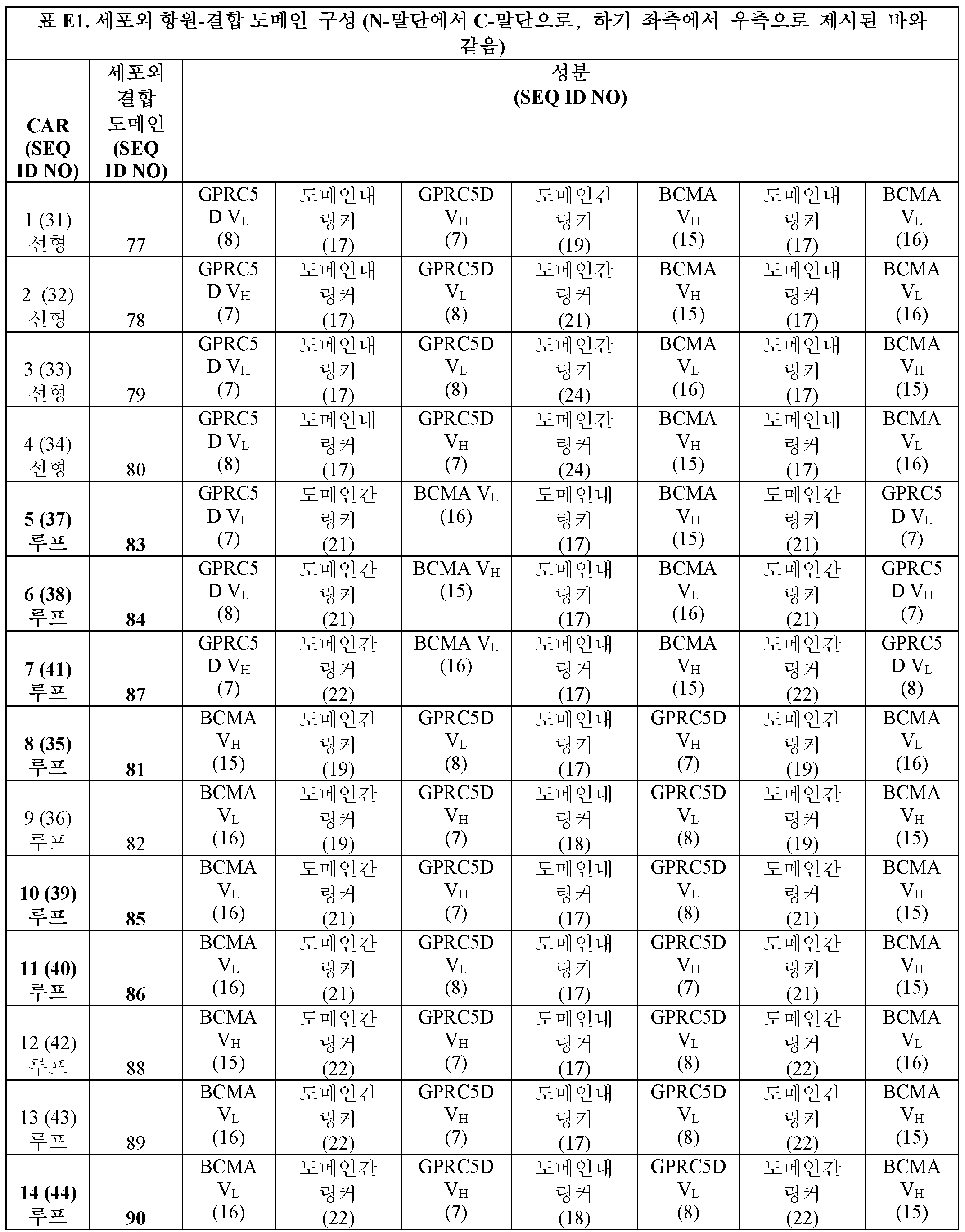
추가 분석을 위해 선택된 상위 7개의 구축물은 볼드체로 제시되어 있다.The top seven constructs selected for further analysis are presented in bold.
상위 14개의 탠덤 CAR 구축물로 형질도입된 T 세포를 세포주 BCMA+/GPRC5D+ (MM.1S, OPM-2, RPMI-8226), BCMA-/GPRC5D+ (MM.1S BCMA KO, OPM-2 BCMA KO) 및 BCMA+/GPRC5D- (MM.1S GPRC5D KO, OPM-2 GPRC5D KO)와 공동-배양하였다. 72시간의 공동-배양 후 활성화 마커 CD25의 발현에 의해 활성화를 평가하고, 세포 용해를 상기 기재된 바와 같이 평가하였다. 14개의 탠덤 구축물의 시험관내 활성을 하기 기재된 바와 같이 수행하여 생체내 평가를 위한 상위 7개의 구축물을 결정하였다.T cells transduced with the top 14 tandem CAR constructs were co-cultured with the cell lines BCMA+/GPRC5D+ (MM.1S, OPM-2, RPMI-8226), BCMA-/GPRC5D+ (MM.1S BCMA KO, OPM-2 BCMA KO) and BCMA+/GPRC5D- (MM.1S GPRC5D KO, OPM-2 GPRC5D KO). Activation was assessed by expression of the activation marker CD25 after 72 h of co-culture, and cell lysis was assessed as described above. In vitro activity of the 14 tandem constructs was performed as described below to determine the top 7 constructs for in vivo evaluation.
증식, 표적 세포를 용해시키는 능력 및 시토카인 생산을 측정함으로써 연속 재자극 검정에서 구축물의 성능을 평가하였다. 간략하게, 14개의 상이한 탠덤 CAR 구축물을 발현하는 형질도입된 T 세포가 종양 세포를 반복적으로 사멸시키는 능력을, T 세포를 종양 세포와 21일 동안 공동-배양함으로써 평가하였다. 9 x 10⁴개 CAR T 세포를 MM.1S 모, MM.1S BCMA KO 또는 MM.1S GPRC5D KO 세포주와 1:1의 이펙터:표적 (E:T) 비로 공동-인큐베이션하였다. 7일 후, CAR 발현, 세포 수, 세포 생존율 및 CD25 발현의 분석을 위해 배양물로부터 세포의 분취물을 꺼냈다.The performance of the constructs was evaluated in serial restimulation assays by measuring proliferation, ability to lyse target cells, and cytokine production. Briefly, the ability of transduced T cells expressing 14 different tandem CAR constructs to repeatedly kill tumor cells was assessed by co-culturing the T cells with tumor cells for 21 days. 9 x 10 4 CAR T cells were co-incubated with MM.1S parental, MM.1S BCMA KO, or MM.1S GPRC5D KO cell lines at a 1:1 effector:target (E:T) ratio. After 7 days, an aliquot of cells was removed from the cultures for analysis of CAR expression, cell number, cell viability, and CD25 expression.
결과에 기초하여, 3 x 10⁴개 CAR T 세포의 분취물을 세포독성 검정을 위해 NLR을 발현하는 모 MM.1S 세포주와 1:2의 E:T 비로 이중으로 플레이팅하였다. 24시간 후, 50 μL의 상청액을 상기 기재된 바와 같이 벌크 시토카인 분석을 위해 수거하였다. 9 x 10⁴개 CAR T 세포의 분취물을 새로운 24-웰 플레이트에 종양 세포와 1:1 E:T 비로 플레이팅하여 반복된 자극 후에 증식하는 CAR T 세포의 능력을 평가하였다. 이 절차를 제14일에 반복하였다. 제21일에, CAR 발현, 세포 수, 세포 생존율 및 CD25 발현의 분석을 위해 배양물로부터 세포의 분취물을 꺼냈다. 3 x 10⁴개 CAR T 세포의 분취물을 세포독성 검정을 위해 NLR을 발현하는 모 MM.1S 세포주와 1:4 및 1:8의 E:T 비로 이중으로 플레이팅하였다.Based on the results, an aliquot of 3 x 10⁴ CAR T cells was plated in duplicate at an E:T ratio of 1:2 with the parental MM.1S cell line expressing NLR for cytotoxicity assays. After 24 hours, 50 μL of supernatant was harvested for bulk cytokine analysis as described above. An aliquot of 9 x 10⁴ CAR T cells was plated in a new 24-well plate at an E:T ratio of 1:1 with tumor cells to assess the ability of CAR T cells to proliferate after repeated stimulations. This procedure was repeated on
대다수의 선형 및 루프 탠덤 구축물은 재자극의 지속기간 전반에 걸쳐 MM.1S 모 세포주에 대해 증식하고 세포독성 활성을 보유하였다 (도 6a). 대부분의 탠덤 구축물은 GPRC5D 항원의 부재 하에 비시스트론 CAR보다 더 우수한 세포용해 활성을 보유하였으며; BCMA 또는 GPRC5D 단일 CAR을 발현하는 세포는 또한 세포독성을 보유하였다 (도 6a). 탠덤 구축물을 발현하는 세포는 GPRC5D 항원의 부재 하에 비시스트론 CAR을 발현하는 세포와 유사하게 또는 그보다 더 많이 증식하는 것으로 관찰되었고, BCMA 또는 GPRC5D CAR을 발현하는 세포는 모든 조건 하에 잘 증식하였다 (도 6b 및 6c).The majority of linear and looped tandem constructs proliferated and retained cytotoxic activity against the MM.1S parental cell line throughout the duration of restimulation (Fig. 6a). Most tandem constructs retained cytolytic activity superior to the bicistronic CAR in the absence of GPRC5D antigen; cells expressing either BCMA or GPRC5D single CARs also retained cytotoxicity (Fig. 6a). Cells expressing the tandem constructs were observed to proliferate similarly or better than cells expressing the bicistronic CAR in the absence of GPRC5D antigen, while cells expressing either BCMA or GPRC5D CARs proliferated well under all conditions (Fig. 6b and 6c).
각각의 검정으로부터의 값을 순위화하고, 검정에 걸친 전체 성능에 기초하여 상위 7개의 구축물을 선택하였다 (구축물 번호는 표 E1에서 볼드체임).We ranked the values from each assay and selected the top seven constructs based on overall performance across assays (construct numbers are bold in Table E1).
실시예 5: 다발성 골수종의 MM.1S 마우스 모델에서의 BCMAxGPRC5D 탠덤 CAR T 세포의 생체내 활성Example 5: In vivo activation of BCMAxGPRC5D tandem CAR T cells in the MM.1S mouse model of multiple myeloma
실시예 4에 기재된 상위 7개의 탠덤 CAR 구축물 중 1개로 형질도입된 T 세포를 MM1.S 파종성 다발성 골수종 이종이식편 마우스 모델을 사용하여 생체내에서 추가로 평가하였다. 탠덤 CAR T 세포의 효능을 생물발광 영상화 (BLI)에 의해 종양 부담을 모니터링함으로써 평가하고, BCMA, GPRC5D 또는 비시스트론 CAR을 발현하는 세포의 효능과 비교하였다.T cells transduced with any of the top seven tandem CAR constructs described in Example 4 were further evaluated in vivo using the MM1.S disseminated multiple myeloma xenograft mouse model. The efficacy of the tandem CAR T cells was assessed by monitoring tumor burden by bioluminescence imaging (BLI) and compared to the efficacy of cells expressing BCMA, GPRC5D, or a bicistronic CAR.
MM.1S 세포를, 세포 분류를 용이하게 하기 위해 녹색 형광 단백질 (GFP) 및 생체내 BLI를 용이하게 하기 위해 적색-이동된 이탈리아 반딧불이 루시페라제 (MM.1S-rFLuc)를 발현하도록 유전자 조작하였다. 제-14일에, MM.1S rFLuc 세포를 지수 성장기 동안 수거하고, 세척하고, 투여를 위해 PBS 중에 재현탁시켰다. NOD.Cg-PrkdcscidIL-2rgtm1Wjl/SzJ mice (NSG)에게 외측 꼬리 정맥을 통해 2 x 10⁶개 MM1.S-rFLuc 세포를 주사하였다. MM1.S-rFLuc 세포를 14일 동안 생착 및 확장되도록 하였다 (표 1). 제-1일에, 마우스에서 BLI에 의해 종양 부담을 평가하고, 각각의 군이 동일한 분포의 종양 부담을 갖도록 마우스를 처리군에 배정하였다. 제1일에, 동결보존되어 있던 형질도입 또는 모의-가공된 T 세포를 해동시키고, 세척하고, 250 g로 10분 동안 원심분리하였다. 세포 펠릿을 PBS 중에 재현탁시키고, 마우스에게 저용량 (0.5 x 10⁶개) 또는 고용량 (2 x 10⁶개)의 CAR T 세포 (상위 7개의 탠덤 CAR 구축물, BCMA CAR, GPRC5D CAR, 비시스트론 CAR 중 하나를 발현함) 또는 모의-가공된 T 세포를 정맥내로 주사하였다. 비처리 마우스 군을 또한 대조군으로서 포함시켰다. 파종성 종양 부담을 1주에 1-2회 BLI에 의해 시간 경과에 따라 측정하였다.MM.1S cells were genetically engineered to express green fluorescent protein (GFP) to facilitate cell sorting and red-shifted Italian firefly luciferase (MM.1S-rFLuc) to facilitate in vivo BLI. On day −14, MM.1S rFLuc cells were harvested during exponential growth phase, washed, and resuspended in PBS for dosing. NOD.Cg-Prkdc scid IL-2rg tm1Wjl /SzJ mice (NSG) were injected with 2 × 10 6 MM1.S-rFLuc cells via the lateral tail vein. MM1.S-rFLuc cells were allowed to engraft and expand for 14 days (Table 1). On day −1, mice were assessed for tumor burden by BLI, and mice were assigned to treatment groups to ensure equal distributions of tumor burden in each group. On
도 7a에 제시된 바와 같이, 임의의 탠덤 CAR 구축물을 발현하는 2.0 x 10⁶개 CAR T 세포의 고용량으로 처리된 마우스는 강건한 종양 성장 억제를 나타냈다. 0.5 x 10⁶개 세포의 저용량에서, 모든 탠덤 CAR T 세포는 모의-가공된 T 세포에 비해 종양 성장 퇴행 및 제어를 입증하였지만, 개별 종양 성장 곡선은 더 높은 용량에서보다 더 가변적이고 종양 억제는 그보다 더 크지 않았다 (도 7b). 모의-가공된 T 세포로 처리된 마우스는 종양 성장의 제어를 나타내지 않았고, 모든 마우스는 제21일 전에 종양 진행되었다. BCMA CAR 또는 GPRC5D CAR T 세포의 항종양 효능은 둘 다의 용량에서 주목되었으며, 재성장은 이 50-일 연구에서 고용량보다 저용량에서 더 빨리 발생하였다.As shown in Figure 7a, mice treated with a high dose of 2.0 x 10 6 CAR T cells expressing any of the tandem CAR constructs exhibited robust tumor growth inhibition. At a lower dose of 0.5 x 10 6 cells, all tandem CAR T cells demonstrated tumor growth regression and control compared to mock-engineered T cells, although individual tumor growth curves were more variable and tumor inhibition was not as great as at the higher dose (Figure 7b). Mice treated with mock-engineered T cells did not exhibit tumor growth control, and all mice had tumor progression before
종양 제어 지수 (TCI) 분석을 둘 다의 용량 수준으로의 처리 후 생물발광 종양 성장 곡선에 대해 수행하였다. 보다 높은 TCI는 보다 낮은 종양 부담을 나타냈다. 고용량 수준 (2.0 x 10⁶개) (도 8a)에서, 모든 이중특이적 탠덤 CAR 구축물은 비시스트론 CAR, GPRC5D CAR 및 BCMA CAR과 유사하게, 모의-가공된 T 세포에 비해 종양 제어를 유의하게 개선시켰다 (최소 p ≤ 0.05). 저용량 수준 (0.5 x 10⁶)에서, 주어진 보다 낮은 용량으로 인한 감소된 효력을 반영하는 보다 낮은 TCI 점수를 달성하긴 하였지만, 모든 이중특이적 탠덤 CAR 구축물, 비시스트론 CAR, GPRC5D CAR 및 BCMA CAR은 모의-가공된 T 세포에 비해 종양 제어를 유의하게 개선시켰다 (최소 p < 0.05) (도 8b).Tumor control index (TCI) analysis was performed on bioluminescent tumor growth curves after treatment at both dose levels. Higher TCI indicated lower tumor burden. At the high dose level (2.0 x 10 6 ) (Fig. 8a), all bispecific tandem CAR constructs significantly improved tumor control compared to mock-engineered T cells (minimum p ≤ 0.05), similar to the bicistronic CAR, GPRC5D CAR and BCMA CAR. At the low dose level (0.5 x 10 6 ), all bispecific tandem CAR constructs, bicistronic CAR, GPRC5D CAR and BCMA CAR, significantly improved tumor control compared to mock-engineered T cells (minimum p < 0.05) (Fig. 8b), although they achieved lower TCI scores reflecting the reduced potency due to the lower dose given.
실시예 6: 다발성 골수종의 RPMI8226 마우스 모델에서의 BCMAxGPRC5D 탠덤 CAR T 세포의 생체내 활성Example 6: In vivo activation of BCMAxGPRC5D tandem CAR T cells in the RPMI8226 mouse model of multiple myeloma
실시예 4에 기재된 상위 7개의 탠덤 CAR 구축물 중 1개로 형질도입된 T 세포를 비교적 낮은 수준의 BCMA 및 GPRC5D를 발현하는 또 다른 이종이식편 마우스 모델 (RPMI8226)을 사용하여 생체내에서 추가로 평가하였다. 종양 세포주의 제조, 그의 마우스 내로의 이식, T 세포 (CAR 및 모의-가공)의 제조 및 T 세포의 마우스 내로의 주사, 및 종양 성장의 모니터링을 실시예 5에 기재된 바와 같이 수행하였다.T cells transduced with any of the top seven tandem CAR constructs described in Example 4 were further evaluated in vivo using another xenograft mouse model (RPMI8226) expressing relatively low levels of BCMA and GPRC5D. Generation of tumor cell lines, engraftment thereof into mice, generation of T cells (CAR and mock-engineered) and injection of T cells into mice, and monitoring of tumor growth were performed as described in Example 5.
시험된 모든 탠덤 CAR T 세포는 이 모델에서 강력한 항종양 효능을 입증하였다. 도 9a에 제시된 바와 같이, 임의의 탠덤 CAR 구축물을 발현하는 2.0 x 10⁶개 CAR+ T 세포의 고용량으로 처리된 마우스는 연구 과정에 걸쳐 강건한 종양 클리어런스를 나타냈고, CAR T 세포 투여 후 제14일까지 안정한 최소의 생물발광에 도달하였으며, 모든 마우스에서 연구 지속기간 내내 낮게 유지되었다. 저용량 (0.5 x 10⁶개)에서, 탠덤 CAR 구축물 5, 6, 8 및 11을 발현하는 CAR T 세포는 강한 종양 성장 제어를 나타낸 반면, 종양 성장 억제는 탠덤 CAR 구축물 7 및 14를 발현하는 CAR T 세포에 의해 보다 가변적이었다 (도 9b). 모의-가공된 T 세포로 처리된 마우스는 종양 성장의 제어를 나타내지 않았다. BCMA CAR을 발현하는 T 세포의 항종양 효능은 둘 다의 용량에서 강건하였다. 대조적으로, RPMI8226 세포에 의한 GPRC5D의 매우 낮은 발현은, 저용량 수준에서는 GPRC5D CAR을 발현하는 T 세포가 종양 성장을 억제하는 데 실패하도록 하였고, 고용량 수준에서는 강하지만 불완전한 종양 성장 제어를 하도록 하였다.All tested tandem CAR T cells demonstrated potent anti-tumor efficacy in this model. As shown in Figure 9a, mice treated with high doses of 2.0 x 10 6 CAR+ T cells expressing any of the tandem CAR constructs exhibited robust tumor clearance over the course of the study, reaching a stable minimal bioluminescence by
종양 제어 지수 (TCI) 분석을 실시예 5에 기재된 바와 같이 수행하였다. 고용량 수준에서, 모든 탠덤 CAR 구축물은 비시스트론 CAR, GPRC5D CAR 및 BCMA CAR과 유사하게, 모의-가공된 T 세포에 비해 종양 제어를 유의하게 개선시켰다 (최소 p < 0.05) (도 10a). GPRC5D CAR 및 이중특이적 탠덤 CAR 구축물 7은 저용량 수준에서 보다 적은 종양 제어를 입증한 반면, 탠덤 CAR 구축물 5, 6, 8, 14 및 11은 비시스트론 CAR 및 BCMA CAR과 마찬가지로, 모의-가공된 T 세포에 비해 종양 제어를 유의하게 개선시켰다 (최소 p < 0.05) (도 10b).Tumor Control Index (TCI) analysis was performed as described in Example 5. At high dose levels, all tandem CAR constructs significantly improved tumor control compared to mock-engineered T cells, similar to the bicistronic CAR, GPRC5D CAR, and BCMA CAR (at least p < 0.05) (Fig. 10a). The GPRC5D CAR and bispecific tandem CAR construct 7 demonstrated less tumor control at low dose levels, whereas tandem CAR constructs 5, 6, 8, 14, and 11 significantly improved tumor control compared to mock-engineered T cells, similar to the bicistronic CAR and BCMA CAR (at least p < 0.05) (Fig. 10b).
실시예 7: 다발성 골수종의 항원 이질성 마우스 모델에서의 BCMAxGPRC5D 탠덤 CAR T 세포의 생체내 활성Example 7: In vivo activation of BCMAxGPRC5D tandem CAR T cells in an antigen heterogeneous mouse model of multiple myeloma
실시예 2-6에 기재된 평가에 기초하여, 추가 분석을 위한 상위 2개의 탠덤 CAR 구축물을 구축물 5 및 11로서 선택하였다. 탠덤 CAR 구축물 5 및 11을 다발성 골수종 항원 이질성의 모델을 사용하여 생체내에서 추가로 시험하였다.Based on the evaluation described in Examples 2-6, the top two tandem CAR constructs were selected for further analysis, constructs 5 and 11. Tandem CAR constructs 5 and 11 were further tested in vivo using a model of multiple myeloma antigen heterogeneity.
MM1.S 세포주를 실시예 5에 기재된 바와 같이 GFP 및 rFluc (MM1.S-rFLuc)를 발현하도록 유전자 조작하였다. 제-14일에, NOD.Cg-PrkdcscidIL-2rgtm1Wjl/SzJ 마우스 (NSG)에게 꼬리 정맥을 통해 4 x 10⁶개의 총 (1) MM1.S-rFLuc 모 세포 (BCMA+, GPRC5D+) 단독; (2) MM1.S-rFLuc BCMA KO 세포 단독; (3) MM1.S-rFLuc GPRC5D KO 세포 단독, 또는 (4) 33.3% MM1.S-rFLuc 모 세포, 33.3% MM1.S-rFLuc BCMA KO 세포 및 33.3% MM1.S-rFLuc GPRC5D KO 세포를 함유하는 세포 혼합물 ("혼합 모델")을 주사하였다.MM1.S cell line was genetically engineered to express GFP and rFluc (MM1.S-rFLuc) as described in Example 5. On day -14, NOD.Cg-Prkdc scid IL-2rg tm1Wjl /SzJ mice (NSG) were injected via tail vein with 4 x 10 6 total (1) MM1.S-rFLuc parental cells (BCMA+, GPRC5D+) alone; (2) MM1.S-rFLuc BCMA KO cells alone; (3) MM1.S-rFLuc GPRC5D KO cells alone, or (4) a cell mixture containing 33.3% MM1.S-rFLuc parental cells, 33.3% MM1.S-rFLuc BCMA KO cells, and 33.3% MM1.S-rFLuc GPRC5D KO cells (“mixed model”).
상위 2개의 탠덤 CAR 구축물의 항종양 효능을 항원 이질성의 혼합 모델에서 시험하였다. 탠덤 CAR 구축물 5, 탠덤 CAR 구축물 11, BCMA CAR 또는 GPRC5D CAR을 발현하는 T 세포 또는 모의-가공된 T 세포를 실시예 5에 기재된 바와 같이 제조하였다. 마우스를 제-1일에 동일한 분포의 종양 부담을 갖는 처리군으로 분배하고, 제1일에 4 x 10⁶개 CAR T 세포를 정맥내로 주사하였다. 비처리 마우스를 또한 대조군으로서 포함시켰다. 종양 부담을 28일에 걸쳐 1주에 2회 평가하였다.The antitumor efficacy of the top two tandem CAR constructs was tested in a mixed model of antigenic heterogeneity. T cells expressing
종양 퇴행이 모든 처리군에서 관찰되었지만, 이중특이적 탠덤 CAR 구축물을 발현하는 T 세포만이 깊고 지속적인 반응을 달성할 수 있었다 (도 11a). 모의-가공된 T 세포는 대부분 MM1.S rFLuc 종양 성장 및 질환 진행을 방지하지 않았다.Although tumor regression was observed in all treatment groups, only T cells expressing the bispecific tandem CAR construct were able to achieve deep and durable responses (Fig. 11a). Mock-engineered T cells largely did not prevent MM1.S rFLuc tumor growth or disease progression.
종양 제어 지수 (TCI) 분석을 실시예 5에 기재된 바와 같이 수행하였다. 생물발광 곡선에서 관찰된 보다 깊은 퇴행 및 지속적인 종양 성장 억제는 탠덤 CAR 구축물 5 및 11의 계산된 TCI 점수에 반영되었다 (도 11b). 탠덤 CAR 구축물을 발현하는 세포는 이 실험에서 사용된 4.0 x 10⁶개 용량에서 모의-가공된 T 세포에 비해 종양 제어를 유의하게 개선시키는 것으로 나타났다. 대조적으로, BCMA CAR 또는 GPRC5D CAR을 발현하는 T 세포는 둘 다 처리 후 처음 7일에 종양 퇴행을 유발하였지만, 종양 재성장은 신속하였고, TCI 점수에 반영된 전체 영향은 모의-가공된 T 세포에 비해 통계적으로 유의하지 않았다. 대표적인 비처리된, 모의-가공된 T 세포-처리된 및 CAR T 세포-처리된 종양 보유 마우스의 BLI는 BCMA 및 GPRC5D 항원 이질성을 갖는 다발성 골수종의 이 모델에서 깊고 지속적인 항종양 반응을 유도하는 이중 표적화 접근법의 증진된 효능을 입증하였다 (도 11c). 탠덤 CAR 구축물 5 및 11로 처리된 마우스는 처리후 제11일, 제18일, 제21일 및 제28일에 최소 종양 생물발광을 나타낸 반면, 비처리된 및 모의-가공된 T 세포-처리된 마우스는 28일 기간에 전반에 걸쳐 증가하는 수준의 종양 생물발광을 나타냈다 (비처리된 마우스는 제21일까지 생존하지 않았음) (도 11c; 증가하는 BLI는 암 음영 오버레이의 증가된 강도로 제시됨). BCMA CAR 또는 GPRC5D CAR로 처리된 마우스는 둘 다 비처리된 마우스 및 모의-가공된 T 세포로 처리된 마우스와 비교하여 감소된 생물발광을 나타냈지만, 그의 생물발광 수준은 제11일 후에 증가하였다 (도 11c; 감소된 BLI는 암 음영 오버레이의 결여 또는 감소된 강도로 제시됨).Tumor Control Index (TCI) analysis was performed as described in Example 5. The more profound regression and sustained tumor growth inhibition observed in the bioluminescence curves were reflected in the calculated TCI scores for tandem CAR constructs 5 and 11 (Fig. 11b). Cells expressing the tandem CAR constructs exhibited significantly improved tumor control compared to mock-engineered T cells at the 4.0 x 10 6 dose used in this experiment. In contrast, T cells expressing either the BCMA CAR or the GPRC5D CAR both induced tumor regression in the first 7 days following treatment, but tumor regrowth was rapid and the overall effect reflected in the TCI score was not statistically significant compared to mock-engineered T cells. BLI of representative untreated, mock-engineered T cell-treated, and CAR T cell-treated tumor-bearing mice demonstrated the enhanced efficacy of the dual targeting approach in inducing deep and sustained anti-tumor responses in this model of multiple myeloma with BCMA and GPRC5D antigenic heterogeneity (Fig. 11c). Mice treated with tandem CAR constructs 5 and 11 exhibited minimal tumor bioluminescence on
실시예 8: 탠덤 CAR 5의 추가의 시험관내 특징화Example 8: Further in vitro characterization of
a. CAR 발현a. CAR expression
3명의 건강한 인간 공여자로부터의 탠덤 CAR 5, 항-BCMA CAR 및 항-GPRC5D CAR T 세포 또는 모의-가공된 T 세포를 유동 세포측정법에 의해 CAR 발현에 대해 분석하였다. 이중특이적 탠덤 CAR 5 구축물 (탠덤 CAR 5)의 표면 발현을 항-BCMA scFv- 및 항-GPRC5D scFv-특이적 항체를 사용하여 T 세포 상에서 확인하였으며, 이들 항체 각각은 이전 연구에서 그것이 생성된 scFv에만 특이적으로 및 독점적으로 결합하는 것으로 입증되었고, scFv 사이의 임의의 공통 특색에 기초한 교차-반응성은 존재하지 않는다. 탠덤 CAR 5는 항-GPRC5D 및 항-BCMA scFv 둘 다의 발현을 나타냈으며, 단일 scFv를 발현하는 세포의 의미있는 발현은 관찰되지 않았다 (도 12a). 항-BCMA CAR T는 항-BCMA scFv 항체에만 결합하였고, 항-GPRC5D CAR T는 항-GPRC5D scFv 항체에만 결합하였다. 모의-가공된 T 세포 중 어떠한 것도 scFv-특이적 항체 중 어느 하나에 대해 양성이 아니었다. CAR의 표면 발현은 모든 3명의 건강한 인간 공여자로부터의 T 세포 상에서 검출되었다 (도 12b).
b. 활성화 및 시토카인 생산b. Activation and cytokine production
탠덤 CAR 5-발현 세포가 이중특이적 CAR 구축물의 각각의 scFv 결합 도메인을 통해 기능적으로 반응하는지 여부를 결정하기 위해, 대조군 표적 세포 또는 개별 항원을 발현하는 표적 세포와의 공동-배양 후에 CAR 기능을 평가하였다. 간략하게, 탠덤 CAR 5를 발현하는 3.0 x 10⁴개 T 세포 또는 모의 형질도입된 T 세포를 단독으로 또는 다양한 3.0 x 10⁴개 표적 세포: BCMA/GPRC5D-이중 양성 세포주 (MM.1S, OPM-2, KMS12-BM, NCI-H929, OPM-2, RPMI-8226), BCMA-음성/GPRC5D-양성 (MM.1S BCMA KO, OPM-2 BCMA KO), BCMA-양성/GPRC5D-음성 (MM.1S GPRC5D KO, OPM-2 GPRC5D KO) 또는 BCMA-음성/GPRC5D-음성 (Jurkat) 종양 세포주와 함께 플레이팅하였다. 이전 실시예에 기재된 바와 같은 BCMA 또는 GPRC5D를 표적화하는 단일특이적 CAR T 세포를 또한 비교를 위해 포함시켰다. 72시간 후에 기하 평균 형광 강도 (gMFI)에 의해 측정된 세포내 셀트레이스™바이올렛 (CTV)의 희석물에 의해 증식을 측정하고, 표적 세포 없이 배양된 CAR T 세포 (T 세포 단독)에 대해 정규화하였으며, 여기서 CTV의 감소는 T 세포의 증식의 측정을 나타냈다. 종양 세포주와의 공동-배양 72시간 후에 CD25의 표면 발현의 상향조절에 의해 T 세포 활성화를 측정하였다. 염증유발 시토카인 IFNγ, IL-2 및 TNFα를, IFNγ, IL-2 및 TNFα 검출을 위한 항체로 코팅된 V-플렉스 커스텀 MSD 플레이트 (메조 스케일 디스커버리(Meso Scale Discovery), 메릴랜드주 록빌)를 사용한 전기화학발광 시토카인 면역 검정을 사용하여 24시간의 공동-배양 후에 벌크 상청액 중에서 측정하고, 시토카인 농도를 표준 곡선으로부터 내삽하고, 프리즘 소프트웨어 (그래프패드 소프트웨어 인크.(GraphPad Software Inc.), 캘리포니아주 라호야)를 사용하여 플롯팅하였다.To determine whether tandem CAR 5-expressing cells functionally respond via each scFv binding domain of the bispecific CAR construct, CAR function was assessed following co-culture with control target cells or target cells expressing the individual antigens. Briefly, 3.0 x 10⁴ T cells expressing
BCMA-음성/GPRC5D-음성 종양 세포 (Jurkat)와 공동-배양된 탠덤 CAR 5, 항-BCMA CAR 및 항-GPRC5D CAR T 세포는 증식하지 않았거나 (도 13a) 또는 CD25를 상향조절하지 않았으며 (도 13b), 이는 비-특이적 활성이 없음을 나타낸다. 모든 3종의 CAR T 세포는 BCMA-양성/GPRC5D-양성 종양 세포주 (MM.1S, OPM-2)와 공동-배양된 경우에 강건한 증식 및 CD25 상향조절을 나타냈다. 그러나, 탠덤 CAR 5 T 세포만이 증식하였고, 이는 단일 항원-양성 세포주 둘 다와의 공동-배양 후에 CD25의 상향조절을 나타냈다. 대조적으로, 항-BCMA CAR T 세포는 BCMA-음성/GPRC5D-양성 종양 세포주 (MM.1S BCMA KO, OPM-2 BCMA KO)와의 공동-배양 후에 증식하지 않았다. 유사하게, 항-GPRC5D CAR T 세포는 BCMA-양성/ GPRC5D-음성 종양 세포주 (MM.1S GPRC5D KO, OPM-2 GPRC5D KO)와의 공동-배양 후에 증식하지 않았거나 또는 CD25의 상향조절을 나타내지 않았다. 이들 데이터는 탠덤 CAR 5 CAR T 세포의 BCMA 및 GPRC5D-특이적 증식 및 활성화, 뿐만 아니라 BCMA 및 GPRC5D 둘 다 또는 단지 단일 항원의 존재 하에 기능하는 탠덤 CAR 5 T 세포의 능력을 확인시켜 준다.
유사하게, 탠덤 CAR 5 T 세포는 BCMA-양성, GPRC5D-양성 또는 이중-양성 종양 세포주와의 공동-배양 후에 IFNγ (도 13c), IL-2 (도 13c) 및 TNFα (도 13d)를 분비하였다. 대조적으로, 항-BCMA 및 항-GPRC5D CAR T는 그의 동족 항원이 존재하는 경우에만 기능적이었다 (도 13c-d). CAR T 세포 중 어떠한 것도 BCMA-음성/GPRC5D-음성 종양 세포 (Jurkat)와 공동-배양된 경우에 측정가능한 시토카인을 분비하지 않았으며, 이는 CAR T 세포의 항원-특이적 활성을 추가로 입증한다.Similarly, tandem CAR 5 T cells secreted IFNγ (Fig. 13c), IL-2 (Fig. 13c), and TNFα (Fig. 13d) following co-culture with BCMA-positive, GPRC5D-positive, or double-positive tumor cell lines. In contrast, anti-BCMA and anti-GPRC5D CAR Ts were functional only in the presence of their cognate antigen (Fig. 13c–d). None of the CAR T cells secreted measurable cytokines when co-cultured with BCMA-negative/GPRC5D-negative tumor cells (Jurkat), further demonstrating the antigen-specific activity of the CAR T cells.
BCMA 및 GPRC5D의 상이한 발현 수준을 갖는 종양 세포주와의 공동-배양 후의 탠덤 CAR 5 T 세포의 활성화 및 시토카인 생산을 추가로 평가하였다. CAR T 세포 중 어떠한 것도 BCMA 또는 GPRC5D를 발현하지 않는 Jurkat 세포와의 공동-배양 후에 CD25 발현의 변화를 나타내지 않았다. 시험된 모든 CAR T 세포는 MM 세포주와의 공동-배양 후에 CD25 발현의 증가를 나타냈다 (도 14a). 탠덤 CAR 5 및 항-BCMA CAR T 세포는 모든 BCMA/GPRC5D 양성 세포주와의 공동-배양 후에 CD25의 강건한 상향조절을 나타냈다. 항-GPRC5D CAR T 세포는 가장 낮은 GPRC5D 발현을 갖는 KMS12-BM 및 RPMI-8226과의 공동-배양 후에 가장 적은 상향조절로 보다 넓은 범위의 CD25 상향조절을 나타냈다.We further evaluated the activation and cytokine production of tandem CAR 5 T cells following co-culture with tumor cell lines with different expression levels of BCMA and GPRC5D. None of the CAR T cells showed changes in CD25 expression following co-culture with Jurkat cells that do not express BCMA or GPRC5D. All CAR T cells tested showed an increase in CD25 expression following co-culture with MM cell lines (Fig. 14a).
모든 CAR T 세포는 BCMA 및 GPRC5D를 발현하는 MM 세포주와의 공동-배양 후에 시토카인을 분비하였다 (도 14b-c). 탠덤 CAR 5 및 항-BCMA CAR T 세포는 시험된 모든 MM 세포주와의 공동-배양 후에 강건한 시토카인 생산을 나타냈다 (도 14b). 대조적으로, 항-GPRC5D CAR T는 검출 수준 바로 위의 GPRC5D 발현을 갖는 KMS-12 BM 및 RPMI-8226과의 공동-배양 후에 매우 낮은 수준의 IFNγ, IL-2 및 TNFα를 분비하였다 (도 14c).All CAR T cells secreted cytokines following co-culture with MM cell lines expressing BCMA and GPRC5D (Fig. 14b-c).
c. 세포독성 활성c. Cytotoxic activity
가변 수준의 BCMA 및 GPRC5D를 발현하는 종양 세포주에 대한 탠덤 CAR 5, 항-BCMA CAR 및 항-GPRC5D CAR T 세포의 세포독성 활성을 평가하였다. 구체적으로, 3명의 건강한 인간 공여자로부터의 탠덤 CAR 5, 항-BCMA CAR, 항-GPRC5D CAR T 세포 또는 모의-가공된 T 세포 (이펙터)를 누크라이트 레드를 발현하는 BCMA/GPRC5D-양성 종양 세포주 (표적)와 함께 2.0 x 10⁴개 종양 세포를 사용하여 1:1, 1:2, 1:4, 1:8의 이펙터 대 표적 비로 폴리-d-리신으로 코팅된 96-웰 편평 바닥 플레이트에 이중으로 플레이팅하였다. 인큐사이트(IncuCyte)® 소프트웨어가 구비된 인큐사이트® S3 라이브-셀 어낼리시스 시스템 (에센 바이오사이언시스, 인크.(Essen Biosciences, Inc.), 미시간주 앤 아버)을 사용하여 72시간의 배양 동안 누크라이트 레드 형광을 모니터링함으로써 총 적분 강도를 측정하였다. 표적-세포 용해를 결정하기 위해, 총 적분 강도를 플롯팅하고, 프리즘 소프트웨어 (그래프패드 소프트웨어 인크., 캘리포니아주 라호야)를 사용하여 곡선하 면적 (AUC)을 계산하였다. 특이적 용해를 식 % 용해 = (CAR T 세포에 대한 AUC ÷ 모의 T 세포에 대한 AUC) x 100을 사용하여 계산하였다. 시험된 모든 CAR T 세포는 시험된 모든 3종의 세포주에 대해 시험된 모든 이펙터 대 표적 (E:T) 비에서 세포용해 활성을 나타냈다 (도 15).The cytotoxic activity of
실시예 9: 다발성 골수종의 MM.1S 마우스 모델에서의 탠덤 구축물 5의 추가 생체내 특징화Example 9: Further in vivo characterization of tandem construct 5 in the MM.1S mouse model of multiple myeloma
NOD.Cg-PrkdcscidIL-2rgtm1Wjl/SzJ 마우스 (NSG)에게 제-14일에 2.0 x 10⁶개 MM.1S-rFluc 다발성 골수종 세포를 정맥내로 (IV) 주사하였다. 제-1일에, 마우스를 전신 생물발광 영상화 (BLI)에 의해 측정된 종양 부담의 균형을 맞추기 위해 군 (군당 8마리 마우스)으로 무작위화하였다. 제1일에, 마우스에게 단일 용량의 5.0 x 10⁵개 (저) 또는 2.0 x 10⁶개 (고)의 건강한 공여자-유래 항-BCMA CAR, 항-GPRC5D CAR 또는 탠덤 CAR 5 (항-BCMAx항-GPRC5D 이중특이적 CAR) T 세포를 IV 주사하였다. 대조군은 T 세포를 받지 않은 마우스 (군당 n = 3) 또는 동일한 공여자로부터 유래된 모의-가공된 T 세포를 받은 마우스를 포함하였다. 마우스에서 3 mg의 D-루시페린을 복강내 주사한 지 10분 후에 MM.1S 반딧불이 루시페라제-양성 생물발광을 영상화함으로써 파종성 종양 성장을 평가하였다. 모든 마우스를 이소플루란 마취 하에 영상화하고, 종양 부담을 CAR T 세포 처리 후 제50일까지 매주 2회 측정하였다. 저용량 및 고용량의 CAR T 세포에서 변형된 종양 제어 지수 (mTCI) 방법을 사용하여 항종양 효능의 군 비교를 수행하였다. 마우스를 CAR T 처리 후 제50일까지 전체 생존에 대해 모니터링하였다. 마우스로부터의 혈액 샘플을 처리후 제6일, 제13일, 제20일 및 제27일에 군당 동물의 절반에서 및 시점 사이에 케이지 교대로 수득하였다.NOD.Cg-PrkdcscidIL-2rgtm1Wjl/SzJ mice (NSG) were injected intravenously (IV) with 2.0 x 10 6 MM.1S-rFluc multiple myeloma cells on day -14. On day -1, mice were randomized into groups (eight mice per group) to balance tumor burden as measured by whole-body bioluminescence imaging (BLI). On
탠덤 CAR 5, 항-BCMA CAR 또는 항-GPRC5D CAR T 세포를 사용한 CAR T 세포 요법은 중간 수준의 BCMA 및 GPRC5D를 발현하는 파종성 MM.1S 다발성 골수종이 생착된 NSG 마우스에서 용량-의존성 종양 성장 억제를 입증하였다. MM.1S 이종이식 마우스의 말초 혈액 중 CAR+ 인간 CD3+ T 세포의 순환 수를 다색 유동 세포측정법에 의해 분석하였다. 피크 확장은 모든 군에 대해 CAR T 세포 주입 후 제6일에 발생하였다 (도 16a). 어느 용량 수준에서도 CAR T 처리군 사이에 항종양 효능 (종양 부피 및 mTCI)의 통계적으로 유의한 차이는 없었다 (도 16b-d). 그러나, 저용량 및 고용량 둘 다의 항-BCMA, 항-GPRC5D 및 탠덤 CAR 5 CAR T 세포는 모의-가공된 대조군과 비교하여 우수한 항종양 활성을 입증하였다. 5 x 10⁵개 (저용량) 또는 2 x 10⁶개 (고용량) 탠덤 CAR 5, 항-BCMA CAR 또는 항-GPRC5D CAR T 세포로 처리된 마우스는 모의-가공된 T 세포를 받은 마우스에 비해 유의한 생존 이점을 가졌다 (p < 0.001; 로그-순위 [만텔-콕스] 검정에 이어서 다중 비교를 위한 BH 검정후 보정) (도 16e). 고용량 처리 후 어떠한 처리군 사이에도 생존 이점은 없었던 반면, 저용량 탠덤 CAR 5 및 항-BCMA CAR T 세포 처리는 저용량 항-GPRC5D CAR T 세포 처리에 비해 통계적으로 유의한 생존 이점을 나타냈다 (p < 0.05) (도 16e).CAR T cell therapy using
실시예 10: 다발성 골수종의 OPM-2 마우스 모델에서의 탠덤 구축물 5의 추가 생체내 특징화Example 10: Further in vivo characterization of tandem construct 5 in the OPM-2 mouse model of multiple myeloma
NOD.Cg-PrkdcscidIL-2rgtm1Wjl/SzJ 마우스 (NSG)에게 제-14일에 2.0 x 10⁶개 OPM-2-rFluc 다발성 골수종 세포를 정맥내로 (IV) 주사하였다. 제-1일에, 마우스를 전신 생물발광 영상화 (BLI)에 의해 측정된 종양 부담의 균형을 맞추기 위해 군 (군당 8마리 마우스)으로 무작위화하였다. 연구 제1일에, 마우스에게 단일 용량의 2.0 x 10⁶개 (고) 또는 5.0 x 10⁵개 (저)의 건강한 공여자-유래 항-BCMA, 항-GPRC5D 또는 탠덤 CAR 5 (이중특이적 항-BCMAx항-GPRC5D) CAR T 세포를 IV 주사하였다. 대조군은 T 세포를 받지 않은 마우스 (군당 n = 3; 종양 단독) 또는 동일한 공여자로부터 유래된 모의 가공 T 세포를 받은 마우스를 포함하였다. 마우스에서 3 mg의 D-루시페린을 복강내 주사한 지 10분 후에 OPM-2 반딧불이 루시페라제-양성 생물발광을 영상화함으로써 파종성 종양 성장을 평가하였다. 모든 마우스를 이소플루란 마취 하에 영상화하고, 종양 부담을 CAR T 세포 전달 후 제50일까지 매주 2회 측정하였다. 마우스를 CAR T 처리 후 제50일까지 전체 생존에 대해 모니터링하였다. 저용량 및 고용량의 CAR T 세포에서 변형된 종양 제어 지수 (mTCI) 방법을 사용하여 항종양 효능의 군 비교를 수행하였다.NOD.Cg-PrkdcscidIL-2rgtm1Wjl/SzJ mice (NSG) were injected intravenously (IV) with 2.0 x 10 6 OPM-2-rFluc multiple myeloma cells on day -14. On day -1, mice were randomized into groups (eight mice per group) to balance tumor burden as measured by whole-body bioluminescence imaging (BLI). On
탠덤 CAR 5 T 세포는 모의 가공 T 세포 대조군보다 우수한 강건한 용량-의존성 항종양 활성을 입증하였다 (도 17a-b). 탠덤 CAR 5 T 세포는 또한 5 x 10⁵개 (저용량) 및 2 x 10⁶개 (고용량) 용량 수준 둘 다에서 항-BCMA 또는 항-GPRC5D CAR T 처리와 동등한 항종양 효능을 입증하였다 (도 17c). 5 x 10⁵개 (저용량) 및 2 x 10⁶개 (고용량) 탠덤 CAR 5, 항-BCMA 또는 항-GPRC5D CAR T 세포로 처리된 마우스는 모의 가공 T 세포를 받은 마우스에 비해 유의한 생존 이점을 가졌다 (p < 0.001; 로그-순위 [만텔-콕스] 검정에 이어서 다중 비교를 위한 BH 검정후 보정) (도 17d). 그러나, 어느 용량 수준에서도 3개의 CAR T 처리군 사이에 생존에 있어서 통계적으로 유의한 차이는 없었다. 순환 탠덤 CAR 5 BCMAxGPRC5D CAR-양성 (CAR+) 인간 CD3+ T 세포는 OPM-2 이종이식 마우스의 말초 혈액에서 검출되었지만, 세포 수는 비교적 낮았다.Tandem CAR 5 T cells demonstrated robust dose-dependent anti-tumor activity superior to mock-engineered T cell controls (Fig. 17a-b). Tandem CAR 5 T cells also demonstrated anti-tumor efficacy comparable to anti-BCMA or anti-GPRC5D CAR T treatment at both 5 x 10 5 (low dose) and 2 x 10 6 (high dose) dose levels (Fig. 17c). Mice treated with 5 x 10 5 (low dose) and 2 x 10 6 (high dose)
실시예 11: 재발성 및/또는 불응성 다발성 골수종 (RRMM)을 갖는 대상체에 대한 BCMAxGPRC5D CAR-양성 T 세포의 투여Example 11: Administration of BCMAxGPRC5D CAR-positive T cells to subjects with relapsed and/or refractory multiple myeloma (RRMM)
이 연구는 RRMM을 갖는 대상체에서 예시적인 BCMAxGPRC5D CAR-양성 T 세포 요법, 탠덤 CAR 5 BCMAxGPRC5D CAR-양성 T 세포 (예를 들어, 서열식별번호: 37)를 평가하기 위해 수행한다.This study is conducted to evaluate an exemplary BCMAxGPRC5D CAR-positive T cell therapy,
인간 대상체 군 (연령 ≥ 18세)을 BCMAxGPRC5D CAR-양성 T 세포의 투여를 위해 선택한다. 대상체는 적어도 3회의 항골수종 치료 요법으로 치료된 RRMM (IMWG에 따른 측정가능한 다발성 골수종; 동부 협동 종양학 그룹 수행 상태 0-1)의 병력을 갖는 대상체이다. 대상체는 이전에 각각의 하기 요법을 받았어야 한다: (1) 면역조정제 (예를 들어, 탈리도미드, 레날리도미드, 포말리도미드) 및 프로테아솜 억제제 (예를 들어, 보르테조밉, 카르필조밉, 익사조밉)의 적어도 1회의 완전한 주기의 치료 (진행성 질환이 요법에 대한 최상의 반응을 나타내지 않는 한)를 단독으로 또는 조합으로 포함한 선행 요법; (2) 항-CD38 항체 요법 (예를 들어, 다라투무맙)을 단독으로 또는 조합으로 포함한 선행 요법; 및 (3) 참가자가 부적격이 아닌 한, 자가 조혈 줄기 세포 이식 (HSCT)을 포함한 선행 요법. 선행 요법의 경우, HSCT의 존재 또는 부재 및 유지 요법의 존재 또는 부재 하의 유도를 1 요법으로 간주하였다. 대상체는 마지막 항골수종 치료 요법으로의 치료를 완료한지 12개월 (마지막 용량으로부터 측정됨)에 또는 그 내에 IMWG 기준에 의해 결정된 바와 같은 확인된 진행성 질환 (측정가능한 MM)을 갖거나 또는 CAR-T 세포 치료에 대한 스크리닝 전 6개월 내에 확인된 진행성 질환을 갖고, 후속적으로 그의 가장 최근의 항골수종 치료 요법에 대해 불응성이거나 비-반응성인 것으로 결정되어야 한다. 그러나, 그의 마지막 치료로서 CAR T-세포 요법을 받은 대상체는 그의 마지막 치료의 12개월 후에 적격일 수 있다.A human subject population (age ≥ 18 years) is selected for administration of BCMAxGPRC5D CAR-positive T cells. Subjects have a history of RRMM (measurable multiple myeloma per IMWG; Eastern Cooperative Oncology Group performance status 0-1) treated with at least 3 prior anti-myeloma regimens. Subjects must have received prior therapy with each of the following: (1) prior therapy including at least 1 full cycle of treatment with an immunomodulator (e.g., thalidomide, lenalidomide, pomalidomide) and a proteasome inhibitor (e.g., bortezomib, carfilzomib, ixazomib), alone or in combination (unless progressive disease demonstrates optimal response to therapy); (2) prior therapy including an anti-CD38 antibody therapy (e.g., daratumumab), alone or in combination; and (3) prior therapy, including autologous hematopoietic stem cell transplantation (HSCT), unless the participant was ineligible. For prior therapy, induction with or without HSCT and with or without maintenance therapy was considered as 1 therapy. Subjects must have confirmed progressive disease (measurable MM) as determined by IMWG criteria at or within 12 months (measured from the last dose) of treatment with their last antimyeloma regimen, or have confirmed progressive disease within 6 months prior to screening for CAR-T cell therapy and be subsequently determined to be refractory or non-responsive to their most recent antimyeloma regimen. However, subjects who received CAR T-cell therapy as their last treatment may be eligible after 12 months of their last treatment.
대상체는 하기인 대상체이다:The target object is the following object:
i) 다발성 골수종의 CNS 침범의 알려진 활성 또는 병력을 갖지 않고;i) no known activity or history of CNS involvement by multiple myeloma;
ii) 형질 세포 백혈병, 발덴스트롬 마크로글로불린혈증, POEMS (다발신경병증, 기관비대, 내분비병증, 모노클로날 단백질, 피부 변화) 증후군 또는 임상적으로 유의한 아밀로이드증의 활성 또는 병력을 갖지 않고;ii) no history or activity of plasma cell leukemia, Waldenström macroglobulinemia, POEMS (polyneuropathy, organomegaly, endocrinopathy, monoclonal protein, skin changes) syndrome, or clinically significant amyloidosis;
iii) 백혈구분리반출술 시점에 또는 LD 화학요법을 시작하기 전 7일 내에 또는 CAR-T 세포 주입 전 7일 내에 적절한 항감염 치료에도 불구하고 비제어된 또는 활성의 전신 진균, 박테리아, 바이러스 또는 다른 감염을 갖지 않는다.iii) No uncontrolled or active systemic fungal, bacterial, viral, or other infection despite appropriate anti-infective therapy at the time of leukapheresis or within 7 days prior to initiation of LD chemotherapy or within 7 days prior to CAR-T cell infusion.
안전성 및 내약성을 평가하였으며, 또한 국제 골수종 연구 그룹 (IMWG) 균일 반응 기준에 의해 대상체에서의 효능을 평가한다. 연구는 또한 BCMAxGPRC5D CAR-양성 T 세포의 PK 프로파일 (세포 동역학)의 특징화를 포함한다. 연구에서 조사된 안전성 및 내약성 종점은 치료 발현성 유해 사건 (AE), 심각한 유해 사건 (SAE) 및 용량 제한 독성 (DLT) (용량 증량에서)의 유형, 빈도 및 중증도를 포함한다. 조사된 PK 프로파일 및 반응의 종점은 Cmax, Tmax, AUC(0-28), 지속성, 확장률 및 말초 혈액 중 CAR T 세포의 다른 관련 PK 파라미터; 및 임상 반응의 척도를 포함한다. 임상 반응의 척도는 전체 반응률 (ORR), 완전 반응률 (CRR), 매우 우수한 부분 반응 (VGPR) 또는 더 우수한 것, 무진행 생존 (PFS), 전체 생존 (OS), 반응까지의 시간/완전 반응까지의 시간 (TTR/TTCR), 및/또는 반응의 지속기간/완전 반응의 지속기간 (DOR/DOCR)을 포함한다.Safety and tolerability were assessed, and efficacy in subjects was also assessed by the International Myeloma Working Group (IMWG) uniform response criteria. The study also included characterization of the PK profile (cellular kinetics) of BCMAxGPRC5D CAR-positive T cells. Safety and tolerability endpoints investigated in the study included type, frequency and severity of treatment-emergent adverse events (AEs), serious adverse events (SAEs) and dose-limiting toxicities (DLTs) (in dose escalation). PK profile and response endpoints investigated included Cmax, Tmax, AUC(0-28), persistence, expansion rate and other relevant PK parameters of CAR T cells in peripheral blood; and measures of clinical response. Measures of clinical response include overall response rate (ORR), complete response rate (CRR), very good partial response (VGPR) or better, progression-free survival (PFS), overall survival (OS), time to response/time to complete response (TTR/TTCR), and/or duration of response/duration of complete response (DOR/DOCR).
적어도 3회의 선행 다발성 골수종 치료 요법을 받았던 재발성/불응성 다발성 흑색종을 갖는 최소 3명 및 최대 15명의 대상체에게 BCMAxGPRC5D CAR-양성 T 세포를 투여한다. CAR-T 세포 주입 전에, 대상체를 주입 전 림프구고갈 화학요법으로 치료하며, 이는 CAR-T 세포 주입 적어도 48시간 및 최대 9일 전에 완료된다. 대상체를 CAR-T 세포 주입 전 3일 동안 (제-5일, 제-4일 및 제-3일) 플루다라빈 (flu, 30 mg/m2/일) 및 시클로포스파미드 (Cy, 300mg/m2/일)의 정맥내 투여에 의해 또는 CAR-T 세포 주입 전 2일 동안 (제-4일 및 제-3일) 벤다무스틴 (90 mg/m2)의 정맥내 투여에 의해 치료한다.A minimum of 3 and a maximum of 15 subjects with relapsed/refractory multiple myeloma who have received at least 3 prior multiple myeloma regimens are administered BCMAxGPRC5D CAR-positive T cells. Prior to CAR-T cell infusion, subjects are treated with pre-infusion lymphodepleting chemotherapy, which is completed at least 48 hours and no more than 9 days prior to CAR-T cell infusion. Subjects are treated with intravenous administration of fludarabine (flu, 30 mg/m 2 /day) and cyclophosphamide (Cy, 300 mg/m 2 /day) for 3 days (days -5, -4, and -3) prior to CAR-T cell infusion or with intravenous administration of bendamustine (90 mg/m 2 ) for 2 days (days -4 and -3) prior to CAR-T cell infusion.
대상체는 임의로 BCMAxGPRC5D CAR-양성 T 세포가 제조 (예를 들어, 조작 및 확장)되는 시간 동안 백혈구분리반출술과 림프구고갈 요법 사이의 시간에 가교 요법을 (전형적으로 ≤4주 동안) 받을 수 있다. 가교 요법은 림프구고갈 화학요법의 개시 적어도 14일 전에 중단되며, 예외로 코르티코스테로이드는 적어도 72시간 전에 중단된다. 대상체는 또한 림프구고갈 요법의 개시 전에 가교 요법 관련 독성으로부터 등급 ≤2로 (탈모증 제외) 회복된다.Subjects may optionally receive bridging therapy (typically for ≤4 weeks) between leukapheresis and lymphodepleting therapy, during which time the BCMAxGPRC5D CAR-positive T cells are manufactured (e.g., manipulated and expanded). Bridging therapy is discontinued at least 14 days prior to initiation of lymphodepleting chemotherapy, except that corticosteroids are discontinued at least 72 hours prior. Subjects also recover from any bridging therapy-related toxicity to Grade ≤2 (excluding alopecia) prior to initiation of lymphodepleting therapy.
대상체에게 제1일에 BCMAxGPRC5D CAR-양성 T 세포 (예를 들어, 서열식별번호: 37)의 단일-용량 IV 주입을 투여한다. 대상체에게 4가지 증량 용량 수준 (DL) 중 하나를 투여한다: 75 x 106, 150 x 106, 300 x 106, 450 x 106개 CAR T 세포. 임의적인 용량 수준 (DL) (25 x 106개 CAR T 세포)은 출발 용량이 허용되지 않는 독성을 갖는 경우에 이용한다. 반응을 IMWG 균일 기준에 따라 평가한다.Subjects are administered a single-dose IV infusion of BCMAxGPRC5D CAR-positive T cells (e.g., SEQ ID NO: 37) on
대상체를 안전성 (유해 사건의 심각성 및 중증도 포함), 약동학 및 약역학 및 국제 골수종 연구 그룹 (IMWG) 균일 반응 기준 (Kuman 2016)에 의한 반응을 통한 임상 반응에 대해 모니터링한다. 치료에 대한 임상 반응을 결정하는 것은 전체 반응률 (ORR; 부분 반응 또는 더 우수한 것), 완전 반응률 (CRR; sCR 또는 CR을 갖는 환자의 비율 포함) 및 매우 우수한 부분 반응률 또는 더 우수한 것 (VGPRR; sCR, CR 또는 VGPR을 달성하는 환자의 비율 포함)을 평가하는 것을 포함한다. 말초 혈액에서 CAR T 세포의 추정된 Cmax, tmax, AUC (0-28D) 및 다른 관련 PK 파라미터를 평가한다.Monitor subjects for safety (including severity and severity of adverse events), pharmacokinetics and pharmacodynamics, and clinical response as defined by the International Myeloma Working Group (IMWG) uniform response criteria (Kuman 2016). Determining clinical response to treatment includes assessing overall response rate (ORR; partial response or better), complete response rate (CRR; including the proportion of patients with a sCR or CR), and very good partial response rate or better (VGPRR; including the proportion of patients achieving a sCR, CR, or VGPR). Assess the estimated Cmax, tmax, AUC (0-28D) of CAR T cells in peripheral blood, and other relevant PK parameters.
모든 참가자를 용량 제한 독성 (DLT)에 대해 관찰한다. DLT-평가가능한 참가자는 할당된 용량 수준에서 합치하는 BCMAxGPRC5D CAR-양성 T 세포를 받았고 DLT를 경험하였거나 또는 전체 평가 기간 동안 추적된 모든 참가자였다. DLT-평가가능한 기간은 CAR T 세포 주입 후 28일 (제1일 포함)의 총 평가 기간 동안 제1일 내지 제28일로서 정의된다. 유해 사건 (AE)의 중증도를 국립 암 연구소 (NCI) 유해 사건에 대한 통상 용어 기준 (CTCAE) v5.0 (국립 암 연구소. 유해 사건에 대한 통상 용어 기준 (CTCAE). 버전 5.0. https://ctep.cancer.gov/protocolDevelopment/electronic_applications/docs/CTCAE_v5_Quick_Reference_8.5x11.pdf에서 이용가능함), 미국 이식 및 세포 요법 학회 (ASTCT)의 면역 이펙터 세포와 연관된 CRS 및 신경 독성에 대한 합의 등급 (Lee et al. Biol Blood Marrow Transplant., 2019; 25:625-38) 및 종양 용해 증후군 (TLS)에 대한 카이로-비샵(Cairo-Bishop) 기준 (Cairo et al. Br J Haemat, 2004; 127:3-11)에 따라 등급화한다. 추가의 정보는 또한 문헌 [Lee, 2014]의 등급 기준 (Lee et al., Blood, 2014; 124:188-195)에 따라 수집될 수 있다.All participants will be observed for dose-limiting toxicities (DLTs). DLT-evaluable participants are all participants who received matched BCMAxGPRC5D CAR-positive T cells at the allocated dose level and experienced a DLT or were followed for the entire evaluation period. The DLT-evaluable period is defined as
DLT는 (a) 적어도 가능하게는 CAR T 세포에 기인하고 (b) 하기 기준 중 임의의 것을 충족시키는, CAR T 세포 주입 후 28일 내에 발생하는 AE로서 정의된다:A DLT is defined as an AE occurring within 28 days after CAR T cell infusion that (a) is at least possibly attributable to CAR T cells and (b) meets any of the following criteria:
● 질환 진행과 관련되지 않고 CAR T 세포 주입과 관련된 것으로 의심되는 것으로 간주되는 등급 5 독성;●
● ≤ 72시간에 등급 2 이하로 개선되지 않는 등급 4 CRS;●
● ≤ 72시간에 등급 2 이하로 개선되지 않는 등급 3 또는 4 ICANS 또는 다른 NT; 또는●
● 임의의 지속기간의 생명유지 기관 (예를 들어, 심장, 폐)을 침범하는 등급 3 또는 4 독성; 기저 질환 또는 림프구고갈 화학요법에 기인하지 않으며, 72시간 내에 ≤ 등급 2로 해소되지 않는 모든 다른 등급 3 독성, 예외로 하기와 같은 경우:●
a. 확인된 하이 법칙 사례;a. Confirmed High Law cases;
b. ≤14일 지속되는 등급 3 AST 및/또는 ALT 증가, 또는 ≤7일 지속되는 등급 4 AST 및/또는 ALT 증가;b.
c. 개입과 함께 또는 개입 없이 ≤ 7일 내에 등급 ≤ 2로 해소되는 생명유지 기관 독성 (예를 들어, 저마그네슘혈증, 저나트륨혈증, 고나트륨혈증, 저인산혈증, 고인산혈증, 저칼슘혈증, 고칼슘혈증)과 직접 관련되지 않은 특정 치료-발현성, 고립성 등급 3 또는 4의 무증상 실험실 전해질 이상 (즉, 임상 결과 없이 발생하는 것); 이들 발견은 DLT 상태의 최종 권장에 대해 SRC와 상담하여 논의 및 검토될 것임; 및c. Specific treatment-emergent,
d. 혈액학적 독성:d. Hematological toxicity:
1) 제42일 후 지속되는 등급 4 호중구감소증; 또는1)
2) 임상적으로 유의한 출혈이 동반된 등급 3 혈소판감소증; 또는 제42일까지 등급 3 이하로 해소되지 않거나 또는 임상적으로 유의한 출혈이 동반된 등급 4 혈소판감소증.2)
적어도 1회, 그러나 3회 이하의 항골수종 치료 요법으로 치료된 RRMM을 갖는 대상체에서, 탠덤 CAR 5 BCMAxGPRC5D CAR-양성 T 세포 (예를 들어, 서열식별번호: 37)로 지정된 예시적인 BCMAxGPRC5D CAR-양성 T 세포 요법을 평가하기 위해 추가의 연구를 수행한다.In subjects with RRMM who have been treated with at least 1, but no more than 3, anti-myeloma therapy regimens, additional studies are conducted to evaluate exemplary BCMAxGPRC5D CAR-positive T cell therapy designated
상기와 같이, 대상체는 RRMM (IMWG에 따른 측정가능한 다발성 골수종; 동부 협동 종양학 그룹 수행 상태 0-1)의 병력을 갖는 인간 대상체 (연령 ≥ 18세)이다. 이러한 추가의 연구의 대상체는 PI 및 IMiD를 포함한 1 내지 3회의 선행 항골수종 치료 요법을 받았어야 한다. 대상체는 이전에 면역조정제 (예를 들어, 탈리도미드, 레날리도미드, 포말리도미드) 및 프로테아솜 억제제 (예를 들어, 보르테조밉, 카르필조밉, 익사조밉)의 적어도 1회의 완전한 치료 주기 (진행성 질환이 요법에 대한 최상의 반응을 나타내지 않는 한)를 단독으로 또는 조합으로 포함하는 선행 요법을 받았어야 한다.As described above, subjects are human subjects (age ≥ 18 years) with a history of RRMM (measurable multiple myeloma according to IMWG; Eastern Cooperative Oncology Group performance status 0-1). Subjects in this additional study must have received 1 to 3 prior antimyeloma treatment regimens including PIs and IMiDs. Subjects must have received prior therapy including at least 1 complete treatment cycle (unless progressive disease demonstrates optimal response to therapy) of an immunomodulator (e.g., thalidomide, lenalidomide, pomalidomide) and a proteasome inhibitor (e.g., bortezomib, carfilzomib, ixazomib), alone or in combination.
상기와 같이, 대상체는 마지막 항골수종 치료 요법으로의 치료를 완료한지 12개월 (마지막 용량으로부터 측정됨)에 또는 그 내에 IMWG 기준에 의해 결정된 바와 같은 확인된 진행성 질환 (측정가능한 MM)을 갖거나 또는 CAR-T 세포 치료에 대한 스크리닝 전 6개월 내에 확인된 진행성 질환을 갖고, 후속적으로 그의 가장 최근의 항골수종 치료 요법에 대해 불응성이거나 비-반응성인 것으로 결정되어야 한다. 그러나, 그의 마지막 치료로서 CAR T-세포 요법을 받은 대상체는 그의 마지막 치료의 12개월 후에 적격일 수 있다.As above, subjects must have confirmed progressive disease (measurable MM) as determined by IMWG criteria at or within 12 months (measured from last dose) of completing treatment with their last anti-myeloma regimen, or have confirmed progressive disease within 6 months prior to screening for CAR-T cell therapy and be subsequently determined to be refractory or non-responsive to their most recent anti-myeloma regimen. However, subjects who received CAR T-cell therapy as their last treatment may be eligible after 12 months of their last treatment.
상기와 같이, 대상체를 CAR-T 세포 주입 전에 림프구고갈 화학요법 및 임의적인 가교 요법으로 치료한다. 대상체를 안전성 (유해 사건의 심각성 및 중증도 포함), 약동학 및 약역학 및 국제 골수종 연구 그룹 (IMWG) 균일 반응 기준 (Kuman 2016)에 의한 반응을 통한 임상 반응에 대해 모니터링한다.As above, subjects are treated with lymphodepleting chemotherapy and optional bridging therapy prior to CAR-T cell infusion. Subjects are monitored for safety (including severity and severity of adverse events), pharmacokinetics and pharmacodynamics, and clinical response as assessed by the International Myeloma Working Group (IMWG) uniform response criteria (Kuman 2016).
본 발명은 범주에 있어서, 예를 들어 본 발명의 다양한 측면을 예시하기 위해 제공된 특정한 개시된 실시양태로 제한되는 것으로 의도되지 않는다. 기재된 조성물 및 방법에 대한 다양한 변형은 본원의 설명 및 교시로부터 분명해질 것이다. 이러한 변경은 본 개시내용의 진정한 범주 및 취지로부터 벗어나지 않으면서 실시될 수 있고, 본 개시내용의 범주 내에 속하는 것으로 의도된다.The present invention is not intended to be limited in scope to the specific disclosed embodiments provided to illustrate various aspects of the invention, for example. Various modifications to the described compositions and methods will become apparent from the description and teachings herein. Such modifications may be made without departing from the true scope and spirit of the present disclosure and are intended to fall within the scope of the present disclosure.
서열order
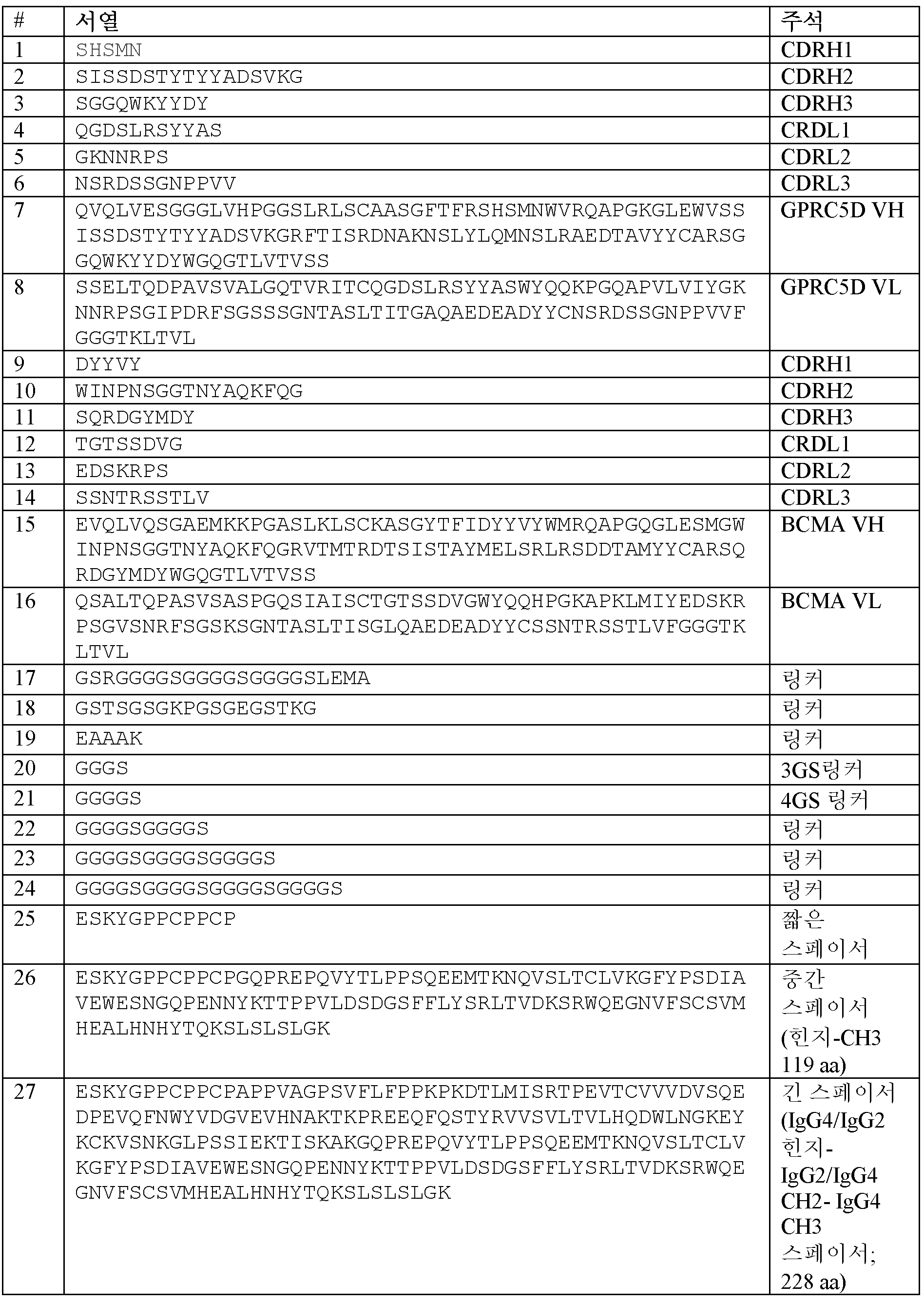
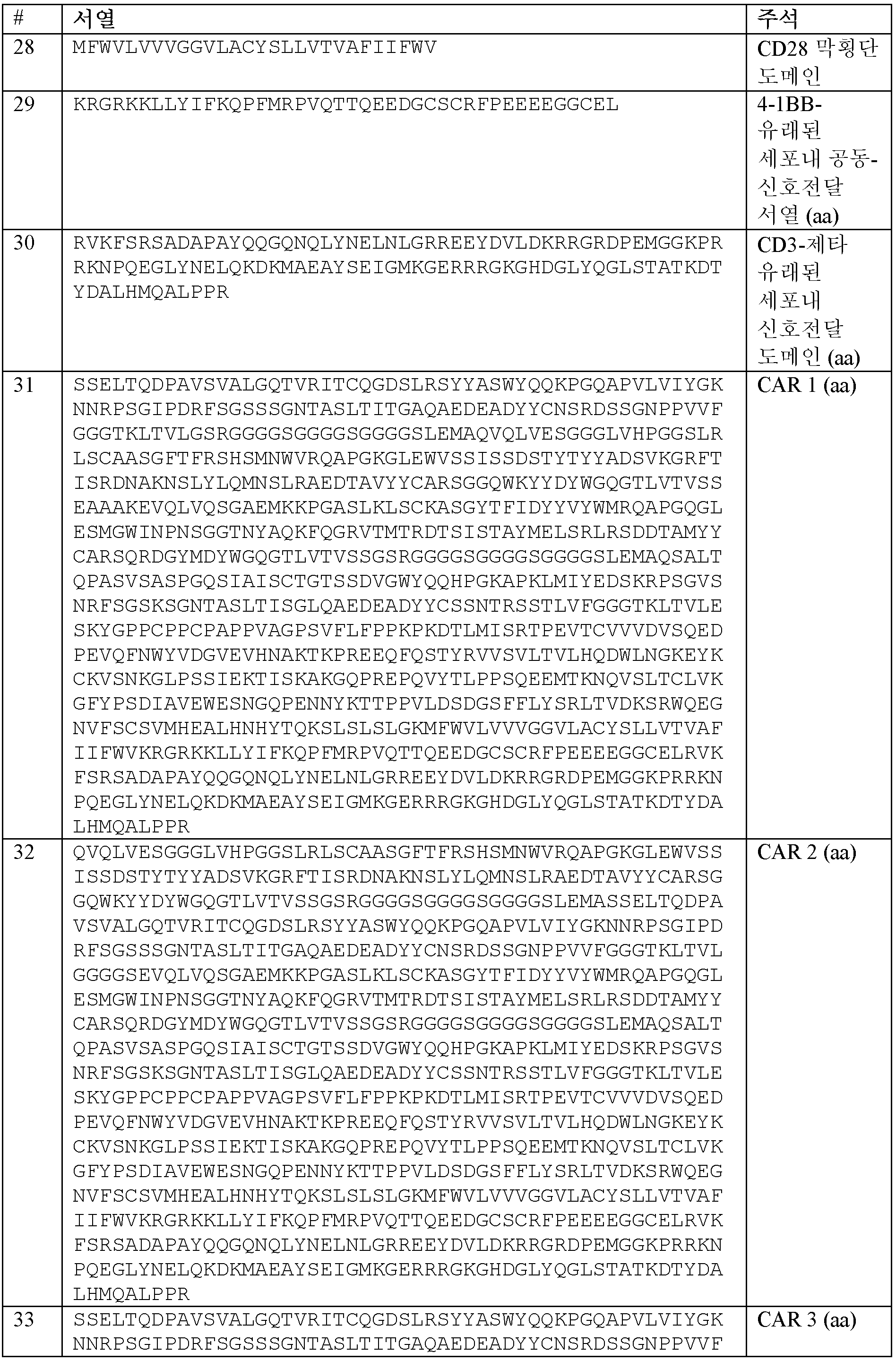

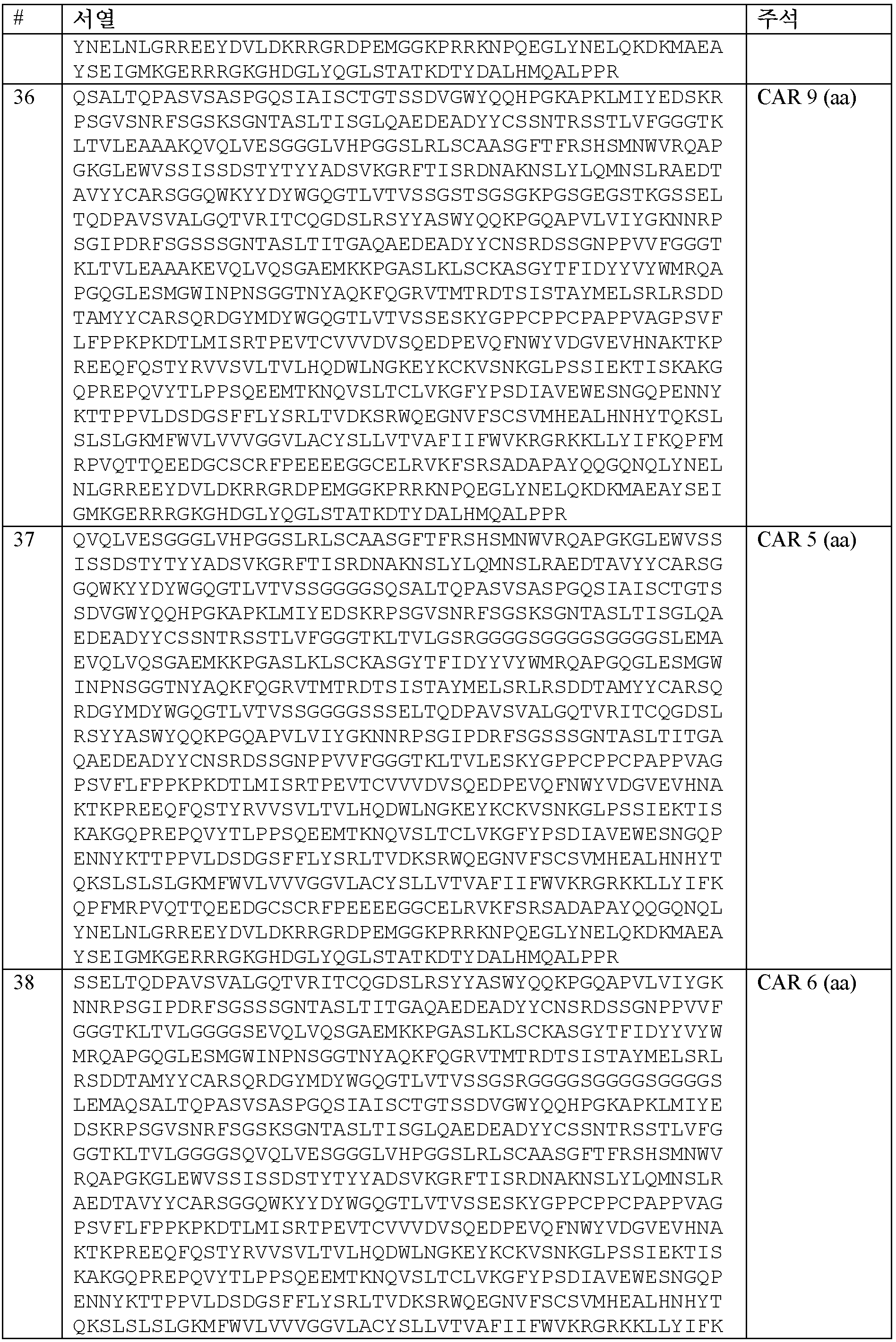
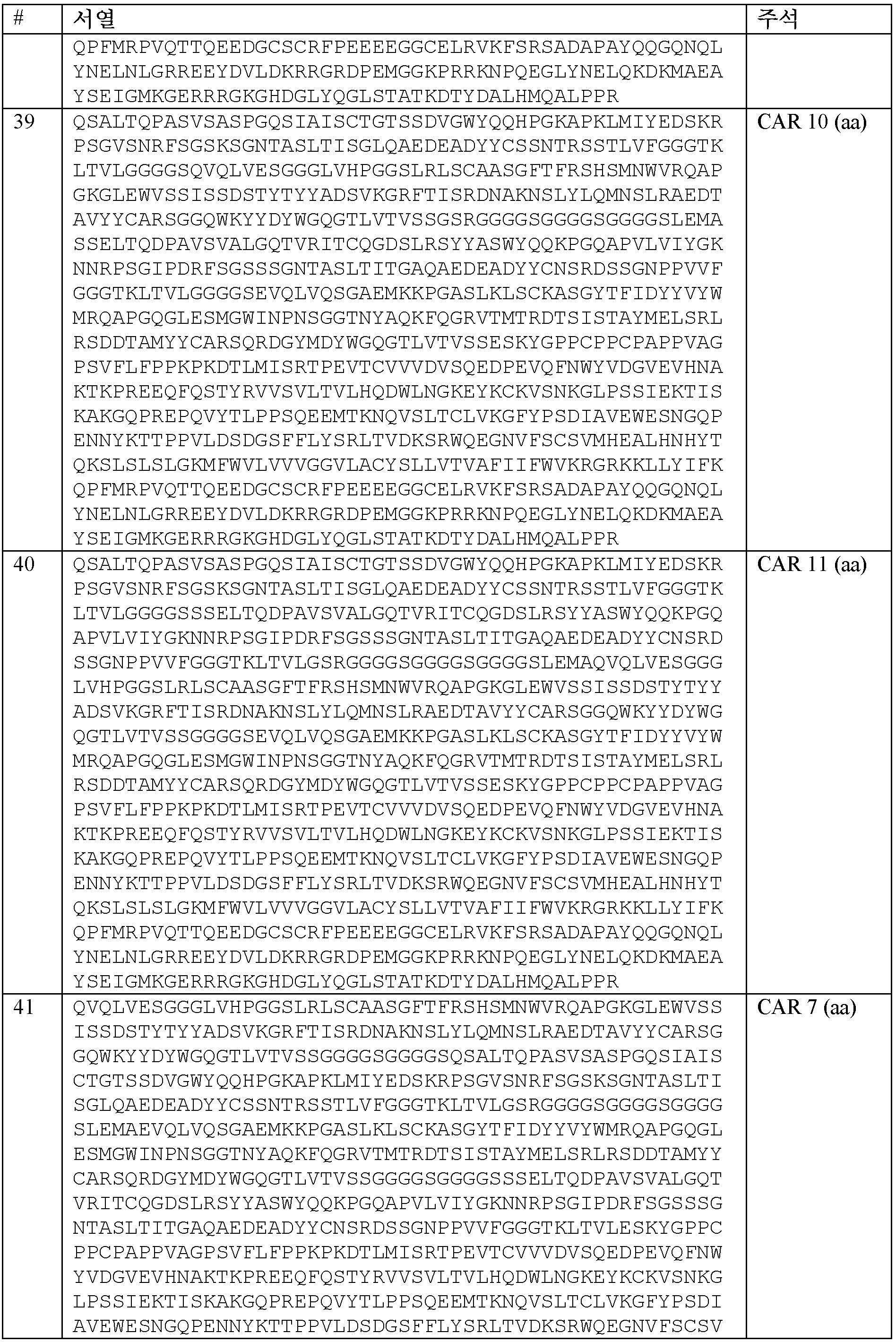
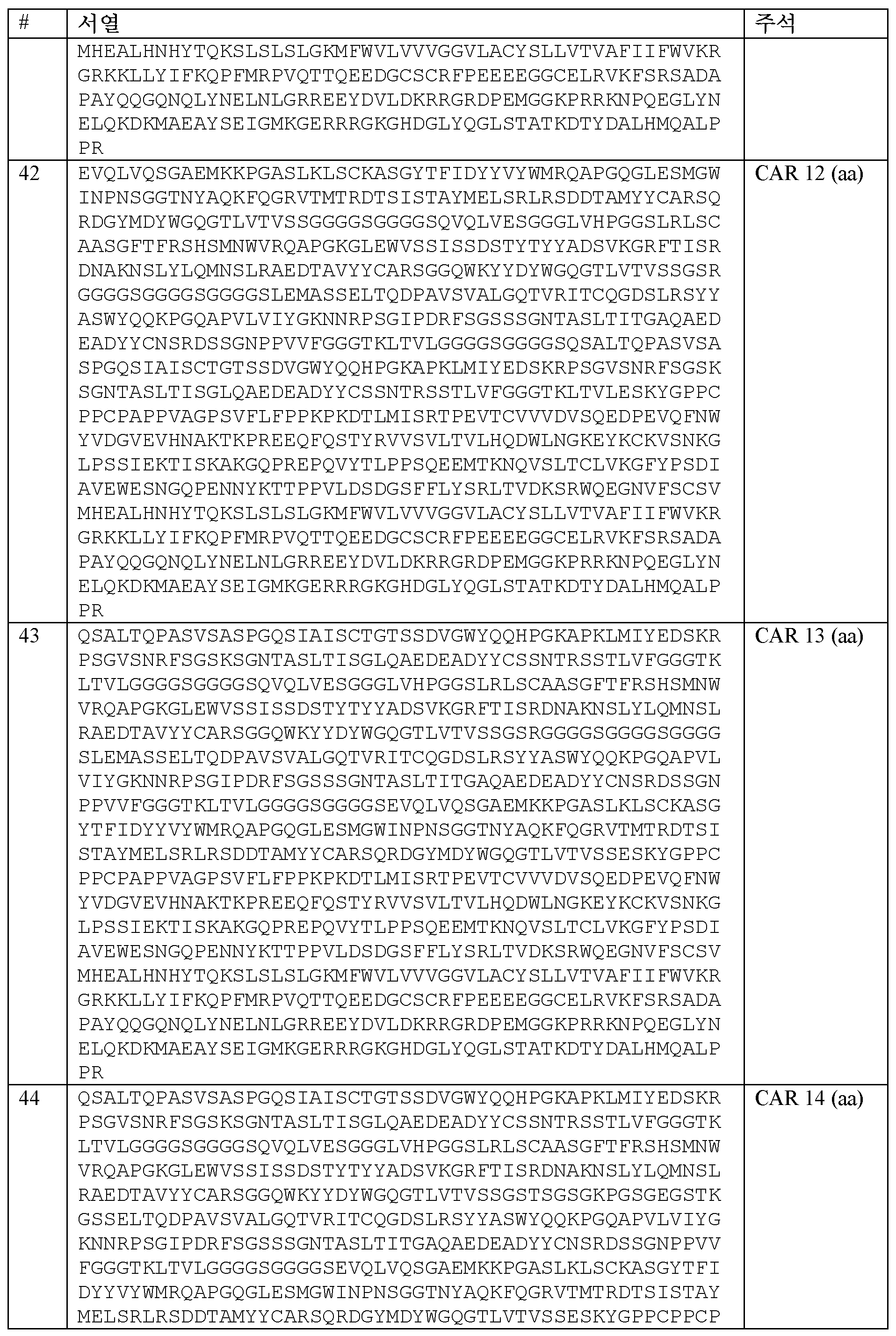
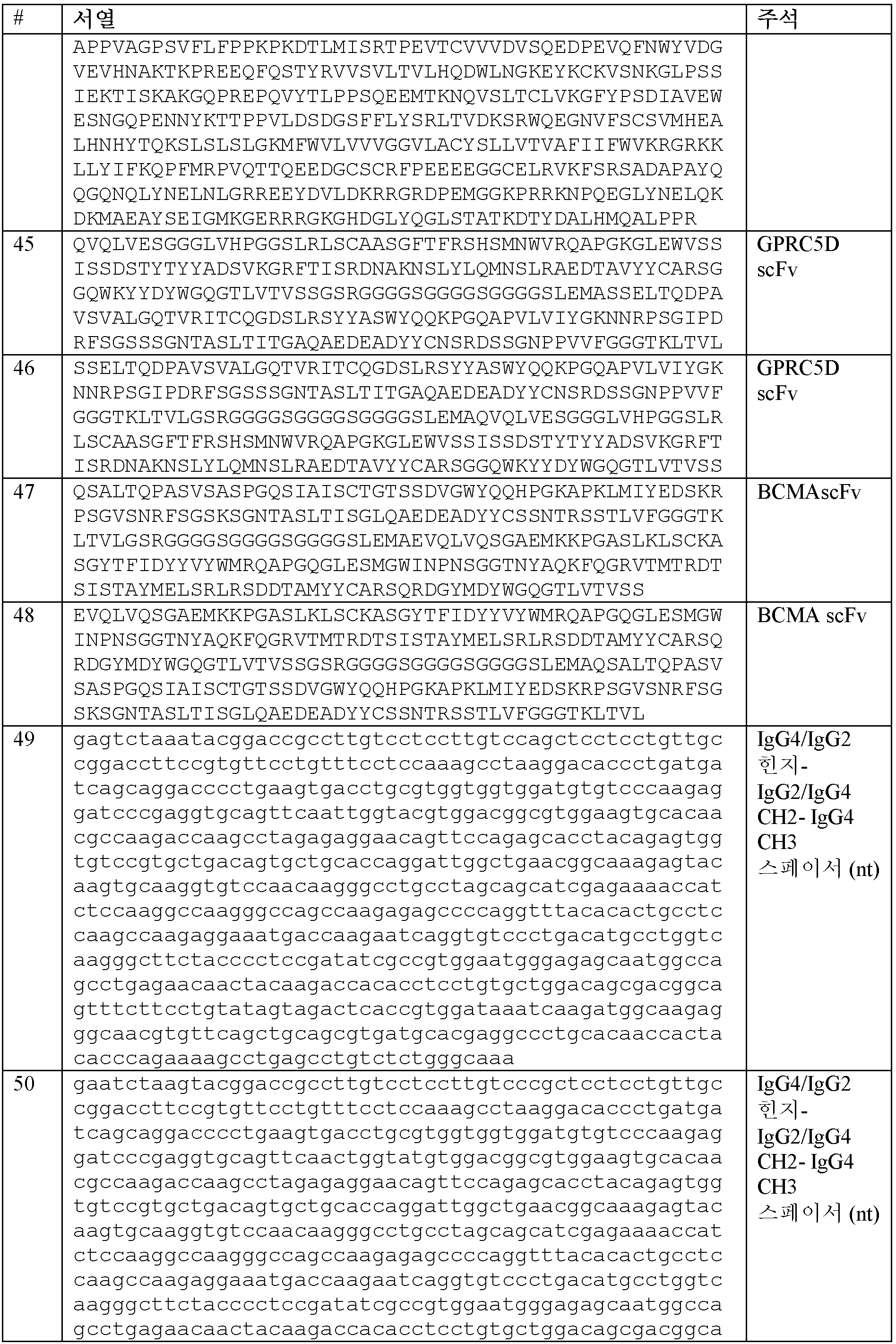
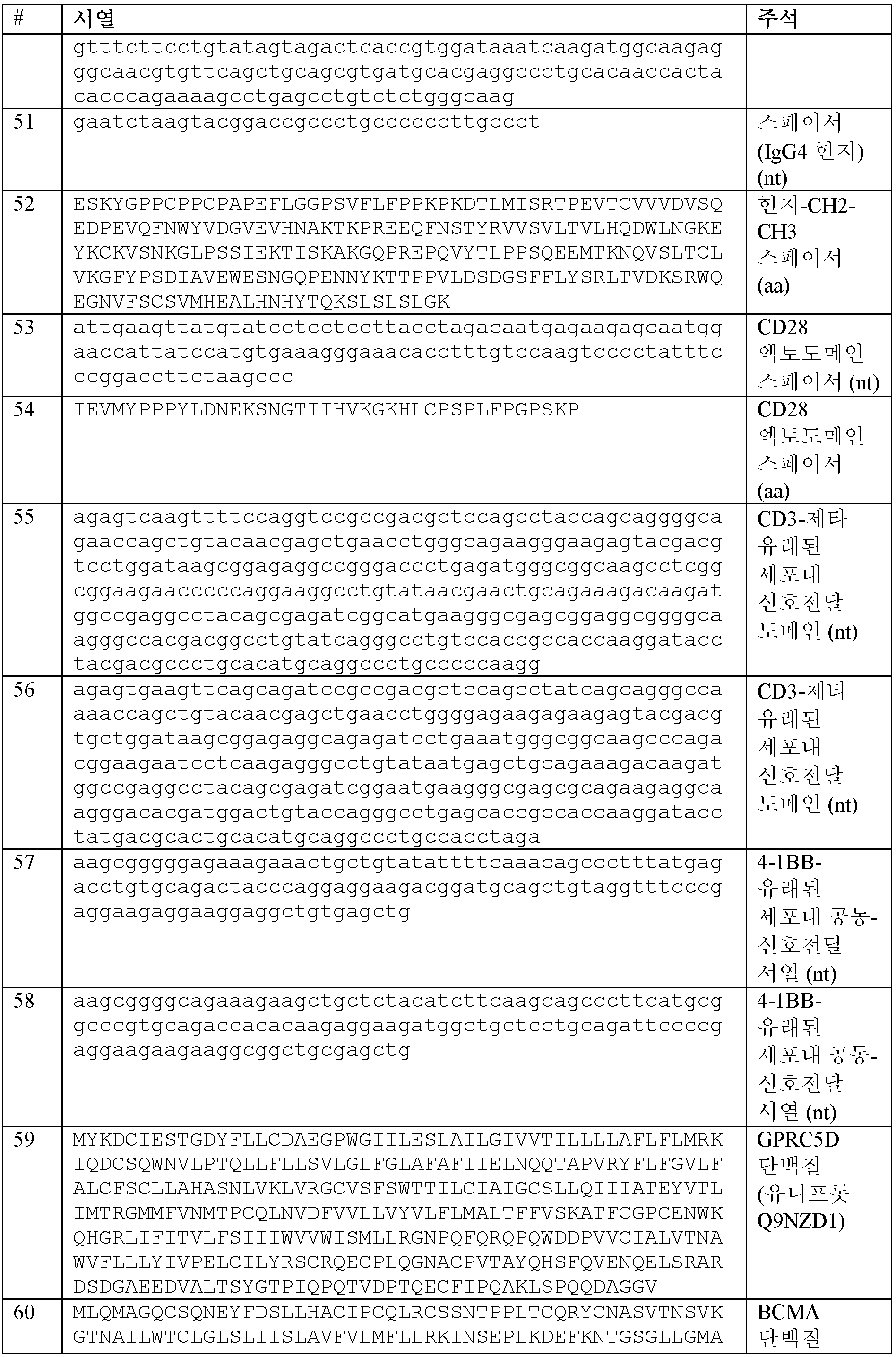
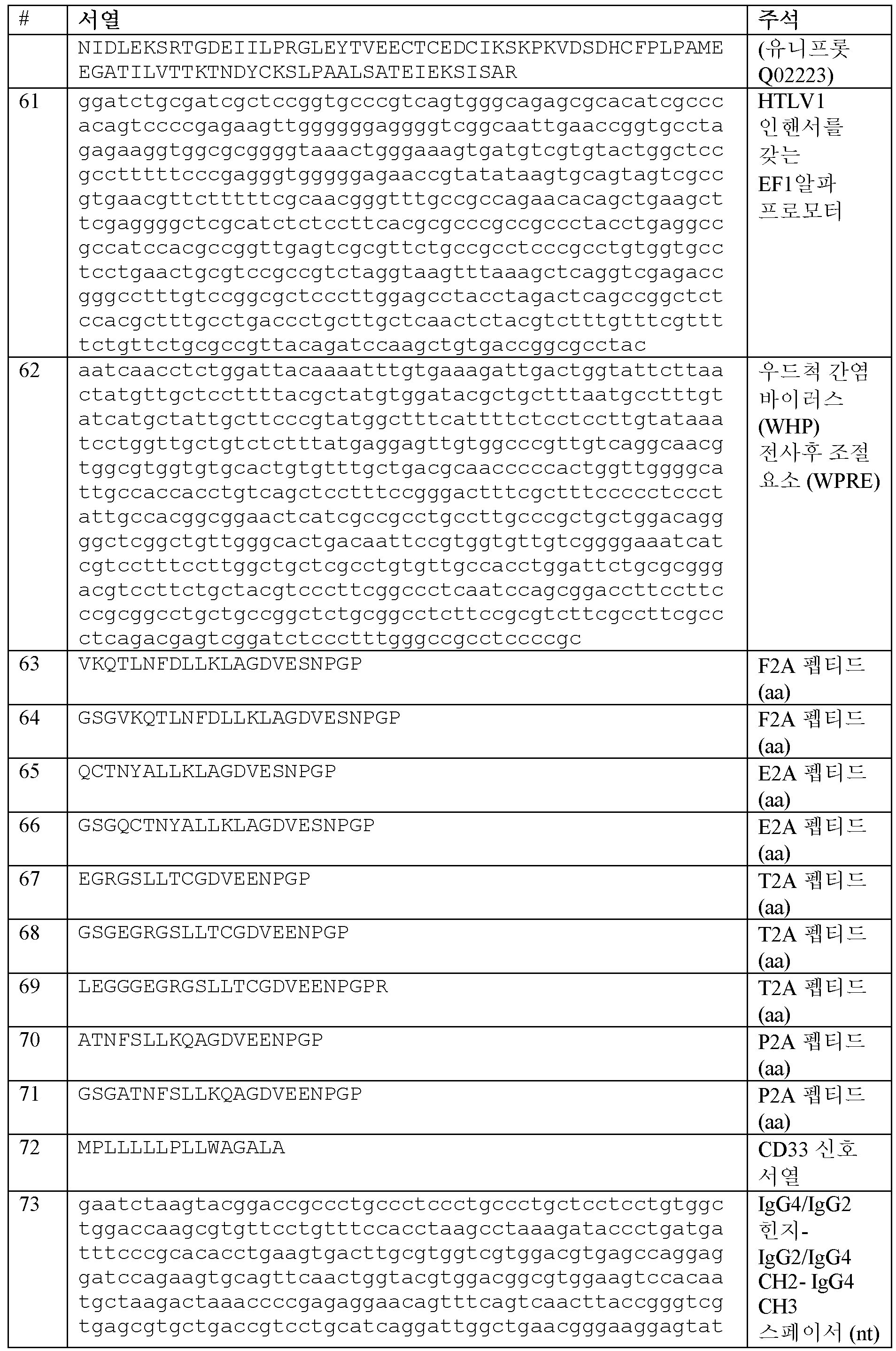
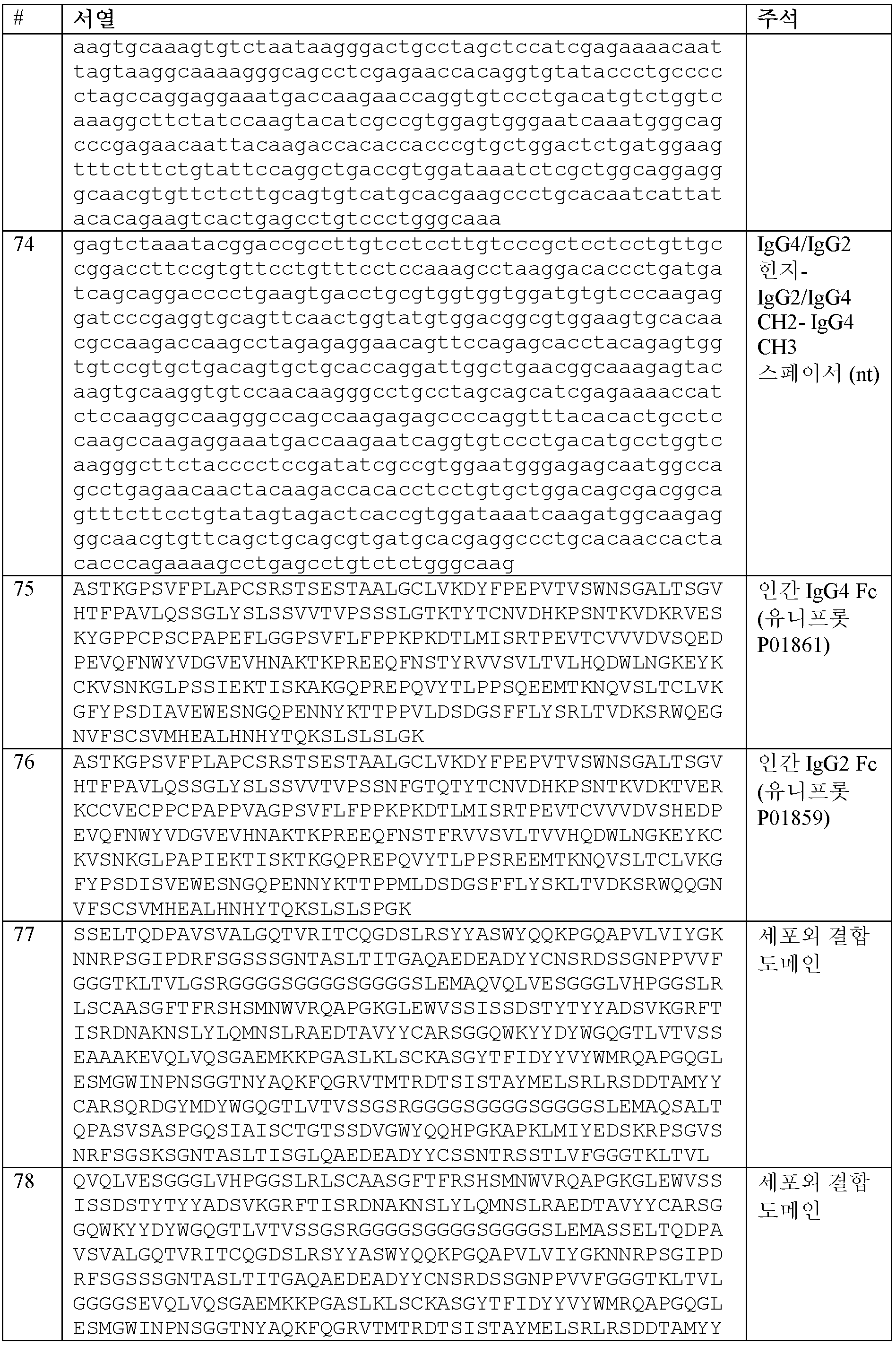


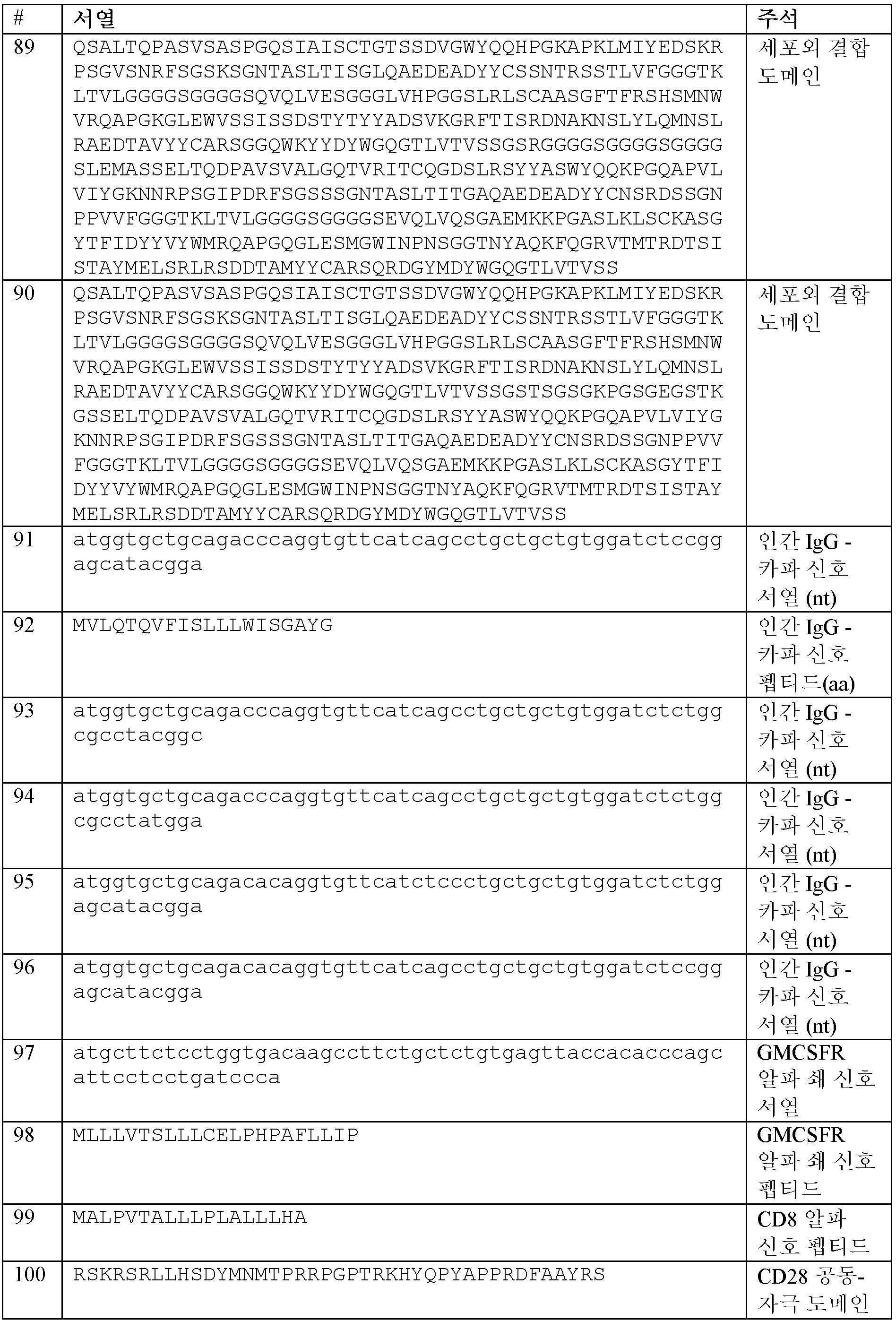
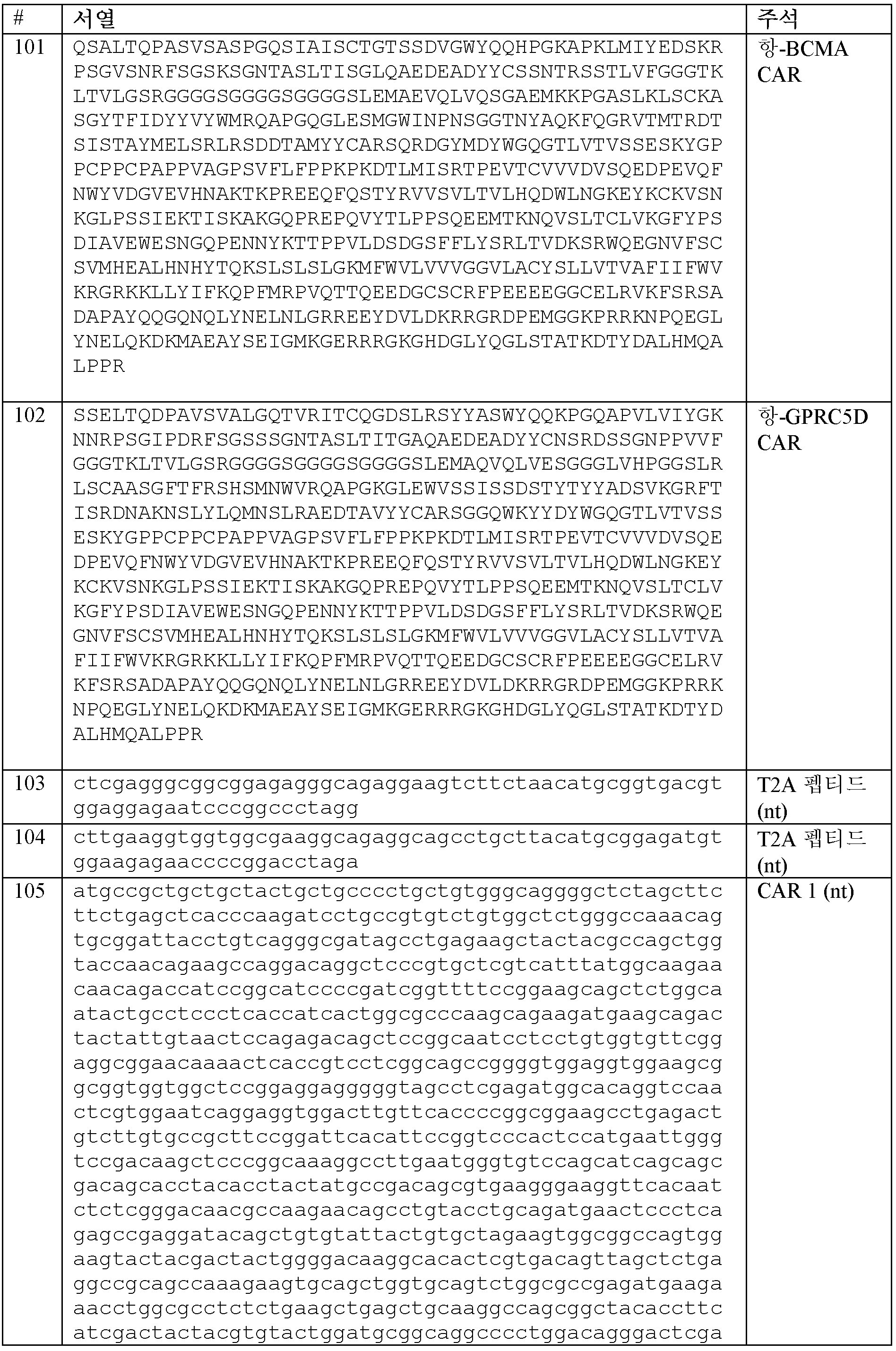
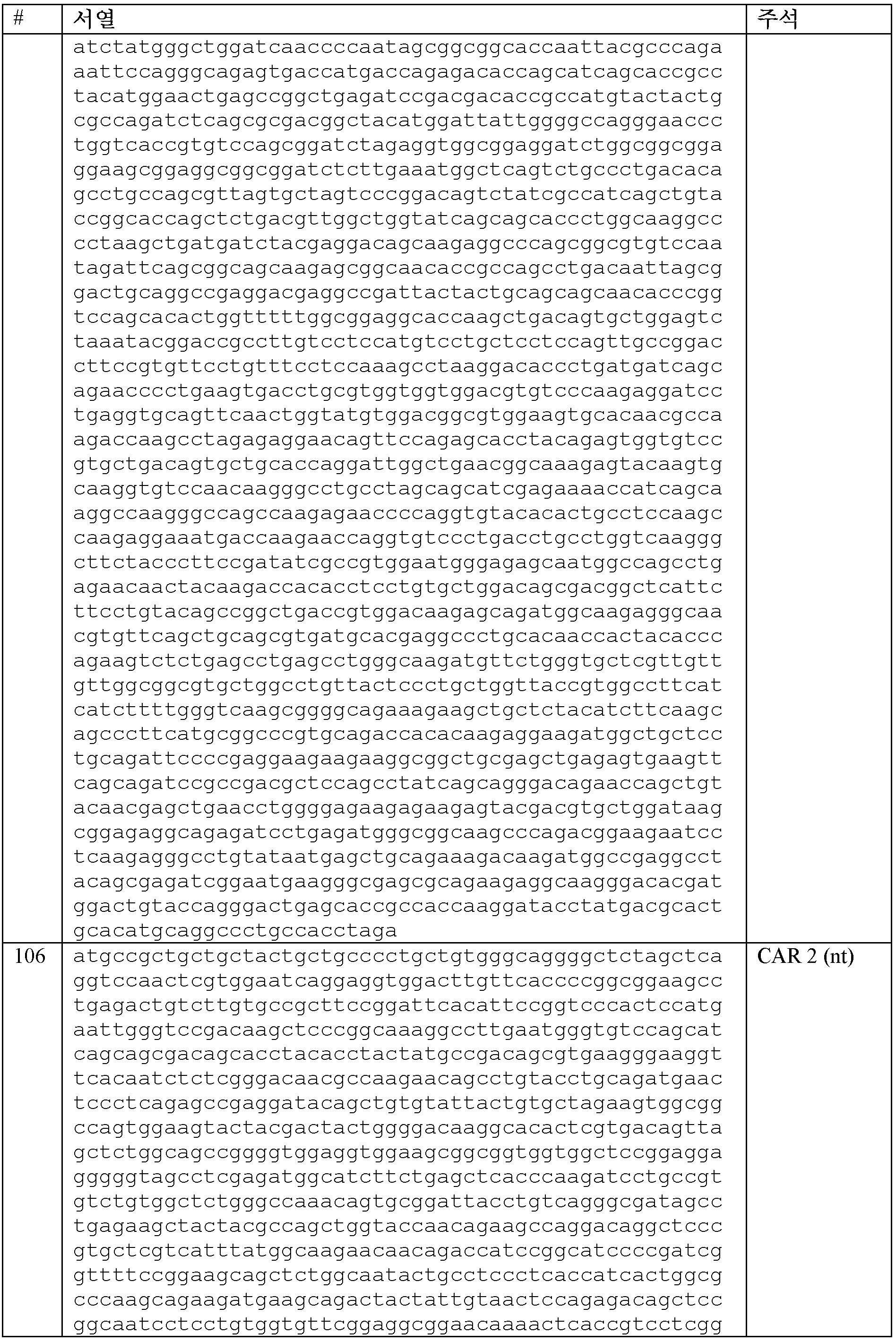
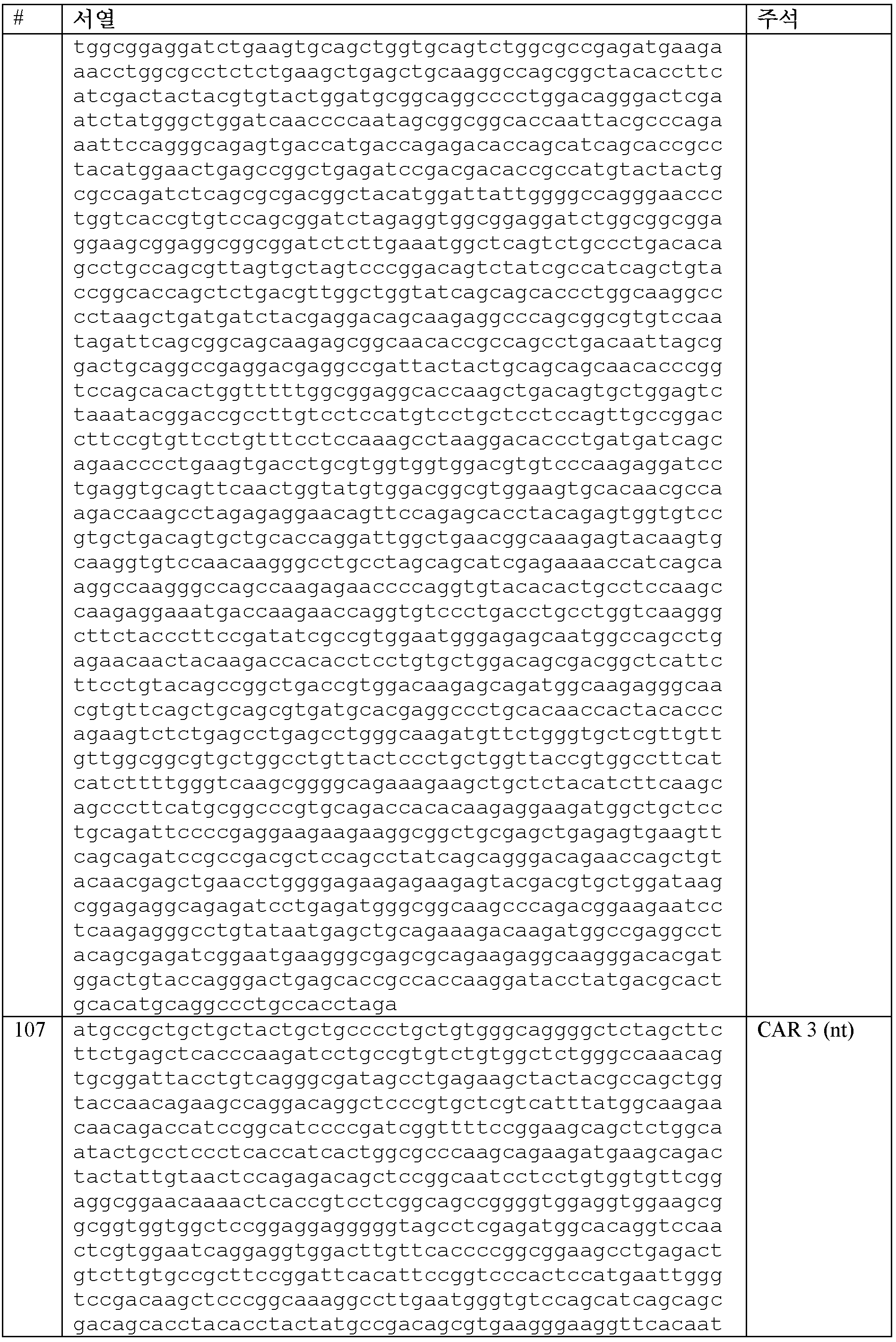
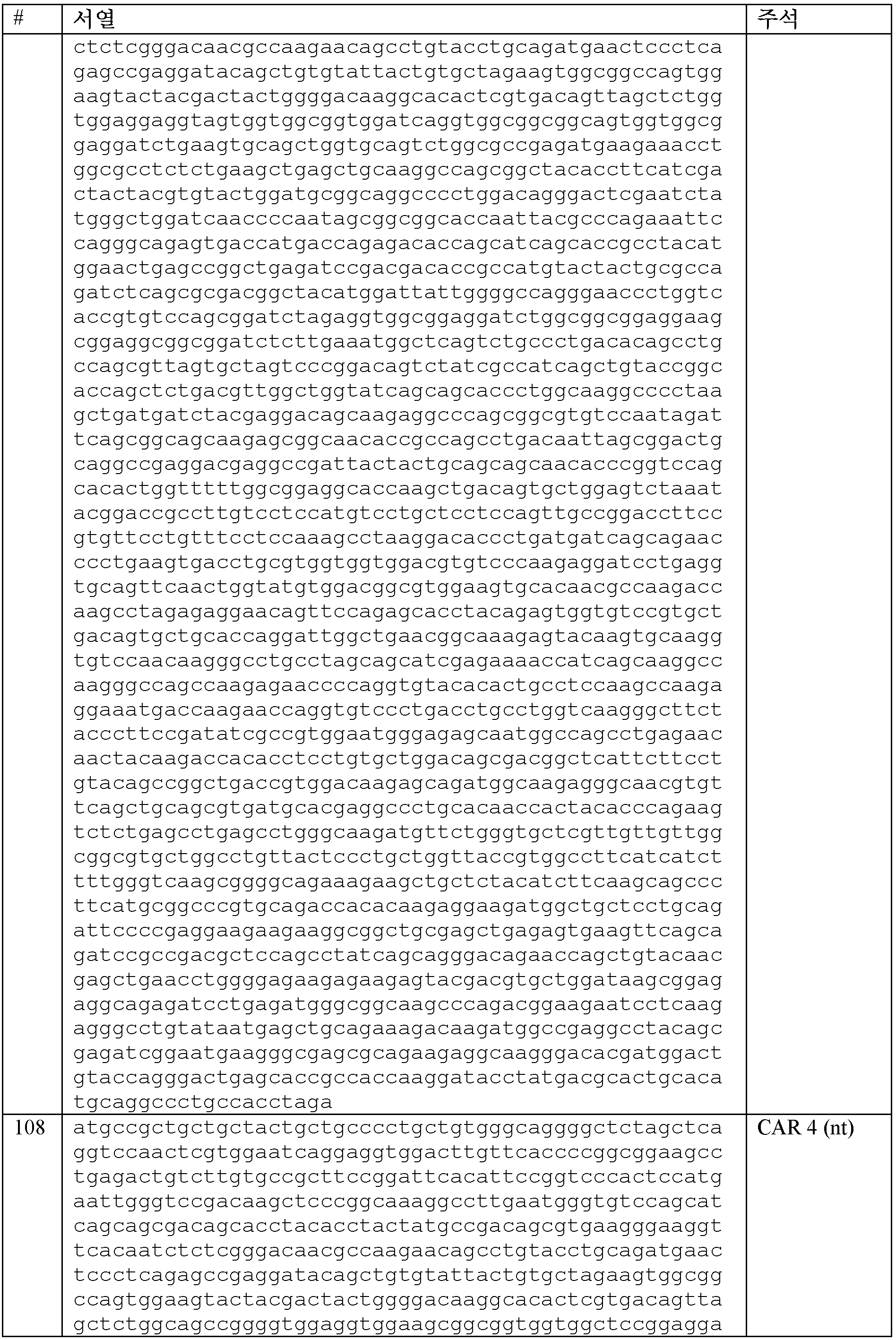
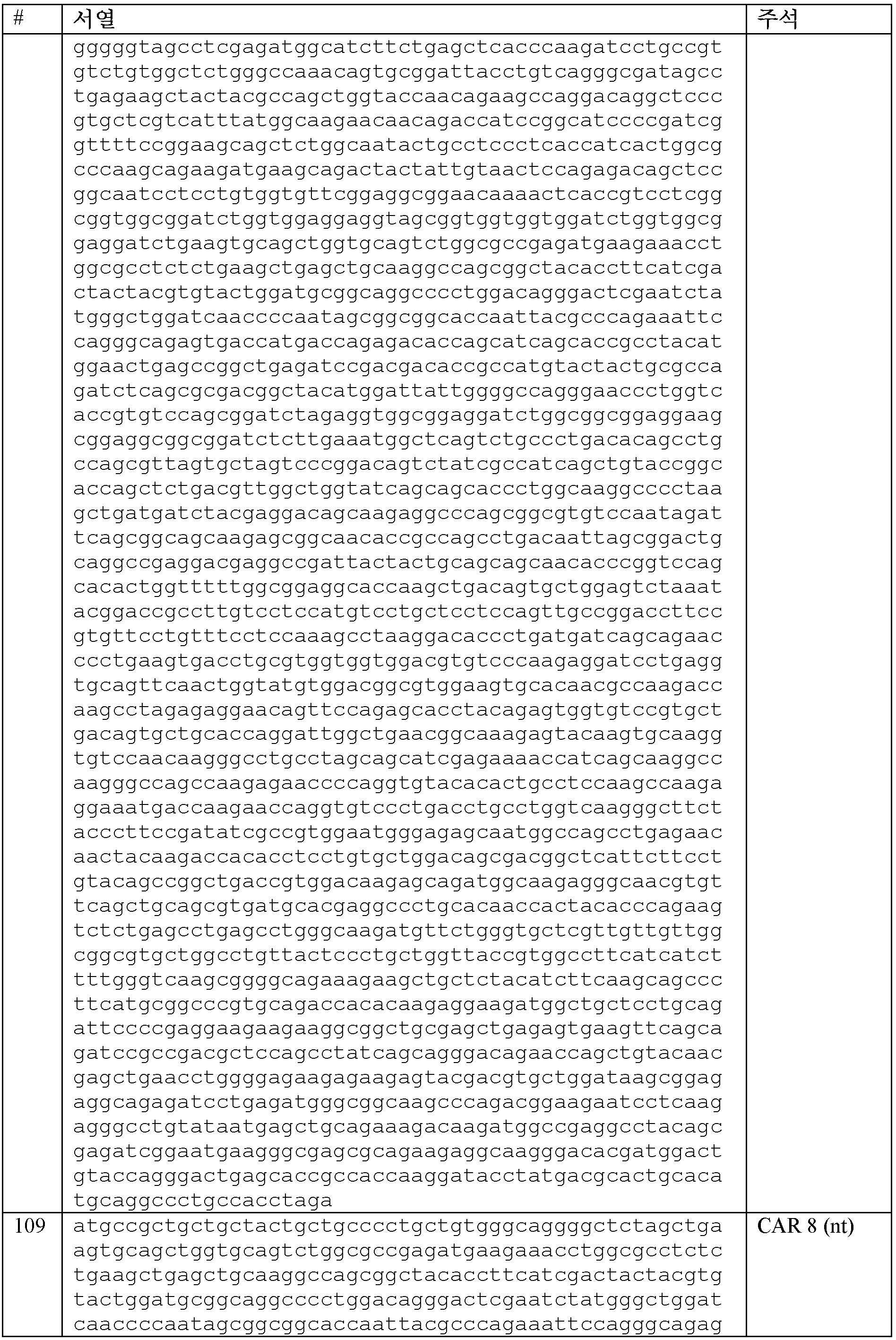
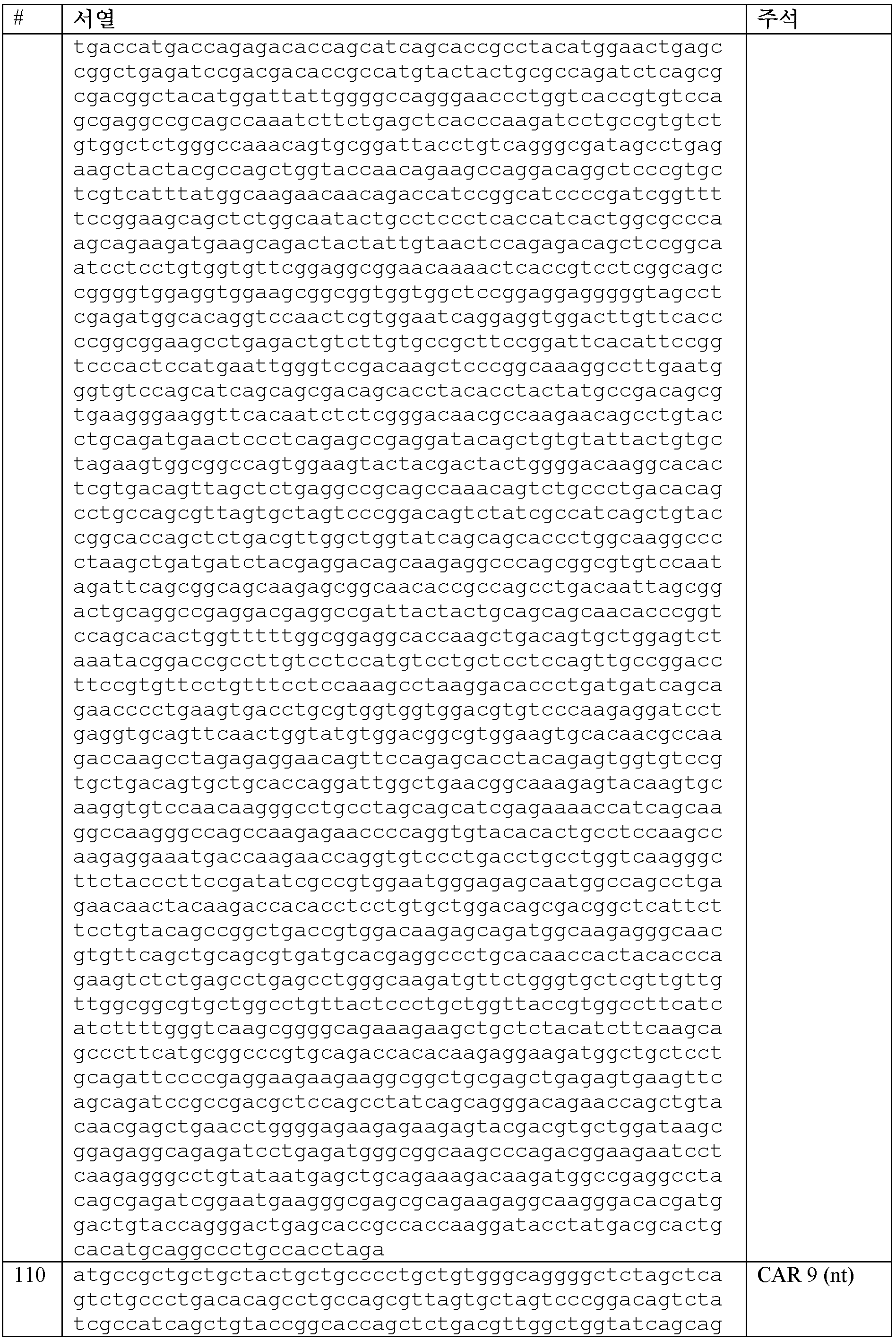
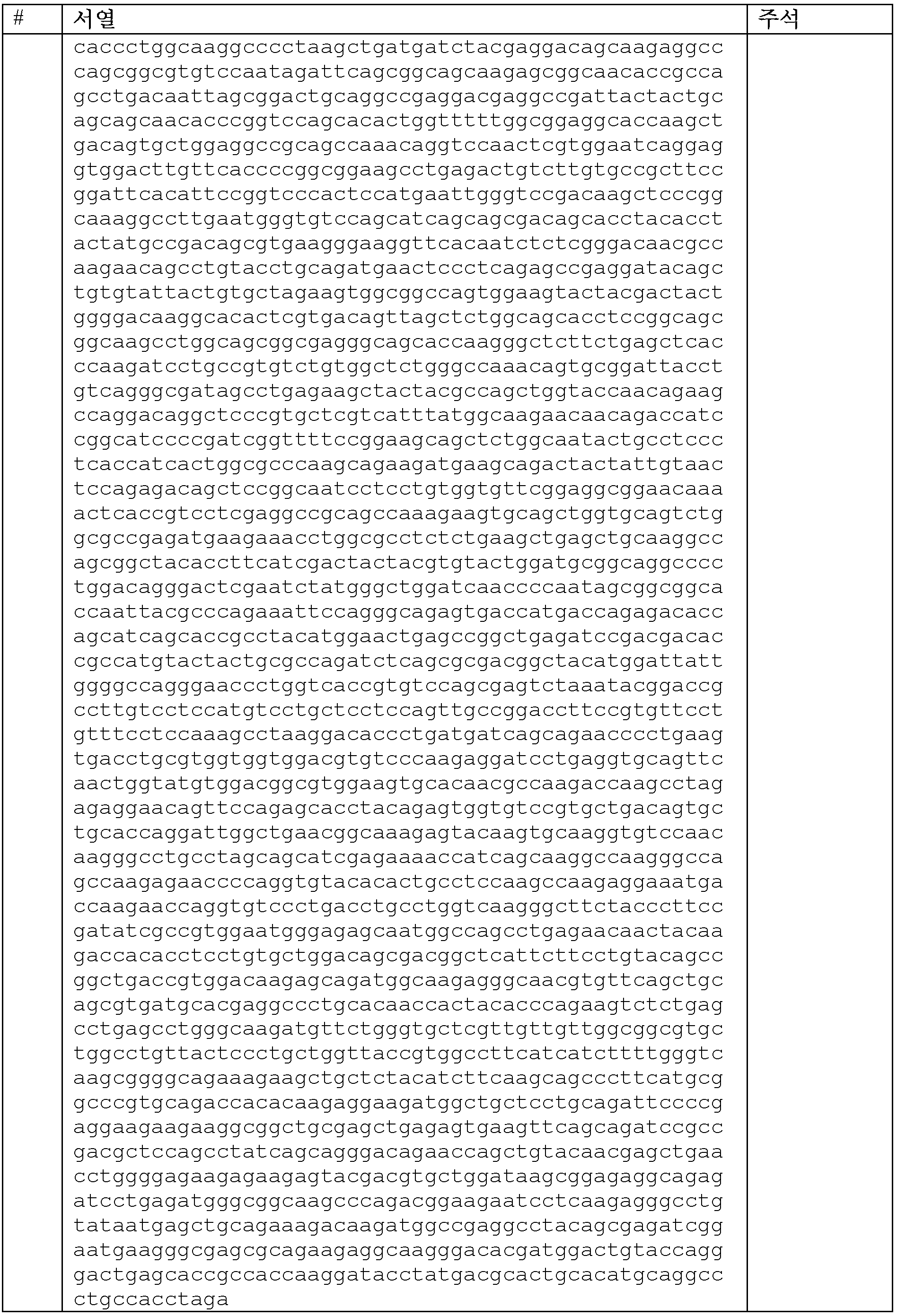
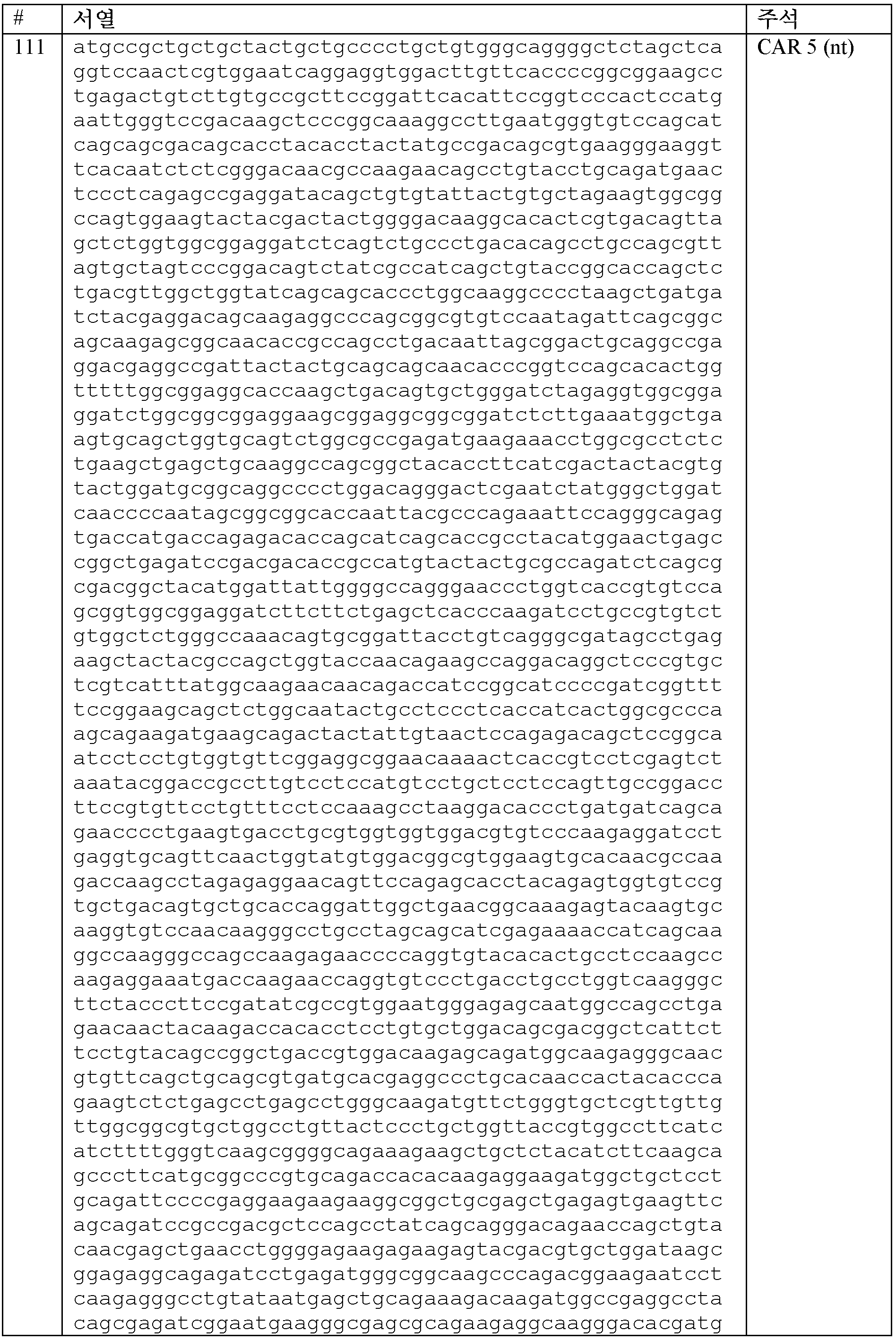
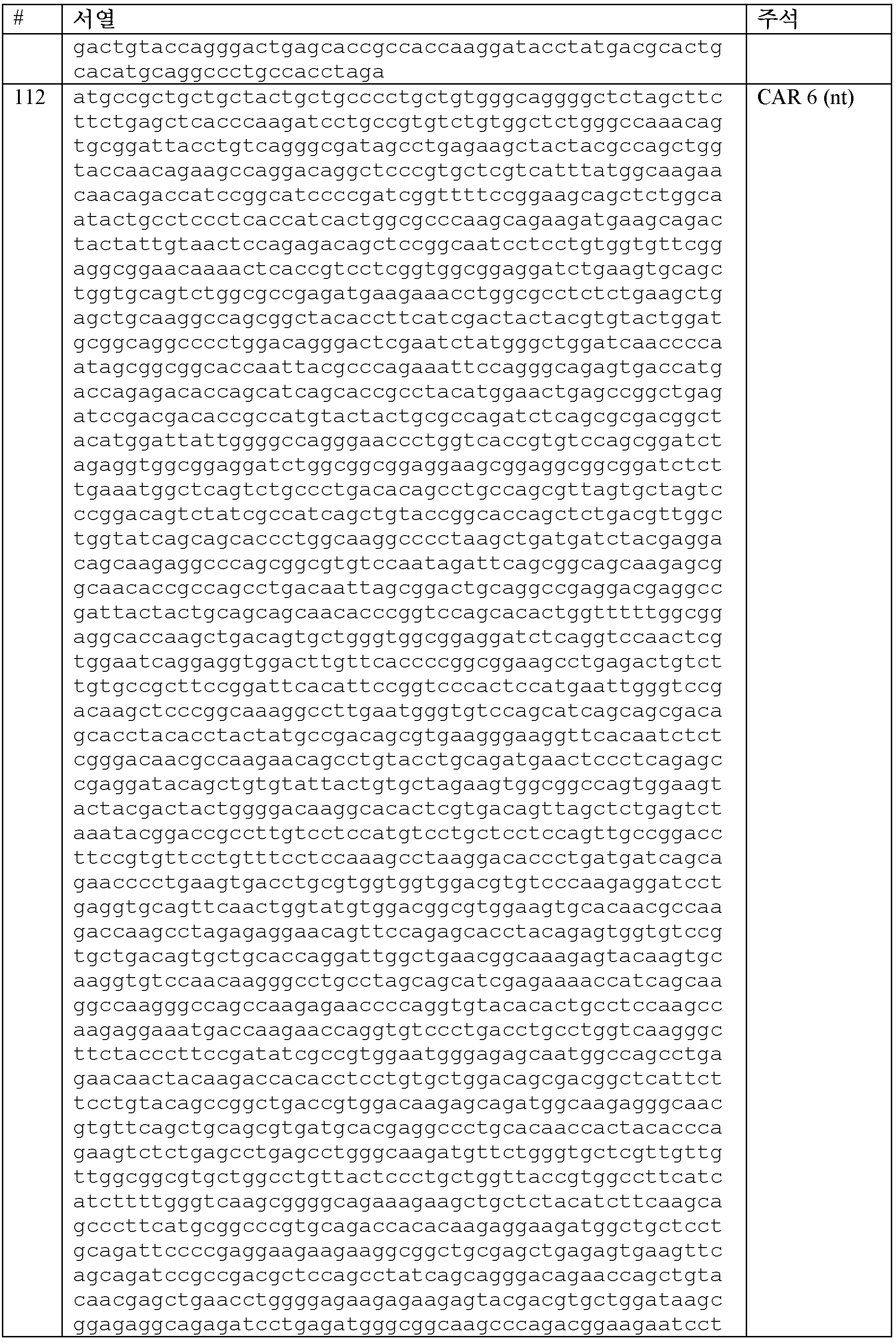
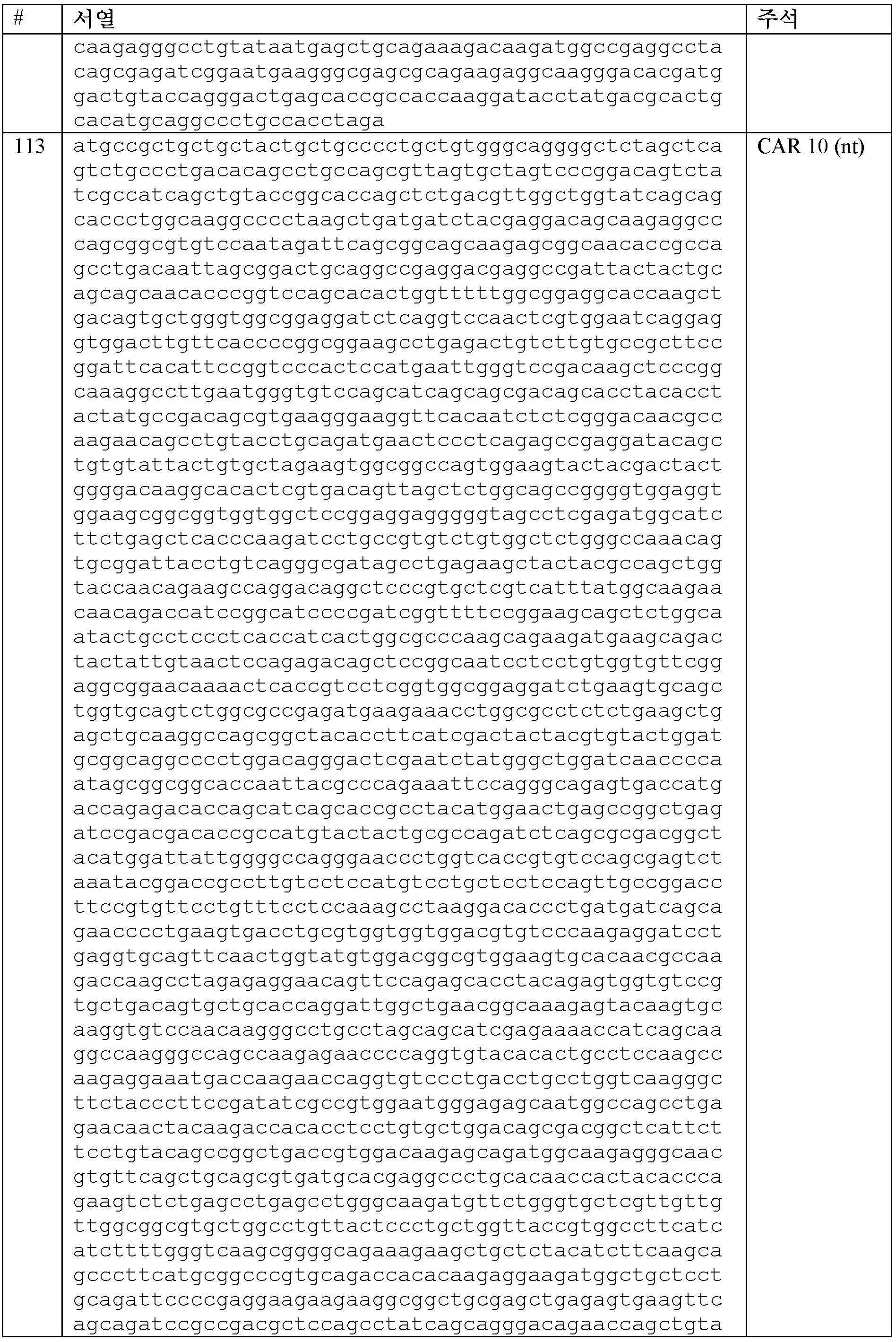
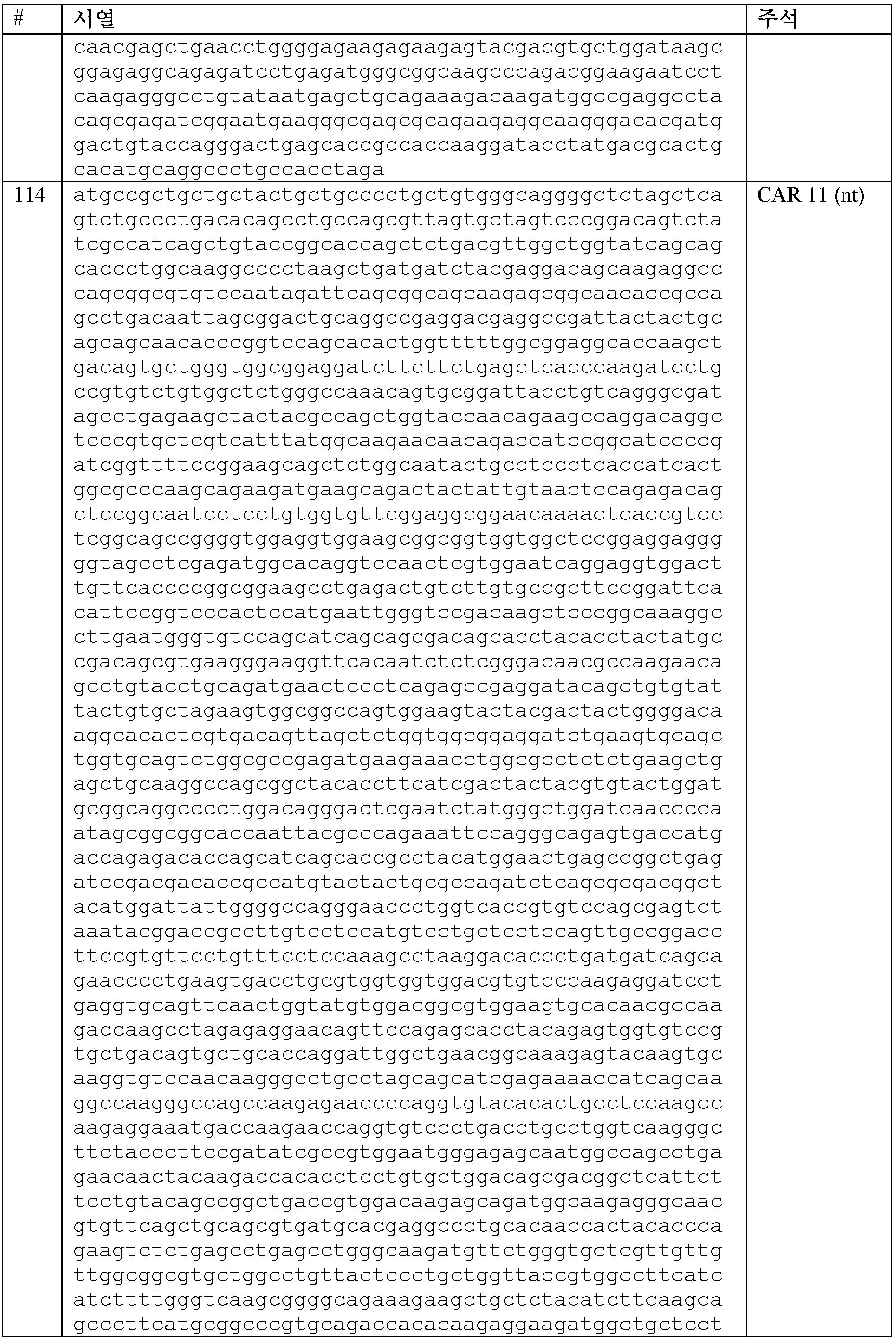
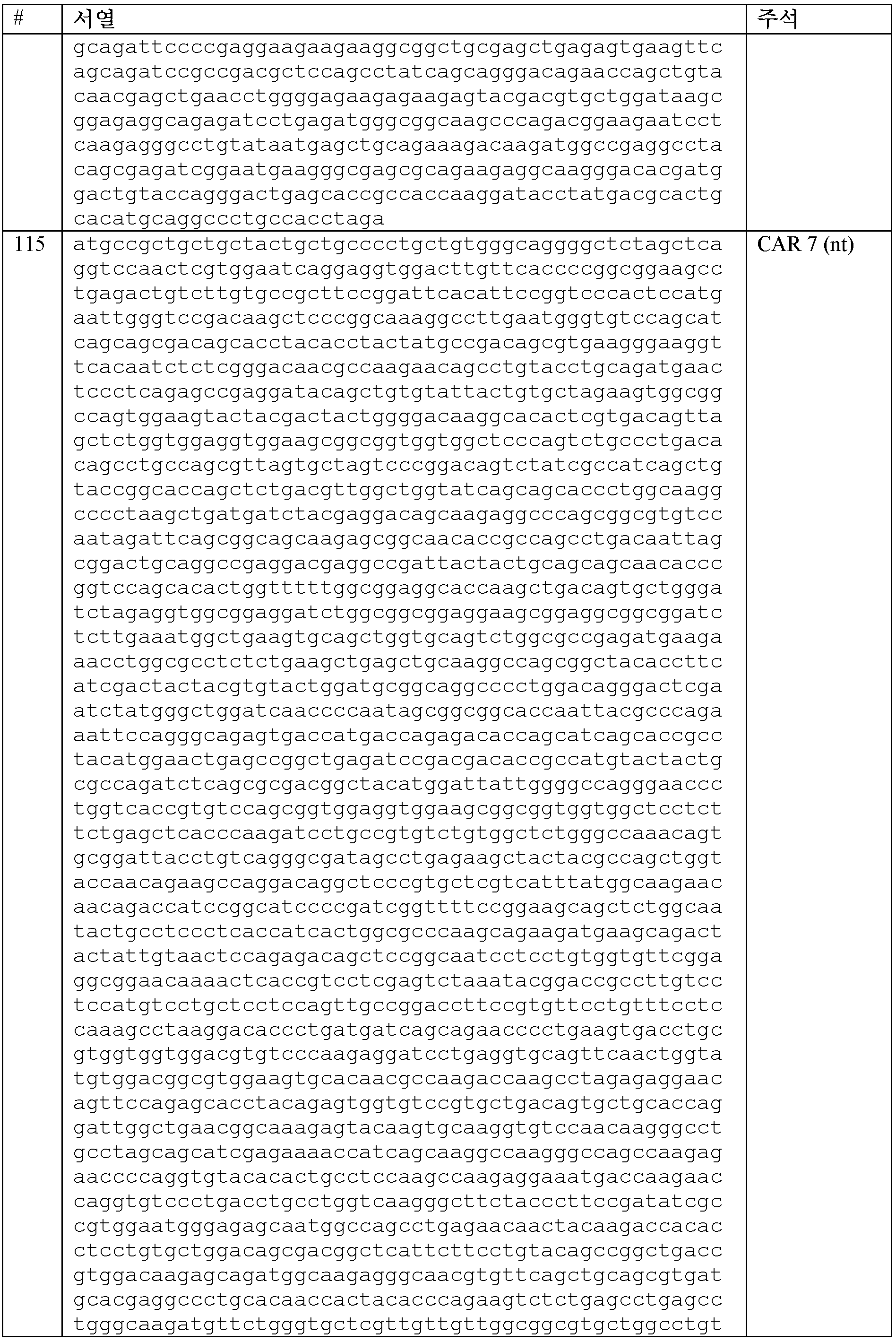
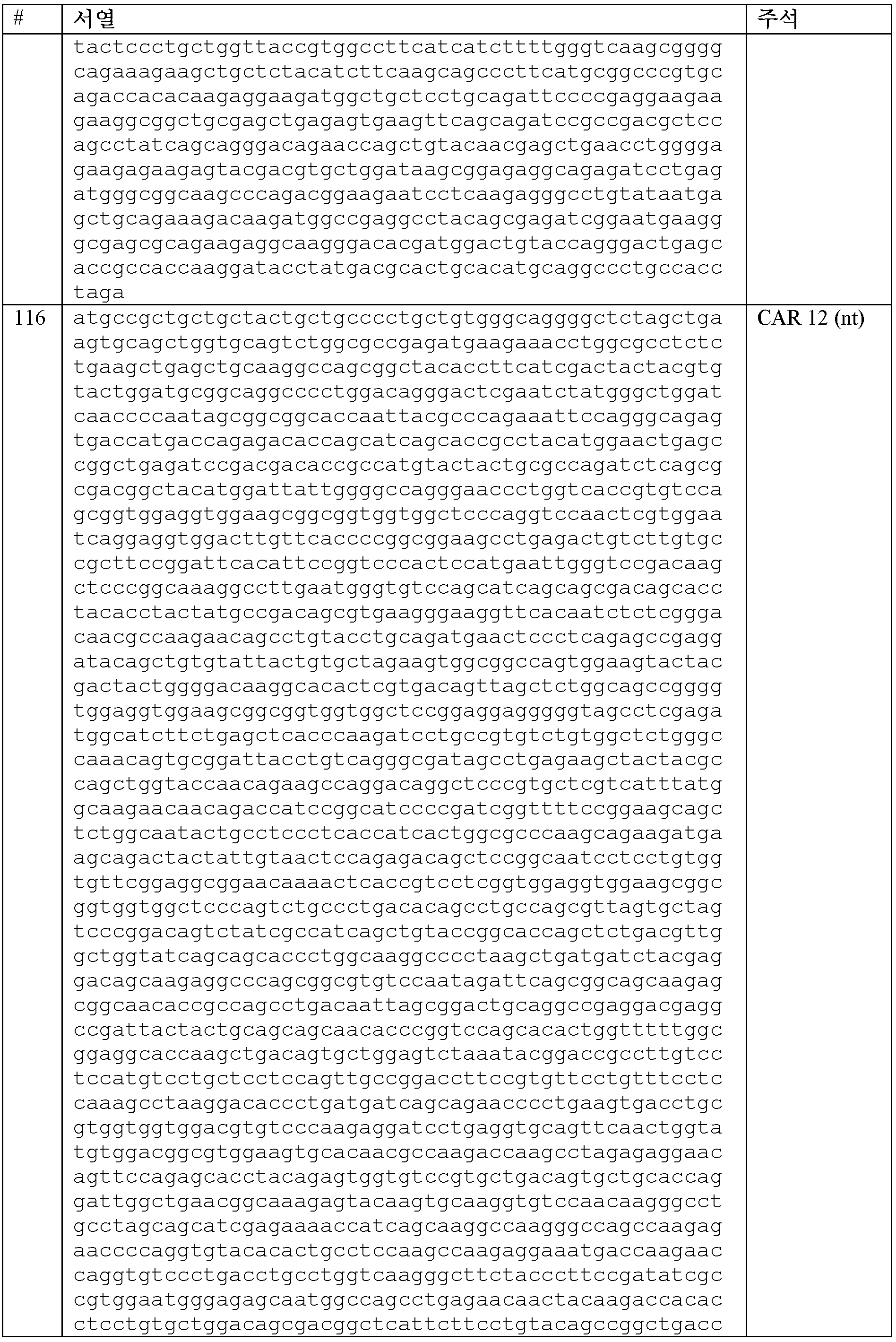
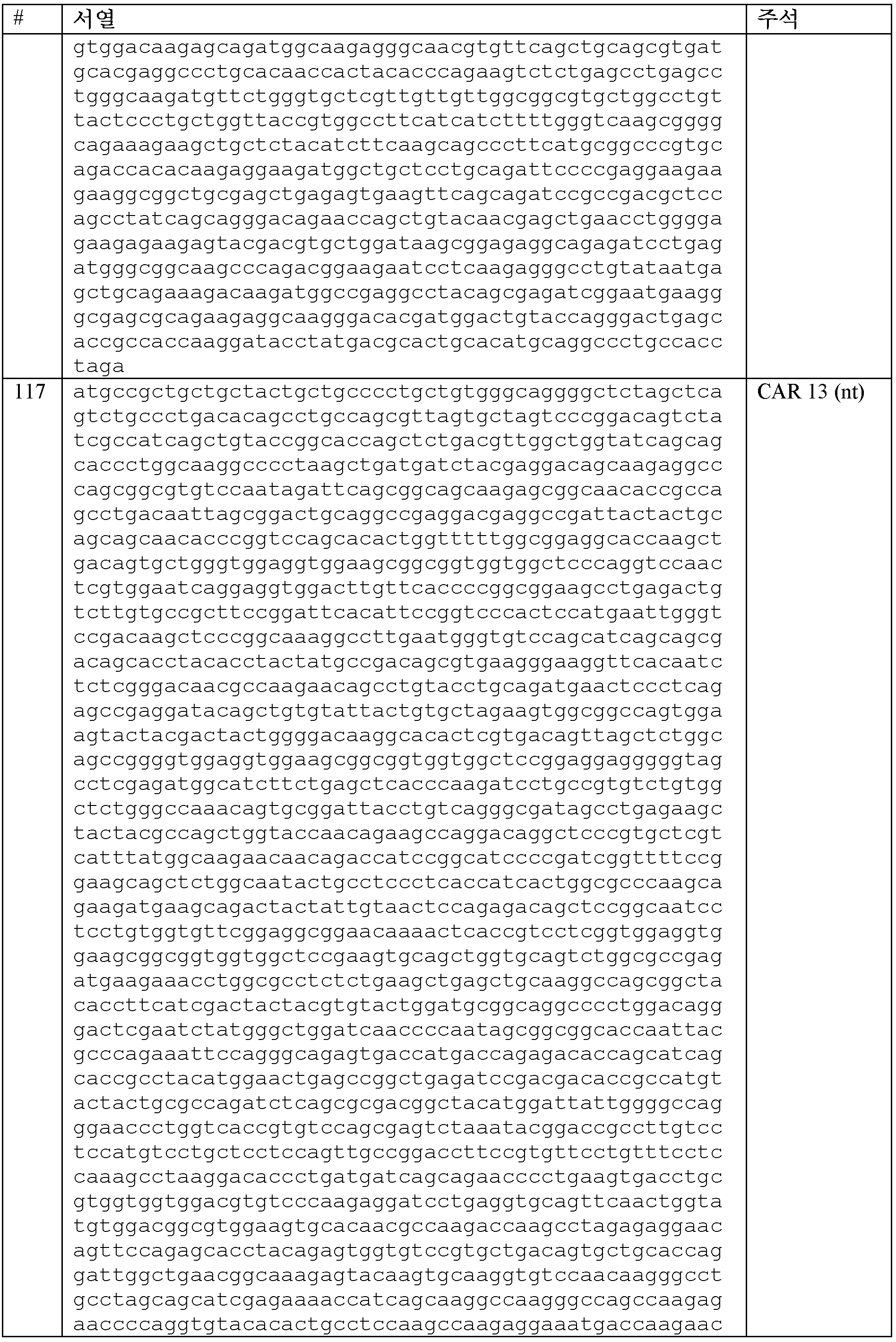
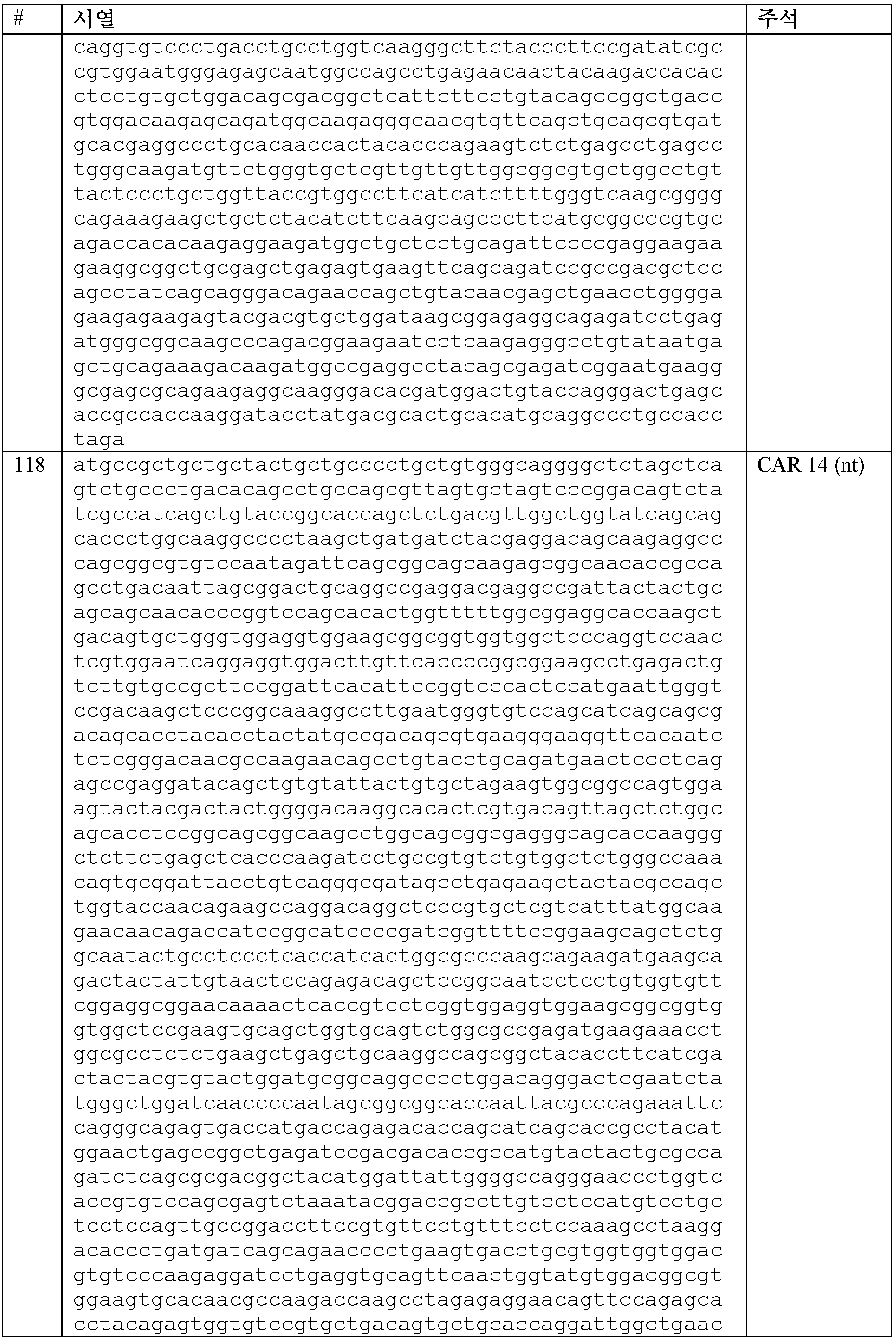
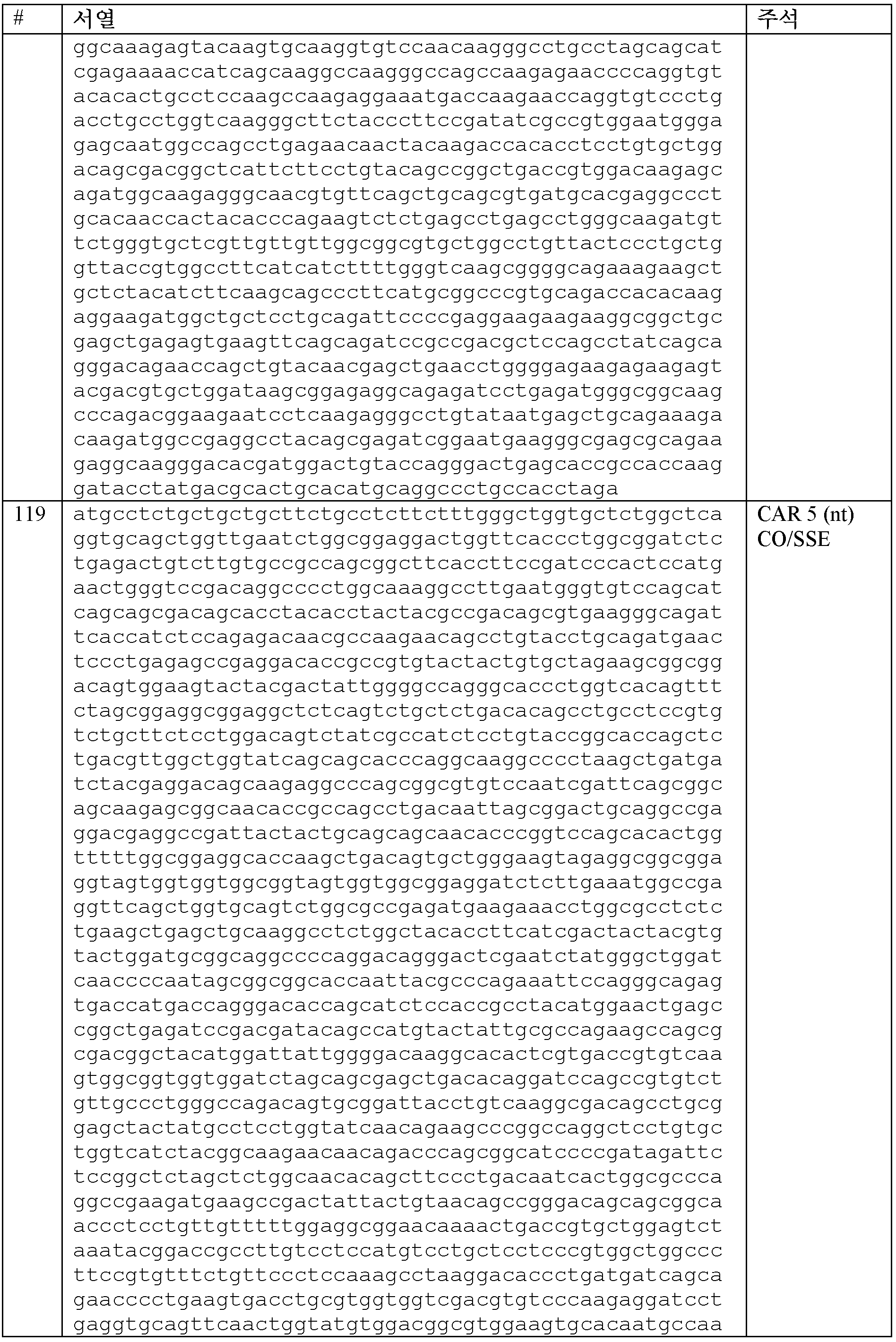
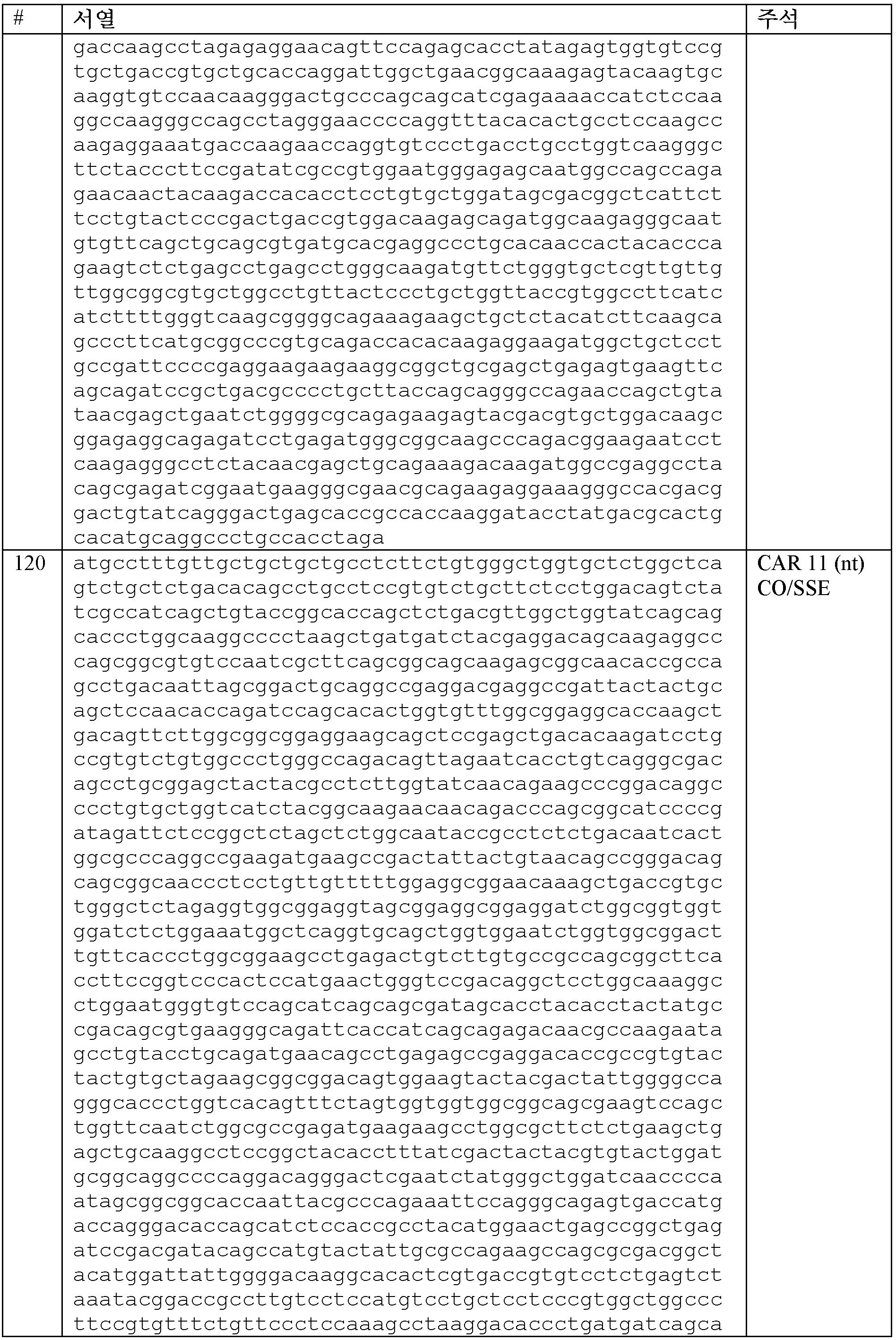
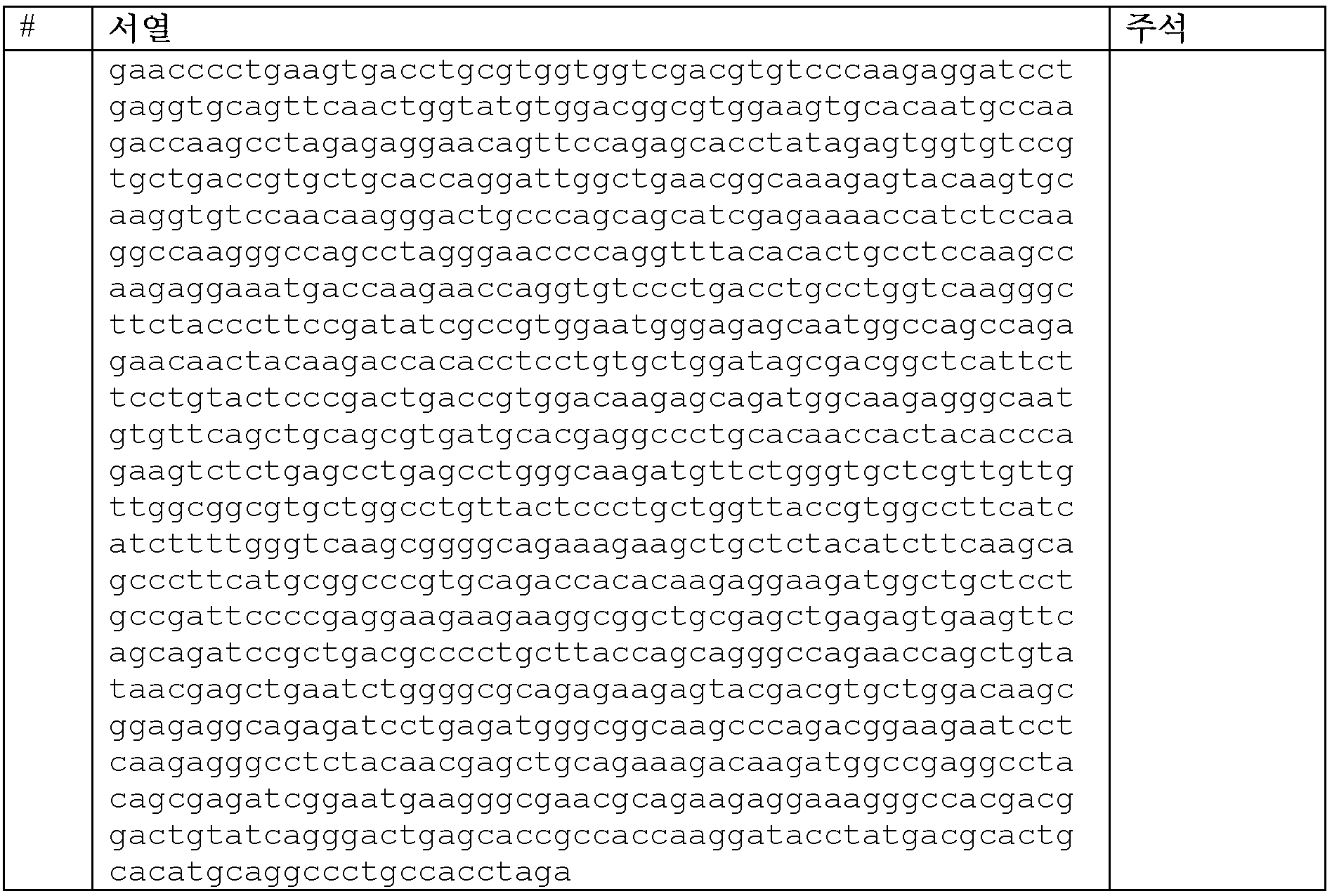
서열목록 전자파일 첨부Attach electronic file of sequence list
Claims (183)
(a) 중쇄 가변 (VH) 영역 및 경쇄 가변 (VL) 영역을 포함하는, GPRC5D에 결합하는 GPRC5D-결합 도메인; 및 VH 영역 및 VL 영역을 포함하는, BCMA에 결합하는 BCMA-결합 도메인을 포함하는 세포외 도메인이며, 여기서 세포외 도메인은 아미노 말단에서 카르복시 말단으로의 순서로:
(i) GPRC5D-결합 도메인의 VH 영역 및 VL 영역 중 하나, BCMA-결합 도메인의 VH 영역 및 VL 영역 중 하나, BCMA-결합 도메인의 VH 영역 및 VL 영역 중 다른 하나, 및 GPRC5D-결합 도메인의 VH 영역 및 VL 영역 중 다른 하나; 또는
(ii) BCMA-결합 도메인의 VH 영역 및 VL 영역 중 하나, GPRC5D-결합 도메인의 VH 영역 및 VL 영역 중 하나, GPRC5D-결합 도메인의 VH 영역 및 VL 영역 중 다른 하나, 및 BCMA-결합 도메인의 VH 영역 및 VL 영역 중 다른 하나
를 포함하는 것인 세포외 도메인;
(b) 스페이서;
(c) 막횡단 도메인; 및
(d) 세포내 신호전달 도메인
을 포함하는 이중특이적 CAR.As a bispecific chimeric antigen receptor (CAR),
(a) an extracellular domain comprising a GPRC5D-binding domain comprising a heavy chain variable (VH) region and a light chain variable (VL) region, wherein the extracellular domain comprises a BCMA-binding domain comprising a VH region and a VL region, wherein the extracellular domain comprises, in order from the amino terminus to the carboxy terminus:
(i) one of the VH region and the VL region of the GPRC5D-binding domain, one of the VH region and the VL region of the BCMA-binding domain, the other of the VH region and the VL region of the BCMA-binding domain, and the other of the VH region and the VL region of the GPRC5D-binding domain; or
(ii) one of the VH region and the VL region of the BCMA-binding domain, one of the VH region and the VL region of the GPRC5D-binding domain, the other of the VH region and the VL region of the GPRC5D-binding domain, and the other of the VH region and the VL region of the BCMA-binding domain.
An extracellular domain comprising;
(b) spacer;
(c) a transmembrane domain; and
(d) intracellular signaling domain
A bispecific CAR comprising:
(a) 중쇄 가변 (VH) 영역 및 경쇄 가변 (VL) 영역을 포함하는, GPRC5D에 결합하는 GPRC5D-결합 도메인; 및 VH 영역 및 VL 영역을 포함하는, BCMA에 결합하는 BCMA-결합 도메인을 포함하는 세포외 도메인이며, 여기서 세포외 도메인은 아미노 말단에서 카르복시 말단으로의 순서로: GPRC5D-결합 도메인의 VH 영역, BCMA-결합 도메인의 VH 영역, BCMA-결합 도메인의 VL 영역 및 GPRC5D-결합 도메인의 VL 영역을 포함하는 것인 세포외 도메인;
(b) 스페이서;
(c) 막횡단 도메인; 및
(d) 세포내 신호전달 도메인
을 포함하는 이중특이적 CAR.As a bispecific chimeric antigen receptor (CAR),
(a) an extracellular domain comprising a GPRC5D-binding domain that binds GPRC5D, comprising a heavy chain variable (VH) region and a light chain variable (VL) region; and a BCMA-binding domain that binds BCMA, comprising a VH region and a VL region, wherein the extracellular domain comprises, in order from the amino terminus to the carboxy terminus: a VH region of the GPRC5D-binding domain, a VH region of the BCMA-binding domain, a VL region of the BCMA-binding domain, and a VL region of the GPRC5D-binding domain;
(b) spacer;
(c) a transmembrane domain; and
(d) intracellular signaling domain
A bispecific CAR comprising:
(a) 중쇄 가변 (VH) 영역 및 경쇄 가변 (VL) 영역을 포함하는, GPRC5D에 결합하는 GPRC5D-결합 도메인; 및 VH 영역 및 VL 영역을 포함하는, BCMA에 결합하는 BCMA-결합 도메인을 포함하는 세포외 도메인이며, 여기서 세포외 도메인은 아미노 말단에서 카르복시 말단으로의 순서로: GPRC5D-결합 도메인의 VH 영역, BCMA-결합 도메인의 VL 영역, BCMA-결합 도메인의 VH 영역 및 GPRC5D-결합 도메인의 VL 영역을 포함하는 것인 세포외 도메인;
(b) 스페이서;
(c) 막횡단 도메인; 및
(d) 세포내 신호전달 도메인
을 포함하는 이중특이적 CAR.As a bispecific chimeric antigen receptor (CAR),
(a) an extracellular domain comprising a GPRC5D-binding domain that binds GPRC5D, comprising a heavy chain variable (VH) region and a light chain variable (VL) region; and a BCMA-binding domain that binds BCMA, comprising a VH region and a VL region, wherein the extracellular domain comprises, in order from the amino terminus to the carboxy terminus: a VH region of the GPRC5D-binding domain, a VL region of the BCMA-binding domain, a VH region of the BCMA-binding domain, and a VL region of the GPRC5D-binding domain;
(b) spacer;
(c) a transmembrane domain; and
(d) intracellular signaling domain
A bispecific CAR comprising:
(a) 중쇄 가변 (VH) 영역 및 경쇄 가변 (VL) 영역을 포함하는, GPRC5D에 결합하는 GPRC5D-결합 도메인; 및 VH 영역 및 VL 영역을 포함하는, BCMA에 결합하는 BCMA-결합 도메인을 포함하는 세포외 도메인이며, 여기서 세포외 도메인은 아미노 말단에서 카르복시 말단으로의 순서로: GPRC5D-결합 도메인의 VL 영역, BCMA-결합 도메인의 VH 영역, BCMA-결합 도메인의 VL 영역 및 GPRC5D-결합 도메인의 VH 영역을 포함하는 것인 세포외 도메인;
(b) 스페이서;
(c) 막횡단 도메인; 및
(d) 세포내 신호전달 도메인
을 포함하는 이중특이적 CAR.As a bispecific chimeric antigen receptor (CAR),
(a) an extracellular domain comprising a GPRC5D-binding domain that binds GPRC5D, comprising a heavy chain variable (VH) region and a light chain variable (VL) region; and a BCMA-binding domain that binds BCMA, comprising a VH region and a VL region, wherein the extracellular domain comprises, in order from the amino terminus to the carboxy terminus: a VL region of the GPRC5D-binding domain, a VH region of the BCMA-binding domain, a VL region of the BCMA-binding domain, and a VH region of the GPRC5D-binding domain;
(b) spacer;
(c) a transmembrane domain; and
(d) intracellular signaling domain
A bispecific CAR comprising:
(a) 중쇄 가변 (VH) 영역 및 경쇄 가변 (VL) 영역을 포함하는, GPRC5D에 결합하는 GPRC5D-결합 도메인; 및 VH 영역 및 VL 영역을 포함하는, BCMA에 결합하는 BCMA-결합 도메인을 포함하는 세포외 도메인이며, 여기서 세포외 도메인은 아미노 말단에서 카르복시 말단으로의 순서로: GPRC5D-결합 도메인의 VL 영역, BCMA-결합 도메인의 VL 영역, BCMA-결합 도메인의 VH 영역 및 GPRC5D-결합 도메인의 VH 영역을 포함하는 것인 세포외 도메인;
(b) 스페이서;
(c) 막횡단 도메인; 및
(d) 세포내 신호전달 도메인
을 포함하는 이중특이적 CAR.As a bispecific chimeric antigen receptor (CAR),
(a) an extracellular domain comprising a GPRC5D-binding domain that binds GPRC5D, comprising a heavy chain variable (VH) region and a light chain variable (VL) region; and a BCMA-binding domain that binds BCMA, comprising a VH region and a VL region, wherein the extracellular domain comprises, in order from the amino terminus to the carboxy terminus: a VL region of the GPRC5D-binding domain, a VL region of the BCMA-binding domain, a VH region of the BCMA-binding domain, and a VH region of the GPRC5D-binding domain;
(b) spacer;
(c) a transmembrane domain; and
(d) intracellular signaling domain
A bispecific CAR comprising:
(a) 중쇄 가변 (VH) 영역 및 경쇄 가변 (VL) 영역을 포함하는, GPRC5D에 결합하는 GPRC5D-결합 도메인; 및 VH 영역 및 VL 영역을 포함하는, BCMA에 결합하는 BCMA-결합 도메인을 포함하는 세포외 도메인이며, 여기서 세포외 도메인은 아미노 말단에서 카르복시 말단으로의 순서로: BCMA-결합 도메인의 VH 영역, GPRC5D-결합 도메인의 VH 영역, GPRC5D-결합 도메인의 VL 영역 및 BCMA-결합 도메인의 VL 영역을 포함하는 것인 세포외 도메인;
(b) 스페이서;
(c) 막횡단 도메인; 및
(d) 세포내 신호전달 도메인
을 포함하는 이중특이적 CAR.As a bispecific chimeric antigen receptor (CAR),
(a) an extracellular domain comprising a GPRC5D-binding domain that binds GPRC5D, comprising a heavy chain variable (VH) region and a light chain variable (VL) region; and a BCMA-binding domain that binds BCMA, comprising a VH region and a VL region, wherein the extracellular domain comprises, in order from the amino terminus to the carboxy terminus: a VH region of the BCMA-binding domain, a VH region of the GPRC5D-binding domain, a VL region of the GPRC5D-binding domain, and a VL region of the BCMA-binding domain;
(b) spacer;
(c) a transmembrane domain; and
(d) intracellular signaling domain
A bispecific CAR comprising:
(a) 중쇄 가변 (VH) 영역 및 경쇄 가변 (VL) 영역을 포함하는, GPRC5D에 결합하는 GPRC5D-결합 도메인; 및 VH 영역 및 VL 영역을 포함하는, BCMA에 결합하는 BCMA-결합 도메인을 포함하는 세포외 도메인이며, 여기서 세포외 도메인은 아미노 말단에서 카르복시 말단으로의 순서로: BCMA-결합 도메인의 VH 영역, GPRC5D-결합 도메인의 VL 영역, GPRC5D-결합 도메인의 VH 영역 및 BCMA-결합 도메인의 VL 영역을 포함하는 것인 세포외 도메인;
(b) 스페이서;
(c) 막횡단 도메인; 및
(d) 세포내 신호전달 도메인
을 포함하는 이중특이적 CAR.As a bispecific chimeric antigen receptor (CAR),
(a) an extracellular domain comprising a GPRC5D-binding domain that binds GPRC5D, comprising a heavy chain variable (VH) region and a light chain variable (VL) region; and a BCMA-binding domain that binds BCMA, comprising a VH region and a VL region, wherein the extracellular domain comprises, in order from the amino terminus to the carboxy terminus: a VH region of the BCMA-binding domain, a VL region of the GPRC5D-binding domain, a VH region of the GPRC5D-binding domain, and a VL region of the BCMA-binding domain;
(b) spacer;
(c) a transmembrane domain; and
(d) intracellular signaling domain
A bispecific CAR comprising:
(a) 중쇄 가변 (VH) 영역 및 경쇄 가변 (VL) 영역을 포함하는, GPRC5D에 결합하는 GPRC5D-결합 도메인; 및 VH 영역 및 VL 영역을 포함하는, BCMA에 결합하는 BCMA-결합 도메인을 포함하는 세포외 도메인이며, 여기서 세포외 도메인은 아미노 말단에서 카르복시 말단으로의 순서로: BCMA-결합 도메인의 VL 영역, GPRC5D-결합 도메인의 VH 영역, GPRC5D-결합 도메인의 VL 영역 및 BCMA-결합 도메인의 VH 영역을 포함하는 것인 세포외 도메인;
(b) 스페이서;
(c) 막횡단 도메인; 및
(d) 세포내 신호전달 도메인
을 포함하는 이중특이적 CAR.As a bispecific chimeric antigen receptor,
(a) an extracellular domain comprising a GPRC5D-binding domain that binds GPRC5D, comprising a heavy chain variable (VH) region and a light chain variable (VL) region; and a BCMA-binding domain that binds BCMA, comprising a VH region and a VL region, wherein the extracellular domain comprises, in order from the amino terminus to the carboxy terminus: a VL region of the BCMA-binding domain, a VH region of the GPRC5D-binding domain, a VL region of the GPRC5D-binding domain, and a VH region of the BCMA-binding domain;
(b) spacer;
(c) a transmembrane domain; and
(d) intracellular signaling domain
A bispecific CAR comprising:
(a) 중쇄 가변 (VH) 영역 및 경쇄 가변 (VL) 영역을 포함하는, GPRC5D에 결합하는 GPRC5D-결합 도메인; 및 VH 영역 및 VL 영역을 포함하는, BCMA에 결합하는 BCMA-결합 도메인을 포함하는 세포외 도메인이며, 여기서 세포외 도메인은 아미노 말단에서 카르복시 말단으로의 순서로: BCMA-결합 도메인의 VL 영역, GPRC5D-결합 도메인의 VL 영역, GPRC5D-결합 도메인의 VH 영역 및 BCMA-결합 도메인의 VH 영역을 포함하는 것인 세포외 도메인;
(b) 스페이서;
(c) 막횡단 도메인; 및
(d) 세포내 신호전달 도메인
을 포함하는 이중특이적 CAR.As a bispecific chimeric antigen receptor (CAR),
(a) an extracellular domain comprising a GPRC5D-binding domain that binds GPRC5D, comprising a heavy chain variable (VH) region and a light chain variable (VL) region; and a BCMA-binding domain that binds BCMA, comprising a VH region and a VL region, wherein the extracellular domain comprises, in order from the amino terminus to the carboxy terminus: a VL region of the BCMA-binding domain, a VL region of the GPRC5D-binding domain, a VH region of the GPRC5D-binding domain, and a VH region of the BCMA-binding domain;
(b) spacer;
(c) a transmembrane domain; and
(d) intracellular signaling domain
A bispecific CAR comprising:
(a) GPRC5D-결합 도메인의 VH 영역 및 VL 영역이 링커에 의해 연결되거나; 또는
(b) BCMA-결합 도메인의 VH 영역 및 VL 영역이 링커에 의해 연결된 것인
이중특이적 CAR.In any one of claims 1 to 23,
(a) the VH region and the VL region of the GPRC5D-binding domain are connected by a linker; or
(b) the VH region and the VL region of the BCMA-binding domain are connected by a linker;
Dual specific CAR.
(a) 중쇄 가변 (VH) 영역 및 경쇄 가변 (VL) 영역을 포함하는, GPRC5D에 결합하는 GPRC5D-결합 도메인; 및 VH 영역 및 VL 영역을 포함하는, BCMA에 결합하는 BCMA-결합 도메인을 포함하는 세포외 도메인이며, 여기서 세포외 도메인은 아미노 말단에서 카르복시 말단으로의 순서로:
(i) GPRC5D-결합 도메인의 VH 영역;
(ii) 서열식별번호: 21에 제시된 링커;
(iii) BCMA-결합 도메인의 VL 영역;
(iv) 서열식별번호: 17에 제시된 링커;
(v) BCMA-결합 도메인의 VH 영역;
(vi) 서열식별번호: 21에 제시된 링커; 및
(vii) GPRC5D-결합 도메인의 VL 영역
을 포함하는 것인 세포외 도메인;
(b) 스페이서;
(c) 막횡단 도메인; 및
(d) 세포내 신호전달 도메인
을 포함하는 이중특이적 CAR.As a bispecific chimeric antigen receptor (CAR),
(a) an extracellular domain comprising a GPRC5D-binding domain comprising a heavy chain variable (VH) region and a light chain variable (VL) region, wherein the extracellular domain comprises a BCMA-binding domain comprising a VH region and a VL region, wherein the extracellular domain comprises, in order from the amino terminus to the carboxy terminus:
(i) VH region of GPRC5D-binding domain;
(ii) a linker as set forth in SEQ ID NO: 21;
(iii) VL region of the BCMA-binding domain;
(iv) a linker as set forth in SEQ ID NO: 17;
(v) VH region of the BCMA-binding domain;
(vi) a linker as set forth in sequence ID number: 21; and
(vii) VL region of GPRC5D-binding domain
An extracellular domain comprising;
(b) spacer;
(c) a transmembrane domain; and
(d) intracellular signaling domain
A bispecific CAR comprising:
(a) (i) 중쇄 가변 (VH) 영역 및 경쇄 가변 (VL) 영역을 포함하는, GPRC5D에 결합하는 GPRC5D-결합 도메인; 및 (ii) VH 영역 및 VL 영역을 포함하는, BCMA에 결합하는 BCMA-결합 도메인을 포함하는 세포외 도메인이며, 여기서 세포외 도메인은 아미노 말단에서 카르복시 말단으로의 순서로: BCMA-결합 도메인의 VH 영역 및 VL 영역 중 하나; BCMA-결합 도메인의 VH 영역 및 VL 영역 중 다른 하나; GPRC5D-결합 도메인의 VH 영역 및 VL 영역 중 하나; 및 GPRC5D-결합 도메인의 VH 영역 및 VL 영역 중 다른 하나를 포함하는 것인 세포외 도메인;
(b) 스페이서;
(c) 막횡단 도메인; 및
(d) 세포내 신호전달 도메인
을 포함하는 이중특이적 CAR.As a bispecific chimeric antigen receptor (CAR),
(a) an extracellular domain comprising (i) a GPRC5D-binding domain comprising a heavy chain variable (VH) region and a light chain variable (VL) region, which binds GPRC5D; and (ii) a BCMA-binding domain comprising a VH region and a VL region, which binds BCMA, wherein the extracellular domain comprises, in order from the amino terminus to the carboxy terminus: one of the VH region and the VL region of the BCMA-binding domain; the other of the VH region and the VL region of the BCMA-binding domain; one of the VH region and the VL region of the GPRC5D-binding domain; and the other of the VH region and the VL region of the GPRC5D-binding domain;
(b) spacer;
(c) a transmembrane domain; and
(d) intracellular signaling domain
A bispecific CAR comprising:
(a) (i) 중쇄 가변 (VH) 영역 및 경쇄 가변 (VL) 영역을 포함하는, GPRC5D에 결합하는 GPRC5D-결합 도메인; 및 (ii) VH 영역 및 VL 영역을 포함하는, BCMA에 결합하는 BCMA-결합 도메인을 포함하는 세포외 도메인이며, 여기서 세포외 도메인은 아미노 말단에서 카르복시 말단으로의 순서로: GPRC5D-결합 도메인의 VL 영역; GPRC5D-결합 도메인의 VH 영역; BCMA-결합 도메인의 VH 영역 및 VL 영역 중 하나; 및 BCMA-결합 도메인의 VH 및 VL 영역 중 다른 하나를 포함하는 것인 세포외 도메인;
(b) 스페이서;
(c) 막횡단 도메인; 및
(d) 세포내 신호전달 도메인
을 포함하는 이중특이적 CAR.As a bispecific chimeric antigen receptor (CAR),
(a) an extracellular domain comprising (i) a GPRC5D-binding domain comprising a heavy chain variable (VH) region and a light chain variable (VL) region, wherein the GPRC5D-binding domain binds to GPRC5D; and (ii) a BCMA-binding domain comprising a VH region and a VL region, wherein the extracellular domain comprises, in order from amino terminus to carboxy terminus: a VL region of the GPRC5D-binding domain; a VH region of the GPRC5D-binding domain; one of the VH region and the VL region of the BCMA-binding domain; and the other one of the VH and VL regions of the BCMA-binding domain;
(b) spacer;
(c) a transmembrane domain; and
(d) intracellular signaling domain
A bispecific CAR comprising:
(a) (i) 중쇄 가변 (VH) 영역 및 경쇄 가변 (VL) 영역을 포함하는, GPRC5D에 결합하는 GPRC5D-결합 도메인; 및 (ii) VH 영역 및 VL 영역을 포함하는, BCMA에 결합하는 BCMA-결합 도메인을 포함하는 세포외 도메인이며, 여기서 세포외 도메인은 아미노 말단에서 카르복시 말단으로의 순서로: GPRC5D-결합 도메인의 VH 영역; GPRC5D-결합 도메인의 VL 영역; BCMA-결합 도메인의 VH 영역 및 VL 영역 중 하나; 및 BCMA-결합 도메인의 VH 및 VL 영역 중 다른 하나를 포함하는 것인 세포외 도메인;
(b) 스페이서;
(c) 막횡단 도메인; 및
(d) 세포내 신호전달 도메인
을 포함하며,
여기서 GPRC5D-결합 도메인 및 BCMA-결합 도메인은 서열식별번호: 19 또는 서열식별번호: 21에 제시된 서열을 포함하는 링커에 의해 연결된 것인
이중특이적 CAR.As a bispecific chimeric antigen receptor (CAR),
(a) an extracellular domain comprising (i) a GPRC5D-binding domain comprising a heavy chain variable (VH) region and a light chain variable (VL) region, wherein the GPRC5D-binding domain binds to GPRC5D; and (ii) a BCMA-binding domain comprising a VH region and a VL region, wherein the extracellular domain comprises, in order from amino terminus to carboxy terminus: a VH region of the GPRC5D-binding domain; a VL region of the GPRC5D-binding domain; one of the VH region and the VL region of the BCMA-binding domain; and the other one of the VH and VL regions of the BCMA-binding domain;
(b) spacer;
(c) a transmembrane domain; and
(d) intracellular signaling domain
Including,
wherein the GPRC5D-binding domain and the BCMA-binding domain are connected by a linker comprising the sequence set forth in SEQ ID NO: 19 or SEQ ID NO: 21.
Dual specific CAR.
(a) 중쇄 가변 (VH) 영역 및 경쇄 가변 (VL) 영역을 포함하는, GPRC5D에 결합하는 GPRC5D-결합 도메인; 및 VH 영역 및 VL 영역을 포함하는, BCMA에 결합하는 BCMA-결합 도메인을 포함하는 세포외 도메인이며, 여기서 세포외 도메인은 아미노 말단에서 카르복시 말단으로의 순서로:
(i) 각각 서열식별번호: 1, 서열식별번호: 2 및 서열식별번호: 3에 제시된 아미노산 서열을 포함하는 CDR-1, CDR-2 및 CDR-3을 포함하는 GPRC5D-결합 도메인의 VH 영역;
(ii) 서열식별번호: 21에 제시된 링커;
(iii) 각각 서열식별번호: 12, 서열식별번호: 13 및 서열식별번호: 14에 제시된 아미노산 서열을 포함하는 CDR-1, CDR-2 및 CDR-3을 포함하는 BCMA-결합 도메인의 VL 영역;
(iv) 서열식별번호: 17에 제시된 링커;
(v) 각각 서열식별번호: 9, 서열식별번호: 10 및 서열식별번호: 11에 제시된 아미노산 서열을 포함하는 CDR-1, CDR-2 및 CDR-3을 포함하는 BCMA-결합 도메인의 VH 영역;
(vi) 서열식별번호: 21에 제시된 링커; 및
(vii) 각각 서열식별번호: 4, 서열식별번호: 5 및 서열식별번호: 6에 제시된 아미노산 서열을 포함하는 CDR-1, CDR-2 및 CDR-3을 포함하는 GPRC5D-결합 도메인의 VL 영역
을 포함하는 것인 세포외 도메인;
(b) 서열식별번호: 27에 제시된 아미노산 서열을 포함하는 스페이서;
(c) 서열식별번호: 28에 제시된 아미노산 서열을 포함하는 막횡단 도메인; 및
(d) 서열식별번호: 29 및 30에 제시된 아미노산 서열을 포함하는 세포내 신호전달 도메인
을 포함하는 이중특이적 CAR.As a bispecific chimeric antigen receptor (CAR),
(a) an extracellular domain comprising a GPRC5D-binding domain comprising a heavy chain variable (VH) region and a light chain variable (VL) region, wherein the extracellular domain comprises a BCMA-binding domain comprising a VH region and a VL region, wherein the extracellular domain comprises, in order from the amino terminus to the carboxy terminus:
(i) a VH region of a GPRC5D-binding domain comprising CDR-1, CDR-2 and CDR-3 comprising the amino acid sequences set forth in SEQ ID NO: 1, SEQ ID NO: 2 and SEQ ID NO: 3, respectively;
(ii) a linker as set forth in SEQ ID NO: 21;
(iii) a VL region of a BCMA-binding domain comprising CDR-1, CDR-2 and CDR-3 comprising the amino acid sequences set forth in SEQ ID NO: 12, SEQ ID NO: 13 and SEQ ID NO: 14, respectively;
(iv) a linker as set forth in SEQ ID NO: 17;
(v) a VH region of a BCMA-binding domain comprising CDR-1, CDR-2 and CDR-3 comprising the amino acid sequences set forth in SEQ ID NO: 9, SEQ ID NO: 10 and SEQ ID NO: 11, respectively;
(vi) a linker as set forth in sequence ID number: 21; and
(vii) a VL region of a GPRC5D-binding domain comprising CDR-1, CDR-2 and CDR-3 comprising the amino acid sequences set forth in SEQ ID NO: 4, SEQ ID NO: 5 and SEQ ID NO: 6, respectively;
An extracellular domain comprising;
(b) a spacer comprising the amino acid sequence set forth in SEQ ID NO: 27;
(c) a transmembrane domain comprising the amino acid sequence set forth in SEQ ID NO: 28; and
(d) an intracellular signaling domain comprising the amino acid sequence set forth in SEQ ID NOs: 29 and 30;
A bispecific CAR comprising:
(a) 중쇄 가변 (VH) 영역 및 경쇄 가변 (VL) 영역을 포함하는, GPRC5D에 결합하는 GPRC5D-결합 도메인; 및 VH 영역 및 VL 영역을 포함하는, BCMA에 결합하는 BCMA-결합 도메인을 포함하는 세포외 도메인이며, 여기서 세포외 도메인은 아미노 말단에서 카르복시 말단으로의 순서로:
(i) 각각 서열식별번호: 12, 서열식별번호: 13 및 서열식별번호: 14에 제시된 아미노산 서열을 포함하는 CDR-1, CDR-2 및 CDR-3을 포함하는 BCMA-결합 도메인의 VL 영역;
(ii) 서열식별번호: 21에 제시된 링커;
(vii) 각각 서열식별번호: 4, 서열식별번호: 5 및 서열식별번호: 6에 제시된 아미노산 서열을 포함하는 CDR-1, CDR-2 및 CDR-3을 포함하는 GPRC5D-결합 도메인의 VL 영역;
(iv) 서열식별번호: 17에 제시된 링커;
(i) 각각 서열식별번호: 1, 서열식별번호: 2 및 서열식별번호: 3에 제시된 아미노산 서열을 포함하는 CDR-1, CDR-2 및 CDR-3을 포함하는 GPRC5D-결합 도메인의 VH 영역;
(vi) 서열식별번호: 21에 제시된 링커; 및
(v) 각각 서열식별번호: 9, 서열식별번호: 10 및 서열식별번호: 11에 제시된 아미노산 서열을 포함하는 CDR-1, CDR-2 및 CDR-3을 포함하는 BCMA-결합 도메인의 VH 영역
을 포함하는 것인 세포외 도메인;
(b) 서열식별번호: 27에 제시된 아미노산 서열을 포함하는 스페이서;
(c) 서열식별번호: 28에 제시된 아미노산 서열을 포함하는 막횡단 도메인; 및
(d) 서열식별번호: 29 및 30에 제시된 아미노산 서열을 포함하는 세포내 신호전달 도메인
을 포함하는 이중특이적 CAR.As a bispecific chimeric antigen receptor (CAR),
(a) an extracellular domain comprising a GPRC5D-binding domain comprising a heavy chain variable (VH) region and a light chain variable (VL) region, wherein the extracellular domain comprises a BCMA-binding domain comprising a VH region and a VL region, wherein the extracellular domain comprises, in order from the amino terminus to the carboxy terminus:
(i) a VL region of a BCMA-binding domain comprising CDR-1, CDR-2 and CDR-3 comprising the amino acid sequences set forth in SEQ ID NO: 12, SEQ ID NO: 13 and SEQ ID NO: 14, respectively;
(ii) a linker as set forth in SEQ ID NO: 21;
(vii) a VL region of a GPRC5D-binding domain comprising CDR-1, CDR-2 and CDR-3 comprising the amino acid sequences set forth in SEQ ID NO: 4, SEQ ID NO: 5 and SEQ ID NO: 6, respectively;
(iv) a linker as set forth in SEQ ID NO: 17;
(i) a VH region of a GPRC5D-binding domain comprising CDR-1, CDR-2 and CDR-3 comprising the amino acid sequences set forth in SEQ ID NO: 1, SEQ ID NO: 2 and SEQ ID NO: 3, respectively;
(vi) a linker as set forth in sequence ID number: 21; and
(v) a VH region of a BCMA-binding domain comprising CDR-1, CDR-2 and CDR-3 comprising the amino acid sequences set forth in SEQ ID NO: 9, SEQ ID NO: 10 and SEQ ID NO: 11, respectively;
An extracellular domain comprising;
(b) a spacer comprising the amino acid sequence set forth in SEQ ID NO: 27;
(c) a transmembrane domain comprising the amino acid sequence set forth in SEQ ID NO: 28; and
(d) an intracellular signaling domain comprising the amino acid sequence set forth in SEQ ID NOs: 29 and 30;
A bispecific CAR comprising:
Applications Claiming Priority (3)
| Application Number | Priority Date | Filing Date | Title |
|---|---|---|---|
| US202263395702P | 2022-08-05 | 2022-08-05 | |
| US63/395,702 | 2022-08-05 | ||
| PCT/US2023/071747 WO2024031091A2 (en) | 2022-08-05 | 2023-08-04 | Chimeric antigen receptors specific for gprc5d and bcma |
Publications (1)
| Publication Number | Publication Date |
|---|---|
| KR20250047766A true KR20250047766A (en) | 2025-04-04 |
Family
ID=88016304
Family Applications (1)
| Application Number | Title | Priority Date | Filing Date |
|---|---|---|---|
| KR1020257006596A Pending KR20250047766A (en) | 2022-08-05 | 2023-08-04 | Chimeric antigen receptor specific for GPRC5D and BCMA |
Country Status (11)
| Country | Link |
|---|---|
| US (1) | US20240041929A1 (en) |
| EP (1) | EP4565262A2 (en) |
| JP (1) | JP2025525937A (en) |
| KR (1) | KR20250047766A (en) |
| CN (1) | CN120051298A (en) |
| AU (1) | AU2023320568A1 (en) |
| CA (1) | CA3263560A1 (en) |
| CO (1) | CO2025002163A2 (en) |
| IL (1) | IL318416A (en) |
| MX (1) | MX2025000925A (en) |
| WO (1) | WO2024031091A2 (en) |
Families Citing this family (5)
| Publication number | Priority date | Publication date | Assignee | Title |
|---|---|---|---|---|
| WO2025076127A1 (en) | 2023-10-05 | 2025-04-10 | Capstan Therapeutics, Inc. | Constrained ionizable cationic lipids and lipid nanoparticles |
| WO2025076113A1 (en) | 2023-10-05 | 2025-04-10 | Capstan Therapeutics, Inc. | Ionizable cationic lipids with conserved spacing and lipid nanoparticles |
| WO2025194163A1 (en) * | 2024-03-15 | 2025-09-18 | Overland Therapeutics (Us) Inc. | Chimeric antigen receptors targeting bcma and gprc5d |
| WO2025217452A1 (en) | 2024-04-11 | 2025-10-16 | Capstan Therapeutics, Inc. | Constrained ionizable cationic lipids and lipid nanoparticles |
| WO2025217454A2 (en) | 2024-04-11 | 2025-10-16 | Capstan Therapeutics, Inc. | Ionizable cationic lipids and lipid nanoparticles |
Family Cites Families (123)
| Publication number | Priority date | Publication date | Assignee | Title |
|---|---|---|---|---|
| US4235871A (en) | 1978-02-24 | 1980-11-25 | Papahadjopoulos Demetrios P | Method of encapsulating biologically active materials in lipid vesicles |
| GB2116183B (en) | 1982-03-03 | 1985-06-05 | Genentech Inc | Human antithrombin iii dna sequences therefore expression vehicles and cloning vectors containing such sequences and cell cultures transformed thereby a process for expressing human antithrombin iii and pharmaceutical compositions comprising it |
| US4452773A (en) | 1982-04-05 | 1984-06-05 | Canadian Patents And Development Limited | Magnetic iron-dextran microspheres |
| US4501728A (en) | 1983-01-06 | 1985-02-26 | Technology Unlimited, Inc. | Masking of liposomes from RES recognition |
| US5019369A (en) | 1984-10-22 | 1991-05-28 | Vestar, Inc. | Method of targeting tumors in humans |
| US4690915A (en) | 1985-08-08 | 1987-09-01 | The United States Of America As Represented By The Department Of Health And Human Services | Adoptive immunotherapy as a treatment modality in humans |
| US4795698A (en) | 1985-10-04 | 1989-01-03 | Immunicon Corporation | Magnetic-polymer particles |
| IN165717B (en) | 1986-08-07 | 1989-12-23 | Battelle Memorial Institute | |
| US4837028A (en) | 1986-12-24 | 1989-06-06 | Liposome Technology, Inc. | Liposomes with enhanced circulation time |
| US5219740A (en) | 1987-02-13 | 1993-06-15 | Fred Hutchinson Cancer Research Center | Retroviral gene transfer into diploid fibroblasts for gene therapy |
| US5565566A (en) | 1987-04-24 | 1996-10-15 | Discovery Therapeutics, Inc. | N6 -substituted 9-methyladenines: a new class of adenosine receptor antagonists |
| US5298508A (en) | 1988-07-19 | 1994-03-29 | The United States Of America As Represented By The Department Of Health And Human Services | Irreversible inhibitors of adenosine receptors |
| DE68919715T2 (en) | 1988-12-28 | 1995-04-06 | Stefan Miltenyi | METHOD AND MATERIALS FOR HIGHLY GRADUATED MAGNETIC SPLITTING OF BIOLOGICAL MATERIALS. |
| US5283173A (en) | 1990-01-24 | 1994-02-01 | The Research Foundation Of State University Of New York | System to detect protein-protein interactions |
| US5200084A (en) | 1990-09-26 | 1993-04-06 | Immunicon Corporation | Apparatus and methods for magnetic separation |
| US5424297A (en) | 1992-04-27 | 1995-06-13 | University Of Virginia Alumni Patents Foundation | Adenosine dextran conjugates |
| DE4228458A1 (en) | 1992-08-27 | 1994-06-01 | Beiersdorf Ag | Multicistronic expression units and their use |
| AU6781194A (en) | 1993-05-03 | 1994-11-21 | United States Of America, Represented By The Secretary, Department Of Health And Human Services, The | 8-substituted 1,3,7-trialkyl-xanthine derivatives as a2-selective adenosine receptor antagonists |
| US5504090A (en) | 1994-03-30 | 1996-04-02 | Trustees Of The University Of Pennsylvania | Compositions and methods for the prevention and treatment of ischemia-reperfusion organ injury |
| US5827642A (en) | 1994-08-31 | 1998-10-27 | Fred Hutchinson Cancer Research Center | Rapid expansion method ("REM") for in vitro propagation of T lymphocytes |
| US5670501A (en) | 1994-09-01 | 1997-09-23 | Discovery Therapeutics, Inc. | N-substituted 9-alkyladenines |
| US6066642A (en) | 1996-01-29 | 2000-05-23 | The United States Of America As Represented By The Department Of Health And Human Services | Dihydropyridine-, pyridine-, benzopyran-4-one- and triazoloquinazoline derivative, their preparation and their use as adenosine receptor antagonists |
| DE19608753C1 (en) | 1996-03-06 | 1997-06-26 | Medigene Gmbh | Transduction system based on rep-negative adeno-associated virus vector |
| US6111090A (en) | 1996-08-16 | 2000-08-29 | Schering Corporation | Mammalian cell surface antigens; related reagents |
| AU4055697A (en) | 1996-08-16 | 1998-03-06 | Schering Corporation | Mammalian cell surface antigens; related reagents |
| US5786360A (en) | 1996-11-19 | 1998-07-28 | Link Technology Incorporated | A1 adenosine receptor antagonists |
| AU1102399A (en) | 1997-10-21 | 1999-05-10 | Human Genome Sciences, Inc. | Human tumor necrosis factor receptor-like proteins tr11, tr11sv1, and tr11sv2 |
| IL137409A0 (en) | 1998-02-09 | 2001-07-24 | Genentech Inc | Novel tumor necrosis factor receptor homolog and nucleic acids encoding the same |
| WO1999052552A1 (en) | 1998-04-15 | 1999-10-21 | Brigham & Women's Hospital, Inc. | T cell inhibitory receptor compositions and uses thereof |
| US6326390B1 (en) | 1998-08-25 | 2001-12-04 | King Pharmaceuticals Reseach And Development, Inc. | Use of adenosine A3 receptor antagonists to inhibit tumor growth |
| US6232297B1 (en) | 1999-02-01 | 2001-05-15 | University Of Virginia Patent Foundation | Methods and compositions for treating inflammatory response |
| US6313131B1 (en) | 1999-02-16 | 2001-11-06 | Upsher-Smith Laboratories, Inc. | Method of kidney treatment |
| US6322771B1 (en) | 1999-06-18 | 2001-11-27 | University Of Virginia Patent Foundation | Induction of pharmacological stress with adenosine receptor agonists |
| WO2001003720A2 (en) | 1999-07-12 | 2001-01-18 | Genentech, Inc. | Promotion or inhibition of angiogenesis and cardiovascularization by tumor necrosis factor ligand/receptor homologs |
| GB0100624D0 (en) | 2001-01-10 | 2001-02-21 | Vernalis Res Ltd | Chemical compounds VII |
| US7939059B2 (en) | 2001-12-10 | 2011-05-10 | California Institute Of Technology | Method for the generation of antigen-specific lymphocytes |
| AU2002356962C1 (en) | 2001-12-12 | 2008-05-01 | The Government Of The United States Of America As Represented By The Secretary, Department Of Health And Human Services | Methods for using extracellular adenosine inhibitors and adenosine receptor inhibitors to enhance immune response and inflammation |
| US20030170238A1 (en) | 2002-03-07 | 2003-09-11 | Gruenberg Micheal L. | Re-activated T-cells for adoptive immunotherapy |
| US7446190B2 (en) | 2002-05-28 | 2008-11-04 | Sloan-Kettering Institute For Cancer Research | Nucleic acids encoding chimeric T cell receptors |
| US20040047858A1 (en) | 2002-09-11 | 2004-03-11 | Blumberg Richard S. | Therapeutic anti-BGP(C-CAM1) antibodies and uses thereof |
| JP4511943B2 (en) | 2002-12-23 | 2010-07-28 | ワイス エルエルシー | Antibody against PD-1 and use thereof |
| KR20060052681A (en) | 2003-05-23 | 2006-05-19 | 와이어쓰 | Gitr ligand and gitr ligand-related molecules and antibody and uses thereof |
| WO2005007190A1 (en) | 2003-07-11 | 2005-01-27 | Schering Corporation | Agonists or antagonists of the clucocorticoid-induced tumour necrosis factor receptor (gitr) or its ligand for the treatment of immune disorders, infections and cancer |
| US8268582B2 (en) | 2003-10-22 | 2012-09-18 | Keck Graduate Institute | Methods of synthesizing heteromultimeric polypeptides in yeast using a haploid mating strategy |
| WO2005055808A2 (en) | 2003-12-02 | 2005-06-23 | Genzyme Corporation | Compositions and methods to diagnose and treat lung cancer |
| GB0409799D0 (en) | 2004-04-30 | 2004-06-09 | Isis Innovation | Method of generating improved immune response |
| EP1765402A2 (en) | 2004-06-04 | 2007-03-28 | Duke University | Methods and compositions for enhancement of immunity by in vivo depletion of immunosuppressive cell activity |
| CA2602777C (en) | 2005-03-25 | 2018-12-11 | Tolerrx, Inc. | Gitr binding molecules and uses therefor |
| PL2161336T5 (en) | 2005-05-09 | 2017-10-31 | Ono Pharmaceutical Co | Human monoclonal antibodies to programmed death 1(PD-1) and methods for treating cancer using anti-PD-1 antibodies alone or in combination with other immunotherapeutics |
| MX2007014474A (en) | 2005-05-17 | 2008-02-07 | Univ Connecticut | Compositions and methods for immunomodulation in an organism. |
| CN104356236B (en) | 2005-07-01 | 2020-07-03 | E.R.施贵宝&圣斯有限责任公司 | Human monoclonal antibody against programmed death ligand 1 (PD-L1) |
| WO2007084342A2 (en) | 2006-01-13 | 2007-07-26 | The Government Of The United States, As Represented By The Secretary Of The Department Of Health And Human Services, National Institutes Of Health | Codon optimi zed il- 15 and il- 15r-alpha genes for expression in mammalian cells |
| WO2007133822A1 (en) | 2006-01-19 | 2007-11-22 | Genzyme Corporation | Gitr antibodies for the treatment of cancer |
| EP2111231A4 (en) | 2007-02-13 | 2010-12-15 | Univ Northeastern | METHODS AND COMPOSITIONS FOR IMPROVING IMMUNE RESPONSES |
| CA2691357C (en) | 2007-06-18 | 2014-09-23 | N.V. Organon | Antibodies to human programmed death receptor pd-1 |
| US9931377B2 (en) | 2007-06-27 | 2018-04-03 | The United States Of America, As Represented By The Secretary, Department Of Health And Human Services | Cell expressing complexes of IL-15 and IL-15Ralpha |
| ES2591281T3 (en) | 2007-07-12 | 2016-11-25 | Gitr, Inc. | Combination therapies that employ GITR binding molecules |
| US9416165B2 (en) | 2007-10-26 | 2016-08-16 | The Regents Of The University Of California | Methods of inhibiting viral replication and improving T cell function employing soluble Tim-3 inhibitors |
| US8727132B2 (en) | 2007-12-07 | 2014-05-20 | Miltenyi Biotec Gmbh | Sample processing system and methods |
| HUE034465T2 (en) | 2008-02-11 | 2018-02-28 | Cure Tech Ltd | Monoclonal antibodies for tumor treatment |
| US8168757B2 (en) | 2008-03-12 | 2012-05-01 | Merck Sharp & Dohme Corp. | PD-1 binding proteins |
| US20120164718A1 (en) | 2008-05-06 | 2012-06-28 | Innovative Micro Technology | Removable/disposable apparatus for MEMS particle sorting device |
| GB0906579D0 (en) | 2009-04-16 | 2009-05-20 | Vernalis R&D Ltd | Pharmaceuticals, compositions and methods of making and using the same |
| AU2009266873A1 (en) | 2008-07-02 | 2010-01-07 | Emergent Product Development Seattle, Llc | TGF-beta antagonist multi-target binding proteins |
| AR072999A1 (en) | 2008-08-11 | 2010-10-06 | Medarex Inc | HUMAN ANTIBODIES THAT JOIN GEN 3 OF LYMPHOCYTARY ACTIVATION (LAG-3) AND THE USES OF THESE |
| EP2328919A2 (en) | 2008-08-25 | 2011-06-08 | Amplimmune, Inc. | Pd-i antagonists and methods for treating infectious disease |
| PL2350129T3 (en) | 2008-08-25 | 2015-12-31 | Amplimmune Inc | Compositions of pd-1 antagonists and methods of use |
| JPWO2010030002A1 (en) | 2008-09-12 | 2012-02-02 | 国立大学法人三重大学 | Foreign GITR ligand expressing cells |
| WO2010065959A1 (en) | 2008-12-05 | 2010-06-10 | Northeastern University | Method of preparing adenosine-resistant anti-tumor t lymphocytes for adoptive immunotherapy |
| EP4331604B9 (en) | 2008-12-09 | 2025-07-23 | F. Hoffmann-La Roche AG | Anti-pd-l1 antibodies and their use to enhance t-cell function |
| ES2629337T3 (en) | 2009-02-09 | 2017-08-08 | Inserm - Institut National De La Santé Et De La Recherche Médicale | Antibodies against PD-1 and antibodies against PD-L1 and uses thereof |
| MX2011009430A (en) | 2009-03-10 | 2011-11-18 | Biogen Idec Inc | Anti-bcma antibodies. |
| KR20180077322A (en) | 2009-04-30 | 2018-07-06 | 텔 하쇼머 메디컬 리서치 인프라스트럭쳐 앤드 서비시스 리미티드. | Anti ceacam1 antibodies and methods of using same |
| US8871191B2 (en) | 2009-08-14 | 2014-10-28 | The United States Of America As Represented By The Secretary Of The Department Of Health And Human Services | Use of IL-15 preparations to treat lymphopenia |
| CA2772613C (en) | 2009-09-03 | 2020-03-10 | Schering Corporation | Anti-gitr antibodies |
| GB0919054D0 (en) | 2009-10-30 | 2009-12-16 | Isis Innovation | Treatment of obesity |
| WO2011056894A2 (en) | 2009-11-03 | 2011-05-12 | Jensen Michael C | TRUNCATED EPIDERIMAL GROWTH FACTOR RECEPTOR (EGFRt) FOR TRANSDUCED T CELL SELECTION |
| US20130017199A1 (en) | 2009-11-24 | 2013-01-17 | AMPLIMMUNE ,Inc. a corporation | Simultaneous inhibition of pd-l1/pd-l2 |
| HUE029257T2 (en) | 2009-12-29 | 2017-02-28 | Aptevo Res And Dev Llc | Heterodimer binding proteins and uses thereof |
| CA2802344C (en) | 2010-06-18 | 2023-06-13 | The Brigham And Women's Hospital, Inc. | Bi-specific antibodies against tim-3 and pd-1 for immunotherapy in chronic immune conditions |
| WO2013006490A2 (en) | 2011-07-01 | 2013-01-10 | Cellerant Therapeutics, Inc. | Antibodies that specifically bind to tim3 |
| US20130108641A1 (en) | 2011-09-14 | 2013-05-02 | Sanofi | Anti-gitr antibodies |
| WO2013054320A1 (en) | 2011-10-11 | 2013-04-18 | Tel Hashomer Medical Research Infrastructure And Services Ltd. | Antibodies to carcinoembryonic antigen-related cell adhesion molecule (ceacam) |
| EP2785743B1 (en) | 2011-12-01 | 2019-08-14 | The Brigham and Women's Hospital, Inc. | Anti-ceacam1 recombinant antibodies for cancer therapy |
| WO2013109759A1 (en) | 2012-01-17 | 2013-07-25 | Northeastern University | Methods and compositions for expanding immunosuppressive t regulatory cells in vitro and uses thereof |
| KR20210032014A (en) | 2012-04-11 | 2021-03-23 | 더 유나이티드 스테이츠 오브 어메리카, 애즈 리프리젠티드 바이 더 세크러테리, 디파트먼트 오브 헬쓰 앤드 휴먼 서비씨즈 | Chimeric antigen receptors targeting b-cell maturation antigen |
| EP2879709B1 (en) | 2012-07-31 | 2020-01-08 | The Brigham and Women's Hospital, Inc. | Modulation of the immune response |
| ES2842102T3 (en) | 2012-08-20 | 2021-07-12 | Hutchinson Fred Cancer Res | Method and compositions for cellular immunotherapy |
| NZ746914A (en) | 2012-10-02 | 2020-03-27 | Memorial Sloan Kettering Cancer Center | Compositions and methods for immunotherapy |
| EP2906241B1 (en) | 2012-10-12 | 2020-01-08 | The Brigham and Women's Hospital, Inc. | Enhancement of the immune response |
| WO2014097442A1 (en) | 2012-12-20 | 2014-06-26 | 三菱電機株式会社 | On-board device, and program |
| EP3004168A4 (en) | 2013-05-24 | 2017-03-01 | Board of Regents, The University of Texas System | Chimeric antigen receptor-targeting monoclonal antibodies |
| US9108442B2 (en) | 2013-08-20 | 2015-08-18 | Ricoh Company, Ltd. | Image forming apparatus |
| GB201317929D0 (en) | 2013-10-10 | 2013-11-27 | Ucl Business Plc | Chimeric antigen receptor |
| US9512084B2 (en) | 2013-11-29 | 2016-12-06 | Novartis Ag | Amino pyrimidine derivatives |
| WO2015090229A1 (en) | 2013-12-20 | 2015-06-25 | Novartis Ag | Regulatable chimeric antigen receptor |
| AU2014368383B2 (en) | 2013-12-20 | 2020-01-16 | Cellectis | Method of engineering multi-input signal sensitive T cell for immunotherapy |
| JOP20200094A1 (en) | 2014-01-24 | 2017-06-16 | Dana Farber Cancer Inst Inc | Antibody molecules to pd-1 and uses thereof |
| JOP20200096A1 (en) | 2014-01-31 | 2017-06-16 | Children’S Medical Center Corp | TIM-3 Antibody Molecules and Their Uses |
| LT3116909T (en) | 2014-03-14 | 2020-02-10 | Novartis Ag | ANTI-BODY MOLECULES AGAINST LAG-3 AND THEIR USE |
| JP6698546B2 (en) | 2014-04-14 | 2020-05-27 | セレクティスCellectis | BCMA (CD269)-specific chimeric antigen receptor for cancer immunotherapy |
| EP3172237A2 (en) | 2014-07-21 | 2017-05-31 | Novartis AG | Treatment of cancer using humanized anti-bcma chimeric antigen receptor |
| EP3172231B1 (en) | 2014-07-24 | 2021-05-05 | Bluebird Bio, Inc. | Bcma chimeric antigen receptors |
| SG10201901707QA (en) | 2014-12-05 | 2019-03-28 | Memorial Sloan Kettering Cancer Center | Antibodies targeting b-cell maturation antigen and methods of use |
| CA2969870A1 (en) | 2014-12-05 | 2016-06-09 | Memorial Sloan-Kettering Cancer Center | Chimeric antigen receptors targeting b-cell maturation antigen and uses thereof |
| HUE057777T2 (en) | 2014-12-05 | 2022-06-28 | Memorial Sloan Kettering Cancer Center | Chimeric antigen receptors targeting g-protein coupled receptor and uses thereof |
| WO2016090329A2 (en) | 2014-12-05 | 2016-06-09 | Memorial Sloan-Kettering Cancer Center | Antibodies targeting g-protein coupled receptor and methods of use |
| EP3230321B1 (en) | 2014-12-12 | 2019-08-28 | Bluebird Bio, Inc. | Bcma chimeric antigen receptors |
| CN107980046B (en) | 2015-04-13 | 2021-12-24 | 辉瑞公司 | Chimeric antigen receptors targeting B cell maturation antigens |
| US10683369B2 (en) | 2015-08-03 | 2020-06-16 | Engmab Sàrl | Monoclonal antibodies against BCMA |
| CN105384825B (en) | 2015-08-11 | 2018-06-01 | 南京传奇生物科技有限公司 | A kind of bispecific chimeric antigen receptor and its application based on single domain antibody |
| AU2016353067B2 (en) | 2015-11-13 | 2023-10-05 | Sanford Research | Anti-BCMA polypeptides and proteins |
| EP3408297A2 (en) | 2016-01-29 | 2018-12-05 | Med Manor Organics, (P) Ltd | A chimeric antigen receptor specific to b-cell maturation antigen, a recombinant expression vector and a method thereof |
| TWI691596B (en) | 2016-04-01 | 2020-04-21 | 美商凱特製藥公司 | Chimeric antigen and t cell receptors and methods of use |
| AU2017276706B2 (en) | 2016-06-07 | 2024-08-15 | Max-Delbrück-Centrum Für Molekulare Medizin In Der Helmholtz-Gemeinschaft | Chimeric antigen receptor and CAR-T cells that bind BCMA |
| TWI781108B (en) | 2016-07-20 | 2022-10-21 | 比利時商健生藥品公司 | Anti- gprc5d antibodies, bispecific antigen binding molecules that bind gprc5d and cd3, and uses thereof |
| AU2017355504C1 (en) | 2016-11-04 | 2024-06-20 | 2Seventy Bio, Inc. | Anti-BCMA CAR T cell compositions |
| WO2018147245A1 (en) | 2017-02-07 | 2018-08-16 | 第一三共株式会社 | Anti-gprc5d antibody and molecule containing same |
| TWI829667B (en) | 2018-02-09 | 2024-01-21 | 瑞士商赫孚孟拉羅股份公司 | Antibodies binding to gprc5d |
| JP7303314B2 (en) | 2019-01-18 | 2023-07-04 | ヤンセン バイオテツク,インコーポレーテツド | GPRC5D chimeric antigen receptor and cells expressing it |
| JP2022543553A (en) | 2019-07-31 | 2022-10-13 | エフ・ホフマン-ラ・ロシュ・アクチェンゲゼルシャフト | Antibody that binds to GPRC5D |
| EP4004045A1 (en) | 2019-07-31 | 2022-06-01 | F. Hoffmann-La Roche AG | Antibodies binding to gprc5d |
| WO2022046788A2 (en) * | 2020-08-25 | 2022-03-03 | Cytoimmune Therapeutics, Inc. | Bispecific antibody car cell immunotherapy |
-
2023
- 2023-08-04 KR KR1020257006596A patent/KR20250047766A/en active Pending
- 2023-08-04 US US18/365,950 patent/US20240041929A1/en active Pending
- 2023-08-04 CA CA3263560A patent/CA3263560A1/en active Pending
- 2023-08-04 CN CN202380071048.9A patent/CN120051298A/en active Pending
- 2023-08-04 AU AU2023320568A patent/AU2023320568A1/en active Pending
- 2023-08-04 EP EP23768430.3A patent/EP4565262A2/en active Pending
- 2023-08-04 IL IL318416A patent/IL318416A/en unknown
- 2023-08-04 WO PCT/US2023/071747 patent/WO2024031091A2/en not_active Ceased
- 2023-08-04 JP JP2025506091A patent/JP2025525937A/en active Pending
-
2025
- 2025-01-23 MX MX2025000925A patent/MX2025000925A/en unknown
- 2025-02-26 CO CONC2025/0002163A patent/CO2025002163A2/en unknown
Also Published As
| Publication number | Publication date |
|---|---|
| CN120051298A (en) | 2025-05-27 |
| IL318416A (en) | 2025-03-01 |
| EP4565262A2 (en) | 2025-06-11 |
| MX2025000925A (en) | 2025-03-07 |
| AU2023320568A1 (en) | 2025-02-06 |
| WO2024031091A2 (en) | 2024-02-08 |
| CA3263560A1 (en) | 2024-02-08 |
| JP2025525937A (en) | 2025-08-07 |
| WO2024031091A3 (en) | 2024-03-14 |
| US20240041929A1 (en) | 2024-02-08 |
| CO2025002163A2 (en) | 2025-03-06 |
Similar Documents
| Publication | Publication Date | Title |
|---|---|---|
| US12428486B2 (en) | Chimeric antigen receptors specific for B-cell maturation antigen and encoding polynucleotides | |
| JP7742773B2 (en) | Chimeric antigen receptor specific for G protein-coupled receptor class C group 5 member D (GPRC5D) | |
| US12473345B2 (en) | Methods for treatment using chimeric antigen receptors specific for B-cell maturation antigen | |
| US20240041929A1 (en) | Chimeric antigen receptors specific for gprc5d and bcma | |
| US20230149462A1 (en) | Methods and uses related to cell therapy engineered with a chimeric antigen receptor targeting b-cell maturation antigen | |
| US20240226298A1 (en) | Chimeric antigen receptors specific for baff-r and cd19 and methods and uses thereof |
Legal Events
| Date | Code | Title | Description |
|---|---|---|---|
| PA0105 | International application |
Patent event date: 20250227 Patent event code: PA01051R01D Comment text: International Patent Application |
|
| PG1501 | Laying open of application |