KR20250021995A - Sintered body of gallium nitride and method for producing the same - Google Patents
Sintered body of gallium nitride and method for producing the same Download PDFInfo
- Publication number
- KR20250021995A KR20250021995A KR1020247027183A KR20247027183A KR20250021995A KR 20250021995 A KR20250021995 A KR 20250021995A KR 1020247027183 A KR1020247027183 A KR 1020247027183A KR 20247027183 A KR20247027183 A KR 20247027183A KR 20250021995 A KR20250021995 A KR 20250021995A
- Authority
- KR
- South Korea
- Prior art keywords
- sintered body
- gallium nitride
- less
- molded body
- gallium
- Prior art date
- Legal status (The legal status is an assumption and is not a legal conclusion. Google has not performed a legal analysis and makes no representation as to the accuracy of the status listed.)
- Pending
Links
Images

Classifications
-
- C—CHEMISTRY; METALLURGY
- C04—CEMENTS; CONCRETE; ARTIFICIAL STONE; CERAMICS; REFRACTORIES
- C04B—LIME, MAGNESIA; SLAG; CEMENTS; COMPOSITIONS THEREOF, e.g. MORTARS, CONCRETE OR LIKE BUILDING MATERIALS; ARTIFICIAL STONE; CERAMICS; REFRACTORIES; TREATMENT OF NATURAL STONE
- C04B35/00—Shaped ceramic products characterised by their composition; Ceramics compositions; Processing powders of inorganic compounds preparatory to the manufacturing of ceramic products
- C04B35/515—Shaped ceramic products characterised by their composition; Ceramics compositions; Processing powders of inorganic compounds preparatory to the manufacturing of ceramic products based on non-oxide ceramics
- C04B35/58—Shaped ceramic products characterised by their composition; Ceramics compositions; Processing powders of inorganic compounds preparatory to the manufacturing of ceramic products based on non-oxide ceramics based on borides, nitrides, i.e. nitrides, oxynitrides, carbonitrides or oxycarbonitrides or silicides
-
- C—CHEMISTRY; METALLURGY
- C23—COATING METALLIC MATERIAL; COATING MATERIAL WITH METALLIC MATERIAL; CHEMICAL SURFACE TREATMENT; DIFFUSION TREATMENT OF METALLIC MATERIAL; COATING BY VACUUM EVAPORATION, BY SPUTTERING, BY ION IMPLANTATION OR BY CHEMICAL VAPOUR DEPOSITION, IN GENERAL; INHIBITING CORROSION OF METALLIC MATERIAL OR INCRUSTATION IN GENERAL
- C23C—COATING METALLIC MATERIAL; COATING MATERIAL WITH METALLIC MATERIAL; SURFACE TREATMENT OF METALLIC MATERIAL BY DIFFUSION INTO THE SURFACE, BY CHEMICAL CONVERSION OR SUBSTITUTION; COATING BY VACUUM EVAPORATION, BY SPUTTERING, BY ION IMPLANTATION OR BY CHEMICAL VAPOUR DEPOSITION, IN GENERAL
- C23C14/00—Coating by vacuum evaporation, by sputtering or by ion implantation of the coating forming material
- C23C14/22—Coating by vacuum evaporation, by sputtering or by ion implantation of the coating forming material characterised by the process of coating
- C23C14/34—Sputtering
-
- C—CHEMISTRY; METALLURGY
- C04—CEMENTS; CONCRETE; ARTIFICIAL STONE; CERAMICS; REFRACTORIES
- C04B—LIME, MAGNESIA; SLAG; CEMENTS; COMPOSITIONS THEREOF, e.g. MORTARS, CONCRETE OR LIKE BUILDING MATERIALS; ARTIFICIAL STONE; CERAMICS; REFRACTORIES; TREATMENT OF NATURAL STONE
- C04B35/00—Shaped ceramic products characterised by their composition; Ceramics compositions; Processing powders of inorganic compounds preparatory to the manufacturing of ceramic products
- C04B35/622—Forming processes; Processing powders of inorganic compounds preparatory to the manufacturing of ceramic products
- C04B35/64—Burning or sintering processes
-
- C—CHEMISTRY; METALLURGY
- C04—CEMENTS; CONCRETE; ARTIFICIAL STONE; CERAMICS; REFRACTORIES
- C04B—LIME, MAGNESIA; SLAG; CEMENTS; COMPOSITIONS THEREOF, e.g. MORTARS, CONCRETE OR LIKE BUILDING MATERIALS; ARTIFICIAL STONE; CERAMICS; REFRACTORIES; TREATMENT OF NATURAL STONE
- C04B38/00—Porous mortars, concrete, artificial stone or ceramic ware; Preparation thereof
- C04B38/007—Porous mortars, concrete, artificial stone or ceramic ware; Preparation thereof characterised by the pore distribution, e.g. inhomogeneous distribution of pores
- C04B38/0074—Porous mortars, concrete, artificial stone or ceramic ware; Preparation thereof characterised by the pore distribution, e.g. inhomogeneous distribution of pores expressed as porosity percentage
-
- C—CHEMISTRY; METALLURGY
- C23—COATING METALLIC MATERIAL; COATING MATERIAL WITH METALLIC MATERIAL; CHEMICAL SURFACE TREATMENT; DIFFUSION TREATMENT OF METALLIC MATERIAL; COATING BY VACUUM EVAPORATION, BY SPUTTERING, BY ION IMPLANTATION OR BY CHEMICAL VAPOUR DEPOSITION, IN GENERAL; INHIBITING CORROSION OF METALLIC MATERIAL OR INCRUSTATION IN GENERAL
- C23C—COATING METALLIC MATERIAL; COATING MATERIAL WITH METALLIC MATERIAL; SURFACE TREATMENT OF METALLIC MATERIAL BY DIFFUSION INTO THE SURFACE, BY CHEMICAL CONVERSION OR SUBSTITUTION; COATING BY VACUUM EVAPORATION, BY SPUTTERING, BY ION IMPLANTATION OR BY CHEMICAL VAPOUR DEPOSITION, IN GENERAL
- C23C14/00—Coating by vacuum evaporation, by sputtering or by ion implantation of the coating forming material
- C23C14/0021—Reactive sputtering or evaporation
- C23C14/0036—Reactive sputtering
-
- C—CHEMISTRY; METALLURGY
- C23—COATING METALLIC MATERIAL; COATING MATERIAL WITH METALLIC MATERIAL; CHEMICAL SURFACE TREATMENT; DIFFUSION TREATMENT OF METALLIC MATERIAL; COATING BY VACUUM EVAPORATION, BY SPUTTERING, BY ION IMPLANTATION OR BY CHEMICAL VAPOUR DEPOSITION, IN GENERAL; INHIBITING CORROSION OF METALLIC MATERIAL OR INCRUSTATION IN GENERAL
- C23C—COATING METALLIC MATERIAL; COATING MATERIAL WITH METALLIC MATERIAL; SURFACE TREATMENT OF METALLIC MATERIAL BY DIFFUSION INTO THE SURFACE, BY CHEMICAL CONVERSION OR SUBSTITUTION; COATING BY VACUUM EVAPORATION, BY SPUTTERING, BY ION IMPLANTATION OR BY CHEMICAL VAPOUR DEPOSITION, IN GENERAL
- C23C14/00—Coating by vacuum evaporation, by sputtering or by ion implantation of the coating forming material
- C23C14/06—Coating by vacuum evaporation, by sputtering or by ion implantation of the coating forming material characterised by the coating material
- C23C14/0641—Nitrides
-
- C—CHEMISTRY; METALLURGY
- C23—COATING METALLIC MATERIAL; COATING MATERIAL WITH METALLIC MATERIAL; CHEMICAL SURFACE TREATMENT; DIFFUSION TREATMENT OF METALLIC MATERIAL; COATING BY VACUUM EVAPORATION, BY SPUTTERING, BY ION IMPLANTATION OR BY CHEMICAL VAPOUR DEPOSITION, IN GENERAL; INHIBITING CORROSION OF METALLIC MATERIAL OR INCRUSTATION IN GENERAL
- C23C—COATING METALLIC MATERIAL; COATING MATERIAL WITH METALLIC MATERIAL; SURFACE TREATMENT OF METALLIC MATERIAL BY DIFFUSION INTO THE SURFACE, BY CHEMICAL CONVERSION OR SUBSTITUTION; COATING BY VACUUM EVAPORATION, BY SPUTTERING, BY ION IMPLANTATION OR BY CHEMICAL VAPOUR DEPOSITION, IN GENERAL
- C23C14/00—Coating by vacuum evaporation, by sputtering or by ion implantation of the coating forming material
- C23C14/22—Coating by vacuum evaporation, by sputtering or by ion implantation of the coating forming material characterised by the process of coating
- C23C14/34—Sputtering
- C23C14/3407—Cathode assembly for sputtering apparatus, e.g. Target
- C23C14/3414—Metallurgical or chemical aspects of target preparation, e.g. casting, powder metallurgy
-
- C—CHEMISTRY; METALLURGY
- C23—COATING METALLIC MATERIAL; COATING MATERIAL WITH METALLIC MATERIAL; CHEMICAL SURFACE TREATMENT; DIFFUSION TREATMENT OF METALLIC MATERIAL; COATING BY VACUUM EVAPORATION, BY SPUTTERING, BY ION IMPLANTATION OR BY CHEMICAL VAPOUR DEPOSITION, IN GENERAL; INHIBITING CORROSION OF METALLIC MATERIAL OR INCRUSTATION IN GENERAL
- C23C—COATING METALLIC MATERIAL; COATING MATERIAL WITH METALLIC MATERIAL; SURFACE TREATMENT OF METALLIC MATERIAL BY DIFFUSION INTO THE SURFACE, BY CHEMICAL CONVERSION OR SUBSTITUTION; COATING BY VACUUM EVAPORATION, BY SPUTTERING, BY ION IMPLANTATION OR BY CHEMICAL VAPOUR DEPOSITION, IN GENERAL
- C23C14/00—Coating by vacuum evaporation, by sputtering or by ion implantation of the coating forming material
- C23C14/22—Coating by vacuum evaporation, by sputtering or by ion implantation of the coating forming material characterised by the process of coating
- C23C14/34—Sputtering
- C23C14/35—Sputtering by application of a magnetic field, e.g. magnetron sputtering
-
- C—CHEMISTRY; METALLURGY
- C04—CEMENTS; CONCRETE; ARTIFICIAL STONE; CERAMICS; REFRACTORIES
- C04B—LIME, MAGNESIA; SLAG; CEMENTS; COMPOSITIONS THEREOF, e.g. MORTARS, CONCRETE OR LIKE BUILDING MATERIALS; ARTIFICIAL STONE; CERAMICS; REFRACTORIES; TREATMENT OF NATURAL STONE
- C04B2235/00—Aspects relating to ceramic starting mixtures or sintered ceramic products
- C04B2235/02—Composition of constituents of the starting material or of secondary phases of the final product
- C04B2235/30—Constituents and secondary phases not being of a fibrous nature
- C04B2235/32—Metal oxides, mixed metal oxides, or oxide-forming salts thereof, e.g. carbonates, nitrates, (oxy)hydroxides, chlorides
- C04B2235/3286—Gallium oxides, gallates, indium oxides, indates, thallium oxides, thallates or oxide forming salts thereof, e.g. zinc gallate
-
- C—CHEMISTRY; METALLURGY
- C04—CEMENTS; CONCRETE; ARTIFICIAL STONE; CERAMICS; REFRACTORIES
- C04B—LIME, MAGNESIA; SLAG; CEMENTS; COMPOSITIONS THEREOF, e.g. MORTARS, CONCRETE OR LIKE BUILDING MATERIALS; ARTIFICIAL STONE; CERAMICS; REFRACTORIES; TREATMENT OF NATURAL STONE
- C04B2235/00—Aspects relating to ceramic starting mixtures or sintered ceramic products
- C04B2235/02—Composition of constituents of the starting material or of secondary phases of the final product
- C04B2235/30—Constituents and secondary phases not being of a fibrous nature
- C04B2235/38—Non-oxide ceramic constituents or additives
- C04B2235/3852—Nitrides, e.g. oxynitrides, carbonitrides, oxycarbonitrides, lithium nitride, magnesium nitride
-
- C—CHEMISTRY; METALLURGY
- C04—CEMENTS; CONCRETE; ARTIFICIAL STONE; CERAMICS; REFRACTORIES
- C04B—LIME, MAGNESIA; SLAG; CEMENTS; COMPOSITIONS THEREOF, e.g. MORTARS, CONCRETE OR LIKE BUILDING MATERIALS; ARTIFICIAL STONE; CERAMICS; REFRACTORIES; TREATMENT OF NATURAL STONE
- C04B2235/00—Aspects relating to ceramic starting mixtures or sintered ceramic products
- C04B2235/02—Composition of constituents of the starting material or of secondary phases of the final product
- C04B2235/30—Constituents and secondary phases not being of a fibrous nature
- C04B2235/40—Metallic constituents or additives not added as binding phase
-
- C—CHEMISTRY; METALLURGY
- C04—CEMENTS; CONCRETE; ARTIFICIAL STONE; CERAMICS; REFRACTORIES
- C04B—LIME, MAGNESIA; SLAG; CEMENTS; COMPOSITIONS THEREOF, e.g. MORTARS, CONCRETE OR LIKE BUILDING MATERIALS; ARTIFICIAL STONE; CERAMICS; REFRACTORIES; TREATMENT OF NATURAL STONE
- C04B2235/00—Aspects relating to ceramic starting mixtures or sintered ceramic products
- C04B2235/60—Aspects relating to the preparation, properties or mechanical treatment of green bodies or pre-forms
- C04B2235/604—Pressing at temperatures other than sintering temperatures
-
- C—CHEMISTRY; METALLURGY
- C04—CEMENTS; CONCRETE; ARTIFICIAL STONE; CERAMICS; REFRACTORIES
- C04B—LIME, MAGNESIA; SLAG; CEMENTS; COMPOSITIONS THEREOF, e.g. MORTARS, CONCRETE OR LIKE BUILDING MATERIALS; ARTIFICIAL STONE; CERAMICS; REFRACTORIES; TREATMENT OF NATURAL STONE
- C04B2235/00—Aspects relating to ceramic starting mixtures or sintered ceramic products
- C04B2235/65—Aspects relating to heat treatments of ceramic bodies such as green ceramics or pre-sintered ceramics, e.g. burning, sintering or melting processes
- C04B2235/656—Aspects relating to heat treatments of ceramic bodies such as green ceramics or pre-sintered ceramics, e.g. burning, sintering or melting processes characterised by specific heating conditions during heat treatment
- C04B2235/6562—Heating rate
-
- C—CHEMISTRY; METALLURGY
- C04—CEMENTS; CONCRETE; ARTIFICIAL STONE; CERAMICS; REFRACTORIES
- C04B—LIME, MAGNESIA; SLAG; CEMENTS; COMPOSITIONS THEREOF, e.g. MORTARS, CONCRETE OR LIKE BUILDING MATERIALS; ARTIFICIAL STONE; CERAMICS; REFRACTORIES; TREATMENT OF NATURAL STONE
- C04B2235/00—Aspects relating to ceramic starting mixtures or sintered ceramic products
- C04B2235/65—Aspects relating to heat treatments of ceramic bodies such as green ceramics or pre-sintered ceramics, e.g. burning, sintering or melting processes
- C04B2235/656—Aspects relating to heat treatments of ceramic bodies such as green ceramics or pre-sintered ceramics, e.g. burning, sintering or melting processes characterised by specific heating conditions during heat treatment
- C04B2235/6565—Cooling rate
-
- C—CHEMISTRY; METALLURGY
- C04—CEMENTS; CONCRETE; ARTIFICIAL STONE; CERAMICS; REFRACTORIES
- C04B—LIME, MAGNESIA; SLAG; CEMENTS; COMPOSITIONS THEREOF, e.g. MORTARS, CONCRETE OR LIKE BUILDING MATERIALS; ARTIFICIAL STONE; CERAMICS; REFRACTORIES; TREATMENT OF NATURAL STONE
- C04B2235/00—Aspects relating to ceramic starting mixtures or sintered ceramic products
- C04B2235/65—Aspects relating to heat treatments of ceramic bodies such as green ceramics or pre-sintered ceramics, e.g. burning, sintering or melting processes
- C04B2235/656—Aspects relating to heat treatments of ceramic bodies such as green ceramics or pre-sintered ceramics, e.g. burning, sintering or melting processes characterised by specific heating conditions during heat treatment
- C04B2235/6567—Treatment time
-
- C—CHEMISTRY; METALLURGY
- C04—CEMENTS; CONCRETE; ARTIFICIAL STONE; CERAMICS; REFRACTORIES
- C04B—LIME, MAGNESIA; SLAG; CEMENTS; COMPOSITIONS THEREOF, e.g. MORTARS, CONCRETE OR LIKE BUILDING MATERIALS; ARTIFICIAL STONE; CERAMICS; REFRACTORIES; TREATMENT OF NATURAL STONE
- C04B2235/00—Aspects relating to ceramic starting mixtures or sintered ceramic products
- C04B2235/65—Aspects relating to heat treatments of ceramic bodies such as green ceramics or pre-sintered ceramics, e.g. burning, sintering or melting processes
- C04B2235/658—Atmosphere during thermal treatment
-
- C—CHEMISTRY; METALLURGY
- C04—CEMENTS; CONCRETE; ARTIFICIAL STONE; CERAMICS; REFRACTORIES
- C04B—LIME, MAGNESIA; SLAG; CEMENTS; COMPOSITIONS THEREOF, e.g. MORTARS, CONCRETE OR LIKE BUILDING MATERIALS; ARTIFICIAL STONE; CERAMICS; REFRACTORIES; TREATMENT OF NATURAL STONE
- C04B2235/00—Aspects relating to ceramic starting mixtures or sintered ceramic products
- C04B2235/65—Aspects relating to heat treatments of ceramic bodies such as green ceramics or pre-sintered ceramics, e.g. burning, sintering or melting processes
- C04B2235/658—Atmosphere during thermal treatment
- C04B2235/6586—Processes characterised by the flow of gas
-
- C—CHEMISTRY; METALLURGY
- C04—CEMENTS; CONCRETE; ARTIFICIAL STONE; CERAMICS; REFRACTORIES
- C04B—LIME, MAGNESIA; SLAG; CEMENTS; COMPOSITIONS THEREOF, e.g. MORTARS, CONCRETE OR LIKE BUILDING MATERIALS; ARTIFICIAL STONE; CERAMICS; REFRACTORIES; TREATMENT OF NATURAL STONE
- C04B2235/00—Aspects relating to ceramic starting mixtures or sintered ceramic products
- C04B2235/70—Aspects relating to sintered or melt-casted ceramic products
- C04B2235/72—Products characterised by the absence or the low content of specific components, e.g. alkali metal free alumina ceramics
- C04B2235/723—Oxygen content
-
- C—CHEMISTRY; METALLURGY
- C04—CEMENTS; CONCRETE; ARTIFICIAL STONE; CERAMICS; REFRACTORIES
- C04B—LIME, MAGNESIA; SLAG; CEMENTS; COMPOSITIONS THEREOF, e.g. MORTARS, CONCRETE OR LIKE BUILDING MATERIALS; ARTIFICIAL STONE; CERAMICS; REFRACTORIES; TREATMENT OF NATURAL STONE
- C04B2235/00—Aspects relating to ceramic starting mixtures or sintered ceramic products
- C04B2235/70—Aspects relating to sintered or melt-casted ceramic products
- C04B2235/74—Physical characteristics
- C04B2235/77—Density
-
- C—CHEMISTRY; METALLURGY
- C04—CEMENTS; CONCRETE; ARTIFICIAL STONE; CERAMICS; REFRACTORIES
- C04B—LIME, MAGNESIA; SLAG; CEMENTS; COMPOSITIONS THEREOF, e.g. MORTARS, CONCRETE OR LIKE BUILDING MATERIALS; ARTIFICIAL STONE; CERAMICS; REFRACTORIES; TREATMENT OF NATURAL STONE
- C04B2235/00—Aspects relating to ceramic starting mixtures or sintered ceramic products
- C04B2235/70—Aspects relating to sintered or melt-casted ceramic products
- C04B2235/94—Products characterised by their shape
-
- C—CHEMISTRY; METALLURGY
- C04—CEMENTS; CONCRETE; ARTIFICIAL STONE; CERAMICS; REFRACTORIES
- C04B—LIME, MAGNESIA; SLAG; CEMENTS; COMPOSITIONS THEREOF, e.g. MORTARS, CONCRETE OR LIKE BUILDING MATERIALS; ARTIFICIAL STONE; CERAMICS; REFRACTORIES; TREATMENT OF NATURAL STONE
- C04B2235/00—Aspects relating to ceramic starting mixtures or sintered ceramic products
- C04B2235/70—Aspects relating to sintered or melt-casted ceramic products
- C04B2235/95—Products characterised by their size, e.g. microceramics
-
- C—CHEMISTRY; METALLURGY
- C04—CEMENTS; CONCRETE; ARTIFICIAL STONE; CERAMICS; REFRACTORIES
- C04B—LIME, MAGNESIA; SLAG; CEMENTS; COMPOSITIONS THEREOF, e.g. MORTARS, CONCRETE OR LIKE BUILDING MATERIALS; ARTIFICIAL STONE; CERAMICS; REFRACTORIES; TREATMENT OF NATURAL STONE
- C04B2235/00—Aspects relating to ceramic starting mixtures or sintered ceramic products
- C04B2235/70—Aspects relating to sintered or melt-casted ceramic products
- C04B2235/96—Properties of ceramic products, e.g. mechanical properties such as strength, toughness, wear resistance
-
- C—CHEMISTRY; METALLURGY
- C04—CEMENTS; CONCRETE; ARTIFICIAL STONE; CERAMICS; REFRACTORIES
- C04B—LIME, MAGNESIA; SLAG; CEMENTS; COMPOSITIONS THEREOF, e.g. MORTARS, CONCRETE OR LIKE BUILDING MATERIALS; ARTIFICIAL STONE; CERAMICS; REFRACTORIES; TREATMENT OF NATURAL STONE
- C04B35/00—Shaped ceramic products characterised by their composition; Ceramics compositions; Processing powders of inorganic compounds preparatory to the manufacturing of ceramic products
- C04B35/622—Forming processes; Processing powders of inorganic compounds preparatory to the manufacturing of ceramic products
- C04B35/64—Burning or sintering processes
- C04B35/645—Pressure sintering
-
- H10P14/22—
-
- H10P14/2921—
-
- H10P14/3416—
Landscapes
- Chemical & Material Sciences (AREA)
- Engineering & Computer Science (AREA)
- Organic Chemistry (AREA)
- Materials Engineering (AREA)
- Ceramic Engineering (AREA)
- Mechanical Engineering (AREA)
- Metallurgy (AREA)
- Chemical Kinetics & Catalysis (AREA)
- Manufacturing & Machinery (AREA)
- Structural Engineering (AREA)
- Inorganic Chemistry (AREA)
- Physical Vapour Deposition (AREA)
- Ceramic Products (AREA)
Abstract
핫 프레스 처리로 제조된 질화갈륨의 소결체와 비교하여, 보다 빠른 성막 속도로 스퍼터링막을 성막할 수 있는 질화갈륨의 소결체 및 그 공업적인 제조 방법, 그 소결체를 구비한 스퍼터링 타깃, 그리고, 그 스퍼터링 타깃을 사용하는 성막 방법 중 적어도 1 개를 제공한다. 단면의 주사형 전자 현미경도로부터 구해지는 공극률의 표준 편차가 1.0 % 이하인 질화갈륨의 소결체.Compared with a sintered body of gallium nitride manufactured by a hot press process, the present invention provides a sintered body of gallium nitride capable of forming a sputtering film at a faster film formation speed, an industrial manufacturing method thereof, a sputtering target provided with the sintered body, and at least one of a film formation method using the sputtering target. A sintered body of gallium nitride having a standard deviation of a porosity obtained from a scanning electron microscope diagram of a cross-section of the body of gallium nitride of 1.0% or less.
Description
본 개시는, 질화갈륨의 소결체에 관한 것으로, 나아가서는 스퍼터링 타깃으로서 적합한 질화갈륨의 소결체에 관한 것이다.The present disclosure relates to a sintered body of gallium nitride, and more particularly, to a sintered body of gallium nitride suitable as a sputtering target.
단결정 질화갈륨과 비교하여 저렴하다는 점에서, 질화갈륨의 소결체, 즉 질화갈륨의 다결정체는, 질화갈륨막 성막용 스퍼터링 타깃으로서 검토되고 있다. 그러나, 단결정 질화갈륨과 비교하여 질화갈륨의 소결체는 고산소 함유량, 저강도, 저밀도 등의 개선이 필요하기 때문에, 지금까지 다양한 검토에 의한 개선이 검토되고 있다. 특히, 질화갈륨은 성형성이 낮다. 그 때문에, 공업적으로, 질화갈륨의 소결체는, 카본 (C) 제의 성형형에 충전된 질화갈륨의 분말을 가압하고, 성형 및 소결을 동시에 진행시키는 핫 프레스 처리에 의해 제조되고 있다 (예를 들어, 특허문헌 1).Compared with single crystal gallium nitride, sintered bodies of gallium nitride, i.e. polycrystals of gallium nitride, are being examined as sputtering targets for forming gallium nitride films because they are inexpensive. However, compared with single crystal gallium nitride, sintered bodies of gallium nitride require improvements in high oxygen content, low strength, low density, etc., and thus improvements have been examined through various studies to date. In particular, gallium nitride has low formability. Therefore, industrially, sintered bodies of gallium nitride are manufactured by hot pressing processing in which gallium nitride powder filled in a mold made of carbon (C) is pressurized and forming and sintering are performed simultaneously (for example, Patent Document 1).
핫 프레스 처리에서는, 측정 한계 이하의 미량의 탄소가 소결체에 혼입되는 경우가 있다. 그 결과, 핫 프레스 처리로 제조된 질화갈륨의 소결체를 사용하여 얻어지는 스퍼터링막은 탄소의 함유량이 높아지기 쉽다.In hot press processing, a trace amount of carbon below the measurement limit may be mixed into the sintered body. As a result, a sputtering film obtained using a sintered body of gallium nitride manufactured by hot press processing tends to have a high carbon content.
본 개시는, 핫 프레스 처리로 제조된 질화갈륨의 소결체와 비교하여, 보다 빠른 성막 속도로 스퍼터링막의 성막을 할 수 있는 질화갈륨의 소결체 및 그 공업적인 제조 방법, 그 소결체를 구비한 스퍼터링 타깃, 그리고, 그 스퍼터링 타깃을 사용하는 성막 방법 중 적어도 1 개를 제공하는 것을 목적으로 한다.The present disclosure aims to provide at least one of a sintered body of gallium nitride capable of forming a sputtering film at a faster film forming speed than a sintered body of gallium nitride manufactured by hot press processing, an industrial manufacturing method thereof, a sputtering target provided with the sintered body, and a film forming method using the sputtering target.
본 발명자들은, 질화갈륨을 성형 후에 소결하는 것에 대하여 검토하여, 질화갈륨의 성형성에 주목하였다. 그 결과, 질화갈륨의 조성을 특정한 범위로 제어함으로써, 성형성이 현저하게 향상되고, 이로써 가열 분위기가 아니어도 질화갈륨의 성형체가 얻어지는 것, 및 이와 같은 성형체를 핫 프레스 처리 이외의 소결 방법으로 소결이 가능한 것을 알아냈다. 또한 핫 프레스 처리 이외의 소결 방법으로 얻어지는 소결체는 종래와는 상이한 조직을 갖고 있고, 이것이 스퍼터링 타깃으로서 적합한 것을 알아냈다.The present inventors studied sintering of gallium nitride after molding, and focused on the moldability of gallium nitride. As a result, they found that by controlling the composition of gallium nitride within a specific range, the moldability is significantly improved, and thus a molded body of gallium nitride can be obtained even without a heating atmosphere, and that such a molded body can be sintered by a sintering method other than hot press processing. Furthermore, they found that a sintered body obtained by a sintering method other than hot press processing has a different structure from a conventional one, and that this is suitable as a sputtering target.
즉, 본 발명은 특허청구범위에 기재된 바와 같고, 또, 본 개시의 요지는 이하와 같다.That is, the present invention is as described in the patent claims, and the gist of the present disclosure is as follows.
[1] 단면의 주사형 전자 현미경도로부터 구해지는 공극률의 표준 편차가 1.0 % 이하인 질화갈륨의 소결체.[1] A sintered body of gallium nitride having a standard deviation of porosity obtained from a scanning electron microscope diagram of a cross-section of 1.0% or less.
[2] 평균 공극률이 25 % 이하인 상기 [1] 에 기재된 소결체.[2] A sintered body described in [1] above having an average porosity of 25% or less.
[3] 산소 함유량이 0.4 atm% 이하인 상기 [1] 또는 [2] 에 기재된 소결체.[3] A sintered body described in [1] or [2] above having an oxygen content of 0.4 atm% or less.
[4] 갈륨 및 질소의 합계에 대한 갈륨의 원자량비가 0.5 이하인 상기 [1] 내지 [3] 중 어느 하나에 기재된 소결체.[4] A sintered body according to any one of [1] to [3] above, wherein the atomic ratio of gallium to the sum of gallium and nitrogen is 0.5 or less.
[5] 부피 밀도가 4.0 g/㎤ 이상인 상기 [1] 내지 [4] 중 어느 하나에 기재된 소결체.[5] A sintered body according to any one of [1] to [4] above having a bulk density of 4.0 g/cm3 or more.
[6] Ga/(Ga+N) 비가 0.5 를 초과하고, 또한, 질화갈륨 및 금속 갈륨을 포함하는 분말을 성형하여 성형체를 얻는 공정, 및 그 성형체를 질화 분위기에서 소결하는 공정을 갖는 상기 [1] 내지 [5] 중 어느 하나에 기재된 소결체의 제조 방법.[6] A method for producing a sintered body according to any one of the above [1] to [5], comprising: a step of molding a powder containing gallium nitride and metal gallium and having a Ga/(Ga+N) ratio exceeding 0.5 to obtain a molded body; and a step of sintering the molded body in a nitriding atmosphere.
[7] 상기 성형체를 얻는 공정이, 상기 분말을 1 축 프레스 성형에 의해 1 차 성형체를 얻고, 그 1 차 성형체를 CIP 성형하는 공정인, 상기 [6] 에 기재된 제조 방법.[7] The manufacturing method described in [6] above, wherein the process for obtaining the molded body is a process for obtaining a primary molded body by single-axis press molding of the powder, and CIP molding the primary molded body.
[8] 상기 질화 분위기가, 질소 및 수소 혼합 가스, 암모니아 가스, 하이드라진 가스 그리고 알킬아민 가스의 군에서 선택되는 1 이상의 기체를 포함하는, 상기 [6] 또는 [7] 에 기재된 제조 방법.[8] The manufacturing method described in [6] or [7], wherein the nitriding atmosphere contains at least one gas selected from the group consisting of nitrogen and hydrogen mixed gas, ammonia gas, hydrazine gas, and alkylamine gas.
[9] Ga/(Ga+N) 비가 0.5 를 초과하는, 질화갈륨의 성형체.[9] A molded body of gallium nitride having a Ga/(Ga+N) ratio exceeding 0.5.
[10] 상기 [1] 내지 [5] 중 어느 하나에 기재된 소결체를 포함하는 스퍼터링 타깃.[10] A sputtering target comprising a sintered body described in any one of [1] to [5] above.
[11] 상기 [10] 에 기재된 스퍼터링 타깃을 사용하는 스퍼터막의 제조 방법.[11] A method for manufacturing a sputtered film using the sputtering target described in [10] above.
본 개시에 의해, 핫 프레스 처리로 제조된 질화갈륨의 소결체와 비교하여 보다 빠른 성막 속도로 스퍼터링막의 성막을 할 수 있는 질화갈륨의 소결체 및 그 공업적인 제조 방법, 그 소결체를 구비한 스퍼터링 타깃, 그리고, 그 스퍼터링 타깃을 사용하는 성막 방법 중 적어도 1 개를 제공할 수 있다.According to the present disclosure, it is possible to provide at least one of a sintered body of gallium nitride capable of forming a sputtering film at a faster film forming speed than a sintered body of gallium nitride manufactured by hot press processing, an industrial manufacturing method thereof, a sputtering target provided with the sintered body, and a film forming method using the sputtering target.
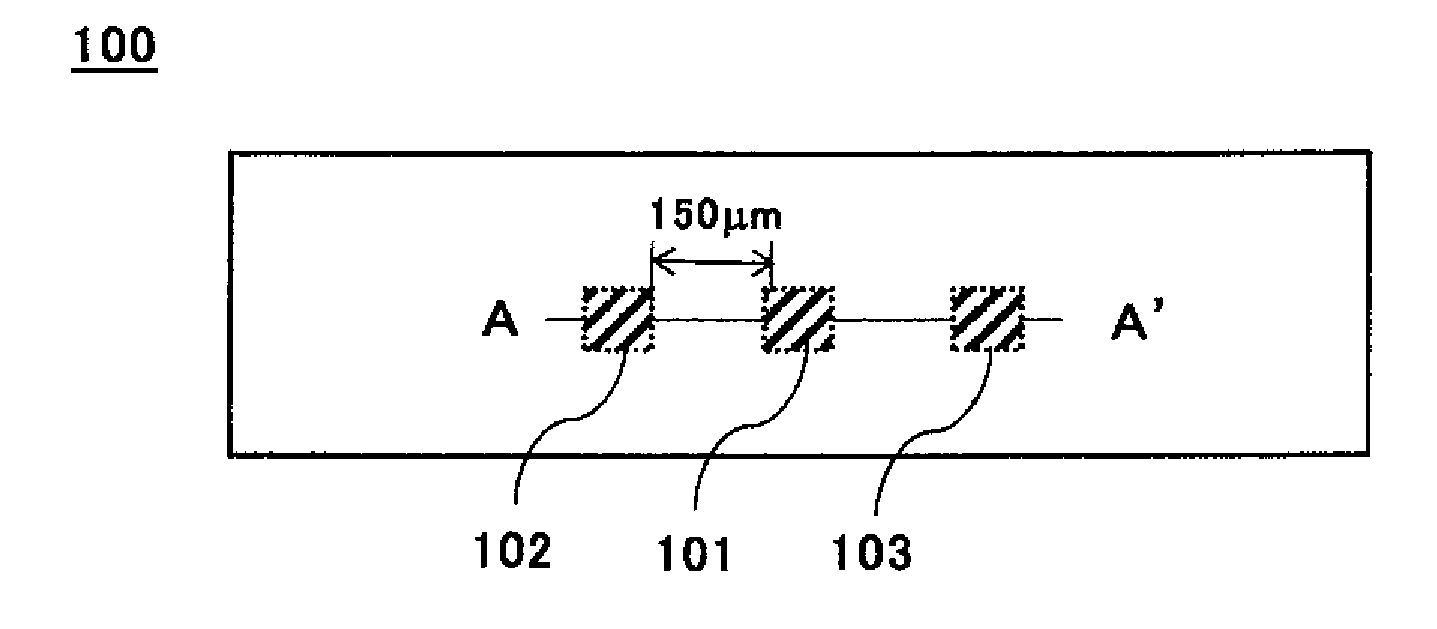
도 1 은, 평균 공극률 및 SDρ 측정에 있어서의 관찰 시야를 나타내는 모식도이다.Figure 1 is a schematic diagram showing the observation field for measuring average porosity and SDρ.
이하, 본 개시에 대해 실시형태의 일례를 나타내어 설명한다.Hereinafter, an example of an embodiment of the present disclosure will be described.
[질화갈륨의 소결체][Sintered body of gallium nitride]
본 실시형태의 소결체는, 단면의 주사형 전자 현미경도로부터 구해지는 공극률의 표준 편차가 1.0 % 이하인 질화갈륨의 소결체이다.The sintered body of the present embodiment is a sintered body of gallium nitride having a standard deviation of a porosity obtained from a scanning electron microscope image of a cross-section of 1.0% or less.
본 실시형태는, 질화갈륨의 소결체에 관한 것이다. 질화갈륨 (GaN) 의 소결체는, 질화갈륨을 주성분 (매트릭스, 모상) 으로 하는 소결체, 나아가서는 질화갈륨의 다결정체이고, 주로 질화갈륨으로 이루어지는 소결체, 이른바 질화갈륨 소결체이다. 그러나, 본 실시형태의 소결체는, 금속 갈륨 등, 질화갈륨 이외의 성분을 포함하고 있어도 된다.The present embodiment relates to a sintered body of gallium nitride. The sintered body of gallium nitride (GaN) is a sintered body having gallium nitride as a main component (matrix, mother phase), and further, a polycrystal of gallium nitride, a sintered body mainly composed of gallium nitride, a so-called gallium nitride sintered body. However, the sintered body of the present embodiment may contain a component other than gallium nitride, such as metal gallium.
본 실시형태의 소결체는, 도펀트 원소를 포함하고 있어도 된다. n 형 반도체로 하는 도펀트 원소로서, 규소 (Si), 게르마늄 (Ge), 주석 (Sn) 및 납 (Pb) 의 군에서 선택되는 1 이상을 들 수 있다. 또, p 형 반도체로 하기 위한 도펀트 원소로서, 베릴륨 (Be), 마그네슘 (Mg), 칼슘 (Ca), 스트론튬 (Sr), 바나듐 (Ba), 아연 (Zn) 및 카드뮴 (Cd) 의 군에서 선택되는 1 이상을 들 수 있다. 또, 임의의 정색을 하는 LED 로 하기 위한 도펀트 원소로서 알루미늄 (Al) 및 인듐 (In) 중 적어도 어느 것을 들 수 있다. 본 실시형태의 소결체가 포함하는 주된 도펀트 원소로서, 규소, 마그네슘, 알루미늄 및 인듐의 군에서 선택되는 1 개 이상을 예시할 수 있다.The sintered body of the present embodiment may contain a dopant element. As a dopant element for making it an n-type semiconductor, one or more selected from the group consisting of silicon (Si), germanium (Ge), tin (Sn), and lead (Pb) can be exemplified. In addition, as a dopant element for making it a p-type semiconductor, one or more selected from the group consisting of beryllium (Be), magnesium (Mg), calcium (Ca), strontium (Sr), vanadium (Ba), zinc (Zn), and cadmium (Cd) can be exemplified. In addition, as a dopant element for making it an LED having an arbitrary color, at least one of aluminum (Al) and indium (In) can be exemplified. As a main dopant element contained in the sintered body of the present embodiment, one or more selected from the group consisting of silicon, magnesium, aluminum, and indium can be exemplified.
도펀트 원소의 함유량은, 질화갈륨에 대해 충분히 적은 양이면 되고, 또, 도펀트 원소의 종류에 따라서도 상이하다. 예를 들어, 도펀트 원소의 함유량으로서 0 atm% 이상 또는 0 atm% 초과이고, 또한, 25 atm% 이하, 15 atm% 이하, 1 atm% 이하 또는 0.1 atm% 이하인 것을 들 수 있다.The content of the dopant element may be a sufficiently small amount relative to gallium nitride, and also varies depending on the type of the dopant element. For example, the content of the dopant element may be 0 atm% or more or more than 0 atm%, and further 25 atm% or less, 15 atm% or less, 1 atm% or less, or 0.1 atm% or less.
이상적인 소결체는 공극을 갖지 않기 때문에 공극률은 0 % 이다. 그러나, 현실적인 소결체는 공극을 포함한다. 본 실시형태의 소결체의 공극률은 0 % 초과가 된다. 소결체는 치밀한 것이 바람직하고, 평균 공극률은, 1 % 이상 또는 10 % 이상인 것을 들 수 있다. 스퍼터링 타깃으로서 적용할 수 있는 기계적 특성을 나타내기 위해서, 본 실시형태의 소결체의 평균 공극률은 25 % 이하 또는 20 % 이하이면 된다.An ideal sintered body has no voids, so the void ratio is 0%. However, a realistic sintered body includes voids. The void ratio of the sintered body of the present embodiment is greater than 0%. The sintered body is preferably dense, and the average void ratio may be 1% or more or 10% or more. In order to exhibit mechanical properties applicable as a sputtering target, the average void ratio of the sintered body of the present embodiment may be 25% or less or 20% or less.
본 실시형태의 소결체는, 단면의 주사형 전자 현미경도로부터 구해지는 공극률의 표준 편차 (이하,「SDρ」라고도 한다) 가 1.0 % 이하이고, 0.8 % 이하인 것이 바람직하다. SDρ 가 이 값을 초과하면, 소결체의 조직, 특히 소결체 내부의 조직이 불균일해진다. 이와 같은 소결체를 사용하여 스퍼터링을 하는 경우, 파티클의 발생이 일어나기 쉽고, 또, 성막 속도가 느려진다. SDρ 는 이상적으로는 0 % 인 것이 바람직하다. 그러나, 현실적인 소결체는 공극을 갖고, 또한, 그 공극의 분포 및 공극률에는 편차가 있다. 본 실시형태의 소결체의 SDρ 는, 예를 들어, 0 % 를 초과하고 0.1 % 이상 또는 0.3 % 이상인 것을 들 수 있다.The sintered body of the present embodiment preferably has a standard deviation of porosity (hereinafter also referred to as “SDρ”) obtained from a scanning electron microscope diagram of a cross-section of 1.0% or less, and 0.8% or less. If SDρ exceeds this value, the structure of the sintered body, particularly the structure inside the sintered body, becomes non-uniform. When sputtering is performed using such a sintered body, particle generation is likely to occur, and the film formation speed becomes slow. Ideally, SDρ is preferably 0%. However, a realistic sintered body has pores, and furthermore, there is variation in the distribution of the pores and the porosity. The SDρ of the sintered body of the present embodiment can be, for example, more than 0% and 0.1% or more, or 0.3% or more.
또한, 본 실시형태의 소결체가 이와 같은 SDρ 를 갖는 이유 중 하나로서, 불순물로서의 탄소의 혼입이 적은 것이 생각된다. 즉, 탄소는 난소결성이고, 검출 한계 이하여도 탄소를 함유하는 것에 의해 질화갈륨의 소결을 저해한다. 이에 대하여, 본 실시형태의 소결체는, 종래의 소결체와 비교하여 탄소의 함유량이 적기 때문에, 소결이 진행되기 쉬워진다. 그 결과, 균일한 조직 구조를 가진다고 생각된다. 이것은, 본 실시형태의 소결체를 사용하여 얻어지는 스퍼터링막 (스퍼터막) 은, 보다 탄소의 함유량이 적어지는 것으로부터도 확인할 수 있다.In addition, it is thought that one of the reasons why the sintered body of the present embodiment has such SDρ is that there is little carbon inclusion as an impurity. That is, carbon is difficult to sinter, and even if it contains carbon below the detection limit, sintering of gallium nitride is inhibited. In contrast, the sintered body of the present embodiment has a lower carbon content than a conventional sintered body, so that sintering progresses easily. As a result, it is thought that it has a uniform organizational structure. This can also be confirmed from the fact that the sputtered film (sputtered film) obtained using the sintered body of the present embodiment has a lower carbon content.
본 실시형태에 있어서, 평균 공극률 및 SDρ 는, 소결체의 단면의 주사형 전자 현미경 (이하,「SEM」라고도 한다) 관찰에 의해 구하면 된다. SEM 관찰은, 일반적인 SEM (예를 들어, JSM-IT800, 일본 전자 주식회사 제조) 을 사용하여 실시하고, 소결체를 절단하여 얻어지는 절단면을 관찰면으로 하면 된다. SEM 관찰에 앞서, 절단면을 이온 밀링 가공, 나아가서는 크라이오 이온 밀링 가공을 하여, 관측면으로 해도 된다. 도 1 에 나타내는 바와 같이, 관찰 시야는, 절단면의 중심 (관찰 시야 1 ; 도 1 (101)), 관찰 시야 1 을 통과하는 직선상 (도 1 중 선분 A-A') 에 있어서의 관찰 시야 1 의 단부로부터 150 ㎛ 떨어진 지점 (관찰 시야 2 ; 도 1 (102)), 및 그 직선상에 있어서의 관찰 시야 1 로부터 관찰 시야 2 를 향하는 방향과는 역방향으로, 관찰 시야 1 에서 150 ㎛ 떨어진 지점 (관찰 시야 3 ; 도 1 (103)) 의 합계 3 시야로 하면 된다. 관찰 시야는, 250 ㎛ × 180 ㎛ 의 직사각형상 영역이다. 즉, 도 1 은, 250 ㎛ × 180 ㎛ 의 직사각형상의 3 개의 관찰 시야가, 150 ㎛ 의 간격을 두고 일직선상으로 나열되어 있는 모습을 나타낸다. SEM 관찰의 조건을 이하에 나타낸다.In the present embodiment, the average porosity and SDρ can be obtained by observation of a cross-section of a sintered body using a scanning electron microscope (hereinafter also referred to as “SEM”). SEM observation can be performed using a general SEM (e.g., JSM-IT800, manufactured by Nippon Electronics Co., Ltd.), and a cross-section obtained by cutting the sintered body can be used as an observation surface. Prior to SEM observation, the cross-section can be subjected to ion milling processing, or further, cryo-ion milling processing, to thereby become an observation surface. As shown in Fig. 1, the observation field may be a total of three fields of view: the center of the cross-section (observation field 1; Fig. 1 (101)), a point 150 ㎛ away from the end of observation field 1 on a straight line passing through observation field 1 (line segment A-A' in Fig. 1) (observation field 2; Fig. 1 (102)), and a point 150 ㎛ away from observation field 1 in the opposite direction to the direction from observation field 1 to observation field 2 on that straight line (observation field 3; Fig. 1 (103)). The observation field is a rectangular area measuring 250 ㎛ × 180 ㎛. That is, Fig. 1 shows three observation fields in the shape of rectangles measuring 250 ㎛ × 180 ㎛ arranged in a straight line at an interval of 150 ㎛. The conditions for SEM observation are shown below.
가속 전압 : 5 ㎸Acceleration voltage: 5 kV
관찰 배율 : 500 배Observation magnification: 500x
이어서, 일반적인 화상 해석 소프트 (예를 들어, Image-Pro 10, 하쿠토사 제조) 를 사용하여, 얻어진 SEM 관찰도를 화상 해석하여, 공극 및 그 면적을 검출한다. 공극 [㎛2] 은, SEM 관찰도를 2 치화한 화상으로부터 검출하면 된다. 각 SEM 관찰도의 공극률은, 이하의 식으로부터 구하면 된다.Next, using general image analysis software (e.g., Image-Pro 10, manufactured by Hakuto Corporation), the obtained SEM observation diagram is subjected to image analysis to detect the pores and their areas. The pores [㎛ 2 ] can be detected from the binarized image of the SEM observation diagram. The pore ratio of each SEM observation diagram can be obtained from the following equation.
공극률 [%] = {공극 면적 [㎛2]/SEM 관찰 면적 [㎛2]} × 100Porosity [%] = {Pore area [㎛ 2 ]/SEM observation area [㎛ 2 ]} × 100
평균 공극률은, 측정점 3 점, 예를 들어, 상기 관찰 시야 1, 관찰 시야 2, 및 관찰 시야 3 에 대하여, 각각 공극률을 구하고, 그 평균값을 구하면 된다. 즉, 측정점이란, 45000 ㎛2 이상의 면 부분을 말한다.The average porosity is obtained by calculating the porosity for each of three measurement points, for example, observation fields 1, 2, and 3, and then calculating the average value. In other words, the measurement points refer to a surface area of 45,000 ㎛ 2 or more.
또, SDρ 는 각 측정점의 공극률의 표준 편차로부터 구하면 된다.Also, SDρ can be obtained from the standard deviation of the porosity of each measurement point.
본 실시형태의 소결체의 부피 밀도는 4.0 g/㎤ 이상 또는 4.2 g/㎤ 이상인 것이 바람직하다. 이와 같은 부피 밀도를 가짐으로써, 본 실시형태의 소결체를 스퍼터링 타깃으로서 사용하는 경우에 충분한 강도를 가지기 쉽다. 부피 밀도는 높을수록 바람직하지만, 예를 들어, 5.0 g/㎤ 이하, 4.8 g/㎤ 이하 또는 4.7 g/㎤ 이하인 것을 들 수 있다.The volume density of the sintered body of the present embodiment is preferably 4.0 g/cm3 or more or 4.2 g/cm3 or more. By having such a volume density, the sintered body of the present embodiment is likely to have sufficient strength when used as a sputtering target. The higher the volume density, the more preferable it is, but examples thereof include 5.0 g/cm3 or less, 4.8 g/cm3 or less, or 4.7 g/cm3 or less.
본 실시형태에 있어서「밀도」는, JIS R 1634 에 준한 방법으로 측정되는 부피 밀도이고, 전처리는 증류수를 사용한 진공법으로 실시하면 된다.In this embodiment, “density” is a bulk density measured by a method compliant with JIS R 1634, and pretreatment may be performed by a vacuum method using distilled water.
본 실시형태의 소결체의 평균 결정 입경은 임의이고, 0.1 ㎛ 이상 또는 0.2 ㎛ 이상이면 되고, 또, 0.5 ㎛ 이하 또는 0.3 ㎛ 이하인 것을 예시할 수 있다.The average crystal grain size of the sintered body of the present embodiment is arbitrary, and may be 0.1 µm or more or 0.2 µm or more, and may also be exemplified as 0.5 µm or less or 0.3 µm or less.
본 실시형태에 있어서, 평균 결정 입경은, 소결체의 단면의 주사형 전자 현미경-전자선 후방 산란 회절 (이하,「SEM-EBSD」라고도 한다) 에 의해 구하면 된다. SEM-EBSD 관찰은, 평균 공극률과 동일한 방법으로 얻어지는 SEM 관찰도를, 일반적인 EBSD (예를 들어, Symmetry, 옥스포드·인스트루먼트사 제조) 를 사용하여 실시하면 된다. EBSD 관찰의 조건을 이하에 나타낸다.In the present embodiment, the average crystal grain size is obtained by scanning electron microscope-electron backscatter diffraction (hereinafter also referred to as “SEM-EBSD”) of a cross-section of a sintered body. SEM-EBSD observation can be performed by using a general EBSD (e.g., Symmetry, manufactured by Oxford Instruments) on an SEM observation diagram obtained in the same manner as the average porosity. The conditions for EBSD observation are shown below.
가속 전압 : 15 ㎸Acceleration voltage: 15 kV
시료 경사 : 70 도Sample slope: 70 degrees
경사 보정 : 0°Slope compensation: 0°
측정 배율 : 500 배Measurement magnification: 500x
스텝 사이즈 : 0.2 ㎛ Step size: 0.2 ㎛
결정 방위가 5°이상 기운 위치를 결정 입계로 간주하고, 그 결정 입계로 둘러싸인 영역을 결정 입자로 간주하면 된다. 각 결정 입자의 면적에 상당하는 원의 직경을 산출하고, 결정 입경으로 하면 된다. 평균 공극률과 동일한 방법으로 얻어진 3 시야에서 관찰된 결정 입자 (예를 들어, 1 시야에 대해 결정 입자 10,0000 ∼ 30,000 개) 에 대해 SEM-EBSD 관찰을 실시하고, 화상 해석에 의해 각 시야 내의 평균 결정 입경을 각각 산출한다. 그 평균을 갖고, 평균 결정 입경으로 하면 된다.A position where the crystal orientation is inclined by 5° or more is regarded as a grain boundary, and the area surrounded by the grain boundary is regarded as a crystal grain. The diameter of the circle corresponding to the area of each crystal grain is calculated, and this is taken as the grain size. In the same way as the average porosity, SEM-EBSD observation is performed on crystal grains observed in three fields of view (e.g., 10,0000 to 30,000 crystal grains per field of view), and the average grain size in each field of view is calculated by image analysis. The average is taken as the average grain size.
본 실시형태의 소결체는, 갈륨 및 질소의 합계에 대한 갈륨의 원자량비 ([mol/mol] ; 이하,「Ga/(Ga+N) 비」라고도 한다) 가 0.5 이하이다. 이와 같은 Ga/(Ga+N) 비임으로써, 본 실시형태의 소결체에 포함되는 갈륨이, 실질적으로 질화갈륨만으로 된다. 즉, 금속 Ga 가 완전히 질화되어, 소결체는 금속 Ga 를 포함하지 않는다. Ga/(Ga+N) 은, 0.5 미만 또는 0.49 이하인 것이 바람직하고, 또, 0.45 이상 또는 0.47 이상인 것을 들 수 있다.The sintered body of the present embodiment has an atomic weight ratio of gallium to the sum of gallium and nitrogen ([mol/mol]; hereinafter also referred to as “Ga/(Ga+N) ratio”) of 0.5 or less. With such a Ga/(Ga+N) ratio, the gallium contained in the sintered body of the present embodiment is substantially only gallium nitride. That is, metal Ga is completely nitrided, and the sintered body does not contain metal Ga. Ga/(Ga+N) is preferably less than 0.5 or 0.49 or less, and can further be 0.45 or more or 0.47 or more.
본 실시형태의 소결체의 산소 함유량은 0.4 atm% 이하 또는 0.2 atm% 이하인 것이 바람직하다. 본 실시형태의 소결체는 산소를 포함하지 않는 것 (즉 산소 함유량이 0 atm% 인 것) 이 바람직하지만, 산소 함유량이 0 atm% 이상, 0 atm% 초과, 0.01 atm% 이상, 또는 0.1 atm% 이상인 것을 예시할 수 있다. 이와 같은 산소 함유량이면, 이것을 스퍼터링 타깃하여 얻어지는 막이, 발광 다이오드나 파워 디바이스 등의 용도에 따라 적합한 특성을 나타내기 쉬워진다. 구체적인 산소 함유량으로서 0.1 atm% 이상 0.3 atm% 이하, 나아가서는 0.13 atm% 이상 0.2 atm% 이하인 것을 예시할 수 있다.The oxygen content of the sintered body of the present embodiment is preferably 0.4 atm% or less or 0.2 atm% or less. The sintered body of the present embodiment preferably does not contain oxygen (i.e., has an oxygen content of 0 atm%), but can be exemplified as having an oxygen content of 0 atm% or more, more than 0 atm%, 0.01 atm% or more, or 0.1 atm% or more. With such an oxygen content, a film obtained by using this as a sputtering target tends to exhibit characteristics suitable for the application, such as a light-emitting diode or a power device. Specific examples of the oxygen content include 0.1 atm% or more and 0.3 atm% or less, and further 0.13 atm% or more and 0.2 atm% or less.
본 실시형태의 소결체의 조성은 이하의 식으로 나타내는 조성으로 간주하면 된다.The composition of the sintered body of the present embodiment can be regarded as a composition represented by the following formula.
100 = WGa [질량%] + WO [질량%] + WN [질량%] + WX [질량%] (1) 100 = W Ga [mass%] + W O [mass%] + W N [mass%] + W X [mass%] (1)
(1) 식에 있어서, WGa, WO, WN 및 WX 는, 각각, 소결체에서 차지하는 갈륨, 산소, 질소 및 도펀트 원소의 질량 비율이다. WO 및 WN 은, 일반적인 산소 및 질소 분석 장치 (예를 들어, LECO ON736, Leco 사 제조) 를 사용하고, 소결체를 열분해한 열분해법에 의해 측정되는 값이고, 또, WX 는 글로 방전 질량 분석으로 측정되는 값이다. WGa 는, WO, WN 및 WX 의 측정값으로부터 (1) 식에 의해 구해지는 값이다.(1) In the formula, W Ga , W O , W N , and W X represent the mass ratios of gallium, oxygen, nitrogen, and dopant elements in the sintered body, respectively. W O and W N are values measured by a pyrolysis method in which the sintered body is pyrolyzed using a general oxygen and nitrogen analyzer (e.g., LECO ON736, manufactured by Leco), and W X is a value measured by glow discharge mass spectrometry. W Ga is a value obtained by formula (1) from the measured values of W O , W N , and W X .
산소 함유량은, 이하의 (2) 식으로부터 구해지는 값이다.The oxygen content is a value obtained from the following equation (2).
산소 함유량 [atm%] = (WO/MO)/{(WGa/MGa) + (WN/MN) + (WO/MO) + (WX/MX)} (2) Oxygen content [atm%] = (W O /M O )/{(W Ga /M Ga ) + (W N /M N ) + (W O /M O ) + (W X /M X )} (2)
(2) 식에 있어서 MO 는 산소의 원자량 : 16.00 [g/mol], MGa 는 산소의 갈륨량 : 69.72 [g/mol], 및 MN 은 질소의 원자량 : 14.01 [g/mol] 이다. 또, MX 는, 도펀트 원소의 원자량이고, 예를 들어, 규소의 원자량 : 28.09 [g/mol], 마그네슘의 원자량 : 24.31 [g/mol], 알루미늄의 원자량 : 26.98 [g/mol], 인듐의 원자량 : 114.82 [g/mol] 를 들 수 있다.(2) In the formula, M O is the atomic weight of oxygen: 16.00 [g/mol], M Ga is the atomic weight of gallium of oxygen: 69.72 [g/mol], and M N is the atomic weight of nitrogen: 14.01 [g/mol]. In addition, M X is the atomic weight of the dopant element, for example, the atomic weight of silicon: 28.09 [g/mol], the atomic weight of magnesium: 24.31 [g/mol], the atomic weight of aluminum: 26.98 [g/mol], and the atomic weight of indium: 114.82 [g/mol].
Ga/(Ga+N) 비는, 이하의 (3) 식으로부터 구해지는 값이다.The ratio Ga/(Ga+N) is a value obtained from the following equation (3).
Ga/(Ga+N) 비 = (WGa/MGa)/{(WGa/MGa) + (WN/MN)} (3) Ga/(Ga+N) ratio = (W Ga /M Ga )/{(W Ga /M Ga ) + (W N /M N )} (3)
스퍼터링 타깃으로서 제공하는 데에 적합한 기계적 특성을 나타내기 위해서, 본 실시형태의 소결체의 비커스 경도는 100 HV 이상 또는 150 HV 이상인 것이 바람직하다. 비커스 경도는 적당히 높으면 충분하고, 예를 들어, 1000 HV 이하, 300 HV 이하 또는 250 HV 이하인 것을 들 수 있다.In order to exhibit mechanical properties suitable for use as a sputtering target, the Vickers hardness of the sintered body of the present embodiment is preferably 100 HV or more or 150 HV or more. It is sufficient if the Vickers hardness is moderately high, and examples thereof include 1000 HV or less, 300 HV or less or 250 HV or less.
본 실시형태에 있어서, 비커스 경도는 JIS B7725 에 준한 방법에 의해 측정되는 값이면 된다. 비커스 경도는, 1 kgf 의 힘으로 소결체에 각뿔형 압자를 가압하여, 형성된 압흔을 현미경에 의해 관찰하고, 대각선의 수평 거리로부터 압흔의 표면적을 산출함으로써 구하면 된다.In this embodiment, the Vickers hardness may be a value measured by a method according to JIS B7725. The Vickers hardness may be obtained by pressing a pyramidal indenter on a sintered body with a force of 1 kgf, observing the formed indentation with a microscope, and calculating the surface area of the indentation from the horizontal distance of the diagonal.
동일한 이유에 의해, 본 실시형태의 소결체의 항절 강도는 20 ㎫ 이상, 나아가서는 30 ㎫ 이상, 또 나아가서는 50 ㎫ 인 것이 바람직하고, 또, 150 ㎫ 이하, 100 ㎫ 이하 또는 60 ㎫ 이하인 것을 예시할 수 있다.For the same reason, the tensile strength of the sintered body of the present embodiment is preferably 20 MPa or more, more preferably 30 MPa or more, and further preferably 50 MPa, and further, it can be exemplified as 150 MPa or less, 100 MPa or less, or 60 MPa or less.
본 실시형태의 소결체에 있어서, 평균 공극률, SDρ, 부피 밀도, 평균 결정 입경, Ga/(Ga+N) 비, 산소 함유량, 도펀트 원소의 함유량, 비커스 경도 및 항절 강도 등의 파라미터는, 상한 및 하한은 상기 서술한 임의의 조합이면 된다.In the sintered body of the present embodiment, the parameters such as average porosity, SDρ, volume density, average crystal grain size, Ga/(Ga+N) ratio, oxygen content, content of dopant element, Vickers hardness, and rupture strength may have any combination of the upper and lower limits described above.
본 실시형태의 소결체는, 질화갈륨의 소결체의 공지된 용도에 사용할 수 있지만, 특히, 스퍼터링 타깃용 소결체로 하는 것이 바람직하다.The sintered body of the present embodiment can be used for known uses of sintered bodies of gallium nitride, but is particularly preferably used as a sintered body for a sputtering target.
[소결체의 제조 방법][Method for manufacturing sintered body]
본 실시형태의 소결체의 제조 방법은, Ga/(Ga+N) 비가 0.5 를 초과하고, 또한, 질화갈륨 및 금속 갈륨을 포함하는 분말을 성형하여 성형체를 얻는 공정, 및 그 성형체를 질화 분위기에서 소결하는 공정을 갖는 소결체의 제조 방법이다. 이로써, 소성로의 성형형의 형상의 제한을 받지 않고, 임의 형상의 소결체를 공업적으로 제조할 수 있다.The method for manufacturing a sintered body of the present embodiment is a method for manufacturing a sintered body, which comprises the steps of: forming a powder having a Ga/(Ga+N) ratio exceeding 0.5 and containing gallium nitride and metal gallium to obtain a molded body; and sintering the molded body in a nitriding atmosphere. As a result, a sintered body of an arbitrary shape can be manufactured industrially without being restricted by the shape of a mold of a sintering furnace.
Ga/(Ga+N) 비가 0.5 를 초과하고, 또한, 질화갈륨 및 금속 갈륨을 포함하는 분말을 성형하여 성형체를 얻는 공정 (이하,「성형 공정」이라고도 한다) 에 제공하는 분말 (이하,「원료 분말」이라고도 한다) 은, 질화갈륨 및 금속 갈륨을 포함하고 있으면 되고, 예를 들어, 질화갈륨과 금속 갈륨의 혼합 분말을 들 수 있다.The powder (hereinafter also referred to as “raw material powder”) provided to the process of obtaining a molded body by molding a powder having a Ga/(Ga+N) ratio exceeding 0.5 and containing gallium nitride and metal gallium (hereinafter also referred to as “molding process”) may contain gallium nitride and metal gallium, and examples thereof include a mixed powder of gallium nitride and metal gallium.
원료 분말의 Ga/(Ga+N) 비는 0.5 를 초과하고 0.51 이상인 것이 바람직하다. 원료 분말이 이와 같은 조성을 가짐으로써, 가열 분위기가 아니어도 성형하기 쉬워진다. 본 실시형태에 있어서, 가열 분위기, 특히 성형과 소결을 동시에 실시하는 분위기가 아니라, 원료 분말을 성형할 수 있는 이유 중 하나로서, 질화갈륨의 입자간에 금속 갈륨이 개재함으로써, 입자의 흐름성이 높아짐과 함께, 입자끼리의 결합 강도가 높아지는 것이 생각된다. 이로써, 실질적으로 금속 갈륨을 포함하지 않고, 질화갈륨만으로 이루어지는 성형체와 비교하여 형상 안정성이 높은 성형체가 얻어진다. Ga/(Ga+N) 비는 0.6 이하 또는 0.55 이하이면 된다.The Ga/(Ga+N) ratio of the raw material powder is preferably greater than 0.5 and equal to or greater than 0.51. Since the raw material powder has such a composition, it becomes easy to mold even without a heating atmosphere. In the present embodiment, one of the reasons why the raw material powder can be molded without a heating atmosphere, particularly without an atmosphere in which molding and sintering are performed simultaneously, is thought to be that since metal gallium is interposed between the gallium nitride particles, the flowability of the particles increases and the bonding strength between the particles increases. Thereby, a molded body having high shape stability is obtained compared to a molded body composed only of gallium nitride and substantially not including metal gallium. The Ga/(Ga+N) ratio may be 0.6 or less or 0.55 or less.
원료 분말은, 질화갈륨 및 금속 갈륨으로 이루어지는 분말이어도 된다. 반도체 특성 등의 용도에 따른 특성을 부여하기 위해, 도펀트 원소를 포함하고 있어도 된다. 도펀트 원소로서 규소 (Si), 게르마늄 (Ge), 주석 (Sn), 납 (Pb), 마그네슘 (Mg), 칼슘 (Ca), 스트론튬 (Sr), 바륨 (Ba), 아연 (Zn), 인듐 (In) 및 알루미늄 (Al) 의 군에서 선택되는 1 개 이상을 포함하는 화합물, 나아가서는 규소, 마그네슘, 인듐 및 알루미늄의 군에서 선택되는 1 개 이상을 포함하는 화합물을 포함하고 있어도 된다.The raw material powder may be a powder composed of gallium nitride and metal gallium. In order to impart characteristics according to the intended use, such as semiconductor characteristics, a dopant element may be included. As the dopant element, the compound may include at least one selected from the group consisting of silicon (Si), germanium (Ge), tin (Sn), lead (Pb), magnesium (Mg), calcium (Ca), strontium (Sr), barium (Ba), zinc (Zn), indium (In), and aluminum (Al), and further, a compound including at least one selected from the group consisting of silicon, magnesium, indium, and aluminum.
n 형 반도체 특성을 나타내는 소결체가 얻어지기 때문에, 원료 분말은 규소, 게르마늄, 주석 및 납의 군에서 선택되는 1 개 이상을 함유하고 있어도 된다. 또, p 형 반도체 특성을 나타내는 소결체가 얻어지기 때문에, 원료 분말은 마그네슘, 칼슘, 스트론튬, 바륨 및 아연의 군에서 선택되는 1 개 이상을 함유하고 있어도 된다. 밴드 갭이 변경된 소결체가 얻어지기 때문에, 원료 분말은 인듐 및 알루미늄 중 적어도 어느 것을 포함하고 있어도 된다. 원료 분말에 포함되는 도펀트 원소는, 목적으로 하는 소결체에 따라 그 종류는 적절히 선택하면 되고, 그 함유량은, 상기 서술한 본 실시형태의 소결체의 도펀트 원소의 함유량과 동일하면 된다. 즉, 소결의 전후로 도펀트 원소의 함유량은 변화하지 않고, 소결체에 포함되는 도펀트 원소의 함유량은, 소결에 제공하는 원료 분말 중의 원소의 함유량과 동등하다.Since a sintered body exhibiting n-type semiconductor characteristics is obtained, the raw material powder may contain at least one selected from the group consisting of silicon, germanium, tin, and lead. In addition, since a sintered body exhibiting p-type semiconductor characteristics is obtained, the raw material powder may contain at least one selected from the group consisting of magnesium, calcium, strontium, barium, and zinc. Since a sintered body with a changed band gap is obtained, the raw material powder may contain at least one of indium and aluminum. The type of the dopant element contained in the raw material powder may be appropriately selected depending on the target sintered body, and the content thereof may be the same as the content of the dopant element in the sintered body of the present embodiment described above. That is, the content of the dopant element does not change before and after sintering, and the content of the dopant element contained in the sintered body is equal to the content of the element in the raw material powder provided for sintering.
얻어지는 소결체의 산소 함유량을 줄이기 위해, 원료 분말의 산소 함유량은 1 atm% 이하, 0.5 atm% 이하 또는 0.3 atm% 이하인 것이 바람직하다. 원료 분말은 산소를 포함하지 않는 것 (즉, 산소 함유량이 0 atm% 인 것) 이 바람직하지만, 얻어지는 소결체의 특성에 영향을 미치지 않는 정도이면 산소를 함유하고 있어도 되고, 원료 분말의 산소 함유량으로서 0.005 atm% 이상 또는 0.01 atm% 이상을 예시할 수 있다.In order to reduce the oxygen content of the obtained sintered body, the oxygen content of the raw material powder is preferably 1 atm% or less, 0.5 atm% or less, or 0.3 atm% or less. It is preferable that the raw material powder does not contain oxygen (i.e., has an oxygen content of 0 atm%), but may contain oxygen as long as it does not affect the properties of the obtained sintered body, and examples of the oxygen content of the raw material powder include 0.005 atm% or more, or 0.01 atm% or more.
본 실시형태에 있어서의 원료 분말의 산소 함유량은, JIS H 1695 에 준거한 방법으로 측정되는 값이다.The oxygen content of the raw material powder in this embodiment is a value measured by a method compliant with JIS H 1695.
산소 함유량을 저감시키기 쉽기 때문에, 원료 분말의 비표면적은 0.01 ㎡/g 이상이고, 또, 1.5 ㎡/g 이하 또는 0.8 ㎡/g 미만인 것이 바람직하다.Since it is easy to reduce the oxygen content, the specific surface area of the raw material powder is preferably 0.01 m2/g or more, and also 1.5 m2/g or less or less than 0.8 m2/g.
본 실시형태에 있어서의 원료 분말의 비표면적은, JIS R 1626 : 1996 에 준거한 방법으로 측정되는 값이다.The specific surface area of the raw material powder in this embodiment is a value measured by a method compliant with JIS R 1626: 1996.
얻어지는 소결체의 강도가 높아지기 쉽기 때문에, 원료 분말의 경장 부피 밀도는 1.0 g/㎤ 이상 또는 1.4 g/㎤ 이상인 것이 바람직하다. 성형성이 향상되기 쉽기 때문에, 경장 부피 밀도는 3.0 g/㎤ 미만 또는 2.5 g/㎤ 이면 된다.Since the strength of the obtained sintered body is likely to be high, the dimensional bulk density of the raw material powder is preferably 1.0 g/cm3 or more or 1.4 g/cm3 or more. Since the formability is likely to be improved, the dimensional bulk density may be less than 3.0 g/cm3 or 2.5 g/cm3.
본 실시형태에 있어서의 원료 분말의 경장 부피 밀도는, JIS Z 2504 에 준거한 방법으로 측정되는 값이다.The bulk density of the raw material powder in this embodiment is a value measured by a method compliant with JIS Z 2504.
원료 분말의 평균 입자경은 1 ㎛ 이상, 5 ㎛ 이상 또는 9 ㎛ 이상인 것이 바람직하고, 또, 150 ㎛ 이하, 100 ㎛ 이하 또는 80 ㎛ 이하인 것이 바람직하다.The average particle size of the raw material powder is preferably 1 ㎛ or more, 5 ㎛ or more, or 9 ㎛ or more, and further preferably 150 ㎛ or less, 100 ㎛ or less, or 80 ㎛ or less.
본 실시형태에 있어서의 원료 분말의 평균 입자경은, 이하의 조건에 따라 얻어지는 주사형 전자 현미경 (이하,「SEM」이라고도 한다) 관찰도에 있어서, 1200 ± 400 개의 1 차 입자의 면적으로부터 구해지는 원 상당 직경을 측정한 평균값이다.The average particle size of the raw material powder in the present embodiment is an average value of the equivalent circle diameter obtained from the area of 1200 ± 400 primary particles in a scanning electron microscope (hereinafter also referred to as “SEM”) observation diagram obtained under the following conditions.
가속 전압 : 10 ㎸Acceleration voltage: 10 kV
관찰 배율 : 50 ∼ 5000 배Observation magnification: 50 to 5000 times
평균 입자경의 측정에 있어서의 SEM 관찰은, 일반적인 SEM (예를 들어, VE-9800, KEYENCE 사 제조) 을 사용하여 실시하면 된다. 또, SEM 관찰도에 있어서 입자 전체를 확인할 수 있는 1 차 입자만을 측정 대상으로 하고, 상기 서술한 입자수가 되도록 복수 장의 SEM 관찰도를 사용해도 된다.SEM observation for measuring the average particle size can be performed using a general SEM (e.g., VE-9800, manufactured by KEYENCE). Also, in the SEM observation diagram, only primary particles that can confirm the entire particle can be measured, and multiple SEM observation diagrams can be used to achieve the above-described particle number.
성형 공정에서는 원료 분말을 성형하여 성형체를 얻는다. 성형 방법은, 소기의 형상을 갖는 성형체가 얻어지는 성형 방법이면 되고, 1 축 프레스 성형 및 냉간 정수압 프레스 (이하,「CIP」라고도 한다) 성형 중 적어도 어느 것을 예시할 수 있다. 이들의 성형 방법에 의해 성형체 (압분체) 가 얻어진다. 성형 공정에서는, 원료 분말을 가열하지 않고 이것을 성형하는 것이 바람직하고, 실온 (25 ± 10 ℃) 에서 원료 분말을 성형하는 것이 바람직하다. 성형의 전후로 Ga/(Ga+N) 비가 변화하지 않는 것이 바람직하다. 즉, 원료 분말의 Ga/(Ga+N) 비와 성형체의 Ga/(Ga+N) 비는 동일한 것이 바람직하다. 성형의 전후로 Ga/(Ga+N) 비가 변화되지 않는 성형 방법은, 성형체의 형상 자유도가 높다.In the molding process, the raw material powder is molded to obtain a molded body. The molding method may be any molding method that obtains a molded body having a desired shape, and examples thereof include at least one of single-axis press molding and cold isostatic pressing (hereinafter also referred to as “CIP”) molding. A molded body (compact body) is obtained by these molding methods. In the molding process, it is preferable to mold the raw material powder without heating it, and it is preferable to mold the raw material powder at room temperature (25 ± 10 ° C). It is preferable that the Ga/(Ga+N) ratio does not change before and after molding. That is, it is preferable that the Ga/(Ga+N) ratio of the raw material powder and the Ga/(Ga+N) ratio of the molded body are the same. A molding method in which the Ga/(Ga+N) ratio does not change before and after molding has a high degree of freedom in the shape of the molded body.
특히 바람직한 성형으로서, 원료 분말을 1 축 프레스 성형에 의해 1 차 성형체를 얻고, 그 1 차 성형체를 CIP 성형하는 것을 들 수 있다. 1 축 프레스 성형의 조건은, CIP 성형에 제공할 때 결함이 생기지 않을 정도의 보형성을 갖는 1 차 성형체가 얻어지는 조건이면 된다. 또, 이와 같은 성형 방법에 의하면, 성형의 전후로 Ga/(Ga+N) 비가 변화하지 않는다. 예를 들어, 1 축 프레스 성형의 압력은 10 ㎫ 이상 또는 25 ㎫ 이상이고, 또, 200 ㎫ 이하 또는 300 ㎫ 이하인 것을 들 수 있다. CIP 성형은 후술하는 성형체가 얻어지는 조건이면 되고, 예를 들어, CIP 성형의 압력은 100 ㎫ 이상 또는 200 ㎫ 이상이고, 또, 400 ㎫ 이하 또는 500 ㎫ 이하인 것을 들 수 있다.As a particularly preferable molding, there can be mentioned a method in which a primary molded body is obtained by single-axis press molding of raw material powder, and the primary molded body is subjected to CIP molding. The conditions for single-axis press molding may be conditions in which a primary molded body having shape retention properties that do not cause defects when provided for CIP molding is obtained. In addition, according to such a molding method, the Ga/(Ga+N) ratio does not change before and after molding. For example, the pressure of single-axis press molding may be 10 MPa or more or 25 MPa or more, and further 200 MPa or less or 300 MPa or less. CIP molding may be under the conditions in which a molded body described below is obtained, and for example, the pressure of CIP molding may be 100 MPa or more or 200 MPa or more, and further 400 MPa or less or 500 MPa or less.
본 실시형태의 제조 방법에서는, 성형체를 질화 분위기에서 소결하는 공정 (이하,「소결 공정」이라고도 한다) 을 갖는다. 일정 형상을 갖는 성형체를 피소결물로서 제공함으로써, 그 성형체의 사이즈 및 형상에서 유래한 임의의 사이즈 및 형상을 갖는 소결체가 얻어진다. 나아가서는, 핫 프레스 (이하,「HP」라고도 한다) 처리 등 성형 및 소결을 일체로 실시하는 종래의 소결 방법에 대하여, 보다 대형의 소결체를 얻을 수 있다.The manufacturing method of the present embodiment has a step of sintering a molded body in a nitriding atmosphere (hereinafter, also referred to as a "sintering step"). By providing a molded body having a certain shape as a sintered product, a sintered body having an arbitrary size and shape derived from the size and shape of the molded body is obtained. Furthermore, a larger sintered body can be obtained compared to a conventional sintering method in which molding and sintering are performed integrally, such as a hot press (hereinafter, also referred to as "HP") treatment.
소결 공정에 제공하는 성형체는, 원료 분말과 동일한 조성을 갖는 성형체이면 되고, Ga/(Ga+N) 비가 0.5 를 초과하고, 또한, 질화갈륨 및 금속 갈륨을 포함하는 성형체인 것을 들 수 있다. 성형체의 Ga/(Ga+N) 비는 0.51 이상인 것이 바람직하다. 성형체의 Ga/(Ga+N) 비는 0.6 이하 또는 0.55 이하이면 된다.The molded body provided for the sintering process may be a molded body having the same composition as the raw material powder, having a Ga/(Ga+N) ratio exceeding 0.5, and further including gallium nitride and metal gallium. The Ga/(Ga+N) ratio of the molded body is preferably 0.51 or more. The Ga/(Ga+N) ratio of the molded body may be 0.6 or less or 0.55 or less.
본 실시형태의 원료 분말은 가열 분위기에서의 성형을 필요로 하지 않기 때문에, 소기의 형상을 갖는 질화갈륨 성형체가 얻어진다. 성형체의 형상은, 원하는 형상이면 되고, 원판상, 원기둥상, 직사각형상, 다면체상 및 뿔체상의 군에서 선택되는 1 개 이상, 그 외 목적이나 용도에 따른 임의의 형상이면 된다.Since the raw material powder of the present embodiment does not require molding in a heated atmosphere, a gallium nitride molded body having a desired shape is obtained. The shape of the molded body may be any desired shape, and may be at least one selected from the group consisting of a disk shape, a cylinder shape, a rectangle shape, a polyhedron shape, and a cone shape, or any other shape according to the purpose or use.
성형체의 사이즈는 임의이지만, 본 실시형태의 원료 분말은 실온 등의 비가열 분위기에서의 성형이 가능하기 때문에, 대형의 성형체로서 얻을 수도 있다. 예를 들어, 스퍼터링 타깃으로서 사용되는 소결체의 전구체로서 적합한 성형체로서, 판상 및 원판상의 성형체를 들 수 있다. 원료 분말은 성형성이 높기 때문에, 성형체는, 면적이 100 ㎟ 이상 또는 1,000 ㎟ 이상인 면을 구비한 형상으로 할 수도 있다. 당해 면의 면적은 100,000 ㎟ 이하, 20,000 ㎟ 이하 또는 5,000 ㎟ 이하인 것을 예시할 수 있다.The size of the molded body is arbitrary, but since the raw material powder of the present embodiment can be molded in a non-heated atmosphere such as room temperature, it can also be obtained as a large molded body. For example, as a molded body suitable as a precursor of a sintered body used as a sputtering target, a plate-shaped or disc-shaped molded body can be exemplified. Since the raw material powder has high moldability, the molded body can also be formed into a shape having a surface having an area of 100 ㎟ or more or 1,000 ㎟ or more. For example, the area of the surface can be 100,000 ㎟ or less, 20,000 ㎟ or less, or 5,000 ㎟ or less.
구체적인 성형체의 형상으로서, 직경 5 ㎟ 이상 또는 10 ㎟ 이상이고, 또한, 300 ㎟ 이하 또는 150 ㎟ 이하인 원판 형상을 예시할 수 있다.As a specific shape of the molded body, an example may be a disc shape having a diameter of 5 ㎟ or more or 10 ㎟ or more, and also 300 ㎟ or less or 150 ㎟ or less.
성형체의 실측 밀도는 3.0 g/㎤ 이상 또는 3.6 g/㎤ 이상인 것, 또, 5.8 g/㎤ 이하 또는 5.5 g/㎤ 이하인 것을 들 수 있다.The actual density of the molded body may be 3.0 g/cm3 or more or 3.6 g/cm3 or more, or 5.8 g/cm3 or less or 5.5 g/cm3 or less.
본 실시형태에 있어서의 성형체의 실측 밀도는, JIS Z 8807 에 준거한 방법으로 측정되는 값이다.The actual density of the molded body in this embodiment is a value measured by a method compliant with JIS Z 8807.
소결 공정에서는, 성형체를 질화 분위기에서 소결한다. 질화 분위기에서 소결함으로써, 성형체 중의 금속 갈륨이 질화되어 질화갈륨이 된다. 이로써, 본 실시형태의 Ga/(Ga+N) 비를 갖는 소결체가 얻어진다. 종래, 질화갈륨의 소결체 (다결정체) 는, HP 처리에 의해, 성형과 소결을 동시에 진행시킴으로써 이것을 소결하고 있었다. HP 처리에서는, 성형형에 원료 분말을 충전한 다음 가압하기 때문에, 얻어지는 성형체의 형상은 성형형의 형상에 제한되고, 또한, 성형형으로부터의 불순물의 혼입이 발생되기 쉬웠다. 이것에 대하여, 본 실시형태에 있어서는, 미리 형상이 부여된 성형체를, 가압하지 않고 소결하기 때문에, 소결시에 성형형을 필수로 하지 않는다. 즉, 성형체의 형상이 HP 장치에 갖춰지는 성형형에 의존하지 않는다. 이로써, 성형체의 형상 자유도가 높아진다. 또한, 공업적인 HP 처리에 있어서는 주로 카본제의 성형형이 사용된다. 이것에 대하여, 본 실시형태의 제조 방법에서는, 성형형으로부터의 불순물 혼입, 특히 탄소 (C) 의 혼입을 방지할 수 있다. 그 결과, 본 실시형태의 소결체를 구비한 스퍼터링 타깃을 사용하여 스퍼터막을 성막하는 경우에, 보다 탄소 함유량이 적은 스퍼터막이 얻어진다. 불순물 혼입, 특히 탄소의 혼입을 피하는 관점에서, 본 실시형태의 제조 방법은 HP 처리, 특히 카본제의 성형형을 구비한 HP 처리를 갖지 않는 것이 바람직하다.In the sintering process, the molded body is sintered in a nitriding atmosphere. By sintering in a nitriding atmosphere, the metal gallium in the molded body is nitrided to become gallium nitride. As a result, a sintered body having the Ga/(Ga+N) ratio of the present embodiment is obtained. Conventionally, a sintered body (polycrystal) of gallium nitride was sintered by simultaneously performing molding and sintering by HP treatment. In the HP treatment, since the raw material powder is filled into the mold and then pressurized, the shape of the obtained molded body is limited to the shape of the mold, and furthermore, impurities from the mold are likely to be mixed in. In contrast, in the present embodiment, since the molded body to which a shape has been given in advance is sintered without pressurizing, the molding mold is not essential during sintering. That is, the shape of the molded body does not depend on the molding mold provided in the HP device. As a result, the degree of freedom in the shape of the molded body is increased. In addition, a carbon mold is mainly used in industrial HP treatment. In this regard, the manufacturing method of the present embodiment can prevent the mixing of impurities, particularly carbon (C), from the mold. As a result, when a sputtering film is formed using a sputtering target having a sintered body of the present embodiment, a sputtering film having a lower carbon content is obtained. From the viewpoint of avoiding the mixing of impurities, particularly carbon, it is preferable that the manufacturing method of the present embodiment does not have HP treatment, particularly HP treatment with a mold made of carbon.
본 실시형태에 있어서의 질화 분위기란, 질화 반응이 진행되는 분위기이고, 특히 질화 반응이 진행되고, 또한, 산화 반응이 진행되지 않는 분위기이다. 그 때문에, 질화 분위기는, 질소 분위기뿐만 아니라, 질소 이외를 포함하는 분위기도 포함된다. 질화 분위기로서, 질소 및 질소 화합물 중 적어도 어느 것을 포함하는 분위기를 예시할 수 있고, 질소 및 수소 혼합 가스, 암모니아 가스, 하이드라진 가스 그리고 알킬아민 가스의 군에서 선택되는 1 이상, 나아가서는 암모니아 가스 그리고 질소 및 수소 혼합 가스 중 적어도 어느 것, 또 나아가서는 암모니아 가스인 것이 바람직하다.The nitriding atmosphere in the present embodiment is an atmosphere in which a nitriding reaction progresses, and in particular, an atmosphere in which a nitriding reaction progresses and an oxidation reaction does not progress. Therefore, the nitriding atmosphere includes not only a nitrogen atmosphere but also an atmosphere containing something other than nitrogen. As the nitriding atmosphere, an atmosphere containing at least one of nitrogen and a nitrogen compound can be exemplified, and at least one selected from the group consisting of a nitrogen and hydrogen mixed gas, ammonia gas, hydrazine gas, and alkylamine gas, and further preferably ammonia gas and at least one of a nitrogen and hydrogen mixed gas, and further preferably ammonia gas.
특히 바람직한 질화 분위기로서, 유통 분위기, 질소 화합물 유통 분위기, 나아가서는 암모니아 유통 분위기를 들 수 있다. 유통 분위기, 즉 질소 화합물 함유 가스 등의 분위기 매체가 흐르고 있는 분위기임으로써, 금속 갈륨의 질화 반응이 촉진된다. 이로써, 얻어지는 소결체의 조성이 보다 균일해진다. 유통 분위기는, 분위기 매체에 흐름이 있는 상태이면 되고, 예를 들어, 유속이 0.1 mL/min 이상 또는 1 L/min 이상인 것을 들 수 있다. 한편, 유속은 처리에 제공하는 성형체나, 소결로의 성능에 따라 적절히 설정하면 되고, 20 L/min 이하 또는 10 mL/min 이하인 것을 예시할 수 있다.As a particularly preferable nitriding atmosphere, a flowing atmosphere, a nitrogen compound flowing atmosphere, and further, an ammonia flowing atmosphere can be mentioned. By flowing atmosphere, that is, an atmosphere in which an atmospheric medium such as a nitrogen compound-containing gas flows, the nitriding reaction of metal gallium is promoted. Thereby, the composition of the obtained sintered body becomes more uniform. The flowing atmosphere may be a state in which the atmospheric medium has a flow, and for example, the flow rate can be 0.1 mL/min or more or 1 L/min or more. Meanwhile, the flow rate can be appropriately set depending on the molded body to be processed or the performance of the sintering furnace, and can be exemplified as 20 L/min or less or 10 mL/min or less.
소결 공정은, 성형체 (피소결물) 를 가압하지 않고 소결하는 것이 바람직하고, 성형체에 성형압을 인가하지 않고 소결하는 것이 바람직하다.In the sintering process, it is preferable to sinter the molded body (material to be sintered) without pressurizing it, and it is preferable to sinter it without applying molding pressure to the molded body.
소결 공정에 있어서의 유지 온도는, 질화갈륨의 소결이 진행되는 온도이면 된다. 또한 HP 처리 등과는 달리, 소결 공정에 제공하는 성형체는 일정 형상을 갖고 있다. 그 때문에, HP 처리 등의 성형 및 소결이 동시에 진행되는 소결 방법과 비교하여, 보다 낮은 유지 온도여도, 밀도가 높은 소결체가 얻어진다. 그 때문에, 소결 온도로는 1100 ℃ 이하, 1050 ℃ 이하 또는 1000 ℃ 이하를 예시할 수 있다. 한편, 유지 온도는 800 ℃ 이상, 900 ℃ 이상 또는 950 ℃ 이상인 것을 들 수 있다.The holding temperature in the sintering process can be any temperature at which sintering of gallium nitride is performed. In addition, unlike HP treatment, etc., the molded body provided for the sintering process has a certain shape. Therefore, compared to a sintering method in which forming and sintering are performed simultaneously, such as HP treatment, even at a lower holding temperature, a sintered body having a high density is obtained. Therefore, examples of the sintering temperature include 1100°C or less, 1050°C or less, or 1000°C or less. On the other hand, examples of the holding temperature include 800°C or more, 900°C or more, or 950°C or more.
유지 온도에 있어서의 유지 시간은, 유지 온도 및 성형체의 크기나, 사용하는 소결로의 성능 등에 따라 상이한데, 상기의 유지 온도에 있어서, 유지 시간은 1 시간 이상 20 시간 이하, 나아가서는 2 시간 이상 10 시간 이하를 예시할 수 있다.The holding time at the holding temperature varies depending on the holding temperature and the size of the molded body, the performance of the sintering furnace used, etc., and at the above holding temperature, the holding time can be exemplified as 1 hour or more and 20 hours or less, and further 2 hours or more and 10 hours or less.
본 실시형태의 제조 방법에 있어서, Ga/(Ga+N) 비, 성형체의 면의 면적, 성형체의 실측 밀도, 분위기 매체의 유속, 유지 온도 및 유지 시간 등의 파라미터는 상한 및 하한은, 상기 서술한 임의의 조합이면 된다.In the manufacturing method of the present embodiment, the upper and lower limits of parameters such as the Ga/(Ga+N) ratio, the surface area of the molded body, the actual density of the molded body, the flow rate of the atmospheric medium, the maintenance temperature, and the maintenance time may be any combination described above.
[스퍼터링 타깃][Sputtering target]
다음으로, 본 실시형태의 소결체를 포함하는 스퍼터링 타깃에 대해 설명한다.Next, a sputtering target including a sintered body of the present embodiment is described.
본 실시형태의 소결체를 포함하는 스퍼터링 타깃 (이하,「본 실시형태의 타깃」이라고도 한다) 은, 본 실시형태의 소결체가, 본딩층을 개재하여 지지체에 접합된 스퍼터링 타깃이다.A sputtering target including a sintered body of the present embodiment (hereinafter also referred to as “the target of the present embodiment”) is a sputtering target in which the sintered body of the present embodiment is bonded to a support body via a bonding layer.
본 실시형태의 타깃의 형상은 임의이고, 평판상 및 원통상 중 적어도 어느 것, 그 밖의 용도에 적절한 형상을 예시할 수 있다.The shape of the target of the present embodiment is arbitrary, and examples thereof include at least one of a flat shape and a cylindrical shape, and other shapes suitable for the intended use.
본 실시형태의 타깃은, 본딩층에 의해 본 실시형태의 소결체가 지지체에 접합 (즉, 본딩) 되어 있다. 본딩층은 주석, 인듐 및 아연의 군에서 선택되는 1 이상을 포함하는 땜납으로 구성되어 있으면 된다. 타깃의 도전성 및 열전도성이 높아지기 쉽기 때문에, 본딩층은 인듐을 포함하는 땜납으로 구성되어 있는 것이 바람직하다. 또한, 본딩층이 인듐을 포함하는 땜납인 경우, 본 실시형태의 타깃은, 질화갈륨의 소결체와 본딩층의 사이에, 젖음성을 개선하는 층 (이하,「배리어층」이라고도 한다) 을 갖고 있어도 된다. 이로써 소결체의 인듐 젖음성이 개선되고, 그 결과, 소결체와 본딩층의 접합이 보다 강고해진다. 배리어층은, 인듐에 대한 젖음성이 높은 성분으로 구성되어 있으면 되고, 니켈 및 크롬 중 적어도 어느 것인 것이 바람직하다.The target of the present embodiment is a sintered body of the present embodiment joined (i.e., bonded) to a support by a bonding layer. The bonding layer may be composed of a solder containing at least one selected from the group consisting of tin, indium, and zinc. Since the conductivity and thermal conductivity of the target are likely to be increased, the bonding layer is preferably composed of a solder containing indium. Furthermore, when the bonding layer is a solder containing indium, the target of the present embodiment may have a layer (hereinafter also referred to as a “barrier layer”) that improves wettability between the sintered body of gallium nitride and the bonding layer. This improves the wettability of the sintered body to indium, and as a result, the bonding between the sintered body and the bonding layer becomes stronger. The barrier layer may be composed of a component having high wettability to indium, and is preferably at least one of nickel and chromium.
한편, 비용이 높아지기 때문에, 본 실시형태의 타깃은, 텅스텐 (W) 을 포함하는 층을 갖지 않는 것이 바람직하고, 특히 배리어층으로서 텅스텐을 포함하는 층을 갖지 않는 것이 바람직하다.Meanwhile, because the cost increases, it is preferable that the target of the present embodiment does not have a layer containing tungsten (W), and in particular, it is preferable that it does not have a layer containing tungsten as a barrier layer.
본 실시형태의 타깃에 있어서의 지지체는, 구리, 스테인리스 및 티탄의 군에서 선택되는 1 이상인 것이 바람직하다. 또, 지지체의 형상은, 본 실시형태의 소결체의 형상에 따른 원하는 형상이면 되고, 평판상 및 원통상 중 적어도 어느 형상, 그 밖의 용도에 적절한 형상을 예시할 수 있다.The support in the target of the present embodiment is preferably at least one selected from the group consisting of copper, stainless steel, and titanium. In addition, the shape of the support may be any desired shape according to the shape of the sintered body of the present embodiment, and examples thereof include at least one shape among a flat shape and a cylindrical shape, and other shapes suitable for the intended use.
[성막 방법][Tabernacle Method]
다음으로, 본 실시형태의 타깃을 사용한 스퍼터막의 제조 방법 (성막 방법) 에 대해 설명한다.Next, a method for manufacturing a sputtered film (film formation method) using the target of the present embodiment is described.
스퍼터막은, 본 실시형태의 타깃을 사용하여 스퍼터링함으로써, 기판 상에 형성된다. 이로써, 스퍼터막, 나아가서는 질화갈륨막, 또 나아가서는 질화갈륨 박막을 성막할 수 있다.A sputtered film is formed on a substrate by sputtering using the target of the present embodiment. As a result, a sputtered film, a gallium nitride film, or a gallium nitride thin film can be formed.
예를 들어, 스퍼터링의 방식은, DC 스퍼터링법, 펄스 DC 스퍼터링법, RF 스퍼터링법, AC 스퍼터링법, DC 마그네트론 스퍼터링법, RF 마그네트론 스퍼터링법 및 이온 빔 스퍼터링법의 군에서 선택되는 1 개 이상, 바람직하게는, DC 마그네트론 스퍼터링법 및 RF 마그네트론 스퍼터링법 중 적어도 어느 것을 들 수 있다.For example, the sputtering method may be at least one selected from the group consisting of a DC sputtering method, a pulse DC sputtering method, an RF sputtering method, an AC sputtering method, a DC magnetron sputtering method, an RF magnetron sputtering method, and an ion beam sputtering method, preferably at least one of a DC magnetron sputtering method and an RF magnetron sputtering method.
스퍼터 가스는, 스퍼터링에 사용되는 가스이면 되고, 불활성 가스, 나아가서는 아르곤 가스 및 질소 가스 중 적어도 어느 것을 들 수 있다. 본 실시형태의 타깃을 사용하여 스퍼터링하는 경우, 얻어지는 스퍼터링막의 표면이 평활해지기 쉽기 때문에, 스퍼터 가스는 질소 함유 가스가 바람직하고, 아르곤 및 질소의 혼합 가스인 것이 바람직하다. 그 혼합 가스는 질소 과잉인 것이 바람직하고, 질소/(질소 + 아르곤) 분압비 [Pa/Pa] 가 0.5 초과, 0.7 이상 또는 0.9 이상인 것이 바람직하다.The sputtering gas may be any gas used for sputtering, and may include at least one of an inert gas, an argon gas, and a nitrogen gas. When sputtering is performed using the target of the present embodiment, the surface of the obtained sputtered film is likely to be smooth, so the sputtering gas is preferably a nitrogen-containing gas, and is preferably a mixed gas of argon and nitrogen. The mixed gas is preferably nitrogen-excessive, and the nitrogen/(nitrogen + argon) partial pressure ratio [Pa/Pa] is preferably more than 0.5, 0.7 or more, or 0.9 or more.
스퍼터 가스의 유속은, 5 ml/분 이상 또는 10 ml/분 이상이고, 또, 100 ml/분 이하 또는 70 ml/분 이하인 것을 들 수 있다.The flow rate of the sputtering gas may be 5 ml/min or more or 10 ml/min or more, and 100 ml/min or less or 70 ml/min or less.
스퍼터 가스의 가스압은, 0.05 Pa 이상 또는 0.1 Pa 이상이고, 또, 3 Pa 이하 또는 2 Pa 이하이면 된다.The gas pressure of the sputtering gas may be 0.05 Pa or more or 0.1 Pa or more, and 3 Pa or less or 2 Pa or less.
플라즈마를 안정적으로 발생시키기 위해, 스퍼터링에 있어서의 방전 전력 밀도는, 0.1 W/㎠ 이상 또는 0.3 W/㎠ 이상이고, 또, 5 W/㎠ 이하이면 된다.In order to stably generate plasma, the discharge power density in sputtering should be 0.1 W/cm2 or more, or 0.3 W/cm2 or more, and also 5 W/cm2 or less.
기판은, 목적으로 하는 막 및 기판의 적층체 (이하,「적층체」라고도 한다) 에 따라 적절히 선택하면 되고, 예를 들어, 유리 기판, 알루미나 기판, 실리콘 기판, 질화갈륨 기판, 질화알루미늄 기판 및 탄화규소 기판의 군에서 선택되는 1 이상, 나아가서는 알루미나 기판, 실리콘 기판 및 질화갈륨 기판 중 적어도 어느 것을 들 수 있다.The substrate may be appropriately selected depending on the laminate of the intended film and substrate (hereinafter, also referred to as “laminated body”), and for example, at least one selected from the group consisting of a glass substrate, an alumina substrate, a silicon substrate, a gallium nitride substrate, an aluminum nitride substrate, and a silicon carbide substrate, and further at least one of an alumina substrate, a silicon substrate, and a gallium nitride substrate may be used.
스퍼터링의 방식 및 그 조건은, 목적으로 하는 스퍼터링막에 따라 적절히 선택할 수 있다.The sputtering method and its conditions can be appropriately selected depending on the intended sputtering film.
스퍼터링에 의한 성막에 있어서의 기판의 온도 (이하,「성막 온도」라고도 한다) 는 임의이고, 10 ℃ 이상 또는 20 ℃ 이상이면 되고, 또 800 ℃ 이하이면 된다. 성막 속도를 빠르게 하는 경우, 성막 온도는, 100 ℃ 이상 또는 300 ℃ 이상이고, 또, 800 ℃ 이하 또는 500 ℃ 이하를 예시할 수 있다.The temperature of the substrate in film formation by sputtering (hereinafter also referred to as “film formation temperature”) is arbitrary, and may be 10°C or higher or 20°C or higher, and may also be 800°C or lower. In the case of increasing the film formation speed, the film formation temperature may be 100°C or higher or 300°C or higher, and may also be 800°C or lower or 500°C or lower.
스퍼터링의 시간 (이하,「성막 시간」이라고도 한다) 은, 스퍼터링의 조건, 기판의 크기, 목적으로 하는 스퍼터막의 두께에 따라 적절히 설정하면 되고, 예를 들어, 1 분 이상 또는 10 분 이상이고, 또 5 시간 이하 또는 1 시간 이하이면 된다.The sputtering time (hereinafter also referred to as “film formation time”) may be appropriately set depending on the sputtering conditions, the size of the substrate, and the thickness of the target sputtered film, and may be, for example, 1 minute or more or 10 minutes or more, and 5 hours or less or 1 hour or less.
실시예Example
이하, 실시예에 의해 본 개시를 설명한다. 그러나, 본 개시는 이것에 한정되는 것은 아니다.Hereinafter, the present disclosure will be described by examples. However, the present disclosure is not limited thereto.
(평균 공극률 및 SDρ) (Average porosity and SDρ)
소결체를 절단하여, 소결체 중심의 절단면을 노출시킨 후, 절단면을 크라이오 Ar 이온 밀링 가공에 의해 측정면을 제조하였다. 도 1 에 나타내는 요령으로, 그 절단면의 관찰 시야 1, 2 및 3 을 SEM 관찰하였다. SEM 관찰은 일반적인 SEM (장치명 : JSM-IT800, 일본 전자 주식회사 제조) 을 사용하고, 이하의 조건으로 실시하였다.The sintered body was cut to expose the cross-section of the center of the sintered body, and then the cross-section was subjected to cryo-Ar ion milling to produce a measurement surface. According to the method shown in Fig. 1, observation fields 1, 2, and 3 of the cross-section were observed using a SEM. The SEM observation was performed using a general SEM (device name: JSM-IT800, manufactured by Nippon Electronics Co., Ltd.) under the following conditions.
가속 전압 : 5 ㎸Acceleration voltage: 5 kV
관찰 배율 : 500 배Observation magnification: 500x
이어서, 일반적인 화상 해석 소프트 (Image-Pro 10, 하쿠토사 제조) 를 사용하여, 얻어진 SEM 관찰도를 2 치화한 후, 화상 해석하여, 공극 및 그 면적을 검출하였다. 각 관찰 시야에 대응하는 SEM 관찰도의 공극률은, 이하의 식으로부터 구하였다.Next, using general image analysis software (Image-Pro 10, manufactured by Hakuto Corporation), the obtained SEM observation diagram was binarized and then image analyzed to detect the pores and their areas. The pore ratio of the SEM observation diagram corresponding to each observation field was obtained from the following equation.
공극률 [%] = {공극 면적 [㎛2]/SEM 관찰 면적 [㎛2]} × 100Porosity [%] = {Pore area [㎛ 2 ]/SEM observation area [㎛ 2 ]} × 100
평균 공극률은, 관찰 시야 3 점에 대하여, 각각 공극률을 구한 후, 그 평균값을 구하였다. SDρ 는 각 관찰 시야의 공극률의 표준 편차로부터 구하였다.The average porosity was calculated by calculating the porosity for each of the three observation fields, and then calculating the average value. SDρ was calculated from the standard deviation of the porosity for each observation field.
(평균 결정 입경) (average crystal grain size)
평균 공극률 및 SDρ 의 측정과 동일한 방법으로 얻어진 3 시야의 SEM 관찰도에 대하여, 일반적인 EBSD 장치 (장치명 : Symmetry, 옥스포드·인스트루먼트사 제조) 를 사용하여 관찰하였다. EBSD 관찰은 이하의 조건으로 실시하였다.For the SEM observations of three fields of view obtained in the same way as the measurements of average porosity and SDρ, observations were made using a general EBSD apparatus (equipment name: Symmetry, manufactured by Oxford Instruments). EBSD observations were performed under the following conditions.
가속 전압 : 15 ㎸Acceleration voltage: 15 kV
시료 경사 : 70 도Sample slope: 70 degrees
경사 보정 : 0°Slope compensation: 0°
측정 배율 : 500 배Measurement magnification: 500x
스텝 사이즈 : 0.2 ㎛ Step size: 0.2 ㎛
결정 방위가 5°이상 기운 위치를 결정 입계로 간주하고, 그 입계로 둘러싸인 영역을 결정 입자로 간주하였다. 각 결정 입자의 면적에 상당하는 원의 직경을 산출하고, 결정 입경으로 하였다. 평균 공극률과 동일한 방법으로 얻어진 3 시야에서 관찰된 결정 입자의 평균을 갖고, 평균 결정 입경으로 하였다.The positions where the crystal orientation is tilted by 5° or more are considered as grain boundaries, and the areas surrounded by the grain boundaries are considered as crystal grains. The diameter of the circle corresponding to the area of each crystal grain was calculated and used as the crystal grain size. The average of the crystal grains observed in three fields of view obtained in the same manner as the average porosity was used as the average crystal grain size.
(부피 밀도) (bulk density)
소결체의 부피 밀도는, JIS R 1634 에 준한 방법으로 측정하였다. 전처리는, 증류수를 사용한 진공법으로 실시하였다.The bulk density of the sintered body was measured according to the method of JIS R 1634. Pretreatment was performed by a vacuum method using distilled water.
(조성) (Composition)
소결체의 산소 [질량%] 및 질소의 질량 비율 [질량%] 을, 산소·질소 분석 장치 (장치명 : LECO ON736, Leco 사 제조) 를 사용하고, 불활성 가스 융해-적외선 흡수법에 의해 측정하였다. 얻어진 산소 및 질소의 질량 비율로부터, 상기 서술한 (1) 식으로부터 갈륨의 질량 비율을, 상기 서술한 (2) 식으로부터 산소 함유량 [atm%] 을, 및 상기 서술한 (3) 식으로부터 Ga/(Ga+N) 비를 각각 구하였다.The mass ratios of oxygen [mass%] and nitrogen [mass%] of the sintered body were measured by an inert gas melting-infrared absorption method using an oxygen/nitrogen analyzer (device name: LECO ON736, manufactured by Leco). From the obtained mass ratios of oxygen and nitrogen, the mass ratio of gallium was obtained from the above-described equation (1), the oxygen content [atm%] was obtained from the above-described equation (2), and the Ga/(Ga+N) ratio was obtained from the above-described equation (3).
(비커스 경도) (Vickers hardness)
JIS Z 2244 에 준한 방법에 의해 소결체의 비커스 경도를 측정하였다. 측정 시료 하나에 대해 5 점 측정하고, 그 평균값을 갖고 비커스 경도로 하였다.The Vickers hardness of the sintered body was measured by a method based on JIS Z 2244. Five points were measured for each measurement sample, and the average value was taken as the Vickers hardness.
(항절 강도의 측정) (Measurement of joint strength)
JIS R 1601 에 준한 방법에 의해 소결체의 3 점 굽힘 강도를 측정하였다. 측정은, 2 회 실시하고, 그 평균값을 갖고 항절 강도로 하였다.The three-point bending strength of the sintered body was measured by a method based on JIS R 1601. The measurement was performed twice, and the average value was taken as the rupture strength.
(탄소 함유량) (Carbon content)
스퍼터막의 탄소 함유량은 2 차 이온 질량 분석법 (SIMS : Secondary Ion Mass Spectrometry) 을 사용하여 측정하였다. 측정은, 박막 표면으로부터 깊이 50 ㎚ 를 측정하였다.The carbon content of the sputtered film was measured using secondary ion mass spectrometry (SIMS). The measurement was performed at a depth of 50 nm from the film surface.
실시예 1Example 1
Ga/(Ga+N) 비가 0.52 인 금속 갈륨 및 질화갈륨의 혼합 분말 8 g 을 준비하고, 이것을 세로 10 ㎜ × 가로 40 ㎜ 의 직사각형 금형에 충전하였다. 충전 후, 압력 100 ㎫ 로 1 축 프레스 성형하여, 1 차 성형체를 얻었다. 1 차 성형체를 압력 300 ㎫ 로 냉간 정수압 프레스하여 CIP 처리체로 하였다.8 g of a mixed powder of metal gallium and gallium nitride having a Ga/(Ga+N) ratio of 0.52 was prepared, and this was filled into a rectangular mold measuring 10 mm in length × 40 mm in width. After filling, a primary molded body was obtained by single-axis press molding at a pressure of 100 MPa. The primary molded body was subjected to cold isostatic pressing at a pressure of 300 MPa to obtain a CIP-treated body.
알루미나제 세터 상에 CIP 처리체를 배치하고, 이것을 이하의 조건으로 분위기로에서 소결함으로써, 본 실시예의 소결체를 얻었다.A CIP treatment body was placed on an alumina setter, and the sintered body of this example was obtained by sintering it in an atmosphere under the following conditions.
열처리 분위기 : 암모니아 유통 분위기 Heat treatment atmosphere: Ammonia distribution atmosphere
(암모니아 가스 유량 6000 mL/분) (Ammonia gas flow rate 6000 mL/min)
유지 온도 : 980 ℃ Maintenance temperature: 980℃
유지 시간 : 5 시간 Maintenance time: 5 hours
실시예 2Example 2
Ga/(Ga+N) 비가 0.51 인 금속 갈륨 및 질화갈륨의 혼합 분말 8 g 을 사용한 것 이외에는, 실시예 1 과 동일한 방법으로 본 실시예의 소결체를 얻었다.A sintered body of this example was obtained in the same manner as in Example 1, except that 8 g of a mixed powder of metal gallium and gallium nitride having a Ga/(Ga+N) ratio of 0.51 was used.
실시예 3Example 3
Ga/(Ga+N) 비가 0.53 인 금속 갈륨 및 질화갈륨의 혼합 분말 8 g 을 사용한 것 이외에는, 실시예 1 과 동일한 방법으로 본 실시예의 소결체를 얻었다.A sintered body of this example was obtained in the same manner as in Example 1, except that 8 g of a mixed powder of metal gallium and gallium nitride having a Ga/(Ga+N) ratio of 0.53 was used.
실시예 4Example 4
Ga/(Ga+N) 비가 0.54 인 금속 갈륨 및 질화갈륨의 혼합 분말 8 g 을 사용한 것 이외에는, 실시예 1 과 동일한 방법으로 본 실시예의 소결체를 얻었다.A sintered body of this example was obtained in the same manner as in Example 1, except that 8 g of a mixed powder of metal gallium and gallium nitride having a Ga/(Ga+N) ratio of 0.54 was used.
비교예 1Comparative Example 1
Ga/(Ga+N) 비가 0.48 인 금속 갈륨 및 질화갈륨의 혼합 분말 8 g 을 세로 10 ㎜ × 가로 40 ㎜ 의 직사각형 금형에 충전하였다. 충전 후, 압력 100 ㎫ 및 180 초간으로 1 축 프레스 성형하였다. 그러나, 금형으로부터의 취출시에 결손이나 균열 등의 결함이 발생하여, 1 차 성형체를 얻을 수 없었다.8 g of a mixed powder of metal gallium and gallium nitride having a Ga/(Ga+N) ratio of 0.48 was charged into a rectangular mold measuring 10 mm in length × 40 mm in width. After charging, single-axis press molding was performed at a pressure of 100 MPa for 180 seconds. However, defects such as a chip or crack occurred when taking the mold out, and a primary molded body could not be obtained.
실시예 및 비교예로부터, 질화갈륨 리치인 분말과 비교하여, Ga/(Ga+N) 비가 0.5 이상인 금속 갈륨 리치인 혼합 분말은 성형성이 높고, 고온하가 아니어도 성형할 수 있는 것을 확인할 수 있었다.From the examples and comparative examples, it was confirmed that, compared to the gallium nitride-rich powder, the metal gallium-rich mixed powder having a Ga/(Ga+N) ratio of 0.5 or more has high formability and can be formed even at a low temperature.
비교예 2Comparative Example 2
Ga/(Ga+N) 비가 0.48 인 질화갈륨 혼합 분말 300 g 을 직경 130 ㎜ 의 카본제 프레스형에 충전하고, 이것을 이하의 조건으로 핫 프레스 처리하였다.300 g of gallium nitride mixed powder having a Ga/(Ga+N) ratio of 0.48 was charged into a carbon press having a diameter of 130 mm, and this was hot pressed under the following conditions.
열처리 분위기 : 진공Heat treatment atmosphere: vacuum
승온 속도 : 200 ℃/시간Heating rate: 200℃/hour
유지 온도 : 1060 ℃ Maintenance temperature: 1060℃
유지 시간 : 3 시간Holding time: 3 hours
프레스 압력 : 40 ㎫Press pressure: 40 MPa
강온 속도 : 200 ℃/시간Cooling speed: 200℃/hour
HP 처리 후, 카본제 프레스형으로부터 질화갈륨의 소결체를 얻고, 이것을 본 비교예의 소결체로 하였다.After HP treatment, a sintered body of gallium nitride was obtained from a carbon press, and this was used as the sintered body of this comparative example.
실시예 및 비교예의 결과를 아래 표에 나타낸다.The results of the examples and comparative examples are shown in the table below.

실시예의 소결체는 SDρ 가 1.0 % 이하이고, 비교예 2 의 소결체와 비교하여 소결체의 조직이 균일하다는 것을 확인할 수 있다. 또한, 평균 결정 입경은 실시예 1 이 2.5 ㎛, 실시예 3 이 2.1 ㎛, 실시예 4 가 1.6 ㎛ 및 비교예 2 가 2.4 ㎛ 였다.It can be confirmed that the sintered body of the example has an SDρ of 1.0% or less and that the structure of the sintered body is uniform compared to the sintered body of Comparative Example 2. In addition, the average crystal grain size was 2.5 ㎛ for Example 1, 2.1 ㎛ for Example 3, 1.6 ㎛ for Example 4, and 2.4 ㎛ for Comparative Example 2.
실시예 5Example 5
열처리 분위기를 암모니아 유통 분위기 (암모니아 가스 유량 2000 mL/분) 로 한 것 이외에는 실시예 1 과 동일한 방법으로 본 실시예의 소결체를 얻었다. 본 실시예의 소결체는, Ga/(Ga+N) 비가 0.48, 및 산소 함유량이 0.23 atm% 이었다.A sintered body of this example was obtained in the same manner as Example 1, except that the heat treatment atmosphere was changed to an ammonia distribution atmosphere (ammonia gas flow rate of 2000 mL/min). The sintered body of this example had a Ga/(Ga+N) ratio of 0.48 and an oxygen content of 0.23 atm%.
실시예 6Example 6
유지 온도를 930 ℃ 로 한 것, 및 유지 시간을 1 시간으로 한 것 이외에는, 실시예 2 와 동일한 방법으로 본 실시예의 소결체를 얻었다. 본 실시예의 소결체는, Ga/(Ga+N) 비가 0.49, 및 산소 함유량이 0.29 atm% 이었다.A sintered body of this example was obtained in the same manner as in Example 2, except that the holding temperature was 930°C and the holding time was 1 hour. The sintered body of this example had a Ga/(Ga+N) ratio of 0.49 and an oxygen content of 0.29 atm%.
실시예 7Example 7
유지 온도를 1030 ℃ 로 한 것, 및 유지 시간을 1 시간으로 한 것 이외에는, 실시예 3 과 동일한 방법으로 본 실시예의 소결체를 얻었다. 본 실시예의 소결체는, Ga/(Ga+N) 비가 0.49, 및 산소 함유량이 0.10 atm% 이었다.A sintered body of this example was obtained in the same manner as Example 3, except that the holding temperature was 1030°C and the holding time was 1 hour. The sintered body of this example had a Ga/(Ga+N) ratio of 0.49 and an oxygen content of 0.10 atm%.
실시예 1 의 소결체의 산소 함유량이 0.17 atm% 인 데에 반하여, 실시예 5 의 소결체의 산소 함유량은 0.23 atm% 로, 암모니아 유량의 증가에 수반하여 환원이 진행되기 쉬워지기 때문에, 산소 함유량이 저하되는 것을 확인할 수 있었다.While the oxygen content of the sintered body of Example 1 was 0.17 atm%, the oxygen content of the sintered body of Example 5 was 0.23 atm%. It was confirmed that the oxygen content decreased because reduction became easier to proceed as the ammonia flow rate increased.
실시예 2 의 소결체의 산소 함유량이 0.16 atm% 인 데에 반하여, 실시예 6 의 소결체의 산소 함유량은 0.29 atm% 인 점에서, 소결의 유지 온도의 향상에 수반하여 산소 함유량이 저하되는 것을 확인할 수 있었다.While the oxygen content of the sintered body of Example 2 was 0.16 atm%, the oxygen content of the sintered body of Example 6 was 0.29 atm%, confirming that the oxygen content decreased as the sintering maintenance temperature increased.
실시예 3 의 소결체의 산소 함유량이 0.15 atm% 인 데에 반하여, 실시예 7 의 소결체의 산소 함유량은 0.10 atm% 인 점에서, 암모니아 유량 (6000 mL/분 또는 2000 mL/분) 에 상관없이, 소결의 유지 온도의 향상에 수반하여 산소 함유량이 저하되는 것을 확인할 수 있었다. 암모니아 유량의 감소에 의한 산소량의 증가보다, 유지 온도의 향상에 의한 산소량의 감소의 영향이 컸다고 생각된다.While the oxygen content of the sintered body of Example 3 was 0.15 atm%, the oxygen content of the sintered body of Example 7 was 0.10 atm%. Therefore, it was confirmed that the oxygen content decreased as the sintering maintenance temperature increased, regardless of the ammonia flow rate (6000 mL/min or 2000 mL/min). It is thought that the decrease in the oxygen content due to the increase in the maintenance temperature was greater than the increase in the oxygen content due to the decrease in the ammonia flow rate.
실시예 8Example 8
Ga/(Ga+N) 비가 0.52 인 금속 갈륨 및 질화갈륨의 혼합 분말 95 g 을 사용한 것, 및 60 ㎜ × 60 ㎜ 의 직사각형 금형에 충전한 것 이외에는 실시예 1 과 동일한 방법으로 본 실시예의 소결체를 얻었다.A sintered body of this example was obtained in the same manner as in Example 1, except that 95 g of a mixed powder of metal gallium and gallium nitride having a Ga/(Ga+N) ratio of 0.52 was used and the powder was filled into a 60 mm × 60 mm rectangular mold.
실시예 9Example 9
Ga/(Ga+N) 비가 0.52 인 금속 갈륨 및 질화갈륨의 혼합 분말 380 g 을 사용한 것, 및 직경 135 ㎜ 의 원형 금형에 충전한 것 이외에는 실시예 1 과 동일한 방법으로 본 실시예의 소결체를 얻었다.A sintered body of this example was obtained in the same manner as in Example 1, except that 380 g of a mixed powder of metal gallium and gallium nitride having a Ga/(Ga+N) ratio of 0.52 was used and filled into a circular mold having a diameter of 135 mm.
이들의 실시예에서 얻어진 소결체의 평가 결과를 아래 표에 나타낸다.The evaluation results of the sintered bodies obtained in these examples are shown in the table below.

상기 표로부터, 실시예에서는, 원형뿐만 아니라, 직사각형의 소결체를 제조할 수 있는 것을 확인할 수 있다. 또, 실시예에서는 1000 ㎟ 이상, 나아가서는 10000 ㎟ 이상의 대형의 소결체가 얻어지는 것을 확인할 수 있었다.From the above table, it can be confirmed that in the examples, not only circular but also rectangular sintered bodies can be manufactured. In addition, in the examples, it can be confirmed that large sintered bodies of 1000 ㎟ or more, and further, 10000 ㎟ or more, are obtained.
[성막 평가][Tabernacle Evaluation]
실시예 8 및 비교예 2 에서 얻어진 소결체를, 각각, 직경 101 ㎜ 의 원판상으로 절삭 가공하였다. 가공 후의 소결체에, 인듐계 땜납재를 도포하고, 이것에 구리제 백킹 플레이트를 접합시키는, 스퍼터링 타깃으로 하였다.The sintered bodies obtained in Example 8 and Comparative Example 2 were each cut into a disk shape having a diameter of 101 mm. An indium-based solder material was applied to the processed sintered bodies, and a copper backing plate was bonded to this to form a sputtering target.
얻어진 스퍼터링 타깃을 사용하여, 이하의 조건으로 스퍼터링을 실시하여, 질화갈륨막 (스퍼터막) 을 성막하였다.Using the obtained sputtering target, sputtering was performed under the following conditions to form a gallium nitride film (sputter film).
방전 방식 : RF 스퍼터링Discharge method: RF sputtering
기판 : Al2O3 Substrate: Al 2 O 3
스퍼터 가스 : 질소 가스Sputtering gas: Nitrogen gas
스퍼터 가스 유량 : 50 sccmSputter gas flow rate: 50 sccm
스퍼터 가스압 : 0.5 PaSputter gas pressure: 0.5 Pa
방전 전력 밀도 : 2.5 W/㎠ Discharge power density: 2.5 W/㎠
성막 온도 : 25 ℃ Tabernacle temperature: 25℃
성막 시간 : 60 분Tabernacle Time: 60 minutes
성막 평가의 결과를 아래 표에 나타낸다. 단, 실시예 9 의 탄소 함유량에 대해서는 미측정이고,「-」으로 나타낸다.The results of the membrane evaluation are shown in the table below. However, the carbon content of Example 9 was not measured and is indicated as “-”.

실시예 8 의 소결체는, 소결체 사이즈 이외가 실시예 1 의 소결체와 동등한 소결체이고, 비교예 2 의 소결체와 비교하여 SDρ 가 작다. 비교예 2 의 타깃에 대하여, 실시예의 타깃은, 성막 속도가 1.9 배 이상으로, 보다 빠른 성막 속도를 나타내는 것을 확인할 수 있었다. 또, 비교예 2 로부터 얻어진 질화갈륨막에 대하여, 실시예의 타깃으로부터 얻어진 질화갈륨막의 탄소 함유량은 1/3 이하로, 탄소 함유량이 낮은 스퍼터막이 얻어지는 것을 확인할 수 있었다.The sintered body of Example 8 is a sintered body identical to the sintered body of Example 1 except for the sintered body size, and has a smaller SDρ than the sintered body of Comparative Example 2. With respect to the target of Comparative Example 2, it was confirmed that the target of the Example exhibited a faster film formation speed, at 1.9 times or more. In addition, with respect to the gallium nitride film obtained from Comparative Example 2, it was confirmed that the carbon content of the gallium nitride film obtained from the target of the Example was 1/3 or less, and that a sputtered film with a low carbon content was obtained.
또한, 본 출원은, 2022년 6월 13일 출원의 일본 특허출원 (일본 특허출원 2022-095341) 에 기초하고, 그 전체가 인용에 의해 원용된다. 또, 여기에 인용되는 모든 참조는 전체로서 받아들여진다.In addition, this application is based on Japanese patent application (Japanese Patent Application No. 2022-095341) filed on June 13, 2022, which is incorporated by reference in its entirety. In addition, all references cited herein are incorporated in their entirety.
100 : 소결체
101 : 관찰 시야 1
102 : 관찰 시야 2
103 : 관찰 시야 3100 : Sintered body
101 : Observation Field of View 1
102 : Observation field of view 2
103 : Observation field of view 3
Claims (11)
평균 공극률이 25 % 이하인 소결체.In paragraph 1,
A sintered body having an average porosity of 25% or less.
산소 함유량이 0.4 atm% 이하인 소결체.In claim 1 or 2,
A sintered body having an oxygen content of 0.4 atm% or less.
갈륨 및 질소의 합계에 대한 갈륨의 원자량비가 0.5 이하인 소결체.In any one of claims 1 to 3,
A sintered body having an atomic weight ratio of gallium to the sum of gallium and nitrogen of 0.5 or less.
부피 밀도가 4.0 g/㎤ 이상인 소결체.In any one of claims 1 to 4,
A sintered body having a bulk density of 4.0 g/cm3 or more.
상기 성형체를 얻는 공정이, 상기 분말을 1 축 프레스 성형에 의해 1 차 성형체를 얻고, 그 1 차 성형체를 CIP 성형하는 공정인, 제조 방법.In paragraph 6,
A manufacturing method, wherein the process for obtaining the above-mentioned molded body is a process for obtaining a primary molded body by single-axis press molding of the above-mentioned powder, and performing CIP molding of the primary molded body.
상기 질화 분위기가, 질소 및 수소 혼합 가스, 암모니아 가스, 하이드라진 가스 그리고 알킬아민 가스의 군에서 선택되는 1 이상의 기체를 포함하는, 제조 방법.In clause 6 or 7,
A manufacturing method, wherein the above nitriding atmosphere contains at least one gas selected from the group consisting of nitrogen and hydrogen mixed gas, ammonia gas, hydrazine gas, and alkylamine gas.
Applications Claiming Priority (3)
| Application Number | Priority Date | Filing Date | Title |
|---|---|---|---|
| JP2022095341 | 2022-06-13 | ||
| JPJP-P-2022-095341 | 2022-06-13 | ||
| PCT/JP2023/021587 WO2023243566A1 (en) | 2022-06-13 | 2023-06-09 | Gallium nitride sintered compact and method for producing same |
Publications (1)
| Publication Number | Publication Date |
|---|---|
| KR20250021995A true KR20250021995A (en) | 2025-02-14 |
Family
ID=89191212
Family Applications (1)
| Application Number | Title | Priority Date | Filing Date |
|---|---|---|---|
| KR1020247027183A Pending KR20250021995A (en) | 2022-06-13 | 2023-06-09 | Sintered body of gallium nitride and method for producing the same |
Country Status (7)
| Country | Link |
|---|---|
| US (1) | US20250353793A1 (en) |
| EP (1) | EP4538412A1 (en) |
| JP (1) | JPWO2023243566A1 (en) |
| KR (1) | KR20250021995A (en) |
| CN (1) | CN119213162A (en) |
| TW (1) | TW202402712A (en) |
| WO (1) | WO2023243566A1 (en) |
Families Citing this family (3)
| Publication number | Priority date | Publication date | Assignee | Title |
|---|---|---|---|---|
| JP7726434B1 (en) * | 2024-04-01 | 2025-08-20 | 東ソー株式会社 | Gallium nitride sintered body and method for producing the same |
| WO2025211136A1 (en) * | 2024-04-01 | 2025-10-09 | 東ソー株式会社 | Gallium nitride sintered body and production method therefor |
| WO2025220391A1 (en) * | 2024-04-18 | 2025-10-23 | 東ソー株式会社 | Sintered body of gallium nitride |
Citations (1)
| Publication number | Priority date | Publication date | Assignee | Title |
|---|---|---|---|---|
| JP2020075851A (en) | 2018-10-26 | 2020-05-21 | 東ソー株式会社 | Gallium nitride-based sintered body and method for producing same |
Family Cites Families (5)
| Publication number | Priority date | Publication date | Assignee | Title |
|---|---|---|---|---|
| JPH02228470A (en) * | 1989-03-02 | 1990-09-11 | Toshiba Corp | Sputtering target |
| US6861130B2 (en) * | 2001-11-02 | 2005-03-01 | General Electric Company | Sintered polycrystalline gallium nitride and its production |
| TWI501939B (en) * | 2010-12-20 | 2015-10-01 | Tosoh Corp | Gallium nitride sintered article or gallium nitride molded article and method for producing these articles |
| JP6772473B2 (en) * | 2015-04-24 | 2020-10-21 | 東ソー株式会社 | Gallium nitride based sintered body and its manufacturing method |
| JP7363756B2 (en) | 2020-12-16 | 2023-10-18 | トヨタ自動車株式会社 | Autonomous driving systems, control methods for autonomous vehicles |
-
2023
- 2023-06-09 CN CN202380039244.8A patent/CN119213162A/en active Pending
- 2023-06-09 KR KR1020247027183A patent/KR20250021995A/en active Pending
- 2023-06-09 EP EP23823856.2A patent/EP4538412A1/en active Pending
- 2023-06-09 US US18/871,809 patent/US20250353793A1/en active Pending
- 2023-06-09 WO PCT/JP2023/021587 patent/WO2023243566A1/en not_active Ceased
- 2023-06-09 JP JP2023537359A patent/JPWO2023243566A1/ja active Pending
- 2023-06-12 TW TW112121839A patent/TW202402712A/en unknown
Patent Citations (1)
| Publication number | Priority date | Publication date | Assignee | Title |
|---|---|---|---|---|
| JP2020075851A (en) | 2018-10-26 | 2020-05-21 | 東ソー株式会社 | Gallium nitride-based sintered body and method for producing same |
Also Published As
| Publication number | Publication date |
|---|---|
| CN119213162A (en) | 2024-12-27 |
| EP4538412A1 (en) | 2025-04-16 |
| JPWO2023243566A1 (en) | 2023-12-21 |
| US20250353793A1 (en) | 2025-11-20 |
| WO2023243566A1 (en) | 2023-12-21 |
| TW202402712A (en) | 2024-01-16 |
Similar Documents
| Publication | Publication Date | Title |
|---|---|---|
| KR20250021995A (en) | Sintered body of gallium nitride and method for producing the same | |
| US11168393B2 (en) | Gallium nitride sintered body or gallium nitride molded article, and method for producing same | |
| US8506882B2 (en) | High purity target manufacturing methods | |
| JP7040561B2 (en) | Gallium nitride based sintered body and its manufacturing method | |
| WO1995004167A1 (en) | High melting point metallic silicide target and method for producing the same, high melting point metallic silicide film and semiconductor device | |
| KR102740114B1 (en) | Gallium nitride-based sintered body and its manufacturing method | |
| JP2024051069A (en) | Gallium nitride sintered body and method for producing same | |
| CN115667182B (en) | Cr-Si-C sintered compact | |
| JP7711780B2 (en) | Gallium nitride sintered body and method for producing same | |
| US10202681B2 (en) | Copper-gallium sputtering target | |
| KR102316360B1 (en) | Sputtering target and production method | |
| WO2025220391A1 (en) | Sintered body of gallium nitride | |
| WO2023182211A1 (en) | Gallium nitride sintered body and production method therefor | |
| JP7600520B2 (en) | Gallium nitride sintered body and method for producing same | |
| WO2025187567A1 (en) | Gallium nitride sputtering target, gallium nitride film, method for producing gallium nitride film, layered substrate, semiconductor element, and electronic equipment |
Legal Events
| Date | Code | Title | Description |
|---|---|---|---|
| PA0105 | International application |
Patent event date: 20240813 Patent event code: PA01051R01D Comment text: International Patent Application |
|
| PG1501 | Laying open of application |