KR20250019095A - In-situ conditioner disk cleaning during CMP - Google Patents
In-situ conditioner disk cleaning during CMP Download PDFInfo
- Publication number
- KR20250019095A KR20250019095A KR1020247043432A KR20247043432A KR20250019095A KR 20250019095 A KR20250019095 A KR 20250019095A KR 1020247043432 A KR1020247043432 A KR 1020247043432A KR 20247043432 A KR20247043432 A KR 20247043432A KR 20250019095 A KR20250019095 A KR 20250019095A
- Authority
- KR
- South Korea
- Prior art keywords
- conditioner
- polishing
- head
- conditioning
- substrate
- Prior art date
- Legal status (The legal status is an assumption and is not a legal conclusion. Google has not performed a legal analysis and makes no representation as to the accuracy of the status listed.)
- Pending
Links
Images


Classifications
-
- B—PERFORMING OPERATIONS; TRANSPORTING
- B24—GRINDING; POLISHING
- B24B—MACHINES, DEVICES, OR PROCESSES FOR GRINDING OR POLISHING; DRESSING OR CONDITIONING OF ABRADING SURFACES; FEEDING OF GRINDING, POLISHING, OR LAPPING AGENTS
- B24B53/00—Devices or means for dressing or conditioning abrasive surfaces
- B24B53/017—Devices or means for dressing, cleaning or otherwise conditioning lapping tools
-
- B—PERFORMING OPERATIONS; TRANSPORTING
- B24—GRINDING; POLISHING
- B24B—MACHINES, DEVICES, OR PROCESSES FOR GRINDING OR POLISHING; DRESSING OR CONDITIONING OF ABRADING SURFACES; FEEDING OF GRINDING, POLISHING, OR LAPPING AGENTS
- B24B37/00—Lapping machines or devices; Accessories
- B24B37/04—Lapping machines or devices; Accessories designed for working plane surfaces
- B24B37/042—Lapping machines or devices; Accessories designed for working plane surfaces operating processes therefor
-
- B—PERFORMING OPERATIONS; TRANSPORTING
- B24—GRINDING; POLISHING
- B24B—MACHINES, DEVICES, OR PROCESSES FOR GRINDING OR POLISHING; DRESSING OR CONDITIONING OF ABRADING SURFACES; FEEDING OF GRINDING, POLISHING, OR LAPPING AGENTS
- B24B53/00—Devices or means for dressing or conditioning abrasive surfaces
- B24B53/005—Positioning devices for conditioning tools
-
- B—PERFORMING OPERATIONS; TRANSPORTING
- B24—GRINDING; POLISHING
- B24B—MACHINES, DEVICES, OR PROCESSES FOR GRINDING OR POLISHING; DRESSING OR CONDITIONING OF ABRADING SURFACES; FEEDING OF GRINDING, POLISHING, OR LAPPING AGENTS
- B24B53/00—Devices or means for dressing or conditioning abrasive surfaces
- B24B53/007—Cleaning of grinding wheels
-
- B—PERFORMING OPERATIONS; TRANSPORTING
- B24—GRINDING; POLISHING
- B24B—MACHINES, DEVICES, OR PROCESSES FOR GRINDING OR POLISHING; DRESSING OR CONDITIONING OF ABRADING SURFACES; FEEDING OF GRINDING, POLISHING, OR LAPPING AGENTS
- B24B53/00—Devices or means for dressing or conditioning abrasive surfaces
- B24B53/12—Dressing tools; Holders therefor
-
- H—ELECTRICITY
- H01—ELECTRIC ELEMENTS
- H01L—SEMICONDUCTOR DEVICES NOT COVERED BY CLASS H10
- H01L21/00—Processes or apparatus adapted for the manufacture or treatment of semiconductor or solid state devices or of parts thereof
- H01L21/02—Manufacture or treatment of semiconductor devices or of parts thereof
- H01L21/04—Manufacture or treatment of semiconductor devices or of parts thereof the devices having potential barriers, e.g. a PN junction, depletion layer or carrier concentration layer
- H01L21/18—Manufacture or treatment of semiconductor devices or of parts thereof the devices having potential barriers, e.g. a PN junction, depletion layer or carrier concentration layer the devices having semiconductor bodies comprising elements of Group IV of the Periodic Table or AIIIBV compounds with or without impurities, e.g. doping materials
- H01L21/30—Treatment of semiconductor bodies using processes or apparatus not provided for in groups H01L21/20 - H01L21/26
- H01L21/302—Treatment of semiconductor bodies using processes or apparatus not provided for in groups H01L21/20 - H01L21/26 to change their surface-physical characteristics or shape, e.g. etching, polishing, cutting
- H01L21/304—Mechanical treatment, e.g. grinding, polishing, cutting
-
- H10P52/00—
Landscapes
- Engineering & Computer Science (AREA)
- Mechanical Engineering (AREA)
- Mechanical Treatment Of Semiconductor (AREA)
- Finish Polishing, Edge Sharpening, And Grinding By Specific Grinding Devices (AREA)
- Grinding-Machine Dressing And Accessory Apparatuses (AREA)
- Physics & Mathematics (AREA)
- Condensed Matter Physics & Semiconductors (AREA)
- General Physics & Mathematics (AREA)
- Manufacturing & Machinery (AREA)
- Computer Hardware Design (AREA)
- Microelectronics & Electronic Packaging (AREA)
- Power Engineering (AREA)
Abstract
연마 시스템은 연마 패드를 유지하기 위한 플래튼, 기판을 연마 패드에 맞닿아 유지하기 위한 캐리어 헤드, 컨디셔너 디스크를 연마 패드에 맞닿아 유지하기 위한 컨디셔너 헤드를 포함하는 컨디셔너, 플래튼에 대해 측방향으로 이동가능한 컨디셔너 헤드를 이동시키기 위한 모터, 컨디셔닝 디스크를 세정하기 위해 플래튼에 인접하게 위치된 컨디셔닝 디스크 세정 스테이션, 및 기판의 연마 동안, 모터로 하여금, 컨디셔너 헤드가 연마 패드 위에 있는 제1 위치와 컨디셔너 헤드가 컨디셔너 디스크 세정 스테이션 내에 있는 제2 위치 사이에서 왕복으로 컨디셔너 헤드를 이동시키게 하도록 구성되는 제어기를 포함한다.The polishing system includes a platen for holding a polishing pad, a carrier head for holding a substrate against the polishing pad, a conditioner including a conditioner head for holding a conditioner disk against the polishing pad, a motor for moving the conditioner head laterally movable relative to the platen, a conditioning disk cleaning station positioned adjacent the platen for cleaning the conditioning disk, and a controller configured to cause the motor to reciprocally move the conditioner head between a first position where the conditioner head is above the polishing pad and a second position where the conditioner head is within the conditioner disk cleaning station during polishing of the substrate.
Description
본 개시내용은 화학적 기계적 연마(chemical mechanical polishing)(CMP)에 관한 것이고, 더 구체적으로는 연마 패드 컨디셔너들에 관한 것이다.The present disclosure relates to chemical mechanical polishing (CMP), and more particularly to polishing pad conditioners.
집적 회로는 전형적으로 실리콘 웨이퍼 상에 전도체, 반도체, 또는 절연체 층들을 순차적으로 퇴적함으로써 기판 상에 형성된다. 하나의 제조 단계는 기저 층의 비-평면 표면 위에 필러 층을 퇴적하고 필러 층을 평탄화하는 것을 수반한다. 금속 연마와 같은 일부 응용들에 대해, 기저의 패터닝된 층의 최상부면이 노출될 때까지 필러 층이 평탄화된다. 산화물 연마와 같은 다른 응용들에 대해, 필러 층은 비-평면 표면 위에 미리 결정된 두께가 남을 때까지 평탄화된다. 추가로, 포토리소그래피를 위해서는 기판 표면의 평탄화가 통상적으로 요구된다.Integrated circuits are typically formed on a substrate by sequentially depositing layers of conductors, semiconductors, or insulators on a silicon wafer. One fabrication step involves depositing a filler layer over a non-planar surface of an underlying layer and planarizing the filler layer. For some applications, such as metal polishing, the filler layer is planarized until the top surface of the underlying patterned layer is exposed. For other applications, such as oxide polishing, the filler layer is planarized until a predetermined thickness remains over the non-planar surface. Additionally, planarization of the substrate surface is typically required for photolithography.
화학적 기계적 연마는 허용되는 평탄화 방법 중 하나이다. 이러한 평탄화 방법은 전형적으로 연마될 기판의 표면이 노출된 상태로 기판이 캐리어 또는 연마 헤드 상에 장착될 것을 요구한다. 다음으로, 기판은 회전 연마 패드에 맞닿아 배치된다. 캐리어 헤드는 또한 기판과 연마 표면 사이의 추가 움직임을 제공하기 위해 회전 및/또는 진동할 수 있다. 또한, 연마제와 적어도 하나의 화학적 반응성 제제를 전형적으로 포함하는 연마 액체가 연마 패드 상에 확산될 수 있다.Chemical mechanical polishing is one of the acceptable planarization methods. These planarization methods typically require that the substrate be mounted on a carrier or polishing head with the surface of the substrate to be polished exposed. The substrate is then placed against a rotating polishing pad. The carrier head may also be rotated and/or oscillated to provide additional movement between the substrate and the polishing surface. Additionally, a polishing liquid, typically comprising an abrasive and at least one chemically reactive agent, may be spread over the polishing pad.
연마기가 동작 중일 때, 패드는 압축, 전단(shear) 및 마찰의 영향을 받아 열 및 마모를 발생시킨다. 웨이퍼 및 패드로부터의 마모된 재료 및 슬러리는 패드 재료의 기공들에 압착되고, 재료 자체가 매트화되고(matted) 심지어 부분적으로 융합된다. 때때로 "글레이징(glazing)"이라고 지칭되는 이러한 효과들은 패드의 거칠기, 및 기판에 새로운 슬러리를 적용하는 능력을 감소시킨다. 따라서, 끼어있는(trapped) 슬러리를 제거하고, 패드 재료를 매트화 해제(unmatting), 재-팽창(re-expanding) 또는 재-조면화(re-roughening)함으로써 패드를 컨디셔닝하는 것이 바람직하다.When the polisher is in operation, the pad is subjected to compression, shear and friction, generating heat and wear. Abrasive material and slurry from the wafer and pad are squeezed into the pores of the pad material, and the material itself becomes matted and even partially fused. These effects, sometimes referred to as "glazing", reduce the roughness of the pad and its ability to apply new slurry to the substrate. Therefore, it is desirable to condition the pad by removing trapped slurry and unmatting, re-expanding or re-roughening the pad material.
연마 시스템은 전형적으로 연마 패드를 컨디셔닝하기 위한 컨디셔너 시스템을 포함한다. 연마 패드의 컨디셔닝은 연마 표면을 일관된 거칠기로 유지하여, 웨이퍼 간의 균일한 연마 조건들을 보장한다. 종래의 컨디셔너 시스템은 연마 패드와 접촉하여 배치되는, 예를 들어 다이아몬드 입자들을 갖는 연마성(abrasive) 하부 표면을 갖는 컨디셔너 디스크를 유지하는 컨디셔너 헤드를 갖는다. 연마 패드에 대한 연마성 표면의 접촉 및 움직임은 연마 표면을 조면화한다. 패드는 각각의 기판이 연마된 후 또는 다수의 기판이 연마된 후 컨디셔닝될 수 있다. 또한, 패드는 기판이 연마되는 것과 동시에 컨디셔닝될 수 있다.A polishing system typically includes a conditioner system for conditioning the polishing pad. Conditioning the polishing pad maintains the polishing surface at a consistent roughness, thereby ensuring uniform polishing conditions from wafer to wafer. A conventional conditioner system has a conditioner head that holds a conditioner disk having an abrasive lower surface, for example, having diamond particles, placed in contact with the polishing pad. Contact and movement of the abrasive surface relative to the polishing pad roughens the polishing surface. The pad may be conditioned after each substrate has been polished or after multiple substrates have been polished. Additionally, the pad may be conditioned simultaneously with the substrates being polished.
슬러리 및 연마 파편은 컨디셔닝 디스크에 달라붙을 수 있다. 따라서, 연마 시스템은 또한 컨디셔너 디스크 세척 스테이션을 포함할 수 있다. 컨디셔닝 동작은 예를 들어 컨디셔너 디스크를 연마 패드에 걸쳐 여러 번 왕복 스윕함으로써 수행된다. 패드가 원하는 시간 동안 컨디셔닝된 후, 컨디셔너 디스크는 연마 패드로부터 들어올려지고 세정을 위해 별도의 세정 스테이션으로 이동된다. 컨디셔닝 디스크는 새로운 기판을 위해 연마 패드로 복귀될 수 있다.Slurry and abrasive debris may adhere to the conditioning disc. Therefore, the polishing system may also include a conditioner disc cleaning station. The conditioning operation is performed, for example, by sweeping the conditioner disc back and forth across the polishing pad multiple times. After the pad has been conditioned for a desired amount of time, the conditioner disc is lifted from the polishing pad and moved to a separate cleaning station for cleaning. The conditioning disc may be returned to the polishing pad for a new substrate.
일 양태에서, 연마 시스템은 연마 패드를 유지하기 위한 플래튼, 기판을 연마 패드에 맞닿아 유지하기 위한 캐리어 헤드, 컨디셔너 디스크를 연마 패드에 맞닿아 유지하기 위한 컨디셔너 헤드를 포함하는 컨디셔너, 플래튼에 대해 측방향으로 이동가능한 컨디셔너 헤드를 이동시키기 위한 모터, 컨디셔닝 디스크를 세정하기 위해 플래튼에 인접하게 위치된 컨디셔닝 디스크 세정 스테이션, 및 기판의 연마 동안, 모터로 하여금, 컨디셔너 헤드가 연마 패드 위에 있는 제1 위치와 컨디셔너 헤드가 컨디셔너 디스크 세정 스테이션 내에 있는 제2 위치 사이에서 왕복으로 컨디셔너 헤드를 이동시키게 하도록 구성되는 제어기를 포함한다.In one aspect, a polishing system includes a platen for holding a polishing pad, a carrier head for holding a substrate against the polishing pad, a conditioner including a conditioner head for holding a conditioner disk against the polishing pad, a motor for moving the conditioner head laterally movable relative to the platen, a conditioning disk cleaning station positioned adjacent the platen for cleaning the conditioning disk, and a controller configured to cause the motor to reciprocally move the conditioner head between a first position where the conditioner head is above the polishing pad and a second position where the conditioner head is within the conditioner disk cleaning station during polishing of the substrate.
다른 양태에서, 화학적 기계적 연마의 방법은 기판을 연마 패드와 접촉시키는 단계, 및 기판의 연마 동안, 연마 패드와 접촉하는 제1 위치와 컨디셔닝 디스크 세정 스테이션 내의 제2 위치 사이에서 컨디셔닝 디스크를 스윕하는 단계를 포함한다.In another aspect, a method of chemical mechanical polishing comprises the steps of contacting a substrate with a polishing pad, and during polishing of the substrate, sweeping a conditioning disc between a first location in contact with the polishing pad and a second location within a conditioning disc cleaning station.
이하의 가능한 이점들 중 하나 이상이 실현될 수 있다. 예를 들어, 텅스텐 층들의 연마 동안, 컨디셔너 디스크의 부식이 감소될 수 있다. 따라서, 기판의 결함들 또는 긁힘의 위험이 감소될 수 있다. 컨디셔닝 디스크의 바닥 표면 상의 슬러리 축적이 회피될 수 있고, 따라서 응고 및 결함들의 위험을 감소시킨다. 컨디셔너 디스크는 또한 더 긴 수명을 가질 수 있다.One or more of the following possible advantages may be realized. For example, during the polishing of the tungsten layers, corrosion of the conditioner disc may be reduced. Thus, the risk of defects or scratches on the substrate may be reduced. Slurry accumulation on the bottom surface of the conditioning disc may be avoided, thus reducing the risk of coagulation and defects. The conditioner disc may also have a longer service life.
하나 이상의 구현의 세부사항들은 첨부 도면들 및 아래의 설명에 제시된다. 다른 양태들, 특징들 및 이점들은 설명 및 도면들로부터, 그리고 청구항들로부터 분명해질 것이다.Details of one or more implementations are set forth in the accompanying drawings and the description below. Other aspects, features and advantages will be apparent from the description and drawings, and from the claims.
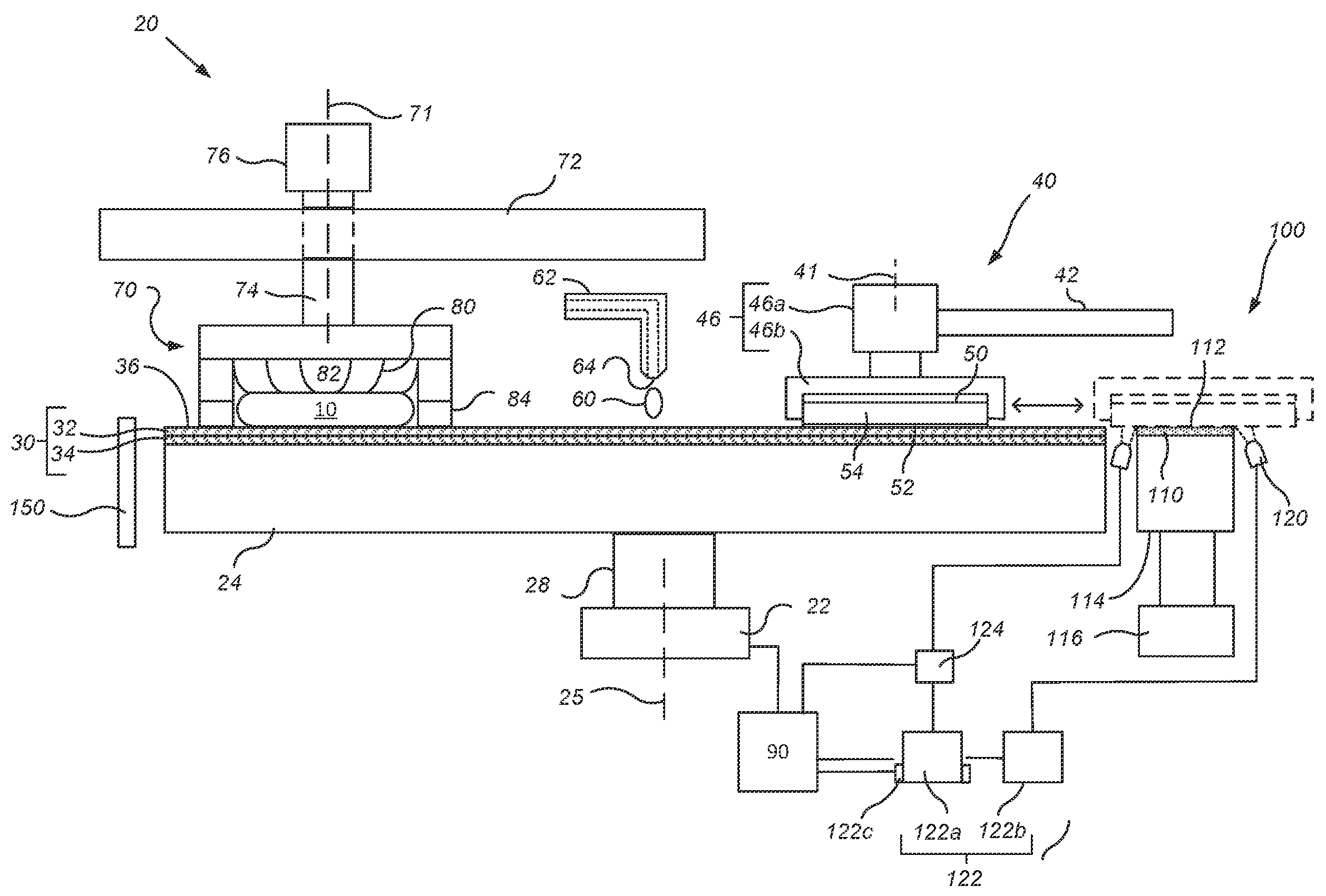
도 1은 컨디셔너 디스크 세정 시스템을 포함하는 연마 시스템의 개략적인 측단면도이다.
도 2는 연마 시스템의 개략적인 평면도이다.
도 3은 연마 패드 상에 배치된 컨디셔너 헤드의 개략적인 사시도이다.
도 4는 컨디셔너 디스크 세정 시스템의 다른 구현을 포함하는 연마 시스템의 개략적인 측단면도이다.
다양한 도면들 내의 유사한 참조 번호들 및 지정들은 유사한 요소들을 나타낸다.FIG. 1 is a schematic cross-sectional side view of a polishing system including a conditioner disc cleaning system.
Figure 2 is a schematic plan view of the polishing system.
Figure 3 is a schematic perspective view of a conditioner head positioned on a polishing pad.
FIG. 4 is a schematic cross-sectional side view of a polishing system including another implementation of a conditioner disc cleaning system.
Similar reference numbers and designations within the various drawings indicate similar elements.
위에서 언급된 바와 같이, 화학적 기계적 연마 프로세스는 패드 컨디셔닝 단계를 포함할 수 있고, 여기서 컨디셔너 디스크, 예를 들어 연마성 다이아몬드 입자들로 코팅된 디스크는 연마 패드 표면을 컨디셔닝하고 텍스처링하기 위해, 회전하는 연마 패드에 맞닿아 눌린다. "인-시튜(in-situ)" 컨디셔닝 프로세스에서, 컨디셔너 디스크는 기판이 연마되고 있는 동안 연마 패드와 접촉한다. 이는 컨디셔닝이 연마와 동시에 수행되도록 허용하고, 따라서 더 시간 효율적이고 더 높은 기판 처리량을 갖는다. 그러나, 컨디셔닝 디스크가 연마 슬러리에 노출된다. "엑스-시튜 (ex-situ)" 컨디셔닝 프로세스에서, 컨디셔너 디스크는 기판이 연마된 후에, 전형적으로 패드를 세척하여 슬러리를 제거한 후에 연마 패드와 접촉한다. 이는 슬러리에 대한 컨디셔닝 디스크의 노출은 줄이지만 더 낮은 처리량을 갖는다.As noted above, the chemical mechanical polishing process may include a pad conditioning step, wherein a conditioner disc, e.g., a disc coated with abrasive diamond particles, is pressed against the rotating polishing pad to condition and texture the polishing pad surface. In an "in-situ" conditioning process, the conditioner disc contacts the polishing pad while the substrate is being polished. This allows conditioning to be performed concurrently with polishing, and is therefore more time efficient and has higher substrate throughput. However, the conditioning disc is exposed to the polishing slurry. In an "ex-situ" conditioning process, the conditioner disc contacts the polishing pad after the substrate has been polished, typically after the pad has been washed to remove the slurry. This reduces the exposure of the conditioning disc to the slurry but has lower throughput.
컨디셔너 디스크가 컨디셔닝을 위해 사용되고 있지 않을 때, 그것은 세정 스테이션 내에 위치될 수 있다. 종래의 "인-시튜" 및 "엑스-시튜" 컨디셔닝에 대해, 이것은 기판당 한 번씩 발생한다. "엑스-시튜" 컨디셔닝에 대해, 디스크는 기판이 연마되고 있는 동안 세정 스테이션 내에 배치되고, 각각의 연마 동작 후에 연마 패드로 복귀된다. "인-시튜" 컨디셔닝에 대해, 디스크는 연마 동작 후에 세정 스테이션 내에 배치되고, 새로운 기판이 로딩되고 연마할 준비가 되면 연마 패드로 복귀된다.When the conditioner disc is not being used for conditioning, it can be positioned within the cleaning station. For conventional "in-situ" and "ex-situ" conditioning, this occurs once per substrate. For "ex-situ" conditioning, the disc is placed within the cleaning station while the substrate is being polished, and is returned to the polishing pad after each polishing operation. For "in-situ" conditioning, the disc is placed within the cleaning station after a polishing operation, and is returned to the polishing pad when a new substrate is loaded and ready for polishing.
일부 연마 프로세스들, 예를 들어 텅스텐(W)의 연마는 컨디셔닝 디스크의 스테인리스 스틸 백킹 층을 부식시킬 위험이 있다. 결과적으로, 인-시튜 컨디셔닝은 부식이 연마 프로세스를 오염시킬 위험이 있기 전에 디스크가 교체되어야 하므로 상당히 더 낮은 컨디셔너 디스크 수명을 초래할 수 있다. 한편, 엑스-시튜 컨디셔닝은 더 낮은 처리량을 갖는다.Some polishing processes, such as tungsten (W) polishing, run the risk of corroding the stainless steel backing layer of the conditioning disc. As a result, in-situ conditioning can result in significantly lower conditioner disc life, as the disc must be replaced before corrosion risks contaminating the polishing process. Ex-situ conditioning, on the other hand, has a lower throughput.
이러한 문제들을 완화할 수 있는 기술은 연마 동작 동안 컨디셔닝 디스크가 주기적으로 세정될 수 있는 위치에 세정 스테이션을 배치하는 것이다. 특히, 컨디셔닝 디스크 세정 스테이션은 컨디셔너 암에 의한 디스크의 스윕에 의해 도달될 수 있는 위치에서 플래튼의 에지에 위치될 수 있다. 이는 컨디셔닝 디스크가 예를 들어 암의 각각의 스윕마다 세정되도록 허용한다.A technique that can alleviate these problems is to position a cleaning station at a location where the conditioning disc can be periodically cleaned during the polishing operation. In particular, the conditioning disc cleaning station can be positioned at the edge of the platen at a location that can be reached by a sweep of the disc by the conditioner arm. This allows the conditioning disc to be cleaned, for example, with each sweep of the arm.
도 1 내지 도 3에 도시된 바와 같이, 화학적 기계적 연마 시스템(20)은 연마 패드(30)가 놓이는 회전가능한 플래튼(24)을 포함한다. 플래튼(24)은 축(25)에 대해 회전하도록 동작가능하다(도 2의 화살표 A를 참조). 예를 들어, 모터(22)는 구동 샤프트(28)를 돌려 플래튼(24)을 회전시킬 수 있다. 연마 패드(30)는 연마 표면(36)을 갖는 외측 연마 층(32) 및 더 연성인 백킹 층(34)을 갖는 2층 연마 패드일 수 있다.As illustrated in FIGS. 1 through 3, the chemical mechanical polishing system (20) includes a rotatable platen (24) on which a polishing pad (30) is placed. The platen (24) is operable to rotate about an axis (25) (see arrow A in FIG. 2). For example, a motor (22) may rotate a drive shaft (28) to rotate the platen (24). The polishing pad (30) may be a two-layer polishing pad having an outer polishing layer (32) having a polishing surface (36) and a softer backing layer (34).
연마 시스템(20)은 연마 패드(30) 상에 연마성 슬러리와 같은 연마 액체(60)를 제공하기 위해 예를 들어 슬러리 공급 암(62)의 단부에 있는 공급 포트(64)를 포함한다. 일부 구현들에서, 연마 시스템(20)은 연마 패드(30)에 걸쳐 연마 액체(60)를 고르게 분배하기 위한 와이퍼 블레이드 또는 본체(66)(도 2 참조)를 포함한다.The polishing system (20) includes a supply port (64) at the end of, for example, a slurry supply arm (62) for providing a polishing liquid (60), such as an abrasive slurry, onto the polishing pad (30). In some implementations, the polishing system (20) includes a wiper blade or body (66) (see FIG. 2) for evenly distributing the polishing liquid (60) across the polishing pad (30).
캐리어 헤드(70)는 지지 구조물(72), 예를 들어 캐러셀 또는 트랙에 매달려 있으며, 캐리어 헤드가 축(71)에 대해 회전할 수 있도록 구동 샤프트(74)에 의해 캐리어 헤드 회전 모터(76)에 연결된다(도 2의 화살표 B 참조). 임의적으로(optionally), 캐리어 헤드(70)는 캐러셀 자체의 회전 진동에 의해; 또는 예를 들어 캐러셀 또는 트랙(72) 상의 슬라이더들 상에서 측방향으로 진동할 수 있다(도 2의 화살표 C 참조). 동작 시에, 플래튼은 그것의 중심 축(25)에 대하여 회전되고, 캐리어 헤드는 그것의 중심 축(71)에 대하여 회전되고 연마 패드(30)의 최상부면에 걸쳐 측방향으로 병진된다. 캐리어 헤드(70)는 기판(10)의 후면과 접촉하는 기판 장착 표면을 갖는 가요성 멤브레인(80), 및 기판(10) 상의 상이한 구역들, 예를 들어 상이한 방사상 구역들에 상이한 압력들을 가하는 복수의 가압 챔버(82)를 포함할 수 있다. 캐리어 헤드는 또한 기판을 유지하기 위한 리테이닝 링을 포함할 수 있다. 캐리어 헤드(70)는 멤브레인(80) 아래에 기판을 유지하기 위한 리테이닝 링(84)을 포함할 수 있다.A carrier head (70) is suspended from a support structure (72), for example a carousel or a track, and is connected to a carrier head rotation motor (76) by a drive shaft (74) so that the carrier head can rotate about an axis (71) (see arrow B in FIG. 2). Optionally, the carrier head (70) may be oscillated laterally by the rotational oscillation of the carousel itself; or, for example, on sliders on the carousel or track (72) (see arrow C in FIG. 2). In operation, the platen rotates about its central axis (25) and the carrier head rotates about its central axis (71) and translates laterally across the top surface of the polishing pad (30). The carrier head (70) may include a flexible membrane (80) having a substrate mounting surface that contacts the back surface of the substrate (10), and a plurality of pressurized chambers (82) that apply different pressures to different regions, for example, different radial regions, on the substrate (10). The carrier head may also include a retaining ring for retaining the substrate. The carrier head (70) may include a retaining ring (84) for retaining the substrate beneath the membrane (80).
연마 스테이션(20)은 또한 연마 패드(30)의 표면 거칠기를 유지하기 위해 컨디셔너 디스크(50)를 갖는 패드 컨디셔너(40)를 포함한다. 컨디셔너 디스크(50)의 바닥 표면은 컨디셔닝 프로세스 동안 연마 표면(36)과 접촉하는 하나 이상의 연마성 영역(52)을 포함한다. 연마성 영역들은 백킹 플레이트(54)의 하측 표면에 고정된 연마성 다이아몬드 입자들에 의해 제공될 수 있다. 백킹 플레이트(54)는 전형적으로 스테인리스 스틸과 같은 금속이지만, 세라믹과 같은 다른 재료들도 가능하다. 일부 구현들에서, 다른 조성들의 연마성 입자들, 예를 들어 실리콘 카바이드가 다이아몬드 입자들을 대신하여 또는 그에 추가하여 사용된다.The polishing station (20) also includes a pad conditioner (40) having a conditioner disk (50) to maintain the surface roughness of the polishing pad (30). The bottom surface of the conditioner disk (50) includes one or more abrasive regions (52) that contact the polishing surface (36) during the conditioning process. The abrasive regions may be provided by abrasive diamond particles affixed to a lower surface of a backing plate (54). The backing plate (54) is typically a metal, such as stainless steel, although other materials, such as ceramic, are also possible. In some implementations, abrasive particles of other compositions, such as silicon carbide, are used in place of or in addition to the diamond particles.
컨디셔닝 동안, 연마성 영역들은 연마 패드(30)의 표면에 대해 이동하고, 그에 의해 연마 표면(36)을 연삭(abrading)하고 재-텍스처링(retexturizing)한다. 예를 들어, 연마 패드(30) 및 컨디셔닝 디스크(50) 둘 다가 회전할 수 있다(도 2의 화살표 A 및 E를 참조).During conditioning, the abrasive zones move relative to the surface of the polishing pad (30), thereby abrading and retexturizing the polishing surface (36). For example, both the polishing pad (30) and the conditioning disk (50) may be rotated (see arrows A and E in FIG. 2).
컨디셔너 디스크(50)는 암(42)의 단부에서 컨디셔너 헤드(46)에 의해 유지될 수 있다. 암(42) 및 컨디셔너 헤드(46)는 베이스(48)에 의해 지지된다. 암(42)은 컨디셔너 헤드(46) 및 컨디셔너 디스크(50)를 연마 패드(30)에 걸쳐 측방향으로 스윕하도록 스윙할 수 있다. 예를 들어, 베이스(48)는 수직 축을 중심으로 피벗하도록 모터(49)에 의해 구동될 수 있고, 그에 의해, 암(42) 및 컨디셔너 헤드(46)를 플래튼(24) 및 연마 패드(30) 위로 측방향으로 스윕할 수 있다.The conditioner disk (50) may be held by the conditioner head (46) at an end of the arm (42). The arm (42) and conditioner head (46) are supported by a base (48). The arm (42) may be swingable to sweep the conditioner head (46) and conditioner disk (50) laterally across the polishing pad (30). For example, the base (48) may be driven by a motor (49) to pivot about a vertical axis, thereby sweeping the arm (42) and conditioner head (46) laterally over the platen (24) and polishing pad (30).
컨디셔너 헤드(46)는 컨디셔너 디스크(50)를 컨디셔너 헤드(46)에 부착하기 위한 메커니즘들(예컨대, 예를 들어 볼트들 또는 나사들과 같은 기계적 부착 시스템들, 또는 자기 부착 시스템들), 및 컨디셔너 디스크(50)를 축(41)에 대해 회전시키기 위한 메커니즘들(예컨대, 암을 통과하는 구동 벨트들, 또는 컨디셔너 헤드 내부의 로터들)을 포함한다. 추가로, 패드 컨디셔너(40)는 또한 컨디셔너 디스크(50)와 연마 패드(30) 사이의 압력을 조절하고(예컨대, 컨디셔닝 헤드 또는 베이스 내부의 공압 또는 기계적 액추에이터들), 및/또는 연마 패드(30)에 대한 컨디셔너 디스크(50)의 수직 위치를 변경하는 메커니즘들을 포함할 수 있다. 예를 들어, 컨디셔너 헤드(46)는 상측 부분(46a), 컨디션 디스크(50)를 유지하는 하측 부분(46b), 및 상측 부분(46a)에 대한 하측 부분(46b)의 수직 위치를 조절하거나 연마 패드(30)에 대한 컨디셔너 디스크(50)의 압력을 조절하기 위한 액추에이터를 포함할 수 있다. 그러나, 이러한 메커니즘들은 많은 가능한 구현들을 가질 수 있다(그리고, 도 1에 도시된 것으로 제한되지 않음). 다른 예들로서, 암(42)을 상승 및 하강시키기 위해 베이스(48) 내에 수직 액추에이터가 위치될 수 있거나, 암은 컨디셔너 헤드(46)를 연마 패드(30)로부터 하강 및 상승시키도록 수직으로 스윙하는 것을 허용하는 방식으로 베이스(48)에 피벗 부착될 수 있다.The conditioner head (46) includes mechanisms for attaching the conditioner disk (50) to the conditioner head (46) (e.g., mechanical attachment systems such as bolts or screws, or magnetic attachment systems), and mechanisms for rotating the conditioner disk (50) about the axis (41) (e.g., drive belts passing through the arm, or rotors within the conditioner head). Additionally, the pad conditioner (40) may also include mechanisms for regulating pressure between the conditioner disk (50) and the polishing pad (30) (e.g., pneumatic or mechanical actuators within the conditioning head or base), and/or for changing the vertical position of the conditioner disk (50) relative to the polishing pad (30). For example, the conditioner head (46) may include an upper portion (46a), a lower portion (46b) that holds the condition disk (50), and an actuator for controlling the vertical position of the lower portion (46b) relative to the upper portion (46a) or for controlling the pressure of the conditioner disk (50) relative to the polishing pad (30). However, these mechanisms may have many possible implementations (and are not limited to those illustrated in FIG. 1 ). As other examples, a vertical actuator may be positioned within the base (48) to raise and lower the arm (42), or the arm may be pivotally attached to the base (48) in a manner that allows it to swing vertically to lower and raise the conditioner head (46) away from the polishing pad (30).
연마 스테이션(20)은 또한 플래튼(24)에 인접하게 위치된 컨디셔너 세정 스테이션(100)을 포함한다. 컨디셔너 세정 스테이션(100)은 컨디셔너 디스크(50)의 바닥 표면과 접촉하기 위한 브러시 표면(112)을 갖는 브러시(110)를 포함할 수 있다. 브러시 표면(112)은 스펀지형의, 예를 들어 다공성의 표면일 수 있거나, 강모들(bristles)을 가질 수 있다. 스펀지형이든 강모를 갖든, 브러시 표면은 CMP 프로세스에서 사용되는 화학물질과 상호작용하지 않는 폴리머 재료, 예를 들어 나일론, 폴리염화비닐(PVC), 폴리비닐 아세탈(PVA), 폴리프로필렌, 또는 폴리우레탄에 의해 제공될 수 있다.The polishing station (20) also includes a conditioner cleaning station (100) positioned adjacent the platen (24). The conditioner cleaning station (100) can include a brush (110) having a brush surface (112) for contacting the bottom surface of the conditioner disk (50). The brush surface (112) can be a spongy, for example porous, surface, or can have bristles. Whether spongy or bristled, the brush surface can be provided by a polymeric material that does not interact with the chemicals used in the CMP process, such as nylon, polyvinyl chloride (PVC), polyvinyl acetal (PVA), polypropylene, or polyurethane.
도 1에 도시된 바와 같이, 브러시(110)는 대체로 평면인 원형 표면(112)을 갖는 디스크 형상의 브러시일 수 있다. 브러시(110)는 수직 축, 예를 들어 컨디셔너 디스크(50)의 표면에 수직인 축에 대하여 모터(116)에 의해 회전될 수 있는 지지체(114) 상에 지지될 수 있다.As illustrated in FIG. 1, the brush (110) may be a disk-shaped brush having a generally flat circular surface (112). The brush (110) may be supported on a support (114) that may be rotated by a motor (116) about a vertical axis, for example, an axis perpendicular to the surface of the conditioner disk (50).
대안적으로, 도 4에 도시된 바와 같이, 브러시(110)는 원통형 표면(112)을 갖는 원통 형상 브러시일 수 있다. 브러시(110)는 수평 축, 예를 들어 컨디셔너 디스크(50)의 표면에 평행한 축에 대하여 모터에 의해 회전될 수 있는 지지체 상에 지지될 수 있다. 회전 축은 암(42)이 컨디셔너 헤드(46)를 브러시(110)를 가로질러 스윕할 때의 컨디셔너 헤드(46)의 운동 방향에 실질적으로 수직일 수 있다.Alternatively, as illustrated in FIG. 4, the brush (110) may be a cylindrical brush having a cylindrical surface (112). The brush (110) may be supported on a support that may be rotated by a motor about a horizontal axis, for example, an axis parallel to the surface of the conditioner disk (50). The axis of rotation may be substantially perpendicular to the direction of motion of the conditioner head (46) as the arm (42) sweeps the conditioner head (46) across the brush (110).
또한, 컨디셔너 세정 스테이션(100)은 컨디셔너 디스크가 세정 스테이션(100) 내에 위치됨에 따라, 예를 들어 컨디셔너 디스크(50)가 브러시(110) 위에 있을 때, 소스(122)로부터의 하나 이상의 유체를 컨디셔너 디스크(50)의 바닥 표면에 분무하기 위한 하나 이상의 노즐(120)을 포함할 수 있다. 유체는 탈이온수(DI 워터), 또는 세정 화학물질을 갖는 물, 예를 들어 pH 조절제 중 하나 이상과 같은 액체일 수 있다. 유체는 가스, 예를 들어 공기, 질소 가스, 또는 증기일 수 있다.Additionally, the conditioner cleaning station (100) may include one or more nozzles (120) for spraying one or more fluids from a source (122) onto the bottom surface of the conditioner disc (50) as the conditioner disc is positioned within the cleaning station (100), for example, when the conditioner disc (50) is above the brush (110). The fluid may be a liquid, such as deionized (DI) water, or water with a cleaning chemical, for example, one or more of a pH adjuster. The fluid may be a gas, such as air, nitrogen gas, or steam.
일부 구현들에서, 유체 소스(122)는 세정 액체, 예를 들어 DI 워터의 저장소(122a)를 포함하고, 펌프(124)는 세정 유체를 하나 이상의 노즐을 통해 컨디셔너 디스크(50) 상으로 유도하기 위해 사용될 수 있다. 이는 컨디셔너 디스크 및 컨디셔너 헤드로부터 연마 액체를 씻어내어 부식 가능성을 줄일 수 있다.In some implementations, the fluid source (122) includes a reservoir (122a) of cleaning fluid, for example DI water, and a pump (124) may be used to direct the cleaning fluid through one or more nozzles onto the conditioner disk (50). This may wash away the polishing fluid from the conditioner disk and conditioner head, thereby reducing the potential for corrosion.
일부 구현들에서, 유체 소스(122)는 가스, 예를 들어 공기의 분출(jet)을 하나 이상의 노즐을 통해 컨디셔너 디스크(50) 상으로 유도하는 컴프레서(122b)를 포함한다. 이는 컨디셔너 디스크 및 컨디셔너 헤드를 건조시킬 수 있다.In some implementations, the fluid source (122) includes a compressor (122b) that directs a jet of gas, for example air, through one or more nozzles onto a conditioner disk (50). This can dry the conditioner disk and conditioner head.
일부 구현들에서, 컨디셔너 디스크 세정 시스템(100)은 복수의 유체를 사용하고, 각각의 유체에 대해 하나 이상의 전용 노즐이 존재하는데, 즉 각각의 노즐은 특정 유체만을 수취한다. 일부 구현들에서, 노즐을 통해 유도되는 유체가 다수의 유체 중에서 선택가능하도록, 밸브들 및 파이핑이 사용될 수 있다.In some implementations, the conditioner disk cleaning system (100) uses multiple fluids, with one or more dedicated nozzles for each fluid, i.e., each nozzle receives only a particular fluid. In some implementations, valves and piping may be used to allow the fluid directed through the nozzle to be selectable from among a plurality of fluids.
유체(들)의 온도는 히터 및/또는 냉각기(122c)를 사용하여 제어될 수 있다. 온도는 0-100℃ 범위 내에 있을 수 있다. 히터 및/또는 냉각기는 저장소 내의 유체의 온도를 제어하기 위해 저장소(122a)에, 또는 소스, 예를 들어 저장소로부터 노즐들(120)로 유체를 운반하는 유체 라인에 열적으로 결합되는 열교환기에 의해 제공될 수 있다.The temperature of the fluid(s) can be controlled using a heater and/or cooler (122c). The temperature can be in the range of 0-100° C. The heater and/or cooler can be provided by a heat exchanger thermally coupled to the reservoir (122a), or to a fluid line carrying the fluid from a source, such as the reservoir, to the nozzles (120), to control the temperature of the fluid within the reservoir.
디스크 형상 브러시 또는 원통 형상 브러시에 대해, 컨디셔닝 디스크(50)와 접촉할 브러시(110)의 최상부면(112)은 연마 패드(30)의 연마 표면(36)과 동일 평면을 이룰 수 있다. 이는 컨디셔너 디스크(50)의 수직 위치를 변경할 필요 없이, 예를 들어 컨디셔너 디스크(50)를 수축(retract)시킬 필요 없이, 암(42)이 컨디셔너 디스크(50)를 컨디셔너 세정 스테이션(100) 내로, 그리고 브러시(110)와 접촉하도록 스윕하는 것을 허용한다. 그러나, 일부 구현들에서, 브러시(110)의 최상부면(112)은 연마 표면(36)의 위 또는 아래에 있고; 이 경우, 컨디셔너 디스크는 연마 패드(30)로부터 세정 스테이션(100)으로 통과할 때 상승 또는 하강될 수 있다.For a disc shaped brush or a cylindrical shaped brush, the top surface (112) of the brush (110) that contacts the conditioning disk (50) can be flush with the polishing surface (36) of the polishing pad (30). This allows the arm (42) to sweep the conditioner disk (50) into the conditioner cleaning station (100) and into contact with the brush (110) without changing the vertical position of the conditioner disk (50), for example, without retracting the conditioner disk (50). However, in some implementations, the top surface (112) of the brush (110) is above or below the polishing surface (36); in which case, the conditioner disk can be raised or lowered as it passes from the polishing pad (30) to the cleaning station (100).
일부 구현들에서, 연마 시스템(20)은 플래튼(24)의 원심성 운동에 의해 방출되는 슬러리가 근처의 다른 컴포넌트들에 튀는 것을 방지하기 위해, 플래튼 실드(150), 즉 플래튼(24)을 둘러싸는 벽을 포함한다. 암(42)은 벽(150) 위로 돌출될 수 있으며, 컨디셔너 헤드(46)는 벽의 최상부 아래로 확장되어 컨디셔너 디스크를 연마 패드(30)에 맞닿아 유지한다. 그러나, 플래튼 실드(150)에는 애퍼쳐(152)가 제공될 수 있고, 컨디셔너 헤드(46)는 그를 통해 측방향으로 이동하여 컨디셔닝 디스크 세정 스테이션(100)에 도달할 수 있다. 다시, 이는 컨디셔너 디스크(50)의 수직 위치를 변경할 필요 없이, 예를 들어 컨디셔너 디스크(50)를 수축시킬 필요 없이, 암(42)이 컨디셔너 디스크(50)를 컨디셔너 세정 스테이션(100) 내로, 그리고 브러시(110)와 접촉하도록 스윕하는 것을 허용한다. 일부 구현들에서, 벽의 일부분(154)은 컨디셔닝 디스크 세정 스테이션(100)을 둘러싸도록 확장된다.In some implementations, the polishing system (20) includes a platen shield (150), i.e., a wall surrounding the platen (24), to prevent slurry ejected by the centrifugal motion of the platen (24) from splashing on other nearby components. The arm (42) may protrude above the wall (150), and the conditioner head (46) may extend below the top of the wall to maintain the conditioner disc in contact with the polishing pad (30). However, the platen shield (150) may be provided with an aperture (152) through which the conditioner head (46) may move laterally to reach the conditioning disc cleaning station (100). Again, this allows the arm (42) to sweep the conditioner disk (50) into the conditioner cleaning station (100) and into contact with the brush (110) without having to change the vertical position of the conditioner disk (50), for example without having to retract the conditioner disk (50). In some implementations, a portion of the wall (154) extends to surround the conditioning disk cleaning station (100).
컨디셔너 헤드(46)의 운동, 예를 들어 (도 2에서 화살표 D로 보여진) 측방향 스윕, 및 컨디셔너 디스크(50) 및/또는 컨디셔너 헤드(46)의 수직 작동은 제어기(90)에 의해 제어된다. 예를 들어, 제어기(90)는 모터(49)에 결합되어 암(42) 및 컨디셔너 헤드(46)의 측방향 위치를 제어할 수 있다. 제어기(90)는 또한 적절한 컴포넌트들, 예를 들어 펌프(124) 또는 컴프레서(122b)에 결합되어 노즐들로부터의 유체들의 유동을 제어하고, 모터(116)에 결합되어 브러시(110)의 회전을 제어할 수 있다.The motion of the conditioner head (46), for example the lateral sweep (shown by arrow D in FIG. 2), and the vertical operation of the conditioner disk (50) and/or the conditioner head (46), are controlled by the controller (90). For example, the controller (90) may be coupled to the motor (49) to control the lateral position of the arm (42) and the conditioner head (46). The controller (90) may also be coupled to suitable components, for example, a pump (124) or compressor (122b) to control the flow of fluids from the nozzles, and may be coupled to the motor (116) to control the rotation of the brushes (110).
동작 시에, 기판(10)이 연마 패드(30)에서 연마되고 있는 동안, 제어기(90)는 컨디셔너 헤드(46) 및 컨디셔너 디스크(50)로 하여금, 연마 패드(30) 및 패드 컨디셔너 세정 스테이션(100) 둘 다를 커버하는 경로(130)를 따라 측방향으로 왕복 스윕하도록 할 수 있다. 경로(130)의 하나의 종점(132)은 패드 컨디셔너 세정 스테이션(100) 위에 놓일 수 있다. 경로의 다른 종점(134)은 연마 패드 위에, 예를 들어 컨디셔너 헤드(46)가 암에 도달할 수 있을 만큼 플래튼(24)의 중심 및 회전 축(25)에 가까운 지점에 있다. 따라서, 컨디셔너 헤드(46)의 각각의 스윕마다, 컨디셔너 디스크(50)는 패드 컨디셔너 세정 스테이션(100)에 들어가고, 연마 유체 및 파편을 제거하기 위해 세정될 수 있다. 이는 기판들의 처리량에 제한적인 영향만을 미치거나 전혀 영향을 미치지 않으면서 컨디셔너 디스크(50)의 부식을 방지할 수 있다.During operation, while the substrate (10) is being polished on the polishing pad (30), the controller (90) can cause the conditioner head (46) and the conditioner disk (50) to laterally reciprocally sweep along a path (130) that covers both the polishing pad (30) and the pad conditioner cleaning station (100). One endpoint (132) of the path (130) can be located above the pad conditioner cleaning station (100). The other endpoint (134) of the path can be located above the polishing pad, for example, at a point close enough to the center of the platen (24) and the rotational axis (25) that the conditioner head (46) can reach the arm. Thus, with each sweep of the conditioner head (46), the conditioner disk (50) enters the pad conditioner cleaning station (100) and can be cleaned to remove polishing fluid and debris. This can prevent corrosion of the conditioner disk (50) with only a limited or no effect on the throughput of the substrates.
일부 구현들에서, 스윕 패턴은 컨디셔너 헤드(50)가 일정 기간(체류 시간이라고 지칭됨) 동안 예를 들어 컨디셔너 디스크 세정 스테이션(100) 내의 종점(132)에서 고정된 상태로 남아있도록 설정된다. 컨디셔너 디스크 세정 스테이션(100) 내에서의 컨디셔너 헤드(50)의 체류 시간은 사용자에 의해, 예를 들어 1 내지 10초로 설정될 수 있다. 일부 구현들에서, 스윕 패턴은 컨디셔너 헤드(50)가 연마 패드 위를 이동할 때보다 컨디셔너 디스크 세정 스테이션(100)을 통해 이동하는 동안 더 느리게 진행하도록 설정된다.In some implementations, the sweep pattern is set such that the conditioner head (50) remains stationary, for example, at an end point (132) within the conditioner disk cleaning station (100), for a period of time (referred to as a dwell time). The dwell time of the conditioner head (50) within the conditioner disk cleaning station (100) may be set by the user to, for example, between 1 and 10 seconds. In some implementations, the sweep pattern is set such that the conditioner head (50) moves more slowly while moving through the conditioner disk cleaning station (100) than while moving over the polishing pad.
일부 구현들에서, 스윕 패턴은 캐리어 헤드가 종점(132)에 도달할 때 컨디셔너 디스크(50)가 연마 패드(30)로부터 완전히 제거되도록 설정된다. 그러나, 스윕 패턴은 또한 캐리어 헤드가 종점(132)에 도달할 때 컨디셔너 디스크(50)의 일부는 연마 패드(30) 위에 있고 컨디셔너 디스크(50)의 일부는 브러시(110) 위에 있도록 설정될 수 있다.In some implementations, the sweep pattern is set such that the conditioner disk (50) is completely removed from the polishing pad (30) when the carrier head reaches the end point (132). However, the sweep pattern may also be set such that a portion of the conditioner disk (50) is above the polishing pad (30) and a portion of the conditioner disk (50) is above the brush (110) when the carrier head reaches the end point (132).
일부 구현들에서, 스윕 패턴은 컨디셔너 헤드(50)가 각각의 스윕마다 패드 컨디셔너 세정 스테이션(100)에 들어가는 것이 아니라, 주기적으로, 예를 들어 2회 내지 10회 스윕할 때마다 패드 컨디셔너 세정 스테이션(100)에 여전히 들어가도록 설정된다. 이 경우, 제어기(90)는 컨디셔너 헤드(46) 및 컨디셔너 디스크(50)로 하여금 종점들 둘 다가 연마 패드(30) 위에 있는 1회 이상의 스윕을 한 다음, 종점이 패드 컨디셔너 세정 스테이션(100) 위에 있는 스윕을 하게 한다.In some implementations, the sweep pattern is set such that the conditioner head (50) does not enter the pad conditioner cleaning station (100) for each sweep, but rather periodically, for example, every two to ten sweeps. In this case, the controller (90) causes the conditioner head (46) and the conditioner disk (50) to perform one or more sweeps in which both endpoints are over the polishing pad (30), followed by a sweep in which the endpoints are over the pad conditioner cleaning station (100).
일부 구현들에서, 연마 시스템(20)은 제2 컨디셔너 세정 스테이션(160)을 포함한다. 이러한 제2 컨디셔너 세정 스테이션(160)은 플래튼(24)으로부터의 컨디셔너 헤드(46)의 스윕 경로를 따라 컨디셔너 세정 스테이션(100)보다 더 멀리 위치될 수 있다. 제2 컨디셔너 세정 스테이션(160)은 컨디셔너 헤드(46) 및 컨디셔너 디스크(50)를 헹구거나 세정하기 위한 세정 액체를 포함하는 세정 컵을 포함할 수 있다. 암(42)은 컨디셔너 헤드(46)를 세정 컵 밖으로 이동시키고 컨디셔너 헤드(46)를 연마 패드(30)의 최상부에 배치할 수 있다. 동작 시, 컨디셔너 헤드(46)는 연마 동작 후에 제2 세정 스테이션(160)으로 이동될 수 있다(도 3의 경로(136)로 표시됨). 다음으로, 새로운 기판이 로드되고 연마할 준비가 되면, 컨디셔너 헤드(46)는 연마 패드(30)로 되돌아간다.In some implementations, the polishing system (20) includes a second conditioner cleaning station (160). This second conditioner cleaning station (160) may be located further along the sweep path of the conditioner head (46) from the platen (24) than the conditioner cleaning station (100). The second conditioner cleaning station (160) may include a cleaning cup containing a cleaning liquid for rinsing or cleaning the conditioner head (46) and the conditioner disk (50). The arm (42) may move the conditioner head (46) out of the cleaning cup and position the conditioner head (46) on top of the polishing pad (30). In operation, the conditioner head (46) may be moved to the second cleaning station (160) after the polishing operation (as indicated by path (136) in FIG. 3 ). Next, once the new substrate is loaded and ready to be polished, the conditioner head (46) returns to the polishing pad (30).
제어기(90), 및 본 명세서에 설명된 다른 기능적 동작들의 다른 제어는 디지털 전자 회로로, 또는 컴퓨터 소프트웨어, 펌웨어 또는 하드웨어로, 또는 이들의 조합으로 구현될 수 있다. 제어기(90) 및 다른 기능은 하나 이상의 비-일시적 컴퓨터 프로그램 제품, 즉 데이터 처리 장치, 예를 들어 프로그래밍가능 프로세서, 컴퓨터, 또는 다수의 프로세서 또는 컴퓨터에 의한 실행 또는 그 동작의 제어를 위해 기계 판독가능 저장 디바이스에 유형으로(tangibly) 구현된 하나 이상의 컴퓨터 프로그램을 사용하여 구현될 수 있다. 제어기(90) 및 다른 기능은 하나 이상의 컴퓨터 프로그램을 실행하는 하나 이상의 프로그래밍가능 프로세서를 사용하여, 예를 들어 범용 컴퓨터에서, 또는 특수 목적 논리 회로부, 예를 들어 FPGA(field programmable gate array) 또는 ASIC(application specific integrated circuit)를 사용하여 구현될 수 있다.The controller (90), and other control of the other functional operations described herein, may be implemented as digital electronic circuitry, or as computer software, firmware, or hardware, or a combination thereof. The controller (90) and other functions may be implemented using one or more non-transitory computer program products, i.e., one or more computer programs tangibly embodied in a machine-readable storage device for execution or control of the operation of a data processing device, such as a programmable processor, a computer, or multiple processors or computers. The controller (90) and other functions may be implemented using one or more programmable processors executing one or more computer programs, for example, in a general purpose computer, or using special purpose logic circuitry, such as a field programmable gate array (FPGA) or an application specific integrated circuit (ASIC).
본 발명의 다수의 실시예가 설명되었다. 그럼에도 불구하고, 다양한 수정들이 이루어질 수 있음을 이해할 것이다. 예를 들어:A number of embodiments of the present invention have been described. Nevertheless, it will be appreciated that various modifications may be made. For example:
· 컨디셔너 헤드는 아치형 경로(arcuate path)를 따라 스윕하는 것이 아니라 선형적으로 이동될 수 있는데, 예를 들어 선형 레일을 따라 운반될 수 있다.· The conditioner head may be moved linearly rather than sweeping along an arcuate path, for example by being carried along a linear rail.
· 연마 패드는 플래튼 상의 원형 패드가 아니라 롤러들에 의해 구동되는 벨트일 수 있다.· The polishing pad may be a belt driven by rollers rather than a circular pad on a platen.
· 연마 패드는 고정 연마성 패드(fixed-abrasive pad) 또는 다른 재료일 수 있다.· The polishing pad may be a fixed-abrasive pad or of another material.
따라서, 다른 실시예들은 이하의 청구항들의 범위 내에 있다.Accordingly, other embodiments are within the scope of the claims below.
Claims (20)
연마 패드를 유지하기 위한 플래튼;
기판을 상기 연마 패드에 맞닿아 유지하기 위한 캐리어 헤드;
컨디셔너 디스크를 상기 연마 패드에 맞닿아 유지하기 위한 컨디셔너 헤드를 포함하는 컨디셔너;
상기 플래튼에 대해 측방향으로 이동가능한 상기 컨디셔너 헤드를 이동시키기 위한 모터;
상기 컨디셔닝 디스크를 세정하기 위해 상기 플래튼에 인접하게 위치된 컨디셔닝 디스크 세정 스테이션; 및
상기 기판의 연마 동안, 상기 모터로 하여금, 상기 컨디셔너 헤드가 상기 연마 패드 위에 있는 제1 위치와 상기 컨디셔너 헤드가 상기 컨디셔너 디스크 세정 스테이션 내에 있는 제2 위치 사이에서 왕복으로 상기 컨디셔너 헤드를 이동시키게 하도록 구성되는 제어기
를 포함하는, 연마 시스템.As a polishing system,
Platen for holding the polishing pad;
A carrier head for maintaining the substrate in contact with the polishing pad;
A conditioner comprising a conditioner head for maintaining a conditioner disc in contact with said polishing pad;
A motor for moving the conditioner head movable laterally with respect to the platen;
a conditioning disc cleaning station positioned adjacent to the platen for cleaning the conditioning disc; and
A controller configured to cause the motor to reciprocally move the conditioner head between a first position where the conditioner head is above the polishing pad and a second position where the conditioner head is within the conditioner disk cleaning station during polishing of the substrate.
A polishing system comprising:
기판을 연마 패드와 접촉시키는 단계; 및
상기 기판의 연마 동안, 상기 연마 패드와 접촉하는 제1 위치와 컨디셔닝 디스크 세정 스테이션 내의 제2 위치 사이에서 컨디셔닝 디스크를 스윕하는 단계
를 포함하는, 방법.As a method of chemical mechanical polishing,
a step of bringing the substrate into contact with a polishing pad; and
During polishing of the substrate, a step of sweeping the conditioning disc between a first position in contact with the polishing pad and a second position within the conditioning disc cleaning station.
A method comprising:
Applications Claiming Priority (3)
| Application Number | Priority Date | Filing Date | Title |
|---|---|---|---|
| US202263349560P | 2022-06-06 | 2022-06-06 | |
| US63/349,560 | 2022-06-06 | ||
| PCT/US2022/078237 WO2023239421A1 (en) | 2022-06-06 | 2022-10-17 | In-situ conditioner disk cleaning during cmp |
Publications (1)
| Publication Number | Publication Date |
|---|---|
| KR20250019095A true KR20250019095A (en) | 2025-02-07 |
Family
ID=88977959
Family Applications (1)
| Application Number | Title | Priority Date | Filing Date |
|---|---|---|---|
| KR1020247043432A Pending KR20250019095A (en) | 2022-06-06 | 2022-10-17 | In-situ conditioner disk cleaning during CMP |
Country Status (6)
| Country | Link |
|---|---|
| US (2) | US12459078B2 (en) |
| JP (1) | JP2025519398A (en) |
| KR (1) | KR20250019095A (en) |
| CN (1) | CN119317515A (en) |
| TW (1) | TWI850804B (en) |
| WO (1) | WO2023239421A1 (en) |
Family Cites Families (17)
| Publication number | Priority date | Publication date | Assignee | Title |
|---|---|---|---|---|
| US5738574A (en) | 1995-10-27 | 1998-04-14 | Applied Materials, Inc. | Continuous processing system for chemical mechanical polishing |
| JP4030247B2 (en) | 1999-05-17 | 2008-01-09 | 株式会社荏原製作所 | Dressing device and polishing device |
| JP2001260024A (en) * | 2000-03-10 | 2001-09-25 | Mitsubishi Materials Corp | Cleaning equipment for dresser equipment |
| KR20020020081A (en) * | 2000-09-07 | 2002-03-14 | 윤종용 | Method for cleaning of polishing pad conditioner and apparatus for performing the same |
| KR20020044737A (en) * | 2000-12-06 | 2002-06-19 | 윤종용 | Chemical mechanical polisher with conditioning cleaner |
| TWI220119B (en) | 2002-12-10 | 2004-08-11 | Macronix Int Co Ltd | Cleaning apparatus of conditioner used in CMP |
| JP2004273530A (en) * | 2003-03-05 | 2004-09-30 | Nec Kyushu Ltd | Washing device and method therefor |
| US7033253B2 (en) | 2004-08-12 | 2006-04-25 | Micron Technology, Inc. | Polishing pad conditioners having abrasives and brush elements, and associated systems and methods |
| US20070254558A1 (en) | 2004-08-27 | 2007-11-01 | Masako Kodera | Polishing Apparatus and Polishing Method |
| WO2007045267A1 (en) * | 2005-10-19 | 2007-04-26 | Freescale Semiconductor, Inc. | A system and method for cleaning a conditioning device |
| JP5405887B2 (en) * | 2009-04-27 | 2014-02-05 | ルネサスエレクトロニクス株式会社 | Polishing apparatus and polishing method |
| JP5887227B2 (en) | 2012-08-07 | 2016-03-16 | 株式会社荏原製作所 | Dresser disk cleaning brush, cleaning device and cleaning method |
| JP6282437B2 (en) * | 2012-10-18 | 2018-02-21 | アプライド マテリアルズ インコーポレイテッドApplied Materials,Incorporated | Damper for polishing pad conditioner |
| US9375825B2 (en) | 2014-04-30 | 2016-06-28 | Applied Materials, Inc. | Polishing pad conditioning system including suction |
| KR101767059B1 (en) | 2015-09-30 | 2017-08-11 | 주식회사 케이씨텍 | Chemical mechanical polishing apparatus for substrate |
| CN111842259A (en) | 2020-06-30 | 2020-10-30 | 长江存储科技有限责任公司 | A cleaning device for a polishing pad dresser |
| JP7534142B2 (en) | 2020-07-16 | 2024-08-14 | 株式会社岡本工作機械製作所 | Dressing device and polishing device |
-
2022
- 2022-10-17 KR KR1020247043432A patent/KR20250019095A/en active Pending
- 2022-10-17 WO PCT/US2022/078237 patent/WO2023239421A1/en not_active Ceased
- 2022-10-17 CN CN202280096813.8A patent/CN119317515A/en active Pending
- 2022-10-17 US US17/967,762 patent/US12459078B2/en active Active
- 2022-10-17 JP JP2024571204A patent/JP2025519398A/en active Pending
- 2022-10-19 TW TW111139629A patent/TWI850804B/en active
-
2025
- 2025-07-01 US US19/257,301 patent/US20250326086A1/en active Pending
Also Published As
| Publication number | Publication date |
|---|---|
| US20230390895A1 (en) | 2023-12-07 |
| WO2023239421A1 (en) | 2023-12-14 |
| JP2025519398A (en) | 2025-06-26 |
| TWI850804B (en) | 2024-08-01 |
| CN119317515A (en) | 2025-01-14 |
| US12459078B2 (en) | 2025-11-04 |
| TW202348357A (en) | 2023-12-16 |
| US20250326086A1 (en) | 2025-10-23 |
Similar Documents
| Publication | Publication Date | Title |
|---|---|---|
| US5885147A (en) | Apparatus for conditioning polishing pads | |
| EP0887153B1 (en) | Combined slurry dispenser and rinse arm | |
| US5611943A (en) | Method and apparatus for conditioning of chemical-mechanical polishing pads | |
| TWI691367B (en) | Method and system for polishing pad cleaning | |
| US5645682A (en) | Apparatus and method for conditioning a planarizing substrate used in chemical-mechanical planarization of semiconductor wafers | |
| US6669538B2 (en) | Pad cleaning for a CMP system | |
| US9375825B2 (en) | Polishing pad conditioning system including suction | |
| US5941762A (en) | Method and apparatus for improved conditioning of polishing pads | |
| US7997958B2 (en) | Apparatuses and methods for conditioning polishing pads used in polishing micro-device workpieces | |
| WO2002034467A1 (en) | Polisher | |
| US6769968B2 (en) | Interchangeable conditioning disk apparatus | |
| US7033253B2 (en) | Polishing pad conditioners having abrasives and brush elements, and associated systems and methods | |
| US20030190874A1 (en) | Composite conditioning tool | |
| US7210988B2 (en) | Method and apparatus for reduced wear polishing pad conditioning | |
| EP1038635A2 (en) | Polishing apparatus | |
| US12459078B2 (en) | In-situ conditioner disk cleaning during CMP | |
| EP1322449A1 (en) | Web-style pad conditioning system and methods for implementing the same | |
| JP2002200552A (en) | Polishing device | |
| US20210402563A1 (en) | Conditioner disk for use on soft or 3d printed pads during cmp | |
| US12337439B2 (en) | Multiple disk pad conditioner | |
| US20250312891A1 (en) | Chemical mechanical polishing system with conditioning ring |
Legal Events
| Date | Code | Title | Description |
|---|---|---|---|
| PA0105 | International application |
St.27 status event code: A-0-1-A10-A15-nap-PA0105 |
|
| PA0201 | Request for examination |
St.27 status event code: A-1-2-D10-D11-exm-PA0201 |
|
| PG1501 | Laying open of application |
St.27 status event code: A-1-1-Q10-Q12-nap-PG1501 |
|
| P22-X000 | Classification modified |
St.27 status event code: A-2-2-P10-P22-nap-X000 |