KR20240161128A - A device for transmitting point cloud data and a method performed in the device for transmitting point cloud data, and a device for receiving point cloud data and a method performed in the device for receiving point cloud data - Google Patents
A device for transmitting point cloud data and a method performed in the device for transmitting point cloud data, and a device for receiving point cloud data and a method performed in the device for receiving point cloud data Download PDFInfo
- Publication number
- KR20240161128A KR20240161128A KR1020247032298A KR20247032298A KR20240161128A KR 20240161128 A KR20240161128 A KR 20240161128A KR 1020247032298 A KR1020247032298 A KR 1020247032298A KR 20247032298 A KR20247032298 A KR 20247032298A KR 20240161128 A KR20240161128 A KR 20240161128A
- Authority
- KR
- South Korea
- Prior art keywords
- track
- point cloud
- pcc
- geometry
- attribute
- Prior art date
- Legal status (The legal status is an assumption and is not a legal conclusion. Google has not performed a legal analysis and makes no representation as to the accuracy of the status listed.)
- Pending
Links
Images


Classifications
-
- G—PHYSICS
- G06—COMPUTING OR CALCULATING; COUNTING
- G06T—IMAGE DATA PROCESSING OR GENERATION, IN GENERAL
- G06T9/00—Image coding
-
- H—ELECTRICITY
- H04—ELECTRIC COMMUNICATION TECHNIQUE
- H04N—PICTORIAL COMMUNICATION, e.g. TELEVISION
- H04N19/00—Methods or arrangements for coding, decoding, compressing or decompressing digital video signals
- H04N19/30—Methods or arrangements for coding, decoding, compressing or decompressing digital video signals using hierarchical techniques, e.g. scalability
- H04N19/31—Methods or arrangements for coding, decoding, compressing or decompressing digital video signals using hierarchical techniques, e.g. scalability in the temporal domain
-
- G—PHYSICS
- G06—COMPUTING OR CALCULATING; COUNTING
- G06T—IMAGE DATA PROCESSING OR GENERATION, IN GENERAL
- G06T9/00—Image coding
- G06T9/001—Model-based coding, e.g. wire frame
-
- H—ELECTRICITY
- H04—ELECTRIC COMMUNICATION TECHNIQUE
- H04N—PICTORIAL COMMUNICATION, e.g. TELEVISION
- H04N19/00—Methods or arrangements for coding, decoding, compressing or decompressing digital video signals
- H04N19/10—Methods or arrangements for coding, decoding, compressing or decompressing digital video signals using adaptive coding
- H04N19/102—Methods or arrangements for coding, decoding, compressing or decompressing digital video signals using adaptive coding characterised by the element, parameter or selection affected or controlled by the adaptive coding
- H04N19/132—Sampling, masking or truncation of coding units, e.g. adaptive resampling, frame skipping, frame interpolation or high-frequency transform coefficient masking
-
- H—ELECTRICITY
- H04—ELECTRIC COMMUNICATION TECHNIQUE
- H04N—PICTORIAL COMMUNICATION, e.g. TELEVISION
- H04N19/00—Methods or arrangements for coding, decoding, compressing or decompressing digital video signals
- H04N19/50—Methods or arrangements for coding, decoding, compressing or decompressing digital video signals using predictive coding
- H04N19/597—Methods or arrangements for coding, decoding, compressing or decompressing digital video signals using predictive coding specially adapted for multi-view video sequence encoding
-
- H—ELECTRICITY
- H04—ELECTRIC COMMUNICATION TECHNIQUE
- H04N—PICTORIAL COMMUNICATION, e.g. TELEVISION
- H04N19/00—Methods or arrangements for coding, decoding, compressing or decompressing digital video signals
- H04N19/70—Methods or arrangements for coding, decoding, compressing or decompressing digital video signals characterised by syntax aspects related to video coding, e.g. related to compression standards
Landscapes
- Engineering & Computer Science (AREA)
- Multimedia (AREA)
- Signal Processing (AREA)
- Physics & Mathematics (AREA)
- General Physics & Mathematics (AREA)
- Theoretical Computer Science (AREA)
- Compression Or Coding Systems Of Tv Signals (AREA)
Abstract
포인트 클라우드 데이터의 전송 장치, 전송 장치에서 수행되는 방법, 수신 장치 및 수신 장치에서 수행되는 방법이 제공된다. 본 개시에 따른 포인트 클라우드 데이터의 수신 장치에서 수행되는 방법은 상기 포인트 클라우드 데이터를 포함하는 G-PCC(geometry-based point cloud compression) 파일을 획득하는 단계, 상기 G-PCC 파일 내 트랙으로부터 G-PCC 시간적 확장성 그룹 박스(GPCCTemporalScalbilityGroupBox)를 획득하는 단계를 포함하고, 상기 트랙의 샘플 엔트리 타입은 'gpe1', 'gpeg', 'gpc1' 또는 'gpcg' 중 어느 하나인, 방법일 수 있다.A transmission device of point cloud data, a method performed in the transmission device, a receiving device, and a method performed in the receiving device are provided. The method performed in the receiving device of point cloud data according to the present disclosure may include the steps of: obtaining a G-PCC (geometry-based point cloud compression) file including the point cloud data; obtaining a G-PCC Temporal Scalability Group Box (GPCCTemporalScalabilityGroupBox) from a track in the G-PCC file, wherein a sample entry type of the track is any one of 'gpe1', 'gpeg', 'gpc1', or 'gpcg'.
Description
본 개시는 포인트 클라우드 콘텐트(point cloud content)를 처리하는 방법 및 장치에 대한 것이다.The present disclosure relates to a method and apparatus for processing point cloud content.
포인트 클라우드 콘텐트는 3차원 공간을 표현하는 좌표계에 속한 점(포인트)들의 집합인 포인트 클라우드로 표현되는 콘텐트이다. 포인트 클라우드 콘텐트는 3차원으로 이루어진 미디어를 표현할 수 있으며, VR(virtual reality, 가상현실), AR(augmented reality, 증강현실), MR(mixed reality, 혼합현실), 및 자율 주행 서비스 등의 다양한 서비스를 제공하기 위해 사용된다. 포인트 클라우드 콘텐트를 표현하기 위해서는 수만 개에서 수십만 개의 포인트 데이터가 필요하므로, 방대한 양의 포인트 데이터를 효율적으로 처리하기 위한 방법이 요구된다.Point cloud content is content expressed as a point cloud, which is a collection of points belonging to a coordinate system expressing a three-dimensional space. Point cloud content can express three-dimensional media and is used to provide various services such as VR (virtual reality), AR (augmented reality), MR (mixed reality), and autonomous driving services. In order to express point cloud content, tens of thousands to hundreds of thousands of point data are required, so a method for efficiently processing a massive amount of point data is required.
본 개시는 포인트 클라우드 데이터를 효율적으로 처리하기 위한 장치 및 방법을 제공한다. 본 개시는 지연시간(latency) 및 인코딩/디코딩 복잡도를 해결하기 위한 포인트 클라우드 데이터 처리 방법 및 장치를 제공한다.The present disclosure provides a device and method for efficiently processing point cloud data. The present disclosure provides a method and device for processing point cloud data to address latency and encoding/decoding complexity.
또한, 본 개시는 시간적 확장성 트랙 그룹(Temporal Scalability Track Group)을 지원하기 위한 장치 및 방법들을 제공한다.Additionally, the present disclosure provides devices and methods for supporting a Temporal Scalability Track Group.
또한, 본 개시는 저장된 G-PCC 비트스트림에 대한 효율적인 접근을 지원할 수 있도록 하기 위한 파일 저장 기법을 처리하는 장치 및 방법들을 제안한다.Additionally, the present disclosure proposes devices and methods for processing file storage techniques to support efficient access to stored G-PCC bitstreams.
본 개시에서 이루고자 하는 기술적 과제들은 이상에서 언급한 기술적 과제들로 제한되지 않으며, 언급하지 않은 또 다른 기술적 과제들은 아래의 기재로부터 본 개시가 속하는 기술분야에서 통상의 지식을 가진 자에게 명확하게 이해될 수 있을 것이다.The technical problems to be achieved in the present disclosure are not limited to the technical problems mentioned above, and other technical problems not mentioned will be clearly understood by a person having ordinary skill in the technical field to which the present disclosure belongs from the description below.
본 개시의 일 실시예에 따른 포인트 클라우드 데이터 수신 장치에서 수행되는 방법은, 상기 포인트 클라우드 데이터를 포함하는 G-PCC(geometry-based point cloud compression) 파일을 획득하는 단계 및 상기 G-PCC 파일 내 트랙으로부터 G-PCC 시간적 확장성 그룹 박스(GPCCTemporalScalabilityGroupBox)를 획득하는 단계를 포함하고, 상기 트랙의 샘플 엔트리 타입은 'gpe1', 'gpeg', 'gpc1' 또는 'gpcg' 중 어느 하나인, 방법일 수 있다.A method performed in a point cloud data receiving device according to one embodiment of the present disclosure may include the steps of obtaining a G-PCC (geometry-based point cloud compression) file including the point cloud data, and obtaining a G-PCC temporal scalability group box (GPCCTemporalScalabilityGroupBox) from a track in the G-PCC file, wherein a sample entry type of the track is any one of 'gpe1', 'gpeg', 'gpc1' or 'gpcg'.
본 개시의 일 실시예에 따르면, 상기 트랙은 지오메트리 컴포넌트(geometry component)를 포함하는, 방법일 수 있다.According to one embodiment of the present disclosure, the track may be a method including a geometry component.
본 개시의 일 실시예에 따르면, 상기 트랙의 샘플 엔트리 타입은 'gpc1' 또는 'gpcg' 중 어느 하나인, 방법일 수 있다.According to one embodiment of the present disclosure, the method may be such that the sample entry type of the track is either 'gpc1' or 'gpcg'.
본 개시의 일 실시예에 따르면, 상기 트랙은 어트리뷰트 컴포넌트를 포함하고 상기 트랙의 샘플 엔트리 타입은 'gpc1' 또는 'gpcg'인 것에 기반하여, 상기 G-PCC 시간적 확장성 그룹 박스는 상기 트랙으로부터 획득되지 않는, 방법일 수 있다.According to one embodiment of the present disclosure, the track may be a method in which the G-PCC temporal scalability group box is not obtained from the track based on the track including an attribute component and a sample entry type of the track being 'gpc1' or 'gpcg'.
본 개시의 일 실시예에 따르면, 동일한 시간적 확장성 트랙 그룹에 포함된 제1 트랙들이 조합되는 것에 기반하여, 상기 제1 트랙들에 의해 참조되는 제2 트랙들이 조합되며, 상기 제1 트랙들은 지오메트리 컴포넌트를 포함하는 트랙이며, 상기 제2 트랙들은 어트리뷰트 컴포넌트를 포함하는 트랙인, 방법일 수 있다.According to one embodiment of the present disclosure, a method may be provided, wherein second tracks referenced by first tracks are combined based on combining first tracks included in the same temporal scalability track group, wherein the first tracks are tracks including a geometry component, and the second tracks are tracks including an attribute component.
본 개시의 일 실시예에 따르면, 상기 제1 트랙들은 상기 트랙의 샘플 엔트리 타입이 'gpc1' 또는 'gpcg' 중 하나인 것에 기반하여 조합되는, 방법일 수 있다.According to one embodiment of the present disclosure, the method may be such that the first tracks are combined based on whether a sample entry type of the track is one of 'gpc1' or 'gpcg'.
본 개시의 다른 일 실시예에 따른 포인트 클라우드 데이터의 전송 장치에서 수행되는 방법은, G-PCC 시간적 확장성 그룹 박스(GPCCTemporalScalabilityGroupBox)를 포함하는 트랙을 생성하는 단계 및 상기 트랙을 포함하는 G-PCC 파일을 생성하는 단계를 포함하되, 상기 트랙의 샘플 엔트리 타입은 'gpe1', 'gpeg', 'gpc1' 또는 'gpcg' 중 어느 하나인, 방법일 수 있다.A method performed in a device for transmitting point cloud data according to another embodiment of the present disclosure may include the steps of creating a track including a G-PCC temporal scalability group box (GPCCTemporalScalabilityGroupBox) and creating a G-PCC file including the track, wherein a sample entry type of the track is any one of 'gpe1', 'gpeg', 'gpc1' or 'gpcg'.
본 개시의 다른 일 실시예에 따른 포인트 클라우드 데이터의 수신 장치는 메모리 및 적어도 하나의 프로세서를 포함하고, 상기 적어도 하나의 프로세서는, 상기 포인트 클라우드 데이터를 포함하는 G-PCC(geometry-based point cloud compression) 파일을 획득하고, 상기 G-PCC 파일 내 트랙으로부터 G-PCC 시간적 확장성 그룹 박스(GPCCTemporalScalabilityGroupBox)를 획득하되, 상기 트랙의 샘플 엔트리 타입은 'gpe1', 'gpeg', 'gpc1' 또는 'gpcg' 중 어느 하나인, 수신 장치일 수 있다.According to another embodiment of the present disclosure, a receiving device for point cloud data may include a memory and at least one processor, wherein the at least one processor obtains a geometry-based point cloud compression (G-PCC) file including the point cloud data, and obtains a G-PCC temporal scalability group box (GPCCTemporalScalabilityGroupBox) from a track in the G-PCC file, wherein a sample entry type of the track is any one of 'gpe1', 'gpeg', 'gpc1', or 'gpcg'.
본 개시의 또 다른 일 실시예에 따른 포인트 클라우드 데이터의 전송 장치는 메모리 및 적어도 하나의 프로세서를 포함하고, 상기 적어도 하나의 프로세서는, G-PCC 시간적 확장성 그룹 박스(GPCCTemporalScalabilityGroupBox)를 포함하는 트랙을 생성하고, 상기 트랙을 포함하는 G-PCC 파일을 생성하는 단계를 포함하되, 상기 트랙의 샘플 엔트리 타입은 'gpe1', 'gpeg', 'gpc1' 또는 'gpcg' 중 어느 하나인, 전송 장치일 수 있다.Another embodiment of the present disclosure provides a transmission device for point cloud data, the transmission device including a memory and at least one processor, wherein the at least one processor comprises a step of generating a track including a G-PCC Temporal Scalability Group Box (GPCCTemporalScalabilityGroupBox) and generating a G-PCC file including the track, wherein a sample entry type of the track is any one of 'gpe1', 'gpeg', 'gpc1' or 'gpcg'.
본 개시의 실시예들에 따른 장치 및 방법은 높은 효율로 포인트 클라우드 데이터를 처리할 수 있다.The device and method according to the embodiments of the present disclosure can process point cloud data with high efficiency.
본 개시의 실시예들에 따른 장치 및 방법은 높은 퀄리티의 포인트 클라우드 서비스를 제공할 수 있다.The device and method according to the embodiments of the present disclosure can provide a high quality point cloud service.
본 개시의 실시예들에 따른 장치 및 방법은 VR 서비스, 자율주행 서비스 등 범용적인 서비스를 제공하기 위한 포인트 클라우드 콘텐트를 제공할 수 있다.The device and method according to embodiments of the present disclosure can provide point cloud content for providing general-purpose services such as VR services and autonomous driving services.
본 개시의 실시예들에 따른 장치 및 방법은 G-PCC 컴포넌트들 중에서 원하는 컴포넌트에 효과적으로 액세스할 수 있는 시간적 확장성을 제공할 있다.The device and method according to embodiments of the present disclosure can provide temporal scalability for effectively accessing a desired component among G-PCC components.
본 개시의 실시예들에 따른 장치 및 방법은 시간적 확장성 트랙 그룹(Temporal scalability Track Group)을 제공함으로써, 시간적 트랙들의 혼합(mixing)을 막을 수 있다.The device and method according to embodiments of the present disclosure can prevent mixing of temporal tracks by providing a temporal scalability track group.
본 개시의 실시예들에 따른 장치 및 방법은 복수의 시간적 레벨 트랙들이 존재할 때 시간적 확장성 트랙 그룹핑을 함으로써, 비트를 절감할 수 있다.The device and method according to embodiments of the present disclosure can save bits by performing temporal scalability track grouping when multiple temporal level tracks exist.
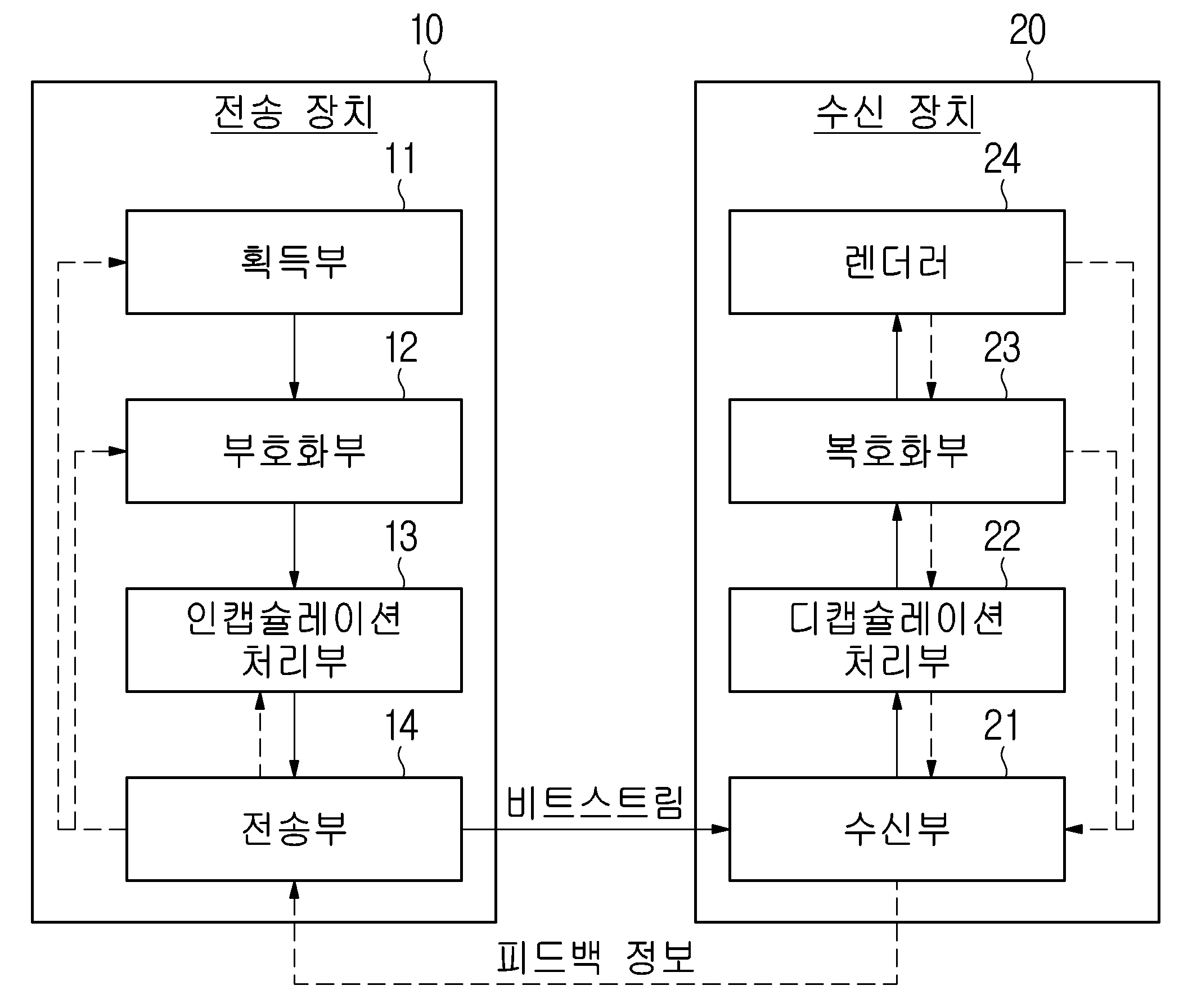
도 1은 본 개시의 실시예들에 따른 포인트 클라우드 콘텐트 제공 시스템의 예시를 나타내는 블록도이다.
도 2는 본 개시의 실시예들에 따른 포인트 클라우드 콘텐트 제공 과정의 예시를 나타내는 블록도이다.
도 3은 본 개시의 실시예들에 따른 포인트 클라우드 부호화 장치의 예시를 나타낸다.
도 4는 본 개시의 실시예들에 따른 포인트 클라우드 복호화 장치의 예시를 나타내는 블록도이다.
도 5는 본 개시의 실시예들에 따른 포인트 클라우드 복호화 장치의 다른 예시를 나타내는 블록도이다.
도 6은 본 개시의 실시예들에 따른 포인트 클라우드 데이터 송수신 방법/장치와 연동 가능한 구조의 예시를 나타낸다.
도 7은 본 개시의 실시예들에 따른 전송 장치의 또 다른 예시를 나타내는 블록도이다.
도 8은 본 개시의 실시예들에 따른 수신 장치의 또 다른 예시를 나타내는 블록도이다.
도 9는 본 개시의 실시예들에 따른 TLV 인캡슐레이션 구조에 대한 예시를 나타낸다.
도 10은 본 개시의 실시예들에 따른 TLV 인캡슐레이션 신택스 구조 및 페이로드 타입에 대한 예시를 나타낸다.
도 11은 본 개시의 실시예들에 따른 싱글 트랙을 포함하는 파일에 대한 예시를 나타낸다.
도 12는 본 개시의 실시예들에 따른 멀티플 트랙을 포함하는 파일에 대한 예시를 나타낸다.
도 13은 본 개시의 실시예들에 따른 수신 장치에서 시간적 확장성 그룹 박스(GPCCTemporalScalabilityGroupBox)를 획득 방법의 흐름도이다.
도 14는 본 개시의 실시예들에 따른 전송 장치에서 G-PCC 파일을 생성하는 방법의 흐름도이다.
도 15 내지 도 16은 본 개시의 실시예들에 따른 전송 장치에서 G-PCC 파일을 생성하는 방법의 흐름도이다.
도 17은 본 개시의 실시예들에 따른 수신 장치에서 지오메트리/어트리뷰트 컴포넌트를 획득하는 방법의 흐름도이다.
도 18은 본 개시의 실시예들에 따른 전송 장치에서 트랙들을 조합하는 방법의 흐름도이다.FIG. 1 is a block diagram illustrating an example of a point cloud content providing system according to embodiments of the present disclosure.
FIG. 2 is a block diagram illustrating an example of a point cloud content provision process according to embodiments of the present disclosure.
FIG. 3 illustrates an example of a point cloud encoding device according to embodiments of the present disclosure.
FIG. 4 is a block diagram illustrating an example of a point cloud decoding device according to embodiments of the present disclosure.
FIG. 5 is a block diagram illustrating another example of a point cloud decoding device according to embodiments of the present disclosure.
FIG. 6 illustrates an example of a structure that can be linked with a point cloud data transmission/reception method/device according to embodiments of the present disclosure.
FIG. 7 is a block diagram illustrating another example of a transmission device according to embodiments of the present disclosure.
FIG. 8 is a block diagram illustrating another example of a receiving device according to embodiments of the present disclosure.
FIG. 9 illustrates an example of a TLV encapsulation structure according to embodiments of the present disclosure.
FIG. 10 illustrates an example of a TLV encapsulation syntax structure and payload type according to embodiments of the present disclosure.
FIG. 11 illustrates an example of a file including a single track according to embodiments of the present disclosure.
FIG. 12 illustrates an example of a file including multiple tracks according to embodiments of the present disclosure.
FIG. 13 is a flowchart of a method for obtaining a temporal scalability group box (GPCCTemporalScalabilityGroupBox) in a receiving device according to embodiments of the present disclosure.
FIG. 14 is a flowchart of a method for generating a G-PCC file in a transmission device according to embodiments of the present disclosure.
FIGS. 15 and 16 are flowcharts of a method for generating a G-PCC file in a transmission device according to embodiments of the present disclosure.
FIG. 17 is a flowchart of a method for obtaining geometry/attribute components in a receiving device according to embodiments of the present disclosure.
FIG. 18 is a flowchart of a method for combining tracks in a transmission device according to embodiments of the present disclosure.
이하에서는 첨부한 도면을 참고로 하여 본 개시의 실시예에 대하여 본 개시가 속하는 기술 분야에서 통상의 지식을 가진 자가 용이하게 실시할 수 있도록 상세히 설명한다. 본 개시는 여러 가지 상이한 형태로 구현될 수 있으며 여기에서 설명하는 실시예에 한정되지 않는다.Hereinafter, embodiments of the present disclosure will be described in detail with reference to the attached drawings so that those skilled in the art can easily implement the present disclosure. The present disclosure may be implemented in various different forms and is not limited to the embodiments described herein.
본 개시의 실시예를 설명함에 있어서 공지 구성 또는 기능에 대한 구체적인 설명이 본 개시의 요지를 흐릴 수 있다고 판단되는 경우에는 그에 대한 상세한 설명은 생략한다. 그리고, 도면에서 본 개시에 대한 설명과 관계없는 부분은 생략하였으며, 유사한 부분에 대해서는 유사한 도면 부호를 붙였다.In describing embodiments of the present disclosure, if it is determined that a detailed description of a known configuration or function may obscure the gist of the present disclosure, a detailed description thereof will be omitted. In addition, parts in the drawings that are not related to the description of the present disclosure have been omitted, and similar parts have been given similar drawing reference numerals.
본 개시에 있어서, 어떤 구성요소가 다른 구성요소와 "연결", "결합" 또는 "접속"되어 있다고 할 때, 이는 직접적인 연결 관계뿐만 아니라, 그 중간에 또 다른 구성요소가 존재하는 간접적인 연결 관계도 포함할 수 있다. 또한 어떤 구성요소가 다른 구성요소를 "포함한다" 또는 "가진다"고 할 때, 이는 특별히 반대되는 기재가 없는 한 다른 구성요소를 배제하는 것이 아니라 또 다른 구성요소를 더 포함할 수 있는 것을 의미한다.In the present disclosure, when a component is said to be "connected", "coupled" or "connected" to another component, this may include not only a direct connection relationship, but also an indirect connection relationship in which another component exists in between. In addition, when a component is said to "include" or "have" another component, this does not exclude the other component unless specifically stated otherwise, but rather means that the other component may be included.
본 개시에 있어서, 제1, 제2 등의 용어는 하나의 구성요소를 다른 구성요소로부터 구별하는 목적으로만 사용되며, 특별히 언급되지 않는 한 구성요소들 간의 순서 또는 중요도 등을 한정하지 않는다. 따라서, 본 개시의 범위 내에서 일 실시예에서의 제1 구성요소는 다른 실시예에서 제2 구성요소라고 칭할 수도 있고, 마찬가지로 일 실시예에서의 제2 구성요소를 다른 실시예에서 제1 구성요소라고 칭할 수도 있다.In this disclosure, the terms first, second, etc. are used only for the purpose of distinguishing one component from another component, and do not limit the order or importance among the components unless specifically stated otherwise. Accordingly, within the scope of this disclosure, a first component in one embodiment may be referred to as a second component in another embodiment, and similarly, a second component in one embodiment may be referred to as a first component in another embodiment.
본 개시에 있어서, 서로 구별되는 구성요소들은 각각의 특징을 명확하게 설명하기 위함이며, 구성요소들이 반드시 분리되는 것을 의미하지는 않는다. 즉, 복수의 구성요소가 통합되어 하나의 하드웨어 또는 소프트웨어 단위로 이루어질 수도 있고, 하나의 구성요소가 분산되어 복수의 하드웨어 또는 소프트웨어 단위로 이루어질 수도 있다. 따라서, 별도로 언급하지 않더라도 이와 같이 통합된 또는 분산된 실시예도 본 개시의 범위에 포함된다.In the present disclosure, the components that are distinguished from each other are intended to clearly explain the characteristics of each, and do not necessarily mean that the components are separated. That is, a plurality of components may be integrated to form a single hardware or software unit, or a single component may be distributed to form a plurality of hardware or software units. Accordingly, even if not mentioned separately, such integrated or distributed embodiments are also included in the scope of the present disclosure.
본 개시에 있어서, 다양한 실시예에서 설명하는 구성요소들이 반드시 필수적인 구성요소들을 의미하는 것은 아니며, 일부는 선택적인 구성요소일 수 있다. 따라서, 일 실시예에서 설명하는 구성요소들의 부분집합으로 구성되는 실시예도 본 개시의 범위에 포함된다. 또한, 다양한 실시예에서 설명하는 구성요소들에 추가적으로 다른 구성요소를 포함하는 실시예도 본 개시의 범위에 포함된다.In the present disclosure, the components described in various embodiments do not necessarily mean essential components, and some may be optional components. Accordingly, an embodiment that consists of a subset of the components described in one embodiment is also included in the scope of the present disclosure. In addition, an embodiment that includes other components in addition to the components described in various embodiments is also included in the scope of the present disclosure.
본 개시는 포인트 클라우드 관련 데이터의 부호화 및 복호화에 관한 것으로서, 본 개시에서 사용되는 용어는, 본 개시에서 새롭게 정의되지 않는 한 본 개시가 속한 기술 분야에서 통용되는 통상의 의미를 가질 수 있다.The present disclosure relates to encoding and decoding of point cloud-related data, and terms used in the present disclosure may have their usual meanings commonly used in the technical field to which the present disclosure belongs, unless newly defined in the present disclosure.
본 개시에서 “/”와 “,”는 “및/또는”으로 해석될 수 있다. 예를 들어, “A/B”와 “A, B”는 “A 및/또는 B”로 해석될 수 있다. 또한, “A/B/C”와 “A, B, C”는 “A, B 및/또는 C 중 적어도 하나”를 의미할 수 있다.In this disclosure, “/” and “,” can be interpreted as “and/or.” For example, “A/B” and “A, B” can be interpreted as “A and/or B.” Additionally, “A/B/C” and “A, B, C” can mean “at least one of A, B, and/or C.”
본 개시에서 “또는”은 “및/또는”으로 해석될 수 있다. 예를 들어, “A 또는 B”는, 1) “A” 만을 의미하거나 2) “B” 만을 의미하거나, 3) “A 및 B”를 의미할 수 있다. 또는, 본 개시에서 “또는”은 “추가적으로 또는 대체적으로(additionally or alternatively)”를 의미할 수 있다.In this disclosure, “or” can be interpreted as “and/or.” For example, “A or B” can mean 1) “A” only, 2) “B” only, or 3) “A and B.” Alternatively, “or” in this disclosure can mean “additionally or alternatively.”
본 개시는 포인트 클라우드 관련 데이터의 압축에 관한 것이다. 본 개시의 다양한 방법 또는 실시예들은 MPEG(moving picture experts group)의 PCC(point cloud compression 또는 point cloud coding) 표준(ex. G-PCC or V-PCC 표준) 또는 차세대 비디오/이미지 코딩 표준에 적용될 수 있다.The present disclosure relates to compression of point cloud related data. Various methods or embodiments of the present disclosure can be applied to the PCC (point cloud compression or point cloud coding) standard (ex. G-PCC or V-PCC standard) of MPEG (moving picture experts group) or the next generation video/image coding standard.
본 개시에 있어서, “포인트 클라우드”는 3차원 공간에 위치한 포인트들의 집합을 의미할 수 있다. 또한, 본 개시에 있어서, “포인트 클라우드 콘텐트”는 포인트 클라우드로 표현되는 콘텐트로서, “포인트 클라우드 비디오/영상”를 의미할 수 있다. 이하에서는, '포인트 클라우드 비디오/영상'을 '포인트 클라우드 비디오'라 한다. 포인트 클라우드 비디오는 하나 이상의 프레임들을 포함할 수 있으며, 하나의 프레임은 정지 영상 또는 픽쳐일 수 있다. 따라서, 포인트 클라우드 비디오는 포인트 클라우드 영상/프레임/픽쳐를 포함할 수 있으며, “포인트 클라우드 영상”, “포인트 클라우드 프레임” 및 “포인트 클라우드 픽쳐” 중에서 어느 하나로 지칭될 수 있다.In the present disclosure, “point cloud” may mean a set of points located in a three-dimensional space. In addition, in the present disclosure, “point cloud content” may mean content expressed as a point cloud, and “point cloud video/image.” Hereinafter, “point cloud video/image” will be referred to as “point cloud video.” A point cloud video may include one or more frames, and one frame may be a still image or a picture. Accordingly, a point cloud video may include a point cloud image/frame/picture, and may be referred to as any one of a “point cloud image,” a “point cloud frame,” and a “point cloud picture.”
본 개시에 있어서, “포인트 클라우드 데이터”는 포인트 클라우드 내 각 포인트들에 관련된 데이터 또는 정보 등을 의미할 수 있다. 포인트 클라우드 데이터는 지오메트리(geometry) 및/또는 어트리뷰트(attribute, 속성)를 포함할 수 있다. 또한, 포인트 클라우드 데이터는 메타(meta) 데이터를 더 포함할 수도 있다. 포인트 클라우드 데이터는 “포인트 클라우드 콘텐트 데이터” 또는 “포인트 클라우드 비디오 데이터” 등으로 지칭될 수 있다. 또한, 포인트 클라우드 데이터는 “포인트 클라우드 콘텐트”, “포인트 클라우드 비디오”, “G-PCC 데이터” 등으로 지칭될 수 있다.In the present disclosure, “point cloud data” may mean data or information related to each point in a point cloud. The point cloud data may include geometry and/or attributes. In addition, the point cloud data may further include meta data. The point cloud data may be referred to as “point cloud content data” or “point cloud video data”. In addition, the point cloud data may be referred to as “point cloud content”, “point cloud video”, “G-PCC data”, etc.
본 개시에 있어서, 포인트 클라우드 데이터에 해당하는 포인트 클라우드 오브젝트(object)는 좌표계에 기반한 박스 형태로 나타낼 수 있으며, 이 좌표계에 기반한 박스 형태를 바운딩 박스(bounding box)라 할 수 있다. 즉, 바운딩 박스는 포인트 클라우드의 포인트들을 모두 담을 수 있는 직육면체(rectangular cuboid)일 수 있으며, 원본(source) 포인트 클라우드 프레임이 포함되는 직육면체일 수 있다.In the present disclosure, a point cloud object corresponding to point cloud data can be represented in a box shape based on a coordinate system, and the box shape based on this coordinate system can be called a bounding box. That is, the bounding box can be a rectangular cuboid that can contain all points of the point cloud, and can be a rectangular cuboid that includes an original (source) point cloud frame.
본 개시에 있어서, 지오메트리는 각 포인트들의 포지션(또는, 포지션 정보)을 포함하며, 이 포지션은 3차원 좌표계(예를 들어, x축, y축 및 z축으로 이루어진 좌표계)를 나타내는 파라미터들(예를 들어, x축 값, y축 값 및 z축 값)로 표현될 수 있다. 지오메트리는 “지오메트리 정보”로 지칭될 수 있다.In the present disclosure, geometry includes positions (or position information) of each point, and the positions can be expressed by parameters (e.g., x-axis value, y-axis value, and z-axis value) representing a three-dimensional coordinate system (e.g., a coordinate system composed of an x-axis, a y-axis, and a z-axis). Geometry can be referred to as “geometry information.”
본 개시에 있어서, 어트리뷰트는 각 포인트들의 속성을 포함할 수 있으며, 이 속성은 각 포인트들의 텍스쳐(texture) 정보, 색상(RGB 또는 YCbCr), 반사율(reflectance, r), 투명도(transparency) 등 중에서 하나 이상을 포함할 수 있다. 어트리뷰트는 “어트리뷰트 정보”로 지칭될 수 있다. 메타 데이터는 후술되는 획득 과정에서 획득에 관련된 다양한 데이터들을 포함할 수 있다.In the present disclosure, an attribute may include a property of each point, and the property may include one or more of texture information, color (RGB or YCbCr), reflectance (r), transparency, etc. of each point. The attribute may be referred to as “attribute information.” Metadata may include various data related to acquisition in the acquisition process described below.
포인트 클라우드 콘텐트RMFO 제공 시스템의 개요Point Cloud Content Overview of the RMFO Delivery System
도 1은 본 개시의 실시예들에 따른 포인트 클라우드 콘텐트를 제공하는 시스템(이하에서는, '포인트 클라우드 콘텐트 제공 시스템'이라 한다)의 예시를 나타낸다. 도 2는 포인트 클라우드 콘텐트 제공 시스템이 포인트 클라우드 콘텐트를 제공하는 과정의 예시를 나타낸다.FIG. 1 illustrates an example of a system for providing point cloud content according to embodiments of the present disclosure (hereinafter, referred to as a “point cloud content providing system”). FIG. 2 illustrates an example of a process by which the point cloud content providing system provides point cloud content.
도 1에 예시된 바와 같이, 포인트 클라우드 콘텐트 제공 시스템은 전송 장치(transmission device, 10) 및 수신 장치(reception device, 20)를 포함할 수 있다. 포인트 클라우드 콘텐트 제공 시스템은 전송 장치(10)와 수신 장치(20)의 동작에 의해 도 2에 예시된 획득 과정(S20), 인코딩 과정(S21), 전송 과정(S22), 디코딩 과정(S23), 렌더링 과정(S24) 및/또는 피드백 과정(S25)을 수행할 수 있다.As illustrated in FIG. 1, the point cloud content providing system may include a transmission device (10) and a reception device (20). The point cloud content providing system may perform the acquisition process (S20), the encoding process (S21), the transmission process (S22), the decoding process (S23), the rendering process (S24), and/or the feedback process (S25) illustrated in FIG. 2 by the operations of the transmission device (10) and the reception device (20).
전송 장치(10)는 포인트 클라우드 콘텐트를 제공하기 위하여, 포인트 클라우드 데이터를 획득하고, 획득된 포인트 클라우드 데이터(원본 포인트 클라우드 데이터)에 대한 일련의 과정(예를 들어, 인코딩 과정)을 거쳐 비트스트림을 출력할 수 있다. 여기서, 포인트 클라우드 데이터는 인코딩 과정을 거쳐 비트스트림 형태로 출력될 수 있다. 실시예들에 따라, 전송 장치(10)는 출력된 비트스트림을 파일 또는 스트리밍(스트리밍 세그먼트) 형태로 디지털 저장매체 또는 네트워크를 통하여 수신 장치(20)로 전송할 수 있다. 디지털 저장 매체는 USB, SD, CD, DVD, 블루레이, HDD, SSD 등 다양한 저장 매체를 포함할 수 있다. 수신 장치(20)는 수신된 데이터(예를 들어, 인코딩된 포인트 클라우드 데이터)를 다시 원래의 포인트 클라우드 데이터로 가공(예를 들어, 디코딩 또는 복원)하여 렌더링할 수 있다. 이러한 과정들을 통해 포인트 클라우드 콘텐트가 사용자에게 제공될 수 있으며, 본 개시는 이러한 일련의 과정들을 효과적으로 수행하기 위해 필요한 다양한 실시예들을 제공할 수 있다.The transmission device (10) may obtain point cloud data to provide point cloud content, and may output a bitstream through a series of processes (e.g., an encoding process) for the obtained point cloud data (original point cloud data). Here, the point cloud data may be output in the form of a bitstream through an encoding process. According to embodiments, the transmission device (10) may transmit the output bitstream to the reception device (20) through a digital storage medium or a network in the form of a file or streaming (streaming segment). The digital storage medium may include various storage media such as USB, SD, CD, DVD, Blu-ray, HDD, SSD, etc. The reception device (20) may process (e.g., decode or restore) the received data (e.g., encoded point cloud data) back into the original point cloud data and render it. Through these processes, point cloud content may be provided to the user, and the present disclosure may provide various embodiments necessary to effectively perform these series of processes.
도 1에 예시된 바와 같이, 전송 장치(10)는 획득부(11), 부호화부(12), 인캡슐레이션 처리부(13) 및 전송부(14)를 포함할 수 있으며, 수신 장치(20)는 수신부(21), 디캡슐레이션 처리부(22), 복호화부(23) 및 렌더링부(24)를 포함할 수 있다.As illustrated in FIG. 1, the transmission device (10) may include an acquisition unit (11), an encoding unit (12), an encapsulation processing unit (13), and a transmission unit (14), and the reception device (20) may include a reception unit (21), a decapsulation processing unit (22), a decoding unit (23), and a rendering unit (24).
획득부(11)는 캡쳐, 합성 또는 생성 과정 등을 통해 포인트 클라우드 비디오를 획득하는 과정(S20)을 수행할 수 있다. 따라서, 획득부(11)는 '포인트 클라우드 비디오 획득부(point cloud video acquisition)'로 지칭될 수 있다.The acquisition unit (11) can perform a process (S20) of acquiring a point cloud video through a capture, synthesis, or generation process. Therefore, the acquisition unit (11) can be referred to as a 'point cloud video acquisition unit.'
획득 과정(S20)에 의해 다수의 포인트들에 대한 포인트 클라우드 데이터(지오메트리 및/또는 어트리뷰트 등) 등이 생성될 수 있다. 또한, 획득 과정(S20)을 통해, 포인트 클라우드 비디오의 획득에 관련된 메타 데이터가 생성될 수 있다. 또한, 획득 과정(S20)에 의해 포인트 클라우드들 간의 연결 정보를 나타내는 메쉬(mesh) 데이터(예를 들어, 삼각형 형태의 데이터)가 생성될 수도 있다.Point cloud data (geometry and/or attributes, etc.) for a plurality of points can be generated through the acquisition process (S20). In addition, metadata related to the acquisition of point cloud video can be generated through the acquisition process (S20). In addition, mesh data (e.g., data in the shape of a triangle) representing connection information between point clouds can also be generated through the acquisition process (S20).
메타 데이터는 이니셜 뷰잉 오리엔테이션 메타 데이터(initial viewing orientation metadata)를 포함할 수 있다. 이니셜 뷰잉 오리엔테이션 메타 데이터는 포인트 클라우드 데이터가 앞을 나타내는 데이터인지 아니면 뒤를 나타내는 데이터인지를 지시할 수 있다. 메타 데이터는 포인트 클라우드에 대한 메타 데이터인 “보조(auxiliary) 데이터”로 지칭될 수 있다.The metadata may include initial viewing orientation metadata. The initial viewing orientation metadata may indicate whether the point cloud data is forward-facing data or backward-facing data. The metadata may be referred to as “auxiliary data,” which is metadata about the point cloud.
획득된 포인트 클라우드 비디오에는 PLY(polygon file format or the stanford triangle format) 파일이 포함될 수 있다. 포인트 클라우드 비디오는 하나 이상의 프레임들을 가지므로, 획득된 포인트 클라우드 비디오에는 하나 이상의 PLY 파일들이 포함될 수 있다. PLY 파일은 각 포인트들의 포인트 클라우드 데이터를 포함할 수 있다.The acquired point cloud video may include a PLY (polygon file format or the Stanford triangle format) file. Since the point cloud video has one or more frames, the acquired point cloud video may include one or more PLY files. The PLY file may include point cloud data of each point.
포인트 클라우드 비디오(또는, 포인트 클라우드 데이터)의 획득을 위해서, 획득부(11)는 깊이(depth, 깊이 정보)를 획득할 수 있는 카메라 장비와 깊이 정보에 대응되는 색상 정보를 추출할 수 있는 RGB 카메라들의 조합으로 구성될 수 있다. 여기서, 깊이 정보를 획득할 수 있는 카메라 장비는 적외선 패턴 프로젝터와 적외선 카메라의 조합일 수 있다. 또한, 획득부(11)는 라이다(LiDAR)로 구성될 수도 있는 데, 라이다는 레이저 펄스를 쏘고 반사되어 돌아오는 시간을 측정하여 반사체의 위치 좌표를 측정하는 레이더 시스템을 이용할 수 있다.In order to acquire point cloud video (or point cloud data), the acquisition unit (11) may be configured with a combination of camera equipment capable of acquiring depth (depth information) and RGB cameras capable of extracting color information corresponding to the depth information. Here, the camera equipment capable of acquiring depth information may be a combination of an infrared pattern projector and an infrared camera. In addition, the acquisition unit (11) may be configured with LiDAR, which may utilize a radar system that measures the position coordinates of a reflector by shooting a laser pulse and measuring the time it takes for it to be reflected and returned.
획득부(11)는 깊이 정보로부터 3차원 공간상의 포인트들로 구성된 지오메트리의 형태를 추출하고, RGB 정보로부터 각 포인트들의 색상이나 반사 등을 표현하는 어트리뷰트를 추출할 수 있다.The acquisition unit (11) can extract the shape of a geometry composed of points in a three-dimensional space from depth information, and extract attributes expressing the color or reflection of each point from RGB information.
포인트 클라우드 비디오(또는, 포인트 클라우드 데이터)를 추출(또는, 캡쳐, 획득 등)하는 방식으로는, 중심 객체를 캡쳐하는 인워드-페이싱(inward-facing) 방식과, 외부 환경을 캡쳐하는 아웃워드-페이싱(outward-facing) 방식이 있을 수 있다.There are two ways to extract (or capture, acquire, etc.) point cloud video (or point cloud data): an inward-facing method that captures a central object and an outward-facing method that captures the external environment.
부호화부(12)는 획득부(11)로부터 생성된 데이터들(지오메트리, 어트리뷰트 및/또는 메타 데이터 및/또는 메쉬 데이터 등)을 하나 이상의 비트스트림으로 인코딩하는 인코딩 과정(S21)을 수행할 수 있다. 따라서, 부호화부(12)는 '포인트 클라우드 비디오 인코더(point cloud video encoder)'로 지칭될 수 있다. 부호화부(12)는 획득부(11)로부터 생성된 데이터들을 직렬적 또는 병렬적으로 인코딩할 수 있다.The encoding unit (12) can perform an encoding process (S21) of encoding data (geometry, attributes, and/or metadata, and/or mesh data, etc.) generated from the acquisition unit (11) into one or more bitstreams. Accordingly, the encoding unit (12) can be referred to as a 'point cloud video encoder'. The encoding unit (12) can encode data generated from the acquisition unit (11) serially or in parallel.
부호화부(12)가 수행하는 인코딩 과정(S21)은 지오메트리 기반 포인트 클라우드 압축(geometry-based point cloud compression, G-PCC)일 수 있다. 부호화부(12)는 압축 및 코딩 효율을 위하여 예측, 변환, 양자화, 엔트로피 코딩 등의 일련의 절차를 수행할 수 있다.The encoding process (S21) performed by the encoding unit (12) may be geometry-based point cloud compression (G-PCC). The encoding unit (12) may perform a series of procedures such as prediction, transformation, quantization, and entropy coding for compression and coding efficiency.
인코딩된 포인트 클라우드 데이터는 비트스트림 형태로 출력될 수 있다. G-PCC 절차에 기반하는 경우, 부호화부(12)는 포인트 클라우드 데이터를 후술하는 바와 같이 지오메트리 및 어트리뷰트로 나누어 인코딩할 수 있다. 이 경우, 출력되는 비트스트림은 인코딩된 지오메트리를 포함하는 지오메트리 비트스트림 및 인코딩된 어트리뷰트를 포함하는 어트리뷰트 비트스트림을 포함할 수 있다. 또한, 출력되는 비트스트림은 메타 데이터를 포함하는 메타 데이터 비트스트림, 보조 데이터를 포함하는 보조 비트스트림, 및 메쉬 데이터를 포함하는 메쉬 데이터 비트스트림 중에서 하나 이상을 더 포함할 수도 있다. 인코딩 과정(S21)에 대해서는 아래에서 더욱 상세하게 설명하도록 한다. 인코딩된 포인트 클라우드 데이터를 포함하는 비트스트림은 '포인트 클라우드 비트스트림' 또는 '포인트 클라우드 비디오 비트스트림'으로 지칭될 수 있다.The encoded point cloud data can be output in the form of a bitstream. When based on the G-PCC procedure, the encoder (12) can encode the point cloud data by dividing it into geometry and attributes as described below. In this case, the output bitstream can include a geometry bitstream including the encoded geometry and an attribute bitstream including the encoded attribute. In addition, the output bitstream can further include one or more of a metadata bitstream including metadata, an auxiliary bitstream including auxiliary data, and a mesh data bitstream including mesh data. The encoding process (S21) will be described in more detail below. The bitstream including the encoded point cloud data can be referred to as a 'point cloud bitstream' or a 'point cloud video bitstream'.
인캡슐레이션 처리부(13)는 부호화부(12)로부터 출력된 하나 이상의 비트스트림들을 파일 또는 세그먼트(segment) 등의 형태로 인캡슐레이션하는 과정을 수행할 수 있다. 따라서, 인캡슐레이션 처리부(13)는 '파일/세그먼트 인캡슐레이션 모듈(file/segment encapsulation module)'로 지칭될 수 있다. 도면에는 인캡슐레이션 처리부(13)가 전송부(14)와의 관계에서 별도의 컴포넌트/모듈로 구성되는 예시가 표현되어 있으나, 실시예들에 따라, 인캡슐레이션 처리부(13)는 전송부(14)에 포함될 수도 있다.The encapsulation processing unit (13) can perform a process of encapsulating one or more bitstreams output from the encoding unit (12) in the form of a file or segment. Therefore, the encapsulation processing unit (13) can be referred to as a 'file/segment encapsulation module'. Although the drawing shows an example in which the encapsulation processing unit (13) is configured as a separate component/module in relation to the transmission unit (14), according to embodiments, the encapsulation processing unit (13) may be included in the transmission unit (14).
인캡슐레이션 처리부(13)는 해당 데이터들을 ISOBMFF(ISO Base Media File Format) 등의 파일 포맷으로 인캡슐레이션하거나, 기타 DASH 세그먼트 등의 형태로 처리할 수 있다. 실시예들에 따라, 인캡슐레이션 처리부(13)는 메타 데이터를 파일 포맷 상에 포함시킬 수 있다. 메타 데이터는 예를 들어 ISOBMFF 파일 포맷 상의 다양한 레벨의 박스(box)에 포함되거나, 파일 내에서 별도의 트랙 내의 데이터로 포함될 수 있다. 실시예들에 따라, 인캡슐레이션 처리부(130)는 메타 데이터 자체를 파일로 인캡슐레이션할 수 있다. 인캡슐레이션 처리부(13)에 의해 처리되는 메타 데이터는 도면에는 도시되지 않은 메타 데이터 처리부 등으로부터 전달받은 것일 수 있다. 메타 데이터 처리부는 부호화부(12)에 포함될 수도 있고, 또는 별도의 컴포넌트/모듈로 구성될 수도 있다.The encapsulation processing unit (13) can encapsulate the corresponding data into a file format such as ISOBMFF (ISO Base Media File Format), or process them in the form of other DASH segments, etc. According to embodiments, the encapsulation processing unit (13) can include metadata in the file format. The metadata can be included, for example, in boxes at various levels in the ISOBMFF file format, or can be included as data in a separate track within the file. According to embodiments, the encapsulation processing unit (130) can encapsulate the metadata itself into a file. The metadata processed by the encapsulation processing unit (13) can be received from a metadata processing unit, etc., which is not shown in the drawing. The metadata processing unit can be included in the encoding unit (12), or can be configured as a separate component/module.
전송부(14)는 '인캡슐레이션된 포인트 클라우드 비트스트림'에 파일 포맷에 따른 처리(전송을 위한 처리)를 가하는 전송 과정(S22)을 수행할 수 있다. 전송부(140)는 비트스트림 또는 해당 비트스트림을 포함하는 파일/세그먼트를 디지털 저장매체 또는 네트워크를 통하여 수신 장치(20)의 수신부(21)로 전달할 수 있다. 따라서, 전송부(14)는 '송신기(transmitter)' 또는 '통신 모듈(communication module)' 등으로 지칭될 수 있다.The transmission unit (14) can perform a transmission process (S22) of applying processing (processing for transmission) according to the file format to the 'encapsulated point cloud bitstream'. The transmission unit (140) can transmit the bitstream or a file/segment including the bitstream to the reception unit (21) of the reception device (20) via a digital storage medium or a network. Therefore, the transmission unit (14) can be referred to as a 'transmitter' or a 'communication module'.
전송부(14)는 임의의 전송 프로토콜에 따라 포인트 클라우드 데이터의 처리를 수행할 수 있다. 여기서, '임의의 전송 프로토콜에 따라 포인트 클라우드 데이터를 처리하는 것'은 '전송을 위한 처리'일 수 있다. 전송을 위한 처리에는 방송망을 통한 전달을 위한 처리, 브로드밴드를 통한 전달을 위한 처리 등이 포함될 수 있다. 실시예에 따라, 전송부(14)는 포인트 클라우드 데이터뿐만 아니라, 메타 데이터 처리부로부터 메타 데이터를 전달받아, 전달된 메타 데이터에 전송을 위한 처리를 가할 수도 있다. 실시예들에 따라, 전송을 위한 처리는 전송 처리부에서 수행될 수도 있으며, 전송 처리부는 전송부(14)에 포함되거나 전송부(14)와는 별도의 컴포넌트/모듈로 구성 수 있다.The transmission unit (14) can perform processing of point cloud data according to an arbitrary transmission protocol. Here, 'processing point cloud data according to an arbitrary transmission protocol' may be 'processing for transmission'. Processing for transmission may include processing for transmission through a broadcast network, processing for transmission through broadband, etc. According to an embodiment, the transmission unit (14) may receive metadata from the metadata processing unit as well as point cloud data, and perform processing for transmission on the transmitted metadata. According to an embodiment, the processing for transmission may be performed in the transmission processing unit, and the transmission processing unit may be included in the transmission unit (14) or configured as a separate component/module from the transmission unit (14).
수신부(21)는 전송 장치(10)가 전송한 비트스트림 또는 해당 비트스트림을 포함하는 파일/세그먼트를 수신할 수 있다. 전송되는 채널에 따라 수신부(21)는 방송망을 통하여 비트스트림 또는 해당 비트스트림을 포함하는 파일/세그먼트를 수신할 수도 있고, 브로드밴드를 통하여 비트스트림 또는 해당 비트스트림을 포함하는 파일/세그먼트를 수신할 수도 있다. 혹은, 수신부(21)는 디지털 저장 매체를 통하여 비트스트림 또는 해당 비트스트림을 포함하는 파일/세그먼트를 수신할 수도 있다.The receiving unit (21) can receive the bitstream transmitted by the transmitting device (10) or a file/segment including the bitstream. Depending on the channel through which it is transmitted, the receiving unit (21) can receive the bitstream or the file/segment including the bitstream through a broadcasting network, or can receive the bitstream or the file/segment including the bitstream through a broadband. Alternatively, the receiving unit (21) can receive the bitstream or the file/segment including the bitstream through a digital storage medium.
수신부(21)는 수신된 비트스트림 또는 해당 비트스트림을 포함하는 파일/세그먼트에 대해 전송 프로토콜에 따른 처리를 수행할 수 있다. 수신부(21)는 전송 장치(10)에서 전송을 위한 처리가 수행된 것에 대응되도록, 전송 처리(전송을 위한 처리)의 역과정을 수행할 수 있다. 수신부(21)는 수신한 데이터들 중에서, 인코딩된 포인트 클라우드 데이터를 디캡슐레이션 처리부(22)로 전달하고, 메타 데이터를 메타 데이터 파싱부로 전달할 수 있다. 메타 데이터는 시그널링 테이블의 형태일 수 있다. 실시예들에 따라, 전송을 위한 처리의 역과정은 수신 처리부에서 수행될 수 있다. 수신 처리부, 디캡슐레이션 처리부(22) 및 메타 데이터 파싱부 각각은 수신부(21)에 포함되거나 수신부(21)와는 별도의 컴포넌트/모듈로 구성될 수 있다.The receiving unit (21) can perform processing according to a transmission protocol on the received bitstream or a file/segment including the bitstream. The receiving unit (21) can perform a reverse process of transmission processing (processing for transmission) so as to correspond to the processing for transmission performed in the transmission device (10). The receiving unit (21) can transfer encoded point cloud data among the received data to the decapsulation processing unit (22) and transfer metadata to the metadata parsing unit. The metadata can be in the form of a signaling table. According to embodiments, the reverse process of the processing for transmission can be performed in the receiving processing unit. Each of the receiving processing unit, the decapsulation processing unit (22), and the metadata parsing unit can be included in the receiving unit (21) or configured as a separate component/module from the receiving unit (21).
디캡슐레이션 처리부(22)는 수신부(21) 또는 수신 처리부로부터 전달받은 파일 형태의 포인트 클라우드 데이터(즉, 파일 형태의 비트스트림)를 디캡슐레이션할 수 있다. 따라서, 디캡슐레이션 처리부(22)는 '파일/세그먼트 디캡슐레이션 모듈(file/segment decapsulation module)'로 지칭될 수 있다.The decapsulation processing unit (22) can decapsulate point cloud data in the form of a file (i.e., a bitstream in the form of a file) received from the receiving unit (21) or the receiving processing unit. Therefore, the decapsulation processing unit (22) can be referred to as a 'file/segment decapsulation module'.
디캡슐레이션 처리부(22)는 ISOBMFF 등에 따라 파일들을 디캡슐레이션함으로써 포인트 클라우드 비트스트림 내지 메타 데이터 비트스트림을 획득할 수 있다. 실시예들에 따라, 메타 데이터(메타데이터 비트스트림)는 포인트 클라우드 비트스트림에 포함될 수도 있다. 획득된 포인트 클라우드 비트스트림은 복호화부(23)로 전달될 수 있으며, 획득된 메타 데이터 비트스트림은 메타 데이터 처리부로 전달될 수 있다. 메타 데이터 처리부는 복호화부(23)에 포함될 수도 있고, 또는 별도의 컴포넌트/모듈로 구성될 수도 있다. 디캡슐레이션 처리부(23)가 획득하는 메타 데이터는 파일 포맷 내의 박스 혹은 트랙 형태일 수 있다. 디캡슐레이션 처리부(23)는 필요한 경우 메타 데이터 처리부로부터 디캡슐레이션에 필요한 메타 데이터를 전달받을 수도 있다. 메타 데이터는 복호화부(23)로 전달되어 디코딩 과정(S23)에 사용될 수도 있고, 또는 렌더링부(24)로 전달되어 렌더링 과정(S24)에 사용될 수도 있다.The decapsulation processing unit (22) can obtain a point cloud bitstream or a metadata bitstream by decapsulating files according to ISOBMFF, etc. According to embodiments, metadata (metadata bitstream) may be included in the point cloud bitstream. The obtained point cloud bitstream may be transmitted to the decoding unit (23), and the obtained metadata bitstream may be transmitted to the metadata processing unit. The metadata processing unit may be included in the decoding unit (23), or may be configured as a separate component/module. The metadata obtained by the decapsulation processing unit (23) may be in the form of a box or track within a file format. The decapsulation processing unit (23) may receive metadata required for decapsulation from the metadata processing unit, if necessary. The metadata may be transmitted to the decoding unit (23) and used in the decoding process (S23), or may be transmitted to the rendering unit (24) and used in the rendering process (S24).
복호화부(23)는 비트스트림을 입력 받아 부호화부(12)의 동작에 대응하는 동작을 수행함으로써, 포인트 클라우드 비트스트림(인코딩된 포인트 클라우드 데이터)을 디코딩하는 디코딩 과정(S23)을 수행할 수 있다. 따라서, 복호화부(23)는 '포인트 클라우드 비디오 디코더(point cloud video decoder)'로 지칭될 수 있다.The decoding unit (23) can perform a decoding process (S23) for decoding a point cloud bitstream (encoded point cloud data) by receiving a bitstream and performing an operation corresponding to the operation of the encoding unit (12). Therefore, the decoding unit (23) can be referred to as a 'point cloud video decoder'.
복호화부(23)는 포인트 클라우드 데이터를 지오메트리 및 어트리뷰트로 나누어 디코딩할 수 있다. 예를 들어, 복호화부(23)는 포인트 클라우드 비트스트림에 포함된 지오메트리 비트스트림으로부터 지오메트리를 복원(디코딩)할 수 있고, 포인트 클라우드 비트스트림에 포함된 어트리뷰트 비트스트림 및 복원된 지오메트리를 기반으로 어트리뷰트를 복원(디코딩)할 수 있다. 복원된 지오메트리에 따른 포지션 정보 및 디코딩된 어트리뷰트에 따른 어트리뷰트(컬러 또는 텍스처 등)를 기반으로 3차원의 포인트 클라우드 비디오/영상이 복원될 수 있다. 디코딩 과정(S23)에 대해서는 아래에서 더욱 상세하게 설명하도록 한다.The decoding unit (23) can decode point cloud data by dividing it into geometry and attributes. For example, the decoding unit (23) can restore (decode) geometry from a geometry bitstream included in a point cloud bitstream, and can restore (decode) attributes based on an attribute bitstream included in the point cloud bitstream and restored geometry. A 3D point cloud video/image can be restored based on position information according to the restored geometry and attributes (such as color or texture) according to the decoded attribute. The decoding process (S23) will be described in more detail below.
렌더링부(24)는 복원된 포인트 클라우드 비디오를 렌더링하는 렌더링 과정(S24)을 수행할 수 있다. 따라서, 렌더링부(24)는 '렌더러(renderer)'로 지칭될 수 있다.The rendering unit (24) can perform a rendering process (S24) for rendering the restored point cloud video. Therefore, the rendering unit (24) can be referred to as a ‘renderer.’
렌더링 과정(S24)은 3D 공간상에 포인트 클라우드 콘텐트를 렌더링하고 디스플레이하는 과정을 의미할 수 있다. 렌더링 과정(S24)은 디코딩 과정을 통해 디코딩된 포인트들의 포지션 정보 및 어트리뷰트 정보에 기반하여 원하는 렌더링 방식에 따라 렌더링할 수 있다.The rendering process (S24) may refer to a process of rendering and displaying point cloud content in 3D space. The rendering process (S24) may render according to a desired rendering method based on position information and attribute information of points decoded through the decoding process.
피드백 과정(S25)은 렌더링 과정(S24) 또는 디스플레이 과정에서 획득될 수 있는 다양한 피드백 정보들을 전송 장치(10)로 전달하거나 수신 장치(20) 내 다른 구성들로 전달하는 과정을 포함할 수 있다. 피드백 과정(S25)은 도 1의 수신 장치(20)에 포함된 구성들 중에서 하나 이상에 의해 수행되거나, 또는 도 9 및 도 10에 표현된 구성들 중에서 하나 이상에 의해 수행될 수 있다. 실시예들에 따라, 피드백 과정(S25)은 '피드백부' 또는 '센싱/트랙킹부(sensing/tracking)'에 의해 수행될 수도 있다.The feedback process (S25) may include a process of transmitting various feedback information that may be acquired in the rendering process (S24) or the display process to the transmission device (10) or to other components in the receiving device (20). The feedback process (S25) may be performed by one or more of the components included in the receiving device (20) of FIG. 1, or by one or more of the components represented in FIGS. 9 and 10. According to embodiments, the feedback process (S25) may also be performed by a ‘feedback unit’ or a ‘sensing/tracking unit’.
포인트 클라우드 부호화 장치의 개요Overview of the Point Cloud Encoding Device
도 3은 본 개시의 실시예들에 따른 포인트 클라우드 부호화 장치(300)의 예시를 나타낸다. 도 3의 포인트 클라우드 부호화 장치(300)는 도 1의 부호화부(12)와 구성 및 기능에서 대응될 수 있다.Fig. 3 illustrates an example of a point cloud encoding device (300) according to embodiments of the present disclosure. The point cloud encoding device (300) of Fig. 3 may correspond to the encoding unit (12) of Fig. 1 in terms of configuration and function.
도 3에 예시된 바와 같이, 포인트 클라우드 부호화 장치(300)는 좌표계 변환부(305), 지오메트리 양자화부(310), 옥트리 분석부(315), 근사화부(320), 지오메트리 인코딩부(325), 복원부(330), 어트리뷰트 변환부(340), RAHT 변환부(345), LOD 생성부(350), 리프팅부(355), 어트리뷰트 양자화부(360), 어트리뷰트 인코딩부(365) 및/또는 컬러 변환부(335)를 포함할 수 있다.As illustrated in FIG. 3, the point cloud encoding device (300) may include a coordinate system transformation unit (305), a geometry quantization unit (310), an octree analysis unit (315), an approximation unit (320), a geometry encoding unit (325), a restoration unit (330), an attribute transformation unit (340), a RAHT transformation unit (345), an LOD generation unit (350), a lifting unit (355), an attribute quantization unit (360), an attribute encoding unit (365), and/or a color transformation unit (335).
획득부(11)에 의해 획득된 포인트 클라우드 데이터는 네트워크의 상황 혹은 애플리케이션 등에 따라 포인트 클라우드 콘텐트의 질(예를 들어, 무손실-lossless, 손실-lossy, near-lossless)을 조절하기 위한 과정들을 거칠 수 있다. 또한, 획득된 포인트 클라우드 콘텐트의 각 포인트들을 손실 없이 전송할 수도 있지만, 그럴 경우 포인트 클라우드 콘텐트의 크기가 크기 때문에 실시간 스트리밍이 가능하지 않을 수 있다. 따라서, 포인트 클라우드 콘텐트의 원활한 제공을 위하여, 최대 타깃 비트율(bitrate)에 맞추어 포인트 클라우드 콘텐트를 재구성하는 과정이 필요하다.The point cloud data acquired by the acquisition unit (11) may go through processes for adjusting the quality of the point cloud content (e.g., lossless, lossy, near-lossless) depending on the network situation or application, etc. In addition, each point of the acquired point cloud content may be transmitted without loss, but in that case, real-time streaming may not be possible because the size of the point cloud content is large. Therefore, in order to smoothly provide the point cloud content, a process of reconstructing the point cloud content to match the maximum target bitrate is required.
포인트 클라우드 콘텐트의 질을 조절하기 위한 과정들은 포인트들의 위치 정보(지오메트리 정보에 포함된 포지션 정보) 또는 색상 정보(어트리뷰트 정보에 포함된 컬러 정보)를 재구성하는 과정과 인코딩하는 과정 등일 수 있다. 포인트들의 포지션 정보를 재구성 및 인코딩하는 과정을 지오메트리 코딩이라 지칭하고, 각 포인트들과 연관된 어트리뷰트 정보를 재구성 및 인코딩하는 과정을 어트리뷰트 코딩이라고 지칭할 수 있다.Processes for controlling the quality of point cloud content may include processes for reconstructing and encoding position information (position information included in geometry information) or color information (color information included in attribute information) of points. The process for reconstructing and encoding position information of points may be referred to as geometry coding, and the process for reconstructing and encoding attribute information associated with each point may be referred to as attribute coding.
지오메트리 코딩은 지오메트리 양자화 과정, 복셀화 과정, 옥트리 분석 과정, 근사화 과정, 지오메트리 인코딩 과정 및/또는 좌표계 변환 과정을 포함할 수 있다. 또한, 지오메트리 코딩은 지오메트리 복원 과정을 더 포함할 수 있다. 어트리뷰트 코딩은 색상 변환 과정, 어트리뷰트 변환 과정, 예측 변환 과정, 리프팅 변환 과정, RAHT 변환 과정, 어트리뷰트 양자화 과정, 어트리뷰트 인코딩 과정 등을 포함할 수 있다.Geometry coding may include a geometry quantization process, a voxelization process, an octree analysis process, an approximation process, a geometry encoding process, and/or a coordinate system transformation process. In addition, geometry coding may further include a geometry restoration process. Attribute coding may include a color transformation process, an attribute transformation process, a prediction transformation process, a lifting transformation process, a RAHT transformation process, an attribute quantization process, an attribute encoding process, etc.
지오메트리 코딩Geometry Coding
좌표계 변환 과정은 포인트들의 포지션들에 대한 좌표계(coordinate)를 변환하는 과정에 해당할 수 있다. 따라서, 좌표계 변환 과정은 'transform coordinates'로 지칭될 수 있다. 좌표계 변환 과정은 좌표계 변환부(305)에 의해 수행될 수 있다. 예를 들어, 좌표계 변환부(305)는 포인트들의 포지션을 글로벌 공간 좌표계로부터 3차원 공간(예를 들어, X축, Y축 및 Z축 좌표계로 표현되는 3차원 공간 등)의 포지션 정보로 변환할 수 있다. 실시예들에 따른 3차원 공간의 포지션 정보는 '지오메트리 정보'로 지칭될 수 있다.The coordinate system transformation process may correspond to a process of transforming a coordinate system for positions of points. Therefore, the coordinate system transformation process may be referred to as 'transform coordinates'. The coordinate system transformation process may be performed by the coordinate system transformation unit (305). For example, the coordinate system transformation unit (305) may transform positions of points from a global space coordinate system into position information of a three-dimensional space (e.g., a three-dimensional space expressed by an X-axis, Y-axis, and Z-axis coordinate system). Position information of a three-dimensional space according to embodiments may be referred to as 'geometry information'.
지오메트리 양자화 과정은 포인트들의 포지션 정보를 양자화하는 과정에 해당할 수 있으며, 지오메트리 양자화부(310)에 의해 수행될 수 있다. 예를 들어, 지오메트리 양자화부(310)는 포인트들의 포지션 정보들 중에서 최소의 (x, y, z) 값을 가지는 포지션 정보를 찾고, 각 포인트들의 포지션 정보들로부터 최소의 (x, y, z) 값을 가지는 포지션 정보를 차감할 수 있다. 또한, 지오메트리 양자화부(310)는 차감된 값에 미리 설정된 양자 스케일(quantization scale) 값을 곱한 후에, 그 결과를 가까운 정수(integer) 값으로 조정(내리거나 올려)함으로써, 양자화 과정을 수행할 수 있다.The geometry quantization process may correspond to a process of quantizing position information of points, and may be performed by a geometry quantization unit (310). For example, the geometry quantization unit (310) may find position information having a minimum (x, y, z) value among position information of points, and subtract position information having a minimum (x, y, z) value from the position information of each point. In addition, the geometry quantization unit (310) may perform a quantization process by multiplying a subtracted value by a preset quantization scale value, and then adjusting (lowering or raising) the result to a nearby integer value.
복셀화 과정은 양자화 과정을 통해 양자화된 지오메트리 정보를 3차원 공간 상에 존재하는 특정 복셀(voxel)로 매칭하는 과정에 해당할 수 있다. 복셀화 과정 또한 지오메트리 양자화부(310)에 의해 수행될 수 있다. 지오메트리 양자화부(310)는 양자화 과정이 적용된 각 포인트들을 재구성하기 위해, 포인트들의 포지션 정보를 기반으로 옥트리(octree) 기반 복셀화(voxelization)를 수행할 수 있다.The voxelization process may correspond to a process of matching quantized geometry information through a quantization process to a specific voxel existing in a three-dimensional space. The voxelization process may also be performed by a geometry quantization unit (310). The geometry quantization unit (310) may perform octree-based voxelization based on position information of points in order to reconstruct each point to which the quantization process is applied.
지오메트리 인코딩 과정은 오큐판시 코드에 대해 엔트로피 코딩을 수행하는 과정에 해당할 수 있다. 지오메트리 인코딩 과정은 지오메트리 인코딩부(325)에 의해 수행될 수 있다. 지오메트리 인코딩부(325)는 오큐판시 코드에 대한 엔트로피 코딩을 수행할 수 있다. 생성된 오큐판시 코드는 바로 인코딩될 수도 있고, 압축 효율을 높이기 위해 인트라/인터 코딩 과정을 통해서 인코딩될 수도 있다. 수신 장치(20)는 오큐판시 코드를 통해서 옥트리를 재구성할 수 있다.The geometry encoding process may correspond to a process of performing entropy coding on the occupancy code. The geometry encoding process may be performed by the geometry encoding unit (325). The geometry encoding unit (325) may perform entropy coding on the occupancy code. The generated occupancy code may be encoded directly, or may be encoded through an intra/inter coding process to increase compression efficiency. The receiving device (20) may reconstruct an octree through the occupancy code.
한편, 포인트들이 없거나 매우 적은 특정 영역의 경우, 모든 영역을 복셀화 시키는 것은 비효율적일 수도 있다. 즉, 특정 영역에는 포인트들이 거의 존재하지 않으므로, 전체 옥트리를 구성할 필요가 없을 수 있다. 이러한 경우를 위해, 조기 종료(early termination) 방안이 필요할 수 있다.On the other hand, for certain regions with no or very few points, voxelizing the entire region may be inefficient. That is, there may be few points in a certain region, so there may be no need to construct a full octree. For such cases, an early termination scheme may be needed.
포인트 클라우드 부호화 장치(300)는 특정 영역(리프 노드에 해당하지 않는 특정 영역)에 대해, 이 특정 영역에 대응하는 노드(특정 노드)를 8개의 서브 노드들(자식 노드들)로 나누는 대신에, 해당 특정 영역에 대해서만 직접 포인트들의 위치를 전송하거나, 또는 표면 모델(surface model)을 사용하여 특정 영역 내의 포인트의 포지션을 복셀 기반으로 재구성할 수 있다.Instead of dividing a node (a specific node) corresponding to a specific area (a specific area that is not a leaf node) into eight sub-nodes (child nodes), the point cloud encoding device (300) can directly transmit the positions of points only for the specific area, or can reconstruct the positions of points within the specific area on a voxel basis using a surface model.
특정 노드에 대해서 직접 각 포인트들의 위치를 전송하는 모드는 직접 모드(direct mode)일 수 있다. 포인트 클라우드 부호화 장치(300)는 직접 모드를 가능하게 하기 위한 조건들의 만족 여부를 체크할 수 있다.A mode that directly transmits the location of each point to a specific node may be a direct mode. The point cloud encoding device (300) can check whether conditions for enabling the direct mode are satisfied.
직접 모드를 가능하게 하기 위한 조건은 1) 직접 모드 사용 옵션이 활성화되어 있어야 함, 2) 해당 특정 노드가 리프 노드에 해당하지 않음, 3) 해당 특정 노드 내에 한계치(threshold) 이하의 포인트들이 존재해야 함, 및 4) 직접 전송하고자 하는 포인트들의 총 개수가 한계치를 넘지 않음을 포함할 수 있다.Conditions for enabling direct mode may include 1) the option to use direct mode must be enabled, 2) the specific node is not a leaf node, 3) there must be a threshold or less points within the specific node, and 4) the total number of points to be directly transmitted does not exceed the threshold.
포인트 클라우드 부호화 장치(300)는 위 조건들이 모두 만족하는 경우에 해당 특정 노드에 대해서 직접적으로 포인트의 포지션 값을 지오메트리 인코딩부(325)를 통해 엔트로피 코딩하여 전송할 수 있다.If all of the above conditions are satisfied, the point cloud encoding device (300) can directly transmit the position value of the point for the specific node by entropy encoding through the geometry encoding unit (325).
표면 모델을 사용하여 특정 영역 내의 포인트의 위치를 복셀 기반으로 재구성하는 모드는 트리숩 모드(trisoup mode)일 수 있다. 트리숩 모드는 근사화부(320)에 의해 수행될 수 있다. 근사화부(320)는 옥트리의 특정 레벨을 정하고, 정한 특정 레벨부터는 표면 모델을 사용하여 노드 영역 내의 포인트들의 위치를 복셀 기반으로 재구성할 수 있다.A mode for reconstructing the locations of points within a specific area on a voxel basis using a surface model may be a trisoup mode. The trisoup mode may be performed by an approximation unit (320). The approximation unit (320) may determine a specific level of an octree, and may reconstruct the locations of points within a node area on a voxel basis using a surface model starting from the determined specific level.
포인트 클라우드 부호화 장치(300)는 트리숩 모드를 선택적으로 적용할 수도 있다. 구체적으로, 포인트 클라우드 부호화 장치(300)는 트리숩 모드 사용 시에, 트리숩 모드가 적용될 레벨(특정 레벨)을 지정할 수 있다. 예를 들어, 지정된 특정 레벨이 옥트리의 깊이(d)와 같으면 트리숩 모드가 적용되지 않을 수 있다. 즉, 지정된 특정 레벨은 옥트리의 깊이 값보다 작아야 한다.The point cloud encoding device (300) may also selectively apply the tri-sub mode. Specifically, the point cloud encoding device (300) may designate a level (a specific level) to which the tri-sub mode is to be applied when using the tri-sub mode. For example, if the specified specific level is equal to the depth (d) of the octree, the tri-sub mode may not be applied. In other words, the specified specific level must be smaller than the depth value of the octree.
지정된 특정 레벨의 노드들의 3차원 정육면체 영역을 블록(block)이라고 하며, 하나의 블록은 하나 이상의 복셀을 포함할 수 있다. 블록 또는 복셀은 브릭(brick)에 대응될 수도 있다. 각 블록은 12개의 엣지(edge)를 가지고 있을 수 있으며, 근사화부(320)는 각 엣지가 포인트를 가진 복셀(occupied voxel)과 인접했는지 여부에 체크할 수 있다. 각 엣지는 여러 개의 점유된(occupied) 복셀들과 인접할 수 있다. 복셀과 인접한 엣지의 특정 위치를 버텍스(vertex)라고 하며, 근사화부(320)는 하나의 엣지에 여러 개의 점유된 복셀들이 인접한 경우에는 해당 위치들의 평균 위치를 버텍스로 정할 수 있다.A three-dimensional hexahedral area of nodes at a specified specific level is called a block, and one block may include one or more voxels. A block or voxel may correspond to a brick. Each block may have 12 edges, and the approximation unit (320) may check whether each edge is adjacent to a voxel having a point (occupied voxel). Each edge may be adjacent to multiple occupied voxels. A specific position of an edge adjacent to a voxel is called a vertex, and when multiple occupied voxels are adjacent to one edge, the approximation unit (320) may determine an average position of the corresponding positions as a vertex.
포인트 클라우드 부호화 장치(300)는 버텍스가 존재하는 경우에, 엣지의 시작점 (x, y, z), 엣지의 방향벡터 (△x, △y, △z) 및, 버텍스의 위치 값(엣지 내의 상대적 위치 값)들을 지오메트리 인코딩부(325)를 통해 엔트로피 코딩할 수 있다.The point cloud encoding device (300) can entropy code the starting point (x, y, z) of an edge, the direction vector (△x, △y, △z) of the edge, and the position value (relative position value within the edge) of the vertex through the geometry encoding unit (325) when a vertex exists.
지오메트리 복원 과정은 옥트리 및/또는 근사화된 옥트리를 재구성하여 복원된 지오메트리를 생성하는 과정에 해당할 수 있다. 지오메트리 복원 과정은 복원부(330)에 의해 수행될 수 있다. 복원부(330)는 삼각형 재구성(triangle reconstruction), 업-샘플링(up-sampling), 복셀화 과정 등을 통하여 지오메트리 복원 과정을 수행할 수 있다.The geometry restoration process may correspond to a process of generating restored geometry by reconstructing an octree and/or an approximated octree. The geometry restoration process may be performed by a restoration unit (330). The restoration unit (330) may perform the geometry restoration process through triangle reconstruction, up-sampling, voxelization, etc.
근사화부(320)에서 트리숩 모드가 적용된 경우에, 복원부(330)는 엣지의 시작점, 엣지의 방향 벡터와 버텍스의 위치 값을 기반으로 삼각형을 재구성할 수 있다.When the tri-slice mode is applied in the approximation unit (320), the restoration unit (330) can reconstruct a triangle based on the starting point of the edge, the direction vector of the edge, and the position value of the vertex.
복원부(330)는 삼각형의 엣지를 따라서 중간에 포인트들을 추가하여 복셀화하기 위해서 업샘플링 과정을 수행할 수 있다. 복원부(330)는 업샘플링 요소 값(upsampling factor)과 블록의 너비를 기준으로 추가 포인트들을 생성할 수 있다. 이러한 포인트들은 refined 버텍스들이라 할 수 있다. 복원부(330)는 refined 버텍스들을 복셀화할 수 있으며, 포인트 클라우드 부호화 장치(300)는 복셀화된 위치 값을 기준으로 어트리뷰트 코딩을 수행할 수 있다.The restoration unit (330) can perform an upsampling process to voxelize by adding points in the middle along the edge of the triangle. The restoration unit (330) can generate additional points based on an upsampling factor and the width of the block. These points can be referred to as refined vertices. The restoration unit (330) can voxelize the refined vertices, and the point cloud encoding device (300) can perform attribute coding based on the voxelized position values.
실시예들에 따라, 지오메트리 인코딩부(325)는 컨텍스트 적응적 산술(context adaptive arithmetic) 코딩을 적용하여 압축 효율을 높일 수 있다. 지오메트리 인코딩부(325)는 산술 코드를 사용하여 오큐판시 코드를 바로 엔트로피 코딩할 수 있다. 실시예들에 따라, 지오메트리 인코딩부(325)는 주변 이웃 노드들의 오큐판시 여부를 기반으로 적응적으로 인코딩을 수행하거나(인트라 코딩) 또는, 이전 프레임의 오큐판시 코드를 기반으로 적응적으로 인코딩을 수행할 수도 있다(인터 코딩). 여기서, 프레임은 같은 시간에 생성된 포인트 클라우드 데이터의 집합을 의미할 수 있다. 인트라 코딩과 인터 코딩은 선택적(optional) 과정이므로, 생략될 수도 있다.According to embodiments, the geometry encoding unit (325) may apply context adaptive arithmetic coding to increase compression efficiency. The geometry encoding unit (325) may directly entropy code an occupancy code using an arithmetic code. According to embodiments, the geometry encoding unit (325) may adaptively perform encoding based on whether neighboring nodes have occupancies (intra coding) or may adaptively perform encoding based on an occupancy code of a previous frame (inter coding). Here, a frame may mean a set of point cloud data generated at the same time. Since intra coding and inter coding are optional processes, they may be omitted.
어트리뷰트 코딩Attribute Coding
어트리뷰트 코딩은 복원된(재구성된) 지오메트리와 좌표계 변환 전의 지오메트리(원본 지오메트리)에 기반하여 어트리뷰트 정보를 코딩하는 과정에 해당할 수 있다. 어트리뷰트는 지오메트리에 종속적일 수 있으므로, 어트리뷰트 코딩에 복원된 지오메트리가 활용될 수 있다.Attribute coding may correspond to the process of coding attribute information based on the restored (reconstructed) geometry and the geometry before coordinate system transformation (original geometry). Since attributes may be dependent on geometry, the restored geometry may be utilized for attribute coding.
앞서 설명된 바와 같이, 어트리뷰트는 색상, 반사율 등을 포함할 수 있다. 어트리뷰트에 포함된 정보 또는 파라미터에 대해 같은 어트리뷰트 코딩 방법이 적용될 수 있다. 색상은 3개의 요소를 가지고 반사율은 1개의 요소를 가지며, 각 요소마다 독립적으로 처리될 수 있다.As explained above, attributes can include color, reflectivity, etc. The same attribute coding method can be applied to the information or parameters contained in the attributes. Color has three elements and reflectivity has one element, and each element can be processed independently.
어트리뷰트 코딩은 색상 변환 과정, 어트리뷰트 변환 과정, 예측 변환 과정, 리프팅 변환 과정, RAHT 변환 과정, 어트리뷰트 양자화 과정, 어트리뷰트 인코딩 과정 등을 포함할 수 있다. 예측 변환 과정, 리프팅 변환 과정, RAHT 변환 과정은 선택적으로 사용되거나, 하나 또는 그 이상의 조합이 사용될 수 있다.Attribute coding may include a color transformation process, an attribute transformation process, a prediction transformation process, a lifting transformation process, a RAHT transformation process, an attribute quantization process, an attribute encoding process, etc. The prediction transformation process, the lifting transformation process, and the RAHT transformation process may be used selectively, or a combination of one or more may be used.
색상 변환 과정은 어트리뷰트 내 색상의 포맷을 다른 포맷으로 변환하는 과정에 해당할 수 있다. 색상 변환 과정은 컬러 변환부(335)에 의해 수행될 수 있다. 즉, 컬러 변환부(335)는 어트리뷰트 내 색상을 변환할 수 있다. 예를 들어, 컬러 변환부(335)는 어트리뷰트 내 색상을 RGB로부터 YCbCr로 변환하는 코딩 작업을 수행할 수 있다. 실시예들에 따라, 컬러 변환부(335)의 동작, 즉 색상 변환 과정은 어트리뷰트에 포함된 색상 값에 따라 옵셔널(optional)하게 적용될 수 있다.The color conversion process may correspond to a process of converting the format of a color in an attribute into another format. The color conversion process may be performed by a color conversion unit (335). That is, the color conversion unit (335) may convert a color in an attribute. For example, the color conversion unit (335) may perform a coding task of converting a color in an attribute from RGB to YCbCr. According to embodiments, the operation of the color conversion unit (335), that is, the color conversion process, may be optionally applied depending on a color value included in an attribute.
앞서 설명된 바와 같이, 하나의 복셀에 하나 또는 그 이상의 포인트들이 존재하는 경우에, 이들을 해당 복셀에 대한 하나의 포인트 정보로 통합하여 나타내기 위해 복셀 내에 존재하는 포인트들에 대한 위치 값이 복셀의 중앙점으로 설정될 수 있다. 이에 따라, 해당 포인트들에 연관된 어트리뷰트들의 값을 변환하는 과정이 필요할 수 있다. 또한, 트리숩 모드가 수행된 경우에도 어트리뷰트 변환 과정이 수행될 수 있다.As described above, when one or more points exist in a voxel, the position values for the points existing in the voxel may be set to the center point of the voxel in order to integrate them into one point information for the voxel. Accordingly, a process of converting the values of the attributes associated with the points may be required. In addition, the attribute conversion process may be performed even when the tri-sub mode is performed.
어트리뷰트 변환 과정은 지오메트리 코딩이 수행되지 않은 포지션 및/또는 재구성된 지오메트리에 기반하여 어트리뷰트를 변환하는 과정에 해당할 수 있다. 예를 들어, 어트리뷰트 변환 과정은 복셀에 포함된 포인트의 포지션에 기반하여 해당 포지션의 포인트가 가지는 어트리뷰트를 변환하는 과정에 해당할 수 있다. 어트리뷰트 변환 과정은 어트리뷰트 변환부(340)에 의해 수행될 수 있다.The attribute transformation process may correspond to a process of transforming attributes based on positions for which geometry coding has not been performed and/or reconstructed geometry. For example, the attribute transformation process may correspond to a process of transforming attributes of points at positions of points included in a voxel based on the positions of the points. The attribute transformation process may be performed by an attribute transformation unit (340).
어트리뷰트 변환부(340)는 복셀의 중앙 위치 값과 특정 반경 내에 이웃하고 있는 포인트(이웃 포인트)들의 어트리뷰트 값들의 평균 값을 계산할 수 있다. 또는, 어트리뷰트 변환부(340)는 중앙 위치와의 거리에 따른 가중치를 어트리뷰트 값들에 적용하고, 가중치가 적용된 어트리뷰트 값들의 평균 값을 계산할 수도 있다. 이 경우, 각 복셀은 위치와 계산된 어트리뷰트 값을 가지게 된다.The attribute conversion unit (340) can calculate the average value of the attribute values of the central position value of the voxel and the neighboring points (neighboring points) within a specific radius. Alternatively, the attribute conversion unit (340) can apply a weight according to the distance from the central position to the attribute values and calculate the average value of the attribute values to which the weight is applied. In this case, each voxel has a position and a calculated attribute value.
예측 변환 과정은 현재 포인트(예측의 대상에 해당하는 포인트)에 이웃하는 하나 이상의 포인트들(이웃 포인트들)의 어트리뷰트 값에 기반하여 현재 포인트의 어트리뷰트 값을 예측하는 과정에 해당할 수 있다. 예측 변환 과정은 LOD(level of detail) 생성부(350)에 의해 수행될 수 있다.The prediction transformation process may correspond to a process of predicting an attribute value of a current point based on the attribute values of one or more points (neighboring points) neighboring the current point (the point corresponding to the target of prediction). The prediction transformation process may be performed by a LOD (level of detail) generation unit (350).
예측 변환은 LOD 변환 기법이 적용된 방법으로서, LOD 생성부(350)는 각 포인트들의 LOD 거리 값을 기준으로 각 포인트들의 LOD 값을 계산하여 설정할 수 있다.Predictive transformation is a method in which the LOD transformation technique is applied, and the LOD generation unit (350) can calculate and set the LOD values of each point based on the LOD distance values of each point.
LOD 생성부(350)는 예측 변환을 위해 각 포인트들에 대한 예측기(predictor)를 생성할 수 있다. 따라서, N개의 포인트들이 존재하는 경우에는 N개의 예측기들이 생성될 수 있다. 예측기는 각 포인트들에 대한 LOD 값, 이웃 포인트들에 대한 인덱싱 정보, 및 이웃 포인트들과의 거리 값을 기반으로 하여 가중치 값(= 1/거리)을 계산하여 설정할 수 있다. 여기서, 이웃 포인트들은 현재 포인트로부터 LOD 별로 설정된 거리 내에 존재하는 포인트들일 수 있다.The LOD generation unit (350) can generate a predictor for each point for prediction transformation. Therefore, when there are N points, N predictors can be generated. The predictor can calculate and set a weight value (= 1/distance) based on the LOD value for each point, indexing information for neighboring points, and distance values to neighboring points. Here, neighboring points can be points that exist within a distance set for each LOD from the current point.
또한, 예측기는 이웃 포인트들의 어트리뷰트 값에 '설정된 가중치 값'을 곱하고, 가중치 값이 곱해진 어트리뷰트 값들을 평균한 값을 현재 포인트의 예측된 어트리뷰트 값으로 설정할 수 있다. 현재 포인트의 어트리뷰트 값에서 해당 현재 포인트의 예측된 어트리뷰트 값을 뺀 잔여(residual) 어트리뷰트 값에 대해 어트리뷰트 양자화 과정이 수행될 수 있다.In addition, the predictor can multiply the attribute values of neighboring points by a 'set weight value' and set the average value of the attribute values multiplied by the weight value as the predicted attribute value of the current point. An attribute quantization process can be performed on the residual attribute value obtained by subtracting the predicted attribute value of the current point from the attribute value of the current point.
리프팅 변환 과정은 예측 변환 과정과 마찬가지로, LOD 생성 과정을 통해 포인트들을 디테일 레벨의 집합으로 재구성하는 과정에 해당할 수 있다. 리프팅 변환 과정은 리프팅부(355)에 의해 수행될 수 있다. 리프팅 변환 과정도 각 포인트들에 대한 예측기를 생성하는 과정, 계산된 LOD를 예측기에 설정하는 과정, 이웃 포인트들을 등록하는 과정, 및 현재 포인트와 이웃 포인트들 간의 거리에 따른 가중치를 설정하는 과정 등을 포함할 수 있다.The lifting transformation process, like the prediction transformation process, may correspond to a process of reconstructing points into a set of detail levels through the LOD generation process. The lifting transformation process may be performed by the lifting unit (355). The lifting transformation process may also include a process of generating a predictor for each point, a process of setting the calculated LOD to the predictor, a process of registering neighboring points, and a process of setting weights according to the distance between the current point and neighboring points.
RAHT 변환 과정은 옥트리의 하위(lower) 레벨에 있는 노드와 연관된 어트리뷰트 정보를 사용하여 상위 레벨에 있는 노드들의 어트리뷰트 정보를 예측하는 방법에 해당할 수 있다. 즉, RATH 변환 과정은 옥트리 백워드(backward) 스캔을 통한 어트리뷰트 정보 인트라 코딩 방법에 해당할 수 있다. RAHT 변환 과정은 RAHT 변환부(345)에 의해 수행될 수 있다.The RAHT transformation process may correspond to a method of predicting attribute information of nodes in a higher level by using attribute information associated with nodes in a lower level of an octree. In other words, the RATH transformation process may correspond to an attribute information intra coding method through an octree backward scan. The RAHT transformation process may be performed by a RAHT transformation unit (345).
RAHT 변환부(345)는 복셀에서 전체 영역으로 스캔하며 각 스텝에서 복셀을 더 큰 블록으로 합산(병합)하면서 루트 노드까지 RAHT 변환 과정을 수행할 수 있다. RAHT 변환부(345)는 점유된(occupied) 노드에 대해서만 RAHT 변환 과정을 수행하므로, 점유되지 않은 empty 노드의 경우에는 바로 위의 상위 레벨의 노드를 대상으로 RAHT 변환 과정을 수행할 수 있다.The RAHT transformation unit (345) can perform the RAHT transformation process up to the root node by scanning from voxels to the entire area and combining (merging) voxels into larger blocks at each step. Since the RAHT transformation unit (345) performs the RAHT transformation process only on occupied nodes, in the case of empty nodes that are not occupied, the RAHT transformation process can be performed on the node at the upper level immediately above.
어트리뷰트 양자화 과정은 RAHT 변환부(345), LOD 생성부(350) 및/또는 리프팅부(355)로부터 출력된 어트리뷰트를 양자화하는 과정에 해당할 수 있다. 어트리뷰트 양자화 과정은 어트리뷰트 양자화부(360)에 의해 수행될 수 있다. 어트리뷰트 인코딩 과정은 양자화된 어트리뷰트를 인코딩하여 어트리뷰트 비트스트림을 출력하는 과정에 해당할 수 있다. 어트리뷰트 인코딩 과정은 어트리뷰트 인코딩부(365)에 의해 수행될 수 있다.The attribute quantization process may correspond to a process of quantizing attributes output from the RAHT transform unit (345), the LOD generation unit (350), and/or the lifting unit (355). The attribute quantization process may be performed by the attribute quantization unit (360). The attribute encoding process may correspond to a process of encoding quantized attributes and outputting an attribute bitstream. The attribute encoding process may be performed by the attribute encoding unit (365).
포인트 클라우드 복호화 장치의 개요Overview of the Point Cloud Decoding Device
도 4는 본 개시의 일 실시예에 따른 포인트 클라우드 복호화 장치(4400)의 예시를 나타낸다. 도 4의 포인트 클라우드 복호화 장치(4400)는 도 1의 복호화부(23)와 구성 및 기능에서 대응될 수 있다.Fig. 4 illustrates an example of a point cloud decoding device (4400) according to one embodiment of the present disclosure. The point cloud decoding device (4400) of Fig. 4 may correspond to the decoding unit (23) of Fig. 1 in terms of configuration and function.
포인트 클라우드 복호화 장치(4400)는 전송 장치(10)로부터 전송된 데이터들(비트스트림)에 기반하여, 디코딩 과정을 수행할 수 있다. 디코딩 과정은 비트스트림을 대상으로 앞서 설명된 인코딩 동작에 대응하는 동작을 수행하여 포인트 클라우드 비디오를 복원(디코딩)하는 과정을 포함할 수 있다.The point cloud decoding device (4400) can perform a decoding process based on data (bitstream) transmitted from the transmission device (10). The decoding process can include a process of restoring (decoding) a point cloud video by performing an operation corresponding to the encoding operation described above on the bitstream.
도 4에 예시된 바와 같이, 디코딩 과정은 지오메트리 디코딩 과정과 어트리뷰트 디코딩 과정을 포함할 수 있다. 지오메트리 디코딩 과정은 지오메트리 복호화부(410)에 의해 수행될 수 있으며, 어트리뷰트 디코딩 과정은 어트리뷰트 복호화부(420)에 의해 수행될 수 있다. 즉, 포인트 클라우드 복호화 장치(400)는 지오메트리 복호화부(410) 및 어트리뷰트 복호화부(420)를 포함할 수 있다.As illustrated in FIG. 4, the decoding process may include a geometry decoding process and an attribute decoding process. The geometry decoding process may be performed by a geometry decoding unit (410), and the attribute decoding process may be performed by an attribute decoding unit (420). That is, the point cloud decoding device (400) may include a geometry decoding unit (410) and an attribute decoding unit (420).
지오메트리 복호화부(410)는 지오메트리 비트스트림으로부터 지오메트리를 복원할 수 있고, 어트리뷰트 복호화부(420)는 복원된 지오메트리와 어트리뷰트 비트스트림에 기반하여 어트리뷰트를 복원할 수 있다. 또한, 포인트 클라우드 복호화 장치(400)는 복원된 지오메트리에 따른 포지션 정보 및 복원된 어트리뷰트에 따른 어트리뷰트 정보를 기반으로 3차원의 포인트 클라우드 비디오(포인트 클라우드 데이터)를 복원할 수 있다.The geometry decoding unit (410) can restore the geometry from the geometry bitstream, and the attribute decoding unit (420) can restore the attribute based on the restored geometry and the attribute bitstream. In addition, the point cloud decoding device (400) can restore a three-dimensional point cloud video (point cloud data) based on position information according to the restored geometry and attribute information according to the restored attribute.
도 5는 본 개시의 다른 일 실시예에 따른 포인트 클라우드 복호화 장치(500)의 구체적인 예시를 나타낸다. 도 5에 예시된 바와 같이, 포인트 클라우드 복호화 장치(500)는 지오메트리 디코딩부(505), 옥트리 합성부(510), 근사화 합성부(515), 지오메트리 복원부(520), 좌표계 역변환부(525), 어트리뷰트 디코딩부(530), 어트리뷰트 역양자화부(535), RATH 변환부(550), LOD 생성부(540), 역리프팅부(545) 및/또는 컬러 역변환부(555)를 포함할 수 있다.FIG. 5 shows a specific example of a point cloud decoding device (500) according to another embodiment of the present disclosure. As illustrated in FIG. 5, the point cloud decoding device (500) may include a geometry decoding unit (505), an octree synthesis unit (510), an approximation synthesis unit (515), a geometry restoration unit (520), a coordinate inverse transformation unit (525), an attribute decoding unit (530), an attribute inverse quantization unit (535), a RATH transformation unit (550), an LOD generation unit (540), an inverse lifting unit (545), and/or a color inverse transformation unit (555).
지오메트리 디코딩부(505), 옥트리 합성부(510), 근사화 합성부(515), 지오메트리 복원부(520) 및 좌표계 역변환부(550)는 지오메트리 디코딩을 수행할 수 있다. 지오메트리 디코딩은 도 1 내지 도 3에서 설명한 지오메트리 코딩의 역과정으로 수행될 수 있다. 지오메트리 디코딩은 다이렉트 코딩(direct coding) 및 트라이숩 지오메트리 디코딩(trisoup geometry decoding)을 포함할 수 있다. 다이렉트 코딩 및 트라이숩 지오메트리 디코딩은 선택적으로 적용될 수 있다.The geometry decoding unit (505), the octree synthesis unit (510), the approximation synthesis unit (515), the geometry restoration unit (520), and the coordinate system inversion unit (550) can perform geometry decoding. The geometry decoding can be performed by the reverse process of the geometry coding described in FIGS. 1 to 3. The geometry decoding can include direct coding and trisoup geometry decoding. Direct coding and trisoup geometry decoding can be applied selectively.
지오메트리 디코딩부(505)는 수신한 지오메트리 비트스트림을 아리스메틱 코딩을 기반으로 디코딩할 수 있다. 지오메트리 디코딩부(505)의 동작은 지오메트리 인코딩부(335)가 수행하는 동작의 역과정에 대응할 수 있다.The geometry decoding unit (505) can decode the received geometry bitstream based on arithmetic coding. The operation of the geometry decoding unit (505) can correspond to the reverse process of the operation performed by the geometry encoding unit (335).
옥트리 합성부(510)는 디코딩된 지오메트리 비트스트림으로부터(또는, 디코딩 결과 확보된 지오메트리에 관한 정보)로부터 오큐판시 코드를 획득하여 옥트리를 생성할 수 있다. 옥트리 합성부(510)의 동작은 옥트리 분석부(315)가 수행하는 동작의 역과정에 대응할 수 있다.The octree synthesis unit (510) can generate an octree by obtaining an occupancy code from a decoded geometry bitstream (or information about the geometry obtained as a result of decoding). The operation of the octree synthesis unit (510) can correspond to the reverse process of the operation performed by the octree analysis unit (315).
근사화 합성부(515)는 트라이숩 지오메트리 인코딩이 적용된 경우에 디코딩된 지오메트리 및/또는 생성된 옥트리에 기반하여 서페이스를 합성할 수 있다.The approximation synthesis unit (515) can synthesize a surface based on the decoded geometry and/or the generated octree when tri-subtractive geometry encoding is applied.
지오메트리 복원부(520)는 서페이스 및 디코딩된 지오메트리에 기반하여 지오메트리를 복원할 수 있다. 다이렉트 코딩이 적용된 경우에, 지오메트리 복원부(520)는 다이렉트 코딩이 적용된 포인트들의 포지션 정보들을 직접 가져와서 추가할 수 있다. 또한, 트라이숩 지오메트리 인코딩이 적용된 경우에, 지오메트리 복원부(520)는 재구성 동작, 예를 들면 삼각형 재구성, 업-샘플링, 복셀화 동작 등을 수행하여 지오메트리를 복원할 수 있다. 복원된 지오메트리는 어트리뷰트들을 포함하지 않는 포인트 클라우드 픽쳐 또는 프레임을 포함할 수 있다.The geometry restoration unit (520) can restore the geometry based on the surface and the decoded geometry. In the case where direct coding is applied, the geometry restoration unit (520) can directly obtain and add position information of points to which direct coding is applied. In addition, in the case where trySoop geometry encoding is applied, the geometry restoration unit (520) can restore the geometry by performing a reconstruction operation, for example, triangle reconstruction, up-sampling, voxelization operation, etc. The restored geometry can include a point cloud picture or frame that does not include attributes.
좌표계 역변환부(550)는 복원된 지오메트리를 기반으로 좌표계를 변환하여 포인트들의 포지션들을 획득할 수 있다. 예를 들어, 좌표계 역변환부(550)는 포인트들의 포지션을 3차원 공간(예를 들어, X축, Y축 및 Z축 좌표계로 표현되는 3차원 공간 등)으로부터 글로벌 공간 좌표계의 위치 정보로 역변환할 수 있다.The coordinate system inversion unit (550) can obtain the positions of points by converting the coordinate system based on the restored geometry. For example, the coordinate system inversion unit (550) can inversely convert the positions of points from a three-dimensional space (e.g., a three-dimensional space expressed by an X-axis, Y-axis, and Z-axis coordinate system) to position information of a global space coordinate system.
어트리뷰트 디코딩부(530), 어트리뷰트 역양자화부(535), LOD 생성부(540) 및/또는 역리프팅부(545)는 어트리뷰트 디코딩을 수행할 수 있다. 어트리뷰트 디코딩은 RAHT 변환 디코딩, 예측 변환 디코딩 및 리프팅 변환 디코딩을 포함할 수 있다. 상술한 3가지의 디코딩들은 선택적으로 사용되거나, 하나 또는 그 이상의 디코딩들의 조합이 사용될 수 있다.The attribute decoding unit (530), the attribute dequantization unit (535), the LOD generation unit (540), and/or the delifting unit (545) can perform attribute decoding. The attribute decoding can include RAHT transform decoding, prediction transform decoding, and lifting transform decoding. The three decodings described above can be used selectively, or a combination of one or more decodings can be used.
어트리뷰트 디코딩부(530)는 아리스메틱 코딩에 기반하여 어트리뷰트 비트스트림을 디코딩할 수 있다. 예를 들어, 각 포인트들의 예측기에 이웃 포인트들이 존재하지 않아 현재 포인트의 어트리뷰트 값이 직접 엔트로피 인코딩된 경우에, 어트리뷰트 디코딩부(530)는 현재 포인트의 어트리뷰트 값(양자화되지 않은 어트리뷰트 값)을 디코딩할 수 있다. 다른 예로, 현재 포인트들의 예측기에 이웃 포인트들이 존재하여 양자화된 잔여 어트리뷰트 값이 엔트로피 인코딩된 경우에, 어트리뷰트 디코딩부(530)는 양자화된 잔여 어트리뷰트 값을 디코딩할 수 있다.The attribute decoding unit (530) can decode the attribute bitstream based on arithmetic coding. For example, if there are no neighboring points in the predictor of each point and the attribute value of the current point is directly entropy encoded, the attribute decoding unit (530) can decode the attribute value (non-quantized attribute value) of the current point. As another example, if there are neighboring points in the predictor of the current points and the quantized residual attribute value is entropy encoded, the attribute decoding unit (530) can decode the quantized residual attribute value.
어트리뷰트 역양자화부(535)는 디코딩된 어트리뷰트 비트스트림 또는 디코딩 결과 확보한 어트리뷰트에 대한 정보를 역양자화하고, 역양자화된 어트리뷰트들(또는, 어트리뷰트 값들)을 출력할 수 있다. 예를 들어, 어트리뷰트 디코딩부(530)로부터 양자화된 잔여 어트리뷰트 값이 출력된 경우, 어트리뷰트 역양자화부(535)는 양자화된 잔여 어트리뷰트 값을 역양자화하여 잔여 어트리뷰트 값을 출력할 수 있다. 역양자화 과정은 포인트 클라우드 부호화 장치(300)의 어트리뷰트 인코딩 여부에 기반하여 선택적으로 적용될 수 있다. 즉, 각 포인트들의 예측기에 이웃 포인트들이 존재하지 않아 현재 포인트의 어트리뷰트 값이 직접 인코딩된 경우에, 어트리뷰트 디코딩부(530)는 양자화되지 않은 현재 포인트의 어트리뷰트 값을 출력할 수 있으며, 어트리뷰트 인코딩 과정은 스킵될 수 있다.The attribute dequantization unit (535) can dequantize information about a decoded attribute bitstream or an attribute obtained as a result of decoding, and output the dequantized attributes (or attribute values). For example, if a quantized residual attribute value is output from the attribute decoding unit (530), the attribute dequantization unit (535) can dequantize the quantized residual attribute value and output the residual attribute value. The dequantization process can be selectively applied based on whether the point cloud encoding device (300) performs attribute encoding. That is, if neighboring points do not exist in the predictor of each point and the attribute value of the current point is directly encoded, the attribute decoding unit (530) can output the non-quantized attribute value of the current point, and the attribute encoding process can be skipped.
RATH 변환부(550), LOD 생성부(540) 및/또는 역리프팅부(545)는 재구성된 지오메트리 및 역양자화된 어트리뷰트들을 처리할 수 있다. RATH 변환부(550), LOD 생성부(540) 및/또는 역리프팅부(545)는 포인트 클라우드 부호화 장치(300)의 인코딩 동작에 대응하는 디코딩 동작을 선택적으로 수행할 수 있다.The RATH transform unit (550), the LOD generation unit (540), and/or the inverse lifting unit (545) can process the reconstructed geometry and the inverse quantized attributes. The RATH transform unit (550), the LOD generation unit (540), and/or the inverse lifting unit (545) can optionally perform a decoding operation corresponding to the encoding operation of the point cloud encoding device (300).
컬러 역변환부(555)는 디코딩된 어트리뷰트들에 포함된 컬러 값(또는, 텍스쳐)을 역변환하기 위한 역변환 코딩을 수행할 수 있다. 컬러 역변환부(555)의 동작은 컬러 변환부(335)의 동작 여부에 기반하여 선택적으로 수행될 수 있다.The color inverse conversion unit (555) can perform inverse conversion coding to inversely convert the color values (or textures) included in the decoded attributes. The operation of the color inverse conversion unit (555) can be selectively performed based on whether the color conversion unit (335) is operating.
도 6은 본 개시의 실시예들에 따른 포인트 클라우드 데이터 송수신 방법/장치와 연동 가능한 구조의 예시를 나타낸다.FIG. 6 illustrates an example of a structure that can be linked with a point cloud data transmission/reception method/device according to embodiments of the present disclosure.
도 6의 구조는 서버(AI Server), 로봇(Robot), 자율 주행 차량(Self-Driving Vehicle), XR 장치(XR device), 스마트폰(Smartphone), 가전(Home Appliance) 및/또는 HMD 중에서 적어도 하나 이상이 클라우드 네트워크(Network)와 연결된 구성을 나타낸다. 로봇, 자율 주행 차량, XR 장치, 스마트폰 또는 가전 등은 장치라 지칭될 수 있다. 또한, XR 장치는 실시예들에 따른 포인트 클라우드 데이터 장치(PCC)에 대응되거나 PCC 장치와 연동될 수 있다.The structure of FIG. 6 represents a configuration in which at least one of a server (AI Server), a robot, a self-driving vehicle, an XR device, a smartphone, a home appliance, and/or a HMD is connected to a cloud network. The robot, the self-driving vehicle, the XR device, the smartphone, or the home appliance may be referred to as a device. In addition, the XR device may correspond to a point cloud data device (PCC) according to embodiments or may be linked with a PCC device.
클라우드 네트워크는 클라우드 컴퓨팅 인프라의 일부를 구성하거나 클라우드 컴퓨팅 인프라 안에 존재하는 네트워크를 의미할 수 있다. 여기서, 클라우드 네트워크는 3G 네트워크, 4G 또는 LTE(Long Term Evolution) 네트워크 또는 5G 네트워크 등을 이용하여 구성될 수 있다.A cloud network may refer to a network that constitutes part of a cloud computing infrastructure or exists within a cloud computing infrastructure. Here, the cloud network may be configured using a 3G network, a 4G or LTE (Long Term Evolution) network, or a 5G network.
서버는 로봇, 자율 주행 차량, XR 장치, 스마트폰, 가전 및/또는 HMD 중에서 적어도 하나 이상과 클라우드 네트워크를 통하여 연결되고, 연결된 장치들의 프로세싱의 적어도 일부를 도울 수 있다.The server may be connected to at least one of the robot, autonomous vehicle, XR device, smartphone, home appliance, and/or HMD through a cloud network and may assist in at least some of the processing of the connected devices.
HMD는 실시예들에 따른 XR 디바이스 및/또는 PCC 디바이스가 구현될 수 있는 타입 중 하나를 나타낼 수 있다. 실시예들에 따른 HMD 타입의 디바이스는 커뮤니케이션 유닛, 컨트롤 유닛, 메모리 유닛, I/O 유닛, 센서 유닛, 그리고 파워 공급 유닛 등을 포함할 수 있다.The HMD may represent one of the types in which the XR device and/or the PCC device according to the embodiments may be implemented. A device of the HMD type according to the embodiments may include a communication unit, a control unit, a memory unit, an I/O unit, a sensor unit, and a power supply unit.
<PCC+XR><PCC+XR>
XR/PCC 장치는 PCC 및/또는 XR 기술이 적용되어, HMD, 차량에 구비된 HUD, 텔레비전, 휴대폰, 스마트 폰, 컴퓨터, 웨어러블 디바이스, 가전 기기, 디지털 사이니지, 차량, 고정형 로봇이나 이동형 로봇 등으로 구현될 수도 있다.XR/PCC devices may be implemented as HMDs, HUDs installed in vehicles, televisions, mobile phones, smart phones, computers, wearable devices, home appliances, digital signage, vehicles, stationary robots or mobile robots, etc., with PCC and/or XR technologies applied.
XR/PCC 장치는 다양한 센서들을 통해 또는 외부 장치로부터 획득한 3차원 포인트 클라우드 데이터 또는 이미지 데이터를 분석하여 3차원 포인트들에 대한 위치(지오메트리) 데이터 및 어트리뷰트 데이터를 생성함으로써 주변 공간 또는 현실 객체에 대한 정보를 획득하고, 출력할 XR 객체를 렌더링하여 출력할 수 있다. 예컨대, XR/PCC 장치는 인식된 물체에 대한 추가 정보를 포함하는 XR 객체를 해당 인식된 물체에 대응시켜 출력할 수 있다.The XR/PCC device can obtain information about surrounding space or real objects by analyzing 3D point cloud data or image data acquired through various sensors or from external devices to generate positional (geometry) data and attribute data for 3D points, and render and output an XR object to be output. For example, the XR/PCC device can output an XR object including additional information about a recognized object by corresponding to the recognized object.
<PCC+XR+모바일폰><PCC+XR+Mobile Phone>
XR/PCC 장치는 PCC 기술이 적용되어 모바일폰 등으로 구현될 수 있다. 모바일폰은 PCC 기술에 기반하여 포인트 클라우드 콘텐츠를 디코딩하고, 디스플레이할 수 있다.XR/PCC devices can be implemented as mobile phones, etc., by applying PCC technology. Mobile phones can decode and display point cloud content based on PCC technology.
<PCC+자율주행+XR><PCC+Autonomous Driving+XR>
자율 주행 차량은 PCC 기술 및 XR 기술이 적용되어, 이동형 로봇, 차량, 무인 비행체 등으로 구현될 수 있다. XR/PCC 기술이 적용된 자율 주행 차량은 XR 영상을 제공하는 수단을 구비한 자율 주행 차량이나, XR 영상 내에서의 제어/상호작용의 대상이 되는 자율 주행 차량 등을 의미할 수 있다. 특히, XR 영상 내에서의 제어/상호작용의 대상이 되는 자율 주행 차량은 XR 장치와 구분되며 서로 연동될 수 있다.Autonomous vehicles can be implemented as mobile robots, vehicles, unmanned aerial vehicles, etc. by applying PCC technology and XR technology. Autonomous vehicles to which XR/PCC technology is applied can mean autonomous vehicles equipped with a means of providing XR images, or autonomous vehicles that are the subject of control/interaction within XR images. In particular, autonomous vehicles that are the subject of control/interaction within XR images are distinct from XR devices and can be linked with each other.
XR/PCC 영상을 제공하는 수단을 구비한 자율 주행 차량은 카메라를 포함하는 센서들로부터 센서 정보를 획득하고, 획득한 센서 정보에 기초하여 생성된 XR/PCC 영상을 출력할 수 있다. 예컨대, 자율 주행 차량은 HUD를 구비하여 XR/PCC 영상을 출력함으로써, 탑승자에게 현실 객체 또는 화면 속의 객체에 대응되는 XR/PCC 객체를 제공할 수 있다.An autonomous vehicle equipped with a means for providing XR/PCC images can obtain sensor information from sensors including cameras, and output XR/PCC images generated based on the obtained sensor information. For example, the autonomous vehicle can be equipped with a HUD to output XR/PCC images, thereby providing passengers with XR/PCC objects corresponding to real objects or objects on a screen.
이때, XR/PCC 객체가 HUD에 출력되는 경우에는 XR/PCC 객체의 적어도 일부가 탑승자의 시선이 향하는 실제 객체에 오버랩되도록 출력될 수 있다. 반면, XR/PCC 객체가 자율 주행 차량의 내부에 구비되는 디스플레이에 출력되는 경우에는 XR/PCC 객체의 적어도 일부가 화면 속의 객체에 오버랩되도록 출력될 수 있다. 예컨대, 자율 주행 차량은 차로, 타 차량, 신호등, 교통 표지판, 이륜차, 보행자, 건물 등과 같은 객체와 대응되는 XR/PCC 객체들을 출력할 수 있다.At this time, when the XR/PCC object is output to the HUD, at least a part of the XR/PCC object may be output so as to overlap with an actual object toward which the passenger's gaze is directed. On the other hand, when the XR/PCC object is output to a display provided inside an autonomous vehicle, at least a part of the XR/PCC object may be output so as to overlap with an object on the screen. For example, an autonomous vehicle may output XR/PCC objects corresponding to objects such as a lane, another vehicle, a traffic light, a traffic sign, a two-wheeled vehicle, a pedestrian, a building, etc.
실시예들에 의한 VR 기술, AR 기술, MR 기술 및/또는 PCC 기술은, 다양한 디바이스에 적용 가능하다. 즉, VR 기술은 현실 세계의 객체나 배경 등을 CG 영상으로만 제공하는 디스플레이 기술이다. 반면, AR 기술은 실제 사물 영상 위에 가상으로 만들어진 CG 영상을 함께 보여 주는 기술을 의미한다. 나아가, MR 기술은 현실세계에 가상 객체들을 섞고 결합시켜서 보여준다는 점에서 전술한 AR 기술과 유사하다. 그러나, AR 기술에서는 현실 객체와 CG 영상으로 만들어진 가상 객체의 구별이 뚜렷하고, 현실 객체를 보완하는 형태로 가상 객체를 사용하는 반면, MR 기술에서는 가상 객체가 현실 객체와 동등한 성격으로 간주된다는 점에서 AR 기술과는 구별이 된다. 보다 구체적으로 예를 들면, 전술한 MR 기술이 적용된 것이 홀로그램 서비스이다. VR, AR 및 MR 기술을 통합하여 XR 기술로 지칭될 수 있다.The VR technology, AR technology, MR technology, and/or PCC technology according to the embodiments can be applied to various devices. That is, VR technology is a display technology that provides objects or backgrounds in the real world only as CG images. On the other hand, AR technology refers to a technology that shows a virtually created CG image on top of an image of an actual object. Furthermore, MR technology is similar to the aforementioned AR technology in that it mixes and combines virtual objects in the real world and shows them. However, in AR technology, the distinction between real objects and virtual objects created as CG images is clear, and virtual objects are used in a form that complements real objects, whereas in MR technology, virtual objects are considered to have the same characteristics as real objects, which makes it different from AR technology. More specifically, for example, a hologram service is an application of the aforementioned MR technology. VR, AR, and MR technologies can be integrated and referred to as XR technology.
공간 분할Space division
포인트 클라우드 데이터(즉, G-PCC 데이터)는 프레임들(포인트 클라우드 프레임들)의 시퀀스로 이루어진 포인트 클라우드의 볼륨메트릭 인코딩(volumetric encoding)을 나타낼 수 있다. 각 포인트 클라우드 프레임은 포인트들의 수, 포인트들의 포지션들, 및 포인트들의 어트리뷰트를 포함할 수 있다. 포인트들의 수, 포인트들의 포지션들, 및 포인트들의 어트리뷰트는 프레임마다 다를 수 있다. 각 포인트 클라우드 프레임은 특정 타임 인스턴스(particulary time instance)에서 3차원 포인트들의 직교 좌표계(cartesian coordinates) (x, y, z)와 제로 이상의 어트리뷰트들에 의해 명시된 3차원 포인트들의 세트를 의미할 수 있다. 여기서, 3차원 포인트들의 직교 좌표계 (x, y, z)은 포지션 또는 지오메트리일 수 있다.Point cloud data (i.e., G-PCC data) can represent a volumetric encoding of a point cloud consisting of a sequence of frames (point cloud frames). Each point cloud frame can include a number of points, positions of the points, and attributes of the points. The number of points, positions of the points, and attributes of the points can vary from frame to frame. Each point cloud frame can mean a set of 3D points specified by cartesian coordinates (x, y, z) of 3D points and zero or more attributes at a particulary time instance. Here, the cartesian coordinates (x, y, z) of the 3D points can be positions or geometries.
실시예들에 따라, 본 개시는 포인트 클라우드 데이터를 인코딩(부호화)하기 전에 포인트 클라우드 데이터를 하나 이상의 3차원 블록들로 분할하는 공간 분할 과정을 더 수행할 있다. 3차원 블록은 포인트 클라우드 데이터가 점유하는 3차원 공간의 전부 또는 일부 영역을 의미할 수 있다. 3차원 블록은 타일 그룹(tile group), 타일(tile), 슬라이스(slice), 코딩 유닛(coding unit, CU), 예측 유닛(prediction unit, PU), 또는 변환 단위(transform unit, TU) 중에서 하나 이상을 의미할 수 있다.According to embodiments, the present disclosure may further perform a spatial partitioning process of partitioning point cloud data into one or more three-dimensional blocks before encoding (encoding) the point cloud data. The three-dimensional block may mean all or a part of a three-dimensional space occupied by the point cloud data. The three-dimensional block may mean one or more of a tile group, a tile, a slice, a coding unit (CU), a prediction unit (PU), or a transform unit (TU).
3차원 블록에 해당하는 타일은 포인트 클라우드 데이터가 점유하는 3차원 공간의 전부 또는 일부 영역을 의미할 수 있다. 또한, 3차원 블록에 해당하는 슬라이스도 포인트 클라우드 데이터가 점유하는 3차원 공간의 전부 또는 일부 영역을 의미할 수 있다. 타일은 하나의 타일에 포함된 포인트들의 개수에 기초하여 하나 이상의 슬라이스들로 분할될 수 있다. 타일은 바운딩 박스 정보를 갖는 슬라이스들의 그룹일 수 있다. 각 타일의 바운딩 박스 정보는 타일 인벤토리(또는, 타일 파라미터 세트, tile parameter set(TPS))에 명시될 수 있다. 타일은 바운딩 박스 내 다른 타일과 오버랩(overlap)될 수 있다. 슬라이스는 독립적으로 인코딩이 수행되는 데이터의 단위일 수 있으며, 독립적으로 디코딩이 수행되는 데이터의 단위일 수 있다. 즉, 슬라이스는 독립적으로 인코딩 또는 디코딩될 수 있는 포인트들의 세트일 수 있다. 실시예들에 따라, 슬라이스는 코딩된 포인트 클라우드 프레임의 일부 또는 전체를 나타내는 신택스 요소들의 시리즈일 수 있다. 각 슬라이스는 해당 슬라이스가 속하는 타일을 식별하기 위한 인덱스를 포함할 수 있다.A tile corresponding to a 3D block may mean all or a part of a 3D space occupied by point cloud data. In addition, a slice corresponding to a 3D block may also mean all or a part of a 3D space occupied by point cloud data. A tile may be divided into one or more slices based on the number of points included in one tile. A tile may be a group of slices having bounding box information. The bounding box information of each tile may be specified in a tile inventory (or a tile parameter set (TPS)). A tile may overlap with another tile in a bounding box. A slice may be a unit of data for which encoding is performed independently, and may be a unit of data for which decoding is performed independently. That is, a slice may be a set of points for which encoding or decoding is performed independently. According to embodiments, a slice may be a series of syntax elements representing a part or all of a coded point cloud frame. Each slice may include an index for identifying a tile to which the slice belongs.
공간 분할된 3차원 블록들은 각각 독립적 또는 비독립적으로 처리될 수 있다. 예를 들어, 공간 분할된 3차원 블록들은 각각 독립적 또는 비독립적으로 인코딩 또는 디코딩될 수 있으며, 각각 독립적 또는 비독립적으로 전송 또는 수신될 수 있다. 또한, 공간 분할된 3차원 블록들은 각각 독립적 또는 비독립적으로 양자화 또는 역양자화될 수 있으며, 각각 독립적 또는 비독립적으로 변환 또는 역변환될 수도 있다. 또한, 공간 분할된 3차원 블록들은 각각 독립적 또는 비독립적으로 렌더링될 수도 있다. 예를 들어, 슬라이스 단위 또는 타일 단위로 인코딩 또는 디코딩이 수행될 있다. 또한, 양자화 또는 역양자화가 타일별로 또는 슬라이스별로 다르게 수행될 수 있으며, 변환 또는 역변환된 타일별로 또는 슬라이스별로 다르게 수행될 수 있다.The spatially partitioned 3D blocks can be processed independently or non-independently. For example, the spatially partitioned 3D blocks can be encoded or decoded independently or non-independently, and transmitted or received independently or non-independently. In addition, the spatially partitioned 3D blocks can be quantized or dequantized independently or non-independently, and can be transformed or inverted independently or non-independently. In addition, the spatially partitioned 3D blocks can be rendered independently or non-independently. For example, encoding or decoding can be performed on a slice-by-slice basis or a tile-by-tile basis. In addition, quantization or inverting can be performed differently on a tile-by-tile basis or a slice-by-slice basis, and can be performed differently on a transformed or inverted tile-by-tile basis or a slice-by-slice basis.
이와 같이, 포인트 클라우드 데이터를 하나 이상의 3차원 블록들로 공간 분할하고, 공간 분할된 3차원 블록들을 독립적 또는 비독립적으로 처리하면, 3차원 블록들을 처리하는 과정이 실시간으로 이루어짐과 동시에 해당 과정이 저지연으로 처리될 수 있다. 또한, 포인트 클라우드 데이터가 점유하는 3차원 공간 상의 랜덤 액세스(random access)와 병렬 인코딩 또는 병렬 디코딩이 가능해질 수 있으며, 인코딩 또는 디코딩 과정에서 누적되는 오류를 방지할 수도 있다.In this way, if point cloud data is spatially divided into one or more 3D blocks and the spatially divided 3D blocks are processed independently or non-independently, the process of processing the 3D blocks can be performed in real time and with low latency. In addition, random access and parallel encoding or parallel decoding on the 3D space occupied by the point cloud data can be made possible, and errors accumulated during the encoding or decoding process can also be prevented.
도 7은 본 개시의 실시예들에 따른 공간 분할 과정을 수행하는 전송 장치(700)의 예시를 나타내는 블록도이다. 도 7에 예시된 바와 같이, 전송 장치(700)는 공간 분할 과정을 수행하는 공간 분할부(705), 시그널링 처리부(710), 지오메트리 인코더(715), 어트리뷰트 인코더(720), 인캡슐레이션 처리부(725) 및/또는 전송 처리부(730)를 포함할 수 있다.FIG. 7 is a block diagram illustrating an example of a transmission device (700) that performs a space division process according to embodiments of the present disclosure. As illustrated in FIG. 7, the transmission device (700) may include a space division unit (705) that performs a space division process, a signaling processing unit (710), a geometry encoder (715), an attribute encoder (720), an encapsulation processing unit (725), and/or a transmission processing unit (730).
공간 분할부(705)는 바운딩 박스 및/또는 서브 바운딩 박스 등에 기반하여 포인트 클라우드 데이터를 하나 이상의 3차원 블록들로 분할하는 공간 분할 과정을 수행할 수 있다. 공간 분할 과정을 통해, 포인트 클라우드 데이터가 하나 이상의 타일들 및/또는 하나 이상의 슬라이스들로 분할될 수 있다. 실시예들에 따라, 공간 분할 과정을 통해, 포인트 클라우드 데이터가 하나 이상의 타일들로 분할되고, 분할된 각 타일이 다시 하나 이상의 슬라이스들로 분할될 수도 있다.The spatial partitioning unit (705) may perform a spatial partitioning process of partitioning point cloud data into one or more 3D blocks based on a bounding box and/or a sub-bounding box. Through the spatial partitioning process, the point cloud data may be partitioned into one or more tiles and/or one or more slices. According to embodiments, through the spatial partitioning process, the point cloud data may be partitioned into one or more tiles, and each of the partitioned tiles may be partitioned again into one or more slices.
시그널링 처리부(710)는 시그널링 정보를 생성 및/또는 처리(예를 들어, 엔트로피 인코딩)하여 비트스트림 형태로 출력할 수 있다. 이하에서는, 시그널링 처리부로부터 출력되는(시그널링 정보가 인코딩된) 비트스트림을 '시그널링 비트스트림'이라 한다. 시그널링 정보는 공간 분할을 위한 정보 또는 공간 분할에 대한 정보를 포함할 수 있다. 즉, 시그널링 정보는 공간 분할부(705)에서 수행된 공간 분할 과정에 관련된 정보를 포함할 수 있다.The signaling processing unit (710) can generate and/or process (e.g., entropy-encode) signaling information and output it in the form of a bitstream. Hereinafter, a bitstream output from the signaling processing unit (in which signaling information is encoded) is referred to as a 'signaling bitstream'. The signaling information can include information for space division or information about space division. That is, the signaling information can include information related to the space division process performed in the space division unit (705).
포인트 클라우드 데이터가 하나 이상의 3차원 블록들로 분할된 경우에는, 포인트 클라우드 데이터 중에서 특정 타일 또는 특정 슬라이스에 해당하는 일부의 포인트 클라우드 데이터를 디코딩하기 위한 정보가 필요할 수 있다. 또한, 포인트 클라우드 데이터에 대한 공간적 접근(또는, 부분적 접근)을 지원하기 위해, 3차원 공간 영역들에 관련된 정보가 필요할 수도 있다. 여기서, 공간적 접근이란, 포인트 클라우드 데이터 전체에서 필요한 일부의 포인트 클라우드 데이터만을 파일로부터 추출하는 것을 의미할 수 있다. 시그널링 정보는 일부의 포인트 클라우드 데이터를 디코딩하기 위한 정보, 공간적 접근을 지원하기 위한 3차원 공간 영역들에 관련된 정보 등을 포함할 수 있다. 예를 들어, 시그널링 정보는 3차원 바운딩 박스 정보, 3차원 공간 영역 정보, 타일 정보 및/또는 타일 인벤토리 정보 등을 포함할 수 있다.When point cloud data is divided into one or more 3D blocks, information for decoding some point cloud data corresponding to a specific tile or a specific slice among the point cloud data may be required. In addition, information related to 3D spatial regions may be required to support spatial access (or partial access) to the point cloud data. Here, spatial access may mean extracting only some necessary point cloud data from the entire point cloud data from a file. The signaling information may include information for decoding some point cloud data, information related to 3D spatial regions for supporting spatial access, and the like. For example, the signaling information may include 3D bounding box information, 3D spatial region information, tile information, and/or tile inventory information.
시그널링 정보는 공간 분할부(705), 지오메트리 인코더(715), 어트리뷰트 인코더(720), 전송 처리부(725) 및/또는 인캡슐레이션 처리부(730)로부터 제공될 수 있다. 또한, 시그널링 처리부(710)는 도 8의 수신 장치(800)로부터 피드백되는 피드백 정보를 공간 분할부(705), 지오메트리 인코더(715), 어트리뷰트 인코더(720), 전송 처리부(725) 및/또는 인캡슐레이션 처리부(730)로 제공할 수 있다.The signaling information may be provided from the space partitioning unit (705), the geometry encoder (715), the attribute encoder (720), the transmission processing unit (725), and/or the encapsulation processing unit (730). In addition, the signaling processing unit (710) may provide feedback information fed back from the receiving device (800) of FIG. 8 to the space partitioning unit (705), the geometry encoder (715), the attribute encoder (720), the transmission processing unit (725), and/or the encapsulation processing unit (730).
시그널링 정보는 트랙 내 샘플, 샘플 엔트리, 샘플 그룹, 트랙 그룹 또는 별도의 메타 데이터 트랙 등에 저장되어 시그널링될 수 있다. 실시예들에 따라, 시그널링 정보는 시퀀스 레벨의 시그널링을 위한 시퀀스 파라미터 세트(sequence parameter set, SPS), 지오메트리 코딩 정보의 시그널링을 위한 지오메트리 파라미터 세트(geometry parameter set, GPS), 어트리뷰트 코딩 정보의 시그널링을 위한 어트리뷰트 파라미터 세트(attribute parameter set, APS), 타일 레벨의 시그널링을 위한 타일 파라미터 세트(tile parameter set, TPS)(또는, 타일 인벤토리) 등의 단위로 시그널링될 수 있다. 또한, 시그널링 정보는 슬라이스 또는 타일 등과 같은 코딩 유닛 단위로 시그널링될 수도 있다.The signaling information may be stored and signaled in a track sample, a sample entry, a sample group, a track group, or a separate metadata track. According to embodiments, the signaling information may be signaled in units of a sequence parameter set (SPS) for signaling a sequence level, a geometry parameter set (GPS) for signaling geometry coding information, an attribute parameter set (APS) for signaling attribute coding information, a tile parameter set (TPS) (or tile inventory) for signaling a tile level, etc. In addition, the signaling information may also be signaled in units of coding units such as slices or tiles.
한편, 3차원 블록들의 포지션(포지션 정보)은 지오메트리 인코더(715)로 출력될 수 있으며, 3차원 블록들의 어트리뷰트(어트리뷰트 정보)는 어트리뷰트 인코더(720)로 출력될 수 있다.Meanwhile, the positions (position information) of the 3D blocks can be output to a geometry encoder (715), and the attributes (attribute information) of the 3D blocks can be output to an attribute encoder (720).
지오메트리 인코더(715)는 포지션 정보를 기반으로 옥트리를 구성하고, 구성된 옥트리를 인코딩하여 지오메트리 비트스트림을 출력할 수 있다. 또한, 지오메트리 인코더(715)는 옥트리 및/또는 근사화된 옥트리를 재구성(복원)하여 어트리뷰트 인코더(720)로 출력할 수 있다. 복원된 옥트리는 복원된 지오메트리일 수 있다. 지오메트리 인코더(715)는 도 3의 좌표계 변환부(305), 지오메트리 양자화부(310), 옥트리 분석부(315), 근사화부(320), 지오메트리 인코딩부(325) 및/또는 복원부(330)가 수행하는 동작들의 전부 또는 일부를 수행할 수 있다.The geometry encoder (715) can construct an octree based on position information and output a geometry bitstream by encoding the constructed octree. In addition, the geometry encoder (715) can reconstruct (restore) the octree and/or the approximated octree and output the reconstructed octree to the attribute encoder (720). The reconstructed octree can be a reconstructed geometry. The geometry encoder (715) can perform all or part of the operations performed by the coordinate system transformation unit (305), the geometry quantization unit (310), the octree analysis unit (315), the approximation unit (320), the geometry encoding unit (325), and/or the restoration unit (330) of FIG. 3.
어트리뷰트 인코더(720)는 복원된 지오메트리에 기반하여 어트리뷰트를 인코딩함으로써 어트리뷰트 비트스트림을 출력할 수 있다. 어트리뷰트 인코더(720)는 도 3의 어트리뷰트 변환부(340), RAHT 변환부(345), LOD 생성부(350), 리프팅부(355), 어트리뷰트 양자화부(360), 어트리뷰트 인코딩부(365) 및/또는 컬러 변환부(335)가 수행하는 동작들의 전부 또는 일부를 수행할 수 있다.The attribute encoder (720) can output an attribute bitstream by encoding attributes based on the restored geometry. The attribute encoder (720) can perform all or part of the operations performed by the attribute transformation unit (340), the RAHT transformation unit (345), the LOD generation unit (350), the lifting unit (355), the attribute quantization unit (360), the attribute encoding unit (365), and/or the color transformation unit (335) of FIG. 3.
인캡슐레이션 처리부(725)는 입력되는 하나 이상의 비트스트림들을 파일 또는 세그먼트 등으로 인캡슐레이션 할 수 있다. 예를 들어, 인캡슐레이션 처리부(725)는 지오메트리 비트스트림, 어트리뷰트 비트스트림, 시그널링 비트스트림을 각각 인캡슐레이션 할 수도 있고, 또는 지오메트리 비트스트림, 어트리뷰트 비트스트림, 시그널링 비트스트림을 다중화하여 인캡슐레이션 할 수 있다. 실시예들에 따라, 인캡슐레이션 처리부(725)는 TLV(type-length-value) 구조의 시퀀스로 구성된 비트스트림(G-PCC 비트스트림)을 파일로 인캡슐레이션할 수 있다. G-PCC 비트스트림을 구성하는 TLV(또는, TLV 인캡슐레이션) 구조들은 지오메트리 비트스트림, 어트리뷰트 비트스트림, 시그널링 비트스트림 등을 포함할 수 있다. 실시예들에 따라, G-PCC 비트스트림은 인캡슐레이션 처리부(725)에서 생성될 수 있고, 전송 처리부(730)에서 생성될 수도 있다. TLV 구조 또는 TLV 인캡슐레이션 구조에 대해서는 뒤에서 상세히 설명하도록 한다. 실시예들에 따라, 인캡슐레이션 처리부(725)는 도 1의 인캡슐레이션 처리부(13)가 수행하는 동작들의 전부 또는 일부를 수행할 수 있다.The encapsulation processing unit (725) can encapsulate one or more input bitstreams into a file or segment, etc. For example, the encapsulation processing unit (725) can encapsulate each of a geometry bitstream, an attribute bitstream, and a signaling bitstream, or can multiplex and encapsulate the geometry bitstream, the attribute bitstream, and the signaling bitstream. According to embodiments, the encapsulation processing unit (725) can encapsulate a bitstream (G-PCC bitstream) composed of a sequence of TLV (type-length-value) structures into a file. The TLV (or TLV encapsulation) structures constituting the G-PCC bitstream can include a geometry bitstream, an attribute bitstream, a signaling bitstream, etc. According to embodiments, the G-PCC bitstream can be generated by the encapsulation processing unit (725) or can be generated by the transmission processing unit (730). The TLV structure or TLV encapsulation structure will be described in detail later. According to embodiments, the encapsulation processing unit (725) may perform all or part of the operations performed by the encapsulation processing unit (13) of FIG. 1.
전송 처리부(730)는 임의의 전송 프로토콜에 따라 인캡슐레이션된 비트스트림 또는 파일/세그먼트 등의 처리를 수행할 수 있다. 전송 처리부(730)는 도 1을 통해 설명한 전송부(14) 및 전송 처리부가 수행하는 동작들의 전부 또는 일부를 수행할 수 있다.The transmission processing unit (730) can process encapsulated bitstreams or files/segments, etc. according to any transmission protocol. The transmission processing unit (730) can perform all or part of the operations performed by the transmission unit (14) and the transmission processing unit described through FIG. 1.
도 8은 본 개시의 실시예들에 따른 수신 장치(800)의 예시를 나타내는 블록도이다. 수신 장치(800)는 공간 분할을 수행하는 전송 장치(700)의 동작들에 대응하는 동작들을 수행할 수 있다. 도 8에 예시된 바와 같이, 수신 장치(800)는 수신 처리부(805), 디캡슐레이션 처리부(810), 시그널링 처리부(815), 지오메트리 디코더(820), 어트리뷰트 인코더(825) 및/또는 후처리부(830)를 포함할 수 있다.FIG. 8 is a block diagram illustrating an example of a receiving device (800) according to embodiments of the present disclosure. The receiving device (800) may perform operations corresponding to operations of the transmitting device (700) performing space segmentation. As illustrated in FIG. 8, the receiving device (800) may include a receiving processing unit (805), a decapsulation processing unit (810), a signaling processing unit (815), a geometry decoder (820), an attribute encoder (825), and/or a post-processing unit (830).
수신 처리부(805)는 G-PCC 비트스트림이 인캡슐레이션된 파일/세그먼트, G-PCC 비트스트림 또는 비트스트림을 수신하고, 이들을 대상으로 전송 프로토콜에 따른 처리를 수행할 수 있다. 수신 처리부(805)는 도 1을 통해 설명한 수신부(21) 및 수신 처리부가 수행하는 동작들의 전부 또는 일부를 수행할 수 있다.The receiving processing unit (805) can receive a file/segment, a G-PCC bitstream or a bitstream in which a G-PCC bitstream is encapsulated, and perform processing on them according to a transmission protocol. The receiving processing unit (805) can perform all or part of the operations performed by the receiving unit (21) and the receiving processing unit described through Fig. 1.
디캡슐레이션 처리부(810)는 인캡슐레이션 처리부(725)가 수행하는 동작들의 역과정을 수행하여 G-PCC 비트스트림을 획득할 수 있다. 디캡슐레이션 처리부(810)는 파일/세그먼트를 디캡슐레이션하여 G-PCC 비트스트림을 획득할 수 있다. 예를 들어, 디캡슐레이션 처리부(810)는 시그널링 비트스트림을 획득하여 시그널링 처리부(815)로 출력할 수 있고, 지오메트리 비트스트림을 획득하여 지오메트리 디코더(820)로 출력할 수 있으며, 어트리뷰트 비트스트림을 획득하여 어트리뷰트 디코더(825)로 출력할 수 있다. 디캡슐레이션 처리부(810)는 도 1의 디캡슐레이션 처리부(22)가 수행하는 동작들의 전부 또는 일부를 수행할 수 있다.The decapsulation processing unit (810) can obtain a G-PCC bitstream by performing the reverse process of the operations performed by the encapsulation processing unit (725). The decapsulation processing unit (810) can decapsulate a file/segment to obtain a G-PCC bitstream. For example, the decapsulation processing unit (810) can obtain a signaling bitstream and output it to the signaling processing unit (815), obtain a geometry bitstream and output it to the geometry decoder (820), and obtain an attribute bitstream and output it to the attribute decoder (825). The decapsulation processing unit (810) can perform all or part of the operations performed by the decapsulation processing unit (22) of FIG. 1.
시그널링 처리부(815)는 시그널링 처리부(710)가 수행하는 동작들의 역과정을 수행하여 시그널링 정보를 파싱 및 디코딩할 수 있다. 시그널링 처리부(815)는 시그널링 비트스트림으로부터 시그널링 정보를 파싱 및 디코딩할 수 있다. 시그널링 처리부(815)는 디코딩된 시그널링 정보를 지오메트리 디코더(820), 어트리뷰트 디코더(820) 및/또는 후처리부(830)로 제공할 수 있다.The signaling processing unit (815) can parse and decode signaling information by performing the reverse process of the operations performed by the signaling processing unit (710). The signaling processing unit (815) can parse and decode signaling information from a signaling bitstream. The signaling processing unit (815) can provide the decoded signaling information to the geometry decoder (820), the attribute decoder (820), and/or the post-processing unit (830).
지오메트리 디코더(820)는 지오메트리 인코더(715)가 수행하는 동작들의 역과정을 수행하여 지오메트리 비트스트림으로부터 지오메트리를 복원할 수 있다. 지오메트리 디코더(820)는 시그널링 정보(지오메트리에 관련된 파라미터들)에 기반하여 지오메트리를 복원할 수 있다. 복원된 지오메트리는 어트리뷰트 디코더(825)로 제공될 수 있다.The geometry decoder (820) can restore the geometry from the geometry bitstream by performing the reverse process of the operations performed by the geometry encoder (715). The geometry decoder (820) can restore the geometry based on signaling information (parameters related to the geometry). The restored geometry can be provided to the attribute decoder (825).
어트리뷰트 디코더(825)는 어트리뷰트 인코더(720)가 수행하는 동작들의 역과정을 수행하여 어트리뷰트 비트스트림으로부터 어트리뷰트를 복원할 수 있다. 어트리뷰트 디코더(825)는 시그널링 정보(어트리뷰트에 관련된 파라미터들)와 복원된 지오메트리에 기반하여 어트리뷰트를 복원할 수 있다.An attribute decoder (825) can restore an attribute from an attribute bitstream by performing the reverse process of the operations performed by the attribute encoder (720). The attribute decoder (825) can restore an attribute based on signaling information (parameters related to the attribute) and the restored geometry.
후처리부(830)는 복원된 지오메트리와 복원된 어트리뷰트에 기반하여 포인트 클라우드 데이터를 복원할 수 있다. 포인트 클라우드 데이터의 복원은 복원된 지오메트리와 복원된 어트리뷰트를 서로 매칭시키는 과정을 통해 수행될 수 있다. 실시예들에 따라, 후처리부(830)는 복원된 포인트 클라우드 데이터가 타일 및/또는 슬라이스 단위인 경우에, 시그널링 정보를 기반으로 하여 전송 장치(700)의 공간 분할 과정의 역과정을 수행함으로써, 포인트 클라우드 데이터의 바운딩 박스를 복원할 수 있다. 실시예들에 따라, 후처리부(830)는 바운딩 박스가 공간 분할 과정을 통해 복수 개의 타일들 및/또는 복수 개의 슬라이스들로 분할된 경우에, 시그널링 정보를 기반으로 하여 일부 슬라이스들 및/또는 일부 타일들을 결합함으로써, 바운딩 박스의 일부를 복원할 수도 있다. 여기서, 바운딩 박스의 복원에 이용되는 일부 슬라이스들 및/또는 일부 타일들은 공간적 접근을 원하는 3차원 공간 영역에 관련된 슬라이스들 및/또는 일부 타일들일 수 있다.The post-processing unit (830) can restore point cloud data based on the restored geometry and the restored attributes. The restoration of the point cloud data can be performed through a process of matching the restored geometry and the restored attributes with each other. According to embodiments, the post-processing unit (830) can restore the bounding box of the point cloud data by performing the reverse process of the spatial division process of the transmission device (700) based on the signaling information when the restored point cloud data is in tile and/or slice units. According to embodiments, the post-processing unit (830) can also restore a part of the bounding box by combining some of the slices and/or some of the tiles based on the signaling information when the bounding box is divided into a plurality of tiles and/or a plurality of slices through the spatial division process. Here, some of the slices and/or some of the tiles used for the restoration of the bounding box can be slices and/or some of the tiles related to a three-dimensional space region to which spatial access is desired.
TLV 구조TLV Structure
앞서 설명된 바와 같이, G-PCC 비트스트림은 TLV 구조들의 시퀀스로 이루어지는 포인트 클라우드 데이터의 비트스트림을 의미할 수 있다. TLV 구조는 “TLV 인캡슐레이션 구조”, “G-PCC TLV 인캡슐레이션 구조”, 또는 “G-PCC TLV 구조”라 지칭될 수 있다.As described above, a G-PCC bitstream may mean a bitstream of point cloud data consisting of a sequence of TLV structures. The TLV structure may be referred to as a “TLV encapsulation structure,” a “G-PCC TLV encapsulation structure,” or a “G-PCC TLV structure.”
TLV 인캡슐레이션 구조에 대한 일 예가 도 9에 나타나 있으며, TLV 인캡슐레이션의 신택스 구조에 대한 일 예가 도 10a에 나타나 있고, TLV 인캡슐레이션 구조의 페이로드 타입에 대한 일 예가 도 10b에 나타나 있다. 각 TLV 인캡슐레이션 구조는 TLV 타입(TLV TYPE), TLV 길이(TLV LENGTH), 및/또는 TLV 페이로드(TLV PAYLOAD)로 구성될 수 있다. TLV 타입은 TLV 페이로드의 타입 정보일 수 있고, TLV 길이는 TLV 페이로드의 길이 정보일 수 있으며, TLV 페이로드는 페이로드(또는, 페이로드 바이트들)일 수 있다. 도 10a에 예시된 TLV 인캡슐레이션 신택스 구조(tlv_encapsulation())를 보면, tlv_type은 TLV 페이로드의 타입 정보를 나타낼 수 있으며, tlv_num_payload_bytes는 TLV 페이로드의 길이 정보를 나타낼 수 있다. 또한, tlv_payload_byte[i]는 TLV 페이로드를 나타낼 수 있다. tlv_payload_byte[i]는 tlv_num_payload_bytes의 값만큼 시그널링될 수 있으며, i은 0으로부터 (tlv_num_payload_bytes - 1)이 될 때까지 1씩 증가할 수 있다.An example of a TLV encapsulation structure is illustrated in FIG. 9, an example of a syntax structure of TLV encapsulation is illustrated in FIG. 10a, and an example of a payload type of a TLV encapsulation structure is illustrated in FIG. 10b. Each TLV encapsulation structure can be composed of a TLV type (TLV TYPE), a TLV length (TLV LENGTH), and/or a TLV payload (TLV PAYLOAD). The TLV type can be type information of the TLV payload, the TLV length can be length information of the TLV payload, and the TLV payload can be a payload (or payload bytes). Looking at the TLV encapsulation syntax structure (tlv_encapsulation()) illustrated in FIG. 10a, tlv_type can indicate type information of the TLV payload, and tlv_num_payload_bytes can indicate length information of the TLV payload. Additionally, tlv_payload_byte[i] can represent a TLV payload. tlv_payload_byte[i] can be signaled as many times as the value of tlv_num_payload_bytes, where i can be increased by 1 from 0 to (tlv_num_payload_bytes - 1).
TLV 페이로드들은 SPS, GPS, 하나 이상의 APS들, 타일 인벤토리, 지오메트리 슬라이스, 하나 이상의 어트리뷰트 슬라이스들, 그리고 하나 이상의 메타 데이터 슬라이스들을 포함할 수 있다. 실시예들에 따라, 각 TLV 인캡슐레이션 구조의 TLV 페이로드는 TLV 페이로드의 타입 정보에 따라 SPS, GPS, 하나 이상의 APS들, 타일 인벤토리, 지오메트리 슬라이스, 하나 이상의 어트리뷰트 슬라이스들, 그리고 하나 이상의 메타데이터 슬라이스들 중 하나를 포함할 수도 있다. TLV 페이로드의 타입 정보를 통해 TLV 페이로드에 포함되는 데이터가 구분될 수 있다. 예를 들어, 도 10b에 예시된 바와 같이, tlv_type의 값이 0이면 TLV 페이로드에 포함되는 데이터가 SPS임을 지시하고, tlv_type의 값이 1이면 TLV 페이로드에 포함되는 데이터가 GPS임을 지시할 수 있다. tlv_type의 값이 2이면 TLV 페이로드에 포함되는 데이터가 지오메트리 슬라이스임을 지시하고, tlv_type의 값이 3이면 TLV 페이로드에 포함되는 데이터가 APS임을 지시할 수 있다. tlv_type의 값이 4이면 TLV 페이로드에 포함되는 데이터가 어트리뷰트 슬라이스임을 지시하고, tlv_type의 값이 5이면 TLV 페이로드에 포함되는 데이터가 타일 인벤토리(또는 타일 파라미터 세트)임을 지시할 수 있다. tlv_type의 값이 6이면 TLV 페이로드에 포함되는 데이터가 frame boundary marker임을 지시하고, tlv_type의 값이 7이면 TLV 페이로드에 포함되는 데이터가 메타 데이터 슬라이스임을 지시할 수 있다. TLV 인캡슐레이션 구조의 페이로드는 HEVC(High Efficiency Video Coding) NAL (Network Abstraction Layer) 유닛의 포맷을 따를 수 있다.The TLV payloads may include an SPS, a GPS, one or more APSs, a tile inventory, a geometry slice, one or more attribute slices, and one or more metadata slices. According to embodiments, the TLV payload of each TLV encapsulation structure may include one of an SPS, a GPS, one or more APSs, a tile inventory, a geometry slice, one or more attribute slices, and one or more metadata slices according to type information of the TLV payload. Data included in the TLV payload can be distinguished through the type information of the TLV payload. For example, as illustrated in FIG. 10b, if the value of tlv_type is 0, it may indicate that data included in the TLV payload is SPS, and if the value of tlv_type is 1, it may indicate that data included in the TLV payload is GPS. If the value of tlv_type is 2, it can indicate that the data included in the TLV payload is a geometry slice, and if the value of tlv_type is 3, it can indicate that the data included in the TLV payload is APS. If the value of tlv_type is 4, it can indicate that the data included in the TLV payload is an attribute slice, and if the value of tlv_type is 5, it can indicate that the data included in the TLV payload is a tile inventory (or tile parameter set). If the value of tlv_type is 6, it can indicate that the data included in the TLV payload is a frame boundary marker, and if the value of tlv_type is 7, it can indicate that the data included in the TLV payload is a metadata slice. The payload of the TLV encapsulation structure can follow the format of the HEVC (High Efficiency Video Coding) NAL (Network Abstraction Layer) unit.
인캡슐레이션/디캡슐레이션Encapsulation/Decapsulation
이러한 TLV 인캡슐레이션 구조는 본 명세서에서 언급된 전송부, 전송 처리부, 인캡슐레이션부에서 생성될 수 있다. TLV 인캡슐레이션 구조들로 구성된 G-PCC 비트스트림은 그대로 수신 장치로 전송되거나, 인캡슐레이션되어 수신 장치로 전송될 수도 있다. 예를 들어, 인캡슐레이션 처리부(725)는 TLV 인캡슐레이션 구조들로 이루어진 G-PCC 비트스트림을 파일/세그먼트 형태로 인캡슐레이션하여 전송할 수 있다. 디캡슐레이션 처리부(810)는 인캡슐레이션된 파일/세그먼트를 디캡슐레이션하여 G-PCC 비트스트림을 획득할 수 있다.These TLV encapsulation structures can be generated in the transmission unit, transmission processing unit, and encapsulation unit mentioned in this specification. The G-PCC bitstream composed of the TLV encapsulation structures can be transmitted to the receiving device as it is, or can be encapsulated and transmitted to the receiving device. For example, the encapsulation processing unit (725) can encapsulate the G-PCC bitstream composed of the TLV encapsulation structures in the form of a file/segment and transmit it. The decapsulation processing unit (810) can decapsulate the encapsulated file/segment to obtain the G-PCC bitstream.
실시예들에 따라, G-PCC 비트스트림은 ISOBMFF 기반의 파일 포맷으로 인캡슐레이션될 수 있다. 이 경우, G-PCC 비트스트림은 ISOBMFF 파일 내 싱글 트랙(track) 또는 멀티플 트랙들에 저장될 수 있다. 여기서, 파일 내 싱글 트랙 또는 멀티플 트랙들은 “트랙' 또는 “G-PCC 트랙”이라 지칭될 수 있다. ISOBMFF 기반의 파일은 컨테이너, 컨테이너 파일, 미디어 파일, G-PCC 파일 등으로 지칭될 수 있다. 구체적으로, 파일은 ftyp, moov, mdat이라고 지칭할 수 있는 박스 및/또는 정보 등으로 구성될 수 있다.According to embodiments, the G-PCC bitstream may be encapsulated in an ISOBMFF-based file format. In this case, the G-PCC bitstream may be stored in a single track or multiple tracks within an ISOBMFF file. Here, the single track or multiple tracks within the file may be referred to as a “track” or a “G-PCC track.” An ISOBMFF-based file may be referred to as a container, a container file, a media file, a G-PCC file, etc. Specifically, the file may be composed of boxes and/or information, etc., which may be referred to as ftyp, moov, mdat.
ftyp 박스(file type box, 파일 타입 박스)는 해당 파일에 대한 파일 타입 또는 파일 호환성 관련 정보를 제공할 수 있다. 수신 장치는 ftyp 박스를 참조하여 해당 파일을 구분할 수 있다. mdat 박스는 미디어 데이터 박스(media data box)라고도 하며, 실제 미디어 데이터를 포함할 수 있다. 실시예들에 따라, 지오메트리 슬라이스(또는, 코딩된 지오메트리 비트스트림), 제로 이상의 어트리뷰트 슬라이스들(또는, 코딩된 어트리뷰트 비트스트림)은 파일 내 mdat 박스의 샘플에 포함될 수 있다. 여기서, 샘플은 G-PCC 샘플로 지칭될 수 있다. moov 박스는 movie 박스라고도 하며, 해당 파일의 미디어 데이터에 대한 메타 데이터를 포함할 수 있다. 예를 들어, moov 박스는 해당 미디어 데이터의 디코딩 및 재생에 필요한 정보를 포함할 수 있고, 해당 파일의 트랙 및 샘플에 관한 정보를 포함할 수 있다. moov 박스는 모든 메타 데이터를 위한 컨테이너 역할을 할 수 있다. moov 박스는 메타 데이터 관련 박스들 중 최상위 레이어의 박스일 수 있다.The ftyp box (file type box) can provide file type or file compatibility related information for the corresponding file. The receiving device can distinguish the corresponding file by referring to the ftyp box. The mdat box is also called a media data box and can include actual media data. According to embodiments, a geometry slice (or a coded geometry bitstream), zero or more attribute slices (or a coded attribute bitstream) can be included in a sample of the mdat box in the file. Here, the sample can be referred to as a G-PCC sample. The moov box is also called a movie box and can include metadata about media data of the corresponding file. For example, the moov box can include information necessary for decoding and playing the corresponding media data, and can include information about tracks and samples of the corresponding file. The moov box can act as a container for all metadata. The moov box can be a box of the highest layer among the metadata related boxes.
실시예들에 따라, moov 박스는 파일의 트랙에 관련된 정보를 제공하는 트랙(trak) 박스를 포함할 수 있으며, trak 박스는 해당 트랙의 미디어 정보를 제공하는 미디어(mdia) 박스(MediaBox), 및 해당 트랙과 해당 트랙에 대응하는 파일의 샘플을 연결(reference)하기 위한 트랙 레퍼런스 컨테이너(tref) 박스를 포함할 수 있다. 미디어 박스(MediaBox)는 해당 미디어 데이터의 정보를 제공하는 미디어 정보 컨테이너(minf) 박스와 스트림의 타입을 지시하는 핸들러(hdlr) 박스(HandlerBox)를 포함할 수 있다. minf 박스는 mdat 박스의 샘플에 관련된 메타 데이터를 제공하는 샘플 테이블(stbl) 박스를 포함할 수 있다. stbl 박스는 사용된 코딩 타입(coding type)에 대한 정보와 해당 코딩 타입을 위해 필요한 초기 정보(initialization information)를 제공하는 샘플 디스크립션 (stsd) 박스를 포함할 수 있다. 실시예들에 따라, 샘플 디스크립션 (stsd) 박스는 트랙을 위한 샘플 엔트리(sample entry)를 포함할 수 있다. 실시예들에 따라, SPS, GPS, APS, 타일 인벤토리와 같은 시그널링 정보(또는, 메타 데이터)는 파일 내 moov 박스의 샘플 엔트리 또는 mdat 박스의 샘플에 포함될 수 있다.According to embodiments, a moov box may include a track (trak) box providing information related to a track of a file, and the trak box may include a media (mdia) box (MediaBox) providing media information of the corresponding track, and a track reference container (tref) box for linking (reference) a sample of the corresponding track and a file corresponding to the corresponding track. The media box (MediaBox) may include a media information container (minf) box providing information of the corresponding media data, and a handler (hdlr) box (HandlerBox) indicating a type of a stream. The minf box may include a sample table (stbl) box providing metadata related to a sample of the mdat box. The stbl box may include a sample description (stsd) box providing information about a used coding type and initialization information necessary for the coding type. According to embodiments, the sample description (stsd) box may include a sample entry for the track. Depending on the embodiments, signaling information (or metadata) such as SPS, GPS, APS, tile inventory, etc. may be included in sample entries of the moov box or samples of the mdat box within the file.
G-PCC 트랙은 지오메트리 슬라이스(또는, 코딩된 지오메트리 비트스트림) 또는 어트리뷰트 슬라이스(또는, 코딩된 어트리뷰트 비트스트림), 또는 지오메트리 슬라이스와 어트리뷰트 슬라이스 둘 다를 캐리하는 볼륨메트릭 비쥬얼 트랙(volumetric visual track)으로 정의될 수 있다. 실시예들에 따라, 볼륨메트릭 비쥬얼 트랙은 미디어 박스(MediaBox)의 핸들러 박스(HandlerBox) 내 볼륨메트릭 비쥬얼 미디어 핸들러 타입(volumetric visual media handler type) 'volv' 및/또는 미디어 박스(MediaBox)의 minf 박스 내 볼륨메트릭 비쥬얼 미디어 헤더(volumetric visual media header, vvhd)에 의해 식별될 수 있다. minf 박스는 미디어 정보 컨테이너 또는 미디어 정보 박스라 지칭될 수 있다. minf 박스는 미디어 박스(MediaBox)에 포함되고, 미디어 박스(MediaBox)는 트랙 박스에 포함되며, 트랙 박스는 파일의 moov 박스에 포함될 수 있다. 싱글 볼륨메트릭 비쥬얼 트랙 또는 멀티플 볼륨메트릭 비쥬얼 트랙들은 파일에 존재할 수 있다.A G-PCC track may be defined as a volumetric visual track carrying a geometry slice (or a coded geometry bitstream), an attribute slice (or a coded attribute bitstream), or both a geometry slice and an attribute slice. According to embodiments, a volumetric visual track may be identified by a volumetric visual media handler type 'volv' in a HandlerBox of a MediaBox and/or a volumetric visual media header (vvhd) in a minf box of the MediaBox. The minf box may be referred to as a media information container or a media information box. The minf box may be contained in a MediaBox, the MediaBox may be contained in a Track box, and the Track box may be contained in a moov box of a file. A single volumetric visual track or multiple volumetric visual tracks can exist in a file.
샘플 그룹Sample group
본 개시에서 언급된 인캡슐레이션 처리부는 하나 이상의 샘플들을 그룹핑하여 샘플 그룹을 생성할 수 있다. 본 개시에서 언급된 인캡슐레이션 처리부, 메타 데이터 처리부 또는 시그널링 처리부는 샘플 그룹에 연관된 시그널링 정보를 샘플, 샘플 그룹 또는 샘플 엔트리에 시그널링할 수 있다. 즉, 샘플 그룹에 연관된 샘플 그룹 정보는 샘플, 샘플 그룹 또는 샘플 엔트리에 추가될 수 있다. 샘플 그룹 정보는 3D 바운딩 박스 샘플 그룹 정보, 3D 영역 샘플 그룹 정보, 3D 타일 샘플 그룹 정보, 3D 타일 인벤토리 샘플 그룹 정보 등일 수 있다.The encapsulation processing unit mentioned in the present disclosure can group one or more samples to generate a sample group. The encapsulation processing unit, the metadata processing unit or the signaling processing unit mentioned in the present disclosure can signal signaling information associated with the sample group to a sample, a sample group or a sample entry. That is, the sample group information associated with the sample group can be added to the sample, the sample group or the sample entry. The sample group information can be 3D bounding box sample group information, 3D area sample group information, 3D tile sample group information, 3D tile inventory sample group information, etc.
트랙 그룹Track group
본 개시에서 언급된 인캡슐레이션 처리부는 하나 이상의 트랙들을 그룹핑하여 트랙 그룹을 생성할 수 있다. 본 개시에서 언급된 인캡슐레이션 처리부, 메타 데이터 처리부 또는 시그널링 처리부는 트랙 그룹에 연관된 시그널링 정보를 샘플, 트랙 그룹 또는 샘플 엔트리에 시그널링할 수 있다. 즉, 트랙 그룹에 연관된 트랙 그룹 정보는 샘플, 트랙 그룹 또는 샘플 엔트리에 추가될 수 있다. 트랙 그룹 정보는 3D 바운딩 박스 트랙 그룹 정보, 포인트 클라우드 컴포지션 트랙 그룹 정보, 공간 영역 트랙 그룹 정보, 3D 타일 트랙 그룹 정보, 3D 타일 인벤토리 트랙 그룹 정보 등일 수 있다.The encapsulation processing unit mentioned in the present disclosure can group one or more tracks to generate a track group. The encapsulation processing unit, the metadata processing unit or the signaling processing unit mentioned in the present disclosure can signal signaling information associated with the track group to a sample, a track group or a sample entry. That is, the track group information associated with the track group can be added to a sample, a track group or a sample entry. The track group information can be 3D bounding box track group information, point cloud composition track group information, spatial domain track group information, 3D tile track group information, 3D tile inventory track group information, etc.
샘플 엔트리Sample Entry
도 11은 싱글 트랙을 포함하는 ISOBMFF 기반 파일을 설명하기 위한 도면이다. 도 11의 (a)는 싱글 트랙을 포함하는 ISOBMFF 기반 파일의 레이아웃에 대한 일 예를 나타내며, 도 11의 (b)는 G-PCC 비트스트림이 파일의 싱글 트랙에 저장될 때 mdat 박스의 샘플 구조에 대한 일 예를 나타낸다. 도 12는 멀티플 트랙을 포함하는 ISOBMFF 기반 파일을 설명하기 위한 도면이다. 도 12의 (a)는 멀티플 트랙을 포함하는 ISOBMFF 기반 파일의 레이아웃에 대한 일 예를 나타내며, 도 12의 (b)는 G-PCC 비트스트림이 파일의 싱글 트랙에 저장될 때 mdat 박스의 샘플 구조에 대한 일 예를 나타낸다.FIG. 11 is a drawing for explaining an ISOBMFF-based file including a single track. FIG. 11 (a) shows an example of the layout of an ISOBMFF-based file including a single track, and FIG. 11 (b) shows an example of a sample structure of an mdat box when a G-PCC bitstream is stored in a single track of the file. FIG. 12 is a drawing for explaining an ISOBMFF-based file including multiple tracks. FIG. 12 (a) shows an example of the layout of an ISOBMFF-based file including multiple tracks, and FIG. 12 (b) shows an example of a sample structure of an mdat box when a G-PCC bitstream is stored in a single track of the file.
파일의 moov 박스에 포함되는 stsd 박스(SampleDescriptionBox)는 G-PCC 비트스트림을 저장하는 싱글 트랙을 위한 샘플 엔트리를 포함할 수 있다. SPS, GPS, APS, 타일 인벤토리가 파일 내 moov 박스의 샘플 엔트리 또는 mdat 박스의 샘플에 포함될 수 있다. 또한, 지오메트리 슬라이스, 제로 이상의 어트리뷰트 슬라이스들이 파일 내 mdat 박스의 샘플에 포함될 수 있다. G-PCC 비트스트림이 파일의 싱글 트랙에 저장될 때, 각 샘플은 멀티플 G-PCC 컴포넌트들을 포함할 수 있다. 즉, 각 샘플은 하나 이상의 TLV 인캡슐레이션 구조들로 구성될 수 있다. 싱글 트랙의 샘플 엔트리는 다음과 같이 정의될 수 있다.The stsd box (SampleDescriptionBox) included in the moov box of the file may contain a sample entry for a single track storing a G-PCC bitstream. SPS, GPS, APS, and tile inventory may be included in the sample entry of the moov box in the file or the sample of the mdat box. Additionally, geometry slices, zero or more attribute slices may be included in the sample of the mdat box in the file. When the G-PCC bitstream is stored in a single track of the file, each sample may contain multiple G-PCC components. That is, each sample may consist of one or more TLV encapsulation structures. A sample entry of a single track may be defined as follows.
Sample Entry Type: 'gpe1', 'gpeg'Sample Entry Type: 'gpe1', 'gpeg'
Container: SampleDescriptionBoxContainer: SampleDescriptionBox
Mandatory: A 'gpe1' or 'gpeg' sample entry is mandatoryMandatory: A 'gpe1' or 'gpeg' sample entry is mandatory
Quantity: One or more sample entries may be presentQuantity: One or more sample entries may be present
샘플 엔트리 타입 'gpe1' 또는 'gpeg'는 필수적이며, 하나 이상의 샘플 엔트리들이 존재할 수 있다. G-PCC 트랙은 'gpe1' 또는 'gpeg'의 샘플 엔트리 타입을 가지는 VolumetricVisualSampleEntry를 사용할 수 있다. G-PCC 트랙의 샘플 엔트리는 G-PCC 디코더 컨피규레이션 박스(GPCCConfigurationBox)를 포함할 수 있고, G-PCC 디코더 컨피규레이션 박스는 G-PCC 디코더 컨피규레이션 레코드(GPCCDecoderConfigurationRecord())를 포함할 수 있다. GPCCDecoderConfigurationRecord()는 configurationVersion, profile_idc, profile_compatibility_flags, level_idc, numOfSetupUnitArrays, SetupUnitType, completeness, numOfSepupUnit, setupUnit 중 적어도 하나를 포함할 수 있다. GPCCDecoderConfigurationRecord()에 포함된 setupUnit array 필드는 하나의 SPS를 포함하는 TLV 인캡슐레이션 구조들을 포함할 수 있다.Sample entry type 'gpe1' or 'gpeg' is required and there can be one or more sample entries. A G-PCC track can use VolumetricVisualSampleEntry with sample entry type of 'gpe1' or 'gpeg'. A sample entry of a G-PCC track can contain a G-PCC decoder configuration box (GPCCConfigurationBox), and a G-PCC decoder configuration box can contain a G-PCC decoder configuration record (GPCCDecoderConfigurationRecord()). GPCCDecoderConfigurationRecord() can contain at least one of configurationVersion, profile_idc, profile_compatibility_flags, level_idc, numOfSetupUnitArrays, SetupUnitType, completeness, numOfSepupUnit, setupUnit. The setupUnit array field included in GPCCDecoderConfigurationRecord() may contain TLV encapsulation structures containing one SPS.
샘플 엔트리 타입이 'gpe1'이면, 모든 파라미터 세트들 예를 들어, SPS, GPS, APS, 타일 인벤토리가 setupUints의 어레이에 포함될 수 있다. 샘플 엔트리 타입이 'gpeg'이면, 위의 파라미트 세트들은 setupUints의 어레이(즉, 샘플 엔트리)에 포함되거나 또는 해당 스트림(즉, 샘플)에 포함될 수 있다. 'gpe1'의 샘플 엔트리 타입을 가지는 G-PCC 샘플 엔트리(GPCCSampleEntry)의 신택스에 대한 일 예는 아래와 같다.If the sample entry type is 'gpe1', all parameter sets, for example SPS, GPS, APS, tile inventory, can be included in the array of setupUints. If the sample entry type is 'gpeg', the above parameter sets can be included in the array of setupUints (i.e., the sample entry) or in the corresponding stream (i.e., the sample). An example of the syntax of a G-PCC sample entry (GPCCSampleEntry) with a sample entry type of 'gpe1' is as follows.
aligned(8) class GPCCSampleEntry()aligned(8) class GPCCSampleEntry()
extends VolumetricVisualSampleEntry ('gpe1') { extends VolumetricVisualSampleEntry ('gpe1') {
GPCCConfigurationBox config; //mandatory GPCCConfigurationBox config; //mandatory
3DBoundingBoxInfoBox(); 3DBoundingBoxInfoBox();
CubicRegionInfoBox();CubicRegionInfoBox();
TileInventoryBox();TileInventoryBox();
}}
'gpe1'의 샘플 엔트리 타입을 가지는 G-PCC 샘플 엔트리(GPCCSampleEntry)는 GPCCConfigurationBox, 3DBoundingBoxInfoBox(), CubicRegionInfoBox(), 그리고 TileInventoryBox()를 포함할 수 있다. 3DBoundingBoxInfoBox()는 해당 트랙으로 캐리되는 샘플들과 관련된 포인트 클라우드 데이터의 3D 바운딩 박스 정보를 지시할 수 있다. CubicRegionInfoBox()는 해당 트랙 내 샘플들로 캐리되는 포인트 클라우드 데이터의 하나 이상의 공간 영역 정보를 지시할 수 있다. TileInventoryBox()는 해당 트랙 내 샘플들로 캐리된 포인트 클라우드 데이터의 3D 타일 인벤토리 정보를 지시할 수 있다.A G-PCC sample entry (GPCCSampleEntry) having a sample entry type of 'gpe1' may contain GPCCConfigurationBox, 3DBoundingBoxInfoBox(), CubicRegionInfoBox(), and TileInventoryBox(). 3DBoundingBoxInfoBox() may indicate 3D bounding box information of point cloud data associated with samples carried to a corresponding track. CubicRegionInfoBox() may indicate one or more spatial region information of point cloud data carried with samples in a corresponding track. TileInventoryBox() may indicate 3D tile inventory information of point cloud data carried with samples in a corresponding track.
도 12의 (b)에 예시된 바와 같이, 샘플은 지오메트리 슬라이스를 포함하는 TLV 인캡슐레이션 구조들이 포함될 수 있다. 또한, 샘플은 하나 이상의 파라미터 세트들을 포함하는 TLV 인캡슐레이션 구조들을 포함할 수 있다. 또한, 샘플은 하나 이상의 어트리뷰트 슬라이스를 포함하는 TLV 인캡슐레이션 구조들을 포함할 수 있다.As illustrated in (b) of FIG. 12, the sample may include TLV encapsulation structures including geometry slices. Additionally, the sample may include TLV encapsulation structures including one or more parameter sets. Additionally, the sample may include TLV encapsulation structures including one or more attribute slices.
도 12의 (a)에 예시된 바와 같이, G-PCC 비트스트림이 ISOBMFF 기반의 파일의 멀티플 트랙들로 캐리되는 경우에, 각 지오메트리 슬라이스 또는 어트리뷰트 슬라이스는 개별 트랙(indivisual track)에 매핑될 수 있다. 예를 들어, 지오메트리 슬라이스는 트랙 1(track 1)에 매핑될 수 있으며, 어트리뷰트 슬라이스는 트랙2(track 2)에 매핑될 수 있다. 지오메트리 슬라이스를 캐리하는 트랙(track 1)은 지오메트리 트랙 또는 G-PCC 지오메트리 트랙으로 지칭될 수 있고, 어트리뷰트 슬라이스를 캐리하는 트랙(track 2)은 어트리뷰트 트랙 또는 G-PCC 어트리뷰트 트랙으로 지칭될 수 있다. 그리고, 지오메트리 트랙은 지오메트리 슬라이스를 캐리하는 볼륨메트릭 비쥬얼 트랙으로 정의될 수 있으며, 어트리뷰트 트랙은 어트리뷰트 슬라이스를 캐리하는 볼륨메트릭 비쥬얼 트랙으로 정의될 수 있다.As illustrated in (a) of FIG. 12, when a G-PCC bitstream is carried as multiple tracks of an ISOBMFF-based file, each geometry slice or attribute slice may be mapped to an individual track. For example, a geometry slice may be mapped to
지오메트리 슬라이스와 어트리뷰트 슬라이스 둘 다를 포함하는 G-PCC 비트스트림의 일부를 캐리하는 트랙을 다중화된 트랙(multiplexed track)이라 지칭할 수 있다. 지오메트리 슬라이스와 어트리뷰트 슬라이스가 개별 트랙들(separate tracks)에 저장되는 경우에, 트랙 내 각 샘플은 싱글 G-PCC 컴포넌트의 데이터를 캐리하는 적어도 하나의 TLV 인캡슐레이션 구조를 포함할 수 있다. 이 경우, 각 샘플은 지오메트리와 어트리뷰트 둘 다를 포함하지 않으며, 또한 멀티플 어트리뷰트들을 포함하지 않을 수 있다. G-PCC 비트스트림의 멀티-트랙 인캡슐레이션은 G-PCC 플레이어가 G-PCC 컴포넌트들 중 하나를 효과적(effectively)으로 액세스하는 것을 가능하게 할 수 있다. G-PCC 비트스트림이 멀티플 트랙들로 캐리될 때, G-PCC 플레이어가 G-PCC 컴포넌트들 중 하나를 효과적으로 액세스하기 위해, 다음 조건들이 만족될 필요가 있다.A track carrying a portion of a G-PCC bitstream that includes both a geometry slice and an attribute slice may be referred to as a multiplexed track. When the geometry slice and the attribute slice are stored in separate tracks, each sample in the track may include at least one TLV encapsulation structure carrying data of a single G-PCC component. In this case, each sample may not include both a geometry slice and an attribute, and may also not include multiple attributes. Multi-track encapsulation of a G-PCC bitstream may enable a G-PCC player to effectively access one of the G-PCC components. When a G-PCC bitstream is carried in multiple tracks, the following conditions need to be satisfied in order for a G-PCC player to effectively access one of the G-PCC components:
a) TLV 인캡슐레이션 구조들로 이루어진 G-PCC 비트스트림이 멀티플 트랙들로 캐리될 때, 지오메트리 비트스트림(또는, 지오메트리 슬라이스)을 캐리하는 트랙이 엔트리 포인트가 됨.a) When a G-PCC bitstream consisting of TLV encapsulation structures is carried by multiple tracks, the track carrying the geometry bitstream (or geometry slice) becomes the entry point.
b) 샘플 엔트리에서, 해당 트랙에 포함된 스트림의 역할(role)을 지시하기 위해 새로운 박스가 추가됨. 새로운 박스는 전술한 G-PCC 컴포넌트 타입 박스(GPCCComponentTypeBox)일 수 있음. 즉, GPCCComponentTypeBox가 멀티플 트랙들을 위한 샘플 엔트리에 포함될 수 있음.b) In the sample entry, a new box is added to indicate the role of the stream included in the corresponding track. The new box can be the G-PCC component type box (GPCCComponentTypeBox) mentioned above. That is, a GPCCComponentTypeBox can be included in a sample entry for multiple tracks.
c) G-PCC 지오메트리 비트스트림만을 운반하는 트랙에서 G-PCC 어트리뷰트 비트스트림을 운반하는 트랙으로 트랙 참조가 도입됨.c) A track reference is introduced from a track carrying only the G-PCC geometry bitstream to a track carrying the G-PCC attribute bitstream.
GPCCComponentTypeBox는 GPCCComponentTypeStruct()를 포함할 수 있다. GPCCComponentTypeBox가 G-PCC 비트스트림의 일부 또는 모두를 캐리하는 트랙들의 샘플 엔트리에 존재하면, GPCCComponentTypeStruct()는 각 트랙에 의해 캐리되는 하나 이상의 G-PCC 컴포넌트들의 타입(예를 들어, 지오메트리, 어트리뷰트)을 지시할 수 있다. 예를 들어, GPCCComponentTypeStruct()에 포함된 gpcc_type 필드의 값이 2이면 지오메트리 컴포넌트를 지시하고, 4이면 어트리뷰트 컴포넌트를 지시할 수 있다. 또한, gpcc_type 필드의 값이 4 즉, 어트리뷰트 컴포넌트를 지시하면, SPS()에 시그널링된 어트리뷰트의 식별자를 지시하는 AttrIdx 필드를 더 포함할 수 있다.A GPCCComponentTypeBox may contain a GPCCComponentTypeStruct(). When a GPCCComponentTypeBox is present in a sample entry of tracks carrying part or all of a G-PCC bitstream, GPCCComponentTypeStruct() may indicate the type (e.g., geometry, attribute) of one or more G-PCC components carried by each track. For example, a value of the gpcc_type field included in GPCCComponentTypeStruct() may indicate a geometry component if it is 2, and an attribute component if it is 4. In addition, when the value of the gpcc_type field is 4, i.e., indicates an attribute component, an AttrIdx field may further be included that indicates an identifier of an attribute signaled in SPS().
G-PCC 비트스트림이 멀티플 트랙들로 캐리되는 경우에, 샘플 엔트리의 신택스는 다음과 같이 정의될 수 있다.When a G-PCC bitstream is carried over multiple tracks, the syntax of a sample entry can be defined as follows.
Sample Entry Type: 'gpe1', 'gpeg', 'gpc1' or 'gpcg'Sample Entry Type: 'gpe1', 'gpeg', 'gpc1' or 'gpcg'
Container: SampleDescriptionBoxContainer: SampleDescriptionBox
Mandatory: 'gpc1', 'gpcg' sample entry is mandatoryMandatory: 'gpc1', 'gpcg' sample entry is mandatory
Quantity: One or more sample entries may be presentQuantity: One or more sample entries may be present
샘플 엔트리 타입 'gpc1', 'gpcg', 'gpc1' 또는 'gpcg'는 필수적이며, 하나 이상의 샘플 엔트리들이 존재할 수 있다. 멀티플 트랙들(예를 들어, 지오메트리 또는 어트리뷰트 트랙들)은 'gpc1', 'gpcg', 'gpc1' 또는 'gpcg'의 샘플 엔트리 타입을 갖는 VolumetricVisualSampleEntry를 사용할 수 있다. 'gpe1' 샘플 엔트리에서, 모든 파라미터 세트는 setupUnit 어레이에 존재할 수 있다. 'gpeg' 샘플 엔트리에서, 파라미터 세트가 해당 어레이나 스트림에 존재할 있다. 'gpe1' 또는 'gpeg' 샘플 엔트리에서, GPCCComponentTypeBox가 존재하지 않아야 할 수 있다. 'gpc1' 샘플 엔트리에서, SPS, GPS 및 타일 인벤토리는 G-PCC 지오메트리 비트스트림을 전달하는 트랙의 SetupUnit 어레이에 존재할 수 있다. 모든 관련 APS는 G-PCC 어트리뷰트 비트스트림을 전달하는 트랙의 SetupUnit 어레이에 존재할 수 있다. 'gpcg' 샘플 엔트리에서, SPS, GPS, APS 또는 타일 인벤토리가 해당 어레이나 스트림에 존재할 수 있다. 'gpc1' 또는 'gpcg' 샘플 어레이에서, GPCCComponentTypeBox가 존재해야 할 수 있다.The sample entry type 'gpc1', 'gpcg', 'gpc1' or 'gpcg' is required and one or more sample entries may be present. Multiple tracks (e.g. geometry or attribute tracks) can use a VolumetricVisualSampleEntry with a sample entry type of 'gpc1', 'gpcg', 'gpc1' or 'gpcg'. In a 'gpe1' sample entry, all parameter sets can be present in the setupUnit array. In a 'gpeg' sample entry, parameter sets can be present in the array or stream. In a 'gpe1' or 'gpeg' sample entry, GPCCComponentTypeBox must not be present. In a 'gpc1' sample entry, SPS, GPS and tile inventory can be present in the SetupUnit array of the track carrying the G-PCC geometry bitstream. All relevant APS may be present in the SetupUnit array of the track carrying the G-PCC attribute bitstream. In the 'gpcg' sample entry, SPS, GPS, APS or tile inventory may be present in that array or stream. In the 'gpc1' or 'gpcg' sample array, GPCCComponentTypeBox may be present.
G-PCC 샘플 엔트리의 신택스에 대한 일 예는 아래와 같다.An example of the syntax of a G-PCC sample entry is given below.
aligned(8) class GPCCSampleEntry()aligned(8) class GPCCSampleEntry()
extends VolumetricVisualSampleEntry (codingname) { extends VolumetricVisualSampleEntry (codingname) {
GPCCConfigurationBox config; //mandatory GPCCConfigurationBox config; //mandatory
GPCCComponentTypeBox type; // optional GPCCComponentTypeBox type; //optional
}}
베이스 클래스 VolumetricVisualSampleEntry의 compressorname, 즉 codingname은 권장되는 "\013GPCC 코딩" 값과 함께 사용되는 압축기의 이름을 지시할 수 있다. "\013GPCC 코딩"에서, 첫 번째 바이트(\013으로 표시되는 8진수 13 또는 10진수 11)는 리메이닝 바이트의 수로서, 나머지 문자열(string)의 바이트 수를 나타낼 수 있다. congif는 G-PCC 디코더 컨피규레이션 정보를 포함할 수 있다. info는 각 트랙에서 캐리되는 G-PCC 컴포넌트 정보를 나타낼 수 있다. info는 트랙에서 캐리되는 컴포넌트 타일을 나타낼 수 잇으며, 또한 G-PCC 어트리뷰트 트랙에서 캐리되는 G-PCC 컴포넌트의 어트리뷰트 이름, 인덱스, 및 어트리뷰트 타입을 나타낼 수 있다.The compressorname, i.e. codingname, of the base class VolumetricVisualSampleEntry can indicate the name of the compressor to be used with the recommended "\013GPCC coding" value. In the "\013GPCC coding", the first byte (octal 13 or decimal 11, represented as \013) is the number of remaining bytes, which can indicate the number of bytes of the remaining string. congif can contain G-PCC decoder configuration information. info can indicate information about the G-PCC components carried in each track. info can indicate the component tiles carried in the track, and also the attribute names, indices, and attribute types of the G-PCC components carried in the G-PCC attribute track.
트랙들 간의 참조References between tracks
G-PCC 비트스트림이 멀티플 트랙에서 캐리되는 경우에(즉, G-PCC 지오메트리 비트스트림과 어트리뷰트 비트스트림이 서로 다른(분리된) 트랙들에서 캐리되는 경우에), 트랙들 간을 연결하기 위하여, 트랙 참조 툴이 사용될 수 있다. 하나의 TrackReferenceTypeBoxes가 G-PCC 트랙의 TrackBox 내 TrackReferenceBox에 추가될 수 있다. TrackReferenceTypeBox는 G-PCC 트랙이 참조하는 트랙들을 지정하는 track_IDs의 어레이를 포함할 수 있다.When a G-PCC bitstream is carried on multiple tracks (i.e., the G-PCC geometry bitstream and attribute bitstream are carried on different (separate) tracks), a track referencing tool may be used to link the tracks. A single TrackReferenceTypeBox may be added to a TrackReferenceBox in the TrackBox of a G-PCC track. A TrackReferenceTypeBox may contain an array of track_IDs specifying the tracks that the G-PCC track refers to.
실시예들에 따라, 본 개시는 G-PCC 데이터(이하에서는, G-PCC 비트스트림, 인캡슐레이션된 G-PCC 비트스트림, 또는 G-PCC 파일라고 지칭할 수 있다)의 운반(carriage)에 시간적 확장성(temporal scalability)을 지원하기 위한 장치 및 방법들을 제공할 수 있다. 또한, 본 개시는 G-PCC 비트스트림을 파일 내 단일 트랙에 효율적으로 저장하거나 복수의 트랙들에 분할하여 저장하고, 이에 대한 시그널링을 제공하는 포인트 클라우드 콘텐트 서비스 제공을 위한 장치 및 방법들을 제안할 수 있다. 또한, 본 개시는 저장된 G-PCC 비트스트림에 대한 효율적인 접근을 지원할 수 있도록 하기 위한 파일 저장 기법을 처리하는 장치 및 방법들을 제안한다.According to embodiments, the present disclosure may provide devices and methods for supporting temporal scalability in the carriage of G-PCC data (hereinafter, referred to as a G-PCC bitstream, an encapsulated G-PCC bitstream, or a G-PCC file). In addition, the present disclosure may propose devices and methods for providing a point cloud content service, which efficiently stores a G-PCC bitstream in a single track within a file or stores it by dividing it into a plurality of tracks and provides signaling therefor. In addition, the present disclosure proposes devices and methods for processing a file storage technique to support efficient access to a stored G-PCC bitstream.
시간적 확장성(temporal scalability)Temporal scalability
시간적 확장성은 독립적으로 코딩된 프레임들의 하나 이상의 서브 세트들을 추출할 가능성을 허용하는 기능을 의미할 수 있다. 또한, 시간적 확장성은 G-PCC 데이터를 복수 개의 서로 다른 시간적 레벨들(temporal levels)로 구분하고, 서로 다른 시간적 레벨들에 속하는 각 G-PCC 프레임들을 서로 독립적으로 처리하는 기능을 의미할 수 있다. 시간적 확장성이 지원되면, G-PCC 플레이어(또는, 본 개시의 전송 장치 및/또는 수신 장치)는 G-PCC 컴포넌트들 중에서 원하는 컴포넌트(타겟 컴포넌트)에 효과적(effectively)으로 액세스할 수 있다. 또한, 시간적 확장성이 지원되면, G-PCC 프레임이 서로 독립적으로 처리되므로, 시스템 레벨에서 시간적 확장성 지원이 보다 유연한 시간적 서브 레이어링(sub-layering)으로 표현될 수 있다. 또한, 시간적 확장성이 지원되면, G-PCC 데이터를 처리하는 시스템(포인트 클라우드 콘텐트 제공 시스템)이 네트워크 기능(capability)이나 디코더 기능(capability) 등과 일치하도록 높은 수준에서 데이터를 조작할 수 있도록 하므로, 포인트 클라우드 콘텐트 제공 시스템의 성능을 향상시킬 수 있다.Temporal scalability may mean a function that allows the possibility of extracting one or more subsets of independently coded frames. In addition, temporal scalability may mean a function that divides G-PCC data into a plurality of different temporal levels and processes each G-PCC frame belonging to the different temporal levels independently from each other. When temporal scalability is supported, a G-PCC player (or a transmitting device and/or a receiving device of the present disclosure) can effectively access a desired component (target component) among the G-PCC components. In addition, when temporal scalability is supported, since G-PCC frames are processed independently from each other, temporal scalability support at the system level can be expressed as more flexible temporal sub-layering. In addition, when temporal scalability is supported, a system (a point cloud content providing system) that processes G-PCC data can manipulate data at a high level to match network capabilities or decoder capabilities, thereby improving the performance of the point cloud content providing system.
샘플 그룹핑(sample grouping)sample grouping
시간적 확장성을 지원하기 위한 방식으로 샘플 그룹핑 방식과 트랙 그룹핑 방식이 존재할 수 있다. 샘플 그룹핑 방식은 G-PCC 파일 내 샘플들을 시간적 레벨에 따라 그룹핑하는 방식일 수 있으며, 트랙 그룹핑 방식은 G-PCC 파일 내 트랙들을 시간적 레벨에 따라 그룹핑하는 방식일 수 있다.There may be a sample grouping method and a track grouping method as a way to support temporal scalability. The sample grouping method may be a method for grouping samples in a G-PCC file according to a temporal level, and the track grouping method may be a method for grouping tracks in a G-PCC file according to a temporal level.
샘플 그룹은 샘플들과 이들에 지정된(designated) 시간적 레벨을 서로 연관시키는 데 사용될 수 있다. 즉, 샘플 그룹은 어느 샘플이 어느 시간적 레벨에 속하는지 여부를 나타낼 수 있다. 또한, 샘플 그룹은 하나 이상의 샘플들을 하나 이상의 시간적 레벨들로 그룹핑한 결과에 대한 정보일 수 있다. 샘플 그룹은 'tele' 샘플 그룹, 시간적 레벨 샘플 그룹 'tele'로 지칭될 수 있다.A sample group can be used to associate samples with their designated temporal levels. That is, a sample group can indicate which sample belongs to which temporal level. In addition, a sample group can be information about the result of grouping one or more samples into one or more temporal levels. A sample group can be referred to as a 'tele' sample group, a temporal level sample group 'tele'.
샘플 그룹에 대한 정보Information about the sample group
샘플 그룹에 대한 정보는 샘플 그룹핑의 결과에 대한 정보를 포함할 수 있다. 따라서, 샘플 그룹에 대한 정보는 샘플들과 이들에 지정된 시간적 레벨을 서로 연관시키는 데 사용하기 위한 정보일 수 있다. 즉, 샘플 그룹에 대한 정보는 어느 샘플이 어느 시간적 레벨에 속하는지 여부를 나타낼 수 있으며, 하나 이상의 샘플들을 하나 이상의 시간적 레벨들로 그룹핑한 결과에 대한 정보일 수 있다.Information about a sample group may include information about the result of sample grouping. Accordingly, information about a sample group may be information used to associate samples with temporal levels assigned to them. That is, information about a sample group may indicate which sample belongs to which temporal level, and may be information about the result of grouping one or more samples into one or more temporal levels.
샘플 그룹에 대한 정보는 지오메트리 데이터 유닛을 포함하는 트랙들에 존재할 수 있다. G-PCC 데이터가 멀티플 트랙으로 운반되는 경우에, 샘플 그룹에 대한 정보는 트랙 내 각 샘플을 지정된 시간적 레벨로 그룹핑하기 위해 지오메트리 트랙에만 존재할 수 있다. 어트리뷰트 트랙들 내 샘플들은 그들과 연관된 지오메트리 트랙과의 관계에 기반하여 추론될 수 있다. 예를 들어, 어트리뷰트 트랙들 내 샘플들은 그들과 연관된 지오메트리 트랙 내 샘플들과 동일한 시간적 레벨에 속할 수 있다.Information about a group of samples may be present in tracks containing geometry data units. In the case where G-PCC data is carried in multiple tracks, information about a group of samples may be present only in the geometry track to group each sample in the track to a specified temporal level. Samples in attribute tracks may be inferred based on their relationship to the geometry track associated with them. For example, samples in attribute tracks may belong to the same temporal level as samples in the geometry track associated with them.
샘플 그룹에 대한 정보가 G-OCC 타일 기반 트랙(tile base track)이 참조하는 G-PCC 타일 트랙에 존재하는 경우에, 샘플 그룹에 대한 정보는 G-PCC 타일 기반 트랙이 참조하는 나머지(rest) 타일 트랙에 존재해야 할 수도 있다. 여기서, G-PCC 타일 트랙은 모든 G-PCC 컴포넌트들 또는 하나 이상의 G-PCC 타일에 해당하는 단일 G-PCC 컴포넌트를 운반하는 볼륨메트릭 비주얼 트랙일 수 있다. 또한, G-PCC 타일 기반 트랙은 G-PCC 타일 트랙에 해당하는 모든 파라미터 세트 및 타일 인벤토리를 운반하는 볼륨메트릭 비쥬얼 트랙일 수 있다.When information about a sample group is present in a G-PCC tile track referenced by a G-OCC tile base track, information about a sample group may need to be present in a rest tile track referenced by the G-PCC tile base track. Here, the G-PCC tile track may be a volumetric visual track carrying all G-PCC components or a single G-PCC component corresponding to one or more G-PCC tiles. Additionally, the G-PCC tile base track may be a volumetric visual track carrying all parameter sets and tile inventories corresponding to the G-PCC tile track.
시간적 레벨에 대한 정보Information about temporal levels
G-PCC 파일에서 지원하는 시간적 확장성을 설명하기 위해 시간적 레벨에 대한 정보가 시그널링될 수 있다. 시간적 레벨에 대한 정보는 샘플 그룹(또는, 샘플 그룹에 대한 정보)을 포함하는 트랙의 샘플 엔트리에 존재할 수 있다. 예를 들어, 시간적 레벨에 대한 정보는 GPCCDecoderConfigurationRecord ()에 존재하거나, G-PCC 트랙에 대한 확장성 정보를 시그널링하는 G-PCC 확장성 정보 박스(GPCCScalabilityInfoBox)에 존재할 수 있다.Information about temporal levels can be signaled to describe the temporal scalability supported in a G-PCC file. Information about temporal levels can be present in a sample entry of a track containing a group of samples (or information about a group of samples). For example, information about temporal levels can be present in a GPCCDecoderConfigurationRecord () or in a G-PCC scalability information box (GPCCScalabilityInfoBox) that signals scalability information for a G-PCC track.
시간적 확장성 트랙 그룹핑(temporal scalability track grouping)Temporal scalability track grouping
G-PCC 비트스트림의 지오메트리 컴포넌트(geometry component)를 운반하는 시간적 레벨 트랙들은 G-PCC 시간적 확장성 트랙 그룹(G-PCC temporal scalability track group)으로 그룹핑될 수 있다.Temporal level tracks carrying geometry components of a G-PCC bitstream can be grouped into a G-PCC temporal scalability track group.
G-PCC 비트스트림이 다중 시간적 레벨 트랙들(multiple temporal level tracks)을 이용하여 인캡슐레이션되고, 시간적 레벨 트랙들에 대한 하나 이상의 대체 트랙(alternative tracks)이 있는 경우, 동일한 G-PCC 비트스트림의 지오메트리 컴포넌트를 포함하는 모든 시간적 레벨 트랙들은 동일한 G-PCC 시간적 확장성 트랙 그룹으로 그룹핑될 수 있다. 여기서, 시간적 확장성 트랙 그룹핑(temporal scalability track grouping)은 두개 이상의 시간적 레벨 트랙들을 결합(combining)할 때, 파일 파서(file parser)가 대체 트랙들(alternate tracks)에서 시간적 트랙들을 섞는 것(mixing)을 막도록 돕는 역할을 할 수 있다.When a G-PCC bitstream is encapsulated using multiple temporal level tracks and there are one or more alternative tracks for the temporal level tracks, all temporal level tracks containing geometry components of the same G-PCC bitstream can be grouped into the same G-PCC temporal scalability track group. Here, the temporal scalability track grouping may help the file parser to prevent mixing of temporal tracks in the alternate tracks when combining two or more temporal level tracks.
종래 기술의 문제점Problems with prior art
GPCC 시간적 확장성 그룹 박스(GPCCTemporalScalabilityGroupBox)는 시간적 레벨 트랙들을 그룹핑한 정보를 포함하는 박스일 수 있다. GPCC 시간적 확장성 그룹 박스의 신택스 구조는 다음과 같다.A GPCC Temporal Scalability Group Box (GPCCTemporalScalabilityGroupBox) can be a box that contains information that groups temporal level tracks. The syntax structure of a GPCC Temporal Scalability Group Box is as follows.
aligned(8) class GPCCTemporalScalabilityGroupBoxaligned(8) class GPCCTemporalScalabilityGroupBox
extends TrackGroupTypeBox('gtsg') { extends TrackGroupTypeBox('gtsg') {
// track_group_id is inherited from TrackGroupTypeBox; // track_group_id is inherited from TrackGroupTypeBox;
}}
위 신택스 구조에서, track_group_id는 트랙이 속하는 그룹을 나타내는 식별자(identifier)일 수 있다.In the above syntax structure, track_group_id can be an identifier indicating the group to which the track belongs.
GPCC 시간적 확장성 그룹 박스(GPCCTemporalScalabilityGroupBox)는 샘플 엔트리 타입이 'gpc1' 또는 'gpcg' 인 트랙에 존재할 수 있다. 그러나, GPCC 시간적 확장성 그룹 박스가 샘플 엔트리 타입이 'gpe1' 또는 'gpeg'인 트랙에 존재할 수 있는지 여부가 불분명하다.A GPCC Temporal Scalability Group Box (GPCCTemporalScalabilityGroupBox) can exist on a track whose sample entry type is 'gpc1' or 'gpcg'. However, it is unclear whether a GPCC Temporal Scalability Group Box can exist on a track whose sample entry type is 'gpe1' or 'gpeg'.
GPCC 시간적 확장성 그룹 박스는 지오메트리 컴포넌트(geometry component)를 포함하는 시간적 레벨 트랙(temporal level track) 내에 존재할 수 있으나, 어트리뷰트 컴포넌트(attribute component)를 포함하는 시간적 레벨 트랙 내에 존재할 수 있는지 여부가 불분명하다. 또한, GPCC 시간적 확장성 그룹 박스가 어트리뷰트 컴포넌트를 포함하는 시간적 레벨 트랙 내에 존재하는 경우, 그러한 정보를 어떻게 다룰지 여부도 불분명하다.A GPCC Temporal Extensibility Group Box can exist within a temporal level track that contains a geometry component, but it is unclear whether it can exist within a temporal level track that contains an attribute component. Also, if a GPCC Temporal Extensibility Group Box exists within a temporal level track that contains an attribute component, it is unclear how to handle such information.
실시예Example
이러한 문제를 해결하기 위하여, 본 개시는, 1. GPCC 시간적 확장성 그룹 박스가 샘플 엔트리 타입이 'gpe1', 'gpeg', 'gpc1' 또는 'gpcg' 중 하나인 트랙 내에 존재할 수 있음을 제안한다. 또한, 본 개시는 2. 트랙의 샘플 엔트리 타입이 'gpc1' 또는 'gpcg' 중 하나이고, 트랙이 지오메트리 컴포넌트를 포함하는 지오메트리 트랙인 경우, GPCC 시간적 확장성 그룹 박스는 트랙 내에 존재할 수 있음을 제안한다. 또한, 본 개시는 트랙의 샘플 엔트리 타입이 'gpc1' 또는 'gpcg' 중 하나이고, 트랙이 어트리뷰트 컴포넌트를 포함하는 어트리뷰트 트랙인 경우, GPCC 시간적 확장성 그룹 박스는 트랙 내에 존재할 수 없음을 제안한다. 또한, 본 개시는 3. 동일한 시간적 확장성 트랙 그룹에 포함된 지오메트리 트랙들의 조합에 기반하여, 어트리뷰트 트랙들을 조합할 수 있음을 제안한다.To solve these problems, the present disclosure proposes that 1. a GPCC temporal scalability group box can exist in a track whose sample entry type is one of 'gpe1', 'gpeg', 'gpc1' or 'gpcg'. In addition, the present disclosure proposes that 2. if a sample entry type of the track is one of 'gpc1' or 'gpcg' and the track is a geometry track including a geometry component, the GPCC temporal scalability group box can exist in the track. In addition, the present disclosure proposes that if a sample entry type of the track is one of 'gpc1' or 'gpcg' and the track is an attribute track including an attribute component, the GPCC temporal scalability group box cannot exist in the track. In addition, the present disclosure proposes that 3. attribute tracks can be combined based on a combination of geometry tracks included in a same temporal scalability track group.
이하에서는, 위의 1 내지 3의 제안들에 대하여 실시예를 구분하여 설명하도록 한다.Below, examples of the
실시예 1Example 1
실시예 1은 시간적 확장성 그룹 박스가 포함될 수 있는 트랙의 샘플 엔트리 타입에 대한 실시예이다. 도 13은 실시예 1에 따라 수신 장치(20)에서 수행되는 방법의 흐름도이며, 도 14는 실시예 1에 따라 전송 장치(10)에서 수행되는 방법의 흐름도이다.
도 13을 참조하면, 수신 장치(20)는 G-PCC 파일을 획득할 수 있다(S1310). G-PCC 파일은 포인트 클라우드 데이터, 트랙의 시간적 레벨 개수 정보, 시간적 확장성 트랙 그룹 정보 등을 포함할 수 있다.Referring to Fig. 13, the receiving device (20) can obtain a G-PCC file (S1310). The G-PCC file can include point cloud data, information on the number of temporal levels of tracks, temporal scalability track group information, etc.
수신 장치는(20)는 G-PCC 파일 내에 포함된 트랙으로부터 G-PCC 시간적 확장성 그룹 박스를 획득할 수 있다(S1320). 이 때, G-PCC 시간적 확장성 그룹 박스를 포함한 트랙의 샘플 엔트리 타입은 'gpe1', 'gpeg', 'gpc1' 또는 'gpcg' 중 어느 하나일 수 있다. 즉, 시간적 확장성 그룹 박스는 샘플 엔트리 타입이 'gpc1', 'gpcg'인 트랙뿐만 아니라 'gpe1' 또는 'gpeg'인 트랙에도 포함될 수 있다.The receiving device (20) can obtain a G-PCC temporal scalability group box from a track included in a G-PCC file (S1320). At this time, the sample entry type of the track including the G-PCC temporal scalability group box can be any one of 'gpe1', 'gpeg', 'gpc1' or 'gpcg'. That is, the temporal scalability group box can be included not only in a track whose sample entry type is 'gpc1' or 'gpcg', but also in a track whose sample entry type is 'gpe1' or 'gpeg'.
도 14를 참조하면, 전송 장치(10)는 G-PCC 시간적 확장성 그룹 박스(GPCCTemporalScalabilityGroupBox)를 포함하는 트랙을 생성할 수 있다(S1410). 이때, 트랙의 샘플 엔트리 타입은 타입은 'gpe1', 'gpeg', 'gpc1' 또는 'gpcg' 중 어느 하나일 수 있다. 즉, 시간적 확장성 그룹 박스 박스는 샘플 엔트리 타입이 'gpc1', 'gpcg'인 트랙뿐만 아니라 'gpe1' 또는 'gpeg'인 트랙에도 포함될 수 있다.Referring to FIG. 14, the transmission device (10) can generate a track including a G-PCC temporal scalability group box (GPCCTemporalScalabilityGroupBox) (S1410). At this time, the sample entry type of the track can be any one of 'gpe1', 'gpeg', 'gpc1' or 'gpcg'. That is, the temporal scalability group box box can be included not only in a track whose sample entry type is 'gpc1' or 'gpcg', but also in a track whose sample entry type is 'gpe1' or 'gpeg'.
이후, 전송 장치(10)는 생성된 트랙을 포함하는 G-PCC 파일을 생성할 수 있다(S1420).Thereafter, the transmission device (10) can generate a G-PCC file including the generated track (S1420).
이와 같이, 본 개시의 실시예에 따르면, GPCC 시간적 확장성 그룹 박스는 샘플 엔트리 타입이 'gpc1', 'gpcg'인 트랙뿐만 아니라 'gpe1' 또는 'gpeg'인 트랙에도 포함될 수 있다. 따라서, 본 개시의 실시예에 따르면, 샘플 엔트리 타입이 'gpe1' 또는 'gpeg'인 경우 GPCC 시간적 확장성 그룹 박스가 트랙 내에 존재할 수 있는지 여부가 불분명한 종래 기술의 문제점이 해결될 수 있다.As such, according to the embodiment of the present disclosure, the GPCC temporal scalability group box can be included not only in a track whose sample entry type is 'gpc1' or 'gpcg', but also in a track whose sample entry type is 'gpe1' or 'gpeg'. Therefore, according to the embodiment of the present disclosure, the problem of the prior art that it is unclear whether the GPCC temporal scalability group box can exist in a track when the sample entry type is 'gpe1' or 'gpeg' can be solved.
실시예 2Example 2
실시예 2는 시간적 확장성 그룹 박스가 포함될 수 있는 트랙의 샘플 엔트리 타입과 해당 트랙의 종류에 대한 실시예이다. 도 15와 도 16은 실시예 2에 따라 전송 장치(10)에서 수행되는 방법의 흐름도이며, 도 17은 실시예 2에 따라 수신 장치(20)에서 수행되는 방법의 흐름도이다.
도 15를 참조하면, 전송 장치(10)는 트랙의 샘플 엔트리 타입이 'gpc1' 또는 'gpcg' 중 하나인지 여부를 확인할 수 있다(S1510). 트랙의 샘플 엔트리 타입이 'gpc1' 또는 'gpcg' 중 하나가 아닌 경우(S1510 단계에서 NO), 전송 장치(10)는 GPCC 시간적 확장성 그룹 박스가 포함되지 않은 트랙을 생성할 수 있다. 또는, 트랙의 샘플 엔트리 타입이 'gpc1' 또는 'gpcg' 중 하나가 아닌 경우(S1510 단계에서 NO), 해당 과정은 종료될 수 있다. 반면, 트랙의 샘플 엔트리 타입이 'gpc1' 또는 'gpcg' 중 하나인 경우(S1510 단계에서 YES), 전송 장치(10)는 트랙이 지오메트리 컴포넌트를 포함하는지 여부를 확인할 수 있다(S1520).Referring to FIG. 15, the transmission device (10) can check whether the sample entry type of the track is one of 'gpc1' or 'gpcg' (S1510). If the sample entry type of the track is not one of 'gpc1' or 'gpcg' (NO in step S1510), the transmission device (10) can create a track that does not include a GPCC temporal scalability group box. Or, if the sample entry type of the track is not one of 'gpc1' or 'gpcg' (NO in step S1510), the process can be terminated. On the other hand, if the sample entry type of the track is one of 'gpc1' or 'gpcg' (YES in step S1510), the transmission device (10) can check whether the track includes a geometry component (S1520).
트랙이 지오메트리 컴포넌트를 포함하지 않는 경우(S1520 단계에서 NO), 전송 장치(10)는 GPCC 시간적 확장성 그룹 박스가 포함되지 않은 트랙을 생성할 수 있다. 또는, 트랙이 지오메트리 컴포넌트를 포함하지 않는 경우(S1520 단계에서 NO), 해당 과정은 종료될 수 있다. 반면, 트랙이 지오메트리 컴포넌트를 포함하는 경우(S1520 단계에서 YES), 전송 장치(10)는 G-PCC 시간적 확장성 그룹 박스를 포함한 트랙을 생성할 수 있다(S1530).If the track does not include a geometry component (NO in step S1520), the transmission device (10) can create a track that does not include a GPCC temporal scalability group box. Alternatively, if the track does not include a geometry component (NO in step S1520), the process can be terminated. On the other hand, if the track includes a geometry component (YES in step S1520), the transmission device (10) can create a track that includes a G-PCC temporal scalability group box (S1530).
본 개시의 다른 실시예에 따르면, S1510 단계 및 S1520 단계의 순서는 바뀔 수 있다. 즉, 전송 장치(10)는 지오메트리 컴포넌트 포함 여부를 먼저 확인한 후 샘플 엔트리 타입을 확인할 수 있다. 즉, 트랙의 샘플 엔트리 타입이 'gpc1' 또는 'gpcg' 중 하나이고, 지오메트리 컴포넌트를 포함하는 경우, GPCC 시간적 확장성 박스를 포함한 트랙이 생성될 수 있다.According to another embodiment of the present disclosure, the order of steps S1510 and S1520 may be changed. That is, the transmission device (10) may first check whether a geometry component is included and then check the sample entry type. That is, if the sample entry type of the track is one of 'gpc1' or 'gpcg' and includes a geometry component, a track including a GPCC temporal extensibility box may be generated.
도 16을 참조하면, 전송 장치(10)는 트랙의 샘플 엔트리 타입이 'gpc1' 또는 'gpcg' 중 하나인지 여부를 확인할 수 있다(S1610). 트랙의 샘플 엔트리 타입이 'gpc1' 또는 'gpcg' 중 하나가 아닌 경우(S1610 단계에서 NO), 전송 장치(10)는 GPCC 시간적 확장성 그룹 박스가 포함되지 않은 트랙을 생성할 수 있다. 또는, 트랙의 샘플 엔트리 타입이 'gpc1' 또는 'gpcg' 중 하나가 아닌 경우(S1610 단계에서 NO), 해당 과정은 종료될 수 있다. 반면, 트랙의 샘플 엔트리 타입이 'gpc1' 또는 'gpcg' 중 하나인 경우(S1610 단계에서 YES), 전송 장치(10)는 트랙이 어트리뷰트 컴포넌트를 포함하는지 확인할 수 있다(S1620).Referring to FIG. 16, the transmission device (10) can check whether the sample entry type of the track is one of 'gpc1' or 'gpcg' (S1610). If the sample entry type of the track is not one of 'gpc1' or 'gpcg' (NO in step S1610), the transmission device (10) can create a track that does not include a GPCC temporal scalability group box. Or, if the sample entry type of the track is not one of 'gpc1' or 'gpcg' (NO in step S1610), the process can be terminated. On the other hand, if the sample entry type of the track is one of 'gpc1' or 'gpcg' (YES in step S1610), the transmission device (10) can check whether the track includes an attribute component (S1620).
트랙이 어트리뷰트 컴포넌트를 포함하는 경우(S1620 단계에서 YES), 전송 장치(10)는 GPCC 시간적 확장성 그룹 박스가 포함되지 않은 트랙을 생성할 수 있다. 또는, 트랙이 어트리뷰트 컴포넌트를 포함하는 경우(S1620 단계에서 YES), 해당 과정은 종료될 수 있다. 반면, 트랙이 어트리뷰트 컴포넌트를 포함하지 않는 경우(S1620 단계에서 NO), 전송 장치(10)는 G-PCC 시간적 확장성 그룹 박스를 포함한 트랙을 생성할 수 있다(S1630).If the track includes an attribute component (YES in step S1620), the transmission device (10) can create a track that does not include a GPCC temporal extensibility group box. Alternatively, if the track includes an attribute component (YES in step S1620), the process can be terminated. On the other hand, if the track does not include an attribute component (NO in step S1620), the transmission device (10) can create a track that includes a G-PCC temporal extensibility group box (S1630).
본 개시의 다른 실시예에 따르면, S1610 단계 및 S1620 단계의 순서는 바뀔 수 있다. 즉, 전송 장치(10)는 어트리뷰트 컴포넌트 포함 여부를 먼저 확인한 후 샘플 엔트리 타입을 확인할 수 있으며, 본 개시는 이에 한정되지 않는다. 즉, 트랙의 샘플 엔트리 타입이 'gpc1' 또는 'gpcg' 중 하나가 아니거나, 트랙이 어트리뷰트 컴포넌트를 포함하는 경우, GPCC 시간적 확장성 박스를 포함한 트랙이 생성되지 않을 수 있다.According to another embodiment of the present disclosure, the order of steps S1610 and S1620 may be changed. That is, the transmission device (10) may first check whether an attribute component is included and then check the sample entry type, but the present disclosure is not limited thereto. That is, if the sample entry type of the track is not one of 'gpc1' or 'gpcg', or if the track includes an attribute component, a track including a GPCC temporal extensibility box may not be generated.
도 17을 참조하면, 수신 장치(20)는 GPCC 파일을 획득할 수 있다(S1710). 여기서, G-PCC 파일은 포인트 클라우드 데이터, 트랙의 시간적 레벨 개수 정보, 시간적 확장성 트랙 그룹 정보 등을 포함할 수 있다.Referring to FIG. 17, the receiving device (20) can obtain a GPCC file (S1710). Here, the G-PCC file can include point cloud data, information on the number of temporal levels of tracks, temporal scalability track group information, etc.
수신 장치(20)는 GPCC 파일의 트랙 내에 GPCC 시간적 확장성 그룹 박스가 포함되어 있는지 여부를 확인할 수 있다(S1720). 트랙 내에 GPCC 시간적 확장성 그룹 박스가 포함되어 있는 경우(S1720 단계에서 YES), 수신 장치(20)는 트랙 내에 포함된 지오메트리 컴포넌트를 획득할 수 있다(S1730). 반면, 트랙 내에 GPCC 시간적 확장성 그룹 박스가 포함되어 있지 않은 경우(S1720 단계에서 NO), 수신 장치(20)는 트랙 내에 포함된 어트리뷰트 컴포넌트를 획득할 수 있다(S1740).The receiving device (20) can check whether a GPCC temporal scalability group box is included in a track of a GPCC file (S1720). If the GPCC temporal scalability group box is included in the track (YES in step S1720), the receiving device (20) can obtain a geometry component included in the track (S1730). On the other hand, if the GPCC temporal scalability group box is not included in the track (NO in step S1720), the receiving device (20) can obtain an attribute component included in the track (S1740).
이와 같이, 본 개시의 실시예에 따르면, 트랙 내에 GPCC 시간적 확장성 그룹 박스가 포함될 수 있는지 여부는 트랙의 샘플 엔트리 타입 및 트랙이 지오메트리 컴포넌트 또는 어트리뷰트 컴포넌트를 포함하는지 여부에 따라 달라질 수 있다. 따라서, 본 개시의 실시예에 따르면, 트랙이 어트리뷰트 컴포넌트를 포함하는 경우, GPCC 시간적 확장성 그룹 박스가 트랙 내에 포함될 수 있는지 여부가 불분명한 종래 기술의 문제점이 해결될 수 있다.As such, according to an embodiment of the present disclosure, whether a GPCC temporal scalability group box can be included in a track may vary depending on a sample entry type of the track and whether the track includes a geometry component or an attribute component. Therefore, according to an embodiment of the present disclosure, a problem in the prior art in which it is unclear whether a GPCC temporal scalability group box can be included in a track when the track includes an attribute component can be solved.
실시예 3Example 3
실시예 3은 지오메트리 컴포넌트를 포함하는 트랙들의 조합에 기반하여 어트리뷰트 컴포넌트를 포함하는 트랙들을 조합하는 방법에 대한 실시예이다. 본 개시에서 말하는 '조합'은 '그룹핑'을 의미할 수 있으며, 실시예에 따라 '트랙 그룹핑'으로 해석될 수 있다. 도 18은 실시예3에 따라 전송 장치(10)에서 수행되는 방법의 흐름도이다.
도 18을 참조하면, 전송 장치(10)는 제1 트랙들이 동일한 시간적 확장성 트랙 그룹에 포함되어 있는지 확인할 수 있다(S1820). 여기서, 제1 트랙들은 지오메트리 컴포넌트를 포함하는 트랙들일 수 있다. 즉, 제1 트랙들은 지오메트리 트랙들일 수 있다. 지오메트리 트랙은 지오메트리 컴포넌트를 포함하는 트랙을 의미할 수 있다.Referring to FIG. 18, the transmission device (10) can check whether the first tracks are included in the same temporal scalability track group (S1820). Here, the first tracks may be tracks including geometry components. That is, the first tracks may be geometry tracks. A geometry track may mean a track including a geometry component.
제1 트랙들이 동일한 시간적 확장성 트랙 그룹에 포함되어 있지 않는 경우(S1820 단계에서 NO), 전송 장치(10)는 해당 과정을 종료할 수 있다. 반면, 제1 트랙들이 동일한 시간적 확장성 트랙 그룹에 포함되어 있는 경우(S1820 단계에서 YES), 전송 장치(10)는 제1 트랙들을 조합(combine)할 수 있다(S1830).If the first tracks are not included in the same temporal scalability track group (NO in step S1820), the transmission device (10) can terminate the process. On the other hand, if the first tracks are included in the same temporal scalability track group (YES in step S1820), the transmission device (10) can combine the first tracks (S1830).
전송 장치(10)는 제2 트랙들이 제1 트랙들에 의해 참조되는지 여부를 확인할 수 있다(S1840). 여기서, 제2 트랙들은 어트리뷰트 컴포넌트를 포함하는 트랙들일 수 있다. 즉, 제2 트랙들은 어트리뷰트 트랙들일 수 있다. 어트리뷰트 트랙은 어트리뷰트 컴포넌트를 포함하는 트랙을 의미할 수 있다.The transmission device (10) can check whether the second tracks are referenced by the first tracks (S1840). Here, the second tracks may be tracks including attribute components. That is, the second tracks may be attribute tracks. An attribute track may mean a track including an attribute component.
제2 트랙들이 제1 트랙들에 의해 참조되지 않는 경우(S1840 단계에서 NO), 전송 장치(10)는 해당 과정을 종료할 수 있다. 반면, 제2 트랙들이 제1 트랙들에 의해 참조되는 경우(S1840 단계에서 YES), 전송 장치(10)는 제2 트랙들을 조합할 수 있다(S1850). 이 경우, 제2 트랙들의 조합 방식은 제1 트랙들의 조합 방식과 동일할 수 있다. 즉, 본 개시에 따르면, 동일한 시간적 확장성 트랙 그룹에 포함된 제1 트랙들이 조합되는 경우, 제1 트랙들에 의해 참조되는 제2 트랙들이 조합될 수 있다.If the second tracks are not referenced by the first tracks (NO in step S1840), the transmission device (10) can terminate the process. On the other hand, if the second tracks are referenced by the first tracks (YES in step S1840), the transmission device (10) can combine the second tracks (S1850). In this case, the combination method of the second tracks can be the same as the combination method of the first tracks. That is, according to the present disclosure, if the first tracks included in the same temporal scalability track group are combined, the second tracks referenced by the first tracks can be combined.
본 개시에 따르면, S1820 단계 내지 S1850 단계가 수행되기 전에, 전송 장치(10)는 제1 트랙들의 샘플 엔트리 타입이 'gpc1' 또는 'gpcg'인지 여부를 확인할 수 있다(S1810). 제1 트랙들의 샘플 엔트리 타입이 'gpc1' 또는 'gpcg' 중 하나가 아닌 경우(S1810 단계에서 NO), 전송 장치(10)는 해당 과정을 종료할 수 있다. 반면, 제1 트랙들의 샘플 엔트리 타입이 'gpc1' 또는 'gpcg' 중 하나인 경우(S1810 단계에서 YES), 전송 장치(10)는 제1 트랙들이 동일한 시간적 확장성 트랙 그룹에 포함되어 있는지 확인할 수 있다(S1820). 이 후, 앞에서 설명한 바와 같이 S1820 내지 S1850 단계가 진행될 수 있다.According to the present disclosure, before steps S1820 to S1850 are performed, the transmission device (10) can check whether the sample entry type of the first tracks is 'gpc1' or 'gpcg' (S1810). If the sample entry type of the first tracks is not one of 'gpc1' or 'gpcg' (NO in step S1810), the transmission device (10) can terminate the process. On the other hand, if the sample entry type of the first tracks is one of 'gpc1' or 'gpcg' (YES in step S1810), the transmission device (10) can check whether the first tracks are included in the same temporal scalability track group (S1820). Thereafter, steps S1820 to S1850 can be performed as described above.
즉, 본 개시에 따르면, 제1 트랙들의 샘플 엔트리 타입이 'gpc1' 또는 'gpcg' 중 어느 하나이고, 제1 트랙들이 동일한 시간적 확장성 트랙 그룹에 포함된 경우, 제1 트랙들이 조합되는 것에 기반하여, 제1 트랙들에 의해 참조되는 제2 트랙들이 조합될 수 있다.That is, according to the present disclosure, if the sample entry type of the first tracks is either 'gpc1' or 'gpcg' and the first tracks are included in the same temporal scalability track group, the second tracks referenced by the first tracks can be combined based on the first tracks being combined.
본 개시의 일 실시예에 따르면, 수신 장치(20)는 트랙 그룹 식별자(track_group_id)를 확인할 수 있다. 여기서, 트랙 그룹 식별자는 전송 장치(10)로부터 획득한 GPCC 파일 내에 존재할 수 있다. 이후, 수신 장치(20)는 트랙 그룹 식별자에 기반하여 제1 트랙들의 조합을 판단할 수 있다. 수신 장치(20)는 제1 트랙들의 조합에 따라 제1 트랙들에 의해 참조되는 제2 트랙들의 조합을 판단할 수 있다.According to one embodiment of the present disclosure, the receiving device (20) can check a track group identifier (track_group_id). Here, the track group identifier may exist in a GPCC file acquired from the transmitting device (10). Thereafter, the receiving device (20) can determine a combination of first tracks based on the track group identifier. The receiving device (20) can determine a combination of second tracks referenced by the first tracks according to the combination of the first tracks.
본 개시의 범위는 다양한 실시예의 방법에 따른 동작이 장치 또는 컴퓨터 상에서 실행되도록 하는 소프트웨어 또는 머신-실행가능한 명령들(예를 들어, 운영체제, 애플리케이션, 펌웨어(firmware), 프로그램 등), 및 이러한 소프트웨어 또는 명령 등이 저장되어 장치 또는 컴퓨터 상에서 실행 가능한 비-일시적 컴퓨터-판독가능 매체(non-transitory computer-readable medium)를 포함한다.The scope of the present disclosure includes software or machine-executable instructions (e.g., an operating system, an application, firmware, a program, etc.) that cause operations according to various embodiments of the present disclosure to be executed on a device or a computer, and a non-transitory computer-readable medium having such software or instructions stored thereon and being executable on the device or the computer.
산업상 이용가능성Industrial applicability
본 개시에 따른 실시예들은 포인트 클라우드 콘텐트를 제공하는데 이용될 수 있다. 또한, 본 개시에 따른 실시예들은 포인트 클라우드 데이터를 부호화/복호화하는데 이용될 수 있다.Embodiments according to the present disclosure can be used to provide point cloud content. Furthermore, embodiments according to the present disclosure can be used to encode/decode point cloud data.
Claims (9)
상기 포인트 클라우드 데이터를 포함하는 G-PCC(geometry-based point cloud compression) 파일을 획득하는 단계; 및
상기 G-PCC 파일 내 트랙으로부터 G-PCC 시간적 확장성 그룹 박스(GPCCTemporalScalabilityGroupBox)를 획득하는 단계를 포함하고,
상기 트랙의 샘플 엔트리 타입은 'gpe1', 'gpeg', 'gpc1' 또는 'gpcg' 중 어느 하나인, 방법.A method performed in a receiving device of point cloud data,
A step of obtaining a G-PCC (geometry-based point cloud compression) file including the above point cloud data; and
Comprising a step of obtaining a G-PCC temporal scalability group box (GPCCTemporalScalabilityGroupBox) from a track in the above G-PCC file,
The sample entry type of the above track is one of 'gpe1', 'gpeg', 'gpc1' or 'gpcg'.
상기 트랙은 지오메트리 컴포넌트(geometry component)를 포함하는, 방법.In the first paragraph,
A method wherein the above track includes a geometry component.
상기 트랙의 샘플 엔트리 타입은 'gpc1' 또는 'gpcg' 중 어느 하나인, 방법.In the second paragraph,
The sample entry type of the above track is either 'gpc1' or 'gpcg'.
상기 트랙은 어트리뷰트 컴포넌트를 포함하고 상기 트랙의 샘플 엔트리 타입은 'gpc1' 또는 'gpcg'인 것에 기반하여, 상기 G-PCC 시간적 확장성 그룹 박스는 상기 트랙으로부터 획득되지 않는, 방법.In the first paragraph,
A method wherein the G-PCC temporal scalability group box is not obtained from the track based on the track containing an attribute component and a sample entry type of the track being 'gpc1' or 'gpcg'.
동일한 시간적 확장성 트랙 그룹에 포함된 제1 트랙들이 조합되는 것에 기반하여, 상기 제1 트랙들에 의해 참조되는 제2 트랙들이 조합되며,
상기 제1 트랙들은 지오메트리 컴포넌트를 포함하는 트랙이며,
상기 제2 트랙들은 어트리뷰트 컴포넌트를 포함하는 트랙인, 방법.In the first paragraph,
Based on the combination of first tracks included in the same temporal extension track group, second tracks referenced by the first tracks are combined,
The above first tracks are tracks containing geometry components,
A method wherein the second tracks are tracks containing attribute components.
상기 제1 트랙들은 상기 트랙의 샘플 엔트리 타입이 'gpc1' 또는 'gpcg' 중 하나인 것에 기반하여 조합되는, 방법.In paragraph 5,
A method wherein the first tracks are combined based on whether the sample entry type of the track is either 'gpc1' or 'gpcg'.
G-PCC 시간적 확장성 그룹 박스(GPCCTemporalScalabilityGroupBox)를 포함하는 트랙을 생성하는 단계; 및
상기 트랙을 포함하는 G-PCC 파일을 생성하는 단계를 포함하되,
상기 트랙의 샘플 엔트리 타입은 'gpe1', 'gpeg', 'gpc1' 또는 'gpcg' 중 어느 하나인, 방법.A method performed in a transmission device of point cloud data,
A step of creating a track including a G-PCC Temporal Scalability Group Box (GPCCTemporalScalabilityGroupBox); and
Comprising the step of generating a G-PCC file including the above track,
The sample entry type of the above track is one of 'gpe1', 'gpeg', 'gpc1' or 'gpcg'.
메모리; 및
적어도 하나의 프로세서를 포함하고,
상기 적어도 하나의 프로세서는,
상기 포인트 클라우드 데이터를 포함하는 G-PCC(geometry-based point cloud compression) 파일을 획득하고,
상기 G-PCC 파일 내 트랙으로부터 G-PCC 시간적 확장성 그룹 박스(GPCCTemporalScalabilityGroupBox)를 획득하되,
상기 트랙의 샘플 엔트리 타입은 'gpe1', 'gpeg', 'gpc1' 또는 'gpcg' 중 어느 하나인, 수신 장치.As a receiving device for point cloud data,
memory; and
comprising at least one processor,
At least one processor of the above,
Obtain a G-PCC (geometry-based point cloud compression) file containing the above point cloud data,
Obtain a G-PCC temporal scalability group box (GPCCTemporalScalabilityGroupBox) from a track in the above G-PCC file,
The sample entry type of the above track is one of 'gpe1', 'gpeg', 'gpc1' or 'gpcg', the receiving device.
메모리; 및
적어도 하나의 프로세서를 포함하고,
상기 적어도 하나의 프로세서는,
G-PCC 시간적 확장성 그룹 박스(GPCCTemporalScalabilityGroupBox)를 포함하는 트랙을 생성하고,
상기 트랙을 포함하는 G-PCC 파일을 생성하는 단계를 포함하되,
상기 트랙의 샘플 엔트리 타입은 'gpe1', 'gpeg', 'gpc1' 또는 'gpcg' 중 어느 하나인, 전송 장치.As a transmission device for point cloud data,
memory; and
comprising at least one processor,
At least one processor of the above,
Create a track containing a G-PCC Temporal Scalability Group Box (GPCCTemporalScalabilityGroupBox),
Comprising the step of generating a G-PCC file including the above track,
The sample entry type of the above track is one of 'gpe1', 'gpeg', 'gpc1' or 'gpcg', the transport device.
Applications Claiming Priority (3)
| Application Number | Priority Date | Filing Date | Title |
|---|---|---|---|
| US202263331248P | 2022-04-14 | 2022-04-14 | |
| US63/331,248 | 2022-04-14 | ||
| PCT/KR2023/005106 WO2023200304A1 (en) | 2022-04-14 | 2023-04-14 | Transmission device for point cloud data, method performed by transmission device, reception device for point cloud data, and method performed by reception device |
Publications (1)
| Publication Number | Publication Date |
|---|---|
| KR20240161128A true KR20240161128A (en) | 2024-11-12 |
Family
ID=88330062
Family Applications (1)
| Application Number | Title | Priority Date | Filing Date |
|---|---|---|---|
| KR1020247032298A Pending KR20240161128A (en) | 2022-04-14 | 2023-04-14 | A device for transmitting point cloud data and a method performed in the device for transmitting point cloud data, and a device for receiving point cloud data and a method performed in the device for receiving point cloud data |
Country Status (4)
| Country | Link |
|---|---|
| US (1) | US20250259333A1 (en) |
| KR (1) | KR20240161128A (en) |
| CN (1) | CN119032573A (en) |
| WO (1) | WO2023200304A1 (en) |
Family Cites Families (9)
| Publication number | Priority date | Publication date | Assignee | Title |
|---|---|---|---|---|
| GB2539462B (en) * | 2015-06-16 | 2019-04-03 | Canon Kk | Obtaining media data and metadata from encapsulated bit-streams wherein operating point descriptors can be dynamically set |
| US10694210B2 (en) * | 2016-05-28 | 2020-06-23 | Microsoft Technology Licensing, Llc | Scalable point cloud compression with transform, and corresponding decompression |
| GB2585760B (en) * | 2018-06-06 | 2022-04-20 | Canon Kk | Method, device, and computer program for transmitting media content |
| US11122102B2 (en) * | 2019-07-03 | 2021-09-14 | Lg Electronics Inc. | Point cloud data transmission apparatus, point cloud data transmission method, point cloud data reception apparatus and point cloud data reception method |
| WO2021210837A1 (en) * | 2020-04-13 | 2021-10-21 | 엘지전자 주식회사 | Device for transmitting point cloud data, method for transmitting point cloud data, device for receiving point cloud data, and method for receiving point cloud data |
| CA3169708A1 (en) * | 2020-06-24 | 2021-12-30 | Zte Corporation | Three-dimensional content processing methods and apparatus |
| JP2023536725A (en) * | 2020-08-07 | 2023-08-29 | ヴィド スケール インコーポレイテッド | Tile tracks for geometry-based point cloud data |
| US11729428B2 (en) * | 2020-10-05 | 2023-08-15 | Qualcomm Incorporated | Temporal scalability in geometry point cloud compression (G-PCC) |
| WO2023111214A1 (en) * | 2021-12-16 | 2023-06-22 | Canon Kabushiki Kaisha | Method, device, and computer program for enhancing encoding and encapsulation of point cloud data |
-
2023
- 2023-04-14 KR KR1020247032298A patent/KR20240161128A/en active Pending
- 2023-04-14 CN CN202380033904.1A patent/CN119032573A/en active Pending
- 2023-04-14 WO PCT/KR2023/005106 patent/WO2023200304A1/en not_active Ceased
- 2023-04-14 US US18/855,121 patent/US20250259333A1/en active Pending
Also Published As
| Publication number | Publication date |
|---|---|
| CN119032573A (en) | 2024-11-26 |
| US20250259333A1 (en) | 2025-08-14 |
| WO2023200304A1 (en) | 2023-10-19 |
Similar Documents
| Publication | Publication Date | Title |
|---|---|---|
| KR102330527B1 (en) | Point cloud data transmission apparatus, point cloud data transmission method, point cloud data reception apparatus and point cloud data reception method | |
| KR102355634B1 (en) | Point cloud data transmission apparatus, point cloud data transmission method, point cloud data reception apparatus and point cloud data reception method | |
| JP7746424B2 (en) | Point cloud data transmission device and method performed by this transmission device, and point cloud data reception device and method performed by this reception device | |
| KR102796754B1 (en) | A device for transmitting point cloud data and a method performed in the device for transmitting point cloud data, and a device for receiving point cloud data and a method performed in the device for receiving point cloud data | |
| US20250139832A1 (en) | Transmission device for point cloud data, method performed by said transmission device, reception device for point cloud data, and method performed by said reception device | |
| KR20240125607A (en) | A device for transmitting point cloud data and a method performed in the device for transmitting point cloud data, and a device for receiving point cloud data and a method performed in the device for receiving point cloud data | |
| EP4513876A1 (en) | Transmission device for point cloud data, method performed by transmission device, reception device for point cloud data, and method performed by reception device | |
| US20260019634A1 (en) | Transmission device for point cloud data, method performed by transmission device, reception device for point cloud data, and method performed by reception device | |
| US20250159262A1 (en) | Transmission device for point cloud data, method performed by transmission device, reception device for point cloud data and method performed by reception device | |
| KR20240112880A (en) | A transmitting device for point cloud data and a method performed in the transmitting device, and a receiving device for point cloud data and a method performed in the receiving device | |
| KR20240161128A (en) | A device for transmitting point cloud data and a method performed in the device for transmitting point cloud data, and a device for receiving point cloud data and a method performed in the device for receiving point cloud data | |
| US20250133234A1 (en) | Transmission device for point cloud data and method performed by transmission device, and reception device for point cloud data and method performed by reception device | |
| US12548203B2 (en) | Transmission device of point cloud data and method performed in same transmission device, and reception device of point cloud data and method performed in same reception device | |
| US20240357139A1 (en) | Transmission device for point cloud data and method performed by transmission device, and reception device for point cloud data and method performed by reception device | |
| US20250272880A1 (en) | Transmission device of point cloud data and method performed in same transmission device, and reception device of point cloud data and method performed in same reception device | |
| US20250252607A1 (en) | Transmission device for point cloud data and method performed by same transmission device, and reception device for point cloud data and method performed by same reception device | |
| US20250227271A1 (en) | Point cloud data transmission device and method performed by transmission device, and point cloud data reception device and method performed by reception device | |
| CN118511531A (en) | Point cloud data transmitting device, method executed by transmitting device, point cloud data receiving device, and method executed by receiving device | |
| CN118318448A (en) | Point cloud data transmitting device and method executed by the transmitting device, and point cloud data receiving device and method executed by the receiving device | |
| CN117643062A (en) | A point cloud data sending device and a method executed by the sending device, and a point cloud data receiving device and a method executed by the receiving device | |
| CN118251892A (en) | Point cloud data transmitting device, method executed by the transmitting device, point cloud data receiving device and method executed by the receiving device |
Legal Events
| Date | Code | Title | Description |
|---|---|---|---|
| PA0105 | International application |
Patent event date: 20240926 Patent event code: PA01051R01D Comment text: International Patent Application |
|
| PA0201 | Request for examination | ||
| PG1501 | Laying open of application |