KR20240152425A - Proton-binding polymers for oral administration - Google Patents
Proton-binding polymers for oral administration Download PDFInfo
- Publication number
- KR20240152425A KR20240152425A KR1020247033799A KR20247033799A KR20240152425A KR 20240152425 A KR20240152425 A KR 20240152425A KR 1020247033799 A KR1020247033799 A KR 1020247033799A KR 20247033799 A KR20247033799 A KR 20247033799A KR 20240152425 A KR20240152425 A KR 20240152425A
- Authority
- KR
- South Korea
- Prior art keywords
- polymer
- amine
- chloride
- binding
- mmol
- Prior art date
- Legal status (The legal status is an assumption and is not a legal conclusion. Google has not performed a legal analysis and makes no representation as to the accuracy of the status listed.)
- Pending
Links
Classifications
-
- A—HUMAN NECESSITIES
- A61—MEDICAL OR VETERINARY SCIENCE; HYGIENE
- A61K—PREPARATIONS FOR MEDICAL, DENTAL OR TOILETRY PURPOSES
- A61K31/00—Medicinal preparations containing organic active ingredients
- A61K31/74—Synthetic polymeric materials
- A61K31/785—Polymers containing nitrogen
-
- A—HUMAN NECESSITIES
- A61—MEDICAL OR VETERINARY SCIENCE; HYGIENE
- A61P—SPECIFIC THERAPEUTIC ACTIVITY OF CHEMICAL COMPOUNDS OR MEDICINAL PREPARATIONS
- A61P3/00—Drugs for disorders of the metabolism
- A61P3/12—Drugs for disorders of the metabolism for electrolyte homeostasis
-
- C—CHEMISTRY; METALLURGY
- C08—ORGANIC MACROMOLECULAR COMPOUNDS; THEIR PREPARATION OR CHEMICAL WORKING-UP; COMPOSITIONS BASED THEREON
- C08F—MACROMOLECULAR COMPOUNDS OBTAINED BY REACTIONS ONLY INVOLVING CARBON-TO-CARBON UNSATURATED BONDS
- C08F226/00—Copolymers of compounds having one or more unsaturated aliphatic radicals, each having only one carbon-to-carbon double bond, and at least one being terminated by a single or double bond to nitrogen or by a heterocyclic ring containing nitrogen
- C08F226/02—Copolymers of compounds having one or more unsaturated aliphatic radicals, each having only one carbon-to-carbon double bond, and at least one being terminated by a single or double bond to nitrogen or by a heterocyclic ring containing nitrogen by a single or double bond to nitrogen
-
- C—CHEMISTRY; METALLURGY
- C08—ORGANIC MACROMOLECULAR COMPOUNDS; THEIR PREPARATION OR CHEMICAL WORKING-UP; COMPOSITIONS BASED THEREON
- C08G—MACROMOLECULAR COMPOUNDS OBTAINED OTHERWISE THAN BY REACTIONS ONLY INVOLVING UNSATURATED CARBON-TO-CARBON BONDS
- C08G73/00—Macromolecular compounds obtained by reactions forming a linkage containing nitrogen with or without oxygen or carbon in the main chain of the macromolecule, not provided for in groups C08G12/00 - C08G71/00
- C08G73/02—Polyamines
-
- C—CHEMISTRY; METALLURGY
- C08—ORGANIC MACROMOLECULAR COMPOUNDS; THEIR PREPARATION OR CHEMICAL WORKING-UP; COMPOSITIONS BASED THEREON
- C08G—MACROMOLECULAR COMPOUNDS OBTAINED OTHERWISE THAN BY REACTIONS ONLY INVOLVING UNSATURATED CARBON-TO-CARBON BONDS
- C08G73/00—Macromolecular compounds obtained by reactions forming a linkage containing nitrogen with or without oxygen or carbon in the main chain of the macromolecule, not provided for in groups C08G12/00 - C08G71/00
- C08G73/02—Polyamines
- C08G73/024—Polyamines containing oxygen in the form of ether bonds in the main chain
-
- G—PHYSICS
- G01—MEASURING; TESTING
- G01N—INVESTIGATING OR ANALYSING MATERIALS BY DETERMINING THEIR CHEMICAL OR PHYSICAL PROPERTIES
- G01N1/00—Sampling; Preparing specimens for investigation
- G01N1/28—Preparing specimens for investigation including physical details of (bio-)chemical methods covered elsewhere, e.g. G01N33/50, C12Q
- G01N1/40—Concentrating samples
- G01N1/4077—Concentrating samples by other techniques involving separation of suspended solids
-
- G—PHYSICS
- G01—MEASURING; TESTING
- G01N—INVESTIGATING OR ANALYSING MATERIALS BY DETERMINING THEIR CHEMICAL OR PHYSICAL PROPERTIES
- G01N1/00—Sampling; Preparing specimens for investigation
- G01N1/28—Preparing specimens for investigation including physical details of (bio-)chemical methods covered elsewhere, e.g. G01N33/50, C12Q
- G01N1/40—Concentrating samples
- G01N1/4077—Concentrating samples by other techniques involving separation of suspended solids
- G01N2001/4083—Concentrating samples by other techniques involving separation of suspended solids sedimentation
-
- G—PHYSICS
- G01—MEASURING; TESTING
- G01N—INVESTIGATING OR ANALYSING MATERIALS BY DETERMINING THEIR CHEMICAL OR PHYSICAL PROPERTIES
- G01N1/00—Sampling; Preparing specimens for investigation
- G01N1/28—Preparing specimens for investigation including physical details of (bio-)chemical methods covered elsewhere, e.g. G01N33/50, C12Q
- G01N1/40—Concentrating samples
- G01N1/4077—Concentrating samples by other techniques involving separation of suspended solids
- G01N2001/4088—Concentrating samples by other techniques involving separation of suspended solids filtration
-
- Y—GENERAL TAGGING OF NEW TECHNOLOGICAL DEVELOPMENTS; GENERAL TAGGING OF CROSS-SECTIONAL TECHNOLOGIES SPANNING OVER SEVERAL SECTIONS OF THE IPC; TECHNICAL SUBJECTS COVERED BY FORMER USPC CROSS-REFERENCE ART COLLECTIONS [XRACs] AND DIGESTS
- Y10—TECHNICAL SUBJECTS COVERED BY FORMER USPC
- Y10T—TECHNICAL SUBJECTS COVERED BY FORMER US CLASSIFICATION
- Y10T428/00—Stock material or miscellaneous articles
- Y10T428/29—Coated or structually defined flake, particle, cell, strand, strand portion, rod, filament, macroscopic fiber or mass thereof
- Y10T428/2982—Particulate matter [e.g., sphere, flake, etc.]
Landscapes
- Health & Medical Sciences (AREA)
- Chemical & Material Sciences (AREA)
- Medicinal Chemistry (AREA)
- Chemical Kinetics & Catalysis (AREA)
- Organic Chemistry (AREA)
- Polymers & Plastics (AREA)
- Life Sciences & Earth Sciences (AREA)
- General Health & Medical Sciences (AREA)
- Pharmacology & Pharmacy (AREA)
- Animal Behavior & Ethology (AREA)
- Public Health (AREA)
- Veterinary Medicine (AREA)
- Epidemiology (AREA)
- Engineering & Computer Science (AREA)
- Bioinformatics & Cheminformatics (AREA)
- Hematology (AREA)
- Diabetes (AREA)
- Obesity (AREA)
- General Chemical & Material Sciences (AREA)
- Nuclear Medicine, Radiotherapy & Molecular Imaging (AREA)
- Immunology (AREA)
- Analytical Chemistry (AREA)
- Biochemistry (AREA)
- General Physics & Mathematics (AREA)
- Physics & Mathematics (AREA)
- Pathology (AREA)
- Pharmaceuticals Containing Other Organic And Inorganic Compounds (AREA)
- Medicinal Preparation (AREA)
- Addition Polymer Or Copolymer, Post-Treatments, Or Chemical Modifications (AREA)
- Acyclic And Carbocyclic Compounds In Medicinal Compositions (AREA)
- Medicines That Contain Protein Lipid Enzymes And Other Medicines (AREA)
- Other Resins Obtained By Reactions Not Involving Carbon-To-Carbon Unsaturated Bonds (AREA)
- Macromolecular Compounds Obtained By Forming Nitrogen-Containing Linkages In General (AREA)
Abstract
인간을 비롯한 동물을 치료하기 위한 제약 조성물 및 치료 방법, 및 이러한 조성물을 제조하는 방법. 제약 조성물은 가교 아민 중합체를 함유하고, 이는 예를 들어 위장관으로부터의 양성자 및/또는 클로라이드 이온의 제거가 인간을 비롯한 동물에서 생리학적 이익, 예컨대 혈청 비카르보네이트 농도 및 혈액 pH의 정상화를 제공할 질환 또는 다른 대사 상태를 치료하는데 사용될 수 있다.Pharmaceutical compositions and methods of treating animals, including humans, and methods of making such compositions. The pharmaceutical compositions contain a crosslinked amine polymer, which can be used to treat diseases or other metabolic conditions in which, for example, removal of protons and/or chloride ions from the gastrointestinal tract provides physiological benefits in animals, including humans, such as normalization of serum bicarbonate concentrations and blood pH.
Description
본원은 2013년 6월 5일에 출원된 미국 가출원 번호 61/831,445의 이익을 주장하며, 그의 전체 내용은 본원에 참조로 포함된다.This application claims the benefit of U.S. Provisional Application No. 61/831,445, filed June 5, 2013, the entire contents of which are incorporated herein by reference.
본 발명은 일반적으로 대사성 산증의 치료에 사용될 수 있는 경구 투여를 위한 양성자-결합 중합체에 관한 것이다.The present invention generally relates to proton-conjugating polymers for oral administration which can be used in the treatment of metabolic acidosis.
대사성 산증은 다양한 질환 상태에서 비-휘발성 산이 체내 축적되는 조건을 생성하여 양성자 (H+)의 순 첨가 또는 비카르보네이트 (HCO3 -)의 손실을 유발하는 대사 및 식이 과정의 결과이다. 대사성 산증은 신체가 대사 및 식이 과정으로부터 산을 축적하고 과량의 산이 신장에 의해 신체로부터 완전히 제거되지 않을 때 발생한다. 만성 신장 질환은 여과된 비카르보네이트 (HCO3 -)의 재활용, 암모니아 합성 (암모니아생성), 적정가능한 산의 배설 불능에 대해 속발성인, 수소 이온을 배설하는 신장의 감소된 능력으로 인해 종종 대사성 산증에 동반된다. 임상적 실시 가이드라인은 비-투석-의존성 만성 신장 질환 (CKD)을 갖는 환자에서 혈청 비카르보네이트 수준이 <22 mEq/L인 경우에 대사성 산증의 합병증을 예방하거나 치료하기 위해 알칼리 요법의 개시를 권고한다. (Clinical practice guidelines for nutrition in chronic renal failure, K/DOQI, National Kidney Foundation, Am. J. Kidney Dis. 2000; 35:S1-140; Raphael, KL, Zhang, Y, Wei, G, et al. 2013, Serum bicarbonate and mortality in adults in NHANES III, Nephrol. Dial. Transplant 28: 1207-1213). 이들 합병증은 소아에서의 영양실조 및 성장 지연, 골 질환의 악화, 증가된 근육 분해, 감소된 알부민 합성, 및 증가된 염증을 포함한다. (Leman, J, Litzow, JR, Lennon, EJ. 1966. The effects of chronic acid loads in normal man: further evidence for the participation of bone mineral in the defense against chronic metabolic acidosis, J. Clin. Invest. 45: 1608-1614; Franch HA, Mitch WE, 1998, Catabolism in uremia: the impact of metabolic acidosis, J. Am. Soc. Nephrol. 9: S78-81; Ballmer, PE, McNurlan, MA, Hulter, HN, et al., 1995, Chronic metabolic acidosis decreases albumin synthesis and induces negative nitrogen balance in humans, J. Clin. Invest. 95: 39-45; Farwell, WR, Taylor, EN, 2010, Serum anion gap, bicarbonate and biomarkers of inflammation in healthy individuals in a national survey, CMAJ 182:137-141). 현성 대사성 산증은 추정 사구체 여과율이 30 ml/min/1.73m2 미만인 경우에 환자의 큰 비율에서 존재한다. (KDOQI bone guidelines: American Journal of Kidney Diseases (2003) 42:S1-S201. (suppl); Widmer B, Gerhardt RE, Harrington JT, Cohen JJ, Serum electrolyte and acid base composition: The influence of graded degrees of chronic renal failure, Arch Intern Med139:1099-1102, 1979; Dobre M, Yang, W, Chen J, et al., Association of serum bicarbonate with risk of renal and cardiovascular outcomes in CKD: a report from the chronic renal insufficiency cohort (CRIC) study. Am. J. Kidney Dis. 62: 670-678, 2013; Yaqoob, MM. Acidosis and progression of chronic kidney disease. Curr. Opin. Nephrol. Hypertens. 19: 489-492, 2010).Metabolic acidosis is the result of metabolic and dietary processes that create conditions in which nonvolatile acids accumulate in the body in a variety of disease states, resulting in net addition of protons (H+) or loss of bicarbonate (HCO 3 - ). Metabolic acidosis occurs when the body accumulates acids from metabolic and dietary processes and the excess acid is not completely removed from the body by the kidneys. Chronic kidney disease is often associated with metabolic acidosis due to the decreased ability of the kidneys to excrete hydrogen ions, secondary to their inability to recycle filtered bicarbonate (HCO 3 - ), synthesize ammonia (ammogenesis), and excrete titratable acids. Clinical practice guidelines recommend initiation of alkaline therapy in patients with non-dialysis-dependent chronic kidney disease (CKD) when serum bicarbonate levels are <22 mEq/L to prevent or treat complications of metabolic acidosis. (Clinical practice guidelines for nutrition in chronic renal failure, K/DOQI, National Kidney Foundation, Am. J. Kidney Dis. 2000; 35:S1-140; Raphael, KL, Zhang, Y, Wei, G, et al. 2013; Serum bicarbonate and mortality in adults in NHANES III, Nephrol. Dial. Transplant 28: 1207-1213). These complications include malnutrition and growth retardation in children, worsening bone disease, increased muscle breakdown, decreased albumin synthesis, and increased inflammation. (Leman, J, Litzow, JR, Lennon, EJ. 1966. The effects of chronic acid loads in normal man: further for the participation of bone mineral in the defense against chronic metabolic acidosis, J. Clin. Invest. 45: 1608-1614; Franch HA, Mitch WE, 1998, Catabolism in uremia: the impact of metabolic acidosis, J. Am. Soc. Nephrol. 9: S78-81 Ballmer, PE, McNurlan, MA, Hulter, HN, et al., 1995, Chronic metabolic acidosis decreases albumin synthesis and induces negative nitrogen balance in humans, J. Clin. Invest. 95: 39-45; Farwell, WR, Taylor, EN, 2010, Serum anion gap, bicarbonate and biomarkers in healthy individuals, CMAJ. 182:137-141). Overt metabolic acidosis is present in a large proportion of patients when the estimated glomerular filtration rate is less than 30 ml/min/1.73 m 2 . (KDOQI bone guidelines: American Journal of Kidney Diseases (2003) 42:S1-S201. (suppl); Widmer B, Gerhardt RE, Harrington JT, Cohen JJ, Serum electrolyte and acid base composition: The influence of graded degrees of chronic renal failure, Arch Intern Med139:1099-1102, 1979; Dobre M, Yang, W, Chen J, et al., Association of serum bicarbonate with risk of renal and cardiovascular outcomes in CKD: a report from the chronic renal insufficiency cohort (CRIC) study. Yaqoob, MM. Curr.
대사성 산증은, 병인에 관계없이, 세포외액 비카르보네이트를 낮추고, 따라서 세포외 pH를 감소시킨다. 혈청 pH와 혈청 비카르보네이트 사이의 관계는 핸더슨-하셀바흐 방정식에 의해 기재된다:Metabolic acidosis, regardless of etiology, lowers extracellular fluid bicarbonate and thus reduces extracellular pH. The relationship between serum pH and serum bicarbonate is described by the Henderson-Hasselbach equation:
pH = pK' + log [HCO3-]/[(0.03X Paco2)]pH = pK' + log [HCO3-]/[(0.03X Paco2)]
여기서 0.03은 CO2에 대한 물리적 용해도 계수이고, [HCO3 -] 및 PaCO2는 각각 비카르보네이트의 농도 및 이산화탄소의 분압이다.Here, 0.03 is the physical solubility coefficient for CO2 , [ HCO3- ] and PaCO2 are the concentration of bicarbonate and the partial pressure of carbon dioxide, respectively.
대사성 산증을 정의하는데 사용될 수 있는 여러 실험실 시험이 존재한다. 시험은 근본적으로 정맥 또는 동맥 혈액을 비롯한 다양한 생물학적 샘플에서 비카르보네이트 (HCO3 -) 또는 양성자 (H+) 농도를 측정한다.There are several laboratory tests that can be used to define metabolic acidosis. The tests essentially measure the concentration of bicarbonate (HCO 3 - ) or protons (H + ) in various biological samples, including venous or arterial blood.
산증의 결정을 위한 가장 유용한 측정은 정맥 혈장 비카르보네이트 (또는 총 이산화탄소 [tCO2]), 혈청 전해질 Cl-, K+, 및 Na+의 측정, 및 음이온 갭의 결정에 의존한다. 임상 실험실에서, 정맥 혈장 또는 혈청 전해질의 측정은 tCO2의 추정을 포함한다. 이러한 측정은 순환 CO2의 합계 [즉, 비카르보네이트 (HCO3 -), 탄산 (H2CO3) 및 용존 CO2 (0.03 X Pco2)로 나타내어지는 총 CO2]를 반영한다. tCO2는 또한 단순화되고 표준화된 헨더슨-하셀바흐 방정식 형태: tCO2 = HCO3 - + 0.03 PCO2를 사용하는 것에 의해 HCO3 -와 관련될 수 있으며, 여기서 PCO2는 CO2의 측정된 분압이다. HCO3 - 농도는 tCO2의 90% 초과이고, 소량의 H2CO3이 존재하기 때문에, 정맥 tCO2는 종종 혈액 중 정맥 HCO3 - 농도의 합리적인 근사치로서 사용된다. 특히 만성 신장 질환 동안, 비정상적 혈장 HCO3 - 값 <24-26 mEq/L은 일반적으로 대사성 산증을 나타낸다.The most useful measurements for determining acidosis rely on measurements of venous plasma bicarbonate (or total carbon dioxide [ tCO2 ]), the serum electrolytes Cl- , K + , and Na +, and determination of the anion gap. In the clinical laboratory, measurements of venous plasma or serum electrolytes include an estimation of tCO2. These measurements reflect the sum of circulating CO2 [i.e., total CO2 , expressed as bicarbonate ( HCO3- ) , carbonic acid ( H2CO3 ), and dissolved CO2 ( 0.03 X Pco2 ) ] . tCO2 can also be related to HCO3- by using the simplified and standardized Henderson-Hasselbach equation form: tCO2 = HCO3- + 0.03 PCO2 , where PCO2 is the measured partial pressure of CO2 . Because HCO 3 - concentration is greater than 90% of tCO2 and small amounts of H 2 CO 3 are present, venous tCO2 is often used as a reasonable approximation of venous HCO 3 - concentration in the blood. Abnormal plasma HCO 3 - values <24-26 mEq/L usually indicate metabolic acidosis, especially during chronic kidney disease.
혈청 Cl- 농도에서의 변화는, 특히 이것이 혈청 Na+ 농도에서의 변화와 불균등한 경우에 가능한 산-염기 장애에 대한 추가의 통찰을 제공할 수 있다. 이것이 발생한 경우에, 혈청 Cl- 농도에서의 변화는 전형적으로 혈청 비카르보네이트에서의 상호 변화와 연관된다. 따라서, 정상 음이온 갭을 갖는 대사성 산증에서, 혈청 비카르보네이트가 <24-26 mEq/L로 감소됨에 따라 혈청 Cl-는 >105 mEq/L로 증가된다.Changes in serum Cl - concentration, especially when they are disproportionate to changes in serum Na + concentration, may provide additional insight into possible acid-base disturbances. When this occurs, changes in serum Cl - concentration are typically associated with reciprocal changes in serum bicarbonate. Thus, in metabolic acidosis with a normal anion gap, serum Cl - increases to >105 mEq/L as serum bicarbonate decreases to <24-26 mEq/L.
음이온 갭의 계산 [혈청 Na+ - (Cl- + HCO3 -)로 정의됨]은 대사성 산증의 진단의 중요한 측면이다. 대사성 산증은 정상 또는 상승된 음이온 갭으로 존재할 수 있다. 그러나, 상승된 음이온 갭은 통상적으로 혈청 HCO3 -에서의 변화와 관계없이 대사성 산증의 존재를 의미한다. 20 mEq/L 초과의 음이온 갭 (정상 음이온 갭은 8 내지 12 mEq/L임)은 대사성 산증의 전형적 특징이다.Calculation of the anion gap [defined as serum Na + - (Cl - + HCO 3 - )] is an important aspect of the diagnosis of metabolic acidosis. Metabolic acidosis can present with a normal or elevated anion gap. However, an elevated anion gap usually indicates the presence of metabolic acidosis, regardless of changes in serum HCO 3 - . An anion gap greater than 20 mEq/L (normal anion gap is 8 to 12 mEq/L) is a classic feature of metabolic acidosis.
동맥 혈액 기체는 산-염기 장애의 유형을 식별하고 혼합 교란이 존재하는지 여부를 결정하는데 사용된다. 일반적으로, 동맥 혈액 기체 측정의 결과는 병력, 신체 검사 및 상기 열거된 상용 실험실 데이터와 조화되어야 한다. 동맥 혈액 기체는 동맥 이산화탄소압 (PaCO2), 산도 (pH), 및 산소압 (PaO2)을 측정한다. HCO3 - 농도는 pH 및 Paco2로부터 계산된다. 대사성 산증의 특징은 pH <7.35, PaCO2 <35 mm Hg 및 HCO3 - <22 mEq/L이다. PaO2의 값 (정상 80-95 mmHg)은 대사성 산증을 진단내리는데 사용되지 않지만, 원인을 결정하는데 도움이 될 수 있다. 산-염기 교란은 먼저 호흡성 또는 대사성으로 분류된다. 호흡 교란은 CO2의 비정상적 폐 제거에 의해 유발되는 것으로, 세포외액 중에서 CO2 (이산화탄소)의 과다 (산증) 또는 결핍 (알칼리증)을 생성한다. 호흡 산-염기 장애에서, 혈청 비카르보네이트 (HCO3 -)에서의 변화는 처음에 Pco2에서의 변화의 직접 결과로, Pco2에서의 더 큰 증가는 HCO3 -에서의 증가를 야기한다. (Adrogue HJ, Madias NE, 2003, Respiratory acidosis, respiratory alkalosis, and mixed disorders, in Johnson RJ, Feehally J (eds): Comprehensive Clinical Nephrology. London, CV Mosby, pp. 167-182). 대사 교란은 세포외액 중에서 비휘발성 산 또는 염기의 과다 섭취, 또는 그의 대사적 생산 또는 손실에 의해 유발된 것이다. 이들 변화는 혈액 중 비카르보네이트 음이온 (HCO3 -)의 농도에서의 변화에 의해 반영되고; 이러한 경우에 적응은 완충 (즉시), 호흡 (수일 내지 수시간) 및 신장 (수일) 대사 둘 다를 수반한다. (DuBose TD, MacDonald GA: renal tubular acidosis, 2002, in DuBose TD, Hamm LL (eds): Acid-base and electrolyte disorders: A companion to Brenners and Rector's the Kidney, Philadelphia, WB Saunders, pp. 189-206).Arterial blood gases are used to identify the type of acid-base disturbance and to determine whether mixed disturbances are present. In general, the results of arterial blood gas measurements should be reconciled with the history, physical examination, and laboratory data listed above. Arterial blood gases measure arterial carbon dioxide pressure (P a CO 2 ), acidity (pH), and oxygen pressure (P a O 2 ). HCO 3 - concentration is calculated from pH and Pa CO 2 . Metabolic acidosis is characterized by pH <7.35, P a CO 2 <35 mm Hg, and HCO 3 - <22 mEq/L. The value of P a O 2 (normal 80-95 mm Hg) is not used to diagnose metabolic acidosis, but it can be helpful in determining the cause. Acid-base disturbances are first classified as respiratory or metabolic. Respiratory disturbances are caused by abnormal pulmonary elimination of CO 2 , producing an excess (acidosis) or deficiency (alkalosis) of CO 2 (carbon dioxide) in the extracellular fluid. In respiratory acid-base disorders, changes in serum bicarbonate (HCO 3 - ) are initially a direct consequence of changes in Pco 2 , with a further increase in Pco 2 causing an increase in HCO 3 - (Adrogue HJ, Madias NE, 2003, Respiratory acidosis, respiratory alkalosis, and mixed disorders, in Johnson RJ, Feehally J (eds): Comprehensive Clinical Nephrology. London, CV Mosby, pp. 167-182). Metabolic disturbances are caused by excessive uptake of, or metabolic production or loss of, nonvolatile acids or bases from the extracellular fluid. These changes are reflected by changes in the concentration of the bicarbonate anion (HCO 3 - ) in the blood; In these cases, adaptation involves both buffering (immediate), respiratory (days to hours), and renal (days) metabolism. (DuBose TD, MacDonald GA: renal tubular acidosis, 2002, in DuBose TD, Hamm LL (eds): Acid-base and electrolyte disorders: A companion to Brenners and Rector's the Kidney, Philadelphia, WB Saunders, pp. 189-206).
혈액 중 전체적인 수소 이온 농도는 2종의 양, 혈청 HCO3 - 함량 (신장에 의해 조절됨) 및 PCO2 함량 (폐에 의해 조절됨)의 비에 의해 정의되고, 하기와 같이 표현된다:The overall hydrogen ion concentration in the blood is defined by the ratio of two quantities, serum HCO 3 - content (regulated by the kidneys) and P CO 2 content (regulated by the lungs), and is expressed as:

전체적인 수소 이온 농도에서의 증가의 결과는 주요 세포외 완충제, 비카르보네이트에서의 저하이다. 정상 혈액 pH는, 42 내지 38 nmol/L의 수소 이온 (H+) 농도에 상응하는 7.38 내지 7.42이다 (Goldberg M: Approach to Acid-Base Disorders. 2005. In Greenberg A, Cheung AK (eds) Primer on Kidney Diseases, National Kidney Foundation, Philadelphia, Elsevier-Saunders, pp. 104-109.). 비카르보네이트 (HCO3 -)는 체내 pH 교란에 대해 완충시키는 작용을 하는 음이온이고, 혈장 비카르보네이트의 정상 수준은 22-26 mEq/L 범위이다 (Szerlip HM: Metabolic Acidosis, 2005, in Greenberg A, Cheung AK (eds) Primer on Kidney Diseases, National Kidney Foundation, Philadelphia, Elsevier-Saunders, pp. 74-89.). 산증은 혈액 pH의 감소를 유발하는 과정이고 (산혈증), 수소 이온 (H+)의 축적 및 비카르보네이트 이온 (HCO3 -)에 의한 그의 결과적 완충을 반영하며, 이는 혈청 비카르보네이트의 감소를 야기한다. 대사성 산증은 하기와 같이 나타내어질 수 있다:The result of this increase in overall hydrogen ion concentration is a decrease in the major extracellular buffer, bicarbonate. Normal blood pH is 7.38 to 7.42, corresponding to a hydrogen ion (H + ) concentration of 42 to 38 nmol/L (Goldberg M: Approach to Acid-Base Disorders. 2005. In Greenberg A, Cheung AK (eds) Primer on Kidney Diseases, National Kidney Foundation, Philadelphia, Elsevier-Saunders, pp. 104-109.). Bicarbonate (HCO 3 - ) is an anion that acts as a buffer against pH disturbances in the body, and normal plasma bicarbonate levels are in the range of 22-26 mEq/L (Szerlip HM: Metabolic Acidosis, 2005, in Greenberg A, Cheung AK (eds) Primer on Kidney Diseases, National Kidney Foundation, Philadelphia, Elsevier-Saunders, pp. 74-89.). Acidosis is a process that causes a decrease in blood pH (acidosis), reflecting the accumulation of hydrogen ions (H + ) and their resulting buffering by bicarbonate ions (HCO 3 - ), which causes a decrease in serum bicarbonate. Metabolic acidosis can be presented as follows:
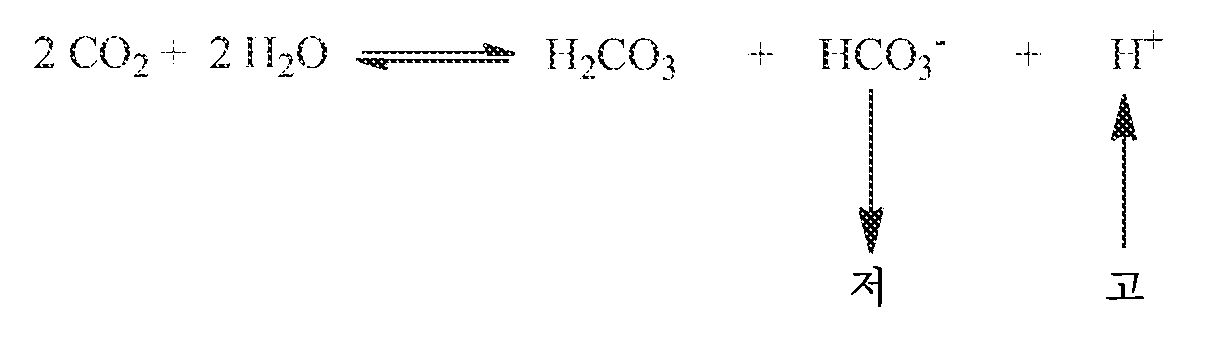
(Clinical practice guidelines for nutrition in chronic renal failure. K/DOQI, National Kidney Foundation. Am. J. Kidney Dis. 2000; 35:S1-140). 이러한 균형 방정식을 사용하면, 1개의 HCO3 -의 손실은 1개의 H+의 첨가에 해당하고, 반대로 1개의 HCO3 -의 획득은 1개의 H+의 손실에 해당한다. 따라서, 혈액 pH에서의 변화, 특히 H+의 증가 (더 낮은 pH, 산증)는 혈청 HCO3 -를 증가시킴으로써, 또는 동등하게, 혈청 H+를 감소시킴으로써 교정될 수 있다.(Clinical practice guidelines for nutrition in chronic renal failure. K/DOQI, National Kidney Foundation. Am. J. Kidney Dis. 2000; 35:S1-140). Using this balanced equation, the loss of 1 HCO 3 - corresponds to the addition of 1 H + , and conversely, the gain of 1 HCO 3 - corresponds to the loss of 1 H + . Thus, changes in blood pH, particularly an increase in H + (lower pH, acidosis), can be corrected by increasing serum HCO 3 - or, equivalently, by decreasing serum H + .
세포외 pH를 정상 범위 내로 유지시키기 위해, 매일 생산된 산은 신체로부터 배설되어야 한다. 신체에서의 산 생산은 식이 탄수화물, 지방 및 아미노산의 대사로 인한 것이다. 이들 대사 기질의 완전한 산화는 물 및 CO2를 생산한다. 이러한 산화에 의해 생성된 이산화탄소 (~20,000 mmol/일)는 폐에 의해 효율적으로 호기되고, 산-염기 균형의 휘발성 산 성분을 대표한다.To maintain extracellular pH within the normal range, the acids produced each day must be excreted from the body. Acid production in the body results from the metabolism of dietary carbohydrates, fats, and amino acids. Complete oxidation of these metabolic substrates produces water and CO 2 . The carbon dioxide produced by this oxidation (~20,000 mmol/day) is efficiently exhaled by the lungs and represents the volatile acid component of the acid-base balance.
대조적으로, 비휘발성 산 (~50-100 mEq/일)이 술페이트- 및 포스페이트-함유 아미노산 및 핵산의 대사에 의해 생산된다. 추가의 비휘발성 산 (락트산, 부티르산, 아세트산, 다른 유기 산)이 지방 및 탄수화물의 불완전 산화로부터, 및 결장에서의 탄수화물 대사로부터 발생하고, 여기서 결장 내강에 상주하는 박테리아는 기질을 소형 유기 산으로 전환시키고, 이는 이어서 혈류 내로 흡수된다. 산증에 대한 단쇄 지방산의 영향은 예를 들어 장쇄 지방산으로의 동화작용, 또는 물 및 CO2로의 이화작용에 의해 어느 정도 최소화된다.In contrast, nonvolatile acids (~50-100 mEq/day) are produced by metabolism of sulfate- and phosphate-containing amino acids and nucleic acids. Additional nonvolatile acids (lactic, butyric, acetic, and other organic acids) arise from incomplete oxidation of fats and carbohydrates, and from carbohydrate metabolism in the colon, where bacteria residing in the colonic lumen convert the substrates to small organic acids, which are then absorbed into the bloodstream. The contribution of short-chain fatty acids to acidosis is somewhat minimized by their assimilation into long-chain fatty acids, for example, or their catabolism into water and CO 2 .
신장은 2가지 메카니즘: 여과된 HCO3 -을 재활용하여 전체적인 비카르보네이트 고갈을 예방하고, 소변 내 비휘발성 산의 제거를 통해 혈액 중 pH 균형을 유지시킨다. 둘 다의 메카니즘은 비카르보네이트 고갈 및 산증을 예방하는데 필요하다.The kidneys maintain blood pH balance by two mechanisms: recycling filtered HCO 3 - to prevent overall bicarbonate depletion, and eliminating nonvolatile acids in the urine. Both mechanisms are necessary to prevent bicarbonate depletion and acidosis.
제1 메카니즘에서, 신장은 사구체에 의해 여과된 HCO3 -를 재활용한다. 이러한 재활용은 근위 세관에서 발생하고, 재활용된 HCO3 -는 ~4500 mEq/일에 달한다. 이러한 메카니즘은 HCO3 -가 소변 내에서 손실되는 것을 예방하여, 대사성 산증을 예방한다. 제2 메카니즘에서, 신장은 단백질, 지방 및 탄수화물의 대사 및 산화를 통한 매일의 비휘발성 산 생산과 동등한 정도로 충분한 H+를 제거한다. 이러한 산 부하의 제거는 H+ 이온의 능동 분비 및 암모니아생성을 포함하는, 신장에서의 2개의 별개의 경로에 의해 달성된다. 이들 2가지 상호연결된 과정의 순 결과는 정상 대사에 의해 생성된 비휘발성 산의 50-100 mEq/일의 제거이다.In the first mechanism, the kidney recycles HCO 3 - filtered by the glomeruli. This recycling occurs in the proximal tubule, and the recycled HCO 3 - amounts to ~4500 mEq/day. This mechanism prevents HCO 3 - from being lost in the urine, thus preventing metabolic acidosis. In the second mechanism, the kidney removes enough H + to equal the daily production of nonvolatile acids through the metabolism and oxidation of proteins, fats, and carbohydrates. Removal of this acid load is accomplished by two separate pathways in the kidney, involving active secretion of H + ions and ammonia production. The net result of these two interconnected processes is the removal of 50-100 mEq/day of nonvolatile acids produced by normal metabolism.
따라서, 정상 신기능은 산-염기 균형을 유지하기 위해 필요하다. 만성 신장 질환 동안, HCO3 -의 여과 및 재활용은 암모니아의 생성 및 분비에 따라 손상된다. 이들 결핍은 만성 대사성 산증으로 신속하게 이어지고, 이는 그 자체가 말기 신질환의 강력한 선행징후이다. 대사로부터의 계속적인 산 생산으로, 산 제거의 감소는 H+/HCO3 - 균형을 교란시켜 혈액 pH가 정상 값 pH = 7.38-7.42 미만으로 하락되게 할 것이다.Therefore, normal renal function is necessary to maintain acid-base balance. During chronic kidney disease, filtration and recycling of HCO 3 - are impaired, as is the production and secretion of ammonia. These deficiencies rapidly lead to chronic metabolic acidosis, which is itself a strong precursor of end-stage renal disease. With continued acid production from metabolism, decreased acid elimination will disrupt the H + /HCO 3 - balance, causing the blood pH to fall below the normal value of pH = 7.38-7.42.
알칼리 요법에 의한 대사성 산증의 치료는 통상적으로 혈장 pH를 7.20 초과로 상승 및 유지시키는 것으로 나타난다. 중탄산나트륨 (NaHCO3)은 대사성 산증을 교정하기 위해 가장 통상적으로 사용되는 작용제이다. NaHCO3은 혈청 HCO3 - 수준을 충분히 상승시켜 pH를 7.20 초과로 증가시키기 위해 정맥내 투여될 수 있다. 추가의 교정은 개개의 상황에 의존하고, 기저 과정이 치료가능한지 또는 환자가 무증상인지 여부가 나타내어지지 않을 수 있다. 이는 특히 특정 형태의 대사성 산증에서 그러하다. 예를 들어, 유기 산, 락트산 및 케톤의 축적에 속발성인 높은-음이온 갭 (AG) 산증에서, 동족 음이온은 결국 HCO3 -로 대사된다. 기저 장애가 치료되는 경우에 혈청 pH는 교정되고; 따라서, 이들 환자에서 알칼리를 제공하여 pH가 7.20을 훨씬 초과하여 상승된 경우에, 정상 범위 (> 26 mEq/L)를 초과하는 비카르보네이트에서의 증가를 예방하기 위해 주의를 기울여야 한다.Treatment of metabolic acidosis with alkaline therapy usually involves raising and maintaining the plasma pH above 7.20. Sodium bicarbonate (NaHCO 3 ) is the most commonly used agent to correct metabolic acidosis. NaHCO 3 may be administered intravenously to sufficiently raise serum HCO 3 - levels to raise the pH above 7.20. Additional correction will depend on the individual circumstances and may not be indicated if the underlying process is treatable or if the patient is asymptomatic. This is particularly true in certain forms of metabolic acidosis. For example, in high-anion gap (AG) acidosis secondary to the accumulation of organic acids, lactic acid, and ketones, the cognate anions are eventually metabolized to HCO 3 - . Serum pH is corrected when the underlying disorder is treated; Therefore, in these patients, care must be taken to prevent increases in bicarbonate beyond the normal range (>26 mEq/L) when providing alkaline solutions, which raise the pH significantly above 7.20.
시트레이트는 간에 의해 대사되고 시트레이트의 각각의 몰에 대해 3몰의 비카르보네이트의 형성이 유발되기 때문에, 칼륨 또는 나트륨 염으로서 경구 또는 IV로 제공되기에 적절한 알칼리 요법이다. IV 투여되는 시트르산칼륨은 신장애의 존재 하에 조심스럽게 사용되어야 하고, 고칼륨혈증을 피하기 위해 엄밀하게 모니터링되어야 한다.Citrate is metabolized by the liver and, because each mole of citrate results in the formation of 3 moles of bicarbonate, it is an appropriate alkaline therapy given orally or IV as the potassium or sodium salt. Potassium citrate given IV should be used cautiously in the presence of renal impairment and should be closely monitored to avoid hyperkalemia.
정맥내 중탄산나트륨 (NaHCO3) 용액은 대사성 산증이 중증인 경우에 또는 외인성 알칼리 투여없이는 교정이 일어날 가능성이 없는 경우에 투여될 수 있다. 경구 알칼리 투여는 만성 대사성 산증을 갖는 인간에서 바람직한 요법상 경로이다. 경구 요법을 위한 가장 흔한 알칼리 형태는 NaHCO3 정제를 포함하고, 여기서 NaHCO3 1 g은 HCO3 - 11.9 mEq와 동등하다. 그러나, NaHCO3의 경구 형태는 의학적 용도로 승인되지 않았고, 정맥내 중탄산나트륨 용액의 포장 삽입물은 하기 금기, 경고 및 예방조치를 포함한다 (NDC 0409-3486-16에 대한 호스피라(Hospira) 라벨):Intravenous sodium bicarbonate (NaHCO 3 ) solution may be administered in cases where metabolic acidosis is severe or where correction is unlikely to occur without exogenous alkali administration. Oral alkali administration is the preferred therapeutic route in humans with chronic metabolic acidosis. The most common form of alkali for oral therapy includes NaHCO 3 tablets, where 1 g of NaHCO 3 is equivalent to 11.9 mEq of HCO 3 . However, oral forms of NaHCO 3 are not approved for medical use, and the package insert for intravenous sodium bicarbonate solution contains the following contraindications, warnings, and precautions (Hospira labeling for NDC 0409-3486-16):
금기: 중탄산나트륨 주사, USP는 구토에 의해 또는 연속 위장 흡인으로부터 클로라이드 손실 중인 환자에서, 및 저염소혈증성 알칼리증을 생성하는 것으로 공지된 이뇨제를 제공받은 환자에서 금기된다.Contraindications: Sodium bicarbonate injection, USP is contraindicated in patients with chloride loss due to vomiting or from continuous gastric aspiration, and in patients receiving diuretics known to produce hypochloremic alkalosis.
경고: 나트륨 이온을 함유하는 용액은, 조금이라도, 울혈성 심부전, 중증 신기능부전을 갖는 환자에서, 및 나트륨 저류에 의한 부종이 존재하는 임상 상태에서 매우 조심하여 사용해야 한다. 신기능이 감소된 환자에서, 나트륨 이온을 함유하는 용액의 투여는 나트륨 저류를 야기할 수 있다. 이들 용액의 정맥내 투여는 유체 및/또는 용질 과부하를 유발하여 혈청 전해질 농도의 희석, 과수화, 울혈 상태 또는 폐 부종을 야기할 수 있다.WARNING: Solutions containing sodium ions should be used with extreme caution in patients with congestive heart failure, severe renal insufficiency, or in clinical settings where edema due to sodium retention is present. In patients with reduced renal function, administration of solutions containing sodium ions may cause sodium retention. Intravenous administration of these solutions may cause fluid and/or solute overload, resulting in dilution of serum electrolyte concentrations, hyperhydration, congestion, or pulmonary edema.
예방조치: [...] 비카르보네이트에 의해 제공되는 잠재적으로 많은 나트륨 부하는 울혈성 심부전 또는 다른 부종성 또는 나트륨-저류 상태를 갖는 환자, 뿐만 아니라 핍뇨 또는 무뇨를 갖는 환자에서의 중탄산나트륨의 사용에서 주의를 기울일 필요가 있다.Precautions: [...] the potentially large sodium load provided by bicarbonate warrants caution in the use of sodium bicarbonate in patients with congestive heart failure or other edematous or sodium-retaining states, as well as in patients with oliguria or anuria.
산-염기 장애는 만성 신장 질환 및 심부전 환자에서 흔하다. 만성 신장 질환 (CKD)은 건강한 성인에서 생성된 수소 이온의 대략 1 mmol/kg 체중의 신장 배설을 점진적으로 손상시킨다 (Yaqoob, MM. 2010, Acidosis and progression of chronic kidney disease, Curr. Opin. Nephrol. Hyperten. 19:489-492.). 체내 산 (H+)의 축적 또는 염기 (HCO3 -)의 고갈로부터 야기되는 대사성 산증은, 특히 사구체 여과율 (GFR, 신기능의 척도)이 30 ml/min/1.73m2 미만으로 하락한 CKD를 갖는 환자의 흔한 합병증이다. 대사성 산증은 단백질 및 근육 대사, 골 전환 및 신장 골이영양증의 발생에 매우 장기간의 효과를 갖는다. 또한, 대사성 산증은 다양한 주변분비 및 내분비 기능에 영향을 미쳐, 다시 증가된 염증 매개체, 감소된 렙틴, 인슐린 저항성, 및 증가된 코르티코스테로이드 및 부갑상선 호르몬 생산과 같은 장기간의 결과를 가져온다 (Mitch WE, 1997, Influence of metabolic acidosis on nutrition, Am. J. Kidney Dis. 29:46-48.). CKD 환자에서 지속적 대사성 산증의 순 효과는 골 및 근육 질량의 손실, 음의 질소 균형, 및 호르몬 및 세포 이상으로 인한 만성 신부전의 가속이다 (De Brito-Ashurst I, Varagunam M, Raftery MJ, et al., 2009, Bicarbonate supplementation slows progression of CKD and improves nutritional status, J. Am. Soc. Nephrol. 20: 2075-2084). 반대로, CKD 환자에서 알칼리 요법과 관련한 잠재적 관심사는 나트륨 섭취와 연관된 세포외액 부피의 팽창을 포함하며, 이는 고혈압의 발생 또는 악화, 혈관 석회화의 촉진, 및 기존 심부전의 대상부전을 야기한다. 중간 정도의 CKD 환자 (정상의 20-25%의 GFR)는 먼저 여과된 비카르보네이트의 재활용 및 양성자 및 암모늄 양이온의 배설 불능으로 인한, 정상 음이온 갭을 갖는 과염소혈증 산증이 발생한다. 이들이 CKD의 진행 병기로 진전됨에 따라, 배설되지 않은 양성자와 연관된 음이온을 배설하는 신장 능력의 계속적 열화를 반영하여 음이온 갭이 증가된다. 이들 환자에서 혈청 비카르보네이트는, 대략 20 mmol/L의 최대 상승 음이온 갭을 가지며 드물게는 15 mmol/L 미만으로 내려간다. CKD에서 축적된 비-대사가능한 음이온은 골로부터의 알칼리 염에 의해 완충된다 (Lemann J Jr, Bushinsky DA, Hamm LL Bone buffering of acid and base in humans. Am. J. Physiol Renal Physiol. 2003 Nov, 285(5):F811-32).Acid-base disturbances are common in patients with chronic kidney disease and heart failure. Chronic kidney disease (CKD) progressively impairs the renal excretion of approximately 1 mmol/kg body weight of hydrogen ions produced in healthy adults (Yaqoob, MM. 2010, Acidosis and progression of chronic kidney disease, Curr. Opin. Nephrol. Hyperten. 19:489-492.). Metabolic acidosis, resulting from accumulation of acid (H + ) or depletion of base (HCO 3 - ) in the body, is a common complication of CKD, especially in patients with a reduced glomerular filtration rate (GFR, a measure of renal function) below 30 ml/min/1.73 m 2 . Metabolic acidosis has very long-term effects on protein and muscle metabolism, bone turnover, and the development of renal osteodystrophy. Furthermore, metabolic acidosis affects a variety of paracrine and endocrine functions, again leading to long-term consequences such as increased inflammatory mediators, decreased leptin, insulin resistance, and increased corticosteroid and parathyroid hormone production (Mitch WE, 1997, Influence of metabolic acidosis on nutrition, Am. J. Kidney Dis. 29:46-48.). The net effect of persistent metabolic acidosis in patients with CKD is loss of bone and muscle mass, negative nitrogen balance, and acceleration of chronic renal failure due to hormonal and cellular abnormalities (De Brito-Ashurst I, Varagunam M, Raftery MJ, et al., 2009, Bicarbonate supplementation slows progression of CKD and improves nutritional status, J. Am. Soc. Nephrol. 20: 2075-2084). Conversely, potential concerns with alkaline therapy in patients with CKD include the expansion of extracellular fluid volume associated with sodium intake, which may contribute to the development or exacerbation of hypertension, promotion of vascular calcification, and decompensation of existing heart failure. Patients with intermediate CKD (GFR 20-25% of normal) initially develop hyperchloremic acidosis with a normal anion gap due to the inability to recycle filtered bicarbonate and excrete protons and ammonium cations. As they progress to advanced stages of CKD, the anion gap increases, reflecting the continuing deterioration in the renal ability to excrete the anions associated with the unexcreted protons. Serum bicarbonate in these patients has a maximal anion gap of approximately 20 mmol/L, rarely falling below 15 mmol/L. Non-metabolizable anions accumulated in CKD are buffered by alkaline salts from bone (Lemann J Jr, Bushinsky DA, Hamm LL Bone buffering of acid and base in humans. Am. J. Physiol Renal Physiol. 2003 Nov; 285(5):F811-32).
만성 신장 질환을 갖는 환자의 대부분은 기저 당뇨병 (당뇨병성 신병증) 및 고혈압을 가지며, 이는 신기능의 열화로 이어진다. 고혈압을 갖는 거의 모든 환자에서 높은 나트륨 섭취는 고혈압을 악화시킬 것이다. 따라서, 신장, 심부전, 당뇨병 및 고혈압 가이드라인은 이들 환자에서 나트륨 섭취를 1일에 1.5 g 또는 65 mEq 미만으로 엄격하게 제한한다 (HFSA 2010 guidelines, Lindenfeld 2010, J Cardiac Failure V16 No 6 P475). 만성 항고혈압 요법은 종종 나트륨 배설을 유도하거나 (이뇨제) 또는 나트륨 및 물을 배설하도록 신장 기능을 변형시킨다 (예컨대, 예를 들어, 레닌 안지오텐신 알도스테론 시스템 억제 "RAASi" 약물). 그러나, 신장 기능이 열화됨에 따라, 세관의 반응 불능으로 인해 이뇨제는 덜 효과적이게 된다. RAASi 약물은 신장 칼륨 배설을 억제하기 때문에 생명을 위협하는 고칼륨혈증을 유발한다. 추가의 나트륨 부하를 고려하면, 총 1일 권고 나트륨 섭취를 종종 초과하는 나트륨-함유 염기의 양으로 대사성 산증 환자를 만성 치료하는 것은 합리적인 실시가 아니다. 따라서, 경구 중탄산나트륨은 이들 당뇨병성 신병증 환자에서 통상적으로 만성 처방되지 않는다. 중탄산칼륨은 또한, CKD를 갖는 환자가 용이하게 칼륨을 배설하지 못하여 중증 고칼륨혈증으로 이어지기 때문에 허용되지 않는다.Most patients with chronic kidney disease have underlying diabetes (diabetic nephropathy) and hypertension, which leads to impaired renal function. In almost all patients with hypertension, high sodium intake will worsen hypertension. Therefore, the Renal, Heart Failure, Diabetes and Hypertension guidelines strictly limit sodium intake in these patients to less than 1.5 g or 65 mEq per day (HFSA 2010 guidelines, Lindenfeld 2010, J Cardiac Failure V16 No 6 P475). Chronic antihypertensive therapy often induces sodium excretion (diuretics) or modifies renal function to excrete sodium and water (e.g., renin angiotensin aldosterone system inhibitor "RAASi" drugs). However, as renal function deteriorates, diuretics become less effective due to the inability of the tubules to respond. RAASi drugs cause life-threatening hyperkalemia because they inhibit renal potassium excretion. Given the additional sodium load, it is not reasonable practice to chronically treat patients with metabolic acidosis with amounts of sodium-containing bases that often exceed the total recommended daily sodium intake. Therefore, oral sodium bicarbonate is not routinely prescribed chronically in these patients with diabetic nephropathy. Potassium bicarbonate is also not tolerated because patients with CKD cannot readily excrete potassium, leading to severe hyperkalemia.
이들 결점에도 불구하고, 경구 중탄산나트륨의 역할은 비-고혈압 CKD 환자의 소규모 하위집단에서 연구되어 왔다. 신장 연구 국민 대화의 일부로서, 알칼리 요법은 CKD의 진행을 느리게 할 뿐만 아니라, 대사성 산증을 교정하는 잠재력을 갖는 것으로서 확인되었다. 40세 이후 사구체 여과율 (GFR)에서의 매년 연령-관련 저하는 정상 개체에서 0.75-1.0 ml/min/1.73m2이다. 신속한 진행을 갖는 CKD 환자에서, 매년 >4 ml/min/1.73m2의 보다 가파른 저하를 관찰할 수 있다.Despite these drawbacks, the role of oral sodium bicarbonate has been studied in a small subset of patients with non-hypertensive CKD. As part of the National Dialogue on Kidney Research, alkaline therapy was identified as having the potential to not only slow the progression of CKD but also correct metabolic acidosis. The annual age-related decline in glomerular filtration rate (GFR) after age 40 years is 0.75-1.0 ml/min/1.73 m 2 in normal individuals. In patients with rapidly progressive CKD, a steeper decline of >4 ml/min/1.73 m 2 per year can be observed.
한 결과 연구에서, 드 브리토-아슈르스트(De Brito-Ashurst) 등은 비카르보네이트 보충이 CKD에서 신기능을 보존한다는 것을 제시하였다 (De Brito-Ashurst I, Varagunam M, Raftery MJ, et al., 2009, Bicarbonate supplementation slows progression of CKD and improves nutritional status, J. Am. Soc. Nephrol. 20: 2075-2084). 상기 연구는 CKD를 갖고 (1.73 m2당 크레아티닌 클리어런스 [CrCl] 15 내지 30 ml/min) 혈청 비카르보네이트가 16 내지 20 mmol/L인 134명의 성인 환자를 2년 동안의 경구 중탄산나트륨 보충 또는 표준 치료로 무작위 할당하였다. 이 연구에서 비카르보네이트의 평균 용량은 1.82 g/일로, 이는 1일에 22 mEq의 비카르보네이트를 제공한다. 1차 종점은 CrCl 저하 속도, CrCl의 신속한 저하 (1.73 m2/yr당 >3ml/min) 및 말기 신질환 ("ESRD") (CrCl <10 ml/min)을 갖는 환자의 비율이었다. 대조군과 비교하여, CrCl의 저하는 비카르보네이트 보충에 의해 더 느려졌다 (비카르보네이트를 제공받은 환자의 경우에 1.73 m2당 1.88 ml/min의 감소 대 대조군의 경우에 1.73 m2당 5.93 ml/min의 감소; P<0.0001). 비카르보네이트로 보충된 환자는 신속한 진행을 유의하게 덜 겪을 가능성이 있었다 (9% 대 45%; 상대 위험 0.15; 95% 신뢰 구간 0.06 내지 0.40; P < 0.0001). 유사하게, 비카르보네이트로 보충된 더 적은 환자에서 ESRD가 발생하였다 (6.5% 대 33%; 상대 위험 0.13; 95% 신뢰 구간 0.04 내지 0.40; P < 0.001).In one outcome study, De Brito-Ashurst et al. suggested that bicarbonate supplementation preserves renal function in CKD (De Brito-Ashurst I, Varagunam M, Raftery MJ, et al., 2009, Bicarbonate supplementation slows progression of CKD and improves nutritional status, J. Am. Soc. Nephrol. 20: 2075-2084). The study randomly assigned 134 adult patients with CKD (creatinine clearance [CrCl] 15 to 30 ml/min per 1.73 m 2 ) and serum bicarbonate 16 to 20 mmol/L to oral sodium bicarbonate supplementation or standard care for 2 years. The mean dose of bicarbonate in this study was 1.82 g/day, providing 22 mEq of bicarbonate per day. The primary endpoint was the rate of CrCl decline, the proportion of patients with rapid CrCl decline (>3 ml/min per 1.73 m 2 /yr) and end-stage renal disease ("ESRD") (CrCl <10 ml/min). Compared with control, the decline in CrCl was slower with bicarbonate supplementation (decrease of 1.88 ml/min per 1.73 m 2 in patients receiving bicarbonate versus 5.93 ml/min per 1.73 m 2 in controls; P<0.0001). Patients supplemented with bicarbonate were significantly less likely to experience rapid progression (9% vs 45%; relative risk 0.15; 95% confidence interval 0.06 to 0.40; P<0.0001). Similarly, fewer patients supplemented with bicarbonate developed ESRD (6.5% vs 33%; relative risk 0.13; 95% confidence interval 0.04 to 0.40; P < 0.001).
고인산혈증은 CKD를 갖는 환자, 특히 진행성 또는 말기 신질환을 갖는 환자에서 흔한 동반질환이다. 세벨라머 히드로클로라이드는 혈청 포스페이트 농도를 감소시키는 통상적으로 사용되는 이온-교환 수지이다. 그러나, 이러한 작용제의 보고된 결점은 소장에서 포스페이트 결합 과정에서 HCl의 순 흡수로 인한 대사성 산증을 분명하게 포함한다. 혈액투석 또는 복막 투석을 받은 CKD 및 고인산혈증을 갖는 환자에서의 여러 연구는 세벨라머 히드로클로라이드의 사용에 의한 혈청 비카르보네이트 농도에서의 감소를 발견하였다 (Brezina, 2004 Kidney Int. V66 S90 (2004) S39-S45; Fan, 2009 Nephrol Dial Transplant (2009) 24:3794).Hyperphosphatemia is a common comorbidity in patients with CKD, particularly those with advanced or end-stage renal disease. Sevelamer hydrochloride is a commonly used ion-exchange resin that reduces serum phosphate concentrations. However, reported drawbacks of this agent clearly include metabolic acidosis due to net absorption of HCl during phosphate binding in the small intestine. Several studies in patients with CKD and hyperphosphatemia undergoing hemodialysis or peritoneal dialysis have found a decrease in serum bicarbonate concentrations with the use of sevelamer hydrochloride (Brezina, 2004 Kidney Int. V66 S90 (2004) S39-S45; Fan, 2009 Nephrol Dial Transplant (2009) 24:3794).
따라서, 본 발명의 다양한 측면 중에서, 인간을 비롯한 동물을 치료하기 위한 조성물 및 치료 방법, 및 이러한 조성물을 제조하는 방법이 주목될 수 있다. 조성물은 가교 아민 중합체를 포함하고, 예를 들어, 위장관으로부터 양성자 및/또는 클로라이드 이온의 제거가 생리학적 이익을 제공하는 질환 또는 다른 대사 상태를 치료하는데 사용될 수 있다. 예를 들어, 본원에 기재된 중합체는 인간을 비롯한 동물에서 산-염기 관련 질환을 조절하는데 사용될 수 있다. 한 이러한 실시양태에서, 본원에 기재된 중합체는 인간을 비롯한 동물에서 혈청 비카르보네이트 농도 및 혈액 pH를 정상화하는데 사용될 수 있다. 추가의 예로서, 본원에 기재된 중합체는 산증의 치료에 사용될 수 있다. 이러한 불균형을 기재하고 있는 여러 별개의 생리학적 상태가 존재하고, 그 각각은 HCl에 결합하고 이를 제거하는 중합체에 의해 치료될 수 있다.Accordingly, among the various aspects of the present invention, compositions and methods for treating animals, including humans, and methods for making such compositions may be noted. The compositions comprise crosslinked amine polymers and may be used, for example, to treat diseases or other metabolic conditions in which removal of protons and/or chloride ions from the gastrointestinal tract provides a physiological benefit. For example, the polymers described herein may be used to modulate acid-base related diseases in animals, including humans. In one such embodiment, the polymers described herein may be used to normalize serum bicarbonate concentrations and blood pH in animals, including humans. As a further example, the polymers described herein may be used to treat acidosis. There are several distinct physiological conditions that describe such imbalances, each of which may be treated by polymers that bind and remove HCl.
산의 순 획득으로 인한 대사성 산증은 내인성 수소 이온 생산을 증가시키는 과정, 예컨대 케톤산증, L-락트산증, D-락트산증 및 살리실레이트 중독을 포함한다. 메탄올, 에틸렌 글리콜 및 파라알데히드와 같은 섭취된 독소의 대사도 또한 수소 이온 농도를 증가시킬 수 있다. 요독성 산증 및 원위 (제I형) 신세관성 산증에서와 같은 수소 이온의 감소된 신장 배설은 대사성 산증을 야기하는 체내 산의 순 획득의 또 다른 원인이다. 비카르보네이트의 손실로 인한 대사성 산증은 근위 (제II형) 신세관성 산증의 특징이다. 또한, 급성 또는 만성 설사에서 비카르보네이트의 위장 손실도 또한 대사성 산증을 야기한다. 원발성 또는 속발성 저알도스테론증은 고칼륨혈증 및 대사성 산증을 유발하는 공통 장애이고, 제IV형 신세관성 산증 분류의 기저를 이룬다. 저레닌성 저알도스테론증은 이러한 장애의 가장 빈번하게 직면하는 종류이다.Metabolic acidosis due to net gain of acid includes processes that increase endogenous hydrogen ion production, such as ketoacidosis, L-lactic acidosis, D-lactic acidosis, and salicylate intoxication. Metabolism of ingested toxins, such as methanol, ethylene glycol, and paraldehyde, can also increase hydrogen ion concentration. Reduced renal excretion of hydrogen ions, such as in uremic acidosis and distal (type I) renal tubular acidosis, is another cause of net gain of acid in the body that causes metabolic acidosis. Metabolic acidosis due to loss of bicarbonate is characteristic of proximal (type II) renal tubular acidosis. In addition, gastrointestinal loss of bicarbonate in acute or chronic diarrhea also causes metabolic acidosis. Primary or secondary hypoaldosteronism is a common disorder causing hyperkalemia and metabolic acidosis, and forms the basis of the classification of type IV renal tubular acidosis. Hyporenin-related hypoaldosteronism is the most frequently encountered type of this disorder.
대사성 산증을 기재하는 또 다른 방식은 음이온 갭의 관점이다. 높은 음이온 갭 산증의 원인은 당뇨병성 케톤산증, L-락트산증, D-락트산증, 알콜성 케톤산증, 고갈성 케톤산증, 진행성 신부전 (CKD 병기 4 - 5) 연관 요독성 산증, 살리실레이트 중독, 및 메탄올, 에틸렌, 프로필렌 글리콜 및 파라알데히드를 포함한 섭취로 인한 선택된 독소 노출을 포함한다. 정상 음이온 갭 산증의 원인은 초기 신부전 (CKD 병기 1 - 3), 급성 또는 만성 설사로 인한 비카르보네이트의 위장 손실, 원위 (제I형) 신세관성 산증, 근위 (제II형) 신세관성 산증, 제IV형 신세관성 산증, 대용량 정맥내 유체 투여와 연관된 희석성 산증, 및 소변에서 손실된 케톤으로 인한 당뇨병성 케톤산증의 치료를 포함한다.Another way to describe metabolic acidosis is in terms of the anion gap. Causes of high anion gap acidosis include diabetic ketoacidosis, L-lactic acidosis, D-lactic acidosis, alcoholic ketoacidosis, depleting ketoacidosis, uremic acidosis associated with advanced renal failure (CKD stages 4-5), salicylate intoxication, and exposure to selected toxins from ingestion, including methanol, ethylene, propylene glycol, and paraldehyde. Causes of normal anion gap acidosis include early renal failure (CKD stages 1-3), gastrointestinal loss of bicarbonate from acute or chronic diarrhea, distal (type I) renal tubular acidosis, proximal (type II) renal tubular acidosis, type IV renal tubular acidosis, dilutional acidosis associated with large intravenous fluid administration, and treatment of diabetic ketoacidosis due to ketones lost in the urine.
락트산 산증과 관련하여, 저산소 락트산 산증은 산소 균형 및 산소 공급 사이의 불균형으로 인한 것으로, 조직 허혈, 발작, 극한 운동, 쇼크, 심장 정지, 낮은 심장 박출량 및 울혈성 심부전, 중증 빈혈, 중증 저산소혈증 및 일산화탄소 중독, 비타민 결핍 및 패혈증과 연관된다. 다른 유형의 락트산 산증에서, 산소 전달은 정상이지만 종종 세포 미토콘드리아 결핍의 결과로 산화성 인산화가 손상된다. 이는 선천성 대사 이상에서 또는 약물 또는 독소의 섭취로부터 흔히 관찰된다. 튜브 섭식을 위해 또는 수술 동안 관개제로서 사용되는 환원당 (예를 들어, 프룩토스, 소르비톨)은 또한 락트산 산증을 촉발시키는 대사를 야기할 수 있다.In relation to lactic acidosis, hypoxic lactic acidosis is due to an imbalance between oxygen balance and oxygen supply, and is associated with tissue ischemia, stroke, extreme exercise, shock, cardiac arrest, low cardiac output and congestive heart failure, severe anemia, severe hypoxemia and carbon monoxide poisoning, vitamin deficiency and sepsis. In other types of lactic acidosis, oxygen delivery is normal, but oxidative phosphorylation is impaired, often as a result of cellular mitochondrial deficiency. This is commonly observed in inborn errors of metabolism or from the ingestion of drugs or toxins. Reducing sugars (e.g., fructose, sorbitol) used for tube feeding or as irrigants during surgery can also cause metabolic reactions that precipitate lactic acidosis.
3가지 주요 분류의 신세관성 산증이 존재하며, 각각은 별개의 병인을 갖고 여러 하위-유형을 갖는다. 원위 (제I형) 신세관성 산증은 유전 및 게놈 변화, 특히 HCO3 -/Cl- 교환체 (AE1) 또는 H+/ATPase에서의 돌연변이에 의해 유발될 수 있다. 후천성 원위 (제I형) 신세관성 산증의 예는 부갑상선기능항진증, 쇼그렌 증후군, 수질성 해면 신장, 한랭글로불린혈증, 전신 홍반성 루푸스, 신장 이식 거부, 만성 세관간질성 질환, 및 암포테리신 B, 리튬, 이포스파미드, 포스카르넷, 톨루엔 및 바나듐을 비롯한 다양한 약물에의 노출을 포함한다. 고칼륨혈증 동반 원위 (제IV형) 신세관성 산증의 특별한 분류가 루푸스 신염, 폐쇄성 신병증, 겸상 적혈구성 빈혈 및 전압 결함에서 발견된다. 유전의 예는 제I형 가성저알도스테론증 및 제II형 가성저알도스테론증 (고르돈병)을 포함하고, 특정 약물 (아밀로리드, 트리암테렌, 트리메토프림 및 펜타미딘)에 대한 노출은 또한 고칼륨혈증 동반 원위 (제IV형) 신세관성 산증을 야기할 수 있다. 근위 (제II형) 신세관성 산증은 유전 또는 후천성 원인에 의해 유발될 수 있다. 유전 원인은 윌슨병 및 로웨 증후군을 포함한다. 후천성 원인은 시스틴축적증, 갈락토스혈증, 다발성 골수종, 경쇄 질환, 아밀로이드증, 비타민 D 결핍, 납 및 수은 섭취, 및 이포스파미드, 시도포비르, 아미노글리코시드 및 아세타졸아미드를 비롯한 특정 약물에 대한 노출을 포함한다. 비카르보네이트 재흡수에서 단리된 결함은 근위 (제II형) 신세관성 산증의 원인일 수 있고; 이러한 결함의 예는 탄산 안히드라제 억제제, 아세타졸아미드, 토피라메이트, 술파밀론에 대한 노출 및 탄산 안히드라제 결핍을 포함한다. 조합 근위 및 원위 신세관성 산증 (제III형)은 흔치 않고, 근위 비카르보네이트 재흡수 및 원위 양성자 분비 둘 다에서의 결함에서 기인한다. 시토졸 탄산 안히드라제에 대한 유전자에서의 돌연변이는 결함 뿐만 아니라 이포스파미드를 비롯한 특정 약물을 유발할 수 있다. 고칼륨혈증 동반 제IV형 신세관성 산증은 대사성 산증의 원인이다. 이러한 유형의 산증의 배후 주요 병인은 알도스테론 결핍이고; 저알도스테론증은 원발성 부신 부전, 고령 개체에서 흔히 관찰되는 저레닌성 저알도스테론증 증후군 (제IV형 RTA), 애디슨병, 및 미네랄로코르티코이드 저항성으로 인한 제I형 가성저알도스테론증에서 기인한다. 진통제성 신병증, 만성 신우신염, 폐쇄성 신병증 및 겸상 적혈구 질환으로 인한 만성 간질성 신염도 또한 고칼륨혈증 동반 산증을 생성할 수 있다. 마지막으로, 약물, 예컨대 아밀로리드, 스피로노락톤, 트리암테렌, 트리메토프림, 헤파린 요법, NSAID, 안지오텐신 수용체 차단제 및 안지오텐신-전환 효소 억제제가 고칼륨혈증을 동반하는 대사성 산증을 유발할 수 있다.There are three major classes of renal tubular acidosis, each with distinct etiologies and several subtypes. Distal (type I) renal tubular acidosis may be caused by genetic and genomic alterations, particularly mutations in the HCO 3 - /Cl - exchanger (AE1) or H + /ATPase. Examples of acquired distal (type I) renal tubular acidosis include hyperparathyroidism, Sjögren's syndrome, medullary spongiform kidney, cryoglobulinemia, systemic lupus erythematosus, renal transplant rejection, chronic tubulointerstitial disease, and exposure to various drugs, including amphotericin B, lithium, ifosfamide, foscarnet, toluene, and vanadium. A special class of distal (type IV) renal tubular acidosis with hyperkalemia is found in lupus nephritis, obstructive nephropathy, sickle cell anemia, and voltage defects. Hereditary examples include pseudohypoaldosteronism type I and type II pseudohypoaldosteronism (Gordon disease), and exposure to certain drugs (amiloride, triamterene, trimethoprim, and pentamidine) can also cause distal (type IV) renal tubular acidosis with hyperkalemia. Proximal (type II) renal tubular acidosis can be caused by hereditary or acquired causes. Hereditary causes include Wilson's disease and Lowe syndrome. Acquired causes include cystinosis, galactosemia, multiple myeloma, light chain disease, amyloidosis, vitamin D deficiency, lead and mercury ingestion, and exposure to certain drugs, including ifosfamide, cidofovir, aminoglycosides, and acetazolamide. Isolated defects in bicarbonate reabsorption can be a cause of proximal (type II) renal tubular acidosis; Examples of such defects include exposure to carbonic anhydrase inhibitors, acetazolamide, topiramate, sulfamylone, and carbonic anhydrase deficiency. Combined proximal and distal renal tubular acidosis (type III) is rare and results from defects in both proximal bicarbonate reabsorption and distal proton secretion. Mutations in the gene for cytosolic carbonic anhydrase can cause the defect, as well as certain drugs, including ifosfamide. Type IV renal tubular acidosis with hyperkalemia is a cause of metabolic acidosis. The primary etiology behind this type of acidosis is aldosterone deficiency; hypoaldosteronism results from primary adrenal insufficiency, the syndrome of hyporenin hypoaldosteronism (type IV RTA), which is common in elderly individuals, Addison's disease, and type I pseudohypoaldosteronism due to mineralocorticoid resistance. Chronic interstitial nephritis due to analgesic nephropathy, chronic pyelonephritis, obstructive nephropathy, and sickle cell disease may also produce acidosis with hyperkalemia. Finally, drugs such as amiloride, spironolactone, triamterene, trimethoprim, heparin therapy, NSAIDs, angiotensin receptor blockers, and angiotensin-converting enzyme inhibitors may cause metabolic acidosis with hyperkalemia.
대사성 산증의 모든 상기 원인 및 병인은 위장관에서 HCl에 결합하고 이를 제거하도록 설계된 중합체에 의해 치료될 수 있다.All of the above causes and pathogenesis of metabolic acidosis can be treated by polymers designed to bind and remove HCl in the gastrointestinal tract.
치료 방법은 일반적으로 동물, 예컨대 인간의 위장관으로부터 양성자 및 클로라이드 이온 제거 능력을 갖는 가교 아민 중합체의 치료 유효량을 투여하는 것을 수반한다. 일반적으로, 이러한 가교 아민 중합체는 비교적 낮은 팽윤, 비교적 높은 양성자 및 클로라이드 이온 결합, 및/또는 비교적 낮은 간섭 음이온, 예컨대 포스페이트, 시트레이트, 단쇄 지방산 및 담즙산 결합 중 2개 이상의 특징을 갖는다. 하기 실시예 및 실시양태에서, 달리 나타내지 않는 한, 가교 아민 중합체는 유리 아민 형태로 사용되고, 음이온 결합을 위해 아민의 양성자화를 필요로 한다. 이에 따라 많은 검정은 음이온 결합을 보고하고, 낮은 정도의 아민 4급화의 필요 조건으로 인해, 음이온 결합은 양성자 결합의 양을 대략화하는데 추정된다. 예를 들어, 한 실시양태에서 가교 아민 중합체는 하기 특징 중 적어도 2개를 보유한다: (i) 인공 위액 ("SGF") 중에서 적어도 약 5 mmol/g의 양성자-결합 능력 및 클로라이드 결합 능력; (ii) 약 5 미만의 팽윤 비; (iii) 인공 소장 무기 완충제 ("SIB") 중에서 각각 적어도 약 0.35:1의 클로라이드 대 포스페이트 이온 결합 비, (iv) 인공 소장 유기 및 무기 완충제 ("SOB") 중에서 다른 음이온에 우선한 클로라이드에 대한 선택성, (v) 약 80-120 마이크로미터의 평균 입자 크기, (vi) 클로라이드 저류 검정 ("CRA", 하기 정의됨) 적용 시 결합된 HCl의 약 50% 초과의 저류, (vii) 중합체의 주요 치료 작용을 구성하는 양성자 결합을 확실하게 하기 위해 인간을 비롯한 동물에게 투여 후 4급화 아민 검정 ("QAA")에서 측정 시, 약 40% 이하의 4급화 아민 기, (viii) "SOB" 중에서 각각 적어도 약 0.35:1의 클로라이드 대 간섭 음이온 결합 비, (ix) 50 내지 170 달톤의 질소당 분자량, 및/또는 (x) 25 내지 90%의 가교제 중량 퍼센트 범위. 예를 들어, 한 이러한 실시양태에서 가교 아민 중합체는 본 단락에서 확인되는 특징 "(i)" 내지 "(x)" 중 2종의 특징을 보유한다. 추가 예로서, 한 이러한 실시양태에서 가교 아민 중합체는 본 단락에서 확인되는 특징 "(i)" 내지 "(x)" 중 적어도 3종의 특징을 보유한다. 추가 예로서, 한 이러한 실시양태에서 가교 아민 중합체는 본 단락에서 확인되는 특징 "(i)" 내지 "(x)" 중 적어도 4종의 특징을 보유한다. 추가 예로서, 한 이러한 실시양태에서 가교 아민 중합체는 본 단락에서 확인되는 특징 "(i)" 내지 "(x)" 중 적어도 5종의 특징을 보유한다. 추가 예로서, 한 이러한 실시양태에서 가교 아민 중합체는 본 단락에서 확인되는 특징 "(i)" 내지 "(x)" 중 적어도 6종의 특징을 보유한다. 추가 예로서, 한 이러한 실시양태에서 가교 아민 중합체는 본 단락에서 확인되는 특징 "(i)" 내지 "(x)" 중 적어도 7종의 특징을 보유한다. 추가 예로서, 한 이러한 실시양태에서 가교 아민 중합체는 본 단락에서 확인되는 특징 "(i)" 내지 "(x)" 중 적어도 8종의 특징을 보유한다.The therapeutic method generally involves administering a therapeutically effective amount of a crosslinked amine polymer having the ability to remove protons and chloride ions from the gastrointestinal tract of an animal, such as a human. Typically, such crosslinked amine polymers have at least two of the following characteristics: relatively low swelling, relatively high proton and chloride ion binding, and/or relatively low interfering anion binding, such as phosphate, citrate, short chain fatty acids, and bile acids. In the examples and embodiments below, unless otherwise indicated, the crosslinked amine polymers are used in the free amine form, which requires protonation of the amine for anion binding. Accordingly, many assays report anion binding, and due to the requirement for a low degree of amine quaternization, anion binding is estimated to approximate the amount of proton binding. For example, in one embodiment, the crosslinked amine polymer has at least two of the following characteristics: (i) a proton-binding capacity and a chloride binding capacity of at least about 5 mmol/g in simulated gastric fluid (“SGF”); (ii) a swelling ratio of less than about 5; (iii) a chloride to phosphate ion binding ratio of at least about 0.35:1 in each of an artificial small intestine inorganic buffer (“SIB”), (iv) selectivity for chloride over other anions in an artificial small intestine organic and inorganic buffer (“SOB”), (v) a mean particle size of about 80-120 microns, (vi) retention of greater than about 50% of bound HCl when subjected to a chloride retention assay (“CRA”, defined below), (vii) no more than about 40% quaternized amine groups as measured in a quaternized amine assay (“QAA”) following administration to an animal, including a human, to ensure that proton binding constitutes the primary therapeutic action of the polymer, (viii) a chloride to interfering anion binding ratio of at least about 0.35:1 in each of the “SOB”, (ix) a molecular weight per nitrogen of from 50 to 170 daltons, and/or (x) a cross-linker weight percent range of from 25 to 90%. For example, in one such embodiment, the crosslinked amine polymer possesses two of the features "(i)" to "(x)" identified in this paragraph. As a further example, in one such embodiment, the crosslinked amine polymer possesses at least three of the features "(i)" to "(x)" identified in this paragraph. As a further example, in one such embodiment, the crosslinked amine polymer possesses at least four of the features "(i)" to "(x)" identified in this paragraph. As a further example, in one such embodiment, the crosslinked amine polymer possesses at least five of the features "(i)" to "(x)" identified in this paragraph. As a further example, in one such embodiment, the crosslinked amine polymer possesses at least six of the features "(i)" to "(x)" identified in this paragraph. As a further example, in one such embodiment, the crosslinked amine polymer possesses at least seven of the features "(i)" to "(x)" identified in this paragraph. As a further example, in one such embodiment, the crosslinked amine polymer possesses at least eight of the features "(i)" to "(x)" identified in this paragraph.
한 실시양태에서, 가교 아민 중합체는 가교 아민 중합체 및, 임의로 생체내에서 가교 아민 중합체의 양성자 및/또는 클로라이드 결합 특징을 유의하게 방해하지 않는 제약상 허용되는 담체, 희석제 또는 부형제, 또는 그의 조합을 포함하는 제약 조성물로서 투여된다. 임의로, 제약 조성물은 또한 추가의 치료제를 포함할 수 있다.In one embodiment, the crosslinked amine polymer is administered as a pharmaceutical composition comprising the crosslinked amine polymer and, optionally, a pharmaceutically acceptable carrier, diluent or excipient, or a combination thereof, that does not significantly interfere with the proton and/or chloride binding characteristics of the crosslinked amine polymer in vivo. Optionally, the pharmaceutical composition can also include an additional therapeutic agent.
일부 실시양태에서, 제약 조성물은 (i) 인공 소장 무기 완충제 ("SIB") 중에서 각각 적어도 0.35:1의 클로라이드 대 포스페이트 이온 결합 비, 및 (ii) 약 5를 초과하지 않는 팽윤 비를 갖는 가교 아민 중합체를 포함한다.In some embodiments, the pharmaceutical composition comprises (i) a crosslinked amine polymer having a chloride to phosphate ion binding ratio of at least 0.35:1, and (ii) a swelling ratio not greater than about 5, in an artificial small intestinal inorganic buffer (“SIB”).
일부 실시양태에서, 제약 조성물은 (i) 인공 소장 유기 및 무기 완충제 ("SOB") 중에서 다른 음이온에 우선한 클로라이드에 대한 선택성, 및 (ii) 약 5를 초과하지 않는 팽윤 비를 갖는 가교 아민 중합체를 포함한다.In some embodiments, the pharmaceutical composition comprises a crosslinked amine polymer having (i) selectivity for chloride over other anions among artificial small intestine organic and inorganic buffers (“SOB”), and (ii) a swelling ratio not greater than about 5.
일부 실시양태에서, 제약 조성물은 (i) 인공 위액 중에서 적어도 5 mmol/g의 양성자-결합 능력 및 클로라이드 결합 능력; 및 (ii) 약 2를 초과하지 않는 팽윤 비를 갖는 가교 아민 중합체를 포함한다.In some embodiments, the pharmaceutical composition comprises a cross-linked amine polymer having (i) a proton-binding capacity and a chloride binding capacity of at least 5 mmol/g in artificial gastric fluid; and (ii) a swelling ratio not exceeding about 2.
일부 실시양태에서, 제약 조성물은 (i) 인공 위액 중에서 적어도 5 mmol/g의 양성자-결합 능력 및 클로라이드 결합 능력; (ii) 5 미만의 팽윤 비, 및 (iii) 인공 소장 무기 완충제 ("SIB") 중에서 각각 적어도 0.35:1의 클로라이드 대 포스페이트 이온 결합 비를 갖는 가교 아민 중합체를 포함한다.In some embodiments, the pharmaceutical composition comprises a cross-linked amine polymer having (i) a proton-binding capacity and a chloride binding capacity of at least 5 mmol/g in artificial gastric fluid; (ii) a swelling ratio of less than 5, and (iii) a chloride to phosphate ion binding ratio of at least 0.35:1, each in an artificial small intestinal inorganic buffer (“SIB”).
일부 실시양태에서, 제약 조성물은 (i) 인공 위액 중에서 적어도 5 mmol/g의 양성자-결합 능력 및 클로라이드 결합 능력; (ii) 5 미만의 팽윤 비, 및 (iii) 인공 소장 유기 및 무기 완충제 ("SOB") 중에서 다른 음이온에 우선한 클로라이드에 대한 선택성을 갖는 가교 아민 중합체를 포함한다.In some embodiments, the pharmaceutical composition comprises a cross-linked amine polymer having (i) a proton-binding capacity and a chloride binding capacity of at least 5 mmol/g in artificial gastric fluid; (ii) a swelling ratio of less than 5, and (iii) selectivity for chloride over other anions in artificial small intestine organic and inorganic buffers (“SOB”).
일부 실시양태에서, 제약 조성물은 i) 인공 유기/무기 완충제 (SOB) 중에서 >2mmol/g의 클로라이드 결합 능력 및 ii) 클로라이드 저류 검정 (CRA)에서 평가 시 결합된 클로라이드의 >50% 저류를 갖는 가교 아민 중합체를 포함한다.In some embodiments, the pharmaceutical composition comprises a cross-linked amine polymer having i) a chloride binding capacity of >2 mmol/g in a synthetic organic/inorganic buffer (SOB) and ii) retention of >50% of bound chloride as assessed in a chloride retention assay (CRA).
일부 실시양태에서, 제약 조성물은 i) 인공 위액 (SGF) 중에서 >5mmol/g의 클로라이드 결합 능력 및 ii) 4급화 아민 검정 (QAA)에서 측정 시 40% 이하의 4급화 아민 기를 갖는 가교 아민 중합체를 포함한다.In some embodiments, the pharmaceutical composition comprises a cross-linked amine polymer having i) a chloride binding capacity of >5 mmol/g in simulated gastric fluid (SGF) and ii) 40% or less of quaternized amine groups as measured in a quaternized amine assay (QAA).
일부 실시양태에서, 제약 조성물은 하기 화학식 1에 상응하는 아민의 잔기를 포함하는 가교 아민 중합체를 포함한다.In some embodiments, the pharmaceutical composition comprises a crosslinked amine polymer comprising an amine residue corresponding to Formula 1:
<화학식 1><Chemical formula 1>
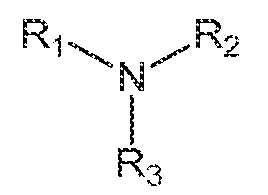
여기서 R1, R2 및 R3은 독립적으로 수소, 히드로카르빌, 또는 치환된 히드로카르빌이지만, 단 R1, R2 및 R3 중 적어도 1개는 수소 이외의 것이고, 가교 아민 중합체는 (i) pH 1.2 및 37℃에서 35 mM NaCl 및 63 mM HCl을 함유하는 수성 인공 위액 완충제 ("SGF") 중에서 적어도 5 mmol/g의 평형 양성자 결합 능력 및 적어도 5 mmol/g의 클로라이드 이온 결합 능력 및 (ii) 약 2 이하의 탈이온수 중 평형 팽윤 비를 갖는다.wherein R 1 , R 2 and R 3 are independently hydrogen, hydrocarbyl, or substituted hydrocarbyl, provided that at least one of R 1 , R 2 and R 3 is other than hydrogen, and the crosslinked amine polymer has (i) an equilibrium proton binding capacity of at least 5 mmol/g and a chloride ion binding capacity of at least 5 mmol/g in an aqueous simulated gastric fluid buffer (“SGF”) containing 35 mM NaCl and 63 mM HCl at pH 1.2 and 37° C., and (ii) an equilibrium swelling ratio in deionized water of about 2 or less.
일부 실시양태에서, 제약 조성물은 하기 화학식 1에 상응하는 아민의 잔기를 포함하는 가교 아민 중합체를 포함한다.In some embodiments, the pharmaceutical composition comprises a crosslinked amine polymer comprising an amine residue corresponding to Formula 1:
<화학식 1><Chemical formula 1>

여기서 R1, R2 및 R3은 독립적으로 수소, 히드로카르빌, 치환된 히드로카르빌이지만, 단 R1, R2 및 R3 중 적어도 1개는 수소 이외의 것이고, 가교 아민 중합체는 약 5 이하의 탈이온수 중 평형 팽윤 비를 갖고, 가교 아민 중합체는 간섭 이온 완충제 중에서 37℃에서 각각 적어도 0.35:1의 클로라이드 이온 대 간섭 이온의 몰비로 결합하고, 여기서 (i) 간섭 이온은 포스페이트 이온이고, 간섭 이온 완충제는 36mM 클로라이드 및 20mM 포스페이트의 pH 5.5의 완충 용액이거나, 또는 (ii) 간섭 이온은 포스페이트, 시트레이트 및 타우로콜레이트 이온이고, 간섭 이온 완충제는 36mM 클로라이드, 7mM 포스페이트, 1.5mM 시트레이트, 및 5mM 타우로콜레이트를 포함하는 pH 6.2의 완충 용액이다. 달리 말하면, 간섭 이온 완충제가 36mM 클로라이드 및 20mM 포스페이트의 pH 5.5의 완충 용액인 실시양태에서 클로라이드 대 간섭 이온의 비는 클로라이드 대 포스페이트 이온의 비이고, 간섭 이온 완충제가 36mM 클로라이드, 7mM 포스페이트, 1.5mM 시트레이트, 및 5mM 타우로콜레이트를 포함하는 pH 6.2의 완충 용액인 실시양태에서 클로라이드 대 간섭 이온의 비는 클로라이드 이온 대 합한 (총) 양의 포스페이트, 시트레이트 및 타우로콜레이트 이온의 비이다.wherein R 1 , R 2 and R 3 are independently hydrogen, hydrocarbyl, substituted hydrocarbyl, provided that at least one of R 1 , R 2 and R 3 is other than hydrogen, the crosslinked amine polymer has an equilibrium swelling ratio in deionized water of about 5 or less, and the crosslinked amine polymer binds to an interfering ion buffer in a molar ratio of chloride ions to interfering ions of at least 0.35:1, respectively, at 37° C., wherein (i) the interfering ions are phosphate ions and the interfering ion buffer is a buffered solution comprising 36 mM chloride and 20 mM phosphate, at pH 5.5, or (ii) the interfering ions are phosphate, citrate and taurocholate ions and the interfering ion buffer is a buffered solution comprising 36 mM chloride, 7 mM phosphate, 1.5 mM citrate, and 5 mM taurocholate, at pH 6.2. In other words, in an embodiment wherein the interfering ion buffer is a buffer solution having a pH of 5.5 comprising 36 mM chloride and 20 mM phosphate, the ratio of chloride to interfering ions is the ratio of chloride to phosphate ions, and in an embodiment wherein the interfering ion buffer is a buffer solution having a pH of 6.2 comprising 36 mM chloride, 7 mM phosphate, 1.5 mM citrate, and 5 mM taurocholate, the ratio of chloride to interfering ions is the ratio of chloride ions to the combined (total) amount of phosphate, citrate, and taurocholate ions.
일부 실시양태에서, 가교 아민 중합체는 하기 화학식 2에 상응하는 아민의 중합으로부터 유래된다.In some embodiments, the crosslinked amine polymer is derived from the polymerization of an amine corresponding to the following formula 2:
<화학식 2><Chemical Formula 2>

여기서Here
m 및 n은 독립적으로 음이 아닌 정수이고;m and n are independently non-negative integers;
R10, R20, R30, 및 R40은 독립적으로 수소, 히드로카르빌 또는 치환된 히드로카르빌이고,R 10 , R 20 , R 30 , and R 40 are independently hydrogen, hydrocarbyl or substituted hydrocarbyl,
X1은 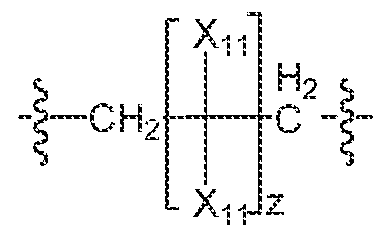
X2는 히드로카르빌 또는 치환된 히드로카르빌이고;X 2 is hydrocarbyl or substituted hydrocarbyl;
각각의 X11은 독립적으로 수소, 히드로카르빌, 치환된 히드로카르빌, 히드록실, 아미노, 보론산 또는 할로이고; Each X 11 is independently hydrogen, hydrocarbyl, substituted hydrocarbyl, hydroxyl, amino, boronic acid or halo;
z는 음이 아닌 수이다.z is a non-negative number.
본 개시내용의 추가 측면은 비교적 낮은 팽윤, 비교적 높은 양성자 및 클로라이드 이온 결합, 및/또는 비교적 낮은 간섭 이온으로부터의 방해의 특징 중 1종 이상을 제공하기 위해 양성자-결합 중간체를 다관능성 가교제와 가교시키는 방법이다. 양성자-결합 중간체는 예를 들어 (i) 치환 중합, (ii) 첨가 중합 또는 (iii) 중간체의 후-중합 가교에 의해 제조되는 아민 모이어티를 함유하는 올리고머 또는 중합체일 수 있다.A further aspect of the present disclosure is a method of crosslinking a proton-binding intermediate with a polyfunctional crosslinker to provide one or more of the characteristics of relatively low swelling, relatively high proton and chloride ion binding, and/or relatively low interference from interfering ions. The proton-binding intermediate can be an oligomer or polymer containing an amine moiety, for example, prepared by (i) substitution polymerization, (ii) addition polymerization, or (iii) post-polymerization crosslinking of the intermediate.
다른 측면 및 특징은 부분적으로 분명해질 것이고, 부분적으로 이하에서 지적될 것이다.Other aspects and features will become partly clear and partly pointed out below.
도 1a-1c는 경구 섭취/위로부터 (도 1a) 상부 GI 관 (도 1b)까지, 하부 GI 관/결장 (도 1c)까지 개체의 위장관을 통과할 때 중합체의 작용 메카니즘을 개략적으로 도시한 흐름도이다.
도 2는 SIB 중 본 개시내용의 중합체의 팽윤 비 대 클로라이드:포스페이트 결합 비 사이의 관계 그래프이다.Figures 1a-1c are flow diagrams schematically illustrating the mechanism of action of the polymer as it passes through the gastrointestinal tract of an individual from oral ingestion/stomach (Figure 1a), to the upper GI tract (Figure 1b), and to the lower GI tract/colon (Figure 1c).
Figure 2 is a graph of the relationship between the swelling ratio of the polymer of the present disclosure and the chloride:phosphate binding ratio among SIBs.
약어 및 정의Abbreviations and Definitions
하기 정의 및 방법은 본 발명을 보다 잘 정의하고 본 발명의 실시에 있어서 통상의 기술자에게 지침이 되도록 제공된다. 달리 나타내지 않는 한, 용어는 관련 기술분야의 통상의 기술자에 의해 통상의 용법에 따라 이해되어야 한다.The following definitions and methods are provided to better define the present invention and to guide those skilled in the art in practicing the present invention. Unless otherwise indicated, terms should be understood according to their common usage by those skilled in the art.
용어 "아크릴아미드"는 구조 화학식 H2C=CH-C(O)NR-*를 갖는 모이어티를 나타내며, 여기서 *는 분자의 나머지에 대한 모이어티의 부착 지점을 나타내고, R은 수소, 히드로카르빌 또는 치환된 히드로카르빌이다.The term "acrylamide" refers to a moiety having the structural formula H 2 C=CH-C(O)NR-*, where * indicates the point of attachment of the moiety to the remainder of the molecule and R is hydrogen, hydrocarbyl, or substituted hydrocarbyl.
용어 "아크릴"은 구조 화학식 H2C=CH-C(O)O-*를 갖는 모이어티를 나타내며, 여기서 *는 분자의 나머지에 대한 모이어티의 부착 지점을 나타낸다.The term "acrylic" refers to a moiety having the structural formula H 2 C=CH-C(O)O-*, where * indicates the point of attachment of the moiety to the remainder of the molecule.
용어 "지환족", "알리시클로" 또는 "알리시클릴"은 3 내지 8개의 탄소 원자의 포화 모노시클릭 기를 의미하고, 시클로펜틸, 시클로헥실, 시클로헵틸 등을 포함한다.The terms "alicyclic", "alicyclo" or "alicyclyl" mean a saturated monocyclic group of 3 to 8 carbon atoms and include cyclopentyl, cyclohexyl, cycloheptyl, and the like.
용어 "지방족"은 예를 들어 1 내지 약 20개의 탄소 원자, 또는 구체적 실시양태에서 1 내지 약 12개의 탄소 원자, 1 내지 약 10개의 탄소 원자, 1 내지 약 8개의 탄소 원자, 또는 심지어 1 내지 약 4개의 탄소 원자를 갖는 포화 및 비-방향족 불포화 히드로카르빌 모이어티를 나타낸다. 지방족 기는, 예를 들어 알킬 모이어티, 예컨대 메틸, 에틸, n-프로필, 이소프로필, n-부틸, 이소부틸, sec-부틸, tert-부틸, 펜틸, 이소-아밀, 헥실 등 및 비슷한 쇄 길이의 알케닐 모이어티를 포함한다.The term "aliphatic" refers to saturated and non-aromatic unsaturated hydrocarbyl moieties having, for example, 1 to about 20 carbon atoms, or in specific embodiments, 1 to about 12 carbon atoms, 1 to about 10 carbon atoms, 1 to about 8 carbon atoms, or even 1 to about 4 carbon atoms. Aliphatic groups include, for example, alkyl moieties such as methyl, ethyl, n-propyl, isopropyl, n-butyl, isobutyl, sec-butyl, tert-butyl, pentyl, iso-amyl, hexyl, and the like, and alkenyl moieties of similar chain length.
용어 "알칸올"은 적어도 1개의 히드록실 기로 치환되어 있는 알킬 모이어티를 나타낸다. 일부 실시양태에서, 알칸올 기는 1 내지 6개의 탄소 원자를 포함하고 그 중 1개가 산소 원자에 부착된 "저급 알칸올" 기이다. 다른 실시양태에서, 저급 알칸올 기는 1 내지 3개의 탄소 원자를 포함한다.The term "alkanol" refers to an alkyl moiety substituted with at least one hydroxyl group. In some embodiments, the alkanol group is a "lower alkanol" group comprising 1 to 6 carbon atoms, one of which is attached to an oxygen atom. In other embodiments, the lower alkanol group comprises 1 to 3 carbon atoms.
용어 "알케닐 기"는 적어도 1개의 탄소-탄소 이중 결합을 갖는 선형 또는 분지형 탄소 라디칼을 포괄한다. 용어 "알케닐 기"는 접합 및 비-접합 탄소-탄소 이중 결합 또는 그의 조합을 포괄할 수 있다. 알케닐 기는, 예를 들어 이에 제한되는 것은 아니지만, 2 내지 약 20개의 탄소 원자 또는, 특정한 실시양태에서 2 내지 약 12개의 탄소 원자를 포괄할 수 있다. 특정 실시양태에서, 알케닐 기는 2 내지 약 4개의 탄소 원자를 갖는 "저급 알케닐" 기이다. 알케닐 기의 예는 에테닐, 프로페닐, 알릴, 비닐, 부테닐 및 4-메틸부테닐을 포함하나, 이에 제한되지는 않는다. 용어 "알케닐 기" 및 "저급 알케닐 기"는 "시스" 또는 "트랜스" 배향, 또는 대안적으로 "E" 또는 "Z" 배향을 갖는 기를 포괄한다.The term "alkenyl group" encompasses linear or branched carbon radicals having at least one carbon-carbon double bond. The term "alkenyl group" can encompass conjugated and non-conjugated carbon-carbon double bonds or combinations thereof. An alkenyl group can encompass, for example but not limited to, from 2 to about 20 carbon atoms, or, in certain embodiments, from 2 to about 12 carbon atoms. In certain embodiments, an alkenyl group is a "lower alkenyl" group having from 2 to about 4 carbon atoms. Examples of alkenyl groups include but are not limited to ethenyl, propenyl, allyl, vinyl, butenyl, and 4-methylbutenyl. The terms "alkenyl group" and "lower alkenyl group" encompass groups having a "cis" or "trans" orientation, or alternatively an "E" or "Z" orientation.
단독으로 또는 "할로알킬 기", "아미노알킬 기" 및 "알킬아미노 기"와 같은 다른 용어 내에서 사용된 용어 "알킬 기"는, 예를 들어 1 내지 약 20개의 탄소 원자, 또는 구체적 실시양태에서 1 내지 약 12개의 탄소 원자를 갖는 포화 선형 또는 분지형 탄소 라디칼을 포괄한다. 다른 실시양태에서, 알킬 기는 1 내지 약 6개의 탄소 원자를 갖는 "저급 알킬" 기이다. 이러한 기의 예는 메틸, 에틸, n-프로필, 이소프로필, n-부틸, 이소부틸, sec-부틸, tert-부틸, 펜틸, 이소-아밀, 헥실 등을 포함하나, 이에 제한되지는 않는다. 보다 구체적인 실시양태에서, 저급 알킬 기는 1 내지 4개의 탄소 원자를 갖는다.The term "alkyl group", when used alone or within other terms such as "haloalkyl group", "aminoalkyl group" and "alkylamino group", encompasses a saturated linear or branched carbon radical having, for example, from 1 to about 20 carbon atoms, or in specific embodiments, from 1 to about 12 carbon atoms. In other embodiments, the alkyl group is a "lower alkyl" group having from 1 to about 6 carbon atoms. Examples of such groups include, but are not limited to, methyl, ethyl, n-propyl, isopropyl, n-butyl, isobutyl, sec-butyl, tert-butyl, pentyl, iso-amyl, hexyl, and the like. In more specific embodiments, the lower alkyl group has from 1 to 4 carbon atoms.
용어 "알킬아미노 기"는 아미노 기의 질소 원자를 통해 분자의 나머지에 직접적으로 부착된 아미노 기를 지칭하며, 여기서 알킬아미노 기의 질소 원자는 1 또는 2개의 알킬 기에 의해 치환된다. 일부 실시양태에서, 알킬아미노 기는 질소 원자에 부착된, 1 내지 6개의 탄소 원자의 1 또는 2개의 알킬 기를 갖는 "저급 알킬아미노" 기이다. 다른 실시양태에서, 저급 알킬아미노 기는 1 내지 3개의 탄소 원자를 갖는다. 적합한 "알킬아미노" 기는 모노 또는 디알킬아미노, 예컨대 N-메틸아미노, N-에틸아미노, N,N-디메틸아미노, N,N-디에틸아미노, 펜타메틸렌아민 등일 수 있다.The term "alkylamino group" refers to an amino group attached directly to the remainder of the molecule through the nitrogen atom of the amino group, wherein the nitrogen atom of the alkylamino group is substituted by one or two alkyl groups. In some embodiments, the alkylamino group is a "lower alkylamino" group having one or two alkyl groups of from 1 to 6 carbon atoms attached to the nitrogen atom. In other embodiments, the lower alkylamino group has from 1 to 3 carbon atoms. Suitable "alkylamino" groups can be mono or dialkylamino, such as N-methylamino, N-ethylamino, N,N-dimethylamino, N,N-diethylamino, pentamethyleneamine, and the like.
용어 "알릴"은 구조 화학식 H2C=CH-CH2-*를 갖는 모이어티를 나타내며, 여기서 *는 분자의 나머지에 대한 모이어티의 부착 지점을 나타내고, 부착 지점은 헤테로원자 또는 방향족 모이어티이다.The term "allyl" refers to a moiety having the structural formula H 2 C=CH-CH 2 -*, where * indicates the point of attachment of the moiety to the remainder of the molecule, and where the point of attachment is a heteroatom or an aromatic moiety.
용어 "알릴아민"은 구조 화학식 H2C=CH-CH2N(X8)(X9)를 갖는 모이어티를 나타내며, 여기서 X8 및 X9는 독립적으로 수소, 히드로카르빌 또는 치환된 히드로카르빌이거나, 또는 X8 및 X9는 함께, 각각 이러한 용어와 관련하여 정의된 바와 같이 전형적으로 고리 내에 3 내지 8개의 원자를 갖는 치환 또는 비치환된 지환족, 아릴 또는 헤테로시클릭 모이어티를 형성한다.The term "allylamine" refers to a moiety having the structural formula H 2 C=CH-CH 2 N(X 8 )(X 9 ), wherein X 8 and X 9 are independently hydrogen, hydrocarbyl or substituted hydrocarbyl, or X 8 and X 9 together form a substituted or unsubstituted cycloaliphatic, aryl or heterocyclic moiety, each as defined in connection with this term, typically having from 3 to 8 atoms in the ring.
단독으로 또는 또 다른 기의 일부로서 사용되는 용어 "아민" 또는 "아미노"는 화학식 -N(X8)(X9)의 기를 나타내며, 여기서 X8 및 X9는 독립적으로 수소, 히드로카르빌, 또는 치환된 히드로카르빌, 헤테로아릴 또는 헤테로시클로이거나, X8 및 X9는 함께, 각각 이러한 용어와 관련하여 정의된 바와 같이 전형적으로 고리 내에 3 내지 8개의 원자를 갖는 치환 또는 비치환된 지환족, 아릴 또는 헤테로시클릭 모이어티를 형성한다.The term "amine" or "amino" used alone or as part of another group refers to a group of formula -N(X 8 )(X 9 ), wherein X 8 and X 9 are independently hydrogen, hydrocarbyl, or substituted hydrocarbyl, heteroaryl or heterocyclo, or X 8 and X 9 together form a substituted or unsubstituted alicyclic, aryl or heterocyclic moiety, each as defined in connection with these terms, typically having from 3 to 8 atoms in the ring.
용어 "아미노알킬 기"는 1 내지 약 10개의 탄소 원자를 갖고 그 중 어느 하나가 1개 이상의 아미노 기로 치환될 수 있는 선형 또는 분지형 알킬 기를 포괄하며, 이는 아민 기(들)의 질소 원자 이외의 원자를 통해 분자의 나머지에 직접적으로 부착된다. 일부 실시양태에서, 아미노알킬 기는 1 내지 6개의 탄소 원자 및 1개 이상의 아미노 기를 갖는 "저급 아미노알킬" 기이다. 이러한 기의 예는 아미노메틸, 아미노에틸, 아미노프로필, 아미노부틸 및 아미노헥실을 포함한다.The term "aminoalkyl group" encompasses linear or branched alkyl groups having from 1 to about 10 carbon atoms, any one of which may be substituted with one or more amino groups, which are attached directly to the remainder of the molecule through an atom other than the nitrogen atom of the amine group(s). In some embodiments, the aminoalkyl group is a "lower aminoalkyl" group having from 1 to 6 carbon atoms and one or more amino groups. Examples of such groups include aminomethyl, aminoethyl, aminopropyl, aminobutyl, and aminohexyl.
용어 "방향족 기" 또는 "아릴 기"는 1개 이상의 고리를 갖는 방향족 기를 의미하며, 여기서 이러한 고리는 펜던트 방식으로 함께 부착될 수 있거나 또는 융합될 수 있다. 특정한 실시양태에서, 방향족 기는 1, 2 또는 3개의 고리이다. 모노시클릭 방향족 기는 고리 내에 5 내지 10개의 탄소 원자, 전형적으로 5 내지 7개의 탄소 원자, 및 보다 전형적으로 5 내지 6개의 탄소 원자를 함유할 수 있다. 전형적인 폴리시클릭 방향족 기는 2 또는 3개의 고리를 갖는다. 2개의 고리를 갖는 폴리시클릭 방향족 기는 고리 내에 전형적으로 8 내지 12개의 탄소 원자, 바람직하게는 8 내지 10개의 탄소 원자를 갖는다. 방향족 기의 예는 페닐, 나프틸, 테트라히드로나프틸, 인다닐, 비페닐, 페난트릴, 안트릴 또는 아세나프틸을 포함하나, 이에 제한되지는 않는다.The term "aromatic group" or "aryl group" means an aromatic group having one or more rings, wherein the rings may be attached together in a pendent manner or may be fused. In certain embodiments, the aromatic group is 1, 2 or 3 rings. Monocyclic aromatic groups can contain from 5 to 10 carbon atoms in the ring, typically from 5 to 7 carbon atoms, and more typically from 5 to 6 carbon atoms. Typical polycyclic aromatic groups have 2 or 3 rings. Polycyclic aromatic groups having two rings typically have from 8 to 12 carbon atoms in the ring, preferably from 8 to 10 carbon atoms. Examples of aromatic groups include, but are not limited to, phenyl, naphthyl, tetrahydronaphthyl, indanyl, biphenyl, phenanthryl, anthryl or acenaphthyl.
용어 "비드"은 형상이 실질적으로 구형인 가교 중합체를 기재하는데 사용된다.The term "bead" is used to describe a cross-linked polymer that is substantially spherical in shape.
중합체 및 1종 이상의 이온, 즉 양이온 (예를 들어, "양성자-결합" 중합체) 및 음이온과 관련하여 본원에 사용된 용어 "결합하다"는, 일반적으로 반드시 비-공유적 방식일 필요는 없지만, 적어도 이온 부분이 중합체가 사용되는 시험관내 또는 생체내 조건 하에서 용액으로부터 또는 신체로부터 이온의 제거를 달성하기에 충분한 시간 동안 결합된 채로 유지되게 하는 충분한 회합 강도를 갖는 "이온-결합" 중합체 및/또는 이온과 회합된 경우이다.The term "binds," as used herein, with respect to a polymer and one or more ions, i.e., a cation (e.g., a "proton-binding" polymer) and anion, generally, but not necessarily non-covalently, to the "ion-binding" polymer and/or the ion having sufficient strength of association such that at least the ionic portion remains bound for a period of time sufficient to effect removal of the ion from solution or from the body under the in vitro or in vivo conditions in which the polymer is used.
용어 "클로라이드 저류 검정" 또는 "CRA"는 유리 아민 시험 중합체에 의한 클로라이드 및 다른 양이온의 저류, 뿐만 아니라 유리 아민 세벨라머 및 빅살로머 대조군 중합체에 의한 저류를, 그것을 결장 내강의 전형적인 경쟁 음이온 농도에 노출시키는 것에 의해 평가하는 검정을 나타낸다. 이들 조건 하에서 중합체로부터 방출된 음이온 및 중합체에 의해 저류된 음이온이 측정된다. 저류 검정에서 제1 단계는 본원의 다른 곳에 기재된 바와 같은 특정한 유기/무기 완충제 검정 (SOB 스크린)을 수행하는 것이다. 어떠한 중합체도 함유하지 않는 블랭크 튜브를 포함시키고, 저류 스크린 동안 동일한 방식으로 처리한다. 검정 튜브로부터 중합체 및 SOB 매트릭스를 폐기하는 대신에, 내용물을 20 마이크로미터 세공-크기 프릿이 피팅된 고체 상 추출 (SPE) 튜브로 옮긴다. 과량의 SOB 매트릭스는 SPE 튜브의 하부에 음압을 적용하거나, 또는 상부에 양압을 적용하여 제거한다. SOB 검정 튜브를 탈이온수로 2회 세정하고, 가능한 한 많은 중합체가 회수되는 것이 보장되도록 내용물을 SPE 튜브로 옮긴다. 이어서 저류 검정 매트릭스를 SPE 튜브에 첨가한다. 저류 검정 매트릭스는 pH 6.2로 조정된 50 mM 2-(N-모르폴리노)에탄술폰산 (MES), 100 mM 아세트산나트륨, 5mM 인산나트륨, 15mM 술페이트를 포함한다. 잠재적 경쟁 음이온의 농도는 전형적인 결장-하부 내강 농도를 반영한다 (Wrong, O et al. [1965] Clinical Science 28, 357-375). 목적이 클로라이드 저류를 측정하는 것이기 때문에 클로라이드는 생략되고, 비카르보네이트는 물 및 CO2로의 전환으로 인해 불안정하기 때문에 생략된다. 2.5 mg/ml의 최종 중합체 농도를 달성하기 위해 저류 완충제가 첨가된다 (SOB 검정 튜브 내로의 원래 칭량 이래 어떠한 중합체의 손실도 없는 것으로 가정함). SPE 튜브를 캡핑하고, 밀봉하고, 37℃에서 대략 40시간 동안 인큐베이션한다. 600 마이크로리터 샘플을 제거하고, 여과하고, 필요한 경우에 희석하고, SOB에 대해 상기 기재된 바와 같이 음이온 함량을 검정한다. 각각의 시험된 중합체에 대해, 저류 매트릭스 내의 중합체로부터 방출된 클로라이드, 시트레이트 및 타우로콜레이트는 하기 계산을 사용하여 계산한다:The term "chloride retention assay" or "CRA" refers to an assay in which the retention of chloride and other cations by a free amine test polymer, as well as retention by free amine sevelamer and bixalomer control polymers, is assessed by exposing them to competing anion concentrations typical of the colonic lumen. Under these conditions, the anions released from the polymer and the anions retained by the polymer are measured. The first step in the retention assay is to perform a specific organic/inorganic buffer assay (SOB screen) as described elsewhere herein. A blank tube containing no polymer is included and treated in the same manner during the retention screen. Instead of discarding the polymer and SOB matrix from the assay tube, the contents are transferred to a solid phase extraction (SPE) tube fitted with a 20 micrometer pore-size frit. Excess SOB matrix is removed by applying negative pressure to the bottom of the SPE tube, or positive pressure to the top. The SOB assay tube is rinsed twice with deionized water and the contents are transferred to an SPE tube to ensure recovery of as much polymer as possible. The retention assay matrix is then added to the SPE tube. The retention assay matrix contains 50 mM 2-(N-morpholino)ethanesulfonic acid (MES), 100 mM sodium acetate, 5 mM sodium phosphate, and 15 mM sulfate, adjusted to pH 6.2. The concentrations of potential competing anions reflect typical colonic lumen concentrations (Wrong, O et al. [1965] Clinical Science 28, 357-375). Chloride is omitted because the objective is to measure chloride retention, and bicarbonate is omitted because it is unstable due to conversion to water and CO 2 . Retention buffer is added to achieve a final polymer concentration of 2.5 mg/ml (assuming no loss of polymer since the original weighing into the SOB assay tube). Cap, seal and incubate the SPE tube at 37°C for approximately 40 hours. Remove a 600 microliter sample, filter, dilute if necessary and assay for anion content as described above for SOB. For each tested polymer, the chloride, citrate and taurocholate released from the polymer in the retention matrix are calculated using the following calculation:
여기서 [이온]저류는 48시간 인큐베이션 말미의 저류 매트릭스 내의 이온의 농도에 상응하고, [이온]저류블랭크는 블랭크 SPE 튜브로부터의 저류 매트릭스 내의 특정한 이온의 값에 상응하고, 희석 배율은 필요한 경우의 희석 배율이고, 2.5는 mg/ml 단위의 중합체 농도이다. 과량의 저류 매트릭스는 SPE 튜브의 하부에 음압을 적용하거나, 또는 상부에 양압을 적용하여 제거한다. SPE 칼럼을 10ml의 탈이온수로 간단히 세척하고, 과량의 물을 제거한다. 중합체에 결합된 채로 있는 이온은, 2.5 mg/ml의 최종 중합체 농도를 달성하기 위해 0.2M NaOH를 SPE 튜브에 첨가하고 (SOB 검정 튜브 내로의 원래 칭량 이래 어떠한 중합체의 손실도 없는 것으로 가정함) 37℃에서 16-20시간 동안 인큐베이션함으로써 용리시킨다. 600 마이크로리터 샘플을 제거하고, 여과하고, 필요한 경우에 희석하고, SOB에 대해 상기 기재된 바와 같이 음이온 함량을 검정한다. 각각의 시험된 중합체에 대해, 저류 매트릭스 내의 중합체로부터 방출된 클로라이드, 포스페이트, 시트레이트 및 타우로콜레이트는 하기 계산을 사용하여 계산한다:Here, [Ion]Retention corresponds to the concentration of the ion in the retention matrix at the end of 48 hours incubation, [Ion]RetentionBlank corresponds to the value of the particular ion in the retention matrix from a blank SPE tube, dilution factor is the dilution factor, if required, and 2.5 is the polymer concentration in mg/ml. Excess retention matrix is removed by applying negative pressure to the bottom of the SPE tube, or positive pressure to the top. The SPE column is briefly washed with 10 ml of deionized water, and the excess water is removed. The ions remaining bound to the polymer are eluted by adding 0.2 M NaOH to the SPE tube (assuming no loss of polymer since the original weighing into the SPE assay tube) to achieve a final polymer concentration of 2.5 mg/ml and incubating at 37°C for 16-20 hours. A 600 microliter sample is removed, filtered, diluted if necessary, and assayed for anion content as described above for SOB. For each tested polymer, the chloride, phosphate, citrate, and taurocholate released from the polymer within the retention matrix is calculated using the following calculation:
여기서 [이온]용리는 16-20시간 인큐베이션 말미의 0.2M NaOH 용리 매트릭스 내의 이온의 농도에 상응하고, [이온]용리블랭크는 블랭크 SPE 튜브로부터의 용리 매트릭스 내의 특정한 이온의 값에 상응하고, 희석 배율은 필요한 경우의 희석 배율이고, 2.5는 mg/ml 단위의 중합체 농도이다.Here, [Ion]Eluent corresponds to the concentration of the ion in the 0.2 M NaOH elution matrix at the end of the 16-20 hour incubation, [Ion]EluentBlank corresponds to the value of the particular ion in the elution matrix from the blank SPE tube, Dilution Factor is the dilution factor if required, and 2.5 is the polymer concentration in mg/ml.
용어 "가교 밀도"는 중합체의 나머지에 대한 아민 함유 반복 유닛의 연결의 평균 개수를 나타낸다. 연결의 개수는 2, 3, 4개 및 그 초과일 수 있다. 선형, 비 가교 중합체 내의 반복 유닛은 2개의 연결을 통해 혼입된다. 불용성 겔을 형성하기 위해, 연결의 개수는 2개를 초과해야 한다. 낮은 가교 밀도 물질, 예컨대 세벨라머는 반복 유닛 사이에 평균 약 2.1개의 연결을 갖는다. 보다 가교된 시스템, 예컨대 빅살로머는 아민-함유 반복 유닛 사이에 평균 약 4.6개의 연결을 갖는다. "가교 밀도"는 사용된 출발 물질의 비를 기반으로 한 반-정량적 척도를 나타낸다. 한계는 그것이 상이한 가교 및 중합 방법은 고려하지 않는다는 사실을 포함한다. 예를 들어, 소분자 아민 시스템은 가교제가 중합체 백본을 형성하기 위한 단량체로서의 역할을 또한 하기 때문에 보다 많은 양의 가교제를 필요로 하는 반면에, 라디칼 중합의 경우에 중합체 쇄는 가교 반응과 독립적으로 형성된다. 이는 라디칼 중합 가교 물질과 비교하여 치환 중합/소분자 아민에 대한 이러한 정의 하에서 내재적으로 보다 높은 가교 밀도로 이어질 수 있다.The term "crosslink density" refers to the average number of links between amine-containing repeat units relative to the remainder of the polymer. The number of links can be 2, 3, 4, or more. The repeat units in a linear, non-crosslinked polymer are incorporated via two links. To form an insoluble gel, the number of links must be greater than 2. Low crosslink density materials, such as sevelamer, have an average of about 2.1 links between repeat units. More crosslinked systems, such as bixalomer, have an average of about 4.6 links between amine-containing repeat units. "Crosslink density" refers to a semi-quantitative measure based on the ratio of starting materials used. Limitations include the fact that it does not take into account different crosslinking and polymerization methods. For example, small molecule amine systems require higher amounts of crosslinking agent because the crosslinking agent also acts as a monomer to form the polymer backbone, whereas in radical polymerization, the polymer chains are formed independently of the crosslinking reaction. This may lead to an inherently higher crosslinking density under this definition for substituted polymerization/small molecule amines compared to radical polymerization crosslinking materials.
단독으로 또는 다른 용어 내에서 사용된 용어 "가교제"는 화학식 1에 기재된 바와 같은 임의의 기재된 단량체 또는 무한 중합체 네트워크와 1회를 초과하여 반응할 수 있는 히드로카르빌 또는 치환된 히드로카르빌, 선형 또는 분지형 분자를 포괄한다. 가교제 내의 반응성 기는 알킬 할라이드, 에폭시드, 포스겐, 무수물, 카르바메이트, 카르보네이트, 이소시아네이트, 티오이소시아네이트, 에스테르, 활성화 에스테르, 카르복실산 및 유도체, 술포네이트 및 유도체, 아실 할라이드, 아지리딘, 알파,베타-불포화 카르보닐, 케톤, 알데히드, 펜타플루오로아릴 기, 비닐, 알릴, 아크릴레이트, 메타크릴레이트, 아크릴아미드, 메타크릴아미드, 스티렌, 아크릴로니트릴 및 그의 조합을 포함할 수 있으나, 이에 제한되지는 않는다. 한 예시적 실시양태에서, 가교제의 반응성 기는 알킬 할라이드, 에폭시드, 무수물, 이소시아네이트, 알릴, 비닐, 아크릴아미드 및 그의 조합을 포함할 것이다. 한 이러한 실시양태에서, 가교제의 반응성 기는 알킬 할라이드, 에폭시드 또는 알릴일 것이다.The term "crosslinker" as used alone or within other terms encompasses hydrocarbyl or substituted hydrocarbyl, linear or branched, molecules that can react more than once with any of the described monomers or infinite polymer networks as described in Formula 1. Reactive groups within the crosslinker can include, but are not limited to, alkyl halides, epoxides, phosgene, anhydrides, carbamates, carbonates, isocyanates, thioisocyanates, esters, activated esters, carboxylic acids and derivatives, sulfonates and derivatives, acyl halides, aziridines, alpha, beta-unsaturated carbonyls, ketones, aldehydes, pentafluoroaryl groups, vinyls, allyls, acrylates, methacrylates, acrylamides, methacrylamides, styrenes, acrylonitriles and combinations thereof. In one exemplary embodiment, the reactive group of the crosslinking agent will include alkyl halide, epoxide, anhydride, isocyanate, allyl, vinyl, acrylamide and combinations thereof. In one such embodiment, the reactive group of the crosslinking agent will be an alkyl halide, epoxide or allyl.
용어 "디알릴아민"은 2개의 알릴 기를 갖는 아미노 모이어티를 나타낸다.The term "diallylamine" refers to an amino moiety having two allylic groups.
용어 "에테르계"는 구조 화학식 *-HxC-O-CHx-*에 도시된 바와 같이 2개의 개별 탄소 원자에 결합된 산소를 갖는 모이어티를 나타내며, 여기서 *는 모이어티의 나머지에 대한 부착 지점을 나타내고, x는 독립적으로 0, 1, 2 또는 3이다.The term "ether" refers to a moiety having an oxygen bonded to two separate carbon atoms as depicted in the structural formula *-H x CO-CH x -*, where * indicates the point of attachment to the remainder of the moiety and x is independently 0, 1, 2, or 3.
용어 "겔"은 불규칙한 형상을 갖는 가교 중합체를 기재하는데 사용된다.The term "gel" is used to describe cross-linked polymers having an irregular shape.
용어 "할로"는 할로겐, 예컨대 플루오린, 염소, 브로민 또는 아이오딘 원자를 의미한다.The term "halo" means a halogen atom, such as fluorine, chlorine, bromine, or iodine.
용어 "할로알킬 기"는 알킬 탄소 원자 중 어느 하나 이상이 상기 정의된 바와 같은 할로로 치환된 기를 포괄한다. 구체적으로 모노할로알킬, 디할로알킬, 및 퍼할로알킬을 비롯한 폴리할로알킬 기가 포괄된다. 모노할로알킬 기는, 예를 들어 기 내에 아이오도, 브로모, 클로로 또는 플루오로 원자를 가질 수 있다. 디할로 및 폴리할로알킬 기는 2개 이상의 동일한 할로 원자 또는 상이한 할로 기의 조합을 가질 수 있다. "저급 할로알킬 기"는 1-6개의 탄소 원자를 갖는 기를 포괄한다. 일부 실시양태에서, 저급 할로알킬 기는 1 내지 3개의 탄소 원자를 갖는다. 할로알킬 기의 예는 플루오로메틸, 디플루오로메틸, 트리플루오로메틸, 클로로메틸, 디클로로메틸, 트리클로로메틸, 펜타플루오로에틸, 헵타플루오로프로필, 디플루오로클로로메틸, 디클로로플루오로메틸, 디플루오로에틸, 디플루오로프로필, 디클로로에틸 및 디클로로프로필을 포함한다.The term "haloalkyl group" encompasses groups in which at least one of the alkyl carbon atoms is replaced with halo, as defined above. Specifically encompassed are monohaloalkyl, dihaloalkyl, and polyhaloalkyl groups, including perhaloalkyl. Monohaloalkyl groups can have, for example, iodo, bromo, chloro, or fluoro atoms in the group. Dihalo and polyhaloalkyl groups can have two or more of the same halo atoms or combinations of different halo groups. A "lower haloalkyl group" encompasses groups having 1-6 carbon atoms. In some embodiments, a lower haloalkyl group has 1 to 3 carbon atoms. Examples of haloalkyl groups include fluoromethyl, difluoromethyl, trifluoromethyl, chloromethyl, dichloromethyl, trichloromethyl, pentafluoroethyl, heptafluoropropyl, difluorochloromethyl, dichlorofluoromethyl, difluoroethyl, difluoropropyl, dichloroethyl, and dichloropropyl.
용어 "헤테로지방족"은 1개 이상의 헤테로원자, 예컨대 할로겐, 산소, 질소, 황, 인 또는 붕소를 함유하는, 포화 또는 불포화 (그러나 방향족은 아님)일 수 있는 1 내지 25개의 탄소 원자, 전형적으로 1 내지 12개의 탄소 원자, 보다 전형적으로 1 내지 10개의 탄소 원자, 가장 전형적으로 1 내지 8개의 탄소 원자, 및 일부 실시양태에서 1 내지 4개의 탄소 원자의 쇄를 기재한다. 헤테로원자는 원자의 쇄에 부착된 펜던트 (또는 측) 기의 일부일 수 있거나 (예를 들어, -CH(OH)- -CH(NH2)-, 여기서 탄소 원자는 원자의 쇄의 구성원임), 또는 쇄 원자 중 하나일 수 있다 (예를 들어, -ROR- 또는 -RNHR-, 여기서 각각의 R은 지방족임). 헤테로지방족은 헤테로알킬 및 헤테로시클로를 포괄하지만, 헤테로아릴을 포괄하지 않는다.The term "heteroaliphatic" describes a chain of 1 to 25 carbon atoms, typically 1 to 12 carbon atoms, more typically 1 to 10 carbon atoms, most typically 1 to 8 carbon atoms, and in some embodiments 1 to 4 carbon atoms, which may be saturated or unsaturated (but not aromatic), containing one or more heteroatoms, such as halogen, oxygen, nitrogen, sulfur, phosphorus or boron. The heteroatom may be part of a pendant (or side) group attached to the chain of atoms (e.g., -CH(OH)- -CH(NH 2 )-, wherein the carbon atom is a member of the chain of atoms), or it may be one of the chain atoms (e.g., -ROR- or -RNHR-, where each R is aliphatic). Heteroaliphatic encompasses heteroalkyl and heterocyclo, but does not encompass heteroaryl.
용어 "헤테로알킬"은 완전 포화 헤테로지방족 모이어티를 기재한다.The term “heteroalkyl” describes a fully saturated heteroaliphatic moiety.
용어 "헤테로아릴"은, 달리 언급되지 않는 한, 1개 이상 (한 실시양태에서, 1, 2, 또는 3개)의 고리 원자가 N, O, 또는 S로부터 선택된 헤테로원자이고 나머지 고리 원자는 탄소인, 5 내지 10개의 고리 원자의 모노시클릭 또는 비시클릭 방향족 라디칼을 의미한다. 대표적인 예는 피롤릴, 티에닐, 티아졸릴, 이미다졸릴, 푸라닐, 인돌릴, 이소인돌릴, 옥사졸릴, 이속사졸릴, 벤조티아졸릴, 벤족사졸릴, 퀴놀리닐, 이소퀴놀리닐, 피리디닐, 피리미디닐, 피라지닐, 피리다지닐, 트리아졸릴, 테트라졸릴 등을 포함하나, 이에 제한되지는 않는다. 본원에 정의된 용어 "헤테로아릴" 및 "아릴"은 상호 배타적이다. "헤테로아릴렌"은 2가 헤테로아릴 라디칼을 의미한다.The term "heteroaryl", unless otherwise stated, means a monocyclic or bicyclic aromatic radical of 5 to 10 ring atoms, wherein at least one (in one embodiment, 1, 2, or 3) ring atoms is a heteroatom selected from N, O, or S, the remaining ring atoms being carbon. Representative examples include, but are not limited to, pyrrolyl, thienyl, thiazolyl, imidazolyl, furanyl, indolyl, isoindolyl, oxazolyl, isoxazolyl, benzothiazolyl, benzoxazolyl, quinolinyl, isoquinolinyl, pyridinyl, pyrimidinyl, pyrazinyl, pyridazinyl, triazolyl, tetrazolyl, and the like. The terms "heteroaryl" and "aryl", as defined herein, are mutually exclusive. "Heteroarylene" means a divalent heteroaryl radical.
용어 "헤테로원자"는 탄소 및 수소 이외의 원자를 의미한다. 전형적으로 헤테로원자는 할로겐, 황, 인, 질소, 붕소 및 산소 원자로 이루어진 군으로부터 선택되지만 전적으로 그러한 것은 아니다. 1개 초과의 헤테로원자를 함유하는 기는 상이한 헤테로원자를 함유할 수 있다.The term "heteroatom" means an atom other than carbon and hydrogen. Typically, but not exclusively, the heteroatom is selected from the group consisting of halogen, sulfur, phosphorus, nitrogen, boron, and oxygen atoms. A group containing more than one heteroatom may contain different heteroatoms.
용어 "헤테로시클로", "헤테로시클릭" 또는 "헤테로시클릴"은 1 또는 2개의 고리 원자가 헤테로원자, 예컨대 N, O, B, P 및 S(O)n이고, 여기서 n은 0 내지 2의 정수이고, 나머지 고리 원자는 탄소인, 4 내지 8개의 고리 원자의 포화 또는 불포화 기를 의미한다. 추가로 헤테로시클릴 고리 내의 1 또는 2개의 고리 탄소 원자는 임의로 -C(O)- 기에 의해 대체될 수 있다. 보다 구체적으로 용어 헤테로시클릴은 피롤리디노, 피페리디노, 호모피페리디노, 2-옥소피롤리디닐, 2-옥소피페리디닐, 모르폴리노, 피페라지노, 테트라히드로-피라닐, 티오모르폴리노 등을 포함하나, 이에 제한되지는 않는다. 헤테로시클릴 고리가 불포화인 경우에, 이는 1 또는 2개의 고리 이중 결합을 함유할 수 있고, 단 고리는 방향족이 아니다. 헤테로시클릴 기가 적어도 1개의 질소 원자를 함유하는 경우에, 이는 또한 헤테로시클로아미노로서 본원에서 언급되고, 헤테로시클릴 기의 하위세트이다.The term "heterocyclo", "heterocyclic" or "heterocyclyl" refers to a saturated or unsaturated group of 4 to 8 ring atoms wherein one or two ring atoms are heteroatoms, such as N, O, B, P and S(O) n , wherein n is an integer from 0 to 2, and the remaining ring atoms are carbon. Additionally, one or two ring carbon atoms in the heterocyclyl ring may be optionally replaced by a -C(O)- group. More specifically, the term heterocyclyl includes, but is not limited to, pyrrolidino, piperidino, homopiperidino, 2-oxopyrrolidinyl, 2-oxopiperidinyl, morpholino, piperazino, tetrahydro-pyranyl, thiomorpholino, and the like. When the heterocyclyl ring is unsaturated, it may contain one or two ring double bonds, provided that neither ring is aromatic. When the heterocyclyl group contains at least one nitrogen atom, it is also referred to herein as heterocycloamino, a subset of heterocyclyl groups.
용어 "탄화수소 기" 또는 "히드로카르빌 기"는 1 내지 25개의 탄소 원자, 전형적으로 1 내지 12개의 탄소 원자, 보다 전형적으로 1 내지 10개의 탄소 원자, 가장 전형적으로 1 내지 8개의 탄소 원자의 쇄를 의미한다. 탄화수소 기는 선형 또는 분지형 쇄 구조를 가질 수 있다. 전형적인 탄화수소 기는 1 또는 2개의 분지, 전형적으로 1개의 분지를 갖는다. 전형적으로, 탄화수소 기는 포화된다. 불포화 탄화수소 기는 1개 이상의 이중 결합, 1개 이상의 삼중 결합, 또는 그의 조합을 가질 수 있다. 전형적인 불포화 탄화수소 기는 1 또는 2개의 이중 결합 또는 1개의 삼중 결합을 갖고; 보다 전형적으로 불포화 탄화수소 기는 1개의 이중 결합을 갖는다.The term "hydrocarbon group" or "hydrocarbyl group" means a chain of 1 to 25 carbon atoms, typically 1 to 12 carbon atoms, more typically 1 to 10 carbon atoms, and most typically 1 to 8 carbon atoms. The hydrocarbon group can have a linear or branched chain structure. A typical hydrocarbon group has 1 or 2 branches, typically 1 branch. Typically, the hydrocarbon group is saturated. An unsaturated hydrocarbon group can have one or more double bonds, one or more triple bonds, or combinations thereof. A typical unsaturated hydrocarbon group has 1 or 2 double bonds, or 1 triple bond; more typically, an unsaturated hydrocarbon group has 1 double bond.
"개시제"는 중합을 개시시키는 시약을 기재하는데 사용되는 용어이다."Initiator" is a term used to describe a reagent that initiates polymerization.
용어 "질소당 분자량" 또는 "MW/N"은 질소 원자당 계산된 중합체 내의 분자량을 나타낸다. 이는 가교 중합체 내의 존재하는 1개의 아민 관능기에 대한 평균 분자량을 나타낸다. 이는 중합체 샘플의 질량을 샘플 내에 존재하는 질소의 몰로 나눔으로써 계산된다. "MW/N"은 이론적 능력의 역수이고, 계산은 공급 비를 기초로 가교제 및 단량체의 완전한 반응을 가정하여 행한다. 질소당 분자량이 더 낮을 수록 가교 중합체의 이론적 능력은 더 높다.The term "molecular weight per nitrogen" or "MW/N" refers to the molecular weight in the polymer calculated per nitrogen atom. It represents the average molecular weight for one amine functionality present in the crosslinked polymer. It is calculated by dividing the mass of the polymer sample by the moles of nitrogen present in the sample. "MW/N" is the reciprocal of the theoretical capacity and the calculation is made based on the feed ratio and assuming complete reaction of the crosslinker and monomer. The lower the molecular weight per nitrogen, the higher the theoretical capacity of the crosslinked polymer.
"임의적인" 또는 "임의로"는 후속 기재된 사건 또는 상황이 발생할 수 있지만 필수적인 것은 아니고, 기재내용이 사건 또는 상황이 발생한 경우 및 발생하지 않은 경우를 포함한다는 것을 의미한다. 예를 들어, "알킬 기로 임의로 치환된 헤테로시클릴 기"는 알킬이 존재할 수 있지만 필수적인 것은 아니고, 기재내용은 헤테로시클릴 기가 알킬 기로 치환된 실시양태 및 헤테로시클릴 기가 알킬 기로 치환되지 않은 실시양태를 포함한다는 것을 의미한다."Optional" or "optionally" means that the subsequently described event or circumstance may, but is not required to, occur, and that the description includes instances where the event or circumstance occurs and instances where it does not. For example, "a heterocyclyl group optionally substituted with an alkyl group" means that the alkyl may, but is not required to, be present, and that the description includes embodiments where the heterocyclyl group is substituted with an alkyl group and embodiments where the heterocyclyl group is not substituted with an alkyl group.
담체, 희석제 또는 부형제와 관련하여 사용된 "제약상 허용되는"은 일반적으로 수의학적 용도 및/또는 인간 제약 용도로 안전하고, 비-독성이고, 생물학적으로 또는 달리 바람직하지 않은 것이 아닌, 제약 조성물을 제조하는데 유용한 담체, 희석제 또는 부형제를 각각 의미한다.The term “pharmaceutically acceptable” as used in reference to a carrier, diluent or excipient generally means a carrier, diluent or excipient useful in preparing a pharmaceutical composition that is safe, non-toxic and not biologically or otherwise undesirable for veterinary use and/or human pharmaceutical use, respectively.
용어 "후 중합 가교"는 이미 형성된 비드 또는 겔에 가교를 더 도입하여 증가된 양의 가교를 갖는 비드 또는 겔을 생성하는, 이미 형성된 비드 또는 겔에 대한 반응을 기재하는 용어이다.The term "post-polymerization crosslinking" describes a reaction on an already formed bead or gel to introduce further crosslinks to produce a bead or gel with an increased amount of crosslinks.
용어 "후 중합 변형"은 반응 또는 처리가 추가의 관능기를 도입하는 것인, 이미 형성된 비드 또는 겔에 대한 변형을 기재하는 용어이다. 이러한 관능기는 이미 형성된 비드에 공유적으로 또는 비-공유적으로 연결될 수 있다.The term "post-polymerization modification" describes a modification to already formed beads or gels in which the reaction or treatment introduces additional functional groups. These functional groups may be covalently or non-covalently linked to the already formed beads.
용어 "4급화 아민 검정" ("QAA")은 주어진 가교 중합체 샘플 내에 존재하는 4급 아민의 양을 추정하는 방법을 기재한다. 이러한 검정은 pH 11.5에서 가교 아민 중합체의 클로라이드 결합을 측정한다. 이러한 pH에서, 1급, 2급 및 3급 아민은 실질적으로 양성자화되지 않고, 클로라이드 결합에 실질적으로 기여하지 않는다. 따라서, 이들 조건 하에 관찰된 임의의 결합은 영구적으로 하전된 4급 아민의 존재로 인한 것일 수 있다. QAA 검정에 사용되는 시험 용액은 pH 11.5의 100 mM 염화나트륨이다. 클로라이드 이온의 농도는 가교 아민 중합체의 총 결합 능력을 평가하는데 사용되는 SGF 검정에서의 농도와 유사하다. 존재하는 총 아민의 백분율로서 4급 아민 함량은 하기와 같이 계산된다:The term "quaternary amine assay" ("QAA") describes a method for estimating the amount of quaternary amine present in a given crosslinked polymer sample. The assay measures chloride binding of crosslinked amine polymers at pH 11.5. At this pH, primary, secondary, and tertiary amines are substantially unprotonated and do not substantially contribute to chloride binding. Therefore, any binding observed under these conditions can be attributed to the presence of permanently charged quaternary amines. The test solution used in the QAA assay is 100 mM sodium chloride at pH 11.5. The concentration of chloride ion is similar to that in the SGF assay used to assess the total binding capacity of the crosslinked amine polymer. The quaternary amine content as a percentage of total amines present is calculated as follows:

QAA 검정을 수행하기 위해, 시험할 유리-아민 중합체를 10 mL의 QAA 완충제 중에서 2.5 mg/ml의 농도로 제조한다 (예를 들어 25 mg 건조 질량). 혼합물을 로티세리 혼합기 상에서 교반하면서 37℃에서 ~16시간 동안 인큐베이션한다. 인큐베이션 및 혼합 후에, 600 마이크로리터의 상청액을 제거하고, 800 마이크로리터, 0.45 마이크로미터 세공 크기, 96-웰 폴리 프로필렌 필터 플레이트를 사용하여 여과한다. 필터 플레이트 내에 어레이된 샘플 및 하부에 피팅된 수집 플레이트를 사용하여, 유닛을 1000Xg에서 1분 동안 원심분리하여 샘플을 여과한다. 수집 플레이트 내로의 여과 후에, 각각의 여과물을 적절하게 희석한 후 클로라이드 함량을 측정한다. 여과물 내의 클로라이드 함량의 분석을 위해 사용되는 IC 방법 (예를 들어 ICS-2100 이온 크로마토그래피, 써모 피셔 사이언티픽(Thermo Fisher Scientific))은 15 mM KOH 이동상, 주입 부피 5 마이크로리터, 구동 시간 3분, 세척/세정 부피 1000 마이크로리터, 및 유량 1.25 mL/min으로 이루어진다. 중합체에 결합된 클로라이드를 결정하기 위해, 하기 계산을 완성한다:To perform the QAA assay, the free-amine polymer to be tested is prepared in 10 mL of QAA buffer at a concentration of 2.5 mg/mL (e.g., 25 mg dry mass). The mixture is incubated at 37°C for ~16 hours with stirring on a rotisserie mixer. After incubation and mixing, 600 microliters of the supernatant is removed and filtered using an 800 microliter, 0.45 micrometer pore size, 96-well polypropylene filter plate. The unit is centrifuged at 1000Xg for 1 minute, with the samples arrayed within the filter plate and the collection plate fitted underneath, to filter the samples. After filtration into the collection plate, each filtrate is appropriately diluted and then the chloride content is measured. The IC method used for the analysis of chloride content in the filtrate (e.g., ICS-2100 Ion Chromatography, Thermo Fisher Scientific) consists of a 15 mM KOH mobile phase, an injection volume of 5 microliters, a run time of 3 minutes, a wash/rinse volume of 1000 microliters, and a flow rate of 1.25 mL/min. To determine the chloride bound to the polymer, the following calculations are completed:
여기서 Cl출발은 QAA 중합체 중 클로라이드의 출발 농도에 상응하고, Cl평형은 시험 중합체에 노출시킨 후의 측정된 여과물 중 클로라이드의 평형 값에 상응하고, 2.5는 mg/ml 단위의 중합체 농도이다.Here, ClStart corresponds to the starting concentration of chloride in the QAA polymer, ClEquilib corresponds to the equilibrium value of chloride in the measured filtrate after exposure to the test polymer, and 2.5 is the polymer concentration in mg/ml.
"인공 위액" 또는 "SGF" 검정은 하기와 같이 위액의 내용물을 모의한 정의된 완충제를 사용하여 시험 중합체에 대해 총 클로라이드 결합 능력을 결정하는 시험을 기재하며: 인공 위액 (SGF)은 35 mM NaCl, 63 mM HCl, pH 1.2로 이루어진다. 상기 검정을 수행하기 위해, 시험할 유리-아민 중합체를 10 mL의 SGF 완충제 중에서 2.5 mg/ml의 농도로 제조한다 (25 mg 건조 질량). 혼합물을 로티세리 혼합기 상에서 교반하면서 37℃에서 밤새 ~12-16시간 동안 인큐베이션한다. 인큐베이션 및 혼합 후에, 중합체를 함유하는 튜브를 500-1000Xg에서 2분 동안 원심분리하여 시험 샘플을 펠릿화한다. 대략 750 마이크로리터의 상청액을 제거하고, 적절한 필터, 예를 들어 0.45 마이크로미터 세공-크기 시린지 필터 또는 96-웰 2 mL 수집 플레이트 상에 피팅된 800 마이크로리터, 1 마이크로미터 세공-크기, 96-웰, 유리 필터 플레이트를 사용하여 여과한다. 후자의 배열을 사용하여, SGF 완충제 중에서 시험되는 다중 샘플을, 표준 대조군 유리 아민 세벨라머, 유리 아민 빅살로머 및 모든 검정 단계 전반에서 처리되는 블랭크 완충제를 함유하는 대조군 튜브를 포함시켜, 분석을 위해 제조할 수 있다. 필터 플레이트 내에 어레이된 샘플 및 하부에 피팅된 수집 플레이트를 사용하여, 유닛을 1000Xg에서 1분 동안 원심분리하여 샘플을 여과한다. 소형 샘플 세트의 경우에, 필터 플레이트 대신 시린지 필터를 사용하여 ~2-4 mL의 여과물을 15 mL 용기 내로 회수할 수 있다. 여과 후에, 각각의 여과물을 물로 4X 희석하고, 이온 크로마토그래피 (IC)를 통해 여과물의 클로라이드 함량을 측정한다. IC 방법 (예를 들어 디오넥스(Dionex) ICS-2100, 써모 사이언티픽)은 AS11 칼럼 및 15 mM KOH 이동상, 주입 부피 5 마이크로리터, 구동 시간 3분, 세척/세정 부피 1000 마이크로리터, 및 유량 1.25 mL/min으로 이루어진다. 중합체에 결합된 클로라이드를 결정하기 위해, 하기 계산을 완성한다:The "simulated gastric fluid" or "SGF" assay describes a test to determine the total chloride binding capacity for a test polymer using a defined buffer simulating the contents of gastric fluid as follows: Simulated gastric fluid (SGF) consists of 35 mM NaCl, 63 mM HCl, pH 1.2. To perform the assay, the free-amine polymer to be tested is prepared in 10 mL of SGF buffer at a concentration of 2.5 mg/mL (25 mg dry mass). The mixture is incubated overnight at 37°C for ~12-16 hours with agitation on a rotisserie mixer. After incubation and mixing, the tube containing the polymer is centrifuged at 500-1000 Xg for 2 minutes to pellet the test sample. Approximately 750 microliters of supernatant is removed and filtered using a suitable filter, such as a 0.45 micrometer pore-size syringe filter or an 800 microliter, 1 micrometer pore-size, 96-well, glass filter plate fitted onto a 96-well 2 mL collection plate. Using the latter arrangement, multiple samples to be tested in SGF buffer can be prepared for analysis, including a control tube containing the standard controls free amine sevelamer, free amine bixalomer, and blank buffer that is processed throughout all assay steps. With the samples arrayed within the filter plate and the collection plate fitted underneath, the unit is centrifuged at 1000Xg for 1 minute to filter the samples. For smaller sample sets, a syringe filter can be used in place of the filter plate to recover ~2-4 mL of filtrate into a 15 mL container. After filtration, each filtrate is diluted 4X with water and the chloride content of the filtrate is determined via ion chromatography (IC). The IC method (e.g., Dionex ICS-2100, Thermo Scientific) consists of an AS11 column and a 15 mM KOH mobile phase, an injection volume of 5 microliters, a run time of 3 minutes, a wash/rinse volume of 1000 microliters, and a flow rate of 1.25 mL/min. To determine the chloride bound to the polymer, the following calculations are completed:

결합 능력은 mmol 클로라이드/g 중합체로 표현되며: 여기서 Cl출발은 SGF 완충제 중 클로라이드의 출발 농도에 상응하고, Cl평형은 시험 중합체에 노출시킨 후의 희석된 측정된 여과물 중 클로라이드의 평형 값에 상응하고, 4는 희석 배율이고, 2.5는 mg/ml 단위의 중합체 농도이다.The binding capacity is expressed in mmol chloride/g polymer: where Clstart corresponds to the starting concentration of chloride in the SGF buffer, Clequilibrium corresponds to the equilibrium value of chloride in the diluted measured filtrate after exposure to the test polymer, 4 is the dilution factor and 2.5 is the polymer concentration in mg/ml.
"인공 소장 무기 완충제" 또는 "SIB"는 선택적 특정 간섭 완충제 검정 (SIB)에서 유리 아민 시험 중합체의 클로라이드 및 포스페이트 결합 능력을 결정하기 위한 시험이다. 유리 아민 시험 중합체의 클로라이드 및 포스페이트 결합 능력은, 유리 아민 세벨라머 및 빅살로머 대조군 중합체의 클로라이드 및 포스페이트 결합 능력과 함께, 하기와 같이 선택적 특정 간섭 완충제 검정 (SIB)을 사용하여 결정하였으며: SIB 검정에 사용된 완충제는 pH 5.5로 완충된 36 mM NaCl, 20 mM NaH2PO4, 50 mM 2-(N-모르폴리노)에탄술폰산 (MES)을 포함한다. SIB 완충제는 인간 십이지장 및 상부 위장관에 존재하는 클로라이드, 포스페이트 및 pH의 농도를 함유하고 (Stevens T, Conwell DL, Zuccaro G, Van Lente F, Khandwala F, Purich E, et al. Electrolyte composition of endoscopically collected duodenal drainage fluid after synthetic porcine secretin stimulation in healthy subjects. Gastrointestinal endoscopy. 2004;60(3):351-5, Fordtran J, Locklear T. Ionic constituents and osmolality of gastric and small-intestinal fluids after eating. Digest Dis Sci. 1966;11(7):503-21), 중합체에 의한 포스페이트 결합과 비교한 클로라이드 결합의 선택성의 유효 척도이다. 검정을 수행하기 위해, 시험할 유리 아민 중합체를 10 mL의 SIB 완충제 중에서 2.5 mg/ml의 농도로 제조한다 (25 mg 건조 질량). 혼합물을 로티세리 혼합기 상에서 교반하면서 37℃에서 1시간 동안 인큐베이션한다. 인큐베이션 및 혼합 후에, 중합체를 함유하는 튜브를 1000Xg에서 2분 동안 원심분리하여 시험 샘플을 펠릿화한다. 750 마이크로리터의 상청액을 제거하고, 96-웰 2 mL 수집 플레이트 상에 피팅된 800 마이크로리터, 1 마이크로미터 세공-크기, 96-웰, 유리 필터 플레이트를 사용하여 여과하고; 이러한 배열을 사용하여, SIB 완충제 중에서 시험되는 다중 샘플을, 표준 대조군 유리 아민 세벨라머, 유리 아민 빅살로머 및 모든 검정 단계 전반에서 처리되는 블랭크 완충제를 함유하는 대조군 튜브를 포함시켜, 분석을 위해 제조할 수 있다. 필터 플레이트 내에 어레이된 샘플 및 하부에 피팅된 수집 플레이트를 사용하여, 유닛을 1000Xg에서 1분 동안 원심분리하여 샘플을 여과한다. 소형 샘플 세트의 경우에, 필터 플레이트 대신 시린지 필터 (0.45 마이크로미터)를 사용하여 ~2-4 mL의 여과물을 15 mL 바이알 내로 회수할 수 있다. 수집 플레이트 내로의 여과 후에, 각각의 여과물을 희석한 후 클로라이드 또는 포스페이트 함량을 측정한다. 클로라이드 및 포스페이트의 측정을 위해, 분석 하의 여과물을 물로 4X 희석한다. 여과물의 클로라이드 및 포스페이트 함량은 이온 크로마토그래피 (IC)를 통해 측정한다. IC 방법 (예를 들어 디오넥스 ICS-2100, 써모 사이언티픽)은 AS24A 칼럼, 45 mM KOH 이동상, 주입 부피 5 마이크로리터, 구동 시간 약 10분, 세척/세정 부피 1000 마이크로리터, 및 유량 0.3 mL/min으로 이루어진다. 중합체에 결합된 클로라이드를 결정하기 위해, 하기 계산을 완성한다:The "Synthetic Small Intestine Buffer" or "SIB" is a test to determine the chloride and phosphate binding capacity of free amine test polymers in a selective specific interference buffer assay (SIB). The chloride and phosphate binding capacity of the free amine test polymers, along with the chloride and phosphate binding capacities of the free amine sevelamer and bixalomer control polymers, were determined using the selective specific interference buffer assay (SIB) as follows: The buffer used in the SIB assay comprises 36 mM NaCl, 20 mM NaH 2 PO 4 , 50 mM 2-(N-morpholino)ethanesulfonic acid (MES), buffered to pH 5.5. SIB buffer contains concentrations of chloride, phosphate and pH present in the human duodenum and upper gastrointestinal tract (Stevens T, Conwell DL, Zuccaro G, Van Lente F, Khandwala F, Purich E, et al. Electrolyte composition of endoscopically collected duodenal drainage fluid after synthetic porcine secretin stimulation in healthy subjects. Gastrointestinal endoscopy. 2004;60(3):351-5, Fordtran J, Locklear T. Ionic constituents and osmolality of gastric and small-intestinal fluids after eating. Digest Dis Sci. 1966;11(7):503-21) and is a valid measure of the selectivity of chloride binding compared to phosphate binding by the polymer. To perform the assay, the free amine polymer to be tested is prepared at a concentration of 2.5 mg/mL (25 mg dry mass) in 10 mL of SIB buffer. The mixture is incubated at 37°C for 1 hour with agitation on a rotisserie mixer. After incubation and mixing, the tube containing the polymer is centrifuged at 1000Xg for 2 minutes to pellet the test sample. Seventy-five microliters of the supernatant is removed and filtered using an 800 microliter, 1 micrometer pore-size, 96-well, glass filter plate fitted onto a 96-well 2 mL collection plate; using this arrangement, multiple samples to be tested in SIB buffer can be prepared for analysis, including a control tube containing the standard control free amine sevelamer, free amine bixalomer, and blank buffer that is processed throughout all assay steps. With the samples arrayed within the filter plate and the collection plate fitted underneath, the unit is centrifuged at 1000Xg for 1 minute to filter the samples. For small sample sets, a syringe filter (0.45 micron) can be used in place of a filter plate to collect ~2-4 mL of filtrate into a 15 mL vial. After filtration into the collection plate, each filtrate is diluted and measured for chloride or phosphate content. For chloride and phosphate measurement, the filtrate under analysis is diluted 4X with water. The chloride and phosphate content of the filtrate is measured via ion chromatography (IC). The IC method (e.g., Dionex ICS-2100, Thermo Scientific) consists of an AS24A column, 45 mM KOH mobile phase, injection volume of 5 microliters, run time of approximately 10 minutes, wash/rinse volume of 1000 microliters, and flow rate of 0.3 mL/min. To determine the chloride bound to the polymer, the following calculation is completed:
여기서 Cl출발은 SIB 완충제 중 클로라이드의 출발 농도에 상응하고, Cl최종은 시험 중합체에 노출시킨 후의 측정된 희석된 여과물 중에서 클로라이드의 최종 값에 상응하고, 4는 희석 배율이고, 2.5는 mg/ml 단위의 중합체 농도이다. 중합체에 결합된 포스페이트를 결정하기 위해, 하기 계산을 완성한다:Here Cl Start corresponds to the starting concentration of chloride in the SIB buffer, Cl Final corresponds to the final value of chloride in the measured diluted filtrate after exposure to the test polymer, 4 is the dilution factor, and 2.5 is the polymer concentration in mg/mL. To determine the phosphate bound to the polymer, the following calculation is completed:
여기서 P출발은 SIB 완충제 중 포스페이트의 출발 농도에 상응하고, P최종은 시험 중합체에 노출시킨 후의 측정된 희석된 여과물 중 포스페이트의 최종 값에 상응하고, 4는 희석 배율이고, 2.5는 mg/ml 단위의 중합체 농도이다.Here, P start corresponds to the starting concentration of phosphate in the SIB buffer, P final corresponds to the final value of phosphate in the measured diluted filtrate after exposure to the test polymer, 4 is the dilution factor and 2.5 is the polymer concentration in mg/ml.
"인공 소장 유기 및 무기 완충제" 또는 "SOB"는 위장관에서 흔히 발견되는 특정 유기 및 무기 간섭제의 존재 하에 측정되는, 클로라이드 결합 능력을 결정하기 위한 시험이다. 유리 아민 시험 중합체 및 유리 아민 세벨라머 및 빅살로머 대조군 중합체의 클로라이드 결합 능력, 뿐만 아니라 다른 음이온에 대한 결합 능력은 하기와 같이 위장관에서 흔히 발견되는 특정 유기 간섭제의 존재 하에 측정하였으며: GI 내강의 조건을 모방하기 위해, SOB 스크린을 사용하여 다른 잠재적 경쟁 음이온, 예컨대 담즙산, 지방산, 포스페이트, 아세테이트 및 시트레이트의 존재 하에 클로라이드에 노출시켰을 때 유리 아민 중합체의 클로라이드 결합 능력을 결정한다. SOB 검정을 위해 사용된 시험 완충제는 pH 6.2로 완충된 50 mM 2-(N-모르폴리노)에탄술폰산 (MES), 50 mM 아세트산나트륨, 36 mM 염화나트륨, 7mM 인산나트륨, 1.5 mM 시트르산나트륨, 30 mM 올레산 및 5 mM 타우로콜산나트륨을 포함한다. 잠재적 경쟁 음이온의 농도는 GI 관의 다양한 지점에서 발견되는 전형적인 위장 내강 농도를 반영하고, pH는 십이지장 및 대장 둘 다에서 직면하는 대표적인 pH 값의 평균 값이다. 사용되는 클로라이드 농도는 SIB 스크린에서 사용되는 것과 동일하다. 검정을 수행하기 위해, 시험할 유리 아민 중합체를 액체-밀봉 스크류 캡을 갖는 16x100 mm 유리 튜브 내에 정확하게 칭량한다. 적절한 양의 SOB 완충제를 시험 튜브에 첨가하여 2.5 mg/ml의 최종 중합체 농도를 달성한다. 혼합물을 로티세리 혼합기 상에서 교반하면서 37℃에서 2시간 동안 인큐베이션한다. 인큐베이션 및 혼합 후에, 600 마이크로리터의 상청액을 제거하고, 96-웰 유리 필터 플레이트를 사용하여 여과한다. 필터 플레이트 내에 어레이된 샘플 및 하부에 피팅된 수집 플레이트를 사용하여, 유닛을 1000Xg에서 1분 동안 원심분리하여 샘플을 여과한다. 소형 샘플 세트의 경우에, 필터 플레이트 대신 시린지 필터를 사용하여 ~2-4 mL의 여과물을 15 mL 바이알 내로 회수할 수 있다. 수집 플레이트 내로의 여과 후에, 각각의 여과물을 적절하게 희석한 후 음이온 함량을 측정한다. IC 방법 (예를 들어 디오넥스 ICS-2100, 써모 사이언티픽)은 AS24A 칼럼, 20mM에서 100mM까지의 KOH 구배, 주입 부피 5 마이크로리터, 구동 시간 약 30분, 세척/세정 부피 1000 마이크로리터, 및 유량 0.3 mL/min으로 이루어진다. 이 방법은 클로라이드, 포스페이트, 및 타우로콜레이트를 측량하는데 적합하다. 다른 적절한 방법으로 치환될 수 있다. 중합체에 결합된 이온을 결정하기 위해, 하기 계산을 완성한다:"Simulated Small Intestine Organic and Inorganic Buffers" or "SOB" is a test to determine chloride binding capacity, measured in the presence of certain organic and inorganic interfering agents commonly found in the gastrointestinal tract. The chloride binding capacity of the free amine test polymers and the free amine sevelamer and bixalomer control polymers, as well as the binding capacity to other anions, were measured in the presence of certain organic interfering agents commonly found in the gastrointestinal tract as follows: To mimic conditions in the GI lumen, the SOB screen is used to determine the chloride binding capacity of the free amine polymers when exposed to chloride in the presence of other potential competing anions, such as bile acids, fatty acids, phosphate, acetate and citrate. The test buffer used for the SOB assay contains 50 mM 2-(N-morpholino)ethanesulfonic acid (MES), 50 mM sodium acetate, 36 mM sodium chloride, 7 mM sodium phosphate, 1.5 mM sodium citrate, 30 mM oleic acid, and 5 mM sodium taurocholate, buffered to pH 6.2. The concentrations of potential competing anions reflect typical gastric lumen concentrations found at various points in the GI tract, and the pH is an average of typical pH values encountered in both the duodenum and the colon. The chloride concentration used is the same as that used in the SIB screen. To perform the assay, the free amine polymer to be tested is accurately weighed into a 16x100 mm glass tube with a liquid-tight screw cap. The appropriate amount of SOB buffer is added to the test tube to achieve a final polymer concentration of 2.5 mg/ml. The mixture is incubated at 37°C for 2 hours with agitation on a rotisserie mixer. After incubation and mixing, 600 microliters of supernatant is removed and filtered using a 96-well glass filter plate. With the samples arrayed within the filter plate and the collection plate fitted underneath, the unit is centrifuged at 1000Xg for 1 minute to filter the samples. For small sample sets, a syringe filter can be used in place of the filter plate to recover ~2-4 mL of filtrate into a 15 mL vial. After filtration into the collection plate, each filtrate is appropriately diluted and then measured for anion content. The IC method (e.g., Dionex ICS-2100, Thermo Scientific) consists of an AS24A column, a KOH gradient from 20 mM to 100 mM, an injection volume of 5 microliters, a run time of approximately 30 minutes, a wash/rinse volume of 1000 microliters, and a flow rate of 0.3 mL/min. This method is suitable for measuring chloride, phosphate, and taurocholate. may be substituted in other suitable ways. To determine the ions bound to the polymer, complete the following calculations:

여기서 [Ion]출발은 SOB 완충제 중 이온의 출발 농도에 상응하고, [이온]최종은 시험 중합체에 노출시킨 후의 측정된 여과물 중 특정한 이온의 최종 값에 상응하고, 희석 배율은 희석 배율이고, 2.5는 mg/ml 단위의 중합체 농도이다.Here, [Ion] Start corresponds to the starting concentration of the ion in the SOB buffer, [Ion] Final corresponds to the final value of the particular ion in the measured filtrate after exposure to the test polymer, Dilution Factor is the dilution factor, and 2.5 is the polymer concentration in mg/ml.
본원에 사용된 용어 "치환된 히드로카르빌", "치환된 알킬", "치환된 알케닐", "치환된 아릴", "치환된 헤테로시클로" 또는 "치환된 헤테로아릴"은 탄소 쇄 원자가 헤테로 원자, 예컨대 질소, 산소, 규소, 인, 붕소, 황 또는 할로겐 원자로 치환된 모이어티를 비롯하여, 탄소 및 수소 이외의 적어도 1개의 원자로 치환된 히드로카르빌, 알킬, 알케닐, 아릴, 헤테로시클로 또는 헤테로아릴 모이어티를 나타낸다. 이들 치환기는 할로겐, 헤테로시클로, 알콕시, 알켄옥시, 알킨옥시, 아릴옥시, 히드록시, 케토, 아실, 아실옥시, 니트로, 아미노, 아미도, 니트로, 시아노, 티올, 케탈, 아세탈, 에스테르 및 에테르를 포함한다.The terms "substituted hydrocarbyl", "substituted alkyl", "substituted alkenyl", "substituted aryl", "substituted heterocyclo" or "substituted heteroaryl", as used herein, refer to hydrocarbyl, alkyl, alkenyl, aryl, heterocyclo or heteroaryl moieties substituted with at least one atom other than carbon and hydrogen, including moieties where a carbon chain atom is replaced by a heteroatom such as nitrogen, oxygen, silicon, phosphorus, boron, sulfur or halogen atoms. These substituents include halogen, heterocyclo, alkoxy, alkeneoxy, alkyneoxy, aryloxy, hydroxy, keto, acyl, acyloxy, nitro, amino, amido, nitro, cyano, thiol, ketal, acetal, ester and ether.
"팽윤 비" 또는 간단히 "팽윤"은 중합체 분취물의 중량으로 나눈 주어진 양의 중합체에 의해 흡수된 물의 양을 기재한다. 팽윤 비는: 팽윤 = (g 팽윤 중합체 - g 건조 중합체)/g 건조 중합체로 표현된다. 임의의 주어진 중합체에 대해 팽윤 비를 결정하는데 사용되는 방법은 하기를 포함한다:"Swelling ratio" or simply "swelling" describes the amount of water absorbed by a given amount of polymer divided by the weight of the polymer fraction. Swelling ratio is expressed as: Swelling = (g swollen polymer - g dry polymer)/g dry polymer. Methods used to determine the swelling ratio for any given polymer include:
a. 50-100 mg의 건조 (물 함량 5 중량% 미만) 중합체를 공지된 중량 (튜브의 중량 = 중량 A)의 11 mL 밀봉가능한 시험 튜브 (스크류 캡 있음)에 넣는다.a. 50-100 mg of dry (water content less than 5 wt%) polymer is placed in an 11 mL sealable test tube (with screw cap) of known weight (weight of tube = weight A).
b. 탈이온수 (10mL)를 중합체를 함유하는 튜브에 첨가한다. 튜브를 밀봉하고, 실온에서 16시간 동안 (밤새) 텀블링한다. 인큐베이션 후에, 튜브를 3000xg에서 3분 동안 원심분리하고, 진공 흡인에 의해 상청액을 조심스럽게 제거한다. 매우 느슨한 침강물을 형성하는 중합체의 경우에, 또 다른 단계의 원심분리를 수행한다.b. Add deionized water (10 mL) to the tube containing the polymer. Seal the tube and tumble at room temperature for 16 hours (overnight). After incubation, centrifuge the tube at 3000xg for 3 minutes and carefully remove the supernatant by vacuum aspiration. In case of polymers that form a very loose sediment, perform another round of centrifugation.
c. 단계 (b) 후에, 팽윤 중합체 플러스 튜브의 중량 (중량 B)을 기록한다.c. After step (b), record the weight of the swollen polymer plus tube (Weight B).
d. -40℃에서 30분 동안 동결시킨다. 48시간 동안 동결건조시킨다. 건조된 중합체 및 시험 튜브를 칭량한다 (중량 C로 기록함).d. Freeze at -40°C for 30 minutes. Freeze-dry for 48 hours. Weigh the dried polymer and test tube (record as weight C).
e. 하기: [(중량 B-중량 A)-(중량 C- 중량 A)]/(중량 C- 중량 A)와 같이 정의되는, 중합체 g당 흡수된 물 g을 계산한다.e. Calculate the grams of water absorbed per gram of polymer, which is defined as [(weight B - weight A) - (weight C - weight A)]/(weight C - weight A).
"표적 이온"은 중합체가 결합하는 이온이고, 통상적으로 중합체에 의해 결합되는 주요 이온, 또는 중합체에의 결합이 중합체의 치료 효과를 생성하는 것으로 생각되는 이온을 지칭한다 (예를 들어 HCl의 순 제거를 생성하는 양성자 및 클로라이드 결합).A "target ion" is an ion to which the polymer binds, typically referring to the primary ion bound by the polymer, or an ion whose binding to the polymer is believed to produce a therapeutic effect of the polymer (e.g., a proton and chloride binding that produces net removal of HCl).
용어 "이론적 능력"은 mmol/g 단위로 표현되는, "SGF" 검정에서 염산의 계산된, 예상 결합을 나타낸다. 이론적 능력은 단량체(들) 및 가교제(들)로부터의 아민 100%가 그의 각각의 공급 비에 기초하여 가교 중합체 내에 혼입된다는 가정을 기초로 한다. 따라서 이론적 능력은 중합체 내의 아민 관능기의 농도 (mmol/g)와 동등하다. 이론적 능력은 각각의 아민이 각각의 음이온 및 양이온에 결합하는데 이용가능하고, 형성된 아민의 유형에 대해 조정되지 않는 것으로 가정된다 (예를 들어 양성자 결합에 이용가능하지 않은 4급 아민의 능력을 차감하지 않음).The term "theoretical capacity" refers to the calculated, expected binding of hydrochloric acid in the "SGF" assay, expressed in mmol/g. The theoretical capacity is based on the assumption that 100% of the amines from the monomer(s) and crosslinker(s) are incorporated into the crosslinked polymer based on their respective feed ratios. The theoretical capacity is therefore equal to the concentration of amine functionality within the polymer (in mmol/g). The theoretical capacity assumes that each amine is available to bind its respective anion and cation, and is not adjusted for the type of amine formed (e.g., it does not subtract the capacity of quaternary amines that are not available for proton binding).
"치료 유효량"은 질환을 치료하기 위해 환자에게 투여한 경우에 질환에 대해 이러한 치료를 달성하는데 충분한 양성자-결합 가교 아민 중합체의 양을 의미한다. "치료 유효량"을 구성하는 양은 중합체, 질환의 중증도 및 치료할 포유동물의 연령, 체중 등에 따라 달라질 것이다.A "therapeutically effective amount" means an amount of a proton-coupled cross-linked amine polymer that, when administered to a patient for the purpose of treating a disease, is sufficient to effect such treatment for the disease. The amount that constitutes a "therapeutically effective amount" will vary depending on the polymer, the severity of the disease, and the age, weight, etc. of the mammal to be treated.
질환을 "치료하는 것" 또는 "치료"는 (i) 질환을 억제하는 것, 즉 질환 또는 그의 임상 증상의 발생을 정지 또는 감소시키는 것; 또는 (ii) 질환을 완화시키는 것, 즉 질환 또는 그의 임상 증상의 퇴행을 유발하는 것을 포함한다. 질환을 억제하는 것은 예를 들어 예방을 포함할 것이다.“Treating” or “treating” a disease includes (i) suppressing the disease, i.e., arresting or reducing the occurrence of the disease or its clinical symptoms; or (ii) alleviating the disease, i.e., causing regression of the disease or its clinical symptoms. Suppressing the disease would include, for example, prevention.
용어 "트리알릴아민"은 3개의 알릴 기를 갖는 아미노 모이어티를 나타낸다.The term "triallylamine" refers to an amino moiety having three allylic groups.
용어 "비닐"은 구조 화학식 RxHyC=CH-*를 갖는 모이어티를 나타내며, 여기서 *는 분자의 나머지에 대한 모이어티의 부착 지점을 나타내고, 여기서 부착 지점은 헤테로원자 또는 아릴이고, X 및 Y는 독립적으로 0, 1 또는 2로 X+Y=2이고, R은 히드로카르빌 또는 치환된 히드로카르빌이다.The term "vinyl" refers to a moiety having the structural formula R x H y C=CH-*, where * indicates the point of attachment of the moiety to the remainder of the molecule, wherein the point of attachment is a heteroatom or aryl, X and Y are independently 0, 1 or 2 such that X+Y=2, and R is hydrocarbyl or substituted hydrocarbyl.
용어 "중량 퍼센트 가교제"는 가교제로부터 유도된, 중합체 샘플의 질량을 기준으로 계산된 백분율을 나타낸다. 중량 퍼센트 가교제는 중합의 공급 비를 사용하여 계산되고, 단량체 및 가교제(들)의 완전 전환을 가정한다. 가교제로 인한 질량은 반응 후의 무한 중합체 네트워크에서 분자량의 예상되는 증가와 동등하다 (예를 들어 1,3,-디클로로프로판은 113 amu이지만, 염소 원자가 이탈기로서 중합체 네트워크 내로 혼입되지 않기 때문에 DCP와의 가교 후에 중합체 네트워크에 단지 42 amu만이 첨가됨).The term "weight percent crosslinker" refers to the percentage, calculated based on the mass of the polymer sample, derived from the crosslinker. The weight percent crosslinker is calculated using the feed ratio of the polymerization and assumes complete conversion of the monomer and crosslinker(s). The mass due to the crosslinker is equivalent to the expected increase in molecular weight in an infinite polymer network after the reaction (e.g. 1,3,-dichloropropane is 113 amu, but only 42 amu is added to the polymer network after crosslinking with DCP because the chlorine atom is not incorporated into the polymer network as a leaving group).
본 발명의 요소 또는 그의 바람직한 실시양태(들)를 소개하는 경우에, 단수 표현 및 "상기"는 하나 이상의 요소가 존재함을 의미하는 것으로 의도된다. 용어 "포함하는", "비롯한" 및 "갖는"은 포괄적이고 배타적이지 않은 것으로 의도된다 (즉, 언급된 요소에 더하여 다른 요소가 존재할 수 있음).When introducing elements of the present invention or preferred embodiments(s) thereof, the singular forms "a," "an," and "the" are intended to mean that there are one or more of the elements. The terms "comprising," "including," and "having" are intended to be inclusive and not exclusive (i.e., there may be other elements in addition to the elements mentioned).
실시양태Embodiment
이전에 주목된 바와 같이, 본 개시내용의 다양한 측면 중에서 유리 아민 모이어티를 함유하는 비흡수, 가교 중합체를 포함하는 조성물을 사용한 치료 방법이 주목될 것이다. 한 실시양태에서, 가교 아민 중합체는 치료 유효량 (즉, 유효 용량)의 가교 아민 중합체의 투여 시, 예를 들어 인간을 비롯한 동물의 위장관으로부터 임상적으로 유의한 양의 양성자 및 클로라이드 이온을 제거하여 치료 또는 예방적 이익을 달성하는 능력을 갖는다.As previously noted, among the various aspects of the present disclosure, methods of treatment using compositions comprising non-absorbable, cross-linked polymers containing free amine moieties will be noted. In one embodiment, the cross-linked amine polymer has the ability to remove clinically significant amounts of protons and chloride ions from the gastrointestinal tract of, for example, an animal, including a human, upon administration of a therapeutically effective amount (i.e., an effective dose) of the cross-linked amine polymer, thereby achieving a therapeutic or prophylactic benefit.
본원에 개시된 치료 유효 용량의 가교 아민 중합체는, 적어도 부분적으로는, 치료할 질환, 가교 유리 아민 중합체의 능력, 및 의도되는 효과에 의존할 것이다. 한 실시양태에서, 가교 유리 아민 중합체의 1일 용량은 장기간에 걸쳐 혈청 비카르보네이트 수준의 감소 속도를 지연시키는데 충분하다. 또 다른 실시양태에서, 가교 유리 아민 중합체의 1일 용량은 장기간에 걸쳐 혈청 비카르보네이트 수준을 유지시키는데 충분하다. 또 다른 실시양태에서, 가교 유리 아민 중합체의 1일 용량은 장기간에 걸쳐 혈청 비카르보네이트 수준을 증가시키는데 충분하다. 예를 들어, 한 실시양태에서, 1일 용량은 장기간에 걸쳐 적어도 약 20 mEq/L의 혈청 비카르보네이트 수준을 달성하거나 이를 유지시키는데 충분하다. 추가의 예로서, 한 이러한 실시양태에서, 1일 용량은 장기간에 걸쳐 적어도 약 21 mEq/L의 혈청 비카르보네이트 수준을 달성하거나 이를 유지시키는데 충분하다. 추가의 예로서, 한 이러한 실시양태에서, 1일 용량은 장기간에 걸쳐 적어도 약 22 mEq/L의 혈청 비카르보네이트 수준을 달성하거나 이를 유지시키는데 충분하다. 또 다른 실시양태에서, 1일 용량은 장기간에 걸쳐 적어도 약 24 mEq/L의 혈청 비카르보네이트 수준을 달성하거나 이를 유지시키는데 충분하다. 각각의 상기 실시양태에서, 장기간은 적어도 1개월; 예를 들어, 적어도 2개월, 적어도 3개월, 또는 심지어 적어도 수개월의 기간이다.The therapeutically effective dose of the crosslinked amine polymer disclosed herein will depend, at least in part, on the disease to be treated, the ability of the crosslinked free amine polymer to act, and the intended effect. In one embodiment, the daily dose of the crosslinked free amine polymer is sufficient to delay the rate of decline in serum bicarbonate levels over an extended period of time. In another embodiment, the daily dose of the crosslinked free amine polymer is sufficient to maintain serum bicarbonate levels over an extended period of time. In another embodiment, the daily dose of the crosslinked free amine polymer is sufficient to increase serum bicarbonate levels over an extended period of time. For example, in one embodiment, the daily dose is sufficient to achieve or maintain a serum bicarbonate level of at least about 20 mEq/L over an extended period of time. As a further example, in one such embodiment, the daily dose is sufficient to achieve or maintain a serum bicarbonate level of at least about 21 mEq/L over an extended period of time. As a further example, in one such embodiment, the daily dosage is sufficient to achieve or maintain a serum bicarbonate level of at least about 22 mEq/L over an extended period of time. In another embodiment, the daily dosage is sufficient to achieve or maintain a serum bicarbonate level of at least about 24 mEq/L over an extended period of time. In each of the above embodiments, the extended period of time is at least 1 month; for example, at least 2 months, at least 3 months, or even at least several months.
일반적으로, 치료 및/또는 예방적 사용을 위한 가교 아민 중합체의 투여량 수준은 약 0.5 g/일 내지 약 20 g/일의 범위일 수 있다. 환자 순응도를 용이하게 하기 위해, 일반적으로 용량은 약 1 g/일 내지 약 10 g/일 범위인 것이 바람직하다. 예를 들어, 한 이러한 실시양태에서, 용량은 약 2 g/일 내지 약 7 g/일일 것이다. 추가의 예로서, 한 이러한 실시양태에서, 용량은 약 3 g/일 내지 약 6 g/일일 것이다. 추가의 예로서, 한 이러한 실시양태에서, 용량은 약 4 g/일 내지 약 5 g/일일 것이다. 임의로, 1일 용량은 단일 용량으로서 투여될 수 있거나 (즉, 1일 1회), 또는 1일 기간에 걸쳐 다중 용량으로 나뉠 수 있다 (예를 들어, 2, 3 또는 그 초과 용량). 일반적으로 치료 및/또는 예방적 사용을 위한 가교 아민 중합체는 고정된 1일 용량으로서 투여될 수 있거나, 또는 치료를 필요로 하는 환자의 혈청 비카르보네이트 값 또는 다른 산증 지표에 기초하여 적정될 수 있다. 적정은 치료 개시 시 또는 필요에 따라 내내 일어날 수 있고, 출발 및 유지 투여량 수준은 기저 질환의 중증도에 기초하여 환자마다 상이할 수 있다.In general, dosage levels of the crosslinked amine polymer for therapeutic and/or prophylactic use can range from about 0.5 g/day to about 20 g/day. To facilitate patient compliance, it is generally preferred that the dosage range be from about 1 g/day to about 10 g/day. For example, in one such embodiment, the dosage will be from about 2 g/day to about 7 g/day. As a further example, in one such embodiment, the dosage will be from about 3 g/day to about 6 g/day. As a further example, in one such embodiment, the dosage will be from about 4 g/day to about 5 g/day. Optionally, the daily dosage can be administered as a single dose (i.e., once daily) or can be divided into multiple doses over a one-day period (e.g., 2, 3 or more doses). In general, cross-linked amine polymers for therapeutic and/or prophylactic use may be administered as a fixed daily dose, or may be titrated based on the serum bicarbonate value or other acidosis indicator of the patient requiring treatment. Titration may occur at the initiation of treatment or throughout treatment as needed, and starting and maintenance dose levels may vary from patient to patient based on the severity of the underlying disease.
도 1a-1c에 개략적으로 도시한 바와 같이 한 실시양태에 따르면, 본 개시내용의 비-흡수 유리-아민 중합체는 경구로 섭취되고, 위장 ("GI") 관에서 HCl에 결합하고 분변을 통해 HCl을 제거함으로써 포유동물에서 대사성 산증을 치료하는데 (혈청 비카르보네이트를 증가시키고 혈액 pH를 정상화하는 것에 의하는 것을 포함) 사용된다. 유리-아민 중합체는 3 mEq/L의 임상적으로 의미있는 혈청 비카르보네이트에서의 증가를 가능하게 하는데 충분한 양의 HCl에 장기간 결합하도록 표적화된 용량을 증진시키는 순응도로 경구로 섭취된다 (도 1a). 위에서 (도 1b), 유리 아민은 H+에 결합함으로써 양성자화된다. 중합체 상의 양전하는 이어서 Cl-에 결합하는데 이용가능하며; 가교 및 친수성/소수성 특성을 통해 결합 부위의 접근을 제어함으로써, 다른 보다 큰 유기 음이온 (예를 들어, X- 및 Y-로 도시된 아세테이트, 프로피오네이트, 부티레이트 등)은 조금이라도 더 낮은 정도로 결합된다. 따라서 순 효과는 HCl의 결합이다. 하부 GI 관/결장에서 (도 1c) Cl-는 방출되지 않고, 규칙적 장 운동 및 분변 배설을 통해 HCl이 신체로부터 제거되어, 혈청에서 순 알칼리화가 생성된다. 이러한 방식으로 결합된 Cl-는 Cl-/HCO3 - 역수송체 시스템을 통한 교환에 이용가능하지 않다.According to one embodiment, as schematically illustrated in FIGS. 1A-1C , the non-absorbed free-amine polymers of the present disclosure are ingested orally and used to treat metabolic acidosis in mammals (including by increasing serum bicarbonate and normalizing blood pH) by binding HCl in the gastrointestinal ("GI") tract and eliminating the HCl via the feces. The free-amine polymers are ingested orally with a compliance that promotes targeted doses to bind HCl over a prolonged period of time in amounts sufficient to enable a clinically meaningful increase in serum bicarbonate of 3 mEq/L ( FIG. 1A ). In the stomach ( FIG. 1B ), the free amine becomes protonated by binding to H + . The positive charge on the polymer is then available to bind Cl - ; By controlling the accessibility of binding sites through cross-linking and hydrophilic/hydrophobic properties, other larger organic anions (e.g., acetate, propionate, butyrate, etc., shown as X - and Y - ) are bound to a slightly lower extent. The net effect is therefore binding of HCl. In the lower GI tract/colon (Fig. 1c) Cl - is not released, and HCl is removed from the body through regular intestinal motility and fecal excretion, resulting in net alkalinization in the serum. Cl - bound in this way is not available for exchange via the Cl - /HCO 3 - antiporter system.
한 실시양태에서, 중합체는 동시에 효능을 최대화하고 (순 HCl 결합 및 배설) GI 부작용을 최소화하도록 (낮은 팽윤 입자 설계 및 입자 크기 분포를 통함) 설계된다. 최적화된 HCl 결합은 능력 (아민 결합 부위의 개수), 선택성 (클로라이드 대 다른 음이온, 특히 결장 내의 유기 음이온의 바람직한 결합) 및 저류 (결장 및 장에서 Cl-/HCO3 - 교환체 [역수송체]의 활성을 피하기 위해 하부 GI 관에서 유의한 양의 클로라이드를 방출하지 않음; 클로라이드가 중합체에 치밀하게 결합되지 않은 경우에, Cl-/HCO3 - 교환체는 장 내강으로부터 클로라이드 이온의 흡수 및 혈청으로부터 비카르보네이트와의 상호 교환을 매개하여 혈청 비카르보네이트를 효과적으로 감소시킬 수 있음)의 철저한 균형을 통해 달성될 수 있다.In one embodiment, the polymer is designed to simultaneously maximize efficacy (net HCl binding and excretion) and minimize GI side effects (via low swell particle design and particle size distribution). Optimized HCl binding can be achieved through a careful balance of capacity (number of amine binding sites), selectivity (preferred binding of chloride versus other anions, particularly organic anions in the colon) and retention (not releasing significant amounts of chloride in the lower GI tract to avoid activation of the Cl - /HCO 3 - exchanger [antiporter] in the colon and intestine; when chloride is not densely bound to the polymer, the Cl - /HCO 3 - exchanger can effectively reduce serum bicarbonate by mediating absorption of chloride ions from the intestinal lumen and their exchange with bicarbonate from the serum).
클로라이드를 대체하는 경쟁 음이온은 하기 메카니즘을 통해 순 비카르보네이트에서의 감소를 야기한다. 먼저, GI 내강, 특히 결장 내강에서 중합체로부터 클로라이드의 대체는 혈청 내 비카르보네이트와의 수월한 교환을 제공한다. 결장은 분비된 비카르보네이트와 교환하여 내강 측으로부터 클로라이드를 이동시키는 음이온 교환체 (클로라이드/비카르보네이트 역수송체)를 갖는다. 유리 클로라이드가 GI 관에서 중합체로부터 방출되는 경우에 이는 비카르보네이트와 교환될 것이고, 이어서 이는 대변으로 소실되어 총 세포외 비카르보네이트의 감소를 유발할 것이다 (Davis, 1983; D'Agostino, 1953). 중합체 상의 결합된 클로라이드와 교환된 단쇄 지방산 (SCFA)의 결합은, 세포외 HCO3- 저장의 고갈을 야기할 것이다. 단쇄 지방산은 정상 소화 과정에 의해서는 이화되지 않는 복합 탄수화물의 박테리아 대사 산물이다 (Chemlarova, 2007). 결장에 도달한 단쇄 지방산은 흡수되고, 다양한 조직으로 분포되며, 흔한 대사 운명은 H2O 및 CO2의 생성으로 이는 비카르보네이트 등가물로 전환된다. 따라서, 양성자 전하를 중성화시키기 위한 SCFA의 중합체에 대한 결합은 전체적인 비카르보네이트 저장 및 완충 능력에 유해할 것이고, SCFA 교환을 제한하는 중합체 내 화학적 및 물리적 특성의 설계가 필요하다. 마지막으로, 중합체에 대한 포스페이트 결합은, 만성 신질환에서 암모니아생성 및/또는 수소 이온 분비가 손상된 상황에 포스페이트는 완충 능력의 추가 공급원을 나타내기 때문에, 역시 제한되어야 한다.Competing anions that displace chloride cause a decrease in net bicarbonate by the following mechanisms. First, the displacement of chloride from the polymer in the GI lumen, particularly in the colonic lumen, provides a facile exchange for bicarbonate in the serum. The colon has an anion exchanger (chloride/bicarbonate antiporter) that moves chloride from the lumenal side in exchange for secreted bicarbonate. When free chloride is released from the polymer in the GI tract, it will exchange for bicarbonate, which will then be lost in the feces, resulting in a decrease in total extracellular bicarbonate (Davis, 1983; D'Agostino, 1953). Binding of short-chain fatty acids (SCFA) that exchange for bound chloride on the polymer will result in depletion of extracellular HCO3- stores. SCFAs are bacterial metabolites of complex carbohydrates that are not metabolized by normal digestive processes (Chemlarova, 2007). Short-chain fatty acids that reach the colon are absorbed, distributed to various tissues, and their usual metabolic fate is conversion to bicarbonate equivalents with the production of H2O and CO2. Therefore, binding of SCFA to the polymer to neutralize the proton charge would be detrimental to the overall bicarbonate storage and buffering capacity, and design of chemical and physical properties within the polymer that limit SCFA exchange is required. Finally, phosphate binding to the polymer should also be limited, as phosphate represents an additional source of buffering capacity in situations where ammonia production and/or hydrogen ion secretion are impaired in chronic renal disease.
양성자의 각각의 결합에 대해, 양전하가 중성 중합체로서 인체로부터 이탈하고자 함에 따라 음이온이 바람직하게 결합된다. 이온의 "결합"은 최소 결합 초과, 즉 적어도 약 0.2 mmol 이온/gm 중합체, 일부 실시양태에서 적어도 약 1 mmol 이온/gm 중합체, 일부 실시양태에서 적어도 약 1.5 mmol 이온/gm 중합체, 및 일부 실시양태에서 적어도 약 3 mmol 이온/gm 중합체이다. 한 실시양태에서, 중합체는 음이온에 대한 선택성을 제공하는 것과 동시에 높은 양성자 결합 능력을 특징으로 하며; 클로라이드에 대한 선택성은 포스페이트, 시트레이트, 아세테이트, 담즙산 및 지방산을 포함하나 이에 제한되지는 않는 간섭 음이온의 결합을 감소시키는 것에 의해 달성된다. 예를 들어, 일부 실시양태에서, 본 개시내용의 중합체는 포스페이트에 약 5 mmol/gm 미만, 약 4 mmol/gm 미만, 약 3 mmol/gm 미만, 약 2 mmol/gm 미만 또는 심지어 약 1 mmol/gm 미만의 결합 능력으로 결합한다. 일부 실시양태에서, 본 발명의 중합체는 담즙 및 지방산에 약 5 mmol/g 미만, 약 4 mmol/g 미만, 약 3 mmol/g 미만, 약 2 mmol/gm 미만, 일부 실시양태에서 약 1 mmol/gm 미만, 일부 실시양태에서 약 0.5 mmol/gm 미만, 일부 실시양태에서 약 0.3 mmol/gm 미만, 및 일부 실시양태에서 약 0.1 mmol/gm 미만의 결합 능력으로 결합한다.For each binding of a proton, an anion is preferably bound as the positive charge seeks to leave the body as a neutral polymer. The "binding" of the ion is greater than the minimum binding, i.e., at least about 0.2 mmol ion/gm polymer, in some embodiments at least about 1 mmol ion/gm polymer, in some embodiments at least about 1.5 mmol ion/gm polymer, and in some embodiments at least about 3 mmol ion/gm polymer. In one embodiment, the polymer is characterized by a high proton binding capacity while providing selectivity for the anion; the selectivity for chloride is achieved by reducing the binding of interfering anions, including but not limited to phosphate, citrate, acetate, bile acids, and fatty acids. For example, in some embodiments, the polymers of the present disclosure bind phosphate with a binding capacity of less than about 5 mmol/gm, less than about 4 mmol/gm, less than about 3 mmol/gm, less than about 2 mmol/gm, or even less than about 1 mmol/gm. In some embodiments, the polymers of the present invention bind to bile and fatty acids with a binding capacity of less than about 5 mmol/g, less than about 4 mmol/g, less than about 3 mmol/g, less than about 2 mmol/gm, in some embodiments less than about 1 mmol/gm, in some embodiments less than about 0.5 mmol/gm, in some embodiments less than about 0.3 mmol/gm, and in some embodiments less than about 0.1 mmol/gm.
중합체의 유효성은 동물 모델, 또는 인간 지원자 및 환자에서 확립될 수 있다. 또한, HCl 결합을 확립하는데 시험관내, 생체외 및 생체내 접근법이 유용하다. 시험관내 결합 용액을 사용하여 상이한 pH에서 양성자, 클로라이드 및 다른 이온에 대한 결합 능력을 측정할 수 있다. 생체외 추출물, 예컨대 인간 지원자 또는 모델 동물로부터의 위장 내강 내용물이 유사한 목적으로 사용될 수 있다. 특정 이온에 대한 다른 것보다 우선적인 결합 및/또는 저류의 선택성이 또한 이러한 시험관내 및 생체외 용액에서 입증될 수 있다. 대사성 산증의 생체내 모델은 산/염기 균형을 정상화하는데 있어서 중합체의 유효성을 시험하는데 사용될 수 있다 - 예를 들어 카세인-함유 사료를 공급한 5/6마리의 신장적출 래트 (문헌 [Phisitkul S, Hacker C, Simoni J, Tran RM, Wesson DE. Dietary protein causes a decline in the glomerular filtration rate of the remnant kidney mediated by metabolic acidosis and endothelin receptors. Kidney international. 2008;73(2):192-9]에 기재된 바와 같음).The effectiveness of the polymer can be established in animal models, or in human volunteers and patients. In addition, in vitro, ex vivo and in vivo approaches are useful for establishing HCl binding. In vitro binding solutions can be used to measure the binding capacity for protons, chloride and other ions at different pHs. In vitro extracts, such as gastrointestinal lumen contents from human volunteers or model animals, can be used for similar purposes. The selectivity for binding and/or retention of certain ions over others can also be demonstrated in such in vitro and ex vivo solutions. In vivo models of metabolic acidosis can be used to test the effectiveness of polymers in normalizing acid/base balance - for example, 5/6 nephrectomized rats fed a casein-containing diet (as described in the literature [Phisitkul S, Hacker C, Simoni J, Tran RM, Wesson DE. Dietary protein causes a decline in the glomerular filtration rate of the remnant kidney mediated by metabolic acidosis and endothelin receptors. Kidney international. 2008;73(2):192-9]).
한 실시양태에서, 본 개시내용에 기재된 중합체는 인간을 비롯한 동물에게 가장 바람직하게는 1일에 5 g 이하의 1일 용량을 초과하지 않는 용량으로 1일 1회, 2회 또는 3회 제공되어 이들 1일 용량에서 대사성 산증을 치료하고 대략 3 mEq/L의 혈청 비카르보네이트의 임상적으로 유의하고 지속적인 증가를 달성한다. 중합체의 경구 투여에 의해 달성되는 HCl 결합의 양은 중합체 결합 능력에 의해 결정되며, 이는 일반적으로 중합체 1 g당 HCl 5 - 25 mEq의 범위 내이다. 추가로, 중합체는 양성자 결합을 균형잡히게 하기 위해 결합되는 음이온과 관련하여 바람직하게 선택되며, 클로라이드가 바람직한 음이온이다. 양성자 양전하를 중성화시키기 위해 결합되는 클로라이드 이외의 음이온은 포스페이트, 단쇄 지방산, 장쇄 지방산, 담즙산 또는 다른 유기 또는 무기 음이온을 포함한다. 클로라이드 이외의 이들 음이온의 결합은 세포내 및 세포외 구획에서 전체적인 비카르보네이트 저장에 영향을 미친다.In one embodiment, the polymers described in the present disclosure are administered to an animal, including a human, most preferably at a daily dose not exceeding 5 g per day, once, twice or three times daily to treat metabolic acidosis at these daily doses and achieve a clinically significant and sustained increase in serum bicarbonate of about 3 mEq/L. The amount of HCl binding achieved by oral administration of the polymer is determined by the polymer binding capacity, which is generally in the range of 5 - 25 mEq HCl per gram of polymer. Additionally, the polymer is preferably selected with respect to the anion to which it binds to balance the proton binding, with chloride being a preferred anion. Anions other than chloride that are bound to neutralize the proton positive charge include phosphate, short chain fatty acids, long chain fatty acids, bile acids or other organic or inorganic anions. Binding of these anions other than chloride affects the overall bicarbonate storage in the intracellular and extracellular compartments.
한 실시양태에서, HCl 중합체성 결합체에 대한 작용 메카니즘은 하기를 포함한다. 위 또는 GI 관 내 다른 곳에서, 유리 아민 중합체는 양성자 (H+) 결합에 의해 양성자화된다. 이러한 결합의 결과로서 형성된 양전하는 이어서 클로라이드 음이온 결합에 이용가능하다. 위를 빠져나간 후에, 중합체는 순차적으로 각각 별개의 유기 및 무기 음이온이 보완된 십이지장, 공장, 회장 및 결장 순서의 상이한 GI 관 환경과 직면한다. 중합체의 물리적 및 화학적 특성은 이러한 음이온의 수집에 대한 양성자화된 결합 부위의 접근을 제어하기 위해 설계된다. 물리적 장벽은 가교 (음이온 결합을 방지하기 위한 크기 배제) 및 화학적 모이어티 (보다 큰 유기 이온, 예컨대 아세테이트, 프로피오네이트, 부티레이트 또는 결장 내에 흔히 존재하는 다른 단쇄 지방산을 밀어내기 위함), 및 포스페이트, 담즙산 및 지방산 결합을 제한하기 위한 2가지 특성의 조합을 포함한다. 비드 가교 및 아민 결합 부위의 화학적 속성을 조정함으로써, 클로라이드는 하부 GI 관에서 다른 음이온과의 교환 및 방출이 감소되거나 제거되도록 치밀하게 결합될 수 있다. 이론에 얽매이지는 않지만, 클로라이드보다 큰 이온 및/또는 수화 반경을 갖는 음이온은 배제될 수 있거나, 또는 이들 특성을 HCl 결합 중합체 내에 혼입함으로써 그의 결합이 감소될 수 있다. 예를 들어, 수화 또는 비수화 형태의 클로라이드의 이온 반경은 GI 관 내강에서 흔히 직면하는 포스페이트 및 다른 음이온에 대한 상응하는 값보다 작다 (Supramolecular Chemistry, Steed, JW (2009) John Wiley and Sons, page 226; Kielland, J (1937), J. Am. Chem. Soc. 59:1675-1678). 보다 작은 이온의 선택적 결합을 위해, 중합체는 전형적으로 높은 가교 밀도를 나타내어 중합체 결합 부위에 대한 우선적 접근을 생성한다. 높은 가교 밀도 물질은, 그러나 전형적으로 낮은 팽윤 비를 특징으로 한다. 팽윤 비는 하기 조성물 및 공정 변수에 의해 영향을 받을 수 있다: 1) 아민 단량체 (또는 중합체) 및 가교제의 몰비, 2) 가교 반응에서 단량체+가교제 대 용매 비, 3) 중합체의 순 전하 (그것이 사용될 환경의 생리학적 pH 및 장성에서), 4) 백본 중합체의 친수성/소수성 균형 및/또는 5) 기존 물질의 후-가교.In one embodiment, the mechanism of action for the HCl polymeric conjugate comprises the following. In the stomach or elsewhere in the GI tract, the free amine polymer is protonated by proton (H + ) binding. The positive charge formed as a result of this binding is then available for chloride anion binding. After exiting the stomach, the polymer sequentially encounters the different GI tract environments of the duodenum, jejunum, ileum, and colon, each complemented by distinct organic and inorganic anions. The physical and chemical properties of the polymer are designed to control the access of the protonated binding sites to the collection of these anions. The physical barrier comprises cross-linking (size exclusion to prevent anion binding) and chemical moieties (to repel larger organic ions such as acetate, propionate, butyrate, or other short-chain fatty acids commonly present in the colon), and a combination of the two properties to limit phosphate, bile acid, and fatty acid binding. By tuning the chemical properties of the bead cross-linking and amine binding sites, chloride can be bound so densely that exchange and release with other anions in the lower GI tract is reduced or eliminated. Without being bound by theory, it is believed that anions with larger ionic and/or hydration radii than chloride can be excluded, or their binding can be reduced by incorporating these properties into the HCl binding polymer. For example, the ionic radius of chloride, in either hydrated or unhydrated form, is smaller than the corresponding values for phosphate and other anions commonly encountered in the GI lumen (Supramolecular Chemistry, Steed, JW (2009) John Wiley and Sons, page 226; Kielland, J (1937), J. Am. Chem. Soc. 59:1675-1678). For selective binding of smaller ions, the polymers typically exhibit a high cross-linking density to create preferential access to the polymer binding sites. High crosslink density materials, however, are typically characterized by a low swelling ratio. The swelling ratio can be influenced by the following composition and process variables: 1) the molar ratio of the amine monomer (or polymer) and the crosslinker, 2) the monomer+crosslinker to solvent ratio in the crosslinking reaction, 3) the net charge of the polymer (at physiological pH and tonicity of the environment in which it will be used), 4) the hydrophilic/hydrophobic balance of the backbone polymer, and/or 5) post-crosslinking of the original material.
일반적으로, 본 개시내용의 가교 아민 중합체는 전형적으로 낮은 팽윤 비를 특징으로 한다. 한 실시양태에서, SIB 중 상대적 클로라이드 결합 대 포스페이트 결합 비는 클로라이드 대 보다 큰 음이온에 대한 본 개시내용의 가교 중합체의 선택성의 지표이다. 본 개시내용의 특정 중합체에 대한 팽윤 비 대 SIB 중 클로라이드:포스페이트 결합 비 사이의 관계 그래프를 도 2에 제시한다. 예를 들어, 한 실시양태에서, 본 개시내용의 중합체는 SIB 중 ≥ 0.35의 클로라이드 대 포스페이트 결합 비 및 건조 중합체 g당 ≤ 2g 물의 팽윤 비를 갖는다. 추가의 예로서, 한 실시양태에서 본 개시내용의 중합체는 SIB 중 ≥ 0.5의 클로라이드 대 포스페이트 결합 비 및 건조 중합체 g당 ≤ 2g 물의 팽윤 비를 갖는다. 추가의 예로서, 한 실시양태에서 본 개시내용의 중합체는 SIB 중 ≥ 1의 클로라이드 대 포스페이트 결합 비 및 건조 중합체 g당 ≤ 2g 물의 팽윤 비를 갖는다. 추가의 예로서, 한 실시양태에서 본 개시내용의 중합체는 SIB 중 ≥ 2의 클로라이드 대 포스페이트 결합 비 및 건조 중합체 g당 ≤ 2g 물의 팽윤 비를 갖는다. 추가의 예로서, 한 실시양태에서 본 개시내용의 중합체는 SIB 중 ≥ 0.35의 클로라이드 대 포스페이트 결합 비 및 건조 중합체 g당 ≤ 1g 물의 팽윤 비를 갖는다. 추가의 예로서, 한 실시양태에서 본 개시내용의 중합체는 SIB 중 ≥ 0.5의 클로라이드 대 포스페이트 결합 비 및 건조 중합체 g당 ≤ 1g 물의 팽윤 비를 갖는다. 추가의 예로서, 한 실시양태에서 본 개시내용의 중합체는 SIB 중 ≥ 1의 클로라이드 대 포스페이트 결합 비 및 건조 중합체 g당 ≤ 1g 물의 팽윤 비를 갖는다. 추가의 예로서, 한 실시양태에서 본 개시내용의 중합체는 SIB 중 ≥ 2의 클로라이드 대 포스페이트 결합 비 및 건조 중합체 g당 ≤ 1g 물의 팽윤 비를 갖는다. In general, the crosslinked amine polymers of the present disclosure are typically characterized by a low swelling ratio. In one embodiment, the relative chloride binding to phosphate binding ratio in the SIB is an indicator of the selectivity of the crosslinked polymers of the present disclosure for chloride versus larger anions. A graph of the relationship between the swelling ratio and the chloride:phosphate binding ratio in the SIB for certain polymers of the present disclosure is presented in FIG. 2 . For example, in one embodiment, the polymers of the present disclosure have a chloride:phosphate binding ratio in the SIB of ≥ 0.35 and a swelling ratio of ≤ 2 g water per g dry polymer. As a further example, in one embodiment, the polymers of the present disclosure have a chloride:phosphate binding ratio in the SIB of ≥ 0.5 and a swelling ratio of ≤ 2 g water per g dry polymer. As a further example, in one embodiment, the polymers of the present disclosure have a chloride to phosphate binding ratio in SIB of ≥ 1 and a swelling ratio of ≤ 2 grams water per gram of dry polymer. As a further example, in one embodiment, the polymers of the present disclosure have a chloride to phosphate binding ratio in SIB of ≥ 2 and a swelling ratio of ≤ 2 grams water per gram of dry polymer. As a further example, in one embodiment, the polymers of the present disclosure have a chloride to phosphate binding ratio in SIB of ≥ 0.35 and a swelling ratio of ≤ 1 gram water per gram of dry polymer. As a further example, in one embodiment, the polymers of the present disclosure have a chloride to phosphate binding ratio in SIB of ≥ 0.5 and a swelling ratio of ≤ 1 gram water per gram of dry polymer. As a further example, in one embodiment, the polymer of the present disclosure has a chloride to phosphate bond ratio in SIB of ≥ 1 and a swelling ratio of ≤ 1 g water per g dry polymer. As a further example, in one embodiment, the polymer of the present disclosure has a chloride to phosphate bond ratio in SIB of ≥ 2 and a swelling ratio of ≤ 1 g water per g dry polymer.
일부 실시양태에서, 본 개시내용의 가교 아민 중합체 대 SIB 중 클로라이드:포스페이트 결합 비가 도 2에 제시된다. 예를 들어, 한 실시양태에서 본 개시내용의 중합체는 SGF 중 ≥ 10 mmol/g의 클로라이드 결합 능력 및 건조 중합체 g당 ≤ 2g 물의 팽윤 비를 갖는다. 추가의 예로서, 한 실시양태에서 본 개시내용의 중합체는 SGF 중 ≥ 12 mmol/g의 클로라이드 결합 능력 및 건조 중합체 g당 ≤ 2g 물의 팽윤 비를 갖는다. 추가의 예로서, 한 실시양태에서 본 개시내용의 중합체는 SGF 중 ≥ 14 mmol/g의 클로라이드 결합 능력 및 건조 중합체 g당 ≤ 2g 물의 팽윤 비를 갖는다. 추가의 예로서, 한 실시양태에서 본 개시내용의 중합체는 SGF 중 ≥ 10 mmol/g의 클로라이드 결합 능력 및 건조 중합체 g당 ≤ 1.5g 물의 팽윤 비를 갖는다. 추가의 예로서, 한 실시양태에서 본 개시내용의 중합체는 SGF 중 ≥ 12 mmol/g의 클로라이드 결합 능력 및 건조 중합체 g당 ≤ 1.5g 물의 팽윤 비를 갖는다. 추가의 예로서, 한 실시양태에서 본 개시내용의 중합체는 SGF 중 ≥ 14 mmol/g의 클로라이드 결합 능력 및 건조 중합체 g당 ≤ 1.5g 물의 팽윤 비를 갖는다.In some embodiments, the chloride:phosphate binding ratio of the crosslinked amine polymers of the present disclosure to SIB is presented in FIG. 2. For example, in one embodiment, the polymers of the present disclosure have a chloride binding capacity of ≥ 10 mmol/g SGF and a swelling ratio of ≤ 2 g water per g dry polymer. As a further example, in one embodiment, the polymers of the present disclosure have a chloride binding capacity of ≥ 12 mmol/g SGF and a swelling ratio of ≤ 2 g water per g dry polymer. As a further example, in one embodiment, the polymers of the present disclosure have a chloride binding capacity of ≥ 14 mmol/g SGF and a swelling ratio of ≤ 2 g water per g dry polymer. As a further example, in one embodiment, the polymers of the present disclosure have a chloride binding capacity of ≥ 10 mmol/g SGF and a swelling ratio of ≤ 1.5 g water per g dry polymer. As a further example, in one embodiment, the polymer of the present disclosure has a chloride binding capacity of ≥ 12 mmol/g SGF and a swelling ratio of ≤ 1.5 g water per g dry polymer. As a further example, in one embodiment, the polymer of the present disclosure has a chloride binding capacity of ≥ 14 mmol/g SGF and a swelling ratio of ≤ 1.5 g water per g dry polymer.
일부 실시양태에서, 본 개시내용의 중합체의 이론적 클로라이드 결합 능력은 약 1 mmol/g 내지 약 25 mmol/g 범위일 수 있다. 한 실시양태에서, 중합체의 이론적 클로라이드 결합 능력은 약 3 mmol/g 내지 약 25 mmol/g이다. 또 다른 실시양태에서, 중합체의 이론적 클로라이드 결합 능력은 약 6 mmol/g 내지 약 20 mmol/g이다. 또 다른 실시양태에서, 중합체의 이론적 클로라이드 결합 능력은 약 9 mmol/g 내지 약 17 mmol/g이다.In some embodiments, the theoretical chloride binding capacity of the polymers of the present disclosure can range from about 1 mmol/g to about 25 mmol/g. In one embodiment, the theoretical chloride binding capacity of the polymer is from about 3 mmol/g to about 25 mmol/g. In another embodiment, the theoretical chloride binding capacity of the polymer is from about 6 mmol/g to about 20 mmol/g. In another embodiment, the theoretical chloride binding capacity of the polymer is from about 9 mmol/g to about 17 mmol/g.
일부 실시양태에서, 본 개시내용의 중합체의 질소당 분자량은 약 40 내지 약 1000 달톤의 범위일 수 있다. 한 실시양태에서, 중합체의 질소당 분자량은 약 40 내지 약 500 달톤이다. 또 다른 실시양태에서, 중합체의 질소당 분자량은 약 50 내지 약 170 달톤이다. 또 다른 실시양태에서, 중합체의 질소당 분자량은 약 60 내지 약 110 달톤이다.In some embodiments, the molecular weight per nitrogen of the polymer of the present disclosure can range from about 40 to about 1000 daltons. In one embodiment, the molecular weight per nitrogen of the polymer is from about 40 to about 500 daltons. In another embodiment, the molecular weight per nitrogen of the polymer is from about 50 to about 170 daltons. In another embodiment, the molecular weight per nitrogen of the polymer is from about 60 to about 110 daltons.
일부 실시양태에서, 가교제 중량 % 범위는 가교 아민 중합체의 약 10 내지 90 중량%일 것이다. 예를 들어, 일부 실시양태에서 가교제 중량 % 범위는 가교 아민 중합체의 약 15 내지 90 중량% 또는 심지어 가교 아민 중합체의 약 25 내지 90 중량%일 것이다.In some embodiments, the crosslinker weight % range will be from about 10 to 90 wt % of the crosslinked amine polymer. For example, in some embodiments, the crosslinker weight % range will be from about 15 to 90 wt % of the crosslinked amine polymer or even from about 25 to 90 wt % of the crosslinked amine polymer.
가교 아민 중합체는 예를 들어 (i) 다관능성 시약 중 적어도 1종이 아민 모이어티를 포함하는 것인 다관능성 시약의 치환 중합, (2) 적어도 1개의 아민 모이어티 또는 질소 함유 모이어티를 포함하는 단량체의 라디칼 중합, 및 (3) 아민-함유 중간체와, 임의로 아민 모이어티를 함유하는 다관능성 가교제의 가교를 포함하는 화학 범위를 사용하여 제조할 수 있다. 생성된 가교 중합체는 따라서, 예를 들어 가교 단독중합체 또는 가교 공중합체일 수 있다. 추가의 예로서, 생성된 가교 중합체는 전형적으로, 동일하거나 다양한 길이의 반복 링커 (또는 개재) 유닛에 의해 분리된, 유리 아민 모이어티를 포함하는 반복 유닛을 보유할 것이다. 일부 실시양태에서, 중합체는 아민 모이어티 및 개재 링커 유닛을 포함하는 반복 유닛을 포함한다. 다른 실시양태에서, 다중 아민-함유 반복 유닛은 1개 이상의 링커 유닛에 의해 분리된다. 추가로, 다관능성 가교제는 HCl 결합 관능기, 예를 들어 아민을 포함할 수 있거나 ("능동 가교제"), 또는 HCl 결합 관능기, 예컨대 아민이 결여되어 있을 수 있다 ("수동 가교제").Crosslinked amine polymers can be prepared using a range of chemistries including, for example, (i) substitution polymerization of a polyfunctional reagent, wherein at least one of the polyfunctional reagents comprises an amine moiety, (2) radical polymerization of a monomer comprising at least one amine moiety or a nitrogen-containing moiety, and (3) crosslinking of an amine-containing intermediate with a polyfunctional crosslinking agent, optionally comprising an amine moiety. The resulting crosslinked polymer can thus be, for example, a crosslinked homopolymer or a crosslinked copolymer. As a further example, the resulting crosslinked polymer will typically have repeating units comprising free amine moieties, separated by repeating linker (or intervening) units of the same or varying length. In some embodiments, the polymer comprises repeating units comprising amine moieties and intervening linker units. In other embodiments, multiple amine-containing repeating units are separated by one or more linker units. Additionally, the polyfunctional cross-linker may include an HCl-linking functional group, such as an amine (“active cross-linker”), or may lack an HCl-linking functional group, such as an amine (“passive cross-linker”).
일부 실시양태에서, 아민-함유 단량체는 중합되고, 중합체는 치환 중합 반응에서 공동으로 가교된다. 공동 중합 및 가교 반응에서 아민 반응물 (단량체)은 치환 중합에 대해 1회를 초과하여 반응할 수 있다. 한 이러한 실시양태에서, 아민 단량체는 치환 중합 반응에 참여하는 적어도 2개의 반응성 아민 모이어티를 보유하는 선형 아민이다. 또 다른 실시양태에서, 아민 단량체는 치환 중합 반응에 참여하는 적어도 2개의 반응성 아민 모이어티를 보유하는 분지형 아민이다. 공동 치환 중합 및 가교를 위한 가교제는 전형적으로 적어도 2개의 아민-반응성 모이어티, 예컨대 알킬-클로라이드 및 알킬-에폭시드를 갖는다. 중합체 내로 혼입되기 위해 1급 아민은 가교제와 적어도 1회 반응하고, 잠재적으로 최대 3회 반응할 수 있고, 2급 아민은 가교제와 최대 2회 반응할 수 있고, 3급 아민은 가교제와 단지 1회만 반응할 수 있다. 그러나 일반적으로, 본 개시내용의 한 측면에 따르면, 4급 아민은 양성자와 결합할 수 없기 때문에 유의한 개수의 4급 질소/아민의 형성은 일반적으로 바람직하지 않다.In some embodiments, the amine-containing monomer is polymerized and the polymer is cross-linked co-in the substitution polymerization reaction. The amine reactants (monomers) in the co-polymerization and cross-linking reaction can react more than once for the substitution polymerization. In one such embodiment, the amine monomer is a linear amine having at least two reactive amine moieties that participate in the substitution polymerization reaction. In another embodiment, the amine monomer is a branched amine having at least two reactive amine moieties that participate in the substitution polymerization reaction. Cross-linking agents for the co-substitution polymerization and cross-linking typically have at least two amine-reactive moieties, such as alkyl-chlorides and alkyl-epoxides. To be incorporated into the polymer, a primary amine can react with the crosslinker at least once, and potentially up to three times, a secondary amine can react with the crosslinker up to two times, and a tertiary amine can react with the crosslinker only once. However, in general, according to one aspect of the present disclosure, the formation of significant numbers of quaternary nitrogens/amines is generally undesirable because quaternary amines cannot bond with protons.
본원에 기재된 치환 중합 반응에 사용될 수 있는 예시적인 아민은 1,3-비스[비스(2-아미노에틸)아미노]프로판, 3-아미노-1-{[2-(비스{2-[비스(3-아미노프로필)아미노]에틸}아미노)에틸](3-아미노프로필)아미노}프로판, 2-[비스(2-아미노에틸)아미노]에탄아민, 트리스(3-아미노프로필)아민, 1,4-비스[비스(3-아미노프로필)아미노]부탄, 1,2-에탄디아민, 2-아미노-1-(2-아미노에틸아미노)에탄, 1,2-비스(2-아미노에틸아미노)에탄, 1,3-프로판디아민, 3,3'-디아미노디프로필아민, 2,2-디메틸-1,3-프로판디아민, 2-메틸-1,3-프로판디아민, N,N'-디메틸-1,3-프로판디아민, N-메틸-1,3-디아미노프로판, 3,3'-디아미노-N-메틸디프로필아민, 1,3-디아미노펜탄, 1,2-디아미노-2-메틸프로판, 2-메틸-1,5-디아미노펜탄, 1,2-디아미노프로판, 1,10-디아미노데칸, 1,8-디아미노옥탄, 1,9-디아미노옥탄, 1,7-디아미노헵탄, 1,6-디아미노헥산, 1,5-디아미노펜탄, 3-브로모프로필아민 히드로브로마이드, N,2-디메틸-1,3-프로판디아민, N-이소프로필-1,3-디아미노프로판, N,N'-비스(2-아미노에틸)-1,3-프로판디아민, N,N'-비스(3-아미노프로필)에틸렌디아민, N,N'-비스(3-아미노프로필)-1,4-부탄디아민 테트라히드로클로라이드, 1,3-디아미노-2-프로판올, N-에틸에틸렌디아민, 2,2'-디아미노-N-메틸디에틸아민, N,N'-디에틸에틸렌디아민, N-이소프로필에틸렌디아민, N-메틸에틸렌디아민, N,N'-디-tert-부틸에틸렌디아민, N,N'-디이소프로필에틸렌디아민, N,N'-디메틸에틸렌디아민, N-부틸에틸렌디아민, 2-(2-아미노에틸아미노)에탄올, 1,4,7,10,13,16-헥사아자시클로옥타데칸, 1,4,7,10-테트라아자시클로도데칸, 1,4,7-트리아자시클로노난, N,N'-비스(2-히드록시에틸)에틸렌디아민, 피페라진, 비스(헥사메틸렌)트리아민, N-(3-히드록시프로필)에틸렌디아민, N-(2-아미노에틸)피페라진, 2-메틸피페라진, 호모피페라진, 1,4,8,11-테트라아자시클로테트라데칸, 1,4,8,12-테트라아자시클로펜타데칸, 2-(아미노메틸)피페리딘, 3-(메틸아미노)피롤리딘을 포함한다.Exemplary amines that may be used in the substitution polymerization reactions described herein include 1,3-bis[bis(2-aminoethyl)amino]propane, 3-amino-1-{[2-(bis{2-[bis(3-aminopropyl)amino]ethyl}amino)ethyl](3-aminopropyl)amino}propane, 2-[bis(2-aminoethyl)amino]ethanamine, tris(3-aminopropyl)amine, 1,4-bis[bis(3-aminopropyl)amino]butane, 1,2-ethanediamine, 2-amino-1-(2-aminoethylamino)ethane, 1,2-bis(2-aminoethylamino)ethane, 1,3-propanediamine, 3,3'-diaminodipropylamine, 2,2-dimethyl-1,3-propanediamine, 2-methyl-1,3-propanediamine, N,N'-dimethyl-1,3-propanediamine, N-Methyl-1,3-diaminopropane, 3,3'-diamino-N-methyldipropylamine, 1,3-diaminopentane, 1,2-diamino-2-methylpropane, 2-methyl-1,5-diaminopentane, 1,2-diaminopropane, 1,10-diaminodecane, 1,8-diaminooctane, 1,9-diaminooctane, 1,7-diaminoheptane, 1,6-diaminohexane, 1,5-diaminopentane, 3-bromopropylamine hydrobromide, N,2-dimethyl-1,3-propanediamine, N-isopropyl-1,3-diaminopropane, N,N'-bis(2-aminoethyl)-1,3-propanediamine, N,N'-bis(3-aminopropyl)ethylenediamine, N,N'-bis(3-aminopropyl)-1,4-butanediamine Tetrahydrochloride, 1,3-diamino-2-propanol, N-ethylethylenediamine, 2,2'-diamino-N-methyldiethylamine, N,N'-diethylethylenediamine, N-isopropylethylenediamine, N-methylethylenediamine, N,N'-di-tert-butylethylenediamine, N,N'-diisopropylethylenediamine, N,N'-dimethylethylenediamine, N-butylethylenediamine, 2-(2-aminoethylamino)ethanol, 1,4,7,10,13,16-hexaazacyclooctadecane, 1,4,7,10-tetraazacyclododecane, 1,4,7-triazacyclononane, N,N'-bis(2-hydroxyethyl)ethylenediamine, piperazine, bis(hexamethylene)triamine, N-(3-hydroxypropyl)ethylenediamine, Contains N-(2-aminoethyl)piperazine, 2-methylpiperazine, homopiperazine, 1,4,8,11-tetraazacyclotetradecane, 1,4,8,12-tetraazacyclopentadecane, 2-(aminomethyl)piperidine, 3-(methylamino)pyrrolidine.
치환 중합 반응 및 후-중합 가교 반응에 사용될 수 있는 예시적인 가교제는 1종 이상의 다관능성 가교제, 예컨대: 디할로알칸, 할로알킬옥시란, 알킬옥시란 술포네이트, 디(할로알킬)아민, 트리(할로알킬) 아민, 디에폭시드, 트리에폭시드, 테트라에폭시드, 비스(할로메틸)벤젠, 트리(할로메틸)벤젠, 테트라(할로메틸)벤젠, 에피할로히드린, 예컨대 에피클로로히드린 및 에피브로모히드린 폴리(에피클로로히드린), (아이오도메틸)옥시란, 글리시딜 토실레이트, 글리시딜 3-니트로벤젠술포네이트, 4-토실옥시-1,2-에폭시부탄, 브로모-1,2-에폭시부탄, 1,2-디브로모에탄, 1,3-디클로로프로판, 1,2-디클로로에탄, 1-브로모-2-클로로에탄, 1,3-디브로모프로판, 비스(2-클로로에틸)아민, 트리스(2-클로로에틸)아민, 및 비스(2-클로로에틸)메틸아민, 1,3-부타디엔 디에폭시드, 1,5-헥사디엔 디에폭시드, 디글리시딜 에테르, 1,2,7,8-디에폭시옥탄, 1,2,9,10-디에폭시데칸, 에틸렌 글리콜 디글리시딜 에테르, 프로필렌 글리콜 디글리시딜 에테르, 1,4-부탄디올 디글리시딜 에테르, 1,2 에탄디올디글리시딜 에테르, 글리세롤 디글리시딜 에테르, 1,3-디글리시딜 글리세릴 에테르, N,N-디글리시딜아닐린, 네오펜틸 글리콜 디글리시딜 에테르, 디에틸렌 글리콜 디글리시딜 에테르, 1,4-비스(글리시딜옥시)벤젠, 레조르시놀 디글리시딜 에테르, 1,6-헥산디올 디글리시딜 에테르, 트리메틸올프로판 디글리시딜 에테르, 1,4-시클로헥산디메탄올 디글리시딜 에테르, 1,3-비스-(2,3-에폭시프로필옥시)-2-(2,3-디히드록시프로필옥시)프로판, 1,2-시클로헥산디카르복실산 디글리시딜 에스테르, 2,2'-비스(글리시딜옥시)디페닐메탄, 비스페놀 F 디글리시딜 에테르, 1,4-비스(2',3'에폭시프로필)퍼플루오로-n-부탄, 2,6-디(옥시란-2-일메틸)-1,2,3,5,6,7-헥사히드로피롤로[3,4-f]이소인돌-1,3,5,7-테트라온, 비스페놀 A 디글리시딜 에테르, 에틸 5-히드록시-6,8-디(옥시란-2-일메틸)-4-옥소-4-h-크로멘-2-카르복실레이트, 비스[4-(2,3-에폭시-프로필티오)페닐]-술피드, 1,3-비스(3-글리시독시프로필)테트라메틸디실록산, 9,9-비스[4-(글리시딜옥시)페닐]플루오린, 트리에폭시이소시아누레이트, 글리세롤 트리글리시딜 에테르, N,N-디글리시딜-4-글리시딜옥시아닐린, 이소시아누르산 (S,S,S)-트리글리시딜 에스테르, 이소시아누르산 (R,R,R)-트리글리시딜 에스테르, 트리글리시딜 이소시아누레이트, 트리메틸올프로판 트리글리시딜 에테르, 글리세롤 프로폭실레이트 트리글리시딜 에테르, 트리페닐롤메탄 트리글리시딜 에테르, 3,7,14-트리스[[3-(에폭시프로폭시)프로필]디메틸실릴옥시]-1,3,5,7,9,11,14-헵타시클로펜틸트리시클로[7,3,3,15,11]헵타실록산, 4,4'메틸렌비스(N,N-디글리시딜아닐린), 비스(할로메틸)벤젠, 비스(할로메틸)비페닐 및 비스(할로메틸)나프탈렌, 톨루엔 디이소시아네이트, 아크릴롤 클로라이드, 메틸 아크릴레이트, 에틸렌 비스아크릴아미드, 피로메탈릭 이무수물, 숙시닐 디클로라이드, 디메틸숙시네이트, 3-클로로-1-(3-클로로프로필아미노-2-프로판올, 1,2-비스(3-클로로프로필아미노)에탄, 비스(3-클로로프로필)아민, 1,3-디클로로-2-프로판올, 1,3-디클로로프로판, 1-클로로-2,3-에폭시프로판, 트리스[(2-옥시라닐)메틸]아민을 포함하나, 이에 제한되지는 않는다.Exemplary crosslinking agents that can be used in the substitution polymerization reaction and the post-polymerization crosslinking reaction include one or more polyfunctional crosslinking agents, such as: dihaloalkanes, haloalkyloxiranes, alkyloxirane sulfonates, di(haloalkyl)amines, tri(haloalkyl)amines, diepoxides, triepoxides, tetraepoxides, bis(halomethyl)benzenes, tri(halomethyl)benzenes, tetra(halomethyl)benzenes, epihalohydrins, such as epichlorohydrin and epibromohydrin poly(epichlorohydrin), (iodomethyl)oxiranes, glycidyl tosylate, glycidyl 3-nitrobenzenesulfonate, 4-tosyloxy-1,2-epoxybutane, bromo-1,2-epoxybutane, 1,2-dibromoethane, 1,3-dichloropropane, 1,2-Dichloroethane, 1-bromo-2-chloroethane, 1,3-dibromopropane, bis(2-chloroethyl)amine, tris(2-chloroethyl)amine, and bis(2-chloroethyl)methylamine, 1,3-butadiene diepoxide, 1,5-hexadiene diepoxide, diglycidyl ether, 1,2,7,8-diepoxyoctane, 1,2,9,10-diepoxydecane, ethylene glycol diglycidyl ether, propylene glycol diglycidyl ether, 1,4-butanediol diglycidyl ether, 1,2 ethanediol diglycidyl ether, glycerol diglycidyl ether, 1,3-diglycidyl glyceryl ether, N,N-diglycidylaniline, neopentyl glycol Diglycidyl ether, diethylene glycol diglycidyl ether, 1,4-bis(glycidyloxy)benzene, resorcinol diglycidyl ether, 1,6-hexanediol diglycidyl ether, trimethylolpropane diglycidyl ether, 1,4-cyclohexanedimethanol diglycidyl ether, 1,3-bis-(2,3-epoxypropyloxy)-2-(2,3-dihydroxypropyloxy)propane, 1,2-cyclohexanedicarboxylic acid diglycidyl ester, 2,2'-bis(glycidyloxy)diphenylmethane, bisphenol F diglycidyl ether, 1,4-bis(2',3'epoxypropyl)perfluoro-n-butane, 2,6-di(oxiran-2-ylmethyl)-1,2,3,5,6,7-hexahydropyrrolo[3,4-f]isoindole-1,3,5,7-tetraone, bisphenol A diglycidyl ether, ethyl 5-hydroxy-6,8-di(oxiran-2-ylmethyl)-4-oxo-4-h-chromen-2-carboxylate, bis[4-(2,3-epoxy-propylthio)phenyl]-sulfide, 1,3-bis(3-glycidoxypropyl)tetramethyldisiloxane, 9,9-bis[4-(glycidyloxy)phenyl]fluorine, triepoxyisocyanurate, glycerol triglycidyl ether, N,N-diglycidyl-4-glycidyloxyaniline, isocyanuric acid (S,S,S)-triglycidyl ester, Isocyanuric acid (R,R,R)-triglycidyl ester, triglycidyl isocyanurate, trimethylolpropane triglycidyl ether, glycerol propoxylate triglycidyl ether, triphenylolmethane triglycidyl ether, 3,7,14-tris[[3-(epoxypropoxy)propyl]dimethylsilyloxy]-1,3,5,7,9,11,14-heptacyclopentyltricyclo[7,3,3,15,11]heptasiloxane, 4,4'methylenebis(N,N-diglycidylaniline), bis(halomethyl)benzene, bis(halomethyl)biphenyl and bis(halomethyl)naphthalene, toluene diisocyanate, acrylol chloride, methyl acrylate, ethylene bisacrylamide, pyrometallic dianhydride, succinyl dichloride, Dimethylsuccinate, 3-chloro-1-(3-chloropropylamino-2-propanol, 1,2-bis(3-chloropropylamino)ethane, bis(3-chloropropyl)amine, 1,3-dichloro-2-propanol, 1,3-dichloropropane, 1-chloro-2,3-epoxypropane, tris[(2-oxiranyl)methyl]amine.
라디칼 중합을 위해, 아민 단량체는 전형적으로 일관능성 비닐, 알릴 또는 아크릴아미드일 것이고 (예를 들어, 알릴아민), 가교제는 2개 이상의 비닐, 알릴 또는 아크릴아미드 관능기를 가질 것이다 (예를 들어, 디알릴아민). 공동 중합 및 가교는 일- 및 다관능성 알릴아민의 혼합물의 라디칼 개시된 중합을 통해 일어난다. 생성된 중합체 네트워크는 따라서 탄소 백본을 통해 가교된다. 각각의 가교 반응은 탄소-탄소 결합을 형성한다 (가교 동안 탄소-헤테로원자 결합이 형성되는 치환 반응과 대조됨). 공동 중합 및 가교 동안, 단량체의 아민 관능기는 가교 반응을 거치지 않고, 최종 중합체 내에 보존된다 (즉, 1급 아민은 1급으로 남고, 2급 아민은 2급으로 남고, 3급 아민은 3급으로 남음).For radical polymerization, the amine monomer will typically be a monofunctional vinyl, allyl or acrylamide (e.g., allylamine) and the crosslinker will have two or more vinyl, allyl or acrylamide functionalities (e.g., diallylamine). Copolymerization and crosslinking occur via the radical initiated polymerization of mixtures of mono- and polyfunctional allylamines. The resulting polymer network is thus crosslinked via the carbon backbone. Each crosslinking reaction forms a carbon-carbon bond (in contrast to substitution reactions where carbon-heteroatom bonds are formed during crosslinking). During copolymerization and crosslinking, the amine functionality of the monomers does not undergo a crosslinking reaction and is preserved in the final polymer (i.e., primary amines remain primary, secondary amines remain secondary and tertiary amines remain tertiary).
중합체의 제조가 라디칼 중합을 포함하는 그러한 실시양태에서, 양이온성 및 라디칼 개시제를 비롯한 넓은 범위의 개시제가 사용될 수 있다. 사용될 수 있는 적합한 개시제의 일부 예는 자유 라디칼 퍼옥시 및 아조 유형 화합물, 예컨대 아조디이소부티로니트릴, 아조디이소발레로니트릴, 디메틸아조디이소부티레이트, 2,2'아조비스(이소부티로니트릴), 2,2'-아조비스(N,N'-디메틸렌이소부티르아미딘)디히드로클로라이드, 2,2'-아조비스(2-아미디노프로판)디히드로클로라이드, 2,2'-아조비스(N,N'-디메틸렌이소부티르아미딘), 1,1'-아조비스(1-시클로헥산카르보니트릴), 4,4'-아조비스(4-시아노펜탄산), 2,2'-아조비스(이소부티르아미드)2수화물, 2,2'-아조비스(2-메틸프로판), 2,2'-아조비스(2-메틸부티로니트릴), 바조 67(VAZO 67), 시아노펜탄산, 퍼옥시피발레이트, 도데실벤젠 퍼옥시드, 벤조일 퍼옥시드, 디-t-부틸 히드로퍼옥시드, t-부틸 퍼아세테이트, 아세틸 퍼옥시드, 디쿠밀 퍼옥시드, 쿠밀히드로퍼옥시드, 디메틸 비스(부틸퍼옥시)헥산을 포함한다.In those embodiments where the preparation of the polymer involves radical polymerization, a wide range of initiators can be used, including cationic and radical initiators. Some examples of suitable initiators that may be used include free radical peroxy and azo type compounds, such as azodiisobutyronitrile, azodiisovaleronitrile, dimethylazodiisobutyrate, 2,2'azobis(isobutyronitrile), 2,2'-azobis(N,N'-dimethyleneisobutyramidine)dihydrochloride, 2,2'-azobis(2-amidinopropane)dihydrochloride, 2,2'-azobis(N,N'-dimethyleneisobutyramidine), 1,1'-azobis(1-cyclohexanecarbonitrile), 4,4'-azobis(4-cyanopentanoic acid), 2,2'-azobis(isobutyramide)dihydrate, 2,2'-azobis(2-methylpropane), Contains 2,2'-azobis(2-methylbutyronitrile), VAZO 67, cyanopentanoic acid, peroxypivalate, dodecylbenzene peroxide, benzoyl peroxide, di-t-butyl hydroperoxide, t-butyl peracetate, acetyl peroxide, dicumyl peroxide, cumyl hydroperoxide, dimethyl bis(butylperoxy)hexane.
일부 실시양태에서, 가교 아민 중합체는 하기 화학식 1에 상응하는 아민의 잔기를 포함한다.In some embodiments, the crosslinked amine polymer comprises the residue of an amine corresponding to the following formula 1:
<화학식 1><Chemical formula 1>

여기서 R1, R2 및 R3은 독립적으로 수소, 히드로카르빌, 치환된 히드로카르빌이지만, 단 R1, R2 및 R3 중 적어도 1개는 수소 이외의 것이다. 달리 말하면, R1, R2 및 R3 중 적어도 1개는 히드로카르빌 또는 치환된 히드로카르빌이고, R1, R2 및 R3 중 다른 것은 독립적으로 수소, 히드로카르빌, 또는 치환된 히드로카르빌이다. 한 실시양태에서, 예를 들어 R1, R2 및 R3은 독립적으로 수소, 아릴, 지방족, 헤테로아릴 또는 헤테로지방족이지만, 단 각각의 R1, R2 및 R3은 수소가 아니다. 추가의 예로서, 한 이러한 실시양태에서 R1, R2 및 R3은 독립적으로 수소, 포화 탄화수소, 불포화 지방족, 불포화 헤테로지방족, 헤테로알킬, 헤테로시클릭, 아릴 또는 헤테로아릴이지만, 단 각각의 R1, R2 및 R3은 수소가 아니다. 추가의 예로서, 한 이러한 실시양태에서 R1, R2 및 R3은 독립적으로 수소, 알킬, 알케닐, 알릴, 비닐, 아릴, 아미노알킬, 알칸올, 할로알킬, 히드록시알킬, 에테르계, 헤테로아릴 또는 헤테로시클릭이지만, 단 각각의 R1, R2 및 R3은 수소가 아니다. 추가의 예로서, 한 이러한 실시양태에서 R1, R2 및 R3은 독립적으로 수소, 알킬, 아미노알킬, 알칸올, 아릴, 할로알킬, 히드록시알킬, 에테르계, 헤테로아릴 또는 헤테로시클릭이지만, 단 각각의 R1, R2 및 R3은 수소가 아니다. 추가의 예로서, 한 이러한 실시양태에서 R1 및 R2는 (이들이 부착되어 있는 질소 원자와 조합되어) 함께 고리 구조의 일부를 구성하여, 화학식 1로 기재된 바와 같은 단량체는 질소-함유 헤테로사이클 (예를 들어, 피페리딘)이 되고, R3은 수소 또는 헤테로지방족이다. 추가의 예로서, 한 실시양태에서 R1, R2 및 R3은 독립적으로 수소, 지방족 또는 헤테로지방족이지만, 단 R1, R2 및 R3 중 적어도 1개는 수소 이외의 것이다. 추가의 예로서, 한 실시양태에서 R1, R2 및 R3은 독립적으로 수소, 알릴 또는 아미노알킬이다.wherein R 1 , R 2 and R 3 are independently hydrogen, hydrocarbyl, substituted hydrocarbyl, but provided that at least one of R 1 , R 2 and R 3 is other than hydrogen. In other words, at least one of R 1 , R 2 and R 3 is hydrocarbyl or substituted hydrocarbyl, and the other of R 1 , R 2 and R 3 is independently hydrogen, hydrocarbyl, or substituted hydrocarbyl. In one embodiment, for example, R 1 , R 2 and R 3 are independently hydrogen, aryl, aliphatic , heteroaryl or heteroaliphatic, but provided that each of R 1 , R 2 and R 3 is not hydrogen. By way of further example, in one such embodiment R 1 , R 2 and R 3 are independently hydrogen, a saturated hydrocarbon, an unsaturated aliphatic, an unsaturated heteroaliphatic, a heteroalkyl, a heterocyclic, an aryl or a heteroaryl, provided that each of R 1 , R 2 and R 3 is not hydrogen. By way of further example, in one such embodiment R 1 , R 2 and R 3 are independently hydrogen, an alkyl, an alkenyl, an allyl, a vinyl, an aryl, an aminoalkyl, an alkanol, a haloalkyl, a hydroxyalkyl, an ethereal, a heteroaryl or a heterocyclic, provided that each of R 1 , R 2 and R 3 is not hydrogen. As a further example, in one such embodiment R 1 , R 2 and R 3 are independently hydrogen, alkyl, aminoalkyl, alkanol, aryl, haloalkyl, hydroxyalkyl, ethereal, heteroaryl or heterocyclic, provided that each of R 1 , R 2 and R 3 is not hydrogen. As a further example, in one such embodiment R 1 and R 2 (in combination with the nitrogen atom to which they are attached) together form part of a ring structure such that the monomer described by Formula 1 is a nitrogen-containing heterocycle (e.g., piperidine), and R 3 is hydrogen or heteroaliphatic. As a further example, in one embodiment R 1 , R 2 and R 3 are independently hydrogen, aliphatic or heteroaliphatic, provided that at least one of R 1 , R 2 and R 3 is other than hydrogen. As a further example, in one embodiment R 1 , R 2 and R 3 are independently hydrogen, allyl or aminoalkyl.
한 실시양태에서, 가교 아민 중합체는 R1, R2, 및 R3이 독립적으로 수소, 헤테로아릴, 아릴, 지방족 또는 헤테로지방족이지만, 단 R1, R2, 및 R3 중 적어도 1개가 아릴 또는 헤테로아릴인 화학식 1에 상응하는 아민의 잔기를 포함한다. 예를 들어, 이러한 실시양태에서 R1 및 R2는 이들이 부착되어 있는 질소 원자와 조합되어 포화 또는 불포화 질소-함유 헤테로시클릭 고리를 형성할 수 있다. 추가의 예로서, R1 및 R2는 이들이 부착되어 있는 질소 원자와 조합되어 피롤리디노, 피롤, 피라졸리딘, 피라졸, 이미다졸리딘, 이미다졸, 피페리딘, 피리딘, 피페라진, 디아진 또는 트리아진 고리 구조의 일부를 구성할 수 있다. 추가의 예로서, R1 및 R2는 이들이 부착되어 있는 질소 원자와 조합되어 피페리딘 고리 구조의 일부를 구성할 수 있다.In one embodiment, the crosslinked amine polymer comprises the residue of an amine corresponding to Formula 1, wherein R 1 , R 2 , and R 3 are independently hydrogen, heteroaryl, aryl, aliphatic, or heteroaliphatic, provided that at least one of R 1 , R 2 , and R 3 is aryl or heteroaryl. For example, in such embodiments, R 1 and R 2 can be combined with the nitrogen atom to which they are attached to form a saturated or unsaturated nitrogen-containing heterocyclic ring. As a further example, R 1 and R 2 can be combined with the nitrogen atom to which they are attached to form part of a pyrrolidino, pyrrole, pyrazolidine, pyrazole, imidazolidine, imidazole, piperidine, pyridine, piperazine, diazine, or triazine ring structure. As a further example, R 1 and R 2 may be combined with the nitrogen atom to which they are attached to form part of a piperidine ring structure.
한 실시양태에서, 가교 아민 중합체는 R1, R2, 및 R3이 독립적으로 수소, 지방족 또는 헤테로지방족이지만, 단 R1, R2, 및 R3 중 적어도 1개가 수소 이외의 것인 화학식 1에 상응하는 아민의 잔기를 포함한다. 예를 들어, 이러한 실시양태에서 R1, R2, 및 R3은 독립적으로 수소, 알킬, 알케닐, 알릴, 비닐, 아미노알킬, 알칸올, 할로알킬, 히드록시알킬, 에테르계 또는 헤테로시클릭일 수 있지만, 단 R1, R2, 및 R3 중 적어도 1개가 수소 이외의 것이다. 추가의 예로서, 한 이러한 실시양태에서 R1 및 R2는 이들이 부착되어 있는 질소 원자와 조합되어 포화 또는 불포화 질소-함유 헤테로시클릭 고리를 형성할 수 있다. 추가의 예로서, 한 이러한 실시양태에서 R1 및 R2는 이들이 부착되어 있는 질소 원자와 조합되어 피롤리디노, 피롤, 피라졸리딘, 피라졸, 이미다졸리딘, 이미다졸, 피페리딘, 피페라진 또는 디아진 고리 구조의 일부를 구성할 수 있다. 추가의 예로서, 한 이러한 실시양태에서 R1 및 R2는 이들이 부착되어 있는 질소 원자와 조합되어 피페리딘 고리 구조의 일부를 구성할 수 있다. 추가의 예로서, 한 이러한 실시양태에서 화학식 1에 상응하는 아민은 비-시클릭이고, R1, R2, 및 R3 중 적어도 1개는 지방족 또는 헤테로지방족이다. 추가의 예로서, 한 이러한 실시양태에서 R1, R2, 및 R3은 독립적으로 수소, 알킬, 알릴, 비닐, 지환족, 아미노알킬, 알칸올 또는 헤테로시클릭이고, 단 R1, R2, 및 R3 중 적어도 1개는 수소 이외의 것이다.In one embodiment, the crosslinked amine polymer comprises the residue of an amine corresponding to Formula 1, wherein R 1 , R 2 , and R 3 are independently hydrogen, aliphatic, or heteroaliphatic, provided that at least one of R 1 , R 2 , and R 3 is other than hydrogen. For example, in such embodiments, R 1 , R 2 , and R 3 can independently be hydrogen, alkyl, alkenyl, allyl, vinyl, aminoalkyl, alkanol, haloalkyl, hydroxyalkyl, ethereal, or heterocyclic, provided that at least one of R 1 , R 2 , and R 3 is other than hydrogen. As a further example, in one such embodiment, R 1 and R 2 can combine with the nitrogen atom to which they are attached to form a saturated or unsaturated nitrogen-containing heterocyclic ring. As a further example, in one such embodiment, R 1 and R 2 can be combined with the nitrogen atom to which they are attached to form part of a pyrrolidino, pyrrole, pyrazolidine, pyrazole, imidazolidine, imidazole, piperidine, piperazine, or diazine ring structure. As a further example, in one such embodiment, R 1 and R 2 can be combined with the nitrogen atom to which they are attached to form part of a piperidine ring structure. As a further example, in one such embodiment, the amine corresponding to Formula 1 is acyclic, and at least one of R 1 , R 2 , and R 3 is aliphatic or heteroaliphatic. As a further example, in one such embodiment, R 1 , R 2 , and R 3 are independently hydrogen, alkyl, allyl, vinyl, cycloaliphatic, aminoalkyl, alkanol, or heterocyclic, provided that at least one of R 1 , R 2 , and R 3 is other than hydrogen.
한 실시양태에서, 가교 아민 중합체는 화학식 1에 상응하는 아민의 잔기를 포함하고, 가교 아민 중합체는 화학식 1에 상응하는 아민과 다관능성 가교제 (임의로 또한 아민 모이어티를 포함함)의 치환 중합에 의해 제조되며, 여기서 R1, R2, 및 R3은 독립적으로 수소, 알킬, 아미노알킬 또는 알칸올이고, 단 R1, R2, 및 R3 중 적어도 1개는 수소 이외의 것이다.In one embodiment, the crosslinked amine polymer comprises the residue of an amine corresponding to Formula 1, and the crosslinked amine polymer is prepared by substitution polymerization of an amine corresponding to Formula 1 and a polyfunctional crosslinker (optionally also comprising an amine moiety), wherein R 1 , R 2 , and R 3 are independently hydrogen, alkyl, aminoalkyl, or alkanol, provided that at least one of R 1 , R 2 , and R 3 is other than hydrogen.
일부 실시양태에서, 가교 아민 중합체는 하기 화학식 1a에 상응하는 아민의 잔기를 포함하고, 가교 아민 중합체는 하기 화학식 1a에 상응하는 아민의 라디칼 중합에 의해 제조된다.In some embodiments, the crosslinked amine polymer comprises the residue of an amine corresponding to Formula 1a, wherein the crosslinked amine polymer is prepared by radical polymerization of an amine corresponding to Formula 1a.
<화학식 1a><Chemical formula 1a>
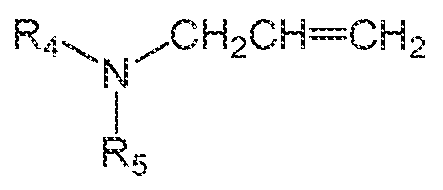
여기서 R4 및 R5는 독립적으로 수소, 히드로카르빌, 또는 치환된 히드로카르빌이다. 한 실시양태에서, 예를 들어 R4 및 R5는 독립적으로 수소, 포화 탄화수소, 불포화 지방족, 아릴, 헤테로아릴, 불포화 헤테로지방족, 헤테로시클릭 또는 헤테로알킬이다. 추가의 예로서, 한 이러한 실시양태에서 R4 및 R5는 독립적으로 수소, 지방족, 헤테로지방족, 아릴 또는 헤테로아릴이다. 추가의 예로서, 한 이러한 실시양태에서 R4 및 R5는 독립적으로 수소, 알킬, 알케닐, 알릴, 비닐, 아릴, 아미노알킬, 알칸올, 할로알킬, 히드록시알킬, 에테르계, 헤테로아릴 또는 헤테로시클릭이다. 추가의 예로서, 한 이러한 실시양태에서 R4 및 R5는 독립적으로 수소, 알킬, 알릴, 아미노알킬, 알칸올, 아릴, 할로알킬, 히드록시알킬, 에테르계 또는 헤테로시클릭이다. 추가의 예로서, 한 이러한 실시양태에서 R4 및 R5는 (이들이 부착되어 있는 질소 원자와 조합되어) 함께 고리 구조의 일부를 구성하여, 화학식 1a로 기재된 바와 같은 단량체는 질소-함유 헤테로사이클 (예를 들어, 피페리딘)이 된다. 추가의 예로서, 한 실시양태에서 R4 및 R5는 독립적으로 수소, 지방족 또는 헤테로지방족이다. 추가의 예로서, 한 실시양태에서 R4 및 R5는 독립적으로 수소, 알릴 또는 아미노알킬이다.wherein R 4 and R 5 are independently hydrogen, hydrocarbyl, or substituted hydrocarbyl. In one embodiment, for example, R 4 and R 5 are independently hydrogen, a saturated hydrocarbon, an unsaturated aliphatic, aryl, heteroaryl, unsaturated heteroaliphatic, heterocyclic, or heteroalkyl. As a further example, in one such embodiment R 4 and R 5 are independently hydrogen, aliphatic, heteroaliphatic, aryl, or heteroaryl. As a further example, in one such embodiment R 4 and R 5 are independently hydrogen, alkyl, alkenyl, allyl, vinyl, aryl, aminoalkyl, alkanol, haloalkyl, hydroxyalkyl, ethereal, heteroaryl, or heterocyclic. As a further example, in one such embodiment R 4 and R 5 are independently hydrogen, alkyl, allyl, aminoalkyl, alkanol, aryl, haloalkyl, hydroxyalkyl, ethereal or heterocyclic. As a further example, in one such embodiment R 4 and R 5 (in combination with the nitrogen atom to which they are attached) together form part of a ring structure such that the monomer described by Formula 1a is a nitrogen-containing heterocycle (e.g., piperidine). As a further example, in one embodiment R 4 and R 5 are independently hydrogen, aliphatic or heteroaliphatic. As a further example, in one embodiment R 4 and R 5 are independently hydrogen, allyl or aminoalkyl.
일부 실시양태에서, 가교 아민 중합체는 하기 화학식 1b에 상응하는 아민의 잔기를 포함하고, 가교 아민 중합체는 하기 화학식 1b에 상응하는 아민과 다관능성 가교제 (임의로 또한 아민 모이어티를 포함함)의 치환 중합에 의해 제조된다.In some embodiments, the crosslinked amine polymer comprises the residue of an amine corresponding to Formula 1b, wherein the crosslinked amine polymer is prepared by substitution polymerization of an amine corresponding to Formula 1b and a polyfunctional crosslinking agent (optionally also comprising an amine moiety).
<화학식 1b><Chemical Formula 1b>
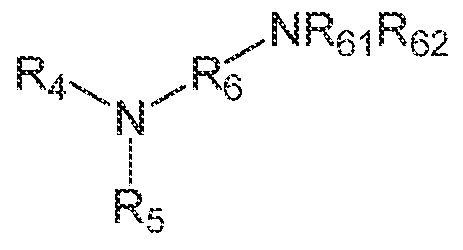
여기서 R4 및 R5는 독립적으로 수소, 히드로카르빌 또는 치환된 히드로카르빌이고, R6은 지방족이고, R61 및 R62는 독립적으로 수소, 지방족 또는 헤테로지방족이다. 한 실시양태에서, 예를 들어 R4 및 R5는 독립적으로 수소, 포화 탄화수소, 불포화 지방족, 아릴, 헤테로아릴, 헤테로알킬 또는 불포화 헤테로지방족이다. 추가의 예로서, 한 이러한 실시양태에서 R4 및 R5는 독립적으로 수소, 지방족, 헤테로지방족, 아릴 또는 헤테로아릴이다. 추가의 예로서, 한 이러한 실시양태에서 R4 및 R5는 독립적으로 수소, 알킬, 알케닐, 알릴, 비닐, 아릴, 아미노알킬, 알칸올, 할로알킬, 히드록시알킬, 에테르계, 헤테로아릴 또는 헤테로시클릭이다. 추가의 예로서, 한 이러한 실시양태에서 R4 및 R5는 독립적으로 수소, 알킬, 알케닐, 아미노알킬, 알칸올, 아릴, 할로알킬, 히드록시알킬, 에테르계, 헤테로아릴 또는 헤테로시클릭이다. 추가의 예로서, 한 이러한 실시양태에서 R4 및 R5는 (이들이 부착되어 있는 질소 원자와 조합되어) 함께 고리 구조의 일부를 구성하여, 화학식 1a로 기재된 바와 같은 단량체는 질소-함유 헤테로사이클 (예를 들어, 피페리딘)이 된다. 추가의 예로서, 한 실시양태에서 R4 및 R5는 독립적으로 수소, 지방족 또는 헤테로지방족이다. 추가의 예로서, 한 실시양태에서 R4 및 R5는 독립적으로 수소, 알릴 또는 아미노알킬이다. 추가의 예로서, 본 단락에서 언급된 각각의 실시양태에서, R6은 메틸렌, 에틸렌 또는 프로필렌일 수 있고, R61 및 R62는 독립적으로 수소, 알릴 또는 아미노알킬일 수 있다.wherein R 4 and R 5 are independently hydrogen, hydrocarbyl or substituted hydrocarbyl, R 6 is aliphatic, and R 61 and R 62 are independently hydrogen, aliphatic or heteroaliphatic. In one embodiment, for example, R 4 and R 5 are independently hydrogen, a saturated hydrocarbon, an unsaturated aliphatic, aryl, heteroaryl, heteroalkyl or unsaturated heteroaliphatic. As a further example, in one such embodiment R 4 and R 5 are independently hydrogen, aliphatic, heteroaliphatic, aryl or heteroaryl. As a further example, in one such embodiment R 4 and R 5 are independently hydrogen, alkyl, alkenyl, allyl, vinyl , aryl, aminoalkyl, alkanol, haloalkyl, hydroxyalkyl, ethereal, heteroaryl or heterocyclic. As a further example, in one such embodiment R 4 and R 5 are independently hydrogen, alkyl, alkenyl, aminoalkyl, alkanol, aryl, haloalkyl, hydroxyalkyl, ethereal, heteroaryl or heterocyclic. As a further example, in one such embodiment R 4 and R 5 (in combination with the nitrogen atom to which they are attached) together form part of a ring structure such that the monomer described by Formula 1a is a nitrogen-containing heterocycle (e.g., piperidine). As a further example, in one embodiment R 4 and R 5 are independently hydrogen, aliphatic or heteroaliphatic. As a further example, in one embodiment R 4 and R 5 are independently hydrogen, allyl or aminoalkyl. As a further example, in each of the embodiments mentioned in this paragraph, R 6 can be methylene, ethylene or propylene, and R 61 and R 62 can independently be hydrogen, allyl or aminoalkyl.
일부 실시양태에서, 가교 아민 중합체는 하기 화학식 1c에 상응하는 아민의 잔기를 포함한다.In some embodiments, the crosslinked amine polymer comprises an amine residue corresponding to the following formula 1c:
<화학식 1c><Chemical formula 1c>

여기서 R7은 수소, 지방족 또는 헤테로지방족이고, R8은 지방족 또는 헤테로지방족이다. 예를 들어, 한 이러한 실시양태에서 예를 들어 R7은 수소이고, R8은 지방족 또는 헤테로지방족이다. 추가의 예로서, 한 이러한 실시양태에서 R7 및 R8은 독립적으로 지방족 또는 헤테로지방족이다. 추가의 예로서, 한 이러한 실시양태에서 R7 및 R8 중 적어도 1개는 알릴 모이어티를 포함한다. 추가의 예로서, 한 이러한 실시양태에서 R7 및 R8 중 적어도 1개는 아미노알킬 모이어티를 포함한다. 추가의 예로서, 한 이러한 실시양태에서 R7 및 R8은 각각 알릴 모이어티를 포함한다. 추가의 예로서, 한 이러한 실시양태에서 R7 및 R8은 각각 아미노알킬 모이어티를 포함한다. 추가의 예로서, 한 이러한 실시양태에서 R7은 알릴 모이어티를 포함하고, R8은 아미노알킬 모이어티를 포함한다.wherein R 7 is hydrogen, aliphatic or heteroaliphatic, and R 8 is aliphatic or heteroaliphatic. For example, in one such embodiment, for example, R 7 is hydrogen and R 8 is aliphatic or heteroaliphatic. As a further example, in one such embodiment R 7 and R 8 are independently aliphatic or heteroaliphatic. As a further example, in one such embodiment at least one of R 7 and R 8 comprises an allyl moiety. As a further example, in one such embodiment at least one of R 7 and R 8 comprises an aminoalkyl moiety. As a further example, in one such embodiment R 7 and R 8 each comprise an allyl moiety. As a further example, in one such embodiment R 7 and R 8 each comprise an aminoalkyl moiety. As a further example, in one such embodiment R 7 comprises an allyl moiety and R 8 comprises an aminoalkyl moiety.
일부 실시양태에서, 가교 아민 중합체는 하기 화학식 2에 상응하는 아민의 잔기를 포함한다.In some embodiments, the crosslinked amine polymer comprises an amine residue corresponding to the following formula 2:
<화학식 2><Chemical Formula 2>

여기서Here
m 및 n은 독립적으로 음이 아닌 정수이고;m and n are independently non-negative integers;
R10, R20, R30, 및 R40은 독립적으로 수소, 히드로카르빌 또는 치환된 히드로카르빌이고;R 10 , R 20 , R 30 , and R 40 are independently hydrogen, hydrocarbyl or substituted hydrocarbyl;
X1은 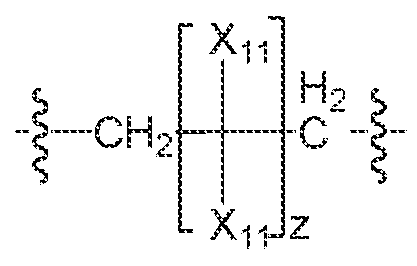
X2는 히드로카르빌 또는 치환된 히드로카르빌이고;X 2 is hydrocarbyl or substituted hydrocarbyl;
각각의 X11은 독립적으로 수소, 히드로카르빌, 치환된 히드로카르빌, 히드록실, 아미노, 보론산 또는 할로이고; Each X 11 is independently hydrogen, hydrocarbyl, substituted hydrocarbyl, hydroxyl, amino, boronic acid or halo;
z는 음이 아닌 수이다.z is a non-negative number.
한 실시양태에서, 가교 아민 중합체는 화학식 2에 상응하는 아민의 잔기를 포함하고, 가교 아민 중합체는 (i) 화학식 2에 상응하는 아민과 다관능성 가교제 (임의로 또한 아민 모이어티를 포함함)의 치환 중합 또는 (2) 화학식 2에 상응하는 아민의 라디칼 중합에 의해 제조되고, m 및 n은 독립적으로 0, 1, 2 또는 3이고, n은 0 또는 1이다.In one embodiment, the crosslinked amine polymer comprises the residue of an amine corresponding to Formula 2, and the crosslinked amine polymer is prepared by (i) substitution polymerization of an amine corresponding to Formula 2 with a polyfunctional crosslinker (optionally also comprising an amine moiety) or (2) radical polymerization of an amine corresponding to Formula 2, wherein m and n are independently 0, 1, 2, or 3, and n is 0 or 1.
한 실시양태에서, 가교 아민 중합체는 화학식 2에 상응하는 아민의 잔기를 포함하고, 가교 아민 중합체는 (i) 화학식 2에 상응하는 아민과 다관능성 가교제 (임의로 또한 아민 모이어티를 포함함)의 치환 중합 또는 (2) 화학식 2에 상응하는 아민의 라디칼 중합에 의해 제조되고, R10, R20, R30, 및 R40은 독립적으로 수소, 지방족, 아릴, 헤테로지방족 또는 헤테로아릴이다. 추가의 예로서, 한 이러한 실시양태에서 R10, R20, R30, 및 R40은 독립적으로 수소, 지방족 또는 헤테로지방족이다. 추가의 예로서, 한 이러한 실시양태에서 R10, R20, R30, 및 R40은 독립적으로 수소, 알킬, 알릴, 비닐 또는 아미노알킬이다. 추가의 예로서, 한 이러한 실시양태에서 R10, R20, R30, 및 R40은 독립적으로 수소, 알킬, 알릴, 비닐, -(CH2)dNH2, -(CH2)dN[(CH2)eNH2)]2이며, 여기서 d 및 e는 독립적으로 2-4이다. 본 단락의 각각의 상기 예시적 실시양태에서, m 및 z는 독립적으로 0, 1, 2 또는 3일 수 있고, n은 0 또는 1이다.In one embodiment, the crosslinked amine polymer comprises the residue of an amine corresponding to Formula 2, and the crosslinked amine polymer is prepared by (i) substitution polymerization of an amine corresponding to Formula 2 with a polyfunctional crosslinker (optionally also comprising an amine moiety) or (2) radical polymerization of an amine corresponding to Formula 2, wherein R 10 , R 20 , R 30 , and R 40 are independently hydrogen, aliphatic, aryl, heteroaliphatic, or heteroaryl. As a further example, in one such embodiment R 10 , R 20 , R 30 , and R 40 are independently hydrogen, aliphatic, or heteroaliphatic. As a further example, in one such embodiment R 10 , R 20 , R 30 , and R 40 are independently hydrogen, alkyl, allyl, vinyl, or aminoalkyl. As a further example, in one such embodiment R 10 , R 20 , R 30 , and R 40 are independently hydrogen, alkyl, allyl, vinyl, -(CH 2 ) d NH 2 , -(CH 2 ) d N[(CH 2 ) e NH 2 )] 2 , wherein d and e are independently 2-4. In each of the above exemplary embodiments of this paragraph, m and z can be independently 0, 1, 2, or 3, and n is 0 or 1.
한 실시양태에서, 가교 아민 중합체는 화학식 2에 상응하는 아민의 잔기를 포함하고, 가교 아민 중합체는 (i) 화학식 2에 상응하는 아민과 다관능성 가교제 (임의로 또한 아민 모이어티를 포함함)의 치환 중합 또는 (2) 화학식 2에 상응하는 아민의 라디칼 중합에 의해 제조되고, X2는 지방족 또는 헤테로지방족이다. 예를 들어, 한 이러한 실시양태에서 X2는 지방족 또는 헤테로지방족이고, R10, R20, R30, 및 R40은 독립적으로 수소, 지방족, 헤테로지방족이다. 추가의 예로서, 한 이러한 실시양태에서 X2는 알킬 또는 아미노알킬이고, R10, R20, R30, 및 R40은 독립적으로 수소, 지방족 또는 헤테로지방족이다. 추가의 예로서, 한 이러한 실시양태에서 X2는 알킬 또는 아미노알킬이고, R10, R20, R30, 및 R40은 독립적으로 수소, 알킬, 알릴, 비닐 또는 아미노알킬이다. 본 단락의 각각의 상기 예시적 실시양태에서, m 및 z는 독립적으로 0, 1, 2 또는 3일 수 있고, n은 0 또는 1이다.In one embodiment, the crosslinked amine polymer comprises the residue of an amine corresponding to Formula 2, and the crosslinked amine polymer is prepared by (i) substitution polymerization of an amine corresponding to Formula 2 with a polyfunctional crosslinker (optionally also comprising an amine moiety) or (2) radical polymerization of an amine corresponding to Formula 2, and X 2 is aliphatic or heteroaliphatic. For example, in one such embodiment X 2 is aliphatic or heteroaliphatic, and R 10 , R 20 , R 30 , and R 40 are independently hydrogen, aliphatic, heteroaliphatic. As a further example, in one such embodiment X 2 is alkyl or aminoalkyl, and R 10 , R 20 , R 30 , and R 40 are independently hydrogen, aliphatic, or heteroaliphatic. As a further example, in one such embodiment, X 2 is alkyl or aminoalkyl, and R 10 , R 20 , R 30 , and R 40 are independently hydrogen, alkyl, allyl, vinyl or aminoalkyl. In each of the above exemplary embodiments of this paragraph, m and z can independently be 0, 1, 2 or 3, and n is 0 or 1.
한 실시양태에서, 가교 아민 중합체는 화학식 2에 상응하는 아민의 잔기를 포함하고, 가교 아민 중합체는 (i) 화학식 2에 상응하는 아민과 다관능성 가교제 (임의로 또한 아민 모이어티를 포함함)의 치환 중합 또는 (2) 화학식 2에 상응하는 아민의 라디칼 중합에 의해 제조되고, m은 양의 정수이다. 예를 들어, 한 이러한 실시양태에서 m은 양의 정수이고, z는 0이고, R20은 수소, 지방족 또는 헤테로지방족이다. 추가의 예로서, 한 이러한 실시양태에서 m은 양의 정수 (예를 들어, 1 내지 3)이고, z는 양의 정수 (예를 들어, 1 내지 2)이고, X11은 수소, 지방족 또는 헤테로지방족이고, R20은 수소, 지방족 또는 헤테로지방족이다. 추가의 예로서, 한 이러한 실시양태에서 m은 양의 정수이고, z는 0, 1 또는 2이고, X11은 수소 알킬, 알케닐 또는 아미노알킬이고, R20은 수소, 알킬, 알케닐 또는 아미노알킬이다.In one embodiment, the crosslinked amine polymer comprises the residue of an amine corresponding to Formula 2, and the crosslinked amine polymer is prepared by (i) substitution polymerization of an amine corresponding to Formula 2 with a polyfunctional crosslinker (optionally also comprising an amine moiety) or (2) radical polymerization of an amine corresponding to Formula 2, wherein m is a positive integer. For example, in one such embodiment, m is a positive integer, z is 0, and R 20 is hydrogen, aliphatic, or heteroaliphatic. As a further example, in one such embodiment, m is a positive integer (e.g., 1 to 3), z is a positive integer (e.g., 1 to 2), X 11 is hydrogen, aliphatic, or heteroaliphatic, and R 20 is hydrogen, aliphatic, or heteroaliphatic. As a further example, in one such embodiment m is a positive integer, z is 0, 1 or 2, X 11 is hydrogen alkyl, alkenyl or aminoalkyl, and R 20 is hydrogen, alkyl, alkenyl or aminoalkyl.
한 실시양태에서, 가교 아민 중합체는 화학식 2에 상응하는 아민의 잔기를 포함하고, 가교 아민 중합체는 (i) 화학식 2에 상응하는 아민과 다관능성 가교제 (임의로 또한 아민 모이어티를 포함함)의 치환 중합 또는 (2) 화학식 2에 상응하는 아민의 라디칼 중합에 의해 제조되고, n은 양의 정수이고, R30은 수소, 지방족 또는 헤테로지방족이다. 추가의 예로서, 한 이러한 실시양태에서 n은 0 또는 1이고, R30은 수소, 알킬, 알케닐 또는 아미노알킬이다.In one embodiment, the crosslinked amine polymer comprises the residue of an amine corresponding to Formula 2, and the crosslinked amine polymer is prepared by (i) substitution polymerization of an amine corresponding to Formula 2 with a polyfunctional crosslinker (optionally also comprising an amine moiety) or (2) radical polymerization of an amine corresponding to Formula 2, wherein n is a positive integer, and R 30 is hydrogen, aliphatic, or heteroaliphatic. By way of further example, in one such embodiment n is 0 or 1, and R 30 is hydrogen, alkyl, alkenyl, or aminoalkyl.
한 실시양태에서, 가교 아민 중합체는 화학식 2에 상응하는 아민의 잔기를 포함하고, 가교 아민 중합체는 (i) 화학식 2에 상응하는 아민과 다관능성 가교제 (임의로 또한 아민 모이어티를 포함함)의 치환 중합 또는 (2) 화학식 2에 상응하는 아민의 라디칼 중합에 의해 제조되고, m 및 n은 독립적으로 음이 아닌 정수이고, X2는 지방족 또는 헤테로지방족이다. 예를 들어, 한 이러한 실시양태에서 m은 0 내지 2이고, n은 0 또는 1이고, X2는 지방족 또는 헤테로지방족이고, R10, R20, R30, 및 R40은 독립적으로 수소, 지방족 또는 헤테로지방족이다. 추가의 예로서, 한 이러한 실시양태에서 m은 0 내지 2이고, n은 0 또는 1이고, X2는 알킬 또는 아미노알킬이고, R10, R20, R30, 및 R40은 독립적으로 수소, 지방족 또는 헤테로지방족이다. 추가의 예로서, 한 이러한 실시양태에서 m은 0 내지 2이고, n은 0 또는 1이고, X2는 알킬 또는 아미노알킬이고, R10, R20, R30, 및 R40은 독립적으로 수소, 알킬, 알케닐 또는 아미노알킬이다.In one embodiment, the crosslinked amine polymer comprises the residue of an amine corresponding to Formula 2, and the crosslinked amine polymer is prepared by (i) substitution polymerization of an amine corresponding to Formula 2 with a polyfunctional crosslinker (optionally also comprising an amine moiety) or (2) radical polymerization of an amine corresponding to Formula 2, wherein m and n are independently non-negative integers, and X 2 is aliphatic or heteroaliphatic. For example, in one such embodiment, m is 0 to 2, n is 0 or 1, X 2 is aliphatic or heteroaliphatic, and R 10 , R 20 , R 30 , and R 40 are independently hydrogen, aliphatic, or heteroaliphatic. As a further example, in one such embodiment m is 0 to 2, n is 0 or 1, X 2 is alkyl or aminoalkyl, and R 10 , R 20 , R 30 , and R 40 are independently hydrogen, aliphatic, or heteroaliphatic. As a further example, in one such embodiment m is 0 to 2, n is 0 or 1, X 2 is alkyl or aminoalkyl, and R 10 , R 20 , R 30 , and R 40 are independently hydrogen, alkyl, alkenyl, or aminoalkyl.
일부 실시양태에서, 가교 아민 중합체는 하기 화학식 2a에 상응하는 아민의 잔기를 포함하고, 가교 아민 중합체는 하기 화학식 2a에 상응하는 아민과 다관능성 가교제 (임의로 또한 아민 모이어티를 포함함)의 치환 중합에 의해 제조된다.In some embodiments, the crosslinked amine polymer comprises the residue of an amine corresponding to Formula 2a below, and the crosslinked amine polymer is prepared by substitution polymerization of an amine corresponding to Formula 2a below and a polyfunctional crosslinking agent (optionally also comprising an amine moiety).
<화학식 2a><Chemical Formula 2a>

여기서Here
m 및 n은 독립적으로 음이 아닌 정수이고;m and n are independently non-negative integers;
각각의 R11은 독립적으로 수소, 히드로카르빌, 헤테로지방족 또는 헤테로아릴이고;Each R 11 is independently hydrogen, hydrocarbyl, heteroaliphatic or heteroaryl;
R21 및 R31은 독립적으로 수소 또는 헤테로지방족이고;R 21 and R 31 are independently hydrogen or heteroaliphatic;
R41은 수소, 치환된 히드로카르빌 또는 히드로카르빌이고;R 41 is hydrogen, substituted hydrocarbyl or hydrocarbyl;
X1은 
X2는 알킬 또는 치환된 히드로카르빌이고;X 2 is alkyl or substituted hydrocarbyl;
각각의 X12는 독립적으로 수소, 히드록시, 아미노, 아미노알킬, 보론산 또는 할로이고; Each X 12 is independently hydrogen, hydroxy, amino, aminoalkyl, boronic acid or halo;
z는 음이 아닌 수이다.z is a non-negative number.
한 실시양태에서, 가교 아민 중합체는 화학식 2a에 상응하는 아민의 잔기를 포함하고, 가교 아민 중합체는 화학식 2a에 상응하는 아민과 다관능성 가교제 (임의로 또한 아민 모이어티를 포함함)의 치환 중합에 의해 제조된다. 예를 들어, 한 이러한 실시양태에서, m 및 z는 독립적으로 0, 1, 2 또는 3이고, n은 0 또는 1이다.In one embodiment, the crosslinked amine polymer comprises the residue of an amine corresponding to Formula 2a, and the crosslinked amine polymer is prepared by substitution polymerization of an amine corresponding to Formula 2a and a polyfunctional crosslinker (optionally also comprising an amine moiety). For example, in one such embodiment, m and z are independently 0, 1, 2, or 3, and n is 0 or 1.
한 실시양태에서, 가교 아민 중합체는 화학식 2a에 상응하는 아민의 잔기를 포함하고, 가교 아민 중합체는 화학식 2a에 상응하는 아민과 다관능성 가교제 (임의로 또한 아민 모이어티를 포함함)의 치환 중합에 의해 제조되고, 각각의 R11은 독립적으로 수소, 지방족, 아미노알킬, 할로알킬 또는 헤테로아릴이고, R21 및 R31은 독립적으로 수소 또는 헤테로지방족이고, R41은 수소, 지방족, 아릴, 헤테로지방족 또는 헤테로아릴이다. 예를 들어, 한 이러한 실시양태에서 각각의 R11은 수소, 지방족, 아미노알킬 또는 할로알킬이고, R21 및 R31은 독립적으로 수소 또는 헤테로지방족이고, R41은 수소, 알킬아미노, 아미노알킬, 지방족 또는 헤테로지방족이다. 추가의 예로서, 한 이러한 실시양태에서 각각의 R11은 수소, 지방족, 아미노알킬 또는 할로알킬이고, R21 및 R31은 수소 또는 아미노알킬이고, R41은 수소, 지방족 또는 헤테로지방족이다. 추가의 예로서, 한 이러한 실시양태에서 각각의 R11 및 R41은 독립적으로 수소, 알킬 또는 아미노알킬이고, R21 및 R31은 독립적으로 수소 또는 헤테로지방족이다. 추가의 예로서, 한 이러한 실시양태에서 각각의 R11 및 R41은 독립적으로 수소, 알킬, -(CH2)dNH2, -(CH2)dN[(CH2)eNH2)]2이고, 여기서 d 및 e는 독립적으로 2-4이고, R21 및 R31은 독립적으로 수소 또는 헤테로지방족이다. 본 단락의 각각의 상기 예시적 실시양태에서, m 및 z는 독립적으로 0, 1, 2 또는 3일 수 있고, n은 0 또는 1이다.In one embodiment, the crosslinked amine polymer comprises the residue of an amine corresponding to Formula 2a, and the crosslinked amine polymer is prepared by substitution polymerization of an amine corresponding to Formula 2a and a polyfunctional crosslinker (optionally also comprising an amine moiety), wherein each R 11 is independently hydrogen, aliphatic, aminoalkyl, haloalkyl, or heteroaryl, R 21 and R 31 are independently hydrogen or heteroaliphatic, and R 41 is hydrogen, aliphatic, aryl, heteroaliphatic, or heteroaryl. For example, in one such embodiment each R 11 is hydrogen, aliphatic, aminoalkyl, or haloalkyl, R 21 and R 31 are independently hydrogen or heteroaliphatic, and R 41 is hydrogen, alkylamino, aminoalkyl, aliphatic, or heteroaliphatic. As a further example, in one such embodiment each of R 11 is hydrogen, aliphatic, aminoalkyl or haloalkyl, R 21 and R 31 are hydrogen or aminoalkyl, and R 41 is hydrogen, aliphatic or heteroaliphatic. As a further example, in one such embodiment each of R 11 and R 41 are independently hydrogen, alkyl or aminoalkyl, and R 21 and R 31 are independently hydrogen or heteroaliphatic. As a further example, in one such embodiment each of R 11 and R 41 are independently hydrogen, alkyl, -(CH 2 ) d NH 2 , -(CH 2 ) d N[(CH 2 ) e NH 2 )] 2 , wherein d and e are independently 2-4, and R 21 and R 31 are independently hydrogen or heteroaliphatic. In each of the above exemplary embodiments of this paragraph, m and z can independently be 0, 1, 2 or 3, and n is 0 or 1.
화학식 2a에 상응하는 반복 유닛을 포함하는 중합체의 합성을 위한 예시적인 아민은 하기 표 1에 제시된 아민을 포함하나, 이에 제한되지는 않는다.Exemplary amines for the synthesis of polymers comprising repeating units corresponding to formula 2a include, but are not limited to, the amines set forth in Table 1 below.
<표 1><Table 1>


화학식 2a에 상응하는 아민의 잔기를 포함하는 중합체의 합성을 위한 예시적인 가교제는 하기 표 2에 제시된 가교제를 포함하나, 이에 제한되지는 않는다.Exemplary cross-linkers for the synthesis of polymers comprising an amine residue corresponding to chemical formula 2a include, but are not limited to, the cross-linkers set forth in Table 2 below.
<표 2><Table 2>

일부 실시양태에서, 가교 아민 중합체는 하기 화학식 2b에 상응하는 아민의 잔기를 포함하고, 가교 아민 중합체는 하기 화학식 2b에 상응하는 아민의 라디칼 중합에 의해 제조된다.In some embodiments, the crosslinked amine polymer comprises a residue of an amine corresponding to Formula 2b, wherein the crosslinked amine polymer is prepared by radical polymerization of an amine corresponding to Formula 2b.
<화학식 2b><Chemical Formula 2b>

여기서Here
m 및 n은 독립적으로 음이 아닌 정수이고;m and n are independently non-negative integers;
각각의 R12는 독립적으로 수소, 치환된 히드로카르빌 또는 히드로카르빌이고;Each R 12 is independently hydrogen, substituted hydrocarbyl or hydrocarbyl;
R22 및 R32는 독립적으로 수소, 치환된 히드로카르빌 또는 히드로카르빌이고;R 22 and R 32 are independently hydrogen, substituted hydrocarbyl or hydrocarbyl;
R42는 수소, 히드로카르빌 또는 치환된 히드로카르빌이고;R 42 is hydrogen, hydrocarbyl or substituted hydrocarbyl;
X1은 
X2는 알킬, 아미노알킬 또는 알칸올이고;X 2 is alkyl, aminoalkyl or alkanol;
각각의 X13은 독립적으로 수소, 히드록시, 지환족, 아미노, 아미노알킬, 할로겐, 알킬, 헤테로아릴, 보론산 또는 아릴이고;Each X 13 is independently hydrogen, hydroxy, cycloaliphatic, amino, aminoalkyl, halogen, alkyl, heteroaryl, boronic acid or aryl;
z는 음이 아닌 수이고,z is a non-negative number,
화학식 2b에 상응하는 아민은 적어도 1개의 알릴 기를 포함한다.The amine corresponding to formula 2b contains at least one allylic group.
한 실시양태에서, 가교 아민 중합체는 화학식 2b에 상응하는 아민의 잔기를 포함하고, 가교 아민 중합체는 화학식 2b에 상응하는 아민의 라디칼 중합에 의해 제조되고, m 및 z는 독립적으로 0, 1, 2 또는 3이고, n은 0 또는 1이다.In one embodiment, the crosslinked amine polymer comprises the residue of an amine corresponding to Formula 2b, wherein the crosslinked amine polymer is prepared by radical polymerization of an amine corresponding to Formula 2b, wherein m and z are independently 0, 1, 2, or 3, and n is 0 or 1.
한 실시양태에서, 가교 아민 중합체는 화학식 2b에 상응하는 아민의 잔기를 포함하고, 가교 아민 중합체는 화학식 1에 상응하는 아민의 라디칼 중합에 의해 제조되고, (i) R12 또는 R42는 독립적으로 적어도 1개의 알릴 또는 비닐 모이어티를 포함하고/거나, (ii) m은 양의 정수이고, R22는 적어도 1개의 알릴 또는 비닐 모이어티를 포함하고/거나, (iii) n은 양의 정수이고, R32는 적어도 1개의 알릴 모이어티를 포함한다. 예를 들어, 한 이러한 실시양태에서, m 및 z는 독립적으로 0, 1, 2 또는 3이고, n은 0 또는 1이다. 예를 위해, 한 이러한 실시양태에서 R12 또는 R42는 조합되어 적어도 2개의 알릴 또는 비닐 모이어티를 포함한다. 추가의 예로서, 한 이러한 실시양태에서, m은 양의 정수이고, R12, R22 및 R42는 조합되어 적어도 2개의 알릴 또는 비닐 모이어티를 포함한다. 추가의 예로서, 한 이러한 실시양태에서, n은 양의 정수이고, R12, R32 및 R42는 조합되어 적어도 2개의 알릴 또는 비닐 모이어티를 포함한다. 추가의 예로서, 한 이러한 실시양태에서, m은 양의 정수이고, n은 양의 정수이고, R12, R22, R32 및 R42는 조합되어 적어도 2개의 알릴 또는 비닐 모이어티를 포함한다.In one embodiment, the crosslinked amine polymer comprises the residue of an amine corresponding to Formula 2b, wherein the crosslinked amine polymer is prepared by radical polymerization of an amine corresponding to Formula 1, wherein (i) R 12 or R 42 independently comprise at least one allyl or vinyl moiety, (ii) m is a positive integer and R 22 comprises at least one allyl or vinyl moiety, and/or (iii) n is a positive integer and R 32 comprises at least one allyl moiety. For example, in one such embodiment, m and z are independently 0, 1, 2, or 3, and n is 0 or 1. For example, in one such embodiment R 12 or R 42 in combination comprise at least two allyl or vinyl moieties. As a further example, in one such embodiment, m is a positive integer, and R 12 , R 22 and R 42 in combination comprise at least two allyl or vinyl moieties. As a further example, in one such embodiment, n is a positive integer, and R 12 , R 32 and R 42 in combination comprise at least two allyl or vinyl moieties. As a further example, in one such embodiment, m is a positive integer, n is a positive integer, and R 12 , R 22 , R 32 and R 42 in combination comprise at least two allyl or vinyl moieties.
한 실시양태에서, 가교 아민 중합체는 화학식 2b에 상응하는 아민의 잔기를 포함하고, 가교 아민 중합체는 화학식 2b에 상응하는 아민의 라디칼 중합에 의해 제조되고, 각각의 R12는 독립적으로 수소, 아미노알킬, 알릴 또는 비닐이고, R22 및 R32는 독립적으로 수소, 알킬, 아미노알킬, 할로알킬, 알케닐, 알칸올, 헤테로아릴, 지환족 헤테로시클릭 또는 아릴이고, R42는 수소 또는 치환된 히드로카르빌이다. 예를 들어, 한 이러한 실시양태에서 각각의 R12는 아미노알킬, 알릴 또는 비닐이고, R22 및 R32는 독립적으로 수소, 알킬, 아미노알킬, 할로알킬, 알케닐 또는 알칸올이고, R42는 수소 또는 치환된 히드로카르빌이다. 추가의 예로서, 한 이러한 실시양태에서 각각의 R12 및 R42는 독립적으로 수소, 알킬, 알릴, 비닐, -(CH2)dNH2 또는 -(CH2)dN[(CH2)eNH2]2이고, 여기서 d 및 e는 독립적으로 2-4이고, R22 및 R32는 독립적으로 수소 또는 헤테로지방족이다.In one embodiment, the crosslinked amine polymer comprises the residue of an amine corresponding to Formula 2b, wherein the crosslinked amine polymer is prepared by radical polymerization of an amine corresponding to Formula 2b, wherein each R 12 is independently hydrogen, aminoalkyl, allyl, or vinyl, R 22 and R 32 are independently hydrogen, alkyl, aminoalkyl, haloalkyl, alkenyl, alkanol, heteroaryl, cycloaliphatic heterocyclic, or aryl, and R 42 is hydrogen or substituted hydrocarbyl. For example, in one such embodiment each R 12 is aminoalkyl, allyl, or vinyl, R 22 and R 32 are independently hydrogen, alkyl, aminoalkyl, haloalkyl, alkenyl, or alkanol, and R 42 is hydrogen or substituted hydrocarbyl. As a further example, in one such embodiment each of R 12 and R 42 is independently hydrogen, alkyl, allyl, vinyl, -(CH 2 ) d NH 2 or -(CH 2 ) d N[(CH 2 ) e NH 2 ] 2 , wherein d and e are independently 2-4, and R 22 and R 32 are independently hydrogen or heteroaliphatic.
화학식 2b로 기재된 중합체의 합성을 위한 예시적인 아민 및 가교제 (또는 그의 염, 예를 들어 그의 염산, 인산, 황산 또는 브로민화수소산 염)는 하기 표 3의 것을 포함하나, 이에 제한되지는 않는다.Exemplary amines and crosslinkers (or salts thereof, e.g., hydrochloric, phosphoric, sulfuric or hydrobromic acid salts thereof) for the synthesis of the polymers described by formula 2b include, but are not limited to, those set forth in Table 3 below.
<표 3><Table 3>

일부 실시양태에서, 가교 아민 중합체는 임의의 화학식 1, 1a, 1b, 1c, 2, 2a 및 2b에 기재된 단량체를 사용하여 생성된 중합체 또는 하기 화학식 3으로 기재된 반복 유닛으로 구성된 선형 중합체와, 외부 가교제 또는 가교 부위로서 역할을 할 수 있는 이미-존재하는 중합체 관능기의 반응으로부터 유래된다. 화학식 3은 X15가 랜덤, 교호, 또는 블록 공중합체인 공중합체 또는 삼원공중합체의 반복 유닛일 수 있다. 화학식 3의 반복 유닛은 또한 분지형 또는 과분지형인 중합체의 반복 유닛을 나타낼 수 있으며, 여기서 1차 분지 지점은 중합체의 주쇄 내의 임의의 원자로부터일 수 있다.In some embodiments, the crosslinked amine polymer is derived from the reaction of a linear polymer made using monomers described in any of Formulae 1, 1a, 1b, 1c, 2, 2a and 2b, or a polymer composed of repeating units described in Formula 3, with pre-existing polymer functionality that can act as an external crosslinker or crosslinking moiety. Formula 3 can be the repeating unit of a copolymer or terpolymer, wherein X 15 is a random, alternating, or block copolymer. The repeating unit of Formula 3 can also represent a repeating unit of a branched or hyperbranched polymer, wherein the primary branch point can be from any atom within the backbone of the polymer.
<화학식 3><Chemical Formula 3>

여기서Here
R15, R16 및 R17은 독립적으로 수소, 히드로카르빌, 치환된 히드로카르빌, 히드록실, 아미노, 보론산 또는 할로이고;R 15 , R 16 and R 17 are independently hydrogen, hydrocarbyl, substituted hydrocarbyl, hydroxyl, amino, boronic acid or halo;
X15는 
X5는 히드로카르빌, 치환된 히드로카르빌, 옥소 (-O-) 또는 아미노이고,X 5 is hydrocarbyl, substituted hydrocarbyl, oxo (-O-), or amino,
z는 음이 아닌 수이다.z is a non-negative number.
한 실시양태에서, R15, R16 및 R17은 독립적으로 수소, 아릴 또는 헤테로아릴이고, X5는 히드로카르빌, 치환된 히드로카르빌, 옥소 또는 아미노이고, m 및 z는 음이 아닌 정수이다. 또 다른 실시양태에서, R15, R16 및 R17은 독립적으로 지방족 또는 헤테로지방족이고, X5는 히드로카르빌, 치환된 히드로카르빌, 옥소 (-O-) 또는 아미노이고, m 및 z는 음이 아닌 정수이다. 또 다른 실시양태에서, R15, R16 및 R17은 독립적으로 불포화 지방족 또는 불포화 헤테로지방족이고, X5는 히드로카르빌, 치환된 히드로카르빌, 옥소 또는 아미노이고, z는 음이 아닌 정수이다. 또 다른 실시양태에서, R15, R16 및 R17은 독립적으로 알킬 또는 헤테로알킬이고, X5는 히드로카르빌, 치환된 히드로카르빌, 옥소 또는 아미노이고, z는 음이 아닌 정수이다. 또 다른 실시양태에서, R15, R16 및 R17은 독립적으로 알킬아미노, 아미노알킬, 히드록실, 아미노, 보론산, 할로, 할로알킬, 알칸올 또는 에테르계이고, X5는 히드로카르빌, 치환된 히드로카르빌, 옥소 또는 아미노이고, z는 음이 아닌 정수이다. 또 다른 실시양태에서, R15, R16 및 R17은 독립적으로 수소, 히드로카르빌, 치환된 히드로카르빌, 히드록실, 아미노, 보론산 또는 할로이고, X5는 옥소, 아미노, 알킬아미노, 에테르계, 알칸올 또는 할로알킬이고, z는 음이 아닌 정수이다.In one embodiment, R 15 , R 16 and R 17 are independently hydrogen, aryl or heteroaryl, X 5 is hydrocarbyl, substituted hydrocarbyl, oxo or amino, and m and z are non-negative integers. In another embodiment, R 15 , R 16 and R 17 are independently aliphatic or heteroaliphatic, X 5 is hydrocarbyl, substituted hydrocarbyl, oxo (-O-) or amino, and m and z are non-negative integers. In another embodiment, R 15 , R 16 and R 17 are independently unsaturated aliphatic or unsaturated heteroaliphatic, X 5 is hydrocarbyl, substituted hydrocarbyl, oxo or amino, and z is a non-negative integer. In another embodiment, R 15 , R 16 and R 17 are independently alkyl or heteroalkyl, X 5 is hydrocarbyl, substituted hydrocarbyl, oxo or amino, and z is a non-negative integer. In another embodiment, R 15 , R 16 and R 17 are independently alkylamino, aminoalkyl, hydroxyl, amino, boronic acid, halo, haloalkyl, alkanol or ethereal, X 5 is hydrocarbyl, substituted hydrocarbyl, oxo or amino, and z is a non-negative integer. In another embodiment, R 15 , R 16 and R 17 are independently hydrogen, hydrocarbyl, substituted hydrocarbyl, hydroxyl, amino, boronic acid or halo, X 5 is oxo, amino, alkylamino, ethereal, alkanol or haloalkyl, and z is a non-negative integer.
라디칼 중합 반응에 사용될 수 있는 예시적인 가교제는 1종 이상의 다관능성 가교제, 예컨대: 1,4-비스(알릴아미노)부탄, 1,2-비스(알릴아미노)에탄, 2-(알릴아미노)-1-[2-(알릴아미노)에틸아미노]에탄, 1,3-비스(알릴아미노)프로판, 1,3-비스(알릴아미노)-2-프로판올, 트리알릴아민, 디알릴아민, 디비닐벤젠, 1,7-옥타디엔, 1,6-헵타디엔, 1,8-노나디엔, 1,9-데카디엔, 1,4-디비닐옥시부탄, 1,6-헥사메틸렌비스아크릴아미드, 에틸렌 비스아크릴아미드, N,N'-비스(비닐술포닐아세틸)에틸렌 디아민, 1,3-비스(비닐술포닐) 2-프로판올, 비닐술폰, N,N'-메틸렌비스아크릴아미드 폴리비닐 에테르, 폴리알릴에테르, 디비닐벤젠, 1,4-디비닐옥시부탄, 및 그의 조합을 포함하나, 이에 제한되지는 않는다.Exemplary crosslinkers that can be used in the radical polymerization reaction include one or more polyfunctional crosslinkers, such as: 1,4-bis(allylamino)butane, 1,2-bis(allylamino)ethane, 2-(allylamino)-1-[2-(allylamino)ethylamino]ethane, 1,3-bis(allylamino)propane, 1,3-bis(allylamino)-2-propanol, triallylamine, diallylamine, divinylbenzene, 1,7-octadiene, 1,6-heptadiene, 1,8-nonadiene, 1,9-decadiene, 1,4-divinyloxybutane, 1,6-hexamethylenebisacrylamide, ethylene bisacrylamide, N,N'-bis(vinylsulfonylacetyl)ethylene diamine, 1,3-bis(vinylsulfonyl) 2-propanol, vinylsulfone, N,N'-methylenebisacrylamide polyvinyl ether, polyallyl ether, divinylbenzene, 1,4-divinyloxybutane, and combinations thereof.
화학식 1 내지 3의 단량체 및 중합체로부터 유래된 가교 중합체는 용액 또는 벌크 중에서, 또는 분산 매질 중에서 합성될 수 있다. 본 개시내용의 중합체의 합성에 적합한 용매의 예는 물, 저비점 알콜 (메탄올, 에탄올, 프로판올, 부탄올), 디메틸포름아미드, 디메틸술폭시드, 헵탄, 클로로벤젠, 톨루엔을 포함하나, 이에 제한되지는 않는다.Crosslinked polymers derived from the monomers and polymers of formulae 1 to 3 can be synthesized in solution or bulk, or in a dispersion medium. Examples of solvents suitable for the synthesis of the polymers of the present disclosure include, but are not limited to, water, low boiling point alcohols (methanol, ethanol, propanol, butanol), dimethylformamide, dimethylsulfoxide, heptane, chlorobenzene, toluene.
대안적 중합체 공정은 고립 중합 반응, 일련의 반응을 통한 개별 출발 물질 단량체의 단계적 첨가, 단량체 블록의 단계적 첨가, 조합 또는 임의의 다른 중합 방법, 예컨대 리빙 중합, 직접 중합, 간접 중합, 축합, 라디칼, 에멀젼, 침전 접근법, 스프레이 건조 중합 또는 일부 벌크 가교 반응 방법 및 크기 감소 공정, 예컨대 분쇄, 압축, 압출을 사용하는 것을 포함할 수 있다. 공정은 회분식, 반-연속식 및 연속식 공정으로 수행될 수 있다. 분산 매질에서의 공정의 경우에, 연속 상은 비-극성 용매, 예컨대 톨루엔, 벤젠, 탄화수소, 할로겐화 용매, 초임계 이산화탄소일 수 있다. 직접 현탁액 반응에 의하면, 물이 사용될 수 있고, 염은 현탁액의 특성을 조정하기 위해 사용될 수 있다.Alternative polymerization processes may include isolated polymerization reactions, stepwise addition of individual starting monomers through a series of reactions, stepwise addition of monomer blocks, combinations or any other polymerization method such as living polymerization, direct polymerization, indirect polymerization, condensation, radical, emulsion, precipitation approach, spray drying polymerization or some bulk crosslinking reaction method and size reduction processes such as milling, compression, extrusion. The process may be carried out as a batch, semi-continuous and continuous process. In the case of the process in a disperse medium, the continuous phase may be a non-polar solvent such as toluene, benzene, a hydrocarbon, a halogenated solvent, supercritical carbon dioxide. In the direct suspension reaction, water may be used and salts may be used to adjust the properties of the suspension.
화학식 1 내지 3에 기재된 출발 분자는 본 발명의 1종 이상의 다른 단량체, 올리고머 또는 다른 중합성 기와 공중합될 수 있다. 이러한 공중합체 아키텍처는 블록 또는 블록-유사 중합체, 그라프트 공중합체, 및 랜덤 공중합체를 포함할 수 있으나, 이에 제한되지는 않는다. 화학식 1 내지 3으로 기재된 단량체의 혼입은 1% 내지 99%의 범위일 수 있다. 일부 실시양태에서, 공단량체의 혼입은 20% 내지 80%이다.The starting molecules described in Formulas 1-3 can be copolymerized with one or more other monomers, oligomers or other polymerizable groups of the present invention. Such copolymer architectures can include, but are not limited to, block or block-like polymers, graft copolymers, and random copolymers. The incorporation of the monomers described in Formulas 1-3 can range from 1% to 99%. In some embodiments, the incorporation of the comonomer is from 20% to 80%.
단독으로 또는 조합되어 사용될 수 있는 공단량체의 비제한적 예는 스티렌, 알릴아민 히드로클로라이드, 치환된 알릴아민 히드로클로라이드, 치환된 스티렌, 알킬 아크릴레이트, 치환된 알킬 아크릴레이트, 알킬 메타크릴레이트, 치환된 알킬 메타크릴레이트, 아크릴로니트릴, 메타크릴로니트릴, 아크릴아미드, 메타크릴아미드, N-알킬아크릴아미드, N-알킬메타크릴아미드, N,N-디알킬아크릴아미드, N,N-디알킬메타크릴아미드, 이소프렌, 부타디엔, 에틸렌, 비닐 아세테이트, N-비닐 아미드, 말레산 유도체, 비닐 에테르, 알릴, 메트알릴 단량체 및 그의 조합을 포함한다. 이들 단량체의 관능화 버전이 또한 사용될 수 있다. 본 발명에서 사용될 수 있는 추가의 구체적인 단량체 또는 공단량체는 2-프로펜-1-일아민, 1-(알릴아미노)-2-아미노에탄, 1-[N-알릴(2-아미노에틸)아미노]-2-아미노에탄, 메틸 메타크릴레이트, 에틸 메타크릴레이트, 프로필 메타크릴레이트 (모든 이성질체), 부틸 메타크릴레이트 (모든 이성질체), 2-에틸헥실 메타크릴레이트, 이소보르닐 메타크릴레이트, 메타크릴산, 벤질 메타크릴레이트, 페닐 메타크릴레이트, 메타크릴로니트릴, a-메틸스티렌, 메틸 아크릴레이트, 에틸 아크릴레이트, 프로필 아크릴레이트 (모든 이성질체), 부틸 아크릴레이트 (모든 이성질체), 2-에틸헥실 아크릴레이트, 이소보르닐 아크릴레이트, 아크릴산, 벤질 아크릴레이트, 페닐 아크릴레이트, 아크릴로니트릴, 스티렌, 글리시딜 메타크릴레이트, 2-히드록시에틸 메타크릴레이트, 히드록시프로필 메타크릴레이트 (모든 이성질체), 히드록시부틸 메타크릴레이트 (모든 이성질체), N,N-디메틸아미노에틸 메타크릴레이트, N,N-디에틸아미노에틸 메타크릴레이트, 트리에틸렌글리콜 메타크릴레이트, 이타콘산 무수물, 이타콘산, 글리시딜 아크릴레이트, 2-히드록시에틸 아크릴레이트, 히드록시프로필 아크릴레이트 (모든 이성질체), 히드록시부틸 아크릴레이트 (모든 이성질체), N,N-디메틸아미노에틸 아크릴레이트, N,N-디에틸아미노에틸 아크릴레이트, 트리에틸렌글리콜 아크릴레이트, 메타크릴아미드, N-메틸아크릴아미드, N,N-디메틸아크릴아미드, N-tert-부틸메타크릴아미드, N-N-부틸메타크릴아미드, N-메틸올메타크릴아미드, N-에틸올메타크릴아미드, N-tert-부틸아크릴 아미드, N-N부틸아크릴아미드, N-메틸올아크릴아미드, N-에틸올아크릴아미드, 4-아크릴로일모르폴린, 비닐 벤조산 (모든 이성질체), 디에틸아미노스티렌 (모든 이성질체), a-메틸비닐 벤조산 (모든 이성질체), 디에틸아미노 a-메틸스티렌 (모든 이성질체), p-비닐벤젠 술폰산, p-비닐벤젠 술폰산 나트륨 염, 트리메톡시실릴프로필 메타크릴레이트, 트리에톡시실릴프로필 메타크릴레이트, 트리부톡시실릴프로필 메타크릴레이트, 디메톡시메틸실릴프로필 메타크릴레이트, 디에톡시메틸실릴프로필 메타크릴레이트, 디부톡시메틸실릴프로필 메타크릴레이트, 디이소프로폭시메틸실릴프로필 메타크릴레이트, 디메톡시실릴프로필 메타크릴레이트, 디에톡시실릴프로필 메타크릴레이트, 디부톡시실릴프로필 메타크릴레이트, 디이소프로폭시실릴프로필 메타크릴레이트, 트리메톡시실릴프로필 아크릴레이트, 트리에톡시실릴프로필 아크릴레이트, 트리부톡시실릴프로필 아크릴레이트, 디메톡시메틸실릴프로필 아크릴레이트, 디에톡시메틸실릴프로필 아크릴레이트, 디부톡시메틸실릴프로필 아크릴레이트, 디이소프로폭시메틸실릴프로필 아크릴레이트, 디메톡시실릴프로필 아크릴레이트, 디에톡시실릴프로필 아크릴레이트, 디부톡시실릴프로필 아크릴레이트, 디이소프로폭시실릴프로필 아크릴레이트, 말레산 무수물, N-페닐말레이미드, N-부틸말레이미드, N-비닐포름아미드, N-비닐 아세트아미드, 알릴아민, 메트알릴아민, 알릴알콜, 메틸-비닐에테르, 에틸비닐에테르, 부틸비닐에테르, 부타디엔, 이소프렌, 클로로프렌, 에틸렌, 비닐 아세테이트, 및 그의 조합을 포함하나, 이에 제한되지는 않는다.Non-limiting examples of comonomers which can be used alone or in combination include styrene, allylamine hydrochloride, substituted allylamine hydrochloride, substituted styrene, alkyl acrylates, substituted alkyl acrylates, alkyl methacrylates, substituted alkyl methacrylates, acrylonitrile, methacrylonitrile, acrylamide, methacrylamide, N-alkylacrylamides, N-alkylmethacrylamides, N,N-dialkylacrylamides, N,N-dialkylmethacrylamides, isoprene, butadiene, ethylene, vinyl acetate, N-vinyl amide, maleic acid derivatives, vinyl ether, allyl, methallyl monomers, and combinations thereof. Functionalized versions of these monomers can also be used. Additional specific monomers or comonomers that may be used in the present invention include 2-propen-1-ylamine, 1-(allylamino)-2-aminoethane, 1-[N-allyl(2-aminoethyl)amino]-2-aminoethane, methyl methacrylate, ethyl methacrylate, propyl methacrylate (all isomers), butyl methacrylate (all isomers), 2-ethylhexyl methacrylate, isobornyl methacrylate, methacrylic acid, benzyl methacrylate, phenyl methacrylate, methacrylonitrile, a-methylstyrene, methyl acrylate, ethyl acrylate, propyl acrylate (all isomers), butyl acrylate (all isomers), 2-ethylhexyl acrylate, isobornyl acrylate, acrylic acid, benzyl acrylate, phenyl acrylate, acrylonitrile, styrene, glycidyl methacrylate, 2-Hydroxyethyl methacrylate, Hydroxypropyl methacrylate (all isomers), Hydroxybutyl methacrylate (all isomers), N,N-Dimethylaminoethyl methacrylate, N,N-Diethylaminoethyl methacrylate, Triethylene glycol methacrylate, Itaconic anhydride, Itaconic acid, Glycidyl acrylate, 2-Hydroxyethyl acrylate, Hydroxypropyl acrylate (all isomers), Hydroxybutyl acrylate (all isomers), N,N-Dimethylaminoethyl acrylate, N,N-Diethylaminoethyl acrylate, Triethylene glycol acrylate, Methacrylamide, N-Methylacrylamide, N,N-Dimethylacrylamide, N-tert-Butylmethacrylamide, N-N-Butylmethacrylamide, N-Methylolmethacrylamide, N-Ethylolmethacrylamide, N-tert-butylacrylamide, N-Nbutylacrylamide, N-methylolacrylamide, N-ethylolacrylamide, 4-acryloylmorpholine, vinyl benzoic acid (all isomers), diethylaminostyrene (all isomers), a-methylvinyl benzoic acid (all isomers), diethylamino a-methylstyrene (all isomers), p-vinylbenzene sulfonic acid, p-vinylbenzene sulfonic acid sodium salt, trimethoxysilylpropyl methacrylate, triethoxysilylpropyl methacrylate, tributoxysilylpropyl methacrylate, dimethoxymethylsilylpropyl methacrylate, diethoxymethylsilylpropyl methacrylate, dibutoxymethylsilylpropyl methacrylate, diisopropoxymethylsilylpropyl methacrylate, dimethoxysilylpropyl methacrylate, diethoxysilylpropyl methacrylate, Dibutoxysilylpropyl methacrylate, diisopropoxysilylpropyl methacrylate, trimethoxysilylpropyl acrylate, triethoxysilylpropyl acrylate, tributoxysilylpropyl acrylate, dimethoxymethylsilylpropyl acrylate, diethoxymethylsilylpropyl acrylate, dibutoxymethylsilylpropyl acrylate, diisopropoxymethylsilylpropyl acrylate, dimethoxysilylpropyl acrylate, diethoxysilylpropyl acrylate, dibutoxysilylpropyl acrylate, diisopropoxysilylpropyl acrylate, maleic anhydride, N-phenylmaleimide, N-butylmaleimide, N-vinylformamide, N-vinyl acetamide, allylamine, methallylamine, allyl alcohol, methyl-vinyl ether, ethyl vinyl ether, butyl vinyl ether, butadiene, isoprene, chloroprene, ethylene, vinyl acetate, and the like. Including but not limited to combinations.
사전형성된 가교 중합체에 대한 추가의 변형은 아민 단량체, 추가의 가교제 및 중합체를 포함하나 이에 제한되지는 않는 개질제의 첨가를 통해 달성될 수 있다. 변형은 공유적 또는 비-공유적 방법을 통해 달성될 수 있다. 이들 변형은, 사전형성된 가교 중합체의 표면에 편재된 변형을 비롯하여 사전형성된 중합체 물질 전반에 균등하게 또는 불균등하게 분산될 수 있다. 또한, 사전형성된 중합체 내의 나머지 반응성 기, 예컨대 할로알킬 기 및 알릴 기와 일어나는 반응을 포함하나 이에 제한되지는 않는, 사전형성된 가교 중합체의 물리적 특성을 변화시키기 위한 변형이 이루어질 수 있다. 사전형성된 가교 중합체에 대한 반응 및 변형은 산-염기 반응, 친핵성 치환 반응, 마이클 반응, 비-공유적 정전기적 상호작용, 소수성 상호작용, 물리적 상호작용 (가교) 및 라디칼 반응을 포함할 수 있으나 이에 제한되지는 않는다.Additional modifications to the preformed crosslinked polymer can be achieved through the addition of modifiers, including but not limited to amine monomers, additional crosslinkers, and polymers. The modifications can be achieved through covalent or non-covalent means. These modifications can be distributed evenly or unevenly throughout the preformed polymer material, including modifications that are localized on the surface of the preformed crosslinked polymer. Modifications can also be made to change the physical properties of the preformed crosslinked polymer, including but not limited to reactions with remaining reactive groups within the preformed polymer, such as haloalkyl groups and allyl groups. Reactions and modifications to the preformed crosslinked polymer can include, but are not limited to, acid-base reactions, nucleophilic substitution reactions, Michael reactions, non-covalent electrostatic interactions, hydrophobic interactions, physical interactions (crosslinking), and radical reactions.
실시예에 보다 상세하게 기재되어 있는 바와 같이, 가교 및/또는 얽힘이 증가된 중합체는 보다 낮은 가교 및/또는 얽힘을 갖는 것보다 낮은 팽윤을 갖는 것으로 발견되었지만, 또한 보다 낮은 가교 및/또는 얽힘 중합체만큼 크거나 그보다 더 큰 표적 이온 (예를 들어, 클로라이드)에 대한 결합 능력을 갖는 한편 포스페이트와 같은 간섭 이온의 결합은 유의하게 감소되었다. 선택성 효과는 2가지 상이한 방식으로 도입하였다: 1) 클로라이드 선택성을 위해 전체적 능력을 희생시켰다. 클로라이드 결합 부위를 포함하지 않는 가교제 (예를 들어 에피클로로히드린)는 증가된 가교를 가능하게 하는 한편 중합체 내로 혼입되는 가교제의 양에 비례하여 전체적 능력은 감소된다. 2) 클로라이드 선택성을 위해 전체적 능력을 보존시킨다: 클로라이드 결합 부위를 포함하는 가교제 (예를 들어 디알릴아민)는 증가된 가교를 가능하게 하는 한편 전체적 능력은 동일하게 유지되거나 단지 소량 감소된다.As described in more detail in the Examples, the polymers with increased crosslinking and/or entanglement were found to have lower swelling than those with lower crosslinking and/or entanglement, but also had binding capacities for target ions (e.g., chloride) that were as great or greater than the lower crosslinking and/or entanglement polymers, while binding of interfering ions such as phosphate was significantly reduced. The selectivity effect was introduced in two different ways: 1) overall capacity was sacrificed for chloride selectivity. Crosslinkers that do not contain chloride binding sites (e.g., epichlorohydrin) allowed for increased crosslinking, while overall capacity was reduced in proportion to the amount of crosslinker incorporated into the polymer. 2) overall capacity was preserved for chloride selectivity: crosslinkers that contain chloride binding sites (e.g., diallylamine) allowed for increased crosslinking, while overall capacity remained the same or was only slightly reduced.
본원에 기재된 중합체는 이온 결합 특성, 일반적으로 양전하를 형성하는 양성자 결합에 이어 음이온-결합을 나타낸다. 바람직한 실시양태에서, 중합체는 클로라이드 결합 특성을 나타낸다. 이온 (예를 들어, 클로라이드) 결합 능력은 이온 결합체가 주어진 용액 중에서 결합할 수 있는 특정한 이온의 양의 척도이다. 예를 들어, 이온-결합 중합체의 결합 능력은 시험관내에서, 예를 들어 물 또는 염수 용액 중, 또는 위장 내강 조건을 대표하는 양이온 및 음이온을 함유하는 용액/매트릭스 중에서, 또는 생체내에서, 예를 들어 이온 (예를 들어, 비카르보네이트 또는 시트레이트) 요 배설물로부터, 또는 생체외에서, 예를 들어 흡인 액체, 예를 들어 실험실 동물, 환자 또는 지원자로부터 수득한 미즙/위장 내강 내용물을 사용하여 측정될 수 있다. 측정은 표적 이온만을 함유하거나, 또는 적어도 중합체에의 결합에 대해 표적 이온과 경쟁하는 다른 경쟁 용질이 없는 용액 중에서 이루어질 수 있다. 이들 경우에, 비-간섭 완충제가 사용될 것이다 (예를 들어 추가의 염화나트륨의 존재 또는 부재 하의 염산 용액). 대안적으로, 측정은 다른 경쟁 용질, 예를 들어 수지에의 결합에 대해 표적 이온과 경쟁하는 다른 이온 또는 대사물을 함유하는 간섭 완충제 중에서 이루어질 수 있다.The polymers described herein exhibit ionic binding properties, typically proton binding to form positive charges followed by anion binding. In a preferred embodiment, the polymers exhibit chloride binding properties. The ion (e.g., chloride) binding capacity is a measure of the amount of a particular ion that the ionic binder can bind in a given solution. For example, the binding capacity of an ion-binding polymer can be measured in vitro, for example, in water or saline solutions, or in solutions/matrices containing cations and anions representative of gastrointestinal lumen conditions, or in vivo, for example, from urine excretions containing ions (e.g., bicarbonate or citrate), or ex vivo, for example, using aspirated fluids, for example, chyme/gastrointestinal lumen contents obtained from laboratory animals, patients or volunteers. The measurements can be made in solutions containing only the target ion, or at least free of other competing solutes that compete with the target ion for binding to the polymer. In these cases, a non-interfering buffer will be used (e.g., a hydrochloric acid solution with or without additional sodium chloride). Alternatively, measurements can be made in an interfering buffer containing other competing solutes, e.g., other ions or metabolites that compete with the target ion for binding to the resin.
일부 실시양태에서 중합체는 염산에 결합한다. 생체내 사용을 위해, 예를 들어 대사성 산증을 치료하는데 있어서, 중합체는 높은 양성자 및 클로라이드 결합 능력을 갖는 것이 바람직하다. 결합 능력의 시험관내 측정은 반드시 생체내 결합 능력으로 해석되지 않는다. 따라서, 시험관내 및 생체내 능력 둘 다의 면에서 결합 능력을 정의하는 것이 유용하다.In some embodiments, the polymer binds hydrochloric acid. For in vivo use, such as in the treatment of metabolic acidosis, it is desirable for the polymer to have high proton and chloride binding capacities. In vitro measurements of binding capacity do not necessarily translate into in vivo binding capacity. Therefore, it is useful to define binding capacity in terms of both in vitro and in vivo capacities.
HCl 중 본 발명의 중합체의 시험관내 클로라이드 결합 능력은 약 5, 6, 7, 8, 9, 10, 11, 12, 13, 14 또는 15 mmol/g 초과일 수 있다. 일부 실시양태에서, 표적 이온에 대한 본 발명의 중합체의 시험관내 클로라이드 결합 능력은 약 5.0 mmol/g 초과, 바람직하게는 약 7.0 mmol/g 초과, 보다 바람직하게는 약 9.0 mmol/g 초과, 보다 더 바람직하게는 약 10.0 mmol/g 초과이다. 일부 실시양태에서, 클로라이드 결합 능력은 약 5.0 mmol/g 내지 약 25 mmol/g, 바람직하게는 약 7.5 mmol/g 내지 약 20 mmol/g, 보다 바람직하게는 약 10 mmol/g 내지 약 15 mmol/g의 범위일 수 있다. 클로라이드 결합 능력을 결정하기 위한 여러 기술이 관련 기술분야에 공지되어 있다.The in vitro chloride binding capacity of the polymers of the present invention in HCl can be greater than about 5, 6, 7, 8, 9, 10, 11, 12, 13, 14 or 15 mmol/g. In some embodiments, the in vitro chloride binding capacity of the polymers of the present invention for the target ion is greater than about 5.0 mmol/g, preferably greater than about 7.0 mmol/g, more preferably greater than about 9.0 mmol/g, and even more preferably greater than about 10.0 mmol/g. In some embodiments, the chloride binding capacity can range from about 5.0 mmol/g to about 25 mmol/g, preferably from about 7.5 mmol/g to about 20 mmol/g, and more preferably from about 10 mmol/g to about 15 mmol/g. Several techniques are known in the art for determining chloride binding capacity.
생체내 최대 결합 능력 (즉 인간의 GI 관에서 직면할 수 있는 조건에서 결합된 [양성자 및] 클로라이드의 최대 양)은 인공 위액 검정 ("SGF")에서 12-16시간 클로라이드 결합에 의해 평가될 수 있고, 이는 단량체 및 가교제가 얼마나 잘 혼입되었는지의 구조적 척도이다. SGF 값은 중합체의 이론적 최대 결합 능력의 실험적 확인을 나타내고, 출발 물질의 화학량론을 기반으로 계산된 능력과 동일한 범위 내에 속한다.The maximum binding capacity in vivo (i.e. the maximum amount of [proton and] chloride bound under conditions likely to be encountered in the human GI tract) can be assessed by chloride binding in a simulated gastric fluid assay (“SGF”) for 12-16 hours, which is a structural measure of how well the monomers and crosslinkers are incorporated. SGF values represent experimental confirmation of the theoretical maximum binding capacity of the polymer, and fall within the same range as the calculated capacity based on the stoichiometry of the starting materials.
양성자 결합과 균형잡히게 하기 위해, 클로라이드는 그의 제거가 혈청 비카르보네이트에 어떠한 부정적 영향도 미치지 않기 때문에 결합을 위해 선택되는 음이온이다. 양성자 양전하를 중성화하기 위해 결합되는 클로라이드 이외의 음이온은 포스페이트, 단쇄 지방산, 장쇄 지방산, 담즙산 또는 다른 유기 또는 무기 음이온을 포함한다. 이들 음이온의 결합은, 클로라이드를 제외하고, 세포내 및 세포외 구획에서 전체적 비카르보네이트 저장에 영향을 미친다.To balance proton binding, chloride is the anion of choice for binding since its removal does not have any negative effect on serum bicarbonate. Anions other than chloride that bind to neutralize the proton charge include phosphate, short-chain fatty acids, long-chain fatty acids, bile acids, or other organic or inorganic anions. Binding of these anions, except chloride, affects the overall bicarbonate storage in the intracellular and extracellular compartments.
클로라이드 결합에 대한 중합체의 선택성은 GI 내강에서 직면하는 다양한 조건, 음이온 및 음이온 농도를 모방한 조건을 사용하여 시험관내에서 평가될 수 있다. 클로라이드 결합은 포스페이트 단독과 대비하여 (예를 들어 SIB [인공 장 완충제]; 또는 GI 관에서 발견되는 음이온의 범위와 대비하여 (예를 들어, SOB) 비교될 수 있다.The selectivity of a polymer for chloride binding can be assessed in vitro using conditions mimicking a variety of anions and anion concentrations encountered in the GI lumen. Chloride binding can be compared to phosphate alone (e.g., SIB [artificial intestinal buffer]); or to a range of anions found in the GI tract (e.g., SOB).
일부 실시양태에서, 중합체를 37℃에서 시험 완충제에 1시간 노출시킨 후의 SIB 검정에서의 클로라이드 결합은 중합체 그램당 약 2.0 mmol 초과, 바람직하게는 약 2.5 mmol/g 중합체 초과, 보다 바람직하게는 약 3.0 mmol/g 중합체 초과, 보다 더 바람직하게는 약 3.5 mmol/g 중합체 초과, 가장 바람직하게는 약 4.0 mmol/g 중합체 초과이다.In some embodiments, the chloride binding in the SIB assay after exposure of the polymer to the test buffer at 37°C for 1 hour is greater than about 2.0 mmol/g polymer, preferably greater than about 2.5 mmol/g polymer, more preferably greater than about 3.0 mmol/g polymer, even more preferably greater than about 3.5 mmol/g polymer, and most preferably greater than about 4.0 mmol/g polymer.
일부 실시양태에서, 중합체를 37℃에서 시험 완충제에 2시간 노출시킨 후의 SOB 검정에서의 클로라이드 결합은 중합체 그램당 약 1.0 mmol 초과, 바람직하게는 약 2.0 mmol/g 중합체 초과, 보다 바람직하게는 약 3.0 mmol/g 중합체 초과, 보다 더 바람직하게는 약 3.5 mmol/g 중합체 초과, 가장 바람직하게는 약 4.0 mmol/g 중합체 초과이다.In some embodiments, the chloride binding in the SOB assay after exposure of the polymer to the test buffer at 37°C for 2 hours is greater than about 1.0 mmol/g polymer, preferably greater than about 2.0 mmol/g polymer, more preferably greater than about 3.0 mmol/g polymer, even more preferably greater than about 3.5 mmol/g polymer, and most preferably greater than about 4.0 mmol/g polymer.
일부 실시양태에서, 중합체를 37℃에서 시험 완충제에 48시간 노출시킨 후의 SOB 검정에서의 클로라이드 결합은 중합체 그램당 약 0.5 mmol 초과, 바람직하게는 약 1 mmol/g 중합체 초과, 보다 바람직하게는 약 2.0 mmol/g 중합체 초과, 보다 더 바람직하게는 약 3.0 mmol/g 중합체 초과, 가장 바람직하게는 약 4.0 mmol/g 중합체 초과이다. 37℃에서 48시간 노출 후의 SOB 중에서의 클로라이드 결합은 중합체가 GI 관을 통과할 때 클로라이드를 저류시키는 중합체의 능력의 한 척도이다.In some embodiments, the chloride binding in the SOB assay after 48 hours exposure of the polymer to the test buffer at 37°C is greater than about 0.5 mmol per gram of polymer, preferably greater than about 1 mmol/g polymer, more preferably greater than about 2.0 mmol/g polymer, even more preferably greater than about 3.0 mmol/g polymer, and most preferably greater than about 4.0 mmol/g polymer. Chloride binding in SOB after 48 hours exposure at 37°C is a measure of the ability of the polymer to retain chloride as it passes through the GI tract.
(양성자 및) 클로라이드 저류를 측정하는 또 다른 방식은 중합체를 SOB에 먼저 노출시켜 중합체를 단리한 다음, 예를 들어 "클로라이드 저류 검정" (CRA) 완충제를 사용하여 결장 내강의 전형적인 조건에 중합체를 노출시키는 것이다. 일부 실시양태에서, 37℃에서 SOB에의 2시간 노출에 이어 37℃에서 CRA에의 48시간 노출 후에 중합체에 결합된 채로 남아있는 클로라이드의 양은 중합체의 그램당 약 0.2 mmol 초과, 바람직하게는 약 0.5 mmol/g 중합체 초과, 보다 바람직하게는 약 1.0 mmol/g 중합체 초과, 보다 더 바람직하게는 약 2.0 mmol/g 중합체 초과, 가장 바람직하게는 약 3.0 mmol/g 중합체 초과이다.Another way to measure (proton and) chloride retention is to first expose the polymer to SOB to isolate the polymer and then expose the polymer to conditions typical of the colonic lumen, for example, using a "chloride retention assay" (CRA) buffer. In some embodiments, the amount of chloride remaining bound to the polymer after a 2 hour exposure to SOB at 37° C. followed by a 48 hour exposure to CRA at 37° C. is greater than about 0.2 mmol per gram of polymer, preferably greater than about 0.5 mmol/g polymer, more preferably greater than about 1.0 mmol/g polymer, still more preferably greater than about 2.0 mmol/g polymer, and most preferably greater than about 3.0 mmol/g polymer.
일부 실시양태에서, 본 개시내용의 중합체의 생체내 결합 성능은 정상 신기능을 갖는 인간을 비롯한 동물에게 투여한 후에 소변 산 수준에서의 변화를 측정함으로써 평가될 수 있다. 대사 평형에 이르기에 충분한 시간으로 주어진 투여된 중합체의 작용에 의한 신체로부터의 추가의 HCl의 제거 (또는 HCl 평형)는 소변 비카르보네이트, 적정가능한 산, 시트레이트 또는 요 산 배설의 다른 지표에서의 변화에 반영된다.In some embodiments, the in vivo binding performance of the polymers of the present disclosure can be assessed by measuring changes in urine acid levels following administration to animals, including humans, with normal renal function. Additional removal of HCl from the body (or HCl equilibrium) by the action of the administered polymer given sufficient time to reach metabolic equilibrium is reflected in changes in urine bicarbonate, titratable acid, citrate, or other indicators of urinary acid excretion.
양성자를 결합시키기 위해, 중합체의 아민 구성성분은 1급, 2급 또는 3급 아민일 수 있지만, 4급 아민은 아니다. 4급 아민은 모든 생리학적 조건에서 실질적으로 하전된 채로 남아있고, 따라서 음이온이 결합되기 전에 양성자에 결합하지 않는다. 4급 아민의 백분율은 적정 및 역 적정 접근법을 비롯한 다수의 방식으로 측정될 수 있다. 또 다른 간단하지만 정확한 방법은 저 및 고 pH에서의 음이온 (예를 들어 클로라이드) 결합을 비교하는 것이다. 저 pH (예를 들어 SGF 완충제 조건; pH 1.2)에서의 클로라이드 결합은 4급 아민과 다른 아민을 구별하지 않는 반면에, 고 pH (예를 들어 QAA 완충제 조건; pH 11.5)에서의 클로라이드 결합 검정은 구별한다. 이러한 고 pH에서, 1급, 2급 및 3급 아민은 실질적으로 양성자화되지 않고, 클로라이드 결합에 기여하지 않는다. 따라서, 이들 조건 하에 관찰되는 임의의 결합은 영구적으로 하전된 4급 아민의 존재로 인한 것일 수 있다. 저 pH (예를 들어 SGF 조건) 대 고 pH (예를 들어 QAA 조건)에서의 클로라이드 결합의 비교는 4급화 정도의 척도이고, 나아가 클로라이드와 함께 결합된 양성자의 양의 척도이다. 본 개시내용의 중합체는 40%, 30%, 20%, 10%, 가장 바람직하게는 5% 이하의 4급 아민을 함유한다.To bind protons, the amine component of the polymer can be a primary, secondary or tertiary amine, but not a quaternary amine. Quaternary amines remain substantially charged under all physiological conditions and therefore do not bind protons before anions are bound. The percentage of quaternary amines can be measured in a number of ways, including titration and back titration approaches. Another simple, yet accurate, method is to compare anion (e.g. chloride) binding at low and high pH. Chloride binding at low pH (e.g. SGF buffer conditions; pH 1.2) does not distinguish between quaternary amines and other amines, whereas chloride binding assays at high pH (e.g. QAA buffer conditions; pH 11.5) do. At these high pHs, primary, secondary and tertiary amines are substantially unprotonated and do not contribute to chloride binding. Therefore, any binding observed under these conditions may be due to the presence of a permanently charged quaternary amine. Comparison of chloride binding at low pH (e.g., SGF conditions) versus high pH (e.g., QAA conditions) is a measure of the degree of quaternization, and by extension, the amount of protons that are bound with the chloride. The polymers of the present disclosure contain less than or equal to 40%, 30%, 20%, 10%, and most preferably less than or equal to 5% quaternary amine.
본 개시내용의 중합체의 팽윤 비는 가교 정도, 나아가 중합체의 상대적 세공 크기 및 클로라이드보다 큰 (또는 클로라이드보다 큰 수화 비를 갖는) 음이온에 대한 접근성의 실험적 확인을 나타낸다. 일부 실시양태에서 팽윤은 탈이온수 중에서 측정되고, 건조 중합체의 그램당 물의 그램으로 표현된다. 본 개시내용의 중합체는 ≤5g/g, ≤4g/g, ≤3g/g, ≤2g/g 또는 ≤1g/g의 탈이온수 중 팽윤 비를 갖는다.The swelling ratio of the polymers of the present disclosure is an experimental indication of the degree of crosslinking, and further the relative pore size of the polymer, and the accessibility to anions larger than chloride (or having a hydration ratio greater than chloride). In some embodiments, the swelling is measured in deionized water and is expressed as grams of water per gram of dry polymer. The polymers of the present disclosure have a swelling ratio in deionized water of ≤5 g/g, ≤4 g/g, ≤3 g/g, ≤2 g/g, or ≤1 g/g.
중합체가 GI 내강 내에서 거치는 상이한 조건을 통과할 때 클로라이드를 저류시키는 (및 이를 방출하지 않아 다른 음이온과 교환되도록 함) 중합체의 능력은 상대적인 생체내 효능의 예측인자일 수 있는 중요한 특징이다. 클로라이드 저류 검정 (CRA)은 클로라이드 저류를 평가하는데 사용될 수 있다. SOB (인공 장 유기/무기 완충제) 스크린은 클로라이드 및 다른 음이온이 중합체에 결합되도록 하기 위해 먼저 수행되고, 중합체는 단리되고, 결장 내강을 모방한 조건 (예를 들어 저류 검정 매트릭스)에 40시간 동안 노출된다. 중합체가 다시 단리되고, 중합체에 결합된 채로 남아있는 음이온은 수산화나트륨 중으로 용리되고 측정된다. 본 개시내용의 중합체는 기재된 바와 같은 클로라이드 저류 검정에 적용된 후에 50%, 60%, 70%, 80% 초과 또는 가장 바람직하게는 90% 초과의 결합된 클로라이드를 저류시킨다.The ability of a polymer to retain chloride (and not release it to exchange with other anions) as it passes through different conditions encountered in the GI lumen is an important characteristic that may be a predictor of relative in vivo efficacy. A chloride retention assay (CRA) can be used to assess chloride retention. A SOB (Artificial Intestinal Organic/Inorganic Buffers) screen is first performed to allow chloride and other anions to bind to the polymer, the polymer is isolated, and exposed to conditions mimicking the colonic lumen (e.g., a retention assay matrix) for 40 hours. The polymer is again isolated, and the anions that remain bound to the polymer are eluted into sodium hydroxide and measured. The polymers of the present disclosure retain greater than 50%, 60%, 70%, 80%, or most preferably greater than 90% of the bound chloride after being subjected to a chloride retention assay as described.
불균질 중합 공정을 사용하면, 중합체 입자는 직경이 5 내지 1000 마이크로미터 범위 내, 바람직하게는 10 내지 500 마이크로미터, 가장 바람직하게는 40 - 180 마이크로미터로 제어된 구형 비드로서 수득된다.Using a heterogeneous polymerization process, the polymer particles are obtained as spherical beads with a diameter controlled within the range of 5 to 1000 micrometers, preferably 10 to 500 micrometers, most preferably 40 to 180 micrometers.
일반적으로, 본 개시내용의 제약 조성물은 본원에 기재된 양성자-결합, 가교 아민 중합체를 포함한다. 바람직하게는, 가교 아민 중합체를 포함하는 제약 조성물은 경구 투여를 위해 제제화된다. 중합체가 투여되는 제약의 형태는 분말, 정제, 환제, 로젠지, 사쉐, 카쉐, 엘릭시르, 현탁액, 시럽, 연질 또는 경질 젤라틴 캡슐 등을 포함한다. 한 실시양태에서, 제약 조성물은 가교 아민 중합체만을 포함한다. 대안적으로, 제약 조성물은 가교 아민 중합체에 더하여 담체, 희석제 또는 부형제를 포함할 수 있다. 이들 제제에 사용될 수 있는 담체, 부형제 및 희석제 뿐만 아니라 기타의 예는 식품, 음료, 락토스, 덱스트로스, 수크로스, 소르비톨, 만니톨, 전분, 아카시아 검, 알기네이트, 트라가칸트, 젤라틴, 규산칼슘, 미세결정질 셀룰로스, 폴리비닐피롤리돈, 셀룰로스, 메틸 셀룰로스, 메틸히드록시벤조에이트, 프로필히드록시벤조에이트, 프로필히드록시벤조에이트 및 활석을 포함한다. 제약 조성물에 유용한 제약 부형제는 추가로 결합제, 예컨대 미세결정질 셀룰로스, 콜로이드성 실리카 및 그의 조합 (프로솔브(Prosolv) 90), 카르보폴, 프로비돈 및 크산탄 검; 향미제, 예컨대 수크로스, 만니톨, 크실리톨, 말토덱스트린, 프룩토스 또는 소르비톨; 윤활제, 예컨대 스테아르산마그네슘, 스테아르산, 소듐 스테아릴 푸마레이트 및 식물성 지방산; 및 임의로 붕해제, 예컨대 크로스카르멜로스 소듐, 겔란 검, 셀룰로스의 저치환 히드록시프로필 에테르, 소듐 스타치 글리콜레이트를 포함한다. 다른 첨가제는 가소제, 안료, 활석 등을 포함할 수 있다. 이러한 첨가제 및 다른 적합한 성분은 관련 기술분야에 널리 공지되어 있고; 예를 들어, 문헌 [Gennaro A R (ed), Remington's Pharmaceutical Sciences, 20th Edition]을 참조한다.In general, the pharmaceutical compositions of the present disclosure comprise the proton-binding, cross-linked amine polymers described herein. Preferably, the pharmaceutical compositions comprising the cross-linked amine polymers are formulated for oral administration. The pharmaceutical forms in which the polymers are administered include powders, tablets, pills, lozenges, sachets, cachets, elixirs, suspensions, syrups, soft or hard gelatin capsules, and the like. In one embodiment, the pharmaceutical compositions comprise only the cross-linked amine polymer. Alternatively, the pharmaceutical compositions can comprise carriers, diluents, or excipients in addition to the cross-linked amine polymer. In addition to carriers, excipients and diluents that can be used in these formulations, other examples include foods, beverages, lactose, dextrose, sucrose, sorbitol, mannitol, starch, gum acacia, alginates, tragacanth, gelatin, calcium silicate, microcrystalline cellulose, polyvinylpyrrolidone, cellulose, methyl cellulose, methylhydroxybenzoate, propylhydroxybenzoate, propylhydroxybenzoate and talc. Pharmaceutical excipients useful in the pharmaceutical compositions further include binders, such as microcrystalline cellulose, colloidal silica and combinations thereof (Prosolv 90), carbopol, providone and xanthan gum; flavoring agents, such as sucrose, mannitol, xylitol, maltodextrin, fructose or sorbitol; Lubricants, such as magnesium stearate, stearic acid, sodium stearyl fumarate and vegetable fatty acids; and optionally disintegrants, such as croscarmellose sodium, gellan gum, low substituted hydroxypropyl ethers of cellulose, sodium starch glycolate. Other additives may include plasticizers, pigments, talc, and the like. These and other suitable ingredients are well known in the art; see, e.g., Gennaro A R (ed), Remington's Pharmaceutical Sciences, 20th Edition.
한 실시양태에서, 본 개시내용의 가교 아민 중합체를 포함하는 제약 조성물은 상대적으로 낮은 양의 나트륨을 함유한다. 예를 들어, 한 이러한 실시양태에서 제약 조성물은 용량당 1g 미만의 나트륨을 포함한다. 추가의 예로서, 한 이러한 실시양태에서 제약 조성물은 용량당 0.5 g 미만의 나트륨을 포함한다. 추가의 예로서, 한 이러한 실시양태에서 제약 조성물은 용량당 0.1 g 미만의 나트륨을 포함한다. 추가의 예로서, 한 이러한 실시양태에서 제약 조성물은 나트륨-무함유이다.In one embodiment, the pharmaceutical composition comprising the crosslinked amine polymer of the present disclosure contains a relatively low amount of sodium. For example, in one such embodiment, the pharmaceutical composition comprises less than 1 g of sodium per dose. As a further example, in one such embodiment, the pharmaceutical composition comprises less than 0.5 g of sodium per dose. As a further example, in one such embodiment, the pharmaceutical composition comprises less than 0.1 g of sodium per dose. As a further example, in one such embodiment, the pharmaceutical composition is sodium-free.
한 실시양태에서, 신규 만성 대사성 산증 치료의 1일 용량은 순응도를 증진시키는 것이고 (대략 1일에 5 g 이하), 이들 1일 용량에서 대략 3 mEq/L의 혈청 비카르보네이트의 임상적으로 유의하고 지속적인 증가가 달성된다. 중합체의 비-흡수 속성 및 이러한 경구 약물에 대한 나트륨 부하 및/또는 다른 유해 이온의 도입의 부재는 혈압 악화 / 고혈압 없이 및/또는 증가된 체액 저류 및 체액 과부하를 유발함이 없이 대사성 산증의 안전한, 만성 치료를 처음으로 가능하게 한다. 또 다른 이익은 신장 질환의 진행 및 평생 신장 대체 요법의 개시까지의 시간 (1주에 3회 투석을 포함하는 말기 신질환 "ESRD") 또는 신장 이식에 대한 필요성을 추가로 늦추는 것이다. 둘 다는 유의한 사망률, 낮은 삶의 질 및 세계적으로 건강관리 시스템에 대한 유의한 부담과 연관된다. 미국에서만, 매년 400,000명의 ESRD 환자 중 대략 20%가 사망하고, 100,000명의 신규 환자가 투석을 시작한다.In one embodiment, the daily dose of the novel chronic metabolic acidosis treatment is such that it promotes compliance (approximately 5 g per day or less), and a clinically significant and sustained increase in serum bicarbonate of approximately 3 mEq/L is achieved at these daily doses. The non-absorbable properties of the polymer and the absence of sodium load and/or introduction of other noxious ions with this oral drug enable, for the first time, a safe, chronic treatment of metabolic acidosis without exacerbating blood pressure/hypertension and/or causing increased fluid retention and fluid overload. Another benefit is the further delay in the progression of renal disease and the time to initiation of lifelong renal replacement therapy (end stage renal disease "ESRD" involving dialysis three times per week) or the need for kidney transplantation, both of which are associated with significant mortality, poor quality of life, and a significant burden on healthcare systems worldwide. In the United States alone, approximately 20% of the 400,000 ESRD patients die each year, and 100,000 new patients start dialysis.
한 실시양태에서, 제약 조성물은 HCl에 결합함으로써 포유동물에서 혈청 비카르보네이트를 증가시키고 혈액 pH를 정상화하는, 대사성 산증의 치료를 위한 나트륨-무함유, 비-흡수, 가교, 아민 중합체를 포함한다. 한 바람직한 실시양태는 위/상부 GI 관에서 H+에 결합한 다음, 적어도 1.6 mEq/L, 보다 바람직하게는 적어도 2 mEq/L, 가장 바람직하게는 3 mEq/L 이상의 혈청 비카르보네이트의 임상적으로 의미있는 증가를 유발하는데 충분한 양으로 Cl-에 결합하는 중합체를 포함한다. HCl 결합의 양은 중합체의 능력 (중합체 1 g당 HCl 5 - 20 mEq의 표적화된 HCl 결합 능력 범위) 및 선택성에 의해 결정된다. 위에서, 유리 아민은 H+ 결합에 의해 양성자화된다. 중합체 상에서 계내 형성된 양전하는 이어서 Cl- 결합에 이용가능하고; 가교 (크기 배제, 메쉬 크기) 및 화학적 모이어티 (조정된 친수성/ 소수성을 통해 보다 큰, 유기 이온 (예컨대 아세테이트, 프로피오네이트 및 부티레이트 또는 결장에 흔히 존재하는 다른 단쇄 지방산), 포스페이트, 담즙 및 지방산을 밀어내기 위함)를 통해 결합 부위의 접근을 제어함으로써, 클로라이드 이외의 음이온은 조금이라도 더 낮은 정도로 결합된다. 비드 가교 및 아민 결합 부위의 화학적 속성을 조정함으로써, 클로라이드는 하부 GI 관에서 그것이 방출되지 않는 것이 보장되도록 치밀하게 결합될 수 있다. HCl은 규칙적 장 운동/분변을 통해 신체로부터 제거되어, 순 HCl 결합을 생성한다. 또 다른 실시양태에서, 중합체는 일부 4급화/양성자화 아민 기를 갖는 것으로 사전-형성되고, 클로라이드 결합은 시트레이트 또는 카르보네이트와의 이온 교환을 통해 달성되며, 여기서 중합체 상 양이온 결합 부위의 최대 90%는 반대-이온으로서 시트레이트 및/또는 카르보네이트로 사전-부하된다.In one embodiment, the pharmaceutical composition comprises a sodium-free, non-absorbable, cross-linked, amine polymer for the treatment of metabolic acidosis in a mammal by binding to HCl, thereby increasing serum bicarbonate and normalizing blood pH. A preferred embodiment comprises a polymer that binds H + in the stomach/upper GI tract and then binds Cl- in an amount sufficient to cause a clinically meaningful increase in serum bicarbonate of at least 1.6 mEq/L, more preferably at least 2 mEq/L, and most preferably greater than 3 mEq/L. The amount of HCl binding is determined by the ability and selectivity of the polymer (targeted HCl binding capacity range of 5-20 mEq HCl per gram of polymer). In the stomach, the free amine is protonated by H + binding. The positive charge formed in situ on the polymer is then available for Cl- binding; By controlling the accessibility of binding sites via crosslinking (size exclusion, mesh size) and chemical moieties (to repel larger organic ions (e.g. acetate, propionate and butyrate or other short chain fatty acids commonly present in the colon), phosphate, bile and fatty acids via tuned hydrophilicity/hydrophobicity), anions other than chloride are bound to a slightly lower extent. By tuning the chemical properties of the bead crosslinking and amine binding sites, chloride can be bound tightly to ensure that it is not released in the lower GI tract. HCl is eliminated from the body via regular bowel movements/stool, resulting in net HCl binding. In another embodiment, the polymer is pre-formed with some quaternized/protonated amine groups and chloride binding is achieved via ion exchange with citrate or carbonate, wherein up to 90% of the cation binding sites on the polymer are pre-loaded with citrate and/or carbonate as counter-ions.
한 실시양태에서, 포유동물에서 혈청 비카르보네이트를 증가시키고 혈액 pH를 정상화하는 대사성 산증의 치료를 위한 나트륨-무함유, 비-흡수, 아민 중합체의 주요 특성은, 이것이 당뇨병성 신장 질환 환자에서 특히 우려되는 혈압을 증가시키지 않거나 고혈압을 악화시키지 않는다는 것이다. 나트륨 비 도입의 추가의 이익은 심부전 환자에서 특히 우려되는 체액 과부하를 유발하는 체액 저류에서의 관련 증가의 부재이다. 유해 반대-이온의 도입 없이 대사성 산증을 안전하고 효과적으로 치료하는 중합체의 능력은 아직 투석을 진행하지 않은 만성 신장 질환 환자에서 특히 우려되는 신장 질환의 진행을 늦추는 것을 가능하게 한다. 투석의 개시는 적어도 3, 6, 9 또는 12개월 지연될 수 있다.In one embodiment, the key properties of a sodium-free, non-absorbable, amine polymer for the treatment of metabolic acidosis in a mammal, which increases serum bicarbonate and normalizes blood pH, are that it does not increase blood pressure or worsen hypertension, which is a particular concern in patients with diabetic kidney disease. An additional benefit of the non-sodium introduction is the absence of an associated increase in fluid retention, which leads to fluid overload, which is a particular concern in patients with heart failure. The ability of the polymer to safely and effectively treat metabolic acidosis without the introduction of noxious counter-ions allows for slowing the progression of renal disease, which is a particular concern in patients with chronic kidney disease who are not yet on dialysis. Initiation of dialysis can be delayed by at least 3, 6, 9 or 12 months.
대사성 산증의 치료를 위한 나트륨-무함유, 비-흡수, 아민 중합체의 또 다른 실시양태에서, 중합체는 (i) GI 관을 통한 수동 또는 능동 흡수를 피하도록 충분히 크고 (ii) 40 - 180 마이크로미터의 평균 입자 크기를 갖는 분말, 사쉐 및/또는 츄어블 정제/투여 형태로서 섭취된 경우에 껄끄럽거나 불쾌한 구강 촉감을 유발하지 않도록 충분히 작은 바람직한 입자 크기 범위를 갖는 가교 비드이다. 바람직하게는, 목적하는 입자 크기 형태는 불균질 중합 반응, 예컨대 현탁액 또는 유화 중합을 통해 달성된다. GI 관을 통해 움직이는 대형 부피 중합체 겔과 종종 관련된 환자에서의 GI 부작용을 최소화하기 위해, 낮은 팽윤 비의 중합체가 바람직하다 (물 중 그 자체의 중량의 0.5 - 5배). 또 다른 실시양태에서, 중합체는 결장 및 장에서 Cl-/HCO3 - 교환체 (역수송체)를 차단하는 분자 엔티티를 중합체에 영구적으로/공유적으로 및/또는 일시적으로 부착된 채로 또는 그 자체로 운반한다. 역수송체를 차단하는 것의 순 효과는 장 내강으로부터 Cl-의 흡수 및 혈청으로부터 비카르보네이트의 관련 교환을 감소시켜 혈청 비카르보네이트를 효과적으로 증가시키는 것이다.In another embodiment of the sodium-free, non-absorbable, amine polymer for the treatment of metabolic acidosis, the polymer is a crosslinked bead having a desired particle size range that is (i) sufficiently large to avoid passive or active absorption through the GI tract and (ii) sufficiently small so as not to cause a gritty or unpleasant mouthfeel when ingested as a powder, sachet and/or chewable tablet/dosage form having a mean particle size of 40 - 180 microns. Preferably, the desired particle size morphology is achieved via a heterogeneous polymerization reaction, such as suspension or emulsion polymerization. To minimize GI side effects in patients often associated with large bulk polymer gels that move through the GI tract, a low swelling ratio polymer is preferred (0.5 - 5 times its own weight in water). In another embodiment, the polymer carries a molecular entity that blocks the Cl - /HCO 3 - exchanger (antiporter) in the colon and intestine, either permanently/covalently and/or transiently attached to the polymer or by itself. The net effect of blocking the antiporter is to reduce the absorption of Cl - from the intestinal lumen and the associated exchange of bicarbonate from the serum, effectively increasing serum bicarbonate.
한 실시양태에서, 가교 아민 중합체는 치료할 상태에 의존하여 다른 활성 제약 작용제와 공-투여될 수 있다. 이러한 공-투여는 2종의 작용제의 동일한 투여 형태로의 동시 투여, 개별 투여 형태로의 동시 투여, 및 개별 투여를 포함할 수 있다. 예를 들어, 대사성 산증의 치료를 위해, 가교 아민 중합체는 고혈압, 당뇨병, 비만, 심부전 및 만성 신장 질환의 합병증을 포함하나 이에 제한되지는 않는 기저 공-이환상태를 치료하는데 요구되는 통상의 치료와 공-투여될 수 있다. 이들 의약 및 가교 아민 중합체는 이들이 임의의 임상적으로 유의한 약물-약물-상호작용을 나타내지 않는 한 동일한 투여 형태 내에 함께 제제화될 수 있고 동시에 투여될 수 있다. 대안적으로, 이들 치료 및 가교 아민 중합체는 하나의 투여에 이어 다른 것이 투여되는, 개별적으로 및 순차적으로 투여될 수 있다.In one embodiment, the crosslinked amine polymer may be co-administered with other active pharmaceutical agents, depending on the condition being treated. Such co-administration may include simultaneous administration of the two agents in the same dosage form, simultaneous administration in separate dosage forms, and separate administration. For example, for the treatment of metabolic acidosis, the crosslinked amine polymer may be co-administered with conventional treatments required to treat the underlying co-morbid condition, including but not limited to complications of hypertension, diabetes, obesity, heart failure, and chronic kidney disease. These drugs and the crosslinked amine polymer may be formulated together in the same dosage form and administered simultaneously, provided that they do not exhibit any clinically significant drug-drug-interaction. Alternatively, these treatments and the crosslinked amine polymer may be administered separately and sequentially, with one administration followed by the other.
추가 실시양태에서, 본 발명은 하기 1 - 104로 넘버링된 것을 포함한다:In a further embodiment, the present invention comprises the following numbered 1 - 104:
실시양태 1. 하기 화학식 1에 상응하는 아민의 잔기를 포함하는 양성자-결합, 가교 아민 중합체를 포함하는 제약 조성물.Embodiment 1. A pharmaceutical composition comprising a proton-bonding, cross-linked amine polymer comprising an amine residue corresponding to the following chemical formula 1.
<화학식 1><Chemical formula 1>
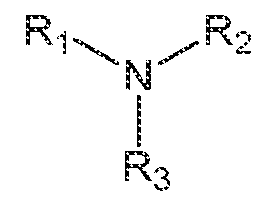
여기서 R1, R2 및 R3은 독립적으로 수소, 히드로카르빌, 또는 치환된 히드로카르빌이지만, 단 R1, R2 및 R3 중 적어도 1개는 수소 이외의 것이고, 가교 아민 중합체는 (i) pH 1.2 및 37℃에서 35 mM NaCl 및 63 mM HCl을 함유하는 수성 인공 위액 완충제 ("SGF") 중에서 적어도 5 mmol/g의 평형 양성자 결합 능력 및 적어도 5 mmol/g의 클로라이드 이온 결합 능력 및 (ii) 약 2 이하의 탈이온수 중 평형 팽윤 비를 갖는다.wherein R 1 , R 2 and R 3 are independently hydrogen, hydrocarbyl, or substituted hydrocarbyl, provided that at least one of R 1 , R 2 and R 3 is other than hydrogen, and the crosslinked amine polymer has (i) an equilibrium proton binding capacity of at least 5 mmol/g and a chloride ion binding capacity of at least 5 mmol/g in an aqueous simulated gastric fluid buffer (“SGF”) containing 35 mM NaCl and 63 mM HCl at pH 1.2 and 37° C., and (ii) an equilibrium swelling ratio in deionized water of about 2 or less.
실시양태 2. 하기 화학식 1에 상응하는 아민의 잔기를 포함하는 양성자-결합, 가교 아민 중합체를 포함하는 제약 조성물.Embodiment 2. A pharmaceutical composition comprising a proton-bonding, cross-linked amine polymer comprising an amine residue corresponding to the following chemical formula 1.
<화학식 1><Chemical formula 1>

여기서 R1, R2 및 R3은 독립적으로 수소, 히드로카르빌, 치환된 히드로카르빌이지만, 단 R1, R2 및 R3 중 적어도 1개는 수소 이외의 것이고, 가교 아민 중합체는 약 5 이하의 탈이온수 중 평형 팽윤 비를 갖고, 가교 아민 중합체는 37℃에서 간섭 이온 완충제 중에서 각각 적어도 0.35:1의 클로라이드 이온 대 간섭 이온의 몰비로 결합하고, 여기서 (i) 간섭 이온은 포스페이트 이온이고, 간섭 이온 완충제는 36mM 클로라이드 및 20mM 포스페이트의 pH 5.5의 완충 용액이거나, 또는 (ii) 간섭 이온은 포스페이트, 시트레이트 및 타우로콜레이트 이온 (합한 양)이고, 간섭 이온 완충제는 36mM 클로라이드, 7mM 포스페이트, 1.5mM 시트레이트, 및 5mM 타우로콜레이트를 포함하는 pH 6.2의 완충 용액이다.wherein R 1 , R 2 and R 3 are independently hydrogen, hydrocarbyl, substituted hydrocarbyl, provided that at least one of R 1 , R 2 and R 3 is other than hydrogen, the crosslinked amine polymer has an equilibrium swelling ratio in deionized water of about 5 or less, and the crosslinked amine polymer binds to an interfering ion in an interfering ion buffer at 37° C. in a molar ratio of chloride ions to interfering ions of at least 0.35:1, respectively, wherein (i) the interfering ions are phosphate ions and the interfering ion buffer is a buffered solution comprising 36 mM chloride and 20 mM phosphate, at pH 5.5, or (ii) the interfering ions are phosphate, citrate and taurocholate ions (combined amounts) and the interfering ion buffer is a buffered solution comprising 36 mM chloride, 7 mM phosphate, 1.5 mM citrate, and 5 mM taurocholate, at pH 6.2.
실시양태 3. 실시양태 1에 있어서, 가교 아민 중합체가 pH 1.2 및 37℃에서 35 mM NaCl 및 63 mM HCl을 함유하는 수성 인공 위액 완충제 ("SGF") 중에서 적어도 7.5 mmol/g의 평형 클로라이드 결합 능력을 갖는 것인 제약 조성물.Embodiment 3. A pharmaceutical composition according to embodiment 1, wherein the crosslinked amine polymer has an equilibrium chloride binding capacity of at least 7.5 mmol/g in an aqueous simulated gastric fluid buffer (“SGF”) containing 35 mM NaCl and 63 mM HCl at pH 1.2 and 37° C.
실시양태 4. 실시양태 1에 있어서, 가교 아민 중합체가 pH 1.2 및 37℃에서 35 mM NaCl 및 63 mM HCl을 함유하는 수성 인공 위액 완충제 ("SGF") 중에서 적어도 10 mmol/g의 평형 클로라이드 결합 능력을 갖는 것인 제약 조성물.Embodiment 4. A pharmaceutical composition according to embodiment 1, wherein the crosslinked amine polymer has an equilibrium chloride binding capacity of at least 10 mmol/g in an aqueous simulated gastric fluid buffer (“SGF”) containing 35 mM NaCl and 63 mM HCl at pH 1.2 and 37° C.
실시양태 5. 실시양태 2에 있어서, 가교 아민 중합체가 간섭 이온 완충제 중에서 간섭 음이온 중 어느 하나보다 클로라이드에 더 결합하고, 간섭 이온이 포스페이트, 시트레이트 및 타우로콜레이트 이온이고, 간섭 이온 완충제가 36mM 클로라이드, 7mM 포스페이트, 1.5mM 시트레이트, 및 5mM 타우로콜레이트를 포함하는 pH 6.2의 완충 용액인 제약 조성물.Embodiment 5. A pharmaceutical composition according to Embodiment 2, wherein the crosslinked amine polymer binds more to chloride than to any one of the interfering anions in the interfering ion buffer, wherein the interfering ions are phosphate, citrate and taurocholate ions, and the interfering ion buffer is a buffer solution having a pH of 6.2 comprising 36 mM chloride, 7 mM phosphate, 1.5 mM citrate, and 5 mM taurocholate.
실시양태 6. 실시양태 2에 있어서, 간섭 이온 완충제 중에서 가교 아민 중합체에 의해 결합된 클로라이드 및 간섭 이온의 합한 양의 적어도 66%가 클로라이드 음이온이고, 간섭 이온이 포스페이트, 시트레이트 및 타우로콜레이트이고, 간섭 이온 완충제가 36mM 클로라이드, 7mM 포스페이트, 1.5mM 시트레이트, 및 5mM 타우로콜레이트를 포함하는 pH 6.2의 완충 용액인 제약 조성물.Embodiment 6. A pharmaceutical composition according to Embodiment 2, wherein at least 66% of the combined amount of chloride and interfering ions bound by the cross-linked amine polymer in the interfering ion buffer is chloride anion, the interfering ions are phosphate, citrate and taurocholate, and the interfering ion buffer is a buffer solution having a pH of 6.2 comprising 36 mM chloride, 7 mM phosphate, 1.5 mM citrate, and 5 mM taurocholate.
실시양태 7. 실시양태 2에 있어서, 간섭 이온 완충제 중에서 가교 아민 중합체에 의해 결합된 클로라이드 및 간섭 이온의 합한 양의 90% 이상이 클로라이드 음이온이고, 간섭 이온이 포스페이트, 시트레이트 및 타우로콜레이트이고, 간섭 이온 완충제가 36mM 클로라이드, 7mM 포스페이트, 1.5mM 시트레이트, 및 5mM 타우로콜레이트를 포함하는 pH 6.2의 완충 용액인 제약 조성물.Embodiment 7. A pharmaceutical composition according to Embodiment 2, wherein 90% or more of the combined amount of chloride and interfering ions bound by the cross-linked amine polymer in the interfering ion buffer is chloride anion, the interfering ions are phosphate, citrate and taurocholate, and the interfering ion buffer is a buffer solution having a pH of 6.2 containing 36 mM chloride, 7 mM phosphate, 1.5 mM citrate, and 5 mM taurocholate.
실시양태 8. 실시양태 2에 있어서, 가교 아민 중합체가 약 4 이하의 탈이온수 중 평형 팽윤 비를 갖는 것인 제약 조성물.Embodiment 8. A pharmaceutical composition according to Embodiment 2, wherein the crosslinked amine polymer has an equilibrium swelling ratio in deionized water of about 4 or less.
실시양태 9. 실시양태 2에 있어서, 가교 아민 중합체가 약 3 이하의 탈이온수 중 평형 팽윤 비를 갖는 것인 제약 조성물.Embodiment 9. A pharmaceutical composition according to Embodiment 2, wherein the crosslinked amine polymer has an equilibrium swelling ratio in deionized water of about 3 or less.
실시양태 10. 실시양태 2에 있어서, 가교 아민 중합체가 약 2 이하의 탈이온수 중 평형 팽윤 비를 갖는 것인 제약 조성물.Embodiment 10. A pharmaceutical composition according to Embodiment 2, wherein the crosslinked amine polymer has an equilibrium swelling ratio in deionized water of about 2 or less.
실시양태 11. 실시양태 1 내지 실시양태 10 중 어느 한 실시양태에 있어서 R1, R2 및 R3이 독립적으로 수소, 알킬, 알케닐, 알릴, 비닐, 아릴, 아미노알킬, 알칸올, 할로알킬, 히드록시알킬, 에테르계, 헤테로아릴 또는 헤테로시클릭이지만, 단 각각의 R1, R2 및 R3이 수소가 아닌 것인 제약 조성물.Embodiment 11. A pharmaceutical composition according to any one of embodiments 1 to 10, wherein R 1 , R 2 and R 3 are independently hydrogen, alkyl, alkenyl, allyl, vinyl, aryl, aminoalkyl, alkanol, haloalkyl, hydroxyalkyl, ethereal, heteroaryl or heterocyclic, provided that each of R 1 , R 2 and R 3 is not hydrogen.
실시양태 12. 실시양태 1 내지 실시양태 11 중 어느 한 실시양태에 있어서, R1, R2 및 R3이 독립적으로 수소, 지방족 또는 헤테로지방족이지만, 단 R1, R2 및 R3 중 적어도 1개가 수소 이외의 것인 제약 조성물.Embodiment 12. A pharmaceutical composition according to any one of embodiments 1 to 11, wherein R 1 , R 2 and R 3 are independently hydrogen, aliphatic or heteroaliphatic, provided that at least one of R 1 , R 2 and R 3 is other than hydrogen.
실시양태 13. 실시양태 1 내지 실시양태 12 중 어느 한 실시양태에 있어서, 가교 아민 중합체가 아민과, 임의로 또한 아민 모이어티를 포함하는 다관능성 가교제의 치환 중합에 의해 제조된 것인 제약 조성물.Embodiment 13. A pharmaceutical composition according to any one of embodiments 1 to 12, wherein the crosslinked amine polymer is prepared by substitution polymerization of an amine and, optionally, a polyfunctional crosslinking agent also comprising an amine moiety.
실시양태 14. 실시양태 1 내지 실시양태 12 중 어느 한 실시양태에 있어서, 가교 아민 중합체가 하기 화학식 1a에 상응하는 아민의 잔기를 포함하고, 가교 아민 중합체가 하기 화학식 1a에 상응하는 아민의 라디칼 중합에 의해 제조된 것인 제약 조성물.Embodiment 14. A pharmaceutical composition according to any one of Embodiments 1 to 12, wherein the crosslinked amine polymer comprises a residue of an amine corresponding to the following Formula 1a, and the crosslinked amine polymer is prepared by radical polymerization of an amine corresponding to the following Formula 1a.
<화학식 1a><Chemical Formula 1a>

여기서 R4 및 R5는 독립적으로 수소, 히드로카르빌 또는 치환된 히드로카르빌이다.wherein R 4 and R 5 are independently hydrogen, hydrocarbyl or substituted hydrocarbyl.
실시양태 15. 실시양태 14에 있어서, R4 및 R5가 독립적으로 수소, 알킬, 알케닐, 알릴, 비닐, 아릴, 아미노알킬, 알칸올, 할로알킬, 히드록시알킬, 에테르계, 헤테로아릴 또는 헤테로시클릭인 제약 조성물.Embodiment 15. A pharmaceutical composition according to embodiment 14, wherein R 4 and R 5 are independently hydrogen, alkyl, alkenyl, allyl, vinyl, aryl, aminoalkyl, alkanol, haloalkyl, hydroxyalkyl, ethereal, heteroaryl or heterocyclic.
실시양태 16. 실시양태 14에 있어서, R4 및 R5가 독립적으로 수소, 지방족 또는 헤테로지방족인 제약 조성물.Embodiment 16. A pharmaceutical composition according to embodiment 14, wherein R 4 and R 5 are independently hydrogen, aliphatic or heteroaliphatic.
실시양태 17. 실시양태 1 내지 실시양태 12 중 어느 한 실시양태에 있어서, 가교 아민 중합체가 하기 화학식 1b에 상응하는 아민의 잔기를 포함하고, 가교 아민 중합체가 하기 화학식 1b에 상응하는 아민과 다관능성 가교제의 치환 중합에 의해 제조된 것인 제약 조성물.Embodiment 17. A pharmaceutical composition according to any one of Embodiments 1 to 12, wherein the crosslinked amine polymer comprises a residue of an amine corresponding to the following Formula 1b, and the crosslinked amine polymer is prepared by substitution polymerization of an amine corresponding to the following Formula 1b and a polyfunctional crosslinking agent.
<화학식 1b><Chemical Formula 1b>

여기서 R4 및 R5는 독립적으로 수소, 히드로카르빌 또는 치환된 히드로카르빌이고, R6은 지방족이고, R61 및 R62는 독립적으로 수소, 지방족 또는 헤테로지방족이다.wherein R 4 and R 5 are independently hydrogen, hydrocarbyl or substituted hydrocarbyl, R 6 is aliphatic, and R 61 and R 62 are independently hydrogen, aliphatic or heteroaliphatic.
실시양태 18. 실시양태 17에 있어서, R4 및 R5가 독립적으로 수소, 포화 탄화수소, 불포화 지방족, 아릴, 헤테로아릴, 헤테로알킬 또는 불포화 헤테로지방족인 제약 조성물.Embodiment 18. A pharmaceutical composition according to embodiment 17, wherein R 4 and R 5 are independently hydrogen, a saturated hydrocarbon, an unsaturated aliphatic, an aryl, a heteroaryl, a heteroalkyl or an unsaturated heteroaliphatic.
실시양태 19. 실시양태 17에 있어서, R4 및 R5가 독립적으로 수소, 알킬, 알케닐, 알릴, 비닐, 아릴, 아미노알킬, 알칸올, 할로알킬, 히드록시알킬, 에테르계, 헤테로아릴 또는 헤테로시클릭인 제약 조성물.Embodiment 19. A pharmaceutical composition according to embodiment 17, wherein R 4 and R 5 are independently hydrogen, alkyl, alkenyl, allyl, vinyl, aryl, aminoalkyl, alkanol, haloalkyl, hydroxyalkyl, ethereal, heteroaryl or heterocyclic.
실시양태 20. 실시양태 17에 있어서, R4 및 R5가 독립적으로 수소, 알릴 또는 아미노알킬인 제약 조성물.Embodiment 20. A pharmaceutical composition according to embodiment 17, wherein R 4 and R 5 are independently hydrogen, allyl or aminoalkyl.
실시양태 21. 실시양태 1 내지 실시양태 20 중 어느 한 실시양태에 있어서, 가교 아민 중합체가 하기 화학식 1c에 상응하는 아민의 잔기를 포함하는 것인 제약 조성물.Embodiment 21. A pharmaceutical composition according to any one of Embodiments 1 to 20, wherein the crosslinked amine polymer comprises a residue of an amine corresponding to the following Chemical Formula 1c.
<화학식 1c><Chemical formula 1c>
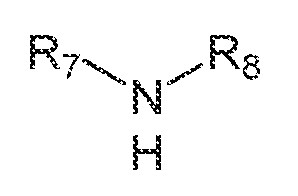
여기서 R7은 수소, 지방족 또는 헤테로지방족이고, R8은 지방족 또는 헤테로지방족이다.Here, R 7 is hydrogen, aliphatic or heteroaliphatic, and R 8 is aliphatic or heteroaliphatic.
실시양태 22. 실시양태 1 내지 실시양태 12 중 어느 한 실시양태에 있어서, 가교 아민 중합체가 하기 화학식 2에 상응하는 아민의 잔기를 포함하는 것인 제약 조성물.Embodiment 22. A pharmaceutical composition according to any one of Embodiments 1 to 12, wherein the crosslinked amine polymer comprises a residue of an amine corresponding to the following Formula 2.
<화학식 2><Chemical Formula 2>

여기서Here
m 및 n은 독립적으로 음이 아닌 정수이고;m and n are independently non-negative integers;
R10, R20, R30, 및 R40은 독립적으로 수소, 히드로카르빌 또는 치환된 히드로카르빌이고;R 10 , R 20 , R 30 , and R 40 are independently hydrogen, hydrocarbyl or substituted hydrocarbyl;
X1은 
X2는 히드로카르빌 또는 치환된 히드로카르빌이고;X 2 is hydrocarbyl or substituted hydrocarbyl;
각각의 X11은 독립적으로 수소, 히드로카르빌, 치환된 히드로카르빌, 히드록시 또는 아미노이고; Each X 11 is independently hydrogen, hydrocarbyl, substituted hydrocarbyl, hydroxy or amino;
z는 음이 아닌 수이다.z is a non-negative number.
실시양태 23. 실시양태 22에 있어서, R10, R20, R30, 및 R40이 독립적으로 수소, 지방족, 아릴, 헤테로지방족 또는 헤테로아릴이고, m 및 z가 독립적으로 0-3이고, n이 0 또는 1인 제약 조성물.Embodiment 23. A pharmaceutical composition according to embodiment 22, wherein R 10 , R 20 , R 30 , and R 40 are independently hydrogen, aliphatic, aryl, heteroaliphatic, or heteroaryl, m and z are independently 0-3, and n is 0 or 1.
실시양태 24. 실시양태 22 또는 실시양태 23에 있어서, X2가 지방족 또는 헤테로지방족인 제약 조성물.Embodiment 24. A pharmaceutical composition according to embodiment 22 or embodiment 23, wherein X 2 is aliphatic or heteroaliphatic.
실시양태 25. 실시양태 22 내지 실시양태 24 중 어느 한 실시양태에 있어서, m이 1-3이고, X11이 수소, 지방족 또는 헤테로지방족인 제약 조성물.Embodiment 25. A pharmaceutical composition according to any one of embodiments 22 to 24, wherein m is 1-3, and X 11 is hydrogen, aliphatic or heteroaliphatic.
실시양태 26. 실시양태 1 내지 실시양태 12 중 어느 한 실시양태에 있어서, 가교 아민 중합체가 하기 화학식 2a에 상응하는 아민의 잔기를 포함하는 것인 제약 조성물. Embodiment 26. A pharmaceutical composition according to any one of Embodiments 1 to 12, wherein the crosslinked amine polymer comprises a residue of an amine corresponding to the following Formula 2a.
<화학식 2a><Chemical Formula 2a>

여기서Here
m 및 n은 독립적으로 음이 아닌 정수이고;m and n are independently non-negative integers;
각각의 R11은 독립적으로 수소, 히드로카르빌, 헤테로지방족 또는 헤테로아릴이고;Each R 11 is independently hydrogen, hydrocarbyl, heteroaliphatic or heteroaryl;
R21 및 R31은 독립적으로 수소 또는 헤테로지방족이고;R 21 and R 31 are independently hydrogen or heteroaliphatic;
R41은 수소, 치환된 히드로카르빌 또는 히드로카르빌이고;R 41 is hydrogen, substituted hydrocarbyl or hydrocarbyl;
X1은 
X2는 알킬 또는 치환된 히드로카르빌이고;X 2 is alkyl or substituted hydrocarbyl;
각각의 X12는 독립적으로 수소, 히드록시, 아미노, 아미노알킬, 보론산 또는 할로이고; Each X 12 is independently hydrogen, hydroxy, amino, aminoalkyl, boronic acid or halo;
z는 음이 아닌 수이다.z is a non-negative number.
실시양태 27. 실시양태 26에 있어서, m 및 z가 독립적으로 0-3이고, n이 0 또는 1인 제약 조성물.Embodiment 27. A pharmaceutical composition according to embodiment 26, wherein m and z are independently 0-3, and n is 0 or 1.
실시양태 28. 실시양태 26 또는 실시양태 27에 있어서, R11이 독립적으로 수소, 지방족, 아미노알킬, 할로알킬 또는 헤테로아릴이고, R21 및 R31이 독립적으로 수소 또는 헤테로지방족이고, R41이 수소, 지방족, 아릴, 헤테로지방족 또는 헤테로아릴인 제약 조성물.Embodiment 28. A pharmaceutical composition according to embodiment 26 or embodiment 27, wherein R 11 is independently hydrogen, aliphatic, aminoalkyl, haloalkyl or heteroaryl, R 21 and R 31 are independently hydrogen or heteroaliphatic, and R 41 is hydrogen, aliphatic, aryl, heteroaliphatic or heteroaryl.
실시양태 29. 실시양태 26 또는 실시양태 27에 있어서, 각각의 R11이 수소, 지방족, 아미노알킬 또는 할로알킬이고, R21 및 R31이 수소 또는 아미노알킬이고, R41이 수소, 지방족 또는 헤테로지방족인 제약 조성물.Embodiment 29. A pharmaceutical composition according to embodiment 26 or embodiment 27, wherein each R 11 is hydrogen, aliphatic, aminoalkyl or haloalkyl, R 21 and R 31 are hydrogen or aminoalkyl, and R 41 is hydrogen, aliphatic or heteroaliphatic.
실시양태 30. 실시양태 1 내지 실시양태 12 중 어느 한 실시양태에 있어서, 가교 아민 중합체가 하기 화학식 2b에 상응하는 아민의 잔기를 포함하는 것인 제약 조성물.Embodiment 30. A pharmaceutical composition according to any one of Embodiments 1 to 12, wherein the crosslinked amine polymer comprises a residue of an amine corresponding to the following Formula 2b.
<화학식 2b><Chemical Formula 2b>

여기서Here
m 및 n은 독립적으로 음이 아닌 정수이고;m and n are independently non-negative integers;
각각의 R12는 독립적으로 수소, 치환된 히드로카르빌 또는 히드로카르빌이고;Each R 12 is independently hydrogen, substituted hydrocarbyl or hydrocarbyl;
R22 및 R32는 독립적으로 수소 치환된 히드로카르빌 또는 히드로카르빌이고;R 22 and R 32 are independently hydrogen-substituted hydrocarbyl or hydrocarbyl;
R42는 수소, 히드로카르빌 또는 치환된 히드로카르빌이고;R 42 is hydrogen, hydrocarbyl or substituted hydrocarbyl;
X1은 
X2는 알킬, 아미노알킬 또는 알칸올이고;X 2 is alkyl, aminoalkyl or alkanol;
각각의 X13은 독립적으로 수소, 히드록시, 지환족, 아미노, 아미노알킬, 할로겐, 알킬, 헤테로아릴, 보론산 또는 아릴이고;Each X 13 is independently hydrogen, hydroxy, cycloaliphatic, amino, aminoalkyl, halogen, alkyl, heteroaryl, boronic acid or aryl;
z는 음이 아닌 수이고; z is a non-negative number;
화학식 2b에 상응하는 아민은 적어도 1개의 알릴 기를 포함한다.The amine corresponding to formula 2b contains at least one allylic group.
실시양태 31. 실시양태 30에 있어서, m 및 z가 독립적으로 0-3이고, n이 0 또는 1인 제약 조성물.Embodiment 31. A pharmaceutical composition according to embodiment 30, wherein m and z are independently 0-3, and n is 0 or 1.
실시양태 32. 실시양태 30 또는 실시양태 31에 있어서, R12 또는 R42가 독립적으로 적어도 1개의 알릴 또는 비닐 모이어티를 포함하는 것인 제약 조성물.Embodiment 32. A pharmaceutical composition according to embodiment 30 or embodiment 31, wherein R 12 or R 42 independently comprises at least one allyl or vinyl moiety.
실시양태 33. 실시양태 30 또는 실시양태 31에 있어서, (i) m이 양의 정수이고, R12, R22 및 R42가 조합되어 적어도 2개의 알릴 또는 비닐 모이어티를 포함하거나, 또는 (ii) n이 양의 정수이고, R12, R32 및 R42가 조합되어 적어도 2개의 알릴 또는 비닐 모이어티를 포함하는 것인 제약 조성물.Embodiment 33. A pharmaceutical composition according to embodiment 30 or embodiment 31, wherein (i) m is a positive integer, and R 12 , R 22 and R 42 are combined to comprise at least two allyl or vinyl moieties, or (ii) n is a positive integer, and R 12 , R 32 and R 42 are combined to comprise at least two allyl or vinyl moieties.
실시양태 34. 실시양태 30 또는 실시양태 31에 있어서, 가교 아민 중합체가 표 1에 제시된 아민 잔기를 포함하는 것인 제약 조성물.Embodiment 34. A pharmaceutical composition according to embodiment 30 or embodiment 31, wherein the crosslinked amine polymer comprises an amine moiety as set forth in Table 1.
실시양태 35. 실시양태 30, 실시양태 31 및 실시양태 34 중 어느 한 실시양태에 있어서, 가교 아민 중합체가 표 2에 제시된 가교제와 가교된 것인 제약 조성물.Embodiment 35. A pharmaceutical composition according to any one of Embodiments 30, 31 and 34, wherein the crosslinked amine polymer is crosslinked with a crosslinking agent set forth in Table 2.
실시양태 36. 실시양태 1 내지 실시양태 35 중 어느 한 실시양태에 있어서, 가교 아민 중합체가 하기 화학식 3에 상응하는 반복 유닛을 포함하는 것인 제약 조성물.Embodiment 36. A pharmaceutical composition according to any one of Embodiments 1 to 35, wherein the crosslinked amine polymer comprises a repeating unit corresponding to the following Formula 3.
<화학식 3><Chemical Formula 3>

여기서Here
R15, R16 및 R17은 독립적으로 수소, 히드로카르빌, 치환된 히드로카르빌, 히드록실, 아미노, 보론산 또는 할로이고;R 15 , R 16 and R 17 are independently hydrogen, hydrocarbyl, substituted hydrocarbyl, hydroxyl, amino, boronic acid or halo;
X15는 
X5는 히드로카르빌, 치환된 히드로카르빌, 옥소 (-O-) 또는 아미노이고; X 5 is hydrocarbyl, substituted hydrocarbyl, oxo (-O-), or amino;
z는 음이 아닌 수이다.z is a non-negative number.
실시양태 37. 실시양태 36에 있어서, R15, R16 및 R17이 독립적으로 지방족 또는 헤테로지방족인 제약 조성물.Embodiment 37. A pharmaceutical composition according to embodiment 36, wherein R 15 , R 16 and R 17 are independently aliphatic or heteroaliphatic.
실시양태 38. 실시양태 36 또는 실시양태 37에 있어서, X5가 옥소, 아미노, 알킬아미노, 에테르계, 알칸올 또는 할로알킬인 제약 조성물.Embodiment 38. A pharmaceutical composition according to embodiment 36 or embodiment 37, wherein X 5 is oxo, amino, alkylamino, ether, alkanol or haloalkyl.
실시양태 39. 실시양태 1 내지 실시양태 12 중 어느 한 실시양태에 있어서, 가교 아민 중합체가 (i) 다관능성 시약 중 적어도 1종이 아민 모이어티를 포함하는 것인 다관능성 시약의 치환 중합, (2) 적어도 1개의 아민 모이어티 또는 질소 함유 모이어티를 포함하는 단량체의 라디칼 중합, 또는 (3) 아민-함유 중간체와, 임의로 아민 모이어티를 함유하는 가교제의 가교에 의해 제조된 것인 제약 조성물.Embodiment 39. A pharmaceutical composition according to any one of embodiments 1 to 12, wherein the crosslinked amine polymer is prepared by (i) substitution polymerization of a polyfunctional reagent, wherein at least one of the polyfunctional reagents comprises an amine moiety, (2) radical polymerization of a monomer comprising at least one amine moiety or a nitrogen-containing moiety, or (3) crosslinking of an amine-containing intermediate and, optionally, a crosslinking agent comprising an amine moiety.
실시양태 40. 실시양태 39에 있어서, 가교 아민 중합체가 가교 단독중합체 또는 가교 공중합체인 제약 조성물.Embodiment 40. A pharmaceutical composition according to embodiment 39, wherein the crosslinked amine polymer is a crosslinked homopolymer or a crosslinked copolymer.
실시양태 41. 실시양태 39에 있어서, 가교 아민 중합체가 동일하거나 다양한 길이의 반복 링커 유닛에 의해 분리된 유리 아민 모이어티를 포함하는 것인 제약 조성물.Embodiment 41. A pharmaceutical composition according to embodiment 39, wherein the crosslinked amine polymer comprises free amine moieties separated by repeating linker units of the same or different lengths.
실시양태 42. 실시양태 39에 있어서, 가교 아민 중합체가 치환 중합 반응에서 아민-함유 단량체와 가교제의 중합에 의해 제조된 것인 제약 조성물.Embodiment 42. A pharmaceutical composition according to embodiment 39, wherein the crosslinked amine polymer is prepared by polymerizing an amine-containing monomer and a crosslinking agent in a substitution polymerization reaction.
실시양태 43. 실시양태 42에 있어서, 아민-함유 단량체가 치환 중합 반응에 참여하는 적어도 2개의 반응성 아민 모이어티를 보유하는 선형 아민인 제약 조성물.Embodiment 43. A pharmaceutical composition according to embodiment 42, wherein the amine-containing monomer is a linear amine having at least two reactive amine moieties that participate in a substitution polymerization reaction.
실시양태 44. 실시양태 42 또는 실시양태 43에 있어서, 아민-함유 단량체가 1,3-비스[비스(2-아미노에틸)아미노]프로판, 3-아미노-1-{[2-(비스{2-[비스(3-아미노프로필)아미노]에틸}아미노)에틸](3-아미노프로필)아미노}프로판, 2-[비스(2-아미노에틸)아미노]에탄아민, 트리스(3-아미노프로필)아민, 1,4-비스[비스(3-아미노프로필)아미노]부탄, 1,2-에탄디아민, 2-아미노-1-(2-아미노에틸아미노)에탄, 1,2-비스(2-아미노에틸아미노)에탄, 1,3-프로판디아민, 3,3'-디아미노디프로필아민, 2,2-디메틸-1,3-프로판디아민, 2-메틸-1,3-프로판디아민, N,N'-디메틸-1,3-프로판디아민, N-메틸-1,3-디아미노프로판, 3,3'-디아미노-N-메틸디프로필아민, 1,3-디아미노펜탄, 1,2-디아미노-2-메틸프로판, 2-메틸-1,5-디아미노펜탄, 1,2-디아미노프로판, 1,10-디아미노데칸, 1,8-디아미노옥탄, 1,9-디아미노옥탄, 1,7-디아미노헵탄, 1,6-디아미노헥산, 1,5-디아미노펜탄, 3-브로모프로필아민 히드로브로마이드, N,2-디메틸-1,3-프로판디아민, N-이소프로필-1,3-디아미노프로판, N,N'-비스(2-아미노에틸)-1,3-프로판디아민, N,N'-비스(3-아미노프로필)에틸렌디아민, N,N'-비스(3-아미노프로필)-1,4-부탄디아민 테트라히드로클로라이드, 1,3-디아미노-2-프로판올, N-에틸에틸렌디아민, 2,2'-디아미노-N-메틸디에틸아민, N,N'-디에틸에틸렌디아민, N-이소프로필에틸렌디아민, N-메틸에틸렌디아민, N,N'-디-tert-부틸에틸렌디아민, N,N'-디이소프로필에틸렌디아민, N,N'-디메틸에틸렌디아민, N-부틸에틸렌디아민, 2-(2-아미노에틸아미노)에탄올, 1,4,7,10,13,16-헥사아자시클로옥타데칸, 1,4,7,10-테트라아자시클로도데칸, 1,4,7-트리아자시클로노난, N,N'-비스(2-히드록시에틸)에틸렌디아민, 피페라진, 비스(헥사메틸렌)트리아민, N-(3-히드록시프로필)에틸렌디아민, N-(2-아미노에틸)피페라진, 2-메틸피페라진, 호모피페라진, 1,4,8,11-테트라아자시클로테트라데칸, 1,4,8,12-테트라아자시클로펜타데칸, 2-(아미노메틸)피페리딘, 또는 3-(메틸아미노)피롤리디노인 제약 조성물.Embodiment 44. In embodiment 42 or embodiment 43, the amine-containing monomer is 1,3-bis[bis(2-aminoethyl)amino]propane, 3-amino-1-{[2-(bis{2-[bis(3-aminopropyl)amino]ethyl}amino)ethyl](3-aminopropyl)amino}propane, 2-[bis(2-aminoethyl)amino]ethanamine, tris(3-aminopropyl)amine, 1,4-bis[bis(3-aminopropyl)amino]butane, 1,2-ethanediamine, 2-amino-1-(2-aminoethylamino)ethane, 1,2-bis(2-aminoethylamino)ethane, 1,3-propanediamine, 3,3'-diaminodipropylamine, 2,2-dimethyl-1,3-propanediamine, 2-methyl-1,3-propanediamine, N,N'-Dimethyl-1,3-propanediamine, N-methyl-1,3-diaminopropane, 3,3'-diamino-N-methyldipropylamine, 1,3-diaminopentane, 1,2-diamino-2-methylpropane, 2-methyl-1,5-diaminopentane, 1,2-diaminopropane, 1,10-diaminodecane, 1,8-diaminooctane, 1,9-diaminooctane, 1,7-diaminoheptane, 1,6-diaminohexane, 1,5-diaminopentane, 3-bromopropylamine hydrobromide, N,2-dimethyl-1,3-propanediamine, N-isopropyl-1,3-diaminopropane, N,N'-bis(2-aminoethyl)-1,3-propanediamine, N,N'-bis(3-aminopropyl)ethylenediamine, N,N'-Bis(3-aminopropyl)-1,4-butanediamine tetrahydrochloride, 1,3-diamino-2-propanol, N-ethylethylenediamine, 2,2'-diamino-N-methyldiethylamine, N,N'-diethylethylenediamine, N-isopropylethylenediamine, N-methylethylenediamine, N,N'-di-tert-butylethylenediamine, N,N'-diisopropylethylenediamine, N,N'-dimethylethylenediamine, N-butylethylenediamine, 2-(2-aminoethylamino)ethanol, 1,4,7,10,13,16-hexaazacyclooctadecane, 1,4,7,10-tetraazacyclododecane, 1,4,7-triazacyclononane, N,N'-bis(2-hydroxyethyl)ethylenediamine, piperazine, A pharmaceutical composition comprising bis(hexamethylene)triamine, N-(3-hydroxypropyl)ethylenediamine, N-(2-aminoethyl)piperazine, 2-methylpiperazine, homopiperazine, 1,4,8,11-tetraazacyclotetradecane, 1,4,8,12-tetraazacyclopentadecane, 2-(aminomethyl)piperidine, or 3-(methylamino)pyrrolidinoin.
실시양태 45. 실시양태 39, 실시양태 41, 실시양태 43 및 실시양태 44 중 어느 한 실시양태에 있어서, 가교제가 디할로알칸, 할로알킬옥시란, 알킬옥시란 술포네이트, 디(할로알킬)아민, 트리(할로알킬) 아민, 디에폭시드, 트리에폭시드, 테트라에폭시드, 비스(할로메틸)벤젠, 트리(할로메틸)벤젠, 테트라(할로메틸)벤젠, 에피할로히드린, 예컨대 에피클로로히드린 및 에피브로모히드린 폴리(에피클로로히드린), (아이오도메틸)옥시란, 글리시딜 토실레이트, 글리시딜 3-니트로벤젠술포네이트, 4-토실옥시-1,2-에폭시부탄, 브로모-1,2-에폭시부탄, 1,2-디브로모에탄, 1,3-디클로로프로판, 1,2-디클로로에탄, 1-브로모-2-클로로에탄, 1,3-디브로모프로판, 비스(2-클로로에틸)아민, 트리스(2-클로로에틸)아민, 및 비스(2-클로로에틸)메틸아민, 1,3-부타디엔 디에폭시드, 1,5-헥사디엔 디에폭시드, 디글리시딜 에테르, 1,2,7,8-디에폭시옥탄, 1,2,9,10-디에폭시데칸, 에틸렌 글리콜 디글리시딜 에테르, 프로필렌 글리콜 디글리시딜 에테르, 1,4-부탄디올 디글리시딜 에테르, 1,2 에탄디올디글리시딜 에테르, 글리세롤 디글리시딜 에테르, 1,3-디글리시딜 글리세릴 에테르, N,N-디글리시딜아닐린, 네오펜틸 글리콜 디글리시딜 에테르, 디에틸렌 글리콜 디글리시딜 에테르, 1,4-비스(글리시딜옥시)벤젠, 레조르시놀 디글리시딜 에테르, 1,6-헥산디올 디글리시딜 에테르, 트리메틸올프로판 디글리시딜 에테르, 1,4-시클로헥산디메탄올 디글리시딜 에테르, 1,3-비스-(2,3-에폭시프로필옥시)-2-(2,3-디히드록시프로필옥시)프로판, 1,2-시클로헥산디카르복실산 디글리시딜 에스테르, 2,2'-비스(글리시딜옥시)디페닐메탄, 비스페놀 F 디글리시딜 에테르, 1,4-비스(2',3'에폭시프로필)퍼플루오로-n-부탄, 2,6-디(옥시란-2-일메틸)-1,2,3,5,6,7-헥사히드로피롤로[3,4-f]이소인돌-1,3,5,7-테트라온, 비스페놀 A 디글리시딜 에테르, 에틸 5-히드록시-6,8-디(옥시란-2-일메틸)-4-옥소-4-h-크로멘-2-카르복실레이트, 비스[4-(2,3-에폭시-프로필티오)페닐]-술피드, 1,3-비스(3-글리시독시프로필)테트라메틸디실록산, 9,9-비스[4-(글리시딜옥시)페닐]플루오린, 트리에폭시이소시아누레이트, 글리세롤 트리글리시딜 에테르, N,N-디글리시딜-4-글리시딜옥시아닐린, 이소시아누르산 (S,S,S)-트리글리시딜 에스테르, 이소시아누르산 (R,R,R)-트리글리시딜 에스테르, 트리글리시딜 이소시아누레이트, 트리메틸올프로판 트리글리시딜 에테르, 글리세롤 프로폭실레이트 트리글리시딜 에테르, 트리페닐롤메탄 트리글리시딜 에테르, 3,7,14-트리스[[3-(에폭시프로폭시)프로필]디메틸실릴옥시]-1,3,5,7,9,11,14-헵타시클로펜틸트리시클로[7,3,3,15,11]헵타실록산, 4,4'메틸렌비스(N,N-디글리시딜아닐린), 비스(할로메틸)벤젠, 비스(할로메틸)비페닐 및 비스(할로메틸)나프탈렌, 톨루엔 디이소시아네이트, 아크릴롤 클로라이드, 메틸 아크릴레이트, 에틸렌 비스아크릴아미드, 피로멜리트산 이무수물, 숙시닐 디클로라이드, 디메틸숙시네이트, 3-클로로-1-(3-클로로프로필아미노-2-프로판올, 1,2-비스(3-클로로프로필아미노)에탄, 비스(3-클로로프로필)아민, 1,3-디클로로-2-프로판올, 1,3-디클로로프로판, 1-클로로-2,3-에폭시프로판, 트리스[(2-옥시라닐)메틸]아민, 및 그의 조합으로 이루어진 군으로부터 선택된 것인 제약 조성물.Embodiment 45. In any one of embodiments 39, 41, 43 and 44, the crosslinking agent is selected from the group consisting of a dihaloalkane, a haloalkyloxirane, an alkyloxirane sulfonate, a di(haloalkyl)amine, a tri(haloalkyl)amine, a diepoxide, a triepoxide, a tetraepoxide, a bis(halomethyl)benzene, a tri(halomethyl)benzene, a tetra(halomethyl)benzene, an epihalohydrin, such as epichlorohydrin and epibromohydrin poly(epichlorohydrin), (iodomethyl)oxirane, glycidyl tosylate, glycidyl 3-nitrobenzenesulfonate, 4-tosyloxy-1,2-epoxybutane, bromo-1,2-epoxybutane, 1,2-dibromoethane, 1,3-Dichloropropane, 1,2-dichloroethane, 1-bromo-2-chloroethane, 1,3-dibromopropane, bis(2-chloroethyl)amine, tris(2-chloroethyl)amine, and bis(2-chloroethyl)methylamine, 1,3-butadiene diepoxide, 1,5-hexadiene diepoxide, diglycidyl ether, 1,2,7,8-diepoxyoctane, 1,2,9,10-diepoxydecane, ethylene glycol diglycidyl ether, propylene glycol diglycidyl ether, 1,4-butanediol diglycidyl ether, 1,2 ethanediol diglycidyl ether, glycerol diglycidyl ether, 1,3-diglycidyl glyceryl ether, N,N-diglycidylaniline, neopentyl glycol diglycidyl ether, diethylene glycol diglycidyl ether, 1,4-bis(glycidyloxy)benzene, resorcinol diglycidyl ether, 1,6-hexanediol diglycidyl ether, trimethylolpropane diglycidyl ether, 1,4-cyclohexanedimethanol diglycidyl ether, 1,3-bis-(2,3-epoxypropyloxy)-2-(2,3-dihydroxypropyloxy)propane, 1,2-cyclohexanedicarboxylic acid diglycidyl ester, 2,2'-bis(glycidyloxy)diphenylmethane, bisphenol F diglycidyl ether, 1,4-bis(2',3'epoxypropyl)perfluoro-n-butane, 2,6-di(oxiran-2-ylmethyl)-1,2,3,5,6,7-hexahydropyrrolo[3,4-f]isoindole-1,3,5,7-tetraone, bisphenol A diglycidyl ether, ethyl 5-hydroxy-6,8-di(oxiran-2-ylmethyl)-4-oxo-4-h-chromen-2-carboxylate, bis[4-(2,3-epoxy-propylthio)phenyl]-sulfide, 1,3-bis(3-glycidoxypropyl)tetramethyldisiloxane, 9,9-bis[4-(glycidyloxy)phenyl]fluorine, triepoxyisocyanurate, glycerol triglycidyl ether, N,N-diglycidyl-4-glycidyloxyaniline, isocyanuric acid (S,S,S)-triglycidyl ester, Isocyanuric acid (R,R,R)-triglycidyl ester, triglycidyl isocyanurate, trimethylolpropane triglycidyl ether, glycerol propoxylate triglycidyl ether, triphenylolmethane triglycidyl ether, 3,7,14-tris[[3-(epoxypropoxy)propyl]dimethylsilyloxy]-1,3,5,7,9,11,14-heptacyclopentyltricyclo[7,3,3,15,11]heptasiloxane, 4,4'methylenebis(N,N-diglycidylaniline), bis(halomethyl)benzene, bis(halomethyl)biphenyl and bis(halomethyl)naphthalene, toluene diisocyanate, acrylol chloride, methyl acrylate, ethylene bisacrylamide, pyromellitic dianhydride, succinyl dichloride, A pharmaceutical composition selected from the group consisting of dimethylsuccinate, 3-chloro-1-(3-chloropropylamino-2-propanol, 1,2-bis(3-chloropropylamino)ethane, bis(3-chloropropyl)amine, 1,3-dichloro-2-propanol, 1,3-dichloropropane, 1-chloro-2,3-epoxypropane, tris[(2-oxiranyl)methyl]amine, and combinations thereof.
실시양태 46. 실시양태 39에 있어서, 가교 아민 중합체의 제조가 적어도 1개의 아민 모이어티 또는 질소 함유 모이어티를 포함하는 아민 단량체의 라디칼 중합을 포함하는 것인 제약 조성물.Embodiment 46. A pharmaceutical composition according to embodiment 39, wherein the preparation of the crosslinked amine polymer comprises radical polymerization of an amine monomer comprising at least one amine moiety or a nitrogen-containing moiety.
실시양태 47. 실시양태 1 내지 실시양태 46 중 어느 한 실시양태에 있어서, 가교 아민 중합체가 약 1.5 이하의 탈이온수 중 평형 팽윤 비를 갖는 것인 제약 조성물.Embodiment 47. A pharmaceutical composition according to any one of embodiments 1 to 46, wherein the crosslinked amine polymer has an equilibrium swelling ratio in deionized water of about 1.5 or less.
실시양태 48. 실시양태 1 내지 실시양태 47 중 어느 한 실시양태에 있어서, 가교 아민 중합체가 약 1 이하의 탈이온수 중 평형 팽윤 비를 갖는 것인 제약 조성물.Embodiment 48. A pharmaceutical composition according to any one of embodiments 1 to 47, wherein the crosslinked amine polymer has an equilibrium swelling ratio in deionized water of about 1 or less.
실시양태 49. 실시양태 1 내지 실시양태 48 중 어느 한 실시양태에 있어서, 가교 아민 중합체가 pH 5.5로 완충된 36 mM NaCl, 20 mM NaH2PO4, 및 50 mM 2-(N-모르폴리노)에탄술폰산 (MES)을 함유하는 수성 인공 소장 무기 완충제 ("SIB") 중에서 37℃에서 각각 적어도 0.5:1의 클로라이드 이온 대 포스페이트 이온 결합 몰비를 갖는 것인 제약 조성물.Embodiment 49. A pharmaceutical composition according to any one of embodiments 1 to 48, wherein the crosslinked amine polymer has a chloride ion to phosphate ion binding molar ratio of at least 0.5:1 at 37° C. in an aqueous simulated small intestine inorganic buffer (“SIB”) containing 36 mM NaCl, 20 mM NaH 2 PO 4 , and 50 mM 2-(N-morpholino)ethanesulfonic acid (MES), buffered to pH 5.5.
실시양태 50. 실시양태 1 내지 실시양태 49 중 어느 한 실시양태에 있어서, 가교 아민 중합체가 pH 5.5로 완충된 36 mM NaCl, 20 mM NaH2PO4, 및 50 mM 2-(N-모르폴리노)에탄술폰산 (MES)을 함유하는 수성 인공 소장 무기 완충제 ("SIB") 중에서 37℃에서 각각 적어도 1:1의 클로라이드 이온 대 포스페이트 이온 결합 몰비를 갖는 것인 제약 조성물.Embodiment 50. A pharmaceutical composition according to any one of embodiments 1 to 49, wherein the crosslinked amine polymer has a chloride ion to phosphate ion binding molar ratio of at least 1:1 at 37° C. in an aqueous simulated small intestine inorganic buffer (“SIB”) containing 36 mM NaCl, 20 mM NaH 2 PO 4 , and 50 mM 2-(N-morpholino)ethanesulfonic acid (MES), buffered to pH 5.5.
실시양태 51. 실시양태 1 내지 실시양태 50 중 어느 한 실시양태에 있어서, 가교 아민 중합체가 pH 5.5로 완충된 36 mM NaCl, 20 mM NaH2PO4, 및 50 mM 2-(N-모르폴리노)에탄술폰산 (MES)을 함유하는 수성 인공 소장 무기 완충제 ("SIB") 중에서 37℃에서 각각 적어도 2:1의 클로라이드 이온 대 포스페이트 이온 결합 몰비를 갖는 것인 제약 조성물.Embodiment 51. A pharmaceutical composition according to any one of embodiments 1 to 50, wherein the crosslinked amine polymer has a chloride ion to phosphate ion binding molar ratio of at least 2:1 at 37° C. in an aqueous simulated small intestine inorganic buffer (“SIB”) containing 36 mM NaCl, 20 mM NaH 2 PO 4 , and 50 mM 2-(N-morpholino)ethanesulfonic acid (MES), buffered to pH 5.5.
실시양태 52. 실시양태 1 내지 실시양태 51 중 어느 한 실시양태에 있어서, 가교 아민 중합체가 pH 1.2 및 37℃에서 35 mM NaCl 및 63 mM HCl을 함유하는 수성 인공 위액 완충제 ("SGF") 중에서 적어도 10 mmol/g의 양성자 결합 능력 및 적어도 10 mmol/g의 클로라이드 이온 결합 능력을 갖는 것인 제약 조성물.Embodiment 52. A pharmaceutical composition according to any one of embodiments 1 to 51, wherein the crosslinked amine polymer has a proton binding capacity of at least 10 mmol/g and a chloride ion binding capacity of at least 10 mmol/g in an aqueous simulated gastric fluid buffer (“SGF”) containing 35 mM NaCl and 63 mM HCl at pH 1.2 and 37° C.
실시양태 53. 실시양태 1 내지 실시양태 52 중 어느 한 실시양태에 있어서, 가교 아민 중합체가 pH 1.2 및 37℃에서 35 mM NaCl 및 63 mM HCl을 함유하는 수성 인공 위액 완충제 ("SGF") 중에서 적어도 12 mmol/g의 평형 양성자 결합 능력 및 적어도 12 mmol/g의 클로라이드 이온 결합 능력을 갖는 것인 제약 조성물.Embodiment 53. A pharmaceutical composition according to any one of embodiments 1 to 52, wherein the crosslinked amine polymer has an equilibrium proton binding capacity of at least 12 mmol/g and a chloride ion binding capacity of at least 12 mmol/g in an aqueous simulated gastric fluid buffer (“SGF”) containing 35 mM NaCl and 63 mM HCl at pH 1.2 and 37° C.
실시양태 54. 실시양태 1 내지 실시양태 53 중 어느 한 실시양태에 있어서, 가교 아민 중합체가 pH 1.2 및 37℃에서 35 mM NaCl 및 63 mM HCl을 함유하는 수성 인공 위액 완충제 ("SGF") 중에서 적어도 14 mmol/g의 평형 양성자 결합 능력 및 적어도 14 mmol/g의 클로라이드 이온 결합 능력을 갖는 것인 제약 조성물.Embodiment 54. A pharmaceutical composition according to any one of embodiments 1 to 53, wherein the crosslinked amine polymer has an equilibrium proton binding capacity of at least 14 mmol/g and a chloride ion binding capacity of at least 14 mmol/g in an aqueous simulated gastric fluid buffer (“SGF”) containing 35 mM NaCl and 63 mM HCl at pH 1.2 and 37° C.
실시양태 55. 실시양태 1 내지 실시양태 54 중 어느 한 실시양태에 있어서, 가교 아민 중합체가 pH 6.2로 완충된 50 mM 2-(N-모르폴리노)에탄술폰산 (MES), 50 mM 아세트산나트륨, 36 mM 염화나트륨, 7mM 인산나트륨, 1.5 mM 시트르산나트륨, 30 mM 올레산 및 5 mM 타우로콜산나트륨을 함유하는 수성 인공 소장 유기 및 무기 완충제 ("SOB") 중에서 37℃에서 적어도 1 mmol/g의 클로라이드 결합 능력을 갖는 것인 제약 조성물.Embodiment 55. A pharmaceutical composition according to any one of embodiments 1 to 54, wherein the crosslinked amine polymer has a chloride binding capacity of at least 1 mmol/g at 37° C. in an aqueous simulated small intestine organic and inorganic buffer (“SOB”) containing 50 mM 2-(N-morpholino)ethanesulfonic acid (MES), 50 mM sodium acetate, 36 mM sodium chloride, 7 mM sodium phosphate, 1.5 mM sodium citrate, 30 mM oleic acid and 5 mM sodium taurocholate, buffered to pH 6.2.
실시양태 56. 실시양태 1 내지 실시양태 55 중 어느 한 실시양태에 있어서, 가교 아민 중합체가 pH 6.2로 완충된 50 mM 2-(N-모르폴리노)에탄술폰산 (MES), 50 mM 아세트산나트륨, 36 mM 염화나트륨, 7mM 인산나트륨, 1.5 mM 시트르산나트륨, 30 mM 올레산 및 5 mM 타우로콜산나트륨을 함유하는 수성 인공 소장 유기 및 무기 완충제 ("SOB") 중에서 37℃에서 적어도 2 mmol/g의 클로라이드 결합 능력을 갖는 것인 제약 조성물.Embodiment 56. A pharmaceutical composition according to any one of embodiments 1 to 55, wherein the crosslinked amine polymer has a chloride binding capacity of at least 2 mmol/g at 37° C. in an aqueous simulated small intestine organic and inorganic buffer (“SOB”) containing 50 mM 2-(N-morpholino)ethanesulfonic acid (MES), 50 mM sodium acetate, 36 mM sodium chloride, 7 mM sodium phosphate, 1.5 mM sodium citrate, 30 mM oleic acid and 5 mM sodium taurocholate, buffered to pH 6.2.
실시양태 57. 실시양태 1 내지 실시양태 56 중 어느 한 실시양태에 있어서, 가교 아민 중합체가 pH 6.2로 완충된 50 mM 2-(N-모르폴리노)에탄술폰산 (MES), 50 mM 아세트산나트륨, 36 mM 염화나트륨, 7mM 인산나트륨, 1.5 mM 시트르산나트륨, 30 mM 올레산 및 5 mM 타우로콜산나트륨을 함유하는 수성 인공 소장 유기 및 무기 완충제 ("SOB") 중에서 37℃에서 적어도 3 mmol/g의 클로라이드 결합 능력을 갖는 것인 제약 조성물.Embodiment 57. A pharmaceutical composition according to any one of embodiments 1 to 56, wherein the crosslinked amine polymer has a chloride binding capacity of at least 3 mmol/g at 37° C. in an aqueous simulated small intestine organic and inorganic buffer (“SOB”) containing 50 mM 2-(N-morpholino)ethanesulfonic acid (MES), 50 mM sodium acetate, 36 mM sodium chloride, 7 mM sodium phosphate, 1.5 mM sodium citrate, 30 mM oleic acid and 5 mM sodium taurocholate, buffered to pH 6.2.
실시양태 58. 실시양태 1 내지 실시양태 57 중 어느 한 실시양태에 있어서, 가교 아민 중합체가 pH 6.2로 완충된 50 mM 2-(N-모르폴리노)에탄술폰산 (MES), 50 mM 아세트산나트륨, 36 mM 염화나트륨, 7mM 인산나트륨, 1.5 mM 시트르산나트륨, 30 mM 올레산 및 5 mM 타우로콜산나트륨을 함유하는 수성 인공 소장 유기 및 무기 완충제 ("SOB") 중에서 37℃에서 적어도 4 mmol/g의 클로라이드 결합 능력을 갖는 것인 제약 조성물.Embodiment 58. A pharmaceutical composition according to any one of embodiments 1 to 57, wherein the crosslinked amine polymer has a chloride binding capacity of at least 4 mmol/g at 37° C. in an aqueous simulated small intestine organic and inorganic buffer (“SOB”) containing 50 mM 2-(N-morpholino)ethanesulfonic acid (MES), 50 mM sodium acetate, 36 mM sodium chloride, 7 mM sodium phosphate, 1.5 mM sodium citrate, 30 mM oleic acid and 5 mM sodium taurocholate, buffered to pH 6.2.
실시양태 59. 실시양태 1 내지 실시양태 58 중 어느 한 실시양태에 있어서, 가교 아민 중합체가 pH 6.2로 완충된 50 mM 2-(N-모르폴리노)에탄술폰산 (MES), 50 mM 아세트산나트륨, 36 mM 염화나트륨, 7mM 인산나트륨, 1.5 mM 시트르산나트륨, 30 mM 올레산 및 5 mM 타우로콜산나트륨을 함유하는 수성 인공 소장 유기 및 무기 완충제 ("SOB") 중에서 37℃에서 적어도 5 mmol/g의 클로라이드 결합 능력을 갖는 것인 제약 조성물.Embodiment 59. A pharmaceutical composition according to any one of embodiments 1 to 58, wherein the crosslinked amine polymer has a chloride binding capacity of at least 5 mmol/g at 37° C. in an aqueous simulated small intestine organic and inorganic buffer (“SOB”) containing 50 mM 2-(N-morpholino)ethanesulfonic acid (MES), 50 mM sodium acetate, 36 mM sodium chloride, 7 mM sodium phosphate, 1.5 mM sodium citrate, 30 mM oleic acid and 5 mM sodium taurocholate, buffered to pH 6.2.
실시양태 60. 실시양태 1 내지 실시양태 59 중 어느 한 실시양태에 있어서, 4급화 아민의 백분율이 40% 미만인 제약 조성물.Embodiment 60. A pharmaceutical composition according to any one of embodiments 1 to 59, wherein the percentage of quaternized amine is less than 40%.
실시양태 61. 실시양태 1 내지 실시양태 60 중 어느 한 실시양태에 있어서, 4급화 아민의 백분율이 30% 미만인 제약 조성물.Embodiment 61. A pharmaceutical composition according to any one of embodiments 1 to 60, wherein the percentage of quaternized amine is less than 30%.
실시양태 62. 실시양태 1 내지 실시양태 61 중 어느 한 실시양태에 있어서, 4급화 아민의 백분율이 20% 미만인 제약 조성물.Embodiment 62. A pharmaceutical composition according to any one of embodiments 1 to 61, wherein the percentage of quaternized amine is less than 20%.
실시양태 63. 실시양태 1 내지 실시양태 62 중 어느 한 실시양태에 있어서, 4급화 아민의 백분율이 10% 미만인 제약 조성물.Embodiment 63. A pharmaceutical composition according to any one of embodiments 1 to 62, wherein the percentage of quaternized amine is less than 10%.
실시양태 64. 실시양태 1 내지 실시양태 63 중 어느 한 실시양태에 있어서, 4급화 아민의 백분율이 5% 미만인 제약 조성물.Embodiment 64. A pharmaceutical composition according to any one of embodiments 1 to 63, wherein the percentage of quaternized amine is less than 5%.
실시양태 65. 실시양태 1 내지 실시양태 64 중 어느 한 실시양태에 있어서, 가교 아민 중합체가 40 내지 180 마이크로미터의 평균 입자 크기를 갖는 겔 또는 비드인 제약 조성물.Embodiment 65. A pharmaceutical composition according to any one of embodiments 1 to 64, wherein the crosslinked amine polymer is a gel or bead having an average particle size of 40 to 180 micrometers.
실시양태 66. 실시양태 1 내지 실시양태 65 중 어느 한 실시양태에 있어서, 가교 아민 중합체가 60 내지 160 마이크로미터의 평균 입자 크기를 갖는 겔 또는 비드인 제약 조성물.Embodiment 66. A pharmaceutical composition according to any one of embodiments 1 to 65, wherein the crosslinked amine polymer is a gel or bead having an average particle size of 60 to 160 micrometers.
실시양태 67. 실시양태 1 내지 실시양태 66 중 어느 한 실시양태에 있어서, 가교 아민 중합체가 80 내지 140 마이크로미터의 평균 입자 크기를 갖는 겔 또는 비드인 제약 조성물.Embodiment 67. A pharmaceutical composition according to any one of embodiments 1 to 66, wherein the crosslinked amine polymer is a gel or bead having an average particle size of 80 to 140 micrometers.
실시양태 68. 실시양태 65 내지 실시양태 67 중 어느 한 실시양태에 있어서, 입자의 약 0.5 부피 퍼센트 미만이 약 10 마이크로미터 미만의 직경을 갖는 것인 제약 조성물.Embodiment 68. A pharmaceutical composition according to any one of embodiments 65 to 67, wherein less than about 0.5 volume percent of the particles have a diameter less than about 10 micrometers.
실시양태 69. 실시양태 65 내지 실시양태 67 중 어느 한 실시양태에 있어서, 입자의 약 5 부피 퍼센트 미만이 약 20 마이크로미터 미만의 직경을 갖는 것인 제약 조성물.Embodiment 69. A pharmaceutical composition according to any one of embodiments 65 to 67, wherein less than about 5 volume percent of the particles have a diameter less than about 20 micrometers.
실시양태 70. 실시양태 65 내지 실시양태 67 중 어느 한 실시양태에 있어서, 입자의 약 0.5 부피 퍼센트 미만이 약 20 마이크로미터 미만의 직경을 갖는 것인 제약 조성물.Embodiment 70. A pharmaceutical composition according to any one of embodiments 65 to 67, wherein less than about 0.5 volume percent of the particles have a diameter less than about 20 micrometers.
실시양태 71. 실시양태 65 내지 실시양태 67 중 어느 한 실시양태에 있어서, 입자의 약 5 부피 퍼센트 미만이 약 30 마이크로미터 미만의 직경을 갖는 것인 제약 조성물.Embodiment 71. A pharmaceutical composition according to any one of embodiments 65 to 67, wherein less than about 5 volume percent of the particles have a diameter less than about 30 micrometers.
실시양태 72. 실시양태 1 내지 실시양태 71 중 어느 한 실시양태에 있어서, 투여 단위 형태인 제약 조성물.Embodiment 72. A pharmaceutical composition in the form of a dosage unit according to any one of embodiments 1 to 71.
실시양태 73. 실시양태 72에 있어서, 투여 단위 형태가 캡슐, 정제 또는 사쉐 투여 형태인 제약 조성물.Embodiment 73. A pharmaceutical composition according to embodiment 72, wherein the dosage unit form is a capsule, tablet or sachet dosage form.
실시양태 74. 실시양태 1 내지 실시양태 73 중 어느 한 실시양태에 있어서, 제약상 허용되는 담체, 부형제 또는 희석제를 포함하는 제약 조성물.Embodiment 74. A pharmaceutical composition according to any one of embodiments 1 to 73, comprising a pharmaceutically acceptable carrier, excipient or diluent.
실시양태 75. 실시양태 1 내지 실시양태 74 중 어느 한 실시양태의 제약 조성물의 경구 투여를 통해 HCl을 제거함으로써 인간을 비롯한 동물에서 산/염기 장애를 치료하는 방법.Embodiment 75. A method for treating an acid/base disorder in an animal, including a human, by removing HCl through oral administration of a pharmaceutical composition of any one of embodiments 1 to 74.
실시양태 76. 실시양태 75에 있어서, 산/염기 장애가 대사성 산증인 치료 방법.Embodiment 76. A method of treating a disease according to embodiment 75, wherein the acid/base disorder is metabolic acidosis.
실시양태 77. 실시양태 75에 있어서, pH가 제어되거나 정상화되는 것인 치료 방법.Embodiment 77. A method of treatment according to embodiment 75, wherein the pH is controlled or normalized.
실시양태 78. 실시양태 75에 있어서, 혈청 비카르보네이트가 제어되거나 정상화되는 것인 치료 방법.Embodiment 78. A method of treatment according to embodiment 75, wherein serum bicarbonate is controlled or normalized.
실시양태 79. 실시양태 75에 있어서, 1g 미만의 나트륨 또는 칼륨이 1일에 투여되는 것인 치료 방법.Embodiment 79. A method of treatment according to embodiment 75, wherein less than 1 g of sodium or potassium is administered per day.
실시양태 80. 실시양태 75에 있어서, 0.5g 미만의 나트륨 또는 칼륨이 1일에 투여되는 것인 치료 방법.Embodiment 80. A method of treatment according to embodiment 75, wherein less than 0.5 g of sodium or potassium is administered per day.
실시양태 81. 실시양태 75에 있어서, 0.1g 미만의 나트륨 또는 칼륨이 1일에 투여되는 것인 치료 방법.Embodiment 81. A method of treatment according to embodiment 75, wherein less than 0.1 g of sodium or potassium is administered per day.
실시양태 82. 실시양태 75에 있어서, 나트륨 또는 칼륨이 전혀 투여되지 않는 것인 치료 방법.Embodiment 82. A method of treatment according to embodiment 75, wherein no sodium or potassium is administered at all.
실시양태 83. 실시양태 75에 있어서, 투여되는 1일 용량이 20g 미만인 치료 방법.Embodiment 83. In embodiment 75, the daily dose administered is less than 20 g. Treatment methods.
실시양태 84. 실시양태 75에 있어서, 투여되는 1일 용량이 15g 미만인 치료 방법.Embodiment 84. In embodiment 75, the daily dose administered is less than 15 g. Treatment methods.
실시양태 85. 실시양태 75에 있어서, 투여되는 1일 용량이 10g 미만인 치료 방법.Embodiment 85. In embodiment 75, the daily dose administered is less than 10 g. Treatment methods.
실시양태 86. 실시양태 75에 있어서, 투여되는 1일 용량이 5g 미만인 치료 방법.Embodiment 86. A treatment method according to embodiment 75, wherein the daily dose administered is less than 5 g.
실시양태 87. 실시양태 75에 있어서, 투여된 1일 용량이 4g 미만인 치료 방법.Embodiment 87. A method of treatment according to embodiment 75, wherein the daily dose administered is less than 4 g.
실시양태 88. 실시양태 75에 있어서, 투여되는 1일 용량이 3g 미만인 치료 방법.Embodiment 88. A method of treatment according to embodiment 75, wherein the daily dose administered is less than 3 g.
실시양태 89. 실시양태 75에 있어서, 1일 용량이 1일 1회 투여되는 것인 치료 방법.Embodiment 89. A method of treatment according to embodiment 75, wherein the daily dose is administered once a day.
실시양태 90. 실시양태 75에 있어서, 1일 용량이 1일 2회 투여되는 것인 치료 방법.Embodiment 90. A method of treatment according to embodiment 75, wherein the daily dose is administered twice a day.
실시양태 91. 실시양태 75에 있어서, 1일 용량이 1일 3회 투여되는 것인 치료 방법.Embodiment 91. A method of treatment according to embodiment 75, wherein the daily dose is administered three times a day.
실시양태 92. 실시양태 75에 있어서, 대사성 산증이 급성 대사성 산증인 치료 방법.Embodiment 92. A method of treating metabolic acidosis according to embodiment 75, wherein the metabolic acidosis is acute metabolic acidosis.
실시양태 93. 실시양태 75에 있어서, 투여가 만성인 치료 방법.Embodiment 93. A method of treatment according to embodiment 75, wherein the administration is chronic.
실시양태 94. 실시양태 75에 있어서, 1일 용량이 ≥1.6 mEq/L의 지속적인 혈청 비카르보네이트 증가를 생성하는 것인 치료 방법.Embodiment 94. The method of embodiment 75, wherein the daily dose produces a sustained serum bicarbonate increase of ≥1.6 mEq/L.
실시양태 95. 실시양태 75에 있어서, 1일 용량이 ≥2 mEq/L의 지속적인 혈청 비카르보네이트 증가를 생성하는 것인 치료 방법.Embodiment 95. The method of embodiment 75, wherein the daily dose produces a sustained serum bicarbonate increase of ≥2 mEq/L.
실시양태 96. 실시양태 75에 있어서, 1일 용량이 ≥3 mEq/L의 지속적인 혈청 비카르보네이트 증가를 생성하는 것인 치료 방법.Embodiment 96. The method of embodiment 75, wherein the daily dose produces a sustained serum bicarbonate increase of ≥3 mEq/L.
실시양태 97. 실시양태 75에 있어서, 1일 용량이 ≥5 mEq/L의 지속적인 혈청 비카르보네이트 증가를 생성하는 것인 치료 방법.Embodiment 97. The method of embodiment 75, wherein the daily dose produces a sustained serum bicarbonate increase of ≥5 mEq/L.
실시양태 98. 실시양태 75에 있어서, 1일 용량이 ≥10 mEq/L의 지속적인 혈청 비카르보네이트 증가를 생성하는 것인 치료 방법.Embodiment 98. The method of embodiment 75, wherein the daily dose produces a sustained serum bicarbonate increase of ≥10 mEq/L.
실시양태 99. 실시양태 75에 있어서, 1일에 10g 이하의 1일 용량이 ≥3 mEq/L의 혈청 비카르보네이트에서의 증가를 생성하는 것인 치료 방법.Embodiment 99. The method of embodiment 75, wherein a daily dose of no more than 10 g per day produces an increase in serum bicarbonate of ≥3 mEq/L.
실시양태 100. 실시양태 75에 있어서, 1일에 5g 이하의 1일 용량이 ≥3 mEq/L의 혈청 비카르보네이트에서의 증가를 생성하는 것인 치료 방법.Embodiment 100. The method of embodiment 75, wherein a daily dose of 5 g or less per day produces an increase in serum bicarbonate of ≥3 mEq/L.
실시양태 101. 실시양태 83 내지 실시양태 99 중 어느 한 실시양태에 있어서, 용량이 산증의 치료를 필요로 하는 환자의 혈청 비카르보네이트 값 또는 다른 지표를 기초로 하여 적정되는 것인 치료 방법.Embodiment 101. A method of treatment according to any one of embodiments 83 to 99, wherein the dosage is titrated based on serum bicarbonate levels or other indicators of a patient in need of treatment for acidosis.
실시양태 102. 실시양태 1 내지 실시양태 74 중 어느 한 실시양태에 있어서, 가교 아민 중합체가 GI 관을 통해 ≥ 1 mmol/g 클로라이드를 저류시키는 것인 제약 조성물.Embodiment 102. A pharmaceutical composition according to any one of embodiments 1 to 74, wherein the crosslinked amine polymer retains ≥ 1 mmol/g chloride through the GI tract.
실시양태 103. 실시양태 1 내지 실시양태 74 중 어느 한 실시양태에 있어서, 가교 아민 중합체가 GI 관을 통해 ≥ 2 mmol/g 클로라이드를 저류시키는 것인 제약 조성물.Embodiment 103. A pharmaceutical composition according to any one of embodiments 1 to 74, wherein the crosslinked amine polymer retains ≥ 2 mmol/g chloride through the GI tract.
실시양태 104. 실시양태 1 내지 실시양태 74 중 어느 한 실시양태에 있어서, 가교 아민 중합체가 GI 관을 통해 ≥ 4 mmol/g 클로라이드를 저류시키는 것인 제약 조성물.Embodiment 104. A pharmaceutical composition according to any one of embodiments 1 to 74, wherein the crosslinked amine polymer retains ≥ 4 mmol/g chloride through the GI tract.
실시양태 105. 실시양태 1 내지 실시양태 74 중 어느 한 실시양태에 있어서, 가교 아민 중합체가 GI 관을 통해 ≥ 8 mmol/g 클로라이드를 저류시키는 것인 제약 조성물.Embodiment 105. A pharmaceutical composition according to any one of embodiments 1 to 74, wherein the crosslinked amine polymer retains ≥ 8 mmol/g chloride through the GI tract.
실시양태 106. 실시양태 1 내지 실시양태 74 중 어느 한 실시양태에 있어서, 제약 조성물의 용량이 산증의 치료를 필요로 하는 환자의 혈청 비카르보네이트 값 또는 다른 지표를 기초로 하여 적정되는 것인 제약 조성물.Embodiment 106. A pharmaceutical composition according to any one of embodiments 1 to 74, wherein the dosage of the pharmaceutical composition is titrated based on the serum bicarbonate value or other indicator of a patient in need of treatment for acidosis.
실시양태 107. 실시양태 1 내지 실시양태 101 중 어느 한 실시양태에 있어서, 지방족 모이어티가 알킬 또는 알케닐인 제약 조성물 또는 방법.Embodiment 107. A pharmaceutical composition or method according to any one of embodiments 1 to 101, wherein the aliphatic moiety is alkyl or alkenyl.
실시양태 108. 실시양태 1 내지 실시양태 101 중 어느 한 실시양태에 있어서, 헤테로지방족 모이어티가 헤테로알킬 또는 헤테로알케닐 모이어티인 제약 조성물 또는 방법.Embodiment 108. A pharmaceutical composition or method according to any one of embodiments 1 to 101, wherein the heteroaliphatic moiety is a heteroalkyl or heteroalkenyl moiety.
본 발명을 상세하게 기재하였지만, 첨부된 청구범위에 정의된 본 발명의 범위를 벗어나지 않으면서 변형 및 변경이 가능하다는 것은 분명할 것이다. 또한, 본 개시내용에서 모든 실시예는 비제한적 실시예로서 제공되는 것임을 인식하여야 한다.While the invention has been described in detail, it will be apparent that modifications and variations are possible without departing from the scope of the invention as defined in the appended claims. It should also be recognized that all embodiments in this disclosure are provided as non-limiting examples.
실시예Example
본 발명을 추가로 예시하기 위해 하기 비제한적 실시예를 제공한다. 통상의 기술자는, 하기 실시예에 개시된 기술이 본 발명자들이 본 발명의 실시에서 잘 기능하는 것으로 발견한 접근법을 대표하며, 따라서 실시예는 그의 실시를 위한 방식을 구성하는 것으로서 간주될 수 있다는 것을 인식하여야 한다. 그러나, 통상의 기술자는 본 개시내용에 비추어, 개시된 구체적 실시양태에서 많은 변화가 이루어질 수 있으며, 본 발명의 취지 및 범위에서 벗어나지 않으면서 비슷하거나 유사한 결과를 여전히 얻을 수 있음을 인식하여야 한다.The following non-limiting examples are provided to further illustrate the present invention. Those skilled in the art should recognize that the techniques disclosed in the examples below represent approaches that the inventors have found to function well in the practice of the invention, and thus the examples can be considered as constituting modes for practicing the invention. However, those skilled in the art should, in light of the present disclosure, recognize that many changes can be made in the specific embodiments disclosed and still obtain a like or similar result without departing from the spirit and scope of the invention.
I. 대조군 중합체의 제조 및 합성I. Preparation and synthesis of control polymers
A. 유리 아민 세벨라머A. Glass amine sevelamer
렌벨라(Renvela)는 상업적 공급원으로부터 수득하였다. 렌벨라 (세벨라머 카르보네이트)의 84개의 사쉐 (즉 201.4 gm)를 5 L 플라스틱 비커에 부었다. 밀리-큐(Milli-Q) 물 4 리터를 비커에 첨가하고, 자기 교반 플레이트 및 교반 막대를 사용하여 내용물을 30분 동안 교반하였다. 이어서 내용물을 P8 와트만 여과지로 피팅된 여과 프릿으로 옮기고, 음의 진공을 적용하여 과량의 상청액을 제거하였다. 물 첨가, 교반, 여과 및 상청액 제거 단계를 총 3회 동안 반복하였다. 최종 물 세척 후에, 3리터의 1M 수산화나트륨을 비커에 첨가하고, 30분 동안 교반하였다. 이어서 진공 여과하여 과량의 수산화나트륨을 제거하였다. 수산화나트륨 첨가, 교반 및 진공 여과 단계를 총 2회의 수산화나트륨 세척 동안 반복하였다. 이어서 중합체를 밀리-큐 물로 세척하여 과량의 수산화나트륨을 제거하였다. 여과물의 pH를 pH 스트립을 사용하여 측정하고, 여과물의 pH가 7 이하일 때까지 중합체를 물로 세척하였다. 젖은 중합체를 유리 트레이로 옮기고, -40℃에서 1시간 동안 동결시킨 다음, 3-5일 동안 동결건조시켜 중합체를 건조시켰다. 건조 중 중합체의 손실은 A&D MX-50 수분 분석기 (표준 모드, 130℃로 램프 및 유지)를 사용하여 측정하였다.Renvela was obtained from a commercial source. Eighty-four sachets (i.e. 201.4 gm) of Renvela (sevelamer carbonate) were poured into a 5 L plastic beaker. Four litres of Milli-Q water were added to the beaker and the contents were stirred for 30 minutes using a magnetic stir plate and a stir bar. The contents were then transferred to a filter frit fitted with a P8 Whatman filter paper and negative vacuum was applied to remove the excess supernatant. The steps of adding water, stirring, filtration and removing supernatant were repeated for a total of three times. After the final water wash, 3 litres of 1 M sodium hydroxide was added to the beaker and stirred for 30 minutes. This was followed by vacuum filtration to remove the excess sodium hydroxide. The steps of adding sodium hydroxide, stirring and vacuum filtration were repeated for a total of two sodium hydroxide washes. The polymer was then washed with Milli-Q water to remove the excess sodium hydroxide. The pH of the filtrate was measured using pH strips, and the polymer was washed with water until the pH of the filtrate was below 7. The wet polymer was transferred to a glass tray, frozen at -40°C for 1 hour, and then freeze-dried for 3-5 days to dry the polymer. The loss of polymer during drying was measured using an A&D MX-50 moisture analyzer (standard mode, ramp to 130°C and hold).
B. 빅살로머B. Big Salomer
키클린(Kiklin) (빅살로머) 캡슐은 상업적 공급원으로부터 수득하였고, 유리 아민 중합체를 캡슐로부터 추가의 정제없이 직접 단리하였다. 추가의 빅살로머 참조 물질을 키클린 제품 삽입물 내 정보 (처방 정보) 및 US 7,459,502에서의 절차에 따라 제조하였다. 하기 여러 실시예에서 비교물로서 사용되는 빅살로머 참조 물질은, 키클린 제품 삽입물에 기재된 허용가능한 2.4:1 내지 2:1의 범위에 속하는, 2.35 대 1의 에피클로로히드린 ("ECH") 대 1,4-비스[비스(3-아미노프로필)아미노]부탄 ("C4A3BTA") 몰비를 사용하여 제조하였고, 상기 기재된 팽윤 및 SGF 검정에서 측정 시 키클린과 동등한 성능을 갖는 중합체를 수득하였다. 수성 원액은 C4A3BTA (25.06 g), HCl (15.58 g 진한 HCl), 및 칼리물스(Calimulse) EM-99 (분지형 도데실벤젠 술포네이트, 1.39 g)를 물 (17.99 g) 중에 용해시켜 제조하였다. 오버헤드 교반기, 딘 스타크 장치 및 응축기, 및 질소 유입구가 구비된 4개의 측면 배플을 갖는 3구 둥근 바닥 플라스크에 수성 원액 및 톨루엔을 채웠다. 반응 혼합물을 불활성 분위기 하에 교반하고 80℃로 가열하였다. ECH (17.47 g)를 톨루엔 중 40 중량% 용액으로서 도입하였고, 이는 시린지 펌프를 통해 1시간의 기간에 걸쳐 반-연속식으로 첨가되었다. 반응 혼합물을 80℃에서 30-45분 동안 교반한 후에, 최종 탈수 단계 동안 조 온도를 110℃로 증가시켰다. 물 24 mL가 수집되면, 플라스크를 실온으로 냉각시키고, 여과에 의해 톨루엔을 제거하였다. 생성된 중합체 비드를 톨루엔 (100 mL, 3회), 27 wt% HCl (50 mL, 3회), 물 (100 mL, 3회), 10:9:1 물:메탄올:NaOH의 용액 (100 mL, 2회), 물 (100 mL, 5회), 메탄올 (50 mL, 3회), 20 wt% NaOH (300 mL, 2회), 및 세척 후 용액의 pH가 7일 때까지 물로 세척하여 정제하였다. 이어서 비드를 동결건조기 내에서 48시간 동안 건조시켰다. 팽윤 및 SGF 검정을 사용하여, 합성된 중합체의 성능에 대한 참조로서 캡슐로부터 "있는 그대로" 사용된 상업적 키클린과 비교하여, 합성된 빅살로머 중합체의 동등한 성능을 결정하였다.Kiklin (bixalomer) capsules were obtained from a commercial source and the free amine polymer was isolated directly from the capsules without further purification. Additional bixalomer reference materials were prepared according to the information in the Kiklin product insert (prescribing information) and the procedure in US 7,459,502. The bixalomer reference material, used as a comparator in several examples below, was prepared using a molar ratio of epichlorohydrin ("ECH") to 1,4-bis[bis(3-aminopropyl)amino]butane ("C4A3BTA") of 2.35 to 1, which is within the acceptable range of 2.4:1 to 2:1 described in the Kiklin product insert, and yielded a polymer having comparable performance to Kiklin as measured in the swelling and SGF assays described above. The aqueous stock solution was prepared by dissolving C4A3BTA (25.06 g), HCl (15.58 g conc. HCl), and Calimulse EM-99 (branched dodecylbenzene sulfonate, 1.39 g) in water (17.99 g). The aqueous stock solution and toluene were charged to a three-necked round bottom flask having four side baffles and equipped with an overhead stirrer, a Dean-Stark apparatus and condenser, and a nitrogen inlet. The reaction mixture was stirred under an inert atmosphere and heated to 80 °C. ECH (17.47 g) was introduced as a 40 wt % solution in toluene and was added semi-continuously via a syringe pump over a period of 1 h. The reaction mixture was stirred at 80 °C for 30-45 min after which the bath temperature was increased to 110 °C for the final dehydration step. Once 24 mL of water was collected, the flask was cooled to room temperature and toluene was removed by filtration. The resulting polymer beads were purified by washing with toluene (100 mL, 3 times), 27 wt% HCl (50 mL, 3 times), water (100 mL, 3 times), a solution of 10:9:1 water:methanol:NaOH (100 mL, 2 times), water (100 mL, 5 times), methanol (50 mL, 3 times), 20 wt% NaOH (300 mL, 2 times), and water until the pH of the washed solution was 7. The beads were then dried in a lyophilizer for 48 hours. Swelling and SGF assays were used to determine the equivalent performance of the synthesized bixalomer polymer compared to commercial cyclin used "as is" from capsules as a reference for the performance of the synthesized polymer.
II. 화학 실시예II. Chemical Examples
하기 화학 실시예는 사용된 중합 메카니즘에 기초하여 5개의 카테고리로 제시된다: The following chemical examples are presented in five categories based on the polymerization mechanism used:
(a) 치환 중합 (축합/단계 성장) 겔(a) Substitution polymerization (condensation/step growth) gel
(b) 치환 중합 (축합/단계 성장) 비드(b) Substitution polymerization (condensation/step growth) beads
(c) 라디칼 중합 (첨가/쇄 성장) 겔(c) Radical polymerization (addition/chain growth) gel
(d) 라디칼 중합 (첨가/쇄 성장) 비드(d) Radical polymerization (addition/chain growth) beads
(e) 후-중합 가교(e) Post-polymerization crosslinking
각각의 경우에, 일반적 중합 절차가 기재되고, 구체적 실시예는 일반적 절차 내에서 변경된 합성 파라미터의 표를 참조하여 도출된다. 생성된 중합체의 물리화학적 성능 특징 (SGF 및 팽윤)의 표가 또한 제공된다.In each case, the general polymerization procedure is described and specific examples are derived by reference to a table of synthetic parameters varied within the general procedure. A table of physicochemical performance characteristics (SGF and swelling) of the resulting polymers is also provided.
A. 소분자 아민의 치환 중합A. Substitution polymerization of small molecule amines
교반 하에, 아민 단량체, 가교제, 용매, 및 염기 또는 산을 반응 용기에 첨가하였다. 혼합되면, 용액을 가열하고 교반하였다. 반응이 완료된 후에, 반응이 냉각되도록 하였다. 겔을 미세 분말로 기계적으로 분쇄하고, 정제하고, 일정 중량으로 건조시켰다. 본 실시예에 기재된 중합체의 합성에 적합한 아민 및 가교제의 예는 표 4에 제시된 아민 및 가교제의 조합을 포함하나, 이에 제한되지는 않는다. 표 5는 표 4에 제시된 중합체 예의 주요 물리화학적 특성 (즉 SGF 결합 및 팽윤 비)을 기재한다.Under stirring, the amine monomer, crosslinker, solvent, and base or acid were added to the reaction vessel. Once mixed, the solution was heated and stirred. After the reaction was completed, the reaction was allowed to cool. The gel was mechanically ground into a fine powder, purified, and dried to a constant weight. Examples of amines and crosslinkers suitable for the synthesis of the polymers described in this example include, but are not limited to, the combinations of amines and crosslinkers set forth in Table 4. Table 5 sets forth the key physicochemical properties (i.e., SGF binding and swelling ratio) of the polymer examples set forth in Table 4.
1. C2PW + DCP 겔에 대한 구체적 절차1. Specific procedure for C2PW + DCP gel
2-[비스(2-아미노에틸)아미노]에탄아민 ("C2PW") (1.00 g), 물 (1.00 g), 및 수산화나트륨 (1.64 g)을 교반 막대가 구비된 20 mL 섬광 바이알에 첨가하였다. 격렬한 교반 하에, 1,3-디클로로프로판 ("DCP")의 단일 분취물 (2.32 g)을 첨가하였다. 혼합되면, 용액을 80℃로 가열하고, 16시간 동안 격렬히 교반하였다. 반응물을 25℃로 냉각되도록 하고, 물 10 mL를 응고된 겔에 첨가하였다. 겔을 미세 분말로 기계적으로 분쇄하였다. 생성된 용액을 원심분리하고, 수성 상을 경사분리하였다. 생성된 분쇄된 중합체 겔을 메탄올 (100 mL, 2회), 물 (100 mL), 1M HCl (100 mL, 2회), 물 (100 mL), 1M NaOH (100 mL, 3회), 및 최종적으로 세척 후 용액의 pH가 7일 때까지 물로 세척하여 정제하였다. 이 중합체를 중합체# 37로서 표 4 및 표 5에 제시한다.2-[Bis(2-aminoethyl)amino]ethanamine ("C2PW") (1.00 g), water (1.00 g), and sodium hydroxide (1.64 g) were added to a 20 mL scintillation vial equipped with a stir bar. Under vigorous stirring, a single aliquot (2.32 g) of 1,3-dichloropropane ("DCP") was added. Once mixed, the solution was heated to 80 °C and stirred vigorously for 16 h. The reaction was allowed to cool to 25 °C and 10 mL of water was added to the coagulated gel. The gel was mechanically ground into a fine powder. The resulting solution was centrifuged and the aqueous phase was decanted. The resulting crushed polymer gel was purified by washing with methanol (100 mL, 2 times), water (100 mL), 1 M HCl (100 mL, 2 times), water (100 mL), 1 M NaOH (100 mL, 3 times), and finally water until the pH of the solution after washing became 7. This polymer is presented in Tables 4 and 5 as polymer #37.
2. EDA3 + BCPA 겔에 대한 구체적 절차2. Specific procedure for EDA3 + BCPA gel
1,2-비스(2-아미노에틸아미노)에탄 ("EDA3") (0.11 g), 물 (0.50 g), 비스(3-클로로프로필)아민 ("BCPA") (0.50 g), 및 수산화나트륨 (0.19 g)을 교반 막대가 구비된 20 mL 섬광 바이알에 첨가하였다. 혼합되면, 용액을 80℃로 가열하고, 16시간 동안 격렬히 교반하였다. 반응물을 25℃로 냉각되도록 하고, 물 10 mL를 응고된 겔에 첨가하였다. 겔을 미세 분말로 기계적으로 분쇄하였다. 생성된 용액을 원심분리하고, 수성 상을 경사분리하였다. 생성된 분쇄된 중합체 겔을 메탄올 (100 mL, 2회), 물 (100 mL), 1M HCl (100 mL, 2회), 물 (100 mL), 1M NaOH (100 mL, 3회), 및 최종적으로 세척 후 용액의 pH가 7일 때까지 물로 세척하여 정제하였다. 이 중합체를 중합체# 54로서 표 4 및 표 5에 제시한다.1,2-Bis(2-aminoethylamino)ethane (“EDA3”) (0.11 g), water (0.50 g), bis(3-chloropropyl)amine (“BCPA”) (0.50 g), and sodium hydroxide (0.19 g) were added to a 20 mL scintillation vial equipped with a stir bar. Once mixed, the solution was heated to 80 °C and stirred vigorously for 16 h. The reaction was allowed to cool to 25 °C and 10 mL of water was added to the coagulated gel. The gel was mechanically ground into a fine powder. The resulting solution was centrifuged and the aqueous phase was decanted. The resulting crushed polymer gel was purified by washing with methanol (100 mL, 2 times), water (100 mL), 1 M HCl (100 mL, 2 times), water (100 mL), 1 M NaOH (100 mL, 3 times), and finally water until the pH of the solution after washing became 7. This polymer is presented in Tables 4 and 5 as polymer #54.
3. C2PW + TGA 겔에 대한 구체적 절차3. Specific procedure for C2PW + TGA gel
C2PW (0.50 g) 및 물 (0.75 g)을 교반 막대가 구비된 20 mL 섬광 바이알에 첨가하였다. 격렬한 교반 하에, 트리스[(2-옥시라닐)메틸]아민 ("TGA")의 단일 분취물 (0.79 g)을 첨가하였다. 혼합되면, 용액을 80℃로 가열하고, 16시간 동안 격렬히 교반하였다. 반응물을 25℃로 냉각되도록 하고, 물 10 mL를 응고된 겔에 첨가하였다. 겔을 미세 분말로 기계적으로 분쇄하였다. 생성된 용액을 원심분리하고, 수성 상을 경사분리하였다. 생성된 분쇄된 중합체 겔을 메탄올 (100 mL, 2회), 물 (100 mL), 1M HCl (100 mL, 2회), 물 (100 mL), 1M NaOH (100 mL, 3회), 및 최종적으로 세척 후 용액의 pH가 7일 때까지 물로 세척하여 정제하였다. 이 중합체를 중합체# 71로서 표 4 및 표 5에 제시한다.C2PW (0.50 g) and water (0.75 g) were added to a 20 mL scintillation vial equipped with a stir bar. Under vigorous stirring, a single aliquot (0.79 g) of tris[(2-oxiranyl)methyl]amine ("TGA") was added. Once mixed, the solution was heated to 80 °C and stirred vigorously for 16 h. The reaction was allowed to cool to 25 °C and 10 mL of water was added to the coagulated gel. The gel was mechanically ground into a fine powder. The resulting solution was centrifuged and the aqueous phase was decanted. The resulting ground polymer gel was purified by washing with methanol (100 mL, 2 times), water (100 mL), 1 M HCl (100 mL, 2 times), water (100 mL), 1 M NaOH (100 mL, 3 times), and finally water until the pH of the solution was 7. This polymer is presented in Tables 4 and 5 as polymer #71.
<표 4> 치환 중합 (축합/단계 성장) 겔의 합성<Table 4> Synthesis of substitution polymerization (condensation/step growth) gels
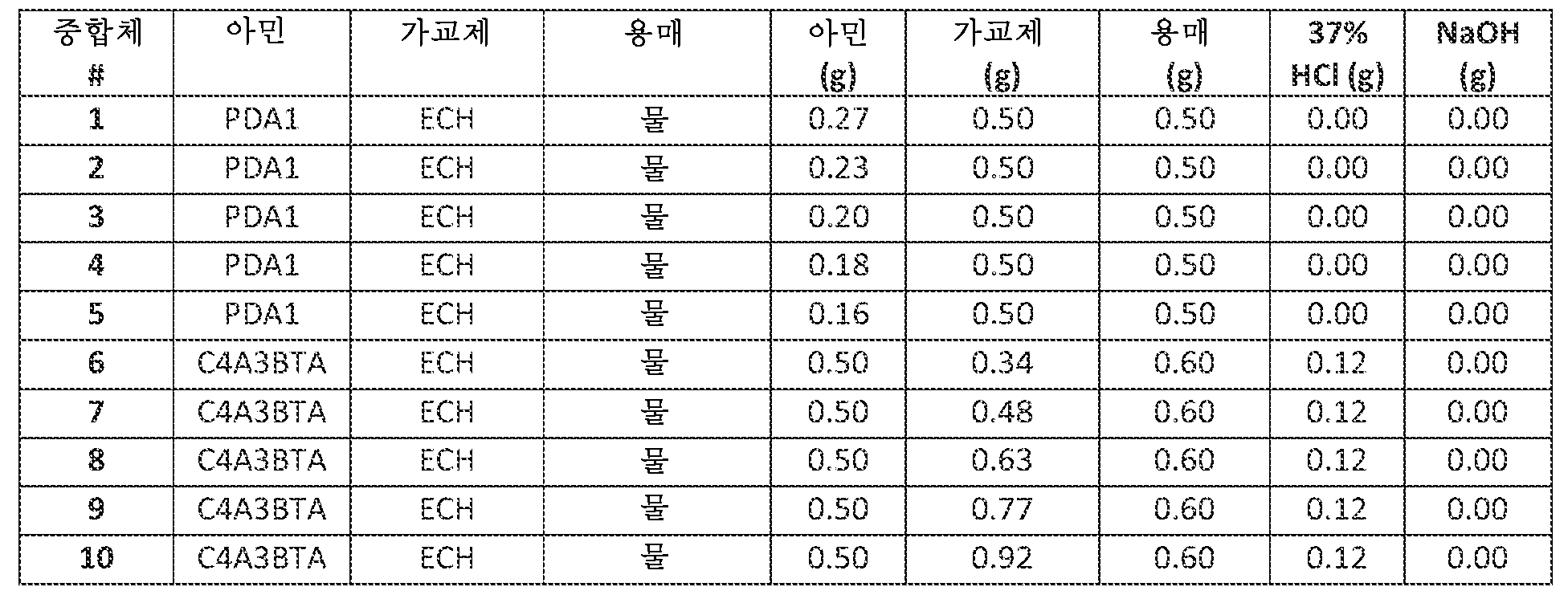

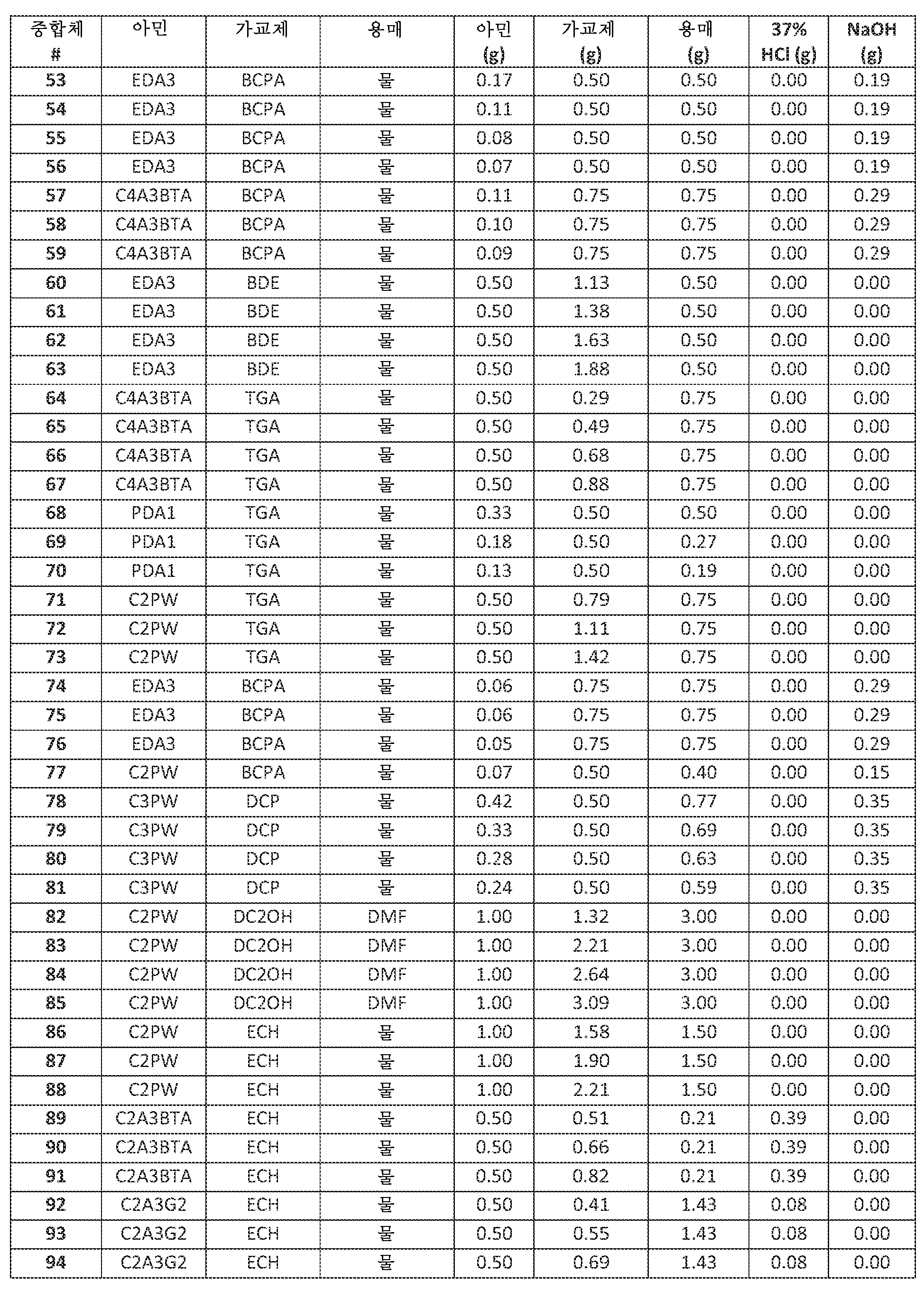
<표 5> 치환 중합 (축합/단계 성장) 겔의 특성<Table 5> Characteristics of substitution polymerization (condensation/step growth) gels


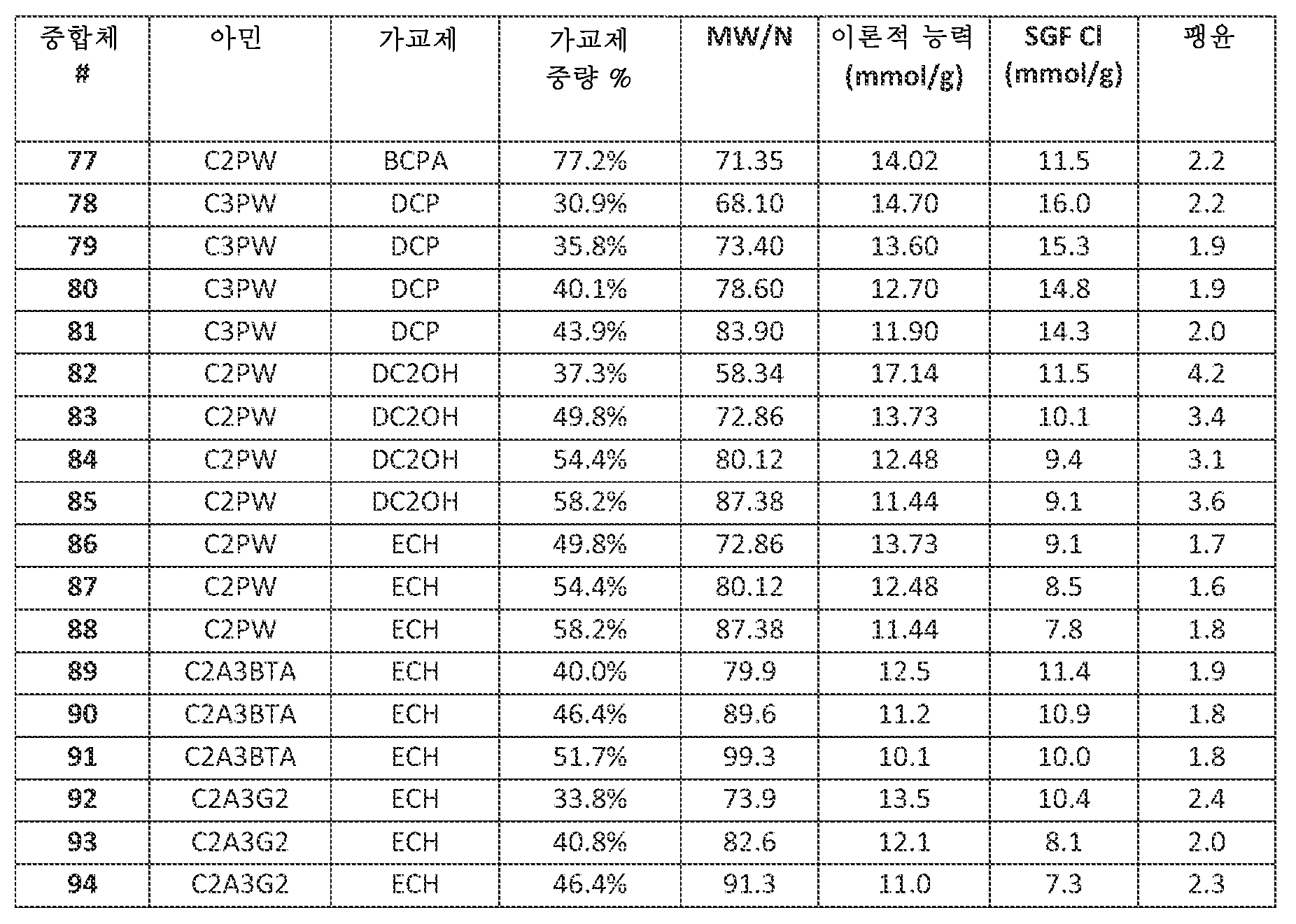
B. 소분자 아민의 치환 중합에 의해 형성되는 비드에 대한 일반적 중합 절차B. General polymerization procedure for beads formed by substitution polymerization of small molecule amines
아민 단량체 및 계면활성제를 물 중에 용해시켜 수성 원액을 제조하였다. 일부 경우에, HCl을 수성 원액에 첨가하였다. 오버헤드 교반기가 구비된 반응기에 수성 원액 및 유기 용매를 채웠다. 가교제를 2가지 방법 중 하나로 도입하였다. 제1 방법에서는, 가교제를 수용액의 일부로서 도입한 후에 유기 용매와 혼합하였다. 제2 방법에서는, 수성 원액 및 유기 용매로 채워진 반응기의 가열을 시작한 후에, 가교제를 시린지 펌프를 통해 수시간의 기간에 걸쳐 반-연속식으로 도입하였다. 반응이 완료된 후에 유기 용매를 제거하고, 비드를 상이한 용매로 세척하여 비드를 정제하였다. 이어서, 비드를 동결건조기 내에서 일정 중량으로 건조시켰다. 이러한 절차를 선형 및 분지형 아민, 및 HCl 결합 관능기, 예컨대 아민의 존재 및 부재 하의 가교제 (각각 "능동" 및 "수동" 가교제)에 적용한다. 본 실시예에 기재된 중합체의 합성에 적합한 아민 및 가교제의 예는 표 6에 제시된 아민 및 가교제의 조합을 포함하나, 이에 제한되지는 않는다. 표 7은 표 6에 제시된 중합체 예의 주요 물리화학적 특성 (즉 SGF 결합 및 팽윤 비)을 기재한다.Aqueous solutions were prepared by dissolving the amine monomer and surfactant in water. In some cases, HCl was added to the aqueous solution. The aqueous solution and the organic solvent were charged to a reactor equipped with an overhead stirrer. The crosslinker was introduced in one of two ways. In the first way, the crosslinker was introduced as part of the aqueous solution and then mixed with the organic solvent. In the second way, the heating of the reactor filled with the aqueous solution and the organic solvent was started, and the crosslinker was introduced semi-continuously via a syringe pump over a period of several hours. After the reaction was completed, the organic solvent was removed and the beads were purified by washing with different solvents. The beads were then dried to a constant weight in a lyophilizer. This procedure applies to linear and branched amines, and to crosslinkers with and without HCl bonding functionality, such as amines ("active" and "passive" crosslinkers, respectively). Examples of suitable amines and cross-linkers for the synthesis of the polymers described in this Example include, but are not limited to, the combinations of amines and cross-linkers set forth in Table 6. Table 7 sets forth key physicochemical properties (i.e., SGF binding and swelling ratio) of the polymer examples set forth in Table 6.
1. C4A3BTA + ECH 비드에 대한 구체적 절차1. Specific procedure for C4A3BTA + ECH beads
1,4-비스[비스(3-아미노프로필)아미노]부탄 ("C4A3BTA") (10.02 g), HCl (6.25 g 진한 HCl), 및 칼리물스 EM-99 (분지형 도데실벤젠 술포네이트, 0.56 g)를 물 (7.18 g) 중에 용해시켜 수성 원액을 제조하였다. 오버헤드 교반기 및 응축기가 구비된 둥근 바닥 플라스크에 수성 원액 및 톨루엔을 채웠다. 반응 혼합물을 불활성 분위기 하에 교반하고, 80℃로 가열하였다. 에피클로로히드린 ("ECH") (21.37 g)을 톨루엔 중 40 중량% 용액으로서 도입하였고, 이는 시린지 펌프를 통해 1시간의 기간에 걸쳐 반-연속식으로 첨가하였다. 반응 혼합물을 80℃에서 16시간 동안 교반하고, 그 후에 반응 혼합물을 실온으로 냉각시키고, 반응기로부터 제거하였다. 톨루엔을 경사분리에 의해 제거하고, 생성된 중합체 비드를 메탄올 (100 mL, 2회), 물 (100 mL), 1M HCl (100 mL, 2회), 물 (100 mL), 1M NaOH (100 mL, 3회), 및 세척 후 용액의 pH가 7일 때까지 물로 세척하여 정제하였다. 이 중합체를 중합체 번호 21로서 표 6 및 표 7에 제시한다.An aqueous stock solution was prepared by dissolving 1,4-bis[bis(3-aminopropyl)amino]butane (“C4A3BTA”) (10.02 g), HCl (6.25 g concentrated HCl), and Calimules EM-99 (branched dodecylbenzene sulfonate, 0.56 g) in water (7.18 g). The aqueous stock solution and toluene were charged to a round bottom flask equipped with an overhead stirrer and a condenser. The reaction mixture was stirred under an inert atmosphere and heated to 80°C. Epichlorohydrin (“ECH”) (21.37 g) was introduced as a 40 wt % solution in toluene and was added semi-continuously via a syringe pump over a period of 1 h. The reaction mixture was stirred at 80°C for 16 h, after which the reaction mixture was cooled to room temperature and removed from the reactor. Toluene was removed by decantation, and the resulting polymer beads were purified by washing with methanol (100 mL, 2 times), water (100 mL), 1 M HCl (100 mL, 2 times), water (100 mL), 1 M NaOH (100 mL, 3 times), and water until the pH of the solution after washing became 7. This polymer is presented in Tables 6 and 7 as polymer number 21.
<표 6> 치환 중합 (축합/단계 성장) 비드의 합성<Table 6> Synthesis of substitution polymerization (condensation/step growth) beads


<표 7> 치환 중합 (축합/단계 성장) 비드의 특성<Table 7> Characteristics of substitution polymerization (condensation/step growth) beads
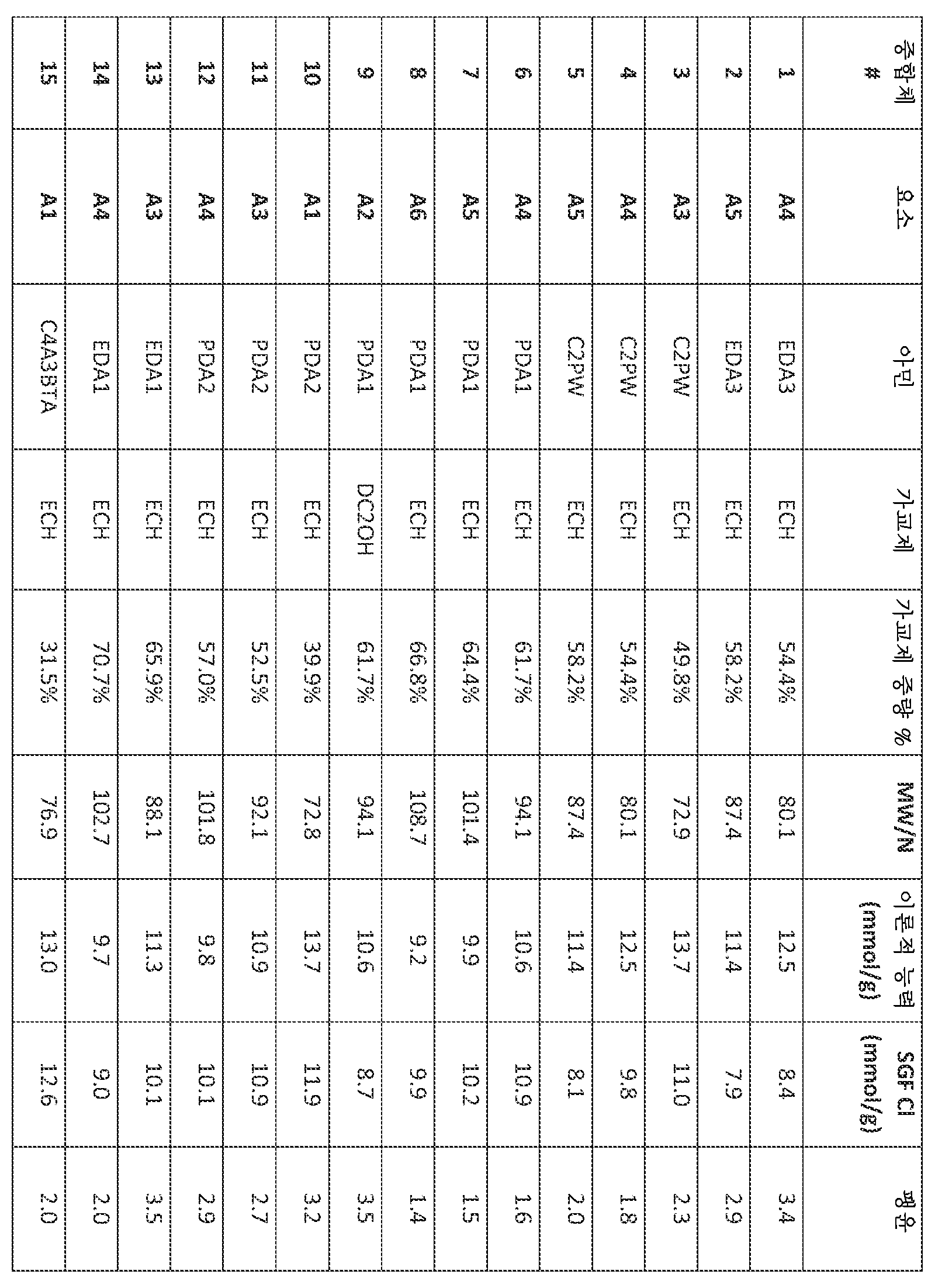

C. 라디칼 중합 (첨가/쇄 성장)에 의해 형성되는 겔에 대한 일반적 중합 절차C. General polymerization procedure for gels formed by radical polymerization (addition/chain growth)
모노알릴아민 히드로클로라이드, 멀티알릴아민 가교제 및 라디칼 개시제의 수용액을 반응 용기에 넣었다. 반응 혼합물을 가열하고, 그 후에 용기를 실온으로 냉각시켰다. 생성된 중합체 겔을 물 중에서 팽윤시키고, 미세 분말로 분쇄하였다. 생성된 겔을 세척하여 정제한 다음, 일정 중량으로 건조시켰다. 본 실시예에 기재된 중합체의 합성에 적합한 아민의 예는 표 8에 제시된 아민을 포함하나, 이에 제한되지는 않는다. 표 9는 표 8에 제시된 중합체 예의 주요 물리화학적 특성 (즉 SGF 결합 및 팽윤 비)을 기재한다.Aqueous solutions of monoallylamine hydrochloride, multiallylamine crosslinker and radical initiator were placed in a reaction vessel. The reaction mixture was heated and then the vessel was cooled to room temperature. The resulting polymer gel was swelled in water and ground into a fine powder. The resulting gel was washed, purified and then dried to a constant weight. Examples of amines suitable for the synthesis of the polymers described in this example include, but are not limited to, the amines shown in Table 8. Table 9 describes the key physicochemical properties (i.e., SGF binding and swelling ratio) of the polymer examples shown in Table 8.
1. AAH + TAA 겔에 대한 구체적 절차1. Specific procedure for AAH + TAA gel
자기 교반 막대 및 질소 유입구가 구비된 병렬 반응기 내의 둥근 바닥 플라스크에 물 (2.14 g), 알릴아민 히드로클로라이드 (1-(알릴아미노)-2-아미노에탄, "AAH") (0.55 g), 트리알릴아민 ("TAA") (0.71 g), 진한 HCl (0.15 g), 및 V-50 (2,2'-아조비스(2-메틸프로피온아미딘)디히드로클로라이드) (0.068 g)을 채웠다. 반응 혼합물을 질소로 15분 동안 폭기시키고, 불활성 분위기 하에 80℃로 가열하였다. 16시간 후, 용기를 실온으로 냉각시키고 반응기로부터 제거하였다. 중합체 겔을 물 중에서 팽윤시키고, 기계적으로 분쇄하였다. 생성된 미세 분말을 메탄올 (100 mL, 2회), 물 (100 mL), 1M HCl (100 mL, 2회), 물 (100 mL), 1M NaOH (100 mL, 3회), 및 세척 후 용액의 pH가 7일 때까지 물로 세척하여 정제하였다. 겔을 동결건조기 내에서 48시간 동안 건조시켰다. 이 중합체를 중합체 번호 10으로서 표 8 및 표 9에 제시한다.A round bottom flask in a parallel reactor equipped with a magnetic stir bar and a nitrogen inlet was charged with water (2.14 g), allylamine hydrochloride (1-(allylamino)-2-aminoethane, "AAH") (0.55 g), triallylamine ("TAA") (0.71 g), concentrated HCl (0.15 g), and V-50 (2,2'-azobis(2-methylpropionamidine)dihydrochloride) (0.068 g). The reaction mixture was aerated with nitrogen for 15 minutes and heated to 80 °C under an inert atmosphere. After 16 hours, the vessel was cooled to room temperature and removed from the reactor. The polymer gel was swelled in water and mechanically crushed. The resulting fine powder was purified by washing with methanol (100 mL, 2 times), water (100 mL), 1 M HCl (100 mL, 2 times), water (100 mL), 1 M NaOH (100 mL, 3 times), and water until the pH of the washed solution became 7. The gel was dried in a freeze-dryer for 48 h. This polymer is presented in Tables 8 and 9 as polymer number 10.
2. AAH + DAEDA1 겔에 대한 구체적 절차2. Specific procedure for AAH + DAEDA1 gel
자기 교반 막대 및 질소 유입구가 구비된 병렬 반응기 내의 둥근 바닥 플라스크에 물 (2.53 g), 알릴아민 히드로클로라이드 (1-(알릴아미노)-2-아미노에탄, "AAH") (0.54 g), 1,2-비스(알릴아미노)에탄 ("DAEDA1") (0.86 g), 및 V-50 (2,2'-아조비스(2-메틸프로피온아미딘)디히드로클로라이드) (0.067 g)을 채웠다. 반응 혼합물을 질소로 15분 동안 폭기시킨 다음, 불활성 분위기 하에 80℃로 가열하였다. 16시간 후, 용기를 실온으로 냉각시키고 반응기로부터 제거하였다. 중합체 겔을 물 중에서 팽윤시키고, 기계적으로 분쇄하였다. 생성된 미세 분말을 메탄올 (100 mL, 2회), 물 (100 mL), 1M HCl (100 mL, 2회), 물 (100 mL), 1M NaOH (100 mL, 3회), 및 세척 후 용액의 pH가 7일 때까지 물로 세척하여 정제하였다. 겔을 동결건조기 내에서 48시간 동안 건조시켰다. 이 중합체를 중합체 번호 2로서 표 8 및 표 9에 제시한다.A round bottom flask in a parallel reactor equipped with a magnetic stir bar and a nitrogen inlet was charged with water (2.53 g), allylamine hydrochloride (1-(allylamino)-2-aminoethane, "AAH") (0.54 g), 1,2-bis(allylamino)ethane ("DAEDA1") (0.86 g), and V-50 (2,2'-azobis(2-methylpropionamidine)dihydrochloride) (0.067 g). The reaction mixture was aerated with nitrogen for 15 minutes and then heated to 80 °C under an inert atmosphere. After 16 hours, the vessel was cooled to room temperature and removed from the reactor. The polymer gel was swelled in water and mechanically crushed. The resulting fine powder was purified by washing with methanol (100 mL, 2 times), water (100 mL), 1 M HCl (100 mL, 2 times), water (100 mL), 1 M NaOH (100 mL, 3 times), and water until the pH of the washed solution became 7. The gel was dried in a lyophilizer for 48 h. This polymer is presented in Tables 8 and 9 as polymer number 2.
<표 8> 라디칼 중합 (첨가/쇄 성장) 겔의 합성<Table 8> Synthesis of radical polymerization (addition/chain growth) gels

<표 9> 라디칼 중합 (첨가/쇄 성장) 겔의 특성<Table 9> Characteristics of radical polymerization (addition/chain growth) gels
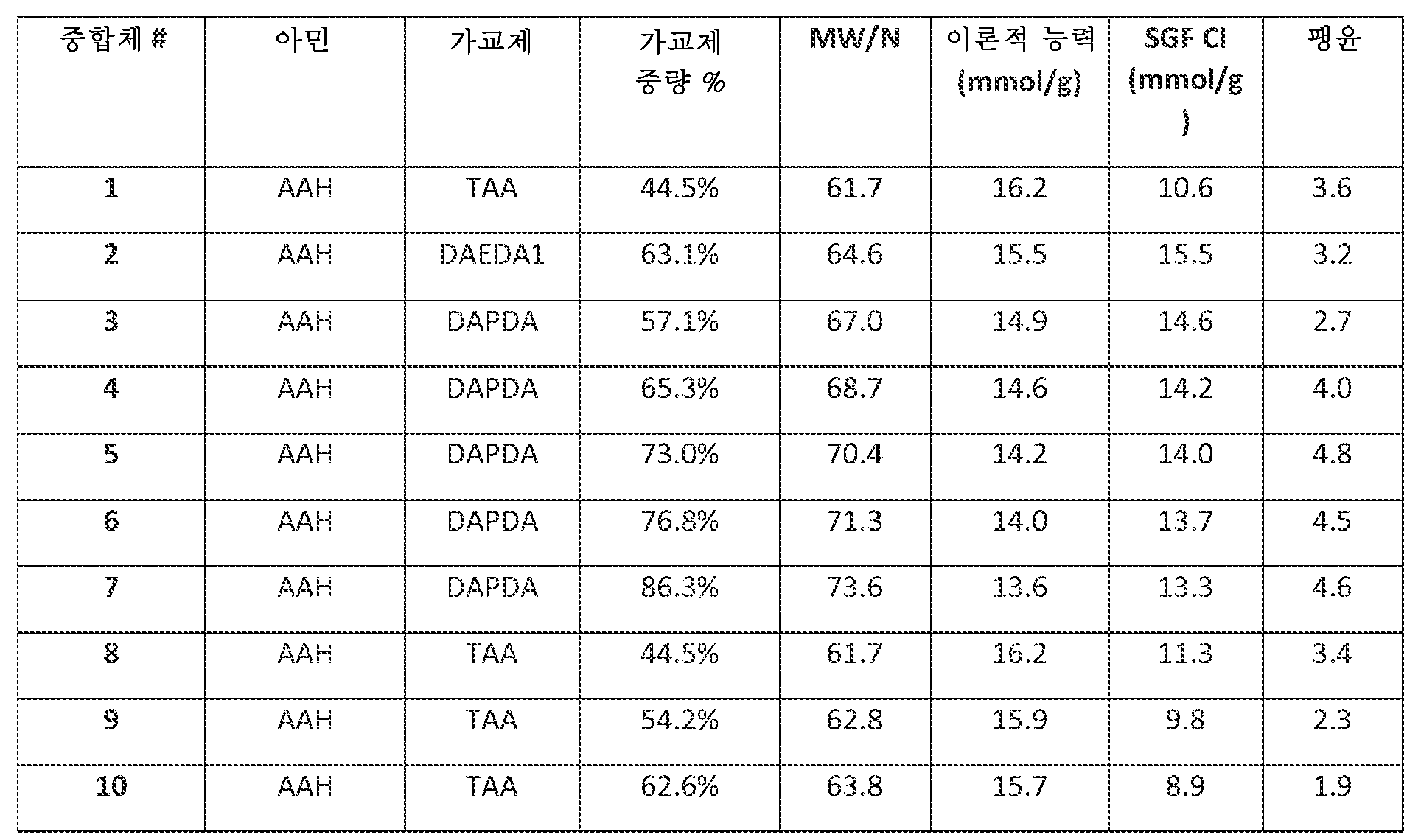
D. 라디칼 중합 (첨가/쇄 성장)에 의해 형성되는 비드에 대한 일반적 중합 절차D. General polymerization procedure for beads formed by radical polymerization (addition/chain growth)
모노알릴아민 및 멀티알릴아민 가교제를 물 중에 용해시켜 수성 원액을 제조하였다. 교반기가 구비된 반응기를 수성 원액 및 소수성 유기 현탁화 용매 중에 용해시킨 계면활성제로 채웠다. 라디칼 개시제 용액을 제조하였다. 2종의 혼합물을 독립적으로 질소로 폭기시켰다. 개시제 용액을 반응 혼합물에 첨가한 후, 최대 16시간 동안 가열하였다. 중합 동역학에 따라 필요한 경우에, 제2 부분의 개시제를 반응 혼합물에 첨가할 수 있다. 반응 혼합물은 또한 보다 농축된 반응 혼합물을 수득하고 더 적은 활성 단량체 및 가교제를 중합시키기 위해 탈수 단계를 수반할 수 있다. 용기를 실온으로 냉각시킨 후에, 유기 상을 제거하고, 비드를 정제하였다. 비드를 건조시켰다. 본 실시예에 기재된 중합체의 합성에 적합한 아민 및 가교제의 예는, 표 10 파트 1에 제시된 아민 및 가교제의 조합을 포함하나, 이에 제한되지는 않는다. 이들 비드에 대해 이어서 하기 E 및 표 10 파트 2에 기재된 바와 같이 후-중합 가교 절차를 행한다.Monoallylamine and multiallylamine crosslinkers were dissolved in water to prepare an aqueous stock solution. A reactor equipped with a stirrer was charged with the aqueous stock solution and the surfactant dissolved in the hydrophobic organic suspending solvent. A radical initiator solution was prepared. The two mixtures were independently sparged with nitrogen. The initiator solution was added to the reaction mixture and heated for up to 16 hours. If necessary, depending on the polymerization kinetics, a second portion of the initiator may be added to the reaction mixture. The reaction mixture may also be subjected to a dehydration step to obtain a more concentrated reaction mixture and polymerize less active monomer and crosslinker. After the vessel was cooled to room temperature, the organic phase was removed and the beads were purified. The beads were dried. Examples of suitable amines and crosslinkers for the synthesis of the polymers described in this example include, but are not limited to, the combinations of amines and crosslinkers set forth in Table 10 Part 1. These beads are then subjected to a post-polymerization cross-linking procedure as described in Part 2 of E and Table 10 below.
1. AAH + DAEDA1 비드에 대한 구체적 절차1. Specific procedure for AAH + DAEDA1 beads
알릴아민 히드로클로라이드 (1-(알릴아미노)-2-아미노에탄, "AAH") (10.94 g) 및 1,2-비스(알릴아미노)에탄 ("DAEDA1") (6.23 g)을 물 (38.89 g) 중에 용해시켜 수성 원액을 제조하였다. 오버헤드 교반기, 딘 스타크 장치 및 응축기, 및 질소 유입구가 구비된 4개의 측면 배플을 갖는 3구 둥근 바닥 플라스크에 수성 원액, 및 74:26 클로로벤젠/헵탄 용액 (311.11 g) 중에 용해시킨 계면활성제 (칼리물스 EM-99, 분지형 도데실벤젠 술포네이트, 3.14 g)를 채웠다. 개별 용기에서, 물 (12.75 g) 중 V-50 (1.98 g) 용액을 제조하였다. 2종의 혼합물을 독립적으로 질소로 폭기시켰다. 불활성 분위기 하에, 개시제 용액을 반응 혼합물에 첨가한 후 67℃로 16시간 동안 가열하였다. 제2 부분의 개시제 용액 (14.73 g) 및 반응 혼합물을 탈기시키고 합한 후에, 최종 탈수 단계 동안 온도를 115℃로 증가시켰다. 용기를 실온으로 냉각시킨 후에, 유기 상을 경사분리에 의해 제거하고, 비드를 메탄올 (100 mL, 2회), 물 (100 mL), 2 M NaOH (100 mL), 및 물 (100 mL, 2회)로 세척하여 정제하였다. 비드를 동결건조기 내에서 48시간 동안 건조시켰다. 이 중합체를 표 10_1에 제시하고, 이는 표 10 파트 2의 중합체 29-31을 생성하는 후중합 가교를 위한 공급원 비드이다.An aqueous stock solution was prepared by dissolving allylamine hydrochloride (1-(allylamino)-2-aminoethane, "AAH") (10.94 g) and 1,2-bis(allylamino)ethane ("DAEDA1") (6.23 g) in water (38.89 g). A three-necked round-bottom flask with four side baffles and equipped with an overhead stirrer, a Dean-Stark apparatus and condenser, and a nitrogen inlet was charged with the aqueous stock solution and a surfactant (Kallimuls EM-99, a branched dodecylbenzene sulfonate, 3.14 g) dissolved in a 74:26 chlorobenzene/heptane solution (311.11 g). In a separate vessel, a solution of V-50 (1.98 g) in water (12.75 g) was prepared. The two mixtures were independently sparged with nitrogen. Under inert atmosphere, the initiator solution was added to the reaction mixture and heated to 67°C for 16 h. The initiator solution of the second part (14.73 g) and the reaction mixture were degassed and combined, and the temperature was increased to 115°C during the final dehydration step. After the vessel was cooled to room temperature, the organic phase was removed by decantation, and the beads were purified by washing with methanol (100 mL, 2 times), water (100 mL), 2 M NaOH (100 mL), and water (100 mL, 2 times). The beads were dried in a lyophilizer for 48 h. This polymer is presented in Table 10_1 and is the source beads for the post-polymerization crosslinking to produce polymers 29-31 of Table 10 Part 2.
E. 폴리아민 비드 또는 겔의 후-중합 가교의 일반적 절차E. General procedure for post-polymerization crosslinking of polyamine beads or gels
가교 폴리아민 비드 또는 겔은 선형 폴리아민의 가교, 라디칼 중합, 및 가교 또는 치환 반응을 통한 소분자 아민 가교로부터 수득될 수 있다.Crosslinked polyamine beads or gels can be obtained from crosslinking of linear polyamines, radical polymerization, and crosslinking of small molecule amines via crosslinking or substitution reactions.
폴리아민 비드 합성의 일반적 예로서, 물 중 선형 폴리아민 히드로클로라이드 (및 임의로 수산화나트륨) 및 수용성 가교제의 원액을 제조하였다. 불활성 분위기 하에, 오버헤드 교반기를 갖는 플라스크에 각각 수성 및 유기 원액을 채웠다. 교반을 개시한 후에, 반응물을 최대 16시간 동안 가열하였다. 반응 혼합물을 농축시키기 위해 임의로 탈수 절차/단계를 추가할 수 있다. 소수성 유기 용매를 경사분리에 의해 제거하고, 비드를 불순물 제거를 위해 선택한 용매 중에서 세척하여 정제하였다. 생성된 폴리아민 비드를 NaOH에 의해 세척하여 탈양성자화시켰다. 생성된 유출 물이 중성 pH에 접근하도록 비드를 물로 세척하고 건조시켰다.As a general example of polyamine bead synthesis, stock solutions of linear polyamine hydrochloride (and optionally sodium hydroxide) and a water-soluble cross-linker in water were prepared. Under an inert atmosphere, the aqueous and organic stock solutions were charged respectively to a flask with an overhead stirrer. After stirring was initiated, the reaction was heated for up to 16 hours. An optional dehydration procedure/step may be added to concentrate the reaction mixture. The hydrophobic organic solvent was removed by decantation, and the beads were purified by washing in a solvent of choice to remove impurities. The resulting polyamine beads were deprotonated by washing with NaOH. The beads were washed with water and dried so that the resulting effluent approached neutral pH.
생성된 건조된 폴리아민 비드를 반응기에 넣고, 용매를 겔에 첨가하였다. 가교제를 생성된 슬러리에 첨가하였다. 혼합물을 완료에 이르는데 요구되는 시간 동안 가열하였다. 반응 혼합물을 냉각시키고, 비드를 세척하여 정제하고, 어떠한 추가의 물이 제거되지 않고 중량이 일정하게 유지될 때까지 건조시켰다. 본 실시예에 기재된 후-중합 가교의 예는 표 10, 파트 2에 제시된 가교제를 포함하나, 이에 제한되지는 않는다. 표 11은 표 10_파트 2에 제시된 중합체 예의 주요 물리화학적 특성 (즉 SGF 결합 및 팽윤 비)을 기재한다.The resulting dried polyamine beads were placed in a reactor and solvent was added to the gel. A crosslinker was added to the resulting slurry. The mixture was heated for the required time to reach completion. The reaction mixture was cooled and the beads were washed, purified, and dried until no additional water was removed and the weight remained constant. Examples of post-polymerization crosslinking described in this example include, but are not limited to, the crosslinkers presented in Table 10, Part 2. Table 11 sets forth key physicochemical properties (i.e., SGF binding and swelling ratio) of the polymer examples presented in Table 10_Part 2.
1. PAAH 비드의 DCP에 의한 후-가교1. Post-crosslinking of PAAH beads by DCP
폴리알릴아민 히드로클로라이드 (평균 Mw ~15,000 (GPC vs. PEG std.)) (25 g)) 및 수산화나트륨 (6.0 g)을 물 (75.5 g) 중에 용해시켜 수성 원액을 제조하였다. 용액을 적어도 10분 동안 교반하였다. 톨루엔 (316 g) 및 계면활성제 (스판 80 (소르비탄 모노올레에이트)) (3.2 g)를 함유하는 원액을 또한 제조하였다. 오버헤드 교반기, 딘 스타크 장치 및 응축기가 구비된 4개의 측면 배플을 갖는 3구 둥근 바닥 플라스크에 톨루엔 용액을 채웠다. 디클로로프로판올 (1,3-디클로로-2-프로판올, "(DC2POH") (3.45 g)을 수성 원액에 실온에서 첨가하고, 1분 동안 교반하였다. 이 용액을 3구 둥근 바닥 플라스크 셋 업에 첨가하였다. 반응 혼합물을 불활성 분위기 하에 교반하였다. 반응물을 50℃로 14시간 동안 가열하였다. 이 시간 후에, 반응 혼합물을 80℃로 가열하고, 그 후 반응 혼합물을 최종 탈수 단계 동안 115℃로 가열하였다. 모든 물이 반응물로부터 제거되면 (75 g), 반응물을 실온으로 냉각되도록 하였다. 톨루엔을 경사분리에 의해 제거하고, 생성된 중합체 비드를 메탄올 (100 mL, 2회), 물 (100 mL), 1M HCl (100 mL, 2회), 물 (100 mL), 1M NaOH (100 mL, 2회), 및 세척 후 용액의 pH가 7일 때까지 물로 세척하여 정제하였다. 비드를 동결건조기 내에서 48시간 동안 건조시켰다.An aqueous stock solution was prepared by dissolving polyallylamine hydrochloride (average Mw ~15,000 (GPC vs. PEG std.)) (25 g) and sodium hydroxide (6.0 g) in water (75.5 g). The solution was stirred for at least 10 minutes. A stock solution containing toluene (316 g) and a surfactant (Span 80 (sorbitan monooleate)) (3.2 g) was also prepared. The toluene solution was charged to a three-necked round bottom flask with four side baffles and equipped with an overhead stirrer, a Dean-Stark apparatus and a condenser. Dichloropropanol (1,3-dichloro-2-propanol, "(DC2POH") (3.45 g) was added to the aqueous stock solution at room temperature and stirred for 1 min. This solution was added to a 3-necked round bottom flask set up. The reaction mixture was stirred under an inert atmosphere. The reaction was heated to 50 °C for 14 h. After this time, the reaction mixture was heated to 80 °C and then the reaction mixture was heated to 115 °C for a final dehydration step. Once all the water was removed from the reaction (75 g), the reaction was allowed to cool to room temperature. The toluene was removed by decantation and the resulting polymer beads were purified by washing with methanol (100 mL, 2 times), water (100 mL), 1 M HCl (100 mL, 2 times), water (100 mL), 1 M NaOH (100 mL, 2 times), and water until the pH of the solution was 7. The beads were Drying was performed in a freeze dryer for 48 hours.
상기 생성된 PAAH 비드 0.40 g을 바이알 내에서 메탄올 2.8 mL 및 1,3-디클로로프로판 ("DCP") (0.51 g)과 혼합하였다. 비드를 스패튤라로 혼합하여 동등하게 분포된 습윤물을 수득한 후, 바이알을 밀봉하고, 75℃로 밤새 가열하였다. 냉각시킨 비드를 메탄올 (45 mL, 2회), 물 (45 mL), 1M HCl (45 mL, 2회), 물 (45 mL), 1M NaOH (45 mL, 3회), 및 세척 후 용액의 pH가 7일 때까지 물로 세척하여 정제하였다. 겔을 동결건조기 내에서 48시간 동안 건조시켰다. 이 중합체를 중합체 번호 4로서 표 10_파트 2 및 표 11에 제시한다.The PAAH beads (0.40 g) prepared above were mixed with 2.8 mL of methanol and 1,3-dichloropropane ("DCP") (0.51 g) in a vial. The beads were mixed with a spatula to obtain an equally distributed wettability, the vial was sealed, and heated to 75° C. overnight. The cooled beads were purified by washing with methanol (45 mL, 2 times), water (45 mL), 1 M HCl (45 mL, 2 times), water (45 mL), 1 M NaOH (45 mL, 3 times), and water until the pH of the washed solution was 7. The gel was dried in a lyophilizer for 48 h. This polymer is presented in Table 10_Part 2 and Table 11 as Polymer No. 4.
1. PAAH 비드의 DCP에 의한 후-가교1. Post-crosslinking of PAAH beads by DCP
알릴아민 히드로클로라이드 (10.71 g) 및 1,3-비스(알릴아미노)프로판 ("DAPDA") (6.50 g)을 물 (27.88 g) 중에 용해시켜 수성 원액을 제조하였다. 오버헤드 교반기, 딘 스타크 장치 및 응축기, 및 질소 유입구가 구비된 4개의 측면 배플을 갖는 3구 둥근 바닥 플라스크에 수성 원액, 및 74:26 클로로벤젠/헵탄 용액 (311.11 g) 중에 용해시킨 계면활성제 (칼리물스 EM-99, 분지형 도데실벤젠 술포네이트, 3.14 g)를 채웠다. 개별 용기에서, 물 (11.00 g) 중 V-50 (1.94 g) 용액을 제조하였다. 2 종의 혼합물을 독립적으로 질소로 폭기시켰다. 불활성 분위기 하에, 개시제 용액을 반응 혼합물에 첨가한 후 67℃로 16시간 동안 가열하였다. 제2 부분의 개시제 용액 (12.94 g) 및 반응 혼합물을 탈기시키고 합한 후에, 최종 탈수 단계 동안 온도를 115℃로 증가시켰다. 용기를 실온으로 냉각시킨 후에, 유기 상을 경사분리에 의해 제거하고, 비드를 메탄올 (100 mL, 2회), 물 (100 mL), 2 M NaOH (100 mL), 및 물 (100 mL, 2회)로 세척하여 정제하였다. 비드를 동결건조기 내에서 48시간 동안 건조시켰다.An aqueous stock solution was prepared by dissolving allylamine hydrochloride (10.71 g) and 1,3-bis(allylamino)propane ("DAPDA") (6.50 g) in water (27.88 g). A three-necked round-bottom flask with four side baffles and equipped with an overhead stirrer, a Dean-Stark apparatus and condenser, and a nitrogen inlet was charged with the aqueous stock solution and a surfactant (Kallimuls EM-99, branched dodecylbenzene sulfonate, 3.14 g) dissolved in a 74:26 chlorobenzene/heptane solution (311.11 g). In a separate vessel, a solution of V-50 (1.94 g) in water (11.00 g) was prepared. The two mixtures were independently aerated with nitrogen. Under an inert atmosphere, the initiator solution was added to the reaction mixture and then heated to 67°C for 16 h. The initiator solution (12.94 g) of the second part and the reaction mixture were degassed and combined, and the temperature was increased to 115 °C during the final dehydration step. After the vessel was cooled to room temperature, the organic phase was removed by decantation, and the beads were purified by washing with methanol (100 mL, 2 times), water (100 mL), 2 M NaOH (100 mL), and water (100 mL, 2 times). The beads were dried in a lyophilizer for 48 h.
1,3-디클로로프로판 ("DCP") (0.18 g)을 MeOH (2.80 g) 및 상기 생성된 PAAH 비드 0.40 g으로 채워진 바이알에 첨가하였다. 비드를 스패튤라로 혼합하여 동등하게 분포된 습윤물을 수득한 후, 바이알을 밀봉하고, 75℃로 밤새 가열하였다. 냉각시킨 비드를 메탄올 (45 mL, 2회), 물 (45 mL), 1M HCl (45 mL, 2회), 물 (45 mL), 1M NaOH (45 mL, 2회), 및 세척 후 용액의 pH가 7일 때까지 물로 세척하여 정제하였다. 겔을 동결건조기 내에서 48시간 동안 건조시켰다. 이 중합체를 중합체 번호 10으로서 표 10_파트 2 및 표 11에 제시한다.1,3-Dichloropropane (“DCP”) (0.18 g) was added to a vial filled with MeOH (2.80 g) and 0.40 g of the PAAH beads produced above. The beads were mixed with a spatula to obtain an equally distributed wettability, the vial was sealed, and heated to 75 °C overnight. The cooled beads were purified by washing with methanol (45 mL, 2 times), water (45 mL), 1 M HCl (45 mL, 2 times), water (45 mL), 1 M NaOH (45 mL, 2 times), and water until the pH of the washed solution was 7. The gel was dried in a lyophilizer for 48 h. This polymer is presented in Table 10_Part 2 and Table 11 as Polymer No. 10.
<표 10_파트 1> 라디칼 중합 (첨가/쇄 성장) 비드의 합성<Table 10_Part 1> Synthesis of radical polymerization (addition/chain growth) beads
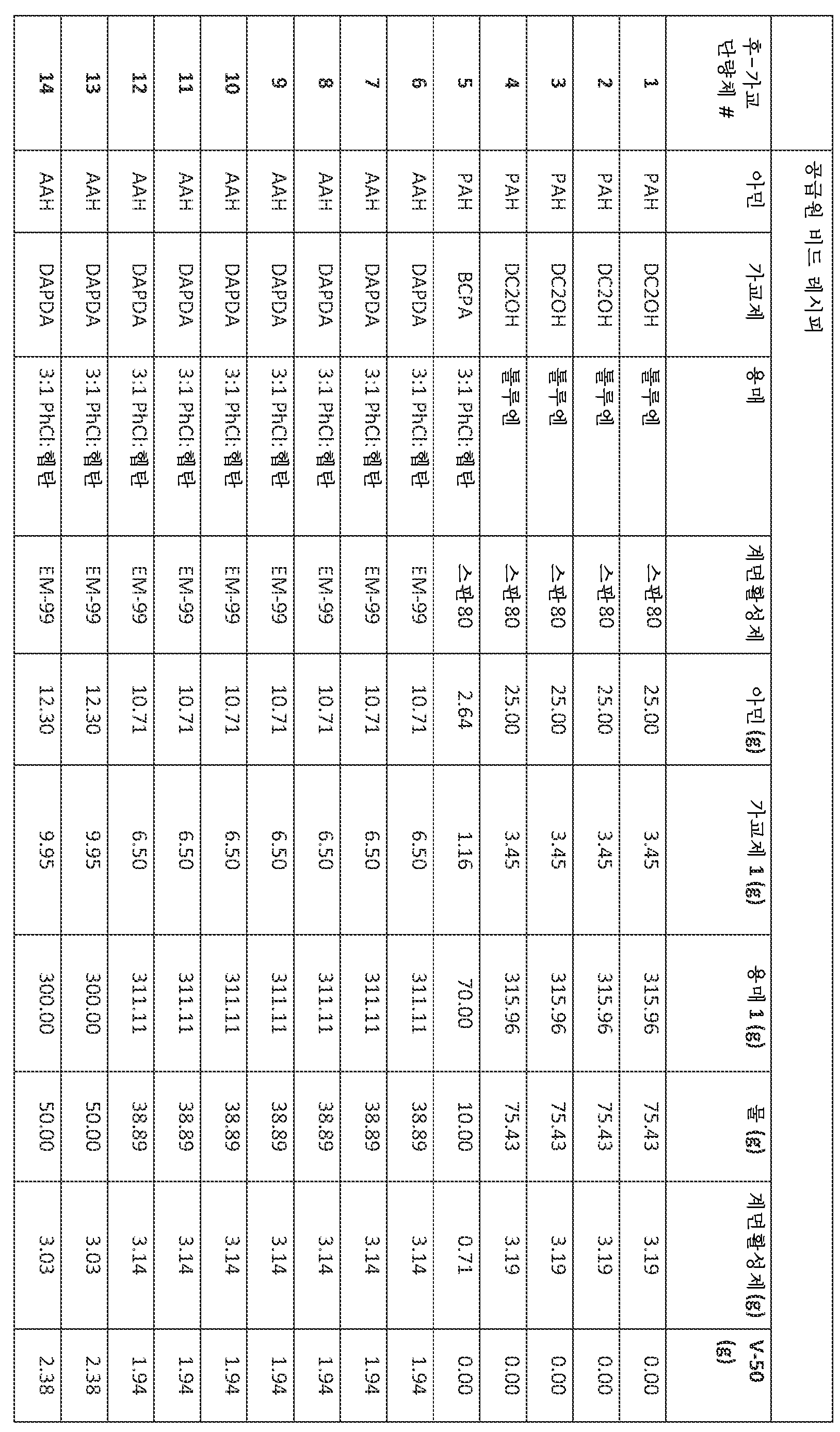

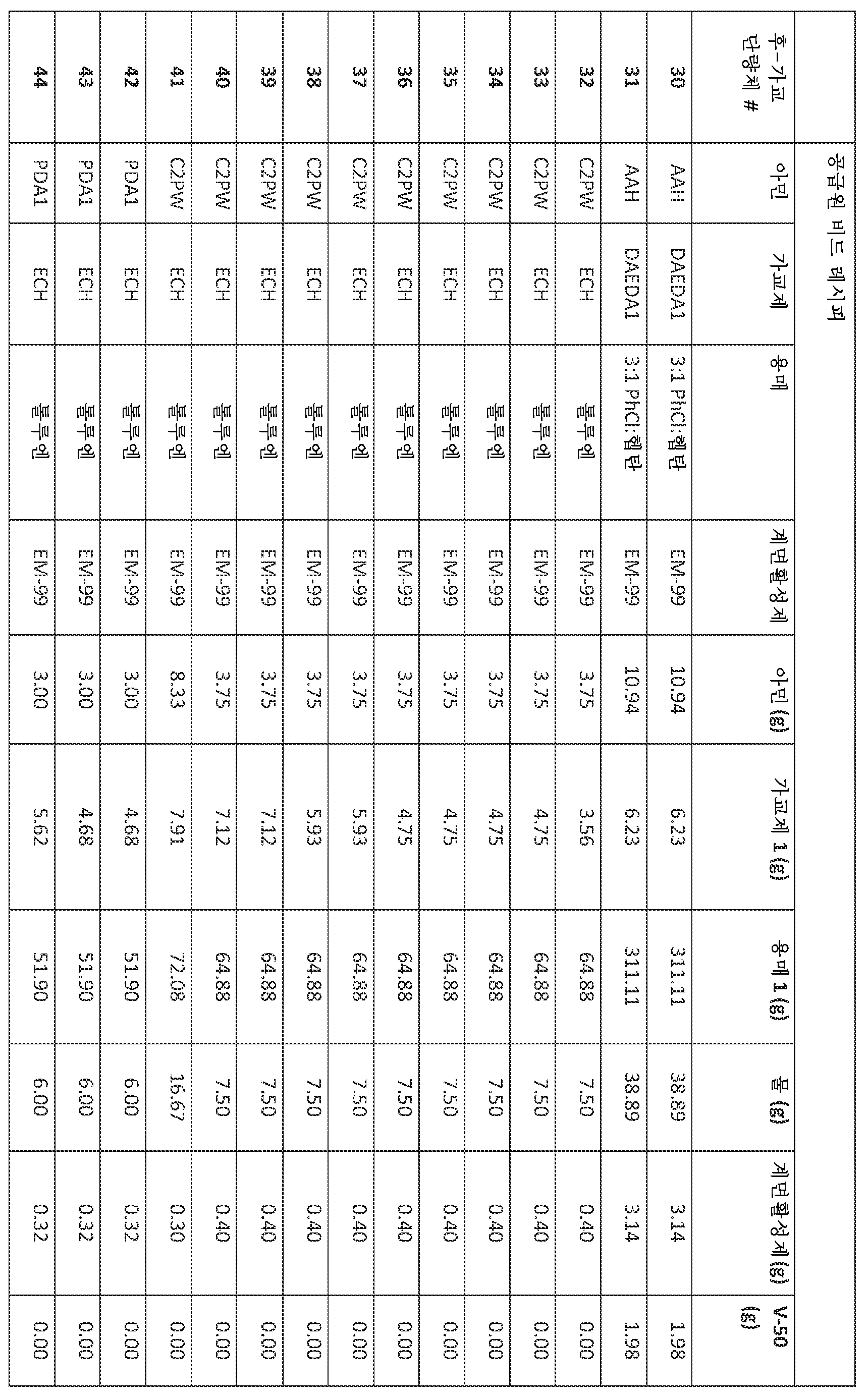

<표 10_파트 2> 라디칼 중합 (첨가/쇄 성장) 비드의 합성 (계속)<Table 10_Part 2> Synthesis of Radical Polymerization (Addition/Chain Growth) Beads (Continued)


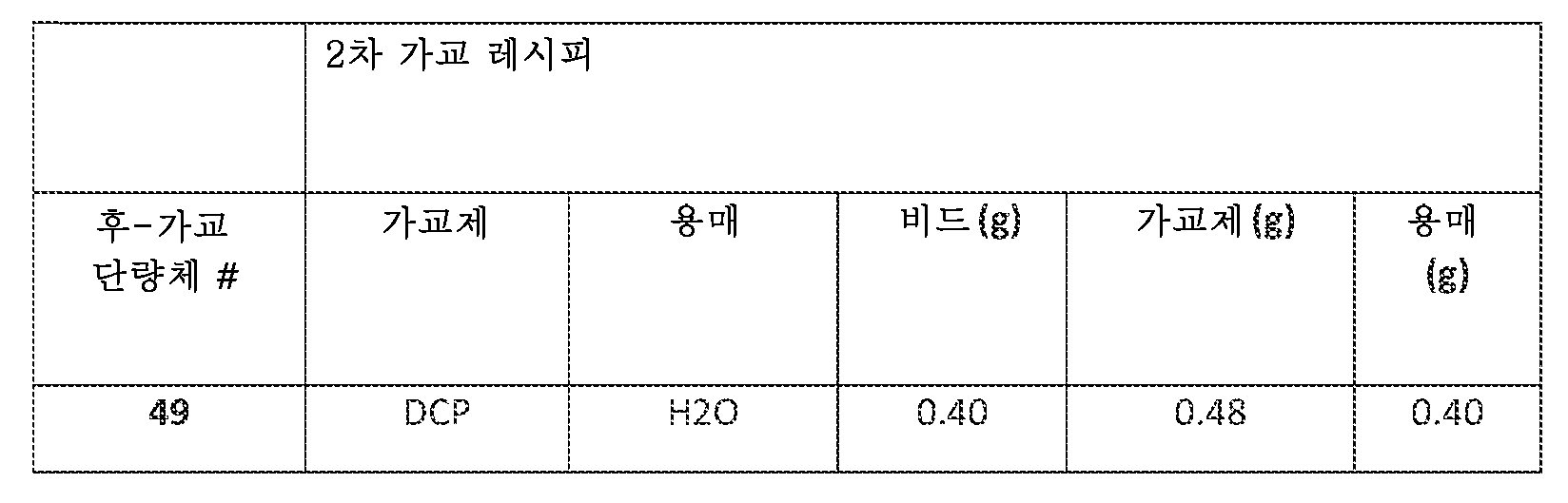
<표 11> 라디칼 중합 (첨가/쇄 성장) 비드의 특성<Table 11> Characteristics of radical polymerization (addition/chain growth) beads


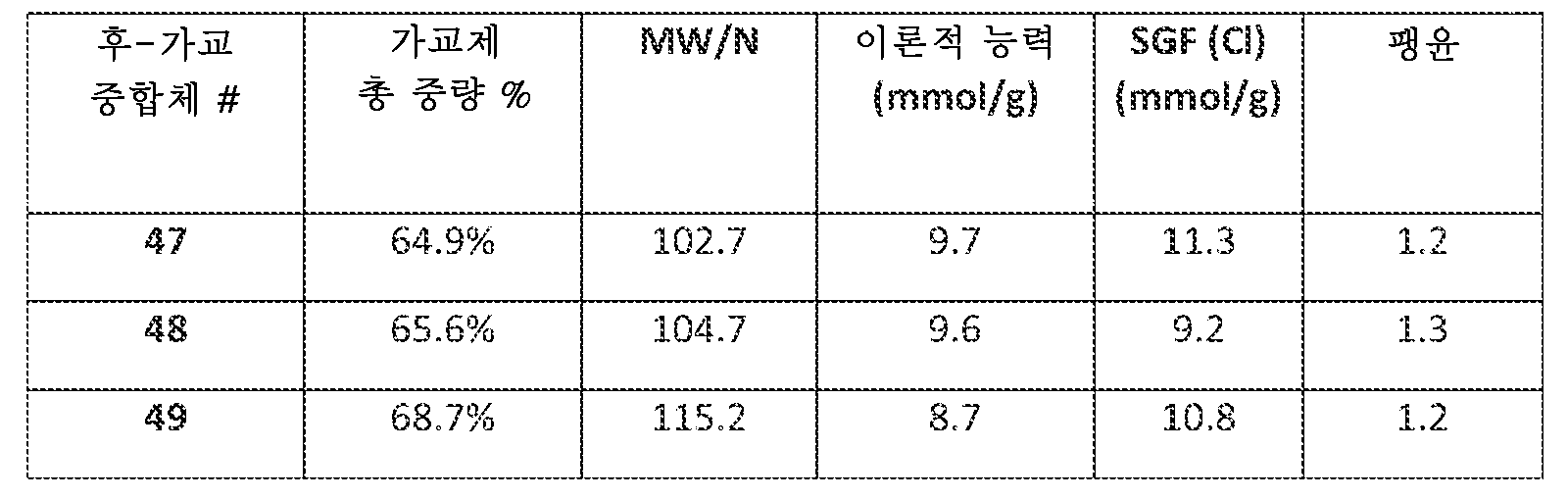
II. 성능 실시예II. Performance Examples
하기 실시예는 포스페이트에 우선한 클로라이드 결합 선택성 (SIB 검정), 무기 및 유기 간섭제의 존재 하에서의 클로라이드 결합 선택성 (SOB 검정), 총 4급 아민 (QAA 검정), SOB 결합 동역학, 및 클로라이드 저류 (CRA 검정)를 측정하는 성능-평가 스크린 및 검정에서 본 개시내용의 선택된 합성 중합체 뿐만 아니라 상업적으로 입수가능한 참조 중합체를 평가한 결과를 제공한다. 이들 검정은 하기 정의되어 있다.The following examples provide the results of evaluating selected synthetic polymers of the present disclosure as well as commercially available reference polymers in performance-evaluation screens and assays measuring chloride binding selectivity over phosphate (SIB assay), chloride binding selectivity in the presence of inorganic and organic interferents (SOB assay), total quaternary amines (QAA assay), SOB binding kinetics, and chloride retention (CRA assay). These assays are defined below.
A. 성능 실시예A. Performance Examples
하기 표 12는 3종의 선택된 중합체: 상기 기재된 바와 같이 제조된 참조 빅살로머, 증가된 ECH 몰 당량 함량을 갖는 또 다른 C4A3BTA/ECH 중합체, 및 유리 아민 세벨라머의 상대 성능의 예를 제시한다. 본 실시예에서 데이터를 생성하는데 사용된 검정은 다른 곳에 기재되어 있다. Table 12 below presents examples of the relative performance of three selected polymers: a reference bixalomer prepared as described above, another C4A3BTA/ECH polymer having increased ECH molar equivalent content, and free amine sevelamer. The assays used to generate the data in this example are described elsewhere.
단량체로서 C4A3BTA 및 가교제로서 ECH로부터 2.35의 가교제 몰 당량으로 제조된 빅살로머 참조 가교 아민 중합체는 SGF 중에서 2.3 g 물/g 건조 중합체의 팽윤 비 및 12.8 mmol/g의 결합 능력을 갖는 것으로 제시되었다. 이 중합체는 SIB 중에서 1.7 mmol/g 클로라이드 및 5.2 mmol/g 포스페이트로 결합하였고, SOB 중에서 0.8 mmol/g 클로라이드, 1.4 mmol/g 포스페이트, 0.5 mmol/g 시트레이트 및 0.6 mmol/g 타우로콜레이트로 결합하였다.A bixalomer reference crosslinked amine polymer prepared from C4A3BTA as a monomer and ECH as a crosslinker at 2.35 molar equivalents of crosslinker was presented to have a swelling ratio of 2.3 g water/g dry polymer and a binding capacity of 12.8 mmol/g in SGF. This polymer bound 1.7 mmol/g chloride and 5.2 mmol/g phosphate in SIB and 0.8 mmol/g chloride, 1.4 mmol/g phosphate, 0.5 mmol/g citrate, and 0.6 mmol/g taurocholate in SOB.
비교상, 단량체로서 C4A3BTA 및 가교제로서 ECH로부터 5.3의 가교제 몰 당량으로 제조된 가교 아민 중합체는 SGF 중에서 0.9 g 물/g 건조 중합체의 팽윤 비 및 11 mmol/g의 결합 능력을 갖는 것으로 제시되었다. 이 중합체는 SIB 중에서 1.6 mmol/g 클로라이드 및 3.2 mmol/g 포스페이트로 결합하였고, SOB 중에서 3 mmol/g 클로라이드, 0.5 mmol/g 포스페이트, 0 mmol/g 시트레이트 및 0 mmol/g 타우로콜레이트로 결합하였다.In comparison, a crosslinked amine polymer prepared from C4A3BTA as a monomer and ECH as a crosslinker at a molar equivalent weight of 5.3 was presented to have a swelling ratio of 0.9 g water/g dry polymer and a binding capacity of 11 mmol/g in SGF. This polymer bound 1.6 mmol/g chloride and 3.2 mmol/g phosphate in SIB and 3 mmol/g chloride, 0.5 mmol/g phosphate, 0 mmol/g citrate and 0 mmol/g taurocholate in SOB.
유리 아민 세벨라머 중합체 (다른 곳에 기재된 바와 같이 제조됨)는 SGF 중에서 6.5 g 물/g 건조 중합체의 팽윤 비 및 12.1 mmol/g의 결합 능력을 갖는 것으로 제시되었다. 이 중합체는 SIB 중에서 1.1 mmol/g 클로라이드 및 6.1 mmol/g 포스페이트로 결합하였고, SOB 중에서 0.2 mmol/g 클로라이드, 0.8 mmol/g 포스페이트, 0.4 mmol/g 시트레이트 및 1.8 mmol/g 타우로콜레이트로 결합하였다.A glassy amine sevelamer polymer (prepared as described elsewhere) was shown to have a swelling ratio of 6.5 g water/g dry polymer and a binding capacity of 12.1 mmol/g in SGF. The polymer bound 1.1 mmol/g chloride and 6.1 mmol/g phosphate in SIB, and 0.2 mmol/g chloride, 0.8 mmol/g phosphate, 0.4 mmol/g citrate, and 1.8 mmol/g taurocholate in SOB.
표 13은 팽윤 비가 2 이하인 본 개시내용의 실시예 중합체를 포함한다. 표 14는 팽윤 비가 2 초과이지만 5 이하인 본 개시내용의 실시예 중합체를 포함한다.Table 13 includes exemplary polymers of the present disclosure having a swelling ratio of 2 or less. Table 14 includes exemplary polymers of the present disclosure having a swelling ratio greater than 2 but less than or equal to 5.
<표 12> 선택된 중합체의 비교 성능<Table 12> Comparative performance of selected polymers

<표 13> 팽윤 비가 2 이하인 본 개시내용의 실시예 중합체<Table 13> Example polymers of the present disclosure having a swelling ratio of 2 or less


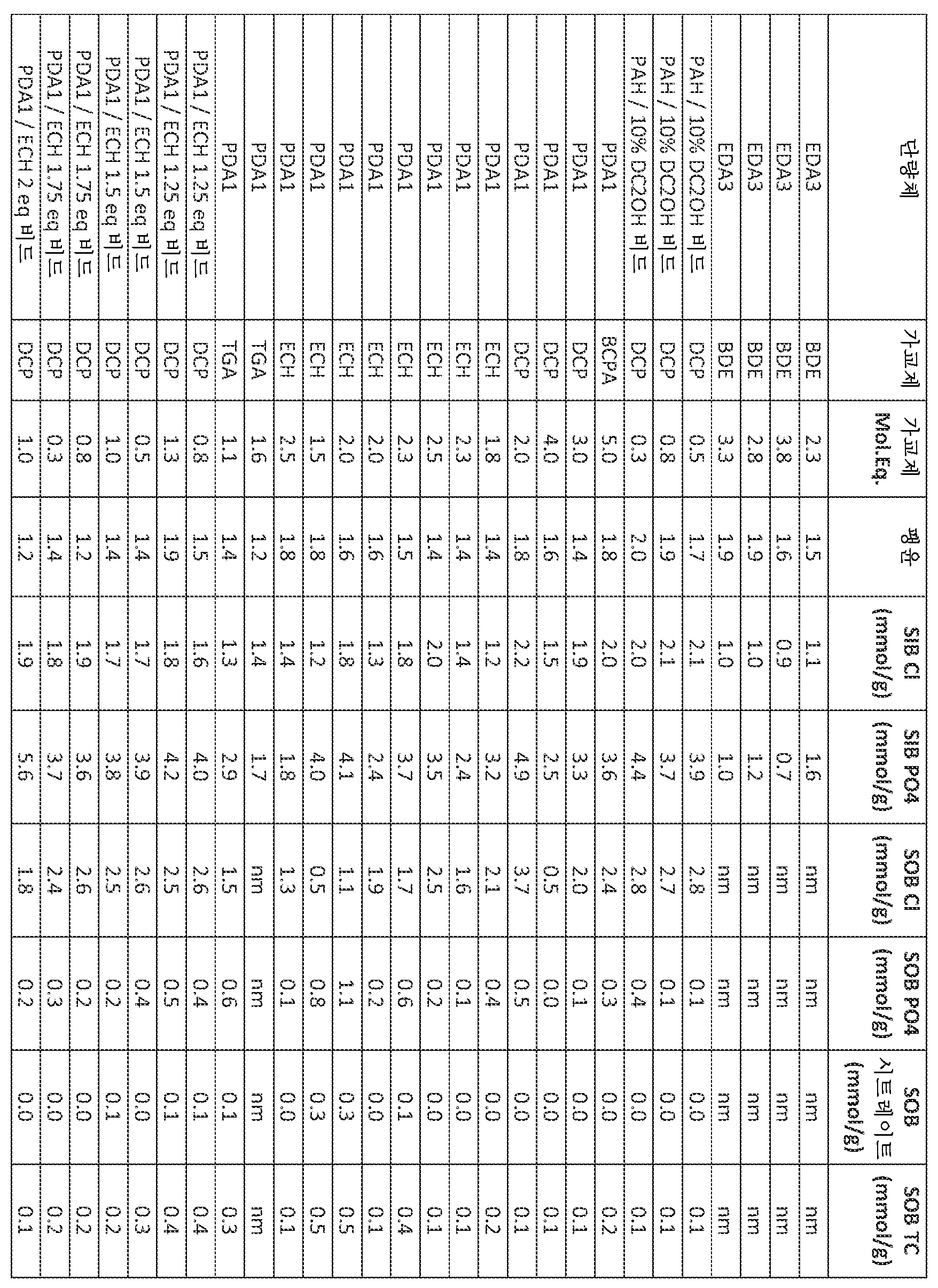

<표 14> 팽윤 비가 2 초과이지만 5 이하인 본 개시내용의 실시예 중합체<Table 14> Example polymers of the present disclosure having a swelling ratio greater than 2 but less than or equal to 5


III. 스크리닝 실시예III. Screening Examples
하기 실시예는 합성된 중합체가 상기 정의된 스크린 중 일부에 의해 특성화될 수 있는 수단을 예시한다. The following examples illustrate means by which synthesized polymers can be characterized by some of the screens defined above.
A. 4급화 아민 검정A. Quaternary amine assay
선택된 중합체를 사용하여 QAA 검정을 수행하였다. 클로라이드 염으로서 수득된 후 본 연구를 위해 니트레이트 염으로 전환시킨 완전 4급화 아민을 함유하는 상업적으로 입수가능한 가교 폴리스티렌 비드인 대조군 물질 다우엑스(Dowex) 1x8에 대한 QAA 검정 데이터를 표 15에 제시한다. 본 실시예에서 유리 아민 형태로서 수득되고 사용되는 3급 아민을 함유하는 상업적으로 입수가능한 가교 아크릴 비드인 앰버라이트(Amberlite) IRA67에 대한 데이터는 표 15의 첫번째 2 행에 제시한다. 여기서 입증된 바와 같이, 완전 4급화 다우엑스 1x8은 예상된 바와 같이 여기서 시험된 산성 및 염기성 pH 조건 하에 동등량의 클로라이드에, 구체적으로 1.8 mmol Cl/g으로 결합하였다. 또한, 3급 아민만을 함유하는 앰버라이트 IRA67은 사용된 산성 검정 조건 하에 5.9 mmol Cl/g으로 결합하였지만, 여기서 시험된 염기성 조건 하에서는 이 양의 ≤1.7%로 결합하였고, 이때 구성 아민은 대부분 탈양성자화되었다. 표 15는 또한 가교제의 다양한 몰 당량으로 ECH와 가교된 C4A3BTA를 포함하는 물질에 의한 클로라이드 결합의 양을 제시한다. 이들 물질은 여기서 시험된 산성 조건 하에 >9 mmol Cl/g, 빈번하게는 >10 mmol Cl/g, 및 낮은 가교 조건 하에 13.4 mmol Cl/g의 클로라이드 결합을 입증하였다. 이들 동일한 물질은 여기서 시험된 염기성 pH 조건 하에 <0.8 mmol Cl/g, 빈번하게는 <0.5 mmol Cl/g, 및 낮은 가교 조건 하에 0.3 mmol Cl/g의 클로라이드 결합을 입증하였다. 사용된 검정 조건 하에, 3.3 몰 당량의 ECH와 가교된 C4A3BTA는 1.9% 아민 4급화를 입증하였고, 4.3 몰 당량의 ECH와 가교된 C4A3BTA는 2.2% 아민 4급화를 입증하였고, 5.3 몰 당량의 ECH와 가교된 C4A3BTA는 6.2%의 아민 4급화를 입증하였고, 6.3 몰 당량의 ECH와 가교된 C4A3BTA는 4.5%의 아민 4급화를 입증하였고, 7.3 몰 당량으로 가교된 C4A3BTA는 8.7%의 아민 4급화를 입증하였다.QAA assays were performed using the selected polymers. The QAA assay data for the control material Dowex 1x8, a commercially available cross-linked polystyrene bead containing a fully quaternized amine which was obtained as a chloride salt and then converted to a nitrate salt for this study, are presented in Table 15. Data for Amberlite IRA67, a commercially available cross-linked acrylic bead containing a tertiary amine which was obtained and used in the present examples in its free amine form, are presented in the first two rows of Table 15. As demonstrated herein, the fully quaternized Dowex 1x8 bound an equivalent amount of chloride, specifically 1.8 mmol Cl/g, under the acidic and basic pH conditions tested herein, as expected. Additionally, Amberlite IRA67 containing only tertiary amines bound 5.9 mmol Cl/g under the acidic assay conditions used, but ≤1.7% of this amount under the basic conditions tested here, with most of the constituent amines being deprotonated. Table 15 also presents the amount of chloride binding by materials comprising C4A3BTA crosslinked with ECH at various molar equivalents of crosslinker. These materials demonstrated chloride binding of >9 mmol Cl/g under the acidic conditions tested here, frequently >10 mmol Cl/g, and 13.4 mmol Cl/g under low crosslinking conditions. These same materials demonstrated chloride binding of <0.8 mmol Cl/g under the basic pH conditions tested here, frequently <0.5 mmol Cl/g, and 0.3 mmol Cl/g under low crosslinking conditions. Under the assay conditions used, C4A3BTA cross-linked with 3.3 molar equivalents of ECH demonstrated 1.9% amine quaternization, C4A3BTA cross-linked with 4.3 molar equivalents of ECH demonstrated 2.2% amine quaternization, C4A3BTA cross-linked with 5.3 molar equivalents of ECH demonstrated 6.2% amine quaternization, C4A3BTA cross-linked with 6.3 molar equivalents of ECH demonstrated 4.5% amine quaternization and C4A3BTA cross-linked with 7.3 molar equivalents demonstrated 8.7% amine quaternization.
B. SOB 결합 동역학B. SOB binding dynamics
선택된 중합체를 SOB 동역학 실험에서 평가하였고, 음이온 결합을 인큐베이션 2, 24, 및 48시간에 평가하였다. 데이터를 표 16에 기재한다. 단량체로서 C4A3BTA 및 가교제로서 ECH로부터 2.35의 가교제 대 단량체 비로 제조된 빅살로머 참조 중합체는 2시간째에 0.8 mmol/g 클로라이드 및 1.5 mmol/g 포스페이트로 결합하는 것으로 나타났다. 동일한 완충제 중에서 인큐베이션 48시간 후에, 클로라이드 및 포스페이트 결합은 각각 0.4 및 1.0 mmol/g으로 감소되었고, 타우로콜레이트 결합은 2시간째에 0.6 mmol/g에서 48시간째에 1.0 mmol/g으로 증가되었다. 시트레이트 결합에서는 어떠한 변화도 없었고; 이 샘플은 2 및 48시간째에 0.5 mmol/g 시트레이트로 결합하였다.The selected polymers were evaluated in SOB kinetic experiments, and anion binding was assessed at 2, 24, and 48 h of incubation. The data are presented in Table 16. The bixalomer reference polymer prepared from C4A3BTA as monomer and ECH as cross-linker at a cross-linker to monomer ratio of 2.35 was found to bind 0.8 mmol/g chloride and 1.5 mmol/g phosphate at 2 h. After 48 h of incubation in the same buffer, chloride and phosphate binding decreased to 0.4 and 1.0 mmol/g, respectively, and taurocholate binding increased from 0.6 mmol/g at 2 h to 1.0 mmol/g at 48 h. There was no change in citrate binding; this sample bound 0.5 mmol/g citrate at 2 and 48 h.
표 16에 제시된 바와 같이, 단량체로서 C4A3BTA 및 ECH로부터 4.3의 보다 높은 가교제 대 단량체 비로 제조된 중합체는 2시간째에 3.0 mmol/g 클로라이드 및 0.2 mmol/g 포스페이트로 결합하였다. 동일한 완충제 중에서 인큐베이션 48시간 후에, 클로라이드 결합은 1.9 mmol/g으로 감소되었고, 포스페이트 결합은 0.9 mmol/g으로 증가되었다. 타우로콜레이트 결합은 2시간째에 0.2 mmol/g에서 48시간째에 0.4 mmol/g으로 증가되었다. 시트레이트 결합은 2 및 48시간째에 0.0 mmol/g 시트레이트였다.As shown in Table 16, the polymer prepared from C4A3BTA and ECH as monomers at a higher crosslinker to monomer ratio of 4.3 bound 3.0 mmol/g chloride and 0.2 mmol/g phosphate at 2 h. After 48 h of incubation in the same buffer, chloride binding decreased to 1.9 mmol/g and phosphate binding increased to 0.9 mmol/g. Taurocholate binding increased from 0.2 mmol/g at 2 h to 0.4 mmol/g at 48 h. Citrate binding was 0.0 mmol/g citrate at both 2 and 48 h.
표 16에 제시된 바와 같이, 단량체로서 C4A3BTA 및 ECH로부터 7.3의 훨씬 더 높은 가교제 대 단량체 비로 제조된 중합체는 2시간째에 1.6 mmol/g 클로라이드 및 0.6 mmol/g 포스페이트로 결합하는 것으로 나타났다. 동일한 완충제 중에서 인큐베이션 48시간 후에, 클로라이드 결합은 1.2 mmol/g으로 감소되었고, 포스페이트 결합은 1.0 mmol/g으로 증가되었다. 타우로콜레이트 결합은 2 및 48시간째에 0.0 mmol/g이었다. 시트레이트 결합은 2시간째에 0.0 mmol/g에서 48시간째에 0.3 mmol/g으로 증가되었다.As shown in Table 16, the polymer prepared from C4A3BTA and ECH as monomers at a much higher crosslinker to monomer ratio of 7.3 was found to bind 1.6 mmol/g chloride and 0.6 mmol/g phosphate at 2 h. After 48 h of incubation in the same buffer, chloride binding decreased to 1.2 mmol/g and phosphate binding increased to 1.0 mmol/g. Taurocholate binding was 0.0 mmol/g at 2 and 48 h. Citrate binding increased from 0.0 mmol/g at 2 h to 0.3 mmol/g at 48 h.
C. 클로라이드 저류 검정C. Chloride retention assay
클로라이드 저류 검정 (CRA)을 사용하여 선택된 중합체에 대해 그의 클로라이드 결합 및 저류 능력을 평가하였다. 표 17에 제시된 바와 같이, 단량체로서 C4A3BT 및 가교제로서 ECH로부터 2.35의 가교제 대 단량체 비로 제조된 빅살로머 참조 중합체는 SOB 완충제 중에서 처음에 0.86 mmol/g 클로라이드로 결합하는 것으로 나타났다. 이어서 중합체 샘플이 저류 완충제 (50 mM 2-(N-모르폴리노)에탄술폰산 (MES), 100 mM 아세트산나트륨, 5mM 인산나트륨, 15mM 술페이트, pH 6.2로 조정됨) 중에서 37℃에서 대략 40시간 동안 인큐베이션되도록 한 후, 추출 용액 (0.2 M 수산화나트륨) 중에서 37℃에서 16-20시간 인큐베이션되도록 하였다. 0.2 M 수산화나트륨 중에서 추출 후에, 샘플은 SOB 중에서 결합된 클로라이드 이온 중 단지 0.1 mmol/g만을 저류시키는 것으로 나타났고, 이는 나머지 클로라이드가 저류 완충제 인큐베이션 및 물 세척 단계 동안 방출되었음을 의미한다.The chloride retention assay (CRA) was used to evaluate the chloride binding and retention capabilities of selected polymers. As presented in Table 17, the bixalomer reference polymer prepared from C4A3BT as a monomer and ECH as a cross-linker at a cross-linker to monomer ratio of 2.35 was found to initially bind 0.86 mmol/g chloride in SOB buffer. The polymer samples were then incubated in retention buffer (50 mM 2-(N-morpholino)ethanesulfonic acid (MES), 100 mM sodium acetate, 5 mM sodium phosphate, 15 mM sulfate, adjusted to pH 6.2) at 37 °C for approximately 40 h, followed by incubation in extraction solution (0.2 M sodium hydroxide) at 37 °C for 16-20 h. After extraction in 0.2 M sodium hydroxide, the sample was found to retain only 0.1 mmol/g of the chloride ion bound in SOB, indicating that the remaining chloride was released during the retention buffer incubation and water wash steps.
표 17에 제시된 바와 같이 동일한 클로라이드 저류 검정에서, 단량체로서 C4A3BTA 및 가교제로서 ECH로부터 5.3의 가교제 대 단량체 비로 제조된 또 다른 중합체는 SOB 완충제 중에서 처음에 3.1 mmol/g 클로라이드로 결합하는 것으로 나타났다. 0.2 M 수산화나트륨 추출은 샘플이 1.0 mmol/g 클로라이드를 저류시키고, 나머지 2.1 mmol/g 클로라이드는 저류 완충제 인큐베이션 및 물 세척 단계 동안 방출되는 것으로 나타났다.In the same chloride retention assay as presented in Table 17, another polymer prepared from C4A3BTA as monomer and ECH as cross-linker at a cross-linker to monomer ratio of 5.3 was found to initially bind 3.1 mmol/g chloride in SOB buffer. Extraction with 0.2 M sodium hydroxide showed that the sample retained 1.0 mmol/g chloride, with the remaining 2.1 mmol/g chloride being released during retention buffer incubation and water wash steps.
<표 15> 선택된 상업적 참조 및 실시예 중합체에 대한 QAA 결과<Table 15> QAA results for selected commercial reference and example polymers

<표 16> SOB 결합 동역학<Table 16> SOB binding dynamics
<표 17> 클로라이드 저류 검정 (CRA)<Table 17> Chloride Retention Assay (CRA)
Claims (1)
<화학식 1>
여기서 R1, R2 및 R3은 독립적으로 수소, 히드로카르빌, 또는 치환된 히드로카르빌이지만, 단 R1, R2 및 R3 중 적어도 1개는 수소 이외의 것이고,
가교 아민 중합체는 5 이하의 탈이온수 중 평형 팽윤 비를 갖고, 가교 아민 중합체는 37 ℃의 간섭 이온 완충제 중에서 각각 적어도 0.35:1의 클로라이드 이온 대 간섭 이온의 몰비로 결합하고, 여기서 간섭 이온은 포스페이트 이온이고, 간섭 이온 완충제는 36mM 클로라이드 및 20mM 포스페이트의 pH 5.5의 완충 용액인,
제약 조성물의 경구 투여를 통해 대사성 산증을 치료하는 방법.A proton-bonding, cross-linked amine polymer comprising an amine residue corresponding to the following chemical formula 1,
<Chemical Formula 1>
wherein R 1 , R 2 and R 3 are independently hydrogen, hydrocarbyl, or substituted hydrocarbyl, provided that at least one of R 1 , R 2 and R 3 is other than hydrogen,
The crosslinked amine polymer has an equilibrium swelling ratio in deionized water of 5 or less, and the crosslinked amine polymer binds to an interfering ion in a molar ratio of chloride ions to interfering ions of at least 0.35:1, respectively, in an interfering ion buffer at 37° C., wherein the interfering ion is a phosphate ion, and the interfering ion buffer is a buffered solution of 36 mM chloride and 20 mM phosphate, pH 5.5.
A method for treating metabolic acidosis by oral administration of a pharmaceutical composition.
Applications Claiming Priority (4)
| Application Number | Priority Date | Filing Date | Title |
|---|---|---|---|
| US201361831445P | 2013-06-05 | 2013-06-05 | |
| US61/831,445 | 2013-06-05 | ||
| PCT/US2014/041152 WO2014197725A1 (en) | 2013-06-05 | 2014-06-05 | Proton-binding polymers for oral administration |
| KR1020247003745A KR102717667B1 (en) | 2013-06-05 | 2014-06-05 | Proton-binding polymers for oral administration |
Related Parent Applications (1)
| Application Number | Title | Priority Date | Filing Date |
|---|---|---|---|
| KR1020247003745A Division KR102717667B1 (en) | 2013-06-05 | 2014-06-05 | Proton-binding polymers for oral administration |
Publications (1)
| Publication Number | Publication Date |
|---|---|
| KR20240152425A true KR20240152425A (en) | 2024-10-21 |
Family
ID=51212941
Family Applications (5)
| Application Number | Title | Priority Date | Filing Date |
|---|---|---|---|
| KR1020247033799A Pending KR20240152425A (en) | 2013-06-05 | 2014-06-05 | Proton-binding polymers for oral administration |
| KR1020217034420A Ceased KR20210131457A (en) | 2013-06-05 | 2014-06-05 | Proton-binding polymers for oral administration |
| KR1020247003745A Active KR102717667B1 (en) | 2013-06-05 | 2014-06-05 | Proton-binding polymers for oral administration |
| KR1020157036999A Active KR102318910B1 (en) | 2013-06-05 | 2014-06-05 | Proton-binding polymers for oral administration |
| KR1020237024806A Active KR102633597B1 (en) | 2013-06-05 | 2014-06-05 | Proton-binding polymers for oral administration |
Family Applications After (4)
| Application Number | Title | Priority Date | Filing Date |
|---|---|---|---|
| KR1020217034420A Ceased KR20210131457A (en) | 2013-06-05 | 2014-06-05 | Proton-binding polymers for oral administration |
| KR1020247003745A Active KR102717667B1 (en) | 2013-06-05 | 2014-06-05 | Proton-binding polymers for oral administration |
| KR1020157036999A Active KR102318910B1 (en) | 2013-06-05 | 2014-06-05 | Proton-binding polymers for oral administration |
| KR1020237024806A Active KR102633597B1 (en) | 2013-06-05 | 2014-06-05 | Proton-binding polymers for oral administration |
Country Status (26)
| Country | Link |
|---|---|
| US (8) | US9205107B2 (en) |
| EP (4) | EP3578185B1 (en) |
| JP (5) | JP6453860B2 (en) |
| KR (5) | KR20240152425A (en) |
| CN (3) | CN111671766B (en) |
| AU (3) | AU2014274817B2 (en) |
| BR (1) | BR112015030142B1 (en) |
| CA (1) | CA2912911C (en) |
| CY (3) | CY1119611T1 (en) |
| DK (3) | DK3287133T3 (en) |
| ES (3) | ES2646271T3 (en) |
| HK (1) | HK1251151B (en) |
| HR (3) | HRP20171590T1 (en) |
| HU (3) | HUE034836T2 (en) |
| IL (3) | IL242758B (en) |
| LT (3) | LT3003327T (en) |
| MX (3) | MX387845B (en) |
| NO (1) | NO2905572T3 (en) |
| PL (2) | PL3003327T3 (en) |
| PT (3) | PT3003327T (en) |
| RS (2) | RS61005B1 (en) |
| RU (1) | RU2728778C2 (en) |
| SI (3) | SI3578185T1 (en) |
| SM (2) | SMT201900391T1 (en) |
| TR (1) | TR201909355T4 (en) |
| WO (1) | WO2014197725A1 (en) |
Families Citing this family (17)
| Publication number | Priority date | Publication date | Assignee | Title |
|---|---|---|---|---|
| KR20240152425A (en) | 2013-06-05 | 2024-10-21 | 트리시다, 인크. | Proton-binding polymers for oral administration |
| RS61409B1 (en) * | 2014-12-10 | 2021-03-31 | Tricida Inc | Proton-binding polymers for oral administration |
| US11406661B2 (en) * | 2016-05-06 | 2022-08-09 | Tricida, Inc. | HCl-binding compositions for and methods of treating acid-base disorders |
| CN110114389B (en) | 2016-12-28 | 2022-04-01 | 富士胶片株式会社 | Emulsion of nitrogen atom-containing polymer or salt thereof, method for producing same, and method for producing particles |
| US10934380B1 (en) | 2017-09-25 | 2021-03-02 | Tricida, Inc. | Crosslinked poly(allylamine) polymer pharmaceutical compositions |
| JP6992084B2 (en) | 2017-10-16 | 2022-01-13 | 富士フイルム株式会社 | Hyperphosphatemia treatment |
| WO2019090176A1 (en) | 2017-11-03 | 2019-05-09 | Tricida, Inc. | Compositions for and method of treating acid-base disorders |
| SG11202003453QA (en) * | 2017-11-03 | 2020-05-28 | Tricida Inc | Method of treating acid-base disorders |
| MA51628A (en) * | 2018-06-04 | 2021-03-17 | Tricida Inc | METHOD OF TREATMENT OF ACID-BASIC BALANCE DISORDERS |
| WO2021016100A1 (en) * | 2019-07-19 | 2021-01-28 | ACatechol, Inc. | Molecularly well-defined antibiofouling and polyionic coatings |
| LT4053179T (en) | 2021-03-01 | 2025-12-29 | Renosis, Inc. | Crosslinked poly(allylamine) polymer pharmaceutical compositions |
| BR112023017628A2 (en) | 2021-03-01 | 2023-12-05 | Tricida Inc | PHARMACEUTICAL COMPOSITIONS OF CROSS-CROSS-CROSS-CUT POLY(ALLYLAMINE) POLYMER |
| CN118510524A (en) * | 2021-12-14 | 2024-08-16 | 上海石趣医药科技有限公司 | Use of silver oxide and/or its hydrate in preparing medicine |
| CN115260355A (en) * | 2022-05-16 | 2022-11-01 | 江苏中天药业有限公司 | Anion exchange resin, preparation method thereof, compound of anion exchange resin and medicament and taste masking preparation thereof |
| KR20240128205A (en) | 2023-02-17 | 2024-08-26 | 주식회사 쓰리디코리아 | Method for manufacturing a personalized grip for exercise equipment with a handle and a personalized grip manufactured thereby |
| KR102902381B1 (en) | 2023-03-21 | 2025-12-23 | 지니에듀테크 주식회사 | Handle for exercise equipment with personalized grip shape |
| CN117164854A (en) * | 2023-07-07 | 2023-12-05 | 中国科学院长春应用化学研究所 | Cross-linked polyimide and preparation method thereof |
Family Cites Families (125)
| Publication number | Priority date | Publication date | Assignee | Title |
|---|---|---|---|---|
| US6444221B1 (en) | 1992-06-30 | 2002-09-03 | Howard K. Shapiro | Methods of treating chronic inflammatory diseases using carbonyl trapping agents |
| US20050090553A1 (en) | 1992-06-30 | 2005-04-28 | Shapiro Howard K. | Compositions and method for treatment of chronic inflammatory diseases |
| US5534259A (en) * | 1993-07-08 | 1996-07-09 | Liposome Technology, Inc. | Polymer compound and coated particle composition |
| US5667775A (en) | 1993-08-11 | 1997-09-16 | Geltex Pharmaceuticals, Inc. | Phosphate-binding polymers for oral administration |
| US5496545A (en) | 1993-08-11 | 1996-03-05 | Geltex Pharmaceuticals, Inc. | Phosphate-binding polymers for oral administration |
| US5648355A (en) | 1994-02-09 | 1997-07-15 | Kos Pharmaceutical, Inc. | Method of treatment of endogenous, painful gastrointestinal conditions of non-inflammatory, non-ulcerative origin |
| TW474813B (en) | 1994-06-10 | 2002-02-01 | Geltex Pharma Inc | Alkylated composition for removing bile salts from a patient |
| AU703842B2 (en) | 1994-10-17 | 1999-04-01 | Robert M. Bersin | Compositions comprising carbonate/bicarbonate buffered dichloroacetic acid and methods for treatment of metabolic and cardiovascular disorders |
| US20020006899A1 (en) | 1998-10-06 | 2002-01-17 | Pospisilik Andrew J. | Use of dipeptidyl peptidase IV effectors for lowering blood pressure in mammals |
| US5753706A (en) | 1996-12-16 | 1998-05-19 | Hsu; Chen Hsing | Methods for treating renal failure |
| AUPO758297A0 (en) | 1997-06-27 | 1997-07-24 | Rowe, James Baber | Control of acidic gut syndrome |
| US6726905B1 (en) | 1997-11-05 | 2004-04-27 | Genzyme Corporation | Poly (diallylamines)-based phosphate binders |
| US6835393B2 (en) * | 1998-01-05 | 2004-12-28 | University Of Washington | Enhanced transport using membrane disruptive agents |
| AU2682499A (en) | 1998-02-17 | 1999-08-30 | Dimitri R. Kioussis | Anion binding polymers and the use thereof |
| US6485703B1 (en) | 1998-07-31 | 2002-11-26 | The Texas A&M University System | Compositions and methods for analyte detection |
| US6271264B1 (en) | 1998-12-01 | 2001-08-07 | Geltex Pharmaceuticals, Inc. | Polymers containing spirobicyclic ammonium moieties as bile acid sequestrants |
| US6733780B1 (en) | 1999-10-19 | 2004-05-11 | Genzyme Corporation | Direct compression polymer tablet core |
| GB9927088D0 (en) | 1999-11-17 | 2000-01-12 | Secr Defence | Use of poly(diallylamine) polymers |
| US20040059065A1 (en) | 2000-03-09 | 2004-03-25 | Takeshi Goto | Crosslinked anion-exchange resin or salt thereof |
| AU2001241077A1 (en) | 2000-03-09 | 2001-09-17 | Hisamitsu Pharmaceutical Co. Inc. | Crosslinked anion-exchange resin or salt thereof and phosphorus adsorbent comprising the same |
| AU2001241095A1 (en) | 2000-03-13 | 2001-09-24 | Hisamitsu Pharmaceutical Co. Inc. | Preventives and/or remedies for hyperphosphatemia |
| JP2002028737A (en) | 2000-07-07 | 2002-01-29 | Fujitsu Ltd | Press punching method and press punching device |
| WO2002085381A1 (en) | 2001-04-18 | 2002-10-31 | Genzyme Corporation | Method for treating gout and binding uric acid |
| WO2002085378A1 (en) * | 2001-04-18 | 2002-10-31 | Genzyme Corporation | Low salt forms of polyallylamine |
| JP2005519949A (en) | 2002-03-11 | 2005-07-07 | ノバルティス アクチエンゲゼルシャフト | Nateglinide salt |
| CA2514071A1 (en) | 2003-02-10 | 2004-08-19 | Autogen Research Pty Ltd | Therapeutic molecules |
| TWI335218B (en) | 2003-02-19 | 2011-01-01 | Panion & Bf Biotech Inc | Ferric organic compounds, uses thereof and methods of making same |
| CN1540136A (en) * | 2003-10-27 | 2004-10-27 | 华东理工大学 | A Method for Evaluating Microbial Oil Displacement Capability |
| US7335795B2 (en) | 2004-03-22 | 2008-02-26 | Ilypsa, Inc. | Crosslinked amine polymers |
| US7767768B2 (en) | 2003-11-03 | 2010-08-03 | Ilypsa, Inc. | Crosslinked amine polymers |
| US7449605B2 (en) | 2003-11-03 | 2008-11-11 | Ilypsa, Inc. | Crosslinked amine polymers |
| US7608674B2 (en) * | 2003-11-03 | 2009-10-27 | Ilypsa, Inc. | Pharmaceutical compositions comprising cross-linked small molecule amine polymers |
| US7385012B2 (en) * | 2003-11-03 | 2008-06-10 | Ilypsa, Inc. | Polyamine polymers |
| US7459502B2 (en) * | 2003-11-03 | 2008-12-02 | Ilypsa, Inc. | Pharmaceutical compositions comprising crosslinked polyamine polymers |
| CA2551528A1 (en) | 2003-12-31 | 2005-07-21 | Genzyme Corporation | Enteric coated aliphatic amine polymer bile acid sequestrants |
| KR20060128972A (en) | 2004-01-29 | 2006-12-14 | 각고호우징 게이오기주크 | Red blood cell function |
| US8192758B2 (en) | 2004-03-30 | 2012-06-05 | Relypsa, Inc. | Ion binding compositions |
| US8282960B2 (en) | 2004-03-30 | 2012-10-09 | Relypsa, Inc. | Ion binding compositions |
| US7854924B2 (en) | 2004-03-30 | 2010-12-21 | Relypsa, Inc. | Methods and compositions for treatment of ion imbalances |
| US7556799B2 (en) | 2004-03-30 | 2009-07-07 | Relypsa, Inc. | Ion binding polymers and uses thereof |
| GB2430367B (en) | 2004-03-30 | 2009-08-05 | Ilypsa Inc | Ion binding polymers and uses thereof |
| US7429394B2 (en) | 2004-03-30 | 2008-09-30 | Relypsa, Inc. | Ion binding compositions |
| US8399025B2 (en) | 2004-06-04 | 2013-03-19 | Board Of Regents, The University Of Texas System | Polyamine modified particles |
| CN101022821B (en) | 2004-07-19 | 2014-01-29 | 纽崔西亚公司 | Use of aspartic acid for regulating blood glucose levels |
| DE102004035808A1 (en) | 2004-07-21 | 2006-03-16 | Kasch, Helmut, Dr. | Ammonium salts and ammonium salt-Mineralaltschlatrate as a transport and Wirkform for pharmaceutical-medical and as a phase transfer agent for chemical applications |
| US8569277B2 (en) | 2004-08-11 | 2013-10-29 | Palo Alto Investors | Methods of treating a subject for a condition |
| US20070293429A1 (en) | 2004-10-08 | 2007-12-20 | Therapei Pharmaceuticals, Inc. | Vasoactive Intestinal Polypeptide Compositions |
| US20080214440A1 (en) | 2004-10-08 | 2008-09-04 | Forbes Medi-Tech (Research), Inc. | Vasoactive intestinal polypeptide compositions |
| AU2005296290A1 (en) * | 2004-10-13 | 2006-04-27 | Ilypsa, Inc. | Crosslinked amine polymers |
| US7985418B2 (en) | 2004-11-01 | 2011-07-26 | Genzyme Corporation | Aliphatic amine polymer salts for tableting |
| ITME20040015A1 (en) | 2004-12-07 | 2005-03-07 | Vincenzo Savica | CHEWING GUM, RUBBER CANDIES, TABLETS, SLOW TABLETS OF CHELANTI PHOSPHATE AND / OR PHOSPHORUS SALIVAR AND CAPSULES WITH SLOW RELEASE OF CHELANTS PHOSPHATE AND / OR PHOSPHORUS AT GASTROENTERIC LEVEL. |
| WO2006078629A2 (en) * | 2005-01-18 | 2006-07-27 | Duke University | In-situ crosslinkable elastin-like polypeptides for defect filling in cartilaginous tissue repair |
| EP1898922A4 (en) | 2005-07-04 | 2012-03-14 | Ramu Krishnan | Improved drug or pharmaceutical compounds and a preparation thereof |
| CA3050453C (en) | 2005-08-18 | 2021-07-27 | Panion & Bf Biotech Inc. | Pharmaceutical-grade ferric organic compounds, uses thereof and methods of making same |
| US8986669B2 (en) | 2005-09-02 | 2015-03-24 | Genzyme Corporation | Method for removing phosphate and polymer used therefore |
| WO2007038801A2 (en) | 2005-09-30 | 2007-04-05 | Ilypsa, Inc. | Monovalent cation-binding compositions comprising core-shell particles having crosslinked poly-vinylic shells, and methods of use thereof |
| BRPI0616603A2 (en) | 2005-09-30 | 2012-12-25 | Ilypsa Inc | Method for preparing a core-wrap composite, and for the manufacture of a medicament, pharmaceutical composition, and use thereof |
| US8617609B2 (en) * | 2005-09-30 | 2013-12-31 | Relypsa, Inc. | Methods and compositions for selectively removing potassium ion from the gastrointestinal tract of a mammal |
| WO2007055044A1 (en) | 2005-11-08 | 2007-05-18 | Ajinomoto Co., Inc. | Promoter for recovery from anesthesia |
| AR060690A1 (en) | 2005-11-08 | 2008-07-10 | Genzyme Corp | POLYMERS CONTAINING MAGNESIUM FOR HYPERPHOSPHATEMIA |
| ITMI20052461A1 (en) | 2005-12-22 | 2007-06-23 | Univ Degli Studi Milano | MICROPARTELAR SYSTEMS FOR ORAL ADMINISTRATION OF BIOLOGICALLY ACTIVE SUBSTANCES |
| RU2008136081A (en) | 2006-02-14 | 2010-03-20 | Тева Фармасьютикл Индастриес Лтд. (Il) | PHARMACEUTICAL COMPOSITIONS WITH ALIPHATIC AMIN POLYMERS AND METHODS OF PRODUCING THEM |
| US20080085259A1 (en) | 2006-05-05 | 2008-04-10 | Huval Chad C | Amine condensation polymers as phosphate sequestrants |
| US20100135950A1 (en) | 2006-07-05 | 2010-06-03 | Genzyme Corporation | Iron(II)-Containing Treatments for Hyperphosphatemia |
| CN101541235A (en) * | 2006-07-18 | 2009-09-23 | 基酶有限公司 | Amine dendrimers |
| BRPI0715053A2 (en) | 2006-07-18 | 2013-03-19 | Genzyme Corp | pharmaceutical composition, method for treating diseases, and polymer |
| US8391873B2 (en) | 2006-07-21 | 2013-03-05 | Qualcomm Incorporated | Systems and methods for coordinating supplementary services for voice telephone calls in a centralized fashion |
| EP2046284A1 (en) | 2006-08-04 | 2009-04-15 | Nastech Pharmaceutical Company Inc. | Compositions for intranasal delivery of human insulin and uses thereof |
| US7964182B2 (en) * | 2006-09-01 | 2011-06-21 | USV, Ltd | Pharmaceutical compositions comprising phosphate-binding polymer |
| BRPI0717008A2 (en) | 2006-09-01 | 2014-01-21 | Usv Ltd | PROCESS FOR PREPARING SEVELAMER CHLORIDE AND FORMULATING IT |
| BRPI0716066A2 (en) | 2006-09-01 | 2013-09-17 | Genzyme Corp | pharmaceutical composition, method for treating disease, amine polymer, polymer network, method for preparing an amine polymer, and amine compound |
| WO2008029949A1 (en) | 2006-09-06 | 2008-03-13 | Sucampo Ag | Method and composition for promoting gastrointestinal bicarbonate secretion |
| WO2008042222A2 (en) | 2006-09-29 | 2008-04-10 | Genzyme Corporation | Amide dendrimer compositions |
| EP2120972A1 (en) | 2006-12-14 | 2009-11-25 | Genzyme Corporation | Amido-amine polymer compositions |
| JP2010519298A (en) | 2007-02-23 | 2010-06-03 | ゲンズイメ コーポレーション | Amine polymer composition |
| US20080207766A1 (en) | 2007-02-27 | 2008-08-28 | Agi Therapeutics Research Ltd. | Methods and compositions for treating at least one upper gastrointestinal symptom |
| US20100196305A1 (en) | 2007-03-08 | 2010-08-05 | Dhal Pradeep K | Sulfone polymer compositions |
| TWI445540B (en) | 2007-04-20 | 2014-07-21 | Ajinomoto Kk | Anti-hypothermia composition |
| EP2152277A1 (en) | 2007-04-27 | 2010-02-17 | Genzyme Corporation | Amido-amine dendrimer compositions |
| WO2009005838A2 (en) | 2007-07-02 | 2009-01-08 | Cognate3 Llc | Process for the preparation of a non-corrosive base solution and methods of using same |
| JPWO2009008480A1 (en) * | 2007-07-11 | 2010-09-09 | 東レ株式会社 | Cross-linked polyallylamine or acid addition salt thereof and pharmaceutical use thereof |
| EP2016947A1 (en) | 2007-07-17 | 2009-01-21 | Chemo Ibérica, S.A. | Novel one step process for preparing cross-linked poly(allylamine) polymers |
| WO2009023544A2 (en) | 2007-08-10 | 2009-02-19 | Ilypsa, Inc. | Dosage unit anion-exchange polymer pharmaceutical compositions |
| US20090181359A1 (en) * | 2007-10-25 | 2009-07-16 | Lou Sheng C | Method of performing ultra-sensitive immunoassays |
| US20090156647A1 (en) | 2007-12-12 | 2009-06-18 | Iovate T. & P. Inc. | Method for maintaining physiological pH levels during intensive physical exercise |
| WO2009078958A1 (en) | 2007-12-14 | 2009-06-25 | Genzyme Corporation | Coated pharmaceutical compositions |
| PA8807201A1 (en) | 2007-12-14 | 2009-07-23 | Genzyme Corp | PHARMACEUTICAL COMPOSITIONS |
| WO2009097127A1 (en) | 2008-01-31 | 2009-08-06 | Genzyme Corporation | Pharmaceutical compositions |
| EP2282729A1 (en) | 2008-03-11 | 2011-02-16 | Livionex Inc. | Methods and compositions for treating inflammation and inflammation-related pathologies |
| US20100331516A1 (en) | 2008-04-08 | 2010-12-30 | Govind Dhananjay Sathe | Process for Preparation of Sevelamer Carbonate |
| ES2380162T3 (en) | 2008-04-11 | 2012-05-09 | Gp Investimenti S.R.L. | Manual use device for the treatment of human tissue with ultrasound |
| WO2009154747A1 (en) | 2008-06-20 | 2009-12-23 | Genzyme Corporation | Pharmaceutical compositions |
| DE102008030046A1 (en) | 2008-06-25 | 2009-12-31 | Ratiopharm Gmbh | Preparation of tablets comprising polyallylamine polymer, useful for treating e.g. hyperphosphatemia, comprises mixing polyallylamine polymer and additives, compacting to slug, granulating the slug and compressing the granules into tablets |
| US20100008988A1 (en) | 2008-07-14 | 2010-01-14 | Glenmark Generics, Ltd. | Tablet compositions of amine polymers |
| UY32030A (en) | 2008-08-06 | 2010-03-26 | Boehringer Ingelheim Int | "TREATMENT FOR DIABETES IN INAPPROPRIATE PATIENTS FOR THERAPY WITH METFORMIN" |
| WO2010022380A2 (en) | 2008-08-22 | 2010-02-25 | Relypsa, Inc. | Linear polyol stabilized polyfluoroacrylate compositions |
| US20100104527A1 (en) | 2008-08-22 | 2010-04-29 | Relypsa, Inc. | Treating hyperkalemia with crosslinked cation exchange polymers of improved physical properties |
| CN102223790B (en) | 2008-09-25 | 2015-11-25 | 维乌作物保护有限公司 | Process for producing polymeric nanoparticles and formulations of active ingredients |
| US20110268666A1 (en) | 2008-09-29 | 2011-11-03 | Yissum Research Development Company of the Research University of Jerusalem, Ltd. | Novel gastroretentive delivery system |
| US20100113479A1 (en) | 2008-10-30 | 2010-05-06 | Anusuya Choudhury | Process for the preparation of tri-substituted pyridine and tri-substituted pyrimidine derivatives useful as gdir agonists |
| US20100166861A1 (en) | 2008-12-29 | 2010-07-01 | Kelly Noel Lynch | Pharmaceutical formulations of sevalamer, or salts thereof, and copovidone |
| RU2011134847A (en) | 2009-01-22 | 2013-02-27 | Юсв Лимитед | PHARMACEUTICAL COMPOSITIONS CONTAINING A PHOSPHATE BINDING POLYMER |
| EP2488172A4 (en) | 2009-10-13 | 2014-08-13 | Univ Michigan | DENDRIMER COMPOSITIONS AND METHODS OF SYNTHESIS |
| US20120219626A1 (en) | 2009-10-22 | 2012-08-30 | Niels Jaap Osinga | Pharmaceutical Compositions of Sevelamer |
| RU2012128509A (en) | 2009-12-07 | 2014-01-20 | Айронвуд Фармасьютикалз, Инк. | METHODS FOR TREATING DISEASES OF THE GASTROINTESTINAL TRACT |
| JP5865847B2 (en) * | 2010-02-24 | 2016-02-17 | レリプサ, インコーポレイテッド | Cross-linked polyvinylamine, polyallylamine and polyethyleneimine for use as bile acid scavengers |
| WO2011106545A1 (en) | 2010-02-24 | 2011-09-01 | Relypsa, Inc. | Polyimidazoles for use as bile acid sequestrants |
| MX348821B (en) * | 2010-02-24 | 2017-06-30 | Relypsa Inc | Amine polymers for use as bile acid sequestrants. |
| RU2417782C1 (en) * | 2010-03-03 | 2011-05-10 | Федеральное государственное образовательное учреждение высшего профессионального образования "Белгородская государственная сельскохозяйственная академия" | Method of treating paunch acidosis |
| IT1406068B1 (en) | 2010-07-22 | 2014-02-06 | Medestea Int Spa | POLIDESOSSIRIBONUCLEOTIDI (PDRN) FOR THE USE IN THE TREATMENT OF CONDITIONS OF ACIDOSIS AND POLIDESOSSIRIBONUCLEOTIDES-BASED COMPOSITIONS FOR THE ABOVE USE |
| KR20130097747A (en) * | 2010-08-10 | 2013-09-03 | 암젠 인크 | Dual function in vitro target binding assay for the detection of neutralizing antibodies against target antibodies |
| US20130156720A1 (en) | 2010-08-27 | 2013-06-20 | Ironwood Pharmaceuticals, Inc. | Compositions and methods for treating or preventing metabolic syndrome and related diseases and disorders |
| KR101238210B1 (en) | 2011-06-30 | 2013-03-04 | 엘지전자 주식회사 | Mobile terminal |
| US20130137772A1 (en) | 2011-11-29 | 2013-05-30 | Raymond J. Bergeron | Hydroxypolyamine salts |
| SG10201805177PA (en) | 2012-06-21 | 2018-07-30 | Keryx Biopharmaceuticals Inc | Use of ferric citrate in the treatment of chronic kidney disease patients |
| EP2916851B1 (en) | 2012-10-08 | 2025-12-17 | Vifor (International) Ltd. | Potassium-binding agents for treating hypertension and hyperkalemia |
| KR20240152425A (en) | 2013-06-05 | 2024-10-21 | 트리시다, 인크. | Proton-binding polymers for oral administration |
| AU2014341975A1 (en) | 2013-11-04 | 2016-05-19 | Keryx Biopharmaceuticals, Inc. | Ferric citrate for reducing cardiac failure in chronic kidney disease patients |
| RS61409B1 (en) | 2014-12-10 | 2021-03-31 | Tricida Inc | Proton-binding polymers for oral administration |
| US11406661B2 (en) | 2016-05-06 | 2022-08-09 | Tricida, Inc. | HCl-binding compositions for and methods of treating acid-base disorders |
| SG11202003453QA (en) | 2017-11-03 | 2020-05-28 | Tricida Inc | Method of treating acid-base disorders |
| WO2019090176A1 (en) | 2017-11-03 | 2019-05-09 | Tricida, Inc. | Compositions for and method of treating acid-base disorders |
| MA51628A (en) | 2018-06-04 | 2021-03-17 | Tricida Inc | METHOD OF TREATMENT OF ACID-BASIC BALANCE DISORDERS |
| WO2019236639A1 (en) | 2018-06-04 | 2019-12-12 | Tricida, Inc. | Method of treating acid-base disorders |
| WO2019236124A1 (en) | 2018-06-04 | 2019-12-12 | Tricida, Inc. | Method of treating acid-base disorders |
-
2014
- 2014-06-05 KR KR1020247033799A patent/KR20240152425A/en active Pending
- 2014-06-05 KR KR1020217034420A patent/KR20210131457A/en not_active Ceased
- 2014-06-05 CN CN202010780603.3A patent/CN111671766B/en active Active
- 2014-06-05 SM SM20190391T patent/SMT201900391T1/en unknown
- 2014-06-05 CN CN202010780604.8A patent/CN111671767B/en active Active
- 2014-06-05 DK DK17177221.3T patent/DK3287133T3/en active
- 2014-06-05 PT PT147420012T patent/PT3003327T/en unknown
- 2014-06-05 LT LTEP14742001.2T patent/LT3003327T/en unknown
- 2014-06-05 HU HUE14742001A patent/HUE034836T2/en unknown
- 2014-06-05 WO PCT/US2014/041152 patent/WO2014197725A1/en not_active Ceased
- 2014-06-05 EP EP19169259.9A patent/EP3578185B1/en active Active
- 2014-06-05 TR TR2019/09355T patent/TR201909355T4/en unknown
- 2014-06-05 ES ES14742001.2T patent/ES2646271T3/en active Active
- 2014-06-05 RU RU2015155596A patent/RU2728778C2/en active
- 2014-06-05 HU HUE19169259A patent/HUE051198T2/en unknown
- 2014-06-05 EP EP17177221.3A patent/EP3287133B1/en active Active
- 2014-06-05 DK DK19169259.9T patent/DK3578185T3/en active
- 2014-06-05 MX MX2019005300A patent/MX387845B/en unknown
- 2014-06-05 PL PL14742001T patent/PL3003327T3/en unknown
- 2014-06-05 BR BR112015030142-8A patent/BR112015030142B1/en active IP Right Grant
- 2014-06-05 AU AU2014274817A patent/AU2014274817B2/en active Active
- 2014-06-05 ES ES19169259T patent/ES2834485T3/en active Active
- 2014-06-05 HR HRP20171590TT patent/HRP20171590T1/en unknown
- 2014-06-05 EP EP20183421.5A patent/EP3812761B1/en active Active
- 2014-06-05 SI SI201431698T patent/SI3578185T1/en unknown
- 2014-06-05 DK DK14742001.2T patent/DK3003327T3/en active
- 2014-06-05 CN CN201480032395.1A patent/CN105377270B/en active Active
- 2014-06-05 CA CA2912911A patent/CA2912911C/en active Active
- 2014-06-05 SM SM20200596T patent/SMT202000596T1/en unknown
- 2014-06-05 PT PT191692599T patent/PT3578185T/en unknown
- 2014-06-05 MX MX2015016527A patent/MX364785B/en active IP Right Grant
- 2014-06-05 KR KR1020247003745A patent/KR102717667B1/en active Active
- 2014-06-05 LT LTEP17177221.3T patent/LT3287133T/en unknown
- 2014-06-05 KR KR1020157036999A patent/KR102318910B1/en active Active
- 2014-06-05 RS RS20201307A patent/RS61005B1/en unknown
- 2014-06-05 JP JP2016518006A patent/JP6453860B2/en active Active
- 2014-06-05 RS RS20190806A patent/RS59033B1/en unknown
- 2014-06-05 KR KR1020237024806A patent/KR102633597B1/en active Active
- 2014-06-05 ES ES17177221T patent/ES2733493T3/en active Active
- 2014-06-05 HU HUE17177221A patent/HUE043999T2/en unknown
- 2014-06-05 SI SI201430466T patent/SI3003327T1/en unknown
- 2014-06-05 LT LTEP19169259.9T patent/LT3578185T/en unknown
- 2014-06-05 PL PL17177221T patent/PL3287133T3/en unknown
- 2014-06-05 SI SI201431241T patent/SI3287133T1/en unknown
- 2014-06-05 PT PT17177221T patent/PT3287133T/en unknown
- 2014-06-05 EP EP14742001.2A patent/EP3003327B1/en active Active
- 2014-06-23 US US14/311,852 patent/US9205107B2/en active Active
-
2015
- 2015-01-27 NO NO15000230A patent/NO2905572T3/no unknown
- 2015-11-18 US US14/944,844 patent/US9925214B2/en active Active
- 2015-11-24 IL IL242758A patent/IL242758B/en active IP Right Grant
- 2015-12-01 MX MX2021013880A patent/MX2021013880A/en unknown
-
2017
- 2017-09-26 US US15/715,934 patent/US9993500B2/en active Active
- 2017-11-06 CY CY20171101159T patent/CY1119611T1/en unknown
-
2018
- 2018-06-07 US US16/002,269 patent/US10363268B2/en active Active
- 2018-06-07 US US16/002,306 patent/US10391118B2/en active Active
- 2018-08-16 HK HK18110550.1A patent/HK1251151B/en unknown
- 2018-12-13 JP JP2018233254A patent/JP6759316B2/en active Active
-
2019
- 2019-04-04 US US16/375,843 patent/US10369169B1/en active Active
- 2019-06-14 HR HRP20191074TT patent/HRP20191074T1/en unknown
- 2019-07-04 CY CY20191100694T patent/CY1121801T1/en unknown
- 2019-08-16 US US16/542,969 patent/US11197887B2/en active Active
- 2019-08-22 AU AU2019219800A patent/AU2019219800B1/en active Active
- 2019-12-04 AU AU2019275584A patent/AU2019275584B2/en active Active
-
2020
- 2020-01-09 IL IL271932A patent/IL271932B/en active IP Right Grant
- 2020-09-02 JP JP2020147224A patent/JP7075455B2/en active Active
- 2020-10-20 IL IL278183A patent/IL278183B/en unknown
- 2020-10-30 CY CY20201101028T patent/CY1123673T1/en unknown
- 2020-11-02 HR HRP20201767TT patent/HRP20201767T1/en unknown
-
2021
- 2021-12-09 US US17/546,339 patent/US20220096534A1/en active Pending
-
2022
- 2022-05-13 JP JP2022079329A patent/JP7588871B2/en active Active
-
2024
- 2024-11-06 JP JP2024194308A patent/JP2025024009A/en active Pending
Also Published As
Similar Documents
| Publication | Publication Date | Title |
|---|---|---|
| KR102717667B1 (en) | Proton-binding polymers for oral administration | |
| HK1251151A1 (en) | Proton-binding polymers for oral administration | |
| KR102920551B1 (en) | Proton-binding polymers for oral administration | |
| HK40036370B (en) | Proton-binding polymers for oral administration | |
| HK40014989B (en) | Proton-binding polymers for oral administration | |
| HK40014989A (en) | Proton-binding polymers for oral administration | |
| HK1223288B (en) | Proton-binding polymers for oral administration | |
| KR20260017508A (en) | Proton-binding polymers for oral administration | |
| HK1222120B (en) | Proton-binding polymers for oral administration |
Legal Events
| Date | Code | Title | Description |
|---|---|---|---|
| A107 | Divisional application of patent | ||
| PA0104 | Divisional application for international application |
St.27 status event code: A-0-1-A10-A18-div-PA0104 St.27 status event code: A-0-1-A10-A16-div-PA0104 |
|
| PG1501 | Laying open of application |
St.27 status event code: A-1-1-Q10-Q12-nap-PG1501 |
|
| A201 | Request for examination | ||
| PA0201 | Request for examination |
St.27 status event code: A-1-2-D10-D11-exm-PA0201 |
|
| E902 | Notification of reason for refusal | ||
| PE0902 | Notice of grounds for rejection |
St.27 status event code: A-1-2-D10-D21-exm-PE0902 |
|
| T11-X000 | Administrative time limit extension requested |
St.27 status event code: U-3-3-T10-T11-oth-X000 |
|
| T11-X000 | Administrative time limit extension requested |
St.27 status event code: U-3-3-T10-T11-oth-X000 |
|
| T11-X000 | Administrative time limit extension requested |
St.27 status event code: U-3-3-T10-T11-oth-X000 |
|
| T11-X000 | Administrative time limit extension requested |
St.27 status event code: U-3-3-T10-T11-oth-X000 |
|
| P11-X000 | Amendment of application requested |
St.27 status event code: A-2-2-P10-P11-nap-X000 |
|
| D22 | Grant of ip right intended |
Free format text: ST27 STATUS EVENT CODE: A-1-2-D10-D22-EXM-PE0701 (AS PROVIDED BY THE NATIONAL OFFICE) |
|
| PE0701 | Decision of registration |
St.27 status event code: A-1-2-D10-D22-exm-PE0701 |