KR20240142438A - Immunoconjugates comprising kallikrein-related peptidase 2 antigen-binding domains and uses thereof - Google Patents
Immunoconjugates comprising kallikrein-related peptidase 2 antigen-binding domains and uses thereof Download PDFInfo
- Publication number
- KR20240142438A KR20240142438A KR1020247025624A KR20247025624A KR20240142438A KR 20240142438 A KR20240142438 A KR 20240142438A KR 1020247025624 A KR1020247025624 A KR 1020247025624A KR 20247025624 A KR20247025624 A KR 20247025624A KR 20240142438 A KR20240142438 A KR 20240142438A
- Authority
- KR
- South Korea
- Prior art keywords
- seq
- immunoconjugate
- binding domain
- group
- antigen
- Prior art date
- Legal status (The legal status is an assumption and is not a legal conclusion. Google has not performed a legal analysis and makes no representation as to the accuracy of the status listed.)
- Pending
Links
- 230000027455 binding Effects 0.000 title claims abstract description 284
- 239000000427 antigen Substances 0.000 title claims abstract description 235
- 108091007433 antigens Proteins 0.000 title claims abstract description 235
- 102000036639 antigens Human genes 0.000 title claims abstract description 235
- 229940127121 immunoconjugate Drugs 0.000 title claims abstract description 139
- 102100038356 Kallikrein-2 Human genes 0.000 title claims description 41
- 101000605528 Homo sapiens Kallikrein-2 Proteins 0.000 title claims description 40
- 238000000034 method Methods 0.000 claims abstract description 103
- 206010060862 Prostate cancer Diseases 0.000 claims abstract description 50
- 208000000236 Prostatic Neoplasms Diseases 0.000 claims abstract description 50
- 206010028980 Neoplasm Diseases 0.000 claims abstract description 41
- 201000011510 cancer Diseases 0.000 claims abstract description 28
- 239000002738 chelating agent Substances 0.000 claims description 165
- -1 NODA-GA Chemical class 0.000 claims description 102
- QTBSBXVTEAMEQO-UHFFFAOYSA-N Acetic acid Chemical compound CC(O)=O QTBSBXVTEAMEQO-UHFFFAOYSA-N 0.000 claims description 37
- JHALWMSZGCVVEM-UHFFFAOYSA-N 2-[4,7-bis(carboxymethyl)-1,4,7-triazonan-1-yl]acetic acid Chemical compound OC(=O)CN1CCN(CC(O)=O)CCN(CC(O)=O)CC1 JHALWMSZGCVVEM-UHFFFAOYSA-N 0.000 claims description 23
- 238000011282 treatment Methods 0.000 claims description 20
- WDLRUFUQRNWCPK-UHFFFAOYSA-N Tetraxetan Chemical group OC(=O)CN1CCN(CC(O)=O)CCN(CC(O)=O)CCN(CC(O)=O)CC1 WDLRUFUQRNWCPK-UHFFFAOYSA-N 0.000 claims description 18
- 238000002600 positron emission tomography Methods 0.000 claims description 11
- 238000002591 computed tomography Methods 0.000 claims description 8
- 125000000999 tert-butyl group Chemical group [H]C([H])([H])C(*)(C([H])([H])[H])C([H])([H])[H] 0.000 claims description 8
- 239000007983 Tris buffer Substances 0.000 claims description 7
- FDSYTWVNUJTPMA-UHFFFAOYSA-N 2-[3,9-bis(carboxymethyl)-3,6,9,15-tetrazabicyclo[9.3.1]pentadeca-1(15),11,13-trien-6-yl]acetic acid Chemical compound C1N(CC(O)=O)CCN(CC(=O)O)CCN(CC(O)=O)CC2=CC=CC1=N2 FDSYTWVNUJTPMA-UHFFFAOYSA-N 0.000 claims description 6
- HHLZCENAOIROSL-UHFFFAOYSA-N 2-[4,7-bis(carboxymethyl)-1,4,7,10-tetrazacyclododec-1-yl]acetic acid Chemical compound OC(=O)CN1CCNCCN(CC(O)=O)CCN(CC(O)=O)CC1 HHLZCENAOIROSL-UHFFFAOYSA-N 0.000 claims description 6
- 238000003384 imaging method Methods 0.000 claims description 5
- 229940051022 radioimmunoconjugate Drugs 0.000 abstract description 71
- 208000037265 diseases, disorders, signs and symptoms Diseases 0.000 abstract description 47
- 230000001225 therapeutic effect Effects 0.000 abstract description 34
- 201000010099 disease Diseases 0.000 abstract description 26
- YMWUJEATGCHHMB-UHFFFAOYSA-N Dichloromethane Chemical compound ClCCl YMWUJEATGCHHMB-UHFFFAOYSA-N 0.000 description 178
- WEVYAHXRMPXWCK-UHFFFAOYSA-N Acetonitrile Chemical compound CC#N WEVYAHXRMPXWCK-UHFFFAOYSA-N 0.000 description 159
- OKKJLVBELUTLKV-UHFFFAOYSA-N Methanol Chemical compound OC OKKJLVBELUTLKV-UHFFFAOYSA-N 0.000 description 156
- 239000000243 solution Substances 0.000 description 139
- 239000000203 mixture Substances 0.000 description 100
- 239000011541 reaction mixture Substances 0.000 description 93
- 238000006243 chemical reaction Methods 0.000 description 86
- 125000005647 linker group Chemical group 0.000 description 83
- 238000003756 stirring Methods 0.000 description 76
- 229910052739 hydrogen Inorganic materials 0.000 description 72
- 239000001257 hydrogen Substances 0.000 description 71
- XEKOWRVHYACXOJ-UHFFFAOYSA-N Ethyl acetate Chemical compound CCOC(C)=O XEKOWRVHYACXOJ-UHFFFAOYSA-N 0.000 description 64
- 230000002285 radioactive effect Effects 0.000 description 64
- ZMANZCXQSJIPKH-UHFFFAOYSA-N Triethylamine Chemical compound CCN(CC)CC ZMANZCXQSJIPKH-UHFFFAOYSA-N 0.000 description 62
- 125000000217 alkyl group Chemical group 0.000 description 58
- 150000002500 ions Chemical class 0.000 description 57
- 239000012299 nitrogen atmosphere Substances 0.000 description 57
- 229940125666 actinium-225 Drugs 0.000 description 55
- 210000004027 cell Anatomy 0.000 description 52
- 239000012634 fragment Substances 0.000 description 52
- 239000003921 oil Substances 0.000 description 52
- 229910052757 nitrogen Inorganic materials 0.000 description 51
- XLYOFNOQVPJJNP-UHFFFAOYSA-N water Substances O XLYOFNOQVPJJNP-UHFFFAOYSA-N 0.000 description 51
- IJGRMHOSHXDMSA-UHFFFAOYSA-N nitrogen Substances N#N IJGRMHOSHXDMSA-UHFFFAOYSA-N 0.000 description 50
- 125000000753 cycloalkyl group Chemical group 0.000 description 49
- UBVOLHQIEQVXGM-UHFFFAOYSA-N [4-[(2-methylpropan-2-yl)oxycarbonylamino]phenyl]boronic acid Chemical compound CC(C)(C)OC(=O)NC1=CC=C(B(O)O)C=C1 UBVOLHQIEQVXGM-UHFFFAOYSA-N 0.000 description 48
- 108090000765 processed proteins & peptides Proteins 0.000 description 48
- 239000000126 substance Substances 0.000 description 48
- UFHFLCQGNIYNRP-UHFFFAOYSA-N Hydrogen Chemical compound [H][H] UFHFLCQGNIYNRP-UHFFFAOYSA-N 0.000 description 47
- 125000004432 carbon atom Chemical group C* 0.000 description 47
- 239000012071 phase Substances 0.000 description 46
- 125000003178 carboxy group Chemical group [H]OC(*)=O 0.000 description 45
- 125000000118 dimethyl group Chemical group [H]C([H])([H])* 0.000 description 44
- 108090000623 proteins and genes Proteins 0.000 description 44
- 239000011734 sodium Substances 0.000 description 43
- 125000003118 aryl group Chemical group 0.000 description 40
- 102000004196 processed proteins & peptides Human genes 0.000 description 40
- 125000000304 alkynyl group Chemical group 0.000 description 38
- 229920001184 polypeptide Polymers 0.000 description 38
- 102000004169 proteins and genes Human genes 0.000 description 37
- 150000001875 compounds Chemical class 0.000 description 36
- 235000018102 proteins Nutrition 0.000 description 36
- 238000004895 liquid chromatography mass spectrometry Methods 0.000 description 35
- 230000000269 nucleophilic effect Effects 0.000 description 35
- 150000004696 coordination complex Chemical class 0.000 description 32
- 125000004435 hydrogen atom Chemical group [H]* 0.000 description 32
- 125000001424 substituent group Chemical group 0.000 description 31
- 210000001744 T-lymphocyte Anatomy 0.000 description 30
- 239000002299 complementary DNA Substances 0.000 description 29
- 239000012043 crude product Substances 0.000 description 29
- 239000007787 solid Substances 0.000 description 29
- 125000001072 heteroaryl group Chemical group 0.000 description 28
- 238000002372 labelling Methods 0.000 description 28
- WJJMNDUMQPNECX-UHFFFAOYSA-N dipicolinic acid Chemical compound OC(=O)C1=CC=CC(C(O)=O)=N1 WJJMNDUMQPNECX-UHFFFAOYSA-N 0.000 description 27
- 235000019439 ethyl acetate Nutrition 0.000 description 26
- 238000010898 silica gel chromatography Methods 0.000 description 25
- QRZUPJILJVGUFF-UHFFFAOYSA-N 2,8-dibenzylcyclooctan-1-one Chemical compound C1CCCCC(CC=2C=CC=CC=2)C(=O)C1CC1=CC=CC=C1 QRZUPJILJVGUFF-UHFFFAOYSA-N 0.000 description 24
- WYURNTSHIVDZCO-UHFFFAOYSA-N Tetrahydrofuran Chemical compound C1CCOC1 WYURNTSHIVDZCO-UHFFFAOYSA-N 0.000 description 24
- 125000000325 methylidene group Chemical group [H]C([H])=* 0.000 description 24
- 229910052751 metal Inorganic materials 0.000 description 23
- 239000002184 metal Substances 0.000 description 23
- 238000002953 preparative HPLC Methods 0.000 description 23
- 125000000852 azido group Chemical group *N=[N+]=[N-] 0.000 description 22
- 239000012141 concentrate Substances 0.000 description 22
- 235000008504 concentrate Nutrition 0.000 description 22
- 125000000623 heterocyclic group Chemical group 0.000 description 22
- 238000000746 purification Methods 0.000 description 22
- 239000002904 solvent Substances 0.000 description 22
- VYPSYNLAJGMNEJ-UHFFFAOYSA-N Silicium dioxide Chemical compound O=[Si]=O VYPSYNLAJGMNEJ-UHFFFAOYSA-N 0.000 description 21
- VMHLLURERBWHNL-UHFFFAOYSA-M Sodium acetate Chemical compound [Na+].CC([O-])=O VMHLLURERBWHNL-UHFFFAOYSA-M 0.000 description 21
- 239000010949 copper Substances 0.000 description 21
- 208000035475 disorder Diseases 0.000 description 21
- 239000000047 product Substances 0.000 description 21
- DTQVDTLACAAQTR-UHFFFAOYSA-N Trifluoroacetic acid Chemical compound OC(=O)C(F)(F)F DTQVDTLACAAQTR-UHFFFAOYSA-N 0.000 description 20
- 125000003831 tetrazolyl group Chemical group 0.000 description 20
- QQINRWTZWGJFDB-YPZZEJLDSA-N actinium-225 Chemical compound [225Ac] QQINRWTZWGJFDB-YPZZEJLDSA-N 0.000 description 19
- 238000004128 high performance liquid chromatography Methods 0.000 description 19
- 125000002496 methyl group Chemical group [H]C([H])([H])* 0.000 description 19
- 238000002360 preparation method Methods 0.000 description 19
- 150000003839 salts Chemical class 0.000 description 19
- HIXDQWDOVZUNNA-UHFFFAOYSA-N 2-(3,4-dimethoxyphenyl)-5-hydroxy-7-methoxychromen-4-one Chemical compound C=1C(OC)=CC(O)=C(C(C=2)=O)C=1OC=2C1=CC=C(OC)C(OC)=C1 HIXDQWDOVZUNNA-UHFFFAOYSA-N 0.000 description 18
- QGJOPFRUJISHPQ-UHFFFAOYSA-N Carbon disulfide Chemical compound S=C=S QGJOPFRUJISHPQ-UHFFFAOYSA-N 0.000 description 18
- WMFOQBRAJBCJND-UHFFFAOYSA-M Lithium hydroxide Chemical compound [Li+].[OH-] WMFOQBRAJBCJND-UHFFFAOYSA-M 0.000 description 18
- 239000000872 buffer Substances 0.000 description 18
- 229910052799 carbon Inorganic materials 0.000 description 18
- 239000000460 chlorine Substances 0.000 description 18
- RTZKZFJDLAIYFH-UHFFFAOYSA-N ether Substances CCOCC RTZKZFJDLAIYFH-UHFFFAOYSA-N 0.000 description 18
- 229940027941 immunoglobulin g Drugs 0.000 description 18
- 239000003208 petroleum Substances 0.000 description 18
- XEEYBQQBJWHFJM-UHFFFAOYSA-N Iron Chemical compound [Fe] XEEYBQQBJWHFJM-UHFFFAOYSA-N 0.000 description 17
- 125000000392 cycloalkenyl group Chemical group 0.000 description 17
- 229910052760 oxygen Inorganic materials 0.000 description 17
- 239000008194 pharmaceutical composition Substances 0.000 description 17
- 108060003951 Immunoglobulin Proteins 0.000 description 16
- QPCDCPDFJACHGM-UHFFFAOYSA-N N,N-bis{2-[bis(carboxymethyl)amino]ethyl}glycine Chemical compound OC(=O)CN(CC(O)=O)CCN(CC(=O)O)CCN(CC(O)=O)CC(O)=O QPCDCPDFJACHGM-UHFFFAOYSA-N 0.000 description 16
- 229940024606 amino acid Drugs 0.000 description 16
- 102000018358 immunoglobulin Human genes 0.000 description 16
- 229960003330 pentetic acid Drugs 0.000 description 16
- 239000000523 sample Substances 0.000 description 16
- 108010047041 Complementarity Determining Regions Proteins 0.000 description 15
- 241000699666 Mus <mouse, genus> Species 0.000 description 15
- 125000003275 alpha amino acid group Chemical group 0.000 description 15
- 150000001540 azides Chemical class 0.000 description 15
- 239000003814 drug Substances 0.000 description 15
- 235000012054 meals Nutrition 0.000 description 15
- JGFZNNIVVJXRND-UHFFFAOYSA-N N,N-Diisopropylethylamine (DIPEA) Chemical compound CCN(C(C)C)C(C)C JGFZNNIVVJXRND-UHFFFAOYSA-N 0.000 description 14
- 238000005481 NMR spectroscopy Methods 0.000 description 14
- 150000001266 acyl halides Chemical class 0.000 description 14
- 125000003342 alkenyl group Chemical group 0.000 description 14
- 235000001014 amino acid Nutrition 0.000 description 14
- 150000001413 amino acids Chemical class 0.000 description 14
- 239000012267 brine Substances 0.000 description 14
- 125000005842 heteroatom Chemical group 0.000 description 14
- 125000004076 pyridyl group Chemical group 0.000 description 14
- 238000000163 radioactive labelling Methods 0.000 description 14
- 230000004044 response Effects 0.000 description 14
- HPALAKNZSZLMCH-UHFFFAOYSA-M sodium;chloride;hydrate Chemical compound O.[Na+].[Cl-] HPALAKNZSZLMCH-UHFFFAOYSA-M 0.000 description 14
- 239000007864 aqueous solution Substances 0.000 description 13
- 239000000284 extract Substances 0.000 description 13
- 230000002829 reductive effect Effects 0.000 description 13
- 238000004809 thin layer chromatography Methods 0.000 description 13
- 150000003573 thiols Chemical class 0.000 description 13
- HEMHJVSKTPXQMS-UHFFFAOYSA-M Sodium hydroxide Chemical compound [OH-].[Na+] HEMHJVSKTPXQMS-UHFFFAOYSA-M 0.000 description 12
- 238000004458 analytical method Methods 0.000 description 12
- JMMWKPVZQRWMSS-UHFFFAOYSA-N isopropanol acetate Natural products CC(C)OC(C)=O JMMWKPVZQRWMSS-UHFFFAOYSA-N 0.000 description 12
- 230000001613 neoplastic effect Effects 0.000 description 12
- 229920006395 saturated elastomer Polymers 0.000 description 12
- 229910052717 sulfur Inorganic materials 0.000 description 12
- 229940124597 therapeutic agent Drugs 0.000 description 12
- 238000004587 chromatography analysis Methods 0.000 description 11
- 125000000524 functional group Chemical group 0.000 description 11
- 150000007523 nucleic acids Chemical class 0.000 description 11
- 238000001959 radiotherapy Methods 0.000 description 11
- 239000003039 volatile agent Substances 0.000 description 11
- KCXVZYZYPLLWCC-UHFFFAOYSA-N EDTA Chemical compound OC(=O)CN(CC(O)=O)CCN(CC(O)=O)CC(O)=O KCXVZYZYPLLWCC-UHFFFAOYSA-N 0.000 description 10
- RYXHOMYVWAEKHL-OUBTZVSYSA-N astatine-211 Chemical compound [211At] RYXHOMYVWAEKHL-OUBTZVSYSA-N 0.000 description 10
- JCXGWMGPZLAOME-RNFDNDRNSA-N bismuth-213 Chemical compound [213Bi] JCXGWMGPZLAOME-RNFDNDRNSA-N 0.000 description 10
- GWXLDORMOJMVQZ-VENIDDJXSA-N cerium-134 Chemical compound [134Ce] GWXLDORMOJMVQZ-VENIDDJXSA-N 0.000 description 10
- 125000004093 cyano group Chemical group *C#N 0.000 description 10
- MIORUQGGZCBUGO-YPZZEJLDSA-N fermium-255 Chemical compound [255Fm] MIORUQGGZCBUGO-YPZZEJLDSA-N 0.000 description 10
- 239000000706 filtrate Substances 0.000 description 10
- 125000005843 halogen group Chemical group 0.000 description 10
- FZLIPJUXYLNCLC-NOHWODKXSA-N lanthanum-132 Chemical compound [132La] FZLIPJUXYLNCLC-NOHWODKXSA-N 0.000 description 10
- FZLIPJUXYLNCLC-AHCXROLUSA-N lanthanum-135 Chemical compound [135La] FZLIPJUXYLNCLC-AHCXROLUSA-N 0.000 description 10
- WABPQHHGFIMREM-BKFZFHPZSA-N lead-212 Chemical compound [212Pb] WABPQHHGFIMREM-BKFZFHPZSA-N 0.000 description 10
- HCUXDHNQNACWQF-UHFFFAOYSA-N methyl 6-(1,4,10,13-tetraoxa-7,16-diazacyclooctadec-7-ylmethyl)pyridine-2-carboxylate Chemical compound O1CCOCCN(CCOCCOCCNCC1)CC1=CC=CC(=N1)C(=O)OC HCUXDHNQNACWQF-UHFFFAOYSA-N 0.000 description 10
- 125000002950 monocyclic group Chemical group 0.000 description 10
- 229960005562 radium-223 Drugs 0.000 description 10
- HCWPIIXVSYCSAN-OIOBTWANSA-N radium-223 Chemical compound [223Ra] HCWPIIXVSYCSAN-OIOBTWANSA-N 0.000 description 10
- GZCRRIHWUXGPOV-CBESVEIWSA-N terbium-149 Chemical compound [149Tb] GZCRRIHWUXGPOV-CBESVEIWSA-N 0.000 description 10
- GZCRRIHWUXGPOV-AHCXROLUSA-N terbium-155 Chemical compound [155Tb] GZCRRIHWUXGPOV-AHCXROLUSA-N 0.000 description 10
- ZSLUVFAKFWKJRC-VENIDDJXSA-N thorium-226 Chemical compound [226Th] ZSLUVFAKFWKJRC-VENIDDJXSA-N 0.000 description 10
- ZSLUVFAKFWKJRC-FTXFMUIASA-N thorium-227 Chemical compound [227Th] ZSLUVFAKFWKJRC-FTXFMUIASA-N 0.000 description 10
- JFALSRSLKYAFGM-QQVBLGSISA-N uranium-230 Chemical compound [230U] JFALSRSLKYAFGM-QQVBLGSISA-N 0.000 description 10
- 241000700159 Rattus Species 0.000 description 9
- 239000000562 conjugate Substances 0.000 description 9
- 230000001268 conjugating effect Effects 0.000 description 9
- 239000002872 contrast media Substances 0.000 description 9
- 238000010828 elution Methods 0.000 description 9
- 125000003588 lysine group Chemical group [H]N([H])C([H])([H])C([H])([H])C([H])([H])C([H])([H])C([H])(N([H])[H])C(*)=O 0.000 description 9
- 150000002678 macrocyclic compounds Chemical class 0.000 description 9
- 229910021645 metal ion Inorganic materials 0.000 description 9
- 102000039446 nucleic acids Human genes 0.000 description 9
- 108020004707 nucleic acids Proteins 0.000 description 9
- 239000012044 organic layer Substances 0.000 description 9
- 108091033319 polynucleotide Proteins 0.000 description 9
- 102000040430 polynucleotide Human genes 0.000 description 9
- 239000002157 polynucleotide Substances 0.000 description 9
- 239000000256 polyoxyethylene sorbitan monolaurate Substances 0.000 description 9
- 238000010966 qNMR Methods 0.000 description 9
- 125000001313 C5-C10 heteroaryl group Chemical group 0.000 description 8
- OKTJSMMVPCPJKN-UHFFFAOYSA-N Carbon Chemical compound [C] OKTJSMMVPCPJKN-UHFFFAOYSA-N 0.000 description 8
- 241000699670 Mus sp. Species 0.000 description 8
- FAPWRFPIFSIZLT-UHFFFAOYSA-M Sodium chloride Chemical compound [Na+].[Cl-] FAPWRFPIFSIZLT-UHFFFAOYSA-M 0.000 description 8
- 125000003277 amino group Chemical group 0.000 description 8
- 150000001721 carbon Chemical group 0.000 description 8
- 230000009920 chelation Effects 0.000 description 8
- 239000003937 drug carrier Substances 0.000 description 8
- 150000002148 esters Chemical class 0.000 description 8
- BDAGIHXWWSANSR-UHFFFAOYSA-N methanoic acid Natural products OC=O BDAGIHXWWSANSR-UHFFFAOYSA-N 0.000 description 8
- 108010059074 monomethylauristatin F Proteins 0.000 description 8
- 239000000725 suspension Substances 0.000 description 8
- 230000008685 targeting Effects 0.000 description 8
- URYYVOIYTNXXBN-OWOJBTEDSA-N trans-cyclooctene Chemical compound C1CCC\C=C\CC1 URYYVOIYTNXXBN-OWOJBTEDSA-N 0.000 description 8
- MFRNYXJJRJQHNW-DEMKXPNLSA-N (2s)-2-[[(2r,3r)-3-methoxy-3-[(2s)-1-[(3r,4s,5s)-3-methoxy-5-methyl-4-[methyl-[(2s)-3-methyl-2-[[(2s)-3-methyl-2-(methylamino)butanoyl]amino]butanoyl]amino]heptanoyl]pyrrolidin-2-yl]-2-methylpropanoyl]amino]-3-phenylpropanoic acid Chemical compound CN[C@@H](C(C)C)C(=O)N[C@@H](C(C)C)C(=O)N(C)[C@@H]([C@@H](C)CC)[C@H](OC)CC(=O)N1CCC[C@H]1[C@H](OC)[C@@H](C)C(=O)N[C@H](C(O)=O)CC1=CC=CC=C1 MFRNYXJJRJQHNW-DEMKXPNLSA-N 0.000 description 7
- 238000005160 1H NMR spectroscopy Methods 0.000 description 7
- 108010032595 Antibody Binding Sites Proteins 0.000 description 7
- ZRUBJIWLASSJAO-UHFFFAOYSA-N COC(=O)C1=CC=CC(=N1)C(C1=CC=C(C(=O)O)C=C1)N1CCOCCOCCN(CCOCCOCC1)CC1=NC(=CC=C1)C(=O)OC Chemical compound COC(=O)C1=CC=CC(=N1)C(C1=CC=C(C(=O)O)C=C1)N1CCOCCOCCN(CCOCCOCC1)CC1=NC(=CC=C1)C(=O)OC ZRUBJIWLASSJAO-UHFFFAOYSA-N 0.000 description 7
- 239000007821 HATU Substances 0.000 description 7
- 102000008394 Immunoglobulin Fragments Human genes 0.000 description 7
- 108010021625 Immunoglobulin Fragments Proteins 0.000 description 7
- KFSLWBXXFJQRDL-UHFFFAOYSA-N Peracetic acid Chemical compound CC(=O)OO KFSLWBXXFJQRDL-UHFFFAOYSA-N 0.000 description 7
- DPOPAJRDYZGTIR-UHFFFAOYSA-N Tetrazine Chemical compound C1=CN=NN=N1 DPOPAJRDYZGTIR-UHFFFAOYSA-N 0.000 description 7
- 150000001732 carboxylic acid derivatives Chemical class 0.000 description 7
- 239000003795 chemical substances by application Substances 0.000 description 7
- 230000021615 conjugation Effects 0.000 description 7
- 239000002254 cytotoxic agent Substances 0.000 description 7
- 231100000599 cytotoxic agent Toxicity 0.000 description 7
- 229940127089 cytotoxic agent Drugs 0.000 description 7
- 239000012948 isocyanate Substances 0.000 description 7
- 150000002513 isocyanates Chemical class 0.000 description 7
- 229940011051 isopropyl acetate Drugs 0.000 description 7
- 150000002540 isothiocyanates Chemical class 0.000 description 7
- GWYFCOCPABKNJV-UHFFFAOYSA-M isovalerate Chemical compound CC(C)CC([O-])=O GWYFCOCPABKNJV-UHFFFAOYSA-M 0.000 description 7
- 125000001997 phenyl group Chemical group [H]C1=C([H])C([H])=C(*)C([H])=C1[H] 0.000 description 7
- 239000000741 silica gel Substances 0.000 description 7
- 229910002027 silica gel Inorganic materials 0.000 description 7
- 238000006467 substitution reaction Methods 0.000 description 7
- 210000001519 tissue Anatomy 0.000 description 7
- VILCJCGEZXAXTO-UHFFFAOYSA-N 2,2,2-tetramine Chemical compound NCCNCCNCCN VILCJCGEZXAXTO-UHFFFAOYSA-N 0.000 description 6
- UHOVQNZJYSORNB-UHFFFAOYSA-N Benzene Chemical compound C1=CC=CC=C1 UHOVQNZJYSORNB-UHFFFAOYSA-N 0.000 description 6
- YWCLXWUUOQYTAM-UHFFFAOYSA-N CC(C)(C)OC(NC1=CC=C(C(C2=CC=CC(C(OC)=O)=N2)O)C=C1)=O Chemical compound CC(C)(C)OC(NC1=CC=C(C(C2=CC=CC(C(OC)=O)=N2)O)C=C1)=O YWCLXWUUOQYTAM-UHFFFAOYSA-N 0.000 description 6
- IDVLCGHRCLMQHQ-UHFFFAOYSA-N CC(C)(C)OC(NC1=CC=C(C(C2=CC=CC(C(OC)=O)=N2)OS(C)(=O)=O)C=C1)=O Chemical compound CC(C)(C)OC(NC1=CC=C(C(C2=CC=CC(C(OC)=O)=N2)OS(C)(=O)=O)C=C1)=O IDVLCGHRCLMQHQ-UHFFFAOYSA-N 0.000 description 6
- IAZDPXIOMUYVGZ-WFGJKAKNSA-N Dimethyl sulfoxide Chemical compound [2H]C([2H])([2H])S(=O)C([2H])([2H])[2H] IAZDPXIOMUYVGZ-WFGJKAKNSA-N 0.000 description 6
- LFQSCWFLJHTTHZ-UHFFFAOYSA-N Ethanol Chemical compound CCO LFQSCWFLJHTTHZ-UHFFFAOYSA-N 0.000 description 6
- 239000002202 Polyethylene glycol Substances 0.000 description 6
- KEAYESYHFKHZAL-UHFFFAOYSA-N Sodium Chemical compound [Na] KEAYESYHFKHZAL-UHFFFAOYSA-N 0.000 description 6
- 150000001408 amides Chemical class 0.000 description 6
- 125000000539 amino acid group Chemical group 0.000 description 6
- IVRMZWNICZWHMI-UHFFFAOYSA-N azide group Chemical group [N-]=[N+]=[N-] IVRMZWNICZWHMI-UHFFFAOYSA-N 0.000 description 6
- 125000002619 bicyclic group Chemical group 0.000 description 6
- 230000015572 biosynthetic process Effects 0.000 description 6
- 239000011203 carbon fibre reinforced carbon Substances 0.000 description 6
- 238000012650 click reaction Methods 0.000 description 6
- 125000000113 cyclohexyl group Chemical group [H]C1([H])C([H])([H])C([H])([H])C([H])(*)C([H])([H])C1([H])[H] 0.000 description 6
- 239000012065 filter cake Substances 0.000 description 6
- 238000004519 manufacturing process Methods 0.000 description 6
- 230000001404 mediated effect Effects 0.000 description 6
- CERBENZCBVYKEF-UHFFFAOYSA-N methyl 6-formylpyridine-2-carboxylate Chemical compound COC(=O)C1=CC=CC(C=O)=N1 CERBENZCBVYKEF-UHFFFAOYSA-N 0.000 description 6
- 239000002480 mineral oil Substances 0.000 description 6
- 235000010446 mineral oil Nutrition 0.000 description 6
- 210000005170 neoplastic cell Anatomy 0.000 description 6
- QJGQUHMNIGDVPM-UHFFFAOYSA-N nitrogen group Chemical group [N] QJGQUHMNIGDVPM-UHFFFAOYSA-N 0.000 description 6
- 229920001223 polyethylene glycol Polymers 0.000 description 6
- 125000002924 primary amino group Chemical group [H]N([H])* 0.000 description 6
- 239000012312 sodium hydride Substances 0.000 description 6
- 229910000104 sodium hydride Inorganic materials 0.000 description 6
- 238000012360 testing method Methods 0.000 description 6
- 210000004881 tumor cell Anatomy 0.000 description 6
- USFZMSVCRYTOJT-UHFFFAOYSA-N Ammonium acetate Chemical compound N.CC(O)=O USFZMSVCRYTOJT-UHFFFAOYSA-N 0.000 description 5
- 239000005695 Ammonium acetate Substances 0.000 description 5
- 238000006736 Huisgen cycloaddition reaction Methods 0.000 description 5
- 102100026120 IgG receptor FcRn large subunit p51 Human genes 0.000 description 5
- 206010027476 Metastases Diseases 0.000 description 5
- IMNFDUFMRHMDMM-UHFFFAOYSA-N N-Heptane Chemical compound CCCCCCC IMNFDUFMRHMDMM-UHFFFAOYSA-N 0.000 description 5
- 108010072866 Prostate-Specific Antigen Proteins 0.000 description 5
- 102100038358 Prostate-specific antigen Human genes 0.000 description 5
- 125000003545 alkoxy group Chemical group 0.000 description 5
- 235000019257 ammonium acetate Nutrition 0.000 description 5
- 229940043376 ammonium acetate Drugs 0.000 description 5
- 125000004429 atom Chemical group 0.000 description 5
- 125000002837 carbocyclic group Chemical group 0.000 description 5
- 125000002915 carbonyl group Chemical group [*:2]C([*:1])=O 0.000 description 5
- 125000001316 cycloalkyl alkyl group Chemical group 0.000 description 5
- 125000001511 cyclopentyl group Chemical group [H]C1([H])C([H])([H])C([H])([H])C([H])(*)C1([H])[H] 0.000 description 5
- 230000007423 decrease Effects 0.000 description 5
- 229910052805 deuterium Inorganic materials 0.000 description 5
- 238000010494 dissociation reaction Methods 0.000 description 5
- 230000005593 dissociations Effects 0.000 description 5
- 238000002474 experimental method Methods 0.000 description 5
- 238000001914 filtration Methods 0.000 description 5
- 239000008241 heterogeneous mixture Substances 0.000 description 5
- 125000002887 hydroxy group Chemical group [H]O* 0.000 description 5
- 230000003053 immunization Effects 0.000 description 5
- 238000002649 immunization Methods 0.000 description 5
- 238000000338 in vitro Methods 0.000 description 5
- 238000001727 in vivo Methods 0.000 description 5
- 239000010410 layer Substances 0.000 description 5
- 238000004949 mass spectrometry Methods 0.000 description 5
- 239000000463 material Substances 0.000 description 5
- 230000004048 modification Effects 0.000 description 5
- 238000012986 modification Methods 0.000 description 5
- 230000035772 mutation Effects 0.000 description 5
- 125000001624 naphthyl group Chemical group 0.000 description 5
- 239000012074 organic phase Substances 0.000 description 5
- 229940117953 phenylisothiocyanate Drugs 0.000 description 5
- 239000004033 plastic Substances 0.000 description 5
- 229920003023 plastic Polymers 0.000 description 5
- 210000002307 prostate Anatomy 0.000 description 5
- 125000005346 substituted cycloalkyl group Chemical group 0.000 description 5
- 238000013518 transcription Methods 0.000 description 5
- 230000035897 transcription Effects 0.000 description 5
- 239000003981 vehicle Substances 0.000 description 5
- NFGXHKASABOEEW-UHFFFAOYSA-N 1-methylethyl 11-methoxy-3,7,11-trimethyl-2,4-dodecadienoate Chemical compound COC(C)(C)CCCC(C)CC=CC(C)=CC(=O)OC(C)C NFGXHKASABOEEW-UHFFFAOYSA-N 0.000 description 4
- OSWFIVFLDKOXQC-UHFFFAOYSA-N 4-(3-methoxyphenyl)aniline Chemical compound COC1=CC=CC(C=2C=CC(N)=CC=2)=C1 OSWFIVFLDKOXQC-UHFFFAOYSA-N 0.000 description 4
- FVJDOCZIYMZQHK-UHFFFAOYSA-N C(C)(C)(C)OC(=O)C1=CC=C(C=C1)C(C1=CC=CC(=N1)C(=O)OC)N1CCOCCOCCN(CCOCCOCC1)CC1=NC(=CC=C1)C(=O)OC Chemical compound C(C)(C)(C)OC(=O)C1=CC=C(C=C1)C(C1=CC=CC(=N1)C(=O)OC)N1CCOCCOCCN(CCOCCOCC1)CC1=NC(=CC=C1)C(=O)OC FVJDOCZIYMZQHK-UHFFFAOYSA-N 0.000 description 4
- CWMWXPYLNPCTDB-UHFFFAOYSA-N C(C)(C)(C)OC(=O)C1=CC=C(C=C1)C(C1=CC=CC(=N1)C(=O)OC)O Chemical compound C(C)(C)(C)OC(=O)C1=CC=C(C=C1)C(C1=CC=CC(=N1)C(=O)OC)O CWMWXPYLNPCTDB-UHFFFAOYSA-N 0.000 description 4
- NADWWZBENWSASD-UHFFFAOYSA-N CC(C)(C)OC(NCCOCCOCCNC(C1=CC=C(C(C2=CC=CC(C(OC)=O)=N2)N2CCOCCOCCN(CC3=NC(C(OC)=O)=CC=C3)CCOCCOCC2)C=C1)=O)=O Chemical compound CC(C)(C)OC(NCCOCCOCCNC(C1=CC=C(C(C2=CC=CC(C(OC)=O)=N2)N2CCOCCOCCN(CC3=NC(C(OC)=O)=CC=C3)CCOCCOCC2)C=C1)=O)=O NADWWZBENWSASD-UHFFFAOYSA-N 0.000 description 4
- ZDTHFPVILLQJPA-UHFFFAOYSA-N COC(C1=CC=CC(CN(CCOCCOCC2)CCOCCOCCN2C(C(C=C2)=CC=C2C(NCCOCCOCCN)=O)C2=CC=CC(C(OC)=O)=N2)=N1)=O Chemical compound COC(C1=CC=CC(CN(CCOCCOCC2)CCOCCOCCN2C(C(C=C2)=CC=C2C(NCCOCCOCCN)=O)C2=CC=CC(C(OC)=O)=N2)=N1)=O ZDTHFPVILLQJPA-UHFFFAOYSA-N 0.000 description 4
- 108700024394 Exon Proteins 0.000 description 4
- 101710177940 IgG receptor FcRn large subunit p51 Proteins 0.000 description 4
- 102000009786 Immunoglobulin Constant Regions Human genes 0.000 description 4
- 108010009817 Immunoglobulin Constant Regions Proteins 0.000 description 4
- 108700005091 Immunoglobulin Genes Proteins 0.000 description 4
- 108010067060 Immunoglobulin Variable Region Proteins 0.000 description 4
- 102000017727 Immunoglobulin Variable Region Human genes 0.000 description 4
- NQTADLQHYWFPDB-UHFFFAOYSA-N N-Hydroxysuccinimide Chemical compound ON1C(=O)CCC1=O NQTADLQHYWFPDB-UHFFFAOYSA-N 0.000 description 4
- PCLIMKBDDGJMGD-UHFFFAOYSA-N N-bromosuccinimide Chemical compound BrN1C(=O)CCC1=O PCLIMKBDDGJMGD-UHFFFAOYSA-N 0.000 description 4
- FULZLIGZKMKICU-UHFFFAOYSA-N N-phenylthiourea Chemical group NC(=S)NC1=CC=CC=C1 FULZLIGZKMKICU-UHFFFAOYSA-N 0.000 description 4
- 108091008874 T cell receptors Proteins 0.000 description 4
- XSQUKJJJFZCRTK-UHFFFAOYSA-N Urea Chemical compound NC(N)=O XSQUKJJJFZCRTK-UHFFFAOYSA-N 0.000 description 4
- IEDXPSOJFSVCKU-HOKPPMCLSA-N [4-[[(2S)-5-(carbamoylamino)-2-[[(2S)-2-[6-(2,5-dioxopyrrolidin-1-yl)hexanoylamino]-3-methylbutanoyl]amino]pentanoyl]amino]phenyl]methyl N-[(2S)-1-[[(2S)-1-[[(3R,4S,5S)-1-[(2S)-2-[(1R,2R)-3-[[(1S,2R)-1-hydroxy-1-phenylpropan-2-yl]amino]-1-methoxy-2-methyl-3-oxopropyl]pyrrolidin-1-yl]-3-methoxy-5-methyl-1-oxoheptan-4-yl]-methylamino]-3-methyl-1-oxobutan-2-yl]amino]-3-methyl-1-oxobutan-2-yl]-N-methylcarbamate Chemical compound CC[C@H](C)[C@@H]([C@@H](CC(=O)N1CCC[C@H]1[C@H](OC)[C@@H](C)C(=O)N[C@H](C)[C@@H](O)c1ccccc1)OC)N(C)C(=O)[C@@H](NC(=O)[C@H](C(C)C)N(C)C(=O)OCc1ccc(NC(=O)[C@H](CCCNC(N)=O)NC(=O)[C@@H](NC(=O)CCCCCN2C(=O)CCC2=O)C(C)C)cc1)C(C)C IEDXPSOJFSVCKU-HOKPPMCLSA-N 0.000 description 4
- 230000002159 abnormal effect Effects 0.000 description 4
- 150000001345 alkine derivatives Chemical group 0.000 description 4
- 230000010056 antibody-dependent cellular cytotoxicity Effects 0.000 description 4
- 230000005888 antibody-dependent cellular phagocytosis Effects 0.000 description 4
- QVGXLLKOCUKJST-UHFFFAOYSA-N atomic oxygen Chemical compound [O] QVGXLLKOCUKJST-UHFFFAOYSA-N 0.000 description 4
- 108010044540 auristatin Proteins 0.000 description 4
- 238000010461 azide-alkyne cycloaddition reaction Methods 0.000 description 4
- 229910052794 bromium Inorganic materials 0.000 description 4
- 229910052801 chlorine Inorganic materials 0.000 description 4
- 125000004122 cyclic group Chemical group 0.000 description 4
- ZPWOOKQUDFIEIX-UHFFFAOYSA-N cyclooctyne Chemical compound C1CCCC#CCC1 ZPWOOKQUDFIEIX-UHFFFAOYSA-N 0.000 description 4
- 238000011033 desalting Methods 0.000 description 4
- 239000012636 effector Substances 0.000 description 4
- 230000000694 effects Effects 0.000 description 4
- 235000019253 formic acid Nutrition 0.000 description 4
- 229910052736 halogen Inorganic materials 0.000 description 4
- 150000002367 halogens Chemical class 0.000 description 4
- IKDUDTNKRLTJSI-UHFFFAOYSA-N hydrazine hydrate Chemical compound O.NN IKDUDTNKRLTJSI-UHFFFAOYSA-N 0.000 description 4
- 125000002768 hydroxyalkyl group Chemical group 0.000 description 4
- 230000028993 immune response Effects 0.000 description 4
- 230000002998 immunogenetic effect Effects 0.000 description 4
- 238000010348 incorporation Methods 0.000 description 4
- 230000003993 interaction Effects 0.000 description 4
- 230000000670 limiting effect Effects 0.000 description 4
- 108020004999 messenger RNA Proteins 0.000 description 4
- 206010061289 metastatic neoplasm Diseases 0.000 description 4
- QARBMVPHQWIHKH-UHFFFAOYSA-N methanesulfonyl chloride Chemical compound CS(Cl)(=O)=O QARBMVPHQWIHKH-UHFFFAOYSA-N 0.000 description 4
- 125000000956 methoxy group Chemical group [H]C([H])([H])O* 0.000 description 4
- 238000002156 mixing Methods 0.000 description 4
- 108010093470 monomethyl auristatin E Proteins 0.000 description 4
- 210000000581 natural killer T-cell Anatomy 0.000 description 4
- 239000002773 nucleotide Substances 0.000 description 4
- 125000003729 nucleotide group Chemical group 0.000 description 4
- 239000001301 oxygen Substances 0.000 description 4
- 125000001147 pentyl group Chemical group C(CCCC)* 0.000 description 4
- 239000000546 pharmaceutical excipient Substances 0.000 description 4
- SIOXPEMLGUPBBT-UHFFFAOYSA-N picolinic acid Chemical group OC(=O)C1=CC=CC=N1 SIOXPEMLGUPBBT-UHFFFAOYSA-N 0.000 description 4
- 125000003367 polycyclic group Chemical group 0.000 description 4
- BWHMMNNQKKPAPP-UHFFFAOYSA-L potassium carbonate Chemical compound [K+].[K+].[O-]C([O-])=O BWHMMNNQKKPAPP-UHFFFAOYSA-L 0.000 description 4
- 230000005855 radiation Effects 0.000 description 4
- 210000003289 regulatory T cell Anatomy 0.000 description 4
- 239000011780 sodium chloride Substances 0.000 description 4
- 125000000446 sulfanediyl group Chemical group *S* 0.000 description 4
- 239000011593 sulfur Substances 0.000 description 4
- 238000002198 surface plasmon resonance spectroscopy Methods 0.000 description 4
- 208000024891 symptom Diseases 0.000 description 4
- 230000009258 tissue cross reactivity Effects 0.000 description 4
- SZUVGFMDDVSKSI-WIFOCOSTSA-N (1s,2s,3s,5r)-1-(carboxymethyl)-3,5-bis[(4-phenoxyphenyl)methyl-propylcarbamoyl]cyclopentane-1,2-dicarboxylic acid Chemical compound O=C([C@@H]1[C@@H]([C@](CC(O)=O)([C@H](C(=O)N(CCC)CC=2C=CC(OC=3C=CC=CC=3)=CC=2)C1)C(O)=O)C(O)=O)N(CCC)CC(C=C1)=CC=C1OC1=CC=CC=C1 SZUVGFMDDVSKSI-WIFOCOSTSA-N 0.000 description 3
- QFLWZFQWSBQYPS-AWRAUJHKSA-N (3S)-3-[[(2S)-2-[[(2S)-2-[5-[(3aS,6aR)-2-oxo-1,3,3a,4,6,6a-hexahydrothieno[3,4-d]imidazol-4-yl]pentanoylamino]-3-methylbutanoyl]amino]-3-(4-hydroxyphenyl)propanoyl]amino]-4-[1-bis(4-chlorophenoxy)phosphorylbutylamino]-4-oxobutanoic acid Chemical compound CCCC(NC(=O)[C@H](CC(O)=O)NC(=O)[C@H](Cc1ccc(O)cc1)NC(=O)[C@@H](NC(=O)CCCCC1SC[C@@H]2NC(=O)N[C@H]12)C(C)C)P(=O)(Oc1ccc(Cl)cc1)Oc1ccc(Cl)cc1 QFLWZFQWSBQYPS-AWRAUJHKSA-N 0.000 description 3
- 108091032973 (ribonucleotides)n+m Proteins 0.000 description 3
- NLMDJJTUQPXZFG-UHFFFAOYSA-N 1,4,10,13-tetraoxa-7,16-diazacyclooctadecane Chemical group C1COCCOCCNCCOCCOCCN1 NLMDJJTUQPXZFG-UHFFFAOYSA-N 0.000 description 3
- RYHBNJHYFVUHQT-UHFFFAOYSA-N 1,4-Dioxane Chemical compound C1COCCO1 RYHBNJHYFVUHQT-UHFFFAOYSA-N 0.000 description 3
- JKMHFZQWWAIEOD-UHFFFAOYSA-N 2-[4-(2-hydroxyethyl)piperazin-1-yl]ethanesulfonic acid Chemical compound OCC[NH+]1CCN(CCS([O-])(=O)=O)CC1 JKMHFZQWWAIEOD-UHFFFAOYSA-N 0.000 description 3
- JWUJQDFVADABEY-UHFFFAOYSA-N 2-methyltetrahydrofuran Chemical compound CC1CCCO1 JWUJQDFVADABEY-UHFFFAOYSA-N 0.000 description 3
- OYBOVXXFJYJYPC-UHFFFAOYSA-N 3-azidopropan-1-amine Chemical compound NCCCN=[N+]=[N-] OYBOVXXFJYJYPC-UHFFFAOYSA-N 0.000 description 3
- WZABEFWFEGXKMG-UHFFFAOYSA-N 4-(phenylmethoxymethyl)cyclopentane-1,2-diol Chemical compound C1C(O)C(O)CC1COCC1=CC=CC=C1 WZABEFWFEGXKMG-UHFFFAOYSA-N 0.000 description 3
- CSCPPACGZOOCGX-UHFFFAOYSA-N Acetone Chemical compound CC(C)=O CSCPPACGZOOCGX-UHFFFAOYSA-N 0.000 description 3
- HIQRHBDDEDFXRF-UHFFFAOYSA-N COC(C1=CC=CC(CN(CCOCCOCC2)CCOCCOCCN2C(C(C=C2)=CC=C2C(NCCCCCCN)=O)C2=CC=CC(C(OC)=O)=N2)=N1)=O Chemical compound COC(C1=CC=CC(CN(CCOCCOCC2)CCOCCOCCN2C(C(C=C2)=CC=C2C(NCCCCCCN)=O)C2=CC=CC(C(OC)=O)=N2)=N1)=O HIQRHBDDEDFXRF-UHFFFAOYSA-N 0.000 description 3
- KXDHJXZQYSOELW-UHFFFAOYSA-M Carbamate Chemical compound NC([O-])=O KXDHJXZQYSOELW-UHFFFAOYSA-M 0.000 description 3
- 229910052684 Cerium Inorganic materials 0.000 description 3
- YZCKVEUIGOORGS-OUBTZVSYSA-N Deuterium Chemical group [2H] YZCKVEUIGOORGS-OUBTZVSYSA-N 0.000 description 3
- 108090000288 Glycoproteins Proteins 0.000 description 3
- 102000003886 Glycoproteins Human genes 0.000 description 3
- 108010054477 Immunoglobulin Fab Fragments Proteins 0.000 description 3
- 102000001706 Immunoglobulin Fab Fragments Human genes 0.000 description 3
- 101710176220 Kallikrein-2 Proteins 0.000 description 3
- 241000282567 Macaca fascicularis Species 0.000 description 3
- 101000694110 Nicotiana tabacum Lignin-forming anionic peroxidase Proteins 0.000 description 3
- 108091028043 Nucleic acid sequence Proteins 0.000 description 3
- 101150003085 Pdcl gene Proteins 0.000 description 3
- 102000035195 Peptidases Human genes 0.000 description 3
- 108091005804 Peptidases Proteins 0.000 description 3
- 239000004365 Protease Substances 0.000 description 3
- UIIMBOGNXHQVGW-UHFFFAOYSA-M Sodium bicarbonate Chemical compound [Na+].OC([O-])=O UIIMBOGNXHQVGW-UHFFFAOYSA-M 0.000 description 3
- 108060008539 Transglutaminase Proteins 0.000 description 3
- 239000004480 active ingredient Substances 0.000 description 3
- PNEYBMLMFCGWSK-UHFFFAOYSA-N aluminium oxide Inorganic materials [O-2].[O-2].[O-2].[Al+3].[Al+3] PNEYBMLMFCGWSK-UHFFFAOYSA-N 0.000 description 3
- 125000003368 amide group Chemical group 0.000 description 3
- 150000001412 amines Chemical class 0.000 description 3
- 125000004103 aminoalkyl group Chemical group 0.000 description 3
- 238000012436 analytical size exclusion chromatography Methods 0.000 description 3
- 102000001307 androgen receptors Human genes 0.000 description 3
- 108010080146 androgen receptors Proteins 0.000 description 3
- 210000004899 c-terminal region Anatomy 0.000 description 3
- 230000030833 cell death Effects 0.000 description 3
- 230000032823 cell division Effects 0.000 description 3
- 230000010261 cell growth Effects 0.000 description 3
- 230000022534 cell killing Effects 0.000 description 3
- 230000008859 change Effects 0.000 description 3
- 239000012230 colorless oil Substances 0.000 description 3
- 229940126543 compound 14 Drugs 0.000 description 3
- 229940126214 compound 3 Drugs 0.000 description 3
- 125000000151 cysteine group Chemical group N[C@@H](CS)C(=O)* 0.000 description 3
- 210000001151 cytotoxic T lymphocyte Anatomy 0.000 description 3
- 230000034994 death Effects 0.000 description 3
- 231100000517 death Toxicity 0.000 description 3
- 238000013461 design Methods 0.000 description 3
- RAFNCPHFRHZCPS-UHFFFAOYSA-N di(imidazol-1-yl)methanethione Chemical compound C1=CN=CN1C(=S)N1C=CN=C1 RAFNCPHFRHZCPS-UHFFFAOYSA-N 0.000 description 3
- 229940079593 drug Drugs 0.000 description 3
- 125000001495 ethyl group Chemical group [H]C([H])([H])C([H])([H])* 0.000 description 3
- 239000013604 expression vector Substances 0.000 description 3
- 229910052731 fluorine Inorganic materials 0.000 description 3
- 230000006870 function Effects 0.000 description 3
- 108020001507 fusion proteins Proteins 0.000 description 3
- 102000037865 fusion proteins Human genes 0.000 description 3
- 210000004602 germ cell Anatomy 0.000 description 3
- 150000004676 glycans Chemical class 0.000 description 3
- 238000006206 glycosylation reaction Methods 0.000 description 3
- 230000012010 growth Effects 0.000 description 3
- 230000016784 immunoglobulin production Effects 0.000 description 3
- 239000012535 impurity Substances 0.000 description 3
- 230000002401 inhibitory effect Effects 0.000 description 3
- 238000002347 injection Methods 0.000 description 3
- 239000007924 injection Substances 0.000 description 3
- 239000003446 ligand Substances 0.000 description 3
- 230000003211 malignant effect Effects 0.000 description 3
- 238000013507 mapping Methods 0.000 description 3
- 238000005259 measurement Methods 0.000 description 3
- 230000007246 mechanism Effects 0.000 description 3
- 150000002739 metals Chemical class 0.000 description 3
- 230000001394 metastastic effect Effects 0.000 description 3
- 230000000813 microbial effect Effects 0.000 description 3
- 239000000178 monomer Substances 0.000 description 3
- 239000002245 particle Substances 0.000 description 3
- 230000035755 proliferation Effects 0.000 description 3
- 235000019419 proteases Nutrition 0.000 description 3
- 102000005962 receptors Human genes 0.000 description 3
- 108020003175 receptors Proteins 0.000 description 3
- 210000002966 serum Anatomy 0.000 description 3
- 230000009466 transformation Effects 0.000 description 3
- 102000003601 transglutaminase Human genes 0.000 description 3
- 238000013519 translation Methods 0.000 description 3
- DMEUUKUNSVFYAA-UHFFFAOYSA-N trinaphthalen-1-ylphosphane Chemical compound C1=CC=C2C(P(C=3C4=CC=CC=C4C=CC=3)C=3C4=CC=CC=C4C=CC=3)=CC=CC2=C1 DMEUUKUNSVFYAA-UHFFFAOYSA-N 0.000 description 3
- 239000013598 vector Substances 0.000 description 3
- OZFAFGSSMRRTDW-UHFFFAOYSA-N (2,4-dichlorophenyl) benzenesulfonate Chemical compound ClC1=CC(Cl)=CC=C1OS(=O)(=O)C1=CC=CC=C1 OZFAFGSSMRRTDW-UHFFFAOYSA-N 0.000 description 2
- GHYOCDFICYLMRF-UTIIJYGPSA-N (2S,3R)-N-[(2S)-3-(cyclopenten-1-yl)-1-[(2R)-2-methyloxiran-2-yl]-1-oxopropan-2-yl]-3-hydroxy-3-(4-methoxyphenyl)-2-[[(2S)-2-[(2-morpholin-4-ylacetyl)amino]propanoyl]amino]propanamide Chemical compound C1(=CCCC1)C[C@@H](C(=O)[C@@]1(OC1)C)NC([C@H]([C@@H](C1=CC=C(C=C1)OC)O)NC([C@H](C)NC(CN1CCOCC1)=O)=O)=O GHYOCDFICYLMRF-UTIIJYGPSA-N 0.000 description 2
- KZPYGQFFRCFCPP-UHFFFAOYSA-N 1,1'-bis(diphenylphosphino)ferrocene Chemical compound [Fe+2].C1=CC=C[C-]1P(C=1C=CC=CC=1)C1=CC=CC=C1.C1=CC=C[C-]1P(C=1C=CC=CC=1)C1=CC=CC=C1 KZPYGQFFRCFCPP-UHFFFAOYSA-N 0.000 description 2
- KXMMNJQMGILZDB-UHFFFAOYSA-N 1-(2-oxopyridine-1-carbothioyl)pyridin-2-one Chemical compound O=C1C=CC=CN1C(=S)N1C(=O)C=CC=C1 KXMMNJQMGILZDB-UHFFFAOYSA-N 0.000 description 2
- 150000003923 2,5-pyrrolediones Chemical class 0.000 description 2
- FEYDZHNIIMENOB-UHFFFAOYSA-N 2,6-dibromopyridine Chemical compound BrC1=CC=CC(Br)=N1 FEYDZHNIIMENOB-UHFFFAOYSA-N 0.000 description 2
- IMSODMZESSGVBE-UHFFFAOYSA-N 2-Oxazoline Chemical compound C1CN=CO1 IMSODMZESSGVBE-UHFFFAOYSA-N 0.000 description 2
- DQYLXOAMILLCOD-UHFFFAOYSA-N 2-[2-(2-hydroxyethoxy)-4-(phenylmethoxymethyl)cyclopentyl]oxyethanol Chemical compound OCCOC(CC(COCC1=CC=CC=C1)C1)C1OCCO DQYLXOAMILLCOD-UHFFFAOYSA-N 0.000 description 2
- HVCOBJNICQPDBP-UHFFFAOYSA-N 3-[3-[3,5-dihydroxy-6-methyl-4-(3,4,5-trihydroxy-6-methyloxan-2-yl)oxyoxan-2-yl]oxydecanoyloxy]decanoic acid;hydrate Chemical compound O.OC1C(OC(CC(=O)OC(CCCCCCC)CC(O)=O)CCCCCCC)OC(C)C(O)C1OC1C(O)C(O)C(O)C(C)O1 HVCOBJNICQPDBP-UHFFFAOYSA-N 0.000 description 2
- LRDIEHDJWYRVPT-UHFFFAOYSA-N 4-amino-5-hydroxynaphthalene-1-sulfonic acid Chemical compound C1=CC(O)=C2C(N)=CC=C(S(O)(=O)=O)C2=C1 LRDIEHDJWYRVPT-UHFFFAOYSA-N 0.000 description 2
- 206010069754 Acquired gene mutation Diseases 0.000 description 2
- WKBOTKDWSSQWDR-UHFFFAOYSA-N Bromine atom Chemical compound [Br] WKBOTKDWSSQWDR-UHFFFAOYSA-N 0.000 description 2
- VXGAJOZBDPIUCN-UHFFFAOYSA-N C(COC1OCCCC1)OC(CC(COCC1=CC=CC=C1)C1)C1OCCOC1OCCCC1 Chemical compound C(COC1OCCCC1)OC(CC(COCC1=CC=CC=C1)C1)C1OCCOC1OCCCC1 VXGAJOZBDPIUCN-UHFFFAOYSA-N 0.000 description 2
- YCBQYGVMCSKSRJ-LJAQVGFWSA-N C1COCCOCCN(CCO[C@@H](COCCN1CC2=NC(=CC=C2)C(=O)O)CSCCCCCN=C=S)CC3=NC(=CC=C3)C(=O)O Chemical compound C1COCCOCCN(CCO[C@@H](COCCN1CC2=NC(=CC=C2)C(=O)O)CSCCCCCN=C=S)CC3=NC(=CC=C3)C(=O)O YCBQYGVMCSKSRJ-LJAQVGFWSA-N 0.000 description 2
- 125000000041 C6-C10 aryl group Chemical group 0.000 description 2
- WUKOBOOYZWNBRV-UHFFFAOYSA-N CC(C)(C)OC(NC(C=C1)=CC=C1OCCOCCOCCBr)=O Chemical compound CC(C)(C)OC(NC(C=C1)=CC=C1OCCOCCOCCBr)=O WUKOBOOYZWNBRV-UHFFFAOYSA-N 0.000 description 2
- QBOXBOFNYDCQPC-UHFFFAOYSA-N CC(C)(C)OC(NC(C=C1)=CC=C1OCCOCCOCCS)=O Chemical compound CC(C)(C)OC(NC(C=C1)=CC=C1OCCOCCOCCS)=O QBOXBOFNYDCQPC-UHFFFAOYSA-N 0.000 description 2
- PNNKPFWEESSOKN-UHFFFAOYSA-N CC(C)(C)OC(NC(C=C1)=CC=C1OCCOCCS)=O Chemical compound CC(C)(C)OC(NC(C=C1)=CC=C1OCCOCCS)=O PNNKPFWEESSOKN-UHFFFAOYSA-N 0.000 description 2
- SVOZANFPZLWYIS-UHFFFAOYSA-N CC(C)(C)OC(NC1=CC=C(C(C2=CC=CC(C(OC)=O)=N2)N2CCOCCOCCN(CC3=NC(C(OC)=O)=CC=C3)CCOCCOCC2)C=C1)=O Chemical compound CC(C)(C)OC(NC1=CC=C(C(C2=CC=CC(C(OC)=O)=N2)N2CCOCCOCCN(CC3=NC(C(OC)=O)=CC=C3)CCOCCOCC2)C=C1)=O SVOZANFPZLWYIS-UHFFFAOYSA-N 0.000 description 2
- KJQYCHIONYRMGF-UHFFFAOYSA-N CC(C)(C)OC(NCCCCCCCC(C1=CC=CC(C(OC)=O)=N1)I)=O Chemical compound CC(C)(C)OC(NCCCCCCCC(C1=CC=CC(C(OC)=O)=N1)I)=O KJQYCHIONYRMGF-UHFFFAOYSA-N 0.000 description 2
- HVCWUZOIZTUVKH-UHFFFAOYSA-N CC(C)(C)OC(NCCCCCCCC(C1=CC=CC(C(OC)=O)=N1)N1CCOCCOCCN(CC2=NC(C(OC)=O)=CC=C2)CCOCCOCC1)=O Chemical compound CC(C)(C)OC(NCCCCCCCC(C1=CC=CC(C(OC)=O)=N1)N1CCOCCOCCN(CC2=NC(C(OC)=O)=CC=C2)CCOCCOCC1)=O HVCWUZOIZTUVKH-UHFFFAOYSA-N 0.000 description 2
- IZHNLATZNLHWFZ-UHFFFAOYSA-N CC(C)(C)OC(NCCCCCCCC(C1=CC=CC(C(OC)=O)=N1)O)=O Chemical compound CC(C)(C)OC(NCCCCCCCC(C1=CC=CC(C(OC)=O)=N1)O)=O IZHNLATZNLHWFZ-UHFFFAOYSA-N 0.000 description 2
- RHQPZZBYPAZHQQ-UHFFFAOYSA-N CC(C)(C)OC(NCCCCCCCC(C1=CC=CC(C(OC)=O)=N1)OS(C)(=O)=O)=O Chemical compound CC(C)(C)OC(NCCCCCCCC(C1=CC=CC(C(OC)=O)=N1)OS(C)(=O)=O)=O RHQPZZBYPAZHQQ-UHFFFAOYSA-N 0.000 description 2
- LFPDEGFWUDGBRT-UHFFFAOYSA-N CC(C)(C)OC(NCCCCCCCC(C1=NC(Br)=CC=C1)=O)=O Chemical compound CC(C)(C)OC(NCCCCCCCC(C1=NC(Br)=CC=C1)=O)=O LFPDEGFWUDGBRT-UHFFFAOYSA-N 0.000 description 2
- XJNRHOJPYUKJQB-UHFFFAOYSA-N CC(C)(C)OC(NCCCCCCNC(C1=CC=C(C(C2=CC=CC(C(OC)=O)=N2)N2CCOCCOCCN(CC3=NC(C(OC)=O)=CC=C3)CCOCCOCC2)C=C1)=O)=O Chemical compound CC(C)(C)OC(NCCCCCCNC(C1=CC=C(C(C2=CC=CC(C(OC)=O)=N2)N2CCOCCOCCN(CC3=NC(C(OC)=O)=CC=C3)CCOCCOCC2)C=C1)=O)=O XJNRHOJPYUKJQB-UHFFFAOYSA-N 0.000 description 2
- HPVWYUWFRWVZHB-UHFFFAOYSA-N CC(C)(C)OC(NCCOCCOCC(C1=CC=CC(C(OC)=O)=N1)=O)=O Chemical compound CC(C)(C)OC(NCCOCCOCC(C1=CC=CC(C(OC)=O)=N1)=O)=O HPVWYUWFRWVZHB-UHFFFAOYSA-N 0.000 description 2
- LCTCQVUUZSMHES-UHFFFAOYSA-N CC(C)(C)OC(NCCOCCOCC(C1=CC=CC(C(OC)=O)=N1)I)=O Chemical compound CC(C)(C)OC(NCCOCCOCC(C1=CC=CC(C(OC)=O)=N1)I)=O LCTCQVUUZSMHES-UHFFFAOYSA-N 0.000 description 2
- ODZFKXAMJYPZNX-UHFFFAOYSA-N CC(C)(C)OC(NCCOCCOCC(C1=CC=CC(C(OC)=O)=N1)O)=O Chemical compound CC(C)(C)OC(NCCOCCOCC(C1=CC=CC(C(OC)=O)=N1)O)=O ODZFKXAMJYPZNX-UHFFFAOYSA-N 0.000 description 2
- BFKKPEHCOCIOBK-UHFFFAOYSA-N CC(C)(C)OC(NCCOCCOCC(C1=CC=CC(C(OC)=O)=N1)OS(C)(=O)=O)=O Chemical compound CC(C)(C)OC(NCCOCCOCC(C1=CC=CC(C(OC)=O)=N1)OS(C)(=O)=O)=O BFKKPEHCOCIOBK-UHFFFAOYSA-N 0.000 description 2
- FYDMNZHGTHRPMJ-UHFFFAOYSA-N CC(C)(C)OC(NCCOCCOCC(C1=NC(Br)=CC=C1)=O)=O Chemical compound CC(C)(C)OC(NCCOCCOCC(C1=NC(Br)=CC=C1)=O)=O FYDMNZHGTHRPMJ-UHFFFAOYSA-N 0.000 description 2
- PXSYILUDHANSTN-UHFFFAOYSA-N CC(C)(C)OC(NCCOCCOCC(C1=NC(C(OC)=O)=CC=C1)N1CCOCCOCCN(CC2=CC=CC(C(OC)=O)=N2)CCOCCOCC1)=O Chemical compound CC(C)(C)OC(NCCOCCOCC(C1=NC(C(OC)=O)=CC=C1)N1CCOCCOCCN(CC2=CC=CC(C(OC)=O)=N2)CCOCCOCC1)=O PXSYILUDHANSTN-UHFFFAOYSA-N 0.000 description 2
- UGJFRCHUIKSJSS-UHFFFAOYSA-N COC(C1=CC=CC(CN(CCOCCOCC2)CCOCCOCCN2C(C(C=C2)=CC=C2C(NCCC(C=C2)=CC=C2N)=O)C2=CC=CC(C(OC)=O)=N2)=N1)=O Chemical compound COC(C1=CC=CC(CN(CCOCCOCC2)CCOCCOCCN2C(C(C=C2)=CC=C2C(NCCC(C=C2)=CC=C2N)=O)C2=CC=CC(C(OC)=O)=N2)=N1)=O UGJFRCHUIKSJSS-UHFFFAOYSA-N 0.000 description 2
- YWNJEEAUUPYGGW-UHFFFAOYSA-N COC(C1=CC=CC(CN(CCOCCOCC2)CCOCCOCCN2C(C(C=C2)=CC=C2C(NCCC(C=C2)=CC=C2N=C=S)=O)C2=CC=CC(C(OC)=O)=N2)=N1)=O Chemical compound COC(C1=CC=CC(CN(CCOCCOCC2)CCOCCOCCN2C(C(C=C2)=CC=C2C(NCCC(C=C2)=CC=C2N=C=S)=O)C2=CC=CC(C(OC)=O)=N2)=N1)=O YWNJEEAUUPYGGW-UHFFFAOYSA-N 0.000 description 2
- DOVBRWGGHKVITM-UHFFFAOYSA-N COC(C1=CC=CC(CN(CCOCCOCC2)CCOCCOCCN2C(C(C=C2)=CC=C2C(NCCCCCCN=C=S)=O)C2=CC=CC(C(OC)=O)=N2)=N1)=O Chemical compound COC(C1=CC=CC(CN(CCOCCOCC2)CCOCCOCCN2C(C(C=C2)=CC=C2C(NCCCCCCN=C=S)=O)C2=CC=CC(C(OC)=O)=N2)=N1)=O DOVBRWGGHKVITM-UHFFFAOYSA-N 0.000 description 2
- MIQMUQAPLZROGN-UHFFFAOYSA-N COC(C1=CC=CC(CN(CCOCCOCC2)CCOCCOCCN2C(C(C=C2)=CC=C2C(NCCOCCOCCN=C=S)=O)C2=CC=CC(C(OC)=O)=N2)=N1)=O Chemical compound COC(C1=CC=CC(CN(CCOCCOCC2)CCOCCOCCN2C(C(C=C2)=CC=C2C(NCCOCCOCCN=C=S)=O)C2=CC=CC(C(OC)=O)=N2)=N1)=O MIQMUQAPLZROGN-UHFFFAOYSA-N 0.000 description 2
- RTTBPAUOKBAQNQ-UHFFFAOYSA-N COC(C1=CC=CC(CN(CCOCCOCC2)CCOCCOCCN2C(CCCCCCCN)C2=CC=CC(C(OC)=O)=N2)=N1)=O Chemical compound COC(C1=CC=CC(CN(CCOCCOCC2)CCOCCOCCN2C(CCCCCCCN)C2=CC=CC(C(OC)=O)=N2)=N1)=O RTTBPAUOKBAQNQ-UHFFFAOYSA-N 0.000 description 2
- ZVSAAIXETGFWAQ-UHFFFAOYSA-N COC(C1=CC=CC(CN(CCOCCOCC2)CCOCCOCCN2C(COCCOCCN)C2=CC=CC(C(OC)=O)=N2)=N1)=O Chemical compound COC(C1=CC=CC(CN(CCOCCOCC2)CCOCCOCCN2C(COCCOCCN)C2=CC=CC(C(OC)=O)=N2)=N1)=O ZVSAAIXETGFWAQ-UHFFFAOYSA-N 0.000 description 2
- RGDLGMRTPDDIKO-UHFFFAOYSA-N COC(C1=CC=CC(CN(CCOCCOCC2)CCOCCOCCN2C(COCCOCCN=C=S)C2=CC=CC(C(OC)=O)=N2)=N1)=O Chemical compound COC(C1=CC=CC(CN(CCOCCOCC2)CCOCCOCCN2C(COCCOCCN=C=S)C2=CC=CC(C(OC)=O)=N2)=N1)=O RGDLGMRTPDDIKO-UHFFFAOYSA-N 0.000 description 2
- UNLAYRLXMBUMKA-UHFFFAOYSA-N COC(C1=NC(CN(CCOCCOCC2)CCOCCOCCN2C(CCCCCCCSC#N)C2=NC(C(OC)=O)=CC=C2)=CC=C1)=O Chemical compound COC(C1=NC(CN(CCOCCOCC2)CCOCCOCCN2C(CCCCCCCSC#N)C2=NC(C(OC)=O)=CC=C2)=CC=C1)=O UNLAYRLXMBUMKA-UHFFFAOYSA-N 0.000 description 2
- ZAMOUSCENKQFHK-UHFFFAOYSA-N Chlorine atom Chemical compound [Cl] ZAMOUSCENKQFHK-UHFFFAOYSA-N 0.000 description 2
- 108091033380 Coding strand Proteins 0.000 description 2
- 108020004414 DNA Proteins 0.000 description 2
- OKKJLVBELUTLKV-MZCSYVLQSA-N Deuterated methanol Chemical compound [2H]OC([2H])([2H])[2H] OKKJLVBELUTLKV-MZCSYVLQSA-N 0.000 description 2
- ROSDSFDQCJNGOL-UHFFFAOYSA-N Dimethylamine Chemical compound CNC ROSDSFDQCJNGOL-UHFFFAOYSA-N 0.000 description 2
- 101100294331 Drosophila melanogaster nod gene Proteins 0.000 description 2
- 239000012591 Dulbecco’s Phosphate Buffered Saline Substances 0.000 description 2
- PXGOKWXKJXAPGV-UHFFFAOYSA-N Fluorine Chemical compound FF PXGOKWXKJXAPGV-UHFFFAOYSA-N 0.000 description 2
- 229930186217 Glycolipid Natural products 0.000 description 2
- 102000005744 Glycoside Hydrolases Human genes 0.000 description 2
- 108010031186 Glycoside Hydrolases Proteins 0.000 description 2
- ZRALSGWEFCBTJO-UHFFFAOYSA-N Guanidine Chemical compound NC(N)=N ZRALSGWEFCBTJO-UHFFFAOYSA-N 0.000 description 2
- XLYOFNOQVPJJNP-ZSJDYOACSA-N Heavy water Chemical compound [2H]O[2H] XLYOFNOQVPJJNP-ZSJDYOACSA-N 0.000 description 2
- OAKJQQAXSVQMHS-UHFFFAOYSA-N Hydrazine Chemical compound NN OAKJQQAXSVQMHS-UHFFFAOYSA-N 0.000 description 2
- 108010090227 Immunoglobulin kappa-Chains Proteins 0.000 description 2
- 102000012960 Immunoglobulin kappa-Chains Human genes 0.000 description 2
- 108010004020 Immunoglobulin lambda-Chains Proteins 0.000 description 2
- PEEHTFAAVSWFBL-UHFFFAOYSA-N Maleimide Chemical compound O=C1NC(=O)C=C1 PEEHTFAAVSWFBL-UHFFFAOYSA-N 0.000 description 2
- 241000124008 Mammalia Species 0.000 description 2
- 241001465754 Metazoa Species 0.000 description 2
- 239000012359 Methanesulfonyl chloride Substances 0.000 description 2
- BZLVMXJERCGZMT-UHFFFAOYSA-N Methyl tert-butyl ether Chemical compound COC(C)(C)C BZLVMXJERCGZMT-UHFFFAOYSA-N 0.000 description 2
- BAVYZALUXZFZLV-UHFFFAOYSA-N Methylamine Chemical compound NC BAVYZALUXZFZLV-UHFFFAOYSA-N 0.000 description 2
- 241001529936 Murinae Species 0.000 description 2
- OVRNDRQMDRJTHS-RTRLPJTCSA-N N-acetyl-D-glucosamine Chemical group CC(=O)N[C@H]1C(O)O[C@H](CO)[C@@H](O)[C@@H]1O OVRNDRQMDRJTHS-RTRLPJTCSA-N 0.000 description 2
- XFMRNDCKAIWYAE-UHFFFAOYSA-N NCCCCCCNC(C1=CC=C(C(C2=CC=CC(C(O)=O)=N2)N2CCOCCOCCN(CC3=NC(C(O)=O)=CC=C3)CCOCCOCC2)C=C1)=O Chemical compound NCCCCCCNC(C1=CC=C(C(C2=CC=CC(C(O)=O)=N2)N2CCOCCOCCN(CC3=NC(C(O)=O)=CC=C3)CCOCCOCC2)C=C1)=O XFMRNDCKAIWYAE-UHFFFAOYSA-N 0.000 description 2
- KTTCPTYVWFMRQH-UHFFFAOYSA-N NCCOCCOCCNC(C1=CC=C(C(C2=CC=CC(C(O)=O)=N2)N2CCOCCOCCN(CC3=NC(C(O)=O)=CC=C3)CCOCCOCC2)C=C1)=O Chemical compound NCCOCCOCCNC(C1=CC=C(C(C2=CC=CC(C(O)=O)=N2)N2CCOCCOCCN(CC3=NC(C(O)=O)=CC=C3)CCOCCOCC2)C=C1)=O KTTCPTYVWFMRQH-UHFFFAOYSA-N 0.000 description 2
- FPZZJWKIYWEGQG-SANMLTNESA-N OC(=O)C1=CC=CC(CN2CCOCCOCCN(CC3=CC=CC(=N3)C(O)=O)CCO[C@H](CSCCN=C=S)COCC2)=N1 Chemical compound OC(=O)C1=CC=CC(CN2CCOCCOCCN(CC3=CC=CC(=N3)C(O)=O)CCO[C@H](CSCCN=C=S)COCC2)=N1 FPZZJWKIYWEGQG-SANMLTNESA-N 0.000 description 2
- PBXHKNXPEZDJJJ-UHFFFAOYSA-N OC(C1=NC(CN(CCOCCOCC2)CCOCCOCCN2C(C(C=C2)=CC=C2C(NCCC(C=C2)=CC=C2N=C=S)=O)C2=NC(C(O)=O)=CC=C2)=CC=C1)=O Chemical compound OC(C1=NC(CN(CCOCCOCC2)CCOCCOCCN2C(C(C=C2)=CC=C2C(NCCC(C=C2)=CC=C2N=C=S)=O)C2=NC(C(O)=O)=CC=C2)=CC=C1)=O PBXHKNXPEZDJJJ-UHFFFAOYSA-N 0.000 description 2
- KHDIIHJJRDHHBI-UHFFFAOYSA-N OC(C1=NC(CN(CCOCCOCC2)CCOCCOCCN2C(C(C=C2)=CC=C2C(NCCCCCCN=C=S)=O)C2=NC(C(O)=O)=CC=C2)=CC=C1)=O Chemical compound OC(C1=NC(CN(CCOCCOCC2)CCOCCOCCN2C(C(C=C2)=CC=C2C(NCCCCCCN=C=S)=O)C2=NC(C(O)=O)=CC=C2)=CC=C1)=O KHDIIHJJRDHHBI-UHFFFAOYSA-N 0.000 description 2
- DBQZMPHSKLRUME-UHFFFAOYSA-N OC(C1=NC(CN(CCOCCOCC2)CCOCCOCCN2C(C(C=C2)=CC=C2C(NCCOCCOCCN=C=S)=O)C2=NC(C(O)=O)=CC=C2)=CC=C1)=O Chemical compound OC(C1=NC(CN(CCOCCOCC2)CCOCCOCCN2C(C(C=C2)=CC=C2C(NCCOCCOCCN=C=S)=O)C2=NC(C(O)=O)=CC=C2)=CC=C1)=O DBQZMPHSKLRUME-UHFFFAOYSA-N 0.000 description 2
- NTNILBJZTPAHKV-UHFFFAOYSA-N OC(C1=NC(CN(CCOCCOCC2)CCOCCOCCN2C(C(C=C2)=CC=C2N=C=S)C2=NC(C(O)=O)=CC=C2)=CC=C1)=O Chemical compound OC(C1=NC(CN(CCOCCOCC2)CCOCCOCCN2C(C(C=C2)=CC=C2N=C=S)C2=NC(C(O)=O)=CC=C2)=CC=C1)=O NTNILBJZTPAHKV-UHFFFAOYSA-N 0.000 description 2
- VBUUWDBROMEPQU-UHFFFAOYSA-N OC(C1=NC(CN(CCOCCOCC2)CCOCCOCCN2C(COCCOCCN=C=S)C2=NC(C(O)=O)=CC=C2)=CC=C1)=O Chemical compound OC(C1=NC(CN(CCOCCOCC2)CCOCCOCCN2C(COCCOCCN=C=S)C2=NC(C(O)=O)=CC=C2)=CC=C1)=O VBUUWDBROMEPQU-UHFFFAOYSA-N 0.000 description 2
- FMCDKAQIUNWHPK-UMSFTDKQSA-N OC(C1=NC(CN2CCOC[C@@H](CSCCOCCOC(C=C3)=CC=C3N=C=S)OCCN(CC3=CC=CC(C(O)=O)=N3)CCOCCOCC2)=CC=C1)=O Chemical compound OC(C1=NC(CN2CCOC[C@@H](CSCCOCCOC(C=C3)=CC=C3N=C=S)OCCN(CC3=CC=CC(C(O)=O)=N3)CCOCCOCC2)=CC=C1)=O FMCDKAQIUNWHPK-UMSFTDKQSA-N 0.000 description 2
- YBOGYDRIQGMGDT-BHVANESWSA-N OC(C1=NC(CN2CCOC[C@@H](CSCCOCCOCCOC(C=C3)=CC=C3N=C=S)OCCN(CC3=CC=CC(C(O)=O)=N3)CCOCCOCC2)=CC=C1)=O Chemical compound OC(C1=NC(CN2CCOC[C@@H](CSCCOCCOCCOC(C=C3)=CC=C3N=C=S)OCCN(CC3=CC=CC(C(O)=O)=N3)CCOCCOCC2)=CC=C1)=O YBOGYDRIQGMGDT-BHVANESWSA-N 0.000 description 2
- 108700026244 Open Reading Frames Proteins 0.000 description 2
- ISWSIDIOOBJBQZ-UHFFFAOYSA-N Phenol Chemical compound OC1=CC=CC=C1 ISWSIDIOOBJBQZ-UHFFFAOYSA-N 0.000 description 2
- XBDQKXXYIPTUBI-UHFFFAOYSA-M Propionate Chemical compound CCC([O-])=O XBDQKXXYIPTUBI-UHFFFAOYSA-M 0.000 description 2
- 108010029485 Protein Isoforms Proteins 0.000 description 2
- 102000001708 Protein Isoforms Human genes 0.000 description 2
- 108010003723 Single-Domain Antibodies Proteins 0.000 description 2
- CDBYLPFSWZWCQE-UHFFFAOYSA-L Sodium Carbonate Chemical compound [Na+].[Na+].[O-]C([O-])=O CDBYLPFSWZWCQE-UHFFFAOYSA-L 0.000 description 2
- PMZURENOXWZQFD-UHFFFAOYSA-L Sodium Sulfate Chemical compound [Na+].[Na+].[O-]S([O-])(=O)=O PMZURENOXWZQFD-UHFFFAOYSA-L 0.000 description 2
- NINIDFKCEFEMDL-UHFFFAOYSA-N Sulfur Chemical compound [S] NINIDFKCEFEMDL-UHFFFAOYSA-N 0.000 description 2
- 230000006044 T cell activation Effects 0.000 description 2
- 102000016266 T-Cell Antigen Receptors Human genes 0.000 description 2
- 108091023040 Transcription factor Proteins 0.000 description 2
- 102000040945 Transcription factor Human genes 0.000 description 2
- YZCKVEUIGOORGS-NJFSPNSNSA-N Tritium Chemical compound [3H] YZCKVEUIGOORGS-NJFSPNSNSA-N 0.000 description 2
- 241000251539 Vertebrata <Metazoa> Species 0.000 description 2
- 241000700605 Viruses Species 0.000 description 2
- QMVMDYSTJSUDKC-UHFFFAOYSA-N [4-[(2-methylpropan-2-yl)oxycarbonyl]phenyl]boronic acid Chemical compound CC(C)(C)OC(=O)C1=CC=C(B(O)O)C=C1 QMVMDYSTJSUDKC-UHFFFAOYSA-N 0.000 description 2
- 239000000370 acceptor Substances 0.000 description 2
- KXKVLQRXCPHEJC-UHFFFAOYSA-N acetic acid trimethyl ester Natural products COC(C)=O KXKVLQRXCPHEJC-UHFFFAOYSA-N 0.000 description 2
- 239000002253 acid Substances 0.000 description 2
- 230000004913 activation Effects 0.000 description 2
- 125000003282 alkyl amino group Chemical group 0.000 description 2
- 125000004414 alkyl thio group Chemical group 0.000 description 2
- 238000009167 androgen deprivation therapy Methods 0.000 description 2
- 230000000890 antigenic effect Effects 0.000 description 2
- 238000013459 approach Methods 0.000 description 2
- 239000008346 aqueous phase Substances 0.000 description 2
- 238000003556 assay Methods 0.000 description 2
- 230000001580 bacterial effect Effects 0.000 description 2
- 239000011230 binding agent Substances 0.000 description 2
- 230000004071 biological effect Effects 0.000 description 2
- GDTBXPJZTBHREO-UHFFFAOYSA-N bromine Substances BrBr GDTBXPJZTBHREO-UHFFFAOYSA-N 0.000 description 2
- 239000011575 calcium Substances 0.000 description 2
- 229910052791 calcium Inorganic materials 0.000 description 2
- 208000035269 cancer or benign tumor Diseases 0.000 description 2
- 239000004202 carbamide Substances 0.000 description 2
- 150000001735 carboxylic acids Chemical class 0.000 description 2
- 230000015556 catabolic process Effects 0.000 description 2
- GWXLDORMOJMVQZ-UHFFFAOYSA-N cerium Chemical compound [Ce] GWXLDORMOJMVQZ-UHFFFAOYSA-N 0.000 description 2
- 239000013522 chelant Substances 0.000 description 2
- 238000003776 cleavage reaction Methods 0.000 description 2
- 238000004440 column chromatography Methods 0.000 description 2
- 229940125773 compound 10 Drugs 0.000 description 2
- 229940125797 compound 12 Drugs 0.000 description 2
- 229940125782 compound 2 Drugs 0.000 description 2
- 238000001816 cooling Methods 0.000 description 2
- 125000000522 cyclooctenyl group Chemical group C1(=CCCCCCC1)* 0.000 description 2
- ADLKZHGHNJBOOC-UHFFFAOYSA-N cyclopent-3-en-1-ylmethanol Chemical compound OCC1CC=CC1 ADLKZHGHNJBOOC-UHFFFAOYSA-N 0.000 description 2
- 231100000433 cytotoxic Toxicity 0.000 description 2
- 230000001472 cytotoxic effect Effects 0.000 description 2
- NDLOVDOICXITOK-UHFFFAOYSA-N dbco-acid Chemical compound OC(=O)CCC(=O)N1CC2=CC=CC=C2C#CC2=CC=CC=C12 NDLOVDOICXITOK-UHFFFAOYSA-N 0.000 description 2
- 230000006240 deamidation Effects 0.000 description 2
- 230000003247 decreasing effect Effects 0.000 description 2
- 238000006731 degradation reaction Methods 0.000 description 2
- 238000003745 diagnosis Methods 0.000 description 2
- 239000003085 diluting agent Substances 0.000 description 2
- 238000010790 dilution Methods 0.000 description 2
- 239000012895 dilution Substances 0.000 description 2
- ZUOUZKKEUPVFJK-UHFFFAOYSA-N diphenyl Chemical compound C1=CC=CC=C1C1=CC=CC=C1 ZUOUZKKEUPVFJK-UHFFFAOYSA-N 0.000 description 2
- 150000002019 disulfides Chemical class 0.000 description 2
- 238000005516 engineering process Methods 0.000 description 2
- 238000006911 enzymatic reaction Methods 0.000 description 2
- 239000011737 fluorine Substances 0.000 description 2
- 239000007789 gas Substances 0.000 description 2
- 230000002068 genetic effect Effects 0.000 description 2
- 230000013595 glycosylation Effects 0.000 description 2
- 125000005179 haloacetyl group Chemical group 0.000 description 2
- 230000036541 health Effects 0.000 description 2
- 210000002443 helper t lymphocyte Anatomy 0.000 description 2
- 125000004404 heteroalkyl group Chemical group 0.000 description 2
- 102000051675 human KLK2 Human genes 0.000 description 2
- 239000005457 ice water Substances 0.000 description 2
- 239000012216 imaging agent Substances 0.000 description 2
- 125000002883 imidazolyl group Chemical group 0.000 description 2
- 150000002466 imines Chemical class 0.000 description 2
- 230000001900 immune effect Effects 0.000 description 2
- 230000006058 immune tolerance Effects 0.000 description 2
- 229940072221 immunoglobulins Drugs 0.000 description 2
- 239000004615 ingredient Substances 0.000 description 2
- 230000003834 intracellular effect Effects 0.000 description 2
- 229910052740 iodine Inorganic materials 0.000 description 2
- 125000001786 isothiazolyl group Chemical group 0.000 description 2
- 125000000842 isoxazolyl group Chemical group 0.000 description 2
- ZLVXBBHTMQJRSX-VMGNSXQWSA-N jdtic Chemical compound C1([C@]2(C)CCN(C[C@@H]2C)C[C@H](C(C)C)NC(=O)[C@@H]2NCC3=CC(O)=CC=C3C2)=CC=CC(O)=C1 ZLVXBBHTMQJRSX-VMGNSXQWSA-N 0.000 description 2
- 230000002147 killing effect Effects 0.000 description 2
- 229920002521 macromolecule Polymers 0.000 description 2
- 210000002540 macrophage Anatomy 0.000 description 2
- 239000011777 magnesium Substances 0.000 description 2
- 229910052749 magnesium Inorganic materials 0.000 description 2
- 208000010658 metastatic prostate carcinoma Diseases 0.000 description 2
- 239000012452 mother liquor Substances 0.000 description 2
- KRKPYFLIYNGWTE-UHFFFAOYSA-N n,o-dimethylhydroxylamine Chemical compound CNOC KRKPYFLIYNGWTE-UHFFFAOYSA-N 0.000 description 2
- 210000000822 natural killer cell Anatomy 0.000 description 2
- 125000001971 neopentyl group Chemical group [H]C([*])([H])C(C([H])([H])[H])(C([H])([H])[H])C([H])([H])[H] 0.000 description 2
- 230000007935 neutral effect Effects 0.000 description 2
- 125000000449 nitro group Chemical group [O-][N+](*)=O 0.000 description 2
- 231100000252 nontoxic Toxicity 0.000 description 2
- 230000003000 nontoxic effect Effects 0.000 description 2
- 238000010534 nucleophilic substitution reaction Methods 0.000 description 2
- 230000003647 oxidation Effects 0.000 description 2
- 238000007254 oxidation reaction Methods 0.000 description 2
- 125000005062 perfluorophenyl group Chemical group FC1=C(C(=C(C(=C1F)F)F)F)* 0.000 description 2
- 230000004481 post-translational protein modification Effects 0.000 description 2
- 229910000027 potassium carbonate Inorganic materials 0.000 description 2
- 239000002244 precipitate Substances 0.000 description 2
- 230000002265 prevention Effects 0.000 description 2
- 150000003141 primary amines Chemical class 0.000 description 2
- 230000008569 process Effects 0.000 description 2
- 230000005180 public health Effects 0.000 description 2
- 208000037922 refractory disease Diseases 0.000 description 2
- 239000011347 resin Substances 0.000 description 2
- 229920005989 resin Polymers 0.000 description 2
- 230000002441 reversible effect Effects 0.000 description 2
- 230000000630 rising effect Effects 0.000 description 2
- 230000007017 scission Effects 0.000 description 2
- 239000000377 silicon dioxide Substances 0.000 description 2
- 239000001632 sodium acetate Substances 0.000 description 2
- 235000017281 sodium acetate Nutrition 0.000 description 2
- 159000000000 sodium salts Chemical group 0.000 description 2
- RPENMORRBUTCPR-UHFFFAOYSA-M sodium;1-hydroxy-2,5-dioxopyrrolidine-3-sulfonate Chemical compound [Na+].ON1C(=O)CC(S([O-])(=O)=O)C1=O RPENMORRBUTCPR-UHFFFAOYSA-M 0.000 description 2
- 230000037439 somatic mutation Effects 0.000 description 2
- 241000894007 species Species 0.000 description 2
- 230000009870 specific binding Effects 0.000 description 2
- 239000003381 stabilizer Substances 0.000 description 2
- 238000011272 standard treatment Methods 0.000 description 2
- 239000007858 starting material Substances 0.000 description 2
- 239000013595 supernatant sample Substances 0.000 description 2
- 238000001356 surgical procedure Methods 0.000 description 2
- 238000003786 synthesis reaction Methods 0.000 description 2
- 238000010189 synthetic method Methods 0.000 description 2
- ZBGFJOIJXWXACV-UHFFFAOYSA-N tert-butyl N-[8-[methoxy(methyl)amino]-8-oxooctyl]carbamate Chemical compound CON(C(CCCCCCCNC(OC(C)(C)C)=O)=O)C ZBGFJOIJXWXACV-UHFFFAOYSA-N 0.000 description 2
- YRQMBQUMJFVZLF-UHFFFAOYSA-N tert-butyl n-(4-hydroxyphenyl)carbamate Chemical compound CC(C)(C)OC(=O)NC1=CC=C(O)C=C1 YRQMBQUMJFVZLF-UHFFFAOYSA-N 0.000 description 2
- OCUICOFGFQENAS-UHFFFAOYSA-N tert-butyl n-[2-[2-(2-aminoethoxy)ethoxy]ethyl]carbamate Chemical compound CC(C)(C)OC(=O)NCCOCCOCCN OCUICOFGFQENAS-UHFFFAOYSA-N 0.000 description 2
- YLQBMQCUIZJEEH-UHFFFAOYSA-N tetrahydrofuran Natural products C=1C=COC=1 YLQBMQCUIZJEEH-UHFFFAOYSA-N 0.000 description 2
- 125000003396 thiol group Chemical group [H]S* 0.000 description 2
- JOXIMZWYDAKGHI-UHFFFAOYSA-M toluene-4-sulfonate Chemical compound CC1=CC=C(S([O-])(=O)=O)C=C1 JOXIMZWYDAKGHI-UHFFFAOYSA-M 0.000 description 2
- 230000009261 transgenic effect Effects 0.000 description 2
- 150000003852 triazoles Chemical group 0.000 description 2
- FTVLMFQEYACZNP-UHFFFAOYSA-N trimethylsilyl trifluoromethanesulfonate Chemical compound C[Si](C)(C)OS(=O)(=O)C(F)(F)F FTVLMFQEYACZNP-UHFFFAOYSA-N 0.000 description 2
- 229910052722 tritium Inorganic materials 0.000 description 2
- 230000004614 tumor growth Effects 0.000 description 2
- FDKWRPBBCBCIGA-REOHCLBHSA-N (2r)-2-azaniumyl-3-$l^{1}-selanylpropanoate Chemical compound [Se]C[C@H](N)C(O)=O FDKWRPBBCBCIGA-REOHCLBHSA-N 0.000 description 1
- 125000001399 1,2,3-triazolyl group Chemical group N1N=NC(=C1)* 0.000 description 1
- UOWNEWCMPHICQH-UHFFFAOYSA-N 1,2-bis(2-bromoethoxy)ethane Chemical compound BrCCOCCOCCBr UOWNEWCMPHICQH-UHFFFAOYSA-N 0.000 description 1
- FOZVXADQAHVUSV-UHFFFAOYSA-N 1-bromo-2-(2-bromoethoxy)ethane Chemical compound BrCCOCCBr FOZVXADQAHVUSV-UHFFFAOYSA-N 0.000 description 1
- YBYIRNPNPLQARY-UHFFFAOYSA-N 1H-indene Natural products C1=CC=C2CC=CC2=C1 YBYIRNPNPLQARY-UHFFFAOYSA-N 0.000 description 1
- GCUOLJOTJRUDIZ-UHFFFAOYSA-N 2-(2-bromoethoxy)oxane Chemical compound BrCCOC1CCCCO1 GCUOLJOTJRUDIZ-UHFFFAOYSA-N 0.000 description 1
- FHQWIXXRHHMBQL-UHFFFAOYSA-N 2-[1,3,10-tris(carboxymethyl)-1,3,6,10-tetrazacyclododec-6-yl]acetic acid Chemical group OC(=O)CN1CCCN(CC(O)=O)CCN(CC(O)=O)CN(CC(O)=O)CC1 FHQWIXXRHHMBQL-UHFFFAOYSA-N 0.000 description 1
- OMBVJVWVXRNDSL-UHFFFAOYSA-N 2-[2-[2-[(2-methylpropan-2-yl)oxycarbonylamino]ethoxy]ethoxy]acetic acid Chemical compound CC(C)(C)OC(=O)NCCOCCOCC(O)=O OMBVJVWVXRNDSL-UHFFFAOYSA-N 0.000 description 1
- ZMBGKXBIVYXREN-UHFFFAOYSA-N 2-[2-[2-[2-(2-azidoethoxy)ethoxy]ethoxy]ethoxy]ethanamine Chemical compound NCCOCCOCCOCCOCCN=[N+]=[N-] ZMBGKXBIVYXREN-UHFFFAOYSA-N 0.000 description 1
- VCQSTKKJKNUQBI-UHFFFAOYSA-N 2-[2-[2-[2-[2-[2-(2-azidoethoxy)ethoxy]ethoxy]ethoxy]ethoxy]ethoxy]ethanamine Chemical compound NCCOCCOCCOCCOCCOCCOCCN=[N+]=[N-] VCQSTKKJKNUQBI-UHFFFAOYSA-N 0.000 description 1
- 108020005345 3' Untranslated Regions Proteins 0.000 description 1
- YGYGASJNJTYNOL-CQSZACIVSA-N 3-[(4r)-2,2-dimethyl-1,1-dioxothian-4-yl]-5-(4-fluorophenyl)-1h-indole-7-carboxamide Chemical compound C1CS(=O)(=O)C(C)(C)C[C@@H]1C1=CNC2=C(C(N)=O)C=C(C=3C=CC(F)=CC=3)C=C12 YGYGASJNJTYNOL-CQSZACIVSA-N 0.000 description 1
- LNPMZQXEPNWCMG-UHFFFAOYSA-N 4-(2-aminoethyl)aniline Chemical compound NCCC1=CC=C(N)C=C1 LNPMZQXEPNWCMG-UHFFFAOYSA-N 0.000 description 1
- PIKLTJJCUQYAIX-UHFFFAOYSA-N 4-methyl-n-[2-[2-[2-[(4-methylphenyl)sulfonylamino]ethoxy]ethoxy]ethyl]benzenesulfonamide Chemical compound C1=CC(C)=CC=C1S(=O)(=O)NCCOCCOCCNS(=O)(=O)C1=CC=C(C)C=C1 PIKLTJJCUQYAIX-UHFFFAOYSA-N 0.000 description 1
- 108020003589 5' Untranslated Regions Proteins 0.000 description 1
- CLQMAUAPICAWGT-UHFFFAOYSA-N 6-azidohexan-1-amine Chemical compound NCCCCCCN=[N+]=[N-] CLQMAUAPICAWGT-UHFFFAOYSA-N 0.000 description 1
- XOCCAGJZGBCJME-UHFFFAOYSA-N 6-deoxyGalNAc Natural products CC1OC(O)C(NC(C)=O)C(O)C1O XOCCAGJZGBCJME-UHFFFAOYSA-N 0.000 description 1
- YLKRUSPZOTYMAT-YFKPBYRVSA-N 6-hydroxy-L-dopa Chemical compound OC(=O)[C@@H](N)CC1=CC(O)=C(O)C=C1O YLKRUSPZOTYMAT-YFKPBYRVSA-N 0.000 description 1
- RMLUWDPYFOCGGH-UHFFFAOYSA-N 7,8-dimethoxy-2,3,4,5,6,7-hexahydroazocine Chemical compound COC1C(=NCCCCC1)OC RMLUWDPYFOCGGH-UHFFFAOYSA-N 0.000 description 1
- ZCYVEMRRCGMTRW-UHFFFAOYSA-N 7553-56-2 Chemical compound [I] ZCYVEMRRCGMTRW-UHFFFAOYSA-N 0.000 description 1
- FPRZYWCRQHFPSX-UHFFFAOYSA-N 8-[(2-methylpropan-2-yl)oxycarbonylamino]octanoic acid Chemical compound CC(C)(C)OC(=O)NCCCCCCCC(O)=O FPRZYWCRQHFPSX-UHFFFAOYSA-N 0.000 description 1
- 230000005730 ADP ribosylation Effects 0.000 description 1
- 108010088751 Albumins Proteins 0.000 description 1
- 102000009027 Albumins Human genes 0.000 description 1
- 108700023418 Amidases Proteins 0.000 description 1
- NLXLAEXVIDQMFP-UHFFFAOYSA-N Ammonia chloride Chemical compound [NH4+].[Cl-] NLXLAEXVIDQMFP-UHFFFAOYSA-N 0.000 description 1
- ATRRKUHOCOJYRX-UHFFFAOYSA-N Ammonium bicarbonate Chemical compound [NH4+].OC([O-])=O ATRRKUHOCOJYRX-UHFFFAOYSA-N 0.000 description 1
- 229910000013 Ammonium bicarbonate Inorganic materials 0.000 description 1
- DCXYFEDJOCDNAF-UHFFFAOYSA-N Asparagine Natural products OC(=O)C(N)CC(N)=O DCXYFEDJOCDNAF-UHFFFAOYSA-N 0.000 description 1
- 206010051779 Bone marrow toxicity Diseases 0.000 description 1
- 241000283690 Bos taurus Species 0.000 description 1
- DSEQQXZELSDXFJ-UHFFFAOYSA-N BrC(C1=CC=CC(=N1)C(=O)OC)C1=CC=C(C=C1)C(=O)OC(C)(C)C Chemical compound BrC(C1=CC=CC(=N1)C(=O)OC)C1=CC=C(C=C1)C(=O)OC(C)(C)C DSEQQXZELSDXFJ-UHFFFAOYSA-N 0.000 description 1
- 206010006187 Breast cancer Diseases 0.000 description 1
- 208000026310 Breast neoplasm Diseases 0.000 description 1
- OTMHXAJQQSKBDN-UHFFFAOYSA-N CC(C)(C)OC(C1=CC=C(C(C2=CC=CC(C(O)=O)=N2)Br)C=C1)=O Chemical compound CC(C)(C)OC(C1=CC=C(C(C2=CC=CC(C(O)=O)=N2)Br)C=C1)=O OTMHXAJQQSKBDN-UHFFFAOYSA-N 0.000 description 1
- WRLSOEKKAXSJIF-UHFFFAOYSA-N CC(C)(C)OC(NC(C=C1)=CC=C1OCCOCCBr)=O Chemical compound CC(C)(C)OC(NC(C=C1)=CC=C1OCCOCCBr)=O WRLSOEKKAXSJIF-UHFFFAOYSA-N 0.000 description 1
- OYPRJOBELJOOCE-UHFFFAOYSA-N Calcium Chemical compound [Ca] OYPRJOBELJOOCE-UHFFFAOYSA-N 0.000 description 1
- 241000282472 Canis lupus familiaris Species 0.000 description 1
- BVKZGUZCCUSVTD-UHFFFAOYSA-L Carbonate Chemical compound [O-]C([O-])=O BVKZGUZCCUSVTD-UHFFFAOYSA-L 0.000 description 1
- 201000009030 Carcinoma Diseases 0.000 description 1
- 241000251730 Chondrichthyes Species 0.000 description 1
- 108091035707 Consensus sequence Proteins 0.000 description 1
- RYGMFSIKBFXOCR-UHFFFAOYSA-N Copper Chemical compound [Cu] RYGMFSIKBFXOCR-UHFFFAOYSA-N 0.000 description 1
- 241000938605 Crocodylia Species 0.000 description 1
- 102000004127 Cytokines Human genes 0.000 description 1
- 108090000695 Cytokines Proteins 0.000 description 1
- FDKWRPBBCBCIGA-UWTATZPHSA-N D-Selenocysteine Natural products [Se]C[C@@H](N)C(O)=O FDKWRPBBCBCIGA-UWTATZPHSA-N 0.000 description 1
- 238000005698 Diels-Alder reaction Methods 0.000 description 1
- QXNVGIXVLWOKEQ-UHFFFAOYSA-N Disodium Chemical class [Na][Na] QXNVGIXVLWOKEQ-UHFFFAOYSA-N 0.000 description 1
- 102000004190 Enzymes Human genes 0.000 description 1
- 108090000790 Enzymes Proteins 0.000 description 1
- 241000283086 Equidae Species 0.000 description 1
- JOYRKODLDBILNP-UHFFFAOYSA-N Ethyl urethane Chemical compound CCOC(N)=O JOYRKODLDBILNP-UHFFFAOYSA-N 0.000 description 1
- 108050001049 Extracellular proteins Proteins 0.000 description 1
- 108010008177 Fd immunoglobulins Proteins 0.000 description 1
- 241000282326 Felis catus Species 0.000 description 1
- 108060003306 Galactosyltransferase Proteins 0.000 description 1
- 102000030902 Galactosyltransferase Human genes 0.000 description 1
- 241000287828 Gallus gallus Species 0.000 description 1
- 108700028146 Genetic Enhancer Elements Proteins 0.000 description 1
- 108700007698 Genetic Terminator Regions Proteins 0.000 description 1
- 229910004373 HOAc Inorganic materials 0.000 description 1
- 241000282412 Homo Species 0.000 description 1
- 101001057154 Homo sapiens Melanoma-associated antigen D2 Proteins 0.000 description 1
- AVXURJPOCDRRFD-UHFFFAOYSA-N Hydroxylamine Chemical compound ON AVXURJPOCDRRFD-UHFFFAOYSA-N 0.000 description 1
- 206010020880 Hypertrophy Diseases 0.000 description 1
- 108010073807 IgG Receptors Proteins 0.000 description 1
- 102000009490 IgG Receptors Human genes 0.000 description 1
- 206010061218 Inflammation Diseases 0.000 description 1
- DCXYFEDJOCDNAF-REOHCLBHSA-N L-asparagine Chemical compound OC(=O)[C@@H](N)CC(N)=O DCXYFEDJOCDNAF-REOHCLBHSA-N 0.000 description 1
- ZDXPYRJPNDTMRX-VKHMYHEASA-N L-glutamine Chemical compound OC(=O)[C@@H](N)CCC(N)=O ZDXPYRJPNDTMRX-VKHMYHEASA-N 0.000 description 1
- FFEARJCKVFRZRR-BYPYZUCNSA-N L-methionine Chemical compound CSCC[C@H](N)C(O)=O FFEARJCKVFRZRR-BYPYZUCNSA-N 0.000 description 1
- QIVBCDIJIAJPQS-VIFPVBQESA-N L-tryptophane Chemical compound C1=CC=C2C(C[C@H](N)C(O)=O)=CNC2=C1 QIVBCDIJIAJPQS-VIFPVBQESA-N 0.000 description 1
- OUYCCCASQSFEME-QMMMGPOBSA-N L-tyrosine Chemical compound OC(=O)[C@@H](N)CC1=CC=C(O)C=C1 OUYCCCASQSFEME-QMMMGPOBSA-N 0.000 description 1
- 239000012448 Lithium borohydride Substances 0.000 description 1
- KDXKERNSBIXSRK-UHFFFAOYSA-N Lysine Natural products NCCCCC(N)C(O)=O KDXKERNSBIXSRK-UHFFFAOYSA-N 0.000 description 1
- 239000004472 Lysine Substances 0.000 description 1
- FYYHWMGAXLPEAU-UHFFFAOYSA-N Magnesium Chemical compound [Mg] FYYHWMGAXLPEAU-UHFFFAOYSA-N 0.000 description 1
- 206010064912 Malignant transformation Diseases 0.000 description 1
- 102100027251 Melanoma-associated antigen D2 Human genes 0.000 description 1
- 238000006845 Michael addition reaction Methods 0.000 description 1
- 241000699660 Mus musculus Species 0.000 description 1
- NVIZQVCEDRHJTA-UHFFFAOYSA-N N#CSCCCCCCCC(C1=NC(C(O)=O)=CC=C1)N1CCOCCOCCN(CC2=CC=CC(C(O)=O)=N2)CCOCCOCC1 Chemical compound N#CSCCCCCCCC(C1=NC(C(O)=O)=CC=C1)N1CCOCCOCCN(CC2=CC=CC(C(O)=O)=N2)CCOCCOCC1 NVIZQVCEDRHJTA-UHFFFAOYSA-N 0.000 description 1
- OVRNDRQMDRJTHS-UHFFFAOYSA-N N-acelyl-D-glucosamine Natural products CC(=O)NC1C(O)OC(CO)C(O)C1O OVRNDRQMDRJTHS-UHFFFAOYSA-N 0.000 description 1
- MBLBDJOUHNCFQT-LXGUWJNJSA-N N-acetylglucosamine Natural products CC(=O)N[C@@H](C=O)[C@@H](O)[C@H](O)[C@H](O)CO MBLBDJOUHNCFQT-LXGUWJNJSA-N 0.000 description 1
- UBQYURCVBFRUQT-UHFFFAOYSA-N N-benzoyl-Ferrioxamine B Chemical compound CC(=O)N(O)CCCCCNC(=O)CCC(=O)N(O)CCCCCNC(=O)CCC(=O)N(O)CCCCCN UBQYURCVBFRUQT-UHFFFAOYSA-N 0.000 description 1
- UGJBHEZMOKVTIM-UHFFFAOYSA-N N-formylglycine Chemical compound OC(=O)CNC=O UGJBHEZMOKVTIM-UHFFFAOYSA-N 0.000 description 1
- CHJJGSNFBQVOTG-UHFFFAOYSA-N N-methyl-guanidine Natural products CNC(N)=N CHJJGSNFBQVOTG-UHFFFAOYSA-N 0.000 description 1
- 150000001204 N-oxides Chemical class 0.000 description 1
- 229910052779 Neodymium Inorganic materials 0.000 description 1
- RTNWSMUYUKJHEZ-UHFFFAOYSA-N OC(C1=NC(CN(CCOCCOCC2)CCOCCOCCN2C(CCCCCCCN=C=S)C2=NC(C(O)=O)=CC=C2)=CC=C1)=O Chemical compound OC(C1=NC(CN(CCOCCOCC2)CCOCCOCCN2C(CCCCCCCN=C=S)C2=NC(C(O)=O)=CC=C2)=CC=C1)=O RTNWSMUYUKJHEZ-UHFFFAOYSA-N 0.000 description 1
- 241001494479 Pecora Species 0.000 description 1
- 102000057297 Pepsin A Human genes 0.000 description 1
- 108090000284 Pepsin A Proteins 0.000 description 1
- 102000007079 Peptide Fragments Human genes 0.000 description 1
- 108010033276 Peptide Fragments Proteins 0.000 description 1
- 108010066816 Polypeptide N-acetylgalactosaminyltransferase Proteins 0.000 description 1
- 229920001213 Polysorbate 20 Polymers 0.000 description 1
- 108010076504 Protein Sorting Signals Proteins 0.000 description 1
- FOBNCNHKNUVUAQ-UHFFFAOYSA-N SCCCCCNC(OC(C)(C)C)=O Chemical compound SCCCCCNC(OC(C)(C)C)=O FOBNCNHKNUVUAQ-UHFFFAOYSA-N 0.000 description 1
- 238000012300 Sequence Analysis Methods 0.000 description 1
- UCKMPCXJQFINFW-UHFFFAOYSA-N Sulphide Chemical compound [S-2] UCKMPCXJQFINFW-UHFFFAOYSA-N 0.000 description 1
- 230000005867 T cell response Effects 0.000 description 1
- PZBFGYYEXUXCOF-UHFFFAOYSA-N TCEP Chemical compound OC(=O)CCP(CCC(O)=O)CCC(O)=O PZBFGYYEXUXCOF-UHFFFAOYSA-N 0.000 description 1
- DKGAVHZHDRPRBM-UHFFFAOYSA-N Tert-Butanol Chemical compound CC(C)(C)O DKGAVHZHDRPRBM-UHFFFAOYSA-N 0.000 description 1
- UWHCKJMYHZGTIT-UHFFFAOYSA-N Tetraethylene glycol, Natural products OCCOCCOCCOCCO UWHCKJMYHZGTIT-UHFFFAOYSA-N 0.000 description 1
- 108090000992 Transferases Proteins 0.000 description 1
- 102000004357 Transferases Human genes 0.000 description 1
- 108700019146 Transgenes Proteins 0.000 description 1
- QIVBCDIJIAJPQS-UHFFFAOYSA-N Tryptophan Natural products C1=CC=C2C(CC(N)C(O)=O)=CNC2=C1 QIVBCDIJIAJPQS-UHFFFAOYSA-N 0.000 description 1
- 101150044878 US18 gene Proteins 0.000 description 1
- HCHKCACWOHOZIP-UHFFFAOYSA-N Zinc Chemical compound [Zn] HCHKCACWOHOZIP-UHFFFAOYSA-N 0.000 description 1
- QXNXOXMDBLHIDB-XYPWUTKMSA-N [(1r,8s)-9-bicyclo[6.1.0]non-4-ynyl]methyl (4-nitrophenyl) carbonate Chemical compound C1=CC([N+](=O)[O-])=CC=C1OC(=O)OCC1[C@H]2CCC#CCC[C@H]21 QXNXOXMDBLHIDB-XYPWUTKMSA-N 0.000 description 1
- 238000000862 absorption spectrum Methods 0.000 description 1
- 230000021736 acetylation Effects 0.000 description 1
- 238000006640 acetylation reaction Methods 0.000 description 1
- 230000002378 acidificating effect Effects 0.000 description 1
- 150000007513 acids Chemical class 0.000 description 1
- 150000001262 acyl bromides Chemical class 0.000 description 1
- 150000001263 acyl chlorides Chemical class 0.000 description 1
- 125000005073 adamantyl group Chemical group C12(CC3CC(CC(C1)C3)C2)* 0.000 description 1
- 238000007259 addition reaction Methods 0.000 description 1
- 150000001299 aldehydes Chemical class 0.000 description 1
- 125000001931 aliphatic group Chemical group 0.000 description 1
- 150000001338 aliphatic hydrocarbons Chemical class 0.000 description 1
- 125000004183 alkoxy alkyl group Chemical group 0.000 description 1
- 125000005262 alkoxyamine group Chemical group 0.000 description 1
- 150000003973 alkyl amines Chemical class 0.000 description 1
- 125000000278 alkyl amino alkyl group Chemical group 0.000 description 1
- 125000006319 alkynyl amino group Chemical group 0.000 description 1
- 102000005922 amidase Human genes 0.000 description 1
- 230000009435 amidation Effects 0.000 description 1
- 238000007112 amidation reaction Methods 0.000 description 1
- 150000001409 amidines Chemical class 0.000 description 1
- 235000012538 ammonium bicarbonate Nutrition 0.000 description 1
- 239000001099 ammonium carbonate Substances 0.000 description 1
- 235000019270 ammonium chloride Nutrition 0.000 description 1
- 125000002178 anthracenyl group Chemical group C1(=CC=CC2=CC3=CC=CC=C3C=C12)* 0.000 description 1
- 239000000611 antibody drug conjugate Substances 0.000 description 1
- 229940049595 antibody-drug conjugate Drugs 0.000 description 1
- 238000011394 anticancer treatment Methods 0.000 description 1
- 239000002246 antineoplastic agent Substances 0.000 description 1
- 150000001491 aromatic compounds Chemical class 0.000 description 1
- 125000002102 aryl alkyloxo group Chemical group 0.000 description 1
- 125000004104 aryloxy group Chemical group 0.000 description 1
- 235000009582 asparagine Nutrition 0.000 description 1
- 229960001230 asparagine Drugs 0.000 description 1
- 238000010462 azide-alkyne Huisgen cycloaddition reaction Methods 0.000 description 1
- 125000005335 azido alkyl group Chemical group 0.000 description 1
- ICCBZGUDUOMNOF-UHFFFAOYSA-N azidoamine Chemical compound NN=[N+]=[N-] ICCBZGUDUOMNOF-UHFFFAOYSA-N 0.000 description 1
- 125000003828 azulenyl group Chemical group 0.000 description 1
- 210000003719 b-lymphocyte Anatomy 0.000 description 1
- AGEZXYOZHKGVCM-UHFFFAOYSA-N benzyl bromide Chemical compound BrCC1=CC=CC=C1 AGEZXYOZHKGVCM-UHFFFAOYSA-N 0.000 description 1
- JSMRMEYFZHIPJV-UHFFFAOYSA-N bicyclo[2.1.1]hexane Chemical group C1C2CC1CC2 JSMRMEYFZHIPJV-UHFFFAOYSA-N 0.000 description 1
- 230000031018 biological processes and functions Effects 0.000 description 1
- 239000012472 biological sample Substances 0.000 description 1
- 238000013378 biophysical characterization Methods 0.000 description 1
- 230000006287 biotinylation Effects 0.000 description 1
- 238000007413 biotinylation Methods 0.000 description 1
- 239000004305 biphenyl Substances 0.000 description 1
- 235000010290 biphenyl Nutrition 0.000 description 1
- 210000004369 blood Anatomy 0.000 description 1
- 239000008280 blood Substances 0.000 description 1
- 230000037396 body weight Effects 0.000 description 1
- 231100000366 bone marrow toxicity Toxicity 0.000 description 1
- 125000001246 bromo group Chemical group Br* 0.000 description 1
- 125000004369 butenyl group Chemical group C(=CCC)* 0.000 description 1
- 125000003917 carbamoyl group Chemical group [H]N([H])C(*)=O 0.000 description 1
- 125000004181 carboxyalkyl group Chemical group 0.000 description 1
- 150000007942 carboxylates Chemical class 0.000 description 1
- 231100000357 carcinogen Toxicity 0.000 description 1
- 231100000504 carcinogenesis Toxicity 0.000 description 1
- 239000003183 carcinogenic agent Substances 0.000 description 1
- 239000005018 casein Substances 0.000 description 1
- BECPQYXYKAMYBN-UHFFFAOYSA-N casein, tech. Chemical compound NCCCCC(C(O)=O)N=C(O)C(CC(O)=O)N=C(O)C(CCC(O)=N)N=C(O)C(CC(C)C)N=C(O)C(CCC(O)=O)N=C(O)C(CC(O)=O)N=C(O)C(CCC(O)=O)N=C(O)C(C(C)O)N=C(O)C(CCC(O)=N)N=C(O)C(CCC(O)=N)N=C(O)C(CCC(O)=N)N=C(O)C(CCC(O)=O)N=C(O)C(CCC(O)=O)N=C(O)C(COP(O)(O)=O)N=C(O)C(CCC(O)=N)N=C(O)C(N)CC1=CC=CC=C1 BECPQYXYKAMYBN-UHFFFAOYSA-N 0.000 description 1
- 235000021240 caseins Nutrition 0.000 description 1
- 230000001413 cellular effect Effects 0.000 description 1
- 238000012512 characterization method Methods 0.000 description 1
- 235000013330 chicken meat Nutrition 0.000 description 1
- 125000001309 chloro group Chemical group Cl* 0.000 description 1
- 230000006329 citrullination Effects 0.000 description 1
- 230000002860 competitive effect Effects 0.000 description 1
- 230000009918 complex formation Effects 0.000 description 1
- 238000000205 computational method Methods 0.000 description 1
- 230000001143 conditioned effect Effects 0.000 description 1
- 229910052802 copper Inorganic materials 0.000 description 1
- 238000005859 coupling reaction Methods 0.000 description 1
- 150000001913 cyanates Chemical class 0.000 description 1
- 125000000000 cycloalkoxy group Chemical group 0.000 description 1
- 125000001995 cyclobutyl group Chemical group [H]C1([H])C([H])([H])C([H])(*)C1([H])[H] 0.000 description 1
- 125000000582 cycloheptyl group Chemical group [H]C1([H])C([H])([H])C([H])([H])C([H])([H])C([H])(*)C([H])([H])C1([H])[H] 0.000 description 1
- 125000003678 cyclohexadienyl group Chemical group C1(=CC=CCC1)* 0.000 description 1
- 125000000596 cyclohexenyl group Chemical group C1(=CCCCC1)* 0.000 description 1
- 239000004913 cyclooctene Substances 0.000 description 1
- 125000000640 cyclooctyl group Chemical group [H]C1([H])C([H])([H])C([H])([H])C([H])([H])C([H])(*)C([H])([H])C([H])([H])C1([H])[H] 0.000 description 1
- 125000000058 cyclopentadienyl group Chemical group C1(=CC=CC1)* 0.000 description 1
- 125000002433 cyclopentenyl group Chemical group C1(=CCCC1)* 0.000 description 1
- 125000001559 cyclopropyl group Chemical group [H]C1([H])C([H])([H])C1([H])* 0.000 description 1
- XUJNEKJLAYXESH-UHFFFAOYSA-N cysteine Natural products SCC(N)C(O)=O XUJNEKJLAYXESH-UHFFFAOYSA-N 0.000 description 1
- 235000018417 cysteine Nutrition 0.000 description 1
- 230000003013 cytotoxicity Effects 0.000 description 1
- 231100000135 cytotoxicity Toxicity 0.000 description 1
- 125000004855 decalinyl group Chemical group C1(CCCC2CCCCC12)* 0.000 description 1
- 238000012217 deletion Methods 0.000 description 1
- 230000037430 deletion Effects 0.000 description 1
- 210000004443 dendritic cell Anatomy 0.000 description 1
- 230000001419 dependent effect Effects 0.000 description 1
- 230000001627 detrimental effect Effects 0.000 description 1
- 238000011161 development Methods 0.000 description 1
- 125000004985 dialkyl amino alkyl group Chemical group 0.000 description 1
- 238000002022 differential scanning fluorescence spectroscopy Methods 0.000 description 1
- 230000004069 differentiation Effects 0.000 description 1
- SWSQBOPZIKWTGO-UHFFFAOYSA-N dimethylaminoamidine Natural products CN(C)C(N)=N SWSQBOPZIKWTGO-UHFFFAOYSA-N 0.000 description 1
- LOKCTEFSRHRXRJ-UHFFFAOYSA-I dipotassium trisodium dihydrogen phosphate hydrogen phosphate dichloride Chemical compound P(=O)(O)(O)[O-].[K+].P(=O)(O)([O-])[O-].[Na+].[Na+].[Cl-].[K+].[Cl-].[Na+] LOKCTEFSRHRXRJ-UHFFFAOYSA-I 0.000 description 1
- 238000001035 drying Methods 0.000 description 1
- 239000012039 electrophile Substances 0.000 description 1
- 238000000132 electrospray ionisation Methods 0.000 description 1
- 150000002081 enamines Chemical class 0.000 description 1
- 238000005538 encapsulation Methods 0.000 description 1
- ZSWFCLXCOIISFI-UHFFFAOYSA-N endo-cyclopentadiene Natural products C1C=CC=C1 ZSWFCLXCOIISFI-UHFFFAOYSA-N 0.000 description 1
- 210000001163 endosome Anatomy 0.000 description 1
- 239000003623 enhancer Substances 0.000 description 1
- 230000002708 enhancing effect Effects 0.000 description 1
- 230000009144 enzymatic modification Effects 0.000 description 1
- 229940088598 enzyme Drugs 0.000 description 1
- 238000001704 evaporation Methods 0.000 description 1
- 230000008020 evaporation Effects 0.000 description 1
- 230000001747 exhibiting effect Effects 0.000 description 1
- 238000000605 extraction Methods 0.000 description 1
- 210000003754 fetus Anatomy 0.000 description 1
- 239000000945 filler Substances 0.000 description 1
- 238000000684 flow cytometry Methods 0.000 description 1
- 239000012530 fluid Substances 0.000 description 1
- 125000003983 fluorenyl group Chemical group C1(=CC=CC=2C3=CC=CC=C3CC12)* 0.000 description 1
- 125000001153 fluoro group Chemical group F* 0.000 description 1
- 239000006260 foam Substances 0.000 description 1
- 230000022244 formylation Effects 0.000 description 1
- 238000006170 formylation reaction Methods 0.000 description 1
- 238000004108 freeze drying Methods 0.000 description 1
- 230000004927 fusion Effects 0.000 description 1
- 210000004475 gamma-delta t lymphocyte Anatomy 0.000 description 1
- 238000010362 genome editing Methods 0.000 description 1
- 239000004220 glutamic acid Substances 0.000 description 1
- ZDXPYRJPNDTMRX-UHFFFAOYSA-N glutamine Natural products OC(=O)C(N)CCC(N)=O ZDXPYRJPNDTMRX-UHFFFAOYSA-N 0.000 description 1
- 208000035474 group of disease Diseases 0.000 description 1
- 150000004820 halides Chemical group 0.000 description 1
- 125000001188 haloalkyl group Chemical group 0.000 description 1
- 125000002192 heptalenyl group Chemical group 0.000 description 1
- 125000004415 heterocyclylalkyl group Chemical group 0.000 description 1
- 125000005844 heterocyclyloxy group Chemical group 0.000 description 1
- 230000013632 homeostatic process Effects 0.000 description 1
- 230000003054 hormonal effect Effects 0.000 description 1
- 108010071652 human kallikrein-related peptidase 3 Proteins 0.000 description 1
- 102000007579 human kallikrein-related peptidase 3 Human genes 0.000 description 1
- 210000004408 hybridoma Anatomy 0.000 description 1
- 150000007857 hydrazones Chemical class 0.000 description 1
- 229930195733 hydrocarbon Natural products 0.000 description 1
- 230000002209 hydrophobic effect Effects 0.000 description 1
- 150000003949 imides Chemical class 0.000 description 1
- 210000002865 immune cell Anatomy 0.000 description 1
- 230000003832 immune regulation Effects 0.000 description 1
- 230000037451 immune surveillance Effects 0.000 description 1
- 230000002163 immunogen Effects 0.000 description 1
- 230000006872 improvement Effects 0.000 description 1
- 230000002779 inactivation Effects 0.000 description 1
- 238000011534 incubation Methods 0.000 description 1
- 125000003392 indanyl group Chemical group C1(CCC2=CC=CC=C12)* 0.000 description 1
- 125000003454 indenyl group Chemical group C1(C=CC2=CC=CC=C12)* 0.000 description 1
- 230000006698 induction Effects 0.000 description 1
- 208000015181 infectious disease Diseases 0.000 description 1
- 230000004054 inflammatory process Effects 0.000 description 1
- 238000003780 insertion Methods 0.000 description 1
- 230000037431 insertion Effects 0.000 description 1
- 238000007918 intramuscular administration Methods 0.000 description 1
- 230000002601 intratumoral effect Effects 0.000 description 1
- 238000001990 intravenous administration Methods 0.000 description 1
- 239000011630 iodine Substances 0.000 description 1
- 125000002346 iodo group Chemical group I* 0.000 description 1
- 229910052742 iron Inorganic materials 0.000 description 1
- 125000000959 isobutyl group Chemical group [H]C([H])([H])C([H])(C([H])([H])[H])C([H])([H])* 0.000 description 1
- 238000002955 isolation Methods 0.000 description 1
- 238000006317 isomerization reaction Methods 0.000 description 1
- 125000001972 isopentyl group Chemical group [H]C([H])([H])C([H])(C([H])([H])[H])C([H])([H])C([H])([H])* 0.000 description 1
- 125000001449 isopropyl group Chemical group [H]C([H])([H])C([H])(*)C([H])([H])[H] 0.000 description 1
- JJWLVOIRVHMVIS-UHFFFAOYSA-N isopropylamine Chemical compound CC(C)N JJWLVOIRVHMVIS-UHFFFAOYSA-N 0.000 description 1
- 238000012923 label-free technique Methods 0.000 description 1
- 229910052747 lanthanoid Inorganic materials 0.000 description 1
- 150000002602 lanthanoids Chemical class 0.000 description 1
- 230000003902 lesion Effects 0.000 description 1
- 231100000518 lethal Toxicity 0.000 description 1
- 230000001665 lethal effect Effects 0.000 description 1
- 150000002632 lipids Chemical class 0.000 description 1
- 239000002502 liposome Substances 0.000 description 1
- 238000011068 loading method Methods 0.000 description 1
- 230000004807 localization Effects 0.000 description 1
- OHSVLFRHMCKCQY-NJFSPNSNSA-N lutetium-177 Chemical group [177Lu] OHSVLFRHMCKCQY-NJFSPNSNSA-N 0.000 description 1
- 210000001165 lymph node Anatomy 0.000 description 1
- 210000004324 lymphatic system Anatomy 0.000 description 1
- 210000004698 lymphocyte Anatomy 0.000 description 1
- 239000006166 lysate Substances 0.000 description 1
- 230000002101 lytic effect Effects 0.000 description 1
- 239000012516 mab select resin Substances 0.000 description 1
- 125000005439 maleimidyl group Chemical group C1(C=CC(N1*)=O)=O 0.000 description 1
- 230000036212 malign transformation Effects 0.000 description 1
- 230000036210 malignancy Effects 0.000 description 1
- 210000004962 mammalian cell Anatomy 0.000 description 1
- 239000003550 marker Substances 0.000 description 1
- 210000003071 memory t lymphocyte Anatomy 0.000 description 1
- 230000009401 metastasis Effects 0.000 description 1
- 229930182817 methionine Natural products 0.000 description 1
- GJPCYWXDNLDHAT-UHFFFAOYSA-N methyl 6-(chloromethyl)pyridine-2-carboxylate Chemical compound COC(=O)C1=CC=CC(CCl)=N1 GJPCYWXDNLDHAT-UHFFFAOYSA-N 0.000 description 1
- CEOILRYKIJRPBZ-UHFFFAOYSA-N methyl cyclopent-3-ene-1-carboxylate Chemical compound COC(=O)C1CC=CC1 CEOILRYKIJRPBZ-UHFFFAOYSA-N 0.000 description 1
- 239000004005 microsphere Substances 0.000 description 1
- 230000003278 mimic effect Effects 0.000 description 1
- 210000001616 monocyte Anatomy 0.000 description 1
- DASWEROEPLKSEI-UIJRFTGLSA-N monomethyl auristatin e Chemical group CN[C@@H](C(C)C)C(=O)N[C@@H](C(C)C)C(=O)N(C)[C@@H]([C@@H](C)CC)[C@H](OC)CC(=O)N1CCC[C@H]1[C@H](OC)[C@@H](C)C(=O)N[C@H](C)[C@@H](O)C1=CC=CC=C1 DASWEROEPLKSEI-UIJRFTGLSA-N 0.000 description 1
- MFRNYXJJRJQHNW-NARUGQRUSA-N monomethyl auristatin f Chemical group CN[C@@H](C(C)C)C(=O)N[C@@H](C(C)C)C(=O)N(C)C([C@@H](C)CC)[C@H](OC)CC(=O)N1CCC[C@H]1[C@H](OC)[C@@H](C)C(=O)N[C@H](C(O)=O)CC1=CC=CC=C1 MFRNYXJJRJQHNW-NARUGQRUSA-N 0.000 description 1
- 230000004660 morphological change Effects 0.000 description 1
- 230000007498 myristoylation Effects 0.000 description 1
- 125000004108 n-butyl group Chemical group [H]C([H])([H])C([H])([H])C([H])([H])C([H])([H])* 0.000 description 1
- 125000003136 n-heptyl group Chemical group [H]C([H])([H])C([H])([H])C([H])([H])C([H])([H])C([H])([H])C([H])([H])C([H])([H])* 0.000 description 1
- 125000001280 n-hexyl group Chemical group C(CCCCC)* 0.000 description 1
- 125000000740 n-pentyl group Chemical group [H]C([H])([H])C([H])([H])C([H])([H])C([H])([H])C([H])([H])* 0.000 description 1
- 125000004123 n-propyl group Chemical group [H]C([H])([H])C([H])([H])C([H])([H])* 0.000 description 1
- 239000006199 nebulizer Substances 0.000 description 1
- QEFYFXOXNSNQGX-UHFFFAOYSA-N neodymium atom Chemical compound [Nd] QEFYFXOXNSNQGX-UHFFFAOYSA-N 0.000 description 1
- 108010068617 neonatal Fc receptor Proteins 0.000 description 1
- 210000000440 neutrophil Anatomy 0.000 description 1
- 150000002825 nitriles Chemical class 0.000 description 1
- 125000004433 nitrogen atom Chemical group N* 0.000 description 1
- 230000006911 nucleation Effects 0.000 description 1
- 238000010899 nucleation Methods 0.000 description 1
- 239000012038 nucleophile Substances 0.000 description 1
- 238000011580 nude mouse model Methods 0.000 description 1
- 125000000962 organic group Chemical group 0.000 description 1
- 229910000489 osmium tetroxide Inorganic materials 0.000 description 1
- 239000012285 osmium tetroxide Substances 0.000 description 1
- 125000002971 oxazolyl group Chemical group 0.000 description 1
- 150000002923 oximes Chemical class 0.000 description 1
- 238000012856 packing Methods 0.000 description 1
- 230000026792 palmitoylation Effects 0.000 description 1
- 238000007911 parenteral administration Methods 0.000 description 1
- 230000037361 pathway Effects 0.000 description 1
- 239000013610 patient sample Substances 0.000 description 1
- 230000006320 pegylation Effects 0.000 description 1
- 229940111202 pepsin Drugs 0.000 description 1
- 210000001539 phagocyte Anatomy 0.000 description 1
- 125000001792 phenanthrenyl group Chemical group C1(=CC=CC=2C3=CC=CC=C3C=CC12)* 0.000 description 1
- 239000002953 phosphate buffered saline Substances 0.000 description 1
- 230000026731 phosphorylation Effects 0.000 description 1
- 238000006366 phosphorylation reaction Methods 0.000 description 1
- 229940081066 picolinic acid Drugs 0.000 description 1
- 230000008884 pinocytosis Effects 0.000 description 1
- 230000003169 placental effect Effects 0.000 description 1
- 125000005575 polycyclic aromatic hydrocarbon group Chemical group 0.000 description 1
- 230000001884 polyglutamylation Effects 0.000 description 1
- 229920000642 polymer Polymers 0.000 description 1
- 235000010486 polyoxyethylene sorbitan monolaurate Nutrition 0.000 description 1
- 229920001282 polysaccharide Polymers 0.000 description 1
- 239000005017 polysaccharide Substances 0.000 description 1
- 150000004804 polysaccharides Polymers 0.000 description 1
- 230000003389 potentiating effect Effects 0.000 description 1
- 239000003755 preservative agent Substances 0.000 description 1
- 125000004368 propenyl group Chemical group C(=CC)* 0.000 description 1
- 230000001681 protective effect Effects 0.000 description 1
- 230000017854 proteolysis Effects 0.000 description 1
- 125000002943 quinolinyl group Chemical group N1=C(C=CC2=CC=CC=C12)* 0.000 description 1
- 230000000306 recurrent effect Effects 0.000 description 1
- 238000004064 recycling Methods 0.000 description 1
- 238000010992 reflux Methods 0.000 description 1
- 230000001105 regulatory effect Effects 0.000 description 1
- 238000007634 remodeling Methods 0.000 description 1
- 239000013557 residual solvent Substances 0.000 description 1
- 230000000284 resting effect Effects 0.000 description 1
- 238000007142 ring opening reaction Methods 0.000 description 1
- 125000006413 ring segment Chemical group 0.000 description 1
- 239000012047 saturated solution Substances 0.000 description 1
- 238000012216 screening Methods 0.000 description 1
- 125000002914 sec-butyl group Chemical group [H]C([H])([H])C([H])([H])C([H])(*)C([H])([H])[H] 0.000 description 1
- ZKZBPNGNEQAJSX-UHFFFAOYSA-N selenocysteine Natural products [SeH]CC(N)C(O)=O ZKZBPNGNEQAJSX-UHFFFAOYSA-N 0.000 description 1
- 235000016491 selenocysteine Nutrition 0.000 description 1
- 229940055619 selenocysteine Drugs 0.000 description 1
- 238000000926 separation method Methods 0.000 description 1
- 238000003998 size exclusion chromatography high performance liquid chromatography Methods 0.000 description 1
- 239000007974 sodium acetate buffer Substances 0.000 description 1
- 235000017557 sodium bicarbonate Nutrition 0.000 description 1
- 229910000030 sodium bicarbonate Inorganic materials 0.000 description 1
- 235000017550 sodium carbonate Nutrition 0.000 description 1
- 229910000029 sodium carbonate Inorganic materials 0.000 description 1
- 239000001509 sodium citrate Substances 0.000 description 1
- NLJMYIDDQXHKNR-UHFFFAOYSA-K sodium citrate Chemical compound O.O.[Na+].[Na+].[Na+].[O-]C(=O)CC(O)(CC([O-])=O)C([O-])=O NLJMYIDDQXHKNR-UHFFFAOYSA-K 0.000 description 1
- 239000001488 sodium phosphate Substances 0.000 description 1
- 229910000162 sodium phosphate Inorganic materials 0.000 description 1
- 108090000250 sortase A Proteins 0.000 description 1
- 238000001228 spectrum Methods 0.000 description 1
- 230000002269 spontaneous effect Effects 0.000 description 1
- 239000003270 steroid hormone Substances 0.000 description 1
- 239000011550 stock solution Substances 0.000 description 1
- 238000007920 subcutaneous administration Methods 0.000 description 1
- 125000005017 substituted alkenyl group Chemical group 0.000 description 1
- 125000005415 substituted alkoxy group Chemical group 0.000 description 1
- 125000000547 substituted alkyl group Chemical group 0.000 description 1
- 125000004426 substituted alkynyl group Chemical group 0.000 description 1
- 125000003107 substituted aryl group Chemical group 0.000 description 1
- 229940124530 sulfonamide Drugs 0.000 description 1
- 150000003456 sulfonamides Chemical class 0.000 description 1
- 150000003457 sulfones Chemical class 0.000 description 1
- 125000000472 sulfonyl group Chemical group *S(*)(=O)=O 0.000 description 1
- 150000003462 sulfoxides Chemical class 0.000 description 1
- 125000004434 sulfur atom Chemical group 0.000 description 1
- 239000006228 supernatant Substances 0.000 description 1
- 235000020357 syrup Nutrition 0.000 description 1
- 239000006188 syrup Substances 0.000 description 1
- 238000002626 targeted therapy Methods 0.000 description 1
- 238000010809 targeting technique Methods 0.000 description 1
- RVZPDKXEHIRFPM-UHFFFAOYSA-N tert-butyl n-(6-aminohexyl)carbamate Chemical compound CC(C)(C)OC(=O)NCCCCCCN RVZPDKXEHIRFPM-UHFFFAOYSA-N 0.000 description 1
- 125000001712 tetrahydronaphthyl group Chemical group C1(CCCC2=CC=CC=C12)* 0.000 description 1
- 238000002560 therapeutic procedure Methods 0.000 description 1
- 125000000335 thiazolyl group Chemical group 0.000 description 1
- 150000007970 thio esters Chemical class 0.000 description 1
- 125000005309 thioalkoxy group Chemical group 0.000 description 1
- 125000004001 thioalkyl group Chemical group 0.000 description 1
- 150000003567 thiocyanates Chemical class 0.000 description 1
- 239000003053 toxin Substances 0.000 description 1
- 231100000765 toxin Toxicity 0.000 description 1
- 238000010361 transduction Methods 0.000 description 1
- 230000026683 transduction Effects 0.000 description 1
- 238000012546 transfer Methods 0.000 description 1
- 230000001131 transforming effect Effects 0.000 description 1
- 238000011830 transgenic mouse model Methods 0.000 description 1
- 102000035160 transmembrane proteins Human genes 0.000 description 1
- 108091005703 transmembrane proteins Proteins 0.000 description 1
- 230000032258 transport Effects 0.000 description 1
- 125000002023 trifluoromethyl group Chemical group FC(F)(F)* 0.000 description 1
- SIOVKLKJSOKLIF-HJWRWDBZSA-N trimethylsilyl (1z)-n-trimethylsilylethanimidate Chemical compound C[Si](C)(C)OC(/C)=N\[Si](C)(C)C SIOVKLKJSOKLIF-HJWRWDBZSA-N 0.000 description 1
- 238000009966 trimming Methods 0.000 description 1
- LENZDBCJOHFCAS-UHFFFAOYSA-N tris Chemical compound OCC(N)(CO)CO LENZDBCJOHFCAS-UHFFFAOYSA-N 0.000 description 1
- RYFMWSXOAZQYPI-UHFFFAOYSA-K trisodium phosphate Chemical compound [Na+].[Na+].[Na+].[O-]P([O-])([O-])=O RYFMWSXOAZQYPI-UHFFFAOYSA-K 0.000 description 1
- 230000001810 trypsinlike Effects 0.000 description 1
- 210000003171 tumor-infiltrating lymphocyte Anatomy 0.000 description 1
- OUYCCCASQSFEME-UHFFFAOYSA-N tyrosine Natural products OC(=O)C(N)CC1=CC=C(O)C=C1 OUYCCCASQSFEME-UHFFFAOYSA-N 0.000 description 1
- 230000004222 uncontrolled growth Effects 0.000 description 1
- 238000003828 vacuum filtration Methods 0.000 description 1
- 125000000391 vinyl group Chemical group [H]C([*])=C([H])[H] 0.000 description 1
- 239000013603 viral vector Substances 0.000 description 1
- 230000036642 wellbeing Effects 0.000 description 1
- 229910052725 zinc Inorganic materials 0.000 description 1
- 239000011701 zinc Substances 0.000 description 1
Images


Classifications
-
- A—HUMAN NECESSITIES
- A61—MEDICAL OR VETERINARY SCIENCE; HYGIENE
- A61K—PREPARATIONS FOR MEDICAL, DENTAL OR TOILETRY PURPOSES
- A61K51/00—Preparations containing radioactive substances for use in therapy or testing in vivo
- A61K51/02—Preparations containing radioactive substances for use in therapy or testing in vivo characterised by the carrier, i.e. characterised by the agent or material covalently linked or complexing the radioactive nucleus
- A61K51/04—Organic compounds
- A61K51/08—Peptides, e.g. proteins, carriers being peptides, polyamino acids, proteins
- A61K51/10—Antibodies or immunoglobulins; Fragments thereof, the carrier being an antibody, an immunoglobulin or a fragment thereof, e.g. a camelised human single domain antibody or the Fc fragment of an antibody
- A61K51/1093—Antibodies or immunoglobulins; Fragments thereof, the carrier being an antibody, an immunoglobulin or a fragment thereof, e.g. a camelised human single domain antibody or the Fc fragment of an antibody conjugates with carriers being antibodies
-
- A—HUMAN NECESSITIES
- A61—MEDICAL OR VETERINARY SCIENCE; HYGIENE
- A61K—PREPARATIONS FOR MEDICAL, DENTAL OR TOILETRY PURPOSES
- A61K51/00—Preparations containing radioactive substances for use in therapy or testing in vivo
- A61K51/02—Preparations containing radioactive substances for use in therapy or testing in vivo characterised by the carrier, i.e. characterised by the agent or material covalently linked or complexing the radioactive nucleus
- A61K51/04—Organic compounds
- A61K51/08—Peptides, e.g. proteins, carriers being peptides, polyamino acids, proteins
- A61K51/10—Antibodies or immunoglobulins; Fragments thereof, the carrier being an antibody, an immunoglobulin or a fragment thereof, e.g. a camelised human single domain antibody or the Fc fragment of an antibody
- A61K51/1075—Antibodies or immunoglobulins; Fragments thereof, the carrier being an antibody, an immunoglobulin or a fragment thereof, e.g. a camelised human single domain antibody or the Fc fragment of an antibody the antibody being against an enzyme
-
- A—HUMAN NECESSITIES
- A61—MEDICAL OR VETERINARY SCIENCE; HYGIENE
- A61K—PREPARATIONS FOR MEDICAL, DENTAL OR TOILETRY PURPOSES
- A61K51/00—Preparations containing radioactive substances for use in therapy or testing in vivo
- A61K51/02—Preparations containing radioactive substances for use in therapy or testing in vivo characterised by the carrier, i.e. characterised by the agent or material covalently linked or complexing the radioactive nucleus
- A61K51/04—Organic compounds
- A61K51/08—Peptides, e.g. proteins, carriers being peptides, polyamino acids, proteins
- A61K51/10—Antibodies or immunoglobulins; Fragments thereof, the carrier being an antibody, an immunoglobulin or a fragment thereof, e.g. a camelised human single domain antibody or the Fc fragment of an antibody
- A61K51/1093—Antibodies or immunoglobulins; Fragments thereof, the carrier being an antibody, an immunoglobulin or a fragment thereof, e.g. a camelised human single domain antibody or the Fc fragment of an antibody conjugates with carriers being antibodies
- A61K51/1096—Antibodies or immunoglobulins; Fragments thereof, the carrier being an antibody, an immunoglobulin or a fragment thereof, e.g. a camelised human single domain antibody or the Fc fragment of an antibody conjugates with carriers being antibodies radioimmunotoxins, i.e. conjugates being structurally as defined in A61K51/1093, and including a radioactive nucleus for use in radiotherapeutic applications
-
- A—HUMAN NECESSITIES
- A61—MEDICAL OR VETERINARY SCIENCE; HYGIENE
- A61P—SPECIFIC THERAPEUTIC ACTIVITY OF CHEMICAL COMPOUNDS OR MEDICINAL PREPARATIONS
- A61P35/00—Antineoplastic agents
-
- A—HUMAN NECESSITIES
- A61—MEDICAL OR VETERINARY SCIENCE; HYGIENE
- A61K—PREPARATIONS FOR MEDICAL, DENTAL OR TOILETRY PURPOSES
- A61K2123/00—Preparations for testing in vivo
Landscapes
- Health & Medical Sciences (AREA)
- Life Sciences & Earth Sciences (AREA)
- Proteomics, Peptides & Aminoacids (AREA)
- Animal Behavior & Ethology (AREA)
- Public Health (AREA)
- Chemical & Material Sciences (AREA)
- Medicinal Chemistry (AREA)
- Veterinary Medicine (AREA)
- Pharmacology & Pharmacy (AREA)
- General Health & Medical Sciences (AREA)
- Immunology (AREA)
- Epidemiology (AREA)
- Physics & Mathematics (AREA)
- Optics & Photonics (AREA)
- Chemical Kinetics & Catalysis (AREA)
- General Chemical & Material Sciences (AREA)
- Nuclear Medicine, Radiotherapy & Molecular Imaging (AREA)
- Organic Chemistry (AREA)
- Peptides Or Proteins (AREA)
- Medicines Containing Antibodies Or Antigens For Use As Internal Diagnostic Agents (AREA)
Abstract
hK2에 대해 결합 특이성이 있는 항체 또는 항원 결합 도메인에 접합된 치료용 모이어티를 포함하는 방사성면역접합체와 같은 면역접합체가 본원에 제공된다. 특정 실시형태에서, hK2 특이적 면역접합체는 짧은 반감기를 나타낸다. 암 세포를 선택적으로 표적화하고, 전립선암과 같은 질환을 치료하기 위해 면역접합체를 사용하는 방법이 또한 본원에 제공된다.Provided herein are immunoconjugates, such as radioimmunoconjugates comprising a therapeutic moiety conjugated to an antibody or antigen binding domain having binding specificity for hK2. In certain embodiments, the hK2-specific immunoconjugates exhibit a short half-life. Methods of using the immunoconjugates to selectively target cancer cells and treat diseases, such as prostate cancer, are also provided herein.
Description
관련 출원의 교차 참조Cross-reference to related applications
본 출원은 2022년 1월 26일자 출원된 미국 임시출원 제63/303,083호를 우선권 주장하며, 상기 문헌은 모든 목적을 위해 그 전문이 본원에 참조로 인용된다.This application claims priority to U.S. Provisional Application No. 63/303,083, filed January 26, 2022, which is incorporated herein by reference in its entirety for all purposes.
전자문서로 제출된 서열목록에 대한 참조Reference to sequence lists submitted electronically
본 출원은 본 출원과 함께 XML 파일 형식으로 제출된 컴퓨터 판독 가능한 서열목록을 포함하며, 이러한 서열목록의 전체 내용은 본원에 참조로 포함된다. 본 출원과 함께 제출된 서열목록 XML 파일은 "JBI6697WOPCT1_SL.xml"이라는 명칭으로 2022년 11월 7일자에 생성되었으며, 크기는 747,970 바이트이다.This application includes a computer-readable sequence listing submitted with this application in XML file format, the entire contents of which are incorporated herein by reference. The sequence listing XML file submitted with this application is named “JBI6697WOPCT1_SL.xml” and was created on November 7, 2022 and is 747,970 bytes in size.
기술분야Technical field
본 발명은 칼리크레인 관련 펩티다아제 2(hK2) 단백질에 결합하는 항원 결합 도메인을 포함하는 방사성접합체(radioconjugate)와 같은 면역접합체, 및 이를 제조하고 사용하는 방법을 제공한다.The present invention provides immunoconjugates, such as radioconjugates, comprising an antigen binding domain that binds to kallikrein-related peptidase 2 (hK2) protein, and methods of making and using the same.
전립선암은 남성에서 두 번째로 가장 흔하게 진단되고 남성 암 사망 원인 중 여섯 번째에 해당하는 암으로, 전 세계 남성의 전체 신규 암 사례의 약 14%와 전체 암 사망의 약 6%를 차지한다. 전립선암의 진단에서부터 사망에 이르기까지의 과정은 질환의 정도, 호르몬 상태, 및 검출 가능한 전이의 존재 유무에 기반하여 하기와 같은 일련의 임상 단계로 분류하는 것이 가장 바람직하다: 국소 질환, 방사선 요법 또는 수술 후 검출 가능한 전이 없이 전립선 특이적 항원(PSA) 수준의 상승, 및 비(non)거세 또는 거세 단계에서의 임상 전이. 수술, 방사선, 또는 상기 두 가지의 조합이 국소 질환 환자에 치료 효과가 있을 수 있지만, 이러한 환자의 상당 부분은 PSA 수준의 상승으로 입증되는 재발성 질환을 나타내며, 이는 특히 고위험군에서 전이의 발생, 즉, 질환의 치명적인 단계로의 전환으로 이어질 수 있다.Prostate cancer is the second most commonly diagnosed cancer in men and the sixth leading cause of cancer deaths in men, accounting for approximately 14% of all new cancer cases and 6% of all cancer deaths in men worldwide. The progression from diagnosis to death of prostate cancer is best classified into a series of clinical stages based on the extent of the disease, hormonal status, and the presence or absence of detectable metastases: localized disease, rising prostate-specific antigen (PSA) levels after radiation therapy or surgery without detectable metastases, and clinical metastases in the non-castration or castration stage. Although surgery, radiation, or a combination of the two can be curative in patients with localized disease, a significant proportion of these patients present with recurrent disease, as evidenced by rising PSA levels, which can lead to the development of metastases, i.e., the transformation of the disease into a lethal stage, especially in high-risk groups.
안드로겐 박탈 요법(ADT)은 일반적으로 하기와 같은 예측 가능한 결과를 나타내는 표준 치료법이다: PSA의 감소, 종양이 증식하지 않는 안정기, 이어서 PSA의 상승 및 거세 저항성 질환으로서의 재성장. 역사적으로, ADT는 전이성 전립선암 환자를 위한 표준 치료법이었다.Androgen deprivation therapy (ADT) is the standard treatment, which generally results in a predictable outcome: decline in PSA, a stable phase in which the tumor does not grow, followed by a rise in PSA and regrowth as castration-resistant disease. Historically, ADT has been the standard treatment for patients with metastatic prostate cancer.
칼리크레인 관련 펩티다아제 2(hK2, HK2)는 전립선 조직과 전립선암에 특이적인 안드로겐 수용체(AR)에 의해 발현되는 트립신 유사 효소이다. hK2 발현은 전립선과 전립선암 조직에 제한되지만, 최근 스테로이드 호르몬에 의한 AR 경로의 적절한 활성화 후 유방암 세포주와 1차 환자 샘플에서 hK2가 검출 가능한 것으로 입증되었다(미국 특허출원 공개공보 제2018/0326102호). 전립선의 고도로 구조화된 조직이 비대 또는 악성 전환으로 인해 손상되는 경우, 촉매 불활성 hK2는 혈액으로 역행 방출된다.Kallikrein-related peptidase 2 (hK2, HK2) is a trypsin-like enzyme expressed by the androgen receptor (AR) that is specific for prostate tissue and prostate cancer. hK2 expression is restricted to prostate and prostate cancer tissue, but hK2 has recently been demonstrated to be detectable in breast cancer cell lines and primary patient samples following appropriate activation of the AR pathway by steroid hormones (U.S. Patent Application Publication No. 2018/0326102). When the highly structured tissue of the prostate is damaged by hypertrophy or malignant transformation, catalytically inactive hK2 is retrogradely released into the blood.
치료 및 진단 목적을 위한 차세대 hK2 표적 요법이 여전히 필요하다.Next-generation hK2-targeted therapies for therapeutic and diagnostic purposes remain needed.
본 발명의 실시형태는 치료 용도 또는 영상화를 위해 방사성금속에 결합하는 킬레이트제와 접합된 항원 결합 도메인을 포함하는 항-hk2 방사성접합체에 관한 것이다. 특정 실시형태에 따르면, 항원 결합 도메인을 포함하는 항-hK2 방사성접합체는 전장 항체를 포함하는 항-hK2 방사성접합체보다 반감기가 짧다.Embodiments of the present invention relate to anti-hK2 radioconjugates comprising an antigen binding domain conjugated to a chelating agent that binds a radioactive metal for therapeutic or imaging purposes. In certain embodiments, the anti-hK2 radioconjugate comprising an antigen binding domain has a shorter half-life than the anti-hK2 radioconjugate comprising a full-length antibody.
다수의 경우, 인간에서 면역글로불린 G(IgG)의 순환 반감기는 대략 10일 내지 21일이다. 온전한 IgG의 Fc 도메인은 신생아 Fc 수용체(FcRn)에 결합하여 항체 재순환을 가능하게 하고 엔도솜 분해를 최소화할 수 있다. FcRn은 혈청 IgG 항상성뿐 아니라, 모체에서 태아로의 IgG 분자의 태반 전달에서 중요한 역할을 한다. 음세포작용(pinocytosis) 후, 초기 엔도솜의 산성 환경은 IgG(및 알부민)가 FcRn에 결합하는 것을 가능하게 하여, 분해되는 것을 보호하고 IgG가 세포외 환경으로 다시 트래피킹되는 것을 용이하게 할 수 있는데, 세포외 환경에서 이러한 분자는 생리학적 pH에 노출되면 다시 순환계로 해리된다.In most cases, the circulating half-life of immunoglobulin G (IgG) in humans is approximately 10 to 21 days. The Fc domain of intact IgG can bind to the neonatal Fc receptor (FcRn), allowing antibody recycling and minimizing endosomal degradation. FcRn plays a critical role in serum IgG homeostasis, as well as in placental transfer of IgG molecules from mother to fetus. After pinocytosis, the acidic environment of early endosomes allows IgG (and albumin) to bind to FcRn, protecting them from degradation and facilitating trafficking of IgG back into the extracellular environment, where they dissociate back into the circulation when exposed to physiological pH.
Fab과 같은 항원 결합 도메인의 순환 반감기는 IgG보다 훨씬 더 짧은 경향이 있다. Fab 단편은 Fc 도메인이 결여되어 있어, FcRn 매개에 따라 증강되는 반감기 메커니즘이 결여되어 있기 때문에, Fab 단독의 반감기는 더 짧다(예를 들어, 24시간 미만 또는 12시간 미만, 일부 경우에, 약 2시간 내지 3시간).The circulating half-life of antigen-binding domains such as Fab tends to be much shorter than that of IgG. Since Fab fragments lack the Fc domain and thus lack the FcRn-mediated half-life enhancement mechanism, the half-life of Fab alone is even shorter (e.g., less than 24 hours or less than 12 hours, and in some cases, about 2 to 3 hours).
본 발명의 일 실시형태는 칼리크레인 관련 펩티다아제 2(hK2)에 대해 결합 특이성이 있는 항원 결합 도메인에 접합된 치료용 모이어티를 포함하는 면역접합체를 제공한다.One embodiment of the present invention provides an immunoconjugate comprising a therapeutic moiety conjugated to an antigen binding domain having binding specificity for kallikrein-related peptidase 2 (hK2).
특정 실시형태에 따르면, 치료용 모이어티는 세포독성제이다.In certain embodiments, the therapeutic moiety is a cytotoxic agent.
특정 실시형태에 따르면, 치료용 모이어티는 조영제이다.In certain embodiments, the therapeutic moiety is a contrast agent.
특정 실시형태에 따르면, 치료용 모이어티는 방사성금속을 포함한다. 적합한 방사성금속의 비제한적인 예에는, 225Ac, 177Lu, 32P, 47Sc, 67Cu, 77As, 89Sr, 90Y, 99Tc, 105Rh, 109Pd, 111Ag, 131I, 149Tb, 152Tb, 155Tb, 153Sm, 159Gd, 165Dy, 166Ho, 169Er, 186Re, 188Re, 194Ir, 198Au, 199Au, 211At, 212Pb, 212Bi, 213Bi, 223Ra, 255Fm, 227Th, 177Lu, 62Cu, 64Cu, 67Ga, 68Ga, 86Y, 89Zr 및 111In이 포함된다.In certain embodiments, the therapeutic moiety comprises a radioactive metal. Non-limiting examples of suitable radioactive metals include: 225 Ac, 177 Lu, 32 P, 47 Sc, 67 Cu, 77 As, 89 Sr, 90 Y, 99 Tc, 105 Rh, 109 Pd, 111 Ag, 131 I, 149 Tb, 152 Tb, 155 Tb, 153 Sm, 159 Gd, 165 Dy, 166 Ho, 169 Er, 186 Re, 188 Re, 194 Ir, 198 Au, 199 Au, 211 At, 212 Pb, 212 Bi, 213 Bi, 223 Ra, 255 Fm, 227 Th, 177 Lu, 62 Cu, 64 Cu, 67 Ga, 68 Ga, Contains 86 Y, 89 Zr and 111 In.
특정 실시형태에 따르면, 치료용 모이어티는 225Ac을 포함하는 세포독성제이다.In certain embodiments, the therapeutic moiety is a cytotoxic agent comprising 225 Ac.
특정 실시형태에 따르면, 치료용 모이어티는 111In 또는 64Cu를 포함하는 조영제이다.In certain embodiments, the therapeutic moiety is a contrast agent comprising 111 In or 64 Cu.
특정 실시형태에 따르면, 치료용 모이어티는 킬레이트제에 결합된 방사성금속을 포함하는 방사성금속 착물을 포함하며, 여기서 킬레이트제는 칼리크레인 관련 펩티다아제 2(hK2)에 대해 결합 특이성이 있는 항원 결합 도메인에 접합된다.In certain embodiments, the therapeutic moiety comprises a radiometal complex comprising a radiometal conjugated to a chelating agent, wherein the chelating agent is conjugated to an antigen binding domain having binding specificity for kallikrein-related peptidase 2 (hK2).
특정 실시형태에 따르면, 킬레이트제는 1,4,7,10-테트라아자시클로도데칸-1,4,7,10-테트라아세트산(DOTA), S-2-(4-이소티오시아네이토벤질)-1,4,7-트리아자시클로노난-1,4,7-트리아세트산(NOTA), 1,4,8,11-테트라아자시클로도세단-1,4,8,11-테트라아세트산(TETA), 3,6,9,15-테트라아자바이시클로[9.3.1]-펜타데카-1(15),11,13-트리엔-4-(S)-(4-이소티오시아네이토벤질)-3,6,9-트리아세트산(PCTA), 5-S-(4-아미노벤질)-1-옥사-4,7,10- 트리아자시클로도데칸-4,7,10-트리스(아세트산)(DO3A), 또는 이의 유도체이다.According to a specific embodiment, the chelating agent is selected from the group consisting of 1,4,7,10-tetraazacyclododecane-1,4,7,10-tetraacetic acid (DOTA), S-2-(4-isothiocyanatobenzyl)-1,4,7-triazacyclononane-1,4,7-triacetic acid (NOTA), 1,4,8,11-tetraazacyclodosedane-1,4,8,11-tetraacetic acid (TETA), 3,6,9,15-tetraazabicyclo[9.3.1]-pentadeca-1(15),11,13-triene-4-(S)-(4-isothiocyanatobenzyl)-3,6,9-triacetic acid (PCTA), 5-S-(4-aminobenzyl)-1-oxa-4,7,10- Triazacyclododecane-4,7,10-tris(acetic acid) (DO3A) or a derivative thereof.
특정 실시형태에 따르면, 킬레이트제는 DOTA이다.In certain embodiments, the chelating agent is DOTA.
특정 실시형태에 따르면, 킬레이트제는 H2bp18c6 또는 H2bp18c6 유도체이다.According to certain embodiments, the chelating agent is H 2 bp18c6 or a H 2 bp18c6 derivative.
특정 실시형태에 따르면, 방사성금속 착물은 본원에 기재된 바와 같은 화학식 (I-m) 또는 화학식 (II-m) 또는 화학식 (III-m)의 방사성착물이며, 식 중 R11은 칼리크레인 관련 펩티다아제 2(hK2)에 대해 결합 특이성이 있는 항원 결합 도메인을 포함하고, M은 방사성금속이다.According to certain embodiments, the radiometal complex is a radiocomplex of Formula (Im) or Formula (II-m) or Formula (III-m) as described herein, wherein R 11 comprises an antigen binding domain having binding specificity for kallikrein-related peptidase 2 (hK2), and M is a radiometal.
특정 실시형태에 따르면, 방사성금속 착물은 본원에 기재된 바와 같은 화학식 (IV-m) 또는 화학식 (V-m) 또는 화학식 (VI-m)의 방사성금속 착물이며, 식 중 R4는 칼리크레인 관련 펩티다아제 2(hK2)에 대해 결합 특이성이 있는 항원 결합 도메인을 포함하고, M+은 방사성금속이다.In certain embodiments, the radiometal complex is a radiometal complex of Formula (IV-m) or Formula (Vm) or Formula (VI-m) as described herein, wherein R 4 comprises an antigen binding domain having binding specificity for kallikrein-related peptidase 2 (hK2), and M+ is a radiometal.
특정 실시형태에 따르면, 치료용 모이어티는 아우리스타틴(auristatin) 유도체, 예컨대 MMAE(모노메틸 아우리스타틴 E) 또는 MMAF(모노메틸 아우리스타틴 F)이다.According to certain embodiments, the therapeutic moiety is an auristatin derivative, such as monomethyl auristatin E (MMAE) or monomethyl auristatin F (MMAF).
특정 실시형태에 따르면, hK2에 결합하는 항원 결합 도메인은 scFv, (scFv)2, Fv, Fab, F(ab')2, Fd, dAb 또는 VHH이다.In certain embodiments, the antigen binding domain that binds hK2 is scFv, (scFv) 2 , Fv, Fab, F(ab') 2 , Fd, dAb or VHH.
특정 실시형태에 따르면, hK2에 대해 결합 특이성이 있는 항원 결합 도메인은 Fab이다.In certain embodiments, the antigen binding domain having binding specificity for hK2 is a Fab.
특정 실시형태에 따르면, 항원 결합 도메인은, 각각, 서열번호 170(SYYWS), 서열번호 171(YIYYSGSTNYNPSLKS), 서열번호 172(TTIFGVVTPNFYYGMDV), 서열번호 173(RASQGISSYLA), 서열번호 174(AASTLQS) 및 서열번호 175(QQLNSYPLT)의 HCDR1, HCDR2, HCDR3, LCDR1, LCDR2 및 LCDR3을 포함한다.According to a specific embodiment, the antigen binding domain comprises HCDR1, HCDR2, HCDR3, LCDR1, LCDR2 and LCDR3 of SEQ ID NO: 170 (SYYWS), SEQ ID NO: 171 (YIYYSGSTNYNPSLKS), SEQ ID NO: 172 (TTIFGVVTPNFYYGMDV), SEQ ID NO: 173 (RASQGISSYLA), SEQ ID NO: 174 (AASTLQS) and SEQ ID NO: 175 (QQLNSYPLT), respectively.
특정 실시형태에 따르면, hK2에 결합하는 항원 결합 도메인은 서열번호 162(QVQLQESGPGLVKPSETLSLTCTVSGGSISSYYWSWIRQPPGKGLEWIGYIYYSGSTNYNPSLKSRVTISVDTSKNQFSLKLSSVTAADTAVYYCAGTTIFGVVTPNFYYGMDVWGQGTTVTVSS)의 VH와 적어도 80%(예를 들어, 적어도 85%, 적어도 90%, 적어도 95%, 적어도 99% 또는 100%) 동일한 VH와, 서열번호 163(DIQMTQSPSFLSASVGDRVTITCRASQGISSYLAWYQQKPGKAPKFLIYAASTLQSGVPSRFSGSGSGTEFTLTISSLQPEDFATYYCQQLNSYPLTFGGGTKVEIK)의 VL과 적어도 80%(예를 들어, 적어도 85%, 적어도 90%, 적어도 95%, 적어도 99% 또는 100%) 동일한 VL을 포함한다.According to a specific embodiment, the antigen binding domain that binds to hK2 has a VH that is at least 80% (e.g., at least 85%, at least 90%, at least 95%, at least 99% or 100%) identical to a VH of SEQ ID NO: 162 (QVQLQESGPGLVKPSETLSLTCTVSGGSISSYYWSWIRQPPGKGLEWIGYIYYSGSTNYNPSLKSRVTISVDTSKNQFSLKLSSVTAADTAVYYCAGTTIFGVVTPNFYYGMDVWGQGTTVTVSS) and a VL that is at least 80% (e.g., at least 80%) identical to a VL of SEQ ID NO: 163 (DIQMTQSPSFLSASVGDRVTITCRASQGISSYLAWYQQKPGKAPKFLIYAASTLQSGVPSRFSGSGSGTEFTLTISSLQPEDFATYYCQQLNSYPLTFGGGTKVEIK). Contains at least 85%, at least 90%, at least 95%, at least 99% or 100%) identical VLs.
특정 실시형태에 따르면, hK2에 결합하는 항원 결합 도메인은 서열번호 162의 VH와 서열번호 163의 VL을 포함한다.In certain embodiments, the antigen binding domain that binds hK2 comprises a VH of SEQ ID NO: 162 and a VL of SEQ ID NO: 163.
특정 실시형태에 따르면, 항원 결합 도메인은, A) 각각, 서열번호 170, 171, 172, 173, 174 및 175의 HCDR1, HCDR2, HCDR3, LCDR1, LCDR2 및 LCDR3; 및/또는 B) 서열번호 162의 VH와 서열번호 163의 VL을 포함하는 Fab이다.In a specific embodiment, the antigen binding domain is a Fab comprising A) HCDR1, HCDR2, HCDR3, LCDR1, LCDR2 and LCDR3 of SEQ ID NOs: 170, 171, 172, 173, 174 and 175, respectively; and/or B) a VH of SEQ ID NO: 162 and a VL of SEQ ID NO: 163.
특정 실시형태에 따르면, 면역접합체는 반감기가 짧은 면역접합체이다.In certain embodiments, the immunoconjugate is a short half-life immunoconjugate.
특정 실시형태에 따르면, 대상에서 hK2 발현 암을 치료하는 방법은 임의의 전술한 실시형태에 따른 면역접합체의 치료적 유효량을 상기 대상에게 투여하는 단계를 포함한다.According to certain embodiments, a method of treating a hK2 expressing cancer in a subject comprises administering to the subject a therapeutically effective amount of an immunoconjugate according to any of the aforementioned embodiments.
특정 실시형태에 따르면, 대상에서 hK2 발현 종양 세포의 양을 감소시키는 방법은 임의의 전술한 실시형태에 따른 면역접합체의 치료적 유효량을 상기 대상에게 투여하는 단계를 포함한다.According to certain embodiments, a method of reducing the amount of hK2 expressing tumor cells in a subject comprises administering to the subject a therapeutically effective amount of an immunoconjugate according to any of the aforementioned embodiments.
특정 실시형태에 따르면, 대상에서 전립선암을 치료하는 방법은 임의의 전술한 실시형태에 따른 면역접합체의 치료적 유효량을 상기 대상에게 투여하는 단계를 포함한다.According to certain embodiments, a method of treating prostate cancer in a subject comprises administering to the subject a therapeutically effective amount of an immunoconjugate according to any of the aforementioned embodiments.
특정 실시형태에 따르면, 전립선암은 재발된, 불응성, 악성 또는 거세 저항성 전립선암, 또는 이들의 임의의 조합이다.In certain embodiments, the prostate cancer is relapsed, refractory, malignant or castration-resistant prostate cancer, or any combination thereof.
특정 실시형태에 따르면, 전립선암은 전이성 거세 저항성 전립선암이다.In certain embodiments, the prostate cancer is metastatic castration-resistant prostate cancer.
특정 실시형태에 따르면, 대상에서 전립선암의 존재를 검출하는 방법으로서, 전립선암이 의심되는 대상에게 임의의 전술한 실시형태에 따른 면역접합체를 투여하고, (예를 들어, 컴퓨터 단층촬영 또는 양성자 방출 단층촬영을 통해) 접합체가 결합된 생물학적 구조를 가시화하여 전립선암의 존재를 검출하는 단계를 포함하며, 여기서 면역접합체는 바람직하게는 111-In 또는 64-Cu와 같은 조영제를 포함하는 방법이 제공된다. 특정 실시형태에 따르면, 상기 방법은 칼리크레인 관련 펩티다아제 2(hK2)에 대해 결합 특이성이 있는 항원 결합 도메인에 치료용 모이어티를 접합시키는 단계를 포함한다.In accordance with a particular embodiment, a method of detecting the presence of prostate cancer in a subject is provided, comprising administering to a subject suspected of having prostate cancer an immunoconjugate according to any of the preceding embodiments, and detecting the presence of prostate cancer by visualizing a biological structure to which the immunoconjugate is bound (e.g., via computed tomography or positron emission tomography), wherein the immunoconjugate preferably comprises a contrast agent, such as 111-In or 64-Cu. In accordance with a particular embodiment, the method comprises conjugating a therapeutic moiety to an antigen binding domain having binding specificity for kallikrein-related peptidase 2 (hK2).
특정 실시형태에 따르면, 본원에 기재된 바와 같은 방사성면역접합체를 제조하는 방법은 칼리크레인 관련 펩티다아제 2(hK2)에 대해 결합 특이성이 있는 항원 결합 도메인에 접합된 킬레이트제에 방사성금속을 결합시키는 단계를 포함한다.According to certain embodiments, a method of preparing a radioimmunoconjugate as described herein comprises the step of conjugating a radiometal to a chelator conjugated to an antigen binding domain having binding specificity for kallikrein-related peptidase 2 (hK2).
특정 실시형태에 따르면, 반감기가 짧은 방사성면역접합체는 킬레이트제에 결합된 225Ac을 포함하는 방사성금속 착물을 포함하며, 여기서 킬레이트제는 hK2에 대해 결합 특이성이 있는 Fab에 접합되어 있고, 상기 Fab은, 각각, 서열번호 170, 171, 172, 173, 174 및 175의 HCDR1, HCDR2, HCDR3, LCDR1, LCDR2 및 LCDR3을 포함한다. 특정 실시형태에 따르면, 상기 Fab은 서열번호 162의 VH와 서열번호 163의 VL을 포함한다.In a specific embodiment, the short half-life radioimmunoconjugate comprises a radiometal complex comprising 225 Ac conjugated to a chelator, wherein the chelator is conjugated to a Fab having binding specificity for hK2, wherein the Fab comprises HCDR1, HCDR2, HCDR3, LCDR1, LCDR2 and LCDR3 of SEQ ID NOS: 170, 171, 172, 173, 174 and 175, respectively. In a specific embodiment, the Fab comprises a VH of SEQ ID NO: 162 and a VL of SEQ ID NO: 163.
본 발명의 전술한 요약뿐 아니라, 하기 상세한 설명은 첨부된 도면과 함께 읽을 때 더 잘 이해될 것이다. 본 발명이 도면에 제시된 정확한 실시형태에 제한되지 않음을 이해해야 한다.
도면에서,
도 1은, hK2 발현 VCaP 세포에서 MMAF(모노메틸 아우리스타틴 F)에 접합된 KL2B30 Fab(KL2B997로 식별됨)을 포함하는 본 발명의 면역접합체의 세포 결합과 내재화를 보여준다.
도 2는, KL2B997과 KL2B1251의 아미노산 서열(중쇄 서열과 경쇄 서열)을 보여준다. KL2B997은 중쇄에 His 태그와 소르타아제 태그(도 2에 밑줄 그어짐)가 있고, KL2B1251은 태그가 없다.
도 3a는, hK2 발현 VCaP 세포에서 NOTA 유도체(NODA-GA)에 접합된 KL2B30 Fab(KL2B1251)과 KL2B1251의 세포 결합을 보여주고; 도 3b는, hk2 음성 DU145 세포에서 결합이 결여되어 있음을 보여준다.
도 4는, 본 발명의 일 실시형태에 따른 NODA-GA-Fab의 대표적인 구조를 보여준다.
도 5는, KL2B1251-NOTA(군 1)와 KL2B1251-TOPA(군 2)의 단회 IV 투여를 제공받은 수컷 시노몰구스 원숭이의 개별 체중과 투여량을 보여준다.
도 6은, 수컷 시노몰구스 원숭이에게 1 mg/kg을 단회 IV 투여한 후, KL2B1251-NOTA(군 1)와 KL2B1251-TOPA(군 2)의 개별 및 평균(SD) 혈청 약동학 추정치를 보여준다.
도 7은, 수컷 시노몰구스 원숭이에게 1 mg/kg을 단회 IV 투여한 후, KL2B1251-NOTA와 KL2B1251-TOPA의 시간에 따른 평균(SD) 혈청 농도를 보여준다.The foregoing summary of the invention, as well as the following detailed description, will be better understood when read in conjunction with the accompanying drawings, in which it is to be understood that the invention is not limited to the precise embodiments set forth in the drawings.
In the drawing,
Figure 1 shows cell binding and internalization of an immunoconjugate of the present invention comprising KL2B30 Fab (identified as KL2B997) conjugated to monomethyl auristatin F (MMAF) in hK2-expressing VCaP cells.
Figure 2 shows the amino acid sequences (heavy chain sequence and light chain sequence) of KL2B997 and KL2B1251. KL2B997 has a His tag and a sortase tag (underlined in Figure 2) in the heavy chain, while KL2B1251 has no tags.
Figure 3a shows cell binding of KL2B30 Fab (KL2B1251) and KL2B1251 conjugated to a NOTA derivative (NODA-GA) in hK2-expressing VCaP cells; Figure 3b shows lack of binding in hK2-negative DU145 cells.
FIG. 4 shows a representative structure of NODA-GA-Fab according to one embodiment of the present invention.
Figure 5 shows individual body weights and doses of male cynomolgus monkeys receiving a single IV administration of KL2B1251-NOTA (Group 1) and KL2B1251-TOPA (Group 2).
Figure 6 shows individual and mean (SD) serum pharmacokinetic estimates of KL2B1251-NOTA (Group 1) and KL2B1251-TOPA (Group 2) following a single IV dose of 1 mg/kg to male cynomolgus monkeys.
Figure 7 shows the mean (SD) serum concentrations of KL2B1251-NOTA and KL2B1251-TOPA over time following a single IV administration of 1 mg/kg to male cynomolgus monkeys.
다양한 간행물, 논문 및 특허가 배경 및 명세서 전반에 걸쳐 인용되거나 기재되어 있으며; 이러한 참고문헌들은 각각 그 전문이 본원에 참조로 인용된다. 본 명세서에 포함된 문서, 행위, 물질, 장치, 물품 등에 대한 논의는 본 발명에 대한 맥락을 제공하기 위한 것이다. 이러한 논의는 이러한 대상 중 임의의 것 또는 전부가 개시되거나 청구된 임의의 발명에 대한 선행기술의 일부를 형성함을 인정하는 것이 아니다.Various publications, articles, and patents are cited or described throughout the background and specification; each of these references is incorporated herein by reference in its entirety. The discussion of documents, acts, materials, devices, articles, etc. included in this specification is intended to provide context for the invention. This discussion is not an admission that any or all of these subject matter forms part of the prior art for any invention disclosed or claimed.
달리 정의되지 않는 한, 본원에 사용된 모든 기술 및 과학 용어는 본 발명에 속하는 업계의 당업자가 통상적으로 이해하는 바와 동일한 의미를 갖는다. 그렇지 않으면, 본원에 인용된 특정 용어는 본 명세서에 제시된 의미를 갖는다. 본원에 인용된 모든 특허, 공개된 특허출원 및 간행물은 본원에 완전히 제시된 바와 같이 참조로 인용된다.Unless otherwise defined, all technical and scientific terms used herein have the same meaning as commonly understood by one of ordinary skill in the art to which this invention belongs. Otherwise, specific terms cited herein have the meaning set forth in this specification. All patents, published patent applications, and publications cited herein are incorporated by reference as if fully set forth herein.
본원에 사용된 다수의 인용된 요소 사이의 접속 용어인 "및/또는"은, 개별 옵션과 조합된 옵션을 모두 포함하는 것으로 이해된다. 예를 들어, 2개의 요소가 "및/또는"으로 결합된 경우, 첫 번째 옵션은 두 번째 요소 없이 첫 번째 요소의 적용 가능성을 나타낸다. 두 번째 옵션은 첫 번째 요소 없이 두 번째 요소의 적용 가능성을 나타낸다. 세 번째 옵션은 첫 번째 요소와 두 번째 요소를 함께 적용할 수 있는 가능성을 나타낸다. 이러한 옵션 중 어느 하나가 해당 의미 내에 속하는 것으로 이해되기 때문에, 본원에 사용된 "및/또는"이라는 용어의 요건을 충족시킨다. 하나 초과의 옵션의 동시 적용 가능성 또한 해당 의미 내에 속하는 것으로 이해되기 때문에, "및/또는"이라는 용어의 요건을 충족시킨다.The conjunction "and/or" between multiple recited elements as used herein is to be understood to include both individual options and combined options. For example, if two elements are joined by "and/or", the first option indicates the applicability of the first element without the second element. The second option indicates the applicability of the second element without the first element. The third option indicates the applicability of the first and second elements together. Any one of these options is understood to fall within its meaning and therefore satisfies the requirements of the term "and/or" as used herein. The simultaneous applicability of more than one of the options is also understood to fall within its meaning and therefore satisfies the requirements of the term "and/or".
본 출원의 독자를 돕기 위한 시도로, 상세한 설명은 다양한 단락 또는 섹션으로 분리되어 있거나, 본 출원의 다양한 실시형태에 대한 것이다. 이러한 분리는 하나의 단락 또는 섹션 또는 실시형태의 내용을 또 다른 단락 또는 섹션 또는 실시형태의 내용과 분리하는 것으로 간주되어서는 안 된다. 반대로, 당업자는, 상세한 설명이 광범위하게 적용 가능하며, 고려될 수 있는 다양한 섹션, 단락 및 문장의 모든 조합을 포함함을 이해할 것이다. 임의의 실시형태의 논의는 단지 예시로서, 청구범위를 포함하는 개시내용의 범위가 이러한 예에 제한됨을 시사하는 것이 아니다.In an attempt to assist the reader of this application, the detailed description has been separated into various paragraphs or sections, or is directed to various embodiments of the application. Such separation should not be construed as separating the content of one paragraph or section or embodiment from the content of another paragraph or section or embodiment. On the contrary, those skilled in the art will appreciate that the detailed description is broadly applicable and encompasses all combinations of various sections, paragraphs, and sentences that may be contemplated. The discussion of any embodiment is merely illustrative and is not intended to imply that the scope of the disclosure, including the claims, is limited to such examples.
본원에 사용된 수치 범위의 사용은, 모든 가능한 하위범위, 즉, 해당 범위 내 모든 개별 수치 값을 명시적으로 포함하며, 문맥에서 달리 명백하게 지시하지 않는 한, 이러한 범위 내의 정수 및 해당 값의 분수를 포함한다.The use of a numerical range herein explicitly includes all possible subranges, i.e., all individual numeric values within that range, and includes integers and fractions of those values within that range, unless the context clearly dictates otherwise.
목록이 제시되는 경우, 달리 언급되지 않는 한, 해당 목록의 각각의 개별 요소와 해당 목록의 모든 조합이 별도의 실시형태라는 점을 이해해야 한다. 예를 들어, "A, B 또는 C"로 제시된 실시형태의 목록은 실시형태 "A", "B", "C", "A 또는 B", "A 또는 C", "B 또는 C", 또는 "A, B 또는 C"를 포함하는 것으로 해석되어야 한다.When a list is presented, it should be understood that each individual element of that list and every combination of that list is a separate embodiment, unless otherwise stated. For example, a list of embodiments presented as "A, B, or C" should be interpreted to include embodiments "A", "B", "C", "A or B", "A or C", "B or C", or "A, B, or C".
본 명세서 및 첨부된 청구범위에 사용된 단수 형태의 표현은, 문맥상 명백하게 달리 지시되지 않는 한, 복수의 언급 대상을 포함한다. 따라서, 예를 들어, "세포"에 대한 언급은 2개 이상의 세포의 조합 등을 포함한다.As used in this specification and the appended claims, the singular forms “a,” “an,” and “the” include plural references unless the context clearly dictates otherwise. Thus, for example, reference to “a cell” includes a combination of two or more cells, etc.
"포함하는", "본질적으로 ~로 이루어진" 및 "~로 이루어진"이라는 전환 어구는 특허 용어에서 일반적으로 허용되는 의미를 내포하도록 의도되며, 즉, (i) "포함되어 있는", "함유하는" 또는 "~를 특징으로 하는"과 동의어인 "포함하는"은 포괄적이거나 개방적이며, 추가의 언급되지 않은 요소 또는 방법 단계를 배제하지 않고; (ii) "~로 이루어진"은 청구범위에 명시되지 않는 임의의 요소, 단계 또는 성분을 배제하고; (iii) "본질적으로 ~로 이루어진"은 청구범위의 범위를 명시된 물질 또는 단계, 및 청구된 발명의 "기본적이고 신규한 특징(들)에 실질적으로 영향을 미치지 않는 것들"로 제한한다. "포함하는"(또는 이의 등가 표현)이라는 어구의 관점에서 설명된 실시형태는 또한 "~로 이루어진"과 "본질적으로 ~로 이루어진"의 관점에서 독립적으로 설명되는 것들을 실시형태로 제공한다.The transitional phrases “comprising,” “consisting essentially of,” and “consisting of” are intended to have their generally accepted meaning in patent terminology, that is, (i) “comprising,” as synonymous with “included,” “containing,” or “characterized by,” is inclusive or open-ended and does not exclude additional unrecited elements or method steps; (ii) “consisting of” excludes any element, step, or ingredient not specified in the claim; and (iii) “consisting essentially of” limits the scope of a claim to the stated materials or steps and those that “do not materially affect the basic and novel characteristic(s)” of the claimed invention. Embodiments described in terms of the phrase “comprising” (or its equivalent) also provide for embodiments that would be independently described in terms of “consisting of” and “consisting essentially of.”
"약"은 당업자에 의해 결정된 특정 값의 허용 가능한 오차 범위 이내를 의미하며, 부분적으로 해당 값이 측정되거나 결정되는 방법, 즉, 측정 시스템의 한계에 따라 달라질 것이다."Approximately" means within an acceptable margin of error for a given value as determined by one of ordinary skill in the art, which will depend in part on how that value is measured or determined, i.e. the limitations of the measurement system.
"항체 의존성 세포 독성", "항체 의존성 세포 매개 세포독성" 또는 "ADCC"는, 이펙터 세포에서 발현되는 Fc 감마 수용체(FcγR)를 통해 자연살해세포(NK), 단핵구, 대식세포 및 호중구와 같은 용해 활성을 보유한 이펙터 세포와 항체 코팅된 표적 세포의 상호작용에 의존하는 세포 사멸 유도 메커니즘을 나타낸다.“Antibody-dependent cytotoxicity”, “antibody-dependent cell-mediated cytotoxicity”, or “ADCC” refers to a cell death induction mechanism that relies on the interaction of antibody-coated target cells with lytic effector cells, such as natural killer (NK) cells, monocytes, macrophages, and neutrophils, via Fc gamma receptors (FcγRs) expressed on the effector cells.
"항체 의존성 세포 포식작용" 또는 "ADCP"는, 대식세포 또는 수지상세포와 같은 포식세포에 의한 내재화에 따른 항체 코팅된 표적 세포의 제거 메커니즘을 나타낸다."Antibody-dependent cellular phagocytosis" or "ADCP" refers to a mechanism for the removal of antibody-coated target cells following internalization by phagocytic cells such as macrophages or dendritic cells.
"항원"은 면역 반응을 매개할 수 있는 T세포 수용체 또는 항원 결합 도메인에 의해 결합될 수 있는 임의의 분자(예를 들어, 단백질, 펩타이드, 다당류, 당단백질, 당지질, 핵산, 이의 일부, 또는 이들의 조합)를 나타낸다. 예시적인 면역 반응에는, T세포, B세포 또는 NK세포와 같은 면역 세포의 항체 생산 및 활성화가 포함된다. 항원은 유전자에 의해 발현되거나, 합성되거나, 또는 조직 샘플, 종양 샘플, 세포, 또는 다른 생물학적 구성요소, 유기체, 단백질/항원의 서브유닛, 사멸되거나 불활성화된 전체 세포 또는 용해물을 포함하는 유체와 같은 생물학적 샘플에서 정제될 수 있다."Antigen" refers to any molecule (e.g., a protein, peptide, polysaccharide, glycoprotein, glycolipid, nucleic acid, a portion thereof, or a combination thereof) capable of being bound by a T cell receptor or an antigen binding domain capable of mediating an immune response. Exemplary immune responses include antibody production and activation of immune cells, such as T cells, B cells, or NK cells. Antigens can be expressed genetically, synthesized, or purified from a biological sample, such as a tissue sample, a tumor sample, a cell, or other biological component, an organism, a subunit of a protein/antigen, a killed or inactivated whole cell, or a fluid containing a lysate.
"항원 결합 단편" 또는 "항원 결합 도메인"은 항원에 결합하는 단리된 단백질의 일부를 나타낸다. 항원 결합 단편은 합성되거나, 효소적으로 수득 가능하거나, 또는 유전자 조작된 폴리펩타이드일 수 있으며, 이에는, VH, VL, VH 및 VL, Fab, Fab', F(ab')2, Fd 및 Fv 단편, 하나의 VH 도메인 또는 하나의 VL 도메인으로 이루어진 도메인 항체(dAb), 상어 가변 IgNAR 도메인, 낙타화 VH 도메인, VHH 도메인, 항체의 CDR을 모방하는 아미노산 잔기로 이루어진 최소 인식 단위(예컨대, FR3-CDR3-FR4 부분), HCDR1, HCDR2 및/또는 HCDR3과 LCDR1, LCDR2 및/또는 LCDR3과 같은 항원에 결합하는 면역글로불린의 부분, 항원에 결합하는 대체 스캐폴드, 및 항원 결합 단편을 포함하는 다중특이적 단백질이 포함된다. 항원 결합 단편들(예컨대, VH와 VL)은 합성 링커를 통해 함께 연결되어 다양한 유형의 단일 항체 디자인을 형성할 수 있으며, 여기서 VH/VL 도메인은 분자내에서 쌍을 형성할 수 있거나, VH 도메인과 VL 도메인이 별도의 단일 사슬에 의해 발현되는 경우에는 분자간에 쌍을 형성하여 단일 사슬 Fv(scFv) 또는 디아바디와 같은 1가 항원 결합 도메인을 형성할 수 있다. 본원에 사용된 "항원 결합 단편" 또는 "항원 결합 도메인"은 Fc 영역을 갖는 전장 항체를 나타내지 않는다."Antigen-binding fragment" or "antigen-binding domain" refers to a portion of an isolated protein that binds to an antigen. Antigen-binding fragments can be synthetic, enzymatically obtainable, or genetically engineered polypeptides, and include multispecific proteins comprising VH, VL, VH and VL, Fab, Fab', F(ab') 2 , Fd and Fv fragments, domain antibodies (dAbs) comprising one VH domain or one VL domain, shark variable IgNAR domains, camelized VH domains, VHH domains, the smallest recognition unit comprising amino acid residues that mimic the CDRs of antibodies (e.g., the FR3-CDR3-FR4 portion), portions of an immunoglobulin that binds to an antigen, such as HCDR1, HCDR2 and/or HCDR3 and LCDR1, LCDR2 and/or LCDR3, alternative scaffolds that bind to an antigen, and antigen-binding fragments. Antigen-binding fragments (e.g., VH and VL) can be linked together via a synthetic linker to form various types of single antibody designs, wherein the VH/VL domains can pair intramolecularly, or, when the VH and VL domains are expressed by separate single chains, can pair intermolecularly to form monovalent antigen-binding domains such as single chain Fv (scFv) or diabodies. As used herein, "antigen-binding fragment" or "antigen-binding domain" does not refer to a full-length antibody having an Fc region.
"항체"는 광범위한 의미를 나타내며, 이에는, 쥣과, 인간, 인간화 및 키메라 단클론 항체를 포함하는 단클론 항체, 항원 결합 단편, 다중특이적(예컨대, 이중특이적, 삼중특이적, 사중특이적) 항체, 이량체성, 사량체성 또는 다량체성 항체, 단일 사슬 항체, 도메인 항체를 포함하는 면역글로불린 분자와, 필요한 특이성의 항원 결합 부위를 포함하는 면역글로불린 분자의 임의의 다른 변형된 구성이 포함된다. "전장 항체"는 디설파이드 결합에 의해 상호 연결된 2개의 중쇄(HC)와 2개의 경쇄(LC)뿐 아니라, 이의 다량체(예를 들어, IgM)로 구성되어 있다. 각각의 중쇄는 중쇄 가변 영역(VH)과 중쇄 불변 영역으로 구성되어 있다(도메인 CH1, 힌지, CH2 및 CH3으로 구성됨). 각각의 경쇄는 경쇄 가변 영역(VL)과 경쇄 불변 영역(CL)로 구성되어 있다. VH 영역과 VL 영역은 프레임워크 영역(FR) 사이에 배치된 상보성 결정 영역(CDR)으로 지칭되는 초가변 영역으로 추가로 세분될 수 있다. 각각의 VH와 VL은 아미노 말단에서 카르복시 말단 방향으로 하기와 같은 순서로 배열된 3개의 CDR과 4개의 FR 분절로 구성되어 있다: FR1, CDR1, FR2, CDR2, FR3, CDR3 및 FR4. 면역글로불린은 중쇄 불변 도메인 아미노산 서열에 따라 IgA, IgD, IgE, IgG 및 IgM의 다섯 가지 주요 클래스로 지정될 수 있다. IgA와 IgG는 아이소타입 IgA1, IgA2, IgG1, IgG2, IgG3 및 IgG4로 추가로 세분된다. 임의의 척추동물 종의 항체 경쇄는 불변 도메인의 아미노산 서열에 기반하여 두 가지 명백하게 구별되는 유형, 즉, 카파(κ)와 람다(λ) 중 하나로 지정될 수 있다."Antibody" has a broad meaning and includes immunoglobulin molecules including monoclonal antibodies, including murine, human, humanized and chimeric monoclonal antibodies, antigen-binding fragments, multispecific (e.g., bispecific, trispecific, tetraspecific) antibodies, dimeric, tetrameric or multimeric antibodies, single chain antibodies, domain antibodies, and any other modified configuration of an immunoglobulin molecule comprising an antigen-binding site of the required specificity. A "full-length antibody" is composed of two heavy chains (HC) and two light chains (LC) interconnected by disulfide bonds, as well as multimers thereof (e.g., IgM). Each heavy chain is composed of a heavy chain variable region (VH) and a heavy chain constant region (composed of domains CH1, hinge, CH2 and CH3). Each light chain is composed of a light chain variable region (VL) and a light chain constant region (CL). The VH and VL regions can be further subdivided into hypervariable regions, called complementarity determining regions (CDRs), which are located between the framework regions (FRs). Each VH and VL is composed of three CDRs and four FR segments, arranged in the following order from amino-terminus to carboxy-terminus: FR1, CDR1, FR2, CDR2, FR3, CDR3, and FR4. Immunoglobulins can be assigned to five major classes, IgA, IgD, IgE, IgG, and IgM, based on the amino acid sequences of their heavy-chain constant domains. IgA and IgG are further subdivided into isotypes IgA1, IgA2, IgG1, IgG2, IgG3, and IgG4. Antibody light chains from any vertebrate species can be assigned to one of two clearly distinct types, kappa (κ) and lambda (λ), based on the amino acid sequences of their constant domains.
"암"은, 신체에서 비정상 세포의 제어되지 않은 성장을 특징으로 하는 다양한 질환의 광범위한 군을 나타낸다. 조절되지 않은 세포 분열 및 성장은 인접 조직에 침범하여, 림프계 또는 혈류를 통해 신체의 먼 부분으로 전이될 수도 있는 악성종양의 형성을 초래한다. "암" 또는 "암 조직"은 종양을 포함할 수 있다."Cancer" refers to a broad group of diseases characterized by the uncontrolled growth of abnormal cells in the body. Uncontrolled cell division and growth results in the formation of malignant tumors that can invade adjacent tissues and may metastasize to distant parts of the body through the lymphatic system or bloodstream. "Cancer" or "cancer tissue" may include a tumor.
"상보성 결정 영역"(CDR)은 항원에 결합하는 항체 영역이다. VH에 3개의 CDR(HCDR1, HCDR2, HCDR3)과 VL에 3개의 CDR(LCDR1, LCDR2, LCDR3)이 있다. CDR은 Kabat(문헌[Wu et al. (1970) J Exp Med 132: 211-50]; 문헌[Kabat et al., Sequences of Proteins of Immunological Interest, 5th Ed. Public Health Service, National Institutes of Health, Bethesda, Md., 1991]), Chothia(문헌[Chothia et al. (1987) J Mol Biol 196: 901-17]), IMGT(문헌[Lefranc et al. (2003) Dev Comp Immunol 27: 55-77]) 및 AbM(문헌[Martin and Thornton J Bmol Biol 263: 800-15, 1996])과 같은 다양한 설계를 사용하여 정의될 수 있다. 다양한 설계와 가변 영역 넘버링 사이의 대응이 설명되어 있다(예를 들어, 문헌[Lefranc et al. (2003) Dev Comp Immunol 27: 55-77]; 문헌[Honegger and Pluckthun, J Mol Biol (2001) 309:657-70]; 국제 ImMunoGeneTics(IMGT) 데이터베이스; 웹 자원, http://www_imgt_org 참조). UCL Business PLC의 abYsis와 같은 이용 가능한 프로그램을 사용하여 CDR을 설계할 수 있다. 본원에 사용된 "CDR", "HCDR1", "HCDR2", "HCDR3", "LCDR1", "LCDR2" 및 "LCDR3"이라는 용어는, 본 명세서에서 달리 명백하게 언급되지 않는 한, 상기 기재된 방법, Kabat, Chothia, IMGT 또는 AbM 중 임의의 것에 따라 정의된 CDR을 포함한다.The "complementarity determining regions" (CDRs) are the regions of an antibody that bind antigen. There are three CDRs in the VH (HCDR1, HCDR2, HCDR3) and three CDRs in the VL (LCDR1, LCDR2, LCDR3). CDRs can be defined using various designs, such as Kabat (Wu et al. (1970) J Exp Med 132: 211-50; Kabat et al., Sequences of Proteins of Immunological Interest, 5th Ed. Public Health Service, National Institutes of Health, Bethesda, Md., 1991), Chothia (Chothia et al. (1987) J Mol Biol 196: 901-17), IMGT (Lefranc et al. (2003) Dev Comp Immunol 27: 55-77), and AbM (Martin and Thornton J Bmol Biol 263: 800-15, 1996). The correspondence between various designs and variable region numbering has been described (see, e.g., Lefranc et al. (2003) Dev Comp Immunol 27: 55-77; Honegger and Pluckthun, J Mol Biol (2001) 309:657-70; the international ImMunoGeneTics (IMGT) database; web resource, http://www_imgt_org). CDRs can be designed using available programs such as abYsis from UCL Business PLC. The terms "CDR", "HCDR1", "HCDR2", "HCDR3", "LCDR1", "LCDR2" and "LCDR3" as used herein include CDRs defined according to any of the methods described above, Kabat, Chothia, IMGT or AbM, unless expressly stated otherwise herein.
"감소하다", "저하시키다", "감퇴시키다", "줄이다" 또는 "약화시키다"는, 일반적으로 대조군 또는 비히클에 의해 매개되는 반응과 비교하여 감소된 반응(즉, 다운스트림 효과)을 매개하는 시험 분자의 능력을 나타낸다. 예시적인 반응은 T세포 확장, T세포 활성화 또는 T세포 매개 종양 세포 사멸, 또는 항원 또는 수용체에 대한 단백질의 결합, Fcγ에 대한 결합 증강, 또는 ADCC, CDC 및/또는 ADCP 증강과 같은 Fc 이펙터 기능의 증강이다. 감소는 시험 분자와 대조군(또는 비히클) 사이에서 측정된 반응의 통계적으로 유의한 차이, 또는 측정된 반응의 감소, 예컨대 약 1.1배, 1.2배, 1.5배, 2배, 3배, 4배, 5배, 6배, 7배, 8배, 9배, 10배, 15배, 20배 또는 30배, 또는 그 이상, 예컨대 500배, 600배, 700배, 800배, 900배 또는 1000배, 또는 그 이상(1 초과와 1 사이에 있는 모든 정수 및 소수점, 예를 들어 1.5배, 1.6배, 1.7배, 1.8배 등 포함)의 감소일 수 있다."Decrease", "lower", "attenuate", "reduce" or "weaken" generally refer to the ability of a test molecule to mediate a reduced response (i.e., a downstream effect) compared to a response mediated by a control or vehicle. Exemplary responses are T cell expansion, T cell activation, or T cell-mediated tumor cell killing, or binding of a protein to an antigen or receptor, enhanced binding to Fcγ, or enhanced Fc effector function such as ADCC, CDC and/or ADCP enhancement. A decrease can be a statistically significant difference in the measured response between the test molecule and the control (or vehicle), or a decrease in the measured response, for example, a decrease of about 1.1-fold, 1.2-fold, 1.5-fold, 2-fold, 3-fold, 4-fold, 5-fold, 6-fold, 7-fold, 8-fold, 9-fold, 10-fold, 15-fold, 20-fold, or 30-fold, or more, for example, 500-fold, 600-fold, 700-fold, 800-fold, 900-fold, or 1000-fold, or more (including all integers and decimals greater than 1 and between 1 and 1, for example, 1.5-fold, 1.6-fold, 1.7-fold, 1.8-fold, etc.).
"분화"는 세포의 효능 또는 증식을 감소시키거나, 세포를 보다 발달이 제한된 상태로 이동시키는 방법을 나타낸다."Differentiation" refers to a method of reducing the potency or proliferation of a cell, or moving the cell to a more developmentally restricted state.
"인코딩하다" 또는 "인코딩"은, 뉴클레오타이드(예를 들어, rRNA, tRNA 및 mRNA)의 정의된 서열 또는 아미노산의 정의된 서열 중 어느 하나를 갖는 생물학적 과정에서 다른 중합체 및 거대분자의 합성을 위한 주형의 역할을 하는 유전자, cDNA 또는 mRNA와 같은 폴리뉴클레오타이드 내 뉴클레오타이드의 특정 서열의 고유한 특성과, 이로부터 유도되는 생물학적 특성을 나타낸다. 따라서, 유전자, cDNA 또는 RNA는, 해당 유전자에 상응하는 mRNA의 전사 및 번역이 세포 또는 다른 생물학적 시스템에서 단백질을 생산하는 경우 단백질을 인코딩한다. mRNA 서열과 동일한 뉴클레오타이드 서열인 코딩 가닥과 유전자 또는 cDNA의 전사를 위한 주형으로 사용되는 비코딩 가닥은 모두 해당 유전자 또는 cDNA의 단백질 또는 다른 산물을 인코딩하는 것으로 지칭될 수 있다."Encode" or "encoding" refers to the unique property of a particular sequence of nucleotides in a polynucleotide, such as a gene, cDNA or mRNA, to serve as a template for the synthesis of other polymers and macromolecules in a biological process having either a defined sequence of nucleotides (e.g., rRNA, tRNA and mRNA) or a defined sequence of amino acids, and the biological properties derived therefrom. Thus, a gene, cDNA or RNA encodes a protein if the transcription and translation of the mRNA corresponding to that gene produces the protein in a cell or other biological system. Both the coding strand, which is the same nucleotide sequence as the mRNA sequence, and the noncoding strand, which is used as a template for transcription of the gene or cDNA, may be referred to as encoding the protein or other product of that gene or cDNA.
"증강시키다", "촉진시키다", "증가시키다", "확장시키다" 또는 "개선시키다"는, 일반적으로 대조군 또는 비히클에 의해 매개되는 반응과 비교하여 더 큰 반응(즉, 다운스트림 효과)을 매개하는 시험 분자의 능력을 나타낸다. 예시적인 반응은 T세포 확장, T세포 활성화 또는 T세포 매개 종양 세포 사멸, 또는 항원 또는 수용체에 대한 단백질의 결합, Fcγ에 대한 결합 증강, 또는 ADCC, CDC 및/또는 ADCP 증강과 같은 Fc 이펙터 기능의 증강이다. 증강은 시험 분자와 대조군(또는 비히클) 사이에서 측정된 반응의 통계적으로 유의한 차이, 또는 측정된 반응의 증가, 예컨대 약 1.1배, 1.2배, 1.5배, 2배, 3배, 4배, 5배, 6배, 7배, 8배, 9배, 10배, 15배, 20배 또는 30배, 또는 그 이상, 예컨대 500배, 600배, 700배, 800배, 900배 또는 1000배, 또는 그 이상(1 초과와 1 사이에 있는 모든 정수 및 소수점, 예를 들어 1.5배, 1.6배, 1.7배, 1.8배 등 포함)의 증가일 수 있다."Augment," "promote," "increase," "extend," or "improve" generally refer to the ability of a test molecule to mediate a greater response (i.e., a downstream effect) compared to a response mediated by a control or vehicle. Exemplary responses are T cell expansion, T cell activation, or T cell-mediated tumor cell killing, or enhancement of Fc effector functions such as binding of a protein to an antigen or receptor, enhanced binding to Fcγ, or enhancement of ADCC, CDC, and/or ADCP. Potentiation can be a statistically significant difference in the response measured between the test molecule and the control (or vehicle), or an increase in the measured response, for example an increase of about 1.1-fold, 1.2-fold, 1.5-fold, 2-fold, 3-fold, 4-fold, 5-fold, 6-fold, 7-fold, 8-fold, 9-fold, 10-fold, 15-fold, 20-fold or 30-fold, or more, for example 500-fold, 600-fold, 700-fold, 800-fold, 900-fold or 1000-fold, or more (including all integers and decimals greater than 1 and between 1 and 1, for example 1.5-fold, 1.6-fold, 1.7-fold, 1.8-fold, etc.).
"에피토프"는 항체가 특이적으로 결합하는 항원의 부분을 나타낸다. 에피토프는 전형적으로 아미노산 또는 다당류 측쇄와 같은 모이어티의 화학적 활성(예컨대, 극성, 비극성 또는 소수성) 표면 그룹화로 이루어져 있으며, 3차원 구조적 특징뿐 아니라, 특정한 전하 특징을 가질 수 있다. 에피토프는 입체형태 공간 단위를 형성하는 연속 및/또는 불연속 아미노산으로 구성될 수 있다. 불연속 에피토프의 경우, 항원의 선형 서열에서 서로 상이한 부분의 아미노산은 단백질 분자의 폴딩을 통해 3차원 공간에서 매우 근접하게 된다. 항체 "에피토프"는 에피토프를 식별하는 데 사용되는 방법에 따라 달라진다.An "epitope" refers to a portion of an antigen to which an antibody specifically binds. Epitopes typically consist of chemically active (e.g., polar, nonpolar, or hydrophobic) surface groupings of moieties, such as amino acids or polysaccharide side chains, and may have specific charge characteristics as well as three-dimensional structural characteristics. Epitopes may be composed of consecutive and/or discontinuous amino acids that form conformational space units. In the case of discontinuous epitopes, amino acids from different portions of the linear sequence of the antigen are brought into close proximity in three-dimensional space by the folding of the protein molecule. Antibody "epitopes" vary depending on the method used to identify the epitopes.
"확장"은 세포 분열과 세포 사멸의 결과를 나타낸다.“Extension” indicates the result of cell division and cell death.
"발현하다"와 "발현"은 세포에서 또는 시험관내에서 일어나는 널리 알려진 전사와 번역을 나타낸다. 따라서, 발현 산물, 예를 들어 단백질은 세포에 의해 또는 시험관내에서 발현되며, 세포내, 세포외 또는 막관통 단백질일 수 있다."Express" and "expression" refer to the well-known transcription and translation that occur in cells or in vitro. Thus, the expression product, e.g., a protein, is expressed by a cell or in vitro, and may be an intracellular, extracellular or transmembrane protein.
"발현 벡터"는 발현 벡터에 존재하는 폴리뉴클레오타이드 서열에 의해 인코딩되는 폴리펩타이드의 번역을 지시하기 위해 생물학적 시스템 또는 재구성된 생물학적 시스템에서 이용될 수 있는 벡터를 나타낸다.An "expression vector" refers to a vector that can be utilized in a biological system or a reconstituted biological system to direct translation of a polypeptide encoded by a polynucleotide sequence present in the expression vector.
"dAb" 또는 "dAb 단편"은 VH 도메인으로 구성된 항체 단편을 나타낸다(문헌[Ward et al., Nature 341:544 546 (1989)]).“dAb” or “dAb fragment” refers to an antibody fragment consisting of a VH domain (Ward et al., Nature 341:544 546 (1989)).
"Fab" 또는 "Fab 단편" 또는 "Fab 영역"은 항원에 결합하는 항체 영역을 나타낸다. 전형적인 IgG는 통상적으로 2개의 Fab 영역을 포함하며, 이들 각각은 Y형 IgG 구조의 2개의 아암 중 하나에 존재한다. 각각의 Fab 영역은 전형적으로 중쇄 및 경쇄 각각의 하나의 가변 영역과 하나의 불변 영역으로 구성되어 있다. 보다 구체적으로, Fab 영역 내 중쇄의 가변 영역과 불변 영역은 VH 영역과 CH1 영역이고, Fab 영역 내 경쇄의 가변 영역과 불변 영역은 VL 영역과 CL 영역이다. Fab 영역의 VH, CH1, VL 및 CL은 본 개시내용에 따른 항원 결합 능력을 부여하기 위해 다양한 방식으로 배열될 수 있다. 예를 들어, VH 영역과 CH1 영역은 하나의 폴리펩타이드에 존재할 수 있고, VL 영역과 CL 영역은 전형적인 IgG의 Fab 영역과 유사하게 별도의 폴리펩타이드에 존재할 수 있다. 대안적으로, VH, CH1, VL 및 CL 영역은 모두 동일한 폴리펩타이드에 존재할 수 있고, 상이한 순서로 배향될 수 있다."Fab" or "Fab fragment" or "Fab region" refers to the region of an antibody that binds to an antigen. A typical IgG typically contains two Fab regions, each of which is present on one of the two arms of the Y-shaped IgG structure. Each Fab region typically consists of one variable region and one constant region of each of the heavy and light chains. More specifically, the variable and constant regions of the heavy chain in the Fab region are the VH region and the CH1 region, and the variable and constant regions of the light chain in the Fab region are the VL region and the CL region. The VH, CH1, VL, and CL of the Fab region can be arranged in a variety of ways to confer antigen binding ability according to the present disclosure. For example, the VH region and CH1 region can be present on one polypeptide, and the VL region and CL region can be present on separate polypeptides, similar to the Fab region of a typical IgG. Alternatively, the VH, CH1, VL, and CL regions can all be present on the same polypeptide and can be oriented in different orders.
"F(ab')2" 또는 "F(ab')2 단편"은 힌지 영역에서 디설파이드 브릿지를 통해 연결된 2개의 Fab 단편을 함유하는 항체 단편을 나타낸다."F(ab') 2 " or "F(ab') 2 fragment" refers to an antibody fragment containing two Fab fragments linked via a disulfide bridge at the hinge region.
"Fd" 또는 "Fd 단편"은 VH 도메인과 CH1 도메인으로 구성된 항체 단편을 나타낸다.“Fd” or “Fd fragment” refers to an antibody fragment consisting of a VH domain and a CH1 domain.
"Fv" 또는 "Fv 단편"은 항체의 단일 아암의 VH 도메인과 VL 도메인으로 구성된 항체 단편을 나타낸다. Fv 단편은 Fab(CH1 및 CL) 영역의 불변 영역이 결여되어 있다. Fv 단편 내 VH와 VL은 비공유결합 상호작용을 통해 결합된다."Fv" or "Fv fragment" refers to an antibody fragment consisting of the VH domain and the VL domain of a single arm of an antibody. An Fv fragment lacks the constant regions of the Fab (CH1 and CL) region. The VH and VL within the Fv fragment are associated through non-covalent interactions.
이량체성 Fc의 "Fc 폴리펩타이드"는 이량체성 Fc 도메인을 형성하는 2개의 폴리펩타이드 중 하나를 나타낸다. 예를 들어, 이량체성 IgG Fc의 Fc 폴리펩타이드는 IgG CH2 불변 도메인 서열과 IgG CH3 불변 도메인 서열을 포함한다.The "Fc polypeptide" of a dimeric Fc refers to one of the two polypeptides that form the dimeric Fc domain. For example, the Fc polypeptide of a dimeric IgG Fc comprises an IgG CH2 constant domain sequence and an IgG CH3 constant domain sequence.
"전장 항체"는 디설파이드 결합에 의해 상호 연결된 2개의 중쇄(HC)와 2개의 경쇄(LC)뿐 아니라, 이의 다량체(예를 들어, IgM)로 구성되어 있다. 각각의 중쇄는 중쇄 가변 도메인(VH)과 중쇄 불변 도메인으로 구성되어 있으며, 중쇄 불변 도메인은 서브도메인인 CH1, 힌지, CH2 및 CH3으로 구성되어 있다. 각각의 경쇄는 경쇄 가변 도메인(VL)과 경쇄 불변 도메인(CL)으로 구성되어 있다. VH와 VL은 프레임워크 영역(FR) 사이에 배치된 상보성 결정 영역(CDR)으로 지칭되는 초가변 영역으로 추가로 세분될 수 있다. 각각의 VH와 VL은 아미노 말단에서 카르복시 말단 방향으로 하기와 같은 순서로 배열된 3개의 CDR과 4개의 FR 분절로 구성되어 있다: FR1, CDR1, FR2, CDR2, FR3, CDR3 및 FR4.A "full-length antibody" is composed of two heavy chains (HC) and two light chains (LC) interconnected by disulfide bonds, as well as multimers thereof (e.g., IgM). Each heavy chain is composed of a heavy-chain variable domain (VH) and a heavy-chain constant domain, which in turn is composed of subdomains CH1, hinge, CH2, and CH3. Each light chain is composed of a light-chain variable domain (VL) and a light-chain constant domain (CL). The VH and VL can be further subdivided into hypervariable regions, termed complementarity determining regions (CDRs), which are arranged between the framework regions (FRs). Each VH and VL is composed of three CDRs and four FR segments, arranged from amino-terminus to carboxy-terminus in the following order: FR1, CDR1, FR2, CDR2, FR3, CDR3, and FR4.
"숙주세포"는 이종 핵산을 함유하는 임의의 세포를 나타낸다. 예시적인 이종 핵산은 벡터(예를 들어, 발현 벡터)이다.A "host cell" refers to any cell containing a heterologous nucleic acid. An exemplary heterologous nucleic acid is a vector (e.g., an expression vector).
"인간 항체"는 인간 대상에게 투여될 때 최소한의 면역 반응을 나타내도록 최적화된 항체를 나타낸다. 인간 항체의 가변 영역은 인간 면역글로불린 서열에서 유도된다. 인간 항체가 불변 영역 또는 불변 영역의 일부를 함유하는 경우, 불변 영역 또한 인간 면역글로불린 서열에서 유도된다. 인간 항체의 가변 영역이 인간 생식계열 면역글로불린 또는 재배열된 면역글로불린 유전자를 사용하는 시스템에서 얻어지는 경우, 인간 항체는 인간 기원의 서열에서 "유도된" 중쇄 가변 영역과 경쇄 가변 영역을 포함한다. 이러한 예시적인 시스템은 파지에 디스플레이된 인간 면역글로불린 유전자 라이브러리와, 인간 면역글로불린 유전자좌를 보유하는 마우스 또는 래트와 같은 유전자이식 비인간 동물이다. "인간 항체"는 전형적으로 인간 항체와 인간 면역글로불린 유전자좌를 얻는 데 사용되는 시스템 사이의 차이, 체세포 돌연변이의 도입, 또는 프레임워크 또는 CDR, 또는 둘 모두에의 의도적인 치환의 도입으로 인해 인간에서 발현되는 면역글로불린과 비교할 때 아미노산 차이를 함유한다. 전형적으로, "인간 항체"는 인간 생식계열 면역글로불린 또는 재배열된 면역글로불린 유전자에 의해 인코딩되는 아미노산 서열과 아미노산 서열이 적어도 약 80%, 81%, 82%, 83%, 84%, 85%, 86%, 87%, 88%, 89%, 90%, 91%, 92%, 93%, 94%, 95%, 96%, 97%, 98% 또는 99% 동일하다. 일부 경우에, "인간 항체"는, 예를 들어 문헌[Knappik et al., (2000) J Mol Biol 296:57-86]에 기재된 바와 같은 인간 프레임워크 서열 분석에서 유도된 공통 프레임워크 서열, 또는 문헌[Shi et al., (2010) J Mol Biol 397:385-96]과 국제 특허출원 공개공보 WO2009/085462에 기재된 바와 같은 파지에 디스플레이된 인간 면역글로불린 유전자 라이브러리에 혼입된 합성 HCDR3을 함유할 수 있다. 적어도 하나의 CDR이 비인간 종에서 유도된 항체는 "인간 항체"의 정의에 포함되지 않는다.A "human antibody" refers to an antibody that is optimized to elicit a minimal immune response when administered to a human subject. The variable region of the human antibody is derived from a human immunoglobulin sequence. If the human antibody contains a constant region or a portion of a constant region, the constant region is also derived from a human immunoglobulin sequence. If the variable region of the human antibody is obtained in a system that utilizes human germline immunoglobulin or rearranged immunoglobulin genes, the human antibody comprises a heavy chain variable region and a light chain variable region that are "derived" from sequences of human origin. Exemplary systems include a library of human immunoglobulin genes displayed on phage, and a transgenic non-human animal, such as a mouse or rat, that carries a human immunoglobulin locus. A "human antibody" typically contains amino acid differences compared to an immunoglobulin expressed in a human, due to differences between the system used to obtain the human antibody and the human immunoglobulin locus, introduction of somatic mutations, or introduction of intentional substitutions in the framework or CDRs, or both. Typically, a “human antibody” is at least about 80%, 81%, 82%, 83%, 84%, 85%, 86%, 87%, 88%, 89%, 90%, 91%, 92%, 93%, 94%, 95%, 96%, 97%, 98%, or 99% identical in amino acid sequence to an amino acid sequence encoded by a human germline immunoglobulin or rearranged immunoglobulin gene. In some cases, a "human antibody" may contain a consensus framework sequence derived from human framework sequence analysis, for example as described in the literature [Knappik et al., (2000) J Mol Biol 296:57-86], or a synthetic HCDR3 incorporated into a human immunoglobulin gene library displayed on phage as described in the literature [Shi et al., (2010) J Mol Biol 397:385-96] and International Patent Application Publication No. WO2009/085462. Antibodies in which at least one CDR is derived from a non-human species are not included in the definition of a "human antibody."
"인간화 항체"는 적어도 하나의 CDR이 비인간 종에서 유도되고, 적어도 하나의 프레임워크가 인간 면역글로불린 서열에서 유도된 항체를 나타낸다. 인간화 항체는 프레임워크에 치환을 포함할 수 있기 때문에, 프레임워크는 발현된 인간 면역글로불린 또는 인간 면역글로불린 생식계열 유전자 서열의 정확한 카피가 아닐 수 있다.A "humanized antibody" refers to an antibody in which at least one CDR is derived from a non-human species and at least one framework is derived from a human immunoglobulin sequence. Since a humanized antibody may contain substitutions in the framework, the framework may not be an exact copy of an expressed human immunoglobulin or human immunoglobulin germline gene sequence.
"~와 병용하여"는 둘 이상의 치료제가 혼합물로 함께, 단일 작용제로서 동시에, 또는 단일 작용제로서 임의의 순서로 순차적으로 대상에게 투여될 수 있음을 의미한다.“In combination with” means that two or more therapeutic agents may be administered to a subject together as a mixture, simultaneously as a single agent, or sequentially in any order as a single agent.
"단리된"은 재조합 세포와 같이 분자가 생산되는 시스템의 다른 구성요소로부터 실질적으로 분리되고/되거나 정제된 분자(예컨대, 합성 폴리뉴클레오타이드 또는 폴리펩타이드)의 균질한 집단뿐 아니라, 적어도 하나의 정제 또는 단리 단계에 적용된 단백질을 나타낸다. "단리된"은 다른 세포 물질 및/또는 화학물질이 실질적으로 유리된 분자를 나타내며, 더 높은 순도, 예컨대 80%, 81%, 82%, 83%, 84%, 85%, 86%, 87%, 88%, 89%, 90%, 91%, 92%, 93%, 94%, 95%, 96%, 97%, 98%, 99% 또는 100% 순도로 단리된 분자를 포함한다."Isolated" refers to a homogeneous population of molecules (e.g., synthetic polynucleotides or polypeptides) that are substantially separated and/or purified from other components of the system in which the molecule is produced, such as recombinant cells, as well as proteins that have been subjected to at least one purification or isolation step. "Isolated" refers to molecules that are substantially free of other cellular material and/or chemicals, and includes molecules that are isolated to greater degrees of purity, such as 80%, 81%, 82%, 83%, 84%, 85%, 86%, 87%, 88%, 89%, 90%, 91%, 92%, 93%, 94%, 95%, 96%, 97%, 98%, 99% or 100% purity.
"칼리크레인 관련 펩티다아제 2" 또는 "hK2"(본원에서 KLK2로도 지칭됨)는 칼리크레인-2, 과립형 칼리크레인 2 또는 HK2로도 불리는 알려진 단백질을 나타낸다. hK2는 프리프로단백질(preproprotein)로 생산되며, 단백질분해 동안 절단되어 활성 프로테아제를 생성한다. 모든 hK2 이소형과 변이체가 "hK2"에 포함된다. 다양한 이소형의 아미노산 서열은 GenBank 수탁번호 NP_005542.1, NP_001002231.1 및 NP_001243009로 검색 가능하다. 전장 hK2의 아미노산 서열은 서열번호 62로 제시되어 있다. 상기 서열은 신호 펩타이드 영역(1번 내지 18번 잔기)과 프로펩타이드 영역(19번 내지 24번 잔기)을 포함한다."Kallikrein-related
서열번호 62Sequence number 62
MWDLVLSIALSVGCTGAVPLIQSRIVGGWECEKHSQPWQVAVYSHGWAHCGGVLVHPQWVMWDLVLSIALSVGCTGAVPLIQSRIVGGWECEKHSQPWQVAVYSHGWAHCGGVLVHPQWV
LTAAHCLKKNSQVWLGRHNLFEPEDTGQRVPVSHSFPHPLYNMSLLKHQSLRPDEDSSHDLTAAHCLKKNSQVWLGRHNLFEPEDTGQRVPVSHSFPHPLYNMSLLKHQSLRPDEDSSHD
LMLLRLSEPAKITDVVKVLGLPTQEPALGTTCYASGWGSIEPEEFLRPRSLQCVSLHLLSLMLLRLSEPAKITDVVKVLGLPTQEPALGTTCYASGWGSIEPEEFLRPRSLQCVSLHLLS
NDMCARAYSEKVTEFMLCAGLWTGGKDTCGGDSGGPLVCNGVLQGITSWGPEPCALPEKPNDMCARAYSEKVTEFMLCAGLWTGGKDTCGGDSGGPLVCNGVLQGITSWGPEPCALPEKP
AVYTKVVHYRKWIKDTIAANPAVYTKVVHYRKWIKDTIAANP
"조절하다"는 대조군 또는 비히클에 의해 매개되는 반응과 비교하여 증강되거나 감소된 반응(즉, 다운스트림 효과)을 매개하는 시험 분자의 증강되거나 감소된 능력을 나타낸다.“Modulate” refers to the enhanced or decreased ability of a test molecule to mediate an enhanced or decreased response (i.e., a downstream effect) compared to a response mediated by a control or vehicle.
"단클론 항체"는 항체 분자의 실질적으로 균질한 집단에서 얻은 항체를 나타내며, 즉, 집단을 구성하는 개별 항체는 항체 중쇄로부터 C-말단 리신의 제거와 같은 가능성 있는 널리 알려진 변형, 또는 아미노산 이성질화 또는 탈아미드화, 메티오닌 산화, 또는 아스파라긴 또는 글루타민 탈아미드화와 같은 번역 후 변형을 제외하고는 동일하다. 단클론 항체는 전형적으로 하나의 항원 에피토프에 결합한다. 이중특이적 단클론 항체는 2개의 별개의 항원 에피토프에 결합한다. 단클론 항체는 항체 집단 내에서 이종 글리코실화를 나타낼 수 있다. 단클론 항체는 단일특이적 또는 다중특이적(예컨대, 이중특이적), 1가, 2가 또는 다가일 수 있다.A "monoclonal antibody" refers to an antibody obtained from a substantially homogeneous population of antibody molecules, i.e., the individual antibodies comprising the population are identical except for possible well-known modifications, such as removal of a C-terminal lysine from an antibody heavy chain, or post-translational modifications, such as amino acid isomerization or deamidation, methionine oxidation, or asparagine or glutamine deamidation. Monoclonal antibodies typically bind to one antigenic epitope. Bispecific monoclonal antibodies bind to two distinct antigenic epitopes. Monoclonal antibodies may exhibit heterogeneous glycosylation within the antibody population. Monoclonal antibodies may be monospecific or multispecific (e.g., bispecific), monovalent, bivalent, or multivalent.
핵산 또는 아미노산과 관련하여 사용될 때 "작동적으로 연결된" 및 유사한 어구는, 각각, 서로 기능적 관계에 있는 핵산 서열 또는 아미노산 서열의 작동 가능한 연결을 나타낸다. 예를 들어, 작동적으로 연결된 프로모터, 인핸서 요소, 오픈리딩프레임, 5' 및 3' UTR, 및 종결자 서열은 핵산 분자(예를 들어, RNA)의 정확한 생산을 유도하며, 일부 경우에 폴리펩타이드의 생산(즉, 오픈리딩프레임의 발현)을 유도한다. 작동적으로 연결된 펩타이드는, 펩타이드의 기능성 도메인들이 각각의 도메인의 의도된 기능을 부여하기 위해 서로 적절한 거리를 두고 배치되어 있는 펩타이드를 나타낸다.The phrases "operably linked" and similar phrases, when used in reference to nucleic acids or amino acids, refer to the operable linkage of nucleic acid sequences or amino acid sequences, respectively, which are in a functional relationship with one another. For example, operably linked promoter, enhancer elements, open reading frames, 5' and 3' UTRs, and terminator sequences direct the correct production of a nucleic acid molecule (e.g., RNA), and in some cases, the production of a polypeptide (i.e., expression of the open reading frame). An operably linked peptide refers to a peptide in which the functional domains of the peptide are appropriately spaced from one another to confer the intended function of each domain.
"파라토프"라는 용어는, 항원의 결합에 관여하며 항원과 상호작용하는 잔기를 포함하는 항체 분자의 구역 또는 영역을 나타낸다. 파라토프는 입체형태 공간 단위를 형성하는 연속 및/또는 불연속 아미노산으로 구성될 수 있다. 소정의 항체에 대한 파라토프는 다양한 실험 및 계산 방법을 사용하여 다양한 세부 수준으로 정의되고 특징분석될 수 있다. 실험 방법에는 수소/중수소 교환 질량분석법(HX-MS)이 포함된다. 파라토프는 이용되는 맵핑 방법에 따라 상이하게 정의될 것이다.The term "paratope" refers to a region or area of an antibody molecule that is involved in binding to an antigen and contains residues that interact with the antigen. A paratope may be composed of consecutive and/or discontinuous amino acids that form a conformational spatial unit. The paratope for a given antibody can be defined and characterized to varying degrees of detail using a variety of experimental and computational methods. Experimental methods include hydrogen/deuterium exchange mass spectrometry (HX-MS). A paratope will be defined differently depending on the mapping method utilized.
"약제학적 조합"은 함께 또는 별도로 투여되는 둘 이상의 활성 성분의 조합을 나타낸다.“Pharmaceutical combination” refers to a combination of two or more active ingredients administered together or separately.
"약제학적 조성물"은 활성 성분과 약제학적으로 허용 가능한 담체를 조합하여 얻은 조성물을 나타낸다.“Pharmaceutical composition” refers to a composition obtained by combining an active ingredient and a pharmaceutically acceptable carrier.
"약제학적으로 허용 가능한 담체" 또는 "부형제"는 활성 성분 이외의 약제학적 조성물 내 성분으로 대상에게 비독성인 성분을 나타낸다. 예시적인 약제학적으로 허용 가능한 담체는 완충제, 안정화제 또는 보존제이다.A "pharmaceutically acceptable carrier" or "excipient" refers to an ingredient in a pharmaceutical composition other than the active ingredient that is non-toxic to the subject. Exemplary pharmaceutically acceptable carriers are buffers, stabilizers, or preservatives.
"폴리뉴클레오타이드" 또는 "핵산"은 당-포스페이트 백본 또는 다른 등가의 공유결합 화학을 통해 공유결합으로 연결된 뉴클레오타이드의 사슬을 포함하는 합성 분자를 나타낸다. cDNA는 폴리뉴클레오타이드의 전형적인 예이다. 폴리뉴클레오타이드는 DNA 또는 RNA 분자일 수 있다."Polynucleotide" or "nucleic acid" refers to a synthetic molecule comprising a chain of nucleotides covalently linked via a sugar-phosphate backbone or other equivalent covalent bond chemistry. cDNA is a typical example of a polynucleotide. A polynucleotide can be a DNA or RNA molecule.
질환 또는 장애의 "예방하다", "예방하는", "예방" 또는 "예방법"은 대상에서 장애가 발생하는 것을 예방하는 것을 의미한다.“Prevent,” “preventing,” “prevention,” or “prevention” of a disease or disorder means preventing the disorder from occurring in the subject.
"증식"은 세포의 대칭 또는 비대칭 분열의 중 어느 하나인 세포 분열의 증가를 나타낸다."Proliferation" refers to an increase in cell division, either symmetrical or asymmetrical.
"프로모터"는 전사를 개시하는 데 필요한 최소한의 서열을 나타낸다. 프로모터는 또한, 각각, 전사를 증강시키거나 억제하는 인핸서 또는 억제제 요소를 포함할 수 있다."Promoter" refers to the minimal sequence necessary to initiate transcription. A promoter may also include enhancer or repressor elements, which enhance or repress transcription, respectively.
"단백질" 또는 "폴리펩타이드"는 본원에서 상호교환적으로 사용되며, 각각 펩타이드 결합에 의해 연결된 적어도 2개의 아미노산 잔기로 구성된 하나 이상의 폴리펩타이드를 포함하는 분자를 나타낸다. 단백질은 단량체이거나, 둘 이상의 서브유닛의 단백질 복합체일 수 있으며, 여기서 서브유닛은 동일하거나 별개일 수 있다. 50개 미만의 아미노산으로 구성된 작은 폴리펩타이드는 "펩타이드"로 지칭될 수 있다. 단백질은 이종 융합 단백질, 당단백질, 또는 인산화, 아세틸화, 미리스토일화, 팔미토일화, 글리코실화, 산화, 포르밀화, 아미드화, 시트룰린화, 폴리글루타밀화, ADP-리보실화, peg화 또는 비오틴화와 같은 번역 후 변형에 의해 변형된 단백질일 수 있다. 단백질은 재조합적으로 발현될 수 있다."Protein" or "polypeptide" are used interchangeably herein and refer to a molecule comprising one or more polypeptides, each consisting of at least two amino acid residues joined by peptide bonds. A protein may be a monomer or a protein complex of two or more subunits, wherein the subunits may be identical or distinct. Small polypeptides consisting of less than 50 amino acids may be referred to as "peptides". The protein may be a heterologous fusion protein, a glycoprotein, or a protein modified by post-translational modifications such as phosphorylation, acetylation, myristoylation, palmitoylation, glycosylation, oxidation, formylation, amidation, citrullination, polyglutamylation, ADP-ribosylation, pegylation, or biotinylation. The protein may be recombinantly expressed.
"재조합"은 재조합 수단을 통해 제조되거나, 발현되거나, 생성되거나 또는 단리된 폴리뉴클레오타이드, 폴리펩타이드, 벡터, 바이러스 및 다른 거대분자를 나타낸다.“Recombinant” refers to polynucleotides, polypeptides, vectors, viruses and other macromolecules manufactured, expressed, produced or isolated by recombinant means.
"조절 요소"는 핵산 서열의 발현의 일부 양태를 제어하는 임의의 시스 또는 트랜스 작용 유전 요소를 나타낸다.“Regulatory element” refers to any cis- or trans-acting genetic element that controls some aspect of the expression of a nucleic acid sequence.
"재발된"은 치료제를 이용한 선행 치료 후 일정 기간 호전된 후에 질환, 또는 질환의 징후 및 증상이 되돌아오는 것을 나타낸다.“Relapse” refers to the return of a disease, or signs and symptoms of a disease, after a period of improvement following prior treatment with a therapeutic agent.
"불응성"은 치료에 반응하지 않는 질환을 나타낸다. 불응성 질환은 치료 전 또는 치료 시작 시에 내성을 나타낼 수 있거나, 불응성 질환은 치료 중에 내성이 생길 수 있다."Refractory" refers to a disease that does not respond to treatment. Refractory disease may be resistant before or at the start of treatment, or refractory disease may develop resistance during treatment.
"단일 사슬 Fv" 또는 "scFv"는 경쇄 가변 영역(VL)을 포함하는 적어도 하나의 항체 단편과 중쇄 가변 영역(VH)을 포함하는 적어도 하나의 항체 단편을 포함하는 융합 단백질을 나타내며, 여기서 VL과 VH는 폴리펩타이드 링커를 통해 연속으로 연결되어, 단일 사슬 폴리펩타이드로 발현될 수 있다. 달리 명시되지 않는 한, 본원에 사용된 scFv는, 예를 들어 폴리펩타이드의 N-말단과 C-말단에 대해 어느 순서로든 VL 가변 영역과 VH 가변 영역을 가질 수 있으며, scFv는 VL-링커-VH를 포함하거나 VH-링커-VL을 포함할 수 있다.“Single chain Fv” or “scFv” refers to a fusion protein comprising at least one antibody fragment comprising a light chain variable region (VL) and at least one antibody fragment comprising a heavy chain variable region (VH), wherein the VL and VH are serially linked via a polypeptide linker, such that the VL and VH can be expressed as a single chain polypeptide. Unless otherwise specified, an scFv as used herein can have the VL variable region and the VH variable region in either order, e.g., relative to the N-terminus and the C-terminus of the polypeptide, and the scFv can comprise VL-linker-VH or can comprise VH-linker-VL.
"(scFv)2" 또는 "탠덤 scFv" 또는 "bis-scFv" 단편은 2개의 경쇄 가변 영역(VL)과 2개의 중쇄 가변 영역(VH)을 포함하는 융합 단백질을 나타내며, 여기서 2개의 VL 영역과 2개의 VH 영역은 폴리펩타이드 링커를 통해 연속으로 연결되어, 단일 사슬 폴리펩타이드로 발현될 수 있다. 펩타이드 링커에 의해 융합된 2개의 VL 영역과 2개의 VH 영역은 2가 분자 VLA-링커-VHA-링커-VLB-링커-VHB를 형성하여, 2개의 상이한 항원 또는 에피토프에 동시에 결합할 수 있는 2개의 결합 부위를 형성한다.A "(scFv) 2 " or "tandem scFv" or "bis-scFv" fragment refers to a fusion protein comprising two light chain variable regions (VL) and two heavy chain variable regions (VH), wherein the two VL regions and the two VH regions are serially linked via a polypeptide linker, such that the protein can be expressed as a single chain polypeptide. The two VL regions and the two VH regions fused by the peptide linker form a bivalent molecule VL A -linker-VH A -linker-VL B -linker-VH B , thereby forming two binding sites capable of binding two different antigens or epitopes simultaneously.
"특이적으로 결합한다", "특이적 결합", "특이적으로 결합하는" 또는 "결합한다"는, 다른 항원보다 더 큰 친화도로 항원 또는 항원 내 에피토프에 결합하는 단백질 분자를 나타낸다. 전형적으로, 단백질 분자는 약 1 × 10⁻⁷ M 이하, 예를 들어 약 5 × 10⁻⁸ M 이하, 약 1 × 10⁻⁸ M 이하, 약 1 × 10⁻⁹ M 이하, 약 1 × 10⁻¹⁰ M 이하, 약 1 × 10-11 M 이하 또는 약 1 × 10-12 M 이하의 평형 해리 상수(KD)로, 전형적으로 비특이적 항원(예를 들어, BSA, 카제인)에 대한 결합의 KD보다 적어도 100배 더 작은 KD로 항원 또는 항원 내 에피토프에 결합한다. 본원에 기재된 전립선 신생항원의 맥락에서, "특이적 결합"은 야생형 단백질(신생항원이 변이체임)에 대한 검출 가능한 결합 없이 전립선 신생항원에 대한 단백질 분자의 결합을 나타낸다. 본원에 사용된 "hK2에 대해 결합 특이성이 있는" 항체 또는 항원 결합 도메인은, 각각, hK2에 특이적으로 결합하는 항체 또는 항원 결합 도메인을 나타낸다."Specifically binds", "specific binding", "binds specifically" or "binds" refers to a protein molecule that binds to an antigen or an epitope within an antigen with greater affinity than to other antigens. Typically, the protein molecule binds to an antigen or an epitope within an antigen with an equilibrium dissociation constant (K D ) of about 1 × 10 -7 M or less, for example, about 5 × 10 -8 M or less, about 1 × 10 -8 M or less, about 1 × 10 -9 M or less, about 1 × 10 -10 M or less, about 1 × 10 -11 M or less, or about 1 × 10 -12 M or less, typically at least 100 -fold less than the K D of binding to a nonspecific antigen (e.g., BSA, casein). In the context of the prostate neoantigens described herein, "specific binding" refers to binding of a protein molecule to a prostate neoantigen without detectable binding to the wild-type protein (wherein the neoantigen is a mutant). As used herein, an antibody or antigen binding domain having "binding specificity for hK2" refers to an antibody or antigen binding domain, respectively, that specifically binds to hK2.
"대상"에는 임의의 인간 또는 비인간 동물이 포함된다. "비인간 동물"에는 모든 척추동물, 예를 들어 포유동물과 비포유동물, 예컨대 비인간 영장류, 양, 개, 고양이, 말, 소, 닭, 양서류, 파충류 등이 포함된다. "대상"과 "환자"라는 용어는 본원에서 상호교환적으로 사용될 수 있다."Subject" includes any human or non-human animal. "Non-human animal" includes all vertebrates, including mammals and non-mammals, such as non-human primates, sheep, dogs, cats, horses, cows, chickens, amphibians, reptiles, etc. The terms "subject" and "patient" may be used interchangeably herein.
"T세포"와 "T림프구"는 상호교환적이며, 본원에서 동의어로 사용된다. T세포에는, 흉선세포, 나이브(
본원에서 상호교환적으로 사용되는 "치료적 유효량" 또는 "유효량"은, 목적하는 치료 결과를 달성하기 위해 필요한 투여량으로 필요한 기간 동안 효과적인 양을 나타낸다. 치료적 유효량은 개체의 질환 상태, 연령, 성별 및 체중, 및 개체에서 목적하는 반응을 이끌어 내는 치료제 또는 치료제 조합의 능력과 같은 요인에 따라 달라질 수 있다. 효과적인 치료제 또는 치료제 조합의 예시적인 지표에는, 예를 들어 환자의 웰빙 개선, 종양 부담 감소, 종양의 중단되거나 느려진 성장, 및/또는 체내 다른 위치로의 암 세포의 전이 부재가 포함된다.The terms "therapeutically effective amount" or "effective amount," as used interchangeably herein, refer to an amount effective at a dosage and for a period of time necessary to achieve the desired therapeutic result. The therapeutically effective amount may vary depending on factors such as the disease state, age, sex, and weight of the subject, and the ability of the therapeutic agent or combination of therapeutic agents to elicit the desired response in the subject. Exemplary indicators of an effective therapeutic agent or combination of therapeutic agents include, for example, improved patient well-being, reduced tumor burden, stopped or slowed tumor growth, and/or absence of cancer cell metastasis to other locations in the body.
"형질도입"은 바이러스 벡터를 사용하여 세포에 외래 핵산을 도입하는 것을 나타낸다.“Transduction” refers to the introduction of foreign nucleic acids into cells using viral vectors.
암과 같은 질환 또는 장애의 "치료하다", "치료하는" 또는 "치료"는 다음 중 하나 이상을 달성하는 것을 나타낸다: 장애의 중증도 및/또는 지속기간을 감소시키는 것, 치료하고자 하는 장애의 증상 특징 악화를 저해하는 것, 이전에 장애를 앓았던 대상에서 장애의 재발을 제한하거나 예방하는 것, 또는 이전에 장애에 대해 증상을 나타냈던 대상에서 증상의 재발을 제한하거나 예방하는 것.“Treating,” “treating,” or “treatment” of a disease or disorder, such as cancer, refers to achieving one or more of the following: reducing the severity and/or duration of the disorder, inhibiting the worsening of symptoms characteristic of the disorder being treated, limiting or preventing the recurrence of the disorder in a subject who previously had the disorder, or limiting or preventing the recurrence of symptoms in a subject who previously exhibited symptoms of the disorder.
"종양 세포" 또는 "암 세포"는 자발적이거나 유도된 표현형 변화를 갖는, 생체내, 생체외 또는 조직 배양물 내 암성, 전암성 또는 형질전환된 세포를 나타낸다. 이러한 변화는 반드시 새로운 유전 물질의 흡수를 포함하지는 않는다. 형질전환은 형질전환 바이러스에 의한 감염과 새로운 게놈 핵산의 혼입에 의해 발생할 수 있지만, 외인성 핵산의 흡수, 또는 자발적으로 또는 발암물질에의 노출 후에도 발생하여 내인성 유전자에 돌연변이가 생길 수 있다. 형질전환/암은 시험관내, 생체내 및 생체외에서, 누드 마우스 등과 같은 적합한 동물 숙주에서의 형태학적 변화, 세포의 불멸화, 비정상적인 성장 제어, 병소 형성, 증식, 악성종양, 종양 특이적 마커 수준의 조절, 침습성, 종양 성장으로 예시된다."Tumor cell" or "cancer cell" refers to a cancerous, precancerous or transformed cell in vivo, in vitro or in tissue culture that has a phenotypic change that is either spontaneous or induced. Such change does not necessarily involve the uptake of new genetic material. Transformation can occur by infection with a transforming virus and the incorporation of new genomic nucleic acid, but can also occur by uptake of exogenous nucleic acid, or spontaneously or after exposure to carcinogens, resulting in mutations in endogenous genes. Transformation/carcinoma is exemplified by morphological changes, cell immortalization, abnormal growth control, lesion formation, proliferation, malignancy, modulation of tumor-specific marker levels, invasiveness, and tumor growth in a suitable animal host, such as a nude mouse, in vitro, in vivo and ex vivo.
"변이체", "돌연변이체" 또는 "변경된"은 하나 이상의 변형, 예를 들어 하나 이상의 치환, 삽입 또는 결실에 의해 참조 폴리펩타이드 또는 참조 폴리뉴클레오타이드와 상이한 폴리펩타이드 또는 폴리뉴클레오타이드를 나타낸다.“Variant,” “mutant,” or “altered” refers to a polypeptide or polynucleotide that differs from a reference polypeptide or reference polynucleotide by one or more modifications, for example, one or more substitutions, insertions, or deletions.
명세서 전반에 걸쳐 항체 불변 영역 내 아미노산 잔기의 넘버링은, 달리 명백하게 언급되지 않는 한, 문헌[Kabat et al., Sequences of Proteins of Immunological Interest, 5th Ed. Public Health Service, National Institutes of Health, Bethesda, MD. (1991)]에 기재된 바와 같이 EU 인덱스에 따른다.Throughout the specification, unless explicitly stated otherwise, the numbering of amino acid residues within the antibody constant region is according to the EU index as described in Kabat et al., Sequences of Proteins of Immunological Interest, 5th Ed. Public Health Service, National Institutes of Health, Bethesda, MD. (1991).
Ig 불변 영역의 돌연변이는 다음과 같다: L351Y_F405A_Y407V는 하나의 면역글로불린 불변 영역의 L351Y, F405A 및 Y407V 돌연변이를 나타낸다. L351Y_F405A_Y407V/T394W는 하나의 다량체성 단백질에 존재하는 첫 번째 Ig 불변 영역의 L351Y, F405A 및 Y407V 돌연변이와 두 번째 Ig 불변 영역의 T394W 돌연변이를 나타낸다.The mutations in the Ig constant region are as follows: L351Y_F405A_Y407V represents the L351Y, F405A, and Y407V mutations in one immunoglobulin constant region. L351Y_F405A_Y407V/T394W represents the L351Y, F405A, and Y407V mutations in the first Ig constant region and the T394W mutation in the second Ig constant region, both present in one multimeric protein.
"VHH"는 전적으로 중쇄의 항원 결합 도메인으로 구성된 단일 도메인 항체 또는 나노바디를 나타낸다. VHH 단일 도메인 항체에는 전형적인 Fab 영역의 중쇄의 CH1 도메인과 경쇄가 결여되어 있다."VHH" refers to a single domain antibody or nanobody consisting entirely of the antigen-binding domain of the heavy chain. VHH single domain antibodies lack the CH1 domain of the heavy chain and the light chain of a typical Fab region.
화학적 명명Chemical name
일반적으로, 수소 또는 H와 같은 특정 원소에 대한 언급은 해당 원소의 모든 동위원소를 포함하는 것으로 여겨진다. 예를 들어, R 기가 수소 또는 H를 포함하는 것으로 정의되는 경우, 이는 또한 중수소와 삼중수소를 포함한다. 따라서, 삼중수소, C14, P32 및 S35와 같은 방사성동위원소를 포함하는 화합물은 본 발명의 기술의 범위에 속한다. 이러한 표지를 본 발명의 기술의 화합물에 삽입하는 절차는 본원의 개시내용에 기반하여 당업자에게 쉽게 명백할 것이다.In general, reference to a particular element, such as hydrogen or H, is taken to include all isotopes of that element. For example, if the group R is defined to include hydrogen or H, it also includes deuterium and tritium. Accordingly, compounds containing radioisotopes such as tritium, C 14 , P 32 , and S 35 are within the scope of the present technology. Procedures for incorporating such labels into compounds of the present technology will be readily apparent to those skilled in the art based on the disclosure herein.
"치환된"이라는 용어는, 모든 정상 원자가가 유지되고 치환으로 인해 안정한 화합물이 생성된다는 조건 하에서, 적어도 하나의 수소 원자가 비(non)수소기로 대체되는 것을 의미한다. 특정 기가 "치환되는" 경우, 해당 기는 치환기의 목록에서 독립적으로 선택되는 하나 이상의 치환기, 바람직하게는 1개 내지 5개의 치환기, 더욱 바람직하게는 1개 내지 3개의 치환기, 가장 바람직하게는 1개 또는 2개의 치환기를 가질 수 있다. 예를 들어, "치환된"은 하기 정의되는 바와 같은 유기 기(예를 들어, 알킬기)로서, 여기서 내부에 함유된 수소 원자에 대한 하나 이상의 결합이 비수소 또는 비탄소 원자에 대한 결합으로 대체되는 것을 나타낸다. 치환된 기에는 또한, 탄소(들) 또는 수소(들) 원자에 대한 하나 이상의 결합이 헤테로원자에 대한 이중 결합 또는 삼중 결합을 포함하는 하나 이상의 결합으로 대체된 기가 포함된다. 따라서, 치환된 기는, 달리 명시되지 않는 한, 하나 이상의 치환기로 치환된다. 일부 실시형태에서, 치환된 기는 1개, 2개, 3개, 4개, 5개 또는 6개의 치환기로 치환된다. 치환기의 예에는, 할로겐(즉, F, Cl, Br 및 I); 히드록실; 알콕시기, 알케녹시기, 아릴옥시기, 아르알킬옥시기, 헤테로시클릴기, 헤테로시클릴알킬기, 헤테로시클릴옥시기 및 헤테로시클릴알콕시기; 카르보닐(옥소); 카르복실레이트; 에스테르; 우레탄; 옥심; 히드록실아민; 알콕시아민; 아르알콕시아민; 티올; 설파이드; 설폭시드; 설폰; 설포닐; 펜타플루오로설파닐(즉, SF5), 설폰아미드; 아민; N-옥시드; 히드라진; 히드라지드; 히드라존; 아지드; 아미드; 우레아; 아미딘; 구아니딘; 엔아민; 이미드; 이소시아네이트; 이소티오시아네이트; 시아네이트; 티오시아네이트; 이민; 니트로기; 니트릴(즉, CN) 등이 포함된다. 치환기와 관련하여 사용될 때 "독립적으로"라는 용어는, 이러한 치환기 중 하나 초과가 가능한 경우, 이러한 치환기가 서로 동일하거나 상이할 수 있음을 의미한다.The term "substituted" means that at least one hydrogen atom is replaced by a non-hydrogen group, provided that all normal valences are maintained and the substitution results in a stable compound. When a particular group is "substituted", the group can have one or more substituents, preferably 1 to 5 substituents, more preferably 1 to 3 substituents, and most preferably 1 or 2 substituents, independently selected from the list of substituents. For example, "substituted" refers to an organic group (e.g., an alkyl group) as defined below, wherein one or more bonds to hydrogen atoms contained therein are replaced by a bond to a non-hydrogen or non-carbon atom. Substituted groups also include groups in which one or more bonds to carbon(s) or hydrogen(s) atoms are replaced by one or more bonds comprising a double bond or triple bond to a heteroatom. Thus, a substituted group is substituted with one or more substituents, unless otherwise specified. In some embodiments, the substituted group is substituted with 1, 2, 3, 4, 5 or 6 substituents. Examples of substituents include halogen (i.e., F, Cl, Br and I); hydroxyl; an alkoxy group, an alkenoxy group, an aryloxy group, an aralkyloxy group, a heterocyclyl group, a heterocyclylalkyl group, a heterocyclyloxy group and a heterocyclylalkoxy group; carbonyl (oxo); carboxylate; ester; urethane; oxime; hydroxylamine; alkoxyamine; aralkoxyamine; thiol; sulfide; sulfoxide; sulfone; sulfonyl; pentafluorosulfanyl (i.e., SF 5 ), sulfonamide; amine; N-oxide; hydrazine; hydrazide; hydrazone; azide; amide; urea; amidine; guanidine; enamine; imide; isocyanate; isothiocyanates; cyanates; thiocyanates; imines; nitro groups; nitriles (i.e., CN), etc. The term "independently" when used in reference to substituents means that such substituents may be the same or different, provided that more than one of such substituents is possible.
치환된 시클로알킬기, 아릴기, 헤테로시클릴기 및 헤테로아릴기와 같은 치환된 고리 기에는 또한, 수소 원자에 대한 결합이 탄소 원자에 대한 결합으로 대체된 고리 및 고리 시스템이 포함된다. 따라서, 치환된 시클로알킬기, 아릴기, 헤테로시클릴기 및 헤테로아릴기는 또한 하기 정의되는 바와 같은 치환된 또는 미치환된 알킬기, 알케닐기 및 알키닐기로 치환될 수 있다.Substituted ring groups, such as substituted cycloalkyl groups, aryl groups, heterocyclyl groups and heteroaryl groups, also include rings and ring systems in which a bond to a hydrogen atom is replaced by a bond to a carbon atom. Thus, substituted cycloalkyl groups, aryl groups, heterocyclyl groups and heteroaryl groups may also be substituted with substituted or unsubstituted alkyl groups, alkenyl groups and alkynyl groups, as defined below.
특정 기 앞에 사용될 때 본원에 사용된 C1-C11, C1-C8 또는 C1-C6과 같은 Cm-Cn은, m개 내지 n개의 탄소 원자를 함유하는 기를 나낸다.When used before a specific group, Cm-Cn, such as C 1 -C 11 , C 1 -C 8 or C 1 -C 6 as used herein, represents a group containing m to n carbon atoms.
알킬기에는, 1개 내지 12개의 탄소 원자, 전형적으로 1개 내지 10개의 탄소 원자, 일부 실시형태에서, 1개 내지 8개, 1개 내지 6개, 또는 1개 내지 4개의 탄소 원자를 갖는 직쇄 및 분지쇄 알킬기가 포함된다. 직쇄 알킬기의 예에는, 메틸기, 에틸기, n-프로필기, n-부틸기, n-펜틸기, n-헥실기, n-헵틸기 및 n-옥틸기와 같은 기가 포함된다. 분지형 알킬기의 예에는, 비제한적으로, 이소프로필기, 이소부틸기, sec-부틸기, tert-부틸기, 네오펜틸기, 이소펜틸기 및 2,2-디메틸프로필기가 포함된다. 알킬기는 치환되거나 미치환될 수 있다. 대표적인 치환된 알킬기는 상기 열거된 것들과 같은 치환기로 1회 이상 치환될 수 있으며, 이는, 비제한적으로 할로알킬(예를 들어, 트리플루오로메틸), 히드록시알킬, 티오알킬, 아미노알킬, 알킬아미노알킬, 디알킬아미노알킬, 알콕시알킬, 카르복시알킬 등을 포함할 수 있다.Alkyl groups include straight chain and branched chain alkyl groups having 1 to 12 carbon atoms, typically 1 to 10 carbon atoms, and in some embodiments, 1 to 8, 1 to 6, or 1 to 4 carbon atoms. Examples of straight chain alkyl groups include groups such as a methyl group, an ethyl group, an n-propyl group, an n-butyl group, an n-pentyl group, an n-hexyl group, an n-heptyl group, and an n-octyl group. Examples of branched alkyl groups include, but are not limited to, an isopropyl group, an isobutyl group, a sec-butyl group, a tert-butyl group, a neopentyl group, an isopentyl group, and a 2,2-dimethylpropyl group. Alkyl groups can be substituted or unsubstituted. Representative substituted alkyl groups may be substituted one or more times with substituents such as those listed above, including but not limited to haloalkyl (e.g., trifluoromethyl), hydroxyalkyl, thioalkyl, aminoalkyl, alkylaminoalkyl, dialkylaminoalkyl, alkoxyalkyl, carboxyalkyl, and the like.
시클로알킬기에는, 고리(들)에 3개 내지 12개의 탄소 원자, 일부 실시형태에서, 3개 내지 10개, 3개 내지 8개, 또는 3개 내지 4개, 5개 또는 6개의 탄소 원자를 갖는 모노시클릭, 바이시클릭 또는 트리시클릭 알킬기가 포함된다. 예시적인 모노시클릭 시클로알킬기에는, 비제한적으로, 시클로프로필기, 시클로부틸기, 시클로펜틸기, 시클로헥실기, 시클로헵틸기 및 시클로옥틸기가 포함된다. 일부 실시형태에서, 시클로알킬기는 3개 내지 8개의 고리원을 갖지만, 다른 실시형태에서, 고리 탄소 원자의 수는 3개 내지 5개, 3개 내지 6개, 또는 3개 내지 7개 범위이다. 바이시클릭 및 트리시클릭고리 시스템에는, 비제한적으로, 바이시클로[2.1.1]헥산, 아다만틸, 데칼리닐 등과 같은 브릿지된 시클로알킬기와 융합된 고리가 모두 포함된다. 시클로알킬기는 치환되거나 미치환될 수 있다. 치환된 시클로알킬기는 상기 정의된 바와 같은 비수소 및 비탄소 기로 1회 이상 치환될 수 있다. 하지만, 치환된 시클로알킬기에는 상기 정의된 바와 같은 직쇄 또는 분지쇄 알킬기로 치환된 고리가 또한 포함된다. 대표적인 치환된 시클로알킬기는 단일치환되거나 1회 초과로 치환될 수 있으며, 이에는, 비제한적으로, 상기 열거된 것들과 같은 치환기로 치환될 수 있는 2,2-, 2,3-, 2,4- 2,5- 또는 2,6-이중치환된 시클로헥실기가 포함된다.Cycloalkyl groups include monocyclic, bicyclic, or tricyclic alkyl groups having from 3 to 12 carbon atoms in the ring(s), and in some embodiments, from 3 to 10, from 3 to 8, or from 3 to 4, 5, or 6 carbon atoms. Exemplary monocyclic cycloalkyl groups include, but are not limited to, a cyclopropyl group, a cyclobutyl group, a cyclopentyl group, a cyclohexyl group, a cycloheptyl group, and a cyclooctyl group. In some embodiments, the cycloalkyl group has from 3 to 8 ring members, but in other embodiments, the number of ring carbon atoms is from 3 to 5, from 3 to 6, or from 3 to 7. Bicyclic and tricyclic ring systems include, but are not limited to, bridged cycloalkyl groups such as bicyclo[2.1.1]hexane, adamantyl, decalinyl, and the like, as well as fused rings. Cycloalkyl groups can be substituted or unsubstituted. Substituted cycloalkyl groups can be substituted one or more times with non-hydrogen and non-carbon groups as defined above. However, substituted cycloalkyl groups also include rings substituted with straight or branched chain alkyl groups as defined above. Representative substituted cycloalkyl groups can be monosubstituted or more than once and include, but are not limited to, 2,2-, 2,3-, 2,4-, 2,5- or 2,6-disubstituted cyclohexyl groups which can be substituted with substituents such as those listed above.
시클로알킬알킬기는 상기 정의된 바와 같은 알킬기로서, 여기서 알킬기의 수소 또는 탄소 결합이 상기 정의된 바와 같은 시클로알킬기에 대한 결합으로 대체된 알킬기이다. 일부 실시형태에서, 시클로알킬알킬기는 4개 내지 16개의 탄소 원자, 4개 내지 12개의 탄소 원자, 및 전형적으로 4개 내지 10개의 탄소 원자를 갖는다. 시클로알킬알킬기는 치환되거나 미치환될 수 있다. 치환된 시클로알킬알킬기는 해당 기의 알킬 부분, 시클로알킬 부분, 또는 알킬 부분과 시클로알킬 부분 모두에서 치환될 수 있다. 대표적인 치환된 시클로알킬알킬기는 단일치환되거나 1회 초과로 치환될 수 있으며, 이에는, 비제한적으로, 상기 열거된 것들과 같은 치환기로 단일치환, 이중치환 또는 삼중치환된 것들이 포함된다.A cycloalkylalkyl group is an alkyl group as defined above, wherein a hydrogen or carbon bond of the alkyl group is replaced by a bond to a cycloalkyl group as defined above. In some embodiments, the cycloalkylalkyl group has 4 to 16 carbon atoms, 4 to 12 carbon atoms, and typically 4 to 10 carbon atoms. The cycloalkylalkyl group can be substituted or unsubstituted. A substituted cycloalkylalkyl group can be substituted at the alkyl portion of the group, the cycloalkyl portion, or both the alkyl portion and the cycloalkyl portion. Representative substituted cycloalkylalkyl groups can be monosubstituted or substituted more than once, including, but not limited to, those that are monosubstituted, disubstituted, or trisubstituted with substituents such as those listed above.
알케닐기에는, 2개의 탄소 원자 사이에 적어도 하나의 이중 결합이 존재한다는 점을 제외하고는, 상기 정의된 바와 같은 직쇄 및 분지쇄 알킬기가 포함된다. 알케닐기는 2개 내지 12개의 탄소 원자, 전형적으로 2개 내지 10개, 일부 실시형태에서, 2개 내지 8개, 2개 내지 6개, 또는 2개 내지 4개의 탄소 원자를 갖는다. 일부 실시형태에서, 알케닐은 하나의 탄소-탄소 이중 결합, 또는 다수의 탄소-탄소 이중 결합, 예컨대 2개, 3개, 4개 또는 그 이상의 탄소-탄소 이중 결합을 가질 수 있다. 알케닐기의 예에는, 비제한적으로, 메테닐, 에테닐, 프로페닐, 부테닐 등이 포함된다. 알케닐기는 치환되거나 미치환될 수 있다. 대표적인 치환된 알케닐기는 단일치환되거나 1회 초과로 치환될 수 있으며, 이에는, 비제한적으로, 상기 열거된 것들과 같은 치환기로 단일치환, 이중치환 또는 삼중치환된 것들이 포함된다.Alkenyl groups include straight-chain and branched-chain alkyl groups as defined above, except that at least one double bond is present between two carbon atoms. Alkenyl groups have from 2 to 12 carbon atoms, typically from 2 to 10, and in some embodiments, from 2 to 8, from 2 to 6, or from 2 to 4 carbon atoms. In some embodiments, the alkenyl can have one carbon-carbon double bond, or multiple carbon-carbon double bonds, such as 2, 3, 4, or more carbon-carbon double bonds. Examples of alkenyl groups include, but are not limited to, methenyl, ethenyl, propenyl, butenyl, and the like. Alkenyl groups can be substituted or unsubstituted. Representative substituted alkenyl groups can be monosubstituted or more than once, including, but not limited to, those that are monosubstituted, disubstituted, or trisubstituted with substituents such as those listed above.
시클로알케닐기에는 2개의 탄소 원자 사이에 적어도 하나의 이중 결합을 갖는 상기 정의된 바와 같은 시클로알킬기가 포함된다. 시클로알케닐기는 고리(들)에 3개 내지 12개, 더욱 바람직하게는 3개 내지 8개의 탄소 원자를 갖고, 2개의 탄소 원자 사이에 적어도 하나의 이중 결합을 포함하는 모노시클릭 또는 폴리시클릭 알킬기일 수 있다. 시클로알케닐기는 치환되거나 미치환될 수 있다. 일부 실시형태에서, 시클로알케닐기는 1개, 2개 또는 3개의 이중 결합, 또는 다수의 탄소-탄소 이중 결합, 예컨대 2개, 3개, 4개 또는 그 이상의 탄소-탄소 이중 결합을 가질 수 있지만, 방향족 화합물은 포함되지 않는다. 시클로알케닐기는 3개 내지 14개의 탄소 원자, 또는 일부 실시형태에서, 5개 내지 14개의 탄소 원자, 5개 내지 10개의 탄소 원자, 또는 심지어 5개, 6개, 7개 또는 8개의 탄소 원자를 갖는다. 시클로알케닐기의 예에는, 시클로헥세닐, 시클로펜테닐, 시클로헥사디에닐, 시클로부타디에닐 및 시클로펜타디에닐이 포함된다.Cycloalkenyl groups include cycloalkyl groups as defined above having at least one double bond between two carbon atoms. The cycloalkenyl group can be a monocyclic or polycyclic alkyl group having 3 to 12, more preferably 3 to 8 carbon atoms in the ring(s), and including at least one double bond between two carbon atoms. The cycloalkenyl group can be substituted or unsubstituted. In some embodiments, the cycloalkenyl group can have 1, 2, or 3 double bonds, or multiple carbon-carbon double bonds, such as 2, 3, 4, or more carbon-carbon double bonds, but does not include aromatic compounds. The cycloalkenyl group has 3 to 14 carbon atoms, or in some embodiments, 5 to 14 carbon atoms, 5 to 10 carbon atoms, or even 5, 6, 7, or 8 carbon atoms. Examples of cycloalkenyl groups include cyclohexenyl, cyclopentenyl, cyclohexadienyl, cyclobutadienyl, and cyclopentadienyl.
시클로알케닐알킬기는 상기 정의된 바와 같은 알킬기로서, 여기서 알킬기의 수소 또는 탄소 결합이 상기 정의된 바와 같은 시클로알케닐기에 대한 결합으로 대체된 알킬기이다. 시클로알케닐알킬기는 치환되거나 미치환될 수 있다. 치환된 시클로알케닐알킬기는 해당 기의 알킬 부분, 시클로알케닐 부분, 또는 알킬 부분과 시클로알케닐 부분 모두에서 치환될 수 있다. 대표적인 치환된 시클로알케닐알킬기는 상기 열거된 것들과 같은 치환기로 1회 이상 치환될 수 있다.A cycloalkenylalkyl group is an alkyl group as defined above, wherein a hydrogen or carbon bond of the alkyl group is replaced by a bond to a cycloalkenyl group as defined above. The cycloalkenylalkyl group can be substituted or unsubstituted. A substituted cycloalkenylalkyl group can be substituted at the alkyl moiety, the cycloalkenyl moiety, or both the alkyl moiety and the cycloalkenyl moiety of the group. Representative substituted cycloalkenylalkyl groups can be substituted one or more times with substituents such as those listed above.
알키닐기에는, 2개의 탄소 원자 사이에 적어도 하나의 삼중 결합이 존재한다는 점을 제외하고는, 상기 정의된 바와 같은 직쇄 및 분지쇄 알킬기가 포함된다. 알키닐기는 2개 내지 12개의 탄소 원자, 전형적으로 2개 내지 10개, 일부 실시형태에서, 2개 내지 8개, 2개 내지 6개, 또는 2개 내지 4개의 탄소 원자를 갖는다. 일부 실시형태에서, 알키닐기는 1개, 2개 또는 3개의 탄소-탄소 삼중 결합을 갖는다. 이의 예에는, 특히, 비제한적으로, -C=CH, -C=CCH3, -CH2C=CCH3, -C=CCH2CH(CH2CH3)2가 포함된다. 알키닐기는 치환되거나 미치환될 수 있다. 말단 알킨은 삼중 결합된 탄소 원자에 결합된 적어도 하나의 수소 원자를 갖는다. 대표적인 치환된 알키닐기는 단일치환되거나 1회 초과로 치환될 수 있으며, 이에는, 비제한적으로, 상기 열거된 것들과 같은 치환기로 단일치환, 이중치환 또는 삼중치환된 것들이 포함된다. "시클릭 알킨" 또는 "시클로알키닐"은 2개의 탄소 원자 사이에 적어도 하나의 삼중 결합을 포함하는 시클로알킬 고리이다. 시클릭 알킨 또는 시클로알키닐기의 예에는, 비제한적으로, 시클로옥틴, 바이시클로노닌(BCN), 이중플루오린화된 시클로옥틴(DIFO), 디벤조시클로옥틴(DIBO), 케토-DIBO, 바이아릴아자시클로옥티논(BARAC), 디벤조아자시클로옥틴(DIBAC), 디메톡시아자시클로옥틴(DIMAC), 디플루오로벤조시클로옥틴(DIFBO), 모노벤조시클로옥틴(MOBO) 및 테트라메톡시 DIBO(TMDIBO)가 포함된다.Alkynyl groups include straight-chain and branched-chain alkyl groups as defined above, except that at least one triple bond is present between two carbon atoms. Alkynyl groups have from 2 to 12 carbon atoms, typically from 2 to 10, and in some embodiments from 2 to 8, from 2 to 6, or from 2 to 4 carbon atoms. In some embodiments, alkynyl groups have 1, 2, or 3 carbon-carbon triple bonds. Examples include, but are not limited to, -C=CH, -C=CCH 3 , -CH 2 C=CCH 3 , -C=CCH 2 CH(CH 2 CH 3 ) 2 . Alkynyl groups can be substituted or unsubstituted. Terminal alkynes have at least one hydrogen atom bonded to the triple-bonded carbon atom. Representative substituted alkynyl groups can be monosubstituted or more than once substituted and include, but are not limited to, those that are monosubstituted, disubstituted or trisubstituted with substituents such as those listed above. A "cyclic alkyne" or "cycloalkynyl" is a cycloalkyl ring containing at least one triple bond between two carbon atoms. Examples of cyclic alkyne or cycloalkynyl groups include, but are not limited to, cyclooctene, bicyclononine (BCN), difluorinated cyclooctene (DIFO), dibenzocyclooctene (DIBO), keto-DIBO, biarylazacyclooctinone (BARAC), dibenzoazacyclooctene (DIBAC), dimethoxyazacyclooctene (DIMAC), difluorobenzocyclooctene (DIFBO), monobenzocyclooctene (MOBO), and tetramethoxy DIBO (TMDIBO).
아릴기는 헤테로원자를 함유하지 않는 시클릭 방향족 탄화수소이다. 본원의 아릴기에는, 모노시클릭, 바이시클릭 및 트리시클릭 고리 시스템이 포함된다. 따라서, 아릴기에는, 비제한적으로, 페닐기, 아줄레닐기, 헵탈레닐기, 바이페닐기, 플루오레닐기, 페난트레닐기, 안트라세닐기, 인데닐기, 안다닐기, 펜탈레닐기 및 나프닐기가 포함된다. 일부 실시형태에서, 아릴기는 해당 기의 고리 부분에 6개 내지 14개의 탄소 원자, 다른 실시형태에서는, 6개 내지 12개 또는 심지어 6개 내지 10개의 탄소 원자를 함유한다. 일부 실시형태에서, 아릴기는 페닐 또는 나프틸이다. 아릴기는 치환되거나 미치환될 수 있다. "아릴기"라는 어구에는, 융합된 방향족-지방족 고리 시스템(예를 들어, 인다닐, 테트라히드로나프틸 등)과 같은 융합된 고리를 함유하는 기가 포함된다. 대표적인 치환된 아릴기는 단일치환되거나 1회 초과로 치환될 수 있다. 예를 들어, 단일치환된 아릴기에는, 비제한적으로, 상기 열거된 것들과 같은 치환기로 치환될 수 있는 2-, 3-, 4-, 5- 또는 6-치환된 페닐기 또는 나프틸기가 포함된다. 아릴 모이어티는 널리 알려져 있으며, 예를 들어 문헌[Lewis, R. J., ed., Hawley's Condensed Chemical Dictionary, 13th Edition, John Wiley & Sons, Inc., New York (1997)]에 기재되어 있다. 아릴기는 단일 고리 구조(즉, 모노시클릭)일 수 있거나, 융합된 고리 구조인 다중 고리 구조(즉, 폴리시클릭)를 포함할 수 있다. 바람직하게는, 아릴기는 모노시클릭 아릴기이다.An aryl group is a cyclic aromatic hydrocarbon that does not contain a heteroatom. The aryl groups herein include monocyclic, bicyclic, and tricyclic ring systems. Thus, aryl groups include, but are not limited to, phenyl, azulenyl, heptalenyl, biphenyl, fluorenyl, phenanthrenyl, anthracenyl, indenyl, andanyl, pentalenyl, and naphnyl. In some embodiments, the aryl group contains 6 to 14 carbon atoms in the ring portion of the group, and in other embodiments, 6 to 12, or even 6 to 10 carbon atoms. In some embodiments, the aryl group is phenyl or naphthyl. The aryl group can be substituted or unsubstituted. The phrase "aryl group" includes groups containing fused rings, such as fused aromatic-aliphatic ring systems (e.g., indanyl, tetrahydronaphthyl, etc.). Representative substituted aryl groups can be monosubstituted or more than once substituted. For example, monosubstituted aryl groups include, but are not limited to, 2-, 3-, 4-, 5- or 6-substituted phenyl or naphthyl groups, which can be substituted with substituents such as those listed above. Aryl moieties are well known and are described, for example, in Lewis, RJ, ed., Hawley's Condensed Chemical Dictionary , 13th Edition, John Wiley & Sons, Inc., New York (1997). The aryl group can be a single ring structure (i.e., monocyclic) or can include multiple ring structures that are fused ring structures (i.e., polycyclic). Preferably, the aryl group is a monocyclic aryl group.
알콕시기는 수소 원자에 대한 결합이 상기 정의된 바와 같은 치환된 또는 미치환된 알킬기의 탄소 원자에 대한 결합으로 대체된 히드록실기(-OH)이다. 선형 알콕시기의 예에는, 비제한적으로, 메톡시, 에톡시, 프로폭시, 부톡시, 펜톡시, 헥속시 등이 포함된다. 분지형 알콕시기의 예에는, 비제한적으로, 이소프로폭시, sec-부톡시, tert-부톡시, 이소펜톡시, 이소헥속시 등이 포함된다. 시클로알콕시기의 예에는, 비제한적으로, 시클로프로필옥시, 시클로부틸옥시, 시클로펜틸옥시, 시클로헥실옥시 등이 포함된다. 알콕시기는 치환되거나 미치환될 수 있다. 대표적인 치환된 알콕시기는 상기 열거된 것들과 같은 치환기로 1회 이상 치환될 수 있다.An alkoxy group is a hydroxyl group (-OH) in which a bond to a hydrogen atom is replaced by a bond to a carbon atom of a substituted or unsubstituted alkyl group as defined above. Examples of linear alkoxy groups include, but are not limited to, methoxy, ethoxy, propoxy, butoxy, pentoxy, hexoxy, and the like. Examples of branched alkoxy groups include, but are not limited to, isopropoxy, sec-butoxy, tert-butoxy, isopentoxy, isohexoxy, and the like. Examples of cycloalkoxy groups include, but are not limited to, cyclopropyloxy, cyclobutyloxy, cyclopentyloxy, cyclohexyloxy, and the like. An alkoxy group can be substituted or unsubstituted. Representative substituted alkoxy groups can be substituted one or more times with substituents such as those listed above.
유사하게, 알킬티오 또는 티오알콕시는 -SR 기를 나타내며, 여기서 R은 황 브릿지를 통해 모 분자에 부착된 알킬, 예를 들어 -S-메틸, -S-에틸 등이다. 알킬티오의 대표적인 예에는, 비제한적으로, -SCH3, -SCH2CH3 등이 포함된다.Similarly, alkylthio or thioalkoxy represents a -SR group, where R is an alkyl attached to the parent molecule via a sulfur bridge, for example, -S-methyl, -S-ethyl, etc. Representative examples of alkylthio include, but are not limited to, -SCH 3 , -SCH 2 CH 3 .
본원에 사용된 "할로겐"이라는 용어는, 브롬, 염소, 플루오린 또는 요오드를 나타낸다. 이에 상응하여, "할로"라는 용어는, 플루오로, 클로로, 브로모 또는 요오도를 의미한다. 일부 실시형태에서, 할로겐은 플루오린이다. 다른 실시형태에서, 할로겐은 염소 또는 브롬이다.The term "halogen" as used herein refers to bromine, chlorine, fluorine or iodine. Correspondingly, the term "halo" refers to fluoro, chloro, bromo or iodo. In some embodiments, the halogen is fluorine. In other embodiments, the halogen is chlorine or bromine.
"히드록시"와 "히드록실"이라는 용어는 상호교환적으로 사용될 수 있으며, -OH를 나타낸다.The terms "hydroxy" and "hydroxyl" can be used interchangeably and refer to -OH.
"카르복시"라는 용어는 -COOH를 나타낸다.The term "carboxy" stands for -COOH.
"시아노"라는 용어는 -CN을 나타낸다The term "cyano" stands for -CN
"니트로"라는 용어는 -NO2를 나타낸다.The term "nitro" stands for -NO 2 .
"이소티오시아네이트"라는 용어는 -N=C=S를 나타낸다.The term "isothiocyanate" stands for -N=C=S.
"이소시아네이트"라는 용어는 -N=C=O를 나타낸다.The term "isocyanate" stands for -N=C=O.
"아지도"라는 용어는 -N3을 나타낸다.The term "azido" stands for -N 3 .
"아미노"라는 용어는 -NH2를 나타낸다. "알킬아미노"라는 용어는, 질소에 부착된 수소 원자 중 하나 또는 둘 모두가 알킬기로 치환된 아미노기를 나타낸다. 알킬아민기는 -NR2로 표시될 수 있으며, 여기서 각각의 R은 독립적으로 수소 또는 알킬기이다. 예를 들어, 알킬아민에는 메틸아민(-NHCH3), 디메틸아민(-N(CH3)2), -NHCH2CH3 등이 포함된다. 본원에 사용된 "아미노알킬"이라는 용어는, 하나 이상의 아미노기로 치환된 분지쇄 및 직쇄 포화 지방족 탄화수소기를 모두 포함하는 것으로 의도된다. 아미노알킬기의 대표적인 예에는, 비제한적으로, -CH2NH2, -CH2CH2NH2 및 -CH2CH(NH2)CH3이 포함된다.The term "amino" refers to -NH 2 . The term "alkylamino" refers to an amino group wherein one or both of the hydrogen atoms attached to the nitrogen are replaced by an alkyl group. An alkylamine group can be represented as -NR 2 , where each R is independently hydrogen or an alkyl group. For example, alkylamines include methylamine (-NHCH 3 ), dimethylamine (-N(CH 3 ) 2 ), -NHCH 2 CH 3 , and the like. The term "aminoalkyl" as used herein is intended to include both branched and straight chain saturated aliphatic hydrocarbon groups substituted with one or more amino groups. Representative examples of aminoalkyl groups include, but are not limited to, -CH 2 NH 2 , -CH 2 CH 2 NH 2 , and -CH 2 CH(NH 2 )CH 3 .
본원에 사용된 "아미드"는 -C(O)N(R)2를 나타내며, 여기서 각각의 R은 독립적으로 알킬기 또는 수소이다. 아미드의 예에는, 비제한적으로, -C(O)NH2, -C(O)NHCH3 및 -C(O)N(CH3)2가 포함된다.As used herein, "amide" refers to -C(O)N(R) 2 , wherein each R is independently an alkyl group or hydrogen. Examples of amides include, but are not limited to, -C(O)NH 2 , -C(O)NHCH 3 , and -C(O)N(CH 3 ) 2 .
"히드록실알킬"과 "히드록시알킬"이라는 용어는 상호교환적으로 사용되며, 하나 이상의 히드록실기로 치환된 알킬기를 나타낸다. 알킬은 분지쇄 또는 직쇄 지방족 탄화수소일 수 있다. 히드록실알킬의 예에는, 비제한적으로, 히드록실메틸(-CH2OH), 히드록실에틸(-CH2CH2OH) 등이 포함된다.The terms "hydroxylalkyl" and "hydroxyalkyl" are used interchangeably and refer to an alkyl group substituted with one or more hydroxyl groups. The alkyl may be a branched or straight chain aliphatic hydrocarbon. Examples of hydroxylalkyl include, but are not limited to, hydroxylmethyl (-CH 2 OH), hydroxylethyl (-CH 2 CH 2 OH), and the like.
본원에 사용된 "헤테로시클릴"이라는 용어에는, 황, 산소 또는 질소와 같은 적어도 하나의 헤테로원자 고리원을 함유하는 안정한 모노시클릭 및 폴리시클릭 탄화수소가 포함된다. 본원에 사용된 "헤테로아릴"이라는 용어에는, 황, 산소 또는 질소와 같은 적어도 하나의 헤테로원자 고리원을 함유하는 안정한 모노시클릭 및 폴리시클릭 방향족 탄화수소가 포함된다. 헤테로아릴은 모노시클릭 또는 폴리시클릭, 예를 들어 바이시클릭 또는 트리시클릭일 수 있다. 헤테로원자를 함유하는 헤테로시클릴기 또는 헤테로아릴기의 각각의 고리는, 각각의 고리 내 헤테로원자의 총 수가 4개 이하이고, 각각의 고리가 적어도 하나의 탄소 원자를 갖는 한, 1개 또는 2개의 산소 또는 황 원자 및/또는 1개 내지 4개의 질소 원자를 함유할 수 있다. 폴리시클릭, 예를 들어 바이시클릭 또는 트리시클릭인 헤테로아릴기는 적어도 하나의 완전 방향족 고리를 포함해야 하지만, 다른 융합된 고리 또는 고리들은 방향족 또는 비방향족일 수 있다. 헤테로시클릴기 또는 헤테로아릴기는 헤테로시클릴기 또는 헤테로아릴기의 임의의 고리의 임의의 이용 가능한 질소 또는 탄소 원자에 부착될 수 있다. 바람직하게는, "헤테로아릴"이라는 용어는, 적어도 하나의 고리에 적어도 하나의 헤테로원자(O, S 또는 N)를 갖는 5원 또는 6원 모노시클릭기와 9원 또는 10원 바이시클릭기를 나타내며, 여기서 헤테로원자 함유 고리는 바람직하게는 O, S, 및/또는 N에서 선택되는 1개, 2개 또는 3개의 헤테로원자, 더욱 바람직하게는 1개 또는 2개의 헤테로원자를 갖는다. 헤테로아릴의 질소 헤테로원자(들)는 치환되거나 미치환될 수 있다. 또한, 헤테로아릴의 질소 및 황 헤테로원자(들)는 선택적으로 산화될 수 있다(즉, N→O 및 S(O)r, 여기서 r은 0, 1 또는 2임).The term "heterocyclyl" as used herein includes stable monocyclic and polycyclic hydrocarbons containing at least one heteroatom ring member, such as sulfur, oxygen or nitrogen. The term "heteroaryl" as used herein includes stable monocyclic and polycyclic aromatic hydrocarbons containing at least one heteroatom ring member, such as sulfur, oxygen or nitrogen. Heteroaryl can be monocyclic or polycyclic, for example, bicyclic or tricyclic. Each ring of a heterocyclyl group or heteroaryl group containing a heteroatom can contain 1 or 2 oxygen or sulfur atoms and/or 1 to 4 nitrogen atoms, so long as the total number of heteroatoms in each ring is 4 or less, and each ring has at least one carbon atom. A polycyclic, e.g., bicyclic or tricyclic, heteroaryl group must contain at least one fully aromatic ring, but the other fused ring or rings may be aromatic or non-aromatic. The heterocyclyl or heteroaryl group may be attached to any available nitrogen or carbon atom of any ring of the heterocyclyl or heteroaryl group. Preferably, the term "heteroaryl" denotes a 5- or 6-membered monocyclic group and a 9- or 10-membered bicyclic group having at least one heteroatom (O, S or N) in at least one ring, wherein the heteroatom containing ring preferably has 1, 2 or 3 heteroatoms selected from O, S, and/or N, more preferably 1 or 2 heteroatoms. The nitrogen heteroatom(s) of the heteroaryl may be substituted or unsubstituted. Additionally, the nitrogen and sulfur heteroatom(s) of the heteroaryl can be optionally oxidized (i.e., N→O and S(O) r , where r is 0, 1, or 2).
"에스테르"라는 용어는 -C(O)2R을 나타내며, 여기서 R은 알킬이다.The term "ester" stands for -C(O) 2 R, where R is alkyl.
"카르바메이트"라는 용어는 -OC(O)NR2를 나타내며, 여기서 각각의 R은 독립적으로 알킬 또는 수소이다.The term "carbamate" refers to -OC(O)NR 2 , where each R is independently alkyl or hydrogen.
"알데히드"라는 용어는 -C(O)H를 나타낸다.The term "aldehyde" stands for -C(O)H.
"카르보네이트"라는 용어는 -OC(O)OR을 나타내며, 여기서 R은 알킬이다.The term "carbonate" stands for -OC(O)OR, where R is alkyl.
"말레이미드"라는 용어는, 화학식 H2C2(CO)2NH를 갖는 기를 나타낸다. "말레이미도"라는 용어는, 또 다른 기 또는 분자에 공유결합으로 연결된 말레이미드기를 나타낸다. 바람직하게는, 말레이미도기는, 예를 들어 하기와 같이 N-연결된다:The term "maleimide" refers to a group having the chemical formula H 2 C 2 (CO) 2 NH. The term "maleimido" refers to a maleimide group covalently linked to another group or molecule. Preferably, the maleimido group is N-linked, for example, as follows:
"아실 할라이드"라는 용어는 -C(O)X를 나타내며, 여기서 X는 할로(예를 들어, Br, Cl)이다. 예시적인 아실 할라이드에는, 아실 클로라이드(-C(O)Cl)와 아실 브로마이드(-C(O)Br)가 포함된다.The term "acyl halide" refers to -C(O)X, where X is halo (e.g., Br, Cl). Exemplary acyl halides include acyl chloride (-C(O)Cl) and acyl bromide (-C(O)Br).
당업계에서 사용되는 관례에 따라,According to the conventions used in the industry,
는, 본 발명의 항원 결합 도메인과 같은 코어, 모 또는 백본 구조에 대한 모이어티, 관능기 또는 치환기의 부착 지점인 결합을 도시하기 위해 본원의 구조식에 사용된다.is used in the structural formulae herein to illustrate a bond that is the point of attachment of a moiety, functional group or substituent to a core, core or backbone structure, such as an antigen binding domain of the present invention.
화합물에 대한 임의의 구성 또는 화학식에서 임의의 변수가 1회 초과로 나타나는 경우, 각 경우에서의 정의는 모든 다른 경우에서의 정의와 독립적이다. 따라서, 예를 들어, 특정 기가 0개 내지 3개의 R 기로 치환된 것으로 제시되는 경우, 상기 기는 최대 3개의 R 기로 선택적으로 치환될 수 있으며, 각각의 경우, R은 R의 정의에서 독립적으로 선택된다.When any variable appears more than once in any configuration or chemical formula for a compound, its definition in each instance is independent of its definition in all other instances. Thus, for example, when a particular group is presented as being substituted with zero to three R groups, that group can be optionally substituted with up to three R groups, wherein in each instance R is independently selected from the definition of R.
치환기에 대한 결합이 고리 내 2개의 원자를 연결하는 결합을 가로지르는 것으로 제시되는 경우, 이러한 치환기는 고리 상의 임의의 원자에 결합될 수 있다.When a bond to a substituent is presented as crossing a bond connecting two atoms within the ring, the substituent may be bonded to any atom within the ring.
본원에 사용된 "방사성금속 이온" 또는 "방사성 금속 이온" 또는 "방사성동위원소" 또는 "방사성금속"이라는 용어는, 입자 및/또는 광자를 방출하는 원소의 하나 이상의 동위원소를 나타낸다. 본 개시내용의 관점에서 당업자에게 알려진 임의의 방사성금속 이온이 본 발명에 사용될 수 있다. 본 발명에 따라 치료 적용에 사용될 수 있는 방사성동위원소의 비제한적인 예에는, 예를 들어 225Ac, 177Lu, 32P, 47Sc, 67Cu, 77As, 89Sr, 90Y, 99Tc, 105Rh, 109Pd, 111Ag, 131I, 149Tb, 152Tb, 155Tb, 153Sm, 159Gd, 165Dy, 166Ho, 169Er, 186Re, 188Re, 194Ir, 198Au, 199Au, 211At, 212Pb, 212Bi, 213Bi, 223Ra, 255Fm 및 227Th와 같은 베타 또는 알파 방출체가 포함된다. 본 발명에 따라 조영제로 사용될 수 있는 방사성동위원소의 다른 비제한적인 예에는, 예를 들어 177Lu, 62Cu, 64Cu, 67Ga, 68Ga, 86Y, 89Zr 및 111In과 같은 감마 방출 방사성동위원소가 포함된다. 특정 실시형태에서, 방사성금속 이온은 치료제, 예를 들어 전립선암 세포와 같은 암 세포의 성장을 감소 또는 저해할 수 있거나, 또는 특히 사멸시킬 수 있는 세포독성제로서 유용한 방사성금속 이온을 의미하는 "치료용 방출체"이다. 치료용 방출체의 예에는, 비제한적으로, 132La, 135La, 134Ce, 144Nd, 149Tb, 152Tb, 155Tb, 153Sm, 159Gd, 165Dy, 166Ho, 169Er, 177Lu, 186Re, 188Re, 194Ir, 198Au, 199Au, 211At, 212Pb, 212Bi, 213Bi, 223Ra, 225Ac, 255Fm, 227Th, 226Th 및 230U와 같은 베타 또는 알파 방출체가 포함된다. 바람직하게는, 본 발명에 사용되는 방사성금속 이온은 악티늄-225(225Ac)와 같은 알파 방출 방사성금속 이온이다.The terms "radiometal ion" or "radiometal ion" or "radioisotope" or "radiometal" as used herein refer to one or more isotopes of an element that emit particles and/or photons. Any radiometal ion known to those skilled in the art in view of the present disclosure may be used in the present invention. Non-limiting examples of radioisotopes that can be used in therapeutic applications according to the present invention include beta or alpha emitters such as, for example, 225 Ac, 177 Lu, 32 P, 47 Sc, 67 Cu, 77 As, 89 Sr, 90 Y, 99 Tc, 105 Rh, 109 Pd, 111 Ag, 131 I, 149 Tb, 152 Tb, 155 Tb, 153 Sm, 159 Gd, 165 Dy, 166 Ho, 169 Er, 186 Re, 188 Re, 194 Ir, 198 Au, 199 Au, 211 At, 212 Pb, 212 Bi, 213 Bi, 223 Ra, 255 Fm and 227 Th. Other non-limiting examples of radioisotopes that can be used as contrast agents according to the present invention include, for example, gamma emitting radioisotopes such as 177 Lu, 62 Cu, 64 Cu, 67 Ga, 68 Ga, 86 Y, 89 Zr and 111 In. In certain embodiments, the radiometal ion is a "therapeutic emitter," meaning a radiometal ion useful as a therapeutic agent, e.g., a cytotoxic agent capable of reducing or inhibiting the growth of, or particularly killing, cancer cells, such as prostate cancer cells. Examples of therapeutic emitters include, but are not limited to, beta or alpha emitters such as 132 La, 135 La, 134 Ce, 144 Nd, 149 Tb, 152 Tb, 155 Tb, 153 Sm, 159 Gd, 165 Dy, 166 Ho, 169 Er, 177 Lu, 186 Re, 188 Re, 194 Ir, 198 Au, 199 Au, 211 At, 212 Pb, 212 Bi, 213 Bi, 223 Ra, 225 Ac, 255 Fm, 227 Th, 226 Th and 230 U. Preferably, the radiometal ion used in the present invention is an alpha emitting radiometal ion such as actinium-225 ( 225 Ac).
본원에 사용된 "방사성금속 착물"은 거대고리 화합물인 킬레이트제와 회합된 방사성금속 이온을 포함하는 착물을 나타낸다. 전형적으로, 방사성금속 이온은 배위 결합을 통해 거대고리 화합물에 결합되거나 배위된다. 거대고리형 고리의 헤테로원자는 거대고리 화합물에 대한 방사성금속 이온의 배위 결합에 참여할 수 있다. 거대고리 화합물은 하나 이상의 치환기로 치환될 수 있으며, 하나 이상의 치환기는 또한 거대고리형 고리의 헤테로원자에 더하여 또는 이에 대안적으로, 거대고리 화합물에 대한 방사성금속 이온의 배위 결합에 참여할 수 있다.As used herein, a "radiometal complex" refers to a complex comprising a radiometal ion associated with a chelating agent, which is a macrocyclic compound. Typically, the radiometal ion is bound to or coordinated to the macrocyclic compound via a coordination bond. A heteroatom of the macrocyclic ring can participate in the coordination bond of the radiometal ion to the macrocyclic compound. The macrocyclic compound can be substituted with one or more substituents, which can also participate in the coordination bond of the radiometal ion to the macrocyclic compound, in addition to or alternatively to a heteroatom of the macrocyclic ring.
면역접합체Immunoconjugate
본 발명의 실시형태는 전립선암 환자에서 효과적인 종양 세포 사멸을 달성하기 위해 반감기가 짧은 Fab 기반 방사성접합체를 이용하여 hK2를 표적화하기 위한 조성물 및 방법으로서, 바람직하게는 이러한 방사성접합체가 (전장 항체 대신) Fab을 포함하며, (예를 들어, 골수 독성으로 측정 시) 전장 항체 기반 방사성접합체와 비교하여 개선된 안전성 프로파일을 나타내는 조성물 및 방법에 관한 것이다. 본 발명의 Fab 기반 방사성접합체의 실시형태는 hK2 발현 전립선암 세포를 표적으로 하며, 짧은 반감기를 나타낸다.Embodiments of the present invention relate to compositions and methods for targeting hK2 using short half-life Fab-based radioconjugates to achieve effective tumor cell killing in prostate cancer patients, preferably wherein the radioconjugate comprises a Fab (rather than a full length antibody) and exhibits an improved safety profile compared to full length antibody-based radioconjugates (e.g., as measured by bone marrow toxicity). Embodiments of the Fab-based radioconjugates of the present invention target hK2 expressing prostate cancer cells and exhibit short half-lives.
본원에 사용된 "면역접합체"는, 독소, 약물, 방사성금속 이온, 킬레이트제, 방사성금속 착물 등과 같은 제2 분자에 접합된(연결된, 예를 들어 공유결합을 통해 결합된) 항체 또는 항원 결합 도메인을 나타낸다. 특히 "방사성면역접합체"(본원에서 "방사성접합체"로도 지칭됨)는 항체 또는 항원 결합 도메인이 방사성금속으로 표지되거나 방사성금속 착물에 접합된 면역접합체이다.As used herein, “immunoconjugate” refers to an antibody or antigen binding domain conjugated (linked, e.g., covalently bonded) to a second molecule, such as a toxin, a drug, a radiometal ion, a chelating agent, a radiometal complex, or the like. In particular, a “radioimmunoconjugate” (also referred to herein as a “radioconjugate”) is an immunoconjugate in which the antibody or antigen binding domain is labeled with a radiometal or conjugated to a radiometal complex.
본 발명의 실시형태에 따르면, 면역접합체는 hK2에 대해 결합 특이성이 있는 본 발명의 항원 결합 도메인에 접합된 치료용 모이어티를 포함한다. 본원에 사용된 면역접합체의 일부를 형성하는 "치료용 모이어티"는 치료 적용 및/또는 영상화 적용에서, 즉, 각각, 치료제(예를 들어, 세포독성제) 및/또는 조영제로서 유용할 수 있다. 예를 들어, 본 발명의 치료용 모이어티는 방사성금속을 포함할 수 있다. 특정 방사성금속이 치료제(예를 들어, 225Ac) 및/또는 조영제(예를 들어, 111In)로 사용될 수 있다는 점에 유의해야 한다. 적합한 치료제는 전립선암 세포와 같은 암 세포의 성장을 감소 또는 저해할 수 있거나, 또는 특히 사멸시킬 수 있는 치료제이다. 특정 실시형태에서, 항원 결합 도메인에 접합된 방사성동위원소를 포함하는 방사성접합체는 암 세포의 표면 항원에 결합하여 세포 사멸을 개시하는 방식으로 종양 부근에서 알파 및/또는 베타 입자를 방출하는 능력이 있는 세포독성 페이로드를 전달할 수 있다.In accordance with an embodiment of the present invention, the immunoconjugate comprises a therapeutic moiety conjugated to an antigen binding domain of the present invention having binding specificity for hK2. As used herein, a "therapeutic moiety" forming part of an immunoconjugate may be useful in therapeutic applications and/or imaging applications, i.e., as a therapeutic agent (e.g., a cytotoxic agent) and/or an imaging agent, respectively. For example, the therapeutic moiety of the present invention may comprise a radiometal. It should be noted that certain radiometals may be used as therapeutic agents (e.g., 225 Ac) and/or imaging agents (e.g., 111 In). Suitable therapeutic agents are agents capable of reducing or inhibiting the growth of, or particularly killing, cancer cells, such as prostate cancer cells. In certain embodiments, a radioconjugate comprising a radioisotope conjugated to an antigen binding domain can deliver a cytotoxic payload capable of emitting alpha and/or beta particles in the vicinity of a tumor in a manner that binds to a surface antigen of the cancer cell and initiates cell death.
특정 실시형태에 따르면, Cu-64와 같은 조영제를 포함하는 면역접합체는 대상에서 전립선암 세포를 검출하는 데 사용될 수 있다. 일 실시형태에 따르면, 대상에서 전립선암의 존재를 검출하는 방법은 전립선암이 의심되는 대상에게 본 발명의 면역접합체를 투여하고, (예를 들어, 컴퓨터 단층촬영 또는 양성자 방출 단층촬영을 통해) 접합체가 결합된 생물학적 구조를 가시화하여 전립선암의 존재를 검출하는 단계를 포함한다. 또 다른 실시형태에 따르면, 대상(예를 들어, 대상은 전립선암에 대한 치료를 시작한 후임)에서 암 치료의 진행을 검출하는 방법은 상기 대상에게 본 발명의 면역접합체를 투여하고, (예를 들어, 컴퓨터 단층촬영 또는 양성자 방출 단층촬영을 통해) 면역접합체가 결합된 생물학적 구조를 가시화하여 대상에서 전립선암 치료의 진행을 검출하는(예를 들어, 전립선암 치료 후 전립선암 세포가 감소되었는지 여부를 검출하는) 단계를 포함한다. 일 실시형태에 따르면, 상기 방법은 전립선암이 대상에서 검출된 경우, 상기 대상에게 항암 치료제(예를 들어, hK2 발현 암 세포를 표적으로 하는 항-hK2 치료제)를 투여하는 단계를 추가로 포함할 수 있다.In certain embodiments, an immunoconjugate comprising a contrast agent, such as Cu-64, can be used to detect prostate cancer cells in a subject. In one embodiment, a method of detecting the presence of prostate cancer in a subject comprises administering to a subject suspected of having prostate cancer an immunoconjugate of the invention, and visualizing a biological structure to which the immunoconjugate is bound (e.g., via computed tomography or positron emission tomography) to detect the presence of prostate cancer. In another embodiment, a method of detecting the progress of a cancer treatment in a subject (e.g., wherein the subject has not yet started treatment for prostate cancer), comprises administering to the subject an immunoconjugate of the invention, and visualizing a biological structure to which the immunoconjugate is bound (e.g., via computed tomography or positron emission tomography) to detect the progress of a prostate cancer treatment in the subject (e.g., detecting whether prostate cancer cells are reduced following the prostate cancer treatment). According to one embodiment, the method can further comprise administering to the subject an anti-cancer therapeutic agent (e.g., an anti-hK2 therapeutic agent that targets hK2 expressing cancer cells) if prostate cancer is detected in the subject.
바람직한 실시형태에 따르면, 본 발명은 반감기가 짧은 면역접합체(예를 들어, 반감기가 짧은 방사성면역접합체)에 관한 것이다. 본원에 사용된 "반감기가 짧은 면역접합체"는 항원 결합 도메인(예를 들어, Fab)을 포함하는 면역접합체로서, 비교용 면역접합체의 생체내 반감기보다 짧은 생체내 반감기를 가지며, 여기서 비교용 면역접합체는, 비교용 면역접합체의 항원 결합 도메인이 항원 결합 도메인을 포함하는 전장 항체(예를 들어, Fc 영역과 항원 결합 도메인을 포함하는 전장 IgG)로 대체된 것을 제외하고는, 상기 반감기가 짧은 면역접합체와 동일한 면역접합체를 나타낸다. 특정 실시형태에서, 본 발명의 반감기가 짧은 면역접합체의 반감기는 36시간 이하, 또는 24시간 이하, 또는 12시간 이하, 또는 6시간 이하, 또는 3시간 이하이다. 예를 들어, 본 발명의 반감기가 짧은 면역접합체의 반감기는 약 1시간 내지 약 36시간, 또는 약 1시간 내지 약 24시간, 또는 약 1시간 내지 약 12시간, 또는 약 1시간 내지 약 6시간, 또는 약 1시간 내지 약 3시간, 또는 약 2시간 내지 약 3시간일 수 있다.In a preferred embodiment, the present invention relates to short half-life immunoconjugates (e.g., short half-life radioimmunoconjugates). As used herein, a "short half-life immunoconjugate" is an immunoconjugate comprising an antigen binding domain (e.g., a Fab), which has an in vivo half-life that is shorter than the in vivo half-life of a comparable immunoconjugate, wherein the comparable immunoconjugate is identical to the short half-life immunoconjugate except that the antigen binding domain of the comparable immunoconjugate is replaced by a full-length antibody comprising an antigen binding domain (e.g., a full-length IgG comprising an Fc region and an antigen binding domain). In certain embodiments, the short half-life immunoconjugates of the invention have a half-life of 36 hours or less, or 24 hours or less, or 12 hours or less, or 6 hours or less, or 3 hours or less. For example, the half-life of a short half-life immunoconjugate of the present invention can be from about 1 hour to about 36 hours, or from about 1 hour to about 24 hours, or from about 1 hour to about 12 hours, or from about 1 hour to about 6 hours, or from about 1 hour to about 3 hours, or from about 2 hours to about 3 hours.
악티늄-225(225Ac)는 의학적 적용에서 특히 관심이 있는 알파 방출 방사성동위원소이다. 의학적 적용에서 관심이 있는 또 다른 방사성동위원소는 영상화에 적합한 감마 방사선과 방사선요법에 적합한 중간 에너지 베타 방사선 둘 모두를 방출하는 루테튬-177(177Lu)이다. 본 발명에 따라 치료 적용에 사용될 수 있는 방사성동위원소의 비제한적인 예에는, 예를 들어 225Ac, 177Lu, 32P, 47Sc, 67Cu, 77As, 89Sr, 90Y, 99Tc, 105Rh, 109Pd, 111Ag, 131I, 149Tb, 152Tb, 155Tb, 153Sm, 159Gd, 165Dy, 166Ho, 169Er, 186Re, 188Re, 194Ir, 198Au, 199Au, 211At, 212Pb, 212Bi, 213Bi, 223Ra, 255Fm 및 227Th와 같은 베타 또는 알파 방출체가 포함된다. 본 발명에 따라 조영제로 사용될 수 있는 방사성동위원소의 다른 비제한적인 예에는, 예를 들어 177Lu, 62Cu, 64Cu, 67Ga, 68Ga, 86Y, 89Zr 및 111In과 같은 감마 방출 방사성동위원소가 포함된다.Actinium-225 ( 225 Ac) is an alpha-emitting radioisotope of particular interest for medical applications. Another radioisotope of medical interest is lutetium-177 ( 177 Lu), which emits both gamma radiation, which is suitable for imaging, and intermediate-energy beta radiation, which is suitable for radiotherapy. Non-limiting examples of radioisotopes that can be used in therapeutic applications according to the present invention include beta or alpha emitters such as, for example, 225 Ac, 177 Lu, 32 P, 47 Sc, 67 Cu, 77 As, 89 Sr, 90 Y, 99 Tc, 105 Rh, 109 Pd, 111 Ag, 131 I, 149 Tb, 152 Tb, 155 Tb, 153 Sm, 159 Gd, 165 Dy, 166 Ho, 169 Er, 186 Re, 188 Re, 194 Ir, 198 Au, 199 Au, 211 At, 212 Pb, 212 Bi, 213 Bi, 223 Ra, 255 Fm and 227 Th. Other non-limiting examples of radioisotopes that can be used as contrast agents according to the present invention include gamma-emitting radioisotopes, such as, for example, 177 Lu, 62 Cu, 64 Cu, 67 Ga, 68 Ga, 86 Y, 89 Zr, and 111 In.
특정 실시형태에서, 치료용 모이어티는 MMAE(모노메틸 아우리스타틴 E) 또는 MMAF(모노메틸 아우리스타틴 F)와 같은 아우리스타틴 유도체인 세포독성제이다. 예를 들어, 아우리스타틴 유도체는 펩타이드 약물 모이어티의 N(아미노) 말단 또는 C(카르복실) 말단을 통해(WO02/088172), 또는 항체 또는 항원 결합 도메인으로 조작된 임의의 시스테인을 통해 본 발명의 항체 또는 항원 결합 도메인에 부착될 수 있다.In certain embodiments, the therapeutic moiety is a cytotoxic agent that is an auristatin derivative, such as monomethyl auristatin E (MMAE) or monomethyl auristatin F (MMAF). For example, the auristatin derivative can be attached to the antibody or antigen binding domain of the invention via the N (amino) terminus or C (carboxyl) terminus of the peptide drug moiety (WO02/088172), or via any cysteine engineered into the antibody or antigen binding domain.
항-hK2 항체 및 항원 결합 도메인Anti-hK2 antibodies and antigen binding domains
본원에 기재된 바와 같이, 본 발명의 실시형태는 칼리크레인 관련 펩티다아제 2(hK2)에 대해 결합 특이성이 있는 항원 결합 도메인에 접합된 치료용 모이어티를 포함하는 면역접합체에 관한 것이다. 특정 실시형태에 따르면, 항원 결합 도메인은 scFv, (scFv)2, Fv, Fab, F(ab')2, Fd, dAb 또는 VHH이다. 바람직한 실시형태에 따르면, hK2에 대해 결합 특이성이 있는 항원 결합 도메인은 Fab이다.As described herein, embodiments of the present invention relate to immunoconjugates comprising a therapeutic moiety conjugated to an antigen binding domain having binding specificity for kallikrein-related peptidase 2 (hK2). In certain embodiments, the antigen binding domain is scFv, (scFv) 2 , Fv, Fab, F(ab') 2 , Fd, dAb or VHH. In a preferred embodiment, the antigen binding domain having binding specificity for hK2 is Fab.
특정 실시형태에 따르면, hK2에 결합하는 항원 결합 도메인(예를 들어, Fab)은, 각각, 서열번호 170, 171, 172, 173, 174 및 175의 HCDR1, HCDR2, HCDR3, LCDR1, LCDR2 및 LCDR3을 포함한다.In certain embodiments, the antigen binding domain (e.g., Fab) that binds to hK2 comprises HCDR1, HCDR2, HCDR3, LCDR1, LCDR2 and LCDR3 of SEQ ID NOS: 170, 171, 172, 173, 174 and 175, respectively.
특정 실시형태에 따르면, hK2에 결합하는 항원 결합 도메인(예를 들어, Fab)은 서열번호 162의 VH와 적어도 80%(예를 들어, 적어도 85%, 적어도 90%, 적어도 95%, 적어도 99% 또는 100%) 동일한 VH와, 서열번호 163의 VL과 적어도 80%(예를 들어, 적어도 85%, 적어도 90%, 적어도 95%, 적어도 99% 또는 100%) 동일한 VL을 포함한다. 예를 들어, hK2에 결합하는 항원 결합 도메인(예를 들어, Fab)은 서열번호 162의 VH와 적어도 95% 동일한 VH와, 서열번호 163의 VL과 적어도 95% 동일한 VL을 포함한다. 특정 실시형태에 따르면, hK2에 결합하는 항원 결합 도메인(예를 들어, Fab)은 서열번호 162의 VH와 서열번호 163의 VL을 포함한다.In certain embodiments, an antigen binding domain (e.g., a Fab) that binds hK2 comprises a VH that is at least 80% (e.g., at least 85%, at least 90%, at least 95%, at least 99%, or 100%) identical to the VH of SEQ ID NO: 162, and a VL that is at least 80% (e.g., at least 85%, at least 90%, at least 95%, at least 99%, or 100%) identical to the VL of SEQ ID NO: 163. For example, an antigen binding domain (e.g., a Fab) that binds hK2 comprises a VH that is at least 95% identical to the VH of SEQ ID NO: 162, and a VL that is at least 95% identical to the VL of SEQ ID NO: 163. In certain embodiments, an antigen binding domain (e.g., a Fab) that binds hK2 comprises a VH of SEQ ID NO: 162 and a VL of SEQ ID NO: 163.
특정 실시형태에 따르면, 항원 결합 도메인은 (a) 각각, 서열번호 170, 171, 172, 173, 174 및 175의 HCDR1, HCDR2, HCDR3, LCDR1, LCDR2 및 LCDR3; 및/또는 (b) 서열번호 162와 적어도 95% 동일하거나 100% 동일한 VH와, 서열번호 163과 적어도 95% 동일하거나 100% 동일한 VL을 포함하는 Fab인, "KL2B30의 Fab"으로도 지칭되는 "KL2B30 Fab"이다.In certain embodiments, the antigen binding domain is a "KL2B30 Fab", also referred to as a "Fab of KL2B30," which is a Fab comprising (a) HCDR1, HCDR2, HCDR3, LCDR1, LCDR2 and LCDR3 of SEQ ID NOS: 170, 171, 172, 173, 174 and 175, respectively; and/or (b) a VH that is at least 95% identical or 100% identical to SEQ ID NO: 162 and a VL that is at least 95% identical or 100% identical to SEQ ID NO: 163.
KL2B30 Fab의 비제한적인 예에는, 하기 실시예 섹션에 기재된 KL2B997과 KL2B1251이 포함된다. KL2B997의 중쇄 및 경쇄 서열(각각, 서열번호 472 및 서열번호 473)과 KL2B1251의 중쇄 및 경쇄 서열(각각, 서열번호 474 및 서열번호 475)은 도 2에 제시되어 있다. KL2B997은 중쇄에 His 태그와 소르타아제 태그(도 2에 밑줄 그어짐)가 있고, KL2B1251은 태그가 없다.Non-limiting examples of KL2B30 Fabs include KL2B997 and KL2B1251, which are described in the Examples section below. The heavy and light chain sequences of KL2B997 (SEQ ID NO: 472 and SEQ ID NO: 473, respectively) and the heavy and light chain sequences of KL2B1251 (SEQ ID NO: 474 and SEQ ID NO: 475, respectively) are provided in FIG. KL2B997 has a His tag and a sortase tag (underlined in FIG. 2) in the heavy chain, whereas KL2B1251 has no tags.
특정 실시형태에 따르면, hK2에 결합하는 항원 결합 도메인은 서열번호 474와 적어도 80%(예를 들어, 적어도 85%, 적어도 90%, 적어도 95%, 적어도 99% 또는 100%) 동일한 중쇄와, 서열번호 475와 적어도 80%(예를 들어, 적어도 85%, 적어도 90%, 적어도 95%, 적어도 99% 또는 100%) 동일한 경쇄를 포함한다. 일 실시형태에서, 항원 결합 도메인은 서열번호 474와 적어도 95%, 적어도 99% 또는 100% 동일한 중쇄와, 서열번호 475와 적어도 95%, 적어도 99% 또는 100% 동일한 경쇄를 포함하는 Fab이다.In a specific embodiment, the antigen binding domain that binds hK2 comprises a heavy chain that is at least 80% (e.g., at least 85%, at least 90%, at least 95%, at least 99%, or 100%) identical to SEQ ID NO: 474, and a light chain that is at least 80% (e.g., at least 85%, at least 90%, at least 95%, at least 99%, or 100%) identical to SEQ ID NO: 475. In one embodiment, the antigen binding domain is a Fab comprising a heavy chain that is at least 95%, at least 99%, or 100% identical to SEQ ID NO: 474, and a light chain that is at least 95%, at least 99%, or 100% identical to SEQ ID NO: 475.
특정 실시형태에 따르면, hK2에 결합하는 항원 결합 도메인은 서열번호 472와 적어도 80%(예를 들어, 적어도 85%, 적어도 90%, 적어도 95%, 적어도 99% 또는 100%) 동일한 중쇄와, 서열번호 473과 적어도 80%(예를 들어, 적어도 85%, 적어도 90%, 적어도 95%, 적어도 99% 또는 100%) 동일한 경쇄를 포함한다. 일 실시형태에서, 항원 결합 도메인은 서열번호 472와 적어도 95%, 적어도 99% 또는 100% 동일한 중쇄와, 서열번호 473과 적어도 95%, 적어도 99% 또는 100% 동일한 경쇄를 포함하는 Fab이다.In a particular embodiment, the antigen binding domain that binds hK2 comprises a heavy chain that is at least 80% (e.g., at least 85%, at least 90%, at least 95%, at least 99%, or 100%) identical to SEQ ID NO: 472, and a light chain that is at least 80% (e.g., at least 85%, at least 90%, at least 95%, at least 99%, or 100%) identical to SEQ ID NO: 473. In one embodiment, the antigen binding domain is a Fab comprising a heavy chain that is at least 95%, at least 99%, or 100% identical to SEQ ID NO: 472, and a light chain that is at least 95%, at least 99%, or 100% identical to SEQ ID NO: 473.
일부 실시형태에서, 본 발명의 면역접합체는 m11B6, hu11B6, HCF3-LCD6, HCG5-LCB7, KL2B357, KL2B358, KL2B359, KL2B360, KL2B413, KL2B30, KL2B53, KL2B242, KL2B467 및 KL2B494로 이루어지는 군에서 선택되는, 하기 기재된 특정 항체의 아미노산 서열을 갖는 VL, VH 또는 CDR을 포함하는 항원 결합 도메인을 포함한다. 전술한 항체와 항원 결합 도메인, 및 이를 제조하는 방법은 PCT/IB2020/056972에 기재되어 있으며, 상기 문헌은 본원에 참조로 인용된다.In some embodiments, the immunoconjugate of the present invention comprises an antigen binding domain comprising a VL, VH or CDR having an amino acid sequence of a specific antibody selected from the group consisting of m11B6, hu11B6, HCF3-LCD6, HCG5-LCB7, KL2B357, KL2B358, KL2B359, KL2B360, KL2B413, KL2B30, KL2B53, KL2B242, KL2B467 and KL2B494. The aforementioned antibodies and antigen binding domains, and methods for making them, are described in PCT/IB2020/056972, which is incorporated herein by reference.
본 발명의 일 실시형태는 하기 구조(페닐티오우레아 모이어티에 연결된 Fab의 리신 잔기를 나타내지 않음)를 갖는 방사성면역접합체를 제공한다:One embodiment of the present invention provides a radioimmunoconjugate having the following structure (not showing the lysine residue of the Fab linked to the phenylthiourea moiety):
(TOPA-[C7]-페닐티오우레아-Fab으로도 지칭됨)(also called TOPA-[C7]-phenylthiourea-Fab)
(여기서, M+은 악티늄-225(225Ac)와 같은 방사성동위원소이고,(Here, M + is a radioactive isotope such as actinium-225 ( 225 Ac),
Fab은 KL2B30 Fab(예를 들어, KL2B997 또는 KL2B1251)과 같이 hK2에 대해 결합 특이성이 있음). Fab은 바람직하게는 (a) 각각, 서열번호 170, 171, 172, 173, 174 및 175의 HCDR1, HCDR2, HCDR3, LCDR1, LCDR2 및 LCDR3; 및/또는 (b) 서열번호 162와 적어도 95% 동일하거나 100% 동일한 VH와, 서열번호 163과 적어도 95% 동일하거나 100% 동일한 VL을 포함한다.Fab having binding specificity for hK2, such as KL2B30 Fab (e.g., KL2B997 or KL2B1251). The Fab preferably comprises (a) HCDR1, HCDR2, HCDR3, LCDR1, LCDR2 and LCDR3 of SEQ ID NOS: 170, 171, 172, 173, 174 and 175, respectively; and/or (b) a VH that is at least 95% identical or 100% identical to SEQ ID NO: 162, and a VL that is at least 95% identical or 100% identical to SEQ ID NO: 163.
본 발명의 일 실시형태는 하기 구조(페닐티오우레아 모이어티에 연결된 Fab의 리신 잔기를 나타내지 않음)를 갖는 방사성면역접합체를 제공한다:One embodiment of the present invention provides a radioimmunoconjugate having the following structure (not showing the lysine residue of the Fab linked to the phenylthiourea moiety):
(여기서, Fab은 KL2B30 Fab(예를 들어, KL2B997 또는 KL2B1251)과 같이 hK2에 대해 결합 특이성이 있음). Fab은 바람직하게는 (a) 각각, 서열번호 170, 171, 172, 173, 174 및 175의 HCDR1, HCDR2, HCDR3, LCDR1, LCDR2 및 LCDR3; 및/또는 (b) 서열번호 162와 적어도 95% 동일하거나 100% 동일한 VH와, 서열번호 163과 적어도 95% 동일하거나 100% 동일한 VL을 포함한다.(wherein the Fab has binding specificity for hK2, such as KL2B30 Fab (e.g., KL2B997 or KL2B1251). The Fab preferably comprises (a) HCDR1, HCDR2, HCDR3, LCDR1, LCDR2 and LCDR3 of SEQ ID NOs: 170, 171, 172, 173, 174 and 175, respectively; and/or (b) a VH that is at least 95% identical or 100% identical to SEQ ID NO: 162, and a VL that is at least 95% identical or 100% identical to SEQ ID NO: 163.
본 발명의 일 실시형태는 NOTA, 또는 NODA 또는 NODA-GA와 같은 NOTA의 유도체에 접합된 Fab을 제공한다. 본 발명의 일 실시형태는 NODA-GA-Fab을 제공하며, 이는 도 4의 구조(킬레이트제-링커에 연결된 Fab의 임의의 리신 사슬을 나타내지 않음)로 표시될 수 있으며, 여기서 M+은 Cu-64(64Cu)와 같은 방사성동위원소이고, Fab은 KL2B30 Fab(예를 들어, KL2B997 또는 KL2B1251)과 같이 hK2에 대해 결합 특이성이 있다. Fab은 바람직하게는 (a) 각각, 서열번호 170, 171, 172, 173, 174 및 175의 HCDR1, HCDR2, HCDR3, LCDR1, LCDR2 및 LCDR3; 및/또는 (b) 서열번호 162와 적어도 95% 동일하거나 100% 동일한 VH와, 서열번호 163과 적어도 95% 동일하거나 100% 동일한 VL을 포함한다.One embodiment of the present invention provides a Fab conjugated to NOTA, or a derivative of NOTA, such as NODA or NODA-GA. One embodiment of the present invention provides a NODA-GA-Fab, which can be represented by the structure of FIG. 4 (not showing any lysine chain of the Fab linked to the chelator-linker), wherein M+ is a radioisotope, such as Cu-64 ( 64 Cu), and the Fab has binding specificity for hK2, such as a KL2B30 Fab (e.g., KL2B997 or KL2B1251). The Fab preferably comprises (a) HCDR1, HCDR2, HCDR3, LCDR1, LCDR2 and LCDR3 of SEQ ID NOs: 170, 171, 172, 173, 174 and 175, respectively; and/or (b) a VH that is at least 95% identical or 100% identical to SEQ ID NO: 162, and a VL that is at least 95% identical or 100% identical to SEQ ID NO: 163.
본 발명의 일 실시형태는 도 4의 구조(킬레이트제-링커에 연결된 Fab의 임의의 리신 사슬을 나타내지 않음)로 표시되는 NODA-GA-Fab으로서, 여기서 M+은 Cu-64(64Cu)이고, Fab은 (a) 각각, 서열번호 170, 171, 172, 173, 174 및 175의 HCDR1, HCDR2, HCDR3, LCDR1, LCDR2 및 LCDR3; 및/또는 (b) 서열번호 162와 적어도 95% 동일하거나 100% 동일한 VH와, 서열번호 163과 적어도 95% 동일하거나 100% 동일한 VL을 포함하는 KL2B30 Fab(예를 들어, KL2B997 또는 KL2B1251)인 NODA-GA-Fab을 제공한다. 대상에서 hK2 발현 전립선암 세포를 검출하는 방법은 전립선암이 의심되는 대상에게 NODA-GA-KL2B30 Fab을 투여하고, (바람직하게는 양성자 방출 단층촬영을 통해) NODA-GA-KL2B30 Fab이 결합된 생물학적 구조를 가시화하여 hK2 발현 전립선암 세포를 검출하는 단계를 포함한다.One embodiment of the present invention provides a NODA-GA-Fab having a structure as shown in FIG. 4 (not showing any lysine chain of the Fab linked to the chelator-linker), wherein M+ is Cu-64 ( 64 Cu), and the Fab is (a) HCDR1, HCDR2, HCDR3, LCDR1, LCDR2 and LCDR3 of SEQ ID NOS: 170, 171, 172, 173, 174 and 175, respectively; and/or (b) a KL2B30 Fab (e.g., KL2B997 or KL2B1251) comprising a VH that is at least 95% identical or 100% identical to SEQ ID NO: 162 and a VL that is at least 95% identical or 100% identical to SEQ ID NO: 163. A method for detecting hK2 expressing prostate cancer cells in a subject comprises administering NODA-GA-KL2B30 Fab to a subject suspected of having prostate cancer, and detecting hK2 expressing prostate cancer cells by visualizing the biological structure to which the NODA-GA-KL2B30 Fab is bound (preferably via positron emission tomography).
구체적으로 열거된 실시형태Specific enumerated embodiments
본 발명의 예시적으로 열거된 실시형태가 하기에 제공된다.Exemplary embodiments of the present invention are provided below.
1. 칼리크레인 관련 펩티다아제 2(hK2)에 대해 결합 특이성이 있는 항원 결합 도메인에 접합된 치료용 모이어티를 포함하는 면역접합체.1. An immunoconjugate comprising a therapeutic moiety conjugated to an antigen-binding domain having binding specificity for kallikrein-related peptidase 2 (hK2).
2. 실시형태 1에 있어서, 치료용 모이어티가 세포독성제인, 면역접합체.2. An immunoconjugate according to
3. 실시형태 1에 있어서, 치료용 모이어티가 조영제인, 면역접합체.3. An immunoconjugate according to
4. 실시형태 1 내지 3 중 어느 하나에 있어서, 치료용 모이어티가 방사성금속을 포함하는, 면역접합체.4. An immunoconjugate according to any one of
5. 실시형태 4에 있어서, 방사성금속이 225Ac, 177Lu, 32P, 47Sc, 67Cu, 77As, 89Sr, 90Y, 99Tc, 105Rh, 109Pd, 111Ag, 131I, 149Tb, 152Tb, 155Tb, 153Sm, 159Gd, 165Dy, 166Ho, 169Er, 186Re, 188Re, 194Ir, 198Au, 199Au, 211At, 212Pb, 212Bi, 213Bi, 223Ra, 255Fm, 227Th, 177Lu, 62Cu, 64Cu, 67Ga, 68Ga, 86Y, 89Zr 및 111In으로 이루어지는 군에서 선택되는, 면역접합체.5. In
6. 실시형태 1에 있어서, 치료용 모이어티가 225Ac을 포함하는 세포독성제인, 면역접합체.6. An immunoconjugate according to
7. 실시형태 1에 있어서, 치료용 모이어티가 111In 또는 64Cu를 포함하는 조영제인, 면역접합체.7. An immunoconjugate according to
8. 실시형태 4 내지 7 중 어느 하나에 있어서, 치료용 모이어티가 킬레이트제에 결합된 방사성금속을 포함하는 방사성금속 착물을 포함하며, 여기서 킬레이트제는 칼리크레인 관련 펩티다아제 2(hK2)에 대해 결합 특이성이 있는 항원 결합 도메인에 접합되어 있는, 면역접합체.8. An immunoconjugate according to any one of
9. 실시형태 8에 있어서, 킬레이트제가 1,4,7,10-테트라아자시클로도데칸-1,4,7,10-테트라아세트산(DOTA), S-2-(4-이소티오시아네이토벤질)-1,4,7-트리아자시클로노난-1,4,7-트리아세트산(NOTA), 1,4,8,11-테트라아자시클로도세단-1,4,8,11-테트라아세트산(TETA), 3,6,9,15-테트라아자바이시클로[9.3.1]-펜타데카-1(15),11,13-트리엔-4-(S)-(4-이소티오시아네이토벤질)-3,6,9-트리아세트산(PCTA), 5-S-(4-아미노벤질)-1-옥사-4,7,10-트리아자시클로도데칸-4,7,10-트리스(아세트산)(DO3A), 또는 이의 유도체인, 면역접합체.9. In embodiment 8, the chelating agent is 1,4,7,10-tetraazacyclododecane-1,4,7,10-tetraacetic acid (DOTA), S-2-(4-isothiocyanatobenzyl)-1,4,7-triazacyclononane-1,4,7-triacetic acid (NOTA), 1,4,8,11-tetraazacyclodosedane-1,4,8,11-tetraacetic acid (TETA), 3,6,9,15-tetraazabicyclo[9.3.1]-pentadeca-1(15),11,13-triene-4-(S)-(4-isothiocyanatobenzyl)-3,6,9-triacetic acid (PCTA), An immunoconjugate of 5-S-(4-aminobenzyl)-1-oxa-4,7,10-triazacyclododecane-4,7,10-tris(acetic acid) (DO3A), or a derivative thereof.
10. 실시형태 8에 있어서, 킬레이트제가 DOTA 또는 NOTA, 또는 이의 유도체인, 면역접합체.10. An immunoconjugate according to embodiment 8, wherein the chelating agent is DOTA or NOTA, or a derivative thereof.
11. 실시형태 8에 있어서, 킬레이트제가 H2bp18c6 또는 H2bp18c6 유도체인, 면역접합체.11. An immunoconjugate according to embodiment 8, wherein the chelating agent is H 2 bp18c6 or an H 2 bp18c6 derivative.
12. 실시형태 8에 있어서, 방사성금속 착물이 본원에 기재된 바와 같은 화학식 (I-m) 또는 화학식 (II-m) 또는 화학식 (III-m)의 방사성착물이며, 식 중 R11은 칼리크레인 관련 펩티다아제 2(hK2)에 대해 결합 특이성이 있는 항원 결합 도메인을 포함하고, M은 방사성금속인, 면역접합체.12. An immunoconjugate according to embodiment 8, wherein the radiometal complex is a radiocomplex of formula (Im) or formula (II-m) or formula (III-m) as described herein, wherein R 11 comprises an antigen-binding domain having binding specificity for kallikrein-related peptidase 2 (hK2), and M is a radiometal.
13. 실시형태 8에 있어서, 방사성금속 착물이 본원에 기재된 바와 같은 화학식 (IV-m) 또는 화학식 (V-m) 또는 화학식 (VI-m)의 방사성금속 착물이며, 식 중 R4는 칼리크레인 관련 펩티다아제 2(hK2)에 대해 결합 특이성이 있는 항원 결합 도메인을 포함하고, M+은 방사성금속인, 면역접합체.13. In embodiment 8, an immunoconjugate wherein the radiometal complex is a radiometal complex of formula (IV-m) or formula (Vm) or formula (VI-m) as described herein, wherein R 4 comprises an antigen-binding domain having binding specificity for kallikrein-related peptidase 2 (hK2), and M+ is a radiometal.
14. 실시형태 1에 있어서, 치료용 모이어티가 아우리스타틴 유도체인, 면역접합체.14. An immunoconjugate according to
15. 실시형태 14에 있어서, 치료용 모이어티가 MMAE(모노메틸 아우리스타틴 E)인, 면역접합체.15. An immunoconjugate according to embodiment 14, wherein the therapeutic moiety is MMAE (monomethyl auristatin E).
16. 실시형태 14에 있어서, 치료용 모이어티가 MMAF(모노메틸 아우리스타틴 F)인, 면역접합체.16. An immunoconjugate according to embodiment 14, wherein the therapeutic moiety is MMAF (monomethyl auristatin F).
17. 실시형태 1 내지 16 또는 실시형태 51 내지 56 중 어느 하나에 있어서, hK2에 결합하는 항원 결합 도메인이 scFv, (scFv)2, Fv, Fab, F(ab')2, Fd, dAb 또는 VHH인, 면역접합체.17. An immunoconjugate according to any one of
18. 실시형태 1 내지 16 또는 실시형태 51 내지 56 중 어느 하나에 있어서, hK2에 대해 결합 특이성이 있는 항원 결합 도메인이 Fab인, 면역접합체.18. An immunoconjugate according to any one of
19. 실시형태 1 내지 18 또는 실시형태 51 내지 56 중 어느 하나에 있어서, 항원 결합 도메인이, 각각, 서열번호 170(SYYWS), 서열번호 171(YIYYSGSTNYNPSLKS), 서열번호 172(TTIFGVVTPNFYYGMDV), 서열번호 173(RASQGISSYLA), 서열번호 174(AASTLQS) 및 서열번호 175(QQLNSYPLT)의 HCDR1, HCDR2, HCDR3, LCDR1, LCDR2 및 LCDR3을 포함하는, 면역접합체.19. An immunoconjugate according to any one of
20. 실시형태 1 내지 19 또는 실시형태 51 내지 56 중 어느 하나에 있어서, hK2에 결합하는 항원 결합 도메인이 서열번호 162(QVQLQESGPGLVKPSETLSLTCTVSGGSISSYYWSWIRQPPGKGLEWIGYIYYSGSTNYNPSLKSRVTISVDTSKNQFSLKLSSVTAADTAVYYCAGTTIFGVVTPNFYYGMDVWGQGTTVTVSS)의 VH와 적어도 80%(예를 들어, 적어도 85%, 적어도 90%, 적어도 95%, 적어도 99% 또는 100%) 동일한 VH와, 서열번호 163(DIQMTQSPSFLSASVGDRVTITCRASQGISSYLAWYQQKPGKAPKFLIYAASTLQSGVPSRFSGSGSGTEFTLTISSLQPEDFATYYCQQLNSYPLTFGGGTKVEIK)의 VL과 적어도 80%(예를 들어, 적어도 85%, 적어도 90%, 적어도 95%, 적어도 99% 또는 100%) 동일한 VL을 포함하는, 면역접합체.20. In any one of
21. 실시형태 1 내지 19 또는 실시형태 51 내지 56 중 어느 하나에 있어서, hK2에 결합하는 항원 결합 도메인이 서열번호 162의 VH와 서열번호 163의 VL을 포함하는, 면역접합체.21. An immunoconjugate according to any one of
22. 실시형태 1 내지 18 또는 실시형태 51 내지 56 중 어느 하나에 있어서, 항원 결합 도메인이 하기를 포함하는 Fab인, 면역접합체:22. An immunoconjugate according to any one of
a. 각각, 서열번호 170, 171, 172, 173, 174 및 175의 HCDR1, HCDR2, HCDR3, LCDR1, LCDR2 및 LCDR3; 및/또는a. HCDR1, HCDR2, HCDR3, LCDR1, LCDR2 and LCDR3 of SEQ ID NOs: 170, 171, 172, 173, 174 and 175, respectively; and/or
b. 서열번호 162의 VH와 서열번호 163의 VL; 및/또는b. VH of sequence number 162 and VL of sequence number 163; and/or
c. 서열번호 474와 적어도 95%, 적어도 99% 또는 100% 동일한 중쇄와, 서열번호 475와 적어도 95%, 적어도 99% 또는 100% 동일한 경쇄.c. A heavy chain that is at least 95%, at least 99% or 100% identical to SEQ ID NO: 474, and a light chain that is at least 95%, at least 99% or 100% identical to SEQ ID NO: 475.
23. 실시형태 1 내지 22 또는 실시형태 51 내지 56 중 어느 하나에 있어서, 반감기가 짧은 면역접합체인, 면역접합체.23. An immunoconjugate according to any one of
24. 대상에서 hK2 발현 암을 치료하는 방법으로서, 실시형태 1 내지 23 또는 실시형태 51 내지 56 중 어느 하나에 따른 면역접합체의 치료적 유효량을 상기 대상에게 투여하는 단계를 포함하는 방법.24. A method of treating a hK2 expressing cancer in a subject, comprising administering to the subject a therapeutically effective amount of an immunoconjugate according to any one of
25. 대상에서 hK2 발현 종양 세포의 양을 감소시키는 방법으로서, 실시형태 1 내지 23 또는 실시형태 51 내지 56 중 어느 하나에 따른 면역접합체의 치료적 유효량을 상기 대상에게 투여하는 단계를 포함하는 방법.25. A method for reducing the amount of hK2 expressing tumor cells in a subject, comprising administering to the subject a therapeutically effective amount of an immunoconjugate according to any one of
26. 대상에서 전립선암을 치료하는 방법으로서, 실시형태 1 내지 23 또는 실시형태 51 내지 56 중 어느 하나에 따른 면역접합체의 치료적 유효량을 상기 대상에게 투여하는 단계를 포함하는 방법.26. A method for treating prostate cancer in a subject, comprising administering to the subject a therapeutically effective amount of an immunoconjugate according to any one of
27. 실시형태 26에 있어서, 전립선암이 재발된, 불응성, 악성 또는 거세 저항성 전립선암, 또는 이들의 임의의 조합인, 방법.27. In embodiment 26, the method is a relapsed, refractory, malignant or castration-resistant prostate cancer, or any combination thereof.
28. 실시형태 26에 있어서, 전립선암이 전이성 거세 저항성 전립선암인, 방법.28. A method according to embodiment 26, wherein the prostate cancer is metastatic castration-resistant prostate cancer.
29. 대상에서 전립선암의 존재를 검출하는 방법으로서, 전립선암이 의심되는 대상에게 실시형태 1 내지 23 또는 실시형태 51 내지 56 중 어느 하나에 따른 면역접합체를 투여하고, (예를 들어, 컴퓨터 단층촬영 또는 양성자 방출 단층촬영을 통해) 접합체가 결합된 생물학적 구조를 가시화하여 전립선암의 존재를 검출하는 단계를 포함하며, 여기서 면역접합체는 바람직하게는 111-In 또는 64-Cu와 같은 조영제를 포함하는 방법.29. A method for detecting the presence of prostate cancer in a subject, comprising administering to a subject suspected of having prostate cancer an immunoconjugate according to any one of
30. 실시형태 1 내지 23 또는 실시형태 51 내지 56 중 어느 하나에 따른 면역접합체를 제조하는 방법으로서, 칼리크레인 관련 펩티다아제 2(hK2)에 대해 결합 특이성이 있는 항원 결합 도메인에 치료용 모이어티를 접합시키는 단계를 포함하는 방법.30. A method of preparing an immunoconjugate according to any one of
31. 방사성면역접합체를 제조하는 방법으로서, 칼리크레인 관련 펩티다아제 2(hK2)에 대해 결합 특이성이 있는 항원 결합 도메인에 접합된 킬레이트제에 방사성금속을 결합시키는 단계를 포함하는 방법.31. A method for preparing a radioactive immunoconjugate, comprising the step of conjugating a radioactive metal to a chelating agent conjugated to an antigen-binding domain having binding specificity for kallikrein-related peptidase 2 (hK2).
32. 실시형태 31에 있어서, 킬레이트제가 DOTA 또는 NOTA, 또는 이의 유도체인, 방법.32. A method according to embodiment 31, wherein the chelating agent is DOTA or NOTA, or a derivative thereof.
33. 실시형태 31에 있어서, 킬레이트제가 H2bp18c6 또는 H2bp18c6 유도체인, 방법.33. A method according to embodiment 31, wherein the chelating agent is H 2 bp18c6 or a H 2 bp18c6 derivative.
34. 실시형태 31에 있어서, 킬레이트제가 본원에 기재된 바와 같은 화학식 (I), 화학식 (II) 및 화학식 (III)의 킬레이트제로 이루어지는 군에서 선택되며, 식 중 R11은 칼리크레인 관련 펩티다아제 2(hK2)에 대해 결합 특이성이 있는 항원 결합 도메인을 포함하는, 방법.34. A method according to embodiment 31, wherein the chelating agent is selected from the group consisting of chelating agents of formula (I), formula (II) and formula (III) as described herein, wherein R 11 comprises an antigen binding domain having binding specificity for kallikrein-related peptidase 2 (hK2).
35. 실시형태 31에 있어서, 킬레이트제가 본원에 기재된 바와 같은 화학식 (IV), 화학식 (V) 및 화학식 (VI)의 킬레이트제로 이루어지는 군에서 선택되며, 식 중 R4는 칼리크레인 관련 펩티다아제 2(hK2)에 대해 결합 특이성이 있는 항원 결합 도메인을 포함하는, 방법.35. A method according to embodiment 31, wherein the chelating agent is selected from the group consisting of chelating agents of formula (IV), formula (V) and formula (VI) as described herein, wherein R 4 comprises an antigen binding domain having binding specificity for kallikrein-related peptidase 2 (hK2).
36. 실시형태 31 내지 35 중 어느 하나에 있어서, hK2에 결합하는 항원 결합 도메인이 scFv, (scFv)2, Fv, Fab, F(ab')2, Fd, dAb 또는 VHH인, 방법.36. A method according to any one of embodiments 31 to 35, wherein the antigen binding domain that binds to hK2 is scFv, (scFv) 2 , Fv, Fab, F(ab') 2 , Fd, dAb or VHH.
37. 실시형태 31 내지 35 중 어느 하나에 있어서, hK2에 결합하는 항원 결합 도메인이 Fab인, 방법.37. A method according to any one of embodiments 31 to 35, wherein the antigen binding domain that binds to hK2 is Fab.
38. 실시형태 31 내지 37 중 어느 하나에 있어서, 항원 결합 도메인이, 각각, 서열번호 170, 171, 172, 173, 174 및 175의 HCDR1, HCDR2, HCDR3, LCDR1, LCDR2 및 LCDR3을 포함하는, 방법.38. A method according to any one of embodiments 31 to 37, wherein the antigen binding domain comprises HCDR1, HCDR2, HCDR3, LCDR1, LCDR2 and LCDR3 of SEQ ID NOs: 170, 171, 172, 173, 174 and 175, respectively.
39. 실시형태 31 내지 38 중 어느 하나에 있어서, hK2에 결합하는 항원 결합 도메인이 서열번호 162의 VH와 적어도 80%(예를 들어, 적어도 85%, 적어도 90%, 적어도 95%, 적어도 99% 또는 100%) 동일한 VH와, 서열번호 163의 VL과 적어도 80%(예를 들어, 적어도 85%, 적어도 90%, 적어도 95%, 적어도 99% 또는 100%) 동일한 VL을 포함하는, 방법.39. A method according to any one of embodiments 31 to 38, wherein the antigen binding domain that binds hK2 comprises a VH that is at least 80% (e.g., at least 85%, at least 90%, at least 95%, at least 99% or 100%) identical to the VH of SEQ ID NO: 162, and a VL that is at least 80% (e.g., at least 85%, at least 90%, at least 95%, at least 99% or 100%) identical to the VL of SEQ ID NO: 163.
40. 실시형태 31 내지 38 중 어느 하나에 있어서, hK2에 결합하는 항원 결합 도메인이 서열번호 162의 VH와 서열번호 163의 VL을 포함하는, 방법.40. A method according to any one of embodiments 31 to 38, wherein the antigen binding domain that binds hK2 comprises a VH of SEQ ID NO: 162 and a VL of SEQ ID NO: 163.
41. 실시형태 31 내지 37 중 어느 하나에 있어서, 항원 결합 도메인이 하기를 포함하는 Fab인, 방법:41. A method according to any one of embodiments 31 to 37, wherein the antigen binding domain is a Fab comprising:
a. 각각, 서열번호 170, 171, 172, 173, 174 및 175의 HCDR1, HCDR2, HCDR3, LCDR1, LCDR2 및 LCDR3; 및/또는a. HCDR1, HCDR2, HCDR3, LCDR1, LCDR2 and LCDR3 of SEQ ID NOs: 170, 171, 172, 173, 174 and 175, respectively; and/or
b. 서열번호 162의 VH와 서열번호 163의 VL.b. VH of sequence number 162 and VL of sequence number 163.
42. 킬레이트제에 결합된 225Ac을 포함하는 방사성금속 착물을 포함하는 반감기가 짧은 방사성면역접합체로서, 여기서 킬레이트제는 hK2에 대해 결합 특이성이 있는 Fab에 접합되어 있으며, 상기 Fab은, 각각, 서열번호 170, 171, 172, 173, 174 및 175의 HCDR1, HCDR2, HCDR3, LCDR1, LCDR2 및 LCDR3을 포함하는 반감기가 짧은 방사성면역접합체.42. A short half-life radioimmunoconjugate comprising a radiometal complex comprising 225 Ac conjugated to a chelating agent, wherein the chelating agent is conjugated to a Fab having binding specificity for hK2, wherein the Fab comprises HCDR1, HCDR2, HCDR3, LCDR1, LCDR2 and LCDR3 of SEQ ID NOS: 170, 171, 172, 173, 174 and 175, respectively.
43. 실시형태 42에 있어서, 상기 Fab이 서열번호 162의 VH와 서열번호 163의 VL을 포함하는, 반감기가 짧은 방사성면역접합체.43. In embodiment 42, a short half-life radioimmunoconjugate, wherein the Fab comprises a VH of SEQ ID NO: 162 and a VL of SEQ ID NO: 163.
44. 실시형태 42 또는 실시형태 43에 있어서, 킬레이트제가 DOTA 또는 NOTA, 또는 이의 유도체인, 반감기가 짧은 방사성면역접합체.44. A short half-life radioimmunoconjugate according to embodiment 42 or embodiment 43, wherein the chelating agent is DOTA or NOTA, or a derivative thereof.
45. 실시형태 42 또는 실시형태 43에 있어서, 킬레이트제가 H2bp18c6 또는 H2bp18c6 유도체인, 반감기가 짧은 방사성면역접합체.45. A short half-life radioimmunoconjugate according to embodiment 42 or embodiment 43, wherein the chelating agent is H 2 bp18c6 or a H 2 bp18c6 derivative.
46. 실시형태 42 또는 실시형태 43에 있어서, 방사성금속 착물이 본원에 기재된 바와 같은 화학식 (I-m), 화학식 (II-m) 및 화학식 (III-m)의 킬레이트제로 이루어지는 군에서 선택되며, 식 중 R11은 hK2에 대해 결합 특이성이 있는 Fab을 포함하는, 반감기가 짧은 방사성면역접합체.46. A short half-life radioimmunoconjugate according to embodiment 42 or embodiment 43, wherein the radiometal complex is selected from the group consisting of a chelating agent of formula (Im), formula (II-m) and formula (III-m) as described herein, wherein R 11 comprises a Fab having binding specificity for hK2.
47. 실시형태 42 또는 실시형태 43에 있어서, 방사성금속 착물이 본원에 기재된 바와 같은 화학식 (IV-m), 화학식 (V-m) 및 화학식 (VI-m)의 킬레이트제로 이루어지는 군에서 선택되며, 식 중 R4는 hK2에 대해 결합 특이성이 있는 Fab을 포함하는, 반감기가 짧은 방사성면역접합체.47. A short half-life radioimmunoconjugate according to embodiment 42 or embodiment 43, wherein the radiometal complex is selected from the group consisting of a chelating agent of formula (IV-m), formula (Vm) and formula (VI-m) as described herein, wherein R 4 comprises a Fab having binding specificity for hK2.
48. 실시형태 31 내지 37 중 어느 하나에 있어서, 킬레이트제에 방사성금속을 결합시키기 전에, 칼리크레인 관련 펩티다아제 2(hK2)에 대해 결합 특이성이 있는 항원 결합 도메인에 킬레이트제를 접합시키는 단계를 추가로 포함하는 방법.48. A method according to any one of embodiments 31 to 37, further comprising the step of conjugating the chelating agent to an antigen-binding domain having binding specificity for kallikrein-related peptidase 2 (hK2) prior to conjugating the radioactive metal to the chelating agent.
49. 실시형태 48에 있어서, 항원 결합 도메인에 킬레이트제를 접합시키기 전 킬레이트제가 의 구조를 갖는, 방법.49. In embodiment 48, the chelating agent is conjugated to the antigen binding domain before the chelating agent is conjugated. A method having a structure of.
50. 실시형태 48에 있어서, 항원 결합 도메인에 킬레이트제를 접합시키기 전 킬레이트제가 의 구조를 갖는, 방법.50. In embodiment 48, the chelating agent is conjugated to the antigen binding domain before the chelating agent is conjugated. A method having a structure of.
51. 실시형태 8에 있어서, 방사성금속 착물이 화학식 (I-m)의 방사성금속 착물이며,51. In embodiment 8, the radioactive metal complex is a radioactive metal complex of chemical formula (I-m),
여기서 화학식 (I-m)의 방사성금속 착물은 하기 구조를 갖는, 면역접합체:Here, the radioactive metal complex of formula (I-m) has the following structure, an immunoconjugate:
[화학식 (I-m)][Chemical formula (I-m)]
[식 중,[During the meal,
M은 방사성금속, 바람직하게는 알파 방출 방사성금속 이온, 더욱 바람직하게는 악티늄-225(225Ac)이고;M is a radioactive metal, preferably an alpha-emitting radiometal ion, more preferably actinium-225 ( 225 Ac);
고리 A와 고리 B는 각각 독립적으로 6원 내지 10원 아릴 또는 5원 내지 10원 헤테로아릴이며, 여기서 고리 A와 고리 B는 각각 할로, 알킬, 알케닐, 시클로알킬, 시클로알케닐, 아릴, 헤테로시클릴, 헤테로아릴, -OR13, -SR13, -(CH2)pCOOR13, -OC(O)R13, -N(R13)2, -CON(R13)2, -NO2, -CN, -OC(O)N(R13)2 및 X로 이루어지는 군에서 독립적으로 선택되는 하나 이상의 치환기로 선택적으로 치환되고;Ring A and ring B are each independently a 6- to 10-membered aryl or a 5- to 10-membered heteroaryl, wherein ring A and ring B are each optionally substituted with one or more substituents independently selected from the group consisting of halo, alkyl, alkenyl, cycloalkyl, cycloalkenyl, aryl, heterocyclyl, heteroaryl, -OR 13 , -SR 13 , -(CH 2 ) p COOR 13 , -OC(O)R 13 , -N(R 13 ) 2 , -CON(R 13 ) 2 , -NO 2 , -CN, -OC(O)N(R 13 ) 2 and X;
Z1과 Z2는 각각 독립적으로 -(C(R12)2)m- 또는 -(CH2)n-C(R12)(X)-(CH2)n-이고;Z 1 and Z 2 are each independently -(C(R 12 ) 2 ) m - or -(CH 2 ) n -C(R 12 )(X)-(CH 2 ) n -;
각각의 X는 독립적으로 -L1-R11이고;Each X is independently -L 1 -R 11 ;
각각의 n은 독립적으로 0, 1, 2, 3, 4 또는 5이고;Each n is independently 0, 1, 2, 3, 4 or 5;
각각의 m은 독립적으로 1, 2, 3, 4 또는 5이고;Each m is independently 1, 2, 3, 4 or 5;
각각의 p는 독립적으로 0 또는 1이고;Each p is independently 0 or 1;
L1은 존재하지 않거나 링커이고;L 1 is either absent or is a linker;
R11은 칼리크레인 관련 펩티다아제 2(hK2)에 대해 결합 특이성이 있는 항원 결합 도메인을 포함하고;R 11 contains an antigen-binding domain having binding specificity for kallikrein-related peptidase 2 (hK2);
각각의 R12는 독립적으로 수소, 알킬, 시클로알킬, 아릴, 헤테로시클릴 또는 헤테로아릴이고;Each R 12 is independently hydrogen, alkyl, cycloalkyl, aryl, heterocyclyl or heteroaryl;
각각의 R13은 독립적으로 수소 또는 알킬이고;Each R 13 is independently hydrogen or alkyl;
R14, R15, R16 및 R17은 각각 독립적으로 수소, 알킬 또는 X이거나,R 14 , R 15 , R 16 and R 17 are each independently hydrogen, alkyl or X, or
대안적으로 R14와 R15 및/또는 R16과 R17은 이들이 부착되는 탄소 원자와 함께 취해져 X로 선택적으로 치환된 5원 또는 6원 시클로알킬 고리를 형성하며; 단, 방사성금속 착물은 적어도 하나의 X를 포함하고, X가 고리 A 또는 고리 B 상에 존재하는 경우, L1은 링커이거나, R12와 R14 내지 R17 중 적어도 하나는 수소가 아님].Alternatively, R 14 and R 15 and/or R 16 and R 17 are taken together with the carbon atoms to which they are attached to form a 5- or 6-membered cycloalkyl ring optionally substituted with X; provided that the radiometal complex comprises at least one X, and when X is present on ring A or ring B, L 1 is a linker, or at least one of R 12 and R 14 to R 17 is not hydrogen.
52. 실시형태 8에 있어서, 방사성금속 착물이 화학식 (II-m)의 방사성금속 착물이며,52. In embodiment 8, the radioactive metal complex is a radioactive metal complex of chemical formula (II-m),
여기서 화학식 (II-m)의 방사성금속 착물은 하기 구조를 갖는, 면역접합체:Here, the radioactive metal complex of formula (II-m) has the following structure:
[화학식 (II-m)][Chemical formula (II-m)]
[식 중,[During the meal,
M은 방사성금속, 바람직하게는 알파 방출 방사성금속 이온, 더욱 바람직하게는 악티늄-225(225Ac)이고;M is a radioactive metal, preferably an alpha-emitting radiometal ion, more preferably actinium-225 ( 225 Ac);
A1은 N 또는 CR1이거나, 존재하지 않고;A 1 is N or CR 1 , or does not exist;
A2는 N 또는 CR2이고;A 2 is N or CR 2 ;
A3은 N 또는 CR3이고;A 3 is N or CR 3 ;
A4는 N 또는 CR4이고;A 4 is N or CR 4 ;
A5는 N 또는 CR5이고;A 5 is N or CR 5 ;
A6은 N 또는 CR6이거나, 존재하지 않고;A 6 is N or CR 6 , or does not exist;
A7은 N 또는 CR7이고;A 7 is N or CR 7 ;
A8은 N 또는 CR8이고;A 8 is N or CR 8 ;
A9는 N 또는 CR9이고;A 9 is N or CR 9 ;
A10은 N 또는 CR10이며;A 10 is N or CR 10 ;
단, A1, A2, A3, A4 및 A5 중 3개 이하는 N이고, A6, A7, A8, A9 및 A10 중 3개 이하는 N이고;However, no more than three of A 1 , A 2 , A 3 , A 4 , and A 5 are N, and no more than three of A 6 , A 7 , A 8 , A 9 , and A 10 are N;
R1, R2, R3, R4, R5, R6, R7, R8, R9 및 R10은 각각 독립적으로 수소, 할로, 알킬, 알케닐, 시클로알킬, 시클로알케닐, 아릴, 헤테로시클릴, 헤테로아릴, -OR13, -SR13, -(CH2)pCOOR13, -OC(O)R13, -N(R13)2, -CON(R13)2, -NO2, -CN, -OC(O)N(R13)2 및 -X로 이루어지는 군에서 선택되거나,R 1 , R 2 , R 3 , R 4 , R 5 , R 6 , R 7 , R 8 , R 9 and R 10 are each independently selected from the group consisting of hydrogen, halo, alkyl, alkenyl, cycloalkyl, cycloalkenyl, aryl, heterocyclyl, heteroaryl, -OR 13 , -SR 13 , -(CH 2 ) p COOR 13 , -OC(O)R 13 , -N(R 13 ) 2 , -CON(R 13 ) 2 , -NO 2 , -CN, -OC(O)N(R 13 ) 2 and -X, or
대안적으로, 임의의 2개의 바로 인접한 R1, R2, R3, R4, R5, R6, R7, R8, R9 및 R10은 이들이 부착되는 원자와 함께 취해져 5원 또는 6원 치환된 또는 미치환된 카르보시클릭 또는 질소 함유 고리를 형성하고;Alternatively, any two immediately adjacent R 1 , R 2 , R 3 , R 4 , R 5 , R 6 , R 7 , R 8 , R 9 and R 10 are taken together with the atoms to which they are attached to form a 5- or 6-membered substituted or unsubstituted carbocyclic or nitrogen-containing ring;
Z1과 Z2는 각각 독립적으로 -(C(R12)2)m- 또는 -(CH2)n-C(R12)(X)-(CH2)n-이고;Z 1 and Z 2 are each independently -(C(R 12 ) 2 ) m - or -(CH 2 ) n -C(R 12 )(X)-(CH 2 ) n -;
각각의 X는 독립적으로 -L1-R11이고;Each X is independently -L 1 -R 11 ;
각각의 n은 독립적으로 0, 1, 2, 3, 4 또는 5이고;Each n is independently 0, 1, 2, 3, 4 or 5;
각각의 m은 독립적으로 1, 2, 3, 4 또는 5이고;Each m is independently 1, 2, 3, 4 or 5;
각각의 p는 독립적으로 0 또는 1이고;Each p is independently 0 or 1;
L1은 존재하지 않거나 링커이고;L 1 is either absent or is a linker;
R11은 칼리크레인 관련 펩티다아제 2(hK2)에 대해 결합 특이성이 있는 항원 결합 도메인을 포함하고;R 11 contains an antigen-binding domain having binding specificity for kallikrein-related peptidase 2 (hK2);
각각의 R12는 독립적으로 수소, 알킬, 시클로알킬, 아릴, 헤테로시클릴 또는 헤테로아릴이고;Each R 12 is independently hydrogen, alkyl, cycloalkyl, aryl, heterocyclyl or heteroaryl;
각각의 R13은 독립적으로 수소 또는 알킬이고;Each R 13 is independently hydrogen or alkyl;
R14, R15, R16 및 R17은 각각 독립적으로 수소, 알킬 또는 X이거나,R 14 , R 15 , R 16 and R 17 are each independently hydrogen, alkyl or X, or
대안적으로 R14와 R15 및/또는 R16과 R17은 이들이 부착되는 탄소 원자와 함께 취해져 X로 선택적으로 치환된 5원 또는 6원 시클로알킬 고리를 형성하며;Alternatively, R 14 and R 15 and/or R 16 and R 17 are taken together with the carbon atoms to which they are attached to form a 5- or 6-membered cycloalkyl ring optionally substituted with X;
단, 방사성금속 착물은 적어도 하나의 X를 포함하고, R1, R2, R3, R4, R5, R6, R7, R8, R9 및 R10 중 어느 하나가 X인 경우, L1은 링커이거나, R12와 R14 내지 R17 중 적어도 하나는 수소가 아님].However, the radioactive metal complex comprises at least one X, and if any one of R 1 , R 2 , R 3 , R 4 , R 5 , R 6 , R 7 , R 8 , R 9 and R 10 is X, then L 1 is a linker, or at least one of R 12 and R 14 to R 17 is not hydrogen.
53. 실시형태 8에 있어서, 방사성금속 착물이 화학식 (III-m)의 방사성금속 착물이며,53. In embodiment 8, the radioactive metal complex is a radioactive metal complex of chemical formula (III-m),
여기서 화학식 (III-m)의 방사성금속 착물은 하기 구조를 갖는, 면역접합체:Here, the radioactive metal complex of formula (III-m) has the following structure:
[화학식 (III-m)][Chemical formula (III-m)]
[식 중,[During the meal,
M은 방사성금속, 바람직하게는 알파 방출 방사성금속 이온, 더욱 바람직하게는 악티늄-225(225Ac)이고;M is a radioactive metal, preferably an alpha-emitting radiometal ion, more preferably actinium-225 ( 225 Ac);
각각의 A11은 독립적으로 O, S, NMe 또는 NH이고;Each A 11 is independently O, S, NMe or NH;
Z1과 Z2는 각각 독립적으로 -(C(R12)2)m- 또는 -(CH2)n-C(R12)(X)-(CH2)n-이고;Z 1 and Z 2 are each independently -(C(R 12 ) 2 ) m - or -(CH 2 ) n -C(R 12 )(X)-(CH 2 ) n -;
각각의 X는 독립적으로 -L1-R11이고;Each X is independently -L 1 -R 11 ;
각각의 n은 독립적으로 0, 1, 2, 3, 4 또는 5이고;Each n is independently 0, 1, 2, 3, 4 or 5;
각각의 m은 독립적으로 1, 2, 3, 4 또는 5이고;Each m is independently 1, 2, 3, 4 or 5;
각각의 p는 독립적으로 0 또는 1이고;Each p is independently 0 or 1;
L1은 존재하지 않거나 링커이고;L 1 is either absent or is a linker;
R11은 칼리크레인 관련 펩티다아제 2(hK2)에 대해 결합 특이성이 있는 항원 결합 도메인을 포함하고;R 11 contains an antigen-binding domain having binding specificity for kallikrein-related peptidase 2 (hK2);
각각의 R12는 독립적으로 수소, 알킬, 시클로알킬, 아릴, 헤테로시클릴 또는 헤테로아릴이고;Each R 12 is independently hydrogen, alkyl, cycloalkyl, aryl, heterocyclyl or heteroaryl;
각각의 R13은 독립적으로 수소 또는 알킬이고;Each R 13 is independently hydrogen or alkyl;
R14, R15, R16 및 R17은 각각 독립적으로 수소, 알킬 또는 X이거나,R 14 , R 15 , R 16 and R 17 are each independently hydrogen, alkyl or X, or
대안적으로 R14와 R15 및/또는 R16과 R17은 이들이 부착되는 탄소 원자와 함께 취해져 X로 선택적으로 치환된 5원 또는 6원 시클로알킬 고리를 형성하고;Alternatively, R 14 and R 15 and/or R 16 and R 17 are taken together with the carbon atoms to which they are attached to form a 5- or 6-membered cycloalkyl ring optionally substituted with X;
각각의 R18은 독립적으로 수소, 할로, 알킬, 알케닐, 시클로알킬, 시클로알케닐, 아릴, 헤테로시클릴, 헤테로아릴, -OR13, -SR13, -(CH2)pCOOR13, -OC(O)R13, -N(R13)2, -CON(R13)2, -NO2, -CN, -OC(O)N(R13)2 및 -X로 이루어지는 군에서 선택되며;Each R 18 is independently selected from the group consisting of hydrogen, halo, alkyl, alkenyl, cycloalkyl, cycloalkenyl, aryl, heterocyclyl, heteroaryl, -OR 13 , -SR 13 , -(CH 2 ) p COOR 13 , -OC(O)R 13 , -N(R 13 ) 2 , -CON(R 13 ) 2 , -NO 2 , -CN, -OC(O)N(R 13 ) 2 and -X;
단, 방사성금속 착물은 적어도 하나의 X를 포함하고, R18이 X인 경우, L1은 링커이거나, R12와 R14 내지 R17 중 적어도 하나는 수소가 아님].However, the radioactive metal complex contains at least one X, and when R 18 is X, L 1 is a linker, or at least one of R 12 and R 14 to R 17 is not hydrogen.
54. 실시형태 8에 있어서, 방사성금속 착물이 화학식 (IV-m)의 방사성금속 착물이며,54. In embodiment 8, the radioactive metal complex is a radioactive metal complex of chemical formula (IV-m),
여기서 화학식 (IV-m)의 방사성금속 착물은 하기 구조, 또는 이의 약제학적으로 허용 가능한 염을 갖는, 면역접합체:Herein, the radioactive metal complex of formula (IV-m) has the structure: or a pharmaceutically acceptable salt thereof, an immunoconjugate:
[화학식 (IV-m)][Chemical formula (IV-m)]
[식 중,[During the meal,
M+은, 바람직하게는 악티늄-225(225Ac), 라듐-223(233Ra), 비스무트-213(213Bi), 납-212(212Pb(II) 및/또는 212Pb(IV)), 테르븀-149(149Tb), 테르븀-152(152Tb), 테르븀-155(155Tb), 페르뮴-255(255Fm), 토륨-227(227Th), 토륨-226(226Th4+), 아스타틴-211(211At), 세륨-134(134Ce), 네오디뮴-144(144Nd), 란타눔-132(132La), 란타눔-135(135La) 및 우라늄-230(230U)으로 이루어지는 군에서 선택되는 방사성금속이고;M+ is preferably actinium-225 ( 225 Ac), radium-223 ( 233 Ra), bismuth-213 ( 213 Bi), lead-212 ( 212 Pb(II) and/or 212 Pb(IV)), terbium-149 ( 149 Tb), terbium-152 ( 152 Tb), terbium-155 ( 155 Tb), fermium-255 ( 255 Fm), thorium-227 ( 227 Th), thorium-226 ( 226 Th 4+ ), astatine-211 ( 211 At), cerium-134 ( 134 Ce), neodymium-144 ( 144 Nd), lanthanum-132 ( 132 La), lanthanum-135 ( 135 La) and a radioactive metal selected from the group consisting of uranium-230 ( 230 U);
R1은 수소이고, R2는 -L1-R4이고;R 1 is hydrogen, R 2 is -L 1 -R 4 ;
대안적으로, R1은 -L1-R4이고, R2는 수소이고;Alternatively, R 1 is -L 1 -R 4 and R 2 is hydrogen;
R3은 수소이고;R 3 is hydrogen;
대안적으로, R2와 R3은 이들이 부착되는 탄소 원자와 함께 취해져 5원 또는 6원 시클로알킬을 형성하며, 여기서 5원 또는 6원 시클로알킬은 -L1-R4로 선택적으로 치환되고;Alternatively, R 2 and R 3 are taken together with the carbon atoms to which they are attached to form a 5- or 6-membered cycloalkyl, wherein the 5- or 6-membered cycloalkyl is optionally substituted with -L 1 -R 4 ;
L1은 존재하지 않거나 링커이고;L 1 is either absent or is a linker;
R4는 칼리크레인 관련 펩티다아제 2(hK2)에 대해 결합 특이성이 있는 항원 결합 도메인을 포함함]. R4 contains an antigen-binding domain with binding specificity for kallikrein-related peptidase 2 (hK2).
55. 실시형태 8에 있어서, 방사성금속 착물이 화학식 (V-m)의 방사성금속 착물이며,55. In embodiment 8, the radioactive metal complex is a radioactive metal complex of chemical formula (V-m),
여기서 화학식 (V-m)의 방사성금속 착물은 하기 구조, 또는 이의 약제학적으로 허용 가능한 염을 갖는, 면역접합체:wherein the radioactive metal complex of formula (V-m) has the structure: or a pharmaceutically acceptable salt thereof, an immunoconjugate:
[화학식 (V-m)][Chemical formula (V-m)]
[식 중,[During the meal,
M+은, 바람직하게는 악티늄-225(225Ac), 라듐-223(233Ra), 비스무트-213(213Bi), 납-212(212Pb(II) 및/또는 212Pb(IV)), 테르븀-149(149Tb), 테르븀-152(152Tb), 테르븀-155(155Tb), 페르뮴-255(255Fm), 토륨-227(227Th), 토륨-226(226Th4+), 아스타틴-211(211At), 세륨-134(134Ce), 네오디뮴-144(144Nd), 란타눔-132(132La), 란타눔-135(135La) 및 우라늄-230(230U)으로 이루어지는 군에서 선택되는 방사성금속이고;M+ is preferably actinium-225 ( 225 Ac), radium-223 ( 233 Ra), bismuth-213 ( 213 Bi), lead-212 ( 212 Pb(II) and/or 212 Pb(IV)), terbium-149 ( 149 Tb), terbium-152 ( 152 Tb), terbium-155 ( 155 Tb), fermium-255 ( 255 Fm), thorium-227 ( 227 Th), thorium-226 ( 226 Th 4+ ), astatine-211 ( 211 At), cerium-134 ( 134 Ce), neodymium-144 ( 144 Nd), lanthanum-132 ( 132 La), lanthanum-135 ( 135 La) and a radioactive metal selected from the group consisting of uranium-230 ( 230 U);
L1은 존재하지 않거나 링커이고;L 1 is either absent or is a linker;
R4는 칼리크레인 관련 펩티다아제 2(hK2)에 대해 결합 특이성이 있는 항원 결합 도메인을 포함함]. R4 contains an antigen-binding domain with binding specificity for kallikrein-related peptidase 2 (hK2).
56. 실시형태 8에 있어서, 방사성금속 착물이 화학식 (VI-m)의 방사성금속 착물이며,56. In embodiment 8, the radioactive metal complex is a radioactive metal complex of chemical formula (VI-m),
여기서 화학식 (VI-m)의 방사성금속 착물은 하기 구조, 또는 이의 약제학적으로 허용 가능한 염을 갖는, 면역접합체:Herein, the radioactive metal complex of formula (VI-m) has the structure: or a pharmaceutically acceptable salt thereof, an immunoconjugate:
[화학식 (VI-m)][Chemical formula (VI-m)]
[식 중,[During the meal,
M+은, 바람직하게는 악티늄-225(225Ac), 라듐-223(233Ra), 비스무트-213(213Bi), 납-212(212Pb(II) 및/또는 212Pb(IV)), 테르븀-149(149Tb), 테르븀-152(152Tb), 테르븀-155(155Tb), 페르뮴-255(255Fm), 토륨-227(227Th), 토륨-226(226Th4+), 아스타틴-211(211At), 세륨-134(134Ce), 네오디뮴-144(144Nd), 란타눔-132(132La), 란타눔-135(135La) 및 우라늄-230(230U)으로 이루어지는 군에서 선택되는 방사성금속이고;M+ is preferably actinium-225 ( 225 Ac), radium-223 ( 233 Ra), bismuth-213 ( 213 Bi), lead-212 ( 212 Pb(II) and/or 212 Pb(IV)), terbium-149 ( 149 Tb), terbium-152 ( 152 Tb), terbium-155 ( 155 Tb), fermium-255 ( 255 Fm), thorium-227 ( 227 Th), thorium-226 ( 226 Th 4+ ), astatine-211 ( 211 At), cerium-134 ( 134 Ce), neodymium-144 ( 144 Nd), lanthanum-132 ( 132 La), lanthanum-135 ( 135 La) and a radioactive metal selected from the group consisting of uranium-230 ( 230 U);
L1은 존재하지 않거나 링커이고;L 1 is either absent or is a linker;
R4는 칼리크레인 관련 펩티다아제 2(hK2)에 대해 결합 특이성이 있는 항원 결합 도메인을 포함함]. R4 contains an antigen-binding domain with binding specificity for kallikrein-related peptidase 2 (hK2).
57. 칼리크레인 관련 펩티다아제 2(hK2)에 대해 결합 특이성이 있는 항원 결합 도메인에 접합된 방사성금속 착물을 포함하는 면역접합체로서, 여기서 방사성금속 착물은 킬레이트제에 결합된 64Cu를 포함하고, 킬레이트제는 칼리크레인 관련 펩티다아제 2(hK2)에 대해 결합 특이성이 있는 항원 결합 도메인에 접합되어 있는 면역접합체.57. An immunoconjugate comprising a radiometal complex conjugated to an antigen binding domain having binding specificity for kallikrein-related peptidase 2 (hK2), wherein the radiometal complex comprises 64 Cu bound to a chelator, wherein the chelator is conjugated to an antigen binding domain having binding specificity for kallikrein-related peptidase 2 (hK2).
58. 실시형태 57에 있어서, 킬레이트제가 1,4,7,10-테트라아자시클로도데칸-1,4,7,10-테트라아세트산(DOTA), S-2-(4-이소티오시아네이토벤질)-1,4,7-트리아자시클로노난-1,4,7-트리아세트산(NOTA), 1,4,8,11-테트라아자시클로도세단-1,4,8,11-테트라아세트산(TETA), 3,6,9,15-테트라아자바이시클로[9.3.1]-펜타데카-1(15),11,13-트리엔-4-(S)-(4-이소티오시아네이토벤질)-3,6,9-트리아세트산(PCTA), 5-S-(4-아미노벤질)-1-옥사-4,7,10- 트리아자시클로도데칸-4,7,10-트리스(아세트산)(DO3A), 또는 이의 유도체인, 면역접합체.58. In embodiment 57, the chelating agent is 1,4,7,10-tetraazacyclododecane-1,4,7,10-tetraacetic acid (DOTA), S-2-(4-isothiocyanatobenzyl)-1,4,7-triazacyclononane-1,4,7-triacetic acid (NOTA), 1,4,8,11-tetraazacyclodosedane-1,4,8,11-tetraacetic acid (TETA), 3,6,9,15-tetraazabicyclo[9.3.1]-pentadeca-1(15),11,13-triene-4-(S)-(4-isothiocyanatobenzyl)-3,6,9-triacetic acid (PCTA), 5-S-(4-aminobenzyl)-1-oxa-4,7,10- An immunoconjugate of triazacyclododecane-4,7,10-tris(acetic acid) (DO3A) or a derivative thereof.
59. 실시형태 57에 있어서, 킬레이트제가 NOTA, 또는 NODA-GA, NODA-GA(t-부틸)3, 디-t-부틸-NOTA, NOTA-티오세미카르바지드, NODA-MPAA 또는 NODA-MPAEM, 바람직하게는 NODA-GA와 같은 NOTA의 유도체인, 면역접합체.59. An immunoconjugate according to embodiment 57, wherein the chelating agent is NOTA or a derivative of NOTA, such as NODA-GA, NODA-GA(t-butyl) 3 , di-t-butyl-NOTA, NOTA-thiosemicarbazide, NODA-MPAA or NODA-MPAEM, preferably NODA-GA.
60. 실시형태 57 내지 59 중 어느 하나에 있어서, hK2에 대해 결합 특이성이 있는 항원 결합 도메인이 Fab인, 면역접합체.60. An immunoconjugate according to any one of embodiments 57 to 59, wherein the antigen-binding domain having binding specificity for hK2 is a Fab.
61. 실시형태 57 내지 60 중 어느 하나에 있어서, 항원 결합 도메인이, 각각, 서열번호 170(SYYWS), 서열번호 171(YIYYSGSTNYNPSLKS), 서열번호 172(TTIFGVVTPNFYYGMDV), 서열번호 173(RASQGISSYLA), 서열번호 174(AASTLQS) 및 서열번호 175(QQLNSYPLT)의 HCDR1, HCDR2, HCDR3, LCDR1, LCDR2 및 LCDR3을 포함하는, 면역접합체.61. An immunoconjugate according to any one of embodiments 57 to 60, wherein the antigen binding domain comprises HCDR1, HCDR2, HCDR3, LCDR1, LCDR2 and LCDR3 of SEQ ID NO: 170 (SYYWS), SEQ ID NO: 171 (YIYYSGSTNYNPSLKS), SEQ ID NO: 172 (TTIFGVVTPNFYYGMDV), SEQ ID NO: 173 (RASQGISSYLA), SEQ ID NO: 174 (AASTLQS) and SEQ ID NO: 175 (QQLNSYPLT), respectively.
62. 실시형태 57 내지 61 중 어느 하나에 있어서, hK2에 결합하는 항원 결합 도메인이 서열번호 162(QVQLQESGPGLVKPSETLSLTCTVSGGSISSYYWSWIRQPPGKGLEWIGYIYYSGSTNYNPSLKSRVTISVDTSKNQFSLKLSSVTAADTAVYYCAGTTIFGVVTPNFYYGMDVWGQGTTVTVSS)의 VH와 적어도 80%(예를 들어, 적어도 85%, 적어도 90%, 적어도 95%, 적어도 99% 또는 100%) 동일한 VH와, 서열번호 163(DIQMTQSPSFLSASVGDRVTITCRASQGISSYLAWYQQKPGKAPKFLIYAASTLQSGVPSRFSGSGSGTEFTLTISSLQPEDFATYYCQQLNSYPLTFGGGTKVEIK)의 VL과 적어도 80%(예를 들어, 적어도 85%, 적어도 90%, 적어도 95%, 적어도 99% 또는 100%) 동일한 VL을 포함하는, 면역접합체.62. In any one of embodiments 57 to 61, the antigen binding domain that binds hK2 has a VH that is at least 80% (e.g., at least 85%, at least 90%, at least 95%, at least 99% or 100%) identical to a VH of SEQ ID NO: 162 (QVQLQESGPGLVKPSETLSLTCTVSGGSISSYYWSWIRQPPGKGLEWIGYIYYSGSTNYNPSLKSRVTISVDTSKNQFSLKLSSVTAADTAVYYCAGTTIFGVVTPNFYYGMDVWGQGTTVTVSS) and a VL of SEQ ID NO: 163 (DIQMTQSPSFLSASVGDRVTITCRASQGISSYLAWYQQKPGKAPKFLIYAASTLQSGVPSRFSGSGSGTEFTLTISSLQPEDFATYYCQQLNSYPLTFGGGTKVEIK). An immunoconjugate comprising VLs that are at least 80% (e.g., at least 85%, at least 90%, at least 95%, at least 99%, or 100%) identical.
63. 실시형태 57 내지 62 중 어느 하나에 있어서, hK2에 결합하는 항원 결합 도메인이 서열번호 162의 VH와 서열번호 163의 VL을 포함하는, 면역접합체.63. An immunoconjugate according to any one of embodiments 57 to 62, wherein the antigen-binding domain that binds hK2 comprises a VH of SEQ ID NO: 162 and a VL of SEQ ID NO: 163.
64. 실시형태 57 내지 60 중 어느 하나에 있어서, 항원 결합 도메인이 하기를 포함하는 Fab인, 면역접합체:64. An immunoconjugate according to any one of embodiments 57 to 60, wherein the antigen binding domain is a Fab comprising:
a. 각각, 서열번호 170, 171, 172, 173, 174 및 175의 HCDR1, HCDR2, HCDR3, LCDR1, LCDR2 및 LCDR3; 및/또는a. HCDR1, HCDR2, HCDR3, LCDR1, LCDR2 and LCDR3 of SEQ ID NOs: 170, 171, 172, 173, 174 and 175, respectively; and/or
b. 서열번호 162의 VH와 서열번호 163의 VL.b. VH of sequence number 162 and VL of sequence number 163.
65. 실시형태 57 내지 64 중 어느 하나에 있어서, 반감기가 짧은 면역접합체인, 면역접합체.65. An immunoconjugate according to any one of embodiments 57 to 64, which is an immunoconjugate having a short half-life.
66. 칼리크레인 관련 펩티다아제 2(hK2)에 대해 결합 특이성이 있는 항원 결합 도메인에 접합된 방사성금속 착물을 포함하는 면역접합체로서, 여기서66. An immunoconjugate comprising a radiometal complex conjugated to an antigen-binding domain having binding specificity for kallikrein-related peptidase 2 (hK2), wherein
방사성금속 착물은 NOTA, 또는 NODA-GA, NODA-GA(t-부틸)3, 디-t-부틸-NOTA, NOTA-티오세미카르바지드, NODA-MPAA 또는 NODA-MPAEM, 바람직하게는 NODA-GA와 같은 NOTA의 유도체인 킬레이트제에 결합된 64Cu를 포함하고,The radiometal complex comprises 64 Cu bound to a chelating agent which is a derivative of NOTA, such as NOTA, or NODA-GA, NODA-GA(t-butyl) 3 , di-t-butyl-NOTA, NOTA-thiosemicarbazide, NODA-MPAA or NODA- MPAEM , preferably NODA-GA,
킬레이트제는 칼리크레인 관련 펩티다아제 2(hK2)에 대해 결합 특이성이 있는 항원 결합 도메인에 접합되어 있으며,The chelator is conjugated to an antigen-binding domain with binding specificity for kallikrein-related peptidase 2 (hK2).
항원 결합 도메인은 하기를 포함하는 면역접합체:An antigen binding domain is an immunoconjugate comprising:
(a) 각각, 서열번호 170(SYYWS), 서열번호 171(YIYYSGSTNYNPSLKS), 서열번호 172(TTIFGVVTPNFYYGMDV), 서열번호 173(RASQGISSYLA), 서열번호 174(AASTLQS) 및 서열번호 175(QQLNSYPLT)의 HCDR1, HCDR2, HCDR3, LCDR1, LCDR2 및 LCDR3; 및/또는(a) HCDR1, HCDR2, HCDR3, LCDR1, LCDR2 and LCDR3 of SEQ ID NO: 170 (SYYWS), SEQ ID NO: 171 (YIYYSGSTNYNPSLKS), SEQ ID NO: 172 (TTIFGVVTPNFYYGMDV), SEQ ID NO: 173 (RASQGISSYLA), SEQ ID NO: 174 (AASTLQS) and SEQ ID NO: 175 (QQLNSYPLT), respectively; and/or
(b) 서열번호 162의 VH와 적어도 95%, 적어도 99% 또는 100% 동일한 VH와, 서열번호 163의 VL과 적어도 95%, 적어도 99% 또는 100% 동일한 VL.(b) a VH that is at least 95%, at least 99% or 100% identical to the VH of SEQ ID NO: 162, and a VL that is at least 95%, at least 99% or 100% identical to the VL of SEQ ID NO: 163.
67. 대상에서 전립선암의 존재를 검출하는 방법으로서, 전립선암이 의심되는 대상에게 실시형태 57 내지 66 중 어느 하나에 따른 면역접합체를 투여하고, (예를 들어, 컴퓨터 단층촬영 또는 양성자 방출 단층촬영을 통해) 접합체가 결합된 생물학적 구조를 가시화하여 전립선암의 존재를 검출하는 단계를 포함하는 방법.67. A method for detecting the presence of prostate cancer in a subject, comprising administering to a subject suspected of having prostate cancer an immunoconjugate according to any one of embodiments 57 to 66, and detecting the presence of the prostate cancer by visualizing a biological structure to which the conjugate is bound (e.g., via computed tomography or positron emission tomography).
68. 대상에서 암 치료의 진행을 검출하는 방법으로서, 상기 대상에게 실시형태 57 내지 66 중 어느 하나에 따른 면역접합체를 투여하고, (예를 들어, 컴퓨터 단층촬영 또는 양성자 방출 단층촬영을 통해) 면역접합체가 결합된 생물학적 구조를 가시화하여 대상에서 전립선암 치료의 진행을 검출하는 단계를 포함하는 방법.68. A method for detecting the progress of cancer treatment in a subject, comprising administering to the subject an immunoconjugate according to any one of embodiments 57 to 66, and detecting the progress of prostate cancer treatment in the subject by visualizing a biological structure to which the immunoconjugate is bound (e.g., via computed tomography or positron emission tomography).
69. 실시형태 67 또는 실시형태 68에 있어서, 접합체가 결합된 생물학적 구조를 가시화하기 위해 양성자 방출 단층촬영(PET) 영상화를 사용하는 것을 포함하는 방법.69. A method according to embodiment 67 or embodiment 68, comprising using positron emission tomography (PET) imaging to visualize a biological structure to which the conjugate is bound.
70. 실시형태 67 내지 69 중 어느 하나에 있어서, 전립선암이 대상에서 검출된 경우, 상기 대상에게 항암 치료제(예를 들어, 항-hK2 치료제)를 투여하는 단계를 추가로 포함하는 방법.70. A method according to any one of embodiments 67 to 69, further comprising administering to the subject an anticancer treatment (e.g., an anti-hK2 treatment) if prostate cancer is detected in the subject.
71. 전립선암을 앓고 있는 대상을 진단하기 위한 실시형태 57 내지 66 중 어느 하나에 따른 면역접합체의 용도.71. Use of an immunoconjugate according to any one of embodiments 57 to 66 for diagnosing a subject suffering from prostate cancer.
72. 환자에서 전립선암을 가시화하기 위한 실시형태 57 내지 66 중 어느 하나에 따른 면역접합체의 용도.72. Use of an immunoconjugate according to any one of embodiments 57 to 66 for visualizing prostate cancer in a patient.
73. 대상에서 전립선암의 병기를 결정하기 위한 실시형태 57 내지 66 중 어느 하나에 따른 면역접합체의 용도.73. Use of an immunoconjugate according to any one of embodiments 57 to 66 for determining the stage of prostate cancer in a subject.
킬레이트제Chelating agent
특정 실시형태에 따르면, 본 발명은 킬레이트제, 바람직하게는 방사성금속이 배위 결합을 통해 킬레이트화될 수 있는 킬레이트제를 포함하는 방사성면역접합체와 같은 면역접합체에 관한 것이다. 특정 실시형태에 따르면, 본 발명의 킬레이트제는 금속, 바람직하게는 방사성금속이 착물화되어 방사성금속 착물을 형성할 수 있는 킬레이트제를 나타낸다. 바람직하게는, 킬레이트제는 거대고리 화합물이다. 특정 실시형태에서, 킬레이트제는 고리 원자로서 하나 이상의 헤테로원자, 예를 들어 산소 및/또는 질소를 함유하는 거대고리 또는 거대고리형 고리를 포함한다.In certain embodiments, the present invention relates to an immunoconjugate, such as a radioimmunoconjugate, comprising a chelating agent, preferably a chelating agent with which a radiometal can be chelated via a coordination bond. In certain embodiments, the chelating agent of the present invention represents a chelating agent with which a metal, preferably a radiometal, can be complexed to form a radiometal complex. Preferably, the chelating agent is a macrocyclic compound. In certain embodiments, the chelating agent comprises a macrocycle or a macrocyclic ring containing one or more heteroatoms, for example oxygen and/or nitrogen, as ring atoms.
특정 실시형태에 따르면, 킬레이트제는 거대고리형 킬레이트화 모이어티를 포함한다. 거대고리형 킬레이트화 모이어티의 예에는, 비제한적으로, 1,4,7,10-테트라아자시클로도데칸-1,4,7,10-테트라아세트산(DOTA), S-2-(4-이소티오시아네이토벤질)-1,4,7-트리아자시클로노난-1,4,7-트리아세트산(NOTA), 1,4,8,11-테트라아자시클로도세단-1,4,8,11-테트라아세트산(TETA), 3,6,9,15-테트라아자바이시클로[9.3.1]-펜타데카-1(15),11,13-트리엔-4-(S)-(4-이소티오시아네이토벤질)-3,6,9-트리아세트산(PCTA), 5-S-(4-아미노벤질)-1-옥사-4,7,10- 트리아자시클로도데칸-4,7,10-트리스(아세트산)(DO3A), 또는 이의 유도체가 포함된다. 일부 양태에서, 킬레이트제는 1,4,7,10-테트라아자시클로도데칸-1,4,7,10-테트라아세트산(DOTA)이다. 다른 양태에서, 킬레이트제는 S-2-(4-이소티오시아네이토벤질)-1,4,7-트리아자시클로노난-1,4,7-트리아세트산(NOTA)이다. 추가의 양태에서, 킬레이트제는 1,4,8,11-테트라아자시클로도세단-1,4,8,11-테트라아세트산(TETA)이다. 또 다른 양태에서, 킬레이트제는 3,6,9,15-테트라아자바이시클로[9.3.1]-펜타데카-1(15),11,13-트리엔-4-(S)-(4-이소티오시아네이토벤질)-3,6,9-트리아세트산(PCTA)이다. 또 다른 추가의 양태에서, 킬레이트제는 5-S-(4-아미노벤질)-1-옥사-4,7,10- 트리아자시클로도데칸-4,7,10-트리스(아세트산)(DO3A)이다. 다른 양태에서, 킬레이트제는 DOTA, DFO, DTPA, NOTA 또는 TETA이다.According to certain embodiments, the chelating agent comprises a macrocyclic chelating moiety. Examples of macrocyclic chelating moieties include, but are not limited to, 1,4,7,10-tetraazacyclododecane-1,4,7,10-tetraacetic acid (DOTA), S-2-(4-isothiocyanatobenzyl)-1,4,7-triazacyclononane-1,4,7-triacetic acid (NOTA), 1,4,8,11-tetraazacyclodosedane-1,4,8,11-tetraacetic acid (TETA), 3,6,9,15-tetraazabicyclo[9.3.1]-pentadeca-1(15),11,13-triene-4-(S)-(4-isothiocyanatobenzyl)-3,6,9-triacetic acid (PCTA), 5-S-(4-aminobenzyl)-1-oxa-4,7,10- Triazacyclododecane-4,7,10-tris(acetic acid) (DO3A), or a derivative thereof, is included. In some embodiments, the chelating agent is 1,4,7,10-tetraazacyclododecane-1,4,7,10-tetraacetic acid (DOTA). In other embodiments, the chelating agent is S-2-(4-isothiocyanatobenzyl)-1,4,7-triazacyclononane-1,4,7-triacetic acid (NOTA). In a further embodiment, the chelating agent is 1,4,8,11-tetraazacyclododecane-1,4,8,11-tetraacetic acid (TETA). In another embodiment, the chelating agent is 3,6,9,15-tetraazabicyclo[9.3.1]-pentadeca-1(15),11,13-trien-4-(S)-(4-isothiocyanatobenzyl)-3,6,9-triacetic acid (PCTA). In a still further embodiment, the chelating agent is 5-S-(4-aminobenzyl)-1-oxa-4,7,10-triazacyclododecane-4,7,10-tris(acetic acid) (DO3A). In still other embodiments, the chelating agent is DOTA, DFO, DTPA, NOTA or TETA.
특정 실시형태에서, 킬레이트제는 NOTA 또는 이의 유도체를 포함한다. NOTA 유도체의 비제한적인 예에는, NODA, NODA-GA, NODA-GA(t-부틸)3, 디-t-부틸-NOTA, NOTA-티오세미카르바지드, NODA-MPAA 및 NODA-MPAEM이 포함된다. 일 실시형태에서, 킬레이트제-링커의 접합 가능한 버전은 하기 예시된 바와 같이, NODA-GA-NHS 또는 2,2',2"-(1,4,7-트리아자시클로노난-1,4,7-트리일)디아세트산-글루탐산으로 지칭될 수 있다:In certain embodiments, the chelating agent comprises NOTA or a derivative thereof. Non-limiting examples of NOTA derivatives include NODA, NODA-GA, NODA-GA(t-butyl) 3 , di-t-butyl-NOTA, NOTA-thiosemicarbazide, NODA-MPAA and NODA-MPAEM. In one embodiment, a conjugable version of the chelating agent-linker can be referred to as NODA-GA-NHS or 2,2',2"-(1,4,7-triazacyclononane-1,4,7-triyl)diacetic acid-glutamic acid, as exemplified below:
. .
특정 실시형태에서, 킬레이트제는 4,13-디아자-18-크라운-6의 유도체인 거대고리를 포함한다. 4,13-디아자-18-크라운-6은 다양한 방식으로 제조될 수 있다(예를 들어, 문헌[Gatto et al., Org. Synth. 1990, 68, 227; DOI: 10.15227/orgsyn.068.0227] 참조). 본 발명의 추가 실시형태에 따르면, 킬레이트제는 WO2020/229974에 기재된 것들과 같은 H2bp18c6 또는 H2bp18c6 유도체이다. H2bp18c6은 본원에 기재된 바와 같은 N,N'-비스[(6-카르복시-2-피리딜)메틸]-4,13-디아자-18-크라운-6을 나타낸다. H2bp18c6과 H2bp18c6 유도체는 또한, 예를 들어 문헌[Thiele et al. "An Eighteen-Membered Macrocyclic Ligand for Actinium-225 Targeted Alpha Therapy" Angew. Chem. Int. Ed. (2017) 56, 14712-14717]과 문헌[Roca-Sabio et al. "Macrocyclic Receptor Exhibiting Unprecedented Selectivity for Light Lanthanides" J. Am. Chem. Soc. (2009) 131, 3331-3341]에 기재되어 있으며, 상기 문헌들은 본원에 참조로 인용된다. 본 발명에 따라 사용하기에 적합한 추가의 킬레이트제는 WO2018/183906과 WO2020/106886에 기재되어 있으며, 상기 문헌들은 본원에 참조로 인용된다. 본원에 사용된 "TOPA"라는 용어는, H2bp18c6으로 당업계에 알려진 거대고리를 나타내며, 대안적으로 N,N'-비스[(6-카르복시-2-피리딜)메틸]-4,13-디아자-18-크라운-6(예를 들어, Roca-Sabio 등의 문헌 참조)으로 지칭될 수 있다.In certain embodiments, the chelating agent comprises a macrocycle that is a derivative of 4,13-diaza-18-crown-6. 4,13-diaza-18-crown-6 can be prepared in a variety of ways (see, e.g., Gatto et al., Org. Synth . 1990, 68, 227; DOI: 10.15227/orgsyn.068.0227). In a further embodiment of the present invention, the chelating agent is H 2 bp18c6 or a H 2 bp18c6 derivative, such as those described in WO2020/229974. H 2 bp18c6 stands for N,N'-bis[(6-carboxy-2-pyridyl)methyl]-4,13-diaza-18-crown-6 as described herein. H 2 bp18c6 and H 2 bp18c6 derivatives are also described, for example, in Thiele et al. "An Eighteen-Membered Macrocyclic Ligand for Actinium-225 Targeted Alpha Therapy" Angew. Chem. Int. Ed . (2017) 56, 14712-14717 and in Roca-Sabio et al. "Macrocyclic Receptor Exhibiting Unprecedented Selectivity for Light Lanthanides" J. Am. Chem. Soc . (2009) 131, 3331-3341, which are herein incorporated by reference. Additional chelating agents suitable for use according to the present invention are described in WO2018/183906 and WO2020/106886, which are herein incorporated by reference. The term "TOPA" as used herein refers to a macrocycle known in the art as H 2 bp18c6, which may alternatively be referred to as N,N'-bis[(6-carboxy-2-pyridyl)methyl]-4,13-diaza-18-crown-6 (see, e.g., Roca-Sabio et al.).
화학식 (I), 화학식 (II) 및 화학식 (III)의 킬레이트제Chelating agents of formula (I), formula (II) and formula (III)
본 발명에 따라 사용하기에 적합한 추가의 킬레이트제는 WO2020/229974에 기재되어 있으며, 상기 문헌은 본원에 참조로 인용된다. 특정 실시형태에 따르면, 예를 들어 WO2020/229974에 기재된 바와 같이, 킬레이트제는 화학식 (I)의 구조를 갖는다:Additional chelating agents suitable for use in accordance with the present invention are described in WO2020/229974, which is incorporated herein by reference. According to a particular embodiment, for example as described in WO2020/229974, the chelating agent has the structure of formula (I):
[화학식 (I)][Chemical formula (I)]
[식 중,[During the meal,
고리 A와 고리 B는 각각 독립적으로 6원 내지 10원 아릴 또는 5원 내지 10원 헤테로아릴이며, 여기서 고리 A와 고리 B는 각각 할로, 알킬, 알케닐, 시클로알킬, 시클로알케닐, 아릴, 헤테로시클릴, 헤테로아릴, -OR13, -SR13, -(CH2)pCOOR13, -OC(O)R13, -N(R13)2, -CON(R13)2, -NO2, -CN, -OC(O)N(R13)2 및 X로 이루어지는 군에서 독립적으로 선택되는 하나 이상의 치환기로 선택적으로 치환되고;Ring A and ring B are each independently a 6- to 10-membered aryl or a 5- to 10-membered heteroaryl, wherein ring A and ring B are each optionally substituted with one or more substituents independently selected from the group consisting of halo, alkyl, alkenyl, cycloalkyl, cycloalkenyl, aryl, heterocyclyl, heteroaryl, -OR 13 , -SR 13 , -(CH 2 ) p COOR 13 , -OC(O)R 13 , -N(R 13 ) 2 , -CON(R 13 ) 2 , -NO 2 , -CN, -OC(O)N(R 13 ) 2 and X;
Z1과 Z2는 각각 독립적으로 -(C(R12)2)m- 또는 -(CH2)n-C(R12)(X)-(CH2)n-이고;Z 1 and Z 2 are each independently -(C(R 12 ) 2 ) m - or -(CH 2 ) n -C(R 12 )(X)-(CH 2 ) n -;
각각의 X는 독립적으로 -L1-R11이고;Each X is independently -L 1 -R 11 ;
각각의 n은 독립적으로 0, 1, 2, 3, 4 또는 5이고;Each n is independently 0, 1, 2, 3, 4 or 5;
각각의 m은 독립적으로 1, 2, 3, 4 또는 5이고;Each m is independently 1, 2, 3, 4 or 5;
각각의 p는 독립적으로 0 또는 1이고;Each p is independently 0 or 1;
L1은 존재하지 않거나 링커이고;L 1 is either absent or is a linker;
R11은 친핵성 모이어티 또는 친전자성 모이어티이거나, R11은 항원 결합 도메인을 포함하고;R 11 is a nucleophilic moiety or an electrophilic moiety, or R 11 comprises an antigen binding domain;
각각의 R12는 독립적으로 수소, 알킬, 시클로알킬, 아릴, 헤테로시클릴 또는 헤테로아릴이고;Each R 12 is independently hydrogen, alkyl, cycloalkyl, aryl, heterocyclyl or heteroaryl;
각각의 R13은 독립적으로 수소 또는 알킬이고;Each R 13 is independently hydrogen or alkyl;
R14, R15, R16 및 R17은 각각 독립적으로 수소, 알킬 또는 X이거나,R 14 , R 15 , R 16 and R 17 are each independently hydrogen, alkyl or X, or
대안적으로 R14와 R15 및/또는 R16과 R17은 이들이 부착되는 탄소 원자와 함께 취해져 X로 선택적으로 치환된 5원 또는 6원 시클로알킬 고리를 형성하며;Alternatively, R 14 and R 15 and/or R 16 and R 17 are taken together with the carbon atoms to which they are attached to form a 5- or 6-membered cycloalkyl ring optionally substituted with X;
단, 킬레이트제는 적어도 하나의 X를 포함하고, X가 고리 A 또는 고리 B 상에 존재하는 경우, L1은 링커이거나, R12와 R14 내지 R17 중 적어도 하나는 수소가 아님].However, the chelating agent comprises at least one X, and when X is present on ring A or ring B, L 1 is a linker, or at least one of R 12 and R 14 to R 17 is not hydrogen.
본 발명의 실시형태에 따르면, 킬레이트제는 적어도 하나의 X 기를 포함하며, 여기서 X는 -L1-R11이고, 여기서 L1은 존재하지 않거나 링커이고, R11은 친전자성 모이어티 또는 친핵성 모이어티이거나, R11은 항원 결합 도메인을 포함한다. R11이 친핵성 또는 친전자성 모이어티인 경우, 이러한 모이어티는 직접적으로 또는 링커를 통해 간접적으로 항원 결합 도메인에 킬레이트제를 부착시키는 데 사용될 수 있다. 바람직한 실시형태에 따르면, R11은 hK2에 대해 결합 특이성이 있는 항체 또는 항원 결합 도메인, 예컨대 KL2B30의 Fab을 포함한다.According to an embodiment of the present invention, the chelator comprises at least one X group, wherein X is -L 1 -R 11 , wherein L 1 is absent or is a linker, and R 11 is an electrophilic moiety or a nucleophilic moiety, or R 11 comprises an antigen binding domain. When R 11 is a nucleophilic or electrophilic moiety, such moiety can be used to attach the chelator to the antigen binding domain, either directly or indirectly via a linker. According to a preferred embodiment, R 11 comprises an antibody or antigen binding domain having binding specificity for hK2, such as a Fab of KL2B30.
특정 실시형태에서, 킬레이트제는 단일 X 기를 포함하며, 바람직하게는 X 기의 L1은 링커이다.In certain embodiments, the chelating agent comprises a single X group, preferably L 1 of the X group is a linker.
본 발명의 킬레이트제는 거대고리형 고리, Z1 또는 Z2 위치, 또는 고리 A 또는 고리 B 상의 탄소 원자 중 어느 하나에서 X로 치환될 수 있으며, 단, 고리 A 또는 고리 B가 X 기를 포함하는 경우, L1는 링커이거나, R12와 R14 내지 R17 중 적어도 하나는 수소가 아니다(즉, Z1, Z2의 탄소 원자, 및/또는 거대고리형 고리의 탄소 중 적어도 하나는, 예를 들어 메틸 또는 에틸과 같은 알킬기로 치환됨). 바람직하게는, 이러한 위치에서의 치환은 방사성금속 이온, 특히 225Ac에 대한 킬레이트제의 킬레이트화 효율에 영향을 미치지 않으며, 일부 실시형태에서, 이러한 치환은 킬레이트화 효율을 증강시킬 수 있다.The chelating agent of the present invention can be substituted with X at any one of the carbon atoms on the macrocyclic ring, the Z 1 or Z 2 position, or the ring A or the ring B, provided that when the ring A or the ring B contains the group X, L 1 is a linker, or at least one of R 12 and R 14 to R 17 is not hydrogen (i.e., at least one of the carbon atoms of Z 1 , Z 2 , and/or the carbons of the macrocyclic ring is substituted with an alkyl group, such as, for example, methyl or ethyl). Preferably, the substitution at these positions does not affect the chelating efficiency of the chelating agent for radiometal ions, particularly 225 Ac, and in some embodiments, such substitution can enhance the chelating efficiency.
일부 실시형태에서, L1은 존재하지 않는다. L1이 존재하지 않는 경우, R11은 (예를 들어, 공유결합 연결을 통해) 킬레이트제에 직접 결합된다.In some embodiments, L 1 is absent. When L 1 is absent, R 11 is directly bonded to the chelating agent (e.g., via a covalent bond).
일부 실시형태에서, L1은 링커이다. 본원에 사용된 "링커"라는 용어는, 친핵성 모이어티, 친전자성 모이어티 또는 항원 결합 도메인에 킬레이트제를 결합시키는 화학적 모이어티를 나타낸다. 본 개시내용의 관점에서 당업자에게 알려진 임의의 적합한 링커가 본 발명에 사용될 수 있다. 링커는, 예를 들어 치환된 또는 미치환된 알킬, 치환된 또는 미치환된 헤테로알킬 모이어티, 치환된 또는 미치환된 아릴 또는 헤테로아릴, 폴리에틸렌 글리콜(PEG) 링커, 펩타이드 링커, 당 기반 링커, 또는 절단 가능한 링커, 예컨대 디설파이드 결합, 또는 발린-시트룰린-p-아미노벤질(PAB)과 같은 프로테아제 절단 부위를 함유할 수 있다. 본 발명에 사용하기에 적합한 예시적인 링커 구조에는, 비제한적으로, 하기가 포함된다:In some embodiments, L 1 is a linker. The term "linker" as used herein refers to a chemical moiety that attaches a nucleophilic moiety, an electrophilic moiety, or a chelating agent to an antigen binding domain. Any suitable linker known to one of skill in the art in light of the present disclosure may be used in the present invention. The linker may contain, for example, a substituted or unsubstituted alkyl, a substituted or unsubstituted heteroalkyl moiety, a substituted or unsubstituted aryl or heteroaryl, a polyethylene glycol (PEG) linker, a peptide linker, a sugar-based linker, or a cleavable linker, such as a disulfide bond, or a protease cleavage site, such as valine-citrulline-p-aminobenzyl (PAB). Exemplary linker structures suitable for use in the present invention include, but are not limited to:
및 (여기서, n은 0 내지 10의 정수, 바람직하게는 1 내지 4의 정수이고; m은 0 내지 12의 정수, 바람직하게는 0 내지 6의 정수임). and (wherein, n is an integer from 0 to 10, preferably an integer from 1 to 4; and m is an integer from 0 to 12, preferably an integer from 0 to 6).
일부 실시형태에서, R11은 친핵성 모이어티 또는 친전자성 모이어티이다. "친핵성 모이어티" 또는 "친핵성기"는, 화학 반응에서 전자쌍을 제공하여 공유결합을 형성하는 관능기를 나타낸다. "친전자성 모이어티" 또는 "친전자성기"는, 화학 반응에서 전자쌍을 수용하여 공유결합을 형성하는 관능기를 나타낸다. 화학 반응에서 친핵성기는 친전자성기와 반응하여(그 반대의 경우도 마찬가지임) 새로운 공유결합을 형성한다. 본 발명의 킬레이트제의 친핵성기 또는 친전자성기와, 항원 결합 도메인 또는 상응하는 반응 파트너를 포함하는 다른 화학적 모이어티(예를 들어, 링커)의 반응은, 본 발명의 킬레이트제에 대한 항원 결합 도메인 또는 화학적 모이어티의 공유결합 연결을 가능하게 한다.In some embodiments, R 11 is a nucleophilic moiety or an electrophilic moiety. A "nucleophilic moiety" or "nucleophilic group" refers to a functional group that donates an electron pair in a chemical reaction to form a covalent bond. An "electrophilic moiety" or "electrophilic group" refers to a functional group that accepts an electron pair in a chemical reaction to form a covalent bond. In a chemical reaction, the nucleophilic group reacts with the electrophilic group (or vice versa) to form a new covalent bond. The reaction of a nucleophilic group or electrophilic group of a chelator of the invention with another chemical moiety (e.g., a linker) comprising an antigen binding domain or a corresponding reaction partner enables covalent linkage of the antigen binding domain or chemical moiety to a chelator of the invention.
친핵성기의 예시적인 예에는, 비제한적으로, 아지드, 아민 및 티올이 포함된다. 친전자성기의 예시적인 예에는, 비제한적으로, 아민 반응성기, 티올 반응성기, 알키닐 및 시클로알키닐이 포함된다. 아민 반응성기는 바람직하게는 각각의 폴리펩타이드 사슬의 N-말단과 리신 잔기의 측쇄에 존재하는 1차 아민을 포함하는 1차 아민과 반응한다. 본 발명에 사용하기에 적합한 아민 반응성기의 예에는, 비제한적으로, N-히드록시 석신이미드(NHS), 치환된 NHS(예컨대, 설포-NHS), 이소티오시아네이트(-NCS), 이소시아네이트(-NCO), 에스테르, 카르복실산, 아실 할라이드, 아미드, 알킬아미드, 및 테트라플루오로 및 퍼플루오로 페닐 에스테르가 포함된다. 티올 반응성기는 티올 또는 설프히드릴, 바람직하게는 폴리펩타이드의 시스테인 잔기의 측쇄에 존재하는 티올과 반응한다. 본 발명에 사용하기에 적합한 티올 반응성기의 예에는, 비제한적으로, Michael 수용체(예를 들어, 말레이미드), 할로아세틸, 아실 할라이드, 활성화된 디설파이드 및 페닐옥사디아졸 설폰이 포함된다.Illustrative examples of nucleophilic groups include, but are not limited to, azides, amines, and thiols. Illustrative examples of electrophilic groups include, but are not limited to, amine reactive groups, thiol reactive groups, alkynyls, and cycloalkynyls. The amine reactive groups preferably react with primary amines, including those present at the N-terminus of each polypeptide chain and in the side chain of lysine residues. Examples of amine reactive groups suitable for use in the present invention include, but are not limited to, N-hydroxy succinimide (NHS), substituted NHS (e.g., sulfo-NHS), isothiocyanates (-NCS), isocyanates (-NCO), esters, carboxylic acids, acyl halides, amides, alkylamides, and tetrafluoro and perfluoro phenyl esters. Thiol reactive groups react with thiols or sulfhydryls, preferably thiols present in the side chain of cysteine residues of the polypeptide. Examples of thiol reactive groups suitable for use in the present invention include, but are not limited to, Michael acceptors (e.g., maleimides), haloacetyls, acyl halides, activated disulfides, and phenyloxadiazole sulfones.
특정 실시형태에서, R11은 -NH2, -NCS(이소티오시아네이트), -NCO(이소시아네이트), -N3(아지도), 알키닐, 시클로알키닐, 카르복실산, 에스테르, 아미도, 알킬아미드, 말레이미도, 아실 할라이드, 테트라진 또는 트랜스-시클로옥텐, 더욱 특히 -NCS, -NCO, -N3, 알키닐, 시클로알키닐, -C(O)R13, -COOR13, -CON(R13)2, 말레이미도, 아실 할라이드(예를 들어, -C(O)Cl, -C(O)Br), 테트라진 또는 트랜스-시클로옥텐이며, 여기서 각각의 R13은 독립적으로 수소 또는 알킬이다.In certain embodiments, R 11 is -NH 2 , -NCS (isothiocyanate), -NCO (isocyanate), -N 3 (azido), an alkynyl, a cycloalkynyl, a carboxylic acid, an ester, an amido, an alkylamide, a maleimido, an acyl halide, a tetrazine or a trans-cyclooctene, more particularly -NCS, -NCO, -N 3 , an alkynyl, a cycloalkynyl, -C(O)R 13 , -COOR 13 , -CON(R 13 ) 2 , a maleimido, an acyl halide (e.g., -C(O)Cl, -C(O)Br), a tetrazine or a trans-cyclooctene, wherein each R 13 is independently hydrogen or an alkyl.
일부 실시형태에서, R11은 알키닐기, 시클로알키닐기 또는 아지도기이기 때문에, 클릭 화학(click chemistry) 반응을 사용하여 항원 결합 도메인 또는 다른 화학적 모이어티(예를 들어, 링커)에 킬레이트제를 부착시킬 수 있다. 이러한 실시형태에서, 수행될 수 있는 클릭 화학 반응은 1,2,4-트리아졸 링커 또는 모이어티를 형성하기 위한 아지도(-N3)기와 알키닐기 또는 시클로알키닐기 사이의 Huisgen 고리화 부가반응 또는 1,3-양극성 고리화 부가반응이다. 하나의 실시형태에서, 킬레이트제는 알키닐기 또는 시클로알키닐기를 포함하고, 항원 결합 도메인 또는 다른 화학적 모이어티는 아지도기를 포함한다. 또 다른 실시형태에서, 킬레이트제는 아지도기를 포함하고, 항원 결합 도메인 또는 다른 화학적 모이어티는 알키닐기 또는 시클로알키닐기를 포함한다.In some embodiments, since R 11 is an alkynyl group, a cycloalkynyl group or an azido group, a click chemistry reaction can be used to attach the chelator to the antigen binding domain or other chemical moiety (e.g., a linker). In such embodiments, the click chemistry reaction that can be performed is a Huisgen cycloaddition or a 1,3-dipolar cycloaddition reaction between an azido (-N 3 ) group and an alkynyl group or cycloalkynyl group to form a 1,2,4-triazole linker or moiety. In one embodiment, the chelator comprises an alkynyl group or a cycloalkynyl group and the antigen binding domain or other chemical moiety comprises an azido group. In another embodiment, the chelator comprises an azido group and the antigen binding domain or other chemical moiety comprises an alkynyl group or a cycloalkynyl group.
특정 실시형태에서, R11은 알키닐기, 더욱 바람직하게는 특히 변형 촉진 아지드-알킨 고리화 부가반응(SPAAC)을 통해 아지드기와 반응하는 말단 알키닐기 또는 시클로알키닐기이다. SPAAC를 통해 아지드기와 반응할 수 있는 시클로알키닐기의 예에는, 비제한적으로, 시클로옥티닐, 또는 바이시클로노니닐(BCN), 이중플루오린화된 시클로옥티닐(DIFO), 디벤조시클로옥티닐(DIBO), 케토-DIBO, 바이아릴아자시클로옥티노닐(BARAC), 디벤조아자시클로옥티닐(DIBAC, DBCO, ADIBO), 디메톡시아자시클로옥티닐(DIMAC), 디플루오로벤조시클로옥티닐(DIFBO), 모노벤조시클로옥티닐(MOBO) 및 테트라메톡시 디벤조시클로옥티닐(TMDIBO)이 포함된다.In certain embodiments, R 11 is an alkynyl group, more preferably a terminal alkynyl group or a cycloalkynyl group that is reactive with an azide group, particularly via strain promoted azide-alkyne cycloaddition (SPAAC). Examples of cycloalkynyl groups that are capable of reacting with an azide group via SPAAC include, but are not limited to, cyclooctynyl, or bicyclononinyl (BCN), difluorinated cyclooctynyl (DIFO), dibenzocyclooctynyl (DIBO), keto-DIBO, biarylazacyclooctynyl (BARAC), dibenzoazacyclooctynyl (DIBAC, DBCO, ADIBO), dimethoxyzacyclooctynyl (DIMAC), difluorobenzocyclooctynyl (DIFBO), monobenzocyclooctynyl (MOBO), and tetramethoxy dibenzocyclooctynyl (TMDIBO).
특정 실시형태에서, R11은 하기 구조를 갖는 디벤조아자시클로옥티닐(DIBAC, DBCO, ADIBO)이다:In certain embodiments, R 11 is dibenzoazacyclooctynyl (DIBAC, DBCO, ADIBO) having the structure:
. R11이 DBCO인 이러한 실시형태에서, DBCO는 직접적으로 또는 링커를 통해 간접적으로 킬레이트제에 공유결합으로 연결될 수 있으며, 바람직하게는 링커를 통해 간접적으로 킬레이트제에 부착된다. . In such embodiments where R 11 is DBCO, the DBCO can be covalently linked to the chelating agent, either directly or indirectly via a linker, and is preferably attached to the chelating agent indirectly via a linker.
일부 실시형태에서, R11은 항원 결합 도메인을 포함한다. 항원 결합 도메인은 공유결합 연결을 통해 직접적으로, 또는 링커를 통해 간접적으로 킬레이트제에 연결될 수 있다. 바람직한 실시형태에서, 항원 결합 도메인은 항체 또는 이의 항원 결합 단편이다. 바람직한 실시형태에 따르면, R11은 hK2에 대해 결합 특이성이 있는 항원 결합 도메인, 예컨대 KL2B30의 Fab을 포함한다.In some embodiments, R 11 comprises an antigen binding domain. The antigen binding domain can be linked to the chelator directly via a covalent bond, or indirectly via a linker. In a preferred embodiment, the antigen binding domain is an antibody or an antigen binding fragment thereof. According to a preferred embodiment, R 11 comprises an antigen binding domain having binding specificity for hK2, such as a Fab of KL2B30.
본 발명의 실시형태에 따르면, 고리 A와 고리 B는 각각 독립적으로 6원 내지 10원 아릴 또는 5원 내지 10원 헤테로아릴이다. 대안적인 실시형태에서, 고리 A와 고리 B가 각각 선택적으로 치환된 헤테로시클릴 고리, 예컨대 옥사졸린인 것으로 고려된다. 고리 A와 고리 B는 각각 할로, 알킬, 알케닐, 시클로알킬, 시클로알케닐, 아릴, 헤테로시클릴, 헤테로아릴, -OR13, -SR13, -(CH2)pCOOR13, -OC(O)R13, -N(R13)2, -CON(R13)2, -NO2, -CN, -OC(O)N(R13)2 및 X로 이루어지는 군에서 독립적으로 선택되는 하나 이상의 치환기로 선택적으로 및 독립적으로 치환될 수 있다. 이러한 목적에 적합한 6원 내지 10원 아릴기의 예에는, 비제한적으로, 페닐과 나프틸이 포함된다. 이러한 목적에 적합한 5원 내지 10원 헤테로아릴기의 예에는, 비제한적으로, 피리디닐, 티아졸릴, 이소티아졸릴, 옥사졸릴, 이속사졸릴 및 이미다졸릴이 포함된다. 5원 내지 10원 헤테로아릴과 6원 내지 10원 아릴기의 적합한 치환기의 예에는, 비제한적으로, -COOH, 테트라졸릴 및 -CH2COOH가 포함된다. 바람직한 실시형태에서, 치환기는 -COOH, 또는 -COOH의 동배체인 테트라졸릴이다.According to an embodiment of the present invention, ring A and ring B are each independently a 6-10 membered aryl or a 5-10 membered heteroaryl. In alternative embodiments, it is contemplated that ring A and ring B are each an optionally substituted heterocyclyl ring, such as oxazoline. Ring A and ring B can each be optionally and independently substituted with one or more substituents independently selected from the group consisting of halo, alkyl, alkenyl, cycloalkyl, cycloalkenyl, aryl, heterocyclyl, heteroaryl, -OR 13 , -SR 13 , -(CH 2 ) p COOR 13 , -OC(O)R 13 , -N(R 13 ) 2 , -CON(R 13 ) 2 , -NO 2 , -CN, -OC(O)N(R 13 ) 2 and X. Examples of suitable 6- to 10-membered aryl groups for this purpose include, but are not limited to, phenyl and naphthyl. Examples of suitable 5- to 10-membered heteroaryl groups for this purpose include, but are not limited to, pyridinyl, thiazolyl, isothiazolyl, oxazolyl, isoxazolyl, and imidazolyl. Examples of suitable substituents for the 5- to 10-membered heteroaryl and the 6- to 10-membered aryl groups include, but are not limited to, -COOH, tetrazolyl, and -CH 2 COOH. In a preferred embodiment, the substituent is -COOH, or tetrazolyl which is an isostere of -COOH.
특정 실시형태에서, 고리 A와 고리 B는 각각, 비제한적으로, -COOH와 -CH2COOH를 포함하는 하나 이상의 카르복실기로 독립적으로 및 선택적으로 치환된다.In certain embodiments, ring A and ring B are each independently and optionally substituted with one or more carboxyl groups, including but not limited to, -COOH and -CH 2 COOH.
특정 실시형태에서, 고리 A와 고리 B는 각각 테트라졸릴로 독립적으로 및 선택적으로 치환된다.In certain embodiments, ring A and ring B are each independently and optionally substituted with tetrazolyl.
하나의 실시형태에서, 고리 A와 고리 B는 동일하며, 예를 들어 고리 A와 고리 B는 모두 피리디닐이다. 또 다른 실시형태에서, 고리 A와 고리 B는 상이하며, 예를 들어 고리 A와 고리 B 중 하나는 피리디닐이고, 다른 하나는 페닐이다.In one embodiment, ring A and ring B are identical, for example, both ring A and ring B are pyridinyl. In another embodiment, ring A and ring B are different, for example, one of ring A and ring B is pyridinyl and the other is phenyl.
특정 실시형태에서, 고리 A와 고리 B는 모두 -COOH로 치환된 피리디닐이다.In certain embodiments, both ring A and ring B are pyridinyl substituted with -COOH.
특정 실시형태에서, 고리 A와 고리 B는 모두 테트라졸릴로 치환된 피리디닐이다.In certain embodiments, both ring A and ring B are pyridinyl substituted with tetrazolyl.
또 다른 특정 실시형태에서, 고리 A와 고리 B는 모두 하기 구조를 갖는 피콜린산기이다:In another specific embodiment, both ring A and ring B are picolinic acid groups having the structure:
. .
본 발명의 실시형태에 따르면, Z1과 Z2는 각각 독립적으로 -(C(R12)2)m- 또는 -(CH2)n-C(R12)(X)-(CH2)n-이고; 각각의 X는 독립적으로 -L1-R11이고; 각각의 R12는 독립적으로 수소, 알킬, 시클로알킬, 아릴, 헤테로시클릴 또는 헤테로아릴이고; 각각의 n은 독립적으로 0, 1, 2, 3, 4 또는 5이고; 각각의 m은 독립적으로 1, 2, 3, 4 또는 5이다.According to an embodiment of the present invention, Z 1 and Z 2 are each independently -(C(R 12 ) 2 ) m - or -(CH 2 ) n -C(R 12 )(X)-(CH 2 ) n -; each X is independently -L 1 -R 11 ; each R 12 is independently hydrogen, alkyl, cycloalkyl, aryl, heterocyclyl or heteroaryl; each n is independently 0, 1, 2, 3, 4 or 5; and each m is independently 1, 2, 3, 4 or 5.
일부 실시형태에서, 각각의 R12는 독립적으로 수소 또는 알킬, 더욱 바람직하게는 수소, -CH3 또는 -CH2CH3이다.In some embodiments, each R 12 is independently hydrogen or alkyl, more preferably hydrogen, -CH 3 or -CH 2 CH 3 .
일부 실시형태에서, 각각의 R12는 수소이다.In some embodiments, each R 12 is hydrogen.
일부 실시형태에서, Z1과 Z2는 모두 -(CH2)m-이며, 여기서 각각의 m은 바람직하게는 1이다. 이러한 실시형태에서, 거대고리형 고리, 고리 A 또는 고리 B의 탄소 원자는 X 기로 치환된다.In some embodiments, both Z 1 and Z 2 are -(CH 2 ) m -, wherein each m is preferably 1. In such embodiments, a carbon atom of the macrocyclic ring, ring A or ring B is substituted with a group X.
일부 실시형태에서, Z1과 Z2 중 하나는 -(CH2)n-C(R12)(X)-(CH2)n-이고, 다른 하나는 -(CH2)m-이다.In some embodiments, one of Z 1 and Z 2 is -(CH 2 ) n -C(R 12 )(X)-(CH 2 ) n -, and the other is -(CH 2 ) m -.
일부 실시형태에서, Z1과 Z2 중 하나는 -(CH2)n-C(R12)(X)-(CH2)n-이고, 다른 하나는 -(CH2)m-이고; 각각의 n은 0이고; m은 1이고; X는 -L1-R11이고; L1은 링커이다.In some embodiments, one of Z 1 and Z 2 is -(CH 2 ) n -C(R 12 )(X)-(CH 2 ) n -, and the other is -(CH 2 ) m -; each n is 0; m is 1; X is -L 1 -R 11 ; and L 1 is a linker.
일부 실시형태에서, Z1과 Z2는 모두 -(CH2)m-이고; 각각의 m은 독립적으로 0, 1, 2, 3, 4 또는 5이고, 바람직하게는 각각의 m은 1이고; R14, R15, R16 및 R17 중 하나는 X이고, 나머지 R14, R15, R16 및 R17은 각각 수소이다.In some embodiments, Z 1 and Z 2 are both -(CH 2 ) m -; each m is independently 0, 1, 2, 3, 4 or 5, preferably each m is 1; one of R 14 , R 15 , R 16 and R 17 is X, and the remaining R 14 , R 15 , R 16 and R 17 are each hydrogen.
일부 실시형태에서, R14와 R15는 이들이 부착되는 탄소 원자와 함께 취해져 5원 또는 6원 시클로알킬 고리(즉, 시클로펜틸 또는 시클로헥실)를 형성한다. 이러한 5원 또는 6원 시클로알킬 고리는 X 기로 치환될 수 있다.In some embodiments, R 14 and R 15 are taken together with the carbon atoms to which they are attached to form a 5- or 6-membered cycloalkyl ring (i.e., cyclopentyl or cyclohexyl). Such a 5- or 6-membered cycloalkyl ring can be substituted with an X group.
일부 실시형태에서, R16과 R17은 이들이 부착되는 탄소 원자와 함께 취해져 5원 또는 6원 시클로알킬 고리(즉, 시클로펜틸 또는 시클로헥실)를 형성한다. 이러한 5원 또는 6원 시클로알킬 고리는 X 기로 치환될 수 있다.In some embodiments, R 16 and R 17 are taken together with the carbon atoms to which they are attached to form a 5- or 6-membered cycloalkyl ring (i.e., cyclopentyl or cyclohexyl). Such a 5- or 6-membered cycloalkyl ring can be substituted with an X group.
특정 실시형태에서, 킬레이트제는 화학식 (II)의 구조를 갖는다:In certain embodiments, the chelating agent has the structure of formula (II):
[화학식 (II)][Chemical formula (II)]
[식 중,[During the meal,
A1은 N 또는 CR1이거나, 존재하지 않고;A 1 is N or CR 1 , or does not exist;
A2는 N 또는 CR2이고;A 2 is N or CR 2 ;
A3은 N 또는 CR3이고;A 3 is N or CR 3 ;
A4는 N 또는 CR4이고;A 4 is N or CR 4 ;
A5는 N 또는 CR5이고;A 5 is N or CR 5 ;
A6은 N 또는 CR6이거나, 존재하지 않고;A 6 is N or CR 6 , or does not exist;
A7은 N 또는 CR7이고;A 7 is N or CR 7 ;
A8은 N 또는 CR8이고;A 8 is N or CR 8 ;
A9는 N 또는 CR9이고;A 9 is N or CR 9 ;
A10은 N 또는 CR10이며;A 10 is N or CR 10 ;
단, A1, A2, A3, A4 및 A5 중 3개 이하는 N이고, A6, A7, A8, A9 및 A10 중 3개 이하는 N이고;However, no more than three of A 1 , A 2 , A 3 , A 4 , and A 5 are N, and no more than three of A 6 , A 7 , A 8 , A 9 , and A 10 are N;
R1, R2, R3, R4, R5, R6, R7, R8, R9 및 R10은 각각 독립적으로 수소, 할로, 알킬, 알케닐, 시클로알킬, 시클로알케닐, 아릴, 헤테로시클릴, 헤테로아릴, -OR13, -SR13, -(CH2)pCOOR13, -OC(O)R13, -N(R13)2, -CON(R13)2, -NO2, -CN, -OC(O)N(R13)2 및 -X로 이루어지는 군에서 선택되거나,R 1 , R 2 , R 3 , R 4 , R 5 , R 6 , R 7 , R 8 , R 9 and R 10 are each independently selected from the group consisting of hydrogen, halo, alkyl, alkenyl, cycloalkyl, cycloalkenyl, aryl, heterocyclyl, heteroaryl, -OR 13 , -SR 13 , -(CH 2 ) p COOR 13 , -OC(O)R 13 , -N(R 13 ) 2 , -CON(R 13 ) 2 , -NO 2 , -CN, -OC(O)N(R 13 ) 2 and -X, or
대안적으로, 임의의 2개의 바로 인접한 R1, R2, R3, R4, R5, R6, R7, R8, R9 및 R10은 이들이 부착되는 원자와 함께 취해져 5원 또는 6원 치환된 또는 미치환된 카르보시클릭 또는 질소 함유 고리를 형성하고;Alternatively, any two immediately adjacent R 1 , R 2 , R 3 , R 4 , R 5 , R 6 , R 7 , R 8 , R 9 and R 10 are taken together with the atoms to which they are attached to form a 5- or 6-membered substituted or unsubstituted carbocyclic or nitrogen-containing ring;
Z1, Z2, X, n, m, p, L1 및 R11 내지 R17은 상기 화학식 (I)에 대하여 기재된 바와 같으며;Z 1 , Z 2 , X, n, m, p, L 1 and R 11 to R 17 are as described for the above chemical formula (I);
단, 킬레이트제는 적어도 하나의 X를 포함하고, R1, R2, R3, R4, R5, R6, R7, R8, R9 및 R10 중 어느 하나가 X인 경우, L1은 링커이거나, R12와 R14 내지 R17 중 적어도 하나는 수소가 아님].However, the chelating agent comprises at least one X, and if any one of R 1 , R 2 , R 3 , R 4 , R 5 , R 6 , R 7 , R 8 , R 9 and R 10 is X, then L 1 is a linker, or at least one of R 12 and R 14 to R 17 is not hydrogen.
일부 실시형태에서, 임의의 2개의 바로 인접한 R1, R2, R3, R4, R5, R6, R7, R8, R9 및 R10은 이들이 부착되는 원자와 함께 취해져 5원 또는 6원 치환된 또는 미치환된 카르보시클릭 또는 질소 함유 고리를 형성한다. 형성될 수 있는 이러한 카르보시클릭 고리의 예에는, 비제한적으로, 나프틸이 포함된다. 형성될 수 있는 이러한 질소 함유 고리의 예에는, 비제한적으로, 퀴놀리닐이 포함된다. 카르보시클릭 또는 질소 함유 고리는 미치환되거나, 하나 이상의 적합한 치환기, 예를 들어 -COOH, -CH2COOH, 테트라졸릴 등으로 치환될 수 있다.In some embodiments, any two immediately adjacent R 1 , R 2 , R 3 , R 4 , R 5 , R 6 , R 7 , R 8 , R 9 and R 10 are taken together with the atoms to which they are attached to form a 5- or 6-membered substituted or unsubstituted carbocyclic or nitrogen containing ring. Examples of such carbocyclic rings that can be formed include, but are not limited to, naphthyl. Examples of such nitrogen containing rings that can be formed include, but are not limited to, quinolinyl. The carbocyclic or nitrogen containing rings can be unsubstituted or substituted with one or more suitable substituents, for example, -COOH, -CH 2 COOH, tetrazolyl, and the like.
일부 실시형태에서, L1은 존재하지 않는다. L1이 존재하지 않는 경우, R11은 (예를 들어, 공유결합 연결을 통해) 킬레이트제에 직접 결합된다.In some embodiments, L 1 is absent. When L 1 is absent, R 11 is directly bonded to the chelating agent (e.g., via a covalent bond).
일부 실시형태에서, L1은 링커이다. 상기 기재된 것들과 같은 본 개시내용의 관점에서 당업자에게 알려진 임의의 적합한 링커가 본 발명에 사용될 수 있다.In some embodiments, L 1 is a linker. Any suitable linker known to those skilled in the art in view of the present disclosure, such as those described above, can be used in the present invention.
일부 실시형태에서, A1, A2, A3, A4 및 A5 중 하나는 질소이고, A1, A2, A3, A4 및 A5 중 하나는 -COOH로 치환된 탄소이고, 나머지는 CH이며, 즉, 카르복실산으로 치환된 피리디닐 고리를 형성한다.In some embodiments, one of A 1 , A 2 , A 3 , A 4 and A 5 is nitrogen, one of A 1 , A 2 , A 3 , A 4 and A 5 is carbon substituted with -COOH and the rest are CH, i.e., forming a pyridinyl ring substituted with a carboxylic acid.
일부 실시형태에서, A6, A7, A8, A9 중 A10 하나는 질소이고, A6, A7, A8, A9 및 A10 중 하나는 -COOH로 치환된 탄소이고, 나머지는 CH이며, 즉, 카르복실산으로 치환된 피리디닐 고리를 형성한다.In some embodiments, one of A 6 , A 7 , A 8 , A 9 is nitrogen, one of A 6 , A 7 , A 8 , A 9 and A 10 is carbon substituted with -COOH, and the rest are CH, i.e., forming a pyridinyl ring substituted with a carboxylic acid.
하나의 실시형태에서, R1, R2, R3, R4 및 R5 중 적어도 하나는 -COOH이다. 하나의 실시형태에서, R6, R7, R8, R9 및 R10 중 적어도 하나는 -COOH이다. 또 다른 실시형태에서, R1, R2, R3, R4 및 R5 중 적어도 하나는 -COOH이고; R6, R7, R8, R9 및 R10 중 적어도 하나는 -COOH이다.In one embodiment, at least one of R 1 , R 2 , R 3 , R 4 and R 5 is -COOH. In one embodiment, at least one of R 6 , R 7 , R 8 , R 9 and R 10 is -COOH. In another embodiment, at least one of R 1 , R 2 , R 3 , R 4 and R 5 is -COOH; and at least one of R 6 , R 7 , R 8 , R 9 and R 10 is -COOH.
일부 실시형태에서, A1과 A10은 각각 질소이고; A2는 CR2이고, R2는 -COOH이고;In some embodiments, A 1 and A 10 are each nitrogen; A 2 is CR 2 and R 2 is -COOH;
A9는 CR9이고, R9는 -COOH이고; A3 내지 A8은 각각 CR2, CR3, CR4, CR5, CR6, CR7 및 CR8이고; R3 내지 R8은 각각 수소이다.A 9 is CR 9 , R 9 is -COOH; A 3 to A 8 are CR 2 , CR 3 , CR 4 , CR 5 , CR 6 , CR 7 and CR 8 , respectively; and R 3 to R 8 are each hydrogen.
일부 실시형태에서, A1, A2, A3, A4 및 A5 중 하나는 질소이고, A1, A2, A3, A4 및 A5 중 하나는 테트라졸릴로 치환된 탄소이고, 나머지는 CH이다.In some embodiments, one of A 1 , A 2 , A 3 , A 4 and A 5 is nitrogen, one of A 1 , A 2 , A 3 , A 4 and A 5 is carbon substituted with tetrazolyl, and the rest are CH.
일부 실시형태에서, A6, A7, A8, A9 및 A10 중 하나는 질소이고, A6, A7, A8, A9 및 A10 중 하나는 테트라졸릴로 치환된 탄소이고, 나머지는 CH이다.In some embodiments, one of A 6 , A 7 , A 8 , A 9 and A 10 is nitrogen, one of A 6 , A 7 , A 8 , A 9 and A 10 is carbon substituted with tetrazolyl, and the rest are CH.
하나의 실시형태에서, R1, R2, R3, R4 및 R5 중 적어도 하나는 테트라졸릴이다. 하나의 실시형태에서, R6, R7, R8, R9 및 R10 중 적어도 하나는 테트라졸릴이다. 또 다른 실시형태에서, R1, R2, R3, R4 및 R5 중 적어도 하나는 테트라졸릴이고; R6, R7, R8, R9 및 R10 중 적어도 하나는 테트라졸릴이다.In one embodiment, at least one of R 1 , R 2 , R 3 , R 4 and R 5 is tetrazolyl. In one embodiment, at least one of R 6 , R 7 , R 8 , R 9 and R 10 is tetrazolyl. In another embodiment, at least one of R 1 , R 2 , R 3 , R 4 and R 5 is tetrazolyl; and at least one of R 6 , R 7 , R 8 , R 9 and R 10 is tetrazolyl.
일부 실시형태에서, 각각의 R12는 수소이다.In some embodiments, each R 12 is hydrogen.
일부 실시형태에서, R11은 알키닐기 또는 시클로알키닐기, 바람직하게는 시클로옥티닐 또는 시클로옥티닐 유도체, 예를 들어 DBCO이다.In some embodiments, R 11 is an alkynyl group or a cycloalkynyl group, preferably cyclooctynyl or a cyclooctynyl derivative, for example DBCO.
화학식 (II)의 킬레이트제의 특정 실시형태에서,In certain embodiments of the chelating agent of formula (II),
A1과 A10은 각각 질소이고;A 1 and A 10 are nitrogen, respectively;
A2는 CR2이고, R2는 -COOH이고;A 2 is CR 2 and R 2 is -COOH;
A9는 CR9이고, R9는 -COOH이고;A 9 is CR 9 and R 9 is -COOH;
A3 내지 A8은 각각 CR2, CR3, CR4, CR5, CR6, CR7 및 CR8이고;A 3 to A 8 are CR 2 , CR 3 , CR 4 , CR 5 , CR 6 , CR 7 and CR 8 , respectively;
R3 내지 R8은 각각 수소이고;R 3 to R 8 are each hydrogen;
Z1과 Z2 중 하나는 -(CH2)m-이고, Z1과 Z2 중 다른 하나는 -(CH2)n-C(R12)(X)-(CH2)n-이고;One of Z 1 and Z 2 is -(CH 2 ) m -, and the other of Z 1 and Z 2 is -(CH 2 ) n -C(R 12 )(X)-(CH 2 ) n -;
R12는 수소이고;R 12 is hydrogen;
m은 1이고;m is 1;
각각의 n은 0이고;Each n is 0;
X는 -L1-R11이며, 여기서 L1은 링커이고, -R11은 친전자성기, 예를 들어 시클로옥티닐, 또는 DBCO와 같은 시클로옥티닐 유도체이고;X is -L 1 -R 11 , where L 1 is a linker and -R 11 is an electrophilic group, for example, cyclooctynyl, or a cyclooctynyl derivative such as DBCO;
R14 내지 R17은 각각 수소이거나, 대안적으로 R16과 R17은 이들이 부착되는 탄소 원자와 함께 취해져 5원 또는 6원 시클로알킬 고리를 형성한다.R 14 to R 17 are each hydrogen, or alternatively R 16 and R 17 are taken together with the carbon atoms to which they are attached to form a 5- or 6-membered cycloalkyl ring.
특정 실시형태에서, 킬레이트제는 화학식 (III)의 구조를 갖는다:In certain embodiments, the chelating agent has the structure of formula (III):
[화학식 (III)][Chemical formula (III)]
[식 중,[During the meal,
각각의 A11은 독립적으로 O, S, NMe 또는 NH이고;Each A 11 is independently O, S, NMe or NH;
각각의 R18은 독립적으로 수소, 할로, 알킬, 알케닐, 시클로알킬, 시클로알케닐, 아릴, 헤테로시클릴, 헤테로아릴, -OR13, -SR13, -COOR13, -OC(O)R13, -N(R13)2, -CON(R13)2, -NO2, -CN, -OC(O)N(R13)2 및 -X로 이루어지는 군에서 선택되고;Each R 18 is independently selected from the group consisting of hydrogen, halo, alkyl, alkenyl, cycloalkyl, cycloalkenyl, aryl, heterocyclyl, heteroaryl, -OR 13 , -SR 13 , -COOR 13 , -OC(O)R 13 , -N(R 13 ) 2 , -CON(R 13 ) 2 , -NO 2 , -CN, -OC(O)N(R 13 ) 2 and -X;
Z1, Z2, X, n, m, L1, R11 내지 R17은 상기 화학식 (I)에 대하여 기재된 바와 같으며;Z 1 , Z 2 , X, n, m, L 1 , R 11 to R 17 are as described for the above chemical formula (I);
단, 킬레이트제는 적어도 하나의 X를 포함하고, R18이 X인 경우, L1은 링커이거나, R12와 R14 내지 R17 중 적어도 하나는 수소가 아님].However, the chelating agent comprises at least one X, and if R 18 is X, L 1 is a linker, or at least one of R 12 and R 14 to R 17 is not hydrogen.
일부 실시형태에서, 각각의 A11은 동일하고, 각각의 A11은 O, S, NMe 또는 NH이다. 예를 들어, 각각의 A11은 S일 수 있다. 다른 실시형태에서, 각각의 A11은 상이하며, 이들 각각은 O, S, NMe 및 NH에서 독립적으로 선택된다.In some embodiments, each A 11 is the same, and each A 11 is O, S, NMe or NH. For example, each A 11 can be S. In other embodiments, each A 11 is different, and each is independently selected from O, S, NMe and NH.
일부 실시형태에서, 각각의 R18은 독립적으로 -(CH2)p-COOR13 또는 테트라졸릴이며, 여기서 R13은 수소이고, 각각의 p는 독립적으로 0 또는 1이다.In some embodiments, each R 18 is independently -(CH 2 ) p -COOR 13 or tetrazolyl, wherein R 13 is hydrogen and each p is independently 0 or 1.
일부 실시형태에서, 각각의 R18은 -COOH이다.In some embodiments, each R 18 is -COOH.
일부 실시형태에서, 각각의 R18은 -CH2COOH이다.In some embodiments, each R 18 is —CH 2 COOH.
일부 실시형태에서, 각각의 R18은 테트라졸릴이다.In some embodiments, each R 18 is tetrazolyl.
화학식 (III)의 킬레이트제의 특정 실시형태에서,In certain embodiments of the chelating agent of formula (III),
각각의 R18은 COOH이고;Each R 18 is COOH;
Z1과 Z2 중 하나는 -(CH2)m-이고, Z1과 Z2 중 다른 하나는 -(CH2)n-C(R12)(X)-(CH2)n-이고;One of Z 1 and Z 2 is -(CH 2 ) m -, and the other of Z 1 and Z 2 is -(CH 2 ) n -C(R 12 )(X)-(CH 2 ) n -;
R12는 수소이고;R 12 is hydrogen;
m은 1이고; 각각의 n은 0이고;m is 1; each n is 0;
X는 -L1-R11이며, 여기서 L1은 링커이고, -R11은 친전자성기, 예를 들어 시클로옥티닐, 또는 DBCO 또는 BCN과 같은 시클로옥티닐 유도체이고;X is -L 1 -R 11 , where L 1 is a linker and -R 11 is an electrophilic group, such as cyclooctynyl, or a cyclooctynyl derivative such as DBCO or BCN;
R14 내지 R17은 각각 수소이거나, 대안적으로 R16과 R17은 이들이 부착되는 탄소 원자와 함께 취해져 5원 또는 6원 시클로알킬 고리를 형성한다.R 14 to R 17 are each hydrogen, or alternatively R 16 and R 17 are taken together with the carbon atoms to which they are attached to form a 5- or 6-membered cycloalkyl ring.
본 발명의 특정 실시형태에서, 킬레이트제는 하기로 이루어지는 군에서 선택된다:In certain embodiments of the present invention, the chelating agent is selected from the group consisting of:
(여기서,(Here,
L1은 존재하지 않거나 링커이고;L 1 is either absent or is a linker;
R11은 친핵성 모이어티 또는 친전자성 모이어티이거나, R11은 항원 결합 도메인(예를 들어, KL2B30의 Fab)을 포함하고;R 11 is a nucleophilic moiety or an electrophilic moiety, or R 11 comprises an antigen binding domain (e.g., a Fab of KL2B30);
각각의 R12는 독립적으로 수소, -CH3 또는 -CH2CH3이며, 단, 적어도 하나의 R12는 -CH3 또는 -CH2CH3임).Each R 12 is independently hydrogen, -CH 3 or -CH 2 CH 3 , provided that at least one R 12 is -CH 3 or -CH 2 CH 3 .
일부 실시형태에서, R11은 -NH2, -NCS, -NCO, -N3, 알키닐, 시클로알키닐, -C(O)R13, -COOR13, -CON(R13)2, 말레이미도, 아실 할라이드, 테트라진 또는 트랜스-시클로옥텐이다.In some embodiments, R 11 is -NH 2 , -NCS, -NCO, -N 3 , alkynyl, cycloalkynyl, -C(O)R 13 , -COOR 13 , -CON(R 13 ) 2 , maleimido, acyl halide, tetrazine, or trans-cyclooctene.
특정 실시형태에서, R11은 시클로옥티닐, 또는 바이시클로노니닐(BCN), 이중플루오린화된 시클로옥티닐(DIFO), 디벤조시클로옥티닐(DIBO), 케토-DIBO, 바이아릴아자시클로옥티노닐(BARAC), 디벤조아자시클로옥티닐(DIBAC, DBCO, ADIBO), 디메톡시아자시클로옥티닐(DIMAC), 디플루오로벤조시클로옥티닐(DIFBO), 모노벤조시클로옥티닐(MOBO) 및 테트라메톡시 디벤조시클로옥티닐(TMDIBO)로 이루어지는 군에서 선택되는 시클로옥티닐 유도체이다.In certain embodiments, R 11 is a cyclooctynyl derivative selected from the group consisting of cyclooctynyl, bicyclononinyl (BCN), difluorinated cyclooctynyl (DIFO), dibenzocyclooctynyl (DIBO), keto-DIBO, biarylazacyclooctynyl (BARAC), dibenzoazacyclooctynyl (DIBAC, DBCO, ADIBO), dimethoxyzacyclooctynyl (DIMAC), difluorobenzocyclooctynyl (DIFBO), monobenzocyclooctynyl (MOBO), and tetramethoxy dibenzocyclooctynyl (TMDIBO).
바람직하게는, R11은 알키닐기 또는 시클로알키닐기, 더욱 바람직하게는 시클로알키닐기, 예를 들어 DBCO 또는 BCN이다.Preferably, R 11 is an alkynyl group or a cycloalkynyl group, more preferably a cycloalkynyl group, for example, DBCO or BCN.
예시적인 본 발명의 킬레이트제에는, 비제한적으로, 하기가 포함된다:Exemplary chelating agents of the present invention include, but are not limited to:
및 . and .
WO2020/229974에 기재된 바와 같은 클릭 화학 반응을 통해 킬레이트제를 아지드 표지된 항원 결합 도메인과 반응시켜 1,2,3-트리아졸 링커를 형성하는 방식으로, 이러한 킬레이트제를 항원 결합 도메인에 공유결합으로 부착시켜 면역접합체 또는 방사성면역접합체를 형성할 수 있다.An immunoconjugate or radioimmunoconjugate can be formed by covalently attaching the chelating agent to the antigen binding domain by reacting the chelating agent with the azide-labeled antigen binding domain via a click chemistry reaction as described in WO2020/229974 to form a 1,2,3-triazole linker.
본 발명의 킬레이트제는 본 개시내용의 관점에서 당업계에 알려진 임의의 방법에 따라 생성될 수 있다. 예를 들어, 펜던트 방향족/헤테로방향족 기는 WO2020/229974에 예시되고 기재된 것들과 같은 당업계에 알려진 방법에 따라 거대고리형 고리 부분에 부착될 수 있다.The chelating agent of the present invention can be prepared by any method known in the art in light of the present disclosure. For example, pendant aromatic/heteroaromatic groups can be attached to the macrocyclic ring moiety by methods known in the art, such as those exemplified and described in WO2020/229974.
화학식 (IV), 화학식 (V) 및 화학식 (VI)의 킬레이트제Chelating agents of formula (IV), formula (V) and formula (VI)
일 실시형태에서, 킬레이트제는 화학식 (IV)의 화합물, 또는 이의 약제학적으로 허용 가능한 염에 관한 것이다:In one embodiment, the chelating agent is a compound of formula (IV), or a pharmaceutically acceptable salt thereof:
[화학식 (IV)][Chemical formula (IV)]
[식 중,[During the meal,
R1은 수소이고, R2는 -L1-R4이고;R 1 is hydrogen, R 2 is -L 1 -R 4 ;
대안적으로, R1은 -L1-R4이고, R2는 수소이고;Alternatively, R 1 is -L 1 -R 4 and R 2 is hydrogen;
R3은 수소이고;R 3 is hydrogen;
대안적으로, R2와 R3은 이들이 부착되는 탄소 원자와 함께 취해져 5원 또는 6원 시클로알킬을 형성하며, 여기서 5원 또는 6원 시클로알킬은 -L1-R4로 선택적으로 치환되고;Alternatively, R 2 and R 3 are taken together with the carbon atoms to which they are attached to form a 5- or 6-membered cycloalkyl, wherein the 5- or 6-membered cycloalkyl is optionally substituted with -L 1 -R 4 ;
L1은 존재하지 않거나 링커이고;L 1 is either absent or is a linker;
R4는 친핵성 모이어티, 친전자성 모이어티 또는 항원 결합 도메인(예를 들어, KL2B30의 Fab)임].R 4 is a nucleophilic moiety, an electrophilic moiety or an antigen-binding domain (e.g., a Fab of KL2B30).
일부 실시형태에서, L1은 존재하지 않는다. L1이 존재하지 않는 경우, R4는 (예를 들어, 공유결합 연결을 통해) 화합물에 직접 결합된다.In some embodiments, L 1 is absent. When L 1 is absent, R 4 is directly bonded to the compound (e.g., via a covalent bond).
일부 실시형태에서, L1은 링커이다. 본원에 사용된 "링커"라는 용어는, 친핵성 모이어티, 친전자성 모이어티 또는 항원 결합 도메인에 본 발명의 화합물을 결합시키는 화학적 모이어티를 나타낸다. 본 개시내용의 관점에서 당업자에게 알려진 임의의 적합한 링커가 본 발명에 사용될 수 있다. 링커는, 예를 들어 치환된 또는 미치환된 알킬, 치환된 또는 미치환된 헤테로알킬 모이어티, 치환된 또는 미치환된 아릴 또는 헤테로아릴, 폴리에틸렌 글리콜(PEG) 링커, 펩타이드 링커, 당 기반 링커, 또는 절단 가능한 링커, 예컨대 디설파이드 결합, 또는 발린-시트룰린-p-아미노벤질(PAB)과 같은 프로테아제 절단 부위를 가질 수 있다. 본 발명에 사용하기에 적합한 예시적인 링커 구조에는, 비제한적으로, 하기가 포함된다:In some embodiments, L 1 is a linker. The term "linker" as used herein refers to a chemical moiety that attaches a compound of the invention to a nucleophilic moiety, an electrophilic moiety, or an antigen binding domain. Any suitable linker known to one of skill in the art in light of the present disclosure may be used in the present invention. The linker may have, for example, a substituted or unsubstituted alkyl, a substituted or unsubstituted heteroalkyl moiety, a substituted or unsubstituted aryl or heteroaryl, a polyethylene glycol (PEG) linker, a peptide linker, a sugar-based linker, or a cleavable linker, such as a disulfide bond, or a protease cleavage site, such as valine-citrulline-p-aminobenzyl (PAB). Exemplary linker structures suitable for use in the present invention include, but are not limited to:
및 (여기서, m은 0 내지 12의 정수임). and (where m is an integer from 0 to 12).
일부 실시형태에서, R4는 친핵성 모이어티 또는 친전자성 모이어티이다. "친핵성 모이어티" 또는 "친핵성기"는, 화학 반응에서 전자쌍을 제공하여 공유결합을 형성하는 관능기를 나타낸다. "친전자성 모이어티" 또는 "친전자성기"는, 화학 반응에서 전자쌍을 수용하여 공유결합을 형성하는 관능기를 나타낸다. 화학 반응에서 친핵성기는 친전자성기와 반응하여(그 반대의 경우도 마찬가지임) 새로운 공유결합을 형성한다. 본 발명의 화합물의 친핵성기 또는 친전자성기와, 항원 결합 도메인 또는 상응하는 반응 파트너를 포함하는 다른 화학적 모이어티(예를 들어, 링커)의 반응은, 본 발명의 화합물에 대한 항원 결합 도메인 또는 화학적 모이어티의 공유결합 연결을 가능하게 한다.In some embodiments, R 4 is a nucleophilic moiety or an electrophilic moiety. A "nucleophilic moiety" or "nucleophilic group" refers to a functional group that can donate an electron pair in a chemical reaction to form a covalent bond. An "electrophilic moiety" or "electrophilic group" refers to a functional group that can accept an electron pair in a chemical reaction to form a covalent bond. In a chemical reaction, a nucleophilic group reacts with an electrophilic group (or vice versa) to form a new covalent bond. The reaction of a nucleophilic group or an electrophilic group of a compound of the invention with another chemical moiety (e.g., a linker) comprising an antigen binding domain or a corresponding reaction partner enables covalent linkage of the antigen binding domain or chemical moiety to a compound of the invention.
친핵성기의 예시적인 예에는, 비제한적으로, 아지드, 아민 및 티올이 포함된다. 친전자성기의 예시적인 예에는, 비제한적으로, 아민 반응성기, 티올 반응성기, 알키닐 및 시클로알키닐이 포함된다. 아민 반응성기는 바람직하게는 각각의 폴리펩타이드 사슬의 N-말단과 리신 잔기의 측쇄에 존재하는 1차 아민을 포함하는 1차 아민과 반응한다. 본 발명에 사용하기에 적합한 아민 반응성기의 예에는, 비제한적으로, N-히드록시 석신이미드(NHS), 치환된 NHS(예컨대, 설포-NHS), 이소티오시아네이트(-NCS), 이소시아네이트(-NCO), 에스테르, 카르복실산, 아실 할라이드, 아미드, 알킬아미드, 및 테트라플루오로 및 퍼플루오로 페닐 에스테르가 포함된다. 티올 반응성기는 티올 또는 설프히드릴, 바람직하게는 폴리펩타이드의 시스테인 잔기의 측쇄에 존재하는 티올과 반응한다. 본 발명에 사용하기에 적합한 티올 반응성기의 예에는, 비제한적으로, Michael 수용체(예를 들어, 말레이미드), 할로아세틸, 아실 할라이드, 활성화된 디설파이드 및 페닐옥사디아졸 설폰이 포함된다.Illustrative examples of nucleophilic groups include, but are not limited to, azides, amines, and thiols. Illustrative examples of electrophilic groups include, but are not limited to, amine reactive groups, thiol reactive groups, alkynyls, and cycloalkynyls. The amine reactive groups preferably react with primary amines, including those present at the N-terminus of each polypeptide chain and in the side chain of lysine residues. Examples of amine reactive groups suitable for use in the present invention include, but are not limited to, N-hydroxy succinimide (NHS), substituted NHS (e.g., sulfo-NHS), isothiocyanates (-NCS), isocyanates (-NCO), esters, carboxylic acids, acyl halides, amides, alkylamides, and tetrafluoro and perfluoro phenyl esters. Thiol reactive groups react with thiols or sulfhydryls, preferably thiols present in the side chain of cysteine residues of the polypeptide. Examples of thiol reactive groups suitable for use in the present invention include, but are not limited to, Michael acceptors (e.g., maleimides), haloacetyls, acyl halides, activated disulfides, and phenyloxadiazole sulfones.
특정 실시형태에서, R4은 -NH2, -NCS(이소티오시아네이트), -NCO(이소시아네이트), -N3(아지도), 알키닐, 시클로알키닐, 카르복실산, 에스테르, 아미도, 알킬아미드, 말레이미도, 아실 할라이드, 테트라진 또는 트랜스-시클로옥텐, 더욱 특히 -NCS, -NCO, -N3, 알키닐, 시클로알키닐, -C(O)R13, -COOR13, -CON(R13)2, 말레이미도, 아실 할라이드(예를 들어, -C(O)Cl, -C(O)Br), 테트라진 또는 트랜스-시클로옥텐이며, 여기서 각각의 R13은 독립적으로 수소 또는 알킬이다.In certain embodiments, R 4 is -NH 2 , -NCS (isothiocyanate), -NCO (isocyanate), -N 3 (azido), an alkynyl, a cycloalkynyl, a carboxylic acid, an ester, an amido, an alkylamide, a maleimido, an acyl halide, a tetrazine or a trans-cyclooctene, more particularly -NCS, -NCO, -N 3 , an alkynyl, a cycloalkynyl, -C(O)R 13 , -COOR 13 , -CON(R 13 ) 2 , a maleimido, an acyl halide (e.g., -C(O)Cl, -C(O)Br), a tetrazine or a trans-cyclooctene, wherein each R 13 is independently hydrogen or an alkyl.
일부 실시형태에서, R4는 알키닐기, 시클로알키닐기 또는 아지도기이기 때문에, 클릭 화학 반응을 사용하여 항원 결합 도메인 또는 다른 화학적 모이어티(예를 들어, 링커)에 본 발명의 화합물을 부착시킬 수 있다. 이러한 실시형태에서, 수행될 수 있는 클릭 화학 반응은 1,2,4-트리아졸 링커 또는 모이어티를 형성하기 위한 아지도(-N3)기와 알키닐기 또는 시클로알키닐기 사이의 Huisgen 고리화 부가반응 또는 1,3-양극성 고리화 부가반응이다. 하나의 실시형태에서, 본 발명의 화합물은 알키닐기 또는 시클로알키닐기를 포함하고, 항원 결합 도메인 또는 다른 화학적 모이어티는 아지도기를 포함한다. 또 다른 실시형태에서, 본 발명의 화합물은 아지도기를 포함하고, 항원 결합 도메인 또는 다른 화학적 모이어티는 알키닐기 또는 시클로알키닐기를 포함한다.In some embodiments, since R 4 is an alkynyl group, a cycloalkynyl group or an azido group, click chemistry may be used to attach the compounds of the invention to the antigen binding domain or other chemical moiety (e.g., a linker). In such embodiments, the click chemistry reaction that may be performed is a Huisgen cycloaddition or a 1,3-dipolar cycloaddition reaction between an azido(-N 3 ) group and an alkynyl group or cycloalkynyl group to form a 1,2,4-triazole linker or moiety. In one embodiment, the compounds of the invention comprise an alkynyl group or a cycloalkynyl group and the antigen binding domain or other chemical moiety comprises an azido group. In another embodiment, the compounds of the invention comprise an azido group and the antigen binding domain or other chemical moiety comprises an alkynyl group or a cycloalkynyl group.
특정 실시형태에서, R4는 알키닐기, 더욱 바람직하게는 특히 변형 촉진 아지드-알킨 고리화 부가반응(SPAAC)을 통해 아지드기와 반응하는 말단 알키닐기 또는 시클로알키닐기이다. SPAAC를 통해 아지드기와 반응할 수 있는 시클로알키닐기의 예에는, 비제한적으로, 시클로옥티닐, 또는 바이시클로노니닐(BCN), 이중플루오린화된 시클로옥티닐(DIFO), 디벤조시클로옥티닐(DIBO), 케토-DIBO, 바이아릴아자시클로옥티노닐(BARAC), 디벤조아자시클로옥티닐(DIBAC, DBCO, ADIBO), 디메톡시아자시클로옥티닐(DIMAC), 디플루오로벤조시클로옥티닐(DIFBO), 모노벤조시클로옥티닐(MOBO) 및 테트라메톡시 디벤조시클로옥티닐(TMDIBO)이 포함된다.In certain embodiments, R 4 is an alkynyl group, more preferably a terminal alkynyl group or a cycloalkynyl group that is reactive with an azide group, particularly via strain promoted azide-alkyne cycloaddition (SPAAC). Examples of cycloalkynyl groups that are capable of reacting with an azide group via SPAAC include, but are not limited to, cyclooctynyl, or bicyclononinyl (BCN), difluorinated cyclooctynyl (DIFO), dibenzocyclooctynyl (DIBO), keto-DIBO, biarylazacyclooctynyl (BARAC), dibenzoazacyclooctynyl (DIBAC, DBCO, ADIBO), dimethoxyzacyclooctynyl (DIMAC), difluorobenzocyclooctynyl (DIFBO), monobenzocyclooctynyl (MOBO), and tetramethoxy dibenzocyclooctynyl (TMDIBO).
특정 실시형태에서, R4는 하기 구조를 갖는 디벤조아자시클로옥티닐(DIBAC, DBCO, ADIBO)이다:In certain embodiments, R 4 is dibenzoazacyclooctynyl (DIBAC, DBCO, ADIBO) having the structure:
. R4가 DBCO인 실시형태에서, DBCO는 직접적으로 또는 링커를 통해 간접적으로 화합물에 공유결합으로 연결될 수 있으며, 바람직하게는 링커를 통해 간접적으로 화합물에 부착된다. . In embodiments where R 4 is DBCO, the DBCO can be covalently linked to the compound directly or indirectly via a linker, and is preferably attached to the compound indirectly via a linker.
특정 실시형태에서, R4는 항원 결합 도메인을 포함한다. 항원 결합 도메인은 공유결합 연결을 통해 직접적으로, 또는 링커를 통해 간접적으로 화합물에 연결될 수 있다. 바람직한 실시형태에서, 항원 결합 도메인은 KL2B30의 Fab과 같이 hK2에 대해 결합 특이성이 있다.In certain embodiments, R 4 comprises an antigen binding domain. The antigen binding domain can be linked to the compound directly via a covalent bond, or indirectly via a linker. In a preferred embodiment, the antigen binding domain has binding specificity for hK2, such as a Fab of KL2B30.
또 다른 실시형태에서, 킬레이트제는 화학식 (V)의 화합물, 또는 이의 약제학적으로 허용 가능한 염에 관한 것이다:In another embodiment, the chelating agent is a compound of formula (V), or a pharmaceutically acceptable salt thereof:
[화학식 (V)][Chemical formula (V)]
[식 중,[During the meal,
L1은 존재하지 않거나 링커이고;L 1 is either absent or is a linker;
R4는 친핵성 모이어티, 친전자성 모이어티 또는 항원 결합 도메인임].R 4 is a nucleophilic moiety, an electrophilic moiety or an antigen-binding domain.
또 다른 실시형태에서, 킬레이트제는 화학식 (VI)의 화합물, 또는 이의 약제학적으로 허용 가능한 염이다:In another embodiment, the chelating agent is a compound of formula (VI), or a pharmaceutically acceptable salt thereof:
[화학식 (VI)][Chemical formula (VI)]
[식 중,[During the meal,
L1은 존재하지 않거나 링커이고;L 1 is either absent or is a linker;
R4는 친핵성 모이어티, 친전자성 모이어티 또는 항원 결합 도메인(예를 들어, KL2B30의 Fab)임].R 4 is a nucleophilic moiety, an electrophilic moiety or an antigen-binding domain (e.g., a Fab of KL2B30).
또 다른 실시형태에서, 본 발명은 하기와 같은 화합물, 또는 이의 약제학적으로 허용 가능한 염에 관한 것이다: R1은 -L1-R4이고; R2와 R3은 이들이 부착되는 탄소 원자와 함께 취해져 5원 또는 6원 시클로알킬을 형성하고; L1은 존재하지 않거나 링커이고; R4는 친핵성 모이어티, 친전자성 모이어티 또는 항원 결합 도메인임.In another embodiment, the present invention relates to a compound, or a pharmaceutically acceptable salt thereof, wherein R 1 is -L 1 -R 4 ; R 2 and R 3 are taken together with the carbon atoms to which they are attached to form a 5- or 6-membered cycloalkyl; L 1 is absent or is a linker; and R 4 is a nucleophilic moiety, an electrophilic moiety or an antigen binding domain.
추가의 실시형태에서, 본 발명은 하기와 같은 화합물, 또는 이의 약제학적으로 허용 가능한 염에 관한 것이다: R1은 H이고; R2와 R3은 이들이 부착되는 탄소 원자와 함께 취해져 -L1-R4로 치환된 5원 또는 6원 시클로알킬을 형성하고; L1은 존재하지 않거나 링커이고; R4는 친핵성 모이어티, 친전자성 모이어티 또는 항원 결합 도메인임.In a further embodiment, the invention relates to a compound, or a pharmaceutically acceptable salt thereof, wherein R 1 is H; R 2 and R 3 are taken together with the carbon atoms to which they are attached to form a 5- or 6-membered cycloalkyl substituted with -L 1 -R 4 ; L 1 is absent or is a linker; and R 4 is a nucleophilic moiety, an electrophilic moiety or an antigen binding domain.
추가의 실시형태에는 R4가 항원 결합 도메인인 것들이 포함된다. 바람직한 실시형태에 따르면, R4는 hK2에 대해 결합 특이성이 있는 항원 결합 도메인, 예컨대 KL2B30의 Fab을 포함한다.Additional embodiments include those in which R 4 is an antigen binding domain. In a preferred embodiment, R 4 comprises an antigen binding domain having binding specificity for hK2, such as a Fab of KL2B30.
일 실시형태에서, 킬레이트제는 하기로 이루어지는 군에서 독립적으로 선택되는 임의의 하나 이상이다:In one embodiment, the chelating agent is any one or more independently selected from the group consisting of:
및 (여기서 n은 1 내지 10임). and (where n is between 1 and 10).
예를 들어 WO2020/229974에 기재된 바와 같은 클릭 화학 반응을 통해 화합물을 아지드 표지된 항원 결합 도메인과 반응시켜 1,2,3-트리아졸 링커를 형성하는 방식으로, 상기 킬레이트제를 항원 결합 도메인(예를 들어, KL2B30의 Fab)에 공유결합으로 부착시켜 면역접합체 또는 방사성면역접합체를 형성할 수 있다.The chelating agent can be covalently attached to an antigen binding domain (e.g., a Fab of KL2B30) to form an immunoconjugate or radioimmunoconjugate, for example, by reacting the compound with an azide-labeled antigen binding domain via a click chemistry reaction as described in WO2020/229974 to form a 1,2,3-triazole linker.
본 발명의 킬레이트제, 방사성금속 착물 및 방사성면역접합체는 본 개시내용의 관점에서 당업계에 알려진 임의의 방법에 따라 생성될 수 있으며, 예를 들어, 펜던트 방향족/헤테로방향족 기는 WO2020/229974에 예시되고 기재된 것들과 같은 당업계에 알려진 방법에 따라 거대고리형 고리 부분에 부착될 수 있다.The chelating agents, radiometal complexes and radioimmunoconjugates of the present invention can be produced by any method known in the art in light of the present disclosure, for example, pendant aromatic/heteroaromatic groups can be attached to the macrocyclic ring moiety by methods known in the art, such as those exemplified and described in WO2020/229974.
방사성금속 착물radioactive metal complex
또 다른 일반적인 양태에서, 본 발명은 배위 결합을 통해 본 발명의 킬레이트제에 배위된 방사성금속 이온을 포함하는 방사성금속 착물에 관한 것이다. 본원에 기재된 본 발명의 임의의 킬레이트제는 방사성금속 이온을 포함할 수 있다. 바람직하게는, 방사성금속 이온은 알파 방출 방사성금속 이온, 더욱 바람직하게는 225Ac이다. 본 발명의 킬레이트제는 금속 불순물에 관계없이 임의의 특정 활성으로 방사성금속 이온, 특히 225Ac에 강력하게 킬레이트화되어, 생체내 및 시험관내 킬레이트화 안정성이 높고, 시험제(challenge agent), 예를 들어 디에틸렌 트리아민 펜타아세트산(DTPA)에 대해 안정한 방사성금속 착물을 형성할 수 있다.In another general aspect, the present invention relates to a radiometal complex comprising a radiometal ion coordinated to a chelating agent of the present invention via a coordination bond. Any of the chelating agents of the present invention described herein can comprise a radiometal ion. Preferably, the radiometal ion is an alpha emitting radiometal ion, more preferably 225 Ac. The chelating agents of the present invention can potently chelate radiometal ions, particularly 225 Ac, with any specific activity, regardless of metal impurities, thereby forming a radiometal complex having high in vivo and in vitro chelating stability and being stable against challenge agents, such as diethylene triamine pentaacetic acid (DTPA).
본 발명의 실시형태에 따르면, 방사성금속 착물은 화학식 (I-m)의 구조를 갖는다:According to an embodiment of the present invention, the radioactive metal complex has a structure of chemical formula (I-m):
[화학식 (I-m)][Chemical formula (I-m)]
[식 중, 가변 기는 본 발명의 킬레이트제, 예를 들어 화학식 (I)의 킬레이트제에 대해 상기 정의된 바와 같고; M은 방사성금속 이온임]. 방사성금속 이온 M은 배위 결합을 통해 킬레이트제에 결합되어 방사성금속 착물을 형성한다. 킬레이트제의 거대고리형 고리의 헤테로원자뿐 아니라, 펜던트 아암(즉, -Z1-고리 A 및/또는 -Z2-고리 B)의 임의의 관능기가 방사성금속 이온의 배위 결합에 참여할 수 있다.[Wherein the variable groups are as defined above for the chelating agent of the present invention, for example, the chelating agent of formula (I); and M is a radiometal ion]. The radiometal ion M is bound to the chelating agent via a coordination bond to form a radiometal complex. Not only the heteroatoms of the macrocyclic ring of the chelating agent, but also any functional group of the pendant arms (i.e., -Z 1 -ring A and/or -Z 2 -ring B) can participate in the coordination bond of the radiometal ion.
상기 기재된 화학식 (I)의 킬레이트제 중 임의의 것을 사용하여 화학식 (I-m)의 방사성금속 착물을 형성할 수 있다.Any of the chelating agents of formula (I) described above can be used to form a radioactive metal complex of formula (I-m).
특정 실시형태에서, 방사성금속 이온 M은 알파 방출 방사성금속 이온이다. 바람직하게는, 알파 방출 방사성금속 이온은 225Ac이다.In certain embodiments, the radiometal ion M is an alpha-emitting radiometal ion. Preferably, the alpha-emitting radiometal ion is 225 Ac.
본 발명의 실시형태에 따르면, 방사성금속 착물은 적어도 하나의 X 기를 포함하며, 여기서 X는 -L1-R11이고, 여기서 L1은 존재하지 않거나 링커이고, R11은 친전자성 모이어티 또는 친핵성 모이어티이거나, R11은 항원 결합 도메인(예를 들어, KL2B30의 Fab)을 포함한다. R11이 친핵성 또는 친전자성 모이어티인 경우, 이러한 모이어티는 직접적으로 또는 링커를 통해 간접적으로 항원 결합 도메인에 방사성금속 착물을 부착시키는 데 사용될 수 있다.According to an embodiment of the present invention, the radiometal complex comprises at least one X group, wherein X is -L 1 -R 11 , wherein L 1 is absent or is a linker, and R 11 is an electrophilic moiety or a nucleophilic moiety, or R 11 comprises an antigen binding domain (e.g., a Fab of KL2B30). When R 11 is a nucleophilic or electrophilic moiety, such moiety can be used to attach the radiometal complex to the antigen binding domain, directly or indirectly via a linker.
특정 실시형태에서, 방사성금속은 단일 X 기를 포함하며, 바람직하게는 X 기의 L1은 링커이다.In certain embodiments, the radioactive metal comprises a single X group, preferably L 1 of the X group is a linker.
특정 실시형태에서, R11은 -NH2, -NCS(이소티오시아네이트), -NCO(이소시아네이트), -N3 (아지도), 알키닐, 시클로알키닐, 카르복실산, 에스테르, 아미도, 알킬아미드, 말레이미도, 아실 할라이드, 테트라진 또는 트랜스-시클로옥텐, 더욱 특히 -NCS, -NCO, -N3, 알키닐, 시클로알키닐, -C(O)R13, -COOR13, -CON(R13)2, 말레이미도 또는 아실 할라이드(예를 들어, -C(O)Cl 또는 -C(O)Br)이며, 여기서 각각의 R13은 독립적으로 수소 또는 알킬이다.In certain embodiments, R 11 is -NH 2 , -NCS (isothiocyanate), -NCO (isocyanate), -N 3 (azido), an alkynyl, a cycloalkynyl, a carboxylic acid, an ester, an amido, an alkylamide, a maleimido, an acyl halide, a tetrazine or trans-cyclooctene, more particularly -NCS, -NCO, -N 3 , alkynyl, cycloalkynyl, -C(O)R 13 , -COOR 13 , -CON(R 13 ) 2 , a maleimido or an acyl halide (e.g., -C(O)Cl or -C(O)Br), wherein each R 13 is independently hydrogen or alkyl.
일부 실시형태에서, R11은 알키닐기, 시클로알키닐기 또는 아지도기이기 때문에, 클릭 화학 반응을 사용하여 항원 결합 도메인 또는 다른 화학적 모이어티(예를 들어, 링커)에 킬레이트제를 부착시킬 수 있다.In some embodiments, since R 11 is an alkynyl group, a cycloalkynyl group, or an azido group, click chemistry can be used to attach the chelator to the antigen binding domain or other chemical moiety (e.g., a linker).
특정 실시형태에서, R11은 알키닐기, 더욱 바람직하게는 특히 변형 촉진 아지드-알킨 고리화 부가반응(SPAAC)을 통해 아지도기와 반응하는 말단 알키닐기 또는 시클로알키닐기이다. SPAAC를 통해 아지드기와 반응할 수 있는 시클로알키닐기의 예에는, 비제한적으로, 시클로옥티닐, 또는 바이시클로노니닐(BCN), 이중플루오린화된 시클로옥티닐(DIFO), 디벤조시클로옥티닐(DIBO), 케토-DIBO, 바이아릴아자시클로옥티노닐(BARAC), 디벤조아자시클로옥티닐(DIBAC, DBCO, ADIBO), 디메톡시아자시클로옥티닐(DIMAC), 디플루오로벤조시클로옥티닐(DIFBO), 모노벤조시클로옥티닐(MOBO) 및 테트라메톡시 디벤조시클로옥티닐(TMDIBO)과 같은 시클로옥티닐 유도체가 포함된다.In certain embodiments, R 11 is an alkynyl group, more preferably a terminal alkynyl group or a cycloalkynyl group that is reactive with an azido group, particularly via strain promoted azide-alkyne cycloaddition (SPAAC). Examples of cycloalkynyl groups that are capable of reacting with an azide group via SPAAC include, but are not limited to, cyclooctynyl, or cyclooctynyl derivatives such as bicyclononinyl (BCN), difluorinated cyclooctynyl (DIFO), dibenzocyclooctynyl (DIBO), keto-DIBO, biarylazacyclooctynyl (BARAC), dibenzoazacyclooctynyl (DIBAC, DBCO, ADIBO), dimethoxyzacyclooctynyl (DIMAC), difluorobenzocyclooctynyl (DIFBO), monobenzocyclooctynyl (MOBO), and tetramethoxy dibenzocyclooctynyl (TMDIBO).
특정 실시형태에서, R11은 하기 구조를 갖는 디벤조아자시클로옥티닐(DIBAC, DBCO, ADIBO)이다:In certain embodiments, R 11 is dibenzoazacyclooctynyl (DIBAC, DBCO, ADIBO) having the structure:
R11이 DBCO인 이러한 실시형태에서, DBCO는 직접적으로 또는 링커를 통해 간접적으로 방사성금속 착물에 공유결합으로 연결될 수 있으며, 바람직하게는 링커를 통해 간접적으로 방사성금속 착물에 부착된다.In these embodiments where R 11 is DBCO, the DBCO can be covalently linked to the radiometal complex either directly or indirectly via a linker, and is preferably attached to the radiometal complex indirectly via a linker.
또 다른 특정 실시형태에서, R11은 바이시클로노니닐(BCN)이다.In another specific embodiment, R 11 is bicyclononinyl (BCN).
본 발명의 실시형태에 따르면, 고리 A와 고리 B는 각각 독립적으로 6원 내지 10원 아릴 또는 5원 내지 10원 헤테로아릴이다. 대안적인 실시형태에서, 고리 A와 고리 B가 각각 선택적으로 치환된 헤테로시클릴 고리, 예컨대 옥사졸린인 것으로 고려된다. 고리 A와 고리 B는 각각 할로, 알킬, 알케닐, 시클로알킬, 시클로알케닐, 아릴, 헤테로시클릴, 헤테로아릴, -OR13, -SR13, -(CH2)pCOOR13, -OC(O)R13, -N(R13)2, -CON(R13)2, -NO2, -CN, -OC(O)N(R13)2 및 X로 이루어지는 군에서 독립적으로 선택되는 하나 이상의 치환기로 선택적으로 및 독립적으로 치환될 수 있다. 이러한 목적에 적합한 6원 내지 10원 아릴기의 예에는, 비제한적으로, 페닐과 나프틸이 포함된다. 이러한 목적에 적합한 5원 내지 10원 헤테로아릴기의 예에는, 비제한적으로, 피리디닐, 이소티아졸릴, 이속사졸릴 및 이미다졸릴이 포함된다. 5원 내지 10원 헤테로아릴과 6원 내지 10원 아릴기의 적합한 치환기의 예에는, 비제한적으로, -COOH, 테트라졸릴 및 -CH2COOH가 포함된다.According to an embodiment of the present invention, ring A and ring B are each independently a 6-10 membered aryl or a 5-10 membered heteroaryl. In alternative embodiments, it is contemplated that ring A and ring B are each an optionally substituted heterocyclyl ring, such as oxazoline. Ring A and ring B can each be optionally and independently substituted with one or more substituents independently selected from the group consisting of halo, alkyl, alkenyl, cycloalkyl, cycloalkenyl, aryl, heterocyclyl, heteroaryl, -OR 13 , -SR 13 , -(CH 2 ) p COOR 13 , -OC(O)R 13 , -N(R 13 ) 2 , -CON(R 13 ) 2 , -NO 2 , -CN, -OC(O)N(R 13 ) 2 and X. Examples of suitable 6- to 10-membered aryl groups for this purpose include, but are not limited to, phenyl and naphthyl. Examples of suitable 5- to 10-membered heteroaryl groups for this purpose include, but are not limited to, pyridinyl, isothiazolyl, isoxazolyl, and imidazolyl. Examples of suitable substituents for the 5- to 10-membered heteroaryl and the 6- to 10-membered aryl groups include, but are not limited to, -COOH, tetrazolyl, and -CH 2 COOH.
특정 실시형태에서, 고리 A와 고리 B는 각각, 비제한적으로, -COOH와 -CH2COOH를 포함하는 하나 이상의 카르복실기로 독립적으로 및 선택적으로 치환된다.In certain embodiments, ring A and ring B are each independently and optionally substituted with one or more carboxyl groups, including but not limited to, -COOH and -CH 2 COOH.
하나의 실시형태에서, 고리 A와 고리 B는 동일하며, 예를 들어 고리 A와 고리 B는 모두 피리디닐이다. 또 다른 실시형태에서, 고리 A와 고리 B는 상이하며, 예를 들어 고리 A와 고리 B 중 하나는 피리디닐이고, 다른 하나는 페닐이다.In one embodiment, ring A and ring B are identical, for example, both ring A and ring B are pyridinyl. In another embodiment, ring A and ring B are different, for example, one of ring A and ring B is pyridinyl and the other is phenyl.
특정 실시형태에서, 고리 A와 고리 B는 모두 -COOH로 치환된 피리디닐이다.In certain embodiments, both ring A and ring B are pyridinyl substituted with -COOH.
특정 실시형태에서, 고리 A와 고리 B는 모두 테트라졸릴로 치환된 피리디닐이다.In certain embodiments, both ring A and ring B are pyridinyl substituted with tetrazolyl.
또 다른 특정 실시형태에서, 고리 A와 고리 B는 모두 하기 구조를 갖는 피콜린산기이다:In another specific embodiment, both ring A and ring B are picolinic acid groups having the structure:
. .
본 발명의 실시형태에 따르면, Z1과 Z2는 각각 독립적으로 -(C(R12)2)m- 또는 -(CH2)n-C(R12)(X)-(CH2)n-이고; 각각의 X는 독립적으로 -L1-R11이고; 각각의 n은 독립적으로 0, 1, 2, 3, 4 또는 5이고; 각각의 m은 독립적으로 1, 2, 3, 4 또는 5이다.According to an embodiment of the present invention, Z 1 and Z 2 are each independently -(C(R 12 ) 2 ) m - or -(CH 2 ) n -C(R 12 )(X)-(CH 2 ) n -; each X is independently -L 1 -R 11 ; each n is independently 0, 1, 2, 3, 4, or 5; and each m is independently 1, 2, 3, 4, or 5.
일부 실시형태에서, Z1과 Z2는 모두 -(CH2)m-이며, 여기서 각각의 m은 바람직하게는 1이다. 이러한 실시형태에서, 거대고리형 고리, 고리 A 또는 고리 B의 탄소 원자는 X 기로 치환된다.In some embodiments, both Z 1 and Z 2 are -(CH 2 ) m -, wherein each m is preferably 1. In such embodiments, a carbon atom of the macrocyclic ring, ring A or ring B is substituted with a group X.
일부 실시형태에서, Z1과 Z2 중 하나는 -(CH2)n-C(R12)(X)-(CH2)n-이고, 다른 하나는 -(CH2)m-이다.In some embodiments, one of Z 1 and Z 2 is -(CH 2 ) n -C(R 12 )(X)-(CH 2 ) n -, and the other is -(CH 2 ) m -.
일부 실시형태에서, Z1과 Z2 중 하나는 -(CH2)n-C(R12)(X)-(CH2)n-이고, 다른 하나는 -(CH2)m-이고; 각각의 n은 0이고; m은 1이고; X는 -L1-R11이고; L1은 링커이다.In some embodiments, one of Z 1 and Z 2 is -(CH 2 ) n -C(R 12 )(X)-(CH 2 ) n -, and the other is -(CH 2 ) m -; each n is 0; m is 1; X is -L 1 -R 11 ; and L 1 is a linker.
일부 실시형태에서, Z1과 Z2는 모두 -(CH2)m-이고; 각각의 m은 독립적으로 0, 1, 2, 3, 4 또는 5이고, 바람직하게는 각각의 m은 1이고; R14, R15, R16 및 R17 중 하나는 X이고, 나머지 R14, R15, R16 및 R17은 각각 수소이다.In some embodiments, Z 1 and Z 2 are both -(CH 2 ) m -; each m is independently 0, 1, 2, 3, 4 or 5, preferably each m is 1; one of R 14 , R 15 , R 16 and R 17 is X, and the remaining R 14 , R 15 , R 16 and R 17 are each hydrogen.
일부 실시형태에서, R14와 R15는 이들이 부착되는 탄소 원자와 함께 취해져 5원 또는 6원 시클로알킬 고리(예를 들어, 시클로펜틸 또는 시클로헥실)를 형성한다. 이러한 5원 또는 6원 시클로알킬 고리는 X 기로 치환될 수 있다.In some embodiments, R 14 and R 15 are taken together with the carbon atoms to which they are attached to form a 5- or 6-membered cycloalkyl ring (e.g., cyclopentyl or cyclohexyl). Such a 5- or 6-membered cycloalkyl ring can be substituted with an X group.
일부 실시형태에서, R16과 R17은 이들이 부착되는 탄소 원자와 함께 취해져 5원 또는 6원 시클로알킬 고리(예를 들어, 시클로펜틸 또는 시클로헥실)를 형성한다. 이러한 5원 또는 6원 시클로알킬 고리는 X 기로 치환될 수 있다.In some embodiments, R 16 and R 17 are taken together with the carbon atoms to which they are attached to form a 5- or 6-membered cycloalkyl ring (e.g., cyclopentyl or cyclohexyl). Such a 5- or 6-membered cycloalkyl ring can be substituted with an X group.
특정 실시형태에서, 방사성금속 착물은 화학식 (II-m)의 구조를 갖는다:In certain embodiments, the radiometal complex has the structure of formula (II-m):
[화학식 (II-m)][Chemical formula (II-m)]
[식 중, 가변 기는 본 발명의 킬레이트제, 예를 들어 화학식 (II)의 킬레이트제에 대해 상기 정의된 바와 같고; M은 방사성금속 이온, 바람직하게는 알파 방출 방사성금속 이온, 더욱 바람직하게는 225Ac임].[Wherein the variable group is as defined above for the chelating agent of the present invention, for example, the chelating agent of formula (II); and M is a radiometal ion, preferably an alpha-emitting radiometal ion, more preferably 225 Ac].
상기 기재된 화학식 (II)의 킬레이트제 중 임의의 것을 사용하여 화학식 (II-m)의 방사성금속 착물을 형성할 수 있다.Any of the chelating agents of formula (II) described above can be used to form a radioactive metal complex of formula (II-m).
일부 실시형태에서, A1, A2, A3, A4 및 A5 중 하나는 질소이고, A1, A2, A3, A4 및 A5 중 하나는 -COOH로 치환된 탄소이고, 나머지는 CH이며, 즉, 카르복실산으로 치환된 피리디닐 고리를 형성한다.In some embodiments, one of A 1 , A 2 , A 3 , A 4 and A 5 is nitrogen, one of A 1 , A 2 , A 3 , A 4 and A 5 is carbon substituted with -COOH and the rest are CH, i.e., forming a pyridinyl ring substituted with a carboxylic acid.
일부 실시형태에서, A6, A7, A8, A9 중 A10 하나는 질소이고, A6, A7, A8, A9 및 A10 중 하나는 -COOH로 치환된 탄소이고, 나머지는 CH이며, 즉, 카르복실산으로 치환된 피리디닐 고리를 형성한다.In some embodiments, one of A 6 , A 7 , A 8 , A 9 is nitrogen, one of A 6 , A 7 , A 8 , A 9 and A 10 is carbon substituted with -COOH, and the rest are CH, i.e., forming a pyridinyl ring substituted with a carboxylic acid.
하나의 실시형태에서, R1, R2, R3, R4 및 R5 중 적어도 하나는 -COOH이다. 하나의 실시형태에서, R6, R7, R8, R9 및 R10 중 적어도 하나는 -COOH이다. 또 다른 실시형태에서, R1, R2, R3, R4 및 R5 중 적어도 하나는 -COOH이고; R6, R7, R8, R9 및 R10 중 적어도 하나는 -COOH이다.In one embodiment, at least one of R 1 , R 2 , R 3 , R 4 and R 5 is -COOH. In one embodiment, at least one of R 6 , R 7 , R 8 , R 9 and R 10 is -COOH. In another embodiment, at least one of R 1 , R 2 , R 3 , R 4 and R 5 is -COOH; and at least one of R 6 , R 7 , R 8 , R 9 and R 10 is -COOH.
일부 실시형태에서, A1과 A10은 각각 질소이고; A2는 CR2이고, R2는 -COOH이고;In some embodiments, A 1 and A 10 are each nitrogen; A 2 is CR 2 and R 2 is -COOH;
A9는 CR9이고, R9는 -COOH이고; A3 내지 A8은 각각 CR2, CR3, CR4, CR5, CR6, CR7 및 CR8이고; R3 내지 R8은 각각 수소이다.A 9 is CR 9 , R 9 is -COOH; A 3 to A 8 are CR 2 , CR 3 , CR 4 , CR 5 , CR 6 , CR 7 and CR 8 , respectively; and R 3 to R 8 are each hydrogen.
하나의 실시형태에서, R1, R2, R3, R4 및 R5 중 적어도 하나는 테트라졸릴이다. 하나의 실시형태에서, R6, R7, R8, R9 및 R10 중 적어도 하나는 테트라졸릴이다. 또 다른 실시형태에서, R1, R2, R3, R4 및 R5 중 적어도 하나는 테트라졸릴이고; R6, R7, R8, R9 및 R10 중 적어도 하나는 테트라졸릴이다.In one embodiment, at least one of R 1 , R 2 , R 3 , R 4 and R 5 is tetrazolyl. In one embodiment, at least one of R 6 , R 7 , R 8 , R 9 and R 10 is tetrazolyl. In another embodiment, at least one of R 1 , R 2 , R 3 , R 4 and R 5 is tetrazolyl; and at least one of R 6 , R 7 , R 8 , R 9 and R 10 is tetrazolyl.
일부 실시형태에서, 각각의 R12는 수소이다.In some embodiments, each R 12 is hydrogen.
일부 실시형태에서, R11은 알키닐기 또는 시클로알키닐기, 바람직하게는 시클로옥티닐 또는 시클로옥티닐 유도체, 예를 들어 DBCO이다.In some embodiments, R 11 is an alkynyl group or a cycloalkynyl group, preferably cyclooctynyl or a cyclooctynyl derivative, for example DBCO.
화학식 (II-m)의 방사성금속 착물의 특정 실시형태에서,In a specific embodiment of the radioactive metal complex of formula (II-m),
M은 225Ac이고;M is 225 Ac;
A1과 A10은 각각 질소이고;A 1 and A 10 are nitrogen, respectively;
A2는 CR2이고, R2는 -COOH이고;A 2 is CR 2 and R 2 is -COOH;
A9는 CR9이고, R9는 -COOH이고;A 9 is CR 9 and R 9 is -COOH;
A3 내지 A8은 각각 CR2, CR3, CR4, CR5, CR6, CR7 및 CR8이고;A 3 to A 8 are CR 2 , CR 3 , CR 4 , CR 5 , CR 6 , CR 7 and CR 8 , respectively;
R3 내지 R8는 각각 수소이고;R 3 to R 8 are each hydrogen;
Z1과 Z2 중 하나는 -(CH2)m-이고, Z1과 Z2 중 다른 하나는 -(CH2)n-C(R12)(X)-(CH2)n-이고;One of Z 1 and Z 2 is -(CH 2 ) m -, and the other of Z 1 and Z 2 is -(CH 2 ) n -C(R 12 )(X)-(CH 2 ) n -;
R12는 수소이고;R 12 is hydrogen;
m은 1이고;m is 1;
각각의 n은 0이고;Each n is 0;
X는 -L1-R11이며, 여기서 L1은 링커이고, -R11은 친전자성기, 예를 들어 시클로옥티닐, 또는 DBCO와 같은 시클로옥티닐 유도체이고;X is -L 1 -R 11 , where L 1 is a linker and -R 11 is an electrophilic group, for example, cyclooctynyl, or a cyclooctynyl derivative such as DBCO;
R14 내지 R17은 각각 수소이거나, 대안적으로 R16과 R17은 이들이 부착되는 탄소 원자와 함께 취해져 5원 또는 6원 시클로알킬 고리를 형성한다.R 14 to R 17 are each hydrogen, or alternatively R 16 and R 17 are taken together with the carbon atoms to which they are attached to form a 5- or 6-membered cycloalkyl ring.
특정 실시형태에서, 방사성금속 착물은 화학식 (III-m)의 구조를 갖는다:In certain embodiments, the radiometal complex has the structure of chemical formula (III-m):
[화학식 (III-m)][Chemical formula (III-m)]
[식 중, 가변 기는 본 발명의 킬레이트제, 예를 들어 화학식 (III)의 킬레이트제에 대해 상기 정의된 바와 같고; M은 방사성금속 이온, 바람직하게는 알파 방출 방사성금속 이온, 더욱 바람직하게는 225Ac임].[Wherein the variable group is as defined above for the chelating agent of the present invention, for example, the chelating agent of formula (III); and M is a radiometal ion, preferably an alpha-emitting radiometal ion, more preferably 225 Ac].
상기 기재된 화학식 (III)의 킬레이트제 중 임의의 것을 사용하여 화학식 (III-m)의 방사성금속 착물을 형성할 수 있다.Any of the chelating agents of formula (III) described above can be used to form a radioactive metal complex of formula (III-m).
일부 실시형태에서, 각각의 A11은 동일하고, 각각의 A11은 O, S, NMe 또는 NH이다. 예를 들어, 각각의 A11은 S일 수 있다. 다른 실시형태에서, 각각의 A11은 상이하며, 이들 각각은 O, S, NMe 및 NH에서 독립적으로 선택된다.In some embodiments, each A 11 is the same, and each A 11 is O, S, NMe or NH. For example, each A 11 can be S. In other embodiments, each A 11 is different, and each is independently selected from O, S, NMe and NH.
일부 실시형태에서, 각각의 R18은 독립적으로 -(CH2)p-COOR13이며, 여기서 R13은 수소이고, 각각의 p는 독립적으로 0 또는 1이다.In some embodiments, each R 18 is independently -(CH 2 ) p -COOR 13 , wherein R 13 is hydrogen and each p is independently 0 or 1.
일부 실시형태에서, 각각의 R18은 -COOH이다.In some embodiments, each R 18 is -COOH.
일부 실시형태에서, 각각의 R18은 -CH2COOH이다.In some embodiments, each R 18 is —CH 2 COOH.
일부 실시형태에서, 각각의 R18은 테트라졸릴이다.In some embodiments, each R 18 is tetrazolyl.
화학식 (III-m)의 방사성금속 착물의 특정 실시형태에서,In a particular embodiment of the radioactive metal complex of formula (III-m),
각각의 R18은 COOH이고;Each R 18 is COOH;
Z1과 Z2 중 하나는 -(CH2)m-이고, Z1과 Z2 중 다른 하나는 -(CH2)n-C(R12)(X)-(CH2)n-이고;One of Z 1 and Z 2 is -(CH 2 ) m -, and the other of Z 1 and Z 2 is -(CH 2 ) n -C(R 12 )(X)-(CH 2 ) n -;
R12는 수소이고;R 12 is hydrogen;
m은 1이고;각각의 n은 0이고;m is 1; each n is 0;
X는 -L1-R11이며, 여기서 L1은 링커이고, -R11은 친전자성기, 예를 들어 시클로옥티닐, 또는 DBCO와 같은 시클로옥티닐 유도체이고;X is -L 1 -R 11 , where L 1 is a linker and -R 11 is an electrophilic group, for example, cyclooctynyl, or a cyclooctynyl derivative such as DBCO;
R14 내지 R17은 각각 수소이거나, 대안적으로 R16과 R17은 이들이 부착되는 탄소 원자와 함께 취해져 5원 또는 6원 시클로알킬 고리를 형성한다.R 14 to R 17 are each hydrogen, or alternatively R 16 and R 17 are taken together with the carbon atoms to which they are attached to form a 5- or 6-membered cycloalkyl ring.
본 발명의 특정 실시형태에서, 방사성금속 착물은 하기 구조 중 하나를 갖는다:In certain embodiments of the present invention, the radioactive metal complex has one of the following structures:
(여기서,(Here,
M은 악티늄-225(225Ac)이고, L1은 존재하지 않거나 링커이고;M is actinium-225 ( 225 Ac), L 1 is absent or is a linker;
R11은 친핵성 모이어티 또는 친전자성 모이어티이거나, R11은 항원 결합 도메인(예를 들어, KL2B30의 Fab)을 포함하고;R 11 is a nucleophilic moiety or an electrophilic moiety, or R 11 comprises an antigen binding domain (e.g., a Fab of KL2B30);
각각의 R12는 독립적으로 수소, -CH3 또는 -CH2CH3이며, 단, 적어도 하나의 R12는 -CH3 또는 -CH2CH3임).Each R 12 is independently hydrogen, -CH 3 or -CH 2 CH 3 , provided that at least one R 12 is -CH 3 or -CH 2 CH 3 .
특정 실시형태에서, 본 발명은 화학식 (IV-m)의 방사성금속 착물 구조, 또는 이의 약제학적으로 허용 가능한 염에 관한 것이다:In certain embodiments, the present invention relates to a radiometal complex structure of formula (IV-m): or a pharmaceutically acceptable salt thereof.
[화학식 (IV-m)][Chemical formula (IV-m)]
[식 중,[During the meal,
M+은 방사성금속 이온이며, 여기서 M+은 악티늄-225(225Ac), 라듐-223(233Ra), 비스무트-213(213Bi), 납-212(212Pb(II) 및/또는 212Pb(IV)), 테르븀-149(149Tb), 테르븀-152(152Tb), 테르븀-155(155Tb), 페르뮴-255(255Fm), 토륨-227(227Th), 토륨-226(226Th4+), 아스타틴-211(211At), 세륨-134(134Ce), 네오디뮴-144(144Nd), 란타눔-132(132La), 란타눔-135(135La) 및 우라늄-230(230U)으로 이루어지는 군에서 선택되고;M+ is a radioactive metal ion, where M+ is actinium-225 ( 225 Ac), radium-223 ( 233 Ra), bismuth-213 ( 213 Bi), lead-212 ( 212 Pb(II) and/or 212 Pb(IV)), terbium-149 ( 149 Tb), terbium-152 ( 152 Tb), terbium-155 ( 155 Tb), fermium-255 ( 255 Fm), thorium-227 ( 227 Th), thorium-226 ( 226 Th 4+ ), astatine-211 ( 211 At), cerium-134 ( 134 Ce), neodymium-144 ( 144 Nd), lanthanum-132 ( 132 La), Selected from the group consisting of lanthanum-135 ( 135 La) and uranium-230 ( 230 U);
R1은 수소이고, R2는 -L1-R4이고;R 1 is hydrogen, R 2 is -L 1 -R 4 ;
대안적으로, R1은 -L1-R4이고, R2는 수소이고;Alternatively, R 1 is -L 1 -R 4 and R 2 is hydrogen;
R3은 수소이고;R 3 is hydrogen;
대안적으로, R2와 R3은 이들이 부착되는 탄소 원자와 함께 취해져 5원 또는 6원 시클로알킬을 형성하며, 여기서 5원 또는 6원 시클로알킬은 -L1-R4로 선택적으로 치환되고;Alternatively, R 2 and R 3 are taken together with the carbon atoms to which they are attached to form a 5- or 6-membered cycloalkyl, wherein the 5- or 6-membered cycloalkyl is optionally substituted with -L 1 -R 4 ;
L1은 존재하지 않거나 링커이고;L 1 is either absent or is a linker;
R4는 친핵성 모이어티, 친전자성 모이어티 또는 항원 결합 도메인(예를 들어, KL2B30의 Fab)임].R 4 is a nucleophilic moiety, an electrophilic moiety or an antigen-binding domain (e.g., a Fab of KL2B30).
또 다른 실시형태에서, 본 발명은 화학식 (V-m)의 방사성금속 착물, 또는 이의 약제학적으로 허용 가능한 염에 관한 것이다:In another embodiment, the present invention relates to a radioactive metal complex of formula (V-m), or a pharmaceutically acceptable salt thereof:
[화학식 (V-m)][Chemical formula (V-m)]
[식 중,[During the meal,
M+은 방사성금속 이온이며, 여기서 M+은 악티늄-225(225Ac), 라듐-223(233Ra), 비스무트-213(213Bi), 납-212(212Pb(II) 및/또는 212Pb(IV)), 테르븀-149(149Tb), 테르븀-152(152Tb), 테르븀-155(155Tb), 페르뮴-255(255Fm), 토륨-227(227Th), 토륨-226(226Th4+), 아스타틴-211(211At), 세륨-134(134Ce), 네오디뮴-144(144Nd), 란타눔-132(132La), 란타눔-135(135La) 및 우라늄-230(230U)으로 이루어지는 군에서 선택되고;M+ is a radioactive metal ion, where M+ is actinium-225 ( 225 Ac), radium-223 ( 233 Ra), bismuth-213 ( 213 Bi), lead-212 ( 212 Pb(II) and/or 212 Pb(IV)), terbium-149 ( 149 Tb), terbium-152 ( 152 Tb), terbium-155 ( 155 Tb), fermium-255 ( 255 Fm), thorium-227 ( 227 Th), thorium-226 ( 226 Th 4+ ), astatine-211 ( 211 At), cerium-134 ( 134 Ce), neodymium-144 ( 144 Nd), lanthanum-132 ( 132 La), Selected from the group consisting of lanthanum-135 ( 135 La) and uranium-230 ( 230 U);
L1은 존재하지 않거나 링커이고;L 1 is either absent or is a linker;
R4는 친핵성 모이어티, 친전자성 모이어티 또는 항원 결합 도메인(예를 들어, KL2B30의 Fab)임].R 4 is a nucleophilic moiety, an electrophilic moiety or an antigen-binding domain (e.g., a Fab of KL2B30).
또 다른 실시형태에서, 본 발명은 화학식 (VI-m)의 화합물, 또는 이의 약제학적으로 허용 가능한 염에 관한 것이다:In another embodiment, the present invention relates to a compound of formula (VI-m), or a pharmaceutically acceptable salt thereof:
[화학식 (VI-m)][Chemical formula (VI-m)]
[식 중,[During the meal,
M+은 방사성금속 이온이며, 여기서 M+은 악티늄-225(225Ac), 라듐-223(233Ra), 비스무트-213(213Bi), 납-212(212Pb(II) 및/또는 212Pb(IV)), 테르븀-149(149Tb), 테르븀-152(152Tb), 테르븀-155(155Tb), 페르뮴-255(255Fm), 토륨-227(227Th), 토륨-226(226Th4+), 아스타틴-211(211At), 세륨-134(134Ce), 네오디뮴-144(144Nd), 란타눔-132(132La), 란타눔-135(135La) 및 우라늄-230(230U)으로 이루어지는 군에서 선택되고; L1은 존재하지 않거나 링커이고;M+ is a radioactive metal ion, where M+ is actinium-225 ( 225 Ac), radium-223 ( 233 Ra), bismuth-213 ( 213 Bi), lead-212 ( 212 Pb(II) and/or 212 Pb(IV)), terbium-149 ( 149 Tb), terbium-152 ( 152 Tb), terbium-155 ( 155 Tb), fermium-255 ( 255 Fm), thorium-227 ( 227 Th), thorium-226 ( 226 Th 4+ ), astatine-211 ( 211 At), cerium-134 ( 134 Ce), neodymium-144 ( 144 Nd), lanthanum-132 ( 132 La), is selected from the group consisting of lanthanum-135 ( 135 La) and uranium-230 ( 230 U); L 1 is absent or is a linker;
R4는 친핵성 모이어티, 친전자성 모이어티 또는 항원 결합 도메인(예를 들어, KL2B30의 Fab)임].R 4 is a nucleophilic moiety, an electrophilic moiety or an antigen-binding domain (e.g., a Fab of KL2B30).
또 다른 실시형태에서, 본 발명은 하기와 같은 방사성금속 착물, 또는 이의 약제학적으로 허용 가능한 염에 관한 것이다:In another embodiment, the present invention relates to a radioactive metal complex, or a pharmaceutically acceptable salt thereof, comprising:
M+은 방사성금속 이온이며, 여기서 M+은 악티늄-225(225Ac), 라듐-223(233Ra), 비스무트-213(213Bi), 납-212(212Pb(II) 및/또는 212Pb(IV)), 테르븀-149(149Tb), 테르븀-152(152Tb), 테르븀-155(155Tb), 페르뮴-255(255Fm), 토륨-227(227Th), 토륨-226(226Th4+), 아스타틴-211(211At), 세륨-134(134Ce), 네오디뮴-144(144Nd), 란타눔-132(132La), 란타눔-135(135La) 및 우라늄-230(230U)으로 이루어지는 군에서 선택되고;R1은 -L1-R4이고;M+ is a radioactive metal ion, where M+ is actinium-225 ( 225 Ac), radium-223 ( 233 Ra), bismuth-213 ( 213 Bi), lead-212 ( 212 Pb(II) and/or 212 Pb(IV)), terbium-149 ( 149 Tb), terbium-152 ( 152 Tb), terbium-155 ( 155 Tb), fermium-255 ( 255 Fm), thorium-227 ( 227 Th), thorium-226 ( 226 Th 4+ ), astatine-211 ( 211 At), cerium-134 ( 134 Ce), neodymium-144 ( 144 Nd), lanthanum-132 ( 132 La), is selected from the group consisting of lanthanum-135 ( 135 La) and uranium-230 ( 230 U); R 1 is -L 1 -R 4 ;
R2와 R3은 이들이 부착되는 탄소 원자와 함께 취해져 5원 또는 6원 시클로알킬을 형성하고;R 2 and R 3 are taken together with the carbon atoms to which they are attached to form a 5- or 6-membered cycloalkyl;
L1은 존재하지 않거나 링커이고;L 1 is either absent or is a linker;
R4는 친핵성 모이어티, 친전자성 모이어티 또는 항원 결합 도메인(예를 들어, KL2B30의 Fab)임.R 4 is a nucleophilic moiety, an electrophilic moiety, or an antigen-binding domain (e.g., a Fab of KL2B30).
추가의 실시형태에서, 본 발명은 하기와 같은 방사성금속 착물, 또는 이의 약제학적으로 허용 가능한 염에 관한 것이다:In a further embodiment, the present invention relates to a radioactive metal complex, or a pharmaceutically acceptable salt thereof, comprising:
M+은 방사성금속 이온이며, 여기서 M+은 악티늄-225(225Ac), 라듐-223(233Ra), 비스무트-213(213Bi), 납-212(212Pb(II) 및/또는 212Pb(IV)), 테르븀-149(149Tb), 테르븀-152(152Tb), 테르븀-155(155Tb), 페르뮴-255(255Fm), 토륨-227(227Th), 토륨-226(226Th4+), 아스타틴-211(211At), 세륨-134(134Ce), 네오디뮴-144(144Nd), 란타눔-132(132La), 란타눔-135(135La) 및 우라늄-230(230U)으로 이루어지는 군에서 선택되고; R1은 H이고;M+ is a radioactive metal ion, where M+ is actinium-225 ( 225 Ac), radium-223 ( 233 Ra), bismuth-213 ( 213 Bi), lead-212 ( 212 Pb(II) and/or 212 Pb(IV)), terbium-149 ( 149 Tb), terbium-152 ( 152 Tb), terbium-155 ( 155 Tb), fermium-255 ( 255 Fm), thorium-227 ( 227 Th), thorium-226 ( 226 Th 4+ ), astatine-211 ( 211 At), cerium-134 ( 134 Ce), neodymium-144 ( 144 Nd), lanthanum-132 ( 132 La), is selected from the group consisting of lanthanum-135 ( 135 La) and uranium-230 ( 230 U); R 1 is H;
R2와 R3은 이들이 부착되는 탄소 원자와 함께 취해져 -L1-R4로 치환된 5원 또는 6원 시클로알킬을 형성하고;R 2 and R 3 are taken together with the carbon atoms to which they are attached to form a 5- or 6-membered cycloalkyl substituted with -L 1 -R 4 ;
L1은 존재하지 않거나 링커이고;L 1 is either absent or is a linker;
R4는 친핵성 모이어티, 친전자성 모이어티 또는 항원 결합 도메인(예를 들어, KL2B30의 Fab)임.R 4 is a nucleophilic moiety, an electrophilic moiety, or an antigen-binding domain (e.g., a Fab of KL2B30).
특정 실시형태에서, 본 발명은 하기로 이루어지는 군에서 선택되는 임의의 하나 이상의 방사성금속 착물에 관한 것이다:In certain embodiments, the invention relates to any one or more radioactive metal complexes selected from the group consisting of:
및 and
(여기서, n은 1 내지 10이고, M+은 방사성금속 이온이며, 여기서 M+은 악티늄-225(225Ac), 라듐-223(233Ra), 비스무트-213(213Bi), 납-212(212Pb(II) 및/또는 212Pb(IV)), 테르븀-149(149Tb), 테르븀-152(152Tb), 테르븀-155(155Tb), 페르뮴-255(255Fm), 토륨-227(227Th), 토륨-226(226Th4+), 아스타틴-211(211At), 세륨-134(134Ce), 네오디뮴-144(144Nd), 란타눔-132(132La), 란타눔-135(135La) 및 우라늄-230(230U)으로 이루어지는 군에서 선택됨).(wherein n is 1 to 10, M+ is a radioactive metal ion, wherein M+ is actinium-225 ( 225 Ac), radium-223 ( 233 Ra), bismuth-213 ( 213 Bi), lead-212 ( 212 Pb(II) and/or 212 Pb(IV)), terbium-149 ( 149 Tb), terbium-152 ( 152 Tb), terbium-155 ( 155 Tb), fermium-255 ( 255 Fm), thorium-227 ( 227 Th), thorium-226 ( 226 Th 4+ ), astatine-211 ( 211 At), cerium-134 ( 134 Ce), neodymium-144 ( 144 Nd), (selected from the group consisting of lanthanum-132 ( 132 La), lanthanum-135 ( 135 La), and uranium-230 ( 230 U)).
방사성금속 착물은 본 개시내용의 관점에서 당업계에 알려진 임의의 방법에 따라 생성될 수 있다. 예를 들어, 본 발명의 킬레이트제를 방사성금속 이온과 혼합시키고, 혼합물을 인큐베이션하여 방사성금속 착물을 형성할 수 있다. 예시적인 실시형태에서, 킬레이트제를 225Ac(NO3)3의 용액과 혼합시켜 배위 결합을 통해 킬레이트제에 결합된 225Ac을 포함하는 방사성착물을 형성한다. 상기 기재된 바와 같이, 본 발명의 킬레이트제는 방사성금속, 특히 225Ac을 효율적으로 킬레이트화한다. 따라서, 특정 실시형태에서, 본 발명의 킬레이트제를 225Ac 이온의 용액과 킬레이트제 대 225Ac 이온의 농도 비 1:1000, 1:500, 1:400, 1:300, 1:200, 1:100, 1:50, 1:10 또는 1:5, 바람직하게는 1:5 내지 1:200, 더욱 바람직하게는 1:5 내지 1:100으로 혼합한다. 따라서, 일부 실시형태에서, 방사성금속 착물을 형성하는 데 사용될 수 있는 225Ac에 대한 본 발명의 킬레이트제의 비는 다른 알려진 225Ac 킬레이트제, 예를 들어 DOTA를 이용하여 달성될 수 있는 것보다 훨씬 더 낮다. 방사성착물은 인스턴트 박층 크로마토그래피(예를 들어, iTLC-SG), HPLC, LC-MS 등을 통해 특징분석될 수 있다. 예시적인 방법은, 예를 들어 WO2020/229974에 기재되어 있다.The radiometal complex can be formed by any method known in the art in view of the present disclosure. For example, the chelating agent of the present invention can be mixed with a radiometal ion and the mixture can be incubated to form the radiometal complex. In an exemplary embodiment, the chelating agent is mixed with a solution of 225 Ac(NO 3 ) 3 to form a radiocomplex comprising 225 Ac bound to the chelating agent via a coordination bond. As described above, the chelating agent of the present invention efficiently chelates radiometals, particularly 225 Ac. Thus, in certain embodiments, the chelating agent of the present invention is mixed with a solution of 225 Ac ions at a concentration ratio of chelating agent to 225 Ac ions of 1:1000, 1:500, 1:400, 1:300, 1:200, 1:100, 1:50, 1:10 or 1:5, preferably from 1:5 to 1:200, more preferably from 1:5 to 1:100. Thus, in some embodiments, the ratio of chelating agent of the present invention to 225 Ac that can be used to form radiometal complexes is much lower than can be achieved using other known 225 Ac chelating agents, such as DOTA. The radiocomplexes can be characterized by instant thin layer chromatography (e.g., iTLC-SG), HPLC, LC-MS, and the like. Exemplary methods are described in, for example, WO2020/229974.
면역접합체와 방사성면역접합체의 추가의 실시형태Additional embodiments of immunoconjugates and radioimmunoconjugates
본원에 기재된 바와 같이, 본 발명의 킬레이트제와 방사성금속 착물은, 예를 들어 대상, 예를 들어 인간에서의 의학적 적용, 예컨대 표적화된 방사선요법에 적합한 면역접합체 및/또는 방사성면역접합체를 생성하기 위해 면역 물질과 같은 항원 결합 도메인에 접합될 수 있다(즉, 공유결합으로 연결됨). 본 발명의 킬레이트제와 방사성금속 착물을 사용하면, 관심 표적(예컨대, 암 세포)에 특이적으로 결합할 수 있는 항원 결합 도메인, 특히 항체 또는 이의 항원 결합 단편을 방사성금속 이온으로 부위 특이적으로 표지하여 방사성면역접합체를 생성할 수 있다. 특히, 본 발명의 킬레이트제 및/또는 방사성금속 착물을 사용하면, 방사성금속 이온, 특히 225Ac의 킬레이트화 수율이 높고, 목적하는 킬레이트제-항체 비(CAR)를 갖는 방사성면역접합체를 생성할 수 있다. 특정 실시형태에 따르면, 본 발명의 방법은 10 미만, 8 미만, 6 미만 또는 4 미만의 평균 CAR; 또는 약 2 내지 약 8, 또는 약 2 내지 약 6, 또는 약 2 내지 약 4, 또는 약 2 내지 약 3의 CAR; 또는 약 2, 또는 약 3, 또는 약 4, 또는 약 5, 또는 약 6, 또는 약 7, 또는 약 8의 CAR을 제공한다.As described herein, the chelating agents and radiometal complexes of the present invention can be conjugated (i.e., covalently linked) to an antigen binding domain, such as an immunogenic agent, to generate immunoconjugates and/or radioimmunoconjugates suitable for, e.g., medical applications, such as targeted radiotherapy, in a subject, e.g., a human. The chelating agents and radiometal complexes of the present invention allow for the site-specific labeling of an antigen binding domain, particularly an antibody or antigen-binding fragment thereof, capable of specifically binding to a target of interest (e.g., a cancer cell), with a radiometal ion to generate a radioimmunoconjugate. In particular, the chelating agents and/or radiometal complexes of the present invention allow for the generation of radioimmunoconjugates having a high chelation yield of the radiometal ion, particularly 225 Ac, and a desired chelating agent-to-antibody ratio (CAR). In certain embodiments, the methods of the present invention provide a mean CAR of less than 10, less than 8, less than 6, or less than 4; or about 2 to about 8, or about 2 to about 6, or about 2 to about 4, or about 2 to about 3 CAR; or about 2, or about 3, or about 4, or about 5, or about 6, or about 7, or about 8 CAR.
본 발명의 실시형태에 따르면, 면역접합체는 바람직하게는 링커를 통해 항체 또는 이의 항원 결합 단편(예를 들어, KL2B30의 Fab)에 공유결합으로 연결된 본 발명의 킬레이트제, 예를 들어 본원에 기재된 바와 같은 화학식 (I), 화학식 (II) 또는 화학식 (III)의 킬레이트제를 포함한다. 킬레이트제와 항체 또는 이의 항원 결합 단편 상의 반응성 관능기(즉, 친핵체와 친전자체)에 따라, 킬레이트제와 항체 또는 이의 항원 결합 단편 사이의 상이한 연결을 이용한 다양한 부착 방식이 가능하다.According to an embodiment of the present invention, the immunoconjugate comprises a chelator of the present invention, e.g., a chelator of Formula (I), Formula (II) or Formula (III) as described herein, covalently linked to an antibody or an antigen-binding fragment thereof (e.g., a Fab of KL2B30), preferably via a linker. Depending on the reactive functional groups (i.e., nucleophiles and electrophiles) on the chelator and the antibody or antigen-binding fragment thereof, various modes of attachment are possible using different linkages between the chelator and the antibody or antigen-binding fragment thereof.
본 발명의 실시형태에 따르면, 방사성면역접합체는 바람직하게는 링커를 통해 항체 또는 이의 항원 결합 단편(예를 들어, KL2B30의 Fab)에 공유결합으로 연결된 본 발명의 방사성금속 착물, 예를 들어 본원에 기재된 바와 같은 화학식 (I-m), 화학식 (II-m) 또는 화학식 (III-m)의 방사성금속 착물을 포함한다.According to an embodiment of the present invention, the radioimmunoconjugate comprises a radiometal complex of the present invention, preferably covalently linked to an antibody or an antigen-binding fragment thereof (e.g., a Fab of KL2B30) via a linker, for example a radiometal complex of formula (I-m), formula (II-m) or formula (III-m) as described herein.
본원에 기재된 것들과 같은 본 발명의 임의의 킬레이트제 또는 방사성금속 착물을 사용하여 본 발명의 면역접합체 또는 방사성면역접합체를 생성할 수 있다.Any of the chelating agents or radiometal complexes of the present invention, such as those described herein, can be used to produce an immunoconjugate or radioimmunoconjugate of the present invention.
일부 실시형태에서, 본 발명의 방사성면역접합체의 방사성금속 착물은 방사성착물의 킬레이트제 모이어티에 배위된 알파 방출 방사성금속 이온을 포함한다. 바람직하게는, 알파 방출 방사성금속 이온은 225Ac이다.In some embodiments, the radiometal complex of the radioimmunoconjugate of the present invention comprises an alpha-emitting radiometal ion coordinated to a chelating moiety of the radiocomplex. Preferably, the alpha-emitting radiometal ion is 225 Ac.
특정 실시형태에서, 항체 또는 이의 항원 결합 단편은 트리아졸 모이어티를 통해 방사성착물에 연결되어 본 발명의 방사성면역접합체를 형성한다.In certain embodiments, the antibody or antigen-binding fragment thereof is linked to a radioactive complex via a triazole moiety to form a radioimmunoconjugate of the invention.
특정 실시형태에서, 본 출원의 면역접합체 또는 방사성면역접합체의 항체 또는 항원 결합 단편은 종양 항원에 특이적으로 결합할 수 있다. 바람직하게는, 항체 또는 항원 결합 단편은 hK2에 특이적으로 결합한다.In certain embodiments, the antibody or antigen-binding fragment of the immunoconjugate or radioimmunoconjugate of the present application can specifically bind to a tumor antigen. Preferably, the antibody or antigen-binding fragment specifically binds to hK2.
본 발명의 면역접합체와 방사성면역접합체는 킬레이트제에 리간드, 예를 들어 항체를 접합시키는 본 개시내용의 관점에서 당업계에 알려진 임의의 방법(화학적 및/또는 효소적 방법 포함)에 따라 제조될 수 있다. 예를 들어, 면역접합체와 방사성면역접합체는, 비제한적으로, 활성화된 산 또는 아실 할라이드로부터 에스테르, 티오에스테르 또는 아미드를 형성하는 것을 포함하는 커플링 반응; 친핵성 치환 반응(예를 들어, 할라이드 고리의 친핵성 치환 또는 입체장애 고리 시스템의 고리 개방); 아지드-알킨 Huisgen 고리화 부가반응(예를 들어, 1,2,3-트리아졸 링커를 형성하는 아지드와 알킨 사이의 1,3-양극성 고리화 부가반응); 티올린 부가반응; 이민 형성; 테트라진과 트랜스-시클로옥텐(TCO) 사이의 Diels-Alder 반응; 및 Michael 부가반응(예를 들어, 말레이미드 부가)을 통해 제조될 수 있다. 사용되는 반응성 관능기에 따라 상이한 연결을 이용한 다수의 다른 부착 방식이 가능하다. 리간드의 부착은 방사성금속 이온에 배위된 킬레이트제, 또는 방사성금속 이온에 배위되지 않은 킬레이트제에서 수행될 수 있다.The immunoconjugates and radioimmunoconjugates of the present invention can be prepared by any method known in the art (including chemical and/or enzymatic methods) in light of the present disclosure for conjugating a ligand, e.g., an antibody, to a chelating agent. For example, the immunoconjugates and radioimmunoconjugates can be prepared by, but are not limited to, coupling reactions including formation of esters, thioesters, or amides from activated acids or acyl halides; nucleophilic substitution reactions (e.g., nucleophilic substitution of a halide ring or ring opening of a sterically hindered ring system); azide-alkyne Huisgen cycloaddition reactions (e.g., 1,3-dipolar cycloaddition reactions between an azide and an alkyne to form a 1,2,3-triazole linker); thiolin addition reactions; imine formation; the Diels-Alder reaction between a tetrazine and trans-cyclooctene (TCO); and Michael addition reactions (e.g., maleimide addition). Depending on the reactive functional group used, a number of different attachment methods using different linkages are possible. Attachment of the ligand can be accomplished with a chelating agent that is coordinated to the radiometal ion, or with a chelating agent that is not coordinated to the radiometal ion.
일 실시형태에 따르면, 방사성면역접합체는, 예를 들어 클릭 화학 반응을 통해 본 발명의 방사성금속 착물을 항체 또는 이의 항원 결합 단편에 공유결합으로 연결시키는 방식으로 생성될 수 있다. 대안적으로, 방사성면역접합체는, 예를 들어 클릭 화학 반응을 통해 본 발명의 킬레이트제를 항체 또는 이의 항원결합 단편에 공유결합으로 연결시키는 방식으로 먼저 본 발명의 면역접합체를 제조하고; 이어서 면역접합체를 방사성금속 이온으로 표지하여 방사성면역접합체를 생성하는 방식으로("1단계 직접 방사성표지화"로 지칭됨) 생성될 수 있다. 잔기 특이적 및 부위 특이적 접합 방법을 사용하여 본 발명의 면역접합체와 방사성면역접합체를 생성할 수 있다. 이러한 방법은, 예를 들어 WO2020/229974에 기재되어 있다.In one embodiment, the radioimmunoconjugate can be produced by covalently linking a radiometal complex of the invention to an antibody or antigen-binding fragment thereof, for example, via a click chemistry reaction. Alternatively, the radioimmunoconjugate can be produced by first preparing an immunoconjugate of the invention, for example, via a click chemistry reaction, by covalently linking a chelating agent of the invention to an antibody or antigen-binding fragment thereof; and then labeling the immunoconjugate with a radiometal ion to produce a radioimmunoconjugate (referred to as “one-step direct radiolabeling”). Moiety-specific and site-specific conjugation methods can be used to produce the immunoconjugates of the invention and the radioimmunoconjugates. Such methods are described, for example, in WO2020/229974.
본 발명의 실시형태에 따르면, 방사성면역접합체를 생성하는 방법은 본 발명의 킬레이트제 또는 방사성착물(여기서, R11은 친핵성 또는 친전자성 모이어티임)을 항체 또는 이의 항원 결합 단편(예를 들어, KL2B30의 Fab), 또는 친핵성 또는 친전자성 모이어티를 포함하는 변형된 항체 또는 이의 항원 결합 단편과 반응시키는 단계를 포함한다.According to an embodiment of the present invention, a method of producing a radioimmunoconjugate comprises the step of reacting a chelating agent or radiocomplex of the present invention (wherein R 11 is a nucleophilic or electrophilic moiety) with an antibody or antigen-binding fragment thereof (e.g., a Fab of KL2B30), or a modified antibody or antigen-binding fragment thereof comprising a nucleophilic or electrophilic moiety.
하나의 실시형태에서, 상기 방법은 본 발명의 킬레이트제를 항체 또는 이의 항원 결합 단편, 또는 친핵성 또는 친전자성 관능기를 포함하는 변형된 항체 또는 이의 항원 결합 단편과 반응시켜 킬레이트제와 항체 또는 이의 항원 결합 단편, 또는 변형된 항체 또는 이의 항원 결합 단편 사이에 공유결합 연결을 갖는 면역접합체를 형성하는 단계와, 방사성금속 이온이 배위 결합을 통해 면역접합체의 킬레이트제에 결합하도록 면역접합체를 방사성금속 이온과 반응시켜 방사성면역접합체를 형성하는 단계를 포함한다. 이러한 실시형태는 방사성금속을 포함하는 하나의 화학 반응 단계만 존재하기 때문에 "1단계 직접 방사성표지화" 방법으로 지칭될 수 있다.In one embodiment, the method comprises the steps of reacting a chelating agent of the invention with an antibody or antigen-binding fragment thereof, or a modified antibody or antigen-binding fragment thereof comprising a nucleophilic or electrophilic functional group, to form an immunoconjugate having a covalent linkage between the chelating agent and the antibody or antigen-binding fragment thereof, or the modified antibody or antigen-binding fragment thereof, and reacting the immunoconjugate with a radiometal ion such that the radiometal ion binds to the chelating agent of the immunoconjugate via a coordination bond, thereby forming a radioimmunoconjugate. Such an embodiment may be referred to as a "one-step direct radiolabeling" method because there is only one chemical reaction step involving the radiometal.
또 다른 실시형태에서, 상기 방법은 본 발명의 방사성착물을 항체 또는 이의 항원 결합 단편, 또는 친핵성 또는 친전자성 관능기를 포함하는 변형된 항체 또는 이의 항원 결합 단편과 반응시켜 방사성면역접합체를 형성하는 단계를 포함한다. 이러한 실시형태는 "클릭 방사성표지화" 방법으로 지칭될 수 있다. 변형된 항체 또는 이의 항원 결합 단편은 본 개시내용의 관점에서 당업계에 알려진 임의의 방법에 따라, 예를 들어 상기 기재된 방법 중 하나 이상을 사용하여 특정 잔기에 있는 항체를 이중직교 반응성 관능기로 표지하거나, 상기 기재된 방법 중 하나 이상을 사용하여 비천연 아미노산(예를 들어, 아지도-아미노산 또는 알키닐-아미노산)을 항체에 부위 특이적으로 혼입시키는 방식으로 생성될 수 있다. 때때로 치환도(DOS: degree of substitution)로 불리는 표지화도(DOL: degree of labeling)는, 비천연 아미노산에 의해 변형된 항체와 같은 생체접합체를 특징분석하고 최적화하는 데 특히 유용한 파라미터이다. 이는 단백질 분자(예를 들어, 항체)에 커플링된 비천연 아미노산의 평균 수, 또는 표지/단백질 형태의 몰비로 표현된다. DOL은 해당 분야의 임의의 알려진 방법에 따라 표지된 항체의 흡수 스펙트럼으로부터 결정될 수 있다.In another embodiment, the method comprises reacting a radioactive complex of the invention with an antibody or antigen-binding fragment thereof, or a modified antibody or antigen-binding fragment thereof comprising a nucleophilic or electrophilic functional group, to form a radioimmunoconjugate. Such an embodiment may be referred to as a "click radiolabeling" method. The modified antibody or antigen-binding fragment thereof can be produced according to any method known in the art in light of the present disclosure, for example, by labeling the antibody with a biorthogonal reactive functional group at a particular residue using one or more of the methods described above, or by site-specifically incorporating a non-natural amino acid (e.g., an azido-amino acid or an alkynyl-amino acid) into the antibody using one or more of the methods described above. The degree of labeling (DOL), sometimes referred to as the degree of substitution (DOS), is a particularly useful parameter for characterizing and optimizing bioconjugates, such as antibodies modified with non-natural amino acids. This is expressed as the average number of unnatural amino acids coupled to a protein molecule (e.g., an antibody), or as the molar ratio of label/protein form. DOL can be determined from the absorption spectrum of the labeled antibody according to any known method in the art.
특정 실시형태에서, 본원에 기재된 바와 같이, 본 발명의 면역접합체와 방사성면역접합체는 클릭 화학 반응을 사용하여 제조된다. 예를 들어, 본 발명의 방사성면역접합체는 "클릭 방사성표지화"로 지칭되는 클릭 화학 반응을 사용하여 제조될 수 있다. 클릭 방사성표지화는 클릭 화학 반응 파트너, 바람직하게는 아지드와 알킨(예를 들어, 시클로옥틴 또는 시클로옥틴 유도체)을 사용하여 방사성착물(킬레이트제에 결합된 방사성금속 이온)과 항체 또는 이의 항원 결합 단편 사이에 공유결합형 트리아졸 연결을 형성한다. 항체의 클릭 방사성표지화 방법은, 예를 들어 "Radiolabeling of Polypeptides"라는 발명의 명칭의 국제 특허출원 PCT/US18/65913에 기재되어 있으며, 관련 설명은 본원에 참조로 인용된다. "1단계 직접 방사성표지화"로 지칭되는 다른 실시형태에서, 항체 또는 이의 항원 결합 단편과 킬레이트제 사이의 클릭 화학 반응을 사용하여 면역접합체를 제조하고; 이어서, 면역접합체를 방사성금속 이온과 접촉시켜 방사성면역접합체를 형성한다.In certain embodiments, the immunoconjugates and radioimmunoconjugates of the invention, as described herein, are prepared using click chemistry. For example, the radioimmunoconjugates of the invention can be prepared using a click chemistry reaction, referred to as "click radiolabeling." Click radiolabeling uses click chemistry reaction partners, preferably an azide and an alkyne (e.g., cyclooctyne or a cyclooctyne derivative), to form a covalent triazole linkage between a radiocomplex (a radiometal ion bound to a chelating agent) and an antibody or an antigen-binding fragment thereof. Methods for click radiolabeling of antibodies are described, for example, in International Patent Application No. PCT/US18/65913, entitled "Radiolabeling of Polypeptides," the relevant teachings of which are incorporated herein by reference. In another embodiment, referred to as "one-step direct radiolabeling," the immunoconjugate is prepared using a click chemistry reaction between an antibody or an antigen-binding fragment thereof and a chelating agent; Next, the immunoconjugate is contacted with a radioactive metal ion to form a radioimmunoconjugate.
일 실시형태에 따르면, 방사성면역접합체를 제조하는 방법은 (예를 들어, 배위 결합을 통해) 본 발명의 킬레이트제에 방사성금속 이온을 결합시키는 단계를 포함한다.According to one embodiment, a method of preparing a radioimmunoconjugate comprises the step of conjugating a radiometal ion to a chelating agent of the present invention (e.g., via coordination bonding).
"1단계 직접 방사성표지화" 방법의 일 실시형태는 하기와 같은 방사성면역접합체를 제조하는 방법으로 설명될 수 있다: 면역접합체(즉, 폴리펩타이드-킬레이트제 착물)를 방사성금속 이온과 접촉시켜 방사성면역접합체를 형성하는 단계를 포함하며, 여기서 면역접합체는 본 발명의 킬레이트제를 포함하는 방법. 특정 실시형태에 따르면, 면역접합체는 본 발명의 킬레이트제와 폴리펩타이드 사이의 클릭 화학 반응을 통해 형성되었다. 특정 실시형태에 따르면, 방사성면역접합체는 무금속(metal-free) 조건 없이(예를 들어, 반응 혼합물에서 통상의 금속 불순물을 제거하거나 능동적으로 배제하는 임의의 단계(들) 없이) 형성되었다. 이는, 생산 공정에 심각한 문제를 야기하는 철, 아연 및 구리와 같은 일반적인 금속의 경쟁적(비생산적) 킬레이트화를 회피하기 위해 엄격한 무금속 조건 하에서 항체를 방사성표지해야 하는 특정한 종래의 방법과 대조적이다.One embodiment of the "one-step direct radiolabeling" method can be described as a method of preparing a radioimmunoconjugate comprising: contacting an immunoconjugate (i.e., a polypeptide-chelating agent complex) with a radiometal ion to form a radioimmunoconjugate, wherein the immunoconjugate comprises a chelating agent of the invention. In certain embodiments, the immunoconjugate is formed via a click chemistry reaction between a chelating agent of the invention and a polypeptide. In certain embodiments, the radioimmunoconjugate is formed without metal-free conditions (e.g., without any step(s) that remove or actively exclude common metal impurities from the reaction mixture). This is in contrast to certain prior art methods where antibodies must be radiolabeled under strict metal-free conditions to avoid competitive (unproductive) chelation of common metals such as iron, zinc and copper, which pose serious problems in the production process.
특정 실시형태에서, 본 발명의 방사성면역접합체를 제조하는 방법은 하기 단계를 포함하는 "1단계 직접 방사성표지화" 방법을 포함한다:In certain embodiments, the method of preparing the radioimmunoconjugate of the present invention comprises a “one-step direct radiolabeling” method comprising the steps of:
(i) 제1 클릭 반응 파트너(예를 들어, 아지도기)에 공유결합으로 연결된 폴리펩타이드(예를 들어, 항체 또는 이의 항원 결합 단편)를 포함하는 변형된 폴리펩타이드를 제공하는 단계;(i) providing a modified polypeptide comprising a polypeptide (e.g., an antibody or antigen-binding fragment thereof) covalently linked to a first click reaction partner (e.g., an azido group);
(ii) 제2 클릭 반응 파트너(예를 들어, 알키닐기 또는 시클로알키닐기)에 공유결합으로 연결된 본 발명의 킬레이트제를 포함하는 킬레이트제 착물을 제공하는 단계;(ii) providing a chelating agent complex comprising the chelating agent of the present invention covalently linked to a second click reaction partner (e.g., an alkynyl group or a cycloalkynyl group);
(iii) 제1 클릭 반응 파트너(예를 들어, 아지도기)가 제2 클릭 반응 파트너(예를 들어, 알키닐기 또는 시클로알키닐기)와 반응할 수 있는 조건 하에서 변형된 폴리펩타이드를 킬레이트제 착물과 접촉시켜 폴리펩타이드-킬레이트제 착물(즉, 면역접합체)을 형성하는 단계; 및(iii) contacting the modified polypeptide with a chelating agent complex under conditions where the first click reaction partner (e.g., an azido group) can react with the second click reaction partner (e.g., an alkynyl group or a cycloalkynyl group) to form a polypeptide-chelating agent complex (i.e., an immunoconjugate); and
(iv) 폴리펩타이드-킬레이트제 착물을 방사성금속 이온과 접촉시켜 방사성면역접합체를 제조하는 단계(여기서, 방사성면역접합체는 방사성금속 이온으로 표지된 폴리펩타이드, 예를 들어 배위 결합을 통해 킬레이트제에 결합된 알파 방출 방사성금속 이온으로 표지된 변형된 항체 또는 이의 항원 결합 단편을 포함함).(iv) a step of contacting the polypeptide-chelating agent complex with a radiometal ion to prepare a radioimmunoconjugate, wherein the radioimmunoconjugate comprises a polypeptide labeled with a radiometal ion, for example, a modified antibody or an antigen-binding fragment thereof labeled with an alpha-emitting radiometal ion bound to the chelating agent via a coordination bond.
특정 실시형태에 따르면, 단계 (iv)는 무금속 조건 없이 수행된다.According to a specific embodiment, step (iv) is performed without metal-free conditions.
대안적인 실시형태에서, 방사성면역접합체를 제조하는 방법은 하기 단계를 포함하는 "클릭 방사성표지화" 방법을 포함한다:In an alternative embodiment, the method of preparing a radioimmunoconjugate comprises a “click radiolabeling” method comprising the steps of:
(i) 아지도기에 공유결합으로 연결된 항체 또는 이의 항원 결합 단편을 포함하는 변형된 항체 또는 이의 항원 결합 단편을 제공하는 단계;(i) providing a modified antibody or antigen-binding fragment thereof comprising an antibody or antigen-binding fragment thereof covalently linked to an azido group;
(ii) 배위 결합을 통해 킬레이트제에 결합된 알파 방출 방사성금속 이온을 포함하는 방사성착물을 제공하는 단계로서, 여기서 킬레이트제는 알키닐기 또는 시클로알키닐기에 공유결합으로 연결되어 있는 단계; 및(ii) a step of providing a radiocomplex comprising an alpha-emitting radiometal ion bound to a chelating agent through a coordination bond, wherein the chelating agent is covalently linked to an alkynyl group or a cycloalkynyl group; and
(iii) 아지도기가 알키닐기 또는 시클로알키닐기와 반응할 수 있는 조건 하에서 변형된 항체 또는 이의 항원 결합 단편을 방사성착물과 접촉시켜 방사성면역접합체를 제조하는 단계.(iii) a step of preparing a radioimmunoconjugate by contacting the modified antibody or antigen-binding fragment thereof with a radioactive complex under conditions where the azido group can react with an alkynyl group or a cycloalkynyl group.
클릭 화학 반응을 수행하기 위한 조건은 당업계에 알려져 있으며, 본 개시내용의 관점에서 당업자에게 알려진 클릭 화학 반응을 수행하기 위한 임의의 조건이 본 발명에서 사용될 수 있다. 이러한 조건의 예에는, 비제한적으로, 변형된 폴리펩타이드와 방사성착물을 1:1 내지 1000:1의 비로, pH 4 내지 10 및 20℃ 내지 70℃의 온도에서 인큐베이션하는 것이 포함된다.Conditions for performing click chemistry reactions are known in the art, and any conditions for performing click chemistry reactions known to those skilled in the art in view of the present disclosure may be used in the present invention. Examples of such conditions include, but are not limited to, incubating the modified polypeptide and the radioactive complex at a ratio of 1:1 to 1000:1, at a pH of 4 to 10, and a temperature of 20° C. to 70° C.
상기 기재된 클릭 방사성표지화 방법은 낮거나 높은 pH 및/또는 고온 조건 하에서 방사성금속 이온의 킬레이트화를 가능하게 하여 효율성을 최대화시킴에 따라, 알킨 반응 파트너가 불활성화되는 위험 없이 수행될 수 있다. 아지드 표지된 항체 또는 이의 항원 결합 단편과 방사성착물 사이의 효율적인 킬레이트화와 효율적인 SPAAC 반응은 낮은 아지드:항체 비에서도 높은 방사화학적 수율로 방사성면역접합체를 생성할 수 있다. 미량 금속이 배제되어야 하는 유일한 단계는 킬레이트화 모이어티에 대한 방사성금속 이온 킬레이트화이며; 항체 생산, 정제 및 접합 단계는 무금속 조건 하에서 수행될 필요가 없다.The click radiolabeling method described above can be performed without the risk of inactivation of the alkyne reaction partner, as it allows chelation of the radiometal ion under low or high pH and/or high temperature conditions, thereby maximizing efficiency. The efficient chelation and efficient SPAAC reaction between the azide-labeled antibody or antigen-binding fragment thereof and the radiocomplex can produce the radioimmunoconjugate in high radiochemical yield even at low azide:antibody ratios. The only step where trace metals must be excluded is the chelation of the radiometal ion to the chelating moiety; the antibody production, purification and conjugation steps do not need to be performed under metal-free conditions.
본 발명의 킬레이트제와 방사성금속 착물을 또한 부위 특이적 방사성표지된 폴리펩타이드, 예를 들어 항체의 생성에 사용할 수 있다. 본원에 기재된 클릭 방사성표지화 방법은 항체에 아지드기를 부위 특이적으로 배치하는 확립된 방법을 이용하여 방사성면역접합체의 부위 특이적 생성을 가능하게 한다(문헌[Li, X., et al. Preparation of well-defined antibody-drug conjugates through glycan remodeling and strain-promoted azide-alkyne cycloadditions. Angew Chem Int Ed Engl, 2014. 53(28): p. 7179-82]; 문헌[Xiao, H., et al., Genetic incorporation of multiple unnatural amino acids into proteins in mammalian cells. Angew Chem Int Ed Engl, 2013. 52(52): p. 14080-3]). 부위 특이적 방식으로 단백질 또는 항체에 분자를 부착시키는 방법은 당업계에 알려져 있으며, 당업자에게 알려진 항체를 부위 특이적으로 표지하는 임의의 방법이 본 개시내용의 관점에서 본 발명에 사용될 수 있다. 본 발명에 사용하기에 적합한 항체를 부위 특이적으로 변형시키는 방법의 예에는, 비제한적으로, 조작된 시스테인 잔기(예를 들어, THIOMAB™)의 혼입, 비천연 아미노산 또는 글리칸(예를 들어, 셀레노 시스테인, p-AcPhe, 포르밀글리신 생성 효소(FGE, SMARTag™) 등)의 사용, 및 효소 방법(예를 들어, 글리코트랜스퍼라아제, 엔도글리코시다아제, 미생물 또는 박테리아 트랜스글루타미나아제(MTG 또는 BTG), 소르타아제 A 등의 사용)이 포함된다.The chelating agent and radiometal complex of the present invention can also be used for the production of site-specific radiolabeled polypeptides, e.g., antibodies. The click radiolabeling method described herein allows for the site-specific production of radioimmunoconjugates using established methods for site-specific placement of azide groups on antibodies (Li, X., et al. Preparation of well-defined antibody-drug conjugates through glycan remodeling and strain-promoted azide-alkyne cycloadditions. Angew Chem Int Ed Engl , 2014. 53(28): p. 7179-82; Xiao, H., et al., Genetic incorporation of multiple unnatural amino acids into proteins in mammalian cells. Angew Chem Int Ed Engl , 2013. 52(52): p. 14080-3). Methods for attaching molecules to proteins or antibodies in a site-specific manner are known in the art, and any method known to those of skill in the art for site-specifically labeling antibodies can be used in the present invention in light of the present disclosure. Examples of methods for site-specifically modifying antibodies suitable for use in the present invention include, but are not limited to, incorporation of engineered cysteine residues (e.g., THIOMAB™), use of unnatural amino acids or glycans (e.g., selenocysteine, p-AcPhe, formylglycine synthase (FGE, SMARTag™), etc.), and enzymatic methods (e.g., use of glycotransferases, endoglycosidases, microbial or bacterial transglutaminases (MTG or BTG), sortase A, etc.).
일부 실시형태에서, 본 발명의 면역접합체 또는 방사성면역접합체를 생성하는 데 사용되는 변형된 항체 또는 이의 항원 결합 단편은, 항체의 Fc-글리코실화 부위에 있는 코어 GlcNac 잔기 사이의 β-1,4 연결에 특이적인 박테리아 엔도글리코시다아제, 예컨대 GlycINATOR(Genovis)(이는 Fc의 가장 안쪽 GlcNAc를 온전하게 유지시켜 해당 부위에 아지도 당의 부위 특이적 혼입을 가능하게 함)을 이용하여 항체 또는 이의 항원 결합 단편을 트리밍하는 방식으로 얻는다. 이어서, 트리밍된 항체 또는 이의 항원 결합 단편을 GalT 갈락토실트랜스퍼라아제 또는 GalNAc 트랜스퍼라아제와 같은 당 트랜스퍼라아제의 존재 하에서 UDP-N-아지도아세틸갈락토사민(UDP-GalNAz) 또는 UDP-6-아지도 6-데옥시 GalNAc와 같은 아지드 표지된 당과 반응시켜 변형된 항체 또는 이의 항원 결합 단편을 얻을 수 있다.In some embodiments, the modified antibody or antigen-binding fragment thereof used to generate the immunoconjugate or radioimmunoconjugate of the present invention is obtained by trimming the antibody or antigen-binding fragment thereof using a bacterial endoglycosidase that is specific for the β-1,4 linkage between core GlcNAc residues in the Fc-glycosylation site of an antibody, such as GlycINATOR (Genovis), which leaves the innermost GlcNAc of the Fc intact to allow site-specific incorporation of an azido sugar at that site. The trimmed antibody or antigen-binding fragment thereof can then be reacted with an azide-labeled sugar, such as UDP-N-azidoacetylgalactosamine (UDP-GalNAz) or UDP-6-azido 6-deoxy GalNAc, in the presence of a sugar transferase, such as GalT galactosyltransferase or GalNAc transferase, to obtain the modified antibody or antigen-binding fragment thereof.
다른 실시형태에서, 본 발명의 면역접합체 또는 방사성면역접합체를 생성하는 데 사용되는 변형된 항체 또는 이의 항원 결합 단편은, 아미다아제를 이용하여 항체 또는 이의 항원 결합 단편을 탈글리코실화시키는 방식으로 얻는다. 이어서, 생성된 탈글리코실화된 항체 또는 이의 항원 결합 단편을 아지도 아민, 바람직하게는 3-아지도 프로필아민, 6-아지도 헥실아민, 또는 임의의 아지도-링커-아민 또는 임의의 아지도-알킬/헤테로알킬-아민, 예컨대 아지도-폴리에틸렌 글리콜(PEG)-아민, 예를 들어 O-(2-아미노에틸)-O'-(2-아지도에틸)테트라에틸렌 글리콜, O-(2-아미노에틸)-O'-(2-아지도에틸)펜타에틸렌 글리콜, O-(2-아미노에틸)-O'-(2-아지도에틸)트리에틸렌 글리콜 등과 반응시키거나, 미생물 트랜스글루타미나아제의 존재 하에서 반응시켜 변형된 항체 또는 이의 항원 결합 단편을 얻을 수 있다.In another embodiment, the modified antibody or antigen-binding fragment thereof used to generate the immunoconjugate or radioimmunoconjugate of the present invention is obtained by deglycosylating the antibody or antigen-binding fragment thereof using an amidase. The resulting deglycosylated antibody or antigen-binding fragment thereof can then be reacted with an azido amine, preferably 3-azido propylamine, 6-azido hexylamine, or any azido-linker-amine or any azido-alkyl/heteroalkyl-amine, such as an azido-polyethylene glycol (PEG)-amine, for example, O-(2-aminoethyl)-O'-(2-azidoethyl)tetraethylene glycol, O-(2-aminoethyl)-O'-(2-azidoethyl)pentaethylene glycol, O-(2-aminoethyl)-O'-(2-azidoethyl)triethylene glycol, or in the presence of a microbial transglutaminase to obtain the modified antibody or antigen-binding fragment thereof.
본원에 기재된 임의의 방사성금속 착물을 사용하여 본 발명의 방사성면역접합체를 생성할 수 있다. 특정 실시형태에서, 방사성금속 착물은 화학식 (I-m), 화학식 (II-m) 또는 화학식 (III-m)의 구조를 갖는다. 특정 실시형태에서, 방사성금속 착물은 하기로 이루어지는 군에서 선택되는 구조를 갖는다:Any of the radiometal complexes described herein can be used to produce the radioimmunoconjugates of the present invention. In certain embodiments, the radiometal complex has a structure of Formula (I-m), Formula (II-m), or Formula (III-m). In certain embodiments, the radiometal complex has a structure selected from the group consisting of:
(여기서, M은 방사성금속 이온, 바람직하게는 알파 방출 방사성금속 이온, 더욱 바람직하게는 악티늄-225(225Ac)이고, R11은 시클로옥티닐, 또는 바이시클로노니닐(BCN), 이중플루오린화된 시클로옥티닐(DIFO), 디벤조시클로옥티닐(DIBO), 케토-DIBO, 바이아릴아자시클로옥티노닐(BARAC), 디벤조아자시클로옥티닐(DIBAC, DBCO, ADIBO), 디메톡시아자시클로옥티닐(DIMAC), 디플루오로벤조시클로옥티닐(DIFBO), 모노벤조시클로옥티닐(MOBO) 및 테트라메톡시 디벤조시클로옥티닐(TMDIBO)과 같은 시클로옥티닐 유도체임).(wherein, M is a radiometal ion, preferably an alpha-emitting radiometal ion, more preferably actinium-225 ( 225 Ac), and R 11 is cyclooctynyl, or a cyclooctynyl derivative such as bicyclononinyl (BCN), difluorinated cyclooctynyl (DIFO), dibenzocyclooctynyl (DIBO), keto-DIBO, biarylazacyclooctynyl (BARAC), dibenzoazacyclooctynyl (DIBAC, DBCO, ADIBO), dimethoxyzacyclooctynyl (DIMAC), difluorobenzocyclooctynyl (DIFBO), monobenzocyclooctynyl (MOBO), and tetramethoxy dibenzocyclooctynyl (TMDIBO)).
일부 실시형태에서, 항체 또는 이의 항원 결합 단편은 본 개시내용의 관점에서 당업자에 알려진 항체와 폴리펩타이드의 화학적 또는 효소적 변형을 위한 임의의 방법을 사용하여 아지도기에 공유결합으로 연결된다. 아지도 표지된 항체 또는 이의 항원 결합 단편을 아지도기와 알키닐기 또는 시클로알키닐기가 클릭 화학 반응을 일으키는 데 충분한 조건 하에서 알키닐기 또는 시클로알키닐기, 바람직하게는 시클로옥티닐기 및 더욱 바람직하게는 DBCO를 포함하는 본 발명의 킬레이트제 또는 방사성금속 착물과 반응시켜 1,2,3-트리아졸 모이어티를 형성한다.In some embodiments, the antibody or antigen-binding fragment thereof is covalently linked to an azido group using any method for chemical or enzymatic modification of antibodies and polypeptides known to those of skill in the art in light of the present disclosure. The azido-labeled antibody or antigen-binding fragment thereof is reacted with a chelating agent or radiometal complex of the invention comprising an alkynyl group or cycloalkynyl group, preferably a cyclooctynyl group, and more preferably DBCO, under conditions sufficient for the azido group and the alkynyl group or cycloalkynyl group to undergo a click chemistry reaction to form a 1,2,3-triazole moiety.
특정 실시형태에서, 본 출원의 방사성면역접합체에는, 비제한적으로, 하기가 포함된다:In certain embodiments, the radioimmunoconjugate of the present application comprises, but is not limited to:
및 and
(여기서, "mAb"는 항체 또는 항원 결합 도메인(예를 들어, KL2B30의 Fab)이고; L1은 존재하지 않거나 링커이고, 바람직하게는 링커이고; 각각의 R12는 독립적으로 수소, CH3 또는 CH2CH3이며, 단, 적어도 하나의 R12는 -CH3 또는 -CH2CH3이고; M은 알파 방출 방사성핵종, 바람직하게는 225Ac임).(wherein "mAb" is an antibody or an antigen binding domain (e.g., a Fab of KL2B30); L 1 is absent or is a linker, preferably a linker; each R 12 is independently hydrogen, CH 3 or CH 2 CH 3 , provided that at least one R 12 is -CH 3 or -CH 2 CH 3 ; and M is an alpha emitting radionuclide, preferably 225 Ac).
본 출원의 방사성면역접합체에는, 비제한적으로, 하기가 포함된다:Radioimmunoconjugates of the present application include, but are not limited to:
및 and
(여기서, "mAb"는 바람직하게는 KL2B30의 Fab 또는 본원에 달리 기재된 바와 같은, hK2에 대해 결합 특이성이 있는 항체 또는 항원 결합 도메인을 나타냄).(Herein, “mAb” preferably refers to a Fab of KL2B30 or an antibody or antigen binding domain having binding specificity for hK2 as otherwise described herein).
특정 실시형태에서, 방사성면역접합체는 하기로 이루어지는 군에서 독립적으로 선택되는 임의의 하나 이상의 구조이다:In certain embodiments, the radioimmunoconjugate is any one or more structures independently selected from the group consisting of:
및 and
(여기서,(Here,
M+은 방사성금속 이온이며, 여기서 M+은 악티늄-225(225Ac), 라듐-223(233Ra), 비스무트-213(213Bi), 납-212(212Pb(II) 및/또는 212Pb(IV)), 테르븀-149(149Tb), 테르븀-152(152Tb), 테르븀-155(155Tb), 페르뮴-255(255Fm), 토륨-227(227Th), 토륨-226(226Th4+), 아스타틴-211(211At), 세륨-134(134Ce), 네오디뮴-144(144Nd), 란타눔-132(132La), 란타눔-135(135La) 및 우라늄-230(230U)으로 이루어지는 군에서 선택되고;M+ is a radioactive metal ion, where M+ is actinium-225 ( 225 Ac), radium-223 ( 233 Ra), bismuth-213 ( 213 Bi), lead-212 ( 212 Pb(II) and/or 212 Pb(IV)), terbium-149 ( 149 Tb), terbium-152 ( 152 Tb), terbium-155 ( 155 Tb), fermium-255 ( 255 Fm), thorium-227 ( 227 Th), thorium-226 ( 226 Th 4+ ), astatine-211 ( 211 At), cerium-134 ( 134 Ce), neodymium-144 ( 144 Nd), lanthanum-132 ( 132 La), Selected from the group consisting of lanthanum-135 ( 135 La) and uranium-230 ( 230 U);
L1은 존재하지 않거나 링커이고;L 1 is either absent or is a linker;
"mAb"는 바람직하게는 KL2B30의 Fab 또는 본원에 달리 기재된 바와 같은, hK2에 대해 결합 특이성이 있는 항체 또는 항원 결합 도메인을 나타냄)."mAb" preferably refers to a Fab of KL2B30 or an antibody or antigen binding domain having binding specificity for hK2 as otherwise described herein).
또 다른 실시형태에서, 방사성면역접합체는 하기로 이루어지는 군에서 독립적으로 선택되는 임의의 하나 이상이다:In another embodiment, the radioimmunoconjugate is any one or more independently selected from the group consisting of:
및 (여기서, "mAb"는 바람직하게는 KL2B30의 Fab 또는 본원에 달리 기재된 바와 같은, hK2에 대해 결합 특이성이 있는 항체 또는 항원 결합 도메인을 나타냄). and (Herein, “mAb” preferably refers to a Fab of KL2B30 or an antibody or antigen binding domain having binding specificity for hK2 as otherwise described herein).
본원에 기재된 방법에 따라 생성된 방사성면역접합체는 본 개시내용의 관점에서 당업자에게 알려진 방법을 사용하여 분석될 수 있다. 예를 들어, LC/MS 분석을 사용하여 킬레이트제 대 표지된 폴리펩타이드, 예를 들어 항체 또는 이의 항원 결합 단편의 비를 결정할 수 있고; 분석용 크기 배제 크로마토그래피를 사용하여 폴리펩타이드와 폴리펩타이드 접합체, 예를 들어 항체와 항체 접합체의 올리고머 상태를 결정할 수 있고; 인스턴트 박층 크로마토그래피(예를 들어, iTLC-SG)를 통해 방사화학적 수율을 결정할 수 있으며, 크기 배제 HPLC를 통해 방사화학적 순도를 결정할 수 있다.Radioimmunoconjugates produced according to the methods described herein can be analyzed using methods known to those of skill in the art in light of the present disclosure. For example, LC/MS analysis can be used to determine the ratio of chelating agent to labeled polypeptide, e.g., an antibody or antigen-binding fragment thereof; analytical size exclusion chromatography can be used to determine the oligomeric state of the polypeptide and the polypeptide conjugate, e.g., an antibody and an antibody conjugate; instant thin layer chromatography (e.g., iTLC-SG) can be used to determine the radiochemical yield, and size exclusion HPLC can be used to determine the radiochemical purity.
약제학적 조성물 및 사용 방법Pharmaceutical compositions and methods of use
또 다른 일반적인 양태에서, 본 발명은 본 발명의 킬레이트제, 방사성금속 착물, 면역접합체 또는 방사성면역접합체와, 약제학적으로 허용 가능한 담체를 포함하는 약제학적 조성물에 관한 것이다. 약제학적 조성물은 하나 이상의 약제학적으로 허용 가능한 부형제를 포함할 수 있다.In another general aspect, the present invention relates to a pharmaceutical composition comprising a chelating agent, radiometal complex, immunoconjugate or radioimmunoconjugate of the present invention and a pharmaceutically acceptable carrier. The pharmaceutical composition may comprise one or more pharmaceutically acceptable excipients.
하나의 실시형태에서, 약제학적 조성물은 본 발명의 방사성금속 착물과, 약제학적으로 허용 가능한 담체를 포함한다.In one embodiment, the pharmaceutical composition comprises a radioactive metal complex of the present invention and a pharmaceutically acceptable carrier.
또 다른 실시형태에서, 약제학적 조성물은 본 발명의 방사성면역접합체와, 약제학적으로 허용 가능한 담체를 포함한다.In another embodiment, the pharmaceutical composition comprises a radioimmunoconjugate of the invention and a pharmaceutically acceptable carrier.
본원에 사용된 "담체"라는 용어는, 임의의 부형제, 희석제, 충전제, 염, 완충제, 안정화제, 가용화제, 오일, 지질 함유 소포, 미소구체, 리포솜 캡슐화, 또는 약제학적 제형에 사용하기 위한 당업계에 널리 알려진 다른 물질을 나타낸다. 담체, 부형제 또는 희석제의 특징이 특정 적용을 위한 투여 경로에 따라 달라질 수 있다는 것을 이해할 것이다. 본원에 사용된 "약제학적으로 허용 가능한 담체"라는 용어는, 본 발명에 따른 조성물의 유효성, 또는 본 발명에 따른 조성물의 생물학적 활성에 유해한 영향을 미치지 않는 비독성 물질을 나타낸다. 특정 실시형태에 따르면, 본 개시내용의 관점에서, 항체 기반 또는 방사성착물 기반 약제학적 조성물에 사용하기에 적합한 임의의 약제학적으로 허용 가능한 담체가 본 발명에 사용될 수 있다.The term "carrier" as used herein refers to any excipient, diluent, filler, salt, buffer, stabilizer, solubilizer, oil, lipid-containing vesicle, microsphere, liposome encapsulation, or other material well known in the art for use in pharmaceutical formulations. It will be appreciated that the characteristics of the carrier, excipient or diluent may vary depending upon the route of administration for a particular application. The term "pharmaceutically acceptable carrier" as used herein refers to a non-toxic material that does not deleteriously affect the effectiveness of a composition according to the present invention, or the biological activity of a composition according to the present invention. In certain embodiments, in view of the present disclosure, any pharmaceutically acceptable carrier suitable for use in an antibody-based or radiocomplex-based pharmaceutical composition can be used in the present invention.
특정 실시형태에 따르면, 본원에 기재된 조성물은 대상에게의 의도된 투여 경로에 적합하도록 제형화된다. 예를 들어, 본원에 기재된 조성물은 비경구 투여, 예를 들어 정맥내, 피하, 근육내 또는 종양내 투여 적합하도록 제형화된다.In certain embodiments, the compositions described herein are formulated to be suitable for the intended route of administration to a subject. For example, the compositions described herein are formulated to be suitable for parenteral administration, such as intravenous, subcutaneous, intramuscular, or intratumoral administration.
다른 일반적인 양태에서, 본 발명은 방사선요법을 위해 신생물 세포를 선택적으로 표적화하여, 신생물 질환 또는 장애를 치료하는 방법에 관한 것이다. 본원에 기재된 임의의 방사성착물 또는 방사성면역접합체, 및 이의 약제학적 조성물이 본 발명의 방법에 사용될 수 있다.In another general aspect, the invention relates to methods of treating a neoplastic disease or disorder by selectively targeting neoplastic cells for radiotherapy. Any of the radioactive complexes or radioimmunoconjugates described herein, and pharmaceutical compositions thereof, can be used in the methods of the invention.
"신생물"은 세포가 분열해야 하는 것보다 더 많이 분열하거나, 사멸해야 할 때 사멸하지 않는 비정상적인 조직 덩어리이다. 신생물은 양성(암이 아님)이거나 악성(암)일 수 있다. 신생물은 종양으로도 지칭된다. 신생물 질환 또는 장애는 암과 같은 신생물과 관련된 질환 또는 장애이다. 신생물 질환 또는 장애의 예에는, 비제한적으로, 파종성 암과 고형 종양 암이 포함된다.A "neoplasm" is an abnormal mass of tissue in which cells divide more than they should or do not die when they should. Neoplasms can be benign (non-cancerous) or malignant (cancerous). Neoplasms are also referred to as tumors. A neoplastic disease or disorder is a disease or disorder that is associated with a neoplasm, such as cancer. Examples of neoplastic diseases or disorders include, but are not limited to, disseminated carcinoma and solid tumor cancer.
일 실시형태에 따르면, 전립선암(예를 들어, 전이성 전립선암 또는 전이성 거세 저항성 전립선암)의 치료를 필요로 하는 대상에서 전립선암을 치료하는 방법은 본원에 기재된 바와 같은 방사성면역접합체의 치료적 유효량을 상기 대상에게 투여하는 단계를 포함하며, 여기서 방사성면역접합체는 hK2에 대해 결합 특이성이 있는 항원 결합 도메인, 예컨대 KL2B30 Fab에 접합된 본원에 기재된 바와 같은 방사성금속 착물을 포함한다.According to one embodiment, a method of treating prostate cancer in a subject in need thereof (e.g., metastatic prostate cancer or metastatic castration-resistant prostate cancer) comprises administering to the subject a therapeutically effective amount of a radioimmunoconjugate as described herein, wherein the radioimmunoconjugate comprises a radiometal complex as described herein conjugated to an antigen binding domain having binding specificity for hK2, such as a KL2B30 Fab.
본 발명의 일 실시형태에서, 방사선요법을 위해 신생물 세포를 선택적으로 표적화하는 방법은 방사선요법을 필요로 하는 대상에게 본 발명의 방사성면역접합체 또는 약제학적 조성물을 투여하는 단계를 포함한다.In one embodiment of the present invention, a method of selectively targeting neoplastic cells for radiotherapy comprises administering to a subject in need of radiotherapy a radioimmunoconjugate or pharmaceutical composition of the present invention.
본 발명의 일 실시형태에서, 신생물 질환 또는 장애를 치료하는 방법은 신생물 질환 또는 장애의 치료를 필요로 하는 대상에게 본 발명의 방사성면역접합체 또는 약제학적 조성물을 투여하는 단계를 포함한다.In one embodiment of the present invention, a method of treating a neoplastic disease or disorder comprises administering to a subject in need of treatment of a neoplastic disease or disorder a radioimmunoconjugate or pharmaceutical composition of the present invention.
본 발명의 일 실시형태에서, 암의 치료를 필요로 하는 대상에서 암을 치료하는 방법은 암의 치료를 필요로 하는 대상에게 본 발명의 방사성면역접합체 또는 약제학적 조성물을 투여하는 단계를 포함한다.In one embodiment of the present invention, a method of treating cancer in a subject in need of treatment for cancer comprises administering to the subject in need of treatment for cancer a radioimmunoconjugate or pharmaceutical composition of the present invention.
방사성면역접합체는, 예를 들어 항원 결합 도메인에 의해 표적화된 세포 등에 직접 방사선을 전달한다. 바람직하게는, 방사성면역접합체는 225Ac과 같은 알파 방출 방사성금속 이온을 운반한다. 표적화 시, 알파 방출 방사성금속 이온, 예를 들어 225Ac 및 이의 딸핵종(daughter)으로부터의 알파 입자는 표적화된 세포에 전달되어 세포독성 효과를 유발하는 방식으로, 방사선요법을 위해 신생물 세포를 선택적으로 표적화하고/하거나 신생물 질환 또는 장애를 치료한다.The radioimmunoconjugate delivers radiation directly to cells, for example, targeted by the antigen binding domain. Preferably, the radioimmunoconjugate carries an alpha-emitting radiometal ion, such as 225 Ac. Upon targeting, alpha particles from the alpha-emitting radiometal ion, for example 225 Ac and its daughter nuclides, are delivered to the targeted cells to induce a cytotoxic effect, thereby selectively targeting neoplastic cells for radiotherapy and/or treating a neoplastic disease or disorder.
방사선요법을 위해 신생물 세포를 선택적으로 표적화하고 신생물 질환 또는 장애를 치료하기 위한 사전 표적화 접근방식이 또한 본 발명에 따라 고려된다. 사전 표적화 접근방식에 따르면, 아지드 표지된 항체 또는 이의 항원 결합 단편이 투여되고, 항체의 표적 항원을 보유하는 세포에 결합하며, 시간 경과에 따라 순환을 통해 제거되거나 제거제를 이용하여 제거된다. 이어서, 본 발명의 방사성착물, 바람직하게는 시클로옥틴 또는 시클로옥틴 유도체, 예를 들어 DBCO를 포함하는 방사성착물이 투여되고, 표적 부위에 결합된 아지드 표지된 항체와 SPAAC 반응을 거치며, 나머지 결합되지 않은 방사성착물은 순환을 통해 빠르게 제거된다. 사전 표적화 기술은 대상의 표적 부위에 방사성금속 이온 국소화를 증강시키는 방법을 제공한다.Pre-targeting approaches to selectively target neoplastic cells for radiotherapy and to treat neoplastic diseases or disorders are also contemplated according to the present invention. According to the pre-targeting approach, an azide-labeled antibody or antigen-binding fragment thereof is administered, binds to cells bearing the target antigen of the antibody, and is cleared from the circulation over time or is cleared using a clearing agent. Subsequently, a radioconjugate of the present invention, preferably a radioconjugate comprising cyclooctyne or a cyclooctyne derivative, e.g., DBCO, is administered, and undergoes a SPAAC reaction with the azide-labeled antibody bound to the target site, with the remaining unbound radioconjugate being rapidly cleared from the circulation. The pre-targeting technique provides a method for enhancing localization of radiometal ions to a target site in a subject.
다른 실시형태에서, 변형된 폴리펩타이드, 예를 들어 아지드 표지된 항체 또는 이의 항원 결합 단편, 및 본 발명의 방사성착물은, 표적화된 방사선요법, 또는 신생물 질환 또는 장애의 치료를 필요로 하는 대상에게 동일한 조성물 또는 상이한 조성물로 투여된다.In another embodiment, the modified polypeptide, e.g., an azide-labeled antibody or antigen-binding fragment thereof, and a radioactive complex of the invention are administered in the same composition or in different compositions to a subject in need of targeted radiotherapy, or treatment of a neoplastic disease or disorder.
일부 실시형태에서, 본 발명의 방사성면역접합체 또는 약제학적 조성물의 치료적 유효량이 암과 같은 대상의 신생물 질환 또는 장애를 치료하기 위해 대상에게 투여된다.In some embodiments, a therapeutically effective amount of a radioimmunoconjugate or pharmaceutical composition of the present invention is administered to a subject to treat a neoplastic disease or disorder in the subject, such as cancer.
본 발명의 다른 실시형태에서, 본 발명의 방사성면역접합체와 약제학적 조성물은 신생물 질환 또는 장애의 치료에 효과적인 다른 작용제와 조합으로 사용될 수 있다.In another embodiment of the present invention, the radioimmunoconjugate and pharmaceutical composition of the present invention can be used in combination with other agents effective in the treatment of neoplastic diseases or disorders.
방사선요법을 위해 신생물 세포를 선택적으로 표적화하고/하거나, 신생물 질환 또는 장애의 치료 및/또는 신생물 질환 또는 장애의 진단에 사용하기 위한 본원에 기재된 바와 같은 방사성면역접합체와 약제학적 조성물; 및 방사선요법을 위해 신생물 세포를 선택적으로 표적화하고/하거나 신생물 질환 또는 장애를 치료하기 위한 약제의 제조에서의 본원에 기재된 바와 같은 방사성면역접합체 또는 약제학적 조성물의 용도가 또한 제공된다.Also provided are pharmaceutical compositions and radioimmunoconjugates as described herein for selectively targeting neoplastic cells for radiotherapy and/or for use in the treatment and/or diagnosis of neoplastic diseases or disorders; and uses of radioimmunoconjugates or pharmaceutical compositions as described herein in the manufacture of medicaments for selectively targeting neoplastic cells for radiotherapy and/or for treating neoplastic diseases or disorders.
실시예Example
본 발명의 하기 실시예는 본 발명의 특성을 추가로 예시하기 위한 것이다. 하기 실시예는 본 발명을 제한하지 않으며, 본 발명의 범위는 첨부된 청구범위에 결정된다는 것을 이해해야 한다.The following examples of the present invention are intended to further illustrate the characteristics of the present invention. It should be understood that the following examples do not limit the present invention, and the scope of the present invention is determined by the appended claims.
킬레이트제와 면역접합체의 합성(실시예 1 내지 21)Synthesis of chelating agents and immunoconjugates (Examples 1 to 21)
본원에 기재된 킬레이트제의 실시형태에 대한 합성 방법은, 예를 들어 WO2020/229974에 기재되어 있으며, 상기 문헌은 본원에 참조로 인용된다. 추가의 합성 방법은 PCT/IB2021/060350와 하기 실시예 1 내지 21에 제공되어 있으며, 상기 문헌은 본원에 참조로 인용된다.Synthetic methods for embodiments of the chelating agents described herein are described, for example, in WO2020/229974, which is incorporated herein by reference. Additional synthetic methods are provided in PCT/IB2021/060350 and Examples 1 to 21 below, which are incorporated herein by reference.
실시예 1 내지 21에서, 일부 합성 생성물은 잔류물로 단리된 것으로 열거되어 있다. 당업자는, "잔류물"이라는 용어가 생성물이 단리된 물리적 상태를 제한하지 않으며, 예를 들어 고체, 오일, 발포체, 검, 시럽 등을 포함할 수 있음을 이해할 것이다.In Examples 1 to 21, some of the synthetic products are listed as being isolated as residues. Those skilled in the art will appreciate that the term "residue" does not limit the physical state in which the product was isolated, and may include, for example, solids, oils, foams, gums, syrups, and the like.
본 명세서, 특히 반응식과 실시예에 사용된 약어는 하기 표 A에 열거되어 있다:Abbreviations used in this specification, particularly in the reaction schemes and examples, are listed in Table A below:
[표 A][Table A]


달리 언급되지 않는 한, 본원에 사용된 "단리된 형태"라는 용어는, 해당 화합물이 또 다른 화합물(들), 용매 시스템 또는 생물학적 환경과의 임의의 고체 혼합물과 별개인 형태로 존재함을 의미한다. 본 발명의 일 실시형태에서, 본원에 기재된 바와 같은 임의의 화합물은 단리된 형태로 존재한다.Unless otherwise stated, the term "isolated form" as used herein means that the compound exists in a form separate from any solid admixture with another compound(s), solvent system, or biological environment. In one embodiment of the present invention, any compound as described herein is in isolated form.
달리 언급되지 않는 한, 본원에 사용된 "실질적으로 순수한 형태"라는 용어는, 단리된 화합물 내 불순물의 몰%가 약 5 몰% 미만, 바람직하게는 약 2 몰% 미만, 더욱 바람직하게는 약 0.5 몰% 미만, 가장 바람직하게는 약 0.1 몰% 미만임을 의미한다. 본 발명의 일 실시형태에서, 화학식 (I)의 화합물은 실질적으로 순수한 형태로 존재한다.Unless otherwise stated, the term "substantially pure form" as used herein means that the mole % of impurities in the isolated compound is less than about 5 mol %, preferably less than about 2 mol %, more preferably less than about 0.5 mol %, and most preferably less than about 0.1 mol %. In one embodiment of the present invention, the compound of formula (I) is present in substantially pure form.
달리 언급되지 않는 한, 화학식 (I)의 화합물을 설명하는 데 사용될 때 본원에 사용된 "상응하는 염 형태(들)가 실질적으로 유리된"이라는 용어는, 화학식 (I)의 단리된 염기 내 상응하는 염 형태(들)의 몰%가 약 5 몰% 미만, 바람직하게는 약 2 몰% 미만, 더욱 바람직하게는 약 0.5 몰% 미만, 가장 바람직하게는 약 0.1 몰% 미만임을 의미한다. 본 발명의 일 실시형태에서, 화학식 (I)의 화합물은 상응하는 염 형태(들)가 실질적으로 유리된 형태로 존재한다.Unless otherwise stated, the term "substantially free of the corresponding salt form(s)" as used herein when used to describe a compound of formula (I) means that the mole % of the corresponding salt form(s) in the isolated base of formula (I) is less than about 5 mole %, preferably less than about 2 mole %, more preferably less than about 0.5 mole %, and most preferably less than about 0.1 mole %. In one embodiment of the present invention, the compound of formula (I) is present in a form substantially free of the corresponding salt form(s).
실시예 1Example 1
4-((6-(메톡시카르보닐)피리딘-2-일)(16-((6-(메톡시카르보닐)피리딘-2-일)메틸)-1,4,10,13-테트라옥사-7,16-디아자시클로옥타데칸-7-일)메틸)벤조산4-((6-(methoxycarbonyl)pyridin-2-yl)(16-((6-(methoxycarbonyl)pyridin-2-yl)methyl)-1,4,10,13-tetraoxa-7,16-diazacyclooctadecan-7-yl)methyl)benzoic acid
(TOPA-[C-7]-페닐-카르복실산)(TOPA-[C-7]-phenyl-carboxylic acid)
반응식 1

단계 1: 500 mL 3구 둥근 바닥 플라스크 내 메틸 6-포르밀피콜리네이트(4.00 g, 24.2 mmol), (4-(tert-부톡시카르보닐)페닐)보론산(10.7 g, 48.5 mmol), PdCl2(0.21 g, 1.2 mmol), 트리(나프탈렌-1-일)포스핀(0.50 g, 1.2 mmol) 및 탄산포타슘(10.0 g, 72.7 mmol)의 혼합물에, 질소 하 -78℃에서 테트라히드로푸란(100 mL)을 한 번에 첨가하였다. 혼합물에 질소를 퍼징하고, 실온에서 30분 동안 교반한 후, 65℃에서 24시간 동안 가열하였다. 반응 혼합물을 실온까지 냉각시키고, 셀리트 패드를 통해 여과하고, 여과액을 건조될 때까지 농축시켰다. 미정제 생성물을 실리카겔 크로마토그래피(0→50% EtOAc/석유 에테르)로 정제하여 메틸 6-((4-(tert-부톡시카르보닐)페닐)(히드록시)메틸)피콜리네이트(2.5 g, 수율 30%)를 황색 오일로 수득하였다. Step 1: To a mixture of methyl 6-formylpicolinate (4.00 g, 24.2 mmol), (4-( tert -butoxycarbonyl)phenyl)boronic acid (10.7 g, 48.5 mmol), PdCl 2 (0.21 g, 1.2 mmol), tri(naphthalen-1-yl)phosphine (0.50 g, 1.2 mmol), and potassium carbonate (10.0 g, 72.7 mmol) in a 500 mL 3-necked round-bottom flask was added tetrahydrofuran (100 mL) in one portion at -78 °C under nitrogen. The mixture was purged with nitrogen, stirred at room temperature for 30 min, and then heated at 65 °C for 24 h. The reaction mixture was cooled to room temperature, filtered through a pad of Celite, and the filtrate was concentrated to dryness. The crude product was purified by silica gel chromatography (0→50% EtOAc/petroleum ether) to afford methyl 6-((4-(tert-butoxycarbonyl)phenyl)(hydroxy)methyl)picolinate (2.5 g, yield 30%) as a yellow oil.
단계 2: 250 mL 3구 둥근 바닥 플라스크에, 질소 분위기 하 실온에서 교반 바, 메틸 6-((4-(tert-부톡시카르보닐)페닐)(히드록시)메틸)피콜리네이트(2.50 g, 7.30 mmol), PPh3(3.43 g, 13.1 mmol), N-브로모석신이미드(2.13 g, 12.0 mmol) 및 디클로로메탄(30 mL)을 첨가하고, 1시간 동안 교반하였다. 반응 용액을 실리카겔 컬럼에 로딩하고, 크로마토그래피(0→30% EtOAc/석유 에테르)로 정제하여 화합물 메틸 6-(브로모(4-(tert-부톡시카르보닐)페닐)메틸)피콜리네이트(1.65 g, 수율 56%)를 황색 오일로 수득하였다. Step 2: In a 250 mL 3-necked round-bottomed flask, under a nitrogen atmosphere at room temperature, add a stirring bar, methyl 6-((4-(tert-butoxycarbonyl)phenyl)(hydroxy)methyl)picolinate (2.50 g, 7.30 mmol), PPh 3 (3.43 g, 13.1 mmol), N-bromosuccinimide (2.13 g, 12.0 mmol) and dichloromethane (30 mL), and stirred for 1 h. The reaction solution was loaded onto a silica gel column, and purified by chromatography (0→30% EtOAc/petroleum ether) to afford compound methyl 6-(bromo(4-(tert-butoxycarbonyl)phenyl)methyl)picolinate (1.65 g, yield 56%) as a yellow oil.
단계 3: 250 mL 3구 둥근 바닥 플라스크에, 교반 바, 메틸 6-(브로모(4-(tert-부톡시카르보닐)페닐)메틸)피콜리네이트(1.52 g, 3.69 mmol), 메틸 6-((1,4,10,13-테트라옥사-7,16-디아자시클로옥타데칸-7-일)메틸)피콜리네이트(1.50 g, 3.69 mmol), Na2CO3(1.17 g, 11.1 mmol) 및 아세토니트릴(30 mL)을 첨가하고, 생성된 불균일 혼합물을 질소 분위기 하 90℃에서 16시간 동안 가열하였다. 이어서, 반응 혼합물을 실온까지 냉각시키고, 셀리트 패드를 통해 여과하고, 진공에서 건조될 때까지 농축시켜 미정제 생성물을 제공하였다. 미정제 생성물을 실리카겔 크로마토그래피(0→10% MeOH/디클로로메탄)로 정제하여 메틸 6-((4-(tert-부톡시카르보닐)페닐)(16-((6-(메톡시카르보닐)피리딘-2-일)메틸)-1,4,10,13-테트라옥사-7,16-디아자시클로옥타데칸-7-일)메틸)피콜리네이트(1.2 g, 44%)를 갈색 오일로 수득하였다. Step 3: In a 250 mL 3-necked round bottom flask, a stir bar, methyl 6-(bromo(4-(tert-butoxycarbonyl)phenyl)methyl)picolinate (1.52 g, 3.69 mmol), methyl 6-((1,4,10,13-tetraoxa-7,16-diazacyclooctadecan-7-yl)methyl)picolinate (1.50 g, 3.69 mmol), Na 2 CO 3 (1.17 g, 11.1 mmol) and acetonitrile (30 mL) were added and the resulting heterogeneous mixture was heated under nitrogen atmosphere at 90 °C for 16 h. The reaction mixture was then cooled to room temperature, filtered through a pad of Celite and concentrated to dryness in vacuo to give the crude product. The crude product was purified by silica gel chromatography (0→10% MeOH/dichloromethane) to afford methyl 6-((4-(tert-butoxycarbonyl)phenyl)(16-((6-(methoxycarbonyl)pyridin-2-yl)methyl)-1,4,10,13-tetraoxa-7,16-diazacyclooctadecan-7-yl)methyl)picolinate (1.2 g, 44%) as a brown oil.
단계 4: 100 mL 3구 둥근 바닥 플라스크에, 실온에서 교반 바, 메틸 6-((4-(tert-부톡시카르보닐)페닐)(16-((6-(메톡시카르보닐)피리딘-2-일)메틸)-1,4,10,13-테트라옥사-7,16-디아자시클로옥타데칸-7-일)메틸)피콜리네이트(1.2 g, 1.6 mmol), TFA(0.62 mL, 8.1 mmol) 및 DCM(20 mL)을 첨가하고, 1시간 동안 교반하였다. 반응 혼합물을 건조될 때까지 농축시키고, 생성된 미정제 생성물을 분취용 HPLC(컬럼: XBRIDGE C18(19 × 150 mm) 5.0 μm; 이동상: 물/ACN 중 0.1% TFA; 유량: 15.0 mL/분)에 적용하여 TOPA-[C-7]-페닐-카르복실산(0.8 g, 72%)을 갈색 오일로 제공하였다. LC-MS APCI: C35H44N4O10에 대한 계산치 680.31; 측정치 m/z [M+H]+ 681.5. LC-MS에 따른 순도: 99.87%. HPLC에 따른 순도: 97.14%(210 nm에서 97.01%, 254 nm에서 97.20% 및 280 nm에서 97.21%; 컬럼: Atlantis dC18(250 × 4.6 mm), 5 μm; 이동상 A: 물 중 0.1% TFA, 이동상 B: 아세토니트릴; 유량: 1.0 mL/분. 1H NMR (400 ㎒, DMSO-d6): δ 8.12-8.07 (m, 4H), 8.00-7.98 (m, 2H), 7.75-7.73 (m, 4H), 6.10 (s, 1H), 4.67 (s, 2H), 3.96 (s, 3H), 3.91 (s, 3H), 3.82 (s, 8H), 3.56 (s, 8H), 3.52 (s, 8H). Step 4: In a 100 mL 3-necked round-bottom flask, add a stir bar at room temperature, methyl 6-((4-(tert-butoxycarbonyl)phenyl)(16-((6-(methoxycarbonyl)pyridin-2-yl)methyl)-1,4,10,13-tetraoxa-7,16-diazacyclooctadecan-7-yl)methyl)picolinate (1.2 g, 1.6 mmol), TFA (0.62 mL, 8.1 mmol) and DCM (20 mL), and stir for 1 h. The reaction mixture was concentrated to dryness and the resulting crude product was subjected to preparative HPLC (Column: XBRIDGE C18 (19 × 150 mm) 5.0 μm; Mobile phase: 0.1% TFA in water/ACN; Flow rate: 15.0 mL/min) to give TOPA-[C-7]-phenyl-carboxylic acid (0.8 g, 72%) as a brown oil. LC-MS APCI: calcd for C 35 H 44 N 4 O 10 680.31; found m/z [M+H] + 681.5. Purity by LC-MS: 99.87%. Purity by HPLC: 97.14% (97.01% at 210 nm, 97.20% at 254 nm and 97.21% at 280 nm; Column: Atlantis dC18 (250 × 4.6 mm), 5 μm; Mobile phase A: 0.1% TFA in water, Mobile phase B: Acetonitrile; Flow rate: 1.0 mL/min. 1 H NMR (400 MHz, DMSO-d6): δ 8.12-8.07 (m, 4H), 8.00-7.98 (m, 2H), 7.75-7.73 (m, 4H), 6.10 (s, 1H), 4.67 (s, 2H), 3.96 (s, 3H), 3.91 (s, 3H), 3.82 (s, 8H), 3.56 (s, 8H), 3.52 (s, 8H).
실시예 2Example 2
6-((16-((6-카르복시피리딘-2-일)(4-((2-(2-(2-이소티오시아네이토에톡시)에톡시)에틸)카르바모일)페닐)메틸)-1,4,10,13-테트라옥사-7,16-디아자시클로옥타데칸-7-일)메틸)피콜린산6-((16-((6-carboxypyridin-2-yl)(4-((2-(2-(2-isothiocyanatoethoxy)ethoxy)ethyl)carbamoyl)phenyl)methyl)-1,4,10,13-tetraoxa-7,16-diazacyclooctadecan-7-yl)methyl)picolinic acid
반응식 2

단계 1: 25 mL 3구 둥근 바닥 플라스크에, 질소 분위기 하 0℃에서 교반 바, 4-((6-(메톡시카르보닐)피리딘-2-일)(16-((6-(메톡시카르보닐)피리딘-2-일)메틸)-1,4,10,13-테트라옥사-7,16-디아자시클로옥타데칸-7-일)메틸)벤조산(0.40 g, 0.60 mmol), tert-부틸(2-(2-(2-아미노에톡시)에톡시)에틸)카르바메이트(0.15 g, 0.60 mmol), 트리에틸아민(0.18 g, 0.76 mmol), HATU(0.33 g, 0.90 mmol) 및 DCM(4.0 mL)을 첨가하였다. 혼합물을 실온에서 밤새 교반하였다. 반응액을 물(10 mL)로 처리하고, 디클로로메탄(10 mL × 3)으로 추출하였다. 조합한 추출물을 10% NaHCO3 수용액(10 mL)과 염수(10 mL)로 세정하고, 무수 Na2SO4 상에서 건조시키고, 여과하고, 건조될 때까지 농축시켜 오일을 수득하고, 이를 실리카겔 크로마토그래피(0→10% MeOH/DCM)로 정제하여 메틸 6-((4-((2,2-디메틸-4-옥소-3,8,11-트리옥사-5-아자트리데칸-13-일)카르바모일)페닐)(16-((6-(메톡시카르보닐)피리딘-2-일)메틸)-1,4,10,13-테트라옥사-7,16-디아자시클로옥타데칸-7-일)메틸)피콜리네이트(0.18 g)를 수득하였다. Step 1 : In a 25 mL 3-necked round-bottom flask, under nitrogen atmosphere at 0 °C, a stir bar, 4-((6-(methoxycarbonyl)pyridin-2-yl)(16-((6-(methoxycarbonyl)pyridin-2-yl)methyl)-1,4,10,13-tetraoxa-7,16-diazacyclooctadecan-7-yl)methyl)benzoic acid (0.40 g, 0.60 mmol), tert -butyl(2-(2-(2-aminoethoxy)ethoxy)ethyl)carbamate (0.15 g, 0.60 mmol), triethylamine (0.18 g, 0.76 mmol), HATU (0.33 g, 0.90 mmol), and DCM (4.0 mL) were added. The mixture was stirred at room temperature overnight. The reaction mixture was treated with water (10 mL) and extracted with dichloromethane (10 mL × 3). The combined extracts were washed with 10% NaHCO 3 aqueous solution (10 mL) and brine (10 mL), dried over anhydrous Na 2 SO 4 , filtered and concentrated to dryness to give an oil, which was purified by silica gel chromatography (0 → 10% MeOH/DCM) to give methyl 6-((4-((2,2-dimethyl-4-oxo-3,8,11-trioxa-5-azatridecan-13-yl)carbamoyl)phenyl)(16-((6-(methoxycarbonyl)pyridin-2-yl)methyl)-1,4,10,13-tetraoxa-7,16-diazacyclooctadecan-7-yl)methyl)picolinate (0.18 g).
단계 2: 10 mL 1구 둥근 바닥 플라스크에, 0℃에서 교반 바, 메틸 6-((4-((2,2-디메틸-4-옥소-3,8,11-트리옥사-5-아자트리데칸-13-일)카르바모일)페닐)(16-((6-(메톡시카르보닐)피리딘-2-일)메틸)-1,4,10,13-테트라옥사-7,16-디아자시클로옥타데칸-7-일)메틸)피콜리네이트(0.18 g, 0.20 mmol), MeOH(1.8 mL) 및 메탄올 중 HCl(4 M, 1.0 mL, 4.0 mmol)을 첨가한 후, 실온까지 가온시키고, 2시간 동안 교반하였다. 휘발성 물질을 진공에서 제거하여 메틸 6-((4-((2-(2-(2-아미노에톡시)에톡시)에틸)카르바모일)페닐)(16-((6-(메톡시카르보닐)피리딘-2-일)메틸)-1,4,10,13-테트라옥사-7,16-디아자시클로옥타데칸-7-일)메틸)피콜리네이트(0.15 g)를 수득하고, 이를 정제 없이 사용하였다. Step 2 : In a 10 mL single-necked round-bottom flask, at 0 °C, add a stir bar, methyl 6-((4-((2,2-dimethyl-4-oxo-3,8,11-trioxa-5-azatridecan-13-yl)carbamoyl)phenyl)(16-((6-(methoxycarbonyl)pyridin-2-yl)methyl)-1,4,10,13-tetraoxa-7,16-diazacyclooctadecan-7-yl)methyl)picolinate (0.18 g, 0.20 mmol), MeOH (1.8 mL) and HCl in methanol (4 M, 1.0 mL, 4.0 mmol), warm to room temperature, and stir for 2 h. The volatiles were removed in vacuo to give methyl 6-((4-((2-(2-(2-aminoethoxy)ethoxy)ethyl)carbamoyl)phenyl)(16-((6-(methoxycarbonyl)pyridin-2-yl)methyl)-1,4,10,13-tetraoxa-7,16-diazacyclooctadecan-7-yl)methyl)picolinate (0.15 g), which was used without purification.
단계 3: 압력 바이알에, 질소 분위기 하 실온에서 교반 바, 메틸 6-((4-((2-(2-(2-아미노에톡시)에톡시)에틸)카르바모일)페닐)(16-((6-(메톡시카르보닐)피리딘-2-일)메틸)-1,4,10,13-테트라옥사-7,16-디아자시클로옥타데칸-7-일)메틸)피콜리네이트(0.10 g, 0.12 mmol), 트리에틸아민(37 mg, 0.37 mmol), 무수 DCM(2 mL) 및 이황화탄소(14 mg, 0.18 mmol)를 첨가하였다. 바이알을 90℃에서 30분 동안 마이크로파 조사(150 W 전력)에 적용하였다. 이어서, 바이알을 실온까지 냉각시키고, 반응 혼합물을 디클로로메탄(10 mL)으로 희석한 후, 물(5 mL), 1 M HCl(5 mL) 및 물(5 mL)로 연속하여 세정하고, 무수 Na2SO4 상에서 건조시키고, 여과하고, 건조될 때까지 농축시켜 메틸 6-((4-((2-(2-(2-이소티오시아네이토에톡시)에톡시)에틸)카르바모일)페닐)(16-((6-(메톡시카르보닐)피리딘-2-일)메틸)-1,4,10,13-테트라옥사-7,16-디아자시클로옥타데칸-7-일)메틸)피콜리네이트(100 mg)를 수득하고, 이를 정제 없이 사용하였다. Step 3 : To a pressure vial, under nitrogen atmosphere at room temperature, stirred at room temperature, methyl 6-((4-((2-(2-(2-aminoethoxy)ethoxy)ethyl)carbamoyl)phenyl)(16-((6-(methoxycarbonyl)pyridin-2-yl)methyl)-1,4,10,13-tetraoxa-7,16-diazacyclooctadecan-7-yl)methyl)picolinate (0.10 g, 0.12 mmol), triethylamine (37 mg, 0.37 mmol), anhydrous DCM (2 mL) and carbon disulfide (14 mg, 0.18 mmol) were added. The vial was subjected to microwave irradiation (150 W power) at 90 °C for 30 min. The vial was then cooled to room temperature, and the reaction mixture was diluted with dichloromethane (10 mL), washed successively with water (5 mL), 1 M HCl (5 mL), and water (5 mL), dried over anhydrous Na 2 SO 4 , filtered, and concentrated to dryness to afford methyl 6-((4-((2-(2-(2-isothiocyanatoethoxy)ethoxy)ethyl)carbamoyl)phenyl)(16-((6-(methoxycarbonyl)pyridin-2-yl)methyl)-1,4,10,13-tetraoxa-7,16-diazacyclooctadecan-7-yl)methyl)picolinate (100 mg), which was used without purification.
단계 4: 10 mL 1구 둥근 바닥 플라스크에, 교반 바, 메틸 6-((4-((2-(2-(2-이소티오시아네이토에톡시)에톡시)에틸)카르바모일)페닐)(16-((6-(메톡시카르보닐)피리딘-2-일)메틸)-1,4,10,13-테트라옥사-7,16-디아자시클로옥타데칸-7-일)메틸)피콜리네이트(0.10 g, 0.12 mmol) 및 HCl 수용액(6 N, 0.4 mL, 2.34 mmol)을 첨가하고, 50℃에서 3시간 동안 교반하였다. 반응 혼합물을 실온까지 냉각시키고, 진공에서 건조될 때까지 농축시켜 오일을 수득하고, 이를 분취용 HPLC(컬럼: XBRIDGE C18 19 × 150 mm, 5.0 μm; 이동상: 물/아세토니트릴 중 0.1% TFA; 유량: 15.0 mL/분)로 정제하여 6-((16-((6-카르복시피리딘-2-일)(4-((2-(2-(2-이소티오시아네이토에톡시)에톡시)에틸)카르바모일)페닐)메틸)-1,4,10,13-테트라옥사-7,16-디아자시클로옥타데칸-7-일)메틸)피콜린산(5.0 mg)을 수득하였다. LC-MS APCI: C40H52N6O11S에 대한 계산치: 824.34; 측정치 m/z [M+H]+ 824.8. 1H NMR (400 ㎒, CD3OD): δ 8.22 ― 8.20 (m, 2H), 8.14-8.05 (m, 2H), 7.94 (d, J = 8.00 ㎐, 2H), 7.79 (d, J = 8.00 ㎐, 2H), 7.73 -7.67 (m, 2H), 6.16 (s, 1H), 4.77 (s, 2H), 3.93-4.00 (m, 8H), 3.59-3.70 (m, 27H), 3.47 ― 3.44 (m, 2H). Step 4 : In a 10 mL single-necked round-bottom flask, add a stir bar, methyl 6-((4-((2-(2-(2-isothiocyanatoethoxy)ethoxy)ethyl)carbamoyl)phenyl)(16-((6-(methoxycarbonyl)pyridin-2-yl)methyl)-1,4,10,13-tetraoxa-7,16-diazacyclooctadecan-7-yl)methyl)picolinate (0.10 g, 0.12 mmol) and aqueous HCl solution (6 N, 0.4 mL, 2.34 mmol), and stir at 50 °C for 3 h. The reaction mixture was cooled to room temperature and concentrated to dryness in vacuo to give an oil which was purified by preparative HPLC (Column: XBRIDGE C18 19 × 150 mm, 5.0 μm; Mobile phase: 0.1% TFA in water/acetonitrile; Flow rate: 15.0 mL/min) to afford 6-((16-((6-carboxypyridin-2-yl)(4-((2-(2-(2-isothiocyanatoethoxy)ethoxy)ethyl)carbamoyl)phenyl)methyl)-1,4,10,13-tetraoxa-7,16-diazacyclooctadecan-7-yl)methyl)picolinic acid (5.0 mg). LC-MS APCI: calcd for C 40 H 52 N 6 O 11 S: 824.34; Measured value m/z [M+H] + 824.8. 1 H NMR (400 MHz, CD 3 OD): δ 8.22 - 8.20 (m, 2H), 8.14-8.05 (m, 2H), 7.94 (d, J = 8.00 Hz, 2H), 7.79 (d, J = 8.00 Hz, 2H), 7.73 -7.67 (m , 2H), 6.16 (s, 1H), 4.77 (s, 2H), 3.93-4.00 (m, 8H), 3.59-3.70 (m, 27H), 3.47 - 3.44 (m, 2H).
실시예 3Example 3
6-((4-((6-아미노헥실)카르바모일)페닐)(16-((6-카르복시피리딘-2-일)메틸)-1,4,10,13-테트라옥사-7,16-디아자시클로옥타데칸-7-일)메틸)피콜린산6-((4-((6-aminohexyl)carbamoyl)phenyl)(16-((6-carboxypyridin-2-yl)methyl)-1,4,10,13-tetraoxa-7,16-diazacyclooctadecan-7-yl)methyl)picolinic acid
및and
실시예 4Example 4
6-((16-((6-카르복시피리딘-2-일)(4-((6-이소티오시아네이토헥실)카르바모일)페닐)메틸)-1,4,10,13-테트라옥사-7,16-디아자시클로옥타데칸-7-일)메틸)피콜린산6-((16-((6-carboxypyridin-2-yl)(4-((6-isothiocyanatohexyl)carbamoyl)phenyl)methyl)-1,4,10,13-tetraoxa-7,16-diazacyclooctadecan-7-yl)methyl)picolinic acid

반응식 3
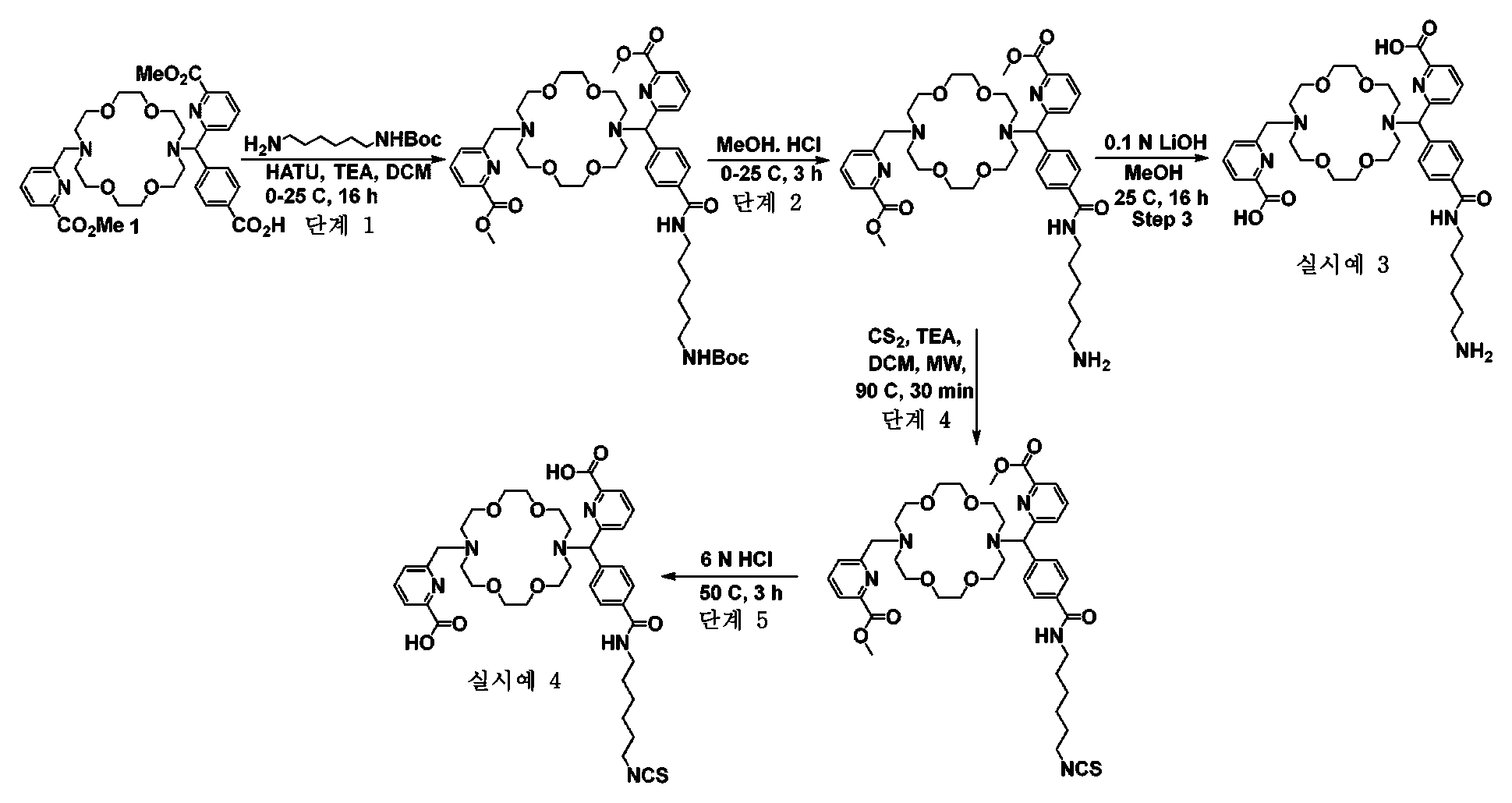
단계 1: 25 mL 3구 둥근 바닥 플라스크에, 질소 분위기 하 0℃에서 교반 바, 4-((6-(메톡시카르보닐)피리딘-2-일)(16-((6-(메톡시카르보닐)피리딘-2-일)메틸)-1,4,10,13-테트라옥사-7,16-디아자시클로옥타데칸-7-일)메틸)벤조산(0.12 g, 0.18 mmol), tert-부틸(6-아미노헥실)카르바메이트(38 mg, 0.18 mmol), 트리에틸아민(54 mg, 0.54 mmol), HATU(0.10 g, 0.27 mmol) 및 DCM(4.0 mL)을 첨가하였다. 이어서, 반응 혼합물을 실온에 이르게 하고, 밤새 교반하였다. 이어서, 반응 혼합물을 물(10 mL)로 처리하고, 디클로로메탄(10 mL × 3)으로 추출하였다. 조합한 추출물을 10% NaHCO3 수용액(10 mL)과 염수(10 mL)로 세정하고, 무수 Na2SO4 상에서 건조시키고, 여과하고, 건조될 때까지 농축시켜 오일을 수득하였다. 오일을 실리카겔 크로마토그래피(0→10% MeOH/DCM)를 통해 정제하여 메틸 6-((4-((6-((tert-부톡시카르보닐)아미노)헥실)카르바모일)페닐)(16-((6-(메톡시카르보닐)피리딘-2-일)메틸)-1,4,10,13-테트라옥사-7,16-디아자시클로옥타데칸-7-일)메틸)피콜리네이트(70 mg)를 끈적한 오일로 수득하였다. Step 1 : In a 25 mL 3-necked round-bottom flask, under nitrogen atmosphere at 0 °C, a stir bar, 4-((6-(methoxycarbonyl)pyridin-2-yl)(16-((6-(methoxycarbonyl)pyridin-2-yl)methyl)-1,4,10,13-tetraoxa-7,16-diazacyclooctadecan-7-yl)methyl)benzoic acid (0.12 g, 0.18 mmol), tert -butyl(6-aminohexyl)carbamate (38 mg, 0.18 mmol), triethylamine (54 mg, 0.54 mmol), HATU (0.10 g, 0.27 mmol) and DCM (4.0 mL) were added. The reaction mixture was then allowed to reach room temperature and stirred overnight. The reaction mixture was then treated with water (10 mL) and extracted with dichloromethane (10 mL × 3). The combined extracts were washed with 10% aqueous NaHCO 3 solution (10 mL) and brine (10 mL), dried over anhydrous Na 2 SO 4 , filtered and concentrated to dryness to give an oil. The oil was purified through silica gel chromatography (0 → 10% MeOH/DCM) to afford methyl 6-((4-((6-(( tert -butoxycarbonyl)amino)hexyl)carbamoyl)phenyl)(16-((6-(methoxycarbonyl)pyridin-2-yl)methyl)-1,4,10,13-tetraoxa-7,16-diazacyclooctadecan-7-yl)methyl)picolinate (70 mg) as a sticky oil.
단계 2: 25 mL 둥근 바닥 플라스크에, 0℃에서 교반 바, 메틸 6-((4-((6-((tert-부톡시카르보닐)아미노)헥실)카르바모일)페닐)(16-((6-(메톡시카르보닐)피리딘-2-일)메틸)-1,4,10,13-테트라옥사-7,16-디아자시클로옥타데칸-7-일)메틸)피콜리네이트(70 mg, 0.080 mmol), MeOH(1.5 mL) 및 메탄올 중 HCl(4 M, 0.4 mL, 1.6 mmol)을 첨가한 후, 실온에 이르게 하고, 2시간 동안 교반하였다. 휘발성 물질을 진공에서 제거하여 메틸 6-((4-((6-아미노헥실)카르바모일)페닐)(16-((6-(메톡시카르보닐)피리딘-2-일)메틸)-1,4,10,13-테트라옥사-7,16-디아자시클로옥타데칸-7-일)메틸)피콜리네이트(30 mg)를 수득하고, 이를 정제 없이 사용하였다. Step 2 : In a 25 mL round bottom flask, at 0 °C with a stir bar, add methyl 6-((4-((6-(( tert -butoxycarbonyl)amino)hexyl)carbamoyl)phenyl)(16-((6-(methoxycarbonyl)pyridin-2-yl)methyl)-1,4,10,13-tetraoxa-7,16-diazacyclooctadecan-7-yl)methyl)picolinate (70 mg, 0.080 mmol), MeOH (1.5 mL) and HCl in methanol (4 M, 0.4 mL, 1.6 mmol), bring to room temperature, and stir for 2 h. The volatiles were removed in vacuo to give methyl 6-((4-((6-aminohexyl)carbamoyl)phenyl)(16-((6-(methoxycarbonyl)pyridin-2-yl)methyl)-1,4,10,13-tetraoxa-7,16-diazacyclooctadecan-7-yl)methyl)picolinate (30 mg), which was used without purification.
단계 3: 8 mL 반응 바이알에, 교반 바, 메틸 6-((4-((6-아미노헥실)카르바모일)페닐)(16-((6-(메톡시카르보닐)피리딘-2-일)메틸)-1,4,10,13-테트라옥사-7,16-디아자시클로옥타데칸-7-일)메틸)피콜리네이트(30 mg, 0.038 mmol), LiOH 수용액(1.1 mL, 0.1 N, 0.11 mmol) 및 MeOH(1.0 mL)을 첨가하고, 실온에서 밤새 교반하였다. 이어서, 반응 혼합물을 pH 약 6.5까지 아세트산으로 처리한 후, 진공 하 실온에서 건조될 때까지 농축시켰다. 생성된 혼합물을 분취용 HPLC(컬럼: XBRIDGE C18 19 × 150 mm, 5.0 μm; 이동상: 물/ACN 중 10 mM 암모늄 아세테이트; 유량: 15.0 mL/분)에 적용하여 실시예 3: 6-((4-((6-아미노헥실)카르바모일)페닐)(16-((6-카르복시피리딘-2-일)메틸)-1,4,10,13-테트라옥사-7,16-디아자시클로옥타데칸-7-일)메틸)피콜린산(10 mg)을 수득하였다. LC-MS APCI: C39H54N6O9에 대한 계산치; 750.40; 측정치 m/z [M+H]+ 751.3. 1H NMR (400 ㎒, CD3OD): δ 8.22 (d, J = 1.60 ㎐, 2H), 8.21-8.06 (m, 2H), 7.92 (d, J = 8.40 ㎐, 2H), 7.80 (d, J = 8.40 ㎐, 2H), 7.75-7.69 (m, 2H), 6.20 (s, 1H), 4.70 (s, 2H), 4.02-3.92 (m, 8H), 3.76-3.62 (m, 14H), 3.51-3.32 (m, 4H), 2.93 (t, J = 8.00 ㎐, 2H), 1.67-1.64 (m, 4H), 1.46-1.45 (m, 4H). Step 3 : To an 8 mL reaction vial, a stir bar was added methyl 6-((4-((6-aminohexyl)carbamoyl)phenyl)(16-((6-(methoxycarbonyl)pyridin-2-yl)methyl)-1,4,10,13-tetraoxa-7,16-diazacyclooctadecan-7-yl)methyl)picolinate (30 mg, 0.038 mmol), aqueous LiOH solution (1.1 mL, 0.1 N, 0.11 mmol) and MeOH (1.0 mL) and stirred at room temperature overnight. The reaction mixture was then treated with acetic acid to pH ~6.5 and concentrated to dryness in vacuo at room temperature. The resulting mixture was subjected to preparative HPLC (Column: XBRIDGE C18 19 × 150 mm, 5.0 μm; Mobile phase: 10 mM ammonium acetate in water/ACN; Flow rate: 15.0 mL/min) to afford Example 3: 6-((4-((6-aminohexyl)carbamoyl)phenyl)(16-((6-carboxypyridin-2-yl)methyl)-1,4,10,13-tetraoxa-7,16-diazacyclooctadecan-7-yl)methyl)picolinic acid (10 mg). LC-MS APCI: calcd for C 39 H 54 N 6 O 9 ; 750.40; found m/z [M+H] + 751.3. 1 H NMR (400 MHz, CD 3 OD): δ 8.22 (d, J = 1.60 Hz, 2H), 8.21-8.06 (m, 2H), 7.92 (d, J = 8.40 Hz, 2H), 7.80 (d, J = 8.40 Hz, 2H), .69 (m, 2H), 6.20 (s, 1H), 4.70 (s, 2H), 4.02-3.92 (m, 8H), 3.76-3.62 (m, 14H), 3.51-3.32 (m, 4H), 2.93 (t, J = 8.00 Hz, 2H), .64 (m, 4H), 1.46-1.45 (m, 4H).
단계 4: 압력 바이알에, 질소 분위기 하 실온에서 교반 바, 메틸 6-((4-((6-아미노헥실)카르바모일)페닐)(16-((6-(메톡시카르보닐)피리딘-2-일)메틸)-1,4,10,13-테트라옥사-7,16-디아자시클로옥타데칸-7-일)메틸)피콜리네이트(0.10 g, 0.13 mmol), 트리에틸아민(39 mg, 0.38 mmol), 무수 DCM(2 mL) 및 이황화탄소(15 mg, 0.19 mmol)를 첨가하였다. 바이알을 90℃에서 30분 동안 마이크로파 조사(150 W 전력)에 적용하였다. 이어서, 바이알을 실온까지 냉각시키고, 반응 혼합물을 디클로로메탄(10 mL)으로 희석하고, 물(5 mL), 1 M HCl(5 mL) 및 물(5 mL)로 세정하고, 무수 Na2SO4 상에서 건조시키고, 여과하고, 건조될 때까지 농축시켜 메틸 6-((4-((6-이소티오시아네이토헥실)카르바모일)페닐)(16-((6-(메톡시카르보닐)피리딘-2-일)메틸)-1,4,10,13-테트라옥사-7,16-디아자시클로옥타데칸-7-일)메틸)피콜리네이트(0.1 g)를 수득하고, 이를 정제 없이 사용하였다. Step 4 : To a pressure vial, under nitrogen atmosphere at room temperature, stirred at room temperature, methyl 6-((4-((6-aminohexyl)carbamoyl)phenyl)(16-((6-(methoxycarbonyl)pyridin-2-yl)methyl)-1,4,10,13-tetraoxa-7,16-diazacyclooctadecan-7-yl)methyl)picolinate (0.10 g, 0.13 mmol), triethylamine (39 mg, 0.38 mmol), anhydrous DCM (2 mL) and carbon disulfide (15 mg, 0.19 mmol) were added. The vial was subjected to microwave irradiation (150 W power) at 90 °C for 30 min. The vial was then cooled to room temperature, and the reaction mixture was diluted with dichloromethane (10 mL), washed with water (5 mL), 1 M HCl (5 mL), and water (5 mL), dried over anhydrous Na 2 SO 4 , filtered, and concentrated to dryness to afford methyl 6-((4-((6-isothiocyanatohexyl)carbamoyl)phenyl)(16-((6-(methoxycarbonyl)pyridin-2-yl)methyl)-1,4,10,13-tetraoxa-7,16-diazacyclooctadecan-7-yl)methyl)picolinate (0.1 g), which was used without purification.
단계 5: 10 mL 둥근 바닥 플라스크에, 교반 바, 메틸 6-((4-((6-이소티오시아네이토헥실)카르바모일)페닐)(16-((6-(메톡시카르보닐)피리딘-2-일)메틸)-1,4,10,13-테트라옥사-7,16-디아자시클로옥타데칸-7-일)메틸)피콜리네이트(0.10 g, 0.12 mmol) 및 HCl 수용액(6 N, 0.4 mL, 2.4 mmol)을 첨가한 후, 50℃에서 3시간 동안 교반하였다. 이어서, 반응 혼합물을 실온까지 냉각시키고, 진공에서 건조될 때까지 농축시켜 잔류물을 수득하고, 이를 분취용 HPLC(컬럼: XBRIDGE C18 19 × 150 mm, 3.5 μm; 이동상: 물/아세토니트릴 중 0.1% TFA; 유량: 2.0 mL/분)로 정제하여 실시예 4: 6-((16-((6-카르복시피리딘-2-일)(4-((6-이소티오시아네이토헥실)카르바모일)페닐)메틸)-1,4,10,13-테트라옥사-7,16-디아자시클로옥타데칸-7-일)메틸)피콜린산(15 mg)을 수득하였다. LC-MS APCI: C40H52N6O9S: 792.35에 대한 계산치; 측정치 m/z [M+H]+ 792.8. 1H NMR (400 ㎒, CD3OD): δ 8.23-8.20 (m, 2H), 8.15-8.06 (m, 2H), 7.92 (d, J = 8.40 ㎐, 2H), 7.79 (d, J = 8.40 ㎐, 2H), 7.74 ― 7.68 (m, 2H), 6.17 (s, 1H), 4.77 (s, 2H), 4.01-3.93 (m, 8H), 3.75-3.56 (m, 16H), 3.42-3.33 (m, 5H), 1.74-1.64 (m, 4H), 1.50-1.44 (m, 4H). Step 5 : In a 10 mL round-bottomed flask, add a stir bar, methyl 6-((4-((6-isothiocyanatohexyl)carbamoyl)phenyl)(16-((6-(methoxycarbonyl)pyridin-2-yl)methyl)-1,4,10,13-tetraoxa-7,16-diazacyclooctadecan-7-yl)methyl)picolinate (0.10 g, 0.12 mmol), and aqueous HCl solution (6 N, 0.4 mL, 2.4 mmol), and the mixture was stirred at 50 °C for 3 h. The reaction mixture was then cooled to room temperature and concentrated to dryness in vacuo to give the residue which was purified by preparative HPLC (column: XBRIDGE C18 19 × 150 mm, 3.5 μm; mobile phase: 0.1% TFA in water/acetonitrile; flow rate: 2.0 mL/min) to give Example 4: 6-((16-((6-carboxypyridin-2-yl)(4-((6-isothiocyanatohexyl)carbamoyl)phenyl)methyl)-1,4,10,13-tetraoxa-7,16-diazacyclooctadecan-7-yl)methyl)picolinic acid (15 mg). LC-MS APCI: calcd for C 40 H 52 N 6 O 9 S: 792.35; found m/z [M+H] + 792.8. 1 H NMR (400 MHz, CD 3 OD): δ 8.23-8.20 (m, 2H), 8.15-8.06 (m, 2H), 7.92 (d, J = 8.40 Hz, 2H), 7.79 (d, J = 8.40 Hz, 2H), 7.74 - 7.68 (m , 2H), 6.17 (s, 1H), 4.77 (s, 2H), 4.01-3.93 (m, 8H), 3.75-3.56 (m, 16H), 3.42-3.33 (m, 5H), 1.74-1.64 (m, 4H), 1.50-1.44 (m, 4H).
실시예 5Example 5
6-((16-((6-카르복시피리딘-2-일)(4-((4-이소티오시아네이토페네틸)카르바모일)페닐)메틸)-1,4,10,13-테트라옥사-7,16-디아자시클로옥타데칸-7-일)메틸)피콜린산6-((16-((6-carboxypyridin-2-yl)(4-((4-isothiocyanatophenethyl)carbamoyl)phenyl)methyl)-1,4,10,13-tetraoxa-7,16-diazacyclooctadecan-7-yl)methyl)picolinic acid
반응식 4

단계 1: 25 mL 3구 둥근 바닥 플라스크에, 질소 분위기 하 0℃에서 교반 바, 4-((6-(메톡시카르보닐)피리딘-2-일)(16-((6-(메톡시카르보닐)피리딘-2-일)메틸)-1,4,10,13-테트라옥사-7,16-디아자시클로옥타데칸-7-일)메틸)벤조산(0.25 g, 0.37 mmol), 4-(2-아미노에틸)아닐린(60 mg, 0.37 mmol), TEA(0.11 g, 0.15 mL, 1.1 mmol), HATU(0.21 g, 0.55 mmol) 및 DCM(5 mL)을 첨가하였다. 반응 혼합물을 실온에서 밤새 교반한 후, 물(10 mL)로 처리하고, 디클로로메탄(10 mL × 3)으로 추출하였다. 조합한 추출물을 10% NaHCO3 수용액(10 mL)과 염수(10 mL)로 세정하고, 무수 Na2SO4 상에서 건조시키고, 여과하고, 건조될 때까지 농축시켜 생성물을 수득하고, 이를 실리카겔 크로마토그래피(0→10% MeOH/DCM)로 정제하여 메틸 6-((4-((4-아미노페네틸)카르바모일)페닐)(16-((6-(메톡시카르보닐)피리딘-2-일)메틸)-1,4,10,13-테트라옥사-7,16-디아자시클로옥타데칸-7-일)메틸)피콜리네이트(0.12 g)를 수득하였다. Step 1 : In a 25 mL 3-necked round-bottom flask, under nitrogen atmosphere at 0 °C, a stir bar, 4-((6-(methoxycarbonyl)pyridin-2-yl)(16-((6-(methoxycarbonyl)pyridin-2-yl)methyl)-1,4,10,13-tetraoxa-7,16-diazacyclooctadecan-7-yl)methyl)benzoic acid (0.25 g, 0.37 mmol), 4-(2-aminoethyl)aniline (60 mg, 0.37 mmol), TEA (0.11 g, 0.15 mL, 1.1 mmol), HATU (0.21 g, 0.55 mmol) and DCM (5 mL) were added. The reaction mixture was stirred at room temperature overnight, treated with water (10 mL) and extracted with dichloromethane (10 mL × 3). The combined extracts were washed with 10% NaHCO 3 aqueous solution (10 mL) and brine (10 mL), dried over anhydrous Na 2 SO 4 , filtered and concentrated to dryness to give the product, which was purified by silica gel chromatography (0→10% MeOH/DCM) to give methyl 6-((4-((4-aminophenethyl)carbamoyl)phenyl)(16-((6-(methoxycarbonyl)pyridin-2-yl)methyl)-1,4,10,13-tetraoxa-7,16-diazacyclooctadecan-7-yl)methyl)picolinate (0.12 g).
단계 2: 10 mL 마이크로파 압력 바이알에, 질소 분위기 하 실온에서 교반 바, 메틸 6-((4-((4-아미노페네틸)카르바모일)페닐)(16-((6-(메톡시카르보닐)피리딘-2-일)메틸)-1,4,10,13-테트라옥사-7,16-디아자시클로옥타데칸-7-일)메틸)피콜리네이트(0.12 g, 0.15 mmol), TEA(45 mg, 65 μL, 0.45 mmol), DCM(3 mL) 및 CS2(17 mg, 0.23 mmol)를 첨가하였다. 반응 혼합물을 90℃에서 30분 동안 마이크로파 조사(150 W 전력)에 적용하였다. 이어서, 반응 혼합물을 실온까지 냉각시키고, 디클로로메탄(10 mL)으로 희석하고, 물(5 mL), 1 M HCl(5 mL) 및 물(5 mL)로 연속하여 세정하고, 무수 Na2SO4 상에서 건조시키고, 건조될 때까지 농축시켜 메틸 6-((4-((4-이소티오시아네이토페네틸)카르바모일)페닐)(16-((6-(메톡시카르보닐)피리딘-2-일)메틸)-1,4,10,13-테트라옥사-7,16-디아자시클로옥타데칸-7-일)메틸)피콜리네이트(0.12 g)를 수득하고, 이를 정제 없이 사용하였다. Step 2 : In a 10 mL microwave pressure vial, under nitrogen atmosphere at room temperature, with a stir bar, methyl 6-((4-((4-aminophenethyl)carbamoyl)phenyl)(16-((6-(methoxycarbonyl)pyridin-2-yl)methyl)-1,4,10,13-tetraoxa-7,16-diazacyclooctadecan-7-yl)methyl)picolinate (0.12 g, 0.15 mmol), TEA (45 mg, 65 μL, 0.45 mmol), DCM (3 mL) and CS 2 (17 mg, 0.23 mmol) were added. The reaction mixture was subjected to microwave irradiation (150 W power) at 90 °C for 30 min. The reaction mixture was then cooled to room temperature, diluted with dichloromethane (10 mL), washed successively with water (5 mL), 1 M HCl (5 mL) and water (5 mL), dried over anhydrous Na 2 SO 4 and concentrated to dryness to afford methyl 6-((4-((4-isothiocyanatophenethyl)carbamoyl)phenyl)(16-((6-(methoxycarbonyl)pyridin-2-yl)methyl)-1,4,10,13-tetraoxa-7,16-diazacyclooctadecan-7-yl)methyl)picolinate (0.12 g), which was used without purification.
단계 3: 10 mL 1구 둥근 바닥 플라스크에, 교반 바, 메틸 6-((4-((4-이소티오시아네이토페네틸)카르바모일)페닐)(16-((6-(메톡시카르보닐)피리딘-2-일)메틸)-1,4,10,13-테트라옥사-7,16-디아자시클로옥타데칸-7-일)메틸)피콜리네이트(0.12 g, 0.14 mmol) 및 HCl 수용액(0.50 mL, 6 N, 2.8 mmol)을 첨가하고, 50℃에서 3시간 동안 교반하였다. 반응 혼합물을 실온까지 냉각시키고, 진공에서 건조될 때까지 농축시키고, 미정제 생성물을 분취용 HPLC(컬럼: XBRIDGE C18 19 × 150 mm, 5.0 μm; 이동상: 물/아세토니트릴 중 0.1% TFA; 유량: 15.0 mL/분)에 적용하여 6-((16-((6-카르복시피리딘-2-일)(4-((4-이소티오시아네이토페네틸)카르바모일)페닐)메틸)-1,4,10,13-테트라옥사-7,16-디아자시클로옥타데칸-7-일)메틸)피콜린산(30 mg)을 수득하였다. LC-MS APCI: C42H48N5O10S에 대한 계산치; 812.32; 측정치 m/z [M+H]+ 812.9. 1H NMR (400 ㎒, CD3OD): δ 8.22 (d, J = 0.80 ㎐, 2H), 8.06-8.21 (m, 2H), 7.85 (d, J = 8.40 ㎐, 2H), 7.68-7.78 (m, 4H), 7.31 (d, J = 8.40 ㎐, 2H), 7.21 (d, J = 2.00 ㎐, 2H), 6.18 (s, 1H), 4.77 (s, 2H), 3.70-4.00 (m, 7H), 3.60-3.67 (m, 16H), 3.44-3.49 (m, 2H), 2.90-3.10 (m, 3H). Step 3 : In a 10 mL single-necked round-bottom flask, add a stir bar, methyl 6-((4-((4-isothiocyanatophenethyl)carbamoyl)phenyl)(16-((6-(methoxycarbonyl)pyridin-2-yl)methyl)-1,4,10,13-tetraoxa-7,16-diazacyclooctadecan-7-yl)methyl)picolinate (0.12 g, 0.14 mmol) and aqueous HCl solution (0.50 mL, 6 N, 2.8 mmol), and stir at 50 °C for 3 h. The reaction mixture was cooled to room temperature, concentrated to dryness in vacuo and the crude product was subjected to preparative HPLC (column: XBRIDGE C18 19 × 150 mm, 5.0 μm; mobile phase: 0.1% TFA in water/acetonitrile; flow rate: 15.0 mL/min) to afford 6-((16-((6-carboxypyridin-2-yl)(4-((4-isothiocyanatophenethyl)carbamoyl)phenyl)methyl)-1,4,10,13-tetraoxa-7,16-diazacyclooctadecan-7-yl)methyl)picolinic acid (30 mg). LC-MS APCI: calcd for C 42 H 48 N 5 O 10 S; 812.32; found m/z [M+H] + 812.9. 1 H NMR (400 MHz, CD 3 OD): δ 8.22 (d, J = 0.80 Hz, 2H), 8.06-8.21 (m, 2H), 7.85 (d, J = 8.40 Hz, 2H), 7.68-7.78 (m, 4H), 7.31 (d, J = 8.4 0 Hz, 2H), 7.21 (d, J = 2.00 Hz, 2H), 6.18 (s, 1H), 4.77 (s, 2H), 3.70-4.00 (m, 7H), 3.60-3.67 (m, 16H), 3.44-3.49 (m, 2.90-3) .10 (m, 3H).
실시예 6Example 6
(S)-6,6'-((2-(((2-이소티오시아네이토에틸)티오)메틸)-1,4,10,13-테트라옥사-7,16-디아자시클로옥타데칸-7,16-디일)비스(메틸렌))디피콜린산( S )-6,6'-((2-(((2-isothiocyanatoethyl)thio)methyl)-1,4,10,13-tetraoxa-7,16-diazacyclooctadecane-7,16-diyl)bis(methylene))dipicolinic acid
반응식 5Reaction formula 5
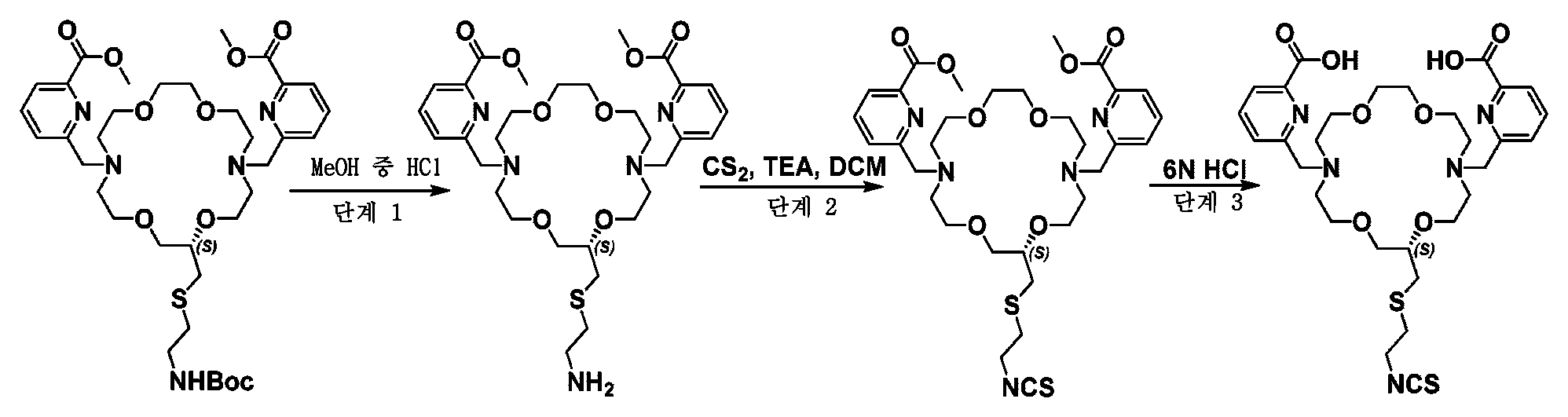
단계 1: 25 mL 1구 둥근 바닥 플라스크에, 0℃에서 교반 바, 1(메틸 6-((4-((tert-부톡시카르보닐)아미노)페닐)(16-((6-(메톡시카르보닐)피리딘-2-일)메틸)-1,4,10,13-테트라옥사-7,16-디아자시클로옥타데칸-7-일)메틸)피콜리네이트)(0.10 g, 0.15 mmol), MeOH(0.5 mL) 및 메탄올 중 HCl(4 M, 0.6 mL, 4.0 mmol)을 첨가한 후, 실온에 이르게 하고, 2시간 동안 교반하였다. 휘발성 물질을 진공에서 제거하여 디메틸 6,6'-((2-(((2-아미노에틸)티오)메틸)-1,4,10,13-테트라옥사-7,16-디아자시클로옥타데칸-7,16-디일)비스(메틸렌))(S)-디피콜리네이트(55 mg)를 수득하고, 이를 정제 없이 다음 단계에 사용하였다. Step 1 : In a 25 mL single-necked round-bottom flask, at 0 °C with a stir bar, add 1 (methyl 6-((4-((tert-butoxycarbonyl)amino)phenyl)(16-((6-(methoxycarbonyl)pyridin-2-yl)methyl)-1,4,10,13-tetraoxa-7,16-diazacyclooctadecan-7-yl)methyl)picolinate) (0.10 g, 0.15 mmol), MeOH (0.5 mL) and HCl in methanol (4 M, 0.6 mL, 4.0 mmol), bring to room temperature, and stir for 2 h. The volatiles were removed in vacuo to give dimethyl 6,6'-((2-(((2-aminoethyl)thio)methyl)-1,4,10,13-tetraoxa-7,16-diazacyclooctadecane-7,16-diyl)bis(methylene))( S )-dipicolinate (55 mg), which was used in the next step without purification.
단계 2: 마이크로파 바이알에, 질소 분위기 하 실온에서 교반 바, 디메틸 6,6'-((2-(((2-아미노에틸)티오)메틸)-1,4,10,13-테트라옥사-7,16-디아자시클로옥타데칸-7,16-디일)비스(메틸렌))(S)-디피콜리네이트(50 mg, 0.10 mmol), 트리에틸아민(24 mg, 0.24 mmol), DCM(2 mL) 및 이황화탄소(12 mg, 0.16 mmol)를 첨가하였다. 바이알을 90℃에서 30분 동안 마이크로파 조사(150 W 전력)에 적용하였다. 이어서, 바이알을 실온까지 냉각시키고, 반응 혼합물 디클로로메탄(10 mL)으로 희석하고, 물(5 mL), 1 M HCl(5 mL) 및 물(5 mL)로 연속하여 세정하고, 무수 Na2SO4 상에서 건조시키고, 건조될 때까지 농축시키고, 실리카겔 크로마토그래피(0→10% MeOH/DCM)에 적용하여 디메틸 6,6'-((2-(((2-이소티오시아네이토에틸)티오)메틸)-1,4,10,13-테트라옥사-7,16-디아자시클로옥타데칸-7,16-디일)비스(메틸렌))(S)-디피콜리네이트(20 mg)를 황색 고체로 수득하였다. Step 2 : To a microwave vial, under nitrogen atmosphere at room temperature, dimethyl 6,6'-((2-(((2-aminoethyl)thio)methyl)-1,4,10,13-tetraoxa-7,16-diazacyclooctadecan-7,16-diyl)bis(methylene))( S )-dipicolinate (50 mg, 0.10 mmol), triethylamine (24 mg, 0.24 mmol), DCM (2 mL), and carbon disulfide (12 mg, 0.16 mmol) were added. The vial was subjected to microwave irradiation (150 W power) at 90 °C for 30 min. The vial was then cooled to room temperature, and the reaction mixture was diluted with dichloromethane (10 mL), washed successively with water (5 mL), 1 M HCl (5 mL) and water (5 mL), dried over anhydrous Na 2 SO 4 , concentrated to dryness, and applied to silica gel chromatography (0→10% MeOH/DCM) to afford dimethyl 6,6'-((2-(((2-isothiocyanatoethyl)thio)methyl)-1,4,10,13-tetraoxa-7,16-diazacyclooctadecane-7,16-diyl)bis(methylene))( S )-dipicolinate (20 mg) as a yellow solid.
단계 3: 10 mL 1구 둥근 바닥 플라스크에, 교반 바, 디메틸 6,6'-((2-(((2-이소티오시아네이토에틸)티오)메틸)-1,4,10,13-테트라옥사-7,16-디아자시클로옥타데칸-7,16-디일)비스(메틸렌))(S)-디피콜리네이트(20 mg, 0.030 mmol) 및 HCl 수용액(6 N, 0.1 mL, 0.6 mmol)을 첨가하고, 실온에서 밤새 교반하였다. 반응 혼합물을 진공에서 건조될 때까지 농축시키고, 생성된 잔류물을 분취용 HPLC(컬럼: XBRIDGE C18(19 × 150 mm) 5.0 μm; 이동상: 물/아세토니트릴 중 0.1% TFA; 유량: 15.0 mL/분)에 적용하여 (S)-6,6'-((2-(((2-이소티오시아네이토에틸)티오)메틸)-1,4,10,13-테트라옥사-7,16-디아자시클로옥타데칸-7,16-디일)비스(메틸렌))디피콜린산(6 mg)을 수득하였다. LC-MS APCI: C30H41N5O8S2에 대한 계산치: 663.24; 측정치 m/z [M+H]+ 664.2. 1H NMR (400 ㎒, DMSO-d 6 ): δ 9.78 (s, 1H), 8.10 (s, 4H), 7.78 (d, J = 6.00 ㎐, 2H), 4.69 (s, 4H), 3.96-3.52 (m, 23H), 2.85 (t, J = 6.40 ㎐, 2H), 2.70 (t, J = 8.00 ㎐, 2H). Step 3: In a 10 mL single-necked round-bottom flask, add a stir bar, dimethyl 6,6'-((2-(((2-isothiocyanatoethyl)thio)methyl)-1,4,10,13-tetraoxa-7,16-diazacyclooctadecan-7,16-diyl)bis(methylene))( S )-dipicolinate (20 mg, 0.030 mmol) and aqueous HCl solution (6 N, 0.1 mL, 0.6 mmol), and stir at room temperature overnight. The reaction mixture was concentrated to dryness in vacuo and the resulting residue was subjected to preparative HPLC (column: XBRIDGE C18 (19 × 150 mm) 5.0 μm; mobile phase: 0.1% TFA in water/acetonitrile; flow rate: 15.0 mL/min) to afford ( S )-6,6'-((2-(((2-isothiocyanatoethyl)thio)methyl)-1,4,10,13-tetraoxa-7,16-diazacyclooctadecan-7,16-diyl)bis(methylene))dipicolinic acid (6 mg). LC-MS APCI: calcd for C 30 H 41 N 5 O 8 S 2 : 663.24; found m/z [M+H] + 664.2. 1 H NMR (400 MHz, DMSO- d 6 ): δ 9.78 (s, 1H), 8.10 (s, 4H), 7.78 (d, J = 6.00 Hz, 2H), 4.69 (s, 4H), 3.96-3.52 (m, 23H), 2.85 (t, J = 6.40 ㎐, 2H), 2.70 (t, J = 8.00 ㎐, 2H).
실시예 7Example 7
(S)-6,6'-((2-(((5-이소티오시아네이토펜틸)티오)메틸)-1,4,10,13-테트라옥사-7,16-디아자시클로옥타데칸-7,16-디일)비스(메틸렌))디피콜린산( S )-6,6'-((2-(((5-isothiocyanatopentyl)thio)methyl)-1,4,10,13-tetraoxa-7,16-diazacyclooctadecane-7,16-diyl)bis(methylene))dipicolinic acid
반응식 6Reaction formula 6
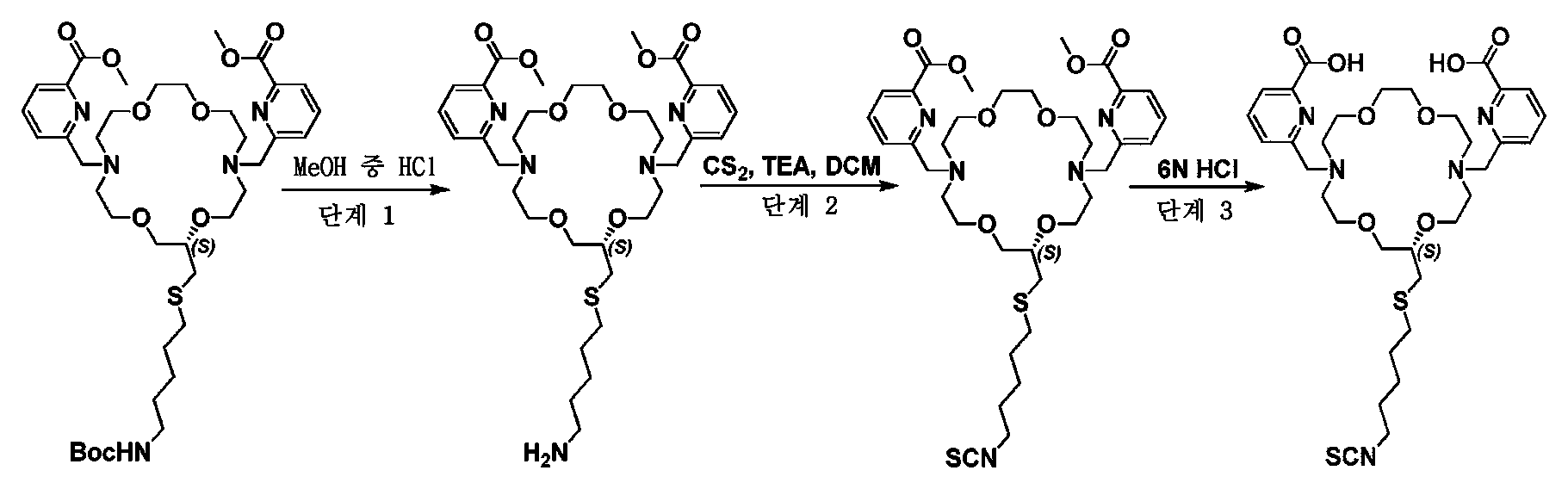
단계 1: 25 mL 1구 둥근 바닥 플라스크에, 0℃에서 교반 바, 디메틸 6,6'-((2-(((5-((tert-부톡시카르보닐)아미노)펜틸)티오)메틸)-1,4,10,13-테트라옥사-7,16-디아자시클로옥타데칸-7,16-디일)비스(메틸렌))(S)-디피콜리네이트(0.12 g, 0.15 mmol), MeOH(0.5 mL) 및 메탄올 중 HCl(4 M, 0.6 mL, 4.0 mmol)을 첨가하고, 실온에 이르게 하고, 2시간 동안 교반하였다. 이어서, 휘발성 물질을 진공에서 제거하여 디메틸 6,6'-((2-(((5-아미노펜틸)티오)메틸)-1,4,10,13-테트라옥사-7,16-디아자시클로옥타데칸-7,16-디일)비스(메틸렌))(S)-디피콜리네이트(70 mg)를 수득하고, 이를 정제 없이 사용하였다. Step 1 : In a 25 mL single-necked round-bottom flask, at 0 °C with a stir bar, add dimethyl 6,6'-((2-(((5-(( tert -butoxycarbonyl)amino)pentyl)thio)methyl)-1,4,10,13-tetraoxa-7,16-diazacyclooctadecane-7,16-diyl)bis(methylene))( S )-dipicolinate (0.12 g, 0.15 mmol), MeOH (0.5 mL) and HCl in methanol (4 M, 0.6 mL, 4.0 mmol), bring to room temperature, and stir for 2 h. Then, the volatiles were removed in vacuo to obtain dimethyl 6,6'-((2-(((5-aminopentyl)thio)methyl)-1,4,10,13-tetraoxa-7,16-diazacyclooctadecane-7,16-diyl)bis(methylene))( S )-dipicolinate (70 mg), which was used without purification.
단계 2: 마이크로파 바이알에, 질소 분위기 하 실온에서 교반 바, 디메틸 6,6'-((2-(((5-아미노펜틸)티오)메틸)-1,4,10,13-테트라옥사-7,16-디아자시클로옥타데칸-7,16-디일)비스(메틸렌))(S)-디피콜리네이트(70 mg, 0.10 mmol), 트리에틸아민(20 mg, 0.20 mmol), 무수 DCM(2 mL) 및 이황화탄소(15 mg, 0.20 mmol)를 첨가하였다. 반응 혼합물을 90℃에서 30분 동안 마이크로파 조사(150 W 전력)에 적용하였다. 바이알을 실온에 이르게 하고, 반응 혼합물을 디클로로메탄(10 mL)으로 희석하고, 물(5 mL), 1 M HCl(5 mL) 및 물(5 mL)로 연속하여 세정하고, 무수 황산소듐(Na2SO4) 상에서 건조시키고, 여과하고, 건조될 때까지 농축시켜 잔류물을 수득하였다. 잔류물을 실리카겔 크로마토그래피(0→10% MeOH/DCM)에 적용하여 디메틸 6,6'-((2-(((5-이소티오시아네이토펜틸)티오)메틸)-1,4,10,13-테트라옥사-7,16-디아자시클로옥타데칸-7,16-디일)비스(메틸렌))(S)-디피콜리네이트(30 mg)를 황색 고체로 수득하였다. Step 2 : In a microwave vial, under nitrogen atmosphere at room temperature, dimethyl 6,6'-((2-(((5-aminopentyl)thio)methyl)-1,4,10,13-tetraoxa-7,16-diazacyclooctadecan-7,16-diyl)bis(methylene))( S )-dipicolinate (70 mg, 0.10 mmol), triethylamine (20 mg, 0.20 mmol), anhydrous DCM (2 mL) and carbon disulfide (15 mg, 0.20 mmol) were added. The reaction mixture was subjected to microwave irradiation (150 W power) at 90 °C for 30 min. The vial was allowed to reach room temperature, and the reaction mixture was diluted with dichloromethane (10 mL), washed successively with water (5 mL), 1 M HCl (5 mL) and water (5 mL), dried over anhydrous sodium sulfate (Na 2 SO 4 ), filtered and concentrated to dryness to give the residue. The residue was subjected to silica gel chromatography (0→10% MeOH/DCM) to give dimethyl 6,6'-((2-(((5-isothiocyanatopentyl)thio)methyl)-1,4,10,13-tetraoxa-7,16-diazacyclooctadecane-7,16-diyl)bis(methylene))(S)-dipicolinate (30 mg) as a yellow solid.
단계 3: 10 mL 1구 둥근 바닥 플라스크에, 교반 바, 디메틸 6,6'-((2-(((5-이소티오시아네이토펜틸)티오)메틸)-1,4,10,13-테트라옥사-7,16-디아자시클로옥타데칸-7,16-디일)비스(메틸렌))(S)-디피콜리네이트(30 mg, 0.040 mmol) 및 HCl 수용액(6 N, 0.2 mL, 0.8 mmol)을 첨가하고, 실온에서 밤새 교반하였다. 반응 혼합물을 진공에서 건조될 때까지 농축시키고, 농축물을 HPLC(컬럼: XBRIDGE C18 19 × 150 mm, 5.0 μm; 이동상: 물/아세토니트릴 중 0.1% TFA; 유량: 15.0 mL/분)로 정제하여 (S)-6,6'-((2-(((5-이소티오시아네이토펜틸)티오)메틸)-1,4,10,13-테트라옥사-7,16-디아자시클로옥타데칸-7,16-디일)비스(메틸렌))디피콜린산(12 mg)을 수득하였다. LC-MS APCI: C33H47N5O8S2에 대한 계산치: 705.29; 측정치 m/z [M+H]+ 706.2. 1H NMR (400 ㎒, DMSO-d 6 ): δ 13.40 (s, 1H), 9.90 (s, 1H), 8.17-8.09 (m, 4H), 7.78 (d, J = 6.80 ㎐, 2H), 4.70 (s, 4H), 3.93-3.17 (m, 27H), 2.68-2.67 (m, 2H), 1.64-1.60 (m, 2H), 1.53-1.49 (m, 2H), 1.40-1.38 (m, 2H). Step 3: In a 10 mL single-necked round-bottom flask, add a stir bar, dimethyl 6,6'-((2-(((5-isothiocyanatopentyl)thio)methyl)-1,4,10,13-tetraoxa-7,16-diazacyclooctadecan-7,16-diyl)bis(methylene))(S)-dipicolinate (30 mg, 0.040 mmol) and aqueous HCl solution (6 N, 0.2 mL, 0.8 mmol) and stir at room temperature overnight. The reaction mixture was concentrated to dryness in vacuo and the concentrate was purified by HPLC (Column: XBRIDGE C18 19 × 150 mm, 5.0 μm; Mobile phase: 0.1% TFA in water/acetonitrile; Flow rate: 15.0 mL/min) to afford ( S )-6,6'-((2-(((5-isothiocyanatopentyl)thio)methyl)-1,4,10,13-tetraoxa-7,16-diazacyclooctadecan-7,16-diyl)bis(methylene))dipicolinic acid (12 mg). LC-MS APCI: Calcd for C 33 H 47 N 5 O 8 S 2 : 705.29; Found m/z [M+H] + 706.2. 1H NMR (400 MHz, DMSO- d 6 ): δ 13.40 (s, 1H), 9.90 (s, 1H), 8.17-8.09 (m, 4H), 7.78 (d, J = 6.80 Hz, 2H), 4.70 (s, 4H), 3.93-3.17 (m, 27 H), 2.68-2.67 (m, 2H), 1.64-1.60 (m, 2H), 1.53-1.49 (m, 2H), 1.40-1.38 (m, 2H).
실시예 8Example 8
(S)-6,6'-((2-(((2-(2-(4-이소티오시아네이토페녹시)에톡시)에틸)티오)메틸)-1,4,10,13-테트라옥사-7,16-디아자시클로옥타데칸-7,16-디일)비스(메틸렌))디피콜린산( S )-6,6'-((2-(((2-(2-(4-isothiocyanatophenoxy)ethoxy)ethyl)thio)methyl)-1,4,10,13-tetraoxa-7,16-diazacyclooctadecane-7,16-diyl)bis(methylene))dipicolinic acid
반응식 7Reaction formula 7
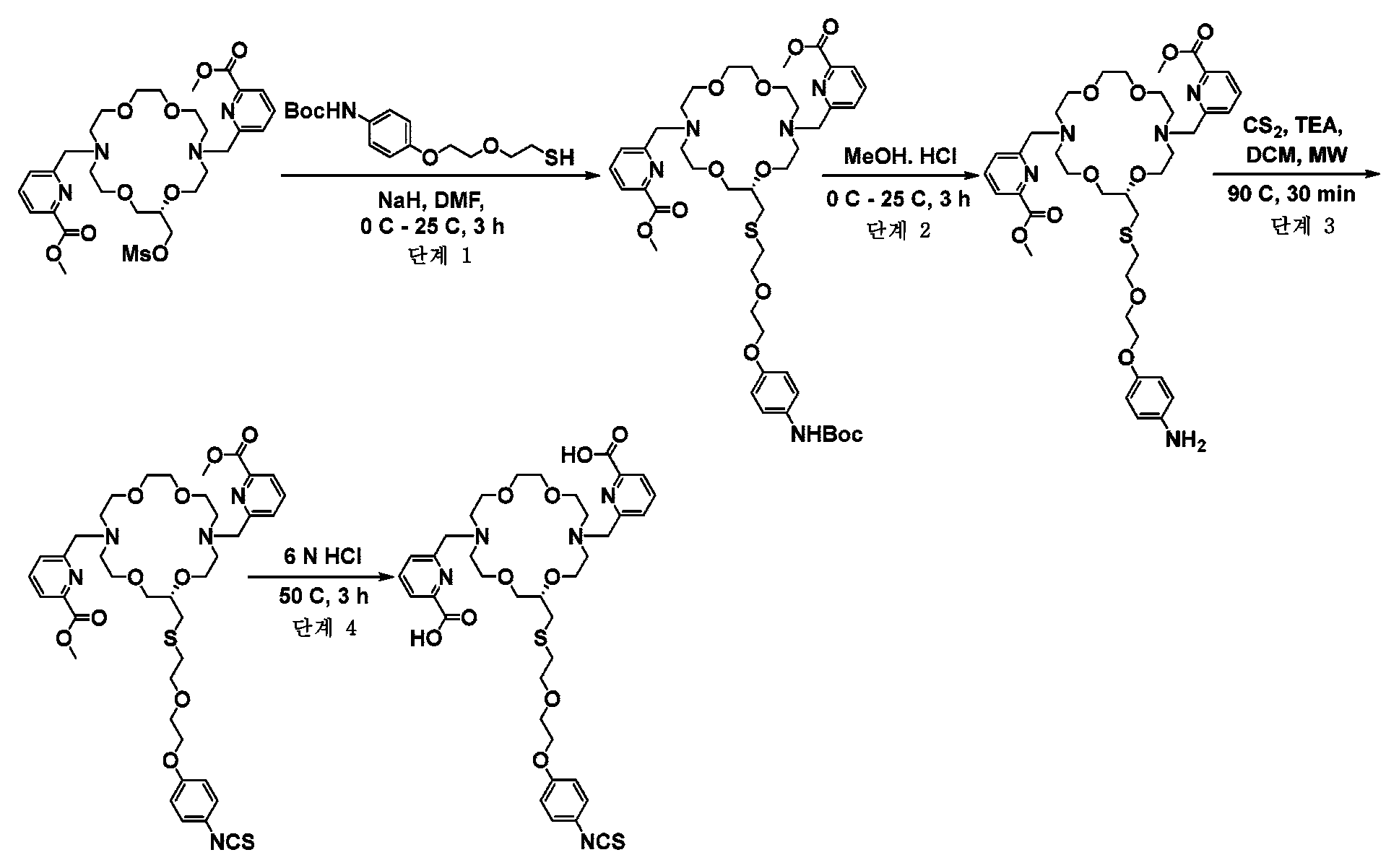
반응식 7aReaction Scheme 7a

반응식 7a, 단계 1a: 250 mL 3구 둥근 바닥 플라스크에, 질소 분위기 하에서 교반 바, tert-부틸(4-히드록시페닐)카르바메이트(4.5 g, 22 mmol), 1-브로모-2-(2-브로모에톡시)에탄(5.0 g, 22 mmol), K2CO3(4.6 g, 43 mmol) 및 ACN(45 mL)을 첨가하고, 생성된 반응 혼합물을 질소 분위기 하 80℃에서 16시간 동안 가열하였다. 반응 혼합물을 실온까지 냉각시키고, Celite®를 통해 여과하고, 진공에서 건조될 때까지 농축시켜 농축물을 수득하고, 이를 실리카겔 크로마토그래피(0→20% EtOAc/석유 에테르)로 정제하여 생성물 tert-부틸(4-(2-(2-브로모에톡시)에톡시)페닐)카르바메이트(2.0 g)를 수득하였다. Scheme 7a, Step 1a: In a 250 mL 3-necked round bottom flask, under nitrogen atmosphere, a stir bar, tert -butyl (4-hydroxyphenyl) carbamate (4.5 g, 22 mmol), 1-bromo-2-(2-bromoethoxy)ethane (5.0 g, 22 mmol), K 2 CO 3 (4.6 g, 43 mmol) and ACN (45 mL) were added and the resulting reaction mixture was heated at 80 °C under nitrogen atmosphere for 16 h. The reaction mixture was cooled to room temperature, filtered through Celite® and concentrated to dryness in vacuo to obtain the concentrate which was purified by silica gel chromatography (0→20% EtOAc/petroleum ether) to give the product tert -butyl (4-(2-(2-bromoethoxy)ethoxy)phenyl) carbamate (2.0 g).
단계 2a: 250 mL 3구 둥근 바닥 플라스크에, 질소 분위기 하에서 교반 바, tert-부틸(4-(2-(2-브로모에톡시)에톡시)페닐)카르바메이트(2.0 g, 5.6 mmol), 에탄티오 S-산(0.42 g, 5.6 mmol), K2CO3(1.5 g, 11 mmol) 및 ACN(50 mL)을 첨가하였다. 반응 혼합물 80℃에서 2시간 동안 교반한 후, 실온까지 냉각시키고, Celite®를 통해 여과하고, 진공에서 건조될 때까지 농축시켰다. 농축물을 중성 알루미나 크로마토그래피(0→50% EtOAc/석유 에테르)를 사용하여 정제하여 S-(2-(2-(4-((tert-부톡시카르보닐)아미노)페녹시)에톡시)에틸)에탄티오에이트(1.8 g)를 수득하였다. Step 2a: In a 250 mL 3-necked round bottom flask, under nitrogen atmosphere, a stir bar was added tert -butyl(4-(2-(2-bromoethoxy)ethoxy)phenyl)carbamate (2.0 g, 5.6 mmol), ethanethio S-acid (0.42 g, 5.6 mmol), K 2 CO 3 (1.5 g, 11 mmol) and ACN (50 mL). The reaction mixture was stirred at 80 °C for 2 h, cooled to room temperature, filtered through Celite® and concentrated to dryness in vacuo. The concentrate was purified by neutral alumina chromatography (0→50% EtOAc/petroleum ether) to afford S -(2-(2-(4-(( tert -butoxycarbonyl)amino)phenoxy)ethoxy)ethyl)ethanethioate (1.8 g).
단계 3a: 250 mL 1구 둥근 바닥 플라스크에, 질소 하에서 교반 바, S-(2-(2-(4-((tert-부톡시카르보닐)아미노)페녹시)에톡시)에틸)에탄티오에이트(1.8 g, 5.1 mmol), 에탄올(20 mL) 및 히드라진 1수화물(0.24 g, 0.24 mL, 7.6 mmol)을 첨가하고, 80℃에서 1시간 동안 교반하였다. 이어서, 반응 혼합물을 실온까지 냉각시키고, 진공에서 건조될 때까지 농축시켜 농축물을 수득하고, 이를 실리카겔 크로마토그래피(5%→10% EtOAc/석유 에테르)를 통해 정제하여 tert-부틸(4-(2-(2-메르캅토에톡시)에톡시)페닐)카르바메이트(0.5 g)를 무색 오일로 수득하였다. Step 3a: In a 250 mL single-necked round-bottom flask, under nitrogen, was added a stir bar, S -(2-(2-(4-(( tert -butoxycarbonyl)amino)phenoxy)ethoxy)ethyl)ethanethioate (1.8 g, 5.1 mmol), ethanol (20 mL) and hydrazine monohydrate (0.24 g, 0.24 mL, 7.6 mmol) and stirred at 80 °C for 1 h. The reaction mixture was then cooled to room temperature and concentrated in vacuo to dryness to afford the concentrate, which was purified via silica gel chromatography (5% → 10% EtOAc/petroleum ether) to afford tert -butyl(4-(2-(2-mercaptoethoxy)ethoxy)phenyl)carbamate (0.5 g) as a colorless oil.
반응식 7, 단계 1: DMF(3.0 mL) 중 수소화소듐(0.060 g, 미네랄 오일 중 60%, 1.5 mmol)의 현탁액이 함유된 50 mL 3구 둥근 바닥 플라스크에, 질소 분위기 하 0℃에서 tert-부틸(4-(2-(2-메르캅토에톡시)에톡시)페닐)카르바메이트(0.40 g, 1.0 mmol)와 DMF(3.0 mL)로 이루어진 용액을 5분에 걸쳐 적가하였다. 첨가가 완료되면, 반응 혼합물을 실온까지 가온시키고, 15분 동안 교반하였다. 혼합물을 다시 0℃까지 냉각시키고, 디메틸 6,6'-((2-(((메틸설포닐)옥시)메틸)-1,4,10,13-테트라옥사-7,16-디아자시클로옥타데칸-7,16-디일)비스(메틸렌))(S)-디피콜리네이트(0.5 g, 0.7 mmol)와 DMF(3.0 mL)로 이루어진 용액을 적가하였다. 첨가가 완료되면, 반응 혼합물을 서서히 실온까지 가온시키고, 1.5시간 동안 교반하였다. 반응액을 NH4Cl 포화 용액(0.2 mL)으로 서서히 처리한 후, 건조될 때까지 농축시켜 오일을 수득하였다. 오일을 분취용 HPLC(컬럼: XBRIDGE C18 19 × 150 mm 5.0 μm; 이동상: 물/아세토니트릴 중 0.1% TFA; 유량: 15.0 mL/분)로 정제하여 디메틸 6,6'-((2-(((2-(2-(4-((tert-부톡시카르보닐)아미노)페녹시)에톡시)에틸)티오)메틸)-1,4,10,13-테트라옥사-7,16-디아자시클로옥타데칸-7,16-디일)비스(메틸렌))(S)-디피콜리네이트(0.15 g)를 갈색 오일로 수득하였다. Scheme 7, Step 1 : A 50 mL 3-necked round-bottom flask containing a suspension of sodium hydride (0.060 g, 60% in mineral oil, 1.5 mmol) in DMF (3.0 mL) was added dropwise a solution of tert -butyl(4-(2-(2-mercaptoethoxy)ethoxy)phenyl)carbamate (0.40 g, 1.0 mmol) in DMF (3.0 mL) at 0 °C under a nitrogen atmosphere over 5 minutes. Upon completion of the addition, the reaction mixture was warmed to room temperature and stirred for 15 minutes. The mixture was cooled again to 0 °C and a solution of dimethyl 6,6'-((2-(((methylsulfonyl)oxy)methyl)-1,4,10,13-tetraoxa-7,16-diazacyclooctadecan-7,16-diyl)bis(methylene))( S )-dipicolinate (0.5 g, 0.7 mmol) and DMF (3.0 mL) was added dropwise. After the addition was complete, the reaction mixture was slowly warmed to room temperature and stirred for 1.5 h. The reaction mixture was slowly treated with a saturated NH 4 Cl solution (0.2 mL) and concentrated to dryness to obtain an oil. The oil was purified by preparative HPLC (column: XBRIDGE C18 19 × 150 mm 5.0 μm; mobile phase: 0.1% TFA in water/acetonitrile; flow rate: 15.0 mL/min) to afford dimethyl 6,6'-((2-(((2-(2-(4-(( tert -butoxycarbonyl)amino)phenoxy)ethoxy)ethyl)thio)methyl)-1,4,10,13-tetraoxa-7,16-diazacyclooctadecane-7,16-diyl)bis(methylene))( S )-dipicolinate (0.15 g) as a brown oil.
단계 2: 25 mL 1구 둥근 바닥 플라스크에, 0℃에서 교반 바, 디메틸 6,6'-((2-(((2-(2-(4-((tert-부톡시카르보닐)아미노)페녹시)에톡시)에틸)티오)메틸)-1,4,10,13-테트라옥사-7,16-디아자시클로옥타데칸-7,16-디일)비스(메틸렌))(S)-디피콜리네이트(0.15 g, 0.16 mmol), MeOH(1.0 mL) 및 메탄올 중 HCl(4 M, 0.80 mL, 3.2 mmol)을 첨가한 후, 실온에 이르게 하고, 3시간 동안 교반하였다. 휘발성 물질을 진공에서 제거하여 디메틸 6,6'-((2-(((2-(2-(4-아미노페녹시)에톡시)에틸)티오)메틸)-1,4,10,13-테트라옥사-7,16-디아자시클로옥타데칸-7,16-디일)비스(메틸렌))(S)-디피콜리네이트(0.12 g)를 수득하고, 이를 정제 없이 사용하였다. Step 2 : In a 25 mL single-necked round-bottom flask, at 0 °C with a stir bar, add dimethyl 6,6'-((2-(((2-(2-(4-(( tert -butoxycarbonyl)amino)phenoxy)ethoxy)ethyl)thio)methyl)-1,4,10,13-tetraoxa-7,16-diazacyclooctadecan-7,16-diyl)bis(methylene))( S )-dipicolinate (0.15 g, 0.16 mmol), MeOH (1.0 mL) and HCl in methanol (4 M, 0.80 mL, 3.2 mmol), bring to room temperature, and stir for 3 h. The volatiles were removed in vacuo to give dimethyl 6,6'-((2-(((2-(2-(4-aminophenoxy)ethoxy)ethyl)thio)methyl)-1,4,10,13-tetraoxa-7,16-diazacyclooctadecane-7,16-diyl)bis(methylene))( S )-dipicolinate (0.12 g), which was used without purification.
단계 3: 압력 바이알에, 질소 분위기 하 실온에서 교반 바, 디메틸 6,6'-((2-(((2-(2-(4-아미노페녹시)에톡시)에틸)티오)메틸)-1,4,10,13-테트라옥사-7,16-디아자시클로옥타데칸-7,16-디일)비스(메틸렌))(S)-디피콜리네이트(0.12 g, 0.15 mmol), 트리에틸아민(46 mg, 0.46 mmol), 무수 DCM(3 mL) 및 이황화탄소(17 mg, 0.22 mmol)를 첨가하였다. 반응 혼합물을 90℃에서 30분 동안 마이크로파 조사(150 W 전력)에 적용하였다. 반응 혼합물을 실온까지 냉각시키고, 디클로로메탄(10 mL)으로 희석하고, 물(5 mL), 1 M HCl(5 mL) 및 물(5 mL)로 연속하여 세정하고, 무수 Na2SO4 상에서 건조시키고, 건조될 때까지 농축시켜 디메틸 6,6'-((2-(((2-(2-(4-이소티오시아네이토페녹시)에톡시)에틸)티오)메틸)-1,4,10,13-테트라옥사-7,16-디아자시클로옥타데칸-7,16-디일)비스(메틸렌))(S)-디피콜리네이트(0.12 g)를 수득하고, 이를 정제 없이 사용하였다. Step 3 : To a pressure vial, under nitrogen atmosphere at room temperature, with a stir bar, dimethyl 6,6'-((2-(((2-(2-(4-aminophenoxy)ethoxy)ethyl)thio)methyl)-1,4,10,13-tetraoxa-7,16-diazacyclooctadecan-7,16-diyl)bis(methylene))( S )-dipicolinate (0.12 g, 0.15 mmol), triethylamine (46 mg, 0.46 mmol), anhydrous DCM (3 mL) and carbon disulfide (17 mg, 0.22 mmol) were added. The reaction mixture was subjected to microwave irradiation (150 W power) at 90 °C for 30 min. The reaction mixture was cooled to room temperature, diluted with dichloromethane (10 mL), washed successively with water (5 mL), 1 M HCl (5 mL) and water (5 mL), dried over anhydrous Na 2 SO 4 and concentrated to dryness to afford dimethyl 6,6'-((2-(((2-(2-(4-isothiocyanatophenoxy)ethoxy)ethyl)thio)methyl)-1,4,10,13-tetraoxa-7,16-diazacyclooctadecan-7,16-diyl)bis(methylene))( S )-dipicolinate (0.12 g), which was used without purification.
단계 4: 10 mL 1구 둥근 바닥 플라스크에, 교반 바, 디메틸 6,6'-((2-(((2-(2-(4-이소티오시아네이토페녹시)에톡시)에틸)티오)메틸)-1,4,10,13-테트라옥사-7,16-디아자시클로옥타데칸-7,16-디일)비스(메틸렌))(S)-디피콜리네이트(0.12 g, 0.15 mmol) 및 HCl 수용액(6 N, 0.51 mL, 3.1 mmol)을 첨가하고, 50℃에서 3시간 동안 교반하였다. 반응 혼합물을 실온까지 냉각시키고, 진공에서 건조될 때까지 농축시키고, 농축물을 분취용 HPLC(컬럼: XBRIDGE C18 19 × 150 mm 5.0 μm; 이동상: 물/아세토니트릴 중 0.1% TFA; 유량: 15.0 mL/분)를 통해 정제하여 (S)-6,6'-((2-(((2-(2-(4-이소티오시아네이토페녹시)에톡시)에틸)티오)메틸)-1,4,10,13-테트라옥사-7,16-디아자시클로옥타데칸-7,16-디일)비스(메틸렌))디피콜린산(40 mg, 37%)을 수득하였다. LC-MS APCI: C38H49N5O10S2에 대한 계산치: 799.29; 측정치 m/z [M+H]+ 799.9. 1H NMR (400 ㎒, CD3OD): δ 8.23-8.20 (m, 2H), 8.15-8.09 (m, 2H), 7.74-7.71 (m, 2H), 7.19 (d, J = 8.80 ㎐, 2H), 6.92 (d, J = 9.20 ㎐, 2H), 4.81 (s, 2H), 4.77 (s, 2H), 4.09-4.11 (m, 4H), 3.92-3.95 (m, 6H), 3.79 (t, J = 4.00 ㎐, 3H), 3.66-3.71 (m, 16H), 2.70-2.76 (m, 4H). Step 4: In a 10 mL single-necked round-bottom flask, add a stir bar, dimethyl 6,6'-((2-(((2-(2-(4-isothiocyanatophenoxy)ethoxy)ethyl)thio)methyl)-1,4,10,13-tetraoxa-7,16-diazacyclooctadecan-7,16-diyl)bis(methylene))( S )-dipicolinate (0.12 g, 0.15 mmol) and aqueous HCl solution (6 N, 0.51 mL, 3.1 mmol), and stir at 50 °C for 3 h. The reaction mixture was cooled to room temperature, concentrated to dryness in vacuo and the concentrate was purified via preparative HPLC (column: XBRIDGE C18 19 × 150 mm 5.0 μm; mobile phase: 0.1% TFA in water/acetonitrile; flow rate: 15.0 mL/min) to afford ( S )-6,6'-((2-(((2-(2-(4-isothiocyanatophenoxy)ethoxy)ethyl)thio)methyl)-1,4,10,13-tetraoxa-7,16-diazacyclooctadecan-7,16-diyl)bis(methylene))dipicolinic acid (40 mg, 37%). LC-MS APCI: calcd for C 38 H 49 N 5 O 10 S 2 : 799.29; Measurement m/z [M+H] + 799.9. 1 H NMR (400 MHz, CD 3 OD): δ 8.23-8.20 (m, 2H), 8.15-8.09 (m, 2H), 7.74-7.71 (m, 2H), 7.19 (d, J = 8.80 Hz, 2H), 6.92 (d, J = 9.20 Hz, 2H), 4.81 (s, 2H), 4.77 (s, 2H), 4.09-4.11 (m, 4H), 3.92-3.95 (m, 6H), 3.79 (t, J = 4.00 Hz, 3H), 3.66-3.71 (m, 16H), 2.70-2.76 (m, 4H).
실시예 9Example 9
(S)-6,6'-((2-(((2-(2-(2-(4-이소티오시아네이토페녹시)에톡시)에톡시)에틸)티오)메틸)-1,4,10,13-테트라옥사-7,16-디아자시클로옥타데칸-7,16-디일)비스(메틸렌))디피콜린산( S )-6,6'-((2-(((2-(2-(2-(4-isothiocyanatophenoxy)ethoxy)ethoxy)ethyl)thio)methyl)-1,4,10,13-tetraoxa-7,16-diazacyclooctadecane-7,16-diyl)bis(methylene))dipicolinic acid
반응식 8Reaction formula 8

반응식 8aReaction Scheme 8a

반응식 8a, 단계 1a: 250 mL 3구 둥근 바닥 플라스크에, 교반 바, tert-부틸(4-히드록시페닐)카르바메이트(3.5 g, 17 mmol), 1,2-비스(2-브로모에톡시)에탄(4.6 g, 17 mmol), K2CO3(4.6 g, 33 mmol) 및 ACN(40 mL)을 첨가하고, 질소 분위기 하 80℃에서 48시간 동안 교반하였다. 반응 혼합물을 실온까지 냉각시키고, Celite®를 통해 여과하고, 진공에서 건조될 때까지 농축시켜 농축물을 수득하고, 이를 실리카겔 크로마토그래피(0→10% MeOH/DCM)를 통해 정제하여 tert-부틸(4-(2-(2-(2-브로모에톡시)에톡시)에톡시)페닐)카르바메이트(4.0 g)를 갈색 오일로 수득하였다. Scheme 8a, Step 1a : In a 250 mL 3-necked round bottom flask, was added a stirring bar, tert-butyl(4-hydroxyphenyl)carbamate (3.5 g, 17 mmol), 1,2-bis(2-bromoethoxy)ethane (4.6 g, 17 mmol), K 2 CO 3 (4.6 g, 33 mmol) and ACN (40 mL) and stirred under nitrogen atmosphere at 80 °C for 48 h. The reaction mixture was cooled to room temperature, filtered through Celite® and concentrated in vacuo to dryness to afford the concentrate, which was purified by silica gel chromatography (0→10% MeOH/DCM) to afford tert -butyl(4-(2-(2-(2-bromoethoxy)ethoxy)ethoxy)phenyl)carbamate (4.0 g) as a brown oil.
단계 2a: 250 mL 3구 둥근 바닥 플라스크에, 질소 분위기 하에서 교반 바, tert-부틸(4-(2-(2-(2-브로모에톡시)에톡시)에톡시)페닐)카르바메이트(4.0 g, 9.9 mmol), 에탄티오 S-산(0.75 g, 9.9 mmol), K2CO3(2.7 g, 20 mmol) 및 ACN(50 mL)을 첨가하고, 반응 혼합물을 질소 분위기 하 60℃에서 2시간 동안 가열하였다. 반응 혼합물을 실온까지 냉각시키고, Celite®를 통해 여과하고, 진공에서 건조될 때까지 농축시키고, 농축물을 알루미나 크로마토그래피(0→50% EtOAc/석유 에테르)로 정제하여 S-(2-(2-(2-(4-((tert-부톡시카르보닐)아미노)페녹시)에톡시)에톡시)에틸)에탄티오에이트(3.0 g)를 갈색 오일로 수득하였다. Step 2a : In a 250 mL 3-necked round-bottom flask, under nitrogen atmosphere, a stir bar, tert -butyl(4-(2-(2-(2-bromoethoxy)ethoxy)ethoxy)phenyl)carbamate (4.0 g, 9.9 mmol), ethanethio S-acid (0.75 g, 9.9 mmol), K 2 CO 3 (2.7 g, 20 mmol) and ACN (50 mL) were added, and the reaction mixture was heated at 60 °C under nitrogen atmosphere for 2 h. The reaction mixture was cooled to room temperature, filtered through Celite®, concentrated to dryness in vacuo and the concentrate was purified by alumina chromatography (0→50% EtOAc/petroleum ether) to afford S -(2-(2-(2-(4-(( tert -butoxycarbonyl)amino)phenoxy)ethoxy)ethoxy)ethyl)ethanethioate (3.0 g) as a brown oil.
단계 3a: 250 mL 1구 둥근 바닥 플라스크에, 질소 하에서 교반 바, S-(2-(2-(2-(4-((tert-부톡시카르보닐)아미노)페녹시)에톡시)에톡시)에틸)에탄티오에이트(3.0 g, 7.5 mmol), 에탄올(50 mL) 및 히드라진 1수화물(0.36 g, 0.36 mL, 11 mmol)을 첨가하고, 80℃에서 1시간 동안 교반하였다. 반응 혼합물을 실온까지 냉각시키고, 진공에서 건조될 때까지 농축시키고, 농축물을 실리카겔 크로마토그래피(5%→10% EtOAc/석유 에테르)로 정제하여 tert-부틸(4-(2-(2-(2-메르캅토에톡시)에톡시)에톡시)페닐)카르바메이트(1.0 g)를 무색 오일로 수득하였다. Step 3a : In a 250 mL single-necked round-bottom flask, under nitrogen, a stir bar was added, S -(2-(2-(2-(4-(( tert -butoxycarbonyl)amino)phenoxy)ethoxy)ethoxy)ethyl)ethanethioate (3.0 g, 7.5 mmol), ethanol (50 mL) and hydrazine monohydrate (0.36 g, 0.36 mL, 11 mmol), and the mixture was stirred at 80 °C for 1 h. The reaction mixture was cooled to room temperature, concentrated in vacuo to dryness, and the concentrate was purified by silica gel chromatography (5% → 10% EtOAc/petroleum ether) to afford tert -butyl(4-(2-(2-(2-mercaptoethoxy)ethoxy)ethoxy)phenyl)carbamate (1.0 g) as a colorless oil.
반응식 7, 단계 1: DMF(3.0 mL) 중 수소화소듐(0.060 g, 미네랄 오일 중 60%, 1.5 mmol)의 현탁액이 함유된 50 mL 3구 둥근 바닥 플라스크에, 질소 분위기 하 0℃에서 tert-부틸(4-(2-(2-(2-메르캅토에톡시)에톡시)에톡시)페닐)카르바메이트(0.40 g, 1.0 mmol)와 DMF(3.0 mL)로 이루어진 용액을 5분에 걸쳐 적가하였다. 첨가가 완료되면, 반응 혼합물 실온에 이르게 하고, 15분 동안 계속 교반하였다. 혼합물을 다시 0℃까지 냉각시키고, 디메틸 6,6'-((2-(((메틸설포닐)옥시)메틸)-1,4,10,13-테트라옥사-7,16-디아자시클로옥타데칸-7,16-디일)비스(메틸렌))(S)-디피콜리네이트(0.5 g, 0.7 mmol)와 DMF(3.0 mL)로 이루어진 용액을 10분에 걸쳐 적가하였다. 첨가가 완료되면, 반응 혼합물을 서서히 실온까지 가온시키고, 1.5시간 동안 교반하였다. 이어서, 반응 혼합물을 NH4Cl 포화 수용액(0.2 mL)으로 서서히 처리하고, 건조될 때까지 농축시켜 오일을 수득하였다. 오일을 분취용 HPLC(컬럼: XBRIDGE C18(19 × 150 mm) 5.0 μm; 이동상: 물/아세토니트릴 중 0.1% TFA; 유량: 15.0 mL/분)로 정제하여 디메틸 6,6'-((2-(((2-(2-(2-(4-((tert-부톡시카르보닐)아미노)페녹시)에톡시)에톡시)에틸)티오)메틸)-1,4,10,13-테트라옥사-7,16-디아자시클로옥타데칸-7,16-디일)비스(메틸렌))(S)-디피콜리네이트(0.15 g, 21%)를 갈색 오일로 수득하였다. Scheme 7, Step 1 : A 50 mL 3-necked round-bottom flask containing a suspension of sodium hydride (0.060 g, 60% in mineral oil, 1.5 mmol) in DMF (3.0 mL) was added dropwise a solution of tert -butyl(4-(2-(2-(2-mercaptoethoxy)ethoxy)ethoxy)phenyl)carbamate (0.40 g, 1.0 mmol) in DMF (3.0 mL) at 0 °C under a nitrogen atmosphere over 5 minutes. Upon complete addition, the reaction mixture was allowed to reach room temperature and stirring was continued for 15 minutes. The mixture was cooled again to 0 °C and a solution of dimethyl 6,6'-((2-(((methylsulfonyl)oxy)methyl)-1,4,10,13-tetraoxa-7,16-diazacyclooctadecan-7,16-diyl)bis(methylene))( S )-dipicolinate (0.5 g, 0.7 mmol) in DMF (3.0 mL) was added dropwise over 10 min. Upon complete addition, the reaction mixture was slowly warmed to room temperature and stirred for 1.5 h. The reaction mixture was then slowly treated with saturated aqueous NH 4 Cl solution (0.2 mL) and concentrated to dryness to give an oil. The oil was purified by preparative HPLC (Column: XBRIDGE C18 (19 × 150 mm) 5.0 μm; Mobile phase: 0.1% TFA in water/acetonitrile; Flow rate: 15.0 mL/min) to afford dimethyl 6,6'-((2-(((2-(2-(2-(4-(( tert -butoxycarbonyl)amino)phenoxy)ethoxy)ethoxy)ethyl)thio)methyl)-1,4,10,13-tetraoxa-7,16-diazacyclooctadecan-7,16-diyl)bis(methylene))( S )-dipicolinate (0.15 g, 21%) as a brown oil.
단계 2: 25 mL 1구 둥근 바닥 플라스크에, 0℃에서 교반 바, 디메틸 6,6'-((2-(((2-(2-(2-(4-((tert-부톡시카르보닐)아미노)페녹시)에톡시)에톡시)에틸)티오)메틸)-1,4,10,13-테트라옥사-7,16-디아자시클로옥타데칸-7,16-디일)비스(메틸렌))(S)-디피콜리네이트(0.15 mg, 0.16 mmol), MeOH(1.0 mL) 및 메탄올 중 HCl(4 M, 0.80 mL, 3.2 mmol)을 첨가하였다. 반응 혼합물을 실온까지 가온시키고, 3시간 동안 교반하였다. 휘발성 물질을 진공에서 제거하여 디메틸 6,6'-((2-(((2-(2-(2-(4-아미노페녹시)에톡시)에톡시)에틸)티오)메틸)-1,4,10,13-테트라옥사-7,16-디아자시클로옥타데칸-7,16-디일)비스(메틸렌))(S)-디피콜리네이트(0.12 g)를 수득하고, 이를 정제 없이 다음 단계에 사용하였다. Step 2 : In a 25 mL single-necked round-bottom flask, at 0 °C with a stir bar, dimethyl 6,6'-((2-(((2-(2-(2-(4-(( tert -butoxycarbonyl)amino)phenoxy)ethoxy)ethoxy)ethyl)thio)methyl)-1,4,10,13-tetraoxa-7,16-diazacyclooctadecan-7,16-diyl)bis(methylene))( S )-dipicolinate (0.15 mg, 0.16 mmol), MeOH (1.0 mL) and HCl in methanol (4 M, 0.80 mL, 3.2 mmol) were added. The reaction mixture was warmed to room temperature and stirred for 3 h. The volatiles were removed in vacuo to give dimethyl 6,6'-((2-(((2-(2-(2-(4-aminophenoxy)ethoxy)ethoxy)ethyl)thio)methyl)-1,4,10,13-tetraoxa-7,16-diazacyclooctadecane-7,16-diyl)bis(methylene))( S )-dipicolinate (0.12 g), which was used in the next step without purification.
단계 3: 마이크로파 바이알에, 질소 분위기 하 실온에서 교반 바, 디메틸 6,6'-((2-(((2-(2-(2-(4-아미노페녹시)에톡시)에톡시)에틸)티오)메틸)-1,4,10,13-테트라옥사-7,16-디아자시클로옥타데칸-7,16-디일)비스(메틸렌))(S)-디피콜리네이트(0.12 g, 0.14 mmol), 트리에틸아민(44 mg, 0.43 mmol), 무수 DCM(5 mL) 및 이황화탄소(17 mg, 0.22 mmol)를 첨가하였다. 반응 혼합물을 90℃에서 30분 동안 마이크로파 조사(150 W 전력)에 적용하였다. 이어서, 반응 혼합물을 실온까지 냉각시키고, 디클로로메탄(10 mL)으로 희석하고, 물(5 mL), 1 M HCl(5 mL) 및 물(5 mL)로 연속하여 세정하고, 무수 Na2SO4 상에서 건조시키고, 건조될 때까지 농축시켜 디메틸 6,6'-((2-(((2-(2-(2-(4-이소티오시아네이토페녹시)에톡시)에톡시)에틸)티오)메틸)-1,4,10,13-테트라옥사-7,16-디아자시클로옥타데칸-7,16-디일)비스(메틸렌))(S)-디피콜리네이트(0.12 g)를 수득하고, 이를 정제 없이 다음 단계에 사용하였다. Step 3 : In a microwave vial, under nitrogen atmosphere at room temperature, with a stir bar, dimethyl 6,6'-((2-(((2-(2-(2-(4-aminophenoxy)ethoxy)ethoxy)ethyl)thio)methyl)-1,4,10,13-tetraoxa-7,16-diazacyclooctadecan-7,16-diyl)bis(methylene))( S )-dipicolinate (0.12 g, 0.14 mmol), triethylamine (44 mg, 0.43 mmol), anhydrous DCM (5 mL) and carbon disulfide (17 mg, 0.22 mmol) were added. The reaction mixture was subjected to microwave irradiation (150 W power) at 90 °C for 30 min. The reaction mixture was then cooled to room temperature, diluted with dichloromethane (10 mL), washed successively with water (5 mL), 1 M HCl (5 mL) and water (5 mL), dried over anhydrous Na 2 SO 4 and concentrated to dryness to afford dimethyl 6,6'-((2-(((2-(2-(2-(4-isothiocyanatophenoxy)ethoxy)ethoxy)ethyl)thio)methyl)-1,4,10,13-tetraoxa-7,16-diazacyclooctadecan-7,16-diyl)bis(methylene))( S )-dipicolinate (0.12 g), which was used in the next step without purification.
단계 4: 10 mL 1구 둥근 바닥 플라스크에, 교반 바, 디메틸 6,6'-((2-(((2-(2-(2-(4-이소티오시아네이토페녹시)에톡시)에톡시)에틸)티오)메틸)-1,4,10,13-테트라옥사-7,16-디아자시클로옥타데칸-7,16-디일)비스(메틸렌))(S)-디피콜리네이트(0.12 mg, 0.14 mmol) 및 HCl 수용액(6 N, 0.50 mL, 2.8 mmol)을 첨가하고, 50℃에서 3시간 동안 교반하였다. 반응 혼합물을 실온까지 냉각시키고, 진공에서 건조될 때까지 농축시켜 잔류물을 수득하고, 이를 분취용 HPLC(컬럼: XBRIDGE C18 19 × 150 mm 5.0 μm; 이동상: 물/아세토니트릴 중 0.1% TFA; 유량: 15.0 mL/분)로 정제하여 (S)-6,6'-((2-(((2-(2-(2-(4-이소티오시아네이토페녹시)에톡시)에톡시)에틸)티오)메틸)-1,4,10,13-테트라옥사-7,16-디아자시클로옥타데칸-7,16-디일)비스(메틸렌))디피콜린산(50 mg)을 수득하였다. LC-MS APCI: C40H53N5O11S2에 대한 계산치: 843.32; 측정치 m/z [M+H]+ 843.9. 1H NMR (400 ㎒, CD3OD): δ 8.24-8.21 (m, 2H), 8.21-8.11 (m, 2H), 7.74 (d, J = 7.60 ㎐, 2H), 7.23-7.20 (m, 2H), 6.97-6.95 (m, 2H), 4.84-4.79 (m, 5H), 4.14-4.12 (m, 4H), 3.97-3.94 (m, 6H), 3.83-3.59 (m, 23H), 2.75-2.67 (m, 4H). Step 4 : In a 10 mL single-necked round-bottom flask, add a stir bar, dimethyl 6,6'-((2-(((2-(2-(2-(4-isothiocyanatophenoxy)ethoxy)ethoxy)ethyl)thio)methyl)-1,4,10,13-tetraoxa-7,16-diazacyclooctadecan-7,16-diyl)bis(methylene))( S )-dipicolinate (0.12 mg, 0.14 mmol) and aqueous HCl solution (6 N, 0.50 mL, 2.8 mmol), and stir at 50 °C for 3 h. The reaction mixture was cooled to room temperature and concentrated to dryness in vacuo to give the residue, which was purified by preparative HPLC (Column: XBRIDGE C18 19 × 150 mm 5.0 μm; Mobile phase: 0.1% TFA in water/acetonitrile; Flow rate: 15.0 mL/min) to afford ( S )-6,6'-((2-(((2-(2-(2-(4-isothiocyanatophenoxy)ethoxy)ethoxy)ethyl)thio)methyl)-1,4,10,13-tetraoxa-7,16-diazacyclooctadecane-7,16-diyl)bis(methylene))dipicolinic acid (50 mg). LC-MS APCI: calcd for C 40 H 53 N 5 O 11 S 2 : 843.32; Measured value m/z [M+H] + 843.9. 1 H NMR (400 MHz, CD 3 OD): δ 8.24-8.21 (m, 2H), 8.21-8.11 (m, 2H), 7.74 (d, J = 7.60 Hz, 2H), 7.23-7.20 (m, 2H), 6.97-6.95 (m, 2H), 4. 84-4.79 (m, 5H), 4.14-4.12 (m, 4H), 3.97-3.94 (m, 6H), 3.83-3.59 (m, 23H), 2.75-2.67 (m, 4H).
실시예 10Example 10
6-((4-((2-(2-(2-아미노에톡시)에톡시)에틸)카르바모일)페닐)(16-((6-카르복시피리딘-2-일)메틸)-1,4,10,13-테트라옥사-7,16-디아자시클로옥타데칸-7-일)메틸)피콜린산6-((4-((2-(2-(2-aminoethoxy)ethoxy)ethyl)carbamoyl)phenyl)(16-((6-carboxypyridin-2-yl)methyl)-1,4,10,13-tetraoxa-7,16-diazacyclooctadecan-7-yl)methyl)picolinic acid
반응식 9Reaction formula 9
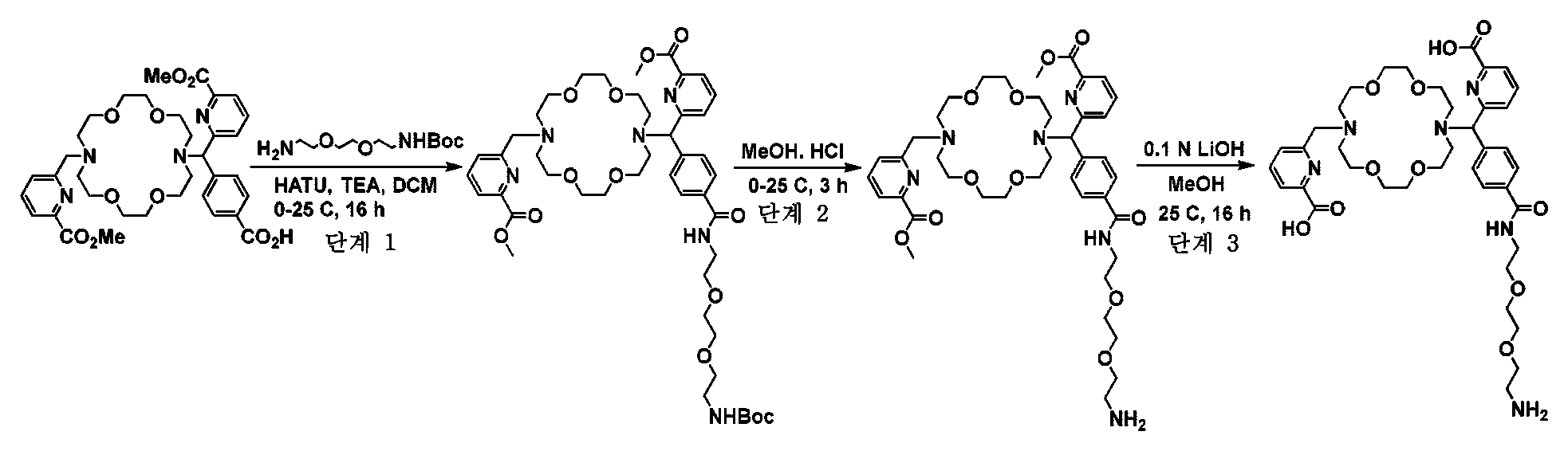
단계 1: 25 mL 3구 둥근 바닥 플라스크에, 질소 분위기 하 0℃에서 교반 바, 4-((6-(메톡시카르보닐)피리딘-2-일)(16-((6-(메톡시카르보닐)피리딘-2-일)메틸)-1,4,10,13-테트라옥사-7,16-디아자시클로옥타데칸-7-일)메틸)벤조산(0.40 g, 0.60 mmol), tert-부틸(2-(2-(2-아미노에톡시)에톡시)에틸)카르바메이트(0.15 g, 0.60 mmol), 트리에틸아민(0.18 g, 0.76 mmol), HATU(0.33 g, 0.90 mmol) 및 DCM(4.0 mL)을 첨가하였다. 혼합물을 실온에서 밤새 교반하고, 물(10 mL)로 희석하고, 디클로로메탄(10 mL × 3)으로 추출하였다. 조합한 추출물을 10% NaHCO3 수용액(10 mL)과 염수(10 mL)로 세정하고, 무수 Na2SO4 상에서 건조시키고, 여과하고, 건조될 때까지 농축시켜 농축물을 수득하고, 이를 실리카겔 크로마토그래피(0→10% MeOH/DCM)를 통해 정제하여 메틸 6-((4-((2,2-디메틸-4-옥소-3,8,11-트리옥사-5-아자트리데칸-13-일)카르바모일)페닐)(16-((6-(메톡시카르보닐)피리딘-2-일)메틸)-1,4,10,13-테트라옥사-7,16-디아자시클로옥타데칸-7-일)메틸)피콜리네이트(0.18 g)를 수득하였다. Step 1 : In a 25 mL 3-necked round-bottom flask, under nitrogen atmosphere at 0 °C, a stir bar, 4-((6-(methoxycarbonyl)pyridin-2-yl)(16-((6-(methoxycarbonyl)pyridin-2-yl)methyl)-1,4,10,13-tetraoxa-7,16-diazacyclooctadecan-7-yl)methyl)benzoic acid (0.40 g, 0.60 mmol), tert -butyl(2-(2-(2-aminoethoxy)ethoxy)ethyl)carbamate (0.15 g, 0.60 mmol), triethylamine (0.18 g, 0.76 mmol), HATU (0.33 g, 0.90 mmol), and DCM (4.0 mL) were added. The mixture was stirred at room temperature overnight, diluted with water (10 mL), and extracted with dichloromethane (10 mL × 3). The combined extracts were washed with 10% NaHCO 3 aqueous solution (10 mL) and brine (10 mL), dried over anhydrous Na 2 SO 4 , filtered and concentrated to dryness to give the concentrate, which was purified through silica gel chromatography (0→10% MeOH/DCM) to give methyl 6-((4-((2,2-dimethyl-4-oxo-3,8,11-trioxa-5-azatridecan-13-yl)carbamoyl)phenyl)(16-((6-(methoxycarbonyl)pyridin-2-yl)methyl)-1,4,10,13-tetraoxa-7,16-diazacyclooctadecan-7-yl)methyl)picolinate (0.18 g).
단계 2: 10 mL 1구 둥근 바닥 플라스크에, 0℃에서 교반 바, 메틸 6-((4-((2,2-디메틸-4-옥소-3,8,11-트리옥사-5-아자트리데칸-13-일)카르바모일)페닐)(16-((6-(메톡시카르보닐)피리딘-2-일)메틸)-1,4,10,13-테트라옥사-7,16-디아자시클로옥타데칸-7-일)메틸)피콜리네이트(0.18 g, 0.20 mmol), MeOH(1.8 mL) 및 메탄올 중 HCl(4 M, 1.0 mL, 4.0 mmol)을 첨가한 후, 실온에 이르게 하고, 2시간 동안 교반하였다. 휘발성 물질을 진공에서 제거하여 메틸 6-((4-((2-(2-(2-아미노에톡시)에톡시)에틸)카르바모일)페닐)(16-((6-(메톡시카르보닐)피리딘-2-일)메틸)-1,4,10,13-테트라옥사-7,16-디아자시클로옥타데칸-7-일)메틸)피콜리네이트(0.15 g)를 수득하고, 이를 정제 없이 사용하였다. Step 2 : In a 10 mL single-necked round-bottom flask, at 0 °C, add a stir bar, methyl 6-((4-((2,2-dimethyl-4-oxo-3,8,11-trioxa-5-azatridecan-13-yl)carbamoyl)phenyl)(16-((6-(methoxycarbonyl)pyridin-2-yl)methyl)-1,4,10,13-tetraoxa-7,16-diazacyclooctadecan-7-yl)methyl)picolinate (0.18 g, 0.20 mmol), MeOH (1.8 mL) and HCl in methanol (4 M, 1.0 mL, 4.0 mmol), and the mixture was allowed to reach room temperature and stirred for 2 h. The volatiles were removed in vacuo to give methyl 6-((4-((2-(2-(2-aminoethoxy)ethoxy)ethyl)carbamoyl)phenyl)(16-((6-(methoxycarbonyl)pyridin-2-yl)methyl)-1,4,10,13-tetraoxa-7,16-diazacyclooctadecan-7-yl)methyl)picolinate (0.15 g), which was used without purification.
단계 3: 8 mL 반응 바이알에, 실온에서 교반 바, 메틸 6-((4-((2-(2-(2-아미노에톡시)에톡시)에틸)카르바모일)페닐)(16-((6-(메톡시카르보닐)피리딘-2-일)메틸)-1,4,10,13-테트라옥사-7,16-디아자시클로옥타데칸-7-일)메틸)피콜리네이트(0.1 g, 0.1 mmol), LiOH 수용액(3 mL, 0.1 N, 0.3 mmol) 및 MeOH(1.0 mL)을 첨가하고, 밤새 교반하였다. 반응 혼합물을 아세트산을 이용하여 pH 약 6.5로 조정한 후, 진공 하 실온에서 건조될 때까지 농축시켜 농축물을 수득하고, 이를 분취용 HPLC(컬럼: XBRIDGE C18 19 × 150 mm, 5.0 μm; 이동상: 물/ACN 중 0.1% TFA; 유량: 15.0 mL/분)를 통해 정제하여 6-((4-((2-(2-(2-아미노에톡시)에톡시)에틸)카르바모일)페닐)(16-((6-카르복시피리딘-2-일)메틸)-1,4,10,13-테트라옥사-7,16-디아자시클로옥타데칸-7-일)메틸)피콜린산(40 mg)을 수득하였다. LC-MS APCI: C39H54N6O11에 대한 계산치; 782.39; 측정치 m/z [M+H]+ 783.0. Step 3 : In an 8 mL reaction vial, at room temperature with a stir bar, add methyl 6-((4-((2-(2-(2-aminoethoxy)ethoxy)ethyl)carbamoyl)phenyl)(16-((6-(methoxycarbonyl)pyridin-2-yl)methyl)-1,4,10,13-tetraoxa-7,16-diazacyclooctadecan-7-yl)methyl)picolinate (0.1 g, 0.1 mmol), aqueous LiOH solution (3 mL, 0.1 N, 0.3 mmol), and MeOH (1.0 mL), and stir overnight. The reaction mixture was adjusted to pH about 6.5 with acetic acid, concentrated to dryness at room temperature under vacuum to give the concentrate, which was purified by preparative HPLC (column: XBRIDGE C18 19 × 150 mm, 5.0 μm; mobile phase: 0.1% TFA in water/ACN; flow rate: 15.0 mL/min) to give 6-((4-((2-(2-(2-aminoethoxy)ethoxy)ethyl)carbamoyl)phenyl)(16-((6-carboxypyridin-2-yl)methyl)-1,4,10,13-tetraoxa-7,16-diazacyclooctadecan-7-yl)methyl)picolinic acid (40 mg). LC-MS APCI: calcd for C 39 H 54 N 6 O 11 ; 782.39; Measured m/z [M+H]+ 783.0.
실시예 11Example 11
6,6'-((18-(((2-(2-아미노에톡시)에틸)티오)메틸)테트라데카히드로-4H,13H,17H-시클로펜타[b][1,4,10,13]테트라옥사[7,16]디아자시클로옥타데신-4,13-디일)비스(메틸렌))디피콜린산6,6'-((18-(((2-(2-aminoethoxy)ethyl)thio)methyl)tetradecahydro- 4H , 13H , 17H -cyclopenta[ b ][1,4,10,13]tetraoxa[7,16]diazacyclooctadecine-4,13-diyl)bis(methylene))dipicolinic acid
및and
실시예 12Example 12
N-아실-DBCO 태깅된 6,6'-((18-(((2-(2-아미노에톡시)에틸)티오)메틸)테트라데카히드로-4H,13H,17H-시클로펜타[b][1,4,10,13]테트라옥사[7,16]디아자시클로옥타데신-4,13-디일)비스(메틸렌))디피콜린산 N -Acyl-DBCO tagged 6,6'-((18-(((2-(2-aminoethoxy)ethyl)thio)methyl)tetradecahydro- 4H , 13H , 17H -cyclopenta[ b ][1,4,10,13]tetraoxa[7,16]diazacyclooctadecine-4,13-diyl)bis(methylene))dipicolinic acid

반응식 10

단계 1: 3000 mL 3구 둥근 바닥 플라스크에, 0℃에서 교반 바, 메틸 시클로펜트-3-엔-1-카르복실레이트(25.0 g, 198 mmol), THF(600 mL), 메탄올(12.6 g, 16.0 mL, 397 mmol) 및 리튬 보로히드라이드(198 mL, THF 중 2.0 M, 397 mmol)를 첨가하였다. 첨가가 완료되면, 반응 혼합물을 70℃에서 6시간 동안 교반하였다. 이어서, 반응 혼합물을 실온까지 냉각시키고, 얼음물(250 mL)로 서서히 처리하고, 0℃까지 추가로 냉각시키고, 1.5 N HCl(pH 약 2)을 이용하여 pH 약 2에 이르게 한 후, DCM(1000 mL × 3)으로 추출하였다. 조합한 추출물을 물(500 mL)로 세정하고, 무수 Na2SO4 상에서 건조시키고, 여과하고, 건조될 때까지 농축시켜 농축물을 수득하고, 이를 실리카겔 크로마토그래피(50%→80% EtOAc/석유 에테르)로 정제하여 시클로펜트-3-엔-1-일메탄올(13.8 g)을 수득하였다. Step 1 : In a 3000 mL 3-necked round bottom flask, at 0 °C, was added a stir bar, methyl cyclopent-3-ene-1-carboxylate (25.0 g, 198 mmol), THF (600 mL), methanol (12.6 g, 16.0 mL, 397 mmol), and lithium borohydride (198 mL, 2.0 M in THF, 397 mmol). After the addition was complete, the reaction mixture was stirred at 70 °C for 6 h. The reaction mixture was then cooled to room temperature, slowly treated with ice-water (250 mL), further cooled to 0 °C, and adjusted to pH ~2 with 1.5 N HCl (pH ~2), and extracted with DCM (1000 mL × 3). The combined extracts were washed with water (500 mL), dried over anhydrous Na 2 SO 4 , filtered and concentrated to dryness to give the concentrate, which was purified by silica gel chromatography (50% → 80% EtOAc/petroleum ether) to give cyclopent-3-en-1-ylmethanol (13.8 g).
단계 2: DMF(50 mL) 중 수소화소듐(6.69 g, 미네랄 오일 중 60%, 167 mmol)의 현탁액이 함유된 1000 mL 3구 둥근 바닥 플라스크에, 질소 분위기 하 0℃에서 시클로펜트-3-엔-1-일메탄올(13.7 g, 139 mmol)과 DMF(50 mL)로 이루어진 용액을 30분에 걸쳐 적가하였다. 첨가가 완료되면, 반응 혼합물을 서서히 실온까지 가온시키고, 30분 동안 교반을 지속하였다. 이어서, 혼합물을 다시 0℃까지 냉각시키고, 벤질 브로마이드(19.8 g, 167 mmol)와 DMF(50 mL)로 이루어진 용액을 15분에 걸쳐 적가하는 방식으로 처리하였다. 첨가가 완료되면, 반응 혼합물을 서서히 실온까지 가온시킨 후, 16시간 동안 교반하였다. 반응 혼합물을 NH4Cl 포화 수용액(50 mL)으로 서서히 처리한 후, 에틸 아세테이트(1000 mL × 3)로 추출하였다. 조합한 추출물을 물(500 mL × 3)로 세정하고, 무수 Na2SO4 상에서 건조시키고, 여과하고, 건조될 때까지 농축시켜 농축물을 수득하였다. 농축물을 실리카겔 크로마토그래피(0→20% EtOAc/석유 에테르)로 정제하여 ((시클로펜트-3-엔-1-일메톡시)메틸)벤젠(21.0 g)을 수득하였다. Step 2 : To a 1000 mL 3-necked round-bottom flask containing a suspension of sodium hydride (6.69 g, 60% in mineral oil, 167 mmol) in DMF (50 mL) was added dropwise a solution of cyclopent-3-en-1-ylmethanol (13.7 g, 139 mmol) in DMF (50 mL) at 0 °C under a nitrogen atmosphere over 30 min. Upon completion of the addition, the reaction mixture was slowly warmed to room temperature and stirred for 30 min. The mixture was then cooled again to 0 °C and treated with a solution of benzyl bromide (19.8 g, 167 mmol) in DMF (50 mL) dropwise added over 15 min. Upon completion of the addition, the reaction mixture was slowly warmed to room temperature and stirred for 16 h. The reaction mixture was slowly treated with saturated NH 4 Cl aqueous solution (50 mL), then extracted with ethyl acetate (1000 mL × 3). The combined extracts were washed with water (500 mL × 3), dried over anhydrous Na 2 SO 4 , filtered and concentrated to dryness to obtain a concentrate. The concentrate was purified by silica gel chromatography (0 → 20% EtOAc/petroleum ether) to give ((cyclopent-3-en-1-ylmethoxy)methyl)benzene (21.0 g).
단계 3: 1000 mL 3구 둥근 바닥 플라스크에, 0℃에서 교반 바, NMO(38.0 g, H2O 중 50 중량%, 158 mmol), THF(180 mL) 및 사산화오스뮴(16.2 g, 3.21 mL, t-부탄올 중 2.5 중량%, 0.158 mmol)을 첨가하였다. 반응 혼합물을 실온에 이르게 하고, 10분 동안 교반하고, 다시 0℃까지 냉각시켰다. 냉각되면, 혼합물을 ((시클로펜트-3-엔-1-일메톡시)메틸)벤젠(20.0 g, 158 mmol)과 THF(180 mL)의 용액을 15분에 걸쳐 적가하는 방식으로 처리하였다. 반응액을 실온에 이르게 하고, 16시간 동안 교반한 후, NaHCO3 포화 수용액(100 mL)으로 서서히 처리하고, DCM(1000 mL × 3)으로 추출하였다. 조합한 추출물을 물(500 mL)로 세정하고, 무수 Na2SO4 상에서 건조시키고, 여과하고, 건조될 때까지 농축시켜 농축물을 수득하고, 이를 실리카겔 크로마토그래피(0→20% EtOAc/석유 에테르)를 통해 정제하여 4-((벤질옥시)메틸)시클로펜탄-1,2-디올의 이성질체 혼합물을 무색 오일로 수득하였다. 이성질체를 SFC(기기: PIC 100; 컬럼: Chiralpak OXH(250 × 30) mm, 5 μm; 이동상: CO2:IPA 중 0.5% 이소프로필 아민(60:40); 총 유량: 70 g/분; 배압: 100 bar; 파장: 220 nm; 사이클 시간: 8.0분)를 통해 분리하여 4-((벤질옥시)메틸)시클로펜탄-1,2-디올의 두 가지 시스-1,2 이성질체(첫 번째 용리된 이성질체(10 g)와 두 번째 용리된 이성질체(5 g))를 모두 수득하였다. Step 3 : In a 1000 mL 3-necked round bottom flask, at 0 °C, a stir bar, NMO (38.0 g, 50 wt% in H 2 O, 158 mmol), THF (180 mL), and osmium tetroxide (16.2 g, 3.21 mL, 2.5 wt% in t -butanol, 0.158 mmol) were added. The reaction mixture was allowed to reach room temperature, stirred for 10 min, and cooled to 0 °C again. Once cooled, the mixture was treated dropwise with a solution of ((cyclopent-3-en-1-ylmethoxy)methyl)benzene (20.0 g, 158 mmol) in THF (180 mL) over 15 min. The reaction mixture was allowed to reach room temperature and stirred for 16 h, then slowly treated with saturated NaHCO 3 aqueous solution (100 mL) and extracted with DCM (1000 mL × 3). The combined extracts were washed with water (500 mL), dried over anhydrous Na 2 SO 4 , filtered and concentrated to dryness to obtain the concentrate, which was purified through silica gel chromatography (0 → 20% EtOAc/petroleum ether) to give an isomer mixture of 4-((benzyloxy)methyl)cyclopentane-1,2-diol as a colorless oil. The isomers were separated via SFC (instrument:
단계 4: DMF(60 mL) 중 수소화소듐(8.62 g, 미네랄 오일 중 60%, 225 mmol)의 현탁액이 함유된 250 mL 3구 둥근 바닥 플라스크에, 질소 분위기 하 0℃에서 4-((벤질옥시)메틸)시클로펜탄-1,2-디올의 첫 번째 용리된 이성질체(10.0 g, 45.0 mmol)와 DMF(60 mL)로 이루어진 용액을 1시간에 걸쳐 적가하였다. 첨가가 완료되면, 반응 혼합물 실온에 이르게 하고, 30분 동안 교반하였다. 이어서, 혼합물을 다시 0℃까지 냉각시키고, 2-(2-브로모에톡시)테트라히드로-2H-피란(47.0 g, 225 mmol)과 DMF(60 mL)로 이루어진 용액을 15분에 걸쳐 적가하는 방식으로 처리하였다. 첨가가 완료되면, 반응 혼합물을 서서히 실온까지 가온시키고, 2시간 동안 교반하였다. 이어서, 혼합물을 NH4Cl 포화 수용액(50 mL)으로 서서히 처리한 후, 에틸 아세테이트(500 mL × 3)로 추출하였다. 조합한 추출물을 물(500 mL)로 세정하고, 무수 Na2SO4 상에서 건조시키고, 여과하고, 건조될 때까지 농축시켜 오일을 수득하고, 이를 실리카겔 크로마토그래피(0→30% EtOAc/석유 에테르)로 정제하여 2,2'-((((4-((벤질옥시)메틸)시클로펜탄-1,2-디일)비스(옥시))비스(에탄-2,1-디일))비스(옥시))비스(테트라히드로-2H-피란)(21.0 g)을 수득하였다. Step 4 : To a 250 mL 3-necked round-bottom flask containing a suspension of sodium hydride (8.62 g, 60% in mineral oil, 225 mmol) in DMF (60 mL) was added dropwise a solution of the first eluted isomer of 4-((benzyloxy)methyl)cyclopentane-1,2-diol (10.0 g, 45.0 mmol) in DMF (60 mL) at 0 °C under a nitrogen atmosphere over 1 h. Upon complete addition, the reaction mixture was allowed to reach room temperature and stirred for 30 min. The mixture was then cooled again to 0 °C and treated with a solution of 2-(2-bromoethoxy)tetrahydro-2 H -pyran (47.0 g, 225 mmol) in DMF (60 mL) dropwise over 15 min. Upon completion of the addition, the reaction mixture was slowly warmed to room temperature and stirred for 2 h. The mixture was then slowly treated with saturated NH 4 Cl aqueous solution (50 mL), followed by extraction with ethyl acetate (500 mL × 3). The combined extracts were washed with water (500 mL), dried over anhydrous Na 2 SO 4 , filtered and concentrated to dryness to give an oil, which was purified by silica gel chromatography (0 → 30% EtOAc/petroleum ether) to give 2,2'-((((4-((benzyloxy)methyl)cyclopentane-1,2-diyl)bis(oxy))bis(ethane-2,1-diyl))bis(oxy))bis(tetrahydro-2 H -pyran) (21.0 g).
단계 5: 1000 mL 3구 둥근 바닥 플라스크에, 교반 바, 2,2'-((((4-((벤질옥시)메틸)시클로펜탄-1,2-디일)비스(옥시))비스(에탄-2,1-디일))비스(옥시))비스(테트라히드로-2H-피란)(29.0 g, 61.0 mmol), MeOH(200 mL) 및 1,4-디옥산 중 HCl(4 M, 3.0 mL, 12.0 mmol)을 첨가한 후, 환류에서 1시간 동안 가열하였다. 이어서, 플라스크를 실온까지 냉각시키고, 휘발성 물질을 진공에서 제거하여 2,2'-((4-((벤질옥시)메틸)시클로펜탄-1,2-디일)비스(옥시))비스(에탄-1-올)(20.0 g)을 잔류물로 수득하고, 이를 정제 없이 사용하였다. Step 5: In a 1000 mL 3-necked round-bottomed flask, a stir bar, 2,2'-((((4-((benzyloxy)methyl)cyclopentane-1,2-diyl)bis(oxy))bis(ethane-2,1-diyl))bis(oxy))bis(tetrahydro-2 H -pyran) (29.0 g, 61.0 mmol), MeOH (200 mL) and HCl in 1,4-dioxane (4 M, 3.0 mL, 12.0 mmol) were added and heated at reflux for 1 h. The flask was then cooled to room temperature and the volatiles were removed in vacuo to give 2,2'-((4-((benzyloxy)methyl)cyclopentane-1,2-diyl)bis(oxy))bis(ethane-1-ol) (20.0 g) as a residue, which was used without purification.
단계 6: 1000 mL 둥근 바닥 플라스크에, 질소 분위기 하에서 교반 바, 2,2'-((4-((벤질옥시)메틸)시클로펜탄-1,2-디일)비스(옥시))비스(에탄-1-올)(20.0 g, 64.4 mmol), DCM(200 mL) 및 트리에틸아민(32.6 mL, 322 mmol)을 첨가하고, 생성된 혼합물을 10℃까지 냉각시켰다. 이어서, 혼합물을 pTsCl(36.9 g, 193 mmol)를 적가하는 방식으로 처리한 후, 실온에 이르게 하였다. 첨가가 완료되면, 반응 혼합물을 16시간 동안 교반하였으며, 교반하는 동안 침전이 형성되었다. 이어서, 혼합물을 DCM(500 mL)으로 희석하고, 냉각된 HCl 수용액(1 M, 500 mL × 3)과 얼음 냉각수(500 mL × 2)로 세정하고, 무수 Na2SO4 상에서 건조시키고, 여과하고, 건조될 때까지 농축시켜 잔류물을 수득하고, 이를 실리카겔 크로마토그래피(0→30% EtOAc/석유 에테르)를 통해 정제하여 ((4-((벤질옥시)메틸)시클로펜탄-1,2-디일)비스(옥시))비스(에탄-2,1-디일)비스(4-메틸벤젠설포네이트)(26.0 g)를 수득하였다. Step 6 : In a 1000 mL round bottom flask, under nitrogen atmosphere, a stir bar was added 2,2'-((4-((benzyloxy)methyl)cyclopentane-1,2-diyl)bis(oxy))bis(ethan-1-ol) (20.0 g, 64.4 mmol), DCM (200 mL) and triethylamine (32.6 mL, 322 mmol), and the resulting mixture was cooled to 10 °C. The mixture was then treated dropwise with pTsCl (36.9 g, 193 mmol) and allowed to reach room temperature. Upon completion of the addition, the reaction mixture was stirred for 16 h, during which a precipitate formed. The mixture was then diluted with DCM (500 mL), washed with cooled HCl aqueous solution (1 M, 500 mL × 3) and ice-cold water (500 mL × 2), dried over anhydrous Na 2 SO 4 , filtered and concentrated to dryness to obtain the residue, which was purified via silica gel chromatography (0 → 30% EtOAc/petroleum ether) to give ((4-((benzyloxy)methyl)cyclopentane-1,2-diyl)bis(oxy))bis(ethane-2,1-diyl)bis(4-methylbenzenesulfonate) (26.0 g).
단계 7: 2000 mL 3구 둥근 바닥 플라스크에, 질소 분위기 하에서 교반 바, N,N'-((에탄-1,2-디일비스(옥시))비스(에탄-2,1-디일))비스(4-메틸벤젠설폰아미드)(21.0 g, 42.0 mmol), Cs2CO3(41.3 g, 126 mmol) 및 무수 DMF(250 mL)를 첨가하고, 생성된 불균일 혼합물을 실온에서 1.5시간 동안 교반하였다. 이어서, 혼합물을 ((4-((벤질옥시)메틸)시클로펜탄-1,2-디일)비스(옥시))비스(에탄-2,1-디일)비스(4-메틸벤젠설포네이트)(26.0 g, 42.0 mmol)와 DMF(250 mL)로 이루어진 용액을 2시간에 걸쳐 적가하는 방식으로 처리하였다. 교반을 20시간 동안 지속한 후, 혼합물을 진공에서 건조될 때까지 농축시켜 페이스트와 같은 고체를 수득하였다. 페이스트를 DCM(1000 mL)에 현탁시키고, 30분 동안 교반하고, 진공 여과를 통해 여과하였다. 여과액을 진공에서 건조될 때까지 농축시켜 농축물을 수득하고, 이를 실리카겔 크로마토그래피(0→40% EtOAc/석유 에테르)로 정제하여 18-((벤질옥시)메틸)-4,13-디토실테트라데카히드로-2H,11H,17H-시클로펜타[b][1,4,10,13]테트라옥사[7,16]디아자시클로옥타데신(24 g)을 수득하였다. Step 7 : In a 2000 mL 3-necked round-bottomed flask, under a nitrogen atmosphere, a stir bar, N , N' -((ethane-1,2-diylbis(oxy))bis(ethane-2,1-diyl))bis(4-methylbenzenesulfonamide)(21.0 g, 42.0 mmol), Cs 2 CO 3 (41.3 g, 126 mmol) and anhydrous DMF (250 mL) were added, and the resulting heterogeneous mixture was stirred at room temperature for 1.5 h. Then, the mixture was treated dropwise with a solution of ((4-((benzyloxy)methyl)cyclopentane-1,2-diyl)bis(oxy))bis(ethane-2,1-diyl)bis(4-methylbenzenesulfonate)(26.0 g, 42.0 mmol) and DMF (250 mL) over 2 h. After stirring for 20 h, the mixture was concentrated in vacuo to dryness to obtain a solid like a paste. The paste was suspended in DCM (1000 mL), stirred for 30 min and filtered through vacuum filtration. The filtrate was concentrated in vacuo to dryness to obtain the concentrate, which was purified by silica gel chromatography (0→40% EtOAc/petroleum ether) to give 18-((benzyloxy)methyl)-4,13-ditosyltetradecahydro-2 H ,11 H ,17 H -cyclopenta[ b ][1,4,10,13]tetraoxa[7,16]diazacyclooctadecine (24 g).
단계 8: 교반 바와 18-((벤질옥시)메틸)-4,13-디토실테트라데카히드로-2H,11H,17H-시클로펜타[b][1,4,10,13]테트라옥사[7,16]디아자시클로옥타데신(24.0 g, 32.8 mmol)이 함유된 500 mL 둥근 바닥 플라스크에, 질소 분위기 하에서 HBr의 HOAc 용액(50%, 112 mL, 695 mmol)을 첨가하였다. 혼합물을 균질해질 때까지 실온에서 교반한 후, 페놀(16.3 g, 174 mmol)로 처리하였다. 이어서, 반응 혼합물을 60℃에서 6시간 동안 가열한 후, 실온까지 냉각시키고, 진공에서 건조될 때까지 농축시켜 농축물을 수득하였다. 농축물을 역상 컬럼 크로마토그래피(컬럼: Revelries C18-330 g; 이동상 A: 물 중 0.1% TFA, 이동상 B: 아세토니트릴; 유량: 60 mL/분)를 통해 정제하여 (테트라데카히드로-2H,11H,17H-시클로펜타[b][1,4,10,13]테트라옥사[7,16]디아자시클로옥타데신-18-일)메틸 아세테이트(8.0 g)를 수득하였다. Step 8: To a 500 mL round bottom flask containing 18-((benzyloxy)methyl)-4,13-ditosyltetradecahydro-2 H ,11 H ,17 H -cyclopenta[ b ][1,4,10,13]tetraoxa[7,16]diazacyclooctadecine (24.0 g, 32.8 mmol) with a stir bar was added a HOAc solution of HBr (50%, 112 mL, 695 mmol) under nitrogen atmosphere. The mixture was stirred at room temperature until homogeneous and then treated with phenol (16.3 g, 174 mmol). The reaction mixture was then heated at 60 °C for 6 h, cooled to room temperature and concentrated to dryness in vacuo to afford the concentrate. The concentrate was purified by reverse-phase column chromatography (Column: Revelries C18-330 g; Mobile phase A: 0.1% TFA in water, Mobile phase B: acetonitrile; Flow rate: 60 mL/min) to afford (tetradecahydro-2 H ,11 H ,17 H -cyclopenta[ b ][1,4,10,13]tetraoxa[7,16]diazacyclooctadecin-18-yl)methyl acetate (8.0 g).
단계 9: 500 mL 3구 둥근 바닥 플라스크에, 질소 분위기 하에서 교반 바, (테트라데카히드로-2H,11H,17H-시클로펜타[b][1,4,10,13]테트라옥사[7,16]디아자시클로옥타데신-18-일)메틸 아세테이트(8.0 g, 21 mmol), 메틸 6-(클로로메틸)피콜리네이트(12.2 g, 53.2 mmol), Na2CO3(11.1 g, 106 mmol) 및 아세토니트릴(100 mL)을 첨가하고, 생성된 불균일 혼합물을 질소 분위기 하 90℃에서 16시간 동안 가열하였다. 이어서, 생성된 혼합물을 실온까지 냉각시키고, Celite® 패드를 통해 여과하고, 여과액을 진공에서 건조될 때까지 농축시켜 농축물을 수득하였다. 농축물을 실리카겔 크로마토그래피(0→10% MeOH/DCM)에 적용하여 디메틸 6,6'-((18-(아세톡시메틸)테트라데카히드로-4H,13H,17H-시클로펜타[b][1,4,10,13]테트라옥사[7,16]디아자시클로옥타데신-4,13-디일)비스(메틸렌))디피콜리네이트(5.0 g)를 수득하였다. Step 9: In a 500 mL 3-necked round bottom flask, under nitrogen atmosphere, a stir bar, (tetradecahydro- 2H , 11H , 17H -cyclopenta[ b ][1,4,10,13]tetraoxa[7,16]diazacyclooctadecin-18-yl)methyl acetate (8.0 g, 21 mmol), methyl 6-(chloromethyl)picolinate (12.2 g, 53.2 mmol), Na2CO3 (11.1 g, 106 mmol) and acetonitrile (100 mL) were added and the resulting heterogeneous mixture was heated at 90°C for 16 h under nitrogen atmosphere. The resulting mixture was then cooled to room temperature, filtered through a Celite® pad and the filtrate was concentrated to dryness in vacuo to obtain the concentrate. The concentrate was purified by silica gel chromatography (0→10% MeOH/DCM) to give dimethyl 6,6'-((18-(acetoxymethyl)tetradecahydro-4 H ,13 H ,17 H -cyclopenta[ b ][1,4,10,13]tetraoxa[7,16]diazacyclooctadecine-4,13-diyl)bis(methylene))dipicolinate (5.0 g).
단계 10: 250 mL 둥근 바닥 플라스크에, 질소 분위기 하에서 교반 바, 디메틸 6,6'-((18-(아세톡시메틸)테트라데카히드로-4H,13H,17H-시클로펜타[b][1,4,10,13]테트라옥사[7,16]디아자시클로옥타데신-4,13-디일)비스(메틸렌))디피콜리네이트(5.0 g, 7.4 mmol), K2CO3(0.10 g, 0.74 mmol) 및 메탄올(50 mL)을 첨가하고, 생성된 혼합물을 실온에서 10분 동안 교반하였다. 이어서, 혼합물을 진공에서 건조될 때까지 농축시키고, 생성된 잔류물을 실리카겔 크로마토그래피(0→10% MeOH/DCM)로 정제하여 6,6'-((18-(히드록시메틸)테트라데카히드로-4H,13H,17H-시클로펜타[b][1,4,10,13]테트라옥사[7,16]디아자시클로옥타데신-4,13-디일)비스(메틸렌))디피콜리네이트(3.0 g)를 수득하였다. Step 10: In a 250 mL round bottom flask, under nitrogen atmosphere, a stir bar, dimethyl 6,6'-((18-(acetoxymethyl)tetradecahydro-4 H ,13 H ,17 H -cyclopenta[ b ][1,4,10,13]tetraoxa[7,16]diazacyclooctadecine-4,13-diyl)bis(methylene))dipicolinate (5.0 g, 7.4 mmol), K 2 CO 3 (0.10 g, 0.74 mmol) and methanol (50 mL) were added, and the resulting mixture was stirred at room temperature for 10 min. The mixture was then concentrated to dryness in vacuo, and the resulting residue was purified by silica gel chromatography (0→10% MeOH/DCM) to afford 6,6'-((18-(hydroxymethyl)tetradecahydro-4 H ,13 H ,17 H -cyclopenta[ b ][1,4,10,13]tetraoxa[7,16]diazacyclooctadecine-4,13-diyl)bis(methylene))dipicolinate (3.0 g).
단계 11: 100 mL 3구 둥근 바닥 플라스크에, 질소 분위기 하에서 교반 바, 6,6'-((18-(히드록시메틸)테트라데카히드로-4H,13H,17H-시클로펜타[b][1,4,10,13]테트라옥사[7,16]디아자시클로옥타데신-4,13-디일)비스(메틸렌))디피콜리네이트(2.0 g, 3.1 mmol), DCM(20 mL) 및 트리에틸아민(1.2 g, 9.5 mmol)을 첨가하고, 생성된 혼합물을 10℃까지 냉각시켰다. 혼합물을 MsCl(0.48 g, 6.3 mmol)를 나누어 첨가하는 방식으로 처리하고, 첨가가 완료되면, 반응 용기를 실온에 이르게 하고, 30분 동안 교반하였으며, 교반하는 동안 침전이 형성되었다. 이어서, 불균일 혼합물을 DCM(50 mL)으로 희석하고, 냉각된 HCl 수용액(1 M, 50 mL × 3)과 얼음 냉각수(50 mL × 2)로 세정하고, 무수 Na2SO4 상에서 건조시키고, 여과하고, 건조될 때까지 농축시켜 끈적한 고체를 수득하였다. 끈적한 고체를 중성 알루미나 컬럼 크로마토그래피(0→10% MeOH/DCM)로 정제하여 디메틸 6,6'-((18-(((메틸설포닐)옥시)메틸)테트라데카히드로-4H,13H,17H-시클로펜타[b][1,4,10,13]테트라옥사[7,16]디아자시클로옥타데신-4,13-디일)비스(메틸렌))디피콜리네이트(1.5 g)를 수득하였다. Step 11: In a 100 mL 3-necked round bottom flask, under nitrogen atmosphere, a stir bar, 6,6'-((18-(hydroxymethyl)tetradecahydro-4 H ,13 H ,17 H -cyclopenta[ b ][1,4,10,13]tetraoxa[7,16]diazacyclooctadecine-4,13-diyl)bis(methylene))dipicolinate (2.0 g, 3.1 mmol), DCM (20 mL) and triethylamine (1.2 g, 9.5 mmol) were added and the resulting mixture was cooled to 10 °C. The mixture was treated by portionwise addition of MsCl (0.48 g, 6.3 mmol) and after complete addition, the reaction vessel was allowed to reach room temperature and stirred for 30 minutes, during which time a precipitate formed. The heterogeneous mixture was then diluted with DCM (50 mL), washed with cooled HCl aqueous solution (1 M, 50 mL × 3) and ice-cold water (50 mL × 2), dried over anhydrous Na 2 SO 4 , filtered, and concentrated to dryness to afford a sticky solid. The sticky solid was purified by neutral alumina column chromatography (0 → 10% MeOH/DCM) to afford dimethyl 6,6'-((18-(((methylsulfonyl)oxy)methyl)tetradecahydro-4 H , 13 H , 17 H -cyclopenta[ b ][1,4,10,13]tetraoxa[7,16]diazacyclooctadecine-4,13-diyl)bis(methylene))dipicolinate (1.5 g).
단계 12: DMF(0.5 mL) 중 수소화소듐(162 mg, 미네랄 오일 중 60%, 4.22 mmol)의 현탁액이 함유된 25 mL 3구 둥근 바닥 플라스크에, 질소 분위기 하 0℃에서 디메틸 6,6'-((18-(((메틸설포닐)옥시)메틸)테트라데카히드로-4H,13H,17H-시클로펜타[b][1,4,10,13]테트라옥사[7,16]디아자시클로옥타데신-4,13-디일)비스(메틸렌))디피콜리네이트(0.69 g, 3.2 mmol)와 DMF(5 mL)로 이루어진 용액을 5분에 걸쳐 적가하였다. 첨가가 완료되면, 반응 혼합물을 실온에 이르게 하고, 15분 동안 교반하였다. 이어서, 반응 혼합물을 다시 0℃까지 냉각시키고, tert-부틸(2-(2-메르캅토에톡시)에틸)카르바메이트(1.50 g, 2.11 mmol)와 DMF(3 mL)로 이루어진 용액을 5분에 걸쳐 적가하는 방식으로 처리하였다. 첨가가 완료되면, 반응 혼합물을 서서히 실온까지 가온시킨 후, 1시간 동안 교반하였다. 이어서, 반응액을 NH4Cl 포화 용액으로 서서히 처리한 후, 에틸 아세테이트(10 mL × 3)로 추출하였다. 조합한 추출물을 물(10 mL)로 세정하고, 무수 Na2SO4 상에서 건조시키고, 여과하고, 건조될 때까지 농축시켜 오일을 수득하였다. 오일을 분취용 HPLC(컬럼: XBRIDGE C18 19 × 150 m) 5.0 μm; 이동상: 물/아세토니트릴 중 0.1% TFA; 유량: 15.0 mL/분)를 통해 정제하여 시클로펜타[b][1,4,10,13]테트라옥사[7,16]디아자시클로옥타데신-4,13-디일)비스(메틸렌))디피콜리네이트(0.2 g)를 수득하였다. Step 12: To a 25 mL 3-necked round-bottom flask containing a suspension of sodium hydride (162 mg, 60% in mineral oil, 4.22 mmol) in DMF (0.5 mL) under a nitrogen atmosphere at 0 °C, was added dropwise a solution of dimethyl 6,6'-((18-(((methylsulfonyl)oxy)methyl)tetradecahydro-4 H , 13 H , 17 H -cyclopenta[ b ][1,4,10,13]tetraoxa[7,16]diazacyclooctadecine-4,13-diyl)bis(methylene))dipicolinate (0.69 g, 3.2 mmol) in DMF (5 mL) over 5 minutes. Upon completion of the addition, the reaction mixture was allowed to reach room temperature and stirred for 15 minutes. The reaction mixture was then cooled back to 0 °C and treated with a solution of tert -butyl (2-(2-mercaptoethoxy) ethyl) carbamate (1.50 g, 2.11 mmol) and DMF (3 mL) dropwise added over 5 min. Upon completion of the addition, the reaction mixture was slowly warmed to room temperature and stirred for 1 h. The reaction mixture was then slowly treated with a saturated solution of NH 4 Cl and extracted with ethyl acetate (10 mL × 3). The combined extracts were washed with water (10 mL), dried over anhydrous Na 2 SO 4 , filtered, and concentrated to dryness to give an oil. The oil was purified by preparative HPLC (column: XBRIDGE C18 19 × 150 m) 5.0 μm; mobile phase: 0.1% TFA in water/acetonitrile; Flow rate: 15.0 mL/min) was purified through the filtration to obtain cyclopenta[ b ][1,4,10,13]tetraoxa[7,16]diazacyclooctadecyne-4,13-diyl)bis(methylene))dipicolinate (0.2 g).
단계 13: 25 mL 1구 둥근 바닥 플라스크에, 0℃에서 교반 바, 시클로펜타[b][1,4,10,13]테트라옥사[7,16]디아자시클로옥타데신-4,13-디일)비스(메틸렌))디피콜리네이트(0.20 g, 0.24 mmol), MeOH(1.0 mL) 및 메탄올 중 HCl(4 M, 1.2 mL, 4.8 mmol)을 첨가하고, 생성된 혼합물을 실온에 이르게 하고, 2시간 동안 교반하였다. 휘발성 물질을 진공에서 제거하여 디메틸 6,6'-((18-(((2-(2-아미노에톡시)에틸)티오)메틸)테트라데카히드로-4H,13H,17H-시클로펜타[b][1,4,10,13]테트라옥사[7,16]디아자시클로옥타데신-4,13-디일)비스(메틸렌))디피콜리네이트(150 mg)를 수득하고, 이를 정제 없이 사용하였다. Step 13 : In a 25 mL single-necked round-bottom flask, at 0 °C, add a stir bar, cyclopenta[ b ][1,4,10,13]tetraoxa[7,16]diazacyclooctadecyne-4,13-diyl)bis(methylene))dipicolinate (0.20 g, 0.24 mmol), MeOH (1.0 mL) and HCl in methanol (4 M, 1.2 mL, 4.8 mmol), and the resulting mixture was allowed to reach room temperature and stirred for 2 h. The volatiles were removed in vacuo to give dimethyl 6,6'-((18-(((2-(2-aminoethoxy)ethyl)thio)methyl)tetradecahydro-4 H ,13 H ,17 H -cyclopenta[ b ][1,4,10,13]tetraoxa[7,16]diazacyclooctadecine-4,13-diyl)bis(methylene))dipicolinate (150 mg), which was used without purification.
단계 14: 8 mL 반응 바이알에, 실온에서 교반 바, 디메틸 6,6'-((18-(((2-(2-아미노에톡시)에틸)티오)메틸)테트라데카히드로-4H,13H,17H-시클로펜타[b][1,4,10,13]테트라옥사[7,16]디아자시클로옥타데신-4,13-디일)비스(메틸렌))디피콜리네이트(40 mg, 0.054 mmol), LiOH 수용액(1.6 mL, 0.1 N, 0.16 mmol) 및 MeOH(0.5 mL)을 첨가하고, 생성된 혼합물을 밤새 교반하였다. 반응 혼합물의 pH를 아세트산을 이용하여 pH 약 6.5로 조정한 후, 진공 하 실온에서 건조될 때까지 농축시키고, 생성된 농축물을 분취용 HPLC(컬럼: XBRIDGE C18 19 × 150 mm 5.0 μm; 이동상: 물/ACN 중 10 mM 암모늄 아세테이트; 유량: 15.0 mL/분)로 정제하여 실시예 11: 6,6'-((18-(((2-(2-아미노에톡시)에틸)티오)메틸)테트라데카히드로-4H,13H,17H-시클로펜타[b][1,4,10,13]테트라옥사[7,16]디아자시클로옥타데신-4,13-디일)비스(메틸렌))디피콜린산(23 mg)을 수득하였다. LC-MS APCI: C34H51N5O9S에 대한 계산치; 705.34; 측정치 m/z [M+H]+ 706.4. Step 14: To an 8 mL reaction vial, at room temperature with a stir bar, dimethyl 6,6'-((18-(((2-(2-aminoethoxy)ethyl)thio)methyl)tetradecahydro-4 H , 13 H , 17 H -cyclopenta[ b ][1,4,10,13]tetraoxa[7,16]diazacyclooctadecine-4,13-diyl)bis(methylene))dipicolinate (40 mg, 0.054 mmol), aqueous LiOH solution (1.6 mL, 0.1 N, 0.16 mmol) and MeOH (0.5 mL) were added, and the resulting mixture was stirred overnight. The pH of the reaction mixture was adjusted to about 6.5 with acetic acid, concentrated to dryness at room temperature under vacuum, and the resulting concentrate was purified by preparative HPLC (column: XBRIDGE C18 19 × 150 mm 5.0 μm; mobile phase: 10 mM ammonium acetate in water/ACN; flow rate: 15.0 mL/min) to afford Example 11: 6,6'-((18-(((2-(2-aminoethoxy)ethyl)thio)methyl)tetradecahydro-4 H , 13 H , 17 H -cyclopenta[ b ][1,4,10,13]tetraoxa[7,16]diazacyclooctadecine-4,13-diyl)bis(methylene))dipicolinic acid (23 mg). LC-MS APCI: calcd for C 34 H 51 N 5 O 9 S; 705.34; found m/z [M+H] + 706.4.
단계 15: 25 mL 3구 둥근 바닥 플라스크에, 질소 분위기 하 0℃에서 교반 바, 디메틸 6,6'-((18-(((2-(2-아미노에톡시)에틸)티오)메틸)테트라데카히드로-4H,13H,17H-시클로펜타[b][1,4,10,13]테트라옥사[7,16]디아자시클로옥타데신-4,13-디일)비스(메틸렌))디피콜리네이트(70 mg, 0.95 mmol), 11,12-디데히드로-γ-옥소디벤즈[b,f]아조신-5(6H)-부탄산(29 mg, 0.95 mmol), 트리에틸아민(29 mg, 0.76 mmol), HATU(54 mg, 0.14 mmol) 및 DCM(0.5 mL)을 첨가하였다. 생성된 혼합물을 실온에 이르게 하고, 밤새 교반하였다. 반응 혼합물을 물(10 mL)로 희석하고, 디클로로메탄(10 mL × 3)으로 추출하였다. 조합한 추출물을 10% NaHCO3 수용액(10 mL)과 염수(10 mL)로 세정하고, 무수 Na2SO4 상에서 건조시키고, 여과하고, 건조될 때까지 농축시켜 오일을 수득하였다. 오일을 실리카겔 크로마토그래피(0→10% MeOH/DCM)를 통해 정제하여 N-아실-DBCO 태깅된 디메틸 6,6'-((18-(((2-(2-아미노에톡시)에틸)티오)메틸)테트라데카히드로-4H,13H,17H-시클로펜타[b][1,4,10,13]테트라옥사[7,16]디아자시클로옥타데신-4,13-디일)비스(메틸렌))디피콜리네이트(10 mg)를 수득하였다. Step 15 : In a 25 mL 3-necked round-bottom flask, under nitrogen atmosphere at 0 °C, a stir bar was added dimethyl 6,6'-((18-(((2-(2-aminoethoxy)ethyl)thio)methyl)tetradecahydro-4 H , 13 H , 17 H -cyclopenta[ b ][1,4,10,13]tetraoxa[7,16]diazacyclooctadecine-4,13-diyl)bis(methylene))dipicolinate (70 mg, 0.95 mmol), 11,12-didehydro-γ-oxodibenz[b,f]azocine-5(6H)-butanoic acid (29 mg, 0.95 mmol), triethylamine (29 mg, 0.76 mmol), HATU (54 mg, 0.14 mmol) and DCM (0.5 mL). The resulting mixture was allowed to reach room temperature and stirred overnight. The reaction mixture was diluted with water (10 mL) and extracted with dichloromethane (10 mL × 3). The combined extracts were washed with 10% aqueous NaHCO 3 solution (10 mL) and brine (10 mL), dried over anhydrous Na 2 SO 4 , filtered, and concentrated to dryness to give an oil. The oil was purified by silica gel chromatography (0→10% MeOH/DCM) to afford N -acyl-DBCO tagged dimethyl 6,6'-((18-(((2-(2-aminoethoxy)ethyl)thio)methyl)tetradecahydro-4 H , 13 H , 17 H -cyclopenta[ b ][1,4,10,13]tetraoxa[7,16]diazacyclooctadecine-4,13-diyl)bis(methylene))dipicolinate (10 mg).
단계 16: 8 mL 반응 바이알에, 실온에서 교반 바, N-아실-DBCO 태깅된 디메틸 6,6'-((18-(((2-(2-아미노에톡시)에틸)티오)메틸)테트라데카히드로-4H,13H,17H-시클로펜타[b][1,4,10,13]테트라옥사[7,16]디아자시클로옥타데신-4,13-디일)비스(메틸렌))디피콜리네이트(10 mg, 0.01 mmol), LiOH 수용액(0.3 mL, 0.1 N, 0.03 mmol) 및 메탄올(0.25 mL)을 첨가하고, 생성된 혼합물을 밤새 교반하였다. 반응 혼합물을 아세트산을 이용하여 pH 약 6.5로 조정하고, 진공 하 실온에서 건조될 때까지 농축시키고, 생성된 농축물을 분취용 HPLC(컬럼: XBRIDGE C18(19 × 150 mm) 5.0 μm; 이동상: 물/ACN 중 10 mM 암모늄 아세테이트; 유량: 15.0 mL/분)로 정제하여 실시예 12: N-아실-DBCO 태깅된 6,6'-((18-(((2-(2-아미노에톡시)에틸)티오)메틸)테트라데카히드로-4H,13H,17H-시클로펜타[b][1,4,10,13]테트라옥사[7,16]디아자시클로옥타데신-4,13-디일)비스(메틸렌))디피콜린산(3 mg)을 수득하였다. Step 16 : In an 8 mL reaction vial, at room temperature with a stir bar, N -Acyl-DBCO tagged dimethyl 6,6'-((18-(((2-(2-aminoethoxy)ethyl)thio)methyl)tetradecahydro-4 H , 13 H , 17 H -cyclopenta[ b ][1,4,10,13]tetraoxa[7,16]diazacyclooctadecine-4,13-diyl)bis(methylene))dipicolinate (10 mg, 0.01 mmol), aqueous LiOH solution (0.3 mL, 0.1 N, 0.03 mmol) and methanol (0.25 mL) were added, and the resulting mixture was stirred overnight. The reaction mixture was adjusted to pH about 6.5 with acetic acid, concentrated to dryness at room temperature under vacuum and the resulting concentrate was purified by preparative HPLC (column: XBRIDGE C18 (19 × 150 mm) 5.0 μm; mobile phase: 10 mM ammonium acetate in water/ACN; flow rate: 15.0 mL/min) to afford Example 12: N -Acyl-DBCO tagged 6,6'-((18-(((2-(2-aminoethoxy)ethyl)thio)methyl)tetradecahydro-4 H , 13 H , 17 H -cyclopenta[ b ][1,4,10,13]tetraoxa[7,16]diazacyclooctadecine-4,13-diyl)bis(methylene))dipicolinic acid (3 mg).
LC-MS APCI: C53H64N6O11S에 대한 계산치; 992.44; 측정치 m/z [M-H]-: 991.4.LC-MS APCI: Calcd for C 53 H 64 N 6 O 11 S; 992.44; Found m/z [MH] - : 991.4.
실시예 13Example 13
6-((16-(1-(6-카르복시피리딘-2-일)-8-이소티오시아네이토옥틸)-1,4,10,13-테트라옥사-7,16-디아자시클로옥타데칸-7-일)메틸)피콜린산6-((16-(1-(6-carboxypyridin-2-yl)-8-isothiocyanatooctyl)-1,4,10,13-tetraoxa-7,16-diazacyclooctadecan-7-yl)methyl)picolinic acid
반응식 11Reaction formula 11

단계 1: 질소를 퍼징하여 불활성 질소 분위기 하에서 유지시킨 500 mL 3구 둥근 바닥 플라스크에, 디클로로메탄(200 mL) 중 8-((tert-부톡시카르보닐)아미노)옥탄산(20.0 g, 77.1 mmol)의 용액, N,O-디메틸히드록실아민(7.0 g, 115 mmol) 및 디이소프로필에틸아민(29.90 g, 231 mmol)을 위치시켰다. 이어서, 0℃에서 교반 하에 HATU(43.9 g, 115 mmol)을 첨가하였다. 생성된 용액을 실온에서 1시간 동안 교반하였다. 이어서, 물(200 mL)을 첨가하여 반응을 켄칭하였다. 생성된 용액을 디클로로메탄(100 mL × 2)으로 추출하였다. 조합한 유기층을 HCl(1 M)(300 mL × 2), NH4CO3 수용액(400 mL × 3) 및 염수(400 mL)로 순차적으로 세정하였다. 이를 무수 Na2SO4 상에서 건조시킨 후, 농축시켜 tert-부틸(8-(메톡시(메틸)아미노)-8-옥소옥틸)카르바메이트(15.4 g, 수율 66%)를 연황색 오일로 수득하였다. Step 1 : In a 500 mL 3-necked round-bottom flask maintained under an inert nitrogen atmosphere and purged with nitrogen, was placed a solution of 8-(( tert -butoxycarbonyl)amino)octanoic acid (20.0 g, 77.1 mmol), N,O-dimethylhydroxylamine (7.0 g, 115 mmol), and diisopropylethylamine (29.90 g, 231 mmol) in dichloromethane (200 mL). Then, HATU (43.9 g, 115 mmol) was added under stirring at 0 °C. The resulting solution was stirred at room temperature for 1 h. The reaction was then quenched by the addition of water (200 mL). The resulting solution was extracted with dichloromethane (100 mL × 2). The combined organic layers were washed sequentially with HCl (1 M) (300 mL × 2), NH 4 CO 3 aqueous solution (400 mL × 3), and brine (400 mL). It was dried over anhydrous Na 2 SO 4 and concentrated to afford tert -butyl (8-(methoxy (methyl) amino)-8-oxooctyl)carbamate (15.4 g, yield 66%) as a pale yellow oil.
단계 2: 질소를 퍼징하여 불활성 질소 분위기 하에서 유지시킨 500 mL 3구 둥근 바닥 플라스크에, THF(400 mL) 중 2,6-디브로모피리딘(23.0 g, 927 mmol)의 용액을 위치시켰다. 이를 -78℃까지 냉각시키고, n-BuLi(60.4 mL, 927 mmol)을 빠르게 적가하였다. 10분 동안 교반한 후, -78℃에서 교반 하에 THF(40 mL) 중 tert-부틸(8-(메톡시(메틸)아미노)-8-옥소옥틸)카르바메이트(14.0 g, 463.5 mmol)를 적가하였다. 생성된 용액을 실온에서 30분 동안 교반하였다. 물(500 mL)을 첨가하여 반응을 켄칭하였다. 생성된 용액을 에틸 아세테이트(200 mL × 2)로 추출하였다. 조합한 유기층을 염수(400 mL)로 세정하고, 무수 황산소듐 상에서 건조시키고, 농축시켜 미정제 생성물을 제공하였다. 실리카겔 상에서의 크로마토그래피(석유 에테르 중 0→10% 에틸 아세테이트)로 정제하여 tert-부틸(8-(6-브로모피리딘-2-일)-8-옥소옥틸)카르바메이트(11.8 g, 수율 50%)를 연황색 고체로 제공하였다. Step 2 : In a 500 mL 3-necked round-bottom flask, purged with nitrogen and maintained under an inert nitrogen atmosphere, was placed a solution of 2,6-dibromopyridine (23.0 g, 927 mmol) in THF (400 mL). It was cooled to -78 °C and n -BuLi (60.4 mL, 927 mmol) was added dropwise rapidly. After stirring for 10 min, tert-butyl(8-(methoxy(methyl)amino)-8-oxooctyl)carbamate (14.0 g, 463.5 mmol) in THF (40 mL) was added dropwise with stirring at -78 °C. The resulting solution was stirred at room temperature for 30 min. The reaction was quenched by the addition of water (500 mL). The resulting solution was extracted with ethyl acetate (200 mL × 2). The combined organic layers were washed with brine (400 mL), dried over anhydrous sodium sulfate, and concentrated to give the crude product. The residue was purified by chromatography on silica gel (0→10% ethyl acetate in petroleum ether) to give tert -butyl(8-(6-bromopyridin-2-yl)-8-oxooctyl)carbamate (11.8 g, yield 50%) as a pale yellow solid.
단계 3: 불활성 질소 분위기로 유지시킨 1 L 고압 반응기에, MeOH(500 mL) 중 tert-부틸(8-(6-브로모피리딘-2-일)-8-옥소옥틸)카르바메이트(11.5 g, 28.8 mmol, 1.0 당량)의 용액, 이어서 Pd(dppf)Cl2(2.1 g, 2.88 mmol)과 TEA(8.7 g, 86.4 mmol)을 위치시켰다. 이어서, CO(20 atm)를 도입하였다. 생성된 용액을 100℃에서 16시간 동안 교반하였다. 반응 용액을 여과하고, 바로 다음 단계에 사용하였다. Step 3 : In a 1 L high pressure reactor maintained under an inert nitrogen atmosphere, a solution of tert -butyl(8-(6-bromopyridin-2-yl)-8-oxooctyl)carbamate (11.5 g, 28.8 mmol, 1.0 equiv) in MeOH (500 mL) was placed, followed by Pd(dppf)Cl 2 (2.1 g, 2.88 mmol) and TEA (8.7 g, 86.4 mmol). Then, CO (20 atm) was introduced. The resulting solution was stirred at 100 °C for 16 h. The reaction solution was filtered and used immediately in the next step.
단계 4: 상기에서 얻은 MeOH 용액을 0℃까지 냉각시키고, NaBH4(1.08 g, 28.8 mmol)를 첨가하였다. 생성된 용액을 실온에서 1시간 동안 교반하였다. NH4CO3 수용액(500 mL)을 첨가하여 반응을 켄칭하고, 에틸 아세테이트(300 mL × 2)로 추출하였다. 조합한 유기층을 염수(600 mL)로 세정하고, 무수 Na2SO4 상에서 건조시키고, 농축시켜 메틸 6-(8-((tert-부톡시카르보닐)아미노)-1-히드록시옥틸)피콜리네이트(10 g)를 갈색 오일로 제공하였다. Step 4 : The MeOH solution obtained above was cooled to 0 °C and NaBH 4 (1.08 g, 28.8 mmol) was added. The resulting solution was stirred at room temperature for 1 h. The reaction was quenched by adding NH 4 CO 3 aqueous solution (500 mL) and extracted with ethyl acetate (300 mL × 2). The combined organic layers were washed with brine (600 mL), dried over anhydrous Na 2 SO 4 and concentrated to afford methyl 6-(8-(( tert -butoxycarbonyl)amino)-1-hydroxyoctyl)picolinate (10 g) as a brown oil.
단계 5: 질소를 퍼징하여 불활성 질소 분위기 하에서 유지시킨 250 mL 3구 둥근 바닥 플라스크에, DCM(100 mL) 중 메틸 6-(8-((tert-부톡시카르보닐)아미노)-1-히드록시옥틸)피콜리네이트(10 g)의 용액을 위치시켰다. 이를 0℃까지 냉각시킨 후, TEA(7.9 g, 78.9 mmol)과 메실 클로라이드(3.6 g, 31.5 mmol)를 첨가하였다. 생성된 용액을 실온에서 1시간 동안 교반하였다. 혼합물을 진공 하에서 농축시켰다. MeCN(100 mL)을 첨가하고, 진공 하에서 농축시켰다. 미정제 생성물 메틸 6-(8-((tert-부톡시카르보닐)아미노)-1-((메틸설포닐)옥시)옥틸)피콜리네이트를 바로 다음 단계에 사용하였다. Step 5 : In a 250 mL 3-necked round bottom flask, purged with nitrogen and maintained under an inert nitrogen atmosphere, was placed a solution of methyl 6-(8-(( tert -butoxycarbonyl)amino)-1-hydroxyoctyl)picolinate (10 g) in DCM (100 mL). After cooling to 0 °C, TEA (7.9 g, 78.9 mmol) and mesyl chloride (3.6 g, 31.5 mmol) were added. The resulting solution was stirred at room temperature for 1 h. The mixture was concentrated under vacuum. MeCN (100 mL) was added and concentrated under vacuum. The crude product methyl 6-(8-(( tert -butoxycarbonyl)amino)-1-((methylsulfonyl)oxy)octyl)picolinate was used directly in the next step.
단계 6: ACN(100 mL) 중 상기 미정제 생성물 메틸 6-(8-((tert-부톡시카르보닐)아미노)-1-((메틸설포닐)옥시)옥틸)피콜리네이트의 용액에, NaI(4.3 g, 28.9 mmol)을 첨가하였다. 생성된 용액을 80℃에서 1시간 동안 교반하였다. 혼합물을 여과하고, 농축시켰다. 미정제 생성물을 Flash-Prep-HPLC(컬럼 C18; 이동상, 30분 내에 H2O/ACN=50%/50%→H2O/ACN=20%/80%)로 정제하였다. 메틸 6-(8-((tert-부톡시카르보닐)아미노)-1-요오도옥틸)피콜리네이트(4 g)를 갈색 오일로 제공하였다. Step 6 : To a solution of the crude product methyl 6-(8-(( tert -butoxycarbonyl)amino)-1-((methylsulfonyl)oxy)octyl)picolinate in ACN (100 mL) was added NaI (4.3 g, 28.9 mmol). The resulting solution was stirred at 80 °C for 1 h. The mixture was filtered and concentrated. The crude product was purified by Flash-Prep-HPLC (column C18; mobile phase, H 2 O/ACN = 50%/50% → H 2 O/ACN = 20%/80% in 30 min). Methyl 6-(8-(( tert -butoxycarbonyl)amino)-1-iodooctyl)picolinate (4 g) was obtained as a brown oil.
단계 7: DCM(200 mL) 중 메틸 6-(8-((tert-부톡시카르보닐)아미노)-1-요오도옥틸)피콜리네이트(3.0 g, 6.12 mmol)의 용액에, 메틸 6-((1,4,10,13-테트라옥사-7,16-디아자시클로옥타데칸-7-일)메틸)피콜리네이트(3.0 g, 7.34 mmol)와 디이소프로필에틸아민(3.9 g, 30.61 mmol)을 첨가하였다. 생성된 용액을 80℃에서 16시간 동안 교반하였다. 반응액을 농축시켰다. 미정제 생성물을 Flash-Prep-HPLC(컬럼 C18; 이동상, A: H2O(0.05% TFA), B: ACN; 20분 내에 20% B→40% B)로 정제하였다. 메틸 6-(8-((tert-부톡시카르보닐)아미노)-1-(16-((6-(메톡시카르보닐)피리딘-2-일)메틸)-1,4,10,13-테트라옥사-7,16-디아자시클로옥타데칸-7-일)옥틸)피콜리네이트(1.9 g)를 갈색 오일로 제공하였다. Step 7 : To a solution of methyl 6-(8-(( tert -butoxycarbonyl)amino)-1-iodooctyl)picolinate (3.0 g, 6.12 mmol) in DCM (200 mL) were added methyl 6-((1,4,10,13-tetraoxa-7,16-diazacyclooctadecan-7-yl)methyl)picolinate (3.0 g, 7.34 mmol) and diisopropylethylamine (3.9 g, 30.61 mmol). The resulting solution was stirred at 80 °C for 16 h. The reaction mixture was concentrated. The crude product was purified by Flash-Prep-HPLC (column C18; mobile phase, A: H 2 O (0.05% TFA), B: ACN; 20% B → 40% B in 20 min). Methyl 6-(8-(( tert -butoxycarbonyl)amino)-1-(16-((6-(methoxycarbonyl)pyridin-2-yl)methyl)-1,4,10,13-tetraoxa-7,16-diazacyclooctadecan-7-yl)octyl)picolinate (1.9 g) was provided as a brown oil.
단계 8: DCM(8.5 mL) 중 메틸 6-(8-((tert-부톡시카르보닐)아미노)-1-(16-((6-(메톡시카르보닐)피리딘-2-일)메틸)-1,4,10,13-테트라옥사-7,16-디아자시클로옥타데칸-7-일)옥틸)피콜리네이트(1.7 g, 2.19 mmol, LCMS에 따라 77%)의 교반된 용액에, 0℃에서 HCl/디옥산을 적가하였다. 생성된 용액을 실온에서 1시간 동안 교반하였다. NH4CO3 수용액(20 mL × 3)을 나누어 첨가하여 반응을 켄칭하였다. 생성된 용액을 디클로로메탄(100 mL × 2)으로 추출하였다. 조합한 유기층을 염수(400 mL)로 세정하고, 무수 Na2SO4 상에서 건조시키고, 농축시켜 메틸 6-(8-아미노-1-(16-((6-(메톡시카르보닐)피리딘-2-일)메틸)-1,4,10,13-테트라옥사-7,16-디아자시클로옥타데칸-7-일)옥틸)피콜리네이트(1.3 g)를 갈색 오일로 제공하였다. Step 8 : To a stirred solution of methyl 6-(8-(( tert -butoxycarbonyl)amino)-1-(16-((6-(methoxycarbonyl)pyridin-2-yl)methyl)-1,4,10,13-tetraoxa-7,16-diazacyclooctadecan-7-yl)octyl)picolinate (1.7 g, 2.19 mmol, 77% by LCMS) in DCM (8.5 mL) was added HCl/dioxane dropwise at 0 °C. The resulting solution was stirred at room temperature for 1 h. The reaction was quenched by the addition of aqueous NH 4 CO 3 solution (20 mL × 3) in portions. The resulting solution was extracted with dichloromethane (100 mL × 2). The combined organic layers were washed with brine (400 mL), dried over anhydrous Na 2 SO 4 , and concentrated to give methyl 6-(8-amino-1-(16-((6-(methoxycarbonyl)pyridin-2-yl)methyl)-1,4,10,13-tetraoxa-7,16-diazacyclooctadecan-7-yl)octyl)picolinate (1.3 g) as a brown oil.
단계 9: DCM(17 mL) 중 메틸 6-(8-아미노-1-(16-((6-(메톡시카르보닐)피리딘-2-일)메틸)-1,4,10,13-테트라옥사-7,16-디아자시클로옥타데칸-7-일)옥틸)피콜리네이트(1.0 g, 1.48 mmol)의 용액에, N2 하에서 1,1'-티오카르보닐비스(피리딘-2(1H)-온)(0.38 g, 1.63 mmol)을 첨가하였다. 생성된 용액을 실온에서 1시간 동안 교반하였다. 이를 농축시켜 메틸 6-((16-(1-(6-(메톡시카르보닐)피리딘-2-일)-8-티오시아네이토옥틸)-1,4,10,13-테트라옥사-7,16-디아자시클로옥타데칸-7-일)메틸)피콜리네이트(1.6 g)를 갈색 오일로 제공하였다. Step 9 : To a solution of methyl 6-(8-amino-1-(16-((6-(methoxycarbonyl)pyridin-2-yl)methyl)-1,4,10,13-tetraoxa-7,16-diazacyclooctadecan-7-yl)octyl)picolinate (1.0 g, 1.48 mmol) in DCM (17 mL) was added 1,1'-thiocarbonylbis(pyridin-2(1H)-one) (0.38 g, 1.63 mmol) under N 2 . The resulting solution was stirred at room temperature for 1 h. This was concentrated to give methyl 6-((16-(1-(6-(methoxycarbonyl)pyridin-2-yl)-8-thiocyanatooctyl)-1,4,10,13-tetraoxa-7,16-diazacyclooctadecan-7-yl)methyl)picolinate (1.6 g) as a brown oil.
단계 10: ACN(4 mL) 중 메틸 6-((16-(1-(6-(메톡시카르보닐)피리딘-2-일)-8-티오시아네이토옥틸)-1,4,10,13-테트라옥사-7,16-디아자시클로옥타데칸-7-일)메틸)피콜리네이트(1.40 g, 1.42 mmol)의 용액에, HCl(6 M)(7 mL)을 첨가하였다. 생성된 용액을 오일 배쓰 내 50℃에서 5시간 동안 교반하였다. 이를 H2O(10 mL)로 희석하였다. 미정제 생성물을 Flash-Prep-HPLC(컬럼, C18; 이동상, A: H2O(0.05% TFA), B: ACN, 20분 내에 20% B→36% B; 검출기: UV@210 nm)로 정제하였다. 생성물 분획을 농축시켜 ACN을 제거하였다. 수성층을 NaHCO3 수용액을 이용하여 pH 7 내지 8로 조정하였다. 이를 다시 Flash-Prep-HPLC(컬럼, C18; 이동상, A: H2O, B: ACN, 20분 내에 95% B→100% B)로 정제하였다. 생성물 용액을 농축시켜 ACN을 제거한 후, 동결건조시켰다. 6-((16-(1-(6-카르복시피리딘-2-일)-8-티오시아네이토옥틸)-1,4,10,13-테트라옥사-7,16-디아자시클로옥타데칸-7-일)메틸)피콜린산(190 mg)을 갈색 고체로 제공하였다. 1H NMR (300 ㎒, D2O) δ 7.91 (s, 4H), 7.54 (s, 2H), 4.52 (d, J = 17.9 ㎐, 3H), 3.77 (d, J = 9.3 ㎐, 8H), 3.56 ― 3.41 (m, 18H), 2.11 (s, 2H), 1.51 (s, 2H), 1.17 (s, 7H), 0.97 (s, 1H). MS (ES, m/z): 688.3 (M + H+). Step 10 : To a solution of methyl 6-((16-(1-(6-(methoxycarbonyl)pyridin-2-yl)-8-thiocyanatooctyl)-1,4,10,13-tetraoxa-7,16-diazacyclooctadecan-7-yl)methyl)picolinate (1.40 g, 1.42 mmol) in ACN (4 mL) was added HCl (6 M) (7 mL). The resulting solution was stirred in an oil bath at 50 °C for 5 h. It was diluted with H 2 O (10 mL). The crude product was purified by Flash-Prep-HPLC (column, C18; mobile phase, A: H 2 O (0.05% TFA), B: ACN, 20% B→36% B in 20 min; detector: UV@210 nm). The product fractions were concentrated to remove ACN. The aqueous layer was adjusted to pH 7-8 with aqueous NaHCO 3 solution. It was purified again by Flash-Prep-HPLC (column, C18; mobile phase, A: H 2 O, B: ACN, 95% B→100% B in 20 min). The product solution was concentrated to remove ACN, and then lyophilized. 6-((16-(1-(6-carboxypyridin-2-yl)-8-thiocyanatooctyl)-1,4,10,13-tetraoxa-7,16-diazacyclooctadecan-7-yl)methyl)picolinic acid (190 mg) was obtained as a brown solid. 1 H NMR (300 MHz, D 2 O) δ 7.91 (s, 4H), 7.54 (s, 2H), 4.52 (d, J = 17.9 Hz, 3H), 3.77 (d, J = 9.3 Hz, 8H), 3.56 - 3.41 (m, 18H), 2.11 ( s, 2H), 1.51 (s, 2H), 1.17 (s, 7H), 0.97 (s, 1H). MS (ES, m/z ): 688.3 (M + H + ).
실시예 14Example 14
6-((16-(1-(6-카르복시피리딘-2-일)-2-(2-(2-이소티오시아네이토에톡시)에톡시)에틸)-1,4,10,13-테트라옥사-7,16-디아자시클로옥타데칸-7-일)메틸)피콜린산6-((16-(1-(6-carboxypyridin-2-yl)-2-(2-(2-isothiocyanatoethoxy)ethoxy)ethyl)-1,4,10,13-tetraoxa-7,16-diazacyclooctadecan-7-yl)methyl)picolinic acid
반응식 12Reaction formula 12
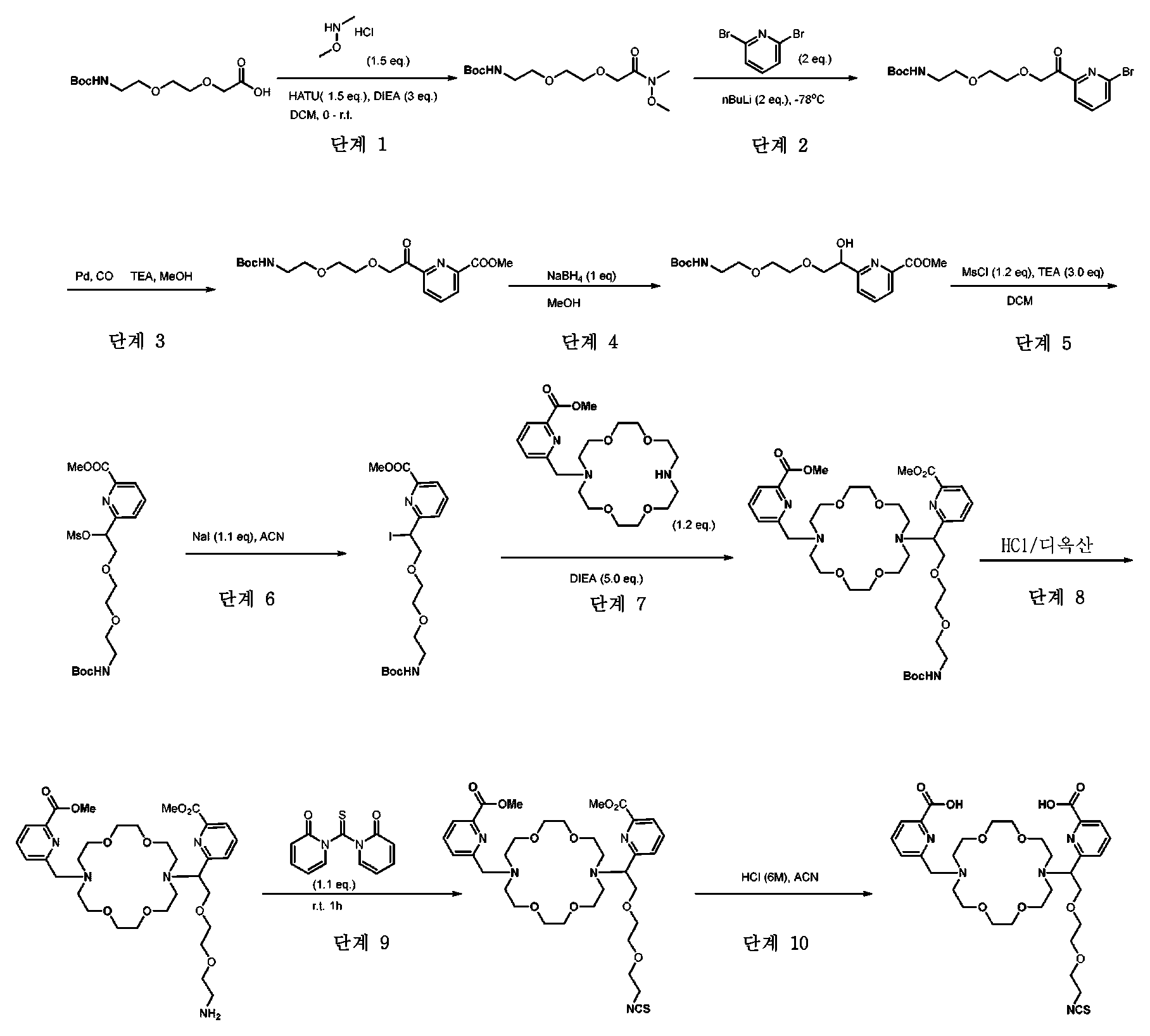
단계 1: 디클로로메탄(100 mL) 중 2,2-디메틸-4-옥소-3,8,11-트리옥사-5-아자트리데칸-13-오산(10.00 g, 37.98 mmol)과 디이소프로필에틸아민(14.73 g, 113.94 mmol)의 교반된 용액에, 질소 분위기 하 0℃에서 [비스(디메틸아미노)메틸렌]-1H-1,2,3-트리아졸로[4,5-b]피리디늄 3-옥시드 헥사플루오로포스페이트(15.16 g, 39.88 mmol)와 N,O-디메틸 히드록실아민(5.55 g, 56.97 mmol)을 적가하였다. 생성된 혼합물을 실온에서 1시간 동안 교반한 후, NH4Cl 포화 수용액에 부었다. 생성된 혼합물을 디클로로메탄(100 mL × 2)으로 추출하였다. 조합한 유기층을 염수로 세정하고, 무수 Na2SO4 상에서 건조시켰다. 여과한 후, 여과액을 감압 하에서 농축시켰다. 잔류물을 크로마토그래피(컬럼, C18; 이동상 A: 0.05% TFA이 포함된 H2O, B: ACN; 구배 20분 내에 20% B→40% B; 검출기: UV@210 nm)로 정제하였다. tert-부틸(3-메틸-4-옥소-2,6,9-트리옥사-3-아자운데칸-11-일)카르바메이트(9.90 g, 수율 85%)를 연황색 오일로 제공하였다. Step 1 : To a stirred solution of 2,2-dimethyl-4-oxo-3,8,11-trioxa-5-azatridecan-13-oic acid (10.00 g, 37.98 mmol) and diisopropylethylamine (14.73 g, 113.94 mmol) in dichloromethane (100 mL) at 0 °C under a nitrogen atmosphere were added dropwise [bis(dimethylamino)methylene]-1H-1,2,3-triazolo[4,5-b]pyridinium 3-oxide hexafluorophosphate (15.16 g, 39.88 mmol) and N,O -dimethyl hydroxylamine (5.55 g, 56.97 mmol). The resulting mixture was stirred at room temperature for 1 h and then poured into a saturated NH 4 Cl aqueous solution. The resulting mixture was extracted with dichloromethane (100 mL × 2). The combined organic layers were washed with brine and dried over anhydrous Na 2 SO 4 . After filtration, the filtrate was concentrated under reduced pressure. The residue was purified by chromatography (column, C18; mobile phase A: H 2 O containing 0.05% TFA, B: ACN;
단계 2: 500 ml 3구 둥근 바닥 플라스크 내 THF(260 mL) 중 2,6-디브로모-피리딘(13.3 g, 56.1 mmol)의 용액에, 질소 분위기 하 -78℃에서 n-BuLi(28.0 mL, 56.1 mmol)을 적가하였다. 용액을 -78℃에서 10분 동안 교반하였다. 상기 반응 용액에, -78℃에서 THF(30 mL) 중 tert-부틸(3-메틸-4-옥소-2,6,9-트리옥사-3-아자운데칸-11-일)카르바메이트(7.0 g, 28.0 mmol)의 용액을 적가하고, 혼합물을 실온에서 30분 동안 교반하였다. 0℃에서 물/얼음(200 mL)을 첨가하여 반응을 켄칭하였다. 수성층을 에틸 아세테이트(100 mL × 3)로 추출하였다. 조합한 추출물을 Na2SO4 상에서 건조시키고, 진공 하에서 농축시켰다. 잔류물을 크로마토그래피(컬럼, C18; 이동상, 이동상 A: 0.05% TFA이 포함된 H2O, B: ACN; 구배 20분 내에 38% B→58% B; 검출기: UV@210 nm)로 정제하였다. tert-부틸(2-(2-(2-(6-브로모피리딘-2-일)-2-옥소에톡시)에톡시)에틸)카르바메이트(4.6 g, 수율 50%)를 황색 고체로 제공하였다. MS (ES, m/z): 425, 427 (M + Na+). Step 2 : To a solution of 2,6-dibromo-pyridine (13.3 g, 56.1 mmol) in THF (260 mL) in a 500 mL 3-necked round-bottom flask at -78 °C under a nitrogen atmosphere was added dropwise n -BuLi (28.0 mL, 56.1 mmol). The solution was stirred at -78 °C for 10 min. To the reaction solution, a solution of tert -butyl (3-methyl-4-oxo-2,6,9-trioxa-3-azoundecan-11-yl)carbamate (7.0 g, 28.0 mmol) in THF (30 mL) was added dropwise at -78 °C, and the mixture was stirred at room temperature for 30 min. The reaction was quenched by the addition of water/ice (200 mL) at 0 °C. The aqueous layer was extracted with ethyl acetate (100 mL × 3). The combined extracts were dried over Na 2 SO 4 and concentrated in vacuo. The residue was purified by chromatography (column, C18; mobile phase, A: H 2 O containing 0.05% TFA, B: ACN; gradient 38% B→58% B in 20 min; detector: UV@210 nm). tert -Butyl(2-(2-(2-(6-bromopyridin-2-yl)-2-oxoethoxy)ethoxy)ethyl)carbamate (4.6 g, yield 50%) was obtained as a yellow solid. MS (ES, m/z ): 425, 427 (M + Na + ).
단계 3: 250 mL 고압 반응기에, tert-부틸(2-(2-(2-(6-브로모피리딘-2-일)-2-옥소에톡시)에톡시)에틸)카르바메이트(4.0 g, 18.1 mmol), 트리에틸아민(5.5 g, 54.3 mmol), Pd(dppf)Cl2(1.3 g, 1.8 mmol) 및 MeOH(40 mL)을 첨가하였다. 반응 용액을 배기시키고, N2로 재충전하였다. 이어서, CO(10 atm)를 도입하였다. 생성된 용액을 100℃에서 밤새 교반하였다. 반응 혼합물을 여과하고, 여과액을 건조될 때까지 농축시켰다. 잔류물을 크로마토그래피(컬럼, C18; 이동상 A: 0.05% TFA이 포함된 H2O, B: ACN; 구배 20분 내에 38% B→58% B; 검출기: UV@210 nm)로 정제하였다. 메틸 6-(2,2-디메틸-4-옥소-3,8,11-트리옥사-5-아자트리데칸-13-오일)피콜리네이트(2.4 g, 수율 63%)를 갈색 오일로 제공하였다. MS (ES, m/z): 405 (M + Na+). Step 3 : In a 250 mL high pressure reactor, tert -butyl(2-(2-(2-(6-bromopyridin-2-yl)-2-oxoethoxy)ethoxy)ethyl)carbamate (4.0 g, 18.1 mmol), triethylamine (5.5 g, 54.3 mmol), Pd(dppf)Cl 2 (1.3 g, 1.8 mmol) and MeOH (40 mL) were added. The reaction solution was evacuated and backfilled with N 2 . Then, CO (10 atm) was introduced. The resulting solution was stirred at 100 °C overnight. The reaction mixture was filtered, and the filtrate was concentrated to dryness. The residue was purified by chromatography (column, C18; mobile phase A: H 2 O containing 0.05% TFA, B: ACN; gradient 38% B→58% B in 20 min; detector: UV@210 nm). Methyl 6-(2,2-dimethyl-4-oxo-3,8,11-trioxa-5-azatridecan-13-oyl)picolinate (2.4 g, yield 63%) was obtained as a brown oil. MS (ES, m/z ): 405 (M + Na + ).
단계 4: MeOH(46 mL) 중 메틸 6-(2,2-디메틸-4-옥소-3,8,11-트리옥사-5-아자트리데칸-13-오일)피콜리네이트(2.30 g, 6.01 mmol)의 용액에, N2 분위기 하 0℃에서 NaBH4(0.23 g, 6.01 mmol)를 첨가하였다. 생성된 용액을 실온에서 1시간 동안 교반하고, NH4HCO3 포화 수용액(50 mL)을 첨가하여 켄칭하였다. 생성된 용액을 에틸 아세테이트(30 mL × 2)로 추출하였다. 조합한 유기층을 염수(60 mL)로 세정하고, Na2SO4 상에서 건조시키고, 농축시켰다. 미정제 생성물 메틸 6-(13-히드록시-2,2-디메틸-4-옥소-3,8,11-트리옥사-5-아자트리데칸-13-일)피콜리네이트(2.2 g)를 갈색 오일로 제공하였다. Step 4 : To a solution of methyl 6-(2,2-dimethyl-4-oxo-3,8,11-trioxa-5-azatridecan-13-oyl)picolinate (2.30 g, 6.01 mmol) in MeOH (46 mL) was added NaBH 4 (0.23 g, 6.01 mmol) at 0 °C under N 2 atmosphere. The resulting solution was stirred at room temperature for 1 h and quenched by the addition of saturated aqueous NH 4 HCO 3 solution (50 mL). The resulting solution was extracted with ethyl acetate (30 mL × 2). The combined organic layers were washed with brine (60 mL), dried over Na 2 SO 4 , and concentrated. The crude product methyl 6-(13-hydroxy-2,2-dimethyl-4-oxo-3,8,11-trioxa-5-azatridecan-13-yl)picolinate (2.2 g) was provided as a brown oil.
단계 5: 디클로로메탄(22 mL) 중 메틸 6-(13-히드록시-2,2-디메틸-4-옥소-3,8,11-트리옥사-5-아자트리데칸-13-일)피콜리네이트(2.2 g, 5.72 mmol)의 용액에, N2 분위기 하 0℃에서 트리에틸아민(1.74 g, 17.16 mmol)과 MsCl(0.79 g, 6.86 mmol)를 첨가하였다. 생성된 용액을 실온에서 1시간 동안 교반하고, H2O(22 mL)로 켄칭하였다. 생성된 혼합물을 디클로로메탄(20 mL × 2)으로 추출하였다. 조합한 유기층을 염수(40 mL)로 세정하고, Na2SO4 상에서 건조시키고, 농축시켰다. 미정제 생성물 메틸 6-(2,2-디메틸-13-((메틸설포닐)옥시)-4-옥소-3,8,11-트리옥사-5-아자트리데칸-13-일)피콜리네이트(2.2 g)를 갈색 오일로 제공하였다. Step 5 : To a solution of methyl 6-(13-hydroxy-2,2-dimethyl-4-oxo-3,8,11-trioxa-5-azatridecan-13-yl)picolinate (2.2 g, 5.72 mmol) in dichloromethane (22 mL) at 0 °C under N 2 atmosphere were added triethylamine (1.74 g, 17.16 mmol) and MsCl (0.79 g, 6.86 mmol). The resulting solution was stirred at room temperature for 1 h and quenched with H 2 O (22 mL). The resulting mixture was extracted with dichloromethane (20 mL × 2). The combined organic layers were washed with brine (40 mL), dried over Na 2 SO 4 , and concentrated. The crude product methyl 6-(2,2-dimethyl-13-((methylsulfonyl)oxy)-4-oxo-3,8,11-trioxa-5-azatridecan-13-yl)picolinate (2.2 g) was provided as a brown oil.
단계 6: ACN(22 mL) 중 메틸 6-(2,2-디메틸-13-((메틸설포닐)옥시)-4-옥소-3,8,11-트리옥사-5-아자트리데칸-13-일)피콜리네이트(2.2 g, 4.75 mmol)의 용액에, N2 분위기 하에서 NaI(0.78 g, 5.23 mmol)을 첨가하였다. 생성된 용액을 80℃에서 1시간 동안 교반하였다. 혼합물을 여과하고, 농축시켰다. 미정제 생성물을 크로마토그래피(컬럼, C18; 이동상 A: H2O, B: ACN; 구배 30분 내에 50% B→80% B; 검출기: UV@210 nm)로 정제하였다. 메틸 6-(13-요오도-2,2-디메틸-4-옥소-3,8,11-트리옥사-5-아자트리데칸-13-일)피콜리네이트(1.2 g)를 갈색 오일로 제공하였다. MS (ES, m/z): 517 (M + Na+), 495 (M + H+). Step 6 : To a solution of methyl 6-(2,2-dimethyl-13-((methylsulfonyl)oxy)-4-oxo-3,8,11-trioxa-5-azatridecan-13-yl)picolinate (2.2 g, 4.75 mmol) in ACN (22 mL) was added NaI (0.78 g, 5.23 mmol) under N 2 atmosphere. The resulting solution was stirred at 80 °C for 1 h. The mixture was filtered and concentrated. The crude product was purified by chromatography (column, C18; mobile phase A: H 2 O, B: ACN; gradient 50% B→80% B in 30 min; detector: UV@210 nm). Methyl 6-(13-iodo-2,2-dimethyl-4-oxo-3,8,11-trioxa-5-azatridecan-13-yl)picolinate (1.2 g) was provided as a brown oil. MS (ES, m/z ): 517 (M + Na + ), 495 (M + H + ).
단계 7: ACN(16.8 mL) 중 메틸 6-(13-요오도-2,2-디메틸-4-옥소-3,8,11-트리옥사-5-아자트리데칸-13-일)피콜리네이트(840 mg, 1.69 mmol)와 메틸 6-((1,4,10,13-테트라옥사-7,16-디아자시클로옥타데칸-7-일)메틸)피콜리네이트(839 mg, 2.03 mmol)의 용액을 질소 분위기 하 80℃에서 밤새 교반하였다. 냉각된 반응 혼합물을 여과하고, 여과액을 감압 하에서 농축시켰다. 미정제 생성물을 크로마토그래피(컬럼, C18; 이동상 A: H2O, B: ACN; 구배 20분 내에 40% B→60% B; 검출기: UV@210 nm)로 정제하였다. 메틸 6-((16-(13-(6-(메톡시카르보닐)피리딘-2-일)-2,2-디메틸-4-옥소-3,8,11-트리옥사-5-아자트리데칸-13-일)-1,4,10,13-테트라옥사-7,16-디아자시클로옥타데칸-7-일)메틸)피콜리네이트(450 mg)를 갈색 오일로 제공하였다. MS (ES, m/z): 700 (M + Na+), 678 (M + H+). Step 7 : A solution of methyl 6-(13-iodo-2,2-dimethyl-4-oxo-3,8,11-trioxa-5-azatridecan-13-yl)picolinate (840 mg, 1.69 mmol) and methyl 6-((1,4,10,13-tetraoxa-7,16-diazacyclooctadecan-7-yl)methyl)picolinate (839 mg, 2.03 mmol) in ACN (16.8 mL) was stirred at 80 °C under nitrogen atmosphere overnight. The cooled reaction mixture was filtered, and the filtrate was concentrated under reduced pressure. The crude product was purified by chromatography (column, C18; mobile phase A: H 2 O, B: ACN; gradient 40% B→60% B in 20 min; detector: UV@210 nm). Methyl 6-((16-(13-(6-(methoxycarbonyl)pyridin-2-yl)-2,2-dimethyl-4-oxo-3,8,11-trioxa-5-azatridecan-13-yl)-1,4,10,13-tetraoxa-7,16-diazacyclooctadecan-7-yl)methyl)picolinate (450 mg) was provided as a brown oil. MS (ES, m/z ): 700 (M + Na + ), 678 (M + H + ).
단계 8: 디클로로메탄(2.5 mL) 중 메틸 6-((16-(13-(6-(메톡시카르보닐)피리딘-2-일)-2,2-디메틸-4-옥소-3,8,11-트리옥사-5-아자트리데칸-13-일)-1,4,10,13-테트라옥사-7,16-디아자시클로옥타데칸-7-일)메틸)피콜리네이트(450 mg, 579 mmol)의 용액에, 0℃에서 HCl/디옥산(2.5 ml, 4 M)을 첨가하였다. 생성된 용액을 실온에서 20분 동안 교반하였다. Na2CO3 포화 수용액을 첨가하여 반응을 켄칭하였다. 수성층을 DCM:IPA(5:1)(30 mL × 2)로 추출하였다. 조합한 유기층을 무수 Na2SO4 상에서 건조시키고, 감압 하에서 농축시켜 미정제 생성물 메틸 6-(2-(2-(2-아미노에톡시)에톡시)-1-(16-((6-(메톡시카르보닐)피리딘-2-일)메틸)-1,4,10,13-테트라옥사-7,16-디아자시클로옥타데칸-7-일)에틸)피콜리네이트(330 mg)를 수득하였다. 미정제 생성물을 바로 다음 단계에 사용하였다. Step 8 : To a solution of methyl 6-((16-(13-(6-(methoxycarbonyl)pyridin-2-yl)-2,2-dimethyl-4-oxo-3,8,11-trioxa-5-azatridecan-13-yl)-1,4,10,13-tetraoxa-7,16-diazacyclooctadecan-7-yl)methyl)picolinate (450 mg, 579 mmol) in dichloromethane (2.5 mL) at 0 °C was added HCl/dioxane (2.5 mL, 4 M). The resulting solution was stirred at room temperature for 20 min. The reaction was quenched by the addition of saturated aqueous Na 2 CO 3 solution. The aqueous layer was extracted with DCM:IPA (5:1) (30 mL × 2). The combined organic layers were dried over anhydrous Na 2 SO 4 and concentrated under reduced pressure to give the crude product methyl 6-(2-(2-(2-aminoethoxy)ethoxy)-1-(16-((6-(methoxycarbonyl)pyridin-2-yl)methyl)-1,4,10,13-tetraoxa-7,16-diazacyclooctadecan-7-yl)ethyl)picolinate (330 mg). The crude product was used directly in the next step.
단계 9: 디클로로메탄(3 mL) 중 메틸 6-(2-(2-(2-아미노에톡시)에톡시)-1-(16-((6-(메톡시카르보닐)피리딘-2-일)메틸)-1,4,10,13-테트라옥사-7,16-디아자시클로옥타데칸-7-일)에틸)피콜리네이트(300 mg, 0.44 mmol)와 1-(2-옥소피리딘-1-카르보티오일)피리딘-2-온(113.08 mg, 0.48 mmol)의 용액을 질소 분위기 하 실온에서 1시간 동안 교반하였다. 생성된 혼합물을 감압 하에서 농축시켜 미정제 생성물 메틸 6-(2-(2-(2-이소티오시아네이토에톡시)에톡시)-1-(16-((6-(메톡시카르보닐)피리딘-2-일)메틸)-1,4,10,13-테트라옥사-7,16-디아자시클로옥타데칸-7-일)에틸)피콜리네이트(380 mg)를 수득하였다. 미정제 생성물을 바로 다음 단계에 사용하였다. Step 9 : A solution of methyl 6-(2-(2-(2-aminoethoxy)ethoxy)-1-(16-((6-(methoxycarbonyl)pyridin-2-yl)methyl)-1,4,10,13-tetraoxa-7,16-diazacyclooctadecan-7-yl)ethyl)picolinate (300 mg, 0.44 mmol) and 1-(2-oxopyridin-1-carbothioyl)pyridin-2-one (113.08 mg, 0.48 mmol) in dichloromethane (3 mL) was stirred at room temperature under a nitrogen atmosphere for 1 h. The resulting mixture was concentrated under reduced pressure to give the crude product methyl 6-(2-(2-(2-isothiocyanatoethoxy)ethoxy)-1-(16-((6-(methoxycarbonyl)pyridin-2-yl)methyl)-1,4,10,13-tetraoxa-7,16-diazacyclooctadecan-7-yl)ethyl)picolinate (380 mg). The crude product was used directly in the next step.
단계 10: 디클로로메탄(1.9 mL) 중 메틸 6-(2-(2-(2-이소티오시아네이토에톡시)에톡시)-1-(16-((6-(메톡시카르보닐)피리딘-2-일)메틸)-1,4,10,13-테트라옥사-7,16-디아자시클로옥타데칸-7-일)에틸)피콜리네이트(380 mg, 0.52 mmol)와 HCl(1.9 mL, 6 M)의 용액을 질소 분위기 하 50℃에서 3시간 동안 교반하였다. 생성된 혼합물을 감압 하에서 농축시키고, NaHCO3 포화 수용액을 이용하여 pH 6 내지 7까지 염기성으로 만들었다. 잔류물을 크로마토그래피(컬럼, C18; 이동상 A: 0.05% TFA이 포함된 H2O, B: ACN, 구배 20분 내에 20% B→36% B; 검출기: UV@210 nm)로 정제하였다. 이어서, 생성물 분획을 진공 하에서 농축시켜 MeCN을 제거하였다. 용액을 다시 크로마토그래피(컬럼, C18; 이동상 A: H2O, B: ACN, 구배 20분 내에 95% B→100% B)로 정제하였다. 용액을 농축시켜 대부분의 MeCN을 제거하고, 수용액을 동결건조시켜 6-((16-(1-(6-카르복시피리딘-2-일)-2-(2-(2-이소티오시아네이토에톡시)에톡시)에틸)-1,4,10,13-테트라옥사-7,16-디아자시클로옥타데칸-7-일)메틸)피콜린산(130 mg)을 갈색 고체로 제공하였다. 1H NMR (300 ㎒, D2O) 8.03 ― 7.84 (m, 2H), 7.57 (dd, J = 22.3, 7.4 ㎐, 1H), 5.00 (s, 0H), 4.59 (s, 1H), 4.20 (dd, J = 23.4, 9.5 ㎐, 1H), 3.82 (d, J = 15.4 ㎐, 4H), 3.70 ― 3.58 (m, 6H), 3.58 ― 3.49 (m, 6H). MS (ES, m/z): 692.3 (M + H+). Step 10 : A solution of methyl 6-(2-(2-(2-isothiocyanatoethoxy)ethoxy)-1-(16-((6-(methoxycarbonyl)pyridin-2-yl)methyl)-1,4,10,13-tetraoxa-7,16-diazacyclooctadecan-7-yl)ethyl)picolinate (380 mg, 0.52 mmol) and HCl (1.9 mL, 6 M) in dichloromethane (1.9 mL) was stirred under a nitrogen atmosphere at 50 °C for 3 h. The resulting mixture was concentrated under reduced pressure, and the pH was made alkaline to 6–7 using saturated aqueous NaHCO 3 solution. The residue was purified by chromatography (column, C18; mobile phase A: H 2 O containing 0.05% TFA, B: ACN,
실시예 15Example 15
6,6'-(((S)-2-(((5-(((((1R,8S,9r)-바이시클로[6.1.0]논-4-인-9-일)메톡시)카르보닐)아미노)펜틸)티오)메틸)-1,4,10,13-테트라옥사-7,16-디아자시클로옥타데칸-7,16-디일)비스(메틸렌))디피콜린산6,6'-((( S )-2-(((5-(((((1 R ,8 S ,9 r )-bicyclo[6.1.0]non-4-yn-9-yl)methoxy)carbonyl)amino)pentyl)thio)methyl)-1,4,10,13-tetraoxa-7,16-diazacyclooctadecane-7,16-diyl)bis(methylene))dipicolinic acid
반응식 13Reaction formula 13
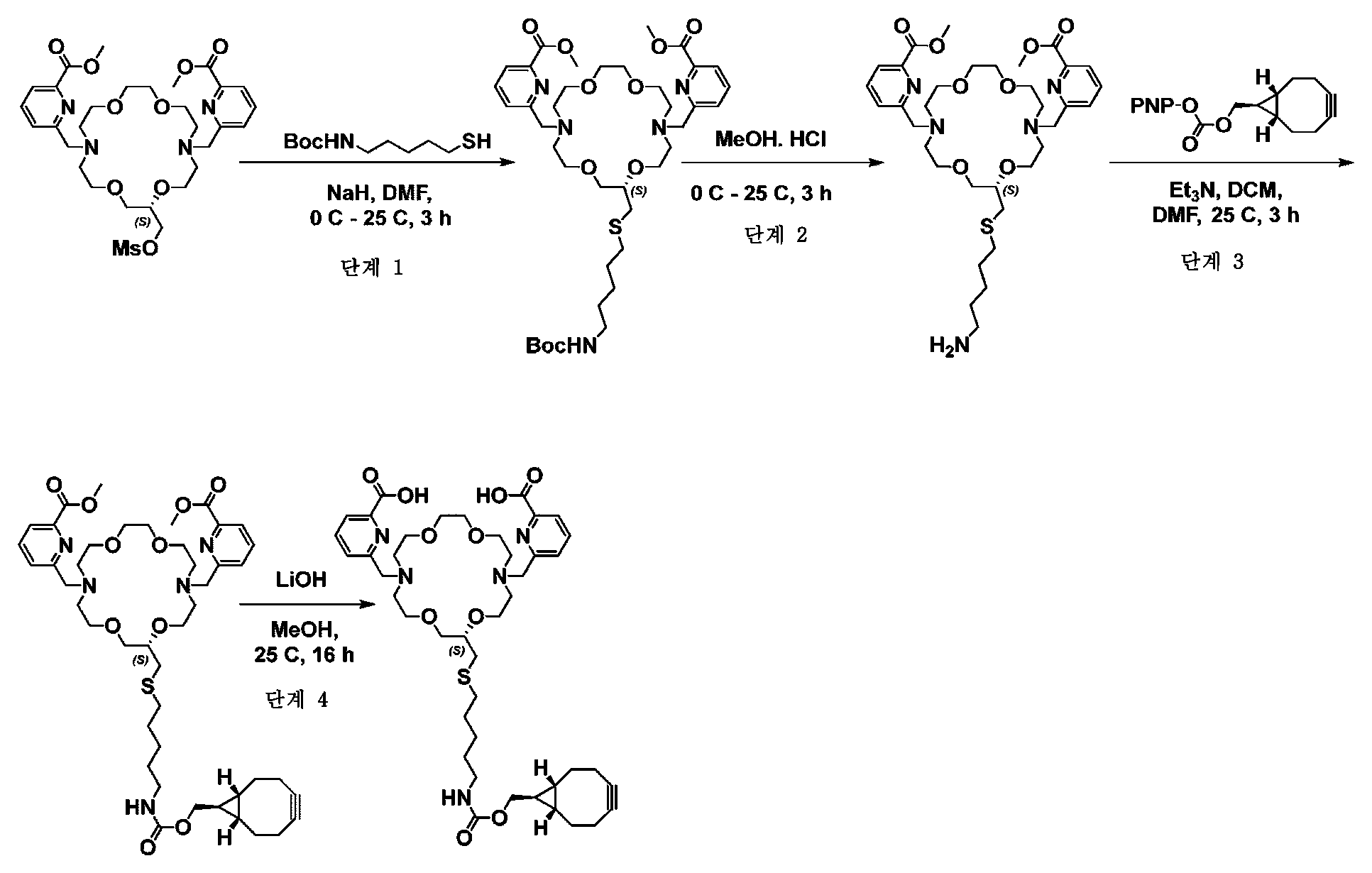
단계 1: DMF(3.0 mL) 중 수소화소듐(0.07 g, 미네랄 오일 중 60%, 2 mmol)의 현탁액이 함유된 50 mL 3구 둥근 바닥 플라스크에, 질소 분위기 하 0℃에서 tert-부틸(5-메르캅토펜틸)카르바메이트(0.30 g, 1.0 mmol)와 DMF(3.0 mL)로 이루어진 용액을 5분에 걸쳐 적가하였다. 첨가가 완료되면, 반응 혼합물을 실온에 이르게 하고, 15분 동안 교반을 지속하였다. 이어서, 반응 혼합물을 다시 0℃까지 냉각시키고, 디메틸 6,6'-((2-(((메틸설포닐)옥시)메틸)-1,4,10,13-테트라옥사-7,16-디아자시클로옥타데칸-7,16-디일)비스(메틸렌))(S)-디피콜리네이트(0.6 g, 0.9 mmol)와 DMF(3.0 mL)로 이루어진 용액을 10분에 걸쳐 적가하는 방식으로 처리하였다. 첨가가 완료되면, 반응 혼합물을 서서히 실온까지 가온시키고, 1.5시간 동안 교반을 지속하였다. 이어서, 반응 혼합물을 NH4Cl 포화 수용액(1.0 mL)으로 조심스럽게 처리하고, 건조될 때까지 농축시켜 오일을 제공하였다. 오일을 분취용 HPLC(컬럼: XBRIDGE C18 19 × 150 mm, 5.0 μm; 이동상: 물/아세토니트릴 중 0.1% TFA; 유량: 15.0 mL/분)에 적용하여 디메틸 6,6'-((2-(((5-((tert-부톡시카르보닐)아미노)펜틸)티오)메틸)-1,4,10,13-테트라옥사-7,16-디아자시클로옥타데칸-7,16-디일)비스(메틸렌))(S)-디피콜리네이트(0.25 g)를 수득하였다. Step 1 : To a 50 mL 3-necked round-bottom flask containing a suspension of sodium hydride (0.07 g, 60% in mineral oil, 2 mmol) in DMF (3.0 mL) was added dropwise a solution of tert -butyl(5-mercaptopentyl)carbamate (0.30 g, 1.0 mmol) in DMF (3.0 mL) at 0 °C under a nitrogen atmosphere over 5 minutes. Upon completion of the addition, the reaction mixture was allowed to reach room temperature and stirred for 15 minutes. The reaction mixture was then cooled back to 0 °C and treated with a solution of dimethyl 6,6'-((2-(((methylsulfonyl)oxy)methyl)-1,4,10,13-tetraoxa-7,16-diazacyclooctadecan-7,16-diyl)bis(methylene))( S )-dipicolinate (0.6 g, 0.9 mmol) and DMF (3.0 mL) dropwise added over 10 min. Upon completion of the addition, the reaction mixture was slowly warmed to room temperature and stirred for 1.5 h. The reaction mixture was then carefully treated with saturated NH 4 Cl aqueous solution (1.0 mL) and concentrated to dryness to provide an oil. The oil was subjected to preparative HPLC (column: XBRIDGE C18 19 × 150 mm, 5.0 μm; mobile phase: 0.1% TFA in water/acetonitrile; flow rate: 15.0 mL/min) to afford dimethyl 6,6'-((2-(((5-(( tert -butoxycarbonyl)amino)pentyl)thio)methyl)-1,4,10,13-tetraoxa-7,16-diazacyclooctadecane-7,16-diyl)bis(methylene))( S )-dipicolinate (0.25 g).
단계 2: 25 mL 둥근 바닥 플라스크에, 0℃에서 교반 바, 디메틸 6,6'-((2-(((5-((tert-부톡시카르보닐)아미노)펜틸)티오)메틸)-1,4,10,13-테트라옥사-7,16-디아자시클로옥타데칸-7,16-디일)비스(메틸렌))(S)-디피콜리네이트(0.25 g, 0.32 mmol), MeOH(1.0 mL) 및 메탄올 중 HCl(4 M, 1.5 mL, 6.3 mmol)을 첨가한 후, 실온에 이르게 하고, 혼합물을 3시간 동안 교반하였다. 이어서, 휘발성 물질을 진공에서 제거하여 디메틸 6,6'-((2-(((5-아미노펜틸)티오)메틸)-1,4,10,13-테트라옥사-7,16-디아자시클로옥타데칸-7,16-디일)비스(메틸렌))(S)-디피콜리네이트(0.21 g)를 수득하고, 이를 정제 없이 사용하였다. Step 2 : In a 25 mL round-bottomed flask, at 0 °C with a stir bar, add dimethyl 6,6'-((2-(((5-(( tert -butoxycarbonyl)amino)pentyl)thio)methyl)-1,4,10,13-tetraoxa-7,16-diazacyclooctadecane-7,16-diyl)bis(methylene))( S )-dipicolinate (0.25 g, 0.32 mmol), MeOH (1.0 mL) and HCl in methanol (4 M, 1.5 mL, 6.3 mmol), and the mixture was stirred for 3 h. Then, the volatiles were removed in vacuo to obtain dimethyl 6,6'-((2-(((5-aminopentyl)thio)methyl)-1,4,10,13-tetraoxa-7,16-diazacyclooctadecane-7,16-diyl)bis(methylene))( S )-dipicolinate (0.21 g), which was used without purification.
단계 3: 25 mL 3구 둥근 바닥 플라스크에, 질소 분위기 하 0℃에서 교반 바, 디메틸 6,6'-((2-(((5-아미노펜틸)티오)메틸)-1,4,10,13-테트라옥사-7,16-디아자시클로옥타데칸-7,16-디일)비스(메틸렌))(S)-디피콜리네이트(0.15 g, 0.22 mmol), ((1R,8S,9r)-바이시클로[6.1.0]논-4-인-9-일)메틸 4-니트로페닐 카르보네이트(68 mg, 0.22 mmol), 트리에틸아민(66 mg, 0.65 mmol), 및 DCM(2 mL)과 DMF(0.1 mL)의 혼합물을 첨가하였다. 생성된 혼합물을 실온까지 점진적으로 가온시키고, 밤새 교반하였다. 이어서, 혼합물을 건조될 때까지 농축시켜 디메틸 6,6'-(((S)-2-(((5-(((((1R,8S,9r)-바이시클로[6.1.0]논-4-인-9-일)메톡시)카르보닐)아미노)펜틸)티오)메틸)-1,4,10,13-테트라옥사-7,16-디아자시클로옥타데칸-7,16-디일)비스(메틸렌))디피콜리네이트(0.1 g)를 제공하고, 이를 정제 없이 사용하였다. Step 3 : In a 25 mL 3-necked round-bottom flask, under nitrogen atmosphere at 0 °C, a stir bar was added dimethyl 6,6'-((2-(((5-aminopentyl)thio)methyl)-1,4,10,13-tetraoxa-7,16-diazacyclooctadecan-7,16-diyl)bis(methylene))( S )-dipicolinate (0.15 g, 0.22 mmol), ((1 R ,8 S ,9 r )-bicyclo[6.1.0]non-4-yn-9-yl)methyl 4-nitrophenyl carbonate (68 mg, 0.22 mmol), triethylamine (66 mg, 0.65 mmol), and a mixture of DCM (2 mL) and DMF (0.1 mL). The resulting mixture was gradually warmed to room temperature and stirred overnight. The mixture was then concentrated to dryness to afford dimethyl 6,6'-((( S )-2-(((5-(((((1 R ,8 S ,9 r )-bicyclo[6.1.0]non-4-yn-9-yl)methoxy)carbonyl)amino)pentyl)thio)methyl)-1,4,10,13-tetraoxa-7,16-diazacyclooctadecan-7,16-diyl)bis(methylene))dipicolinate (0.1 g), which was used without purification.
단계 4: 8 mL 반응 바이알에, 교반 바, 디메틸 6,6'-(((S)-2-(((5-(((((1R,8S,9r)-바이시클로[6.1.0]논-4-인-9-일)메톡시)카르보닐)아미노)펜틸)티오)메틸)-1,4,10,13-테트라옥사-7,16-디아자시클로옥타데칸-7,16-디일)비스(메틸렌))디피콜리네이트(0.10 g, 0.12 mmol), LiOH 수용액(3.5 mL, 0.1 N, 0.35 mmol) 및 MeOH(0.5 mL)을 첨가하고, 생성된 혼합물을 실온에서 밤새 교반하였다. 이어서, 반응 혼합물을 pH 약 6.5까지 아세트산으로 처리한 후, 진공 하 실온에서 건조될 때까지 농축시켜 오일을 수득하고, 이를 분취용 HPLC(컬럼: XBRIDGE C18 19 × 150 mm, 5.0 μm; 이동상: H2O/ACN 중 0.1% 포름산; 유량: 15.0 mL/분)를 통해 정제하여 6,6'-(((S)-2-(((5-(((((1R,8S,9r)-바이시클로[6.1.0]논-4-인-9-일)메톡시)카르보닐)아미노)펜틸)티오)메틸)-1,4,10,13-테트라옥사-7,16-디아자시클로옥타데칸-7,16-디일)비스(메틸렌))디피콜린산(42 mg)을 수득하였다. Step 4 : To an 8 mL reaction vial, a stir bar, dimethyl 6,6'-((( S )-2-(((5-(((((1 R ,8 S ,9 r )-bicyclo[6.1.0]non-4-yn-9-yl)methoxy)carbonyl)amino)pentyl)thio)methyl)-1,4,10,13-tetraoxa-7,16-diazacyclooctadecan-7,16-diyl)bis(methylene))dipicolinate (0.10 g, 0.12 mmol), aqueous LiOH solution (3.5 mL, 0.1 N, 0.35 mmol) and MeOH (0.5 mL) were added, and the resulting mixture was stirred at room temperature overnight. Then, the reaction mixture was treated with acetic acid to pH about 6.5 and concentrated to dryness at room temperature under vacuum to give an oil which was purified via preparative HPLC (column: XBRIDGE C18 19 × 150 mm, 5.0 μm; mobile phase: 0.1% formic acid in H 2 O/ACN; flow rate: 15.0 mL/min) to give 6,6'-(((S)-2-(((5-(((((1 R ,8 S ,9 r )-bicyclo[6.1.0]non-4-yn-9-yl)methoxy)carbonyl)amino)pentyl)thio)methyl)-1,4,10,13-tetraoxa-7,16-diazacyclooctadecan-7,16-diyl)bis(methylene))dipicolinic acid (42 mg).
실시예 16Example 16
N-아실-DBCO 태깅된 6,6'-((2-(((5-아미노펜틸)티오)메틸)-1,4,10,13-테트라옥사-7,16-디아자시클로옥타데칸-7,16-디일)비스(메틸렌))(S)-디피콜린산 N -Acyl-DBCO tagged 6,6'-((2-(((5-aminopentyl)thio)methyl)-1,4,10,13-tetraoxa-7,16-diazacyclooctadecane-7,16-diyl)bis(methylene))( S )-dipicolinic acid
반응식 14Reaction formula 14

단계 1: 25 mL 둥근 바닥 플라스크에, 0℃에서 교반 바, 디메틸 6,6'-((2-(((5-((tert-부톡시카르보닐)아미노)펜틸)티오)메틸)-1,4,10,13-테트라옥사-7,16-디아자시클로옥타데칸-7,16-디일)비스(메틸렌))(S)-디피콜리네이트(0.12 g, 0.15 mmol), MeOH(0.5 mL) 및 메탄올 중 HCl(4 M, 0.75 mL, 3.0 mmol)을 첨가한 후, 실온에 이르게 하고, 2시간 동안 교반하였다. 휘발성 물질을 진공에서 제거하여 디메틸 6,6'-((2-(((5-아미노펜틸)티오)메틸)-1,4,10,13-테트라옥사-7,16-디아자시클로옥타데칸-7,16-디일)비스(메틸렌))(S)-디피콜리네이트(70 mg)를 수득하고, 이를 정제 없이 사용하였다. Step 1 : In a 25 mL round-bottomed flask, at 0 °C with a stir bar, add dimethyl 6,6'-((2-(((5-(( tert -butoxycarbonyl)amino)pentyl)thio)methyl)-1,4,10,13-tetraoxa-7,16-diazacyclooctadecane-7,16-diyl)bis(methylene))( S )-dipicolinate (0.12 g, 0.15 mmol), MeOH (0.5 mL) and HCl in methanol (4 M, 0.75 mL, 3.0 mmol), bring to room temperature, and stir for 2 h. The volatiles were removed in vacuo to give dimethyl 6,6'-((2-(((5-aminopentyl)thio)methyl)-1,4,10,13-tetraoxa-7,16-diazacyclooctadecane-7,16-diyl)bis(methylene))( S )-dipicolinate (70 mg), which was used without purification.
단계 2: 25 mL 3구 둥근 바닥 플라스크에, 질소 분위기 하 0℃에서 교반 바, 디메틸 6,6'-((2-(((5-아미노펜틸)티오)메틸)-1,4,10,13-테트라옥사-7,16-디아자시클로옥타데칸-7,16-디일)비스(메틸렌))(S)-디피콜리네이트(50 mg, 0.070 mmol), 11,12-디데히드로-γ-옥소디벤즈[b,f]아조신-5(6H)-부탄산(20 mg, 0.070 mmol), 트리에틸아민(21 mg, 0.21 mmol), HATU(38 mg, 0.10 mmol) 및 DCM(0.5 mL)을 첨가한 후, 실온에 이르게 하고, 밤새 교반하였다. 반응 혼합물을 물(10 mL)로 처리하고, 디클로로메탄(10 mL × 3)으로 추출한 후, 조합한 추출물을 10% NaHCO3 수용액(10 mL)과 염수(10 mL)로 세정하고, 무수 Na2SO4 상에서 건조시키고, 여과하고, 건조될 때까지 농축시켜 오일을 수득하였다. 오일을 실리카겔 크로마토그래피(0→10% MeOH/DCM)를 통해 정제하여 N-아실-DBCO 태깅된 디메틸 6,6'-((2-(((5-아미노펜틸)티오)메틸)-1,4,10,13-테트라옥사-7,16-디아자시클로옥타데칸-7,16-디일)비스(메틸렌))(S)-디피콜리네이트(16 mg)를 수득하였다. Step 2 : In a 25 mL 3-necked round-bottom flask, under nitrogen atmosphere at 0 °C, add a stir bar, dimethyl 6,6'-((2-(((5-aminopentyl)thio)methyl)-1,4,10,13-tetraoxa-7,16-diazacyclooctadecan-7,16-diyl)bis(methylene))( S )-dipicolinate (50 mg, 0.070 mmol), 11,12-didehydro-γ-oxodibenz[b,f]azocine-5(6H)-butanoic acid (20 mg, 0.070 mmol), triethylamine (21 mg, 0.21 mmol), HATU (38 mg, 0.10 mmol), and DCM (0.5 mL), and the mixture was allowed to reach room temperature and stirred overnight. The reaction mixture was treated with water (10 mL), extracted with dichloromethane (10 mL × 3), and the combined extracts were washed with 10% aqueous NaHCO 3 solution (10 mL) and brine (10 mL), dried over anhydrous Na 2 SO 4 , filtered, and concentrated to dryness to give an oil. The oil was purified through silica gel chromatography (0 → 10% MeOH/DCM) to give N -acyl-DBCO tagged dimethyl 6,6'-((2-(((5-aminopentyl)thio)methyl)-1,4,10,13-tetraoxa-7,16-diazacyclooctadecane-7,16-diyl)bis(methylene))( S )-dipicolinate (16 mg).
단계 3: 8 mL 반응 바이알에, 교반 바, N-아실-DBCO 태깅된 디메틸 6,6'-((2-(((5-아미노펜틸)티오)메틸)-1,4,10,13-테트라옥사-7,16-디아자시클로옥타데칸-7,16-디일)비스(메틸렌))(S)-디피콜리네이트(16 mg, 0.016 mmol), LiOH 수용액(0.49 mL, 0.1 N, 0.049 mmol) 및 MeOH(0.25 mL)을 첨가하고, 혼합물을 실온에서 밤새 교반하였다. 이어서, 반응 혼합물을 pH 약 6.5까지 아세트산으로 처리하고, 진공 하 실온에서 건조될 때까지 농축시켜 농축물을 수득하고, 이를 분취용 HPLC(컬럼: XBRIDGE C18 19 × 150 mm 5.0 μm; 이동상: 물/ACN 중 10 mM 암모늄 아세테이트; 유량: 15.0 mL/분)를 통해 정제하여 N-아실-DBCO 태깅된 6,6'-((2-(((5-아미노펜틸)티오)메틸)-1,4,10,13-테트라옥사-7,16-디아자시클로옥타데칸-7,16-디일)비스(메틸렌))(S)-디피콜린산(5 mg)을 회백색 고체로 수득하였다. LC-MS APCI: C51H62N6O10S에 대한 계산치; 950.42; 측정치 m/z [M+H]+ 951.4. 1H NMR (400 ㎒, D2O): δ 7.81-7.75 (m, 4H), 7.52-7.17 (m, 10H), 4.97-4.90 (m, 1H), 4.80 (s, 4H), 4.14 (s, 3H), 3.77-3.46 (m, 16H), 3.10 (s, 7H), 2.83-2.80 (m, 2H), 2.55-2.53 (m, 2H), 2.42-2.38 (m, 3H), 2.11-2.08 (m, 3H), 1.39-1.35 (m, 2H), 1.20-1.10 (m, 4H). Step 3: To an 8 mL reaction vial, a stir bar, N -Acyl-DBCO tagged dimethyl 6,6'-((2-(((5-aminopentyl)thio)methyl)-1,4,10,13-tetraoxa-7,16-diazacyclooctadecane-7,16-diyl)bis(methylene))( S )-dipicolinate (16 mg, 0.016 mmol), aqueous LiOH solution (0.49 mL, 0.1 N, 0.049 mmol) and MeOH (0.25 mL) were added, and the mixture was stirred at room temperature overnight. Then, the reaction mixture was treated with acetic acid to pH about 6.5 and concentrated to dryness at room temperature under vacuum to give the concentrate, which was purified via preparative HPLC (column: XBRIDGE C18 19 × 150 mm 5.0 μm; mobile phase: 10 mM ammonium acetate in water/ACN; flow rate: 15.0 mL/min) to afford N-acyl-DBCO tagged 6,6'-((2-(((5-aminopentyl)thio)methyl)-1,4,10,13-tetraoxa-7,16-diazacyclooctadecan-7,16-diyl)bis(methylene))( S )-dipicolinic acid (5 mg) as an off-white solid. LC-MS APCI: calcd for C 51 H 62 N 6 O 10 S; 950.42; Measured m/z [M+H] + 951.4. 1 H NMR (400 MHz, D 2 O): δ 7.81-7.75 (m, 4H), 7.52-7.17 (m, 10H), 4.97-4.90 (m, 1H), 4.80 (s, 4H), 4.14 (s, 3H), 3.77-3.46 (m, 16H), 3.10 (s, 7H), 2.83-2.80 (m, 2H), 2.55-2.53 (m, 2H), 2.42-2.38 (m, 3H), 2.11-2.08 (m, 3H), 1.39-1.35 (m, 2H), 1.20-1.10 (m, 4H).
실시예 17Example 17
N-아실-DBCO 태깅된 6-((4-((6-아미노에틸)카르바모일)페닐)16-((6-카르복시피리딘-2-일)-1,4,10,13-테트라옥사-7,16-디아자시클로옥타데칸-7-일)메틸)피콜린산(TOPA-[C7]-벤즈이미도-DBCO) N -Acyl-DBCO tagged 6-((4-((6-aminoethyl)carbamoyl)phenyl)16-((6-carboxypyridin-2-yl)-1,4,10,13-tetraoxa-7,16-diazacyclooctadecan-7-yl)methyl)picolinic acid (TOPA-[C7]-benzimido-DBCO)
반응식 15Reaction formula 15

단계 1: 500 mL 3구 둥근 바닥 플라스크 내 메틸 6-포르밀피콜리네이트(4.00 g, 24.2 mmol), (4-(tert-부톡시카르보닐)페닐)보론산(10.7 g, 48.5 mmol), PdCl2(0.21 g, 1.2 mmol), 트리(나프탈렌-1-일)포스핀(0.50 g, 1.2 mmol) 및 탄산포타슘(10.0 g, 72.7 mmol)의 혼합물에, 질소 하 -78℃에서 테트라히드로푸란(100 mL)을 한 번에 첨가하였다. 혼합물에 질소를 퍼징하고, 실온에서 30분 동안 교반한 후, 65℃에서 24시간 동안 가열하였다. 반응 혼합물을 실온까지 냉각시키고, Celite® 패드를 통해 여과하고, 여과액을 건조될 때까지 농축시켰다. 미정제 생성물을 실리카겔 크로마토그래피(0→50% EtOAc/석유 에테르)에 적용하여 메틸 6-((4-(tert-부톡시카르보닐)페닐)(히드록시)메틸)피콜리네이트(2.5 g, 30%)를 황색 오일로 수득하였다. Step 1: To a mixture of methyl 6-formylpicolinate (4.00 g, 24.2 mmol), (4-( tert -butoxycarbonyl)phenyl)boronic acid (10.7 g, 48.5 mmol), PdCl 2 (0.21 g, 1.2 mmol), tri(naphthalen-1-yl)phosphine (0.50 g, 1.2 mmol), and potassium carbonate (10.0 g, 72.7 mmol) in a 500 mL 3-necked round-bottom flask was added tetrahydrofuran (100 mL) in one portion at -78 °C under nitrogen. The mixture was purged with nitrogen, stirred at room temperature for 30 min, and then heated at 65 °C for 24 h. The reaction mixture was cooled to room temperature, filtered through a pad of Celite®, and the filtrate was concentrated to dryness. The crude product was subjected to silica gel chromatography (0→50% EtOAc/petroleum ether) to afford methyl 6-((4-(tert-butoxycarbonyl)phenyl)(hydroxy)methyl)picolinate (2.5 g, 30%) as a yellow oil.
단계 2: 교반 바, 메틸 6-((4-(tert-부톡시카르보닐)페닐)(히드록시)메틸)피콜리네이트(2.50 g, 7.30 mmol), PPh3(3.43 g, 13.1 mmol), N-브로모석신이미드(2.13 g, 12.0 mmol) 및 DCM(30 mL)을 질소 분위기 하 실온에서 250 mL 3구 둥근 바닥 플라스크 내에 위치시키고, 1시간 동안 교반하였다. 반응 용액을 실리카겔 컬럼에 로딩하고, 석유 에테르 중 0→30% 에틸 아세테이트를 사용하여 정제하여 화합물 메틸 6-(브로모(4-(tert-부톡시카르보닐)페닐)메틸)피콜리네이트(1.65 g, 56%)를 황색 오일로 수득하였다. Step 2: A stirring bar, methyl 6-((4-(tert-butoxycarbonyl)phenyl)(hydroxy)methyl)picolinate (2.50 g, 7.30 mmol), PPh 3 (3.43 g, 13.1 mmol), N -bromosuccinimide (2.13 g, 12.0 mmol) and DCM (30 mL) were placed in a 250 mL 3-necked round bottom flask under nitrogen atmosphere at room temperature and stirred for 1 h. The reaction solution was loaded onto a silica gel column and purified using 0→30% ethyl acetate in petroleum ether to afford compound methyl 6-(bromo(4-(tert-butoxycarbonyl)phenyl)methyl)picolinate (1.65 g, 56%) as a yellow oil.
단계 3: 250 mL 3구 둥근 바닥 플라스크에, 교반 바, 메틸 6-((1,4,10,13-테트라옥사-7,16-디아자시클로옥타데칸-7-일)메틸)피콜리네이트(1.52 g, 3.69 mmol), 6-(브로모(4-(tert-부톡시카르보닐)페닐)메틸)피콜리네이트(1.50 g, 3.69 mmol), Na2CO3(1.17 g, 11.1 mmol) 및 아세토니트릴(30 mL)을 첨가하고, 생성된 불균일 혼합물을 질소 분위기 하 90℃에서 16시간 동안 가열하였다. 이어서, 반응 물질을 실온까지 냉각시키고, Celite® 패드를 통해 여과하고, 진공에서 건조될 때까지 농축시켜 미정제 생성물을 제공하였다. 미정제 생성물을 실리카겔 크로마토그래피(0→10% MeOH/DCM)에 적용하여 메틸 6-((4-(tert-부톡시카르보닐)페닐)(16-((6-(메톡시카르보닐)피리딘-2-일)메틸)-1,4,10,13-테트라옥사-7,16-디아자시클로옥타데칸-7-일)메틸)피콜리네이트(1.2 g, 44%)를 갈색 오일로 수득하였다. Step 3: In a 250 mL 3-necked round bottom flask, a stir bar, methyl 6-((1,4,10,13-tetraoxa-7,16-diazacyclooctadecan-7-yl)methyl)picolinate (1.52 g, 3.69 mmol), 6-(bromo(4-(tert-butoxycarbonyl)phenyl)methyl)picolinate (1.50 g, 3.69 mmol), Na 2 CO 3 (1.17 g, 11.1 mmol) and acetonitrile (30 mL) were added and the resulting heterogeneous mixture was heated under nitrogen atmosphere at 90 °C for 16 h. The reaction mass was then cooled to room temperature, filtered through a Celite® pad and concentrated to dryness in vacuo to give the crude product. The crude product was subjected to silica gel chromatography (0→10% MeOH/DCM) to afford methyl 6-((4-(tert-butoxycarbonyl)phenyl)(16-((6-(methoxycarbonyl)pyridin-2-yl)methyl)-1,4,10,13-tetraoxa-7,16-diazacyclooctadecan-7-yl)methyl)picolinate (1.2 g, 44%) as a brown oil.
단계 4: 100 mL 3구 둥근 바닥 플라스크에, 실온에서 교반 바, 메틸 6-((4-(tert-부톡시카르보닐)페닐)(16-((6-(메톡시카르보닐)피리딘-2-일)메틸)-1,4,10,13-테트라옥사-7,16-디아자시클로옥타데칸-7-일)메틸)피콜리네이트(1.2 g, 1.6 mmol), TFA(0.62 mL, 8.1 mmol) 및 DCM(20 mL)을 첨가하고, 1시간 동안 교반하였다. 반응 혼합물을 건조될 때까지 농축시키고, 생성된 미정제 생성물을 분취용 HPLC(컬럼: XBRIDGE C18(19 × 150 mm) 5.0 μm; 이동상: 물/ACN 중 0.1% TFA; 유량: 15.0 mL/분)에 적용하여 4-((6-(메톡시카르보닐)피리딘-2-일)(16-((6-(메톡시카르보닐)피리딘-2-일)메틸)-1,4,10,13-테트라옥사-7,16-디아자시클로옥타데칸-7-일)메틸)벤조산(0.8 g, 72%)을 갈색 오일로 제공하였다. LC-MS APCI: C35H44N4O10에 대한 계산치 680.31; 측정치 m/z [M+H] + 681.5. LC-MS에 따른 순도: 99.87%. HPLC에 따른 순도: 97.14%(210 nm에서 97.01%, 254 nm에서 97.20% 및 280 nm에서 97.21%; 컬럼: Atlantis dC18(250 × 4.6 mm), 5 μm; 이동상 A: 물 중 0.1% TFA, 이동상 B: 아세토니트릴; 유량: 1.0 mL/분. 1 H NMR (400 ㎒, DMSO-d6): δ 8.12-8.07 (m, 4H), 8.00-7.98 (m, 2H), 7.75-7.73 (m, 4H), 6.10 (s, 1H), 4.67 (s, 2H), 3.96 (s, 3H), 3.91 (s, 3H), 3.82 (s, 8H), 3.56 (s, 8H), 3.52 (s, 8H). Step 4: In a 100 mL 3-necked round-bottom flask, add a stir bar at room temperature, methyl 6-((4-(tert-butoxycarbonyl)phenyl)(16-((6-(methoxycarbonyl)pyridin-2-yl)methyl)-1,4,10,13-tetraoxa-7,16-diazacyclooctadecan-7-yl)methyl)picolinate (1.2 g, 1.6 mmol), TFA (0.62 mL, 8.1 mmol) and DCM (20 mL), and stir for 1 h. The reaction mixture was concentrated to dryness and the resulting crude product was subjected to preparative HPLC (Column: XBRIDGE C18 (19 × 150 mm) 5.0 μm; Mobile phase: 0.1% TFA in water/ACN; Flow rate: 15.0 mL/min) to afford 4-((6-(methoxycarbonyl)pyridin-2-yl)(16-((6-(methoxycarbonyl)pyridin-2-yl)methyl)-1,4,10,13-tetraoxa-7,16-diazacyclooctadecan-7-yl)methyl)benzoic acid (0.8 g, 72%) as a brown oil. LC-MS APCI: calcd for C 35 H 44 N 4 O 10 680.31; found m/z [M+H] + 681.5. Purity by LC-MS: 99.87%. Purity by HPLC : 97.14% (97.01% at 210 nm, 97.20% at 254 nm and 97.21% at 280 nm; Column: Atlantis dC18 (250 × 4.6 mm), 5 μm; Mobile phase A: 0.1% TFA in water, Mobile phase B: Acetonitrile; Flow rate: 1.0 mL/min. 1 H NMR (400 MHz, DMSO-d6): δ 8.12-8.07 (m, 4H), 8.00-7.98 (m, 2H), 7.75-7.73 (m, 4H), 6.10 (s, 1H), 4.67 (s, 2H), 3.96 (s, 3H), 3.91 (s, 3H), 3.82 (s, 8H), 3.56 (s, 8H), 3.52 (s, 8H).
단계 5: 25 mL 3구 둥근 바닥 플라스크에, 질소 분위기 하 0℃에서 교반 바, 4-((6-(메톡시카르보닐)피리딘-2-일)(16-((6-(메톡시카르보닐)피리딘-2-일)메틸)-1,4,10,13-테트라옥사-7,16-디아자시클로옥타데칸-7-일)메틸)벤조산(0.25 g, 0.37 mmol), DBCO(0.10 g, 0.37 mmol), 트리에틸아민(0.16 mL, 1.1 mmol), HBTU(0.21 g, 0.55 mmol) 및 DCM(10 mL)을 첨가하고, 실온에서 16시간 동안 교반하였다. 물(20 mL)로 반응을 켄칭하고, DCM(3 × 20 mL)으로 추출하였다. 조합한 추출물을 10% NaHCO3 수용액(20 mL)과 염수(20 mL)로 세정하고, 무수 Na2SO4상에서 건조시키고, 여과하고, 건조될 때까지 농축시켜 미정제 생성물을 오일로 수득하였다. 미정제 생성물을 실리카겔 크로마토그래피(0→10% MeOH/DCM)에 적용하여 TOPA 디메틸 에스테르-[C7]-페닐-DBCO(0.12 g, 35%)를 무색의 끈적한 오일로 제공하였다. Step 5: In a 25 mL 3-necked round-bottom flask, under nitrogen atmosphere at 0 °C, with a stir bar, 4-((6-(methoxycarbonyl)pyridin-2-yl)(16-((6-(methoxycarbonyl)pyridin-2-yl)methyl)-1,4,10,13-tetraoxa-7,16-diazacyclooctadecan-7-yl)methyl)benzoic acid (0.25 g, 0.37 mmol), DBCO (0.10 g, 0.37 mmol), triethylamine (0.16 mL, 1.1 mmol), HBTU (0.21 g, 0.55 mmol) and DCM (10 mL) were added and stirred at room temperature for 16 h. The reaction was quenched with water (20 mL) and extracted with DCM (3 × 20 mL). The combined extracts were washed with 10% aqueous NaHCO 3 solution (20 mL) and brine (20 mL), dried over anhydrous Na 2 SO 4 , filtered and concentrated to dryness to give the crude product as an oil. The crude product was subjected to silica gel chromatography (0→10% MeOH/DCM) to give TOPA dimethyl ester-[C7]-phenyl-DBCO (0.12 g, 35%) as a colorless sticky oil.
단계 6: 8 mL 반응 바이알에, 실온에서 교반 바, TOPA 디메틸 에스테르-[C7]-페닐-DBCO(0.1 g, 0.1 mmol), LiOH.H2O 수용액(3 mL, 0.1 N, 0.3 mmol) 및 THF/MeOH/H2O(4:1:1 v/v/v, 2 mL)을 첨가하고, 2시간 동안 교반하였다. 반응 혼합물을 HCl 수용액(1 N)을 이용하여 pH 약 6.5까지 중화시켰다. 반응 혼합물을 진공 하 실온에서 건조될 때까지 농축시키고, 생성된 미정제 생성물을 분취용 HPLC(컬럼: XBRIDGE C18(19 × 150 mm) 5.0 μm; 이동상: 물/ACN 중 10 mM 암모늄 아세테이트; 유량: 15.0 mL/분)에 적용하여 TOPA-[C7]-페닐-DBCO(20 mg, 21%)를 회백색 고체로 제공하였다. LC-MS APCI: C51H54N6O10 910.39에 대한 계산치; 측정치 m/z [M-H] + 909.3. LC-MS에 따른 순도: 92.47%. HPLC에 따른 순도: 90.68%(210 nm에서 88.04%, 254 nm에서 90.43% 및 280 nm에서 93.56%; 컬럼: XBRIDGE C8(50 × 4.6 mm), 3.5 μm; 이동상 A: 물 중 10 mM 탄산수소암모늄, 이동상 B: 아세토니트릴; 유량: 1.0 mL/분. 1 H NMR (400 ㎒, DMSO-d6): δ 7.84-7.82 (m, 4H), 7.60-7.29 (m, 12H), 7.13-7.10 (m, 2H), 5.12-5.02 (m, 2H), 3.97 (s, 2H), 3.59-3.44 (m, 20H), 2.85 (s, 4H), 2.73-2.68 (m, 6H). Step 6: In an 8 mL reaction vial, at room temperature, stir bar, TOPA dimethyl ester-[C7]-phenyl-DBCO (0.1 g, 0.1 mmol), aqueous LiOH.H 2 O solution (3 mL, 0.1 N, 0.3 mmol) and THF/MeOH/H 2 O (4:1:1 v/v/v, 2 mL) were added and stirred for 2 h. The reaction mixture was neutralized to pH ~6.5 using aqueous HCl solution (1 N). The reaction mixture was concentrated to dryness under vacuum at room temperature and the resulting crude product was subjected to preparative HPLC (Column: XBRIDGE C18 (19 × 150 mm) 5.0 μm; Mobile phase: 10 mM ammonium acetate in water/ACN; Flow rate: 15.0 mL/min) to afford TOPA-[C7]-phenyl-DBCO (20 mg, 21%) as an off-white solid. LC-MS APCI : calcd for C 51 H 54 N 6 O 10 910.39; found m/z [MH] + 909.3. Purity by LC-MS: 92.47%. Purity by HPLC : 90.68% (88.04% at 210 nm, 90.43% at 254 nm and 93.56% at 280 nm; Column: XBRIDGE C8 (50 × 4.6 mm), 3.5 μm; Mobile phase A: 10 mM ammonium bicarbonate in water, Mobile phase B: acetonitrile; Flow rate: 1.0 mL/min. 1 H NMR (400 MHz, DMSO-d6): δ 7.84-7.82 (m, 4H), 7.60-7.29 (m, 12H), 7.13-7.10 (m, 2H), 5.12-5.02 (m, 2H), 3.97 (s, 2H), 3.59-3.44 (m, 20H), 2.85 (s, 4H), 2.73-2.68 (m, 6H).
실시예 18Example 18
TOPA-[C7]-벤지이미도-DBCO-트리아졸-PSMB-127 항체 접합체TOPA-[C7]-benzimido-DBCO-triazole-PSMB-127 antibody conjugate
단계 1. mAb의 아지드 변형과 클릭 반응: PSMB127을 37℃에서 100x 몰 과량의 3-아지도 프로필아민과 미생물 트랜스글루타미나아제(MTG; Activa TI)를 이용하여 부위 선택적으로 변형시켰다. Agilent G224 기기에서 원형 질량(intact mass) ESI-TOF LC-MS로 mAb의 중쇄에의 2개의 아지드의 첨가를 모니터링하였다. 과량의 3-아지도 프로필아민과 MTG를 제거하고, 아지드 변형된 mAb(아지도-mAb)를 1 mL GE Healthcare MabSelect 컬럼을 사용하여 정제하였다. 아지도-mAb를 100 mM 시트르산소듐(pH 3.0)을 사용하여 수지에서 용리시킨 후, 7K Zeba® 탈염 컬럼을 사용하여 20 mM Hepes, 100 mM NaCl(pH 7.5)으로 교환하였다. 10x 몰 과량의 TOPA-[C7]-페닐-DBCO를 부위 특이적 아지드-PSMB127(DOL = 2)과 37℃에서 1시간 동안 진탕시키지 않고 반응시켰다. 원형 질량분석법으로 DBCO-아지드 클릭 반응의 완료를 모니터링하였다. Zeba®7K 탈염 컬럼을 통해 접합체를 20 mM Hepes, 100 mM NaCl(pH 7.5)로 탈염시킨 후, 30K MWCO Amicon 농축 장치를 사용하여 3800 × g로 회전시키는 방식으로 20 mM Hepes, 100 mM NaCl(pH 7.5)에서 3회의 순차적 15x 희석 및 농축 단계를 통해 과량의 유리 킬레이트제를 제거하였다. 이는, CAR이 2인 최종 부위 특이적 TOPA-[C7]-페닐-DBCO-PSMB127 접합체를 제공하였다. 최종 접합체는 하기와 같은 분석용 크기 배제 크로마토그래피를 통해 단량체인 것으로 확인되었다: Tosoh TSKgel G3000SWxl 7.8 mm × 30 cm, 5 u 컬럼; 컬럼 온도: 실온; 컬럼을 DPBS 완충액(1x, 칼슘과 마그네슘 없음)으로 용리함; 유량: 0.7 mL/분; 18분 실행; 주입량: 18 μL.
단계 2. 킬레이트화: 순수한 물에서 하기 금속 염의 스톡 용액을 제조하였다:

금속 용액을 10 mM 소듐 아세테이트 완충액(pH 5.2) 중 TOPA-[C7]-페닐-DBCO-PSMB127에 5x 몰 과량(6.8 uM 항체, 34 uM 금속 이온)으로 첨가하고, 37℃에서 2시간 동안 인큐베이션하였다. Zeba® 컬럼(ThermoFisher®)을 이용하여 탈염시킨 후, 50K MWCO Amicon 농축기(EMD Millipore®)에서의 10x 희석 및 농축의 2회 사이클을 통해 과량의 금속을 제거하였다. 원형 및 감소된 질량 LC-MS로 킬레이트화를 평가하였다.Metal solutions were added to a 5x molar excess (6.8 uM antibody, 34 uM metal ion) of TOPA-[C7]-phenyl-DBCO-PSMB127 in 10 mM sodium acetate buffer, pH 5.2, and incubated at 37°C for 2 h. After desalting using a Zeba® column (ThermoFisher®), excess metal was removed through two cycles of 10x dilution and concentration on a 50K MWCO Amicon concentrator (EMD Millipore®). Chelation was assessed by intact and reduced mass LC-MS.
단계 3. 안정성 결정: 킬레이트의 안정성을 결정하기 위해, DTPA를 첨가하였다. 샘플 50 uL(6.3 uM 항체)를 10 mM DTPA(pH 6.5) 50 uL와 조합하고, 37℃에서 밤새 인큐베이션하였다. 원형 및 감소된 질량 LC-MS로 킬레이트화를 평가하였다. LC-MS는 Agilent G6224 MS-TOF 질량분석기에 연결된 Agilent 1260 HPLC 시스템에서 수행하였다. LC는 Agilent RP-mAb C4 컬럼(2.1 × 50 mm, 3.5미크론)에서 1 mL/분의 유량으로, 이동상: (A) 물 중 0.1% 포름산과 (B) 아세토니트릴 중 0.1% 포름산(Sigma-Aldrich Cat# 34688), 구배: 20% B(0분 내지 2분), 20%→60% B(2분 내지 3분), 60%→80% B(3분 내지 5.5분)를 이용하여 수행하였다. 기기를 양성 전자 분무 이온화 모드로 작동시켰으며, m/z 600에서 6000까지 스캔하였다. 질량 대 전하 스펙트럼을 최대 엔트로피 알고리즘을 사용하여 디콘볼루션하고, 디콘볼루션된 질량의 피크 높이로 관련 종의 상대적인 양을 추정하였다. 포함된 기기 설정: 모세관 전압 3500V; 단편화기 175V; 스키머 65V; 가스 온도 325℃; 건조 가스 유량 5.0 L/분; 네불라이저 압력 30 psig; 수집 모드 범위 100 내지 7000, 스캔 속도 0.42.
TOPA-[C7]-페닐-DBCO-PSMB127에 대한 MW의 변화가 세륨 샘플과 네오디뮴 샘플에서 관찰되었다. 세륨과 함께 인큐베이션한 접합체의 원형 질량은 1개 또는 2개의 세륨 이온의 부가에 해당하는 139(피크 면적 기준 20%) 또는 276(77%) Da의 MW 증가를 나타냈다. DTPA 첨가 후, 질량은 유사한 존재비로 유사하게 유지되었다(+138 종과 +274 종의 경우 30%와 67%).Changes in MW for TOPA-[C7]-phenyl-DBCO-PSMB127 were observed for both cerium and neodymium samples. The original mass of the conjugates incubated with cerium showed an increase in MW of 139 (20% by peak area) or 276 (77%) Da, corresponding to the addition of one or two cerium ions. After addition of DTPA, the mass remained similar at similar abundances (30% and 67% for the +138 and +274 species, respectively).
실시예 19Example 19
6-((16-((6-카르복시피리딘-2-일)(4-이소티오시아네이토페닐)메틸)-1,4,10,13-테트라옥사-7,16-디아자시클로옥타데칸-7-일)메틸)피콜린산(H2bp18c6-벤질-페닐)(TOPA-[C7]-페닐이소티오시아네이트)와 소듐 염 형태6-((16-((6-carboxypyridin-2-yl)(4-isothiocyanatophenyl)methyl)-1,4,10,13-tetraoxa-7,16-diazacyclooctadecan-7-yl)methyl)picolinic acid (H2bp18c6-benzyl-phenyl)(TOPA-[C7]-phenylisothiocyanate) and sodium salt form
화합물 2는 기존 문헌 방법과 유사한 방식으로 제조하였다. 문헌[J. Org. Chem; 1987, 52, 5172] 참조.

화합물 3은 기존 문헌 방법과 유사한 방식으로 제조하였다. 문헌[Chemistry - a European Journal; 2015, 21, 10179] 참조.
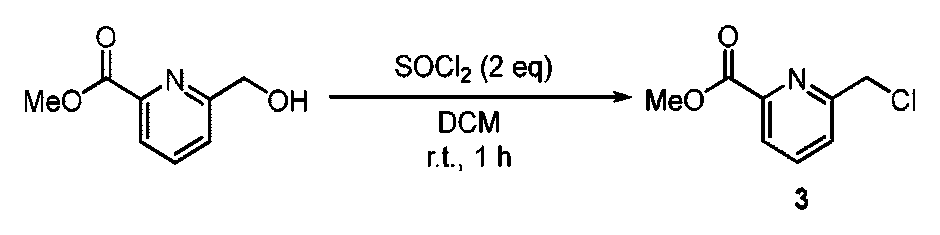
화합물 4의 제조:Preparation of compound 4:
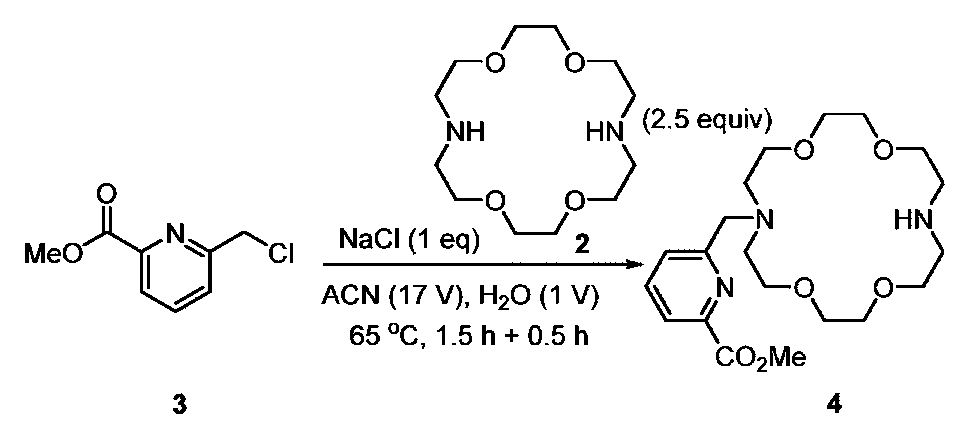
1,4,10,13-테트라옥사-7,16-디아자시클로옥타데칸(494 g, 1.88 mol, 2.5 당량), NaCl(44.1 g, 0.75 mol, 1.0 당량), H2O(140 mL, 화합물 3에 대해 1 부피) 및 아세토니트릴(2.1 L, 15 부피)을 N2 분위기 하 15℃ 내지 20℃에서 10 L 반응기에 충전하고, 65℃까지 가열하였다. 생성된 혼합물에, 65℃에서 아세토니트릴(280 ml, 2 부피) 중 화합물 3(140 g, 0.75 mol)의 용액을 1시간에 걸쳐 적가하였다. 용액을 65℃에서 0.5시간 동안 숙성시켰다. 혼합물의 LCMS 분석으로 반응의 완료를 확인하였다. 혼합물을 실온까지 냉각시키고, 진공 하에서 농축시켰다. 혼합물에 아세톤(700 ml, 5 부피)을 첨가하고, 현탁액을 추가 1시간 동안 교반하였다. 혼합물을 여과하였다(여과된 고체는 미반응 화합물 2였음). 여과액을 진공 하에서 농축시킨 후, DCM(1.4 L, 10 부피)에 용해시켰다. 유기상을 물(3 × 750 mL)로 세정하고, 유기상을 Na2SO4 상에서 건조시킨 후, 진공 하에서 농축시켜 화합물 4(212 g, 수율 63%, 분석: 85% w/w)를 수득하였다. LCMS: (ES,m/z): 412.15 [M+H]+ 1H-NMR (300 ㎒, DMSO-d 6, ppm): δ 7.98 ― 7.87 (m, 2H), 7.81 (dd, J = 6.4, 2.6 ㎐, 1H), 3.87 (s, 3H), 3.81 (s, 2H), 3.61 ― 3.38 (m, 16H), 2.77 (dt, J = 19.0, 5.2 ㎐, 8H).1,4,10,13-Tetraoxa-7,16-diazacyclooctadecane (494 g, 1.88 mol, 2.5 equiv), NaCl (44.1 g, 0.75 mol, 1.0 equiv), H 2 O (140 mL, 1 vol with respect to compound 3 ) and acetonitrile (2.1 L, 15 vol) were charged into a 10 L reactor under N 2 atmosphere at 15 °C to 20 °C and heated to 65 °C. To the resulting mixture, a solution of compound 3 (140 g, 0.75 mol) in acetonitrile (280 mL, 2 vol) at 65 °C was added dropwise over 1 h. The solution was aged at 65 °C for 0.5 h. The reaction was completed by LCMS analysis of the mixture. The mixture was cooled to room temperature and concentrated in vacuo. Acetone (700 mL, 5 vol) was added to the mixture and the suspension was stirred for an additional hour. The mixture was filtered (the filtered solid was unreacted compound 2 ). The filtrate was concentrated in vacuo and dissolved in DCM (1.4 L, 10 vol). The organic phase was washed with water (3 × 750 mL), dried over Na 2 SO 4 and concentrated in vacuo to give compound 4 (212 g, yield 63%, assay: 85% w/w). LCMS: (ES,m/z): 412.15 [M+H] + 1 H-NMR (300 MHz, DMSO- d 6 , ppm ): δ 7.98 - 7.87 (m, 2H), 7.81 (dd, J = 6.4, 2.6 Hz, 1H), 3.87 (s, 3H), 3.81 (s , 2H), 3.61 - 3.38 (m, 16H), 2.77 (dt, J = 19.0, 5.2 Hz, 8H).
화합물 7의 제조:Preparation of compound 7:

메틸 6-포르밀피콜리네이트 5(250 g, 1.0 당량), (4-((tert-부톡시카르보닐)아미노)페닐)보론산 6(538 g, 1.5 당량) 및 탈기된 THF(6.5 L, 5에 대해 26 부피)를 N2 분위기 하 15℃ 내지 20℃에서 10 L 반응기에 충전하였다. 이어서, PdCl2(14.0 g, 0.05 당량), 트리(나프탈렌-1-일)-포스판(31 g, 0.05 당량) 및 K2CO3(650 g, 3.1 당량)을 첨가하였다. 생성된 용액을 20℃에서 0.5시간 동안 교반하였다. 이어서, 혼합물을 65℃까지 가열하고, 17시간 동안 숙성시켰다. LCMS로 분석하여 이러한 반응이 완료되었음을 확인하였다. 생성된 용액을 실온에서 냉각시키고, 얼음물(2.5 L, 10 부피)과 에틸 아세테이트(5 L, 20 부피)로 희석하였다. 혼합물을 교반한 후, 셀리트 패드를 통해 여과하였다. 용액을 분리하고, 아래쪽 수성층을 제거하였다. 유기상을 물(2 × 1.5 L, 12 부피)로 세정하였다. 층을 분리하고, 유기층을 Na2SO4 상에서 건조시키고, 진공 하에서 농축시켰다. 생성된 잔류물을 헵탄(1.25 L, 5 부피)으로 처리하고, 생성된 현탁액을 0.5시간 동안 교반하였다. 혼합물을 여과하고, 필터 케이크를 n-헵탄(500 ml, 2 부피)으로 세정하여 목적하는 생성물 7(530 g, 수율 98%, LCAP 순도: 90%)을 황색 고체로 수득하고, 이를 추가 정제 없이 바로 다음 단계에 사용하였다. LCMS: (ES,m/z): 381.10 [M+Na]+ 1H-NMR (300 ㎒, DMSO-d 6, ppm): δ 9.27 (s, 1H), 8.03 ― 7.85 (m, 2H), 7.79 (dd, J = 7.7, 1.4 ㎐, 1H), 7.39 (d, J = 8.4 ㎐, 2H), 7.26 (d, J = 8.4 ㎐, 2H), 6.13 (d, J = 4.0 ㎐, 1H), 5.72 (d, J = 3.9 ㎐, 1H), 3.87 (s, 3H), 1.46 (s, 9H).Methyl 6-formylpicolinate 5 (250 g, 1.0 equiv), (4-((tert-butoxycarbonyl)amino)phenyl)boronic acid 6 (538 g, 1.5 equiv) and degassed THF (6.5 L, 26 volumes for 5 ) were charged to a 10 L reactor under N 2 atmosphere at 15 °C to 20 °C. Then, PdCl 2 (14.0 g, 0.05 equiv), tri(naphthalen-1-yl)-phosphane (31 g, 0.05 equiv) and K 2 CO 3 (650 g, 3.1 equiv) were added. The resulting solution was stirred at 20 °C for 0.5 h. The mixture was then heated to 65 °C and aged for 17 h. The reaction was completed, as determined by LCMS. The resulting solution was cooled to room temperature and diluted with ice water (2.5 L, 10 vol) and ethyl acetate (5 L, 20 vol). The mixture was stirred and filtered through a pad of Celite. The solution was separated and the lower aqueous layer was removed. The organic phase was washed with water (2 × 1.5 L, 12 vol). The layers were separated, the organic layer was dried over Na 2 SO 4 and concentrated in vacuo. The resulting residue was treated with heptane (1.25 L, 5 vol) and the resulting suspension was stirred for 0.5 h. The mixture was filtered and the filter cake was washed with n-heptane (500 ml, 2 vol) to give the desired product 7 (530 g, yield 98%, LCAP purity: 90%) as a yellow solid which was used directly in the next step without further purification. LCMS: (ES,m/z): 381.10 [M+Na] + 1 H-NMR (300 MHz, DMSO- d 6 , ppm ): δ 9.27 (s, 1H), 8.03 - 7.85 (m, 2H), 7.79 (dd, J = 7.7, 1.4 Hz, 1H), 7.39 (d , J = 8.4 Hz, 2H), 7.26 (d, J = 8.4 Hz, 2H), 6.13 (d, J = 4.0 Hz, 1H), 5.72 (d, J = 3.9 Hz, 1H), 3.87 (s, 3H), 1.46 (s, 9H).
화합물 8의 제조:Preparation of compound 8:

메틸 6-((4-((tert-부톡시카르보닐)아미노)페닐)(히드록시)메틸)피콜리네이트 7(310 g, 1.0 당량), 트리에틸아민(219 g, 2.5 당량) 및 DCM(6.2 L, 7에 대해 20 부피)을 질소 분위기 하 15℃ 내지 20℃에서 10 L 반응기에 충전하고, 용액을 0℃까지 냉각시켰다. 온도를 0℃로 유지하면서 메탄설포닐 클로라이드(99.2 g, 1.0 당량)를 30분에 걸쳐 적가하였다. 냉각 배쓰를 제거하고, 온도를 주위 온도에 이르게 한 후, 이러한 온도에서 1시간 동안 숙성시켰다. 용액을 진공 하 10℃ 내지 15℃에서 농축시킨 후, 잔류물을 아세토니트릴(438 ml, 2 부피)에 용해시켰다. 생성된 용액을 진공 하에서 농축시켜 목적하는 생성물 8(518 g, 미정제)을 수득하였다. 이러한 미정제 생성물을 추가 정제 없이 바로 다음 단계에 사용하였다.Methyl 6-((4-((tert-butoxycarbonyl)amino)phenyl)(hydroxy)methyl)picolinate 7 (310 g, 1.0 equiv), triethylamine (219 g, 2.5 equiv) and DCM (6.2 L, 20 vol for 7 ) were charged to a 10 L reactor at 15 to 20 °C under nitrogen atmosphere, and the solution was cooled to 0 °C. Methanesulfonyl chloride (99.2 g, 1.0 equiv) was added dropwise over 30 min, maintaining the temperature at 0 °C. The cooling bath was removed, and the temperature was allowed to reach ambient temperature and aged at this temperature for 1 h. The solution was concentrated under vacuum at 10 to 15 °C, and the residue was dissolved in acetonitrile (438 ml, 2 vol). The resulting solution was concentrated under vacuum to obtain the desired product 8 (518 g, crude). This crude product was used in the next step without further purification.
화합물 9의 제조:Preparation of compound 9:
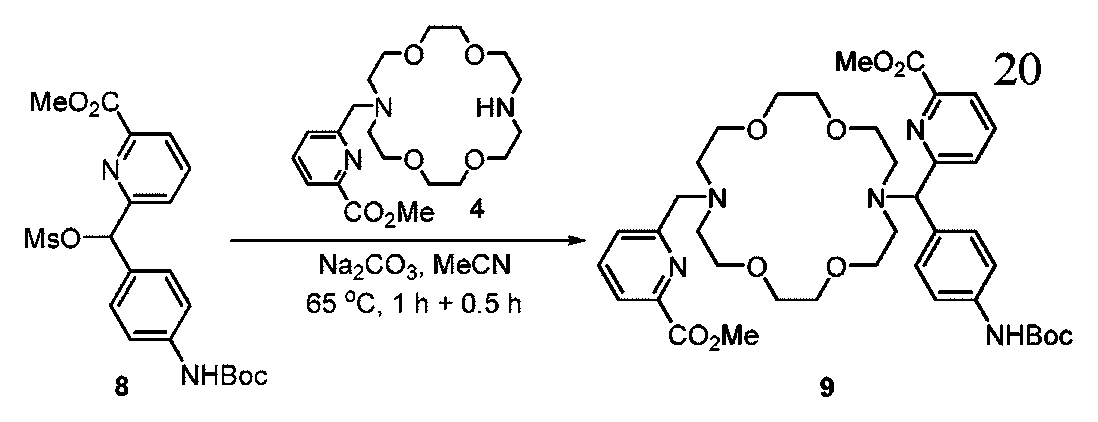
메틸 6-((4-((tert-부톡시카르보닐)아미노)페닐)-((메틸설포닐)옥시)메틸)피콜리네이트 8(212 g, 1.0 당량, Q-NMR에 따른 순도 85%), Na2CO3(137.6 g, 3.0 당량) 및 아세토니트릴(3.56 L, 8에 대해 20 부피)을 질소 분위기 하 실온에서 10 L 반응기에 충전한 후, 혼합물을 65℃까지 가열하고, 1시간 동안 숙성시켰다. 아세토니트릴(3 L, 10 부피) 중 메틸 6-((1,4,10,13-테트라옥사-7,16-디아자시클로옥타데칸-7-일)메틸)피콜리네이트 4(377.8 g, 2.0 당량)의 용액을 65℃에서 0.5시간에 걸쳐 적가하였다. HPLC 분석으로 이러한 반응이 완료되었음을 확인할 때까지, 혼합물을 이러한 온도에서 숙성시켰다. 생성된 용액을 실온에서 냉각시킨 후, 여과하고, 필터 케이크를 MeOH(2 × 1 부피)로 세정하였다. 여과액을 진공 하에서 농축시키고, 생성된 잔류물을 EA(700 mL)에 용해시킨 후, 실리카겔(800 g, 유형: ZCX-2, 100 내지 200 메쉬, 2.11 w/w)을 첨가하였다. 온도를 35℃ 아래로 유지하면서 혼합물을 진공 하에서 농축시켰다. 실리카겔(9.6 kg, 유형: ZCX-2, 100 내지 200 메쉬, 26.3 w/w)을 컬럼에 충전한 후, 흡착된 미정제 9를 함유하는 건조 실리카겔을 제조하였다. 컬럼을 에틸 아세테이트:석유 에테르:디클로로메탄(3:3:1)/메탄올:디클로로메탄(1:1)(구배 100:0→90:10, 4 L ± 0.5 L마다 샘플 수집)로 용리하였다. 분획을 TLC(에틸 아세테이트:석유 에테르:디클로로메탄:메탄올 = 4:4:1:1)로 분석하였다. 생성물 함유 분획을 조합하고, 농축시켜 화합물 9(260 g, HPLC: 94%, QNMR: 92%)를 황색 고체로 수득하였다. 추가의 화합물 9(70 g, HPLC: 75%, QNMR: 60%)를 황색 오일로 수득하였다. LCMS (ES, m/z): 752.30 [M+H]+ 측정치 m/z 1H-NMR (400 ㎒, CDCl3, ppm): δ 7.53 ― 7.32 (m, 3H), 7.28 ― 7.18 (m, 3H), 6.86 (d, J = 8.4 ㎐, 2H), 6.76 (d, J = 8.4 ㎐, 2H), 6.09 (s, 1H), 4.63 (s, 1H), 3.48 (s, 3H), 3.44 (bs, 5H), 3.17 ― 2.92 (m, 16H), 2.38 (dq, J = 25.0, 7.2, 6.8 ㎐, 8H), 0.97 (s, 9H).Methyl 6-((4-((tert-butoxycarbonyl)amino)phenyl)-((methylsulfonyl)oxy)methyl)picolinate 8 (212 g, 1.0 equiv, purity 85% by Q-NMR), Na 2 CO 3 (137.6 g, 3.0 equiv) and acetonitrile (3.56 L, 20 volumes for 8 ) were charged into a 10 L reactor at room temperature under a nitrogen atmosphere, and the mixture was heated to 65 °C and aged for 1 hour. A solution of methyl 6-((1,4,10,13-tetraoxa-7,16-diazacyclooctadecan-7-yl)methyl)picolinate 4 (377.8 g, 2.0 equiv) in acetonitrile (3 L, 10 vol) was added dropwise at 65 °C over 0.5 h. The mixture was aged at this temperature until the reaction was complete by HPLC analysis. The resulting solution was cooled to room temperature, filtered, and the filter cake was washed with MeOH (2 × 1 vol). The filtrate was concentrated in vacuo, and the resulting residue was dissolved in EA (700 mL) followed by addition of silica gel (800 g, type: ZCX-2, 100-200 mesh, 2.11 w/w). The mixture was concentrated in vacuo while maintaining the temperature below 35 °C. After packing silica gel (9.6 kg, type: ZCX-2, 100-200 mesh, 26.3 w/w) into the column, dry silica gel containing the adsorbed crude 9 was prepared. The column was eluted with ethyl acetate:petroleum ether:dichloromethane (3:3:1)/methanol:dichloromethane (1:1) (gradient 100:0→90:10, samples collected every 4 L ± 0.5 L). The fractions were analyzed by TLC (ethyl acetate:petroleum ether:dichloromethane:methanol = 4:4:1:1). The product-containing fractions were combined and concentrated to give compound 9 (260 g, HPLC: 94%, QNMR: 92%) as a yellow solid. Additional compound 9 (70 g, HPLC: 75%, QNMR: 60%) was obtained as a yellow oil. LCMS (ES, m/z): 752.30 [M+H] + measured m/z 1 H-NMR (400 MHz, CDCl 3 , ppm ): δ 7.53 - 7.32 (m, 3H), 7.28 - 7.18 (m, 3H), 6.86 (d, J = 8.4 Hz, 2H), 6. 76 (d, J = 8.4 ㎐, 2H), 6.09 (s, 1H), 4.63 (s, 1H), 3.48 (s, 3H), 3.44 (bs, 5H), 3.17 - 2.92 (m, 16H), 2.38 (dq, J = 25.0, 7.2, 6.8 ㎐ , 8H), 0.97 (s, 9H).
화합물 10의 제조:Preparation of compound 10:

화합물 9(260 g, QNMR: 92%, 1.0 당량), N,O-비스(트리메틸실릴)아세트아미드(BSA, 6.0 당량) 및 아세토니트릴(4 L, 15 부피)을 질소 분위기 하 15℃ 내지 20℃에서 10 L 반응기에 충전하였다. 혼합물을 20℃에서 40분 동안 교반하였다. 내부 온도를 15℃ 내지 20℃로 유지하면서 아세토니트릴(1.3 L, 5 부피) 중 TMSOTf(212.9 g, 3.0 당량)의 용액을 0.5시간에 걸쳐 적가하여 충전하였다. 용액을 15℃ 내지 20℃에서 1시간 동안 숙성시켰다. 공정 분석(샘플 준비: 시스템 0.1 mL + ACN 0.9 mL + 디이소프로필에틸아민 한 방울)에 따라 출발 물질이 완전히 전환된 것으로 확인되면, 온도를 5℃ 내지 10℃로 유지하면서 혼합물을 디이소프로필에틸아민(617 g, 15.0 당량)으로 켄칭하였다. 혼합물을 5℃ 내지 10℃에서 20분 동안 교반한 후, 온도를 5℃ 내지 10℃로 유지하면서 NH4Cl 포화 수용액(2.6 L, 10 부피)을 충전하였다. 혼합물을 이러한 온도에서 추가 30분 동안 숙성시켰다. 수성상(고체 함유)을 수집하고, 2-MeTHF(520 ml, 2 부피)로 추출하였다. 유기상을 조합하고, KF로 수분 함량을 확인하고(KF: 9.18%), 무수 Na2SO4(500 g, 10.0 당량)을 이용하여 건조시켰다. 여과하여 고체를 제거하고, 필터 케이크를 아세토니트릴(2 × 520 ml, 2 부피)로 세정하였다. 이어서, 여과액을 무수 Na2SO4(500 g, 10.0 당량)을 이용하여 건조시켰다. 여과한 후, 필터 케이크를 아세토니트릴(2 × 520 ml, 2 부피)과 물로 세정하고, KF로 수분 함량을 확인하였다(KF: 8.15%). 10의 아세토니트릴/2-MeTHF 스트림을 바로 다음 단계에 사용하였다. (생성물이 LCMS 조건에 안정하지 않았음).Compound 9 (260 g, QNMR: 92%, 1.0 equiv), N,O-bis(trimethylsilyl)acetamide (BSA, 6.0 equiv) and acetonitrile (4 L, 15 vol) were charged to a 10 L reactor at 15°C to 20°C under a nitrogen atmosphere. The mixture was stirred at 20°C for 40 min. A solution of TMSOTf (212.9 g, 3.0 equiv) in acetonitrile (1.3 L, 5 vol) was added dropwise over 0.5 h while maintaining the internal temperature at 15°C to 20°C. The solution was aged at 15°C to 20°C for 1 h. When complete conversion of the starting material was confirmed by process analysis (sample preparation: 0.1 mL of system + 0.9 mL of ACN + one drop of diisopropylethylamine), the mixture was quenched with diisopropylethylamine (617 g, 15.0 equiv) while maintaining the temperature at 5 to 10 °C. The mixture was stirred at 5 to 10 °C for 20 min, then charged with saturated aqueous NH 4 Cl solution (2.6 L, 10 vol) while maintaining the temperature at 5 to 10 °C. The mixture was aged at this temperature for an additional 30 min. The aqueous phase (containing solids) was collected and extracted with 2-MeTHF (520 ml, 2 vol). The organic phases were combined, the water content was checked by KF (KF: 9.18%) and dried using anhydrous Na 2 SO 4 (500 g, 10.0 equiv). The solid was removed by filtration and the filter cake was washed with acetonitrile (2 × 520 ml, 2 vol). The filtrate was then dried over anhydrous Na 2 SO 4 (500 g, 10.0 eq). After filtration, the filter cake was washed with acetonitrile (2 × 520 ml, 2 vol) and water and the moisture content was checked by KF (KF: 8.15%). 10 A of acetonitrile/2-MeTHF stream was used directly in the next step. (The product was not stable to LCMS conditions).
화합물 14(유리 산)의 제조Preparation of compound 14 (free acid)

메틸 6-((4-((tert-부톡시카르보닐)아미노)페닐)(16-((6-(메톡시카르보닐)피리딘-2-일)메틸)-1,4,10,13-테트라옥사-7,16-디아자시클로옥타데칸-7-일)메틸)피콜리네이트(6.0 g, 1.0 당량), BSA(9.7 g, 6.0 당량) 및 MeCN(120 mL, 9에 대해 20 부피)을 질소 분위기 하 실온에서 500 mL 반응기에 충전하였다. MeCN(120 mL, 20 부피) 중 TMSOTf(5.4 g, 2.3 당량)의 용액을 실온에서 30분에 걸쳐 적가하였다. 혼합물을 실온에서 밤새 숙성시켰다. 혼합물 분석(샘플 준비: 시스템 0.1 mL + ACN 0.9 mL + 디이소프로필에틸아민 한 방울)을 통해 반응이 완료되었음을 확인하였다. 온도를 0℃ 내지 5℃로 유지하면서 혼합물을 디이소프로필에틸아민(15.4 g, 15.0 당량)으로 켄칭하였다. 혼합물을 0℃ 내지 5℃에서 5분 동안 교반한 후, 온도를 0℃ 내지 5℃로 유지하면서 NH4Cl 포화 수용액(60 mL, 10 부피)을 적가하여 충전하였다. 수성상을 추출하여 제거하고, 유기상을 수집하여 바로 다음 단계에 사용하였다. 유기상을 500 mL 3구 둥근 바닥 병에 충전하고, 상기 용액에 실온에서 물(60 mL, 10 V) 중 LiOH(1.15 g, 6.0 당량)의 용액을 첨가하였다. 용액을 이러한 온도에서 1시간 동안 교반하였다. 혼합물 분석(샘플 준비, 시스템 0.1 mL + 아세토니트릴 0.9 mL)을 통해 완전히 전환되지 않았음을 확인하였다. 또 다른 분획의 LiOH(576 mg, 3.0 당량)을 첨가하고, 용액을 실온에서 추가 1시간 동안 교반하였다. 혼합물 분석(샘플 준비, 시스템 0.1 mL + 아세토니트릴 0.9 mL)을 통해 반응이 완료되었음을 확인하였다. 이어서, TCDI(5.6 g, 3.9 당량)을 첨가하고, 용액을 실온에서 1시간 동안 교반하였다. 혼합물 분석(샘플 준비, 시스템 0.1 mL + 아세토니트릴 0.9 mL)을 통해 완전히 전환되지 않았음을 확인하였다. 또 다른 분획의 TCDI(2.8 g, 2.0 당량)을 첨가하고, 용액을 실온에서 추가 1시간 동안 교반하였다. 혼합물 분석(샘플 준비, 시스템 0.1 mL + 아세토니트릴 0.9 mL)을 통해 반응이 완료되었음을 확인하였다. 반응 용액을 역상 Combi-Flash로 분리하였다. 방법: 컬럼 C18, A 용액 H2O(0.01% 포름산 함유), B 용액 ACN. 40분 내에 5%→35%, 유량(100 mL/분), 20분 내지 25분 내에 생성물. 용액 수집. 용액을 농축시켜 ACN을 제거하고, 다시 역상 Combi-Flash로 분리하였다. 방법: 컬럼 C18, A 용액 H2O, B 용액 ACN. 5% 10분, 5분 내에 5%→35%, 95% 10분, 유량(100 mL/분), 13분 내지 25분 내에 생성물. 용액 수집. 용액을 진공 하에 <20℃에서 농축시키고, 동결건조로 건조시켰다. 화합물 14(2.5 g, 3단계에 걸친 수율 47%)를 황색 고체로 수득하였다. 화합물 14(6-((16-((6-카르복시피리딘-2-일)(4-이소티오시아네이토페닐)메틸)-1,4,10,13-테트라옥사-7,16-디아자시클로옥타데칸-7-일)메틸)피콜린산)는 -80℃에서 보관해야 했다. LCMS: (ES, m/z): 666.3 [M+H]+ 1H-NMR: (400 ㎒, D2O, ppm): 7.94-7.84 (m, 4H), 7.56-7.40 (m, 4H), 7.16-7.14 (m, 2H), 5.83 (s, 1H), 4.56 (s, 2H), 3.80-3.75 (m, 8H), 3.60-3.49 (m, 14H), 3.36-3.33 (m, 2H).Methyl 6-((4-((tert-butoxycarbonyl)amino)phenyl)(16-((6-(methoxycarbonyl)pyridin-2-yl)methyl)-1,4,10,13-tetraoxa-7,16-diazacyclooctadecan-7-yl)methyl)picolinate (6.0 g, 1.0 equiv), BSA (9.7 g, 6.0 equiv), and MeCN (120 mL, 20 vol for 9 ) were charged to a 500 mL reactor at room temperature under a nitrogen atmosphere. A solution of TMSOTf (5.4 g, 2.3 equiv) in MeCN (120 mL, 20 vol) was added dropwise over 30 min at room temperature. The mixture was aged overnight at room temperature. The reaction was confirmed to be complete by analysis of the mixture (sample preparation: 0.1 mL of system + 0.9 mL of ACN + one drop of diisopropylethylamine). The mixture was quenched with diisopropylethylamine (15.4 g, 15.0 equiv) while maintaining the temperature between 0°C and 5°C. The mixture was stirred at 0°C to 5°C for 5 min, then saturated aqueous NH4Cl solution (60 mL, 10 vol) was added dropwise while maintaining the temperature between 0°C and 5°C. The aqueous phase was extracted and removed, and the organic phase was collected and used directly in the next step. The organic phase was charged to a 500 mL 3-necked round-bottomed bottle, and a solution of LiOH (1.15 g, 6.0 equiv) in water (60 mL, 10 V) at room temperature was added to the solution. The solution was stirred at this temperature for 1 h. Analysis of the mixture (sample preparation, 0.1 mL of system + 0.9 mL of acetonitrile) confirmed that the conversion was not complete. Another portion of LiOH (576 mg, 3.0 equiv) was added and the solution was stirred at room temperature for an additional 1 h. Analysis of the mixture (sample preparation, 0.1 mL of system + 0.9 mL of acetonitrile) confirmed that the reaction was complete. Then, TCDI (5.6 g, 3.9 equiv) was added and the solution was stirred at room temperature for 1 h. Analysis of the mixture (sample preparation, 0.1 mL of system + 0.9 mL of acetonitrile) confirmed that the conversion was not complete. Another portion of TCDI (2.8 g, 2.0 equiv) was added and the solution was stirred at room temperature for an additional 1 h. The reaction was confirmed to be complete by mixture analysis (sample preparation, system 0.1 mL + acetonitrile 0.9 mL). The reaction solution was separated by reverse phase Combi-Flash. Method: Column C18, Solution A H 2 O (containing 0.01% formic acid), Solution B ACN. 5%→35% in 40 min, flow rate (100 mL/min), product in 20 to 25 min. Solution collected. The solution was concentrated to remove ACN and separated by reverse phase Combi-Flash again. Method: Column C18, Solution A H 2 O, Solution B ACN. 5% in 10 min, 5%→35% in 5 min, 95% in 10 min, flow rate (100 mL/min), product in 13 to 25 min. Solution collected. The solution was concentrated under vacuum at <20°C and dried by lyophilization. Compound 14 (2.5 g, 47% yield over three steps) was obtained as a yellow solid. Compound 14 (6-((16-((6-carboxypyridin-2-yl)(4-isothiocyanatophenyl)methyl)-1,4,10,13-tetraoxa-7,16-diazacyclooctadecan-7-yl)methyl)picolinic acid) had to be stored at -80°C. LCMS: (ES, m/z ): 666.3 [M+H] + 1 H-NMR: (400 MHz, D 2 O, ppm ): 7.94-7.84 (m, 4H), 7.56-7.40 (m, 4H), 7.16-7.14 (m, 2H), 5.83 (s, 1H), 4.56 (s , 2H), 3.80-3.75 (m, 8H), 3.60-3.49 (m, 14H), 3.36-3.33 (m, 2H).
화합물 11(소듐 염)의 제조:Preparation of compound 11 (sodium salt):

ACN과 2-MeTHF 중 화합물 10의 제조된 용액을 10 L 4구 반응기에 충전하고, 용액을 5℃ 내지 10℃까지 냉각시켰다. 온도를 5℃ 내지 10℃로 유지하면서 분말화된 NaOH(56.9 g, 4.5 당량)을 첨가하였다. 용액을 15℃ 내지 20℃에서 0.5시간 동안 교반하였다. 혼합물 분석(샘플 준비: 시스템 0.1 mL + 아세토니트릴 0.9 mL)을 통해 전환되지 않았음을 확인하였다. 5℃ 내지 10℃에서 추가의 분말화된 NaOH(25.3 g, 2.0 당량)을 첨가하였다. 용액을 15℃ 내지 20℃에서 추가 0.5시간 동안 숙성시켰다. 두 번째 IPC 분석을 수행하여, 50% 전환이 이루어졌음을 확인하였다. 5℃ 내지 10℃에서 분말화된 NaOH(25.3 g, 2.0 당량)의 최종 충전을 첨가하였다. 혼합물을 15℃ 내지 20℃에서 추가 0.5시간 동안 교반하였다. 분석을 통해 출발 물질 10이 완전히 전환되었음을 확인하였다. 혼합물을 여과하고, 필터 케이크를 아세토니트릴(2 × 520 ml, 2 부피)로 세정하였다. 온도를 15℃ 내지 20℃로 유지하면서 최종 용액(약 7.5 L, 28.8 부피)을 1 내지 2 부피로 농축시켰다. 이어서, 잔류물을 아세토니트릴(2 L, 7.7 부피)로 처리하고, KF로 수분 함량을 확인하였다(KF: 5.7%). 혼합물을 여과하고, 필터 케이크를 ACN(2 × 520 ml, 2 부피)로 세정하였다. 이어서, 용액을 진공 하 15℃ 내지 20℃에서 1 내지 2 V로 농축시켰다. 다시 KF로 수분 함량을 확인하였다(KF: 5.5%). 용액을 아세토니트릴(390 ml, 1.5 부피)로 희석하고, 온도를 15℃ 내지 20℃로 유지하면서 0.5시간에 걸쳐 MTBE(2.6 L, 10 부피)에 적가하였다. 용매를 디캔팅하여 점성의 오일을 남기고, 이를 아세토니트릴(520 ml, 2 부피)에 다시 용해시키고, MTBE(2.6 L, 10 부피)에 첨가하였다. 이러한 과정을 추가로 4회 반복하였다. 점성의 오일을 수득하기 위해, 최종적으로 아세토니트릴(520 ml, 2 부피)에 용해시키고, 건조시킨 후, 감압 하 15℃ 내지 20℃에서 농축시켰다. 이어서, 15℃ 내지 20℃에서 오일 펌프를 이용하여 증발시키는 방식으로 잔류 용매를 제거하였다. 건조시킨 후, 화합물 11(335 g)을 회황색(off yellow) 고체로 수득하였다(QNMR: 70%, 2단계에 걸친 전체 수율 87%). LCMS (ES,m/z): 624.3 [M-TfONa-2Na+3H]+ 1H-NMR (300 ㎒, 메탄올-d 4, ppm): δ 7.97 (dd, J = 7.8, 2.1 ㎐, 2H), 7.84 (t, J = 7.7 ㎐, 1H), 7.75 (t, J = 7.8 ㎐, 1H), 7.36 (dd, J = 7.8, 1.1 ㎐, 1H), 7.23 (d, J = 7.7 ㎐, 1H), 7.11 (d, J = 8.5 ㎐, 2H), 6.72 (d, J = 8.5 ㎐, 2H), 3.96 (s, 1H), 3.83-3.36 (m, 18H), 3.03 ― 2.62 (m, 6H), 2.55 (d, J = 14.3 ㎐, 2H).The prepared solution of
화합물 12(TOPA-[C7]-페닐이소티오시아네이트 소듐 염)의 제조:Preparation of compound 12 (TOPA-[C7]-phenylisothiocyanate sodium salt):
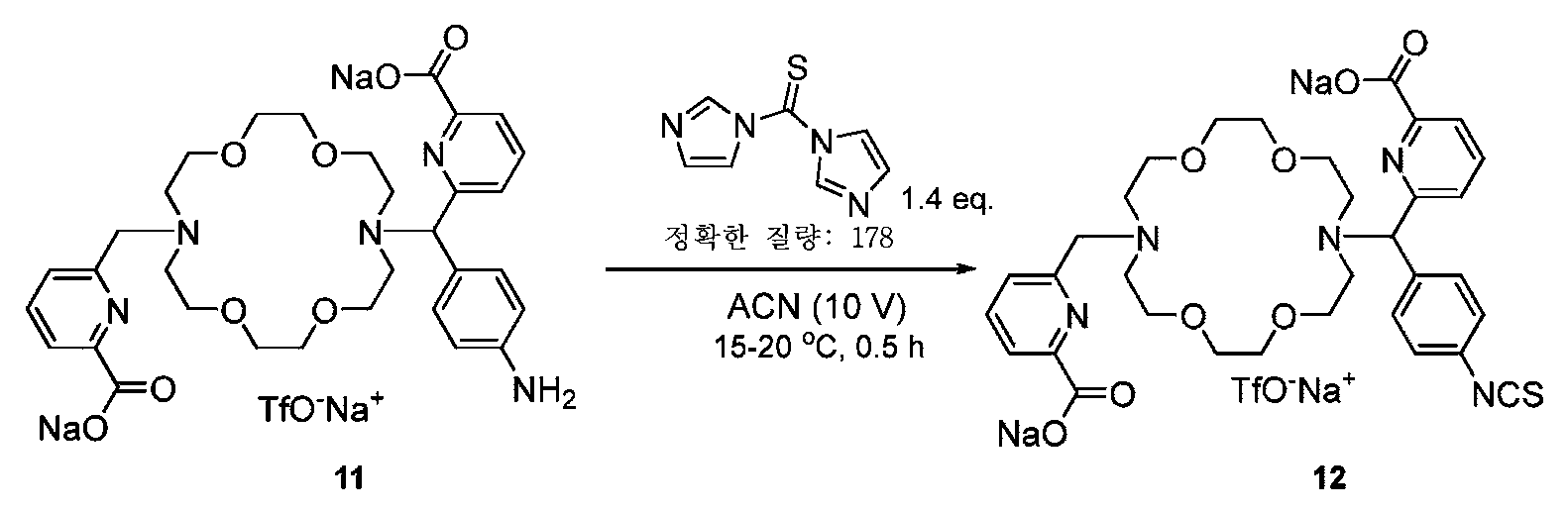
TCDI(68.7 g, 1.4 당량)과 아세토니트릴(2.6 L, 8 부피)을 질소 분위기 하 15℃ 내지 20℃에서 10 L 반응기에 충전하였다. 온도를 15℃ 내지 20℃로 유지하면서 아세토니트릴(660 mL, 2 부피) 중 화합물 11(330 g, Na+ 염, QNMR: 70%, 1.0 당량)의 용액을 30분에 걸쳐 적가하였다. 혼합물을 15℃ 내지 20℃에서 0.5시간 동안 숙성시켰다. 혼합물 분석(샘플 준비:시스템 30 μL + ACN 300 μL + 물 한 방울)을 통해 반응이 완료되었음을 확인하였다. KF로 수분 함량을 확인하였다(KF: 0.19%). 시스템을 건조시키고, 감압 하 15℃ 내지 20℃ 에서 농축시켰다. 생성된 잔류물을 아세토니트릴(945 ml, 2.9 부피)에 용해시키고, KF로 수분 함량을 측정하였다(KF: 0.34%). 상기 용액에, 15℃ 내지 20℃에서 이소프로필 아세테이트(660 ml, 2 부피)를 40분에 걸쳐 충전하였다. 핵형성이 관찰되지 않았으며, 15℃ 내지 20℃에서 추가의 이소프로필 아세테이트(6.6 L, 18 부피)를 40분에 걸쳐 서서히 적가하는 방식으로 충전하여 생성물 12를 침전시키고, 이를 여과하여 회황색 고체로 수집하였다. 고체를 아세토니트릴(330 ml, 1 부피)에 용해시키고, 15℃ 내지 20℃에서 IPAc(6.6 L, 20 부피)을 40분에 걸쳐 서서히 적가하여 충전하였다. 혼합물을 여과하여 생성물(230 g)을 회황색 고체로 수득하였다(LCAP: 80.99%, QNMR: 59%, IPAc 10%). 습윤 케이크를 진공 하 15℃ 내지 20℃에서 2시간 동안 건조시켜 미정제 12(224 g)를 회황색 고체로 제공하였다(LCAP: 80.9%, QNMR: 60.4%, IPAc 약 6%). 미정제 12를 아세토니트릴(330 ml, 1 부피)에 다시 용해시키고, 15℃ 내지 20℃에서 이소프로필 아세테이트(412 ml, 1.25 부피)를 40분에 걸쳐 서서히 적가하여 충전하였다. 생성된 혼합물을 여과하고, 12를 수집하였다(30.5 g, HPLC = 60.9%, 분석: 25.5%). 15℃ 내지 20℃에서 40분에 걸쳐 첨가한 이소프로필 아세테이트(6.6 L, 20 부피)로 모액을 희석하였다. 혼합물을 여과하고, 케이크를 건조시켜 미정제 생성물 12(173.5 g)를 회황색 고체로 수득하였다(LCAP: 85.4%, QNMR: 66%, IPAc 3.9%, RRT1.19 = 3.9%). 미정제 생성물 12(190 g)를 아세토니트릴:이소프로필 아세테이트(2:1)(760 mL)에 용해시키고, 혼합물을 실리카겔 컬럼(380 g, 2 x)에 통과시켰다. 실리카를 아세토니트릴:이소프로필 아세테이트(2:1, 5.7 L)로 플러싱하고, 이어서 아세토니트릴(12 L)(매우 적은 생성물)로 플러싱하였다. 생성물 함유 분획을 농축시켜 생성물 12(118 g)를 회황색 고체로 수득하였다(LCAP: 95%). 이어서, 실리카 패드를 MeCN/H2O(12 L, 10:1)로 플러싱하였다. 용매를 진공에서 제거하여 추가의 미정제 12(60 g)를 회황색 고체로 수득하고, 이를 아세토니트릴(1.5 L)에 용해시키고, 30분 동안 교반한 후, 여과하였다. 이어서, 모액을 농축시켜 미정제 12(24 g)를 회황색 고체로 수득하였다(LCAP = 92%). 상기 제조된 미정제 12(118 g)와 미정제 12(24 g)를 아세토니트릴(330 ml, 1 부피)에 용해시키고, 15℃ 내지 20℃에서 이소프로필 아세테이트(6.6 L, 20 부피)를 40분에 걸쳐 적가하여 충전하였다. 이어서, 혼합물을 여과하여 생성물 12(133 g)를 적합한 순도(LCAP: 95%, QNMR: 60.8%, IPAc 7.8%)의 회황색 고체로 수득하였다. 화합물 12를 -20℃에서 보관해야 한다는 점에 유의해야 한다. LCMS: (ES,m/z): 666.61 [M-TfONa-2Na+3H]+ 1H-NMR: (400 ㎒, 메탄올-d 4, ppm): δ 8.00 (ddd, J = 13.8, 7.7, 1.0 ㎐, 2H), 7.84 (dt, J = 20.4, 7.7 ㎐, 2H), 7.58 ― 7.49 (m, 2H), 7.40 (dd, J = 7.6, 1.0 ㎐, 1H), 7.36 ― 7.28 (m, 2H), 7.28 ― 7.20 (m, 1H), 4.96 (hept, J = 6.3 ㎐, 1H), 3.96 ― 3.88 (m, 1H), 3.83 (d, J = 15.1 ㎐, 1H), 3.70 ― 3.52 (m, 11H), 3.55 ― 3.39 (m, 4H), 3.07 ― 2.73 (m, 6H), 2.62 (dt, J = 15.1, 3.6 ㎐, 2H).TCDI (68.7 g, 1.4 equiv) and acetonitrile (2.6 L, 8 vol) were charged into a 10 L reactor under a nitrogen atmosphere at 15°C to 20°C. A solution of compound 11 (330 g, Na + salt, QNMR: 70%, 1.0 equiv) in acetonitrile (660 mL, 2 vol) was added dropwise over 30 min while maintaining the temperature at 15°C to 20°C. The mixture was aged at 15°C to 20°C for 0.5 h. The reaction was completed by mixture analysis (sample preparation: 30 μL of system + 300 μL of ACN + one drop of water). The water content was checked by KF (KF: 0.19%). The system was dried and concentrated under reduced pressure at 15°C to 20°C. The resulting residue was dissolved in acetonitrile (945 ml, 2.9 vol) and the water content was measured by KF (KF: 0.34%). To the solution, isopropyl acetate (660 ml, 2 vol) was charged over 40 min at 15 to 20 °C. No nucleation was observed and additional isopropyl acetate (6.6 L, 18 vol) was charged dropwise over 40 min at 15 to 20 °C to precipitate the product 12 , which was collected by filtration as an off-white solid. The solid was dissolved in acetonitrile (330 ml, 1 vol) and IPAc (6.6 L, 20 vol) was charged dropwise over 40 min at 15 to 20 °C. The mixture was filtered to obtain the product (230 g) as an off-yellow solid (LCAP: 80.99%, QNMR: 59%,
실시예 20Example 20
TOPA-[C7]-페닐티오우레아-h11B6 항체 접합체TOPA-[C7]-phenylthiourea-h11B6 antibody conjugate
(상기 도시된 TOPA-[C7]-페닐티오우레아-h11B6 항체 접합체에서, 상기 구조는 페닐티오우레아 모이어티에 연결된 h11b6의 리신 잔기를 나타내지 않음).(In the illustrated TOPA-[C7]-phenylthiourea-h11B6 antibody conjugate, the structure does not show the lysine residue of h11b6 linked to the phenylthiourea moiety).
mAb의 TOPA-[C7]-페닐티오우레아 변형: TOPA-[C7]-phenylthiourea modification of mAb :
h11b6 mAb(10.2 mg/ml)를 10 mM 소듐 아세테이트(pH 5.2) 완충액 중에 1 mg/ml로 희석하였다. 접합 직전, pH를 탄산수소소듐 완충액(VWR 144-55-8)을 이용하여 pH 9로 조정하였다. pH는 pH 페이퍼로 확인하였다. 이어서, h11b6 mAb에 10x 몰 과량의 디소듐 염인 TOPA-[C7]-페닐이소티오시아네이트 소듐 염(물에 용해시킨 50 mM 스톡)을 첨가하고, 항체와 TOPA-[C7]-페닐이소티오시아네이트 소듐 염의 혼합물을 진탕시키지 않으면서 실온에서 대략 1시간 동안 인큐베이션하였다. TOPA-[C7]-페닐이소티오시아네이트 소듐 염의 첨가를, CAR 값이 1.5 내지 2.0이 될 때까지, Agilent® G224 기기에서 원형 질량 ESI-TOF LC-MS로 모니터링하였다. 이어서, 1 M Tris(pH 8.5)(Teknova T1085)를 즉시 첨가하여 혼합물을 최종 농도 100 mM로 켄칭하였다. 반응액을 7K Zeba® 탈염 컬럼을 사용하여 10 mM 소듐 아세테이트(pH 5.2)로 탈염시키는 방식으로 과량의 유리 킬레이트제를 제거하였다. 과량의 킬레이트제가 존재하지 않는다는 것을 확인하기 위해, 샘플을 15 ml로 3회 희석한 후, 50,000 MWCO Amicon 농축 장치를 사용하여 1 ml로 농축시켰다. 이어서, 샘플을 방사성표지화를 위한 최종 농도로 농축시켰다. 최종 접합체는 하기와 같은 분석용 크기 배제 크로마토그래피를 통해 단량체인 것으로 확인되었다: Tosoh TSKgel G3000SWxl 7.8 mm × 30 cm, 5 u 컬럼; 컬럼 온도: 실온; 컬럼을 0.2 M 인산소듐(pH 6.8)으로 용리함; 유량: 0.8 mL/분; 18분 실행; 주입량: 18 ul. h11b6 mAb (10.2 mg/ml) was diluted to 1 mg/ml in 10 mM sodium acetate, pH 5.2, buffer. Immediately prior to conjugation, the pH was adjusted to pH 9 with sodium bicarbonate buffer (VWR 144-55-8). The pH was checked with pH paper. Then, a 10x molar excess of the disodium salt, TOPA-[C7]-phenylisothiocyanate sodium salt (50 mM stock in water), was added to h11b6 mAb, and the mixture of antibody and TOPA-[C7]-phenylisothiocyanate sodium salt was incubated at room temperature without shaking for approximately 1 h. The addition of TOPA-[C7]-phenylisothiocyanate sodium salt was monitored by circular mass ESI-TOF LC-MS on an Agilent® G224 instrument until the CAR value reached 1.5–2.0. The mixture was then quenched by immediate addition of 1 M Tris, pH 8.5 (Teknova T1085) to a final concentration of 100 mM. The reaction mixture was desalted using a 7K Zeba® Desalting column to remove excess free chelator into 10 mM sodium acetate, pH 5.2. To ensure the absence of excess chelator, the sample was diluted three times to 15 ml and then concentrated to 1 ml using a 50,000 MWCO Amicon concentrator. The sample was then concentrated to a final concentration for radiolabeling. The final conjugate was confirmed to be a monomer by analytical size exclusion chromatography as follows: Tosoh TSKgel G3000SWxl 7.8 mm × 30 cm, 5 u column; Column temperature: room temperature; Column eluted with 0.2 M sodium phosphate (pH 6.8); Flow rate: 0.8 mL/min; Run 18 min; Injection volume: 18 ul.
실시예 21Example 21
Ac-225 표지된 TOPA-[C7]-페닐티오우레아-h11B6 항체 접합체Ac-225 labeled TOPA-[C7]-phenylthiourea-h11B6 antibody conjugate

(상기 도시된 Ac-225 표지된 TOPA-[C7]-페닐티오우레아-h11B6 항체 접합체에서, 상기 구조는 페닐티오우레아 모이어티에 연결된 h11b6의 리신 잔기를 나타내지 않음).(In the Ac-225 labeled TOPA-[C7]-phenylthiourea-h11B6 antibody conjugate depicted above, the structure does not show the lysine residue of h11b6 linked to the phenylthiourea moiety).
(i) 3 M NaOAc 완충액 중에서 Ac-225로의 TOPA-[C7]-페닐티오우레아-h11B6의 표지화: (i) Labeling of TOPA-[C7]-phenylthiourea-h11B6 with Ac-225 in 3 M NaOAc buffer:
플라스틱 바이알 내 NaOAc(H2O 중 3 M, 60 μL)의 용액에, Ac-225(0.1 N HCl 중 10 mCi/mL, 15 μL)와 TOPA-[C7]-페닐티오우레아-h11B6(10 mM NaOAc 중 1.13 mg/mL, pH=5.5, 441 uL, 0.5 mg)을 순차적으로 첨가하였다. 혼합한 후, pH 페이퍼에 따른 pH는 약 6.5였다. 바이알을 37℃에서 2시간 동안 정치시켰다.To a solution of NaOAc (3 M in H2O , 60 μL) in a plastic vial, Ac-225 (10 mCi/mL in 0.1 N HCl, 15 μL) and TOPA-[C7]-phenylthiourea-h11B6 (1.13 mg/mL in 10 mM NaOAc, pH=5.5, 441 μL, 0.5 mg) were sequentially added. After mixing, the pH was about 6.5 according to pH paper. The vial was allowed to stand at 37°C for 2 h.
표지화 반응 혼합물의 iTLC:iTLC of the labeling reaction mixture:
표지화 반응 혼합물 0.5 μL를 iTLC-SG 상에 로딩하고, 10 mM EDTA(pH 5 내지 6)를 이용하여 전개시켰다. 건조된 iTLC-SG를 실온에서 밤새 정치시킨 후, Bioscan AR-2000 radio-TLC 스캐너로 스캐닝하였다. 본원에 기재된 용리 조건 하에서, TOPA-[C7]-페닐티오우레아-h11B6 결합된 Ac-225는 출발점에 머물러 있었고, 임의의 유리된 Ac-225는 용매와 함께 용매 전면으로 이동하였다. iTLC의 스캐닝을 통해 TOPA-[C7]-페닐티오우레아-h11B6 결합된 Ac-225가 99.9%임을 확인하였다.0.5 μL of the labeling reaction mixture was loaded onto iTLC-SG and developed with 10 mM EDTA (pH 5-6). The dried iTLC-SG was allowed to stand overnight at room temperature and then scanned with a Bioscan AR-2000 radio-TLC scanner. Under the elution conditions described herein, TOPA-[C7]-phenylthiourea-h11B6 bound Ac-225 remained at the starting point, while any free Ac-225 migrated to the solvent front together with the solvent. iTLC scanning confirmed that TOPA-[C7]-phenylthiourea-h11B6 bound Ac-225 was 99.9%.
표지화 반응 혼합물에의 DTPA 첨가:Addition of DTPA to the labeling reaction mixture:
표지화 반응 혼합물 0.5 uL를 또한 37℃에서 10 mM DTPA(pH=6.5, 15 μL)와 혼합하였다. 30분 후, 혼합물 10 uL를 iTLC-SG 상에 스폿팅하고, 10 mM EDTA를 이용하여 전개시켰다. 건조된 iTLC-SG를 실온에서 밤새 정치시킨 후, Bioscan AR-2000 radio-TLC 스캐너로 스캐닝하였다. 본원에 기재된 용리 조건 하에서, TOPA-[C7]-페닐티오우레아-h11B6 킬레이트화된 Ac-225는 출발점에 머물러 있었고, 임의의 유리된 Ac-225는 용매와 함께 용매 전면으로 이동하였다. iTLC의 스캐닝을 통해 TOPA-[C7]-페닐티오우레아-h11B6 킬레이트화된 Ac-225가 99.7%임을 확인하였다.0.5 uL of the labeling reaction mixture was also mixed with 10 mM DTPA (pH=6.5, 15 μL) at 37°C. After 30 min, 10 uL of the mixture was spotted on iTLC-SG and developed with 10 mM EDTA. The dried iTLC-SG was allowed to stand overnight at room temperature and then scanned with a Bioscan AR-2000 radio-TLC scanner. Under the elution conditions described herein, TOPA-[C7]-phenylthiourea-h11B6 chelated Ac-225 remained at the starting point, and any free Ac-225 migrated to the solvent front together with the solvent. iTLC scanning confirmed that TOPA-[C7]-phenylthiourea-h11B6 chelated Ac-225 was 99.7%.
PD10 컬럼에서의 정제:Purification on PD10 column:
컬럼에 NaOAc 완충액(25 mM NaOAc, 0.04% PS-20, pH 5.5)(5 mL × 3)을 통과시키고 세척액을 제거하는 방식으로 PD-10 수지를 NaOAc 완충액에서 조건화시켰다. 전체 표지화 반응 혼합물을 컬럼 저장소에 적용하고, 용출액을 사전에 번호를 매긴 플라스틱 튜브에 수집하였다. 반응 바이알을 NaOAc 완충액(25 mM NaOAc, 0.04% PS-20, pH 5.5)(0.2 mL × 3)으로 세척하고, 세척액을 PD-10 컬럼의 저장소에 피펫팅하고, 용출액을 수집하였다. 각각의 튜브에는 용출액이 약 1 mL 포함되어 있었다. 총 용리 부피가 10 mL에 도달할 때까지, NaOAc 완충액(25 mM NaOAc, 0.04% PS-20, pH 5.5)을 PD-10 컬럼의 저장소에 계속 적용하였다. 수집된 분획의 방사화학적 순도를 iTLC로 확인하였다: 각각의 수집된 분획 중 10 uL를 iTLC-SG 상에 스폿팅하고, 10 mM EDTA를 이용하여 전개시켰다. 건조된 iTLC-SG를 실온에서 밤새 정치시킨 후, Bioscan AR-2000 radio-TLC 스캐너로 스캐닝하였다. 순수한 분획에는 iTLC-SG의 용매 전면에 방사능 신호가 없어야 한다.The PD-10 resin was conditioned in NaOAc buffer by passing NaOAc buffer (25 mM NaOAc, 0.04% PS-20, pH 5.5) (5 mL × 3) through the column and removing the wash solution. The entire labeling reaction mixture was applied to the column reservoir, and the eluate was collected into pre-numbered plastic tubes. The reaction vial was washed with NaOAc buffer (25 mM NaOAc, 0.04% PS-20, pH 5.5) (0.2 mL × 3), the wash solution was pipetted into the reservoir of the PD-10 column, and the eluate was collected. Each tube contained approximately 1 mL of eluate. NaOAc buffer (25 mM NaOAc, 0.04% PS-20, pH 5.5) was continuously applied to the reservoir of the PD-10 column until the total elution volume reached 10 mL. The radiochemical purity of the collected fractions was confirmed by iTLC: 10 μL of each collected fraction was spotted on iTLC-SG and developed with 10 mM EDTA. The dried iTLC-SG was left to stand overnight at room temperature and then scanned with a Bioscan AR-2000 radio-TLC scanner. Pure fractions should have no radioactive signal at the solvent front of the iTLC-SG.
정제된 Refined 225225 Ac-TOPA-[C7]-페닐티오우레아-h11B6에의 DTPA 첨가:Addition of DTPA to Ac-TOPA-[C7]-phenylthiourea-h11B6:
PD-10 컬럼 후 수집된 분획 #3 10 μL를 10 mM DTPA 용액(pH 6.5, 15 μL)과 혼합하고, 30분 동안 인큐베이션하였다. 혼합물 10 μL를 iTLC-SG 상에 로딩하고, 10 mM EDTA를 이용하여 전개시키고, 밤새 건조시켰다. 이를 Bioscan AR-2000 radio-TLC 스캐너에서 스캐닝하였다. iTLC-SG의 용매 전면에서는 방사능 신호가 관찰되지 않았는데, 이는 분획 #3에 유리된 Ac-225가 없음을 나타낸다.
정제된 Refined 225225 Ac-TOPA-[C7]-페닐티오우레아-h11B6의 HPLC 분석:HPLC analysis of Ac-TOPA-[C7]-phenylthiourea-h11B6:
PD-10 컬럼 후 수집된 분획 #3을 HPLC로 분석하였다. HPLC 방법: Tosoh TSKgel G3000SWxl 7.8 mm × 30 cm, 5 μm 컬럼; 컬럼 온도: 실온; 컬럼을 DPBS 완충액(X1, 칼슘과 마그네슘 없음)으로 용리함; 유량: 0.7 mL/분; 20분 실행; 주입량: 40 μL. HPLC 후, 30초 또는 1분의 시간 간격으로 분획을 수집하였다. 수집된 HPLC 분획을 실온에서 밤새 정치시켰다. 각각의 수집된 분획의 방사능을 감마 카운터로 계수하였다. 각 HPLC 분획의 방사능으로 HPLC 방사성 추적을 작성하였다. HPLC 방사성 추적을 통해 HPLC UV 추적에서 TOPA-[C7]-페닐티오우레아-h11B6 피크에 상응하는 방사능 피크를 확인하였다.
(ii) 1.5 M NaOAc 완충액 중에서 Ac-225로의 고농도 TOPA-[C7]-페닐티오우레아-h11B6의 표지화: (ii) Labeling of high concentration TOPA-[C7]-phenylthiourea-h11B6 with Ac-225 in 1.5 M NaOAc buffer:
플라스틱 바이알 내 NaOAc(0.04% PS-20이 포함된 H2O 중 1.5 M, 63 μL)의 용액에, Ac-225(0.1 N HCl 중 10 mCi/mL, 10 μL)와 TOPA-[C7]-페닐티오우레아-h11B6(10 mM NaOAc 중 9.36 mg/mL, pH=5.2, 0.04% PS-20, 36 uL, 337 μg)을 순차적으로 첨가하였다. 혼합한 후, pH 페이퍼에 따른 pH는 약 6.5였다. 바이알을 37℃에서 2시간 동안 정치시켰다.To a solution of NaOAc (1.5 M in H 2 O containing 0.04% PS-20, 63 μL) in a plastic vial, Ac-225 (10 mCi/mL in 0.1 N HCl, 10 μL) and TOPA-[C7]-phenylthiourea-h11B6 (9.36 mg/mL in 10 mM NaOAc, pH=5.2, 0.04% PS-20, 36 μL, 337 μg) were sequentially added. After mixing, the pH was about 6.5 according to pH paper. The vial was allowed to stand at 37°C for 2 h.
표지화 반응 혼합물의 iTLC:iTLC of the labeling reaction mixture:
표지화 반응 혼합물 0.5 μL를 iTLC-SG 상에 로딩한 후, 10 mM EDTA를 이용하여 전개시켰다. 건조된 iTLC-SG를 실온에서 밤새 정치시킨 후, Bioscan AR-2000 radio-TLC 스캐너로 스캐닝하였다. 본원에 기재된 용리 조건 하에서, TOPA-[C7]-페닐티오우레아-h11B6 결합된 Ac-225는 출발점에 머물러 있었고, 임의의 유리된 Ac-225는 용매와 함께 용매 전면으로 이동하였다. iTLC의 스캐닝을 통해 TOPA-[C7]-페닐티오우레아-h11B6 결합된 Ac-225가 99.9%임을 확인하였다.0.5 μL of the labeling reaction mixture was loaded onto iTLC-SG and developed with 10 mM EDTA. The dried iTLC-SG was left to stand overnight at room temperature and then scanned with a Bioscan AR-2000 radio-TLC scanner. Under the elution conditions described herein, TOPA-[C7]-phenylthiourea-h11B6 bound Ac-225 remained at the starting point, while any free Ac-225 migrated to the solvent front together with the solvent. iTLC scanning confirmed that TOPA-[C7]-phenylthiourea-h11B6 bound Ac-225 was 99.9%.
표지화 반응 혼합물에의 DTPA 첨가:Addition of DTPA to the labeling reaction mixture:
표지화 반응 혼합물 0.5 uL를 또한 37℃에서 10 mM DTPA(pH=6.5, 15 μL)와 혼합하였다. 30분 후, 혼합물 10 uL를 iTLC-SG 상에 스폿팅하고, 10 mM EDTA를 이용하여 전개시켰다. 건조된 iTLC-SG를 실온에서 밤새 정치시킨 후, Bioscan AR-2000 radio-TLC 스캐너로 스캐닝하였다. 본원에 기재된 용리 조건 하에서, TOPA-[C7]-페닐티오우레아-h11B6 킬레이트화된 Ac-225는 출발점에 머물러 있었고, 임의의 유리된 Ac-225는 용매와 함께 용매 전면으로 이동하였다. iTLC의 스캐닝을 통해 TOPA-[C7]-페닐티오우레아-h11B6 킬레이트화된 Ac-225가 99.9%임을 확인하였다.0.5 uL of the labeling reaction mixture was also mixed with 10 mM DTPA (pH=6.5, 15 μL) at 37°C. After 30 min, 10 uL of the mixture was spotted on iTLC-SG and developed with 10 mM EDTA. The dried iTLC-SG was allowed to stand overnight at room temperature and then scanned with a Bioscan AR-2000 radio-TLC scanner. Under the elution conditions described herein, TOPA-[C7]-phenylthiourea-h11B6 chelated Ac-225 remained at the starting point, and any free Ac-225 migrated to the solvent front together with the solvent. iTLC scanning confirmed that TOPA-[C7]-phenylthiourea-h11B6 chelated Ac-225 was 99.9%.
(iii) 1 M NaOAc 완충액 중에서 Ac-225로의 고농도 TOPA-[C7]-페닐티오우레아-h11B6의 표지화: (iii) Labeling of high concentration TOPA-[C7]-phenylthiourea-h11B6 with Ac-225 in 1 M NaOAc buffer:
플라스틱 바이알 내 NaOAc(0.04% PS-20이 포함된 H2O 중 1.0 M, 63 μL)의 용액에, Ac-225(0.1 N HCl 중 10 mCi/mL, 10 μL)와 TOPA-[C7]-페닐티오우레아-h11B6(10 mM NaOAc 중 9.36 mg/mL, pH=5.2, 0.04% PS-20, 36 uL, 337 μg)을 순차적으로 첨가하였다. 혼합한 후, pH 페이퍼에 따른 pH는 약 6.5였다. 바이알을 37℃에서 2시간 동안 정치시켰다.To a solution of NaOAc (1.0 M in H 2 O containing 0.04% PS-20, 63 μL) in a plastic vial, Ac-225 (10 mCi/mL in 0.1 N HCl, 10 μL) and TOPA-[C7]-phenylthiourea-h11B6 (9.36 mg/mL in 10 mM NaOAc, pH=5.2, 0.04% PS-20, 36 μL, 337 μg) were sequentially added. After mixing, the pH was about 6.5 according to pH paper. The vial was allowed to stand at 37°C for 2 h.
표지화 반응 혼합물의 iTLC:iTLC of the labeling reaction mixture:
표지화 반응 혼합물 0.5 μL를 iTLC-SG 상에 로딩한 후, 10 mM EDTA를 이용하여 전개시켰다. 건조된 iTLC-SG를 실온에서 밤새 정치시킨 후, Bioscan AR-2000 radio-TLC 스캐너로 스캐닝하였다. 본원에 기재된 용리 조건 하에서, TOPA-[C7]-페닐티오우레아-h11B6 결합된 Ac-225는 출발점에 머물러 있었고, 임의의 유리된 Ac-225는 용매와 함께 용매 전면으로 이동하였다. iTLC의 스캐닝을 통해 TOPA-[C7]-페닐티오우레아-h11B6 결합된 Ac-225가 99.9%임을 확인하였다.0.5 μL of the labeling reaction mixture was loaded onto iTLC-SG and developed with 10 mM EDTA. The dried iTLC-SG was left to stand overnight at room temperature and then scanned with a Bioscan AR-2000 radio-TLC scanner. Under the elution conditions described herein, TOPA-[C7]-phenylthiourea-h11B6 bound Ac-225 remained at the starting point, while any free Ac-225 migrated to the solvent front together with the solvent. iTLC scanning confirmed that TOPA-[C7]-phenylthiourea-h11B6 bound Ac-225 was 99.9%.
표지화 반응 혼합물에의 DTPA 첨가:Addition of DTPA to the labeling reaction mixture:
표지화 반응 혼합물 0.5 uL를 또한 37℃에서 10 mM DTPA(pH=6.5, 15 μL)와 혼합하였다. 30분 후, 혼합물 10 uL를 iTLC-SG 상에 스폿팅하고, 10 mM EDTA를 이용하여 전개시켰다. 건조된 iTLC-SG를 실온에서 밤새 정치시킨 후, Bioscan AR-2000 radio-TLC 스캐너로 스캐닝하였다. 본원에 기재된 용리 조건 하에서, TOPA-[C7]-페닐티오우레아-h11B6 킬레이트화된 Ac-225는 출발점에 머물러 있었고, 임의의 유리된 Ac-225는 용매와 함께 용매 전면으로 이동하였다. iTLC의 스캐닝을 통해 TOPA-[C7]-페닐티오우레아-h11B6 킬레이트화된 Ac-225가 99.9%임을 확인하였다.0.5 uL of the labeling reaction mixture was also mixed with 10 mM DTPA (pH=6.5, 15 μL) at 37°C. After 30 min, 10 uL of the mixture was spotted on iTLC-SG and developed with 10 mM EDTA. The dried iTLC-SG was allowed to stand overnight at room temperature and then scanned with a Bioscan AR-2000 radio-TLC scanner. Under the elution conditions described herein, TOPA-[C7]-phenylthiourea-h11B6 chelated Ac-225 remained at the starting point, and any free Ac-225 migrated to the solvent front together with the solvent. iTLC scanning confirmed that TOPA-[C7]-phenylthiourea-h11B6 chelated Ac-225 was 99.9%.
0.4% tween-20(pH 5.5)을 포함하는 25 mM NaOAc 중에서 Ac-225로의 고농도 TOPA-[C7]-페닐티오우레아-h11B6의 표지화:Labeling of high concentration TOPA-[C7]-phenylthiourea-h11B6 with Ac-225 in 25 mM NaOAc containing 0.4% tween-20 (pH 5.5):
플라스틱 바이알 내 NaOAc(0.04% PS-20이 포함된 H2O 중 25 mM, pH 5.5, 10 μL)의 용액에, Ac-225(0.1 N HCl 중 10 mCi/mL, 5 μL), TOPA-[C7]-페닐티오우레아-h11B6(10 mM NaOAc 중 10.4 mg/mL, pH=5.2, 16 uL, 166 μg) 및 NaOH(0.1 M, 5 μL)을 순차적으로 첨가하였다. 혼합한 후, pH 페이퍼에 따른 pH는 약 6.0이었다. 바이알을 37℃에서 2시간 동안 정치시켰다.To a solution of NaOAc (25 mM in H 2 O containing 0.04% PS-20, pH 5.5, 10 μL) in a plastic vial, Ac-225 (10 mCi/mL in 0.1 N HCl, 5 μL), TOPA-[C7]-phenylthiourea-h11B6 (10.4 mg/mL in 10 mM NaOAc, pH=5.2, 16 μL, 166 μg), and NaOH (0.1 M, 5 μL) were sequentially added. After mixing, the pH was about 6.0 according to pH paper. The vial was allowed to stand at 37°C for 2 h.
표지화 반응 혼합물의 iTLC:iTLC of the labeling reaction mixture:
표지화 반응 혼합물 0.5 μL를 iTLC-SG 상에 로딩한 후, 10 mM EDTA를 이용하여 전개시켰다. 건조된 iTLC-SG를 실온에서 밤새 정치시킨 후, Bioscan AR-2000 radio-TLC 스캐너로 스캐닝하였다. 본원에 기재된 용리 조건 하에서, TOPA-[C7]-페닐티오우레아-h11B6 결합된 Ac-225는 출발점에 머물러 있었고, 임의의 유리된 Ac-225는 용매와 함께 용매 전면으로 이동하였다. iTLC의 스캐닝을 통해 TOPA-[C7]-페닐티오우레아-h11B6 결합된 Ac-225가 99.9%임을 확인하였다.0.5 μL of the labeling reaction mixture was loaded onto iTLC-SG and developed with 10 mM EDTA. The dried iTLC-SG was left to stand overnight at room temperature and then scanned with a Bioscan AR-2000 radio-TLC scanner. Under the elution conditions described herein, TOPA-[C7]-phenylthiourea-h11B6 bound Ac-225 remained at the starting point, while any free Ac-225 migrated to the solvent front together with the solvent. iTLC scanning confirmed that TOPA-[C7]-phenylthiourea-h11B6 bound Ac-225 was 99.9%.
표지화 반응 혼합물에의 DTPA 첨가:Addition of DTPA to the labeling reaction mixture:
표지화 반응 혼합물 0.5 uL를 또한 37℃에서 10 mM DTPA(pH=6.5, 15 μL)와 혼합하였다. 30분 후, 혼합물 10 uL를 iTLC-SG 상에 스폿팅하고, 10 mM EDTA를 이용하여 전개시켰다. 건조된 iTLC-SG를 실온에서 밤새 정치시킨 후, Bioscan AR-2000 radio-TLC 스캐너로 스캐닝하였다. 본원에 기재된 용리 조건 하에서, TOPA-[C7]-페닐티오우레아-h11B6 킬레이트화된 Ac-225는 출발점에 머물러 있었고, 임의의 유리된 Ac-225는 용매와 함께 용매 전면으로 이동하였다. iTLC의 스캐닝을 통해 TOPA-[C7]-페닐티오우레아-h11B6 킬레이트화된 Ac-225가 99.8%임을 확인하였다.0.5 uL of the labeling reaction mixture was also mixed with 10 mM DTPA (pH=6.5, 15 μL) at 37°C. After 30 min, 10 uL of the mixture was spotted on iTLC-SG and developed with 10 mM EDTA. The dried iTLC-SG was allowed to stand overnight at room temperature and then scanned with a Bioscan AR-2000 radio-TLC scanner. Under the elution conditions described herein, TOPA-[C7]-phenylthiourea-h11B6 chelated Ac-225 remained at the starting point, and any free Ac-225 migrated to the solvent front together with the solvent. iTLC scanning confirmed that TOPA-[C7]-phenylthiourea-h11B6 chelated Ac-225 was 99.8%.
TOPA-[C7]-페닐티오우레아-h11B6을 Ac-225로 표지하기 위한 반응 조건Reaction conditions for labeling TOPA-[C7]-phenylthiourea-h11B6 with Ac-225
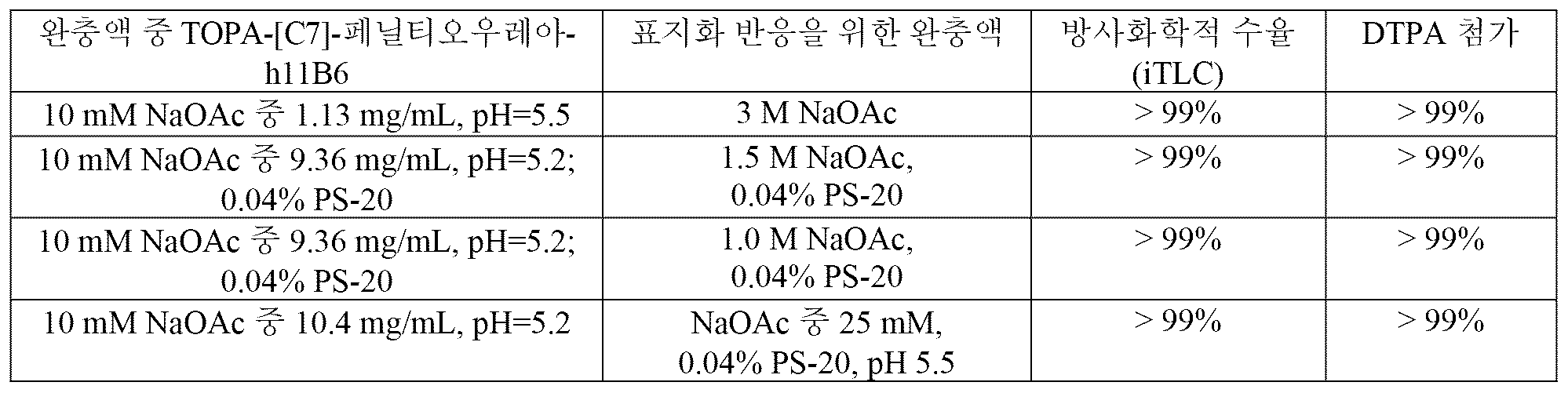
실시예 22 - 항-KLK2 항체의 생성Example 22 - Generation of anti-KLK2 antibodies
인간 면역글로불린 유전자좌를 발현하는 유전자이식 마우스(AblexisTransgenic mice expressing human immunoglobulin loci (Ablexis) ®® )와 유전자이식 래트(OmniRat) and transgenic rats (OmniRat ®® )를 사용한 항체 생성) Antibody production using
OmniRat®에는 완전 인간 IgL 유전자좌(Jκ-Cκ에 연결된 12개의 Vκ와 Jλ-Cλ에 연결된 16개의 Vλ)와 함께 키메라 인간/래트 IgH 유전자좌(22개의 인간 VH, 래트 CH 유전자좌에 연결된 천연 입체배치의 모든 인간 D 및 JH 분절로 구성됨)가 포함되어 있다(예를 들어, 문헌[Osborn, et al., J Immunol, 2013, 190(4): 1481-90] 참조). 따라서, 래트는 래트 면역글로불린의 감소된 발현을 나타내며, 면역화에 반응하여, 도입된 인간 중쇄 및 경쇄 전이유전자는 클래스 전환과 체세포 돌연변이를 거쳐 완전 인간 가변 영역을 갖는 고친화도 키메라 인간/래트 IgG 단클론 항체를 생성한다. OmniRat®의 준비 및 사용과, 이러한 래트에 의해 이루어진 게놈 변형은 국제 특허출원 공개공보WO14/093908에 기재되어 있다.OmniRat ® contains a chimeric human/rat IgH locus (consisting of 22 human VH, all human D and JH segments in their native configuration linked to a rat CH locus) together with a fully human IgL locus (12 Vκ linked to Jκ-Cκ and 16 Vλ linked to Jλ-Cλ) (see, e.g., Osborn, et al ., J Immunol , 2013, 190(4): 1481-90). Thus, the rat exhibits reduced expression of rat immunoglobulins, and in response to immunization, the introduced human heavy and light chain transgenes undergo class switching and somatic mutation to produce high-affinity chimeric human/rat IgG monoclonal antibodies with fully human variable regions. The preparation and use of OmniRat ® and the genomic modifications made in these rats are described in International Patent Application Publication No. WO14/093908.
Ablexis® 마우스는 인간 CH1 및 CL 도메인에 연결된 인간 가변 도메인, 키메라 인간/마우스 힌지 영역, 및 마우스 Fc 영역을 갖는 항체를 생성한다. Ablexis 카파 마우스와 Ablexis 람다 마우스 계통은 하기 설명된 바와 같이 중쇄 중 어느 것이 인간 또는 마우스인지에 따라 구별된다. 카파 마우스에 의해 생성된 항체에는 마우스 VH, DH 및 JH 엑손과, 마우스 Vκ, Jκ 및 Cκ 엑손에서 유도된 서열이 결여되어 있다. 내인성 마우스 Igλ는 카파 마우스에서 활성이다. 이러한 계통에서 인간 Igκ 사슬은 나이브 레파토리의 대략 90% 내지 95%를 차지하고, 마우스 Igλ 사슬은 나이브 레파토리의 대략 5% 내지 10%를 차지한다. 람다 마우스에 의해 생성된 항체에는 마우스 VH, DH 및 JH 엑손과, 마우스 Vλ, Jλ 및 Cλ 엑손에서 유도된 서열이 결여되어 있다. 내인성 마우스 Igκ는 람다 마우스에서 활성이다. 인간 Igλ 사슬은 나이브 레파토리의 대략 40%를 차지하고, 마우스 Igκ 사슬은 나이브 레파토리의 대략 60%를 차지한다. Ablexis®의 준비 및 사용과, 이러한 마우스에 의해 이루어진 변형은 국제 특허출원 공개공보WO11/123708에 기재되어 있다.Ablexis ® mice produce antibodies having a human variable domain linked to human CH1 and CL domains, a chimeric human/mouse hinge region, and a mouse Fc region. The Ablexis kappa mouse and Ablexis lambda mouse strains are distinguished by which of the heavy chains is human or mouse, as described below. Antibodies produced by kappa mice lack sequences derived from the mouse VH, DH, and JH exons, and the mouse Vκ, Jκ, and Cκ exons. Endogenous mouse Igλ is active in kappa mice. In this strain, human Igκ chains account for approximately 90% to 95% of the naïve repertoire, and mouse Igλ chains account for approximately 5% to 10% of the naïve repertoire. Antibodies produced by lambda mice lack sequences derived from the mouse VH, DH, and JH exons, and the mouse Vλ, Jλ, and Cλ exons. Endogenous mouse Igκ is active in lambda mice. Human Igλ chains account for approximately 40% of the naïve repertoire, and mouse Igκ chains account for approximately 60% of the naïve repertoire. The preparation and use of Ablexis ® and the modifications made in these mice are described in International Patent Application Publication No. WO11/123708.
Ablexis® 마우스와 OmniRats® 래트를 가용성 전장 KLK2 단백질(VPLIEGRIVGGWECEKHSQPWQVAVYSHGWAHCGGVLVHPQWVLTAAHCLKKNSQVWLGRHNLFEPEDTGQRVPVSHSFPHPLYNMSLLKHQSLRPDEDSSHDLMLLRLSEPAKITDVVKVLGLPTQEPALGTTCYASGWGSIEPEEFLRPRSLQCVSLHYSEKVTEFMLCAGLWTGGKDTCGGDSGGPLVCNGVLQGITSWGPEPCALPEKPAVYTKVVHYRKWIKDTIAANPHHHHHH(서열번호 454)의 아미노산 서열을 갖는 인간 칼리크레인-2 6-His 단백질)로 면역화시켰다. Ablexis® mice and OmniRats® rats were immunized with soluble full-length KLK2 protein (human kallikrein-2 6-His protein having the amino acid sequence of VPLIEGRIVGGWECEKHSQPWQVAVYSHGWAHCGGVLVHPQWVLTAAHCLKKNSQVWLGRHNLFEPEDTGQRVPVSHSFPHPLYNMSLLKHQSLRPDEDSSHDLMLLRLSEPAKITDVVKVLGLPTQEPALGTTCYASGWGSIEPEEFLRPRSLQCVSLHYSEKVTEFMLCAGLWTGGKDTCGGDSGGPLVCNGVLQGITSWGPEPCALPEKPAVYTKVVHYRKWIKDTIAANPHHHHHH (SEQ ID NO: 454)).
Ablexis 마우스와 OniRats 래트의 림프구를 림프절에서 추출하고, 코호트 별로 융합을 수행하였다. 세포를 조합하고, CD138 발현에 대해 분류하였다. 가용성 hK2 항원을 사용하여 고처리량 소형 MSD 포맷으로 하이브리도마 스크리닝을 수행하였다. 대략 >300개의 샘플이 hK2 결합제인 것으로 확인되었다. 인간 KLK2 단백질에 대한 >300개의 항-hKLK2 상청액 샘플의 결합을 Biacore 8K SPR에 따라 단일 주기 동역학 방법으로 측정하였다. 추가로, 상청액 샘플을 인간 KLK3 단백질에 대한 결합에 대해서도 시험하였다. 동시에, 상청액을 또한 유세포분석에 따라 KLK2 발현 세포주 VCap과 음성 세포주 DU145에 대한 결합에 대해서 시험하였다. 선택된 세포 결합제는 상기 기재된 바와 같은 VH-VL 및 VL/VH 배향과 열안정성 시험 모두에서 scFv 전환에 대해 정방향으로 이동하였다. KL2B413, KL2B30, KL2B53 및 KL2B242는 Ablexis 마우스 면역화 캠페인의 결과였다. KL2B467과 KL2B494는 OmniRat 면역화 캠페인의 결과였다.Lymphocytes from Ablexis mice and OniRats were extracted from lymph nodes and fused in cohorts. Cells were pooled and sorted for CD138 expression. Hybridoma screening was performed in a high-throughput mini MSD format using soluble hK2 antigen. Approximately >300 samples were identified as hK2 binders. Binding of >300 anti-hKLK2 supernatant samples to human KLK2 protein was measured by single-cycle kinetics method using Biacore 8K SPR. In addition, supernatant samples were tested for binding to human KLK3 protein. In parallel, supernatants were also tested for binding to KLK2 expressing cell line VCap and negative cell line DU145 by flow cytometry. Selected cell binders migrated in the forward direction for scFv switching in both VH-VL and VL/VH orientations and thermostability tests as described above. KL2B413, KL2B30, KL2B53, and KL2B242 were the results of the Ablexis mouse immunization campaign. KL2B467 and KL2B494 were the results of the OmniRat immunization campaign.
상기 기재된 다양한 면역화 및 인간화 캠페인을 통해 생성된 항체를 Fab 형식, mAb 형식, VH-링커-VL 배향의 scFv 형식, 또는 VL-링커-VH 배향의 scFv 형식으로 발현시키고, 하기 기재되는 바와 같이 추가로 분석하였다. 상기 기재된 서열번호 7의 링커 서열을 사용하여 VH/VL 영역을 접합시켰다.Antibodies generated through the various immunization and humanization campaigns described above were expressed in Fab format, mAb format, scFv format in VH-linker-VL orientation, or scFv format in VL-linker-VH orientation and further analyzed as described below. The VH/VL regions were joined using the linker sequence of SEQ ID NO: 7 described above.
실시예 23. 항-KLK2 항체의 구조 특징분석Example 23. Structural characterization of anti-KLK2 antibodies
세포내 검정에서 가장 우수한 성능을 나타낸 항체 가변 도메인과 scFv 항체 단편의 서열이 본원에 제시된다. 가변 도메인을 Fab 형식, VH-링커-VL 배향의 scFv 형식, 또는 VL-링커-VH 배향의 scFv 형식으로 발현시켰다.The sequences of antibody variable domains and scFv antibody fragments that showed the best performance in intracellular assays are presented herein. The variable domains were expressed in a Fab format, a scFv format in the VH-linker-VL orientation, or a scFv format in the VL-linker-VH orientation.
가변 도메인 VH, VL 및 CDRVariable domains VH, VL and CDR
표 3은 선택된 항-hK2 항체의 VH 및 VL 아미노산 서열을 보여준다. 표 4는 선택된 항-hK2 선택된 항체의 Kabat HCDR1, HCDR2 및 HCDR3을 보여준다. 표 5는 선택된 항-hK2 항체의 Kabat LCDR1, LCDR2 및 LCDR3을 보여준다. 표 6은 선택된 항-hK2 항체의 AbM HCDR1, HCDR2 및 HCDR3을 보여준다. 표 7은 항-hK2의 AbM LCDR1, LCDR2 및 LCDR3을 보여준다. 표 8은 선택된 hK2 항체의 가변 도메인 서열과 서열번호를 요약한 것이다. 표 9는 VH 및 VL 영역에 대한 단백질 및 DNA 서열번호를 요약한 것이다. Table 3 shows the VH and VL amino acid sequences of the selected anti-hK2 antibodies. Table 4 shows the Kabat HCDR1, HCDR2 and HCDR3 of the selected anti-hK2 antibodies. Table 5 shows the Kabat LCDR1, LCDR2 and LCDR3 of the selected anti-hK2 antibodies. Table 6 shows the AbM HCDR1, HCDR2 and HCDR3 of the selected anti-hK2 antibodies. Table 7 shows the AbM LCDR1, LCDR2 and LCDR3 of anti-hK2. Table 8 summarizes the variable domain sequences and sequence numbers of the selected hK2 antibodies. Table 9 summarizes the protein and DNA sequence numbers for the VH and VL regions.
[표 3][Table 3]
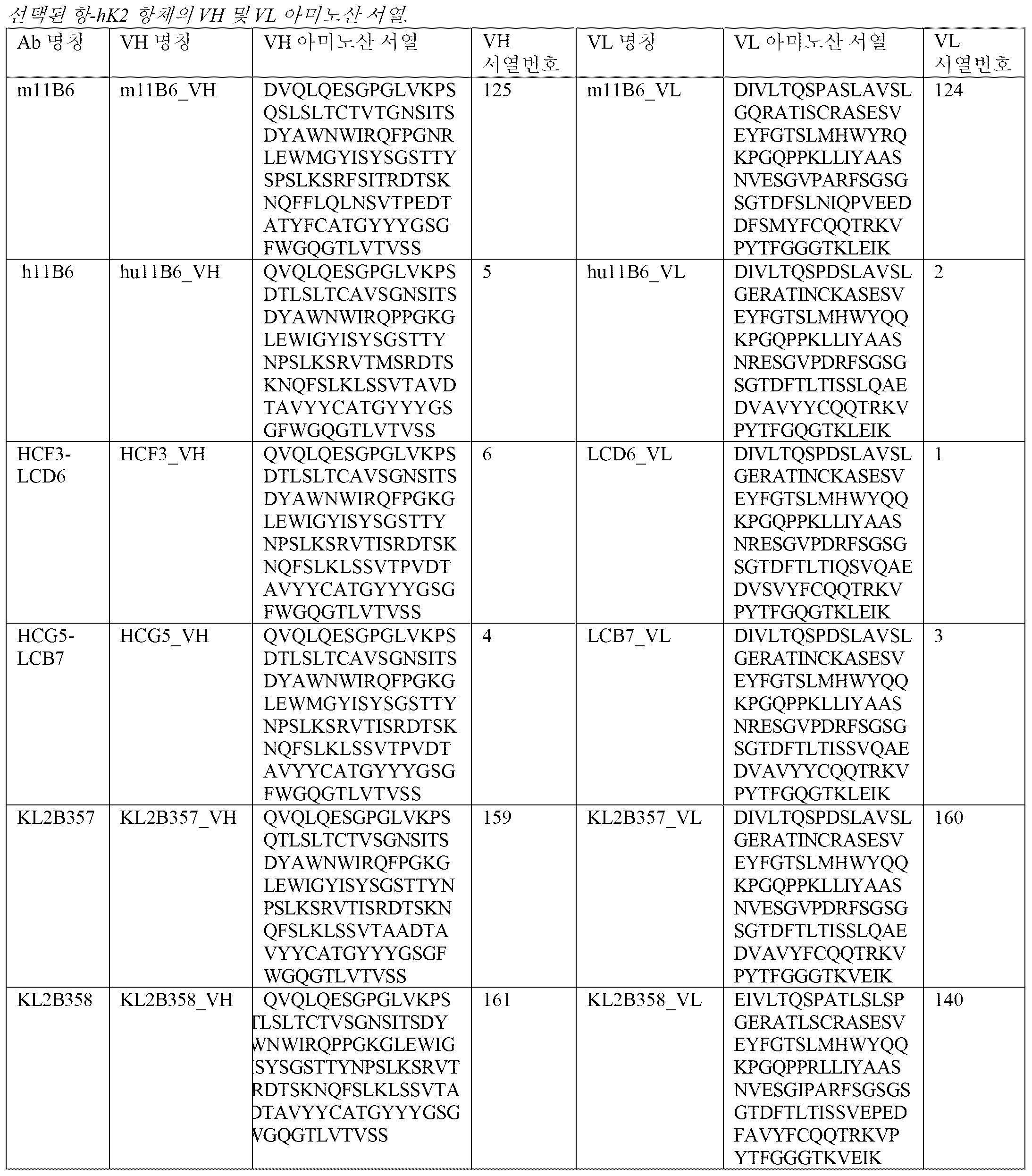

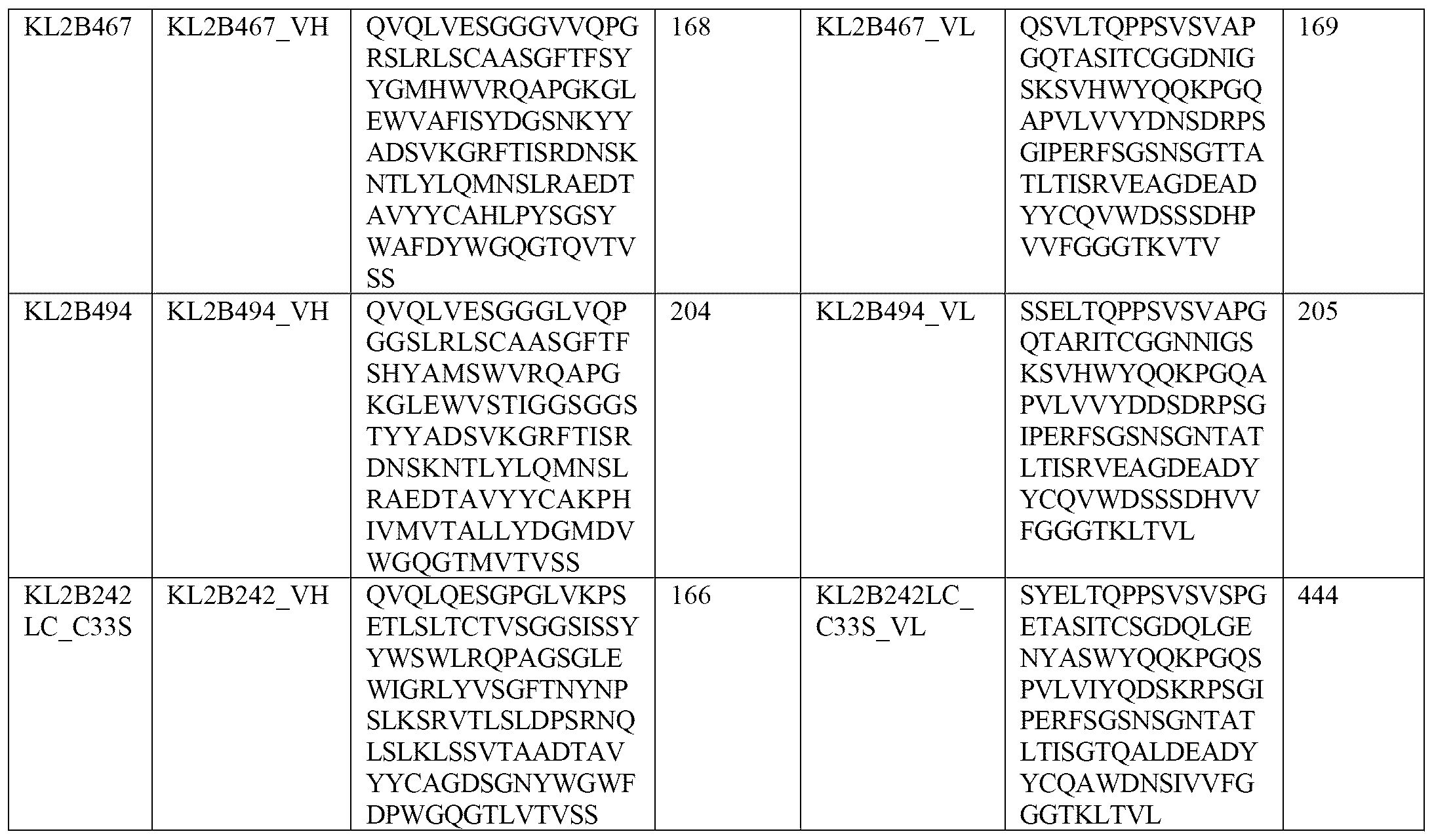
[표 4][Table 4]

[표 5][Table 5]

[표 6][Table 6]

[표 7][Table 7]

[표 8][Table 8]


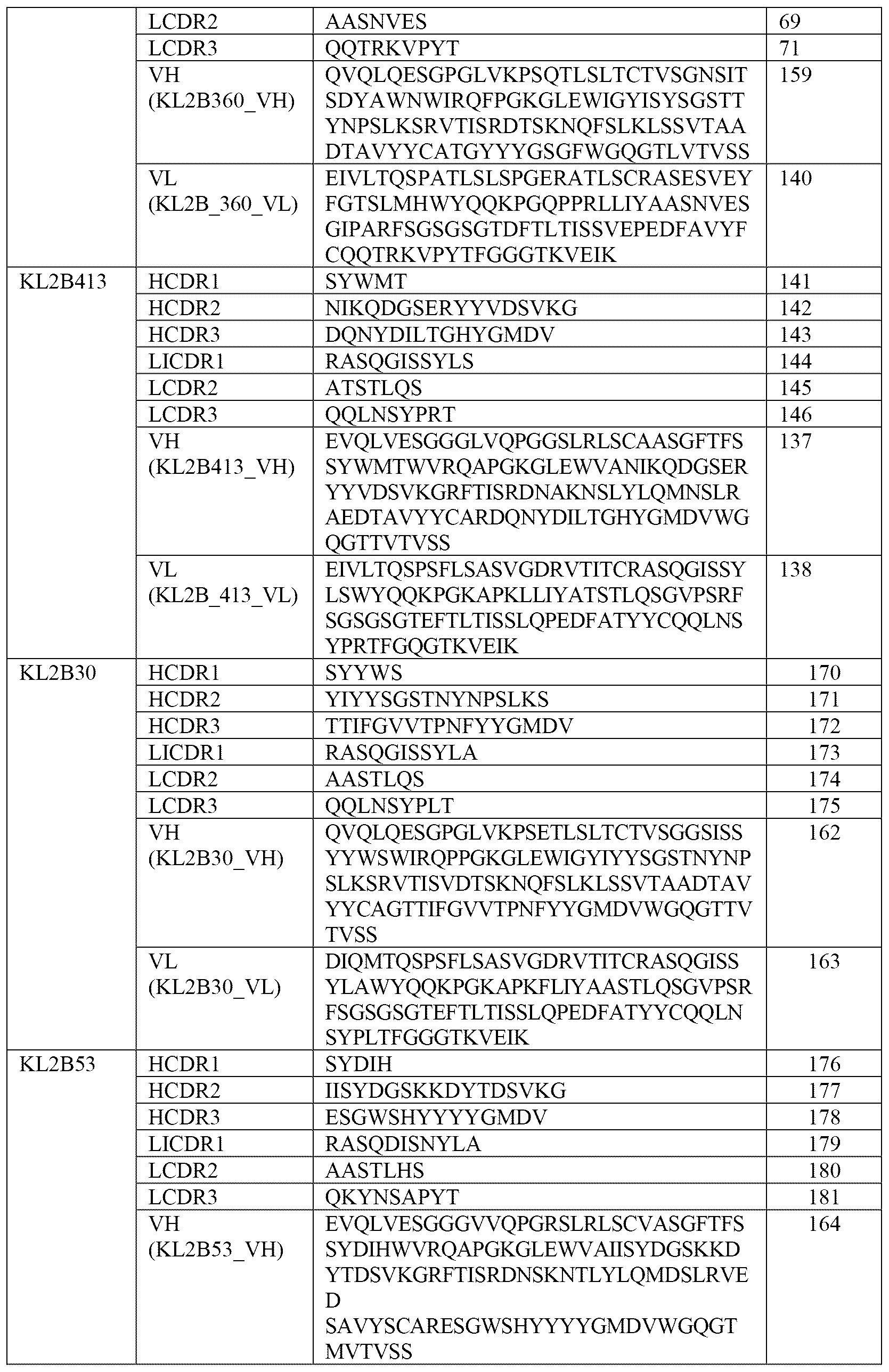

[표 9][Table 9]
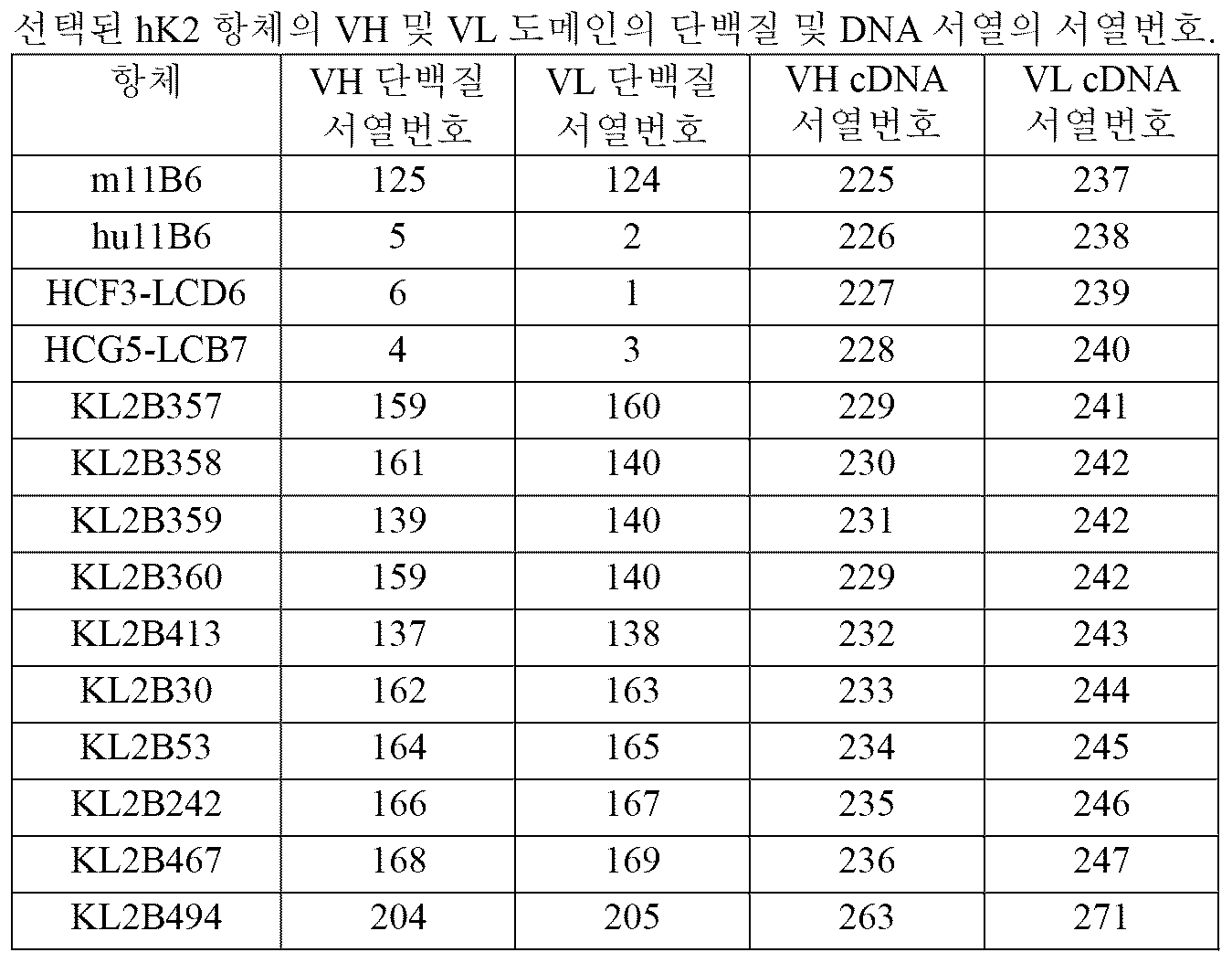
서열번호 225(m11B6 VH cDNA)Sequence number 225 (m11B6 VH cDNA)
GATGTGCAGCTTCAGGAGTCTGGACCCGGACTTGTTAAACCAAGTCAGTCTCTGTCCCTGACCTGTACCGTCACCGGCAACAGCATCACAAGCGATTACGCATGGAACTGGATCAGGCAGTTCCCTGGAAATCGACTCGAATGGATGGGCTACATTTCATACTCCGGTTCAACCACTTACTCTCCATCCTTGAAATCTAGGTTCAGCATCACCCGTGATACCTCAAAGAACCAATTTTTTCTGCAACTGAATAGCGTAACTCCAGAGGACACAGCCACATATTTCTGCGCCACTGGGTATTACTATGGCTCAGGTTTCTGGGGTCAGGGCACTCTCGTCACCGTCAGCAGCGATGTGCAGCTTCAGGAGTCTGGACCCGGACTTGTTAAACCAAGTCAGTCTCTGTCCCTGACCTGTACCGTCACCGGCAACAGCATCACAAGCGATTACGCATGGAACTGGATCAGGCAGTTCCCTGGAAATCGACTCGAATGGATGGGCTACATTTCATACTCCGGTTCAACCACTTACTCTCCATCCTTGAAATCTAGGTTCAGCATCACCCGTGATACCTCAAAGAACCAATTTTTTCTGCAACTGAATAGCGTA ACTCCAGAGGACACAGCCACATATTTCTGCGCCACTGGGTATTACTATGGCTCAGGTTTCTGGGGTCAGGGCACTCTCGTCACCGTCAGCAGC
서열번호 226(hu11B6 VH cDNA)Sequence number 226 (hu11B6 VH cDNA)
CAGGTCCAACTGCAAGAGAGCGGACCGGGCCTGGTAAAGCCATCCGACACATTGTCCCTGACGTGTGCGGTAAGTGGAAACTCTATCACTAGCGACTATGCGTGGAATTGGATAAGACAACCGCCGGGCAAGGGGCTGGAATGGATAGGATATATCAGCTATTCCGGTTCTACGACATACAATCCTTCCCTGAAAAGCAGAGTCACTATGTCACGCGACACGTCCAAGAATCAGTTCTCATTGAAATTGTCATCCGTAACGGCCGTTGACACTGCGGTTTATTATTGCGCAACCGGATATTACTACGGCTCTGGTTTTTGGGGACAGGGAACACTTGTTACTGTTAGTTCACAGGTCCAACTGCAAGAGAGCGGACCGGGCCTGGTAAAGCCATCCGACACATTGTCCCTGACGTGTGCGGTAAGTGGAAACTCTATCACTAGCGACTATGCGTGGAATTGGATAAGACAACCGCCGGGCAAGGGGCTGGAATGGATAGGATATATCAGCTATTCCGGTTTCTACGACATACAATCCTTCCCTGAAAAGCAGAGTCACTATGTCACGCGACACGTCCAAGAATCAGTTCTCATTGAAATTGTCATCCGTAAC GGCCGTTGACACTGCGGTTATTATTGCGCAACCGGATATTACTACGGCTCTGGTTTTTGGGGACAGGGAACACTTGTTACTGTTAGTTCA
서열번호 227(HCF3-LCD6 VH cDNA)Sequence number 227 (HCF3-LCD6 VH cDNA)
CAGGTGCAGCTGCAGGAGAGCGGCCCAGGCCTGGTGAAGCCAAGCGACACCCTGAGCCTGACCTGCGCCGTGAGCGGCAACAGCATCACCAGCGACTACGCCTGGAACTGGATCCGCCAGTTCCCAGGCAAGGGCCTGGAGTGGATCGGCTACATCAGCTACAGCGGCAGCACCACCTACAACCCAAGCCTGAAGAGCCGCGTCACCATCAGCCGCGACACCAGCAAGAACCAGTTCAGCCTGAAGCTGAGCAGCGTGACCCCTGTGGACACCGCCGTGTACTACTGCGCCACCGGCTACTACTACGGCAGCGGCTTCTGGGGCCAGGGCACCCTGGTGACCGTGAGCAGCCAGGTGCAGCTGCAGGAGAGCGGCCCAGGCCTGGTGAAGCCCAAGCGACACCCTGAGCCTGACCTGCGCCGTGAGCGGCAACAGCATCACCAGCGACTACGCCTGGAACTGGATCCGCCAGTTCCCAGGCAAGGGCCTGGAGTGGATCGGCTACATCAGCTACAGCGGCAGCACCACCTACAACCCAAGCCTGAAGAGCCGCGTCACCATCAGCCGCGACACCAGCAAGAACCAGTTCAGCCTGAAGCTGAGCAGC GTGACCCCTGTGGACACCGCCGTGTACTACTGCGCCACCGGCTACTACTACGGCAGCGGCTTCTGGGCCAGGGCACCCTGGTGACCGTGAGCAGC
서열번호 228(HCG5-LCB7 VH cDNA)Sequence number 228 (HCG5-LCB7 VH cDNA)
CAGGTGCAGCTGCAGGAGAGCGGCCCAGGCCTGGTGAAGCCAAGCGACACCCTGAGCCTGACCTGCGCCGTGAGCGGCAACAGCATCACCAGCGACTACGCCTGGAACTGGATCCGCCAGTTCCCAGGCAAGGGCCTGGAGTGGATGGGCTACATCAGCTACAGCGGCAGCACCACCTACAACCCAAGCCTGAAGAGCCGCGTCACCATCAGCCGCGACACCAGCAAGAACCAGTTCAGCCTGAAGCTGAGCAGCGTGACCCCTGTGGACACCGCCGTGTACTACTGCGCCACCGGCTACTACTACGGCAGCGGCTTCTGGGGCCAGGGCACCCTGGTGACCGTGAGCAGCCAGGTGCAGCTGCAGGAGAGCGGCCCAGGCCTGGTGAAGCCCAAGCGACACCCTGAGCCTGACCTGCGCCGTGAGCGGCAACAGCATCACCAGCGACTACGCCTGGAACTGGATCCGCCAGTTCCCAGGCAAGGGCCTGGAGTGGATGGGCTACATCAGCTACAGCGGCAGCACCACCTACAACCCAAGCCTGAAGAGCCGCGTCACCATCAGCCGCGACACCAGCAAGAACCAGTTCAGCCTGAAGCTGAGCAGC GTGACCCCTGTGGACACCGCCGTGTACTACTGCGCCACCGGCTACTACTACGGCAGCGGCTTCTGGGCCAGGGCACCCTGGTGACCGTGAGCAGC
서열번호 229(KL2B357, KL2B360 VH cDNA)Sequence number 229 (KL2B357, KL2B360 VH cDNA)
CAGGTTCAGCTGCAAGAGTCTGGACCAGGCCTGGTCAAGCCCTCTCAGACCCTGTCTCTGACCTGTACCGTGTCCGGCAACTCCATCACCTCTGACTACGCCTGGAACTGGATTCGGCAGTTCCCTGGCAAGGGCCTTGAGTGGATCGGCTACATCTCCTACTCCGGTTCCACCACCTACAACCCCAGCCTGAAGTCCCGGGTCACCATCTCCCGCGACACCTCCAAGAACCAGTTCTCCCTGAAGCTGTCCTCCGTGACCGCTGCTGATACCGCCGTGTACTACTGTGCCACCGGCTACTACTACGGCTCCGGCTTTTGGGGACAGGGCACACTGGTTACCGTGTCTAGTCAGGTTCAGCTGCAAGAGTTCTGGACCAGGCCTGGTCAAGCCCTCTCAGACCCTGTCTCTGACCTGTACCGTGTCCGGCAACTCCATCACCTCTGACTACGCCTGGAACTGGATTCGGCAGTTCCCTGGCAAGGGCCTTGAGTGGATCGGCTACATCTCCTACTCCGGTTCCACCACCTACAACCCCAGCCTGAAGTCCCGGGTCACCATCTCCCGCGACACCTCCAAGAACCAGTTCTCCCTGAAGCTGTCCTCCGT GACCGCTGCTGATACCGCCGTGTACTACTGTGCCACCGGCTACTACTACGGCTCCGGCTTTTGGGGACAGGGCACACTGGTTACCGTGTCTAGT
서열번호 230(KL2B358 VH cDNA)Sequence number 230 (KL2B358 VH cDNA)
CAGGTTCAGCTGCAAGAGTCTGGACCAGGCCTGGTCAAGCCCTCTCAGACCCTGTCTCTGACCTGTACCGTGTCCGGCAACTCCATCACCTCTGACTACGCCTGGAACTGGATTCGGCAGCCACCTGGCAAGGGCCTTGAGTGGATCGGCTACATCTCCTACTCCGGTTCCACCACCTACAACCCCAGCCTGAAGTCCCGGGTCACCATCTCCCGCGACACCTCCAAGAACCAGTTCTCCCTGAAGCTGTCCTCCGTGACCGCTGCTGATACCGCCGTGTACTACTGTGCCACCGGCTACTACTACGGCTCCGGCTTTTGGGGACAGGGCACACTGGTTACCGTGTCTAGTCAGGTTCAGCTGCAAGAGTCTGGACCAGGCCTGGTCAAGCCCTCTCAGACCCTGTCTCTGACCTGTACCGTGTCCGGCAACTCCATCACCTCTGACTACGCCTGGAACTGGATTCGGCAGCCACCTGGCAAGGGCCTTGAGTGGATCGGCTACATCTCCTACTCCGGTTCCACCACCTACAACCCCAGCCTGAAGTCCCGGGTCACCATCTCCCGCGACACCTCCAAGAACCAGTTCTCCCTGAAGCTGTCCTCCGT GACCGCTGCTGATACCGCCGTGTACTACTGTGCCACCGGCTACTACTACGGCTCCGGCTTTTGGGGACAGGGCACACTGGTTACCGTGTCTAGT
서열번호 231(KL2B359 VH cDNA)Sequence number 231 (KL2B359 VH cDNA)
CAGGTTCAGCTGCAAGAGTCTGGACCAGGCCTGGTCAAGCCCTCTCAGACCCTGTCTCTGACCTGTACCGTGTCCGGCAACTCCATCACCTCTGACTACGCCTGGAACTGGATTCGGCAGTTCCCTGGCAAGCGCCTTGAGTGGATCGGCTACATCTCCTACTCCGGTTCCACCACCTACAACCCCAGCCTGAAGTCCCGGGTCACCATCTCCCGCGACACCTCCAAGAACCAGTTCTCCCTGAAGCTGTCCTCCGTGACCGCTGCTGATACCGCCGTGTACTACTGTGCCACCGGCTACTACTACGGCTCCGGCTTTTGGGGACAGGGCACACTGGTTACCGTGTCTAGTCAGGTTCAGCTGCAAGAGTCTGGACCAGGCCTGGTCAAGCCCTCTCAGACCCTGTCTCTGACCTGTACCGTGTCCGGCAACTCCATCACCTCTGACTACGCCTGGAACTGGATTCGGCAGTTCCCTGGCAAGCGCCTTGAGTGGATCGGCTACATCTCCTACTCCGGTTCCACCACCTACAACCCCAGCCTGAAGTCCCGGGTCACCATCTCCCGCGACACCTCCAAGAACCAGTTCTCCCTGAAGCTGTCCTCCGT GACCGCTGCTGATACCGCCGTGTACTACTGTGCCACCGGCTACTACTACGGCTCCGGCTTTTGGGGACAGGGCACACTGGTTACCGTGTCTAGT
서열번호 232(KL2B413 VH cDNA)Sequence number 232 (KL2B413 VH cDNA)
GAGGTGCAACTTGTGGAGAGCGGCGGAGGTCTGGTCCAACCCGGAGGAAGTCTCCGTCTCTCCTGTGCTGCTAGTGGCTTCACTTTCAGCTCATATTGGATGACATGGGTGAGACAAGCCCCAGGAAAGGGGCTCGAGTGGGTAGCTAACATTAAACAGGACGGCTCCGAACGGTACTATGTTGATTCTGTGAAGGGACGGTTCACTATATCCAGGGATAATGCAAAAAATTCACTCTATCTTCAAATGAACTCACTCAGAGCAGAGGACACTGCCGTGTATTATTGCGCCAGGGATCAAAATTATGACATACTGACCGGTCATTATGGAATGGATGTTTGGGGCCAGGGAACAACCGTTACCGTCTCAAGTGAGGTGCAACTTGTGGAGAGCGGCGGAGGTCTGGTCCAACCCGGAGGAAGTCTCCGTCTCTCCTGTGCTGCTAGTGGCTTCACTTTCAGCTCATATTGGATGACATGGGTGAGACAAGCCCCAGGAAAGGGGCTCGAGTGGGTAGCTAACATTAAACAGGACGGCTCCGAACGGTACTATGTTGATTCTGTGAAGGGACGGTTCACTATATCCAGGGATAATGCAAAAAATTCACTCTATCTTCAAATGAACTCACT CAGAGCAGAGGACACTGCCGTGTATTATTGCGCCAGGGATCAAAATTATGACATACTGACCGGTCATTATGGAATGGATGTTTGGGGCCAGGGAACAACCGTTACCGTCTCAAGT
서열번호 233(KL2B30 VH cDNA)Sequence number 233 (KL2B30 VH cDNA)
CAGGTGCAGCTGCAGGAGTCGGGCCCAGGACTGGTGAAGCCTTCGGAGACCCTGTCCCTCACCTGCACTGTCTCTGGTGGCTCCATCAGTAGTTACTACTGGAGCTGGATCCGGCAGCCCCCAGGGAAGGGACTGGAGTGGATTGGATATATCTATTACAGTGGGAGCACCAACTACAACCCCTCCCTCAAGAGTCGAGTCACCATATCAGTAGACACGTCCAAGAACCAGTTCTCCCTGAAGCTGAGCTCTGTGACCGCTGCGGACACGGCCGTGTATTACTGTGCGGGGACTACGATTTTTGGAGTGGTTACCCCCAACTTCTACTACGGTATGGACGTCTGGGGCCAAGGGACCACGGTCACCGTCTCCTCACAGGTGCAGCTGCAGGAGTCGGGCCCAGGACTGGTGAAGCCTTCGGAGACCCTGTCCCTCACCTGCACTGTCTCTGGTGGCTCCATCAGTAGTTACTACTGGAGCTGGATCCGGCAGCCCCCAGGGAAGGGACTGGAGTGGGATTGGATATATCTATTACAGTGGGAGCACCAACTACAACCCCTCCCTCAAGAGTCGAGTCACCATATCAGTAGACACGTCCAAGAACCAGTTCTCCCTGAAGCTGAGCTCTGTGACCG CTGCGGACACGGCCGTGTATTACTGTGCGGGGACTACGATTTTTGGAGTGGTTACCCCCAACTTCTACTACGGTATGGACGTCTGGGGCCAAGGGACCACGGTCACCGTCTCCTCA
서열번호 234(KL2B53 VH cDNA)Sequence number 234 (KL2B53 VH cDNA)
GAGGTGCAGCTGGTGGAGTCTGGGGGAGGCGTGGTCCAGCCTGGGAGGTCCCTGAGACTCTCCTGTGTAGCCTCTGGATTCACCTTCAGTAGTTATGACATACACTGGGTCCGCCAGGCTCCAGGCAAGGGGCTGGAGTGGGTGGCAATTATTTCATATGATGGAAGTAAAAAAGACTATACAGACTCCGTGAAGGGCCGATTCACCATCTCCAGAGACAATTCCAAGAACACGCTGTATCTGCAAATGGACAGCCTGAGAGTTGAGGACTCGGCTGTGTATTCCTGTGCGAGAGAAAGTGGCTGGTCCCACTACTACTATTACGGTATGGACGTCTGGGGCCAAGGGACAATGGTCACCGTCTCTTCAGAGGTGCAGCTGGTGGAGTCTGGGGGAGGCGTGGTCCAGCCTGGGAGGTCCCTGAGACTCTCCTGTGTAGCCTCTGGATTCACCTTCAGTAGTTATGACATACACTGGGTCCGCCAGGCTCCAGGCAAGGGGCTGGAGTGGGTGGCAATTATTTCATATGATGGAAGTAAAAAAGACTATACAGACTCCGTGAAGGGCCGATTCACCATCTCCAGAGACAATTCCAAGAACACGCTGTATCTGCAAATGGACAGCCTGAGA GTTGAGGACTCGGCTTGTGTATTCCTGTGCGAGAGAAAGTGGCTGGTCCCACTACTACTATTACGGTATGGACGTCTGGGGCCAAGGGACAATGGTCACCGTCTCTTCA
서열번호 235(KL2B242 VH cDNA)Sequence number 235 (KL2B242 VH cDNA)
CAGGTGCAGCTGCAGGAGTCGGGCCCAGGACTGGTGAAGCCTTCGGAGACCCTGTCCCTCACCTGCACTGTCTCTGGTGGCTCCATCAGTAGTTACTATTGGAGCTGGCTCCGGCAGCCCGCCGGGTCGGGACTGGAGTGGATTGGGCGTTTATATGTCAGTGGGTTCACCAACTACAACCCCTCCCTCAAGAGTCGAGTCACCTTGTCACTAGACCCGTCCAGGAACCAGTTGTCCCTGAAACTGAGTTCTGTGACCGCCGCGGACACGGCCGTATATTATTGTGCGGGAGATAGTGGGAACTACTGGGGTTGGTTCGACCCCTGGGGCCAGGGAACCCTGGTCACCGTCTCCTCACAGGTGCAGCTGCAGGAGTCGGGCCCAGGACTGGTGAAGCCTTCGGAGACCCTGTCCCTCACCTGCACTGTCTCTGGTGGCTCCATCAGTAGTTACTATTGGAGCTGGCTCCGGCAGCCCGCCGGGTCGGGACTGGAGTGGATTGGGCGTTTATATGTCAGTGGGTTCACCAACTACAACCCCTCCCTCAAGAGTCGAGTCACCTTGTCACTAGACCCGTCCAGGAACCAGTTGTCCCTGAAACTGAGTTCTGTGACCG CCGCGGACACGGCCGTATATTATTGTGCGGGAGATAGTGGGAACTACTGGGGTTGGTTCGACCCCTGGGGCCAGGGAACCCTGGTCACCGTCTCCTCA
서열번호 236(KL2B467 VH cDNA)Sequence number 236 (KL2B467 VH cDNA)
CAGGTGCAGCTGGTGGAGTCTGGGGGAGGCGTGGTCCAGCCTGGGAGGTCCCTGAGACTCTCCTGTGCAGCCTCTGGATTCACCTTCAGTTACTATGGCATGCACTGGGTCCGCCAGGCTCCAGGCAAGGGGCTGGAGTGGGTGGCATTTATATCATATGATGGAAGTAATAAATACTATGCAGACTCCGTGAAGGGCCGATTCACCATCTCCAGAGACAATTCCAAGAACACGCTGTATCTGCAAATGAACAGCCTGAGAGCTGAGGACACGGCTGTGTATTACTGTGCCCACCTCCCTTATAGTGGGAGCTACTGGGCCTTTGACTACTGGGGCCAGGGAACCCAGGTCACCGTCTCTTCACAGGTGCAGCTGGTGGAGTCTGGGGGAGGCGTGGTCCAGCCTGGGAGGTCCCTGAGACTCTCCTGTGCAGCCTCTGGATTCACCTTCAGTTACTATGGCATGCACTGGGGTCCGCCAGGCTCCAGGCAAGGGGCTGGAGTGGGTGGCATTTATATCATATGATGGAAGTAATAAATACTATGCAGACTCCGTGAAGGGCCGATTCACCATCTCCAGAGACAATTCCAAGAACACGCTGTATCTGCAAATGAACAGCC TGAGAGCTGAGGACACGGCTGTGTATTACTGTGCCCACCTCCCTTATAGTGGGAGCTACTGGGCCTTTGACTACTGGGGCCAGGGAACCCAGGTCACCGTCTCTTCA
서열번호 263(KL2B494 VH cDNA)Sequence number 263 (KL2B494 VH cDNA)
CAGGTGCAGCTGGTGGAGTCTGGGGGAGGCTTGGTACAGCCTGGGGGGTCCCTGAGACTCTCCTGTGCAGCCTCTGGATTCACCTTTAGTCATTATGCCATGAGCTGGGTCCGCCAGGCTCCAGGGAAGGGGCTGGAGTGGGTCTCAACTATTGGTGGTAGTGGTGGTAGCACATACTACGCAGACTCCGTGAAGGGCCGGTTCACCATCTCCAGAGACAATTCCAAGAACACGCTGTATCTGCAAATGAACAGCCTGAGAGCCGAGGACACGGCCGTATATTACTGTGCGAAACCTCATATTGTAATGGTGACTGCTCTTCTCTACGACGGTATGGACGTCTGGGGCCAAGGGACAATGGTCACCGTCTCCTCACAGGTGCAGCTGGTGGAGTCTGGGGGAGGCTTGGTACAGCCTGGGGGGTCCCTGAGACTCTCCTGTGCAGCCTCTGGATTCACCTTTAGTCATTATGCCATGAGCTGGGTCCGCCAGGCTCCAGGGAAGGGGCTGGAGTGGGTCTCAACTATTGGTGGTAGTGGTGGTAGCACATACTACGCAGACTCCGTGAAGGGCCGGTTTCACCATCTCCAGAGACAATTCCAAGAACACGCTGTATCTGCAAATGAACAGCCTG AGAGCCGAGGACACGGCCGTATATTACTGTGCGAAACCTCATATTGTAATGGTGACTGCTCTTCTCTACGACGGTATGGACGTCTGGGGCCAAGGGACAATGGTCACCGTCTCCTCA
서열번호 237(m11B6 VL cDNA)Sequence number 237 (m11B6 VL cDNA)
GACATTGTGCTGACACAGAGTCCAGCATCCTTGGCAGTATCTTTGGGGCAGCGGGCAACAATTTCATGCCGTGCATCTGAAAGTGTGGAGTATTTTGGAACTTCTCTTATGCACTGGTATCGCCAGAAGCCTGGGCAGCCTCCCAAACTCCTTATATATGCCGCTTCCAACGTGGAGTCCGGAGTACCAGCACGCTTTTCCGGCTCTGGGTCCGGCACAGACTTTTCCCTCAATATCCAACCTGTTGAAGAAGACGATTTTTCCATGTATTTTTGCCAACAGACACGCAAGGTTCCATATACATTCGGCGGCGGCACTAAACTTGAGATCAAAGACATTGTGCTGACACAGAGTCCAGCATCCTTGGCAGTATCTTTGGGGCAGCGGGCAACAATTTCATGCCGTGCATCTGAAAGTGTGGAGTATTTTGGAACTTCTCTTATGCACTGGTATCGCCAGAAGCCTGGGCAGCCTCCCAAACTCCTTATATATGCCGCTTCCAACGTGGAGTCCGGAGTACCAGCACGCTTTTCCGGCTCTGGGTCCGGCACAGACTTTTCCCTCAATATCCAACCTGTTGAAGAAGACG ATTTTTCCATGTATTTTTTGCCAACAGACACGCAAGGTTCCATATACATTCGGCGGCGGCACTAAAACTTGAGATCAAA
서열번호 238(hu11B6 VL cDNA)Sequence number 238 (hu11B6 VL cDNA)
GACATAGTCTTGACTCAGAGCCCGGATTCCCTTGCTGTGTCTCTGGGAGAACGAGCTACGATCAACTGCAAGGCAAGTGAATCCGTAGAATACTTCGGGACATCATTGATGCATTGGTATCAACAGAAACCGGGGCAACCGCCCAAATTGCTGATATATGCGGCTAGTAATAGAGAATCAGGAGTACCGGATAGGTTTAGTGGTTCAGGATCAGGTACAGATTTCACCCTGACAATAAGTAGCTTGCAAGCCGAAGACGTAGCAGTGTATTACTGCCAACAAACCCGAAAGGTGCCATATACGTTTGGACAGGGTACAAAGTTGGAAATCAAAGACATAGTCTTGACTCAGAGCCCGGATTCCCTTGCTGTGTCTCTGGGAGAACGAGCTACGATCAACTGCAAGGCAAGTGAATCCGTAGAATACTTCGGGACATCATTGATGCATTGGTATCAACAGAAACCGGGGCAACCGCCCAAATTGCTGATATATGCGGCTAGTAATAGAGAATCAGGAGTACCGGATAGGTTTAGTGGTTCAGGATCAGGTACAGATTTCACCCTGACAATAAGTAGCTTGCAAGCCGAAG ACGTAGCAGTGTATTACTGCCAACAAACCCGAAAGGTGCCATATACGTTTGGACAGGGTACAAAGTTGGAAATCAAA
서열번호 239(HCF3-LCD6 VL cDNA)Sequence number 239 (HCF3-LCD6 VL cDNA)
GACATCGTGCTGACCCAGAGCCCAGACAGCCTGGCCGTGAGCCTGGGCGAGCGCGCCACCATCAACTGCAAGGCCAGCGAGAGCGTGGAGTACTTCGGCACCAGCCTGATGCACTGGTACCAGCAGAAGCCAGGCCAGCCACCAAAGCTGCTGATCTACGCTGCCAGCAACCGCGAGAGCGGCGTGCCAGACCGCTTCAGCGGCAGCGGCAGCGGCACCGACTTCACCCTGACCATCCAGAGCGTGCAGGCCGAGGACGTCTCCGTGTACTTCTGCCAGCAGACCCGCAAGGTGCCATACACCTTCGGCCAGGGCACCAAGCTGGAGATCAAGGACATCGTGCTGACCCAGAGCCCAGACAGCCTGGCCGTGAGCCTGGGCGAGCGCGCCACCATCAACTGCAAGGCCAGCGAGAGCGTGGAGTACTTCGGCACCAGCCTGATGCACTGGTACCAGCAGAAGCCAGGCCAGCCACCAAAGCTGCTGATCTACGCTGCCAGCAACCGCGAGAGCGGCGTGCCAGACCGCTTCAGCGGCAGCGGCAGCGGCACCGACTTCACCCTGACCATCCAGAGCTGCAGGCCGAGG ACGTCTCCGTGTACTTCTGCCAGCAGACCCGCAAGGTGCCATACACCTTTCGGCCAGGGCACCAAGCTGGAGATCAAG
서열번호 240(HCG5-LCB7 VL cDNA)Sequence number 240 (HCG5-LCB7 VL cDNA)
GACATCGTGCTGACCCAGAGCCCAGACAGCCTGGCCGTGAGCCTGGGCGAGCGCGCCACCATCAACTGCAAGGCCAGCGAGAGCGTGGAGTACTTCGGCACCAGCCTGATGCACTGGTACCAGCAGAAGCCAGGCCAGCCACCAAAGCTGCTGATCTACGCTGCCAGCAACCGCGAGAGCGGCGTGCCAGACCGCTTCAGCGGCAGCGGCAGCGGCACCGACTTCACCCTGACCATCAGCAGCGTGCAGGCCGAGGACGTCGCCGTGTACTACTGCCAGCAGACCCGCAAGGTGCCATACACCTTCGGCCAGGGCACCAAGCTGGAGATCAAGGACATCGTGCTGACCCAGAGCCCAGACAGCCTGGCCGTGAGCCTGGGCGAGCGCGCCACCATCAACTGCAAGGCCAGCGAGAGCGTGGAGTACTTCGGCACCAGCCTGATGCACTGGTACCAGCAGAAGCCAGGCCAGCCACCAAAGCTGCTGATCTACGCTGCCAGCAACCGCGAGAGCGGCGTGCCAGACCGCTTCAGCGGCAGCGGCAGCGGCACCGACTTCACCCTGACCATCAGCAGCGTGCAGGCCGAGG ACGTCGCCGTGTACTACTGCCAGCAGACCCGCAAGGTGCCATACACCTTCGGCCAGGGCACCAAGCTGGAGATCAAG
서열번호 241(KL2B357 VL cDNA)Sequence number 241 (KL2B357 VL cDNA)
GACATCGTGCTGACCCAGTCTCCAGACTCTCTGGCTGTGTCTCTGGGCGAGAGAGCCACCATCAACTGCAGAGCCTCCGAGTCCGTGGAATACTTCGGCACCTCTCTGATGCACTGGTACCAGCAGAAGCCCGGCCAGCCTCCTAAGCTGCTGATCTACGCCGCCTCCAACGTGGAATCTGGCGTGCCCGATAGATTTTCCGGCTCTGGCTCTGGCACCGACTTTACCCTGACCATCAGCTCTCTGCAGGCCGAGGATGTGGCCGTGTACTTCTGTCAGCAGACCCGGAAGGTGCCCTACACATTTGGCGGCGGAACAAAGGTGGAAATCAAGGACATCGTGCTGACCCAGTCTCCAGACTCTCTGGCTGTGTCTCTGGGCGAGAGAGCCACCATCAACTGCAGAGCCTCCGAGTCCGTGGAATACTTCGGCACCTCTCTGATGCACTGGTACCAGCAGAAGCCCGGCCAGCCTCCTAAGCTGCTGATCTACGCCGCCTCCAACGTGGAATCTGGCGTGCCCGATAGATTTTCCGGCTCTGGCTCTGGCACCGACTTTACCCTGACCATCAGCTCTCTGCAGGCCGA GGATGTGGCCGTGTACTTCTGTCAGCAGACCCGGAAGGTGCCCTACACATTTGGCGGCGGAACAAAGGTGGAAATCAAG
서열번호 242(KL2B358, KL2B359, KL2B360 VL cDNA)Sequence number 242 (KL2B358, KL2B359, KL2B360 VL cDNA)
GAGATCGTGCTGACCCAGTCTCCTGCCACACTGTCACTGTCTCCAGGCGAGAGAGCCACCCTCTCTTGTAGAGCCTCCGAGTCCGTGGAATACTTCGGCACCTCTCTGATGCACTGGTACCAGCAGAAGCCCGGCCAGCCTCCTAGACTGCTGATCTACGCCGCCTCCAACGTCGAATCTGGCATCCCCGCTAGATTCTCCGGCTCTGGCTCTGGCACAGACTTTACCCTGACCATCTCCTCCGTGGAACCCGAGGATTTCGCTGTGTACTTTTGCCAGCAGACCCGGAAGGTGCCCTACACATTTGGCGGCGGAACAAAGGTGGAAATCAAGGAGATCGTGCTGACCCAGTCTCCTGCCACACTGTCACTGTCTCCAGGCGAGAGAGCCACCCTCTCTTGTAGAGCCTCCGAGTCCGTGGAATACTTCGGCACCTCTCTGATGCACTGGTACCAGCAGAAGCCCGGCCAGCCTCCTAGACTGCTGATCTACGCCGCCTCCAACGTCGAATCTGGCATCCCCGCTAGATTCTCCGGCTCTGGCTCTGGCACAGACTTTACCCTGACCATCTCCTCCGTGGAACCCGA GGATTTCGCTGTGTACTTTTGCCAGCAGACCCGGAAGGTGCCCTACACATTTGGCGGCGGAACAAAGGTGGAAATCAAG
서열번호 243(KL2B413 VL cDNA)Sequence number 243 (KL2B413 VL cDNA)
GAAATCGTACTGACCCAGTCCCCTTCTTTCTTGAGTGCATCAGTTGGGGATAGAGTGACCATTACTTGTAGAGCATCTCAAGGTATTTCTTCATACTTGTCTTGGTATCAACAAAAACCTGGCAAGGCACCCAAACTCTTGATCTACGCCACCTCTACATTGCAAAGTGGGGTTCCTTCTAGGTTTTCAGGCTCCGGCTCTGGTACCGAGTTCACCCTCACTATAAGCAGTCTCCAACCTGAAGATTTCGCTACTTATTATTGTCAGCAGCTTAATTCTTATCCCCGAACCTTTGGTCAAGGAACTAAGGTCGAGATCAAAGAAATCGTACTGACCCAGTCCCCTTCTTTCTTGAGTGCATCAGTTGGGGATAGAGTGACCATTACTTGTAGAGCATCTCAAGGTATTTCTTCATACTTGTCTTGGTATCAAAAAAAACCTGGCAAGGCACCCAAACTCTTTGATCTACGCCACCTCTACATTGCAAAGTGGGGTTCCTTCTAGGTTTTCAGGCTCCGGCTCTGGTACCGAGTTCACCCTCACTATAAGCAGTCTCCAACCTGAAGATTTCGCTACTTATTATTATTATTATTATT GTCAGCAGCTTAATTCTTATCCCCGAACCTTTGGTCAAGGAACTAAGGTCGAGATCAAA
서열번호 244(KL2B30 VL cDNA)Sequence number 244 (KL2B30 VL cDNA)
GACATCCAGATGACCCAGTCTCCTTCCTTCCTGTCTGCATCTGTAGGAGACAGAGTCACCATCACTTGCCGGGCCAGTCAGGGCATTAGCAGTTATTTAGCCTGGTATCAGCAAAAACCAGGGAAAGCCCCTAAGTTCCTGATCTATGCTGCATCCACTTTGCAAAGTGGGGTCCCATCAAGGTTCAGCGGCAGTGGATCTGGGACAGAATTCACTCTCACAATCAGCAGCCTGCAGCCTGAAGATTTTGCAACTTATTACTGTCAACAGCTTAATAGTTACCCTCTCACTTTCGGCGGAGGGACCAAGGTGGAAATCAAAGACATCCAGATGACCCAGTCTCCTTCCTTCCTGTCTGCATCTGTAGGAGACAGAGTCACCATCACTTGCCGGGCCAGTCAGGGCATTAGCAGTTATTTAGCCTGGTATCAGCAAAAACCAGGGAAAGCCCCTAAGTTCCTGATCTATGCTGCATCCACTTTGCAAAGTGGGGTCCCATCAAGGTTCAGCGGCAGTGGATCTGGGACAGACAGAATTCACTCTCACAATCAGCAGCCTGCAGCCTGAAGATTTTGCAACTTATT ACTGTCAACAGCTTAATAGTTACCCTCTCACTTTCGGCGGAGGGACCAAGGTGGAAATCAAA
서열번호 245(KL2B53 VL cDNA)Sequence number 245 (KL2B53 VL cDNA)
GACATCGTGATGACCCAGTCTCCATCCTCCCTGTCTGCATCTGTAGGAGACAGAGTCACCATCACTTGCCGGGCGAGTCAGGACATTAGCAATTATTTAGCCTGGTATCAGCAGAAACCAGGGAAAGTTCCTAAGTTCCTGATCTATGCTGCATCCACTTTGCACTCTGGGGTCCCATCTCGGTTCAGTGGCAGTGGATCTGGGACAGATTTCACTCTCACCATCAGCAGCCTGCAGCCTGAAGATGTTGCAACTTATTACTGTCAAAAGTATAACAGTGCCCCGTACACTTTTGGCCAAGGGACACGACTGGAGATTAAAGACATCGTGATGACCCAGTCTCCATCCTCCCTGTCTGCATCTGTAGGAGACAGAGTCACCATCACTTGCCGGGCGAGTCAGGACATTAGCAATTATTTAGCCTGGTATCAGCAGAAACCAGGGAAAGTTCCTAAGTTCCTGATCTATGCTGCATCCACTTTGCACTCTGGGGTCCCATCTCGGTTCAGTGGCAGTGGATCTGGGACAGATTTCACTCTCACCATCAGCAGCCTGCAGCCTGAAGATGTTGCAACTT ATTACTGTCAAAAGTATAACAGTGCCCCGTACACTTTTGGCCAAGGGACACGACTGGAGATTAAA
서열번호 246(KL2B242 VL cDNA)Sequence number 246 (KL2B242 VL cDNA)
TCCTATGAGCTGACTCAGCCACCCTCAGTGTCCGTGTCCCCAGGAGAGACAGCCAGCATCACCTGCTCTGGAGATCAATTGGGGGAAAATTATGCTTGCTGGTATCAGCAGAAGCCAGGCCAGTCCCCTGTGTTGGTCATCTATCAAGATAGTAAGCGGCCCTCAGGGATCCCTGAGCGATTCTCTGGCTCCAACTCTGGGAACACAGCCACTCTGACCATCAGCGGGACCCAGGCTCTGGATGAGGCTGACTATTACTGTCAGGCGTGGGACAACAGTATTGTGGTATTCGGCGGAGGGACCAAGCTGACCGTCCTATCCTATGAGCTGACTCAGCCACCCTCAGTGTCCGTGTCCCCAGGAGAGACAGCCAGCATCACCTGCTCTGGAGATCAATTGGGGGAAAATTATGCTTGCTGGTATCAGCAGAAGCCAGGCCAGTCCCCTGTGTTGGTCATCTATCAAGATAGTAAGCGGCCCTCAGGGATCCCTGAGCGATTCTCTGGCTCCAACTCTGGGAACACAGCCACTCTCTGACCATCAGCGGGACCCAGGCTCTGGATGAGGCTGACTATTACT GTCAGGGCGTGGGACAACAGTATTGTGGTATTCGGCGGAGGGGACCAAGCTGACCGTCCTA
서열번호 247(KL2B467 VL cDNA)Sequence number 247 (KL2B467 VL cDNA)
CAGTCTGTGCTGACTCAGCCACCCTCGGTGTCAGTGGCCCCCGGGCAGACGGCCAGTATTACCTGTGGGGGAGACAACATTGGAAGTAAAAGTGTGCACTGGTACCAGCAGAAGCCAGGCCAGGCCCCTGTGCTGGTCGTCTATGATAATAGCGACCGGCCCTCAGGGATCCCTGAGCGATTCTCTGGCTCCAACTCTGGGACCACGGCCACCCTGACCATCAGCAGGGTCGAAGCCGGGGATGAGGCCGACTATTACTGTCAGGTGTGGGATAGTAGTAGTGATCATCCTGTGGTATTCGGCGGAGGGACCAAGGTCACCGTCCTACAGTCTGTGCTGACTCAGCCACCCTCGGTGTCAGTGGCCCCCGGGCAGACGGCCAGTATTACCTGTGGGGGAGACAACATTGGAAGTAAAAGTGTGCACTGGTACCAGCAGAAGCCAGGCCAGGCCCCTGTGCTGGTCGTCTATGATAATAGCGACCGGCCCTCAGGGATCCCTGAGCGATTCTCTGGCTCCAACTCTGGGACCACGGCCACCCTGACCATCAGCAGGGTCGAAGCCGGGGATGAGGCCGACTATTACTGTCA GGTGTGGGATAGTAGTGTGATCATCCTGTGGTATTCGGCGGAGGGACCCAAGGTCACCGTCCTA
서열번호 271(KLK2B494_VL DNA)Sequence number 271 (KLK2B494_VL DNA)
TCTTCTGAGCTGACTCAGCCACCCTCGGTGTCAGTGGCCCCAGGACAGACGGCCAGGATTACCTGTGGGGGAAACAACATTGGAAGTAAAAGTGTGCACTGGTACCAGCAGAAGCCAGGCCAGGCCCCTGTGCTGGTCGTCTATGATGATAGCGACCGGCCCTCAGGGATCCCTGAGCGATTCTCTGGCTCCAACTCTGGGAACACGGCCACCCTGACCATCAGCAGGGTCGAAGCCGGGGATGAGGCCGACTATTACTGTCAGGTGTGGGATAGTAGTAGTGATCATGTGGTATTCGGCGGAGGGACCAAGCTGACCGTCCTATCTTCTGAGCTGACTCAGCCACCCTCGGTGTCAGTGGCCCCAGGACAGACGGCCAGGATTACCTGTGGGGAAACAACATTGGAAGTAAAAGTGTGCACTGGTACCAGCAGAAGCCAGGCCAGGCCCCTGTGCTGGTCGTCTATGATGATAGCGACCGGCCCTCAGGGATCCCTGAGCGATTCTCTGGCTCCAACTCTGGGAACACGGCCACCCTGACCATCAGCAGGGTCGAAGCCGGGGATGAGGCCGACTATTACTGT CAGGTGTGGGATAGTAGTGTGATCATGTGGTATTCGGCGGAGGGACCAAGCTGACCGTCCTA
Fab-Fc와 scFvFab-Fc and scFv
hK2 특이적 VH/VL 영역을 VH-CH1-힌지 CH2-CH3 및 VL-CL로 조작하고 IgG2 또는 IgG4로 발현시키거나, VH-링커-VL 또는 VL-링커-VH 배향의 scFv로 조작하였다. scFv에 사용된 링커는 상기 기재된 서열번호 7의 링커였다. scFv를 사용하여 실시예 7에 기재된 바와 같이 이중특이적 항체를 생성하거나, 실시예 11에 기재된 바와 같이 CAR을 생성하였다.The hK2-specific VH/VL regions were engineered as VH-CH1-hinge CH2-CH3 and VL-CL and expressed as IgG2 or IgG4, or engineered as scFv in the VH-linker-VL or VL-linker-VH orientation. The linker used in the scFv was the linker of SEQ ID NO: 7 described above. The scFv was used to generate bispecific antibodies as described in Example 7, or to generate CARs as described in Example 11.
표 10은 mAb 형식의 선택된 항-hK2 항체의 HC 아미노산 서열을 보여준다. 표 11은 mAb 형식의 선택된 항-hK2 항체의 LC 아미노산 서열을 보여준다. 표 12는 mAb 형식의 선택된 항-hK2 항체의 HC 및 LC DNA 서열번호를 요약한 것이다. 표 13은 VH-링커-VL 또는 VL-링커-VH 배향의 선택된 scFv의 아미노산 서열을 보여준다. Table 10 shows the HC amino acid sequences of the selected anti-hK2 antibodies in mAb format. Table 11 shows the LC amino acid sequences of the selected anti-hK2 antibodies in mAb format. Table 12 summarizes the HC and LC DNA sequence numbers of the selected anti-hK2 antibodies in mAb format. Table 13 shows the amino acid sequences of the selected scFvs in VH-linker-VL or VL-linker-VH orientation.
[표 10][Table 10]


[표 11][Table 11]

[표 12][Table 12]

[표 13][Table 13]


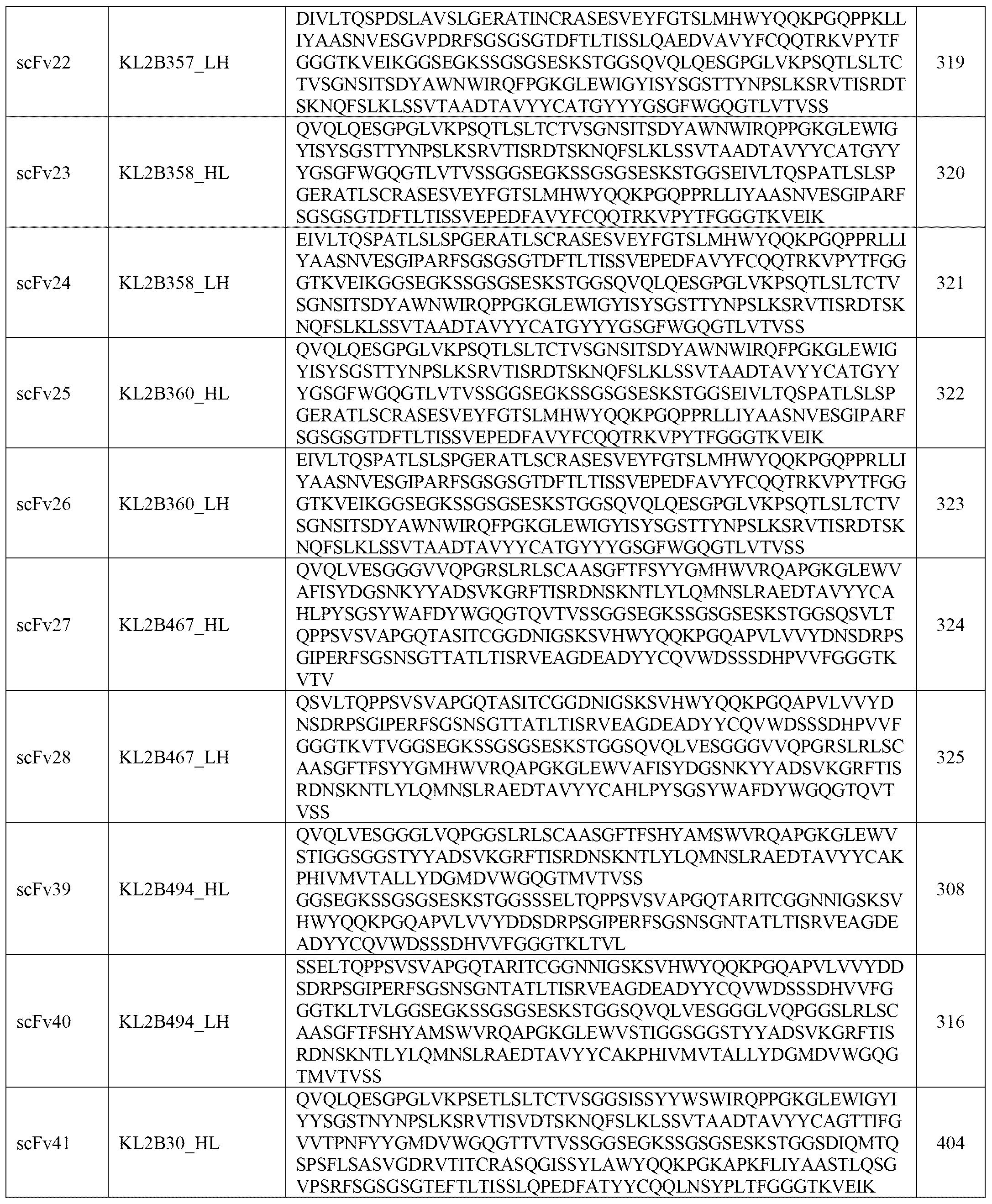
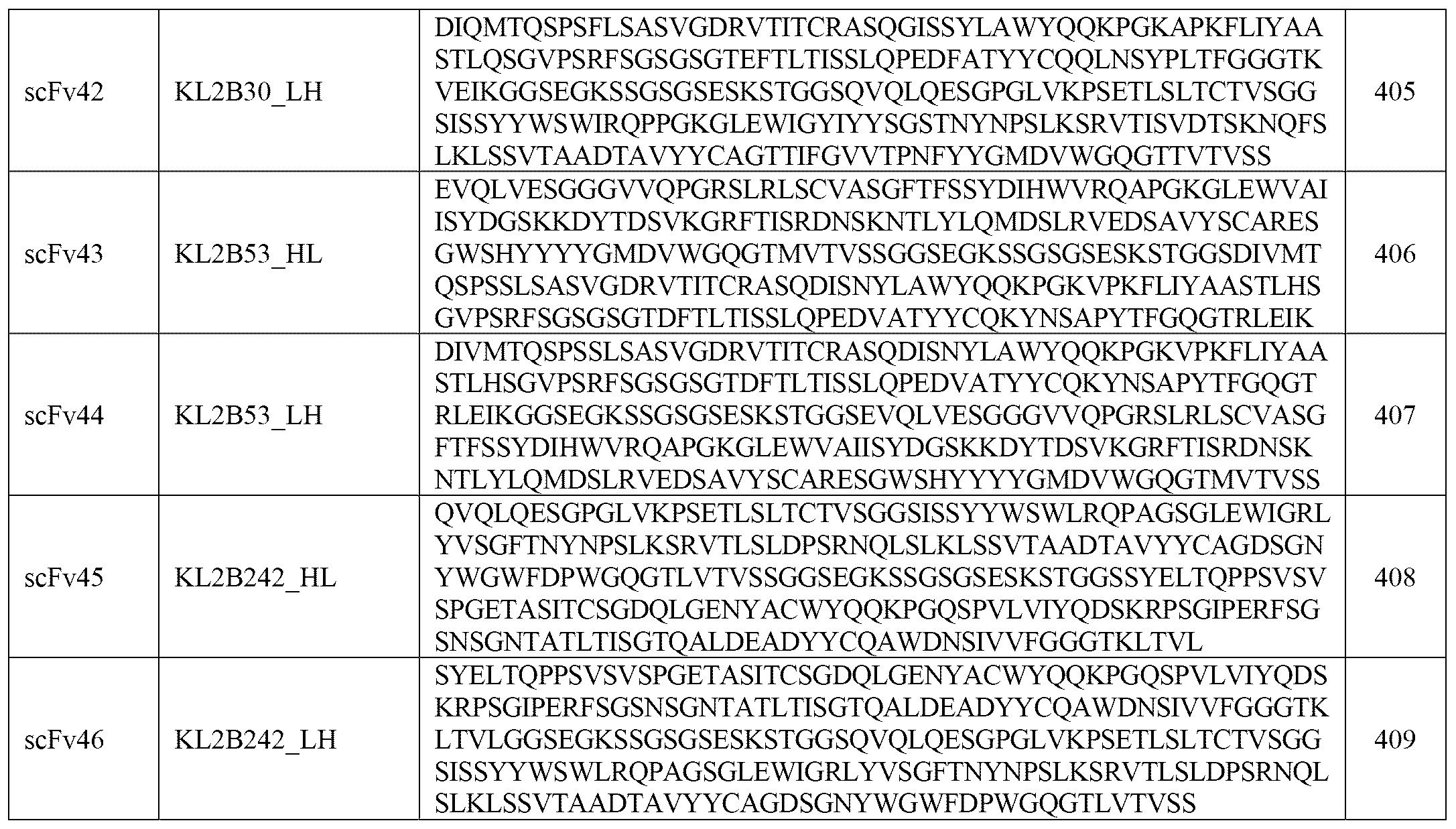
실시예 24. 항-hK2 항체의 생물물리학적 특징분석Example 24. Biophysical characterization of anti-hK2 antibodies
항-hK2 항체의 친화도와 열안정성.Affinity and thermostability of anti-hK2 antibodies.
가용성 hK2에 대한 선택된 hK2 항체의 친화도를 표면 플라즈몬 공명(SPR)으로 측정하였다. SPR은 복합체 형성과 해리 시 질량의 변화를 측정하는 방식으로 2개의 결합 파트너 사이의 상호작용의 강도를 연구하기 위한 무표지(label-free) 기술이다. 항체를 항-Fc 항체가 코팅된 센서 칩 상에 포획한 후, 가용성 hK2를 다양한 농도로 지정된 결합 및 해리 시간에 주입하였다. 해리 후, 다음 상호작용을 준비하기 위해 적절한 용액을 이용하여 표면을 재생시켰다. 센서그램을 1:1 Langmuir 모델에 핏팅하는 방식으로 반응속도 정보(결합 속도 상수와 해리 속도 상수)를 추출하였다. 결합 친화도(KD)는 속도 상수의 비(koff/kon)로 보고된다. 선택된 hK2 항체의 KD 값은 표 14에 열거되어 있다.The affinity of selected hK2 antibodies for soluble hK2 was measured by surface plasmon resonance (SPR). SPR is a label-free technique for studying the strength of interaction between two binding partners by measuring the change in mass upon complex formation and dissociation. After the antibodies were captured on the anti-Fc antibody-coated sensor chip, soluble hK2 was injected at various concentrations for the specified binding and dissociation times. After dissociation, the surface was regenerated using an appropriate solution to prepare for the next interaction. The kinetic information (association rate constant and dissociation rate constant) was extracted by fitting the sensorgrams to a 1:1 Langmuir model. The binding affinity (K D ) is reported as the ratio of rate constants (k off /k on ). The K D values of selected hK2 antibodies are listed in Table 14 .
자동화 Prometheus 기기를 사용하여 시차 주사 형광측정법(NanoDSF)으로 열안정성을 측정하였다. NanoDSF를 사용하여 포스페이트 완충된 식염수(pH 7.4) 중 0.5 mg/mL의 농도에서 분자의 Tm을 측정하였다. 샘플을 384웰 샘플 플레이트의 24웰 모세관에 로딩하는 방식으로 측정을 수행하였다. 각각의 샘플에 대해 중복으로 수행하였다. 열 스캔은 1.0℃/분의 속도로 20℃에서 95℃ 범위에 걸쳐 수행하였다. 330 nm 및 350 nm의 방출 파장에서 고유한 트립토판 및 티로신 형광을 모니터링하고, F350/F330 nm 비를 온도에 대해 플롯팅하여 전개 곡선을 생성하였다. 측정된 Tm 값은 표 14에 열거되어 있다.Thermal stability was measured by differential scanning fluorimetry (NanoDSF) using an automated Prometheus instrument. The T m of the molecule was measured at a concentration of 0.5 mg/mL in phosphate buffered saline (pH 7.4) using NanoDSF. Measurements were performed by loading samples into 24-well capillaries of a 384-well sample plate. Duplicate runs were performed for each sample. Thermal scans were performed over the range of 20 to 95 °C at a rate of 1.0 °C/min. The characteristic tryptophan and tyrosine fluorescence was monitored at emission wavelengths of 330 nm and 350 nm, and the F350/F330 nm ratio was plotted versus temperature to generate an evolution curve. The measured T m values are listed in Table 14 .
[표 14][Table 14]
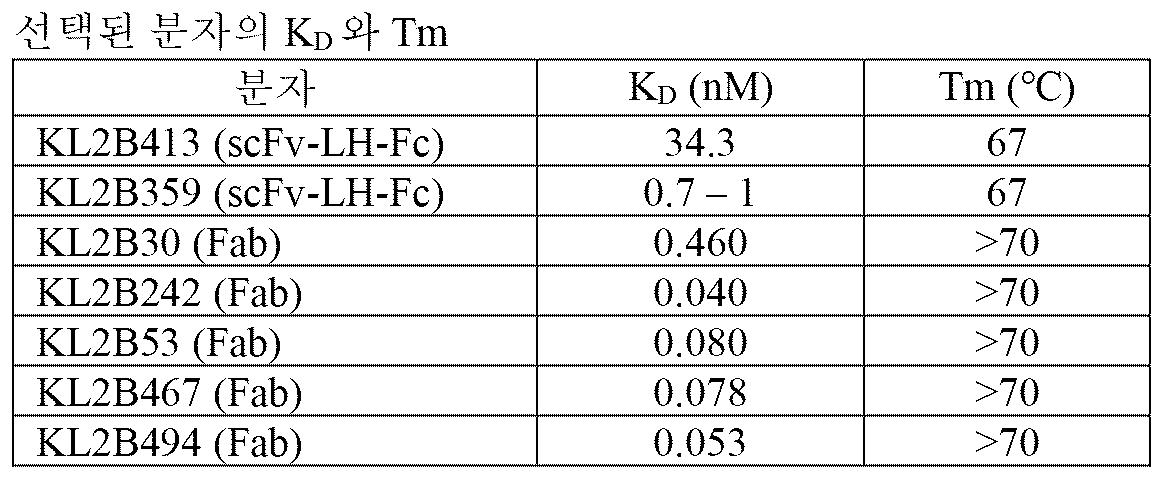
Ablexis 면역화 캠페인에서 생성된 KL2B413 scFv는 Nano DSF로 측정 시 열안정성(Tm)이 67℃이고, 인간 hK2에 대한 결합 친화도(KD)가 약 34 nM이었다. 쥣과 11B6과 유사한 결합 친화도를 유지하여 재인간화 캠페인을 위해 수득된 클론 KL2B359를 추가 프로파일링을 위해 scFv-Fc와 CAR-T로 전환시켰다. KL2B359 scFv는 Tm이 67℃이고, hK2에 대한 결합 친화도(KD)가 약 0.7 nM 내지 1 nM이었다. KL2B30, KL2B242, KL2B53, KL2B467 및 KL2B494 Fab은 결합 친화도가 0.5 nM 미만이고, Tm 값이 70℃ 초과였다.The KL2B413 scFv generated in the Ablexis immunization campaign had a thermostability (Tm) of 67°C and a binding affinity (K D ) for human hK2 of about 34 nM as measured by Nano DSF. Clone KL2B359, which was obtained for the rehumanization campaign and maintained binding affinity similar to murine 11B6, was converted to scFv-Fc and CAR-T for further profiling. The KL2B359 scFv had a Tm of 67°C and a binding affinity (K D ) for hK2 of about 0.7-1 nM. The KL2B30, KL2B242, KL2B53, KL2B467, and KL2B494 Fabs had binding affinities of less than 0.5 nM and Tm values greater than 70°C.
에피토프 맵핑Epitope Mapping
선택된 항-hK2 항체와 항-hK2/CD3 이중특이적 항체의 에피토프와 파라토프를 수소-중수소 교환 질량분석법(HDX-MS)으로 결정하였다. 인간 KLK2 항원을 에피토프 및 파라토프 맵핑 실험에 사용하였다.The epitopes and paratopes of selected anti-hK2 antibodies and anti-hK2/CD3 bispecific antibodies were determined by hydrogen-deuterium exchange mass spectrometry (HDX-MS). Human KLK2 antigen was used for epitope and paratope mapping experiments.
간략하게, 정제된 KLK2 항원을 중수소 산화물 표지화 완충액 중에서 항-hK2 항체 또는 항-hK2/CD3 이중특이적 항체의 존재 유무 하에 인큐베이션하였다. 8 M 우레아, 1 M TCEP(pH 3.0)를 첨가하는 방식으로 상이한 시점에 수소-중수소 교환(HDX) 혼합물을 켄칭하였다. 켄칭된 샘플을 실온에서 완충액 A(H2O 중 1% 아세토니트릴, 0.1% FA)로 평형화된 고정된 펩신/FPXIII 컬럼에 600 μL/분의 속도로 통과시켰다. 펩타이드 단편을 완충액 A를 이용하여 600 μL/분의 속도로 역상 트랩 컬럼 상에 로딩하고, 1분 동안 탈염시켰다(완충액 A 600 μL). 탈염된 단편을 20분에 걸쳐 100 μL/분의 속도로 8%→35% 완충액 B(95% 아세토니트릴, 5% H2O, 0.0025% TFA)의 선형 구배에 따라 C18 컬럼으로 분리하고, 질량분석법으로 분석하였다. 질량분석법 분석은 LTQ™ Orbitrap Fusion Lumos 질량분석기(Thermo Fisher Scientific)를 사용하여 모세관 온도 275℃, 분해능 150,000, 및 질량 범위(m/z) 300 내지 1,800으로 수행하였다. BioPharma Finder 3.0(Thermo Fisher Scientific)을 사용하여 HDX 실험 전 중수소화되지 않은 샘플의 펩타이드를 식별하였다. HDExaminer 버전 2.5(Sierra Analytics, Modesto, CA)를 사용하여 HDX 실험에 대한 MS 원시 데이터 파일에서 중심 값을 추출하였다.Briefly, purified KLK2 antigen was incubated in the presence or absence of anti-hK2 antibody or anti-hK2/CD3 bispecific antibody in deuterium oxide labeling buffer. The hydrogen-deuterium exchange (HDX) mixture was quenched at different time points by addition of 8 M urea, 1 M TCEP (pH 3.0). The quenched sample was passed at 600 μL/min over an immobilized pepsin/FPXIII column equilibrated with buffer A (1% acetonitrile in H 2 O, 0.1% FA) at room temperature. The peptide fragments were loaded onto a reversed-phase trap column at 600 μL/min using buffer A and desalted for 1 min (600 μL of buffer A). The desalted fragments were separated on a C18 column with a linear gradient of 8%→35% buffer B (95% acetonitrile, 5% H 2 O, 0.0025% TFA) at a rate of 100 μL/min over 20 min and analyzed by mass spectrometry. Mass spectrometry analyses were performed on an LTQ™ Orbitrap Fusion Lumos mass spectrometer (Thermo Fisher Scientific) at a capillary temperature of 275 °C, a resolution of 150,000, and a mass range (m/z) of 300 to 1,800. BioPharma Finder 3.0 (Thermo Fisher Scientific) was used to identify peptides in undeuterated samples prior to the HDX experiment. HDExaminer version 2.5 (Sierra Analytics, Modesto, CA) was used to extract centroids from the MS raw data files for the HDX experiments.
hK2 항체인 hu11B6, KL2B494, KL2B467, KL2B30, KL2B413 및 KL2B53을 가용성 hK2 단백질과 함께 인큐베이션한 결과, 다양한 패턴의 수소 교환과 전반적인 보호가 확인되었다. 보호된 분절을 hK2 항원의 서열에 맵핑하여 결합 에피토프를 가시화하였다. KL2B494, KL2B467 및 KL2B30은 (i) 174번 내지 178번 잔기(서열번호 111, KVTEF)(예를 들어, KL2B494, KL2B467 및 KL2B30은 서열번호 111의 잔기 중 적어도 3개, 즉, 174번 내지 176번 KVT 잔기에 결합했음)와, (ii) 230번 내지 234번 잔기(서열번호 112, HYRKW)(예를 들어, KL2B494, KL2B467 및 KL2B30은 서열번호 112의 잔기 중 적어도 3개, 즉, 230번 내지 232번 HYR 잔기에 결합했음)의 공통 서열에 결합하였다. KL2B413은 서열번호 111의 모든 잔기와 서열번호 112의 KW 잔기에도 결합하였다. 본 발명의 일 실시형태는 hK2에 결합하는 항원 결합 도메인을 포함하는 단리된 단백질로서, 여기서 상기 항원 결합 도메인은 서열번호 111과 서열번호 112의 서열을 갖는 에피토프 내 hK2에 결합하고; 예를 들어, 상기 항원 결합 도메인은 서열번호 111의 모든 잔기, 또는 적어도 4개의 잔기, 또는 적어도 3개의 잔기와, 서열번호 112의 모든 잔기, 또는 적어도 4개의 잔기, 또는 적어도 3개의 잔기에 결합하는 단리된 단백질을 제공한다.Incubation of hK2 antibodies hu11B6, KL2B494, KL2B467, KL2B30, KL2B413, and KL2B53 with soluble hK2 protein revealed diverse patterns of hydrogen exchange and overall protection. The protected segments were mapped to the sequence of the hK2 antigen to visualize the binding epitopes. KL2B494, KL2B467 and KL2B30 bound to a consensus sequence of (i) residues 174 to 178 ( SEQ ID NO: 111 , KVTEF) (e.g., KL2B494, KL2B467 and KL2B30 bound to at least three of the residues of SEQ ID NO: 111, i.e., KVT residues 174 to 176) and (ii) residues 230 to 234 ( SEQ ID NO: 112 , HYRKW) (e.g., KL2B494, KL2B467 and KL2B30 bound to at least three of the residues of SEQ ID NO: 112, i.e., HYR residues 230 to 232). KL2B413 also bound to all residues of SEQ ID NO: 111 and to the KW residues of SEQ ID NO: 112. An embodiment of the present invention provides an isolated protein comprising an antigen binding domain that binds hK2, wherein the antigen binding domain binds hK2 within an epitope having the sequences of SEQ ID NO: 111 and SEQ ID NO: 112; for example, the antigen binding domain binds to all residues of SEQ ID NO: 111, or at least four residues, or at least three residues, and all residues of SEQ ID NO: 112, or at least four residues, or at least three residues.
KL2B53은 상이한 보호 패턴을 나타내고, 27번 내지 32번 잔기(서열번호 113, SHGWAH), 60번 내지 75번 잔기(서열번호 114, RHNLFEPEDTGQRVP) 및 138번 내지 147번 잔기(서열번호 115, GWGSIEPEE)로 이루어진 서열에 결합하였다.KL2B53 exhibited a different protection pattern and bound to sequences consisting of residues 27 to 32 ( SEQ ID NO: 113 , SHGWAH),
일 실시형태에 따르면, 단리된 항-hK2/항-CD3 단백질(예를 들어, hu11B6, KL2B494, KL2B467, KL2B30, KL2B413 또는 KL2B53)은 서열번호 111, 112, 113, 114 및 115로 이루어지는 군에서 선택되는 하나 이상의 아미노산 서열을 포함하는 hK2의 불연속 에피토프(즉, 잔기가 서열에서 멀리 떨어져 있는 에피토프)에 특이적으로 결합하는 hk2 특이적 항원 결합 도메인을 포함한다.According to one embodiment, the isolated anti-hK2/anti-CD3 protein (e.g., hu11B6, KL2B494, KL2B467, KL2B30, KL2B413 or KL2B53) comprises an hk2-specific antigen binding domain that specifically binds to a discontinuous epitope of hK2 (i.e., an epitope where residues are distantly spaced in the sequence) comprising one or more amino acid sequences selected from the group consisting of SEQ ID NOs: 111, 112, 113, 114 and 115.
HDExaminer 잔기 플롯에서 중수소 흡수의 유의한 차이에 기반하여 항-hK2 항체인 hu11B6, KL2B494, KL2B467 및 KL2B413과, 항-hK2/CD3 이중특이적 항체인 KLCB113 및 KLCB80의 파라토프를 식별하였다. KL2BB494는 3개의 파라토프 영역을 포함하며, 이 중 2개는 KL2B494 중쇄 가변 도메인(GFTFSH(서열번호 455)와 TAVYYCAKPHIVMVTAL(서열번호 456))에 위치하고, 하나의 파라토프 영역은 경쇄 가변 도메인(YDDSDRPSGIPER(서열번호 457)) 내에 위치한다. KL2B467은 3개의 파라토프 영역을 포함하며, 이 중 2개는 KL2B467 중쇄 가변 도메인(FTFSY(서열번호 458)와 GSYWAFDY(서열번호 459))에 위치하고, 하나의 파라토프 영역은 경쇄 가변 도메인(DNSD(서열번호 460)) 내에 위치한다. Hu11B6은 중쇄에 위치한 단일 에피토프 영역(GNSITSDYA(서열번호 461))을 포함한다. KL2B413은 중쇄 가변 도메인에 위치한 2개의 파라토프 영역(GFTF(서열번호 462)와 ARDQNYDIL(서열번호 463))을 포함한다. 이중특이적 KLCB80의 KL2B30은 중쇄에 위치한 파라토프 영역(아미노산 잔기 TIF와 VTPNF(서열번호 464) 포함)과 경쇄에 위치한 파라토프 영역(YAASTLQSG(서열번호 465))을 포함한다. 이중특이적 KLCB113의 KL2B53은 중쇄에 위치한 단일 파라토프 영역(아미노산 잔기 ESGWSHY(서열번호 466) 포함)을 포함한다.Paratopes of anti-hK2 antibodies hu11B6, KL2B494, KL2B467, and KL2B413, and anti-hK2/CD3 bispecific antibodies KLCB113 and KLCB80 were identified based on significant differences in deuterium uptake in HDExaminer residue plots. KL2BB494 contains three paratopic regions, two of which are located in the KL2B494 heavy chain variable domain (GFTFSH (SEQ ID NO: 455) and TAVYYCAKPHIVMVTAL (SEQ ID NO: 456)) and one paratopic region is located within the light chain variable domain (Y DDSDRPS GIPER (SEQ ID NO: 457)). KL2B467 contains three paratopic regions, two of which are located in the KL2B467 heavy chain variable domain (FTFSY (SEQ ID NO: 458) and GSYWAFDY (SEQ ID NO: 459)) and one paratopic region is located within the light chain variable domain (DNSD (SEQ ID NO: 460)). Hu11B6 contains a single epitopic region located in the heavy chain (GNSITSDYA (SEQ ID NO: 461)). KL2B413 contains two paratopic regions located in the heavy chain variable domain (GFTF (SEQ ID NO: 462) and ARDQNYDIL (SEQ ID NO: 463)). KL2B30 of the bispecific KLCB80 comprises a paratopic region (comprising amino acid residues TIF and VTPNF (SEQ ID NO: 464)) located in the heavy chain and a paratopic region (comprising amino acid residues YAASTLQSG (SEQ ID NO: 465)) located in the light chain. KL2B53 of the bispecific KLCB113 comprises a single paratopic region (comprising amino acid residues ESGWSHY (SEQ ID NO: 466)) located in the heavy chain.
실시예 25 - KL2B30 Fab에의 MMAF 접합Example 25 - MMAF conjugation to KL2B30 Fab
MMAF에 KL2B30 Fab(KL2B997로 식별됨)을 접합시키는 방식으로 본 발명의 면역접합체를 제조하였다. 무작위 접합과 부위 특이적 접합을 통해 접합을 수행하였으며, 이러한 방법은, 예를 들어 WO2020/229974에 기재되어 있다. 본원에 기재된 바와 같이, KL2B997(KL2B30의 Fab)은, 각각, 서열번호 170, 171, 172, 173, 174 및 175의 HCDR1, HCDR2, HCDR3, LCDR1, LCDR2 및 LCDR3을 포함하고; KL2B997은 서열번호 162의 VH와 서열번호 163의 VL을 포함한다.The immunoconjugate of the present invention was prepared by conjugating KL2B30 Fab (identified as KL2B997) to MMAF. Conjugation was performed by random conjugation and site-specific conjugation, and such methods are described, for example, in WO2020/229974. As described herein, KL2B997 (Fab of KL2B30) comprises HCDR1, HCDR2, HCDR3, LCDR1, LCDR2 and LCDR3 of SEQ ID NOS: 170, 171, 172, 173, 174 and 175, respectively; and KL2B997 comprises a VH of SEQ ID NO: 162 and a VL of SEQ ID NO: 163.
도 1에서, "DAR"이라는 용어는, 항체 모이어티, 즉, KL2B997에 부착된 약물 분자, 즉, MMAF의 수를 나타내는 "약물 대 항체 비"이다. 항체 모이어티당 결합된 약물 분자의 수, 또는 표지화도가 당업계에서 통상적으로 사용되는 파라미터이며, "약물-항체 비"를 의미하는 "DAR"로 표시된다.In FIG. 1, the term "DAR" is the "drug-to-antibody ratio" which represents the number of drug molecules, i.e., MMAF, attached to the antibody moiety, i.e., KL2B997. The number of drug molecules bound per antibody moiety, or the degree of labeling, is a parameter commonly used in the art and is denoted as "DAR" which stands for "drug-antibody ratio".
상이한 접합 변이체를 갖는 KL2B30 Fab의 표적 세포 결합을 평가하기 위해, VCaP 세포를 hK2 양성 표적 세포로 사용하고, DU145 세포를 hK2 음성 세포로 사용하였다. KL2B30 모 항체(각각, 서열번호 210과 서열번호 221의 중쇄와 경쇄를 포함함)와 hu11B6(항-hK2 항체, h11B6으로도 지칭됨, 각각, 서열번호 203과 서열번호 215의 중쇄와 경쇄를 포함함)을 양성 대조군으로 포함시켰다. h11B6 항체는 미국 특허 제10,100,125호에 기재되어 있으며, 상기 문헌은 본원에 참조로 인용된다. Fab 기반 결합을 검출하기 위해 항인간 F(ab')2 단편 특이적 2차 검출 항체를 사용하였다. 시험 항체를 표적 세포와 함께 4℃에서 60분 동안 인큐베이션하고, 2차 염색으로 검출하였다. 2차 항체 결합 신호에 기반하며 살아있는 세포에서 게이팅된 유세포분석을 통해 세포 결합을 정량화하였다. 하기와 같은 세 가지 모든 시험된 방법을 사용한 결과는 양성 및 용량 의존적 세포 결합을 나타냈다: 접합되지 않은 KL2B997, KL2B997의 무작위 접합 및 KL2B997의 부위 특이적 접합(도 1에 KL2B997*, KL2B997 NHS 및 KL2B997 SORT로 도시됨). KL2B30 Fab은 hK2 양성 VCaP 세포에 특이적으로 결합하지만, hK2 음성 DU145 세포에는 특이적으로 결합하지 않는 것으로 나타났다. 도 1에 제시된 바와 같이, KL2B30 Fab은 hK2 발현 VCaP 세포에 결합하며, MMAF와 접합될 때 내재화되어 내재화 기반 세포 사멸을 촉발시킬 수 있는 것으로 나타났다.To assess target cell binding of KL2B30 Fabs with different splicing variants, VCaP cells were used as hK2 positive target cells and DU145 cells were used as hK2 negative cells. KL2B30 parental antibody (comprising heavy and light chains of SEQ ID NOs: 210 and 221, respectively) and hu11B6 (anti-hK2 antibody, also referred to as h11B6, comprising heavy and light chains of SEQ ID NOs: 203 and 215, respectively) were included as positive controls. The h11B6 antibody is described in U.S. Patent No. 10,100,125, which is incorporated herein by reference. An anti-human F(ab')2 fragment specific secondary detection antibody was used to detect Fab-based binding. Test antibodies were incubated with target cells at 4°C for 60 minutes and detected by secondary staining. Cell binding was quantified by flow cytometry gated on live cells based on secondary antibody binding signal. Results using all three tested methods showed positive and dose-dependent cell binding: unconjugated KL2B997, random conjugation of KL2B997 and site-specific conjugation of KL2B997 (shown in Figure 1 as KL2B997*, KL2B997 NHS and KL2B997 SORT). KL2B30 Fab was shown to bind specifically to hK2 positive VCaP cells, but not to hK2 negative DU145 cells. As shown in Figure 1 , KL2B30 Fab binds to hK2 expressing VCaP cells and when conjugated to MMAF, it can be internalized and trigger internalization-based cell death.
상기 기재된 면역접합체를 무작위 접합과 부위 특이적 접합을 통해 제조하였다. 부위 특이적 접합의 경우, 1x dPBS(Thermo Fisher 14190144) 중 2 mg/mL의 h11B6(2.1 mg)을 Rapid PNGaseF(NEB # P0711S)(5 ul)를 이용하여 37℃에서 밤새 탈글리코실화시켰다. 박테리아 트랜스글루타미나아제(bTG; Ajinomoto 사의 Activa TI)를 1000x 몰 과량의 아미노-PEG4-(PEG3-아지드)2 분지형 기질(CP-2051 Conju-Probe LLC)과 함께 30% w/v로 첨가하고, 실온에서 밤새 인큐베이션하였다. 아지드 변형된 mAb를 1 ml Mabselect 컬럼(GE 11003493)이 장착된 AKTA Avant 기기에서 정제하고, 10 mL Zeba 탈염 컬럼(Thermo Fisher)을 이용하여 1x dPBS로 교환하였다. DBCO-PEG4-vc-PAB-MMAF(Levena Biopharma)를 10x 몰 과량으로 첨가하고, 약물:항체 비가 4에 도달할 때까지 반응을 LC-MS로 모니터링하였다. 최종 h11B6-vcMMAF ADC를 Zeba 탈염 컬럼에서 정제한 후, Amicon 농축기를 이용하여 농축 및 정용여과하였다.The immunoconjugates described above were prepared via random and site-specific conjugation. For site-specific conjugation, h11B6 (2.1 mg) at 2 mg/mL in 1x dPBS (Thermo Fisher 14190144) was deglycosylated overnight at 37°C using Rapid PNGaseF (NEB # P0711S) (5 μl). Bacterial transglutaminase (bTG; Activa TI, Ajinomoto, Inc.) was added at 30% w/v together with a 1000x molar excess of amino-PEG4-(PEG3-azide)2 branched substrate (CP-2051 Conju-Probe LLC) and incubated overnight at room temperature. Azide-modified mAb was purified on an AKTA Avant instrument equipped with a 1 ml Mabselect column (GE 11003493) and exchanged into 1x dPBS using a 10 mL Zeba Desalting column (Thermo Fisher). DBCO-PEG4-vc-PAB-MMAF (Levena Biopharma) was added in 10x molar excess and the reaction was monitored by LC-MS until the drug:antibody ratio reached 4. The final h11B6-vcMMAF ADC was purified on the Zeba Desalting column, concentrated and diafiltered using an Amicon concentrator.
무작위 접합의 경우, KL2B30을 먼저 NHS-PEG4-아지드(Thermo Fisher Cat # 26130)와 반응시켰다. 1x dPBS 중 1 mg/ml의 KL2B30(1.5 mg)에 1 M 탄산수소소듐(pH 9)(BDH #144-55-8)(30 ul)을 첨가한 후, 즉시 7x 몰비의 NHS-PEG4-아지드를 첨가하였다. 표지화도가 2 내지 2.5에 도달할 때까지 반응을 질량분석법으로 모니터링한 후, Tris(pH 8.5)(Teknova T1085)를 첨가하여 최종 농도 100 mM로 켄칭하였다. 미반응 NHS-PEG4-아지드를 제거한 후, 10x 몰 과량의 DBCO-PEG4-vc-PAB-MMAF를 첨가하고, 37℃에서 1시간 동안 인큐베이션하였다. 최종 ADC(DAR = 2.7)를 10 ml Zeba 탈염 컬럼을 통해 정제한 후, Amicon 농축기를 이용하여 농축 및 정용여과하였다.For random conjugation, KL2B30 was first reacted with NHS-PEG4-azide (Thermo Fisher Cat # 26130). To KL2B30 (1.5 mg) at 1 mg/ml in 1x dPBS, 1 M sodium bicarbonate, pH 9 (BDH #144-55-8) (30 µl) was added, followed by immediate addition of 7x molar ratio of NHS-PEG4-azide. The reaction was monitored by mass spectrometry until the degree of labeling reached 2–2.5, and then quenched by addition of Tris, pH 8.5 (Teknova T1085) to a final concentration of 100 mM. After removing unreacted NHS-PEG4-azide, 10x molar excess of DBCO-PEG4-vc-PAB-MMAF was added and incubated at 37°C for 1 h. The final ADC (DAR = 2.7) was purified through a 10 ml Zeba desalting column, then concentrated and diafiltered using an Amicon concentrator.
소르타아제 태그를 통한 접합을 이용하여 KL2B997 부위 특이적 ADC(항체-약물 접합체)를 제조하였다. 1 mg/ml의 KL2B997(1 mg)을 50 mM Tris(pH 7.5), 150 mM NaCl, 10 mM CaCl2 완충액 중에서 스트렙토코커스 피오게네스(S. pyogenes) 소르타아제 A 효소(2 uM)(문헌[Chen et al. PNAS 2011:11399] 참조) 및 과량의 Gly3-vcMMAF(Levena Biopharma)와 함께 인큐베이션하였다. 반응액을 37℃에서 1시간 동안 인큐베이션하였다. 접합체를 AKTA Avant 기기의 1 mL HisTrap 컬럼(Cytiva 17524701)에서 정제하였다. ADC를 1x dPBS 중의 24 ml Superdex 75 10/300(Cytiva 29148721)에서 추가로 정제하여 임의의 응집물 또는 잔류 기질을 제거하였다.KL2B997 site-specific antibody-drug conjugate (ADC) was prepared using conjugation via a sortase tag. KL2B997 (1 mg) at 1 mg/mL was incubated with Streptococcus pyogenes sortase A enzyme (2 uM) (see literature [Chen et al. PNAS 2011:11399]) and excess Gly3-vcMMAF (Levena Biopharma) in a buffer of 50 mM Tris (pH 7.5), 150 mM NaCl, 10 mM CaCl 2 . The reaction was incubated at 37 °C for 1 h. The conjugate was purified on a 1 mL HisTrap column (Cytiva 17524701) on an AKTA Avant instrument. ADC was further purified in 24 ml Superdex 75 10/300 (Cytiva 29148721) in 1x dPBS to remove any aggregates or residual substrate.
NHS-PEG4-아지드를 첨가한 후, 상기 기재된 바와 같이 DBCO-vcMMAF와 반응시켜 KL2B997 무작위 접합된 ADC를 제조하였다.After addition of NHS-PEG4-azide, KL2B997 randomly conjugated ADC was prepared by reacting with DBCO-vcMMAF as described above.
실시예 26 - TOPA-KL2B1251 Fab과 NODA-GA-KL2B1251 FabExample 26 - TOPA-KL2B1251 Fab and NODA-GA-KL2B1251 Fab
TOPA 및 NODA-GA에 KL2B30 Fab(KL2B1251로 식별됨)을 접합시키는 방법이 하기에 제공된다.Methods for conjugating KL2B30 Fab (identified as KL2B1251) to TOPA and NODA-GA are provided below.
TOPA-KL2B1251의 제조.Manufacturing of TOPA-KL2B1251.
Fab의 무작위 TOPA 변형: KL2B1251 Fab을 멸균 1x dPBS 중에 1 mg/ml로 희석하였다. 탄산수소소듐 완충액(pH 9)(VWR 144-55-8)을 이용하여 mAb의 pH를 9.0으로 조정하였다. 이어서, 8x 몰 과량의 TOPA(TOPA-페닐-NCS(중간체); DMSO에 용해시킨 50 mM 스톡)를 첨가하고, 풀을 진탕시키지 않으면서 실온에서 대략 1시간 동안 인큐베이션하였다. TOPA의 첨가를, CAR 값이 1.5 내지 2.0이 될 때까지, Agilent® G224 기기에서 원형 질량 ESI-TOF LC-MS로 모니터링하였다. 1 M Tris(pH 8.5)(Teknova T1085)를 첨가하여 풀을 최종 농도 100 mM로 켄칭하였다. 55 ml HiPrep 26/10 탈염 컬럼(17508701 - Cytiva)을 통해 한 번에 접합체 풀(15 ml)을 연속으로 탈염시키고 용리하는 과정을 수행하여 과량의 유리 킬레이트제를 제거하였다. 평형화와 용리는 모두 1x dPBS에서 수행하였다. 이어서, 샘플을 2 ml로 농축시켰다. 과량의 킬레이트제가 존재하지 않는다는 것을 확인하기 위해, 샘플을 15 ml로 3회 희석한 후, 50,000 MWCO Amicon 농축 장치를 사용하여 1 ml로 농축시켰다. 최종 접합체는 하기와 같은 분석용 크기 배제 크로마토그래피를 통해 단량체인 것으로 확인되었다: Tosoh TSKgel G3000SWxl 7.8 mm × 30 cm, 5 u 컬럼; 컬럼 온도: 실온; 컬럼을 0.2 M 인산소듐(pH 6.8)으로 용리함; 유량: 0.8 mL/분; 18분 실행; 주입량: 18 ul. Random TOPA variants of Fab: KL2B1251 Fab was diluted to 1 mg/ml in sterile 1x dPBS. The pH of the mAb was adjusted to 9.0 with sodium bicarbonate buffer, pH 9 (VWR 144-55-8). Then, 8x molar excess of TOPA (TOPA-phenyl-NCS (intermediate); 50 mM stock in DMSO) was added and the pool was incubated at room temperature without shaking for approximately 1 h. The addition of TOPA was monitored by circular mass ESI-TOF LC-MS on an Agilent® G224 instrument until the CAR value was 1.5-2.0. The pool was quenched to a final concentration of 100 mM by addition of 1 M Tris, pH 8.5 (Teknova T1085). Excess free chelating agent was removed by sequential desalting and eluting of the conjugate pool (15 ml) in one step through a 55 ml HiPrep 26/10 Desalting column (17508701 - Cytiva). Both equilibration and elution were performed in 1x dPBS. The sample was then concentrated to 2 ml. To ensure that no excess chelating agent was present, the sample was diluted three times to 15 ml and then concentrated to 1 ml using a 50,000 MWCO Amicon concentrator. The final conjugate was confirmed to be monomeric by analytical size exclusion chromatography as follows: Tosoh TSKgel G3000SWxl 7.8 mm × 30 cm, 5 u column; Column temperature: room temperature; Column was eluted with 0.2 M sodium phosphate, pH 6.8; Flow rate: 0.8 mL/min; Run for 18 minutes; Injection volume: 18 ul.
NODA-GA-KL2B1251의 제조.Manufacturing of NODA-GA-KL2B1251.
Fab의 무작위 NODA 변형: KL2B1251 Fab을 멸균 1x dPBS 중에 1 mg/ml로 희석하였다. 전체 풀을 Chelex 수지(BioRad 1432832)를 이용하여 실온에서 30분 동안 회전시킨 후, 다음 단계 전 멸균 필터를 이용하여 수지를 여과해 내었다. 접합 직전, chelex 처리된 1 M 탄산수소소듐(pH 9.0)(VWR 1 M 용액, pH 9.0, Cat # 144-55-8)을 첨가하였다. 30x NODA-GA-NHS 에스테르(50 mM DMSO 중 2,2'-(7-(1-카르복시-4-((2,5-디옥소피롤리딘-1-일)옥시)-4-옥소부틸)-1,4,7-트리아조난-1,4-디일)디아세트산; Chematech Cat #C098)를 첨가하였다. 진탕시키지 않으면서 실온에서 약 1시간 동안 인큐베이션하였다. NODA의 첨가를, CAR 값이 1.5 내지 2.0이 될 때까지, Agilent G224 기기에서 원형 질량 ESI-TOF LC-MS로 모니터링하였다. 1 M Tris(pH 8.5)(Teknova T1085)를 첨가하여 풀을 최종 농도 100 mM로 켄칭하였다. 가능한 금속이 없는 준비를 유지하기 위해, 정제를 30,000 MWCO 농축 장치를 통해서만 수행하였다. 풀을 6개의 30,000 MWCO Amicon 농축기에 분할하고(각각은 약 6 ml 부피를 보유함), chelex PBS로 상부를 채웠다. 농축기를 3800 × g로 8분 동안 회전시켜, 각각 약 1 ml의 접합체를 남겼다. chelex PBS로 각각의 농축기의 상부를 채웠다. 이러한 과정을 5회 추가로 반복하였다. 최종 접합체는 하기와 같은 분석용 크기 배제 크로마토그래피를 통해 단량체인 것으로 확인되었다: Tosoh TSKgel G3000SWxl 7.8 mm × 30 cm, 5 u 컬럼; 컬럼 온도: 실온; 컬럼을 0.2 M 인산소듐(pH 6.8)으로 용리함; 유량: 0.8 mL/분; 18분 실행; 주입량: 18 ul. Random NODA Modification of Fab: KL2B1251 Fab was diluted to 1 mg/ml in sterile 1x dPBS. The entire pool was spun down using Chelex resin (BioRad 1432832) at room temperature for 30 minutes and then the resin was filtered using a sterile filter prior to the next step. Chelex-treated 1 M sodium bicarbonate, pH 9.0 (VWR 1 M solution, pH 9.0, Cat # 144-55-8) was added immediately prior to conjugation. 30x NODA-GA-NHS ester (2,2'-(7-(1-carboxy-4-((2,5-dioxopyrrolidin-1-yl)oxy)-4-oxobutyl)-1,4,7-triazonane-1,4-diyl)diacetic acid in 50 mM DMSO; Chematech Cat #C098) was added. Incubation was performed at room temperature for approximately 1 hour without shaking. The addition of NODA was monitored by circular mass ESI-TOF LC-MS on an Agilent G224 instrument until the CAR value was 1.5-2.0. The pool was quenched to a final concentration of 100 mM by the addition of 1 M Tris (pH 8.5) (Teknova T1085). To maintain the preparation as metal-free as possible, purification was performed only through 30,000 MWCO concentrators. The pool was divided into six 30,000 MWCO Amicon concentrators (each holding approximately 6 ml volume) and topped with chelex PBS. The concentrators were spun at 3800 × g for 8 minutes, leaving approximately 1 ml of conjugate in each. Each concentrator was topped with chelex PBS. This process was repeated five additional times. The final conjugate was confirmed to be a monomer by analytical size exclusion chromatography as follows: Tosoh TSKgel G3000SWxl 7.8 mm × 30 cm, 5 u column; Column temperature: room temperature; Column eluted with 0.2 M sodium phosphate (pH 6.8); Flow rate: 0.8 mL/min; Run 18 min; Injection volume: 18 ul.
실시예 25에 기재된 방법을 사용하여, 상이한 접합 변이체를 갖는 KL2B1251 Fab의 표적 세포 결합을 평가하기 위해, VCaP 세포를 hK2 양성 표적 세포로 사용하고, DU145 세포를 hK2 음성 세포로 사용하였다. 도 3에 제시된 바와 같이, KL2B1251 Fab과 KL2B1251-NODA-GA는 hK2 양성 VCaP 세포(도 3a)에 특이적으로 결합하지만, hK2 음성 DU145 세포(도 3b)에는 특이적으로 결합하지 않는 것으로 나타났다.To evaluate the target cell binding of KL2B1251 Fab with different splicing variants, VCaP cells were used as hK2-positive target cells and DU145 cells were used as hK2-negative cells using the method described in Example 25. As shown in Fig. 3, KL2B1251 Fab and KL2B1251-NODA-GA were found to specifically bind to hK2-positive VCaP cells (Fig. 3a) but not to hK2-negative DU145 cells (Fig. 3b).
실시예 27 - KL2B1251-NOTA와 KL2B1251-TOPA의 약동학(PK) 연구Example 27 - Pharmacokinetic (PK) study of KL2B1251-NOTA and KL2B1251-TOPA
본 연구의 목적은 본원에 기재된 바와 같은 NODA-GA-KL2B1251 Fab(본 실시예에서 "KL2B1251-NOTA"로 지칭됨)과 본원에 기재된 바와 같은 TOPA-KL2B1251 Fab(본 실시예에서 "KL2B1251-TOPA"로 지칭됨)을 수컷 시노몰구스 원숭이에 단회 IV 투여한 후 약동학적 특성을 설명하기 위한 것이었다. 첫 번째 투여는 1일차에 수행하였다. KL2B1251-NOTA를 1 mg/kg의 목표 용량으로 대략 1분에 걸친 저속 볼루스 주사로 4마리 수컷 시노몰구스 원숭이에 정맥내(IV) 투여하였다. KL2B1251-TOPA를 또한 1 mg/kg의 목표 용량으로 대략 1분에 걸친 저속 볼루스 주사로 4마리 수컷 시노몰구스 원숭이에 정맥내(IV) 투여하였다. 개별 체중과 투여량은 도 5에 제시되어 있다.The objective of this study was to characterize the pharmacokinetics following single IV administration of NODA-GA-KL2B1251 Fab as described herein (referred to herein as “KL2B1251-NOTA”) and TOPA-KL2B1251 Fab as described herein (referred to herein as “KL2B1251-TOPA”) to male cynomolgus monkeys. The first administration was performed on
단회 IV 볼루스 투여 후 KL2B1251-NOTA와 KL2B1251-TOPA의 개별 및 평균(SD) 혈청 PK 추정치는 도 6에 요약되어 있다. 수컷 원숭이의 시간에 따른 KL2B1251-NOTA와 KL2B1251-TOPA의 평균(SD) 혈청 농도는 도 7에 예시되어 있다. KL2B1251-NOTA와 KL2B1251-TOPA의 혈청 농도는 KL2B1251-NOTA 투여군과 KL2B1251-TOPA 투여군에서 용량 투여 전 수집한 모든 샘플의 정량화 가능한 최저 농도보다 낮았다. KL2B1251-NOTA 노출(AUCinf 기준)이 KL2B1251-TOPA보다 1.72배 더 높았다. KL2B1251-NOTA는 KL2B1251-TOPA와 비교하여 더 빠른 혈청 제거율과 더 낮은 분포 부피를 나타냈다. KL2B1251-NOTA의 말기 T1/2는 KL2B1251-TOPA보다 약간 더 짧았다. KL2B1251-NOTA와 KL2B1251-TOPA의 단회 IV 투여 후, Cmax의 평균 값은, 각각, 21555.77 ng/mL와 16933.83 ng/mL였고, AUCinf의 평균 값은, 각각, 1440.71 ng·일/mL와 837.55 ng·일/mL였고, CL의 평균 값은, 각각, 711.23 mL/일/kg과 1271.46 mL/일/kg이었고, T1/2의 평균 값은, 각각, 0.60(14.4시간)과 0.85(20.4시간)였다.Individual and mean (SD) serum PK estimates of KL2B1251-NOTA and KL2B1251-TOPA after a single IV bolus administration are summarized in Figure 6 . Mean (SD) serum concentrations of KL2B1251-NOTA and KL2B1251-TOPA over time in male monkeys are illustrated in Figure 7 . Serum concentrations of KL2B1251-NOTA and KL2B1251-TOPA were lower than the lowest quantifiable concentration in all samples collected prior to dose administration in both KL2B1251-NOTA and KL2B1251-TOPA groups. KL2B1251-NOTA exposure (based on AUCinf) was 1.72-fold higher than that of KL2B1251-TOPA. KL2B1251-NOTA exhibited faster serum clearance and lower volume of distribution compared with KL2B1251-TOPA. The terminal T 1/2 of KL2B1251-NOTA was slightly shorter than that of KL2B1251-TOPA. After single IV administration of KL2B1251-NOTA and KL2B1251-TOPA, the mean values of C max were 21555.77 ng/mL and 16933.83 ng/mL, respectively, the mean values of AUC inf were 1440.71 ng·day/mL and 837.55 ng·day/mL, respectively, the mean values of CL were 711.23 mL/day/kg and 1271.46 mL/day/kg, respectively, and the mean values of T 1/2 were 0.60 (14.4 hours) and 0.85 (20.4 hours), respectively.
본원에 기재된 실시예와 실시형태는 단지 예시를 위한 것이며, 본 발명의 광범위한 개념에서 벗어나지 않는 한 상기 기재된 실시형태에 대한 변화가 이루어질 수 있음을 이해해야 한다. 따라서, 본 발명은 개시된 특정 실시형태에 제한되는 것이 아니라, 첨부된 청구범위에 의해 정의되는 본 발명의 사상과 범위 내에 있는 변형을 포함하는 것으로 의도됨을 이해해야 한다.It should be understood that the examples and embodiments described herein are for illustrative purposes only, and that changes may be made to the embodiments described above without departing from the broad concept of the present invention. Accordingly, it should be understood that the present invention is not limited to the specific embodiments disclosed, but is intended to cover modifications that fall within the spirit and scope of the present invention as defined by the appended claims.
서열목록 전자파일 첨부Attach electronic file of sequence list
Claims (13)
a. 각각, 서열번호 170, 171, 172, 173, 174 및 175의 HCDR1, HCDR2, HCDR3, LCDR1, LCDR2 및 LCDR3; 및/또는
b. 서열번호 162의 VH와 서열번호 163의 VL.An immunoconjugate according to any one of claims 1 to 5, wherein the antigen binding domain is a Fab comprising:
a. HCDR1, HCDR2, HCDR3, LCDR1, LCDR2 and LCDR3 of SEQ ID NOs: 170, 171, 172, 173, 174 and 175, respectively; and/or
b. VH of sequence number 162 and VL of sequence number 163.
방사성금속 착물은 NOTA, 또는 NODA-GA, NODA-GA(t-부틸)3, 디-t-부틸-NOTA, NOTA-티오세미카르바지드, NODA-MPAA 또는 NODA-MPAEM, 바람직하게는 NODA-GA와 같은 NOTA의 유도체인 킬레이트제에 결합된 64Cu를 포함하고,
킬레이트제는 칼리크레인 관련 펩티다아제 2(hK2)에 대해 결합 특이성이 있는 항원 결합 도메인에 접합되어 있으며,
항원 결합 도메인은 하기를 포함하는, 면역접합체:
(a) 각각, 서열번호 170(SYYWS), 서열번호 171(YIYYSGSTNYNPSLKS), 서열번호 172(TTIFGVVTPNFYYGMDV), 서열번호 173(RASQGISSYLA), 서열번호 174(AASTLQS) 및 서열번호 175(QQLNSYPLT)의 HCDR1, HCDR2, HCDR3, LCDR1, LCDR2 및 LCDR3; 및/또는
(b) 서열번호 162의 VH와 적어도 95%, 적어도 99% 또는 100% 동일한 VH와, 서열번호 163의 VL과 적어도 95%, 적어도 99% 또는 100% 동일한 VL.An immunoconjugate comprising a radiometal complex conjugated to an antigen binding domain having binding specificity for kallikrein-related peptidase 2 (hK2), wherein
The radiometal complex comprises 64 Cu bound to a chelating agent which is a derivative of NOTA, such as NOTA, or NODA-GA, NODA-GA(t-butyl) 3 , di-t-butyl-NOTA, NOTA-thiosemicarbazide, NODA-MPAA or NODA- MPAEM , preferably NODA-GA,
The chelator is conjugated to an antigen-binding domain with binding specificity for kallikrein-related peptidase 2 (hK2).
An immunoconjugate comprising an antigen binding domain:
(a) HCDR1, HCDR2, HCDR3, LCDR1, LCDR2 and LCDR3 of SEQ ID NO: 170 (SYYWS), SEQ ID NO: 171 (YIYYSGSTNYNPSLKS), SEQ ID NO: 172 (TTIFGVVTPNFYYGMDV), SEQ ID NO: 173 (RASQGISSYLA), SEQ ID NO: 174 (AASTLQS) and SEQ ID NO: 175 (QQLNSYPLT), respectively; and/or
(b) a VH that is at least 95%, at least 99% or 100% identical to the VH of SEQ ID NO: 162, and a VL that is at least 95%, at least 99% or 100% identical to the VL of SEQ ID NO: 163.
Applications Claiming Priority (3)
| Application Number | Priority Date | Filing Date | Title |
|---|---|---|---|
| US202263303083P | 2022-01-26 | 2022-01-26 | |
| US63/303,083 | 2022-01-26 | ||
| PCT/IB2023/050634 WO2023144723A1 (en) | 2022-01-26 | 2023-01-25 | Immunoconjugates comprising kallikrein related peptidase 2 antigen binding domains and their uses |
Publications (1)
| Publication Number | Publication Date |
|---|---|
| KR20240142438A true KR20240142438A (en) | 2024-09-30 |
Family
ID=85222161
Family Applications (1)
| Application Number | Title | Priority Date | Filing Date |
|---|---|---|---|
| KR1020247025624A Pending KR20240142438A (en) | 2022-01-26 | 2023-01-25 | Immunoconjugates comprising kallikrein-related peptidase 2 antigen-binding domains and uses thereof |
Country Status (10)
| Country | Link |
|---|---|
| US (1) | US20250099635A1 (en) |
| EP (1) | EP4469095A1 (en) |
| JP (1) | JP2025504907A (en) |
| KR (1) | KR20240142438A (en) |
| CN (1) | CN118613288A (en) |
| AU (1) | AU2023214183A1 (en) |
| CA (1) | CA3247163A1 (en) |
| IL (1) | IL314495A (en) |
| MX (1) | MX2024009269A (en) |
| WO (1) | WO2023144723A1 (en) |
Family Cites Families (11)
| Publication number | Priority date | Publication date | Assignee | Title |
|---|---|---|---|---|
| US6884869B2 (en) | 2001-04-30 | 2005-04-26 | Seattle Genetics, Inc. | Pentapeptide compounds and uses related thereto |
| CA2710373A1 (en) | 2007-12-19 | 2009-07-09 | Ping Tsui | Design and generation of human de novo pix phage display libraries via fusion to pix or pvii, vectors, antibodies and methods |
| PL2553100T3 (en) | 2010-03-31 | 2018-03-30 | Ablexis, Llc | Genetic engineering of non-human animals for the production of chimeric antibodies |
| FI3653049T3 (en) | 2012-12-14 | 2023-11-02 | Omniab Inc | Polynucleotides encoding rodent antibodies with human idiotypes and animals comprising same |
| JP6599859B2 (en) * | 2013-11-19 | 2019-10-30 | フレダックス・アクチエボラーグ | Humanized anti-kallikrein-2 antibody |
| EP3377117A1 (en) | 2015-11-18 | 2018-09-26 | Memorial Sloan Kettering Cancer Center | Systems, methods, and compositions for imaging androgen receptor axis activity in carcinoma, and related therapeutic compositions and methods |
| KR20260008174A (en) | 2017-03-30 | 2026-01-15 | 코넬 유니버시티 | Macrocyclic complexes of alpha-emitting radionuclides and their use in targeted radiotherapy of cancer |
| US20220016277A1 (en) | 2018-11-20 | 2022-01-20 | Cornell University | Macrocyclic complexes of radionuclides and their use in radiotherapy of cancer |
| PH12021552791A1 (en) | 2019-05-10 | 2022-09-05 | Janssen Biotech Inc | Macrocyclic chelators and methods of use thereof |
| AU2022213825A1 (en) * | 2021-01-27 | 2023-09-14 | Janssen Biotech, Inc. | Immunoconjugates comprising kallikrein related peptidase 2 antigen binding domains and their uses |
| TW202313127A (en) * | 2021-05-27 | 2023-04-01 | 美商健生生物科技公司 | Compositions and methods for the treatment of prostate cancer |
-
2023
- 2023-01-25 KR KR1020247025624A patent/KR20240142438A/en active Pending
- 2023-01-25 WO PCT/IB2023/050634 patent/WO2023144723A1/en not_active Ceased
- 2023-01-25 MX MX2024009269A patent/MX2024009269A/en unknown
- 2023-01-25 CA CA3247163A patent/CA3247163A1/en active Pending
- 2023-01-25 AU AU2023214183A patent/AU2023214183A1/en active Pending
- 2023-01-25 EP EP23704421.9A patent/EP4469095A1/en active Pending
- 2023-01-25 US US18/832,652 patent/US20250099635A1/en active Pending
- 2023-01-25 CN CN202380018779.7A patent/CN118613288A/en active Pending
- 2023-01-25 IL IL314495A patent/IL314495A/en unknown
- 2023-01-25 JP JP2024544372A patent/JP2025504907A/en active Pending
Also Published As
| Publication number | Publication date |
|---|---|
| MX2024009269A (en) | 2024-08-09 |
| IL314495A (en) | 2024-09-01 |
| JP2025504907A (en) | 2025-02-19 |
| WO2023144723A1 (en) | 2023-08-03 |
| CN118613288A (en) | 2024-09-06 |
| CA3247163A1 (en) | 2023-08-03 |
| US20250099635A1 (en) | 2025-03-27 |
| EP4469095A1 (en) | 2024-12-04 |
| AU2023214183A1 (en) | 2024-09-12 |
Similar Documents
| Publication | Publication Date | Title |
|---|---|---|
| US12453785B2 (en) | Macrocyclic chelators and methods of use thereof | |
| KR102753876B1 (en) | Radiolabeling of polypeptides | |
| US20250325718A1 (en) | Immunoconjugates comprising kallikrein related peptidase 2 antigen binding domains and their uses | |
| US20240238461A1 (en) | Macrocyclic compounds and methods of use thereof | |
| US20250145646A1 (en) | Macrocyclic compounds and diagnostic uses thereof | |
| JP2024542168A (en) | Macrocyclic compound and method for producing same | |
| KR20240142438A (en) | Immunoconjugates comprising kallikrein-related peptidase 2 antigen-binding domains and uses thereof | |
| CN116806159A (en) | Immunoconjugates comprising kallikrein-related peptidase 2 antigen binding domains and uses thereof | |
| HK40098620A (en) | Immunoconjugates comprising kallikrein related peptidase 2 antigen binding domains and their uses | |
| HK40071088A (en) | Macrocyclic chelators and methods of use thereof | |
| EA048132B1 (en) | MACROCYCLIC CHELATORS AND METHODS OF THEIR APPLICATION |
Legal Events
| Date | Code | Title | Description |
|---|---|---|---|
| PA0105 | International application |
Patent event date: 20240729 Patent event code: PA01051R01D Comment text: International Patent Application |
|
| PG1501 | Laying open of application |