KR20240124152A - Wearable device for performing rendering regarding virtual object based on external light and method thereof - Google Patents
Wearable device for performing rendering regarding virtual object based on external light and method thereof Download PDFInfo
- Publication number
- KR20240124152A KR20240124152A KR1020230036145A KR20230036145A KR20240124152A KR 20240124152 A KR20240124152 A KR 20240124152A KR 1020230036145 A KR1020230036145 A KR 1020230036145A KR 20230036145 A KR20230036145 A KR 20230036145A KR 20240124152 A KR20240124152 A KR 20240124152A
- Authority
- KR
- South Korea
- Prior art keywords
- wearable device
- virtual
- light source
- display
- virtual space
- Prior art date
- Legal status (The legal status is an assumption and is not a legal conclusion. Google has not performed a legal analysis and makes no representation as to the accuracy of the status listed.)
- Pending
Links
Images




Classifications
-
- G—PHYSICS
- G06—COMPUTING OR CALCULATING; COUNTING
- G06F—ELECTRIC DIGITAL DATA PROCESSING
- G06F3/00—Input arrangements for transferring data to be processed into a form capable of being handled by the computer; Output arrangements for transferring data from processing unit to output unit, e.g. interface arrangements
- G06F3/01—Input arrangements or combined input and output arrangements for interaction between user and computer
- G06F3/011—Arrangements for interaction with the human body, e.g. for user immersion in virtual reality
-
- G—PHYSICS
- G06—COMPUTING OR CALCULATING; COUNTING
- G06F—ELECTRIC DIGITAL DATA PROCESSING
- G06F1/00—Details not covered by groups G06F3/00 - G06F13/00 and G06F21/00
- G06F1/16—Constructional details or arrangements
- G06F1/1613—Constructional details or arrangements for portable computers
- G06F1/163—Wearable computers, e.g. on a belt
-
- G—PHYSICS
- G06—COMPUTING OR CALCULATING; COUNTING
- G06F—ELECTRIC DIGITAL DATA PROCESSING
- G06F3/00—Input arrangements for transferring data to be processed into a form capable of being handled by the computer; Output arrangements for transferring data from processing unit to output unit, e.g. interface arrangements
- G06F3/002—Specific input/output arrangements not covered by G06F3/01 - G06F3/16
- G06F3/005—Input arrangements through a video camera
-
- G—PHYSICS
- G06—COMPUTING OR CALCULATING; COUNTING
- G06F—ELECTRIC DIGITAL DATA PROCESSING
- G06F3/00—Input arrangements for transferring data to be processed into a form capable of being handled by the computer; Output arrangements for transferring data from processing unit to output unit, e.g. interface arrangements
- G06F3/01—Input arrangements or combined input and output arrangements for interaction between user and computer
- G06F3/048—Interaction techniques based on graphical user interfaces [GUI]
- G06F3/0481—Interaction techniques based on graphical user interfaces [GUI] based on specific properties of the displayed interaction object or a metaphor-based environment, e.g. interaction with desktop elements like windows or icons, or assisted by a cursor's changing behaviour or appearance
-
- G—PHYSICS
- G06—COMPUTING OR CALCULATING; COUNTING
- G06F—ELECTRIC DIGITAL DATA PROCESSING
- G06F3/00—Input arrangements for transferring data to be processed into a form capable of being handled by the computer; Output arrangements for transferring data from processing unit to output unit, e.g. interface arrangements
- G06F3/01—Input arrangements or combined input and output arrangements for interaction between user and computer
- G06F3/048—Interaction techniques based on graphical user interfaces [GUI]
- G06F3/0484—Interaction techniques based on graphical user interfaces [GUI] for the control of specific functions or operations, e.g. selecting or manipulating an object, an image or a displayed text element, setting a parameter value or selecting a range
- G06F3/04842—Selection of displayed objects or displayed text elements
-
- G—PHYSICS
- G06—COMPUTING OR CALCULATING; COUNTING
- G06T—IMAGE DATA PROCESSING OR GENERATION, IN GENERAL
- G06T15/00—3D [Three Dimensional] image rendering
Landscapes
- Engineering & Computer Science (AREA)
- Theoretical Computer Science (AREA)
- General Engineering & Computer Science (AREA)
- Physics & Mathematics (AREA)
- General Physics & Mathematics (AREA)
- Human Computer Interaction (AREA)
- Computer Hardware Design (AREA)
- Computer Graphics (AREA)
- Multimedia (AREA)
- User Interface Of Digital Computer (AREA)
Abstract
Description
본 개시(present disclosure)는 외부 광에 기반하여 가상 객체에 대한 렌더링을 수행하기 위한 웨어러블 장치 및 그 방법에 관한 것이다. The present disclosure relates to a wearable device and method for performing rendering of a virtual object based on external light.
강화된(enhanced) 사용자 경험(user experience)을 제공하기 위해, 실제 세계(real-world) 내 외부 객체와 연계하여 컴퓨터에 의해 생성된 정보를 표시하는 증강 현실(augmented reality, AR) 서비스를 제공하는 전자 장치가 개발되고 있다. 상기 전자 장치는, 사용자에 의해 착용될 수 있는 웨어러블 장치일 수 있다. 예를 들면, 상기 전자 장치는, AR 안경(glasses), 및/또는 머리 착용형 장치(head-mounted device, HMD)일 수 있다.In order to provide an enhanced user experience, electronic devices are being developed that provide augmented reality (AR) services that display computer-generated information in conjunction with external objects in the real world. The electronic devices may be wearable devices that can be worn by a user. For example, the electronic devices may be AR glasses and/or a head-mounted device (HMD).
상술한 정보는 본 개시에 대한 이해를 돕기 위한 목적으로 하는 배경 기술(related art)로 제공될 수 있다. 상술한 내용 중 어느 것도 본 개시와 관련된 종래 기술(prior art)로서 적용될 수 있는지에 대하여 어떠한 주장이나 결정이 제기되지 않는다.The above information may be provided as related art for the purpose of assisting in understanding the present disclosure. No claim or determination is made as to whether any of the above is applicable as prior art related to the present disclosure.
일 실시예(an embodiment)에 따른, 웨어러블 장치(wearable device)는, 카메라, 디스플레이 및 프로세서를 포함할 수 있다. 상기 프로세서는, 상기 카메라로부터 획득된 이미지를 이용하여, 적어도 하나의 실제 광원과 관련된 정보를 획득하도록, 구성될 수 있다. 상기 프로세서는, 상기 디스플레이에 상기 카메라로부터 획득된 이미지의 적어도 일부분을 표시한 동안, 상기 디스플레이에 가상 공간을 표시하기 위한 입력을 수신하도록, 구성될 수 있다. 상기 프로세서는, 상기 입력에 기반하여, 상기 정보를 이용하여, 상기 가상 공간에서 적어도 하나의 가상 광원의 위치를 결정하도록, 구성될 수 있다. 상기 프로세서는, 상기 가상 공간에 포함된 가상 객체 및 상기 웨어러블 장치에 대응하는 상기 가상 공간의 위치 사이의 거리에 기반하여, 상기 디스플레이에 상기 적어도 하나의 가상 광원에 대한 시각 효과가 적용된 상기 가상 객체를 표시하도록, 구성될 수 있다.In one embodiment, a wearable device may include a camera, a display, and a processor. The processor may be configured to acquire information related to at least one real light source using an image acquired from the camera. The processor may be configured to receive an input for displaying a virtual space on the display while displaying at least a portion of the image acquired from the camera on the display. The processor may be configured to determine a location of at least one virtual light source in the virtual space using the information based on the input. The processor may be configured to display a virtual object to which a visual effect for the at least one virtual light source is applied on the display based on a distance between a virtual object included in the virtual space and a location of the virtual space corresponding to the wearable device.
일 실시예에 따른, 웨어러블 장치의 방법은, 상기 웨어러블 장치의 카메라로부터 획득된 이미지를 이용하여, 적어도 하나의 실제 광원과 관련된 정보를 획득하는 동작을 포함할 수 있다. 상기 방법은, 상기 웨어러블 장치의 디스플레이에 상기 카메라로부터 획득된 이미지의 적어도 일부분을 표시한 동안, 상기 디스플레이에 가상 공간을 표시하기 위한 입력을 수신하는 동작을 포함할 수 있다. 상기 방법은, 상기 입력에 기반하여, 상기 정보를 이용하여, 상기 가상 공간에서 적어도 하나의 가상 광원의 위치를 결정하는 동작을 포함할 수 있다. 상기 방법은, 상기 가상 공간에 포함된 가상 객체 및 상기 웨어러블 장치에 대응하는 상기 가상 공간의 위치 사이의 거리에 기반하여, 상기 디스플레이에 상기 적어도 하나의 가상 광원에 대한 시각 효과가 적용된 상기 가상 객체를 표시하는 동작을 포함할 수 있다.In one embodiment, a method of a wearable device may include an operation of acquiring information related to at least one real light source using an image acquired from a camera of the wearable device. The method may include an operation of receiving an input for displaying a virtual space on a display of the wearable device while displaying at least a portion of the image acquired from the camera on the display of the wearable device. The method may include an operation of determining a location of at least one virtual light source in the virtual space using the information based on the input. The method may include an operation of displaying a virtual object to which a visual effect for the at least one virtual light source is applied on the display based on a distance between a virtual object included in the virtual space and a location of the virtual space corresponding to the wearable device.
일 실시예에 따른, 웨어러블 장치(wearable device)는, 카메라, 디스플레이 및 프로세서를 포함할 수 있다. 상기 프로세서는, 상기 카메라를 이용하여, 상기 웨어러블 장치를 포함하는 외부 공간에 배치된 실제 광원과 관련된 정보를 획득하도록, 구성될 수 있다. 상기 프로세서는, 상기 정보에 기반하여, 상기 실제 광원에 대응하는 가상 광원과 연동된 가상 공간의 제1 영역을 식별하도록, 구성될 수 있다. 상기 프로세서는, 상기 디스플레이에, 상기 외부 공간과 구분되는 가상 공간을 표시하는 상태에서, 상기 가상 공간에 포함된 복수의 가상 객체들 중에서, 상기 제1 영역에 포함된 제1 가상 객체에 대한 렌더링을, 상기 가상 광원과 관련된 시각 효과에 기반하여 수행하도록, 구성될 수 있다. 상기 프로세서는, 상기 디스플레이에, 상기 복수의 가상 객체들 중에서, 상기 제1 영역과 상이한 제2 영역에 포함된 제2 가상 객체에 대한 렌더링을, 상기 시각 효과와 독립적으로 수행하도록, 구성될 수 있다. According to one embodiment, a wearable device may include a camera, a display, and a processor. The processor may be configured to obtain information related to a real light source disposed in an external space including the wearable device using the camera. The processor may be configured to identify a first area of a virtual space linked with a virtual light source corresponding to the real light source based on the information. The processor may be configured to perform rendering for a first virtual object included in the first area among a plurality of virtual objects included in the virtual space, while the display displays a virtual space distinct from the external space, based on a visual effect related to the virtual light source. The processor may be configured to perform rendering for a second virtual object included in a second area different from the first area among the plurality of virtual objects, independently of the visual effect, on the display.
일 실시예에 따른, 웨어러블 장치의 방법은, 상기 웨어러블 장치의 카메라를 이용하여, 상기 웨어러블 장치를 포함하는 외부 공간에 배치된 실제 광원과 관련된 정보를 획득하는 동작을 포함할 수 있다. 상기 방법은, 상기 정보에 기반하여, 상기 실제 광원에 대응하는 가상 광원과 연동된 가상 공간의 제1 영역을 식별하는 동작을 포함할 수 있다. 상기 방법은, 상기 웨어러블 장치의 디스플레이에, 상기 외부 공간과 구분되는 가상 공간을 표시하는 상태에서, 상기 가상 공간에 포함된 복수의 가상 객체들 중에서, 상기 제1 영역에 포함된 제1 가상 객체에 대한 렌더링을, 상기 가상 광원과 관련된 시각 효과에 기반하여 수행하는 동작을 포함할 수 있다. 상기 방법은, 상기 디스플레이에, 상기 복수의 가상 객체들 중에서, 상기 제1 영역과 상이한 제2 영역에 포함된 제2 가상 객체에 대한 렌더링을, 상기 시각 효과와 독립적으로 수행하는 동작을 포함할 수 있다.In one embodiment, a method of a wearable device may include an operation of acquiring information related to a real light source disposed in an external space including the wearable device by using a camera of the wearable device. The method may include an operation of identifying a first area of a virtual space linked with a virtual light source corresponding to the real light source based on the information. The method may include an operation of performing rendering for a first virtual object included in the first area among a plurality of virtual objects included in the virtual space, while displaying a virtual space distinct from the external space on a display of the wearable device, based on a visual effect related to the virtual light source. The method may include an operation of performing rendering for a second virtual object included in a second area different from the first area among the plurality of virtual objects, on the display, independently of the visual effect.
도 1a 내지 도 1b는, 일 실시예에 따른, 웨어러블 장치에 의해 표시된 화면의 일 예를 도시한다.
도 2는, 일 실시예에 따른, 웨어러블 장치의 블록도의 일 예를 도시한다.
도 3a 내지 도 3b는, 일 실시예에 따른, 웨어러블 장치의 흐름도의 일 예를 도시한다.
도 4는, 복수의 이미지들에 기반하여 실제 광원의 위치를 결정하는 웨어러블 장치의 동작의 일 예를 도시한다.
도 5는, 일 실시예에 따른, 웨어러블 장치의 흐름도의 일 예를 도시한다.
도 6은, 일 실시예에 따른, 웨어러블 장치의 흐름도의 일 예를 도시한다.
도 7은, 일 실시예에 따른, 웨어러블 장치의 흐름도의 일 예를 도시한다.
도 8은, 외부 공간의 실제 광원을 식별하는 웨어러블 장치의 동작의 일 예를 도시한다.
도 9는, 일 실시예에 따른, 웨어러블 장치의 흐름도의 일 예를 도시한다.
도 10a 내지 도 10b는, 외부 공간의 실제 광원과 관련된 정보에 기반하여, 가상 공간에 대한 렌더링을 수행하는 웨어러블 장치의 동작의 일 예를 도시한다.
도 11a 내지 도 11b는, 외부 공간의 실제 광원과 관련된 정보에 기반하여, 가상 공간에 포함된 가상 객체에 대한 렌더링을 수행하는 웨어러블 장치의 동작의 일 예를 도시한다.
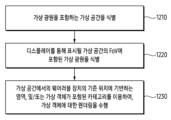
도 12는, 일 실시예에 따른, 웨어러블 장치의 흐름도의 일 예를 도시한다.
도 13은, 실제 광원의 이동에 기반하여, 가상 공간에 대한 렌더링을 수행하는 웨어러블 장치의 동작의 일 예를 도시한다.
도 14는, 외부 공간의 밝기 분포에 기반하여, 가상 공간에 대한 렌더링을 수행하는 웨어러블 장치의 동작의 일 예를 도시한다.
도 15는, 일 실시예에 따른, 웨어러블 장치의 흐름도의 일 예를 도시한다.
도 16a는, 일 실시예에 따른, 웨어러블 장치의 사시도(prospective view)의 일 예를 도시한다.
도 16b는, 일 실시예에 따른, 웨어러블 장치 내에 배치된 하나 이상의 하드웨어들의 일 예를 도시한다.
도 17a 내지 도 17b는, 일 실시예에 따른, 웨어러블 장치의 외관의 일 예를 도시한다.
도 18은, 메타버스 서비스와 관련된 네트워크 환경에 대한 예시도이다.FIGS. 1A and 1B illustrate examples of screens displayed by a wearable device according to one embodiment.
FIG. 2 illustrates an example block diagram of a wearable device, according to one embodiment.
FIGS. 3A and 3B illustrate an example of a flow diagram of a wearable device according to one embodiment.
Figure 4 illustrates an example of the operation of a wearable device that determines the location of an actual light source based on multiple images.
FIG. 5 illustrates an example of a flow diagram of a wearable device according to one embodiment.
FIG. 6 illustrates an example of a flow diagram of a wearable device according to one embodiment.
FIG. 7 illustrates an example of a flow diagram of a wearable device according to one embodiment.
Figure 8 illustrates an example of the operation of a wearable device that identifies an actual light source in external space.
FIG. 9 illustrates an example of a flow diagram of a wearable device according to one embodiment.
Figures 10a and 10b illustrate an example of the operation of a wearable device that performs rendering for a virtual space based on information related to actual light sources in external space.
FIGS. 11A and 11B illustrate an example of the operation of a wearable device that performs rendering for a virtual object included in a virtual space based on information related to an actual light source in an external space.
FIG. 12 illustrates an example of a flow diagram of a wearable device according to one embodiment.
Figure 13 illustrates an example of the operation of a wearable device that performs rendering of a virtual space based on the movement of an actual light source.
Figure 14 illustrates an example of the operation of a wearable device that performs rendering for a virtual space based on the brightness distribution of an external space.
FIG. 15 illustrates an example of a flow diagram of a wearable device according to one embodiment.
FIG. 16A illustrates an example of a perspective view of a wearable device, according to one embodiment.
FIG. 16b illustrates an example of one or more hardware elements positioned within a wearable device, according to one embodiment.
FIGS. 17A and 17B illustrate examples of the appearance of a wearable device according to one embodiment.
Figure 18 is an example diagram of a network environment related to a metaverse service.
이하, 본 문서의 다양한 실시예들이 첨부된 도면을 참조하여 설명된다.Below, various embodiments of this document are described with reference to the attached drawings.
본 문서의 다양한 실시 예들 및 이에 사용된 용어들은 본 문서에 기재된 기술을 특정한 실시 형태에 대해 한정하려는 것이 아니며, 해당 실시 예의 다양한 변경, 균등물, 및/또는 대체물을 포함하는 것으로 이해되어야 한다. 도면의 설명과 관련하여, 유사한 구성요소에 대해서는 유사한 참조 부호가 사용될 수 있다. 단수의 표현은 문맥상 명백하게 다르게 뜻하지 않는 한, 복수의 표현을 포함할 수 있다. 본 문서에서, "A 또는 B", "A 및/또는 B 중 적어도 하나", "A, B 또는 C" 또는 "A, B 및/또는 C 중 적어도 하나"와 같은 표현은 함께 나열된 항목들의 모든 가능한 조합을 포함할 수 있다. "제 1", "제 2", "첫째" 또는 "둘째"와 같은 표현들은 해당 구성요소들을, 순서 또는 중요도에 상관없이 수식할 수 있고, 한 구성요소를 다른 구성요소와 구분하기 위해 사용될 뿐 해당 구성요소들을 한정하지 않는다. 어떤(예: 제 1) 구성요소가 다른(예: 제 2) 구성요소에 "(기능적으로 또는 통신적으로) 연결되어" 있다거나 "접속되어" 있다고 언급된 때에는, 상기 어떤 구성요소가 상기 다른 구성요소에 직접적으로 연결되거나, 다른 구성요소(예: 제 3 구성요소)를 통하여 연결될 수 있다.The various embodiments of this document and the terminology used herein are not intended to limit the technology described in this document to the specific embodiments, but should be understood to encompass various modifications, equivalents, and/or substitutes of the embodiments. In connection with the description of the drawings, similar reference numerals may be used for similar components. The singular expressions may include plural expressions unless the context clearly indicates otherwise. In this document, expressions such as "A or B", "at least one of A and/or B", "A, B, or C" or "at least one of A, B and/or C" can include all possible combinations of the items listed together. Expressions such as "first", "second", "first" or "second" can modify the corresponding components, regardless of order or importance, and are only used to distinguish one component from another and do not limit the corresponding components. When it is said that a certain (e.g., a first) component is "(functionally or communicatively) connected" or "connected" to another (e.g., a second) component, said certain component may be directly connected to said other component, or may be connected through another component (e.g., a third component).
본 문서에서 사용된 용어 "모듈"은 하드웨어, 소프트웨어 또는 펌웨어로 구성된 유닛을 포함하며, 예를 들면, 로직, 논리 블록, 부품, 또는 회로와 같은 용어와 상호 호환적으로 사용될 수 있다. 모듈은, 일체로 구성된 부품 또는 하나 또는 그 이상의 기능을 수행하는 최소 단위 또는 그 일부가 될 수 있다. 예를 들면, 모듈은 ASIC(application-specific integrated circuit)으로 구성될 수 있다.The term "module" as used in this document includes a unit composed of hardware, software or firmware, and may be used interchangeably with terms such as logic, logic block, component, or circuit, for example. A module may be an integrally composed component or a minimum unit or part thereof that performs one or more functions. For example, a module may be composed of an application-specific integrated circuit (ASIC).
도 1a 내지 도 1b는, 일 실시예에 따른, 웨어러블 장치(101)에 의해 표시된 화면의 일 예를 도시한다. 일 실시예에서, 웨어러블 장치(101)는 사용자(110)의 머리에 착용 가능한(wearable on) HMD(head-mounted display)를 포함할 수 있다. 비록 안경의 형태를 가지는 웨어러블 장치(101)의 외형이 도시되지만, 실시예가 이에 제한되는 것은 아니다. 웨어러블 장치(101) 내에 포함된 하나 이상의 하드웨어들의 일 예가, 도 2를 참고하여 예시적으로 설명된다. 사용자(110)의 머리에 착용가능한 웨어러블 장치(101)의 구조의 일 예가, 도 16a 내지 도 16b 및/또는 도 17a 내지 도 17b를 참고하여 설명된다. 웨어러블 장치(101)는 전자 장치로 지칭될(referred) 수 있다. 예를 들어, 전자 장치는, 사용자의 머리에 부착되기 위한 액세서리와 결합되어, HMD를 형성할 수 있다.FIGS. 1A to 1B illustrate an example of a screen displayed by a wearable device (101) according to an embodiment. In an embodiment, the wearable device (101) may include a head-mounted display (HMD) wearable on a head of a user (110). Although the external appearance of the wearable device (101) in the form of glasses is illustrated, the embodiment is not limited thereto. An example of one or more hardwares included in the wearable device (101) is exemplarily described with reference to FIG. 2. An example of a structure of the wearable device (101) wearable on the head of a user (110) is described with reference to FIGS. 16A to 16B and/or FIGS. 17A to 17B. The wearable device (101) may be referred to as an electronic device. For example, an electronic device may be combined with an accessory to attach to a user's head to form an HMD.
일 실시예에 따른, 웨어러블 장치(101)는 VST(video see-through) 및/또는 가상 현실(virtual reality, VR)과 관련된 기능을 실행할 수 있다. 사용자(110)가 웨어러블 장치(101)를 착용한 상태 내에서, 일 실시예에 따른, 웨어러블 장치(101)는 사용자(110)의 눈을 덮는 하우징을 포함할 수 있다. 웨어러블 장치(101)는, 상기 상태 내에서, 상기 눈을 향하는 상기 하우징의 제1 면에 배치된 디스플레이를 포함할 수 있다. 웨어러블 장치(101)는 상기 제1 면과 반대인 제2 면 상에 배치된 카메라를 포함할 수 있다. 상기 카메라를 이용하여, 웨어러블 장치(101)는 주변 광(ambient light)이 포함된 이미지들을 획득할 수 있다. 웨어러블 장치(101)는 상기 제1 면에 배치된 디스플레이 내에, 상기 이미지들을 순차적으로(sequentially) 출력하여, 사용자(110)가 상기 디스플레이를 통해 상기 주변 광을 인식하게 할 수 있다. 상기 제1 면에 배치된 디스플레이의 표시 영역은, 상기 디스플레이에 포함된 하나 이상의 픽셀들에 의해 형성될 수 있다. 웨어러블 장치(101)는 상기 디스플레이를 통해 출력되는 프레임들 내에 가상 객체를 합성하여, 사용자(110)가 주변 광에 의해 인식되는 실제 객체와 함께 상기 가상 객체를 인식하게 할 수 있다.In one embodiment, a wearable device (101) can perform functions related to video see-through (VST) and/or virtual reality (VR). In a state where a user (110) wears the wearable device (101), in one embodiment, the wearable device (101) can include a housing that covers an eye of the user (110). In the state, the wearable device (101) can include a display disposed on a first side of the housing facing the eye. The wearable device (101) can include a camera disposed on a second side opposite to the first side. Using the camera, the wearable device (101) can acquire images including ambient light. The wearable device (101) can sequentially output the images within the display arranged on the first surface, so that the user (110) can recognize the ambient light through the display. The display area of the display arranged on the first surface can be formed by one or more pixels included in the display. The wearable device (101) can synthesize a virtual object within frames output through the display, so that the user (110) can recognize the virtual object together with a real object recognized by the ambient light.
일 실시예에 따른, 웨어러블 장치(101)는 증강 현실(augmented reality, AR) 및/또는 혼합 현실(mixed reality, MR)과 관련된 기능을 실행할 수 있다. 도 1a 내지 도 1b의 도시에서(as shown in), 사용자(110)가 웨어러블 장치(101)를 착용한 상태 내에서, 웨어러블 장치(101)는 사용자(110)의 눈에 인접하게 배치된 적어도 하나의 렌즈를 포함할 수 있다. 웨어러블 장치(101)는 렌즈를 통과하는 주변 광에, 웨어러블 장치(101)의 디스플레이로부터 방사된 광을 결합할 수 있다. 상기 디스플레이의 표시 영역은, 주변 광이 통과되는 렌즈 내에서 형성될 수 있다. 웨어러블 장치(101)가 상기 주변 광 및 상기 디스플레이로부터 방사된 상기 광을 결합하기 때문에, 사용자(110)는 상기 주변 광에 의해 인식되는 실제 객체(real object) 및 상기 디스플레이로부터 방사된 상기 광에 의해 형성된 가상 객체(virtual object)가 혼합된 상(image)을 볼 수 있다.In one embodiment, the wearable device (101) may perform functions related to augmented reality (AR) and/or mixed reality (MR). As shown in FIGS. 1A and 1B , when a user (110) wears the wearable device (101), the wearable device (101) may include at least one lens positioned adjacent to an eye of the user (110). The wearable device (101) may combine ambient light passing through the lens with light emitted from a display of the wearable device (101). A display area of the display may be formed within the lens through which the ambient light passes. Since the wearable device (101) combines the ambient light and the light emitted from the display, the user (110) can see an image that is a mixture of a real object recognized by the ambient light and a virtual object formed by the light emitted from the display.
도 1a를 참고하면, 상이한 모드들에서 웨어러블 장치(101)에 의해 표시되는 화면들(131, 132)이 도시된다. 도 1a를 참고하면, 웨어러블 장치(101)는 VST 모드로 지칭되는 제1 지정된 모드에서, 화면(131)을 표시할 수 있다. VST 모드에서, 웨어러블 장치(101)는 카메라를 통해 획득된 이미지 및/또는 비디오를 포함하는 화면(131)을 표시할 수 있다. VST 모드에서, 웨어러블 장치(101)를 착용한 사용자(110)는, 사용자(110)의 두 눈들에 덮인 하우징과 독립적으로, 화면(131)을 통해 웨어러블 장치(101)를 포함하는 외부 공간을 인식할 수 있다. VST 모드에서, 웨어러블 장치(101)는 화면(131)에서, 외부 공간에 대한 이미지 및/또는 비디오와 함께, 하나 이상의 가상 객체들(예, 가상 객체들(180, 181))을 표시할 수 있다. 예를 들어, 웨어러블 장치(101)는 패널의 형태를 가지는 가상 객체(180)에, 어플리케이션을 표현하는 아이콘의 형태를 가지는 가상 객체(181)를 표시할 수 있다. 일 실시예에서, 가상 객체(180)는 어플리케이션 트레이(또는 앱 트레이)로 지칭될 수 있다. 가상 객체(181)를 선택하는 입력에 응답하여, 웨어러블 장치(101)는 상기 어플리케이션을 실행하고, 상기 어플리케이션으로부터 제공된 화면(132)을 표시할 수 있다.Referring to FIG. 1A, screens (131, 132) displayed by the wearable device (101) in different modes are illustrated. Referring to FIG. 1A, the wearable device (101) can display the screen (131) in a first designated mode referred to as the VST mode. In the VST mode, the wearable device (101) can display the screen (131) including images and/or videos acquired through a camera. In the VST mode, a user (110) wearing the wearable device (101) can recognize an external space including the wearable device (101) through the screen (131), independently of the housing covering both eyes of the user (110). In VST mode, the wearable device (101) can display one or more virtual objects (e.g., virtual objects (180, 181)) on the screen (131) together with images and/or videos of external space. For example, the wearable device (101) can display a virtual object (181) having a form of an icon representing an application on a virtual object (180) having a form of a panel. In one embodiment, the virtual object (180) can be referred to as an application tray (or app tray). In response to an input for selecting the virtual object (181), the wearable device (101) can execute the application and display a screen (132) provided from the application.
도 1a를 참고하면, 웨어러블 장치(101)는 VR 모드로 지칭되는 제2 지정된 모드에서, 화면(132)을 표시할 수 있다. VR 모드에서, 웨어러블 장치(101)는 가상 공간(140)의 적어도 일부분을 표현한 화면(132)을 표시할 수 있다. VR 모드에서, 일 실시예에 따른, 웨어러블 장치(101)는, 가상 공간(140)에 형성된 FoV(field-of-view)에 기반하여, 화면(132)을 표시할 수 있다. 도 1a를 참고하면, 웨어러블 장치(101)는 가상 공간(140)의 FoV에 포함된 가상 객체들(161, 162)을, 화면(132)에 표시할 수 있다. 화면(132)에서, 웨어러블 장치(101)는 양안 시차(binocular disparity)를 이용하여, 원근감을 가지는 가상 객체들(161, 162)을 표시할 수 있다. 화면(132)에 포함된 가상 객체들(161, 162)은, 웨어러블 장치(101)에 의해 실행되는 프로그램(예, 소프트웨어 어플리케이션)으로부터 제공된 그래픽 객체(graphical object), 윈도우(예, 액티비티(activity)) 및/또는 위젯(또는 가젯)을 포함할 수 있다. 도 1a를 참고하면, 웨어러블 장치(101)는 입체 도형의 형태를 가지는 가상 객체(161) 및 윈도우의 형태를 가지는 가상 객체(162)가 예시적으로 도시되지만, 실시예가 이에 제한되는 것은 아니다.Referring to FIG. 1A, the wearable device (101) can display a screen (132) in a second designated mode referred to as a VR mode. In the VR mode, the wearable device (101) can display a screen (132) representing at least a portion of a virtual space (140). In the VR mode, the wearable device (101) according to one embodiment can display the screen (132) based on a field-of-view (FoV) formed in the virtual space (140). Referring to FIG. 1A, the wearable device (101) can display virtual objects (161, 162) included in the FoV of the virtual space (140) on the screen (132). On the screen (132), the wearable device (101) can display virtual objects (161, 162) having a sense of perspective by utilizing binocular disparity. The virtual objects (161, 162) included in the screen (132) may include graphical objects, windows (e.g., activities), and/or widgets (or gadgets) provided from a program (e.g., software application) executed by the wearable device (101). Referring to FIG. 1A, the wearable device (101) is exemplarily illustrated as a virtual object (161) having a three-dimensional shape and a virtual object (162) having a window shape, but the embodiment is not limited thereto.
일 실시예에 따른, 웨어러블 장치(101)는, 외부 공간에서, 적어도 하나의 실제 광원(real light source)(예, 플로어 램프(120))을 인식할 수 있다. 웨어러블 장치(101)가 실제 광원을 인식하는 것은, 외부 공간에서의 상기 실제 광원의 위치, 상기 실제 광원으로부터 방사되는 광의 색상 또는 밝기 중 적어도 하나를 식별하는 동작을 포함할 수 있다. 도 1a를 참고하면, 실제 광원의 일 예인 플로어 램프(120)에 인접한 웨어러블 장치(101)가 예시적으로 도시된다. VST 모드에서 동작하는 웨어러블 장치(101)는, 웨어러블 장치(101)를 착용한 사용자(110)의 전 방(front direction)을 향하는 카메라를 이용하여, 플로어 램프(120)를 식별할 수 있다. 일 실시예에 따른, 웨어러블 장치(101)는, 카메라로부터 획득된 이미지를 이용하여, 적어도 하나의 실제 광원과 관련된 정보를 획득할 수 있다. 일 실시예에 따른, 웨어러블 장치(101)가 실제 광원을 인식하는 동작이, 도 4 내지 도 9를 참고하여 설명된다.In one embodiment, the wearable device (101) can recognize at least one real light source (e.g., a floor lamp (120)) in an external space. The wearable device (101) recognizing the real light source can include an operation of identifying at least one of a location of the real light source in the external space, a color or brightness of light radiating from the real light source. Referring to FIG. 1A, a wearable device (101) adjacent to a floor lamp (120), which is an example of a real light source, is exemplarily illustrated. The wearable device (101) operating in a VST mode can identify the floor lamp (120) using a camera facing a front direction of a user (110) wearing the wearable device (101). In one embodiment, the wearable device (101) can obtain information related to at least one real light source using an image obtained from the camera. According to one embodiment, an operation of a wearable device (101) recognizing an actual light source is described with reference to FIGS. 4 to 9.
일 실시예에 따른, 웨어러블 장치(101)는, 화면(131)과 같이, 디스플레이에 카메라로부터 획득된 이미지의 적어도 일부분을 표시한 동안, 상기 디스플레이에 가상 공간을 표시하기 위한 입력을 식별할 수 있다. 상기 입력은, 가상 공간(140)을 제공하기 위한 어플리케이션을 표현한 아이콘의 형태를 가지는 가상 객체(181)를 선택하는 입력을 포함할 수 있다. 실시예가 이에 제한되는 것은 아니며, 상기 입력은, 웨어러블 장치(101)에 연결된 리모트 컨트롤러, 웨어러블 장치(101)에 포함된 버튼 또는 사용자(110)의 보이스 커맨드(예, 가상 공간(140)의 표시를 촉발하는(triggering) 발언) 중 적어도 하나를 포함할 수 있다.According to one embodiment, the wearable device (101) may identify an input for displaying a virtual space on the display while displaying at least a portion of an image acquired from a camera on a display, such as a screen (131). The input may include an input for selecting a virtual object (181) having a form of an icon representing an application for providing the virtual space (140). The embodiment is not limited thereto, and the input may include at least one of a remote controller connected to the wearable device (101), a button included in the wearable device (101), or a voice command of a user (110) (e.g., an utterance triggering the display of the virtual space (140).
일 실시예에 따른, 웨어러블 장치(101)는 상기 입력에 기반하여, 상기 정보를 이용하여, 가상 공간(140)에서 적어도 하나의 가상 광원(150)의 위치를 결정하거나 또는 식별할 수 있다. 웨어러블 장치(101)가 플로어 램프(120)를 식별한 도 1a의 예시적인 케이스에서, 웨어러블 장치(101)는 플로어 램프(120) 및 웨어러블 장치(101) 사이의 위치 관계에 기반하여, 가상 공간(140)에서, 실제 광원인 플로어 램프(120)에 대응하는 가상 광원(150)의 위치(P1)를 결정할 수 있다. 상기 위치 관계는, 플로어 램프(120) 및 웨어러블 장치(101) 사이의 거리, 또는 웨어러블 장치(101)에 대한 플로어 램프(120)의 방위 각(azimuth angle) 중 적어도 하나를 포함할 수 있다. 일 실시예에서, VST를 위한 제1 지정된 모드로부터, 가상 공간(140)과 관련된 VR을 위한 제2 지정된 모드로 전환하기 위한 상기 입력에 기반하여, 웨어러블 장치(101)는 실제 광원인 플로어 램프(120)에 대응하는 가상 광원(150)의 가상 공간(140)에서의 위치를 결정할 수 있다.According to one embodiment, the wearable device (101) may determine or identify a location of at least one virtual light source (150) in the virtual space (140) based on the input and using the information. In the exemplary case of FIG. 1A in which the wearable device (101) identifies a floor lamp (120), the wearable device (101) may determine a location (P1) of a virtual light source (150) corresponding to the floor lamp (120), which is an actual light source, in the virtual space (140) based on a positional relationship between the floor lamp (120) and the wearable device (101). The positional relationship may include at least one of a distance between the floor lamp (120) and the wearable device (101), or an azimuth angle of the floor lamp (120) with respect to the wearable device (101). In one embodiment, based on the input for switching from the first designated mode for VST to the second designated mode for VR associated with the virtual space (140), the wearable device (101) can determine the location in the virtual space (140) of a virtual light source (150) corresponding to the actual light source, the floor lamp (120).
일 실시예에 따른, 웨어러블 장치(101)는 실제 광원(예, 플로어 램프(120))에 대응하는 가상 광원(150)을 이용하여, 상기 가상 광원(150)을 포함하는 가상 공간(140)에 대한 렌더링을 수행할 수 있다. 실시예가 이에 제한되는 것은 아니며, 웨어러블 장치(101)는, 실제 광원에 기반하여 가상 공간(140) 내 조도를 조절할 수 있다. 예를 들어, 실제 광원에 대응하는 가상 광원(150)과 독립적으로, 전자 장치(101)는 상기 실제 광원과 관련된 조도 및/또는 색상을 가지는 가상 공간(140)에 대한 렌더링을 수행할 수 있다. 이하에서, 렌더링은, 가상 공간(140)을 표현한 이미지 및/또는 비디오(예, 화면(132))을 표시하기 위한 하나 이상의 기능들을 포함할 수 있다. 가상 공간(140)의 위치(P2)가 웨어러블 장치(101)에 대응하는 경우, 웨어러블 장치(101) 및 플로어 램프(120)의 위치 관계는, 가상 공간(140)의 위치(P2) 및 가상 광원(150)의 위치(P1)의 위치 관계에 매칭될 수 있다. 예를 들어, VST 모드의 화면(131)을 통해 보이는 실제 광원(예, 플로어 램프(120))의 위치는, VR 모드의 화면(132)에 렌더링된 가상 광원(150)의 위치에 매핑될 수 있다. 일 실시예에 따른, 웨어러블 장치(101)는 실제 광원(예, 플로어 램프(120))로부터 방사되는 광(이하, 실제 광)의 색상, 밝기(brightness) 및/또는 세기(intensity)(또는 강도)에 기반하여, 가상 광원(150)으로부터 방사되는 광(이하, 가상 광)과 관련된 렌더링을 수행할 수 있다. 일 실시예에 따른, 적어도 하나의 실제 광원에 대응하는 적어도 하나의 가상 광원에 기반하는 렌더링을 수행하는 웨어러블 장치(101)의 동작이, 도 10a 내지 도 10b, 도 11a 내지 도 11b, 도 12 내지 도 15를 참고하여 설명된다. According to one embodiment, the wearable device (101) may perform rendering for a virtual space (140) including a virtual light source (150) corresponding to an actual light source (e.g., a floor lamp (120)). The embodiment is not limited thereto, and the wearable device (101) may adjust the illuminance in the virtual space (140) based on the actual light source. For example, independently of the virtual light source (150) corresponding to the actual light source, the electronic device (101) may perform rendering for a virtual space (140) having illuminance and/or color related to the actual light source. Hereinafter, the rendering may include one or more functions for displaying an image and/or video (e.g., a screen (132)) representing the virtual space (140). When the position (P2) of the virtual space (140) corresponds to the wearable device (101), the positional relationship between the wearable device (101) and the floor lamp (120) may match the positional relationship between the position (P2) of the virtual space (140) and the position (P1) of the virtual light source (150). For example, the position of an actual light source (e.g., a floor lamp (120)) seen through the screen (131) of the VST mode may be mapped to the position of a virtual light source (150) rendered on the screen (132) of the VR mode. According to one embodiment, the wearable device (101) may perform rendering related to light (hereinafter, virtual light) emitted from the virtual light source (150) based on the color, brightness, and/or intensity (or strength) of light (hereinafter, actual light) emitted from the actual light source (e.g., the floor lamp (120)). The operation of a wearable device (101) performing rendering based on at least one virtual light source corresponding to at least one real light source according to one embodiment is described with reference to FIGS. 10A to 10B, FIGS. 11A to 11B, and FIGS. 12 to 15.
일 실시예에 따른, 웨어러블 장치(101)는, 가상 공간(140)에 포함된 가상 객체(예, 가상 객체들(161, 162)) 및 웨어러블 장치(101)에 대응하는 가상 공간(140)의 위치(P2) 사이의 거리에 기반하여, 상기 가상 객체로 적어도 하나의 가상 광원(150)에 대한 시각 효과를 적용할 수 있다. 웨어러블 장치(101)가 상기 가상 객체를 표시하는 것은, 상기 가상 객체 및/또는 상기 가상 객체를 포함하는 가상 공간(140)에 대한 렌더링을 수행하는 동작을 포함할 수 있다. 웨어러블 장치(101)가 가상 광원(150)에 대한 시각 효과를 적용하는 것은, 상기 가상 광원(150)으로부터 방사되는 가상의 광에 기반하여, 가상 객체의 색상 및/또는 밝기를 적어도 부분적으로 변경하는 동작, 또는 상기 가상 객체로부터 연장된 그림자를 표시하는 동작 중 적어도 하나를 포함할 수 있다. 도 1a를 참고하면, 웨어러블 장치(101)는, 가상 객체(161)로부터, 가상 광원(150)에서 가상 객체(161)로 향하는 방향(D1)을 따라 연장된 그림자를 표현하는 시각적 객체(170)를 표시할 수 있다. 일 실시예에 따른, 웨어러블 장치(101)는, 위치(P2)로부터 지정된 임계치를 초과하는 거리만큼 이격된 가상 객체(161)에 대한 렌더링을, 가상 광원(150)에 대한 시각 효과를 이용하여 수행할 수 있다.According to one embodiment, the wearable device (101) may apply a visual effect to at least one virtual light source (150) to a virtual object included in a virtual space (140) based on a distance between the virtual object (e.g., virtual objects (161, 162)) and a location (P2) of the virtual space (140) corresponding to the wearable device (101). The wearable device (101) displaying the virtual object may include an operation of performing rendering on the virtual object and/or the virtual space (140) including the virtual object. The wearable device (101) applying the visual effect to the virtual light source (150) may include at least one of an operation of at least partially changing a color and/or brightness of the virtual object based on virtual light radiated from the virtual light source (150), or an operation of displaying a shadow extended from the virtual object. Referring to FIG. 1A, the wearable device (101) may display a visual object (170) that represents a shadow extending from a virtual object (161) along a direction (D1) from a virtual light source (150) to the virtual object (161). According to one embodiment, the wearable device (101) may perform rendering for a virtual object (161) that is spaced apart from a location (P2) by a distance exceeding a specified threshold, using a visual effect for the virtual light source (150).
일 실시예에 따른, 웨어러블 장치(101)는, 가상 공간(140)에서의 가상 광원(150)의 위치(P1), 가상 객체의 위치, 카테고리 또는 가상 공간(140)에서 웨어러블 장치(101)에 대응하는 위치(P2) 중 적어도 하나를 이용하여, 상기 가상 객체로 상기 가상 광원(150)과 관련된 시각 효과를 적용할 수 있다. 예를 들어, 가상 객체가 웨어러블 장치(101)를 착용한 사용자(110)와 상호작용(interaction)하기 위한 지정된 카테고리에 포함되었는지 여부에 기반하여, 웨어러블 장치(101)는 상기 가상 객체로 상기 시각 효과를 적용할지 여부를 식별 및/또는 결정할 수 있다. 상기 지정된 카테고리는, 윈도우로 지칭되는 2 차원 평면의 형태를 가지는 패널을 포함할 수 있다. 실시예가 이에 제한되는 것은 아니며, 상기 지정된 카테고리는, 텍스트, 이미지, 아이콘, 비디오, 버튼, 체크박스, 라디오버튼, 텍스트 박스, 슬라이더, 타임 피커, 프로그레스 바, 및/또는 테이블과 같이, 정보의 송신 및/또는 상호작용(interaction)을 위해 화면(132) 및/또는 가상 공간(140) 내에 배치될 수 있는(deployable) 가상 객체를 포함할 수 있다. 도 1a를 참고하면, 사용자(110)와 상호작용하기 위한 윈도우인 가상 객체(162)를 표시하는 상태에서, 웨어러블 장치(101)는 가상 객체(162)로, 가상 광원(150)과 관련된 시각 효과를 적용하는 것을 중단할 수 있다. 예를 들어, 웨어러블 장치(101)는 가상 객체(162)에 대한 렌더링을, 가상 광원(150)과 관련된 시각 효과와 독립적으로 수행할 수 있다.According to one embodiment, the wearable device (101) may apply a visual effect related to the virtual light source (150) to the virtual object by using at least one of the position (P1) of the virtual light source (150) in the virtual space (140), the position, category of the virtual object, or the position (P2) corresponding to the wearable device (101) in the virtual space (140). For example, the wearable device (101) may identify and/or determine whether to apply the visual effect to the virtual object based on whether the virtual object is included in a designated category for interaction with a user (110) wearing the wearable device (101). The designated category may include a panel having a form of a two-dimensional plane referred to as a window. The embodiments are not limited thereto, and the above-mentioned categories may include virtual objects deployable within the screen (132) and/or virtual space (140) for transmitting and/or interacting with information, such as text, images, icons, videos, buttons, checkboxes, radio buttons, text boxes, sliders, time pickers, progress bars, and/or tables. Referring to FIG. 1A, while displaying a virtual object (162) as a window for interacting with a user (110), the wearable device (101) may stop applying visual effects associated with the virtual light source (150) to the virtual object (162). For example, the wearable device (101) may perform rendering for the virtual object (162) independently from the visual effects associated with the virtual light source (150).
상술한 바와 같이, 일 실시예에 따른, 웨어러블 장치(101)는, 웨어러블 장치(101)를 포함하는 환경(예, 웨어러블 장치(101)를 포함하는 외부 공간)에 대한 정보에 기반하여, VR을 위한 가상 공간(140)에 대한 렌더링을 수행할 수 있다. 예를 들어, 웨어러블 장치(101)는 외부 공간에 포함된 실제 광원(예, 플로어 램프(120))에 대응하는 가상 광원(150)을, 가상 공간(140)에 배치할 수 있다. 가상 공간(140)에 배치된 가상 광원(150)에 기반하여, 웨어러블 장치(101)는 가상 공간(140)에 포함된 하나 이상의 가상 객체들(161, 162)에 대한 렌더링을 수행할 수 있다. 예를 들어, VST 모드에 기반하여 실제 광원인 플로어 램프(120)를 포함하는 화면(131)을 표시하는 웨어러블 장치(101)는, 상기 VST 모드로부터 VR 모드로 전환한 이후, 상기 플로어 램프(120)에 대응하는 가상 광원(150)에 기반하여 렌더링된 화면(132)을 표시할 수 있다. 플로어 램프(120)에 대응하는 가상 광원(150)을 이용하여, 웨어러블 장치(101)는 VST 모드로부터 VR 모드로 전환하는 동안, 연속적인(continuous) 사용자 경험을 제공할 수 있다.As described above, according to one embodiment, the wearable device (101) may perform rendering for a virtual space (140) for VR based on information about an environment including the wearable device (101) (e.g., an external space including the wearable device (101)). For example, the wearable device (101) may place a virtual light source (150) corresponding to an actual light source included in the external space (e.g., a floor lamp (120)) in the virtual space (140). Based on the virtual light source (150) placed in the virtual space (140), the wearable device (101) may perform rendering for one or more virtual objects (161, 162) included in the virtual space (140). For example, a wearable device (101) displaying a screen (131) including a floor lamp (120), which is a real light source, based on a VST mode can display a screen (132) rendered based on a virtual light source (150) corresponding to the floor lamp (120) after switching from the VST mode to a VR mode. By using the virtual light source (150) corresponding to the floor lamp (120), the wearable device (101) can provide a continuous user experience while switching from the VST mode to the VR mode.
도 1b를 참고하면, VST 모드 및/또는 VR 모드 내 웨어러블 장치(101)에 의해 표시되는 화면들(131, 133, 134)이 예시적으로 도시된다. 도 1b를 참고하면, VST 모드에 기반하는 화면(131)을 표시하는 상태에서, 웨어러블 장치(101)는 모드의 변경을 위한 옵션들을 포함하는 가상 객체(180)를 표시할 수 있다. 가상 객체(180) 내에, 웨어러블 장치(101)는, 상기 VST 모드와 상이한 모드(예, VR 모드)에서 구동되는 어플리케이션을 표현하는 아이콘(예, 가상 객체들(181, 182))을 표시할 수 있다.Referring to FIG. 1b, screens (131, 133, 134) displayed by the wearable device (101) in the VST mode and/or the VR mode are exemplarily illustrated. Referring to FIG. 1b, in a state of displaying the screen (131) based on the VST mode, the wearable device (101) may display a virtual object (180) including options for changing the mode. Within the virtual object (180), the wearable device (101) may display an icon (e.g., virtual objects (181, 182)) representing an application running in a mode (e.g., VR mode) different from the VST mode.
도 1b를 참고하면, VR 모드에 기반하는 화면(133)의 표시를 나타내는 입력에 응답하여, 웨어러블 장치(101)는 상기 어플리케이션으로부터 제공된 화면(133)을 표시할 수 있다. 예를 들어, 가상 객체(181)의 선택을 나타내는 입력을 식별하는 것에 기반하여, 웨어러블 장치(101)는 화면(133)을 표시할 수 있다. 웨어러블 장치(101)에 의해 표시되는 화면(133)은, VR 모드에 기반하는 지정된 화면(예, 홈 화면)을 포함할 수 있다. 상기 지정된 화면은, 웨어러블 장치(101)에 의해 지원되는 하나 이상의 기능들 중 적어도 하나를 실행하기 위한 객체(예, 아이콘)를 포함할 수 있다. 화면(133)을 표시하는 상태에서, 웨어러블 장치(101)는 플로어 램프(120)와 같은 실제 광원에 대응하는 가상 광원(150)을, 가상 공간에 배치할 수 있다. 상기 가상 공간에 배치된 가상 광원(150)에 기반하여, 웨어러블 장치(101)는 상기 가상 광원(150)과 관련된 시각 효과가 적용된 화면(133)을 표시할 수 있다.Referring to FIG. 1B, in response to an input indicating display of a screen (133) based on a VR mode, the wearable device (101) may display a screen (133) provided from the application. For example, based on identifying an input indicating selection of a virtual object (181), the wearable device (101) may display the screen (133). The screen (133) displayed by the wearable device (101) may include a designated screen (e.g., a home screen) based on the VR mode. The designated screen may include an object (e.g., an icon) for executing at least one of one or more functions supported by the wearable device (101). In a state of displaying the screen (133), the wearable device (101) may place a virtual light source (150) corresponding to an actual light source, such as a floor lamp (120), in the virtual space. Based on the virtual light source (150) placed in the above virtual space, the wearable device (101) can display a screen (133) to which a visual effect related to the virtual light source (150) is applied.
도 1b를 참고하면, VR 모드를 위한 어플리케이션의 실행을 나타내는 입력에 응답하여, 웨어러블 장치(101)는 상기 어플리케이션으로부터 제공된 화면(133)을 표시할 수 있다. 예를 들어, 가상 객체(182)의 선택을 나타내는 입력을 식별하는 것에 기반하여, 웨어러블 장치(101)는 화면(133)을 표시할 수 있다. 가상 객체(182)는 몰입형 가상 현실을 제공하기 위한 어플리케이션의 아이콘을 포함할 수 있다. 웨어러블 장치(101)는 가상 객체(182)에 대응하는 어플리케이션을 실행하여, 몰입형 가상 현실에 기반하는 화면(134)을 표시할 수 있다. 비디오를 재생하기 위한 가상 객체(185)를 포함하는 화면(134)을 표시하는 상태에서, 웨어러블 장치(101)는 실제 광원에 대응하는 가상 광원에 기반하는 렌더링을 적어도 일시적으로 중단할 수 있다. 예를 들어, 몰입형 가상 현실에 기반하는 사용자 경험을 개선하기 위하여, 웨어러블 장치(101)는 상기 가상 광원에 기반하는 렌더링을 제한할 수 있다.Referring to FIG. 1b, in response to an input indicating execution of an application for VR mode, the wearable device (101) may display a screen (133) provided from the application. For example, based on identifying an input indicating selection of a virtual object (182), the wearable device (101) may display the screen (133). The virtual object (182) may include an icon of an application for providing immersive virtual reality. The wearable device (101) may execute an application corresponding to the virtual object (182) to display a screen (134) based on immersive virtual reality. While displaying the screen (134) including a virtual object (185) for playing a video, the wearable device (101) may at least temporarily suspend rendering based on a virtual light source corresponding to an actual light source. For example, to improve user experience based on immersive virtual reality, the wearable device (101) may limit rendering based on the virtual light source.
이하에서는, 도 2를 참고하여, 도 1a 내지 도 1b의 웨어러블 장치(101)에 포함된 하나 이상의 하드웨어들 및/또는 소프트웨어의 일 예가 설명된다.Hereinafter, with reference to FIG. 2, an example of one or more hardware and/or software included in the wearable device (101) of FIGS. 1a and 1b is described.
도 2는, 일 실시예에 따른, 웨어러블 장치(101)의 블록도의 일 예를 도시한다. 도 2의 웨어러블 장치(101)는, 도 1a 내지 도 1b의 웨어러블 장치(101)를 포함할 수 있다.FIG. 2 illustrates an example of a block diagram of a wearable device (101) according to one embodiment. The wearable device (101) of FIG. 2 may include the wearable device (101) of FIGS. 1A to 1B.
일 실시예에 따른, 웨어러블 장치(101)는, 프로세서(210), 메모리(215), 디스플레이(220), 카메라(225), 센서(230), 또는 통신 회로(240) 중 적어도 하나를 포함할 수 있다. 프로세서(210), 메모리(215), 디스플레이(220), 카메라(225), 센서(230), 및 통신 회로(240)는 통신 버스(202)와 같은 전자 부품(electronical component)에 의해 서로 전기적으로 및/또는 작동적으로 연결될 수 있다(electronically and/or operably coupled with each other). 이하에서, 하드웨어들이 작동적으로 결합된 것은, 하드웨어들 중 제1 하드웨어에 의해 제2 하드웨어가 제어되도록, 하드웨어들 사이의 직접적인 연결, 또는 간접적인 연결이 유선으로, 또는 무선으로 수립된 것을 의미할 수 있다. 상이한 블록들에 기반하여 도시되었으나, 실시예가 이에 제한되는 것은 아니며, 도 2의 하드웨어들 중 일부분(예, 프로세서(210), 메모리(215), 및 통신 회로(240)의 적어도 일부분)이 SoC(system on a chip)와 같이 단일 집적 회로(single integrated circuit)에 포함될 수 있다. 웨어러블 장치(101)에 포함된 하드웨어의 타입 및/또는 개수는 도 2에 도시된 바에 제한되지 않는다. 예를 들어, 웨어러블 장치(101)는 도 2에 도시된 하드웨어 컴포넌트 중 일부만 포함할 수 있다.According to one embodiment, the wearable device (101) may include at least one of a processor (210), a memory (215), a display (220), a camera (225), a sensor (230), or a communication circuit (240). The processor (210), the memory (215), the display (220), the camera (225), the sensor (230), and the communication circuit (240) may be electronically and/or operably coupled with each other by an electronic component such as a communication bus (202). Hereinafter, operably coupled hardware may mean that a direct connection or an indirect connection is established between the hardwares, either wired or wireless, such that a second hardware is controlled by a first hardware among the hardwares. Although illustrated based on different blocks, the embodiment is not limited thereto, and some of the hardware of FIG. 2 (e.g., at least a portion of the processor (210), the memory (215), and the communication circuit (240)) may be included in a single integrated circuit, such as a system on a chip (SoC). The type and/or number of hardware included in the wearable device (101) is not limited to that illustrated in FIG. 2. For example, the wearable device (101) may include only some of the hardware components illustrated in FIG. 2.
일 실시예에서, 웨어러블 장치(101)의 프로세서(210)는, 하나 이상의 인스트럭션들에 기반하여 데이터를 처리하기 위한 하드웨어를 포함할 수 있다. 데이터를 처리하기 위한 상기 하드웨어는, 예를 들어, ALU(arithmetic and logic unit), FPU(floating point unit), FPGA(field programmable gate array), CPU(central processing unit), 및/또는 AP(application processor)를 포함할 수 있다. 프로세서(210)는, 싱글-코어 프로세서의 구조를 가지거나, 또는 듀얼 코어(dual core), 쿼드 코어(quad core), 헥사 코어(hexa core)와 같은 멀티-코어 프로세서의 구조를 가질 수 있다.In one embodiment, the processor (210) of the wearable device (101) may include hardware for processing data based on one or more instructions. The hardware for processing data may include, for example, an arithmetic and logic unit (ALU), a floating point unit (FPU), a field programmable gate array (FPGA), a central processing unit (CPU), and/or an application processor (AP). The processor (210) may have a structure of a single-core processor, or a structure of a multi-core processor such as a dual core, a quad core, or a hexa core.
일 실시예에서, 웨어러블 장치(101)의 메모리(215)는, 웨어러블 장치(101)의 프로세서(210)에 입력 및/또는 출력되는 데이터 및/또는 인스트럭션을 저장하기 위한 하드웨어 컴포넌트를 포함할 수 있다. 메모리(215)는, 예를 들어, RAM(random-access memory)과 같은 휘발성 메모리(volatile memory) 및/또는 ROM(read-only memory)과 같은 비휘발성 메모리(non-volatile memory)를 포함할 수 있다. 휘발성 메모리는, 예를 들어, DRAM(dynamic RAM), SRAM(static RAM), Cache RAM, PSRAM (pseudo SRAM) 중 적어도 하나를 포함할 수 있다. 비휘발성 메모리는, 예를 들어, PROM(programmable ROM), EPROM (erasable PROM), EEPROM (electrically erasable PROM), 플래시 메모리, 하드디스크, 컴팩트 디스크, SSD(solid state drive), eMMC(embedded multi media card) 중 적어도 하나를 포함할 수 있다.In one embodiment, the memory (215) of the wearable device (101) may include hardware components for storing data and/or instructions input and/or output to the processor (210) of the wearable device (101). The memory (215) may include, for example, volatile memory, such as random-access memory (RAM), and/or non-volatile memory, such as read-only memory (ROM). The volatile memory may include, for example, at least one of dynamic RAM (DRAM), static RAM (SRAM), Cache RAM, and pseudo SRAM (PSRAM). The non-volatile memory may include, for example, at least one of programmable ROM (PROM), erasable PROM (EPROM), electrically erasable PROM (EEPROM), flash memory, hard disk, compact disc, solid state drive (SSD), and embedded multi media card (eMMC).
일 실시예에서, 웨어러블 장치(101)의 디스플레이(220)는 사용자(예, 도 1a 내지 도 1b의 사용자(110))에게 시각화된 정보(예를 들어, 도 1a 내지 도 1b, 도 10a 내지 도 10b 내지 도 11a 내지 도 11b, 및/또는 도 13 내지 도 14의 화면)를 출력할 수 있다. 예를 들어, 디스플레이(220)는, GPU(graphic processing unit)와 같은 회로를 포함하는 프로세서(210)에 의해 제어되어, 사용자에게 시각화된 정보(visualized information)를 출력할 수 있다. 디스플레이(220)는 FPD(flat panel display) 및/또는 전자 종이(electronic paper)를 포함할 수 있다. 상기 FPD는 LCD(liquid crystal display), PDP(plasma display panel) 및/또는 하나 이상의 LED(light emitting diode)를 포함할 수 있다. 상기 LED는 OLED(organic LED)를 포함할 수 있다. 도 2의 디스플레이(220)는, 도 16a 내지 도 16b, 및/또는 도 17a 내지 도 17b를 참고하여 후술될, 적어도 하나의 디스플레이(1650, 1750)를 포함할 수 있다.In one embodiment, a display (220) of a wearable device (101) can output visualized information (e.g., the screens of FIGS. 1A-1B , 10A-10B-11A-11B , and/or 13-14 ) to a user (e.g., the user (110) of FIGS. 1A-1B ). For example, the display (220) can be controlled by a processor (210) including a circuit such as a graphic processing unit (GPU) to output visualized information to the user. The display (220) can include a flat panel display (FPD) and/or electronic paper. The FPD can include a liquid crystal display (LCD), a plasma display panel (PDP), and/or one or more light emitting diodes (LEDs). The LEDs can include organic LEDs (OLEDs). The display (220) of FIG. 2 may include at least one display (1650, 1750), which will be described later with reference to FIGS. 16a to 16b and/or FIGS. 17a to 17b.
일 실시예에서, 웨어러블 장치(101)의 카메라(225)는 빛의 색상 및/또는 밝기를 나타내는 전기 신호를 생성하는 하나 이상의 광 센서들(예, CCD(charged coupled device) 센서, CMOS(complementary metal oxide semiconductor) 센서)을 포함할 수 있다. 카메라(225)에 포함된 복수의 광 센서들은 2차원 격자(2 dimensional array)의 형태로 배치될 수 있다. 카메라(225)는 복수의 광 센서들 각각의 전기 신호들을 실질적으로 동시에 획득하여, 2차원 격자의 광 센서들에 도달한 빛에 대응하는 2차원 프레임 데이터를 생성할 수 있다. 예를 들어, 카메라(225)를 이용하여 캡쳐한 사진 데이터는 카메라(225)로부터 획득한 하나의(a) 2차원 프레임 데이터를 의미할 수 있다. 예를 들어, 카메라(225)를 이용하여 캡쳐한 비디오 데이터는, 프레임 율(frame rate)을 따라 카메라(225)로부터 획득된, 복수의 2차원 프레임 데이터의 시퀀스(sequence)를 의미할 수 있다. 카메라(225)는, 카메라(225)가 광을 수신하는 방향을 향하여 배치되고, 상기 방향을 향하여 광을 출력하기 위한 플래시 라이트를 더 포함할 수 있다.In one embodiment, the camera (225) of the wearable device (101) may include one or more optical sensors (e.g., a charged coupled device (CCD) sensor, a complementary metal oxide semiconductor (CMOS) sensor) that generate electrical signals representing the color and/or brightness of light. The plurality of optical sensors included in the camera (225) may be arranged in the form of a two-dimensional array. The camera (225) may acquire electrical signals of each of the plurality of optical sensors substantially simultaneously to generate two-dimensional frame data corresponding to light reaching the optical sensors of the two-dimensional array. For example, photographic data captured using the camera (225) may mean one (a) two-dimensional frame data acquired from the camera (225). For example, video data captured using the camera (225) may mean a sequence of a plurality of two-dimensional frame data acquired from the camera (225) according to a frame rate. The camera (225) may further include a flash light positioned toward the direction in which the camera (225) receives light and outputs light toward the direction.
일 실시예에 따른, 웨어러블 장치(101)의 센서(230)는, 웨어러블 장치(101)와 관련된 비-전기적 정보(non-electronic information)로부터, 웨어러블 장치(101)의 프로세서(210) 및/또는 메모리(215)에 의해 처리될 수 있는 전기적 정보를 생성할 수 있다. 상기 정보는, 센서 데이터로 지칭될 수 있다. 상기 센서(230)는, 웨어러블 장치(101)의 지리적 위치(geographic location)를 탐지하기 위한 GPS(global positioning system) 센서, 이미지 센서, 조도 센서 및/또는 ToF(time-of-flight) 센서, 웨어러블 장치(101)의 물리적인 모션을 탐지하기 위한 IMU(inertial measurement unit)를 포함할 수 있다. 일 실시예에서, IMU는, 가속도 센서, 자이로 센서 또는 중력 센서 중 적어도 하나를 포함할 수 있다. 상기 IMU를 이용하여, 웨어러블 장치(101)의 프로세서(210)는, 6 자유도(degree of freedom, DoF)에 기반하는 웨어러블 장치(101)의 모션을 식별할 수 있다. 6 자유도에 기반하는 웨어러블 장치(101)의 모션은, 서로 수직인 3 개의 축들(예, x 축, y 축, 및 z 축)에서의 웨어러블 장치(101)의 이동 및 회전(예, 롤(roll), 피치(pitch), 및 요(yaw))을 포함할 수 있다.According to one embodiment, a sensor (230) of a wearable device (101) may generate electrical information that may be processed by a processor (210) and/or a memory (215) of the wearable device (101) from non-electronic information related to the wearable device (101). The information may be referred to as sensor data. The sensor (230) may include a global positioning system (GPS) sensor, an image sensor, an ambient light sensor, and/or a time-of-flight (ToF) sensor for detecting a geographic location of the wearable device (101), and an inertial measurement unit (IMU) for detecting a physical motion of the wearable device (101). In one embodiment, the IMU may include at least one of an acceleration sensor, a gyro sensor, and a gravity sensor. Using the above IMU, the processor (210) of the wearable device (101) can identify the motion of the wearable device (101) based on six degrees of freedom (DoF). The motion of the wearable device (101) based on six degrees of freedom can include translation and rotation (e.g., roll, pitch, and yaw) of the wearable device (101) along three axes (e.g., x-axis, y-axis, and z-axis) that are perpendicular to each other.
일 실시예에서, 웨어러블 장치(101)의 통신 회로(240)는, 웨어러블 장치(101), 및 외부 전자 장치(예, 웨어러블 장치(101)에 연결된 리모트 컨트롤러) 사이의 전기 신호의 송신 및/또는 수신을 지원하기 위한 하드웨어 부품을 포함할 수 있다. 통신 회로(240)는, 예를 들어, 모뎀(MODEM), 안테나, O/E(optic/electronic) 변환기 중 적어도 하나를 포함할 수 있다. 통신 회로(240)는, 이더넷(ethernet), LAN(local area network), WAN(wide area network), WiFi(wireless fidelity), Bluetooth, BLE(bluetooth low energy), ZigBee, LTE(long term evolution), 5G NR(new radio) 및/또는 6G와 같은 다양한 타입의 프로토콜에 기반하여 전기 신호의 송신 및/또는 수신을 지원할 수 있다.In one embodiment, the communication circuit (240) of the wearable device (101) may include hardware components for supporting transmission and/or reception of electrical signals between the wearable device (101) and an external electronic device (e.g., a remote controller connected to the wearable device (101)). The communication circuit (240) may include, for example, at least one of a modem (MODEM), an antenna, and an optic/electronic (O/E) converter. The communication circuit (240) may support transmission and/or reception of electrical signals based on various types of protocols, such as Ethernet, a local area network (LAN), a wide area network (WAN), wireless fidelity (WiFi), Bluetooth, Bluetooth low energy (BLE), ZigBee, long term evolution (LTE), 5G NR (new radio), and/or 6G.
비록 도시되지 않았지만, 일 실시예에 따른, 웨어러블 장치(101)는 정보를 시각화한 형태 외에 다른 형태로 출력하기 위한 출력 수단을 포함할 수 있다. 예를 들어, 웨어러블 장치(101)는 음성 신호(acoustic signal)를 출력하기 위한 스피커를 포함할 수 있다. 예를 들어, 웨어러블 장치(101)는 진동에 기반하는 햅틱 피드백을 제공하기 위한 모터를 포함할 수 있다.Although not shown, according to one embodiment, the wearable device (101) may include output means for outputting information in a form other than a visualized form. For example, the wearable device (101) may include a speaker for outputting an acoustic signal. For example, the wearable device (101) may include a motor for providing haptic feedback based on vibration.
도 2를 참고하면, 일 실시예에 따른, 웨어러블 장치(101)의 메모리(215) 내에서, 웨어러블 장치(101)의 프로세서(210)가 데이터에 수행할 연산, 및/또는 동작을 나타내는 하나 이상의 인스트럭션들(또는 명령어들)이 저장될 수 있다. 하나 이상의 인스트럭션들의 집합은, 프로그램, 펌웨어, 운영 체제, 프로세스, 루틴, 서브-루틴 및/또는 어플리케이션으로 참조될 수 있다. 이하에서, 어플리케이션이 전자 장치(예, 웨어러블 장치(101)) 내에 설치되었다는 것은, 어플리케이션의 형태로 제공된 하나 이상의 인스트럭션들이 메모리(215) 내에 저장된 것으로써, 상기 하나 이상의 어플리케이션들이 전자 장치의 프로세서에 의해 실행 가능한(executable) 포맷(예, 웨어러블 장치(101)의 운영 체제에 의해 지정된 확장자를 가지는 파일)으로 저장된 것을 의미할 수 있다. 일 실시예에 따른, 웨어러블 장치(101)는 메모리(215)에 저장된 하나 이상의 인스트럭션들을 실행하여, 도 3a 내지 도 3b, 도 5 내지 도 7, 도 9, 도 12 및/또는 도 15의 동작을 수행할 수 있다.Referring to FIG. 2, according to one embodiment, one or more instructions (or commands) representing operations and/or actions to be performed on data by a processor (210) of the wearable device (101) may be stored in the memory (215) of the wearable device (101). A set of one or more instructions may be referred to as a program, firmware, an operating system, a process, a routine, a sub-routine, and/or an application. Hereinafter, when an application is installed in an electronic device (e.g., the wearable device (101)), it may mean that one or more instructions provided in the form of an application are stored in the memory (215), and that the one or more applications are stored in a format executable by the processor of the electronic device (e.g., a file having an extension specified by the operating system of the wearable device (101)). According to one embodiment, the wearable device (101) may execute one or more instructions stored in the memory (215) to perform the operations of FIGS. 3A to 3B, FIGS. 5 to 7, FIG. 9, FIG. 12, and/or FIG. 15.
도 2를 참고하면, 웨어러블 장치(101)에 설치된 프로그램들은, 타겟에 기반하여, 어플리케이션 계층(260), 프레임워크 계층(270) 및/또는 하드웨어 추상화 계층(hardware abstraction layer, HAL)(250)을 포함하는 상이한 계층들 중 어느 한 계층으로 분류될 수 있다. 예를 들어, 하드웨어 추상화 계층(250) 내에, 웨어러블 장치(101)의 하드웨어(예, 디스플레이(220), 카메라(225), 센서(230) 및/또는 통신 회로(240))를 타겟으로 설계된 프로그램들(예, 드라이버)이 분류될 수 있다. 예를 들어, 프레임워크 계층(270) 내에, 하드웨어 추상화 계층(250) 및/또는 어플리케이션 계층(260) 중 적어도 하나를 타겟으로 설계된 프로그램들(예, 시선 추적기(271), 제스쳐 추적기(272), 모션 추적기(273), 실제 광원 식별기(274), 가상 광원 생성기(275) 및/또는 가상 공간 매니저(276))이 분류될 수 있다. 프레임워크 계층(270)으로 분류되는 프로그램들은, 다른 프로그램에 기반하여 실행가능한 API(application programming interface)를 제공할 수 있다.Referring to FIG. 2, programs installed in the wearable device (101) may be classified into one of different layers, including an application layer (260), a framework layer (270), and/or a hardware abstraction layer (HAL) (250), based on a target. For example, programs (e.g., drivers) designed to target the hardware (e.g., display (220), camera (225), sensor (230), and/or communication circuit (240)) of the wearable device (101) may be classified within the hardware abstraction layer (250). For example, within the framework layer (270), programs designed to target at least one of the hardware abstraction layer (250) and/or the application layer (260) (e.g., an eye tracker (271), a gesture tracker (272), a motion tracker (273), a real light source identifier (274), a virtual light source generator (275), and/or a virtual space manager (276)) may be classified. The programs classified into the framework layer (270) may provide an executable API (application programming interface) based on other programs.
도 2를 참고하면, 어플리케이션 계층(260) 내에, 웨어러블 장치(101)를 제어하는 사용자(예, 도 1a 내지 도 1b의 사용자(110))를 타겟으로 설계된 프로그램이 분류될 수 있다. 예를 들어, 어플리케이션 계층(260)으로 분류되는 프로그램은, 비디오의 재생 및/또는 스트리밍을 위한 어플리케이션(261), 화상 회의를 위한 어플리케이션(262), 메모리(215)의 미디어 콘텐트(예, 이미지 및/또는 비디오)를 열람하기 위한 어플리케이션(263), 또는 호 연결을 위한 어플리케이션(264) 중 적어도 하나를 포함할 수 있다. 실시예가 이에 제한되는 것은 아니다. 예를 들어, 어플리케이션 계층(260)으로 분류되는 프로그램은, API를 호출하여, 프레임워크 계층(270)으로 분류되는 프로그램들에 의해 지원되는 기능의 실행을 야기할 수 있다.Referring to FIG. 2, a program designed to target a user (e.g., a user (110) of FIGS. 1A to 1B) controlling a wearable device (101) may be classified within the application layer (260). For example, a program classified within the application layer (260) may include at least one of an application (261) for playing and/or streaming a video, an application (262) for a video conference, an application (263) for viewing media content (e.g., images and/or videos) of a memory (215), or an application (264) for a call connection. The embodiment is not limited thereto. For example, a program classified within the application layer (260) may call an API to cause execution of a function supported by programs classified within the framework layer (270).
도 2를 참고하면, 일 실시예에 따른, 웨어러블 장치(101)는 프레임워크 계층(270) 내 시선 추적기(271)의 실행에 기반하여, 웨어러블 장치(101)를 착용한 사용자의 시선과 관련된 정보를 처리할 수 있다. 예를 들어, 웨어러블 장치(101)는, 사용자에 의해 착용된 상태에서, 상기 사용자의 눈을 향하여 배치된 제1 카메라로부터, 상기 사용자의 눈을 포함하는 이미지를 획득할 수 있다. 상기 이미지 내에 포함된 동공의 위치 및/또는 방향에 기반하여, 웨어러블 장치(101)는 사용자의 시선의 방향을 식별할 수 있다. Referring to FIG. 2, according to one embodiment, the wearable device (101) may process information related to the gaze of a user wearing the wearable device (101) based on the execution of the gaze tracker (271) in the framework layer (270). For example, the wearable device (101), when worn by the user, may obtain an image including the user's eye from a first camera positioned toward the user's eye. Based on the position and/or direction of the pupil included in the image, the wearable device (101) may identify the direction of the user's gaze.
도 2를 참고하면, 일 실시예에 따른, 웨어러블 장치(101)는 프레임워크 계층(270) 내 제스쳐 추적기(272)의 실행에 기반하여, 손을 포함하는 지정된 신체 부위의 모션을 식별할 수 있다. 예를 들어, 웨어러블 장치(101)는 제2 카메라로부터 상기 신체 부위를 포함하는 이미지 및/또는 비디오를 획득할 수 있다. 상기 이미지 및/또는 비디오에 의해 나타나는, 상기 지정된 신체 부위의 모션 및/또는 자세에 기반하여, 웨어러블 장치(101)는 상기 지정된 신체 부위에 의해 수행된 제스쳐를 식별할 수 있다. Referring to FIG. 2, according to one embodiment, the wearable device (101) can identify a motion of a designated body part including a hand based on the execution of a gesture tracker (272) within the framework layer (270). For example, the wearable device (101) can obtain an image and/or video including the body part from a second camera. Based on the motion and/or posture of the designated body part represented by the image and/or video, the wearable device (101) can identify a gesture performed by the designated body part.
도 2를 참고하면, 일 실시예에 따른, 웨어러블 장치(101)는 프레임워크 계층(270) 내 모션 추적기(273)의 실행에 기반하여, 웨어러블 장치(101)의 모션을 식별할 수 있다. 웨어러블 장치(101)가 사용자에 의해 착용된 상태 내에서, 웨어러블 장치(101)의 모션은, 상기 사용자의 머리의 모션과 관련될 수 있다. 예를 들어, 웨어러블 장치(101)는, 상기 머리의 방향과 실질적으로 일치하는, 웨어러블 장치(101)의 방향을 식별할 수 있다. 웨어러블 장치(101)는 IMU를 포함하는 센서(230)의 센서 데이터에 기반하여, 웨어러블 장치(101)의 모션을 식별할 수 있다. Referring to FIG. 2, according to one embodiment, the wearable device (101) can identify the motion of the wearable device (101) based on the execution of the motion tracker (273) within the framework layer (270). Within a state where the wearable device (101) is worn by a user, the motion of the wearable device (101) can be related to the motion of the user's head. For example, the wearable device (101) can identify the direction of the wearable device (101) that substantially coincides with the direction of the head. The wearable device (101) can identify the motion of the wearable device (101) based on sensor data of a sensor (230) including an IMU.
도 2를 참고하면, 일 실시예에 따른, 웨어러블 장치(101)는 프레임워크 계층(270) 내 실제 광원 식별기(274)의 실행에 기반하여, 웨어러블 장치(101)가 포함되거나, 또는 웨어러블 장치(101)에 인접한 외부 공간에 대한 정보를 획득할 수 있다. 예를 들어, 웨어러블 장치(101)는 카메라(225)를 이용하여, 웨어러블 장치(101)를 포함하는 외부 공간에 배치된 실제 광원(예, 도 1a 내지 도 1b의 플로어 램프(120))과 관련된 정보를 획득할 수 있다. 실시예가 이에 제한되는 것은 아니며, 웨어러블 장치(101)는 센서(230)(예, 조도 센서)를 이용하여, 상기 정보를 획득할 수 있다. 실제 광원 식별기(274)의 실행에 기반하여 획득된 상기 정보는, 적어도 하나의 실제 광원에 대한 위치(예, 외부 공간에서 실제 광원의 3 차원 위치), 밝기 및/또는 색상을 포함할 수 있다. 일 실시예에 따른, 웨어러블 장치(101)의 프로세서(210)는, 메모리(215)에, 실제 광원 식별기(274)의 실행에 기반하여 획득된 상기 정보를 저장할 수 있다. 일 실시예에 따른, 웨어러블 장치(101)는, 실제 광원 식별기(274)의 실행에 기반하여, 외부 공간에 포함된 적어도 하나의 실제 광원을 모니터링할 수 있다.Referring to FIG. 2, according to one embodiment, the wearable device (101) may obtain information about an external space in which the wearable device (101) is included or adjacent to the wearable device (101) based on the execution of the actual light source identifier (274) in the framework layer (270). For example, the wearable device (101) may obtain information related to an actual light source (e.g., a floor lamp (120) of FIGS. 1A and 1B) disposed in an external space including the wearable device (101) by using the camera (225). The embodiment is not limited thereto, and the wearable device (101) may obtain the information by using a sensor (230) (e.g., a light sensor). The information obtained based on the execution of the real light source identifier (274) may include a location (e.g., a three-dimensional location of the real light source in external space), brightness, and/or color of at least one real light source. In one embodiment, the processor (210) of the wearable device (101) may store the information obtained based on the execution of the real light source identifier (274) in the memory (215). In one embodiment, the wearable device (101) may monitor at least one real light source included in external space based on the execution of the real light source identifier (274).
도 2를 참고하면, 일 실시예에 따른, 웨어러블 장치(101)는 프레임워크 계층(270) 내 가상 광원 생성기(275)의 실행에 기반하여, 실제 광원 식별기(274)에 의해 획득된 상기 정보에 기반하여, 가상 공간(예, 도 1a의 가상 공간(140))에 적어도 하나의 가상 광원을 배치할 수 있다. 실시예가 이에 제한되는 것은 아니며, 웨어러블 장치(101)는 가상 공간에서의 밝기 분포에 기반하여, 적어도 하나의 가상 광원을 간접적으로 배치할 수 있다. 가상 광원 생성기(275)가 실행된 상태에서, 웨어러블 장치(101)는 실제 광원 식별기(274)에 의해 획득된 상기 정보에 기반하여 가상 공간에, 상기 정보에 의해 나타나는 실제 광원의 색상, 밝기를 가지는, 가상 광원을 배치할 수 있다. Referring to FIG. 2, according to one embodiment, the wearable device (101) may place at least one virtual light source in a virtual space (e.g., the virtual space (140) of FIG. 1A) based on the information acquired by the real light source identifier (274) based on the execution of the virtual light source generator (275) in the framework layer (270). The embodiment is not limited thereto, and the wearable device (101) may indirectly place at least one virtual light source based on the brightness distribution in the virtual space. In a state where the virtual light source generator (275) is executed, the wearable device (101) may place a virtual light source having a color and brightness of an real light source represented by the information in the virtual space based on the information acquired by the real light source identifier (274).
도 2를 참고하면, 일 실시예에 따른, 웨어러블 장치(101)는 프레임워크 계층(270) 내 가상 공간 매니저(276)의 실행에 기반하여, 가상 공간에 대한 렌더링을 수행할 수 있다. 가상 공간 매니저(276)가 실행된 상태에서, 웨어러블 장치(101)는 가상 광원 생성기(275)에 기반하여 배치된 적어도 하나의 가상 광원을 포함하는 가상 공간에 대한 렌더링을 수행할 수 있다. 일 실시예에서, 웨어러블 장치(101)는 가상 공간 매니저(276)에 기반하여, 외부 공간에 매핑된 가상 공간을 식별할 수 있다. 웨어러블 장치(101)는 센서(230)의 데이터에 기반하여 식별된, 외부 공간에서의 웨어러블 장치(101)의 위치 및/또는 방향에 기반하여, FoV(예, 도 1a 내지 도 1b의 FoV)를 형성하기 위한 가상 공간의 기준 위치(예, 도 1a의 위치(P2))를 결정할 수 있다. 상기 기준 위치는, 상기 가상 공간에서의 웨어러블 장치(101)의 위치에 대응할 수 있다. 일 실시예에서, 웨어러블 장치(101)는, 외부 공간의 인식, 및 상기 외부 공간 내에서의 웨어러블 장치(101)의 위치를 인식하기 위한, SLAM(simultaneous localization and mapping)을 수행할 수 있다.Referring to FIG. 2, according to one embodiment, the wearable device (101) may perform rendering for a virtual space based on the execution of the virtual space manager (276) in the framework layer (270). With the virtual space manager (276) executed, the wearable device (101) may perform rendering for a virtual space including at least one virtual light source arranged based on the virtual light source generator (275). In one embodiment, the wearable device (101) may identify a virtual space mapped to an external space based on the virtual space manager (276). The wearable device (101) may determine a reference position (e.g., position (P2) of FIG. 1A) of the virtual space for forming a FoV (e.g., FoV of FIGS. 1A to 1B) based on the position and/or direction of the wearable device (101) in the external space identified based on the data of the sensor (230). The above reference position may correspond to the position of the wearable device (101) in the virtual space. In one embodiment, the wearable device (101) may perform SLAM (simultaneous localization and mapping) to recognize external space and the position of the wearable device (101) within the external space.
상술한 바와 같이, 일 실시예에 따른, 웨어러블 장치(101)는 실제 광원 식별기(274)를 이용하여, 웨어러블 장치(101)가 포함된 외부 공간에서의 적어도 하나의 실제 광원을 식별할 수 있다. 웨어러블 장치(101)는 VST 모드(또는 AR 모드)에서, 실제 광원 식별기(274)에 기반하여 상기 적어도 하나의 실제 광원에 대한 정보를 획득할 수 있다. 일 실시예에 따른, 웨어러블 장치(101)는, VST 모드로부터 VR 모드로 전환하는 것에 기반하여, 상기 정보에 기반하여 가상 공간에 적어도 하나의 가상 광원을 배치하고, 상기 적어도 하나의 가상 광원을 이용하여 상기 가상 공간에 대한 렌더링을 수행할 수 있다. 일 실시예에 따른, 웨어러블 장치(101)는 상기 적어도 하나의 가상 광원에 기반하는 시각 효과를, 상기 가상 공간에 포함된 복수의 가상 객체들에게 선택적으로 적용할 수 있다. 예를 들어, 웨어러블 장치(101)는, 가상 광원이 가상 공간의 FoV에 포함되는 경우, 상기 FoV에 포함된 가상 객체의 위치에 따라, 상기 시각 효과를 적용하는 것을 제한할 수 있다. 예를 들어, 상기 FoV에 포함된 상기 가상 광원에 의해 상기 가상 객체에 대한 역광(counter light) 및/또는 상기 가상 광원에 의해 상기 가상 객체에서 야기된 그림자를 방지하기 위하여, 웨어러블 장치(101)는 상기 시각 효과를 적용하는 것을 제한할 수 있다. 웨어러블 장치(101)가 가상 객체에 대한 시각 효과를 적용할지 여부를, 가상 광원과 연동된 가상 공간 내 영역, 및/또는 상기 시각 효과가 적용될 가상 객체의 카테고리에 결정할 수 있다.As described above, according to one embodiment, the wearable device (101) can identify at least one real light source in an external space including the wearable device (101) by using the real light source identifier (274). The wearable device (101) can obtain information about the at least one real light source based on the real light source identifier (274) in a VST mode (or an AR mode). According to one embodiment, the wearable device (101) can place at least one virtual light source in a virtual space based on the information, and perform rendering on the virtual space by using the at least one virtual light source, based on switching from the VST mode to the VR mode. According to one embodiment, the wearable device (101) can selectively apply a visual effect based on the at least one virtual light source to a plurality of virtual objects included in the virtual space. For example, the wearable device (101) may restrict application of the visual effect depending on the position of the virtual object included in the FoV when the virtual light source is included in the FoV of the virtual space. For example, in order to prevent backlighting of the virtual object by the virtual light source included in the FoV and/or a shadow caused by the virtual light source on the virtual object, the wearable device (101) may restrict application of the visual effect. The wearable device (101) may determine whether to apply the visual effect to the virtual object, depending on the area in the virtual space linked with the virtual light source and/or the category of the virtual object to which the visual effect is to be applied.
이하에서는, 도 3a 내지 도 3b를 참고하여, 도 1a 내지 도 1b, 및/또는 도 2의 웨어러블 장치(101)의 동작이 설명된다.Hereinafter, the operation of the wearable device (101) of FIGS. 1A to 1B and/or FIG. 2 is described with reference to FIGS. 3A to 3B.
도 3a 내지 도 3b는, 일 실시예에 따른, 웨어러블 장치의 흐름도의 일 예를 도시한다. 도 1a 내지 도 1b, 및/또는 도 2의 웨어러블 장치(101)는 도 3a 내지 도 3b의 웨어러블 장치를 포함할 수 있다. 도 3a 내지 도 3b의 동작들 중 적어도 하나는, 도 2의 웨어러블 장치(101) 및/또는 프로세서(210)에 의해 수행될 수 있다.FIGS. 3A and 3B illustrate an example of a flow diagram of a wearable device according to one embodiment. The wearable device (101) of FIGS. 1A and 1B and/or 2 may include the wearable device of FIGS. 3A and 3B. At least one of the operations of FIGS. 3A and 3B may be performed by the wearable device (101) of FIG. 2 and/or the processor (210).
이하 실시예에서 각 동작들은 순차적으로 수행될 수도 있으나, 반드시 순차적으로 수행되는 것은 아니다. 예를 들어, 각 동작들의 순서가 변경될 수도 있으며, 적어도 두 동작들이 병렬적으로 수행될 수도 있다.In the following embodiments, the operations may be performed sequentially, but are not necessarily performed sequentially. For example, the order of the operations may be changed, and at least two operations may be performed in parallel.
도 3a를 참고하면, 동작(310)에서, 일 실시예에 따른, 웨어러블 장치는, 외부 공간에 포함된 적어도 하나의 실제 광원을 식별할 수 있다. 일 실시예에 따른, 웨어러블 장치는, 도 2의 실제 광원 식별기(274)의 실행에 기반하여, 적어도 하나의 실제 광원을 식별할 수 있다. 웨어러블 장치는 카메라(예, 도 2의 카메라(225))로부터 획득된 복수의 이미지들을 조합하여, 상기 복수의 이미지들에 공통적으로 캡쳐된(commonly captured) 실제 광원을 식별할 수 있다. 웨어러블 장치가 복수의 이미지들 전부에 포함된 실제 광원의 위치를 결정하거나 또는 식별하는 동작이, 도 4를 참고하여 설명된다.Referring to FIG. 3A, in operation (310), the wearable device according to one embodiment may identify at least one real light source included in an external space. According to one embodiment, the wearable device may identify at least one real light source based on the execution of the real light source identifier (274) of FIG. 2. The wearable device may combine multiple images acquired from a camera (e.g., the camera (225) of FIG. 2) to identify a real light source commonly captured in the multiple images. An operation of the wearable device determining or identifying a location of a real light source included in all of the multiple images is described with reference to FIG. 4.
도 3a를 참고하면, 동작(320)에서, 일 실시예에 따른, 웨어러블 장치는, 적어도 하나의 실제 광원에 대한 정보를 저장할 수 있다. 웨어러블 장치는 메모리(예, 도 2의 메모리(215))에, 상기 정보를 저장할 수 있다. 웨어러블 장치에 의해 저장되는 상기 정보는, 웨어러블 장치에 의해 식별된 실제 광원의 외부 공간 내 위치, 상기 실제 광원의 색상, 조도, 밝기 또는 세기(intensity) 중 적어도 하나를 포함할 수 있다. 동작(320)에 기반하여 웨어러블 장치에 저장된 상기 정보는, 가상 공간에서 실제 광원에 대응하는 가상 광원을 재구성하기 위한 하나 이상의 파라미터들을 포함할 수 있다. 동작(320)의 상기 정보는, 적어도 하나의 실제 광원에 대한 특성 정보(characteristic information)로 지칭될 수 있다.Referring to FIG. 3A, in operation (320), according to one embodiment, a wearable device may store information about at least one real light source. The wearable device may store the information in a memory (e.g., memory (215) of FIG. 2). The information stored by the wearable device may include at least one of a location of the real light source identified by the wearable device in an external space, a color, illuminance, brightness, or intensity of the real light source. The information stored in the wearable device based on operation (320) may include one or more parameters for reconstructing a virtual light source corresponding to the real light source in a virtual space. The information of operation (320) may be referred to as characteristic information about at least one real light source.
도 3a를 참고하면, 동작(330)에서, 일 실시예에 따른, 웨어러블 장치는, VR(virtual reality)을 위한 가상 공간을 표시하기 위한 이벤트를 식별할 수 있다. 상기 이벤트는, 어플리케이션을 실행하기 위한 입력(예, 도 1a 내지 도 1b의 가상 객체(181)의 선택을 나타내는 입력)에 의해 발생될 수 있다. 상기 이벤트는, 도 2의 시선 추적기(271), 제스쳐 추적기(272) 및/또는 모션 추적기(273)에 의해 식별된 지정된 제스쳐(예, 웨어러블 장치를 지정된 횟수만큼 두드리는(tapping) 제스쳐)에 의해 발생될 수 있다. 상기 이벤트는, 지정된 발언(예, "VR 모드로 전환하자")을 포함하는 보이스 커맨드의 식별에 기반하여 발생될 수 있다. 실시예가 이에 제한되는 것은 아니다.Referring to FIG. 3A, in operation (330), according to one embodiment, a wearable device may identify an event for displaying a virtual space for VR (virtual reality). The event may be generated by an input for executing an application (e.g., an input indicating selection of a virtual object (181) of FIGS. 1A and 1B). The event may be generated by a designated gesture (e.g., a gesture of tapping the wearable device a designated number of times) identified by the eye tracker (271), the gesture tracker (272), and/or the motion tracker (273) of FIG. 2. The event may be generated based on the identification of a voice command including a designated utterance (e.g., "Switch to VR mode"). The embodiment is not limited thereto.
도 3a를 참고하면, 동작(340)에서, 일 실시예에 따른, 웨어러블 장치는, 저장된 정보에 기반하여, 가상 공간에 적어도 하나의 가상 광원을 생성하고, 생성된 적어도 하나의 가상 광원에 기반하여, 가상 공간의 적어도 일부분에 대한 렌더링을 수행할 수 있다. 웨어러블 장치는 동작(330)의 이벤트를 식별하는 것에 응답하여, 동작(340)을 수행할 수 있다. 일 실시예에 따른, 웨어러블 장치는 동작(320)에 기반하여 저장된 정보에 기반하여, 적어도 하나의 실제 광원에 대응하는 적어도 하나의 가상 광원을 포함하는 가상 공간을 생성할 수 있다. 웨어러블 장치는 도 2의 가상 공간 매니저(276)의 실행에 기반하여, 동작(340)을 수행할 수 있다. 일 실시예에 따른, 웨어러블 장치는 상기 정보에 의해 나타나는 상기 적어도 하나의 실제 광원의 외부 공간에서의 위치에 기반하여, 가상 공간에서 적어도 하나의 가상 광원의 위치를 결정할 수 있다. 예를 들어, 상기 적어도 하나의 가상 광원은 월드 락(world-lock)에 기반하여, 가상 공간에서 고정된 좌표를 가질 수 있다.Referring to FIG. 3A, in operation (340), according to one embodiment, the wearable device may generate at least one virtual light source in a virtual space based on the stored information, and perform rendering on at least a portion of the virtual space based on the generated at least one virtual light source. In response to identifying the event of operation (330), the wearable device may perform operation (340). According to one embodiment, the wearable device may generate a virtual space including at least one virtual light source corresponding to at least one real light source based on the stored information based on operation (320). The wearable device may perform operation (340) based on execution of the virtual space manager (276) of FIG. 2. According to one embodiment, the wearable device may determine a location of at least one virtual light source in the virtual space based on a location of the at least one real light source in an external space indicated by the information. For example, the at least one virtual light source may have fixed coordinates in the virtual space based on world-lock.
일 실시예에 따른, 웨어러블 장치는 상기 정보에 기반하여 가상 공간에 배치된 적어도 하나의 가상 광원에 기반하여, 상기 가상 공간에 대한 렌더링을 수행할 수 있다. 상기 렌더링에 기반하여, 웨어러블 장치는 상기 적어도 하나의 가상 광원으로부터 방사된(emitted from) 가상의 광을 표현하는(representing) 화면(예, 도 1a의 화면(132))을 획득할 수 있다. 웨어러블 장치는 디스플레이(예, 도 2의 디스플레이(220))에 획득된 화면을 표시하여, 웨어러블 장치를 착용한 사용자에게 실제 광원에 대응하는 가상 광원을 포함하는 VR을 제공할 수 있다. 웨어러블 장치가 상기 가상의 광을 표현하는 화면을 획득하는 것은, 레이 트레이싱(ray tracing)과 같이, 상기 가상의 광의 경로를 추적하기 위한 알고리즘에 기반하여 수행될 수 있다.According to one embodiment, the wearable device can perform rendering of the virtual space based on at least one virtual light source arranged in the virtual space based on the information. Based on the rendering, the wearable device can obtain a screen (e.g., screen (132) of FIG. 1A) representing virtual light emitted from the at least one virtual light source. The wearable device can display the obtained screen on a display (e.g., display (220) of FIG. 2) to provide a VR including a virtual light source corresponding to an actual light source to a user wearing the wearable device. The wearable device can obtain the screen representing the virtual light based on an algorithm for tracing a path of the virtual light, such as ray tracing.
일 실시예에 따른, 웨어러블 장치는, 동작(320)에 기반하여 저장된, 적어도 하나의 실제 광원에 대한 정보를 이용하여 가상 공간의 조도를 조절할 수 있다. 예를 들어, 웨어러블 장치는 가상 광원(예, 동작(340)의 적어도 하나의 가상 광원)을 생성하지 않고, 적어도 하나의 실제 광원과 관련된 조도, 색상 및/또는 밝기를 가지는 가상 공간을 획득할 수 있다. 실제 광원에 대응하는 가상 광원을 포함하지 않는 가상 공간을 생성하는 일 실시예에서, 웨어러블 장치는 동작(320)의 정보를 이용하여, 실제 광원과 관련된 외부 공간의 모습(appearance)에 기반하는 상기 가상 공간을 획득할 수 있다. 상기 가상 공간에 기반하여, 웨어러블 장치는 상기 가상 광원과 독립적으로, 사용자에게 상기 외부 공간의 모습에 기반하는 가상 현실을 제공할 수 있다. 예를 들어, 웨어러블 장치는 동작(320)의 정보를 이용하여 가상 공간에 대한 렌더링을 수행하여, 실제 광원의 위치, 색상, 조도 및/또는 밝기에 기반하는 가상 공간을 획득할 수 있다. 일 실시예에서, 웨어러블 장치가 상기 가상 공간을 획득하는 것은, 동작(340)의 적어도 하나의 가상 광원과 독립적으로 수행될 수 있다.In one embodiment, the wearable device can adjust the illumination of the virtual space using information about at least one real light source stored based on the operation (320). For example, the wearable device can obtain a virtual space having an illumination, color, and/or brightness associated with at least one real light source without generating a virtual light source (e.g., at least one virtual light source of operation (340)). In one embodiment that generates a virtual space that does not include a virtual light source corresponding to a real light source, the wearable device can obtain the virtual space based on the appearance of an external space associated with the real light source using the information of operation (320). Based on the virtual space, the wearable device can provide a virtual reality based on the appearance of the external space to the user independently of the virtual light source. For example, the wearable device can perform rendering on the virtual space using the information of operation (320) to obtain the virtual space based on the location, color, illumination, and/or brightness of the real light source. In one embodiment, the wearable device's acquisition of the virtual space may be performed independently of at least one virtual light source of operation (340).
상술한 바와 같이, 일 실시예에 따른, 웨어러블 장치는, 실제 광원에 대응하는 가상 광원을 이용하여, 가상 공간에서 실제 광원을 시뮬레이션할 수 있다. 가상 공간의 가상 광원을 이용하여, 웨어러블 장치는, 상기 가상 공간에 포함된 적어도 하나의 가상 객체를 상기 실제 광원의 실제 광에 기반하여 표시할 수 있다. 일 실시예에 따른, 웨어러블 장치는, 실제 광원이 시뮬레이션된 가상 공간을 이용하여, 웨어러블 장치를 착용한 사용자가 실제 광원을 포함하는 외부 공간과 유사한 색조를 가지는 가상 공간을 인식하게 만들 수 있다.As described above, according to one embodiment, the wearable device can simulate a real light source in a virtual space by using a virtual light source corresponding to a real light source. Using the virtual light source of the virtual space, the wearable device can display at least one virtual object included in the virtual space based on the real light of the real light source. According to one embodiment, the wearable device can make a user wearing the wearable device recognize a virtual space having a similar color tone to an external space including a real light source by using a virtual space in which a real light source is simulated.
도 3b를 참고하면, 동작(350)에서, 일 실시예에 따른, 웨어러블 장치는, VST에 기반하여, 제1 화면을 표시할 수 있다. 웨어러블 장치는 도 1a 내지 도 1b의 화면(131)과 같이, 웨어러블 장치의 카메라(예, 도 2의 카메라(225))를 통해 획득된 이미지 및/또는 비디오를 포함하는 상기 제1 화면을 표시할 수 있다.Referring to FIG. 3B, in operation (350), the wearable device according to one embodiment may display a first screen based on the VST. The wearable device may display the first screen including an image and/or video acquired through a camera of the wearable device (e.g., the camera (225) of FIG. 2), such as the screen (131) of FIGS. 1A and 1B.
도 3b를 참고하면, 동작(352)에서, 일 실시예에 따른, 웨어러블 장치는, 웨어러블 장치가 포함된 외부 공간에 포함된 하나 이상의 실제 광원들을 이용하여, 가상 공간에서 하나 이상의 가상 광원들의 위치들을 결정할 수 있다. 웨어러블 장치는 도 3a의 동작들(310, 320, 330)에 기반하여, 도 3b의 동작(352)을 수행할 수 있다. 예를 들어, 웨어러블 장치는 하나 이상의 실제 광원들의 위치, 색상, 조도 및/또는 밝기에 기반하여, 가상 공간에 하나 이상의 가상 광원들을 생성 및/또는 배치할 수 있다.Referring to FIG. 3B , in operation (352), the wearable device according to one embodiment may determine positions of one or more virtual light sources in the virtual space using one or more real light sources included in an external space including the wearable device. The wearable device may perform operation (352) of FIG. 3B based on operations (310, 320, 330) of FIG. 3A . For example, the wearable device may generate and/or place one or more virtual light sources in the virtual space based on the position, color, illuminance, and/or brightness of the one or more real light sources.
도 3b를 참고하면, 동작(354)에서, 일 실시예에 따른, 웨어러블 장치는, VST로부터 VR로 전환하기 위한 입력을 수신할 수 있다. 상기 입력은, VR 모드에 기반하여 설계된 어플리케이션의 선택을 나타내는 입력을 포함할 수 있다. 상기 입력은, VR 모드에 기반하는 지정된 화면(예, 홈 화면)의 표시를 나타내는 입력을 포함할 수 있다. 상기 입력은, 웨어러블 장치에 의해 추적되는 사용자의 머리 및/또는 손의 모션에 의해 식별될 수 있다. 상기 입력은, 웨어러블 장치에 연결된 외부 전자 장치(예, 리모트 컨트롤러)에 의해 식별될 수 있다. 상기 입력은, 웨어러블 장치의 버튼 및/또는 센서(예, 터치 센서)에 의해 식별될 수 있다.Referring to FIG. 3B, at operation (354), according to one embodiment, the wearable device may receive an input for switching from VST to VR. The input may include an input indicating selection of an application designed based on the VR mode. The input may include an input indicating display of a designated screen (e.g., a home screen) based on the VR mode. The input may be identified by motions of the user's head and/or hands tracked by the wearable device. The input may be identified by an external electronic device (e.g., a remote controller) connected to the wearable device. The input may be identified by buttons and/or sensors (e.g., touch sensors) of the wearable device.
도 3b를 참고하면, 동작(356)에서, 일 실시예에 따른, 웨어러블 장치는, 입력이, VR과 관련된 지정된 화면(예, VR 모드에 기반하는 홈 화면)으로 전환됨을 나타내는지 여부를 식별할 수 있다. 동작(356)의 지정된 화면은, 도 1b의 화면(133)을 포함할 수 있다. 동작(354)에 기반하여, 상기 지정된 화면으로 전환됨을 나타내는 입력을 수신한 상태에서(356-예), 웨어러블 장치는 동작(358)을 수행할 수 있다. 상기 지정된 화면과 독립적인 다른 입력을 수신한 상태에서(356-아니오), 웨어러블 장치는 동작(360)을 수행할 수 있다.Referring to FIG. 3b, in operation (356), the wearable device according to one embodiment may identify whether the input indicates a transition to a designated screen related to VR (e.g., a home screen based on a VR mode). The designated screen of operation (356) may include screen (133) of FIG. 1b. Based on operation (354), if an input indicating a transition to the designated screen is received (356-Yes), the wearable device may perform operation (358). If another input independent of the designated screen is received (356-No), the wearable device may perform operation (360).
도 3b를 참고하면, 동작(358)에서, 일 실시예에 따른, 웨어러블 장치는, 하나 이상의 가상 광원들을 포함하는 가상 공간에 기반하여, 지정된 화면을 표시할 수 있다. 웨어러블 장치는 가상 공간에 포함된 하나 이상의 가상 객체들로, 상기 하나 이상의 가상 광원들에 기반하는 시각 효과를 적용할 수 있다. 동작(358)의 지정된 화면은, 도 1b의 화면(133)을 포함할 수 있다.Referring to FIG. 3b, in operation (358), the wearable device according to one embodiment may display a designated screen based on a virtual space including one or more virtual light sources. The wearable device may apply a visual effect based on the one or more virtual light sources to one or more virtual objects included in the virtual space. The designated screen of operation (358) may include the screen (133) of FIG. 1b.
도 3b를 참고하면, 동작(360)에서, 일 실시예에 따른, 웨어러블 장치는, 입력에 의해 식별되거나 또는 선택되고, VR 과 관련된 어플리케이션의 실행에 기반하여, VR과 관련된 제2 화면을 표시할 수 있다. 상기 제2 화면은, 몰입형 VR을 제공하기 위한 어플리케이션으로부터 제공될 수 있다. 동작(360)의 제2 화면은, 도 1b의 화면(134)을 포함할 수 있다. 동작(360)의 제2 화면을 표시하는 상태에서, 웨어러블 장치는 하나 이상의 가상 광원들에 기반하는 시각 효과를 적용하는 것을 제한하거나 또는 중단할 수 있다. 실시예가 이에 제한되는 것은 아니며, 웨어러블 장치는, 동작(360)의 어플리케이션을 실행하는 상태에서, 상기 시각 효과를 적용할 것을 나타내는 입력을 수신할 수 있다. 상기 입력에 응답하여, 웨어러블 장치는, 상기 하나 이상의 가상 광원들에 기반하는 시각 효과가 적용된 적어도 하나의 가상 객체를 포함하는 가상 공간 및/또는 제2 화면을 표시할 수 있다. 상기 시각 효과를 적용하기 위한 상기 입력을 수신하기 위하여, 웨어러블 장치는 동작(354)의 입력에 응답하여, 팝업 윈도우의 형태를 가지는 시각적 객체를 표시할 수 있다. 예를 들어, 상기 시각적 객체에서, 웨어러블 장치는 "실제 광원에 기반하여 가상 공간을 렌더링할까요?"와 같은 지정된 텍스트를 표시할 수 있다. Referring to FIG. 3B, in operation (360), according to an embodiment, the wearable device may display a second screen related to VR based on an application identified or selected by an input and execution of an application related to VR. The second screen may be provided from an application for providing immersive VR. The second screen of operation (360) may include the screen (134) of FIG. 1B. In a state of displaying the second screen of operation (360), the wearable device may limit or stop applying a visual effect based on one or more virtual light sources. The embodiment is not limited thereto, and the wearable device may receive an input indicating to apply the visual effect while executing the application of operation (360). In response to the input, the wearable device may display a virtual space and/or a second screen including at least one virtual object to which a visual effect based on the one or more virtual light sources is applied. In order to receive the input for applying the above visual effect, the wearable device may display a visual object in the form of a pop-up window in response to the input of the action (354). For example, in the visual object, the wearable device may display a specified text such as "Render the virtual space based on the actual light source?"
이하에서는, 도 4를 참고하여, 복수의 이미지들에 기반하여 실제 광원에 대한 정보를 획득하는 웨어러블 장치의 예시적인 동작이 설명된다.Below, with reference to FIG. 4, an exemplary operation of a wearable device for obtaining information about an actual light source based on multiple images is described.
도 4는, 복수의 이미지들에 기반하여 실제 광원의 위치를 결정하는 웨어러블 장치(101)의 동작의 일 예를 도시한다. 도 1a 내지 도 1b, 도 2 내지 도 3a 내지 도 3b의 웨어러블 장치는, 도 4의 웨어러블 장치(101)를 포함할 수 있다. 도 4를 참고하여 설명되는 웨어러블 장치(101)의 동작은, 도 2의 웨어러블 장치(101) 및/또는 프로세서(210)에 의해 수행될 수 있다. 도 4를 참고하여 설명되는 웨어러블 장치(101)의 동작은 도 3a 내지 도 3b의 동작들 중 적어도 하나(예, 도 3a의 동작(310))와 관련될 수 있다.FIG. 4 illustrates an example of an operation of a wearable device (101) that determines the location of an actual light source based on a plurality of images. The wearable devices of FIGS. 1A to 1B and FIGS. 2 to 3A to 3B may include the wearable device (101) of FIG. 4. The operation of the wearable device (101) described with reference to FIG. 4 may be performed by the wearable device (101) of FIG. 2 and/or the processor (210). The operation of the wearable device (101) described with reference to FIG. 4 may be related to at least one of the operations of FIGS. 3A to 3B (e.g., operation (310) of FIG. 3A).
도 4를 참고하면, 일 실시예에 따른, 웨어러블 장치(101)는 외부 공간에서의 웨어러블 장치(101)의 위치를, 서로 수직인 3 개의 축들(예, 도 4의 x 축, y 축 및 z 축)에 의해 형성된 공간 좌표계에 기반하여 결정하거나 또는 식별할 수 있다. 웨어러블 장치(101)의 위치는 상기 공간 좌표계의 원점(O)에 대응할 수 있다. 공간 좌표계의 특정 지점은, 웨어러블 장치(101)를 포함하는 외부 공간의 특정 지점에 매칭될 수 있다. 일 실시예에 따른, 웨어러블 장치(101)는 도 2의 센서(230)(예, IMU)를 이용하여 상기 공간 좌표계에서의 웨어러블 장치(101)의 위치 및/또는 모션을 식별할 수 있다.Referring to FIG. 4, according to one embodiment, the wearable device (101) can determine or identify a position of the wearable device (101) in external space based on a spatial coordinate system formed by three axes (e.g., the x-axis, the y-axis, and the z-axis of FIG. 4) that are perpendicular to each other. The position of the wearable device (101) can correspond to an origin (O) of the spatial coordinate system. A specific point of the spatial coordinate system can be matched to a specific point of the external space that includes the wearable device (101). According to one embodiment, the wearable device (101) can identify a position and/or motion of the wearable device (101) in the spatial coordinate system using a sensor (230) of FIG. 2 (e.g., an IMU).
도 4를 참고하면, 일 실시예에 따른, 웨어러블 장치(101)는 카메라(예, 도 2의 카메라(225))를 이용하여, 웨어러블 장치(101)의 상이한 방향들(D1, D2)에 대한 이미지들(410, 420)을 획득할 수 있다. 상기 카메라는, 디스플레이(예, 도 2의 디스플레이(220))가 배치된 웨어러블 장치(101)의 일 면과 반대인 다른 면에 배치될 수 있다. 상기 카메라는, 상기 디스플레이의 일 방향과 반대인 다른 방향을 가질 수 있다. 웨어러블 장치(101)는 IMU와 같은 센서(예, 도 2의 센서(230))의 데이터를 이용하여, 웨어러블 장치(101)의 방향을 식별할 수 있다. 센서로부터 획득된, 웨어러블 장치(101)의 방향을 나타내는 데이터에 기반하여, 웨어러블 장치(101)는 방향(D1)에 대응하는 이미지(410) 및 방향(D2)에 대응하는 이미지(420)를 획득할 수 있다. 예를 들어, 방향(D1)에 대응하는 이미지(410)를 획득한 상태에서, 센서에 기반하여 방향(D2)을 향하여 회전되는 웨어러블 장치(101)의 모션을 식별하는 것에 응답하여, 웨어러블 장치(101)는 카메라로부터 방향(D2)에 대응하는 이미지(420)를 획득할 수 있다. Referring to FIG. 4, according to one embodiment, the wearable device (101) can obtain images (410, 420) for different directions (D1, D2) of the wearable device (101) using a camera (e.g., camera (225) of FIG. 2). The camera can be placed on one side of the wearable device (101) opposite to the other side on which the display (e.g., display (220) of FIG. 2) is placed. The camera can have the other direction opposite to the one direction of the display. The wearable device (101) can identify the direction of the wearable device (101) using data of a sensor such as an IMU (e.g., sensor (230) of FIG. 2). Based on data indicating the direction of the wearable device (101) acquired from the sensor, the wearable device (101) can acquire an image (410) corresponding to the direction (D1) and an image (420) corresponding to the direction (D2). For example, in a state where the image (410) corresponding to the direction (D1) has been acquired, in response to identifying a motion of the wearable device (101) rotating toward the direction (D2) based on the sensor, the wearable device (101) can acquire an image (420) corresponding to the direction (D2) from the camera.
도 4를 참고하면, 일 실시예에 따른, 웨어러블 장치(101)는 공간 좌표계를 이용하여 상이한 방향들(D1, D2)에 대한 이미지들(410, 420)에 대한 객체 인식을 수행할 수 있다. 예를 들어, 플로어 램프(예. 도 1a 내지 도 1b의 플로어 램프(120))가 이미지들(410, 420) 전부에 캡쳐된 것으로 가정한다. 웨어러블 장치(101)는 공간 좌표계에서, 방향들(D1, D2)에 기반하여 이미지들(410, 420)을 배치할 수 있다. 웨어러블 장치(101)는 이미지(410)의 지점(A) 및 이미지(420)의 지점(B)에 캡쳐된 플로어 램프(120)를 식별하는 것에 기반하여, 지점들(A, B)로부터 연장된 라인들의 교점(PL)을 식별할 수 있다. 예를 들어, 웨어러블 장치(101)는 이미지들(410, 420)의 색상 분포를 비교하여, 플로어 램프(120)와 같은 외부 객체(예, 실제 광원)가 이미지들(410, 420)에 공통으로 캡쳐되었는지 여부를 식별할 수 있다. 웨어러블 장치(101)는 공간 좌표계에서 교점(PL)의 좌표를, 이미지들(410, 420)에 공통으로 캡쳐된 플로어 램프(120)의 좌표로 결정할 수 있다. 공간 좌표계가 외부 공간에 매칭되므로, 웨어러블 장치(101)는 교점(PL)의 좌표에 기반하여, 플로어 램프(120)의 외부 공간 내 위치를 결정할 수 있다.Referring to FIG. 4, according to one embodiment, the wearable device (101) can perform object recognition for images (410, 420) for different directions (D1, D2) using a spatial coordinate system. For example, it is assumed that a floor lamp (e.g., floor lamp (120) of FIGS. 1A to 1B) is captured in all of the images (410, 420). The wearable device (101) can position the images (410, 420) based on the directions (D1, D2) in the spatial coordinate system. The wearable device (101) can identify the intersection (PL) of lines extended from points (A, B) based on identifying the floor lamp (120) captured at point (A) of the image (410) and point (B) of the image (420). For example, the wearable device (101) can identify whether an external object (e.g., an actual light source), such as a floor lamp (120), is commonly captured in the images (410, 420) by comparing the color distributions of the images (410, 420). The wearable device (101) can determine the coordinates of the intersection point (PL) in the spatial coordinate system as the coordinates of the floor lamp (120) commonly captured in the images (410, 420). Since the spatial coordinate system matches the external space, the wearable device (101) can determine the location of the floor lamp (120) in the external space based on the coordinates of the intersection point (PL).
상술한 바와 같이, 일 실시예에 따른, 웨어러블 장치(101)는 복수의 이미지들(410, 420) 각각에서 식별된 실제 광원의 위치들에 기반하여, 외부 공간에서 상기 실제 광원의 위치를 식별할 수 있다. 웨어러블 장치(101)는 실제 광원의 위치에 기반하여, 상기 외부 공간에 매핑된 가상 공간에서 가상 광원의 위치를 결정할 수 있다. 예를 들어, 도 4의 공간 좌표계에서 교점(PL)에 대응하는 가상 공간의 지점에, 웨어러블 장치(101)는 플로어 램프(120)와 관련된 가상 광원을 배치할 수 있다. 예를 들어, 교점(PL)의 3 차원 xyz 좌표는, 웨어러블 장치(101)에 의해 가상 공간에 배치된 가상 광원의 3차원 xyz 좌표를 획득하는데 이용될 수 있다. 웨어러블 장치(101)는 가상 공간에 배치된 상기 가상 광원을 이용하여, 상기 가상 공간에서 광의 반사와 관련된 사용자 경험(또는 무드)을 제공할 수 있다.As described above, according to one embodiment, the wearable device (101) can identify the location of the actual light source in the external space based on the locations of the actual light sources identified in each of the plurality of images (410, 420). The wearable device (101) can determine the location of the virtual light source in the virtual space mapped to the external space based on the location of the actual light source. For example, the wearable device (101) can place the virtual light source related to the floor lamp (120) at a point in the virtual space corresponding to the intersection point (PL) in the space coordinate system of FIG. 4. For example, the three-dimensional xyz coordinates of the intersection point (PL) can be used to obtain the three-dimensional xyz coordinates of the virtual light source placed in the virtual space by the wearable device (101). The wearable device (101) can provide a user experience (or mood) related to the reflection of light in the virtual space by using the virtual light source placed in the virtual space.
이하에서는, 도 5 내지 도 7을 참고하여, 일 실시예에 따른, 웨어러블 장치(101)가 실제 광원을 식별하는 동작을 설명한다.Below, with reference to FIGS. 5 to 7, an operation of a wearable device (101) identifying an actual light source according to one embodiment is described.
도 5는, 일 실시예에 따른, 웨어러블 장치의 흐름도의 일 예를 도시한다. 도 1a 내지 도 1b, 도 2 내지 도 3a 내지 도 3b의 웨어러블 장치는 도 5의 웨어러블 장치를 포함할 수 있다. 도 5를 참고하여 설명되는 웨어러블 장치의 동작은, 도 2의 웨어러블 장치(101) 및/또는 프로세서(210)에 의해 수행될 수 있다. 도 5의 동작들 중 적어도 하나는, 도 4의 웨어러블 장치(101)의 동작과 관련될 수 있다. FIG. 5 illustrates an example of a flow diagram of a wearable device according to one embodiment. The wearable devices of FIGS. 1A to 1B and FIGS. 2 to 3A to 3B may include the wearable device of FIG. 5. The operations of the wearable device described with reference to FIG. 5 may be performed by the wearable device (101) of FIG. 2 and/or the processor (210). At least one of the operations of FIG. 5 may be related to the operations of the wearable device (101) of FIG. 4.
이하 실시예에서 각 동작들은 순차적으로 수행될 수도 있으나, 반드시 순차적으로 수행되는 것은 아니다. 예를 들어, 각 동작들의 순서가 변경될 수도 있으며, 적어도 두 동작들이 병렬적으로 수행될 수도 있다.In the following embodiments, the operations may be performed sequentially, but are not necessarily performed sequentially. For example, the order of the operations may be changed, and at least two operations may be performed in parallel.
도 5를 참고하면, 동작(510)에서, 일 실시예에 따른, 웨어러블 장치는, 카메라(예, 도 2의 카메라(225))로부터 획득된 복수의 이미지들(예, 도 4의 이미지들(410, 420))로부터 실제 광원을 식별할 수 있다. 예를 들어, 웨어러블 장치는 상기 복수의 이미지들 전부에 공통적으로 포함된 실제 광원을 식별할 수 있다. 웨어러블 장치는 복수의 이미지들에 포함된 하나 이상의 특징점들을 비교하거나, 또는 인공 신경망(artificial neural network)을 이용하여, 동작(510)을 수행할 수 있다. 동작(510)의 실제 광원을 식별하기 위해 이용되는 상기 인공 신경망은, 콘볼루션 뉴럴 네트워크(convolutional neural network, CNN)와 같이, 이미지 및/또는 비디오를 분석하기 위한 구조에 기반하여 형성될 수 있다.Referring to FIG. 5, in operation (510), according to one embodiment, the wearable device can identify an actual light source from a plurality of images (e.g., images (410, 420) of FIG. 4) acquired from a camera (e.g., camera (225) of FIG. 2). For example, the wearable device can identify an actual light source commonly included in all of the plurality of images. The wearable device can perform operation (510) by comparing one or more feature points included in the plurality of images or by using an artificial neural network. The artificial neural network used to identify the actual light source of operation (510) can be formed based on a structure for analyzing images and/or videos, such as a convolutional neural network (CNN).
도 5를 참고하면, 동작(520)에서, 일 실시예에 따른, 웨어러블 장치는, 복수의 이미지들에서 실제 광원의 위치들에 기반하여, 외부 공간에서 실제 광원의 위치를 식별할 수 있다. 도 4의 지점들(A, B)과 같이, 웨어러블 장치는 복수의 이미지들 각각에서, 복수의 이미지들 전부에 포함된 실제 광원의 위치들을 결정하거나 또는 식별할 수 있다. 복수의 이미지들의 위치들 및 상기 복수의 이미지들의 방향들(예, 도 4의 방향들(D1, D2))을 이용하여, 웨어러블 장치는, 상기 실제 광원의 위치를, 3 차원으로(in three-dimension) 식별할 수 있다. 일 실시예에서, 웨어러블 장치는 동작(520)의 실제 광원의 위치와 함께, 도 3a의 동작(320)에 기반하여, 상기 실제 광원의 밝기 및/또는 색상에 대한 정보를 획득할 수 있다.Referring to FIG. 5, in operation (520), according to one embodiment, the wearable device can identify a location of an actual light source in external space based on the locations of the actual light source in the plurality of images. As in points (A, B) of FIG. 4, the wearable device can determine or identify, in each of the plurality of images, the locations of the actual light source included in all of the plurality of images. Using the locations of the plurality of images and the directions of the plurality of images (e.g., directions (D1, D2) of FIG. 4), the wearable device can identify the location of the actual light source in three dimensions. In one embodiment, the wearable device can obtain information about the brightness and/or color of the actual light source based on operation (320) of FIG. 3a, together with the location of the actual light source in operation (520).
도 5를 참고하면, 동작(530)에서, 일 실시예에 따른, 웨어러블 장치는, VR(virtual reality)을 위한 가상 공간을 표시하기 위한 이벤트를 식별할 수 있다. 일 실시예에서, 웨어러블 장치는 도 3a의 동작(330)과 유사하게, 동작(530)의 이벤트를 식별할 수 있다. 일 실시예에서, 웨어러블 장치는 VST 모드에 기반하여 동작들(510, 520)을 수행한 상태에서, 동작(530)의 이벤트를 식별할 수 있다.Referring to FIG. 5, in operation (530), according to one embodiment, the wearable device can identify an event for displaying a virtual space for VR (virtual reality). In one embodiment, the wearable device can identify the event of operation (530) similar to operation (330) of FIG. 3A. In one embodiment, the wearable device can identify the event of operation (530) while performing operations (510, 520) based on the VST mode.
도 5를 참고하면, 동작(540)에서, 일 실시예에 따른, 웨어러블 장치는, 동작(520)에 기반하여 식별된 실제 광원의 위치를 이용하여, 가상 공간에 가상 광원을 배치하고, 배치된 가상 광원에 기반하여 가상 공간의 적어도 일부분에 대한 렌더링을 수행할 수 있다. 웨어러블 장치는 동작(530)의 이벤트에 응답하여, 동작(540)을 수행할 수 있다. 웨어러블 장치는 동작(520)의 위치에 매핑된 가상 공간에서의 위치에, 상기 실제 광원에 대응하는 가상 광원을 배치할 수 있다. 웨어러블 장치는 상기 가상 광원에 기반하여, 가상 공간의 적어도 일부분에 대한 렌더링을 수행할 수 있다. 예를 들어, 웨어러블 장치는 상기 가상 광원에 기반하는 시각 효과에 기반하여, 상기 가상 공간에 대한 렌더링을 수행할 수 있다.Referring to FIG. 5, in operation (540), according to an embodiment, the wearable device may place a virtual light source in a virtual space using the location of the actual light source identified based on operation (520), and perform rendering for at least a portion of the virtual space based on the placed virtual light source. The wearable device may perform operation (540) in response to an event of operation (530). The wearable device may place a virtual light source corresponding to the actual light source at a location in the virtual space mapped to the location of operation (520). The wearable device may perform rendering for at least a portion of the virtual space based on the virtual light source. For example, the wearable device may perform rendering for the virtual space based on a visual effect based on the virtual light source.
상술한 바와 같이, 일 실시예에 따른, 웨어러블 장치는 외부 공간에 존재하는 실제 광원(또는 실제 광)의 위치, 색상, 밝기, 및/또는 세기를 식별한 결과에 기반하여, 가상 공간에 대한 렌더링을 수행할 수 있다. 가상 공간이 상기 결과에 기반하여 렌더링되기 때문에, 웨어러블 장치는, VR에 기반하는 화면 내에서, 상기 실제 광원을 보는 것과 유사한 사용자 경험을 제공할 수 있다. 웨어러블 장치가 VST 모드에서 VR 모드로 전환되는 동안, 웨어러블 장치는 사용자에게, 상기 실제 광원이 가상 공간에서 유지되는 사용자 경험을 제공할 수 있다. As described above, according to one embodiment, the wearable device can perform rendering of a virtual space based on the result of identifying the location, color, brightness, and/or intensity of a real light source (or real light) existing in an external space. Since the virtual space is rendered based on the result, the wearable device can provide a user experience similar to viewing the real light source within a VR-based screen. While the wearable device switches from a VST mode to a VR mode, the wearable device can provide a user experience in which the real light source is maintained in the virtual space.
일 실시예에 따른, 웨어러블 장치가 도 5의 동작들에 기반하여 식별하는 실제 광원들은, 상이한 형태를 가질 수 있다. 이하에서는, 도 6 내지 도 8을 참고하여, 상이한 형태를 가지는 실제 광원들을 식별하는 웨어러블 장치의 동작이 설명된다. According to one embodiment, the actual light sources that the wearable device identifies based on the operations of FIG. 5 may have different shapes. Hereinafter, the operation of the wearable device for identifying actual light sources having different shapes is described with reference to FIGS. 6 to 8.
도 6은, 일 실시예에 따른, 웨어러블 장치의 흐름도의 일 예를 도시한다. 도 1a 내지 도 1b, 도 2 내지 도 3a 내지 도 3b의 웨어러블 장치는 도 6의 웨어러블 장치를 포함할 수 있다. 도 6을 참고하여 설명되는 웨어러블 장치의 동작은, 도 2의 웨어러블 장치(101) 및/또는 프로세서(210)에 의해 수행될 수 있다. 도 6의 동작들 중 적어도 하나는, 도 5의 동작과 관련될 수 있다. FIG. 6 illustrates an example of a flow diagram of a wearable device according to one embodiment. The wearable devices of FIGS. 1A to 1B and FIGS. 2 to 3A to 3B may include the wearable device of FIG. 6. The operations of the wearable device described with reference to FIG. 6 may be performed by the wearable device (101) and/or the processor (210) of FIG. 2. At least one of the operations of FIG. 6 may be related to the operations of FIG. 5.
이하 실시예에서 각 동작들은 순차적으로 수행될 수도 있으나, 반드시 순차적으로 수행되는 것은 아니다. 예를 들어, 각 동작들의 순서가 변경될 수도 있으며, 적어도 두 동작들이 병렬적으로 수행될 수도 있다.In the following embodiments, the operations may be performed sequentially, but are not necessarily performed sequentially. For example, the order of the operations may be changed, and at least two operations may be performed in parallel.
도 6을 참고하면, 동작(610)에서, 일 실시예에 따른, 웨어러블 장치는, 외부 공간에 포함되고, 지향성(directional) 광을 방사하는 실제 광원을 식별할 수 있다. 웨어러블 장치는 도 1a 내지 도 1b의 플로어 램프(120) 및/또는 스팟 조명과 같이, 특정 방향을 향하여 광을 방사하도록 설계된 실제 광원을 식별할 수 있다. 일 실시예에 따른, 웨어러블 장치는 도 5의 동작(510)에 기반하여, 도 6의 동작(610)을 수행할 수 있다. Referring to FIG. 6, in operation (610), the wearable device according to one embodiment can identify an actual light source that is contained in an external space and radiates directional light. The wearable device can identify an actual light source that is designed to radiate light toward a specific direction, such as the floor lamp (120) and/or a spot light of FIGS. 1A and 1B. According to one embodiment, the wearable device can perform operation (610) of FIG. 6 based on operation (510) of FIG. 5.
도 6을 참고하면, 동작(620)에서, 일 실시예에 따른, 웨어러블 장치는, 외부 공간에서의 실제 광원의 위치에 대응하는 가상 공간에서의 위치를 결정할 수 있다. 일 실시예에 따른, 웨어러블 장치는 카메라(예, 도 2의 카메라(225))를 이용하여 획득된, 복수의 이미지들(예, 도 4의 이미지들(410, 420))을 이용하여, 외부 공간에서의 실제 광원의 위치를 결정하거나 또는 식별할 수 있다. 예를 들어, 웨어러블 장치는 도 5의 동작(520)과 유사하게, 도 6의 동작(620)을 수행할 수 있다. 일 실시예에서, 웨어러블 장치는 실제 광원에 대한 정보를 저장할 수 있다. 웨어러블 장치는 메모리(예, 도 2의 메모리(215))에, 상기 정보를 저장할 수 있다. 웨어러블 장치는 상기 정보에, 상기 실제 광원으로부터 전파되는 상기 지향성 광의 방향, 색상 및/또는 밝기를 저장할 수 있다. 일 실시예에서, 웨어러블 장치는 상기 정보에, 실제 광원이 지향성 광을 방출하는 광원임을 나타내는 파라미터와 함께, 상기 지향성 광의 방향을 나타내는 3 차원 벡터(예, 도 4의 공간 좌표계에 기반하는 벡터)의 원소들(elements)을 저장할 수 있다.Referring to FIG. 6, in operation (620), the wearable device according to one embodiment may determine a position in a virtual space corresponding to a position of an actual light source in external space. According to one embodiment, the wearable device may determine or identify a position of an actual light source in external space by using a plurality of images (e.g., images (410, 420) of FIG. 4) acquired using a camera (e.g., camera (225) of FIG. 2). For example, the wearable device may perform operation (620) of FIG. 6 similarly to operation (520) of FIG. 5. In one embodiment, the wearable device may store information about an actual light source. The wearable device may store the information in a memory (e.g., memory (215) of FIG. 2). The wearable device may store, in the information, a direction, a color, and/or a brightness of the directional light transmitted from the actual light source. In one embodiment, the wearable device may store elements of a three-dimensional vector (e.g., a vector based on the spatial coordinate system of FIG. 4) representing the direction of said directional light, together with a parameter indicating that the actual light source is a light source emitting directional light.
도 6을 참고하면, 동작(630)에서, 일 실시예에 따른, 웨어러블 장치는, VR(virtual reality)을 위한 가상 공간을 표시하기 위한 이벤트를 식별할 수 있다. 웨어러블 장치는 도 3a의 동작(330) 및/또는 도 5의 동작(530)과 유사하게, 도 6의 동작(630)을 수행할 수 있다. 예를 들어, 동작(630)의 이벤트를 식별한 웨어러블 장치는, 상기 이벤트에 기반하여 가상 공간을 제공하기 위한 하나 이상의 어플리케이션들(예, VR 어플리케이션)을 실행할 수 있다.Referring to FIG. 6, in operation (630), a wearable device according to an embodiment may identify an event for displaying a virtual space for VR (virtual reality). The wearable device may perform operation (630) of FIG. 6 similarly to operation (330) of FIG. 3A and/or operation (530) of FIG. 5. For example, a wearable device that has identified an event of operation (630) may execute one or more applications (e.g., VR applications) for providing a virtual space based on the event.
도 6을 참고하면, 동작(640)에서, 일 실시예에 따른, 웨어러블 장치는, 가상 공간에서의 가상 광원의 위치에 기반하여, 가상 공간의 적어도 일부분에 대한 렌더링을 수행할 수 있다. 동작(610)의 지향성 광을 방사하는 실제 광원을 식별한 상태에서, 웨어러블 장치는 동작(640)에 기반하여 가상 공간에, 지향성 광을 방사하는 가상 광원을 배치할 수 있다. 웨어러블 장치가 상기 가상 광원에 기반하여 가상 공간에 대한 렌더링을 수행하기 때문에, 웨어러블 장치는 상기 가상 광원에서 방사된 지향성 광을 표현하는 화면을 획득 및/또는 표시할 수 있다. 상기 가상 공간에서 상기 가상 광원으로부터 출력된 광이 전파되는(propagated) 방향은, 외부 공간에서 실제 광원으로부터 출력된 광이 전파되는 방향과 실질적으로 일치할 수 있다. Referring to FIG. 6, in operation (640), according to one embodiment, the wearable device may perform rendering for at least a portion of the virtual space based on a location of a virtual light source in the virtual space. Having identified an actual light source emitting directional light in operation (610), the wearable device may place a virtual light source emitting directional light in the virtual space based on operation (640). Since the wearable device performs rendering for the virtual space based on the virtual light source, the wearable device may obtain and/or display a screen representing the directional light emitted from the virtual light source. The direction in which light output from the virtual light source is propagated in the virtual space may substantially coincide with the direction in which light output from the actual light source is propagated in external space.
비록 지향성 광을 방사하는 실제 광원에 대한 웨어러블 장치의 동작이 설명되었지만 실시예가 이에 제한되는 것은 아니다. 예를 들어, 웨어러블 장치는 면 광원(surface light source)과 같이, 2 차원 내지 3 차원으로 형성된 표면을 통해 광을 방사하는 실제 광원을 식별할 수 있다. 이하에서는, 도 7을 참고하여, 일 실시예에 따른, 웨어러블 장치가 면 광원을 식별하는 동작이 설명된다. Although the operation of the wearable device for an actual light source emitting directional light has been described, the embodiment is not limited thereto. For example, the wearable device can identify an actual light source emitting light through a surface formed in two dimensions or three dimensions, such as a surface light source. Hereinafter, with reference to FIG. 7, the operation of the wearable device identifying a surface light source according to one embodiment is described.
도 7은, 일 실시예에 따른, 웨어러블 장치의 흐름도의 일 예를 도시한다. 도 1a 내지 도 1b, 도 2, 도 3a 내지 도 3b의 웨어러블 장치는 도 7의 웨어러블 장치를 포함할 수 있다. 도 7을 참고하여 설명되는 웨어러블 장치의 동작은, 도 2의 웨어러블 장치(101) 및/또는 프로세서(210)에 의해 수행될 수 있다. 도 7의 동작들 중 적어도 하나는, 도 5 내지 도 6의 동작과 관련될 수 있다. FIG. 7 illustrates an example of a flow diagram of a wearable device according to one embodiment. The wearable devices of FIGS. 1A to 1B, FIG. 2, and FIGS. 3A to 3B may include the wearable device of FIG. 7. The operations of the wearable device described with reference to FIG. 7 may be performed by the wearable device (101) of FIG. 2 and/or the processor (210). At least one of the operations of FIG. 7 may be related to the operations of FIGS. 5 to 6.
이하 실시예에서 각 동작들은 순차적으로 수행될 수도 있으나, 반드시 순차적으로 수행되는 것은 아니다. 예를 들어, 각 동작들의 순서가 변경될 수도 있으며, 적어도 두 동작들이 병렬적으로 수행될 수도 있다.In the following embodiments, the operations may be performed sequentially, but are not necessarily performed sequentially. For example, the order of the operations may be changed, and at least two operations may be performed in parallel.
도 7을 참고하면, 동작(710)에서, 일 실시예에 따른, 웨어러블 장치는, 카메라(예, 도 2의 카메라(225))로부터 획득된 적어도 하나의 이미지로부터, 광을 방출 또는 반사하는 면을 식별할 수 있다. 도 7의 동작(710)은, 도 5의 동작(510) 및/또는 도 6의 동작(610)과 유사하게 수행될 수 있다. 일 실시예에 따른, 웨어러블 장치는, 이미지에서의 밝기(또는 휘도) 분포에 기반하여, 동작(710)의 면을 식별할 수 있다. 실시예가 이에 제한되는 것은 아니며, 웨어러블 장치는 이미지에서의 색상 분포에 기반하여, 동작(710)의 면을 식별할 수 있다. 상기 색상 분포는, 상기 이미지에 포함된 픽셀들 각각에서, 3 원색들(예, 적색, 녹색 및 청색)의 세기들과 관련될 수 있다.Referring to FIG. 7, in operation (710), according to one embodiment, the wearable device may identify a surface emitting or reflecting light from at least one image acquired from a camera (e.g., camera (225) of FIG. 2). Operation (710) of FIG. 7 may be performed similarly to operation (510) of FIG. 5 and/or operation (610) of FIG. 6. According to one embodiment, the wearable device may identify the surface of operation (710) based on a brightness (or luminance) distribution in the image. The embodiment is not limited thereto, and the wearable device may identify the surface of operation (710) based on a color distribution in the image. The color distribution may be related to the intensities of three primary colors (e.g., red, green, and blue) in each of the pixels included in the image.
예를 들어, 실제 광원의 광이 카메라에 의해 캡쳐된 면에서 반사되는 경우, 상기 카메라로부터 획득된 이미지에서, 상기 면에 대응하는 일부분의 밝기가 다른 부분의 밝기 보다 밝을 수 있다. 상기 예시에서, 웨어러블 장치는 상기 이미지에서 상기 일부분의 위치에 기반하여, 상기 면의 형태를 가지는 가상 광원을 식별할 수 있다. 예를 들어, 면 광원과 같이, 평면 및/또는 곡면의 형태를 포함하는 실제 광원이 웨어러블 장치에 인접한 경우, 웨어러블 장치는 적어도 하나의 이미지를 이용하여 상기 실제 광원의 평면 및/또는 곡면의 형태를 식별할 수 있다.For example, if light from an actual light source is reflected from a surface captured by a camera, in an image acquired from the camera, a portion corresponding to the surface may have a brightness that is brighter than another portion. In the example, the wearable device may identify a virtual light source having a shape of the surface based on a location of the portion in the image. For example, if a real light source including a shape of a plane and/or a curved surface, such as a surface light source, is adjacent to the wearable device, the wearable device may identify the shape of the plane and/or the curved surface of the real light source using at least one image.
도 7을 참고하면, 동작(720)에서, 일 실시예에 따른, 웨어러블 장치는, 동작(710)에 기반하여 외부 공간에서 식별된 면과 관련된 정보를 저장할 수 있다. 웨어러블 장치는 메모리(예, 도 2의 메모리(215))에, 상기 정보를 저장할 수 있다. 일 실시예에 따른, 웨어러블 장치는 도 3a의 동작(320), 도 5의 동작(520), 및/또는 도 6의 동작(620)과 유사하게 동작(720)을 수행할 수 있다. 일 실시예에 따른, 웨어러블 장치는 상기 정보에, 상기 면으로부터 방출 및/또는 반사되는 실제 광의 색상, 밝기 및/또는 방향을 저장할 수 있다. 웨어러블 장치는 상기 정보에, 광을 방출 및/또는 반사하는 상기 면의 형태를 저장할 수 있다. 예를 들어, 웨어러블 장치는 공간 좌표계(예, 도 4의 공간 좌표계)에 기반하여 상기 정보에, 상기 면의 꼭지점들의 좌표들을 저장할 수 있다.Referring to FIG. 7, in operation (720), the wearable device according to one embodiment may store information related to a surface identified in external space based on operation (710). The wearable device may store the information in a memory (e.g., memory (215) of FIG. 2 ). According to one embodiment, the wearable device may perform operation (720) similar to operation (320) of FIG. 3A , operation (520) of FIG. 5 , and/or operation (620) of FIG. 6 . According to one embodiment, the wearable device may store, in the information, a color, brightness, and/or direction of actual light emitted and/or reflected from the surface. The wearable device may store, in the information, a shape of the surface that emits and/or reflects light. For example, the wearable device may store, in the information, coordinates of vertices of the surface based on a spatial coordinate system (e.g., the spatial coordinate system of FIG. 4 ).
도 7을 참고하면, 동작(730)에서, 일 실시예에 따른, 웨어러블 장치는, VR을 위한 가상 공간을 표시하기 위한 이벤트를 식별할 수 있다. 웨어러블 장치는 도 3a의 동작(330), 도 5의 동작(530) 및/또는 도 6의 동작(630)과 유사하게, 도 7의 동작(730)을 수행할 수 있다. 동작(730)의 이벤트에 기반하여, 웨어러블 장치는 상기 이벤트에 대응하는 가상 공간에 대한 렌더링을 개시(initiate)할 수 있다.Referring to FIG. 7, in operation (730), according to one embodiment, the wearable device may identify an event for displaying a virtual space for VR. The wearable device may perform operation (730) of FIG. 7 similarly to operation (330) of FIG. 3A, operation (530) of FIG. 5, and/or operation (630) of FIG. 6. Based on the event of operation (730), the wearable device may initiate rendering of a virtual space corresponding to the event.
도 7을 참고하면, 동작(740)에서, 일 실시예에 따른, 웨어러블 장치는, 동작(720)에 의하여 저장된 정보에 기반하여, 가상 광원을 포함하거나, 또는 가상 광원에서 방사된 가상의 광을 반사하는 면을 포함하는 가상 공간에 대한 렌더링을 수행할 수 있다. 동작(710)의 면을 포함하는 실제 광원을 식별한 상태에서, 웨어러블 장치는 동작(740)에 기반하여 가상 공간에, 상기 면의 형태를 가지는 가상 광원을 배치할 수 있다. 웨어러블 장치가 상기 가상 광원에 기반하여 동작(740)의 렌더링을 수행하기 때문에, 웨어러블 장치는 상기 가상 광원에서 면의 형태로 방사된 가상의 광을 표현하는 화면을 획득 및/또는 표시할 수 있다.Referring to FIG. 7, in operation (740), according to an embodiment, the wearable device may perform rendering of a virtual space including a virtual light source or a surface reflecting virtual light emitted from a virtual light source based on the information stored by operation (720). Having identified an actual light source including the surface of operation (710), the wearable device may place a virtual light source having the shape of the surface in the virtual space based on operation (740). Since the wearable device performs the rendering of operation (740) based on the virtual light source, the wearable device may acquire and/or display a screen expressing virtual light emitted from the virtual light source in the shape of a surface.
이하에서는, 도 8의 예시적인 케이스에 기반하여, 도 4 내지 도 7의 동작들에 의해 하나 이상의 실제 광원들을 식별한 웨어러블 장치의 동작이 설명된다.Below, the operation of a wearable device that identifies one or more real light sources by the operations of FIGS. 4 to 7 is described based on the exemplary case of FIG. 8.
도 8은, 외부 공간의 실제 광원을 식별하는 웨어러블 장치(101)의 동작의 일 예를 도시한다. 도 1a 내지 도 1b, 도 2, 도 3a 내지 도 3b의 웨어러블 장치는, 도 8의 웨어러블 장치(101)를 포함할 수 있다. 도 8을 참고하여 설명되는 웨어러블 장치(101)의 동작은, 도 2의 웨어러블 장치(101) 및/또는 프로세서(210)에 의해 수행될 수 있다. 도 8의 웨어러블 장치(101)의 동작은, 도 3a 내지 도 3b, 도 4 내지 도 7의 동작들과 관련될 수 있다. FIG. 8 illustrates an example of an operation of a wearable device (101) that identifies an actual light source in an external space. The wearable devices of FIGS. 1A to 1B, FIG. 2, and FIGS. 3A to 3B may include the wearable device (101) of FIG. 8. The operation of the wearable device (101) described with reference to FIG. 8 may be performed by the wearable device (101) of FIG. 2 and/or the processor (210). The operation of the wearable device (101) of FIG. 8 may be related to the operations of FIGS. 3A to 3B, and FIGS. 4 to 7.
도 8을 참고하면, VST 모드에서 동작하는 웨어러블 장치(101)에 의해 표시된 화면(810)의 일 예가 도시된다. 화면(810)은, 웨어러블 장치(101)를 착용한 사용자(110)의 전 방(예, 사용자(110)의 두 눈들이 향하는 방향)을 포함하는 이미지 및/또는 비디오를 포함할 수 있다. 일 실시예에 따른, 웨어러블 장치(101)는 상기 이미지 및/또는 상기 비디오로부터, 하나 이상의 실제 광원들(820, 830)을 식별할 수 있다.Referring to FIG. 8, an example of a screen (810) displayed by a wearable device (101) operating in VST mode is illustrated. The screen (810) may include an image and/or a video including a front view of a user (110) wearing the wearable device (101) (e.g., a direction in which both eyes of the user (110) are facing). According to one embodiment, the wearable device (101) may identify one or more real light sources (820, 830) from the image and/or the video.
예를 들어, 웨어러블 장치(101)는 화면(810)의 표시를 위해 카메라(예, 도 2의 카메라(225))로부터 획득된 이미지에 기반하여, 지향성 광을 방사하는 실제 광원인, 스팟(spot) 광원(820)을 식별할 수 있다. 웨어러블 장치(101)는 도 4 내지 도 6을 참고하여 설명된 동작에 기반하여, 외부 공간에서 스팟 광원(820)의 위치를 결정할 수 있다. 스팟 광원(820)의 위치를 결정하는 것에 기반하여, 웨어러블 장치(101)는 가상 공간에서 상기 스팟 광원(820)에 대응하는 가상 광원을 배치하는데 이용되는 정보를 저장할 수 있다. 상기 정보에, 웨어러블 장치(101)는 스팟 광원(820)의 위치, 색상, 밝기 또는 세기 중 적어도 하나를 저장할 수 있다.For example, the wearable device (101) can identify a spot light source (820), which is an actual light source emitting directional light, based on an image acquired from a camera (e.g., the camera (225) of FIG. 2) for display on the screen (810). The wearable device (101) can determine a location of the spot light source (820) in external space based on the operation described with reference to FIGS. 4 to 6. Based on determining the location of the spot light source (820), the wearable device (101) can store information used to place a virtual light source corresponding to the spot light source (820) in virtual space. In the information, the wearable device (101) can store at least one of the location, color, brightness, or intensity of the spot light source (820).
예를 들어, 웨어러블 장치(101)는 VST 모드에 기반하여 화면(810)을 표시하는 상태에서, 상기 화면(810)에 대응하는 이미지로부터, 실제 광원인 태양(830)을 식별할 수 있다. 웨어러블 장치(101)는 도 4 내지 도 5를 참고하여 설명된 동작에 기반하여, 상기 이미지에서 태양(830)을 식별할 수 있다. 태양(830)을 식별하는 것에 기반하여, 웨어러블 장치(101)는 가상 공간에서 태양(830)에 대응하는 가상 광원을 배치하는데 이용되는 정보를 저장할 수 있다. 웨어러블 장치(101)는 상기 정보에, 외부 공간에서의 태양(830)의 위치, 태양(830)의 색상, 밝기 또는 세기 중 적어도 하나를 저장할 수 있다. 웨어러블 장치(101)는 태양(830)을 식별하는 것에 기반하여 상기 정보에, 태양(830)의 경로를 저장할 수 있다. 상기 정보에 저장된 상기 경로는, 태양(830)을 식별한 시점 이후의 시점의 태양(830)의 위치를 나타낼 수 있다.For example, the wearable device (101) can identify the sun (830), which is an actual light source, from an image corresponding to the screen (810) while displaying the screen (810) based on the VST mode. The wearable device (101) can identify the sun (830) in the image based on the operation described with reference to FIGS. 4 and 5. Based on identifying the sun (830), the wearable device (101) can store information used to place a virtual light source corresponding to the sun (830) in a virtual space. The wearable device (101) can store at least one of the location of the sun (830) in external space, the color, brightness, or intensity of the sun (830) in the information. Based on identifying the sun (830), the wearable device (101) can store the path of the sun (830) in the information. The path stored in the above information can represent the position of the sun (830) at a point in time after the point in time when the sun (830) was identified.
예를 들어, 웨어러블 장치(101)는 외부 공간의 일부분을 포함하는 이미지로부터, 광을 방출 및/또는 반사하는 면을 식별할 수 있다. 도 8을 참고하면, 화면(810)에 대응하는 이미지에서, 웨어러블 장치(101)는, 태양(830)으로부터 전파되는 광을 반사하는 면들(840, 850)을 식별할 수 있다. 상기 이미지에서, 면들(840, 850)에 대응하는 부분의 밝기가, 다른 부분의 밝기 보다 클 수 있다. 일 실시예에 따른, 웨어러블 장치(101)는 광을 반사하는 면들(840, 850)을, 간접 광원으로 분류할 수 있다. 웨어러블 장치(101)는 가상 공간에서 면들(840, 850)에서 반사되는 광을 렌더링하기 위한 정보를 저장할 수 있다. 웨어러블 장치(101)는 상기 정보에 면들(840, 850)의 형태, 위치 또는 사이즈 중 적어도 하나를 저장할 수 있다. 웨어러블 장치(101)는 상기 정보에, 면들(840, 850)로부터 반사되는 광의 색상, 방향, 밝기 또는 세기 중 적어도 하나를 저장할 수 있다. 웨어러블 장치(101)는 상기 정보에 면들(840, 850)로부터 반사되는 광에 대응하는 실제 광원(도 8의 예시적인 케이스에서, 태양(830))에 대한 정보를, 면들(840, 850)을 식별하는 것에 기반하여 저장할 수 있다. For example, the wearable device (101) can identify surfaces that emit and/or reflect light from an image that includes a portion of an external space. Referring to FIG. 8, in an image corresponding to a screen (810), the wearable device (101) can identify surfaces (840, 850) that reflect light transmitted from the sun (830). In the image, the brightness of the portion corresponding to the surfaces (840, 850) may be greater than the brightness of other portions. According to one embodiment, the wearable device (101) can classify the surfaces (840, 850) that reflect light as indirect light sources. The wearable device (101) can store information for rendering the light reflected from the surfaces (840, 850) in a virtual space. The wearable device (101) can store at least one of the shape, position, or size of the surfaces (840, 850) in the information. The wearable device (101) can store at least one of the color, direction, brightness, or intensity of light reflected from the surfaces (840, 850) in the information. The wearable device (101) can store information about an actual light source (the sun (830) in the exemplary case of FIG. 8) corresponding to the light reflected from the surfaces (840, 850) in the information based on identifying the surfaces (840, 850).
상술한 바와 같이, 일 실시예에 따른, 웨어러블 장치(101)는 실제 광원의 특성에 기반하는 정보를 저장할 수 있다. 웨어러블 장치(101)는, 외부 공간에 존재하는 실제 광원의 위치, 색상, 밝기 및/또는 세기뿐만 아니라, 상기 실제 광원에서 출력되는 광의 특성(예, 지향성 광)에 대한 정보를 저장할 수 있다. 상기 정보에 기반하여, 웨어러블 장치(101)는, 실제 광원의 색상 또는 밝기 중 적어도 하나에 기반하여, 가상 객체에 대한 렌더링을 수행할 수 있다.As described above, according to one embodiment, the wearable device (101) can store information based on characteristics of an actual light source. The wearable device (101) can store information on the location, color, brightness, and/or intensity of an actual light source existing in an external space, as well as characteristics of light output from the actual light source (e.g., directional light). Based on the information, the wearable device (101) can perform rendering of a virtual object based on at least one of the color or brightness of the actual light source.
이하에서는, 도 9를 참고하여, 실제 광원의 밝기에 기반하여 실제 광원에 대응하는 정보를 저장하는 웨어러블 장치(101)의 동작이 설명된다.Below, with reference to FIG. 9, the operation of a wearable device (101) that stores information corresponding to an actual light source based on the brightness of the actual light source is described.
도 9는, 일 실시예에 따른, 웨어러블 장치의 흐름도의 일 예를 도시한다. 도 1a 내지 도 1b, 도 2 내지 도 3a 내지 도 3b의 웨어러블 장치(101)는 도 9의 웨어러블 장치를 포함할 수 있다. 도 9의 웨어러블 장치의 동작은, 도 2의 웨어러블 장치(101) 및/또는 프로세서(210)에 의해 수행될 수 있다. 도 9의 동작들 중 적어도 하나는, 도 3a 내지 도 3b, 및/또는 도 5 내지 도 7의 동작들과 관련될 수 있다. FIG. 9 illustrates an example of a flow diagram of a wearable device according to one embodiment. The wearable devices (101) of FIGS. 1A to 1B and FIGS. 2 to 3A to 3B may include the wearable device of FIG. 9. The operations of the wearable device of FIG. 9 may be performed by the wearable device (101) of FIG. 2 and/or the processor (210). At least one of the operations of FIG. 9 may be related to the operations of FIGS. 3A to 3B and/or FIGS. 5 to 7.
이하 실시예에서 각 동작들은 순차적으로 수행될 수도 있으나, 반드시 순차적으로 수행되는 것은 아니다. 예를 들어, 각 동작들의 순서가 변경될 수도 있으며, 적어도 두 동작들이 병렬적으로 수행될 수도 있다.In the following embodiments, the operations may be performed sequentially, but are not necessarily performed sequentially. For example, the order of the operations may be changed, and at least two operations may be performed in parallel.
도 9를 참고하면, 동작(910)에서, 일 실시예에 따른, 웨어러블 장치는, 적어도 하나의 이미지로부터 복수의 실제 광원들을 식별할 수 있다. 웨어러블 장치는 도 5의 동작(510), 도 6의 동작(610) 및/또는 도 7의 동작(710)과 유사하게, 도 9의 동작(910)을 수행할 수 있다. 일 실시예에 따른, 웨어러블 장치는 카메라(예, 도 2의 카메라(225))를 통해 획득된 이미지의 밝기 분포 및/또는 색상 분포에 기반하여, 복수의 실제 광원들 각각에 대응하는 이미지의 부분들을 식별할 수 있다.Referring to FIG. 9, in operation (910), the wearable device according to one embodiment may identify a plurality of real light sources from at least one image. The wearable device may perform operation (910) of FIG. 9 similarly to operation (510) of FIG. 5, operation (610) of FIG. 6, and/or operation (710) of FIG. 7. According to one embodiment, the wearable device may identify portions of the image corresponding to each of the plurality of real light sources based on a brightness distribution and/or a color distribution of an image acquired through a camera (e.g., camera (225) of FIG. 2).
도 9를 참고하면, 동작(920)에서, 일 실시예에 따른, 웨어러블 장치는, 임계 밝기에 기반하여, 복수의 실제 광원들에 대한 필터링을 수행할 수 있다. 웨어러블 장치는, 이미지에서 복수의 실제 광원들 각각에 대응하는 부분들의 색상, 및/또는 밝기에 기반하여, 상기 복수의 실제 광원들의 밝기들을 식별할 수 있다. 웨어러블 장치는, 상기 식별된 밝기들 각각이 상기 임계 밝기 이상인지 여부를 식별할 수 있다. 웨어러블 장치는 복수의 실제 광원들 중에서, 임계 밝기 이상의 밝기를 가지는 실제 광원에 대한 정보를 선택적으로 저장할 수 있다. 예를 들어, 상기 복수의 광원들 중에서, 웨어러블 장치는 임계 밝기 미만의 밝기를 가지는 실제 광원에 대한 정보를 저장하는 것을 삼갈(refrain from) 수 있다. 동작(920)의 필터링은, 상기 임계 밝기 이상의 실제 광원을 선택하고, 선택된 실제 광원에 대한 정보를 저장하는 동작을 포함할 수 있다.Referring to FIG. 9, in operation (920), according to one embodiment, the wearable device may perform filtering on a plurality of real light sources based on a threshold brightness. The wearable device may identify brightnesses of the plurality of real light sources based on colors and/or brightnesses of portions corresponding to each of the plurality of real light sources in an image. The wearable device may identify whether each of the identified brightnesses is equal to or greater than the threshold brightness. The wearable device may selectively store information on a real light source having a brightness equal to or greater than the threshold brightness among the plurality of real light sources. For example, the wearable device may refrain from storing information on a real light source having a brightness less than the threshold brightness among the plurality of light sources. The filtering of operation (920) may include selecting a real light source having a brightness equal to or greater than the threshold brightness and storing information on the selected real light source.
도 9를 참고하면, 동작(930)에서, 일 실시예에 따른, 웨어러블 장치는, VR을 위한 가상 공간을 표시하기 위한 이벤트를 식별할 수 있다. 웨어러블 장치는 도 3a의 동작(330), 도 5의 동작(530), 도 6의 동작(630) 및/또는 도 7의 동작(730)과 유사하게, 도 9의 동작(930)을 수행할 수 있다.Referring to FIG. 9, in operation (930), a wearable device according to one embodiment may identify an event for displaying a virtual space for VR. The wearable device may perform operation (930) of FIG. 9 similarly to operation (330) of FIG. 3A, operation (530) of FIG. 5, operation (630) of FIG. 6, and/or operation (730) of FIG. 7.
도 9를 참고하면, 동작(940)에서, 일 실시예에 따른, 웨어러블 장치는, 임계 밝기 이상의 실제 광원에 기반하여, 가상 공간의 적어도 일부분에 대한 렌더링을 수행할 수 있다. 예를 들어, 웨어러블 장치는 동작(920)에 의해 필터링된 실제 광원(예, 임계 밝기 이상의 밝기를 가지는 실제 광원)에 대응하는 가상 광원을, 가상 공간에 배치할 수 있다. 상기 가상 광원이 배치된 상기 가상 공간에 대한 렌더링에 기반하여, 웨어러블 장치는 상기 가상 공간의 적어도 일부분을 포함하는 화면(예, 도 1a의 화면(132))을 표시할 수 있다. 일 실시예에 따른, 웨어러블 장치는 도 3a의 동작(340), 도 5의 동작(540), 도 6의 동작(640), 및/또는 도 7의 동작(740)과 유사하게, 도 9의 동작(940)을 수행할 수 있다.Referring to FIG. 9, in operation (940), according to one embodiment, the wearable device may perform rendering for at least a portion of the virtual space based on an actual light source having a brightness higher than a threshold brightness. For example, the wearable device may place a virtual light source corresponding to the actual light source filtered by operation (920) (e.g., an actual light source having a brightness higher than a threshold brightness) in the virtual space. Based on the rendering for the virtual space in which the virtual light source is placed, the wearable device may display a screen (e.g., screen (132) of FIG. 1A) including at least a portion of the virtual space. According to one embodiment, the wearable device may perform operation (940) of FIG. 9 similarly to operation (340) of FIG. 3A, operation (540) of FIG. 5, operation (640) of FIG. 6, and/or operation (740) of FIG. 7.
이하에서는, 도 10a 내지 도 10b, 도 11a 내지 도 11b, 도 12 내지 도 15를 참고하여, 적어도 하나의 실제 광원의 정보에 기반하여 가상 공간에 배치된, 적어도 하나의 가상 광원에 대한 렌더링을 수행하는 웨어러블 장치의 동작이 설명된다.Hereinafter, with reference to FIGS. 10A to 10B, 11A to 11B, and 12 to 15, the operation of a wearable device that performs rendering for at least one virtual light source placed in a virtual space based on information of at least one real light source is described.
도 10a 내지 도 10b는, 외부 공간의 실제 광원과 관련된 정보에 기반하여, 가상 공간에 대한 렌더링을 수행하는 웨어러블 장치(101)의 동작의 일 예를 도시한다. 도 1a 내지 도 1b, 도 2, 도 3a 내지 도 3b의 웨어러블 장치(101)는 도 10a 내지 도 10b의 웨어러블 장치(101)를 포함할 수 있다. 도 10a 내지 도 10b의 웨어러블 장치(101)의 동작은, 도 2의 웨어러블 장치(101) 및/또는 프로세서(210)에 의해 수행될 수 있다.FIGS. 10A to 10B illustrate an example of an operation of a wearable device (101) that performs rendering for a virtual space based on information related to an actual light source in an external space. The wearable devices (101) of FIGS. 1A to 1B, FIG. 2, and FIGS. 3A to 3B may include the wearable device (101) of FIGS. 10A to 10B. The operation of the wearable device (101) of FIGS. 10A to 10B may be performed by the wearable device (101) of FIG. 2 and/or the processor (210).
도 10a 내지 도 10b를 참고하면, 일 실시예에 따른, 웨어러블 장치(101)는 지정된 방향을 향하여 배치된 카메라(예, 도 2의 카메라(225))를 이용하여, 상기 지정된 방향에 대한 이미지 및/또는 비디오를 획득할 수 있다. 상기 지정된 방향은, 디스플레이가 배치된 웨어러블 장치(101)의 일 면과 반대인 다른 면의 방향(예, 법선(normal)의 방향)을 포함할 수 있다. 웨어러블 장치(101)는 상기 이미지 및/또는 상기 비디오로부터, 외부 공간에 포함된 적어도 하나의 실제 광원을 식별할 수 있다. 도 10a의 예시적인 케이스에서, 웨어러블 장치(101)는 상기 이미지 및/또는 상기 비디오를 이용하여, 실제 광원의 일 예인, 플로어 램프(120) 및 면 광원(1020)을 식별할 수 있다.Referring to FIGS. 10A and 10B , according to one embodiment, the wearable device (101) may acquire an image and/or video for a specified direction by using a camera (e.g., the camera (225) of FIG. 2 ) positioned toward the specified direction. The specified direction may include a direction (e.g., a normal direction) of one side of the wearable device (101) opposite to the other side on which the display is positioned. The wearable device (101) may identify at least one actual light source included in an external space from the image and/or the video. In the exemplary case of FIG. 10A , the wearable device (101) may identify, by using the image and/or the video, a floor lamp (120) and a surface light source (1020), which are examples of actual light sources.
일 실시예에 따른, 웨어러블 장치(101)는 적어도 하나의 실제 광원을 식별한 상태에서, VR 모드로 진입 및/또는 전환하기 위한 입력을 식별할 수 있다. 상기 입력에 기반하여, 웨어러블 장치(101)는 화면(1010)을 표시할 수 있다. 웨어러블 장치(101)는 화면(1010)을 통해, VR 모드를 위한 가상 공간의 적어도 일부분을 표시할 수 있다. 웨어러블 장치(101)는 도 1a 내지 도 1b, 도 2 내지 도 9를 참고하여 상술된 동작에 기반하여, 외부 공간에서 실제 광원을 식별한 결과에 기반하여, 가상 공간에 상기 실제 광원에 대응하는 가상 광원을 배치할 수 있다. 상기 가상 공간에 배치된 상기 가상 광원에 기반하여, 웨어러블 장치(101)는 상기 가상 공간에 대한 렌더링을 수행할 수 있다. According to one embodiment, the wearable device (101) can identify an input for entering and/or switching to a VR mode while identifying at least one real light source. Based on the input, the wearable device (101) can display a screen (1010). The wearable device (101) can display at least a portion of a virtual space for the VR mode through the screen (1010). The wearable device (101) can place a virtual light source corresponding to the real light source in the virtual space based on the result of identifying the real light source in the external space based on the operations described above with reference to FIGS. 1A to 1B and FIGS. 2 to 9. Based on the virtual light source placed in the virtual space, the wearable device (101) can perform rendering for the virtual space.
도 10a의 예시적인 케이스를 참고하면, 외부 공간에서 플로어 램프(120)를 식별하는 것에 기반하여, 일 실시예에 따른, 웨어러블 장치(101)는 상기 플로어 램프(120)에 대응하는 가상 광원(1031)을, 상기 가상 공간에 배치할 수 있다. 외부 공간에서 면 광원(1020)을 식별하는 것에 기반하여, 웨어러블 장치(101)는 상기 면 광원(1020)에 대응하는 가상 광원(1032)을, 상기 가상 공간에 배치할 수 있다. 웨어러블 장치(101)는 외부 공간에서의 플로어 램프(120)의 위치에 기반하여, 가상 공간에 가상 광원(1031)을 배치할 수 있다. 가상 광원(1031)으로부터 방사되는 가상의 광의 방향은, 외부 공간에서 플로어 램프(120)로부터 방사되는 실제 광의 방향과 일치할 수 있다. 면 광원(1020)에 기반하여 가상 공간에 배치된 가상 광원(1032)의 형태는, 실제 광이 출력되는 면 광원(1020)의 일 면(1022)의 형태와 일치할 수 있다. Referring to the exemplary case of FIG. 10A, based on identifying a floor lamp (120) in an external space, the wearable device (101) according to one embodiment may place a virtual light source (1031) corresponding to the floor lamp (120) in the virtual space. Based on identifying a surface light source (1020) in the external space, the wearable device (101) may place a virtual light source (1032) corresponding to the surface light source (1020) in the virtual space. The wearable device (101) may place the virtual light source (1031) in the virtual space based on the position of the floor lamp (120) in the external space. The direction of the virtual light radiated from the virtual light source (1031) may match the direction of the actual light radiated from the floor lamp (120) in the external space. The shape of a virtual light source (1032) placed in a virtual space based on a surface light source (1020) may match the shape of one side (1022) of the surface light source (1020) from which actual light is output.
도 10a를 참고하면, 웨어러블 장치(101)는 가상 공간에 대한 렌더링에 기반하여 표시된 화면(1010)에서, 상기 가상 공간에 포함된 가상 객체(1040)를 표시할 수 있다. 도 10a를 참고하면, 가상 공간에 가상 광원들(1031, 1032) 및 가상 객체(1040) 사이의 위치 관계들에 기반하여, 웨어러블 장치(101)는 가상 광원들(1031, 1032)에 기반하는 시각 효과를, 가상 객체(1040)에 적용할 수 있다. 예를 들어, 웨어러블 장치(101)는 가상 객체(1040)로부터 시작되고, 가상 광원(1031)으로부터 가상 객체(1040)를 향하는 방향을 따라 연장된 그림자의 형태를 가지는 시각적 객체(1051)를 표시할 수 있다. 예를 들어, 웨어러블 장치(101)는 가상 객체(1040)로부터 시작되고, 가상 광원(1032)으로부터 가상 객체(1040)를 향하는 방향을 따라 연장된 그림자의 형태를 가지는 시각적 객체(1052)를 표시할 수 있다.Referring to FIG. 10A, the wearable device (101) may display a virtual object (1040) included in the virtual space on a screen (1010) displayed based on rendering of the virtual space. Referring to FIG. 10A, based on positional relationships between virtual light sources (1031, 1032) and the virtual object (1040) in the virtual space, the wearable device (101) may apply a visual effect based on the virtual light sources (1031, 1032) to the virtual object (1040). For example, the wearable device (101) may display a visual object (1051) having a form of a shadow that starts from the virtual object (1040) and extends along a direction from the virtual light source (1031) toward the virtual object (1040). For example, the wearable device (101) may display a visual object (1052) in the form of a shadow that originates from a virtual object (1040) and extends in a direction from a virtual light source (1032) toward the virtual object (1040).
일 실시예에서, 웨어러블 장치(101)는 가상 객체(1040)의 상이한 면들 중에서, 가상 광원들(1031, 1032) 각각을 향하는 제1 면들의 밝기들을, 상기 제1 면들에 반대인 제2 면들의 밝기 이상으로 조절할 수 있다. 웨어러블 장치(101)는, 가상 객체(1040)의 상이한 면들 중에서, 가상 광원(1031)을 향하는 일 면의 색상 및/또는 밝기를, 상기 가상 광원(1031)으로부터 가상 객체(1040)로 향하는 가상의 광의 색상 및/또는 밝기에 기반하여, 조절할 수 있다. 유사하게, 웨어러블 장치(101)는, 가상 광원(1032)을 향하는 가상 객체(1040)의 일 면의 색상 및/또는 밝기를, 상기 가상 광원(1032)으로부터 가상 객체(1040)로 향하는 가상의 광의 색상 및/또는 밝기에 기반하여, 조절할 수 있다. In one embodiment, the wearable device (101) can adjust the brightness of the first faces of the virtual object (1040) facing each of the virtual light sources (1031, 1032) to be greater than the brightness of the second faces opposite the first faces. The wearable device (101) can adjust the color and/or brightness of the face of the virtual object (1040) facing the virtual light source (1031) based on the color and/or brightness of the virtual light directed from the virtual light source (1031) to the virtual object (1040). Similarly, the wearable device (101) can adjust the color and/or brightness of the face of the virtual object (1040) facing the virtual light source (1032) based on the color and/or brightness of the virtual light directed from the virtual light source (1032) to the virtual object (1040).
일 실시예에서, 웨어러블 장치(101)는 가상 광원(1031)의 형태를, 가상 광원(1031)에 대응하는 실제 광원(예, 플로어 램프(120)) 및/또는 가상 공간에 기반하여, 조절할 수 있다. 도 11b를 참고하면, 실제 광원(예, 플로어 램프(120))에 대응하는 가상 광원(1031)의 형태를, 디스플레이를 통해 표시되는 가상 공간에 대응하는 형태로 표시하는 화면들(1091, 1092)이 예시적으로 도시된다.In one embodiment, the wearable device (101) can adjust the shape of the virtual light source (1031) based on an actual light source (e.g., a floor lamp (120)) and/or a virtual space corresponding to the virtual light source (1031). Referring to FIG. 11B, screens (1091, 1092) that display the shape of the virtual light source (1031) corresponding to an actual light source (e.g., a floor lamp (120)) in a shape corresponding to a virtual space displayed through the display are exemplarily illustrated.
도 11b를 참고하면, 실내(indoor)(예, 사무실)와 관련된 형태(또는 컨텍스트)를 가지는 가상 공간에 기반하는 화면(1091)을 표시하는 상태에서, 웨어러블 장치(101)는 상기 가상 공간의 형태에 적합한 형태를 가지는 가상 광원(1031-1)을 표시할 수 있다. 상기 상태에서, 플로어 램프(120)와 같은 실제 광원을 식별한 웨어러블 장치(101)는, 식별된 실제 광원에 대응하는 상기 가상 공간에 가상 광원(1031-1)을 배치하고, 상기 가상 공간의 형태, 타입 및/또는 컨텍스트에 기반하여, 상기 가상 광원(1031-1)의 형태를 결정할 수 있다.Referring to FIG. 11b, in a state where a screen (1091) based on a virtual space having a shape (or context) related to indoors (e.g., an office) is displayed, the wearable device (101) can display a virtual light source (1031-1) having a shape suitable for the shape of the virtual space. In the state, the wearable device (101) that has identified an actual light source such as a floor lamp (120) can place a virtual light source (1031-1) in the virtual space corresponding to the identified actual light source, and determine the shape of the virtual light source (1031-1) based on the shape, type, and/or context of the virtual space.
예를 들어, 책상의 형태를 가지는 가상 객체(1072)와 같이, 실내 환경과 관련된 가상 객체들이 포함된 가상 공간을 표시하는 상태 내에서, 웨어러블 장치(101)는 가상 객체(1072)의 일 면 상에 배치될 수 있는 형태(예, 램프)를 가지는 가상 광원(1031-1)을 표시할 수 있다. 상기 가상 광원(1031-1)에 기반하는 시각 효과가 가상 객체(1072)의 일 면 상의 가상 객체(1040)로 적용되기 때문에, 웨어러블 장치(101)는 상기 가상 객체(1072)의 상기 일 면 상에 그림자를 나타내는 가상 객체(1051)를 표시할 수 있다. 실시예가 이에 제한되는 것은 아니며, 웨어러블 장치(101)는 화면(1091) 내에서, 플로팅된 가상 객체(1073)를 표시하거나, 및/또는 웨어러블 장치(101)의 외부 공간의 적어도 일부분에 대한 이미지(1074)를 표시할 수 있다. 일 실시예에서, 이미지(1074)가 표시되는 화면(1091) 내 영역은, PT(pass-through) 영역으로 지칭될 수 있다.For example, in a state of displaying a virtual space including virtual objects related to an indoor environment, such as a virtual object (1072) having a shape of a desk, the wearable device (101) may display a virtual light source (1031-1) having a shape (e.g., a lamp) that can be placed on one side of the virtual object (1072). Since a visual effect based on the virtual light source (1031-1) is applied to a virtual object (1040) on one side of the virtual object (1072), the wearable device (101) may display a virtual object (1051) that casts a shadow on the one side of the virtual object (1072). The embodiment is not limited thereto, and the wearable device (101) may display a floating virtual object (1073) on the screen (1091), and/or display an image (1074) of at least a portion of an external space of the wearable device (101). In one embodiment, the area within the screen (1091) where the image (1074) is displayed may be referred to as a pass-through (PT) area.
도 10b를 참고하면, 화면(1092)을 통해 제공되는 가상 공간에 따라, 웨어러블 장치(101)는 실제 광원(예, 플로어 램프(120))에 대응하는 가상 광원(1031-2)의 형태를 변경할 수 있다. 우주와 관련된 가상 공간과 관련된 화면(1092)을 표시하는 상태에서, 웨어러블 장치(101)는 상기 우주와 관련된 가상 객체(예, 토성의 형태를 가지는 가상 객체(1081))와 함께, 상기 우주와 관련된 형태를 가지는 가상 광원(1031-2)(예, 태양과 같은 항성의 형태를 가지는 가상 광원)을 표시할 수 있다. 웨어러블 장치(101)는 가상 객체(1081)의 음영을, 가상 공간 내에서 가상 광원(1031-2) 및 가상 객체(1081) 사이의 위치 관계에 기반하여, 조절할 수 있다. 일 실시예에서, 웨어러블 장치(101)는, 가상 광원(1031-2)에 기반하는 시각 효과를, 가상 공간에 포함된 가상 객체들 중 일부분에 적용할 수 있다. 예를 들어, 가상 객체(1081)에 상기 시각 효과가 적용된 상태에서, 웨어러블 장치(101)는 화면(1092) 상에 플로팅되는 가상 객체(1082)에, 상기 시각 효과를 적용하는 것을 제한할 수 있다. 예를 들어, 웨어러블 장치(101)를 착용한 사용자와 상호작용하기 위한 아이콘들(1083)을 포함하는 가상 객체(1082)로, 웨어러블 장치(101)는 상기 시각 효과를 적용하지 않을 수 있다.Referring to FIG. 10b, depending on the virtual space provided through the screen (1092), the wearable device (101) can change the shape of a virtual light source (1031-2) corresponding to an actual light source (e.g., a floor lamp (120)). In a state where the screen (1092) related to a virtual space related to space is displayed, the wearable device (101) can display a virtual light source (1031-2) having a shape related to space (e.g., a virtual light source having a shape of a star such as the sun) together with a virtual object related to space (e.g., a virtual object (1081) having a shape of Saturn). The wearable device (101) can adjust the shade of the virtual object (1081) based on the positional relationship between the virtual light source (1031-2) and the virtual object (1081) within the virtual space. In one embodiment, the wearable device (101) may apply a visual effect based on a virtual light source (1031-2) to some of the virtual objects included in the virtual space. For example, when the visual effect is applied to a virtual object (1081), the wearable device (101) may limit the application of the visual effect to a virtual object (1082) floating on the screen (1092). For example, the wearable device (101) may not apply the visual effect to a virtual object (1082) including icons (1083) for interacting with a user wearing the wearable device (101).
상술한 바와 같이, 일 실시예에 따른, 웨어러블 장치(101)는 실제 광원에 대응하는 가상 광원에 기반하여, 가상 공간에 대한 렌더링을 수행할 수 있다. 웨어러블 장치(101)는 상기 가상 공간에 배치된 가상 광원을 이용하여, 가상 공간으로 이동된 실제 광원에 기반하는 사용자 경험을, 웨어러블 장치(101)를 착용한 사용자(110)에게 제공할 수 있다. 일 실시예에 따른, 웨어러블 장치(101)는 가상 광원에 기반하는 렌더링을, 가상 객체의 시인성(visibility)에 기반하여, 수행할 수 있다. 예를 들어, 상기 가상 광원에 의해 상기 가상 객체로 적용되는 시각 효과가, 사용자(110)를 향하는 그림자와 같이, 상기 가상 객체의 시인성을 줄이거나 제거하는 경우, 웨어러블 장치(101)는 상기 가상 객체로 상기 시각 효과를 적용하는 것을 중단할 수 있다. As described above, according to one embodiment, the wearable device (101) can perform rendering for a virtual space based on a virtual light source corresponding to an actual light source. The wearable device (101) can provide a user experience based on an actual light source moved into a virtual space to a user (110) wearing the wearable device (101) by using a virtual light source placed in the virtual space. According to one embodiment, the wearable device (101) can perform rendering based on a virtual light source based on the visibility of a virtual object. For example, if a visual effect applied to the virtual object by the virtual light source reduces or eliminates the visibility of the virtual object, such as a shadow directed at the user (110), the wearable device (101) can stop applying the visual effect to the virtual object.
이하에서는, 도 11a 내지 도 11b를 참고하여, 가상 객체들로 가상 광원에 기반하는 시각 효과를 선택적으로 적용하는 웨어러블 장치(101)의 일 실시예가 설명된다.Hereinafter, with reference to FIGS. 11A and 11B, an embodiment of a wearable device (101) that selectively applies visual effects based on virtual light sources to virtual objects is described.
도 11a 내지 도 11b는, 외부 공간의 실제 광원과 관련된 정보에 기반하여, 가상 공간(140)에 포함된 가상 객체에 대한 렌더링을 수행하는 웨어러블 장치(101)의 동작의 일 예를 도시한다. 도 1a 내지 도 1b, 도 2, 도 3a 내지 도 3b의 웨어러블 장치는, 도 11a 내지 도 11b의 웨어러블 장치(101)를 포함할 수 있다. 도 11a 내지 도 11b를 참고하여 설명되는 웨어러블 장치(101)의 동작은, 도 2의 웨어러블 장치(101) 및/또는 프로세서(210)에 의해 수행될 수 있다.FIGS. 11A and 11B illustrate an example of an operation of a wearable device (101) that performs rendering for a virtual object included in a virtual space (140) based on information related to an actual light source in an external space. The wearable devices of FIGS. 1A and 1B, FIG. 2, and FIGS. 3A and 3B may include the wearable device (101) of FIGS. 11A and 11B. The operation of the wearable device (101) described with reference to FIGS. 11A and 11B may be performed by the wearable device (101) of FIG. 2 and/or the processor (210).
도 11a를 참고하면, 실제 광원을 식별한 웨어러블 장치(101)에 의해 표시된 화면(1110)이 예시적으로 도시된다. 웨어러블 장치(101)는 화면(1110)에서, 상기 실제 광원에 대응하는 가상 광원(1120)을 표시할 수 있다. 가상 공간(140)에서 가상 광원(1120)의 위치(P2)는, 웨어러블 장치(101)를 포함하는 외부 공간에서, 웨어러블 장치(101)에 대한 상기 실제 광원의 위치에 대응할 수 있다. 웨어러블 장치(101)는 가상 광원(1120)에 기반하여, 가상 공간(140)에 포함된 적어도 하나의 가상 객체에 대한 렌더링을 수행할 수 있다. 예를 들어, 웨어러블 장치(101)는 가상 광원(1120)으로부터 출력된 가상의 광에 기반하여, 가상 객체(1130)에 대한 렌더링을 수행할 수 있다. 도 11a를 참고하면, 웨어러블 장치(101)는 상기 가상 객체(1130)에 대한 렌더링을 수행하여 화면(1110)에, 상기 가상 객체(1130)로부터 연장된 그림자를 표현하는 시각적 객체(1132)를 표시할 수 있다. Referring to FIG. 11A, a screen (1110) displayed by a wearable device (101) that identifies an actual light source is exemplarily illustrated. The wearable device (101) may display a virtual light source (1120) corresponding to the actual light source on the screen (1110). The position (P2) of the virtual light source (1120) in the virtual space (140) may correspond to the position of the actual light source with respect to the wearable device (101) in an external space including the wearable device (101). The wearable device (101) may perform rendering for at least one virtual object included in the virtual space (140) based on the virtual light source (1120). For example, the wearable device (101) may perform rendering for a virtual object (1130) based on virtual light output from the virtual light source (1120). Referring to FIG. 11a, the wearable device (101) may perform rendering on the virtual object (1130) to display a visual object (1132) representing a shadow extended from the virtual object (1130) on the screen (1110).
도 11a를 참고하면, 일 실시예에 따른, 웨어러블 장치(101)는, 가상 공간(140)에서의 웨어러블 장치(101)의 위치(P1), 위치(P1) 및 가상 객체 사이의 거리, 가상 객체의 카테고리, 또는 가상 광원(1120) 및 상기 가상 객체 사이의 위치 관계 중 적어도 하나에 기반하여, 상기 가상 객체로 상기 가상 광원(1120)에 기반하는 시각 효과를 적용할지 여부를 결정할 수 있다. 예를 들어, 웨어러블 장치(101)를 착용한 사용자(110)와 상호작용하는 기능을 지원하는 가상 객체(1140)에 대하여, 가상 광원(1120)에 기반하는 시각 효과를 적용하는 것을 삼갈(refrain from) 수 있다.Referring to FIG. 11A, according to one embodiment, the wearable device (101) may determine whether to apply a visual effect based on the virtual light source (1120) to the virtual object based on at least one of a position (P1) of the wearable device (101) in a virtual space (140), a distance between the position (P1) and a virtual object, a category of the virtual object, or a positional relationship between a virtual light source (1120) and the virtual object. For example, the application of a visual effect based on a virtual light source (1120) to a virtual object (1140) that supports a function of interacting with a user (110) wearing the wearable device (101) may be refrained from.
일 실시예에서, 가상 공간(140)에서의 웨어러블 장치(101)의 위치(P1)로부터 지정된 거리 이하로 이격된 영역에 포함되고, 상호작용을 위한 지정된 카테고리에 포함된 가상 객체(1140)에 대한 렌더링을 수행하는 웨어러블 장치(101)는, 가상 객체(1140)로 가상 광원(1120)에 기반하는 시각 효과를 적용하는 것을 중단할 수 있다. 상기 지정된 거리는, 외부 공간에서 웨어러블 장치(101)의 사용자(110)의 손의 도달 가능 거리(reachable distance)(예, 약, 50 cm)를 포함할 수 있다. 일 실시예에 따른, 웨어러블 장치(101)는 상기 영역으로부터 이격된 다른 가상 객체(예, 가상 객체(1130))에 대한 렌더링을, 가상 광원(1120)에 기반하여 수행할 수 있다. In one embodiment, the wearable device (101) performing rendering for a virtual object (1140) included in an area spaced apart from a specified distance (P1) of the wearable device (101) in the virtual space (140) and included in a specified category for interaction may stop applying a visual effect based on a virtual light source (1120) to the virtual object (1140). The specified distance may include a reachable distance (e.g., about 50 cm) of a hand of a user (110) of the wearable device (101) in external space. In one embodiment, the wearable device (101) may perform rendering for another virtual object spaced apart from the area (e.g., the virtual object (1130)) based on the virtual light source (1120).
일 실시예에서, 사용자(110)와 상호작용하는 기능을 지원하는 가상 객체(1140)는, 가상 공간(140)에서 웨어러블 장치(101)의 위치(P1)를 향하여 배치될 가능성이 높을 수 있다. 위치(P1)를 향하여 배치된 가상 객체(1140)에, 웨어러블 장치(101)가 위치(P1)에 대하여 가상 객체(1140) 너머에 배치된 가상 광원(예, 가상 광원(1120))에 의해 형성된 그림자를 결합하는 경우, 상기 그림자는 위치(P1)를 향하여 연장될 수 있다. 예를 들어, 웨어러블 장치(101)를 착용한 사용자(110)가 가상 객체(1140)를 인식할 가능성이, 상기 그림자에 의해 줄어들 수 있다. 일 실시예에 따른, 웨어러블 장치(101)는, 가상 객체의 카테고리(예, 상호작용을 위한 가상 객체 및/또는 시각적 객체를 분류하기 위한 지정된 카테고리)에 기반하여, 상기 기능을 지원하는 가상 객체(1140)로, 가상 광원(1120)에 기반하는 시각 효과를 적용하는 것을 중단할 수 있다. In one embodiment, a virtual object (1140) that supports a function of interacting with a user (110) may be more likely to be positioned toward a location (P1) of a wearable device (101) in a virtual space (140). When the wearable device (101) combines a shadow formed by a virtual light source (e.g., a virtual light source (1120)) positioned beyond the virtual object (1140) with respect to the location (P1) with respect to the virtual object (1140) positioned toward the location (P1), the shadow may extend toward the location (P1). For example, the possibility that a user (110) wearing the wearable device (101) recognizes the virtual object (1140) may be reduced by the shadow. According to one embodiment, the wearable device (101) may stop applying a visual effect based on a virtual light source (1120) to a virtual object (1140) supporting the function based on a category of the virtual object (e.g., a designated category for classifying a virtual object for interaction and/or a visual object).
일 실시예에서, 가상 광원(1120)과 관련된 시각 효과가 적용되는 것은, 가상 객체(1140)가 가상 공간(140)에서 플로팅되는지 여부에 기반하여 중단될 수 있다. 예를 들어, 웨어러블 장치(101)는 가상 공간(140)에서 플로팅되는 가상 객체(1140)로, 가상 광원(1120)에 기반하는 시각 효과를 적용하는 것을 중단할 수 있다. 가상 객체(1140)가 가상 공간(140)에서 플로팅되는 것은, 가상 공간(140) 내에서, 고정된 위치 및/또는 좌표를 가지는 것을 의미할 수 있다. 예를 들어, 가상 객체(1140)는 다른 가상 객체 및/또는 가상 공간(140)에 매핑된 실제 객체와 연동되지 않은 위치를, 가상 공간(140) 내에서 가질 수 있다. 가상 공간(140)에서 플로팅되는 가상 객체(1140)는, 웨어러블 장치(101)에 의해 실행되는 어플리케이션으로부터 제공된 윈도우(또는 액티비티)를 포함할 수 있다. 어플리케이션으로부터 제공된 윈도우에 대응하는 가상 객체(1140)를 표시하는 상태에서, 웨어러블 장치(101)는 상기 가상 객체(1140)에 포함된 정보의 가시성을 유지하기 위하여, 가상 객체(1140)에 가상 광원(1120)에 기반하는 시각 효과를 적용하는 것을 제한 및/또는 중단할 수 있다.In one embodiment, the application of a visual effect related to a virtual light source (1120) may be stopped based on whether a virtual object (1140) is floating in the virtual space (140). For example, the wearable device (101) may stop applying a visual effect based on a virtual light source (1120) to a virtual object (1140) floating in the virtual space (140). A virtual object (1140) floating in the virtual space (140) may mean having a fixed location and/or coordinates within the virtual space (140). For example, the virtual object (1140) may have a location within the virtual space (140) that is not associated with another virtual object and/or a real object mapped to the virtual space (140). A virtual object (1140) floating in a virtual space (140) may include a window (or activity) provided from an application executed by a wearable device (101). In a state of displaying a virtual object (1140) corresponding to a window provided from an application, the wearable device (101) may restrict and/or stop applying a visual effect based on a virtual light source (1120) to the virtual object (1140) in order to maintain the visibility of information included in the virtual object (1140).
일 실시예에서, 가상 광원(1120)과 관련된 시각 효과가 적용되는 것은, 가상 객체의 위치 및/또는 카테고리에 기반하여 중단될 수 있다. 예를 들어, 웨어러블 장치(101)는 가상 공간(140)의 기준 평면(1155)(예, z 축의 좌표가 0인 평면)에 배치된 가상 객체(예, 가상 객체(1150))로, 가상 광원(1120)에 기반하는 시각 효과를 적용할 수 있다. 기준 평면(1155)에 배치된 가상 객체에 상기 시각 효과를 적용하는 것은, 가상 공간(140) 내에서 웨어러블 장치(101)의 위치(P1) 및 상기 가상 객체 사이의 거리와 독립적으로 수행될 수 있다. 예를 들어, 상기 기준 평면(1155)에 배치된 상기 가상 객체 및 위치(P1) 사이의 거리가, 가상 광원(1120)에 기반하는 시각 효과를 중단하기 위한 지정된 거리 미만임에도 불구하고, 웨어러블 장치(101)는 상기 가상 객체에 상기 시각 효과를 적용할 수 있다. 예를 들어, 어플리케이션으로부터 제공된 윈도우, 위젯 및/또는 아이콘과 같이, 사용자(110)와 상호작용하기 위해 표시된 가상 객체(예, 가상 객체(1140))에 대하여, 웨어러블 장치(101)는 가상 광원(1120)에 기반하는 시각 효과를 적용하지 않을 수 있다. In one embodiment, the application of a visual effect related to a virtual light source (1120) may be stopped based on the location and/or category of the virtual object. For example, the wearable device (101) may apply a visual effect based on a virtual light source (1120) to a virtual object (e.g., the virtual object (1150)) placed on a reference plane (1155) of the virtual space (140) (e.g., a plane having a z-axis coordinate of 0). The application of the visual effect to the virtual object placed on the reference plane (1155) may be performed independently of the location (P1) of the wearable device (101) and the distance between the virtual object and the virtual object within the virtual space (140). For example, even if the distance between the virtual object and the location (P1) placed on the reference plane (1155) is less than a specified distance for stopping the visual effect based on the virtual light source (1120), the wearable device (101) may apply the visual effect to the virtual object. For example, for a virtual object (e.g., virtual object (1140)) displayed for interaction with the user (110), such as a window, widget, and/or icon provided from an application, the wearable device (101) may not apply the visual effect based on the virtual light source (1120).
일 실시예에서, 웨어러블 장치(101)는 가상 객체(1150)의 기준 위치(P3) 및 가상 공간(140)에서의 웨어러블 장치(101)의 위치(P1) 사이의 거리가, 상기 지정된 거리 이하인 경우, 가상 객체(1150)로 가상 광원(1120)에 기반하는 시각 효과를 적용하는 것을 중단할 수 있다. 예를 들어, 웨어러블 장치(101)를 착용한 사용자(110)에게 상대적으로 가깝게 표시된 가상 객체(1150)에 대하여, 웨어러블 장치(101)는 상기 가상 객체(1150)로부터 연장된 그림자가 화면(1110)을 어둡게 만드는 것을 방지하기 위하여, 가상 광원(1120)에 기반하여 가상 객체(1150)에 대한 렌더링을 수행하는 것을 중단할 수 있다. 예를 들어, 웨어러블 장치(101)는 가상 광원(1120)으로부터 방사되고, 가상 객체(1150)로 향하는 레이(ray)에 대한 레이 캐스팅을 수행하는 것을 중단할 수 있다. 예를 들어, 웨어러블 장치(101)는 상기 레이 캐스팅에 기반하여, 가상 객체(1130)에 의해 형성된 그림자를 표현하는 시각적 객체(1132)를 표시할 수 있다. 레이 캐스팅은, 가상 공간(140)에서 전파되는 가상의 광의 궤적(예, 가상 객체의 일 면에서의 반사되는 가상의 광의 궤적)을 추적하여, 상기 가상의 광을 포함하는 가상 공간(140)을 렌더링하는 알고리즘을 포함할 수 있다.In one embodiment, the wearable device (101) may stop applying a visual effect based on a virtual light source (1120) to the virtual object (1150) if the distance between the reference position (P3) of the virtual object (1150) and the position (P1) of the wearable device (101) in the virtual space (140) is less than or equal to the specified distance. For example, for a virtual object (1150) displayed relatively close to a user (110) wearing the wearable device (101), the wearable device (101) may stop performing rendering for the virtual object (1150) based on the virtual light source (1120) in order to prevent a shadow extended from the virtual object (1150) from darkening the screen (1110). For example, the wearable device (101) may stop performing ray casting for a ray radiating from a virtual light source (1120) and directed toward a virtual object (1150). For example, the wearable device (101) may display a visual object (1132) representing a shadow formed by the virtual object (1130) based on the ray casting. Ray casting may include an algorithm that traces a trajectory of virtual light propagating in the virtual space (140) (e.g., a trajectory of virtual light reflected from one surface of the virtual object) and renders the virtual space (140) including the virtual light.
상술한 바와 같이, 일 실시예에 따른, 웨어러블 장치(101)는 실제 광원에 대응하는 가상 광원(1120)과 연동된 가상 공간(140)의 제1 영역을 식별할 수 있다. 상기 제1 영역은, 웨어러블 장치(101)의 가상 공간(140) 내 위치(P1)로부터 지정된 거리를 초과하는 가상 공간(140)의 일부분을 포함할 수 있다. 웨어러블 장치(101)는 디스플레이에, 상기 외부 공간과 구분되는 가상 공간을 표시하는 상태에서, 가상 공간(140)에 포함된 복수의 가상 객체들(1130, 1140, 1150) 중에서, 상기 제1 영역에 포함된 제1 가상 객체(예, 가상 객체(1130))에 대한 렌더링을, 상기 가상 광원과 관련된 시각 효과에 기반하여 수행할 수 있다.As described above, according to one embodiment, the wearable device (101) can identify a first area of the virtual space (140) linked with a virtual light source (1120) corresponding to an actual light source. The first area can include a portion of the virtual space (140) that exceeds a specified distance from a location (P1) in the virtual space (140) of the wearable device (101). The wearable device (101) can perform rendering for a first virtual object (e.g., virtual object (1130)) included in the first area among a plurality of virtual objects (1130, 1140, 1150) included in the virtual space (140) while displaying the virtual space on the display, which is distinct from the external space, based on a visual effect related to the virtual light source.
일 실시예에 따른, 웨어러블 장치(101)는 디스플레이에, 복수의 가상 객체들(1130, 1140, 1150) 중에서, 상기 제1 영역과 상이한 제2 영역에 포함된 제2 가상 객체(예, 가상 객체들(1140, 1150))에 대한 렌더링을, 상기 시각 효과와 독립적으로 수행할 수 있다. 예를 들어, 웨어러블 장치(101)는 상기 제2 영역에 포함된 가상 객체(1150)로, 가상 광원(1120)에 기반하는 시각 효과를 적용하는 것을 삼갈 수 있다. 일 실시예에서, 웨어러블 장치(101)는 상기 제2 영역에 포함되고, 사용자(110)와 상호작용하기 위한 카테고리에 포함된 가상 객체(예, 가상 객체(1140))에 대한 렌더링을, 가상 광원(1120)과 독립적으로 수행할 수 있다. 웨어러블 장치(101)는, 가상 공간(140)에서 웨어러블 장치(101)의 위치(P1)에 상대적으로 가깝게 배치된 가상 객체 및/또는 상기 가상 객체의 타입에 기반하여, 상기 가상 객체로 가상 광원(1120)에 기반하는 시각 효과를 적용할지 여부를 결정할 수 있다. 예를 들어, 웨어러블 장치(101)를 착용한 사용자(110)에게 보이는 화면(1110)에서, 가상 광원(1120)에 의해 야기된 그림자가 가상 객체들(1130, 1140, 1150)에 대한 시인성을 줄이는 것을 방지하기 위하여, 웨어러블 장치(101)는 상기 제2 영역에 포함된 가상 객체에 대한 렌더링을, 상기 시각 효과와 독립적으로 수행할 수 있다.According to one embodiment, the wearable device (101) may perform rendering on the display, independently of the visual effect, for a second virtual object (e.g., virtual objects (1140, 1150)) included in a second area different from the first area, among a plurality of virtual objects (1130, 1140, 1150). For example, the wearable device (101) may refrain from applying a visual effect based on a virtual light source (1120) to the virtual object (1150) included in the second area. In one embodiment, the wearable device (101) may perform rendering on a virtual object (e.g., virtual object (1140)) included in the second area and included in a category for interacting with the user (110), independently of the virtual light source (1120). The wearable device (101) may determine whether to apply a visual effect based on a virtual light source (1120) to a virtual object based on a virtual object positioned relatively close to a location (P1) of the wearable device (101) in the virtual space (140) and/or the type of the virtual object. For example, in order to prevent a shadow caused by a virtual light source (1120) from reducing visibility of virtual objects (1130, 1140, 1150) on a screen (1110) visible to a user (110) wearing the wearable device (101), the wearable device (101) may perform rendering for a virtual object included in the second area independently of the visual effect.
일 실시예에 따른, 웨어러블 장치(101)는, 가상 광원(1120)에 기반하는 시각 효과를 위해 이용되는 하나 이상의 파라미터들을, 사용자(110)로부터 수신된 입력에 따라 변경할 수 있다. 도 11b를 참고하면, 일 실시예에 따른, 상기 하나 이상의 파라미터들을 조절하기 위하여 웨어러블 장치(101)에 의해 표시된 가상 객체(1170)가 예시적으로 도시된다. 비록, 팝업-윈도우의 형태를 가지는 가상 객체(1170)가 도시되지만, 실시예가 이에 제한되는 것은 아니다. 상기 하나 이상의 파라미터들을 설정하는 관점에서(in terms of), 가상 객체(1170)는 설정 윈도우로 지칭될 수 있다. 도 11b를 참고하면, 설명의 편의를 위하여, 가상 객체(1170)가 화면(1110)이 도시된 시트(sheet)의 일 영역 바깥에 도시된다. 일 실시예에 따른, 웨어러블 장치(101)는 가상 공간(140) 및/또는 화면(1110)에, 가상 객체(1170)를 표시할 수 있다.According to one embodiment, the wearable device (101) can change one or more parameters used for a visual effect based on a virtual light source (1120) according to an input received from a user (110). Referring to FIG. 11B , a virtual object (1170) displayed by the wearable device (101) for adjusting the one or more parameters according to one embodiment is exemplarily illustrated. Although the virtual object (1170) is illustrated as having a form of a pop-up window, the embodiment is not limited thereto. In terms of setting the one or more parameters, the virtual object (1170) may be referred to as a setting window. Referring to FIG. 11B , for convenience of explanation, the virtual object (1170) is illustrated outside an area of a sheet on which the screen (1110) is illustrated. According to one embodiment, the wearable device (101) may display a virtual object (1170) in a virtual space (140) and/or a screen (1110).
일 실시예에 따른, 웨어러블 장치(101)가 가상 객체(1170)를 표시하는 것은, 사용자(110)의 제스쳐를 식별하는 것에 기반하여 수행될 수 있다. 예를 들어, 지정된 기간을 초과하여 화면(1110) 내 가상 광원(1120)을 향하는 사용자(110)의 시선의 방향을 식별하는 것에 기반하여, 웨어러블 장치(101)는 가상 객체(1170)를 표시할 수 있다. 예를 들어, 가상 광원(1120)과 관련된 사용자(110)의 손 제스쳐에 기반하여, 웨어러블 장치(101)는 가상 객체(1170)를 표시할 수 있다. 상기 손 제스쳐는, 가상 광원(1120)에 인접한 사용자(110)의 두 손가락들의 손끝들(fingertips)의 접촉에 의해 수행된 핀치 제스쳐 및/또는 가상 광원(1120)을 향하여 펴진(straightened) 하나 이상의 지정된 손가락들(예, 집게 손가락)에 의해 수행된 포인팅 제스쳐를 포함할 수 있다. 유사하게, 화면(1110)의 지정된 위치에 표시되는 버튼의 형태를 가지는 가상 객체(1160)를 표시하는 일 실시예에서, 웨어러블 장치(101)는 가상 객체(1160)를 선택하는 사용자(110)의 제스쳐에 기반하여, 가상 객체(1170)를 표시할 수 있다. 가상 객체(1160)는, 가상 광원(1120)과 관련된 하나 이상의 파라미터들의 조절을 나타내는 아이콘을 포함할 수 있다. 실시예가 이에 제한되는 것은 아니며, 웨어러블 장치(101)는 가상 객체(1170)와 관련된 발언(예, "가상 광원을 변경하고 싶어"와 같은 자연어 문장)에 기반하여, 가상 객체(1170)를 표시할 수 있다. According to one embodiment, the wearable device (101) may display the virtual object (1170) based on identifying a gesture of the user (110). For example, the wearable device (101) may display the virtual object (1170) based on identifying a direction of the user's (110) gaze toward the virtual light source (1120) within the screen (1110) for a specified period of time. For example, the wearable device (101) may display the virtual object (1170) based on a hand gesture of the user (110) related to the virtual light source (1120). The hand gesture may include a pinch gesture performed by contact of the fingertips of two fingers of the user (110) adjacent to the virtual light source (1120) and/or a pointing gesture performed by one or more designated fingers (e.g., an index finger) straightened toward the virtual light source (1120). Similarly, in one embodiment displaying a virtual object (1160) having the form of a button displayed at a designated location on the screen (1110), the wearable device (101) may display a virtual object (1170) based on a gesture of the user (110) selecting the virtual object (1160). The virtual object (1160) may include an icon representing an adjustment of one or more parameters associated with the virtual light source (1120). The embodiment is not limited thereto, and the wearable device (101) may display the virtual object (1170) based on an utterance related to the virtual object (1170) (e.g., a natural language sentence such as “I want to change the virtual light source”).
일 실시예에 따른, 웨어러블 장치(101)는 가상 객체(1170)를 통하여, 가상 광원(1120)과 관련된 시각 효과(또는 렌더링)를 조절하기 위한 옵션들을 제공할 수 있다. 상기 옵션들에 기반하여, 웨어러블 장치(101)는 가상 광원(1120)에 기반하는 시각 효과를 위해 이용되는 하나 이상의 파라미터들을 변경할 수 있다. 도 11b를 참고하면, 웨어러블 장치(101)는 가상 객체(1170) 내에서, 외부 공간 내 실제 광원에 기반하여 가상 공간(140)에 가상 광원(1120)을 배치할지 여부를 조절하기 위한 시각적 객체(1171)를 표시할 수 있다. 도 11b를 참고하면, 스위치의 형태를 가지는 시각적 객체(1171)가 예시적으로 도시되지만, 실시예가 이에 제한되는 것은 아니다. 예를 들어, 웨어러블 장치(101)는 라디오 버튼의 형태를 가진 시각적 객체를 이용하여 실제 광원에 대응하는 가상 광원을 생성할지 여부를 조절하기 위한 입력을 식별할 수 있다. 웨어러블 장치(101)는 시각적 객체(1171)와 관련된 입력을 이용하여, 실제 광원의 위치, 색상 및/또는 밝기에 기반하여 가상 공간(140)에 가상 광원(1120)을 배치하는 것을 토글할 수 있다. According to one embodiment, the wearable device (101) may provide options for controlling a visual effect (or rendering) related to a virtual light source (1120) through a virtual object (1170). Based on the options, the wearable device (101) may change one or more parameters used for a visual effect based on the virtual light source (1120). Referring to FIG. 11B, the wearable device (101) may display a visual object (1171) within the virtual object (1170) for controlling whether to place the virtual light source (1120) in the virtual space (140) based on an actual light source in an external space. Referring to FIG. 11B, a visual object (1171) having a form of a switch is illustrated as an example, but the embodiment is not limited thereto. For example, the wearable device (101) may identify an input for controlling whether to generate a virtual light source corresponding to a real light source using a visual object in the form of a radio button. The wearable device (101) may use an input associated with the visual object (1171) to toggle placement of a virtual light source (1120) in the virtual space (140) based on the location, color, and/or brightness of the real light source.
도 11b를 참고하면, 웨어러블 장치(101)는 가상 객체(1170) 내에서, 가상 광원(1120)에 기반하는 시각 효과를 제한하기 위한 영역과 관련된 옵션들을 제공할 수 있다. 예를 들어, 웨어러블 장치(101)는 가상 객체(1170) 내에서, 상기 영역을 생성할지 여부를 조절하기 위한 시각적 객체(1172)를 표시할 수 있다. 비록 스위치의 형태를 가지는 시각적 객체(1172)가 예시적으로 도시되지만, 실시예가 이에 제한되는 것은 아니며, 웨어러블 장치(101)는 라디오 버튼의 형태를 가진 시각적 객체를 표시할 수 있다. 시각적 객체(1172)에 기반하여 영역을 생성하기 위한 입력을 식별한 도 11b의 예시적인 상태에서, 웨어러블 장치(101)는 가상 객체(1170)에 표시된 시각적 객체들(1173, 1174, 1175)을 이용하여, 상기 영역의 크기 및/또는 기준 위치를 조절하기 위한 입력을 식별할 수 있다. Referring to FIG. 11b, the wearable device (101) may provide options related to an area for limiting a visual effect based on a virtual light source (1120) within a virtual object (1170). For example, the wearable device (101) may display a visual object (1172) within the virtual object (1170) for controlling whether to generate the area. Although the visual object (1172) having the form of a switch is exemplarily illustrated, the embodiment is not limited thereto, and the wearable device (101) may display a visual object having the form of a radio button. In the exemplary state of FIG. 11b where an input for creating a region based on a visual object (1172) is identified, the wearable device (101) can identify an input for adjusting the size and/or reference position of the region using the visual objects (1173, 1174, 1175) displayed on the virtual object (1170).
일 실시예에 따른, 웨어러블 장치(101)는 슬라이더의 형태를 가지는 시각적 객체(1173)를 통해, 가상 광원(1120)에 기반하는 시각 효과를 제한하기 위한 영역의 크기를 조절하기 위한 입력을 식별할 수 있다. 웨어러블 장치(101)는 기준 방향(예, 수평 방향)으로 연장된 라인의 형태를 가지는 시각적 객체(1173) 상에, 사용자(110)의 시선의 방향 및/또는 손 제스쳐(예, 핀치 제스쳐)에 의해 상기 라인 상에서 이동 가능한 핸들(1174)을 표시할 수 있다. 시각적 객체(1173) 상에 중첩된 핸들(1174)의 위치에 기반하여, 웨어러블 장치(101)는 상기 영역의 크기를 변경할 수 있다.According to one embodiment, the wearable device (101) can identify an input for adjusting the size of an area for limiting a visual effect based on a virtual light source (1120) through a visual object (1173) having a form of a slider. The wearable device (101) can display, on the visual object (1173) having a form of a line extending in a reference direction (e.g., a horizontal direction), a handle (1174) that can be moved on the line by a direction of a user's (110) gaze and/or a hand gesture (e.g., a pinch gesture). Based on the position of the handle (1174) superimposed on the visual object (1173), the wearable device (101) can change the size of the area.
일 실시예에 따른, 웨어러블 장치(101)는 버튼의 형태를 가지는 시각적 객체(1175)를 통해, 가상 광원(1120)에 기반하는 시각 효과를 제한하기 위한 영역의 기준 위치를 조절하기 위한 입력을 식별할 수 있다. 시각적 객체(1175)를 선택함을 나타내는 입력에 기반하여, 웨어러블 장치(101)는 팝업-윈도우 및/또는 리스트의 형태로, 상기 기준 위치에 대한 옵션들을 제공할 수 있다. 예를 들어, 웨어러블 장치(101)는, 웨어러블 장치(101)의 가상 공간(140) 내 위치(P1)에 기반하여 상기 영역을 형성하기 위한 제1 옵션 및/또는 가상 공간(140) 내 고정된 위치에 기반하여 상기 영역을 형성하기 위한 제2 옵션을 제공할 수 있다. 상기 제1 옵션을 선택하는 입력에 기반하여, 웨어러블 장치(101)는 시각적 객체(1175)에, 상기 위치(P1)가 기준 위치로 선택되었음을 나타내는 텍스트(예, "사용자")를 표시할 수 있다. 상기 제2 옵션을 선택하는 입력에 기반하여, 웨어러블 장치(101)는 시각적 객체(1175)에, 상기 영역이 상기 고정된 위치에 기반하여 형성됨을 나타내는 텍스트(예, "고정 위치")를 표시할 수 있다. 상기 제2 옵션이 선택된 상태에서, 웨어러블 장치(101)는, 가상 공간(140) 내에서 고정된 위치(예, z 축 상의 기준 위치)를 중심으로 영역을 형성하고, 상기 영역에 포함된 가상 객체에 대하여, 가상 광원(1120)에 기반하는 시각 효과를 적용하는 것을 중단할 수 있다. According to one embodiment, the wearable device (101) can identify an input for adjusting a reference position of an area for limiting a visual effect based on a virtual light source (1120) through a visual object (1175) in the form of a button. Based on an input indicating selection of a visual object (1175), the wearable device (101) can provide options for the reference position in the form of a pop-up window and/or a list. For example, the wearable device (101) can provide a first option for forming the area based on a location (P1) of the wearable device (101) in the virtual space (140) and/or a second option for forming the area based on a fixed location in the virtual space (140). Based on an input for selecting the first option, the wearable device (101) can display text (e.g., “User”) on the visual object (1175) indicating that the location (P1) has been selected as a reference position. Based on an input selecting the second option, the wearable device (101) may display text (e.g., “fixed location”) on the visual object (1175) indicating that the region is formed based on the fixed location. In a state where the second option is selected, the wearable device (101) may form a region centered on the fixed location (e.g., a reference location on the z-axis) within the virtual space (140) and stop applying visual effects based on the virtual light source (1120) to virtual objects included in the region.
일 실시예에 따른, 웨어러블 장치(101)는, 시각적 객체(1173)에 기반하여 설정된 크기 및 시각적 객체(1175)에 기반하여 설정된 기준 위치를 이용하여, 가상 광원(1120)과 관련된 시각 효과의 적용이 제한되는 영역을, 가상 공간(140)에 생성할 수 있다. 도 11b의 예시적인 상태에서, 웨어러블 장치(101)는 시각적 객체(1175)에 의해 설정된, 웨어러블 장치(101)의 가상 공간(140) 내 위치(P1)를 중심으로 가지고, 시각적 객체(1173) 상의 핸들(1174)의 위치에 의해 설정된 크기를 가지는 영역을 생성할 수 있다. 웨어러블 장치(101)는 가상 공간(140)에 포함된 가상 객체들(1130, 1140, 1150) 중에서, 상기 영역에 포함된 적어도 하나의 가상 객체와 상이한 다른 가상 객체로, 가상 광원(1120)에 기반하는 시각 효과를 적용할 수 있다. According to one embodiment, the wearable device (101) may create an area in the virtual space (140) in which application of a visual effect related to a virtual light source (1120) is restricted, using a size set based on a visual object (1173) and a reference position set based on a visual object (1175). In the exemplary state of FIG. 11b, the wearable device (101) may create an area centered on a location (P1) of the wearable device (101) in the virtual space (140) set by the visual object (1175) and having a size set by a location of a handle (1174) on the visual object (1173). The wearable device (101) may apply a visual effect based on the virtual light source (1120) to another virtual object that is different from at least one virtual object included in the area among virtual objects (1130, 1140, 1150) included in the virtual space (140).
일 실시예에 따른, 웨어러블 장치(101)는, 가상 객체(1170) 내에서, 가상 광원(1120)에 기반하는 시각 효과에 의해 표시되는 그림자(예, 시각적 객체(1132))와 관련된 파라미터를 조절하기 위한 입력을 식별할 수 있다. 상기 파라미터는, 그림자의 크기, 색상 및/또는 투명도(opacity)를 포함할 수 있다. 도 11b의 일 실시예에서, 웨어러블 장치(101)는 가상 객체(1170) 내에, 상기 그림자의 크기와 관련되고, 슬라이더의 형태를 가지는, 시각적 객체(1176)를 표시할 수 있다. 시각적 객체(1176) 상에 표시되는 핸들(1177)을 통하여, 웨어러블 장치(101)는 상기 그림자의 크기를 조절하기 위한 입력을 식별할 수 있다. 도 11b의 일 실시예에서, 웨어러블 장치(101)는 가상 객체(1170) 내에, 상기 그림자의 투명도와 관련되고, 슬라이더의 형태를 가지는, 시각적 객체(1178)를 표시할 수 있다. 시각적 객체(1178) 상에 표시되는 핸들(1179)을 통하여, 웨어러블 장치(101)는 상기 그림자의 투명도를 조절하기 위한 입력을 식별할 수 있다.In one embodiment, the wearable device (101) may identify an input for adjusting a parameter related to a shadow (e.g., a visual object (1132)) displayed by a visual effect based on a virtual light source (1120) within a virtual object (1170). The parameter may include a size, a color, and/or an opacity of the shadow. In one embodiment of FIG. 11B, the wearable device (101) may display a visual object (1176) within the virtual object (1170) that is related to a size of the shadow and has a form of a slider. Through a handle (1177) displayed on the visual object (1176), the wearable device (101) may identify an input for adjusting the size of the shadow. In one embodiment of FIG. 11b, the wearable device (101) may display a visual object (1178) in the form of a slider, which is related to the transparency of the shadow, within the virtual object (1170). Through a handle (1179) displayed on the visual object (1178), the wearable device (101) may identify an input for adjusting the transparency of the shadow.
일 실시예에 따른, 웨어러블 장치(101)는 시각적 객체(1176)에 기반하여 설정된 크기 및 시각적 객체(1178)에 기반하여 설정된 투명도에 기반하여, 가상 객체의 그림자에 대한 렌더링을 수행할 수 있다. 도 11b의 예시적인 상태에서, 가상 광원(1120)으로부터 가상 객체(1130)를 향하는 방향으로 연장된 그림자를 표현하는 시각적 객체(1132)의 크기는, 시각적 객체(1176) 상에서의 핸들(1177)의 위치와 관련될 수 있다. 웨어러블 장치(101)는 시각적 객체(1178) 상에서 핸들(1179)의 위치에 기반하여, 시각적 객체(1132)의 투명도를 변경할 수 있다.According to one embodiment, the wearable device (101) can perform rendering of a shadow of a virtual object based on a size set based on the visual object (1176) and a transparency set based on the visual object (1178). In the exemplary state of FIG. 11b, a size of a visual object (1132) that expresses a shadow extending in a direction from a virtual light source (1120) toward the virtual object (1130) can be related to a position of a handle (1177) on the visual object (1176). The wearable device (101) can change the transparency of the visual object (1132) based on a position of a handle (1179) on the visual object (1178).
이하에서는, 도 12를 참고하여, 도 11a 내지 도 11b를 참고하여 설명된 웨어러블 장치(101)의 동작이 설명된다. Below, with reference to FIG. 12, the operation of the wearable device (101) described with reference to FIGS. 11a and 11b is described.
도 12는, 일 실시예에 따른, 웨어러블 장치의 흐름도의 일 예를 도시한다. 도 1a 내지 도 1b, 도 2, 도 3a 내지 도 3b의 웨어러블 장치는 도 12의 웨어러블 장치를 포함할 수 있다. 도 12를 참고하여 설명된, 웨어러블 장치의 동작은, 도 2의 웨어러블 장치(101) 및/또는 프로세서(210)에 의해 수행될 수 있다. FIG. 12 illustrates an example of a flow diagram of a wearable device according to one embodiment. The wearable devices of FIGS. 1A to 1B, FIG. 2, and FIGS. 3A to 3B may include the wearable device of FIG. 12. The operation of the wearable device described with reference to FIG. 12 may be performed by the wearable device (101) and/or the processor (210) of FIG. 2.
이하 실시예에서 각 동작들은 순차적으로 수행될 수도 있으나, 반드시 순차적으로 수행되는 것은 아니다. 예를 들어, 각 동작들의 순서가 변경될 수도 있으며, 적어도 두 동작들이 병렬적으로 수행될 수도 있다.In the following embodiments, the operations may be performed sequentially, but are not necessarily performed sequentially. For example, the order of the operations may be changed, and at least two operations may be performed in parallel.
도 12를 참고하면, 동작(1210)에서, 일 실시예에 따른, 웨어러블 장치는, 가상 광원을 포함하는 가상 공간을 식별할 수 있다. 동작(1210)의 가상 광원은, 도 1a 내지 도 1b의 가상 광원(150), 도 10a 내지 도 10b의 가상 광원들(1031, 1032), 및/또는 도 11a 내지 도 11b의 가상 광원(1120)을 포함할 수 있다. 동작(1210)의 가상 공간은, 도 1a 및/또는 도 11a 내지 도 11b의 가상 공간(140)을 포함할 수 있다. 일 실시예에 따른, 웨어러블 장치는 도 2의 가상 공간 매니저(276)의 실행에 기반하여, 동작(1210)을 수행할 수 있다. 웨어러블 장치는, 외부 공간으로부터 실제 광원을 식별한 결과를 포함하는 정보에 기반하여, 상기 실제 광원에 대응하는 가상 광원이 배치된 상기 가상 공간을 식별할 수 있다.Referring to FIG. 12, in operation (1210), a wearable device according to an embodiment may identify a virtual space including a virtual light source. The virtual light source of operation (1210) may include the virtual light source (150) of FIGS. 1A to 1B , the virtual light sources (1031, 1032) of FIGS. 10A to 10B , and/or the virtual light source (1120) of FIGS. 11A to 11B . The virtual space of operation (1210) may include the virtual space (140) of FIG. 1A and/or FIGS. 11A to 11B . According to an embodiment, the wearable device may perform operation (1210) based on the execution of the virtual space manager (276) of FIG. 2 . The wearable device can identify a virtual space in which a virtual light source corresponding to the real light source is arranged based on information including a result of identifying a real light source from an external space.
도 12를 참고하면, 동작(1220)에서, 일 실시예에 따른, 웨어러블 장치는, 디스플레이를 통해 표시될 가상 공간의 FoV에 포함된 가상 광원을 식별할 수 있다. 동작(1220)의 FoV는 도 1a 내지 도 1b의 FoV를 포함할 수 있다. 예를 들어, 웨어러블 장치는, 웨어러블 장치의 위치 및/또는 방향에 기반하여, 가상 공간에서 상기 FoV를 선택할 수 있다. 외부 공간에 포함된 적어도 하나의 실제 광원에 대응하는 적어도 하나의 가상 광원을 가상 공간에 배치한 상태에서, 웨어러블 장치는 상기 FoV에 포함된 적어도 하나의 가상 광원을 식별할 수 있다. 일 실시예에 따른, 웨어러블 장치는, 동작(1220)에 의해 FoV로부터 적어도 하나의 가상 광원을 식별하는 것에 기반하여, 동작(1230)을 수행할 수 있다. Referring to FIG. 12, in operation (1220), according to an embodiment, a wearable device may identify a virtual light source included in a FoV of a virtual space to be displayed through a display. The FoV of operation (1220) may include the FoV of FIGS. 1A to 1B. For example, the wearable device may select the FoV in the virtual space based on a position and/or orientation of the wearable device. In a state where at least one virtual light source corresponding to at least one real light source included in an external space is placed in the virtual space, the wearable device may identify at least one virtual light source included in the FoV. According to an embodiment, based on identifying at least one virtual light source from the FoV by operation (1220), the wearable device may perform operation (1230).
도 12를 참고하면, 동작(1230)에서, 일 실시예에 따른, 웨어러블 장치는, 가상 공간에서의 웨어러블 장치의 기준 위치에 기반하는 영역, 및/또는 가상 객체가 포함된 카테고리를 이용하여, 가상 객체에 대한 렌더링을 수행할 수 있다. 예를 들어, 웨어러블 장치는, 가상 공간에서의 웨어러블 장치의 기준 위치로부터 지정된 거리 이상으로 이격된 영역에 포함된 가상 객체로, 동작(1220)의 가상 광원과 관련된 시각 효과를 적용할 수 있다. 상기 기준 위치로부터 지정된 거리 이하로 이격된 가상 객체로, 웨어러블 장치는 동작(1220)의 가상 광원과 관련된 시각 효과를 적용하는 것을 삼갈 수 있다. 예를 들어, 웨어러블 장치는, 사용자(예, 도 1a 내지 도 1b의 사용자(110))와 상호작용하기 위한 지정된 카테고리와 상이한 가상 객체로, 동작(1220)의 가상 광원과 관련된 시각 효과를 적용할 수 있다. 웨어러블 장치는 상기 지정된 카테고리에 포함된 가상 객체로, 동작(1220)의 가상 광원과 관련된 시각 효과를 적용할 수 있다. 기준 위치 및 가상 객체 사이의 거리, 및/또는 가상 객체의 타입에 기반하여 가상 광원과 관련된 시각 효과가 적용되는 예시적인 동작이 설명되었지만, 실시예가 이에 제한되는 것은 아니다. Referring to FIG. 12, in operation (1230), according to one embodiment, the wearable device may perform rendering on a virtual object by using an area based on a reference position of the wearable device in the virtual space and/or a category including a virtual object. For example, the wearable device may apply a visual effect related to a virtual light source of operation (1220) to a virtual object included in an area spaced apart from a reference position of the wearable device in the virtual space by a specified distance or more. The wearable device may refrain from applying a visual effect related to a virtual light source of operation (1220) to a virtual object spaced apart from the reference position by a specified distance or less. For example, the wearable device may apply a visual effect related to a virtual light source of operation (1220) to a virtual object different from a specified category for interacting with a user (e.g., the user (110) of FIGS. 1A and 1B ). The wearable device may apply a visual effect related to a virtual light source of an operation (1220) to a virtual object included in the above-mentioned category. Although an exemplary operation in which a visual effect related to a virtual light source is applied based on a distance between a reference position and a virtual object, and/or a type of a virtual object has been described, the embodiment is not limited thereto.
일 실시예에서, 웨어러블 장치에 의해 식별되는 실제 광원은, 규칙적으로(regularly) 이동되는 실제 광원(예, 태양 및/또는 달)을 포함할 수 있다. 이하에서는, 도 13을 참고하여, 실제 광원의 규칙성에 기반하여 가상 공간에서 이동되는 가상 광원과 관련된 웨어러블 장치의 동작이 설명된다.In one embodiment, the real light source identified by the wearable device may include a real light source (e.g., the sun and/or the moon) that moves regularly. Hereinafter, with reference to FIG. 13, the operation of the wearable device with respect to a virtual light source that moves in virtual space based on the regularity of the real light source is described.
도 13은, 실제 광원(1320)의 이동에 기반하여, 가상 공간에 대한 렌더링을 수행하는 웨어러블 장치(101)의 동작의 일 예를 도시한다. 도 1a 내지 도 1b, 도 2, 도 3a 내지 도 3b의 웨어러블 장치는 도 13의 웨어러블 장치(101)를 포함할 수 있다. 도 13을 참고하여 설명된 웨어러블 장치(101)의 동작은, 도 2의 웨어러블 장치(101) 및/또는 프로세서(210)에 의해 수행될 수 있다. FIG. 13 illustrates an example of an operation of a wearable device (101) that performs rendering for a virtual space based on the movement of an actual light source (1320). The wearable devices of FIGS. 1A to 1B, FIG. 2, and FIGS. 3A to 3B may include the wearable device (101) of FIG. 13. The operation of the wearable device (101) described with reference to FIG. 13 may be performed by the wearable device (101) of FIG. 2 and/or the processor (210).
도 13을 참고하면, 실제 광원의 일 예인 태양(1320)을 포함하는 외부 공간을 식별한 웨어러블 장치(101)의 예시적인 상태가 도시된다. 일 실시예에 따른, 웨어러블 장치(101)는 외부 공간의 이미지 및/또는 비디오로부터, 이미지 인식 및/또는 객체 인식에 기반하여, 태양(1320)을 식별할 수 있다. 태양(1320)을 식별하는 것에 기반하여, 웨어러블 장치(101)는 가상 공간(예, 도 1a의 가상 공간(140))에서 태양(1320)에 대응하는 가상 광원을 배치하기 위한 정보를 생성 및/또는 저장할 수 있다. 웨어러블 장치(101)는 상기 정보에, 외부 공간에서의 태양(1320)의 이동에 기반하여, 가상 공간에서 상기 가상 광원을 이동하기 위한 하나 이상의 파라미터들을 저장할 수 있다. 웨어러블 장치(101)는 상기 정보에, 시간에 따른 태양(1320)의 밝기 및/또는 색상의 변경에 기반하여, 가상 공간에서 상기 가상 광원의 밝기 및/또는 색상을 변경하기 위한 하나 이상의 파라미터들을 저장할 수 있다. Referring to FIG. 13, an exemplary state of a wearable device (101) that identifies an external space including a sun (1320), which is an example of an actual light source, is illustrated. According to one embodiment, the wearable device (101) may identify the sun (1320) from an image and/or video of the external space, based on image recognition and/or object recognition. Based on identifying the sun (1320), the wearable device (101) may generate and/or store information for placing a virtual light source corresponding to the sun (1320) in a virtual space (e.g., the virtual space (140) of FIG. 1A). The wearable device (101) may store, in the information, one or more parameters for moving the virtual light source in the virtual space, based on the movement of the sun (1320) in the external space. The wearable device (101) may store one or more parameters for changing the brightness and/or color of the virtual light source in the virtual space based on changes in brightness and/or color of the sun (1320) over time in the information.
도 13을 참고하면, 외부 공간에서 실제 광원인 태양(1320)을 식별한 웨어러블 장치(101)는 VR 모드로 전환하기 위한 입력에 응답하여, 가상 공간의 적어도 일부분을 표현하는 화면(1310)을 표시할 수 있다. 화면(1310)을 표시하는 것에 기반하여, 웨어러블 장치(101)는, 웨어러블 장치(101)를 착용한 사용자(110)에게 상기 외부 공간의 적어도 일부분을 표시하는 것을 중단할 수 있다. 도 13을 참고하면, 웨어러블 장치(101)는 실제 광원인 태양(1320)에 기반하는 가상 광원을 이용하여, 상기 가상 공간에 대한 렌더링을 수행할 수 있다. Referring to FIG. 13, the wearable device (101) that identifies the sun (1320), which is an actual light source, in an external space can display a screen (1310) representing at least a portion of a virtual space in response to an input for switching to a VR mode. Based on displaying the screen (1310), the wearable device (101) can stop displaying at least a portion of the external space to a user (110) wearing the wearable device (101). Referring to FIG. 13, the wearable device (101) can perform rendering of the virtual space using a virtual light source based on the sun (1320), which is an actual light source.
일 실시예에 따른, 웨어러블 장치(101)는 실제 광원의 이동 경로(예, 태양(1320)의 이동 경로)에 기반하여, 상기 실제 광원에 대응하는 가상 광원을 포함하는 가상 공간에 대한 렌더링을 수행할 수 있다. 도 13을 참고하면, 제1 시점에서의 제1 위치의 태양(1320-1) 및 상기 제1 시점 이후의 제2 시점에서의 제2 위치의 태양(1320-2)이 도시된다. 외부 공간의 벽면에 형성된 제1 부분(1330)은, 제1 위치의 태양(1320-1)으로부터 방사된 광이 반사되는 부분이라고 가정한다. 외부 공간의 벽면에 형성된 제2 부분(1340)은, 제2 위치의 태양(1320-2)으로부터 방사된 광이 반사되는 부분이라고 가정한다.According to one embodiment, the wearable device (101) may perform rendering for a virtual space including a virtual light source corresponding to an actual light source based on a movement path of an actual light source (e.g., a movement path of the sun (1320)). Referring to FIG. 13, a sun (1320-1) at a first position at a first time point and a sun (1320-2) at a second position at a second time point after the first time point are illustrated. It is assumed that a first part (1330) formed on a wall surface of an external space is a part where light emitted from the sun (1320-1) at the first position is reflected. It is assumed that a second part (1340) formed on a wall surface of an external space is a part where light emitted from the sun (1320-2) at the second position is reflected.
도 13의 예시적인 케이스에서, 일 실시예에 따른, 웨어러블 장치(101)는 상기 제1 시점에서, 제1 위치의 태양(1320-1)에 대응하는 가상 공간의 가상 광원에 기반하여, 가상 객체(1350)에 대한 렌더링을 수행할 수 있다. 제1 위치의 태양(1320-1)에 대응하는 가상 광원으로부터 가상 객체(1350)로 향하는 가상의 광에 기반하여, 웨어러블 장치(101)는 화면(1310)에서 가상 객체(1350)의 그림자를 표현하는 제1 시각적 객체(1360)를 표시할 수 있다. 상기 가상 광원의 가상 공간에서의 위치가, 외부 공간에서의 상기 제1 위치에 대응할 수 있다. 유사하게, 상기 제1 시점 이후의 제2 시점에서, 제2 위치의 태양(1320-2)에 대응하는 가상 공간의 가상 광원에 기반하여, 웨어러블 장치(101)는 가상 객체(1350)의 그림자를 표현하는 시각적 객체(1370)를 표시할 수 있다. 상기 제1 시점 및 상기 제2 시점 사이의 다른 시점에서, 웨어러블 장치(101)는 시각적 객체들(1360, 1370)의 중간 형태(intermediate form)의 시각적 객체를 이용하여, 가상 객체(1350)의 그림자를 시각화할 수 있다. In an exemplary case of FIG. 13, according to one embodiment, the wearable device (101) may perform rendering of a virtual object (1350) based on a virtual light source in a virtual space corresponding to the sun (1320-1) at a first location at the first time point. Based on the virtual light directed from the virtual light source corresponding to the sun (1320-1) at the first location to the virtual object (1350), the wearable device (101) may display a first visual object (1360) expressing a shadow of the virtual object (1350) on the screen (1310). The location of the virtual light source in the virtual space may correspond to the first location in the external space. Similarly, at a second point in time after the first point in time, the wearable device (101) can display a visual object (1370) representing a shadow of the virtual object (1350) based on a virtual light source of the virtual space corresponding to the sun (1320-2) at the second location. At another point in time between the first point in time and the second point in time, the wearable device (101) can visualize the shadow of the virtual object (1350) by using a visual object of an intermediate form of the visual objects (1360, 1370).
도 13의 예시적인 케이스에서, 웨어러블 장치(101)는 가상 공간의 평면들(1381, 1382)의 색상, 밝기 및/또는 패턴을, 외부 공간의 이미지에서의 밝기 분포 및/또는 색상 분포에 기반하여 조절할 수 있다. 도 13을 참고하면, 제1 시점에서, 상기 이미지에서 상대적으로 큰 사이즈를 가지는 부분(1330)을 식별하는 것에 기반하여, 웨어러블 장치(101)는 제1 밝기에 기반하여 평면(1381)을 표시할 수 있다. 상기 제1 시점 이후의 제2 시점에서, 상대적으로 적은 사이즈를 가지는 부분(1340)을 식별하는 것에 기반하여, 웨어러블 장치(101)는 상기 제1 밝기 미만의 제2 밝기에 기반하여 평면(1381)을 표시할 수 있다. In an exemplary case of FIG. 13, the wearable device (101) can adjust the color, brightness, and/or pattern of the planes (1381, 1382) of the virtual space based on the brightness distribution and/or the color distribution in the image of the external space. Referring to FIG. 13, at a first point in time, based on identifying a portion (1330) having a relatively large size in the image, the wearable device (101) can display the plane (1381) based on a first brightness. At a second point in time after the first point in time, based on identifying a portion (1340) having a relatively small size, the wearable device (101) can display the plane (1381) based on a second brightness that is less than the first brightness.
상술한 바와 같이, 일 실시예에 따른, 웨어러블 장치(101)는 실제 광원에 대응하는 가상 광원을 이용하여, 웨어러블 장치(101)가 포함된 외부 공간의 색감(color sense)을, 가상 공간에 적용할 수 있다. 예를 들어, 웨어러블 장치(101)는 태양(1320)과 같이, 외부 공간에 포함된 기상 상태(weather condition)를, 가상 공간에 적용할 수 있다. 예를 들어, 웨어러블 장치(101)는 가상 공간에, 웨어러블 장치(101)의 장소(location)에 기반하는 날씨 정보에 대응하는 색상, 밝기 및/또는 세기를 가지는 가상 광원을 배치할 수 있다. 상기 가상 광원을 이용하여, 웨어러블 장치(101)는 VST 모드 및 VR 모드 사이의 연결성(connectivity)에 기반하는 사용자 경험을, 사용자(110)에게 제공할 수 있다. As described above, according to one embodiment, the wearable device (101) can apply a color sense of an external space including the wearable device (101) to the virtual space by using a virtual light source corresponding to an actual light source. For example, the wearable device (101) can apply a weather condition included in the external space, such as the sun (1320), to the virtual space. For example, the wearable device (101) can place a virtual light source having a color, brightness, and/or intensity corresponding to weather information based on a location of the wearable device (101) in the virtual space. By using the virtual light source, the wearable device (101) can provide a user experience based on connectivity between the VST mode and the VR mode to the user (110).
일 실시예에 따른, 웨어러블 장치(101)는 가상 광원을 대신하여, 가상 공간의 일 면에 적용된 텍스쳐 및/또는 패턴을 이용하여 가상 공간으로, 외부 공간의 이미지의 밝기 분포 및/또는 색상 분포를 적용할 수 있다. 이하에서는 도 14를 참고하여, 상기 텍스쳐 및/또는 상기 패턴을 변경하는 웨어러블 장치(101)의 일 실시예가 설명된다.According to one embodiment, the wearable device (101) may apply a brightness distribution and/or a color distribution of an image of an external space to the virtual space by using a texture and/or a pattern applied to one side of the virtual space instead of a virtual light source. Hereinafter, with reference to FIG. 14, one embodiment of the wearable device (101) that changes the texture and/or the pattern will be described.
도 14는, 외부 공간의 밝기 분포에 기반하여, 가상 공간(1420)에 대한 렌더링을 수행하는 웨어러블 장치(101)의 동작의 일 예를 도시한다. 도 1a 내지 도 1b, 도 2, 도 3a 내지 도 3b의 웨어러블 장치는 도 14의 웨어러블 장치(101)를 포함할 수 있다. 도 14를 참고하여 설명되는 웨어러블 장치(101)의 동작은, 도 2의 웨어러블 장치(101) 및/또는 프로세서(210)에 의해 수행될 수 있다. FIG. 14 illustrates an example of an operation of a wearable device (101) that performs rendering for a virtual space (1420) based on a brightness distribution of an external space. The wearable devices of FIGS. 1A to 1B, FIG. 2, and FIGS. 3A to 3B may include the wearable device (101) of FIG. 14. The operation of the wearable device (101) described with reference to FIG. 14 may be performed by the wearable device (101) of FIG. 2 and/or the processor (210).
도 14를 참고하면, 일 실시예에 따른, 웨어러블 장치(101)는 반구(hemisphere)의 형태를 가지는 가상 공간(1420)에 대한 렌더링을 수행하여, 상기 가상 공간(1420)의 적어도 일부분을 표현하는 화면(1410)을 표시할 수 있다. 가상 공간(1420)의 형태는, 도 14에 도시된 반구의 형태에 제한되지 않는다. 웨어러블 장치(101)는 가상 공간(1420)에서 상기 반구의 형태를 가지는 곡면을 이용하여, 화면(1410)의 배경을 시각화할 수 있다. 예를 들어, 웨어러블 장치(101)는 상기 곡면의 텍스쳐 및/또는 패턴을 이용하여, 상기 배경을 시각화할 수 있다. 일 실시예에서, 상기 곡면은, 가상 공간(1420)의 경계 면(boundary surface)으로 지칭될 수 있다. Referring to FIG. 14, according to one embodiment, a wearable device (101) may perform rendering on a virtual space (1420) having a hemisphere shape, and display a screen (1410) representing at least a portion of the virtual space (1420). The shape of the virtual space (1420) is not limited to the hemisphere shape illustrated in FIG. 14. The wearable device (101) may visualize a background of the screen (1410) by using a curved surface having a hemisphere shape in the virtual space (1420). For example, the wearable device (101) may visualize the background by using a texture and/or pattern of the curved surface. In one embodiment, the curved surface may be referred to as a boundary surface of the virtual space (1420).
일 실시예에 따른, 웨어러블 장치(101)는, 카메라(예, 도 2의 카메라(225))를 이용하여 외부 공간에 대한 이미지(1430)를 획득할 수 있다. 웨어러블 장치(101)는 상기 이미지(1430)의 밝기 분포에 기반하여, 가상 공간(1420)의 경계 면에 대한 렌더링을 수행할 수 있다. 도 14를 참고하면, 3 개의 벽면들을 향하는 웨어러블 장치(101)는 이미지(1430)로부터, 상기 벽면들 각각에 대응하는 부분들(1431, 1432, 1433)을 식별할 수 있다. 이미지(1430)의 밝기 분포에 기반하여, 웨어러블 장치(101)는 상대적으로 어두운 밝기를 가지는 부분들(1431-2, 1433-2) 및 상대적으로 밝은 밝기를 가지는 부분들(1431-1, 1432, 1433-1)을 식별할 수 있다. 웨어러블 장치(101)는 이미지(1430)의 밝기 분포를 나타내는 정보를, 메모리(예, 도 2의 메모리(215))에 저장할 수 있다. 웨어러블 장치(101)는 상기 정보에 기반하여, 가상 공간(1420)의 경계 면에, 상기 밝기 분포를 표현한 텍스쳐 및/또는 패턴을 적용할 수 있다. 예를 들어, 웨어러블 장치(101)는 상기 밝기 분포에 기반하는 그라데이션 패턴을, 상기 경계 면에 적용할 수 있다. According to one embodiment, the wearable device (101) can obtain an image (1430) of an external space using a camera (e.g., the camera (225) of FIG. 2). The wearable device (101) can perform rendering on a boundary surface of a virtual space (1420) based on a brightness distribution of the image (1430). Referring to FIG. 14, the wearable device (101) facing three walls can identify parts (1431, 1432, 1433) corresponding to each of the walls from the image (1430). Based on the brightness distribution of the image (1430), the wearable device (101) can identify portions (1431-2, 1433-2) having relatively dark brightness and portions (1431-1, 1432, 1433-1) having relatively bright brightness. The wearable device (101) can store information representing the brightness distribution of the image (1430) in a memory (e.g., memory (215) of FIG. 2). Based on the information, the wearable device (101) can apply a texture and/or pattern expressing the brightness distribution to a boundary surface of the virtual space (1420). For example, the wearable device (101) can apply a gradient pattern based on the brightness distribution to the boundary surface.
도 14를 참고하면, 일 실시예에 따른 웨어러블 장치(101)는, 이미지(1430)의 밝기 분포에 기반하여, 가상 공간(1420)의 경계 면의 밝기 및/또는 색상을 변경할 수 있다. 예를 들어, 웨어러블 장치(101)는 상대적으로 어두운 밝기를 가지는 이미지(1430)의 부분(1431-2)에 대응하는 상기 경계 면의 부분(1422)의 밝기를, 제1 밝기로 설정(set)하고, 상대적으로 밝은 밝기를 가지는 이미지(1430)의 부분(1431-1)에 대응하는 상기 경계 면의 부분(1421)의 밝기를, 상기 제1 밝기를 초과하는 제2 밝기로 설정할 수 있다. 유사하게, 웨어러블 장치(101)는 이미지(1430)의 부분(1433-2)에 대응하는 경계 면의 부분(1424)을 상기 제1 밝기로 설정하고, 이미지(1430)의 부분(1433-1)에 대응하는 경계 면의 부분(1423)을 상기 제2 밝기로 설정할 수 있다. 상기 경계 면을 포함하는 가상 공간(1420)에 대한 렌더링에 기반하여, 웨어러블 장치(101)는 화면(1410)에서, 제1 밝기를 가지는 부분(1422) 및 제2 밝기를 가지는 부분(1421)을 표시할 수 있다.Referring to FIG. 14, a wearable device (101) according to one embodiment may change the brightness and/or color of a boundary surface of a virtual space (1420) based on a brightness distribution of an image (1430). For example, the wearable device (101) may set the brightness of a portion (1422) of the boundary surface corresponding to a portion (1431-2) of the image (1430) having a relatively dark brightness to a first brightness, and may set the brightness of a portion (1421) of the boundary surface corresponding to a portion (1431-1) of the image (1430) having a relatively bright brightness to a second brightness exceeding the first brightness. Similarly, the wearable device (101) can set a portion (1424) of the boundary surface corresponding to a portion (1433-2) of the image (1430) to the first brightness, and can set a portion (1423) of the boundary surface corresponding to a portion (1433-1) of the image (1430) to the second brightness. Based on the rendering of the virtual space (1420) including the boundary surface, the wearable device (101) can display a portion (1422) having the first brightness and a portion (1421) having the second brightness on the screen (1410).
일 실시예에서, 웨어러블 장치(101)는, 가상 공간(1420)에 포함된 가상 객체들(1441, 1442)에 대한 렌더링을, 가상 공간(1420)의 경계 면에서의 밝기 분포에 기반하여, 수행할 수 있다. 예를 들어, 웨어러블 장치(101)는 제1 밝기로 설정된 경계 면의 부분들(1422, 1424)에 인접한 가상 객체(1442)에 대한 렌더링을, 상기 제1 밝기에 기반하여 수행할 수 있다. 웨어러블 장치(101)는 제2 밝기로 설정된 경계 면의 부분들(1421, 1423)에 인접한 가상 객체(1441)에 대한 렌더링을, 상기 제2 밝기에 기반하여 수행할 수 있다. 제2 밝기가 제1 밝기를 초과하는 예시적인 상태에서, 화면(1410)에 표시된 가상 객체(1441)는, 가상 객체(1442)의 밝기를 초과하는 밝기에 기반하여 표시될 수 있다. In one embodiment, the wearable device (101) may perform rendering for virtual objects (1441, 1442) included in the virtual space (1420) based on a brightness distribution at a boundary surface of the virtual space (1420). For example, the wearable device (101) may perform rendering for a virtual object (1442) adjacent to portions (1422, 1424) of the boundary surface set to a first brightness based on the first brightness. The wearable device (101) may perform rendering for a virtual object (1441) adjacent to portions (1421, 1423) of the boundary surface set to a second brightness based on the second brightness. In an exemplary state where the second brightness exceeds the first brightness, the virtual object (1441) displayed on the screen (1410) may be displayed based on a brightness that exceeds the brightness of the virtual object (1442).
상술한 바와 같이, 일 실시예에 따른, 웨어러블 장치(101)는, 외부 공간에 대한 이미지(1430)로부터 식별된 밝기 분포를, 가상 공간(1420)의 일 면(예, 경계 면)에 적용할 수 있다. 웨어러블 장치(101)는 상기 밝기 분포를 가상 공간에 적용하여, VST 모드 및 VR 모드 사이에서 외부 공간의 색감에 대한 연속적인 사용자 경험을 제공할 수 있다. 실제 광원에 기반하는 가상 공간(1420)을, 텍스쳐 및/또는 패턴을 이용하여 제공하는 웨어러블 장치(101)의 동작이 예시적으로 설명되었지만, 실시예가 이에 제한되는 것은 아니다. 일 실시예에 따른, 웨어러블 장치(101)는, 이미지(1430)로부터 식별된 실제 광원과 관련된 정보에 기반하여, 상기 실제 광원의 밝기, 색상 및/또는 조도를 식별할 수 있다. 웨어러블 장치(101)는 상기 밝기, 상기 색상 및/또는 상기 조도에 기반하여 가상 공간(1420)에 대한 렌더링을 수행할 수 있다. 예를 들어, 웨어러블 장치(101)는 가상 공간(1420) 및/또는 가상 공간(1420)에 포함된 하나 이상의 가상 객체들(예, 가상 객체들(1441, 1442))에 대한 렌더링을, 상기 밝기, 상기 색상 및/또는 상기 조도에 기반하여 수행할 수 있다. 웨어러블 장치(101)가 이미지(1430)로부터 식별된 실제 광원을 이용하여 가상 공간(1420)을 렌더링하기 때문에, 웨어러블 장치(101)는, 사용자에게 실제 광원의 밝기, 색상 및/또는 조도가 적어도 부분적으로 유지된, 가상 공간(1420)을 사용자에게 제공할 수 있다.As described above, according to one embodiment, the wearable device (101) can apply a brightness distribution identified from an image (1430) of an external space to one side (e.g., a boundary side) of a virtual space (1420). By applying the brightness distribution to the virtual space, the wearable device (101) can provide a continuous user experience of the color sensation of the external space between the VST mode and the VR mode. Although the operation of the wearable device (101) providing a virtual space (1420) based on an actual light source using a texture and/or a pattern has been described as an example, the embodiment is not limited thereto. According to one embodiment, the wearable device (101) can identify brightness, color, and/or illuminance of the actual light source based on information related to the actual light source identified from the image (1430). The wearable device (101) can perform rendering of the virtual space (1420) based on the brightness, the color, and/or the illuminance. For example, the wearable device (101) can perform rendering of the virtual space (1420) and/or one or more virtual objects (e.g., virtual objects (1441, 1442)) included in the virtual space (1420) based on the brightness, the color, and/or the illuminance. Since the wearable device (101) renders the virtual space (1420) using the actual light source identified from the image (1430), the wearable device (101) can provide the user with the virtual space (1420) in which the brightness, the color, and/or the illuminance of the actual light source is at least partially maintained.
이하에서는, 도 15를 참고하여, 도 14를 참고하여 설명된 웨어러블 장치(101)의 동작이 설명된다.Below, with reference to FIG. 15, the operation of the wearable device (101) described with reference to FIG. 14 is described.
도 15는, 일 실시예에 따른, 웨어러블 장치의 흐름도의 일 예를 도시한다. 도 1a 내지 도 1b, 도 2, 도 3a 내지 도 3b의 웨어러블 장치는 도 15의 웨어러블 장치를 포함할 수 있다. 도 15를 참고하여 설명된 웨어러블 장치(101)의 동작은, 도 2의 웨어러블 장치(101) 및/또는 프로세서(210)에 의해 수행될 수 있다. FIG. 15 illustrates an example of a flow diagram of a wearable device according to one embodiment. The wearable devices of FIGS. 1A to 1B, FIG. 2, and FIGS. 3A to 3B may include the wearable device of FIG. 15. The operation of the wearable device (101) described with reference to FIG. 15 may be performed by the wearable device (101) of FIG. 2 and/or the processor (210).
이하 실시예에서 각 동작들은 순차적으로 수행될 수도 있으나, 반드시 순차적으로 수행되는 것은 아니다. 예를 들어, 각 동작들의 순서가 변경될 수도 있으며, 적어도 두 동작들이 병렬적으로 수행될 수도 있다.In the following embodiments, the operations may be performed sequentially, but are not necessarily performed sequentially. For example, the order of the operations may be changed, and at least two operations may be performed in parallel.
도 15를 참고하면, 동작(1510)에서, 일 실시예에 따른, 웨어러블 장치는, 적어도 하나의 이미지로부터 외부 공간의 밝기 분포를 식별할 수 있다. 동작(1510)의 적어도 하나의 이미지는, 도 14의 이미지(1430)를 포함할 수 있다. 일 실시예에 따른, 웨어러블 장치는, 카메라(예, 도 2의 카메라(225))를 통해 획득된 이미지에 포함된 픽셀들의 밝기 분포 및/또는 색상 분포에 기반하여, 동작(1510)을 수행할 수 있다.Referring to FIG. 15, in operation (1510), a wearable device according to one embodiment may identify a brightness distribution of an external space from at least one image. The at least one image of operation (1510) may include image (1430) of FIG. 14. In one embodiment, the wearable device may perform operation (1510) based on a brightness distribution and/or a color distribution of pixels included in an image acquired through a camera (e.g., camera (225) of FIG. 2).
도 15를 참고하면, 동작(1520)에서, 일 실시예에 따른, 웨어러블 장치는, 식별된 밝기 분포에 기반하여, 가상 공간의 경계 면에 적용될 패턴을 식별할 수 있다. 동작(1520)의 패턴은, 상기 경계 면의 텍스쳐로 지칭될 수 있다. 웨어러블 장치는 상기 밝기 분포에 대응하는 밝기 분포를 가지는 패턴을 식별할 수 있다. 일 실시예에 따른, 웨어러블 장치는 동작(1520)에 기반하여 식별된 패턴을, 메모리(예, 도 2의 메모리(215))에 저장할 수 있다.Referring to FIG. 15, in operation (1520), according to one embodiment, the wearable device may identify a pattern to be applied to a boundary surface of a virtual space based on the identified brightness distribution. The pattern of operation (1520) may be referred to as a texture of the boundary surface. The wearable device may identify a pattern having a brightness distribution corresponding to the brightness distribution. According to one embodiment, the wearable device may store the pattern identified based on operation (1520) in a memory (e.g., the memory (215) of FIG. 2).
도 15를 참고하면, 동작(1530)에서, 일 실시예에 따른, 웨어러블 장치는, VR(virtual reality)을 위한 가상 공간을 표시하기 위한 이벤트를 식별할 수 있다. 웨어러블 장치는 도 3a의 동작(330), 도 5의 동작(530), 도 6의 동작(630), 도 7의 동작(730), 및/또는 도 9의 동작(930)과 유사하게, 도 15의 동작(1530)을 수행할 수 있다. 상기 이벤트에 응답하여, 웨어러블 장치는 동작(1540)을 수행할 수 있다.Referring to FIG. 15, in operation (1530), a wearable device according to an embodiment may identify an event for displaying a virtual space for VR (virtual reality). The wearable device may perform operation (1530) of FIG. 15 similarly to operation (330) of FIG. 3A, operation (530) of FIG. 5, operation (630) of FIG. 6, operation (730) of FIG. 7, and/or operation (930) of FIG. 9. In response to the event, the wearable device may perform operation (1540).
도 15를 참고하면, 동작(1540)에서, 일 실시예에 따른, 웨어러블 장치는, 식별된 패턴이 적용된 가상 공간의 적어도 일부분에 대한 렌더링을 수행할 수 있다. 일 실시예에서, 동작(1520)의 패턴이 적용될 가상 공간의 경계 면은, 상기 가상 공간의 내부 공간(inner space)을 감싸는 형태를 가질 수 있다. 예를 들어, 상기 패턴은, 동작(1540)에 의해 렌더링된 가상 공간의 적어도 일부분에서, 배경으로 인식될 수 있다. 도 14의 화면(1410)은, 동작(1540)에 의해 렌더링된 가상 공간의 적어도 일부분에 대응할 수 있다. Referring to FIG. 15, in operation (1540), according to one embodiment, a wearable device may perform rendering for at least a portion of a virtual space to which an identified pattern is applied. In one embodiment, a boundary surface of the virtual space to which the pattern of operation (1520) is applied may have a shape surrounding an inner space of the virtual space. For example, the pattern may be recognized as a background in at least a portion of the virtual space rendered by operation (1540). The screen (1410) of FIG. 14 may correspond to at least a portion of the virtual space rendered by operation (1540).
상술한 바와 같이, 일 실시예에 따른, 웨어러블 장치는, VST 모드 및 VR 모드 사이에서 실제 광원에 기반하는 사용자 경험을 연속으로 제공하기 위하여, 상기 실제 광원에 대응하는 가상 광원을, 가상 공간에 배치할 수 있다. 웨어러블 장치는 가상 광원에 기반하는 시각 효과를, 상기 가상 객체에 배치된 적어도 하나의 가상 객체로 적용할 수 있다. 웨어러블 장치가 가상 객체로 상기 시각 효과를 적용하는 것은, 가상 공간에서의 가상 객체의 위치, 및/또는 상기 가상 객체의 카테고리에 의해 조건부(conditionally) 수행될 수 있다. 예를 들어, 웨어러블 장치는, 가상 공간에서 웨어러블 장치에 인접하여 배치되거나, 및/또는 웨어러블 장치를 착용한 사용자와 상호작용하기 위한 가상 객체에 대하여, 상기 시각 효과를 적용하는 것을 삼갈 수 있다. As described above, according to one embodiment, the wearable device can place virtual light sources corresponding to real light sources in a virtual space to continuously provide a user experience based on real light sources between the VST mode and the VR mode. The wearable device can apply a visual effect based on the virtual light source to at least one virtual object placed on the virtual object. The application of the visual effect by the wearable device to the virtual object can be conditionally performed by a location of the virtual object in the virtual space and/or a category of the virtual object. For example, the wearable device can refrain from applying the visual effect to a virtual object that is placed adjacent to the wearable device in the virtual space and/or is intended to interact with a user wearing the wearable device.
이하에서는, 도 16a 내지 도 16b, 및/또는 도 17a 내지 도 17b를 참고하여, 일 실시예에 따른, 웨어러블 장치(101)의 폼 팩터의 일 예가 설명된다. Below, with reference to FIGS. 16A to 16B and/or FIGS. 17A to 17B, an example of a form factor of a wearable device (101) according to one embodiment is described.
도 16a는, 일 실시예에 따른, 웨어러블 장치의 사시도(prospective view)의 일 예를 도시한다. 도 16b는, 일 실시예에 따른, 웨어러블 장치(1600) 내에 배치된 하나 이상의 하드웨어들의 일 예를 도시한다. 도 1a 내지 도 1b, 도 2의 웨어러블 장치(101)는, 도 16a 내지 도 16b의 웨어러블 장치(1600)를 포함할 수 있다. 도 16a의 도시에서(as shown in), 일 실시예에 따른, 웨어러블 장치(1600)는, 적어도 하나의 디스플레이(1650), 및 적어도 하나의 디스플레이(1650)를 지지하는 프레임을 포함할 수 있다.FIG. 16A illustrates an example of a perspective view of a wearable device, according to one embodiment. FIG. 16B illustrates an example of one or more hardware elements positioned within a wearable device (1600), according to one embodiment. The wearable device (101) of FIGS. 1A-1B and 2 may include the wearable device (1600) of FIGS. 16A-16B. As shown in FIG. 16A , the wearable device (1600), according to one embodiment, may include at least one display (1650) and a frame supporting the at least one display (1650).
일 실시예에 따른, 웨어러블 장치(1600)는 사용자의 신체의 일부 상에 착용될 수 있다. 웨어러블 장치(1600)는, 웨어러블 장치(1600)를 착용한 사용자에게, 증강 현실(augmented reality, AR), 가상 현실(virtual reality, VR), 또는 증강 현실과 가상 현실을 혼합한 혼합 현실(mixed reality, MR)을 제공할 수 있다. 예를 들면, 웨어러블 장치(1600)는, 도 16b의 동작 인식 카메라(1640-2)를 통해 획득된 사용자의 지정된 제스처에 응답하여, 적어도 하나의 디스플레이(1650)를 통하여 사용자에게 가상 현실 영상을 출력할 수 있다.According to one embodiment, a wearable device (1600) may be worn on a part of a user's body. The wearable device (1600) may provide augmented reality (AR), virtual reality (VR), or mixed reality (MR) that combines augmented reality and virtual reality to a user wearing the wearable device (1600). For example, the wearable device (1600) may output a virtual reality image to the user through at least one display (1650) in response to a designated gesture of the user acquired through the motion recognition camera (1640-2) of FIG. 16B.
일 실시예에 따른, 웨어러블 장치(1600) 내 적어도 하나의 디스플레이(1650)는, 사용자에게 시각 정보를 제공할 수 있다. 상기 적어도 하나의 디스플레이(1650)는, 도 2의 디스플레이(220)를 포함할 수 있다. 예를 들면, 적어도 하나의 디스플레이(1650)는, 투명 또는 반투명한 렌즈를 포함할 수 있다. 적어도 하나의 디스플레이(1650)는, 제1 디스플레이(1650-1) 및/또는 제1 디스플레이(1650-1)로부터 이격된 제2 디스플레이(1650-2)를 포함할 수 있다. 예를 들면, 제1 디스플레이(1650-1), 및 제2 디스플레이(1650-2)는, 사용자의 좌안과 우안에 각각 대응되는 위치에 배치될 수 있다.According to one embodiment, at least one display (1650) in a wearable device (1600) can provide visual information to a user. The at least one display (1650) can include the display (220) of FIG. 2. For example, the at least one display (1650) can include a transparent or translucent lens. The at least one display (1650) can include a first display (1650-1) and/or a second display (1650-2) spaced apart from the first display (1650-1). For example, the first display (1650-1) and the second display (1650-2) can be arranged at positions corresponding to the user's left and right eyes, respectively.
도 16b를 참조하면, 적어도 하나의 디스플레이(1650)는, 렌즈 상에 표시 영역을 형성하여, 웨어러블 장치(1600)를 착용한 사용자에게, 렌즈를 통과하는 외부 광에 포함된 시각적 정보와 함께, 상기 시각적 정보와 구별되는, 다른 시각적 정보를 제공할 수 있다. 상기 렌즈는, 프레넬(fresnel) 렌즈, 팬케이크(pancake) 렌즈, 또는 멀티-채널 렌즈 중 적어도 하나에 기반하여 형성될 수 있다. 적어도 하나의 디스플레이(1650)에 의해 형성된 표시 영역은, 렌즈의 제1 면(1631), 및 제2 면(1632) 중 제2 면(1632) 상에 형성될 수 있다. 사용자가 웨어러블 장치(1600)를 착용하였을 때, 외부 광은 제1 면(1631)으로 입사되고, 제2 면(1632)을 통해 투과됨으로써, 사용자에게 전달될 수 있다. 다른 예를 들면, 적어도 하나의 디스플레이(1650)는, 외부 광을 통해 전달되는 현실 화면에 결합될 가상 현실 영상을 표시할 수 있다. 적어도 하나의 디스플레이(1650)로부터 출력된 상기 가상 현실 영상은, 웨어러블 장치(1600)에 포함된 하나 이상의 하드웨어(예, 광학 장치들(1682, 1684), 및/또는 적어도 하나의 웨이브가이드들(waveguides)(1633, 1634))를 통하여, 사용자의 눈으로 송신될 수 있다.Referring to FIG. 16B, at least one display (1650) may form a display area on a lens to provide a user wearing the wearable device (1600) with visual information included in external light passing through the lens, together with other visual information that is distinct from the visual information. The lens may be formed based on at least one of a Fresnel lens, a pancake lens, or a multi-channel lens. The display area formed by at least one display (1650) may be formed on a second surface (1632) among a first surface (1631) and a second surface (1632) of the lens. When a user wears the wearable device (1600), external light may be incident on the first surface (1631) and transmitted through the second surface (1632) to the user. As another example, at least one display (1650) can display a virtual reality image to be combined with a real screen transmitted via external light. The virtual reality image output from the at least one display (1650) can be transmitted to the user's eyes via one or more hardware included in the wearable device (1600) (e.g., optical devices (1682, 1684), and/or at least one waveguide (1633, 1634)).
일 실시예에 따른, 웨어러블 장치(1600)는 적어도 하나의 디스플레이(1650)로부터 송신되고, 광학 장치들(1682, 1684)에 의해 릴레이된 광을 회절시켜, 사용자에게 전달하는, 웨이브가이드들(1633, 1634)을 포함할 수 있다. 웨이브가이드들(1633, 1634)은, 글래스, 플라스틱, 또는 폴리머 중 적어도 하나에 기반하여 형성될 수 있다. 웨이브가이드들(1633, 1634)의 외부, 또는 내부의 적어도 일부분에, 나노 패턴이 형성될 수 있다. 상기 나노 패턴은, 다각형, 및/또는 곡면 형상의 격자 구조(grating structure)에 기반하여 형성될 수 있다. 웨이브가이드들(1633, 1634)의 일 단으로 입사된 광은, 상기 나노 패턴에 의해 웨이브가이드들(1633, 1634)의 타 단으로 전파될 수 있다. 웨이브가이드들(1633, 1634)은 적어도 하나의 회절 요소(예: DOE(diffractive optical element), HOE(holographic optical element)), 반사 요소(예: 반사 거울) 중 적어도 하나를 포함할 수 있다. 예를 들어, 웨이브가이드들(1633, 1634)은, 적어도 하나의 디스플레이(1650)에 의해 표시되는 화면을, 사용자의 눈으로 가이드하기 위하여, 웨어러블 장치(1600) 내에 배치될 수 있다. 예를 들어, 상기 화면은, 웨이브가이드들(1633, 1634) 내에서 발생되는 전반사(total internal reflection, TIR)에 기반하여, 사용자의 눈으로 송신될 수 있다.According to one embodiment, a wearable device (1600) may include waveguides (1633, 1634) that diffract light transmitted from at least one display (1650) and relayed by optical devices (1682, 1684) and transmit the diffracted light to a user. The waveguides (1633, 1634) may be formed based on at least one of glass, plastic, or polymer. Nanopatterns may be formed on at least a portion of an exterior or interior of the waveguides (1633, 1634). The nanopatterns may be formed based on a grating structure having a polygonal and/or curved shape. Light incident on one end of the waveguides (1633, 1634) may be propagated to the other end of the waveguides (1633, 1634) by the nanopatterns. The waveguides (1633, 1634) may include at least one diffractive element (e.g., a diffractive optical element (DOE), a holographic optical element (HOE)), and at least one reflective element (e.g., a reflective mirror). For example, the waveguides (1633, 1634) may be arranged in the wearable device (1600) to guide a screen displayed by at least one display (1650) to the user's eyes. For example, the screen may be transmitted to the user's eyes based on total internal reflection (TIR) occurring within the waveguides (1633, 1634).
일 실시예에 따른, 웨어러블 장치(1600)는, 촬영 카메라(1640-1)를 통해 수집된 현실 영상에 포함된 오브젝트(object)를 분석하고, 분석된 오브젝트 중에서 증강 현실 제공의 대상이 되는 오브젝트에 대응되는 가상 오브젝트(virtual object)를 결합하여, 적어도 하나의 디스플레이(1650)에 표시할 수 있다. 가상 오브젝트는, 현실 영상에 포함된 오브젝트에 관련된 다양한 정보에 대한 텍스트, 및 이미지 중 적어도 하나를 포함할 수 있다. 웨어러블 장치(1600)는, 스테레오 카메라와 같은 멀티-카메라에 기반하여, 오브젝트를 분석할 수 있다. 상기 오브젝트 분석을 위하여, 웨어러블 장치(1600)는 멀티-카메라에 의해 지원되는, ToF(time-of-flight), 및/또는 SLAM(simultaneous localization and mapping)을 실행할 수 있다. 웨어러블 장치(1600)를 착용한 사용자는, 적어도 하나의 디스플레이(1650)에 표시되는 영상을 시청할 수 있다.According to one embodiment, a wearable device (1600) may analyze an object included in a real image collected through a shooting camera (1640-1), combine a virtual object corresponding to an object to be provided with augmented reality among the analyzed objects, and display the virtual object on at least one display (1650). The virtual object may include at least one of text and image for various information related to the object included in the real image. The wearable device (1600) may analyze the object based on a multi-camera, such as a stereo camera. For the object analysis, the wearable device (1600) may execute ToF (time-of-flight) and/or SLAM (simultaneous localization and mapping) supported by the multi-camera. A user wearing the wearable device (1600) may view an image displayed on at least one display (1650).
일 실시예에 따르면, 프레임은, 웨어러블 장치(1600)가 사용자의 신체 상에 착용될 수 있는 물리적인 구조로 이루어질 수 있다. 일 실시예에 따르면, 프레임은, 사용자가 웨어러블 장치(1600)를 착용하였을 때, 제1 디스플레이(1650-1) 및 제2 디스플레이(1650-2)가 사용자의 좌안 및 우안에 대응되는 위치할 수 있도록, 구성될 수 있다. 프레임은, 적어도 하나의 디스플레이(1650)를 지지할 수 있다. 예를 들면, 프레임은, 제1 디스플레이(1650-1) 및 제2 디스플레이(1650-2)를 사용자의 좌안 및 우안에 대응되는 위치에 위치되도록 지지할 수 있다. According to one embodiment, the frame may be formed as a physical structure that allows the wearable device (1600) to be worn on the user's body. According to one embodiment, the frame may be configured such that, when the user wears the wearable device (1600), the first display (1650-1) and the second display (1650-2) may be positioned corresponding to the user's left and right eyes. The frame may support at least one display (1650). For example, the frame may support the first display (1650-1) and the second display (1650-2) to be positioned corresponding to the user's left and right eyes.
도 16a를 참조하면, 프레임은, 사용자가 웨어러블 장치(1600)를 착용한 경우, 적어도 일부가 사용자의 신체의 일부분과 접촉되는 영역(1620)을 포함할 수 있다. 예를 들면, 프레임의 사용자의 신체의 일부분과 접촉되는 영역(1620)은, 웨어러블 장치(1600)가 접하는 사용자의 코의 일부분, 사용자의 귀의 일부분 및 사용자의 얼굴의 측면 일부분과 접촉하는 영역을 포함할 수 있다. 일 실시예에 따르면, 프레임은, 사용자의 신체의 일부 상에 접촉되는 노즈 패드(1610)를 포함할 수 있다. 웨어러블 장치(1600)가 사용자에 의해 착용될 시, 노즈 패드(1610)는, 사용자의 코의 일부 상에 접촉될 수 있다. 프레임은, 상기 사용자의 신체의 일부와 구별되는 사용자의 신체의 다른 일부 상에 접촉되는 제1 템플(temple)(1604) 및 제2 템플(1605)을 포함할 수 있다.Referring to FIG. 16A, the frame may include an area (1620) that at least partially contacts a portion of the user's body when the user wears the wearable device (1600). For example, the area (1620) of the frame that contacts a portion of the user's body may include an area that contacts a portion of the user's nose, a portion of the user's ear, and a portion of a side of the user's face that the wearable device (1600) makes contact with. According to one embodiment, the frame may include a nose pad (1610) that contacts a portion of the user's body. When the wearable device (1600) is worn by the user, the nose pad (1610) may contact a portion of the user's nose. The frame may include a first temple (1604) and a second temple (1605) that contact another portion of the user's body that is distinct from the portion of the user's body.
일 실시예에서, 프레임은, 제1 디스플레이(1650-1)의 적어도 일부를 감싸는 제1 림(rim)(1601), 제2 디스플레이(1650-2)의 적어도 일부를 감싸는 제2 림(1602), 제1 림(1601)과 제2 림(1602) 사이에 배치되는 브릿지(bridge)(1603), 브릿지(1603)의 일단으로부터 제1 림(1601)의 가장자리 일부를 따라 배치되는 제1 패드(1611), 브릿지(1603)의 타단으로부터 제2 림(1602)의 가장자리 일부를 따라 배치되는 제2 패드(1612), 제1 림(1601)으로부터 연장되어 착용자의 귀의 일부분에 고정되는 제1 템플(1604), 및 제2 림(1602)으로부터 연장되어 상기 귀의 반대측 귀의 일부분에 고정되는 제2 템플(1605)을 포함할 수 있다. 제1 패드(1611), 및 제2 패드(1612)는, 사용자의 코의 일부분과 접촉될 수 있고, 제1 템플(1604) 및 제2 템플(1605)은, 사용자의 안면의 일부분 및 귀의 일부분과 접촉될 수 있다. 템플들(1604, 1605)은, 도 16b의 힌지 유닛들(1606, 1607)을 통해 림과 회전 가능하게(rotatably) 연결될 수 있다. 제1 템플(1604)은, 제1 림(1601)과 제1 템플(1604)의 사이에 배치된 제1 힌지 유닛(1606)을 통해, 제1 림(1601)에 대하여 회전 가능하게 연결될 수 있다. 제2 템플(1605)은, 제2 림(1602)과 제2 템플(1605)의 사이에 배치된 제2 힌지 유닛(1607)을 통해 제2 림(1602)에 대하여 회전 가능하게 연결될 수 있다. 일 실시예에 따른, 웨어러블 장치(1600)는 프레임의 표면의 적어도 일부분 상에 형성된, 터치 센서, 그립 센서, 및/또는 근접 센서를 이용하여, 프레임을 터치하는 외부 객체(예, 사용자의 손끝(fingertip)), 및/또는 상기 외부 객체에 의해 수행된 제스쳐를 식별할 수 있다.In one embodiment, the frame may include a first rim (1601) surrounding at least a portion of the first display (1650-1), a second rim (1602) surrounding at least a portion of the second display (1650-2), a bridge (1603) disposed between the first rim (1601) and the second rim (1602), a first pad (1611) disposed along a portion of an edge of the first rim (1601) from one end of the bridge (1603), a second pad (1612) disposed along a portion of an edge of the second rim (1602) from the other end of the bridge (1603), a first temple (1604) extending from the first rim (1601) and secured to a portion of an ear of the wearer, and a second temple (1605) extending from the second rim (1602) and secured to a portion of an ear opposite the ear. The first pad (1611) and the second pad (1612) can be brought into contact with a portion of the user's nose, and the first temple (1604) and the second temple (1605) can be brought into contact with a portion of the user's face and a portion of the user's ear. The temples (1604, 1605) can be rotatably connected to the rim via the hinge units (1606, 1607) of FIG. 16B. The first temple (1604) can be rotatably connected to the first rim (1601) via the first hinge unit (1606) disposed between the first rim (1601) and the first temple (1604). The second temple (1605) can be rotatably connected to the second rim (1602) via a second hinge unit (1607) disposed between the second rim (1602) and the second temple (1605). In one embodiment, the wearable device (1600) can identify an external object (e.g., a user's fingertip) touching the frame and/or a gesture performed by the external object by using a touch sensor, a grip sensor, and/or a proximity sensor formed on at least a portion of a surface of the frame.
일 실시예에 따르면, 웨어러블 장치(1600)는, 다양한 기능들을 수행하는 하드웨어들(예, 도 2의 블록도에 기반하여 상술된 하드웨어들)을 포함할 수 있다. 예를 들면, 상기 하드웨어들은, 배터리 모듈(1670), 안테나 모듈(1675), 광학 장치들(1682, 1684), 스피커들(1692-1, 1692-2), 마이크들(1694-1, 1694-2, 1694-3), 발광 모듈(미도시), 및/또는 인쇄 회로 기판(1690)을 포함할 수 있다. 다양한 하드웨어들은, 프레임 내에 배치될 수 있다.According to one embodiment, the wearable device (1600) may include hardwares (e.g., the hardwares described above based on the block diagram of FIG. 2) that perform various functions. For example, the hardwares may include a battery module (1670), an antenna module (1675), optical devices (1682, 1684), speakers (1692-1, 1692-2), microphones (1694-1, 1694-2, 1694-3), a light-emitting module (not shown), and/or a printed circuit board (1690). The various hardwares may be arranged within the frame.
일 실시예에 따른, 웨어러블 장치(1600)의 마이크들(1694-1, 1694-2, 1694-3)은, 프레임의 적어도 일부분에 배치되어, 소리 신호를 획득할 수 있다. 노즈 패드(1610) 상에 배치된 제1 마이크(1694-1), 제2 림(1602) 상에 배치된 제2 마이크(1694-2), 및 제1 림(1601) 상에 배치된 제3 마이크(1694-3)가 도 16b 내에 도시되지만, 마이크(1694)의 개수, 및 배치가 도 16b의 일 실시예에 제한되는 것은 아니다. 웨어러블 장치(1600) 내에 포함된 마이크(1694)의 개수가 두 개 이상인 경우, 웨어러블 장치(1600)는 프레임의 상이한 부분들 상에 배치된 복수의 마이크들을 이용하여, 소리 신호의 방향을 식별할 수 있다.According to one embodiment, microphones (1694-1, 1694-2, 1694-3) of the wearable device (1600) may be arranged on at least a portion of the frame to acquire a sound signal. A first microphone (1694-1) arranged on the nose pad (1610), a second microphone (1694-2) arranged on the second rim (1602), and a third microphone (1694-3) arranged on the first rim (1601) are illustrated in FIG. 16B , but the number and arrangement of the microphones (1694) are not limited to the embodiment of FIG. 16B . When the number of microphones (1694) included in the wearable device (1600) is two or more, the wearable device (1600) may identify a direction of a sound signal by using a plurality of microphones arranged on different portions of the frame.
일 실시예에 따르면, 광학 장치들(1682, 1684)은, 적어도 하나의 디스플레이(1650)로부터 송신된 가상 오브젝트를, 웨이브 가이드들(1633, 1634)로 송신할 수 있다. 예를 들면, 광학 장치들(1682, 1684)은, 프로젝터일 수 있다. 광학 장치들(1682, 1684)은, 적어도 하나의 디스플레이(1650)에 인접하여 배치되거나, 적어도 하나의 디스플레이(1650)의 일부로써, 적어도 하나의 디스플레이(1650) 내에 포함될 수 있다. 제1 광학 장치(1682)는, 제1 디스플레이(1650-1)에 대응하고, 제2 광학 장치(1684)는, 제2 디스플레이(1650-2)에 대응할 수 있다. 제1 광학 장치(1682)는, 제1 디스플레이(1650-1)로부터 출력된 광을, 제1 웨이브가이드(1633)로 송출할 수 있고, 제2 광학 장치(1684)는, 제2 디스플레이(1650-2)로부터 출력된 광을, 제2 웨이브가이드(1634)로 송출할 수 있다.In one embodiment, the optical devices (1682, 1684) can transmit virtual objects transmitted from at least one display (1650) to the wave guides (1633, 1634). For example, the optical devices (1682, 1684) can be projectors. The optical devices (1682, 1684) can be positioned adjacent to the at least one display (1650) or can be included within the at least one display (1650) as a part of the at least one display (1650). The first optical device (1682) can correspond to the first display (1650-1), and the second optical device (1684) can correspond to the second display (1650-2). The first optical device (1682) can transmit light output from the first display (1650-1) to the first waveguide (1633), and the second optical device (1684) can transmit light output from the second display (1650-2) to the second waveguide (1634).
일 실시예에서, 카메라(1640)는, 시선 추적 카메라(eye tracking camera, ET CAM)(1640-1), 동작 인식 카메라(1640-2), 및/또는 촬영 카메라(1640-3)를 포함할 수 있다. 촬영 카메라(1640-3), 시선 추적 카메라(1640-1) 및 동작 인식 카메라(1640-2)는, 프레임 상에서 서로 다른 위치에 배치될 수 있고, 서로 다른 기능을 수행할 수 있다. 촬영 카메라(1640-3), 시선 추적 카메라(1640-1) 및 동작 인식 카메라(1640-2)는 도 2의 카메라(225)의 일 예일 수 있다. 시선 추적 카메라(1640-1)는, 웨어러블 장치(1600)를 착용한 사용자의 시선(gaze)을 나타내는 데이터를 출력할 수 있다. 예를 들어, 웨어러블 장치(1600)는 시선 추적 카메라(1640-1)를 통하여 획득된, 사용자의 눈동자가 포함된 이미지로부터, 상기 시선을 탐지할 수 있다. 시선 추적 카메라(1640-1)가 사용자의 우측 눈을 향하여 배치된 일 예가 도 16b 내에 도시되지만, 실시예가 이에 제한되는 것은 아니며, 시선 추적 카메라(1640-1)는, 사용자의 좌측 눈을 향하여 단독으로 배치되거나, 또는 양 눈들 전부를 향하여 배치될 수 있다. In one embodiment, the camera (1640) may include an eye tracking camera (ET CAM) (1640-1), a motion recognition camera (1640-2), and/or a recording camera (1640-3). The recording camera (1640-3), the eye tracking camera (1640-1), and the motion recognition camera (1640-2) may be positioned at different locations on the frame and may perform different functions. The recording camera (1640-3), the eye tracking camera (1640-1), and the motion recognition camera (1640-2) may be examples of the camera (225) of FIG. 2. The eye tracking camera (1640-1) may output data representing a gaze of a user wearing the wearable device (1600). For example, the wearable device (1600) can detect the gaze from an image including the user's pupil obtained through the gaze tracking camera (1640-1). An example in which the gaze tracking camera (1640-1) is positioned toward the user's right eye is illustrated in FIG. 16B, but the embodiment is not limited thereto, and the gaze tracking camera (1640-1) may be positioned solely toward the user's left eye, or toward both eyes.
일 실시예에서, 촬영 카메라(1640-3)는, 증강 현실 또는 혼합 현실 콘텐츠를 구현하기 위해서 가상의 이미지와 정합될 실제의 이미지나 배경을 촬영할 수 있다. 촬영 카메라는, 사용자가 바라보는 위치에 존재하는 특정 사물의 이미지를 촬영하고, 그 이미지를 적어도 하나의 디스플레이(1650)로 제공할 수 있다. 적어도 하나의 디스플레이(1650)는, 촬영 카메라를 이용해 획득된 상기 특정 사물의 이미지를 포함하는 실제의 이미지나 배경에 관한 정보와, 광학 장치들(1682, 1684)을 통해 제공되는 가상 이미지가 겹쳐진 하나의 영상을 표시할 수 있다. 일 실시예에서, 촬영 카메라는, 제1 림(1601) 및 제2 림(1602) 사이에 배치되는 브릿지(1603) 상에 배치될 수 있다.In one embodiment, the capturing camera (1640-3) can capture an actual image or background to be aligned with a virtual image in order to implement augmented reality or mixed reality content. The capturing camera can capture an image of a specific object existing at a location where a user is looking and provide the image to at least one display (1650). The at least one display (1650) can display a single image in which information about a real image or background including an image of the specific object acquired using the capturing camera and a virtual image provided through optical devices (1682, 1684) are superimposed. In one embodiment, the capturing camera can be placed on a bridge (1603) disposed between the first rim (1601) and the second rim (1602).
일 실시예에서, 시선 추적 카메라(1640-1)는, 웨어러블 장치(1600)를 착용한 사용자의 시선(gaze)을 추적함으로써, 사용자의 시선과 적어도 하나의 디스플레이(1650)에 제공되는 시각 정보를 일치시켜 보다 현실적인 증강 현실을 구현할 수 있다. 예를 들어, 웨어러블 장치(1600)는, 사용자가 정면을 바라볼 때, 사용자가 위치한 장소에서 사용자의 정면에 관련된 환경 정보를 자연스럽게 적어도 하나의 디스플레이(1650)에 표시할 수 있다. 시선 추적 카메라(1640-1)는, 사용자의 시선을 결정하기 위하여, 사용자의 동공의 이미지를 캡쳐하도록, 구성될 수 있다. 예를 들면, 시선 추적 카메라(1640-1)는, 사용자의 동공에서 반사된 시선 검출 광을 수신하고, 수신된 시선 검출 광의 위치 및 움직임에 기반하여, 사용자의 시선을 추적할 수 있다. 일 실시예에서, 시선 추적 카메라(1640-1)는, 사용자의 좌안과 우안에 대응되는 위치에 배치될 수 있다. 예를 들면, 시선 추적 카메라(1640-1)는, 제1 림(1601) 및/또는 제2 림(1602) 내에서, 웨어러블 장치(1600)를 착용한 사용자가 위치하는 방향을 향하도록 배치될 수 있다.In one embodiment, the gaze tracking camera (1640-1) can implement more realistic augmented reality by tracking the gaze of a user wearing the wearable device (1600) and matching the user's gaze with visual information provided to at least one display (1650). For example, when the wearable device (1600) looks straight ahead, the wearable device (1600) can naturally display environmental information related to the user's front at a location where the user is located on at least one display (1650). The gaze tracking camera (1640-1) can be configured to capture an image of the user's pupil to determine the user's gaze. For example, the gaze tracking camera (1640-1) can receive gaze detection light reflected from the user's pupil and track the user's gaze based on the position and movement of the received gaze detection light. In one embodiment, the gaze tracking camera (1640-1) can be placed at positions corresponding to the user's left and right eyes. For example, the gaze tracking camera (1640-1) may be positioned within the first rim (1601) and/or the second rim (1602) to face the direction in which the user wearing the wearable device (1600) is positioned.
일 실시예에서, 동작 인식 카메라(1640-2)는, 사용자의 몸통, 손, 또는 얼굴과 같은 사용자의 신체 전체 또는 일부의 움직임을 인식함으로써, 적어도 하나의 디스플레이(1650)에 제공되는 화면에 특정 이벤트를 제공할 수 있다. 동작 인식 카메라(1640-2)는, 사용자의 동작을 인식(gesture recognition)하여 상기 동작에 대응되는 신호를 획득하고, 상기 신호에 대응되는 표시를 적어도 하나의 디스플레이(1650)에 제공할 수 있다. 프로세서는, 상기 동작에 대응되는 신호를 식별하고, 상기 식별에 기반하여, 지정된 기능을 수행할 수 있다. 일 실시예에서, 동작 인식 카메라(1640-2)는, 제1 림(1601) 및/또는 제2 림(1602)상에 배치될 수 있다.In one embodiment, the gesture recognition camera (1640-2) may provide a specific event on a screen provided on at least one display (1650) by recognizing a movement of the user's entire body or a part of the user's body, such as the user's torso, hands, or face. The gesture recognition camera (1640-2) may recognize a user's gesture (gesture recognition), obtain a signal corresponding to the gesture, and provide an indication corresponding to the signal on at least one display (1650). The processor may identify a signal corresponding to the gesture, and perform a designated function based on the identification. In one embodiment, the gesture recognition camera (1640-2) may be disposed on the first rim (1601) and/or the second rim (1602).
일 실시예에서, 웨어러블 장치(1600)에 포함된 카메라(1640)는, 상술된 시선 추적 카메라(1640-1), 동작 인식 카메라(1640-2)에 제한되지 않는다. 예를 들어, 웨어러블 장치(1600)는 사용자의 FoV를 향하여 배치된 촬영 카메라(1640-3)를 이용하여, 상기 FoV 내에 포함된 외부 객체를 식별할 수 있다. 웨어러블 장치(1600)가 외부 객체를 식별하는 것은, 깊이 센서, 및/또는 ToF(time of flight) 센서와 같이, 웨어러블 장치(1600), 및 외부 객체 사이의 거리를 식별하기 위한 센서에 기반하여 수행될 수 있다. 상기 FoV를 향하여 배치된 상기 카메라(1640)는, 오토포커스 기능, 및/또는 OIS(optical image stabilization) 기능을 지원할 수 있다. 예를 들어, 웨어러블 장치(1600)는, 웨어러블 장치(1600)를 착용한 사용자의 얼굴을 포함하는 이미지를 획득하기 위하여, 상기 얼굴을 향하여 배치된 카메라(1640)(예, FT(face tracking) 카메라)를 포함할 수 있다.In one embodiment, the camera (1640) included in the wearable device (1600) is not limited to the gaze tracking camera (1640-1) and the motion recognition camera (1640-2) described above. For example, the wearable device (1600) can identify an external object included in the FoV by using the photographing camera (1640-3) positioned toward the user's FoV. The wearable device (1600) identifying the external object can be performed based on a sensor for identifying the distance between the wearable device (1600) and the external object, such as a depth sensor and/or a time of flight (ToF) sensor. The camera (1640) positioned toward the FoV can support an autofocus function and/or an optical image stabilization (OIS) function. For example, the wearable device (1600) may include a camera (1640) (e.g., a face tracking (FT) camera) positioned toward the face to acquire an image including the face of a user wearing the wearable device (1600).
비록 도시되지 않았지만, 일 실시예에 따른, 웨어러블 장치(1600)는, 카메라(1640)를 이용하여 촬영되는 피사체(예, 사용자의 눈, 얼굴, 및/또는 FoV 내 외부 객체)를 향하여 빛을 방사하는 광원(예, LED)을 더 포함할 수 있다. 상기 광원은 적외선 파장의 LED를 포함할 수 있다. 상기 광원은, 프레임, 힌지 유닛들(1606, 1607) 중 적어도 하나에 배치될 수 있다.Although not shown, in one embodiment, the wearable device (1600) may further include a light source (e.g., an LED) that emits light toward a subject (e.g., the user's eyes, face, and/or an external object within the FoV) being imaged using the camera (1640). The light source may include an infrared wavelength LED. The light source may be disposed on at least one of the frame and hinge units (1606, 1607).
일 실시예에 따르면, 배터리 모듈(1670)은, 웨어러블 장치(1600)의 전자 부품들에 전력을 공급할 수 있다. 일 실시예에서, 배터리 모듈(1670)은, 제1 템플(1604) 및/또는 제2 템플(1605) 내에 배치될 수 있다. 예를 들면, 배터리 모듈(1670)은, 복수의 배터리 모듈(1670)들일 수 있다. 복수의 배터리 모듈(1670)들은, 각각 제1 템플(1604)과 제2 템플(1605) 각각에 배치될 수 있다. 일 실시예에서, 배터리 모듈(1670)은 제1 템플(1604) 및/또는 제2 템플(1605)의 단부에 배치될 수 있다. In one embodiment, the battery module (1670) can supply power to the electronic components of the wearable device (1600). In one embodiment, the battery module (1670) can be disposed within the first temple (1604) and/or the second temple (1605). For example, the battery module (1670) can be a plurality of battery modules (1670). The plurality of battery modules (1670) can be disposed within each of the first temple (1604) and the second temple (1605). In one embodiment, the battery module (1670) can be disposed at an end of the first temple (1604) and/or the second temple (1605).
일 실시예에서, 안테나 모듈(1675)은, 신호 또는 전력을 웨어러블 장치(1600)의 외부로 송신하거나, 외부로부터 신호 또는 전력을 수신할 수 있다. 안테나 모듈(1675)은, 웨어러블 장치(1600) 내 통신 회로(예, 도 2의 통신 회로(240))와 전기적으로, 및/또는 작동적으로 연결될 수 있다. 일 실시예에서, 안테나 모듈(1675)은, 제1 템플(1604) 및/또는 제2 템플(1605) 내에 배치될 수 있다. 예를 들면, 안테나 모듈(1675)은, 제1 템플(1604), 및/또는 제2 템플(1605)의 일면에 가깝게 배치될 수 있다. In one embodiment, the antenna module (1675) can transmit signals or power to, or receive signals or power from, the wearable device (1600). The antenna module (1675) can be electrically and/or operatively connected to communication circuitry within the wearable device (1600) (e.g., communication circuitry (240) of FIG. 2 ). In one embodiment, the antenna module (1675) can be positioned within the first temple (1604) and/or the second temple (1605). For example, the antenna module (1675) can be positioned proximate one surface of the first temple (1604) and/or the second temple (1605).
일 실시예에서, 스피커들(1692-1, 1692-2)은, 음향 신호를 웨어러블 장치(1600)의 외부로 출력할 수 있다. 음향 출력 모듈은, 스피커로 참조될 수 있다. 일 실시예에서, 스피커들(1692-1, 1692-2)은, 웨어러블 장치(1600)를 착용한 사용자의 귀에 인접하게 배치되기 위하여, 제1 템플(1604), 및/또는 제2 템플(1605) 내에 배치될 수 있다. 예를 들면, 웨어러블 장치(1600)는, 제1 템플(1604) 내에 배치됨으로써 사용자의 좌측 귀에 인접하게 배치되는, 제2 스피커(1692-2), 및 제2 템플(1605) 내에 배치됨으로써 사용자의 우측 귀에 인접하게 배치되는, 제1 스피커(1692-1)를 포함할 수 있다.In one embodiment, the speakers (1692-1, 1692-2) can output audio signals to the outside of the wearable device (1600). The audio output module may be referred to as a speaker. In one embodiment, the speakers (1692-1, 1692-2) can be positioned within the first temple (1604) and/or the second temple (1605) so as to be positioned adjacent to the ears of a user wearing the wearable device (1600). For example, the wearable device (1600) may include the second speaker (1692-2) positioned within the first temple (1604) and thus adjacent to the user's left ear, and the first speaker (1692-1) positioned within the second temple (1605) and thus adjacent to the user's right ear.
일 실시예에서, 발광 모듈(미도시)은, 적어도 하나의 발광 소자를 포함할 수 있다. 발광 모듈은, 웨어러블 장치(1600)의 특정 상태에 관한 정보를 사용자에게 시각적으로 제공하기 위하여, 특정 상태에 대응되는 색상의 빛을 방출하거나, 특정 상태에 대응되는 동작으로 빛을 방출할 수 있다. 예를 들면, 웨어러블 장치(1600)가, 충전이 필요한 경우, 적색 광의 빛을 지정된 시점에 반복적으로 방출할 수 있다. 일 실시예에서, 발광 모듈은, 제1 림(1601) 및/또는 제2 림(1602) 상에 배치될 수 있다.In one embodiment, the light-emitting module (not shown) may include at least one light-emitting element. The light-emitting module may emit light of a color corresponding to a specific state or may emit light with an action corresponding to a specific state in order to visually provide information about a specific state of the wearable device (1600) to a user. For example, when the wearable device (1600) requires charging, the wearable device (1600) may repeatedly emit red light at a designated time. In one embodiment, the light-emitting module may be disposed on the first rim (1601) and/or the second rim (1602).
도 16b를 참고하면, 일 실시예에 따른, 웨어러블 장치(1600)는 PCB(printed circuit board)(1690)을 포함할 수 있다. PCB(1690)는, 제1 템플(1604), 또는 제2 템플(1605) 중 적어도 하나에 포함될 수 있다. PCB(1690)는, 적어도 두 개의 서브 PCB들 사이에 배치된 인터포저를 포함할 수 있다. PCB(1690) 상에서, 웨어러블 장치(1600)에 포함된 하나 이상의 하드웨어들(예, 도 2를 참고하여 상술된 블록들에 의하여 도시된 하드웨어들)이 배치될 수 있다. 웨어러블 장치(1600)는, 상기 하드웨어들을 상호연결하기 위한, FPCB(flexible PCB)를 포함할 수 있다.Referring to FIG. 16B, according to one embodiment, a wearable device (1600) may include a printed circuit board (PCB) (1690). The PCB (1690) may be included in at least one of the first temple (1604) or the second temple (1605). The PCB (1690) may include an interposer positioned between at least two sub-PCBs. One or more hardwares included in the wearable device (1600) (e.g., hardwares illustrated by the blocks described above with reference to FIG. 2) may be positioned on the PCB (1690). The wearable device (1600) may include a flexible PCB (FPCB) for interconnecting the hardwares.
일 실시예에 따른, 웨어러블 장치(1600)는, 웨어러블 장치(1600)의 자세, 및/또는 웨어러블 장치(1600)를 착용한 사용자의 신체 부위(예, 머리)의 자세를 탐지하기 위한 자이로 센서, 중력 센서, 및/또는 가속도 센서 중 적어도 하나를 포함할 수 있다. 중력 센서, 및 가속도 센서 각각은, 서로 수직인 지정된 3차원 축들(예, x축, y축 및 z축)에 기반하여 중력 가속도, 및/또는 가속도를 측정할 수 있다. 자이로 센서는 지정된 3차원 축들(예, x축, y축 및 z축) 각각의 각속도를 측정할 수 있다. 상기 중력 센서, 상기 가속도 센서, 및 상기 자이로 센서 중 적어도 하나가, IMU(inertial measurement unit)로 참조될 수 있다. 일 실시예에 따른, 웨어러블 장치(1600)는 IMU에 기반하여 웨어러블 장치(1600)의 특정 기능을 실행하거나, 또는 중단하기 위해 수행된 사용자의 모션, 및/또는 제스쳐를 식별할 수 있다.According to one embodiment, a wearable device (1600) may include at least one of a gyro sensor, a gravity sensor, and/or an acceleration sensor for detecting a posture of the wearable device (1600) and/or a posture of a body part (e.g., a head) of a user wearing the wearable device (1600). Each of the gravity sensor and the acceleration sensor may measure gravitational acceleration and/or acceleration based on designated three-dimensional axes (e.g., x-axis, y-axis, and z-axis) that are perpendicular to each other. The gyro sensor may measure an angular velocity about each of the designated three-dimensional axes (e.g., x-axis, y-axis, and z-axis). At least one of the gravity sensor, the acceleration sensor, and the gyro sensor may be referred to as an inertial measurement unit (IMU). According to one embodiment, the wearable device (1600) may identify a user's motion and/or gesture performed to execute or terminate a specific function of the wearable device (1600) based on the IMU.
도 17a 내지 도 17b는, 일 실시예에 따른, 웨어러블 장치(1700)의 외관의 일 예를 도시한다. 도 1a 내지 도 1b, 도 2의 웨어러블 장치(101)는, 도 17a 내지 도 17b의 웨어러블 장치(1700)를 포함할 수 있다. 일 실시예에 따른, 웨어러블 장치(1700)의 하우징의 제1 면(1710)의 외관의 일 예가 도 17a에 도시되고, 상기 제1 면(1710)의 반대되는(opposite to) 제2 면(1720)의 외관의 일 예가 도 17b에 도시될 수 있다.FIGS. 17A and 17B illustrate an example of an exterior appearance of a wearable device (1700) according to one embodiment. The wearable device (101) of FIGS. 1A and 1B and FIG. 2 may include the wearable device (1700) of FIGS. 17A and 17B. An example of an exterior appearance of a first side (1710) of a housing of the wearable device (1700) according to one embodiment is illustrated in FIG. 17A, and an example of an exterior appearance of a second side (1720) opposite to the first side (1710) is illustrated in FIG. 17B.
도 17a를 참고하면, 일 실시예에 따른, 웨어러블 장치(1700)의 제1 면(1710)은, 사용자의 신체 부위(예, 상기 사용자의 얼굴) 상에 부착가능한(attachable) 형태를 가질 수 있다. 비록 도시되지 않았지만, 웨어러블 장치(1700)는, 사용자의 신체 부위 상에 고정되기 위한 스트랩, 및/또는 하나 이상의 템플들(예, 도 16a 내지 도 16b의 제1 템플(1604), 및/또는 제2 템플(1605))을 더 포함할 수 있다. 사용자의 양 눈들 중에서 좌측 눈으로 이미지를 출력하기 위한 제1 디스플레이(1750-1), 및 상기 양 눈들 중에서 우측 눈으로 이미지를 출력하기 위한 제2 디스플레이(1750-2)가 제1 면(1710) 상에 배치될 수 있다. 웨어러블 장치(1700)는 제1 면(1710) 상에 형성되고, 상기 제1 디스플레이(1750-1), 및 상기 제2 디스플레이(1750-2)로부터 방사되는 광과 상이한 광(예, 주변 광(ambient light))에 의한 간섭을 방지하기 위한, 고무, 또는 실리콘 패킹(packing)을 더 포함할 수 있다.Referring to FIG. 17A, a first surface (1710) of a wearable device (1700) according to one embodiment may have a form attachable on a body part of a user (e.g., the face of the user). Although not shown, the wearable device (1700) may further include a strap for being fixed on a body part of a user, and/or one or more temples (e.g., the first temple (1604) and/or the second temple (1605) of FIGS. 16A and 16B). A first display (1750-1) for outputting an image to a left eye among the user's two eyes, and a second display (1750-2) for outputting an image to a right eye among the user's two eyes may be disposed on the first surface (1710). The wearable device (1700) may be formed on the first surface (1710) and may further include a rubber or silicone packing to prevent interference by light (e.g., ambient light) different from light radiated from the first display (1750-1) and the second display (1750-2).
일 실시예에 따른, 웨어러블 장치(1700)는, 상기 제1 디스플레이(1750-1), 및 상기 제2 디스플레이(1750-2) 각각에 인접한 사용자의 양 눈들을 촬영, 및/또는 추적하기 위한 카메라들(1740-3, 1740-4)을 포함할 수 있다. 상기 카메라들(1740-3, 1740-4)은, ET 카메라로 참조될 수 있다. 일 실시예에 따른, 웨어러블 장치(1700)는, 사용자의 얼굴을 촬영, 및/또는 인식하기 위한 카메라들(1740-1, 1740-2)을 포함할 수 있다. 상기 카메라들(1740-1, 1740-2)은, FT 카메라로 참조될 수 있다.According to one embodiment, a wearable device (1700) may include cameras (1740-3, 1740-4) for photographing and/or tracking both eyes of a user adjacent to each of the first display (1750-1) and the second display (1750-2). The cameras (1740-3, 1740-4) may be referred to as ET cameras. According to one embodiment, a wearable device (1700) may include cameras (1740-1, 1740-2) for photographing and/or recognizing a face of a user. The cameras (1740-1, 1740-2) may be referred to as FT cameras.
도 17b를 참고하면, 도 17a의 제1 면(1710)과 반대되는 제2 면(1720) 상에, 웨어러블 장치(1700)의 외부 환경과 관련된 정보를 획득하기 위한 카메라(예, 카메라들(1740-5, 1740-6, 1740-7, 1740-8, 1740-9, 1740-10)), 및/또는 센서(예, 깊이 센서(1730))가 배치될 수 있다. 예를 들어, 카메라들(1740-5, 1740-6, 1740-7, 1740-8, 1740-9, 1740-10)은, 웨어러블 장치(1700)와 상이한 외부 객체를 인식하기 위하여, 제2 면(1720) 상에 배치될 수 있다. 예를 들어, 카메라들(1740-9, 1740-10)을 이용하여, 웨어러블 장치(1700)는 사용자의 양 눈들 각각으로 송신될 이미지, 및/또는 미디어를 획득할 수 있다. 카메라(1740-9)는, 상기 양 눈들 중에서 우측 눈에 대응하는 제2 디스플레이(1750-2)를 통해 표시될 프레임을 획득하도록, 웨어러블 장치(1700)의 제2 면(1720) 상에 배치될 수 있다. 카메라(1740-10)는, 상기 양 눈들 중에서 좌측 눈에 대응하는 제1 디스플레이(1750-1)를 통해 표시될 프레임을 획득하도록, 웨어러블 장치(1700)의 제2 면(1720) 상에 배치될 수 있다.Referring to FIG. 17b, cameras (e.g., cameras (1740-5, 1740-6, 1740-7, 1740-8, 1740-9, 1740-10)) and/or sensors (e.g., depth sensors (1730)) for obtaining information related to an external environment of the wearable device (1700) may be disposed on a second surface (1720) opposite to the first surface (1710) of FIG. 17a. For example, the cameras (1740-5, 1740-6, 1740-7, 1740-8, 1740-9, 1740-10) may be disposed on the second surface (1720) to recognize external objects different from the wearable device (1700). For example, using cameras (1740-9, 1740-10), the wearable device (1700) can acquire images and/or media to be transmitted to each of the user's two eyes. The camera (1740-9) can be positioned on the second face (1720) of the wearable device (1700) to acquire a frame to be displayed through the second display (1750-2) corresponding to the right eye among the two eyes. The camera (1740-10) can be positioned on the second face (1720) of the wearable device (1700) to acquire a frame to be displayed through the first display (1750-1) corresponding to the left eye among the two eyes.
일 실시예에 따른, 웨어러블 장치(1700)는, 웨어러블 장치(1700), 및 외부 객체 사이의 거리를 식별하기 위하여 제2 면(1720) 상에 배치된 깊이 센서(1730)를 포함할 수 있다. 깊이 센서(1730)를 이용하여, 웨어러블 장치(1700)는, 웨어러블 장치(1700)를 착용한 사용자의 FoV의 적어도 일부분에 대한 공간 정보(spatial information)(예, 깊이 맵(depth map))를 획득할 수 있다.In one embodiment, the wearable device (1700) may include a depth sensor (1730) disposed on the second surface (1720) to identify a distance between the wearable device (1700) and an external object. Using the depth sensor (1730), the wearable device (1700) may obtain spatial information (e.g., a depth map) for at least a portion of a FoV of a user wearing the wearable device (1700).
비록 도시되지 않았지만, 웨어러블 장치(1700)의 제2 면(1720) 상에, 외부 객체로부터 출력된 소리를 획득하기 위한 마이크가 배치될 수 있다. 마이크의 개수는, 실시예에 따라 하나 이상일 수 있다.Although not shown, a microphone may be placed on the second side (1720) of the wearable device (1700) to acquire sound output from an external object. The number of microphones may be one or more depending on the embodiment.
상술한 바와 같이, 일 실시예에 따른, 웨어러블 장치(1700)는 사용자의 머리에 착용되기 위한 폼 팩터를 가질 수 있다. 웨어러블 장치(1700)는, 상기 머리에 착용된 상태 내에서, VST 모드 및/또는 VR 모드에 기반하는 사용자 경험을 제공할 수 있다. 제1 디스플레이(1750-1) 및 제2 디스플레이(1750-2)를 이용하여, 웨어러블 장치(1700)는 도 1a의 화면들(131, 132) 중 어느 하나를 표시할 수 있다. 웨어러블 장치(1700)는, 카메라들(1740-5, 1740-6, 1740-7, 1740-8, 1740-9, 1740-10)을 이용하여, 웨어러블 장치(1700)를 포함하는 외부 공간에서 적어도 하나의 실제 광원을 식별할 수 있다. 웨어러블 장치(1700)는, 상기 실제 광원에 대응하는 가상 광원을 이용하여, 제1 디스플레이(1750-1) 및/또는 제2 디스플레이(1750-2)를 통해 표시될 가상 공간에 대한 렌더링을 수행할 수 있다. 상기 렌더링에 기반하여, 웨어러블 장치(1700)는, VST 모드를 통해 인식되는 실제 광원이 VR 모드로 이동된 것과 같은 사용자 경험을 제공할 수 있다.As described above, according to one embodiment, the wearable device (1700) may have a form factor for being worn on a user's head. The wearable device (1700) may provide a user experience based on a VST mode and/or a VR mode within the head-worn state. Using the first display (1750-1) and the second display (1750-2), the wearable device (1700) may display any one of the screens (131, 132) of FIG. 1A. Using the cameras (1740-5, 1740-6, 1740-7, 1740-8, 1740-9, 1740-10), the wearable device (1700) may identify at least one actual light source in an external space including the wearable device (1700). The wearable device (1700) can perform rendering of a virtual space to be displayed through the first display (1750-1) and/or the second display (1750-2) using a virtual light source corresponding to the actual light source. Based on the rendering, the wearable device (1700) can provide a user experience as if the actual light source recognized through the VST mode has been moved to the VR mode.
일 실시예에서, 상술된 웨어러블 장치의 동작은, 네트워크를 통해 제공되는 메타버스 서비스와 관련될 수 있다. 이하에서는, 도 18을 참고하여, 일 실시예에 따른, 웨어러블 장치에 기반하여 사용자에게 제공되는 메타버스 서비스의 일 예가 설명된다. In one embodiment, the operation of the wearable device described above may be related to a metaverse service provided through a network. Hereinafter, with reference to FIG. 18, an example of a metaverse service provided to a user based on a wearable device according to one embodiment is described.
메타버스(Metaverse)는 '가상', '초월'을 뜻하는 영어 단어 '메타'(Meta)와 우주를 뜻하는 '유니버스'(Universe)의 합성어로, 현실세계와 같은 사회·경제·문화 활동이 이뤄지는 3차원의 가상세계를 가리킨다. 메타버스는 가상현실(VR, 컴퓨터로 만들어 놓은 가상의 세계에서 사람이 실제와 같은 체험을 할 수 있도록 하는 최첨단 기술)보다 한 단계 더 진화한 개념으로, 아바타를 활용해 단지 게임이나 가상현실을 즐기는 데 그치지 않고 실제 현실과 같은 사회·문화적 활동을 할 수 있다는 특징이 있다. 메타버스 서비스는, 증강 현실(augmented reality, AR), 가상 현실(virtual reality environment, VR), 혼합 현실(mixed environment, MR) 및/또는 확장 현실(extended reality, XR)에 기반하여, 상기 가상 세계에 대한 몰입을 강화하기 위한 미디어 콘텐트를 제공할 수 있다.Metaverse is a compound word of the English word 'meta' meaning 'virtual' or 'transcendence' and 'universe' meaning universe, and refers to a three-dimensional virtual world where social, economic, and cultural activities like the real world take place. The metaverse is a concept that is one step more advanced than virtual reality (VR, a cutting-edge technology that allows people to have real-life experiences in a computer-created virtual world), and has the characteristic of allowing people to engage in social and cultural activities like real reality, rather than simply enjoying games or virtual reality by utilizing avatars. The metaverse service can provide media content to enhance immersion in the virtual world based on augmented reality (AR), virtual reality environment (VR), mixed environment (MR), and/or extended reality (XR).
예를 들어, 메타버스 서비스에 의해 제공되는 미디어 콘텐트는, 아바타에 기반하는 게임, 콘서트, 파티 및/또는 회의를 포함하는 소셜 인터랙션(social interaction) 콘텐트를 포함할 수 있다. 예를 들어, 상기 미디어 콘텐트는, 광고, 사용자 제작 콘텐트(user created content) 및/또는 제작물의 판매 및/또는 쇼핑과 같은 경제 활동을 위한 정보를 포함할 수 있다. 상기 사용자 제작 콘텐트의 소유권은 블록체인 기반의 NFT(non-fungible token)에 의하여 증명될 수도 있다. 메타버스 서비스는, 실물 화폐 및/또는 암호 화폐에 기반하는 경제 활동을 지원할 수 있다. 메타버스 서비스에 의하여, 디지털 트윈(digital twin) 또는 라이프 로깅(life logging)과 같이, 현실 세계와 연계된 가상 콘텐트가 제공될 수 있다.For example, media content provided by the metaverse service may include social interaction content including avatar-based games, concerts, parties, and/or conferences. For example, the media content may include advertisements, user created content, and/or information for economic activities such as selling and/or shopping of products. Ownership of the user created content may be proven by a blockchain-based non-fungible token (NFT). The metaverse service may support economic activities based on real currency and/or cryptocurrency. Virtual content linked to the real world, such as a digital twin or life logging, may be provided by the metaverse service.
도 18은, 서버(1810)를 통해 메타버스 서비스를 제공받는 네트워크 환경(1801)에 대한 예시도이다.Figure 18 is an example diagram of a network environment (1801) that provides metaverse services through a server (1810).
도 18을 보면, 네트워크 환경(1801)은, 서버(1810), 사용자 단말(1820)(예, 제1 단말(1820-1) 및 제2 단말(1820-2)), 및 서버(1810) 와 사용자 단말(1820)을 연결하는 네트워크를 포함할 수 있다. 네트워크 환경(1801) 내에서, 서버(1810)는 사용자 단말(1820)로 메타버스 서비스를 제공할 수 있다. 네트워크는, AP(access point), 및/또는 기지국을 포함하는 적어도 하나의 중간 노드(1830)에 의해 형성될 수 있다. 사용자 단말(1820)은, 네트워크를 통해 서버(1810)로 접속하여, 사용자 단말(1820)의 사용자에게 메타버스 서비스와 관련된 UI(user interface)를 출력할 수 있다. 상기 UI에 기반하여, 사용자 단말(1820)은 사용자로부터 메타버스 서비스로 입력될 정보를 획득하거나, 또는 사용자에게 메타버스 서비스와 관련된 정보(예, 멀티미디어 콘텐트)를 출력할 수 있다. Referring to FIG. 18, a network environment (1801) may include a server (1810), a user terminal (1820) (e.g., a first terminal (1820-1) and a second terminal (1820-2)), and a network connecting the server (1810) and the user terminal (1820). Within the network environment (1801), the server (1810) may provide a metaverse service to the user terminal (1820). The network may be formed by at least one intermediate node (1830) including an access point (AP) and/or a base station. The user terminal (1820) may connect to the server (1810) through the network and output a user interface (UI) related to the metaverse service to the user of the user terminal (1820). Based on the above UI, the user terminal (1820) can obtain information to be input from the user to the metaverse service, or output information related to the metaverse service (e.g., multimedia content) to the user.
이때, 서버(1810)는 가상 공간을 제공하여 사용자 단말(1820)이 가상 공간에서 활동을 할 수 있도록 한다. 또한, 사용자 단말(1820)은 서버(1810)가 제공하는 가상 공간에 접속하기 위한 S/W 에이전트를 설치하여 서버(1810)가 사용자에게 제공하는 정보를 표현하거나, 사용자가 가상 공간에서 표현하고자 하는 정보를 서버로 전송한다. 상기 S/W 에이전트는 서버(1810)를 통해서 직접 제공받거나, 공용 서버로부터 다운로드받거나, 단말 구매시에 임베딩되어 제공될 수 있다. At this time, the server (1810) provides a virtual space so that the user terminal (1820) can be active in the virtual space. In addition, the user terminal (1820) installs a S/W agent for accessing the virtual space provided by the server (1810) to express information that the server (1810) provides to the user, or transmits information that the user wishes to express in the virtual space to the server. The S/W agent may be provided directly through the server (1810), downloaded from a public server, or embedded and provided when purchasing the terminal.
일 실시예에서, 메타버스 서비스는, 서버(1810)를 이용하여 사용자 단말(1820) 및/또는 사용자에게 서비스가 제공될 수 있다. 실시예가 이에 제한되는 것은 아니며, 메타버스 서비스는 사용자들 사이의 개별적인 접촉을 통해 제공될 수 있다. 예를 들어, 네트워크 환경(1801) 내에서, 메타버스 서비스는 서버(1810)와 독립적으로, 제1 단말(1820-1) 및 제2 단말(1820-2) 사이의 직접적인 연결에 의해 제공될 수 있다. 도 18을 참고하면, 네트워크 환경(1801) 내에서, 제1 단말(1820-1) 및 제2 단말(1820-2)은 적어도 하나의 중간 노드(1830)에 의해 형성된 네트워크를 통해 서로 연결될 수 있다. 제1 단말(1820-1) 및 제2 단말(1820-2)이 직접적으로 연결된 일 실시예에서, 제1 단말(1820-1) 및 제2 단말(1820-2) 중 어느 한 사용자 단말이, 서버(1810)의 역할을 수행할 수 있다. 예를 들어, 디바이스와 디바이스의 연결(예, P2P(peer-to-peer) 연결)만으로 메타버스 환경이 구성될 수 있다.In one embodiment, the metaverse service may be provided to a user terminal (1820) and/or a user by using a server (1810). The embodiment is not limited thereto, and the metaverse service may be provided through individual contact between users. For example, within a network environment (1801), the metaverse service may be provided independently from the server (1810) by a direct connection between a first terminal (1820-1) and a second terminal (1820-2). Referring to FIG. 18, within a network environment (1801), the first terminal (1820-1) and the second terminal (1820-2) may be connected to each other through a network formed by at least one intermediate node (1830). In one embodiment where the first terminal (1820-1) and the second terminal (1820-2) are directly connected, either of the user terminals of the first terminal (1820-1) and the second terminal (1820-2) may perform the role of the server (1810). For example, a metaverse environment may be configured only by connecting devices (e.g., peer-to-peer (P2P) connections) to each other.
일 실시예에서, 사용자 단말(1820)(혹은 제 1 단말(1820-1), 제 2 단말(1820-2)을 포함하는 사용자 단말(1820))은 다양한 폼팩터로 만들어질 수 있으며, 사용자에게 영상 또는/및 소리를 제공하는 출력 장치와 메타버스 서비스에 정보를 입력하기 위한 입력 장치를 포함하는 것을 특징으로 한다. 사용자 단말(1820)의 다양한 폼팩터를 예시하면, 스마트폰(예, 제2 단말(1820-2)), AR 기기(예, 제1 단말(1820-1)), VR 기기, MR 기기, VST(video see through) 기기, OST(optical see through) 장치, 스마트 렌즈, 스마트 미러, 입출력 가능한 TV 또는 프로젝터를 포함할 수 있다.In one embodiment, the user terminal (1820) (or the user terminal (1820) including the first terminal (1820-1) and the second terminal (1820-2)) may be made of various form factors and is characterized by including an output device for providing images and/or sounds to the user and an input device for inputting information to a metaverse service. Examples of various form factors of the user terminal (1820) include a smartphone (e.g., the second terminal (1820-2)), an AR device (e.g., the first terminal (1820-1)), a VR device, an MR device, a VST (video see through) device, an OST (optical see through) device, a smart lens, a smart mirror, an input/output capable TV or projector.
네트워크(예, 적어도 하나의 중간 노드(1830)에 의해 형성된 네트워크)는 3G, 4G, 5G를 포함하는 다양한 광대역 네트워크와 WiFi, BT를 포함하는 근거리 네트워크(예, 제1 단말(1820-1), 및 제2 단말(1820-2)을 직접적으로 연결하는 유선 네트워크 또는 무선 네트워크)를 다 포함한다. 일 실시예에서, 도 18의 사용자 단말(1820)은, 도 1a 내지 도 1b, 도 2 내지 도 14의 웨어러블 장치(101), 도 15의 웨어러블 장치, 도 16a 내지 도 16b의 웨어러블 장치(1600) 및/또는 도 17a 내지 도 17b의 웨어러블 장치(1700)를 포함할 수 있다.A network (e.g., a network formed by at least one intermediate node (1830)) includes various broadband networks including 3G, 4G, and 5G, and short-range networks including WiFi and BT (e.g., wired networks or wireless networks directly connecting the first terminal (1820-1) and the second terminal (1820-2)). In one embodiment, the user terminal (1820) of FIG. 18 may include a wearable device (101) of FIGS. 1A to 1B , FIGS. 2 to 14 , a wearable device of FIG. 15 , a wearable device (1600) of FIGS. 16A to 16B , and/or a wearable device (1700) of FIGS. 17A to 17B .
일 실시예에서, 웨어러블 장치가 실제 광원에 기반하는 VR을 제공하는 방안이 요구될 수 있다. 상술한 바와 같은, 일 실시예에 따른, 웨어러블 장치(wearable device)(예, 도 1a 내지 도 1b, 도 2의 웨어러블 장치(101))는, 카메라(예, 도 2의 카메라(225)), 디스플레이(예, 도 2의 디스플레이(220)) 및 프로세서(예, 도 2의 프로세서(210))를 포함할 수 있다. 상기 프로세서는, 상기 카메라로부터 획득된 이미지(예, 도 4의 이미지들(410, 420) 및/또는 도 14의 이미지(1430))를 이용하여, 적어도 하나의 실제 광원과 관련된 정보를 획득하도록, 구성될 수 있다. 상기 프로세서는, 상기 디스플레이에 상기 카메라로부터 획득된 이미지의 적어도 일부분을 표시한 동안, 상기 디스플레이에 가상 공간(예, 도 1a의 가상 공간(140) 및/또는 도 14의 가상 공간(1420))을 표시하기 위한 입력을 수신하도록, 구성될 수 있다. 상기 프로세서는, 상기 입력에 기반하여, 상기 정보를 이용하여, 상기 가상 공간에서 적어도 하나의 가상 광원(예, 도 1a 내지 도 1b의 가상 광원(150), 도 10a 내지 도 10b의 가상 광원들(1031, 1032), 및/또는 도 11a 내지 도 11b의 가상 광원(1120))의 위치를 결정하도록, 구성될 수 있다. 상기 프로세서는, 상기 가상 공간에 포함된 가상 객체(예, 도 1a의 가상 객체들(161, 162), 도 10a 내지 도 10b의 가상 객체(1040), 도 11a 내지 도 11b의 가상 객체들(1130, 1140, 1150), 도 13의 가상 객체(1350), 도 14의 가상 객체들(1441, 1442)) 및 상기 웨어러블 장치에 대응하는 상기 가상 공간의 위치 사이의 거리에 기반하여, 상기 디스플레이에 상기 적어도 하나의 가상 광원에 대한 시각 효과가 적용된 상기 가상 객체를 표시하도록, 구성될 수 있다.In one embodiment, a method for a wearable device to provide VR based on real light sources may be required. As described above, in one embodiment, a wearable device (e.g., the wearable device (101) of FIGS. 1A-1B and 2) may include a camera (e.g., the camera (225) of FIG. 2), a display (e.g., the display (220) of FIG. 2), and a processor (e.g., the processor (210) of FIG. 2). The processor may be configured to acquire information related to at least one real light source using an image acquired from the camera (e.g., images (410, 420) of FIG. 4 and/or image (1430) of FIG. 14). The processor may be configured to receive an input for displaying a virtual space (e.g., the virtual space (140) of FIG. 1A and/or the virtual space (1420) of FIG. 14) on the display while displaying at least a portion of an image acquired from the camera on the display. The processor may be configured to, based on the input, use the information to determine a location of at least one virtual light source (e.g., the virtual light source (150) of FIGS. 1A-1B, the virtual light sources (1031, 1032) of FIGS. 10A-10B, and/or the virtual light source (1120) of FIGS. 11A-11B) in the virtual space. The processor may be configured to display a virtual object to which a visual effect for at least one virtual light source is applied on the display based on a distance between a virtual object included in the virtual space (e.g., virtual objects (161, 162) of FIG. 1A, virtual objects (1040) of FIGS. 10A to 10B, virtual objects (1130, 1140, 1150) of FIGS. 11A to 11B, virtual objects (1350) of FIG. 13, virtual objects (1441, 1442) of FIG. 14) and a location in the virtual space corresponding to the wearable device.
예를 들어, 상기 프로세서는, 지정된 임계치를 초과하는 상기 거리에 기반하여, 상기 시각 효과를 이용하여 상기 가상 객체에 대한 렌더링을 수행하도록, 구성될 수 있다.For example, the processor may be configured to perform rendering of the virtual object using the visual effect based on the distance exceeding a specified threshold.
예를 들어, 상기 프로세서는, 상기 가상 객체가 상기 웨어러블 장치를 착용한 사용자와 상호작용(interaction)하기 위한 지정된 카테고리에 포함되었는지 여부에 기반하여, 상기 가상 객체로 상기 시각 효과를 적용할지 여부를 식별하도록, 구성될 수 있다.For example, the processor may be configured to identify whether to apply the visual effect to the virtual object based on whether the virtual object falls into a designated category for interaction with a user wearing the wearable device.
예를 들어, 상기 프로세서는, VST(video see-through)를 위한 제1 지정된 모드로부터, 상기 가상 공간과 관련된 VR(virtual reality)을 위한 제2 지정된 모드로 전환하기 위한 상기 입력에 기반하여, 상기 적어도 하나의 가상 광원의 위치를 결정하도록, 구성될 수 있다.For example, the processor may be configured to determine a position of the at least one virtual light source based on the input for switching from a first designated mode for video see-through (VST) to a second designated mode for virtual reality (VR) associated with the virtual space.
예를 들어, 상기 프로세서는, 상기 시각 효과에 기반하여 상기 디스플레이에, 상기 위치로부터 상기 가상 객체로 향하는 가상의 광의 방향을 따라(along) 형성된 그림자를 표현하는 시각적 객체를 표시하도록, 구성될 수 있다.For example, the processor may be configured to display a visual object on the display, based on the visual effect, that represents a shadow formed along a direction of virtual light from the location to the virtual object.
예를 들어, 상기 프로세서는, 상기 정보에 포함된, 상기 적어도 하나의 실제 광원의 색상 또는 밝기 중 적어도 하나에 기반하여, 상기 가상 객체에 대한 렌더링을 수행하도록, 구성될 수 있다.For example, the processor may be configured to perform rendering of the virtual object based on at least one of a color or brightness of the at least one real light source included in the information.
예를 들어, 상기 프로세서는, 상기 이미지의 밝기 분포에 기반하여, 상기 가상 공간의 경계 면(boundary surface)에 대한 렌더링을 수행하도록, 구성될 수 있다.For example, the processor may be configured to perform rendering on a boundary surface of the virtual space based on a brightness distribution of the image.
예를 들어, 상기 웨어러블 장치는, 센서(예, 도 2의 센서(230))를 포함할 수 있다. 상기 이미지는 제1 이미지일 수 있다. 상기 프로세서는, 상기 센서로부터 상기 웨어러블 장치의 방향을 나타내는 데이터를 획득하도록, 구성될 수 있다. 상기 프로세서는, 상기 데이터에 기반하여, 상기 제1 이미지에 대응하는 상기 웨어러블 장치의 제1 방향과 상이한 제2 방향을 향하는 상기 웨어러블 장치의 방향을 식별한 상태에서, 상기 카메라로부터 상기 제2 방향에 대응하는 제2 이미지를 획득하도록, 구성될 수 있다. 상기 프로세서는, 상기 제1 이미지에서 상기 적어도 하나의 실제 광원의 제1 위치, 및 상기 제2 이미지에서 상기 적어도 하나의 실제 광원의 제2 위치에 기반하여, 상기 가상 공간에서 상기 적어도 하나의 가상 광원의 위치를 결정하도록, 구성될 수 있다.For example, the wearable device may include a sensor (e.g., sensor (230) of FIG. 2). The image may be a first image. The processor may be configured to obtain data indicating a direction of the wearable device from the sensor. The processor may be configured to obtain a second image corresponding to the second direction from the camera, while identifying a direction of the wearable device facing a second direction different from a first direction of the wearable device corresponding to the first image based on the data. The processor may be configured to determine a location of the at least one virtual light source in the virtual space based on a first location of the at least one real light source in the first image and a second location of the at least one real light source in the second image.
상술한 바와 같은, 일 실시예에 따른, 웨어러블 장치의 방법은, 상기 웨어러블 장치의 카메라로부터 획득된 이미지를 이용하여, 적어도 하나의 실제 광원과 관련된 정보를 획득하는 동작을 포함할 수 있다. 상기 방법은, 상기 웨어러블 장치의 디스플레이에 상기 카메라로부터 획득된 이미지의 적어도 일부분을 표시한 동안, 상기 디스플레이에 가상 공간을 표시하기 위한 입력을 수신하는 동작을 포함할 수 있다. 상기 방법은, 상기 입력에 기반하여, 상기 정보를 이용하여, 상기 가상 공간에서 적어도 하나의 가상 광원의 위치를 결정하는 동작을 포함할 수 있다. 상기 방법은, 상기 가상 공간에 포함된 가상 객체 및 상기 웨어러블 장치에 대응하는 상기 가상 공간의 위치 사이의 거리에 기반하여, 상기 디스플레이에 상기 적어도 하나의 가상 광원에 대한 시각 효과가 적용된 상기 가상 객체를 표시하는 동작을 포함할 수 있다.According to one embodiment of the present invention, a method of a wearable device as described above may include an operation of acquiring information related to at least one real light source by using an image acquired from a camera of the wearable device. The method may include an operation of receiving an input for displaying a virtual space on a display of the wearable device while displaying at least a portion of the image acquired from the camera on the display of the wearable device. The method may include an operation of determining a position of at least one virtual light source in the virtual space by using the information based on the input. The method may include an operation of displaying a virtual object to which a visual effect for the at least one virtual light source is applied on the display based on a distance between a virtual object included in the virtual space and a position of the virtual space corresponding to the wearable device.
예를 들어, 상기 표시하는 동작은, 지정된 임계치를 초과하는 상기 거리에 기반하여, 상기 시각 효과를 이용하여 상기 가상 객체에 대한 렌더링을 수행하는 동작을 포함할 수 있다. For example, the displaying action may include performing rendering on the virtual object using the visual effect based on the distance exceeding a specified threshold.
예를 들어, 상기 표시하는 동작은, 상기 가상 객체가 상기 웨어러블 장치를 착용한 사용자와 상호작용하기 위한 지정된 카테고리에 포함되었는지 여부에 기반하여, 상기 가상 객체로 상기 시각 효과를 적용할지 여부를 식별하는 동작을 포함할 수 있다.For example, the displaying action may include an action of identifying whether to apply the visual effect to the virtual object based on whether the virtual object falls into a designated category for interacting with a user wearing the wearable device.
예를 들어, 상기 식별하는 동작은, VST를 위한 제1 지정된 모드로부터, 상기 가상 공간과 관련된 VR을 위한 제2 지정된 모드로 전환하기 위한 상기 입력에 기반하여, 상기 적어도 하나의 가상 광원의 위치를 결정하는 동작을 포함할 수 있다.For example, the identifying action may include determining a position of the at least one virtual light source based on the input for switching from a first designated mode for VST to a second designated mode for VR associated with the virtual space.
예를 들어, 상기 표시하는 동작은, 상기 시각 효과에 기반하여 상기 디스플레이에, 상기 위치로부터 상기 가상 객체로 향하는 가상의 광의 방향을 따라 형성된 그림자를 표현하는 시각적 객체를 표시하는 동작을 포함할 수 있다.For example, the displaying action may include displaying a visual object representing a shadow formed along a direction of virtual light from the location to the virtual object on the display based on the visual effect.
예를 들어, 상기 표시하는 동작은, 상기 정보에 포함된, 상기 적어도 하나의 실제 광원의 색상 또는 밝기 중 적어도 하나에 기반하여, 상기 가상 객체에 대한 렌더링을 수행하는 동작을 포함할 수 있다.For example, the displaying action may include performing rendering on the virtual object based on at least one of a color or brightness of the at least one real light source included in the information.
예를 들어, 상기 표시하는 동작은, 상기 이미지의 밝기 분포에 기반하여, 상기 가상 공간의 경계 면에 대한 렌더링을 수행하는 동작을 포함할 수 있다.For example, the indicated action may include an action of performing rendering on a boundary surface of the virtual space based on a brightness distribution of the image.
예를 들어, 상기 이미지는 제1 이미지일 수 있다. 상기 획득하는 동작은, 상기 웨어러블 장치의 센서를 이용하여 상기 웨어러블 장치의 제1 방향과 상이한 제2 방향을 향하는 상기 웨어러블 장치의 방향을 식별한 상태에서, 상기 카메라로부터 상기 제2 방향에 대응하는 제2 이미지를 획득하는 동작을 포함할 수 있다. 상기 식별하는 동작은, 상기 제1 이미지에서 상기 적어도 하나의 실제 광원의 제1 위치, 및 상기 제2 이미지에서 상기 적어도 하나의 실제 광원의 제2 위치에 기반하여, 상기 가상 공간에서 상기 적어도 하나의 가상 광원의 위치를 결정하는 동작을 포함할 수 있다.For example, the image may be a first image. The acquiring operation may include an operation of acquiring a second image corresponding to the second direction from the camera while identifying a direction of the wearable device facing a second direction different from the first direction of the wearable device using a sensor of the wearable device. The identifying operation may include an operation of determining a position of the at least one virtual light source in the virtual space based on a first position of the at least one real light source in the first image and a second position of the at least one real light source in the second image.
상술한 바와 같은, 일 실시예에 따른, 웨어러블 장치(wearable device)(예, 도 1a 내지 도 1b, 도 2의 웨어러블 장치(101))는, 카메라(예, 도 2의 카메라(225)), 디스플레이(예, 도 2의 디스플레이(220)) 및 프로세서(예, 도 2의 프로세서(210))를 포함할 수 있다. 상기 프로세서는, 상기 카메라를 이용하여, 상기 웨어러블 장치를 포함하는 외부 공간에 배치된 실제 광원과 관련된 정보를 획득하도록, 구성될 수 있다. 상기 프로세서는, 상기 정보에 기반하여, 상기 실제 광원에 대응하는 가상 광원(예, 도 1a 내지 도 1b의 가상 광원(150), 도 10a 내지 도 10b의 가상 광원들(1031, 1032), 및/또는 도 11a 내지 도 11b의 가상 광원(1120))과 연동된 가상 공간(예, 도 1a의 가상 공간(140) 및/또는 도 14의 가상 공간(1420))의 제1 영역을 식별하도록, 구성될 수 있다. 상기 프로세서는, 상기 디스플레이에, 상기 외부 공간과 구분되는 가상 공간을 표시하는 상태에서, 상기 가상 공간에 포함된 복수의 가상 객체들 중에서, 상기 제1 영역에 포함된 제1 가상 객체(예, 도 11a 내지 도 11b의 가상 객체(1130))에 대한 렌더링을, 상기 가상 광원과 관련된 시각 효과에 기반하여 수행하도록, 구성될 수 있다. 상기 프로세서는, 상기 디스플레이에, 상기 복수의 가상 객체들 중에서, 상기 제1 영역과 상이한 제2 영역에 포함된 제2 가상 객체(예, 도 11a 내지 도 11b의 가상 객체들(1140, 1150))에 대한 렌더링을, 상기 시각 효과와 독립적으로 수행하도록, 구성될 수 있다. As described above, according to one embodiment, a wearable device (e.g., the wearable device (101) of FIGS. 1A to 1B and FIG. 2) may include a camera (e.g., the camera (225) of FIG. 2), a display (e.g., the display (220) of FIG. 2), and a processor (e.g., the processor (210) of FIG. 2). The processor may be configured to obtain information related to an actual light source disposed in an external space including the wearable device by using the camera. The processor may be configured to identify a first area of a virtual space (e.g., the virtual space (140) of FIG. 1A and/or the virtual space (1420) of FIG. 14) linked to a virtual light source (e.g., the virtual light source (150) of FIGS. 1A to 1B, the virtual light sources (1031, 1032) of FIGS. 10A to 10B, and/or the virtual light source (1120) of FIGS. 11A to 11B) corresponding to the actual light source based on the information. The processor may be configured to perform rendering for a first virtual object (e.g., the virtual object (1130) of FIGS. 11A to 11B) included in the first area among a plurality of virtual objects included in the virtual space, while displaying the virtual space on the display, which is distinct from the external space, based on a visual effect related to the virtual light source. The above processor may be configured to perform rendering on the display, independently of the visual effect, of a second virtual object (e.g., virtual objects (1140, 1150) of FIGS. 11A and 11B) included in a second area different from the first area among the plurality of virtual objects.
예를 들어, 상기 프로세서는, 상기 가상 공간의 기준 위치로부터 지정된 거리 이하로 이격된 상기 제2 영역에서, 상호작용을 위한 지정된 카테고리에 포함된 상기 제2 가상 객체에 대한 렌더링을, 상기 시각 효과와 독립적으로 수행하도록, 구성될 수 있다.For example, the processor may be configured to perform rendering, independently of the visual effects, of the second virtual object included in a designated category for interaction, in the second area spaced a specified distance or less from a reference position in the virtual space.
예를 들어, 상기 프로세서는, 상기 시각 효과에 기반하여, 제1 가상 객체의 상이한 평면들 중에서, 상기 가상 광원을 향하는 제1 평면을, 상기 제1 평면과 상이한 제2 평면의 밝기 보다 높은 밝기에 따라 표시하도록, 구성될 수 있다.For example, the processor may be configured to display, based on the visual effect, a first plane of the first virtual object, which faces the virtual light source, with a higher brightness than a second plane that is different from the first plane.
예를 들어, 상기 프로세서는, 상기 시각 효과에 기반하여 상기 제1 가상 객체로부터, 상기 가상 광원에서 상기 제1 가상 객체로 향하는 방향을 따라 연장된 그림자를 표시하도록, 구성될 수 있다.For example, the processor may be configured to display a shadow extending from the first virtual object along a direction from the virtual light source toward the first virtual object based on the visual effect.
상술한 바와 같은, 일 실시예에 따른, 웨어러블 장치의 방법은, 상기 웨어러블 장치의 카메라를 이용하여, 상기 웨어러블 장치를 포함하는 외부 공간에 배치된 실제 광원과 관련된 정보를 획득하는 동작을 포함할 수 있다. 상기 방법은, 상기 정보에 기반하여, 상기 실제 광원에 대응하는 가상 광원과 연동된 가상 공간의 제1 영역을 식별하는 동작을 포함할 수 있다. 상기 방법은, 상기 웨어러블 장치의 디스플레이에, 상기 외부 공간과 구분되는 가상 공간을 표시하는 상태에서, 상기 가상 공간에 포함된 복수의 가상 객체들 중에서, 상기 제1 영역에 포함된 제1 가상 객체에 대한 렌더링을, 상기 가상 광원과 관련된 시각 효과에 기반하여 수행하는 동작을 포함할 수 있다. 상기 방법은, 상기 디스플레이에, 상기 복수의 가상 객체들 중에서, 상기 제1 영역과 상이한 제2 영역에 포함된 제2 가상 객체에 대한 렌더링을, 상기 시각 효과와 독립적으로 수행하는 동작을 포함할 수 있다.As described above, according to one embodiment, the method of the wearable device may include an operation of obtaining information related to an actual light source disposed in an external space including the wearable device by using a camera of the wearable device. The method may include an operation of identifying a first area of a virtual space linked with a virtual light source corresponding to the actual light source based on the information. The method may include an operation of performing rendering for a first virtual object included in the first area among a plurality of virtual objects included in the virtual space, while displaying a virtual space distinct from the external space on a display of the wearable device, based on a visual effect related to the virtual light source. The method may include an operation of performing rendering for a second virtual object included in a second area different from the first area among the plurality of virtual objects on the display, independently of the visual effect.
예를 들어, 상기 제2 가상 객체에 대한 렌더링을 수행하는 동작은, 상기 가상 공간의 기준 위치로부터 지정된 거리 이하로 이격된 상기 제2 영역에서, 상호작용을 위한 지정된 카테고리에 포함된 상기 제2 가상 객체에 대한 렌더링을, 상기 시각 효과와 독립적으로 수행하는 동작을 포함할 수 있다.For example, the operation of performing rendering for the second virtual object may include an operation of performing rendering for the second virtual object included in a designated category for interaction, independently of the visual effect, in the second area spaced apart from a reference position of the virtual space by a designated distance or less.
예를 들어, 상기 제1 가상 객체에 대한 렌더링을 수행하는 동작은, 상기 시각 효과에 기반하여, 제1 가상 객체의 상이한 평면들 중에서, 상기 가상 광원을 향하는 제1 평면을, 상기 제1 평면과 상이한 제2 평면의 밝기 보다 높은 밝기에 따라 표시하는 동작을 포함할 수 있다.For example, the operation of performing rendering for the first virtual object may include an operation of displaying, based on the visual effect, a first plane of the first virtual object facing the virtual light source, with a brightness higher than that of a second plane that is different from the first plane.
예를 들어, 상기 제1 가상 객체에 대한 렌더링을 수행하는 동작은, 상기 시각 효과에 기반하여 상기 제1 가상 객체로부터, 상기 가상 광원에서 상기 제1 가상 객체로 향하는 방향을 따라 연장된 그림자를 표시하는 동작을 포함할 수 있다.For example, the act of performing rendering on the first virtual object may include an act of displaying a shadow extended from the first virtual object along a direction from the virtual light source toward the first virtual object based on the visual effect.
이상에서 설명된 장치는 하드웨어 구성요소, 소프트웨어 구성요소, 및/또는 하드웨어 구성요소 및 소프트웨어 구성요소의 조합으로 구현될 수 있다. 예를 들어, 실시예들에서 설명된 장치 및 구성요소는, 프로세서, 콘트롤러, ALU(arithmetic logic unit), 디지털 신호 프로세서(digital signal processor), 마이크로컴퓨터, FPGA(field programmable gate array), PLU(programmable logic unit), 마이크로프로세서, 또는 명령(instruction)을 실행하고 응답할 수 있는 다른 어떠한 장치와 같이, 하나 이상의 범용 컴퓨터 또는 특수 목적 컴퓨터를 이용하여 구현될 수 있다. 처리 장치는 운영 체제(OS) 및 상기 운영 체제 상에서 수행되는 하나 이상의 소프트웨어 어플리케이션을 수행할 수 있다. 또한, 처리 장치는 소프트웨어의 실행에 응답하여, 데이터를 접근, 저장, 조작, 처리 및 생성할 수도 있다. 이해의 편의를 위하여, 처리 장치는 하나가 사용되는 것으로 설명된 경우도 있지만, 해당 기술분야에서 통상의 지식을 가진 자는, 처리 장치가 복수 개의 처리 요소(processing element) 및/또는 복수 유형의 처리 요소를 포함할 수 있음을 알 수 있다. 예를 들어, 처리 장치는 복수 개의 프로세서 또는 하나의 프로세서 및 하나의 콘트롤러를 포함할 수 있다. 또한, 병렬 프로세서(parallel processor)와 같은, 다른 처리 구성(processing configuration)도 가능하다.The devices described above may be implemented as hardware components, software components, and/or a combination of hardware components and software components. For example, the devices and components described in the embodiments may be implemented using one or more general-purpose computers or special-purpose computers, such as a processor, a controller, an arithmetic logic unit (ALU), a digital signal processor, a microcomputer, a field programmable gate array (FPGA), a programmable logic unit (PLU), a microprocessor, or any other device capable of executing instructions and responding to them. The processing device may execute an operating system (OS) and one or more software applications running on the operating system. In addition, the processing device may access, store, manipulate, process, and generate data in response to the execution of the software. For ease of understanding, the processing device is sometimes described as being used alone, but those skilled in the art will appreciate that the processing device may include multiple processing elements and/or multiple types of processing elements. For example, the processing device may include multiple processors, or a processor and a controller. Other processing configurations, such as parallel processors, are also possible.
소프트웨어는 컴퓨터 프로그램(computer program), 코드(code), 명령(instruction), 또는 이들 중 하나 이상의 조합을 포함할 수 있으며, 원하는 대로 동작하도록 처리 장치를 구성하거나 독립적으로 또는 결합적으로(collectively) 처리 장치를 명령할 수 있다. 소프트웨어 및/또는 데이터는, 처리 장치에 의하여 해석되거나 처리 장치에 명령 또는 데이터를 제공하기 위하여, 어떤 유형의 기계, 구성요소(component), 물리적 장치, 컴퓨터 저장 매체 또는 장치에 구체화(embody)될 수 있다. 소프트웨어는 네트워크로 연결된 컴퓨터 시스템 상에 분산되어서, 분산된 방법으로 저장되거나 실행될 수도 있다. 소프트웨어 및 데이터는 하나 이상의 컴퓨터 판독 가능 기록 매체에 저장될 수 있다.The software may include a computer program, code, instructions, or a combination of one or more of these, which may configure a processing device to perform a desired operation or may independently or collectively command the processing device. The software and/or data may be embodied in any type of machine, component, physical device, computer storage medium, or device for interpretation by the processing device or for providing instructions or data to the processing device. The software may be distributed over network-connected computer systems and stored or executed in a distributed manner. The software and data may be stored on one or more computer-readable recording media.
실시예에 따른 방법은 다양한 컴퓨터 수단을 통하여 수행될 수 있는 프로그램 명령 형태로 구현되어 컴퓨터 판독 가능 매체에 기록될 수 있다. 이때, 매체는 컴퓨터로 실행 가능한 프로그램을 계속 저장하거나, 실행 또는 다운로드를 위해 임시 저장하는 것일 수도 있다. 또한, 매체는 단일 또는 수 개의 하드웨어가 결합된 형태의 다양한 기록수단 또는 저장수단일 수 있는데, 어떤 컴퓨터 시스템에 직접 접속되는 매체에 한정되지 않고, 네트워크 상에 분산 존재하는 것일 수도 있다. 매체의 예시로는, 하드 디스크, 플로피 디스크 및 자기 테이프와 같은 자기 매체, CD-ROM 및 DVD와 같은 광기록 매체, 플롭티컬 디스크(floptical disk)와 같은 자기-광 매체(magneto-optical medium), 및 ROM, RAM, 플래시 메모리를 포함하여 프로그램 명령어가 저장되도록 구성된 것이 있을 수 있다. 또한, 다른 매체의 예시로, 어플리케이션을 유통하는 앱 스토어나 기타 다양한 소프트웨어를 공급 내지 유통하는 사이트, 서버에서 관리하는 기록매체 내지 저장매체도 들 수 있다.The method according to the embodiment may be implemented in the form of program commands that can be executed through various computer means and recorded on a computer-readable medium. At this time, the medium may be one that continuously stores a program executable by a computer, or one that temporarily stores it for execution or downloading. In addition, the medium may be various recording means or storage means in the form of a single or multiple hardware combinations, and is not limited to a medium directly connected to a computer system, and may also be distributed on a network. Examples of the medium may include magnetic media such as hard disks, floppy disks, and magnetic tapes, optical recording media such as CD-ROMs and DVDs, magneto-optical media such as floptical disks, and ROMs, RAMs, and flash memories configured to store program commands. In addition, examples of other media may include an app store that distributes applications, a site that supplies or distributes various software, and a recording or storage medium managed by a server.
이상과 같이 실시예들이 비록 한정된 실시예와 도면에 의해 설명되었으나, 해당 기술분야에서 통상의 지식을 가진 자라면 상기의 기재로부터 다양한 수정 및 변형이 가능하다. 예를 들어, 설명된 기술들이 설명된 방법과 다른 순서로 수행되거나, 및/또는 설명된 시스템, 구조, 장치, 회로와 같은 구성요소들이 설명된 방법과 다른 형태로 결합 또는 조합되거나, 다른 구성요소 또는 균등물에 의하여 대치되거나 치환되더라도 적절한 결과가 달성될 수 있다.Although the embodiments have been described above by way of limited examples and drawings, those skilled in the art can make various modifications and variations from the above description. For example, appropriate results can be achieved even if the described techniques are performed in a different order than the described method, and/or components such as the described systems, structures, devices, and circuits are combined or combined in a different form than the described method, or are replaced or substituted by other components or equivalents.
그러므로, 다른 구현들, 다른 실시예들 및 특허청구범위와 균등한 것들도 후술하는 특허청구범위의 범위에 속한다. Therefore, other implementations, other embodiments, and equivalents to the claims are also included in the scope of the claims described below.
Claims (20)
카메라(225);
디스플레이(220); 및
프로세서(210)를 포함하고, 상기 프로세서는,
상기 카메라로부터 획득된 이미지(410, 420; 1430)를 이용하여, 적어도 하나의 실제 광원과 관련된 정보를 획득하고;
상기 디스플레이에 상기 카메라로부터 획득된 이미지의 적어도 일부분을 표시한 동안, 상기 디스플레이에 가상 공간(140; 1420)을 표시하기 위한 입력을 수신하고;
상기 입력에 기반하여, 상기 정보를 이용하여, 상기 가상 공간에서 적어도 하나의 가상 광원(150; 1031, 1032; 1120)의 위치를 결정하고; 및
상기 가상 공간에 포함된 가상 객체(161, 162; 1040; 1130, 1140, 1150; 1350; 1441, 1442) 및 상기 웨어러블 장치에 대응하는 상기 가상 공간의 위치 사이의 거리에 기반하여, 상기 디스플레이에 상기 적어도 하나의 가상 광원에 대한 시각 효과가 적용된 상기 가상 객체를 표시하도록, 구성된,
웨어러블 장치.
In a wearable device (101),
Camera (225);
display (220); and
It comprises a processor (210), and the processor comprises:
Using the images (410, 420; 1430) acquired from the above camera, information related to at least one actual light source is acquired;
While displaying at least a portion of an image acquired from the camera on the display, receiving an input for displaying a virtual space (140; 1420) on the display;
Based on the above input, using the above information, determining the position of at least one virtual light source (150; 1031, 1032; 1120) in the virtual space; and
A virtual object (161, 162; 1040; 1130, 1140, 1150; 1350; 1441, 1442) included in the virtual space and a location of the virtual space corresponding to the wearable device, configured to display the virtual object to which a visual effect for at least one virtual light source is applied on the display.
Wearable devices.
지정된 임계치를 초과하는 상기 거리에 기반하여, 상기 시각 효과를 이용하여 상기 가상 객체에 대한 렌더링을 수행하도록, 구성된,
웨어러블 장치.
In claim 1, the processor,
configured to perform rendering on the virtual object using the visual effect based on the distance exceeding the specified threshold.
Wearable devices.
상기 가상 객체가 상기 웨어러블 장치를 착용한 사용자와 상호작용(interaction)하기 위한 지정된 카테고리에 포함되었는지 여부에 기반하여, 상기 가상 객체로 상기 시각 효과를 적용할지 여부를 식별하도록, 구성된,
웨어러블 장치.
In claim 1, the processor,
configured to identify whether to apply the visual effect to the virtual object based on whether the virtual object is included in a designated category for interaction with a user wearing the wearable device.
Wearable devices.
VST(video see-through)를 위한 제1 지정된 모드로부터, 상기 가상 공간과 관련된 VR(virtual reality)을 위한 제2 지정된 모드로 전환하기 위한 상기 입력에 기반하여, 상기 적어도 하나의 가상 광원의 위치를 결정하도록, 구성된,
웨어러블 장치.
In claim 1, the processor,
configured to determine the position of the at least one virtual light source based on the input for switching from a first designated mode for VST (video see-through) to a second designated mode for VR (virtual reality) related to the virtual space.
Wearable devices.
상기 시각 효과에 기반하여 상기 디스플레이에, 상기 위치로부터 상기 가상 객체로 향하는 가상의 광의 방향을 따라(along) 형성된 그림자를 표현하는 시각적 객체를 표시하도록, 구성된,
웨어러블 장치.
In claim 1, the processor,
A visual object configured to display a visual object representing a shadow formed along the direction of virtual light from the location to the virtual object on the display based on the visual effect described above.
Wearable devices.
상기 정보에 포함된, 상기 적어도 하나의 실제 광원의 색상 또는 밝기 중 적어도 하나에 기반하여, 상기 가상 객체에 대한 렌더링을 수행하도록, 구성된,
웨어러블 장치.
In claim 1, the processor,
configured to perform rendering of the virtual object based on at least one of the color or brightness of the at least one real light source included in the above information;
Wearable devices.
상기 이미지의 밝기 분포에 기반하여, 상기 가상 공간의 경계 면(boundary surface)에 대한 렌더링을 수행하도록, 구성된,
웨어러블 장치.
In claim 1, the processor,
configured to perform rendering on the boundary surface of the virtual space based on the brightness distribution of the image.
Wearable devices.
상기 이미지는 제1 이미지이고,
상기 프로세서는,
상기 센서로부터 상기 웨어러블 장치의 방향을 나타내는 데이터를 획득하고,
상기 데이터에 기반하여, 상기 제1 이미지에 대응하는 상기 웨어러블 장치의 제1 방향과 상이한 제2 방향을 향하는 상기 웨어러블 장치의 방향을 식별한 상태에서, 상기 카메라로부터 상기 제2 방향에 대응하는 제2 이미지를 획득하고;
상기 제1 이미지에서 상기 적어도 하나의 실제 광원의 제1 위치, 및 상기 제2 이미지에서 상기 적어도 하나의 실제 광원의 제2 위치에 기반하여, 상기 가상 공간에서 상기 적어도 하나의 가상 광원의 위치를 결정하도록, 구성된,
웨어러블 장치.
In claim 1, a sensor (230) is further included,
The above image is the first image,
The above processor,
Obtaining data indicating the direction of the wearable device from the above sensor,
Based on the above data, a direction of the wearable device facing a second direction different from a first direction of the wearable device corresponding to the first image is identified, and a second image corresponding to the second direction is acquired from the camera;
configured to determine a position of the at least one virtual light source in the virtual space based on a first position of the at least one real light source in the first image, and a second position of the at least one real light source in the second image;
Wearable devices.
상기 웨어러블 장치의 카메라로부터 획득된 이미지를 이용하여, 적어도 하나의 실제 광원과 관련된 정보를 획득하는 동작;
상기 웨어러블 장치의 디스플레이에 상기 카메라로부터 획득된 이미지의 적어도 일부분을 표시한 동안, 상기 디스플레이에 가상 공간을 표시하기 위한 입력을 수신하는 동작;
상기 입력에 기반하여, 상기 정보를 이용하여, 상기 가상 공간에서 적어도 하나의 가상 광원의 위치를 결정하는 동작; 및
상기 가상 공간에 포함된 가상 객체 및 상기 웨어러블 장치에 대응하는 상기 가상 공간의 위치 사이의 거리에 기반하여, 상기 디스플레이에 상기 적어도 하나의 가상 광원에 대한 시각 효과가 적용된 상기 가상 객체를 표시하는 동작을 포함하는,
방법.
In a method of a wearable device,
An operation of obtaining information related to at least one actual light source using an image obtained from a camera of the wearable device;
An action of receiving an input for displaying a virtual space on the display while displaying at least a portion of an image acquired from the camera on the display of the wearable device;
An operation of determining a position of at least one virtual light source in the virtual space based on the input and using the information; and
An operation of displaying a virtual object to which a visual effect for at least one virtual light source is applied on the display based on a distance between a virtual object included in the virtual space and a location of the virtual space corresponding to the wearable device,
method.
지정된 임계치를 초과하는 상기 거리에 기반하여, 상기 시각 효과를 이용하여 상기 가상 객체에 대한 렌더링을 수행하는 동작을 포함하는,
방법.
In claim 9, the indicated action is:
An action comprising performing rendering on the virtual object using the visual effect based on the distance exceeding the specified threshold.
method.
상기 가상 객체가 상기 웨어러블 장치를 착용한 사용자와 상호작용하기 위한 지정된 카테고리에 포함되었는지 여부에 기반하여, 상기 가상 객체로 상기 시각 효과를 적용할지 여부를 식별하는 동작을 포함하는,
방법.
In claim 9, the indicated action is:
An operation for identifying whether to apply the visual effect to the virtual object based on whether the virtual object falls into a designated category for interacting with a user wearing the wearable device.
method.
VST를 위한 제1 지정된 모드로부터, 상기 가상 공간과 관련된 VR을 위한 제2 지정된 모드로 전환하기 위한 상기 입력에 기반하여, 상기 적어도 하나의 가상 광원의 위치를 결정하는 동작을 포함하는,
방법.
In claim 9, the identifying action comprises:
An operation for determining a position of at least one virtual light source based on the input for switching from a first designated mode for VST to a second designated mode for VR associated with the virtual space,
method.
상기 시각 효과에 기반하여 상기 디스플레이에, 상기 위치로부터 상기 가상 객체로 향하는 가상의 광의 방향을 따라 형성된 그림자를 표현하는 시각적 객체를 표시하는 동작을 포함하는,
방법.
In claim 9, the indicated action is:
An action including displaying a visual object representing a shadow formed along the direction of virtual light from the location to the virtual object on the display based on the visual effect.
method.
상기 정보에 포함된, 상기 적어도 하나의 실제 광원의 색상 또는 밝기 중 적어도 하나에 기반하여, 상기 가상 객체에 대한 렌더링을 수행하는 동작을 포함하는,
방법.
In claim 9, the indicated action is:
An operation for performing rendering on the virtual object based on at least one of a color or brightness of the at least one real light source included in the above information,
method.
상기 이미지의 밝기 분포에 기반하여, 상기 가상 공간의 경계 면에 대한 렌더링을 수행하는 동작을 포함하는,
방법.
In claim 9, the indicated action is:
An operation for performing rendering on a boundary surface of the virtual space based on the brightness distribution of the image,
method.
상기 획득하는 동작은,
상기 웨어러블 장치의 센서를 이용하여 상기 웨어러블 장치의 제1 방향과 상이한 제2 방향을 향하는 상기 웨어러블 장치의 방향을 식별한 상태에서, 상기 카메라로부터 상기 제2 방향에 대응하는 제2 이미지를 획득하는 동작을 포함하고,
상기 식별하는 동작은,
상기 제1 이미지에서 상기 적어도 하나의 실제 광원의 제1 위치, 및 상기 제2 이미지에서 상기 적어도 하나의 실제 광원의 제2 위치에 기반하여, 상기 가상 공간에서 상기 적어도 하나의 가상 광원의 위치를 식별하는 동작을 포함하는,
방법.
In claim 9, the image is a first image;
The above acquisition action is,
An operation of identifying a direction of the wearable device facing a second direction different from a first direction of the wearable device by using a sensor of the wearable device, and acquiring a second image corresponding to the second direction from the camera,
The above identifying action is,
An operation of identifying a position of the at least one virtual light source in the virtual space based on a first position of the at least one real light source in the first image and a second position of the at least one real light source in the second image,
method.
카메라(225);
디스플레이(220); 및
프로세서(210)를 포함하고, 상기 프로세서는,
상기 카메라를 이용하여, 상기 웨어러블 장치를 포함하는 외부 공간에 배치된 실제 광원과 관련된 정보를 획득하고;
상기 정보에 기반하여, 상기 실제 광원에 대응하는 가상 광원(150; 1031, 1032; 1120)과 연동된 가상 공간(140; 1420)의 제1 영역을 식별하고;
상기 디스플레이에, 상기 외부 공간과 구분되는 가상 공간을 표시하는 상태에서, 상기 가상 공간에 포함된 복수의 가상 객체들 중에서, 상기 제1 영역에 포함된 제1 가상 객체(1130)에 대한 렌더링을, 상기 가상 광원과 관련된 시각 효과에 기반하여 수행하고; 및
상기 디스플레이에, 상기 복수의 가상 객체들 중에서, 상기 제1 영역과 상이한 제2 영역에 포함된 제2 가상 객체(1140, 1150)에 대한 렌더링을, 상기 시각 효과와 독립적으로 수행하도록, 구성된,
웨어러블 장치.
In a wearable device (101),
Camera (225);
display (220); and
It comprises a processor (210), and the processor comprises:
Using the above camera, information related to an actual light source placed in an external space including the wearable device is acquired;
Based on the above information, a first area of a virtual space (140; 1420) linked to a virtual light source (150; 1031, 1032; 1120) corresponding to the actual light source is identified;
In the above display, in a state where a virtual space distinct from the external space is displayed, among a plurality of virtual objects included in the virtual space, rendering is performed for a first virtual object (1130) included in the first area based on a visual effect related to the virtual light source; and
In the above display, the rendering of a second virtual object (1140, 1150) included in a second area different from the first area among the plurality of virtual objects is performed independently from the visual effect.
Wearable devices.
상기 가상 공간의 기준 위치로부터 지정된 거리 이하로 이격된 상기 제2 영역에서, 상호작용을 위한 지정된 카테고리에 포함된 상기 제2 가상 객체에 대한 렌더링을, 상기 시각 효과와 독립적으로 수행하도록, 구성된,
웨어러블 장치.
In claim 17, the processor,
In the second area spaced apart from the reference position of the virtual space by a specified distance or less, rendering of the second virtual object included in the specified category for interaction is performed independently of the visual effect.
Wearable devices.
상기 시각 효과에 기반하여, 제1 가상 객체의 상이한 평면들 중에서, 상기 가상 광원을 향하는 제1 평면을, 상기 제1 평면과 상이한 제2 평면의 밝기 보다 높은 밝기에 따라 표시하도록, 구성된,
웨어러블 장치.
In claim 17, the processor,
Based on the above visual effect, among the different planes of the first virtual object, a first plane facing the virtual light source is configured to be displayed with a brightness higher than that of a second plane different from the first plane.
Wearable devices.
상기 시각 효과에 기반하여 상기 제1 가상 객체로부터, 상기 가상 광원에서 상기 제1 가상 객체로 향하는 방향을 따라 연장된 그림자를 표시하도록, 구성된,
웨어러블 장치.
In claim 17, the processor,
Based on the above visual effect, configured to display a shadow extending from the first virtual object along a direction from the virtual light source to the first virtual object,
Wearable devices.
Priority Applications (3)
| Application Number | Priority Date | Filing Date | Title |
|---|---|---|---|
| EP24753521.4A EP4647876A1 (en) | 2023-02-08 | 2024-01-25 | Wearable device for rendering virtual object on basis of external light, and method therefor |
| PCT/KR2024/001241 WO2024167191A1 (en) | 2023-02-08 | 2024-01-25 | Wearable device for rendering virtual object on basis of external light, and method therefor |
| US19/293,711 US20250363731A1 (en) | 2023-02-08 | 2025-08-07 | Wearable device for rendering virtual object on basis of external light, and method therefor |
Applications Claiming Priority (2)
| Application Number | Priority Date | Filing Date | Title |
|---|---|---|---|
| KR20230016722 | 2023-02-08 | ||
| KR1020230016722 | 2023-02-08 |
Publications (1)
| Publication Number | Publication Date |
|---|---|
| KR20240124152A true KR20240124152A (en) | 2024-08-16 |
Family
ID=92586671
Family Applications (1)
| Application Number | Title | Priority Date | Filing Date |
|---|---|---|---|
| KR1020230036145A Pending KR20240124152A (en) | 2023-02-08 | 2023-03-20 | Wearable device for performing rendering regarding virtual object based on external light and method thereof |
Country Status (1)
| Country | Link |
|---|---|
| KR (1) | KR20240124152A (en) |
-
2023
- 2023-03-20 KR KR1020230036145A patent/KR20240124152A/en active Pending
Similar Documents
| Publication | Publication Date | Title |
|---|---|---|
| US20250298250A1 (en) | Wearable device and method for displaying user interface related to control of external electronic device | |
| US12499645B2 (en) | Electronic device for displaying visual object based on location of external electronic device and method thereof | |
| US20240152202A1 (en) | Wearable device for controlling multimedia content placed in virtual space and method thereof | |
| KR20240147402A (en) | Electronic device, method, and computer-readable storage media for transmitting rendering data for generating screen to external electronic device | |
| US20250363731A1 (en) | Wearable device for rendering virtual object on basis of external light, and method therefor | |
| KR20240086496A (en) | Electronic device for displaying visual object based on location of external electronic device | |
| KR20240124152A (en) | Wearable device for performing rendering regarding virtual object based on external light and method thereof | |
| US20250292523A1 (en) | Wearable device and method for changing background object on basis of size or number of foreground objects | |
| US20250308182A1 (en) | Electronic device, method, and computer-readable storage medium for displaying visual object representing application by using area formed on basis of user's physical information | |
| US20250292522A1 (en) | Wearable device for displaying media content on basis of grip form with respect to external object, and method for same | |
| US20250298498A1 (en) | Wearable device for controlling plurality of applications by using area in which plurality of applications are grouped, and method thereof | |
| US20250225746A1 (en) | Wearable device and method for changing visual object by using data identified by sensor | |
| US20250308179A1 (en) | Electronic device, method, and computer-readable storage medium for displaying visual objects included in threshold distance | |
| US20250284444A1 (en) | Wearable device for displaying visual object, and method thereof | |
| US20250291198A1 (en) | Wearable device and method for displaying visual objects for entering multiple virtual spaces | |
| US12498787B2 (en) | Wearable device, method and computer readable storage medium for identifying gaze of user | |
| US20250078411A1 (en) | Wearable device, method and computer readable storage medium for displaying avatar | |
| US20250173977A1 (en) | Wearable device for providing virtual object guiding shooting of image or video and method thereof | |
| US20250069338A1 (en) | Wearable device for processing audio signal based on external object recognized from image and method thereof | |
| US20240177367A1 (en) | Wearable device for controlling displaying of visual object corresponding to external object and method thereof | |
| KR20240083777A (en) | Wearable device for modifying background object based on size or number of foreground object and method thereof | |
| KR20240087480A (en) | Electronic device, method, and computer-readable storage media for displaying visual objects included in critical distance | |
| KR20240179024A (en) | Wearable device, method, and computer readable storage medium for changing posture of virtual object | |
| KR20250083000A (en) | Wearable device for providing virtual object guiding shooting of image or video and method thereof | |
| KR20240094945A (en) | Electronic device, method, and computer-readable storage medium for displaying visual object indicating application using area formed based on user's body information |
Legal Events
| Date | Code | Title | Description |
|---|---|---|---|
| PA0109 | Patent application |
Patent event code: PA01091R01D Comment text: Patent Application Patent event date: 20230320 |
|
| PG1501 | Laying open of application |