KR20240107200A - polypeptide - Google Patents
polypeptide Download PDFInfo
- Publication number
- KR20240107200A KR20240107200A KR1020237044470A KR20237044470A KR20240107200A KR 20240107200 A KR20240107200 A KR 20240107200A KR 1020237044470 A KR1020237044470 A KR 1020237044470A KR 20237044470 A KR20237044470 A KR 20237044470A KR 20240107200 A KR20240107200 A KR 20240107200A
- Authority
- KR
- South Korea
- Prior art keywords
- seq
- amino acid
- group
- polypeptide
- hcdr1
- Prior art date
- Legal status (The legal status is an assumption and is not a legal conclusion. Google has not performed a legal analysis and makes no representation as to the accuracy of the status listed.)
- Pending
Links
Images




Classifications
-
- C—CHEMISTRY; METALLURGY
- C07—ORGANIC CHEMISTRY
- C07K—PEPTIDES
- C07K14/00—Peptides having more than 20 amino acids; Gastrins; Somatostatins; Melanotropins; Derivatives thereof
- C07K14/435—Peptides having more than 20 amino acids; Gastrins; Somatostatins; Melanotropins; Derivatives thereof from animals; from humans
- C07K14/705—Receptors; Cell surface antigens; Cell surface determinants
-
- A—HUMAN NECESSITIES
- A61—MEDICAL OR VETERINARY SCIENCE; HYGIENE
- A61P—SPECIFIC THERAPEUTIC ACTIVITY OF CHEMICAL COMPOUNDS OR MEDICINAL PREPARATIONS
- A61P19/00—Drugs for skeletal disorders
- A61P19/02—Drugs for skeletal disorders for joint disorders, e.g. arthritis, arthrosis
-
- A—HUMAN NECESSITIES
- A61—MEDICAL OR VETERINARY SCIENCE; HYGIENE
- A61P—SPECIFIC THERAPEUTIC ACTIVITY OF CHEMICAL COMPOUNDS OR MEDICINAL PREPARATIONS
- A61P29/00—Non-central analgesic, antipyretic or antiinflammatory agents, e.g. antirheumatic agents; Non-steroidal antiinflammatory drugs [NSAID]
-
- A—HUMAN NECESSITIES
- A61—MEDICAL OR VETERINARY SCIENCE; HYGIENE
- A61P—SPECIFIC THERAPEUTIC ACTIVITY OF CHEMICAL COMPOUNDS OR MEDICINAL PREPARATIONS
- A61P35/00—Antineoplastic agents
-
- C—CHEMISTRY; METALLURGY
- C07—ORGANIC CHEMISTRY
- C07K—PEPTIDES
- C07K16/00—Immunoglobulins [IGs], e.g. monoclonal or polyclonal antibodies
- C07K16/18—Immunoglobulins [IGs], e.g. monoclonal or polyclonal antibodies against material from animals or humans
- C07K16/28—Immunoglobulins [IGs], e.g. monoclonal or polyclonal antibodies against material from animals or humans against receptors, cell surface antigens or cell surface determinants
-
- A—HUMAN NECESSITIES
- A61—MEDICAL OR VETERINARY SCIENCE; HYGIENE
- A61K—PREPARATIONS FOR MEDICAL, DENTAL OR TOILETRY PURPOSES
- A61K39/00—Medicinal preparations containing antigens or antibodies
- A61K2039/505—Medicinal preparations containing antigens or antibodies comprising antibodies
-
- A—HUMAN NECESSITIES
- A61—MEDICAL OR VETERINARY SCIENCE; HYGIENE
- A61K—PREPARATIONS FOR MEDICAL, DENTAL OR TOILETRY PURPOSES
- A61K38/00—Medicinal preparations containing peptides
-
- C—CHEMISTRY; METALLURGY
- C07—ORGANIC CHEMISTRY
- C07K—PEPTIDES
- C07K2317/00—Immunoglobulins specific features
- C07K2317/50—Immunoglobulins specific features characterized by immunoglobulin fragments
- C07K2317/56—Immunoglobulins specific features characterized by immunoglobulin fragments variable (Fv) region, i.e. VH and/or VL
- C07K2317/565—Complementarity determining region [CDR]
-
- C—CHEMISTRY; METALLURGY
- C07—ORGANIC CHEMISTRY
- C07K—PEPTIDES
- C07K2317/00—Immunoglobulins specific features
- C07K2317/70—Immunoglobulins specific features characterized by effect upon binding to a cell or to an antigen
- C07K2317/71—Decreased effector function due to an Fc-modification
-
- C—CHEMISTRY; METALLURGY
- C07—ORGANIC CHEMISTRY
- C07K—PEPTIDES
- C07K2317/00—Immunoglobulins specific features
- C07K2317/70—Immunoglobulins specific features characterized by effect upon binding to a cell or to an antigen
- C07K2317/75—Agonist effect on antigen
-
- C—CHEMISTRY; METALLURGY
- C07—ORGANIC CHEMISTRY
- C07K—PEPTIDES
- C07K2317/00—Immunoglobulins specific features
- C07K2317/70—Immunoglobulins specific features characterized by effect upon binding to a cell or to an antigen
- C07K2317/76—Antagonist effect on antigen, e.g. neutralization or inhibition of binding
-
- C—CHEMISTRY; METALLURGY
- C07—ORGANIC CHEMISTRY
- C07K—PEPTIDES
- C07K2317/00—Immunoglobulins specific features
- C07K2317/90—Immunoglobulins specific features characterized by (pharmaco)kinetic aspects or by stability of the immunoglobulin
- C07K2317/92—Affinity (KD), association rate (Ka), dissociation rate (Kd) or EC50 value
-
- C—CHEMISTRY; METALLURGY
- C07—ORGANIC CHEMISTRY
- C07K—PEPTIDES
- C07K2319/00—Fusion polypeptide
- C07K2319/30—Non-immunoglobulin-derived peptide or protein having an immunoglobulin constant or Fc region, or a fragment thereof, attached thereto
Landscapes
- Health & Medical Sciences (AREA)
- Chemical & Material Sciences (AREA)
- Life Sciences & Earth Sciences (AREA)
- Organic Chemistry (AREA)
- General Health & Medical Sciences (AREA)
- Medicinal Chemistry (AREA)
- Immunology (AREA)
- Veterinary Medicine (AREA)
- Public Health (AREA)
- Animal Behavior & Ethology (AREA)
- Pharmacology & Pharmacy (AREA)
- Proteomics, Peptides & Aminoacids (AREA)
- General Chemical & Material Sciences (AREA)
- Chemical Kinetics & Catalysis (AREA)
- Nuclear Medicine, Radiotherapy & Molecular Imaging (AREA)
- Biochemistry (AREA)
- Molecular Biology (AREA)
- Genetics & Genomics (AREA)
- Biophysics (AREA)
- Rheumatology (AREA)
- Engineering & Computer Science (AREA)
- Bioinformatics & Cheminformatics (AREA)
- Toxicology (AREA)
- Gastroenterology & Hepatology (AREA)
- Zoology (AREA)
- Cell Biology (AREA)
- Orthopedic Medicine & Surgery (AREA)
- Pain & Pain Management (AREA)
- Physical Education & Sports Medicine (AREA)
- Epidemiology (AREA)
- Peptides Or Proteins (AREA)
- Medicines Containing Antibodies Or Antigens For Use As Internal Diagnostic Agents (AREA)
- Medicines That Contain Protein Lipid Enzymes And Other Medicines (AREA)
- Micro-Organisms Or Cultivation Processes Thereof (AREA)
- Pharmaceuticals Containing Other Organic And Inorganic Compounds (AREA)
- Preparation Of Compounds By Using Micro-Organisms (AREA)
Abstract
특히, LPAR1에 결합하는 폴리펩티드, 예컨대 항체 또는 이의 단편이 제공된다.In particular, polypeptides, such as antibodies or fragments thereof, that bind to LPAR1 are provided.
Description
본 발명은 리소포스파티드산 수용체 1('LPAR1')에 결합하는 폴리펩티드뿐만 아니라, 이들 폴리펩티드를 포함하는 작제물 및 조성물에 관한 것이다. 본 발명은 또한 그러한 폴리펩티드를 인코딩하는 핵산, 그러한 폴리펩티드를 인코딩하는 핵산을 포함하는 벡터, 그러한 폴리펩티드를 발현하거나 발현할 수 있는 숙주 세포, 및 그러한 폴리펩티드, 조성물 또는 작제물의 용도에 관한 것이다.The present invention relates to polypeptides that bind to lysophosphatidic acid receptor 1 ('LPAR1'), as well as constructs and compositions comprising these polypeptides. The invention also relates to nucleic acids encoding such polypeptides, vectors comprising nucleic acids encoding such polypeptides, host cells expressing or capable of expressing such polypeptides, and uses of such polypeptides, compositions or constructs.
LPAR1은 질병, 예컨대 염증성 및/또는 섬유성 질병에서 중요한 몇몇 생물학적 축에 관여한다. LPAR1에 대한 이전의 선도 소분자 약물(BMS-986020)은 불량한 약물 선택성으로 인해 II상 임상 시험에서 실패하였다. 따라서, 새로운 LPAR1 억제제에 대한 필요성이 존재한다.LPAR1 is involved in several important biological axes in diseases, such as inflammatory and/or fibrotic diseases. The previous lead small molecule drug against LPAR1 (BMS-986020) failed in phase II clinical trials due to poor drug selectivity. Therefore, a need exists for new LPAR1 inhibitors.
본 발명의 제1 태양에 따르면, 리소포스파티드산 수용체 1(LPAR1 또는 LPA1)에 결합하는 폴리펩티드가 제공된다. 적합하게는, 폴리펩티드는 항체 또는 이의 단편이고, 더 적합하게는 폴리펩티드는 살아있는 세포의 표면 상에 존재하는 기능적으로 활성인 LPAR1에 결합한다.According to a first aspect of the present invention, a polypeptide that binds to lysophosphatidic acid receptor 1 (LPAR1 or LPA1) is provided. Suitably the polypeptide is an antibody or fragment thereof, and more suitably the polypeptide binds to functionally active LPAR1 present on the surface of living cells.
이는 당업계에서 상당한 진보이다. 저자의 지식에 따르면, 살아있는 세포의 표면 상에 존재하는 기능적으로 활성인 LPAR1에 결합하는 폴리펩티드, 특히 살아있는 세포의 표면 상에 존재하는 기능적으로 활성인 LPAR1에 결합하는 억제제 폴리펩티드가 당업계에 개시되어 있지 않다. 놀랍게도, 본 발명자들은 그러한 폴리펩티드를 생성할 수 있었다.This is a significant advance in the art. To the author's knowledge, there are no polypeptides disclosed in the art that bind to functionally active LPAR1 present on the surface of living cells, particularly inhibitor polypeptides that bind to functionally active LPAR1 present on the surface of living cells. not. Surprisingly, the inventors were able to generate such polypeptides.
LPAR1에 결합하는 폴리펩티드(예컨대, 항체 또는 이의 단편)가 또한 제공되며, 상기 폴리펩티드는 HCDR1, HCDR2, HCDR3, LCDR1, LCDR2 및 LCDR3을 포함하며, 여기서 HCDR1은 서열 번호 1, 7 또는 107과 적어도 80% 동일성을 갖는 서열을 포함하거나 이로 이루어지고, HCDR2는 서열 번호 2, 8 내지 11, 100 또는 108과 적어도 80% 동일성을 갖는 서열을 포함하거나 이로 이루어지고, HCDR3은 서열 번호 3, 12 내지 15, 101 또는 109와 적어도 80% 동일성을 갖는 서열을 포함하거나 이로 이루어지고, LCDR1은 서열 번호 4, 16 내지 18, 103 또는 110과 적어도 80% 동일성을 갖는 서열을 포함하거나 이로 이루어지고, LCDR2는 서열 번호 5, 19, 98 또는 111과 적어도 80% 동일성을 갖는 서열을 포함하거나 이로 이루어지고, LCDR3은 서열 번호 6, 20 내지 22 또는 112와 적어도 80% 동일성을 갖는 서열을 포함하거나 이로 이루어진다.Also provided are polypeptides (e.g., antibodies or fragments thereof) that bind to LPAR1, wherein the polypeptides include HCDR1, HCDR2, HCDR3, LCDR1, LCDR2 and LCDR3, wherein HCDR1 is at least 80% identical to SEQ ID NO: 1, 7 or 107. HCDR2 comprises or consists of a sequence with at least 80% identity to SEQ ID NOs: 2, 8 to 11, 100 or 108, and HCDR3 includes SEQ ID NOs: 3, 12 to 15, 101 or 109, LCDR1 comprises or consists of a sequence with at least 80% identity to SEQ ID NO: 4, 16 to 18, 103 or 110, and LCDR2 has SEQ ID NO: 5 , 19, 98 or 111, and LCDR3 comprises or consists of a sequence with at least 80% identity to SEQ ID NOs: 6, 20 to 22 or 112.
LPAR1에 결합하는 폴리펩티드(예컨대, 항체 또는 이의 단편)가 또한 제공되며, 상기 폴리펩티드는 HCDR1, HCDR2, HCDR3, LCDR1, LCDR2 및 LCDR3을 포함하며, 여기서 HCDR1은 서열 번호 1과 적어도 80% 동일성을 갖는 서열을 포함하거나 이로 이루어지고, HCDR2는 서열 번호 2와 적어도 80% 동일성을 갖는 서열을 포함하거나 이로 이루어지고, HCDR3은 서열 번호 3과 적어도 80% 동일성을 갖는 서열을 포함하거나 이로 이루어지고, LCDR1은 서열 번호 4와 적어도 80% 동일성을 갖는 서열을 포함하거나 이로 이루어지고, LCDR2는 서열 번호 5와 적어도 80% 동일성을 갖는 서열을 포함하거나 이로 이루어지고, LCDR3은 서열 번호 6과 적어도 80% 동일성을 갖는 서열을 포함하거나 이로 이루어진다.Polypeptides (e.g., antibodies or fragments thereof) that bind to LPAR1 are also provided, said polypeptides comprising HCDR1, HCDR2, HCDR3, LCDR1, LCDR2 and LCDR3, wherein HCDR1 is a sequence having at least 80% identity to SEQ ID NO:1 HCDR2 comprises or consists of a sequence having at least 80% identity to SEQ ID NO: 2, HCDR3 comprises or consists of a sequence having at least 80% identity to SEQ ID NO: 3, and LCDR1 has the sequence LCDR2 comprises or consists of a sequence with at least 80% identity to SEQ ID NO: 5, and LCDR3 includes a sequence with at least 80% identity to SEQ ID NO: 6. It includes or consists of.
LPAR1에 결합하는 폴리펩티드(예컨대, 항체 또는 이의 단편)가 또한 제공되며, 상기 폴리펩티드는 HCDR1, HCDR2, HCDR3, LCDR1, LCDR2 및 LCDR3을 포함하며, 여기서 HCDR1은 서열 번호 1과 적어도 80% 동일성을 갖는 서열을 포함하거나 이로 이루어지고, HCDR2는 서열 번호 2와 적어도 80% 동일성을 갖는 서열을 포함하거나 이로 이루어지고, HCDR3은 서열 번호 15와 적어도 80% 동일성을 갖는 서열을 포함하거나 이로 이루어지고, LCDR1은 서열 번호 4와 적어도 80% 동일성을 갖는 서열을 포함하거나 이로 이루어지고, LCDR2는 서열 번호 5와 적어도 80% 동일성을 갖는 서열을 포함하거나 이로 이루어지고, LCDR3은 서열 번호 6과 적어도 80% 동일성을 갖는 서열을 포함하거나 이로 이루어진다.Polypeptides (e.g., antibodies or fragments thereof) that bind to LPAR1 are also provided, said polypeptides comprising HCDR1, HCDR2, HCDR3, LCDR1, LCDR2 and LCDR3, wherein HCDR1 is a sequence having at least 80% identity to SEQ ID NO:1 HCDR2 comprises or consists of a sequence having at least 80% identity to SEQ ID NO: 2, HCDR3 comprises or consists of a sequence having at least 80% identity to SEQ ID NO: 15, and LCDR1 has the sequence LCDR2 comprises or consists of a sequence with at least 80% identity to SEQ ID NO: 5, and LCDR3 includes a sequence with at least 80% identity to SEQ ID NO: 6. It includes or consists of.
LPAR1에 결합하는 폴리펩티드(예컨대, 항체 또는 이의 단편)가 또한 제공되며, 상기 폴리펩티드는 HCDR1, HCDR2, HCDR3, LCDR1, LCDR2 및 LCDR3을 포함하며, 여기서 HCDR1은 서열 번호 1과 적어도 80% 동일성을 갖는 서열을 포함하거나 이로 이루어지고, HCDR2는 서열 번호 2와 적어도 80% 동일성을 갖는 서열을 포함하거나 이로 이루어지고, HCDR3은 서열 번호 3과 적어도 80% 동일성을 갖는 서열을 포함하거나 이로 이루어지고, LCDR1은 서열 번호 4와 적어도 80% 동일성을 갖는 서열을 포함하거나 이로 이루어지고, LCDR2는 서열 번호 98과 적어도 80% 동일성을 갖는 서열을 포함하거나 이로 이루어지고, LCDR3은 서열 번호 6과 적어도 80% 동일성을 갖는 서열을 포함하거나 이로 이루어진다.Polypeptides (e.g., antibodies or fragments thereof) that bind to LPAR1 are also provided, said polypeptides comprising HCDR1, HCDR2, HCDR3, LCDR1, LCDR2 and LCDR3, wherein HCDR1 is a sequence having at least 80% identity to SEQ ID NO:1 HCDR2 comprises or consists of a sequence having at least 80% identity to SEQ ID NO: 2, HCDR3 comprises or consists of a sequence having at least 80% identity to SEQ ID NO: 3, and LCDR1 has the sequence LCDR2 comprises or consists of a sequence with at least 80% identity to SEQ ID NO: 98, and LCDR3 includes a sequence with at least 80% identity to SEQ ID NO: 6. It includes or consists of.
LPAR1에 결합하는 폴리펩티드(예컨대, 항체 또는 이의 단편)가 또한 제공되며, 상기 폴리펩티드는 HCDR1, HCDR2, HCDR3, LCDR1, LCDR2 및 LCDR3을 포함하며, 여기서 HCDR1은 서열 번호 1과 적어도 80% 동일성을 갖는 서열을 포함하거나 이로 이루어지고, HCDR2는 서열 번호 100과 적어도 80% 동일성을 갖는 서열을 포함하거나 이로 이루어지고, HCDR3은 서열 번호 101과 적어도 80% 동일성을 갖는 서열을 포함하거나 이로 이루어지고, LCDR1은 서열 번호 4와 적어도 80% 동일성을 갖는 서열을 포함하거나 이로 이루어지고, LCDR2는 서열 번호 98과 적어도 80% 동일성을 갖는 서열을 포함하거나 이로 이루어지고, LCDR3은 서열 번호 6과 적어도 80% 동일성을 갖는 서열을 포함하거나 이로 이루어진다.Polypeptides (e.g., antibodies or fragments thereof) that bind to LPAR1 are also provided, said polypeptides comprising HCDR1, HCDR2, HCDR3, LCDR1, LCDR2 and LCDR3, wherein HCDR1 is a sequence having at least 80% identity to SEQ ID NO:1 HCDR2 comprises or consists of a sequence having at least 80% identity to SEQ ID NO: 100, HCDR3 comprises or consists of a sequence having at least 80% identity to SEQ ID NO: 101, and LCDR1 has sequence LCDR2 comprises or consists of a sequence with at least 80% identity to SEQ ID NO: 98, and LCDR3 includes a sequence with at least 80% identity to SEQ ID NO: 6. It includes or consists of.
LPAR1에 결합하는 폴리펩티드(예컨대, 항체 또는 이의 단편)가 또한 제공되며, 상기 폴리펩티드는 HCDR1, HCDR2, HCDR3, LCDR1, LCDR2 및 LCDR3을 포함하며, 여기서 HCDR1은 서열 번호 1과 적어도 80% 동일성을 갖는 서열을 포함하거나 이로 이루어지고, HCDR2는 서열 번호 100과 적어도 80% 동일성을 갖는 서열을 포함하거나 이로 이루어지고, HCDR3은 서열 번호 101과 적어도 80% 동일성을 갖는 서열을 포함하거나 이로 이루어지고, LCDR1은 서열 번호 103과 적어도 80% 동일성을 갖는 서열을 포함하거나 이로 이루어지고, LCDR2는 서열 번호 98과 적어도 80% 동일성을 갖는 서열을 포함하거나 이로 이루어지고, LCDR3은 서열 번호 6과 적어도 80% 동일성을 갖는 서열을 포함하거나 이로 이루어진다.Polypeptides (e.g., antibodies or fragments thereof) that bind to LPAR1 are also provided, said polypeptides comprising HCDR1, HCDR2, HCDR3, LCDR1, LCDR2 and LCDR3, wherein HCDR1 is a sequence having at least 80% identity to SEQ ID NO:1 HCDR2 comprises or consists of a sequence having at least 80% identity to SEQ ID NO: 100, HCDR3 comprises or consists of a sequence having at least 80% identity to SEQ ID NO: 101, and LCDR1 has sequence LCDR2 comprises or consists of a sequence with at least 80% identity to SEQ ID NO: 98, and LCDR3 includes a sequence with at least 80% identity to SEQ ID NO: 6. It includes or consists of.
LPAR1에 결합하는 폴리펩티드(예컨대, 항체 또는 이의 단편)가 또한 제공되며, 상기 폴리펩티드는 서열 번호 36, 37 또는 서열 번호 102와 적어도 80% 동일성을 갖는 서열을 포함하거나 이로 이루어진 VH 영역 및 서열 번호 38, 99 또는 104와 적어도 80% 동일성을 갖는 서열을 포함하거나 이로 이루어진 VL 영역을 포함한다.Also provided are polypeptides (e.g., antibodies or fragments thereof) that bind to LPAR1, wherein the polypeptides comprise or consist of a sequence having at least 80% identity to SEQ ID NO: 36, 37 or SEQ ID NO: 102, and a VH region comprising or consisting of SEQ ID NO: 38, and a VL region comprising or consisting of a sequence having at least 80% identity with 99 or 104.
LPAR1에 결합하는 폴리펩티드(예컨대, 항체)가 또한 제공되며, 상기 폴리펩티드는 서열 번호 58, 서열 번호 60 또는 서열 번호 1220을 포함하거나 이로 이루어진 중쇄, 및 서열 번호 59, 서열 번호 61, 서열 번호 1219 또는 서열 번호 1221을 포함하거나 이로 이루어진 경쇄를 포함하거나 이로 이루어진다.Polypeptides (e.g., antibodies) that bind to LPAR1 are also provided, wherein the polypeptides include a heavy chain comprising or consisting of SEQ ID NO: 58, SEQ ID NO: 60, or SEQ ID NO: 1220, and SEQ ID NO: 59, SEQ ID NO: 61, SEQ ID NO: 1219, or SEQ ID NO: It comprises or consists of a light chain comprising or consisting of number 1221.
본 발명의 폴리펩티드를 포함하는 작제물이 또한 제공된다.Constructs comprising polypeptides of the invention are also provided.
본 발명의 폴리펩티드 또는 작제물을 포함하는 조성물이 또한 제공된다.Compositions comprising polypeptides or constructs of the invention are also provided.
약제학적으로 허용되는 희석제 또는 담체와 함께, 본 발명의 폴리펩티드 또는 작제물을 포함하는 약제학적 조성물이 또한 제공된다.Pharmaceutical compositions comprising a polypeptide or construct of the invention together with a pharmaceutically acceptable diluent or carrier are also provided.
약제로서 사용하기 위한 본 발명의 폴리펩티드, 작제물 또는 조성물이 또한 제공된다.Polypeptides, constructs or compositions of the invention for use as pharmaceuticals are also provided.
염증성 질병 및/또는 섬유성 질병의 치료에 사용하기 위한 본 발명의 폴리펩티드, 작제물 또는 조성물이 또한 제공된다.Also provided are polypeptides, constructs or compositions of the invention for use in the treatment of inflammatory and/or fibrotic diseases.
만성 신장 질병, 신장 섬유증, 복막 섬유증, 간 섬유증, 폐 섬유증, 피부 섬유증, 전신 경화증 및 골관절염으로 이루어진 목록으로부터 선택되는 질병의 치료에 사용하기 위한 본 발명의 폴리펩티드, 작제물 또는 조성물이 또한 제공된다.Also provided are polypeptides, constructs or compositions of the invention for use in the treatment of diseases selected from the list consisting of chronic kidney disease, renal fibrosis, peritoneal fibrosis, liver fibrosis, pulmonary fibrosis, skin fibrosis, systemic sclerosis and osteoarthritis.
본 발명의 폴리펩티드 또는 작제물을 인코딩하는 폴리뉴클레오티드가 또한 제공된다.Polynucleotides encoding polypeptides or constructs of the invention are also provided.
본 발명의 폴리뉴클레오티드 서열을 포함하는 발현 벡터가 또한 제공된다.Expression vectors containing the polynucleotide sequences of the invention are also provided.
본 발명의 폴리뉴클레오티드 서열 또는 발현 벡터를 포함하는 세포가 또한 제공된다.Cells comprising a polynucleotide sequence or expression vector of the invention are also provided.
소정 실시 형태에서, 본 발명의 폴리펩티드는 종래 기술에 비해 하기 이점들 중 하나 이상으로부터 이익을 얻을 것으로 예상될 수 있다:In certain embodiments, polypeptides of the invention may be expected to benefit from one or more of the following advantages over the prior art:
(a) 살아있는 세포의 표면 상에 존재하는 기능성 LPAR1의 결합(a) Binding of functional LPAR1 present on the surface of living cells
(b) LPAR1의 알로스테릭 억제(b) Allosteric inhibition of LPAR1
(c) LPAR1의 역효능작용(inverse agonism)(c) Inverse agonism of LPAR1
(d) LPAR1에 의한 Gi/o 및/또는 G13 및/또는 Gq 신호전달의 감소(d) Reduction of Gi/o and/or G13 and/or Gq signaling by LPAR1
(e) LPA-유도 또는 구성적 cAMP 신호전달의 감소 또는 방지(e) Reduction or prevention of LPA-induced or constitutive cAMP signaling
(f) LPA-유도 칼슘 동원의 감소 또는 방지(f) Reduction or prevention of LPA-induced calcium mobilization
(g) 신규 에피토프에 대한 결합(g) Binding to new epitopes
(h) 감소된 독성(h) reduced toxicity
(i) 증가된 효력(potency)(i) Increased potency
(j) 증가된 결합 친화도(j) increased binding affinity
(k) 증가된 반감기(k) increased half-life
(l) 감소된 투여(l) reduced dosage
(m) LPAR1의 세포외 영역에 대한 결합(m) Binding to the extracellular domain of LPAR1
도 1 ― 항체 12에 대한 아달리무맙 바이오시밀러(biosimilar) 대비 발현 수준, hULPAR1-HA 세포에 결합할 수 있는 능력, cAMP 신호전달을 증가시킬 수 있는 능력, 칼슘 신호전달을 억제할 수 있는 능력 및 세포 증식을 감소시킬 수 있는 능력
도 2 ― 항체 13에 대한 아달리무맙 바이오시밀러 대비 발현 수준, cAMP 신호전달을 증가시킬 수 있는 능력, 칼슘 신호전달을 억제할 수 있는 능력 및 세포 증식을 감소시킬 수 있는 능력
도 3 ― 항체 7b에 대한 에피토프 예측
도 4 ― 항체 7b에 대한 파라토프 예측
도 5 - 시험관내(in vitro) 에피토프 분석
도 6 ― LPAR1 상의 에피토프에 대한 도시
도 7 ― 항체 15에 대한 팔리비주맙 바이오시밀러 대비 발현 수준, cAMP 신호전달을 증가시킬 수 있는 능력, 세포 증식을 감소시킬 수 있는 능력 및 hULPAR1-HA 세포에 결합할 수 있는 능력
도 8 ― 항체 16에 대한 팔리비주맙 바이오시밀러 대비 발현 수준, cAMP 신호전달을 증가시킬 수 있는 능력 및 세포 증식을 감소시킬 수 있는 능력
도 9 ― 항체 17에 대한 팔리비주맙 바이오시밀러 대비 발현 수준, cAMP 신호전달을 증가시킬 수 있는 능력, 세포 증식을 감소시킬 수 있는 능력 및 hULPAR1-HA 세포에 결합할 수 있는 능력
도 10 ― 항체 18에 대한 팔리비주맙 바이오시밀러 대비 발현 수준, cAMP 신호전달을 증가시킬 수 있는 능력, 세포 증식을 감소시킬 수 있는 능력 및 hULPAR1-HA 세포에 결합할 수 있는 능력
도 11 - 본 발명의 항체 및 종래 기술에 대한 CIFAT 검정 현미경 이미징 결과(살아있는 세포에 대해 5 ug/ml 농도)
도 12 - 본 발명의 항체 및 종래 기술에 대한 CIFAT 검정 현미경 이미징 결과(살아있는 세포에 대해 20 ug/ml 농도)
도 13 - 종래 기술의 소분자 억제제와 대비하여 항체 12의 BRET 조사
도 14 - 인간, 기니피그, 토끼 및 마우스 LPAR1에 결합하는 항체 12, 15, 17 및 18의 능력
도 15 - 인간 LPAR1, LPAR2 및 LPAR3에 결합할 수 있는 항체 12, 15, 17 및 18의 능력
도 16 - 래트에서의 항체 12, 15, 17 및 18의 약동학적 특성
도 17 ― 항체 12, 13, 15, 16, 17 및 18의 SEC-MALS
도 18 - 항체 13 및 항체 17을 사용하여 기니피그에서의 단측성 요관 폐색 효능 분석
서열의 간단한 설명





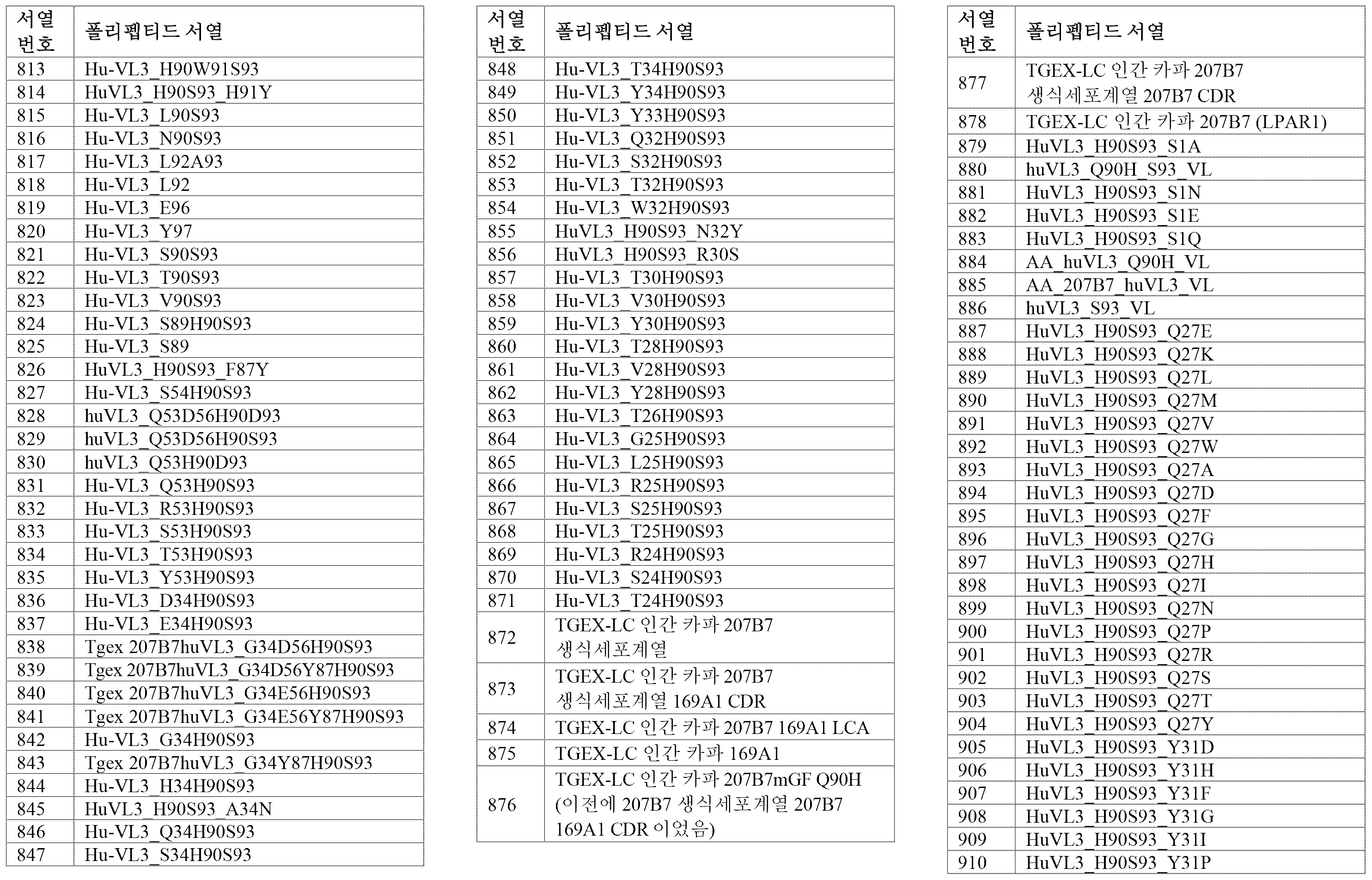
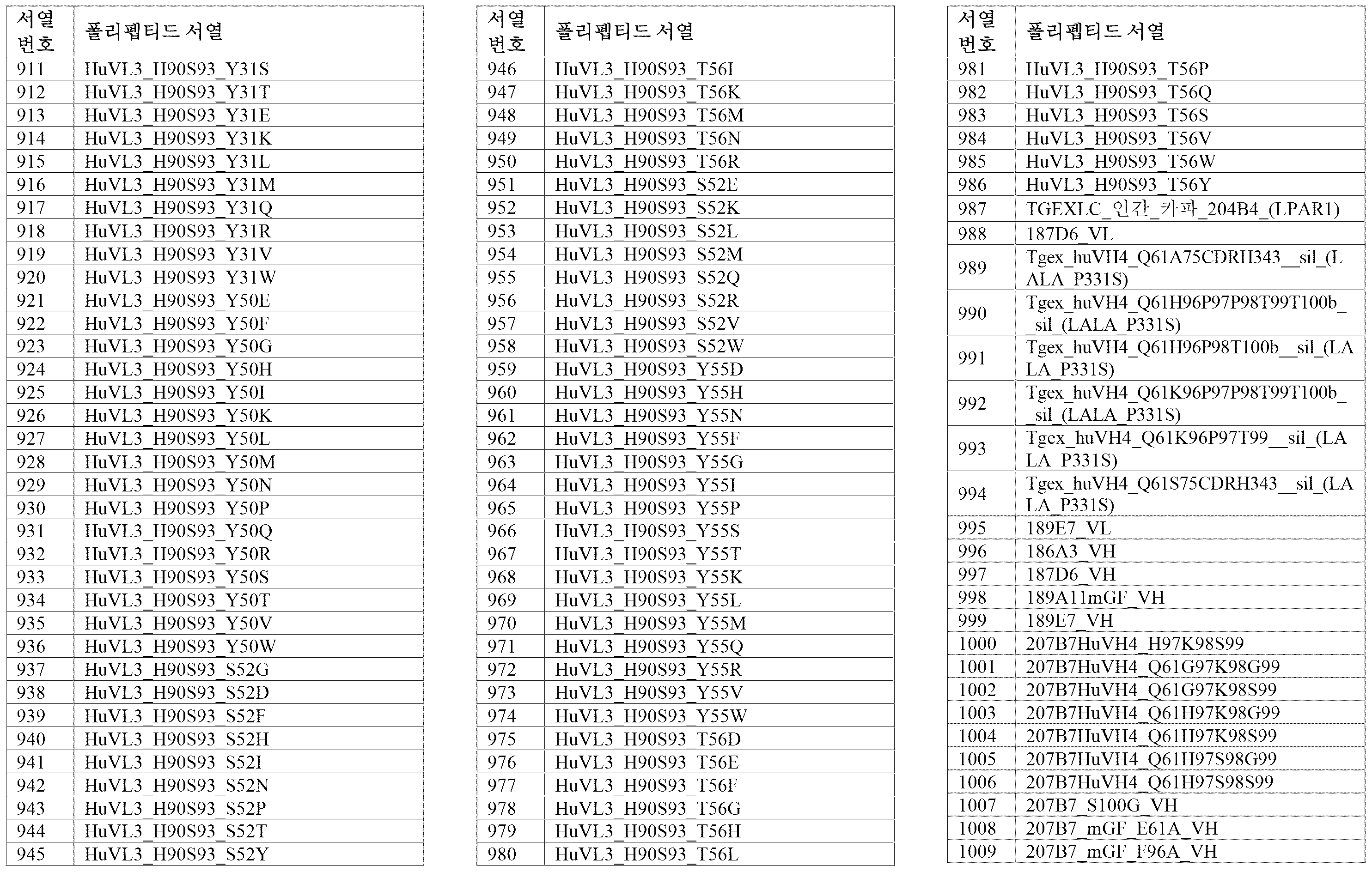


Figure 2 - Expression level, ability to increase cAMP signaling, ability to inhibit calcium signaling, and ability to reduce cell proliferation compared to adalimumab biosimilar for
Figure 3 - Epitope prediction for antibody 7b
Figure 4 - Paratope prediction for antibody 7b
Figure 5 - In vitro epitope analysis
Figure 6 - Illustration of epitopes on LPAR1
Figure 7 - Expression level, ability to increase cAMP signaling, ability to reduce cell proliferation and ability to bind hULPAR1-HA cells compared to palivizumab biosimilar for
Figure 8 - Expression level, ability to increase cAMP signaling and ability to reduce cell proliferation compared to palivizumab biosimilar for
Figure 9 - Expression level, ability to increase cAMP signaling, ability to reduce cell proliferation and ability to bind hULPAR1-HA cells compared to palivizumab biosimilar for
Figure 10 - Expression level, ability to increase cAMP signaling, ability to reduce cell proliferation and ability to bind hULPAR1-HA cells compared to palivizumab biosimilar for
Figure 11 - CIFAT assay microscopy imaging results for antibodies of the invention and prior art (5 ug/ml concentration for live cells)
Figure 12 - CIFAT assay microscopy imaging results for antibodies of the invention and prior art (concentration of 20 ug/ml for live cells)
Figure 13 - BRET investigation of
Figure 14 - Ability of
Figure 15 - Ability of
Figure 16 - Pharmacokinetic properties of
Figure 17 - SEC-MALS of
Figure 18 - Analysis of unilateral ureteral obstruction efficacy in guinea
A brief description of the sequence
정의Justice
달리 정의되지 않는 한, 본 명세서에 사용되는 모든 기술 과학 용어는 당업자에 의해 통상적으로 이해되는 의미를 갖는다. 본 명세서에 사용되는 바와 같이, 하기 용어는 이하에서 이들에 대해 확인된 의미를 갖는다.Unless otherwise defined, all technical and scientific terms used herein have meanings commonly understood by those skilled in the art. As used herein, the following terms have the meanings identified below.
폴리펩티드는 사슬 형태로 함께 결합된 다수의 아미노산 잔기로 이루어진 유기 중합체이다. 본 명세서에 사용되는 바와 같이, '폴리펩티드'는 '단백질' 및 '펩티드'와 상호교환 가능하게 사용된다.Polypeptides are organic polymers made up of multiple amino acid residues linked together in a chain. As used herein, 'polypeptide' is used interchangeably with 'protein' and 'peptide'.
용어 "항체"는 적어도 하나의 항원 결합 부위(ABS)를 포함하는 적어도 하나의 항체 가변 도메인을 포함하는 임의의 항체 단백질 작제물을 포함한다. 항체는 유형 IgA, IgG, IgE, IgD, IgM(이뿐만 아니라 이들의 아형)의 면역글로불린을 포함하지만 이로 한정되지 않는다. 2개의 동일한 중쇄(H 사슬)와 2개의 동일한 경쇄(L 사슬) 폴리펩티드로부터 조립된 면역글로불린 G(IgG) 항체의 전체 구조는 포유류에서 잘 확립되어 있으며 고도로 보존되어 있다(문헌[Padlan 1994]).The term “antibody” includes any antibody protein construct comprising at least one antibody variable domain that includes at least one antigen binding site (ABS). Antibodies include, but are not limited to, immunoglobulins of the types IgA, IgG, IgE, IgD, and IgM (as well as their subtypes). The overall structure of immunoglobulin G (IgG) antibodies, assembled from two identical heavy (H chain) and two identical light (L chain) polypeptides, is well established and highly conserved in mammals (Padlan 1994).
"특이성"은 특정 항체 또는 이의 단편이 결합할 수 있는 상이한 유형의 항원 또는 항원 결정기의 수를 지칭한다. 항체의 특이성은, 항체가 특정 항원을 특유의 분자 실체로서 인식하고 그것을 다른 것과 구별할 수 있는 능력이다. 항원 또는 에피토프에 "특이적으로 결합하는" 항체는 당업계에서 잘 이해되어 있는 용어이다. 분자는, 그것이 대안적인 표적에 대한 것보다 더 빈번하게, 더 신속하게, 더 긴 지속시간으로, 그리고/또는 더 큰 친화도로 특정 표적 항원 또는 에피토프와 반응하는 경우, "특이적 결합"을 나타낸다고 한다. 항체는, 그것이 다른 물질에 결합하는 것보다 더 큰 친화도로, 결합력으로, 더 용이하게, 그리고/또는 더 긴 지속시간으로 결합하는 경우 표적 항원 또는 에피토프에 "특이적으로 결합한다". 결합이 비관련 결합제에 비해 통계학적으로 유의한 경우, 항체(또는 이의 단편)는 표적에 특이적으로 결합하는 것으로 간주될 수 있다. 항원 또는 항원 결정기에 대한 항체 또는 이의 단편의 특이적 결합은 임의의 적합한 알려진 방식으로 결정될 수 있으며, 이러한 방식에는, 예를 들어 스캐차드(Scatchard) 분석 및/또는 경쟁적 결합 검정, 예컨대 방사면역검정(RIA), 효소 면역검정(EIA) 및 샌드위치 경쟁 검정, 평형 투석, 평형 결합, 겔 여과, ELISA, 또는 분광법(예를 들어, 형광 검정을 사용함), 및 당업계에 알려진 이들의 상이한 변형 형태가 포함된다.“Specificity” refers to the number of different types of antigens or antigenic determinants to which a particular antibody or fragment thereof can bind. The specificity of an antibody is the ability of the antibody to recognize a specific antigen as a unique molecular entity and distinguish it from others. An antibody that “specifically binds” an antigen or epitope is a term well understood in the art. A molecule is said to exhibit “specific binding” if it reacts with a particular target antigen or epitope more frequently, more rapidly, with a longer duration, and/or with greater affinity than with alternative targets. . An antibody “specifically binds” to a target antigen or epitope if it binds with greater affinity, avidity, more readily, and/or for a longer duration than it binds to other substances. An antibody (or fragment thereof) may be considered to bind specifically to a target if the binding is statistically significant compared to an unrelated binder. Specific binding of an antibody or fragment thereof to an antigen or epitope can be determined in any suitable known manner, including, for example, Scatchard assay and/or competitive binding assays, such as radioimmunoassay ( RIA), enzyme immunoassay (EIA) and sandwich competition assays, equilibrium dialysis, equilibrium binding, gel filtration, ELISA, or spectroscopy (e.g., using fluorescence assays), and their different modified forms known in the art. do.
항원-결합 폴리펩티드와의 항원의 해리에 대한 평형 상수(KD)로 나타낸 "친화도"는 항원 결정기와 항체(또는 이의 단편) 상의 항원-결합 부위 사이의 결합 강도의 척도이다: KD의 값이 작을수록, 항원 결정기와 항원-결합 폴리펩티드 사이의 결합 강도가 더 강하다. 대안적으로, 친화도는 또한 친화도 상수(KA)로서 표현될 수 있으며, 이는 1/KD이다. 친화도는, 관심 대상인 특이적 항원에 따라, 알려진 방법에 의해 결정될 수 있다. 예를 들어, KD는 실시예 섹션에서 방법 1.14 아래에 기재된 방법에 의해 결정될 수 있다. 10-6 미만의 임의의 KD 값이 결합을 나타내는 것으로 간주된다. 적합하게는, 본 발명의 폴리펩티드는 10-6 M 이하, 더 적합하게는, 10-7 M 이하, 더 적합하게는, 10-8 M 이하, 더 적합하게는, 10-9 M 이하의 해리 상수로 결합할 것이다.“Affinity,” expressed as the equilibrium constant for the dissociation of an antigen from an antigen-binding polypeptide (K D ), is a measure of the strength of binding between an antigenic determinant and the antigen-binding site on an antibody (or fragment thereof): the value of K D The smaller it is, the stronger the binding strength between the epitope and the antigen-binding polypeptide. Alternatively, affinity can also be expressed as the affinity constant (KA), which is 1/K D. Affinity can be determined by known methods, depending on the specific antigen of interest. For example, K D can be determined by the method described under Method 1.14 in the Examples section. Any K D value less than 10 -6 is considered indicative of binding. Suitably, the polypeptides of the invention have a dissociation constant of 10 -6 M or less, more suitably 10 -7 M or less, more suitably 10 -8 M or less, more suitably 10 -9 M or less. will be combined with
"결합력"은 폴리펩티드, 항체 또는 이의 단편과 관련 항원 사이의 결합의 강도의 척도이다. 결합력은 항원 결정기와 항체 상의 이의 항원-결합 부위 사이의 친화도, 및 항체 상에 존재하는 관련 결합 부위의 수 둘 모두와 관련된다.“Avidity” is a measure of the strength of the bond between a polypeptide, antibody, or fragment thereof and the associated antigen. Avidity is related to both the affinity between an epitope and its antigen-binding site on the antibody and the number of relevant binding sites present on the antibody.
적합하게는, 본 발명의 폴리펩티드는 단리된다. "단리된" 폴리펩티드는 그의 원래 환경으로부터 제거된 것이다. 예를 들어, 본 발명의 자연-발생 폴리펩티드는 자연계에서 공존하는 물질의 일부 또는 전부로부터 분리되는 경우에 단리된다. 용어 "단리된"은 또한, 단리된 폴리펩티드가 약제학적 조성물의 활성 성분으로서 제형화될 때 치료적으로 투여되기에 충분히 순수하거나, 또는 적어도 70 내지 80% (w/w) 순도, 더 바람직하게는 적어도 80 내지 90% (w/w) 순도, 더욱 더 바람직하게는 90 내지 95% 순수, 가장 바람직하게는 적어도 95%, 96%, 97%, 98%, 99%, 또는 100% (w/w) 순도인 제제를 지칭하는 데 사용될 수 있다.Suitably, the polypeptide of the invention is isolated. An “isolated” polypeptide is one that has been removed from its original environment. For example, a naturally-occurring polypeptide of the invention is isolated when it is separated from some or all of the material with which it coexists in nature. The term “isolated” also means that the isolated polypeptide is sufficiently pure to be administered therapeutically when formulated as an active ingredient of a pharmaceutical composition, or is at least 70 to 80% (w/w) pure, more preferably At least 80 to 90% (w/w) pure, even more preferably 90 to 95% pure, most preferably at least 95%, 96%, 97%, 98%, 99%, or 100% (w/w) pure. ) can be used to refer to a preparation that is pure.
적합하게는, 본 발명에 사용되는 폴리뉴클레오티드는 단리된다. "단리된" 폴리뉴클레오티드는 그의 원래 환경으로부터 제거된 것이다. 예를 들어, 자연-발생 폴리뉴클레오티드는 자연계에서 공존하는 물질의 일부 또는 전부로부터 분리되는 경우에 단리된다. 폴리뉴클레오티드는, 예를 들어, 그것이 그의 자연 환경의 일부가 아닌 벡터 내로 클로닝되거나 또는 그것이 cDNA 내에 포함되는 경우, 단리된 것으로 간주된다.Suitably, the polynucleotides used in the invention are isolated. An “isolated” polynucleotide is one that has been removed from its original environment. For example, a naturally-occurring polynucleotide is isolated when it is separated from some or all of the material with which it coexists in nature. A polynucleotide is considered isolated, for example, if it is cloned into a vector that is not part of its natural environment or if it is included in a cDNA.
2개의 근연 폴리펩티드 서열을 비교하기 위해, 제1 폴리펩티드 서열과 제2 폴리펩티드 서열 사이의 "% 서열 동일성"이 폴리펩티드 서열에 대한 표준 설정을 사용하는 NCBI BLAST v2.0(BLASTP)을 사용하여 계산될 수 있다. 2개의 근연 폴리뉴클레오티드 서열을 비교하기 위해, 제1 뉴클레오티드 서열과 제2 뉴클레오티드 서열 사이의 "% 서열 동일성"이 뉴클레오티드 서열에 대한 표준 설정을 사용하는 NCBI BLAST v2.0(BLASTN)을 사용하여 계산될 수 있다.To compare two close polypeptide sequences, the “% sequence identity” between the first and second polypeptide sequences can be calculated using NCBI BLAST v2.0 (BLASTP) using standard settings for polypeptide sequences. there is. To compare two close polynucleotide sequences, the "% sequence identity" between the first and second nucleotide sequences will be calculated using NCBI BLAST v2.0 (BLASTN) using standard settings for nucleotide sequences. You can.
폴리펩티드 또는 폴리뉴클레오티드 서열은 그들이 전체 길이에 걸쳐 100% 서열 동일성을 공유하는 경우 다른 폴리펩티드 또는 폴리뉴클레오티드 서열과 동일하거나 "일치한다"고 한다. 서열 내의 잔기는, 폴리펩티드에 대해서는 좌측에서 우측으로, 즉, N-말단에서 C-말단으로; 폴리뉴클레오티드에 대해서는 5' 말단에서 3' 말단으로 넘버링된다.A polypeptide or polynucleotide sequence is said to be identical or “identical” to another polypeptide or polynucleotide sequence if they share 100% sequence identity over their entire length. Residues within the sequence are arranged from left to right for the polypeptide, that is, from N-terminus to C-terminus; About polynucleotides Numbered from 5' end to 3' end.
폴리펩티드 서열들 사이의 "차이"는 제1 서열과 대비하여 제2 서열의 위치에서의 단일 아미노산 잔기의 삽입, 결실 또는 치환을 지칭한다. 2개의 폴리펩티드 서열은 1개, 2개 또는 그 이상의 그러한 아미노산 차이를 함유할 수 있다. 제2 서열에서의 삽입, 결실 또는 치환은, 그 이외에는 제1 서열과 동일한(100% 서열 동일성) 경우, 감소된 % 서열 동일성을 가져온다. 예를 들어, 동일한 서열이 9개의 아미노산 잔기 길이인 경우, 제2 서열 내의 1개의 치환은 88.9%의 서열 동일성을 가져온다. 제1 폴리펩티드 서열과 제2 폴리펩티드 서열이 9개의 아미노산 잔기 길이이고 6개의 동일한 잔기를 공유하는 경우, 제1 폴리펩티드 서열과 제2 폴리펩티드 서열은 66% 초과의 동일성을 공유한다(제1 폴리펩티드 서열과 제2 폴리펩티드 서열은 66.7% 동일성을 공유한다).A “difference” between polypeptide sequences refers to an insertion, deletion, or substitution of a single amino acid residue at a position in a second sequence relative to a first sequence. Two polypeptide sequences may contain 1, 2, or more such amino acid differences. Insertions, deletions or substitutions in the second sequence, if otherwise identical to the first sequence (100% sequence identity), result in reduced percent sequence identity. For example, if the identical sequence is 9 amino acid residues long, one substitution in the second sequence results in a sequence identity of 88.9%. If the first polypeptide sequence and the second polypeptide sequence are 9 amino acid residues long and
대안적으로, 제1 참조 폴리펩티드 서열을 제2 비교 폴리펩티드 서열과 비교하기 위해, 제2 서열을 생성하기 위해 제1 서열에 이루어진 부가, 치환 및/또는 결실의 수가 확인될 수 있다. "부가"는 제1 폴리펩티드의 서열 내로의 1개의 아미노산 잔기의 부가(제1 폴리펩티드의 양쪽 말단 어느 것에서의 부가를 포함함)이다. "치환"은 제1 폴리펩티드의 서열 내의 1개의 아미노산 잔기를 1개의 상이한 아미노산 잔기로 치환한 것이다. 상기 치환은 보존적 또는 비보존적일 수 있다. "결실"은 제1 폴리펩티드의 서열로부터의 1개의 아미노산 잔기의 결실(제1 폴리펩티드의 양쪽 말단 어느 것에서의 결실을 포함함)이다.Alternatively, to compare a first reference polypeptide sequence to a second comparative polypeptide sequence, the number of additions, substitutions and/or deletions made to the first sequence to produce the second sequence can be identified. “Addition” is the addition of one amino acid residue into the sequence of a first polypeptide, including additions at either end of the first polypeptide. “Substitution” is the replacement of one amino acid residue in the sequence of a first polypeptide with one different amino acid residue. The substitution may be conservative or non-conservative. A “deletion” is the deletion of one amino acid residue from the sequence of a first polypeptide (including deletions at either end of the first polypeptide).
3-문자 코드 및 1-문자 코드를 사용하여, 자연-발생 아미노산은 다음과 같이 지칭될 수 있다: 글리신(G 또는 Gly), 알라닌(A 또는 Ala), 발린(V 또는 Val), 류신(L 또는 Leu), 아이소류신(I 또는 Ile), 프롤린(P 또는 Pro), 페닐알라닌(F 또는 Phe), 티로신(Y 또는 Tyr), 트립토판(W 또는 Trp), 라이신(K 또는 Lys), 아르기닌(R 또는 Arg), 히스티딘(H 또는 His), 아스파르트산(D 또는 Asp), 글루탐산(E 또는 Glu), 아스파라긴(N 또는 Asn), 글루타민(Q 또는 Gln), cysteine(C 또는 Cys), 메티오닌(M 또는 Met), 세린(S 또는 Ser) 및 트레오닌(T 또는 Thr). 잔기가 아스파르트산 또는 아스파라긴일 수 있는 경우, 기호 Asx 또는 B가 사용될 수 있다. 잔기가 글루탐산 또는 글루타민일 수 있는 경우, 기호 Glx 또는 Z가 사용될 수 있다. 문맥상 달리 명시하지 않는 한, 아스파르트산에 대한 언급은 아스파르테이트를 포함하고, 글루탐산에 대한 언급은 글루타메이트를 포함한다.Using the 3-letter code and the 1-letter code, naturally-occurring amino acids can be referred to as: glycine (G or Gly), alanine (A or Ala), valine (V or Val), leucine (L or Leu), isoleucine (I or Ile), proline (P or Pro), phenylalanine (F or Phe), tyrosine (Y or Tyr), tryptophan (W or Trp), lysine (K or Lys), arginine (R or Arg), histidine (H or His), aspartic acid (D or Asp), glutamic acid (E or Glu), asparagine (N or Asn), glutamine (Q or Gln), cysteine (C or Cys), methionine (M or Met), serine (S or Ser), and threonine (T or Thr). If the residue may be aspartic acid or asparagine, the symbols Asx or B may be used. If the residue may be glutamic acid or glutamine, the symbols Glx or Z may be used. Unless the context clearly dictates otherwise, references to aspartic acid include aspartate and references to glutamic acid include glutamate.
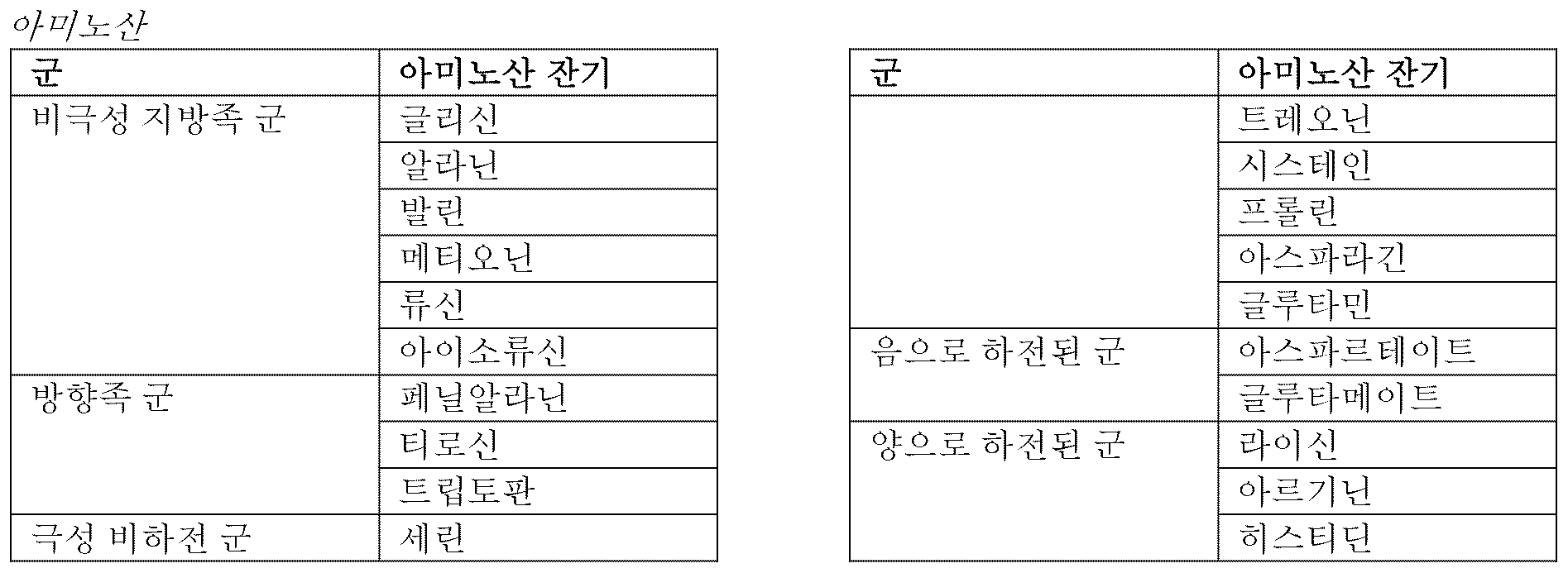
"보존적" 아미노산 치환은, 아미노산 잔기가 유사한 화학 구조의 다른 아미노산 잔기로 대체되고 폴리펩티드의 기능, 활성 또는 다른 생물학적 특성에 거의 영향을 미치지 않을 것으로 예상되는 아미노산 치환이다. 그러한 보존적 치환은 적합하게는, 하기 표 1에 나타낸 바와 같이, 하기 군 내의 1개의 아미노산이 동일한 군 내의 다른 아미노산 잔기로 치환된 치환이다.A “conservative” amino acid substitution is an amino acid substitution in which an amino acid residue is replaced by another amino acid residue of similar chemical structure and is expected to have little effect on the function, activity, or other biological properties of the polypeptide. Such conservative substitutions are suitably substitutions in which one amino acid in the following group is replaced with another amino acid residue in the same group, as shown in Table 1 below.
[표 1][Table 1]
적합하게는, 소수성 아미노산 잔기는 비극성 아미노산이다. 더 적합하게는, 소수성 아미노산 잔기는 V, I, L, M, F, W 또는 C로부터 선택된다. 일부 실시 형태에서, 소수성 아미노산 잔기는 글리신, 알라닌, 발린, 메티오닌, 류신, 아이소류신, 페닐알라닌, 티로신, 또는 트립토판으로부터 선택된다. 적합하게는, 참조 서열에 제공된 잔기에 상응하지 않는 서열 내의 임의의 잔기는 참조 서열의 잔기에 대한 보존적 치환이다.Suitably, the hydrophobic amino acid residue is a non-polar amino acid. More suitably, the hydrophobic amino acid residue is selected from V, I, L, M, F, W or C. In some embodiments, the hydrophobic amino acid residue is selected from glycine, alanine, valine, methionine, leucine, isoleucine, phenylalanine, tyrosine, or tryptophan. Suitably, any residue in the sequence that does not correspond to a residue provided in the reference sequence is a conservative substitution for a residue in the reference sequence.
본 명세서에 사용되는 바와 같이, 폴리펩티드 서열의 넘버링 및 CDR 및 FR(즉, HCDR1, HCDR2, HCDR3, HFR1, HFR2, HFR3, HFR4, LCDR1, LCDR2, LCDR3, LFR1, LFR2, LFR3 및 LFR4)의 정의는 달리 언급되지 않는 한 카바트 체계(Kabat system)에 따라 정의된 바와 같다(문헌[Kabat et al., 1991], 전체적으로 본 명세서에 참고로 포함됨). (실시예 7에서 수행된 잔기 치환 작업으로부터 유래된) 본 명세서에 개시된 제한된 수의 구체적인 실시 형태에서는, 비-카바트 넘버링 체계가 CDR 정의에 적용되고, 이는 사용될 때 명시된다. 제1 폴리펩티드 서열과 제2 폴리펩티드 서열 사이의 "상응하는" 아미노산 잔기는, 카바트 체계에 따라 제2 서열 내의 아미노산 잔기와 동일한 위치를 공유하는 제1 서열 내의 아미노산 잔기인 반면, 제2 서열 내의 아미노산 잔기는 제1 서열과 동일성이 상이할 수 있다. 적합하게는, 상응하는 잔기들은, 프레임워크 및 CDR이 카바트 정의에 따라 동일한 길이인 경우, 동일한 숫자(및 문자)를 공유할 것이다. 정렬은 수동으로 달성되거나, 또는, 예를 들어 서열 정렬을 위한 알려진 컴퓨터 알고리즘, 예컨대 표준 설정을 사용하는 NCBI BLAST v2.0(BLASTP 또는 BLASTN)을 사용함으로써 달성될 수 있다.As used herein, the numbering of polypeptide sequences and definitions of CDRs and FRs (i.e., HCDR1, HCDR2, HCDR3, HFR1, HFR2, HFR3, HFR4, LCDR1, LCDR2, LCDR3, LFR1, LFR2, LFR3, and LFR4) Unless otherwise stated, as defined according to the Kabat system (Kabat et al ., 1991), incorporated herein by reference in its entirety. In a limited number of specific embodiments disclosed herein (derived from the residue substitution work performed in Example 7), the non-Kabat numbering system is applied to CDR definitions and is specified when used. A “corresponding” amino acid residue between a first polypeptide sequence and a second polypeptide sequence is an amino acid residue in the first sequence that shares the same position as an amino acid residue in the second sequence according to the Kabat system, whereas an amino acid residue in the second sequence The residues may have different identities from the first sequence. Suitably, corresponding residues will share the same number (and letter) if the framework and CDR are of the same length according to the Kabat definition. Alignment can be accomplished manually, or, for example, by using known computer algorithms for sequence alignment, such as NCBI BLAST v2.0 (BLASTP or BLASTN) using standard settings.
본 명세서에서 "에피토프"에 대한 언급은 폴리펩티드, 항체 또는 이의 단편에 의해 결합되는 표적의 일부분을 지칭한다. 에피토프는 "항원 결정기"로 지칭될 수도 있다. 항체가 다른 항체와 "본질적으로 동일한 에피토프"에 결합하는 경우는, 이들 둘 모두가 동일하거나 입체적으로 중첩된 에피토프를 인식할 때이다. 2개의 항체가 동일하거나 중첩되는 에피토프에 결합하는지의 여부를 결정하는 데 일반적으로 사용되는 방법이 경쟁 검정인데, 이는 표지된 항원 또는 표지된 항체 중 어느 하나를 사용하여 다수의 상이한 포맷으로 구성될 수 있다(예를 들어, 방사성 또는 효소 표지를 사용하는 웰 플레이트, 또는 항원-발현 세포에 대한 유세포측정). 항체가 다른 항체와 "동일한 에피토프"에 결합하는 경우는, 이들 둘 모두가 동일한 에피토프를 인식할 때이다(즉, 항원과 항체 사이의 모든 접촉점이 동일하다). 예를 들어, 항체의 지정된 영역에 걸친 모든 접촉점이 항체/항원 교차-결합-커플링된 MS, HDX, X-선 결정학적 분석, 극저온-EM, 또는 돌연변이생성과 같은 특성화 방법의 도움으로 동일한 것으로 확인될 때, 항체는 다른 항체와 동일한 에피토프에 결합할 수 있다.Reference to “epitope” herein refers to the portion of a target that is bound by a polypeptide, antibody, or fragment thereof. Epitopes may also be referred to as “antigenic determinants.” An antibody binds to “essentially the same epitope” as another antibody when both recognize the same or sterically overlapping epitope. A commonly used method to determine whether two antibodies bind to the same or overlapping epitopes is the competition assay, which can be configured in a number of different formats using either a labeled antigen or a labeled antibody. (e.g., well plates using radioactive or enzymatic labels, or flow cytometry on antigen-expressing cells). An antibody binds to the "same epitope" as another antibody when both recognize the same epitope (i.e., all points of contact between the antigen and the antibody are identical). For example, all contact points across a given region of an antibody can be identified as identical with the help of characterization methods such as antibody/antigen cross-linking-coupled MS, HDX, X-ray crystallographic analysis, cryo-EM, or mutagenesis. When identified, an antibody can bind to the same epitope as another antibody.
추가로, 그러한 특성화 방법의 도움으로, 동일한 접촉점 전부는 아닌 그 중 일부를 인식함으로써 본질적으로 동일한 에피토프에 결합하는 항체를 특성화하는 것이 또한 가능하다. 구체적으로는, 그러한 항체들은 지정된 항원성 영역에서 광범위하게 동등한 기술적 효과 및/또는 동등한 항원 상호작용 선택성을 달성하기에 충분한 수의 동일한 접촉점을 공유할 수 있다. 추가적으로, 항체가 본질적으로 동일한 에피토프를 인식하고 광범위하게 동등한 기술적 효과 및/또는 상호작용 선택성을 부여하는 일부 경우에, N-말단에 가장 가까운 항원 접촉점부터 C-말단에 가장 가까운 항원 접촉점까지를 포함한 항원 접촉의 전체에 의해 에피토프 결합 풋프린트(footprint)를 정의하는 것이 또한 유용할 수 있다.Additionally, with the help of such characterization methods, it is also possible to characterize antibodies that bind essentially the same epitope by recognizing some but not all of the same contact points. Specifically, such antibodies may share a sufficient number of identical contact points to achieve broadly equivalent technical effectiveness and/or equivalent antigen interaction selectivity in a designated antigenic region. Additionally, in some cases where the antibodies recognize essentially the same epitope and confer broadly equivalent technical effectiveness and/or interaction selectivity, the antigen encompasses the antigen contact point closest to the N-terminus to the antigen contact point closest to the C-terminus. It may also be useful to define the epitope binding footprint by the totality of contacts.
단백질 표적 상에서 발견되는 에피토프는 "선형 에피토프" 또는 "입체구조 에피토프"로 정의될 수 있다. 선형 에피토프는 단백질 항원에서의 아미노산의 연속 서열에 의해 형성된다. 입체구조 에피토프는, 단백질 서열에서는 불연속적이지만 단백질이 그의 3차원 구조로 접힐 때 합쳐지게 되는 아미노산으로 형성된다.Epitopes found on protein targets can be defined as “linear epitopes” or “conformational epitopes”. Linear epitopes are formed by consecutive sequences of amino acids in a protein antigen. Conformational epitopes are formed from amino acids that are discontinuous in the protein sequence but come together when the protein folds into its three-dimensional structure.
본 명세서에 사용되는 바와 같이, 용어 "벡터"는 핵산 분자로서, 이것에 연결된 다른 핵산을 수송할 수 있는 그러한 핵산 분자를 지칭하고자 한다. 벡터의 한 가지 유형은 "플라스미드"로서, 이는 추가의 DNA 세그먼트가 라이게이션될 수 있는 원형 이중 가닥 DNA 루프를 지칭한다. 벡터의 다른 유형은 바이러스 벡터로서, 여기서는 추가의 DNA 세그먼트가 바이러스 게놈 내로 라이게이션될 수 있다. 소정 벡터는 이들이 도입되는 숙주 세포에서 자가 복제가 가능하다(예를 들어, 세균 복제 기점을 갖는 세균 벡터, 및 에피솜 포유류 및 효모 벡터). 다른 벡터(예를 들어, 비에피솜 포유류 벡터)가 숙주 세포 내로 도입 시에 숙주 세포의 게놈에 통합될 수 있고, 그럼으로써 숙주 게놈과 함께 복제된다. 더욱이, 소정 벡터는 이들이 작동가능하게 연결된 유전자의 발현을 유도할 수 있다. 그러한 벡터는 본 명세서에서 "재조합 발현 벡터"(또는 간단히, "발현 벡터")로 지칭된다. 일반적으로, 재조합 DNA 기법에서 유용한 발현 벡터는 종종 플라스미드 형태이다. 본 명세서에서, "플라스미드"와 "벡터"는 상호교환 가능하게 사용될 수 있는데, 그 이유는 플라스미드는 벡터의 가장 일반적으로 사용되는 형태이기 때문이다. 그러나, 본 발명은 다른 형태의 발현 벡터, 예컨대 동등한 기능을 제공하는 바이러스 벡터(예를 들어, 복제 결함 레트로바이러스, 아데노바이러스 및 아데노-관련 바이러스), 및 또한 박테리오파지 및 파지미드 시스템을 포함하고자 한다. 본 명세서에 사용되는 바와 같이, 용어 "재조합 숙주 세포"(또는 간단히 "숙주 세포")는 재조합 발현 벡터가 내부로 도입된 세포를 지칭하고자 한다. 그러한 용어는 특정 대상 세포뿐만 아니라, 그러한 세포의 자손을 지칭하고자 하는데, 이는, 예를 들어 상기 자손이 세포주 또는 세포 뱅크를 제조하는 사용되고, 이어서 이것이 본 명세서에 기재된 바와 같은 폴리펩티드, 항체 또는 이의 단편을 제조하기 위해 선택적으로 저장되거나, 제공되거나, 판매되거나, 전달되거나, 사용되는 경우에 그러하다.As used herein, the term “vector” is intended to refer to a nucleic acid molecule capable of transporting another nucleic acid to which it has been linked. One type of vector is a “plasmid,” which refers to a circular double-stranded DNA loop into which additional DNA segments can be ligated. Another type of vector is a viral vector, in which additional DNA segments can be ligated into the viral genome. Certain vectors are capable of self-replication in the host cell into which they are introduced (e.g., bacterial vectors with a bacterial origin of replication, and episomal mammalian and yeast vectors). Other vectors (e.g., non-episomal mammalian vectors) may integrate into the host cell's genome upon introduction into the host cell, thereby replicating with the host genome. Moreover, certain vectors are capable of inducing expression of genes to which they are operably linked. Such vectors are referred to herein as “recombinant expression vectors” (or simply, “expression vectors”). In general, expression vectors useful in recombinant DNA techniques are often in the form of plasmids. In this specification, “plasmid” and “vector” may be used interchangeably because plasmid is the most commonly used form of vector. However, the present invention is intended to include other types of expression vectors, such as viral vectors that provide equivalent functions (e.g., replication defective retroviruses, adenoviruses and adeno-related viruses), and also bacteriophage and phagemid systems. As used herein, the term “recombinant host cell” (or simply “host cell”) is intended to refer to a cell into which a recombinant expression vector has been introduced. Such terms are intended to refer not only to a particular cell of interest, but also to the progeny of such cell, which may be used, for example, to generate a cell line or cell bank, which may then be used to produce a polypeptide, antibody or fragment thereof as described herein. This applies if it is selectively stored, provided, sold, delivered, or used for manufacture.
"대상체", "환자" 또는 "개체"에 대한 언급은 치료하려는 대상체, 특히 포유류 대상체를 지칭한다. 포유류 대상체는 인간, 비인간 영장류, 농장 동물(예컨대, 소), 스포츠 동물, 또는 애완 동물, 예컨대 개, 고양이, 기니피그, 토끼, 래트 또는 마우스를 포함한다. 일부 실시 형태에서, 대상체는 인간 또는 마우스이다. 가장 적합하게는, 대상체는 인간이다.References to “subject,” “patient,” or “individual” refer to the subject being treated, especially a mammalian subject. Mammalian subjects include humans, non-human primates, farm animals (e.g., cattle), sports animals, or pets, such as dogs, cats, guinea pigs, rabbits, rats, or mice. In some embodiments, the subject is a human or mouse. Most suitably, the subject is a human.
용어 "충분한 양"은 원하는 효과를 생성하기에 충분한 양을 의미한다. 용어 "치료적 유효량"은 질병 또는 장애의 증상을 호전시키는 데 효과적인 양이다. 치료적 유효량은 예방이 요법으로 간주될 수 있을 때 "예방적 유효량"일 수 있다.The term “sufficient amount” means an amount sufficient to produce the desired effect. The term “therapeutically effective amount” is an amount effective to improve the symptoms of a disease or disorder. A therapeutically effective amount may be a “prophylactically effective amount” when prophylaxis can be considered therapy.
질병 또는 장애의 징후 또는 증상의 중증도, 대상체가 경험한 그러한 징후 또는 증상의 빈도, 또는 둘 모두가 감소된다면, 질병 또는 장애가 "호전된다".A disease or disorder “improves” if the severity of the signs or symptoms of the disease or disorder, the frequency of those signs or symptoms experienced by the subject, or both are reduced.
본 명세서에 사용되는 바와 같이, "질병 또는 장애를 치료하는"은 대상체가 경험하는 질병 또는 장애의 적어도 하나의 징후 또는 증상의 빈도 및/또는 중증도를 감소시키는 것을 의미한다.As used herein, “treating a disease or disorder” means reducing the frequency and/or severity of at least one sign or symptom of the disease or disorder experienced by a subject.
"염증"은 염증이 생긴 세포, 세포 유형, 조직, 또는 기관에서 발생되는 면역 시스템의 만성 또는 급성 촉발을 지칭한다.“Inflammation” refers to a chronic or acute triggering of the immune system that occurs in inflamed cells, cell types, tissues, or organs.
"섬유증"은 병리학적 상처 치유를 지칭하는데, 여기서는 결합 조직이 정상 조직을 대체하여 조직 재형성 및 흉터 조직의 형성을 야기한다.“Fibrosis” refers to pathological wound healing, where connective tissue replaces normal tissue, resulting in tissue remodeling and the formation of scar tissue.
본 명세서에 사용되는 바와 같이, 용어 "약"은 명시된 값보다 최대 10%(이를 포함함) 더 크고 최대 10%(이를 포함함) 더 낮은 값, 적합하게는 명시된 값보다 최대 5%(이를 포함함) 더 크고 최대 5%(이를 포함함) 더 낮은 값, 특히 명시된 값을 포함한다. 용어 "내지"는 명시된 경계들의 값을 포함한다.As used herein, the term “about” means a value up to 10% (including but not limited to) greater than the stated value and up to 10% (including but not limited to) less than the stated value, suitably up to 5% (including but not limited to) the stated value. ) greater and up to 5% (including but not limited to) lower values, especially those specified. The term “to” includes the values of the specified boundaries.
"효력"은 주어진 강도의 효과를 생성하는 데 필요한 양의 관점에서 표현되는 치료제의 활성의 척도이다. 고도로 강력한 작용제(agent)는 낮은 농도에서 더 작은 반응을 유발하는 더 낮은 효력의 작용제와 대비하여 낮은 농도에서 더 큰 반응을 유발한다. 효력은 친화도 및 효능에 따른다. 효능은 표적에 결합 시에 생물학적 반응을 생성할 수 있는 치료제의 능력 및 이 반응의 정량적 크기를 지칭한다. 용어 반수 최대 유효 농도(EC50)는 기저선과 명시된 노출 시간 후의 최대치 사이의 절반 정도의 반응을 야기하는 치료제의 농도를 지칭한다. 치료제는 억제 또는 자극을 야기할 수 있다. 이는 효력의 척도로서 일반적으로 사용되고, 본 명세서에서 사용된다.“Potency” is a measure of the activity of a therapeutic agent expressed in terms of the amount required to produce an effect of a given intensity. Highly potent agents cause greater responses at lower concentrations compared to less potent agents which elicit smaller responses at lower concentrations. Effect depends on affinity and potency. Efficacy refers to the ability of a therapeutic agent to produce a biological response upon binding to a target and the quantitative magnitude of this response. The term half maximal effective concentration (EC50) refers to the concentration of therapeutic agent that produces a response that is half the magnitude between baseline and the maximum after a specified exposure time. Therapeutic agents can cause inhibition or stimulation. It is commonly used as a measure of potency and is used herein.
LPAR1에 결합하는 폴리펩티드Polypeptides that bind to LPAR1
항원-결합 부위를 형성하는 아미노산 잔기의 하나 이상의 스트레치(stretch)를 함유하여, 소정의 친화도(적합하게는, KD 값, Ka 값, kon-rate 및/또는 koff-rate로서 표현되며, 이는 본 명세서에 추가로 기재된 바와 같음)로 표적 항원 상의 에피토프에 결합할 수 있을 때, 폴리펩티드는 결합 폴리펩티드라고 한다. '결합 폴리펩티드'와 '항원-결합 폴리펩티드'는 본 명세서에서 동의어로 사용되는데, 그 이유는 이들 용어는 'LPAR1' 및 '항-LPAR1'에 결합하기 때문이다. 결합 폴리펩티드는 적합하게는 대상체에게 투여 시에 유익한 약리학적 효과를 발휘할 수 있다. 적합하게는, 폴리펩티드는 LPAR1에 대해 효능작용하거나, 역효능작용하거나, 길항작용하거나, 중성화한다. 일부 실시 형태에서, 폴리펩티드는 LPAR1에 대해 역효능작용할 수 있다. 일부 실시 형태에서, 폴리펩티드는 LPAR1의 외부 표면, 즉, LPAR1의 세포외 영역에 결합할 수 있다.Contains one or more stretches of amino acid residues forming the antigen-binding site, thereby providing a desired affinity (suitably expressed as K D value, K a value, k on-rate and/or k off-rate). A polypeptide is said to be a binding polypeptide when it is capable of binding to an epitope on a target antigen (as further described herein). 'Binding polypeptide' and 'antigen-binding polypeptide' are used synonymously herein because these terms bind to 'LPAR1' and 'anti-LPAR1'. The binding polypeptide may suitably exert beneficial pharmacological effects upon administration to a subject. Suitably, the polypeptide agonizes, inversely agonizes, antagonizes or neutralizes LPAR1. In some embodiments, the polypeptide may inversely affect LPAR1. In some embodiments, the polypeptide can bind to the external surface of LPAR1, i.e., the extracellular region of LPAR1.
LPAR1 결합 폴리펩티드는 항체(이는 하기에 추가로 기재됨), 추가의 결합 영역을 포함하도록 변형된 항체, 항체 모방체 및 항원-결합 항체 단편(이는 하기에 추가로 기재됨)을 포함할 수 있다. 추가의 결합 폴리펩티드는, 예를 들어 DARPin(문헌[Binz et al. 2003]), Affimer™, Fynomer™, Centyrin, Nanofitin® 및 사이클릭 펩티드를 포함할 수 있다.LPAR1 binding polypeptides can include antibodies (described further below), antibodies modified to include additional binding regions, antibody mimetics, and antigen-binding antibody fragments (described further below). Additional binding polypeptides may include, for example, DARPin (Binz et al . 2003), Affimer™, Fynomer™, Centyrin, Nanofitin® and cyclic peptides.
항체 및 이의 단편Antibodies and fragments thereof
폴리펩티드는 바람직하게는 항체 또는 이의 단편이다.The polypeptide is preferably an antibody or fragment thereof.
통상적인 항체 또는 면역글로불린(Ig)은 다음 4개의 폴리펩티드 사슬을 포함하는 단백질이다: 2개의 중쇄(H, 또는 HC) 및 2개의 경쇄(L, 또는 LC). 각각의 사슬은 불변 영역과 가변 영역으로 나누어진다. 중쇄(H) 가변 영역은 본 명세서에서 VH 영역으로 약기되고, 경쇄(L) 가변 영역은 본 명세서에서 VL 영역으로 약기된다. 이들 도메인, 이와 관련된 도메인 및 이들로부터 유래된 도메인은 본 명세서에서 가변 도메인으로 지칭된다. VH 및 VL 영역(또는 '도메인')은, 프레임워크 영역("FR")으로 명명되는 더 보존된 영역이 산재된, 상보성 결정 영역("CDR")으로 명명되는 초가변성의 영역으로 추가로 세분될 수 있다. 프레임워크 및 상보성 결정 영역은 정확하게 정의되어 있다(문헌[Kabat et al 1991], 전체적으로 본 명세서에 참고로 포함됨). 통상적인 항체에서, 각각의 VH 및 VL 영역은 3개의 CDR 및 4개의 FR로 구성되며, 아미노-말단부터 카르복시-말단까지 하기의 순서대로 배열된다: FR1, CDR1, FR2, CDR2, FR3, CDR3, FR4. VH 영역의 CDR 및 FR은 HCDR1, HCDR2, HCDR3, HFR1, HFR2, HFR3 및 HFR4로 표기된다. VL 영역의 CDR 및 FR은 LCDR1, LCDR2, LCDR3, LFR1, LFR2, LFR3 및 LFR4로 표기된다. 2개의 중쇄 면역글로불린 사슬 및 2개의 경쇄 면역글로불린 사슬로 된 통상적인 항체 사량체는, 예를 들어 이황화물 결합에 의해 상호연결된 중쇄와 경쇄 면역글로불린 사슬, 및 유사하게 연결된 중쇄로 형성된다. 중쇄 불변 영역은 CH1, CH2 및 CH3의 3개의 도메인을 포함한다. 경쇄 불변 영역은 CL의 1개의 도메인으로 구성된다. 중쇄의 가변 도메인 및 경쇄의 가변 도메인은 항원과 상호작용하는 결합 도메인이다. 항체의 불변 영역은 전형적으로 면역 시스템의 다양한 세포(예를 들어, 이펙터 세포) 및 고전적 보체 시스템의 제1 성분(C1q)을 포함한 숙주 조직 또는 인자에 대한 항체의 결합을 매개한다.A typical antibody, or immunoglobulin (Ig), is a protein that contains four polypeptide chains: two heavy chains (H, or HC) and two light chains (L, or LC). Each chain is divided into a constant region and a variable region. The heavy (H) variable region is abbreviated herein as the VH region, and the light chain (L) variable region is abbreviated herein as the VL region. These domains, domains related to them, and domains derived from them are referred to herein as variable domains. The VH and VL regions (or 'domains') are further subdivided into regions of hypervariability, termed complementarity-determining regions ("CDRs"), interspersed with more conserved regions, termed framework regions ("FRs"). It can be. The framework and complementarity determining regions are precisely defined (Kabat et al 1991, incorporated herein by reference in its entirety). In a typical antibody, each VH and VL region consists of three CDRs and four FRs, arranged from amino-terminus to carboxy-terminus in the following order: FR1, CDR1, FR2, CDR2, FR3, CDR3, FR4. The CDRs and FRs of the VH region are designated as HCDR1, HCDR2, HCDR3, HFR1, HFR2, HFR3, and HFR4. CDRs and FRs in the VL region are denoted as LCDR1, LCDR2, LCDR3, LFR1, LFR2, LFR3, and LFR4. A typical antibody tetramer of two heavy and two light immunoglobulin chains is formed, for example, by heavy and light immunoglobulin chains interconnected by disulfide bonds, and similarly linked heavy chains. The heavy chain constant region contains three domains: CH1, CH2, and CH3. The light chain constant region consists of one domain of CL. The variable domain of the heavy chain and the variable domain of the light chain are binding domains that interact with antigen. The constant region of an antibody typically mediates binding of the antibody to host tissues or factors, including various cells of the immune system (e.g., effector cells) and the first component of the classical complement system (C1q).
본 명세서에 사용되는 바와 같이, 항체의 단편("항체 단편", "면역글로불린 단편", "항원-결합 단편" 또는 "항원-결합 폴리펩티드"로도 지칭될 수 있음)은 표적에 특이적으로 결합하는 항체의 일부분(예를 들어, 하나 이상의 면역글로불린 사슬이 전장이 아니지만, 표적에 특이적으로 결합하는 분자)을 지칭한다. 용어 '항체 단편'에 포함되는 결합 단편의 예에는 하기가 포함된다:As used herein, a fragment of an antibody (which may also be referred to as an “antibody fragment,” “immunoglobulin fragment,” “antigen-binding fragment,” or “antigen-binding polypeptide”) refers to a fragment that specifically binds to a target. Refers to a portion of an antibody (e.g., a molecule in which one or more immunoglobulin chains are not full-length, but bind specifically to a target). Examples of binding fragments encompassed by the term 'antibody fragment' include:
(i) Fab 단편(VL, VH, CL 및 CH1 도메인으로 이루어진 1가 단편);(i) Fab fragment (monovalent fragment consisting of VL, VH, CL and CH1 domains);
(ii) F(ab')2 단편(힌지 영역에서 이황화물 가교에 의해 연결된 2개의 Fab 단편으로 이루어진 2가 단편);(ii) F(ab') 2 fragment (a bivalent fragment consisting of two Fab fragments linked by a disulfide bridge in the hinge region);
(iii) Fd 단편(VH 및 CH1 도메인으로 이루어짐);(iii) Fd fragment (consisting of VH and CH1 domains);
(iv) Fv 단편(항체의 단일 아암(arm)의 VL 및 VH 도메인으로 이루어짐);(iv) Fv fragment (consisting of the VL and VH domains of a single arm of the antibody);
(v) 단일쇄 가변 단편, scFv(재조합 방법을 사용하여 연결된 VL 도메인과 VH 도메인으로 이루어진 것으로, 이들은 VL 영역과 VH 영역이 쌍을 이루어서 1가 분자를 형성하는 단백질 단일쇄로서 제조될 수 있게 하는 합성 링커에 의해 연결됨);(v) single-chain variable fragment, scFv (consisting of VL and VH domains linked using recombinant methods, which allows the VL and VH regions to be prepared as a single protein chain by pairing to form a monovalent molecule) linked by synthetic linkers);
(vi) VH(VH 도메인으로 이루어진 가변 도메인);(vi) VH (variable domain consisting of VH domains);
(vii) VL(VL 도메인으로 이루어진 가변 도메인);(vii) VL (variable domain consisting of VL domains);
(viii) 도메인 항체(dAb; VH 또는 VL 도메인 중 어느 하나로 이루어짐);(viii) domain antibodies (dAb; consisting of either VH or VL domains);
(ix) 미니바디(CH3 도메인을 통해 연결된 한 쌍의 scFv 단편으로 이루어짐); 및(ix) minibody (consisting of a pair of scFv fragments linked through a CH3 domain); and
(x) 다이아바디(하나의 항체로부터의 VH 도메인이 작은 펩티드 링커에 의해 다른 항체로부터의 VL 도메인에 연결되어 이루어진 scFv 단편의 1가 이량체로 이루어짐).(x) Diabodies (consisting of monovalent dimers of scFv fragments consisting of the VH domain from one antibody linked to the VL domain from another antibody by a small peptide linker).
"인간 항체"는 인간 생식세포계열 면역글로불린 서열로부터 유래되는 가변 및 불변 영역을 갖는 항체를 지칭한다. 상기 인간 항체가 투여된 인간 대상체는 상기 항체 내에 함유된 1차 아미노산에 대한 이종간(cross-species) 항체 반응(예를 들어, HAMA 반응으로 불림 - 인간-항-마우스 항체)을 생성하지 않는다. 상기 인간 항체는, 예를 들어 CDR, 특히 CDR3 내에, 인간 생식세포계열 면역글로불린 서열에 의해 인코딩되지 않은 아미노산 잔기(예를 들어, 랜덤 또는 부위-특이적 돌연변이생성에 의해 또는 체세포 돌연변이에 의해 도입된 돌연변이)를 포함할 수 있다. 그러나, 이 용어는 다른 포유류종, 예컨대 마우스의 생식세포계열로부터 유래된 CDR 서열이 인간 프레임워크 서열 상에 이식된 항체를 포함시키고자 하지 않는다. 재조합 수단에 의해 제조, 발현, 생성 또는 단리된 인간 항체, 예컨대 숙주 세포 내로 형질감염된 재조합 발현 벡터를 사용하여 발현된 항체, 재조합된 조합 인간 항체 라이브러리로부터 단리된 항체, 인간 면역글로불린 유전자가 유전자도입된 동물(예를 들어, 마우스)로부터 단리된 항체, 또는 다른 DNA 서열로의 인간 면역글로불린 유전자 서열의 스플라이싱을 수반하는 임의의 다른 수단에 의해 제조, 발현, 생성 또는 단리된 항체가 또한 "재조합 인간 항체"로 지칭될 수 있다.“Human antibody” refers to an antibody with variable and constant regions derived from human germline immunoglobulin sequences. Human subjects administered the human antibody do not generate a cross-species antibody response (e.g., called a HAMA reaction - human-anti-mouse antibody) to the primary amino acids contained in the antibody. The human antibody may contain, for example, amino acid residues not encoded by human germline immunoglobulin sequences (e.g., introduced by random or site-specific mutagenesis or by somatic mutation) within the CDRs, especially CDR3. mutations) may be included. However, this term is not intended to encompass antibodies in which CDR sequences derived from the germline of other mammalian species, such as mouse, have been grafted onto human framework sequences. Human antibodies prepared, expressed, generated or isolated by recombinant means, such as antibodies expressed using recombinant expression vectors transfected into host cells, antibodies isolated from recombinant combinatorial human antibody libraries, antibodies into which human immunoglobulin genes have been transduced. Antibodies isolated from animals (e.g., mice), or made, expressed, generated or isolated by any other means involving splicing of human immunoglobulin gene sequences to other DNA sequences, are also referred to as “recombinant antibodies.” may be referred to as “human antibody”.
비인간 면역글로불린 가변 도메인의 프레임워크 영역 내의 적어도 하나의 아미노산 잔기를 인간 가변 도메인으로부터의 상응하는 잔기로 치환하는 것을 "인간화"라고 지칭한다. 가변 도메인의 인간화는 인간에서의 면역원성을 감소시킬 수 있다.Substitution of at least one amino acid residue within the framework region of a non-human immunoglobulin variable domain with a corresponding residue from a human variable domain is referred to as “humanization.” Humanization of variable domains can reduce immunogenicity in humans.
일 실시 형태에서, 항체 또는 이의 단편은 scFv, Fab, Fab', F(ab')2, Fv, 가변 도메인(예를 들어, VH 또는 VL), 다이아바디, 미니바디 또는 전장 항체이다. 특정 실시 형태에서, 항체 또는 이의 단편은 scFv 또는 전장 항체이다.In one embodiment, the antibody or fragment thereof is an scFv, Fab, Fab', F(ab') 2 , Fv, variable domain (e.g., VH or VL), diabody, minibody, or full length antibody. In certain embodiments, the antibody or fragment thereof is an scFv or full-length antibody.
본 발명의 항체는 임의의 부류, 예를 들어 IgG, IgA, IgM, IgE, IgD, 또는 이의 하위부류의 것일 수 있으며, 카파 또는 람다 경쇄를 포함할 수 있다. 일 실시 형태에서, 항체는 IgG 항체, 예를 들어 하위부류 IgG1, IgG2, IgG3 또는 IgG4 중 적어도 하나이다. 일 실시 형태에서, 항체는 IgG1이다. 추가의 실시 형태에서, 항체는 원하는 특성을 부여하도록 변형된 포맷, 예컨대 IgG 포맷일 수 있으며, 이를 테면, 이펙터 기능을 감소시키거나, 반감기를 연장시키거나, ADCC를 변경시키거나, 또는 힌지 안정성을 개선하도록 Fc가 돌연변이된 것들일 수 있다. 그러한 변형은 당업계에 잘 알려져 있으며, 예시적인 실시 형태가 본 명세서에 기재되어 있다. 예를 들어, 본 발명의 항체 또는 이의 단편은 서열 번호 56에 따른 아미노산 서열을 포함하거나 이로 이루어진 IgG1 중쇄 불변 영역을 포함할 수 있다. 적합하게는, 중쇄 불변 영역은 하기에 기재된 바와 같이 생체내(in vivo)에서 항체 반감기를 연장하기 위한 돌연변이를 포함한다: 문헌[Booth et al. 2018], 문헌[Borrok et al. 2017], 문헌[Dall'Acqua et al. 2006], 문헌[ Dall'Acqua et al. 2002], 문헌[Datta-Mannan et al. 2012], 문헌[Hinton et al. 2004], 문헌[Igawa et al. 2013], 문헌[Ko et al. 2021], 문헌[Lee CH et al. 2019], 문헌[Lie et al. 2020], 문헌[Mackness et al. 2019], 문헌[Petkova et al. 2006], 문헌[Robbie et al. 2013], 문헌[Saunders 2019], 문헌[Shields et al. 2001], 문헌[Vaccaro et al. 2006], 문헌[Vaccaro et al. 2005], 문헌[Zalevsky et al. 2010], US2014/056879A1호, US8088376B2호, WO2006053301호, WO2009086320호 및 WO2018035107호(이들 모두는 본 명세서에 개시된 Fc 돌연변이를 위해 본 명세서에 참고로 포함됨). 적합하게는, 중쇄 불변 영역은 하기에 기재된 바와 같은 Fc 이펙터-향상 돌연변이를 포함한다: WO2004029207호, WO2004099249호 및 WO2006019447호(이들 모두는 본 명세서에 개시된 Fc 돌연변이를 위해 본 명세서에 참고로 포함됨).Antibodies of the invention may be of any class, e.g., IgG, IgA, IgM, IgE, IgD, or subclasses thereof, and may include kappa or lambda light chains. In one embodiment, the antibody is an IgG antibody, e.g., at least one of the subclasses IgG1, IgG2, IgG3, or IgG4. In one embodiment, the antibody is IgG1. In further embodiments, the antibody may be in a format that has been modified to impart desired properties, such as reducing effector function, extending half-life, altering ADCC, or enhancing hinge stability. Fc may be mutated to improve it. Such variations are well known in the art, and exemplary embodiments are described herein. For example, the antibody or fragment thereof of the invention may comprise an IgG1 heavy chain constant region comprising or consisting of the amino acid sequence according to SEQ ID NO: 56. Suitably, the heavy chain constant region contains mutations to extend antibody half-life in vivo , as described below: Booth et al. 2018], Borrok et al. 2017], Dall'Acqua et al. 2006], Dall'Acqua et al. 2002], Datta-Mannan et al. 2012], Hinton et al. 2004], Igawa et al. 2013], Ko et al. 2021], Lee CH et al. 2019], Lie et al. 2020], Mackness et al. 2019], Petkova et al. 2006], Robbie et al. 2013], Saunders 2019, Shields et al. 2001], Vaccaro et al. 2006], Vaccaro et al. 2005], Zalevsky et al. 2010], US2014/056879A1, US8088376B2, WO2006053301, WO2009086320 and WO2018035107, all of which are incorporated herein by reference for the Fc mutations disclosed herein. Suitably, the heavy chain constant region comprises Fc effector-enhancing mutations as described below: WO2004029207, WO2004099249 and WO2006019447, all of which are incorporated herein by reference for the Fc mutations disclosed herein.
적합하게는, 중쇄 불변 영역은 하기 잔기 중 하나 이상을 포함한다:Suitably, the heavy chain constant region comprises one or more of the following residues:
위치 250에서의 잔기는 Q이거나, 위치 252에서의 잔기는 Y이거나, 위치 252에서의 잔기는 F이거나, 위치 252에서의 잔기는 W이거나, 위치 252에서의 잔기는 T이거나, 위치 253에서의 잔기는 A이거나, 위치 254에서의 잔기는 T이거나, 위치 256에서의 잔기는 E이거나, 위치 256에서의 잔기는 S이거나, 위치 256에서의 잔기는 R이거나, 위치 256에서의 잔기는 Q이거나, 위치 256에서의 잔기는 D이거나, 위치 259에서의 잔기는 I이거나, 위치 285에서의 잔기는 D이거나, 위치 285에서의 잔기는 N이거나, 위치 286에서의 잔기는 D이거나, 위치 294에서의 잔기는 결실되고, 위치 307에서의 잔기는 A이거나, 위치 307에서의 잔기는 Q이거나, 위치 307에서의 잔기는 P이거나, 위치 307에서의 잔기는 R이거나, 위치 307에서의 잔기는 W이거나, 위치 308에서의 잔기는 P이거나, 위치 308에서의 잔기는 F이거나, 위치 309에서의 잔기는 P이거나, 위치 309에서의 잔기는 D이거나, 위치 309에서의 잔기는 N이거나, 위치 310에서의 잔기는 A이거나, 위치 311에서의 잔기는 S이거나, 위치 311에서의 잔기는 I이거나, 위치 311에서의 잔기는 V이거나, 위치 311에서의 잔기는 H이거나, 위치 315에서의 잔기는 D이거나, 위치 378에서의 잔기는 V이거나, 위치 380에서의 잔기는 A이거나, 위치 385에서의 잔기는 R이거나, 위치 385에서의 잔기는 D이거나, 위치 385에서의 잔기는 S이거나, 위치 385에서의 잔기는 T이거나, 위치 385에서의 잔기는 H이거나, 위치 385에서의 잔기는 K이거나, 위치 385에서의 잔기는 A이거나, 위치 385에서의 잔기는 G이거나, 위치 386에서의 잔기는 T이거나, 위치 386에서의 잔기는 P이거나, 위치 386에서의 잔기는 D이거나, 위치 386에서의 잔기는 S이거나, 위치 386에서의 잔기는 K이거나, 위치 386에서의 잔기는 R이거나, 위치 386에서의 잔기는 I이거나, 위치 386에서의 잔기는 M이거나, 위치 387에서의 잔기는 R이거나, 위치 387에서의 잔기는 P이거나, 위치 387에서의 잔기는 H이거나, 위치 387에서의 잔기는 S이거나, 위치 387에서의 잔기는 T이거나, 위치 387에서의 잔기는 A이거나, 위치 389에서의 잔기는 P이거나, 위치 389에서의 잔기는 S이거나, 위치 389에서의 잔기는 N이거나, 위치 428에서의 잔기는 L이거나, 위치 433에서의 잔기는 K이거나, 위치 433에서의 잔기는 R이거나, 위치 433에서의 잔기는 S이거나, 위치 433에서의 잔기는 I이거나, 위치 433에서의 잔기는 P이거나, 위치 433에서의 잔기는 Q이거나, 위치 434에서의 잔기는 F이거나, 위치 434에서의 잔기는 H이거나, 위치 434에서의 잔기는 Y이거나, 위치 434에서의 잔기는 A이거나, 위치 434에서의 잔기는 S이거나, 위치 435에서의 잔기는 A이거나, 위치 436에서의 잔기는 H이거나, 위치 436에서의 잔기는 I이거나, 또는 위치 436에서의 잔기는 V임.The residue at position 250 is Q, the residue at position 252 is Y, the residue at position 252 is F, the residue at position 252 is W, the residue at position 252 is T, or the residue at position 253 is A, the residue at position 254 is T, the residue at position 256 is E, the residue at position 256 is S, the residue at position 256 is R, the residue at position 256 is Q, or The residue at position 256 is D, the residue at position 259 is I, the residue at position 285 is D, the residue at position 285 is N, the residue at position 286 is D, or the residue at position 294 is deleted, and the residue at position 307 is A, the residue at position 307 is Q, the residue at position 307 is P, the residue at position 307 is R, the residue at position 307 is W, or the residue at position 308 The residue at position 308 is F, the residue at position 309 is P, the residue at position 309 is D, the residue at position 309 is N, or the residue at position 310 is A , the residue at position 311 is S, the residue at position 311 is I, the residue at position 311 is V, the residue at position 311 is H, the residue at position 315 is D, or the residue at position 378 is The residue at position 380 is A, the residue at position 385 is R, the residue at position 385 is D, the residue at position 385 is S, or the residue at position 385 is T. , the residue at position 385 is H, the residue at position 385 is K, the residue at position 385 is A, the residue at position 385 is G, the residue at position 386 is T, or the residue at position 386 is The residue at position 386 is D, the residue at position 386 is S, the residue at position 386 is K, the residue at position 386 is R, or the residue at position 386 is I, The residue at position 386 is M, the residue at position 387 is R, the residue at position 387 is P, the residue at position 387 is H, the residue at position 387 is S, or the residue at position 387 is T, the residue at position 387 is A, the residue at position 389 is P, the residue at position 389 is S, the residue at position 389 is N, the residue at position 428 is L, or The residue at position 433 is K, the residue at position 433 is R, the residue at position 433 is S, the residue at position 433 is I, the residue at position 433 is P, or the residue at position 433 is Q, or the residue at position 434 is F, or the residue at position 434 is H, or the residue at position 434 is Y, or the residue at position 434 is A, or the residue at position 434 is S, or the residue at position 435 is The residue at position 436 is H, the residue at position 436 is I, or the residue at position 436 is V.
더 적합하게는, 중쇄 불변 영역은 위치 252, 254 및 256; 428 및 434; 433, 434 및 436; 428, 434 및 436; 252, 254, 256 및 322; 및 309, 311 및 434에서의 돌연변이; 또는 이들의 기능적 변이체를 포함한다. 더 적합하게는, 중쇄 불변 영역은 위치 252, 254 및 256; 428 및 434; 433, 434 및 436; 428, 434 및 436; 252, 254, 256 및 322; 및 309, 311 및 434에서의 돌연변이를 포함한다. 가장 적합하게는, 중쇄 불변 영역은 돌연변이 M252Y, S254T 및 T256E 또는 돌연변이 M428L 및 N434S를 포함한다. 대안적으로, 항체는 반감기를 증가시키기 위해 PEG화될 수 있다.More suitably, the heavy chain constant region is at
대안적으로 또는 추가적으로, 중쇄 불변 영역은 Fc 침묵 돌연변이를 포함할 수 있다. 적합하게는, 중쇄 불변 영역은 돌연변이 L234A 및 L235A를 포함한다. 더 적합하게는, 중쇄 불변 영역은 돌연변이 L234A, L235A 및 P331S(LALAPS)를 포함한다. 대안적으로, 중쇄 불변 영역은 돌연변이 L234A, L235A 및 P239G(LALA PG)를 포함한다. 대안적으로, 중쇄 불변 영역은 돌연변이 L235A 및 G237A(LAGA)를 포함한다.Alternatively or additionally, the heavy chain constant region may include Fc silencing mutations. Suitably, the heavy chain constant region comprises mutations L234A and L235A. More suitably, the heavy chain constant region comprises the mutations L234A, L235A and P331S (LALAPS). Alternatively, the heavy chain constant region includes mutations L234A, L235A and P239G (LALA PG). Alternatively, the heavy chain constant region includes mutations L235A and G237A (LAGA).
따라서, 소정 실시 형태에서, 항체는 하기 표 2에 제시된 항체 조합 1 내지 680에서의 조합된 중쇄 불변, 중쇄 가변(VH), 경쇄 불변 및 경쇄 가변(VL) 폴리펩티드 서열을 포함할 수 있다. 적합하게는, 항체는 2개의 중쇄 및 2개의 경쇄를 포함하며, 여기서 각각의 중쇄는 표 2의 하나의 항체 조합의 중쇄 불변 및 중쇄 가변(VH) 서열을 포함하고(예를 들어, 이로 이루어지고), 각각의 경쇄는 표 2의 상기 항체 조합의 경쇄 불변 및 경쇄 가변(VL) 서열을 포함한다(예를 들어, 이로 이루어진다).Accordingly, in certain embodiments, the antibody may comprise the combined heavy chain constant, heavy chain variable (VH), light chain constant and light chain variable (VL) polypeptide sequences in
[표 2][Table 2]


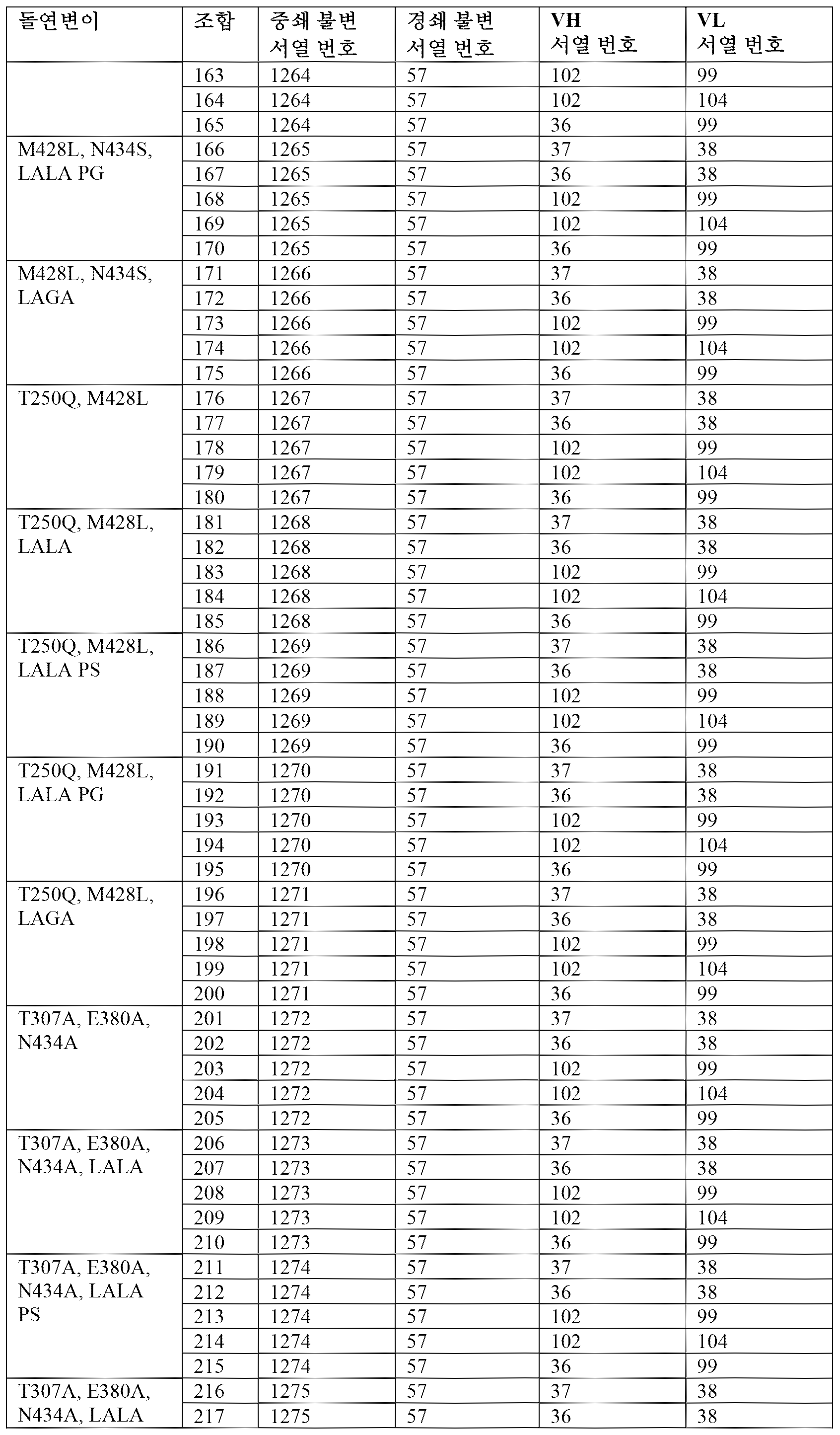

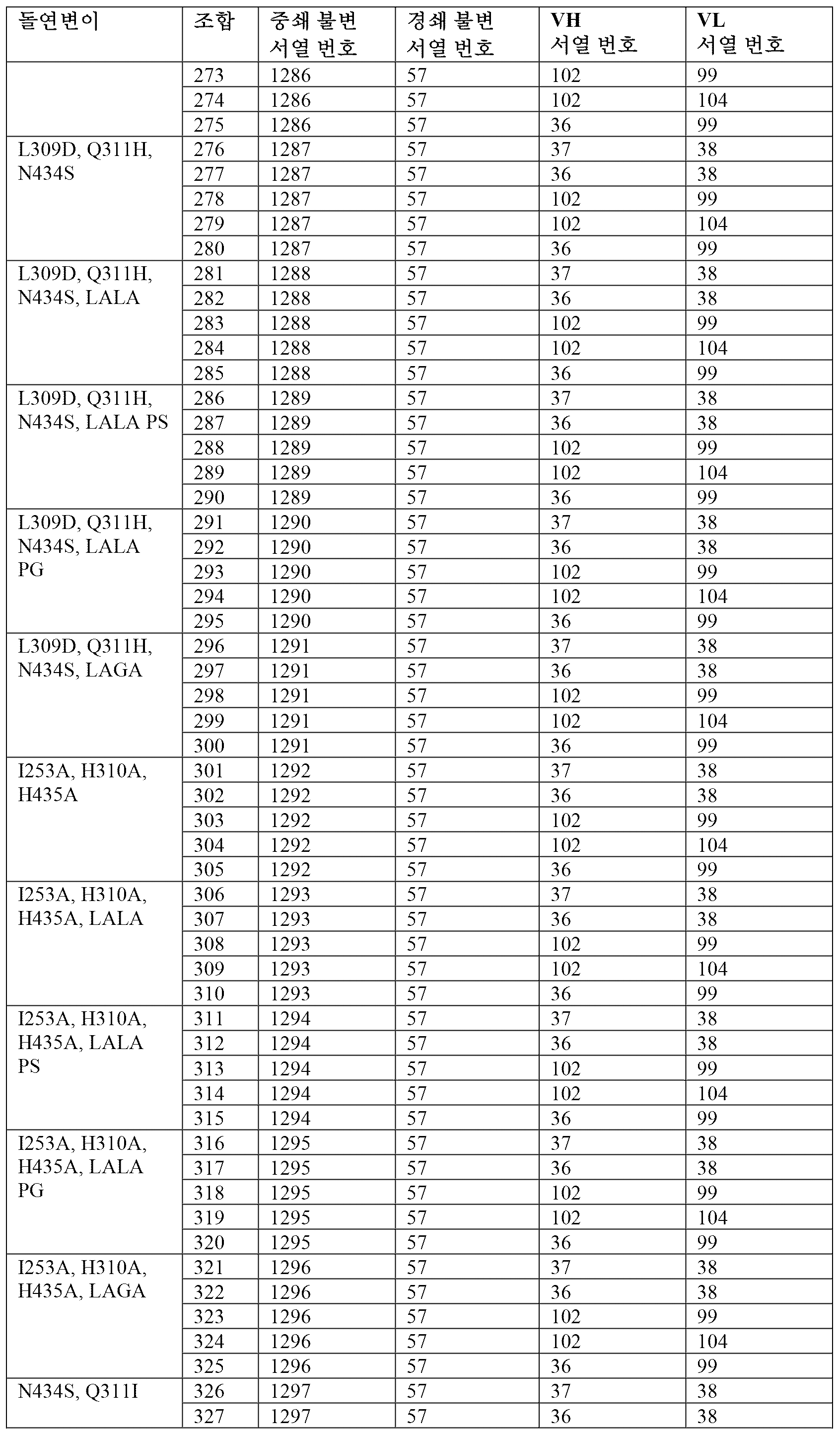


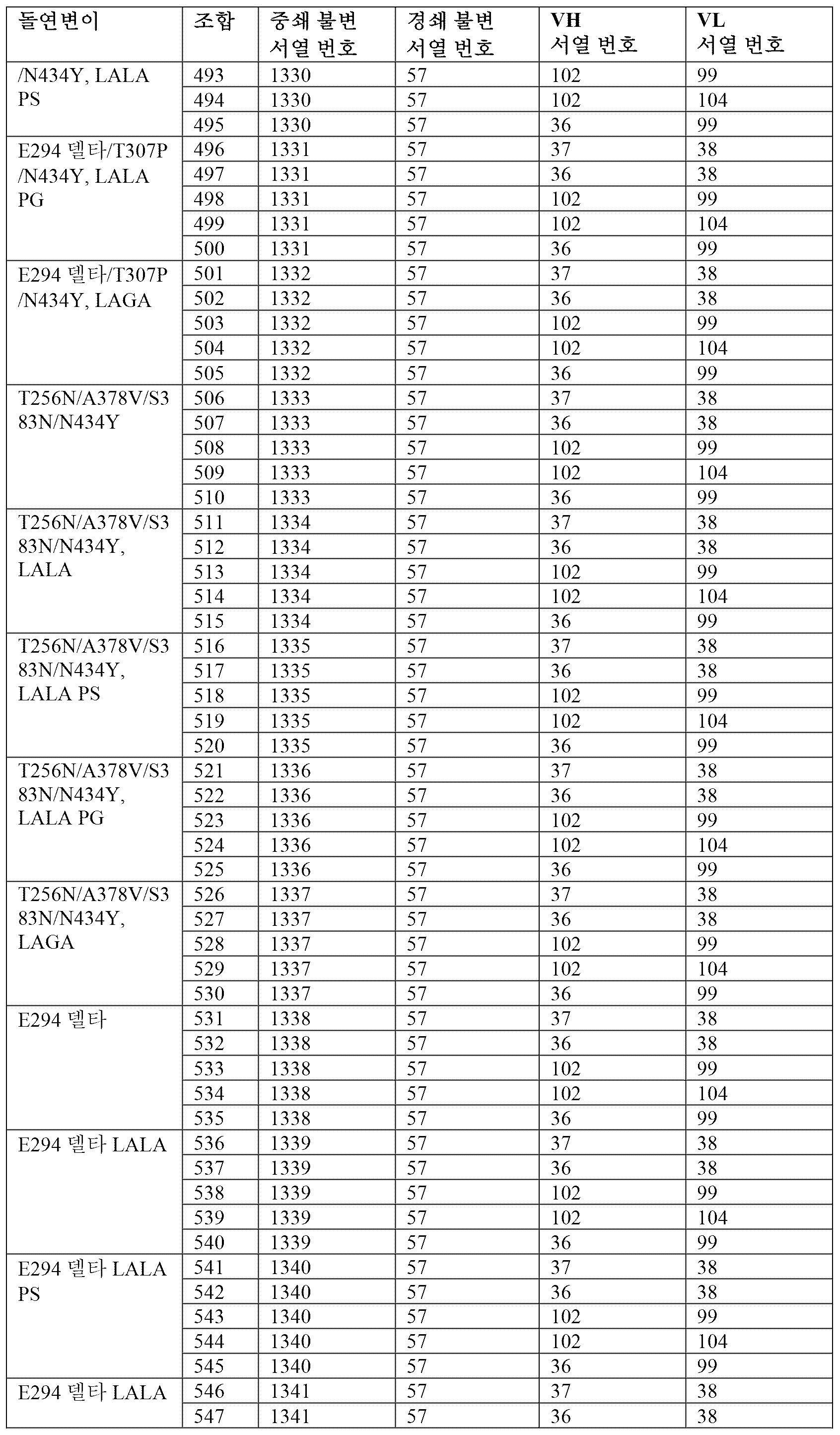
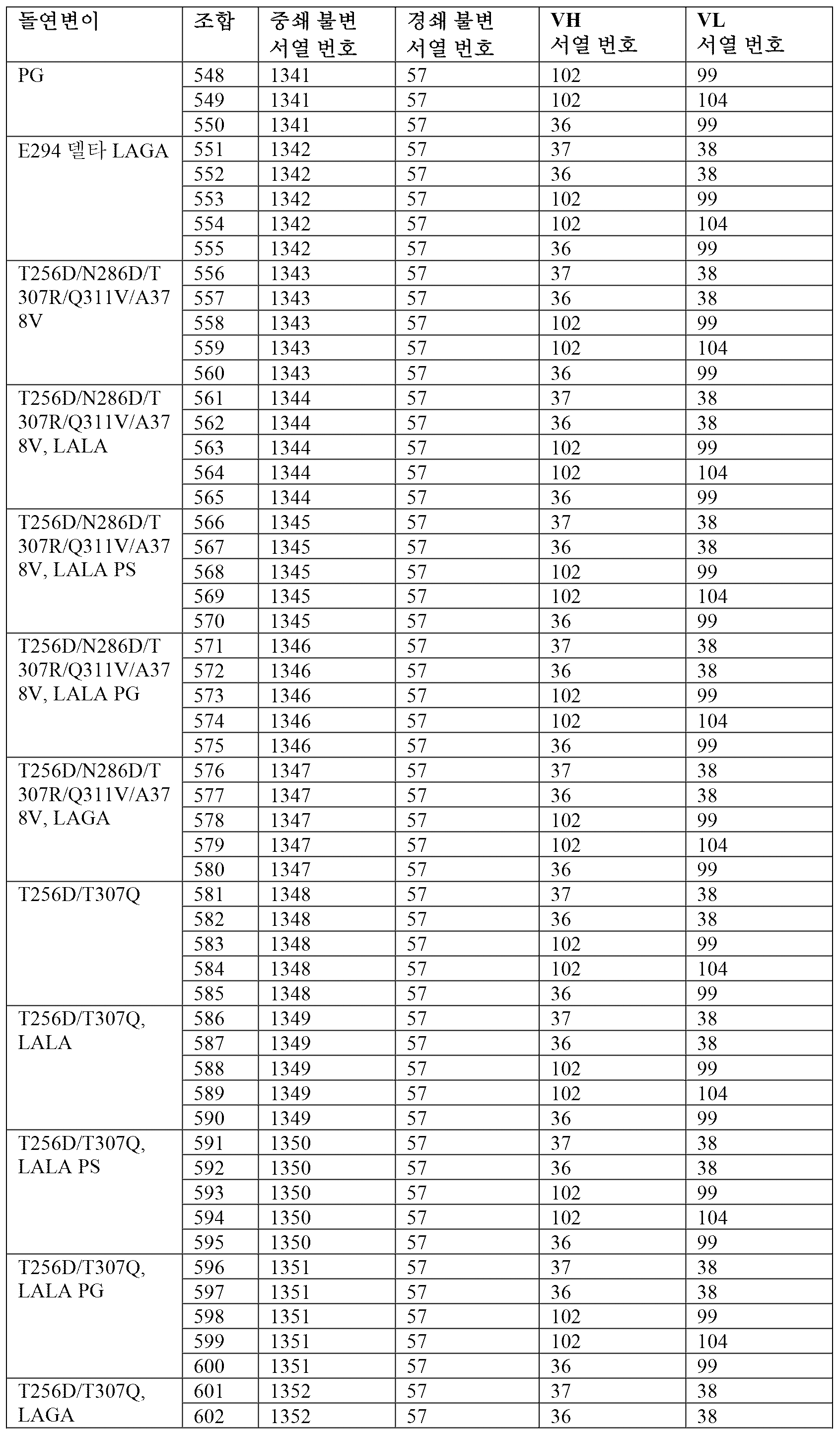
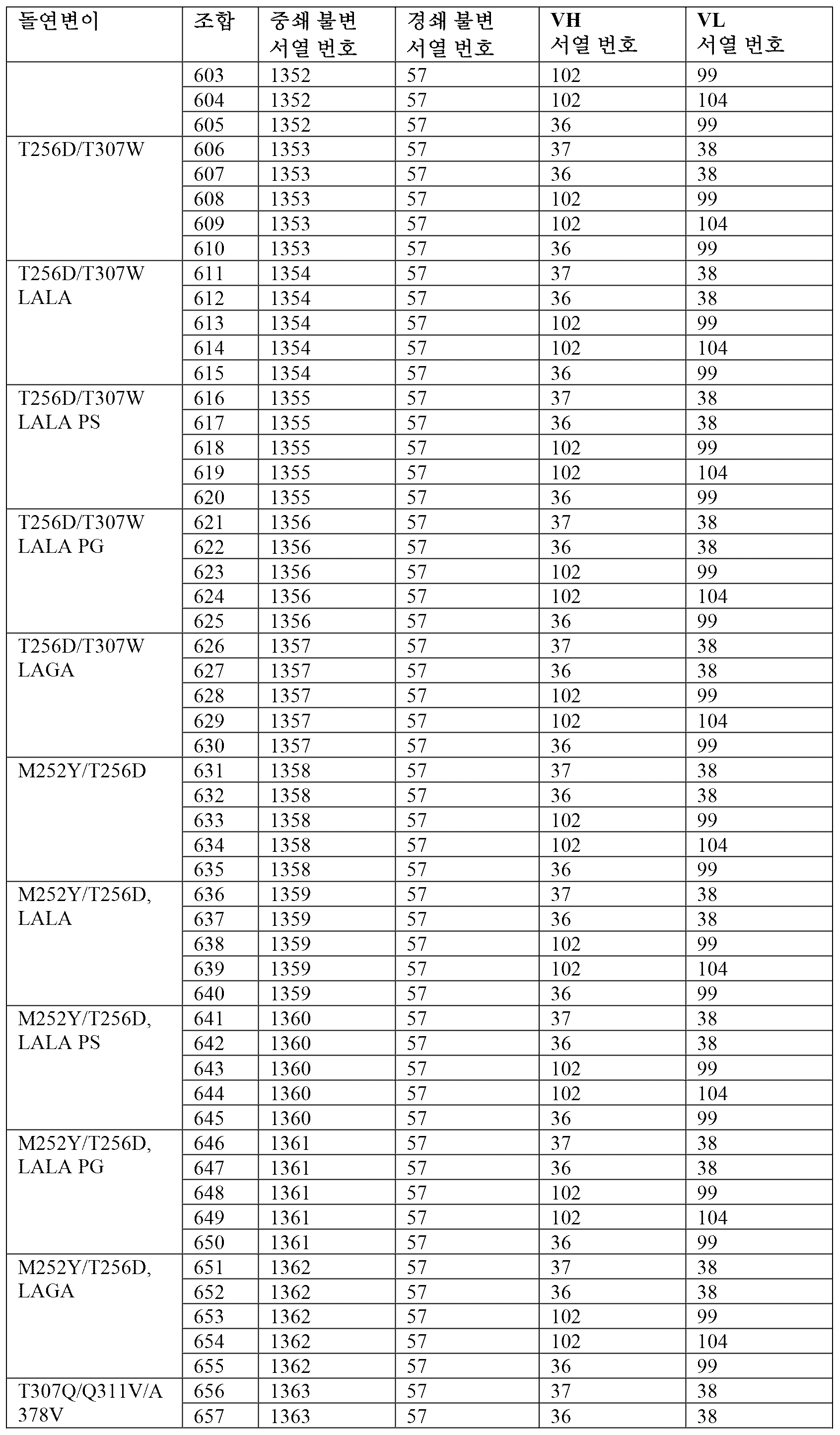

추가의 실시 형태에서, 항체는 상기 표 2에 제시된 바와 같은 조합 1 내지 25에서의 조합된 중쇄 불변, 중쇄 가변(VH), 경쇄 불변 및 경쇄 가변(VL) 폴리펩티드 서열을 포함할 수 있지만, 여기서 중쇄 불변 영역은 하기 잔기 중 하나 이상을 포함한다:In a further embodiment, the antibody may comprise combined heavy chain constant, heavy chain variable (VH), light chain constant and light chain variable (VL) polypeptide sequences in
위치 250에서의 잔기는 Q이거나, 위치 252에서의 잔기는 Y이거나, 위치 252에서의 잔기는 F이거나, 위치 252에서의 잔기는 W이거나, 위치 252에서의 잔기는 T이거나, 위치 253에서의 잔기는 A이거나, 위치 254에서의 잔기는 T이거나, 위치 256에서의 잔기는 E이거나, 위치 256에서의 잔기는 S이거나, 위치 256에서의 잔기는 R이거나, 위치 256에서의 잔기는 Q이거나, 위치 256에서의 잔기는 D이거나, 위치 259에서의 잔기는 I이거나, 위치 285에서의 잔기는 D이거나, 위치 285에서의 잔기는 N이거나, 위치 286에서의 잔기는 D이거나, 위치 294에서의 잔기는 결실되고, 위치 307에서의 잔기는 A이거나, 위치 307에서의 잔기는 Q이거나, 위치 307에서의 잔기는 P이거나, 위치 307에서의 잔기는 R이거나, 위치 307에서의 잔기는 W이거나, 위치 308에서의 잔기는 P이거나, 위치 308에서의 잔기는 F이거나, 위치 309에서의 잔기는 P이거나, 위치 309에서의 잔기는 D이거나, 위치 309에서의 잔기는 N이거나, 위치 310에서의 잔기는 A이거나, 위치 311에서의 잔기는 S이거나, 위치 311에서의 잔기는 I이거나, 위치 311에서의 잔기는 V이거나, 위치 311에서의 잔기는 H이거나, 위치 315에서의 잔기는 D이거나, 위치 378에서의 잔기는 V이거나, 위치 380에서의 잔기는 A이거나, 위치 385에서의 잔기는 R이거나, 위치 385에서의 잔기는 D이거나, 위치 385에서의 잔기는 S이거나, 위치 385에서의 잔기는 T이거나, 위치 385에서의 잔기는 H이거나, 위치 385에서의 잔기는 K이거나, 위치 385에서의 잔기는 A이거나, 위치 385에서의 잔기는 G이거나, 위치 386에서의 잔기는 T이거나, 위치 386에서의 잔기는 P이거나, 위치 386에서의 잔기는 D이거나, 위치 386에서의 잔기는 S이거나, 위치 386에서의 잔기는 K이거나, 위치 386에서의 잔기는 R이거나, 위치 386에서의 잔기는 I이거나, 위치 386에서의 잔기는 M이거나, 위치 387에서의 잔기는 R이거나, 위치 387에서의 잔기는 P이거나, 위치 387에서의 잔기는 H이거나, 위치 387에서의 잔기는 S이거나, 위치 387에서의 잔기는 T이거나, 위치 387에서의 잔기는 A이거나, 위치 389에서의 잔기는 P이거나, 위치 389에서의 잔기는 S이거나, 위치 389에서의 잔기는 N이거나, 위치 428에서의 잔기는 L이거나, 위치 433에서의 잔기는 K이거나, 위치 433에서의 잔기는 R이거나, 위치 433에서의 잔기는 S이거나, 위치 433에서의 잔기는 I이거나, 위치 433에서의 잔기는 P이거나, 위치 433에서의 잔기는 Q이거나, 위치 434에서의 잔기는 F이거나, 위치 434에서의 잔기는 H이거나, 위치 434에서의 잔기는 Y이거나, 위치 434에서의 잔기는 A이거나, 위치 434에서의 잔기는 S이거나, 위치 435에서의 잔기는 A이거나, 위치 436에서의 잔기는 H이거나, 위치 436에서의 잔기는 I이거나, 또는 위치 436에서의 잔기는 V임.The residue at position 250 is Q, the residue at position 252 is Y, the residue at position 252 is F, the residue at position 252 is W, the residue at position 252 is T, or the residue at position 253 is A, the residue at position 254 is T, the residue at position 256 is E, the residue at position 256 is S, the residue at position 256 is R, the residue at position 256 is Q, or The residue at position 256 is D, the residue at position 259 is I, the residue at position 285 is D, the residue at position 285 is N, the residue at position 286 is D, or the residue at position 294 is deleted, and the residue at position 307 is A, the residue at position 307 is Q, the residue at position 307 is P, the residue at position 307 is R, the residue at position 307 is W, or the residue at position 308 The residue at position 308 is F, the residue at position 309 is P, the residue at position 309 is D, the residue at position 309 is N, or the residue at position 310 is A , the residue at position 311 is S, the residue at position 311 is I, the residue at position 311 is V, the residue at position 311 is H, the residue at position 315 is D, or the residue at position 378 is The residue at position 380 is A, the residue at position 385 is R, the residue at position 385 is D, the residue at position 385 is S, or the residue at position 385 is T. , the residue at position 385 is H, the residue at position 385 is K, the residue at position 385 is A, the residue at position 385 is G, the residue at position 386 is T, or the residue at position 386 is The residue at position 386 is D, the residue at position 386 is S, the residue at position 386 is K, the residue at position 386 is R, or the residue at position 386 is I, The residue at position 386 is M, the residue at position 387 is R, the residue at position 387 is P, the residue at position 387 is H, the residue at position 387 is S, or the residue at position 387 is T, the residue at position 387 is A, the residue at position 389 is P, the residue at position 389 is S, the residue at position 389 is N, the residue at position 428 is L, or The residue at position 433 is K, the residue at position 433 is R, the residue at position 433 is S, the residue at position 433 is I, the residue at position 433 is P, or the residue at position 433 is Q, or the residue at position 434 is F, or the residue at position 434 is H, or the residue at position 434 is Y, or the residue at position 434 is A, or the residue at position 434 is S, or the residue at position 435 is The residue at position 436 is H, the residue at position 436 is I, or the residue at position 436 is V.
일 실시 형태에서, 항체 또는 이의 단편은 N-말단에서 C-말단으로 서열 번호 37, 이어서 서열 번호 1239의 중쇄 폴리펩티드 서열, 및 N-말단에서 C-말단으로 서열 번호 38, 이어서 서열 번호 57의 경쇄 폴리펩티드 서열을 포함한다. 일 실시 형태에서, 항체 또는 이의 단편은 N-말단에서 C-말단으로 서열 번호 36, 이어서 서열 번호 1239의 중쇄 폴리펩티드 서열, 및 N-말단에서 C-말단으로 서열 번호 38, 이어서 서열 번호 57의 경쇄 폴리펩티드 서열을 포함한다. 일 실시 형태에서, 항체 또는 이의 단편은 N-말단에서 C-말단으로 서열 번호 102, 이어서 서열 번호 1239의 중쇄 폴리펩티드 서열, 및 N-말단에서 C-말단으로 서열 번호 99, 이어서 서열 번호 57의 경쇄 폴리펩티드 서열을 포함한다. 일 실시 형태에서, 항체 또는 이의 단편은 N-말단에서 C-말단으로 서열 번호 102, 이어서 서열 번호 1239의 중쇄 폴리펩티드 서열, 및 N-말단에서 C-말단으로 서열 번호 104, 이어서 서열 번호 57의 경쇄 폴리펩티드 서열을 포함한다. 일 실시 형태에서, 항체 또는 이의 단편은 N-말단에서 C-말단으로 서열 번호 36, 이어서 서열 번호 1239의 중쇄 폴리펩티드 서열, 및 N-말단에서 C-말단으로 서열 번호 99, 이어서 서열 번호 57의 경쇄 폴리펩티드 서열을 포함한다.In one embodiment, the antibody or fragment thereof has a heavy chain polypeptide sequence of SEQ ID NO: 37 from N-terminus to C-terminus, followed by SEQ ID NO: 1239, and a light chain of SEQ ID NO: 38, followed by SEQ ID NO: 57 from N-terminus to C-terminus. Contains a polypeptide sequence. In one embodiment, the antibody or fragment thereof has a heavy chain polypeptide sequence of SEQ ID NO: 36 from N-terminus to C-terminus, followed by SEQ ID NO: 1239, and a light chain of SEQ ID NO: 38, followed by SEQ ID NO: 57 from N-terminus to C-terminus. Contains a polypeptide sequence. In one embodiment, the antibody or fragment thereof has a heavy chain polypeptide sequence of SEQ ID NO: 102 from N-terminus to C-terminus, followed by SEQ ID NO: 1239, and a light chain of SEQ ID NO: 99, followed by SEQ ID NO: 57 from N-terminus to C-terminus. Contains a polypeptide sequence. In one embodiment, the antibody or fragment thereof has the heavy chain polypeptide sequence of SEQ ID NO: 102 from N-terminus to C-terminus, followed by SEQ ID NO: 1239, and the light chain of SEQ ID NO: 104, followed by SEQ ID NO: 57 from N-terminus to C-terminus. Contains a polypeptide sequence. In one embodiment, the antibody or fragment thereof has a heavy chain polypeptide sequence of SEQ ID NO: 36 from N-terminus to C-terminus, followed by SEQ ID NO: 1239, and a light chain of SEQ ID NO: 99, followed by SEQ ID NO: 57 from N-terminus to C-terminus. Contains a polypeptide sequence.
일 실시 형태에서, 항체 또는 이의 단편은 N-말단에서 C-말단으로 서열 번호 37, 이어서 서열 번호 1264의 중쇄 폴리펩티드 서열, 및 N-말단에서 C-말단으로 서열 번호 38, 이어서 서열 번호 57의 경쇄 폴리펩티드 서열을 포함한다. 일 실시 형태에서, 항체 또는 이의 단편은 N-말단에서 C-말단으로 서열 번호 36, 이어서 서열 번호 1264의 중쇄 폴리펩티드 서열, 및 N-말단에서 C-말단으로 서열 번호 38, 이어서 서열 번호 57의 경쇄 폴리펩티드 서열을 포함한다. 일 실시 형태에서, 항체 또는 이의 단편은 N-말단에서 C-말단으로 서열 번호 102, 이어서 서열 번호 1264의 중쇄 폴리펩티드 서열, 및 N-말단에서 C-말단으로 서열 번호 99, 이어서 서열 번호 57의 경쇄 폴리펩티드 서열을 포함한다. 일 실시 형태에서, 항체 또는 이의 단편은 N-말단에서 C-말단으로 서열 번호 102, 이어서 서열 번호 1264의 중쇄 폴리펩티드 서열, 및 N-말단에서 C-말단으로 서열 번호 104, 이어서 서열 번호 57의 경쇄 폴리펩티드 서열을 포함한다. 일 실시 형태에서, 항체 또는 이의 단편은 N-말단에서 C-말단으로 서열 번호 36, 이어서 서열 번호 1264의 중쇄 폴리펩티드 서열, 및 N-말단에서 C-말단으로 서열 번호 99, 이어서 서열 번호 57의 경쇄 폴리펩티드 서열을 포함한다.In one embodiment, the antibody or fragment thereof has a heavy chain polypeptide sequence of SEQ ID NO: 37 from N-terminus to C-terminus, followed by SEQ ID NO: 1264, and a light chain of SEQ ID NO: 38, followed by SEQ ID NO: 57 from N-terminus to C-terminus. Contains a polypeptide sequence. In one embodiment, the antibody or fragment thereof has a heavy chain polypeptide sequence of SEQ ID NO: 36 from N-terminus to C-terminus, followed by SEQ ID NO: 1264, and a light chain of SEQ ID NO: 38, followed by SEQ ID NO: 57 from N-terminus to C-terminus. Contains a polypeptide sequence. In one embodiment, the antibody or fragment thereof has a heavy chain polypeptide sequence of SEQ ID NO: 102 from N-terminus to C-terminus, followed by SEQ ID NO: 1264, and a light chain of SEQ ID NO: 99, followed by SEQ ID NO: 57 from N-terminus to C-terminus. Contains a polypeptide sequence. In one embodiment, the antibody or fragment thereof has the heavy chain polypeptide sequence of SEQ ID NO: 102 from N-terminus to C-terminus, followed by SEQ ID NO: 1264, and the light chain of SEQ ID NO: 104, followed by SEQ ID NO: 57 from N-terminus to C-terminus. Contains a polypeptide sequence. In one embodiment, the antibody or fragment thereof has a heavy chain polypeptide sequence of SEQ ID NO: 36 from N-terminus to C-terminus, followed by SEQ ID NO: 1264, and a light chain of SEQ ID NO: 99, followed by SEQ ID NO: 57 from N-terminus to C-terminus. Contains a polypeptide sequence.
일부 실시 형태에서, 본 명세서에 기재된 항-LPAR1 항체는, 변이체 인간 Fc 불변 영역의 유래가 되는 천연 인간 Fc 불변 영역의 친화도보다 더 큰 친화도로 인간 신생아 Fc 수용체(FcRn)에 결합하는 변이체 인간 Fc 불변 영역을 포함할 수 있다. 예를 들어, Fc 불변 영역은 변이체 인간 Fc 불변 영역의 유래가 되는 천연 인간 Fc 불변 영역과 대비하여 하나 이상(예를 들어, 2, 3, 4, 5, 6, 7 또는 8개 또는 그 이상의) 아미노산 치환을 포함할 수 있다. 이러한 치환은 pH 6.0에서 FcRn에 대한 변이체 Fc 불변 영역을 함유하는 IgG 항체의 결합 친화도를, 그 상호작용의 pH 의존성을 유지하면서 증가시킬 수 있다. 예를 들어, 문헌[Hinton et al. (2004) J Biol Chem 279:6213-6216] 및 문헌[Datta-Mannan et al. (2007) Drug Metab Dispos 35:1-9]을 참조한다. 항체의 Fc 불변 영역 내의 하나 이상의 치환이 pH 6.0에서 FcRn에 대한 Fc 불변 영역의 친화도를 (그 상호작용의 pH 의존성을 유지하면서) 증가시키는지의 여부를 시험하는 방법은 당업계에 알려져 있으며, 실시예에 예시되어 있다. 예를 들어, 문헌[Datta-Mannan et al. (2007) J Biol Chem 282(3):1709-1717]; 국제 특허 출원 공개 WO 98/23289호; 국제 특허 출원 공개 WO 97/34631호; 및 미국 특허 제6,277,375호를 참조하며, 이들 각각의 개시내용은 전체적으로 본 명세서에 참고로 포함된다.In some embodiments, the anti-LPAR1 antibody described herein is a variant human Fc that binds to the human neonatal Fc receptor (FcRn) with greater affinity than the native human Fc constant region from which the variant human Fc constant region is derived. May include an immutable region. For example, the Fc constant region can be one or more (e.g., 2, 3, 4, 5, 6, 7 or 8 or more) compared to the native human Fc constant region from which the variant human Fc constant region is derived. May include amino acid substitutions. This substitution can increase the binding affinity of an IgG antibody containing a variant Fc constant region to FcRn at pH 6.0 while maintaining the pH dependence of the interaction. For example, Hinton et al. (2004) J Biol Chem 279:6213-6216 and Datta-Mannan et al. (2007) Drug Metab Dispos 35:1-9. Methods for testing whether one or more substitutions in the Fc constant region of an antibody increase the affinity of the Fc constant region for FcRn at pH 6.0 (while maintaining the pH dependence of that interaction) are known in the art and can be implemented as follows: This is illustrated in the example. For example, Datta-Mannan et al. (2007) J Biol Chem 282(3):1709-1717]; International Patent Application Publication No. WO 98/23289; International Patent Application Publication No. WO 97/34631; and U.S. Pat. No. 6,277,375, the disclosures of each of which are incorporated herein by reference in their entirety.
FcRn에 대한 항체 Fc 불변 영역의 결합 친화도를 향상시키는 치환은 당업계에 알려져 있으며, 예를 들어, (1) 문헌[Dall'Acqua et al. (2006) J Biol Chem 281: 23514-23524]에 기재된 M252Y/S254T/T256E 삼중 치환; (2) 문헌[Hinton et al. (2004) J Biol Chem 279:6213-6216] 및 문헌[Hinton et al. (2006) J Immunol 176:346-356]에 기재된 M428L 또는 T250Q/M428L 치환; 및 (3) 문헌[Petkova et al. (2006) Int Immunol 18(12):1759-69]에 기재된 N434A 또는 T307/E380A/N434A 치환을 포함한다. 추가의 치환 쌍: P257I/Q311I, P257I/N434H, 및 D376V/N434H가, 예를 들어 문헌[Datta-Mannan et al. (2007) J Biol Chem 282(3): 1709-1717]에 기재되어 있으며, 이의 개시내용은 전체적으로 본 명세서에 참고로 포함된다.Substitutions that improve the binding affinity of an antibody Fc constant region for FcRn are known in the art, see, for example, (1) Dall'Acqua et al. (2006) J Biol Chem 281: 23514-23524] M252Y/S254T/T256E triple substitution; (2) Reference [Hinton et al. (2004) J Biol Chem 279:6213-6216 and Hinton et al. (2006) J Immunol 176:346-356; M428L or T250Q/M428L substitution; and (3) Petkova et al. (2006) Int Immunol 18(12):1759-69]. Additional substitution pairs: P257I/Q311I, P257I/N434H, and D376V/N434H are described, for example, in Datta-Mannan et al. (2007) J Biol Chem 282(3): 1709-1717, the disclosure of which is incorporated herein by reference in its entirety.
일부 실시 형태에서, 변이체 불변 영역은 발린을 대신하여 EU 아미노산 잔기 255에서 치환을 갖는다. 일부 실시 형태에서, 변이체 불변 영역은 아스파라긴을 대신하여 EU 아미노산 잔기 309에서 치환을 갖는다. 일부 실시 형태에서, 변이체 불변 영역은 아이소류신을 대신하여 EU 아미노산 잔기 312에서 치환을 갖는다. 일부 실시 형태에서, 변이체 불변 영역은 EU 아미노산 잔기 386에서 치환을 갖는다.In some embodiments, the variant constant region has a substitution at EU amino acid residue 255 for valine. In some embodiments, the variant constant region has a substitution at EU amino acid residue 309 for asparagine. In some embodiments, the variant constant region has a substitution at EU amino acid residue 312 for isoleucine. In some embodiments, the variant constant region has a substitution at EU amino acid residue 386.
일부 실시 형태에서, 변이체 Fc 불변 영역은 그것의 유래가 된 천연 불변 영역에 대해 30개 이하(예를 들어, 29, 28, 27, 26, 25, 24, 23, 22, 21, 20, 19, 18, 17, 16, 15, 14, 13, 12, 11, 10, 9, 8, 7, 6, 5, 4, 3, 또는 2개 이하)의 아미노산 치환, 삽입, 또는 결실을 포함하지 않는다. 일부 실시 형태에서, 변이체 Fc 불변 영역은 M252Y, S254T, T256E, N434S, M428L, V259I, T250I, 및 V308F로 이루어진 군으로부터 선택되는 하나 이상의 아미노산 치환을 포함한다. 일부 실시 형태에서, 변이체 인간 Fc 불변 영역은 위치 428에서의 메티오닌, 및 위치 434에서의 아스파라긴을 포함하며, 이들 각각은 EU 넘버링에 따른다. 일부 실시 형태에서, 변이체 Fc 불변 영역은, 예를 들어 미국 특허 제8,088,376호에 기재된 바와 같은 428L/434S 이중 치환을 포함한다.In some embodiments, the variant Fc constant region has no more than 30 variants relative to the native constant region from which it is derived (e.g., 29, 28, 27, 26, 25, 24, 23, 22, 21, 20, 19, 18, 17, 16, 15, 14, 13, 12, 11, 10, 9, 8, 7, 6, 5, 4, 3, or no more than 2) amino acid substitutions, insertions, or deletions. In some embodiments, the variant Fc constant region comprises one or more amino acid substitutions selected from the group consisting of M252Y, S254T, T256E, N434S, M428L, V259I, T250I, and V308F. In some embodiments, the variant human Fc constant region comprises a methionine at position 428 and an asparagine at position 434, each according to the EU numbering. In some embodiments, the variant Fc constant region comprises the 428L/434S double substitution, e.g., as described in U.S. Pat. No. 8,088,376.
일부 실시 형태에서, 변이체 불변 영역은 천연 인간 Fc 불변 영역과 대비하여 아미노산 위치 237, 238, 239, 248, 250, 252, 254, 255, 256, 257, 258, 265, 270, 286, 289, 297, 298, 303, 305, 307, 308, 309, 311, 312, 314, 315, 317, 325, 332, 334, 360, 376, 380, 382, 384, 385, 386, 387, 389, 424, 428, 433, 434, 또는 436(EU 넘버링)에서의 치환을 포함한다. 일부 실시 형태에서, 치환은 하기로 이루어진 군으로부터 선택된다: 위치 237에서의 글리신을 대신하여 메티오닌으로의 치환; 위치 238에서의 프롤린을 대신하여 알라닌으로의 치환; 위치 239에서의 세린을 대신하여 라이신으로의 치환; 위치 248에서의 라이신을 대신하여 아이소류신으로의 치환; 위치 250에서의 트레오닌을 대신하여 알라닌, 페닐알라닌, 아이소류신, 메티오닌, 글루타민, 세린, 발린, 트립토판, 또는 티로신으로의 치환; 위치 252에서의 메티오닌을 대신하여 페닐알라닌, 트립토판, 또는 티로신으로의 치환; 위치 254에서의 세린을 대신하여 트레오닌으로의 치환; 위치 255에서의 아르기닌을 대신하여 글루탐산으로의 치환; 위치 256에서의 트레오닌을 대신하여 아스파르트산, 글루탐산, 또는 글루타민으로의 치환; 위치 257에서의 프롤린을 대신하여 알라닌, 글리신, 아이소류신, 류신, 메티오닌, 아스파라긴, 세린, 트레오닌, 또는 발린으로의 치환; 위치 258에서의 글루탐산을 대신하여 히스티딘으로의 치환; 위치 265에서의 아스파르트산을 대신하여 알라닌으로의 치환; 위치 270에서의 아스파르트산을 대신하여 페닐알라닌으로의 치환; 위치 286에서의 아스파라긴을 대신하여 알라닌 또는 글루탐산으로의 치환; 위치 289에서의 트레오닌을 대신하여 히스티딘으로의 치환; 위치 297에서의 아스파라긴을 대신하여 알라닌으로의 치환; 위치 298에서의 세린을 대신하여 글리신으로의 치환; 위치 303에서의 발린을 대신하여 알라닌으로의 치환; 위치 305에서의 발린을 대신하여 알라닌으로의 치환; 위치 307에서의 트레오닌을 대신하여 알라닌, 아스파르트산, 페닐알라닌, 글리신, 히스티딘, 아이소류신, 라이신, 류신, 메티오닌, 아스파라긴, 프롤린, 글루타민, 아르기닌, 세린, 발린, 트립토판, 또는 티로신으로의 치환; 위치 308에서의 발린을 대신하여 알라닌, 페닐알라닌, 아이소류신, 류신, 메티오닌, 프롤린, 글루타민, 또는 트레오닌으로의 치환; 위치 309에서의 류신 또는 발린을 대신하여 알라닌, 아스파르트산, 글루탐산, 프롤린, 또는 아르기닌으로의 치환; 위치 311에서의 글루타민을 대신하여 알라닌, 히스티딘, 또는 아이소류신으로의 치환; 위치 312에서의 아스파르트산을 대신하여 알라닌 또는 히스티딘으로의 치환; 위치 314에서의 류신을 대신하여 라이신 또는 아르기닌으로의 치환; 위치 315에서의 아스파라긴을 대신하여 알라닌 또는 히스티딘으로의 치환; 위치 317에서의 라이신을 대신하여 알라닌으로의 치환; 위치 325에서의 아스파라긴을 대신하여 글리신으로의 치환; 위치 332에서의 아이소류신을 대신하여 발린으로의 치환; 위치 334에서의 라이신을 대신하여 류신으로의 치환; 위치 360에서의 라이신을 대신하여 히스티딘으로의 치환; 위치 376에서의 아스파르트산을 대신하여 알라닌으로의 치환; 위치 380에서의 글루탐산을 대신하여 알라닌으로의 치환; 위치 382에서의 글루탐산을 대신하여 알라닌으로의 치환; 위치 384에서의 아스파라긴 또는 세린을 대신하여 알라닌으로의 치환; 위치 385에서의 글리신을 대신하여 아스파르트산 또는 히스티딘으로의 치환; 위치 386에서의 글루타민을 대신하여 프롤린으로의 치환; 위치 387에서의 프롤린을 대신하여 글루탐산으로의 치환; 위치 389에서의 아스파라긴을 대신하여 알라닌 또는 세린으로의 치환; 위치 424에서의 세린을 대신하여 알라닌으로의 치환; 위치 428에서의 메티오닌을 대신하여 알라닌, 아스파르트산, 페닐알라닌, 글리신, 히스티딘, 아이소류신, 라이신, 류신, 아스파라긴, 프롤린, 글루타민, 세린, 트레오닌, 발린, 트립토판, 또는 티로신으로의 치환; 위치 433에서의 히스티딘을 대신하여 라이신으로의 치환; 위치 434에서의 아스파라긴을 대신하여 알라닌, 페닐알라닌, 히스티딘, 세린, 트립토판, 또는 티로신으로의 치환; 및 위치 436에서의 티로신 또는 페닐알라닌을 대신하여 히스티딘으로의 치환(모두는 EU 넘버링에 따름).In some embodiments, the variant constant region has amino acid positions 237, 238, 239, 248, 250, 252, 254, 255, 256, 257, 258, 265, 270, 286, 289, 297 compared to the native human Fc constant region. , 298, 303, 305, 307, 308, 309, 311, 312, 314, 315, 317, 325, 332, 334, 360, 376, 380, 382, 384, 385, 386, 387, 389, 424, 428 , 433, 434, or 436 (EU numbering). In some embodiments, the substitution is selected from the group consisting of: methionine for glycine at position 237; A substitution of alanine for proline at position 238; A substitution of lysine for serine at position 239; A substitution of isoleucine for lysine at position 248; a substitution of alanine, phenylalanine, isoleucine, methionine, glutamine, serine, valine, tryptophan, or tyrosine for threonine at position 250; a substitution of phenylalanine, tryptophan, or tyrosine for methionine at position 252; a substitution of threonine for serine at position 254; A substitution of glutamic acid for arginine at position 255; a substitution of aspartic acid, glutamic acid, or glutamine for threonine at position 256; a substitution of alanine, glycine, isoleucine, leucine, methionine, asparagine, serine, threonine, or valine for proline at position 257; A substitution of histidine for glutamic acid at position 258; a substitution of alanine for aspartic acid at position 265; a substitution of phenylalanine for aspartic acid at position 270; a substitution of alanine or glutamic acid for asparagine at position 286; A substitution of histidine for threonine at position 289; A substitution of alanine for asparagine at position 297; A substitution of glycine for serine at position 298; a substitution of alanine for valine at position 303; a substitution of alanine for valine at position 305; A substitution for threonine at position 307 with alanine, aspartic acid, phenylalanine, glycine, histidine, isoleucine, lysine, leucine, methionine, asparagine, proline, glutamine, arginine, serine, valine, tryptophan, or tyrosine; a substitution of alanine, phenylalanine, isoleucine, leucine, methionine, proline, glutamine, or threonine for valine at position 308; a substitution of alanine, aspartic acid, glutamic acid, proline, or arginine for leucine or valine at position 309; a substitution of alanine, histidine, or isoleucine for glutamine at position 311; a substitution of alanine or histidine for aspartic acid at position 312; a substitution of lysine or arginine for leucine at position 314; a substitution of alanine or histidine for asparagine at position 315; A substitution of alanine for lysine at position 317; A substitution of glycine for asparagine at position 325; A substitution of valine for isoleucine at position 332; A substitution of leucine for lysine at position 334; A substitution of histidine for lysine at position 360; A substitution of alanine for aspartic acid at position 376; a substitution of alanine for glutamic acid at position 380; a substitution of alanine for glutamic acid at position 382; a substitution of alanine for asparagine or serine at position 384; A substitution of aspartic acid or histidine for glycine at position 385; A substitution of proline for glutamine at position 386; A substitution of glutamic acid for proline at position 387; a substitution of alanine or serine for asparagine at position 389; a substitution of alanine for serine at position 424; A substitution for methionine at position 428 with alanine, aspartic acid, phenylalanine, glycine, histidine, isoleucine, lysine, leucine, asparagine, proline, glutamine, serine, threonine, valine, tryptophan, or tyrosine; A substitution of lysine for histidine at position 433; a substitution of alanine, phenylalanine, histidine, serine, tryptophan, or tyrosine for asparagine at position 434; and a substitution of histidine for tyrosine or phenylalanine at position 436 (all according to EU numbering).
일 실시 형태에서, 항체 또는 이의 단편은 인간 항체 또는 이의 단편이다. 따라서, 항체 또는 이의 단편은 인간 면역글로불린(Ig) 서열로부터 유래될 수 있다. 항체(또는 이의 단편)의 CDR, 프레임워크 및/또는 불변 영역은 인간 Ig 서열, 특히 인간 IgG 서열로부터 유래될 수 있다. CDR, 프레임워크 및/또는 불변 영역은 인간 Ig 서열, 특히 인간 IgG 서열에 대한 것과 실질적으로 동일할 수 있다. 인간 항체를 사용하는 것의 이점은 이들이 인간에서 면역원성이 낮거나 전혀 없다는 것이다.In one embodiment, the antibody or fragment thereof is a human antibody or fragment thereof. Accordingly, the antibody or fragment thereof may be derived from human immunoglobulin (Ig) sequences. The CDRs, framework and/or constant regions of the antibody (or fragment thereof) may be derived from human Ig sequences, especially human IgG sequences. The CDRs, framework and/or constant regions may be substantially identical to those for human Ig sequences, especially human IgG sequences. The advantage of using human antibodies is that they have low or no immunogenicity in humans.
항체 또는 이의 단편은 또한 키메라, 예를 들어 마우스-인간 항체 키메라일 수 있다.The antibody or fragment thereof may also be a chimera, such as a mouse-human antibody chimera.
대안적으로, 항체 또는 이의 단편은 비인간종, 예컨대 마우스로부터 유래된다. 그러한 비인간 항체는 인간에서 자연적으로 생성된 항체 변이체와의 그들의 유사성을 증가시키도록 변형될 수 있으며, 따라서 항체 또는 이의 단편은 부분 또는 완전 인간화될 수 있다. 따라서, 일 실시 형태에서, 항체 또는 이의 단편은 인간화된다. 적합하게는, 항체 또는 이의 단편은 인간 항체 또는 이의 단편이다.Alternatively, the antibody or fragment thereof is derived from a non-human species, such as a mouse. Such non-human antibodies can be modified to increase their similarity to antibody variants naturally occurring in humans, such that the antibody or fragment thereof can be partially or fully humanized. Accordingly, in one embodiment, the antibody or fragment thereof is humanized. Suitably, the antibody or fragment thereof is a human antibody or fragment thereof.
일 실시 형태에서, 항체 또는 이의 단편은 "기능적으로 활성인 변이체"일 수 있으며, 이는 또한 자연-발생 대립유전자 변이체뿐만 아니라, 돌연변이체 또는 임의의 다른 비자연 발생 변이체를 포함한다. 당업계에 알려진 바와 같이, 대립유전자 변이체는, 폴리펩티드의 생물학적 기능을 본질적으로 변경시키지 않는 하나 이상의 아미노산의 치환, 결실, 또는 부가를 갖는 것을 특징으로 하는 (폴리)폴리티드의 대안적인 형태이다. 비제한적인 예로서, 상기 기능적으로 활성인 변이체는 CDR을 함유하는 프레임워크가 변형될 때, CDR 그 자체가 변형될 때, 상기 CDR이 대체 프레임워크에 이식될 때, 또는 N- 또는 C-말단 연장부가 도입될 때 여전히 기능할 수 있다. 또한, CDR-함유 결합 도메인은 상이한 파트너 사슬, 예컨대 다른 항체와 공유된 것들과 쌍을 이룰 수 있다. 이른바 '공통' 경쇄 또는 '공통' 중쇄와의 공유 시에, 상기 결합 도메인은 여전히 기능할 수 있다. 또한, 상기 결합 도메인은 다량체화될 때 기능할 수 있다.In one embodiment, an antibody or fragment thereof may be a “functionally active variant,” which also includes naturally-occurring allelic variants, as well as mutants or any other non-naturally occurring variants. As known in the art, allelic variants are alternative forms of a (poly)polytide characterized by substitutions, deletions, or additions of one or more amino acids that do not essentially alter the biological function of the polypeptide. By way of non-limiting example, the functionally active variant may be generated when the framework containing the CDR is modified, when the CDR itself is modified, when the CDR is grafted into an alternative framework, or when the CDR is grafted onto an alternative framework, or when the CDR is modified at the N- or C-terminus. It may still function when the extension is introduced. Additionally, CDR-containing binding domains can pair with different partner chains, such as those shared with other antibodies. When shared with a so-called 'common' light chain or a 'common' heavy chain, the binding domain can still function. Additionally, the binding domain can function when multimerized.
에피토프에 대해 표적화된 폴리펩티드Polypeptides targeted to epitopes
LPAR1의 에피토프에 결합하는 폴리펩티드가 본 명세서에 제공된다. 소정 실시 형태에서, LPAR1 상의 에피토프의 결합은 LPAR1 활성에 효과를 미칠 수 있으며, 이를 테면 LPAR1과 상호작용하는 G 단백질의 속도를 감소 또는 방지하여, 염증, 섬유증, 세포의 증식 및 이동에 영향을 미칠 수 있다. 폴리펩티드는 다른 항체 또는 분자(예를 들어, LPA)의 결합 또는 상호작용의 방지에 의해 또는 하류 신호전달을 방지하는 LPAR1의 구조를 안정화함으로써 차단 효과를 가질 수 있다(즉, 차단 효과는 반드시 다른 분자의 상호작용을 방지하는 것에 의해서만 얻어질 필요는 없을 수 있다). 적합하게는, 본 발명의 폴리펩티드는 LPAR1에 대해 특이적이며, 다른 항원에 유의하게 결합하지 않는다.Polypeptides that bind to epitopes of LPAR1 are provided herein. In certain embodiments, binding of an epitope on LPAR1 may have an effect on LPAR1 activity, such as reducing or preventing the rate of G proteins interacting with LPAR1, thereby affecting inflammation, fibrosis, proliferation and migration of cells. You can. A polypeptide may have a blocking effect by preventing the binding or interaction of another antibody or molecule (e.g., LPA) or by stabilizing the structure of LPAR1, which prevents downstream signaling (i.e., the blocking effect must be achieved by another molecule). may not necessarily be obtained solely by preventing the interaction of ). Suitably, the polypeptides of the invention are specific for LPAR1 and do not significantly bind other antigens.
본 발명은, UniProt Q92633의 넘버링을 사용할 때(서열 번호 65 내지 68, 실시예 6), 전장 LPAR1의 영역 30 내지 44, 106 내지 120, 190 내지 204 및 280 내지 294 중 하나 이상에 결합할 수 있는 폴리펩티드를 제공한다.The present invention, when using the numbering of UniProt Q92633 (SEQ ID NOs: 65 to 68, Example 6), is capable of binding to one or more of
일 실시 형태에서, 폴리펩티드는 기재된 영역 내의 하나 이상의, 예컨대 2, 3, 4, 5, 6, 7, 8, 9, 10개 또는 그 이상의 아미노산 잔기에 결합할 수 있다.In one embodiment, the polypeptide can bind to one or more amino acid residues, such as 2, 3, 4, 5, 6, 7, 8, 9, 10 or more, within the region described.
폴리펩티드는 정의된 범위 내의 모든 아미노산에 결합할 필요는 없다. 예를 들어, 서열 번호 62(UniProt Q92633)의 아미노산 영역 30 내지 44 내의 아미노산 잔기를 포함하는 에피토프에 결합하는 항체는 단지 상기 범위 내의 아미노산 잔기 중 하나 이상과만 결합할 수 있으며, 예를 들어, 선택적으로 그 범위 내의 아미노산(즉, 아미노산 32, 34, 36, 38 및 40)을 포함하여, 그 범위의 각각의 종점에 있는 아미노산 잔기(즉, 아미노산 30 및 44)와만 결합할 수 있다.A polypeptide need not bind to all amino acids within a defined range. For example, an antibody that binds an epitope comprising amino acid residues within
적합하게는, 폴리펩티드는 전장 LPAR1(서열 번호 62)의 아미노산 30 내지 44 중 적어도 하나를 포함하는, 예컨대 전장 LPAR1(서열 번호 62)의 아미노산 35 및 36을 포함하는, 그리고/또는 전장 LPAR1(서열 번호 62)의 아미노산 37 및 38을 포함하는, 그리고/또는 전장 LPAR1(서열 번호 62)의 아미노산 32, 39, 40 및 41을 포함하는 LPAR1의 에피토프에 결합한다. 적합하게는, 폴리펩티드는 전장 LPAR1(서열 번호 62)의 아미노산 30 내지 44 중 적어도 2개, 예컨대 적어도 3개, 예컨대 적어도 4개, 예컨대 적어도 5개, 예컨대 적어도 10개, 예컨대 이들 전부를 포함하는 LPAR1의 에피토프에 결합한다.Suitably, the polypeptide comprises at least one of
적합하게는, 폴리펩티드는 전장 LPAR1(서열 번호 62)의 아미노산 106 내지 120 중 적어도 하나를 포함하는, 예컨대 전장 LPAR1(서열 번호 62)의 아미노산 114를 포함하는 LPAR1의 에피토프에 결합한다. 적합하게는, 폴리펩티드는 전장 LPAR1(서열 번호 62)의 아미노산 106 내지 120 중 적어도 2개, 예컨대 적어도 3개, 예컨대 적어도 4개, 예컨대 적어도 5개, 예컨대 적어도 10개, 예컨대 이들 전부를 포함하는 LPAR1의 에피토프에 결합한다.Suitably, the polypeptide binds to an epitope of LPAR1 comprising at least one of amino acids 106 to 120 of full-length LPAR1 (SEQ ID NO:62), such as amino acid 114 of full-length LPAR1 (SEQ ID NO:62). Suitably, the polypeptide is an LPAR1 comprising at least 2, such as at least 3, such as at least 4, such as at least 5, such as at least 10, such as all of amino acids 106 to 120 of full-length LPAR1 (SEQ ID NO:62). binds to the epitope.
적합하게는, 폴리펩티드는 전장 LPAR1(서열 번호 62)의 아미노산 190 내지 204 중 적어도 하나를 포함하는, 예컨대 전장 LPAR1(서열 번호 62)의 아미노산 193을 포함하는, 그리고/또는 전장 LPAR1(서열 번호 62)의 아미노산 191, 192, 194 및 197을 포함하는, 그리고/또는 전장 LPAR1(서열 번호 62)의 아미노산 190을 포함하는 LPAR1의 에피토프에 결합한다. 적합하게는, 폴리펩티드는 전장 LPAR1(서열 번호 62)의 아미노산 190 내지 204 중 적어도 2개, 예컨대 적어도 3개, 예컨대 적어도 4개, 예컨대 적어도 5개, 예컨대 적어도 10개, 예컨대 이들 전부를 포함하는 LPAR1의 에피토프에 결합한다.Suitably, the polypeptide comprises at least one of amino acids 190 to 204 of full-length LPAR1 (SEQ ID NO: 62), such as amino acid 193 of full-length LPAR1 (SEQ ID NO: 62), and/or Binds to an epitope of LPAR1 comprising amino acids 191, 192, 194 and 197 of and/or comprising amino acid 190 of full-length LPAR1 (SEQ ID NO: 62). Suitably, the polypeptide is an LPAR1 comprising at least 2, such as at least 3, such as at least 4, such as at least 5, such as at least 10, such as all of amino acids 190 to 204 of full-length LPAR1 (SEQ ID NO:62). binds to the epitope.
적합하게는, 폴리펩티드는 전장 LPAR1(서열 번호 62)의 아미노산 280 내지 294 중 적어도 하나를 포함하는, 예컨대 전장 LPAR1(서열 번호 62)의 아미노산 286을 포함하는, 그리고/또는 전장 LPAR1(서열 번호 62)의 아미노산 285를 포함하는 LPAR1의 에피토프에 결합한다. 적합하게는, 폴리펩티드는 전장 LPAR1(서열 번호 62)의 아미노산 280 내지 294 중 적어도 2개, 예컨대 적어도 3개, 예컨대 적어도 4개, 예컨대 적어도 5개, 예컨대 적어도 10개, 예컨대 이들 전부를 포함하는 LPAR1의 에피토프에 결합한다.Suitably, the polypeptide comprises at least one of amino acids 280 to 294 of full-length LPAR1 (SEQ ID NO: 62), such as amino acid 286 of full-length LPAR1 (SEQ ID NO: 62), and/or Binds to an epitope of LPAR1 containing amino acid 285. Suitably, the polypeptide is an LPAR1 comprising at least 2, such as at least 3, such as at least 4, such as at least 5, such as at least 10, such as all of amino acids 280 to 294 of full-length LPAR1 (SEQ ID NO:62). binds to the epitope.
더 적합하게는, 폴리펩티드는 전장 LPAR1(서열 번호 62)의 아미노산 30 내지 44, 106 내지 120, 190 내지 204 및 280 내지 294를 포함하거나 이로 이루어진 LPAR1의 에피토프에 결합한다.More suitably, the polypeptide binds to an epitope of LPAR1 comprising or consisting of
적합하게는, 폴리펩티드는 전장 LPAR1(서열 번호 62)의 잔기 36을 포함하는 LPAR1의 에피토프에 결합한다. 적합하게는, 폴리펩티드는 전장 LPAR1(서열 번호 62)의 잔기 193을 포함하는 LPAR1의 에피토프에 결합한다. 적합하게는, 폴리펩티드는 전장 LPAR1(서열 번호 62)의 잔기 35를 포함하는 LPAR1의 에피토프에 결합한다. 적합하게는, 폴리펩티드는 LPAR1(서열 번호 62)의 잔기 286을 포함하는 LPAR1의 에피토프에 결합한다. 적합하게는, 폴리펩티드는 전장 LPAR1(서열 번호 62)의 잔기 36, 35, 193 또는 286 중 하나 이상을 포함하는 LPAR1의 에피토프에 결합한다.Suitably, the polypeptide binds to an epitope of
적합하게는, 폴리펩티드는, N-말단 캡핑 나선 내에 위치된 하나 이상의 잔기 및 세포외 도메인 2 내에 위치된 하나 이상의 잔기를 포함하는 인간 LPAR1의 입체구조 에피토프에 결합한다. 더 적합하게는, 폴리펩티드는 전장 LPAR1(서열 번호 62)의 잔기 36 및 193을 포함하는 LPAR1의 에피토프에 결합한다.Suitably, the polypeptide binds a conformational epitope of human LPAR1 comprising one or more residues located within the N-terminal capping helix and one or more residues located within
일 실시 형태에서, 폴리펩티드가 제공되며, 상기 폴리펩티드는 본 명세서에 정의된 바와 같은 폴리펩티드와 동일한 에피토프, 또는 본질적으로 동일한 에피토프에 결합한다.In one embodiment, a polypeptide is provided, wherein the polypeptide binds to the same epitope, or essentially the same epitope, as the polypeptide as defined herein.
추가의 실시 형태에서, 폴리펩티드가 제공되며, 상기 폴리펩티드는 LPAR1에 대한 결합을 위하여 본 명세서에 정의된 바와 같은 폴리펩티드와 경쟁한다.In a further embodiment, a polypeptide is provided, wherein the polypeptide competes with a polypeptide as defined herein for binding to LPAR1.
폴리펩티드 서열polypeptide sequence
본 발명의 폴리펩티드는 그들의 CDR 서열을 참조하여 기재될 수 있다.Polypeptides of the invention may be described with reference to their CDR sequences.
본 발명에 의해 제공된 특이적 폴리펩티드 및 그들의 CDR은 하기를 포함한다:Specific polypeptides provided by the present invention and their CDRs include:
[표 3][Table 3]
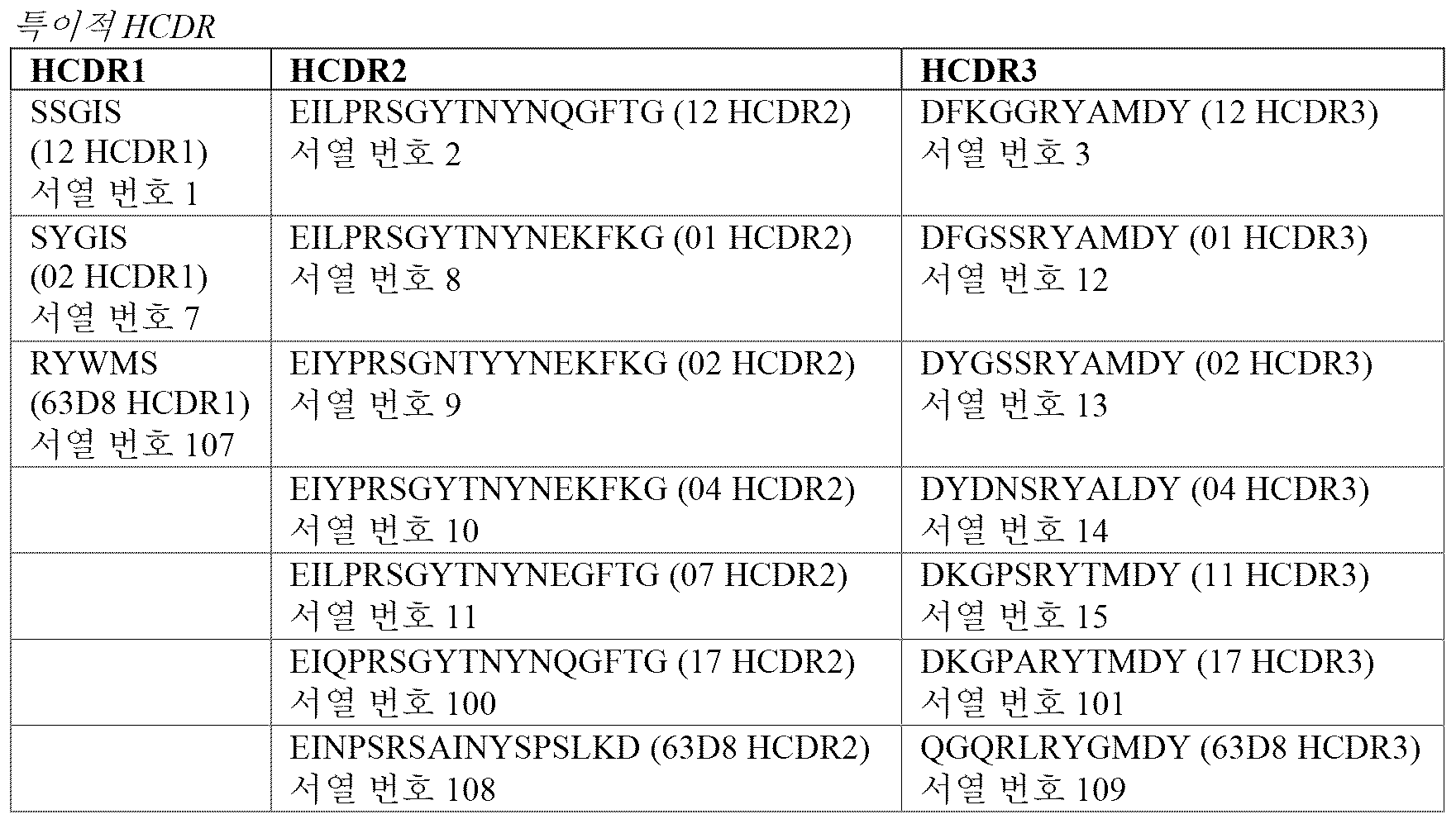
[표 4][Table 4]
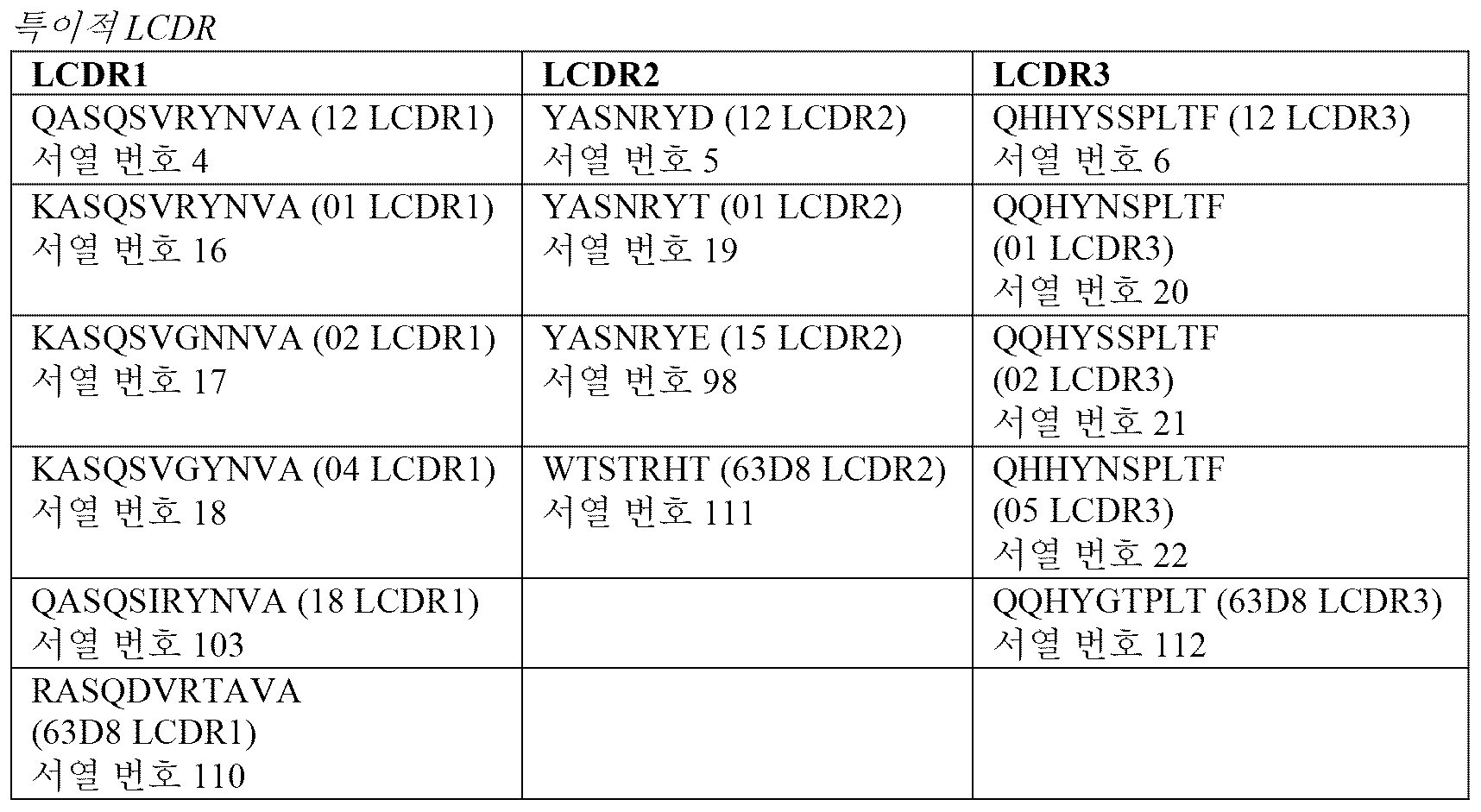
[표 5][Table 5]

폴리펩티드는 3개의 중쇄 CDR(HCDR1 내지 HCDR3)을 포함할 수 있다. 폴리펩티드는 3개의 경쇄 CDR(LCDR1 내지 LCDR3)을 포함할 수 있다. 바람직하게는, 폴리펩티드는 3개의 중쇄 CDR(HCDR1 내지 HCDR3) 및 3개의 경쇄 CDR(LCDR1 내지 LCDR3)을 포함한다.The polypeptide may contain three heavy chain CDRs (HCDR1 to HCDR3). The polypeptide may include three light chain CDRs (LCDR1 to LCDR3). Preferably, the polypeptide comprises three heavy chain CDRs (HCDR1 to HCDR3) and three light chain CDRs (LCDR1 to LCDR3).
폴리펩티드는 서열 번호 1 또는 서열 번호 7과 적어도 40%, 예컨대 적어도 60%, 예컨대 적어도 80% 동일성을 갖는 서열을 포함하는 HCDR1을 포함할 수 있다. 폴리펩티드는 서열 번호 1 또는 서열 번호 7과 적어도 40%, 예컨대 적어도 60%, 예컨대 적어도 80% 동일성을 갖는 서열로 이루어진 HCDR1을 포함할 수 있다. 적합하게는, 폴리펩티드는 서열 번호 1 또는 서열 번호 7을 포함하는 HCDR1을 포함한다. 더 적합하게는, 폴리펩티드는 서열 번호 1 또는 서열 번호 7로 이루어진 HCDR1을 포함한다. 더 적합하게는, 폴리펩티드는 서열 번호 1을 포함하는, 또는 더 적합하게는 서열 번호 1로 이루어진 HCDR1을 포함한다.The polypeptide may comprise HCDR1 comprising a sequence having at least 40%, such as at least 60%, such as at least 80% identity with SEQ ID NO: 1 or SEQ ID NO: 7. The polypeptide may comprise HCDR1 consisting of a sequence having at least 40%, such as at least 60%, such as at least 80% identity with SEQ ID NO: 1 or SEQ ID NO: 7. Suitably, the polypeptide comprises HCDR1 comprising SEQ ID NO:1 or SEQ ID NO:7. More suitably, the polypeptide comprises HCDR1 consisting of SEQ ID NO:1 or SEQ ID NO:7. More suitably, the polypeptide comprises HCDR1 comprising or more suitably consisting of SEQ ID NO:1.
폴리펩티드는 서열 번호 2, 8 내지 11 또는 100 중 어느 하나와 적어도 50%, 예컨대 적어도 60%, 예컨대 적어도 70%, 예컨대 적어도 80%, 예컨대 적어도 85%, 예컨대 적어도 90% 동일성을 갖는 서열을 포함하는 HCDR2를 포함할 수 있다. 폴리펩티드는 서열 번호 2, 8 내지 11 또는 100 중 어느 하나와 적어도 50%, 예컨대 적어도 60%, 예컨대 적어도 70%, 예컨대 적어도 80%, 예컨대 적어도 85%, 예컨대 적어도 90% 동일성을 갖는 서열로 이루어진 HCDR2를 포함할 수 있다. 적합하게는, 폴리펩티드는 서열 번호 2, 8 내지 11 또는 100 중 어느 하나를 포함하는 HCDR2를 포함한다. 더 적합하게는, 폴리펩티드는 서열 번호 2, 8 내지 11 또는 100 중 어느 하나로 이루어진 HCDR2, 예컨대 서열 번호 2를 포함하는, 또는 더 적합하게는, 서열 번호 2로 이루어진 HCDR2를 포함한다.The polypeptide comprises a sequence having at least 50%, such as at least 60%, such as at least 70%, such as at least 80%, such as at least 85%, such as at least 90% identity with any one of SEQ ID NOs: 2, 8 to 11 or 100. May include HCDR2. The polypeptide is HCDR2 consisting of a sequence having at least 50%, such as at least 60%, such as at least 70%, such as at least 80%, such as at least 85%, such as at least 90% identity with any one of SEQ ID NOs: 2, 8 to 11 or 100 may include. Suitably, the polypeptide comprises HCDR2 comprising any of SEQ ID NOs: 2, 8-11 or 100. More suitably, the polypeptide comprises HCDR2 consisting of any of SEQ ID NO:2, 8 to 11 or 100, such as comprising SEQ ID NO:2, or more suitably, HCDR2 consisting of SEQ ID NO:2.
폴리펩티드는 서열 번호 3, 12 내지 15 또는 101 중 어느 하나와 적어도 60%, 예컨대 적어도 70%, 예컨대 적어도 80%, 예컨대 적어도 90% 동일성을 갖는 서열을 포함하는 HCDR3을 포함할 수 있다. 폴리펩티드는 서열 번호 3, 12 내지 15 또는 101 중 어느 하나와 적어도 60%, 예컨대 적어도 70%, 예컨대 적어도 80%, 예컨대 적어도 90% 동일성을 갖는 서열로 이루어진 HCDR3을 포함할 수 있다. 적합하게는, 폴리펩티드는 서열 번호 3, 12 내지 15 또는 101 중 어느 하나를 포함하는 HCDR3을 포함한다. 더 적합하게는, 폴리펩티드는 서열 번호 3, 12 내지 15 또는 101 중 어느 하나로 이루어진 HCDR3을 포함한다. 더 적합하게는, 폴리펩티드는 서열 번호 3을 포함하는 HCDR3, 예컨대 서열 번호 3으로 이루어진 HCDR3을 포함한다. 대안적으로, 폴리펩티드는 서열 번호 15를 포함하는, 예컨대 서열 번호 15로 이루어진 HCDR3을 포함한다. 대안적으로, 폴리펩티드는 서열 번호 101을 포함하는, 예컨대 서열 번호 101로 이루어진 HCDR3을 포함한다.The polypeptide may comprise HCDR3 comprising a sequence having at least 60%, such as at least 70%, such as at least 80%, such as at least 90% identity with any of SEQ ID NOs: 3, 12-15 or 101. The polypeptide may comprise HCDR3 consisting of a sequence having at least 60%, such as at least 70%, such as at least 80%, such as at least 90% identity with any of SEQ ID NOs: 3, 12-15 or 101. Suitably, the polypeptide comprises HCDR3 comprising any of SEQ ID NOs: 3, 12-15 or 101. More suitably, the polypeptide comprises HCDR3 consisting of any of SEQ ID NOs: 3, 12-15 or 101. More suitably, the polypeptide comprises HCDR3 comprising SEQ ID NO:3, such as HCDR3 consisting of SEQ ID NO:3. Alternatively, the polypeptide comprises SEQ ID NO:15, such as HCDR3 consisting of SEQ ID NO:15. Alternatively, the polypeptide comprises SEQ ID NO:101, such as HCDR3 consisting of SEQ ID NO:101.
폴리펩티드는 서열 번호 4, 16 내지 18 또는 103 중 어느 하나와 적어도 60%, 예컨대 적어도 70%, 예컨대 적어도 80%, 예컨대 적어도 90% 동일성을 갖는 서열을 포함하는 LCDR1을 포함할 수 있다. 폴리펩티드는 서열 번호 4, 16 내지 18 또는 103 중 어느 하나와 적어도 60%, 예컨대 적어도 70%, 예컨대 적어도 80%, 예컨대 적어도 90% 동일성을 갖는 서열로 이루어진 LCDR1을 포함할 수 있다. 적합하게는, 폴리펩티드는 서열 번호 4, 16 내지 18 또는 103 중 어느 하나를 포함하는 LCDR1을 포함한다. 더 적합하게는, 폴리펩티드는 서열 번호 4, 16 내지 18 또는 103 중 어느 하나로 이루어진 LCDR1을 포함한다. 더 적합하게는, 폴리펩티드는 서열 번호 4를 포함하는, 또는 더 적합하게는 서열 번호 4로 이루어진 LCDR1을 포함한다. 더 적합하게는, 폴리펩티드는 서열 번호 103을 포함하는, 또는 더 적합하게는 서열 번호 103으로 이루어진 LCDR1을 포함한다.The polypeptide may comprise LCDR1 comprising a sequence having at least 60%, such as at least 70%, such as at least 80%, such as at least 90% identity with any of SEQ ID NOs: 4, 16-18 or 103. The polypeptide may comprise LCDR1 consisting of a sequence having at least 60%, such as at least 70%, such as at least 80%, such as at least 90% identity with any of SEQ ID NOs: 4, 16-18 or 103. Suitably, the polypeptide comprises LCDR1 comprising any of SEQ ID NOs: 4, 16-18 or 103. More suitably, the polypeptide comprises LCDR1 consisting of any of SEQ ID NOs: 4, 16-18 or 103. More suitably, the polypeptide comprises LCDR1 comprising or more suitably consisting of SEQ ID NO:4. More suitably, the polypeptide comprises LCDR1 comprising or more suitably consisting of SEQ ID NO:103.
폴리펩티드는 서열 번호 5, 19 또는 98과 적어도 50% 동일성, 예컨대 적어도 60%, 예컨대 적어도 70%, 예컨대 적어도 80% 동일성을 갖는 서열을 포함하는 LCDR2를 포함할 수 있다. 폴리펩티드는 서열 번호 5, 19 또는 98과 적어도 50% 동일성, 예컨대 적어도 60%, 예컨대 적어도 70%, 예컨대 적어도 80% 동일성을 갖는 서열로 이루어진 LCDR2를 포함할 수 있다. 적합하게는, 폴리펩티드는 서열 번호 5, 19 또는 98을 포함하는 LCDR2를 포함한다. 더 적합하게는, 폴리펩티드는 서열 번호 5, 19 또는 98로 이루어진 LCDR2를 포함한다. 더 적합하게는, 폴리펩티드는 서열 번호 5를 포함하는, 더 적합하게는 서열 번호 5로 이루어진 LCDR2를 포함한다.The polypeptide may comprise LCDR2 comprising a sequence having at least 50% identity, such as at least 60%, such as at least 70%, such as at least 80% identity, to SEQ ID NO:5, 19 or 98. The polypeptide may comprise LCDR2 consisting of a sequence having at least 50% identity, such as at least 60%, such as at least 70%, such as at least 80% identity, to SEQ ID NO:5, 19 or 98. Suitably, the polypeptide comprises LCDR2 comprising SEQ ID NO:5, 19 or 98. More suitably, the polypeptide comprises LCDR2 consisting of SEQ ID NO:5, 19 or 98. More suitably, the polypeptide comprises LCDR2 comprising SEQ ID NO:5, more suitably consisting of SEQ ID NO:5.
폴리펩티드는 서열 번호 6 또는 20 내지 22 중 어느 하나와 적어도 50%, 예컨대 적어도 60%, 예컨대 적어도 70%, 예컨대 적어도 80% 동일성을 갖는 서열을 포함하는 LCDR3을 포함할 수 있다. 폴리펩티드는 서열 번호 6 또는 20 내지 22 중 어느 하나와 적어도 50%, 예컨대 적어도 60%, 예컨대 적어도 70%, 예컨대 적어도 80% 동일성을 갖는 서열로 이루어진 LCDR3을 포함할 수 있다. 더 적합하게는, 폴리펩티드는 서열 번호 6 또는 20 내지 22 중 어느 하나를 포함하는 LCDR3을 포함한다. 더 적합하게는, 폴리펩티드는 서열 번호 6 또는 20 내지 22 중 어느 하나로 이루어진 LCDR3을 포함하며, 더 적합하게는, 폴리펩티드는 서열 번호 6을 포함하는, 더 적합하게는, 서열 번호 6으로 이루어진 LCDR3을 포함한다.The polypeptide may comprise an LCDR3 comprising a sequence having at least 50%, such as at least 60%, such as at least 70%, such as at least 80% identity with either SEQ ID NO:6 or any of 20-22. The polypeptide may comprise LCDR3 consisting of a sequence having at least 50%, such as at least 60%, such as at least 70%, such as at least 80% identity with either SEQ ID NO:6 or any of 20-22. More suitably, the polypeptide comprises LCDR3 comprising any of SEQ ID NO:6 or 20-22. More suitably, the polypeptide comprises an LCDR3 consisting of SEQ ID NO:6 or any of 20 to 22, more suitably the polypeptide comprises an LCDR3 consisting of SEQ ID NO:6, more suitably the polypeptide comprises an LCDR3 consisting of SEQ ID NO:6. do.
대안적으로, 폴리펩티드는 서열 번호 107과 적어도 40%, 예컨대 적어도 60%, 예컨대 적어도 80%, 예컨대 100% 동일성을 갖는 서열을 포함하는, 예컨대 이로 이루어진 HCDR1을 포함할 수 있다. 적합하게는, 폴리펩티드는 서열 번호 108과 적어도 50%, 예컨대 적어도 60%, 예컨대 적어도 70%, 예컨대 적어도 80%, 예컨대 적어도 85%, 예컨대 적어도 90%, 예컨대 100% 동일성을 갖는 서열을 포함하는, 예컨대 이로 이루어진 HCDR2를 포함한다. 적합하게는, 폴리펩티드는 서열 번호 109와 적어도 60%, 예컨대 적어도 70%, 예컨대 적어도 80%, 예컨대 적어도 90%, 예컨대 100% 동일성을 갖는 서열을 포함하는, 예컨대 이로 이루어진 HCDR3을 포함한다. 적합하게는, 폴리펩티드는 서열 번호 110과 적어도 60%, 예컨대 적어도 70%, 예컨대 적어도 80%, 예컨대 적어도 90%, 예컨대 100% 동일성을 갖는 서열을 포함하는, 예컨대 이로 이루어진 LCDR1을 포함한다. 적합하게는, 폴리펩티드는 서열 번호 111과 적어도 50%, 예컨대 적어도 60% 동일성, 예컨대 적어도 70%, 예컨대 적어도 80% 동일성, 예컨대 100% 동일성을 갖는 서열을 포함하는, 예컨대 이로 이루어진 LCDR2를 포함한다. 적합하게는, 폴리펩티드는 서열 번호 112와 적어도 50%, 예컨대 적어도 60%, 예컨대 적어도 70%, 예컨대 적어도 80%, 예컨대 100% 동일성을 갖는 서열을 포함하는, 예컨대 이로 이루어진 LCDR3을 포함한다.Alternatively, the polypeptide may comprise HCDR1 comprising, such as consisting of, a sequence having at least 40%, such as at least 60%, such as at least 80%, such as 100% identity with SEQ ID NO:107. Suitably, the polypeptide comprises a sequence having at least 50%, such as at least 60%, such as at least 70%, such as at least 80%, such as at least 85%, such as at least 90%, such as 100% identity, For example, it includes HCDR2 consisting of this. Suitably, the polypeptide comprises, e.g. consists of, a HCDR3 comprising a sequence having at least 60%, such as at least 70%, such as at least 80%, such as at least 90%, such as 100% identity to SEQ ID NO:109. Suitably, the polypeptide includes LCDR1 comprising, such as consisting of, a sequence having at least 60%, such as at least 70%, such as at least 80%, such as at least 90%, such as 100% identity to SEQ ID NO:110. Suitably, the polypeptide comprises, e.g., consists of, a sequence having at least 50%, such as at least 60% identity, such as at least 70%, such as at least 80% identity, such as 100% identity, with SEQ ID NO:111. Suitably, the polypeptide comprises, for example consists of, a sequence having at least 50%, such as at least 60%, such as at least 70%, such as at least 80%, such as 100% identity with SEQ ID NO:112.
일 실시 형태에서, 폴리펩티드는In one embodiment, the polypeptide is
(a) 서열 번호 1을 포함하는 HCDR1, 서열 번호 2를 포함하는 HCDR2, 서열 번호 3을 포함하는 HCDR3, 서열 번호 4를 포함하는 LCDR1, 서열 번호 5를 포함하는 LCDR2 및 서열 번호 6을 포함하는 LCDR3;(a) HCDR1 comprising SEQ ID NO: 1, HCDR2 comprising SEQ ID NO: 2, HCDR3 comprising SEQ ID NO: 3, LCDR1 comprising SEQ ID NO: 4, LCDR2 comprising SEQ ID NO: 5 and LCDR3 comprising SEQ ID NO: 6 ;
(b) 서열 번호 1을 포함하는 HCDR1, 서열 번호 8을 포함하는 HCDR2, 서열 번호 12를 포함하는 HCDR3, 서열 번호 16을 포함하는 LCDR1, 서열 번호 19를 포함하는 LCDR2 및 서열 번호 20을 포함하는 LCDR3;(b) HCDR1 comprising SEQ ID NO: 1, HCDR2 comprising SEQ ID NO: 8, HCDR3 comprising SEQ ID NO: 12, LCDR1 comprising SEQ ID NO: 16, LCDR2 comprising SEQ ID NO: 19 and LCDR3 comprising SEQ ID NO: 20 ;
(c) 서열 번호 7을 포함하는 HCDR1, 서열 번호 9를 포함하는 HCDR2, 서열 번호 13을 포함하는 HCDR3, 서열 번호 17을 포함하는 LCDR1, 서열 번호 19를 포함하는 LCDR2 및 서열 번호 21을 포함하는 LCDR3;(c) HCDR1 comprising SEQ ID NO:7, HCDR2 comprising SEQ ID NO:9, HCDR3 comprising SEQ ID NO:13, LCDR1 comprising SEQ ID NO:17, LCDR2 comprising SEQ ID NO:19 and LCDR3 comprising SEQ ID NO:21 ;
(d) 서열 번호 1을 포함하는 HCDR1, 서열 번호 10을 포함하는 HCDR2, 서열 번호 14를 포함하는 HCDR3, 서열 번호 18을 포함하는 LCDR1, 서열 번호 19를 포함하는 LCDR2 및 서열 번호 6을 포함하는 LCDR3;(d) HCDR1 comprising SEQ ID NO: 1, HCDR2 comprising SEQ ID NO: 10, HCDR3 comprising SEQ ID NO: 14, LCDR1 comprising SEQ ID NO: 18, LCDR2 comprising SEQ ID NO: 19 and LCDR3 comprising SEQ ID NO: 6 ;
(e) 서열 번호 1을 포함하는 HCDR1, 서열 번호 8을 포함하는 HCDR2, 서열 번호 12를 포함하는 HCDR3, 서열 번호 16을 포함하는 LCDR1, 서열 번호 19를 포함하는 LCDR2 및 서열 번호 22를 포함하는 LCDR3;(e) HCDR1 comprising SEQ ID NO: 1, HCDR2 comprising SEQ ID NO: 8, HCDR3 comprising SEQ ID NO: 12, LCDR1 comprising SEQ ID NO: 16, LCDR2 comprising SEQ ID NO: 19 and LCDR3 comprising SEQ ID NO: 22 ;
(f) 서열 번호 1을 포함하는 HCDR1, 서열 번호 8을 포함하는 HCDR2, 서열 번호 12를 포함하는 HCDR3, 서열 번호 16을 포함하는 LCDR1, 서열 번호 19를 포함하는 LCDR2 및 서열 번호 6을 포함하는 LCDR3;(f) HCDR1 comprising SEQ ID NO: 1, HCDR2 comprising SEQ ID NO: 8, HCDR3 comprising SEQ ID NO: 12, LCDR1 comprising SEQ ID NO: 16, LCDR2 comprising SEQ ID NO: 19 and LCDR3 comprising SEQ ID NO: 6 ;
(g) 서열 번호 1을 포함하는 HCDR1, 서열 번호 11을 포함하는 HCDR2, 서열 번호 12를 포함하는 HCDR3, 서열 번호 4를 포함하는 LCDR1, 서열 번호 19를 포함하는 LCDR2 및 서열 번호 20을 포함하는 LCDR3;(g) HCDR1 comprising SEQ ID NO: 1, HCDR2 comprising SEQ ID NO: 11, HCDR3 comprising SEQ ID NO: 12, LCDR1 comprising SEQ ID NO: 4, LCDR2 comprising SEQ ID NO: 19 and LCDR3 comprising SEQ ID NO: 20 ;
(h) 서열 번호 1을 포함하는 HCDR1, 서열 번호 11을 포함하는 HCDR2, 서열 번호 12를 포함하는 HCDR3, 서열 번호 4를 포함하는 LCDR1, 서열 번호 19를 포함하는 LCDR2 및 서열 번호 6을 포함하는 LCDR3;(h) HCDR1 comprising SEQ ID NO: 1, HCDR2 comprising SEQ ID NO: 11, HCDR3 comprising SEQ ID NO: 12, LCDR1 comprising SEQ ID NO: 4, LCDR2 comprising SEQ ID NO: 19 and LCDR3 comprising SEQ ID NO: 6 ;
(i) 서열 번호 1을 포함하는 HCDR1, 서열 번호 2를 포함하는 HCDR2, 서열 번호 12를 포함하는 HCDR3, 서열 번호 4를 포함하는 LCDR1, 서열 번호 19를 포함하는 LCDR2 및 서열 번호 6을 포함하는 LCDR3;(i) HCDR1 comprising SEQ ID NO: 1, HCDR2 comprising SEQ ID NO: 2, HCDR3 comprising SEQ ID NO: 12, LCDR1 comprising SEQ ID NO: 4, LCDR2 comprising SEQ ID NO: 19 and LCDR3 comprising SEQ ID NO: 6 ;
(j) 서열 번호 1을 포함하는 HCDR1, 서열 번호 2를 포함하는 HCDR2, 서열 번호 3을 포함하는 HCDR3, 서열 번호 4를 포함하는 LCDR1, 서열 번호 19를 포함하는 LCDR2 및 서열 번호 6을 포함하는 LCDR3;(j) HCDR1 comprising SEQ ID NO: 1, HCDR2 comprising SEQ ID NO: 2, HCDR3 comprising SEQ ID NO: 3, LCDR1 comprising SEQ ID NO: 4, LCDR2 comprising SEQ ID NO: 19 and LCDR3 comprising SEQ ID NO: 6 ;
(k) 서열 번호 1을 포함하는 HCDR1, 서열 번호 2를 포함하는 HCDR2, 서열 번호 15를 포함하는 HCDR3, 서열 번호 4를 포함하는 LCDR1, 서열 번호 19를 포함하는 LCDR2 및 서열 번호 6을 포함하는 LCDR3;(k) HCDR1 comprising SEQ ID NO: 1, HCDR2 comprising SEQ ID NO: 2, HCDR3 comprising SEQ ID NO: 15, LCDR1 comprising SEQ ID NO: 4, LCDR2 comprising SEQ ID NO: 19 and LCDR3 comprising SEQ ID NO: 6 ;
(l) 서열 번호 1을 포함하는 HCDR1, 서열 번호 2를 포함하는 HCDR2, 서열 번호 15를 포함하는 HCDR3, 서열 번호 4를 포함하는 LCDR1, 서열 번호 5를 포함하는 LCDR2 및 서열 번호 6을 포함하는 LCDR3;(l) HCDR1 comprising SEQ ID NO: 1, HCDR2 comprising SEQ ID NO: 2, HCDR3 comprising SEQ ID NO: 15, LCDR1 comprising SEQ ID NO: 4, LCDR2 comprising SEQ ID NO: 5 and LCDR3 comprising SEQ ID NO: 6 ;
(m) 서열 번호 1을 포함하는 HCDR1, 서열 번호 2를 포함하는 HCDR2, 서열 번호 3을 포함하는 HCDR3, 서열 번호 4를 포함하는 LCDR1, 서열 번호 98을 포함하는 LCDR2 및 서열 번호 6을 포함하는 LCDR3;(m) HCDR1 comprising SEQ ID NO: 1, HCDR2 comprising SEQ ID NO: 2, HCDR3 comprising SEQ ID NO: 3, LCDR1 comprising SEQ ID NO: 4, LCDR2 comprising SEQ ID NO: 98 and LCDR3 comprising SEQ ID NO: 6 ;
(n) 서열 번호 1을 포함하는 HCDR1, 서열 번호 100을 포함하는 HCDR2, 서열 번호 101을 포함하는 HCDR3, 서열 번호 4를 포함하는 LCDR1, 서열 번호 98을 포함하는 LCDR2 및 서열 번호 6을 포함하는 LCDR3; 또는(n) HCDR1 comprising SEQ ID NO: 1, HCDR2 comprising SEQ ID NO: 100, HCDR3 comprising SEQ ID NO: 101, LCDR1 comprising SEQ ID NO: 4, LCDR2 comprising SEQ ID NO: 98 and LCDR3 comprising SEQ ID NO: 6 ; or
(o) 서열 번호 1을 포함하는 HCDR1, 서열 번호 100을 포함하는 HCDR2, 서열 번호 101을 포함하는 HCDR3, 서열 번호 103을 포함하는 LCDR1, 서열 번호 98을 포함하는 LCDR2 및 서열 번호 6을 포함하는 LCDR3을 포함한다.(o) HCDR1 comprising SEQ ID NO: 1, HCDR2 comprising SEQ ID NO: 100, HCDR3 comprising SEQ ID NO: 101, LCDR1 comprising SEQ ID NO: 103, LCDR2 comprising SEQ ID NO: 98 and LCDR3 comprising SEQ ID NO: 6 Includes.
더 적합하게는, 폴리펩티드는More suitably, the polypeptide is
(a) 서열 번호 1로 이루어진 HCDR1, 서열 번호 2로 이루어진 HCDR2, 서열 번호 3으로 이루어진 HCDR3, 서열 번호 4로 이루어진 LCDR1, 서열 번호 5로 이루어진 LCDR2 및 서열 번호 6으로 이루어진 LCDR3;(a) HCDR1 consisting of SEQ ID NO: 1, HCDR2 consisting of SEQ ID NO: 2, HCDR3 consisting of SEQ ID NO: 3, LCDR1 consisting of SEQ ID NO: 4, LCDR2 consisting of SEQ ID NO: 5 and LCDR3 consisting of SEQ ID NO: 6;
(b) 서열 번호 1로 이루어진 HCDR1, 서열 번호 8로 이루어진 HCDR2, 서열 번호 12로 이루어진 HCDR3, 서열 번호 16으로 이루어진 LCDR1, 서열 번호 19로 이루어진 LCDR2 및 서열 번호 20으로 이루어진 LCDR3;(b) HCDR1 consisting of SEQ ID NO: 1, HCDR2 consisting of SEQ ID NO: 8, HCDR3 consisting of SEQ ID NO: 12, LCDR1 consisting of SEQ ID NO: 16, LCDR2 consisting of SEQ ID NO: 19 and LCDR3 consisting of SEQ ID NO: 20;
(c) 서열 번호 7로 이루어진 HCDR1, 서열 번호 9로 이루어진 HCDR2, 서열 번호 13으로 이루어진 HCDR3, 서열 번호 17로 이루어진 LCDR1, 서열 번호 19로 이루어진 LCDR2 및 서열 번호 21로 이루어진 LCDR3;(c) HCDR1 consisting of SEQ ID NO: 7, HCDR2 consisting of SEQ ID NO: 9, HCDR3 consisting of SEQ ID NO: 13, LCDR1 consisting of SEQ ID NO: 17, LCDR2 consisting of SEQ ID NO: 19 and LCDR3 consisting of SEQ ID NO: 21;
(d) 서열 번호 1로 이루어진 HCDR1, 서열 번호 10으로 이루어진 HCDR2, 서열 번호 14로 이루어진 HCDR3, 서열 번호 18로 이루어진 LCDR1, 서열 번호 19로 이루어진 LCDR2 및 서열 번호 6으로 이루어진 LCDR3;(d) HCDR1 consisting of SEQ ID NO: 1, HCDR2 consisting of SEQ ID NO: 10, HCDR3 consisting of SEQ ID NO: 14, LCDR1 consisting of SEQ ID NO: 18, LCDR2 consisting of SEQ ID NO: 19 and LCDR3 consisting of SEQ ID NO: 6;
(e) 서열 번호 1로 이루어진 HCDR1, 서열 번호 8로 이루어진 HCDR2, 서열 번호 12로 이루어진 HCDR3, 서열 번호 16으로 이루어진 LCDR1, 서열 번호 19로 이루어진 LCDR2 및 서열 번호 22로 이루어진 LCDR3;(e) HCDR1 consisting of SEQ ID NO: 1, HCDR2 consisting of SEQ ID NO: 8, HCDR3 consisting of SEQ ID NO: 12, LCDR1 consisting of SEQ ID NO: 16, LCDR2 consisting of SEQ ID NO: 19 and LCDR3 consisting of SEQ ID NO: 22;
(f) 서열 번호 1로 이루어진 HCDR1, 서열 번호 8로 이루어진 HCDR2, 서열 번호 12로 이루어진 HCDR3, 서열 번호 16으로 이루어진 LCDR1, 서열 번호 19로 이루어진 LCDR2 및 서열 번호 6으로 이루어진 LCDR3;(f) HCDR1 consisting of SEQ ID NO: 1, HCDR2 consisting of SEQ ID NO: 8, HCDR3 consisting of SEQ ID NO: 12, LCDR1 consisting of SEQ ID NO: 16, LCDR2 consisting of SEQ ID NO: 19 and LCDR3 consisting of SEQ ID NO: 6;
(g) 서열 번호 1로 이루어진 HCDR1, 서열 번호 11로 이루어진 HCDR2, 서열 번호 12로 이루어진 HCDR3, 서열 번호 4로 이루어진 LCDR1, 서열 번호 19로 이루어진 LCDR2 및 서열 번호 20으로 이루어진 LCDR3;(g) HCDR1 consisting of SEQ ID NO: 1, HCDR2 consisting of SEQ ID NO: 11, HCDR3 consisting of SEQ ID NO: 12, LCDR1 consisting of SEQ ID NO: 4, LCDR2 consisting of SEQ ID NO: 19 and LCDR3 consisting of SEQ ID NO: 20;
(h) 서열 번호 1로 이루어진 HCDR1, 서열 번호 11로 이루어진 HCDR2, 서열 번호 12로 이루어진 HCDR3, 서열 번호 4로 이루어진 LCDR1, 서열 번호 19로 이루어진 LCDR2 및 서열 번호 6으로 이루어진 LCDR3;(h) HCDR1 consisting of SEQ ID NO: 1, HCDR2 consisting of SEQ ID NO: 11, HCDR3 consisting of SEQ ID NO: 12, LCDR1 consisting of SEQ ID NO: 4, LCDR2 consisting of SEQ ID NO: 19 and LCDR3 consisting of SEQ ID NO: 6;
(i) 서열 번호 1로 이루어진 HCDR1, 서열 번호 2로 이루어진 HCDR2, 서열 번호 12로 이루어진 HCDR3, 서열 번호 4로 이루어진 LCDR1, 서열 번호 19로 이루어진 LCDR2 및 서열 번호 6으로 이루어진 LCDR3;(i) HCDR1 consisting of SEQ ID NO: 1, HCDR2 consisting of SEQ ID NO: 2, HCDR3 consisting of SEQ ID NO: 12, LCDR1 consisting of SEQ ID NO: 4, LCDR2 consisting of SEQ ID NO: 19 and LCDR3 consisting of SEQ ID NO: 6;
(j) 서열 번호 1로 이루어진 HCDR1, 서열 번호 2로 이루어진 HCDR2, 서열 번호 3으로 이루어진 HCDR3, 서열 번호 4로 이루어진 LCDR1, 서열 번호 19로 이루어진 LCDR2 및 서열 번호 6으로 이루어진 LCDR3;(j) HCDR1 consisting of SEQ ID NO: 1, HCDR2 consisting of SEQ ID NO: 2, HCDR3 consisting of SEQ ID NO: 3, LCDR1 consisting of SEQ ID NO: 4, LCDR2 consisting of SEQ ID NO: 19 and LCDR3 consisting of SEQ ID NO: 6;
(k) 서열 번호 1로 이루어진 HCDR1, 서열 번호 2로 이루어진 HCDR2, 서열 번호 15로 이루어진 HCDR3, 서열 번호 4로 이루어진 LCDR1, 서열 번호 19로 이루어진 LCDR2 및 서열 번호 6으로 이루어진 LCDR3;(k) HCDR1 consisting of SEQ ID NO: 1, HCDR2 consisting of SEQ ID NO: 2, HCDR3 consisting of SEQ ID NO: 15, LCDR1 consisting of SEQ ID NO: 4, LCDR2 consisting of SEQ ID NO: 19 and LCDR3 consisting of SEQ ID NO: 6;
(l) 서열 번호 1로 이루어진 HCDR1, 서열 번호 2로 이루어진 HCDR2, 서열 번호 15로 이루어진 HCDR3, 서열 번호 4로 이루어진 LCDR1, 서열 번호 5로 이루어진 LCDR2 및 서열 번호 6으로 이루어진 LCDR3;(l) HCDR1 consisting of SEQ ID NO: 1, HCDR2 consisting of SEQ ID NO: 2, HCDR3 consisting of SEQ ID NO: 15, LCDR1 consisting of SEQ ID NO: 4, LCDR2 consisting of SEQ ID NO: 5 and LCDR3 consisting of SEQ ID NO: 6;
(m) 서열 번호 1로 이루어진 HCDR1, 서열 번호 2로 이루어진 HCDR2, 서열 번호 3으로 이루어진 HCDR3, 서열 번호 4로 이루어진 LCDR1, 서열 번호 98로 이루어진 LCDR2 및 서열 번호 6으로 이루어진 LCDR3;(m) HCDR1 consisting of SEQ ID NO: 1, HCDR2 consisting of SEQ ID NO: 2, HCDR3 consisting of SEQ ID NO: 3, LCDR1 consisting of SEQ ID NO: 4, LCDR2 consisting of SEQ ID NO: 98 and LCDR3 consisting of SEQ ID NO: 6;
(n) 서열 번호 1로 이루어진 HCDR1, 서열 번호 100으로 이루어진 HCDR2, 서열 번호 101로 이루어진 HCDR3, 서열 번호 4로 이루어진 LCDR1, 서열 번호 98로 이루어진 LCDR2 및 서열 번호 6으로 이루어진 LCDR3; 또는(n) HCDR1 consisting of SEQ ID NO: 1, HCDR2 consisting of SEQ ID NO: 100, HCDR3 consisting of SEQ ID NO: 101, LCDR1 consisting of SEQ ID NO: 4, LCDR2 consisting of SEQ ID NO: 98 and LCDR3 consisting of SEQ ID NO: 6; or
(o) 서열 번호 1로 이루어진 HCDR1, 서열 번호 100으로 이루어진 HCDR2, 서열 번호 101로 이루어진 HCDR3, 서열 번호 103으로 이루어진 LCDR1, 서열 번호 98로 이루어진 LCDR2 및 서열 번호 6으로 이루어진 LCDR3을 포함한다.(o) HCDR1 consisting of SEQ ID NO: 1, HCDR2 consisting of SEQ ID NO: 100, HCDR3 consisting of SEQ ID NO: 101, LCDR1 consisting of SEQ ID NO: 103, LCDR2 consisting of SEQ ID NO: 98, and LCDR3 consisting of SEQ ID NO: 6.
폴리펩티드는 4개의 중쇄 프레임워크 영역(HFR1 내지 HFR4)을 포함할 수 있다.The polypeptide may comprise four heavy chain framework regions (HFR1 to HFR4).
폴리펩티드는 서열 번호 40과 적어도 50%, 예컨대 적어도 60%, 예컨대 적어도 70%, 예컨대 적어도 80%, 예컨대 적어도 90% 동일성을 갖는 서열을 포함하거나 이로 이루어진 HFR1, 서열 번호 41과 적어도 50%, 예컨대 적어도 60%, 예컨대 적어도 70%, 예컨대 적어도 80%, 예컨대 적어도 90% 동일성을 갖는 서열을 포함하거나 이로 이루어진 HFR2, 서열 번호 42와 적어도 50%, 예컨대 적어도 60%, 예컨대 적어도 70%, 예컨대 적어도 80%, 예컨대 적어도 90% 동일성을 갖는 서열을 포함하거나 이로 이루어진 HFR3, 및/또는 서열 번호 43과 적어도 50%, 예컨대 적어도 60%, 예컨대 적어도 70%, 예컨대 적어도 80%, 예컨대 적어도 90% 동일성을 갖는 서열을 포함하거나 이로 이루어진 HFR4를 포함할 수 있다. 적합하게는, 폴리펩티드는 서열 번호 40을 포함하는 HFR1, 서열 번호 41을 포함하는 HFR2, 서열 번호 42를 포함하는 HFR3 및/또는 서열 번호 43을 포함하는 HFR4를 포함한다. 더 적합하게는, 폴리펩티드는 서열 번호 40으로 이루어진 HFR1, 서열 번호 41로 이루어진 HFR2, 서열 번호 42로 이루어진 HFR3 및/또는 서열 번호 43으로 이루어진 HFR4를 포함한다.The polypeptide comprises or consists of a sequence having at least 50%, such as at least 60%, such as at least 70%, such as at least 80%, such as at least 90% identity to SEQ ID NO: 40, HFR1, at least 50%, such as at least HFR2 comprising or consisting of a sequence having 60%, such as at least 70%, such as at least 80%, such as at least 90% identity, at least 50%, such as at least 60%, such as at least 70%, such as at least 80% with SEQ ID NO:42 , such as HFR3 comprising or consisting of a sequence having at least 90% identity, and/or a sequence having at least 50%, such as at least 60%, such as at least 70%, such as at least 80%, such as at least 90% identity with SEQ ID NO:43 It may include HFR4 that includes or consists of. Suitably, the polypeptide comprises HFR1 comprising SEQ ID NO:40, HFR2 comprising SEQ ID NO:41, HFR3 comprising SEQ ID NO:42 and/or HFR4 comprising SEQ ID NO:43. More suitably, the polypeptide comprises HFR1 consisting of SEQ ID NO:40, HFR2 consisting of SEQ ID NO:41, HFR3 consisting of SEQ ID NO:42 and/or HFR4 consisting of SEQ ID NO:43.
대안적으로, 폴리펩티드는 서열 번호 48과 적어도 50%, 예컨대 적어도 60%, 예컨대 적어도 70%, 예컨대 적어도 80%, 예컨대 적어도 90% 동일성을 갖는 서열을 포함하거나 이로 이루어진 HFR1, 서열 번호 49와 적어도 50%, 예컨대 적어도 60%, 예컨대 적어도 70%, 예컨대 적어도 80%, 예컨대 적어도 90% 동일성을 갖는 서열을 포함하거나 이로 이루어진 HFR2, 서열 번호 50과 적어도 50%, 예컨대 적어도 60%, 예컨대 적어도 70%, 예컨대 적어도 80%, 예컨대 적어도 90% 동일성을 갖는 서열을 포함하거나 이로 이루어진 HFR3, 및/또는 서열 번호 51과 적어도 50%, 예컨대 적어도 60%, 예컨대 적어도 70%, 예컨대 적어도 80%, 예컨대 적어도 90% 동일성을 갖는 서열을 포함하거나 이로 이루어진 HFR4를 포함할 수 있다. 적합하게는, 폴리펩티드는 서열 번호 48을 포함하는 HFR1, 서열 번호 49를 포함하는 HFR2, 서열 번호 50을 포함하는 HFR3 및/또는 서열 번호 51을 포함하는 HFR4를 포함한다. 더 적합하게는, 폴리펩티드는 서열 번호 48로 이루어진 HFR1, 서열 번호 49로 이루어진 HFR2, 서열 번호 50으로 이루어진 HFR3 및/또는 서열 번호 51로 이루어진 HFR4를 포함한다.Alternatively, the polypeptide comprises or consists of a sequence having at least 50%, such as at least 60%, such as at least 70%, such as at least 80%, such as at least 90% identity with SEQ ID NO: 48, HFR1, SEQ ID NO: 49 and at least 50 %, such as at least 60%, such as at least 70%, such as at least 80%, such as at least 90% HFR2 comprising or consisting of a sequence with SEQ ID NO:50 and at least 50%, such as at least 60%, such as at least 70%, HFR3 comprising or consisting of a sequence having, for example, at least 80%, such as at least 90% identity, and/or at least 50%, such as at least 60%, such as at least 70%, such as at least 80%, such as at least 90% with SEQ ID NO:51 It may include HFR4 containing or consisting of a sequence having identity. Suitably, the polypeptide comprises HFR1 comprising SEQ ID NO:48, HFR2 comprising SEQ ID NO:49, HFR3 comprising SEQ ID NO:50 and/or HFR4 comprising SEQ ID NO:51. More suitably, the polypeptide comprises HFR1 consisting of SEQ ID NO:48, HFR2 consisting of SEQ ID NO:49, HFR3 consisting of SEQ ID NO:50 and/or HFR4 consisting of SEQ ID NO:51.
폴리펩티드는 4개의 경쇄 프레임워크 영역(LFR1 내지 LFR4)을 포함할 수 있다.The polypeptide may comprise four light chain framework regions (LFR1 to LFR4).
폴리펩티드는 서열 번호 44와 적어도 50%, 예컨대 적어도 60%, 예컨대 적어도 70%, 예컨대 적어도 80%, 예컨대 적어도 90% 동일성을 갖는 서열을 포함하거나 이로 이루어진 LFR1, 서열 번호 45와 적어도 50%, 예컨대 적어도 60%, 예컨대 적어도 70%, 예컨대 적어도 80%, 예컨대 적어도 90% 동일성을 갖는 서열을 포함하거나 이로 이루어진 LFR2, 서열 번호 46과 적어도 50%, 예컨대 적어도 60%, 예컨대 적어도 70%, 예컨대 적어도 80%, 예컨대 적어도 90% 동일성을 갖는 서열을 포함하거나 이로 이루어진 LFR3, 및/또는 서열 번호 47과 적어도 50%, 예컨대 적어도 60%, 예컨대 적어도 70%, 예컨대 적어도 80%, 예컨대 적어도 90% 동일성을 갖는 서열을 포함하거나 이로 이루어진 LFR4를 포함할 수 있다. 적합하게는, 폴리펩티드는 서열 번호 44를 포함하는 LFR1, 서열 번호 45를 포함하는 LFR2, 서열 번호 46을 포함하는 LFR3 및/또는 서열 번호 47을 포함하는 LFR4를 포함한다. 더 적합하게는, 폴리펩티드는 서열 번호 44로 이루어진 LFR1, 서열 번호 45로 이루어진 LFR2, 서열 번호 46으로 이루어진 LFR3 및/또는 서열 번호 47로 이루어진 LFR4를 포함한다.The polypeptide comprises or consists of a sequence having at least 50%, such as at least 60%, such as at least 70%, such as at least 80%, such as at least 90% identity with SEQ ID NO: 44, LFR1, at least 50%, such as at least, with SEQ ID NO: 45 LFR2 comprising or consisting of a sequence having 60%, such as at least 70%, such as at least 80%, such as at least 90% identity, at least 50%, such as at least 60%, such as at least 70%, such as at least 80% with SEQ ID NO:46 , such as LFR3 comprising or consisting of a sequence having at least 90% identity, and/or a sequence having at least 50%, such as at least 60%, such as at least 70%, such as at least 80%, such as at least 90% identity with SEQ ID NO:47 It may include LFR4 which includes or consists of. Suitably, the polypeptide comprises LFR1 comprising SEQ ID NO:44, LFR2 comprising SEQ ID NO:45, LFR3 comprising SEQ ID NO:46 and/or LFR4 comprising SEQ ID NO:47. More suitably, the polypeptide comprises LFR1 consisting of SEQ ID NO:44, LFR2 consisting of SEQ ID NO:45, LFR3 consisting of SEQ ID NO:46 and/or LFR4 consisting of SEQ ID NO:47.
대안적으로, 폴리펩티드는 서열 번호 52와 적어도 50%, 예컨대 적어도 60%, 예컨대 적어도 70%, 예컨대 적어도 80%, 예컨대 적어도 90% 동일성을 갖는 서열을 포함하거나 이로 이루어진 LFR1, 서열 번호 53과 적어도 50%, 예컨대 적어도 60%, 예컨대 적어도 70%, 예컨대 적어도 80%, 예컨대 적어도 90% 동일성을 갖는 서열을 포함하거나 이로 이루어진 LFR2, 서열 번호 54와 적어도 50%, 예컨대 적어도 60%, 예컨대 적어도 70%, 예컨대 적어도 80%, 예컨대 적어도 90% 동일성을 갖는 서열을 포함하거나 이로 이루어진 LFR3, 및/또는 서열 번호 55와 적어도 50%, 예컨대 적어도 60%, 예컨대 적어도 70%, 예컨대 적어도 80%, 예컨대 적어도 90% 동일성을 갖는 서열을 포함하거나 이로 이루어진 LFR4를 포함할 수 있다. 적합하게는, 폴리펩티드는 서열 번호 52를 포함하는 LFR1, 서열 번호 53을 포함하는 LFR2, 서열 번호 54를 포함하는 LFR3 및/또는 서열 번호 55를 포함하는 LFR4를 포함한다. 더 적합하게는, 폴리펩티드는 서열 번호 52로 이루어진 LFR1, 서열 번호 53으로 이루어진 LFR2, 서열 번호 54로 이루어진 LFR3 및/또는 서열 번호 55로 이루어진 LFR4를 포함한다.Alternatively, the polypeptide comprises or consists of a sequence having at least 50%, such as at least 60%, such as at least 70%, such as at least 80%, such as at least 90% identity with SEQ ID NO:52, LFR1, SEQ ID NO:53 and at least 50 %, such as at least 60%, such as at least 70%, such as at least 80%, such as at least 90% LFR2, comprising or consisting of a sequence with SEQ ID NO: 54 and at least 50%, such as at least 60%, such as at least 70%, LFR3 comprising or consisting of a sequence having, for example, at least 80%, such as at least 90% identity, and/or at least 50%, such as at least 60%, such as at least 70%, such as at least 80%, such as at least 90% with SEQ ID NO:55 It may include LFR4, which includes or consists of a sequence having identity. Suitably, the polypeptide comprises LFR1 comprising SEQ ID NO:52, LFR2 comprising SEQ ID NO:53, LFR3 comprising SEQ ID NO:54 and/or LFR4 comprising SEQ ID NO:55. More suitably, the polypeptide comprises LFR1 consisting of SEQ ID NO:52, LFR2 consisting of SEQ ID NO:53, LFR3 consisting of SEQ ID NO:54 and/or LFR4 consisting of SEQ ID NO:55.
본 발명의 폴리펩티드는 그들의 VH 및 VL 영역 서열을 참조하여 기재될 수 있다. 폴리펩티드는 VH 영역 및/또는 VL 영역, 가장 적합하게는 VH 영역 및 VL 영역을 포함할 수 있다.Polypeptides of the invention may be described with reference to their VH and VL region sequences. The polypeptide may comprise a VH region and/or a VL region, most suitably a VH region and a VL region.
본 발명에 의해 제공된 특이적 폴리펩티드 및 그들의 VH 및 VL 영역 서열은 하기를 포함한다:Specific polypeptides provided by the present invention and their VH and VL region sequences include:
[표 6][Table 6]

VH 영역은 서열 번호 23, 25, 27, 29, 33, 35, 36, 37, 96 또는 102 중 어느 하나와 적어도 60%, 예컨대 적어도 70%, 예컨대 적어도 80%, 예컨대 적어도 90%, 예컨대 적어도 95%, 예컨대 적어도 98%, 예컨대 적어도 99% 서열 동일성을 갖는 아미노산 서열을 포함할 수 있다. 적합하게는, VH 영역은 서열 번호 23, 25, 27, 29, 33, 35, 36, 37, 96 또는 102 중 어느 하나와 적어도 60%, 예컨대 적어도 70%, 예컨대 적어도 80%, 예컨대 적어도 90%, 예컨대 적어도 95%, 예컨대 적어도 98%, 예컨대 적어도 99% 서열 동일성을 갖는 아미노산 서열로 이루어진다.The VH region is at least 60%, such as at least 70%, such as at least 80%, such as at least 90%, such as at least 95% of any one of SEQ ID NO: 23, 25, 27, 29, 33, 35, 36, 37, 96 or 102 %, such as at least 98%, such as at least 99% sequence identity. Suitably, the VH region is at least 60%, such as at least 70%, such as at least 80%, such as at least 90%, with any one of SEQ ID NO: 23, 25, 27, 29, 33, 35, 36, 37, 96 or 102. , such as at least 95%, such as at least 98%, such as at least 99% sequence identity.
적합하게는, VH 영역은 서열 번호 23, 25, 27, 29, 33, 35, 36, 37, 96 또는 102의 아미노산 서열을 포함하며, 더 적합하게는, VH 영역은 서열 번호 36 또는 서열 번호 37의 아미노산 서열을 포함한다. 대안적으로, VH 영역은 서열 번호 102의 아미노산 서열을 포함한다. 적합하게는, VH 영역은 서열 번호 23, 25, 27, 29, 33, 35, 36, 37, 96 또는 102의 아미노산 서열로 이루어지며, 더 적합하게는, VH 영역은 서열 번호 36 또는 서열 번호 37의 아미노산 서열로 이루어진다. 대안적으로, VH 영역은 서열 번호 102의 아미노산 서열로 이루어진다.Suitably, the VH region comprises the amino acid sequence of SEQ ID NO: 23, 25, 27, 29, 33, 35, 36, 37, 96 or 102, more suitably the VH region comprises SEQ ID NO: 36 or SEQ ID NO: 37 Contains the amino acid sequence of. Alternatively, the VH region includes the amino acid sequence of SEQ ID NO:102. Suitably, the VH region consists of the amino acid sequence of SEQ ID NO: 23, 25, 27, 29, 33, 35, 36, 37, 96 or 102, more suitably the VH region consists of SEQ ID NO: 36 or SEQ ID NO: 37 It consists of an amino acid sequence. Alternatively, the VH region consists of the amino acid sequence of SEQ ID NO: 102.
VL 영역은 서열 번호 24, 26, 28, 30, 31, 32, 34, 38, 39, 97, 99 또는 104 중 어느 하나와 적어도 60%, 예컨대 적어도 70%, 예컨대 적어도 80%, 예컨대 적어도 90%, 예컨대 적어도 95%, 예컨대 적어도 98%, 예컨대 적어도 99% 서열 동일성을 갖는 아미노산 서열을 포함할 수 있다. 적합하게는, VL 영역은 서열 번호 24, 26, 28, 30, 31, 32, 34, 38, 39, 97, 99 또는 104 중 어느 하나와 적어도 60%, 예컨대 적어도 70%, 예컨대 적어도 80%, 예컨대 적어도 90%, 예컨대 적어도 95%, 예컨대 적어도 98%, 예컨대 적어도 99% 서열 동일성을 갖는 아미노산 서열로 이루어진다.The VL region is at least 60%, such as at least 70%, such as at least 80%, such as at least 90%, with any one of SEQ ID NO: 24, 26, 28, 30, 31, 32, 34, 38, 39, 97, 99 or 104. , such as at least 95%, such as at least 98%, such as at least 99% sequence identity. Suitably, the VL region is at least 60%, such as at least 70%, such as at least 80%, with any one of SEQ ID NO: 24, 26, 28, 30, 31, 32, 34, 38, 39, 97, 99 or 104, It consists of an amino acid sequence having, for example, at least 90%, such as at least 95%, such as at least 98%, such as at least 99% sequence identity.
적합하게는, VL 영역은 서열 번호 24, 26, 28, 30, 31, 32, 34, 38, 39, 97, 99 또는 104의 아미노산 서열을 포함한다. 더 적합하게는, VL 영역은 서열 번호 38 또는 서열 번호 39의 아미노산 서열을 포함한다. 대안적으로, VL 영역은 서열 번호 99 또는 서열 번호 104의 아미노산 서열을 포함한다.Suitably, the VL region comprises the amino acid sequence of SEQ ID NO: 24, 26, 28, 30, 31, 32, 34, 38, 39, 97, 99 or 104. More suitably, the VL region comprises the amino acid sequence of SEQ ID NO:38 or SEQ ID NO:39. Alternatively, the VL region comprises the amino acid sequence of SEQ ID NO: 99 or SEQ ID NO: 104.
적합하게는, VL 영역은 서열 번호 24, 26, 28, 30, 31, 32, 34, 38, 39, 97, 99 또는 104의 아미노산 서열로 이루어진다. 더 적합하게는, VL 영역은 서열 번호 38 또는 서열 번호 39의 아미노산 서열로 이루어진다. 대안적으로, VL 영역은 서열 번호 99 또는 서열 번호 104의 아미노산 서열로 이루어진다.Suitably, the VL region consists of the amino acid sequence of SEQ ID NO: 24, 26, 28, 30, 31, 32, 34, 38, 39, 97, 99 or 104. More suitably, the VL region consists of the amino acid sequence of SEQ ID NO:38 or SEQ ID NO:39. Alternatively, the VL region consists of the amino acid sequence of SEQ ID NO: 99 or SEQ ID NO: 104.
일 실시 형태에서, 폴리펩티드는In one embodiment, the polypeptide is
(a) 서열 번호 23을 포함하는 VH 영역 및 서열 번호 24를 포함하는 VL 영역;(a) a VH region comprising SEQ ID NO: 23 and a VL region comprising SEQ ID NO: 24;
(b) 서열 번호 25를 포함하는 VH 영역 및 서열 번호 26을 포함하는 VL 영역;(b) a VH region comprising SEQ ID NO: 25 and a VL region comprising SEQ ID NO: 26;
(c) 서열 번호 27을 포함하는 VH 영역 및 서열 번호 28을 포함하는 VL 영역;(c) a VH region comprising SEQ ID NO: 27 and a VL region comprising SEQ ID NO: 28;
(d) 서열 번호 29를 포함하는 VH 영역 및 서열 번호 30을 포함하는 VL 영역;(d) a VH region comprising SEQ ID NO: 29 and a VL region comprising SEQ ID NO: 30;
(e) 서열 번호 27을 포함하는 VH 영역 및 서열 번호 31을 포함하는 VL 영역;(e) a VH region comprising SEQ ID NO: 27 and a VL region comprising SEQ ID NO: 31;
(f) 서열 번호 27을 포함하는 VH 영역 및 서열 번호 32를 포함하는 VL 영역;(f) a VH region comprising SEQ ID NO: 27 and a VL region comprising SEQ ID NO: 32;
(g) 서열 번호 33을 포함하는 VH 영역 및 서열 번호 34를 포함하는 VL 영역;(g) a VH region comprising SEQ ID NO: 33 and a VL region comprising SEQ ID NO: 34;
(h) 서열 번호 33을 포함하는 VH 영역 및 서열 번호 39를 포함하는 VL 영역;(h) a VH region comprising SEQ ID NO: 33 and a VL region comprising SEQ ID NO: 39;
(i) 서열 번호 35를 포함하는 VH 영역 및 서열 번호 39를 포함하는 VL 영역;(i) a VH region comprising SEQ ID NO: 35 and a VL region comprising SEQ ID NO: 39;
(j) 서열 번호 36을 포함하는 VH 영역 및 서열 번호 39를 포함하는 VL 영역;(j) a VH region comprising SEQ ID NO: 36 and a VL region comprising SEQ ID NO: 39;
(k) 서열 번호 37을 포함하는 VH 영역 및 서열 번호 39를 포함하는 VL 영역;(k) a VH region comprising SEQ ID NO: 37 and a VL region comprising SEQ ID NO: 39;
(l) 서열 번호 36을 포함하는 VH 영역 및 서열 번호 38을 포함하는 VL 영역;(l) a VH region comprising SEQ ID NO: 36 and a VL region comprising SEQ ID NO: 38;
(m) 서열 번호 37을 포함하는 VH 영역 및 서열 번호 38을 포함하는 VL 영역;(m) a VH region comprising SEQ ID NO: 37 and a VL region comprising SEQ ID NO: 38;
(n) 서열 번호 96을 포함하는 VH 영역 및 서열 번호 97을 포함하는 VL 영역;(n) a VH region comprising SEQ ID NO: 96 and a VL region comprising SEQ ID NO: 97;
(o) 서열 번호 36을 포함하는 VH 영역 및 서열 번호 99를 포함하는 VL 영역;(o) a VH region comprising SEQ ID NO: 36 and a VL region comprising SEQ ID NO: 99;
(p) 서열 번호 102를 포함하는 VH 영역 및 서열 번호 99를 포함하는 VL 영역; 또는(p) a VH region comprising SEQ ID NO: 102 and a VL region comprising SEQ ID NO: 99; or
(q) 서열 번호 102를 포함하는 VH 영역 및 서열 번호 104를 포함하는 VL 영역을 포함한다.(q) a VH region comprising SEQ ID NO: 102 and a VL region comprising SEQ ID NO: 104.
더 적합하게는, 폴리펩티드는More suitably, the polypeptide is
(a) 서열 번호 23으로 이루어진 VH 영역 및 서열 번호 24로 이루어진 VL 영역;(a) a VH region consisting of SEQ ID NO: 23 and a VL region consisting of SEQ ID NO: 24;
(b) 서열 번호 25로 이루어진 VH 영역 및 서열 번호 26으로 이루어진 VL 영역;(b) a VH region consisting of SEQ ID NO: 25 and a VL region consisting of SEQ ID NO: 26;
(c) 서열 번호 27로 이루어진 VH 영역 및 서열 번호 28로 이루어진 VL 영역;(c) a VH region consisting of SEQ ID NO: 27 and a VL region consisting of SEQ ID NO: 28;
(d) 서열 번호 29로 이루어진 VH 영역 및 서열 번호 30으로 이루어진 VL 영역;(d) a VH region consisting of SEQ ID NO: 29 and a VL region consisting of SEQ ID NO: 30;
(e) 서열 번호 27로 이루어진 VH 영역 및 서열 번호 31로 이루어진 VL 영역;(e) a VH region consisting of SEQ ID NO: 27 and a VL region consisting of SEQ ID NO: 31;
(f) 서열 번호 27로 이루어진 VH 영역 및 서열 번호 32로 이루어진 VL 영역;(f) a VH region consisting of SEQ ID NO: 27 and a VL region consisting of SEQ ID NO: 32;
(g) 서열 번호 33으로 이루어진 VH 영역 및 서열 번호 34로 이루어진 VL 영역;(g) a VH region consisting of SEQ ID NO: 33 and a VL region consisting of SEQ ID NO: 34;
(h) 서열 번호 33으로 이루어진 VH 영역 및 서열 번호 39로 이루어진 VL 영역;(h) a VH region consisting of SEQ ID NO: 33 and a VL region consisting of SEQ ID NO: 39;
(i) 서열 번호 35로 이루어진 VH 영역 및 서열 번호 39로 이루어진 VL 영역;(i) a VH region consisting of SEQ ID NO: 35 and a VL region consisting of SEQ ID NO: 39;
(j) 서열 번호 36으로 이루어진 VH 영역 및 서열 번호 39로 이루어진 VL 영역;(j) a VH region consisting of SEQ ID NO: 36 and a VL region consisting of SEQ ID NO: 39;
(k) 서열 번호 37로 이루어진 VH 영역 및 서열 번호 39로 이루어진 VL 영역;(k) a VH region consisting of SEQ ID NO: 37 and a VL region consisting of SEQ ID NO: 39;
(l) 서열 번호 36으로 이루어진 VH 영역 및 서열 번호 38로 이루어진 VL 영역;(l) a VH region consisting of SEQ ID NO: 36 and a VL region consisting of SEQ ID NO: 38;
(m) 서열 번호 37로 이루어진 VH 영역 및 서열 번호 38로 이루어진 VL 영역;(m) a VH region consisting of SEQ ID NO: 37 and a VL region consisting of SEQ ID NO: 38;
(n) 서열 번호 96으로 이루어진 VH 영역 및 서열 번호 97로 이루어진 VL 영역;(n) a VH region consisting of SEQ ID NO: 96 and a VL region consisting of SEQ ID NO: 97;
(o) 서열 번호 36으로 이루어진 VH 영역 및 서열 번호 99로 이루어진 VL 영역;(o) a VH region consisting of SEQ ID NO: 36 and a VL region consisting of SEQ ID NO: 99;
(p) 서열 번호 102로 이루어진 VH 영역 및 서열 번호 99로 이루어진 VL 영역; 또는(p) a VH region consisting of SEQ ID NO: 102 and a VL region consisting of SEQ ID NO: 99; or
(q) 서열 번호 102로 이루어진 VH 영역 및 서열 번호 104로 이루어진 VL 영역을 포함한다.(q) a VH region consisting of SEQ ID NO: 102 and a VL region consisting of SEQ ID NO: 104.
본 발명자들은, 유의한 기능 손실 없이, 기능 손실 없이 치환될 수 있거나 기능의 향상을 제공할 수 있는 본 발명의 폴리펩티드 내의 다수의 잔기를 확인하였다(예를 들어, 실시예 7 및 표 10 참조).We have identified a number of residues in polypeptides of the invention that can be substituted without significant loss of function or that can provide an improvement in function (see, e.g., Example 7 and Table 10).
따라서, 일 실시 형태에서, 폴리펩티드는 3개의 중쇄 CDR(HCDR1 내지 HCDR3) 및 3개의 경쇄 CDR(LCDR1 내지 LCDR3)(여기서, 이 실시 형태에서의 CDR은 비-카바트 넘버링 체계에 의해 정의됨)을 포함하며, 여기서 HCDR1은 X1X2X3X4X5X6(서열 번호 72)을 포함하고(예를 들어, 이로 이루어지고), HCDR2는 X7IX8X9X10X11X12X13X14X15YX16X17X18FX19G(서열 번호 76)를 포함하고(예를 들어, 이로 이루어지고), HCDR3은 DX20X21X22X23X24X25X26X27X28X29DY(서열 번호 80)를 포함하고(예를 들어, 이로 이루어지고), LCDR1은 X30X31X32X33X34X35X36X37X38X39X40(서열 번호 84)을 포함하고(예를 들어, 이로 이루어지고), LCDR2는 X41AX42X43X44X45X46(서열 번호 88)을 포함하고(예를 들어, 이로 이루어지고), LCDR3은 X47X48X49X50X51X52PLX53(서열 번호 92)을 포함하고(예를 들어, 이로 이루어지고), 여기서Accordingly, in one embodiment, the polypeptide has three heavy chain CDRs (HCDR1 to HCDR3) and three light chain CDRs (LCDR1 to LCDR3), wherein the CDRs in this embodiment are defined by the non-Kabat numbering system. wherein HCDR1 comprises ( e.g. , consists of ) X 1 X 13 X 14 X 15 YX 16 27 Number 84), LCDR2 includes (e.g. , consists of ) X 41 AX 42 Comprising ( e.g. , consisting of )
X1의 아미노산은 S, Y, T, G, R, E, K, D 및 N으로 이루어진 군으로부터 선택되고;The amino acid of X 1 is selected from the group consisting of S, Y, T, G, R, E, K, D and N;
X2의 아미노산은 K, R, L, T, G, V, A, S, F, W, Q, M, Y, I, E, H, N, D 및 P로 이루어진 군으로부터 선택되고;The amino acid of X 2 is selected from the group consisting of K, R, L, T, G, V, A, S, F, W, Q, M, Y, I, E, H, N, D and P;
X3의 아미노산은 R, K, H, T, S, F, G, V, A, L, N, Q, E, M, P, W 및 I로 이루어진 군으로부터 선택되고;The amino acid of X 3 is selected from the group consisting of R, K, H, T, S, F, G, V, A, L, N, Q, E, M, P, W and I;
X4의 아미노산은 A 및 G로 이루어진 군으로부터 선택되고;The amino acid of X 4 is selected from the group consisting of A and G;
X5의 아미노산은 M 및 I로 이루어진 군으로부터 선택되고;The amino acid of X 5 is selected from the group consisting of M and I;
X6의 아미노산은 S, E, G, D, L, T, N, Q, I, V, A, K, M, H 및 Y로 이루어진 군으로부터 선택되고;The amino acid of X 6 is selected from the group consisting of S, E, G, D, L, T, N, Q, I, V, A, K, M, H and Y;
X7의 아미노산은 E로 이루어진 군으로부터 선택되고;The amino acid of X 7 is selected from the group consisting of E;
X8의 아미노산은 L, Q 및 D로 이루어진 군으로부터 선택되고;The amino acid of X 8 is selected from the group consisting of L, Q and D;
X9의 아미노산은 P, A, G, F, S, T 및 W로 이루어진 군으로부터 선택되고;The amino acid of X 9 is selected from the group consisting of P, A, G, F, S, T and W;
X10의 아미노산은 R로 이루어진 군으로부터 선택되고;The amino acid of X 10 is selected from the group consisting of R;
X11의 아미노산은 S, T 및 D로 이루어진 군으로부터 선택되고;The amino acid of X 11 is selected from the group consisting of S, T and D;
X12의 아미노산은 G, R, S, Y, A, T, D, E 및 W로 이루어진 군으로부터 선택되고;The amino acid of X 12 is selected from the group consisting of G, R, S, Y, A, T, D, E and W;
X13의 아미노산은 Y로 이루어진 군으로부터 선택되고;The amino acid of X 13 is selected from the group consisting of Y;
X14의 아미노산은 T로 이루어진 군으로부터 선택되고;The amino acid of X 14 is selected from the group consisting of T;
X15의 아미노산은 N, H 및 S로 이루어진 군으로부터 선택되고;The amino acid of X 15 is selected from the group consisting of N, H and S;
X16의 아미노산은 R, N, F, K, Q, V, D, E, Y, G, M, P, W, H, L, I, S, T 및 A로 이루어진 군으로부터 선택되고;The amino acid of X 16 is selected from the group consisting of R, N, F, K, Q, V, D, E, Y, G, M, P, W, H, L, I, S, T and A;
X17의 아미노산은 Q, A, I, S, P, T, N, V, G, H, L, M, W, K, R, F, D, Y 및 E로 이루어진 군으로부터 선택되고;The amino acid of X 17 is selected from the group consisting of Q, A, I, S, P, T, N, V, G, H, L, M, W, K, R, F, D, Y and E;
X18의 아미노산은 G, D, E, H, L, V, Y, A, F, I, K, Q, W, R, M, P, S 및 N으로 이루어진 군으로부터 선택되고;The amino acid of X 18 is selected from the group consisting of G, D, E, H, L, V, Y, A, F, I, K, Q, W, R, M, P, S and N;
X19의 아미노산은 T, K, Q, E, R 및 M으로 이루어진 군으로부터 선택되고;The amino acid of X 19 is selected from the group consisting of T, K, Q, E, R and M;
X20의 아미노산은 R, F, K, I, A, L, V, W, Y, M, P, Q, G 및 S로 이루어진 군으로부터 선택되고;The amino acid of X 20 is selected from the group consisting of R, F, K, I, A, L, V, W, Y, M, P, Q, G and S;
X21의 아미노산은 존재하지 않거나, 또는 K 및 R로 이루어진 군으로부터 선택되고;The amino acid at X 21 is absent or is selected from the group consisting of K and R;
X22의 아미노산은 K, R, A, H, S, Q, T, P, M, W, Y, G, L, F, V, E 및 N으로 이루어진 군으로부터 선택되고;The amino acid of X 22 is selected from the group consisting of K, R, A, H, S, Q, T, P, M, W, Y, G, L, F, V, E and N;
X23의 아미노산은 존재하지 않거나, 또는 K 및 R로 이루어진 군으로부터 선택되고;The amino acid at X 23 is absent or is selected from the group consisting of K and R;
X24의 아미노산은 R, Y, A, H, P, L, K, G, Q, N, I, F, W, S, T, M, E, V 및 D로 이루어진 군으로부터 선택되고;The amino acid of X 24 is selected from the group consisting of R, Y, A, H, P, L, K, G, Q, N, I, F, W, S, T, M, E, V and D;
X25의 아미노산은 A, Q, T, S, G, V, R, I, H, K, P, L, M 및 F로 이루어진 군으로부터 선택되고;The amino acid of X 25 is selected from the group consisting of A, Q, T, S, G, V, R, I, H, K, P, L, M and F;
X26의 아미노산은 R 및 S로 이루어진 군으로부터 선택되고;The amino acid at X 26 is selected from the group consisting of R and S;
X27의 아미노산은 Y, H, Q 및 A로 이루어진 군으로부터 선택되고;The amino acid of X 27 is selected from the group consisting of Y, H, Q and A;
X28의 아미노산은 A, T, S, D 및 E로 이루어진 군으로부터 선택되고;The amino acid of X 28 is selected from the group consisting of A, T, S, D and E;
X29의 아미노산은 M 및 L로 이루어진 군으로부터 선택되고;The amino acid of X 29 is selected from the group consisting of M and L;
X30의 아미노산은 Q, K, R, S 및 T로 이루어진 군으로부터 선택되고;The amino acid of X 30 is selected from the group consisting of Q, K, R, S and T;
X31의 아미노산은 A, S 및 T로 이루어진 군으로부터 선택되고;The amino acid of X 31 is selected from the group consisting of A, S and T;
X32의 아미노산은 S, T 및 D로 이루어진 군으로부터 선택되고;The amino acid of X 32 is selected from the group consisting of S, T and D;
X33의 아미노산은 Q, G, R, K, L, M, P, Y, S, A, N, H, W, D, E, F, T 및 I로 이루어진 군으로부터 선택되고;The amino acid of X 33 is selected from the group consisting of Q, G, R, K, L, M, P, Y, S, A, N, H, W, D, E, F, T and I;
X34의 아미노산은 S, G, H, N, T, Y 및 D로 이루어진 군으로부터 선택되고;The amino acid of X 34 is selected from the group consisting of S, G, H, N, T, Y and D;
X35의 아미노산은 V, A 및 I로 이루어진 군으로부터 선택되고;The amino acid at X 35 is selected from the group consisting of V, A and I;
X36의 아미노산은 R, K, S, G 및 A로 이루어진 군으로부터 선택되고;The amino acid of X 36 is selected from the group consisting of R, K, S, G and A;
X37의 아미노산은 Y, F, L, Q, S, H, T, G, I, M, V, W, K, N, R, D 및 P로 이루어진 군으로부터 선택되고;The amino acid of X 37 is selected from the group consisting of Y, F, L, Q, S, H, T, G, I, M, V, W, K, N, R, D and P;
X38의 아미노산은 N, A, G, H, Q, S, Y, F 및 W로 이루어진 군으로부터 선택되고;The amino acid of X 38 is selected from the group consisting of N, A, G, H, Q, S, Y, F and W;
X39의 아미노산은 V, I, M 및 L로 이루어진 군으로부터 선택되고;The amino acid of X 39 is selected from the group consisting of V, I, M and L;
X40의 아미노산은 A, G 및 D로 이루어진 군으로부터 선택되고;The amino acid at X 40 is selected from the group consisting of A, G and D;
X41의 아미노산은 Y, H, R, T, A, D, K, L, N, Q, M, W, E, F 및 S로 이루어진 군으로부터 선택되고;The amino acid of X 41 is selected from the group consisting of Y, H, R, T, A, D, K, L, N, Q, M, W, E, F and S;
X42의 아미노산은 S, K, M, Q, R, V, Y, G, E, D, T, A, F, I, N, W, H 및 L로 이루어진 군으로부터 선택되고;The amino acid of X 42 is selected from the group consisting of S, K, M, Q, R, V, Y, G, E, D, T, A, F, I, N, W, H and L;
X43의 아미노산은 N, K, R, Q, T, Y, A, S, D 및 E로 이루어진 군으로부터 선택되고;The amino acid of X 43 is selected from the group consisting of N, K, R, Q, T, Y, A, S, D and E;
X44의 아미노산은 R, L, K 및 A로 이루어진 군으로부터 선택되고;The amino acid at X 44 is selected from the group consisting of R, L, K and A;
X45의 아미노산은 Y, I, K, M, Q, R, V, A, N, S, W, H, L, T, P, D, F, G 및 E로 이루어진 군으로부터 선택되고;The amino acid of X 45 is selected from the group consisting of Y, I, K, M, Q, R, V, A, N, S, W, H, L, T, P, D, F, G and E;
X46의 아미노산은 T, A, D, E, Q, R, S, H, K, P, L, F, G, I, M, V, W, Y 및 N으로 이루어진 군으로부터 선택되고;The amino acid of X 46 is selected from the group consisting of T, A, D, E, Q, R, S, H, K, P, L, F, G, I, M, V, W, Y and N;
X47의 아미노산은 Q, S 및 L로 이루어진 군으로부터 선택되고;The amino acid at X 47 is selected from the group consisting of Q, S and L;
X48의 아미노산은 H, N, S, T, A, Q 및 V로 이루어진 군으로부터 선택되고;The amino acid of X 48 is selected from the group consisting of H, N, S, T, A, Q and V;
X49의 아미노산은 H, A, D 및 F로 이루어진 군으로부터 선택되고;The amino acid of X 49 is selected from the group consisting of H, A, D and F;
X50의 아미노산은 Y 및 L로 이루어진 군으로부터 선택되고;The amino acid of X 50 is selected from the group consisting of Y and L;
X51의 아미노산은 S, K, V, D, N, R, H, T, A, G, Q, I, M, F, W, Y 및 L로 이루어진 군으로부터 선택되고;The amino acid of X 51 is selected from the group consisting of S, K, V, D, N, R, H, T, A, G, Q, I, M, F, W, Y and L;
X52의 아미노산은 S, A, T, G, V, W 및 Y로 이루어진 군으로부터 선택되고;The amino acid of X 52 is selected from the group consisting of S, A, T, G, V, W and Y;
X53의 아미노산은 T 및 Y로 이루어진 군으로부터 선택된다.The amino acid of X 53 is selected from the group consisting of T and Y.
따라서, 추가의 실시 형태에서, 폴리펩티드는 3개의 중쇄 CDR(HCDR1 내지 HCDR3) 및 3개의 경쇄 CDR(LCDR1 내지 LCDR3)(여기서, 이 실시 형태에서의 CDR은 비-카바트 넘버링 체계에 의해 정의됨)을 포함하며, 여기서 HCDR1은 X1X2X3X4X5X6(서열 번호 73)을 포함하고(예를 들어, 이로 이루어지고), HCDR2는 X7IX8X9X10X11X12X13X14X15YX16X17X18FX19G(서열 번호 77)를 포함하고(예를 들어, 이로 이루어지고), HCDR3은 DX20X21X22X23X24X25X26X27X28X29DY(서열 번호 81)를 포함하고(예를 들어, 이로 이루어지고), LCDR1은 X30X31X32X33X34X35X36X37X38X39X40(서열 번호 85)을 포함하고(예를 들어, 이로 이루어지고), LCDR2는 X41AX42X43X44X45X46(서열 번호 89)을 포함하고(예를 들어, 이로 이루어지고), LCDR3은 X47X48X49X50X51X52PLX53(서열 번호 93)을 포함하고(예를 들어, 이로 이루어지고), 여기서Accordingly, in a further embodiment, the polypeptide has three heavy chain CDRs (HCDR1 to HCDR3) and three light chain CDRs (LCDR1 to LCDR3), wherein the CDRs in this embodiment are defined by the non-Kabat numbering system. wherein HCDR1 comprises ( e.g. , consists of ) X 1 Comprising ( e.g. , consisting of ) 12 Comprising ( e.g. , consisting of ) LCDR2 comprises (e.g., consists of ) (SEQ ID NO : 85) , and LCDR2 includes (e.g., consists of ) comprises ( e.g. , consists of )
X1의 아미노산은 S, Y, T, G, R, E 및 K로 이루어진 군으로부터 선택되고;The amino acid of X 1 is selected from the group consisting of S, Y, T, G, R, E and K;
X2의 아미노산은 K, R, L, T, G, V, A, S, F, W, Q, M, Y, I, E, H 및 N으로 이루어진 군으로부터 선택되고;The amino acid of X 2 is selected from the group consisting of K, R, L, T, G, V, A, S, F, W, Q, M, Y, I, E, H and N;
X3의 아미노산은 R, K, H, T, S, F, G, V, A, L, N, Q, E, M, P 및 W로 이루어진 군으로부터 선택되고;The amino acid of X 3 is selected from the group consisting of R, K, H, T, S, F, G, V, A, L, N, Q, E, M, P and W;
X4의 아미노산은 A 및 G로 이루어진 군으로부터 선택되고;The amino acid of X 4 is selected from the group consisting of A and G;
X5의 아미노산은 M 및 I로 이루어진 군으로부터 선택되고;The amino acid of X 5 is selected from the group consisting of M and I;
X6의 아미노산은 S, E, G, D, L, T, N, Q, I, V, A, K 및 M으로 이루어진 군으로부터 선택되고;The amino acid of X 6 is selected from the group consisting of S, E, G, D, L, T, N, Q, I, V, A, K and M;
X7의 아미노산은 E로 이루어진 군으로부터 선택되고;The amino acid of X 7 is selected from the group consisting of E;
X8의 아미노산은 L 및 Q로 이루어진 군으로부터 선택되고;The amino acid of X 8 is selected from the group consisting of L and Q;
X9의 아미노산은 P, A, G, F, S 및 T로 이루어진 군으로부터 선택되고;The amino acid of X 9 is selected from the group consisting of P, A, G, F, S and T;
X10의 아미노산은 R로 이루어진 군으로부터 선택되고;The amino acid of X 10 is selected from the group consisting of R;
X11의 아미노산은 S, T 및 D로 이루어진 군으로부터 선택되고;The amino acid of X 11 is selected from the group consisting of S, T and D;
X12의 아미노산은 G, R, S, Y, A, T, D, E 및 W로 이루어진 군으로부터 선택되고;The amino acid of X 12 is selected from the group consisting of G, R, S, Y, A, T, D, E and W;
X13의 아미노산은 Y로 이루어진 군으로부터 선택되고;The amino acid of X 13 is selected from the group consisting of Y;
X14의 아미노산은 T로 이루어진 군으로부터 선택되고;The amino acid of X 14 is selected from the group consisting of T;
X15의 아미노산은 N, H 및 S로 이루어진 군으로부터 선택되고;The amino acid of X 15 is selected from the group consisting of N, H and S;
X16의 아미노산은 R, N, F, K, Q, V, D, E, Y, G, M, P, W, H 및 L로 이루어진 군으로부터 선택되고;The amino acid of X 16 is selected from the group consisting of R, N, F, K, Q, V, D, E, Y, G, M, P, W, H and L;
X17의 아미노산은 Q, A, I, S, P, T, N, V, G, H, L, M, W, K, R, F, D, Y 및 E로 이루어진 군으로부터 선택되고;The amino acid of X 17 is selected from the group consisting of Q, A, I, S, P, T, N, V, G, H, L, M, W, K, R, F, D, Y and E;
X18의 아미노산은 G, D, E, H, L, V, Y, A, F, I, K, Q, W, R, M, P 및 S로 이루어진 군으로부터 선택되고;The amino acid of X 18 is selected from the group consisting of G, D, E, H, L, V, Y, A, F, I, K, Q, W, R, M, P and S;
X19의 아미노산은 T, K, Q, E, R 및 M으로 이루어진 군으로부터 선택되고;The amino acid of X 19 is selected from the group consisting of T, K, Q, E, R and M;
X20의 아미노산은 R, F, K, I, A, L, V, W, Y 및 M으로 이루어진 군으로부터 선택되고;The amino acid of X 20 is selected from the group consisting of R, F, K, I, A, L, V, W, Y and M;
X21의 아미노산은 존재하지 않거나, 또는 K 및 R로 이루어진 군으로부터 선택되고;The amino acid at X 21 is absent or is selected from the group consisting of K and R;
X22의 아미노산은 K, R, A, H, S, Q, T, P, M, W, Y, G, L, F 및 V로 이루어진 군으로부터 선택되고;The amino acid of X 22 is selected from the group consisting of K, R, A, H, S, Q, T, P, M, W, Y, G, L, F and V;
X23의 아미노산은 존재하지 않거나, 또는 K 및 R로 이루어진 군으로부터 선택되고;The amino acid at X 23 is absent or is selected from the group consisting of K and R;
X24의 아미노산은 R, Y, A, H, P, L, K, G, Q, N, I, F, W, S, T, M, E, V 및 D로 이루어진 군으로부터 선택되고;The amino acid of X 24 is selected from the group consisting of R, Y, A, H, P, L, K, G, Q, N, I, F, W, S, T, M, E, V and D;
X25의 아미노산은 A, Q, T, S, G, V, R 및 I로 이루어진 군으로부터 선택되고;The amino acid of X 25 is selected from the group consisting of A, Q, T, S, G, V, R and I;
X26의 아미노산은 R 및 S로 이루어진 군으로부터 선택되고;The amino acid at X 26 is selected from the group consisting of R and S;
X27의 아미노산은 Y로 이루어진 군으로부터 선택되고;The amino acid at X 27 is selected from the group consisting of Y;
X28의 아미노산은 A, T, S 및 D로 이루어진 군으로부터 선택되고;The amino acid of X 28 is selected from the group consisting of A, T, S and D;
X29의 아미노산은 M 및 L로 이루어진 군으로부터 선택되고;The amino acid of X 29 is selected from the group consisting of M and L;
X30의 아미노산은 Q, K, R, S 및 T로 이루어진 군으로부터 선택되고;The amino acid of X 30 is selected from the group consisting of Q, K, R, S and T;
X31의 아미노산은 A, S 및 T로 이루어진 군으로부터 선택되고;The amino acid of X 31 is selected from the group consisting of A, S and T;
X32의 아미노산은 S, T 및 D로 이루어진 군으로부터 선택되고;The amino acid of X 32 is selected from the group consisting of S, T and D;
X33의 아미노산은 Q, G, R, K, L, M, P, Y, S, A, N, H, W, D 및 E로 이루어진 군으로부터 선택되고;The amino acid of X 33 is selected from the group consisting of Q, G, R, K, L, M, P, Y, S, A, N, H, W, D and E;
X34의 아미노산은 S, G, H, N, T 및 Y로 이루어진 군으로부터 선택되고;The amino acid of X 34 is selected from the group consisting of S, G, H, N, T and Y;
X35의 아미노산은 V, A 및 I로 이루어진 군으로부터 선택되고;The amino acid at X 35 is selected from the group consisting of V, A and I;
X36의 아미노산은 R, K, S 및 G로 이루어진 군으로부터 선택되고;The amino acid of X 36 is selected from the group consisting of R, K, S and G;
X37의 아미노산은 Y, F, L, Q, S, H, T, G, I, M, V, W, K, N 및 R로 이루어진 군으로부터 선택되고;The amino acid of X 37 is selected from the group consisting of Y, F, L, Q, S, H, T, G, I, M, V, W, K, N and R;
X38의 아미노산은 N, A, G, H, Q 및 S로 이루어진 군으로부터 선택되고;The amino acid of X 38 is selected from the group consisting of N, A, G, H, Q and S;
X39의 아미노산은 V, I, M 및 L로 이루어진 군으로부터 선택되고;The amino acid of X 39 is selected from the group consisting of V, I, M and L;
X40의 아미노산은 A, G 및 D로 이루어진 군으로부터 선택되고;The amino acid at X 40 is selected from the group consisting of A, G and D;
X41의 아미노산은 Y, H, R, T, A, D, K, L, N 및 Q로 이루어진 군으로부터 선택되고;The amino acid of X 41 is selected from the group consisting of Y, H, R, T, A, D, K, L, N and Q;
X42의 아미노산은 S, K, M, Q, R, V, Y, G, E, D, T, A, F, I, N, W 및 H로 이루어진 군으로부터 선택되고;The amino acid of X 42 is selected from the group consisting of S, K, M, Q, R, V, Y, G, E, D, T, A, F, I, N, W and H;
X43의 아미노산은 N, K, R, Q, T, Y, A, S, D 및 E로 이루어진 군으로부터 선택되고;The amino acid of X 43 is selected from the group consisting of N, K, R, Q, T, Y, A, S, D and E;
X44의 아미노산은 R, L 및 K로 이루어진 군으로부터 선택되고;The amino acid at X 44 is selected from the group consisting of R, L and K;
X45의 아미노산은 Y, I, K, M, Q, R, V, A, N, S, W, H, L, T, P, D, F 및 G로 이루어진 군으로부터 선택되고;The amino acid of X 45 is selected from the group consisting of Y, I, K, M, Q, R, V, A, N, S, W, H, L, T, P, D, F and G;
X46의 아미노산은 T, A, D, E, Q, R, S, H, K, P, L, F, G, I, M, V, W, Y 및 N으로 이루어진 군으로부터 선택되고;The amino acid of X 46 is selected from the group consisting of T, A, D, E, Q, R, S, H, K, P, L, F, G, I, M, V, W, Y and N;
X47의 아미노산은 Q, S 및 L로 이루어진 군으로부터 선택되고;The amino acid at X 47 is selected from the group consisting of Q, S and L;
X48의 아미노산은 H, N, S, T, A 및 Q로 이루어진 군으로부터 선택되고;The amino acid of X 48 is selected from the group consisting of H, N, S, T, A and Q;
X49의 아미노산은 H로 이루어진 군으로부터 선택되고;The amino acid at X 49 is selected from the group consisting of H;
X50의 아미노산은 Y 및 L로 이루어진 군으로부터 선택되고;The amino acid of X 50 is selected from the group consisting of Y and L;
X51의 아미노산은 S, K, V, D, N, R, H, T, A, G, Q, I, M, F, W 및 Y로 이루어진 군으로부터 선택되고;The amino acid of X 51 is selected from the group consisting of S, K, V, D, N, R, H, T, A, G, Q, I, M, F, W and Y;
X52의 아미노산은 S, A, T 및 G로 이루어진 군으로부터 선택되고;The amino acid of X 52 is selected from the group consisting of S, A, T and G;
X53의 아미노산은 T 및 Y로 이루어진 군으로부터 선택된다.The amino acid of X 53 is selected from the group consisting of T and Y.
따라서, 추가의 실시 형태에서, 폴리펩티드는 3개의 중쇄 CDR(HCDR1 내지 HCDR3) 및 3개의 경쇄 CDR(LCDR1 내지 LCDR3)(여기서, 이 실시 형태에서의 CDR은 비-카바트 넘버링 체계에 의해 정의됨)을 포함하며, 여기서 HCDR1은 X1X2X3X4X5X6(서열 번호 74)을 포함하고(예를 들어, 이로 이루어지고), HCDR2는 X7IX8X9X10X11X12X13X14X15YX16X17X18FX19G(서열 번호 78)를 포함하고(예를 들어, 이로 이루어지고), HCDR3은 DX20X21X22X23X24X25X26X27X28X29DY(서열 번호 82)를 포함하고(예를 들어, 이로 이루어지고), LCDR1은 X30X31X32X33X34X35X36X37X38X39X40(서열 번호 86)을 포함하고(예를 들어, 이로 이루어지고), LCDR2는 X41AX42X43X44X45X46(서열 번호 90)을 포함하고(예를 들어, 이로 이루어지고), LCDR3은 X47X48X49X50X51X52PLX53(서열 번호 94)을 포함하고(예를 들어, 이로 이루어지고), 여기서Accordingly, in a further embodiment, the polypeptide has three heavy chain CDRs (HCDR1 to HCDR3) and three light chain CDRs (LCDR1 to LCDR3), wherein the CDRs in this embodiment are defined by the non-Kabat numbering system. wherein HCDR1 comprises ( e.g. , consists of ) X 1 Comprising ( e.g. , consisting of ) 12 Comprising ( e.g. , consisting of ) LCDR2 comprises (e.g., consists of ) (SEQ ID NO : 86) , and LCDR2 comprises (e.g., consists of ) comprises ( e.g. , consists of )
X1의 아미노산은 S, Y, T, G 및 R로 이루어진 군으로부터 선택되고;The amino acid of X 1 is selected from the group consisting of S, Y, T, G and R;
X2의 아미노산은 K, R, L, T, G, V, A, S, F, W, Q, M, Y, I 및 E로 이루어진 군으로부터 선택되고;The amino acid of X 2 is selected from the group consisting of K, R, L, T, G, V, A, S, F, W, Q, M, Y, I and E;
X3의 아미노산은 R, K, H, T, S, F, G, V, A, L, N 및 Q로 이루어진 군으로부터 선택되고;The amino acid of X 3 is selected from the group consisting of R, K, H, T, S, F, G, V, A, L, N and Q;
X4의 아미노산은 A 및 G로 이루어진 군으로부터 선택되고;The amino acid of X 4 is selected from the group consisting of A and G;
X5의 아미노산은 M 및 I로 이루어진 군으로부터 선택되고;The amino acid of X 5 is selected from the group consisting of M and I;
X6의 아미노산은 S, E, G, D, L, T, N, Q, I, V 및 A로 이루어진 군으로부터 선택되고;The amino acid of X 6 is selected from the group consisting of S, E, G, D, L, T, N, Q, I, V and A;
X7의 아미노산은 E로 이루어진 군으로부터 선택되고;The amino acid of X 7 is selected from the group consisting of E;
X8의 아미노산은 L 및 Q로 이루어진 군으로부터 선택되고;The amino acid of X 8 is selected from the group consisting of L and Q;
X9의 아미노산은 P, A, G, F 및 S로 이루어진 군으로부터 선택되고;The amino acid of X 9 is selected from the group consisting of P, A, G, F and S;
X10의 아미노산은 R로 이루어진 군으로부터 선택되고;The amino acid of X 10 is selected from the group consisting of R;
X11의 아미노산은 S 및 T로 이루어진 군으로부터 선택되고;The amino acid of X 11 is selected from the group consisting of S and T;
X12의 아미노산은 G, R, S, Y, A 및 T로 이루어진 군으로부터 선택되고;The amino acid of X 12 is selected from the group consisting of G, R, S, Y, A and T;
X13의 아미노산은 Y로 이루어진 군으로부터 선택되고;The amino acid of X 13 is selected from the group consisting of Y;
X14의 아미노산은 T로 이루어진 군으로부터 선택되고;The amino acid of X 14 is selected from the group consisting of T;
X15의 아미노산은 N, H 및 S로 이루어진 군으로부터 선택되고;The amino acid of X 15 is selected from the group consisting of N, H and S;
X16의 아미노산은 R, N, F, K, Q, V, D, E, Y, G, M 및 P로 이루어진 군으로부터 선택되고;The amino acid of X 16 is selected from the group consisting of R, N, F, K, Q, V, D, E, Y, G, M and P;
X17의 아미노산은 Q, A, I, S, P, T, N, V, G, H, L, M, W, K, R 및 F로 이루어진 군으로부터 선택되고;The amino acid of X 17 is selected from the group consisting of Q, A, I, S, P, T, N, V, G, H, L, M, W, K, R and F;
X18의 아미노산은 G, D, E, H, L, V, Y, A, F, I, K, Q, W, R, M, P 및 S로 이루어진 군으로부터 선택되고;The amino acid of X 18 is selected from the group consisting of G, D, E, H, L, V, Y, A, F, I, K, Q, W, R, M, P and S;
X19의 아미노산은 T, K, Q, E, R 및 M으로 이루어진 군으로부터 선택되고;The amino acid of X 19 is selected from the group consisting of T, K, Q, E, R and M;
X20의 아미노산은 R, F, K, I, A, L, V, W 및 Y로 이루어진 군으로부터 선택되고;The amino acid of X 20 is selected from the group consisting of R, F, K, I, A, L, V, W and Y;
X21의 아미노산은 존재하지 않거나, 또는 K 및 R로 이루어진 군으로부터 선택되고;The amino acid of X 21 is absent or is selected from the group consisting of K and R;
X22의 아미노산은 K, R, A, H, S, Q, T, P, M, W, G 및 Y로 이루어진 군으로부터 선택되고;The amino acid of X 22 is selected from the group consisting of K, R, A, H, S, Q, T, P, M, W, G and Y;
X23의 아미노산은 존재하지 않거나, 또는 K 및 R로 이루어진 군으로부터 선택되고;The amino acid at X 23 is absent or is selected from the group consisting of K and R;
X24의 아미노산은 R, Y, A, H, P, L, K, G, Q, N, I, F, W, S, T, M, E 및 V로 이루어진 군으로부터 선택되고;The amino acid of X 24 is selected from the group consisting of R, Y, A, H, P, L, K, G, Q, N, I, F, W, S, T, M, E and V;
X25의 아미노산은 A, Q, T, S, G 및 V로 이루어진 군으로부터 선택되고;The amino acid of X 25 is selected from the group consisting of A, Q, T, S, G and V;
X26의 아미노산은 R로 이루어진 군으로부터 선택되고;The amino acid of X 26 is selected from the group consisting of R;
X27의 아미노산은 Y로 이루어진 군으로부터 선택되고;The amino acid at X 27 is selected from the group consisting of Y;
X28의 아미노산은 A, T, S 및 D로 이루어진 군으로부터 선택되고;The amino acid of X 28 is selected from the group consisting of A, T, S and D;
X29의 아미노산은 M으로 이루어진 군으로부터 선택되고;The amino acid of X 29 is selected from the group consisting of M;
X30의 아미노산은 Q, K, R, S 및 T로 이루어진 군으로부터 선택되고;The amino acid of X 30 is selected from the group consisting of Q, K, R, S and T;
X31의 아미노산은 A, S 및 T로 이루어진 군으로부터 선택되고;The amino acid of X 31 is selected from the group consisting of A, S and T;
X32의 아미노산은 S, T 및 D로 이루어진 군으로부터 선택되고;The amino acid of X 32 is selected from the group consisting of S, T and D;
X33의 아미노산은 Q, G, R, K, L, M, P, Y, S, A, N, H 및 W로 이루어진 군으로부터 선택되고;The amino acid of X 33 is selected from the group consisting of Q, G, R, K, L, M, P, Y, S, A, N, H and W;
X34의 아미노산은 S, G, H, N, T 및 Y로 이루어진 군으로부터 선택되고;The amino acid of X 34 is selected from the group consisting of S, G, H, N, T and Y;
X35의 아미노산은 V, A 및 I로 이루어진 군으로부터 선택되고;The amino acid at X 35 is selected from the group consisting of V, A and I;
X36의 아미노산은 R, K 및 S로 이루어진 군으로부터 선택되고;The amino acid at X 36 is selected from the group consisting of R, K and S;
X37의 아미노산은 Y, F, L, Q, S, H, T, G, I, M, V, W, K, N 및 R로 이루어진 군으로부터 선택되고;The amino acid of X 37 is selected from the group consisting of Y, F, L, Q, S, H, T, G, I, M, V, W, K, N and R;
X38의 아미노산은 N, A, G, H, Q 및 S로 이루어진 군으로부터 선택되고;The amino acid of X 38 is selected from the group consisting of N, A, G, H, Q and S;
X39의 아미노산은 V, I, M 및 L로 이루어진 군으로부터 선택되고;The amino acid of X 39 is selected from the group consisting of V, I, M and L;
X40의 아미노산은 A, G 및 D로 이루어진 군으로부터 선택되고;The amino acid at X 40 is selected from the group consisting of A, G and D;
X41의 아미노산은 Y, H, R, 및 T로 이루어진 군으로부터 선택되고;The amino acid at X 41 is selected from the group consisting of Y, H, R, and T;
X42의 아미노산은 S, K, M, Q, R, V, Y, G, E, D, T, A, F, I, N 및 W로 이루어진 군으로부터 선택되고;The amino acid of X 42 is selected from the group consisting of S, K, M, Q, R, V, Y, G, E, D, T, A, F, I, N and W;
X43의 아미노산은 N, K, R, Q, T, Y, A 및 S로 이루어진 군으로부터 선택되고;The amino acid of X 43 is selected from the group consisting of N, K, R, Q, T, Y, A and S;
X44의 아미노산은 R, L 및 K로 이루어진 군으로부터 선택되고;The amino acid at X 44 is selected from the group consisting of R, L and K;
X45의 아미노산은 Y, I, K, M, Q, R, V, A, N, S, W, H, L, T, P, D 및 F로 이루어진 군으로부터 선택되고;The amino acid of X 45 is selected from the group consisting of Y, I, K, M, Q, R, V, A, N, S, W, H, L, T, P, D and F;
X46의 아미노산은 T, A, D, E, Q, R, S, H, K, P, L, F, G, I, M, V, W, Y 및 N으로 이루어진 군으로부터 선택되고;The amino acid of X 46 is selected from the group consisting of T, A, D, E, Q, R, S, H, K, P, L, F, G, I, M, V, W, Y and N;
X47의 아미노산은 Q 및 S로 이루어진 군으로부터 선택되고;The amino acid at X 47 is selected from the group consisting of Q and S;
X48의 아미노산은 H, N, S, T, A 및 Q로 이루어진 군으로부터 선택되고;The amino acid of X 48 is selected from the group consisting of H, N, S, T, A and Q;
X49의 아미노산은 H로 이루어진 군으로부터 선택되고;The amino acid at X 49 is selected from the group consisting of H;
X50의 아미노산은 Y로 이루어진 군으로부터 선택되고;The amino acid of X 50 is selected from the group consisting of Y;
X51의 아미노산은 S, K, V, D, N, R, H, T, A 및 G로 이루어진 군으로부터 선택되고;The amino acid of X 51 is selected from the group consisting of S, K, V, D, N, R, H, T, A and G;
X52의 아미노산은 S 및 A로 이루어진 군으로부터 선택되고;The amino acid at X 52 is selected from the group consisting of S and A;
X53의 아미노산은 T 및 Y로 이루어진 군으로부터 선택된다.The amino acid of X 53 is selected from the group consisting of T and Y.
따라서, 추가의 실시 형태에서, 폴리펩티드는 3개의 중쇄 CDR(HCDR1 내지 HCDR3) 및 3개의 경쇄 CDR(LCDR1 내지 LCDR3)(여기서, 이 실시 형태에서의 CDR은 비-카바트 넘버링 체계에 의해 정의됨)을 포함하며, 여기서 HCDR1은 X1X2X3X4X5X6(서열 번호 75)을 포함하고(예를 들어, 이로 이루어지고), HCDR2는 X7IX8X9X10X11X12X13X14X15YX16X17X18FX19G(서열 번호 79)를 포함하고(예를 들어, 이로 이루어지고), HCDR3은 DX20X21X22X23X24X25X26X27X28X29DY(서열 번호 83)를 포함하고(예를 들어, 이로 이루어지고), LCDR1은 X30X31X32X33X34X35X36X37X38X39X40(서열 번호 87)을 포함하고(예를 들어, 이로 이루어지고), LCDR2는 X41AX42X43X44X45X46(서열 번호 91)을 포함하고(예를 들어, 이로 이루어지고), LCDR3은 X47X48X49X50X51X52PLX53(서열 번호 95)을 포함하고(예를 들어, 이로 이루어지고), 여기서Accordingly, in a further embodiment, the polypeptide has three heavy chain CDRs (HCDR1 to HCDR3) and three light chain CDRs (LCDR1 to LCDR3), wherein the CDRs in this embodiment are defined by the non-Kabat numbering system. wherein HCDR1 comprises ( e.g. , consists of ) X 1 Comprising ( e.g. , consisting of ) 12 Comprising ( e.g. , consisting of ) LCDR2 comprises (e.g., consists of ) (SEQ ID NO : 87) , and LCDR2 includes (e.g., consists of) comprises ( e.g. , consists of )
X1의 아미노산은 S, Y, T 및 G로 이루어진 군으로부터 선택되고;The amino acid of X 1 is selected from the group consisting of S, Y, T and G;
X2의 아미노산은 K, R, L, T, G, V, A, S, F, W, Q, M 및 Y로 이루어진 군으로부터 선택되고;The amino acid of X 2 is selected from the group consisting of K, R, L, T, G, V, A, S, F, W, Q, M and Y;
X3의 아미노산은 R, K, H, T, S, F, G 및 V로 이루어진 군으로부터 선택되고;The amino acid of X 3 is selected from the group consisting of R, K, H, T, S, F, G and V;
X4의 아미노산은 A 및 G로 이루어진 군으로부터 선택되고;The amino acid of X 4 is selected from the group consisting of A and G;
X5의 아미노산은 M 및 I로 이루어진 군으로부터 선택되고;The amino acid of X 5 is selected from the group consisting of M and I;
X6의 아미노산은 S, E, G, D, L 및 T로 이루어진 군으로부터 선택되고;The amino acid of X 6 is selected from the group consisting of S, E, G, D, L and T;
X7의 아미노산은 E로 이루어진 군으로부터 선택되고;The amino acid of X 7 is selected from the group consisting of E;
X8의 아미노산은 L 및 Q로 이루어진 군으로부터 선택되고;The amino acid of X 8 is selected from the group consisting of L and Q;
X9의 아미노산은 P, A 및 G로 이루어진 군으로부터 선택되고;The amino acid of X 9 is selected from the group consisting of P, A and G;
X10의 아미노산은 R로 이루어진 군으로부터 선택되고;The amino acid of X 10 is selected from the group consisting of R;
X11의 아미노산은 S 및 T로 이루어진 군으로부터 선택되고;The amino acid of X 11 is selected from the group consisting of S and T;
X12의 아미노산은 G 및 R로 이루어진 군으로부터 선택되고;The amino acid of X 12 is selected from the group consisting of G and R;
X13의 아미노산은 Y로 이루어진 군으로부터 선택되고;The amino acid of X 13 is selected from the group consisting of Y;
X14의 아미노산은 T로 이루어진 군으로부터 선택되고;The amino acid of X 14 is selected from the group consisting of T;
X15의 아미노산은 N, H 및 S로 이루어진 군으로부터 선택되고;The amino acid of X 15 is selected from the group consisting of N, H and S;
X16의 아미노산은 R, N, F, K, Q, V, D 및 E로 이루어진 군으로부터 선택되고;The amino acid of X 16 is selected from the group consisting of R, N, F, K, Q, V, D and E;
X17의 아미노산은 Q, A, I, S, P, T, N 및 V로 이루어진 군으로부터 선택되고;The amino acid of X 17 is selected from the group consisting of Q, A, I, S, P, T, N and V;
X18의 아미노산은 G, D, E, H, L, V, Y, A, F, I, K, Q, W 및 R로 이루어진 군으로부터 선택되고;The amino acid of X 18 is selected from the group consisting of G, D, E, H, L, V, Y, A, F, I, K, Q, W and R;
X19의 아미노산은 T 및 K로 이루어진 군으로부터 선택되고;The amino acid of X 19 is selected from the group consisting of T and K;
X20의 아미노산은 R, F, K 및 I로 이루어진 군으로부터 선택되고;The amino acid of X 20 is selected from the group consisting of R, F, K and I;
X21의 아미노산은 존재하지 않거나, 또는 K 및 R로 이루어진 군으로부터 선택되고;The amino acid at X 21 is absent or is selected from the group consisting of K and R;
X22의 아미노산은 K, G 및 R로 이루어진 군으로부터 선택되고;The amino acid of X 22 is selected from the group consisting of K, G and R;
X23의 아미노산은 존재하지 않거나, 또는 K 및 R로 이루어진 군으로부터 선택되고;The amino acid at X 23 is absent or is selected from the group consisting of K and R;
X24의 아미노산은 R, Y, A, H, P, L, K, G, Q, N, I, F 및 W로 이루어진 군으로부터 선택되고;The amino acid of X 24 is selected from the group consisting of R, Y, A, H, P, L, K, G, Q, N, I, F and W;
X25의 아미노산은 A, Q, T, S 및 G로 이루어진 군으로부터 선택되고;The amino acid of X 25 is selected from the group consisting of A, Q, T, S and G;
X26의 아미노산은 R로 이루어진 군으로부터 선택되고;The amino acid of X 26 is selected from the group consisting of R;
X27의 아미노산은 Y로 이루어진 군으로부터 선택되고;The amino acid at X 27 is selected from the group consisting of Y;
X28의 아미노산은 A, T 및 S로 이루어진 군으로부터 선택되고;The amino acid of X 28 is selected from the group consisting of A, T and S;
X29의 아미노산은 M으로 이루어진 군으로부터 선택되고;The amino acid of X 29 is selected from the group consisting of M;
X30의 아미노산은 Q, K, R, S 및 T로 이루어진 군으로부터 선택되고;The amino acid of X 30 is selected from the group consisting of Q, K, R, S and T;
X31의 아미노산은 A 및 S로 이루어진 군으로부터 선택되고;The amino acid of X 31 is selected from the group consisting of A and S;
X32의 아미노산은 S 및 T로 이루어진 군으로부터 선택되고;The amino acid of X 32 is selected from the group consisting of S and T;
X33의 아미노산은 Q, G, R, K, L, M, P, Y 및 S로 이루어진 군으로부터 선택되고;The amino acid of X 33 is selected from the group consisting of Q, G, R, K, L, M, P, Y and S;
X34의 아미노산은 S, G, H 및 N으로 이루어진 군으로부터 선택되고;The amino acid of X 34 is selected from the group consisting of S, G, H and N;
X35의 아미노산은 V, A 및 I로 이루어진 군으로부터 선택되고;The amino acid at X 35 is selected from the group consisting of V, A and I;
X36의 아미노산은 R로 이루어진 군으로부터 선택되고;The amino acid at X 36 is selected from the group consisting of R;
X37의 아미노산은 Y, F, L, Q, S, H, T, G, I, M, V 및 W로 이루어진 군으로부터 선택되고;The amino acid of X 37 is selected from the group consisting of Y, F, L, Q, S, H, T, G, I, M, V and W;
X38의 아미노산은 N, A, G, H, Q 및 S로 이루어진 군으로부터 선택되고;The amino acid of X 38 is selected from the group consisting of N, A, G, H, Q and S;
X39의 아미노산은 V, I, M 및 L로 이루어진 군으로부터 선택되고;The amino acid of X 39 is selected from the group consisting of V, I, M and L;
X40의 아미노산은 A 및 G로 이루어진 군으로부터 선택되고;The amino acid at X 40 is selected from the group consisting of A and G;
X41의 아미노산은 Y 및 HThe amino acids of X 41 are Y and H
X42의 아미노산은 S, K, M, Q, R, V, Y, G 및 E로 이루어진 군으로부터 선택되고;The amino acid of X 42 is selected from the group consisting of S, K, M, Q, R, V, Y, G and E;
X43의 아미노산은 N, K 및 R로 이루어진 군으로부터 선택되고;The amino acid at X 43 is selected from the group consisting of N, K and R;
X44의 아미노산은 R, L 및 K로 이루어진 군으로부터 선택되고;The amino acid at X 44 is selected from the group consisting of R, L and K;
X45의 아미노산은 Y, I, K, M, Q, R, V, A, N, S, W 및 H로 이루어진 군으로부터 선택되고;The amino acid of X 45 is selected from the group consisting of Y, I, K, M, Q, R, V, A, N, S, W and H;
X46의 아미노산은 T, A, D, E, Q, R, S, H, K, P, L, F, G, I, M 및 V로 이루어진 군으로부터 선택되고;The amino acid of X 46 is selected from the group consisting of T, A, D, E, Q, R, S, H, K, P, L, F, G, I, M and V;
X47의 아미노산은 Q로 이루어진 군으로부터 선택되고;The amino acid at X 47 is selected from the group consisting of Q;
X48의 아미노산은 H, N, S 및 T로 이루어진 군으로부터 선택되고;The amino acid at X 48 is selected from the group consisting of H, N, S and T;
X49의 아미노산은 H로 이루어진 군으로부터 선택되고;The amino acid at X 49 is selected from the group consisting of H;
X50의 아미노산은 Y로 이루어진 군으로부터 선택되고;The amino acid of X 50 is selected from the group consisting of Y;
X51의 아미노산은 S, K 및 V로 이루어진 군으로부터 선택되고;The amino acid of X 51 is selected from the group consisting of S, K and V;
X52의 아미노산은 S 및 A로 이루어진 군으로부터 선택되고;The amino acid at X 52 is selected from the group consisting of S and A;
X53의 아미노산은 T로 이루어진 군으로부터 선택된다.The amino acid at X 53 is selected from the group consisting of T.
일 실시 형태에서, 폴리펩티드는 3개의 중쇄 CDR(HCDR1 내지 HCDR3) 및 3개의 경쇄 CDR(LCDR1 내지 LCDR3)(여기서, 이 실시 형태에서의 CDR은 비-카바트 넘버링 체계에 의해 정의됨)을 포함하며, 여기서 HCDR1은 X1X2X3X4X5X6(서열 번호 72)을 포함하고(예를 들어, 이로 이루어지고), HCDR2는 X7IX8X9X10X11X12X13X14X15YX16X17X18FX19G(서열 번호 76)를 포함하고(예를 들어, 이로 이루어지고), HCDR3은 DX20X21X22X23X24X25X26X27X28X29DY(서열 번호 80)를 포함하고(예를 들어, 이로 이루어지고), LCDR1은 X30X31X32X33X34X35X36X37X38X39X40(서열 번호 84)을 포함하고(예를 들어, 이로 이루어지고), LCDR2는 X41AX42X43X44X45X46(서열 번호 88)을 포함하고(예를 들어, 이로 이루어지고), LCDR3은 X47X48X49X50X51X52PLX53(서열 번호 92)을 포함하고, 여기서, 아미노산 X1 내지 X53은 표 10의 'CDR 넘버링' 열에 기재된 바와 같은 X1 내지 X53에 상응하고, 각각은 표 10의 '시험된 잔기' 열에서의 상응하는 행에 기재된 아미노산으로부터 선택된다. 더 적합하게는, 아미노산 X1 내지 X53은 각각 표 10의 '최상의 잔기의 20 내지 40% 기능', '최상의 잔기의 40 내지 60% 기능', '최상의 잔기의 60 내지 80% 기능' 및 '최상의 잔기(들)' 열에서의 상응하는 행에 기재된 아미노산으로부터 선택된다. 더 적합하게는, 아미노산 X1 내지 X53은 각각 표 10의 '최상의 잔기의 40 내지 60% 기능', '최상의 잔기의 60 내지 80% 기능' 및 '최상의 잔기(들)' 열에서의 상응하는 행에 기재된 아미노산으로부터 선택된다. 더 적합하게는, 아미노산 X1 내지 X53은 각각 표 10의 '최상의 잔기의 60 내지 80% 기능' 및 '최상의 잔기(들)' 열에서의 상응하는 행에 기재된 아미노산으로부터 선택된다. 가장 적합하게는, 아미노산 X1 내지 X53은 각각 표 10의 '최상의 잔기(들)' 열에서의 상응하는 행에 기재된 아미노산으로부터 선택된다.In one embodiment, the polypeptide comprises three heavy chain CDRs (HCDR1 to HCDR3) and three light chain CDRs (LCDR1 to LCDR3), wherein the CDRs in this embodiment are defined by the non-Kabat numbering system. , wherein HCDR1 comprises ( e.g. , consists of ) X 1 Comprising ( e.g. , consisting of ) comprising ( e.g. , consisting of ) 28 ) , LCDR2 comprises ( e.g. , consists of ) X 48 Each is selected from the amino acids listed in the corresponding row in the 'Residues Tested' column of Table 10. More suitably, the amino acids X 1 to is selected from the amino acids listed in the corresponding row in the 'best residue(s)' column. More suitably, the amino acids X 1 to It is selected from the amino acids listed in the row. More suitably, the amino acids X 1 to Most suitably, amino acids X 1 to
일 실시 형태에서, 폴리펩티드는 VH 영역 및 VL 영역을 포함하며, 여기서 VH 영역은 폴리펩티드 서열:In one embodiment, the polypeptide comprises a VH region and a VL region, wherein the VH region is a polypeptide sequence:
QVQLVQSGSELKKPGASVKVSCKASGYTFX1X2X3X4X5X6WVRQAPGQGLEWX7GX8I X9X10X11X12X13X14X15X16YX17X18X19FX20GRFX21X22SADKSX23STAYLQISSLKAEDTAVYX24CARDX25X26X27X28X29X30X31X32DYWX33QGTTVTVSS(서열 번호 70)을 포함하고(예를 들어, 이로 이루어지고), QVQLVQSGSELKKPGASVKVSCKASGYTFX 1 ISSLKAEDTAVYX 24 CARDX 25 Comprising ( e.g. , consisting of )
VL 영역은 폴리펩티드 서열:The VL region has a polypeptide sequence:
X34IQMTQSPSSLSASVGDRVTITCX35X36X37X38X39X40X41X42X43X44X45WYQQKPGKAPKLLIYX46AX47X48X49X50X51GVPSRFSGSGSGTDFTFTISSLQPEDIATYX52CX53X54X55 X56X57X58PLX59FGGGTKLEIK(서열 번호 71)를 포함한다(예를 들어, 이로 이루어진다). X 34 IQMTQSPSSLSASVGDRVTITCX 35 3 Includes (e.g., consists of) PLX 59 FGGGTKLEIK (SEQ ID NO: 71).
여기서, 아미노산 X1 내지 X59는 표 10의 '잔기 넘버링' 열에 기재된 바와 같은 X1 내지 X59에 상응하고, 각각은 표 10의 '시험된 잔기' 열에서의 상응하는 행에 기재된 아미노산으로부터 선택된다(여기서, 이 실시 형태에서 CDR은 비-카바트 넘버링 체계에 의해 정의됨). 더 적합하게는, 아미노산 X1 내지 X59는 각각 표 10의 '최상의 잔기의 20 내지 40% 기능', '최상의 잔기의 40 내지 60% 기능', '최상의 잔기의 60 내지 80% 기능' 및 '최상의 잔기(들)' 열에서의 상응하는 행에 기재된 아미노산으로부터 선택된다. 더 적합하게는, 아미노산 X1 내지 X59는 각각 표 10의 '최상의 잔기의 40 내지 60% 기능', '최상의 잔기의 60 내지 80% 기능' 및 '최상의 잔기(들)' 열에서의 상응하는 행에 기재된 아미노산으로부터 선택된다. 더 적합하게는, 아미노산 X1 내지 X59는 각각 표 10의 '최상의 잔기의 60 내지 80% 기능' 및 '최상의 잔기(들)' 열에서의 상응하는 행에 기재된 아미노산으로부터 선택된다. 가장 적합하게는, 아미노산 X1 내지 X59는 각각 표 10의 '최상의 잔기(들)' 열에서의 상응하는 행에 기재된 아미노산으로부터 선택된다.wherein amino acids X 1 to X 59 correspond to X 1 to (wherein in this embodiment the CDRs are defined by the non-Kabat numbering system). More suitably, the amino acids X 1 to is selected from the amino acids listed in the corresponding row in the 'best residue(s)' column. More suitably, the amino acids X 1 to It is selected from the amino acids listed in the row. More suitably, the amino acids X 1 to Most suitably, amino acids X 1 to
소정 실시 형태에서, 서열 번호 2의 잔기 번호 5에 상응하는 HCDR2의 잔기는 아르기닌이고/이거나, 서열 번호 3의 잔기 번호 6에 상응하는 HCDR3의 잔기는 아르기닌이고/이거나, 서열 번호 3의 잔기 번호 7에 상응하는 HCDR3의 잔기는 티로신이고/이거나, 서열 번호 5의 잔기 번호 1에 상응하는 LCDR2의 잔기는 티로신이고/이거나, 서열 번호 6의 잔기 번호 3에 상응하는 LCDR3의 잔기는 히스티딘이다.In certain embodiments, the residue of HCDR2 corresponding to
소정 실시 형태에서, 카바트 넘버링에 따르면, 잔기 H53은 아르기닌이고/이거나, 잔기 H100은 아르기닌이고/이거나, 잔기 H100A는 티로신이고/이거나, 잔기 L50은 티로신이고/이거나, 잔기 L91은 히스티딘이다.In certain embodiments, residue H53 is arginine, residue H100 is arginine, residue H100A is tyrosine, residue L50 is tyrosine, and/or residue L91 is histidine, according to Kabat numbering.
소정 실시 형태에서, 서열 번호 70의 위치 74에 상응하는 잔기는 라이신 또는 트레오닌으로부터 선택될 수 있다.In certain embodiments, the residue corresponding to position 74 of SEQ ID NO:70 may be selected from lysine or threonine.
소정 실시 형태에서, 폴리펩티드는 도 4에서 가능성이 매우 높은 것으로서 선택되는 파라토프 잔기를 포함한다. 적합하게는, 서열 번호 418의 위치 47에 상응하는 잔기는 트립토판이고, 서열 번호 418의 위치 103에 상응하는 잔기는 글리신이고, 서열 번호 418의 위치 105에 상응하는 잔기는 티로신이고, 서열 번호 39의 위치 31에 상응하는 잔기는 티로신이고, 서열 번호 39의 위치 92에 상응하는 잔기는 티로신이다.In certain embodiments, the polypeptide comprises paratopic residues selected as highly likely in Figure 4. Suitably, the residue corresponding to position 47 of SEQ ID NO: 418 is tryptophan, the residue corresponding to position 103 of SEQ ID NO: 418 is glycine, the residue corresponding to position 105 of SEQ ID NO: 418 is tyrosine, and the residue corresponding to position 105 of SEQ ID NO: 39 is tyrosine. The residue corresponding to position 31 is tyrosine and the residue corresponding to position 92 of SEQ ID NO:39 is tyrosine.
추가의 실시 형태에서, 폴리펩티드는 도 4에서 가능성이 높은 것으로서 선택되는 파라토프 잔기를 추가로 포함한다. 적합하게는, 서열 번호 418의 위치 52에 상응하는 잔기는 류신이고, 서열 번호 418의 위치 54에 상응하는 잔기는 아르기닌이고, 서열 번호 418의 위치 104에 상응하는 잔기는 아르기닌이고, 서열 번호 39의 위치 26에 상응하는 잔기는 세린이고, 서열 번호 39의 위치 27에 상응하는 잔기는 글루타민이고, 서열 번호 39의 위치 49에 상응하는 잔기는 티로신이고, 서열 번호 39의 위치 91에 상응하는 잔기는 히스티딘이다.In a further embodiment, the polypeptide further comprises paratopic residues selected as likely in Figure 4. Suitably, the residue corresponding to position 52 of SEQ ID NO:418 is leucine, the residue corresponding to position 54 of SEQ ID NO:418 is arginine, the residue corresponding to position 104 of SEQ ID NO:418 is arginine, and the residue corresponding to position 54 of SEQ ID NO:39 is arginine. The residue corresponding to position 26 is serine, the residue corresponding to position 27 in SEQ ID NO:39 is glutamine, the residue corresponding to position 49 in SEQ ID NO:39 is tyrosine, and the residue corresponding to position 91 in SEQ ID NO:39 is histidine. am.
추가의 실시 형태에서, 폴리펩티드는 도 4에서 가능성이 상당한 것으로서 선택되는 파라토프 잔기를 추가로 포함한다. 적합하게는, 서열 번호 418의 위치 55에 상응하는 잔기는 세린이고, 서열 번호 418의 위치 58에 상응하는 잔기는 트레오닌이고, 서열 번호 418의 위치 59에 상응하는 잔기는 아스파라긴이고, 서열 번호 418의 위치 62에 상응하는 잔기는 글루타민이고, 서열 번호 418의 위치 100에 상응하는 잔기는 페닐알라닌이고, 서열 번호 39의 위치 1에 상응하는 잔기는 세린이고, 서열 번호 39의 위치 29에 상응하는 잔기는 발린이고, 서열 번호 39의 위치 90에 상응하는 잔기는 히스티딘이고, 서열 번호 39의 위치 93에 상응하는 잔기는 세린이다.In a further embodiment, the polypeptide further comprises paratopic residues selected as likely in Figure 4. Suitably, the residue corresponding to position 55 of SEQ ID NO: 418 is serine, the residue corresponding to position 58 of SEQ ID NO: 418 is threonine, the residue corresponding to position 59 of SEQ ID NO: 418 is asparagine, and the residue corresponding to position 59 of SEQ ID NO: 418 is serine. The residue corresponding to position 62 is glutamine, the residue corresponding to position 100 of SEQ ID NO: 418 is phenylalanine, the residue corresponding to position 1 of SEQ ID NO: 39 is serine, and the residue corresponding to position 29 of SEQ ID NO: 39 is valine. , the residue corresponding to position 90 in SEQ ID NO:39 is histidine, and the residue corresponding to position 93 in SEQ ID NO:39 is serine.
추가의 실시 형태에서, 폴리펩티드는 도 4에서 가능성이 있는 것으로서 선택되는 파라토프 잔기를 추가로 포함한다. 적합하게는, 서열 번호 418의 위치 31에 상응하는 잔기는 세린이고, 서열 번호 418의 위치 60에 상응하는 잔기는 티로신이고, 서열 번호 418의 위치 61에 상응하는 잔기는 아스파라긴이고, 서열 번호 418의 위치 65에 상응하는 잔기는 트레오닌이고, 서열 번호 418의 위치 99에 상응하는 잔기는 아스파르트산이고, 서열 번호 418의 위치 101에 상응하는 잔기는 아르기닌이고, 서열 번호 418의 위치 102에 상응하는 잔기는 세린이고, 서열 번호 39의 위치 25에 상응하는 잔기는 알라닌이고, 서열 번호 39의 위치 30에 상응하는 잔기는 아르기닌이고, 서열 번호 39의 위치 67에 상응하는 잔기는 세린이고, 서열 번호 39의 위치 89에 상응하는 잔기는 글루타민이고, 서열 번호 39의 위치 94에 상응하는 잔기는 세린이다.In a further embodiment, the polypeptide further comprises paratopic residues selected as likely in Figure 4. Suitably, the residue corresponding to position 31 of SEQ ID NO: 418 is serine, the residue corresponding to position 60 of SEQ ID NO: 418 is tyrosine, the residue corresponding to position 61 of SEQ ID NO: 418 is asparagine, and the residue corresponding to position 61 of SEQ ID NO: 418 is serine. The residue corresponding to position 65 is threonine, the residue corresponding to position 99 of SEQ ID NO:418 is aspartic acid, the residue corresponding to position 101 of SEQ ID NO:418 is arginine, and the residue corresponding to position 102 of SEQ ID NO:418 is Serine, the residue corresponding to position 25 in SEQ ID NO: 39 is alanine, the residue corresponding to position 30 in SEQ ID NO: 39 is arginine, and the residue corresponding to position 67 in SEQ ID NO: 39 is serine, the residue corresponding to position 39 in SEQ ID NO: The residue corresponding to 89 is glutamine and the residue corresponding to position 94 in SEQ ID NO:39 is serine.
일 실시 형태에서, VH 영역은 서열 번호 113과 적어도 60%, 예컨대 적어도 70%, 예컨대 적어도 80%, 예컨대 적어도 90%, 예컨대 적어도 95%, 예컨대 적어도 98%, 예컨대 적어도 99%, 예컨대 100% 서열 동일성을 갖는 아미노산 서열을 포함하며, 예컨대 이로 이루어진다. 적합하게는, VL 영역은 서열 번호 114와 적어도 60%, 예컨대 적어도 70%, 예컨대 적어도 80%, 예컨대 적어도 90%, 예컨대 적어도 95%, 예컨대 적어도 98%, 예컨대 적어도 99%, 예컨대 100% 서열 동일성을 갖는 아미노산 서열을 포함하며, 예컨대 이로 이루어진다.In one embodiment, the VH region is at least 60%, such as at least 70%, such as at least 80%, such as at least 90%, such as at least 95%, such as at least 98%, such as at least 99%, such as 100% sequence of SEQ ID NO: 113. It includes, and consists of, e.g., an amino acid sequence having identity. Suitably, the VL region has at least 60%, such as at least 70%, such as at least 80%, such as at least 90%, such as at least 95%, such as at least 98%, such as at least 99%, such as 100% sequence identity with SEQ ID NO: 114. It includes an amino acid sequence having, for example, consisting of:
본 발명의 폴리펩티드는 그들의 중쇄 불변 영역 서열 또는 경쇄 불변 영역 서열을 참조하여 기재될 수 있다. 본 발명의 폴리펩티드는 대안적으로 그들의 중쇄 또는 경쇄 서열을 참조하여 기재될 수 있다. 폴리펩티드는 중쇄 불변 영역 및/또는 경쇄 불변 영역, 가장 적합하게는 중쇄 불변 영역 및 경쇄 불변 영역을 포함할 수 있다.Polypeptides of the invention may be described with reference to their heavy chain constant region sequence or light chain constant region sequence. Polypeptides of the invention may alternatively be described with reference to their heavy or light chain sequences. The polypeptide may comprise a heavy chain constant region and/or a light chain constant region, most suitably a heavy chain constant region and a light chain constant region.
본 발명에 의해 제공된 특이적 불변 영역은 하기를 포함한다:Specific constant regions provided by the present invention include:
[표 7][Table 7]

적합하게는, 중쇄는 서열 번호 58, 서열 번호 60, 서열 번호 1220 또는 서열 번호 1236과 적어도 50%, 예컨대 적어도 70%, 예컨대 적어도 90% 동일성을 갖는 폴리펩티드 서열을 포함한다. 더 적합하게는, 중쇄는 서열 번호 58, 서열 번호 60, 서열 번호 1220 또는 서열 번호 1236을 포함한다. 더 적합하게는, 중쇄는 서열 번호 58, 서열 번호 60, 서열 번호 1220 또는 서열 번호 1236으로 이루어진다.Suitably, the heavy chain comprises a polypeptide sequence having at least 50%, such as at least 70%, such as at least 90% identity with SEQ ID NO:58, SEQ ID NO:60, SEQ ID NO:1220 or SEQ ID NO:1236. More suitably, the heavy chain comprises SEQ ID NO:58, SEQ ID NO:60, SEQ ID NO:1220 or SEQ ID NO:1236. More suitably, the heavy chain consists of SEQ ID NO: 58, SEQ ID NO: 60, SEQ ID NO: 1220 or SEQ ID NO: 1236.
적합하게는, 중쇄는 서열 번호 58 또는 서열 번호 60과 적어도 50%, 예컨대 적어도 70%, 예컨대 적어도 90% 동일성을 갖는 폴리펩티드 서열을 포함한다. 더 적합하게는, 중쇄는 서열 번호 58 또는 서열 번호 60을 포함한다. 더 적합하게는, 중쇄는 서열 번호 58 또는 서열 번호 60으로 이루어진다.Suitably, the heavy chain comprises a polypeptide sequence having at least 50%, such as at least 70%, such as at least 90% identity with SEQ ID NO:58 or SEQ ID NO:60. More suitably, the heavy chain comprises SEQ ID NO:58 or SEQ ID NO:60. More suitably, the heavy chain consists of SEQ ID NO:58 or SEQ ID NO:60.
적합하게는, 경쇄는 서열 번호 59, 서열 번호 61, 서열 번호 1219 또는 서열 번호 1221과 적어도 50%, 예컨대 적어도 70%, 예컨대 적어도 90% 동일성을 갖는 폴리펩티드 서열을 포함한다. 더 적합하게는, 경쇄는 서열 번호 59, 서열 번호 61, 서열 번호 1219 또는 서열 번호 1221을 포함한다. 더 적합하게는, 경쇄는 서열 번호 59, 서열 번호 61, 서열 번호 1219 또는 서열 번호 1221로 이루어진다.Suitably, the light chain comprises a polypeptide sequence having at least 50%, such as at least 70%, such as at least 90% identity with SEQ ID NO:59, SEQ ID NO:61, SEQ ID NO:1219 or SEQ ID NO:1221. More suitably, the light chain comprises SEQ ID NO:59, SEQ ID NO:61, SEQ ID NO:1219 or SEQ ID NO:1221. More suitably, the light chain consists of SEQ ID NO: 59, SEQ ID NO: 61, SEQ ID NO: 1219 or SEQ ID NO: 1221.
적합하게는, 경쇄는 서열 번호 59 또는 서열 번호 61과 적어도 50%, 예컨대 적어도 70%, 예컨대 적어도 90% 동일성을 갖는 폴리펩티드 서열을 포함한다. 더 적합하게는, 경쇄는 서열 번호 59 또는 서열 번호 61을 포함한다. 더 적합하게는, 경쇄는 서열 번호 59 또는 서열 번호 61로 이루어진다.Suitably, the light chain comprises a polypeptide sequence having at least 50%, such as at least 70%, such as at least 90% identity with SEQ ID NO:59 or SEQ ID NO:61. More suitably, the light chain comprises SEQ ID NO:59 or SEQ ID NO:61. More suitably, the light chain consists of SEQ ID NO:59 or SEQ ID NO:61.
본 발명의 폴리펩티드는 다수의 조합된 폴리펩티드 서열을 참조하여 기재될 수 있다.Polypeptides of the invention may be described with reference to multiple combined polypeptide sequences.
적합하게는, 폴리펩티드(예컨대, 항체 또는 이의 단편)는 HCDR1, HCDR2, HCDR3, LCDR1, LCDR2 및 LCDR3을 포함하며, 여기서 HCDR1은 서열 번호 1과 적어도 80% 동일성을 갖는 서열을 포함하거나 이로 이루어지고, HCDR2는 서열 번호 2와 적어도 80% 동일성을 갖는 서열을 포함하거나 이로 이루어지고, HCDR3은 서열 번호 3과 적어도 80% 동일성을 갖는 서열을 포함하거나 이로 이루어지고, LCDR1은 서열 번호 4와 적어도 80% 동일성을 갖는 서열을 포함하거나 이로 이루어지고, LCDR2는 서열 번호 5와 적어도 80% 동일성을 갖는 서열을 포함하거나 이로 이루어지고, LCDR3은 서열 번호 6과 적어도 80% 동일성을 갖는 서열을 포함하거나 이로 이루어진다.Suitably, the polypeptide (e.g., antibody or fragment thereof) comprises HCDR1, HCDR2, HCDR3, LCDR1, LCDR2 and LCDR3, wherein HCDR1 comprises or consists of a sequence having at least 80% identity to SEQ ID NO:1; HCDR2 comprises or consists of a sequence with at least 80% identity to SEQ ID NO: 2, HCDR3 comprises or consists of a sequence with at least 80% identity to SEQ ID NO: 3, and LCDR1 has at least 80% identity to SEQ ID NO: 4. LCDR2 comprises or consists of a sequence having at least 80% identity to SEQ ID NO:5, and LCDR3 comprises or consists of a sequence having at least 80% identity to SEQ ID NO:6.
적합하게는, 폴리펩티드(예컨대, 항체 또는 이의 단편)는 HCDR1, HCDR2, HCDR3, LCDR1, LCDR2 및 LCDR3을 포함하며, 여기서 HCDR1은 서열 번호 1과 적어도 80% 동일성을 갖는 서열을 포함하거나 이로 이루어지고, HCDR2는 서열 번호 2와 적어도 80% 동일성을 갖는 서열을 포함하거나 이로 이루어지고, HCDR3은 서열 번호 15와 적어도 80% 동일성을 갖는 서열을 포함하거나 이로 이루어지고, LCDR1은 서열 번호 4와 적어도 80% 동일성을 갖는 서열을 포함하거나 이로 이루어지고, LCDR2는 서열 번호 5와 적어도 80% 동일성을 갖는 서열을 포함하거나 이로 이루어지고, LCDR3은 서열 번호 6과 적어도 80% 동일성을 갖는 서열을 포함하거나 이로 이루어진다.Suitably, the polypeptide (e.g., antibody or fragment thereof) comprises HCDR1, HCDR2, HCDR3, LCDR1, LCDR2 and LCDR3, wherein HCDR1 comprises or consists of a sequence having at least 80% identity to SEQ ID NO:1; HCDR2 comprises or consists of a sequence with at least 80% identity to SEQ ID NO: 2, HCDR3 comprises or consists of a sequence with at least 80% identity to SEQ ID NO: 15, and LCDR1 has at least 80% identity to SEQ ID NO: 4. LCDR2 comprises or consists of a sequence having at least 80% identity to SEQ ID NO:5, and LCDR3 comprises or consists of a sequence having at least 80% identity to SEQ ID NO:6.
적합하게는, 폴리펩티드(예컨대, 항체 또는 이의 단편)는 HCDR1, HCDR2, HCDR3, LCDR1, LCDR2 및 LCDR3을 포함하며, 여기서 HCDR1은 서열 번호 1과 적어도 80% 동일성을 갖는 서열을 포함하거나 이로 이루어지고, HCDR2는 서열 번호 2와 적어도 80% 동일성을 갖는 서열을 포함하거나 이로 이루어지고, HCDR3은 서열 번호 3과 적어도 80% 동일성을 갖는 서열을 포함하거나 이로 이루어지고, LCDR1은 서열 번호 4와 적어도 80% 동일성을 갖는 서열을 포함하거나 이로 이루어지고, LCDR2는 서열 번호 98과 적어도 80% 동일성을 갖는 서열을 포함하거나 이로 이루어지고, LCDR3은 서열 번호 6과 적어도 80% 동일성을 갖는 서열을 포함하거나 이로 이루어진다.Suitably, the polypeptide (e.g., antibody or fragment thereof) comprises HCDR1, HCDR2, HCDR3, LCDR1, LCDR2 and LCDR3, wherein HCDR1 comprises or consists of a sequence having at least 80% identity to SEQ ID NO:1; HCDR2 comprises or consists of a sequence with at least 80% identity to SEQ ID NO: 2, HCDR3 comprises or consists of a sequence with at least 80% identity to SEQ ID NO: 3, and LCDR1 has at least 80% identity to SEQ ID NO: 4. LCDR2 comprises or consists of a sequence having at least 80% identity with SEQ ID NO: 98, and LCDR3 comprises or consists of a sequence with at least 80% identity with SEQ ID NO: 6.
적합하게는, 폴리펩티드(예컨대, 항체 또는 이의 단편)는 HCDR1, HCDR2, HCDR3, LCDR1, LCDR2 및 LCDR3을 포함하며, 여기서 HCDR1은 서열 번호 1과 적어도 80% 동일성을 갖는 서열을 포함하거나 이로 이루어지고, HCDR2는 서열 번호 100과 적어도 80% 동일성을 갖는 서열을 포함하거나 이로 이루어지고, HCDR3은 서열 번호 101과 적어도 80% 동일성을 갖는 서열을 포함하거나 이로 이루어지고, LCDR1은 서열 번호 4와 적어도 80% 동일성을 갖는 서열을 포함하거나 이로 이루어지고, LCDR2는 서열 번호 98과 적어도 80% 동일성을 갖는 서열을 포함하거나 이로 이루어지고, LCDR3은 서열 번호 6과 적어도 80% 동일성을 갖는 서열을 포함하거나 이로 이루어진다.Suitably, the polypeptide (e.g., antibody or fragment thereof) comprises HCDR1, HCDR2, HCDR3, LCDR1, LCDR2 and LCDR3, wherein HCDR1 comprises or consists of a sequence having at least 80% identity to SEQ ID NO:1; HCDR2 comprises or consists of a sequence with at least 80% identity to SEQ ID NO: 100, HCDR3 comprises or consists of a sequence with at least 80% identity to SEQ ID NO: 101, and LCDR1 has at least 80% identity to SEQ ID NO: 4. LCDR2 comprises or consists of a sequence having at least 80% identity with SEQ ID NO: 98, and LCDR3 comprises or consists of a sequence with at least 80% identity with SEQ ID NO: 6.
적합하게는, 폴리펩티드(예컨대, 항체 또는 이의 단편)는 HCDR1, HCDR2, HCDR3, LCDR1, LCDR2 및 LCDR3을 포함하며, 여기서 HCDR1은 서열 번호 1과 적어도 80% 동일성을 갖는 서열을 포함하거나 이로 이루어지고, HCDR2는 서열 번호 100과 적어도 80% 동일성을 갖는 서열을 포함하거나 이로 이루어지고, HCDR3은 서열 번호 101과 적어도 80% 동일성을 갖는 서열을 포함하거나 이로 이루어지고, LCDR1은 서열 번호 103과 적어도 80% 동일성을 갖는 서열을 포함하거나 이로 이루어지고, LCDR2는 서열 번호 98과 적어도 80% 동일성을 갖는 서열을 포함하거나 이로 이루어지고, LCDR3은 서열 번호 6과 적어도 80% 동일성을 갖는 서열을 포함하거나 이로 이루어진다.Suitably, the polypeptide (e.g., antibody or fragment thereof) comprises HCDR1, HCDR2, HCDR3, LCDR1, LCDR2 and LCDR3, wherein HCDR1 comprises or consists of a sequence having at least 80% identity to SEQ ID NO:1; HCDR2 comprises or consists of a sequence with at least 80% identity to SEQ ID NO: 100, HCDR3 comprises or consists of a sequence with at least 80% identity to SEQ ID NO: 101, and LCDR1 has at least 80% identity to SEQ ID NO: 103 LCDR2 comprises or consists of a sequence having at least 80% identity with SEQ ID NO: 98, and LCDR3 comprises or consists of a sequence with at least 80% identity with SEQ ID NO: 6.
적합하게는, 폴리펩티드(예컨대, 항체 또는 이의 단편)는 서열 번호 36 또는 서열 번호 102와 적어도 80% 동일성을 갖는 서열을 포함하거나 이로 이루어진 VH 영역, 및 서열 번호 99 또는 104와 적어도 80% 동일성을 갖는 서열을 포함하거나 이로 이루어진 VL 영역을 포함한다.Suitably, the polypeptide (e.g., an antibody or fragment thereof) comprises a VH region comprising or consisting of a sequence with at least 80% identity to SEQ ID NO:36 or SEQ ID NO:102, and a VH region with at least 80% identity to SEQ ID NO:99 or 104. It contains a VL region comprising or consisting of a sequence.
적합하게는, 폴리펩티드(예컨대, 항체 또는 이의 단편)는 중쇄 및 경쇄 불변 영역을 추가로 포함한다.Suitably, the polypeptide (eg, antibody or fragment thereof) further comprises heavy and light chain constant regions.
적합하게는, 폴리펩티드(예컨대, 항체)는 서열 번호 58 또는 서열 번호 61을 포함하거나 이로 이루어진 중쇄, 및 서열 번호 59 또는 서열 번호 60을 포함하거나 이로 이루어진 경쇄를 포함하거나 이로 이루어진다.Suitably, the polypeptide (e.g., antibody) comprises or consists of a heavy chain comprising or consisting of SEQ ID NO: 58 or SEQ ID NO: 61, and a light chain comprising or consisting of SEQ ID NO: 59 or SEQ ID NO: 60.
일 실시 형태에서, 본 명세서에 개시된 서열 중 어느 하나의 폴리펩티드가 제공된다. 일 실시 형태에서, 본 명세서에 개시된 폴리펩티드 서열 중 어느 하나를 인코딩하는 폴리뉴클레오티드가 제공된다.In one embodiment, a polypeptide of any one of the sequences disclosed herein is provided. In one embodiment, a polynucleotide encoding any one of the polypeptide sequences disclosed herein is provided.
본 명세서에서 "적어도 80%" 또는 "80% 이상"을 지칭하는 실시 형태는 80% 이상의 모든 값, 예컨대 85%, 90%, 95%, 97%, 98%, 99% 또는 100%의 서열 동일성을 포함하는 것으로 이해될 것이다.Embodiments referring to “at least 80%” or “80% or more” herein refer to any value greater than 80%, such as 85%, 90%, 95%, 97%, 98%, 99%, or 100% sequence identity. It will be understood to include.
% 서열 동일성 대신에, 하나 이상의 아미노산 변화, 예를 들어 하나 이상의 부가, 치환 및/또는 결실을 사용하여 등가의 실시 형태가 또한 정의될 수 있다. 일 실시 형태에서, 서열은 최대 5개의 아미노산 변화, 예컨대 최대 3개의 아미노산 변화, 특히 최대 2개의 아미노산 변화를 포함할 수 있다. 예를 들어, 서열은 최대 5개의 아미노산 치환, 예컨대 최대 3개의 아미노산 치환, 특히 최대 1개 또는 2개의 아미노산 치환을 포함할 수 있다. 예를 들어, 본 발명의 폴리펩티드의 CDR3은 서열 번호 3의 어느 하나와 대비하여 2개 이하, 더 적합하게는 1개 이하의 치환(들)을 갖는 서열을 포함하거나, 더 적합하게는 이로 이루어질 수 있다.Instead of percent sequence identity, equivalent embodiments may also be defined using one or more amino acid changes, such as one or more additions, substitutions, and/or deletions. In one embodiment, the sequence may comprise up to 5 amino acid changes, such as up to 3 amino acid changes, especially up to 2 amino acid changes. For example, a sequence may contain up to 5 amino acid substitutions, such as up to 3 amino acid substitutions, especially up to 1 or 2 amino acid substitutions. For example, the CDR3 of the polypeptide of the invention may comprise, or more suitably consist of, a sequence having no more than two, more suitably no more than one, substitution(s) compared to any one of SEQ ID NO:3. there is.
VH 영역 및 VL 영역 둘 모두를 포함하는 단편의 경우, 이들은 공유적으로(예를 들어, 이황화물 결합 또는 링커를 통해) 또는 비공유적으로 회합될 수 있다. 본 명세서에 기재된 항체 단편은 scFv, 즉, 링커에 의해 연결된 VH 영역과 VL 영역을 포함하는 단편을 포함할 수 있다. 일 실시 형태에서, VH 영역과 VL 영역은 (예를 들어, 합성) 폴리펩티드 링커에 의해 연결된다. 폴리펩티드는 링커는 (Gly4Ser)n 링커(여기서, n = 1 내지 8, 예를 들어 2, 3, 4, 5, 6 또는 7)를 포함할 수 있다. 추가의 실시 형태에서, 링커는 서열 번호 69를 포함한다. 추가의 실시 형태에서, 링커는 서열 번호 69로 이루어진다.For fragments containing both VH and VL regions, they may be associated covalently (e.g., via a disulfide bond or linker) or non-covalently. Antibody fragments described herein may include scFvs, i.e., fragments comprising VH and VL regions connected by a linker. In one embodiment, the VH and VL regions are connected by a polypeptide linker (e.g., synthetic). The polypeptide linker may include a (Gly 4 Ser) n linker, where n = 1 to 8, for example 2, 3, 4, 5, 6 or 7. In a further embodiment, the linker comprises SEQ ID NO:69. In a further embodiment, the linker consists of SEQ ID NO:69.
일 실시 형태에서, 첨부된 서열 목록에 제공된 HCDR1, HCDR2, HCDR3, LCDR1, LCDR2, LCDR3, VH 또는 VL 서열 중 하나 이상을 포함하는 폴리펩티드, 또는 이와 적어도 90%, 예컨대 적어도 95%, 예컨대 적어도 99% 동일성을 공유하는 폴리펩티드가 제공된다. 가장 적합하게는, 폴리펩티드는 항체 또는 이의 단편이다.In one embodiment, a polypeptide comprising one or more of the HCDR1, HCDR2, HCDR3, LCDR1, LCDR2, LCDR3, VH or VL sequences provided in the attached sequence listing, or at least 90%, such as at least 95%, such as at least 99% thereof. Polypeptides that share identity are provided. Most suitably, the polypeptide is an antibody or fragment thereof.
항체 서열 변형Antibody sequence modifications
항체 및 이의 단편은 알려진 방법을 사용하여 변형될 수 있다. 본 명세서에 기재된 항체 분자에 대한 서열 변형은 당업자에 의해 용이하게 도입될 수 있다. 하기 예는 비제한적이다.Antibodies and fragments thereof can be modified using known methods. Sequence modifications to the antibody molecules described herein can be readily introduced by those skilled in the art. The examples below are non-limiting.
파지 라이브러리로부터의 항체 발굴 및 서열 회수 동안, 원하는 항체 가변 도메인이 하위클로닝에 의해 전장 IgG로 재포맷화될 수 있다. 이 과정을 가속화하기 위해, 가변 도메인이 종종 제한 효소를 사용하여 전달된다. 이들 제한 부위는 추가적인/대안적인 아미노산을 표준 서열로부터 멀리 떨어뜨려 도입할 수 있다(그러한 표준 서열은 예를 들어 국제 ImMunoGeneTics [IMGT] 정보 시스템에서 확인될 수 있으며, http://www.imgt.org를 참조한다). 이들은 카파 또는 람다 경쇄 서열 변형으로서 도입될 수 있다.During antibody discovery and sequence recovery from phage libraries, the desired antibody variable domains can be reformatted into full-length IgG by subcloning. To accelerate this process, variable domains are often transferred using restriction enzymes. These restriction sites can introduce additional/alternative amino acids distant from the standard sequence (such standard sequences can be found, for example, in the International ImMunoGeneTics [IMGT] information system, http://www.imgt.org (see ). These can be introduced as kappa or lambda light chain sequence modifications.
결합Combination
본 발명의 폴리펩티드는 3.0 × 10⁻⁷ M(즉, 300 nM) 미만, 2.5 × 10⁻⁷ M(즉, 250 nM) 미만, 2.0 × 10⁻⁷ M(즉, 200 nM) 미만, 또는 1.5 × 10⁻⁷ M(즉, 150 nM) 미만의 결합 친화도(KD)로 LPAR1에 결합할 수 있다. 추가의 실시 형태에서, KD는 1.3 × 10⁻⁷ M(즉, 130 nM) 이하, 예컨대 1.0 × 10⁻⁷ M(즉, 100 nM) 이하이다. 또 다른 추가의 실시 형태에서, KD는 6.0 × 10⁻⁸ M(즉, 60 nM) 미만, 예컨대 5.0 × 10⁻⁸ M(즉, 50 nM) 미만, 4.0 × 10⁻⁸ M(즉, 40 nM) 미만, 3.0 × 10⁻⁸ M(즉, 30 nM) 미만, 또는 2.0 × 10⁻⁸ M(즉, 20 nM) 미만이다. 추가의 실시 형태에서, KD는 1.5 × 10⁻⁸ M(즉, 15 nM) 이하, 예컨대 1.0 × 10⁻⁸ M(즉, 10 nM) 이하, 9.0 × 10⁻⁹ M(즉, 9 nM) 이하, 8.0 × 10⁻⁹ M(즉, 8 nM) 이하, 7.0 × 10⁻⁹ M(즉, 7 nM) 이하, 6.0 × 10⁻⁹ M(즉, 6 nM) 이하, 5.0 × 10⁻⁹ M(즉, 5 nM) 이하, 4.0 × 10⁻⁹ M(즉, 4 nM) 이하, 3.0 × 10⁻⁹ M(즉, 3 nM) 이하, 2.0 × 10⁻⁹ M(즉, 2 nM) 이하, 또는 1.5 × 10⁻⁹ M(즉, 1.5 nM) 이하 또는 1.0 × 10⁻⁹ M(즉, 1 nM) 이하일 수 있다. 예를 들어, 일 태양에 따르면, 1.5 × 10⁻⁷ M(즉, 150 nM) 미만의 결합 친화도(KD)로 LPAR1에 결합하는 항-LPAR1 항체가 제공된다.Polypeptides of the invention have a molecular weight of less than 3.0 Can bind LPAR1 with a binding affinity (K D ) of less than 10 -7 M (i.e., 150 nM). In a further embodiment, K D is less than or equal to 1.3 x 10 -7 M (i.e., 130 nM), such as less than or equal to 1.0 x 10 -7 M (i.e., 100 nM). In yet a further embodiment, K D is less than 6.0 nM), less than 3.0 × 10 -8 M (i.e., 30 nM), or less than 2.0 × 10 -8 M (i.e., 20 nM). In a further embodiment, K D is less than or equal to 1.5 x 10 -8 M (i.e., 15 nM), such as less than or equal to 1.0 x 10 -8 M (i.e., 10 nM), or less than or equal to 9.0 x 10 -9 M (i.e., 9 nM). or less , 8.0 (i.e. 5 nM) or less, 4.0 × 10 -9 M (i.e. 4 nM) or less, 3.0 × 10 -9 M (i.e. 3 nM) or less, 2.0 × 10 -9 M (i.e. 2 nM) or less, or may be less than or equal to 1.5 × 10 -9 M (i.e., 1.5 nM) or less than or equal to 1.0 × 10 -9 M (i.e., 1 nM). For example, according to one aspect, an anti-LPAR1 antibody is provided that binds LPAR1 with a binding affinity (K D ) of less than 1.5×10 −7 M (i.e., 150 nM).
적합하게는, 본 발명의 폴리펩티드의 KD는 동력학적 배제 검정(KinExA; 수용체, 리간드, 및 수용체-리간드 복합체를 함유하는 용액이 고체상에 고정화된 추가의 리간드에 노출되는 생물학적 검정의 한 유형)을 사용하여 결정된다. 적합하게는, KinExA는 적정된 결합 파트너로서 LPAR1 발현 세포를 사용한다. 적합하게는, KD는 1가 항체, 예컨대 Fab로부터 측정된다. 일 실시 형태에서, 본 발명의 폴리펩티드의 KD는 하기 실시예 섹션 하에 상세히 설명된 방법 1.14에 의해 확립될 수 있다.Suitably, the K D of the polypeptides of the invention is measured using a kinetic exclusion assay (KinExA; a type of biological assay in which a solution containing the receptor, ligand, and receptor-ligand complex is exposed to additional ligand immobilized on a solid phase). It is determined using Suitably, KinExA uses LPAR1 expressing cells as the appropriate binding partner. Suitably, K D is measured from a monovalent antibody, such as Fab. In one embodiment, the K D of a polypeptide of the invention can be established by Method 1.14, detailed below in the Examples section.
기능적 특성화Functional characterization
본 발명의 폴리펩티드의 기능을 특성화하는 데 사용될 수 있는 검정이 본 명세서에 기재된다. 예를 들어, 본 명세서에 기재된 폴리펩티드는 칼슘 동원 또는 cAMP 생성을 측정함으로써 평가될 수 있다. LPAR1은 cAMP 생성을 억제하도록 Gi/o를 통해, 그리고 칼슘 동원을 촉진하도록 Gq/11을 통해 주로 신호전달한다. LPAR1은 또한 Rho 신호전달을 촉진하도록 G13을 통해 신호전달한다.Assays that can be used to characterize the function of polypeptides of the invention are described herein. For example, polypeptides described herein can be assessed by measuring calcium mobilization or cAMP production. LPAR1 signals primarily through Gi/o to inhibit cAMP production and through Gq/11 to promote calcium mobilization. LPAR1 also signals through G13 to promote Rho signaling.
본 명세서에 기재된 폴리펩티드는 또한 세포 증식 및 이동을 측정함으로써 평가될 수 있다. 예를 들어, 세포 증식에 대한 마커인 DNA 합성이, 세포에 대한 폴리펩티드의 적용 후에, 예를 들어 BrdU 도입에 의해 측정될 수 있다. 폴리펩티드를 세포에 적용한 후, 형광 현미경을 사용하여, 이동된 세포의 비율을 계수함으로써 세포 이동을 평가할 수 있었다.Polypeptides described herein can also be evaluated by measuring cell proliferation and migration. For example, DNA synthesis, a marker for cell proliferation, can be measured after application of the polypeptide to the cells, for example by BrdU incorporation. After applying the polypeptide to the cells, cell migration could be assessed by counting the percentage of cells that migrated using fluorescence microscopy.
기능 검정에서, 출력은 "EC50" 또는 "50%에서의 유효 농도"로도 지칭되는 반수 최대 농도를 계산함으로써 측정될 수 있다. 용어 "IC50"은 억제 농도를 지칭한다. EC50 및 IC50 둘 모두는 당업계에 알려진 방법, 예컨대 유세포측정 방법을 사용하여 측정될 수 있다. 오해를 피하기 위해, 본 출원에서의 EC50의 값은 IgG1 포맷화된 항체를 사용하여 제공된다. 그러한 값은 다음과 같이 동등한 값에 대한 항체 포맷의 분자량에 기초하여 용이하게 변환될 수 있다:In functional assays, output can be measured by calculating the half maximum concentration, also referred to as “EC50” or “effective concentration at 50%.” The term “IC50” refers to the inhibitory concentration. Both EC50 and IC50 can be measured using methods known in the art, such as flow cytometry methods. To avoid misunderstanding, the values of EC50 in this application are provided using IgG1 formatted antibodies. Such values can be easily converted based on the molecular weight of the antibody format to equivalent values as follows:
(μg/ml) / (kDa 단위의 MW) = μM(μg/ml) / (MW in kDa) = μM
밀리리터는 본 명세서에서 "ml" 또는 "mL"로 표기될 수 있으며, 상호교환 가능하게 사용될 수 있다.Milliliters may be referred to herein as “ml” or “mL” and may be used interchangeably.
폴리펩티드 결합 시의 하향조절에 대한 EC50은 0.5 μg/ml 미만, 예컨대 0.4 μg/ml, 0.3 μg/ml, 0.2 μg/ml, 0.15 μg/ml, 0.1 μg/ml 또는 0.05 μg/ml 미만일 수 있다. 특히, 상기 EC50 값은 항체가 IgG1 포맷으로 측정될 때의 값이다. 예를 들어, EC50 값은 유세포측정을 사용하여 측정될 수 있다.The EC50 for downregulation upon polypeptide binding may be less than 0.5 μg/ml, such as less than 0.4 μg/ml, 0.3 μg/ml, 0.2 μg/ml, 0.15 μg/ml, 0.1 μg/ml or 0.05 μg/ml. In particular, the EC50 value is the value when the antibody is measured in IgG1 format. For example, EC50 values can be measured using flow cytometry.
일 실시 형태에서, 본 발명의 폴리펩티드는 LPAR1의 기능을 조절한다. 더 적합하게는, LPAR1에 결합하는 폴리펩티드는 LPAR1의 억제제, 예컨대 LPAR1의 역효능제(inverse agonist)이다. 일 실시 형태에서, 본 발명의 폴리펩티드는 LPAR1의 알로스테릭 억제제이다.In one embodiment, the polypeptides of the invention modulate the function of LPAR1. More suitably, the polypeptide that binds to LPAR1 is an inhibitor of LPAR1, such as an inverse agonist of LPAR1. In one embodiment, the polypeptide of the invention is an allosteric inhibitor of LPAR1.
적합하게는, LPAR1에 대한 결합은 LPAR1에 의한 Gi/o 신호전달을 감소시킨다.Suitably, binding to LPAR1 reduces Gi/o signaling by LPAR1.
적합하게는, LPAR1에 대한 결합은 cAMP 생성의 LPA-유도 또는 구성적 감소를 감소 또는 방지한다(예를 들어, 하기에 상세히 기재된(그리고 실시예 1.7에서 이용된) 검정에서 cAMP 생성을 증가시킨다). 일 실시 형태에서, cAMP 생성은 적어도 10%, 예컨대 적어도 50%, 예컨대 적어도 70%, 예컨대 적어도 100%, 예컨대 적어도 150%, 예컨대 적어도 200%, 예컨대 적어도 250%, 예컨대 적어도 300%만큼 증가된다.Suitably, binding to LPAR1 reduces or prevents LPA-induced or constitutive reduction in cAMP production (e.g., increases cAMP production in the assay detailed below (and used in Example 1.7)) . In one embodiment, cAMP production is increased by at least 10%, such as at least 50%, such as at least 70%, such as at least 100%, such as at least 150%, such as at least 200%, such as at least 250%, such as at least 300%.
적합하게는, LPAR1에 대한 결합은 LPA-유도 칼슘 동원을 감소 또는 방지한다(예를 들어, 실시예 1.8에 상세히 기재된 검정에서 칼슘 동원을 감소시킨다).Suitably, binding to LPAR1 reduces or prevents LPA-induced calcium mobilization (e.g., reduces calcium mobilization in the assay detailed in Example 1.8).
일 실시 형태에서, LPAR1에 결합하는 폴리펩티드는 적어도 10%, 예컨대 적어도 20%, 예컨대 적어도 30%, 예컨대 적어도 40%, 예컨대 적어도 50%, 예컨대 적어도 60%, 예컨대 적어도 70%, 예컨대 적어도 80%, 예컨대 적어도 90%, 예컨대 적어도 95%, 예컨대 적어도 98%, 예컨대 적어도 99%, 예컨대 적어도 100%만큼 LPAR1의 활성을 감소시킨다. 더 적합하게는, LPAR1의 활성은 실시예 1.1 내지 실시예 1.16에 상세히 기재된 검정, 예컨대 실시예 1.7 또는 실시예 1.11에 상세히 기재된 검정에 의해 나타난다. 가장 적합하게는, LPAR1의 활성은 하기에 개략적으로 설명된 HTRF cAMP 검정에 의해 나타난다.In one embodiment, the polypeptide that binds LPAR1 binds at least 10%, such as at least 20%, such as at least 30%, such as at least 40%, such as at least 50%, such as at least 60%, such as at least 70%, such as at least 80%, Reduces the activity of LPAR1, such as by at least 90%, such as at least 95%, such as at least 98%, such as at least 99%, such as at least 100%. More suitably, the activity of LPAR1 is shown by the assay detailed in Examples 1.1 to 1.16, such as the assay detailed in Example 1.7 or Example 1.11. Most suitably, the activity of LPAR1 is indicated by the HTRF cAMP assay outlined below.
HTRF cAMP 검정HTRF cAMP assay
CHO-K1 EDG2 Gi/Gq 세포를 25 μL의 완전 성장 배지당 3000개의 세포로 멀티웰 플레이트 내에 시딩하고, 37℃에서 24시간 동안 인큐베이션한다. 세포를 37℃에서 4시간 동안 혈청 기아상태에 둔다. 혈청 기아 후, 배지를 폐기하고, 5 μL의 세포 검정 완충액(HBSS + 0.1% (w/v) BSA + 20 mM HEPES)으로 교체한다. 세포를 다양한 농도의 인간 항체 또는 인간 항체-함유 상층액으로 자극하고, 37℃에서 15분 동안 인큐베이션한다. 사전-인큐베이션 후에, 세포를 LPA(0.5 μM) 및 포스콜린(5 μM)으로 자극하고, 37℃에서 1시간 동안 인큐베이션한다. cAMP-크립테이트 및 항-cAMP-d2 작업 용액을 용해 및 검출 완충액 중에 제조하고, 플레이트의 모든 웰에 첨가한다. 실온에서 1시간 동안 암실에서 인큐베이션한 후에, 플레이트를 플레이트 판독기 상에서 판독한다. 기지의 cAMP 농도의 표준 곡선에 620/665 nm 형광 비를 적용함으로써 cAMP 농도를 결정한다.CHO-K1 EDG2 Gi/Gq cells are seeded in multiwell plates at 3000 cells per 25 μL of complete growth medium and incubated at 37°C for 24 hours. Cells are serum starved for 4 hours at 37°C. After serum starvation, discard the medium and replace with 5 μL of cell assay buffer (HBSS + 0.1% (w/v) BSA + 20 mM HEPES). Cells are stimulated with various concentrations of human antibodies or human antibody-containing supernatants and incubated at 37°C for 15 minutes. After pre-incubation, cells are stimulated with LPA (0.5 μM) and forskolin (5 μM) and incubated at 37°C for 1 hour. cAMP-cryptate and anti-cAMP-d2 working solutions are prepared in lysis and detection buffer and added to all wells of the plate. After incubation in the dark for 1 hour at room temperature, the plates are read on a plate reader. Determine cAMP concentration by applying the 620/665 nm fluorescence ratio to a standard curve of known cAMP concentrations.
살아있는 세포의 표면 상의 LPAR1에 대한 본 발명의 항체의 결합은 하기에 개략적으로 설명된 일시적 형질감염 CIFAT 검정을 사용하여 적합하게 나타난다.Binding of antibodies of the invention to LPAR1 on the surface of living cells is suitably shown using the transient transfection CIFAT assay outlined below.
일시적-형질감염 CIFATTransient-transfection CIFAT
CHO-K1 세포를 200 μL의 완전 성장 배지당 20,000개의 세포로 멀티웰 플레이트 내에 시딩하고, 37℃에서 24시간 동안 인큐베이션한다. 멸균 튜브 내에서, 0.0309 uL/웰의 PEI를 10 uL/웰의 형질감염 배지(2 mM L-글루타민 및 페니실린-스트렙토마이신이 보충된 DMEM) 중에 희석시킨다. 희석된 PEI를 100 ng/웰의 DNA에 첨가한 후, 즉시 혼합하고 그 혼합물을 실온에서 10분 동안 인큐베이션한다. 200 μL/웰의 완전 성장 배지를 PEI-DNA 혼합물에 첨가하고, 이어서 웰 내의 배지를 제거하고, 200 ul의 완전 성장 배지/PEI/DNA 혼합물을 부착성 세포 플레이트의 웰에 첨가한다. 플레이트를 37℃에서 24시간 동안 인큐베이션한다. 배지를 폐기하고, 200 μL의 완전 성장 배지로 교체한다. 플레이트를 37℃에서 24시간 동안 인큐베이션한다. 배지를 웰로부터 제거하고, 세포를 37℃에서 75분 동안 다양한 농도의 1차 항체와 함께 인큐베이션한다. 세척, 및 4% PFA에 의한 세포 고정 후에, 실온에서 1시간 동안 인큐베이션된 염소 항-인간 검출 항체를 사용하여 항체의 결합을 검출한다. 488 nm에서의 형광을 측정한다.CHO-K1 cells are seeded in multiwell plates at 20,000 cells per 200 μL of complete growth medium and incubated at 37°C for 24 hours. In a sterile tube, 0.0309 uL/well of PEI is diluted in 10 uL/well of transfection medium (DMEM supplemented with 2 mM L-glutamine and penicillin-streptomycin). After adding the diluted PEI to 100 ng/well of DNA, mix immediately and incubate the mixture for 10 minutes at room temperature. Add 200 μL/well of complete growth medium to the PEI-DNA mixture, then remove the medium in the wells and add 200 μL/well of complete growth medium/PEI/DNA mixture to the wells of the adherent cell plate. Plates are incubated at 37°C for 24 hours. Discard the medium and replace with 200 μL of complete growth medium. Plates are incubated at 37°C for 24 hours. Media is removed from the wells and cells are incubated with various concentrations of primary antibody for 75 minutes at 37°C. After washing and fixing the cells with 4% PFA, binding of the antibodies is detected using a goat anti-human detection antibody incubated for 1 hour at room temperature. Measure fluorescence at 488 nm.
다중특이성 항체multispecific antibodies
본 발명의 항체는 단일특이성일 수 있거나, 또는 이들은 추가의 표적에 결합할 수 있으며, 이에 따라 이중특이성 또는 다중특이성일 수 있다. 다중특이성 항체는 하나의 표적 폴리펩티드의 상이한 에피토프에 특이적일 수 있거나, 하나 초과의 표적 폴리펩티드에 특이적일 수 있다. 따라서, 일 실시 형태에서, 본 발명의 폴리펩티드는 LPAR1에 대한 제1 결합 특이성 및 제2 표적 에피토프에 대한 제2 결합 특이성을 포함하는 작제물 내에 포함된다.Antibodies of the invention may be monospecific, or they may bind additional targets and thus be bispecific or multispecific. Multispecific antibodies may be specific for different epitopes of one target polypeptide, or may be specific for more than one target polypeptide. Accordingly, in one embodiment, a polypeptide of the invention is comprised in a construct comprising a first binding specificity for LPAR1 and a second binding specificity for a second target epitope.
제2 결합 특이성은 LPAR1과 동일한 세포 상의 또는 동일한 조직 유형의 또는 상이한 조직 유형의 상이한 세포 상의 항원을 표적화할 수 있다. 소정 실시 형태에서, 표적 에피토프는 상이한 T-세포, B-세포, 종양 세포, 자가면역 조직 세포 또는 바이러스 감염된 세포를 포함한 상이한 세포 상에 있을 수 있다. 대안적으로, 표적 에피토프는 동일한 세포 상에 있을 수 있다.The second binding specificity may target an antigen on the same cell as LPAR1 or on a different cell of the same tissue type or a different tissue type. In certain embodiments, the target epitope may be on different cells, including different T-cells, B-cells, tumor cells, autoimmune tissue cells, or virally infected cells. Alternatively, the target epitope may be on the same cell.
일 실시 형태에서, 작제물은 LPAR1 이외의 표적에 결합하는 폴리펩티드를 포함한다.In one embodiment, the construct comprises a polypeptide that binds a target other than LPAR1.
면역접합체immunoconjugate
본 발명의 폴리펩티드(예컨대, 항체 또는 이의 단편)는 치료용 모이어티(therapeutic moiety), 예컨대 세포독소 또는 화학요법제에 접합될 수 있다. 가장 바람직하게는, 폴리펩티드는 항섬유화제(anti-fibrotic)인 치료용 모이어티에 접합된다. 그러한 접합체는 면역접합체로 지칭될 수 있다. 본 명세서에 사용되는 바와 같이, 용어 "면역접합체"는 세포독소, 방사성 작용제, 사이토카인, 인터페론, 표적 또는 리포터 모이어티, 효소, 독소, 펩티드 또는 단백질 또는 치료제와 같은 다른 모이어티에 화학적으로 또는 생물학적으로 연결된 항체 또는 이의 단편을 지칭한다. 가장 바람직하게는, 치료제는 항섬유화제이다. 항체 또는 이의 단편은 그의 표적에 결합할 수 있는 한 분자를 따라 임의의 위치에서 세포독소, 방사성 작용제, 사이토카인, 인터페론, 표적 또는 리포터 모이어티, 효소, 독소, 펩티드 또는 치료제에 연결될 수 있다. 면역접합체의 예는 항체-약물 접합체 및 항체-독소 융합 단백질을 포함한다. 일 실시 형태에서, 작용제는 LPAR1에 대한 제2 상이한 항체일 수 있다. 소정 실시 형태에서, 항체는 종양 세포 또는 바이러스 감염된 세포에 특이적인 작용제에 접합될 수 있다. 항-LPAR1 항체에 접합될 수 있는 치료용 모이어티의 유형은 치료하려는 질환 및 달성하려는 원하는 치료적 효과를 고려할 것이다.A polypeptide of the invention (e.g., an antibody or fragment thereof) may be conjugated to a therapeutic moiety, such as a cytotoxin or a chemotherapeutic agent. Most preferably, the polypeptide is conjugated to a therapeutic moiety that is anti-fibrotic. Such conjugates may be referred to as immunoconjugates. As used herein, the term “immunoconjugate” refers to a conjugate that is chemically or biologically conjugated to another moiety, such as a cytotoxin, radioactive agent, cytokine, interferon, targeting or reporter moiety, enzyme, toxin, peptide or protein, or therapeutic agent. Refers to a linked antibody or fragment thereof. Most preferably, the therapeutic agent is an anti-fibrotic agent. An antibody or fragment thereof may be linked to a cytotoxin, radioactive agent, cytokine, interferon, target or reporter moiety, enzyme, toxin, peptide or therapeutic agent at any position along the molecule capable of binding its target. Examples of immunoconjugates include antibody-drug conjugates and antibody-toxin fusion proteins. In one embodiment, the agent may be a second, different antibody against LPAR1. In certain embodiments, the antibody may be conjugated to an agent specific for tumor cells or virally infected cells. The type of therapeutic moiety that can be conjugated to an anti-LPAR1 antibody will take into account the disease being treated and the desired therapeutic effect to be achieved.
폴리뉴클레오티드 및 발현 벡터Polynucleotides and expression vectors
본 발명의 일 태양에서, 본 발명의 폴리펩티드를 인코딩하는 폴리뉴클레오티드가 제공된다.In one aspect of the invention, polynucleotides encoding polypeptides of the invention are provided.
본 발명의 일 태양에서, 인코딩된 면역글로불린 사슬 가변 도메인의 HCDR1, HCDR2, HCDR3, LCDR1, LCDR2, LCDR3, HFR1, HFR2, HFR3, HFR4, LFR1, LFR2, LFR3 또는 LFR4를 인코딩하는 서열 번호 1 내지 22, 40 내지 55, 72 내지 95, 98, 100, 101, 103, 및 107 내지 112의 일부분 중 어느 하나를 인코딩하는 폴리뉴클레오티드와 적어도 70%, 예컨대 적어도 80%, 예컨대 적어도 90%, 예컨대 적어도 95%, 예컨대 적어도 99% 서열 동일성을 갖는 서열을 포함하거나 이로 이루어진 폴리뉴클레오티드가 제공된다.In one aspect of the invention, the encoded immunoglobulin chain variable domain is SEQ ID NO: 1 to 22 encoding HCDR1, HCDR2, HCDR3, LCDR1, LCDR2, LCDR3, HFR1, HFR2, HFR3, HFR4, LFR1, LFR2, LFR3 or LFR4. , 40 to 55, 72 to 95, 98, 100, 101, 103, and 107 to 112, and at least 70%, such as at least 80%, such as at least 90%, such as at least 95% , e.g., polynucleotides comprising or consisting of sequences having at least 99% sequence identity are provided.
본 발명의 일 태양에서, 폴리뉴클레오티드는 서열 번호 1368 내지 1374 중 어느 하나를 포함한다.In one aspect of the invention, the polynucleotide comprises any one of SEQ ID NOs: 1368-1374.
폴리펩티드를 발현하기 위해, 본 명세서에 기재된 폴리뉴클레오티드는, 유전자가 전사 및 번역 제어 서열(당업계에서 잘 이해되는 바와 같이 "발현 카세트"로 지칭될 수 있음)에 작동가능하게 연결되도록 발현 벡터 내로 삽입될 수 있다. 따라서, 본 발명의 일 태양에서, 본 명세서에 정의된 바와 같은 본 발명의 폴리뉴클레오티드 서열을 포함하는 발현 벡터가 제공된다.To express a polypeptide, the polynucleotides described herein are inserted into an expression vector such that the genes are operably linked to transcriptional and translational control sequences (which may be referred to as “expression cassettes,” as is well understood in the art). It can be. Accordingly, in one aspect of the invention, an expression vector comprising a polynucleotide sequence of the invention as defined herein is provided.
본 발명은 또한, 하나 이상의 아미노산 치환을 선택적으로 포함하는 본 명세서에 개시된 임의의 변이체 폴리펩티드 서열을 포함한, 본 명세서에 개시된 모든 폴리펩티드 서열을 인코딩하는 폴리뉴클레오티드 서열 및 발현 벡터 및 플라스미드를 제공한다.The invention also provides polynucleotide sequences and expression vectors and plasmids encoding any of the polypeptide sequences disclosed herein, including any variant polypeptide sequence disclosed herein, optionally comprising one or more amino acid substitutions.
폴리펩티드의 아미노산 서열에 대해 침묵하지만, 특정 숙주에서의 번역을 위한 바람직한 코돈을 제공하는 폴리펩티드를 인코딩하는 DNA 또는 cDNA에 대해 돌연변이가 이루어질 수 있다. 예를 들어, E. 콜라이(E. coli) 및 S. 세레비시아이(S. cerevisiae)뿐만 아니라, 포유류, 특히 인간에서의 핵산의 번역을 위한 바람직한 코돈은 알려져 있다.Mutations can be made in the DNA or cDNA encoding the polypeptide that are silent about the amino acid sequence of the polypeptide but provide the preferred codon for translation in a particular host. Preferred codons for translation of nucleic acids, for example in E. coli and S. cerevisiae , as well as in mammals, especially humans, are known.
폴리펩티드의 돌연변이는, 예를 들어 폴리펩티드를 인코딩하는 핵산에 대한 치환, 부가 또는 결실에 의해 달성될 수 있다. 폴리펩티드를 인코딩하는 핵산에 대한 치환, 부가 또는 결실은, 예를 들어 오류-유발 PCR, 셔플링, 올리고뉴클레오티드-유도 돌연변이생성, 조립 PCR, PCR 돌연변이생성, 생체내 돌연변이생성, 카세트 돌연변이생성, 재귀적 앙상블 돌연변이생성, 지수 앙상블 돌연변이생성, 부위-특이적 돌연변이생성, 유전자 재조립, 인공 유전자 합성, 유전자 부위 포화 돌연변이생성(GSSM), 합성 라이게이션 재조립(SLR) 또는 이들 방법의 조합을 포함한 많은 방법에 의해 도입될 수 있다. 핵산에 대한 변형, 부가 또는 결실은 또한 재조합, 재귀적 서열 재조합, 포스포티오에이트-변형된 DNA 돌연변이생성, 우라실-함유 주형 돌연변이생성, 갭(gapped) 이중체 돌연변이생성, 점 불일치 수복 돌연변이생성, 수복-결핍 숙주 변형 돌연변이생성, 화학적 돌연변이생성, 방사성 돌연변이생성, 결실 돌연변이생성, 제한-선택 돌연변이생성, 제한-정제 돌연변이생성, 앙상블 돌연변이생성, 키메라 핵산 다량체 생성, 또는 이들의 조합을 포함한 방법에 의해 도입될 수 있다.Mutations of a polypeptide can be accomplished, for example, by substitutions, additions or deletions to the nucleic acid encoding the polypeptide. Substitutions, additions or deletions to the nucleic acid encoding the polypeptide can be performed, for example, by error-prone PCR, shuffling, oligonucleotide-directed mutagenesis, assembly PCR, PCR mutagenesis, in vivo mutagenesis, cassette mutagenesis, recursive mutagenesis. Many methods, including ensemble mutagenesis, exponential ensemble mutagenesis, site-directed mutagenesis, gene reassembly, artificial gene synthesis, gene site saturation mutagenesis (GSSM), synthetic ligation reassembly (SLR), or combinations of these methods. It can be introduced by . Modifications, additions or deletions to nucleic acids may also include recombination, recursive sequence recombination, phosphothioate-modified DNA mutagenesis, uracil-containing template mutagenesis, gapped duplex mutagenesis, point mismatch repair mutagenesis, Methods including repair-deficient host variant mutagenesis, chemical mutagenesis, radiomutagenesis, deletion mutagenesis, restriction-selection mutagenesis, restriction-purification mutagenesis, ensemble mutagenesis, chimeric nucleic acid multimer generation, or combinations thereof. can be introduced by
특히, 인공 유전자 합성이 사용될 수 있다. 본 발명의 폴리펩티드를 코딩하는 유전자는, 예를 들어 고상 DNA 합성에 의해 합성적으로 생성될 수 있다. 전체 유전자는 전구체 주형 DNA에 대한 필요 없이 드 노보(de novo)로 합성될 수 있다. 원하는 올리고뉴클레오티드를 얻기 위하여, 빌딩 블록(building block)들이 생성물의 서열에 의해 요구되는 순서로 성장하는 올리고뉴클레오티드 사슬에 순차적으로 결합된다. 사슬 조립의 완료 시에, 생성물을 고상으로부터 용액으로 방출하고, 탈보호하고, 수집한다. 생성물을 고성능 액체 크로마토그래피(HPLC)에 의해 단리하여 고순도로 원하는 올리고뉴클레오티드를 얻을 수 있다.In particular, artificial gene synthesis can be used. Genes encoding polypeptides of the invention can be produced synthetically, for example, by solid-phase DNA synthesis. Entire genes can be synthesized de novo without the need for precursor template DNA. To obtain the desired oligonucleotide, the building blocks are sequentially linked to the growing oligonucleotide chain in the order required by the sequence of the product. Upon completion of chain assembly, the product is released from the solid phase into solution, deprotected, and collected. The product can be isolated by high-performance liquid chromatography (HPLC) to obtain the desired oligonucleotide in high purity.
발현 벡터는, 예를 들어 플라스미드, 레트로바이러스, 코스미드, 효모 인공 염색체(YAC) 및 엡스타인-바르 바이러스(EBV) 유래 에피솜을 포함한다. 폴리뉴클레오티드는, 벡터 내의 전사 및 번역 제어 서열이 폴리뉴클레오티드의 전사 및 번역을 조절하는 그들의 의도된 기능을 제공하도록 벡터 내로 라이게이션된다. 발현 및/또는 제어 서열은 프로모터, 인핸서, 전사 종결자, 코딩 서열에 대해 5'에 있는 시작 코돈(즉, ATG), 인트론을 위한 스플라이싱 신호 및 정지 코돈을 포함할 수 있다. 발현 벡터 및 발현 제어 서열은 사용되는 발현 숙주 세포와 양립가능하도록 선택된다. 따라서, 본 발명은 (서열 번호 69를 인코딩하는) 합성 링커에 의해 연결된 VH 영역과 VL 영역을 포함하는 본 발명의 폴리펩티드를 인코딩하는 뉴클레오티드 서열을 추가로 제공한다. 본 발명의 폴리뉴클레오티드 또는 발현 벡터는 VH 영역, VL 영역 또는 둘 모두(선택적으로 링커를 포함함)를 포함할 수 있음이 이해될 것이다. 따라서, VH 및 VL 영역을 인코딩하는 폴리뉴클레오티드가 별개의 벡터 내로 삽입될 수 있으며, 대안적으로 두 영역 모두를 인코딩하는 서열이 동일한 발현 벡터 내로 삽입된다. 폴리뉴클레오티드(들)는 표준 방법(예를 들어, 폴리뉴클레오티드와 벡터 상의 상보적 제한 부위의 라이게이션, 또는 제한 부위가 존재하지 않는 경우에는 무딘(blunt) 단부 라이게이션)에 의해 발현 벡터 내로 삽입된다.Expression vectors include, for example, plasmids, retroviruses, cosmids, yeast artificial chromosomes (YAC), and Epstein-Barr virus (EBV) derived episomes. The polynucleotide is ligated into the vector such that the transcriptional and translational control sequences within the vector serve their intended function of regulating transcription and translation of the polynucleotide. Expression and/or control sequences may include promoters, enhancers, transcription terminators, start codons 5' to the coding sequence (i.e., ATG), splicing signals for introns, and stop codons. Expression vectors and expression control sequences are selected to be compatible with the expression host cells used. Accordingly, the invention further provides a nucleotide sequence encoding a polypeptide of the invention comprising a VH region and a VL region connected by a synthetic linker (encoding SEQ ID NO: 69). It will be appreciated that the polynucleotide or expression vector of the invention may comprise a VH region, a VL region, or both (optionally including a linker). Accordingly, the polynucleotides encoding the VH and VL regions can be inserted into separate vectors, or alternatively the sequences encoding both regions are inserted into the same expression vector. The polynucleotide(s) are inserted into the expression vector by standard methods (e.g., ligation of the polynucleotide with complementary restriction sites on the vector, or blunt end ligation if no restriction sites are present). .
편리한 벡터는, 본 명세서에 기재된 바와 같이, 임의의 VH 또는 VL 서열이 용이하게 삽입 및 발현될 수 있도록 조작된, 적절한 제한 부위를 갖는, 기능적으로 완전한 CH 및/또는 CL 면역글로불린 서열을 인코딩하는 것이다. 발현 벡터는 또한 숙주 세포로부터 폴리펩티드의 분비를 촉진하는 신호 펩티드를 인코딩할 수 있다. 폴리뉴클레오티드는, 신호 펩티드가 폴리펩티드의 아미노 말단에 인-프레임(in-frame)으로 연결되도록 벡터 내로 클로닝될 수 있다. 신호 펩티드는 면역글로불린 신호 펩티드 또는 이종 신호 펩티드(즉, 비면역글로불린 단백질로부터의 신호 펩티드)일 수 있다.Convenient vectors are those encoding functionally complete CH and/or CL immunoglobulin sequences, with appropriate restriction sites, engineered so that any VH or VL sequence can be easily inserted and expressed, as described herein. . Expression vectors may also encode signal peptides that promote secretion of polypeptides from host cells. The polynucleotide can be cloned into a vector such that the signal peptide is linked in-frame to the amino terminus of the polypeptide. The signal peptide may be an immunoglobulin signal peptide or a heterologous signal peptide (i.e., a signal peptide from a non-immunoglobulin protein).
본 발명의 일 태양에서, 본 명세서에 정의된 바와 같은 폴리뉴클레오티드 또는 발현 벡터를 포함하는 세포(예를 들어, 숙주 세포)가 제공된다. 세포는 폴리펩티드의 경쇄를 인코딩하는 제1 벡터, 및 폴리펩티드의 중쇄를 인코딩하는 제2 벡터를 포함할 수 있음이 이해될 것이다. 대안적으로, 중쇄 및 경쇄는 둘 모두 세포 내로 도입된 동일한 발현 벡터 상에 인코딩될 수 있다.In one aspect of the invention, a cell (e.g., host cell) comprising a polynucleotide or expression vector as defined herein is provided. It will be understood that the cell may comprise a first vector encoding the light chain of the polypeptide and a second vector encoding the heavy chain of the polypeptide. Alternatively, both heavy and light chains can be encoded on the same expression vector introduced into the cell.
일 실시 형태에서, 폴리뉴클레오티드 또는 발현 벡터는 폴리펩티드에 융합된 막 앵커 또는 막관통 도메인을 인코딩하며, 여기서 폴리펩티드는 세포의 세포외 표면 상에 제시된다.In one embodiment, the polynucleotide or expression vector encodes a membrane anchor or transmembrane domain fused to a polypeptide, wherein the polypeptide is displayed on the extracellular surface of a cell.
폴리뉴클레오티드를 숙주 세포 내로 도입하기 위한 것으로 알려진 임의의 방법에 의해 형질전환이 이루어질 수 있다. 포유류 세포 내로 이종 폴리뉴클레오티드를 도입하는 방법은 당업계에 잘 알려져 있으며, 덱스트란-매개 형질감염, 인산칼슘 침전, 폴리브렌-매개 형질감염, 원형질체 융합, 전기천공, 형질도입, 리포좀 내에의 폴리뉴클레오티드(들)의 캡슐화, 바이오리스틱(biolistic) 주사 및 핵 내로의 DNA의 직접 현미주사를 포함한다. 또한, 핵산 분자가 바이러스 벡터에 의해 포유류 세포 내로 도입될 수 있다.Transformation can be accomplished by any method known to introduce polynucleotides into host cells. Methods for introducing heterologous polynucleotides into mammalian cells are well known in the art and include dextran-mediated transfection, calcium phosphate precipitation, polybrene-mediated transfection, protoplast fusion, electroporation, transduction, polynucleotides in liposomes. including encapsulation of (s), biolistic injection and direct microinjection of DNA into the nucleus. Additionally, nucleic acid molecules can be introduced into mammalian cells by viral vectors.
발현을 위한 숙주로서 입수가능한 포유류 세포주는 당업계에 잘 알려져 있으며, ATCC(American Type Culture Collection)로부터 입수가능한 많은 불멸화 세포주를 포함한다. 이들은 특히, 중국 햄스터 난소(CHO) 세포, NSO, SP2 세포, HeLa 세포, 새끼 햄스터 신장(BHK) 세포, 원숭이 신장 세포(COS), 인간 간세포 암종 세포(COS), 인간 간세포 암종 세포(예를 들어, Hep G2), A549 세포, 3T3 세포, 및 다수의 다른 세포주를 포함한다. 포유류 숙주 세포는 인간, 마우스, 래트, 개, 원숭이, 돼지, 염소, 소, 말 및 햄스터 세포를 포함한다. 어떤 세포주가 높은 발현 수준을 갖는지를 결정하는 것을 통해 특정 선호도의 세포주가 선택된다. 사용될 수 있는 다른 세포주는 곤충 세포주, 예컨대 Sf9 세포, 양서류 세포, 세균 세포, 식물 세포 및 진균 세포이다. 항체의 항원-결합 단편, 예컨대 scFv 및 Fv 단편은 당업계에 알려진 방법을 사용하여 단리되고, E. 콜라이에서 발현될 수 있다.Mammalian cell lines available as hosts for expression are well known in the art and include many immortalized cell lines available from the American Type Culture Collection (ATCC). These are, in particular, Chinese hamster ovary (CHO) cells, NSO, SP2 cells, HeLa cells, baby hamster kidney (BHK) cells, monkey kidney cells (COS), human hepatocellular carcinoma cells (COS), human hepatocellular carcinoma cells (e.g. , Hep G2), A549 cells, 3T3 cells, and many other cell lines. Mammalian host cells include human, mouse, rat, dog, monkey, pig, goat, bovine, horse, and hamster cells. Cell lines of particular preference are selected by determining which cell lines have high expression levels. Other cell lines that can be used are insect cell lines such as Sf9 cells, amphibian cells, bacterial cells, plant cells, and fungal cells. Antigen-binding fragments of antibodies, such as scFv and Fv fragments, can be isolated using methods known in the art and expressed in E. coli.
폴리펩티드는 숙주 세포에서의 폴리펩티드의 발현 또는, 더 바람직하게는, 숙주 세포가 성장되는 배양 배지 내로의 폴리펩티드의 분비를 가능하게 하기에 충분한 기간 동안 숙주 세포를 배양함으로써 생성된다. 폴리펩티드는 표준 단백질 정제 방법을 사용하여 배양 배지로부터 회수될 수 있다.The polypeptide is produced by culturing the host cell for a period sufficient to allow expression of the polypeptide in the host cell or, more preferably, secretion of the polypeptide into the culture medium in which the host cell is grown. Polypeptides can be recovered from the culture medium using standard protein purification methods.
본 발명의 폴리펩티드는, 예를 들어 문헌Green 및 Sambrook, Molecular Cloning: A Laboratory Manual (2012) 4th Edition Cold Spring Harbour Laboratory Press]에 개시된 기법을 사용하여 획득되고 조작될 수 있다.Polypeptides of the invention can be obtained and engineered using techniques disclosed, for example, in Green and Sambrook, Molecular Cloning: A Laboratory Manual (2012) 4th Edition Cold Spring Harbor Laboratory Press.
조직 배양으로 성장할 수 있는 능력으로 인해 그리고 항체 사슬 합성의 부재로 인해 선택된 골수종(B 세포암) 세포와 특정 항체-생성 B 세포를 융합함으로써, 하이브리도마 기술을 사용하여 단일클론 항체가 생성될 수 있다.Monoclonal antibodies can be produced using hybridoma technology by fusing specific antibody-producing B cells with selected myeloma (B cell cancer) cells due to their ability to grow in tissue culture and due to the absence of antibody chain synthesis. there is.
결정된 항원에 대해 유도된 단일클론 항체가, 예를 들어,Monoclonal antibodies directed against a determined antigen, e.g.
a) 하이브리도마를 형성하기 위해, 결정된 항원으로 이전에 면역화된 동물의 말초 혈액으로부터 얻어진 림프구를 불멸 세포, 바람직하게는 골수종 세포로 불멸화함으로써,a) To form hybridomas, lymphocytes obtained from the peripheral blood of animals previously immunized with the determined antigen are immortalized into immortal cells, preferably myeloma cells,
b) 형성된 불멸화 세포(하이브리도마)를 배양하고, 세포를 회수하여 원하는 특이성을 갖는 항체를 생성함으로써 얻어질 수 있다.b) It can be obtained by culturing the formed immortalized cells (hybridoma), recovering the cells, and producing an antibody with the desired specificity.
대안적으로, 하이브리도마 세포의 사용은 필요하지 않다. 본 명세서에 기재된 바와 같은 표적 항원에 결합할 수 있는 항체는, 예를 들어 파지 디스플레이, 효모 디스플레이, 리보솜 디스플레이, 또는 당업계에 알려진 포유류 디스플레이 기술을 사용하여, 일상적인 실무를 통해 적합한 항체 라이브러리로부터 단리될 수 있다. 따라서, 단일클론 항체는, 예를 들어 하기 단계들을 포함하는 공정에 의해 얻어질 수 있다:Alternatively, the use of hybridoma cells is not necessary. Antibodies capable of binding a target antigen as described herein can be isolated from a suitable antibody library through routine practice, for example, using phage display, yeast display, ribosome display, or mammalian display techniques known in the art. It can be. Therefore, monoclonal antibodies can be obtained, for example, by a process comprising the following steps:
a) 벡터 내로, 특히 파지, 더 특히 필라멘트상 박테리오파지 내로 (적합하게는 결정된 항원으로 이전에 면역화된) 동물의 림프구, 특히 말초 혈액 림프구로부터 얻어진 DNA 또는 cDNA 서열을 클로닝하는 단계,a) cloning a DNA or cDNA sequence obtained from a lymphocyte, in particular a peripheral blood lymphocyte, of an animal (suitably previously immunized with a determined antigen) into a vector, especially into a phage, more particularly into a filamentous bacteriophage,
b) 항체의 생성을 가능하게 하는 조건에서 원핵 세포를 상기 벡터로 형질전환시키는 단계,b) transforming a prokaryotic cell with the vector under conditions allowing the production of antibodies,
c) 항체를 항원-친화성 선택을 거침으로써 항체를 선택하는 단계,c) selecting the antibody by subjecting the antibody to antigen-affinity selection,
d) 원하는 특이성을 갖는 항체를 회수하는 단계.d) Recovering antibodies with desired specificity.
선택적으로, LPAR1에 결합하는 본 명세서에 기재된 바와 같은 폴리펩티드를 인코딩하는 단리된 폴리뉴클레오티드는 또한 질병의 징후 또는 증상을 호전시키기 위해 약제로서 사용되기에 충분한 양을 생성하도록 용이하게 제조될 수 있다. 이러한 방식으로 약제로서 사용될 때, 전형적으로 관심 폴리뉴클레오티드는 먼저 대상체 또는 환자에서 상기 항체 또는 이의 단편을 발현하도록 설계된 발현 벡터 또는 발현 카세트에 작동가능하게 연결된다. 그러한 발현 카세트, 및 폴리뉴클레오티드 또는 때때로 '핵산-기반' 약제로 불리는 것의 전달 방법은 당업계에 잘 알려져 있다. 최근 검토에 대해서는, 문헌[Hollevoet and Declerck (2017)]을 참조한다.Optionally, an isolated polynucleotide encoding a polypeptide as described herein that binds LPAR1 can also be readily prepared to produce sufficient quantities to be used as a medicament to ameliorate the signs or symptoms of a disease. When used as a medicament in this manner, typically the polynucleotide of interest is first operably linked to an expression vector or expression cassette designed to express the antibody or fragment thereof in a subject or patient. Methods for delivering such expression cassettes and polynucleotides or what are sometimes called 'nucleic acid-based' agents are well known in the art. For a recent review, see Hollevoet and Declerck (2017).
폴리펩티드, 항-LPAR1 항체 또는 이의 단편 또는 변이체를 생성하는 방법이 또한 제공되며, 상기 방법은 세포 내부에서 플라스미드 또는 벡터의 인코딩 핵산 서열을 발현하는 조건 하에서 세포 배양 배지 중에서 본 발명의 숙주 세포를 배양하는 단계를 포함한다. 상기 방법은 세포 배양 상층액으로부터 폴리펩티드, 항-LPAR1 항체 또는 이의 단편 또는 변이체를 얻는 단계를 추가로 포함할 수 있다. 이어서, 얻어진 항원-결합 분자는 약제학적 조성물로 제형화될 수 있다. 추가로, 폴리펩티드, 항-LPAR1 항체 또는 이의 단편 또는 변이체를 발현하는 세포를 생성하는 방법이 제공되며, 상기 방법은 본 발명의 플라스미드 또는 벡터로 상기 세포를 형질감염시키는 단계를 포함한다. 이어서, 상기 세포를 폴리펩티드, 항-LPAR1 항체 또는 이의 단편 또는 변이체의 생성을 위해 배양할 수 있다.Also provided are methods of producing a polypeptide, anti-LPAR1 antibody, or fragment or variant thereof, comprising culturing a host cell of the invention in a cell culture medium under conditions that express the encoding nucleic acid sequence of the plasmid or vector inside the cell. Includes steps. The method may further include obtaining a polypeptide, anti-LPAR1 antibody, or fragment or variant thereof from the cell culture supernatant. The resulting antigen-binding molecule can then be formulated into a pharmaceutical composition. Additionally, a method of generating a cell expressing a polypeptide, anti-LPAR1 antibody, or fragment or variant thereof is provided, the method comprising transfecting the cell with a plasmid or vector of the invention. The cells can then be cultured for production of polypeptides, anti-LPAR1 antibodies, or fragments or variants thereof.
리소포스파티드산 수용체 1(LPAR1)Lysophosphatidic acid receptor 1 (LPAR1)
리소포스파티드산(1-아실-2-하이드록시-sn-글리세로-3-포스페이트; LPA)은 G 단백질-결합 수용체(G protein-coupled receptor, GPCR)의 LPA 패밀리와의 상호작용을 통해 효과를 발휘하는 내인성 지질 분자의 패밀리에 속하며, 이에 대해 현재 6개의 확인된 수용체 아형이 존재한다. LPAR1 내지 LPAR3 수용체는 내피 분화 유전자(EDG) 패밀리 GPCR에 속하고, LPAR4 내지 LPAR6 수용체는 퓨린성(purinergic) 패밀리 GPCR과 근연 관계에 있다. LPAR1 수용체는 cAMP 생성을 억제하도록 Gi/o를 통해, 그리고 칼슘 동원을 촉진하도록 Gq/11을 통해 주로 신호전달하지만, 또한 GTPase 뉴클레오티드 교환 인자(GEF)를 활성화시키도록 G12/13을 통해 신호전달한다.Lysophosphatidic acid (1-acyl-2-hydroxy-sn-glycero-3-phosphate; LPA) exerts its effects through interaction with the LPA family of G protein-coupled receptors (GPCR). It belongs to a family of endogenous lipid molecules that exert oxidation, for which there are currently six identified receptor subtypes. The LPAR1 to LPAR3 receptors belong to the endothelial differentiation gene (EDG) family GPCR, and the LPAR4 to LPAR6 receptors are closely related to the purinergic family GPCR. The LPAR1 receptor signals primarily through Gi/o to inhibit cAMP production and through Gq/11 to promote calcium mobilization, but also through G12/13 to activate the GTPase nucleotide exchange factor (GEF). .
LPAR1은 LPA-1, LPA 수용체 1, 리소포스파티드산 수용체 1 또는 리소포스파티드산 수용체 Edg-2로도 지칭될 수 있다.LPAR1 may also be referred to as LPA-1,
LPAR1의 결정 구조는 2015년(문헌[Chrencik et al. 2015])에 해명되었다. 이는 패밀리 A GPCR에 전형적인 많은 특징을 나타내는데, 7개의 막관통 나선을 가지며, 총 364개의 아미노산 중 94개가 세포외 용매와 대면하고 있다. 이는 N-말단 영역 50개의 아미노산 길이를 포함한다. 그러나 특이하게, N-말단은 세포외 측에 나선형 캡을 형성하며, 이는 7-나선 번들 위로 접혀서 리간드-결합 부위를 거의 완전히 폐색하고 리간드를 매립한다. 인간 LPAR1은 사이노몰거스, 레서스, 마우스 및 래트에서 그의 오르토로그와 각각 99%, 99%, 97% 및 97% 아미노산 동일성을 공유한다.The crystal structure of LPAR1 was solved in 2015 (Chrencik et al. 2015). It exhibits many features typical of family A GPCRs: it has seven transmembrane helices, and 94 of its 364 amino acids face the extracellular solvent. It includes an N-
LPAR1의 세포외 영역은 세포외 도메인 0 내지 3(ECD0 내지 ECD3)을 포함한다. ECD0에서, 서열 번호 62의 잔기 25 내지 50인 N-말단 영역은 특이적인 캡핑 나선을 형성하며, 이는 ECD0과 ECD2 사이의 이황화물 가교에 의해 정위치에 유지된다. 서열 번호 62를 참조하면, 전체 N-말단은 잔기 1 내지 50이고, N-말단 캡핑 나선은 잔기 25 내지 50이고, 전체 ECD1은 잔기 106 내지 121이고, 전체 ECD2는 잔기 185 내지 204이고, 전체 ECD3은 잔기 280 내지 294이다.The extracellular region of LPAR1 includes
일 실시 형태에서, LPAR1은 인간 LPAR1이다. 일 실시 형태에서, LPAR1은 인간 LPAR1이 아니다. LPAR1은 천연 LPAR1 및/또는 전장 LPAR1일 수 있다. 대안적으로, LPAR1은 LPAR1의 단편, 예컨대 LPAR1의 하나 이상의 세포외 영역을 포함하는 단편이다. 소정 실시 형태에서, LPAR1의 단편은 적어도 50개의 아미노산 길이, 예컨대 적어도 100개의 아미노산 길이, 예컨대 적어도 150개의 아미노산 길이, 예컨대 적어도 200개의 아미노산 길이, 예컨대 적어도 250개의 아미노산 길이, 예컨대 적어도 300개의 아미노산 길이, 예컨대 적어도 350개의 아미노산 길이이다.In one embodiment, LPAR1 is human LPAR1. In one embodiment, the LPAR1 is not human LPAR1. LPAR1 may be native LPAR1 and/or full-length LPAR1. Alternatively, LPAR1 is a fragment of LPAR1, such as a fragment comprising one or more extracellular regions of LPAR1. In certain embodiments, the fragment of LPAR1 is at least 50 amino acids long, such as at least 100 amino acids long, such as at least 150 amino acids long, such as at least 200 amino acids long, such as at least 250 amino acids long, such as at least 300 amino acids long, For example, it is at least 350 amino acids long.
적합하게는, LPAR1은 서열 번호 62, 서열 번호 63 또는 서열 번호 64와 적어도 60%, 예컨대 적어도 70%, 예컨대 적어도 80%, 예컨대 적어도 90%, 예컨대 적어도 95%, 예컨대 적어도 99% 동일성을 갖는 서열을 포함하거나 이로 이루어진다. 더 적합하게는, LPAR1은 서열 번호 62, 서열 번호 63 또는 서열 번호 64를 포함하거나 이로 이루어진다.Suitably, LPAR1 has a sequence having at least 60%, such as at least 70%, such as at least 80%, such as at least 90%, such as at least 95%, such as at least 99% identity with SEQ ID NO:62, SEQ ID NO:63 or SEQ ID NO:64 It includes or consists of. More suitably, LPAR1 comprises or consists of SEQ ID NO:62, SEQ ID NO:63 or SEQ ID NO:64.
일 실시 형태에서, LPAR1은 기능적으로 활성인 LPAR1이다. '기능적으로 활성인'이란, LPAR1이 하류 신호전달 경로(예를 들어, cAMP, Ca 동원)를 통해 신호전달할 수 있음을 의미한다. 기능적으로 활성인 LPAR1에 대한 LPA의 결합은 하류 신호전달의 변환을 가져오고/오거나, 기능적으로 활성인 LPAR1은 구성적 수준의 하류 신호전달을 유지한다. 기능적으로 비활성인 LPAR1은 신호전달을 개시할 수 없다.In one embodiment, LPAR1 is functionally active LPAR1. 'Functionally active' means that LPAR1 is capable of signaling through downstream signaling pathways (e.g. cAMP, Ca mobilization). Binding of LPA to functionally active LPAR1 results in transduction of downstream signaling and/or functionally active LPAR1 maintains constitutive levels of downstream signaling. Functionally inactive LPAR1 cannot initiate signaling.
추가의 실시 형태에서, LPAR1은 세포외 표면 상에 국재화된다. 추가의 실시 형태에서, LPAR1은 살아있는 세포의 표면 상에 존재한다. 추가의 실시 형태에서, 폴리펩티드는 LPAR1의 길항제이다. 추가 실시 형태에서, 폴리펩티드는 LPA 매개 신호전달의 길항제이다.In a further embodiment, LPAR1 is localized on the extracellular surface. In a further embodiment, LPAR1 is present on the surface of living cells. In a further embodiment, the polypeptide is an antagonist of LPAR1. In a further embodiment, the polypeptide is an antagonist of LPA-mediated signaling.
조성물composition
본 발명의 추가의 태양에 따르면, 본 명세서에 정의된 바와 같은 폴리펩티드 또는 작제물을 포함하는 조성물이 제공된다. 그러한 실시 형태에서, 조성물은, 선택적으로 다른 부형제와 배합하여, 폴리펩티드 또는 작제물을 포함할 수 있다. 하나 이상의 추가의 활성제(예를 들어, 본 명세서에 언급된 질병을 치료하기에 적합한 활성제)를 포함하는 조성물이 또한 포함된다.According to a further aspect of the invention, a composition comprising a polypeptide or construct as defined herein is provided. In such embodiments, the composition may include a polypeptide or construct, optionally in combination with other excipients. Also included are compositions comprising one or more additional active agents (e.g., active agents suitable for treating diseases mentioned herein).
본 발명의 추가의 태양에 따르면, 약제학적으로 허용되는 희석제 또는 담체와 함께, 본 명세서에 정의된 바와 같은 폴리펩티드 또는 작제물을 포함하는 약제학적 조성물이 제공된다. 본 발명의 폴리펩티드 또는 작제물은 대상체에게 투여하기에 적합한 약제학적 조성물 내로 도입될 수 있다. 전형적으로, 약제학적 조성물은 본 발명의 폴리펩티드 또는 작제물 및 약제학적으로 허용되는 담체를 포함한다. 본 명세서에 사용되는 바와 같이, "약제학적으로 허용되는 담체"는 생리학적으로 적합한 임의의 그리고 모든 용매, 분산 매질, 코팅, 항세균제 및 항진균제, 등장제 및 흡수 지연제 등을 포함한다. 약제학적으로 허용되는 담체의 예에는 물, 식염수, 염, 인산염 완충 식염수, 덱스트로스, 글리세롤, 에탄올 등뿐만 아니라, 이들의 조합 중 하나 이상을 포함한다. 많은 경우에, 조성물 중에 등장제, 예를 들어 당, 폴리알코올, 예컨대 만니톨, 소르비톨, 또는 염화나트륨을 포함하는 것이 바람직할 것이다. 폴리펩티드의 보관 수명 또는 유효성을 향상시키는 약제학적으로 허용되는 물질, 예컨대 습윤성 또는 소량의 보조 물질, 예컨대 습윤제 또는 유화제, 방부제 또는 완충제가 포함될 수 있다.According to a further aspect of the invention, there is provided a pharmaceutical composition comprising a polypeptide or construct as defined herein, together with a pharmaceutically acceptable diluent or carrier. Polypeptides or constructs of the invention can be incorporated into pharmaceutical compositions suitable for administration to a subject. Typically, pharmaceutical compositions include a polypeptide or construct of the invention and a pharmaceutically acceptable carrier. As used herein, “pharmaceutically acceptable carrier” includes any and all physiologically compatible solvents, dispersion media, coatings, antibacterial and antifungal agents, isotonic agents and absorption delaying agents, and the like. Examples of pharmaceutically acceptable carriers include one or more of water, saline, salt, phosphate buffered saline, dextrose, glycerol, ethanol, etc., as well as combinations thereof. In many cases, it will be desirable to include isotonic agents in the composition, such as sugars, polyalcohols such as mannitol, sorbitol, or sodium chloride. Pharmaceutically acceptable substances that enhance the shelf life or effectiveness of the polypeptide may be included, such as wetting or minor auxiliary substances such as wetting or emulsifying agents, preservatives or buffering agents.
본 발명의 조성물은 다양한 형태일 수 있다. 이들은, 예를 들어 액체, 반고체 및 고체 투여 형태, 예컨대 액체 용액(예를 들어, 주사 용액 및 불용융성 용액), 분산액 또는 현탁액, 정제, 알약, 분말, 리포솜 및 좌제를 포함한다. 바람직한 형태는 의도된 투여 방식 및 치료적 응용에 좌우된다. 전형적인 바람직한 조성물은 주사가능 또는 주입가능 용액의 형태이다.The compositions of the present invention may take various forms. These include, for example, liquid, semi-solid and solid dosage forms, such as liquid solutions (e.g., injectable solutions and infusible solutions), dispersions or suspensions, tablets, pills, powders, liposomes and suppositories. The preferred form depends on the intended mode of administration and therapeutic application. A typical preferred composition is in the form of an injectable or infusible solution.
바람직한 투여 방식은 비경구(예를 들어, 정맥내, 피하, 복막내, 근육내)이다. 바람직한 실시 형태에서, 투여는 정맥내 주입 또는 주사에 의한 투여이다. 다른 바람직한 실시 형태에서, 투여는 근육내 또는 피하 주사에 의한 투여이다.The preferred mode of administration is parenteral (e.g., intravenous, subcutaneous, intraperitoneal, intramuscular). In a preferred embodiment, administration is by intravenous infusion or injection. In another preferred embodiment, administration is by intramuscular or subcutaneous injection.
치료용 조성물은 전형적으로 제조 및 저장 조건 하에서 멸균 상태이고 안정해야 한다. 조성물은 용액, 마이크로에멀젼, 분산액, 리포솜, 또는 높은 약물 농도에 적합한 다른 질서있는 구조로서 제형화될 수 있다.Therapeutic compositions must typically be sterile and stable under the conditions of manufacture and storage. Compositions can be formulated as solutions, microemulsions, dispersions, liposomes, or other ordered structures suitable for high drug concentrations.
본 명세서에 기재된 바와 같은 질병의 치료를 위한 치료적 방법에서, 그러한 질병의 치료에 통상적으로 사용되는 것으로 확립된 다른 요법에 대한 보조제로서, 또는 이와 함께, 본 발명의 약제학적 조성물을 사용하는 것은 본 발명의 범주 내에 있다.The use of a pharmaceutical composition of the invention in a therapeutic method for the treatment of a disease as described herein, as an adjunct to, or in combination with, other therapies established to be commonly used in the treatment of such disease may be used. It is within the scope of the invention.
본 발명의 추가의 태양에서, 폴리펩티드, 조성물 또는 약제학적 조성물은 적어도 하나의 활성제와 순차적으로, 동시에 또는 개별적으로 투여된다.In a further aspect of the invention, the polypeptide, composition or pharmaceutical composition is administered sequentially, simultaneously or separately with at least one active agent.
치료therapy
만성 신장 질병/당뇨병성 신장 질병(CKD/DKD)Chronic Kidney Disease/Diabetic Kidney Disease (CKD/DKD)
만성 신장 질병(CKD)은 당뇨병을 포함한 많은 인자에 의해 야기될 수 있으며, 전세계적으로 모든 투석 환자의 25 내지 55%가 당뇨병 신장 질병을 갖는다. CKD는 신장 기능의 진행성 상실을 특징으로 한다. 임상적으로, 이는 초기에 추정 사구체 여과율(eGRF)이 60 mL/분 미만(건강한 성인 eGFR은 90 mL/분 초과임)인 것에 의해 진단된다. 소변 중의 단백질(단백질뇨)의 존재는 신장 손상의 지표이며, eGFR의 저하의 예후를 나타낸다.Chronic kidney disease (CKD) can be caused by many factors, including diabetes, and 25 to 55% of all dialysis patients worldwide have diabetic kidney disease. CKD is characterized by progressive loss of kidney function. Clinically, it is initially diagnosed by an estimated glomerular filtration rate (eGRF) of less than 60 mL/min (eGFR in healthy adults is greater than 90 mL/min). The presence of protein in urine (proteinuria) is an indicator of kidney damage and indicates the prognosis of a decrease in eGFR.
LPAR1 억제제는 인간 신장 질병에서 아직까지 시험되지 않았다. 3개의 공개된 연구는 3개의 별개의 모델에서 신장 기능에 대한 LPAR1(또는 LPAR1 및 LPAR3) 억제의 효과를 조사한다(문헌[Zhang et al. (2017)], 문헌[Li et al. (2017)] 및 문헌[Lee JH et al. (2019)]). 3개의 모든 연구는 알부민뇨뿐만 아니라, 신장 섬유증 및 염증의 감소를 보여주었다. LPAR1 신호전달 경로의 다양한 성분은 각종 형태의 신장 질병에서 상향조절되는 것으로 밝혀졌다.LPAR1 inhibitors have not yet been tested in human kidney disease. Three published studies examine the effects of LPAR1 (or LPAR1 and LPAR3) inhibition on renal function in three distinct models (Zhang et al. (2017), Li et al . (2017) ] and Lee JH et al. (2019). All three studies showed a reduction in albuminuria, as well as renal fibrosis and inflammation. Various components of the LPAR1 signaling pathway have been found to be upregulated in various forms of kidney disease.
CKD가 당뇨병과 관련되어 있고 이에 의해 야기되는 경우, 이는 당뇨병성 신장 질병(DKD)으로 알려져 있다.When CKD is associated with and caused by diabetes, it is known as diabetic kidney disease (DKD).
LPAR1 억제제가 이전에 DKD의 치료에서 시도되지 않았을지라도, LPAR1 생물학적 특성을 임상 질병과 연관시키는 유의한 증거가 존재한다. LPAR1은 신경병증성 통증, 뼈 성장 및 암을 포함한 다양한 생물학적 경로 및 질병에서 역할을 하지만, 신장 질병의 코어에 있는 다음 3개의 생물학적 축에서 특히 중요하다: 섬유증, 염증 및 대사 증후군. 이들 3개의 축은 혈액 및 소변에서 발견되는 다수의 생화학물질의 수준에 대해 특정한 측정가능한 변화를 나타낸다. 이들은 II상 연구(문헌[Palmer et al. 2018]) 및 다양한 동물 연구에서 LPAR1 억제에 의해 조절되는 것으로 밝혀진 분자와 잘 들어맞는다.Although LPAR1 inhibitors have not previously been attempted in the treatment of DKD, significant evidence exists linking LPAR1 biology to clinical disease. LPAR1 plays a role in a variety of biological pathways and diseases, including neuropathic pain, bone growth, and cancer, but is particularly important in three biological axes at the core of kidney disease: fibrosis, inflammation, and metabolic syndrome. These three axes represent specific measurable changes in the levels of a number of biochemicals found in blood and urine. These fit well with the molecules found to be regulated by LPAR1 inhibition in a phase II study (Palmer et al. 2018) and various animal studies.
LPAR1 유전자 녹아웃 또는 약리학적 억제는 마우스 신장 섬유증의 다수의 모델에서 방어적이었다(문헌[Zhang et al., 2017]; 문헌[
LPAR1은 염증의 유도에서 역할을 한다. 전혈에 대한 LPA의 첨가는 LPAR1을 통한 히스타민 방출을 촉발시킨다(문헌[Swaney et al. 2010]). 혈관염의 뮤린 분자에서, 염증으로 인한 혈관벽으로의 호중구의 동원은 호중구 상의 LPAR1 발현에 의존하였다(문헌[Miyabe et al. 2019]).LPAR1 plays a role in the induction of inflammation. Addition of LPA to whole blood triggers histamine release through LPAR1 (Swaney et al. 2010). In the murine molecule of vasculitis, recruitment of neutrophils to the vessel wall due to inflammation was dependent on LPAR1 expression on neutrophils (Miyabe et al. 2019).
LPA/LPAR1 축을 통한 신호전달이 증가되었으며, 이는 대사 증후군 및 심혈관 건강과 연관되어 있다. 문헌[Li et al. 2017]은 높은 포도당 농도에 노출된 후 마우스 신장 중간엽 세포주 상에서 LPAR1이 선택적으로 상향조절되었음을 보여주었다. 문헌[Rancoule et al. 2013]은 LPAR1/3 억제제로 3주 동안 처리된 마우스가 포도당의 i.p. 주사에 대해 개선된 내약성을 가졌음을 보여주었다. 문헌[Guo et al. (2013)]은 db/db 마우스에 대한 외인성 아디포넥틴의 투여가 알부민뇨, 및 신장 섬유증의 조직학적 증거를 유의하게 감소시켰음을 보여주었다.Increased signaling through the LPA/LPAR1 axis has been linked to metabolic syndrome and cardiovascular health. Li et al. 2017] showed that LPAR1 was selectively upregulated on mouse kidney mesenchymal cell lines after exposure to high glucose concentrations. Rancoule et al. 2013] showed that mice treated for 3 weeks with an LPAR1/3 inhibitor had improved tolerance to i.p. injection of glucose. See Guo et al. (2013) showed that administration of exogenous adiponectin to db/db mice significantly reduced albuminuria and histological evidence of renal fibrosis.
신장 기능에 대한 LPAR1(또는 LPAR1 및 LPAR3) 억제의 효과를 조사하는 3가지 연구가 공개되어 있으며(문헌[Zhang et al. 2017], 문헌[Li et al. 2017], 문헌[Lee JH et al. 2019]), 이들은 표 8에 요약되어 있다.There are three published studies investigating the effect of LPAR1 (or LPAR1 and LPAR3) inhibition on kidney function (Zhang et al. 2017, Li et al. 2017), and Lee JH et al. 2019]), these are summarized in Table 8.
[표 8][Table 8]

3개의 모든 연구는 알부민뇨, 신장 섬유증 및 염증의 감소를 보여주었다.All three studies showed reductions in albuminuria, renal fibrosis and inflammation.
역으로, LPAR1 신호전달 경로의 성분의 상향조절이 각종 형태의 신장 질병에서 발견되어 있다. 문헌[Zhang et al. 2017]은 당뇨병을 갖는 환자의 신장에서 오토택신 및 LPAR1의 수준의 증가를 관찰하였다. 문헌[Sasagawa et al. 1998]은 대조군과 대비하여 신부전 환자의 혈장 중의 리소포스파티드산 수준에서 2.6배 증가를 관찰하였다.Conversely, upregulation of components of the LPAR1 signaling pathway has been found in various forms of kidney disease. See Zhang et al. 2017] observed increased levels of autotaxin and LPAR1 in the kidneys of patients with diabetes. Sasagawa et al. 1998] observed a 2.6-fold increase in the level of lysophosphatidic acid in the plasma of renal failure patients compared to the control group.
복막 섬유증peritoneal fibrosis
문헌[Sakai et al. 2013]은 LPAR1의 약리학적 억제의 유전자적 결실이 CG 복막 손상에 따른 섬유증으로부터 마우스를 보호하였음을 보여주었다.Sakai et al. 2013] showed that genetic deletion of LPAR1 and pharmacological inhibition protected mice from fibrosis following CG peritoneal injury.
간 섬유증liver fibrosis
NASH의 마우스 모델에서, LPAR1 길항제에 의한 처리는 섬유증 및 염증성 유전자의 발현의 강한 감소를 보여주었다(문헌[Nishikawa et al. 2016]). 간 섬유증의 정도와 혈장 LPA 수준 사이의 상관관계가 만성 간 손상에 따라 생체내 마우스 연구에서 밝혀졌다(문헌[Watanabe et al. 2007]).In a mouse model of NASH, treatment with LPAR1 antagonists showed a strong reduction in the expression of fibrosis and inflammatory genes (Nishikawa et al. 2016). A correlation between the degree of liver fibrosis and plasma LPA levels was found in an in vivo mouse study following chronic liver injury (Watanabe et al. 2007).
특발성 폐 섬유증(IPF)Idiopathic Pulmonary Fibrosis (IPF)
앞서 기재된 바와 같이, IPF의 II상 임상 시험은 LPAR1의 소분자 억제제가 폐의 섬유증을 치료하는 데 효과적임을 보여주었다(문헌[Palmer et al. 2018]). 더욱이, LPAR1 결핍 마우스를 사용한 생체내 마우스 연구는 LPAR1 결핍이 폐 손상 후 섬유증 및 사망률로부터 마우스를 보호하였음을 보여주었다(문헌[Tager et al. 2007]).As previously described, a phase II clinical trial in IPF showed that small molecule inhibitors of LPAR1 were effective in treating fibrosis in the lung (Palmer et al. 2018). Moreover, in vivo mouse studies using LPAR1-deficient mice showed that LPAR1 deficiency protected mice from fibrosis and mortality after lung injury (Tager et al. 2007).
피부 섬유증skin fibrosis
블레오마이신-유도 피부 섬유증의 마우스 모델을 사용하여, LPAR1 녹아웃 마우스는 진피 두께 및 콜라겐에 있어서 블레오마이신-유도 증가에 대해 저항성을 나타내는 것으로 밝혀졌다(문헌[Castelino et al. 2011]).Using a mouse model of bleomycin-induced skin fibrosis, LPAR1 knockout mice were found to be resistant to bleomycin-induced increases in dermal thickness and collagen (Castelino et al. 2011).
전신 경화증systemic sclerosis
전신 경화증 환자의 혈청의 질량 분석에 의한 분석은 상승된 수준의 2-아라키도노일-LPA를 보여주었다(문헌[Tokumura et al. 2009]).Analysis by mass spectrometry of serum from patients with systemic sclerosis showed elevated levels of 2-arachidonoyl-LPA (Tokumura et al. 2009).
골관절염osteoarthritis
LPAR1 길항제에 의한 처리는 마우스에서 활막 염증, 연골 손상 및 골 침식의 감소를 야기하였다(문헌[Orosa et al. 2014]).Treatment with LPAR1 antagonists resulted in a reduction in synovial inflammation, cartilage damage and bone erosion in mice (Orosa et al. 2014).
본 발명의 추가의 태양에 따르면, 약제로서 사용하기 위한 본 명세서에 정의된 바와 같은 폴리펩티드, 작제물 또는 조성물이 제공된다.According to a further aspect of the invention, there is provided a polypeptide, construct or composition as defined herein for use as a medicament.
일 실시 형태에서, 폴리펩티드는, 작제물 또는 조성물은 요법에 사용하기 위한 것이며, 특히 염증성 및/또는 섬유성 질병, 또는 암의 치료에 사용하기 위한 것이다. 적합하게는, 폴리펩티드, 작제물 또는 조성물은 염증성 및/또는 섬유성 질병의 치료에 사용하기 위한 것이다. 적합하게는, 폴리펩티드, 작제물 또는 조성물은 만성 신장 질병, 신장 섬유증, 복막 섬유증, 간 섬유증, 폐 섬유증(예를 들어, 특발성 폐 섬유증), 피부 섬유증, 전신 경화증 또는 골관절염의 치료에 사용하기 위한 것이다. 적합하게는, 폴리펩티드는 만성 신장 질병, 예컨대 당뇨병성 신장 질병의 치료에 사용하기 위한 것이다. 대안적으로, 폴리펩티드, 작제물 또는 조성물은 만성 신장 질병, 신장 섬유증, 복막 섬유증, 간 섬유증, 폐 섬유증(예를 들어, 특발성 폐 섬유증), 피부 섬유증, 전신 경화증, 골관절염, NASH, 류마티스성 관절염, 신경병증성 통증 또는 암의 치료에 사용하기 위한 것이다.In one embodiment, the polypeptide, construct or composition is for use in therapy, particularly for use in the treatment of inflammatory and/or fibrotic diseases, or cancer. Suitably, the polypeptide, construct or composition is for use in the treatment of inflammatory and/or fibrotic diseases. Suitably, the polypeptide, construct or composition is for use in the treatment of chronic kidney disease, renal fibrosis, peritoneal fibrosis, liver fibrosis, pulmonary fibrosis (e.g., idiopathic pulmonary fibrosis), skin fibrosis, systemic sclerosis or osteoarthritis. . Suitably, the polypeptide is for use in the treatment of chronic kidney disease, such as diabetic kidney disease. Alternatively, the polypeptide, construct or composition may be used to treat chronic kidney disease, renal fibrosis, peritoneal fibrosis, liver fibrosis, pulmonary fibrosis (e.g., idiopathic pulmonary fibrosis), skin fibrosis, systemic sclerosis, osteoarthritis, NASH, rheumatoid arthritis, It is intended for use in the treatment of neuropathic pain or cancer.
추가의 실시 형태에서, 질병의 치료를 필요로 하는 대상체에서 상기 질병을 치료하는 방법이 제공되며, 상기 방법은 본 명세서에 정의된 바와 같은 폴리펩티드, 작제물 또는 조성물을 투여하는 단계를 포함한다. 추가의 실시 형태에서, 염증성 질병 및/또는 섬유성 질병의 치료를 필요로 하는 대상체에서 상기 질병을 치료하는 방법이 제공되며, 상기 방법은 본 명세서에 정의된 바와 같은 폴리펩티드, 작제물 또는 조성물을 투여하는 단계를 포함한다. 추가의 실시 형태에서, 만성 신장 질병, 신장 섬유증, 복막 섬유증, 간 섬유증, 폐 섬유증(예를 들어, 특발성 폐 섬유증), 피부 섬유증, 전신 경화증 또는 골관절염을 치료하기 위한 방법이 제공되며, 상기 방법은 본 명세서에 정의된 바와 같은 폴리펩티드, 작제물 또는 조성물을 투여하는 단계를 포함한다. 추가의 실시 형태에서, 만성 신장 질병, 예컨대 당뇨병성 신장 질병을 치료하는 방법이 제공되며, 상기 방법은 본 명세서에 정의된 바와 같은 폴리펩티드, 작제물 또는 조성물을 투여하는 단계를 포함한다. 대안적으로, 만성 신장 질병, 신장 섬유증, 복막 섬유증, 간 섬유증, 폐 섬유증(예를 들어, 특발성 폐 섬유증), 피부 섬유증, 전신 경화증, 골관절염, NASH, 류마티스성 관절염, 신경병증성 통증 또는 암을 치료하는 방법이 제공되며, 상기 방법은 본 명세서에 정의된 바와 같은 폴리펩티드, 작제물 또는 조성물을 투여하는 단계를 포함한다.In a further embodiment, a method of treating a disease in a subject in need thereof is provided, comprising administering a polypeptide, construct or composition as defined herein. In a further embodiment, a method of treating an inflammatory disease and/or fibrotic disease is provided in a subject in need thereof, comprising administering a polypeptide, construct or composition as defined herein. It includes steps to: In a further embodiment, a method is provided for treating chronic kidney disease, renal fibrosis, peritoneal fibrosis, liver fibrosis, pulmonary fibrosis (e.g., idiopathic pulmonary fibrosis), skin fibrosis, systemic sclerosis, or osteoarthritis, comprising: and administering a polypeptide, construct or composition as defined herein. In a further embodiment, a method of treating chronic kidney disease, such as diabetic kidney disease, is provided, comprising administering a polypeptide, construct or composition as defined herein. Alternatively, chronic kidney disease, renal fibrosis, peritoneal fibrosis, liver fibrosis, pulmonary fibrosis (e.g., idiopathic pulmonary fibrosis), skin fibrosis, systemic sclerosis, osteoarthritis, NASH, rheumatoid arthritis, neuropathic pain, or cancer. A method of treatment is provided, said method comprising administering a polypeptide, construct or composition as defined herein.
본 발명의 추가의 태양에 따르면, 질병의 치료를 위한 약제의 제조에 있어서의 본 명세서에 정의된 바와 같은 폴리펩티드, 작제물 또는 조성물의 용도가 제공된다. 본 발명의 추가의 태양에 따르면, 염증성 질병 및/또는 섬유성 질병의 치료를 위한 약제의 제조에 있어서의 본 명세서에 정의된 바와 같은 폴리펩티드, 작제물 또는 조성물의 용도가 제공된다. 추가의 실시 형태에서, 만성 신장 질병, 신장 섬유증, 복막 섬유증, 간 섬유증, 폐 섬유증(예를 들어, 특발성 폐 섬유증), 피부 섬유증, 전신 경화증 또는 골관절염의 치료를 위한 약제의 제조에 있어서의 본 명세서에 정의된 바와 같은 폴리펩티드, 작제물 또는 조성물의 용도가 제공된다. 추가의 실시 형태에서, 만성 신장 질병, 예컨대 당뇨병성 신장 질병의 치료를 위한 약제의 제조에 있어서의 본 명세서에 정의된 바와 같은 폴리펩티드, 작제물 또는 조성물의 용도가 제공된다. 대안적으로, 만성 신장 질병, 신장 섬유증, 복막 섬유증, 간 섬유증, 폐 섬유증(예를 들어, 특발성 폐 섬유증), 피부 섬유증, 전신 경화증, 골관절염, NASH, 류마티스성 관절염, 신경병증성 통증 또는 암의 치료를 위한 약제의 제조에 있어서의 본 명세서에 정의된 바와 같은 폴리펩티드, 작제물 또는 조성물의 용도가 제공된다.According to a further aspect of the invention, there is provided the use of a polypeptide, construct or composition as defined herein in the manufacture of a medicament for the treatment of a disease. According to a further aspect of the invention, there is provided the use of a polypeptide, construct or composition as defined herein in the manufacture of a medicament for the treatment of inflammatory and/or fibrotic diseases. In a further embodiment, the present disclosure in the manufacture of a medicament for the treatment of chronic kidney disease, renal fibrosis, peritoneal fibrosis, liver fibrosis, pulmonary fibrosis (e.g., idiopathic pulmonary fibrosis), skin fibrosis, systemic sclerosis, or osteoarthritis. Provided is the use of a polypeptide, construct or composition as defined in . In a further embodiment, provided is the use of a polypeptide, construct or composition as defined herein in the manufacture of a medicament for the treatment of chronic kidney disease, such as diabetic kidney disease. Alternatively, chronic kidney disease, renal fibrosis, peritoneal fibrosis, liver fibrosis, pulmonary fibrosis (e.g., idiopathic pulmonary fibrosis), skin fibrosis, systemic sclerosis, osteoarthritis, NASH, rheumatoid arthritis, neuropathic pain, or cancer. Provided is the use of a polypeptide, construct or composition as defined herein in the manufacture of a medicament for treatment.
일 실시 형태에서, 폴리펩티드, 작제물 또는 조성물은 치료적 유효량으로 투여된다.In one embodiment, the polypeptide, construct or composition is administered in a therapeutically effective amount.
이제 하기의 비제한적인 실시예에 의해 본 발명을 추가로 설명할 것이다.The invention will now be further illustrated by the following non-limiting examples.
실시예Example
실시예 1: 방법Example 1: Method
1.1 면역화 프로토콜1.1 Immunization Protocol
마우스를 LPAR1로 면역화하였다. 면역화 후에, 비장을 절개하여 DMEM 중에 넣고, 문헌[Forbes et al. (2011)]에 기재된 바와 같이 균질화하였다. 적혈구를 용해시키고, 비장세포를 펠릿화한 후에, 비장세포를 1.5 mL의 FBS 중에 재현탁시키고, 10분 동안 냉장시킨 후, FBS 중 20% DMSO 1.5 mL를 첨가하였다. 이어서, 현탁된 세포를 크라이오바이알(cryovial)에 분취하고, -1℃/분의 속도로 냉동시켰다.Mice were immunized with LPAR1. After immunization, the spleens were dissected and placed in DMEM and as described in Forbes et al . (2011) and homogenized as described. After lysing the red blood cells and pelleting the splenocytes, the splenocytes were resuspended in 1.5 mL of FBS, refrigerated for 10 minutes, and then 1.5 mL of 20% DMSO in FBS was added. Then, the suspended cells were aliquoted into a cryovial and frozen at a rate of -1°C/min.
1.2 하이브리도마 단리1.2 Hybridoma isolation
면역화된 마우스로부터의 극저온-냉동된(cryo-frozen) 비장 세포를 해동시키고, 폴리에텐 글리콜을 사용하여 sp2/0 골수종 세포와 융합하여 하이브리도마를 생성하였다. 이어서, 하이브리도마를 메틸셀룰로스 배지 겔 중에 플레이팅하고, 생산적 하이브리도마를 HAT(하이포잔틴-아미노프테린-티미딘) 시약을 사용하여 선택하였다. 5일 후에, IgG를 생성하는 하이브리도마 콜로니가 CloneDetect 시약(Molecular Devices)을 사용하여 확인되었으며, 이어서 이를 선별하고, 단일클론 배양물 중에 시딩하였다. LPAR1-반응성 하이브리도마가 FACS 검정에서 LPAR1-발현 세포에 대한 차등 결합을 위해 배양 상층액을 스크리닝함으로써 확인되었다. 간략하게 말하면, CHO 세포를 LPAR1 또는 비관련 GPCR 중 어느 하나를 발현시키기 위해 플라스미드로 일시적으로 형질감염시키고, CHO 세포 형질감염 후 2일 시점에서, 하이브리도마 상층액을 CHO 세포의 두 집단 모두와 혼합하였다. 세포에 대한 항체의 결합을 항-마우스 IgG 2차 항체로 검출하였다. CHO-LPAR1 세포에는 결합되지만 CHO-비관련 GPCR 세포에는 결합되지 않은 하이브리도마 상층액을 LPAR1 결합제로서 정의하였다.Cryo-frozen spleen cells from immunized mice were thawed and fused with sp2/0 myeloma cells using polyethene glycol to generate hybridomas. Hybridomas were then plated in methylcellulose media gel and productive hybridomas were selected using HAT (hypoxanthine-aminopterin-thymidine) reagent. After 5 days, hybridoma colonies producing IgG were identified using CloneDetect reagent (Molecular Devices), which were then selected and seeded into monoclonal cultures. LPAR1-responsive hybridomas were identified by screening culture supernatants for differential binding to LPAR1-expressing cells in FACS assays. Briefly, CHO cells were transiently transfected with plasmids to express either LPAR1 or an unrelated GPCR, and at 2 days posttransfection of the CHO cells, hybridoma supernatants were mixed with both populations of CHO cells. Mixed. Binding of antibodies to cells was detected with an anti-mouse IgG secondary antibody. Hybridoma supernatants that bound to CHO-LPAR1 cells but not to CHO-unrelated GPCR cells were defined as LPAR1 binders.
1.3 하이브리도마로부터의 Ig 유전자 단리1.3 Ig gene isolation from hybridomas
106개의 LPAR1-특이적 하이브리도마 세포를 총 RNA 추출 및 역전사를 거쳐서 전체 cDNA 라이브러리를 생성하였다. 전체 cDNA 라이브러리의 차세대 서열분석을 Illumina HiSeq 서열분석기 상에서 수행하였다. 콘티그(contig)들을 조립하고, 항체 VH 또는 VL 서열을 인코딩하는 DNA 서열을 마이닝하였다. 106 LPAR1-specific hybridoma cells were subjected to total RNA extraction and reverse transcription to generate a total cDNA library. Next-generation sequencing of the entire cDNA library was performed on an Illumina HiSeq sequencer. Contigs were assembled and DNA sequences encoding antibody VH or VL sequences were mined.
1.4 재조합 벡터의 생성1.4 Generation of recombinant vectors
VH 또는 VL 영역에 대한 DNA 단편을 오버행 클로닝 방법을 사용하여 인간 IgG1 중쇄 또는 인간 카파 경쇄 발현 벡터 내로 클로닝하였다. 가변 영역 서열을 호모 사피엔스에 대해 최적화하고, 5' BspEI 및 3' Bsal을 통해 또는 5' BssHII 및 3' Apal을 통해 벡터 내로 클로닝하였다. 미니-스케일 DNA 샘플을 세포 배양 등급 물 중에 100 ng/μL가 되도록 재구성하였다. 플라스미드를 형질감염에 필요할 때까지 -20℃에서 저장하였다.DNA fragments for the VH or VL regions were cloned into human IgG1 heavy chain or human kappa light chain expression vectors using the overhang cloning method. The variable region sequences were optimized for Homo sapiens and cloned into vectors via 5' BspEI and 3' Bsal or via 5' BssHII and 3' Apal. Mini-scale DNA samples were reconstituted to 100 ng/μL in cell culture grade water. Plasmids were stored at -20°C until needed for transfection.
1.5 항체 발현1.5 Antibody expression
항체 발현을 위하여, HEK293 세포를 8% CO2에서 37℃에서 배양하고, 2 × 10⁶개의 세포의 밀도로 시딩하였다. 중쇄 플라스미드와 경쇄 플라스미드를 HEK293 세포 내로 일시적으로 공동-형질감염시켰다. 인핸서를 형질감염 후 18 내지 22시간 시점에서 첨가하였다. 상층액을 형질감염 후 5일 시점에서 수집하였다. 세포를 10분 동안 1000 g로 원심분리하여 펠릿화하고, 상층액을 적절한 멸균 플라스틱 용기에 분취하였다.For antibody expression, HEK293 cells were cultured at 37°C in 8% CO 2 and seeded at a density of 2 × 10 6 cells. Heavy chain plasmid and light chain plasmid were transiently co-transfected into HEK293 cells. Enhancers were added 18 to 22 hours after transfection. Supernatants were collected 5 days after transfection. Cells were pelleted by centrifugation at 1000 g for 10 minutes, and the supernatant was aliquoted into appropriate sterile plastic containers.
1.6 항체 정제1.6 Antibody Purification
재조합적으로 발현된 인간 항체를 단백질-A, 5 mL 중력 유동 컬럼을 사용하여 세포 배양 상층액으로부터 정제하였다. 샘플 로딩 전에, 컬럼을 단백질 A IgG 결합 완충액(pH 8.0)으로 평형화시켰다. 세포 배양 상층액을 0.45 μM 필터를 사용하여 청징화하고, 1:1 단백질 A IgG 결합 완충액(pH 8.0)과 혼합하였다. 샘플을 컬럼에 통과시킬 때, 유동-통과물(flow-through)을 수집하고, 후속으로 5회 컬럼 위로 통과시켰다. 컬럼을 PBS 및 0.5 M L-아르기닌 완충액(pH 7)으로 세척하였다. 항체를 IgG 용리 완충액(pH 2.8)을 사용하여 컬럼으로부터 1M Tris-HCl(pH 8.0) 중으로 용리하였다. 용리된 샘플을 원심 필터 유닛을 사용하여 PBS 중으로 완충액 교환하고, 0.2 μM 원심분리 튜브 필터를 사용하여 멸균 여과하였다. 정제된 항체를 4℃에서 PBS 중에 저장하였다.Recombinantly expressed human antibodies were purified from cell culture supernatants using Protein-A, 5 mL gravity flow columns. Before sample loading, the column was equilibrated with Protein A IgG binding buffer (pH 8.0). Cell culture supernatants were clarified using a 0.45 μM filter and mixed with 1:1 Protein A IgG binding buffer (pH 8.0). When passing the sample through the column, the flow-through was collected and subsequently passed over the column five times. The column was washed with PBS and 0.5 M L-arginine buffer (pH 7). Antibodies were eluted from the column into 1M Tris-HCl (pH 8.0) using IgG elution buffer (pH 2.8). The eluted sample was buffer exchanged into PBS using a centrifugal filter unit and sterile filtered using a 0.2 μM centrifugal tube filter. Purified antibodies were stored in PBS at 4°C.
1.7 HTRF cAMP 검정1.7 HTRF cAMP assay
cAMP Hunter™ CHO-K1 EDG2 Gi/Gq 세포(DiscoverX)를 25 μL의 완전 성장 배지당 3000개의 세포로 384웰 백색 플레이트 내에 시딩하고, 37℃에서 24시간 동안 인큐베이션하였다. 다음날, 세포를 37℃에서 4시간 동안 혈청 기아상태에 두었다. 혈청 기아 후, 배지를 폐기하고, 5 μL의 세포 검정 완충액(HBSS + 0.1% (w/v) BSA + 20 mM HEPES)으로 교체하였다. 세포를 다양한 농도의 인간 항체 또는 인간 항체-함유 상층액으로 자극하고, 37℃에서 15분 동안 인큐베이션하였다. 사전-인큐베이션 후에, 세포를 LPA(0.5 μM) 및 포스콜린(5 μM)으로 자극하고, 37℃에서 1시간 동안 인큐베이션하였다. 제조자 프로토콜에 따라, cAMP-크립테이트 및 항-cAMP-d2 작업 용액을 용해 및 검출 완충액 중에 제조하고, 플레이트의 모든 웰에 첨가하였다. 실온에서 1시간 동안 암실에서 인큐베이션한 후에, 플레이트를 플레이트 판독기 상에서 판독하였다. 기지의 cAMP 농도의 표준 곡선에 620/665 nm 형광 비를 적용함으로써 Prism 5(GraphPad Software, 미국 캘리포니아주 소재)를 사용하여 cAMP 농도를 결정하였다.cAMP Hunter™ CHO-K1 EDG2 Gi/Gq cells (DiscoverX) were seeded in 384 well white plates at 3000 cells per 25 μL of complete growth medium and incubated at 37°C for 24 hours. The next day, cells were serum starved for 4 hours at 37°C. After serum starvation, the medium was discarded and replaced with 5 μL of cell assay buffer (HBSS + 0.1% (w/v) BSA + 20 mM HEPES). Cells were stimulated with various concentrations of human antibodies or human antibody-containing supernatants and incubated at 37°C for 15 minutes. After pre-incubation, cells were stimulated with LPA (0.5 μM) and forskolin (5 μM) and incubated at 37°C for 1 hour. According to the manufacturer's protocol, cAMP-cryptate and anti-cAMP-d2 working solutions were prepared in lysis and detection buffer and added to all wells of the plate. After incubation in the dark for 1 hour at room temperature, the plates were read on a plate reader. cAMP concentrations were determined using Prism 5 (GraphPad Software, CA, USA) by applying the 620/665 nm fluorescence ratio to a standard curve of known cAMP concentrations.
1.8 칼슘 동원 검정1.8 Calcium mobilization assay
인간 폐 섬유아세포를 384웰 플레이트 내로 50 μL의 완전 성장 배지 중에 웰당 8000개의 세포로 시딩하고, 37℃에서 24시간 동안 인큐베이션하였다. 다음날, 배지를 무혈청으로 변경시키고, 37℃에서 24시간 동안 인큐베이션하였다. 혈청 기아 후, 배지를 완충액(20 mM HEPES, 2.5 mM Probenecid, 0.1% (w/v) BSA(pH 7.4)가 보충된 HBSS) 중에 희석된 Fluo-4 무세척 염료(Molecular Devices)로 교체하고, 37℃에서 45분 동안 평형화하였다. 플레이트를 칼슘 동원 검정을 위해 FLIPR에 옮겼다. 인간 항체 또는 인간 항체-함유 상층액을 120초에 걸쳐 기록하면서 다양한 농도로 플레이트 상에 분배하고, 37℃에서 20분 동안 인큐베이션하였다. 사전-인큐베이션 후에, 리간드의 EC80 농도(100 nM LPA)를 120초에 걸쳐 기록하면서 온라인으로 분배하였다. 데이터를 ScreenWorks 버전 3.2(Molecular Devices)에서 수집하고, 상대 형광 단위(RFU)를 Prism 5(GraphPad Software, 미국 캘리포니아주 소재)에서 비선형 회귀 분석을 사용하여 화합물 농도의 로그에 대해 도표로 나타내었다.Human lung fibroblasts were seeded into 384 well plates at 8000 cells per well in 50 μL of complete growth medium and incubated at 37°C for 24 hours. The next day, the medium was changed to serum-free and incubated at 37°C for 24 hours. After serum starvation, the medium was replaced with Fluo-4 no-wash dye (Molecular Devices) diluted in buffer (HBSS supplemented with 20 mM HEPES, 2.5 mM Probenecid, 0.1% (w/v) BSA (pH 7.4)); Equilibrated at 37°C for 45 minutes. Plates were transferred to FLIPR for calcium mobilization assay. Human antibodies or human antibody-containing supernatants were dispensed onto plates at various concentrations and incubated at 37°C for 20 minutes with recordings over 120 seconds. After pre-incubation, the EC80 concentration of the ligand (100 nM LPA) was dispensed online while being recorded over 120 seconds. Data were collected in ScreenWorks version 3.2 (Molecular Devices), and relative fluorescence units (RFU) were plotted against the logarithm of compound concentration using nonlinear regression in Prism 5 (GraphPad Software, CA, USA).
1.9 HPF BrdU 도입 검정1.9 HPF BrdU incorporation assay
인간 폐 섬유아세포를 384웰 흑색 뷰-플레이트 내로 35 μL의 검정 배지(RPMI 1640 + 2mM L-글루타민 + 0.1% (w/v) HSA + 페니실린-스트렙토마이신) 중에 1500개의 세포/웰로 시딩하였다. 세포를 37℃에서 24시간 동안 인큐베이션하였다. 다음날, 세포를 다양한 농도의 인간 항체로 자극하고, 37℃에서 30분 동안 인큐베이션하였다. 사전-인큐베이션 후에, 세포를 LPA(10 μM)로 자극하고, 37℃에서 8시간 동안 인큐베이션하였다. 하기 단계들에 대해, Perkin Elmer DELFIA 세포 증식 키트로부터의 시약을 사용하였다. 세포를 10 μM BrdU 표지화 용액으로 처리하고, 37℃에서 16시간 동안 인큐베이션하였다. 16시간의 BrdU 도입 후, 배지를 제거하고, 세포를 고정시켰다. 세척 후, 항-BrdU-EU 작업 용액을 플레이트에 첨가하고, 실온에서 추가 2시간 동안 인큐베이션하였다. 추가의 세척 후에, DELFIA 유도제 용액을 플레이트의 모든 웰에 첨가한 후, 실온에서 20분의 진탕 인큐베이션을 수행하였다. 시간-분해 형광을 BMG LABTECH ClarioStar 플레이트 판독기를 사용하여 측정하였다. 각각의 웰에서 검출된 원시 RFU 값으로부터 RFU의 백그라운드 수준을 차감하고, Prism 5(GraphPad Software, 미국 캘리포니아주 소재)에서 4-파라미터 로지스틱 방정식을 사용하여 농도-반응 곡선을 적합화하였다.Human lung fibroblasts were seeded into 384 well black view-plates at 1500 cells/well in 35 μL of assay medium (RPMI 1640 + 2mM L-glutamine + 0.1% (w/v) HSA + penicillin-streptomycin). Cells were incubated at 37°C for 24 hours. The next day, cells were stimulated with various concentrations of human antibodies and incubated at 37°C for 30 minutes. After pre-incubation, cells were stimulated with LPA (10 μM) and incubated at 37°C for 8 hours. For the following steps, reagents from the Perkin Elmer DELFIA Cell Proliferation Kit were used. Cells were treated with 10 μM BrdU labeling solution and incubated at 37°C for 16 hours. After 16 hours of BrdU incorporation, the medium was removed and the cells were fixed. After washing, anti-BrdU-EU working solution was added to the plate and incubated for an additional 2 hours at room temperature. After further washing, DELFIA inducer solution was added to all wells of the plate followed by 20 minutes of shaking incubation at room temperature. Time-resolved fluorescence was measured using a BMG LABTECH ClarioStar plate reader. The background level of RFU was subtracted from the raw RFU values detected in each well, and a concentration-response curve was fit using a 4-parameter logistic equation in Prism 5 (GraphPad Software, CA, USA).
1.10 HPF/HKF 이동 검정1.10 HPF/HKF migration assay
인간 폐 섬유아세포 또는 인간 신장 섬유아세포를 세포 배양 플라스크 내의 완전 성장 배지 중에서 80% 컨플루언스(confluence)까지 성장시켰다. 실험 전에, 배지를 무혈청으로 교체하고, 세포를 37℃에서 24시간 동안 인큐베이션하였다. 96웰 트랜스웰 챔버(5 μM)의 하면 막(underside membrane)을 6.6 μg/mL의 피브로넥틴(20 mM HEPES가 보충된 물 중에 희석됨)으로 코팅하고, 멸균 조건에서 하룻밤 공기 건조되게 두었다. 다음날, 주화성 막(chemotaxis membrane)의 다른 한쪽 면을 상기와 같이 6.6 μg/mL의 피브로넥틴으로 코팅하였다. 화학유인물질(LPA)을 함유하는 검정 완충액을 플레이트의 하부 챔버에 첨가하고, 이어서 일단 건조되면, 5 μM 기공 크기를 갖는 피브로넥틴-코팅된 막을 상부에 놓았다. 성장 정지된 섬유아세포를 해리시키고, 세척하고, RPMI 1640 + 0.1% (w/v) BSA 중에 재현탁시키고, 이어서 1 × 10⁵개의 세포/웰을 상부 챔버 내로 로딩하였다. 인간 항체를 검정 완충액(RPMI 1640 + 0.1% (w/v) BSA) 중에 희석시키고, 상부 챔버 내의 세포 현탁액에 첨가하였다. 37℃에서 24시간 인큐베이션 후에, 막의 상부 면 상의 섬유아세포를 테이퍼형-단부 면봉(cotton swab)을 사용하여 제거하여, 막을 통해 이동한 세포만이 남아 있게 하였다. 막을 100% 메탄올로 10분 동안 고정시키고, 10분 동안 DAPI로 염색하고, 증류수로 헹구었다. 막 챔버를 투명한 플라스틱 용기 상에 장착하고, 하면 상의 세포를 형광 현미경을 x10 배율로 사용하여 계수하고, 이미지를 촬영하였다.Human lung fibroblasts or human kidney fibroblasts were grown to 80% confluence in complete growth medium in cell culture flasks. Before the experiment, the medium was replaced with serum-free and the cells were incubated at 37°C for 24 hours. The underside membrane of a 96-well transwell chamber (5 μM) was coated with 6.6 μg/mL fibronectin (diluted in water supplemented with 20 mM HEPES) and left to air dry overnight under sterile conditions. The next day, the other side of the chemotaxis membrane was coated with 6.6 μg/mL of fibronectin as above. Assay buffer containing a chemoattractant (LPA) was added to the lower chamber of the plate and then, once dried, a fibronectin-coated membrane with a 5 μM pore size was placed on the top. Growth arrested fibroblasts were dissociated, washed and resuspended in RPMI 1640 + 0.1% (w/v) BSA and then loaded at 1 x 10 5 cells/well into the upper chamber. Human antibodies were diluted in assay buffer (RPMI 1640 + 0.1% (w/v) BSA) and added to the cell suspension in the upper chamber. After 24 hours incubation at 37°C, fibroblasts on the upper side of the membrane were removed using a tapered-end cotton swab, leaving only cells that had migrated through the membrane. Membranes were fixed with 100% methanol for 10 min, stained with DAPI for 10 min, and rinsed with distilled water. The membrane chamber was mounted on a transparent plastic container, and cells on the lower surface were counted and images were taken using a fluorescence microscope at ×10 magnification.
1.11 일시적 형질감염 CIFAT1.11 Transient transfection CIFAT
CHO-K1 세포를 200 μL의 완전 성장 배지당 20,000개의 세포로 투명한 96웰 플레이트 내에 시딩하고, 37℃에서 24시간 동안 인큐베이션하였다. 다음날, 멸균 튜브 내에서, 0.0309 uL/웰의 PEI(Generon, MW 160,000)를 10 uL/웰의 형질감염 배지(2 mM L-글루타민 및 페니실린-스트렙토마이신이 보충된 DMEM) 중에 희석시켰다. 희석된 PEI를 표적 단백질(달리 언급되지 않는 한, 인간 LPAR1(서열 번호 62))을 인코딩하는 DNA 100 ng/웰에 첨가한 후, 즉시 와동시키고, 혼합물을 실온에서 10분 동안 인큐베이션하였다. 200 μL/웰의 완전 성장 배지를 PEI-DNA 혼합물에 첨가하고, 이어서 웰 내의 배지를 제거하고, 200 ul의 완전 성장 배지/PEI/DNA 혼합물을 부착성 세포 플레이트의 웰에 첨가하였다. 플레이트를 37℃에서 24시간 동안 인큐베이션하였다. 다음날, 배지를 폐기하고, 200 μL의 완전 성장 배지로 교체하였다. 플레이트를 37℃에서 24시간 동안 인큐베이션하였다. 다음날, 배지를 웰로부터 제거하고, 세포를 37℃에서 75분 동안 다양한 농도의 1차 항체와 함께 인큐베이션하였다. 세척, 및 4% PFA에 의한 세포 고정 후에, 실온에서 1시간 동안 인큐베이션된 염소 항-인간 Alexa Fluor 488 검출 항체(Invitrogen)를 사용하여 항체의 결합을 검출하였다. BMG LABTECH ClarioStar 플레이트 판독기를 사용하여 488 nm에서의 형광을 측정하고, 현미경 이미지를 10x 배율로 촬영하였다.CHO-K1 cells were seeded in clear 96-well plates at 20,000 cells per 200 μL of complete growth medium and incubated at 37°C for 24 hours. The next day, in a sterile tube, 0.0309 uL/well of PEI (Generon, MW 160,000) was diluted in 10 uL/well of transfection medium (DMEM supplemented with 2 mM L-glutamine and penicillin-streptomycin). Diluted PEI was added to 100 ng/well of DNA encoding the target protein (human LPAR1 (SEQ ID NO:62), unless otherwise noted), then immediately vortexed, and the mixture was incubated for 10 minutes at room temperature. 200 μL/well of complete growth medium was added to the PEI-DNA mixture, then the medium in the wells was removed and 200 μL of complete growth medium/PEI/DNA mixture was added to the wells of the adherent cell plate. Plates were incubated at 37°C for 24 hours. The next day, the medium was discarded and replaced with 200 μL of complete growth medium. Plates were incubated at 37°C for 24 hours. The next day, the medium was removed from the wells and the cells were incubated with various concentrations of primary antibodies for 75 minutes at 37°C. After washing and fixing the cells with 4% PFA, binding of antibodies was detected using goat anti-human Alexa Fluor 488 detection antibody (Invitrogen) incubated for 1 hour at room temperature. Fluorescence was measured at 488 nm using a BMG LABTECH ClarioStar plate reader, and microscopic images were taken at 10x magnification.
1.12 안정한 세포 CIFAT1.12 Stable Cell CIFAT
CHO-LPAR1 및 CHO-CXCR2 세포를 2:23의 비로 총 50,000개의 세포/200 μL의 완전 성장 배지로 흑색 96웰 플레이트 내에 시딩하였다. 세포를 37℃에서 24시간 동안 인큐베이션하였다. 다음날, 배지를 웰로부터 제거하고, 세포를 37℃에서 75분 동안 다양한 농도의 1차 항체와 함께 인큐베이션하였다. 세척, 및 4% PFA에 의한 세포 고정 후에, 실온에서 1시간 동안 인큐베이션된 염소 항-인간 Alexa Fluor 488 검출 항체(Invitrogen)를 사용하여 항체의 결합을 검출하였다. BMG LABTECH ClarioStar 플레이트 판독기를 사용하여 488 nm에서의 형광을 측정하고, 현미경 이미지를 10x 배율로 촬영하였다.CHO-LPAR1 and CHO-CXCR2 cells were seeded in black 96-well plates at a ratio of 2:23 at a total of 50,000 cells/200 μL of complete growth medium. Cells were incubated at 37°C for 24 hours. The next day, the medium was removed from the wells and the cells were incubated with various concentrations of primary antibodies for 75 minutes at 37°C. After washing and fixing the cells with 4% PFA, binding of antibodies was detected using goat anti-human Alexa Fluor 488 detection antibody (Invitrogen) incubated for 1 hour at room temperature. Fluorescence was measured at 488 nm using a BMG LABTECH ClarioStar plate reader, and microscopic images were taken at 10x magnification.
1.13 경쟁 CIFAT1.13 Competitive CIFAT
CHO-LPAR1(GenScript) 세포를 50,000개의 세포/200 μL의 완전 성장 배지로 흑색 96웰 플레이트 내에 시딩하고, 37℃에서 24시간 동안 인큐베이션하였다. 다음날, 배지를 웰로부터 제거하고, 세포를 37℃에서 20분 동안 100 μg/mL의 1차 항체와 함께 인큐베이션하였다. 항체와의 사전-인큐베이션 후에, 10 μg/mL의 비오티닐화 경쟁 항체를 첨가한 후, 37℃에서 20분 동안 인큐베이션하였다. 세척, 및 4% PFA에 의한 세포 고정 후에, 4℃에서 45분 동안 인큐베이션된 Alexa Fluor 488 스트렙타비딘 검출 항체(Molecular Probes)를 사용하여 항체의 결합을 검출하였다. BMG LABTECH ClarioStar 플레이트 판독기를 사용하여 488 nm에서의 형광을 측정하고, 현미경 이미지를 10x 배율로 촬영하였다.CHO-LPAR1 (GenScript) cells were seeded in black 96-well plates at 50,000 cells/200 μL of complete growth medium and incubated at 37°C for 24 hours. The next day, the medium was removed from the wells and the cells were incubated with 100 μg/mL primary antibody for 20 minutes at 37°C. After pre-incubation with the antibody, 10 μg/mL of biotinylated competitor antibody was added followed by incubation at 37°C for 20 minutes. After washing and fixing the cells with 4% PFA, binding of the antibodies was detected using Alexa Fluor 488 streptavidin detection antibody (Molecular Probes) incubated at 4°C for 45 minutes. Fluorescence was measured at 488 nm using a BMG LABTECH ClarioStar plate reader, and microscopic images were taken at 10x magnification.
1.14 K1.14K DD 측정 measurement
KinExA 방법을 사용하여, 항체와 LPAR1의 상호작용에 대한 단량체 친화도 상수 KD를, 항체로부터 유래된 단량체 Fab를 사용하여 결정하였다. 이 방법에서는, 결합되지 않은 항체의 농도를 소정 범위의 항원 농도에 대해 측정한다. KD = ([유리 항원][유리 항체])/[항원-항체 복합체]이기 때문에, KD의 값은 이들 측정치로부터 추론될 수 있다. 항원 공급원인 CHO-LPAR1 세포를 일정 결합 파트너(constant binding partner)(CBP, 예를 들어 시험하려는 Fab)의 백그라운드에서 적정한다. 평형에 도달할 때까지 샘플을 온화하게 흔들어준다. 인큐베이션 후, 세포를 원심분리하고, 세포 펠릿을 교란시키지 않으면서 유리 CBP를 제거한다. 항-종(Anti-Species)으로 코팅된 비드를 사용하여 유리 CBP의 일부분을 포획한다. 포획된 CBP를 KinExA를 사용하여 형광-표지된 항-CBP로 검출한다. 형광 신호를 전압 신호로 변환시키는데, 이때 전압 신호는 평형화된 샘플 중의 유리 CBP의 농도에 정비례한다.Using the KinExA method, the monomeric affinity constant K D for the interaction of the antibody with LPAR1 was determined using monomeric Fab derived from the antibody. In this method, the concentration of unbound antibody is measured over a range of antigen concentrations. Since K D = ([free antigen][free antibody])/[antigen-antibody complex], the value of K D can be deduced from these measurements. CHO-LPAR1 cells, the source of antigen, are titrated in the background of a constant binding partner (CBP, e.g. the Fab to be tested). Gently shake the sample until equilibrium is reached. After incubation, the cells are centrifuged and free CBP is removed without disturbing the cell pellet. Beads coated with Anti-Species are used to capture a portion of the free CBP. Captured CBP is detected with fluorescently-labeled anti-CBP using KinExA. The fluorescence signal is converted to a voltage signal, where the voltage signal is directly proportional to the concentration of free CBP in the equilibrated sample.
본 출원에서의 KD 값은 Fab 포맷화된 항체를 사용하여 제공된다.K D values in this application are provided using Fab formatted antibodies.
1.15 BRET 검정1.15 BRET test
3:1 비로 폴리에틸렌이민(PEI) 형질감염제를 사용하여, HEK293 세포를 hLPAR1 및 하기 바이오센서 중 하나로 현탁 상태에서 공동-형질감염시켰다: G 단백질 활성화 센서(Gαi2, Gα13, 및 Gαq) 및 βArrestin 2-PM 동원 바이오센서(+ GRK2). 세포를 35,000개의 세포/웰의 밀도로 형질감염 직후에 96웰 플레이트 내에 직접 시딩하였다. 형질감염 후 48시간 시점에서, 효능제 모드 및 알로스테릭/길항제 모드 둘 모두에서 BRET 실험을 수행하였다. 플레이트 워셔를 사용하여 배양 배지를 흡인하고, 30 μl의 행크 평형 염 용액 완충액(HBSS)으로 교체하였다. 플레이트를 실온에서 60분 동안 평형화시켰다. 효능제 시험을 위해, 항체의 연속 희석물을 PBS 중에 제조하고, 이어서 각각의 웰에 첨가하였다. 항체를 기술적인 중복시험(technical duplicate)으로 12개의 농도로 검정하였다. 소분자를 각각의 관련 웰에 첨가하였다. 소분자를 각각의 바이오센서에 대해 22개의 농도로 검정하였다. 이어서, 세포를 실온에서 항체 또는 소분자와 함께 각각 60분 또는 10분 동안 인큐베이션하였다. 이어서, 10 μl의 10 μM e-Coelenterazine Prolume Purple(Nanolight)을 각각의 웰에 첨가하였다. 세포를 실온에서 추가 10분 동안 인큐베이션하였다. 이어서, 플레이트 판독기 상에서 0.4초 적분 시간으로 BRET 판독치를 수집하였다(필터: 400 nm/70 nm, 515 nm/20 nm). 알로스테릭 시험의 경우(효능제 시험 후), EC75의 내인성 리간드(올레오일-LPA)를 항체 또는 소분자를 이미 함유하고 있는 각각의 웰에 첨가하였다. 세포를 실온에서 추가 10분 동안 인큐베이션하였다. 이어서, 플레이트 판독기 상에서 0.4초 적분 시간으로 BRET 판독치를 수집하였다(필터: 400 nm/70 nm, 515 nm/20 nm). 루시퍼라제-공여체(400 nm)에 의해 방출된 광에 대한 GFP-수용체(515 nm)에 의해 방출된 광의 비를 계산함으로써 BRET 신호를 결정하였다. 모든 BRET 비를 양성 대조군 및 음성 대조군에 대해 미리 확립된 BRET 값을 사용하여 표준화하였다. 표준화된 BRET 비는 범용 BRET(uBRET)로 지칭된다. 생성된 용량-반응 곡선을 GraphPad Prism 9에서 3-파라미터 또는 4-파라미터 로지스틱 비선형 회귀 모델을 사용하여 적합화하였다.Using polyethyleneimine (PEI) transfection agent at a 3:1 ratio, HEK293 cells were co-transfected in suspension with hLPAR1 and one of the following biosensors: G protein activation sensors (Gαi2, Gα13, and Gαq) and
1.16 래트 약동학적 특성1.16 Rat pharmacokinetic properties
래트 약동학적 연구를 수컷 스프라그 돌리 래트(275 내지 325 g)에서 수행하였다. 래트는 IV 느린 볼루스(3 mg/kg)의 시험 항체를 제공받았다. 혈액 샘플을 하기 시점에서 채취하였다: 투여 전, 투여 후 2분, 1시간, 3시간, 6시간, 24시간, 48시간, 96시간, 7일, 14일 및 21일. 각각의 동물에 대해 그리고 각각의 혈액 샘플링에 대해, K2EDTA 바이알에서 아이소플루란 마취 하에서 설하 정맥으로부터 200 μL의 정맥 혈액을 얻었다. 혈액 샘플을 온화하게 혼합하고, 분쇄된 얼음 상에 즉시 놓고, 대략 4℃에서 대략 10분 동안 대략 1500 × g로 샘플링한지 30분 이내에 원심분리하였다. 각각의 혈액 샘플에 대해, 생성된 혈장을 30 μL씩 2개의 분취액으로 분리하고, 일회용 플라스틱 재료를 사용하여 원추형 바닥을 갖는 폴리프로필렌 튜브 내로 옮기고, 포획 ELISA에 의해 분석할 때까지 -80℃에서 저장하였다. 플레이트를 1 μg/mL의 포획 IgG로 하룻밤 코팅한 후에, 다음날 아침 2시간 동안 3% (w/v) 우유로 세척 및 차단하였다. 혈장 희석물을 실온에서 2시간 동안 플레이트 상에서 인큐베이션하였다. 플레이트를 PBS + 0.05% Tween 20(PBST)으로 세척한 후, 실온에서 1시간 동안 항-인간 Fc HRP-접합된 2차 검출 항체(PBST 중 1:5000)와 함께 인큐베이션하였다. 세척 후에, 웰을 TMB 기질과 함께 실온에서 15분 동안 인큐베이션한 후, 1M 황산을 첨가하였다. 흡광도를 450 nm에서 플레이트 판독기 상에서 측정하였다. Prism 5(GraphPad Software, 미국 캘리포니아주 소재)에서 각각의 개별 시험 IgG에 대해 작성된 표준 곡선의 보간을 사용하여 항체 농도를 계산하였다. 보간 데이터를 Phoenix WinNonlin® 버전 8.1(Certara USA, Inc., 미국 뉴저지주 프린스턴 소재)을 사용하여 분석하여, 관련 PK 파라미터를 추출하였다.Rat pharmacokinetic studies were performed in male Sprague Dawley rats (275-325 g). Rats received an IV slow bolus (3 mg/kg) of test antibody. Blood samples were collected at the following time points: pre-dose, 2 minutes, 1 hour, 3 hours, 6 hours, 24 hours, 48 hours, 96 hours, 7 days, 14 days, and 21 days post-dose. For each animal and for each blood sampling, 200 μL of venous blood was obtained from the sublingual vein under isoflurane anesthesia in a K2EDTA vial. Blood samples were gently mixed, immediately placed on crushed ice, and centrifuged within 30 minutes of sampling at approximately 1500 × g for approximately 10 minutes at approximately 4°C. For each blood sample, the resulting plasma was separated into two aliquots of 30 μL each, transferred into polypropylene tubes with a conical bottom using disposable plastic material, and stored at -80°C until analyzed by capture ELISA. Saved. Plates were coated with 1 μg/mL of capture IgG overnight, then washed and blocked with 3% (w/v) milk for 2 hours the next morning. Plasma dilutions were incubated on plates for 2 hours at room temperature. Plates were washed with PBS + 0.05% Tween 20 (PBST) and then incubated with anti-human Fc HRP-conjugated secondary detection antibody (1:5000 in PBST) for 1 hour at room temperature. After washing, the wells were incubated with TMB substrate for 15 minutes at room temperature, followed by the addition of 1M sulfuric acid. Absorbance was measured on a plate reader at 450 nm. Antibody concentrations were calculated using interpolation of a standard curve generated for each individual test IgG in Prism 5 (GraphPad Software, CA, USA). The interpolated data were analyzed using Phoenix WinNonlin® version 8.1 (Certara USA, Inc., Princeton, NJ, USA) to extract relevant PK parameters.
실시예 2: 항-LPAR1 항체의 확인, 생식세포계열 서열의 결정 및 클론-관련 하이브리도마의 확인Example 2: Identification of anti-LPAR1 antibodies, determination of germline sequence and identification of clonally-related hybridomas
실시예 1.1에 기재된 바와 같이 마우스를 면역화하였다. LPAR1에 특이적인 항체를 생성하는 하이브리도마를 실시예 1.2에 기재된 바와 같이 단리하였다. 하이브리도마에 의해 생성된 LPAR1에 대한 항체를 실시예 1.3의 방법을 사용하여 서열분석하였다(항체 1). 항체 1의 가변 도메인을 서열분석하였다. 서열은 서열 번호 23(VH) 및 24(VL)에 제시되어 있다.Mice were immunized as described in Example 1.1. Hybridomas producing antibodies specific for LPAR1 were isolated as described in Example 1.2. The antibody against LPAR1 produced by the hybridoma was sequenced using the method of Example 1.3 (antibody 1). The variable domain of
항체 1의 서열을 분석하여, 항체의 유래가 되는 뮤린 생식세포계열 서열을 추론하였다(서열 번호 25(VH) 및 26(VL), 항체 2). 항체 2를 생성하고 발현시키고, 이어서 LPAR1 결합 친화도에 대해 시험하였다. 항체 2는 LPAR1에 대해 극히 낮은 결합 친화도를 가졌다.By analyzing the sequence of
이어서, 항체 3을 설계하였는데, 여기서는 가변 영역이 항체 1의 CDR 영역 및 항체 2의 프레임워크 영역으로 이루어지며, 이들은 서열 번호 27(VH) 및 28(VL)에 제시되어 있다.
항체 1과 관련된 하이브리도마를 확인하였으며, 이는 또한 항체 2의 뮤린 생식세포계열 서열로부터 유래되었다. 하나의 그러한 하이브리도마는 항체 4(서열 번호 29(VH) 및 30(VL))였으며, 이는 항체 1에는 존재하지 않은 LCDR3에서의 돌연변이(Q90H)를 포함하였다.A hybridoma related to
이어서, 항체 3의 VL 도메인을 Q90H 돌연변이를 포함하도록 변경시켰다(항체 5, 서열 번호 27(VH) 및 31(VL)). 이 항체는 원래의 항체 1 클론과 대비하여 개선된 친화도 및 발현을 가졌다.The VL domain of
LPAR1에 특이적인 항체를 생성하는 추가의 하이브리도마를 또한 단리하였다. 추가의 항체(63D8)를 실시예 1.3의 방법을 사용하여 서열분석하였다. 이 항체의 VH 및 VL 서열은 서열 번호 113(63D8 VH) 및 114(63D8 VL)에 제시되어 있다.Additional hybridomas producing antibodies specific for LPAR1 were also isolated. An additional antibody (63D8) was sequenced using the method of Example 1.3. The VH and VL sequences of this antibody are shown in SEQ ID NOs: 113 (63D8 VH) and 114 (63D8 VL).
본 명세서에 언급된 모든 항체는 (달리 언급되지 않는 한) 인간 카파 경쇄 불변 영역 및 IgG1 중쇄 불변 영역을 포함하였다. 일부 항체의 경우, 침묵 돌연변이를 Fc 영역 내로 도입하고/하거나 IgG2 또는 IgG4 아형을 생성하였다.All antibodies mentioned herein (unless otherwise noted) comprised a human kappa light chain constant region and an IgG1 heavy chain constant region. For some antibodies, silent mutations were introduced into the Fc region and/or generated an IgG2 or IgG4 subtype.
실시예 2: 항-LPAR1 항체의 확인, 생식세포계열 서열의 결정 및 클론-관련 하이브리도마의 확인Example 2: Identification of anti-LPAR1 antibodies, determination of germline sequence and identification of clonally-related hybridomas
실시예 1.1에 기재된 바와 같이 마우스를 면역화하였다. LPAR1에 특이적인 항체를 생성하는 하이브리도마를 실시예 1.2에 기재된 바와 같이 단리하였다. 하이브리도마에 의해 생성된 LPAR1에 대한 항체를 실시예 1.3의 방법을 사용하여 서열분석하였다(항체 1). 항체 1의 가변 도메인을 서열분석하였다. 서열은 서열 번호 23(VH) 및 24(VL)에 제시되어 있다.Mice were immunized as described in Example 1.1. Hybridomas producing antibodies specific for LPAR1 were isolated as described in Example 1.2. The antibody against LPAR1 produced by the hybridoma was sequenced using the method of Example 1.3 (antibody 1). The variable domain of
항체 1의 서열을 분석하여, 항체의 유래가 되는 뮤린 생식세포계열 서열을 추론하였다(서열 번호 25(VH) 및 26(VL), 항체 2). 항체 2를 생성하고 발현시키고, 이어서 LPAR1 결합 친화도에 대해 시험하였다. 항체 2는 LPAR1에 대해 극히 낮은 결합 친화도를 가졌다.By analyzing the sequence of
이어서, 항체 3을 설계하였는데, 여기서는 가변 영역이 항체 1의 CDR 영역 및 항체 2의 프레임워크 영역으로 이루어지며, 이들은 서열 번호 27(VH) 및 28(VL)에 제시되어 있다.
항체 1과 관련된 하이브리도마를 확인하였으며, 이는 또한 항체 2의 뮤린 생식세포계열 서열로부터 유래되었다. 하나의 그러한 하이브리도마는 항체 4(서열 번호 29(VH) 및 30(VL))였으며, 이는 항체 1에는 존재하지 않은 LCDR3에서의 돌연변이(Q90H)를 포함하였다.A hybridoma related to
이어서, 항체 3의 VL 도메인을 Q90H 돌연변이를 포함하도록 변경시켰다(항체 5, 서열 번호 27(VH) 및 31(VL)). 이 항체는 원래의 항체 1 클론과 대비하여 개선된 친화도 및 발현을 가졌다.The VL domain of
LPAR1에 특이적인 항체를 생성하는 추가의 하이브리도마를 또한 단리하였다. 추가의 항체(63D8)를 실시예 1.3의 방법을 사용하여 서열분석하였다. 이 항체의 VH 및 VL 서열은 서열 번호 113(63D8 VH) 및 114(63D8 VL)에 제시되어 있다.Additional hybridomas producing antibodies specific for LPAR1 were also isolated. An additional antibody (63D8) was sequenced using the method of Example 1.3. The VH and VL sequences of this antibody are shown in SEQ ID NOs: 113 (63D8 VH) and 114 (63D8 VL).
본 명세서에 언급된 모든 항체는 (달리 언급되지 않는 한) 인간 카파 경쇄 불변 영역 및 IgG1 중쇄 불변 영역을 포함하였다. 일부 항체의 경우, 침묵 돌연변이를 Fc 영역 내로 도입하고/하거나 IgG2 또는 IgG4 아형을 생성하였다.All antibodies mentioned herein (unless otherwise noted) comprised a human kappa light chain constant region and an IgG1 heavy chain constant region. For some antibodies, silent mutations were introduced into the Fc region and/or generated an IgG2 or IgG4 subtype.
실시예 3: 인간화 및 친화성 성숙Example 3: Humanization and affinity maturation
항체 1의 다수의 인간화 변이체를 생성하였으며, 이들 중 항체 7(서열 번호 33(VH) 및 34(VL))은 발현, 안정성 및 기능의 관점에서 최상이었다. 대안적인 변이체 항체 14(서열 번호 96(14 VH) 및 97(14 VL))의 서열이 또한 제공된다.A number of humanized variants of
항체 5의 돌연변이된 버전을 생성하였는데, 여기서는 체세포 초돌연변이의 생성물인 것으로 추론된 CDR의 각각의 잔기를 뮤린 생식세포계열 잔기에 상응하는 것으로 복귀시켰다. 대부분의 경우에, 이들 잔기의 복귀는 항체 5의 고친화도 결합 특성에 해로운 것으로 밝혀졌다. LCDR3 내의 돌연변이는 예외적이었는데, 여기서는 세린으로의 복귀(N93S)가 큰 친화도 이득(affinity gain)으로 이어졌다(항체 6, 서열 번호 27(VH) 및 32(VL)).A mutated version of
2개의 경쇄 돌연변이 Q90H 및 N93S를 포함한 항체 7의 버전(항체 8, 서열 번호 33(VH) 및 39(VL))을 생성하였다.A version of antibody 7 (
항체 8의 HCDR2 내의 잔기 E61을 시스테인을 제외한 모든 아미노산으로 다양화하였다. 돌연변이 E61Q는 기능을 유의하게 향상시키는 것으로 밝혀졌다(항체 9, 서열 번호 35(VH) 및 39(VL)).Residue E61 in HCDR2 of
동시에, 항체 3의 파지 디스플레이를 수행하여 HCDR3을 랜덤화하였다. 2개의 HCDR3 서열을 발굴하였다(항체 10, 서열 번호 36(VH) 및 39(VL), 및 항체 11, 서열 번호 37(VH) 및 39(VL)). 항체 10 및 11에서의 중쇄의 전체 전하가 항체 3 대비 2만큼 증가되었음을 알아차렸다. 이러한 높은 양전하에 의해 유도되는 비특이적 상호작용의 위험을 제거하기 위해, LCDR2에서의 돌연변이(T56D)를 생성하였다(항체 12, 서열 번호 36(VH) 및 38(VL), 및 항체 13, 서열 번호 37(VH) 및 38(VL)). 항체 12 및 13은 친화도에 대해 최소한의 효과를 미치면서 비특이적 상호작용에 대한 경향을 감소시켰다.At the same time, phage display of
실시예 4: 항체 12의 조사Example 4: Investigation of
항체 12에 대해 추가의 실험을 수행하였다.Additional experiments were performed on
항체 12를 하기 방법 1.5에 의해 발현시켰다. 발현 수준을 아날리무맙 바이오시밀러와 대비하여 나타내었다(도 1의 A). huLPAR1-HA 세포에 결합할 수 있는 항체 12의 능력을 일시적 형질감염 CIFAT 검정(방법 1.11)을 사용하여 평가하였다. 결과가 도 1의 B에 나타나 있다. 항체 12에 대한, cAMP 신호전달을 증가시킬 수 있는 능력, 칼슘 신호전달을 억제할 수 있는 능력, 및 세포 증식을 증가시킬 수 있는 능력을 방법 1.7, 방법 1.8 및 방법 1.9를 사용하여 시험하였다. 결과가 도 1의 C 내지 도 1의 E에 나타나 있다. 항체 12의 KD를 방법 1.14를 사용하여 측정하였다. 항체 12의 KD는 1.28 nM인 것으로 밝혀졌다.
실시예 5: 항체 13의 조사Example 5: Investigation of
실시예 4에 기재된 실험을 또한 항체 13에 대해서도 수행하였다. 결과는 도 2의 A(아달리무맙 바이오시밀러 대비 발현 수준), 도 2의 B(cAMP 신호전달을 증가시킬 수 있는 능력), 도 2의 C(칼슘 신호전달을 억제할 수 있는 능력) 및 도 2의 D(세포 증식을 감소시킬 수 있는 능력)에 제시되어 있다. 항체 13의 KD를 측정하였다. 항체 13의 KD는 993 pM인 것으로 밝혀졌다.The experiments described in Example 4 were also performed for
실시예 6: 에피토프 분석Example 6: Epitope Analysis
컴퓨터 모의실험(in silico)Computer simulation (in silico)
항체 7의 변이체(항체 7b, 서열 번호 418(VH) 및 39(VL))의 에피토프를, LPAR1에 대한 서열로서 서열 번호 64를 사용하여 컴퓨터 모의실험에서 해명하였다. 서열 번호 64는 LPAR1의 변형된 절단된 버전(4Z35 LPAR1 결정 구조)이다. 예측된 에피토프 잔기가 서열 번호 64에 기초한 넘버링을 사용하여 도 3의 A(서열에 대해) 및 도 3의 B(3D 구조에 대해)에 나타나 있다. 예측된 에피토프 상호작용 영역 1 내지 4(서열 번호 65 내지 68)가 도 3의 A 및 도 3의 C에 나타나 있다.The epitope of variants of antibody 7 (antibody 7b, SEQ ID NOs: 418 (VH) and 39 (VL)) was elucidated in computer simulations using SEQ ID NO: 64 as the sequence for LPAR1. SEQ ID NO: 64 is a modified truncated version of LPAR1 (4Z35 LPAR1 crystal structure). Predicted epitope residues are shown in Figure 3A (for sequence) and Figure 3B (for 3D structure) using numbering based on SEQ ID NO:64. Predicted
항체 7b의 파라토프의 잔기가 또한 예측되었다(도 4). CDR은 도 4에서 초티아(Chothia) 정의를 사용하여 밑줄이 그어져 있다.Residues in the paratope of antibody 7b were also predicted (Figure 4). CDRs are underlined using the Chothia definition in Figure 4.
경쟁 CIFAT(실시예 1.13)에 의거하여, 항체 1과 63D8이 동일한 에피토프에 대해 경쟁한다는 것이 또한 확립되었다(데이터는 제시되지 않음).Based on competitive CIFAT (Example 1.13), it was also established that
시험관내in vitro
도 3 및 도 4에 제시된 에피토프 분석에 기초하여, 컴퓨터 모의실험에서 예측된 중요한 잔기/상호작용 영역을 시험하기 위해 작제물을 설계하였다. 알라닌으로의 선택된 단일 또는 다수의 잔기 치환을 갖는 인간 LPAR1 서열을 함유하는 플라스미드(UniProt로부터의 공급됨)를 사용하였다. CHO-K1 세포를 이들 플라스미드로 일시적으로 형질감염시키고, 항-LPAR1 mAb의 결합을 프로토콜 1.11을 사용하여 이들 수용체 변이체 각각에 대해 평가하였다. 항-LPAR1 mAb는 서열 번호 369의 VH 및 서열 번호 39의 VL을 가졌다. LPAR1의 넘버링은 UniProt Q92633 LPAR1(서열 번호 62)에 기초한다.Based on the epitope analysis presented in Figures 3 and 4, constructs were designed to test the predicted critical residues/interaction regions in computer simulations. Plasmids (supplied from UniProt) containing human LPAR1 sequence with selected single or multiple residue substitutions to alanine were used. CHO-K1 cells were transiently transfected with these plasmids, and binding of anti-LPAR1 mAb was assessed for each of these receptor variants using Protocol 1.11. The anti-LPAR1 mAb had a VH of SEQ ID NO:369 and a VL of SEQ ID NO:39. The numbering of LPAR1 is based on UniProt Q92633 LPAR1 (SEQ ID NO: 62).
도 5는 관여하는 에피토프 잔기, 컴퓨터 모의실험 예측 및 항-HA(발현 대조군), 항-LPAR1 mAb 및 음성 대조 mAb로 염색된 세포의 형광 이미지를 나타낸다. 표 9는 에피토프 잔기, 세포외 도메인 위치, 및 잔기가 에피토프 결합에 중요한 것으로 밝혀졌는지의 여부를 나타낸다.Figure 5 shows the involved epitope residues, computer simulation predictions, and fluorescence images of cells stained with anti-HA (expression control), anti-LPAR1 mAb, and negative control mAb. Table 9 shows epitope residues, extracellular domain location, and whether the residues were found to be important for epitope binding.
[표 9][Table 9]

도 6은 도 3의 B의 업데이트된 버전을 나타낸 것으로, 이는 에피토프 결합에 관여하는 것으로 확인된 중요 잔기에 대한 라벨을 포함한다. 이 실시예는 잔기 36R 및 193E가 LPAR1에 대한 항체의 결합에 관여한다는 것과, 잔기 35N 및 286Q로부터의 잠재적 관여를 보여주었다.Figure 6 shows an updated version of Figure 3B, which includes labels for key residues identified to be involved in epitope binding. This example showed that residues 36R and 193E are involved in binding of the antibody to LPAR1, with potential involvement from residues 35N and 286Q.
실시예 7: 잔기 치환Example 7: Residue Substitutions
(세포 상층액에서 생성되거나 또는 정제된 IgG로서 생성된) 상기 논의된 항체 1 유래 LPAR1 결합 항체에서의 주요 잔기를 개별적으로 또는 조합하여 치환한 후, LPAR1 기능에 대한 영향을 분석하였다. 치환될 것으로 선택된 잔기는 하기 서열에서 Xn으로 표시되어 있으며, 여기서 각각의 CDR(여기서, 이 예에서의 CDR은 비-카바트 넘버링 체계에 의해 정의됨)은 밑줄이 그어져 있다:Key residues in the LPAR1 binding antibodies from
VH:VH:
QVQLVQSGSELKKPGASVKVSCKASGYTFX 1 X 2 X 3 X 4 X 5 X 6 WVRQAPGQGLEWX7GX 8 I X 9 X 10 X 11 X 12 X 13 X 14 X 15 X 16 YX 17 X 18 X 19 FX 20 GRFX21X22SADKSX23STAYLQISSLKAEDTAVYX24CARDX 25 X 26 X 27 X 28 X 29 X 30 X 31 X 32 DYWX33QGTTVTVSS(서열 번호 70) QVQLVQSGSELKKPGASVKVSCKASGYTF STAYLQISSLKAEDTAVYX 24 CAR DX 25
VL:VL:
X34IQMTQSPSSLSASVGDRVTITCX 35 X 36 X 37 X 38 X 39 X 40 X 41 X 42 X 43 X 44 X 45 WYQQKPGKAPKLLIYX 46 AX 47 X 48 X 49 X 50 X 51 GVPSRFSGSGSGTDFTFTISSLQPEDIATYX52CX 53 X 54 X 55 X 56 X 57 X 58 PLX 59 FGGGTKLEIK(서열 번호 71) X 34 IQMTQSPSSLSASVGDRVTITC 3 X 56
CDR에서 치환될 것으로 선택된 잔기는 하기 서열에서 Xn으로 표시되어 있으며(여기서, 이 예에서의 CDR은 비-카바트 넘버링 체계에 의해 정의됨)), 여기서 잔기 X21 및 X23은 존재하거나 존재하지 않을 수 있다. 존재하는 경우, X21 및/또는 X23은 K 및 R로부터 선택된다. 이들 잔기는 이들 실험에 존재하지 않았다.Residues selected to be substituted in the CDR are designated as You may not. When present, X 21 and/or X 23 are selected from K and R. These residues were not present in these experiments.
HCDR1: X1X2X3X4X5X6(서열 번호 72) HCDR1 :
HCDR2: X7IX8X9X10X11X12X13X14X15YX16X17X18FX19G(서열 번호 76) HCDR2 : X 7 IX 8 X 9
HCDR3: DX20X21X22X23X24X25X26X27X28X29DY(서열 번호 80) HCDR3 : DX 20
LCDR1: X30X31X32X33X34X35X36X37X38X39X40(서열 번호 84) LCDR1 :
LCDR2: X41AX42X43X44X45X46(서열 번호 88) LCDR2 :
LCDR3: X47X48X49X50X51X52PLX53(서열 번호 92) LCDR3 :
각각의 치환의 결과는 하기 표 10에 나타나 있으며, 여기서 "전장 넘버링" Xn은 서열 번호 70 또는 71의 등가의 Xn에 상응한다. "CDR 넘버링" Xn(존재하는 경우)은 서열 번호 72, 76, 80, 84, 88 및 92의 등가의 Xn에 상응한다. *로 표시된 잔기를 제외하고는, cAMP 검정(방법 1.7)을 사용하여 치환을 시험하였다. *는 이들 치환이 안정한 세포 CIFAT 검정(방법 1.12)을 사용하여 시험되었음을 나타낸다. 이 실시예 동안, 최대 친화도에 있어서, 잔기 X20, X21 또는 X22 중 하나는 바람직하게는 R 또는 K인 것으로 밝혀졌다.The results of each substitution are shown in Table 10 below, where the “full-length numbering” X n corresponds to the equivalent X n in SEQ ID NO: 70 or 71. “CDR numbering ” Substitutions were tested using the cAMP assay (Method 1.7), except for residues marked with *. * indicates that these substitutions were tested using the stable cell CIFAT assay (Method 1.12). During this example, it was found that for maximum affinity, one of the residues X 20 , X 21 or X 22 is preferably R or K.
또한, 서열 번호 70의 위치 74에서의 라이신 잔기는 트레오닌으로 치환될 수 있으면서도 여전히 안정한 세포 CIFAT 검정(방법 1.12)에서 기능을 유지할 수 있는 것으로 밝혀졌다. 서열 번호 70의 위치 74에서의 라이신 및 트레오닌 둘 모두는 표 10에 주어진 기능 카테고리에 따라 '최상의 잔기'로 여겨질 정도로 기능을 유지하였다.Additionally, it has been shown that the lysine residue at position 74 of SEQ ID NO:70 can be substituted with threonine and still remain functional in a stable cellular CIFAT assay (Method 1.12). Both lysine and threonine at position 74 of SEQ ID NO:70 retained functionality to the extent that they were considered 'best residues' according to the functional categories given in Table 10.
이 실시예에서 생성된 추가 항체의 VH 및 VL 서열은 첨부 서열 목록에 제공된다.The VH and VL sequences of additional antibodies generated in this example are provided in the accompanying sequence listing.
[표 10][Table 10]


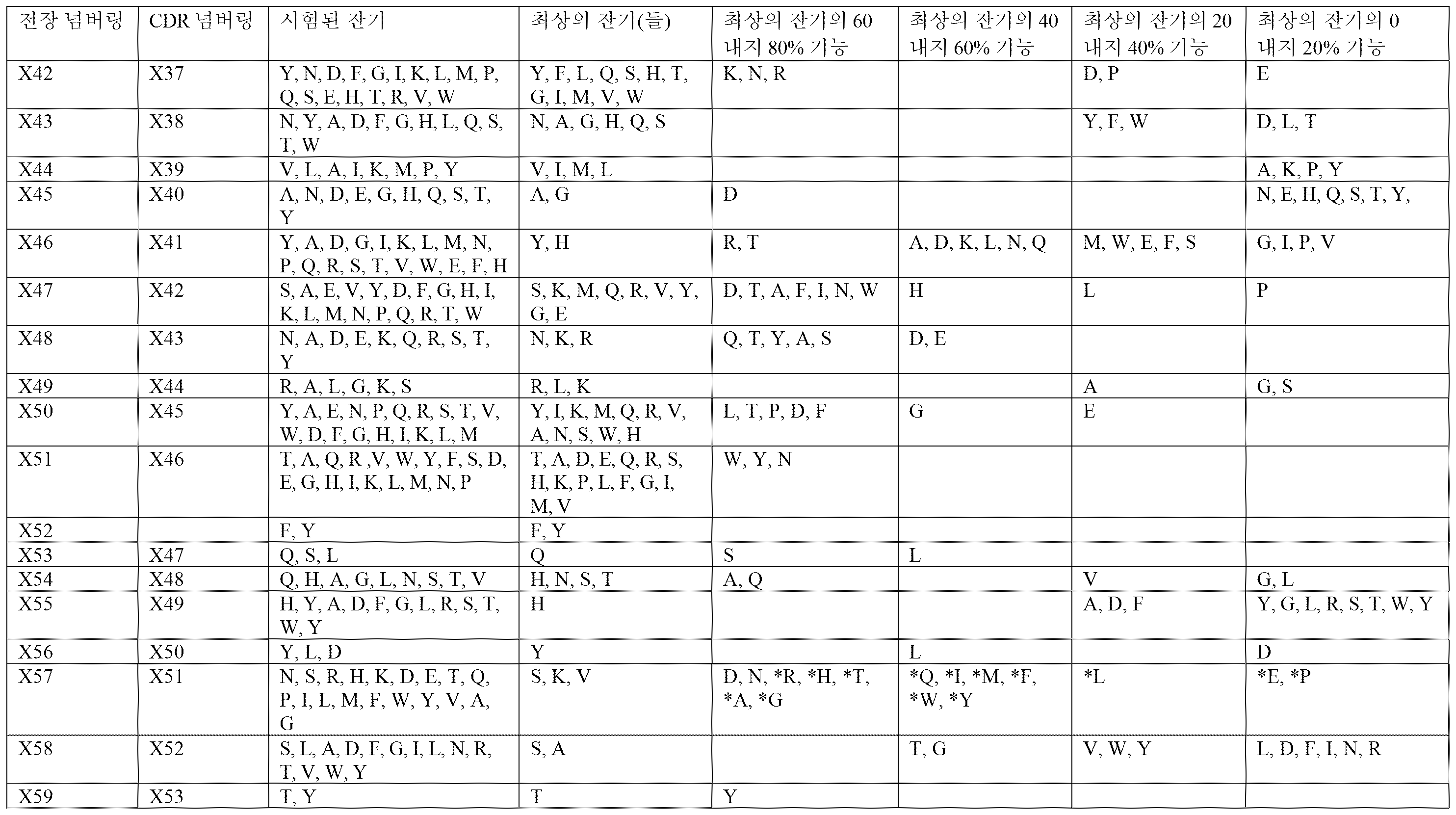
실시예 8: 항체 치환 및 항체 15 내지 18의 조사Example 8: Antibody substitution and investigation of
표 10으로부터의 '최상의 잔기' 치환을 포함하는 추가로 최적화된 항체를 생성하였다. 이들은 항체 15(서열 번호 36(VH) 및 99(VL)), 항체 16, 항체 17(서열 번호 102(VH) 및 99(VL)) 및 항체 18(서열 번호 102(VH) 및 104(VL))을 포함한다.A further optimized antibody containing the 'best residue' substitutions from Table 10 was generated. These are antibody 15 (SEQ ID NOs: 36(VH) and 99(VL)),
높은 양전하에 의해 유도되는 비특이적 상호작용의 위험을 제거하기 위해, LCDR2에서의 돌연변이(T56E)를 항체 15 내에 도입하였다. 이 돌연변이는 또한 이전에 확인된 돌연변이 T56D에 대해 발생된 이성질화의 위험을 제거한다. 항체 16은 항체 15와 동일한 VH 및 VL 서열(서열 번호 36 및 99)을 포함한다. 항체 16의 중쇄 불변 영역은 항체 15의 것에 대해 상이한 침묵 돌연변이를 포함한다.To eliminate the risk of non-specific interactions induced by the high positive charge, a mutation in LCDR2 (T56E) was introduced into
항체 15, 16, 17 및 18을 각각 하기 방법 1.5에 의해 발현시켰다. 발현 수준을 팔리비주맙 바이오시밀러와 대비하여 나타내었다. 항체 15의 발현 수준은 도 7의 A에 제공되어 있으며, 항체 16의 발현 수준은 도 8의 A에 제공되어 있고, 항체 17의 발현 수준은 도 9의 A에 제공되고 항체 18의 발현 수준은 도 10의 A에 제공되어 있다.
cAMP 신호전달을 증가시킬 수 있는 이들 항체의 능력을 방법 1.7을 사용하여 시험하였다. 항체 15에 대한 결과가 도 7의 B에 나타나 있다. 항체 16에 대한 결과가 도 8의 B에 나타나 있다. 항체 17에 대한 결과가 도 9의 B에 나타나 있다. 항체 18에 대한 결과가 도 10의 B에 나타나 있다.The ability of these antibodies to increase cAMP signaling was tested using Method 1.7. Results for
세포 증식을 감소시킬 수 있는 이들 항체의 능력을 방법 1.9를 사용하여 시험하였다. 항체 15에 대한 결과가 도 7의 C에 나타나 있다. 항체 16에 대한 결과가 도 8의 C에 나타나 있다. 항체 17에 대한 결과가 도 9의 C에 나타나 있다. 항체 18에 대한 결과가 도 10의 C에 나타나 있다.The ability of these antibodies to reduce cell proliferation was tested using Method 1.9. Results for
huLPAR1-HA 세포에 결합할 수 있는 이들 항체의 능력을 일시적 형질감염 CIFAT 검정(방법 1.11)을 사용하여 평가하였다. 항체 15에 대한 결과가 도 7의 D에 나타나 있다. 항체 17에 대한 결과가 도 9의 D에 나타나 있다. 항체 18에 대한 결과가 도 10의 D에 나타나 있다.The ability of these antibodies to bind to huLPAR1-HA cells was assessed using the transient transfection CIFAT assay (Method 1.11). Results for
이들 항체의 KD를 확인하였다. 항체 15의 KD는 824 pM이었다. 항체 16의 KD가 또한 824 pM이었다. 항체 17의 KD는 1 nM이고, 항체 18의 KD는 1.39 nM이었다.The K D of these antibodies was confirmed. The K D of
실시예 9: CIFAT 검정을 사용하여 구매가능한 항-LPAR1 항체와의 비교Example 9: Comparison with commercially available anti-LPAR1 antibodies using the CIFAT assay
본 발명의 항-LPAR1 항체를 살아있는 세포에 대한 일시적 형질감염 CIFAT 검정(방법 1.11)에서, 그리고 고정된 세포에 대한 일시적 형질감염 CIFAT 검정(방법 1.11)에서 구매가능한 항-LPAR1 항체와 함께 시험하였다. 시험된 항체가 표 11에 열거되어 있다.Anti-LPAR1 antibodies of the invention were tested in a transient transfection CIFAT assay on live cells (Method 1.11) and with commercially available anti-LPAR1 antibodies in a transient transfection CIFAT assay on fixed cells (Method 1.11). The antibodies tested are listed in Table 11.
[표 11][Table 11]
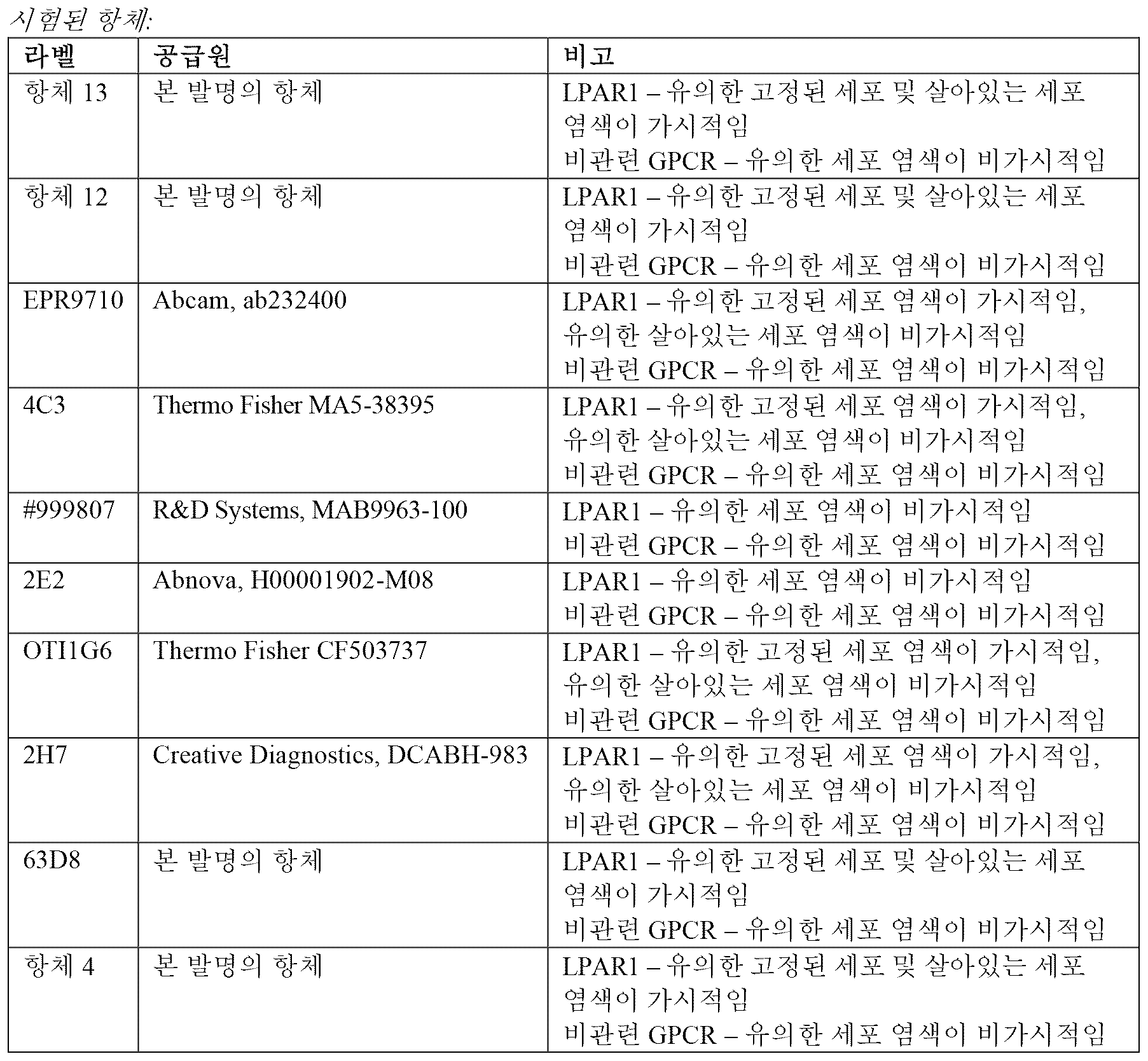
63D8은 서열 번호 113(VH) 및 114(VL)를 포함한다.63D8 includes SEQ ID NOs: 113 (VH) and 114 (VL).
결과가 도 11 및 도 12에 나타나 있으며, 여기서 스케일 바는 100 μm를 나타낸다. 도 11은 고정된/투과화된 세포에 대한 5 μg/mL의 실험 시험 항체뿐만 아니라, 살아있는 세포에 대한 5 μg/mL의 실험 시험 항체의 결과를 나타낸다. 도 12는 고정된/투과화된 세포에 대한 5 μg/mL의 실험 시험 항체 및 살아있는 세포에 대한 20 μg/mL의 실험 시험 항체의 결과를 나타낸다. 이들 데이터는, 종래 기술의 항체는 살아있는 세포의 표면 상의 LPAR1에 결합하지 않는 반면, 생성된 본 발명에 따른 항체의 패널은 살아있는 세포의 표면 상의 LPAR1에 결합한다는 것을 예시한다.The results are shown in Figures 11 and 12, where the scale bar represents 100 μm. Figure 11 shows the results of 5 μg/mL experimental test antibody on fixed/permeabilized cells as well as 5 μg/mL experimental test antibody on live cells. Figure 12 shows the results of 5 μg/mL experimental test antibody for fixed/permeabilized cells and 20 μg/mL experimental test antibody for live cells. These data illustrate that the panel of antibodies produced according to the invention binds to LPAR1 on the surface of living cells, whereas antibodies of the prior art do not bind to LPAR1 on the surface of living cells.
실시예 10: 알로스테릭 억제Example 10: Allosteric inhibition
항체 12의 억제 특성을 생물발광 공명 에너지 전달(BRET, 방법 1.15)에 의해 조사하고, 종래 기술의 소분자 LPAR1 억제제(BMS-986020)와 대비하여 나타내었다(도 13 참조). 상부선은 LPA가 존재하는 경우에 대해 기록된 값이고, 하부선은 LPA가 존재하지 않는 경우에 대해 기록된 값이다. LPA의 존재 하에서(상부선, 도 13의 A), 항체는 심지어 고농도에서조차도 LPA가 부재하는 시스템에 대해 동등한 억제를 달성하지 못한다(G-단백질 G13과 GPCR의 상호작용을 측정하는 이 검정에서). 이는 리간드(LPA)가 또한 어떠한 신호전달을 가능하게 하는 것과 동시에 수용체와 상호작용하는 경우에만 발생할 수 있다. 상부선이 고농도에서 평탄화됨에 따라, 이 시스템은 최대 수용체 점유도에 도달하였고, 이에 따라, 심지어 항체가 최대 점유도에 있을 때조차도 리간드가 수용체와 상호작용하고 있는 것으로 추정될 수 있다. 따라서, 항체는 알로스테릭으로 작용하고 있어야 한다. 대조예는 종래 기술 BMS-986020 분자로서, 이는 경쟁적 억제제이며, LPA의 존재 하에서조차도(상부선, 도 13의 B), (이 검정에서) 100% 억제를 달성한다.The inhibitory properties of
실시예 11: 종 교차-반응성Example 11: Species cross-reactivity
항체 12, 15, 17 및 18의 종 교차-반응성을 일시적 형질감염 CIFAT(방법 1.11)를 사용하여 조사하였다. 표 12에 따라 인간 LPAR1, 마우스 LPAR1, 기니피그 LPAR1 또는 토끼 LPAR1을 인코딩하는 DNA로 세포를 형질감염시켰다. 결과가 도 14의 A(항체 12), 도 14의 B(항체 15), 도 14의 C(항체 17) 및 도 14의 D(항체 18)에 나타나 있다.Species cross-reactivity of
[표 12][Table 12]
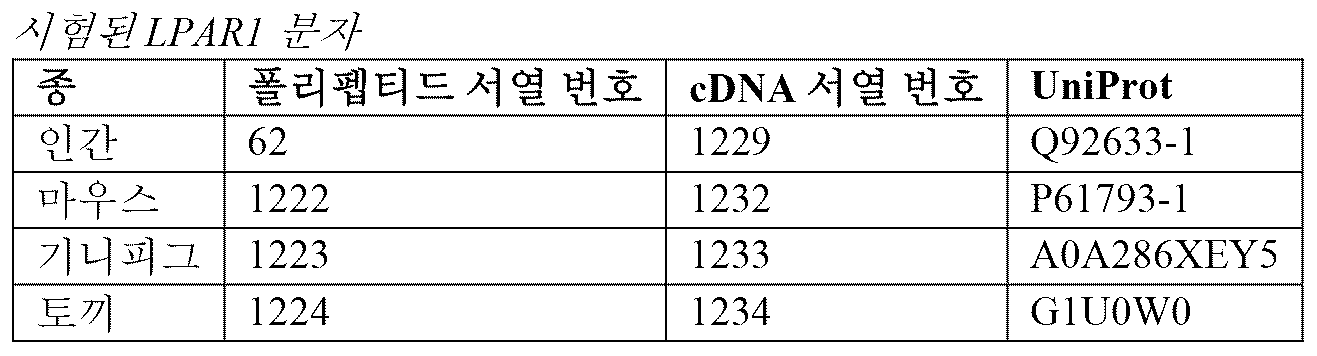
실시예 12: LPAR 아이소형 특이성Example 12: LPAR isoform specificity
인간 LPAR 아이소형에 대한 항체 12, 15, 17 및 18의 특이성을 일시적 형질감염 CIFAT(방법 1.11)를 사용하여 조사하였다. 표 13에 따라 인간 LPAR1, 인간 LPAR2 또는 인간 LPAR3을 인코딩하는 DNA로 세포를 형질감염시켰다. 결과가 도 15의 A(항체 12), 도 15의 B(항체 15), 도 15의 C(항체 17) 및 도 15의 D(항체 18)에 나타나 있다.The specificity of
[표 13][Table 13]
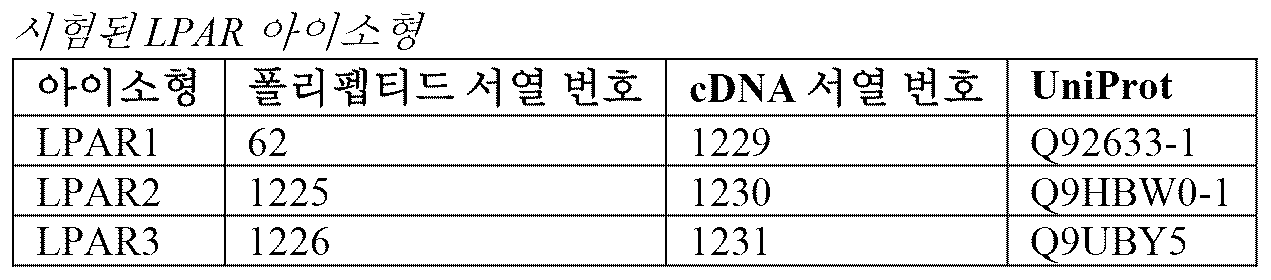
실시예 13: 래트 약동학적 특성Example 13: Rat pharmacokinetic properties
래트에서의 항체 12, 15, 17 및 18의 약동학적 특성을 방법 1.16을 사용하여 조사하였다. 팔리비주맙 바이오시밀러(서열 번호 1227(VH) 및 1228(VL))를 대조 동종형 항체로서 사용하였다. 결과가 도 16에 나타나 있다.The pharmacokinetic properties of
시각적 검사 시에, 5개의 모든 항체는 3 mg/kg의 단회 정맥내 투여 후에 동일한 혈장 농도-시간 프로파일을 갖는다. 모든 항체에 대해, 중위 tmax는 0.3시간 시점에서, 즉, 투여 후 첫 번째 혈액 샘플링 시간 시점에서 관찰되었다. 정맥내 투여 후에 관찰된 평균 Cmax는 항체 17 및 항체 12에 대해 각각 143.8 μg/mL 내지 217.5 μg/mL였다. 혈장 농도는 모든 항체에 대해 유사한 방식으로 감소하는데, 즉, 첫 번째의 빠른 상 및 두 번째의 더 느린 상을 나타내며, 이때 모든 항체 및 모든 동물에 대해 투여 후 504시간까지 정량화가능한 혈장 농도를 갖는다.Upon visual inspection, all five antibodies have identical plasma concentration-time profiles after a single intravenous dose of 3 mg/kg. For all antibodies, the median t max was observed at 0.3 hours, i.e. at the time of the first blood sampling after administration. The average C max observed after intravenous administration was 143.8 μg/mL to 217.5 μg/mL for
실시예 14: SEC-MALSExample 14: SEC-MALS
다각 광 산란을 사용하는 크기 배제 크로마토그래피를 항체 12, 13, 15, 16, 17 및 18에 대해 수행하였다. 결과가 도 17의 A(항체 12), 도 17의 B(항체 13), 도 17의 C(항체 15), 도 17의 D(항체 16), 도 17의 E(항체 17의) 및 도 17의 F(항체 18)에 나타나 있다.Size exclusion chromatography using multiple angle light scattering was performed for
실시예 15: 사이노몰거스 원숭이에서의 간 조직병리Example 15: Liver histopathology in cynomolgus monkeys
소분자 길항제 BMS-986020은 특발성 폐 섬유증(IPF)을 갖는 환자에 대해 효능을 나타내었지만, 표적-이탈 간담즙성 독성을 나타내었다. 관찰된 독성은, 다수의 간 담즙산 유출 수송체(예를 들어, BSEP, MRP3 및 MRP4)에 대한 표적-이탈 결합으로 인해 화합물-특이적이고, LPAR1의 길항작용을 통해 매개되지 않은 것으로 확인되었다.The small molecule antagonist BMS-986020 showed efficacy in patients with idiopathic pulmonary fibrosis (IPF) but exhibited off-target hepatobiliary toxicity. The observed toxicity was confirmed to be compound-specific due to off-target binding to multiple hepatic bile acid efflux transporters (e.g., BSEP, MRP3 and MRP4) and not mediated through antagonism of LPAR1.
사이노몰거스 원숭이에 대한 정맥내(주입) 경로에 의해 제공될 때 항체 17의 잠재적인 독성을 결정하기 위해 용량 범위-결정 연구를 수행하였다. 시험 대상물, 항체 17을 일수 1(군 1) 또는 일수 1, 8 및 15(군 2 내지 군 4)에서 정맥내 주입(30분)을 통해 8 마리의 동물에게 투여하였다. 동물들을 성별에 의해 분할하여 4개의 군에 할당하고, 10, 33 또는 100 mg/kg/일로 항체 17을 투여하였다.A dose-ranging study was performed to determine the potential toxicity of
[표 14][Table 14]

정밀한 육안 병리학적 검사, 기관 중량 기록 및 현미경적 평가를 제3 용량 후 2일 시점에서 3회 용량의 항체 17이 제공된 6 마리의 동물(군 2 내지 군 4)에서 수행하였다. 이 연구 과정 동안 일정에 없던 사망은 없었다.Close gross pathological examination, recording of organ weights and microscopic evaluation were performed on six animals (
항체 17 투여는 주사 부위에서 우수한 내약성을 나타내는 것으로 여겨졌다. 연구 전체에 걸쳐 유해 효과가 관찰되지 않았으며 조직병리에 대해 유해한 조사결과가 발견되지 않았다.
실시예 16: 기니피그에서의 단측성 요관 폐색(UUO) 효능 모델Example 16: Unilateral ureteral obstruction (UUO) efficacy model in guinea pigs
단측성 요관 폐색(UUO)은 신장 섬유증에 대한 잘 특성화된 질병 모델이다. UUO 모델은 만성 신장 질병의 주요 병리생리학적 특징, 즉, 비교적 짧은 기간 내의 세뇨관 괴사 및 염증성 세포 침윤을 포함한다.Unilateral ureteral obstruction (UUO) is a well-characterized disease model for renal fibrosis. The UUO model incorporates the main pathophysiological features of chronic kidney disease, namely tubular necrosis and inflammatory cell infiltration within a relatively short period of time.
방법method
2개의 단측성 요관 폐색(UUO) 모델 효능 연구를 6주령된 암컷 하틀리(Hartley) 기니피그에서 수행하였다. 일수 0에서, UUO 수술을 수행하였다. BMS-986020을 일수 -1부터 일수 9까지 매일 2회 5 mL/kg의 부피로 30 mg/kg의 용량 수준으로 경구 투여하였다. 동종형 대조군 및 항-LPAR1 항체를 일수 -1, 일수 0, 일수 3 및 일수 6에서 10 mL/kg의 부피로 6 mg/kg(저용량) 또는 20 mg/kg(고용량)의 용량 수준으로 복막내 투여하였다. 생존력, 임상 징후, 거동 및 개별 체중을 매일 모니터링하였다.Two unilateral ureteral obstruction (UUO) model efficacy studies were performed in 6-week-old female Hartley guinea pigs. On
동물들을 일수 10에서 희생시켰다. 결찰된 좌측 신장과 우측 신장 중량을 희생 시점에서 측정하였다.Animals were sacrificed on
하이드록시프롤린은 콜라겐의 약 14%를 구성하는 아미노산이고, 섬유증의 중증도의 중요한 지표로서 작용한다. 신장 하이드록시프롤린 함량을 정량화하기 위해, 좌측 신장 샘플의 동결된 우측 후부를 알칼리-산 가수분해 방법에 의해 처리하였다. AC 완충액(2.2 M 아세트산/0.48 M 시트르산)을 샘플에 첨가한 후, 원심분리하여 상층액을 수집하였다. 16 μg/mL에서 출발하여 트랜스-4-하이드록시-L-프롤린(Sigma-Aldrich, 미국 소재)의 연속 희석물을 사용하여 하이드록시프롤린의 표준 곡선을 작성하였다. 제조된 샘플 및 표준물을 클로라민 T 용액(Nacalai Tesque Inc., 일본 소재)과 혼합하고, 실온에서 25분 동안 인큐베이션하였다. 이어서, 샘플을 에를리히(Ehrlich) 용액과 혼합하고, 65℃에서 20분 동안 가열하여 발색시켰다. 샘플을 얼음 상에서 냉각시키고, 원심분리하여 침전물을 제거한 후, 각각의 상층액의 광학 밀도를 560 nm에서 측정하였다. 하이드록시프롤린 표준 곡선으로부터 하이드록시프롤린의 농도를 계산하였다. 신장 샘플의 단백질 농도를 BCA 단백질 검정 키트(Thermo Fisher Scientific, 미국 소재)를 사용하여 결정하고, 계산된 하이드록시프롤린 값을 정규화하는 데 사용하였다. 신장 하이드록시프롤린 함량을 단백질 1 mg당 μg으로 표현하였다.Hydroxyproline is an amino acid that makes up about 14% of collagen and serves as an important indicator of the severity of fibrosis. To quantify renal hydroxyproline content, frozen right posterior portions of left kidney samples were processed by the alkaline-acid hydrolysis method. AC buffer (2.2 M acetic acid/0.48 M citric acid) was added to the sample, then centrifuged to collect the supernatant. A standard curve of hydroxyproline was prepared using serial dilutions of trans-4-hydroxy-L-proline (Sigma-Aldrich, USA) starting at 16 μg/mL. The prepared samples and standards were mixed with Chloramine T solution (Nacalai Tesque Inc., Japan) and incubated for 25 minutes at room temperature. The sample was then mixed with Ehrlich solution and heated at 65°C for 20 minutes to develop color. Samples were cooled on ice, centrifuged to remove sediment, and the optical density of each supernatant was measured at 560 nm. The concentration of hydroxyproline was calculated from the hydroxyproline standard curve. The protein concentration of kidney samples was determined using the BCA protein assay kit (Thermo Fisher Scientific, USA) and used to normalize the calculated hydroxyproline values. Kidney hydroxyproline content was expressed as μg per mg of protein.
좌측 신장을 보우인(Bouin) 용액 중에 고정시키고, 파라핀 중에 포매하였다. PAS 염색을 위하여, 파라핀 블록으로부터 절편을 절단하고, 제조자의 설명서에 따라 시프(Schiff) 시약(FUJIFILM Wako Pure Chemical Corporation, 일본 소재)으로 염색하였다. 콜라겐 침착을 시각화하기 위해, 피크로-시리우스(Picro-Sirius) 적색 용액(FUJIFILM Wako Pure Chemical Corporation)을 사용하여 신장 절편을 염색하였다. 간질성 및 수질 섬유증 영역의 정량화를 위해, 피질수질 영역(corticomedullary region) 내의 명시야 이미지를 200배 배율로 디지털 카메라(DFC295)를 사용하여 캡처하고, 5개의 시야/절편에서의 양의 영역을 ImageJ Software(미국 국립보건원(National Institute of Health, USA))를 사용하여 측정하였다.The left kidney was fixed in Bouin's solution and embedded in paraffin. For PAS staining, sections were cut from paraffin blocks and stained with Schiff reagent (FUJIFILM Wako Pure Chemical Corporation, Japan) according to the manufacturer's instructions. To visualize collagen deposition, kidney sections were stained using Picro-Sirius red solution (FUJIFILM Wako Pure Chemical Corporation). For quantification of interstitial and medullary fibrosis areas, bright field images within the corticomedullary region were captured using a digital camera (DFC295) at 200× magnification, and positive areas in five fields/slices were scanned using ImageJ. It was measured using Software (National Institute of Health, USA).
결과result
연구 1(도 18의 A)은 항-LPAR1 항체로서 항체 13을 20 mg/kg의 투여량으로 사용하였다. 각각의 군은 8 마리의 동물을 포함하였다. 조직학적 피크로시리우스 염색은 UUO 수술 후 피질에서 섬유성 영역의 증가를 보여주었다(도 25의 A에서 비히클). BMS-986020을 사용한 처리는 비히클과 대비하여 피질 섬유증을 감소시켰다. 항-LPAR1 항체에 의한 처리는 피질 섬유증에서 BMS-986020에 의한 처리와 유사한 감소를 가져왔다. 군들 사이에 하이드록시프롤린의 관찰가능한 차이가 발견되지 않았다.Study 1 (Figure 18A) used
연구 2(도 18의 B)는 항-LPAR1 항체로서 항체 17을 사용하였다. 각각의 배치(batch)는 20 마리의 동물을 포함하였다. BMS-986020에 의한 처리는 비히클과 대비하여 감소된 하이드록시프롤린으로의 경향을 보여주었다. 20 mg/kg(고용량)의 항-LPAR1에 의한 처리는 동종형 항체와 대비하여 하이드록시프롤린의 유의한 감소를 보여주었다. 군들 사이에 조직학적 피크로시리우스 염색에서 관찰가능한 차이가 나타나지 않았다.Study 2 (Figure 18B) used
섬유성 마커, 즉, 조직학적 피크로시리우스 염색 또는 하이드록시프롤린 측정치에서의 감소가, 두 연구 모두로부터 항-LPAR1 mAb를 제공받은 군에서 관찰되었다.Reductions in fibrotic markers, i.e. histological picrosirius staining or hydroxyproline measurements, were observed in groups receiving anti-LPAR1 mAb from both studies.
항목item
본 발명 및 이의 바람직한 태양을 정의하는 한 세트의 항목은 다음과 같다.A set of items defining the invention and its preferred embodiments are as follows:
1. LPAR1에 결합하는 폴리펩티드.1. Polypeptide that binds to LPAR1.
2. 항목 1에 있어서, 상기 폴리펩티드는 3개의 중쇄 CDR(HCDR1 내지 HCDR3)을 포함하는, 폴리펩티드.2. The polypeptide of
3. 항목 1 또는 항목 2에 있어서, 상기 폴리펩티드는 서열 번호 1 또는 서열 번호 7과 적어도 40%, 예컨대 적어도 60%, 예컨대 적어도 80% 동일성을 갖는 서열을 포함하는 HCDR1을 포함하는, 폴리펩티드.3. The polypeptide of
4. 항목 3에 있어서, 상기 폴리펩티드는 서열 번호 1 또는 서열 번호 7과 적어도 40%, 예컨대 적어도 60%, 예컨대 적어도 80% 동일성을 갖는 서열로 이루어진 HCDR1을 포함하는, 폴리펩티드.4. The polypeptide of
5. 항목 3에 있어서, 상기 폴리펩티드는 서열 번호 1을 포함하는 HCDR1을 포함하는, 폴리펩티드.5. The polypeptide of
6. 항목 5에 있어서, 상기 폴리펩티드는 서열 번호 1로 이루어진 HCDR1을 포함하는, 폴리펩티드.6. The polypeptide of
7. 항목 3에 있어서, 상기 폴리펩티드는 서열 번호 7을 포함하는 HCDR1을 포함하는, 폴리펩티드.7. The polypeptide of
8. 항목 7에 있어서, 상기 폴리펩티드는 서열 번호 7로 이루어진 HCDR1을 포함하는, 폴리펩티드.8. The polypeptide of
9. 항목 1 내지 항목 8 중 어느 하나에 있어서, 상기 폴리펩티드는 서열 번호 2, 8 내지 11 또는 100 중 어느 하나와 적어도 50%, 예컨대 적어도 60%, 예컨대 적어도 70%, 예컨대 적어도 80%, 예컨대 적어도 85%, 예컨대 적어도 90% 동일성을 갖는 서열을 포함하는 HCDR2를 포함하는, 폴리펩티드.9. The method of any one of
10. 항목 9에 있어서, 상기 폴리펩티드는 서열 번호 2, 8 내지 11 또는 100 중 어느 하나와 적어도 50%, 예컨대 적어도 60%, 예컨대 적어도 70%, 예컨대 적어도 80%, 예컨대 적어도 85%, 예컨대 적어도 90% 동일성을 갖는 서열로 이루어진 HCDR2를 포함하는, 폴리펩티드.10. The method of
11. 항목 9에 있어서, 상기 폴리펩티드는 서열 번호 2, 8 내지 11 또는 100 중 어느 하나를 포함하는 HCDR2를 포함하는, 폴리펩티드.11. The polypeptide of
12. 항목 10에 있어서, 상기 폴리펩티드는 서열 번호 2, 8 내지 11 또는 100 중 어느 하나로 이루어진 HCDR2를 포함하는, 폴리펩티드.12. The polypeptide of
13. 항목 11에 있어서, 상기 폴리펩티드는 서열 번호 2 또는 서열 번호 100을 포함하는 HCDR2를 포함하는, 폴리펩티드.13. The polypeptide of
14. 항목 12에 있어서, 상기 폴리펩티드는 서열 번호 2 또는 서열 번호 100으로 이루어진 HCDR2를 포함하는, 폴리펩티드.14. The polypeptide of
15. 항목 1 내지 항목 14 중 어느 하나에 있어서, 상기 폴리펩티드는 서열 번호 3, 12 내지 15, 또는 101 중 어느 하나와 적어도 60%, 예컨대 적어도 70%, 예컨대 적어도 80%, 예컨대 적어도 85%, 예컨대 적어도 90% 동일성을 갖는 서열을 포함하는 HCDR3을 포함하는, 폴리펩티드.15. The method of any one of
16. 항목 15에 있어서, 상기 폴리펩티드는 서열 번호 3, 12 내지 15, 또는 101 중 어느 하나와 적어도 60%, 예컨대 적어도 70%, 예컨대 적어도 80%, 예컨대 적어도 85%, 예컨대 적어도 90% 동일성을 갖는 서열로 이루어진 HCDR3을 포함하는, 폴리펩티드.16. The method of
17. 항목 15에 있어서, 상기 폴리펩티드는 서열 번호 3, 12 내지 15 또는 101 중 어느 하나를 포함하는 HCDR3을 포함하는, 폴리펩티드.17. The polypeptide of
18. 항목 16에 있어서, 상기 폴리펩티드는 서열 번호 3, 12 내지 15 또는 101 중 어느 하나로 이루어진 HCDR3을 포함하는, 폴리펩티드.18. The polypeptide of
19. 항목 17에 있어서, 상기 폴리펩티드는 서열 번호 3 또는 서열 번호 101을 포함하는 HCDR3을 포함하는, 폴리펩티드.19. The polypeptide of
20. 항목 18에 있어서, 상기 폴리펩티드는 서열 번호 3 또는 서열 번호 101로 이루어진 HCDR3을 포함하는, 폴리펩티드.20. The polypeptide of
21. 항목 1 내지 항목 20 중 어느 하나에 있어서, 상기 폴리펩티드는 3개의 경쇄 CDR(LCDR1 내지 LCDR3)를 포함하는, 폴리펩티드.21. The polypeptide according to any one of
22. 항목 21에 있어서, 상기 폴리펩티드는 서열 번호 4, 16 내지 18 또는 103 중 어느 하나와 적어도 60%, 예컨대 적어도 70%, 예컨대 적어도 80%, 예컨대 적어도 90% 동일성을 갖는 서열을 포함하는 LCDR1을 포함하는, 폴리펩티드.22. The method of
23. 항목 22에 있어서, 상기 폴리펩티드는 서열 번호 4, 16 내지 18 또는 103 중 어느 하나와 적어도 60%, 예컨대 적어도 70%, 예컨대 적어도 80%, 예컨대 적어도 90% 동일성을 갖는 서열로 이루어진 LCDR1을 포함하는, 폴리펩티드.23. The polypeptide of
24. 항목 22에 있어서, 상기 폴리펩티드는 서열 번호 4, 16 내지 18 또는 103 중 어느 하나를 포함하는 LCDR1을 포함하는, 폴리펩티드.24. The polypeptide of
25. 항목 23에 있어서, 상기 폴리펩티드는 서열 번호 4, 16 내지 18 또는 103 중 어느 하나로 이루어진 LCDR1을 포함하는, 폴리펩티드.25. The polypeptide of
26. 항목 24에 있어서, 상기 폴리펩티드는 서열 번호 4 또는 서열 번호 103을 포함하는 LCDR1을 포함하는, 폴리펩티드.26. The polypeptide of
27. 항목 25에 있어서, 상기 폴리펩티드는 서열 번호 4 또는 서열 번호 103으로 이루어진 LCDR1을 포함하는, 폴리펩티드.27. The polypeptide according to
28. 항목 1 내지 항목 27 중 어느 하나에 있어서, 상기 폴리펩티드는 서열 번호 5, 19 또는 98과 적어도 50% 동일성, 예컨대 적어도 60%, 예컨대 적어도 70%, 예컨대 적어도 80% 동일성을 갖는 서열을 포함하는 LCDR2를 포함하는, 폴리펩티드.28. The method of any one of
29. 항목 28에 있어서, 상기 폴리펩티드는 서열 번호 5, 19 또는 98과 적어도 50% 동일성, 예컨대 적어도 60%, 예컨대 적어도 70%, 예컨대 적어도 80% 동일성을 갖는 서열로 이루어진 LCDR2를 포함하는, 폴리펩티드.29. The polypeptide according to
30. 항목 28에 있어서, 상기 폴리펩티드는 서열 번호 5, 19 또는 98을 포함하는 LCDR2를 포함하는, 폴리펩티드.30. The polypeptide of
31. 항목 29에 있어서, 상기 폴리펩티드는 서열 번호 5, 19 또는 98로 이루어진 LCDR2를 포함하는, 폴리펩티드.31. The polypeptide of
32. 항목 30에 있어서, 상기 폴리펩티드는 서열 번호 98을 포함하는 LCDR2를 포함하는, 폴리펩티드.32. The polypeptide of
33. 항목 31에 있어서, 상기 폴리펩티드는 서열 번호 98로 이루어진 LCDR2를 포함하는, 폴리펩티드.33. The polypeptide of
34. 항목 1 내지 항목 33 중 어느 하나에 있어서, 상기 폴리펩티드는 서열 번호 6 또는 20 내지 22 중 어느 하나와 적어도 50%, 예컨대 적어도 60%, 예컨대 적어도 70%, 예컨대 적어도 80% 동일성을 갖는 서열을 포함하는 LCDR3을 포함하는, 폴리펩티드.34. The method of any one of
35. 항목 34에 있어서, 상기 폴리펩티드는 서열 번호 6 또는 20 내지 22 중 어느 하나와 적어도 50%, 예컨대 적어도 60%, 예컨대 적어도 70%, 예컨대 적어도 80% 동일성을 갖는 서열로 이루어진 LCDR3을 포함하는, 폴리펩티드.35.
36. 항목 34에 있어서, 상기 폴리펩티드는 서열 번호 6 또는 20 내지 22 중 어느 하나를 포함하는 LCDR3을 포함하는, 폴리펩티드.36. The polypeptide of
37. 항목 35에 있어서, 상기 폴리펩티드는 서열 번호 6 또는 20 내지 22 중 어느 하나로 이루어진 LCDR3을 포함하는, 폴리펩티드.37. The polypeptide according to
38. 항목 36에 있어서, 상기 폴리펩티드는 서열 번호 6을 포함하는 LCDR3을 포함하는, 폴리펩티드.38. The polypeptide of
39. 항목 37에 있어서, 상기 폴리펩티드는 서열 번호 6으로 이루어진 LCDR3을 포함하는, 폴리펩티드.39. The polypeptide of
40. 항목 1 내지 항목 39 중 어느 하나에 있어서, 서열 번호 2의 잔기 번호 5에 상응하는 HCDR2의 잔기는 아르기닌인, 폴리펩티드.40. The polypeptide according to any one of
41. 항목 1 내지 항목 40 중 어느 하나에 있어서, 서열 번호 3의 잔기 번호 6에 상응하는 HCDR3의 잔기는 아르기닌인, 폴리펩티드.41. The polypeptide according to any one of
42. 항목 1 내지 항목 41 중 어느 하나에 있어서, 서열 번호 3의 잔기 번호 7에 상응하는 HCDR3의 잔기는 티로신인, 폴리펩티드.42. The polypeptide according to any one of
43. 항목 1 내지 항목 42 중 어느 하나에 있어서, 서열 번호 5의 잔기 번호 1에 상응하는 LCDR2의 잔기는 티로신인, 폴리펩티드.43. The polypeptide according to any one of
44. 항목 1 내지 항목 43 중 어느 하나에 있어서, 서열 번호 6의 잔기 번호 3에 상응하는 LCDR3의 잔기는 히스티딘인, 폴리펩티드.44. The polypeptide according to any one of
45. 항목 1에 있어서, 상기 폴리펩티드는45. The method of
(a) 서열 번호 1을 포함하는 HCDR1, 서열 번호 2를 포함하는 HCDR2, 서열 번호 3을 포함하는 HCDR3, 서열 번호 4를 포함하는 LCDR1, 서열 번호 5를 포함하는 LCDR2 및 서열 번호 6을 포함하는 LCDR3;(a) HCDR1 comprising SEQ ID NO: 1, HCDR2 comprising SEQ ID NO: 2, HCDR3 comprising SEQ ID NO: 3, LCDR1 comprising SEQ ID NO: 4, LCDR2 comprising SEQ ID NO: 5 and LCDR3 comprising SEQ ID NO: 6 ;
(b) 서열 번호 1을 포함하는 HCDR1, 서열 번호 8을 포함하는 HCDR2, 서열 번호 12를 포함하는 HCDR3, 서열 번호 16을 포함하는 LCDR1, 서열 번호 19를 포함하는 LCDR2 및 서열 번호 20을 포함하는 LCDR3;(b) HCDR1 comprising SEQ ID NO: 1, HCDR2 comprising SEQ ID NO: 8, HCDR3 comprising SEQ ID NO: 12, LCDR1 comprising SEQ ID NO: 16, LCDR2 comprising SEQ ID NO: 19 and LCDR3 comprising SEQ ID NO: 20 ;
(c) 서열 번호 7을 포함하는 HCDR1, 서열 번호 9를 포함하는 HCDR2, 서열 번호 13을 포함하는 HCDR3, 서열 번호 17을 포함하는 LCDR1, 서열 번호 19를 포함하는 LCDR2 및 서열 번호 21을 포함하는 LCDR3;(c) HCDR1 comprising SEQ ID NO:7, HCDR2 comprising SEQ ID NO:9, HCDR3 comprising SEQ ID NO:13, LCDR1 comprising SEQ ID NO:17, LCDR2 comprising SEQ ID NO:19 and LCDR3 comprising SEQ ID NO:21 ;
(d) 서열 번호 1을 포함하는 HCDR1, 서열 번호 10을 포함하는 HCDR2, 서열 번호 14를 포함하는 HCDR3, 서열 번호 18을 포함하는 LCDR1, 서열 번호 19를 포함하는 LCDR2 및 서열 번호 6을 포함하는 LCDR3;(d) HCDR1 comprising SEQ ID NO: 1, HCDR2 comprising SEQ ID NO: 10, HCDR3 comprising SEQ ID NO: 14, LCDR1 comprising SEQ ID NO: 18, LCDR2 comprising SEQ ID NO: 19 and LCDR3 comprising SEQ ID NO: 6 ;
(e) 서열 번호 1을 포함하는 HCDR1, 서열 번호 8을 포함하는 HCDR2, 서열 번호 12를 포함하는 HCDR3, 서열 번호 16을 포함하는 LCDR1, 서열 번호 19를 포함하는 LCDR2 및 서열 번호 22를 포함하는 LCDR3;(e) HCDR1 comprising SEQ ID NO: 1, HCDR2 comprising SEQ ID NO: 8, HCDR3 comprising SEQ ID NO: 12, LCDR1 comprising SEQ ID NO: 16, LCDR2 comprising SEQ ID NO: 19 and LCDR3 comprising SEQ ID NO: 22 ;
(f) 서열 번호 1을 포함하는 HCDR1, 서열 번호 8을 포함하는 HCDR2, 서열 번호 12를 포함하는 HCDR3, 서열 번호 16을 포함하는 LCDR1, 서열 번호 19를 포함하는 LCDR2 및 서열 번호 6을 포함하는 LCDR3;(f) HCDR1 comprising SEQ ID NO: 1, HCDR2 comprising SEQ ID NO: 8, HCDR3 comprising SEQ ID NO: 12, LCDR1 comprising SEQ ID NO: 16, LCDR2 comprising SEQ ID NO: 19 and LCDR3 comprising SEQ ID NO: 6 ;
(g) 서열 번호 1을 포함하는 HCDR1, 서열 번호 11을 포함하는 HCDR2, 서열 번호 12를 포함하는 HCDR3, 서열 번호 4를 포함하는 LCDR1, 서열 번호 19를 포함하는 LCDR2 및 서열 번호 20을 포함하는 LCDR3;(g) HCDR1 comprising SEQ ID NO: 1, HCDR2 comprising SEQ ID NO: 11, HCDR3 comprising SEQ ID NO: 12, LCDR1 comprising SEQ ID NO: 4, LCDR2 comprising SEQ ID NO: 19 and LCDR3 comprising SEQ ID NO: 20 ;
(h) 서열 번호 1을 포함하는 HCDR1, 서열 번호 11을 포함하는 HCDR2, 서열 번호 12를 포함하는 HCDR3, 서열 번호 4를 포함하는 LCDR1, 서열 번호 19를 포함하는 LCDR2 및 서열 번호 6을 포함하는 LCDR3;(h) HCDR1 comprising SEQ ID NO: 1, HCDR2 comprising SEQ ID NO: 11, HCDR3 comprising SEQ ID NO: 12, LCDR1 comprising SEQ ID NO: 4, LCDR2 comprising SEQ ID NO: 19 and LCDR3 comprising SEQ ID NO: 6 ;
(i) 서열 번호 1을 포함하는 HCDR1, 서열 번호 2를 포함하는 HCDR2, 서열 번호 12를 포함하는 HCDR3, 서열 번호 4를 포함하는 LCDR1, 서열 번호 19를 포함하는 LCDR2 및 서열 번호 6을 포함하는 LCDR3;(i) HCDR1 comprising SEQ ID NO: 1, HCDR2 comprising SEQ ID NO: 2, HCDR3 comprising SEQ ID NO: 12, LCDR1 comprising SEQ ID NO: 4, LCDR2 comprising SEQ ID NO: 19 and LCDR3 comprising SEQ ID NO: 6 ;
(j) 서열 번호 1을 포함하는 HCDR1, 서열 번호 2를 포함하는 HCDR2, 서열 번호 3을 포함하는 HCDR3, 서열 번호 4를 포함하는 LCDR1, 서열 번호 19를 포함하는 LCDR2 및 서열 번호 6을 포함하는 LCDR3;(j) HCDR1 comprising SEQ ID NO: 1, HCDR2 comprising SEQ ID NO: 2, HCDR3 comprising SEQ ID NO: 3, LCDR1 comprising SEQ ID NO: 4, LCDR2 comprising SEQ ID NO: 19 and LCDR3 comprising SEQ ID NO: 6 ;
(k) 서열 번호 1을 포함하는 HCDR1, 서열 번호 2를 포함하는 HCDR2, 서열 번호 15를 포함하는 HCDR3, 서열 번호 4를 포함하는 LCDR1, 서열 번호 19를 포함하는 LCDR2 및 서열 번호 6을 포함하는 LCDR3;(k) HCDR1 comprising SEQ ID NO: 1, HCDR2 comprising SEQ ID NO: 2, HCDR3 comprising SEQ ID NO: 15, LCDR1 comprising SEQ ID NO: 4, LCDR2 comprising SEQ ID NO: 19 and LCDR3 comprising SEQ ID NO: 6 ;
(l) 서열 번호 1을 포함하는 HCDR1, 서열 번호 2를 포함하는 HCDR2, 서열 번호 15를 포함하는 HCDR3, 서열 번호 4를 포함하는 LCDR1, 서열 번호 5를 포함하는 LCDR2 및 서열 번호 6을 포함하는 LCDR3;(l) HCDR1 comprising SEQ ID NO: 1, HCDR2 comprising SEQ ID NO: 2, HCDR3 comprising SEQ ID NO: 15, LCDR1 comprising SEQ ID NO: 4, LCDR2 comprising SEQ ID NO: 5 and LCDR3 comprising SEQ ID NO: 6 ;
(m) 서열 번호 1을 포함하는 HCDR1, 서열 번호 2를 포함하는 HCDR2, 서열 번호 3을 포함하는 HCDR3, 서열 번호 4를 포함하는 LCDR1, 서열 번호 98을 포함하는 LCDR2 및 서열 번호 6을 포함하는 LCDR3;(m) HCDR1 comprising SEQ ID NO: 1, HCDR2 comprising SEQ ID NO: 2, HCDR3 comprising SEQ ID NO: 3, LCDR1 comprising SEQ ID NO: 4, LCDR2 comprising SEQ ID NO: 98 and LCDR3 comprising SEQ ID NO: 6 ;
(n) 서열 번호 1을 포함하는 HCDR1, 서열 번호 100을 포함하는 HCDR2, 서열 번호 101을 포함하는 HCDR3, 서열 번호 4를 포함하는 LCDR1, 서열 번호 98을 포함하는 LCDR2 및 서열 번호 6을 포함하는 LCDR3; 또는(n) HCDR1 comprising SEQ ID NO: 1, HCDR2 comprising SEQ ID NO: 100, HCDR3 comprising SEQ ID NO: 101, LCDR1 comprising SEQ ID NO: 4, LCDR2 comprising SEQ ID NO: 98 and LCDR3 comprising SEQ ID NO: 6 ; or
(o) 서열 번호 1을 포함하는 HCDR1, 서열 번호 100을 포함하는 HCDR2, 서열 번호 101을 포함하는 HCDR3, 서열 번호 103을 포함하는 LCDR1, 서열 번호 98을 포함하는 LCDR2 및 서열 번호 6을 포함하는 LCDR3을 포함하는, 폴리펩티드.(o) HCDR1 comprising SEQ ID NO: 1, HCDR2 comprising SEQ ID NO: 100, HCDR3 comprising SEQ ID NO: 101, LCDR1 comprising SEQ ID NO: 103, LCDR2 comprising SEQ ID NO: 98 and LCDR3 comprising SEQ ID NO: 6 Containing polypeptides.
46. 항목 45에 있어서, 상기 폴리펩티드는46. The method of item 45, wherein said polypeptide is
(a) 서열 번호 1로 이루어진 HCDR1, 서열 번호 2로 이루어진 HCDR2, 서열 번호 3으로 이루어진 HCDR3, 서열 번호 4로 이루어진 LCDR1, 서열 번호 5로 이루어진 LCDR2 및 서열 번호 6으로 이루어진 LCDR3;(a) HCDR1 consisting of SEQ ID NO: 1, HCDR2 consisting of SEQ ID NO: 2, HCDR3 consisting of SEQ ID NO: 3, LCDR1 consisting of SEQ ID NO: 4, LCDR2 consisting of SEQ ID NO: 5 and LCDR3 consisting of SEQ ID NO: 6;
(b) 서열 번호 1로 이루어진 HCDR1, 서열 번호 8로 이루어진 HCDR2, 서열 번호 12로 이루어진 HCDR3, 서열 번호 16으로 이루어진 LCDR1, 서열 번호 19로 이루어진 LCDR2 및 서열 번호 20으로 이루어진 LCDR3;(b) HCDR1 consisting of SEQ ID NO: 1, HCDR2 consisting of SEQ ID NO: 8, HCDR3 consisting of SEQ ID NO: 12, LCDR1 consisting of SEQ ID NO: 16, LCDR2 consisting of SEQ ID NO: 19 and LCDR3 consisting of SEQ ID NO: 20;
(c) 서열 번호 7로 이루어진 HCDR1, 서열 번호 9로 이루어진 HCDR2, 서열 번호 13으로 이루어진 HCDR3, 서열 번호 17로 이루어진 LCDR1, 서열 번호 19로 이루어진 LCDR2 및 서열 번호 21로 이루어진 LCDR3;(c) HCDR1 consisting of SEQ ID NO: 7, HCDR2 consisting of SEQ ID NO: 9, HCDR3 consisting of SEQ ID NO: 13, LCDR1 consisting of SEQ ID NO: 17, LCDR2 consisting of SEQ ID NO: 19 and LCDR3 consisting of SEQ ID NO: 21;
(d) 서열 번호 1로 이루어진 HCDR1, 서열 번호 10으로 이루어진 HCDR2, 서열 번호 14로 이루어진 HCDR3, 서열 번호 18로 이루어진 LCDR1, 서열 번호 19로 이루어진 LCDR2 및 서열 번호 6으로 이루어진 LCDR3;(d) HCDR1 consisting of SEQ ID NO: 1, HCDR2 consisting of SEQ ID NO: 10, HCDR3 consisting of SEQ ID NO: 14, LCDR1 consisting of SEQ ID NO: 18, LCDR2 consisting of SEQ ID NO: 19 and LCDR3 consisting of SEQ ID NO: 6;
(e) 서열 번호 1로 이루어진 HCDR1, 서열 번호 8로 이루어진 HCDR2, 서열 번호 12로 이루어진 HCDR3, 서열 번호 16으로 이루어진 LCDR1, 서열 번호 19로 이루어진 LCDR2 및 서열 번호 22로 이루어진 LCDR3;(e) HCDR1 consisting of SEQ ID NO: 1, HCDR2 consisting of SEQ ID NO: 8, HCDR3 consisting of SEQ ID NO: 12, LCDR1 consisting of SEQ ID NO: 16, LCDR2 consisting of SEQ ID NO: 19 and LCDR3 consisting of SEQ ID NO: 22;
(f) 서열 번호 1로 이루어진 HCDR1, 서열 번호 8로 이루어진 HCDR2, 서열 번호 12로 이루어진 HCDR3, 서열 번호 16으로 이루어진 LCDR1, 서열 번호 19로 이루어진 LCDR2 및 서열 번호 6으로 이루어진 LCDR3;(f) HCDR1 consisting of SEQ ID NO: 1, HCDR2 consisting of SEQ ID NO: 8, HCDR3 consisting of SEQ ID NO: 12, LCDR1 consisting of SEQ ID NO: 16, LCDR2 consisting of SEQ ID NO: 19 and LCDR3 consisting of SEQ ID NO: 6;
(g) 서열 번호 1로 이루어진 HCDR1, 서열 번호 11로 이루어진 HCDR2, 서열 번호 12로 이루어진 HCDR3, 서열 번호 4로 이루어진 LCDR1, 서열 번호 19로 이루어진 LCDR2 및 서열 번호 20으로 이루어진 LCDR3;(g) HCDR1 consisting of SEQ ID NO: 1, HCDR2 consisting of SEQ ID NO: 11, HCDR3 consisting of SEQ ID NO: 12, LCDR1 consisting of SEQ ID NO: 4, LCDR2 consisting of SEQ ID NO: 19 and LCDR3 consisting of SEQ ID NO: 20;
(h) 서열 번호 1로 이루어진 HCDR1, 서열 번호 11로 이루어진 HCDR2, 서열 번호 12로 이루어진 HCDR3, 서열 번호 4로 이루어진 LCDR1, 서열 번호 19로 이루어진 LCDR2 및 서열 번호 6으로 이루어진 LCDR3;(h) HCDR1 consisting of SEQ ID NO: 1, HCDR2 consisting of SEQ ID NO: 11, HCDR3 consisting of SEQ ID NO: 12, LCDR1 consisting of SEQ ID NO: 4, LCDR2 consisting of SEQ ID NO: 19 and LCDR3 consisting of SEQ ID NO: 6;
(i) 서열 번호 1로 이루어진 HCDR1, 서열 번호 2로 이루어진 HCDR2, 서열 번호 12로 이루어진 HCDR3, 서열 번호 4로 이루어진 LCDR1, 서열 번호 19로 이루어진 LCDR2 및 서열 번호 6으로 이루어진 LCDR3;(i) HCDR1 consisting of SEQ ID NO: 1, HCDR2 consisting of SEQ ID NO: 2, HCDR3 consisting of SEQ ID NO: 12, LCDR1 consisting of SEQ ID NO: 4, LCDR2 consisting of SEQ ID NO: 19 and LCDR3 consisting of SEQ ID NO: 6;
(j) 서열 번호 1로 이루어진 HCDR1, 서열 번호 2로 이루어진 HCDR2, 서열 번호 3으로 이루어진 HCDR3, 서열 번호 4로 이루어진 LCDR1, 서열 번호 19로 이루어진 LCDR2 및 서열 번호 6으로 이루어진 LCDR3;(j) HCDR1 consisting of SEQ ID NO: 1, HCDR2 consisting of SEQ ID NO: 2, HCDR3 consisting of SEQ ID NO: 3, LCDR1 consisting of SEQ ID NO: 4, LCDR2 consisting of SEQ ID NO: 19 and LCDR3 consisting of SEQ ID NO: 6;
(k) 서열 번호 1로 이루어진 HCDR1, 서열 번호 2로 이루어진 HCDR2, 서열 번호 15로 이루어진 HCDR3, 서열 번호 4로 이루어진 LCDR1, 서열 번호 19로 이루어진 LCDR2 및 서열 번호 6으로 이루어진 LCDR3;(k) HCDR1 consisting of SEQ ID NO: 1, HCDR2 consisting of SEQ ID NO: 2, HCDR3 consisting of SEQ ID NO: 15, LCDR1 consisting of SEQ ID NO: 4, LCDR2 consisting of SEQ ID NO: 19 and LCDR3 consisting of SEQ ID NO: 6;
(l) 서열 번호 1로 이루어진 HCDR1, 서열 번호 2로 이루어진 HCDR2, 서열 번호 15로 이루어진 HCDR3, 서열 번호 4로 이루어진 LCDR1, 서열 번호 5로 이루어진 LCDR2 및 서열 번호 6으로 이루어진 LCDR3;(l) HCDR1 consisting of SEQ ID NO: 1, HCDR2 consisting of SEQ ID NO: 2, HCDR3 consisting of SEQ ID NO: 15, LCDR1 consisting of SEQ ID NO: 4, LCDR2 consisting of SEQ ID NO: 5 and LCDR3 consisting of SEQ ID NO: 6;
(m) 서열 번호 1로 이루어진 HCDR1, 서열 번호 2로 이루어진 HCDR2, 서열 번호 3으로 이루어진 HCDR3, 서열 번호 4로 이루어진 LCDR1, 서열 번호 98로 이루어진 LCDR2 및 서열 번호 6으로 이루어진 LCDR3;(m) HCDR1 consisting of SEQ ID NO: 1, HCDR2 consisting of SEQ ID NO: 2, HCDR3 consisting of SEQ ID NO: 3, LCDR1 consisting of SEQ ID NO: 4, LCDR2 consisting of SEQ ID NO: 98 and LCDR3 consisting of SEQ ID NO: 6;
(n) 서열 번호 1로 이루어진 HCDR1, 서열 번호 100으로 이루어진 HCDR2, 서열 번호 101로 이루어진 HCDR3, 서열 번호 4로 이루어진 LCDR1, 서열 번호 98로 이루어진 LCDR2 및 서열 번호 6으로 이루어진 LCDR3; 또는(n) HCDR1 consisting of SEQ ID NO: 1, HCDR2 consisting of SEQ ID NO: 100, HCDR3 consisting of SEQ ID NO: 101, LCDR1 consisting of SEQ ID NO: 4, LCDR2 consisting of SEQ ID NO: 98 and LCDR3 consisting of SEQ ID NO: 6; or
(o) 서열 번호 1로 이루어진 HCDR1, 서열 번호 100으로 이루어진 HCDR2, 서열 번호 101로 이루어진 HCDR3, 서열 번호 103으로 이루어진 LCDR1, 서열 번호 98로 이루어진 LCDR2 및 서열 번호 6으로 이루어진 LCDR3을 포함하는, 폴리펩티드.(o) a polypeptide comprising HCDR1 consisting of SEQ ID NO: 1, HCDR2 consisting of SEQ ID NO: 100, HCDR3 consisting of SEQ ID NO: 101, LCDR1 consisting of SEQ ID NO: 103, LCDR2 consisting of SEQ ID NO: 98, and LCDR3 consisting of SEQ ID NO: 6.
47. 항목 1 내지 항목 46 중 어느 하나에 있어서, 상기 폴리펩티드는 3개의 중쇄 CDR(HCDR1 내지 HCDR3) 및 3개의 경쇄 CDR(LCDR1 내지 LCDR3)(여기서, 이 항목에서의 상기 CDR은 비-카바트 넘버링 체계에 의해 정의됨)을 포함하며, 여기서 HCDR1은 X1X2X3X4X5X6(서열 번호 72)을 포함하고(예를 들어, 이로 이루어지고), HCDR2는 X7IX8X9X10X11X12X13X14X15YX16X17X18FX19G(서열 번호 76)를 포함하고(예를 들어, 이로 이루어지고), HCDR3은 DX20X21X22X23X24X25X26X27X28X29DY(서열 번호 80)를 포함하고(예를 들어, 이로 이루어지고), LCDR1은 X30X31X32X33X34X35X36X37X38X39X40(서열 번호 84)을 포함하고(예를 들어, 이로 이루어지고), LCDR2는 X41AX42X43X44X45X46(서열 번호 88)을 포함하고(예를 들어, 이로 이루어지고), LCDR3은 X47X48X49X50X51X52PLX53(서열 번호 92)을 포함하고(예를 들어, 이로 이루어지고), 여기서47. The method of any one of
X1의 아미노산은 S, Y, T, G, R, E, K, D 및 N으로 이루어진 군으로부터 선택되고;The amino acid of X 1 is selected from the group consisting of S, Y, T, G, R, E, K, D and N;
X2의 아미노산은 K, R, L, T, G, V, A, S, F, W, Q, M, Y, I, E, H, N, D 및 P로 이루어진 군으로부터 선택되고;The amino acid of X 2 is selected from the group consisting of K, R, L, T, G, V, A, S, F, W, Q, M, Y, I, E, H, N, D and P;
X3의 아미노산은 R, K, H, T, S, F, G, V, A, L, N, Q, E, M, P, W 및 I로 이루어진 군으로부터 선택되고;The amino acid of X 3 is selected from the group consisting of R, K, H, T, S, F, G, V, A, L, N, Q, E, M, P, W and I;
X4의 아미노산은 A 및 G로 이루어진 군으로부터 선택되고;The amino acid of X 4 is selected from the group consisting of A and G;
X5의 아미노산은 M 및 I로 이루어진 군으로부터 선택되고;The amino acid of X 5 is selected from the group consisting of M and I;
X6의 아미노산은 S, E, G, D, L, T, N, Q, I, V, A, K, M, H 및 Y로 이루어진 군으로부터 선택되고;The amino acid of X 6 is selected from the group consisting of S, E, G, D, L, T, N, Q, I, V, A, K, M, H and Y;
X7의 아미노산은 E로 이루어진 군으로부터 선택되고;The amino acid of X 7 is selected from the group consisting of E;
X8의 아미노산은 L, Q 및 D로 이루어진 군으로부터 선택되고;The amino acid of X 8 is selected from the group consisting of L, Q and D;
X9의 아미노산은 P, A, G, F, S, T 및 W로 이루어진 군으로부터 선택되고;The amino acid of X 9 is selected from the group consisting of P, A, G, F, S, T and W;
X10의 아미노산은 R로 이루어진 군으로부터 선택되고;The amino acid of X 10 is selected from the group consisting of R;
X11의 아미노산은 S, T 및 D로 이루어진 군으로부터 선택되고;The amino acid of X 11 is selected from the group consisting of S, T and D;
X12의 아미노산은 G, R, S, Y, A, T, D, E 및 W로 이루어진 군으로부터 선택되고;The amino acid of X 12 is selected from the group consisting of G, R, S, Y, A, T, D, E and W;
X13의 아미노산은 Y로 이루어진 군으로부터 선택되고;The amino acid of X 13 is selected from the group consisting of Y;
X14의 아미노산은 T로 이루어진 군으로부터 선택되고;The amino acid of X 14 is selected from the group consisting of T;
X15의 아미노산은 N, H 및 S로 이루어진 군으로부터 선택되고;The amino acid of X 15 is selected from the group consisting of N, H and S;
X16의 아미노산은 R, N, F, K, Q, V, D, E, Y, G, M, P, W, H, L, I, S, T 및 A로 이루어진 군으로부터 선택되고;The amino acid of X 16 is selected from the group consisting of R, N, F, K, Q, V, D, E, Y, G, M, P, W, H, L, I, S, T and A;
X17의 아미노산은 Q, A, I, S, P, T, N, V, G, H, L, M, W, K, R, F, D, Y 및 E로 이루어진 군으로부터 선택되고;The amino acid of X 17 is selected from the group consisting of Q, A, I, S, P, T, N, V, G, H, L, M, W, K, R, F, D, Y and E;
X18의 아미노산은 G, D, E, H, L, V, Y, A, F, I, K, Q, W, R, M, P, S 및 N으로 이루어진 군으로부터 선택되고;The amino acid of X 18 is selected from the group consisting of G, D, E, H, L, V, Y, A, F, I, K, Q, W, R, M, P, S and N;
X19의 아미노산은 T, K, Q, E, R 및 M으로 이루어진 군으로부터 선택되고;The amino acid of X 19 is selected from the group consisting of T, K, Q, E, R and M;
X20의 아미노산은 R, F, K, I, A, L, V, W, Y, M, P, Q, G 및 S로 이루어진 군으로부터 선택되고;The amino acid of X 20 is selected from the group consisting of R, F, K, I, A, L, V, W, Y, M, P, Q, G and S;
X21의 아미노산은 존재하지 않거나, 또는 K 및 R로 이루어진 군으로부터 선택되고;The amino acid at X 21 is absent or is selected from the group consisting of K and R;
X22의 아미노산은 K, R, A, H, S, Q, T, P, M, W, Y, G, L, F, V, E 및 N으로 이루어진 군으로부터 선택되고;The amino acid of X 22 is selected from the group consisting of K, R, A, H, S, Q, T, P, M, W, Y, G, L, F, V, E and N;
X23의 아미노산은 존재하지 않거나, 또는 K 및 R로 이루어진 군으로부터 선택되고;The amino acid at X 23 is absent or is selected from the group consisting of K and R;
X24의 아미노산은 R, Y, A, H, P, L, K, G, Q, N, I, F, W, S, T, M, E, V 및 D로 이루어진 군으로부터 선택되고;The amino acid of X 24 is selected from the group consisting of R, Y, A, H, P, L, K, G, Q, N, I, F, W, S, T, M, E, V and D;
X25의 아미노산은 A, Q, T, S, G, V, R, I, H, K, P, L, M 및 F로 이루어진 군으로부터 선택되고;The amino acid of X 25 is selected from the group consisting of A, Q, T, S, G, V, R, I, H, K, P, L, M and F;
X26의 아미노산은 R 및 S로 이루어진 군으로부터 선택되고;The amino acid at X 26 is selected from the group consisting of R and S;
X27의 아미노산은 Y, H, Q 및 A로 이루어진 군으로부터 선택되고;The amino acid of X 27 is selected from the group consisting of Y, H, Q and A;
X28의 아미노산은 A, T, S, D 및 E로 이루어진 군으로부터 선택되고;The amino acid of X 28 is selected from the group consisting of A, T, S, D and E;
X29의 아미노산은 M 및 L로 이루어진 군으로부터 선택되고;The amino acid of X 29 is selected from the group consisting of M and L;
X30의 아미노산은 Q, K, R, S 및 T로 이루어진 군으로부터 선택되고;The amino acid of X 30 is selected from the group consisting of Q, K, R, S and T;
X31의 아미노산은 A, S 및 T로 이루어진 군으로부터 선택되고;The amino acid of X 31 is selected from the group consisting of A, S and T;
X32의 아미노산은 S, T 및 D로 이루어진 군으로부터 선택되고;The amino acid of X 32 is selected from the group consisting of S, T and D;
X33의 아미노산은 Q, G, R, K, L, M, P, Y, S, A, N, H, W, D, E, F, T 및 I로 이루어진 군으로부터 선택되고;The amino acid of X 33 is selected from the group consisting of Q, G, R, K, L, M, P, Y, S, A, N, H, W, D, E, F, T and I;
X34의 아미노산은 S, G, H, N, T, Y 및 D로 이루어진 군으로부터 선택되고;The amino acid of X 34 is selected from the group consisting of S, G, H, N, T, Y and D;
X35의 아미노산은 V, A 및 I로 이루어진 군으로부터 선택되고;The amino acid at X 35 is selected from the group consisting of V, A and I;
X36의 아미노산은 R, K, S, G 및 A로 이루어진 군으로부터 선택되고;The amino acid of X 36 is selected from the group consisting of R, K, S, G and A;
X37의 아미노산은 Y, F, L, Q, S, H, T, G, I, M, V, W, K, N, R, D 및 P로 이루어진 군으로부터 선택되고;The amino acid of X 37 is selected from the group consisting of Y, F, L, Q, S, H, T, G, I, M, V, W, K, N, R, D and P;
X38의 아미노산은 N, A, G, H, Q, S, Y, F 및 W로 이루어진 군으로부터 선택되고;The amino acid of X 38 is selected from the group consisting of N, A, G, H, Q, S, Y, F and W;
X39의 아미노산은 V, I, M 및 L로 이루어진 군으로부터 선택되고;The amino acid of X 39 is selected from the group consisting of V, I, M and L;
X40의 아미노산은 A, G 및 D로 이루어진 군으로부터 선택되고;The amino acid at X 40 is selected from the group consisting of A, G and D;
X41의 아미노산은 Y, H, R, T, A, D, K, L, N, Q, M, W, E, F 및 S로 이루어진 군으로부터 선택되고;The amino acid of X 41 is selected from the group consisting of Y, H, R, T, A, D, K, L, N, Q, M, W, E, F and S;
X42의 아미노산은 S, K, M, Q, R, V, Y, G, E, D, T, A, F, I, N, W, H 및 L로 이루어진 군으로부터 선택되고;The amino acid of X 42 is selected from the group consisting of S, K, M, Q, R, V, Y, G, E, D, T, A, F, I, N, W, H and L;
X43의 아미노산은 N, K, R, Q, T, Y, A, S, D 및 E로 이루어진 군으로부터 선택되고;The amino acid of X 43 is selected from the group consisting of N, K, R, Q, T, Y, A, S, D and E;
X44의 아미노산은 R, L, K 및 A로 이루어진 군으로부터 선택되고;The amino acid at X 44 is selected from the group consisting of R, L, K and A;
X45의 아미노산은 Y, I, K, M, Q, R, V, A, N, S, W, H, L, T, P, D, F, G 및 E로 이루어진 군으로부터 선택되고;The amino acid of X 45 is selected from the group consisting of Y, I, K, M, Q, R, V, A, N, S, W, H, L, T, P, D, F, G and E;
X46의 아미노산은 T, A, D, E, Q, R, S, H, K, P, L, F, G, I, M, V, W, Y 및 N으로 이루어진 군으로부터 선택되고;The amino acid of X 46 is selected from the group consisting of T, A, D, E, Q, R, S, H, K, P, L, F, G, I, M, V, W, Y and N;
X47의 아미노산은 Q, S 및 L로 이루어진 군으로부터 선택되고;The amino acid at X 47 is selected from the group consisting of Q, S and L;
X48의 아미노산은 H, N, S, T, A, Q 및 V로 이루어진 군으로부터 선택되고;The amino acid of X 48 is selected from the group consisting of H, N, S, T, A, Q and V;
X49의 아미노산은 H, A, D 및 F로 이루어진 군으로부터 선택되고;The amino acid of X 49 is selected from the group consisting of H, A, D and F;
X50의 아미노산은 Y 및 L로 이루어진 군으로부터 선택되고;The amino acid of X 50 is selected from the group consisting of Y and L;
X51의 아미노산은 S, K, V, D, N, R, H, T, A, G, Q, I, M, F, W, Y 및 L로 이루어진 군으로부터 선택되고;The amino acid of X 51 is selected from the group consisting of S, K, V, D, N, R, H, T, A, G, Q, I, M, F, W, Y and L;
X52의 아미노산은 S, A, T, G, V, W 및 Y로 이루어진 군으로부터 선택되고;The amino acid of X 52 is selected from the group consisting of S, A, T, G, V, W and Y;
X53의 아미노산은 T 및 Y로 이루어진 군으로부터 선택되는, 폴리펩티드.The amino acid of X 53 is selected from the group consisting of T and Y.
48. 항목 47에 있어서, HCDR1은 X1X2X3X4X5X6(서열 번호 73)을 포함하고(예를 들어, 이로 이루어지고), HCDR2는 X7IX8X9X10X11X12X13X14X15YX16X17X18FX19G(서열 번호 77)를 포함하고(예를 들어, 이로 이루어지고), HCDR3은 DX20X21X22X23X24X25X26X27X28X29DY(서열 번호 81)를 포함하고(예를 들어, 이로 이루어지고), LCDR1은 X30X31X32X33X34X35X36X37X38X39X40(서열 번호 85)을 포함하고(예를 들어, 이로 이루어지고), LCDR2는 X41AX42X43X44X45X46(서열 번호 89)을 포함하고(예를 들어, 이로 이루어지고), LCDR3은 X47X48X49X50X51X52PLX53(서열 번호 93)을 포함하고(예를 들어, 이로 이루어지고)(여기서, 이 항목에서의 상기 CDR은 비-카바트 넘버링 체계에 의해 정의됨), 여기서 48. The method of item 47 , wherein HCDR1 comprises ( e.g. , consists of ) Comprising ( e.g. , consisting of ) 11 X 26 40 ( SEQ ID NO : 85) , and LCDR2 comprises (e.g. , consists of ) , LCDR3 comprises ( e.g. , consists of ) defined by ), where
X1의 아미노산은 S, Y, T, G, R, E 및 K로 이루어진 군으로부터 선택되고;The amino acid of X 1 is selected from the group consisting of S, Y, T, G, R, E and K;
X2의 아미노산은 K, R, L, T, G, V, A, S, F, W, Q, M, Y, I, E, H 및 N으로 이루어진 군으로부터 선택되고;The amino acid of X 2 is selected from the group consisting of K, R, L, T, G, V, A, S, F, W, Q, M, Y, I, E, H and N;
X3의 아미노산은 R, K, H, T, S, F, G, V, A, L, N, Q, E, M, P 및 W로 이루어진 군으로부터 선택되고;The amino acid of X 3 is selected from the group consisting of R, K, H, T, S, F, G, V, A, L, N, Q, E, M, P and W;
X4의 아미노산은 A 및 G로 이루어진 군으로부터 선택되고;The amino acid of X 4 is selected from the group consisting of A and G;
X5의 아미노산은 M 및 I로 이루어진 군으로부터 선택되고;The amino acid of X 5 is selected from the group consisting of M and I;
X6의 아미노산은 S, E, G, D, L, T, N, Q, I, V, A, K 및 M으로 이루어진 군으로부터 선택되고;The amino acid of X 6 is selected from the group consisting of S, E, G, D, L, T, N, Q, I, V, A, K and M;
X7의 아미노산은 E로 이루어진 군으로부터 선택되고;The amino acid of X 7 is selected from the group consisting of E;
X8의 아미노산은 L 및 Q로 이루어진 군으로부터 선택되고;The amino acid of X 8 is selected from the group consisting of L and Q;
X9의 아미노산은 P, A, G, F, S 및 T로 이루어진 군으로부터 선택되고;The amino acid of X 9 is selected from the group consisting of P, A, G, F, S and T;
X10의 아미노산은 R로 이루어진 군으로부터 선택되고;The amino acid of X 10 is selected from the group consisting of R;
X11의 아미노산은 S, T 및 D로 이루어진 군으로부터 선택되고;The amino acid of X 11 is selected from the group consisting of S, T and D;
X12의 아미노산은 G, R, S, Y, A, T, D, E 및 W로 이루어진 군으로부터 선택되고;The amino acid of X 12 is selected from the group consisting of G, R, S, Y, A, T, D, E and W;
X13의 아미노산은 Y로 이루어진 군으로부터 선택되고;The amino acid of X 13 is selected from the group consisting of Y;
X14의 아미노산은 T로 이루어진 군으로부터 선택되고;The amino acid of X 14 is selected from the group consisting of T;
X15의 아미노산은 N, H 및 S로 이루어진 군으로부터 선택되고;The amino acid of X 15 is selected from the group consisting of N, H and S;
X16의 아미노산은 R, N, F, K, Q, V, D, E, Y, G, M, P, W, H 및 L로 이루어진 군으로부터 선택되고;The amino acid of X 16 is selected from the group consisting of R, N, F, K, Q, V, D, E, Y, G, M, P, W, H and L;
X17의 아미노산은 Q, A, I, S, P, T, N, V, G, H, L, M, W, K, R, F, D, Y 및 E로 이루어진 군으로부터 선택되고;The amino acid of X 17 is selected from the group consisting of Q, A, I, S, P, T, N, V, G, H, L, M, W, K, R, F, D, Y and E;
X18의 아미노산은 G, D, E, H, L, V, Y, A, F, I, K, Q, W, R, M, P 및 S로 이루어진 군으로부터 선택되고;The amino acid of X 18 is selected from the group consisting of G, D, E, H, L, V, Y, A, F, I, K, Q, W, R, M, P and S;
X19의 아미노산은 T, K, Q, E, R 및 M으로 이루어진 군으로부터 선택되고;The amino acid of X 19 is selected from the group consisting of T, K, Q, E, R and M;
X20의 아미노산은 R, F, K, I, A, L, V, W, Y 및 M으로 이루어진 군으로부터 선택되고;The amino acid of X 20 is selected from the group consisting of R, F, K, I, A, L, V, W, Y and M;
X21의 아미노산은 존재하지 않거나, 또는 K 및 R로 이루어진 군으로부터 선택되고;The amino acid at X 21 is absent or is selected from the group consisting of K and R;
X22의 아미노산은 K, R, A, H, S, Q, T, P, M, W, Y, G, L, F 및 V로 이루어진 군으로부터 선택되고;The amino acid of X 22 is selected from the group consisting of K, R, A, H, S, Q, T, P, M, W, Y, G, L, F and V;
X23의 아미노산은 존재하지 않거나, 또는 K 및 R로 이루어진 군으로부터 선택되고;The amino acid at X 23 is absent or is selected from the group consisting of K and R;
X24의 아미노산은 R, Y, A, H, P, L, K, G, Q, N, I, F, W, S, T, M, E, V 및 D로 이루어진 군으로부터 선택되고;The amino acid of X 24 is selected from the group consisting of R, Y, A, H, P, L, K, G, Q, N, I, F, W, S, T, M, E, V and D;
X25의 아미노산은 A, Q, T, S, G, V, R 및 I로 이루어진 군으로부터 선택되고;The amino acid of X 25 is selected from the group consisting of A, Q, T, S, G, V, R and I;
X26의 아미노산은 R 및 S로 이루어진 군으로부터 선택되고;The amino acid at X 26 is selected from the group consisting of R and S;
X27의 아미노산은 Y로 이루어진 군으로부터 선택되고;The amino acid at X 27 is selected from the group consisting of Y;
X28의 아미노산은 A, T, S 및 D로 이루어진 군으로부터 선택되고;The amino acid of X 28 is selected from the group consisting of A, T, S and D;
X29의 아미노산은 M 및 L로 이루어진 군으로부터 선택되고;The amino acid of X 29 is selected from the group consisting of M and L;
X30의 아미노산은 Q, K, R, S 및 T로 이루어진 군으로부터 선택되고;The amino acid of X 30 is selected from the group consisting of Q, K, R, S and T;
X31의 아미노산은 A, S 및 T로 이루어진 군으로부터 선택되고;The amino acid of X 31 is selected from the group consisting of A, S and T;
X32의 아미노산은 S, T 및 D로 이루어진 군으로부터 선택되고;The amino acid of X 32 is selected from the group consisting of S, T and D;
X33의 아미노산은 Q, G, R, K, L, M, P, Y, S, A, N, H, W, D 및 E로 이루어진 군으로부터 선택되고;The amino acid of X 33 is selected from the group consisting of Q, G, R, K, L, M, P, Y, S, A, N, H, W, D and E;
X34의 아미노산은 S, G, H, N, T 및 Y로 이루어진 군으로부터 선택되고;The amino acid of X 34 is selected from the group consisting of S, G, H, N, T and Y;
X35의 아미노산은 V, A 및 I로 이루어진 군으로부터 선택되고;The amino acid at X 35 is selected from the group consisting of V, A and I;
X36의 아미노산은 R, K, S 및 G로 이루어진 군으로부터 선택되고;The amino acid of X 36 is selected from the group consisting of R, K, S and G;
X37의 아미노산은 Y, F, L, Q, S, H, T, G, I, M, V, W, K, N 및 R로 이루어진 군으로부터 선택되고;The amino acid of X 37 is selected from the group consisting of Y, F, L, Q, S, H, T, G, I, M, V, W, K, N and R;
X38의 아미노산은 N, A, G, H, Q 및 S로 이루어진 군으로부터 선택되고;The amino acid of X 38 is selected from the group consisting of N, A, G, H, Q and S;
X39의 아미노산은 V, I, M 및 L로 이루어진 군으로부터 선택되고;The amino acid of X 39 is selected from the group consisting of V, I, M and L;
X40의 아미노산은 A, G 및 D로 이루어진 군으로부터 선택되고;The amino acid at X 40 is selected from the group consisting of A, G and D;
X41의 아미노산은 Y, H, R, T, A, D, K, L, N 및 Q로 이루어진 군으로부터 선택되고;The amino acid of X 41 is selected from the group consisting of Y, H, R, T, A, D, K, L, N and Q;
X42의 아미노산은 S, K, M, Q, R, V, Y, G, E, D, T, A, F, I, N, W 및 H로 이루어진 군으로부터 선택되고;The amino acid of X 42 is selected from the group consisting of S, K, M, Q, R, V, Y, G, E, D, T, A, F, I, N, W and H;
X43의 아미노산은 N, K, R, Q, T, Y, A, S, D 및 E로 이루어진 군으로부터 선택되고;The amino acid of X 43 is selected from the group consisting of N, K, R, Q, T, Y, A, S, D and E;
X44의 아미노산은 R, L 및 K로 이루어진 군으로부터 선택되고;The amino acid at X 44 is selected from the group consisting of R, L and K;
X45의 아미노산은 Y, I, K, M, Q, R, V, A, N, S, W, H, L, T, P, D, F 및 G로 이루어진 군으로부터 선택되고;The amino acid of X 45 is selected from the group consisting of Y, I, K, M, Q, R, V, A, N, S, W, H, L, T, P, D, F and G;
X46의 아미노산은 T, A, D, E, Q, R, S, H, K, P, L, F, G, I, M, V, W, Y 및 N으로 이루어진 군으로부터 선택되고;The amino acid of X 46 is selected from the group consisting of T, A, D, E, Q, R, S, H, K, P, L, F, G, I, M, V, W, Y and N;
X47의 아미노산은 Q, S 및 L로 이루어진 군으로부터 선택되고;The amino acid at X 47 is selected from the group consisting of Q, S and L;
X48의 아미노산은 H, N, S, T, A 및 Q로 이루어진 군으로부터 선택되고;The amino acid of X 48 is selected from the group consisting of H, N, S, T, A and Q;
X49의 아미노산은 H로 이루어진 군으로부터 선택되고;The amino acid at X 49 is selected from the group consisting of H;
X50의 아미노산은 Y 및 L로 이루어진 군으로부터 선택되고;The amino acid of X 50 is selected from the group consisting of Y and L;
X51의 아미노산은 S, K, V, D, N, R, H, T, A, G, Q, I, M, F, W 및 Y로 이루어진 군으로부터 선택되고;The amino acid of X 51 is selected from the group consisting of S, K, V, D, N, R, H, T, A, G, Q, I, M, F, W and Y;
X52의 아미노산은 S, A, T 및 G로 이루어진 군으로부터 선택되고;The amino acid of X 52 is selected from the group consisting of S, A, T and G;
X53의 아미노산은 T 및 Y로 이루어진 군으로부터 선택되는, 폴리펩티드.The amino acid of X 53 is selected from the group consisting of T and Y.
49. 항목 48에 있어서, HCDR1은 X1X2X3X4X5X6(서열 번호 74)을 포함하고(예를 들어, 이로 이루어지고), HCDR2는 X7IX8X9X10X11X12X13X14X15YX16X17X18FX19G(서열 번호 78)를 포함하고(예를 들어, 이로 이루어지고), HCDR3은 DX20X21X22X23X24X25X26X27X28X29DY(서열 번호 82)를 포함하고(예를 들어, 이로 이루어지고), LCDR1은 X30X31X32X33X34X35X36X37X38X39X40(서열 번호 86)을 포함하고(예를 들어, 이로 이루어지고), LCDR2는 X41AX42X43X44X45X46(서열 번호 90)을 포함하고(예를 들어, 이로 이루어지고), LCDR3은 X47X48X49X50X51X52PLX53(서열 번호 94)을 포함하고(예를 들어, 이로 이루어지고)(여기서, 이 항목에서의 상기 CDR은 비-카바트 넘버링 체계에 의해 정의됨), 여기서 49. The method of item 48 , wherein HCDR1 comprises ( e.g. , consists of ) Comprising ( e.g. , consisting of ) 11 X 26 40 ( SEQ ID NO : 86) , and LCDR2 comprises (e.g. , consists of ) , LCDR3 comprises ( e.g. , consists of ) defined by ), where
X1의 아미노산은 S, Y, T, G 및 R로 이루어진 군으로부터 선택되고;The amino acid of X 1 is selected from the group consisting of S, Y, T, G and R;
X2의 아미노산은 K, R, L, T, G, V, A, S, F, W, Q, M, Y, I 및 E로 이루어진 군으로부터 선택되고;The amino acid of X 2 is selected from the group consisting of K, R, L, T, G, V, A, S, F, W, Q, M, Y, I and E;
X3의 아미노산은 R, K, H, T, S, F, G, V, A, L, N 및 Q로 이루어진 군으로부터 선택되고;The amino acid of X 3 is selected from the group consisting of R, K, H, T, S, F, G, V, A, L, N and Q;
X4의 아미노산은 A 및 G로 이루어진 군으로부터 선택되고;The amino acid of X 4 is selected from the group consisting of A and G;
X5의 아미노산은 M 및 I로 이루어진 군으로부터 선택되고;The amino acid of X 5 is selected from the group consisting of M and I;
X6의 아미노산은 S, E, G, D, L, T, N, Q, I, V 및 A로 이루어진 군으로부터 선택되고;The amino acid of X 6 is selected from the group consisting of S, E, G, D, L, T, N, Q, I, V and A;
X7의 아미노산은 E로 이루어진 군으로부터 선택되고;The amino acid of X 7 is selected from the group consisting of E;
X8의 아미노산은 L 및 Q로 이루어진 군으로부터 선택되고;The amino acid of X 8 is selected from the group consisting of L and Q;
X9의 아미노산은 P, A, G, F 및 S로 이루어진 군으로부터 선택되고;The amino acid of X 9 is selected from the group consisting of P, A, G, F and S;
X10의 아미노산은 R로 이루어진 군으로부터 선택되고;The amino acid of X 10 is selected from the group consisting of R;
X11의 아미노산은 S 및 T로 이루어진 군으로부터 선택되고;The amino acid of X 11 is selected from the group consisting of S and T;
X12의 아미노산은 G, R, S, Y, A 및 T로 이루어진 군으로부터 선택되고;The amino acid of X 12 is selected from the group consisting of G, R, S, Y, A and T;
X13의 아미노산은 Y로 이루어진 군으로부터 선택되고;The amino acid of X 13 is selected from the group consisting of Y;
X14의 아미노산은 T로 이루어진 군으로부터 선택되고;The amino acid of X 14 is selected from the group consisting of T;
X15의 아미노산은 N, H 및 S로 이루어진 군으로부터 선택되고;The amino acid of X 15 is selected from the group consisting of N, H and S;
X16의 아미노산은 R, N, F, K, Q, V, D, E, Y, G, M 및 P로 이루어진 군으로부터 선택되고;The amino acid of X 16 is selected from the group consisting of R, N, F, K, Q, V, D, E, Y, G, M and P;
X17의 아미노산은 Q, A, I, S, P, T, N, V, G, H, L, M, W, K, R 및 F로 이루어진 군으로부터 선택되고;The amino acid of X 17 is selected from the group consisting of Q, A, I, S, P, T, N, V, G, H, L, M, W, K, R and F;
X18의 아미노산은 G, D, E, H, L, V, Y, A, F, I, K, Q, W, R, M, P 및 S로 이루어진 군으로부터 선택되고;The amino acid of X 18 is selected from the group consisting of G, D, E, H, L, V, Y, A, F, I, K, Q, W, R, M, P and S;
X19의 아미노산은 T, K, Q, E, R 및 M으로 이루어진 군으로부터 선택되고;The amino acid of X 19 is selected from the group consisting of T, K, Q, E, R and M;
X20의 아미노산은 R, F, K, I, A, L, V, W 및 Y로 이루어진 군으로부터 선택되고;The amino acid of X 20 is selected from the group consisting of R, F, K, I, A, L, V, W and Y;
X21의 아미노산은 존재하지 않거나, 또는 K 및 R로 이루어진 군으로부터 선택되고;The amino acid at X 21 is absent or is selected from the group consisting of K and R;
X22의 아미노산은 K, R, A, H, S, Q, T, P, M, W, G 및 Y로 이루어진 군으로부터 선택되고;The amino acid of X 22 is selected from the group consisting of K, R, A, H, S, Q, T, P, M, W, G and Y;
X23의 아미노산은 존재하지 않거나, 또는 K 및 R로 이루어진 군으로부터 선택되고;The amino acid at X 23 is absent or is selected from the group consisting of K and R;
X24의 아미노산은 R, Y, A, H, P, L, K, G, Q, N, I, F, W, S, T, M, E 및 V로 이루어진 군으로부터 선택되고;The amino acid of X 24 is selected from the group consisting of R, Y, A, H, P, L, K, G, Q, N, I, F, W, S, T, M, E and V;
X25의 아미노산은 A, Q, T, S, G 및 V로 이루어진 군으로부터 선택되고;The amino acid of X 25 is selected from the group consisting of A, Q, T, S, G and V;
X26의 아미노산은 R로 이루어진 군으로부터 선택되고;The amino acid of X 26 is selected from the group consisting of R;
X27의 아미노산은 Y로 이루어진 군으로부터 선택되고;The amino acid at X 27 is selected from the group consisting of Y;
X28의 아미노산은 A, T, S 및 D로 이루어진 군으로부터 선택되고;The amino acid of X 28 is selected from the group consisting of A, T, S and D;
X29의 아미노산은 M으로 이루어진 군으로부터 선택되고;The amino acid of X 29 is selected from the group consisting of M;
X30의 아미노산은 Q, K, R, S 및 T로 이루어진 군으로부터 선택되고;The amino acid of X 30 is selected from the group consisting of Q, K, R, S and T;
X31의 아미노산은 A, S 및 T로 이루어진 군으로부터 선택되고;The amino acid of X 31 is selected from the group consisting of A, S and T;
X32의 아미노산은 S, T 및 D로 이루어진 군으로부터 선택되고;The amino acid of X 32 is selected from the group consisting of S, T and D;
X33의 아미노산은 Q, G, R, K, L, M, P, Y, S, A, N, H 및 W로 이루어진 군으로부터 선택되고;The amino acid of X 33 is selected from the group consisting of Q, G, R, K, L, M, P, Y, S, A, N, H and W;
X34의 아미노산은 S, G, H, N, T 및 Y로 이루어진 군으로부터 선택되고;The amino acid of X 34 is selected from the group consisting of S, G, H, N, T and Y;
X35의 아미노산은 V, A 및 I로 이루어진 군으로부터 선택되고;The amino acid at X 35 is selected from the group consisting of V, A and I;
X36의 아미노산은 R, K 및 S로 이루어진 군으로부터 선택되고;The amino acid at X 36 is selected from the group consisting of R, K and S;
X37의 아미노산은 Y, F, L, Q, S, H, T, G, I, M, V, W, K, N 및 R로 이루어진 군으로부터 선택되고;The amino acid of X 37 is selected from the group consisting of Y, F, L, Q, S, H, T, G, I, M, V, W, K, N and R;
X38의 아미노산은 N, A, G, H, Q 및 S로 이루어진 군으로부터 선택되고;The amino acid of X 38 is selected from the group consisting of N, A, G, H, Q and S;
X39의 아미노산은 V, I, M 및 L로 이루어진 군으로부터 선택되고;The amino acid of X 39 is selected from the group consisting of V, I, M and L;
X40의 아미노산은 A, G 및 D로 이루어진 군으로부터 선택되고;The amino acid at X 40 is selected from the group consisting of A, G and D;
X41의 아미노산은 Y, H, R, 및 T로 이루어진 군으로부터 선택되고;The amino acid at X 41 is selected from the group consisting of Y, H, R, and T;
X42의 아미노산은 S, K, M, Q, R, V, Y, G, E, D, T, A, F, I, N 및 W로 이루어진 군으로부터 선택되고;The amino acid of X 42 is selected from the group consisting of S, K, M, Q, R, V, Y, G, E, D, T, A, F, I, N and W;
X43의 아미노산은 N, K, R, Q, T, Y, A 및 S로 이루어진 군으로부터 선택되고;The amino acid of X 43 is selected from the group consisting of N, K, R, Q, T, Y, A and S;
X44의 아미노산은 R, L 및 K로 이루어진 군으로부터 선택되고;The amino acid at X 44 is selected from the group consisting of R, L and K;
X45의 아미노산은 Y, I, K, M, Q, R, V, A, N, S, W, H, L, T, P, D 및 F로 이루어진 군으로부터 선택되고;The amino acid of X 45 is selected from the group consisting of Y, I, K, M, Q, R, V, A, N, S, W, H, L, T, P, D and F;
X46의 아미노산은 T, A, D, E, Q, R, S, H, K, P, L, F, G, I, M, V, W, Y 및 N으로 이루어진 군으로부터 선택되고;The amino acid of X 46 is selected from the group consisting of T, A, D, E, Q, R, S, H, K, P, L, F, G, I, M, V, W, Y and N;
X47의 아미노산은 Q 및 S로 이루어진 군으로부터 선택되고;The amino acid at X 47 is selected from the group consisting of Q and S;
X48의 아미노산은 H, N, S, T, A 및 Q로 이루어진 군으로부터 선택되고;The amino acid of X 48 is selected from the group consisting of H, N, S, T, A and Q;
X49의 아미노산은 H로 이루어진 군으로부터 선택되고;The amino acid at X 49 is selected from the group consisting of H;
X50의 아미노산은 Y로 이루어진 군으로부터 선택되고;The amino acid of X 50 is selected from the group consisting of Y;
X51의 아미노산은 S, K, V, D, N, R, H, T, A 및 G로 이루어진 군으로부터 선택되고;The amino acid of X 51 is selected from the group consisting of S, K, V, D, N, R, H, T, A and G;
X52의 아미노산은 S 및 A로 이루어진 군으로부터 선택되고;The amino acid at X 52 is selected from the group consisting of S and A;
X53의 아미노산은 T 및 Y로 이루어진 군으로부터 선택되는, 폴리펩티드.The amino acid of X 53 is selected from the group consisting of T and Y.
50. 항목 49에 있어서, HCDR1은 X1X2X3X4X5X6(서열 번호 75)을 포함하고(예를 들어, 이로 이루어지고), HCDR2는 X7IX8X9X10X11X12X13X14X15YX16X17X18FX19G(서열 번호 79)를 포함하고(예를 들어, 이로 이루어지고), HCDR3은 DX20X21X22X23X24X25X26X27X28X29DY(서열 번호 83)를 포함하고(예를 들어, 이로 이루어지고), LCDR1은 X30X31X32X33X34X35X36X37X38X39X40(서열 번호 87)을 포함하고(예를 들어, 이로 이루어지고), LCDR2는 X41AX42X43X44X45X46(서열 번호 91)을 포함하고(예를 들어, 이로 이루어지고), LCDR3은 X47X48X49X50X51X52PLX53(서열 번호 95)을 포함하고(예를 들어, 이로 이루어지고)(여기서, 이 항목에서의 상기 CDR은 비-카바트 넘버링 체계에 의해 정의됨), 여기서50. The method of item 49 , wherein HCDR1 comprises ( e.g. , consists of ) Comprising ( e.g. , consisting of ) 11 Comprising ( e.g. , consisting of ) DY ( SEQ ID NO : 83 ) , LCDR1 is 40 ( SEQ ID NO : 87) , and LCDR2 comprises (e.g., consists of ) , LCDR3 comprises ( e.g. , consists of ) defined by ), where
X1의 아미노산은 S, Y, T 및 G로 이루어진 군으로부터 선택되고;The amino acid of X 1 is selected from the group consisting of S, Y, T and G;
X2의 아미노산은 K, R, L, T, G, V, A, S, F, W, Q, M 및 Y로 이루어진 군으로부터 선택되고;The amino acid of X 2 is selected from the group consisting of K, R, L, T, G, V, A, S, F, W, Q, M and Y;
X3의 아미노산은 R, K, H, T, S, F, G 및 V로 이루어진 군으로부터 선택되고;The amino acid of X 3 is selected from the group consisting of R, K, H, T, S, F, G and V;
X4의 아미노산은 A 및 G로 이루어진 군으로부터 선택되고;The amino acid of X 4 is selected from the group consisting of A and G;
X5의 아미노산은 M 및 I로 이루어진 군으로부터 선택되고;The amino acid of X 5 is selected from the group consisting of M and I;
X6의 아미노산은 S, E, G, D, L 및 T로 이루어진 군으로부터 선택되고;The amino acid of X 6 is selected from the group consisting of S, E, G, D, L and T;
X7의 아미노산은 E로 이루어진 군으로부터 선택되고;The amino acid of X 7 is selected from the group consisting of E;
X8의 아미노산은 L 및 Q로 이루어진 군으로부터 선택되고;The amino acid of X 8 is selected from the group consisting of L and Q;
X9의 아미노산은 P, A 및 G로 이루어진 군으로부터 선택되고;The amino acid of X 9 is selected from the group consisting of P, A and G;
X10의 아미노산은 R로 이루어진 군으로부터 선택되고;The amino acid of X 10 is selected from the group consisting of R;
X11의 아미노산은 S 및 T로 이루어진 군으로부터 선택되고;The amino acid of X 11 is selected from the group consisting of S and T;
X12의 아미노산은 G 및 R로 이루어진 군으로부터 선택되고;The amino acid of X 12 is selected from the group consisting of G and R;
X13의 아미노산은 Y로 이루어진 군으로부터 선택되고;The amino acid of X 13 is selected from the group consisting of Y;
X14의 아미노산은 T로 이루어진 군으로부터 선택되고;The amino acid of X 14 is selected from the group consisting of T;
X15의 아미노산은 N, H 및 S로 이루어진 군으로부터 선택되고;The amino acid of X 15 is selected from the group consisting of N, H and S;
X16의 아미노산은 R, N, F, K, Q, V, D 및 E로 이루어진 군으로부터 선택되고;The amino acid of X 16 is selected from the group consisting of R, N, F, K, Q, V, D and E;
X17의 아미노산은 Q, A, I, S, P, T, N 및 V로 이루어진 군으로부터 선택되고;The amino acid of X 17 is selected from the group consisting of Q, A, I, S, P, T, N and V;
X18의 아미노산은 G, D, E, H, L, V, Y, A, F, I, K, Q, W 및 R로 이루어진 군으로부터 선택되고;The amino acid of X 18 is selected from the group consisting of G, D, E, H, L, V, Y, A, F, I, K, Q, W and R;
X19의 아미노산은 T 및 K로 이루어진 군으로부터 선택되고;The amino acid of X 19 is selected from the group consisting of T and K;
X20의 아미노산은 R, F, K 및 I로 이루어진 군으로부터 선택되고;The amino acid of X 20 is selected from the group consisting of R, F, K and I;
X21의 아미노산은 존재하지 않거나, 또는 K 및 R로 이루어진 군으로부터 선택되고;The amino acid at X 21 is absent or is selected from the group consisting of K and R;
X22의 아미노산은 K, G 및 R로 이루어진 군으로부터 선택되고;The amino acid of X 22 is selected from the group consisting of K, G and R;
X23의 아미노산은 존재하지 않거나, 또는 K 및 R로 이루어진 군으로부터 선택되고;The amino acid at X 23 is absent or is selected from the group consisting of K and R;
X24의 아미노산은 R, Y, A, H, P, L, K, G, Q, N, I, F 및 W로 이루어진 군으로부터 선택되고;The amino acid of X 24 is selected from the group consisting of R, Y, A, H, P, L, K, G, Q, N, I, F and W;
X25의 아미노산은 A, Q, T, S 및 G로 이루어진 군으로부터 선택되고;The amino acid of X 25 is selected from the group consisting of A, Q, T, S and G;
X26의 아미노산은 R로 이루어진 군으로부터 선택되고;The amino acid of X 26 is selected from the group consisting of R;
X27의 아미노산은 Y로 이루어진 군으로부터 선택되고;The amino acid at X 27 is selected from the group consisting of Y;
X28의 아미노산은 A, T 및 S로 이루어진 군으로부터 선택되고;The amino acid of X 28 is selected from the group consisting of A, T and S;
X29의 아미노산은 M으로 이루어진 군으로부터 선택되고;The amino acid of X 29 is selected from the group consisting of M;
X30의 아미노산은 Q, K, R, S 및 T로 이루어진 군으로부터 선택되고;The amino acid of X 30 is selected from the group consisting of Q, K, R, S and T;
X31의 아미노산은 A 및 S로 이루어진 군으로부터 선택되고;The amino acid of X 31 is selected from the group consisting of A and S;
X32의 아미노산은 S 및 T로 이루어진 군으로부터 선택되고;The amino acid of X 32 is selected from the group consisting of S and T;
X33의 아미노산은 Q, G, R, K, L, M, P, Y 및 S로 이루어진 군으로부터 선택되고;The amino acid of X 33 is selected from the group consisting of Q, G, R, K, L, M, P, Y and S;
X34의 아미노산은 S, G, H 및 N으로 이루어진 군으로부터 선택되고;The amino acid of X 34 is selected from the group consisting of S, G, H and N;
X35의 아미노산은 V, A 및 I로 이루어진 군으로부터 선택되고;The amino acid at X 35 is selected from the group consisting of V, A and I;
X36의 아미노산은 R로 이루어진 군으로부터 선택되고;The amino acid at X 36 is selected from the group consisting of R;
X37의 아미노산은 Y, F, L, Q, S, H, T, G, I, M, V 및 W로 이루어진 군으로부터 선택되고;The amino acid of X 37 is selected from the group consisting of Y, F, L, Q, S, H, T, G, I, M, V and W;
X38의 아미노산은 N, A, G, H, Q 및 S로 이루어진 군으로부터 선택되고;The amino acid of X 38 is selected from the group consisting of N, A, G, H, Q and S;
X39의 아미노산은 V, I, M 및 L로 이루어진 군으로부터 선택되고;The amino acid of X 39 is selected from the group consisting of V, I, M and L;
X40의 아미노산은 A 및 G로 이루어진 군으로부터 선택되고;The amino acid at X 40 is selected from the group consisting of A and G;
X41의 아미노산은 Y 및 HThe amino acids of X 41 are Y and H
X42의 아미노산은 S, K, M, Q, R, V, Y, G 및 E로 이루어진 군으로부터 선택되고;The amino acid of X 42 is selected from the group consisting of S, K, M, Q, R, V, Y, G and E;
X43의 아미노산은 N, K 및 R로 이루어진 군으로부터 선택되고;The amino acid at X 43 is selected from the group consisting of N, K and R;
X44의 아미노산은 R, L 및 K로 이루어진 군으로부터 선택되고;The amino acid at X 44 is selected from the group consisting of R, L and K;
X45의 아미노산은 Y, I, K, M, Q, R, V, A, N, S, W 및 H로 이루어진 군으로부터 선택되고;The amino acid of X 45 is selected from the group consisting of Y, I, K, M, Q, R, V, A, N, S, W and H;
X46의 아미노산은 T, A, D, E, Q, R, S, H, K, P, L, F, G, I, M 및 V로 이루어진 군으로부터 선택되고;The amino acid of X 46 is selected from the group consisting of T, A, D, E, Q, R, S, H, K, P, L, F, G, I, M and V;
X47의 아미노산은 Q로 이루어진 군으로부터 선택되고;The amino acid at X 47 is selected from the group consisting of Q;
X48의 아미노산은 H, N, S 및 T로 이루어진 군으로부터 선택되고;The amino acid at X 48 is selected from the group consisting of H, N, S and T;
X49의 아미노산은 H로 이루어진 군으로부터 선택되고;The amino acid at X 49 is selected from the group consisting of H;
X50의 아미노산은 Y로 이루어진 군으로부터 선택되고;The amino acid of X 50 is selected from the group consisting of Y;
X51의 아미노산은 S, K 및 V로 이루어진 군으로부터 선택되고;The amino acid of X 51 is selected from the group consisting of S, K and V;
X52의 아미노산은 S 및 A로 이루어진 군으로부터 선택되고;The amino acid at X 52 is selected from the group consisting of S and A;
X53의 아미노산은 T로 이루어진 군으로부터 선택되는, 폴리펩티드.A polypeptide, wherein the amino acid of X 53 is selected from the group consisting of T.
51. 항목 47 내지 항목 50 중 어느 하나에 있어서, X21 및/또는 X23은 존재하지 않는, 폴리펩티드.51. The polypeptide according to any one of items 47 to 50, wherein X 21 and/or X 23 are absent.
52. 항목 47 내지 항목 51 중 어느 하나에 있어서, X20, X21, X22, X23, X24 및 X25 중 적어도 하나, 예컨대 X20, X21 및 X22 중 적어도 하나는 라이신 또는 아르기닌인, 폴리펩티드.52. The method of any one of items 47 to 51 , wherein at least one of X 20 , Phosphorus, polypeptide.
53. 항목 52에 있어서, X20, X21 및 X22 중 하나 이하, 예컨대 X20, X21, X22, X23, X24 및 X25 중 하나 이하는 라이신 또는 아르기닌인, 폴리펩티드.53. The polypeptide according to item 52, wherein not more than one of X 20 , X 21 and X 22 , such as not more than one of X 20 ,
54. 항목 1 내지 항목 53 중 어느 하나에 있어서, 상기 폴리펩티드는 4개의 중쇄 프레임워크 영역(HFR1 내지 HFR4)를 포함하는, 폴리펩티드.54. The polypeptide according to any one of
55. 항목 54에 있어서, 상기 폴리펩티드는 서열 번호 40과 적어도 50%, 예컨대 적어도 60%, 예컨대 적어도 70%, 예컨대 적어도 80%, 예컨대 적어도 90% 동일성을 갖는 서열을 포함하거나 이로 이루어진 HFR1, 서열 번호 41과 적어도 50%, 예컨대 적어도 60%, 예컨대 적어도 70%, 예컨대 적어도 80%, 예컨대 적어도 90% 동일성을 갖는 서열을 포함하거나 이로 이루어진 HFR2, 서열 번호 42와 적어도 50%, 예컨대 적어도 60%, 예컨대 적어도 70%, 예컨대 적어도 80%, 예컨대 적어도 90% 동일성을 갖는 서열을 포함하거나 이로 이루어진 HFR3, 및/또는 서열 번호 43과 적어도 50%, 예컨대 적어도 60%, 예컨대 적어도 70%, 예컨대 적어도 80%, 예컨대 적어도 90% 동일성을 갖는 서열을 포함하거나 이로 이루어진 HFR4를 포함하는, 폴리펩티드.55. The method of item 54, wherein the polypeptide comprises or consists of a sequence having at least 50%, such as at least 60%, such as at least 70%, such as at least 80%, such as at least 90% identity with SEQ ID NO: 40 HFR1, SEQ ID NO: HFR2 comprising or consisting of a sequence having at least 50%, such as at least 60%, such as at least 70%, such as at least 80%, such as at least 90% identity with SEQ ID NO: 42, such as at least 50%, such as at least 60%, such as HFR3 comprising or consisting of a sequence having at least 70%, such as at least 80%, such as at least 90% identity, and/or at least 50%, such as at least 60%, such as at least 70%, such as at least 80%, with SEQ ID NO:43, A polypeptide, such as HFR4, comprising or consisting of a sequence having at least 90% identity.
56. 항목 55에 있어서, 서열 번호 41의 잔기 번호 13에 상응하는 잔기는 I 및 M으로부터 선택되고/되거나, 서열 번호 42의 잔기 3에 상응하는 잔기는 V 및 S로부터 선택되고/되거나, 서열 번호 42의 잔기 4에 상응하는 잔기는 L 및 F로부터 선택되고/되거나, 서열 번호 42의 잔기 10에 상응하는 잔기는 S, A 및 V로부터 선택되고/되거나, 서열 번호 42의 잔기 29에 상응하는 잔기는 F 및 Y로부터 선택되고/되거나, 서열 번호 43의 잔기 2에 상응하는 잔기는 G 및 S로부터 선택되는, 폴리펩티드.56. The method of item 55, wherein the residue corresponding to
57. 항목 55 또는 항목 56에 있어서, 상기 폴리펩티드는 서열 번호 40을 포함하는 HFR1, 서열 번호 41을 포함하는 HFR2, 서열 번호 42를 포함하는 HFR3 및/또는 서열 번호 43을 포함하는 HFR4를 포함하는, 폴리펩티드.57. The method of item 55 or item 56, wherein the polypeptide comprises HFR1 comprising SEQ ID NO: 40, HFR2 comprising SEQ ID NO: 41, HFR3 comprising SEQ ID NO: 42 and/or HFR4 comprising SEQ ID NO: 43. polypeptide.
58. 항목 57에 있어서, 상기 폴리펩티드는 서열 번호 40으로 이루어진 HFR1, 서열 번호 41로 이루어진 HFR2, 서열 번호 42로 이루어진 HFR3 및/또는 서열 번호 43으로 이루어진 HFR4를 포함하는, 폴리펩티드.58. The polypeptide of item 57, wherein the polypeptide comprises HFR1 consisting of SEQ ID NO: 40, HFR2 consisting of SEQ ID NO: 41, HFR3 consisting of SEQ ID NO: 42, and/or HFR4 consisting of SEQ ID NO: 43.
59. 항목 1 내지 항목 58 중 어느 하나에 있어서, 상기 폴리펩티드는 4개의 경쇄 프레임워크 영역(LFR1 내지 LFR4)을 포함하는, 폴리펩티드.59. The polypeptide according to any one of
60. 항목 59에 있어서, 상기 폴리펩티드는 서열 번호 44와 적어도 50%, 예컨대 적어도 60%, 예컨대 적어도 70%, 예컨대 적어도 80%, 예컨대 적어도 90% 동일성을 갖는 서열을 포함하거나 이로 이루어진 LFR1, 서열 번호 45와 적어도 50%, 예컨대 적어도 60%, 예컨대 적어도 70%, 예컨대 적어도 80%, 예컨대 적어도 90% 동일성을 갖는 서열을 포함하거나 이로 이루어진 LFR2, 서열 번호 46과 적어도 50%, 예컨대 적어도 60%, 예컨대 적어도 70%, 예컨대 적어도 80%, 예컨대 적어도 90% 동일성을 갖는 서열을 포함하거나 이로 이루어진 LFR3, 및/또는 서열 번호 47과 적어도 50%, 예컨대 적어도 60%, 예컨대 적어도 70%, 예컨대 적어도 80%, 예컨대 적어도 90% 동일성을 갖는 서열을 포함하거나 이로 이루어진 LFR4를 포함하는, 폴리펩티드.60. The polypeptide of item 59, wherein the polypeptide comprises or consists of a sequence having at least 50%, such as at least 60%, such as at least 70%, such as at least 80%, such as at least 90% identity with SEQ ID NO: 44 LFR1, SEQ ID NO: LFR2 comprising or consisting of a sequence having at least 50%, such as at least 60%, such as at least 70%, such as at least 80%, such as at least 90% identity with 45, at least 50%, such as at least 60%, such as LFR3 comprising or consisting of a sequence having at least 70%, such as at least 80%, such as at least 90% identity, and/or at least 50%, such as at least 60%, such as at least 70%, such as at least 80%, with SEQ ID NO:47, A polypeptide, such as LFR4, comprising or consisting of a sequence having at least 90% identity.
61. 항목 60에 있어서, 서열 번호 44의 잔기 1에 상응하는 잔기는 S, D, Q, E, N 및 A로부터 선택되고/되거나, 서열 번호 46의 잔기 31에 상응하는 잔기는 F 및 Y로부터 선택되는, 폴리펩티드.61. The method of
62. 항목 60 또는 항목 61에 있어서, 상기 폴리펩티드는 서열 번호 44를 포함하는 LFR1, 서열 번호 45를 포함하는 LFR2, 서열 번호 46을 포함하는 LFR3 및/또는 서열 번호 47을 포함하는 LFR4를 포함하는, 폴리펩티드.62. The method of
63. 항목 62에 있어서, 상기 폴리펩티드는 서열 번호 44로 이루어진 LFR1, 서열 번호 45로 이루어진 LFR2, 서열 번호 46으로 이루어진 LFR3 및/또는 서열 번호 47로 이루어진 LFR4를 포함하는, 폴리펩티드.63. The polypeptide of item 62, wherein the polypeptide comprises LFR1 consisting of SEQ ID NO:44, LFR2 consisting of SEQ ID NO:45, LFR3 consisting of SEQ ID NO:46, and/or LFR4 consisting of SEQ ID NO:47.
64. 항목 1 내지 항목 63 중 어느 하나에 있어서, 상기 폴리펩티드는 VH 영역을 포함하는, 폴리펩티드.64. The polypeptide according to any one of
65. 항목 64에 있어서, 상기 VH 영역은 서열 번호 23, 25, 27, 29, 33, 35, 36, 37, 96 또는 102 중 어느 하나와 적어도 60%, 예컨대 적어도 70%, 예컨대 적어도 80%, 예컨대 적어도 90%, 예컨대 적어도 95%, 예컨대 적어도 98%, 예컨대 적어도 99% 서열 동일성을 갖는 아미노산 서열을 포함하는, 폴리펩티드.65. The method of
66. 항목 65에 있어서, 상기 VH 영역은 서열 번호 23, 25, 27, 29, 33, 35, 36, 37, 96 또는 102 중 어느 하나와 적어도 60%, 예컨대 적어도 70%, 예컨대 적어도 80%, 예컨대 적어도 90%, 예컨대 적어도 95%, 예컨대 적어도 98%, 예컨대 적어도 99% 서열 동일성을 갖는 아미노산 서열로 이루어진, 폴리펩티드.66. The method of item 65, wherein the VH region is at least 60%, such as at least 70%, such as at least 80%, with any one of SEQ ID NO: 23, 25, 27, 29, 33, 35, 36, 37, 96 or 102, A polypeptide, such as consisting of an amino acid sequence having at least 90%, such as at least 95%, such as at least 98%, such as at least 99% sequence identity.
67. 항목 65에 있어서, 상기 VH 영역은 서열 번호 23, 25, 27, 29, 33, 35, 36, 37, 96 또는 102의 아미노산 서열을 포함하는, 폴리펩티드.67. The polypeptide of item 65, wherein the VH region comprises the amino acid sequence of SEQ ID NO: 23, 25, 27, 29, 33, 35, 36, 37, 96 or 102.
68. 항목 67에 있어서, 상기 VH 영역은 서열 번호 36의 아미노산 서열을 포함하는, 폴리펩티드.68. The polypeptide of item 67, wherein the VH region comprises the amino acid sequence of SEQ ID NO:36.
69. 항목 67에 있어서, 상기 VH 영역은 서열 번호 37의 아미노산 서열을 포함하는, 폴리펩티드.69. The polypeptide of item 67, wherein the VH region comprises the amino acid sequence of SEQ ID NO:37.
70. 항목 67에 있어서, 상기 VH 영역은 서열 번호 102의 아미노산 서열을 포함하는, 폴리펩티드.70. The polypeptide of item 67, wherein the VH region comprises the amino acid sequence of SEQ ID NO: 102.
71. 항목 66에 있어서, 상기 VH 영역은 서열 번호 23, 25, 27, 29, 33, 35, 36, 37, 96 또는 102의 아미노산 서열로 이루어진, 폴리펩티드.71. The polypeptide according to item 66, wherein the VH region consists of the amino acid sequence of SEQ ID NO: 23, 25, 27, 29, 33, 35, 36, 37, 96 or 102.
72. 항목 71에 있어서, 상기 VH 영역은 서열 번호 36의 아미노산 서열로 이루어진, 폴리펩티드.72. The polypeptide according to item 71, wherein the VH region consists of the amino acid sequence of SEQ ID NO: 36.
73. 항목 71에 있어서, 상기 VH 영역은 서열 번호 37의 아미노산 서열로 이루어진, 폴리펩티드.73. The polypeptide according to item 71, wherein the VH region consists of the amino acid sequence of SEQ ID NO: 37.
74. 항목 71에 있어서, 상기 VH 영역은 서열 번호 102의 아미노산 서열로 이루어진, 폴리펩티드.74. The polypeptide according to item 71, wherein the VH region consists of the amino acid sequence of SEQ ID NO: 102.
75. 항목 1 내지 항목 74 중 어느 하나에 있어서, 상기 폴리펩티드는 VL 영역을 포함하는, 폴리펩티드.75. The polypeptide according to any one of
76. 항목 75에 있어서, 상기 VL 영역은 서열 번호 24, 26, 28, 30, 31, 32, 34, 38, 39, 97, 99 또는 104 중 어느 하나와 적어도 60%, 예컨대 적어도 70%, 예컨대 적어도 80%, 예컨대 적어도 90%, 예컨대 적어도 95%, 예컨대 적어도 98%, 예컨대 적어도 99% 서열 동일성을 갖는 아미노산 서열을 포함하는, 폴리펩티드.76. The method of item 75, wherein the VL region is at least 60%, such as at least 70%, such as any one of SEQ ID NO: 24, 26, 28, 30, 31, 32, 34, 38, 39, 97, 99 or 104 A polypeptide comprising an amino acid sequence having at least 80%, such as at least 90%, such as at least 95%, such as at least 98%, such as at least 99% sequence identity.
77. 항목 76에 있어서, 상기 VL 영역은 서열 번호 24, 26, 28, 30, 31, 32, 34, 38, 39, 97, 99 또는 104 중 어느 하나와 적어도 60%, 예컨대 적어도 70%, 예컨대 적어도 80%, 예컨대 적어도 90%, 예컨대 적어도 95%, 예컨대 적어도 98%, 예컨대 적어도 99% 서열 동일성을 갖는 아미노산 서열로 이루어진, 폴리펩티드.77. The method of item 76, wherein the VL region is at least 60%, such as at least 70%, such as any one of SEQ ID NO: 24, 26, 28, 30, 31, 32, 34, 38, 39, 97, 99 or 104 A polypeptide consisting of an amino acid sequence having at least 80%, such as at least 90%, such as at least 95%, such as at least 98%, such as at least 99% sequence identity.
78. 항목 76에 있어서, 상기 VL 영역은 서열 번호 24, 26, 28, 30, 31, 32, 34, 38, 39, 97, 99 또는 104의 아미노산 서열을 포함하는, 폴리펩티드.78. The polypeptide of item 76, wherein the VL region comprises the amino acid sequence of SEQ ID NO: 24, 26, 28, 30, 31, 32, 34, 38, 39, 97, 99 or 104.
79. 항목 78에 있어서, 상기 VL 영역은 서열 번호 38의 아미노산 서열을 포함하는, 폴리펩티드.79. The polypeptide of item 78, wherein the VL region comprises the amino acid sequence of SEQ ID NO:38.
80. 항목 78에 있어서, 상기 VL 영역은 서열 번호 99의 아미노산 서열을 포함하는, 폴리펩티드.80. The polypeptide of item 78, wherein the VL region comprises the amino acid sequence of SEQ ID NO:99.
81. 항목 78에 있어서, 상기 VL 영역은 서열 번호 104의 아미노산 서열을 포함하는, 폴리펩티드.81. The polypeptide of item 78, wherein the VL region comprises the amino acid sequence of SEQ ID NO: 104.
82. 항목 77에 있어서, 상기 VL 영역은 서열 번호 24, 26, 28, 30, 31, 32, 34, 38, 39, 97, 99 또는 104의 아미노산 서열로 이루어진, 폴리펩티드.82. The polypeptide according to item 77, wherein the VL region consists of the amino acid sequence of SEQ ID NO: 24, 26, 28, 30, 31, 32, 34, 38, 39, 97, 99 or 104.
83. 항목 82에 있어서, 상기 VL 영역은 서열 번호 38의 아미노산 서열로 이루어진, 폴리펩티드.83. The polypeptide according to item 82, wherein the VL region consists of the amino acid sequence of SEQ ID NO: 38.
84. 항목 82에 있어서, 상기 VL 영역은 서열 번호 99의 아미노산 서열로 이루어진, 폴리펩티드.84. The polypeptide according to item 82, wherein the VL region consists of the amino acid sequence of SEQ ID NO: 99.
85. 항목 82에 있어서, 상기 VL 영역은 서열 번호 104의 아미노산 서열로 이루어진, 폴리펩티드.85. The polypeptide according to item 82, wherein the VL region consists of the amino acid sequence of SEQ ID NO: 104.
86. 항목 1 내지 항목 85 중 어느 하나에 있어서, 상기 폴리펩티드는86. The method according to any one of
(a) 서열 번호 23을 포함하는 VH 영역 및 서열 번호 24를 포함하는 VL 영역;(a) a VH region comprising SEQ ID NO: 23 and a VL region comprising SEQ ID NO: 24;
(b) 서열 번호 25를 포함하는 VH 영역 및 서열 번호 26을 포함하는 VL 영역;(b) a VH region comprising SEQ ID NO: 25 and a VL region comprising SEQ ID NO: 26;
(c) 서열 번호 27을 포함하는 VH 영역 및 서열 번호 28을 포함하는 VL 영역;(c) a VH region comprising SEQ ID NO: 27 and a VL region comprising SEQ ID NO: 28;
(d) 서열 번호 29를 포함하는 VH 영역 및 서열 번호 30을 포함하는 VL 영역;(d) a VH region comprising SEQ ID NO: 29 and a VL region comprising SEQ ID NO: 30;
(e) 서열 번호 27을 포함하는 VH 영역 및 서열 번호 31을 포함하는 VL 영역;(e) a VH region comprising SEQ ID NO: 27 and a VL region comprising SEQ ID NO: 31;
(f) 서열 번호 27을 포함하는 VH 영역 및 서열 번호 32를 포함하는 VL 영역;(f) a VH region comprising SEQ ID NO: 27 and a VL region comprising SEQ ID NO: 32;
(g) 서열 번호 33을 포함하는 VH 영역 및 서열 번호 34를 포함하는 VL 영역;(g) a VH region comprising SEQ ID NO: 33 and a VL region comprising SEQ ID NO: 34;
(h) 서열 번호 33을 포함하는 VH 영역 및 서열 번호 39를 포함하는 VL 영역;(h) a VH region comprising SEQ ID NO: 33 and a VL region comprising SEQ ID NO: 39;
(i) 서열 번호 35를 포함하는 VH 영역 및 서열 번호 39를 포함하는 VL 영역;(i) a VH region comprising SEQ ID NO: 35 and a VL region comprising SEQ ID NO: 39;
(j) 서열 번호 36을 포함하는 VH 영역 및 서열 번호 39를 포함하는 VL 영역;(j) a VH region comprising SEQ ID NO: 36 and a VL region comprising SEQ ID NO: 39;
(k) 서열 번호 37을 포함하는 VH 영역 및 서열 번호 39를 포함하는 VL 영역;(k) a VH region comprising SEQ ID NO: 37 and a VL region comprising SEQ ID NO: 39;
(l) 서열 번호 36을 포함하는 VH 영역 및 서열 번호 38을 포함하는 VL 영역;(l) a VH region comprising SEQ ID NO: 36 and a VL region comprising SEQ ID NO: 38;
(m) 서열 번호 37을 포함하는 VH 영역 및 서열 번호 38을 포함하는 VL 영역;(m) a VH region comprising SEQ ID NO: 37 and a VL region comprising SEQ ID NO: 38;
(n) 서열 번호 96을 포함하는 VH 영역 및 서열 번호 97을 포함하는 VL 영역;(n) a VH region comprising SEQ ID NO: 96 and a VL region comprising SEQ ID NO: 97;
(o) 서열 번호 36을 포함하는 VH 영역 및 서열 번호 99를 포함하는 VL 영역;(o) a VH region comprising SEQ ID NO: 36 and a VL region comprising SEQ ID NO: 99;
(p) 서열 번호 102를 포함하는 VH 영역 및 서열 번호 99를 포함하는 VL 영역; 또는(p) a VH region comprising SEQ ID NO: 102 and a VL region comprising SEQ ID NO: 99; or
(q) 서열 번호 102를 포함하는 VH 영역 및 서열 번호 104를 포함하는 VL 영역을 포함하는, 폴리펩티드.(q) a polypeptide comprising a VH region comprising SEQ ID NO: 102 and a VL region comprising SEQ ID NO: 104.
87. 항목 86에 있어서, 상기 폴리펩티드는87. The method of item 86, wherein said polypeptide is
(a) 서열 번호 23으로 이루어진 VH 영역 및 서열 번호 24로 이루어진 VL 영역;(a) a VH region consisting of SEQ ID NO: 23 and a VL region consisting of SEQ ID NO: 24;
(b) 서열 번호 25로 이루어진 VH 영역 및 서열 번호 26으로 이루어진 VL 영역;(b) a VH region consisting of SEQ ID NO: 25 and a VL region consisting of SEQ ID NO: 26;
(c) 서열 번호 27로 이루어진 VH 영역 및 서열 번호 28로 이루어진 VL 영역;(c) a VH region consisting of SEQ ID NO: 27 and a VL region consisting of SEQ ID NO: 28;
(d) 서열 번호 29로 이루어진 VH 영역 및 서열 번호 30으로 이루어진 VL 영역;(d) a VH region consisting of SEQ ID NO: 29 and a VL region consisting of SEQ ID NO: 30;
(e) 서열 번호 27로 이루어진 VH 영역 및 서열 번호 31로 이루어진 VL 영역;(e) a VH region consisting of SEQ ID NO: 27 and a VL region consisting of SEQ ID NO: 31;
(f) 서열 번호 27로 이루어진 VH 영역 및 서열 번호 32로 이루어진 VL 영역;(f) a VH region consisting of SEQ ID NO: 27 and a VL region consisting of SEQ ID NO: 32;
(g) 서열 번호 33으로 이루어진 VH 영역 및 서열 번호 34로 이루어진 VL 영역;(g) a VH region consisting of SEQ ID NO: 33 and a VL region consisting of SEQ ID NO: 34;
(h) 서열 번호 33으로 이루어진 VH 영역 및 서열 번호 39로 이루어진 VL 영역;(h) a VH region consisting of SEQ ID NO: 33 and a VL region consisting of SEQ ID NO: 39;
(i) 서열 번호 35로 이루어진 VH 영역 및 서열 번호 39로 이루어진 VL 영역;(i) a VH region consisting of SEQ ID NO: 35 and a VL region consisting of SEQ ID NO: 39;
(j) 서열 번호 36으로 이루어진 VH 영역 및 서열 번호 39로 이루어진 VL 영역;(j) a VH region consisting of SEQ ID NO: 36 and a VL region consisting of SEQ ID NO: 39;
(k) 서열 번호 37로 이루어진 VH 영역 및 서열 번호 39로 이루어진 VL 영역;(k) a VH region consisting of SEQ ID NO: 37 and a VL region consisting of SEQ ID NO: 39;
(l) 서열 번호 36으로 이루어진 VH 영역 및 서열 번호 38로 이루어진 VL 영역;(l) a VH region consisting of SEQ ID NO: 36 and a VL region consisting of SEQ ID NO: 38;
(m) 서열 번호 37로 이루어진 VH 영역 및 서열 번호 38로 이루어진 VL 영역;(m) a VH region consisting of SEQ ID NO: 37 and a VL region consisting of SEQ ID NO: 38;
(n) 서열 번호 96으로 이루어진 VH 영역 및 서열 번호 97로 이루어진 VL 영역;(n) a VH region consisting of SEQ ID NO: 96 and a VL region consisting of SEQ ID NO: 97;
(o) 서열 번호 36으로 이루어진 VH 영역 및 서열 번호 99로 이루어진 VL 영역;(o) a VH region consisting of SEQ ID NO: 36 and a VL region consisting of SEQ ID NO: 99;
(p) 서열 번호 102로 이루어진 VH 영역 및 서열 번호 99로 이루어진 VL 영역; 또는(p) a VH region consisting of SEQ ID NO: 102 and a VL region consisting of SEQ ID NO: 99; or
(q) 서열 번호 102로 이루어진 VH 영역 및 서열 번호 104로 이루어진 VL 영역을 포함하는, 폴리펩티드.(q) a polypeptide comprising a VH region consisting of SEQ ID NO: 102 and a VL region consisting of SEQ ID NO: 104.
88. 항목 1 내지 항목 87 중 어느 하나에 있어서, 잔기 H53은 아르기닌인, 폴리펩티드.88. The polypeptide according to any one of
89. 항목 1 내지 항목 88 중 어느 하나에 있어서, 잔기 H100은 아르기닌인, 폴리펩티드.89. The polypeptide according to any one of
90. 항목 1 내지 항목 89 중 어느 하나에 있어서, 잔기 H100A는 티로신인, 폴리펩티드.90. The polypeptide according to any one of
91. 항목 1 내지 항목 90 중 어느 하나에 있어서, 잔기 L50은 티로신인, 폴리펩티드.91. The polypeptide according to any one of
92. 항목 1 내지 항목 91 중 어느 하나에 있어서, 잔기 L91은 히스티딘인, 폴리펩티드.92. The polypeptide according to any one of
93. 항목 1 내지 항목 92 중 어느 하나에 있어서, 서열 번호 70의 위치 74에 상응하는 잔기는 라이신 또는 트레오닌인, 폴리펩티드.93. The polypeptide according to any one of
94. 항목 1 내지 항목 93 중 어느 하나에 있어서, 서열 번호 418의 위치 47에 상응하는 잔기는 트립토판이고, 서열 번호 418의 위치 103에 상응하는 잔기는 글리신이고, 서열 번호 418의 위치 105에 상응하는 잔기는 티로신이고, 서열 번호 39의 위치 31에 상응하는 잔기는 티로신이고, 서열 번호 39의 위치 92에 상응하는 잔기는 티로신인, 폴리펩티드.94. The method of any one of
95. 항목 94에 있어서, 서열 번호 418의 위치 52에 상응하는 잔기는 류신이고, 서열 번호 418의 위치 54에 상응하는 잔기는 아르기닌이고, 서열 번호 418의 위치 104에 상응하는 잔기는 아르기닌이고, 서열 번호 39의 위치 26에 상응하는 잔기는 세린이고, 서열 번호 39의 위치 27에 상응하는 잔기는 글루타민이고, 서열 번호 39의 위치 49에 상응하는 잔기는 티로신이고, 서열 번호 39의 위치 91에 상응하는 잔기는 히스티딘인, 폴리펩티드.95. The method of item 94, wherein the residue corresponding to position 52 of SEQ ID NO: 418 is leucine, the residue corresponding to position 54 of SEQ ID NO: 418 is arginine, the residue corresponding to position 104 of SEQ ID NO: 418 is arginine, and the residue corresponding to position 104 of SEQ ID NO: 418 is arginine, and The residue corresponding to position 26 in SEQ ID NO:39 is serine, the residue corresponding to position 27 in SEQ ID NO:39 is glutamine, the residue corresponding to position 49 in SEQ ID NO:39 is tyrosine, and the residue corresponding to position 91 in SEQ ID NO:39 is a glutamine. A polypeptide wherein the residue is histidine.
96. 항목 95에 있어서, 서열 번호 418의 위치 55에 상응하는 잔기는 세린이고, 서열 번호 418의 위치 58에 상응하는 잔기는 트레오닌이고, 서열 번호 418의 위치 59에 상응하는 잔기는 아스파라긴이고, 서열 번호 418의 위치 62에 상응하는 잔기는 글루타민이고, 서열 번호 418의 위치 100에 상응하는 잔기는 페닐알라닌이고, 서열 번호 39의 위치 1에 상응하는 잔기는 세린이고, 서열 번호 39의 위치 29에 상응하는 잔기는 발린이고, 서열 번호 39의 위치 90에 상응하는 잔기는 히스티딘이고, 서열 번호 39의 위치 93에 상응하는 잔기는 세린인, 폴리펩티드.96. The method of item 95, wherein the residue corresponding to position 55 of SEQ ID NO: 418 is serine, the residue corresponding to position 58 of SEQ ID NO: 418 is threonine, the residue corresponding to position 59 of SEQ ID NO: 418 is asparagine, and the residue corresponding to position 59 of SEQ ID NO: 418 is asparagine, and The residue corresponding to position 62 of SEQ ID NO: 418 is glutamine, the residue corresponding to position 100 of SEQ ID NO: 418 is phenylalanine, the residue corresponding to position 1 of SEQ ID NO: 39 is serine, and the residue corresponding to position 29 of SEQ ID NO: 39 is serine. The residue is valine, the residue corresponding to position 90 of SEQ ID NO:39 is histidine, and the residue corresponding to position 93 of SEQ ID NO:39 is serine.
97. 항목 96에 있어서, 서열 번호 418의 위치 31에 상응하는 잔기는 세린이고, 서열 번호 418의 위치 60에 상응하는 잔기는 티로신이고, 서열 번호 418의 위치 61에 상응하는 잔기는 아스파라긴이고, 서열 번호 418의 위치 65에 상응하는 잔기는 트레오닌이고, 서열 번호 418의 위치 99에 상응하는 잔기는 아스파르트산이고, 서열 번호 418의 위치 101에 상응하는 잔기는 아르기닌이고, 서열 번호 418의 위치 102에 상응하는 잔기는 세린이고, 서열 번호 39의 위치 25에 상응하는 잔기는 알라닌이고, 서열 번호 39의 위치 30에 상응하는 잔기는 아르기닌이고, 서열 번호 39의 위치 67에 상응하는 잔기는 세린이고, 서열 번호 39의 위치 89에 상응하는 잔기는 글루타민이고, 서열 번호 39의 위치 94에 상응하는 잔기는 세린인, 폴리펩티드.97. The method of item 96, wherein the residue corresponding to position 31 of SEQ ID NO: 418 is serine, the residue corresponding to position 60 of SEQ ID NO: 418 is tyrosine, the residue corresponding to position 61 of SEQ ID NO: 418 is asparagine, and sequence The residue corresponding to position 65 of SEQ ID NO: 418 is threonine, the residue corresponding to position 99 of SEQ ID NO: 418 is aspartic acid, the residue corresponding to position 101 of SEQ ID NO: 418 is arginine, and the residue corresponding to position 102 of SEQ ID NO: 418 is arginine. The residue corresponding to position 25 of SEQ ID NO:39 is serine, the residue corresponding to position 30 of SEQ ID NO:39 is arginine, the residue corresponding to position 67 of SEQ ID NO:39 is serine, and SEQ ID NO: The residue corresponding to position 89 of SEQ ID NO:39 is glutamine and the residue corresponding to position 94 of SEQ ID NO:39 is serine.
98. 항목 1에 있어서, 상기 폴리펩티드는 서열 번호 107과 적어도 40%, 예컨대 적어도 60%, 예컨대 적어도 80% 동일성을 갖는 서열을 포함하는 HCDR1을 포함하는, 폴리펩티드.98. The polypeptide of
99. 항목 98에 있어서, 상기 폴리펩티드는 서열 번호 107과 적어도 40%, 예컨대 적어도 60%, 예컨대 적어도 80% 동일성을 갖는 서열로 이루어진 HCDR1을 포함하는, 폴리펩티드.99. The polypeptide of item 98, wherein the polypeptide comprises HCDR1 consisting of a sequence having at least 40%, such as at least 60%, such as at least 80% identity with SEQ ID NO:107.
100. 항목 99에 있어서, 상기 폴리펩티드는 서열 번호 107을 포함하는 HCDR1을 포함하는, 폴리펩티드.100. The polypeptide of item 99, wherein the polypeptide comprises HCDR1 comprising SEQ ID NO:107.
101. 항목 100에 있어서, 상기 폴리펩티드는 서열 번호 107로 이루어진 HCDR1을 포함하는, 폴리펩티드.101. The polypeptide of
102. 항목 1 또는 항목 98 내지 항목 101 중 어느 하나에 있어서, 상기 폴리펩티드는 서열 번호 108과 적어도 50%, 예컨대 적어도 60%, 예컨대 적어도 70%, 예컨대 적어도 80%, 예컨대 적어도 85%, 예컨대 적어도 90% 동일성을 갖는 서열을 포함하는 HCDR2를 포함하는, 폴리펩티드.102. The method of
103. 항목 102에 있어서, 상기 폴리펩티드는 서열 번호 108과 적어도 50%, 예컨대 적어도 60%, 예컨대 적어도 70%, 예컨대 적어도 80%, 예컨대 적어도 85%, 예컨대 적어도 90% 동일성을 갖는 서열로 이루어진 HCDR2를 포함하는, 폴리펩티드.103. The method of item 102, wherein the polypeptide comprises HCDR2 consisting of a sequence having at least 50%, such as at least 60%, such as at least 70%, such as at least 80%, such as at least 85%, such as at least 90% identity with SEQ ID NO: 108 Including polypeptides.
104. 항목 103에 있어서, 상기 폴리펩티드는 서열 번호 108을 포함하는 HCDR2를 포함하는, 폴리펩티드.104. The polypeptide of item 103, wherein the polypeptide comprises HCDR2 comprising SEQ ID NO:108.
105. 항목 104에 있어서, 상기 폴리펩티드는 서열 번호 108로 이루어진 HCDR2를 포함하는, 폴리펩티드.105. The polypeptide of item 104, wherein the polypeptide comprises HCDR2 consisting of SEQ ID NO:108.
106. 항목 1 또는 항목 98 내지 항목 105 중 어느 하나에 있어서, 상기 폴리펩티드는 서열 번호 109와 적어도 60%, 예컨대 적어도 70%, 예컨대 적어도 80%, 예컨대 적어도 90% 동일성을 갖는 서열을 포함하는 HCDR3을 포함하는, 폴리펩티드.106. The method of
107. 항목 106에 있어서, 상기 폴리펩티드는 서열 번호 109와 적어도 60%, 예컨대 적어도 70%, 예컨대 적어도 80%, 예컨대 적어도 90% 동일성을 갖는 서열로 이루어진 HCDR3을 포함하는, 폴리펩티드.107. The polypeptide of item 106, wherein the polypeptide comprises HCDR3 consisting of a sequence having at least 60%, such as at least 70%, such as at least 80%, such as at least 90% identity with SEQ ID NO:109.
108. 항목 107에 있어서, 상기 폴리펩티드는 서열 번호 109를 포함하는 HCDR3을 포함하는, 폴리펩티드.108. The polypeptide of item 107, wherein the polypeptide comprises HCDR3 comprising SEQ ID NO:109.
109. 항목 108에 있어서, 상기 폴리펩티드는 서열 번호 109로 이루어진 HCDR3을 포함하는, 폴리펩티드.109. The polypeptide of item 108, wherein the polypeptide comprises HCDR3 consisting of SEQ ID NO:109.
110. 항목 1 또는 항목 98 내지 항목 109 중 어느 하나에 있어서, 상기 폴리펩티드는 서열 번호 110과 적어도 60%, 예컨대 적어도 70%, 예컨대 적어도 80%, 예컨대 적어도 90% 동일성을 갖는 서열을 포함하는 LCDR1을 포함하는, 폴리펩티드.110. The method of
111. 항목 110에 있어서, 상기 폴리펩티드는 서열 번호 110과 적어도 60%, 예컨대 적어도 70%, 예컨대 적어도 80%, 예컨대 적어도 90% 동일성을 갖는 서열로 이루어진 LCDR1을 포함하는, 폴리펩티드.111. The polypeptide of item 110, wherein the polypeptide comprises LCDR1 consisting of a sequence having at least 60%, such as at least 70%, such as at least 80%, such as at least 90% identity with SEQ ID NO:110.
112. 항목 111에 있어서, 상기 폴리펩티드는 서열 번호 110을 포함하는 LCDR1을 포함하는, 폴리펩티드.112. The polypeptide of item 111, wherein the polypeptide comprises LCDR1 comprising SEQ ID NO:110.
113. 항목 112에 있어서, 상기 폴리펩티드는 서열 번호 110으로 이루어진 LCDR1을 포함하는, 폴리펩티드.113. The polypeptide of item 112, wherein the polypeptide comprises LCDR1 consisting of SEQ ID NO:110.
114. 항목 1 또는 항목 98 내지 항목 113 중 어느 하나에 있어서, 상기 폴리펩티드는 서열 번호 111과 적어도 50% 동일성, 예컨대 적어도 60%, 예컨대 적어도 70%, 예컨대 적어도 80% 동일성을 갖는 서열을 포함하는 LCDR2를 포함하는, 폴리펩티드.114. LCDR2 according to any one of
115. 항목 114에 있어서, 상기 폴리펩티드는 서열 번호 111과 적어도 50% 동일성, 예컨대 적어도 60%, 예컨대 적어도 70%, 예컨대 적어도 80% 동일성을 갖는 서열로 이루어진 LCDR2를 포함하는, 폴리펩티드.115. The polypeptide of item 114, wherein the polypeptide comprises LCDR2 consisting of a sequence having at least 50% identity, such as at least 60%, such as at least 70%, such as at least 80% identity, with SEQ ID NO: 111.
116. 항목 115에 있어서, 상기 폴리펩티드는 서열 번호 111을 포함하는 LCDR2를 포함하는, 폴리펩티드.116. The polypeptide of item 115, wherein the polypeptide comprises LCDR2 comprising SEQ ID NO:111.
117. 항목 116에 있어서, 상기 폴리펩티드는 서열 번호 111로 이루어진 LCDR2를 포함하는, 폴리펩티드.117. The polypeptide of item 116, wherein the polypeptide comprises LCDR2 consisting of SEQ ID NO: 111.
118. 항목 1 또는 항목 98 내지 항목 117 중 어느 하나에 있어서, 상기 폴리펩티드는 서열 번호 112와 적어도 50%, 예컨대 적어도 60%, 예컨대 적어도 70%, 예컨대 적어도 80% 동일성을 갖는 서열을 포함하는 LCDR3을 포함하는, 폴리펩티드.118. The method of
119. 항목 118에 있어서, 상기 폴리펩티드는 서열 번호 112와 적어도 50%, 예컨대 적어도 60%, 예컨대 적어도 70%, 예컨대 적어도 80% 동일성을 갖는 서열로 이루어진 LCDR3을 포함하는, 폴리펩티드.119. The polypeptide of item 118, wherein the polypeptide comprises LCDR3 consisting of a sequence having at least 50%, such as at least 60%, such as at least 70%, such as at least 80% identity with SEQ ID NO:112.
120. 항목 119에 있어서, 상기 폴리펩티드는 서열 번호 112를 포함하는 LCDR3을 포함하는, 폴리펩티드.120. The polypeptide of item 119, wherein the polypeptide comprises LCDR3 comprising SEQ ID NO:112.
121. 항목 120에 있어서, 상기 폴리펩티드는 서열 번호 112로 이루어진 LCDR3을 포함하는, 폴리펩티드.121. The polypeptide of item 120, wherein the polypeptide comprises LCDR3 consisting of SEQ ID NO:112.
122. 항목 1에 있어서, 상기 폴리펩티드는 서열 번호 113과 적어도 60%, 예컨대 적어도 70%, 예컨대 적어도 80%, 예컨대 적어도 90%, 예컨대 적어도 95%, 예컨대 적어도 98%, 예컨대 적어도 99% 서열 동일성을 갖는 아미노산 서열을 포함하는 VH 영역을 포함하는, 폴리펩티드.122. The method of
123. 항목 122에 있어서, 상기 VH 영역은 서열 번호 113과 적어도 60%, 예컨대 적어도 70%, 예컨대 적어도 80%, 예컨대 적어도 90%, 예컨대 적어도 95%, 예컨대 적어도 98%, 예컨대 적어도 99% 서열 동일성을 갖는 아미노산 서열로 이루어진, 폴리펩티드.123. The method of item 122, wherein the VH region has at least 60%, such as at least 70%, such as at least 80%, such as at least 90%, such as at least 95%, such as at least 98%, such as at least 99% sequence identity with SEQ ID NO: 113 A polypeptide consisting of an amino acid sequence having.
124. 항목 123에 있어서, 상기 VH 영역은 서열 번호 113의 아미노산 서열을 포함하는, 폴리펩티드.124. The polypeptide of item 123, wherein the VH region comprises the amino acid sequence of SEQ ID NO: 113.
125. 항목 124에 있어서, 상기 VH 영역은 서열 번호 113의 아미노산 서열로 이루어진, 폴리펩티드.125. The polypeptide according to item 124, wherein the VH region consists of the amino acid sequence of SEQ ID NO: 113.
126. 항목 1 또는 항목 122 내지 항목 125 중 어느 하나에 있어서, 상기 폴리펩티드는 서열 번호 114와 적어도 60%, 예컨대 적어도 70%, 예컨대 적어도 80%, 예컨대 적어도 90%, 예컨대 적어도 95%, 예컨대 적어도 98%, 예컨대 적어도 99% 서열 동일성을 갖는 아미노산 서열을 포함하는 VL 영역을 포함하는, 폴리펩티드.126. The method of
127. 항목 126에 있어서, 상기 VL 영역은 서열 번호 114와 적어도 60%, 예컨대 적어도 70%, 예컨대 적어도 80%, 예컨대 적어도 90%, 예컨대 적어도 95%, 예컨대 적어도 98%, 예컨대 적어도 99% 서열 동일성을 갖는 아미노산 서열로 이루어진, 폴리펩티드.127. The method of item 126, wherein the VL region has at least 60%, such as at least 70%, such as at least 80%, such as at least 90%, such as at least 95%, such as at least 98%, such as at least 99% sequence identity with SEQ ID NO: 114 A polypeptide consisting of an amino acid sequence having.
128. 항목 127에 있어서, 상기 VL 영역은 서열 번호 114의 아미노산 서열을 포함하는, 폴리펩티드.128. The polypeptide of item 127, wherein the VL region comprises the amino acid sequence of SEQ ID NO: 114.
129. 항목 128에 있어서, 상기 VL 영역은 서열 번호 114의 아미노산 서열로 이루어진, 폴리펩티드.129. The polypeptide according to
130. 항목 1 내지 항목 129 중 어느 하나에 있어서, 상기 폴리펩티드는 중쇄 불변 영역을 포함하는, 폴리펩티드.130. The polypeptide of any one of
131. 항목 130에 있어서, 상기 중쇄 불변 영역은 서열 번호 1375와 적어도 50%, 예컨대 적어도 70%, 예컨대 적어도 90% 동일성을 갖는 폴리펩티드 서열을 포함하는, 폴리펩티드.131. The polypeptide of item 130, wherein the heavy chain constant region comprises a polypeptide sequence having at least 50%, such as at least 70%, such as at least 90% identity with SEQ ID NO: 1375.
132. 항목 131에 있어서, 상기 중쇄 불변 영역은 서열 번호 1375를 포함하는, 폴리펩티드.132. The polypeptide of item 131, wherein the heavy chain constant region comprises SEQ ID NO: 1375.
133. 항목 132에 있어서, 상기 중쇄 불변 영역은 서열 번호 1375로 이루어진, 폴리펩티드.133. The polypeptide of item 132, wherein the heavy chain constant region consists of SEQ ID NO: 1375.
134. 항목 130 내지 항목 133 중 어느 하나에 있어서, 상기 중쇄 영역은 서열 번호 58, 서열 번호 60 또는 서열 번호 1220과 적어도 50%, 예컨대 적어도 70%, 예컨대 적어도 90% 동일성을 갖는 폴리펩티드 서열을 포함하는, 폴리펩티드.134. The method of any one of items 130 to 133, wherein the heavy chain region comprises a polypeptide sequence having at least 50%, such as at least 70%, such as at least 90% identity with SEQ ID NO: 58, SEQ ID NO: 60, or SEQ ID NO: 1220. , polypeptide.
135. 항목 134에 있어서, 상기 중쇄 영역은 서열 번호 58, 서열 번호 60 또는 서열 번호 1220을 포함하는, 폴리펩티드.135. The polypeptide of item 134, wherein the heavy chain region comprises SEQ ID NO: 58, SEQ ID NO: 60, or SEQ ID NO: 1220.
136. 항목 135에 있어서, 상기 중쇄 영역은 서열 번호 58, 서열 번호 60 또는 서열 번호 1220으로 이루어진, 폴리펩티드.136. The polypeptide of item 135, wherein the heavy chain region consists of SEQ ID NO: 58, SEQ ID NO: 60, or SEQ ID NO: 1220.
137. 항목 130 내지 항목 136 중 어느 하나에 있어서, 상기 중쇄 불변 영역은 IgG1 중쇄 불변 영역, 예컨대 인간 IgG1을 포함하거나 이로 이루어진, 폴리펩티드.137. The polypeptide of any one of items 130 to 136, wherein the heavy chain constant region comprises or consists of an IgG1 heavy chain constant region, such as human IgG1.
138. 항목 1 내지 항목 137 중 어느 하나에 있어서, 상기 폴리펩티드는 경쇄 불변 영역을 포함하는, 폴리펩티드.138. The polypeptide of any one of
139. 항목 138에 있어서, 상기 경쇄 불변 영역은 서열 번호 57과 적어도 50%, 예컨대 적어도 70%, 예컨대 적어도 90% 동일성을 갖는 폴리펩티드 서열을 포함하는, 폴리펩티드.139. The polypeptide of item 138, wherein the light chain constant region comprises a polypeptide sequence having at least 50%, such as at least 70%, such as at least 90% identity with SEQ ID NO:57.
140. 항목 139에 있어서, 상기 경쇄 불변 영역은 서열 번호 57을 포함하는, 폴리펩티드.140. The polypeptide of item 139, wherein the light chain constant region comprises SEQ ID NO:57.
141. 항목 140에 있어서, 상기 경쇄 불변 영역은 서열 번호 57로 이루어진, 폴리펩티드.141. The polypeptide according to item 140, wherein the light chain constant region consists of SEQ ID NO: 57.
142. 항목 138 내지 항목 141 중 어느 하나에 있어서, 상기 경쇄 영역은 서열 번호 59, 서열 번호 61, 서열 번호 1219 또는 서열 번호 1221과 적어도 50%, 예컨대 적어도 70%, 예컨대 적어도 90% 동일성을 갖는 폴리펩티드 서열을 포함하는, 폴리펩티드.142. The polypeptide of any of items 138 to 141, wherein said light chain region has at least 50%, such as at least 70%, such as at least 90% identity with SEQ ID NO:59, SEQ ID NO:61, SEQ ID NO:1219 or SEQ ID NO:1221 A polypeptide comprising a sequence.
143. 항목 142에 있어서, 상기 경쇄 영역은 서열 번호 59, 서열 번호 61, 서열 번호 1219 또는 서열 번호 1221을 포함하는, 폴리펩티드.143. The polypeptide of item 142, wherein the light chain region comprises SEQ ID NO: 59, SEQ ID NO: 61, SEQ ID NO: 1219, or SEQ ID NO: 1221.
144. 항목 143에 있어서, 상기 경쇄 영역은 서열 번호 59, 서열 번호 61, 서열 번호 1219 또는 서열 번호 1221로 이루어진, 폴리펩티드.144. The polypeptide of item 143, wherein the light chain region consists of SEQ ID NO: 59, SEQ ID NO: 61, SEQ ID NO: 1219, or SEQ ID NO: 1221.
145. 항목 138 내지 항목 144 중 어느 하나에 있어서, 상기 경쇄 불변 영역은 카파 경쇄 불변 영역, 예컨대 인간 카파 경쇄를 포함하거나 이로 이루어진, 폴리펩티드.145. The polypeptide of any one of items 138 to 144, wherein the light chain constant region comprises or consists of a kappa light chain constant region, such as a human kappa light chain.
146. 항목 1 내지 항목 145 중 어느 하나에 있어서, 상기 폴리펩티드는 VH 및 VL 영역을 포함하고, 상기 VH와 VL 영역은 링커, 예컨대 폴리펩티드 링커에 의해 연결되는, 폴리펩티드.146. The polypeptide according to any one of
147. 항목 146,에 있어서, 상기 링커는 (Gly4Ser)n 포맷(서열 번호 69)(여기서, n은 1 내지 8임)을 포함하는, 폴리펩티드.147. The polypeptide of item 146, wherein the linker comprises (Gly 4 Ser) n format (SEQ ID NO: 69), where n is 1 to 8.
148. 항목 1 내지 항목 147 중 어느 하나에 있어서, 상기 LPAR1은 인간 LPAR1인, 폴리펩티드.148. The polypeptide according to any one of
149. 항목 1 내지 항목 148 중 어느 하나에 있어서, 상기 LPAR1은 천연 LPAR1인, 폴리펩티드.149. The polypeptide according to any one of
150. 항목 1 내지 항목 149 중 어느 하나에 있어서, 상기 LPAR1은 전장 LPAR1인, 폴리펩티드.150. The polypeptide according to any one of
151. 항목 1 내지 항목 148 중 어느 하나에 있어서, 상기 LPAR1은 LPAR1의 단편인, 폴리펩티드.151. The polypeptide according to any one of
152. 항목 151에 있어서, 상기 LPAR1의 단편은 LPAR1의 세포외 영역을 포함하는, 폴리펩티드.152. The polypeptide of item 151, wherein the fragment of LPAR1 comprises an extracellular region of LPAR1.
153. 항목 151 또는 항목 152에 있어서, 상기 LPAR1의 단편은 적어도 50개의 아미노산 길이, 예컨대 적어도 100개의 아미노산 길이, 예컨대 적어도 150개의 아미노산 길이, 예컨대 적어도 200개의 아미노산 길이, 예컨대 적어도 250개의 아미노산 길이, 예컨대 적어도 300개의 아미노산 길이, 예컨대 적어도 350개의 아미노산 길이인, 폴리펩티드.153. The method of item 151 or item 152, wherein the fragment of LPAR1 is at least 50 amino acids long, such as at least 100 amino acids long, such as at least 150 amino acids long, such as at least 200 amino acids long, such as at least 250 amino acids long, such as A polypeptide that is at least 300 amino acids long, such as at least 350 amino acids long.
154. 항목 1 내지 항목 153 중 어느 하나에 있어서, 상기 LPAR1은 서열 번호 62, 서열 번호 63 또는 서열 번호 64와 적어도 60%, 예컨대 적어도 70%, 예컨대 적어도 80%, 예컨대 적어도 90%, 예컨대 적어도 95%, 예컨대 적어도 99% 동일성을 갖는 서열을 포함하는, 폴리펩티드.154. The method of any one of
155. 항목 154에 있어서, 상기 LPAR1은 서열 번호 62, 서열 번호 63 또는 서열 번호 64와 적어도 60%, 예컨대 적어도 70%, 예컨대 적어도 80%, 예컨대 적어도 90%, 예컨대 적어도 95%, 예컨대 적어도 99% 동일성을 갖는 서열로 이루어진, 폴리펩티드.155. The method of item 154, wherein said LPAR1 is at least 60%, such as at least 70%, such as at least 80%, such as at least 90%, such as at least 95%, such as at least 99% of SEQ ID NO:62, SEQ ID NO:63, or SEQ ID NO:64 A polypeptide consisting of a sequence with identical identity.
156. 항목 155에 있어서, 상기 LPAR1은 서열 번호 62, 서열 번호 63 또는 서열 번호 64를 포함하는, 폴리펩티드.156. The polypeptide of item 155, wherein LPAR1 comprises SEQ ID NO: 62, SEQ ID NO: 63, or SEQ ID NO: 64.
157. 항목 156에 있어서, 상기 LPAR1은 서열 번호 62, 서열 번호 63 또는 서열 번호 64로 이루어진, 폴리펩티드.157. The polypeptide of item 156, wherein the LPAR1 consists of SEQ ID NO: 62, SEQ ID NO: 63, or SEQ ID NO: 64.
158. 항목 1 내지 항목 157 중 어느 하나에 있어서, 상기 폴리펩티드는 기능적으로 활성인 LPAR1에 결합하는, 폴리펩티드.158. The polypeptide according to any one of
159. 항목 1 내지 항목 158 중 어느 하나에 있어서, 상기 LPAR1은 세포의 표면 상에 존재하는, 폴리펩티드.159. The polypeptide according to any one of
160. 항목 159에 있어서, 상기 세포는 살아있는 세포인, 폴리펩티드.160. The polypeptide of item 159, wherein said cell is a living cell.
161. 항목 1 내지 항목 160 중 어느 하나에 있어서, 상기 폴리펩티드는 LPAR1의 기능을 조절하는, 폴리펩티드.161. The polypeptide according to any one of
162. 항목 161에 있어서, 상기 폴리펩티드는 LPAR1의 억제제인, 폴리펩티드.162. The polypeptide according to item 161, wherein the polypeptide is an inhibitor of LPAR1.
163. 항목 162에 있어서, 상기 폴리펩티드는 LPAR1의 알로스테릭 억제제인, 폴리펩티드.163. The polypeptide of item 162, wherein the polypeptide is an allosteric inhibitor of LPAR1.
164. 항목 161 내지 항목 163 중 어느 하나에 있어서, 상기 폴리펩티드는 LPAR1의 역효능제인, 폴리펩티드.164. The polypeptide according to any one of items 161 to 163, wherein the polypeptide is an inverse agonist of LPAR1.
165. 항목 1 내지 항목 164 중 어느 하나에 있어서, LPAR1에 대한 결합은 LPAR1에 의한 Gi/o 신호전달을 감소시키는, 폴리펩티드.165. The polypeptide according to any one of
166. 항목 1 내지 항목 165 중 어느 하나에 있어서, LPAR1에 대한 결합은 cAMP 생성에서의 LPA-유도 또는 구성적 감소를 감소 또는 방지하는, 폴리펩티드.166. The polypeptide of any one of
167. 항목 166에 있어서, LPAR1에 대한 결합은 HTRF cAMP 검정에서 cAMP 생성을 증가시키는, 폴리펩티드.167. The polypeptide of item 166, wherein binding to LPAR1 increases cAMP production in a HTRF cAMP assay.
168. 항목 1 내지 항목 167 중 어느 하나에 있어서, LPAR1에 대한 결합은 LPA-유도 칼슘 동원을 감소 또는 방지하는, 폴리펩티드.168. The polypeptide of any one of
169. 항목 168에 있어서, LPAR1에 대한 결합은 실시예 1.8에 상세히 기재된 검정에서 칼슘 동원을 감소시키는, 폴리펩티드.169. The polypeptide of item 168, wherein binding to LPAR1 reduces calcium mobilization in the assay detailed in Example 1.8.
170. 항목 1 내지 항목 169 중 어느 하나에 있어서, 상기 LPAR1에 결합하는 폴리펩티드는 적어도 10%, 예컨대 적어도 20%, 예컨대 적어도 30%, 예컨대 적어도 40%, 예컨대 적어도 50%, 예컨대 적어도 60%, 예컨대 적어도 70%, 예컨대 적어도 80%, 예컨대 적어도 90%, 예컨대 적어도 95%, 예컨대 적어도 98%, 예컨대 적어도 99%, 예컨대 적어도 100%만큼 LPAR1의 활성을 감소시키는, 폴리펩티드.170. The method of any one of
171. 항목 170에 있어서, 상기 LPAR1의 활성은 HTRF cAMP 검정에 의해 지시되는, 폴리펩티드.171. The polypeptide of item 170, wherein the activity of LPAR1 is indicated by the HTRF cAMP assay.
172. 항목 1 내지 항목 171 중 어느 하나에 있어서, 상기 폴리펩티드는 150 nM 미만, 예컨대 30 nM 미만, 예컨대 15 nM 미만, 특히 1.5 nM 미만의 KD로 LPAR1에 결합하는, 폴리펩티드.172. The polypeptide according to any one of
173. 항목 172에 있어서, 상기 KD는 동력학적 배제 검정을 사용하여 측정되는, 폴리펩티드.173. The polypeptide of item 172, wherein K D is measured using a kinetic exclusion assay.
174. 항목 1 내지 항목 173 중 어느 하나에 있어서, 상기 폴리펩티드는 전장 LPAR1(서열 번호 62)의 아미노산 30 내지 44 중 적어도 하나를 포함하는 인간 LPAR1의 에피토프에 결합하는, 폴리펩티드.174. The polypeptide of any one of
175. 항목 174에 있어서, 상기 폴리펩티드는 전장 LPAR1(서열 번호 62)의 아미노산 35 및 36을 포함하는 인간 LPAR1의 에피토프에 결합하는, 폴리펩티드.175. The polypeptide of item 174, wherein the polypeptide binds to an epitope of human LPAR1 comprising
176. 항목 174 또는 항목 175에 있어서, 상기 폴리펩티드는 전장 LPAR1(서열 번호 62)의 아미노산 37 및 38을 포함하는 인간 LPAR1의 에피토프에 결합하는, 폴리펩티드.176. The polypeptide of item 174 or item 175, wherein the polypeptide binds to an epitope of human LPAR1 comprising
177. 항목 174 내지 항목 176 중 어느 하나에 있어서, 상기 폴리펩티드는 전장 LPAR1(서열 번호 62)의 아미노산 32, 39, 40 및 41을 포함하는 인간 LPAR1의 에피토프에 결합하는, 폴리펩티드.177. The polypeptide of any of items 174-176, wherein the polypeptide binds to an epitope of human LPAR1 comprising
178. 항목 174 내지 항목 177 중 어느 하나에 있어서, 상기 폴리펩티드는 전장 LPAR1(서열 번호 62)의 아미노산 30 내지 44 중 적어도 5개를 포함하는 인간 LPAR1의 에피토프에 결합하는, 폴리펩티드.178. The polypeptide of any one of items 174 to 177, wherein the polypeptide binds to an epitope of human LPAR1 comprising at least 5 of
179. 항목 178에 있어서, 상기 폴리펩티드는 전장 LPAR1(서열 번호 62)의 아미노산 30 내지 44 중 적어도 10개를 포함하는 인간 LPAR1의 에피토프에 결합하는, 폴리펩티드.179. The polypeptide of item 178, wherein the polypeptide binds to an epitope of human LPAR1 comprising at least 10 of
180. 항목 179에 있어서, 상기 폴리펩티드는 전장 LPAR1(서열 번호 62)의 아미노산 30 내지 44를 포함하는 인간 LPAR1의 에피토프에 결합하는, 폴리펩티드.180. The polypeptide of item 179, wherein the polypeptide binds to an epitope of human LPAR1 comprising
181. 항목 1 내지 항목 180 중 어느 하나에 있어서, 상기 폴리펩티드는 전장 LPAR1(서열 번호 62)의 아미노산 106 내지 120 중 적어도 하나를 포함하는 인간 LPAR1의 에피토프에 결합하는, 폴리펩티드.181. The polypeptide of any one of
182. 항목 181에 있어서, 상기 폴리펩티드는 전장 LPAR1(서열 번호 62)의 아미노산 114를 포함하는 인간 LPAR1의 에피토프에 결합하는, 폴리펩티드.182. The polypeptide of
183. 항목 181 또는 항목 182에 있어서, 상기 폴리펩티드는 전장 LPAR1(서열 번호 62)의 아미노산 106 내지 120 중 적어도 5개를 포함하는 인간 LPAR1의 에피토프에 결합하는, 폴리펩티드.183. The polypeptide of
184. 항목 183에 있어서, 상기 폴리펩티드는 전장 LPAR1(서열 번호 62)의 아미노산 106 내지 120 중 적어도 10개를 포함하는 인간 LPAR1의 에피토프에 결합하는, 폴리펩티드.184. The polypeptide of item 183, wherein the polypeptide binds to an epitope of human LPAR1 comprising at least 10 of amino acids 106 to 120 of full-length LPAR1 (SEQ ID NO: 62).
185. 항목 184에 있어서, 상기 폴리펩티드는 전장 LPAR1(서열 번호 62)의 아미노산 106 내지 120을 포함하는 인간 LPAR1의 에피토프에 결합하는, 폴리펩티드.185. The polypeptide of item 184, wherein the polypeptide binds to an epitope of human LPAR1 comprising amino acids 106 to 120 of full-length LPAR1 (SEQ ID NO: 62).
186. 항목 1 내지 항목 185 중 어느 하나에 있어서, 상기 폴리펩티드는 전장 LPAR1(서열 번호 62)의 아미노산 190 내지 204 중 적어도 하나를 포함하는 인간 LPAR1의 에피토프에 결합하는, 폴리펩티드.186. The polypeptide of any one of
187. 항목 186에 있어서, 상기 폴리펩티드는 전장 LPAR1(서열 번호 62)의 아미노산 193을 포함하는 인간 LPAR1의 에피토프에 결합하는, 폴리펩티드.187. The polypeptide of item 186, wherein the polypeptide binds to an epitope of human LPAR1 comprising amino acid 193 of full-length LPAR1 (SEQ ID NO: 62).
188. 항목 186 또는 항목 187에 있어서, 상기 폴리펩티드는 전장 LPAR1(서열 번호 62)의 아미노산 191, 192, 194 및 197을 포함하는 인간 LPAR1의 에피토프에 결합하는, 폴리펩티드.188. The polypeptide of item 186 or item 187, wherein the polypeptide binds to an epitope of human LPAR1 comprising amino acids 191, 192, 194 and 197 of full-length LPAR1 (SEQ ID NO: 62).
189. 항목 186 내지 항목 188 중 어느 하나에 있어서, 상기 폴리펩티드는 전장 LPAR1(서열 번호 62)의 아미노산 190을 포함하는 인간 LPAR1의 에피토프에 결합하는, 폴리펩티드.189. The polypeptide of any of items 186 to 188, wherein the polypeptide binds to an epitope of human LPAR1 comprising amino acid 190 of full-length LPAR1 (SEQ ID NO: 62).
190. 항목 186 내지 항목 189 중 어느 하나에 있어서, 상기 폴리펩티드는 전장 LPAR1(서열 번호 62)의 아미노산 190 내지 204 중 적어도 5개를 포함하는 인간 LPAR1의 에피토프에 결합하는, 폴리펩티드.190. The polypeptide of any of items 186-189, wherein the polypeptide binds to an epitope of human LPAR1 comprising at least 5 of amino acids 190-204 of full-length LPAR1 (SEQ ID NO:62).
191. 항목 190에 있어서, 상기 폴리펩티드는 전장 LPAR1(서열 번호 62)의 아미노산 190 내지 204 중 적어도 10개를 포함하는 인간 LPAR1의 에피토프에 결합하는, 폴리펩티드.191. The polypeptide of item 190, wherein the polypeptide binds to an epitope of human LPAR1 comprising at least 10 of amino acids 190 to 204 of full-length LPAR1 (SEQ ID NO: 62).
192. 항목 191에 있어서, 상기 폴리펩티드는 전장 LPAR1(서열 번호 62)의 아미노산 190 내지 204를 포함하는 인간 LPAR1의 에피토프에 결합하는, 폴리펩티드.192. The polypeptide of item 191, wherein the polypeptide binds to an epitope of human LPAR1 comprising amino acids 190 to 204 of full-length LPAR1 (SEQ ID NO: 62).
193. 항목 1 내지 항목 192 중 어느 하나에 있어서, 상기 폴리펩티드는 전장 LPAR1(서열 번호 62)의 아미노산 280 내지 294 중 적어도 하나를 포함하는 인간 LPAR1의 에피토프에 결합하는, 폴리펩티드.193. The polypeptide of any one of
194. 항목 193에 있어서, 상기 폴리펩티드는 전장 LPAR1(서열 번호 62)의 아미노산 286을 포함하는 인간 LPAR1의 에피토프에 결합하는, 폴리펩티드.194. The polypeptide of item 193, wherein the polypeptide binds to an epitope of human LPAR1 comprising amino acid 286 of full-length LPAR1 (SEQ ID NO:62).
195. 항목 193 또는 항목 194에 있어서, 상기 폴리펩티드는 전장 LPAR1(서열 번호 62)의 아미노산 285를 포함하는 인간 LPAR1의 에피토프에 결합하는, 폴리펩티드.195. The polypeptide of item 193 or item 194, wherein the polypeptide binds to an epitope of human LPAR1 comprising amino acid 285 of full-length LPAR1 (SEQ ID NO: 62).
196. 항목 193 내지 항목 195 중 어느 하나에 있어서, 상기 폴리펩티드는 전장 LPAR1(서열 번호 62)의 아미노산 280 내지 294 중 적어도 5개를 포함하는 인간 LPAR1의 에피토프에 결합하는, 폴리펩티드.196. The polypeptide of any of items 193-195, wherein the polypeptide binds to an epitope of human LPAR1 comprising at least 5 of amino acids 280-294 of full-length LPAR1 (SEQ ID NO:62).
197. 항목 196에 있어서, 상기 폴리펩티드는 전장 LPAR1(서열 번호 62)의 아미노산 280 내지 294 중 적어도 10개를 포함하는 인간 LPAR1의 에피토프에 결합하는, 폴리펩티드.197. The polypeptide of item 196, wherein the polypeptide binds to an epitope of human LPAR1 comprising at least 10 of amino acids 280 to 294 of full-length LPAR1 (SEQ ID NO: 62).
198. 항목 197에 있어서, 상기 폴리펩티드는 전장 LPAR1(서열 번호 62)의 아미노산 280 내지 294를 포함하는 인간 LPAR1의 에피토프에 결합하는, 폴리펩티드.198. The polypeptide of item 197, wherein the polypeptide binds to an epitope of human LPAR1 comprising amino acids 280 to 294 of full-length LPAR1 (SEQ ID NO: 62).
199. 항목 1 내지 항목 198 중 어느 하나에 있어서, 상기 폴리펩티드는 전장 LPAR1(서열 번호 62)의 아미노산 30 내지 44, 106 내지 120, 190 내지 204 및 280 내지 294를 포함하는 인간 LPAR1의 에피토프에 결합하는, 폴리펩티드.199. The method of any one of
200. 항목 199에 있어서, 상기 폴리펩티드는 전장 LPAR1(서열 번호 62)의 아미노산 30 내지 44, 106 내지 120, 190 내지 204 및 280 내지 294로 이루어진 인간 LPAR1의 에피토프에 결합하는, 폴리펩티드.200. The polypeptide according to item 199, wherein the polypeptide binds to an epitope of human LPAR1 consisting of
201. 항목 1 내지 항목 173 중 어느 하나에 있어서, 상기 폴리펩티드는 전장 LPAR1(서열 번호 62)의 잔기 35, 36, 193 또는 286 중 하나 이상을 포함하는 LPAR1의 에피토프에 결합하는, 폴리펩티드.201. The polypeptide of any of
202. 항목 201에 있어서, 상기 폴리펩티드는 전장 LPAR1(서열 번호 62)의 잔기 35를 포함하는 LPAR1의 에피토프에 결합하는, 폴리펩티드.202. The polypeptide of item 201, wherein the polypeptide binds to an epitope of
203. 항목 201에 있어서, 상기 폴리펩티드는 전장 LPAR1(서열 번호 62)의 잔기 36을 포함하는 LPAR1의 에피토프에 결합하는, 폴리펩티드.203. The polypeptide of item 201, wherein the polypeptide binds to an epitope of
204. 항목 201에 있어서, 상기 폴리펩티드는 전장 LPAR1(서열 번호 62)의 잔기 193을 포함하는 LPAR1의 에피토프에 결합하는, 폴리펩티드.204. The polypeptide of item 201, wherein the polypeptide binds to an epitope of LPAR1 comprising residue 193 of full-length LPAR1 (SEQ ID NO:62).
205. 항목 201에 있어서, 상기 폴리펩티드는 전장 LPAR1(서열 번호 62)의 잔기 286을 포함하는 LPAR1의 에피토프에 결합하는, 폴리펩티드.205. The polypeptide of item 201, wherein the polypeptide binds to an epitope of LPAR1 comprising residue 286 of full-length LPAR1 (SEQ ID NO:62).
206. 항목 1 내지 항목 205 중 어느 하나에 있어서, 상기 폴리펩티드는, N-말단 캡핑 나선 내에 위치된 하나 이상의 잔기 및 세포외 도메인 2 내에 위치된 하나 이상의 잔기를 포함하는 인간 LPAR1의 입체구조 에피토프에 결합하는, 폴리펩티드.206. The method of any one of
207. 항목 206에 있어서, 상기 폴리펩티드는 전장 LPAR1(서열 번호 62)의 잔기 36 및 193을 포함하는 LPAR1의 에피토프에 결합하는, 폴리펩티드.207. The polypeptide of item 206, wherein the polypeptide binds to an epitope of
208. 항목 1 내지 항목 207 중 어느 하나에 정의된 바와 같은 폴리펩티드와 동일하거나 본질적으로 동일한 에피토프에 결합하는 폴리펩티드.208. A polypeptide that binds to the same or essentially the same epitope as the polypeptide as defined in any one of
209. LPAR1에 대한 결합을 위하여 항목 1 내지 항목 208 중 어느 하나에 정의된 바와 같은 폴리펩티드와 경쟁하는 폴리펩티드.209. A polypeptide that competes with a polypeptide as defined in any one of
210. 항목 1 내지 항목 209 중 어느 하나에 있어서, 상기 폴리펩티드는 항체 또는 이의 단편인, 폴리펩티드.210. The polypeptide according to any one of
211. 항목 210에 있어서, 상기 항체 또는 이의 단편은 scFv, Fab, Fab', F(ab')2, Fv, 가변 도메인(예를 들어, VH 또는 VL), 다이아바디, 미니바디 또는 전장 항체로 이루어진 목록으로부터 선택되는, 폴리펩티드.211. The method of item 210, wherein the antibody or fragment thereof is an scFv, Fab, Fab', F(ab') 2 , Fv, variable domain (e.g., VH or VL), diabody, minibody or full-length antibody. A polypeptide selected from a list consisting of:
212. 항목 211에 있어서, 상기 항체 또는 이의 단편은 scFv, Fab 또는 전장 항체로 이루어진 목록으로부터 선택되는, 폴리펩티드.212. The polypeptide according to item 211, wherein the antibody or fragment thereof is selected from the list consisting of scFv, Fab or full-length antibody.
213. 항목 212에 있어서, 상기 항체 또는 이의 단편은 전장 항체 또는 Fab인, 폴리펩티드.213. The polypeptide of item 212, wherein the antibody or fragment thereof is a full-length antibody or Fab.
214. 항목 213에 있어서, 상기 전장 항체는 IgG1 항체인, 폴리펩티드.214. The polypeptide of item 213, wherein the full-length antibody is an IgG1 antibody.
215. 항목 210 내지 항목 214 중 어느 하나에 있어서, 상기 항체의 중쇄 불변 영역은, 이펙터 기능을 감소시키거나, 반감기를 연장시키거나, ADCC를 변경시키거나, 힌지 안정성을 개선하는 하나 이상의 돌연변이를 포함하는, 폴리펩티드.215. The method of any one of items 210 to 214, wherein the heavy chain constant region of the antibody comprises one or more mutations that reduce effector function, extend half-life, alter ADCC, or improve hinge stability. polypeptide.
216. 항목 215에 있어서, 상기 중쇄 불변 영역은 서열 번호 56, 1235, 1376 및 1377 중 어느 하나를 포함하는, 폴리펩티드.216. The polypeptide of item 215, wherein the heavy chain constant region comprises any one of SEQ ID NOs: 56, 1235, 1376, and 1377.
217. 항목 210 내지 항목 214 또는 항목 216 중 어느 하나에 있어서, 상기 항체의 중쇄 불변 영역은 하기 잔기 중 하나 이상을 포함하는, 폴리펩티드:217. The polypeptide according to any one of items 210 to 214 or item 216, wherein the heavy chain constant region of said antibody comprises one or more of the following residues:
위치 250에서의 잔기는 Q이거나, 위치 252에서의 잔기는 Y이거나, 위치 252에서의 잔기는 F이거나, 위치 252에서의 잔기는 W이거나, 위치 252에서의 잔기는 T이거나, 위치 253에서의 잔기는 A이거나, 위치 254에서의 잔기는 T이거나, 위치 256에서의 잔기는 E이거나, 위치 256에서의 잔기는 S이거나, 위치 256에서의 잔기는 R이거나, 위치 256에서의 잔기는 Q이거나, 위치 256에서의 잔기는 D이거나, 위치 259에서의 잔기는 I이거나, 위치 285에서의 잔기는 D이거나, 위치 285에서의 잔기는 N이거나, 위치 286에서의 잔기는 D이거나, 위치 294에서의 잔기는 결실되고, 위치 307에서의 잔기는 A이거나, 위치 307에서의 잔기는 Q이거나, 위치 307에서의 잔기는 P이거나, 위치 307에서의 잔기는 R이거나, 위치 307에서의 잔기는 W이거나, 위치 308에서의 잔기는 P이거나, 위치 308에서의 잔기는 F이거나, 위치 309에서의 잔기는 P이거나, 위치 309에서의 잔기는 D이거나, 위치 309에서의 잔기는 N이거나, 위치 310에서의 잔기는 A이거나, 위치 311에서의 잔기는 S이거나, 위치 311에서의 잔기는 I이거나, 위치 311에서의 잔기는 V이거나, 위치 311에서의 잔기는 H이거나, 위치 315에서의 잔기는 D이거나, 위치 378에서의 잔기는 V이거나, 위치 380에서의 잔기는 A이거나, 위치 385에서의 잔기는 R이거나, 위치 385에서의 잔기는 D이거나, 위치 385에서의 잔기는 S이거나, 위치 385에서의 잔기는 T이거나, 위치 385에서의 잔기는 H이거나, 위치 385에서의 잔기는 K이거나, 위치 385에서의 잔기는 A이거나, 위치 385에서의 잔기는 G이거나, 위치 386에서의 잔기는 T이거나, 위치 386에서의 잔기는 P이거나, 위치 386에서의 잔기는 D이거나, 위치 386에서의 잔기는 S이거나, 위치 386에서의 잔기는 K이거나, 위치 386에서의 잔기는 R이거나, 위치 386에서의 잔기는 I이거나, 위치 386에서의 잔기는 M이거나, 위치 387에서의 잔기는 R이거나, 위치 387에서의 잔기는 P이거나, 위치 387에서의 잔기는 H이거나, 위치 387에서의 잔기는 S이거나, 위치 387에서의 잔기는 T이거나, 위치 387에서의 잔기는 A이거나, 위치 389에서의 잔기는 P이거나, 위치 389에서의 잔기는 S이거나, 위치 389에서의 잔기는 N이거나, 위치 428에서의 잔기는 L이거나, 위치 433에서의 잔기는 K이거나, 위치 433에서의 잔기는 R이거나, 위치 433에서의 잔기는 S이거나, 위치 433에서의 잔기는 I이거나, 위치 433에서의 잔기는 P이거나, 위치 433에서의 잔기는 Q이거나, 위치 434에서의 잔기는 F이거나, 위치 434에서의 잔기는 H이거나, 위치 434에서의 잔기는 Y이거나, 위치 434에서의 잔기는 A이거나, 위치 434에서의 잔기는 S이거나, 위치 435에서의 잔기는 A이거나, 위치 436에서의 잔기는 H이거나, 위치 436에서의 잔기는 I이거나, 또는 위치 436에서의 잔기는 V임.The residue at position 250 is Q, the residue at position 252 is Y, the residue at position 252 is F, the residue at position 252 is W, the residue at position 252 is T, or the residue at position 253 is A, the residue at position 254 is T, the residue at position 256 is E, the residue at position 256 is S, the residue at position 256 is R, the residue at position 256 is Q, or The residue at position 256 is D, the residue at position 259 is I, the residue at position 285 is D, the residue at position 285 is N, the residue at position 286 is D, or the residue at position 294 is deleted, and the residue at position 307 is A, the residue at position 307 is Q, the residue at position 307 is P, the residue at position 307 is R, the residue at position 307 is W, or the residue at position 308 The residue at position 308 is F, the residue at position 309 is P, the residue at position 309 is D, the residue at position 309 is N, or the residue at position 310 is A , the residue at position 311 is S, the residue at position 311 is I, the residue at position 311 is V, the residue at position 311 is H, the residue at position 315 is D, or the residue at position 378 is The residue at position 380 is A, the residue at position 385 is R, the residue at position 385 is D, the residue at position 385 is S, or the residue at position 385 is T. , the residue at position 385 is H, the residue at position 385 is K, the residue at position 385 is A, the residue at position 385 is G, the residue at position 386 is T, or the residue at position 386 is The residue at position 386 is D, the residue at position 386 is S, the residue at position 386 is K, the residue at position 386 is R, or the residue at position 386 is I, The residue at position 386 is M, the residue at position 387 is R, the residue at position 387 is P, the residue at position 387 is H, the residue at position 387 is S, or the residue at position 387 is T, the residue at position 387 is A, the residue at position 389 is P, the residue at position 389 is S, the residue at position 389 is N, the residue at position 428 is L, or The residue at position 433 is K, the residue at position 433 is R, the residue at position 433 is S, the residue at position 433 is I, the residue at position 433 is P, or the residue at position 433 is Q, or the residue at position 434 is F, or the residue at position 434 is H, or the residue at position 434 is Y, or the residue at position 434 is A, or the residue at position 434 is S, or the residue at position 435 is The residue at position 436 is H, the residue at position 436 is I, or the residue at position 436 is V.
218. 항목 215에 있어서, 상기 돌연변이는 표 2에 열거된 돌연변이로부터 선택되는, 폴리펩티드.218. The polypeptide of item 215, wherein said mutation is selected from the mutations listed in Table 2.
219. 항목 218에 있어서, 상기 중쇄 불변 영역은 돌연변이 M252Y, S254T 및 T256E 또는 M428L 및 N434S를 포함하는, 폴리펩티드.219. The polypeptide of item 218, wherein the heavy chain constant region comprises the mutations M252Y, S254T and T256E or M428L and N434S.
220. 항목 217 내지 항목 219 중 어느 하나에 있어서, 상기 중쇄 불변 영역은 서열 번호 1237 내지 1367 중 어느 하나를 포함하는, 폴리펩티드.220. The polypeptide of any one of items 217-219, wherein the heavy chain constant region comprises any of SEQ ID NOs: 1237-1367.
221. 항목 220에 있어서, 상기 중쇄 불변 영역은 서열 번호 1237 내지 1367 중 어느 하나로 이루어진, 폴리펩티드.221. The polypeptide of item 220, wherein the heavy chain constant region consists of any of SEQ ID NOs: 1237 to 1367.
222. 항목 210 내지 항목 221 중 어느 하나에 있어서, 상기 항체 또는 이의 단편은 인간 항체 또는 이의 단편인, 폴리펩티드.222. The polypeptide according to any one of items 210 to 221, wherein the antibody or fragment thereof is a human antibody or fragment thereof.
223. 항목 1 내지 항목 222 중 어느 하나의 폴리펩티드를 포함하는 작제물.223. A construct comprising the polypeptide of any one of
224. 항목 223에 있어서, 상기 작제물은 LPAR1 이외의 표적에 결합하는 폴리펩티드를 포함하는, 작제물.224. The construct of item 223, wherein the construct comprises a polypeptide that binds a target other than LPAR1.
225. 항목 1 내지 항목 224 중 어느 하나의 폴리펩티드 또는 작제물을 포함하는 조성물.225. A composition comprising the polypeptide or construct of any one of
226. 약제학적으로 허용되는 희석제 또는 담체와 함께, 항목 1 내지 항목 225 중 어느 하나의 폴리펩티드 또는 작제물을 포함하는 약제학적 조성물.226. A pharmaceutical composition comprising the polypeptide or construct of any one of
227. 약제로서 사용하기 위한 항목 1 내지 항목 226 중 어느 하나의 폴리펩티드, 작제물 또는 조성물.227. The polypeptide, construct or composition of any of
228. 염증성 질병 및/또는 섬유성 질병의 치료에 사용하기 위한 항목 1 내지 항목 227 중 어느 하나의 폴리펩티드, 작제물 또는 조성물.228. The polypeptide, construct or composition of any one of
229. 항목 228에 있어서, 만성 신장 질병, 신장 섬유증, 복막 섬유증, 간 섬유증, 폐 섬유증, 피부 섬유증, 전신 경화증 및 골관절염으로 이루어진 목록으로부터 선택되는 질병의 치료에 사용하기 위한, 폴리펩티드, 작제물 또는 조성물.229. The polypeptide, construct or composition according to item 228, for use in the treatment of a disease selected from the list consisting of chronic kidney disease, renal fibrosis, peritoneal fibrosis, liver fibrosis, pulmonary fibrosis, skin fibrosis, systemic sclerosis and osteoarthritis. .
230. 항목 227에 있어서, 만성 신장 질병, 신장 섬유증, 복막 섬유증, 간 섬유증, 폐 섬유증(예를 들어, 특발성 폐 섬유증), 피부 섬유증, 전신 경화증, 골관절염, NASH, 류마티스성 관절염, 신경병증성 통증 또는 암으로 이루어진 목록으로부터 선택되는 질병의 치료에 사용하기 위한, 폴리펩티드, 작제물 또는 조성물.230. The method of item 227, wherein chronic kidney disease, renal fibrosis, peritoneal fibrosis, liver fibrosis, pulmonary fibrosis (e.g., idiopathic pulmonary fibrosis), skin fibrosis, systemic sclerosis, osteoarthritis, NASH, rheumatoid arthritis, neuropathic pain or a polypeptide, construct or composition for use in the treatment of a disease selected from the list consisting of cancer.
231. 염증성 질병 및/또는 섬유성 질병의 치료를 필요로 하는 대상체에서 상기 염증성 질병 및/또는 섬유성 질병을 치료하는 방법으로서, 항목 1 내지 항목 226 중 어느 하나의 폴리펩티드, 작제물 또는 조성물의 치료적 유효량을 상기 대상체에게 투여하는 단계를 포함하는, 방법.231. A method of treating an inflammatory disease and/or a fibrotic disease in a subject in need thereof, comprising treatment of the polypeptide, construct or composition of any one of
232. 만성 신장 질병, 신장 섬유증, 복막 섬유증, 간 섬유증, 폐 섬유증, 피부 섬유증, 전신 경화증 및 골관절염으로 이루어진 목록으로부터 선택되는 질병을 상기 질병의 치료를 필요로 하는 대상체에서 치료하는 방법으로서, 항목 1 내지 항목 226 중 어느 하나의 폴리펩티드, 작제물 또는 조성물의 치료적 유효량을 상기 대상체에게 투여하는 단계를 포함하는, 방법.232. A method of treating a disease selected from the list consisting of chronic kidney disease, renal fibrosis, peritoneal fibrosis, liver fibrosis, pulmonary fibrosis, skin fibrosis, systemic sclerosis and osteoarthritis in a subject in need of treatment, comprising: item 1 A method comprising administering to the subject a therapeutically effective amount of the polypeptide, construct, or composition of any one of items to 226.
233. 만성 신장 질병, 신장 섬유증, 복막 섬유증, 간 섬유증, 폐 섬유증(예를 들어, 특발성 폐 섬유증), 피부 섬유증, 전신 경화증, 골관절염, NASH, 류마티스성 관절염, 신경병증성 통증 또는 암으로 이루어진 목록으로부터 선택되는 질병을 상기 질병의 치료를 필요로 하는 대상체에서 치료하는 방법으로서, 항목 1 내지 항목 226 중 어느 하나의 폴리펩티드, 작제물 또는 조성물의 치료적 유효량을 상기 대상체에게 투여하는 단계를 포함하는, 방법.233. A list consisting of chronic kidney disease, renal fibrosis, peritoneal fibrosis, liver fibrosis, pulmonary fibrosis (e.g., idiopathic pulmonary fibrosis), skin fibrosis, systemic sclerosis, osteoarthritis, NASH, rheumatoid arthritis, neuropathic pain, or cancer. A method of treating a disease selected from in a subject in need thereof, comprising administering to the subject a therapeutically effective amount of the polypeptide, construct or composition of any one of
234. 염증성 질병 및/또는 섬유성 질병의 치료를 위한 약제의 제조에 있어서의 항목 1 내지 항목 226 중 어느 하나의 폴리펩티드, 작제물 또는 조성물의 용도.234. Use of the polypeptide, construct or composition of any one of
235. 만성 신장 질병, 신장 섬유증, 복막 섬유증, 간 섬유증, 폐 섬유증, 피부 섬유증, 전신 경화증 및 골관절염으로 이루어진 목록으로부터 선택되는 질병의 치료를 위한 약제의 제조에 있어서의 항목 1 내지 항목 226 중 어느 하나의 폴리펩티드, 작제물 또는 조성물의 용도.235. Any one of
236. 만성 신장 질병, 신장 섬유증, 복막 섬유증, 간 섬유증, 폐 섬유증(예를 들어, 특발성 폐 섬유증), 피부 섬유증, 전신 경화증, 골관절염, NASH, 류마티스성 관절염, 신경병증성 통증 또는 암으로 이루어진 목록으로부터 선택되는 질병의 치료를 위한 약제의 제조에 있어서의 항목 1 내지 항목 226 중 어느 하나의 폴리펩티드, 작제물 또는 조성물의 용도.236. A list consisting of chronic kidney disease, renal fibrosis, peritoneal fibrosis, liver fibrosis, pulmonary fibrosis (e.g., idiopathic pulmonary fibrosis), skin fibrosis, systemic sclerosis, osteoarthritis, NASH, rheumatoid arthritis, neuropathic pain, or cancer. Use of the polypeptide, construct or composition of any one of
237. 항목 1 내지 항목 224 중 어느 하나의 폴리펩티드 또는 작제물을 인코딩하는 폴리뉴클레오티드 서열.237. A polynucleotide sequence encoding the polypeptide or construct of any one of
238. 항목 237에 있어서, 상기 폴리뉴클레오티드는 서열 번호 1368 내지 1374 중 어느 하나를 포함하는, 폴리뉴클레오티드.238. The polynucleotide of item 237, wherein the polynucleotide comprises any one of SEQ ID NOs: 1368 to 1374.
239. 항목 238에 있어서, 상기 폴리뉴클레오티드는 서열 번호 1368 내지 1374 중 어느 하나로 이루어진, 폴리뉴클레오티드.239. The polynucleotide of item 238, wherein the polynucleotide consists of any one of SEQ ID NOs: 1368 to 1374.
240. 항목 237 내지 항목 239 중 어느 하나의 폴리뉴클레오티드 서열을 포함하는, 발현 벡터.240. An expression vector comprising the polynucleotide sequence of any one of items 237 to 239.
241. 항목 237 내지 항목 239 중 어느 하나의 폴리뉴클레오티드 서열 또는 항목 240의 발현 벡터를 포함하는 세포.241. A cell comprising the polynucleotide sequence of any one of items 237 to 239 or the expression vector of item 240.
기타etc
특허 및 특허 출원을 포함한 본 출원에 언급된 모든 참고문헌은 가능한 최대한으로 본 명세서에 참고로 포함된다.All references cited in this application, including patents and patent applications, are incorporated herein by reference to the fullest extent possible.
본 명세서 및 후술되는 청구범위 전체에 걸쳐, 문맥상 달리 필요로 하지 않는 한, 단어 '포함하다' 및 변형 형태, 예컨대 '포함한다' 및 '포함하는'은 언급된 정수, 단계, 정수들의 군 또는 단계들의 군을 포함하지만, 어떠한 다른 정수, 단계, 정수들의 군 또는 단계들의 군을 배제하지는 않음을 내포하는 것으로 이해될 것이다.Throughout this specification and the following claims, unless the context otherwise requires, the word 'comprise' and its variants, such as 'comprises' and 'comprising', refer to a stated integer, step, group of integers, or It will be understood that it includes a group of steps, but does not exclude any other integer, step, group of integers, or group of steps.
이러한 상세한 설명 및 청구범위가 일부를 형성하는 본 출원은 임의의 후속 출원에 관해 우선권에 대한 기초로서 사용될 수 있다. 그러한 후속 출원의 청구범위는 본 명세서에 기재된 임의의 특징 또는 특징들의 조합에 관한 것일 수 있다. 이들은 생성물, 조성물, 공정, 또는 용도 청구항의 형태를 취할 수 있으며, 예로서 그리고 제한 없이 후술되는 청구범위를 포함할 수 있다.This application, of which this detailed description and claims form a part, may be used as a basis for priority with respect to any subsequent application. The claims of such subsequent applications may relate to any feature or combination of features described herein. These may take the form of product, composition, process, or use claims and may include, by way of example and without limitation, the claims set forth below.
참고문헌references
Binz HK, Stumpp MT, Forrer P, Amstutz P, 
Booth BJ, Ramakrishnan B, Narayan K, Wollacott AM, Babcock GJ, Shriver Z, Viswanathan K. Extending human IgG half-life using structure-guided design. InMAbs 2018 Oct 3 (Vol. 10, No. 7, pp. 1098-1110). Taylor & Francis.Booth BJ, Ramakrishnan B, Narayan K, Wollacott AM, Babcock GJ, Shriver Z, Viswanathan K. Extending human IgG half-life using structure-guided design. InMAbs 2018 Oct 3 (Vol. 10, No. 7, pp. 1098-1110). Taylor & Francis.
Borrok MJ, Mody N, Lu X, Kuhn ML, Wu H, Dall'Acqua WF, Tsui P. An "Fc-silenced" IgG1 format with extended half-life designed for improved stability. Journal of Pharmaceutical Sciences. 2017 Apr 1;106(4):1008-17.Borrok MJ, Mody N, Lu Journal of Pharmaceutical Sciences. 2017
Castelino FV, Seiders J, Bain G, Brooks SF, King CD, Swaney JS, Lorrain DS, Chun J, Luster AD, Tager AM. Amelioration of dermal fibrosis by genetic deletion or pharmacologic antagonism of lysophosphatidic acid receptor 1 in a mouse model of scleroderma. Arthritis Rheum. 2011;63:1405―15.Castelino FV, Seiders J, Bain G, Brooks SF, King CD, Swaney JS, Lorrain DS, Chun J, Luster AD, Tager AM. Amelioration of dermal fibrosis by genetic deletion or pharmacologic antagonism of
Chrencik JE, Roth CB, Terakado M, Kurata H, Omi R, Kihara Y, Warshaviak D, Nakade S, Asmar-Rovira G, Mileni M, Mizuno H, Griffith MT, Rodgers C, Han GW, Velasquez J, Chun J, Stevens RC, Hanson MA (2015) Crystal Structure of Antagonist Bound Human Lysophosphatidic Acid Receptor 1. Cell. 2015 161(7):1633-43Chrencik JE, Roth CB, Terakado M, Kurata H, Omi R, Kihara Y, Warshaviak D, Nakade S, Asmar-Rovira G, Mileni M, Mizuno H, Griffith MT, Rodgers C, Han GW, Velasquez J, Chun J, Stevens RC, Hanson MA (2015) Crystal Structure of Antagonist Bound Human
Dall'Acqua WF, Woods RM, Ward ES, Palaszynski SR, Patel NK, Brewah YA, Wu H, Kiener PA, Langermann S. Increasing the affinity of a human IgG1 for the neonatal Fc receptor: biological consequences. The Journal of Immunology. 2002 Nov 1;169(9):5171-80.Dall'Acqua WF, Woods RM, Ward ES, Palaszynski SR, Patel NK, Brewah YA, Wu H, Kiener PA, Langermann S. Increasing the affinity of a human IgG1 for the neonatal Fc receptor: biological consequences. The Journal of Immunology. 2002
Dall'Acqua WF, Kiener PA, Wu H. Properties of human IgG1s engineered for enhanced binding to the neonatal Fc receptor (FcRn). Journal of Biological Chemistry. 2006 Aug 18;281(33):23514-24.Dall'Acqua WF, Kiener PA, Wu H. Properties of human IgG1s engineered for enhanced binding to the neonatal Fc receptor (FcRn). Journal of Biological Chemistry. 2006
Datta-Mannan A, Chow CK, Dickinson C, Driver D, Lu J, Witcher DR, Wroblewski VJ. FcRn affinity-pharmacokinetic relationship of five human IgG4 antibodies engineered for improved in vitro FcRn binding properties in cynomolgus monkeys. Drug Metabolism and Disposition. 2012 Aug 1;40(8):1545-55.Datta-Mannan A, Chow CK, Dickinson C, Driver D, Lu J, Witcher DR, Wroblewski VJ. FcRn affinity-pharmacokinetic relationship of five human IgG4 antibodies engineered for improved in vitro FcRn binding properties in cynomolgus monkeys. Drug Metabolism and Disposition. 2012
Datta-Mannan A, Witcher DR, Tang Y, Watkins J, Jiang W, Wroblewski VJ. Humanized IgG1 variants with differential binding properties to the neonatal Fc receptor: relationship to pharmacokinetics in mice and primates. Drug metabolism and disposition. 2007 Jan 1;35(1):86-94.Datta-Mannan A, Witcher DR, Tang Y, Watkins J, Jiang W, Wroblewski VJ. Humanized IgG1 variants with differential binding properties to the neonatal Fc receptor: relationship to pharmacokinetics in mice and primates. Drug metabolism and disposition. 2007
Datta-Mannan A, Witcher DR, Tang Y, Watkins J, Wroblewski VJ. Monoclonal antibody clearance: impact of modulating the interaction of IgG with the neonatal Fc receptor. Journal of Biological Chemistry. 2007 Jan 19;282(3):1709-17.Datta-Mannan A, Witcher DR, Tang Y, Watkins J, Wroblewski VJ. Monoclonal antibody clearance: impact of modulating the interaction of IgG with the neonatal Fc receptor. Journal of Biological Chemistry. 2007
Forbes EK, Biswas S, Collins KA, Gilbert SC, Hill AV, Draper SJ. Combining liver-and blood-stage malaria viral-vectored vaccines: investigating mechanisms of CD8+ T cell interference. The Journal of Immunology. 2011 Oct 1;187(7):3738-50.Forbes EK, Biswas S, Collins KA, Gilbert SC, Hill AV, Draper SJ. Combining liver-and blood-stage malaria viral-vectored vaccines: investigating mechanisms of CD8+ T cell interference. The Journal of Immunology. 2011
Hinton PR, Johlfs MG, Xiong JM, Hanestad K, Ong KC, Bullock C, Keller S, Tang MT, Tso JY, 
Hinton PR, Xiong JM, Johlfs MG, Tang MT, Keller S, Tsurushita N. An engineered human IgG1 antibody with longer serum half-life. The Journal of Immunology. 2006 Jan 1;176(1):346-56.Hinton PR, Xiong JM, Johlfs MG, Tang MT, Keller S, Tsurushita N. An engineered human IgG1 antibody with longer serum half-life. The Journal of Immunology. 2006
Hollevoet K, Declerck PJ. State of play and clinical prospects of antibody gene transfer. Journal of translational medicine. 2017;15(1):1-9.Hollevoet K, Declerck PJ. State of play and clinical prospects of antibody gene transfer. Journal of translational medicine. 2017;15(1):1-9.
Igawa T, Maeda A, Haraya K, Tachibana T, Iwayanagi Y, Mimoto F, Higuchi Y, Ishii S, Tamba S, Hironiwa N, Nagano K. Engineered monoclonal antibody with novel antigen-sweeping activity in vivo. PloS one. 2013 May 7;8(5):e63236.Igawa T, Maeda A, Haraya K, Tachibana T, Iwayanagi Y, Mimoto F, Higuchi Y, Ishii S, Tamba S, Hironiwa N, Nagano K. Engineered monoclonal antibody with novel antigen-sweeping activity in vivo. PloS one. 2013 May 7;8(5):e63236.
Kabat EA, Te Wu T, Perry HM, Foeller C, Gottesman KS. Sequences of proteins of immunological interest. DIANE publishing; 1991.Kabat EA, Te Wu T, Perry HM, Foeller C, Gottesman KS. Sequences of proteins of immunological interest. DIANE publishing; 1991.
Ko S, Jo M, Jung ST. Recent achievements and challenges in prolonging the serum half-lives of therapeutic IgG antibodies through Fc engineering. BioDrugs. 2021 Mar;35(2):147-57.Ko S, Jo M, Jung ST. Recent achievements and challenges in prolonging the serum half-lives of therapeutic IgG antibodies through Fc engineering. BioDrugs. 2021 Mar;35(2):147-57.
Lee CH, Kang TH, Godon O, Watanabe M, Delidakis G, Gillis CM, Sterlin D, Hardy D, 
Lee JH, Sarker MK, Choi H, Shin D, Kim D, Jun HS. Lysophosphatidic acid receptor 1 inhibitor, AM095, attenuates diabetic nephropathy in mice by downregulation of TLR4/NF-κB signaling and NADPH oxidase. Biochim Biophys Acta Mol Basis Dis. 2019;1865(6):1332―1340Lee JH, Sarker MK, Choi H, Shin D, Kim D, Jun HS. Lysophosphatidic
Li HY, Oh YS, Choi JW, Jung JY, Jun HS. Blocking lysophosphatidic acid receptor 1 signaling inhibits diabetic nephropathy in db/db mice. Kidney international. 2017;91(6):1362-73.Li HY, Oh YS, Choi JW, Jung JY, Jun HS. Blocking
Liu R, Oldham RJ, Teal E, Beers SA, Cragg MS. Fc-engineering for modulated effector functions―improving antibodies for cancer treatment. Antibodies. 2020 Nov 17;9(4):64.Liu R, Oldham RJ, Teal E, Beers SA, Cragg MS. Fc-engineering for modulated effector functions—improving antibodies for cancer treatment. Antibodies. 2020
Mackness BC, Jaworski JA, Boudanova E, Park A, Valente D, Mauriac C, Pasquier O, Schmidt T, Kabiri M, Kandira A, 
Miyabe C, Miyabe Y, Nagai J, et al. Abrogation of lysophosphatidic acid receptor 1 ameliorates murine vasculitis. Arthritis Res Ther. 2019;21(1):191Miyabe C, Miyabe Y, Nagai J, et al. Abrogation of
Nishikawa K, Okanari E, Shinohara Y, Matsunaga H, Nishida H, Iwase N, Ushiyama S. Therapeutic efficacy of a novel LPA1 receptor antagonist, UD-009, in a bleomycin-induced pulmonary fibrosis model. European Respiratory Journal. 2016;48: PA4032.Nishikawa K, Okanari E, Shinohara Y, Matsunaga H, Nishida H, Iwase N, Ushiyama S. Therapeutic efficacy of a novel LPA1 receptor antagonist, UD-009, in a bleomycin-induced pulmonary fibrosis model. European Respiratory Journal. 2016;48: PA4032.
Orosa B, 


Padlan EA. Anatomy of the antibody molecule. Molecular immunology. 1994;31(3):169-217.Padlan EA. Anatomy of the antibody molecule. Molecular immunology. 1994;31(3):169-217.
Palmer SM, Snyder L, Todd JL, et al. Randomized, Double-Blind, Placebo-Controlled, Phase 2 Trial of BMS-986020, a Lysophosphatidic Acid Receptor Antagonist for the Treatment of Idiopathic Pulmonary Fibrosis. Chest. 2018;154(5):1061-1069.Palmer SM, Snyder L, Todd JL, et al. Randomized, Double-Blind, Placebo-Controlled,
Petkova SB, Akilesh S, Sproule TJ, Christianson GJ, Al Khabbaz H, Brown AC, Presta LG, Meng YG, Roopenian DC. Enhanced half-life of genetically engineered human IgG1 antibodies in a humanized FcRn mouse model: potential application in humorally mediated autoimmune disease. International immunology. 2006 Dec 1;18(12):1759-69.Petkova SB, Akilesh S, Sproule TJ, Christianson GJ, Al Khabbaz H, Brown AC, Presta LG, Meng YG, Roopenian DC. Enhanced half-life of genetically engineered human IgG1 antibodies in a humanized FcRn mouse model: potential application in humorally mediated autoimmune disease. International immunology. 2006


Rancoule C, 

Robbie GJ, Criste R, Dall'Acqua WF, Jensen K, Patel NK, Losonsky GA, Griffin MP. A novel investigational Fc-modified humanized monoclonal antibody, motavizumab-YTE, has an extended half-life in healthy adults. Antimicrobial agents and chemotherapy. 2013 Dec;57(12):6147-53.Robbie GJ, Criste R, Dall'Acqua WF, Jensen K, Patel NK, Losonsky GA, Griffin MP. A novel investigational Fc-modified humanized monoclonal antibody, motavizumab-YTE, has an extended half-life in healthy adults. Antimicrobial agents and chemotherapy. 2013 Dec;57(12):6147-53.
Sakai N, Chun J, Duffield JS, Wada T, Luster AD, Tager A (2013) LPAR1-induced cytoskeleton reorganization drives fibrosis through CTGF-dependent fibroblast proliferation. FASEB J. 2013 May;27(5):1830-46Sakai N, Chun J, Duffield JS, Wada T, Luster AD, Tager A (2013) LPAR1-induced cytoskeleton reorganization drives fibrosis through CTGF-dependent fibroblast proliferation. FASEB J. 2013 May;27(5):1830-46
Sasagawa T, Suzuki K, Shiota T, Kondo T, Okita M (1998) The significance of plasma lysophospholipids in patients with renal failure on hemodialysis. J Nutr Sci Vitaminol (Tokyo). 1998 Dec;44(6):809-18Sasagawa T, Suzuki K, Shiota T, Kondo T, Okita M (1998) The significance of plasma lysophospholipids in patients with renal failure on hemodialysis. J Nutr Sci Vitaminol (Tokyo). 1998 Dec;44(6):809-18
Saunders KO. Conceptual approaches to modulating antibody effector functions and circulation half-life. Frontiers in immunology. 2019 Jun 7;10:1296.Saunders KO. Conceptual approaches to modulating antibody effector functions and circulation half-life. Frontiers in immunology. 2019
Shields RL, Namenuk AK, Hong K, Meng YG, Rae J, Briggs J, Xie D, Lai J, Stadlen A, Li B, Fox JA. High resolution mapping of the binding site on human IgG1 for FcγRI, FcγRII, FcγRIII, and FcRn and design of IgG1 variants with improved binding to the FcγR. Journal of Biological Chemistry. 2001 Mar 2;276(9):6591-604.Shields RL, Namenuk AK, Hong K, Meng YG, Rae J, Briggs J, Xie D, Lai J, Stadlen A, Li B, Fox JA. High resolution mapping of the binding site on human IgG1 for FcγRI, FcγRII, FcγRIII, and FcRn and design of IgG1 variants with improved binding to the FcγR. Journal of Biological Chemistry. 2001
Swaney JS, Chapman C, Correa LD, Stebbins KJ, Bundey RA, Prodanovich PC, Fagan P, Baccei CS, Santini AM, Hutchinson JH, Seiders TJ, Parr TA, Prasit P, Evans JF, Lorrain DS (2010) A novel, orally active LPA(1) receptor antagonist inhibits lung fibrosis in the mouse bleomycin model. Br J Pharmacol. 2010;160(7):1699-713Swaney JS, Chapman C, Correa LD, Stebbins KJ, Bundey RA, Prodanovich PC, Fagan P, Baccei CS, Santini AM, Hutchinson JH, Seiders TJ, Parr TA, Prasit P, Evans JF, Lorrain DS (2010) A novel; orally active LPA(1) receptor antagonist inhibits lung fibrosis in the mouse bleomycin model. Br J Pharmacol. 2010;160(7):1699-713
Swaney JS, Chapman C, Correa LD, et al. Pharmacokinetic and pharmacodynamic characterization of an oral lysophosphatidic acid type 1 receptor-selective antagonist. J Pharmacol Exp Ther. 2011;336(3):693―700Swaney JS, Chapman C, Correa LD, et al. Pharmacokinetic and pharmacodynamic characterization of an oral
Tager AM, LaCamera P, Shea BS, Campanella GS, Selman M, Zhao Z, Polosukhin V, Wain J, Karimi-Shah BA, Kim ND, Hart WK, Pardo A, Blackwell TS, Xu Y, Chun J, Luster AD (2007) The lysophosphatidic acid receptor LPAR1 links pulmonary fibrosis to lung injury by mediating fibrolast recruitment and vascular leak. Nat Med. 2007 Jan;14(1):45-54Tager AM, LaCamera P, Shea BS, Campanella GS, Selman M, Zhao Z, Polosukhin V, Wain J, Karimi-Shah BA, Kim ND, Hart WK, Pardo A, Blackwell TS, Xu Y, Chun J, Luster AD ( 2007) The lysophosphatidic acid receptor LPAR1 links pulmonary fibrosis to lung injury by mediating fibrolast recruitment and vascular leak. Nat Med. 2007 Jan;14(1):45-54
Tokumura A, Carbone LD, Yoshioka Y, Morishige J, Kikuchi M, Postlewaite A, Watsky MA (2009) Elevated serum levels of arachidonoyl-lysophosphatidic acid and sphingosine 1-phosphate in systemic sclerosis. Int J Med Sci. 2009 6(4):168-76Tokumura A, Carbone LD, Yoshioka Y, Morishige J, Kikuchi M, Postlewaite A, Watsky MA (2009) Elevated serum levels of arachidonoyl-lysophosphatidic acid and sphingosine 1-phosphate in systemic sclerosis. Int J Med Sci. 2009 6(4):168-76
Vaccaro C, Bawdon R, Wanjie S, Ober RJ, Ward ES. Divergent activities of an engineered antibody in murine and human systems have implications for therapeutic antibodies. Proceedings of the National Academy of Sciences. 2006 Dec 5;103(49):18709-14.Vaccaro C, Bawdon R, Wanjie S, Ober RJ, Ward ES. Divergent activities of an engineered antibody in murine and human systems have implications for therapeutic antibodies. Proceedings of the National Academy of Sciences. 2006
Vaccaro C, Zhou J, Ober RJ, Ward ES. Engineering the Fc region of immunoglobulin G to modulate in vivo antibody levels. Nature biotechnology. 2005 Oct;23(10):1283-8.Vaccaro C, Zhou J, Ober RJ, Ward ES. Engineering the Fc region of immunoglobulin G to modulate in vivo antibody levels. Nature biotechnology. 2005 Oct;23(10):1283-8.
Watanabe N, Ikeda H, Nakamura K, Ohkawa R, Kume Y, Tomiya T, Tejima K, Nishikawa T, Arai M, Yanase M, Aoki J. Plasma lysophosphatidic acid level and serum autotaxin activity are increased in liver injury in rats in relation to its severity. Life sciences. 2007 Sep 1;81(12):1009-15.Watanabe N, Ikeda H, Nakamura K, Ohkawa R, Kume Y, Tomiya T, Tejima K, Nishikawa T, Arai M, Yanase M, Aoki J. Plasma lysophosphatidic acid level and serum autotaxin activity are increased in liver injury in rats in relation to its severity. Life sciences. 2007
Zalevsky J, Chamberlain AK, Horton HM, Karki S, Leung IW, Sproule TJ, Lazar GA, Roopenian DC, Desjarlais JR. Enhanced antibody half-life improves in vivo activity. Nature biotechnology. 2010 Feb;28(2):157-9.Zalevsky J, Chamberlain AK, Horton HM, Karki S, Leung IW, Sproule TJ, Lazar GA, Roopenian DC, Desjarlais JR. Enhanced antibody half-life improves in vivo activity. Nature biotechnology. 2010 Feb;28(2):157-9.
Zhang MZ, Wang X, Yang H, et al. Lysophosphatidic Acid Receptor Antagonism Protects against Diabetic Nephropathy in a Type 2 Diabetic Model. J Am Soc Nephrol. 2017;28(11):3300―3311Zhang MZ, Wang X, Yang H, et al. Lysophosphatidic Acid Receptor Antagonism Protects against Diabetic Nephropathy in a
US2014/056879A1호US2014/056879A1
US6277375B2호US6277375B2
US8088376B2호US8088376B2
국제 특허 출원 공개 WO9734631호International Patent Application Publication No. WO9734631
국제 특허 출원 공개 WO9823289호International Patent Application Publication No. WO9823289
국제 특허 출원 공개 WO2004029207호International Patent Application Publication No. WO2004029207
국제 특허 출원 공개 WO2004099249호International Patent Application Publication No. WO2004099249
국제 특허 출원 공개 WO2006019447호International Patent Application Publication No. WO2006019447
국제 특허 출원 공개 WO2006053301호International Patent Application Publication No. WO2006053301
국제 특허 출원 공개 WO2009086320호International Patent Application Publication No. WO2009086320
국제 특허 출원 공개 WO2018035107호International Patent Application Publication No. WO2018035107
서열목록 전자파일 첨부Sequence list electronic file attached
Claims (35)
상기 폴리펩티드는 LPAR1의 억제제인, 폴리펩티드.A polypeptide that binds to LPAR1,
The polypeptide is an inhibitor of LPAR1.
(a) 서열 번호 1, 서열 번호 7 또는 서열 번호 107과 적어도 80% 동일성을 갖는 서열을 포함하는 HCDR1,
(b) 서열 번호 2, 8 내지 11, 100 또는 108 중 어느 하나와 적어도 80% 동일성을 갖는 서열을 포함하는 HCDR2,
(c) 서열 번호 3, 12 내지 15, 101 또는 109 중 어느 하나와 적어도 80% 동일성을 갖는 서열을 포함하는 HCDR3,
(d) 서열 번호 4, 16 내지 18, 103 또는 110 중 어느 하나와 적어도 80% 동일성을 갖는 서열을 포함하는 LCDR1,
(e) 서열 번호 5, 19, 98 또는 111과 적어도 80% 동일성을 갖는 서열을 포함하는 LCDR2, 및
(f) 서열 번호 6, 20 내지 22, 또는 112 중 어느 하나와 적어도 80% 동일성을 갖는 서열을 포함하는 LCDR3을 포함하는, 폴리펩티드.13. The method of any one of claims 1 to 12, wherein the polypeptide comprises three heavy chain CDRs (HCDR1 to HCDR3) and three light chain CDRs (LCDR1 to LCDR3), wherein the polypeptide is
(a) HCDR1 comprising a sequence with at least 80% identity to SEQ ID NO: 1, SEQ ID NO: 7, or SEQ ID NO: 107,
(b) HCDR2 comprising a sequence with at least 80% identity to any of SEQ ID NOs: 2, 8 to 11, 100 or 108,
(c) HCDR3 comprising a sequence with at least 80% identity to any of SEQ ID NOs: 3, 12-15, 101 or 109,
(d) LCDR1 comprising a sequence with at least 80% identity to any of SEQ ID NOs: 4, 16-18, 103 or 110,
(e) LCDR2 comprising a sequence having at least 80% identity to SEQ ID NO: 5, 19, 98 or 111, and
(f) a polypeptide comprising LCDR3 comprising a sequence having at least 80% identity to any of SEQ ID NOs: 6, 20-22, or 112.
(a) 서열 번호 1, 7 또는 107 중 어느 하나를 포함하는 HCDR1,
(b) 서열 번호 2, 8 내지 11, 100 또는 108 중 어느 하나를 포함하는 HCDR2,
(c) 서열 번호 3, 12 내지 15, 101 또는 109 중 어느 하나를 포함하는 HCDR3,
(d) 서열 번호 4, 16 내지 18, 103 또는 110 중 어느 하나를 포함하는 LCDR1,
(e) 서열 번호 5, 19, 98 또는 111 중 어느 하나를 포함하는 LCDR2, 및
(f) 서열 번호 6, 20 내지 22, 또는 112 중 어느 하나를 포함하는 LCDR3을 포함하는, 폴리펩티드.The method of claim 13, wherein the polypeptide is
(a) HCDR1 comprising either SEQ ID NO: 1, 7 or 107,
(b) HCDR2 comprising any of SEQ ID NOs: 2, 8 to 11, 100 or 108,
(c) HCDR3 comprising any of SEQ ID NOs: 3, 12 to 15, 101 or 109,
(d) LCDR1 comprising any of SEQ ID NOs: 4, 16 to 18, 103 or 110,
(e) LCDR2 comprising any of SEQ ID NOs: 5, 19, 98, or 111, and
(f) a polypeptide comprising LCDR3 comprising any of SEQ ID NOs: 6, 20-22, or 112.
(a) 서열 번호 1 또는 서열 번호 7 중 어느 하나를 포함하는 HCDR1,
(b) 서열 번호 2, 8 내지 11 또는 100 중 어느 하나를 포함하는 HCDR2,
(c) 서열 번호 3, 12 내지 15 또는 101 중 어느 하나를 포함하는 HCDR3,
(d) 서열 번호 4, 16 내지 18 또는 103 중 어느 하나를 포함하는 LCDR1,
(e) 서열 번호 5, 19 또는 98 중 어느 하나를 포함하는 LCDR2, 및
(f) 서열 번호 6, 또는 20 내지 22 중 어느 하나를 포함하는 LCDR3을 포함하는, 폴리펩티드.15. The method of claim 14, wherein the polypeptide is
(a) HCDR1 comprising either SEQ ID NO: 1 or SEQ ID NO: 7,
(b) HCDR2 comprising any of SEQ ID NOs: 2, 8 to 11 or 100,
(c) HCDR3 comprising any of SEQ ID NOs: 3, 12 to 15 or 101,
(d) LCDR1 comprising any of SEQ ID NOs: 4, 16 to 18 or 103,
(e) LCDR2 comprising any of SEQ ID NOs: 5, 19, or 98, and
(f) a polypeptide comprising LCDR3 comprising any of SEQ ID NO:6, or 20-22.
(a) 서열 번호 1을 포함하는 HCDR1, 서열 번호 2를 포함하는 HCDR2, 서열 번호 3을 포함하는 HCDR3, 서열 번호 4를 포함하는 LCDR1, 서열 번호 5를 포함하는 LCDR2 및 서열 번호 6을 포함하는 LCDR3;
(b) 서열 번호 1을 포함하는 HCDR1, 서열 번호 8을 포함하는 HCDR2, 서열 번호 12를 포함하는 HCDR3, 서열 번호 16을 포함하는 LCDR1, 서열 번호 19를 포함하는 LCDR2 및 서열 번호 20을 포함하는 LCDR3;
(c) 서열 번호 7을 포함하는 HCDR1, 서열 번호 9를 포함하는 HCDR2, 서열 번호 13을 포함하는 HCDR3, 서열 번호 17을 포함하는 LCDR1, 서열 번호 19를 포함하는 LCDR2 및 서열 번호 21을 포함하는 LCDR3;
(d) 서열 번호 1을 포함하는 HCDR1, 서열 번호 10을 포함하는 HCDR2, 서열 번호 14를 포함하는 HCDR3, 서열 번호 18을 포함하는 LCDR1, 서열 번호 19를 포함하는 LCDR2 및 서열 번호 6을 포함하는 LCDR3;
(e) 서열 번호 1을 포함하는 HCDR1, 서열 번호 8을 포함하는 HCDR2, 서열 번호 12를 포함하는 HCDR3, 서열 번호 16을 포함하는 LCDR1, 서열 번호 19를 포함하는 LCDR2 및 서열 번호 22를 포함하는 LCDR3;
(f) 서열 번호 1을 포함하는 HCDR1, 서열 번호 8을 포함하는 HCDR2, 서열 번호 12를 포함하는 HCDR3, 서열 번호 16을 포함하는 LCDR1, 서열 번호 19를 포함하는 LCDR2 및 서열 번호 6을 포함하는 LCDR3;
(g) 서열 번호 1을 포함하는 HCDR1, 서열 번호 11을 포함하는 HCDR2, 서열 번호 12를 포함하는 HCDR3, 서열 번호 4를 포함하는 LCDR1, 서열 번호 19를 포함하는 LCDR2 및 서열 번호 20을 포함하는 LCDR3;
(h) 서열 번호 1을 포함하는 HCDR1, 서열 번호 11을 포함하는 HCDR2, 서열 번호 12를 포함하는 HCDR3, 서열 번호 4를 포함하는 LCDR1, 서열 번호 19를 포함하는 LCDR2 및 서열 번호 6을 포함하는 LCDR3;
(i) 서열 번호 1을 포함하는 HCDR1, 서열 번호 2를 포함하는 HCDR2, 서열 번호 12를 포함하는 HCDR3, 서열 번호 4를 포함하는 LCDR1, 서열 번호 19를 포함하는 LCDR2 및 서열 번호 6을 포함하는 LCDR3;
(j) 서열 번호 1을 포함하는 HCDR1, 서열 번호 2를 포함하는 HCDR2, 서열 번호 3을 포함하는 HCDR3, 서열 번호 4를 포함하는 LCDR1, 서열 번호 19를 포함하는 LCDR2 및 서열 번호 6을 포함하는 LCDR3;
(k) 서열 번호 1을 포함하는 HCDR1, 서열 번호 2를 포함하는 HCDR2, 서열 번호 15를 포함하는 HCDR3, 서열 번호 4를 포함하는 LCDR1, 서열 번호 19를 포함하는 LCDR2 및 서열 번호 6을 포함하는 LCDR3;
(l) 서열 번호 1을 포함하는 HCDR1, 서열 번호 2를 포함하는 HCDR2, 서열 번호 15를 포함하는 HCDR3, 서열 번호 4를 포함하는 LCDR1, 서열 번호 5를 포함하는 LCDR2 및 서열 번호 6을 포함하는 LCDR3;
(m) 서열 번호 1을 포함하는 HCDR1, 서열 번호 2를 포함하는 HCDR2, 서열 번호 3을 포함하는 HCDR3, 서열 번호 4를 포함하는 LCDR1, 서열 번호 98을 포함하는 LCDR2 및 서열 번호 6을 포함하는 LCDR3;
(n) 서열 번호 1을 포함하는 HCDR1, 서열 번호 100을 포함하는 HCDR2, 서열 번호 101을 포함하는 HCDR3, 서열 번호 4를 포함하는 LCDR1, 서열 번호 98을 포함하는 LCDR2 및 서열 번호 6을 포함하는 LCDR3;
(o) 서열 번호 1을 포함하는 HCDR1, 서열 번호 100을 포함하는 HCDR2, 서열 번호 101을 포함하는 HCDR3, 서열 번호 103을 포함하는 LCDR1, 서열 번호 98을 포함하는 LCDR2 및 서열 번호 6을 포함하는 LCDR3; 또는
(p) 서열 번호 107을 포함하는 HCDR1, 서열 번호 108을 포함하는 HCDR2, 서열 번호 109를 포함하는 HCDR3, 서열 번호 110을 포함하는 LCDR1, 서열 번호 111을 포함하는 LCDR2 및 서열 번호 112를 포함하는 LCDR3을 포함하는, 폴리펩티드.The method of claim 13 or 14, wherein the polypeptide is
(a) HCDR1 comprising SEQ ID NO: 1, HCDR2 comprising SEQ ID NO: 2, HCDR3 comprising SEQ ID NO: 3, LCDR1 comprising SEQ ID NO: 4, LCDR2 comprising SEQ ID NO: 5 and LCDR3 comprising SEQ ID NO: 6 ;
(b) HCDR1 comprising SEQ ID NO: 1, HCDR2 comprising SEQ ID NO: 8, HCDR3 comprising SEQ ID NO: 12, LCDR1 comprising SEQ ID NO: 16, LCDR2 comprising SEQ ID NO: 19 and LCDR3 comprising SEQ ID NO: 20 ;
(c) HCDR1 comprising SEQ ID NO:7, HCDR2 comprising SEQ ID NO:9, HCDR3 comprising SEQ ID NO:13, LCDR1 comprising SEQ ID NO:17, LCDR2 comprising SEQ ID NO:19 and LCDR3 comprising SEQ ID NO:21 ;
(d) HCDR1 comprising SEQ ID NO: 1, HCDR2 comprising SEQ ID NO: 10, HCDR3 comprising SEQ ID NO: 14, LCDR1 comprising SEQ ID NO: 18, LCDR2 comprising SEQ ID NO: 19 and LCDR3 comprising SEQ ID NO: 6 ;
(e) HCDR1 comprising SEQ ID NO: 1, HCDR2 comprising SEQ ID NO: 8, HCDR3 comprising SEQ ID NO: 12, LCDR1 comprising SEQ ID NO: 16, LCDR2 comprising SEQ ID NO: 19 and LCDR3 comprising SEQ ID NO: 22 ;
(f) HCDR1 comprising SEQ ID NO: 1, HCDR2 comprising SEQ ID NO: 8, HCDR3 comprising SEQ ID NO: 12, LCDR1 comprising SEQ ID NO: 16, LCDR2 comprising SEQ ID NO: 19 and LCDR3 comprising SEQ ID NO: 6 ;
(g) HCDR1 comprising SEQ ID NO: 1, HCDR2 comprising SEQ ID NO: 11, HCDR3 comprising SEQ ID NO: 12, LCDR1 comprising SEQ ID NO: 4, LCDR2 comprising SEQ ID NO: 19 and LCDR3 comprising SEQ ID NO: 20 ;
(h) HCDR1 comprising SEQ ID NO: 1, HCDR2 comprising SEQ ID NO: 11, HCDR3 comprising SEQ ID NO: 12, LCDR1 comprising SEQ ID NO: 4, LCDR2 comprising SEQ ID NO: 19 and LCDR3 comprising SEQ ID NO: 6 ;
(i) HCDR1 comprising SEQ ID NO: 1, HCDR2 comprising SEQ ID NO: 2, HCDR3 comprising SEQ ID NO: 12, LCDR1 comprising SEQ ID NO: 4, LCDR2 comprising SEQ ID NO: 19 and LCDR3 comprising SEQ ID NO: 6 ;
(j) HCDR1 comprising SEQ ID NO: 1, HCDR2 comprising SEQ ID NO: 2, HCDR3 comprising SEQ ID NO: 3, LCDR1 comprising SEQ ID NO: 4, LCDR2 comprising SEQ ID NO: 19 and LCDR3 comprising SEQ ID NO: 6 ;
(k) HCDR1 comprising SEQ ID NO: 1, HCDR2 comprising SEQ ID NO: 2, HCDR3 comprising SEQ ID NO: 15, LCDR1 comprising SEQ ID NO: 4, LCDR2 comprising SEQ ID NO: 19 and LCDR3 comprising SEQ ID NO: 6 ;
(l) HCDR1 comprising SEQ ID NO: 1, HCDR2 comprising SEQ ID NO: 2, HCDR3 comprising SEQ ID NO: 15, LCDR1 comprising SEQ ID NO: 4, LCDR2 comprising SEQ ID NO: 5 and LCDR3 comprising SEQ ID NO: 6 ;
(m) HCDR1 comprising SEQ ID NO: 1, HCDR2 comprising SEQ ID NO: 2, HCDR3 comprising SEQ ID NO: 3, LCDR1 comprising SEQ ID NO: 4, LCDR2 comprising SEQ ID NO: 98 and LCDR3 comprising SEQ ID NO: 6 ;
(n) HCDR1 comprising SEQ ID NO: 1, HCDR2 comprising SEQ ID NO: 100, HCDR3 comprising SEQ ID NO: 101, LCDR1 comprising SEQ ID NO: 4, LCDR2 comprising SEQ ID NO: 98 and LCDR3 comprising SEQ ID NO: 6 ;
(o) HCDR1 comprising SEQ ID NO: 1, HCDR2 comprising SEQ ID NO: 100, HCDR3 comprising SEQ ID NO: 101, LCDR1 comprising SEQ ID NO: 103, LCDR2 comprising SEQ ID NO: 98 and LCDR3 comprising SEQ ID NO: 6 ; or
(p) HCDR1 comprising SEQ ID NO: 107, HCDR2 comprising SEQ ID NO: 108, HCDR3 comprising SEQ ID NO: 109, LCDR1 comprising SEQ ID NO: 110, LCDR2 comprising SEQ ID NO: 111 and LCDR3 comprising SEQ ID NO: 112 Containing polypeptides.
(a) 서열 번호 1을 포함하는 HCDR1, 서열 번호 2를 포함하는 HCDR2, 서열 번호 3을 포함하는 HCDR3, 서열 번호 4를 포함하는 LCDR1, 서열 번호 5를 포함하는 LCDR2 및 서열 번호 6을 포함하는 LCDR3;
(b) 서열 번호 1을 포함하는 HCDR1, 서열 번호 8을 포함하는 HCDR2, 서열 번호 12를 포함하는 HCDR3, 서열 번호 16을 포함하는 LCDR1, 서열 번호 19를 포함하는 LCDR2 및 서열 번호 20을 포함하는 LCDR3;
(c) 서열 번호 7을 포함하는 HCDR1, 서열 번호 9를 포함하는 HCDR2, 서열 번호 13을 포함하는 HCDR3, 서열 번호 17을 포함하는 LCDR1, 서열 번호 19를 포함하는 LCDR2 및 서열 번호 21을 포함하는 LCDR3;
(d) 서열 번호 1을 포함하는 HCDR1, 서열 번호 10을 포함하는 HCDR2, 서열 번호 14를 포함하는 HCDR3, 서열 번호 18을 포함하는 LCDR1, 서열 번호 19를 포함하는 LCDR2 및 서열 번호 6을 포함하는 LCDR3;
(e) 서열 번호 1을 포함하는 HCDR1, 서열 번호 8을 포함하는 HCDR2, 서열 번호 12를 포함하는 HCDR3, 서열 번호 16을 포함하는 LCDR1, 서열 번호 19를 포함하는 LCDR2 및 서열 번호 22를 포함하는 LCDR3;
(f) 서열 번호 1을 포함하는 HCDR1, 서열 번호 8을 포함하는 HCDR2, 서열 번호 12를 포함하는 HCDR3, 서열 번호 16을 포함하는 LCDR1, 서열 번호 19를 포함하는 LCDR2 및 서열 번호 6을 포함하는 LCDR3;
(g) 서열 번호 1을 포함하는 HCDR1, 서열 번호 11을 포함하는 HCDR2, 서열 번호 12를 포함하는 HCDR3, 서열 번호 4를 포함하는 LCDR1, 서열 번호 19를 포함하는 LCDR2 및 서열 번호 20을 포함하는 LCDR3;
(h) 서열 번호 1을 포함하는 HCDR1, 서열 번호 11을 포함하는 HCDR2, 서열 번호 12를 포함하는 HCDR3, 서열 번호 4를 포함하는 LCDR1, 서열 번호 19를 포함하는 LCDR2 및 서열 번호 6을 포함하는 LCDR3;
(i) 서열 번호 1을 포함하는 HCDR1, 서열 번호 2를 포함하는 HCDR2, 서열 번호 12를 포함하는 HCDR3, 서열 번호 4를 포함하는 LCDR1, 서열 번호 19를 포함하는 LCDR2 및 서열 번호 6을 포함하는 LCDR3;
(j) 서열 번호 1을 포함하는 HCDR1, 서열 번호 2를 포함하는 HCDR2, 서열 번호 3을 포함하는 HCDR3, 서열 번호 4를 포함하는 LCDR1, 서열 번호 19를 포함하는 LCDR2 및 서열 번호 6을 포함하는 LCDR3;
(k) 서열 번호 1을 포함하는 HCDR1, 서열 번호 2를 포함하는 HCDR2, 서열 번호 15를 포함하는 HCDR3, 서열 번호 4를 포함하는 LCDR1, 서열 번호 19를 포함하는 LCDR2 및 서열 번호 6을 포함하는 LCDR3;
(l) 서열 번호 1을 포함하는 HCDR1, 서열 번호 2를 포함하는 HCDR2, 서열 번호 15를 포함하는 HCDR3, 서열 번호 4를 포함하는 LCDR1, 서열 번호 5를 포함하는 LCDR2 및 서열 번호 6을 포함하는 LCDR3;
(m) 서열 번호 1을 포함하는 HCDR1, 서열 번호 2를 포함하는 HCDR2, 서열 번호 3을 포함하는 HCDR3, 서열 번호 4를 포함하는 LCDR1, 서열 번호 98을 포함하는 LCDR2 및 서열 번호 6을 포함하는 LCDR3;
(n) 서열 번호 1을 포함하는 HCDR1, 서열 번호 100을 포함하는 HCDR2, 서열 번호 101을 포함하는 HCDR3, 서열 번호 4를 포함하는 LCDR1, 서열 번호 98을 포함하는 LCDR2 및 서열 번호 6을 포함하는 LCDR3; 또는
(o) 서열 번호 1을 포함하는 HCDR1, 서열 번호 100을 포함하는 HCDR2, 서열 번호 101을 포함하는 HCDR3, 서열 번호 103을 포함하는 LCDR1, 서열 번호 98을 포함하는 LCDR2 및 서열 번호 6을 포함하는 LCDR3을 포함하는, 폴리펩티드.17. The method of claim 16, wherein the polypeptide is
(a) HCDR1 comprising SEQ ID NO: 1, HCDR2 comprising SEQ ID NO: 2, HCDR3 comprising SEQ ID NO: 3, LCDR1 comprising SEQ ID NO: 4, LCDR2 comprising SEQ ID NO: 5 and LCDR3 comprising SEQ ID NO: 6 ;
(b) HCDR1 comprising SEQ ID NO: 1, HCDR2 comprising SEQ ID NO: 8, HCDR3 comprising SEQ ID NO: 12, LCDR1 comprising SEQ ID NO: 16, LCDR2 comprising SEQ ID NO: 19 and LCDR3 comprising SEQ ID NO: 20 ;
(c) HCDR1 comprising SEQ ID NO:7, HCDR2 comprising SEQ ID NO:9, HCDR3 comprising SEQ ID NO:13, LCDR1 comprising SEQ ID NO:17, LCDR2 comprising SEQ ID NO:19 and LCDR3 comprising SEQ ID NO:21 ;
(d) HCDR1 comprising SEQ ID NO: 1, HCDR2 comprising SEQ ID NO: 10, HCDR3 comprising SEQ ID NO: 14, LCDR1 comprising SEQ ID NO: 18, LCDR2 comprising SEQ ID NO: 19 and LCDR3 comprising SEQ ID NO: 6 ;
(e) HCDR1 comprising SEQ ID NO: 1, HCDR2 comprising SEQ ID NO: 8, HCDR3 comprising SEQ ID NO: 12, LCDR1 comprising SEQ ID NO: 16, LCDR2 comprising SEQ ID NO: 19 and LCDR3 comprising SEQ ID NO: 22 ;
(f) HCDR1 comprising SEQ ID NO: 1, HCDR2 comprising SEQ ID NO: 8, HCDR3 comprising SEQ ID NO: 12, LCDR1 comprising SEQ ID NO: 16, LCDR2 comprising SEQ ID NO: 19 and LCDR3 comprising SEQ ID NO: 6 ;
(g) HCDR1 comprising SEQ ID NO: 1, HCDR2 comprising SEQ ID NO: 11, HCDR3 comprising SEQ ID NO: 12, LCDR1 comprising SEQ ID NO: 4, LCDR2 comprising SEQ ID NO: 19 and LCDR3 comprising SEQ ID NO: 20 ;
(h) HCDR1 comprising SEQ ID NO: 1, HCDR2 comprising SEQ ID NO: 11, HCDR3 comprising SEQ ID NO: 12, LCDR1 comprising SEQ ID NO: 4, LCDR2 comprising SEQ ID NO: 19 and LCDR3 comprising SEQ ID NO: 6 ;
(i) HCDR1 comprising SEQ ID NO: 1, HCDR2 comprising SEQ ID NO: 2, HCDR3 comprising SEQ ID NO: 12, LCDR1 comprising SEQ ID NO: 4, LCDR2 comprising SEQ ID NO: 19 and LCDR3 comprising SEQ ID NO: 6 ;
(j) HCDR1 comprising SEQ ID NO: 1, HCDR2 comprising SEQ ID NO: 2, HCDR3 comprising SEQ ID NO: 3, LCDR1 comprising SEQ ID NO: 4, LCDR2 comprising SEQ ID NO: 19 and LCDR3 comprising SEQ ID NO: 6 ;
(k) HCDR1 comprising SEQ ID NO: 1, HCDR2 comprising SEQ ID NO: 2, HCDR3 comprising SEQ ID NO: 15, LCDR1 comprising SEQ ID NO: 4, LCDR2 comprising SEQ ID NO: 19 and LCDR3 comprising SEQ ID NO: 6 ;
(l) HCDR1 comprising SEQ ID NO: 1, HCDR2 comprising SEQ ID NO: 2, HCDR3 comprising SEQ ID NO: 15, LCDR1 comprising SEQ ID NO: 4, LCDR2 comprising SEQ ID NO: 5 and LCDR3 comprising SEQ ID NO: 6 ;
(m) HCDR1 comprising SEQ ID NO: 1, HCDR2 comprising SEQ ID NO: 2, HCDR3 comprising SEQ ID NO: 3, LCDR1 comprising SEQ ID NO: 4, LCDR2 comprising SEQ ID NO: 98 and LCDR3 comprising SEQ ID NO: 6 ;
(n) HCDR1 comprising SEQ ID NO: 1, HCDR2 comprising SEQ ID NO: 100, HCDR3 comprising SEQ ID NO: 101, LCDR1 comprising SEQ ID NO: 4, LCDR2 comprising SEQ ID NO: 98 and LCDR3 comprising SEQ ID NO: 6 ; or
(o) HCDR1 comprising SEQ ID NO: 1, HCDR2 comprising SEQ ID NO: 100, HCDR3 comprising SEQ ID NO: 101, LCDR1 comprising SEQ ID NO: 103, LCDR2 comprising SEQ ID NO: 98 and LCDR3 comprising SEQ ID NO: 6 Containing polypeptides.
(a) 서열 번호 1로 이루어진 HCDR1, 서열 번호 2로 이루어진 HCDR2, 서열 번호 3으로 이루어진 HCDR3, 서열 번호 4로 이루어진 LCDR1, 서열 번호 5로 이루어진 LCDR2 및 서열 번호 6으로 이루어진 LCDR3;
(b) 서열 번호 1로 이루어진 HCDR1, 서열 번호 8로 이루어진 HCDR2, 서열 번호 12로 이루어진 HCDR3, 서열 번호 16으로 이루어진 LCDR1, 서열 번호 19로 이루어진 LCDR2 및 서열 번호 20으로 이루어진 LCDR3;
(c) 서열 번호 7로 이루어진 HCDR1, 서열 번호 9로 이루어진 HCDR2, 서열 번호 13으로 이루어진 HCDR3, 서열 번호 17로 이루어진 LCDR1, 서열 번호 19로 이루어진 LCDR2 및 서열 번호 21로 이루어진 LCDR3;
(d) 서열 번호 1로 이루어진 HCDR1, 서열 번호 10으로 이루어진 HCDR2, 서열 번호 14로 이루어진 HCDR3, 서열 번호 18로 이루어진 LCDR1, 서열 번호 19로 이루어진 LCDR2 및 서열 번호 6으로 이루어진 LCDR3;
(e) 서열 번호 1로 이루어진 HCDR1, 서열 번호 8로 이루어진 HCDR2, 서열 번호 12로 이루어진 HCDR3, 서열 번호 16으로 이루어진 LCDR1, 서열 번호 19로 이루어진 LCDR2 및 서열 번호 22로 이루어진 LCDR3;
(f) 서열 번호 1로 이루어진 HCDR1, 서열 번호 8로 이루어진 HCDR2, 서열 번호 12로 이루어진 HCDR3, 서열 번호 16으로 이루어진 LCDR1, 서열 번호 19로 이루어진 LCDR2 및 서열 번호 6으로 이루어진 LCDR3;
(g) 서열 번호 1로 이루어진 HCDR1, 서열 번호 11로 이루어진 HCDR2, 서열 번호 12로 이루어진 HCDR3, 서열 번호 4로 이루어진 LCDR1, 서열 번호 19로 이루어진 LCDR2 및 서열 번호 20으로 이루어진 LCDR3;
(h) 서열 번호 1로 이루어진 HCDR1, 서열 번호 11로 이루어진 HCDR2, 서열 번호 12로 이루어진 HCDR3, 서열 번호 4로 이루어진 LCDR1, 서열 번호 19로 이루어진 LCDR2 및 서열 번호 6으로 이루어진 LCDR3;
(i) 서열 번호 1로 이루어진 HCDR1, 서열 번호 2로 이루어진 HCDR2, 서열 번호 12로 이루어진 HCDR3, 서열 번호 4로 이루어진 LCDR1, 서열 번호 19로 이루어진 LCDR2 및 서열 번호 6으로 이루어진 LCDR3;
(j) 서열 번호 1로 이루어진 HCDR1, 서열 번호 2로 이루어진 HCDR2, 서열 번호 3으로 이루어진 HCDR3, 서열 번호 4로 이루어진 LCDR1, 서열 번호 19로 이루어진 LCDR2 및 서열 번호 6으로 이루어진 LCDR3;
(k) 서열 번호 1로 이루어진 HCDR1, 서열 번호 2로 이루어진 HCDR2, 서열 번호 15로 이루어진 HCDR3, 서열 번호 4로 이루어진 LCDR1, 서열 번호 19로 이루어진 LCDR2 및 서열 번호 6으로 이루어진 LCDR3;
(l) 서열 번호 1로 이루어진 HCDR1, 서열 번호 2로 이루어진 HCDR2, 서열 번호 15로 이루어진 HCDR3, 서열 번호 4로 이루어진 LCDR1, 서열 번호 5로 이루어진 LCDR2 및 서열 번호 6으로 이루어진 LCDR3;
(m) 서열 번호 1로 이루어진 HCDR1, 서열 번호 2로 이루어진 HCDR2, 서열 번호 3으로 이루어진 HCDR3, 서열 번호 4로 이루어진 LCDR1, 서열 번호 98로 이루어진 LCDR2 및 서열 번호 6으로 이루어진 LCDR3;
(n) 서열 번호 1로 이루어진 HCDR1, 서열 번호 100으로 이루어진 HCDR2, 서열 번호 101로 이루어진 HCDR3, 서열 번호 4로 이루어진 LCDR1, 서열 번호 98로 이루어진 LCDR2 및 서열 번호 6으로 이루어진 LCDR3;
(o) 서열 번호 1로 이루어진 HCDR1, 서열 번호 100으로 이루어진 HCDR2, 서열 번호 101로 이루어진 HCDR3, 서열 번호 103으로 이루어진 LCDR1, 서열 번호 98로 이루어진 LCDR2 및 서열 번호 6으로 이루어진 LCDR3; 또는
(p) 서열 번호 107로 이루어진 HCDR1, 서열 번호 108로 이루어진 HCDR2, 서열 번호 109로 이루어진 HCDR3, 서열 번호 110으로 이루어진 LCDR1, 서열 번호 111로 이루어진 LCDR2 및 서열 번호 112로 이루어진 LCDR3을 포함하는, 폴리펩티드.17. The method of claim 16, wherein the polypeptide is
(a) HCDR1 consisting of SEQ ID NO: 1, HCDR2 consisting of SEQ ID NO: 2, HCDR3 consisting of SEQ ID NO: 3, LCDR1 consisting of SEQ ID NO: 4, LCDR2 consisting of SEQ ID NO: 5 and LCDR3 consisting of SEQ ID NO: 6;
(b) HCDR1 consisting of SEQ ID NO: 1, HCDR2 consisting of SEQ ID NO: 8, HCDR3 consisting of SEQ ID NO: 12, LCDR1 consisting of SEQ ID NO: 16, LCDR2 consisting of SEQ ID NO: 19 and LCDR3 consisting of SEQ ID NO: 20;
(c) HCDR1 consisting of SEQ ID NO: 7, HCDR2 consisting of SEQ ID NO: 9, HCDR3 consisting of SEQ ID NO: 13, LCDR1 consisting of SEQ ID NO: 17, LCDR2 consisting of SEQ ID NO: 19 and LCDR3 consisting of SEQ ID NO: 21;
(d) HCDR1 consisting of SEQ ID NO: 1, HCDR2 consisting of SEQ ID NO: 10, HCDR3 consisting of SEQ ID NO: 14, LCDR1 consisting of SEQ ID NO: 18, LCDR2 consisting of SEQ ID NO: 19 and LCDR3 consisting of SEQ ID NO: 6;
(e) HCDR1 consisting of SEQ ID NO: 1, HCDR2 consisting of SEQ ID NO: 8, HCDR3 consisting of SEQ ID NO: 12, LCDR1 consisting of SEQ ID NO: 16, LCDR2 consisting of SEQ ID NO: 19 and LCDR3 consisting of SEQ ID NO: 22;
(f) HCDR1 consisting of SEQ ID NO: 1, HCDR2 consisting of SEQ ID NO: 8, HCDR3 consisting of SEQ ID NO: 12, LCDR1 consisting of SEQ ID NO: 16, LCDR2 consisting of SEQ ID NO: 19 and LCDR3 consisting of SEQ ID NO: 6;
(g) HCDR1 consisting of SEQ ID NO: 1, HCDR2 consisting of SEQ ID NO: 11, HCDR3 consisting of SEQ ID NO: 12, LCDR1 consisting of SEQ ID NO: 4, LCDR2 consisting of SEQ ID NO: 19 and LCDR3 consisting of SEQ ID NO: 20;
(h) HCDR1 consisting of SEQ ID NO: 1, HCDR2 consisting of SEQ ID NO: 11, HCDR3 consisting of SEQ ID NO: 12, LCDR1 consisting of SEQ ID NO: 4, LCDR2 consisting of SEQ ID NO: 19 and LCDR3 consisting of SEQ ID NO: 6;
(i) HCDR1 consisting of SEQ ID NO: 1, HCDR2 consisting of SEQ ID NO: 2, HCDR3 consisting of SEQ ID NO: 12, LCDR1 consisting of SEQ ID NO: 4, LCDR2 consisting of SEQ ID NO: 19 and LCDR3 consisting of SEQ ID NO: 6;
(j) HCDR1 consisting of SEQ ID NO: 1, HCDR2 consisting of SEQ ID NO: 2, HCDR3 consisting of SEQ ID NO: 3, LCDR1 consisting of SEQ ID NO: 4, LCDR2 consisting of SEQ ID NO: 19 and LCDR3 consisting of SEQ ID NO: 6;
(k) HCDR1 consisting of SEQ ID NO: 1, HCDR2 consisting of SEQ ID NO: 2, HCDR3 consisting of SEQ ID NO: 15, LCDR1 consisting of SEQ ID NO: 4, LCDR2 consisting of SEQ ID NO: 19 and LCDR3 consisting of SEQ ID NO: 6;
(l) HCDR1 consisting of SEQ ID NO: 1, HCDR2 consisting of SEQ ID NO: 2, HCDR3 consisting of SEQ ID NO: 15, LCDR1 consisting of SEQ ID NO: 4, LCDR2 consisting of SEQ ID NO: 5 and LCDR3 consisting of SEQ ID NO: 6;
(m) HCDR1 consisting of SEQ ID NO: 1, HCDR2 consisting of SEQ ID NO: 2, HCDR3 consisting of SEQ ID NO: 3, LCDR1 consisting of SEQ ID NO: 4, LCDR2 consisting of SEQ ID NO: 98 and LCDR3 consisting of SEQ ID NO: 6;
(n) HCDR1 consisting of SEQ ID NO: 1, HCDR2 consisting of SEQ ID NO: 100, HCDR3 consisting of SEQ ID NO: 101, LCDR1 consisting of SEQ ID NO: 4, LCDR2 consisting of SEQ ID NO: 98, and LCDR3 consisting of SEQ ID NO: 6;
(o) HCDR1 consisting of SEQ ID NO: 1, HCDR2 consisting of SEQ ID NO: 100, HCDR3 consisting of SEQ ID NO: 101, LCDR1 consisting of SEQ ID NO: 103, LCDR2 consisting of SEQ ID NO: 98, and LCDR3 consisting of SEQ ID NO: 6; or
(p) a polypeptide comprising HCDR1 consisting of SEQ ID NO: 107, HCDR2 consisting of SEQ ID NO: 108, HCDR3 consisting of SEQ ID NO: 109, LCDR1 consisting of SEQ ID NO: 110, LCDR2 consisting of SEQ ID NO: 111, and LCDR3 consisting of SEQ ID NO: 112.
X1의 아미노산은 S, Y, T, G, R, E, K, D 및 N으로 이루어진 군으로부터 선택되고;
X2의 아미노산은 K, R, L, T, G, V, A, S, F, W, Q, M, Y, I, E, H, N, D 및 P로 이루어진 군으로부터 선택되고;
X3의 아미노산은 R, K, H, T, S, F, G, V, A, L, N, Q, E, M, P, W 및 I로 이루어진 군으로부터 선택되고;
X4의 아미노산은 A 및 G로 이루어진 군으로부터 선택되고;
X5의 아미노산은 M 및 I로 이루어진 군으로부터 선택되고;
X6의 아미노산은 S, E, G, D, L, T, N, Q, I, V, A, K, M, H 및 Y로 이루어진 군으로부터 선택되고;
X7의 아미노산은 E로 이루어진 군으로부터 선택되고;
X8의 아미노산은 L, Q 및 D로 이루어진 군으로부터 선택되고;
X9의 아미노산은 P, A, G, F, S, T 및 W로 이루어진 군으로부터 선택되고;
X10의 아미노산은 R로 이루어진 군으로부터 선택되고;
X11의 아미노산은 S, T 및 D로 이루어진 군으로부터 선택되고;
X12의 아미노산은 G, R, S, Y, A, T, D, E 및 W로 이루어진 군으로부터 선택되고;
X13의 아미노산은 Y로 이루어진 군으로부터 선택되고;
X14의 아미노산은 T로 이루어진 군으로부터 선택되고;
X15의 아미노산은 N, H 및 S로 이루어진 군으로부터 선택되고;
X16의 아미노산은 R, N, F, K, Q, V, D, E, Y, G, M, P, W, H, L, I, S, T 및 A로 이루어진 군으로부터 선택되고;
X17의 아미노산은 Q, A, I, S, P, T, N, V, G, H, L, M, W, K, R, F, D, Y 및 E로 이루어진 군으로부터 선택되고;
X18의 아미노산은 G, D, E, H, L, V, Y, A, F, I, K, Q, W, R, M, P, S 및 N으로 이루어진 군으로부터 선택되고;
X19의 아미노산은 T, K, Q, E, R 및 M으로 이루어진 군으로부터 선택되고;
X20의 아미노산은 R, F, K, I, A, L, V, W, Y, M, P, Q, G 및 S로 이루어진 군으로부터 선택되고;
X21의 아미노산은 존재하지 않거나, 또는 K 및 R로 이루어진 군으로부터 선택되고;
X22의 아미노산은 K, R, A, H, S, Q, T, P, M, W, Y, G, L, F, V, E 및 N으로 이루어진 군으로부터 선택되고;
X23의 아미노산은 존재하지 않거나, 또는 K 및 R로 이루어진 군으로부터 선택되고;
X24의 아미노산은 R, Y, A, H, P, L, K, G, Q, N, I, F, W, S, T, M, E, V 및 D로 이루어진 군으로부터 선택되고;
X25의 아미노산은 A, Q, T, S, G, V, R, I, H, K, P, L, M 및 F로 이루어진 군으로부터 선택되고;
X26의 아미노산은 R 및 S로 이루어진 군으로부터 선택되고;
X27의 아미노산은 Y, H, Q 및 A로 이루어진 군으로부터 선택되고;
X28의 아미노산은 A, T, S, D 및 E로 이루어진 군으로부터 선택되고;
X29의 아미노산은 M 및 L로 이루어진 군으로부터 선택되고;
X30의 아미노산은 Q, K, R, S 및 T로 이루어진 군으로부터 선택되고;
X31의 아미노산은 A, S 및 T로 이루어진 군으로부터 선택되고;
X32의 아미노산은 S, T 및 D로 이루어진 군으로부터 선택되고;
X33의 아미노산은 Q, G, R, K, L, M, P, Y, S, A, N, H, W, D, E, F, T 및 I로 이루어진 군으로부터 선택되고;
X34의 아미노산은 S, G, H, N, T, Y 및 D로 이루어진 군으로부터 선택되고;
X35의 아미노산은 V, A 및 I로 이루어진 군으로부터 선택되고;
X36의 아미노산은 R, K, S, G 및 A로 이루어진 군으로부터 선택되고;
X37의 아미노산은 Y, F, L, Q, S, H, T, G, I, M, V, W, K, N, R, D 및 P로 이루어진 군으로부터 선택되고;
X38의 아미노산은 N, A, G, H, Q, S, Y, F 및 W로 이루어진 군으로부터 선택되고;
X39의 아미노산은 V, I, M 및 L로 이루어진 군으로부터 선택되고;
X40의 아미노산은 A, G 및 D로 이루어진 군으로부터 선택되고;
X41의 아미노산은 Y, H, R, T, A, D, K, L, N, Q, M, W, E, F 및 S로 이루어진 군으로부터 선택되고;
X42의 아미노산은 S, K, M, Q, R, V, Y, G, E, D, T, A, F, I, N, W, H 및 L로 이루어진 군으로부터 선택되고;
X43의 아미노산은 N, K, R, Q, T, Y, A, S, D 및 E로 이루어진 군으로부터 선택되고;
X44의 아미노산은 R, L, K 및 A로 이루어진 군으로부터 선택되고;
X45의 아미노산은 Y, I, K, M, Q, R, V, A, N, S, W, H, L, T, P, D, F, G 및 E로 이루어진 군으로부터 선택되고;
X46의 아미노산은 T, A, D, E, Q, R, S, H, K, P, L, F, G, I, M, V, W, Y 및 N으로 이루어진 군으로부터 선택되고;
X47의 아미노산은 Q, S 및 L로 이루어진 군으로부터 선택되고;
X48의 아미노산은 H, N, S, T, A, Q 및 V로 이루어진 군으로부터 선택되고;
X49의 아미노산은 H, A, D 및 F로 이루어진 군으로부터 선택되고;
X50의 아미노산은 Y 및 L로 이루어진 군으로부터 선택되고;
X51의 아미노산은 S, K, V, D, N, R, H, T, A, G, Q, I, M, F, W, Y 및 L로 이루어진 군으로부터 선택되고;
X52의 아미노산은 S, A, T, G, V, W 및 Y로 이루어진 군으로부터 선택되고;
X53의 아미노산은 T 및 Y로 이루어진 군으로부터 선택되는, 폴리펩티드.13. The method of any one of claims 1 to 12, wherein the polypeptide has three heavy chain CDRs (HCDR1 to HCDR3) and three light chain CDRs (LCDR1 to LCDR3), wherein the CDRs have non-Kabat numbering. defined by the scheme) , wherein HCDR1 comprises ( e.g. , consists of ) 9 X 24 38 and LCDR3 comprises ( e.g. consists of )
The amino acid of X 1 is selected from the group consisting of S, Y, T, G, R, E, K, D and N;
The amino acid of X 2 is selected from the group consisting of K, R, L, T, G, V, A, S, F, W, Q, M, Y, I, E, H, N, D and P;
The amino acid of X 3 is selected from the group consisting of R, K, H, T, S, F, G, V, A, L, N, Q, E, M, P, W and I;
The amino acid of X 4 is selected from the group consisting of A and G;
The amino acid of X 5 is selected from the group consisting of M and I;
The amino acid of X 6 is selected from the group consisting of S, E, G, D, L, T, N, Q, I, V, A, K, M, H and Y;
The amino acid of X 7 is selected from the group consisting of E;
The amino acid of X 8 is selected from the group consisting of L, Q and D;
The amino acid of X 9 is selected from the group consisting of P, A, G, F, S, T and W;
The amino acid of X 10 is selected from the group consisting of R;
The amino acid of X 11 is selected from the group consisting of S, T and D;
The amino acid of X 12 is selected from the group consisting of G, R, S, Y, A, T, D, E and W;
The amino acid of X 13 is selected from the group consisting of Y;
The amino acid of X 14 is selected from the group consisting of T;
The amino acid of X 15 is selected from the group consisting of N, H and S;
The amino acid of X 16 is selected from the group consisting of R, N, F, K, Q, V, D, E, Y, G, M, P, W, H, L, I, S, T and A;
The amino acid of X 17 is selected from the group consisting of Q, A, I, S, P, T, N, V, G, H, L, M, W, K, R, F, D, Y and E;
The amino acid of X 18 is selected from the group consisting of G, D, E, H, L, V, Y, A, F, I, K, Q, W, R, M, P, S and N;
The amino acid of X 19 is selected from the group consisting of T, K, Q, E, R and M;
The amino acid of X 20 is selected from the group consisting of R, F, K, I, A, L, V, W, Y, M, P, Q, G and S;
The amino acid at X 21 is absent or is selected from the group consisting of K and R;
The amino acid of X 22 is selected from the group consisting of K, R, A, H, S, Q, T, P, M, W, Y, G, L, F, V, E and N;
The amino acid at X 23 is absent or is selected from the group consisting of K and R;
The amino acid of X 24 is selected from the group consisting of R, Y, A, H, P, L, K, G, Q, N, I, F, W, S, T, M, E, V and D;
The amino acid of X 25 is selected from the group consisting of A, Q, T, S, G, V, R, I, H, K, P, L, M and F;
The amino acid at X 26 is selected from the group consisting of R and S;
The amino acid of X 27 is selected from the group consisting of Y, H, Q and A;
The amino acid of X 28 is selected from the group consisting of A, T, S, D and E;
The amino acid of X 29 is selected from the group consisting of M and L;
The amino acid of X 30 is selected from the group consisting of Q, K, R, S and T;
The amino acid of X 31 is selected from the group consisting of A, S and T;
The amino acid of X 32 is selected from the group consisting of S, T and D;
The amino acid of X 33 is selected from the group consisting of Q, G, R, K, L, M, P, Y, S, A, N, H, W, D, E, F, T and I;
The amino acid of X 34 is selected from the group consisting of S, G, H, N, T, Y and D;
The amino acid at X 35 is selected from the group consisting of V, A and I;
The amino acid of X 36 is selected from the group consisting of R, K, S, G and A;
The amino acid of X 37 is selected from the group consisting of Y, F, L, Q, S, H, T, G, I, M, V, W, K, N, R, D and P;
The amino acid of X 38 is selected from the group consisting of N, A, G, H, Q, S, Y, F and W;
The amino acid of X 39 is selected from the group consisting of V, I, M and L;
The amino acid at X 40 is selected from the group consisting of A, G and D;
The amino acid of X 41 is selected from the group consisting of Y, H, R, T, A, D, K, L, N, Q, M, W, E, F and S;
The amino acid of X 42 is selected from the group consisting of S, K, M, Q, R, V, Y, G, E, D, T, A, F, I, N, W, H and L;
The amino acid of X 43 is selected from the group consisting of N, K, R, Q, T, Y, A, S, D and E;
The amino acid at X 44 is selected from the group consisting of R, L, K and A;
The amino acid of X 45 is selected from the group consisting of Y, I, K, M, Q, R, V, A, N, S, W, H, L, T, P, D, F, G and E;
The amino acid of X 46 is selected from the group consisting of T, A, D, E, Q, R, S, H, K, P, L, F, G, I, M, V, W, Y and N;
The amino acid at X 47 is selected from the group consisting of Q, S and L;
The amino acid of X 48 is selected from the group consisting of H, N, S, T, A, Q and V;
The amino acid of X 49 is selected from the group consisting of H, A, D and F;
The amino acid of X 50 is selected from the group consisting of Y and L;
The amino acid of X 51 is selected from the group consisting of S, K, V, D, N, R, H, T, A, G, Q, I, M, F, W, Y and L;
The amino acid of X 52 is selected from the group consisting of S, A, T, G, V, W and Y;
The amino acid of X 53 is selected from the group consisting of T and Y.
(a) 서열 번호 40과 적어도 60% 동일성을 갖는 서열을 포함하거나 이로 이루어진 HFR1;
(b) 서열 번호 41과 적어도 60% 동일성을 갖는 서열을 포함하거나 이로 이루어진 HFR2;
(c) 서열 번호 42와 적어도 60% 동일성을 갖는 서열을 포함하거나 이로 이루어진 HFR3;
(d) 서열 번호 43과 적어도 60% 동일성을 갖는 서열을 포함하거나 이로 이루어진 HFR4;
(e) 서열 번호 44와 적어도 60% 동일성을 갖는 서열을 포함하거나 이로 이루어진 LFR1;
(f) 서열 번호 45와 적어도 60% 동일성을 갖는 서열을 포함하거나 이로 이루어진 LFR2;
(g) 서열 번호 46과 적어도 60% 동일성을 갖는 서열을 포함하거나 이로 이루어진 LFR3; 및
(h) 서열 번호 47과 적어도 60% 동일성을 갖는 서열을 포함하거나 이로 이루어진 LFR4를 포함하는, 폴리펩티드.21. The method of any one of claims 1 to 20, wherein the polypeptide comprises four heavy chain framework regions (HFR1 to HFR4) and four light chain framework regions (LFR1 to LFR4), wherein the polypeptide
(a) HFR1 comprising or consisting of a sequence having at least 60% identity to SEQ ID NO:40;
(b) HFR2 comprising or consisting of a sequence having at least 60% identity to SEQ ID NO:41;
(c) HFR3 comprising or consisting of a sequence having at least 60% identity to SEQ ID NO: 42;
(d) HFR4 comprising or consisting of a sequence having at least 60% identity to SEQ ID NO:43;
(e) LFR1 comprising or consisting of a sequence having at least 60% identity to SEQ ID NO:44;
(f) LFR2 comprising or consisting of a sequence having at least 60% identity to SEQ ID NO:45;
(g) LFR3 comprising or consisting of a sequence having at least 60% identity to SEQ ID NO:46; and
(h) a polypeptide comprising LFR4 comprising or consisting of a sequence having at least 60% identity to SEQ ID NO:47.
(a) 서열 번호 40과 적어도 80% 동일성을 갖는 서열을 포함하거나 이로 이루어진 HFR1;
(b) 서열 번호 41과 적어도 80% 동일성을 갖는 서열을 포함하거나 이로 이루어진 HFR2;
(c) 서열 번호 42와 적어도 80% 동일성을 갖는 서열을 포함하거나 이로 이루어진 HFR3;
(d) 서열 번호 43과 적어도 80% 동일성을 갖는 서열을 포함하거나 이로 이루어진 HFR4;
(e) 서열 번호 44와 적어도 80% 동일성을 갖는 서열을 포함하거나 이로 이루어진 LFR1;
(f) 서열 번호 45와 적어도 80% 동일성을 갖는 서열을 포함하거나 이로 이루어진 LFR2;
(g) 서열 번호 46과 적어도 80% 동일성을 갖는 서열을 포함하거나 이로 이루어진 LFR3; 및
(h) 서열 번호 47과 적어도 80% 동일성을 갖는 서열을 포함하거나 이로 이루어진 LFR4를 포함하는, 폴리펩티드.22. The method of claim 21, wherein the polypeptide is
(a) HFR1 comprising or consisting of a sequence having at least 80% identity to SEQ ID NO:40;
(b) HFR2 comprising or consisting of a sequence having at least 80% identity to SEQ ID NO:41;
(c) HFR3 comprising or consisting of a sequence having at least 80% identity to SEQ ID NO:42;
(d) HFR4 comprising or consisting of a sequence having at least 80% identity to SEQ ID NO:43;
(e) LFR1 comprising or consisting of a sequence having at least 80% identity to SEQ ID NO:44;
(f) LFR2 comprising or consisting of a sequence having at least 80% identity to SEQ ID NO:45;
(g) LFR3 comprising or consisting of a sequence having at least 80% identity to SEQ ID NO:46; and
(h) a polypeptide comprising LFR4 comprising or consisting of a sequence having at least 80% identity to SEQ ID NO:47.
(a) 서열 번호 23, 25, 27, 29, 33, 35, 36, 37, 96, 102 또는 113 중 어느 하나와 적어도 70% 동일성을 갖는 서열을 포함하거나 이로 이루어진 VH 영역; 및
(b) 서열 번호 24, 26, 28, 30, 31, 32, 34, 38, 39, 97, 99, 104 또는 114 중 어느 하나와 적어도 70% 동일성을 갖는 서열을 포함하거나 이로 이루어진 VL 영역을 포함하는, 폴리펩티드.23. The method of any one of claims 1 to 22, wherein the polypeptide comprises a VH region and a VL region, wherein the polypeptide
(a) a VH region comprising or consisting of a sequence having at least 70% identity to any of SEQ ID NOs: 23, 25, 27, 29, 33, 35, 36, 37, 96, 102, or 113; and
(b) comprises a VL region comprising or consisting of a sequence having at least 70% identity to any of SEQ ID NOs: 24, 26, 28, 30, 31, 32, 34, 38, 39, 97, 99, 104, or 114. polypeptide.
(a) 서열 번호 23을 포함하는 VH 영역 및 서열 번호 24를 포함하는 VL 영역;
(b) 서열 번호 25를 포함하는 VH 영역 및 서열 번호 26을 포함하는 VL 영역;
(c) 서열 번호 27을 포함하는 VH 영역 및 서열 번호 28을 포함하는 VL 영역;
(d) 서열 번호 29를 포함하는 VH 영역 및 서열 번호 30을 포함하는 VL 영역;
(e) 서열 번호 27을 포함하는 VH 영역 및 서열 번호 31을 포함하는 VL 영역;
(f) 서열 번호 27을 포함하는 VH 영역 및 서열 번호 32를 포함하는 VL 영역;
(g) 서열 번호 33을 포함하는 VH 영역 및 서열 번호 34를 포함하는 VL 영역;
(h) 서열 번호 33을 포함하는 VH 영역 및 서열 번호 39를 포함하는 VL 영역;
(i) 서열 번호 35를 포함하는 VH 영역 및 서열 번호 39를 포함하는 VL 영역;
(j) 서열 번호 36을 포함하는 VH 영역 및 서열 번호 39를 포함하는 VL 영역;
(k) 서열 번호 37을 포함하는 VH 영역 및 서열 번호 39를 포함하는 VL 영역;
(l) 서열 번호 36을 포함하는 VH 영역 및 서열 번호 38을 포함하는 VL 영역;
(m) 서열 번호 37을 포함하는 VH 영역 및 서열 번호 38을 포함하는 VL 영역;
(n) 서열 번호 96을 포함하는 VH 영역 및 서열 번호 97을 포함하는 VL 영역;
(o) 서열 번호 36을 포함하는 VH 영역 및 서열 번호 99를 포함하는 VL 영역;
(p) 서열 번호 102를 포함하는 VH 영역 및 서열 번호 99를 포함하는 VL 영역;
(q) 서열 번호 102를 포함하는 VH 영역 및 서열 번호 104를 포함하는 VL 영역; 또는
(s) 서열 번호 113을 포함하는 VH 영역 및 서열 번호 114를 포함하는 VL 영역을 포함하는, 폴리펩티드.24. The method of claim 23, wherein the polypeptide is
(a) a VH region comprising SEQ ID NO: 23 and a VL region comprising SEQ ID NO: 24;
(b) a VH region comprising SEQ ID NO: 25 and a VL region comprising SEQ ID NO: 26;
(c) a VH region comprising SEQ ID NO: 27 and a VL region comprising SEQ ID NO: 28;
(d) a VH region comprising SEQ ID NO: 29 and a VL region comprising SEQ ID NO: 30;
(e) a VH region comprising SEQ ID NO: 27 and a VL region comprising SEQ ID NO: 31;
(f) a VH region comprising SEQ ID NO: 27 and a VL region comprising SEQ ID NO: 32;
(g) a VH region comprising SEQ ID NO: 33 and a VL region comprising SEQ ID NO: 34;
(h) a VH region comprising SEQ ID NO: 33 and a VL region comprising SEQ ID NO: 39;
(i) a VH region comprising SEQ ID NO: 35 and a VL region comprising SEQ ID NO: 39;
(j) a VH region comprising SEQ ID NO: 36 and a VL region comprising SEQ ID NO: 39;
(k) a VH region comprising SEQ ID NO: 37 and a VL region comprising SEQ ID NO: 39;
(l) a VH region comprising SEQ ID NO: 36 and a VL region comprising SEQ ID NO: 38;
(m) a VH region comprising SEQ ID NO: 37 and a VL region comprising SEQ ID NO: 38;
(n) a VH region comprising SEQ ID NO: 96 and a VL region comprising SEQ ID NO: 97;
(o) a VH region comprising SEQ ID NO: 36 and a VL region comprising SEQ ID NO: 99;
(p) a VH region comprising SEQ ID NO: 102 and a VL region comprising SEQ ID NO: 99;
(q) a VH region comprising SEQ ID NO: 102 and a VL region comprising SEQ ID NO: 104; or
(s) a polypeptide comprising a VH region comprising SEQ ID NO: 113 and a VL region comprising SEQ ID NO: 114.
Applications Claiming Priority (5)
| Application Number | Priority Date | Filing Date | Title |
|---|---|---|---|
| EP21194607 | 2021-09-02 | ||
| EP21194607.4 | 2021-09-02 | ||
| EP22155472 | 2022-02-07 | ||
| EP22155472.8 | 2022-02-07 | ||
| PCT/GB2022/052240 WO2023031615A1 (en) | 2021-09-02 | 2022-09-02 | Polypeptides |
Publications (1)
| Publication Number | Publication Date |
|---|---|
| KR20240107200A true KR20240107200A (en) | 2024-07-08 |
Family
ID=83691474
Family Applications (1)
| Application Number | Title | Priority Date | Filing Date |
|---|---|---|---|
| KR1020237044470A Pending KR20240107200A (en) | 2021-09-02 | 2022-09-02 | polypeptide |
Country Status (12)
| Country | Link |
|---|---|
| US (3) | US20230181671A1 (en) |
| EP (1) | EP4396233A1 (en) |
| JP (1) | JP2024535662A (en) |
| KR (1) | KR20240107200A (en) |
| AR (1) | AR126970A1 (en) |
| AU (1) | AU2022338282A1 (en) |
| CA (1) | CA3230808A1 (en) |
| CO (1) | CO2024004055A2 (en) |
| IL (1) | IL311184A (en) |
| MX (1) | MX2024002728A (en) |
| TW (1) | TW202328189A (en) |
| WO (1) | WO2023031615A1 (en) |
Families Citing this family (1)
| Publication number | Priority date | Publication date | Assignee | Title |
|---|---|---|---|---|
| US20250171532A1 (en) * | 2022-10-18 | 2025-05-29 | Nb Health Laboratory Co., Ltd. | Antibody, nucleic acid, cell, and pharmaceutical |
Family Cites Families (12)
| Publication number | Priority date | Publication date | Assignee | Title |
|---|---|---|---|---|
| CA2249195A1 (en) | 1996-03-18 | 1997-09-25 | Board Of Regents, The University Of Texas System | Immunoglobin-like domains with increased half lives |
| WO1998023289A1 (en) | 1996-11-27 | 1998-06-04 | The General Hospital Corporation | MODULATION OF IgG BINDING TO FcRn |
| US6277375B1 (en) | 1997-03-03 | 2001-08-21 | Board Of Regents, The University Of Texas System | Immunoglobulin-like domains with increased half-lives |
| US20040132101A1 (en) | 2002-09-27 | 2004-07-08 | Xencor | Optimized Fc variants and methods for their generation |
| WO2004029207A2 (en) | 2002-09-27 | 2004-04-08 | Xencor Inc. | Optimized fc variants and methods for their generation |
| CN103172731A (en) | 2004-07-15 | 2013-06-26 | 赞科股份有限公司 | Optimized Fc variants |
| US8546543B2 (en) | 2004-11-12 | 2013-10-01 | Xencor, Inc. | Fc variants that extend antibody half-life |
| AU2005304624B2 (en) | 2004-11-12 | 2010-10-07 | Xencor, Inc. | Fc variants with altered binding to FcRn |
| US8367805B2 (en) | 2004-11-12 | 2013-02-05 | Xencor, Inc. | Fc variants with altered binding to FcRn |
| US20100239501A1 (en) * | 2007-06-12 | 2010-09-23 | Riken | Gene sensitive to bone/joint disease and use thereof |
| PL2235059T3 (en) | 2007-12-26 | 2015-08-31 | Xencor Inc | Fc variants with altered binding to fcrn |
| US20210332112A1 (en) | 2016-08-15 | 2021-10-28 | Board Of Regents, The University Of Texas System | Stabilized pertussis antibodies with extended half-life |
-
2022
- 2022-09-02 TW TW111133460A patent/TW202328189A/en unknown
- 2022-09-02 EP EP22789651.1A patent/EP4396233A1/en active Pending
- 2022-09-02 MX MX2024002728A patent/MX2024002728A/en unknown
- 2022-09-02 IL IL311184A patent/IL311184A/en unknown
- 2022-09-02 WO PCT/GB2022/052240 patent/WO2023031615A1/en not_active Ceased
- 2022-09-02 JP JP2023579556A patent/JP2024535662A/en active Pending
- 2022-09-02 AR ARP220102384A patent/AR126970A1/en unknown
- 2022-09-02 CA CA3230808A patent/CA3230808A1/en active Pending
- 2022-09-02 AU AU2022338282A patent/AU2022338282A1/en active Pending
- 2022-09-02 US US17/902,449 patent/US20230181671A1/en active Pending
- 2022-09-02 KR KR1020237044470A patent/KR20240107200A/en active Pending
-
2023
- 2023-12-22 US US18/395,108 patent/US20240123020A1/en not_active Abandoned
-
2024
- 2024-04-01 CO CONC2024/0004055A patent/CO2024004055A2/en unknown
- 2024-12-20 US US18/990,506 patent/US20250319150A1/en active Pending
Also Published As
| Publication number | Publication date |
|---|---|
| CA3230808A1 (en) | 2023-03-09 |
| EP4396233A1 (en) | 2024-07-10 |
| US20240123020A1 (en) | 2024-04-18 |
| MX2024002728A (en) | 2024-05-28 |
| CO2024004055A2 (en) | 2024-05-10 |
| US20250319150A1 (en) | 2025-10-16 |
| TW202328189A (en) | 2023-07-16 |
| WO2023031615A1 (en) | 2023-03-09 |
| IL311184A (en) | 2024-04-01 |
| JP2024535662A (en) | 2024-10-02 |
| AR126970A1 (en) | 2023-12-06 |
| AU2022338282A1 (en) | 2024-03-14 |
| US20230181671A1 (en) | 2023-06-15 |
Similar Documents
| Publication | Publication Date | Title |
|---|---|---|
| JP5774595B2 (en) | Anti-GLP-1R antibodies and their use | |
| KR101836217B1 (en) | Il-17a antagonists | |
| ES2368764T3 (en) | SELECTIVE ANTAGONISTS OF huTNFR1. | |
| US11919954B2 (en) | Anti-TREM-1 antibodies and uses thereof | |
| KR20190113996A (en) | Modified proteins and peptides | |
| JP2022523524A (en) | A novel fusion protein specific for CD137 and GPC3 | |
| RS55861B1 (en) | TOLL-LIKE RECEPTOR ANTAGONISTS 3 | |
| US20130090457A1 (en) | Toll-Like Receptor 3 Antagonists for the Treatment of Metabolic and Cardiovascular Diseases | |
| JP2022527372A (en) | Anti-integrin antibodies and their use | |
| CA3193273A1 (en) | Methods and compositions to treat autoimmune diseases and cancer | |
| US20250319150A1 (en) | Polypeptides | |
| US8460659B2 (en) | Toll-like receptor 3 antagonists for the treatment of metabolic and cardiovascular diseases | |
| WO2013039471A1 (en) | Toll-like receptor 3 antagonists for the treatment of metabolic and cardiovascular diseases | |
| JP2012528812A (en) | Antibodies against human CCN1 and uses thereof | |
| CN114787187A (en) | anti-CXCR 2 antibodies and uses thereof | |
| JP7804295B2 (en) | Bifunctional fusion proteins and their uses | |
| CN118159561A (en) | Polypeptides | |
| RU2852383C1 (en) | Bifunctional fusion protein and its use | |
| WO2025185656A1 (en) | Anti-pd-l1 and cd40 bispecific antibody and use thereof | |
| HK40119194A (en) | Materials and methods of il-1beta binding proteins |
Legal Events
| Date | Code | Title | Description |
|---|---|---|---|
| PA0105 | International application |
Patent event date: 20231222 Patent event code: PA01051R01D Comment text: International Patent Application |
|
| PG1501 | Laying open of application |