KR20230047457A - Interference detection and handling - Google Patents
Interference detection and handling Download PDFInfo
- Publication number
- KR20230047457A KR20230047457A KR1020237007742A KR20237007742A KR20230047457A KR 20230047457 A KR20230047457 A KR 20230047457A KR 1020237007742 A KR1020237007742 A KR 1020237007742A KR 20237007742 A KR20237007742 A KR 20237007742A KR 20230047457 A KR20230047457 A KR 20230047457A
- Authority
- KR
- South Korea
- Prior art keywords
- wireless communication
- interference
- communication system
- signal
- measurement
- Prior art date
- Legal status (The legal status is an assumption and is not a legal conclusion. Google has not performed a legal analysis and makes no representation as to the accuracy of the status listed.)
- Pending
Links
Images


Classifications
-
- H—ELECTRICITY
- H04—ELECTRIC COMMUNICATION TECHNIQUE
- H04W—WIRELESS COMMUNICATION NETWORKS
- H04W24/00—Supervisory, monitoring or testing arrangements
- H04W24/10—Scheduling measurement reports ; Arrangements for measurement reports
-
- H—ELECTRICITY
- H04—ELECTRIC COMMUNICATION TECHNIQUE
- H04W—WIRELESS COMMUNICATION NETWORKS
- H04W72/00—Local resource management
- H04W72/50—Allocation or scheduling criteria for wireless resources
- H04W72/54—Allocation or scheduling criteria for wireless resources based on quality criteria
- H04W72/541—Allocation or scheduling criteria for wireless resources based on quality criteria using the level of interference
-
- H—ELECTRICITY
- H04—ELECTRIC COMMUNICATION TECHNIQUE
- H04B—TRANSMISSION
- H04B17/00—Monitoring; Testing
- H04B17/30—Monitoring; Testing of propagation channels
- H04B17/309—Measuring or estimating channel quality parameters
- H04B17/345—Interference values
-
- H—ELECTRICITY
- H04—ELECTRIC COMMUNICATION TECHNIQUE
- H04J—MULTIPLEX COMMUNICATION
- H04J11/00—Orthogonal multiplex systems, e.g. using WALSH codes
- H04J11/0023—Interference mitigation or co-ordination
- H04J11/0026—Interference mitigation or co-ordination of multi-user interference
-
- H—ELECTRICITY
- H04—ELECTRIC COMMUNICATION TECHNIQUE
- H04J—MULTIPLEX COMMUNICATION
- H04J11/00—Orthogonal multiplex systems, e.g. using WALSH codes
- H04J11/0023—Interference mitigation or co-ordination
- H04J11/005—Interference mitigation or co-ordination of intercell interference
-
- H—ELECTRICITY
- H04—ELECTRIC COMMUNICATION TECHNIQUE
- H04L—TRANSMISSION OF DIGITAL INFORMATION, e.g. TELEGRAPHIC COMMUNICATION
- H04L27/00—Modulated-carrier systems
- H04L27/26—Systems using multi-frequency codes
- H04L27/2601—Multicarrier modulation systems
- H04L27/2602—Signal structure
- H04L27/26025—Numerology, i.e. varying one or more of symbol duration, subcarrier spacing, Fourier transform size, sampling rate or down-clocking
-
- H—ELECTRICITY
- H04—ELECTRIC COMMUNICATION TECHNIQUE
- H04W—WIRELESS COMMUNICATION NETWORKS
- H04W24/00—Supervisory, monitoring or testing arrangements
- H04W24/02—Arrangements for optimising operational condition
-
- H—ELECTRICITY
- H04—ELECTRIC COMMUNICATION TECHNIQUE
- H04W—WIRELESS COMMUNICATION NETWORKS
- H04W24/00—Supervisory, monitoring or testing arrangements
- H04W24/08—Testing, supervising or monitoring using real traffic
-
- H—ELECTRICITY
- H04—ELECTRIC COMMUNICATION TECHNIQUE
- H04W—WIRELESS COMMUNICATION NETWORKS
- H04W72/00—Local resource management
- H04W72/20—Control channels or signalling for resource management
- H04W72/21—Control channels or signalling for resource management in the uplink direction of a wireless link, i.e. towards the network
-
- H—ELECTRICITY
- H04—ELECTRIC COMMUNICATION TECHNIQUE
- H04W—WIRELESS COMMUNICATION NETWORKS
- H04W72/00—Local resource management
- H04W72/50—Allocation or scheduling criteria for wireless resources
- H04W72/54—Allocation or scheduling criteria for wireless resources based on quality criteria
- H04W72/542—Allocation or scheduling criteria for wireless resources based on quality criteria using measured or perceived quality
-
- H—ELECTRICITY
- H04—ELECTRIC COMMUNICATION TECHNIQUE
- H04W—WIRELESS COMMUNICATION NETWORKS
- H04W84/00—Network topologies
- H04W84/02—Hierarchically pre-organised networks, e.g. paging networks, cellular networks, WLAN [Wireless Local Area Network] or WLL [Wireless Local Loop]
- H04W84/04—Large scale networks; Deep hierarchical networks
- H04W84/042—Public Land Mobile systems, e.g. cellular systems
- H04W84/047—Public Land Mobile systems, e.g. cellular systems using dedicated repeater stations
Landscapes
- Engineering & Computer Science (AREA)
- Computer Networks & Wireless Communication (AREA)
- Signal Processing (AREA)
- Quality & Reliability (AREA)
- Physics & Mathematics (AREA)
- Electromagnetism (AREA)
- Mathematical Physics (AREA)
- Mobile Radio Communication Systems (AREA)
Abstract
무선 통신 시스템에서 동작하기 위한 장치로서, 상기 장치는 무선 통신 시스템의 기지국으로부터 획득된 통신 설정에 따라 상기 무선 통신 시스템에서 통신을 수행하고 상기 장치의 통신을 스케줄링하도록 설정되고; 상기 무선 통신 시스템에서 [일부 또는 모두] 사용되는 참조 신호 세트를 나타내는 정보를 사용하도록 설정되고; 및 상기 참조 신호 세트의 상기 참조 신호를 통해 상기 장치에 의해 감지된 간섭양을 나타내는 측정 결과를 획득하기 위해 측정함으로써 상기 참조 신호 세트 각각에 대한 상기 무선 통신 시스템에서 상기 통신을 간섭하는 상기 간섭양을 결정하도록 설정되며; 및 상기 측정 결과에 기반하여 측정 보고를 생성하고 상기 측정 보고를 상기 무선 통신 시스템에 보고하도록 설정된다. An apparatus for operating in a wireless communication system, the apparatus configured to perform communication in the wireless communication system and schedule communication of the apparatus according to communication settings obtained from a base station of the wireless communication system; set to use information indicating a set of reference signals used [some or all] in the wireless communication system; and the amount of interference interfering with the communication in the wireless communication system for each set of reference signals by measuring to obtain a measurement result representing the amount of interference sensed by the device via the reference signal of the set of reference signals. set to decide; and generating a measurement report based on the measurement result and reporting the measurement report to the wireless communication system.
Description
본 발명은 간섭을 핸들링하기 위한 장치 및 방법에 관한 것이다. 본 발명은 특히 셀간 간섭 및 교차 링크 간섭을 핸들링 하는 것에 관한 것이다.The present invention relates to apparatus and methods for handling interference. The present invention is particularly concerned with handling inter-cell interference and cross-link interference.
피해자 및 공격자 간의 간섭 핸들링Interference handling between victim and attacker
본 개시에는, 간섭 받는 무선 통신 네트워크 또는 시스템에서 동작하는 장치를 의미하는 피해자(victim), 즉 간섭받는 장치(interfered device)에 대해 때때로 언급된다. 또한, 본 개시에는 피해자의 간섭자, 즉 간섭 장치(interfering device)인 공격자(aggressor) 또는 간섭자(interferer)에 대해 때때로 언급된다. In this disclosure, reference is sometimes made to a victim, i.e., an interfered device, meaning a device operating in an interfered wireless communication network or system. In addition, this disclosure sometimes refers to an aggressor or an interferer, which is an interfering device of a victim.
이하, 특정 셀룰러 무선 원리에 대해 간략하게 설명한다. Some cellular radio principles are briefly described below.
특정 서비스, 예를 들어, 향상된 모바일 광대역 및 개인 통신 서비스의 제공을 위해 일정한 양의 무선 스펙트럼을 사용할 수 있음을 감안할 때, 시스템 설계자는 영역 커버리지와 시스템 용량의 명백히 상충되는 요구 사항의 균형을 맞춰야 한다. 이러한 제약을 해결할 뿐만 아니라 널리 보급되고 고도로 발전된 상업적 성공을 거둔 셀룰러 방식은 주파수 재사용 원칙을 사용했다. 셀룰러 네트워크에서, 각 셀은 상대적으로 저전력 기지국 송신기를 가지고 있으며 해당 셀에서 일정 거리 떨어져 있으면 동일한 무선 채널이 다른 셀에 재할당될 수 있도록 무선 채널이 할당된다. 한편, 거리가 떨어져 있지 않은 인접 셀은 서로 다른 무선 채널이 할당된다. 이제 주파수 재사용의 이점이 명확하긴 하지만, 단점이 있다. 사용 가능한 총 스펙트럼은 재사용되는 더 작은 무선 채널로 분할되기 때문에, 단일 셀 내에서 사용 가능한 대역폭은 감소되고 이에 따라 그 용량과 처리량도 또한 감소된다.Given that a certain amount of radio spectrum is available for the provision of certain services, e.g., enhanced mobile broadband and personal communications services, system designers must balance the apparently conflicting requirements of area coverage and system capacity. . In addition to addressing these constraints, the widespread, highly developed and commercially successful cellular scheme used the principle of frequency reuse. In a cellular network, each cell has a relatively low power base station transmitter and a radio channel is assigned such that the same radio channel can be reassigned to another cell at a certain distance from that cell. Meanwhile, neighboring cells that are not far apart are assigned different radio channels. While the benefits of frequency reuse are now clear, there are downsides. Since the total usable spectrum is divided into smaller radio channels that are reused, the usable bandwidth within a single cell is reduced and thus its capacity and throughput are also reduced.
주파수 재사용 방식 Frequency reuse method
셀룰러 무선 통신 네트워크의 설계 및 개발은 그 성능이 (일반적으로 능동 및 수동 전자 부품 모두의 열 효과로 인해) 노이즈에 의해 더욱 제한되는 지의 여부 또는 네트워크에서 작동하는 다른 장치에 의해 생성된 간섭에 의해 더 제한되는 지의 여부에 크게 의존한다. The design and development of a cellular radio communications network depends on whether its performance is further limited by noise (generally due to thermal effects of both active and passive electronic components) or by interference generated by other devices operating on the network. Depends heavily on whether or not it is restricted.
스펙트럼 효율성과 신호 품질을 개선하기 위해 주파수 재사용 방식이 제안되었다. 서로 다른 방식은 자원 활용과 서비스 품질(QoS) 간에 서로 다른 절충안을 제공한다. GSM 시스템에 대해 제안된 기존의 재사용 3(N=3) 방식은 셀간 간섭에 대한 보호를 제공한다. 그러나 스펙트럼 자원의 3분의 1만이 각 셀 내에서 사용된다. 모든 자원이 모든 셀(N=1)에서 사용되는 재사용 1 방식에서, 셀 경계에서의 간섭이 중요할 수 있다[2]. 2G 네트워크(예: GSM 또는 AMPS)에서 사용되는 N>1의 경우 상황이 더 좋은데, 이는 동일 채널 간섭자는 주파수 재사용 거리로 인해 물리적으로 서로 더 멀리 떨어져 있기 때문이다. N=1인 네트워크의 경우, 모든 셀이 간섭자이기 때문에 상황은 최악이 된다. "파일럿 오염" (또는 "우세한 서버 없음")은 주어진 위치에서 많은 다른 셀로부터 받은 전력에 미미한 차이가 있는 상황을 나타낸다. 결과적으로 합성 신호 수준은 높지만, 단일 셀로부터의 SINR은 전체 간섭이 높기 때문에 열악하다. 그 결과 전체 신호 수준이 높더라도 RF 성능은 좋지 않다[2].
A frequency reuse scheme has been proposed to improve spectral efficiency and signal quality. Different schemes offer different compromises between resource utilization and quality of service (QoS). The existing reuse 3 (N=3) scheme proposed for GSM systems provides protection against inter-cell interference. However, only one third of the spectrum resources are used within each cell. In a
네트워크가 작동하는 체제를 식별하는 것이 시스템 설계, 매체 접근 제어(MAC) 및 물리 계층 절차에서 중심이 된다. 예를 들어, 간섭이 제한된 네트워크는 셀 간 간섭 조정, 조정된 빔포밍 및 동적 직교화와 같은 고급 기술로부터 이점을 얻을 수 있지만, 이러한 기술은 간섭보다는 열 잡음이 지배적인 네트워크에서는 거의 가치가 없다[1]. Identifying the framework in which the network operates is central to system design, media access control (MAC) and physical layer procedures. For example, interference-limited networks can benefit from advanced techniques such as inter-cell interference coordination, coordinated beamforming, and dynamic orthogonalization, but these techniques are of little value in networks where thermal noise rather than interference dominates. One].
셀 에지 성능cell edge performance
고속으로 움직이는 차량은 "핸드오버 드래깅 효과"로 인해 훨씬 더 나쁜 셀 에지 SINR에 노출될 수 있다. 본질적으로 이것은 UE가 셀 경계를 넘어 이동할 때까지 핸드오버가 트리거되지 않기 때문에, 빠르게 움직이는 UE(사용자 장치)가 항상 최고의 서버에 의해 서비스될 수 없고, 핸드오버가 완료되는 동안 시간 경과가 있다는 사실에 기인한다[2]. 유사한 효과를 현재 3GPP 5G 표준화 내에서 진행 중인 연구 항목인 비지상망 네트워크(non-terrestrial network, NTN)에서 고려되는 것과 같은 위성 기반 시스템에서 경험할 수 있다. Vehicles moving at high speeds may be exposed to much worse cell edge SINR due to the "handover dragging effect". Essentially this is due to the fact that a fast moving UE (user equipment) cannot always be served by the best server, as the handover is not triggered until the UE moves across the cell boundary, and there is a time lapse while the handover completes. attributed to [2]. Similar effects can be experienced in satellite-based systems such as those currently considered in non-terrestrial networks (NTN), an ongoing research item within the 3GPP 5G standardization.
셀 에지 근처에서의 일반적인 문제는, 최상의 서버의 SINR은 이미 매우 열악하고, 두 번째와 세 번째로 좋은 서버의 SINR 값이 훨씬 더 나쁘다는 것이다. 3GPP 시뮬레이션은 일반적으로 최상의 서버의 SINR 분포만을 보여준다. 그러나 실제 상황에서 UE는 두 번째 또는 세 번째로 좋은 서버와도 작업해야 하므로, 실제 상황은 좋지가 않다[2]. A common problem near the cell edge is that the SINR of the best server is already very poor, and the SINR values of the second and third best servers are much worse. 3GPP simulations usually only show the SINR distribution of the best servers. However, the real situation is not good because in real situation the UE has to work even with the second or third best server [2].
확산 스펙트럼 시스템(예: CDMA 또는 UMTS)은 특히 낮은 데이터 속도의 경우, 처리 이득이 크기 때문에 대체로 음의 값인 SINR 값에서 작동할 수 있으며; 소프트 핸드오프가 또한 유용한다. 그러나 LTE 인터페이스는 동일한 음의 SINR 조건에서 작동할 수 없으며 소프트 핸드오프를 지원하지 않는다. 이러한 셀 경계 문제는 셀간 간섭 조정(Inter-Cell interference coordination, ICIC)에 의해 해결된다. 본질적으로 ICIC는 셀 에지 SINR 값을 증가시켜 바로 인접하는 셀로부터의 동일 채널 간섭 셀 에지 사용자 경험을 줄인다[2]. Spread-spectrum systems (such as CDMA or UMTS) can operate at largely negative SINR values because of their large processing gain, especially for low data rates; Soft handoffs are also useful. However, LTE interfaces cannot operate under the same negative SINR conditions and do not support soft handoff. This cell boundary problem is solved by inter-cell interference coordination (ICIC). In essence, ICIC increases the cell edge SINR value to reduce the cell edge user experience of co-channel interference from immediately adjacent cells [2].
LTE 및 NR과 같은 OFDMA 기반 시스템에서, 자원 요소(resource element, RE)는 1 심볼 x 1 서브캐리어로 이루어진 가장 작은 단위이다. 자원 요소 그룹(resource element group, REG)은 4개의 연속적인 자원 요소의 그룹이다(참조 신호에 대한 자원 요소는 REG에 포함되지 않음). 제어 채널 요소(control channel element, CCE)는 9개의 연속하는 REG의 그룹이다. 집합 수준은 'L'개의 CCE 그룹을 나타내며, 여기서 L은 1, 2, 4 또는 8일 수 있다. In OFDMA-based systems such as LTE and NR, a resource element (RE) is the smallest unit consisting of 1 symbol x 1 subcarrier. A resource element group (REG) is a group of four contiguous resource elements (resource elements for reference signals are not included in the REG). A control channel element (CCE) is a group of 9 consecutive REGs. The aggregation level represents 'L' CCE groups, where L can be 1, 2, 4 or 8.
스케줄러는 전력 영역에서 CCE 기반 전력 부스팅을 구현하는 데 사용할 수 있는 셀룰러 네트워크의 기능적 엔티티이다. CCE 집합 수준은 1, 2, 4 또는 8일 수 있으며(CCE-1, CCE-2, CCE-4 또는 CCE-8) 집합 수준이 높을수록 더 강력해진다. 그러나 높은 집합 수준은 또한 더 많은 PDCCH 자원를 사용한다. 그러므로, 셀 센터 사용자는 CCE-1 또는 CCE-2를 사용하고; 셀의 중간 어딘가에 위치한 사용자는 CCE-2 또는 CCE-4를 사용하고; 셀 에지 사용자는 항상 CCE-8을 사용한다. CCE 기반 전력 부스트는 CCE-8의 전송 전력 수준을 높일 수 있으며, 이는 잠재적으로 셀 에지 사용자에 대한 CCE의 신호 수준을 높일 수 있다[2]. A scheduler is a functional entity in a cellular network that can be used to implement CCE-based power boosting in the power domain. CCE aggregation levels can be 1, 2, 4 or 8 (CCE-1, CCE-2, CCE-4 or CCE-8), with higher aggregation levels being more powerful. However, higher aggregation levels also use more PDCCH resources. Therefore, cell center users use CCE-1 or CCE-2; A user located somewhere in the middle of a cell uses CCE-2 or CCE-4; Cell edge users always use CCE-8. CCE-based power boost can increase the transmit power level of CCE-8, which can potentially increase the signal level of CCE to cell edge users [2].
셀룰러 시나리오에서 CCE 기반 전력 부스트CCE-based power boost in cellular scenarios
대체로, 셀은 다음 세 가지 시나리오 중 하나로 분류될 수 있다. Broadly speaking, a cell can be classified into one of three scenarios:
커버리지 제한 환경에서, 셀은 서로 매우 멀리 떨어져 있다. 예를 들면 교외 및 고속도로 셀을 들 수 있다. 일반적으로, 셀 가장자리 근처의 신호 수준은 이미 매우 낮으므로 그 결과 셀 외부 간섭 수준도 매우 낮다. 커버리지 제한 환경의 경우, 다음과 같은 근사치가 만들어질 수 있다: Limited Coverage Environment, the cells are very far from each other. Examples include suburban and highway cells. Typically, the signal level near the cell edge is already very low and consequently the level of extra-cell interference is also very low. For coverage-limited environments, the following approximation can be made:

이 경우, 신호 전력을 높이면 "S"가 향상되고, 따라서 열 노이즈가 일정하기 때문에 SNR이 향상된다. CCE 기반 전력 부스트는 커버리지 제한 환경에서 효과적이다. In this case, increasing the signal power improves "S" and thus improves the SNR because the thermal noise is constant. CCE-based power boost is effective in coverage limited environments.
간섭 제한 환경에서, 셀은 단단히 패킹된다. 예를 들면 소형 셀을 갖는 조밀한 교외, 도시 또는 조밀한 도시가 있다. 일반적으로, 셀 에지 합성 신호 수준은 매우 높지만, 셀 외부 간섭 수준도 매우 높다. 결과적으로, 셀 에지 SINR은 여전히 좋지 않다. 간섭 제한 환경의 경우, 다음을 사용하여 상황을 근사화할 수 있다: interference limited environmentAt , the cells are tightly packed. Examples are dense suburbs, cities or dense cities with small cells. In general, the cell edge synthesized signal level is very high, but the level of extra-cell interference is also very high. As a result, the cell edge SINR is still poor. For an interference-limited environment, the situation can be approximated using:

이 경우, CCE 기반의 파워 부스트는 효과가 없는데, 이는 신호 전력이 증가할 때 셀 외부 간섭 수준도 증가하고, 결과적으로 SIR은 개선되지 않기 때문이다. 일반적으로 셀 에지 전력 수준은 이미 매우 높으므로, 전력을 더 높여도 도움이 되지 않는다. In this case, the CCE-based power boost is ineffective because when the signal power increases, the level of out-of-cell interference also increases, and consequently the SIR is not improved. Cell edge power levels are usually already very high, so increasing the power won't help.
이 현상은 소위 "칵테일 파티 효과":라고 하는데, 소음 수준이 높은 배경의 칵테일 파티에서는, 모든 사람이 목소리 수준을 높인다고 해서 가청도가 향상되지 않고: 단지 더 높은 수준의 배경 소음을 생성한다는 것이다. 불행하게도 간섭 제한 환경은 도움을 가장 필요로 하는 영역이다. 통화 드롭은 소형 셀, 특히 빠르게 움직이는 차량에서 걸려온 전화에서 가장 자주 발생한다. This phenomenon is the so-called "cocktail party effect": in a cocktail party with high noise levels in the background, everyone raising their voice levels does not improve audibility: it just creates a higher level of background noise. Unfortunately, interference-limited environments are the areas that need the most help. Call drops occur most often for calls from small cells, especially fast-moving vehicles.
간섭 제한 및 커버리지 제한 사이의 환경에서, 셀은 서로 매우 가깝지도 멀지도 않다. 예로서 일반적으로 조밀하지 않은 교외 셀을 들 수 있다. SINR 방정식에서 "I" 및 "n" 항이 모두 무시 가능하지 않는 한, 신호 수준을 높이는 것이 다소 도움이 되지만, 이것은 커버리지 제한 환경에 대한 상황만큼이나 효과적이지 않다. 효율성의 정도는 "I"의 크기 대 "n"의 크기에 따라 다르며; I/n 비율이 높을수록 효율성이 떨어지고, 그 반대의 경우도 마찬가지이다. 일반적으로 I > n이므로, 여기서 주요 문제는 CCE 기반 전력 부스트에서 얻은 이득이 최악의 시나리오를 처리하기에 충분하지 않을 수 있다는 것이다[2]. The environment between interference limiting and coverage limiting, the cells are neither very close nor very far from each other. An example is suburban cells, which are generally not dense. Raising the signal level helps somewhat, unless both the "I" and "n" terms in the SINR equation are negligible, but this is not as effective as it would be for coverage limited environments. The degree of efficiency depends on the size of "I" versus the size of "n"; The higher the I/n ratio, the lower the efficiency, and vice versa. Since typically I > n, the main problem here is that the gain from CCE-based power boost may not be sufficient to handle the worst-case scenario [2].
LTE 및 NR의 참조 신호Reference signals of LTE and NR
LTE에서, 셀 참조 신호(cell reference signal, CRS)는 전체 캐리어 대역폭에 걸쳐 시간 및 주파수 도메인 모두에서 지속적으로 브로드캐스트 및 배포되도록 설계되었다. 이는 UE가 시간/주파수 래스터를 잠그는 것을 돕고 다운링크(DL) 데이터의 디코딩을 용이하게 하도록 수행되었다. 그러나 이것은 셀에 사용자가 없는 경우에도 많은 수의 자원 요소(RE)가 CRS를 전송하고 있는 것을 필요로 하므로, DL 전력을 낭비하고 인접 셀에 간섭을 야기할 수 있다[3]. In LTE, a cell reference signal (CRS) is designed to be continuously broadcast and distributed in both time and frequency domains over the entire carrier bandwidth. This was done to help the UE lock the time/frequency raster and facilitate decoding of downlink (DL) data. However, since this requires a large number of resource elements (REs) to transmit CRSs even when there are no users in the cell, it can waste DL power and cause interference to neighboring cells [3].
이후 LTE 개발은 데이터 디코딩을 위해 CRS 대신 사용되는 복조 참조 신호(DM-RS)의 도입이었다. CRS 브로드캐스트를 제한하기 위해서는, 린 캐리어(lean carrier) 및 파일럿 호흡(pilot breathing)과 같은 기능이 제안되었다. 5G NR은 초희박 물리적 계층을 갖도록 설계되어, 연속되는 참조 신호를 주문형 신호로 대체한다. Later LTE development was the introduction of demodulation reference signal (DM-RS) used instead of CRS for data decoding. In order to limit CRS broadcasting, functions such as lean carrier and pilot breathing have been proposed. 5G NR is designed to have an ultra-sparse physical layer, replacing continuous reference signals with on-demand signals.
채널 상태 정보 참조 신호(channel state information reference signal, CSI-RS): CSI 획득, 빔 관리의 주요 기능을 가진 참조 신호. UE에 대한 CSI-RS 자원은 RRC 정보 요소에 의해 설정되며, MAC CE 또는 DCI를 통해 동적으로 활성화/비활성화될 수 있다[3]. Channel status information reference signal(Channel State Information Reference Signal, CSI-RS): A reference signal with main functions of CSI acquisition and beam management. The CSI-RS resource for the UE is configured by the RRC information element and can be dynamically activated/deactivated through MAC CE or DCI [3].
복조 참조 신호(demodulation reference signal, DMRS): UE 특정적이며 빔 형성될 수 있는 참조 신호는 데이터 및 제어 복조에 사용된다. 이들은 해당 PDSCH가 매핑된 PRB에서만 전송된다[3]. demodulation reference signal(Demodulation Reference Signal, DMRS): A UE-specific, beamformable reference signal used for data and control demodulation. These are transmitted only in the PRB to which the corresponding PDSCH is mapped [3].
위상 추적 참조 신호(phase tracking reference signal, PTRS): 추적 참조 신호라고 하는 새로운 유형의 참조 신호가 도입되었으며, 다음 용도로 사용된다: UE 측에서 시간 및 주파수 추적; 및 UE 측에서의 지연 확산 및 도플러 확산 추정. 설정 가능한 기간 동안 제한된 대역폭에서 전송되며 상위 계층 매개변수에 의해 제어된다[3]. phase tracking reference signal(phase tracking reference signal, PTRS): A new type of reference signal called tracking reference signal has been introduced and is used for: time and frequency tracking at the UE side; and delay spread and Doppler spread estimation at the UE side. It is transmitted in a limited bandwidth for a configurable period and is controlled by upper layer parameters [3].
밀리미터파 스펙트럼 및 주파수 범위(frequency range)2Millimeter wave spectrum and frequency range2
대략 10에서 300GHz 사이의 주파수로 정의되는 밀리미터파(mmWave) 스펙트럼은 셀룰러 무선 통신의 새롭고 유망한 개척 분야이다. mmWave 대역은 광대한 미개척 스펙트럼을 제공하며 일부 추정에 따르면 현재 모든 셀룰러 동작 주파수 대역의 최대 200배 대역폭을 제공한다. 이 엄청난 잠재력은 mmWave 네트워크가 5G 및 5G 이후의 셀룰러 에볼루션을 위한 가장 유망한 기술 중 하나로 확인되었다. 새로운 무선(NR)의 3GPP 표준화와 관련하여 두 가지 주파수 범위가 정의되었다: 410MHz 내지 7,125MHz의 FR1 및 24.25GHz 내지 52.6GHz의 FR2. 이러한 현재의 정의 외에도, 3GPP는 추가 mmWave 주파수 범위를 연구하고 있으며, 새로운 정의가 나올 가능성이 있다. 본 발명 개시의 내용은 모든 mmWave 주파수에 적용 가능하다. The millimeter wave (mmWave) spectrum, defined as frequencies between approximately 10 and 300 GHz, is a new and promising frontier in cellular radio communications. The mmWave band offers vast untapped spectrum and, by some estimates, offers up to 200 times the bandwidth of all current cellular operating frequency bands. This enormous potential confirms mmWave networks as one of the most promising technologies for 5G and post-5G cellular evolution. Two frequency ranges have been defined for the 3GPP standardization of new radios (NR): FR1 from 410 MHz to 7,125 MHz and FR2 from 24.25 GHz to 52.6 GHz. In addition to these current definitions, 3GPP is working on additional mmWave frequency ranges, and new definitions are likely to emerge. The content of the present disclosure is applicable to all mmWave frequencies.
빔 형성을 포함하는 매시브 MIMO(mMIMO)는 이러한 새로운 주파수 대역에서 더 높은 네트워크 용량과 더 높은 데이터 처리량을 달성하는 데 사용된다. 그러나 이러한 기술을 사용하면, 무선 액세스가 셀 커버리지에서 빔 커버리지로 변경하게 되고, 이는 4G 무선 액세스 네트워크(RAN)에서 상당히 변화한 것을 나타낸다[4]. Massive MIMO with beamforming (mMIMO) is used to achieve higher network capacity and higher data throughput in these new frequency bands. However, with these techniques, radio access changes from cell coverage to beam coverage, which represents a significant change in 4G radio access networks (RANs) [4].
NR 무선 자원 관리 측정 및 FR2NR radio resource management measurements and FR2
NR의 무선 자원 관리(RRM)는 동기 신호 블록(synchronization signal block, SSB) 또는 CSI-RS의 측정을 기반으로 하며, 참조 신호 수신 전력(reference signal received power, RSRP) 및 참조 신호 수신 품질(reference signal received quality, RSRQ)과 같은 메트릭으로 보고될 수 있다. NR에 대한 무선 링크 모니터링(radio link monitoring, RLM) 측정 요구 사항은 SSB 기반 측정과 CSI-RS 기반 측정을 모두 포함한다[5]. Radio resource management (RRM) of NR is based on the measurement of synchronization signal block (SSB) or CSI-RS, and reference signal received power (RSRP) and reference signal reception quality (reference signal It can be reported as a metric such as received quality, RSRQ). Radio link monitoring (RLM) measurement requirements for NR include both SSB-based measurement and CSI-RS-based measurement [5].
SSB 기반 측정의 경우, UE는 갭이 있든 없든, 주파수 내 및/또는 주파수 간 RSRP, RSRQ 및 RS-SINR 측정을 수행하게 된다. CSI-RS 기반 빔 측정의 경우, UE는 물리 계층 RSRP를 보고한다. CSI-RS 기반 RSRP, RSRQ 및 RS-SINR도 또한 지원된다[5]. For SSB-based measurements, the UE will perform RSRP, RSRQ and RS-SINR measurements, with or without gaps, within and/or between frequencies. In the case of CSI-RS based beam measurement, the UE reports physical layer RSRP. CSI-RS based RSRP, RSRQ and RS-SINR are also supported [5].
측정 관점에서, FR2 UE는 아날로그 및/또는 디지털 빔 형성 수신기를 활용할 수 있다. FR2 UE가 구형으로 스위프하기 위해서는 더 긴 측정 시간이 필요하다[5]. From a measurement point of view, FR2 UEs may utilize analog and/or digital beamforming receivers. For FR2 UEs to sweep spherically, a longer measurement time is required [5].
3GPP Rel-15에서, 계층 1(L1) RSRP는 설정된 참조 신호에 대해 절대 수신 전력을 반영하므로 빔 관련 측정을 위한 메트릭으로 도입되었다. 그러나 실제로 다중 빔 송수신 기술을 사용하는 경우, L1-RSRP만으로는 빔 선택이 충분하지 않을 수 있다[5]. 강력하고 유사한 RSRP를 나타내는 다수의 공간적으로 인접한 빔이 강한 상호 간섭을 일으킬 수 있다고 보고했다. 이러한 간섭 정보는 빔 선택을 위한 입력으로 적절하게 평가되어야 한다[6]. In 3GPP Rel-15, Layer 1 (L1) RSRP was introduced as a metric for beam-related measurement because it reflects the absolute received power for a configured reference signal. However, in the case of actually using multi-beam transmission/reception technology, beam selection may not be sufficient with only L1-RSRP [5]. reported that multiple spatially adjacent beams exhibiting strong and similar RSRPs can cause strong mutual interference. This interference information should be properly evaluated as an input for beam selection [6].
편리한 빔 수준 다중 사용자 페어링을 가능하게 하기 위해, 빔간 간섭을 평가하고 보고하는 메커니즘이 최근 주목받고 있다. 그러나, UE Rx 빔 정보는 gNB가 Tx 빔과 해당 UE Rx 빔 간의 연관을 인식하지 못하는 Rel-15 빔 보고 메커니즘에서 투명하다. 따라서 Rel-16 작업 항목 설명은 해당 범위에서 빔 측정 및 보고를 위한 L1-RSRQ 및 L1-SINR의 정의를 포함한다[6]. To enable convenient beam-level multi-user pairing, mechanisms for evaluating and reporting inter-beam interference have recently attracted attention. However, the UE Rx beam information is transparent in the Rel-15 beam reporting mechanism where the gNB is not aware of the association between the Tx beam and the corresponding UE Rx beam. Therefore, the Rel-16 work item description includes the definition of L1-RSRQ and L1-SINR for beam measurement and reporting in that range [6].
이러한 선행 기술로부터 출발하여, 무선 통신 시스템에서 견고한 통신을 제공할 필요가 있다. Departing from this prior art, there is a need to provide robust communication in a wireless communication system.
따라서 본 발명의 목적은 무선 통신 네트워크에서 간섭을 완화하는 효율적인 메커니즘을 가능하게 하는 것이다. It is therefore an object of the present invention to enable an efficient mechanism for mitigating interference in a wireless communication network.
이 목적은 독립항에 정의된 사항에 의해 달성된다. This object is achieved by what is defined in the independent claim.
본 발명자들은 간섭을 효과적으로 핸들링하기 위해 간섭원에 대한 지식이, 특히 통합 액세스 백홀(IAB) 네트워크에서 간섭을 완화할 수 있으므로 유익하다는 것을 발견했다. 본 발명자는 통신에 관여하지 않는 다른 장치들의 위치에서 장치들 간의 통신에 의해 야기되는 간섭을 구체적으로 처리하여, 이들 다른 장치들의 통신이 방해 받지 않고 유지될 수 있거나 낮은 수준에서 방해될 수 있으며, 이에 의해 이들 다른 장치에서의 통신 처리량의 손실을 방지할 수 있다는 것을 발견했다. 본 발명자는 그러한 고려가 안테나 방사 패턴의 사이드 로브를 제어함으로써 빔 형성 기술을 수행할 수 있는 장치에서 특히 효과적이라는 것을 알았다. The inventors have found that to effectively handle interference, knowledge of the interferers is beneficial as it can mitigate the interference, especially in an integrated access backhaul (IAB) network. The present inventors specifically address the interference caused by communication between devices at the location of other devices not involved in the communication, so that the communication of these other devices can remain uninterrupted or be disturbed at a low level, so that It was found that the loss of communication throughput in these other devices can be prevented by The inventors have found that such considerations are particularly effective in devices capable of performing beam forming techniques by controlling the side lobes of an antenna radiation pattern.
본 발명의 실시예는 독립항에 정의 되어 있다. 상기 실시예의 유리한 변형은 종속항에 정의되어 있다. Embodiments of the invention are defined in the independent claims. Advantageous variants of this embodiment are defined in the dependent claims.
실시예는 본 명세서에 기술된 장치를 동작시키는 방법, 네트워크를 동작시키는 방법 및 컴퓨터 프로그램 제품에 관한 것이다. Embodiments relate to methods of operating devices, methods of operating networks, and computer program products described herein.
본 명세서의 일부 양태는 예를 들어, 측정을 사용하여 네트워크에서 발생하거나 발생 가능한 간섭에 대한 세부사항을 결정하는 것과 관련된다. 본 발명의 양태는 다른 엔티티에 대한 간섭을 야기하는 것을 피하는 송신기에 기초하는 양태 및/또는 본 명세서에서 공격자로도 언급되는 간섭자를 향해 낮은 감도를 가리키도록 공간 수신 필터를 사용하여 수신에 사용되는 적응형 필터에 기초하는 양태를 구현하거나 통합할 수 있다. Some aspects of this disclosure relate to determining details about interference that is occurring or is likely to occur in a network, for example using measurements. Aspects of the invention are those based on transmitters that avoid causing interference to other entities and/or are used for reception using spatial receive filters to point low sensitivity towards interferers, also referred to herein as attackers. An aspect based on an adaptive filter may be implemented or incorporated.
이 양태의 일 실시예에 따르면, 무선 통신 네트워크에서 동작하도록 설정된 장치는 통신 파트너와 통신하기 위한 안테나 방사 패턴을 형성하도록 설정된다. 안테나 방사 패턴은 메인 로브와 사이드 로브를 포함한다. 상기 장치는 메인 로브를 통신 파트너에 대한 경로를 향하도록 제어하고 추가 장치의 위치에서의 간섭을 처리하기 위해 사이드 로브를 제어하도록 설정된다. 이로 인해 추가 장치에서의 간섭을 처리하여 그 위치에서의 방해를 방지하면서 통신 파트너와의 통신을 유지하는 것이 가능하게 된다. According to one embodiment of this aspect, a device configured for operation in a wireless communication network is configured to form an antenna radiation pattern for communication with a communication partner. The antenna radiation pattern includes a main lobe and a side lobe. The device is configured to control the main lobe to face the path to the communication partner and to control the side lobes to deal with interference at the location of additional devices. This makes it possible to maintain communication with the communication partner while handling interference from the additional device and avoiding interference at that location.
일 실시예에 따르면, 무선 통신 네트워크에서 동작하도록 설정된 장치는 통신 파트너와 통신하기 위한 안테나 방사 패턴을 형성하도록 설정된다. 이 장치는 다른 장치에 의해 간섭을 받거나 교란될 수 있으며 장치와 통신하지 않는 이 추가 장치와 관련된 간섭의 측정값을 결정하도록 설정될 수 있다. 상기 장치는 추가 장치로부터의 전력의 수신 및/또는 간섭에 대해 추가 장치가 동작하는 통신 네트워크의 구성원 또는 추가 장치에 보고하도록 설정될 수 있다. 이로 인해 간섭 장치가 간섭받는 장치의 위치에서 간섭 장치로 인해 야기되는 간섭을 감소시킬 수 있도록 간섭 장치에서 정보원을 제공하는 것이 가능하게 된다. According to one embodiment, a device configured to operate in a wireless communication network is configured to form an antenna radiation pattern for communication with a communication partner. This device may be interfered with or disturbed by other devices and may be configured to determine a measure of interference related to this additional device not in communication with the device. The device may be configured to report interference and/or reception of power from the further device to members of the communication network in which the further device operates or to the further device. This makes it possible to provide a source of information at the interfering device so that the interfering device can reduce the interference caused by the interfering device at the location of the interfered device.
일 실시예에 따르면, 무선 통신 네트워크는 안테나 방사 패턴의 사이드 로브를 제어하여 간섭을 처리하도록 설정된 적어도 하나의 간섭 장치 및 수신된 간섭에 대해 보고하도록 설정된 적어도 하나의 간섭받는 장치를 포함한다. 이러한 네트워크는 통상적인 통신 네트워크로 형성될 수 있으며, 간섭 장치와 간섭받는 장치는, 예를 들어, 운영자에 의해 작동되는 무선 통신 네트워크의 공통 셀 또는 이 네트워크의 상이한 셀에서 공통적으로 서비스된다. 하지만, 기술된 실시예는 이에 제한되지 않으며, 개별 네트워크 또는 그 일부, 예를 들어, 다른 운영자에 의해 동작하는 셀 또는 다른 표준에 따라 동작하는 네트워크에 의해 운영되는 셀에 의해 형성되는 무선 통신 네트워크를 의미한다. According to one embodiment, a wireless communication network includes at least one interfering device configured to handle interference by controlling side lobes of an antenna radiation pattern and at least one interfered device configured to report on received interference. Such a network may be formed as a conventional communication network, wherein the interfering device and the interfered device are commonly served, for example, in a common cell of a radio communication network operated by an operator or in different cells of this network. However, the described embodiments are not limited thereto, and may include a wireless communication network formed by individual networks or parts thereof, for example, cells operated by different operators or cells operated by networks operating according to different standards. it means.
또 다른 양태에서, 무선 통신의 높은 신뢰성이 요구된다. 그러한 양태들은 무선 통신 네트워크에 대해, 데이터, 정보 및/또는 측정 데이터를 수집하며, 이렇게 함으로서 네트워크의 상태, 그 일부에 간섭이 발생하는 네트워크의 상태에 대해, 예를 들어 과거에 대해서는 이를 검색하고, 예를 들어 현재에 대해서는 이를 결정하고 및/또는 예를 들어 미래에 대해서는 이를 예측할 수 있는 것과 관련된다. In another aspect, high reliability of wireless communication is required. Such aspects collect data, information and/or measurement data about a wireless communication network, thereby retrieving it about the state of the network, the state of the network where interference occurs on a part thereof, for example in the past; It relates to being able to determine this, eg for the present, and/or to be able to predict it, eg for the future.
따라서, 본 발명의 이러한 양태들의 목적은 신뢰성 있는 통신을 제공하는 것이기도 하다. Accordingly, it is also an object of these aspects of the present invention to provide reliable communications.
본 발명의 이러한 양태의 제1 인식은 양방향 통신을 허용하는 시나리오에서, 상기 장치가 무선 링크 매개변수를 측정하고, 획득된 결과로부터 측정 보고를 생성하고, 측정 보고를 무선 통신 네트워크 엔티티로 전송하는 것에 의해, 무선 통신 네트워크는 무선 통신에 발생하는 영향에 대한 상세한 지식을 제공받을 수 있으므로, 통신을 저하시키는 근본 원인을 결정할 수 있다. 이로써 무선 통신의 높은 신뢰성을 획득할 수 있다. A first recognition of this aspect of the present invention is that, in a scenario allowing two-way communication, the device measures radio link parameters, generates a measurement report from the obtained result, and transmits the measurement report to a wireless communication network entity. As a result, the wireless communication network can be provided with detailed knowledge of the impact on the wireless communication, so that the root cause of the communication deterioration can be determined. This makes it possible to obtain high reliability of wireless communication.
제1 인식의 이 양태의 일 실시예에 따르면, 양방향 무선 통신 네트워크에서 제1 시간 간격 동안 장치가 연결 모드에 있는 제1 동작 모드와 제2의 다른 시간 간격 동안 최대로 수동 통신을 수행하는 제2 동작 모드에서 동작하도록 설정된 장치는, 제1 동작 모드에서 장치가 무선 통신 네트워크의 무선 링크 매개변수를 측정하거나 결정함으로써 적어도 하나의 측정 결과를 포함하는 측정 결과 세트를 획득하도록 설정되도록 구현된다. 상기 장치는 측정 결과 세트 중 적어도 하나의 측정 결과를 갖는 결과 세트를 포함하는 측정 보고를 생성하고, 무선 통신 네트워크의 엔티티에 측정 보고를 전송하도록 설정된다. 이를 통해 상기 장치가 연결 모드에 있는 동안, 따라서 가능하면 장치와 통신/전송하는 동안 획득한 측정 결과를 얻을 수 있다. According to one embodiment of this aspect of the first recognition, a first mode of operation in which the device is in a connected mode during a first time interval in a two-way wireless communication network and a second mode of maximum passive communication during a second different time interval. The device configured to operate in the operating mode is configured such that in the first operating mode the device is configured to obtain a measurement result set comprising at least one measurement result by measuring or determining a radio link parameter of a wireless communication network. The device is configured to generate a measurement report containing a result set having at least one of the measurement result sets and transmit the measurement report to an entity in a wireless communication network. This makes it possible to obtain measurement results obtained while the device is in connected mode, and thus possibly communicating/transmitting with the device.
본 발명의 이러한 양태의 제2 인식은, 측정 결과의 로그 또는 저장된 수가, 상기 장치 자체 및/또는 무선 링크의 저하를 유발하는 링크 성능 저하 이벤트 이전에 획득되는 측정 결과의 적어도 하나의 인스턴스에 관한 정보를 포함하도록 측정 보고를 발생하는 것에 의해, 동작되는 링크에 대한 무선 통신 네트워크를 평가하는데 도움이 되는 것이다. 즉, 무선 링크 매개변수는 상기 장치 자신의 링크와 관련된 것 및/또는 링크 성능 저하 이벤트 이전 또는 그 이벤트가 허용된 이후의 시간을 의미한다. 링크 성능 저하 이벤트는 링크 품질 저하 및/또는 링크 실패를 유발하는 모든 이벤트일 수 있다. 이 이벤트는 무선 링크 자체, 예를 들어, 장치가 커버리지를 벗어나거나 일시적으로 차단되거나 또는 배터리가 부족한 등의 것과 관련될 수 있으나, 예를 들어, 안테나를 탈구 및/또는 파괴하는 폭풍, 새로 지어진 건물 등과 같은 외부 요인을 지닐 수 있다. A second perception of this aspect of the present invention is that the log or stored number of measurement results is information about at least one instance of measurement results obtained prior to a link degradation event causing degradation of the device itself and/or the radio link. By generating a measurement report to include . That is, the radio link parameters refer to those related to the device's own link and/or the time before or after the link performance deterioration event is allowed. A link deterioration event may be any event that causes link deterioration and/or link failure. This event may be related to the radio link itself, e.g. a device going out of coverage, temporarily shutting down, or having a low battery, etc., but also e.g. a storm dislocating and/or destroying an antenna, a newly built building There may be external factors such as
일 실시예에 따르면, 제2 인식에 따라, 상기 장치가 연결 모드에 있는 적어도 제1 동작 모드에서 양방향 무선 통신 네트워크에서 동작하도록 설정된 장치는, 제1 동작 모드에서 무선 신호를 전송 및/또는 수신하고 복수의 측정 결과를 획득하도록 설정되며, 측정 결과를 획득하는 것은 상기 무선 통신 네트워크의 동작과 연관된 무선 링크 매개변수를 측정 또는 결정하는 것을 포함한다. 상기 장치는 복수의 측정 결과로부터 나온 정보 및 복수의 측정 결과와 연관된 시간 정보를 포함하도록 로그를 생성하도록 설정된다. 상기 장치는 로그로부터 측정 보고를 생성하고 무선 통신 네트워크의 적어도 하나의 엔티티에 측정 보고를 전송하도록 설정된다. 상기 무선 링크 매개변수는 상기 장치에 의해 동작되는 링크와 연관되고 및/또는 상기 장치는 무선 링크의 성능 저하를 유발하는 링크 성능 저하 이벤트 이전에 획득되는 측정 결과의 적어도 하나의 인스턴스에 대한 정보를 포함하도록 측정 보고를 생성하고, 측정 보고를 링크 성능 저하 이벤트 후에 무선 통신 네트워크의 엔티티에 전송하도록 설정된다. 이는 상기 장치가 자신의 링크를 모니터링하고 및/또는 네트워크가 링크 성능 저하 이벤트에 대한 정보를 소급적으로 결정하도록 허용하거나 지원할 수 있는 측정 결과를 보고할 수 있게 하여, 미래 이벤트에 대한 러닝 프로세스에 사용될 수 있는 정보를 제공한다. According to an embodiment, a device configured to operate in a two-way wireless communication network in at least a first mode of operation in which the device is in a connected mode, according to the second recognition, transmits and/or receives radio signals in the first mode of operation; It is configured to obtain a plurality of measurement results, wherein acquiring the measurement results includes measuring or determining a radio link parameter associated with an operation of the wireless communication network. The apparatus is configured to generate a log to include information from the plurality of measurement results and time information associated with the plurality of measurement results. The device is configured to generate a measurement report from the log and transmit the measurement report to at least one entity in a wireless communication network. The radio link parameter is associated with a link operated by the device and/or the device includes information about at least one instance of a measurement result obtained prior to a link degradation event causing degradation of the radio link. and to transmit the measurement report to entities in the wireless communication network after a link degradation event. This allows the device to monitor its link and/or report measurement results that may allow or support the network to retrospectively determine information about link degradation events, to be used in the learning process for future events. provide information you can.
이 양태의 추가 실시예는 필요에 따라 측정 결과를 생성 및 획득할 수 있게 하는 측정을 수행하기 위한 장치를 설정, 지시 또는 요청하는 장치에 관한 것이다. A further embodiment of this aspect relates to a device that sets, instructs or requests a device to perform measurements enabling it to generate and obtain measurement results as needed.
이하, 본 발명의 실시예가 첨부 도면과 관련하여 더 상세하게 설명될 것이다:
도 1은 횡축에 방위각도 및 종축에 방향성을 갖는 서로 수직하는 축들을 사용하여 플롯팅된 이상적인 안테나 방사 패턴의 예를 도시한다;
도 2는 극좌표 시스템을 사용하여 플롯팅된 도 1의 안테나 방사 패턴의 개략도를 도시한다;
도 3a는 실시예에 따른 간섭 장치가 동작하는 실시예에 따른 네트워크의 적어도 일부의 개략적인 평면도를 도시한다;
도 3b는 간섭 장치가 사이드 로브의 전송 전력을 고려하여 안테나 방사 패턴에 적응하는 도 3a에 따른 무선 통신 네트워크의 일부의 개략적인 블록도를 도시한다;
도 3c는 간섭 장치가 다른 방향을 따라 가리키도록 사이드 로브의 방향을 제어하는 도 3a에 따른 네트워크 부분의 개략적인 블록도를 도시한다;
도 3d는 간섭 장치가 전력/감도 및 사이드 로브의 방향을 제어하는 도 3a의 시나리오의 개략적인 블록도를 도시한다;
도 4a는 일 실시예에 따른 간섭받는 장치의 개략적인 블록도를 도시한다;
도 4b는 간섭받는 장치와 간섭하는 간섭자 사이의 상호작용의 개략적인 블록도를 나타낸다;
도 5는 본 발명의 제1 인식의 실시예에 따른 장치의 개략적인 블록도를 도시한다;
도 6은 본 발명의 제2 인식에 따른 장치의 개략적인 블록도를 도시한다;
도 7은 다른 장치에 측정을 지시하기 위해 무선 통신 네트워크에서 동작하도록 설정된 장치의 개략적인 블록도를 도시한다;
도 8은 일 실시예에 따른 무선 통신 네트워크의 개략적인 블록도를 도시한다;
도 9는 적어도 3개의 장치를 갖는 실시예에 따른 무선 통신 네트워크의 개략적인 블록도를 도시한다;
도 10은 gNB로서 동작하는 장치가 UE로서 적응되는 2개의 상이한 장치와의 링크를 유지하는 무선 통신 네트워크의 개략 블록도를 도시한다;
도 11은 무선 또는 무선 링크를 유지하는 적어도 4개의 장치를 갖는 실시예에 따른 무선 통신 네트워크의 개략적인 블록도를 도시한다;
도 12는 적어도 2개, 적어도 3개 또는 적어도 4개의 UE를 포함하는 실시예에 따른 무선 통신 네트워크의 개략적인 블록도를 도시한다;
도 13은 기지국과 UE가 모두 측정 및 로깅/보고 장치로서 동작하는 실시예에 따른 무선 통신 네트워크의 개략적인 블록도를 도시한다;
도 14는 제1 인식에 따른 장치를 동작시키기 위한 방법의 개략적인 흐름도를 도시한다;
도 15는 제2 인식에 따른 장치를 동작시키기 위한 방법의 개략적인 흐름도를 도시한다;
도 16은 무선 통신 네트워크에서 장치, 예를 들어 도 C의 장치를 동작시키기 위한 방법의 개략적인 흐름도를 도시한다;
도 17은 공지된 네트워크의 개략도를 도시한다;
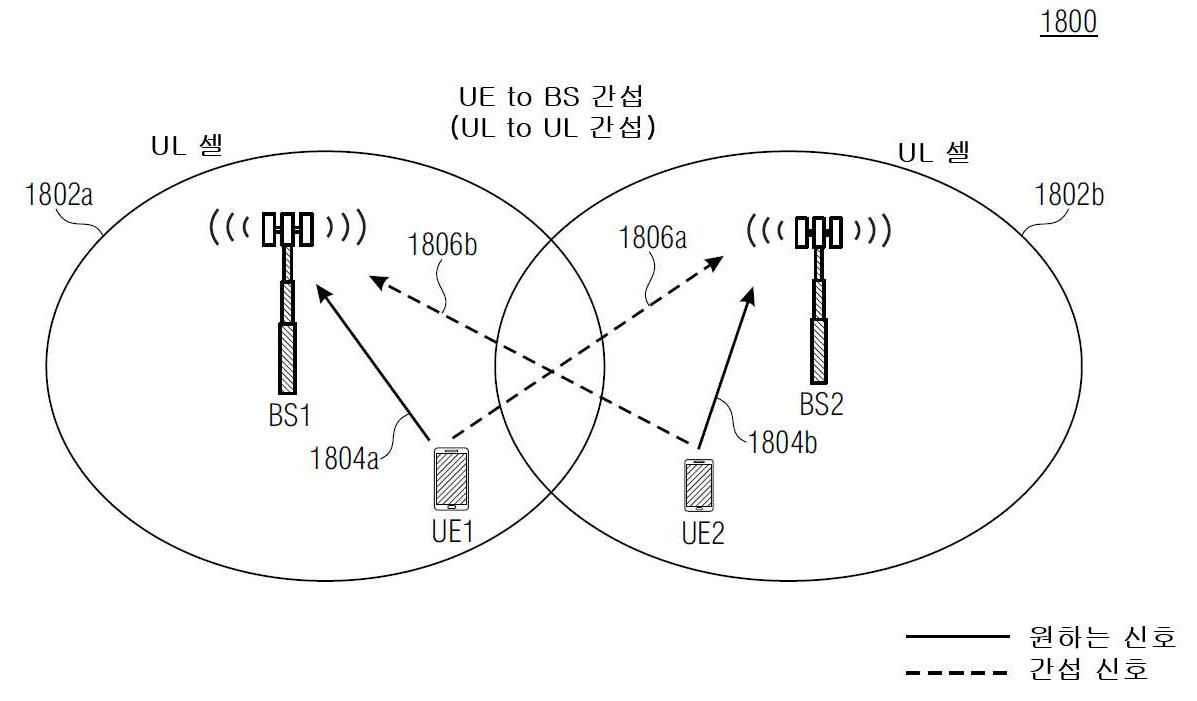
도 18a/b는 셀 간 간섭의 경우를 예시하기 위해 실시예에 따른 무선 통신 시스템의 개략도를 도시한다;
도 19는 교차 링크 간섭이 발생하는 도 18의 무선 통신 시스템의 개략도를 도시한다;
도 20은 실시예에 따른 비동기 네트워크에서 CLI 발생의 개략적인 블록도를 도시한다;
도 21은 실시예에 따른 IAB 네트워크의 개략적인 블록도를 도시한다;
도 22는 실시예에 따른 도 21의 IAB 네트워크의 개략적인 확장 블록도를 도시한다;
도 23은 실시예에 의해 핸드링되는 IAB 네트워크에서의 간섭의 상이한 경우의 개략도를 도시한다;
도 24a-d는 실시예에 따른 소위 히든 단말기 문제를 예시하기 위해 무선으로 통신하는 장치 배열의 개략적인 블록도를 도시한다;
도 25는 실시예들에 따른 소위 노출된 단말기 문제를 설명하기 위해 무선으로 통신하는 장치 배열의 개략적인 블록도를 도시한다;
도 26은 실시예에 따른 방법의 개략적인 흐름도를 도시하고 CLI 간섭 관리를 위한 향상된 절차의 높은 수준의 개요를 제공한다;
도 27a는 일 실시예에 따른 방법의 개략적인 흐름도를 도시하고, 보다 상세한 2단계 CLI-완화 접근법을 묘사한다;
도 27b는 실시예에 따라 검출된 간섭을 보고하기 위한 가능한 간격을 나타내는 개략도를 도시한다;
도 27c는 예시적인 TDD 슬롯의 상이한 가능한 설정(27021 내지 2702N)의 개략도를 도시한다;
도 28은 본 명세서에 기술된 해결책을 구현하기 위한 실시예에 따른 무선 통신 시스템의 개략적인 블록도를 도시한다;
도 29a-b는 자기 간섭과 관련된 실시예와 관련된 개략도를 도시한다; 및
도 30a/b는 자기 간섭과 관련된 실시예와 관련된 개략적인 플롯을 도시한다.DETAILED DESCRIPTION OF THE PREFERRED EMBODIMENTS Embodiments of the present invention will now be described in more detail with reference to the accompanying drawings:
1 shows an example of an ideal antenna radiation pattern plotted using mutually perpendicular axes with azimuth on the abscissa and directionality on the ordinate;
Figure 2 shows a schematic diagram of the antenna radiation pattern of Figure 1 plotted using a polar coordinate system;
Fig. 3a shows a schematic plan view of at least part of a network according to an embodiment in which an interfering device according to an embodiment operates;
Fig. 3b shows a schematic block diagram of a part of the wireless communication network according to Fig. 3a in which the interfering device adapts to the antenna radiation pattern taking into account the transmit power of the side lobe;
Fig. 3c shows a schematic block diagram of the part of the network according to Fig. 3a in which the interfering device controls the direction of the side lobes to point along the other direction;
Fig. 3d shows a schematic block diagram of the scenario of Fig. 3a in which an interfering device controls power/sensitivity and direction of side lobes;
Fig. 4a shows a schematic block diagram of an interfered device according to an embodiment;
Figure 4b shows a schematic block diagram of the interaction between an interfered device and an interfering interferer;
5 shows a schematic block diagram of an apparatus according to a first recognition embodiment of the present invention;
Fig. 6 shows a schematic block diagram of an apparatus according to a second aspect of the present invention;
7 shows a schematic block diagram of a device configured to operate in a wireless communication network to direct measurements to other devices;
8 shows a schematic block diagram of a wireless communication network according to one embodiment;
9 shows a schematic block diagram of a wireless communication network according to an embodiment having at least three devices;
Figure 10 shows a schematic block diagram of a wireless communication network in which a device operating as a gNB maintains a link with two different devices adapted as UEs;
11 shows a schematic block diagram of a wireless communication network according to an embodiment having at least four devices maintaining a wireless or wireless link;
12 shows a schematic block diagram of a wireless communication network according to an embodiment comprising at least two, at least three or at least four UEs;
13 shows a schematic block diagram of a wireless communication network according to an embodiment in which a base station and a UE both operate as measurement and logging/reporting devices;
Fig. 14 shows a schematic flow chart of a method for operating a device according to a first recognition;
Fig. 15 shows a schematic flow chart of a method for operating a device according to a second recognition;
16 shows a schematic flow diagram of a method for operating a device, eg the device of FIG. C, in a wireless communication network;
17 shows a schematic diagram of a known network;
18a/b shows a schematic diagram of a wireless communication system according to an embodiment to illustrate the case of inter-cell interference;
19 shows a schematic diagram of the wireless communication system of FIG. 18 in which cross-link interference occurs;
20 shows a schematic block diagram of CLI generation in an asynchronous network according to an embodiment;
21 shows a schematic block diagram of an IAB network according to an embodiment;
22 shows a schematic expanded block diagram of the IAB network of FIG. 21 according to an embodiment;
23 shows a schematic diagram of different cases of interference in an IAB network handled by an embodiment;
24a-d show schematic block diagrams of arrangements of wirelessly communicating devices to illustrate the so-called hidden terminal problem according to an embodiment;
Figure 25 shows a schematic block diagram of a wirelessly communicating device arrangement to account for the so-called exposed terminal problem according to embodiments;
26 shows a schematic flow diagram of a method according to an embodiment and provides a high-level overview of an improved procedure for CLI interference management;
27A shows a schematic flow diagram of a method according to one embodiment, and depicts a more detailed two-step CLI-mitigation approach;
Fig. 27b shows a schematic diagram illustrating possible intervals for reporting detected interference according to an embodiment;
27C shows a schematic diagram of different possible configurations 2702 1 to 2702 N of example TDD slots;
28 shows a schematic block diagram of a wireless communication system according to an embodiment for implementing the solution described herein;
29a-b show schematic diagrams related to an embodiment related to magnetic interference; and
30a/b shows a schematic plot related to an embodiment related to magnetic interference.
동일하거나 동등한 엘리먼트 또는 동일하거나 동등한 기능을 갖는 엘리먼트는 상이한 도면에서 발생하더라도 동일하거나 동등한 참조 번호로 이하의 설명에서 표시된다. The same or equivalent elements or elements having the same or equivalent function are denoted in the following description by the same or equivalent reference numbers even though they occur in different figures.
이하 설명에서, 본 발명의 실시예에 대한 보다 철저한 설명을 제공하기 위해 복수의 세부사항이 제시된다. 그러나, 본 발명의 실시예가 이러한 특정 세부사항 없이 실시될 수 있다는 것은 당업자에게 명백할 것이다. 다른 예에서, 잘 알려진 구조 및 장치는 본 발명의 실시예를 모호하게 하는 것을 피하기 위해 상세하게 보다는 블록도 형태로 도시된다. 또한, 이하에서 설명하는 상이한 실시예의 특징은 특별히 달리 언급하지 않는 한 서로 결합될 수 있다. In the following description, numerous details are set forth in order to provide a more thorough description of embodiments of the present invention. However, it will be apparent to those skilled in the art that embodiments of the invention may be practiced without these specific details. In other instances, well-known structures and devices are shown in block diagram form rather than in detail in order to avoid obscuring the embodiments of the present invention. In addition, features of different embodiments described below may be combined with each other unless specifically stated otherwise.
본 명세서에 기술된 실시예는 장치에 의해 형성되는 안테나 방사 패턴 또는 빔 패턴에 관한 것이다. 이러한 안테나 방사 패턴은 송신 방사 패턴 및/또는 수신 방사 패턴, 즉, 신호의 송신 및/또는 수신을 위한 공간 패턴 또는 선호되는 방향일 수 있다. 그러한 안테나 방사 패턴은 메인 로브 (선택적으로 추가적인 메인 로브) 및 하나 이상의 사이드 로브를 포함할 수 있다. 두 개의 인접한 로브 사이에는 소위 널(null)이 배열될 수 있다. 밀리미터파 스펙트럼과 관련하여 기술된 바와 같이, 밀리미터파 주파수의 사용은 커버리지의 원칙이 셀 커버리지에서 빔 커버리지로 이동할 수 있기 때문에 셀룰러 무선 네트워크에 대한 패러다임 변화를 만든다. 3G PP NR은 빔 관리 절차 및 빔 대응 요구 사항을 정의하지만[7], 실시예는 안테나 방사 패턴의 빔 부분에 관한 것이다. Embodiments described herein relate to an antenna radiation pattern or beam pattern formed by a device. This antenna radiation pattern can be a transmit radiation pattern and/or a receive radiation pattern, ie a spatial pattern or preferred direction for transmitting and/or receiving signals. Such an antenna radiation pattern may include a main lobe (optionally an additional main lobe) and one or more side lobes. A so-called null can be arranged between two adjacent lobes. As described in relation to the millimeter wave spectrum, the use of millimeter wave frequencies creates a paradigm shift for cellular wireless networks as the principle of coverage can shift from cell coverage to beam coverage. 3G PP NR defines beam management procedures and beam correspondence requirements [7], but embodiments relate to the beam portion of the antenna radiation pattern.
본 명세서에 기술된 일부 실시예는 슬롯에 관한 것이다. 그러나, 슬롯은 대안적으로 또는 추가로 동일한 자원 블록 및/또는 부반송파 및 슬롯/심볼을 포함하는 무선 자원의 예시적인 예이다. 즉, 자원으로서, 실시예는 적어도 하나의 주파수 부분 대역폭(BWP), 적어도 하나의 자원 블록, 적어도 하나의 부반송파 및/또는 적어도 하나의 시간-도메인 슬롯/심볼 중 하나 이상을 포함할 수 있다. 따라서 시간 슬롯과 관련하여 본 명세서에서 설명되는 실시예들은 시간 슬롯에 제한되지 않고 다른 유형의 무선 자원을 참조할 수 있다. Some embodiments described herein relate to slots. However, a slot is an illustrative example of a radio resource that alternatively or additionally includes identical resource blocks and/or subcarriers and slots/symbols. That is, as a resource, an embodiment may include one or more of at least one frequency partial bandwidth (BWP), at least one resource block, at least one subcarrier, and/or at least one time-domain slot/symbol. Accordingly, the embodiments described herein with respect to time slots are not limited to time slots and may refer to other types of radio resources.
안테나 방향성antenna directionality
안테나의 방향성은 다른 모든 방향으로 방출하는 에너지의 양과 비교하여 선호하는 방향이나 주어진 방향으로 전자기 에너지를 집중하거나 유도하는 능력의 척도가 된다. 상호성으로 인해, 안테나 방향성은 송신과 수신 모두에서 동일한다. 일반적으로 모든 실용적인 안테나는 1보다 큰 방향성을 가지고 있다. 개별 안테나의 방향성은 세심한 설계를 통해 영향을 받을 수 있지만, 더 높은 방향성을 달성하고 최대 에너지가 방향되는 방향을 제어하기 위해 다수의 안테나 엘리먼트가 종종 안테나 어레이를 형성하는 방식으로 배열된다. 현재 엘리먼트의 기계적 위치는 일반적으로 고정되지만, 이들의 전기적 여기는 안테나 어레이의 방사 패턴의 특성을 변경하도록 배열될 수 있다. 이러한 방법을 사용하면, 무엇보다도 다음을 제어할 수 있다: 전기 스캔 각도(메인 로브 또는 "빔"이 가리키는 방향); 메인 로브에 대한 사이드 로브의 전체 수준; 사이드 로브의 수준과 위치; 널의 깊이와 위치 (메인 로브와 사이드 로브 사이 및 사이드 로브 사이에 있음). 이상적인 위상 어레이 안테나에 의해 생성된 2차원 안테나 방사의 예는 각각 직사각형 및 극축을 사용하며, 도 1 및 도 2에 도시된다. The directivity of an antenna is a measure of its ability to focus or direct electromagnetic energy in a preferred or given direction compared to the amount of energy it radiates in all other directions. Due to reciprocity, the antenna directivity is the same for both transmission and reception. In general, all practical antennas have a directivity greater than 1. Although the directivity of individual antennas can be influenced through careful design, multiple antenna elements are often arranged in such a way to form an antenna array to achieve higher directivity and to control the direction in which the maximum energy is directed. The mechanical positions of the current elements are generally fixed, but their electrical excitation can be arranged to change the characteristics of the radiation pattern of the antenna array. Using this method, you can control, among other things: the electrical scan angle (the direction the main lobe or "beam" is pointing); the overall level of side lobes relative to the main lobe; level and location of side lobes; Depth and location of the nulls (between the main and side lobes and between the side lobes). Examples of two-dimensional antenna radiation produced by an ideal phased array antenna are shown in FIGS. 1 and 2, using a rectangular and polar axis, respectively.
즉, 도 1은 횡축에 방위각도 및 종축에 방향성을 갖는 직교 좌표계에서와 같이 직사각형 또는 수직 축을 사용하여 플롯팅된 이상적인 안테나 방사 패턴(10)의 예를 도시한다. (메인) 빔으로도 지칭될 수 있는 메인 로브(12)는 방위각에서 30도로 도시되어 있다. 안테나 방사 패턴은 하나 이상의 사이드 로브(141 내지 14i)를 포함할 수 있고, 2개의 인접한 로브 사이에 널(161 내지 16j)이 배열될 수 있다. 널은 인접한 로브와 비교할 때 더 적은 전력이 전달(수신 또는 전송)되는 방향으로 이해될 수 있다. 전력 전달의 감소는, 예를 들어, 적어도 6dB, 적어도 10dB 등일 수 있다. 예를 들어 균일한 전력 분포를 사용하여 필요한 방향으로 빔 또는 메인 로브(12)를 조종하기 위해 위상 분포가 사용될 수 있다. 사이드 로브 수준은 불규칙할 수 있다.That is, FIG. 1 shows an example of an ideal
도 2는 극좌표계를 사용하여 플롯팅된 안테나 방사 패턴(10)의 개략도를 도시한다.
2 shows a schematic diagram of an
본 명세서에 기술된 실시예들과 관련하여 안테나 방사 패턴을 형성하는 것은 정적 안테나 방사 패턴에 관한 것일 수 있지만, 동적, 즉 스위핑 안테나 방사 패턴에 관한 것일 수도 있다. 스위핑 빔 패턴 또는 안테나 방사 패턴은 공간에서 또는 주파수에서 이동하는, 예를 들어 회전되거나 측면으로 시프트되는 일정하거나 변화하는 패턴으로 이해될 수 있다. 그러한 스위핑은 안테나 방사 패턴의 로브 및/또는 널(null)의 방향의 조절을 가능하게 할 수 있다. Forming an antenna radiation pattern in conjunction with the embodiments described herein may refer to a static antenna radiation pattern, but may also refer to a dynamic, or sweeping, antenna radiation pattern. A swept beam pattern or antenna radiation pattern can be understood as a constant or changing pattern that moves in space or in frequency, eg rotated or laterally shifted. Such sweeping may enable adjustment of the direction of the lobes and/or nulls of the antenna radiation pattern.
본 실시예와 관련하여 기술된 방향은 실시예의 범위를 방향의 좁은 의미, 즉 단일 인자로 제한하지 않는다. 방향이라는 용어는 통신 파트너의 장소/위치, 영역/구역 또는 볼륨에서 수신되거나 전송된 신호에 크게 기여하는 지배적인 각도 성분의 세트를 또한 포함하는 것으로 이해되어야 한다. 이것은 서로 다른 수신 다중 경로 컴포넌트를 수집하고 효과적인 수신 안테나 입력 신호에 가중치를 주는 복잡한 3D 수신 안테나 방사 패턴과 동일할 수 있다. 따라서 방향은 한 라인에 제한하지 않고 수신된 패턴에 의해 수집된 방향에서 신호의 집합을 포함할 수 있다. 송신 전략은 송신기로부터 목표 수신/통신 파트너로 양호한 신호 전력 전달을 제공하는 송신 빔 패턴을 선택할 수 있다. Directions described in connection with this embodiment do not limit the scope of the embodiment to a narrow meaning of direction, i.e., a single factor. The term direction should be understood to also include the set of dominant angular components that contribute significantly to the signal received or transmitted in a place/position, area/region or volume of a communication partner. This can be equivalent to a complex 3D receive antenna radiation pattern that collects the different receive multipath components and weights the effective receive antenna input signal. Thus, a direction is not limited to one line but can include a set of signals in a direction gathered by a received pattern. The transmit strategy may select a transmit beam pattern that provides good signal power transfer from the transmitter to the target receive/communication partner.
본 명세서에 기술된 빔포밍을 수행할 수 있는 장치는 안테나 배열을 포함할 수 있고, 상기 안테나 배열은 하나 이상의 안테나 패널을 가지며, 여기서 각각의 안테나 패널은 하나 이상의 안테나를 포함할 수 있다. 즉, 각 안테나 패널은 패널 또는 그 서브패널이 코히어런트 빔포밍을 수행할 수 있도록 하나 이상의 방사/수신 안테나의 배열을 포함한다. 즉, 빔포밍을 수행하기 위해서, 안테나 패널로 그룹핑된 안테나의 수, 안테나 패널의 수, 그리고 총 안테나 수는 임의적일 수 있다. An apparatus capable of performing beamforming as described herein may include an antenna array, and the antenna array may have one or more antenna panels, where each antenna panel may include one or more antennas. That is, each antenna panel includes an array of one or more radiating/receiving antennas so that the panel or sub-panel can perform coherent beamforming. That is, in order to perform beamforming, the number of antennas grouped into antenna panels, the number of antenna panels, and the total number of antennas may be arbitrary.
패턴 제어pattern control
이전 논의에서, 장치 (예를 들어 기지국과 하나의 사용자 장치) 간의 최상의 링크를 형성하기 위해서, 빔 관리를 사용하여 각 장치의 빔이 적절하게 가리키고 있는지 확인할 수 있다. 그러나 알려진 빔 관리는 다른 사용자에 대한 간섭의 영향을 고려하지 않는다. 즉, 예를 들어, 기지국 안테나 빔이 주어진 방향, 즉 연결을 수립하거나 유지해야 하는 장치를 가리키는 경우, 패턴의 연관된 사이드 로브 및 널은 임의로 빔을 따른다. 사이드 로브의 파워 수준은 일반적으로 빔의 파워 수준보다 낮지만, 이 수준은 여전히 기지국이 연결되지 않은 다른 장치에 충분한 전력을 방출하므로 장치가 간섭을 받게 된다. 어떤 경우에, 간섭자의 전력 수준이 서빙 빔의 전력 수준을 초과할 수도 있다. In the previous discussion, in order to form the best link between devices (e.g., a base station and one user device), beam management can be used to ensure that each device's beam is pointing properly. However, known beam management does not take into account the impact of interference on other users. That is, for example, if a base station antenna beam points in a given direction, i.e., to a device that needs to establish or maintain a connection, the associated side lobes and nulls of the pattern follow the beam arbitrarily. The power level of the side lobe is usually lower than the power level of the beam, but this level still causes the base station to radiate enough power to other unconnected devices to interfere with the device. In some cases, the power level of the interferer may exceed the power level of the serving beam.
위상 어레이 안테나 시스템의 다른 응용 프로그램에서, 패턴 널은 소위 방해 전파 발신기 (피해자의 레이더 또는 통신 시스템을 의도적으로 겨냥한 강력한 전자기 방사원)의 영향이 (피해자의) 안테나 패턴의 적응을 통해 공간적으로 감소될 수 있는 방식으로 생성된다. In other applications of phased array antenna systems, pattern nulls allow the effects of so-called jammers (powerful sources of electromagnetic radiation intentionally aimed at a victim's radar or communication system) to be spatially reduced through adaptation of the (victim's) antenna pattern. created in such a way that
따라서 실시예는 일반적으로 안테나의 방사 패턴 특성의 제어에 관한 것으로 단지 패턴의 메인 로브 또는 빔에 관한 것이 아니다. 사이드 로브 및 널의 수준과 위치를 제어, 조절 및 적응함으로써 다른 사용자에 대한 간섭 수준을 줄일 수 있다. 마찬가지로, 수신 시 패턴 제어, 패턴 조절 및 패턴 적응을 사용하여 다른 사용자의 간섭 수준을 줄일 수 있다. 따라서 본 명세서에 기술된 실시예는 송신 및 수신 모두에 적용가능하다. Embodiments thus relate generally to control of the radiation pattern characteristics of an antenna and not just to the main lobe or beam of a pattern. By controlling, adjusting and adapting the level and location of side lobes and nulls, the level of interference to other users can be reduced. Similarly, pattern control, pattern adjustment, and pattern adaptation can be used at reception to reduce the level of interference from other users. Thus, the embodiments described herein are applicable to both transmission and reception.
안테나 어레이는 송신 방사 패턴 및/또는 수신 방사 패턴을 생성하는 것을 허용할 수 있다. 수신 패턴은 예를 들어, 신호 수신 또는 감지와 관련하여 사용될 수 있다. 센서 엘리먼트의 어레이는 단일 센서(안테나)와 관련된 방향성 제한을 극복하는 수단을 제공하므로, 단일 엘리먼트에서 경험하는 것보다 더 높은 이득과 더 좁은 빔폭을 제공한다. 게다가, 어레이는 도달 방향, 편광, 전력 수준 및 주파수와 같은 신호 환경의 변화하는 조건에 따라 응답을 제어하는 기능이 있다[8]. The antenna array may allow generating a transmit radiation pattern and/or a receive radiation pattern. A reception pattern may be used, for example, in connection with signal reception or sensing. An array of sensor elements provides a means to overcome the directional limitations associated with a single sensor (antenna), thus providing higher gain and narrower beamwidth than experienced with a single element. Moreover, the array has the ability to control its response according to the changing conditions of the signal environment, such as direction of arrival, polarization, power level and frequency [8].
어레이는 안테나의 성능을 높이는 방식으로 신호가 일관성 있게 결합되는, 둘 이상의 센서로 이루어지거나 이들을 포함할 수 있다. 실시예에서 사용되는 어레이는 단일 센서에 비해 다음과 같은 장점을 가질 수 있다: An array may consist of or include two or more sensors, the signals of which are coherently combined in such a way as to increase the performance of the antenna. The array used in the examples may have the following advantages over a single sensor:
1. 더 높은 이득. 어레이 이득은 어레이 엘리먼트의 수 정도이기 때문에 이득이 높다. 더 높은 해상도 또는 더 좁은 메인 빔은 더 큰 조리개 크기에 따른다. One. higher gain.Since the array gain is on the order of the number of array elements, the gain is high. Higher resolution or narrower main beams result in larger aperture sizes.
2. 전자빔 스캐닝. 메인 빔을 조종하기 위해 물리적 또는 기계적으로 움직이는 대형 안테나는 느리다. 신호가 빔 조향 각도에서 위상이 추가되도록 만들어지기 때문에, 각 엘리먼트에 위상 시프트 장치가 있는 어레이는 기계적 움직임 없이 빔을 조정할 수 있다. 2. electron beam scanning. Large antennas that physically or mechanically move to steer the main beam are slow. Since the signal is made to add phase at the beam steering angle, an array with a phase shift device in each element can steer the beam without mechanical movement.
3. 낮은 사이드 로브. 원하는 신호가 메인 빔으로 들어가는 동안 간섭 신호가 사이드 로브에 들어가는 경우, 메인 빔에 비해 사이드 로브를 낮추어 신호 대 간섭비를 향상시킨다. 3. low side lobes.When the interference signal enters the side lobe while the desired signal enters the main beam, the side lobe is lowered compared to the main beam to improve the signal-to-interference ratio.
4. 다중 빔. 특정 어레이 피드는 동시에 여러 개의 메인 빔을 가능하게 한다. 4. multiple beams. Certain array feeds enable multiple main beams simultaneously.
5. 적응형 널링. 적응형 어레이는 사이드 로브 영역에서 신호 방향으로 자동으로 널을 이동시킨다. 5. adaptive knurling. Adaptive arrays automatically move nulls in the signal direction in the side lobe region.
위에서 설명한 수신 이점 외에도, 어레이는 전송 목적으로 사용될 때도 상당한 장점을 제공한다. In addition to the receiving benefits described above, arrays also offer significant advantages when used for transmission purposes.
어레이가 전송 또는 수신 목적으로 사용되는지 여부에 관계없이, 주어진 방향으로 하나 이상의 빔을 가리키고; 사이드 로브의 방향과 상대적 수준을 제어하고; 및/또는 널의 위치와 상대 깊이를 제어할 이유로 어레이의 안테나 방사 패턴이 제어될 수 있도록 하는 수단을 일반적으로 제공하는 것이 필요하다. Regardless of whether the array is used for transmitting or receiving purposes, it points one or more beams in a given direction; control the direction and relative level of the side lobes; and/or for reasons of controlling the positions and relative depths of the nulls, it is generally necessary to provide a means by which the antenna radiation pattern of the array can be controlled.
안테나 방사 패턴을 제어하는 예는 위상 안테나 어레이와 관련하여 설명될 수 있다. 제공된 예는 안테나 어레이의 안테나에서 또는 안테나 사이에서 구현될 조치에 관한 것이다. An example of controlling the antenna radiation pattern can be described in terms of a phased antenna array. Examples provided relate to measures to be implemented at or between antennas of an antenna array.
스캔 되지 않은 어레이 안테나는 그 동작이 엘리먼트 간의 상대적 위상에 의존하기 때문에, 실제로는 여전히 위상 어레이 안테나라는 사실에 기반하므로, 스캔된 빔 어레이 안테나에 대한 위상 어레이 안테나라는 용어에 대해서는 반론이 존재한다는 점에 유의한다. 이러한 주장에도 불구하고, 빔 조향과 관련하여 단계적으로 사용되는 용어는 역사적 발전에 따라 사용될 것이다[8]. 빔 형성기라는 용어는 단일 빔 또는 다중 빔 생성 여부에 관계없이 사용될 것이다. Note that there is an objection to the term phased array antenna for scanned beam array antennas, since unscanned array antennas are based on the fact that they are in fact still phased array antennas, since their operation depends on the relative phase between the elements. Note Despite this assertion, the terminology used step by step in relation to beam steering will be used according to its historical development [8]. The term beamformer will be used regardless of whether it produces a single beam or multiple beams.
위상 어레이는 일반적으로 2차원 또는 3차원 공간에 배열된 다수의 안테나 엘리먼트로 구성된다. 서로에 대한 엘리먼트의 위치는 일반적으로 고정되어 있는데, 즉, 자체 어레이 공간에서 이동하지 않는다. 그러나 이것은 휴대용 및 모바일 애플리케이션에서 위상 어레이 시스템을 반드시 제외하는 것은 아니다. 어레이의 엘리먼트는 규칙적 또는 불규칙적 방식으로 선형, 평면 또는 등각이 되도록 기하학적으로 배열될 수 있다. 앞서 언급한 카테고리의 조합도 가능한다. A phased array usually consists of a number of antenna elements arranged in a two-dimensional or three-dimensional space. The positions of the elements relative to each other are generally fixed, i.e. they do not move in their own array space. However, this does not necessarily exclude phased array systems in portable and mobile applications. The elements of the array may be geometrically arranged to be linear, planar or conformal in a regular or irregular manner. Combinations of the aforementioned categories are also possible.
완전 디지털 빔 형성 시스템의 경우, 안테나 엘리먼트는 자체 송신기 또는 수신기 또는 송수신기 회로에 개별적으로 연결될 수 있다. 또는 아날로그 빔 형성 시스템에서, 직렬 피드 네트워크 또는 공통 피드 네트워크를 통해 하나 이상의 안테나 엘리먼트를 공통 무선 회로에 연결할 수 있다. 무선 장치당 엘리먼트의 수는 시스템 요구 사항 및 설계 제약 조건에 따라 결정된다. 소위 하이브리드 빔 형성 시스템은 디지털 및 아날로그 구현을 모두 결합한다. In the case of an all-digital beamforming system, the antenna element may be individually coupled to its own transmitter or receiver or transceiver circuitry. Alternatively, in an analog beamforming system, one or more antenna elements may be connected to a common radio circuit via a serial feed network or a common feed network. The number of elements per radio is determined by system requirements and design constraints. So-called hybrid beamforming systems combine both digital and analog implementations.
디지털, 아날로그 또는 하이브리드 등 빔 형성기를 구현하는 데 사용되는 방법에 거의 관계없이, 어레이의 특정 복사 특성을 결정하는 것은 엘리먼트의 여기(excitation)이다. 예를 들어 빔이 향하는 방향과 같은 속성을 제어하기 위해서는, 개별 엘리먼트 여기의 위상이 적절하게 구성되어야 한다. 유사하게, 아래에 논의된 바와 같이 사이드 로브 수준은 진폭 테이퍼를 통해 제어될 수 있다. Almost regardless of the method used to implement the beamformer, whether digital, analog or hybrid, it is the excitation of the elements that determines the specific radiation characteristics of the array. In order to control properties, for example the direction in which the beam is directed, the phase of the excitation of the individual elements must be properly configured. Similarly, as discussed below, the side lobe level can be controlled via an amplitude taper.
위상 시프트의 실현Realization of phase shift
어레이 안테나 소자의 위상 여기를 제어하는 이유를 설명하면, 이 섹션에서는 원하는 위상 시프트를 달성하는 데 사용할 수 있는 네 가지 예제 방법을 간략하게 설명한다. Having explained the reasons for controlling the phase excitation of an array antenna element, this section outlines four example methods that can be used to achieve the desired phase shift.
주파수 변경frequency change
주파수 또는 주파수 스캐닝을 변경해서 위상을 시프트하는 것은, 어레이 안테나 엘리먼트에 직렬 피딩을 수행하는 것에 의해 이루어지고, 그렇게 함으로서 엘리먼트가 피드 라인을 따라 등거리로 배치된다. 주파수를 변경함으로써, 어레이 안테나 엘리먼트에 대해 선형 위상 테이퍼가 변경되는데, 이는 입력 신호가 K-엘리먼트 선형 어레이 안테나의 i번째 엘리먼트에 도달하기 위해 물리적 거리 및 이에 따라 전기 길이에 걸쳐 이동해야 하기 때문이다. 중심 주파수에서 위상 어레이 안테나 빔이 어레이 또는 광시야에 수직으로 향하도록 피딩 라인의 물리적 길이가 선택되면, 중심 주파수보다 낮거나 큰 값으로 주파수를 변경하는 것이 빔이 각각 광시야 보다 작거나 큰 각도로 향하게 할 것이다[8]. 그러나 고정 주파수 채널 할당이 일반적인 통신 목적으로 위상 어레이가 사용되는 경우, 동작 주파수를 변경하여 위상 시프트를 구현하는 것은 비실용적이다. Shifting the phase by changing the frequency or frequency scanning is accomplished by performing serial feeding of the array antenna elements, thereby placing the elements equidistantly along the feed line. By changing the frequency, the linear phase taper is changed for the array antenna element, since the input signal must travel over a physical distance and thus an electrical length to reach the ith element of the K-element linear array antenna. If the physical length of the feeding line is chosen such that at the center frequency the phased array antenna beam is directed perpendicular to the array or widefield, then changing the frequency by a value lower or greater than the center frequency will cause the beam to rotate at an angle less than or greater than the widefield, respectively. will be directed [8]. However, when a phased array is used for communication purposes where fixed frequency channel allocation is common, it is impractical to implement phase shift by changing the operating frequency.
길이 변경length change
이러한 유형의 위상 시프트는 직렬 피드 어레이와 공동 피드 어레이에 적용될 수 있다[9]. 디지털 이전 시대에, 변화하는 물리적 길이에 기반한 위상 시프터는 전기 기계 수단에 의해 실현되었다. 라인 스트레처(line stretcher)[9]는 초기 유형의 위상 시프트 장치의 예이다. 라인 스트레처는 'U'자 형태로 구부러진 (동축) 전송 라인 섹션이다. 이 'U'의 하단 부분은 고정식 피딩 네트워크의 일부를 형성하는 2개의 '암(arm)'에 부착되어 있다. 'U'의 하단 부분은 전기 기계 수단에 의해 늘어날 수 있는 텔레스코핑 섹션 역할을 한다. 따라서 'U'[8]의 '암' 위치를 변경하지 않고 전송 라인 섹션을 늘리거나 줄일 수 있다. This type of phase shift can be applied to serial feed arrays and corporate feed arrays [9]. In the pre-digital era, phase shifters based on varying physical lengths were realized by electromechanical means. A line stretcher [9] is an example of an early type of phase shift device. A line stretcher is a section of (coaxial) transmission line that is bent into a 'U' shape. The lower part of this 'U' is attached to two 'arms' which form part of a stationary feeding network. The lower part of the 'U' serves as a telescoping section that can be stretched by electromechanical means. Therefore, the transmission line section can be lengthened or shortened without changing the position of the 'arm' of the 'U' [8].
요즘에는 다양한 길이의 전송 라인이 디지털 방식으로 선택된다. 모든 섹션의 스위치는 표준 길이의 전송 라인을 네트워크로 전환하거나, 또는 이 표준 길이에 추가되는 미리 결정된 길이의 전송 라인의 한 조각을 전환하는 데 사용된다. 이러한 길이는, 표준 길이의 캐스케이드를 기준으로 할 때(위상 ψ=0°를 가짐), 22.5°(최하위 비트)의 단계에서, ψ=0°에서 ψ= 337.5°까지의 범위인, 16개의 위상(4비트에 해당)이 선택될 수 있다. 더 짧은 길이와 더 많은 비트를 사용하여 더 높은 해상도를 얻을 수 있다. 순방향 및 역방향 바이어스에 사용되는 PIN 다이오드는 종종 스위칭 소자로 사용된다[9, 10]. 스위칭된 위상 시프터는 유전 상수가 높은 기판 재료를 사용하여 마이크로스트립 기술로 실현될 수 있으므로, 물리적 위상 시프터 치수를 최소화할 수 있다[8]. Nowadays, transmission lines of various lengths are digitally selected. The switches in every section are used to switch a transmission line of standard length into the network, or a piece of transmission line of a predetermined length added to this standard length. This length is 16 phases, ranging from ψ=0° to ψ= 337.5°, in steps of 22.5° (least significant bit), based on a cascade of standard length (with phase ψ=0°). (corresponding to 4 bits) can be selected. Higher resolution can be achieved by using a shorter length and more bits. PIN diodes used for forward and reverse bias are often used as switching elements [9, 10]. Switched phase shifters can be realized with microstrip technology using substrate materials with high dielectric constants, thus minimizing physical phase shifter dimensions [8].
물리적 라인 길이를 전환하는 또 다른 방법은 캐스케이드 하이브리드 결합 위상 시프터에서 찾을 수 있다. 3dB 하이브리드는 입력 포트 1의 전력을 출력 포트 2와 3에 대해 동등하게 분배하고 출력 포트 4에는 전력을 전달하지 않는 4-포트 장치이다. 포트 2와 3을 떠난 신호의 반사는 하이브리드로 돌아가서 출력 포트 4에서 결합하고, 입력 포트 1에는 전원이 반환되지 않는다. 캐스케이드 하이브리드 결합 위상 시프터의 모든 세그먼트(비트)에 있는 다이오드 스위치는 신호를 포트 2와 3을 바로 떠나거나, 또는 추가 라인 길이 △l/2를 두 번 이동한 후에 반환한다. 일 예로, 최하위 비트에 대해서는 4-비트 위상 시프터 △l/2 = λ/32이고, 다음 세 비트에 대해서는 각각, △l/2 = λ/16, △l/2 = λ/8 및 △l/2 = λ/4이다[8].
Another way to convert the physical line length can be found in cascade hybrid coupled phase shifters. A 3dB hybrid is a 4-port device that distributes power from
유전율(유전 상수) 변경Permittivity (dielectric constant) change
기체 방전 또는 플라즈마를 포함하는 장치를 통해 흐르는 전류를 조절하여 유전 상수 및 이에 따른 위상 시프트를 제어할 수 있다[9]. 장치의 유전율을 조절하는 또 다른 방법은 유전율이 재료에 인가된 전기장의 함수인 소위 강전기 재료를 사용하는 것이다[8]. 유전율은 안테나 어레이의 안테나들 사이에서 조절될 수 있다. 한 가지 접근 방식은 안테나 어레이의 엘리먼트와 관련된 신호의 위상을 변경하는 기능을 수행하는 장치에 이 기술을 적용하는 것일 수 있지만, 다른 접근법에 따르면, 유전율을 변경함으로써 구조, 재료 또는 배열을 사용하여 위상 시프트를 구현하기 위해 안테나 엘리먼트 및/또는 안테나 엘리먼트 어레이의 일부를 형성하는 구조에 적용될 수 있다. 두 접근 방식은 서로 결합될 수 있다. The dielectric constant and thus the phase shift can be controlled by modulating the current flowing through the device containing the gas discharge or plasma [9]. Another way to control the permittivity of a device is to use so-called ferroelectric materials, where the permittivity is a function of the electric field applied to the material [8]. The permittivity can be adjusted between the antennas of the antenna array. One approach may be to apply this technique to a device that performs the function of changing the phase of a signal relative to an element of an antenna array, but according to another approach, a structure, material or arrangement may be used to change the phase by changing the permittivity. It may be applied to structures forming part of an antenna element and/or an array of antenna elements to implement the shift. Both approaches can be combined with each other.
투자율 변화permeability change
페리자성 재료 또는 페라이트는 재료가 위치한 곳의 인가된 자기장의 변화에 따라 투자율이 변경되는 재료이다. 페라이트 기반 위상 시프터는 특히 도파관 전송 라인 기술과 함께 오랫동안 사용되어 왔다. 도파관 내부 중앙에 위치한 페리자성 물질의 막대로 구성되며, 여기에서 솔레노이드가 도파관 주위에 감겨 있는, Reggia-Spencer 위상 시프터의 경우[9], 위상은 지속적으로 변경될 수 있으므로 위상 시프터를 본질적으로 아날로그로 만든다. 한편, 솔레노이드의 기능은 페리자성 막대를 통한 전류 도선에 의해 수행될 수 있다. 서로 다른 길이의 페리자성 막대를 계단식으로 연결하면 서로 다른(이산) 위상 시프트가 실현될 수 있다. 따라서 이러한 위상 시프터를 본질적으로 디지털로 만든다[8]. 투자율은 안테나 어레이의 안테나들 사이에서 조절될 수 있다. 투자율의 변화와 관련하여 설명한 바와 같이, 한 접근법은 다른 접근법에 따라 안테나 어레이의 엘리먼트와 연관된 신호의 위상을 변경하기 위해 위상 시프트를 적용하기 위한 것일 수 있지만, 위상 시프트는 예를 들어, 안테나 엘리먼트 및/또는 안테나 엘리먼트의 어레이 사이에서, 구조 및/또는 이의 컴포넌트 사이의 투자율을 변화시킴으로써, 안테나 엘리먼트 및/또는 안테나 엘리먼트의 어레이의 일부를 형성하는 구조에 적용될 수 있다. 두 접근 방식은 서로 결합될 수 있다. 또한, 유전율을 변경하는 것은 위상 시프트의 적어도 일부를 얻기 위해 투자율 변경하는 것과 결합될 수 있다. A ferrimagnetic material or ferrite is a material whose magnetic permeability changes according to a change in an applied magnetic field where the material is located. Ferrite-based phase shifters have been around for a long time, especially with waveguide transmission line technology. In the case of the Reggia-Spencer phase shifter [9], which consists of a rod of ferrimagnetic material placed centrally inside the waveguide, where a solenoid is wound around the waveguide, the phase can change continuously, making the phase shifter analog in nature. make Meanwhile, the function of the solenoid may be performed by a current conductor through a ferrimagnetic bar. By cascading ferrimagnetic rods of different lengths, different (discrete) phase shifts can be realized. This makes these phase shifters essentially digital [8]. Permeability can be adjusted between the antennas of the antenna array. As described with respect to changing permeability, one approach may be to apply a phase shift to change the phase of a signal associated with an element of an antenna array according to another approach, but the phase shift may be applied to, for example, an antenna element and and/or to structures forming part of antenna elements and/or arrays of antenna elements, by changing permeability between structures and/or components thereof, between arrays of antenna elements. Both approaches can be combined with each other. Also, changing the permittivity can be combined with changing the permeability to obtain at least a portion of the phase shift.
기술된 바와 같이, 진폭 테이퍼가 또한 예를 들어 사이드 로브를 제어하기 위해 사용될 수 있다. As described, an amplitude taper can also be used to control the side lobes, for example.
엘리먼트 여기 (엘리먼트 가중치라고도 함)의 강도 또는 진폭은 어레이 엘리먼트의 방향성과 사이드 로브 수준을 제어한다. 진폭 테이퍼의 예는 이항, Dolph-Chebyshev, Tseng-Cheng-Chebyshev, Taylor, Taylor-Woodard, Hansen, Bickmore-Spellmire 및 Bayliss를 포함한다[11]. 로우-사이드 로브(low-sidelobe) 진폭 테이퍼는 어레이의 중심에서 높은 진폭 가중치를 가지며, 가중치는 일반적으로 중심에서 가장자리로 감에 따라 감소한다. 일반적으로 테이퍼 효율이 감소함에 따라, 하프-출력 빔폭이 증가하고 사이드 로브 수준이 감소한다. The intensity or amplitude of element excitation (also called element weight) controls the directionality and sidelobe levels of the array elements. Examples of amplitude tapers include binomial, Dolph-Chebyshev, Tseng-Cheng-Chebyshev, Taylor, Taylor-Woodard, Hansen, Bickmore-Spellmire, and Bayliss [11]. A low-sidelobe amplitude taper has high amplitude weights at the center of the array, and the weights generally decrease from the center to the edges. In general, as the taper efficiency decreases, the half-output beamwidth increases and the side lobe level decreases.
진폭 실현amplitude realization
안테나 엘리먼트의 진폭 여기 조절은 시스템의 구현에 따라, 송신기 및 수신기 체인 모두에 대한 디지털 이득, 중간 주파수(IF) 이득 및 무선 주파수(RF) 이득 설정이 포함될 수 있는 증폭기 단계의 이득을 제어함으로써 실현될 수 있다. 적절한 경우, 능동 신호 증폭은 예를 들어 믹서 장치에 연결된 국부 발진기 장치의 구동 수준을 제어하여 주파수 변환 단계에서 구현할 수도 있다. 신호 증폭을 도입하는 앞서 언급한 능동 장치 외에도, 이들의 특성으로 인해 신호를 증폭하기보다는 감쇠하는 수동 장치가 또한 사용할 수 있다. 이러한 장치의 예로는 전력 분배기 또는 스플리터, 결합 라인 또는 커플러, 변압기, 임피던스 변환기, 저항성 네트워크 및 기생 요소가 있다. Adjustment of the amplitude excitation of the antenna element may be achieved by controlling the gain of the amplifier stage, which may include digital gain, intermediate frequency (IF) gain, and radio frequency (RF) gain settings for both the transmitter and receiver chains, depending on the implementation of the system. can Where appropriate, active signal amplification may also be implemented in the frequency conversion step, for example by controlling the driving level of a local oscillator device connected to the mixer device. Besides the aforementioned active devices which introduce signal amplification, passive devices which by their nature attenuate rather than amplify the signal can also be used. Examples of such devices are power dividers or splitters, coupling lines or couplers, transformers, impedance converters, resistive networks and parasitic elements.
본 명세서에 기술된 실시예는, 통신하는 동안 다른 장치와 간섭 장치 및 안테나 방사 패턴을 제어함으로써 이들이 야기하는 간섭을 처리하는 장치 둘 모두에 관한 것이다. 더 나은 이해를 위해, 이러한 장치를 간섭자 또는 공격자라고 할 수 있다. 실시예는 또한 연결 또는 데이터 교환을 (적어도 현재) 유지하지 못할 가능성이 있는 다른 장치에 의해 간섭 또는 교란되는 것을 감지하는 장치에 관한 것이다. 이러한 장치를 간섭받는 장치 또는 피해자라고 할 수 있다. Embodiments described herein relate to both devices that interfere with other devices while communicating and devices that deal with the interference they cause by controlling antenna radiation patterns. For better understanding, we can refer to these devices as interferers or attackers. Embodiments also relate to a device that detects being interfered with or disturbed by another device that may not (at least currently) maintain a connection or data exchange. These devices can be referred to as interfered devices or victims.
도 3a는 장치(30)가 동작하고 있는 네트워크(300)의 적어도 일부의 개략적인 평면도를 도시한다. 예로서, 장치(30)는 무선 통신 네트워크의 셀을 동작하도록 설정된 gNB 또는 eNB와 같은 기지국일 수 있다. 대안적으로, 장치(30)는 예를 들어, p-2-p 통신을 수행할 때 또는 기지국과의 통신을 수행할 때, 셀에서 동작하는 UE일 수도 있다. 그러나, 실시예는 이에 제한되지 않고, 메인 로브 및 적어도 하나의 사이드 로브를 포함하는 안테나 방사 패턴을 생성하는 방식으로 빔포밍을 수행할 수 있는 모든 종류의 장치에 관한 것이다. 널(16)은 2개의 인접한 로브 사이에 배열될 수 있다. 안테나 방사 패턴(10)은 송신 방사 패턴 또는 수신 방사 패턴, 즉, 바람직한 수신 방향이 정의되는 패턴일 수 있다.
3A shows a schematic plan view of at least a portion of a
비제한적인 예로서, 장치(30)는 신호를 전송하기 위해 사용되는 패턴으로서 안테나 방사 패턴(10)을 생성하는 것과 관련하여 설명될 것이다. 여기서 제공된 설명은 또한 (로브의) 하나 이상의 바람직한 방향을 따라 에너지 교환을 가능하게 하는 반면, 다른 방향(예를 들어, 널)을 따라 감소된 양을 가능하게 하는 수신(RX) 패턴의 감도에 대한 제한 없이 전달될 수 있다.
As a non-limiting example,
장치(30)는 통신 파트너(18), 예를 들어 UE1으로 식별되는 UE와 통신하도록 설정될 수 있다. 도 3a에 도시된 예와 관련하여, 장치(30)는 통신 파트너(18)에 신호를 송신할 수 있다. 그렇게 하기 위해, 장치(30)는 통신 파트너(18)에 대한 경로(241)를 향해 메인 로브(12)를 제어하도록 설정될 수 있다. 즉, 메인 로브(12)는 가시선(Line of Sight, LoS) 경로 또는 적어도 하나의 비 LoS(nLoS) 경로 또는 이들의 조합을 따라 장치(30)에 의해 방향될 수 있다. 이것은 장치(30)의 위치와 통신 파트너(18)의 위치 사이에서 에너지를 전달하는 것을 허용할 수 있다. 기술된 다운링크 시나리오에서, 에너지는 장치(30)로부터 통신 파트너(18)의 위치로 전송될 수 있다. 업링크 시나리오의 경우, 에너지는 장치(18)의 위치로부터 장치(30)의 위치, 즉 장치의 안테나 배열(22)까지 각각 전송될 수 있다.
기술된 실시예에 따르면, 더 나은 이해를 위해, 장치(30)에 의해 형성된 안테나 방사 패턴(10)은 메인 로브(12)가 통신 파트너(18)의 위치를 향한 LoS 경로를 향하도록 구현, 적응 또는 생성된다. 우연히, 안테나 방사 패턴(10)은 하나 이상의 사이드 로브(141 및/또는 142)가 전송 케이스의 다른 장치(261 및/또는 262)에 에너지를 전달하도록 구현되는 구성일 수 있으며, 수신 케이스는 그에 따라 작동될 수 있다. 예를 들어, 장치(261 및 262)는 동일한 셀 내의 장치이므로, 셀 내 간섭을 겪을 수 있다. 일 예로서, 장치(261 및 262)가 다른 셀 내 또는 (공유 자원에 관해서는 공통 네트워크라고 할 수 있는) 다른 사업자에 의해 운용되는 통신망의 장치인 경우, 장치는 셀 간의 간섭을 겪을 수 있다. 사이드 로브(142)가 LoS 경로(242)를 따라 장치(261)를 향하도록 도시되어 있고 사이드 로브(143)가 LoS 경로(243)를 따라 장치(262)를 향하도록 가리키도록 도시되어 있지만, 사이드 로브(142) 및/또는 사이드 로브(143)는 nLoS 경로를 따라서도 가리킬 수 있다. 대안적으로, 단지 하나 또는 둘 이상의 사이드 로브가 장치(30)의 위치와 추가 장치(26)의 위치 사이에서 에너지를 전달할 수 있고, 이에 의해 간섭을 유발할 수 있다.According to the described embodiment, for better understanding, the
즉, 도 3a는 UE1을 서빙하는 기지국의 안테나 패턴을 나타낸다. 메인 로브 또는 "빔"이 UE1을 향하는 반면, 2개의 사이드 로브는 실수로 UE2와 UE3를 가리키고, 이에 의해 간섭을 일으킨다. 간섭 감소는 도 3b, 3c 및 3d에 예시된 바와 같이 기지국 안테나 패턴을 적응시킴으로써 달성될 수 있다. That is, FIG. 3A shows an antenna pattern of a base station serving UE1. While the main lobe or “beam” points towards UE1, the two side lobes mistakenly point towards UE2 and UE3, thereby causing interference. Interference reduction can be achieved by adapting the base station antenna pattern as illustrated in Figures 3b, 3c and 3d.
도 3b는 무선 통신 네트워크(300)의 일부의 개략적인 블록도를 도시하며, 여기에서 사이드 로브(142 및 143)의 송신 파워 또는 감도를 감소시켜 감소된 파워 또는 감도를 갖는 사이드 로브(14'2 및 14'3)를 획득할 수 있으며, 이에 의해 장치(30)와 다른 장치(261 및 262) 사이에 전달되는 에너지의 양을 감소시킬 수 있다.3B shows a schematic block diagram of a portion of a
다시 말해서, 사이드 로브(142 및 143)에서 전력의 감소로 간섭이 감소될 수 있다.In other words, interference can be reduced by reducing the power in the
도 3c는 네트워크(300) 부분의 개략적인 블록도를 도시하며, 여기에서 장치(30)는 변형된 사이드 로브(14"2 및/또는 14"3)를 얻기 위해서, 다른 방향을 따라 가리키도록 사이드 로브(142 및/또는 143) (선택적으로 적어도 일 또는 2보다 큰 수)를 제어한다. 따라서 도 3c는 방향전환된 사이드 로브(141 및 142)를 제공하여 안테나 방사 패턴(10")에서 방향전환된 사이드 로브(14"2 및 14"3)를 획득한다. 대안적으로 또는 추가로, 장치(30)는 사이드 로브의 간접적인 제어도 야기하는 방향의 관점에서 널(162 및/또는 163)을 제어할 수 있다. 예를 들어, 다양한 방향에서 널을 생성하게 되면 (일 예에서 이전 인스턴스에서 사이드 로브가 방향되었던 방향/경로를 따라) 각 사이드 로브 및/또는 다른 로브의 속성을 변경하기에 이른다. 일 예에 따르면, 장치(30)는 각각 장치(261 및 262)를 향한 경로를 따라 널(162 및/또는 163)을 향하게 할 수 있다.3C shows a schematic block diagram of a portion of a
예를 들어, 피해자 장치의 적응형 어레이는 (여전히) 메인 빔을 원하는 신호의 방향으로 향하게 하고 널을 간섭자로 향하게 하기 위해서 방사 패턴을 조절하도록 제어될 수 있다. 예를 들어, 공격자 장치의 적응형 어레이는 (여전히) 메인 빔을 통신 파트너의 방향으로 향하게 하고 널을 피해자(26)로 향하게 하기 위해서 방사 패턴을 조절하도록 제어될 수 있다. 이러한 제어가 또한 사이드 로브를 변경할 수 있지만, 그러한 적응은 널을 간섭자를 향하게 하는 것과 관련되는 매우 널일 수 있다. 따라서, 사이드 로브를 제어하는 것은 그에 의해 널이 제어되는 결과를 초래할 수 있고, 널을 제어하는 것은 사이드 로브를 제어하는 결과를 초래할 수 있다. For example, the victim device's adaptive array can be controlled to (still) adjust its radiation pattern to direct the main beam in the direction of the desired signal and direct the null to the interferer. For example, the attacker's device's adaptive array can (still) be controlled to adjust its radiation pattern to direct the main beam in the direction of the communication partner and the null to the victim 26 . Although this control can also change the side lobes, such adaptations can be very null involving directing the null towards the interferer. Thus, controlling the side lobes may result in nulls being controlled thereby, and controlling nulls may result in controlling the side lobes.
즉, 사이드 로브가 UE2 및 UE3에서 멀어지는 방향으로 향하게 되면, 간섭이 감소될 수 있다. That is, if the side lobes are directed away from UE2 and UE3, interference can be reduced.
도 3d는 시나리오의 개략적인 블록도를 도시하며, 여기에서 도 3b 및 도 3c의 개념이 결합되어 재방향되고 전력이 감소된 안테나 방사 패턴(10''')의 사이드 로브(14'''2 및 14'''3)를 얻는다. 재방향된 사이드 로브와 전력 감소된 사이드 로브 모두는 장치(261 및 262)의 위치에 더 적은 양의 에너지를 전달하거나 심지어 에너지를 전혀 전달하지 않지만, 조합은 특히 유리할 수 있다. 한편, 메인 로브(12)는 변경되지 않은 상태로 유지될 수 있거나, 전달된 에너지의 양에 대해 미미하거나 허용할 수 있거나 무시할 수 있는 영향만을 미치는 변경으로 유지될 수 있다. 예를 들어, 메인 로브(12)를 통해 전달되는 전력의 양 및/또는 그 방향은 최대 30%, 최대 15% 또는 최대 5%의 허용 오차 범위 내에서 달라질 수 있다. 사이드 로브(141 및/또는 142)를 제어함으로써, 장치(30)는 장치(261 및 262)의 위치에서 간섭을 각각 처리할 수 있다. 특히, 장치(30 및 18) 간의 통신의 일부가 아닌 다른 장치에서의 간섭양은 높은 통신 품질 및 이에 따른 장치(261 및/또는 262)의 높은 통신 처리량을 가능하게 하기 위해 감소되거나 또는 낮게 유지될 수 있다.Figure 3d shows a schematic block diagram of the scenario, where the concepts of Figures 3b and 3c are combined to form a side lobe 14''' 2 of a re-directed, power-reduced antenna radiation pattern 10'''. and 14''' 3 ). Both the redirected sidelobes and the power reduced sidelobes transfer less or even no energy to the locations of devices 26 1 and 26 2 , but the combination can be particularly advantageous. On the other hand, the
다시 말해, 도 3d는 도 3b 및 도 3c의 개념의 조합, 즉 사이드 로브 수준이 감소되고 재방향된 것을 나타낸다. In other words, FIG. 3d shows a combination of the concepts of FIGS. 3b and 3c ie the side lobe levels are reduced and redirected.
도 3a 내지 3d는 다른 장치에 대한 간섭을 제어하기 위해서 기지국의 안테나 패턴을 조절하거나 적응할 수 있는 방법의 예를 제시한다. 이러한 예에는 사이드 로브 전력 수준 제어, 사이드 로브 공간 방향 및 이 둘과 추가 측정의 조합이 포함된다. 도면은 두 개의 사이드 로브의 전력이 동일하게 감소되거나 두 개의 사이드 로브가 가리키는 방향이 유사하게 변경되는, 단순화된 상황을 보여주지만, 실제 실현은 더 복잡할 수 있다. 편의상 도 3a 내지 3d는 2차원 표현 상태를 도시하고 있지만, 실제 시스템은 3차원으로 구성된다. 3A to 3D show examples of how a base station's antenna pattern can be adjusted or adapted to control interference to other devices. Examples of these include side lobe power level control, side lobe spatial orientation, and combinations of the two with additional measurements. Although the figure shows a simplified situation in which the power of the two side lobes is equally reduced or the direction in which the two side lobes point is similarly changed, the actual realization may be more complicated. For convenience, FIGS. 3A to 3D show a two-dimensional representation, but an actual system is configured in three dimensions.
다른 사용자에 대한 간섭 감소를 가능하게 하는 패턴 조절, 패턴 적응 또는 패턴 제어의 양태의 예들은 다음을 포함하지만 이에 제한되지 않는다: Examples of aspects of pattern adjustment, pattern adaptation, or pattern control that enable interference reduction to other users include, but are not limited to:
· 메인 로브 및/또는 사이드 로브(전력) 수준 조절; · Main lobe and/or side lobe (power) level adjustment;
· 방위각 또는 고도 또는 이 둘의 조합에서 메인 로브 및/또는 사이드 로브 방향; 다른 · main lobe and/or side lobe orientation in azimuth or elevation or a combination of both; different
· 메인 로브 및/또는 사이드 로브 편광. · Main lobe and/or side lobe polarization.
네트워크 장치에 적용Applies to network devices
도 3a 내지 3d는 기지국의 안테나 패턴만을 도시하고 있지만, 안테나 패턴은 도시된 모든 장치(UE1, UE2 및 UE3)와 연관될 수 있다. 이런 경우는 자연스럽게 많은 기지국과 사용자 장치로 구성된 네트워크로 확장될 수 있다. 따라서 지금까지 기지국에 대해 도입된 패턴 적응 방법은 공간 방향성 안테나 방사 패턴을 생성하기 위한 수단으로 구성된 사용자 장치에도 적용될 수 있다는 점에 주의해야 한다. 요컨대, 본 명세서에서 개시된 실시 예는 여러 형태의 빔 조향을 갖는 모든 장치에 적용 가능하다. Although FIGS. 3A to 3D show only the antenna patterns of base stations, the antenna patterns can be associated with all the devices shown (UE1, UE2, and UE3). This case can naturally be extended to a network composed of many base stations and user equipment. Accordingly, it should be noted that the pattern adaptation method introduced so far for a base station can also be applied to a user equipment configured as a means for generating a spatially directional antenna radiation pattern. In short, the embodiments disclosed herein are applicable to all devices having various types of beam steering.
도 3a 내지 도 3d는 각각 장치(261 및 262)의 위치에서 간섭을 처리하기 위해 사이드 로브(141 및/또는 142)의 방향을 변경하는 것과 관련하여 설명되지만, 장치(30)는 대안적으로 또는 추가로 다른 메커니즘을 구현할 수 있다. 예를 들어, 장치(30)는 메인 로브(12)의 방향을 조절하여 사이드 로브의 방향에 영향을 미칠 수 있다. 도 2를 다시 참조하면, 30도의 방향에서 예를 들어, 1, 2 또는 3도만큼 벗어나도록 메인 로브(12)를 조절하는 것은 여전히 통신 파트너(18)에 대해 높은 에너지 또는 충분한 에너지를 전달하게 할 수 있다. 동시에, 사이드 로브의 방향이 또한 시프트될 수 있으며, 여기에서 이것은 장치(261 및/또는 262)(또는 다른 장치)의 위치를 사이드 로브로 조명하는 것을 방지하도록 할 수 있다.3A-3D are described in terms of changing the orientation of
대안적으로 또는 추가하여, 장치(30)는 각각 사이드 로브(141 및 142)를 통해 및/또는 메인 로브를 사용하여 장치(30)와 장치(261 및/또는 262) 사이의 전력 전송 수준을 조절하도록 설정될 수 있으며, 이에 의해 사이드 로브에서 장치(261 및 262)의 위치로의 전력 전달 수준에 영향을 미친다. 전력 전달 수준은 예를 들어, 각각의 로브를 따라 전송 전력 또는 감도를 조절함으로써 조절될 수 있다.Alternatively or additionally,
예를 들어, 장치(30)는 장치(30)와 장치(261 및/또는 26) 사이의 전력 전달 수준을 고려하여 사이드 로브를 조절함으로써 간섭을 처리하도록 설정되므로, 장치는 무선 전파 환경에서 장치(30)와 각각의 장치(261 또는 262) 사이의 하나 이상의 경로를 따라 전력 전송 수준을 적응시킬 수 있다. 무선 전파 환경은 LoS 및 nLoS 경로를 포함할 수 있으며, 여기서 이것은 단일 경로 또는 이들의 조합, 예를 들어 간섭에 공통적으로 기여하는 다중 경로 컴포넌트의 세트에 관한 것일 수 있다.For example, since the
특정 동작은 장치(30)와 통신 파트너(18) 사이의 거리에 기반하여 장치(30)에 의해 구현될 수 있다. 예를 들어, 통신 파트너(18)는 원거리 장치로서 위치될 수 있다. 이러한 원거리 장치는 유효 경로 손실이 높아 원하는 링크에서의 신호 대 잡음비(SNR)가 낮아지는 결과를 가져오는 거리를 갖는 장치로 이해될 수 있다. 대조적으로, 추가 장치(261 또는 262)(피해자)는 자동 이득 제어(automatic gain control, AGC)가 두 신호(원하는 신호와 간섭을 받는 신호) 모두에 응답하거나 심지어 수신기의 감도를 효과적으로 낮출 수 있는 간섭자로부터의 전력 수준에 의해 지배되도록 하는 RX 빔 형성기 전의 수신 안테나(RX 안테나)에서의 수신 간섭 수준의 결과를 낳는 근거리 장치로서 위치될 수 있다.Certain actions may be implemented by
대안적으로, 통신 파트너는 근거리 장치로 위치할 수 있고, 및/또는 피해자는 원거리 장치로 배치될 수 있다. Alternatively, the communication partner may be located as a local device, and/or the victim may be located as a remote device.
대안적으로 또는 추가하여, 신호 대 간섭비(SIR)는 원하는 링크의 최대 목표 신호 대 간섭 + 잡음비(SINR)일 수 있다(선택된 변조 코딩 방식(MCS) 수준 참조). 장치(30)는 장치(30)와 통신 파트너(18) 사이의 링크 용량을 개선하도록 SINR을 개선하기 위해 (피해자에서) 간섭 수준을 감소시키도록 설정될 수 있다.
Alternatively or in addition, the signal-to-interference ratio (SIR) may be the maximum target signal-to-interference plus noise ratio (SINR) of the desired link (see the selected modulation and coding scheme (MCS) level).
상술한 메커니즘에 대안적으로 또는 이에 추가하여, 장치(30)는 사이드 로브(141 및/또는 142) 및/또는 메인 로브(12)의 편광을 조절하도록 설정될 수 있다. 대안적으로 또는 추가하여, 장치(30)는 안테나 방사 패턴(10)을 형성하기 위해 사용되는 안테나 포트, 안테나 방사 패턴(10)을 형성하는데 사용되는 안테나 어레이의 하위 어레이 및/또는 안테나 방사 패턴(10)을 형성하기 위해 사용되는 적어도 하나의 안테나 패널의 선택을 조절하도록 설정될 수 있다. 즉, 장치(30)는 장치(261 및/또는 262)의 위치에서 간섭을 피하기에 더 적합할 수 있는 사이드 로브의 가능한 다른 구조를 제공하면서, 메인 로브를 통신 파트너(18)의 위치로 향하게 하는 안테나 방사 패턴을 생성하기 위해 다른 안테나, 안테나 패널 또는 안테나 하위 어레이를 사용하도록 설정될 수 있다.Alternatively or in addition to the mechanisms described above,
도 3a 내지 도 3d의 실시예가 안테나 방사 패턴(10)을 생성한 다음 메인 로브를 유지하면서 사이드 로브를 적응시키기 위해 예시되지만, 다른 실시예들은 안테나 방사 패턴(10', 10" 또는 10''')을 처음부터 바로 생성함으로써 장치(261 및/또는 262)의 위치에서 간섭을 먼저 생성하는 것을 방지할 수 있다. 예를 들어, 장치(30)는 장치(261 및/또는 262)의 위치 및/또는 요건에 대한 지식을 가질 수 있고 적용될 안테나 방사 패턴을 선택할 때 이미 그러한 요건을 고려할 수 있다. 즉, 장치(30)는 이미 초기에 (장치(30)에 대한) 비통신 장치에서의 간섭을 처리하는 안테나 방사 패턴을 생성할 수 있다.Although the embodiment of FIGS. 3A-3D is illustrated for generating the
일 실시예에 따르면, 장치는 복수의 가능한 안테나 방사 패턴에서 안테나 방사 패턴(10')을 선택하도록 설정된다. 상기 가능한 안테나 방사 패턴은 예를 들어 코드북으로부터 획득될 수 있는 안테나 방사 패턴의 준비되거나 미리 선택된 세트로부터 취해질 수 있는 형성 가능하거나 생성 가능한 안테나 방사 패턴의 세트로 이해될 수 있다. 장치는 선택된 안테나 방사 패턴을 생성하고 선택된 안테나 방사 패턴과 비교할 때 장치(30)와 장치(261 또는 262) 사이의 간섭을 감소시키기 위해 생성된 방사 패턴을 적응시키도록 설정될 수 있다. 이러한 시나리오는 도 3a 내지 3d에 도시된다. 예를 들어, 장치는 통신 파트너(18)와 통신하기 위해 가장 유용하거나 적절한 안테나 방사 패턴을 선택할 수 있다. 대안적으로, 장치(30)는 복수의 가능한 안테나 방사 패턴으로부터 안테나 방사 패턴을 선택하여 장치와 추가 장치 사이에 미리 정의된 간섭 임계값 미만의 간섭을 이끌 수 있다. 미리 정의된 간섭 임계값은 간섭 수준의 절대값, 예를 들어 특정 전력 등과 관련된 값일 수 있거나, 상대 값, 예를 들어 통신 파트너(18)와 통신하기 위해 사용 가능한 또는 적합한 방사 패턴 간의 최소 간섭 수준일 수 있다. 최소값은 허용 범위 및/또는 가중 값으로 포함되어 의도된 통신 파트너(18)로의 전력 전달과 피해자(261 및/또는 262)에 대한 전력 전달 (전력의 감소) 모두를 최적화할 수 있다. 즉, 장치(30)는 장치(30)와 통신 파트너(18) 사이의 미리 정의된 전송 임계값 이상의 에너지 전송 또는 장치(30)와 통신 파트너(18) 사이의 최대 에너지 전송을 제공하면서, 장치(30)와 장치(261 및/또는 262) 사이의 간섭의 최소화를 이끌기 위해 복수의 가능한 안테나 방사 패턴으로부터 안테나 방사 패턴을 선택할 수 있다.According to one embodiment, the device is configured to select an antenna radiation pattern 10' from a plurality of possible antenna radiation patterns. Said possible antenna radiation pattern may be understood as a set of formable or generable antenna radiation patterns which may be taken from a prepared or preselected set of antenna radiation patterns which may be obtained, for example, from a codebook. The device may be configured to generate a selected antenna radiation pattern and adapt the generated radiation pattern to reduce interference between
다시 도 3a 내지 3d를 참조하면, 부하의 방향, 전력 전달 수준, 편광 및 안테나 포트의 선택 중 적어도 하나를 조절함으로써 피해자(261 및/또는 262)에서의 간섭의 처리가 구현될 수 있다. 사이드 로브의 방향을 조절할 때, 장치(30)에 의해 적용되는 조절 매개변수는 사이드 로브의 구현된 방향 및/또는 안테나 방사 패턴의 널 방향일 수 있다. 즉, 예를 들어 널을 피해자의 위치로 지정함으로써 암시적으로 사이드 로브가 다른 위치로 향하거나 위치된다. 대안적으로 또는 추가하여, 사이드 로브의 방향은, 예를 들어, 각각 장치(261 및 262)의 위치로부터 충분히 멀리 떨어져서 능동적으로 조절될 수 있다. 장치(261 또는 262)의 위치에서 장치(30)에 의해 야기된 간섭이 간섭 임계 수준 미만인 정도로 충분히 멀리 떨어져 있는 것으로 이해될 수 있다.Referring again to FIGS. 3A to 3D , handling of interference at the victim 26 1 and/or 26 2 may be implemented by adjusting at least one of the load direction, power delivery level, polarization, and antenna port selection. When adjusting the direction of the side lobes, the adjustment parameter applied by
간섭을 처리하기 위해, 대안적으로 또는 추가하여 장치(30)는 장치(261 및/또는 262)의 위치에서 간섭을 처리하기 위해 빔 스위핑 절차를 수행하도록 설정될 수 있다. 빔 스위핑 절차 동안, 안테나 방사 패턴(10)은 적어도 부분적으로 공간에서 이동될 수 있다. 빔 스위프는 방사 패턴을 한 쪽에서 다른 쪽으로 또는 앞뒤로 이동하여 시간 변형 방식으로 빔으로 다른 위치를 조명하는 것으로 이해될 수 있다.To deal with interference, alternatively or in addition,
간섭을 처리하기 위해, 대안으로 또는 추가하여, 장치는 블랭킹(blanking), 펑처링(puncturing) 또는 전력 부스팅 패턴(power boosting pattern)의 관점에서 안테나 방사 패턴에 대한 패턴을 구현하도록 설정될 수 있다. 이에 의해, 안테나 방사 패턴의 펑처링, 블랭킹 또는 전력 부스트 자원은 적어도 부분적으로 다중경로 전파 환경을 통해 장치(261 및/또는 262)의 위치에서 구체적으로 관찰가능하게 만들어질 수 있다. 펑처링, 블랭킹 또는 전력 부스트 자원이 장치(30)의 아이덴티티와 연관될 수 있는 (예를 들어, 전력이 없거나, 낮거나 또는 높은 자원의) 특정 패턴을 형성할 수 있으므로 간섭을 처리할 수 있다.To deal with interference, alternatively or in addition, the device may be configured to implement a pattern for the antenna radiation pattern in terms of blanking, puncturing or power boosting patterns. Thereby, puncturing, blanking or power boosting of the antenna radiation pattern may be made specifically observable at the location of device 26 1 and/or 26 2 at least partially through the multipath propagation environment. Puncturing, blanking or power boost resources may form specific patterns (eg, of no power, low or high power resources) that may be associated with the identity of the
이 연관은 네트워크 전반에 걸쳐 및/또는 장치(261 또는 262)에서 알려질 수 있지만 또한 아닐수도 있다. 알려지지 않았을 때, 그럼에도 불구하고 장치(30)가 구현하는 패턴을 적어도 알고 있기 때문에 패턴은 장치(30)의 아이덴티티와 연관될 수 있다. 구현된 패턴은 간섭하는 소스/간섭원/간섭 효과를 평가하거나 식별하도록 허용하여 간섭 수준을 감소시킬 수 있다. 알려지거나 미리 정의된 빔 패턴은 간섭원 또는 간섭 패턴을 상관시키고 검출/식별하는 것을 가능하게 하지만, 알려지지 않은 패턴은 식별되고 소스 식별을 위해 네트워크에 제공될 수 있다. 대안적으로 또는 추가하여, 알려지지 않은 패턴은 소스 식별을 위해 데이터베이스와 비교될 수 있거나, 또는 식별, 예를 들어, 연속적 간섭원 감지/식별 후에 연속적인 추가 신호 처리에 사용될 수 있다.This association may be known throughout the network and/or at the device 26 1 or 26 2 , but may also not be. When not known, the pattern can nonetheless be associated with the identity of the
장치(30)에 의해 어드레싱된 간섭은 동일 채널 간섭 및/또는 인접 채널 간섭, 즉, (동일하거나 다른 운영자/제공자의) 동일한 채널/주파수 스펙트럼, (동일하거나 다른 운영자/제공자의) 인접 채널에서 각각 발생하는 간섭을 포함할 수 있다. 인접 채널 간섭을 결정하기 위해, 인접 채널 누설비(ACLR) 측정과 같은 다양한 메커니즘을 사용하여 이러한 간섭을 결정할 수 있다. 인접 채널 간섭은 직접 이웃하는 채널과 관련될 뿐만 아니라, 간섭을 겪는 채널 (예를 들어, 사이드링크 또는 다른 네트워크)과 상이한 다른 채널과도 관련된다는 점에 유의한다. 그러한 간섭은 예를 들어 간섭을 겪는 채널에 영향을 미치는 (예를 들어, 주파수로) 먼 채널과의 차, 합 또는 고조파와 같은 혼합 제품을 형성하는 송신기 소스에 의해 발생할 수 있다. 예를 들어 1.8GHz 채널은 3.6GHz 채널에 영향을 줄 수 있다. 이러한 시나리오에서도 공격자 장치는 예를 들어 피해자에서 얻은 SINR의 관점에서 피해자에게 여전히 영향을 미치면서 (동일하거나 다른 운영자/제공자의) 다른 스펙트럼 또는 다른 대역에서 동작할 수 있다. 그러한 간섭을 인식하는 다양한 방법이 본 명세서에 제시되어, 예를 들어, 침입자를 식별할 수 있는 정보를 제공한다. 즉, 실시예는 특정 유형의 간섭에 제한하는 것이 아니고, 장치(30)와 통신하지 않는 장치에서의 간섭을 능동적으로 방지하는 것과 관련된다.
Interference addressed by
다시, 도 3a 내지 3d를 참조하면, 장치(30)는 장치(261 및/또는 262)의 위치에 대한 지식을 획득하도록 설정될 수 있다. 대안적으로 또는 추가하여, 장치(30)는 장치(30)와 장치(261 및 262) 사이의 관련 다중 경로 컴포넌트(multi path component, MPC)의 적어도 하나의 방향에 대한 지식을 획득할 수 있다. MPC의 위치 및 방향 중 적어도 하나를 기반으로, 장치는 간섭을 처리하기 위해 장치(30)와 위치 사이에서 또는 적어도 하나의 방향을 따라 적은 양의 전력 전송을 포함하도록 사이드 로브를 조절할 수 있다. 즉, 간섭을 피해야 하는 위치와 방향 모두 피해자의 위치에서의 간섭을 줄이는 것을 가능하게 할 수 있다.Again referring to FIGS. 3A-3D ,
도 3c에 도시된 바와 같이, 장치(30)는 장치(261 및/또는 262)의 위치에서 간섭을 감소시키려는 요청(28)에 대한 지식을 획득하도록 설정될 수 있다. 요청(28)은 장치(261)에 의해 보고되는 보고(321) 및/또는 간섭받는 것에 응답하여 장치(262)에 의해 보고되는 보고(322)에 기반할 수 있다. 즉, 장치(30)로부터 관련 신호 전력을 수신하거나 임계값 이상의 신호 전력을 수신하는 경우, 각 장치는 이 상황을 네트워크 또는 네트워크의 특정 노드에 보고할 수 있다. 예를 들어, 장치(30, 261 및/또는 262)가 동일한 네트워크 또는 동일한 네트워크 셀에서 동작하는 경우, 장치는 보고(32) 및/또는 요청(28)을 직접 교환할 수 있다. 다른 공급자에 의해 운영되는 경우, 장치(261 및/또는 262)는 장치(30)가 자신의 네트워크로부터 요청(28)을 수신하도록 다른 네트워크 간의 정보 교환을 허용하기 위해 자신의 보고(321 또는 322)를 네트워크의 노드에 전송할 수 있다. 즉, 장치(30)는 장치들(261 및/또는 262)에서의 간섭 측정에 대한 보고(28)를 (예를 들어, 네트워크 내) 직접적으로 또는 (예를 들어, 네트워크 간에서) 간접적으로 수신하도록 설정될 수 있다. 보고(321 및/또는 322)는 장치(30)에 의해 전송된 무선 에너지의 수신에 기반할 수 있다. 나중에 더 자세히 설명되는 바와 같이, 보고(321 및/또는 322)는 또한 예측에 기반할 수 있다. 예를 들어, 보고는 각각 장치(261 및 262)에 대한 장치(30)의 위치 또는 움직임에 기반하여 예측할 수 있다. 이것은 각각 장치(30) 및/또는 장치(261 및 262)의 움직임을 포함할 수 있다.As shown in FIG. 3C ,
설명한 바와 같이, 장치(30)는 안테나 방사 패턴(10)의 단일 사이드 로브를 조절하도록 설정될 수 있거나 복수의 위치에서의 간섭을 처리하기 위해 안테나 방사 패턴의 복수의 사이드 로브를 조절하도록 설정될 수 있다. 장치(30)는 장치(261)의 위치 및 장치(262)의 위치에서의 간섭을 처리하도록 설정될 수 있다. 장치(30)는 안테나 방사 패턴(10)의 적어도 사이드 로브(141 및 142)를 조절하도록 설정될 수 있다. 이 조절은 일반론에 기반할 수 있거나 사이드 로브별 평가에 기반할 수 있으며, 즉, 사이드 로브는 개별적으로 조절될 수 있다.As described,
직접적이든 간접적이든, 장치(30)는 장치(30)와 그 피해자 사이의 에너지 교환 또는 수신 전력의 관찰을 나타내는 신호를 장치(261 또는 262)로부터 수신할 수 있다.Either directly or indirectly,
장치(30)는 장치(261 및/또는 262)의 위치에서 간섭을 줄이려는 요청에 대한 정보를 획득한 것에 응답하여 다음 단계 중 하나 이상을 수행할 수 있다. 간섭을 감소시키기 위한 요청에 대한 정보를 획득하는 것은 보고(321 또는 322) 및/또는 요청(28)의 수신을 포함할 수 있다. 장치는 예를 들어, 바람직하게는 송신 장치 및/또는 수신 장치의 안테나 패턴을 적응시킴으로써, 장치가 해당 링크의 일부인 링크를 형성하는 장치들 사이에서 재협상을 수행할 수 있다. 즉, 장치(30) 및/또는 통신 파트너(18)는 그들의 안테나 패턴을 적응시킬 수 있다. 대안적으로 또는 추가로, 장치(30)는 방향/커버리지/조도의 관점에서 안테나 방사 특성의 패턴 제한을 수행할 수 있다. 예를 들어, 장치(30)가 기지국 송수신기(BTS) 상공을 비행하는 드론인 경우 또는 터널 내의 차량인 경우, 또는 장치가 통신 파트너로 지상 장치와 통신하는 가능한 저지대 (또는 기타) 궤도 위성인 경우 또는 그 반대인 경우, 일시적으로 방향 또는 커버리지 또는 조명 영역이 제어될 수 있다. 대안적으로 또는 추가하여, 예를 들어, 장치(261 및/또는 262)에 영향을 미치는 전력을 줄이기 위해 목표 기반 또는 타깃 기반 동작이 수행될 수 있다. 이것은 선택된 송신 안테나 패턴의 빔의 재스케줄 및/또는 좌표를 포함할 수 있다. 대안적으로 또는 추가로, 장치는 예를 들어 특정 조건 Y가 존재할 때 특정 빔 X를 사용하기 위해 명령 기반 동작을 수행할 수 있다. 대안적으로 또는 추가로, 명령은 조건 Q가 발생할 때 빔 P를 사용하지 않음을 나타낼 수 있다. 대안으로 또는 추가로, 장치는 선택적 코드북 항목(예를 들어, 유형 I의 단일-패널 코드북; 유형 I의 다중-패널 코드북; 유형 II의 단일-패널 코드북; 및/또는 유형 II의 다중-패널 코드북 또는 다른 코드북) 또는 빔 인덱스를 사용하도록 적응될 수 있다.
일반적으로, 간섭을 처리하는 것은 예를 들어, 상술한 바와 같이 위상 시프트 및/또는 진폭 조절을 구현하도록 안테나 어레이를 조절함으로써 각각의 동작을 수행하는 장치를 구현하는 것을 기반으로 할 수 있다. 이러한 수단은 동작 및 환경 조건에 의해 다소 영향을 받는 데 사용된 컴포넌트 또는 장치의 성능을 이끌 수 있는 실제 구현이 필요할 수 있다. 운영 조건과 관련하여, 장치의 일반적인 성능은 예를 들어, 다음으로 인해 변경될 수 있다: 동작 빈도; 신호의 대역폭; 신호의 전력; 신호 변조; 신호의 수; 신호에 포함된 스트림의 수; 다른 신호의 존재 또는 부재; 필요한 스캔 각도; 편광; 안테나 엘리먼트, 하위 어레이 및 안테나 패널 간의 에너지 결합 또는 상호 결합; 노화 효과; 엘리먼트 및 컴포넌트 오류. 반면 환경 조건에 관해서는, 장치의 일반적인 성능은 예를 들어, 다음에 의해 변경될 수 있다: 습기; 고도; 태양 복사; 전기장; 자기장 및/또는 진동. In general, dealing with interference may be based on implementing the device to perform the respective operation, for example by adjusting the antenna array to implement phase shifting and/or amplitude modulation as described above. Such measures may require actual implementation that may lead to the performance of the components or devices used being somewhat affected by operating and environmental conditions. Regarding operating conditions, the general performance of a device may change due to, for example: frequency of operation; bandwidth of the signal; signal power; signal modulation; number of signals; number of streams included in the signal; presence or absence of other signals; required scan angle; polarization; energy coupling or mutual coupling between antenna elements, subarrays and antenna panels; aging effect; Element and component errors. On the other hand, when it comes to environmental conditions, the general performance of a device can be altered by, for example: humidity; Altitude; solar radiation; electric field; magnetic fields and/or vibrations.
앞서 설명한 바와 같이, 동작 기준에 따라 위상 어레이 안테나 방사 패턴을 적절하게 형성하기 위해서, 위상 어레이의 각 안테나 엘리먼트와 관련된 신호는 위상 및/또는 진폭, 종종 위상 및 진폭 모두에서 적절하게 조절될 수 있다. 실시예에 따르면, 이 효과를 구현하는 데에 사용될 수 있는 방법의 두 가지 예, 코드북과 적응형 어레이 중 적어도 하나가 사용될 수 있다. As previously discussed, in order to properly shape a phased array antenna radiation pattern according to an operating criterion, the signal associated with each antenna element of a phased array may be properly adjusted in phase and/or amplitude, often in both phase and amplitude. Depending on the embodiment, at least one of two examples of methods that can be used to implement this effect, a codebook and an adaptive array, can be used.
코드북code book
일 실시예에 따르면, 간섭을 처리하기 위한 장치는 안테나 방사 패턴을 형성하기 위한 코드북을 사용할 수 있다. 따라서 사이드 로브 및/또는 널도 (예를 들어, 적절한 코드북 항목을 선택하여) 직접적으로 또는 (예를 들어, 코드북 항목을 반복적으로 선택하여 안테나 방사 패턴을 제어함으로써) 반복적으로 조절될 수 있다. 소위 코드북은 위상 어레이 안테나와 관련된 빔포밍 벡터를 구성하고 검색하는 편리한 방법을 제공할 수 있다. 예를 들어, 코드북 행렬의 각 열은 각 안테나 엘리먼트의 위상 시프트를 지정할 수 있으며, 코드북의 각 열에 지정된 위상으로 실용적인 빔을 생성할 수 있다[11]. According to one embodiment, an apparatus for handling interference may use a codebook for forming an antenna radiation pattern. Thus, side lobes and/or nulls can also be adjusted directly (eg, by selecting appropriate codebook items) or iteratively (eg, by repeatedly selecting codebook items to control the antenna radiation pattern). A so-called codebook can provide a convenient way to construct and retrieve beamforming vectors associated with a phased array antenna. For example, each column of the codebook matrix can specify the phase shift of each antenna element, and a practical beam can be generated with the phase specified in each column of the codebook [11].
일 예에 따르면, 장치는, 다른 코드북을 대안으로 또는 추가로 사용하는 것을 배제하지 않는 소위: According to one example, the device may alternatively or additionally use other codebooks, so-called:
· 유형 I의 단일-패널 코드북; · Type I single-panel codebook;
· 유형 I의 다중-패널 코드북; · multi-panel codebook of type I;
· 유형 II의 단일-패널 코드북; 및 · Type II single-panel codebook; and
· 유형 II의 다중-패널 코드북 · Type II multi-panel codebook
중 하나 이상을 포함하는 코드북을 사용할 수 있다.A codebook containing one or more of may be used.
다중 입력 다중 출력(MIMO) 작동을 가능하게 하는 시스템, 예를 들어, 5G 및 5G 시스템 이후의 시스템에 대해, MIMO 프리코딩 행렬은 코드북으로도 알려져 있다. 이러한 코드북의 디자인은 성능과 복잡성 간의 균형을 기반으로 한다. 다음은 코드북의 몇 가지 바람직한 속성이다[13]: For systems that enable multiple-input multiple-output (MIMO) operation, eg, 5G and post-5G systems, the MIMO precoding matrix is also known as a codebook. The design of these codebooks is based on a balance between performance and complexity. Here are some desirable properties of codebooks [13]:
1. 낮은 복잡도 코드북은 행렬 또는 벡터 곱셈의 필요성을 제거하는 4개의 알파벳(±1, ±j) 세트와 같은 작은 이진 세트로부터 각 설정 행렬 또는 벡터의 요소를 선택하여 설계할 수 있다. 게다가, 코드북의 중첩 속성은 순위 적응을 수행할 때 CQI 계산의 복잡성을 더욱 줄일 수 있다[13]. One. Low-complexity codebooks can be designed by selecting elements of each set matrix or vector from a small binary set, such as a set of four alphabets (±1, ±j), which eliminates the need for matrix or vector multiplication. Besides, the superposition property of the codebook can further reduce the complexity of CQI computation when performing rank adaptation [13].
2. 기지국은 코드북 구조가 적응할 수 없는 경우, 순위 재정의를 수행하게 되는데 이는 상당한 CQI 불일치를 초래할 수 있다. 순위 재정의와 관련된 중첩 속성은 불일치 효과를 완화하기 위해 이용될 수 있다[13]. 2. If the codebook structure is not adaptable, the base station performs ranking redefinition, which may result in significant CQI mismatch. Overlapping properties associated with ranking redefinition can be used to mitigate the effect of inconsistency [13].
3. 전력 증폭기 균형은 일정한 모듈러스 속성을 가진 코드북을 설계할 때 고려되며, 이는 피크 대 평균 전력비(peak-to-average power ratio, PAPR)가 불필요하게 증가하지 못하게 할 수 있다[13]. 3. The power amplifier balance is taken into account when designing a codebook with constant modulus property, which can prevent unnecessarily increasing the peak-to-average power ratio (PAPR) [13].
4. 예를 들어 비상관, 상관 및 이중 편광 채널과 같은 광범위한 전파 시나리오에 대한 우수한 성능이 코드북 설계 알고리즘으로부터 예상된다. DFT 기반 코드북은 벡터가 전송 어레이 응답의 구조와 일치하므로 안테나 간격이 작은 선형 어레이에 최적이다. 또한, 행렬과 코드북을 설정하는 항목(예를 들어, 회전된 블록 대각선 구조)의 최적의 선택은 이중 편광 시나리오에서 상당한 이득을 제공한다[13]. 4. Excellent performance for a wide range of propagation scenarios, e.g. uncorrelated, correlated and dual polarization channels, is expected from the codebook design algorithm. DFT-based codebooks are optimal for linear arrays with small antenna spacing because the vectors match the structure of the transmit array response. In addition, the optimal choice of matrix and codebook setting items (e.g., a rotated block diagonal structure) provides significant gains in dual polarization scenarios [13].
5. 낮은 피드백과 시그널링 오버헤드는 운영 및 성능 관점에서 바람직하다[13]. 5. Low feedback and signaling overhead is desirable from an operational and performance point of view [13].
6. 낮은 메모리 요구 사항은 MIMO 코드북에 대한 또 다른 설계 고려 사항이 된다[13]. 6. Low memory requirements become another design consideration for MIMO codebooks [13].
적응형 어레이adaptive array
적응형 어레이는 컴퓨터 기반이 가능하며 어레이 성능의 품질 측정이 향상될 때까지 엘리먼트에서 신호 수준을 조절하는 알고리즘을 포함할 수 있다. 이는 형성된 패턴, 즉 안테나 방사 패턴을 조절하여 널을 형성하거나 이득을 수정하거나 사이드 로브를 낮추거나 성능을 향상시키는 데에 필요한 모든 작업을 수행할 수 있다. 적응형 어레이는 기존 어레이에 비해 향상된 안정성을 제공한다. 기존 어레이의 단일 센서 소자/안테나 엘리먼트가 고장 나면 어레이 패턴의 사이드 로브 구조가 저하된다. 그러나 적응형 어레이를 사용하면, 어레이의 나머지 작동 센서는 패턴을 복원하도록 자동으로 조절된다. 이러한 이유로, 적응형 어레이는 적절하게 실패하므로 기존 어레이보다 더 안정적이다. 타워나 차량과 같은 구조물에 설치하거나, 손에 쥐거나, 머리 옆에 놓거나, 몸에 착용하는 경우 어레이의 수신 패턴은, 안테나 근처의 차량 구조 또는 사용자와의 상호 작용에서 발생하는 신호 산란의 결과, (무향실에서) 격리 상태에서 측정된 어레이 패턴과 상당히 다르다. 적응형 어레이는 안테나 패턴이 근거리장 효과에 의해 심하게 왜곡되는 경우에도 성공적인 동작을 행할 수 있다. 적응 능력은 근거리장에서 발생하는 많은 또는 심지어 모든 왜곡을 극복하며, 단지 이러한 왜곡으로 인한 신호 환경에만 반응한다. 마찬가지로, 원거리에서 적응형 안테나는 왜곡이 없는 것을 인식하지 못한다[11]. Adaptive arrays may be computer-based and may include algorithms to adjust signal levels at elements until a quality measure of array performance improves. It can adjust the formed pattern, i.e. the antenna radiation pattern, to form nulls, modify gains, lower side lobes, or do whatever it takes to improve performance. Adaptive arrays offer improved stability compared to conventional arrays. Failure of a single sensor element/antenna element in an existing array degrades the side lobe structure of the array pattern. However, with an adaptive array, the rest of the operating sensors in the array automatically adjust to restore the pattern. For this reason, adaptive arrays are more reliable than traditional arrays as they fail gracefully. When mounted on a structure such as a tower or vehicle, held in the hand, placed next to the head, or worn on the body, the array's reception pattern will change as a result of signal scattering from nearby vehicle structures or user interaction with the antenna; Significantly different from the array pattern measured in isolation (in the anechoic chamber). Adaptive arrays can operate successfully even when the antenna pattern is severely distorted by near-field effects. The ability to adapt overcomes many or even all of the distortions that occur in the near field, and reacts only to the signal environment due to these distortions. Similarly, at far distances, adaptive antennas do not perceive the absence of distortion [11].
적응형 어레이는 간섭 신호를 억제하기 위해 패턴에 널을 배치함과 동시에 원하는 신호를 가리키는 메인 빔을 보존함으로써 SNR을 향상시킬 수 있다. 좁은 대역폭에서 패턴 널을 형성하여 매우 강력한 간섭 억제가 가능할 수 있다. 이 탁월한 간섭 억제 능력은 파형 처리 기술과 비교하여 적응형 어레이의 주요 이점이며, 일반적으로 비슷한 수준의 간섭 억제를 얻기 위해 큰 스펙트럼 확산 계수가 필요하다. 이 핵심 자동 응답 능력을 보유한 센서 어레이를 "스마트" 어레이라고 종종 언급하는데, 이는 기존 어레이 시스템보다 센서 출력에서 사용 가능한 신호 정보에 훨씬 더 많이 반응하기 때문이다[11]. An adaptive array can improve SNR by placing nulls in a pattern to suppress interfering signals while preserving the main beam pointing at the desired signal. By forming a pattern null in a narrow bandwidth, very strong interference suppression may be possible. This superior interference suppression capability is a key advantage of adaptive arrays compared to waveform processing techniques, which typically require a large spread spectrum factor to achieve a comparable level of interference suppression. Sensor arrays with this key autoresponse capability are often referred to as “smart” arrays because they are much more responsive to available signal information from the sensor output than conventional array systems [11].
코드북과 적응형 안테나를 이용한 패턴 제어Pattern control using codebook and adaptive antenna
코드북과 적응형 알고리즘은 각각 고유한 장점과 단점을 제공하지만, 실제 시스템에서 이 둘의 장점을 간단하고 효과적으로 결합할 수 있는 방법은 바로 명확하지는 않다. 이것은 상기에서 제시된 운영 및 환경적 손상과 함께 위상 어레이의 실제적인 실현을 고려할 때 더욱 가중된다. Codebooks and adaptive algorithms each offer their own strengths and weaknesses, but it is not immediately clear how to simply and effectively combine the strengths of the two in real systems. This is further weighted when considering the practical realization of phased arrays with the operational and environmental damages presented above.
도 4a는 일 실시 예에 따른 장치(40)의 개략적인 블록도를 도시한다. 피해자 장치, 즉 간섭 신호(34), 예를 들어 일 실시예에서 장치(30)일 수 있는 장치(45)의 사이드 로브(14) 중 하나에 의해 간섭을 받는 장치의 관점에서, 장치(40)가 이하에서 설명된다. 장치(40)는 무선 통신 네트워크에서 동작하도록 설정된다. 장치(40)는 예를 들어 무선 통신 네트워크에서 통신 파트너와 통신하도록 설정된다. 선택적으로, 장치(40)는 안테나 방사 패턴을 형성하도록 설정될 수 있으며, 즉, 빔포밍을 수행할 수 있는 반면, 다른 실시예의 장치(40)에서는 빔포밍을 수행하지 않을 수 있다.
4A shows a schematic block diagram of an
장치(40)는 장치(40)와 통신하지 않는 장치와 관련된 간섭의 측정값을 결정하도록 설정된다. 예를 들어, 장치(40)는 무선 통신 네트워크(300)의 장치(261)일 수 있고 간섭 신호(34)의 소스일 수 있는 장치(30)와 통신할 의도가 없다. 장치(40)는 간섭 신호(34)의 수신 및 평가에 기반하여 또는 장래에 신호를 수신하는 것에 대한 기대에 기반하여 장치(40)와 연관된 간섭의 측정값을 결정하도록 설정될 수 있다. 장치(40)는 간섭 장치(45) 또는 간섭 장치(45)가 동작하는 통신 네트워크의 구성원에게 간섭받는 장치(45), 공격자로부터 전력 수신 또는 발생/예상된 간섭에 대해 보고하도록 설정될 수 있다.
도 4b는 장치(40)와 간섭자(45) 사이의 상호작용의 개략적인 블록도를 도시한다. 시간 T1에서 장치(45)는 장치(40)를 간섭하지 않을 수 있거나 낮고 가능하게는 허용 가능한 수준에서 간섭할 수 있지만, 장치(40)는 장치(45)의 움직임 및/또는 장치(45)에 의해 생성된 안테나 방사 패턴(10)의 적어도 일부에 대한 지식을 가질 수 있다. 이에 기반하여, 장치(40)는 장치(45)가 이후의 시간 T2에서 장치(40)의 통신을 간섭할 것으로 예상할 수 있다. 이러한 예상 또는 예측에 기반하여, 장치(40)는 예방 조치로서 보고(32)를 제공할 수 있으며, 이에 의해 시간 T2에서 간섭을 받을 것으로 예상됨을 나타낼 수 있다. 그러한 예상은 장치(45)의 움직임에 기반할 수 있고 및/또는 장치(45)가 안테나 방사 패턴을 적응하게 할 수 있는 장치(45)의 통신 파트너의 움직임에 기반할 수 있다. 예를 들어, 장치(45)와 그 통신 파트너 사이의 상대적 이동에 기반하여, 장치(40)는 간섭 통신의 하나 이상의 다중경로 컴포넌트의 방향을 따라 일시적으로 배열될 수 있다. 대안적으로 또는 추가하여, 장치(40)는 이동할 수 있고 예측은 장치(40)가 장치(45)와 그 통신 파트너 사이의 통신의 하나 이상의 사이드 로브를 따라 또는 이를 통해 이동할 것으로 예상한다는 것을 나타낼 수 있다. 즉, 장치(40)는 추가 장치(45)에 의해 송신된 무선 에너지의 수신 및/또는 장치(40), 간섭 장치(45) 및 간섭 장치(45)의 통신 파트너 중 적어도 하나의 위치 또는 움직임에 예측 기반하여 간섭의 측정값을 결정하도록 설정될 수 있다.FIG. 4b shows a schematic block diagram of the interaction between
장치(40)는 장치(45)에 의해 생성된 안테나 방사 특성(10)의 적어도 일부를 결정하고, 예를 들어 보고(32)를 통해 안테나 방사 특성(10)의 적어도 일부에 대해 보고하기 위해 간섭 측정을 보고하도록 설정될 수 있다. 이에 의해, 적어도 수신 장치 및/또는 간섭 장치에서 측정될 수 있는 컴포넌트의 관점에서 안테나 방사 특성(10)에 대한 네트워크 내 지식을 얻는 것이 가능하다. 다시 말해, 생성된 안테나 방사 특성은 특정 관찰 필터, 예를 들어 수신 빔 형성기 또는 자체 통신 파트너로부터 의도된 (피해자의) 신호와 중첩된 유효한/결과적인 간섭 전력을 수신하는 기타 수단을 사용하여 피해자의 위치에서 관찰될 수 있다. 그 수준이 자신의 통신 파트너와의 SNR보다 크면, 이것은 유해한 간섭으로 간주될 수 있다. 예를 들어 업링크에서, BTS는 자신의 셀에서 UE를 추적할 수 있고 다른 셀(공격자)의 다른 UE는 이 동일 채널 자원에 간섭할 수 있다. 현재 선택된 RX 빔 패턴에서, 간섭하는 UE는 문제가 아닐 수 있지만, 자신의 UE를 추적할 때, RX 사이드 로브는 간섭 UE를 가리키고, 알리기 위한 자유도는 RX 패턴의 변경/적응을 허용하지 않을 수 있으며, 예를 들어, 방해하는 공격자에게 널을 배치하도록 한다. 이러한 상황에서, 간섭하는 UE는 피해자 BTS를 향해 전송하지 않도록 요청될 수 있다. 이것은 공격자가 도 3a 내지 3d과 관련하여 기술된 바와 같이 그 방사 패턴을 적응시키는 것을 허용할 수 있다.
The
장치(40)는 피드백 채널 또는 상이한 네트워크의 동일한 네트워크의 제어 채널을 통해 (발생 또는 예상된) 이들의 수신에 대해 장치(45)(예를 들어, 장치(30))에 보고하도록 설정될 수 있다. 과거 또는 예상되는 수신에 대한 보고는 다음 중 적어도 하나를 기반으로 할 수 있다:
· 무선 네트워크 셀의 셀 식별자(ID); · a cell identifier (ID) of a wireless network cell;
· 빔 특성/식별; · beam characterization/identification;
· 로컬라이제이션(localization), 지오로케이션(geolocation); · localization, geolocation;
· 전력 등급; · power rating;
· 사운딩 참조 신호(SRS); · sounding reference signal (SRS);
· 동기 신호 블록(SSB); · Synchronization Signal Block (SSB);
· 채널 상태 정보 참조 신호(CSI RS); · Channel State Information Reference Signal (CSI RS);
· 부분 대역폭(BWP); · partial bandwidth (BWP);
· 블랭킹/펑처링/부스팅(blanking/puncuturing/boosting) 패턴; 및 · blanking/puncturing/boosting patterns; and
· 의사(pseudo) RS로 사용될 간섭원으로부터 전송되는 참조 신호(RS) 및/또는 데이터. · A reference signal (RS) and/or data transmitted from an interferer to be used as a pseudo RS.
장치(40)는 예를 들어, 다음 중 적어도 하나에 기반하여 간섭 신호(34)를 수신하거나 예상할 때, 무선 에너지의 수신을 규정하거나 정량화하거나 분류하거나 범주화하도록 설정될 수 있다:
· 신호 대 간섭 플러스 잡음비(SINR) 저하; · signal-to-interference plus noise ratio (SINR) degradation;
· 신호 대 간섭비(SIR); · signal-to-interference ratio (SIR);
· 간섭 수준; · level of interference;
· 하이브리드 자동 반복 요청(HARQ) 승인(ACK) 또는 부정 ACK(NACK); · hybrid automatic repeat request (HARQ) acknowledgment (ACK) or negative ACK (NACK);
· 예를 들어 (HARQ) 재전송 패킷당 또는 수신 빔 패턴당 SINR/SIR 수준 분석; · For example (HARQ) SINR/SIR level analysis per retransmitted packet or per receive beam pattern;
· 타깃 SINR에 대한 SIR/SINR 마진; 및 · SIR/SINR margin to target SINR; and
· 수신(RX) 널링(nulling)을 고려한 적응형 빔포밍을 사용한 SINR 마진. · SINR margin using adaptive beamforming considering receive (RX) nulling.
예를 들어 RX 널링과 관련하여, BTS가 UE 추적을 위해 즉 UE와 장치/BTS 사이의 상대 이동을 따르기 위해, 적응형 빔 형성을 수행할 때, 간섭자를 향한 널은 방향이 대상 UE를 향하는 한 쉽게 배치될 수 있고 간섭자는 각도 도메인에서 구별 가능하게 분포/분리된다. 그들 사이의 각도가 임계값 아래로 떨어지는 경우 (예를 들어, 두 방향이 구별 불가능하거나 분리 불가능하게 되는 경우), 링크에 영향을 미치는 SIR이 감소될 수 있으므로, 간섭자는 BTS(피해자)의 방향/위치에 대한 간섭을 줄일 수 있다. 이것은 피해자 링크가 손상을 받기 전에 공격자에서 적응형 간섭 억제를 요청/요구하도록 개선될 수 있다. 이것을 예측 간섭 회피라고 말 할 수 있다. Regarding RX nulling for example, when the BTS performs adaptive beamforming for UE tracking, i.e. to follow the relative movement between the UE and the device/BTS, the null towards the interferer is as long as the direction is towards the target UE. It can be easily placed and interferers are discriminably distributed/separated in the angular domain. If the angle between them falls below a threshold value (e.g., the two directions become indistinguishable or inseparable), the SIR affecting the link can be reduced, so the interferer can Positional interference can be reduced. This can be improved to request/require adaptive interference suppression at the attacker before the victim link is compromised. This can be referred to as predictive interference avoidance.
장치(40)는 다음 중 적어도 하나에 기반하여 장치(45)를 간섭원으로 정량화 및/또는 규정하도록 설정될 수 있다:
· 잠재적인 공격자 특성의 매개변수화 · Parameterization of potential attacker characteristics
· 시간 슬롯, 자원 그리드, 할당된 채널 및/또는 BWP; · time slot, resource grid, assigned channel and/or BWP;
· SRS, SSB, CSI RS; · SRS, SSB, CSI RS;
· 신호(34)가 수신되거나 예상되는 방향; · the direction in which signal 34 is received or expected;
·
신호(34)의 편광;
·
polarization of
· 동작 주파수 및/또는 채널 할당; · operating frequency and/or channel allocation;
· 업링크 또는 다운링크의 전송 방향; 및 · Transmission direction of uplink or downlink; and
· 관찰된 블랭킹/펑처링/전력 부스팅 패턴. · Observed blanking/puncturing/power boosting patterns.
즉, 이러한 특성 중 하나 이상은 장치(40)에 의해 사용되어 장치(45)가 이 간섭을 피하거나 감소시킬 수 있도록 진행 중인 또는 예상되는 간섭에 대해 정확하게 보고하는 것이 가능한 장치(45)를 식별할 수 있다.
That is, one or more of these characteristics may be used by
잠재적인 공격자의 매개변수화는 적어도 부분적으로는 다음 중 하나 이상을 평가 및/또는 공격자 장치와 연관시킴으로써, 수행될 수 있다: Parameterization of a potential attacker may be performed, at least in part, by evaluating and/or associating an attacker device with one or more of the following:
· 동작 주파수/채널 · Operating frequency/channel
· 동작 대역폭 · operating bandwidth
· 캐리어 집합 세부정보 · Carrier aggregation details
· 전송 전력 · transmission power
· 전송 편광 · transmission polarization
· 전송 방향 · transmission direction
· 전송 유형(일정, 스케줄됨, 무작위, 다른 장치에 응답) · Transfer type (scheduled, scheduled, random, responding to other devices)
· 사용된 빔 수 · number of beams used
· 빔의 속성(빔 너비) · Beam properties (beam width)
· 멀티플렉스 특성 - TDD/FDD 또는 풀-듀플렉스 · Multiplex Characteristics - TDD/FDD or Full-Duplex
· 변조 · modulation
· 공간적으로 정적(고정된 위치) 또는 공간적으로 기민함(위치 변경, 즉, 이동) · Spatially static (fixed position) or spatially agile (change position, i.e. move)
· 위치(고정, 업데이트, 예측/추정) · Position (fixed, updated, predicted/estimated)
위치와 같은 다른 장치에 대한 추가 정보가 사용될 수 있다는 점에 주목한다. 예를 들어 위치에서 방향을 도출할 수 있다. Note that additional information about other devices, such as location, may be used. For example, a direction can be derived from a location.
장치(40)는 다음 중 적어도 하나에 기반하여 수신을 보고하도록, 즉 정보를 보고(32)에 포함하도록 설정될 수 있다:
· 전체 세트, 하위 세트, 압축/축소된 매개변수 세트; 수신 보고 매개변수는 예를 들어 다음 중 하나 이상을 포함할 수 있다: · full sets, subsets, condensed/reduced parameter sets; Receipt report parameters may include, for example, one or more of the following:
o 수신 전력(또한 빔당, 설정 반송파당) o Receive power (also per beam, per set carrier)
o 수신 채널 o receive channel
o 수신 방향 o receive direction
o 수신된 신호 대 잡음비(SNR) o Received signal-to-noise ratio (SNR)
o 수신된 신호 대 간섭비(SIR) o Received Signal to Interference Ratio (SIR)
o 수신된 신호 대 간섭 플러스 잡음비(SINR) o Received signal-to-interference plus noise ratio (SINR)
o 결정된 채널 품질 정보(CQI) o Determined Channel Quality Information (CQI)
o 관찰 채널 o observation channel
· 증분, 차등, 이벤트 기반 및/또는 정렬된 목록; 비교를 위한 기반으로서 이러한 생성 기술은 데이터 저장 백업에 사용되는 기술의 관점에서 고려할 수 있다: · incremental, differential, event-based and/or ordered lists; As a basis for comparison, these production techniques can be considered in terms of the techniques used for data storage backup:
o 증분 보고는 모든 새 매개변수와 제 1 보고 이후 변경된 모든 매개변수가 포함될 수 있다. o Incremental reports may include all new parameters and all parameters changed since the first report.
o 차등 보고는 제 1 보고와 비교할 때 다른 모든 매개변수 변경 사항이 포함될 수 있다. o The differential report may include all other parameter changes compared to the primary report.
o 특정 이벤트(예를 들어, 채널/빔/전력 변경)시 이벤트 기반 보고가 트리거될 수 있다. o Event-based reporting may be triggered upon a specific event (eg, channel/beam/power change).
o 매개변수가 지정된 순서로 배열되거나 그렇지 않고 보고되는 매개변수를 식별하는 레이블이 있든 없든 "순서 지정(ordered)"되는 경우, 상기 보고는 순서가 지정된 목록이라고 한다. o The report is said to be an ordered list if the parameters are arranged in a specified order or otherwise "ordered", whether or not there is a label identifying the parameter being reported.
장치(40)는 다음 중 하나 이상에 따라 보고를 제공할 수 있다:
· 트리거/임계값 기반 또는 이벤트 기반(예: 간섭 또는 큐어링(curing)의 경우 예상 및/또는 특정 임계값에 도달); · trigger/threshold-based or event-based (eg expected and/or specific threshold reached in case of interference or curing);
· 요청에 따라; · upon request;
· 시간 지정(timed); · timed;
· 동기화됨; · synchronized;
· 큐잉됨(queued); 및 · queued; and
· 트레일링(trailing)/래깅(lagging)/윈도우잉(windowing)(예를 들어, 마스킹/인터럽트에 대한 힌트를 제공하는 마지막 X분); 예를 들어, 트레일링, 래깅 및/또는 윈도우잉과 같은 용어를 사용하여 보고의 특성을 설명하고 보고가 항상 즉시 사용 가능한 것은 아님을 설명할 수 있다. 이 경우, 결과가 보고된 이벤트 발생 후 일정 시간 경과 후 보고가 제공될 수 있고 - 따라서 트레일링 및/또는 래깅과 같은 용어가 사용된다. 윈도우잉은 특정 시간 간격이나 윈도우 동안 관찰이 이루어질 수 있다고 설명한다.; · trailing/lagging/windowing (e.g. last X minutes providing hints for masking/interrupts); For example, terms such as trailing, lagging, and/or windowing can be used to describe the nature of a report and to explain that a report is not always readily available. In this case, a report may be provided a certain amount of time after the occurrence of the event for which the result was reported - hence terms such as trailing and/or lagging. Windowing describes that observations can be made during a specific time interval or window;
· 보상/승인/검증/인증/유형 승인; 다른 장치가 동작을 변경할 수 있도록 다른 (네트워크) 장치(예: 피해자)에게 다른 (네트워크) 장치(예: 공격자)의 성능을 보고할 기회가 주어질 수 있기 때문에, 그러한 보고의 품질이나 가치 또는 권위를 평가하는 것이 유리할 수 있다. 이를 위해 장치에 대한 보고가 신뢰성을 높이기 위해 다음을 포함할 수 있다: · compensation/approval/validation/certification/type approval; Because other (network) devices (e.g. victims) may be given the opportunity to report on the performance of other (network) devices (e.g. attackers) so that other devices can alter their behavior, such reporting may not be of any quality or value or authority. Evaluation may be advantageous. To this end, reporting on devices may include the following to increase reliability:
o 장치가 보상될 수 있음(예를 들어, 공장에서) o Device can be compensated (e.g. at the factory)
o 장치가 승인될 수 있다(예를 들어, 네트워크에 의해) o The device may be authorized (eg by the network)
o 장치가 검증될 수 있음(예를 들어, 네트워크 내부 또는 외부와 같은 일부 다른 엔티티에 의해) o Device may be verified (e.g. by some other entity, such as inside or outside the network)
o 장치가 인증될 수 있음(예를 들어, 테스트 하우스 또는 기타 신뢰할 수 있는 기관에 의해) o Device can be authenticated (e.g. by a test house or other trusted authority)
o 장치가 유형 승인을 받을 수 있음(예를 들어, 완전히 추적 가능한 측정 기관에 의해) o Devices can be type approved (e.g. by a fully traceable measuring body)
장치(40)는 예를 들어, 동일한 운영자 또는 통합 네트워크 인프라구조에 의해 네트워크 또는 그 일부에서 운영되는 경우, 수신에 대해 장치(45)에 직접 보고하도록 설정될 수 있다. 대안적으로, 장치는 자신의 무선 통신 네트워크의 노드, 예를 들어 조정 노드, 기지국 또는 정보를 피기백하는 다른 장치와 같은 다른 엔티티에 보고할 수 있다. 이 정보는 네트워크내 방식 또는 네트워크간 방식으로 장치(45)에 전달될 수 있다. 따라서, 장치(45)는 장치(40)가 동작하는 무선 통신 네트워크의 구성원일 수 있지만 또한 무선 통신 네트워크의 구성원이 아닐 수도 있다. 두 경우 모두, 장치(45)에 대한 보고는 보고(32)를 전달하기 위해 무선 네트워크의 엔티티 및/또는 장치(45)가 구성원인 추가 네트워크의 엔티티에 대한 보고에 의해 간접적으로 구현될 수 있다. 이 보고는 예를 들어, 장치(30)와 관련하여 기술된 바와 같이 장치(45)에 의한 대응 조치를 트리거하는 것을 허용할 수 있다. 즉, 통신은 피해자 → 피해자의 네트워크 → 공격자의 네트워크 → 공격자의 통신 경로를 포함할 수 있다.
서로 통신하는 무선 통신망의 예, 예를 들어, 서로 다른 무선 통신 네트워크에서 동작되는 장치(40) 및 장치(45)는 다음 중 하나를 포함할 수 있다:
Examples of wireless communication networks that communicate with each other, for example,
· 예를 들어, 하프-듀플렉스 또는 풀-듀플렉스에서, 고정 무선 액세스 (fixed wireless access, FWA) 네트워크, 사설 네트워크, 통합 액세스 백홀(IAB) 네트워크를 포함하여 동일하거나 상이한 모바일 네트워크 사업자(mobile network operator, MNO)의 지리적으로 같은 위치에 있는 네트워크; · For example, in half-duplex or full-duplex, the same or different mobile network operators (MNOs), including fixed wireless access (FWA) networks, private networks, and integrated access backhaul (IAB) networks. ) of a geographically co-located network;
· 비지상파 네트워크에서 지상파 네트워크로; · from non-terrestrial networks to terrestrial networks;
· 해상 네트워크에서 지상파 네트워크로; · from maritime networks to terrestrial networks;
· 해상 네트워크에서 비지상파 네트워크로 ; 및 · from maritime networks to non-terrestrial networks; and
· 상기의 가능한 모든 조합. · All possible combinations of the above.
패턴 평가 및 검증Pattern evaluation and validation
본 명세서에 기술된 실시예의 일 양태는 다른 배치된 장치를 사용하여 현장에 배치된 장치의 안테나 패턴 특성을 평가하는 것이다. 예를 들어, 사용자 장치의 장치는 해당 빔이 통신에 직접 사용되지 않는 경우에도 수신 목적으로 생성된 빔에서 수신하는 신호에 대한 보고를 제공하는 방식으로 배열될 수 있다. 이 예를 확장하면, UE는 다른 네트워크 장치의 특성을 관찰하도록 적절하게 설정될 수 있다. 유사하게, 기지국은 또한 다른 네트워크 장치의 안테나 관련 성능을 관찰하거나 평가하기 위해 적절하게 배열될 수 있다. 본 명세서에 기술된 실시예의 이 부분의 중요한 양태는 네트워크의 임의의 장치가 이러한 기능을 제공하도록 구성될 수 있다는 것이며, 기능의 예는 목록에서 가져올 수 있다.: One aspect of the embodiments described herein is to evaluate the antenna pattern characteristics of a device deployed in a field using other deployed devices. For example, a device of a user equipment may be arranged in such a way as to provide a report on a signal received in a beam generated for reception purposes even when the corresponding beam is not directly used for communication. Extending this example, the UE can be properly configured to observe the characteristics of other network devices. Similarly, a base station may also be suitably arranged to observe or evaluate the antenna-related performance of other network devices. An important aspect of this part of the embodiments described herein is that any device in the network can be configured to provide these functions, examples of functions can be taken from the list:
· 관찰 방법 · observation method
· 관찰 매개변수 · observation parameter
· 관찰의 방법 · method of observation
· 관찰 간격 · observation interval
· 관찰의 우선 순위 · Observation priority
피드백 경로 또는 제어 채널Feedback path or control channel
패턴 평가 및 검증 정보가 한 장치에서 다른 장치로 전송되도록 하기 위해서, 실시예는 피드백 채널 또는 제어 채널을 제공한다. 독립적으로 동작할 수 있으며 심지어 장치 간 통신 채널과 분리되어 있는 이 채널은, 장치 간 보고를 위한 수단을 제공한다. 이를 통해 해당 장치가 통신 링크를 형성할 필요가 없는 경우에도 장치 간에 필요한 정보를 전달할 수 있다. 사실 이는, 제안된 간섭 감소로 이어지는 (통신) 연결된 장치가 (연결되지 않은) 다른 장치에 간섭을 일으키는 개념이다. In order to allow pattern evaluation and verification information to be transmitted from one device to another, embodiments provide a feedback channel or control channel. This channel, which can operate independently and even separate from the communication channel between devices, provides a means for inter-device reporting. Through this, necessary information can be transmitted between devices even when the devices do not need to form a communication link. In fact, this is the concept of (communicating) connected devices causing interference to other (disconnected) devices, leading to the proposed interference reduction.
· 정보의 유형 · type of information
· 정보의 구조 · structure of information
· 연결 방법 · connection method
· 피드백 절차 · Feedback process
실시예에 따른 네트워크는 적어도 하나의 간섭 장치 또는 공격자, 예를 들어 장치(30)를 포함할 수 있다. 무선 통신 네트워크는 적어도 하나의 간섭받는 장치, 예를 들어, 피해자, 예를 들어, 장치(40)를 더 포함한다. 예를 들어, 장치(261 및/또는 262)는 장치(40)로서 구현되어, 유선 통신 네트워크(300)가 그러한 네트워크가 되도록 할 수 있다.A network according to an embodiment may include at least one interfering device or attacker, for
간섭 장치는 다음 중 적어도 하나 사이의 링크에서 간섭을 처리하도록 설정될 수 있다: An interfering device may be configured to handle interference in a link between at least one of the following:
· 기지국 및 사용자 장치; · base stations and user equipment;
· 기지국 및 백홀 엔티티; · base stations and backhaul entities;
· 기지국 및 릴레이 엔티티; · base stations and relay entities;
· 제 1 릴레이 엔티티 및 제 2 릴레이 엔티티; · a first relay entity and a second relay entity;
· 릴레이 엔티티 및 추가 인프라구조; · relay entities and additional infrastructure;
· 제 1 기지국 및 제 2 기지국; · a first base station and a second base station;
· 제 1 UE 및 제 2 UE; · a first UE and a second UE;
· UE 및 추가 인프라구조; 및 · UE and additional infrastructure; and
· UE 및 릴레이 엔티티. · UE and relay entity.
일 실시예에 따르면, 간섭 장치는 간섭받는 장치와 통신하는 장치와 통신 파트너와 통신하는 간섭받는 장치 사이에서 동작하는 링크에 영향을 미치는 간섭을 처리하도록 설정될 수 있다. 즉, 공격자는 피해자가 유지 관리하는 통신에 대한 간섭을 처리할 수 있다. 즉, 피해자와 대화하는 송신기 및/또는 수신기/송수신기와의 통신이 고려될 수 있다. 피해자는 통신 파트너로부터 메시지를 받을 수 있다. 공격자는 다음 중 적어도 하나를 통해 간섭을 처리할 수 있다: According to one embodiment, an interfering device may be configured to handle interference affecting a link operating between a device communicating with the interfered device and an interfered device communicating with a communication partner. That is, an attacker can deal with interference with communications maintained by the victim. That is, communication with the transmitter and/or receiver/transceiver talking to the victim may be considered. Victims can receive messages from communication partners. An attacker can handle interference through at least one of the following:
· 예를 들어, 적은 양의 간섭을 허용하는 적절한 안테나 방사 패턴을 사용하여, 간섭 완화/회피 조치를 적용함; · applying interference mitigation/avoidance measures, for example using an appropriate antenna radiation pattern that tolerates a small amount of interference;
· 항상 또는 조정된 동기화 방식으로 또는 적어도 피해자가 통신 파트너로부터 정보를 수신하도록 스케줄 되어 있을 때, 공격자는 자신의 통신을 제어할 수 있음; 및/또는 · At all times or in a coordinated, synchronized fashion, or at least when the victim is scheduled to receive information from the communication partner, the attacker can control his or her communication; and/or
· 피해자가 통신 파트너의 제어 채널을 성공적으로 들을 수 있도록 허용함, 예를 들어 피해자나 공격자에게 및/또는 피해자나 공격자로부터의 미래 메시지에 대한 허용을 제공함. · Allowing the victim to successfully listen to the communication partner's control channel, eg providing permission for future messages to and/or from the victim or attacker.
전술된 바와 같이, 실시예에 따른 공격자 장치, 예를 들어 장치(30)는 안테나 방사 패턴으로 신호를 전송하도록 설정될 수 있고/있거나, 안테나 방사 패턴으로 신호를 수신할 수 있다. 즉, 본 명세서에서 설명되는 실시예들은 송신 경우와 수신경우 모두에 관한 것이며, 여기서 두 경우는 서로 결합될 수 있다.
As described above, an attacker device according to an embodiment, for
실시예는 다양한 시나리오에 관한 것이지만, 동일 채널 간섭 및/또는 인접 채널 간섭과 관련하여 고려해야 할 두 가지 간섭 시나리오가 있을 수 있다. 실시예는 자신의 통신 파트너가 멀리 있고 유효 경로 손실이 높아 원하는 링크에서 낮은 SNR을 초래하는 것을 의미하는 근거리/원거리 영향을 고려한다. 동시에, 간섭자는 (RC 빔 형성기 이전에) RX 안테나에서 수신된 간섭 수준에서 수신된 수준이 되어, AGC가 두 신호(원하는 신호 및 간섭자)에 모두 응답하거나 간섭자로부터의 전력 수준에 의해 지배되도록 하고, 이에 의해 수신기를 효과적으로 감지 해제할 수 있다. 근거리와 원거리를 말하지만, 이러한 시나리오는 물리적인 거리와는 무관할 수 있지만 사용되는 전송 전력과 관련될 수 있다. 이 시나리오에 대한 해결책은 예를 들어, 공격자에게 그렇게 하도록 요청하거나 지시함으로써, 간섭자로부터 수신기/피해자 안테나로 전송되는 전력/에너지를 감소시키는 것이다. Although the embodiments relate to a variety of scenarios, there may be two interference scenarios to consider in terms of co-channel interference and/or adjacent channel interference. Embodiments take into account the near/far effect, meaning that their communication partner is far away and the effective path loss is high, resulting in a low SNR on the desired link. At the same time, the interferer (before the RC beamformer) becomes the received level at the received interference level at the RX antenna, such that the AGC either responds to both signals (desired signal and interferer) or is dominated by the power level from the interferer. And, thereby, the receiver can be effectively de-detected. While referring to near and far, these scenarios may not be related to physical distance, but may be related to the transmit power used. A solution to this scenario is to reduce the power/energy transmitted from the interferer to the receiver/victim antenna, for example by asking or instructing the attacker to do so.
또 다른 시나리오는 SIR이 (선택된 MCS 수준에서) 원하는 링크의 목표 SINR보다 같거나 낮다는 것이다. 해결책은 링크 용량이 개선될 수 있도록 SINR의 개선을 가능하게 하는 간섭 수준의 감소이다. Another scenario is that the SIR is equal to or lower than the target SINR of the desired link (at the selected MCS level). The solution is the reduction of the interference level which enables the improvement of the SINR so that the link capacity can be improved.
이러한 시나리오가 통합되면, 즉 여러 소스에서 간섭이 나오고 원하는 링크의 목표 SINR 수준 미만의 값이 수신 빔포밍 및/또는 신호 처리 방법 후에 획득되면, 간섭 조절은 생략될 수 있다. When these scenarios are integrated, i.e., when interference comes from multiple sources and a value below the target SINR level of the desired link is obtained after the receive beamforming and/or signal processing method, interference adjustment can be omitted.
본 명세서에 개시된 실시예에 관한 추가 요점 - 안테나 패턴 적응을 통한 간섭 감소 - 은 다음을 포함하는 수많은 네트워크 장치 링크에 적용 가능하다: Additional points regarding the embodiments disclosed herein - interference reduction through antenna pattern adaptation - are applicable to numerous network device links, including:
· 사용자 장치에 대한 기지국 · base station for user equipment
· 기지국에서 백홀로 · base station to backhaul
· 기지국에서 기지국으로(릴레이/반복 - 회생 및 비회생 모두) · Base station to base station (relay/repeat - both regenerative and non-regenerative)
· 기지국에서 다른 인프라구조로 · From base stations to other infrastructure
· 사용자 장치에서 다른 인프라구조로 · From user devices to other infrastructure
· 사용자 장치에서 사용자 장치로(크로스링크). · User device to user device (crosslink).
많은 애플리케이션에서, 사이드 로브의 수준과 사이드 로브가 가리키는 방향은 사이드 로브 별로 변경될 수 있다. 즉, 이를 허용하는 수단이 있다면, 각 사이드 로브를 분리하여 또는 개별적으로 조절할 수 있다. 실시예에 따른 장치는 각각의 사이드 로브별 조절을 위해 설정될 수 있다. In many applications, the level of the side lobes and the direction they point can be changed on a side lobe-by-side lobe basis. That is, if there is a means that allows this, each side lobe can be separately or individually adjusted. The device according to the embodiment may be set for adjustment for each side lobe.
그러나 안테나 패턴의 임의의 적응은 사이드 로브뿐만 아니라 메인 로브에도 영향을 미친다는 점에 주목해야 한다. 이것은 패턴 적응이 안테나의 이득을 감소시키고 따라서 통신 링크의 범위에 영향을 미칠 가능성이 있음을 의미한다. 따라서 앞서 언급한 안테나와 시스템 특성 간의 엔지니어링 절충이 필요한다. However, it should be noted that any adaptation of the antenna pattern affects the main lobe as well as the side lobe. This means that pattern adaptation is likely to reduce the gain of the antenna and thus affect the range of the communication link. Therefore, an engineering trade-off between the aforementioned antenna and system characteristics is required.
실시 예는 간섭을 유발하는 통신의 일부가 아닌 장치에서의 간섭 감소에 관한 것이다. 이는 일부 상황에서 사이드링크 간섭과도 관련될 수 있다. 실시예들은 간섭에 대한 보고 및 안테나 방사 패턴 조절에 관한 것이다. Embodiments are directed to interference reduction in devices that are not part of the interfering communication. This may also be related to sidelink interference in some situations. Embodiments relate to interference reporting and antenna radiation pattern adjustment.
조절 가능한 특성의 예Examples of Tunable Characteristics
· 송신 및 수신 모두에 적용 가능· Applicable to both sending and receiving
· 간섭의 예는 동일 채널 및 인접 채널을 포함함 · Examples of interference include co-channel and adjacent channels
· 안테나 패턴 조절 -> 빔; 사이드 로브; 및 널의 수준 및 방향. · Adjust antenna pattern -> beam; side lobe; and the level and direction of the board.
· 편광; 안테나 포트; 하위 어레이; 및 패널의 선택 · polarization; antenna port; subarray; and a selection of panels
CPE1(간섭 관측망 장치(interference observing network device, IOND)) 또는 피해자는 지정된 시간 윈도우 (크기 정의) 동안 관찰하고 있다. CPE1 (interference observing network device (IOND)) or victim is observing for a specified window of time (defining size).
간섭에 영향을 미치는 링크(예를 들어, BTS의 DL 또는 다른 UE 릴레이의 사이드 링크) Links contributing to interference (e.g. DL of BTS or side links of other UE relays)
· 간섭 예 · interference example
o 다중 접속 간섭(2 UE에서 동일한 BS로) o Multi-Access Interference (2 UEs to the same BS)
o DL BS간 간섭(2 BS에서 하나의 UE로) o Interference between DL BSs (2 BSs to one UE)
o UE간 간섭/BTS간 간섭(네트워크간 다른 TDD 타이밍에 의해 발생) o Interference between UEs/Interference between BTSs (caused by different TDD timing between networks)
o 다중 홉 네트워크에서 릴레이간 간섭 o Relay-to-relay interference in multi-hop networks
간섭 관찰 네트워크 장치Interference Observation Network Device
네트워크의 장치(피해자)는 주변 네트워크 장치로부터 무선 신호를 수신하여, 송신기와 수신기 사이의 기존/반복되는/수립될 능동 무선 통신 링크에 대한 링크 품질 영향을 결정할 수 있다. A device (victim) in the network may receive radio signals from neighboring network devices to determine the link quality impact on an existing/repeated/to-be-established active wireless communication link between the transmitter and receiver.
IOND는 수신 빔과 연관된 간섭원 매개변수(예: 방향, 타이밍, 주파수, 편광, 물리적 PRBS, BWP)를 모니터링/캡처한다. IOND는 간섭 관리에 (잠재적으로) 사용될 다른 네트워크 장치의 간섭 영향을 평가할 수 있다. IOND monitors/captures interferer parameters (eg direction, timing, frequency, polarization, physical PRBS, BWP) associated with the receive beam. IOND can evaluate the interference impact of other network devices to be used (potentially) for interference management.
관찰 지원 정보 및 절차Observation Support Information and Procedures
· 간섭원을 설명하거나 식별을 허용하는 네트워크 또는 기타 네트워크 엘리먼트에서 제공됨 · Provided by a network or other network element that describes or permits identification of the source of the interferer
o 셀 ID, 빔 특성/식별, 로컬라이제이션, 지오로케이션, 전력 등급, SRS, SSB, CSI RS, BWP, 블랭킹/펑처링 패턴 o Cell ID, beam characterization/identification, localization, geolocation, power class, SRS, SSB, CSI RS, BWP, blanking/puncturing pattern
· 빔 스위핑 또는 특정 빔 또는 블랭킹/펑처링 패턴의 활성화 · Beam sweeping or activation of specific beams or blanking/puncturing patterns
(공격자로부터의 피해자에 대한) 간섭 영향의 정량화 및 규정Quantification and regulation of interference impact (from attacker to victim)
- SINR 열화, SIR 수준, 간섭 수준, HARQ ACK/NACK - SINR degradation, SIR level, interference level, HARQ ACK/NACK
- SINR/SIR 수준 분석 - SINR/SIR level analysis
o (HARQ) 재전송 패킷 당 o (HARQ) per retransmitted packet
o 수신 빔/패턴 당 o per receive beam/pattern
간섭원의 정량화 및 규정Quantification and regulation of interferers
· 잠재적인 공격자 특성의 매개변수화 · Parameterization of potential attacker characteristics
· 시간 슬롯, 자원 그리드, 할당된 채널, BWP · Time Slot, Resource Grid, Assigned Channel, BWP
· SRS, SSB, CSI RS · SRS, SSB, CSI RS
· 방향(편극?) · direction (polarization?)
피해자 또는 IOND/MLRD가 보고할 매개변수의 예Examples of parameters to be reported by victim or IOND/MLRD
· 보고 방법 · reporting method
o 전체 세트, 하위 세트, 압축/축소 세트, 증분, 차등, 이벤트 기반, 정렬된 목록, 트리거/임계값 기반, 요청, 시간 지정, 동기화, 큐잉됨, 트레일링/래깅/윈도우잉(마지막 X분) - 마스킹/인터럽트에 대한 힌트 o Full Set, Subset, Compressed/Reduced Set, Incremental, Differential, Event Based, Sorted List, Trigger/Threshold Based, Requested, Timed, Synchronized, Queued, Trailing/Lagging/Windowing (Last X Minutes) - Hints about masking/interrupts
o 보상/승인/검증/인증/"유형 승인" o Reward/Approval/Validation/Certification/"Type Approval"
(장치 간) 간섭 완화 및 협상 절차(between devices) interference mitigation and negotiation procedures
· 네트워크 내 동작 · Behavior within the network
o 피해자에서 가해자로 o from victim to perpetrator
o 네트워크에서 공격자로 o from network to attacker
o 네트워크를 통해 피해자에서 공격자로 o From victim to attacker through the network
· 네트워크 간 동작 · cross-network operation
o 예는 다음을 포함한다: o Examples include:
- 지리적으로 같은 위치에 있는 MNO(FWA 네트워크 포함), 사설 네트워크, IAB 네트워크(풀 듀플렉스) - Geographically co-located MNOs (including FWA networks), private networks, and IAB networks (full duplex)
- 비지상파 네트워크에서 지상파 네트워크로 - From non-terrestrial networks to terrestrial networks
o 네트워크를 통해 피해자에서 공격자를 호스팅하는 다른 네트워크로 o network from the victim to another network hosting the attacker.
간섭 완화 동작(공격자에서)Interference mitigation behavior (at the attacker)
· 목적 - 공격자를 조절하는 링크의 안정화 · Purpose - stabilization of the link to control attackers
· 특히 송신 장치와 수신 장치의 안테나 패턴을 제어하여 공격자가 해당 링크의 일부인 링크를 형성하는 장치 간의 재협상. · Specifically, renegotiation between the transmitting device and the receiving device controlling the antenna patterns to form a link where the attacker is part of that link.
· 방향/커버리지/조명에서의 패턴 제한(BTS 상공의 드론, 터널내의 차량) · Pattern restrictions in direction/coverage/lighting (drone over BTS, vehicle in tunnel)
· 목표 또는 타깃 기반 동작(예를 들어, 피해자에 영향을 미치는 전력 감소, 재스케줄, 선택한 송신 안테나 패턴의 좌표 빔) · Target or target-based actions (e.g., power reduction affecting victims, rescheduling, beam coordinates of selected transmit antenna patterns)
· 명령 기반 동작(예를 들어, 조건 Y일 때 빔 X 사용 또는 조건 Q일 때 빔 P 사용하지 않음) · Command-based action (e.g. use beam X when condition Y or disable beam P when condition Q)
· 선택적 코드북 항목 또는 빔 인덱스 · Optional codebook entry or beam index
간섭받는 장치 및/또는 간섭 장치에 의해 수행되는 특정 동작의 관점에서 실시예가 본 명세서에서 설명된다. 이러한 동작은 자율적으로 결정될 수 있다. 일부 실시예는 예를 들어, 여러 간섭받는 장치로부터 수집된 정보를 간섭자에게 알리는 조정 노드에 의해, 계획, 실행 또는 지시되는 특정 동작에 대해 다른 장치에 알릴 기회를 제공하는 피드백 채널 또는 기타 통신 수단에 관한 것이다. 또한 이러한 데이터를 평가하고 학습할 수 있다. 따라서 실시예는 머신-러닝 및 인공 지능 분야에 관한 것이다. Embodiments are described herein in terms of an interfered device and/or specific actions performed by the interfering device. These actions may be autonomously determined. Some embodiments provide a feedback channel or other means of communication that provides an opportunity to inform other devices about certain actions being planned, executed, or directed, for example by a coordinating node that informs the interferer of information gathered from various interfered devices. It is about. It can also evaluate and learn from these data. Embodiments thus relate to the fields of machine-learning and artificial intelligence.
예를 들어, 전자 설계 자동화(electronic design automation, EDA) 도구는 예를 들어 전자 부품, 집적 회로, 인쇄 회로 기판, 커넥터, 케이블, 모듈 및 시스템의 설계 플로우에 사용된다. EDA 도구는 종종 직접 제조 준비로 이어지는 높은 정확도로 설계를 설계, 시뮬레이션, 분석 및 검증할 수 있는 수단을 제공한다. 시뮬레이션은 하나의 물리적 필드 - 예를 들어, 전기, 전자기, 열역학- 로 제한될 수 있거나, 또는 소위 다중 물리학(Multiphysics)의 경우 여러 물리적 필드의 동시 조합으로 제한될 수 있다. 이를 통해 전자기장 솔버와 회로 수준 솔버로 구성된 위상 어레이 안테나 시스템이 개발될 수 있는 복잡한 시뮬레이션 시스템 및 환경을 개발할 수 있다. For example, electronic design automation (EDA) tools are used in the design flow of, for example, electronic components, integrated circuits, printed circuit boards, connectors, cables, modules and systems. EDA tools provide the means to design, simulate, analyze and validate designs with high accuracy, often leading directly to manufacturing readiness. A simulation may be limited to one physical field - eg electricity, electromagnetics, thermodynamics - or, in the case of so-called Multiphysics, a simultaneous combination of several physical fields. This enables the development of complex simulation systems and environments in which a phased array antenna system consisting of an electromagnetic field solver and a circuit level solver can be developed.
고성능 EDA 소프트웨어의 가용성과 고성능 컴퓨팅 시설의 경제성을 감안할 때, 하드웨어 장치와 소프트웨어 알고리즘을 결합한 정확하고 정밀하며 신뢰 가능한 실제 시스템 모델을 구성하는 것이 가능하다. 따라서 EDA 도구를 사용하여 코드북 및 적응 알고리즘으로 조절되는 완전한 위상 어레이 안테나 시스템을 모델링할 수 있으며, 그 성능은 다음과 같은 다양한 조건에서 평가될 수 있다: 운영 시나리오; 컴포넌트 변형; 환경적 상황; 및 다양한 사용 사례. 간단히 말해서, 시뮬레이션의 각 입력 조절 변수는 결과 공간의 차원으로 변환되거나, 대안적으로 결과 공간의 차원 수는 입력의 수에 비례한다. 이러한 시뮬레이션의 과제는 생성된 결과의 해석이다. 이를 위해 머신 러닝 기술과 인공 지능이 이용될 수 있다. Given the availability of high-performance EDA software and the economics of high-performance computing facilities, it is possible to construct accurate, precise, and reliable real-world system models that combine hardware devices and software algorithms. Thus, EDA tools can be used to model complete phased array antenna systems tuned with codebooks and adaptive algorithms, and their performance can be evaluated under various conditions: operating scenarios; component transformation; environmental circumstances; and various use cases. Briefly, each input conditioning variable in the simulation is converted into a dimension of the resulting space, or alternatively, the number of dimensions of the resulting space is proportional to the number of inputs. The challenge of these simulations is the interpretation of the results produced. Machine learning techniques and artificial intelligence can be used for this.
예를 들어, 위상 어레이 안테나 시스템의 광범위한 다중 매개변수 컴퓨터 시뮬레이션은 과다한 시뮬레이션 결과를 제공할 수 있다. 이 훈련 데이터는 적절한 머신 러닝 기술, 예를 들어, 비지도 학습, 능동 학습, 강화 학습, 자가 학습, 특징 학습, 스파스 사전 학습, 메타 학습, 연합 학습, 이상 감지 또는 연관 규칙에 의해 사용되어, 명시적으로 프로그래밍되지 않고 주어진 입력과 원하는 출력 사이의 관계를 나타내는 수단을 설명하는 적절한 규칙을 결정한다. 즉, 공격자와 같은 장치는 딥 러닝을 수행하거나 인공 지능을 구현하여 해당 동작의 유효성과 관련된 정보를 도출하거나 결정할 수 있다. 예를 들어 간섭에 대한 정보(예: 수신된 보고)는 수행하는 동작 및 이에 의해 달성된 효과와 결합, 상관 또는 연관될 수 있다 (예를 들어, 보고에 후속하여 안테나 방사 패턴을 제어한 후의 후속 보고). For example, extensive multi-parameter computer simulations of phased array antenna systems may provide redundant simulation results. This training data is used by appropriate machine learning techniques, such as unsupervised learning, active learning, reinforcement learning, self-learning, feature learning, sparse pre-training, meta-learning, federated learning, anomaly detection or association rules, Determine appropriate rules describing means that are not explicitly programmed to represent the relationship between a given input and a desired output. In other words, a device such as an attacker can perform deep learning or implement artificial intelligence to derive or determine information related to the validity of that action. For example, information about interference (e.g., a received report) may be combined, correlated, or associated with an action being performed and an effect achieved thereby (e.g., a follow-up after controlling an antenna radiation pattern following a report). report).
딥 러닝(인공 지능 포함)은 단일 방법 이상으로 구현될 수 있다. 예를 들어:Deep learning (including artificial intelligence) can be implemented in more than a single method. for example:
· 딥 러닝의 결과는 시스템 개발 및 설계 과정에서 완료된 시뮬레이션 결과로 예를 들어, 단독으로 이에 따라 추가 학습 없이 얻을 수 있다; · The results of deep learning can be obtained, for example, alone and thus without additional learning, as simulation results completed in the process of system development and design;
· (추가 학습을 통해) 시스템을 더욱 개선하기 위해서 기술된 시뮬레이션 결과와 실제/현장 사용 경험(사용 또는 운영 중 수집된 데이터)을 결합하도록 딥 러닝을 수행할 수 있다. · Deep learning can be performed to combine described simulation results with actual/field experience (data collected during use or operation) to further improve the system (through further learning).
즉, 본 발명의 일 실시예에 따른 안테나 방사 패턴을 형성할 수 있는 장치의 보상 방법은, 한편으로는 안테나 방사 패턴을 형성하기 위한 제어 및/또는 그 사이드 로브의 제어(목표값)와 다른 한편으로는 사실상 생성된 안테나 방사 패턴에 관한 정보(실제값/참값) 사이의 관계를 평가하기 위해 딥 러닝 프로세스를 수행하는 것을 포함한다. That is, the compensation method of the device capable of forming an antenna radiation pattern according to an embodiment of the present invention is, on the one hand, control for forming an antenna radiation pattern and/or control (target value) of its side lobe, and on the other hand In practice, it includes performing a deep learning process to evaluate the relationship between information (actual value/true value) about the generated antenna radiation pattern.
선택적으로, 획득한 정보는 예를 들어, 추가 딥 러닝을 기반으로 하여, 즉 장치의 동작을 기반으로 하여 업데이트될 수 있다. Optionally, the obtained information may be updated, for example, based on further deep learning, ie based on the operation of the device.
위의 사항에 더하여, 장치는 (소프트웨어/펌웨어 업데이트와 유사하게) 장치가 배포된 후 장치에 제공되는 업데이트된 룩업 테이블(look-up-table, LUT)을 수락하고 구현하는 수단을 갖출 수 있다. 이러한 업데이트는 다양한 방법(수동, 자동, 스케줄됨, 요청)을 통해 네트워크에서 관리 및/또는 배포될 수 있다. In addition to the above, a device may have means to accept and implement an updated look-up-table (LUT) provided to the device after it is deployed (similar to software/firmware updates). These updates may be managed and/or distributed in the network through a variety of methods (manual, automatic, scheduled, request).
대안적으로 또는 추가하여, 장치 (네트워크 및 기타 네트워크/네트워크된 장치와 함께)는 장치 외부 및/또는 네트워크 외부에서 딥 러닝을 수행하기 위해서 적절한 데이터를 제공하는 수단을 포함하거나 적어도 액세스할 수 있다. 실제로 다른 자원은 학습 임무를 수행하므로 장치와 네트워크에서 이러한 부담을 제거한다. Alternatively or in addition, the device (together with the network and other networks/networked devices) may include or at least have access to means for providing appropriate data to perform deep learning outside the device and/or outside the network. In practice, other resources perform the learning task, thus removing this burden from devices and networks.
장치는 딥 러닝 또는 머신 러닝의 결과에 기반하여 빔 패턴이 저장된 룩업 테이블을 업데이트, 즉 보상 또는 수정하도록 설정될 수 있다. 대안으로 또는 추가하여, 장치에 의해 사용되는 알고리즘이 적용될 수 있다. 공격자의 대안으로 또는 추가하여, 네트워크, 즉, 네트워크 컨트롤러 또는 조정 노드와 같은 임의의 엔티티 또는 분산 엔티티는 예를 들어, 안테나 방사 패턴에 대한 사이드 로브 조절 효과를 고려, 평가 또는 학습하고, 머신 러닝을 기반으로 사이드 로브의 제어를 적응하기 위해 인공 지능을 사용하여, 머신 러닝을 수행하도록 설정될 수 있다. The device may be configured to update, ie compensate or correct, a lookup table in which a beam pattern is stored based on a result of deep learning or machine learning. Alternatively or additionally, the algorithm used by the device may be applied. Alternatively or in addition to an attacker, the network, i.e., any entity or distributed entity, such as a network controller or coordinating node, can consider, evaluate or learn, for example, sidelobe conditioning effects on the antenna radiation pattern, and perform machine learning. can be set to perform machine learning, using artificial intelligence to adapt the control of the side lobes based on
이에 의해 획득된 시스템 모델의 정제 수준, 시뮬레이션의 정확도, 스위프된 변수의 수 및/또는 해당 범위와 해상도는 시뮬레이션 결과의 정확성과 정밀도에 영향을 줄 수 있는 모든 설계 매개변수가 된다. 다시 말하면, 머신 러닝 기술은 당업자가 이러한 매개변수를 적절하게 선택하여 시뮬레이션 시간과 성능 간의 균형을 유지하는 데 도움이 될 수 있다. The level of refinement of the system model thus obtained, the accuracy of the simulation, the number of swept variables and/or their range and resolution are all design parameters that can affect the accuracy and precision of the simulation results. In other words, machine learning techniques can help those skilled in the art to properly choose these parameters to strike a balance between simulation time and performance.
실제 구현의 예에서, 필요한 입력 세트와 적절한 룩업 테이블의 조합은 필요한 빔포밍 벡터를 빠르고 안정적으로 선택할 수 있도록 하여, 이에 의해 시간 소모가 많으며 위상 어레이 여기의 반복적인 적응에 대한 필요 없이 작동 및 환경 조건의 변화에 동적으로 응답할 수 있다. In a practical implementation example, the combination of a set of necessary inputs and an appropriate look-up table allows for fast and reliable selection of the required beamforming vectors, thereby eliminating the need for time-consuming and iterative adaptation of the phased array excitation to operating and environmental conditions. can dynamically respond to changes in
간섭을 생성하는 공격자 및 그러한 간섭을 겪는 피해자와 관련된 상술한 실시예에서, 피해자는 공격자 또는 그 네트워크와의 채널 또는 링크를 유지하지만 반드시 그럴 필요는 없다. 전술된 바와 같이 피해자는 공격자와 비교할 때 동일하거나 다른 네트워크 또는 다른 셀의 일부일 수 있다. In the foregoing embodiments involving an attacker creating interference and a victim suffering such interference, the victim maintains, but does not have to, a channel or link with the attacker or its network. As mentioned above, the victim may be part of the same or different network or different cell compared to the attacker.
간섭 및/또는 그 특성을 결정하기 위해, 피해자는 간섭 관찰 네트워크 장치, IOND로 동작할 수 있다. 그러나, 실시예에 따르면, 간섭에 대한 지식을 얻기 위해 추가적인 정보원이 사용될 수 있다. 이러한 장치는 이하에서 설명되며 측정, 로깅 및 보고 장치(measuring, logging and reporting device, MLRD)라고 칭한다. 이러한 장치는 예를 들어 발생된 간섭의 관점에서 네트워크 또는 그 일부의 거동 또는 상태를 관찰하는 데 사용될 수 있으며, 이러한 정보를 다른 장치에 제공할 수 있다. 이를 통해 공격자에게 자신의 거동의 영향에 대한 정보의 제공 및/또는 현재 또는 미래, 예상되는/가능한 간섭(예: 간섭원 및/또는 많거나 적은 양의 간섭을 제공할 것으로 의심되는 위치)에 대한 정보를 (잠재적) 피해자에게 제공할 수 있다. 그러한 구현과 관련하여, 간섭, 특히 교차 링크 간섭은 단일 간섭원의 관점에서 뿐만 아니라 가능한 피해자에 대한 결합된 간섭 수준을 제공하는 소스 세트의 관점에서 검토될 수 있다. To determine the interference and/or its characteristics, the victim may operate with an Interference Observation Network Device, IOND. However, according to an embodiment, additional sources of information may be used to obtain knowledge about the interference. Such a device is described below and is referred to as a measuring, logging and reporting device (MLRD). Such devices may be used, for example, to observe the behavior or state of the network or parts thereof in terms of the interference generated, and may provide this information to other devices. This provides the attacker with information about the impact of his behavior and/or on current or future, expected/possible interference (e.g. sources of interference and/or locations suspected of providing more or less interference). Information can be provided to (potential) victims. With respect to such an implementation, interference, particularly cross-link interference, may be viewed not only in terms of a single interferer, but also in terms of a set of sources providing a combined level of interference for possible victims.
간섭자 또는 공격자와 간섭받는 장치 또는 피해자 사이의 간섭을 핸들링하는 것과 관련된 양태의 일부 실시예는 다음 방식으로 표현될 수 있다: Some embodiments of aspects related to handling interference between an interferer or attacker and an interfered device or victim may be expressed in the following manner:
실시예 1. 무선 통신 네트워크에서 동작하도록 설정된 장치로서, 장치는 통신 파트너와 통신하기 위한 안테나 방사 패턴을 형성하도록 설정되며; Example 1. A device configured to operate in a wireless communication network, wherein the device is configured to form an antenna radiation pattern for communication with a communication partner;
안테나 방사 패턴은 메인 로브, 적어도 하나의 사이드 로브 및 메인로브와 사이드 로브 사이의 널을 포함하며; the antenna radiation pattern includes a main lobe, at least one side lobe and a null between the main lobe and the side lobe;
장치는 통신 파트너로의 경로를 향하여 메인로브를 제어하고; 그리고 추가 장치의 위치에서 간섭을 처리하기 위해 사이드 로브 및/또는 널을 제어하도록 설정된다. The device controls the main lobe towards the path to the communication partner; and set to control the side lobes and/or nulls to deal with interference at the location of the additional device.
실시예 2.
실시예 1의 장치에서, 장치는 안테나 방사 패턴으로 신호를 전송하도록 설정되거나, 또는 상기 안테나 방사 패턴으로 신호를 수신하도록 설정된다.
Example 2.
In the device of
실시예 3.
실시예 1 또는 2의 장치에서, 장치는 다음 중 적어도 하나를 제어함으로써 사이드 로브를 제어하도록 설정된다:
Example 3.
In the device of
사이드 로브 및/또는 메인 로브의 방향으로서, 사이드 로브의 방향에 영향을 미치는 것; the direction of the side lobe and/or main lobe, which affects the direction of the side lobe;
사이드 로브를 경유하여 및/또는 메인 로브를 사용하여 장치와 추가 장치 사이의 전력 전송 수준으로서, 사이드 로브에서 추가 장치의 위치로의 전력 전송 수준에 영향을 미치는 것; the level of power transfer between the device and the additional device via the side lobe and/or using the main lobe to affect the level of power transfer from the side lobe to the location of the additional device;
사이드 로브 및/또는 메인 로브의 편파; polarization of the side lobe and/or main lobe;
안테나 방사 패턴을 형성하는 데 사용되는 안테나 포트, 안테나 방사 패턴을 형성하는 데 사용되는 안테나 어레이의 하위 어레이 및/또는 안테나 방사 패턴을 형성하는 데 사용되는 적어도 하나의 안테나 패널의 선택. A selection of antenna ports used to form the antenna radiation pattern, sub-arrays of antenna arrays used to form the antenna radiation pattern, and/or at least one antenna panel used to form the antenna radiation pattern.
실시예 4. 이전 실시예들 중 한 실시예의 장치에서, 장치는 다음 중 적어도 하나를 구현함으로써 사이드 로브를 제어하도록 설정된다: Example 4. In the device of one of the previous embodiments, the device is configured to control the side lobe by implementing at least one of the following:
안테나 방사 패턴을 형성하도록 구성된 안테나 어레이의 안테나 사이 및 신호의 위상 시프트; phase shifting of signals and between antennas of an antenna array configured to form an antenna radiation pattern;
안테나 어레이의 안테나 사이 및 신호의 주파수 변화; between the antennas of the antenna array and the frequency change of the signal;
안테나 어레이의 피딩(feeding) 네트워크의 전송라인 섹션의 연장 또는 단축; lengthening or shortening of transmission line sections of a feeding network of antenna arrays;
안테나 어레이의 안테나 사이의 유전율 변화; permittivity change between the antennas of the antenna array;
안테나 어레이의 안테나 사이의 투자율 변화; 및 change in permeability between the antennas of an antenna array; and
안테나 어레이에 전력 테이퍼(taper) 사용. Use of a power taper in the antenna array.
실시예 5. 이전 실시예들 중 한 실시예의 장치에서, 장치는 안테나 어레이의 안테나 사이의 유전율을 변경하여 안테나 방사 패턴을 형성하도록 구성된 안테나 어레이의 안테나 사이 및 신호의 위상 시프트를 구현하여 사이드 로브를 제어하도록 설정된다. Example 5. In the device of one of the previous embodiments, the device is configured to control side lobes by implementing phase shifting of signals and between antennas of an antenna array configured to change the permittivity between antennas of the antenna array to form an antenna radiation pattern. .
실시예 6. 이전 실시예들 중 한 실시예의 장치에서, 장치는 안테나 어레이의 안테나 사이의 투자율을 변경하여 안테나 방사 패턴을 형성하도록 구성된 안테나 어레이의 안테나 사이 및 신호의 위상 시프트를 구현하여 사이드 로브를 제어하도록 설정된다. Example 6. In the device of one of the previous embodiments, the device is configured to control side lobes by implementing phase shifting of signals and between antennas of an antenna array configured to change permeability between antennas of an antenna array to form an antenna radiation pattern. .
실시예 7. 이전 실시예들 중 한 실시예의 장치에서, 장치는 무선 전파 환경에서 장치와 추가 장치 사이의 적어도 하나의 경로를 따라 장치와 추가 장치 사이의 전력 전송 수준을 고려하여, 간섭을 처리하고 사이드 로브를 제어하도록 설정된다. Example 7. In the device of one of the previous embodiments, the device considers a power transfer level between the device and the further device along at least one path between the device and the further device in a radio propagation environment, and handles interference and controls the side lobe. set to do
실시예 8. 실시예 7의 장치에서, 통신 파트너는 원거리 장치로서 위치하며, 추가 장치는 근거리 장치로서 위치한다. Example 8. In the device of embodiment 7, the communication partner is positioned as a remote device and the additional device is positioned as a local device.
실시예 9. 이전 실시예들 중 한 실시예의 장치에서, 신호 대 간섭비(SIR)는 최대로 링크의 목표 신호 대 간섭 플러스 잡음비(SINR)이며, 장치는 SINR을 개선하기 위해 간섭 수준을 감소시켜 장치와 통신 파트너 사이의 링크 용량을 개선하도록 설정된다. Example 9. In the device of one of the previous embodiments, the signal-to-interference ratio (SIR) is at most the target signal-to-interference plus noise ratio (SINR) of the link, and the device reduces the interference level to improve the SINR so that the device and the communication partner It is set to improve the link capacity between
실시예 10. 이전 실시예들 중 한 실시예의 장치에서, 장치는 간섭을 처리하고, 사이드 로브의 방향 및/또는 안테나 방사 패턴의 널 방향을 제어하도록 설정된다. Example 10. In the device of one of the previous embodiments, the device is configured to handle interference and control the direction of the side lobe and/or the null direction of the antenna radiation pattern.
실시예 11. 이전 실시예들 중 한 실시예의 장치에서, 장치는 복수의 가능한 안테나 방사 패턴에서 안테나 방사 패턴을 선택하고, 안테나 방사 패턴을 생성하고, 선택된 안테나 방사와 비교할 때 장치와 추가 장치 사이의 간섭을 감소하기 위해 생성된 방사 패턴을 적응시키도록 설정되며; 또는 Example 11. In the device of one of the previous embodiments, the device is configured to select an antenna radiation pattern from a plurality of possible antenna radiation patterns, generate the antenna radiation pattern, and reduce interference between the device and the further device when compared with the selected antenna radiation. configured to adapt the radiation pattern generated for; or
장치와 추가 장치 사이의 사전 정의된 간섭 임계값 미만의 간섭; 또는 장치와 통신 파트너 사이의 사전 정의된 전송 임계값 이상의 에너지 전송 또는 장치와 통신 파트너 사이의 최대 에너지 전송을 제공하면서, 장치와 추가 장치 사이의 최소 간섭이 되도록 복수의 가능한 안테나 방사 패턴에서 안테나 방사 패턴을 선택하도록 설정된다. interference below a predefined interference threshold between the device and the further device; or an antenna radiation pattern from a plurality of possible antenna radiation patterns such that there is minimal interference between the device and further devices while providing energy transfer above a predefined transmission threshold between the device and the communication partner or maximum energy transfer between the device and the communication partner. is set to select
실시예 12. 이전 실시예들 중 한 실시예의 장치에서, 장치는 코드북 및/또는 적응형 안테나 어레이에 기반하여 상기 사이드 로브 및/또는 상기 안테나 방사 패턴을 제어하도록 설정되며; 상기 코드북은 유형 I의 단일-패널 코드북; 유형 I의 다중-패널 코드북; 유형 II의 단일-패널 코드북; 및 유형 II의 다중-패널 코드북 또는 다른 코드북 중 적어도 하나를 포함한다. Example 12. In the device of one of the previous embodiments, the device is configured to control the side lobe and/or the antenna radiation pattern based on a codebook and/or an adaptive antenna array; The codebook is a type I single-panel codebook; multi-panel codebook of type I; Type II single-panel codebook; and at least one of a multi-panel codebook of type II or another codebook.
실시예 13. 이전 실시예들 중 한 실시예의 장치에서, 처리된 간섭은 동일 채널 간섭 및/또는 인접 채널 간섭을 포함한다. Example 13. In the device of one of the previous embodiments, the processed interference includes co-channel interference and/or adjacent channel interference.
실시예 14. 이전 실시예들 중 한 실시예의 장치에서, 장치는 추가 장치 위치에 대한 정보 및/또는 장치와 추가 장치 사이의 관련 다중 경로 컴포넌트(MPC)의 적어도 하나의 방향에 대한 지식을 획득하고, 간섭을 처리하기 위해 장치와 상기 위치 사이 또는 상기 적어도 하나의 방향을 따라 적은 양의 전력 전송을 포함하도록 사이드 로브를 제어하도록 설정된다. Example 14. In the device of one of the previous embodiments, the device acquires information about the location of the further device and/or knowledge about the direction of at least one of the associated multipath component (MPC) between the device and the further device, and handles the interference. and to control the side lobe to include a small amount of power transfer between the device and the location or along the at least one direction.
실시예 15. 이전 실시예들 중 한 실시예의 장치에서, 장치는 추가 장치의 보고에 기반하여 또는 무선 통신 네트워크로부터 수신된 지시에 기반하여, 추가 장치의 상기 위치에서 간섭을 감소하기 위한 요청에 대한 지식을 획득하도록 설정된다. Example 15. In the device of one of the previous embodiments, the device is configured to obtain knowledge of a request to reduce interference at the location of the further device based on a report of the further device or based on an indication received from a wireless communication network. is set
실시예 16. 이전 실시예들 중 한 실시예의 장치에서, 장치는 간섭 측정에 대한 보고를 직접 또는 간접적으로 수신하도록 설정된다. Example 16. In the device of one of the previous embodiments, the device is configured to directly or indirectly receive reports on interference measurements.
실시예 17. 이전 실시예들 중 한 실시예의 장치에서, 보고는 장치에서 전송된 무선 에너지 수신을 기반으로 하고; 및/또는 장치의 위치 또는 움직임을 기반으로 예측한다. Example 17. In the device of one of the previous embodiments, the reporting is based on radio energy reception transmitted by the device; and/or make predictions based on device position or movement.
실시예 18. 이전 실시예들 중 한 실시예의 장치에서, 장치는 복수의 위치에서 간섭을 처리하기 위해 안테나 방사 패턴의 복수의 사이드 로브를 제어하도록 설정된다. Example 18. In the device of one of the previous embodiments, the device is configured to control a plurality of side lobes of an antenna radiation pattern to deal with interference at a plurality of locations.
실시예 19. 이전 실시예들 중 한 실시예의 장치에서, 장치는 추가 장치 및 다른 장치에 대한 간섭을 처리하기 위해, 사이드 로브별 평가에 기반하여 안테나 방사 패턴의 적어도 제1 및 제2 사이드 로브를 제어하기 위해 설정된다. Example 19. In the device of one of the previous embodiments, the device is configured to control at least first and second side lobes of the antenna radiation pattern based on side lobe-by-side lobe evaluation, to deal with interference to further devices and other devices. do.
실시예 20. 이전 실시예들 중 한 실시예의 장치에서, 장치는 안테나 배열을 포함하고 안테나 배열로 빔포밍을 수행하도록 설정된다. Example 20. In the device of one of the previous embodiments, the device includes an antenna array and is configured to perform beamforming with the antenna array.
실시예 21. 이전 실시예들 중 한 실시예의 장치에서, 장치는 추가 장치로부터 에너지 교환 또는 장치와 추가 장치 사이의 수신 전력 관찰을 나타내는 신호를 수신하도록 설정된다. Example 21. In the device of one of the previous embodiments, the device is configured to receive a signal indicating an energy exchange from the further device or a received power observation between the device and the further device.
실시예 22. 이전 실시예들 중 한 실시예의 장치에서, 장치는 안테나 방사 패턴이 적어도 부분적으로 공간에서 이동하는 간섭을 처리하기 위해 빔 스위핑 절차를 수행하도록 설정된다. Example 22. In the device of one of the previous embodiments, the device is configured to perform a beam sweeping procedure to deal with interference where the antenna radiation pattern is at least partially moving in space.
실시예 23. 이전 실시예들 중 한 실시예의 장치에서, 장치는 간섭을 적어도 부분적으로 처리하기 위해 안테나 방사 패턴의 펑처링된/블랭킹된/전력 부스팅된 자원이 다중경로 전파 환경을 통해 추가 장치의 위치에서 구체적으로 관찰 가능하도록, 안테나 방사 패턴에 블랭킹/펑처링/전력 부스팅 패턴을 구현하도록 설정된다. Example 23. In the device of one of the previous embodiments, the device specifically directs the punctured/blanked/power boosted resources of the antenna radiation pattern at the location of the additional device through the multipath propagation environment to at least partially deal with interference. To be observable, it is configured to implement a blanking/puncturing/power boosting pattern in the antenna radiation pattern.
실시예 24.
실시예 23의 장치에서, 블랭킹/펑처링/전력 부스팅 패턴은 장치의 아이덴티티와 연관된다.
Example 24.
In the device of
실시예 25. 이전 실시예들 중 한 실시예의 장치에서, 추가 장치는 무선 통신 네트워크의 구성원이 아니다. Example 25. In the device of one of the previous embodiments, the further device is not a member of the wireless communication network.
실시예 26. 이전 실시예들 중 한 실시예의 장치에서, 장치는 추가 장치의 위치에서 간섭을 감소하기 위한 요청 정보를 획득한 것에 응답하여 다음 중 적어도 하나를 수행한다: Example 26. In the device of one of the previous embodiments, the device performs at least one of the following in response to obtaining the request information for reducing interference at the location of the further device:
- 바람직하게는 전송 장치의 안테나 패턴 및/또는 수신 장치의 안테나 패턴을 적응시킴으로써, 장치가 해당 링크의 일부인 링크를 형성하는 장치 간의 재협상; - renegotiation between devices forming a link, of which the devices are part of that link, preferably by adapting the antenna pattern of the transmitting device and/or the antenna pattern of the receiving device;
- 방향/커버리지/조명으로 안테나 방사 특성의 패턴 제한, 예를 들어 장치가 기지국 송수신기(BTS) 위를 비행하는 드론인 경우 또는 장치가 터널의 차량인 경우 또는 장치가 통신 파트너로서 지상파 장치와 통신하거나 또는 그 반대로 통신하는 저궤도 위성인 경우; - Limiting the pattern of antenna radiation characteristics by direction/coverage/lighting, e.g. if the device is a drone flying over a base transceiver station (BTS) or if the device is a vehicle in a tunnel or if the device communicates with a terrestrial device as a communication partner, or and vice versa for low-orbit satellites communicating;
- 예를 들어, 추가 장치에 영향을 미치는 전력을 감소하기 위해, 선택된 송신 안테나 패턴의 빔을 재스케줄링 및/또는 조정하기 위한 목표 기반 또는 타깃 기반 동작; - target-based or target-based operations to reschedule and/or adjust the beams of the selected transmit antenna pattern, eg, to reduce power affecting additional devices;
- 예를 들어, 조건 Y일 때 빔 X를 사용하거나 조건 Q일 때 빔 P를 사용하지 않는 명령 기반 동작. - For example, a command-based action that uses beam X when condition Y or disables beam P when condition Q.
- 선택적 코드북 엔트리 또는 빔 인덱스를 사용함. - Uses an optional codebook entry or beam index.
실시예 27. 이전 실시예들 중 한 실시예의 장치에서, 장치는 무선 통신 네트워크의 셀을 운영하도록 설정된 기지국 또는 셀에서 동작하는 UE이다. Example 27. In the device of one of the previous embodiments, the device is a base station configured to operate a cell of a wireless communication network or a UE operating in a cell.
실시예 28.
실시예 19 또는 20의 장치에서, 장치는 장치가 동작하는 무선 네트워크의 장치로서 추가 장치로부터 보고를 수신하도록 설정된다.
Example 28.
In the device of
실시예 29. 이전 실시예들 중 한 실시예의 장치에서, 장치는 안테나 방사 패턴에 대한 사이드 로브 제어의 효과를 고려하기 위해; 그리고 머신 러닝에 기반하여 사이드 로브 제어를 적응하기 위해 머신 러닝을 수행하도록 설정된다. Example 29. In the device of one of the previous embodiments, the device is configured to consider the effect of side lobe control on the antenna radiation pattern; and set to perform machine learning to adapt side lobe control based on machine learning.
실시예 30. 무선 통신 네트워크에서 동작하도록 설정된 장치로서, 장치는 통신 파트너와 통신하도록 설정되며; Example 30. A device configured to operate in a wireless communication network, wherein the device is configured to communicate with a communication partner;
장치는 장치와 통신하지 않는 추가 장치와 연관된 간섭양을 결정하고, 추가 장치로부터의 간섭 수신에 대해 추가 장치 또는 그 통신 네트워크의 구성원에게 보고하도록 설정된다. The device is configured to determine the amount of interference associated with a further device not in communication with the device and to report to the further device or a member of its communication network about the reception of interference from the further device.
실시예 31. 실시예 25의 장치에서, 장치는 안테나 방사 패턴을 형성하도록 설정된다. Example 31. In the apparatus of Example 25, the apparatus is configured to form an antenna radiation pattern.
실시예 32.
실시예 30 또는 31의 장치에서, 장치는 추가 장치에 의해 전송된 무선 에너지의 수신에 기반하여 간섭양을 결정하도록 설정되며; 및/또는 추가 장치, 추가 장치의 통신 파트너 및 장치 중 적어도 하나의 위치 또는 움직임에 기반하여 예측되는 간섭양을 결정하도록 설정된다.
Example 32.
In the device of
실시예 33.
실시예 30 내지 32 중 한 실시예의 장치에서, 장치는 추가 장치의 안테나 방사 특성의 적어도 일부를 결정하고, 안테나 방사 특성의 적어도 일부에 대해 보고하기 위해 간섭양에 대해 보고하도록 설정된다.
Example 33.
In the device of one of
실시예 34.
실시예 30 내지 33 중 한 실시예의 장치에서, 장치는 피드백 채널 또는 동일하거나 다른 네트워크의 제어 채널을 통해 수신에 대해 추가 장치에 보고하도록 설정된다.
Example 34.
In the device of one of
실시예 35. 실시예 30 내지 34 중 한 실시예의 장치에서, 장치는 다음 중 적어도 하나에 기반하여 수신에 대해 추가 장치에 보고하도록 설정된다: Example 35. The device of one of embodiments 30-34, wherein the device is configured to report to the further device about receipt based on at least one of the following:
- 무선 네트워크 셀의 셀 식별자(ID); - a cell identifier (ID) of a wireless network cell;
- 빔 특성/식별; - beam characterization/identification;
- 로컬라이제이션 또는 지오로케이션; - localization or geolocation;
- 전력 등급; - power rating;
- 사운딩 참조 신호(SRS); - sounding reference signal (SRS);
- 동기 신호 블록(SSB); - Synchronization Signal Block (SSB);
- 채널 상태 정보 참조 신호(CSI RS); - Channel State Information Reference Signal (CSI RS);
- 부분 대역폭(BWP); - partial bandwidth (BWP);
- 블랭킹/펑처링/부스팅 패턴; 및 - blanking/puncturing/boosting patterns; and
- 의사(pseudo) RS로 사용될 간섭원으로부터 전송되는 RS 및/또는 데이터. - RS and/or data transmitted from an interferer to be used as a pseudo RS.
실시예 36. 실시예 30 내지 35 중 한 실시예의 장치에서, 장치는 다음 중 적어도 하나를 기반으로 추가 장치에 의해 전송된 무선 에너지의 수신을 규정/정량화/분류/범주화 하도록 설정된다: Example 36. In the device of one of embodiments 30-35, the device is configured to define/quantify/classify/categorize the reception of wireless energy transmitted by the further device based on at least one of the following:
- 신호 대 간섭 플러스 잡음비(SINR) 저하; - signal-to-interference plus noise ratio (SINR) degradation;
- 신호 대 간섭비(SIR); - signal-to-interference ratio (SIR);
- 간섭 수준; - level of interference;
- 하이브리드 자동 반복 요청(HARQ) 승인(ACK) 또는 부정 ACK(NACK); - hybrid automatic repeat request (HARQ) acknowledgment (ACK) or negative ACK (NACK);
- 예를 들어 (HARQ) 재전송 패킷당 또는 수신 빔 패턴당 SINR/SIR 수준 분석; - For example (HARQ) SINR/SIR level analysis per retransmitted packet or per receive beam pattern;
- 타깃 SINR에 대한 SIR/SINR 마진; 및 - SIR/SINR margin to target SINR; and
- 수신(RX) 널링(nulling)을 고려한 적응형 빔포밍을 사용한 SINR 마진. - SINR margin using adaptive beamforming considering receive (RX) nulling.
실시예 37. 실시예 30 내지 36 중 한 실시예의 장치에서, 장치는 다음 중 적어도 하나에 기반하여 추가 장치를 간섭원으로 정량화 및/또는 규정하도록 설정된다: Example 37. The device of one of embodiments 30-36, wherein the device is configured to quantify and/or define the additional device as an interferer based on at least one of the following:
- 잠재적인 공격자 특성의 매개변수화 - Parameterization of potential attacker characteristics
- 시간 슬롯, 자원 그리드, 할당 채널 및/또는 BWP - Time slot, resource grid, allocation channel and/or BWP
- SRS, SSB, CSI RS - SRS, SSB, CSI RS
- 방향 - direction
- 편광 - polarization
- 동작 주파수 및/또는 채널 할당 - Operating frequency and/or channel assignment
- 업링크 또는 다운링크의 전송 방향 - Transmission direction of uplink or downlink
- 관찰된 블랭킹/펑처링/전력 부스팅 패턴. - Observed blanking/puncturing/power boosting patterns.
실시예 38. 실시예 25 내지 32 중 한 실시예의 장치에서, 장치는 다음 중 적어도 하나를 기반으로 수신을 보고하도록 설정된다: Example 38. The device of one of embodiments 25-32, wherein the device is configured to report reception based on at least one of the following:
- 전체 세트, 하위 세트, 압축/축소된 매개변수 세트; 및 - full sets, subsets, condensed/reduced parameter sets; and
- 증분, 차등, 이벤트 기반 및/또는 정렬된 목록. - Incremental, differential, event-based and/or ordered list.
실시예 39. 실시예 30 내지 38 중 한 실시예의 장치에서, 장치는 다음 중 적어도 하나를 기반으로 수신을 보고하도록 설정된다: Example 39. The device of one of embodiments 30-38, wherein the device is configured to report reception based on at least one of the following:
- 트리거/임계값 기반/이벤트 기반; - trigger/threshold based/event based;
- 요청에 따라; - upon request;
- 시간 지정; - time designation;
- 동기화됨; - synchronized;
- 큐잉됨; - queued;
- 트레일링/래깅/윈도우잉(마지막 X 분); 및 - Trailing/Lagging/Windowing (last X minutes); and
- 마스킹/인터럽트에 대한 힌트 - Hints on masking/interrupts
- 보상/승인/검증/인증/"유형 승인". - Reward/Approval/Validation/Certification/"Type Approval".
실시예 40. 실시예 30 내지 39 중 한 실시예의 장치에서, 장치는 추가 장치 또는 무선 통신 네트워크에 직접 수신에 대해 보고하도록 설정된다. Example 40. In the device of one of embodiments 30-39, the device is configured to report reception directly to an additional device or to a wireless communication network.
실시예 41. 실시예 30 내지 40 중 한 실시예의 장치에서, 추가 장치는 무선 통신 네트워크의 구성원이 아니다. Example 41. In the device of one of embodiments 30-40, the further device is not a member of the wireless communication network.
실시예 42.
실시예 41의 장치에서, 장치는 보고를 전달하기 위해 무선 네트워크의 엔티티 및/또는 추가 장치가 구성원인 추가 네트워크의 엔티티에 보고함으로써 간접적으로 수신에 대해 추가 장치에 보고하여 대책을 트리거하도록 설정된다.
Example 42.
In the device of
실시예 43. 실시예 42의 장치에서, 무선 통신 네트워크와 추가 무선 통신 네트워크는 다음 중 하나를 포함함으로써 서로 통신한다: Example 43. In the apparatus of embodiment 42, the wireless communication network and the additional wireless communication network communicate with each other by including one of the following:
- 예를 들어, 하프-듀플렉스 또는 풀-듀플렉스에서, 고정 무선 액세스(FWA) 네트워크, 사설 네트워크, 통합 액세스 백홀(IAB) 네트워크를 포함하여 동일하거나 상이한 모바일 네트워크 사업자(MNO)의 지리적으로 같은 위치에 있는 네트워크; - For example, in half-duplex or full-duplex, geographically co-located networks of the same or different mobile network operators (MNOs), including fixed radio access (FWA) networks, private networks, and integrated access backhaul (IAB) networks. network;
- 비지상파 네트워크에서 지상파 네트워크로; - from non-terrestrial networks to terrestrial networks;
- 해상 네트워크에서 지상파 네트워크로; - from maritime networks to terrestrial networks;
- 해상 네트워크에서 비지상파 네트워크로 ; 및 - from maritime networks to non-terrestrial networks; and
- 상기의 가능한 모든 조합. - All possible combinations of the above.
실시예 44. 무선 통신 네트워크로서, Example 44. As a wireless communication network,
간섭을 일으키는 실시예 1 내지 29 중 한 실시예에 따른 적어도 하나의 간섭 장치; 및
at least one interfering device according to one of
실시예 30 내지 40 중 한 실시예에 따른 적어도 하나의 간섭받는 장치를 포함하는 무선 통신 네트워크. A wireless communications network comprising at least one interfered device according to one of embodiments 30-40.
실시예 45. 실시예 44의 네트워크에서, 간섭 장치는 다음 중 적어도 하나 사이의 링크에서 간섭을 처리하도록 설정된다: Example 45. In the network of embodiment 44, an interfering device is configured to handle interference in a link between at least one of the following:
- 기지국과 사용자 장치, UE; - Base stations and user equipment, UE;
- 기지국과 백홀 엔티티; - base stations and backhaul entities;
- 기지국과 릴레이 엔티티; - base stations and relay entities;
- 제1 릴레이 엔티티와 제2 릴레이 엔티티; - a first relay entity and a second relay entity;
- 릴레이 엔티티와 추가 인프라구조; - relay entities and additional infrastructure;
- 제1 기지국과 제2 기지국; - a first base station and a second base station;
- 제1 UE와 제2 UE; - a first UE and a second UE;
- UE와 추가 인프라구조; 및 - UE and additional infrastructure; and
- UE와 릴레이 엔티티. - UE and relay entity.
실시예 46.
실시예 44 또는 45의 네트워크에서, 간섭 장치는 다음 중 적어도 하나에 의해 간섭 장치와 통신하는 장치와 통신 파트너와 통신하는 간섭받는 장치 사이에서 동작되는 링크에 영향을 미치는 간섭을 처리하도록 설정된다:
Example 46.
In the network of
- 예를 들어, 적절한 안테나 방사 패턴을 사용하여, 간섭 완화/회피 조치를 적용함; - apply interference mitigation/avoidance measures, eg using appropriate antenna radiation patterns;
- 항상 또는 적어도 피해자가 통신 파트너로부터 정보를 수신하도록 스케줄 되어 있을 때 조정된/동기화 방식으로; 및/또는 - always or at least in a coordinated/synchronized manner when the victim is scheduled to receive information from the communication partner; and/or
- 피해자로 하여금 통신 파트너의 제어 채널을 성공적으로 들을 수 있도록 함, 예를 들어 피해자에게/피해자로부터 미래 메시지에 대한 허용을 제공함. - Allowing the victim to successfully listen to the communication partner's control channel, eg giving permission for future messages to/from the victim.
실시예 47. 실시예 44 내지 46 중 한 실시예의 네트워크에서, 네트워크 또는 그 엔티티는 안테나 방사 패턴에 대한 상기 사이드 로브 제어의 효과를 고려하기 위해; 그리고 머신 러닝을 기반으로 사이드 로브의 제어를 적응하기 위해 머신 러닝을 수행하도록 설정된다. Example 47. In the network of one of embodiments 44 to 46, the network or its entity is configured to consider the effect of the side lobe control on an antenna radiation pattern; And it is set to perform machine learning to adapt the control of the side lobe based on machine learning.
실시예 48. 무선 통신 네트워크에서 장치를 동작시키는 방법으로서, 상기 방법은: Example 48. A method of operating a device in a wireless communication network, the method comprising:
통신 파트너와 통신하기 위한 안테나 방사 패턴이, 메인 로브와 적어도 하나의 사이드 로브 및 메인 로브와 사이드 로브 사이의 널을 포함하도록 안테나 방사 패턴을 형성하는 단계; forming an antenna radiation pattern for communication with a communication partner such that the antenna radiation pattern includes a main lobe, at least one side lobe, and a null between the main lobe and the side lobe;
통신 파트너로의 경로를 향해 메인 로브를 제어하는 단계; controlling the main lobe towards a path to a communication partner;
추가 장치의 위치에서 간섭을 처리하기 위해 사이드 로브 및/또는 널을 제어하는 단계를 포함한다. Controlling the side lobes and/or nulls to deal with interference at the location of the additional device.
실시예 49. 무선 통신 네트워크에서 장치를 동작시키는 방법으로서, 장치는 통신 파트너와 통신하도록 설정되며, 방법은, Example 49. A method of operating a device in a wireless communication network, wherein the device is configured to communicate with a communication partner, the method comprising:
장치와 통신하지 않는 추가 장치와 연관된 간섭의 정도를 결정하는 단계; determining a degree of interference associated with an additional device not in communication with the device;
추가 장치로부터 전력 또는 간섭의 수신에 대해 추가 장치 또는 이의 통신 네트워크의 구성원에게 보고하는 단계를 포함한다. and reporting to the further device or a member of its communication network about the receipt of power or interference from the further device.
실시예 50. 안테나 방사 패턴을 형성할 수 있는 장치를 보상하는 방법으로서, 방법은, Example 50. A method for compensating a device capable of forming an antenna radiation pattern, the method comprising:
한편, 안테나 방사 패턴 형성 제어 및/또는 이의 사이드 로브 제어와 사실상 생성된 안테나 방사 패턴 관련 정보 간의 관계를 평가하기 위한 딥러닝 과정을 수행하는 단계; 및 Meanwhile, performing a deep learning process for evaluating a relationship between antenna radiation pattern formation control and/or side lobe control thereof and actually generated antenna radiation pattern related information; and
엔티티 무선 통신 네트워크 또는 장치의 비휘발성 데이터 저장부에 딥 러닝을 기반으로 획득된 정보를 저장하는 단계를 포함한다. and storing information obtained based on deep learning in a non-volatile data storage unit of an entity wireless communication network or device.
실시예 51.
실시예 50의 방법은 장치의 동작에 기반하여 저장된 정보를 업데이트 하는 것을 포함한다.
Example 51.
The method of
실시예 52. 컴퓨터에서 실행될 때 실시예 48 내지 51에 따른 방법을 수행하기 위한 프로그램 코드를 갖는 컴퓨터 프로그램이 저장된 컴퓨터 판독가능 디지털 저장 매체. Example 52. A computer-readable digital storage medium storing a computer program having program codes for performing the method according to embodiments 48 to 51 when executed on a computer.
예를 들어, 공격자 및/또는 피해자와 관련된 이러한 양태는 본 발명의 실시예에 통합될 수 있다. 예를 들어, 이하에 제공된 해결책의 경우, 공격자의 동작이 제한 없이 통합될 수 있다. 대안적으로 또는 추가로, 공격자는 적어도 부분적으로는 이하에 설명되는 MLRD로 동작할 때 및/또는 이러한 장치로부터 신호를 수신함으로써 정보를 획득할 수 있다. For example, such aspects relating to attackers and/or victims may be incorporated into embodiments of the present invention. For example, in the case of the solution provided below, an attacker's actions can be integrated without restriction. Alternatively or additionally, an attacker may obtain information, at least in part, when operating with and/or receiving signals from an MLRD described below.
대안적으로 또는 추가로, 피해자의 동작이 제한 없이 통합될 수 있다. 대안적으로 또는 추가로, 피해자는 적어도 부분적으로는 이하에 설명되는 MLRD로 동작할 때 및/또는 이러한 장치로부터 신호를 수신함으로써 정보를 획득할 수 있다. Alternatively or additionally, the motions of the victim may be incorporated without limitation. Alternatively or additionally, a victim may obtain information, at least in part, when operating with and/or receiving signals from an MLRD described below.
장치의 측정 및/또는 보고Measurement and/or reporting of devices
이하에서, 본 발명의 양태는 무선 통신 네트워크 또는 시스템의 동작과 연관된 무선 링크 매개변수를 측정 및 보고, 가능하게는 로깅하기 위한 장치의 관점에서 설명된다. 이러한 장치는 측정, 로깅 및 보고 장치, MLRD로 언급될 수 있으며, 여기서 특히 로깅은 의무적인 것으로 간주되지 않는다. In the following, aspects of the present invention are described in terms of an apparatus for measuring and reporting, and possibly logging, radio link parameters associated with the operation of a wireless communications network or system. Such devices may be referred to as measurement, logging and reporting devices, MLRDs, where logging in particular is not considered mandatory.
배경으로서, 무선 통신 링크는 무선 네트워크를 구성하는 엔티티를 연결하는 데 사용된다. 이러한 링크는 정의상 단방향일 수 있지만 일반적으로 양방향이다. 다양한 물리적 효과로 인해 이러한 링크는 다양한 수준의 서비스 품질에 취약하다.As a background, wireless communication links are used to connect the entities that make up a wireless network. These links can be unidirectional by definition, but are usually bidirectional. Due to various physical effects, these links are susceptible to varying degrees of quality of service.
무선 링크는 다양한 수준의 연결 품질에 취약하고, 그러한 변동에 대한 이유는 다양하며 다음을 포함하는 것으로 알려져 있다: 소규모 및 대규모 페이딩; 방해(blockage); 간섭; 배경 소음의 영향; 시간, 주파수 및 위상 동기화의 손실.It is known that wireless links are susceptible to varying degrees of link quality, and the reasons for such variations vary and include: small and large fading; blockage; Interference; the effect of background noise; Loss of synchronization of time, frequency and phase.
예를 들어, 사용자 장치(UE)에서 기지국 송수신기(BTS)로 또는 그 반대로 각각 업링크 및 다운링크 방향으로 설정된 통신 링크에서, 서비스 품질(QoS)은 종종 방향에 따라 달라지며, 시간이 지남에 따라 크게 달라질 수 있다. 필수 또는 요구되는 QoS로 링크를 제공하고 유지하기 위해, 피드백 또는 폐쇄 루프 제어 메커니즘을 포함한 다양한 기술을 사용하는 링크 적응 메커니즘이 종종 사용된다. 그러나 QoS는 일반적으로 링크의 수신단에서 평가되며, 효율적이고 성공적인 링크는 링크의 수신단에서 결정된 QoS 정보가 링크의 송신단으로 되돌려지는 것을 보장하는 것뿐만 아니라 두 링크 방향 모두에서 적절한 링크 성능을 요구한다. 동일한 것을 수신하면, 송신기는 수신기에서 QoS 요구 사항을 충족하기 위해 필요한 조절을 할 수 있다. 그러나 송신기에 이러한 정보가 제공되지 않으면, 수신기와의 링크가 적절하더라도 링크 성능이 특정 임계값 이하로 저하되었거나 연결이 끊어진 것으로 잘못 판단할 수 있다.For example, in communication links established in the uplink and downlink directions, respectively, from User Equipment (UE) to Base Station Transceiver Station (BTS) and vice versa, the quality of service (QoS) often varies with direction, and over time can vary greatly. To provide and maintain a link with the required or required QoS, link adaptation mechanisms using a variety of techniques including feedback or closed loop control mechanisms are often used. However, QoS is usually evaluated at the receiving end of the link, and an efficient and successful link requires adequate link performance in both link directions as well as ensuring that QoS information determined at the receiving end of the link is returned to the transmitting end of the link. Upon receiving the same, the transmitter can make the necessary adjustments to meet the QoS requirements at the receiver. However, if this information is not provided to the transmitter, it may mistakenly determine that the link performance has degraded below a certain threshold or that the connection has been lost, even though the link with the receiver is adequate.
더 엄격한 QoS 매개변수, 예를 들어, 높은 데이터 속도; 증가된 처리량; 더 빠른 연결 시간; 손실 패킷의 감소, 패킷 지연 감소; 더 낮은 지연 지터를 요구하는 새로운 서비스는 다중 무선 링크 엘리먼트를 포함하는 종단 간 연결이 보장되거나 유지될 수 없으면 서비스 수준에서 상당히 저하될 수 있다.stricter QoS parameters, eg high data rates; increased throughput; faster connection times; reduction of lost packets, reduction of packet delay; New services requiring lower delay jitter may significantly degrade in service level if end-to-end connectivity involving multiple radio link elements cannot be guaranteed or maintained.
2019년 7월에, 3GPP는 "LTE 및 N을 위한 RAN 중심 데이터 수집 및 활용에 관한 연구"[14]라는 제목의 연구를 발표하고, NR을 위한 SON 및 MDT 지원에 대한 새로운 워크 항목에 합의했다. 이 연구 및 워크 항목은 운영자가 5G 네트워크를 배포 및 최적화하고 복잡성 증가, 상이한 버티컬 및 사용 사례 지원, gNB의 분할 아키텍처, 및 기타 5G의 많은 새로운 기능을 처리하는 데 도움이 되는 표준화된 데이터 수집 해결책을 개발하는 것을 목표로 한다. 3GPP 드라이브 테스트 최소화(Minimization of Drive Test, MDT)는 Release 10부터 표준화되어 네트워크 운영자에게 비용 효율적인 방식으로 최적화 도구를 제공한다. MDT는 즉시 모드와 로그 모드의 두 가지 모드를 지원한다. 로깅된 MDT는 UE가 측정 결과를 로깅하고 이후에 로깅된 측정 결과를 보고하는 절차이다. 기지국("gNB"로 표시됨)이 네트워크의 특정 장치("UE"로 표시됨)에 설정 지시 또는 명령의 세트 또는 시퀀스를 전송하는 것이 도 17에 도시된다. 기지국에서 보낸 설정에 따라, 장치는 이후에 특정 측정을 수행, 기록 및 기지국으로 다시 보고한다. 현재 SOTA MDT에서, 서빙 기지국을 통한 네트워크는 주어진 단일 장치를 설정하고 있다는 점에 주목해야 한다. 설정 프로세스는 두 개의 네트워크 엔티티(예: "gNB" 및 "UE")가 RRC_CONNECTED 상태일 때 수행되는 반면, "UE"는 RRC_INACTIVE 또는 RRC_IDLE일 때 측정하고 로깅하고, 다시 RRC_CONNECTED 상태가 되면 이를 보고한다. In July 2019, 3GPP published a study titled "Research on RAN-centric data collection and utilization for LTE and N" [14] and agreed on a new work item on SON and MDT support for NR. . This study and work item seeks a standardized data collection solution to help operators deploy and optimize 5G networks and address the increasing complexity, support for different verticals and use cases, the segmented architecture of gNBs, and many other new features of 5G. aims to develop 3GPP Minimization of Drive Test (MDT) has been standardized since
도 17에서, 기지국이 UE에 설정 명령을 전송하고, UE는 특정 측정을 수행, 기록 및 보고하는, 알려진 드라이브 테스트 최소화의 예를 보여준다.In Figure 17, an example of a known drive test minimization is shown, in which the base station sends a setup command to the UE, and the UE performs, records and reports certain measurements.
즉시 MDT는 CONNECTED 상태에서 UE가 수행하는 측정을 말하며, 측정 보고는 보고 시점에 가능하다. 즉시 MDT의 경우, M으로 표시된 다음 측정이 [15]에 따라 지원된다.Immediate MDT refers to measurements performed by the UE in the CONNECTED state, and measurement reports are available at the reporting time. For immediate MDT, the following measurements denoted by M are supported according to [15].
· M1: NR 셀에 대한 셀/빔 수준 측정을 포함하여, 서빙 셀 및 주파수 내/주파수 간/RAT 간 이웃 셀에 대한 DL 신호량 측정 결과 [16] · M1: Measurement result of DL signal amount for a neighboring cell between serving cell and intra/inter-frequency/RAT, including cell/beam level measurement for NR cell [16]
· M2: UE에 의한 전력 헤드룸 측정[17] · M2: Power headroom measurement by UE [17]
· M3: 수신 간섭 전력 측정 · M3: Receive Interference Power Measurement
· M4: UE별 DRB별로, DL 및 UL에 대해 별도로 데이터 볼륨 측정 [18] · M4: Measure data volume separately for DL and UL, per DRB per UE [18]
· M5: UE별 DRB별 및 DL용 UE별, UE별 DRB별 및 UL용 UE별로, gNB에 의한 DL 및 UL에 대해 별도의 측정을 통한 평균 UE [18] · M5: Average UE through separate measurements for DL and UL by gNB, per DRB per UE and per UE for DL, per DRB per UE and per UE for UL [18]
· M6: UE별 DRB별로, DL 및 UL에 대해 별도로 패킷 지연 측정[18,19] · M6: Packet delay measurement separately for DL and UL, per DRB per UE [18,19]
· M7: UE별 DRB별로, DL 및 UL에 대해 별도로 패킷 손실률 측정 [18] 및 [19] · M7: Measurement of packet loss rate separately for DL and UL, per DRB per UE [18] and [19]
· M8: UE에 의한 RSSI 측정(WLAN/블루투스 측정용)[20]. · M8: RSSI measurement by UE (for WLAN/Bluetooth measurement) [20].
· M9: UE에 의한 RTT 측정(WLAN 측정용)[20]. · M9: RTT measurement by UE (for WLAN measurement) [20].
측정 수집 트리거는 이벤트 트리거(예: M1)이거나, 측정 수집 기간의 끝(예: M3-M9)일 수 있다[15].A measurement collection trigger can be an event trigger (eg M1) or the end of a measurement collection period (eg M3-M9) [15].
또한 무선 링크 실패(RLF)의 경우, MDT에 필요한 NR RLF 보고 내용에는 다음이 포함된다:In addition, in the case of a radio link failure (RLF), the NR RLF report required for MDT includes:
· 서빙 및 이웃 셀의 SSB/CSI-RS 인덱스 및 연관 측정을 포함한, 서빙 및 이웃 셀의 최신 무선 측정 결과 · Latest radio measurement results of serving and neighbor cells, including SSB/CSI-RS index and association measurement of serving and neighbor cells
RSRP, RSRQ 및 SINR의 우선 순위로, 가용성에 따라 동일한 RS 유형을 통해 측정량이 정렬된다.With priority of RSRP, RSRQ and SINR, measurands are sorted through the same RS type according to availability.
· 이전에 RLF를 설정하고 보고할 수 있었다면, WLAN 및 Bluetooth 측정 결과; · WLAN and Bluetooth measurement results, if previously able to set up and report RLF;
- T311이 만료되면 "적합한 셀을 찾을 수 없음" 플래그; - "no suitable cell found" flag when T311 expires;
- RLM 용도로 설정되는 지의 여부를 보고하는 SSB/CSI-RS 빔별 표시; - indication for each SSB/CSI-RS beam reporting whether or not it is configured for RLM use;
- 사용 가능한 센서 정보; - available sensor information;
- 사용 가능한 상세한 위치 정보; - Detailed location information available;
· RACH 실패 보고(RLF의 원인이 랜덤 접속 문제이거나 빔 실패의 복구 실패인 경우): · Report RACH failure (if RLF is caused by random access issue or failure to recover from beam failure):
- 시도(attempt) 시간순으로 시도된 SSB 인덱스 및 각 시도된 SSB에 대해 전송된 랜덤 접속 프리앰블의 수; - an attempted SSB index in order of attempt time and the number of random access preambles transmitted for each attempted SSB;
■ RACH 시도에 따라 감지된 경합; ■ contention detected following a RACH attempt;
- RACH 시도에 따라 선택한 SSB가 RSRP-임계값 SSB 임계값보다 높거나 낮은지 여부를 표시 - Indicates whether the selected SSB based on the RACH attempt is higher or lower than the RSRP-Threshold SSB Threshold
- UE가 RA 절차를 수행하는 셀의 TAC; - TAC of the cell in which the UE performs the RA procedure;
- [TS 37.820]에 따라 UE가 사용하는 RA 자원의 주파수 위치 관련 정보. - Information related to the frequency location of RA resources used by the UE according to [TS 37.820].
로깅된 MDT의 경우, 네트워크는 연결 모드에서 로깅된 측정 설정을 UE에 전송한 다음, UE는 RRC_IDLE/INACTIVE에서 측정을 수집한다. UE가 RRC 연결을 다시 시작할 때, UE는 먼저 사용 가능한 표시자를 네트워크에 보낸 다음, 네트워크는 [TR 37.816]에 표시된 대로 측정값을 보내도록 UE에게 명령할 수 있다.In the case of logged MDT, the network sends the logged measurement settings to the UE in connected mode, then the UE collects the measurements in RRC_IDLE/INACTIVE. When the UE resumes the RRC connection, the UE first sends an available indicator to the network, then the network may instruct the UE to send measurements as indicated in [TR 37.816].
로깅된 MDT 절차는 측정 설정, 측정 수집, 보고 및 컨텍스트 핸드링을 처리한다. 측정 설정은 주기적 및 이벤트 기반 트리거 (예: 측정량 기반 이벤트 L1, 로깅 간격을 설정할 수 있고 시간 스탬프, 위치 정보와 같은 사용 가능한 데이터의 주기적 로깅을 결정하는 로깅된 MDT 절차에 대한 커버리지 외 감지 트리거) 뿐 아니라 로깅 기간을 특정한다. 선택적으로, 주기적 측정 트리거는 이웃 셀 측정을 위한 로깅 주파수 및 셀 ID(즉, PCI)의 설정과 함께 수행된다. UE는 결과가 있는 경우 설정된 주파수에 대한 측정 결과만 로깅 및 보고하면 된다. The logged MDT procedure handles measurement setup, measurement collection, reporting and context handling. Measurement setups include periodic and event-based triggers (e.g. measurand-based event L1, out-of-coverage detection trigger for logged MDT procedures with configurable logging intervals and determining periodic logging of available data such as time stamps, location information) In addition, the logging period is specified. Optionally, the periodic measurement trigger is performed with setting of logging frequency and cell ID (ie, PCI) for neighbor cell measurement. The UE only needs to log and report the measurement results for the set frequency if there are results.
이벤트 기반 및 주기적 DL 파일럿 강도 로깅 측정에 대한 로깅 설정은 독립적으로 설정될 수 있다. 한 가지 유형의 이벤트만 UE에 설정될 수 있다.Logging settings for event-based and periodic DL pilot strength logging measurements can be set independently. Only one type of event can be configured in the UE.
로깅 영역이 설정되면, UE가 이 로깅 영역 내에 있는 한 로깅된 MDT 측정이 수행된다. 로깅 영역이 설정된 경우, RPLMN이 MDT PLMN 목록의 일부인 한 로깅된 MDT 측정이 수행된다. UE가 로깅 영역에 없거나 RPLMN이 MDT PLMN 목록의 일부가 아닌 경우, 로깅이 일시 중단된다. 즉, 로깅된 측정 설정 및 로그는 유지되지만 측정 결과는 로깅되지 않는다.When a logging area is set, logged MDT measurements are performed as long as the UE is within this logging area. If the logging area is set, logged MDT measurements are performed as long as the RPLMN is part of the MDT PLMN list. Logging is suspended if the UE is not in the logging area or the RPLMN is not part of the MDT PLMN list. That is, logged measurement settings and logs are maintained, but measurement results are not logged.
다운링크 파일럿 강도 측정의 경우, 로깅된 측정 보고는 서빙 셀에 대한 측정 결과(측정량), 주파수 내/주파수 간/RAT 간에서 유휴 상태 또는 비활성 상태에서 수행된 사용 가능한 UE 측정, 시간 스탬프 및 위치 정보로 설정된다.For downlink pilot strength measurements, the logged measurement report is the measurement result (measurand) for the serving cell, available UE measurements performed in idle or inactive state, time stamp and location within/between frequencies/between RATs. information is set.
NR에서는, 캠핑된 셀의 로깅 측정량 외에도 최고의 빔 인덱스(SSB 인덱스)와 최고의 빔 RSRP/RSRQ이 로깅될 뿐 아니라, 빔 수준 측정의 일부로 순위가 가장 높은 셀의 R 값 범위(셀 재선택을 위해 네트워크에 의해 설정됨) 내의 셀과 연관된 '양호한 빔의 수'가 로깅된다. 가능한 경우 센서 측정값이 로깅된다.In NR, in addition to logging measurements of camped cells, the highest beam index (SSB index) and highest beam RSRP/RSRQ are logged, as well as the R value range of the highest ranked cell (for cell reselection) as part of the beam level measurement. The 'number of good beams' associated with the cells in the network (set by the network) are logged. Sensor readings are logged where available.
WLAN 및 Bluetooth 측정 로깅의 경우, 로깅된 측정 보고는 각각 WLAN 및 Bluetooth 측정 결과로 설정된다.In the case of WLAN and Bluetooth measurement logging, the logged measurement report is set to the WLAN and Bluetooth measurement results respectively.
로깅할 이웃 셀의 수는 아래의 각 범주에 대해 주파수당 고정된 상한선으로 제한된다. UE는 가능한 경우 이웃 셀에 대한 측정 결과를 (예)까지 로깅해야 한다:The number of neighbor cells to log is limited to a fixed upper limit per frequency for each category below. The UE shall, if possible, log measurement results for neighboring cells up to (yes):
- 주파수 내 이웃 셀에 대해 6개; - 6 for neighboring cells within a frequency;
- 주파수간 이웃 셀에 대해 3개; - three for inter-frequency neighbor cells;
- NR(비-서빙인 경우) 이웃 셀에 대해 3개; - NR (if non-serving) 3 for neighboring cells;
- WLAN AP에 대해 32개; - 32 for WLAN APs;
- 블루투스 비콘에 대해 32개. - 32 for Bluetooth beacons.
NR, EUTRA, WLAN 및 Bluetooth의 경우, 이웃 셀에 대한 측정 보고는 다음으로 설정된다: For NR, EUTRA, WLAN and Bluetooth, measurement reports for neighboring cells are set to:
- 로깅된 셀의 물리적 셀 ID - Logged Cell's Physical Cell ID
- 캐리어 주파수; - carrier frequency;
- EUTRA 및 NR에 대한 RSRP 및 RSRQ - RSRP and RSRQ for EUTRA and NR
- WLAN AP에 대한 RSSI 및 RTT - RSSI and RTT to WLAN AP
- 블루투스 비콘에 대한 RSSI. - RSSI for Bluetooth Beacons.
각각의 MDT 측정에 대해, UE는 상대적 시간 스탬프를 포함한다. 로깅된 MDT 보고의 시간 정보에 대한 기본 단위는 초(second)이다. 로그에서 시간 스탬프는 주기적 로깅 타이머가 만료되는 시점을 나타낸다. 시간 스탬프는 설정 내에서 수신된 절대 시간 스탬프와 관련하여 로깅된 측정 설정이 UE에서 수신된 순간부터 초 단위로 카운트된다. 절대 시간 스탬프는 로깅된 MDT가 UE에 설정된 시점에서의 현재 네트워크 시간이다.For each MDT measurement, the UE includes a relative time stamp. The basic unit for the time information of the logged MDT report is second. A time stamp in the log indicates when the periodic logging timer expires. The time stamp is counted in seconds from the moment the logged measurement setting is received at the UE with respect to the absolute time stamp received within the setting. The absolute time stamp is the current network time at the time the logged MDT is set to the UE.
위치 정보는 UE에서 사용 가능한 위치 정보를 기반으로 한다. 따라서 로깅된 MDT 측정은 다음과 같은 방식으로 위치 데이터로 UE에 의해 태그된다:Location information is based on location information available in the UE. Logged MDT measurements are therefore tagged by the UE with location data in the following way:
- 측정 시 서빙 셀의 ECGI, Cell-Id 또는 NCGI는 항상 E-UTRAN, UTRAN 또는 NR에 각각 포함된다; - When measuring, the serving cell's ECGI, Cell-Id or NCGI is always included in E-UTRAN, UTRAN or NR, respectively;
- 상세한 위치 정보(예: GNSS 위치 정보)는 측정이 수행될 때 UE에서 사용 가능한 경우 포함된다. 상세한 위치 정보가 있는 경우, 보고는 위도와 경도로 설정된다. 가용성에 따라, 고도, 불확실성 및 신뢰도가 추가로 포함될 수 있다. UE는 곧 있을 측정 샘플과 함께 이용가능한 상세한 위치 정보를 한 번만 태그하며, 다음으로 상세한 위치 정보는 폐기된다. 즉, 상세한 위치 정보의 유효성은 암시적으로 하나의 로깅 간격으로 가정된다; - Detailed location information (eg GNSS location information) is included if available at the UE when the measurement is performed. If detailed location information is available, the report is set to latitude and longitude. Depending on availability, altitude, uncertainty and confidence may additionally be included. The UE tags available detailed location information with an upcoming measurement sample only once, and then the detailed location information is discarded. That is, the validity of the detailed location information is implicitly assumed to be one logging interval;
- NR의 경우 측정이 수행될 때 UE에서 사용 가능한 경우 센서 정보(즉, 보상되지 않은 기압 측정, UE 속도, 및 UE 방향)가 포함될 수 있다. - In the case of NR, sensor information (i.e., uncompensated barometric pressure measurement, UE velocity, and UE direction) may be included if available at the UE when the measurement is performed.
단말이 제공하는 이웃 셀 측정 정보는 단말 위치(RF 지문)를 결정하는 데 사용될 수 있다.Neighbor cell measurement information provided by the terminal may be used to determine the terminal location (RF fingerprint).
위치 정보 가용성에 따라 측정 로그/보고는 다음으로 설정된다:Depending on location information availability, measurement logs/reports are set to:
- 시간 정보, RF 측정, RF 지문; 또는 - time information, RF measurement, RF fingerprint; or
- 시간 정보, RF 측정, 상세 위치 정보(예: GNSS 위치 정보); - time information, RF measurements, detailed location information (eg GNSS location information);
- 시간 정보, RF 측정, 상세 위치 정보, 센서 정보. - Time information, RF measurements, detailed location information, sensor information.
MDT에 더해, SON 연구 항목 TR 37.816은 다음을 타깃으로 하는 운영자를 더욱 도울 새로운 기능을 개발할 것을 목표로 하는 특정 영역을 발견한다:In addition to the MDT, SON study item TR 37.816 identifies specific areas aimed at developing new capabilities that will further assist operators targeting:
- 용량 및 커버리지 최적화 - Optimize capacity and coverage
- PCI 선택 - PCI selection
- 이동성 최적화 - Mobility Optimization
- 로드 공유 및 로드 밸런싱 최적화 - Optimizing load sharing and load balancing
- RACH 최적화 - RACH Optimization
- 에너지 절약 - Saving energy
따라서 무선 통신의 높은 신뢰성이 요구된다.Therefore, high reliability of wireless communication is required.
따라서, 이러한 본 발명의 양태의 목적은 신뢰할 수 있는 통신을 제공하는 것이다.Accordingly, it is an object of this aspect of the present invention to provide reliable communication.
본 발명의 제1 인식은 양방향 통신을 허용하는 시나리오에서 장치가 무선 링크 매개변수를 측정하고 획득된 결과로부터 측정 보고를 생성하고, 측정 보고를 무선 통신 네트워크의 엔티티로 전송함으로써, 무선 통신 네트워크는 무선 통신에 발생하는 영향에 대한 상세한 지식을 제공받을 수 있으므로, 통신 성능을 저하시키는 근본 원인을 결정할 수 있다. 이렇게 함으로써, 무선 통신의 높은 신뢰성을 획득할 수 있다.A first recognition of the present invention is that in a scenario allowing two-way communication, a device measures a radio link parameter, generates a measurement report from the obtained result, and transmits the measurement report to an entity in the wireless communication network, so that the wireless communication network is Since detailed knowledge of the impact on communication can be provided, the root cause of deterioration in communication performance can be determined. By doing this, high reliability of radio communication can be obtained.
제1 인식의 실시예에 따르면, 양방향 무선 통신 네트워크에서 제1 시간 간격 동안 장치가 연결 모드에 있는 제1 동작 모드와 제2의 다른 시간 간격 동안 최대로 수동 통신을 수행하는 제2 동작 모드에서 동작하도록 설정된 장치는, 제1 동작 모드에서 장치가 무선 통신 네트워크의 무선 링크 매개변수를 측정하거나 결정함으로써 적어도 하나의 측정 결과를 포함하는 측정 결과 세트를 획득하도록 설정되도록 구현된다. 상기 장치는 측정 결과 세트 중 적어도 하나의 측정 결과를 갖는 결과 세트를 포함하는 측정 보고를 생성하고, 무선 통신 네트워크의 엔티티에 측정 보고를 전송하도록 설정된다. 이를 통해 상기 장치가 연결 모드에 있는 동안, 따라서 가능하면 장치와 통신/전송하는 동안 획득한 측정 결과를 얻을 수 있다.According to an embodiment of the first recognition, operation in a first mode of operation in which the device is in a connected mode during a first time interval in a two-way wireless communication network and in a second mode of operation in which the device is in passive communication at most during a second different time interval. The device is configured to obtain a measurement result set comprising at least one measurement result by measuring or determining a radio link parameter of a wireless communication network in a first mode of operation. The device is configured to generate a measurement report containing a result set having at least one of the measurement result sets and transmit the measurement report to an entity in a wireless communication network. This makes it possible to obtain measurement results obtained while the device is in connected mode, and thus possibly communicating/transmitting with the device.
본 발명의 제2 인식은, 측정 결과의 로그 또는 저장된 수가, 상기 장치 자체 및/또는 무선 링크의 저하를 유발하는 링크 성능저하 이벤트 이전에 획득되는 측정 결과의 적어도 하나의 인스턴스에 관한 정보를 포함하도록 측정 보고를 발생하는 것에 의해, 동작되는 링크에 대한 무선 통신 네트워크를 평가하는데 도움이 되는 것이다. 여기서, 상기 측정 보고는 링크 성능저하 이벤트 후에 전송된다. 즉, 무선 링크 매개변수는 상기 장치 자신의 링크와 관련된 것 및/또는 링크 성능저하 이벤트 이전 또는 그 이벤트가 허용된 이후의 시간을 의미한다. 링크 성능저하 이벤트는 링크 품질 저하 및/또는 심지어 링크 실패를 유발하는 모든 이벤트일 수 있다. 이 이벤트는 무선 링크 자체, 예를 들어, 장치가 커버리지를 벗어나거나 일시적으로 차단되거나 또는 배터리가 부족한 등의 것과 관련될 수 있으나, 예를 들어, 안테나를 탈구 및/또는 파괴하는 폭풍, 새로 지어진 건물 등과 같은 외부 요인을 지닐 수 있다. A second aspect of the present invention is that a log or stored number of measurement results includes information about at least one instance of measurement results obtained prior to a link degradation event that causes degradation of the device itself and/or the radio link. By generating a measurement report, it is helpful to evaluate the wireless communication network for an operating link. Here, the measurement report is transmitted after a link degradation event. That is, the radio link parameters refer to those related to the device's own link and/or the time before or after the link performance degradation event is permitted. A link degradation event can be any event that causes link quality degradation and/or even link failure. This event may be related to the radio link itself, e.g. a device going out of coverage, temporarily shutting down, or having a low battery, etc., but also e.g. a storm dislocating and/or destroying an antenna, a newly built building There may be external factors such as
일 실시예에 따르면, 제2 인식에 따라, 장치가 연결 모드에 있는 적어도 제1 동작 모드에서 양방향 무선 통신 네트워크에서 동작하도록 설정된 장치는, 제1 동작 모드에서 무선 신호를 전송 및/또는 수신하고 복수의 측정 결과를 획득하도록 설정되며, 측정 결과를 획득하는 것은 무선 통신 네트워크의 동작과 연관된 무선 링크 매개변수를 측정 또는 결정하는 것을 포함한다. 상기 장치는 복수의 측정 결과로부터 나온 정보 및 복수의 측정 결과와 연관된 시간 정보를 포함하도록 로그를 생성하도록 설정된다. 상기 장치는 로그로부터 측정 보고를 생성하고 무선 통신 네트워크의 적어도 하나의 엔티티에 측정 보고를 전송하도록 설정된다. 무선 링크 매개변수는 상기 장치에 의해 동작되는 링크와 연관되고 및/또는 상기 장치는 무선 링크의 성능저하를 유발하는 링크 성능저하 이벤트 이전에 획득되는 측정 결과의 적어도 하나의 인스턴스에 대한 정보를 포함하도록 측정 보고를 생성하고, 측정 보고를 링크 성능저하 이벤트 후에 무선 통신 네트워크의 엔티티에 전송하도록 설정된다. 이는 상기 장치가 자신의 링크를 모니터링하고 및/또는 네트워크가 링크 성능저하 이벤트에 대한 정보를 소급적으로 결정하도록 허용하거나 지원할 수 있는 측정 결과를 보고할 수 있게 하여, 미래 이벤트에 대한 러닝 프로세스에 사용될 수 있는 정보를 제공한다. According to an embodiment, a device configured to operate in a two-way wireless communication network in at least a first mode of operation in which the device is in a connected mode, according to the second recognition, transmits and/or receives radio signals in the first mode of operation, and transmits and/or receives a plurality of radio signals. Acquiring the measurement result includes measuring or determining a radio link parameter associated with an operation of a wireless communication network. The apparatus is configured to generate a log to include information from the plurality of measurement results and time information associated with the plurality of measurement results. The device is configured to generate a measurement report from the log and transmit the measurement report to at least one entity in a wireless communication network. The radio link parameter is associated with a link operated by the device and/or the device includes information about at least one instance of a measurement result obtained prior to a link degradation event causing degradation of the radio link. It is configured to generate a measurement report and transmit the measurement report to an entity in a wireless communication network after a link degradation event. This allows the device to monitor its link and/or report measurement results that may assist or allow the network to retrospectively determine information about link degradation events, to be used in the learning process for future events. provide information you can.
추가 실시예는 필요에 따라 측정 결과를 생성 및 획득할 수 있게 하는 측정을 수행하기 위한 장치를 설정, 지시 또는 요청하는 장치에 관한 것이다.A further embodiment relates to a device that sets, instructs or requests a device to perform measurements enabling it to generate and obtain measurement results as needed.
추가 실시예는 무선 통신 네트워크, 본 명세서에 기술된 장치를 동작시키는 방법, 및 컴퓨터 프로그램 제품에 관한 것이다.Additional embodiments relate to wireless communication networks, methods of operating the devices described herein, and computer program products.
추가 실시예는 종속항에 정의되어 있다.Further embodiments are defined in the dependent claims.
본 발명의 실시예는 첨부된 도면을 참조여 이하에서 설명된다.:Embodiments of the present invention are described below with reference to the accompanying drawings:
다음의 실시예들은 무선 통신 네트워크의 세부사항을 측정하거나 결정하는 것에 관한 것이다. 이러한 세부사항 중 일부는 무선 링크 매개변수로서 언급될 수 있다. 무선 링크 매개변수는 무선 링크와 관련된 또는 언급하는 매개변수로 이해될 수 있다. 예를 들어, 본 명세서에 기술된 실시예에 따른 장치는 무선 링크 매개변수를 링크 내 매개변수(예: 패킷 오류율, 처리량, 자동 반복 요청 카운트(ARQ) 및/또는 하이브리드 자동 반복 요청 카운트(HARQ)에 관한 정보) 중 적어도 하나로서 측정하거나 결정하도록 설정될 수 있다. 대안적으로 또는 추가로, 상기 장치는 무선 링크 매개변수를 대향(opposing)-링크 매개변수(예: 교차 링크 간섭(CLI), 신호 대 간섭 잡음비(SINR), 인접 채널 누설비(ACLR), 및/또는 포화에 관한 정보)로서 측정하거나 결정하도록 설정될 수 있다. 대안적으로 또는 추가로, 상기 장치는 무선 링크 매개변수를, 신호 전력, 참조 신호 수신 전력(RSRP), 참조 신호 수신 품질(RSRQ) 또는 신호 대 잡음비(SNR)와 같은 신호 품질로서 측정하거나 결정하도록 설정될 수 있다. 대안적으로 또는 추가로, 상기 장치는 무선 링크 매개변수를 상기 링크 매개변수 외의 매개변수(예로서 주파수(대역폭 포함), 시간, 자원 블록, 빔, 셀 식별, 특정 TX 빔 및/또는 RX 빔에 대한 출발각(AoD) 및/또는 도착각(AoA)과 같은 방향 정보의 함수로서, 신호의 신호전력을 표시하는 정보)로서 측정 또는 결정하도록 설정될 수 있다. 즉, 무선 링크 매개변수는 장치가 속한 링크의 매개변수, 다른 링크 및/또는 장치에 영향을 미치지 않는다고 판단되는 링크의 매개변수를 의미할 수 있다.The following embodiments relate to measuring or determining details of a wireless communication network. Some of these details may be referred to as radio link parameters. A radio link parameter may be understood as a parameter relating to or referring to a radio link. For example, an apparatus according to an embodiment described herein may convert radio link parameters to intra-link parameters (eg, packet error rate, throughput, automatic repeat request count (ARQ), and/or hybrid automatic repeat request count (HARQ)). It can be set to measure or determine as at least one of the information about). Alternatively or additionally, the apparatus may set the radio link parameters to opposing-link parameters (eg, cross-link interference (CLI), signal-to-interference-noise ratio (SINR), adjacent channel leakage ratio (ACLR), and and/or information about saturation). Alternatively or additionally, the device is configured to measure or determine a radio link parameter as a signal quality such as signal power, reference signal received power (RSRP), reference signal received quality (RSRQ) or signal to noise ratio (SNR). can be set. Alternatively or additionally, the device may set radio link parameters to parameters other than the link parameters (eg, frequency (including bandwidth), time, resource block, beam, cell identification, specific TX beam and/or RX beam). As a function of direction information, such as an angle of departure (AoD) and/or an angle of arrival (AoA), it may be set to measure or determine as information indicating the signal power of a signal). That is, the radio link parameter may refer to a parameter of a link to which the device belongs, a parameter of a link that is determined not to affect other links and/or devices.
예를 들어, 장치는 비트 오류율(bit error rate, BER), 블록 오류율(block error rate, BLER), 하나 이상의 변조 코딩 방식(modulation coding scheme, MCS)수준, 예를 들어 동기 신호 블록(SSB), 채널 상태 정보(CSI)-참조 신호(RS), 사운딩 참조 신호(SRS)등에서 측정되는 빔의 RSRP, RSRQ, SNR, SINR, SSB, CSI-RS 및/또는 SRS의 bam 번호와 같은 PHY 계층 매개변수 중 적어도 하나를 측정하거나 결정하도록 설정될 수 있다. 대안적으로 또는 PHI 계층 매개변수에 더하여, 서빙 또는 연결된 셀의 번호 또는 ID, 장치가 관찰한 셀을 나타내는 정보, 통신 대기 시간, 지터 및/또는 데이터 처리량과 같은 상위 계층 매개변수가 무선 링크 매개변수로 측정될 수 있다. 대안적으로 또는 추가로, 무선 링크 매개변수로서 보충 정보가 제공되는 방식으로 양방향 통신을 최적화하거나 보조하는데 적합한 정보를 통합할 수 있으므로, 링크의 어느 한쪽 끝, 즉 송신기 및/또는 수신기에서 유용하다. 무선 링크 매개변수는 예를 들어 수신기 관련 신호 또는 전술된 것과 같은 매개변수와 관련될 수 있다.For example, the device may use a bit error rate (BER), a block error rate (BLER), one or more modulation coding scheme (MCS) levels, such as a sync signal block (SSB), Channel State Information (CSI) - PHY layer parameters such as RSRP, RSRQ, SNR, SINR, SSB, bam number of CSI-RS and/or SRS of the measured beam from Reference Signal (RS), Sounding Reference Signal (SRS), etc. It can be configured to measure or determine at least one of the variables. Alternatively or in addition to the PHI layer parameters, higher layer parameters such as the number or ID of the serving or connected cell, information representing the cell observed by the device, communication latency, jitter and/or data throughput may be used as radio link parameters. can be measured with Alternatively or additionally, information suitable for optimizing or assisting two-way communication can be incorporated in such a way that supplemental information is provided as radio link parameters, thus useful at either end of the link, i.e. transmitter and/or receiver. The radio link parameters may relate to, for example, receiver related signals or parameters as described above.
대안적으로 또는 추가로, 무선 링크 매개변수는 송신기 관련 신호 또는 매개변수와 관련될 수 있다. 수신기 관련 매개변수는 예를 들어 수신기에서 수행되는 측정에 의해 획득될 수 있는 반면, 송신기 관련 매개변수는 예를 들어 송신기 또는 송신기에서 사용되는 매개변수에 대해 알고 있는 엔티티에 의해 수행되는 시그널링에 의해 획득될 수 있다. 이러한 송신기/전송 관련 신호 또는 매개변수 및 설정의 예는 다음과 같을 수 있다:Alternatively or additionally, the radio link parameters may relate to transmitter related signals or parameters. Receiver related parameters can be obtained, for example, by measurements performed at the receiver, while transmitter related parameters are obtained, for example, by signaling performed by the transmitter or an entity that has knowledge about the parameters used in the transmitter. It can be. Examples of such transmitter/transmission related signals or parameters and settings may be:
· 신호: 예, 임베디드 참조 신호(RS), 제어 신호, 사용자 평면 신호 및/또는 기타 참조 신호; · Signals: eg embedded reference signals (RS), control signals, user plane signals and/or other reference signals;
· 전송 관련 신호에는 다음이 포함될 수 있지만 이에 국한되지는 않는다: · Transmission-related signals may include, but are not limited to:
o 디지털에서 아날로그 신호 도메인으로 변환되기 전에 디지털 전송 처리를 거치는 디지털 신호; o digital signals that undergo digital transmission processing before being converted from digital to analog signal domain;
o 빔포밍에 적용되는 디지털 또는 아날로그 제어 신호 (예: 위상 시프터, 지연선, 감쇠기 등); o digital or analog control signals applied to beamforming (e.g. phase shifters, delay lines, attenuators, etc.);
o 송신기 체인에서 측정 또는 캡처된 신호, 매개변수 (예: 자체 및/또는 인접 채널 간섭 제거/억제 또는 스퓨리어스 방출 또는 대역 외(OOB) 방사 및/또는 인접 채널 누설(ACLR) 등에 사용되는 자체 간섭 보상(SIC)의 디지털 사전 왜곡(DPD) 회로/제어를 위한 피드백 신호). o Measured or captured signals, parameters in the transmitter chain, e.g. self and/or adjacent channel interference cancellation/suppression or self interference compensation used for spurious emissions or out of band (OOB) emissions and/or adjacent channel leakage (ACLR) Feedback signal for digital pre-distortion (DPD) circuit/control of SIC).
· Cell-ID, 반송파 주파수, 빔포밍 가중치, 안테나 매개변수 등과 같은 전송 매개변수, · Transmission parameters such as Cell-ID, carrier frequency, beamforming weights, antenna parameters, etc.;
· 최소, 최대 또는 실제 재전송 횟수, 하나 이상의 선택 안테나 패널, 사용되거나 스케줄된 시간 및 주파수 자원, 전송 스케줄링 정보, 전송 허가, 예를 들어 폐쇄 루프 제어 메시지에 대한 업링크(UL)-다운링크(DL) 시간 및 주파수 관계, CFO-사전 보상(CFO(centre/carrier frequency offset): 중심/반송파 주파수 오프셋))와 같은 무선 설정 매개변수, · minimum, maximum or actual number of retransmissions, one or more selected antenna panels, used or scheduled time and frequency resources, transmission scheduling information, transmission permission, e.g. uplink (UL) to downlink (DL) for closed loop control messages radio setup parameters such as time and frequency relationships, CFO-precompensation (centre/carrier frequency offset (CFO));
· 속도, 지리적 위치, 엔티티/장치 또는 안테나 패널의 방향 및/또는 아래에 기술된 비무선 링크 매개변수. · Speed, geographic location, orientation of entities/devices or antenna panels and/or non-radio link parameters described below.
수신기 관련 매개변수 또는 신호는 측정을 통해 얻을 수 있지만, 송신기 관련 매개변수, 신호 또는 설정도 액세스하거나 보고할 수 있다. 즉, 측정 자체가 필요하지 않을 수 있다. 일부 실시예는 측정 장치 및/또는 무선 링크 매개변수 또는 다른 매개변수를 측정하는 것을 참조한다. 송신기 관련 신호, 매개변수 및/또는 설정을 보고하는 관점에서, 이들 실시예는 각각 무선 링크 매개변수를 결정하는 결정 장치에 직접적으로 관련된다. Receiver-related parameters or signals can be obtained through measurements, but transmitter-related parameters, signals or settings can also be accessed or reported. That is, the measurement itself may not be necessary. Some embodiments refer to measuring devices and/or radio link parameters or other parameters. In terms of reporting transmitter-related signals, parameters and/or settings, each of these embodiments directly relates to a decision device for determining radio link parameters.
전송 관련 신호는 예를 들어, 전송 프로세스 전 또는 도중에, 또한 전송 프로세스 후에, 및/또는 추가 정보, 이벤트 후 분석에 유익한 매개변수와 별도로 또는 함께 전달 및 저장될 수 있다.Transmission-related signals may be communicated and stored separately or together with, for example, before or during the transmission process, also after the transmission process, and/or additional information, parameters beneficial to post-event analysis.
퓨어 디지털 사용 가능 데이터, 매개변수 및 설정 외에도, 전송 체인의 임의의 단계에서 전송 신호를 탭, 측정 및 로깅할 수 있다. 적절한 측정 능력은 별도의 수신기/감지 장치에 의해 제공되거나 또는 신호 검출, 캡처 및 로깅, 분석 및/또는 보고를 포함한 추가 처리를 위해 내장된 수신 체인 또는 그 일부를 사용/공유함으로써 제공될 수 있다.In addition to Pure Digital usable data, parameters and settings, you can tap, measure and log transmitted signals at any stage in the transmission chain. Appropriate measurement capability may be provided by a separate receiver/sensing device or by using/sharing an embedded receive chain or parts thereof for further processing including signal detection, capture and logging, analysis and/or reporting.
언급된 무선 설정 매개변수, 특히 UL/DL 관계를 고려하여, 이러한 관계 및/또는 연속적으로 수신/송신된 신호 사이의 관계는, 예를 들어 이후의 이벤트 분석 이후 또는 중요한 이벤트 단계에 진입하기 전에 진행중인 자율 치유(self-healing)/최적화 프로세스 동안, 측정/표시/로깅/보고/재전송될 수 있다. Taking into account the mentioned radio configuration parameters, in particular the UL/DL relationship, this relationship and/or the relationship between the continuously received/transmitted signals can be determined, for example, after a later event analysis or prior to entering a critical event phase. During the self-healing/optimization process, it can be measured/marked/logged/reported/retransmitted.
UL-DL 간의 관계 또는 한 방향(단방향 전송/통신을 위한 메시지, 이벤트, 설정에 대한 상대 포인터/참조) 및 두 방향(양방향 전송/통신을 위한 메시지, 이벤트, 설정에 대한 상대 포인터/참조) 내의 메시지 또는 설정간의 관계는 대안으로 또는 추가로 분석할 관계의 일부가 될 수 있다. 실시예에 따른 무선 통신 시스템은 따라서, 한 방향 (예: 단방향 전송/통신을 위한 메시지, 이벤트, 설정에 대한 상대 포인터/참조) 및/또는 두 방향 (예: 양방향 전송/통신을 위한 메시지, 이벤트, 설정에 대한 상대 포인터/참조) 내의 메시지 또는 설정 사이의 관계를 분석하도록 설정될 수 있다.Relationships between UL-DL or within one direction (relative pointers/references to messages, events, settings for one-way transmission/communication) and two directions (relative pointers/references to messages, events, settings for bi-directional transmissions/communications) Relationships between messages or settings may alternatively or additionally be part of the relationship to be analyzed. A wireless communication system according to an embodiment may therefore be one-way (eg, relative pointers/references to messages, events, settings for unidirectional transmission/communication) and/or two-way (eg, messages, events for bi-directional transmission/communication). , relative pointers/references to settings) to resolve relationships between messages or settings in
또한, 이러한 상호 참조는 다중 홉 통신 프로토콜로 확장될 수 있으며, 여기서 상호 참조는 연결된 링크의 한 부분에서 다른 부분으로 도달할 수 있다. 따라서, 실시예에 따른 무선 통신 시스템은 다중 홉 링크의 적어도 제1 홉과 제2 홉 사이의 상호 참조를 포함하도록 관계를 분석하도록 설정될 수 있다. Also, such cross-references can be extended to multi-hop communication protocols, where cross-references can reach from one part of a connected link to another. Accordingly, the wireless communication system according to the embodiment may be configured to analyze a relationship to include a cross-reference between at least the first hop and the second hop of a multi-hop link.
따라서, 실시예에 따른 무선 통신 시스템은 통신 링크의 단일 종단에서 무선 링크 매개변수와 연관된 무선 통신 링크; 통신 링크의 제1 종단 및 제2 종단; 및/또는 다중 홉 링크인 통신 링크의 적어도 3개의 종단을 분석할 수 있다. Accordingly, a wireless communication system according to an embodiment includes a wireless communication link associated with wireless link parameters at a single end of the communication link; a first end and a second end of the communication link; and/or at least three ends of a communication link that is a multi-hop link.
따라서, 실시예에 따른 무선 통신 시스템은, 예를 들어, 링크 성능저하 이벤트 이후 및/또는 링크 성능저하 이벤트 이전의 자율 치유/최적화 프로세스 동안 다음 중 하나 이상을 참조하는 관계를 분석하도록 설정될 수 있다: 업링크(UL)-다운링크(DL) 관계; 연속 수신 신호 간의 관계; 및 연속적으로 전송되는 신호들 사이의 관계.Accordingly, a wireless communication system according to an embodiment may be configured to analyze a relationship referencing one or more of the following during an autonomous healing/optimization process, for example, after a link degradation event and/or prior to a link degradation event. : uplink (UL)-downlink (DL) relationship; relationship between successive received signals; and the relationship between signals transmitted successively.
본 명세서에 기술된 실시예들은 측정, 로깅 및/또는 보고에 관한 것이다. 기술된 실시예와 관련하여 제공된 설명은 측정, 로깅 및 보고 장치를 나타내는 MLRD에 관한 것이다. 이를 고려하여 로깅은 가능한 구현이지만, 특히 측정값을 직접 또는 즉시 전송할 때 필수 사항은 아니다. 그러나 대안적으로 또는 추가로, 측정 보고의 기반 역할을 하는 로그를 생성할 수 있는 구현이 배제되지 않는다. Embodiments described herein relate to measurement, logging and/or reporting. Descriptions provided in connection with the described embodiments relate to the MLRD, which represents a measurement, logging and reporting device. With this in mind, logging is a possible implementation, but not required, especially when sending measurements directly or immediately. However, alternatively or additionally, an implementation capable of generating a log serving as a basis for measurement reporting is not excluded.
실시예는 링크 성능저하의 원인에 대한 정확한 이력 지식을 허용함으로써 달성되는 링크, 시스템 및/또는 네트워크 개선을 제공한다. 실시예는 이러한 지식을 이용 가능하고, 액세스 가능하고, 획득할 수 있게 한다. 공지된 무선 네트워크에서는, 링크 성능저하의 원인을 결정하는데 필요한 데이터는 이용가능하지도, 액세스 가능하지도 획득 가능하지도 않다. 실시예는 매개변수, 이벤트, 명령 및 지시가 관찰되고, 기록되며 그리고 보고되는 메커니즘 및 절차를 제공한다. 이러한 관찰 또는 측정과 로깅 및 보고는 링크 방향의 한쪽 또는 양쪽에서 그리고 링크의 일단 또는 양단에서 수행될 수 있다. 또한, 링크 측정, 로깅 및 보고는 링크가 수립되기 전, 활성 링크 연결 동안, 링크가 특정 임계값으로 저하된 후 및/또는 연결이 끊어진 경우에 수행될 수 있으며, 이러한 정보는 성능저하 원인을 재구성할 때 높은 이점을 제공한다. 이러한 보고의 제공은 주어진 링크의 서비스 품질을 향상시킬 뿐만 아니라, 전체 네트워크 성능을 향상시키기 위해 제공된다.Embodiments provide link, system, and/or network improvements that are achieved by allowing accurate historical knowledge of the causes of link degradation. Embodiments make this knowledge available, accessible, and obtainable. In known wireless networks, the data needed to determine the cause of link degradation is neither available nor accessible nor obtainable. Embodiments provide mechanisms and procedures by which parameters, events, commands and instructions are observed, recorded and reported. These observations or measurements and logging and reporting can be performed on one or both sides of the link direction and at one or both ends of the link. In addition, link measurement, logging, and reporting can be performed before a link is established, during an active link connection, after a link degrades to a certain threshold, and/or when a connection is lost, and this information can be used to reconstruct the cause of the degradation. It offers great advantages when The provision of such reports is provided not only to improve the quality of service of a given link, but also to improve overall network performance.
예를 들어, 다수의 네트워크 장치 또는 엔티티가 종단간 연결을 제공하는 데 사용될 수 있으며, 링크 엘리먼트 간의 서비스 품질은 다양할 수 있다. 따라서 링크 간 서비스 품질의 관찰, 로깅 및 보고를 통해 종단간 성능저하의 근본 원인을 평가할 수 있다. 링크 중에 또는 링크 실패 후 링크가 재수립된 후 정보를 보고하거나 교환하도록 장치가 적절하게 장착될 수 있다. 잠재적인 근본 원인 영향에 대한 이러한 인사이트를 통해, 향후 연결에서 장치 간 성능 및 상호 작용을 개선할 수 있다. 또한 커버리지와 용량 최적화(CCO) 및 에너지 절약 개선을 모두 얻을 수 있다. 그렇게 함으로서 5G 및 그 이후의 다중 빔 통신 네트워크 시스템의 성능을 향상시키기 위한 알려진 개념의 불충분함이 해결된다.For example, multiple network devices or entities may be used to provide an end-to-end connection, and the quality of service between link elements may vary. Therefore, the root cause of end-to-end performance degradation can be evaluated through observation, logging, and reporting of quality of service between links. Devices may be suitably equipped to report or exchange information during linking or after link re-establishment after link failure. With these insights into potential root cause impacts, performance and interactions between devices can be improved in future connections. In addition, coverage and capacity optimization (CCO) and energy savings improvements can all be obtained. In doing so, the inadequacy of known concepts for improving the performance of 5G and beyond multi-beam communication network systems is addressed.
도 5는 실시예에 따른 장치(11)의 개략적인 블록도를 도시한다. 예를 들어, 장치(11)는 본 발명의 제1 인식에 따라 구현될 수 있다. 장치(11)는 양방향 무선 통신 네트워크에서 제1 시간 간격 동안 제1 동작 모드로, 그리고 제2의 다른 시간 간격 동안 제2 동작 모드로 동작하도록 설정된다. 제2 시간 간격은 제1 시간 간격 이전 또는 이후일 수 있다. 제1 시간 간격에서, 장치(11)는 장치가 능동 통신을 수행하는 연결 모드에 있을 수 있다. 예를 들어, 이러한 모드는 RRC_CONNECTED(RRC(radio resource control) = 무선 자원 제어)로 지칭될 수 있다. 이 동작 모드에서, 장치는 장치가 기지국으로 구현되는 경우 장치로 하여금 예를 들어 다운링크 신호를 전송하기 위한 정보를 전송하게 하거나, 또는 장치가 네트워크의 참가자, 예로서 사용자 장치(UE)인 경우 장치로 하여금 업링크 신호를 전송하게 하는 무선 통신 네트워크의 자원으로 스케줄 될 수 있다. 제1 동작 모드에서, 장치는 양방향 통신에 참여할 수 있다. 그러나, UE인 장치는 신호를 전송하거나 신호를 수신할 필요가 없으며, 장치는 기지국 등이다. 즉, 장치가 단독으로 수신(수신기)하거나 단독으로 전송(송신기)하는 브로드캐스트 또는 그룹캐스트 시나리오와 비교할 때, 제1 동작 모드는 양방향 통신을 허용한다. 5 shows a schematic block diagram of a
제1 동작 모드와 대조적으로, 제2 동작 모드에서 장치는 기껏해야 수동 통신, 예를 들어 RRC_INACTIVE AND/OR RRC_IDLE MODE를 수행하도록 구현될 수 있다. 이러한 모드에서, 장치는 네트워크의 일부일 수 있지만, 능동 통신을 수행하지 않거나 정보를 전송하지 않을 수 있다.In contrast to the first mode of operation, in the second mode of operation the device may be implemented to perform at most passive communication, eg RRC_INACTIVE AND/OR RRC_IDLE MODE. In this mode, the device may be part of a network, but may not be actively communicating or transmitting information.
제1 동작 모드에서, 장치는 측정 결과(15i)의 세트(15)를 획득하도록 설정된다. 측정 결과를 획득하기 위해, 장치(11)는 무선 통신 네트워크의 무선 링크 매개변수(17)를 측정할 수 있다. 무선 링크 매개변수(17)의 측정은, 예를 들어 무선 인터페이스 또는 안테나 배열(22)의 사용에 의해, 장치(11)의 하나 이상의 센서의 사용 및/또는 수신 및/또는 전송된 무선 신호의 평가를 포함할 수 있다.In a first mode of operation, the device is configured to acquire a
따라서 장치는 연결 모드에서 측정 결과 세트(15)를 획득하도록 설정된다. 장치(11)는 측정 보고(19), 즉 측정 결과 세트(15)의 적어도 하나의 측정 결과를 갖는 결과 세트를 포함하는 정보를 생성하도록 추가로 설정된다. 측정 보고(19)는 보고(32)와 비교할 때 적어도 부분적으로 유사한 정보를 포함할 수 있다. 장치(11)는 예를 들어 무선 신호(23)를 사용하여 측정 보고(19)를 전송하도록 설정된다. 측정 보고(19)는 무선 통신 네트워크의 엔티티로 전송될 수 있다.The device is thus set up to obtain a set of
세트(15)는 i=1,...,N인 결과(151) 중 적어도 하나가 되도록 무선 링크 매개변수(17)를 측정함으로써 획득될 수 있고; N ≥1 은 측정된 무선 링크 매개변수를 나타내며, 측정 보고는 무선 링크 매개변수를 반드시 나타내지는 않는 결과들을 통합할 수 있다. 예를 들어, 추가 측정은 장치(11)에 의해 수행될 수 있고 이러한 추가 측정들 또는 추가 측정들 중 적어도 하나의 결과는 측정 보고(19)에 통합될 수 있다. 예를 들어, 측정 보고(19)의 내용은 측정 보고(19)를 생성하기 전에 무선 장치(11)로 수신된 요청에 기반한다. 장치(11)는 무선 링크 매개변수(17)를 측정할 수 있지만 장치(11)가 상이한 정보를 보고하도록 이 요청에 기반하여 측정 결과 및/또는 세트(15)를 수집하도록 설정될 수 있다. 즉, 장치(11)는 무선 통신 네트워크의 동작과 연관된 적어도 하나의 비-무선 링크 매개변수를 측정함으로써 측정 결과 세트(15)를 획득하도록 설정될 수 있다. 측정 보고(19)는 비-무선 링크 매개변수를 나타내는 정보를 포함하도록 장치(11)에 의해 생성될 수 있다. 장치(11)가 하나 이상 측정할 수 있는 비-무선 링크 매개변수에 대한 예는 다음을 포함한다:The
· 소리, 초음파, 음압 수준 등과 같은 음향 매개변수 · Acoustic parameters such as sound, ultrasound, sound pressure level, etc.
· 진폭 및/또는 가속도와 같은 진동 매개변수 · Vibration parameters such as amplitude and/or acceleration
· 지진 매개변수 · seismic parameters
· 화학 매개변수(예: 재료, 물질 또는 화합물 및 존재하는 분자, 감지되는 전압, 전류 및/또는 전위와 같은 전기 매개변수) · Chemical parameters (e.g. materials, substances or compounds and molecules present, electrical parameters such as voltage, current and/or potential to be sensed)
· 전기장 및/또는 자기장과 같은 전자기 매개변수 · Electromagnetic parameters such as electric and/or magnetic fields
· 유전체 매개변수 · dielectric parameters
· 무선 주파수, 예를 들어 적어도 3헤르츠에서 예를 들어 최대 300기가헤르츠의 더 높은 주파수에서 측정되는 매개변수와 관련된 무선 매개변수. 그러한 무선 매개변수는 예를 들어 주어진 주파수 범위에서 전력 스펙트럼 밀도의 측정을 포함할 수 있다. 따라서 무선 매개변수는 매개변수가 무선 링크의 일부를 형성하지 않더라도 언급된 무선 주파수의 다른 매개변수와 관련될 수 있다. · Radio parameters related to parameters measured at radio frequencies, eg at least 3 hertz and higher frequencies, eg up to 300 gigahertz. Such radio parameters may include, for example, a measure of the power spectral density in a given frequency range. Accordingly, radio parameters may be related to other parameters of the mentioned radio frequencies even if the parameters do not form part of a radio link.
· 레이더 매개변수 · radar parameters
· 날씨 매개변수, 습기, 습도 및/또는 가시성과 같은 환경 매개변수 · Environmental parameters such as weather parameters, humidity, humidity and/or visibility
· 유체 속도, 기체 흐름 등과 같은 흐름 관련 매개변수 · Flow-related parameters such as fluid velocity, gas flow, etc.
· 이온화 방사 매개변수 · Ionization emission parameters
· 아원자 입자와 관련된 매개변수 · Parameters related to subatomic particles
· 위치, 각도, 변위, 거리, 속도 및/또는 가속도와 같은 위치 관련 매개변수 · Position related parameters such as position, angle, displacement, distance, velocity and/or acceleration
· 빛의 색상, 파장 및/또는 크기와 같은 광학 매개변수 · Optical parameters such as color, wavelength and/or size of light
· 이미징 매개변수 · imaging parameters
· 라이다 매개변수 · lidar parameters
· 광자 매개변수 · photon parameter
· 압력 매개변수 · pressure parameter
· 힘 매개변수 · force parameter
· 밀도 매개변수 · density parameter
· 수준(level) 매개변수, 여기서 수준은 해수면, 강 수준 등과 같은 수문학적 특성과 관련된 매개변수로 이해될 수 있지만, 또한 마스트 또는 안테나 구조 등이 환경적 영향으로 인해 시프트했는지 여부를 결정하는 데 사용될 수 있는 (수평, 수직, 주어진 각도 또는 기울기에서의) 직선의 의미, 및/또는 예를 들어 에어본(또는 나무, 산 또는 기타 장착 구조물의 측면으로 미끄러져 내려간 자가 동력 장치)인 네트워크 장치와 관련된 고도와 관련된 의미로서의 수준과 관련될 수 있다. · level parameter, where level can be understood as a parameter related to hydrological properties such as sea level, river level, etc., but can also be used to determine whether a mast or antenna structure, etc. has shifted due to environmental influences. the meaning of a straight line (horizontal, vertical, at a given angle or inclination), and/or elevation relative to network devices that are, for example, airborne (or self-powered devices that slide down the side of a tree, mountain, or other mounting structure). It can be related to the level as a meaning related to.
· 열 및/또는 온도와 같은 열 매개변수 · Thermal parameters such as heat and/or temperature
· 신체 또는 물체의 존재 또는 부재와 같은 근접 매개변수 · Proximity parameters such as the presence or absence of a body or object
· 무선 통신의 관점에서 잠재적, 의심되거나 알려진 공격자(예: 간섭자)를 나타내는 정보. · Information indicating potential, suspected or known attackers (eg interferers) from the point of view of radio communications.
즉, 장치(11)는 무선 링크 매개변수 및 비-무선 링크 매개변수를 측정하도록 설정될 수 있다. 지시된 바와 같이, 측정 보고는 무선 링크 매개변수가 없을 때 선택적으로 측정 보고(19)를 형성하는 동안 비-무선 링크 매개변수에 관련된 정보를 포함할 수 있다. 이러한 정보는 무선 링크 매개변수와 반드시 직접 관련되지 않은 정보를 포함함으로써 네트워크에 지식을 제공할 수 있다. 예를 들어 폭풍으로 인해 기지국의 안테나가 탈구되었을 수 있다. 이러한 이벤트를 나타내거나 관련된 정보는 측정 보고의 적어도 일부를 형성할 수 있으므로, 네트워크 자체가 나쁜 상태에 직면하는 것이 아니라 외부 영향으로 인해 다른 영향(예: 안테나 탈구)이 발생한 것이므로, 네트워크 또는 상위 엔티티가 잘못된 링크 또는 링크 실패에 대한 근본 원인이나 네트워크의 재설정을 결정하게 할 수 있다.
That is,
장치(11)가 비-무선 링크 매개변수를 나타내는 정보를 포함하고 무선 링크 매개변수를 포함하지 않도록 측정 보고를 생성하도록 설정되는 시나리오에서, 장치는 예를 들어 이 특정 측정 보고를 위해 그리고 측정 보고를 생성할 때 무선 링크 매개변수를 측정하지 않도록 설정될 수 있다. 이를 통해 계산 자원 및/또는 배터리 전력을 절약할 수 있다.
In a scenario where the
장치(11)는 무선 링크 매개변수 및/또는 비-무선 링크 매개변수를 측정하고 측정된 정보를 보고하기 위해 측정 보고를 생성하도록 설정될 수 있다. 예를 들어 측정 보고에는 하나 이상의 매개변수의 단일 인스턴스가 포함될 수 있다. 예를 들어, 장치는 복수의 측정 결과를 얻기 위해 무선 링크 매개변수를 포함하는 복수의 매개변수를 측정하도록 설정될 수 있다. 즉, 세트(15)는 상이한 측정 매개변수와 관련된 복수의 결과(15i)를 포함할 수 있다. 장치(11)는 측정 보고에 포함될 측정 결과 세트에 대해 이용 가능하거나 기록되는 복수의 측정 결과 서브세트를 선택함으로써 측정 보고를 생성하도록 설정될 수 있다. 다른 측면에서, 장치는 측정을 수행할 수 있지만, 예를 들어 요청된 결과 또는 장치에서의 자체 결정에 기반하여 측정의 일부만 보고할 수 있다. 그러나, 실시예에 따르면, 장치는 측정 오버헤드를 감소시킬 수 있는 수신된 요청에 따라 (적어도 부분적으로) 측정을 수행한다.
장치(11)는 수신된 선택 신호에 기반하여 세트(15)로부터 측정 보고에 포함될 측정 결과 서브세트를 선택하도록 설정될 수 있다. 선택 신호는 장치에 의해 측정 및/또는 보고되도록 요청된 매개변수를 나타낼 수 있다. 예를 들어, 선택 신호는 추가 네트워크 엔티티로부터 수신된 요청 및/또는 설정 신호일 수 있다.
The
장치(11)는 즉각적 보고로서 측정 보고(19)를 생성하도록 설정될 수 있지만, 대안적으로 또는 추가적으로 로깅 측정의 보고로서 측정 보고를 생성하도록 설정될 수 있다. 즉, 장치(11)는 하나 이상의 측정 결과를 저장할 수 있고, 예를 들어 트리거된 이벤트가 발생할 때 측정 보고(19)를 생성하기 위해 예를 들어 내부 메모리 등으로부터 그 결과를 불러올 수 있다. 즉각적 보고는 수행되는 측정과 네트워크에서 정보를 이용할 수 있는 시간 사이의 짧은 대기 시간을 허용하지만, 로깅은 정보의 축적 및/또는 이벤트 트리거링이 발생했을 때 정보를 전송하여 낮은 네트워크 부하를 가능하게 할 수 있다. 장치(11)는 무선 링크 매개변수를 나타내는 정보 및 무선 링크 매개변수가 측정된 것과 연관된 시간 정보를 포함하도록 측정 보고(19)를 생성하도록 설정될 수 있다. 이는 측정 결과를 공통 클록을 포함할 수 있는 상이한 엔티티로부터 수신된 측정 결과와 비교하고 및/또는 수신된 외부 또는 추가 정보와 측정 결과를 연관시키도록 할 수 있다.
The
시간은 장치의 시간 기준, 무선 통신 네트워크의 다른 시간 기준 및/또는 여러 시간 기준의 조합과 관련될 수 있다.The time may relate to a time base of the device, another time base of the wireless communication network, and/or a combination of multiple time bases.
시간과 연관된 정보는 절대 및/또는 상대 시간 측정과 관련될 수 있고, 예를 들어 시간 참조 그리드의 상관 시간, 시간의 변동, 파동 및/또는 시간 드리프트를 나타내는 정보를 포함할 수 있다.Information associated with time may relate to absolute and/or relative time measurements, and may include, for example, information representing correlated time of a temporal reference grid, fluctuations in time, waves, and/or time drift.
도 6은 본 발명의 제2 인식에 따른 장치(20)의 개략적인 블록도를 도시한다. 장치(20)는 장치(11)로서 MLRD로 지칭될 수 있다. 장치(20)는 도 5와 관련하여 설명된 적어도 제1 동작 모드에서 양방향 무선 통신 네트워크에서 작동하도록 설정될 수 있다. 제1 동작 모드에서, 장치(20)는 무선 신호를 전송 및/또는 수신하고 복수의 측정 결과(151 내지 15N)를 획득할 수 있도록 설정된다. 측정 결과를 획득하는 것은 무선 링크 매개변수, 예를 들어 무선 링크 매개변수(171)의 측정을 포함할 수 있다. 장치(20)는 복수의 측정 결과로부터 도출된 정보 및 복수의 측정 결과(15i)와 연관된 시간 정보(27i)를 포함하도록 로그(25)를 생성하도록 설정된다.6 shows a schematic block diagram of a
선택적으로 추가 정보, 예를 들어 센서 유형, 매개변수의 범주 등을 나타내는 정보가 포함될 수 있다. 장치(20)는 측정 보고, 예를 들어 로그로부터 측정 보고(19)를 생성하고, 예를 들어 신호(23)를 사용하여 무선 통신 네트워크의 적어도 하나의 엔티티에 측정 보고(19)를 전송하도록 설정될 수 있다. 무선 링크 매개변수(171)은 장치에 의해 동작되는 링크와 연관될 수 있으며, 여기서 링크는 단방향 링크 또는 양방향 링크일 수 있다. 대안적으로 또는 추가로, 장치(20)는 장치에 의해 동작되는 무선 링크의 저하를 야기하는 링크 성능저하 이벤트 이전에 획득되는 측정 결과의 적어도 하나의 시간 인스턴스에 대한 정보를 포함하도록 측정 보고(19)를 생성하도록 설정된다.Optionally, additional information may be included, for example information indicating sensor type, range of parameters, and the like. The
장치(20)는 측정 결과 또는 측정 결과들을 로깅할 수 있다. 장치(20)는 링크 성능저하 이벤트 이후의 측정 결과를 무선 통신 네트워크의 엔티티에 보고할 수 있다. 예를 들어, 링크 성능저하 이벤트는 링크 실패를 통합하거나 링크 실패로 이어질 수 있다. 장치(20)는 링크를 재수립한 후에 측정 보고(19)를 전송할 수 있다. 과거를 평가할 때 무선 네트워크는 측정 보고에 포함된 정보를 네트워크 실패에 대한 지식과 연관시킬 수 있으므로 이러한 정보로부터 여전히 이점을 얻을 수 있다. 예를 들어, 장치(20)는 무선 링크의 성능저하를 유발하는 링크 성능저하 이벤트 이전에 획득되는 측정 결과의 적어도 하나의 인스턴스에 대한 정보를 포함하도록 측정 보고(19)를 생성하고, 링크 성능저하 이벤트 후에 무선 통신 네트워크의 엔티티로 측정 보고를 전송하도록 설정될 수 있다. 예를 들어, 링크 성능저하 이벤트가 무선 링크, 즉 장치(20) 또는 다른 장치의 링크가 무선 링크 실패에 직면하거나 적어도 일시적인 링크 중단을 야기하는 이벤트인 경우, 적어도 일부 시간 또는 시간 간격 동안 무선 링크 중단에 대해 장치는 해당 능력에 따라 보고할 수 있다. 예를 들어, 자신의 링크가 중단된 경우 링크를 다시 수립한 후 또는 사이드 링크를 수립한 후에 보고할 수 있다. 다른 장치의 링크가 영향을 받는 경우, 자체 교란 없이 보고할 수 있다. 장치(20)는 로그(25)를 생성하고 미리 정의된 트리거링 이벤트가 발생하는 경우에만 로그를 보고하도록 설정될 수 있다. 트리거링 이벤트는 수신된 요청, 링크 성능저하 또는 임의의 다른 트리거, 예를 들어 경과된 시간 간격 또는 다른 상황을 포함할 수 있다.
실시예는 특히 측정 보고 또는 측정 보고의 상이한 버전을 생성하기 위한 소스가 되는 이벤트 및/또는 다수의 이벤트의 조합에 관한 것이다. 예를 들어, 임계값에 도달하거나 초과하거나 미달하는 서로 다른 매개변수는 보고할 서로 다른 측정 보고에 이를 수 있다. 어떠한 다른 조합도 가능하다. 즉, 장치는 자동으로 또는 요청 시 링크 성능저하 후 측정 보고를 전송하도록 설정될 수 있다. 그러나 이 요청은 링크 성능저하 이후에 수신되는 것으로 제한되지 않고 언제든지 수신될 수 있다.Embodiments relate in particular to an event and/or a combination of multiple events being a source for generating a measurement report or a different version of a measurement report. For example, different parameters reaching, exceeding or falling below thresholds may lead to different measurement reports to report. Any other combination is possible. That is, the device can be configured to send measurement reports after link degradation, either automatically or upon request. However, this request is not limited to being received after link degradation and may be received at any time.
장치(20)는 무선 통신 네트워크에서 활성 상태(제1 동작 모드), 비활성 또는 유휴 상태(예를 들어, 장치(11)의 제2 동작 모드에 적어도 필적하는 상태)에서 측정값을 로깅하도록, 즉 로그(25)를 생성하도록 설정될 수 있다.
장치(20)는, 측정 보고(19)에 표시된 측정에, 장치에 의해 결정된 무선 네트워크에서의 동작을 적어도 포함하도록 설정될 수 있으며, 이러한 동작은 네트워크에 의해 링크 성능저하 이벤트에 연관될 수 있다.
· 장치가 인식하는 지시 · instructions recognized by the device
· 장치가 인식한 요청 · Request recognized by device
· 장치가 인식한 명령 및/또는 · commands recognized by the device and/or
· 장치 및/또는 다른 장치의 설정. · Settings on your device and/or other devices.
이러한 정보는 네트워크에 직간접적으로 영향을 미치는 매개변수에 대한 보다 글로벌 또는 글로벌화된 개요를 네트워크에 제공할 수 있다. 장치(20)와 관련하여 설명되었지만, 장치(11)도 그에 따라 적응될 수 있다.
This information can provide the network with a more global or globalized overview of parameters that directly or indirectly affect the network. Although described with respect to
장치(11) 및/또는 장치(20)는 연속 방식, 시간 지정 방식(예: 아마 설정 가능한 저속, 고속 또는 동적 속도), 시퀀스 방식, 순서 방식, 요청 방식, 윈도우 방식, 지시 방식, 이벤트 기반 방식, 트리거 기반 방식, 임계값 기반 방식 (예: 매개변수는 임계값 미만, 도달 또는 초과 시 로깅됨), 및/또는 프로그래밍 또는 스크립팅된 방식 중 적어도 하나의 방식으로 측정을 로깅하도록 설정될 수 있다.
즉, 로깅이 장치(20)와 관련하여 설명되지만, 장치(11)도 이에 따라 로그를 생성하도록 구현될 수 있다. 역으로, 장치(11)에 대해 설명된 바와 같은 측정을 수행하는 것은 또한 장치(11), 장치(20)와 관련하여 설명된 하나 이상의 특징이 각각 장치(20), 장치(11)에 통합될 수 있도록 장치(20)에서 구현될 수 있다.
That is, although logging is described with respect to
로깅 측정과 관련하여, 장치(11) 및/또는 장치(20)는 헤더, 식별자, 마커 또는 스탬프, 즉 다음 중 하나 이상을 포함하는 추가 정보와 함께 측정 보고에 대한 측정을 로깅하도록 설정될 수 있다:
Regarding logging measurements,
· 절대 시간 · absolute time
· 상대 시간 · relative time
· 슬롯에 상대적인 시간 · slot relative time
· 프레임 또는 서비스 시작(가동 시간) · Start Frame or Service (Uptime)
· 지상 속도 · ground speed
· GPS(global positioning system) 또는 기타 GNNS(global navigation satellite system) 좌표와 같은 위치 · Location, such as global positioning system (GPS) or other global navigation satellite system (GNNS) coordinates
· 고도 · Altitude
· 무선 통신 네트워크의 셀 ID · Cell ID of a wireless communication network
· 무선 통신 네트워크에서 빔의 빔 ID · Beam ID of a beam in a wireless communication network
· 빔 및/또는 빔 ID와 관련된 안테나 패턴 · Antenna patterns associated with beams and/or beam IDs
· 셀 섹터 · cell sector
· 서비스 세트 식별자(SSID) · Service Set Identifier (SSID)
· 인터넷 서비스 공급자(ISP) · Internet Service Provider (ISP)
· 경로 손실 모델(PLM) · Path Loss Model (PLM)
· 모바일 네트워크 사업자(MNO) · Mobile network operators (MNOs)
· 5G, 4G, 3G, 2G, Y-5®, Bluetooth®, 장거리 내비게이션(loran)과 같은 무선 액세스 기술(RAT) 연결 유형 및/또는 · Radio access technology (RAT) connection type such as 5G, 4G, 3G, 2G, Y-5®, Bluetooth®, long range navigation (loran) and/or
· VoIP(Voice over IP), 주문형 비디오, 증강 현실, 가상 현실 등과 같은 서비스 유형. · Service types such as Voice over IP (VoIP), video-on-demand, augmented reality, and virtual reality.
이러한 매개변수 각각은 장치 자체에 관련될 수 있고 및/또는 다른 장치에 관련될 수 있지만 장치(11 및/또는 20)에 의해 감지 가능하므로, 로깅 가능 및/또는 보고 가능하다.
Each of these parameters may be related to the device itself and/or to other devices, but is detectable by the
장치(11) 및/또는 장치(20)는 센서 엘리먼트 및/또는 각각의 매개변수를 결정하게 하는 프로세서 등과 같은 계산 유닛을 가지거나 통합하거나 포함할 수 있다. 대안적으로 또는 추가적으로, 장치(11) 및/또는 장치(20)는 예를 들어 유선 또는 무선 인터페이스를 사용하여 다른 장치로부터 측정 결과를 나타내는 정보를 수신하도록 설정될 수 있다. 장치(11) 및/또는 장치(20)는 수신된 측정 결과를 포함하도록 로그 및/또는 측정 보고를 생성하도록 설정될 수 있다. 예를 들어, 수신된 측정 결과는 장치(20)가 액세스하는 메모리에 저장될 수 있는 로그(25)에 저장될 수 있다. 선택적으로, 수신된 정보, 예를 들어 측정 결과 자체 및 시간 정보는 자신의 시간 정보 등에 의해 업데이트될 수 있다.
The
상술한 바와 같이, 단일 무선 링크를 넘어 연장되는 정보 및/또는 장치가 양방향 네트워크에서 제1 동작 모드에 있는 시간 기간 동안 획득되는 정보를 네트워크에 제공하면, 네트워크 내의 교란을 검출, 보상 및 또는 방지하기 위한 네트워크의 능력은 증가된다. 이하에서 이러한 절차에 대한 예가 제공된다. 제 1의 예에서, VoIP 통화가 4G에서 시작되어 3G 2G로 핸드오버되므로, QoS 저하(예: 음성 품질)를 경험할 수 있다. 이러한 QoS 저하 이벤트와 관련된 링크 매개변수를 링크의 양쪽 단 중 일 단에서 기록하고 이후에 근본 원인 분석을 위해 후처리하면, (미래에) QoS가 향상되도록 네트워크 또는 UE 또는 서비스를 재설정할 수 있다. 이는 필요한 매개변수의 최적화, 보상 및/또는 조절을 통해 용이하게 이루어질 수 있다. As described above, providing the network with information extending beyond a single radio link and/or obtained during a time period in which a device is in a first mode of operation in a two-way network is used to detect, compensate for, and/or prevent disturbances within the network. The capacity of the network for An example of this procedure is provided below. In the first example, since a VoIP call originates in 4G and is handed over to 3G 2G, QoS degradation (eg, voice quality) may be experienced. If link parameters related to these QoS degradation events are recorded at either end of the link and then post-processed for root cause analysis, the network or UE or service can be reconfigured to improve QoS (in the future). This can be easily accomplished through optimization, compensation and/or adjustment of the necessary parameters.
또 다른 예에서, 빔 포밍 시스템이 채택되는 MM Wave 컴포넌트로 구성된 통합 접속 및 백홀 네트워크(IAB) 백홀 링크는 바람의 영향으로 인해 빔 정렬 불량을 경험할 수 있으므로, QoS 저하 또는 링크 실패를 경험할 수 있다. MLRD(예: 장치(11) 및/또는 장치(20))를 링크의 일단 또는 양단에 배치하면, 후속 분석 및 검사를 위해 관련 매개변수를 측정하고 로깅할 수 있으므로, 근본 원인을 결정한 후 필요한 매개변수의 적절한 최적화, 보상 또는 조절을 수행할 수 있다.
In another example, an integrated access and backhaul network (IAB) backhaul link composed of MM Wave components in which a beamforming system is employed may experience beam misalignment due to wind effects, and thus experience QoS degradation or link failure. Placing an MLRD (e.g.
MLRD 측정, 로깅 및 보고는 개별적으로 구현, 적응 및 최적화될 수 있으며, 세 가지 개별 주제로 언급될 수 있다. 그러나, 실시예는 예를 들어 측정 및 로깅의 조합 및/또는 세 가지 모두의 조합과 같이 둘 이상의 조합을 포함한다. MLRD measurement, logging and reporting can be individually implemented, adapted and optimized, and can be referred to as three separate topics. However, embodiments include combinations of two or more, such as, for example, a combination of measurement and logging and/or a combination of all three.
Measurement Measurement
MLRD는 프로토콜 스택의 다른 계층에서 (QoS) 매개변수를 측정할 수 있다. 예를 들어: MLRD can measure (QoS) parameters at different layers of the protocol stack.. for example:
· PHY-계층 · PHY-Layer
o BER, BLER, MCS 수준 o BER, BLER, MCS level
o SSB, CSI-RS, SRS 에서 측정된 빔의 RSRP/RSRQ/SNR/SINR o RSRP/RSRQ/SNR/SINR of beams measured in SSB, CSI-RS, and SRS
o SSB, CSI-RS, SRS 상의 빔의 수; o number of beams on SSB, CSI-RS, SRS;
· L3/상위 계층 보고 · L3/Upper Tier Reporting
o 서빙/연결 셀 o Serving/connecting cell
o 관찰된 셀 o cell observed
o 대기 시간 o waiting time
o 지터 o Jitter
o 처리량 o Throughput
매개변수는 개별적으로 선택하거나 그룹으로 선택할 수 있으며 그룹은 미리 정의하거나 동적으로 정의할 수 있다. 측정 설정에는 유효 영역 및 유효 기간이 포함될 수 있다. 측정 값은 품질 지표(예: 정밀도, 정확도, 신뢰성, 분해능)로 표시되거나 설명될 수 있다. QoS 측정은 장비 능력(슈퍼 UE 포함)에 따라 다르다. Parameters can be selected individually or in groups. Groups can be predefined or dynamically defined. Measurement settings may include validity area and validity period. Measurements can be expressed or described in terms of quality indicators (eg precision, accuracy, reliability, resolution). QoS measurements are dependent on equipment capabilities (including super UEs).
특정 능력의 MLRD는 알려진 MDT(minimization of drive testing)와 다른 특정 시간 인스턴스/위치/조건에서 링크 동작/성능을 조사/테스트/활성화/조사하기 위해 설정된 기간 동안 정의된 QoS와 연관된 링크를 수립 및 유지하도록 설정될 수 있다. MLRD of specific abilitymay be set to establish and maintain a link associated with a defined QoS for a set period of time to investigate/test/activate/examine link operation/performance at specific time instances/locations/conditions different from known minimization of drive testing (MDT). there is.
MLRD는 다른 (네트워크) 엔티티와의 링크 내에서, 해당 링크에 영향을 미치거나 대향 하는 다른 엔티티, 또는 링크 외부에서 매개변수를 측정할 수 있다. 링크 내 또는 링크 내부 모니터링의 예로는 패킷 오류율(PER), 처리량, 자동 반복 요청(ARQ) 카운트 및 하이브리드 ARQ(HARQ) 카운트와 같은 성능 지표가 있다. 대향 링크 모니터링의 예로는 교차 링크 간섭(CLI), 신호 대 간섭 잡음비(SINR), 인접 채널 누설비(ACLR) 및 포화와 같은 성능 메트릭스가 있다. 마지막으로, MLRD가 다른 두 엔티티 간의 링크와 관련된 매개변수를 측정하고 있고 MLRD 자체가 두 엔티티 중 어느 것도 아니므로 링크의 일부가 아닌 경우, MLRD는 활성 링크를 도청하거나 엿듣는다고 말할 수 있다. 이 경우 링크 외부라고 하는 MLRD는 주파수(대역폭 포함), 시간, 자원 블록, 빔, 셀 식별, 방향 정보, AoD, AoA 등의 함수로 신호 전력을 측정할 수 있다. . MLRDis within a link with another (network) entity, another entity that affects or opposes that link, or outside the link.parameters can be measured. Examples of intra-link or intra-link monitoring include performance metrics such as packet error rate (PER), throughput, automatic repeat request (ARQ) count, and hybrid ARQ (HARQ) count. Examples of cross-link monitoring include cross-link interference (CLI), signal-to-interference-to-noise ratio (SINR), adjacent channel leakage ratio (ACLR), and performance metrics such as saturation. Finally, if the MLRD is measuring parameters related to a link between two other entities, and the MLRD itself is neither of the two entities and therefore is not part of the link, then the MLRD can be said to be eavesdropping or eavesdropping on an active link. In this case, MLRD, referred to as out-of-link, can measure signal power as a function of frequency (including bandwidth), time, resource block, beam, cell identification, direction information, AoD, AoA, and the like. .
추가 MLRD 측정 능력에는 다음 범주가 포함될 수 있다: 음향, 소리, 초음파, 진동, 지진; 화학적 성질; 전류, 전위, 전자기, 유전체, 무선, 레이더; 환경, 날씨, 습기, 습도, 가시성; 흐름, 유체 속도; 가스; 이온화 방사선, 아원자 입자; 위치, 각도, 변위, 거리, 속도, 가속도; 광학, 조명, 이미징, 라이더, 광자; 압력; 힘, 밀도, 수준; 열, 히트, 온도; 근접, 프레전스. 이러한 것들은 링크 내에서 링크 성능저하의 근본 원인을 결론짓는 데 도움이 될 수 있다. Additional MLRD measurement capabilities may include the following categories: sound, sound, ultrasonic, vibration, earthquake; chemistry; current, potential, electromagnetic, dielectric, radio, radar; environment, weather, humidity, humidity, visibility; flow, fluid velocity; gas; ionizing radiation, subatomic particles; position, angle, displacement, distance, velocity, acceleration; Optics, Illumination, Imaging, Lidar, Photon; enter; power, density, level; heat, heat, temperature; Proximity, Presence. These can help determine the root cause of link degradation within a link.
위의 측정 범주 중 일부를 설명하기 위해 다음 예가 제공된다: The following examples are provided to illustrate some of the above measurement categories:
지상파 네트워크는 일반적으로 지정된 지리적 영역에 필요한 커버리지와 용량을 제공하도록 배열된 기지국과 안테나 설치로 설정된다. 기지국 안테나는 안테나 마스트나 타워 또는 건물, 철탑, 급수탑과 같은 기존 구조물에 배치될 수 있다. 심한 기상 조건(예: 폭풍우), 지진 또는 자연재해(예: 눈사태, 눈보라, 지진, 화재(야생), 홍수, 얼음 비, 폭염, 허리케인, 산사태, 낙뢰, 토네이도, 쓰나미 , 화산 폭발)의 영향으로 인해, 기지국 안테나의 위치와 방향이 변경되거나 안테나가 손상되어 커버리지에 영향을 미칠 수 있다. 센서에서 수집된 측정 데이터(예: 음향, 초음파, 진동, 지진, 화학적 성질, 전기적 성질, 전자기적 성질, 바람, 습기, 습도, 가시성, 가스, 위치, 각도, 변위, 열적 데이터)는 네트워크 또는 기지국에 다가올 교란을 경고하거나 성능저하가 감지된 후에 분석하는데 사용될 수 있다. 추가 예로서, 가스 수준(예: 이산화탄소)을 측정하도록 설계된 화학 센서에서 얻은 데이터를 사용하여 화산 폭발 및 산불을 평가할 수 있으며; 진동, 음향 또는 지진 센서에서 얻은 데이터를 사용하여 지향, 폭풍, 지진, 눈사태 및 산사태를 평가할 수 있으며; 전기 및 전자기 센서에서 얻은 데이터를 사용하여 낙뢰를 결정하는데 사용할 수 있다. A terrestrial network is typically set up with base stations and antenna installations arranged to provide the necessary coverage and capacity in a designated geographic area. Base station antennas can be placed on antenna masts, towers or existing structures such as buildings, pylons and water towers. Due to the effects of severe weather conditions (e.g. storms), earthquakes or natural disasters (e.g. avalanches, blizzards, earthquakes, fires (wild), floods, freezing rain, heat waves, hurricanes, landslides, lightning strikes, tornadoes, tsunamis, volcanic eruptions) As a result, the position and direction of the antenna of the base station may be changed or the antenna may be damaged, thereby affecting coverage. Measurement data collected from sensors (e.g. acoustic, ultrasonic, vibration, seismic, chemical, electrical, electromagnetic, wind, moisture, humidity, visibility, gas, position, angle, displacement, thermal data) can be transferred to a network or base station It can be used to warn of upcoming disturbances or to analyze performance degradation after it is detected. As a further example, data obtained from chemical sensors designed to measure gas levels (eg, carbon dioxide) can be used to evaluate volcanic eruptions and forest fires; Data obtained from vibration, acoustic or seismic sensors may be used to evaluate orientation, storms, earthquakes, avalanches and landslides; Data obtained from electrical and electromagnetic sensors can be used to determine lightning strikes.
시간의 MLRD 측정은 MLRD의 자체 시간 참조, 또는 다른 시간 참조(예: 다른 BTS, UE, MLRD 또는 비-네트워크 엔티티에서의 시간 참조)에 대해 상대적이거나 또는 다수의 시간 참조의 조합으로 상대적일 수 있다. MLRD 절대 및 상대 시간 측정에는 상관 시간(또는 시간 참조 그리드의 상관 시간), 분산, 요동 및 드리프트가 포함될 수 있다. MLRD measurement of timemay be relative to the MLRD's own time reference, or to another time reference (eg, to another BTS, UE, MLRD, or non-network entity), or to a combination of multiple time references. MLRD absolute and relative time measures can include correlated time (or correlated time in a time reference grid), dispersion, fluctuations, and drift.
하나 이상의 MLRD(s)는 스펙트럼 스캐닝 및 관심 있는 채널 또는 링크 너머를 관찰하는 데 사용될 수 있다. 마찬가지로 MLRD는 간섭을 포함하여 방사원의 방향을 찾는 데 사용될 수 있다. One or more MLRD(s) may be used for spectrum scanning and looking beyond a channel or link of interest. Likewise, MLRD can be used to find the direction of radiation sources, including interference.
로깅 logging
MLRD 로깅은 활성, 비활성 및 유휴 모드에서 설정될 수 있다. 예를 들어, CLI에 대한 인접 및 서빙 셀의 블랭크 파일럿을 측정한다. MLRD loggingcan be set in active, inactive and idle modes. For example, measure blank pilots of neighboring and serving cells for CLI.
또한 MLRD는 상술한 세 가지 사용 사례(즉, 링크 내, 대향 링크 및 링크 외부) 모두에서 동작, 지시, 요청 및 명령과 설정을 기록할 수 있다. Also, MLRD In all three use cases described above (i.e., in-link, opposite-link, and out-of-link)movement,Instructions, requests and commands and settingscan record.
MLRD는 연속적, 시간 지정 방식(저속, 고속, 동적 속도), 시퀀스 방식, 순서 방식, 요청 방식, 윈도우 방식, 지시 방식, 이벤트 기반/트리거 기반/임계값 기반 방식 또는 프로그래밍/스크립트 방식으로 측정을 기록하거나 로깅한다. 이벤트 트리거링의 경우, MLRD는 반자율 또는 완전 자율 방식으로 동작을 수행할 수 있다. 측정 데이터는 있는 그대로 또는 "로(raw)"로 기록되거나, 비압축되거나, 압축되거나, 평균화되거나(실행 평균/윈도우잉), 통계적으로 처리 또는 축소(1차, 2차 통계)되거나, 그렇지 않으면 필터링 될 수 있다. 또한 측정 데이터는 개별적으로 또는 정의된 그룹의 일부로 기록될 수 있다. MLRD records measurements in continuous, timed (slow, fast, dynamic), sequential, sequential, request, windowed, directed, event-based/trigger-based/threshold-based or programmatic/scripted methods. or log In the case of event triggering, the MLRD can perform operations in a semi-autonomous or fully autonomous manner. Measurement data may be recorded as-is or "raw", uncompressed, compressed, averaged (running average/windowing), statistically processed or reduced (primary, secondary statistics), or otherwise can be filtered. Measurement data can also be recorded individually or as part of defined groups.
MLRD는 다음 중 하나 이상을 포함하는 헤더, 식별자, 마커, 스탬프와 함께 측정된(QoS) 매개변수의 선택을 기록할 수 있다: 절대 시간; 상대 시간; 슬롯에 상대적인 시간, 프레임 또는 서비스 시작(업타임); 지상 속도; 위치(GPS/GNSS 좌표); 고도; 셀 ID; 셀 섹터; SSID; ISP; PLM; MNO; RAT 연결 유형(5G, 4G, 3G, 2G, Wi-Fi, Bluetooth, LORAN); 서비스 유형(VoIP, 주문형 비디오, 증강 현실, 가상 현실). MLRD iscontaining one or more of the followingheader,identifiers, markers, stamps andCan record the selection of parameters together measured (QoS): absolute time; relative time; slot-relative time, frame or start of service (uptime); ground speed; location (GPS/GNSS coordinates); Altitude; cell ID; cell sector; SSID; ISP; PLM; MNO; RAT connection type (5G, 4G, 3G, 2G, Wi-Fi, Bluetooth, LORAN); Type of service (VoIP, video-on-demand, augmented reality, virtual reality).
MLRD 데이터는 예를 들어 무단 액세스, 변조 또는 기타 형태의 위조를 제한하기 위해 블록 체인 원리를 사용하여 열거나 잠그거나 보호될 수 있다. MLRD data can be unlocked, locked, or protected using blockchain principles, for example to limit unauthorized access, tampering, or other forms of falsification.
MLRD 측정 깊이(샘플링 간격, 세분성)는 매개변수 또는 KPI 요구 사항에 따라 설정될 수 있다. MLRD measurement depth (sampling interval, granularity) can be set according to parameters or KPI requirements.
추가 MLRD 매개변수 측정 및 관찰은 다음을 포함하지만, 이로 제한되지는 않는다: 잠재적이거나 의심되거나 알려진 공격자 및 포식자; 및 환경 조건, 교란 또는 변화(예: 전기/유전체 물체에 근접). Additional MLRD parameter measurements and observations include, but are not limited to: potential, suspected, or known aggressors and predators; and environmental conditions, disturbances or changes (eg proximity to electrical/dielectric objects).
또한 MLRD가 자율 또는 반자율 방식으로 작동할 때, 다른 MLRD가 수행하는 측정을 기록하거나 로깅할 수 있으므로 프록시 로거 역할을 한다. 측정 및 로깅에는 예를 들어 샘플 세트 또는 필터링된 샘플 세트(로그 온 확인 절차)를 고려하여 로깅 확인을 제공하는 핸드셰이크 절차가 필요할 수 있다.It also acts as a proxy logger, as it can record or log measurements made by other MLRDs when an MLRD is operating in an autonomous or semi-autonomous manner . Measurement and logging may require a handshake procedure to provide logging confirmation, for example by considering a set of samples or a set of filtered samples (logon confirmation procedure).
MLRD는 이벤트를 식별하고 COMMAND/NOTIFICATION을 다른 MLRD로 보내 측정 및/또는 로깅 및/또는 보고를 트리거할 수 있다. 이 COMMAND/NOTIFICATION에는 명시적인 지시, 예를 들어, 무엇을 어떻게 측정할 것인지, 이벤트 시간(순간) 및/또는 이벤트의 종류/분류를 포함될 수 있다. 또한 활성화 기간, 요청된 측정/로깅/보고의 유효성이 COMMAND/NOTIFICATION의 추가 내용일 수 있다. COMMAND/NOTIFICATION의 시그널링 절차에는 실행 확인 등이 포함되어야 하며, COMMAND/NOTIFICATION이 수신되지 않았거나 및/또는 요청된 특정 작업을 성공적으로 실행할 수 없는 경우에는 폴백 옵션이 포함되어야 한다. MLRDs can identify events and send COMMAND/NOTIFICATIONs to other MLRDs to trigger measurements and/or logging and/or reporting. This COMMAND/NOTIFICATION may include explicit instructions, for example, what and how to measure, event time (moment), and/or event type/category. In addition, the activation period and validity of requested measurement/logging/reporting may be additional contents of COMMAND/NOTIFICATION. The signaling procedure for COMMAND/NOTIFICATION must include execution confirmation , etc., and must include a fallback option in case the COMMAND/NOTIFICATION is not received and/or the requested specific task cannot be successfully executed.
보고report
MLRD 보고는 정기적으로, 지속적으로, 요청 시, 반복적으로, 스케줄에 따라, 특정 시간에, 능동적으로, 자율적으로, 자동으로 보낼 수 있다. MLRD 보고는 상위 네트워크 엔티티, 이벤트 또는 상황에 의해 조정되거나 매개변수 임계값 또는 특정 이벤트에 의해 트리거될 수 있다(예: 드론은 사고 후 네트워크에 연결 및 비행 관련 보고를 전송해야 함). MLRD reports regularly, continuously, on request, repetitively, according to a schedule, at specific times, actively, autonomously, automaticallycan send. MLRD reports can be coordinated by higher-level network entities, events or circumstances, or triggered by parameter thresholds or specific events (e.g., a drone must send connectivity and flight-related reports to the network after an accident).
링크의 양쪽 종단에서 MLRDS에 의해 링크 실패가 감지되면, 일 종단 또는 양 종단에서 자동으로 또는 링크/연결 재설정 후 요청 시 "이전 및 동안" 링크 실패 보고를 상대방에게 제공해야 한다. If a link failure is detected by MLRDS at both ends of the link,However, "before and during" link failure reporting shall be provided to the other end, either automatically at one or both ends, or upon request after link/connection re-establishment.
가능한 경우 MLRD는 보조 측정/보고 채널, 전용 물리/논리 보고 채널 또는 전용 MNO간/PLMN 간 물리/논리 보고 채널을 통해 보고한다. 사용 중인 채널에 따라 MLRD는 필요한 모든 암호화, 압축, 인코딩 및 보안 조치를 포함하여 적절한 시그널링 구조 및 형식을 사용한다. MLRD 보고 전송은 시간 지정, 시컨스, 순서, 요청, 지시, 이벤트 기반/트리거 기반/임계값 기반(예: 홈으로 돌아갈 때) 또는 프로그래밍될 수 있다. MLRD는 네트워크 엔티티, 통신 파트너, 정의된 그룹의 다음 구성원, 기지국, 모바일 네트워크 운영자(MNO), OTT 실행 서버(아래 참조), 상위 기관(예: 규제 기관), 위탁제조사(OEM) 또는 서비스 제공업체 중 적어도 하나에게 보고를 전송한다.Where possible , the MLRD will report on a secondary measurement/reporting channel, a dedicated physical/logical reporting channel, or a dedicated inter-MNO/inter-PLMN physical/logical reporting channel. Depending on the channel being used, MLRD uses the appropriate signaling structure and format, including all necessary encryption, compression, encoding and security measures. MLRD report transmission can be timed, sequenced, ordered, requested, directed, event-based/trigger-based/threshold-based (eg, when returning home), or programmed. MLRDs are network entities, telecommunication partners, members of the following defined groups, base stations, mobile network operators (MNOs), servers running OTT (see below), higher authorities (e.g. regulators), contract manufacturers (OEMs) or service providers. Send a report to at least one of the
MLRD는 지정된 기간(시간 윈도우) 또는 해당 데이터 세트의 하위 세트 동안 선택된 매개변수 또는 KPI 차원, 정보 또는 결론을 포함하는 기록된 모든 데이터 세트를 보고할 수 있다. The MLRD can report all recorded data sets containing selected parameters or KPI dimensions, information or conclusions over a specified period (time window) or subset of that data set.
MLRD 보고는 한 방향(예: UE에서 네트워크 또는 네트워크에서 UE) 또는 양방향일 수 있다. 또한, 제3의 엔티티 또는 네트워크의 추가 장치 또는 엔티티는 이러한 보고의 소스 및/또는 대상이 될 수 있다. 보고 대상이 정의되지 않은 경우, 보고하는 MLRD에서 멀리 떨어진 모든 방향으로 보고를 보낼 수 있니다. "away-from-me" 홉의 수는 루프 또는 "홈 리턴" 회피를 포함하는 설정에 따라 카운트 되고 제한될 수 있다. MLRD reporting can be one-way (eg, UE to network or network to UE) or bi-directional . Additionally, third party entities or additional devices or entities in the network may be the source and/or destination of such reports. If the reporting target is not defined, reports can be sent in any direction away from the reporting MLRD. The number of "away-from-me" hops may be counted and limited depending on settings including loop or "return home" avoidance.
예를 들어, 네트워크에서 UE로의 보고는 UE가 성능저하 또는 실패가 발생하기 쉬운 특정 조건을 감지할 수 있게 하여, 이러한 상황에 더 잘 적응하도록 전송 및/또는 수신 전략을 적응 또는 재설정하도록 이끌 수 있다. 이는 장치 OEM의 소프트웨어 업데이트로 이어질 수 있다. UE로부터 네트워크 측으로의 보고는 유용한 인사이트 및 성능 개선 설정/전략이 얻어질 수 있도록 네트워크가 매개변수 및 조건을 상관시킬 수 있게 한다. For example, reports from the network to the UE may allow the UE to detect certain conditions that are prone to degradation or failure, leading it to adapt or reset its transmit and/or receive strategies to better adapt to these circumstances. . This could lead to a software update from the device OEM. Reporting from the UE to the network side allows the network to correlate parameters and conditions so that useful insights and performance improvement settings/strategies can be obtained.
MLRD는 보고를 요청하는 모든 장치에 반드시 보고하지는 않는다. 따라서 공공 안전, 법 집행, 합법적 차단 또는 규제 조사의 요청 사례를 거부할 수 없는 경우에는 MLRD는 선택, 우선 순위, 권한 또는 계층 수준을 준수한다. 또는 인센티브 기반 요청이 선택적으로 처리될 수 있다. The MLRD does not necessarily report to every device requesting a report . Accordingly, in cases where requested cases of public safety, law enforcement, lawful interception, or regulatory investigations cannot be denied, the MLRD will comply with any selection, priority, authority, or hierarchy level. Alternatively, incentive-based requests may be selectively processed.
MLRD 보고에는 추적 가능한 유효성 인증서가 수반되어야 한다. 이러한 맥락에서, 유효성은 예를 들어 측정 실험실, 테스트 하우스, 인증 기관 등에 대한 추적 가능성과 함께 측정된 데이터의 품질을 의미하는 데 사용된다.The MLRD report must be accompanied by a traceable certificate of validity . In this context, validity is used to mean the quality of the measured data, for example with traceability to measurement laboratories, test houses, accreditation bodies, etc.
다중 MLRD 동작은 중앙 엔티티가 측정 명령 및 작업을 복수의 MLRD에 분배하거나 할당하는 오케스트레이션을 필요로 할 수 있다. 중앙 엔티티는 오케스트라의 지휘자로 생각할 수 있으므로 활성 링크의 노드 또는 장치이며, 여기에는 무선 링크 "뒤에 있는" 코어 네트워크도 포함될 수 있다. 노드 또는 장치는 반드시 네트워크 엔티티이거나 유사한 무선 액세스 기술(RAT)의 엔티티일 필요는 없다. 따라서 Wi-Fi, Bluetooth, DECT, 3GPP LTE/NR 및 현재 5G 기술을 넘어서는 시스템의 예를 포함하는 Inter-RAT MLRD가 고려된다. 추가 예로는 반드시 네트워크에 연결할 필요 없이 하나 이상의 MLRD에 연결하는 테스트 및 측정(T&M) 장비가 있다. Multiple MLRD operations may require orchestration in which a central entity distributes or assigns measurement commands and tasks to multiple MLRDs. A central entity can be thought of as the conductor of an orchestra, so it is a node or device on an active link, which may also include a core network “behind” a radio link. A node or device need not necessarily be a network entity or a similar radio access technology (RAT) entity. Thus, Inter-RAT MLRDs are considered, including Wi-Fi, Bluetooth, DECT, 3GPP LTE/NR, and examples of systems beyond current 5G technologies. A further example is test and measurement (T&M) equipment that connects to one or more MLRDs without necessarily having to connect to a network.
다수의 MRLD는 자율 또는 반자율 기능(교육받은 행동) 덕분에 오케스트레이션 없이 동작할 수 있으며, 적절한 마커를 사용하여 측정 보고의 사후 분석을 가능하게 한다. 이러한 맥락에서, 교육받은 행동은 다음을 포함하나 이에 제한되지는 않는다: 스웜 인텔리전스 알고리즘; 게임 이론에 기반한 임베디드 인센티브 기능; 및 훈련 후 패턴 관찰 분류(예: 제조업체에서 얻은 "DNA 프린트" 사용). Many MRLDs can operate without orchestration thanks to their autonomous or semi-autonomous capabilities (taught behavior), enabling post-analysis of measurement reports using appropriate markers. In this context, educated behaviors include, but are not limited to: swarm intelligence algorithms; Embedded incentive function based on game theory; and classification of pattern observations after training (e.g., using a "DNA print" obtained from the manufacturer).
예: 다른 MLRD의 모방 및 지원 행동, 요청 시 또는 자율적으로 및/또는 MLRD 간 통신 및/또는 오케스트레이터와 함께 및/또는 오케스트레이터 없이 수행 중인 작업에 대한 부분적 또는 완전한 지식. Examples: imitative and supportive actions of other MLRDs, partial or complete knowledge of what is being done on demand or autonomously and/or inter-MLRD communication and/or with and/or without an orchestrator.
상술한 바와 같이, 측정 보고는 수신된 지신 또는 요청에 기반하여 생성될 수 있어서, 장치(11) 및/또는 장치(20)는 장치와 함께 수신된 보고 지시 신호(29)에 기반하여 측정 보고를 생성하도록 설정될 수 있다. 보고 지시 신호(29)는 측정 및/또는 보고될 매개변수에 관한 측정 보고 및/또는 세부 사항을 생성하라는 요청을 나타내는 정보를 포함할 수 있다.
As described above, the measurement report may be generated based on a received instruction or request, so that the
장치(11) 및/또는 장치(20)는 측정 결과를 로깅하도록, 즉 로그(25)를 생성하도록 설정될 수 있다. 장치는 로깅 지시 신호(33)를 수신하고 로깅 지시에 기반하여 측정 결과를 로깅하도록 설정될 수 있다. 보고 지시 신호(29)에 대해 논의된 바와 같이, 로깅 지시 신호(33)는 취해지고 로깅될 측정에 대한 정보, 즉 시간 간격, 정확도 및/또는 측정 유형을 포함할 수 있다.
로깅 지시 신호(33)는 로깅될 매개변수, 로깅되지 않을 매개변수, 로깅이 수행되는 시간 간격, 로깅될 측정의 수 및 이것의 하나 이상의 폴백 옵션 중 적어도 하나에 관한 지시를 포함할 수 있다. 예를 들어, 장치(11, 20) 각각은 예를 들어 장치로부터 네트워크로 신호를 명시적으로 전송함으로써 및/또는 능력에 대한 네트워크의 지식, 예를 들어 특정 유형의 장치를 기반으로 센서 능력에 대한 지식을 가짐으로써, 네트워크에 알려진 측정 및/또는 로깅을 수행하는 특정 능력을 포함할 수 있다. 이러한 기능에서 네트워크는 필요하거나 요청하는 측정을 선택할 수 있다.
The
예를 들어, 수신기 관련 신호와 관련된 매개변수 측정과 관련하여, MLRD는 그에 따라 송신기 관련 신호, 매개변수 및/또는 설정, 송신기 자체에 알려지거나 적어도 액세스 가능한 정보를 제공하도록 지시받을 수 있다. 대안적으로 또는 추가로, 이러한 정보는 이러한 매개변수를 관리하는 중앙 엔티티, 예를 들어 기지국 등과 같은 스케줄링 노드로부터 요청될 수 있다. For example, with respect to measuring parameters related to receiver-related signals, the MLRD may be instructed to accordingly provide transmitter-related signals, parameters and/or settings, information known or at least accessible to the transmitter itself. Alternatively or additionally, this information may be requested from a central entity managing these parameters, eg a scheduling node such as a base station or the like.
장치(11) 및/또는 장치(20)는 보고 지시 신호(29)에 표시된 및/또는 로깅 지시 신호(33)에 표시된 매개변수에 기반하여 매개변수를 측정하도록 설정될 수 있다. 대안적으로 추가로, 장치는 보고 지시 신호 및/또는 로깅 지시 신호에 기초한 측정 능력을 포함하는 장치에 대한 매개변수를 측정하지 않도록 설정될 수 있다. 즉, 보고 지시 신호(29) 및/또는 로깅 신호(33)에 의해, 장치의 능력 일부가 선택되지 않거나 보고 및/또는 로그로부터 제거될 수 있다.
장치(11) 및/또는 장치(20)는 수신된 지시에 따라 동작할 수 있다. 그러나 신호(29) 및/또는 신호(33)가 장치의 능력 또는 의지를 초과하는 측정 보고를 요청하는 경우, 장치는 요청을 건너뛰거나 또는 적어도 부분적으로 요청에 따라 동작할 수 있다. 예를 들어, 장치는 충분한 능력(또는 에너지 등)이 구현되지 않았거나 사용 가능하지 않은 요청된 측정을 제외할 수 있지만, 지시를 따르기를 거부하는 대신 요청된 정보의 나머지 부분을 제공할 수 있다.
장치(11) 및/또는 장치(20)는 무선 통신 네트워크의 동작과 관련된 이벤트를 결정하고 결정된 이벤트에 기반하여 측정 결과를 로깅하도록 설정될 수 있다. 상술한 바와 같이, 네트워크는 무선 통신 네트워크의 동작과 관련된 복수의 다양한 매개변수, 즉 무선 링크 매개변수 및 비-무선 링크 매개변수를 연관시킬 수 있다. 특정한 결정 이벤트, 즉 트리거 이벤트는 네트워크에 의해 미리 정의될 수 있다. 이러한 이벤트가 발생하는 경우, 장치는 측정 결과를 로깅 및/또는 측정 보고를 전송하기 위해 그에 따라 동작할 수 있다. 장치(11) 및/또는 장치(20)는 무선 링크 매개변수와 연관되도록, 상술한 바와 같은 비-무선 링크 매개변수를 측정 보고(19)에 포함하도록 설정될 수 있다. 장치(11) 및/또는 장치(20)는 적어도 하나의 매개변수를 측정하고 보고하라는 요청을 나타내기 위해 무선 통신 네트워크의 추가 장치에 보고 지시 신호를 생성하여 전송하는 것 및/또는 적어도 하나의 매개변수를 로깅하라는 요청을 나타내기 위해 무선 통신 네트워크의 추가 장치에 로깅 지시 신호를 생성하여 전송하는 것 중 적어도 하나를 수행하도록 설정될 수 있다. 즉, 장치(11) 및/또는 장치(20)는 보고 지시 신호(29) 및/또는 로깅 지시 신호(33)를 수신할 뿐만 아니라 각각의 신호를 전송하도록 설정될 수 있다. 예를 들어, 장치(11) 및/또는 장치(20)는 내부 및/또는 외부 평가에 기반하여 추가 정보 및/또는 측정이 보고를 생성하는 데 필요한지 및/또는 다른 장치가 장치(11, 20)를 각각 지원해야 하는지를 결정할 수 있다. 따라서, 장치(11) 및/또는 장치(20)는 다른 장치들에게 도움을 요청하거나 지시할 수 있다.
실시예는 예를 들어 평문 등으로 측정 보고를 전송하는 것을 허용하지만, 네트워크 동작의 높은 보안을 허용하기 위해 추가 메커니즘이 구현될 수 있다. 예를 들어, 본 명세서에 기술된 장치는 유효성 정보를 측정 보고(19)에 포함하도록 설정될 수 있다. 유효성 정보는 측정의 유효성을 나타낼 수 있다. 유효성 정보는 상술한 바와 같이 추적 가능한 유효성 인증서를 포함할 수 있다. 대안적으로 또는 추가로, 유효성은 보고 전송 허가를 나타내는 정보, 보고된 측정으로 획득된 정밀도 또는 정확도를 나타내는 정보 등을 포함할 수 있다. 대안적으로 또는 추가로, 유효성 정보는 측정이 이루어진 시간 인스턴스 또는 기간, 측정의 해상도 또는 정확도, 측정에 사용된 하드웨어, 측정되는 매개변수 소스까지의 거리, 및/또는 장치의 신뢰성을 나타내는 인증서 중 적어도 하나를 나타낼 수 있다.
Although the embodiments allow sending measurement reports in plain text, for example, etc., additional mechanisms may be implemented to allow high security of network operation. For example, the devices described herein may be configured to include validity information in the
유효성 정보를 포함하는 것은 측정 보고 및 그 안에 포함된 정보의 신뢰성 측정을 제공할 수 있다. 이것은 예를 들어, 네트워크 상태 및/또는 취해야 할 측정의 평가를 위해 상이한 측정 보고 중에서 정보를 선택할 수 있게 한다. 예를 들어, 교란 소스에 대해 서로 다른 거리로 생성된 보고를 수신할 때, 네트워크는 더 가까운 것을 선택하거나(예: 센서에서 비교적 적은 양의 추가 소스를 향함) 더 먼 것을 선택할 수 있다(예: 근거리 시나리오와 비교할 때 원거리 시나리오). Including validity information can provide a measurement report and a measure of reliability of the information contained therein. This makes it possible to select information among different measurement reports, for example for evaluation of network status and/or measurements to be taken. For example, when receiving reports generated at different distances to a perturbation source, the network may choose the closer one (e.g., towards a relatively small amount of additional sources from the sensor) or the more distant one (e.g., towards a relatively small amount of additional sources). far-field scenarios compared to close-range scenarios).
그러나, 실시예는 측정 보고의 내용을 보호하도록 설정된 장치에 관한 것이다. 이를 통해 측정 보고의 허용되지 않은 평가 및/또는 측정 보고의 허용되지 않은 생성을 방지할 수 있다. 예를 들어 블록 체인 원리를 사용하여 무단 액세스, 변조 또는 기타 형태의 위조를 제한할 수 있다. However, embodiments relate to devices configured to protect the content of measurement reports. This prevents unauthorized evaluation of measurement reports and/or unauthorized generation of measurement reports. For example, blockchain principles can be used to limit unauthorized access, tampering, or other forms of counterfeiting.
실시예들은 무선 통신 네트워크의 엔티티에 측정 보고를 제공하는 것에 관한 것이다. 실시예에 따른 장치는 측정 보고를 네트워크 엔티티, 통신 파트너, 정의된 그룹의 다음 구성원, 기지국, 모바일 네트워크 운영자(MNO), OTT 실행 서버(예: 감독 엔티티), 상위 기관(예: 규제 기관), 위탁제조사(OEM) 및/또는 서비스 제공업체 중 적어도 하나로 전송하도록 설정될 수 있다. 일 실시예에 따르면, 장치는 측정 보고가 최대로 전송되도록 요청된 홉의 수를 나타내는 정보를 측정 보고에 포함하도록 설정된다. 이는 한편으로는 측정 보고에 의해 야기되는 네트워크 부하를 제한하고 및/또는 촉진 접수로 오래된 측정 보고가 도착하도록 할 수 있다. Embodiments relate to providing measurement reports to entities in a wireless communication network. An apparatus according to an embodiment may transmit measurement reports to a network entity, a communication partner, a next member of a defined group, a base station, a mobile network operator (MNO), an OTT executing server (eg, a supervisory entity), a higher authority (eg, a regulatory body), It may be configured to transmit to at least one of an OEM and/or a service provider. According to one embodiment, the device is configured to include information in the measurement report indicating the number of hops for which the measurement report is maximally transmitted. This may, on the one hand, limit the network load caused by measurement reports and/or facilitate the arrival of outdated measurement reports with accelerated acceptance.
대안적으로 또는 추가로, 장치(11) 및/또는 장치(20)는 각각의 요청에 기반하여 측정 보고를 전송하도록 설정될 수 있다. 이러한 요청은 요청에 포함된 우선 순위 정보에 대해 장치에 의해 평가될 수 있다. 장치는 우선 순위 정보가 적어도 미리 정의된 우선 순위 수준의 우선 순위를 나타낼 때 측정 보고를 전송하고, 우선 순위 정보가 미리 정의된 우선 순위 수준 미만의 우선 순위를 나타낼 때 측정 보고를 전송하지 않도록 설정될 수 있다. 상술한 바와 같이, 선택, 우선 순위, 권한 또는 계층 구조의 수준이 관찰될 수 있다. 예를 들어 배터리 충전량이 낮은 MLRD는 매우 중요한(우선 순위가 높은) 요청에 대해서만 보고하고, 표준 요청 등에 대해서는 보고하지 않도록 결정할 수 있다. 임의의 다른 우선 순위 또는 계층 구조 또는 선택 메커니즘은, 예를 들어 다른 장치 등급에 사용될 수 있다. 예를 들어, 전력 네트워크에 대한 액세스 권한이 있거나 우선 순위가 낮은 사용자에 의해 동작되는 장치(예: 응급 서비스 등과 비교할 때)는 다른 장치보다 더 많은 양의 보고를 제공할 수 있다.
Alternatively or additionally,
실시예에 따르면, 장치(11) 및/또는 장치(20)는 무선 통신 네트워크의 복수의 셀, 예를 들어 적어도 46개, 적어도 256개 또는 적어도 512개의 셀에 대한 무선 링크 매개변수를 측정하도록 설정될 수 있다. 이러한 복수의 셀의 수는 예를 들어 네트워크 권한에 의해 조정 될 수 있다.
According to an embodiment,
실시예에 따르면, 장치(11) 및/또는 장치(20)는 포함될 측정 결과의 서브세트를 복수의 측정 결과로부터 선택하도록 설정될 수 있다. 즉, 세트(15)는 하나 이상의 기준에 기반하여 서브세트에 대해 평가될 수 있다. 장치는 거리, 시간 경과, 신호 강도 및 신뢰도와 같은 순위 기준에 따라 순위가 매겨지는 미리 정의된 수의 측정 결과를 포함하도록 설정될 수 있다. 즉, 최상의 결과 또는 가장 적합한 결과라고 할 수 있는 미리 정의된 개수의 결과가 선택될 수 있다. 대안적으로 또는 추가로, 장치는 최상의 결과 품질과 같은 사전 정의된 선택 기준에 따라 측정 보고에 포함될 측정 결과를 선택할 수 있다. 예를 들어, 적어도 미리 정의된 품질 임계값, 예를 들어 정확도, 연령 등과 같은 결과만 포함된다. 두 가지 기준을 결합할 수 있다. 예를 들어 최상의 측정 결과를 선택하되 그 수는 많아야 5, 10, 20 등이다.
According to an embodiment,
장치(11) 및/또는 장치(20)는 적어도 하나의 매개변수, 무선 링크 매개변수 및/또는 비-무선 링크 매개변수를 제1 정확도로 시간 간격 동안 및 제2 정확도로 상이한 제2 시간 간격 동안 측정하도록 설정될 수 있다. 예를 들어, 장치는 특정 매개변수를 모니터링할 수 있고, 매개변수가 미리 정의된 최소값보다 낮거나 미리 정의된 최대값보다 높은 경우 및/또는 그 반대의 경우 및/또는 다른 매개변수가 트리거 이벤트를 구현하는 경우 매개변수는 더 높은 정확도로 측정될 수 있다. 이를 통해 트리거 이벤트가 없을 때 측정된 매개변수에 대한 과정 정보를 얻을 수 있으며, 트리거 이벤트의 경우 더 높은 정확도를 얻을 수 있다. 더 낮은 정확도를 위해 일부 측정을 생략하면 다른 작업을 실행할 수 있거나, 및/또는 계산 노력 및/또는 전력을 절약할 수 있다.
대안적으로 또는 추가로, 증가된 정확도로 이어지는 제2 시간 간격은 요청이 무선 통신 네트워크와 연관될 때 시작될 수 있다. 매개변수를 무선 통신 네트워크의 동작과 연관시키는 것과 관련하여, 실시예는 네트워크, 예를 들어 중앙 집중식 노드 등이 매개변수, 비-링크 매개변수를 무선 네트워크의 동작과 연관시키도록 함으로써 공지된 방식을 확장한다. Alternatively or additionally, the second time interval leading to the increased accuracy may begin when the request is associated with the wireless communication network. With respect to associating parameters with the operation of a wireless communication network, embodiments may be implemented in a known manner by allowing a network, e.g., a centralized node or the like, to associate parameters, non-link parameters, with the operation of a wireless network. expand
즉, 실시예는 측정 및 로깅의 조합을 허용한다. That is, the embodiment allows for a combination of measurement and logging.
공지된 개념에서, 로깅될 이웃 셀의 수는 아래의 각 범주에 대한 주파수당 고정된 상한에 의해 제한된다. UE는 가능한 경우 이웃 셀에 대한 측정 결과를 (예)까지 로깅해야 한다: In a known concept, the number of neighbor cells to be logged is limited by a fixed upper limit per frequency for each category below. The UE shall, if possible, log measurement results for neighboring cells up to (yes):
- 주파수 내 이웃 셀에 대해 6개; - 6 for neighboring cells within a frequency;
- 주파수간 이웃 셀에 대해 3개; - three for inter-frequency neighbor cells;
- NR(비-서빙인 경우) 이웃 셀의 경우 3개; - NR (if non-serving) 3 for neighboring cells;
- WLAN AP의 경우 32개; - 32 for WLAN APs;
- 블루투스 비콘의 경우 32개. - 32 for Bluetooth beacons.
실시예는 사후(예를 들어, 링크의 열화와 관련하여) 처리 또는 분석을 위해 "예기치 않은" 것을 기록하고 설정 가능한 기록을 허용하거나 준비하도록 허용한다. 설정 가능한 기록에는 표준화 또는 특정 구현이 포함될 수 있다. Embodiments allow for recording the "unexpected" and allowing configurable logging or staging for post-mortem processing or analysis (e.g., in connection with degradation of a link). Configurable records may include standardization or specific implementations.
위에 나열된 숫자 3과 6은 향후 배포를 위해서는 너무 작은 것 같으며 따라서 설정과 관련하여 사양이 유연하지 않다.
The
또한 예를 들어, UDN이 있는 공장 환경에서는 많은 셀을 볼 수 있으며, MMIMO가 없어도 10개 이상의 셀을 볼 수 있는 매크로 시나리오에서도 볼 수 있다. 빔포밍은 간섭 범위를 상당히 확장할 수 있으므로 더 많은 셀을 모니터링해야 한다. 또한 잠재적으로 수백 개의 gNB를 동시에 관찰할 수 있는 드론 상의 UE를 고려해야 한다. Also, for example, in a factory environment with UDN you can see many cells, and even in macro scenarios where you can see more than 10 cells without MMIMO. Beamforming can significantly expand the range of interference, so more cells need to be monitored. Also consider UEs on drones that can potentially observe hundreds of gNBs simultaneously.
실시예는 다음에 관련된다: Examples relate to:
· 조정 가능하며 약 64+에서 256/512 셀을 초과하는 값 · Adjustable and values from about 64+ to over 256/512 cells
· 개수가 제한적일 경우 가장 강한 k개의 셀에서 측정이 가능 (가장 강한 것은 전체 대역(평균), 서브대역, 특정 빔 SSB, CSI-RS 등의 의미일 수 있음) · If the number is limited, measurements can be made in the strongest k cells (strongest can mean the entire band (average), sub-band, specific beam SSB, CSI-RS, etc.)
o MLRD는 예를 들어 이웃 셀의 순위 순서에 따라 "조정 가능한 샘플링 밀도(시간/주파수/공간)" 또는 "최대 홀드"로 특정 값을 측정하고 로깅할 수 있다. o The MLRD can measure and log certain values, for example with "adjustable sampling density (time/frequency/spatial)" or "maximum hold", depending on the ranking order of neighboring cells.
· 또한 로깅할 값의 선택과 그 조합은 "비정상적인" 이벤트, 이상 탐지를 추론하는 기능이 될 수 있다. · Also, the selection of values to log and their combination can be the ability to infer "unusual" events, anomaly detections.
· 표준에 포함될 수 있는 인과 문구를 공식화하는 영리한 방법을 고려해 본다. · Consider clever ways to formulate causal phrases that can be included in standards.
실시예는 프레임/슬롯/심볼, FFT-샘플링 및 보호 시간(예: TDD 스위칭 간격)의 1초 미만 스케일을 포함하는 관찰 및 로깅을 위한 시간 해상도를 갖는 MLRD를 제공한다. Embodiments provide an MLRD with time resolution for observation and logging including sub-second scales of frame/slot/symbol, FFT-sampling and guard times (eg TDD switching intervals).
실시예는 또한 측정, 로깅 및 보고를 조합하여 획득하는 것을 허용한다. Embodiments also allow obtaining measurement, logging and reporting in combination.
알려진 개념에서, 이벤트 기반 및 주기적인 DL 파일럿 강도로 로깅된 측정을 위한 로깅 설정은 독립적으로 설정될 수 있다. 그러나 한 가지 유형의 이벤트만 UE에 설정될 수 있으며, 실시예는 이벤트의 조합을 허용한다. In a known concept, logging settings for logged measurements with event-based and periodic DL pilot strength can be set independently. However, only one type of event can be configured in the UE, and the embodiment allows a combination of events.
측정, 로깅 및 보고의 설정 및 트리거링은 인과적 또는 비인과적 시퀀스의 이벤트 또는 이벤트 조합으로 확장될 수 있다. 예를 들어, 패킷 전달의 과도한 지터로 인해 처리량이 변하거나 주어진 임계값 아래로 감소하고, DL RSRP, DL RSRQ 및 DL 파일럿의 SINR이 필요한 성능 수준(동작 윈도우 등) 아래로 저하된다. Establishment and triggering of measurements, logging and reporting can be extended to causal or non-causal sequences of events or combinations of events. For example, excessive jitter in packet forwarding causes the throughput to change or decrease below a given threshold, and the DL RSRP, DL RSRQ, and SINR of the DL pilots to degrade below a required performance level (operating window, etc.).
알려진 개념에 따라 로깅 영역이 설정되면, UE가 이 로깅 영역 내에 있는 한 로깅된 MDT 측정이 수행된다. 로깅 영역이 설정된 경우 RPLMN이 MDT PLMN 목록의 일부인 한 로깅된 MDT 측정이 수행된다. UE가 로깅 영역에 없거나 RPLMN이 MDT PLMN 목록의 일부가 아닌 경우 로깅이 일시 중단된다. 즉, 로깅된 측정 설정 및 로그는 유지되지만 측정 결과는 로깅되지 않는다. If a logging area is set according to a known concept, logged MDT measurements are performed as long as the UE is within this logging area. If the logging area is set, logged MDT measurements are performed as long as the RPLMN is part of the MDT PLMN list. Logging is suspended if the UE is not in the logging area or the RPLMN is not part of the MDT PLMN list. That is, logged measurement settings and logs are maintained, but measurement results are not logged.
실시예에 따르면, 측정이 로깅될 수 있지만 자동으로 보고되지는 않는다. 또는 측정이 다른 샘플링 밀도(시간/주파수/공간)로 로깅된다. Depending on the embodiment, measurements may be logged but not automatically reported. Or measurements are logged at different sampling densities (time/frequency/spatial).
실시예에 따른 로밍 PLMN은 MLRD의 측정 로깅 및 보고 설정을 제한할 수 있다. The roaming PLMN according to the embodiment may limit MLRD measurement logging and reporting settings.
장치(11) 및 장치(20)는 MLRD와 관련하여 설명되었다. 상술한 바와 같이, 이러한 측정은 자율적으로 또는 각각의 장치에 의해 이루어진 결정에 의해 및/또는 트리거 이벤트에 응답하여 수행될 수 있다. 선택적으로 트리거는 다른 장치에 의해 설정될 수 있고 및/또는 소위 오케스트레이션된 측정이 수행될 수도 있다. 이러한 측정에서, 네트워크 노드 또는 노드의 분산된 집합체는 네트워크 내에서 수집할 매개변수 및/또는 정보에 대해 결정할 수 있다. 이러한 장치는 MLRD와 같은 다른 장치에 측정을 지원하고 해당 측정을 보고하도록 지시하거나 요청할 수 있다. 이러한 요청 장치는 어떤 종류의 측정을 수행하기 위해 어떤 장치가 요청되는지 선택할 수 있다. 대안적으로 또는 추가로, 이러한 선택은 예를 들어 요청되는 장치 유형, 장치를 동작시키는 오퍼레이터 및/또는 장치에 의해 암시적으로 또는 명시적으로 네트워크에 제공되는 능력 정보에 기반하여 그룹별로 수행될 수 있다. 대안적으로 또는 개별 또는 그룹별 요청에 추가로, 글로벌 요청이 전송될 수 있다.
일부 실시예는 네트워크의 임의의 노드 또는 엔티티에 정보를 제공하여 이 임의의 노드 또는 엔티티의 동작을 최적화하도록 설명되지만, 실시예는 이에 제한되지 않으며, 송신기/송수신기 사이의 링크가 폐쇄 루프 통신을 허용하기 위해 링크에 대한 일종의 피드백을 제공하는 수신기/송수신기로 신호를 전송하는 데 사용되는 점대점 통신을 향상시킬 수 있다. 예를 들어, 수신기는 직접 또는 간접적으로 송신기에 다시 보고한다. 이러한 통신을 위해, 제1 인식 및/또는 제2 인식에 따른 실시예는 링크의 두 종단에서 발생하는 모니터링 및/또는 로깅, 즉 양 종단 또는 두 종단 모니터링 및 로깅과 관련될 수 있다. Although some embodiments are described to provide information to any node or entity in the network to optimize the operation of that node or entity, the embodiments are not so limited, and the link between the transmitter/transceiver allows for closed loop communication. point-to-point communications used to transmit signals to a receiver/transceiver that provides some sort of feedback on the link to For example, the receiver directly or indirectly reports back to the transmitter. For such communication, embodiments according to the first awareness and/or the second awareness may involve monitoring and/or logging occurring at both ends of the link, i.e. both ends or both ends monitoring and logging.
즉, 수신기 관련 신호 또는 매개변수 및/또는 송신기 관련 신호, 매개변수 및/또는 설정은, 예를 들어 아래에서 설명되는 릴레이를 사용할 때, 로깅 및/또는 제공되어 종단간 통신 또는 적어도 이의 홉을 향상시킬 수 있다. 예를 들어, 수신 노드는 송신 노드에게 통신을 향상시키라고 알릴 수 있고 및/또는 송신 노드는 수신 노드에게 수신을 향상시키라고 알릴 수 있다. 이러한 정보는 예를 들어 시간스탬프, 위치 및/또는 다른 적절한 관련 정보를 사용하여 설명된 대로 측정, 보고 및/또는 로깅될 수 있다. That is, receiver-related signals or parameters and/or transmitter-related signals, parameters and/or settings may be logged and/or presented to improve end-to-end communication, or at least hops thereof, for example when using relays described below. can make it For example, the receiving node may inform the transmitting node to enhance communication and/or the transmitting node may inform the receiving node to enhance reception. Such information may be measured, reported, and/or logged as described, for example using timestamp, location, and/or other pertinent relevant information.
다중 홉 통신뿐만 아니라 단일 홉 통신을 사용하는 상기 언급된 옵션의 관점에서, 이러한 링크로, 송신기 및 수신기와 같은 2개의 노드 사이 및/또는 2개의 송수신기 사이의 직접 통신을 이해할 수 있을 것이다. 그러나, 증폭 후 전달(AF) 및/또는 디코딩 후 전달(DF)과 같은 중계를 위한 하나 이상의 메커니즘을 사용할 수 있는 링크에 대해 일종의 릴레이를 사용하는 것이 가능하다. 즉, 릴레이가 하나 이상의 속성을 변경하지 않고 유지하면서 링크의 첫 번째 부분과 링크의 두 번째 부분 사이에서 예를 들어 편파, 주파수 범위, 중심 주파수, 코딩 등을 변경하는 것이 가능하다. 이러한 경우, 특히 하나 이상의 매개변수를 변경할 때 송신기/송수신기→릴레이; 릴레이→릴레이; 및/또는 릴레이→수신기/송수신기와 같은 릴레이를 통합한 링크는 자체 매개변수 및/또는 조건을 갖는 자체 링크로 간주될 수 있다; 제시된 실시예의 관점에서 이러한 다중 홉은 또한 단일 또는 적어도 감소된 수의 링크로 집합될 수 있다. 즉, 종단 간 링크가 여러 개의 부분 링크로 구성되는 경우 완전한 체인을 구성하는 링크, 즉 종단 간 통신 링크 사이에서 두 종단 모니터링 및 로깅이 수행될 수 있다. 따라서 릴레이는 또한 자신의 무선 링크 매개변수 및/또는 여기에 설명된 다른 매개변수를 보고할 수 있고 및/또는 이를 사용할 수 있다. In view of the above-mentioned option of using multi-hop communication as well as single-hop communication, with such a link one can appreciate direct communication between two nodes, such as a transmitter and a receiver, and/or between two transceivers. However, it is possible to use some sort of relay for a link that can use one or more mechanisms for relaying, such as Amplify-after-Forward (AF) and/or Decode-after-Forward (DF). That is, it is possible for the relay to change, for example, polarization, frequency range, center frequency, coding, etc., between the first part of the link and the second part of the link while keeping one or more properties unchanged. In this case, especially when changing one or more parameters, transmitter/transceiver→relay; relay→relay; A link incorporating a relay such as and/or relay→receiver/transceiver can be considered a self-link with its own parameters and/or conditions; In view of the presented embodiment, these multiple hops may also be aggregated into a single or at least a reduced number of links. That is, when an end-to-end link is composed of several partial links, two end-to-end monitoring and logging can be performed between links constituting a complete chain, that is, end-to-end communication links. Thus, relays may also report and/or use their radio link parameters and/or other parameters described herein.
무선 링크 매개변수를 측정하거나 결정하는 것은 원칙적으로 그리고 실시예에 따라 네트워크의 상이한 위치에서, 예를 들어 통신(링크)에 참여하거나 참여하지 않는 노드에서 수행될 수 있지만, 여기에 설명된 실시예 중 일부는 통신 링크의 종단에서 무선 링크 매개변수를 측정하거나 결정하는 것과 관련된다. 이러한 무선 통신 링크의 종단은 예를 들어 송신기/송수신기, 예를 들어 수신기와 송신기 모두를 구현하는 릴레이, 및/또는 수신기/송수신기에 의해 구현될 수 있다. 무선 링크 매개변수(들)의 측정, 결정은 실시예에 따라 한 종단에서만 또는 하나 이상의 종단에서 제공될 수 있다. 예를 들어, 두 (적어도 2개 중) 종단에서, 예를 들어 송신 노드 및 수신 노드에서 제공될 수 있다. 즉, 관련 측정/로깅은 두 노드, 예를 들어 gNB와 UE 사이의 무선 통신 링크의 일 종단에서의 송신기와 수신기 사이에서 일을 수 있거나, 또는 무선 통신 링크의 일 종단에서의 제1 송신기 및/또는 제1 수신기와 무선 통신 링크의 다른 종단에서의 제2 송신기 및/또는 제2 수신기 사이에서 있을 수 있다. 특히, 가능한 다중 홉 전략을 고려할 때, 다중 종단 통신을 제공하고 실시예에 따라 다중 종단 모니터링 로깅 및/또는 보고를 제공하는 2개 이상의 종단이 사용될 수 있다. 대안적으로 또는 추가로, 미리 언급된 "두 종단(two ends)"은 이러한 다중 홉 통신 체인의 임의의 위치에 있을 수 있다. 이러한 네트워크는 무선 통신 링크의 적어도 2개의 종단에서 무선 링크 매개변수와 연관된 무선 통신 링크를 분석할 수 있다. Measuring or determining radio link parameters can in principle and depending on the embodiment be performed at different locations in the network, for example at nodes participating in or not participating in communication (link), but in the embodiments described herein Some involve measuring or determining radio link parameters at the end of a communication link. Termination of such a wireless communication link may be implemented, for example, by a transmitter/transceiver, eg a relay implementing both a receiver and a transmitter, and/or a receiver/transceiver. Measurement, determination of radio link parameter(s) may be provided at only one end or at more than one end depending on the embodiment. For example, it may be provided at two (at least two) ends, eg at a sending node and at a receiving node. That is, the relevant measurements/logging can be between a transmitter and a receiver at one end of a wireless communication link between two nodes, e.g., a gNB and a UE, or a first transmitter and/or receiver at one end of a wireless communication link. or between the first receiver and a second transmitter and/or second receiver at the other end of the wireless communication link. In particular, given possible multi-hop strategies, more than one end may be used to provide multi-end communication and multi-end monitoring logging and/or reporting depending on the embodiment. Alternatively or additionally, the previously mentioned “two ends” may be located anywhere in this multi-hop communication chain. Such a network may analyze a wireless communication link associated with wireless link parameters at at least two ends of the wireless communication link.
실시예에 따른 일부 무선 통신 네트워크는 다중 홉 연결을 통해 장치들 간에 서로 연결될 때 조직화되는 다중 홉 체인의 관점에서 조정되거나 미리 결정된 방식으로 동작할 수 있다. 그러나 일부 무선 통신 네트워크는 네트워크 자체 또는 제어 엔티티가 링크가 수립될 때까지 특정 체인 또는 경로를 인식하지 못하는 자체 구성 방식에 따라 작동할 수 있다. 두 경우 모두에서 하나 이상의 다중 홉 링크는 약한 것으로 간주될 수 있는 0개, 하나 또는 둘 이상의 부분, 홉으로 설정될 수 있으며, 즉 낮은 품질, 신뢰성, 가용성 또는 기타 원하는 동작을 제공할 수 있으며, 즉, 낮은 양의 성능 또는 특정 성능 임계값 미만의 성능을 나타내는 것으로 여겨지거나 간주되며, 이는 해당 임계값 이상의 편차 또는 오류를 표시하는 것과 동일할 수 있다. 그러나, 무선 통신 네트워크는 약한 링크 또는 약한 링크의 일부에 대한 지식 또는 어떤 종류의 의심 또는 힌트를 가질 수 있고 이러한 부분을 다른 부분(예를 들어, 강한 링크)보다 더 관련이 있는 것으로 간주할 수 있다. Some wireless communication networks according to embodiments may operate in a coordinated or predetermined manner in terms of a multi-hop chain organized when devices are connected to each other through a multi-hop connection. However, some wireless communications networks may operate according to a self-organizing scheme in which the network itself or a controlling entity is unaware of a particular chain or path until a link is established. In both cases, one or more multi-hop links may be established with zero, one, or more than one partial, hop, that may be considered weak, i.e. may provide low quality, reliability, availability, or other desired behavior, i.e. , is considered or considered to indicate a low amount of performance or performance below a certain performance threshold, which may be equivalent to indicating a deviation or error above that threshold. However, a wireless communications network may have knowledge or some kind of suspicion or hint about a weak link or parts of a weak link and may consider these parts to be more relevant than other parts (e.g., a strong link). .
예를 들어, 릴레이 노드R과 릴레이 노드S 사이에 약한 부분이 배치될 수 있다. 이 예에서 볼 때, 네트워크의 자가 조직 특성으로 인해 종단간 통신의 두 종단 사이의 내부 경로는 (릴레이 노드 R 및 릴레이 노드 S를 통해 부분들을 통합) 링크가 만들어질 때까지 알 수 없다. 일부 연결에서는 이러한 약한 (부분) 링크(예: 릴레이 노드 R과 릴레이 노드 S 사이)가 사용될 수 있지만 다른 연결/링크에서는 그렇지 않을 수 있다. 또한, 종단간 연결의 두 양단이 동일한 경우에도 네트워크 자가 조직 또는 조직의 변형으로 인해 "약한 링크"가 항상 사용되지는 않을 수 있으며, 즉, 일부의 경우에만 사용될 수 있다. For example, a weak point may be placed between relay node R and relay node S. In this example, due to the self-organizing nature of the network, the internal path between the two ends of the end-to-end communication (integrating parts via relay node R and relay node S) is unknown until a link is made. In some connections this weak (partial) link (e.g. between relay node R and relay node S) may be used, but not in other connections/links. Also, even if both ends of the end-to-end connection are identical, due to network self-organization or deformation of the organization, the "weak link" may not always be used, that is, it may be used only in some cases.
실시예는 예를 들어 "약한 링크"를 포함하지 않을 수 있는 데이터와 같은 모든 (잠재적으로 쓸모 없거나 관련성이 적은) 네트워크 데이터의 불필요하거나 관련성이 낮은 측정, 기록 및 보고를 방지할 수 있다. 예를 들어, 이러한 네트워크는 특정 링크(부분)에 대해 측정, 로깅 및 보고가 활성화되도록 요청되었음을 나타내는 시그널링 수단을 제공할 수 있다. 이러한 예는 제한 없이 특정 링크 또는 그 일부를 측정하기 위한 관심 유발의 다른 이유로 전이될 수 있다. 이러한 시그널링은 예를 들어 전송될 신호의 헤더, 신호의 다른 부분 또는 다른 채널을 통해 전송될 신호에 포함될 수 있다. 예를 들어 "신호가 릴레이 노드 R과 릴레이 노드 S 사이의 링크를 포함하는 경로를 따라 라우팅되는 경우, 측정, 결정, 로깅 및/또는 보고를 활성화한다”와 유사한 의미를 갖는 링크의 표시 부분을 측정하기 위한 요청이 있음을 표시할 수 있으며, 여기서 링크에 대한 임의의 번호 및/또는 세부 정보가 시그널링 될 수 있다. 이렇게 하면 표시 부분이 사용되지 않는 경우에서의 측정을 피할 수 있으면서, 관심 있는 정보를 얻을 수도 있다. 본 설명은 관심 있는 링크를 나타내는 포지티브 리스트에 대해 이루어졌지만, 대안적으로 또는 추가적으로 네거티브 리스트가 시그널링될 수 있는데, 예를 들어 일반적으로 측정을 수행할 때 측정을 건너뛸 수 있는 링크 또는 그 일부를 표시할 수 있다. Embodiments may prevent unnecessary or less relevant measurement, recording and reporting of all (potentially useless or less relevant) network data, such as, for example, data that may not contain “weak links”. For example, such networks may provide signaling means to indicate that measurements, logging and reporting have been requested to be activated for a particular link (portion). These examples may be transitioned without limitation for other reasons of interest to measure a particular link or portion thereof. Such signaling may be included, for example, in a header of a signal to be transmitted, in another part of a signal, or in a signal to be transmitted over another channel. Measure the visible part of a link, which has a meaning similar to, for example, “If a signal is routed along a path that includes a link between relay node R and relay node S, enable measurement, decision, logging, and/or reporting”. may indicate that there is a request to do so, where an arbitrary number and/or detailed information about the link may be signaled This avoids measurement in cases where the indication part is not used, while providing the information of interest Although this description has been made with respect to positive lists indicating links of interest, alternatively or additionally negative lists may be signaled, eg links that may be skipped measurements when performing measurements in general, or part of it can be displayed.
즉, 링크 또는 그 일부는 요청에 따라, 예를 들어, 그 일부가 약하다고 간주되거나 다른 이유로 그 일부를 확인하거나 평가하려고 할 때, 측정 또는 평가 대상이 될 수 있다. 이를 지원하기 위해 체인의 "약한 링크" 부분에 대한 로그 파일이 각각의 분석 네트워크 엔티티로 전송/중계/전달/반환될 수 있다. 즉, 실시예는 관심 있는 링크의 적어도 일부, 예를 들어 약한 것으로 간주되는 부분을 시그널링 하도록 설정되고, 무선 링크 매개변수 및/또는 시그널링에 기반한, 예를 들어 표시 부분이 실제로 사용되거나 활성화될 때 다른 매개변수를 측정 또는 결정하는 것을 선택적으로 제공하도록 설정되는 무선 통신 네트워크를 제공한다. 네트워크는 각각의 로그 또는 측정 보고를 분석 유닛에 제공하고 평가하도록 적응될 수 있다. 보고 또는 연관 데이터는 링크의 종단 또는 중간 종단을 형성하는 노드 또는 설명된 바와 같이 링크 외부에 있는 노드에 의해 측정되거나 획득될 수 있다. That is, a link or part thereof may be subject to measurement or evaluation upon request, for example, when the part is deemed weak or for other reasons an attempt is made to verify or evaluate the part. To support this, log files for the "weak link" portion of the chain can be sent/relayed/passed/returned to the respective analytics network entity. That is, an embodiment is configured to signal at least a portion of the link of interest, eg a portion considered weak, and another based on radio link parameters and/or signaling, eg when the indicated portion is actually used or activated. A wireless communication network configured to selectively provide measuring or determining parameters. The network may be adapted to provide and evaluate each log or measurement report to an analysis unit. The reporting or associated data may be measured or obtained by a node forming the end or intermediate end of a link, or by a node external to the link as described.
도 7은 무선 통신 네트워크에서 동작하도록 설정된 장치의 개략적인 블록도를 도시한다. 장치(31)는 무선 통신 네트워크의 장치(11) 및/또는 장치(20)와 같은 측정 장치를 지시하도록 설정된다. 장치(31)는 장치(11) 및/또는 장치(20)에게 무선 통신 네트워크의 동작과 연관된 무선 링크 매개변수를 나타내는 정보를 포함하는 측정 결과를 포함하는 측정 보고를 전송하도록 지시할 수 있다. 예를 들어, 장치(31)는 안테나 장치(22)와 같은 유선, 바람직하게는 무선, 인터페이스(35)를 포함할 수 있고 요청 신호(36), 예를 들어 보고 지시 신호(29) 및/또는 로깅 지시(33)를 전송하도록 설정될 수 있다. 요청(36)은 유선 또는 무선 신호일 수 있다. 예를 들어, 보고 지시 신호(29) 및/또는 로깅 지시 신호(33)로서 무선 신호가 직접 전송될 수 있다. 대안적으로 요청 신호(36)는 요청 신호(36)를 변환 또는 재전송하는 노드에 간접적으로 전송될 수 있다. 대안적으로, 요청 신호(36)는 무선 보고 지시 신호 또는 로깅 지시 신호가 네트워크에서 전송되게 하는 노드를 향해 유선 인터페이스를 통해 전송될 수 있다. 실시예에 따르면, 측정 결과와 함께 모니터링되는 무선 링크는 장치(31)의 링크이다. 대안적으로 또는 추가로, 모니터링되는 무선 링크는 측정 장치의 링크이다.
7 shows a schematic block diagram of an apparatus set up for operation in a wireless communication network.
상술한 바와 같이, 장치(11) 및/또는 장치(20)는 다른 장치로부터 측정 보고를 요청하도록 설정될 수 있다. 이러한 구현은 장치(31)가 또한 장치(11) 및/또는 장치(20)의 실시예로서 고려될 수 있도록 장치(31)에 도달할 수 있다. 장치(31)는 또한 장치(31)가 MLRS일 수 있도록 장치(11) 및/또는 장치(20)와 관련하여 설명된 바와 같이 측정을 수행하도록 적응될 수 있다.
As noted above,
상술한 바와 같이, 모니터링될 링크는 측정 장치의 관점에서 링크 내, 대향 링크 및/또는 링크 외부일 수 있다. As mentioned above, the link to be monitored may be intra-link, opposing link and/or external link from the perspective of the measurement device.
실시예에 따르면, 장치(31)는 보고되는 무선 링크 매개변수에 대한 측정 보고 및 무선 링크 매개변수 및/또는 무선 통신 네트워크의 동작과 관련된 비-링크 매개변수에 대한 측정 보고를 평가하도록 설정된다. 장치(31)는 무선 링크 매개변수에 의해 표시되는 무선 링크의 열화를 초래한 비-링크 매개변수와 관련된 이유를 결정하도록 설정될 수 있다. 즉, 장치(31) 및/또는 여기에 연결된 장치는 무선 통신 네트워크의 성능저하에 대한 근본 원인을 결정하도록 설정될 수 있다.
According to an embodiment, the
실시예에 따르면, 장치(31)는 복수의 측정 장치에 4개의 측정을 지시하고 측정 보고를 전송하여 분산 측정을 조율하도록 설정된다. 상술한 바와 같이, 상이한 위치에서 및/또는 상이한 능력에 기반하여 상이한 장치가 상이하게 지시될 수 있다.
According to an embodiment,
실시예에 따르면, 장치(31)는 무선 통신 네트워크의 기지국이다. MLRD(11) 및/또는 MLRD(20)는 동일하거나 상이한 유형, 즉 기지국, UE, 예를 들어 드론과 같은 비행 UE 및/또는 상이한 엔티티일 수 있다.
According to an embodiment,
장치(31)는 무선 통신 네트워크의 측정 장치에게 복수의 매개변수로부터, 매개변수 세트, 예를 들어 네트워크에서 모니터링될 매개변수 및/또는 장치 능력의 선택을 측정하는 것을 지시하도록 설정될 수 있다. 매개변수 세트는 적어도 하나의 매개변수를 포함할 수 있고, 복수의 매개변수는 무선 링크 매개변수를 포함하며, 여기서 매개변수 세트는 미리 정의된 것, 동적으로 정의된 것 및/또는 개별적으로 선택된 것 중 적어도 하나이다. 상술한 바와 같이, 무선 링크 매개변수와 상이한 매개변수를 포함하고 선택적으로 무선 링크 매개변수 없이 생성되도록 측정 보고가 요청될 수 있다.
The
일 실시예에 따르면, 무선 통신 네트워크는 장치(11) 및/또는 장치(20) 중 적어도 하나를 포함하며, 여기서 복수의 장치(11 및/또는 20) 또는 장치(11) 및 장치( 20)가 존재할 수 있다. 또한, 무선 통신 네트워크는 적어도 장치(31)를 포함한다. 무선 통신 네트워크는 링크 성능저하 이벤트에 대한 원인을 분석하기 위해 측정 보고를 사용하여 근본 원인 분석을 수행하고 및/또는 링크 성능저하 이벤트를 피하거나 또는 부분적으로 보상하기 위해 네트워크를 재설정하도록 설정될 수 있다.
According to one embodiment, a wireless communication network includes at least one of
도 8은 실시예에 따른 무선 통신 네트워크(400)의 개략적인 블록도를 도시한다. 무선 통신 네트워크(400)는 2개의 MLRD(411) 및 MLRD(412) 를 포함하고, 각각은 장치(11), 장치(20) 및/또는 장치(31)에 대해 제공된 설명을 따를 수 있고, 장치(411) 및 장치(412)는 장치(11) 및 장치(20)와 관련하여 설명된 바와 같이 측정하도록 설정된다. 8 shows a schematic block diagram of a
즉, 도 8은 동기화되고 조정된 방식으로 사용되는 두 개의 측정 로깅 및 보고 장치의 일반적인 예를 도시한다. 장치(411) 및 장치(412)는 무선 링크(38)를 유지한다. 장치(411) 및 장치(412)는 모두 링크(38)를 관찰, 결정 및/또는 평가하고 각각의 무선 링크 매개변수에 대해 보고할 수 있다.That is, FIG. 8 shows a general example of two measurement logging and reporting devices being used in a synchronized and coordinated manner.
도 9는 실시예에 따른 무선 통신 네트워크(50)의 개략적인 블록도를 도시한다. 무선 통신 네트워크(50)에는 적어도 세 개의 장치(501, 502, 503)가 존재한다. 예를 들어, 장치(501), 장치(502) 및 장치(503) 각각은 예를 들어 도 8과 관련하여 설명된 바와 같이 장치(11), 장치(20) 및/또는 장치(31)로서 구현될 수 있다. 즉, 장치(50)는 장치(41)에 대응할 수 있다. 예로서, 장치(501) 내지 장치(502)는 gNB로 구현되지만 MLRD의 기능도 수행한다. 장치(503)는 모바일 장치 및/또는 UE로서 구현될 수 있고 무선 통신 네트워크(50)에서 제3 MLRD로서 동작한다. 이는 네트워크 및/또는 셀에서 추가 장치를 배제하지 않는다. 장치(503)는 각각 장치(501) 및 장치(502)와 함께 유지하는 2개의 링크(381) 및 링크(382)에 대해 평가하고 보고할 수 있다.9 shows a schematic block diagram of a
즉, 도 9는 각 네트워크 엔티티가 MLRD인 두 개의 기지국과 단일 UE 사이의 통신의 예를 도시한다. 활성 통신 링크(381) 및 활성 통신 링크(382)는 MLRD에 의해 관찰된다. 선택적으로, 장치(501)와 장치(502) 사이에 링크가 유지되거나 작동될 수 있다. 이러한 링크는 장치(501), 장치(502) 및/또는 장치(503)로 모니터링될 수 있다.That is, FIG. 9 shows an example of communication between two base stations where each network entity is an MLRD and a single UE.
도 10은 gNB로서 동작하는 장치(501)가 모두 UE로서 적응되는 2개의 상이한 장치(502) 및 장치(503)와 함께 링크(381) 및 링크(382)를 유지하는 무선 통신 네트워크(60)의 개략적인 블록도를 도시한다.10 shows a wireless communication network in which
즉, 도 10은 각 네트워크 엔티티가 MLRD인 단일 기지국과 두 개의 UE 사이의 통신의 예를 도시한다. 활성 통신 링크는 MLRD에서 관찰된다. That is, FIG. 10 shows an example of communication between a single base station and two UEs where each network entity is an MLRD. An active communication link is observed in the MLRD.
도 11은 실시예에 따른 무선 통신 네트워크(70)의 개략적인 블록도를 도시한다. 예를 들어, 장치(501) 및 장치(503)가 무선 또는 무선 링크(381)를 유지하고 장치(502) 및 장치(504)가 링크(382)를 통해 통신하는 적어도 4개의 장치(501, 502, 503 및 504)가 존재한다. 장치(501) 및 장치(502)는 gNB로 적응될 수 있는 반면, 장치(503) 및 장치(504)는 UE로서 적응될 수 있고, 모든 장치는 MLRD로서 동작한다. 링크(381) 및 링크(382)는 간섭(501) 및 간섭(422)에 의해 표시된 바와 같이 서로 간섭할 수 있다. 이러한 간섭은 또한 MLRD에 의해 평가될 수 있다. 예를 들어, 장치(503)는 링크(382)에 관여하지 않지만 링크(382)의 분석의 적어도 일부를 수행할 수 있다.11 shows a schematic block diagram of a
즉, 도 11은 각각 하나의 기지국과 하나의 UE를 포함하는 2개의 통신 링크의 예를 도시한다. 이들 엔티티 사이의 통신 링크는 링크 사이의 간섭(42), 소위 교차 링크 간섭으로 도시된다. 각 네트워크 엔티티는 MLRD이다. MLRD는 활성 통신 링크와 교차 링크 간섭을 모두 관찰할 수 있다. 상술한 바와 같이 MLRD는 동일하거나 다른 매개변수를 관찰하거나 측정할 수 있다. That is, FIG. 11 shows an example of two communication links each including one base station and one UE. The communication link between these entities is shown as inter-link interference 42, so-called cross-link interference. Each network entity is an MLRD. MLRD can observe both active communication links and cross-link interference. As mentioned above, MLRD can observe or measure the same or different parameters.
도 12는 실시예에 따른 무선 통신 네트워크(80)의 개략적인 블록도를 도시한다. 무선 통신 네트워크(70)와 비교할 때, 무선 통신 네트워크는 적어도 2개, 적어도 3개 또는 적어도 4개의 UE를 포함한다. 무선 통신 네트워크(70)와 비교할 때, 장치(501) 및 장치(502)는 UE(503) 및 UE(504)뿐만 아니라 UE로서 구현된다.12 shows a schematic block diagram of a
즉, 도 12는 UE1(501)과 UE3(503), UE2(502)와 UE4(504)가 사이드 링크 쌍을 이루는 4개의 UE의 예를 도시한다. 이러한 엔티티 간의 링크 간 통신은 소위 교차 링크 간섭을 유발할 수 있다. 각 네트워크 엔티티는 MLRD이다. 활성 통신 링크와 교차 링크 간섭 모두가 MLRD에서 관찰할 수 있다.That is, FIG. 12 shows an example of four UEs in which a side link pair is UE1 (50 1 ) and UE3 (50 3 ), and UE2 (50 2 ) and UE4 (50 4 ). Link-to-link communication between these entities can cause so-called cross-link interference. Each network entity is an MLRD. Both active communication links and cross-link interference can be observed in the MLRD.
도 13은 실시예에 따른 무선 통신 네트워크(90)의 개략적인 블록도를 도시한다. 무선 통신 네트워크(90)에서, 기지국인 장치(501) 및 UE인 장치(502)는 모두 MLRD로서 동작한다. 장치(502)로부터 장치(501)로의 예시적인 업링크(381) 옆에 모바일 장치(441) 및 장치(442) 사이의 양방향 사이드링크(382)가 무선 통신 네트워크에서 유지된다. 간섭(421, 422, 423 및 424)은 임의의 엔티티 사이의 무선 통신 네트워크에서의 임의의 통신에 의해 야기될 수 있다. 예를 들어, 장치(421) 및 장치(422)는 장치(50)로 구현될 수 있다. 그러나 오케스트레이션 엔티티는 장치(502)를 확장 센서 또는 외부 센서라고도 할 수 있는 MLRD로만 사용하기로 결정한다. 네트워크(90)의 장치는 다른 장치로부터 측정 결과를 나타내는 정보를 수신하고 수신된 측정 결과를 포함하도록 로그를 생성하도록 설정될 수 있다. 즉, 다른 장치를 외부 센서로 사용할 수 있다.13 shows a schematic block diagram of a
즉, 도 13은 UE1, UE2 및 UE3(장치(441), 장치(442) 및 장치(502))가 네트워크의 확장된 센서 또는 안테나로 사용될 수 있는 예를 도시한다. 예를 들어, 장치(502)는 gNB를 통해 네트워크에 MLR 기능을 제공한다. UE1과 UE2 사이의 사이드 링크 연결, 링크(381)가 존재할 수 있다. 잠재적인 간섭 경로는 간섭(441)에서 간섭(444)으로 표시된다. 이 간섭은 MLRD 1 및 MLRD 2, 장치(501) 및 장치(501)에 의해 측정, 로깅 및 보고될 수 있다.That is, FIG. 13 shows an example in which UE1, UE2, and UE3 (device 44 1 , device 44 2 , and device 50 2 ) can be used as extended sensors or antennas of a network. For example,
제1 인식 및 제2 인식 모두는 링크와 연관된 정보를 획득하는 것과 관련될 수 있다. 전술된 실시예들은 무선 링크 매개변수 측정에 관한 것이다. Both the first recognition and the second recognition may involve obtaining information associated with a link. The foregoing embodiments relate to radio link parameter measurement.
도 14는 양방향 무선 통신 네트워크에서 장치를, 장치가 제1 시간 간격 동안 연결 모드에 있는 제1 동작 모드 및 장치가 제2의 다른 시간 간격 동안 최대 수동 통신을 수행하는 제2 동작 모드로 동작시키기 위한 방법의 개략적인 흐름도를 도시한다. 예를 들어, 예시된 방법(1000)은 장치(11)를 동작시키는 데 사용될 수 있다. 방법(1000)은 장치를 제1 동작 모드에서 동작시키고, 장치를 사용하여 무선 통신 네트워크의 동작과 연관된 무선 링크 매개변수를 측정하거나 또는 결정하는 것에 의해 적어도 하나의 측정 결과를 포함하는 측정 결과 세트를 획득시키는 단계(1010)를 포함한다. 단계(1020)는 장치를 사용하여 측정 결과 세트 중 적어도 하나의 측정 결과를 갖는 결과 세트를 포함하는 측정 보고를 생성하고 측정 보고를 무선 통신 네트워크의 엔티티로 전송하는 것을 포함한다.
14 is for operating a device in a two-way wireless communication network in a first mode of operation in which the device is in a connected mode for a first time interval and in a second mode of operation in which the device performs maximum passive communication during a second, different time interval. A schematic flow diagram of the method is shown. For example, illustrated method 1000 may be used to operate
도 15는 실시예에 따른 방법(1100)의 개략적인 흐름도를 도시한다. 방법(1100)은 양방향 무선 통신 네트워크에서 장치가 연결 모드에 있는(예: 장치(20)) 적어도 제1 동작 모드로서 동작시키는 데 사용될 수 있다. 방법은 제1 동작 모드에서 장치를 동작시키는 단계, 및 복수의 측정 결과를 획득하기 위해 무선 신호를 송신 및/또는 수신하는 단계를 포함하고, 측정 결과를 획득하는 것은 무선 통신 네트워크의 동작과 연관된 무선 링크 매개변수를 측정 또는 결정하는 것을 포함한다. 15 shows a schematic flow diagram of a method 1100 according to an embodiment. Method 1100 can be used to operate a device in at least a first mode of operation in a connected mode (eg, device 20 ) in a two-way wireless communication network. The method includes operating the device in a first mode of operation, and transmitting and/or receiving a radio signal to obtain a plurality of measurement results, wherein obtaining the measurement results is a radio associated with operation of a wireless communication network. This includes measuring or determining link parameters.
단계(1120)는 복수의 측정 결과로부터 도출된 정보 및 복수의 측정 결과와 연관된 시간 정보를 포함하도록 장치로 로그를 생성하는 것을 포함한다. 단계(1130)는 장치를 사용하여 로그로부터 측정 보고를 생성하고, 무선 통신 네트워크의 적어도 하나의 엔티티에 측정 보고를 전송하는 것을 포함한다. 방법(1100)은 무선 링크 매개변수가 장치에 의해 동작되는 링크와 연관되고, 연결이 무선 통신 네트워크 및/또는 동작되는 장치에 의해 수행되도록 실행된다. 방법(1100)은 장치가 무선 링크의 성능저하를 야기하는 링크 성능저하 이벤트 이전에 획득되는 측정 결과의 적어도 하나의 인스턴스에 대한 정보를 포함하도록 측정 보고를 생성하도록, 장치에 의해 동작되는 링크와 연관된 무선 링크 매개변수에 대한 대안 또는 추가 기능으로서, 링크 성능저하 이벤트 후에 측정 보고를 무선 통신 네트워크의 엔티티에 전송하도록, 추가로 실행된다.
도 16은 무선 통신 네트워크에서 장치, 예를 들어 장치(31)를 동작시키기 위한 방법(1200)의 개략적인 흐름도를 도시한다. 방법(1200)은 장치를 사용하여 무선 통신의 측정 또는 결정 장치로 하여금 무선 통신 네트워크의 동작과 연관된 무선 링크 매개변수를 나타내는 정보를 포함하는 측정 결과를 포함하는 측정 보고를 전송하도록 지시하는 단계(1210)를 포함한다.
16 shows a schematic flow diagram of a method 1200 for operating a device, for
실시예는 다수의 이점을 지닌다. 예를 들어 측정은 활성 모드 중에 로깅된다(현재 측정은 유휴 및 비활성상태에서만 로깅되거나 연결상태에서 즉시 수집 및 보고될 수 있음). 실시예는 다른 통신 링크를 관찰하도록 MLRD를 설정할 수 있다. 대안적으로 또는 추가로, 다중 MLRD를 오케스트레이션, 비오케스트레이션, 협력 또는 공동 작업 방식으로 사용할 수 있다. 대안적으로 또는 추가로, 로깅은 신호 측정의 관찰로부터 전송 및/또는 수신과 관련된 로깅 지시/요청/명령으로 확장될 수 있다. 대안적으로 또는 추가로, 로깅은 "설정에 대한 응답"에서 "의사 영구 측정 및 로깅"으로 확장되어 "이벤트" 및/또는 "명령"에서 더 높은 샘플링, 밀도 또는 정밀도로 로그를 유지하도록 할 수 있다. 대안적으로 또는 추가로, 실시예는 링크 또는 빔 실패의 근본 원인을 결정하는 데 도움이 될 적절한 매개변수를 추적하고 측정할 해결책을 제공한다. The embodiment has a number of advantages. For example, measurements are logged during active mode (current measurements can only be logged idle and inactive, or can be collected and reported immediately while connected). Embodiments may configure the MLRD to observe other communication links. Alternatively or additionally, multiple MLRDs may be used in an orchestrated, non-orchestrated, cooperative or collaborative manner. Alternatively or additionally, logging may extend from observation of signal measurements to logging instructions/requests/commands related to transmission and/or reception. Alternatively or additionally, logging can be extended from "response to settings" to "pseudo-persistent measurements and logging" to keep logs with higher sampling, density or precision at "events" and/or "commands". there is. Alternatively or additionally, embodiments provide solutions to track and measure appropriate parameters that will help determine the root cause of a link or beam failure.
본 양태의 실시예는 다음과 같이 설정될 수 있다: An embodiment of this aspect may be set as follows:
실시예 1. 양방향 무선 통신 네트워크에서, 제1 시간 간격 동안 장치가 연결 모드에 있는 제1 동작 모드 및 제2의 다른 시간 간격 동안 장치가 최대 수동 통신을 수행하는 제2 동작 모드로 동작하도록 설정되는 장치(10)로서; Example 1. In a two-way radio communication network, a device (10) configured to operate in a first mode of operation in which the device is in a connected mode during a first time interval and in a second mode of operation in which the device is in maximum passive communication during a second, different time interval. as;
제1 동작 모드에서 장치(11)가 무선 통신 네트워크의 동작과 연관된 무선 링크 매개변수(17)를 측정하거나 결정함으로써 적어도 하나의 측정 결과를 포함하는 측정 결과 세트(15)를 획득하도록 설정되며; In a first operating mode, the device (11) is configured to measure or determine a radio link parameter (17) associated with an operation of a radio communication network, thereby obtaining a set of measurement results (15) comprising at least one measurement result;
장치(10)(11)는 측정 결과 세트 중 적어도 하나의 측정 결과를 갖는 결과 세트를 포함하는 측정 보고(19)를 생성하고, 무선 통신 네트워크의 엔티티에 측정 보고(18)를 전송하도록 설정된다.
The
실시예 2.
실시예 1의 장치(11)에서, 장치(11)는 무선 통신 네트워크의 동작과 연관된 적어도 하나의 비-무선 링크 매개변수를 측정 또는 결정함으로써 측정 결과 세트(15)를 획득하고 비-무선 링크 매개변수를 나타내는 정보를 포함하도록 측정 보고를 생성하도록 설정된다.
Example 2.
In the
실시예 3.
실시예 2의 장치(11)에서, 장치(11)는 비-무선 링크 매개변수를 나타내는 정보를 포함하고 무선 링크 매개변수(17)를 포함하지 않도록 측정 보고(18)를 생성하도록 설정된다.
Example 3.
In the
실시예 4.
실시예 3의 장치(11)에서, 장치(11)는 무선 링크 매개변수(17)를 포함하지 않도록 측정 보고(18)를 생성할 때 무선 링크 매개변수(17)를 측정하거나 결정하지 않도록 설정된다.
Example 4.
In the
실시예 5.
이전 실시예들 중 한 실시예의 장치에서, 장치(11)는 복수의 측정 결과를 얻기 위해 무선 링크 매개변수(17)를 포함하는 복수의 매개변수를 측정 또는 결정하도록 설정되며; 장치(11)는 측정 결과 세트(15)에 대해 복수의 측정 결과의 서브세트를 선택함으로써 측정 보고(19)(18)를 생성하도록 설정된다.
Example 5.
In the apparatus of one of the foregoing embodiments, the
실시예 6.
실시예 5의 장치(11)에서, 장치(11)는 수신된 선택 신호에 기반하여 서브세트를 선택하도록 설정되며, 선택 신호는 장치에 의해 측정 및/또는 보고되도록 요청된 매개변수를 나타낸다.
Example 6.
In the
실시예 7.
이전 실시예들 중 한 실시예의 장치(11)에서, 장치(11)는 즉시 보고로서 측정 보고를 생성하도록 설정된다.
Example 7.
In the
실시예 8.
이전 실시예들 중 한 실시예의 장치(11)에서, 장치(11)는 로깅된 측정의 보고로서 측정 보고를 생성하도록 설정된다.
Example 8.
In the
실시예 9.
이전 실시예들 중 한 실시예의 장치에서, 장치는 무선 링크 매개변수(17)를 나타내는 정보 및 무선 링크 매개변수(17)가 측정된 시간과 연관된 시간 정보(26)를 포함하도록 측정 보고를 생성하도록 설정된다.
Example 9.
In the device of one of the previous embodiments, the device is configured to generate a measurement report to include information representing the
실시예 10. 실시예 9의 장치에서, 시간은 다음과 관련이 있다: Example 10. In the device of Example 9, time is related to:
· 장치의 시간 참조; · time reference of the device;
· 무선 통신 네트워크에서 다른 시간 기준; · different time bases in wireless communication networks;
· 여러 시간 참조의 조합. · A combination of multiple time references.
실시예 11.
실시예 9 또는 10의 장치에서, 시간 정보(26)는 절대 및/또는 상대 시간 측정과 관련될 수 있고, 예를 들어 시간 참조 그리드의 상관 시간, 변동, 파동 및/또는 시간 드리프트를 나타내는 정보를 포함한다.
Example 11.
In the apparatus of
실시예 12.
이전 실시예들 중 한 실시예의 장치에서, 장치는 복수의 측정 결과를 획득하도록 설정되고, 무선 링크 매개변수(17)는 무선 통신 네트워크의 동작과 연관되며;
Example 12.
In the device of one of the foregoing embodiments, the device is set to obtain a plurality of measurement results, and the
장치는 복수의 측정 결과로부터 도출된 정보 및 복수의 측정 결과와 연관된 시간 정보(26)를 포함하도록 로그(24)를 생성하도록 설정되며;
The device is configured to generate a
장치는 로그(24)로부터 측정 보고(19)를 생성하고 측정 보고(19)를 무선 통신 네트워크의 적어도 하나의 엔티티에 전송하도록 설정되며;
The device is configured to generate a
무선 링크 매개변수(17)는 장치에 의해 동작되는 링크(38)와 연관되며, 및/또는,
The
장치는 무선 링크의 성능저하를 유발하는 링크 성능저하 이벤트 이전에 획득되는 측정 결과의 적어도 하나의 인스턴스에 대한 정보를 포함하도록 측정 보고(19)를 생성하고, 링크 성능저하 이벤트 후에 측정 보고(19)를 무선 통신 네트워크의 엔티티에 전송하도록 설정된다. The device generates a measurement report (19) to include information about at least one instance of a measurement result obtained before a link degradation event causing degradation of a wireless link, and a measurement report (19) after a link degradation event. to an entity in a wireless communication network.
실시예 13. 양방향 무선 네트워크에서 장치가 연결 모드인 제1 동작 모드로 동작하도록 설정된 장치(20)로서; Example 13. A device (20) configured to operate in a first mode of operation, wherein the device is a connected mode in a two-way wireless network;
제1 동작모드에서, 장치는 무선 신호를 송신 및/또는 수신하고 복수의 측정 결과를 획득하도록 설정되며, 측정 결과를 획득하는 것은 무선 통신 네트워크의 동작과 연관된 무선 링크 매개변수(17)를 측정 또는 결정하는 것을 포함하며;
In a first mode of operation, the device is configured to transmit and/or receive radio signals and obtain a plurality of measurement results, wherein obtaining measurement results measures or measures
장치는 복수의 측정 결과로부터 도출된 정보 및 복수의 측정 결과와 연관된 시간 정보를 포함하도록 로그(25)를 생성하도록 설정되며;
The device is configured to generate a
장치는 로그(24)로부터 측정 보고(19)를 생성하고 무선 통신 네트워크의 적어도 하나의 엔티티에 측정 보고를 전송하도록 설정되며; The device is configured to generate a measurement report (19) from the log (24) and transmit the measurement report to at least one entity in the wireless communication network;
무선 링크 매개변수(17)는 장치에 의해 동작되는 링크와 연관되고, 및/또는
The
장치는 무선 링크의 성능저하를 유발하는 링크 성능저하 이벤트 전에 획득되는 측정 결과의 적어도 하나의 인스턴스에 대한 정보를 포함하도록 측정 보고(19)를 생성하고 링크 성능저하 이벤트 후에 측정 보고를 무선 통신 네트워크의 엔티티에 전송하도록 설정된다.
The device generates a
실시예 14.
실시예 13의 장치에서, 장치는 무선 링크의 성능저하를 유발하는 링크 성능저하 이벤트 이전에 획득되는 측정 결과의 적어도 하나의 인스턴스에 대한 정보를 포함하도록 측정 보고(19)를 생성하고, 링크 성능저하 이벤트 후에 측정 보고(19)를 무선 통신 네트워크의 엔티티로 전송하도록 설정되며; 링크 성능저하 이벤트는 무선 링크 실패를 유발하는 이벤트이다.
Example 14.
In the device of embodiment 13, the device generates the
실시예 15.
이전 실시예들 중 한 실시예의 장치에서, 장치는 미리 정의된 트리거링 이벤트, 예를 들어 요청 또는 링크 성능저하가 발생하는 경우에만 로그(25)를 생성하고 로그(25)를 보고하도록 설정된다.
Example 15.
In the device of one of the previous embodiments, the device is configured to generate and report the
실시예 16. 실시예13 내지 15 중 어느 한 장치에서, 장치는 무선 통신 네트워크에서 활성, 비활성 또는 유휴 상태에서 측정을 로깅하도록 설정된다. Example 16. The device of any one of embodiments 13-15, wherein the device is configured to log measurements in an active, inactive or idle state in a wireless communication network.
실시예 17. 실시예 13 내지 16 중 어느 한 장치에서, 장치는 측정 보고에 표시된 측정에 다음 중 적어도 하나를 포함하도록 설정된다: Example 17. In the device of any one of embodiments 13-16, the device is configured to include at least one of the following in measurements indicated in the measurement report:
· 장치에 의해 결정된 무선 네트워크에서의 동작, · operation in the wireless network determined by the device;
· 장치가 인식하는 지시 · instructions recognized by the device
· 장치가 인식한 요청 · Request recognized by device
· 장치가 인식한 명령 및/또는 · commands recognized by the device and/or
· 장치 및/또는 다른 장치의 설정. · Settings on your device and/or other devices.
실시예 18. 실시예 13 내지 17 중 어느 한 장치에서, 상기 장치는 다음 중 적어도 하나를 측정에 로깅하도록 설정된다: Example 18. The device of any one of Examples 13-17, wherein the device is configured to log at least one of the following measurements:
· 연속 방식, · continuous way,
· 시간 지정 방식(저속, 고속 또는 동적 속도), · timing method (slow, fast or dynamic speed);
· 시퀀스 방식, · sequence method,
· 순서 방식, · order way,
· 요청 방식, · request method,
· 윈도우 방식, · windows way,
· 지시 방식, · how to direct,
· 이벤트 기반 방식, · event-based method,
· 트리거 기반 방식, · trigger-based method,
· 임계값 기반 방식 및/또는 · Threshold-based method and/or
· 프로그래밍 또는 스크립팅된 방식. · Programmed or scripted way.
실시예 19. 실시예 13 내지 18 중 어느 한 장치에서, 장치는 다음 중 하나 이상을 포함하는 헤더, 식별자, 마커 또는 스탬프와 함께 측정 보고에 대한 측정을 로깅하도록 설정된다: Example 19. The device of any one of embodiments 13-18, wherein the device is configured to log measurements for a measurement report with a header, identifier, marker, or stamp that includes one or more of the following:
· 절대 시간; · absolute time;
· 상대 시간; · relative time;
· 슬롯에 상대적인 시간; · time relative to the slot;
· 프레임 또는 서비스 시작(업타임) · Frame or service startup (uptime)
· 지상 속도; · ground speed;
· GPS/GNSS 좌표와 같은 위치; · location, such as GPS/GNSS coordinates;
· 고도; · Altitude;
· 셀 ID; · cell ID;
· 빔 ID; · beam ID;
· 안테나 패턴; · antenna pattern;
· 셀 섹터; · cell sector;
· 서비스 세트 식별자(SSID); · service set identifier (SSID);
· 인터넷 서비스 공급자(ISP); · Internet Service Provider (ISP);
· 경로 손실 모델(PLM); · path loss model (PLM);
· 모바일 네트워크 사업자(MNO); · mobile network operators (MNOs);
· 5G, 4G, 3G, 2G, Wi-Fi, Bluetooth, LORAN와 같은 무선 접속 기술(RAT) 연결 유형; 및/또는 · Radio access technology (RAT) connection type such as 5G, 4G, 3G, 2G, Wi-Fi, Bluetooth, LORAN; and/or
· VoIP, 주문형 비디오, 증강 현실, 가상 현실과 같은 서비스 유형. · Service types such as VoIP, video-on-demand, augmented reality, and virtual reality.
실시예 20.
실시예 13 내지19 중 어느 한 장치에서, 장치는 다른 장치로부터 측정 결과를 나타내는 정보를 수신하고 수신된 측정 결과를 포함하도록 로그(25)를 생성하도록 설정된다.
Example 20.
In the device of any one of Examples 13-19, the device is configured to receive information representing measurement results from the other device and create a
실시예 21. 실시예 13 내지 20 중 어느 한 장치에서, 장치가 무선 통신 네트워크에서 제1 시간 간격 동안 장치가 연결 모드에 있는 제1 동작 모드 및 제2의 다른 시간 간격 동안 장치가 최대 수동 통신을 수행하는 제2 동작 모드로 동작하도록 설정되며; Example 21. The device of any one of embodiments 13 to 20 wherein the device has a first mode of operation in a wireless communication network in which the device is in a connected mode during a first time interval and a second mode in which the device performs maximum passive communication during a second, different time interval. set to operate in an operating mode;
제1 동작 모드에서, 장치는 무선 링크 매개변수(17)를 측정 또는 결정함으로써 적어도 하나의 측정 결과를 포함하는 측정 결과 세트(15)를 획득하도록 설정되고; In a first mode of operation, the device is configured to obtain a set of measurement results (15) comprising at least one measurement result by measuring or determining a radio link parameter (17);
장치는 측정 결과 세트 중 적어도 하나의 측정 결과를 갖는 결과 세트를 포함하는 측정 보고(19)를 생성하도록 설정된다.
The device is configured to generate a
실시예 22.
이전 실시예들 중 한 실시예의 장치에서, 장치는 장치와 함께 수신된 보고 지시 신호(29)에 기반하여 측정 보고(19)를 생성하도록 설정되며, 보고 지시 신호는 측정 보고를 생성하라는 요청을 나타내는 정보를 포함한다.
Example 22.
In the device of one of the previous embodiments, the device is configured to generate a
실시예 23.
이전 실시예들 중 한 실시예의 장치에서, 장치는 측정 결과를 로깅하도록 설정되며, 여기서 장치는 로깅 지시 신호(33)를 수신하고 로깅 지시 신호에 기반하여 측정 결과를 로깅하도록 설정된다.
Example 23.
In the device of one of the previous embodiments, the device is configured to log measurement results, wherein the device is configured to receive the
실시예 24.
실시예 23의 장치에서, 로깅 지시 신호(33)는 다음 중 적어도 하나에 관한 지시를 포함한다:
Example 24.
In the device of
로깅될 매개변수; parameters to be logged;
로깅되지 않을 매개변수; parameters not to be logged;
로깅이 수행되는 시간 간격; the time interval at which logging is performed;
로깅될 측정의 수; 및 number of measurements to be logged; and
상기의 하나 이상에 대한 폴백 옵션. A fallback option to one or more of the above.
실시예 25.
실시예 22 내지 24 중 어느 한 장치에서, 장치는 매개변수를 측정하거나 보고 지시 신호(29)에 표시된 및/또는 로깅 지시 신호(33)에 표시된 매개변수에 기반하여 결정하도록 설정되며, 및/또는
Example 25.
In the device of any one of embodiments 22-24, the device is configured to measure a parameter or make a decision based on the parameter indicated by the
장치는 보고 지시 신호(29) 및/또는 로깅 지시 신호(33)에 기반한 측정 능력을 포함하는 장치에 대한 매개변수를 측정하거나 결정하지 않도록 설정된다.
The device is configured not to measure or determine parameters for the device including measurement capabilities based on the
실시예 26. 이전 실시예들 중 한 실시예의 장치에서, 장치는 무선 통신 네트워크의 동작과 관련된 이벤트를 결정하고 결정된 이벤트에 기반하여 측정 결과를 로깅하도록 설정된다. Example 26. In the device of one of the previous embodiments, the device is configured to determine an event related to operation of the wireless communication network and to log the measurement result based on the determined event.
실시예 27.
이전 실시예들 중 한 실시예의 장치에서, 장치는 비-링크 매개변수를 무선 링크 매개변수(17)와 연관시키고 측정 보고에 포함시키도록 적응된다.
Example 27.
In the device of one of the previous embodiments, the device is adapted to associate non-link parameters with
실시예 28. 이전 실시예들 중 한 실시예의 장치에서, 장치는 다음 중 하나 이상에 대해 설정된다: Example 28. In the device of one of the previous embodiments, the device is configured for one or more of the following:
적어도 하나의 매개변수를 측정하고 보고하라는 요청을 표시하기 위해 보고 지시 신호(29)를 생성하여 무선 통신 네트워크의 추가 장치로 전송하는 것; generating and transmitting a report indication signal (29) to a further device in the wireless communication network to indicate a request to measure and report at least one parameter;
적어도 하나의 매개변수를 로깅하라는 요청을 표시하기 위해 로깅 지시 신호(33)를 생성하여 무선 통신 네트워크의 추가 장치로 전송하는 것. To generate and transmit a logging instruction signal (33) to a further device in the wireless communication network to indicate a request to log at least one parameter.
실시예 29. 이전 실시예들 중 한 실시예의 장치에서, 장치는 측정 보고에 유효성 정보를 포함하도록 설정되며, 유효성 정보는 측정의 유효성을 나타낸다. Example 29. In the device of one of the foregoing embodiments, the device is configured to include validity information in the measurement report, and the validity information indicates the validity of the measurement.
실시예 30.
실시예 29의 장치에서, 상기 유효성 정보는 다음 중 적어도 하나를 포함한다:
Example 30.
In the device of
측정이 이루어진 시간 인스턴스 또는 기간; the time instance or period over which the measurement was made;
측정의 해상도 또는 정확도;resolution or accuracy of measurement;
측정에 사용된 하드웨어;hardware used for measurement;
측정되는 매개변수 소스까지의 거리;distance to the source of the parameter being measured;
장치(11)의 신뢰성을 나타내는 인증서.A certificate indicating the authenticity of the
실시예 31. 이전 실시예들 중 한 실시예의 장치에서, 장치는 무선 링크 매개변수로서 수신기 관련 매개변수를 측정하도록 설정되며; 및/또는 무선 링크 매개변수로서 송신기 관련 매개변수를 결정하도록 설정된다. Example 31. In the device of one of the foregoing embodiments, the device is set to measure a receiver-related parameter as a radio link parameter; and/or set to determine transmitter-related parameters as radio link parameters.
실시예 32.
실시예 31의 장치에서, 장치는 송신기 관련 매개변수를 다음 중 하나 이상으로 결정하도록 설정된다:
Example 32.
The device of
· 신호: 예, 임베디드 참조 신호(RS), 제어 신호, 사용자 평면 신호 및/또는 기타 참조 신호; · Signals: eg embedded reference signals (RS), control signals, user plane signals and/or other reference signals;
· 전송 관련 신호에는 예를 들어 다음과 같다: · Transmission-related signals include, for example:
o 디지털에서 아날로그 신호 도메인으로 변환되기 전에 디지털 전송 처리를 거치는 디지털 신호; o digital signals that undergo digital transmission processing before being converted from digital to analog signal domain;
o 빔포밍에 적용되는 디지털 또는 아날로그 제어 신호 (예: 위상 시프터, 지연선, 감쇠기 등); o digital or analog control signals applied to beamforming (e.g. phase shifters, delay lines, attenuators, etc.);
o 송신기 체인에서 측정 또는 캡처된 신호, 매개변수 (예: 자체 및/또는 인접 채널 간섭 제거/억제 또는 스퓨리어스 방출 또는 대역 외(OOB) 방사 및/또는 인접 채널 누설(ACLR) 등에 사용되는 자체 간섭 보상(SIC)의 디지털 사전 왜곡(DPD) 회로/제어를 위한 피드백 신호). o Measured or captured signals, parameters in the transmitter chain, e.g. self and/or adjacent channel interference cancellation/suppression or self interference compensation used for spurious emissions or out of band (OOB) emissions and/or adjacent channel leakage (ACLR) Feedback signal for digital pre-distortion (DPD) circuit/control of SIC).
· Cell-ID, 반송파 주파수, 빔포밍 가중치, 안테나 매개변수 등과 같은 전송 매개변수 · Transmission parameters such as Cell-ID, carrier frequency, beamforming weights, antenna parameters, etc.
· 최소, 최대 또는 실제 재전송 횟수, 하나 이상의 선택 안테나 패널, 사용되거나 스케줄된 시간 및 주파수 자원, 전송 스케줄링 정보, 전송 허가, 예를 들어 폐쇄 루프 제어 메시지에 대한 시간 및 주파수에서와 같은 업링크(UL)-다운링크(DL) 관계, CFO-사전 보상(CFO: 중심/반송파 주파수 오프셋)), 하나 또는 두 방향 내에서 메시지 또는 설정 간의 관계와 같은 무선 설정 매개변수; · Minimum, maximum or actual number of retransmissions, one or more optional antenna panels, used or scheduled time and frequency resources, transmission scheduling information, transmission authorization, e.g. uplink (UL) in time and frequency for closed loop control messages. - radio configuration parameters such as downlink (DL) relationship, CFO-precompensation (CFO: center/carrier frequency offset), relationship between messages or settings within one or two directions;
· 속도, 지리적 위치, 엔티티/장치 또는 안테나 패널의 방향 및/또는 아래에 기술된 비-무선 링크 매개변수. · Speed, geographic location, orientation of entities/devices or antenna panels and/or non-radio link parameters described below.
실시예 33. 이전 실시예들 중 한 실시예의 장치에서, 장치는 무선 통신 네트워크에서 무선 링크의 적어도 하나의 홉에 대한 무선 링크 매개변수를 측정하거나 결정한다. Example 33. In the device of one of the previous embodiments, the device measures or determines a radio link parameter for at least one hop of a radio link in a wireless communication network.
실시예 34.
이전 실시예들 중 한 실시예의 장치에서, 장치는 송신기, 송수신기, 수신기 및 릴레이로서 무선 링크 매개변수(17)와 연관된 링크의 일부이거나 링크 외부에 있다.
Example 34.
In the device of one of the previous embodiments, the device is part of or outside the link associated with the
실시예 35. 이전 실시예들 중 한 실시예의 장치에서, 장치는 무선 링크 매개변수를 다음 중 적어도 하나로 측정하거나 결정하도록 설정된다: Example 35. In the device of one of the previous embodiments, the device is configured to measure or determine a radio link parameter to at least one of the following:
· 링크 내 매개변수 (예: 패킷 오류율, 처리량, 자동 반복 요청 카운트(ARQ) 및/또는 하이브리드 자동 반복 요청 카운트(HARQ)에 관한 정보); · intra-link parameters (eg, information regarding packet error rate, throughput, automatic repeat request count (ARQ) and/or hybrid automatic repeat request count (HARQ));
· 대향 링크 매개변수 (예: 교차 링크 간섭(CLI), 신호 대 간섭 잡음비(SINR), 인접 채널 누설비(ACLR), 및/또는 포화에 관한 정보); · counter-link parameters (eg, cross-link interference (CLI), signal-to-interference-to-noise ratio (SINR), adjacent channel leakage ratio (ACLR), and/or information about saturation);
· 신호 전력; · signal power;
· 신호 품질(예: RSRP/RSRQ/SNR/SINR) · Signal quality (e.g. RSRP/RSRQ/SNR/SINR)
· 링크 매개변수 외의 매개변수 (예: 주파수(대역폭 포함), 시간, 자원 블록, 빔, 셀 식별, 특정 TX 빔 및/또는 RX 빔에 대한 출발각(AoD) 및/또는 도착각(AoA)과 같은 방향 정보의 함수로서, 신호의 신호전력을 표시하는 정보). · Parameters other than link parameters (e.g. frequency (including bandwidth), time, resource block, beam, cell identification, such as angle of departure (AoD) and/or angle of arrival (AoA) for a particular TX beam and/or RX beam). Information indicating the signal power of a signal as a function of direction information).
실시예 36. 이전 실시예들 중 한 실시예의 장치에서, 장치는 무선 링크 매개변수로서 다음 중 적어도 하나를 측정하도록 설정된다: Example 36. In the device of one of the previous embodiments, the device is configured to measure at least one of the following as a radio link parameter:
· PHY-계층 매개변수, 예를 들어, · PHY-layer parameters, e.g.
o BER, BLER, MCS 수준 o BER, BLER, MCS levels
o SSB, CSI-RS, SRS 에서 측정된 빔의 RSRP/RSRQ/SNR/SINR o RSRP/RSRQ/SNR/SINR of beams measured in SSB, CSI-RS, and SRS
o SSB, CSI-RS, SRS 상의 빔의 수; o number of beams on SSB, CSI-RS, SRS;
· 상위 계층 매개변수, 예를 들어, · higher layer parameters, e.g.
o 서빙 또는 연결 셀의 수 또는 ID o Number or ID of serving or connecting cells
o 장치에 의해 관찰된 셀을 표시하는 정보 o Information indicating cells observed by the device
o 통신 대기 시간 o communication latency
o 지터 o Jitter
o 데이터 처리량. o data throughput.
실시예 37. 이전 실시예들 중 한 실시예의 장치에서, 장치는 무선 링크 매개변수 및 다음 중 적어도 하나를 측정 또는 결정하도록 설정된다: Example 37. In the apparatus of one of the foregoing embodiments, the apparatus is configured to measure or determine a radio link parameter and at least one of the following:
· 소리, 초음파와 같은 음향 매개변수, · Acoustic parameters such as sound, ultrasound,
· 진동 매개변수, · vibration parameters,
· 지진 매개변수, · seismic parameters,
· 화학 매개변수, · chemical parameters,
· 전압, 전류, 전위와 같은 전기 매개변수, · electrical parameters such as voltage, current, potential;
· 전자기 매개변수, · electromagnetic parameters,
· 유전체 매개변수, · dielectric parameters,
· 무선 매개변수, · wireless parameters,
· 레이더 매개변수, · radar parameters,
· 날씨 매개변수, 습기, 습도 및/또는 가시성과 같은 환경 매개변수, · environmental parameters such as weather parameters, humidity, humidity and/or visibility;
· 유체 속도, 기체 흐름과 같은 흐름 관련 매개변수, · flow-related parameters such as fluid velocity and gas flow;
· 이온화 방사 매개변수, · ionizing radiation parameters,
· 아원자 입자와 관련된 매개변수, · parameters related to subatomic particles;
· 위치, 각도, 변위, 거리, 속도 및/또는 가속도와 같은 위치 관련 매개변수, · Position related parameters such as position, angle, displacement, distance, velocity and/or acceleration;
· 빛의 색상, 파장 및/또는 크기와 같은 광학 매개변수 · Optical parameters such as color, wavelength and/or size of light
· 이미징 매개변수, · imaging parameters;
· 라이다 매개변수, · lidar parameters,
· 광자 매개변수, · photon parameters,
· 압력 매개변수, · pressure parameter,
· 힘 매개변수, · force parameter,
· 밀도 매개변수, · density parameter,
· 수준(level) 매개변수, · level parameter;
· 열 및/또는 온도와 같은 열 매개변수, · thermal parameters such as heat and/or temperature;
· 신체 또는 물체의 존재 또는 부재와 같은 근접 매개변수, · Proximity parameters such as the presence or absence of a body or object;
· 무선 통신의 관점에서 잠재적, 의심되거나 알려진 공격자를 나타내는 정보. · Information indicating a potential, suspected or known attacker from the point of view of radio communications.
실시예 38.
이전 실시예들 중 한 실시예의 장치에서, 장치는 측정 보고(19)의 내용을 보호하도록 설정된다.
Example 38.
In the device of one of the previous embodiments, the device is configured to protect the contents of the
실시예 39.
이전 실시예들 중 한 실시예의 장치에서, 장치는 자동으로 또는 요청 시 링크 성능저하 후 측정 보고(19)를 전송하도록 설정된다.
Example 39.
In the device of one of the previous embodiments, the device is configured to transmit the
실시예 40.
이전 실시예들 중 한 실시예의 장치에서, 장치는 측정 보고(19)를 네트워크 엔티티, 통신 파트너, 정의된 그룹의 다음 구성원, 기지국, 모바일 네트워크 운영자(MNO), OTT 실행 서버, 상위 기관(예: 규제 기관), 위탁제조사(OEM) 및/또는 서비스 제공업체 중 적어도 하나로 전송하도록 설정될 수 있다.
Example 40.
In the device of one of the previous embodiments, the device may send the
실시예 41.
이전 실시예들 중 한 실시예의 장치에서, 장치는 측정 보고가 최대로 전달되도록 요청된 홉의 수를 나타내는 정보를 측정 보고(19)에 포함하도록 설정된다.
Example 41.
In the device of one of the previous embodiments, the device is configured to include in the
실시예 42.
이전 실시예들 중 한 실시예의 장치에서, 장치는 각각의 요청에 기초하여 측정 보고(19)를 전송하고 우선 순위 정보에 대한 요청을 평가하도록 설정되며; 장치는 우선 순위 정보가 적어도 미리 정의된 우선 순위 수준의 우선 순위를 나타낼 때 측정 보고를 전송하며, 우선 순위 정보가 미리 정의된 우선 순위 수준 미만의 우선 순위를 나타낼 때 측정 보고를 전송하지 않도록 설정된다.
Example 42.
In the device of one of the previous embodiments, the device is configured to send a
실시예 43.
이전 실시예들 중 한 실시예의 장치에서, 장치는 무선 통신 네트워크의 복수의 셀, 예를 들어 적어도 64개, 적어도 256개 또는 적어도 512개의 셀에 대한 무선 링크 매개변수(17)를 측정하거나 결정하도록 설정되며, 복수의 셀의 수는 바람직하게는 조정 가능하다.
Example 43.
In the device of one of the previous embodiments, the device is configured to measure or determine
실시예 44. 이전 실시예들 중 한 실시예의 장치에서, 장치는 예를 들어 드론과 같이 비행을 위해 구현된 장치의 적어도 일 컴포넌트이다. Example 44. In the device of one of the previous embodiments, the device is at least one component of a device implemented for flight, for example a drone.
실시예 45. 이전 실시예들 중 한 실시예의 장치에서, 장치는 다음 중 적어도 하나에 기반하여 포함될 측정 결과의 서브세트를 복수의 측정 결과로부터 선택하도록 설정될 수 있다: Example 45. In the device of one of the previous embodiments, the device may be configured to select a subset of measurement results to be included from the plurality of measurement results based on at least one of the following:
· 거리, 시간 경과, 신호 강도 및 신뢰도와 같은 순위 기준에 따라 순위가 매겨지는 미리 정의된 수의 측정 결과를 포함; 및 또는 · contains a predefined number of measurement results ranked according to ranking criteria such as distance, time lapse, signal strength and reliability; and or
· 최상의 결과 품질과 같은 사전 정의된 선택 기준에 따라 포함될 측정 결과를 선택할 수 있음. · Measurement results to be included can be selected according to predefined selection criteria, such as best result quality.
실시예 46. 이전 실시예들 중 한 실시예의 장치에서, 장치는 적어도 하나의 매개변수를 제1 정확도로 시간 간격 동안 측정 또는 결정하며, 제2 정확도로 상이한 제2 시간 간격 동안 매개변수를 측정하도록 설정된다. Example 46. In the device of one of the foregoing embodiments, the device is configured to measure or determine at least one parameter during a time interval with a first accuracy and to measure the parameter during a second different time interval with a second accuracy.
실시예 47. 실시예 46의 장치에서, 장치는 요청시에 또는 무선 통신 네트워크와 연관된 관련 이벤트를 결정하는 것에 의해 제2 시간 간격을 시작하도록 설정된다. Example 47. The device of embodiment 46, wherein the device is configured to start the second time interval upon request or by determining a related event associated with the wireless communication network.
실시예 48.
무선 통신 네트워크에서 동작하도록 설정된 장치(31)로서, 장치는 무선 통신 네트워크의 측정 또는 결정 장치로 하여금 무선 통신 네트워크의 동작과 연관된 무선 링크 매개변수를 나타내는 정보를 포함하는 측정 결과를 포함하는 측정 보고(19)를 전송하도록 지시하도록 설정된다.
Example 48.
A
실시예 49. 실시예 48의 장치에서, 무선 통신 네트워크의 동작은 장치의 무선 링크에 관한 것이다. Example 49. In the device of embodiment 48, the operation of the wireless communication network is related to the radio link of the device.
실시예 50. 실시예 48 또는 49의 장치에서, 무선 링크는 측정 또는 결정 장치의 링크이다. Example 50. In the device of embodiment 48 or 49, the radio link is a link of the measuring or determining device.
실시예 51. 실시예 48 내지 50 중 어느 한 장치에서, 장치는 무선 링크 매개변수(17) 및 무선 링크 매개변수와 연관된 비-링크 매개변수에 대한 측정 보고(19)를 평가하도록 설정되며; 무선 링크 매개변수에 의해 표시되는 무선 링크의 열화를 초래한 비-링크 매개변수와 관련된 이유를 결정하도록 설정된다. Example 51. In the apparatus of any one of embodiments 48 to 50, the apparatus is configured to evaluate a radio link parameter (17) and a measurement report (19) for a non-link parameter associated with the radio link parameter; It is set to determine the reason related to the non-link parameter that has resulted in the degradation of the radio link indicated by the radio link parameter.
실시예 52.
실시예 48 내지 51 중 어느 한 장치에서, 장치는 측정을 수행하도록 복수의 측정 장치에 지시하고 분산 측정을 조율하기 위해 측정 보고(19)를 전송하도록 설정된다.
Example 52.
In the device of any one of embodiments 48-51, the device is configured to send a
실시예 53. 실시예48 내지 52 중 어느 한 장치에서, 장치는 무선 통신 네트워크의 기지국이다. Example 53. The apparatus of any one of embodiments 48-52, wherein the apparatus is a base station of a wireless communication network.
실시예 54. 실시예48 내지 53 중 어느 한 장치에서, 장치는 무선 통신 네트워크의 측정 또는 결정 장치에게 복수의 매개변수로부터 적어도 하나의 매개변수를 포함하는 매개변수 세트의 측정을 지시하도록 설정되며, 복수의 매개변수는 무선 링크 매개변수를 포함하며; 매개변수 세트는 다음 중 적어도 하나를 포함한다: Example 54. The apparatus of any one of embodiments 48 to 53, wherein the apparatus is configured to instruct a measuring or determining apparatus of a wireless communication network to measure a parameter set comprising at least one parameter from a plurality of parameters, wherein the plurality of parameters contains radio link parameters; The parameter set includes at least one of the following:
· 미리 정의된 것; · predefined;
· 동적으로 정의된 것; 및/또는 · dynamically defined; and/or
· 개별적으로 선택된 것. · individually selected.
실시예 55. 무선 통신 네트워크로서, 무선 통신 네트워크는 다음을 포함한다: Example 55. As a wireless communication network, the wireless communication network includes:
실시예 1 내지 47 중 어느 한 실시예에 따른 적어도 제1 장치 또는 실시예 48 내지 54 중 어느 한 실시예에 따른 장치; 및
at least a first device according to any one of
실시예 48 to 54. 실시예 1 내지 47 중 어느 한 실시예에 따른 적어도 제2 장치 또는 실시예 48 내지 54 중 어느 한 실시예에 따른 장치.
Embodiments 48 to 54. At least a second device according to any one of
실시예 56. 실시예 55의 무선 통신 네트워크에서, 네트워크는 링크 성능저하 이벤트에 대한 원인을 분석하기 위해 및/또는 링크 성능저하 이벤트를 피하거나 적어도 부분적으로 보상하기 위해 네트워크를 재설정하기 위해 측정 보고를 사용하여 근본 원인 분석을 수행하도록 설정된다. Example 56. In the wireless communications network of embodiment 55, the network may use the measurement reports to analyze causes for link degradation events and/or to reconfigure the network to avoid or at least partially compensate for link degradation events to root cause set to perform the analysis.
실시예 57.
실시예 55 또는 56 무선 통신 시스템에서, 네트워크는 다음에서 무선 링크 매개변수(17)과 연관된 무선 통신 링크를 분석한다.
Example 57.
In the wireless communication system of embodiment 55 or 56, the network analyzes the wireless communication link associated with the
· 통신 링크의 단일 종단; · single-ended communication link;
· 통신 링크의 제1 종단 및 제2 종단; 및/또는 · a first end and a second end of the communication link; and/or
· 다중 홉 링크인 통신 링크의 적어도 3개의 종단. · At least three ends of a communication link that is a multi-hop link.
실시예 58. 실시예 55 또는 57 무선 통신 시스템에서, 무선 통신 네트워크는 링크 성능저하 이벤트 이후 및/또는 링크 성능저하 이벤트 이전의 자율 치유/최적화 프로세스 동안 다음 중 하나 이상을 참조하는 관계를 분석하도록 설정될 수 있다: Example 58. In an embodiment 55 or 57 wireless communication system, the wireless communication network may be configured to analyze relationships that refer to one or more of the following during an autonomous healing/optimization process after a link degradation event and/or prior to a link degradation event:
· 업링크(UL)-다운링크(DL) 관계; · an uplink (UL)-downlink (DL) relationship;
· 연속 수신 신호 간의 관계; 및 · relationship between successive received signals; and
· 연속적으로 전송되는 신호들 사이의 관계. · Relationship between signals transmitted in succession.
실시예 59. 실시예 58의 무선 통신 시스템에서, 무선 통신 시스템은 한 방향(예: 단방향 전송/통신을 위한 메시지, 이벤트, 설정에 대한 상대 포인터/참조) 및/또는 두 방향(예: 양방향 전송/통신을 위한 메시지, 이벤트, 설정에 대한 상대 포인터/참조) 내에 메시지 또는 설정간의 관계를 분석하도록 설정된다. Example 59. In the wireless communication system of embodiment 58, the wireless communication system is one-way (eg, relative pointers/references to messages, events, settings for one-way transmission/communication) and/or two-way (eg, two-way transmission/communication). Relative Pointers/References to Messages, Events, and Settings) are set to analyze relationships between messages or settings.
실시예 59. 실시예 57 또는 58의 무선 통신 시스템에서, 무선 통신 시스템은 다중 홉 링크의 적어도 제1 홉 및 제2 홉간의 교차 참조를 포함하도록 관계를 분석하도록 설정된다. Example 59. In the wireless communication system of embodiment 57 or 58, the wireless communication system is configured to analyze a relationship to include cross-references between at least the first hop and the second hop of a multi-hop link.
실시예 60.
실시예 55 내지 59 중 어느 한 무선 통신 시스템에서, 무선 통신 시스템은, 관심 있는 링크의 적어도 일부, 예를 들어 약한 것으로 간주되는 부분을 시그널링 하도록 설정되고, 무선 링크 매개변수(17) 및/또는 시그널링에 기반한 다른 매개변수를 측정 또는 결정하는 것을 선택적으로 제공하도록 설정되며; 네트워크는 각각의 로그 또는 측정 보고를 분석 유닛에 제공하고 평가하도록 적응된다.
Example 60.
In the wireless communication system of any one of embodiments 55 to 59, the wireless communication system is configured to signal at least a portion of the link of interest, for example a portion considered weak, and the
실시예 60a 이전 실시예들 중 한 실시예의 무선 통신 시스템에서, 무선 통신 시스템은 특히 IOND/MLRD 장치와 연결되며, MLRD는 수신 빔 패턴과 연관된 적어도 하나의 간섭원 매개변수를 측정/모니터링 및/또는 기록/캡처한다. 간섭원 매개변수는 간섭 방향, 간섭 타이밍, 간섭 신호의 편광, 간섭 신호의 주파수, 물리적 PRB 및/또는 부분 대역폭에 관한 정보 중 하나 이상에 관련되거나 지시할 수 있다. 네트워크는 간섭 관리를 위해 (잠재적으로) 사용될 다른 네트워크 장치의 간섭 영향, 즉 다른 장치의 행동 변화가 간섭에 미칠 수 있는 영향의 추정을 평가할 수 있다. 이는 원하는 효과를 제공하는 이 장치에 대한 작업을 선택하기 위해 적용되는 경우, 상이한 행동, 스케줄, 전송 전력 등이 가질 영향을 가정하여 수행할 적절한 단계를 선택하게 할 수 있다. 예를 들어 근본 원인 분석은 이러한 평가를 지원할 수 있다. 이러한 네트워크는 장치, 예를 들어 MLRD의 수신 빔 패턴과 관련된 간섭원 매개변수를 측정하고, MLRD 및/또는 네트워크의 다른 엔티티를 사용하여, 수신 빔 패턴에 대한 간섭 관리 시에 예를 들어 간섭 관리를 위한 다른 장치의 제어에 대해 결정하기 위해 (예를 들어, 예/아니오, 적응의 양 등) 적어도 하나의 다른 장치의 간섭 영향을 평가하도록 설정될 수 있다. Example 60a In the wireless communication system of one of the previous embodiments, the wireless communication system is in particular coupled with an IOND/MLRD device, wherein the MLRD measures/monitors and/or records/captures at least one interferer parameter associated with a received beam pattern. do. The interferer parameter may relate to or indicate one or more of information about interference direction, interference timing, polarization of the interference signal, frequency of the interference signal, physical PRB, and/or partial bandwidth. The network can evaluate the interference impact of other network devices (potentially) to be used for interference management, ie an estimate of the impact that changes in the behavior of other devices may have on the interference. When applied to select an operation on this device that provides the desired effect, this may allow selection of appropriate steps to be performed, assuming the impact that different behaviors, schedules, transmit powers, etc. will have. Root cause analysis, for example, can support this assessment. Such networks measure interferer parameters associated with a receive beam pattern of a device, e.g. MLRD, and use the MLRD and/or other entities in the network to perform, e.g., interference management, in interference management for the receive beam pattern. may be configured to evaluate the effect of interference of at least one other device to make a decision about control of the other device (eg, yes/no, amount of adaptation, etc.).
실시예 61. 양방향 무선 통신 네트워크에서 장치를, 장치가 제1 시간 간격 동안 연결 모드에 있는 제1 동작 모드 및 장치가 제2의 다른 시간 간격 동안 최대 수동 통신을 수행하는 제2 동작 모드로 동작시키기 위한 방법(1000)으로서, 이 방법은 다음을 포함한다: Example 61. Method 1000 for operating a device in a two-way wireless communication network in a first mode of operation in which the device is in connected mode for a first time interval and in a second mode of operation in which the device is in maximum passive communication for a second, different time interval. ), the method includes:
장치를 제1 동작 모드에서 동작시키고, 장치를 사용하여 무선 통신 네트워크의 동작과 연관된 무선 링크 매개변수를 측정하거나 또는 결정하는 것에 의해 적어도 하나의 측정 결과를 포함하는 측정 결과 세트를 획득하는 단계(1010); 및 Obtaining a set of measurement results comprising at least one measurement result by operating the device in a first mode of operation and measuring or determining a radio link parameter associated with operation of a wireless communication network using the device (1010). ); and
장치를 사용하여 측정 결과 세트 중 적어도 하나의 측정 결과를 갖는 결과 세트를 포함하는 측정 보고를 생성하고 측정 보고를 무선 통신 네트워크의 엔티티로 전송하는 단계(1020).
실시예 62. 양방향 무선 통신 네트워크에서 장치를, 장치가 연결 모드에 있는 적어도 제1 동작 모드로 동작하도록 하는 방법(1100)으로서, 이 방법은 다음을 포함한다: Example 62. A method (1100) for operating a device in a two-way wireless communication network in at least a first mode of operation wherein the device is in a connected mode, the method comprising:
제1 동작 모드에서 무선 신호를 전송 및/또는 수신하고 복수의 측정 결과를 획득하도록 장치를 동작시키며, 측정 결과를 획득하는 것은 무선 통신 네트워크의 동작과 연관된 무선 링크 매개변수를 측정 또는 결정하는 단계(1110) Operating the apparatus to transmit and/or receive radio signals in a first mode of operation and to obtain a plurality of measurement results, wherein obtaining the measurement results measures or determines radio link parameters associated with operation of a wireless communication network ( 1110)
복수의 측정 결과로부터 도출된 정보 및 복수의 측정 결과와 연관된 시간 정보를 포함하도록 장치로 로그를 생성하는 단계(1120); generating a log with the device to include information derived from the plurality of measurement results and time information associated with the plurality of measurement results (1120);
장치를 사용하여 로그로부터 측정 보고를 생성하고 무선 통신 네트워크의 적어도 하나의 엔티티에 측정 보고를 전송하는 단계(1130); generating a measurement report from the log using the device and sending the measurement report to at least one entity in the wireless communication network (1130);
무선 링크 매개변수는 장치에 의해 동작되는 링크와 연관되도록 하며, 및/또는 A radio link parameter is to be associated with a link operated by a device, and/or
장치는 무선 링크의 성능저하를 유발하는 링크 성능저하 이벤트 이전에 획득되는 측정 결과의 적어도 하나의 인스턴스에 대한 정보를 포함하도록 측정 보고를 생성하고, 측정 보고를 링크 성능저하 이벤트 후에 무선 통신 네트워크의 엔티티에 전송하도록 하는 것. The device generates a measurement report to include information about at least one instance of a measurement result obtained before a link degradation event causing degradation of a wireless link, and converts the measurement report to an entity of a wireless communication network after the link degradation event. to be sent to.
실시예 63. 무선 통신 네트워크에서 장치를 동작시키는 방법(1200)으로서, 이 방법은 다음을 포함한다: Example 63. A method 1200 of operating a device in a wireless communication network, the method including:
장치를 사용하여 무선 통신 네트워크의 측정 또는 결정 장치로 하여금 무선 통신 네트워크의 동작과 연관된 무선 링크 매개변수를 나타내는 정보를 포함하는 측정 결과를 포함하는 측정 보고를 전송하도록 지시하는 단계(1210). Measuring or Determining a Wireless Communications Network Using the Device Instructing the device to transmit a measurement report including measurement results including information indicative of radio link parameters associated with operation of the wireless communication network (1210).
실시예 64. 컴퓨터에서 실행될 때 실시예 61 내지 63에 따른 방법을 수행하기 위한 프로그램 코드를 갖는 컴퓨터 프로그램이 저장된 컴퓨터 판독가능 디지털 저장 매체. Example 64. A computer-readable digital storage medium storing a computer program having program codes for performing the method according to embodiments 61 to 63 when executed on a computer.
MLRD에 의해 제공되고 및/또는 MLRD로부터 요청되는 이러한 정보는 아래 설명된 실시예에 제한 없이 통합될 수 있다. 예를 들어, 실시예들에 따라 간섭을 핸들링하거나 완화하기 위해, MLRD로서 적어도 부분적으로 동작하는 장치로부터 수신 및/또는 제공되는 정보가 사용될 수 있다. 이러한 MLRD의 상이한 시나리오 또는 동작 모드에서 다른 종류의 정보를 얻을 수 있다. 또한, 아래에 설명된 다양한 해결책의 경우 다양한 유형의 정보가 유용할 수 있으며, 일부 또는 전부는 MLRD에서 얻을 수 있다. Such information provided by and/or requested by the MLRD may be incorporated without limitation into the embodiments described below. For example, information received and/or provided from a device operating at least partially as an MLRD may be used to handle or mitigate interference according to embodiments. Different types of information can be obtained in different scenarios or modes of operation of these MLRDs. Additionally, for the various solutions described below, different types of information may be useful, some or all of which may be obtained from the MLRD.
간섭 평가Interference evaluation
이하에서는 MLRD를 가능한 IOND로 기술한 후, 이들의 조합을 사용하는 방법, 즉 빔 패턴을 적응시키고 네트워크 활동 또는 조건을 측정하는 방법(예: 교차 링크 간섭의 제어, 추정 또는 감소)에 대한 설명이 제공된다. In the following, MLRD is described as a possible IOND, followed by a description of how to use combinations of these, i.e., to adapt beam patterns and measure network activity or conditions (e.g., to control, estimate or reduce cross-link interference). Provided.
실시예는 간섭을 완화하기 위한 메커니즘이 정확하게 작동하도록 허용하기 위해 간섭을 식별, 특성화 또는 정량화하는 것과 관련된다. Embodiments relate to identifying, characterizing, or quantifying interference to allow mechanisms for mitigating interference to operate correctly.
본 발명은 무선 통신 시스템의 성능에 영향을 미치는 두 가지 형태의 간섭(셀 간 간섭(ICI) 및 교차 링크 간섭(CLI))에 대한 측정 및 보다 중요하게는 보고에 관한 것이다. The present invention relates to the measurement and more importantly the reporting of two forms of interference (inter-cell interference (ICI) and cross-link interference (CLI)) that affect the performance of a wireless communication system.
ICI는 셀룰러 통신의 고유한 문제이다. 인접한 셀이 동일한 주파수 자원을 사용할 때 발생하며 특히 셀 가장자리에서 활성 사용자의 신호 품질에 영향을 미친다. 이러한 UE의 SINR 저하로 인해 처리량과 사용자 경험이 크게 저하된다. ICI는 TDD 및 FDD 시스템 모두에 영향을 미친다. ICI is an inherent problem of cellular communications. It occurs when adjacent cells use the same frequency resources and affects the signal quality of active users, especially at cell edges. Due to such a UE's SINR degradation, throughput and user experience are greatly degraded. ICI affects both TDD and FDD systems.
도 18a/b는 정적 TDD 시스템에서 UL 및 DL 슬롯의 ICI 사례를 도시한다. 정적-TDD(S-TDD)는 동일한 주파수 대역을 사용하는 모든 셀의 UL/DL 서브프레임 설정이 동기화 될 것을 요구한다. ICI는 잘 연구된 주제이며, ICI 조정 (ICI Coordination: ICIC), 진화 ICIC(enhanced ICIC: eICIC) 및 조정 다중점(Coordinated Multipoint: CoMP)과 같은 ICI를 해결하기 위한 다양한 기술은 LTE/LTE-Advanced 이후 표준화의 일부이다. 18a/b shows an ICI case of UL and DL slots in a static TDD system. Static-TDD (S-TDD) requires synchronization of UL/DL subframe configurations of all cells using the same frequency band. ICI is a well-studied subject, and various techniques to address ICI such as ICI Coordination (ICIC), enhanced ICIC (eICIC) and Coordinated Multipoint (CoMP) are LTE/LTE-Advanced It is part of the later standardization.
도 18a는 본 명세서에 기술된 실시예의 적어도 일부를 형성할 수 있는 무선 통신 네트워크(1800)의 일부에 대한 개략적인 블록도를 도시한다. 이전 양태와 관련하여 설명된 바와 같이, 무선 통신 네트워크(1800)는 하나, 둘 또는 그 이상의 셀, 예를 들어 셀(1802a, 1802b)을 포함할 수 있다. 예시된 시나리오에서, 셀(1802a) 및 셀(1802b) 모두는 업링크, UL, 셀을 형성할 수 있다. 예를 들어, UE 1은 자신의 기지국 BS 1에 업링크 신호(1804a)를 전송할 수 있고 UE 2는 자신의 기지국 BS 2에 업링크 신호(1804b)를 전송할 수 있다. 이러한 전송은 원하는 신호를 형성할 수 있지만 원하지 않는 간섭 신호(1806a) 및 신호(1806b)를 제공할 수도 있다. 따라서, 셀(1802a)에서 BS 1에 의해 동작되는 UE 1은 상이한 셀의 BS 2를 간섭할 수 있고 및/또는 셀(1802b)에서 동작하는 UE 2는 셀(1802a)의 BS 1을 간섭할 수 있다. 따라서 간섭 신호(1806a 및 1806b)는 예를 들어 S-TDD 시스템에서 UL 슬롯에서 발생하는 UE to BS 간섭으로서 셀간 간섭에 대한 예를 제공한다.
18A shows a schematic block diagram of a portion of a
도 18b는 다운링크, DL, 슬롯 동안의 무선 통신 네트워크(1800)의 개략적인 블록도를 도시한다. 여기서, BS 1의 다운링크 신호(1808a), BS 2의 다운링크 신호(1808b)의 각각의 관련 UE(UE 1 및 UE 2)로의 송신은 각각의 다른 UE에서 간섭(1806a 및 1806b)을 야기할 수 있다. 이것은 BS to UE 간섭 또는 DL to DL 간섭이라 지칭될 수 있다.
18B shows a schematic block diagram of a
교차 링크 간섭은 CLI[21]의 예를 보여주는 도 19에서 볼 수 있는 것처럼 인접한 셀이 다른 전송 방향을 사용하는 동적 TDD 시스템에서 발생한다. 동적 TDD 시스템은 스펙트럼 활용을 개선하고 다양한 트래픽 패턴에 유연하게 적응할 수 있도록 한다. 그러나 CLI는 여전히 주요 과제로 남아 있다. 도 19는 교차 링크 간섭(예를 들어, BS to BS 간섭/DL to UL 간섭 및 UE to UE 간섭/UL to DL 간섭)을 나타내기 위한 무선 통신 네트워크(1900)의 개략도를 도시한다. Cross-link interference occurs in a dynamic TDD system where adjacent cells use different transmission directions, as can be seen in FIG. 19 showing an example of CLI [21]. Dynamic TDD systems improve spectrum utilization and allow flexible adaptation to different traffic patterns. However, the CLI remains a major challenge. 19 shows a schematic diagram of a wireless communication network 1900 for representing cross-link interference (eg, BS to BS interference/DL to UL interference and UE to UE interference/UL to DL interference).
CLI는 비-동기 네트워크, 예를 들어 네트워크(1800) 또는 네트워크(1900)에서 CLI가 발생하는 예를 도시한 도 20에 도시된 바와 같이 인접한 셀이 동기화되지 않고 프레임의 일부가 반대 방향을 사용하는 경우에도 발생할 수 있다. 동일한 서브프레임에 대해 전송 방향이 동일할 수 있지만, 서로 다른 전송 방향이 부분적으로 중첩되는 경우 CLI가 발생할 수 있다.
CLI is an asynchronous network, for example, in
트래픽이 다중 홉을 통해 전달되는 통합 액세스 및 백홀(IAB) 네트워크, ICI와 CLI는 모두 문제를 제기한다. 도 21은 2개(또는 그 이상)의 인접한 독립 트리(2102a 및 2100b)를 포함하는 IAB 네트워크(2100)를 도시한다. IAB 네트워크는 중앙 유닛(CU) 및 분산 유닛(DU)가 있는 분할 gNB 아키텍처를 용이하게 한다.
Integrated access and backhaul (IAB) networks, ICI and CLI, where traffic travels over multiple hops, all present challenges. 21 shows an
DU는 일반적으로 PHY, MAC 및 RLC 계층을 수용하는 반면 PDCP 이상의 계층은 CU에 있다. 이것은 또한 무선 자원 제어(RRC) 기능이 CU에 있음을 의미한다. 반면에 IAB 노드는 모바일 종단(Mobile Termination: MT) 부분과 DU 부분으로 설정된다. MT는 CU 또는 다른 DU에 연결되는 반면, DU는 MT 또는 UE에 무선 자원을 할당할 수 있는 기지국 부분으로 설정된다. A DU typically houses the PHY, MAC and RLC layers, while the layers above PDCP are in the CU. This also means that the radio resource control (RRC) function is in the CU. On the other hand, the IAB node is configured with a Mobile Termination (MT) part and a DU part. MTs are connected to CUs or other DUs, while DUs are configured as part of a base station capable of allocating radio resources to MTs or UEs.
실수, 참조 소스를 찾을 수 없음으로 돌아감. 도 21에서, 각각의 트리(2102a) 및 트리(2102b)에는 UE와 gNB CU 사이에 3개의 홉이 있다. 인접한 DU가 전송할 때 수신 UE 및 MT가 각 홉의 DL에서 ICI를 경험한다. 마찬가지로, UL에서 수신 DU는 UE와 MT의 인접 전송으로 인해 ICI를 경험할 것이다. IAB-MT에 의한 전력 수준이 UE의 전력 수준보다 훨씬 높기 때문에 IAB 네트워크의 UL ICI 문제는 비-IAB 네트워크보다 더 심각하다는 점에 유의해야 한다. IAB 네트워크의 CLI는 "과제" 섹션에서 자세히 설명된 대로 반대 방향 전송/수신을 사용하는 이웃 셀로 인해 발생한다. 요약하면, 다중 홉 IAB 네트워크에서 UE와 CU/코어 네트워크 간의 통신은 모든 홉에서 발생할 수 있는 ICI 및 CLI의 영향을 받을 수 있다. 따라서 CLI 및 ICI 측면은 a) IAB 노드 및 b) 유연성 TDD 구조의 도입으로 인해 특히 중요하다. Return to mistake, reference source not found. In Figure 21, each
(a)와 관련하여, 발명자는 IAB 네트워크에서 CLI의 경우가 현재 CLI 프레임워크에 의해 충분히 커버되지 않는다는 것을 확인했다. 한편, (b)와 관련하여 현재 CLI 프레임워크는 유연성 TDD 구조로 인해 발생하는 문제를 해결한다. 그러나 프레임워크는 gNB 간의 백홀 기반 조정에 의존하므로 지연이 발생한다. 또한 유연성 TDD가 IAB 노드의 배치와 결합될 때 발명가는 현재 ICI 및 CLI 프레임워크의 한계를 확인했다. 또한 현재 CLI(또는 해당 문제에 대한 ICI 프레임워크)는 인접 노드가 다른 운영자에 속하는 경우를 다루지 않는다. 이러한 경우 전력 수준은 더 작지만 인접 채널 간섭을 고려해야 한다. 본 발명에 개시된 것은 이러한 문제 및 대응하는 해결책에 관한 것이다. Regarding (a), the inventor has confirmed that the case of CLI in the IAB network is not sufficiently covered by the current CLI framework. On the other hand, with respect to (b), the current CLI framework solves the problem caused by the flexible TDD structure. However, the framework relies on backhaul-based coordination between gNBs, resulting in delays. Also, when flexible TDD is combined with the deployment of IAB nodes, the inventors have identified the limitations of the current ICI and CLI frameworks. Also, the current CLI (or the ICI framework for that matter) does not handle cases where neighboring nodes belong to different operators. In this case, the power level is smaller, but adjacent channel interference must be taken into account. What is disclosed herein is directed to these problems and corresponding solutions.
도 22는 ICI 및 CLI를 보다 상세히 예시하는 도 21의 확장이다. 이는 세 가지 예시 시나리오에 대해 수행된다: "백홀 및 액세스 링크에 대한 분기 간(또는 트리 간) 간섭"; "액세스 및 백홀 링크 간의 홉 간 간섭"; 및 "액세스 링크에 대한 문자열 간 간섭". 이 시나리오는 간섭이 백홀 및 액세스 링크 모두(처음 두 경우) 또는 액세스 링크에서만(세 번째 경우) 브랜치 간, 홉 간 및 문자열 간 통신에 어떤 영향을 미칠 수 있는지를 보여준다. 도 22는 스케줄링 충돌로 인해 서로 다른 네트워크 엔티티 간에 업링크 및 다운링크 충돌이 발생할 수 있는 방법을 설명하기 위해 프레임형 구조(10개의 색상 사각형의 수직 스택으로 표시됨)를 사용한다. 예를 들어 첫 번째 시나리오를 참조하면, TDD 프레임 패턴은 DU a1과 MT a1의 다운링크와 업링크 사이에 올바른 스케줄링을 나타내는 반면, 반대로 동일한 시나리오는 MT a1과 MT a1의 업링크와 다운링크 프레임 패턴에서 충돌을 나타낸다. 세 번째 시나리오인 UE b3 및 DU a2에 대해서도 유사한 효과가 나타난다. 간섭 메커니즘 및 영향을 받는 엔티티에 대한 세부 정보는 프레임 패턴 사이의 텍스트 상자에 표시된다. 22 is an extension of FIG. 21 illustrating ICI and CLI in more detail. This is done for three example scenarios: “branch-to-branch (or tree-to-tree) interference on backhaul and access links”; "Inter-Hop Interference Between Access and Backhaul Links"; and "inter-string interference on access links". This scenario shows how interference can affect branch-to-branch, hop-to-hop, and string-to-string communications on both the backhaul and access links (first two cases) or only on the access link (third case). Figure 22 uses a frame-like structure (represented by a vertical stack of 10 colored rectangles) to illustrate how uplink and downlink conflicts can occur between different network entities due to scheduling conflicts. For example, referring to the first scenario, the TDD frame pattern indicates correct scheduling between the downlink and uplink of DU a1 and MT a1, whereas the same scenario conversely shows the uplink and downlink frame patterns of MT a1 and MT a1. indicates a conflict in A similar effect is shown for the third scenario, UE b3 and DU a2. Details about the interference mechanism and affected entities are displayed in the text boxes between the frame patterns.
즉, 도 22는 다중 홉 IAB 네트워크에서 CLI 및 셀 간 간섭의 예시를 나타낸다. That is, FIG. 22 shows an example of CLI and inter-cell interference in a multi-hop IAB network.
과제assignment
IAB 노드 및 CLI와 관련하여 3GPP RAN1 R1-2101878[22]에서 IAB 네트워크에서 발생하는 일부 CLI 사례를 다루는 CLI 프레임워크의 향상에 대한 논의가 진행 중이다. 현재 CLI 프레임워크는 IAB 네트워크에 존재하는 모든 사용 사례를 다루지 않는다. Regarding IAB nodes and CLI, there is ongoing discussion in 3GPP RAN1 R1-2101878 [22] about enhancing the CLI framework to cover some CLI cases occurring in IAB networks. The current CLI framework does not cover all use cases that exist on the IAB network.
지금까지의 [22] 및 기타 관련 참고 문헌의 논의에 기반하여, 발명자들은 본 발명에서 고려해야 할 특히 관심 있는 다음과 같은 특정 과제를 확인했다. Based on the discussion so far in [22] and other relevant references, the inventors have identified the following specific problems of particular interest to be considered in the present invention.
IAB 네트워크에서 CLI의 다른 경우를 나타내기 위해, IAB 네트워크에서 3GPP 식별 CLI 간섭 사례로서, 사례 1(MT to MT CLI), 사례 2(DU to MT 간섭), 사례 3(MT to DU 간섭), 및 사례 4(DU to DU 간섭)을 도시하는 도 23을 참조한다. To represent the different cases of CLI in the IAB network, as 3GPP identified CLI interference cases in the IAB network, Case 1 (MT to MT CLI), Case 2 (DU to MT Interference), Case 3 (MT to DU Interference), and See FIG. 23 illustrating case 4 (DU to DU interference).
과제:assignment:
1. MT-MT 간섭(사례 1). 현재 CLI 프레임워크(UE-UE 사례)를 사용하여 서로 다른 MT 간의 CLI 간섭을 완화할 수 있지만, MT는 더 높은 전력을 가지며 간섭 효과는 희생 MT의 다운링크 수신을 심각하게 저하시킬 가능성이 있다. One. MT-MT interference (case 1). Although CLI interference between different MTs can be mitigated using the current CLI framework (UE-UE case), the MTs have higher power and the interference effect is likely to severely degrade the victim MT's downlink reception.
2. MT-DU 간섭(사례 3). 여기서 간섭하는 MT는 송신하고 희생 DU는 수신한다. 이 경우는 기존의 기지국에 대한 UL UE 간섭의 경우와 유사하다. 그러나 IAB-MT의 전력 수준이 더 높으므로 결과적으로 간섭이 발생한다. 2. MT-DU interference (Case 3). Here, the interfering MT transmits and the victim DU receives. This case is similar to the case of UL UE interference to an existing base station. However, the higher power level of IAB-MT results in interference.
3. DU-DU(사례 4) CLI 프레임워크는 현재 IAB 네트워크 맥락에서 이 사례를 다루지 않는다. 또한 독점 프로토콜을 사용하여 이웃 노드 간에 프레임 조정을 수행할 수 있지만, 노드 간의 간섭 조정은 다중 공급업체 배포에서 작동해야 한다. 3. The DU-DU (case 4) CLI framework currently does not address this case in the IAB network context. Frame coordination can also be done between neighboring nodes using proprietary protocols, but interference coordination between nodes must work in a multi-vendor deployment.
4. IAB-MT 유형에 따른 측정/완화 기법의 분류. 광역 IAB-MT는 매크로 셀 및/또는 마이크로 셀 시나리오에서 파생된 요구 사항이 특징이다. 로컬 영역 IAB-MT는 피코셀 및/또는 마이크로 셀 시나리오에서 파생된 요구 사항이 특징이다. 4. Classification of measurement/mitigation techniques according to IAB-MT type. Wide area IAB-MT is characterized by requirements derived from macro cell and/or micro cell scenarios. Local area IAB-MT is characterized by requirements derived from picocell and/or microcell scenarios.
5. CLI의 측정 정확도 정량화. [23]에서 SRS RSRP의 CLI 측정 정확도는 네트워크 동기화 오류, IAB 노드 간의 알 수 없는 전파 지연, FR2에서 더 작은 CP 기간, 노드 간 다른 타이밍 정렬, 자식 노드와 부모 노드 사이의 먼 거리와 같은 요인으로 인해 저하될 수 있다고 지적되었다. 5. Quantifying the measurement accuracy of CLI. In [23], the CLI measurement accuracy of SRS RSRP is affected by factors such as network synchronization error, unknown propagation delay between IAB nodes, smaller CP period in FR2, different timing alignment between nodes, and large distance between child and parent nodes. It has been pointed out that it may be degraded by
6. L2 대 L3 측정/보고 - 현재 CLI 측정은 L3 CLI 측정이다. 이는 더 긴 시간 규모의 측정이며 CU/gNB에 의해 설정되고 보고된다[24]. 6. L2 vs. L3 Measurement/Reporting - Current CLI measurements are L3 CLI measurements. This is a longer time-scale measurement and is established and reported by the CU/gNB [24].
7. 일부 간섭 사례가 액세스 링크에 더 많은 영향을 미치므로 액세스와 백홀을 구분함. 7. Distinguish between access and backhaul as some interference cases affect the access link more.
8. 자체 간섭 측정, 로깅, 보고 및 완화. 장치가 서로 다른 UL 또는 DL 슬롯에서 실행되는 동일하거나 다른 반송파, 부반송파, 자원 블록 또는 대역폭 부분에서 Tx 및 Rx 모드로 동시에 동작할 때 자체 간섭이 발생한다. 이는 반사(전파 환경의 개체 및 장치 내/기지국 누출)로 인해 발생한다. 이는 풀-듀플렉스 동작 및/또는 장치 오작동과 연관이 있다. 8. Self-interference measurement, logging, reporting and mitigation. Self-interference occurs when a device operates simultaneously in Tx and Rx modes on the same or different carriers, subcarriers, resource blocks or bandwidth segments running in different UL or DL slots. This is caused by reflections (objects in the radio environment and leakage within devices/base stations). This is related to full-duplex operation and/or device malfunction.
9. 소위 은닉 단말 및 노출 단말 문제(도 24a-d 및 도 25와 관련하여 아래에 설명됨) 9. The so-called hidden terminal and exposed terminal problem (described below with respect to FIGS. 24a-d and 25)
앞서 약술한 바와 같이, MNO 간 환경에서, 참조 신호 설정의 교환 및 상술한 경우 중 일부를 해결할 수 있는 전송 조정을 위한 메커니즘은 현재 가정되지 않는다. As outlined above, in an inter-MNO environment, no mechanism is currently assumed for exchange of reference signal settings and coordination of transmissions that can address some of the above cases.
또한 위의 과제 중 일부는 IAB 네트워크뿐만 아니라 UE CLI 프레임워크와도 관련이 있다(예: 위 목록의 과제 5 및 6). Also, some of the challenges above are related to the UE CLI framework as well as the IAB network (e.g. challenges 5 and 6 in the list above).
무선 통신 시스템(WCS)의 성능은 소위 은닉 단말(또는 노드) 문제와 소위 노출 단말(또는 노드) 문제에 의해 영향을 받을 수 있다. 이러한 문제는 특히 무선 근거리 통신망(WLAN)과 관련하여 잘 알려져 있고 최신의 표준화된 해결책이 존재하므로 여기서는 은닉 단말 및 노출 단말 문제를 SOTA 해결책과 함께 제시한다. 상기에서 상술한 바와 같이, 본 발명자들은 이 섹션에서 설명된 현재의 SOTA 해결책에 의해 해결되지 않는 특정 문제를 확인했다. 따라서 가능한 해결책은 "해결책" 섹션에 제시되어 있다. The performance of a wireless communication system (WCS) can be affected by the so-called hidden terminal (or node) problem and the so-called exposed terminal (or node) problem. As these problems are well known and standardized solutions exist, especially with respect to wireless local area networks (WLANs), the hidden and exposed terminal problems are presented here along with SOTA solutions. As detailed above, the inventors have identified certain problems that are not addressed by the current SOTA solutions described in this section. Therefore, possible solutions are presented in the "Solution" section.
은닉 단말 문제Hidden terminal problem
셀룰러 네트워크가 일반적으로 리슨 비포어 토크(LBT) 모드 (NR-U의 특수한 경우 제외), CLI로 인한 동적 TDD로 동작하지 않고 모든 gNB/IAB 노드가 다른 노드의 스케줄링 결정을 인식하는 것은 아니라는 점을 고려하더라도, 연관된 과제는 히든 또는 노출 단말의 문제와 유사하게 볼 수 있다. Note that cellular networks generally do not operate in listen before talk (LBT) mode (except for the special case of NR-U), dynamic TDD due to CLI, and not all gNB/IAB nodes are aware of the scheduling decisions of other nodes. Even if considered, the associated task can be viewed similarly to the problem of hidden or exposed terminals.
반송파 감지 다중 접속 및 충돌 방지(CSMA/CD)를 사용하여 다수의 단말 또는 노드 간 통신을 제공하는 WCS에서, 히든 단말 문제는 제1 노드가 제2 노드에게는 보이지만 제2 노드와 통신하는 적어도 제3 노드에서는 보이지 않는 경우에 발생한다. 이는 다른 노드에서 전송을 제어하는 수단을 제공하지 않는 WCS에서 발생할 수 있다. In a WCS that uses carrier sense multiple access and collision avoidance (CSMA/CD) to provide communication between multiple terminals or nodes, the hidden terminal problem arises when a first node is visible to a second node and at least a third node communicating with the second node. Occurs when the node is not visible. This can happen in WCSs that do not provide means to control transmissions from other nodes.
상기 문제를 예시하기 위해, 도 24a는 3개의 단말(2402a(A), 2402b(B) 및 2402c(C)) 및 이들의 커버리지 영역(2404a, 2404b, 2404c)을 각각 도시한다(서로 다른 명암을 갖는 중첩된 원으로 도시됨).
To illustrate the problem, FIG. 24A shows three
여기서 노드 B는 노드 A와 C 모두의 커버리지 영역에 있다. 반면에 노드 A와 C는 서로의 범위 밖에 있으므로 (서로로부터) 숨겨져 있다고 할 수 있다. 이제 노드 A와 B가 연결을 수립하고 서로 간의 통신 정보를 전송하고, 이 통신 중에 진행 중인 통신을 인식하지 못하는 노드 C가 노드 B에 연결을 수립하려고 시도한다고 가정한다. 노드 C에서 노드 B로의 새로운 전송은 노드 A와 B 사이에 수립된 전송과 충돌할 수 있으므로, 다수의 노드에서의 전송을 제어하거나 조정해야 할 필요성이 확인된다. Here node B is in the coverage area of both nodes A and C. Nodes A and C, on the other hand, are hidden (from each other) because they are out of range of each other. Now assume that nodes A and B establish a connection and transmit communication information between each other, during which node C, unaware of the ongoing communication, attempts to establish a connection to node B. New transmissions from node C to node B may conflict with transmissions established between nodes A and B, thus identifying the need to control or coordinate transmissions at multiple nodes.
즉, 도 24a는 3개의 단말 또는 노드와 해당 커버리지 영역이 표시된 히든 단말 문제를 그림으로 도시한다. 이러한 커버리지 영역은 노드 A와 C가 모두 노드 B에 보이더라도 서로 숨겨져 있음을 나타낸다. That is, FIG. 24A shows a hidden terminal problem in which three terminals or nodes and a corresponding coverage area are displayed. This coverage area indicates that nodes A and C are hidden from each other even though they are both visible to node B.
히든 단말 문제의 해결책Solution to the hidden terminal problem
히든 단말 문제를 해결하는 해결책에 대해 설명한다. 이 중 일부는 CLI 과제를 해결하기 위해 적용하는 방법으로 고려될 수 있다. A solution to the hidden terminal problem will be described. Some of these can be considered as ways to apply to solve CLI challenges.
1. 전송 전력의 증가1. Increase in transmission power
히든 노드가 가시화되어 더 이상 숨겨지지 않게 하려면 커버리지 영역을 확장해야 한다. 이는 비-히든 노드가 (이전의) 히든 노드를 감지하거나 들을 수 있도록 하는 "히든" 노드의 전송 전력을 증가시켜 달성할 수 있다(도 24b 참조). 도 24b에 도시된 시나리오에서, 노드 A 및 C 모두의 전송 전력 및 이에 따른 커버리지 영역은 각각 커버리지 영역(2404a', 2404c')으로 증가하는 반면, 노드 B의 커버리지 영역은 변경되지 않은 채로 있다. 노드 A와 C의 커버리지가 증가하여 서로에게 표시되므로 더 이상 숨겨지지 않는다.In order for the hidden node to become visible and no longer hidden, the coverage area must be expanded. This can be achieved by increasing the transmit power of the "hidden" node to allow the non-hidden node to sense or hear the (formerly) hidden node (see Fig. 24b). In the scenario shown in FIG. 24B, the transmit power and thus the coverage area of both nodes A and C increase to
그러나 히든 단말 문제는 전송 전력을 증가시켜 비-히든 노드(노드 B)의 커버리지 영역만을 증가시킴으로써 해결되지 않는다는 점에 유의해야 한다. 도 24c를 참조하면, 여기서 전송 전력이 증가해서 노드 B의 커버리지 영역만이 커버리지 영역(2404b')으로 증가되는 반면, 노드 A 및 C의 커버리지 영역은 변경되지 않은 채 남게 되는데, 이는 이들이 서로 숨겨진 상태로 남아 있음을 의미한다.
However, it should be noted that the hidden terminal problem is not solved by increasing the transmission power to increase only the coverage area of the non-hidden node (Node B). Referring to FIG. 24C, where transmit power is increased so that only node B's coverage area is increased to
도 24d와 같이 모든 노드의 전송 전력이 증가하면 히든 단말 문제도 해결된다. 그러나 앞서 도 24b와 관련하여 설명했듯이 비-히든 노드(노드 B)의 커버리지 범위가 증가하면 새로운 히든 노드(예: 도면에 표시되지 않은 노드 D 및 E)를 생성할 기회도 증가한다. 새로운 노드 D와 E는 노드 B의 확장된 커버리지 영역에 있으므로 노드 B와 통신을 수립할 수 있지만, 노드 A와 C의 커버리지 영역에는 새로운 노드 D와 E가 없으므로 노드 A, C, D, E는 서로에게서 숨겨질 수 있다. As shown in FIG. 24D, if the transmit power of all nodes is increased, the hidden terminal problem is also solved. However, as described above with reference to FIG. 24B, if the coverage range of the non-hidden node (node B) increases, the opportunity to create new hidden nodes (eg, nodes D and E not shown in the figure) also increases. Since new nodes D and E are in node B's extended coverage area, they can establish communication with node B, but nodes A, C, D, and E are not in the coverage area of nodes A and C, so nodes A, C, D, and E are unable to communicate with each other. can be hidden from
실제로 노드 A와 C는 사용자 장치가 될 수 있는 반면, 노드 B는 기지국 또는 액세스 포인트가 될 수 있다. 후자에서 전송 전력을 높이면 다른 사용자를 액세스 포인트 범위에 배치하고 이제부터 다른 사용자에게 숨겨지는 새 노드를 네트워크에 추가하기 때문에 다른 사용자에게 문제를 일으킬 가능성이 더 크다. In practice, Nodes A and C can be user devices, while Node B can be a base station or access point. Increasing the transmit power in the latter is more likely to cause problems for other users, as it puts them in range of the access point and adds a new node to the network that is henceforth hidden from other users.
2. 안테나 패턴2. Antenna pattern
안테나의 방사 패턴은 안테나가 공간적으로 에너지를 방출하는 방식과 역으로 공간적으로 에너지를 수집하는 방식을 설명한다. 소위 지향성 패턴이 있는 안테나는 다른 방향보다 우선적으로 주어진 방향으로 에너지를 보내거나 수집한다. 반면에 적어도 하나의 평면에서 균일하게 방사되는 안테나는 전방향 패턴을 갖는 것으로 설명된다.The radiation pattern of an antenna describes how the antenna spatially radiates energy and conversely collects energy spatially. Antennas with so-called directional patterns send or collect energy in a given direction over others. On the other hand, an antenna that radiates uniformly in at least one plane is described as having an omnidirectional pattern.
히든 단말 문제의 맥락에서 안테나의 지향성은 다른 노드에 대한 가시성에 영향을 미친다. 따라서 지향성 안테나가 장착된 장치는 전방향 안테나가 장착된 장치보다 히든 노드를 생성할 가능성이 더 크다. 이런 점에서 방향성 패턴보다 전방향성 패턴을 선호하는 것이 적절해 보인다. 그러나 적어도 균일하게 제공된다는 점에서 커버리지는 개선되지만, 지원할 수 있는 링크 거리는 쉽게 줄어든다. 따라서 방향 패턴의 결과로 생성될 때 히든 단말 문제를 해결하기 위한 메커니즘이 필요하다. 이러한 메커니즘은 본 발명에 의해 제공된다. In the context of the hidden terminal problem, the directivity of an antenna affects visibility to other nodes. Therefore, a device equipped with a directional antenna is more likely to create a hidden node than a device equipped with an omnidirectional antenna. In this respect, it seems appropriate to prefer omnidirectional patterns over directional patterns. However, coverage is improved in that it is provided at least uniformly, but the link distance that can be supported is easily reduced. Therefore, a mechanism is needed to solve the hidden terminal problem when it is created as a result of a directional pattern. Such a mechanism is provided by the present invention.
3. 장애물3. Obstacles
일부 사용자에게는 건물, 사무실 칸막이, 차량 또는 사람과 같은 구조물과 같은 장애물의 존재로 인해 무지향성 안테나 패턴이 지향성인 것으로 관찰될 수 있다. 따라서 상술한 지향성 안테나 패턴과 유사하게 장애물이 다른 단말에서 단말의 존재를 숨길 수 있으므로 히든 단말을 만들 수 있다.Some users may observe that the omni-directional antenna pattern is directional due to the presence of obstacles such as structures such as buildings, office cubicles, vehicles, or people. Therefore, similar to the above-described directional antenna pattern, since an obstacle can hide the existence of a terminal from other terminals, a hidden terminal can be created.
장애물의 결과로 생성된 히든 단말 문제에 대한 잠재적인 해결책은 장애물을 이동하거나 제거하는 것이다. 그러나 실제적인 이유로 장애물을 이동하거나 제거하는 것이 항상 가능한 것은 아니다. 또는 장애물로 인한 손실을 극복할 수 있다면 전송 전력을 증가시키는 것도 효과적일 수 있다. 석재, 벽돌, 콘크리트, 강철 및 금속화 유리와 같은 건축 자재의 경우 불가능할 수 있다. 그러나 송신 전력의 증가는 송신 전력 증가의 효과를 설명하는 섹션 1에서 설명한 것처럼 새로운 히든 이름을 생성할 수 있다.
A potential solution to the problem of hidden terminals created as a result of an obstacle is to move or remove the obstacle. However, for practical reasons it is not always possible to move or remove obstacles. Alternatively, it may be effective to increase the transmission power if the loss due to the obstacle can be overcome. This may not be possible for building materials such as stone, brick, concrete, steel and metallized glass. However, an increase in transmit power may create new hidden names as described in
4. 노드의 이동4. Node movement
특정 장치에 숨겨진 장치는 범위 내에 있도록 장치를 새 위치로 이동하면 가시적으로(또는 히든 해제) 되어 다른 장치에 표시될 수 있다. 마찬가지로, 패턴이 지향성인 안테나가 장착된 장치는 그에 따라 장치의 방향을 조정하여 이전에 숨겨진 장치에 표시될 수 있다. 또한 패턴을 재구성할 수 있는 안테나가 장착된 장치는 다른 장치에서 볼 수 있도록 안테나 특성을 조정할 수 있다.A device hidden on a particular device can be made visible (or unhidden) to other devices by moving the device to a new location so that it is within range. Similarly, a device equipped with an antenna whose pattern is directional can be made visible to previously hidden devices by orienting the device accordingly. Additionally, a device equipped with an antenna that can reconfigure a pattern can adjust its antenna characteristics to be seen by other devices.
5. 프로토콜 개선5. Protocol improvements
소프트웨어 기반 기술을 사용하여 마스터(예: 액세스 포인트)가 클라이언트 장치를 동적으로 폴링하는 폴링 또는 토큰 전달 전략을 구현할 수 있다. 이러한 클라이언트는 마스터가 초대한 경우에만 데이터를 보낼 수 있으므로 대기 시간이 늘어나고 최대 처리량이 줄어드는 대신 히든 노드 문제를 제거할 수 있다.A polling or token passing strategy can be implemented in which a master (such as an access point) dynamically polls a client device using software-based techniques. These clients can only send data if invited by the master, eliminating the hidden node problem at the cost of increased latency and reduced maximum throughput.
추가 프로토콜의 예에는 핸드쉐이킹이 있다. Wi-Fi 표준 IEEE 802.11에서는 매체 접근 제어(Medium Access Control: MAC) 프로토콜이 송신 요청/송신 클리어(Request-to-Send/Clear-to-Send: RTS/CTS) 메시징과 함께 사용된다. 여기서, 액세스 포인트로 데이터를 전송하고자 하는 클라이언트 장치는 먼저 액세스 포인트(AP)로 RTS 패킷을 전송하고, AP가 RTS 패킷을 전송한 클라이언트와 통신할 준비가 되면 CTS 패킷을 전송하고, 따라서 두 장치 간의 통신이 가능하다. 짧은 패킷에 대한 오버헤드가 상당히 클 수 있으므로 특히 최소 크기를 설정할 수 있는 경우 핸드셰이킹이 자주 사용되지 않는다. RTS/CTS가 효율적으로 작동하려면 모든 스테이션이 시간 동기화되어야 하고 교환되는 데이터 패킷의 길이가 RTS/CTS에 표시된 것과 일치해야 한다. An example of an additional protocol is handshaking. In the Wi-Fi standard IEEE 802.11, the Medium Access Control (MAC) protocol is used with Request-to-Send/Clear-to-Send (RTS/CTS) messaging. Here, a client device that wants to transmit data to the access point first transmits an RTS packet to the access point (AP), and when the AP is ready to communicate with the client that sent the RTS packet, it transmits a CTS packet, thus establishing a connection between the two devices. Communication is possible. The overhead for short packets can be quite large, so handshaking is not used often, especially if you can set a minimum size. For RTS/CTS to work efficiently, all stations must be time synchronized and the length of the data packets exchanged must match what is indicated in the RTS/CTS.
노출 단말 문제exposed terminal problem
노출 단말 또는 노출 노드 문제는 이웃 송신기와의 공동 채널 간섭(위험)으로 인해 한 노드가 다른 노드로 패킷을 보낼 수 없을 때 WCS에서 발생한다.The exposed terminal or exposed node problem occurs in WCS when one node cannot send packets to another node due to co-channel interference (danger) with neighboring transmitters.
노출 노드 문제는 가장 가까운 이웃(들)과 겹치는 유사한 커버리지 영역(2404a-d)을 갖는 4개의 장치(2402a-d)를 포함하는 도 25에 도시되어 있다. 전자가 수신하는 동안 후자는 전송하는 장치 A와 B 사이에 제1 통신 링크가 수립된다. 제1 통신 중 어느 시점에서 장치 C와 D 사이에 제2 통신을 설정하려는 시도가 이루어진다. 그러나, 장치 C는 장치 B로부터의 전송을 감지하고 따라서 수신 장치 D가 전송 장치 B의 범위를 벗어났음에도 불구하고 (그리고, 링크가 만들어지면 수신 장치 A는 전송 장치 C의 범위를 벗어남) 제1 통신과 공동 채널 간섭을 일으킬 위험 때문에 자신의 전송을 활성화하지 않는다.
The exposed node problem is illustrated in FIG. 25 involving four
즉, 도 25는 4개의 장치가 무선 통신 네트워크의 일부를 형성하는 노출 단말 문제를 그림으로 도시한다. 한 쌍의 장치(예: 장치 A와 B) 간의 통신으로 인해, 장치 B와 D가 서로의 범위를 벗어나더라도 장치 B와 C 간의 공동 채널 간섭 위험으로 인해 장치 C와 D 간의 제2 통신이 방해받지 않을 수 있다. That is, FIG. 25 graphically illustrates the exposed terminal problem in which four devices form part of a wireless communication network. Communication between a pair of devices (e.g., devices A and B) ensures that a second communication between devices C and D is not disturbed due to the risk of co-channel interference between devices B and C, even if devices B and D are out of range of each other. may not be
노출 단말 문제의 해결책Solution to the problem of exposed terminals
상술한 IEEE 802.11 RTS/CTS 메커니즘은 노출 단말의 문제를 해결하는 데 도움이 되지만, 노드가 동기화되고 패킷 크기와 데이터 속도가 전송 노드 모두에 대해 동일한 경우에만 가능하다. 노드가 이웃 노드로부터 RTS를 들었지만 해당 CTS를 듣지 못한 경우 해당 노드는 자신이 노출 노드라고 추론할 수 있으며 다른 이웃 노드로 전송할 수 있다. 반면에 노드가 동기화되지 않은 경우(또는 패킷 크기가 다르거나 데이터 속도가 다른 경우) 송신자가 제2 전송 장치로부터 데이터를 전송하는 동안 CTS 또는 승인(ACK)을 듣지 못하는 문제가 발생할 수 있다. 셀룰러 네트워크에서는 노출 단말의 문제를 피하기 위해 전력 제어가 사용된다. The IEEE 802.11 RTS/CTS mechanism described above helps to solve the problem of exposed terminals, but only if the nodes are synchronized and the packet size and data rate are the same for all transmitting nodes. If a node hears an RTS from a neighbor node but does not hear the corresponding CTS, that node can infer that it is an exposed node and can transmit to other neighbors. On the other hand, if the nodes are not synchronized (or if the packet size is different or the data rate is different), the sender may not hear the CTS or acknowledgment (ACK) while transmitting data from the second transmitting device. In cellular networks, power control is used to avoid the problem of exposed terminals.
3GPP의 표준화Standardization of 3GPP
CLI 프레임워크의 배경 Background on the CLI framework
Release 16[25]의 현재 CLI 프레임워크에는 CLI 측정의 2가지 메트릭이 존재한다: In the current CLI framework in Release 16 [25] there exist two metrics of CLI measurement:
· RSRP (SRS 선택적) 및 · RSRP (SRS optional) and
· RSSI (통합 간섭 전력) · RSSI (integrated interference power)
RSRP는 공격자와 피해자 간에 동일한 SCS에 의존한다. RSSI 측정은 자체 BS의 SCS와 간섭 링크의 모든 조합으로 수행될 수 있다. RSRP relies on the same SCS between attacker and victim. RSSI measurements can be performed with any combination of the SCS of its own BS and the interfering link.
CLI를 완화하기 위해 gNB는 Xn 및 F1 인터페이스를 통해 의도한 TDD DL-UL 설정을 교환하고 조정할 수 있다; 피해자 UE는 CLI 측정을 수행하도록 설정될 수 있다. CLI 측정에는 두 가지 유형이 있다: To mitigate CLI, gNBs can exchange and coordinate intended TDD DL-UL settings via Xn and F1 interfaces; A victim UE may be configured to perform CLI measurements. There are two types of CLI measurements:
· UE가 공격자 UE(들)의 SRS 자원을 통해 SRS-RSRP를 측정하는 SRS-RSRP 측정. 간섭자의 SRS 설정 매개변수에는 심볼 수, 콤 구조, 루트 Zadoff-Chu 시퀀스의 순환 시프트 등과 같은 매개변수가 포함된다. · SRS-RSRP measurement in which the UE measures the SRS-RSRP through the SRS resource of the attacker UE(s). The interferer's SRS configuration parameters include parameters such as the number of symbols, comb structure, and cyclic shift of the root Zadoff-Chu sequence.
· UE가 RSSI 자원을 통해 관찰된 총 수신 전력을 측정하는 CLI-RSSI 측정. RSSI 측정은 공동 채널 서빙 셀 및 비-서빙 셀, 인접 채널 간섭 및 열 잡음을 포함하여 모든 소스에서 N개의 자원 블록에 걸쳐, 측정 대역폭에서, 측정 시간 자원의 특정 OFDM 심볼에서만 관찰된 총 수신 전력([W])의 선형 평균을 나타낸다. · CLI-RSSI measurement where the UE measures the total received power observed over the RSSI resource. The RSSI measurement is the total received power observed only in a specific OFDM symbol of the measurement time resource, in the measurement bandwidth, across N resource blocks from all sources, including co-channel serving cells and non-serving cells, adjacent channel interference and thermal noise ( represents the linear average of [W]).
계층 3 필터링은 CLI 측정 결과에 적용되며 이벤트 트리거 및 주기적 보고가 모두 지원된다. [26}, 섹션 17.2에 따르면:
· CLI 측정은 RRC_CONNECTED 주파수 내 [27], 섹션 5.1.19 및 5.1.20에만 적용 가능하다: · CLI measurements are only applicable within the RRC_CONNECTED frequency [27], sections 5.1.19 and 5.1.20:
o SRS-RSRP 측정 자원이 DL 활성 BWP의 BW 내에서 완전히 제한된 경우 o When the SRS-RSRP measurement resource is completely limited within the BW of the DL active BWP
o SRS-RSRP 측정 자원 설정을 위한 부반송파 간격이 서빙 셀의 활성 DL BWP의 부반송파 간격과 동일한 경우 요구 사항이 적용된다. o If the subcarrier spacing for SRS-RSRP measurement resource configuration is the same as the subcarrier spacing of the active DL BWP of the serving cell, the requirement is applied.
· 활성 BWP 내에 CLI-RSSI 측정 자원이 설정된 경우 · When CLI-RSSI measurement resources are set within the active BWP
o CLI-RSSI 측정 자원 설정을 위한 부반송파 간격은 활성 BWP의 부반송파 간격과 같거나 다를 수 있다. UE는 활성 BWP의 SCS로 CLI-RSSI 측정을 수행해야 한다. o The subcarrier spacing for CLI-RSSI measurement resource configuration may be the same as or different from the subcarrier spacing of the active BWP. The UE shall perform CLI-RSSI measurements with the SCS of the active BWP.
구체적 실시형태specific embodiment
본 문서 내에서 간섭 완화 및 간섭 관리는 같은 의미로 사용된다는 점을 언급한다. Note that within this document, interference mitigation and interference management are used interchangeably.
상술한 바와 같이 BS-BS 간섭에 대한 현재 CLI 프레임워크는 gNB와 UE 모두에 대한 CLI를 다루기 위해 gNB 간의 백홀 기반 조정에 의존하고 있다. 예를 들어 전송/수신 패턴을 조정하기 위한 DU와 CU 사이의 백홀 지연 외에도, IAB 네트워크에서 보고하는 MT/DU와 CU 사이에 여러 홉이 있을 수 있으며 이로 인해 지연이 더욱 증가한다. 따라서 인접 셀 간의 조정 기반 메커니즘과 관련된 복잡성과 비용이 있다. 인접한 셀이 다른 MNO에 속할 때 복잡성은 더욱 커진다. 따라서, 본 발명은 2단계 간섭 관리/완화 프레임워크를 제안하며, 이는 특정 능력을 가진 UE/IAB-MT가 두 가지 수준에서 간섭을 해결할 수 있도록 한다: As mentioned above, the current CLI framework for BS-BS interference relies on backhaul-based coordination between gNBs to handle CLI for both gNBs and UEs. In addition to the backhaul delay between DUs and CUs to adjust transmit/receive patterns, for example, there may be multiple hops between MT/DUs and CUs reported by the IAB network, which further increases the delay. Therefore, there are complexities and costs associated with coordination-based mechanisms between adjacent cells. Complexity is further increased when adjacent cells belong to different MNOs. Therefore, the present invention proposes a two-level interference management/mitigation framework, which allows a UE/IAB-MT with specific capabilities to resolve interference at two levels:
전략적 간섭 핸들링이라고 하는 장기간 간섭과 전술적 간섭 핸들링이라고 하는 단기간 간섭 완화이다. 명명은 전략적 간섭 핸들링이 예시적인 2개의 간섭 시스템이 사용된 무선 자원을 조정할 수 있도록 하여 최대 수의 독립적인 스케줄링 결정이 용이해질 수 있는 동시에 남은 자원 경합/충돌은 합리적인 양의 전술적(단기간) 간섭 처리 핸들링 방법으로 해결할 수 있다. 이러한 2계층 간섭 핸들링 방법의 전반적인 목적은 가능한 한 분산된 의사 결정을 지원하고, 가능한 한 간섭원과 간섭 피해자 사이의 가장 낮은 수준에서 로컬로 남아 있는 간섭 문제를 해결하려는 것이다. 장치 배포 및 관련 장치 간 CLI는 선험적으로 알려지지 않았으며 초기 관찰 후에 알려지더라도 장치 이동성 및 다른 기지국의 독립적인 스케줄링 결정으로 인해 시간이 지남에 따라 변경될 수 있으므로 이는 단말/장치 측의 CLI 채널에 특히 중요하기 때문이다. Long-term interference, called strategic interference handling, and short-term interference mitigation, called tactical interference handling. The naming is such that strategic interference handling allows the exemplary two interfering systems to coordinate the radio resources used so that the maximum number of independent scheduling decisions can be facilitated while remaining resource contention/conflicts are handled with a reasonable amount of tactical (short term) interference. It can be solved by handling method. The overall purpose of this two-layer interference handling method is to support distributed decision-making as much as possible, and to solve the interference problem that remains local at the lowest level between the interferer and the interference victim as much as possible. This is particularly important for CLI channels on the terminal/device side, as CLI between device distribution and related devices is not known a priori and even if it is known after initial observation, it may change over time due to device mobility and independent scheduling decisions of different base stations. because it does
장기간 간섭 완화는 일반적으로 예를 들어 측정 보고의 통계적 평균화가 수행되는 3GPP에서 지정된 메커니즘에 따라 프로토콜 스택의 계층 3(L3)에서 처리된다. 따라서 장기간 간섭 완화는 몇 초, 몇 분 또는 그 이상의 순서로 더 긴 시간 척도에서 동작할 것으로 예상된다. 반면에 단기간 간섭 완화는 일반적으로 프로토콜 스택의 계층 1 및 2(L1/L2)에서 핸들링되며 몇 밀리초에서 수백 밀리초, 심지어는 마이크로초에서 때로는 몇 초까지의 시간 척도로 동작할 것으로 예상된다.
Long-term interference mitigation is typically handled at layer 3 (L3) of the protocol stack according to mechanisms specified in 3GPP where, for example, statistical averaging of measurement reports is performed. Therefore, long-term interference mitigation is expected to operate on longer timescales, on the order of seconds, minutes, or more. Short-term interference mitigation, on the other hand, is typically handled at
- 장기간 간섭 완화(전략적)는 다음에 기반할 수 있다: - Long-term interference mitigation (strategic) can be based on:
o 보고된 간섭에서 작동하는 gNB로 UE 또는 IAB-MT가 보고 o Reported by UE or IAB-MT to operating gNB in reported interference
o 결과 통계를 포함하여 UE/장치/노드에 의한 CLI의 관찰/측정 (예: 간섭 온도, CLI 이벤트의 주기성, 간섭원의 스펙트럼, 시간 또는 공간 서명). o Observations/measurements of CLI by UE/device/node, including resulting statistics (e.g. interference temperature, periodicity of CLI events, spectral, temporal or spatial signature of interferers).
- 단기간 간섭 완화(전술적)는 다음을 포함하거나 기반으로 할 수 있다 - Short-term interference mitigation (tactical) may include or be based on
o 향상된 LBT 메커니즘 o Improved LBT mechanism
o 수신 공간 필터(안테나 패턴 적응) 또는 스펙트럼 필터(RF 필터)의 적응 o Adaptation of receive spatial filters (antenna pattern adaptation) or spectral filters (RF filters)
o 공간적 선점 o spatial preoccupation
(서로 다른 MNO에 의해) 방향이 겹치는 슬롯에 사용자를 스케줄링하는 예가 있을 수 있다. 사용자가 그들 사이의 간섭(즉, 전술적으로)을 해결할 수 있다면 그렇게 한다. 그렇지 않으면 기지국에 보고한다. 간단히 말해서 이것은 장치/노드의 능력 및/또는 채널 조건이 장치/노드 자체에 의한 로컬 간섭 억제 방법을 허용하는 한 간섭 채널, 간섭원 또는 간섭의 구조을 포함하는 간섭 신호에 대한 충분한 지식을 제공한다는 것을 의미한다. 로컬 자체 포함 간섭 억제가 실행 불가능하거나 필요한 간섭 억제 수준을 초래하지 않는 경우 간섭원은 전송 전략을 변경/적응하여 간섭을 완화하도록 요청되어야 한다. 이러한 지원 조치를 용이하게 하기 위해 장치/노드는 간섭원과 직접 통신할 수 있고 및/또는 자체 서빙 기지국/통신 파트너에게 간섭원 또는 기타 설명 식별자/간섭자의 신원 식별을 가능하게 하는 매개변수에 대해 알릴 수 있다. 또한, 피해자 장치/노드는 간섭자의 전송 전략의 변경/적응을 요청/트리거하기 위해 간섭자의 서빙 BS/통신 파트너와 접촉/통신할 수 있다. 또한, 간섭을 유발하는 패턴을 인식할 수 있는 경우, 피해자 또는 간섭자의 BS에 의해 TDD 구조 천이도 수행될 수 있다. There may be examples of scheduling users in slots with overlapping directions (by different MNOs). If users can resolve the interference between them (i.e. tactically), they do. Otherwise, it reports to the base station. Simply put, this means that it provides sufficient knowledge about the interfering channel, the source of the interferer, or the interfering signal, including the structure of the interferer, as long as the capabilities and/or channel conditions of the device/node allow local interference suppression methods by the device/node itself. do. If local self-contained interference suppression is not feasible or does not result in the required level of interference suppression, the interferer shall be asked to change/adapt its transmission strategy to mitigate the interference. To facilitate these support measures, a device/node may communicate directly with the interferer and/or may inform its own serving base station/communication partner about the interferer or other descriptive identifier/parameters that allow identification of the interferer's identity. can Additionally, the victim device/node may contact/communicate with the interferer's serving BS/communication partner to request/trigger a change/adaptation of the interferer's transmission strategy. In addition, when a pattern causing interference can be recognized, TDD structure transition can also be performed by the victim's or interferer's BS.
도 26은 실시예에 따른 방법(2600)의 개략적인 흐름도를 도시한다. 도 26은 UE/IAB-MT 경우에 초점을 맞춘 실시예에 따른 CLI 간섭 관리 절차(2600)에 대한 향상된 절차의 높은 수준의 개요를 제공한다. 시작(2605) 후 제1 단계(2610)에서 UE는 향상된 CLI 완화 명령을 수신한다. 명령에는 향상된 CLI 완화 절차에 대한 CLI 측정 설정 및 실행 조건이 포함된다. 그런 다음 UE는 2620에서 L1/L2 향상된 CLI 완화 절차(들)의 실행을 위한 조건을 평가한다. 또는, UE는 예를 들어 정규 UE 측정 보고에 기초하여 L1/L2 향상된 CLI 관리 절차(들)를 트리거하기 위한 조건이 충족된다는 알림 신호를 수신할 수 있다.
26 shows a schematic flow diagram of a
만약, 2630에서 L1/L2 CLI 완화 절차(들)의 실행에 이어, 2640에서 결정된 추가적인 향상된 L3 CLI 완화 절차(들)를 보장하는 조건이 여전히 존재한다면, UE는 2650에서 그 절차의 실행을 진행한다. 그렇지 않으면, 절차가 완료된다(2660). If, following the execution of the L1/L2 CLI mitigation procedure(s) at 2630, the condition still exists that warrants the additional enhanced L3 CLI mitigation procedure(s) determined at 2640, the UE proceeds with execution of the procedure at 2650. . Otherwise, the procedure is complete (2660).
도 27a는 실시예에 따른 방법(2700)의 도식적인 흐름도를 도시하고 L1/L2 CLI 완화 메커니즘의 절차적 측면에 초점을 맞춘 보다 상세한 2단계 CLI 완화 접근법을 묘사한다. 이 접근법은 L1/L2(단기) 및 L3 CLI 완화(장기) 측정 기술을 정의하고 분리하여 현재 측정 설정 및 보고 메커니즘을 향상시키는 것을 구상한다.
27A shows a schematic flow diagram of a
현재 UE 또는 IAB-MT 측에서 CLI 측정은 기존 측정 프레임워크에 의존한다. CLI 측정 자원 설정에 대한 자세한 내용은 RRC [28], p.449-450로 설정된 CLI 측정 대상 MeasObjectCLI 정보 엘리먼트에 있다. 이러한 측정 자원은 gNB에 의해 설정되며 일반적으로 이웃 셀에서 잠재적으로 UL 자원으로 설정될 수 있는 자원을 나타낸다. 일반적으로 동적 TDD 설정의 노드 간 신호는 이러한 자원 설정에 사용된다. 그러나 이 프레임워크는 간섭하는 UE의 SRS 설정이 영향을 받는 UE에게 제공되게 하기 위해 기지국에게 알릴 필요가 있기 때문에, 예를 들어 SRS CLI 측정이 인접 채널 간섭, 즉 inter-MNO의 경우를 수용한다고 가정할 수 없다. 반면에 RSSI를 기반으로 하는 CLI 측정은 모든 동일 채널 및 인접 채널 간섭을 측정한다, 이는 동일하거나 다른 운영자로부터 간섭이 발생할 때 사용할 수 있는 것을 의미한다. Currently, CLI measurement on the UE or IAB-MT side depends on the existing measurement framework. Detailed information on CLI measurement resource configuration is in the MeasObjectCLI information element for CLI measurement set in RRC [28], p.449-450. These measurement resources are configured by the gNB and generally represent resources that can potentially be configured as UL resources in neighboring cells. In general, inter-node signaling of dynamic TDD configuration is used for such resource configuration. However, since this framework needs to inform the base station to ensure that the SRS configuration of the interfering UE is provided to the affected UE, for example, it is assumed that the SRS CLI measurement accommodates the case of adjacent channel interference, i.e. inter-MNO. Can not. On the other hand, CLI measurements based on RSSI measure all co-channel and adjacent channel interference, which means that they can be used when interference from the same or different operators occurs.
측정 보고는 도 27b[29]에 표시된 대로 측정 자원 유형(주기적/반지속적 또는 비주기적)에 따라 주기적, 반지속적 또는 비주기적으로 설정될 수 있다. 간섭 측정 평가에 대한 잠재적인 개선 사항을 이해하려면 NR 다운링크 측정의 핵심인 CSI-RS의 주요 기능을 이해하는 것이 중요하다. 즉, CSI-RS는 단일 및 다중 포트 전송을 지원하며 최대 32개의 안테나 포트로 설정될 수 있다. CSI-RS는 항상 장치별로 설정되지만, 동일한 CSI-RS 자원 세트를 여러 장치에서 설정/공유할 수 있으므로, 공유, 즉 분리가 코드, 주파수(심볼 내의 서로 다른 부반송파) 또는 시간 도메인 (슬롯의 다른 심볼)로 달성된다 . The measurement report may be set as periodic, semi-persistent or non-periodic according to the measurement resource type (periodic/semi-persistent or aperiodic) as shown in FIG. 27B [29]. To understand the potential improvements for interferometry evaluation, it is important to understand the key features of CSI-RS, which are the core of NR downlink measurements. That is, CSI-RS supports single and multi-port transmission and can be configured with up to 32 antenna ports. CSI-RS is always configured per device, but the same set of CSI-RS resources can be configured/shared by multiple devices, so that sharing, i.e. separation, can be code, frequency (different subcarriers within a symbol) or time domain (different symbols in a slot). ) is achieved.
도 27b는 실시예에 따라 감지된 간섭을 보고(예: 2770 및/또는 2780에서 전송될 보고)하기 위한 가능한 간격을 나타내는 개략도를 도시한다. 예를 들어, 주기적 자원 할당으로 스케줄링되면, 주기적, 반지속적 및/또는 비주기적 보고가 지원될 수 있는 반면, 반지속적 스케줄링은 적어도 반지속적 및/또는 비주기적 보고를 허용할 수 있다. 예를 들어, 비주기적 자원 할당은 비주기적 보고를 허용할 수 있다. 27B shows a schematic diagram illustrating possible intervals for reporting detected interference (eg, reports to be transmitted on 2770 and/or 2780) according to an embodiment. For example, if scheduled with periodic resource allocation, periodic, semi-persistent and/or aperiodic reporting may be supported, whereas semi-persistent scheduling may allow at least semi-persistent and/or aperiodic reporting. For example, aperiodic resource allocation may allow for aperiodic reporting.
CSI-RS 자원은 슬롯의 임의의 OFDM 심볼에서 시작할 수 있으며 일반적으로 설정된 포트 수에 따라 1/2/4 OFDM 심볼을 차지한다. 주파수 도메인에서 CSI-RS는 주어진 다운링크 대역폭 부분에 대해 설정되고 그 다음 해당 대역폭 부분 내에 한정되는 것으로 가정하고 대역폭 부분의 뉴머롤러지를 사용한다. CSI-RS는 대역폭 부분의 전체 대역폭 또는 일부 대역폭만 커버하도록 설정될 수 있다. 후자의 경우 CSI-RS 대역폭 및 주파수 도메인 시작 위치가 CSI-RS 설정의 일부로 제공된다. 설정된 CSI-RS 대역폭 내에서 CSI-RS는 1과 동일한 CSI-RS 밀도로 지칭되는 모든 자원 블록에서 전송을 위해 설정될 수 있다. CSI-RS는 또한 1/2과 동일한 CSI-RS 밀도로 지칭되는 모든 두 번째 자원 블록에서만 전송하도록 설정될 수 있다. 자세한 내용은 [29, 13]을 참조한다. CSI-RS resources can start from any OFDM symbol in a slot and generally occupy 1/2/4 OFDM symbols according to the configured number of ports. In the frequency domain, the CSI-RS is assumed to be configured for a given downlink bandwidth portion and then confined within that bandwidth portion, and uses the numerology of the bandwidth portion. The CSI-RS may be configured to cover the entire bandwidth or only a part of the bandwidth of the bandwidth part. In the latter case, the CSI-RS bandwidth and frequency domain start position are provided as part of the CSI-RS configuration. Within the configured CSI-RS bandwidth, CSI-RSs may be configured for transmission in all resource blocks referred to as CSI-RS density equal to 1. CSI-RS can also be configured to transmit only on every second resource block referred to as CSI-RS density equal to 1/2. For details, see [29, 13].
CSI-RS는 주기적, 비주기적(이벤트-트리거됨) 및 반영구적일 수 있으며, RRC 시그널링에 의해 설정된다. 반영구적 자원 전송의 활성화/비활성화는 MAC 제어 엘리먼트를 이용하여 이루어지지만, 단말은 DCI를 통해 비주기적 전송 인스턴스를 알게 된다. CSI-RS can be periodic, aperiodic (event-triggered) and semi-permanent, and is configured by RRC signaling. Activation/deactivation of semi-persistent resource transmission is performed using the MAC control element, but the terminal learns of the aperiodic transmission instance through DCI.
또한 CSI-RS는 제로 전력(ZP) 및 넌-제로 전력(NZP) 자원으로 설정될 수 있다[29]. 이러한 자원은 상위 계층 시그널링 및 하나 이상의 CSI 자원 설정을 사용하는 기존 다운링크 측정 프레임워크를 통해 설정된다. 여기에는 다음과 같이 설정된 채널 및 간섭 측정 자원이 포함될 수 있다: Also, the CSI-RS can be configured with zero power (ZP) and non-zero power (NZP) resources [29]. These resources are configured through higher layer signaling and the existing downlink measurement framework using one or more CSI resource configurations. This may include channels and interference measurement resources configured as follows:
- 채널 측정을 위한 넌-제로 전력(NZP) CSI-RS 자원[30], Sec. 5.2.2.3.1. - Non-zero power (NZP) CSI-RS resources for channel measurement [30], Sec. 5.2.2.3.1.
- 간섭 측정을 위한 NZP CSI-RS 자원[30], Sec. 5.2.2.3.1. - NZP CSI-RS resources for interference measurement [30], Sec. 5.2.2.3.1.
- 간섭 측정을 위한 CSI-간섭 측정 자원[30], Sec. 5.2.2.4. - CSI-interference measurement resources for interference measurement [30], Sec. 5.2.2.4.
NZP CSI-RS는 채널 측정에 사용되며 CSI-RS 자원으로 실제로 수신되는 신호에서 예상 수신 신호를 빼서 잔류 간섭을 추정할 수 있다[29]. 반면에 CSI-IM은 간섭 gNB가 CSI-RS를 전송하거나 간섭 gNB가 데이터를 전송하는 자원을 측정하여 간섭을 직접 측정할 수 있다. 또한, BWP 내에서 UE는 서빙 셀에 대한 PDSCH에 사용할 수 없는 하나 이상의 제로 전력(ZP) CSI-RS 자원으로 설정될 수 있다[30], Sec. 5.1.4. 이를 통해 UE는 셀 간 간섭을 추정할 수 있다. NZP CSI-RS is used for channel measurement, and residual interference can be estimated by subtracting an expected received signal from a signal actually received with CSI-RS resources [29]. On the other hand, CSI-IM can directly measure interference by measuring a resource through which an interfering gNB transmits a CSI-RS or data is transmitted by an interfering gNB. In addition, within the BWP, the UE may be configured with one or more zero power (ZP) CSI-RS resources that cannot be used for the PDSCH for the serving cell [30], Sec. 5.1.4. Through this, the UE can estimate inter-cell interference.
그러나 여기서 추가 설정이 예상될 수 있다. 즉, 현재 측정 설정 및 보고 메커니즘은 L1/L2 및 향상된 L3 완화 기술에 해당하는 장단기 간섭 측정 설정 및 보고로 향상되어야 한다. 고려된 자원에 대한 CLI 측정 결과와 후속 조치의 영향을 개선하기 위해(특히 예를 들어 CLI-RSSI의 경우) UE는 기존 다운링크 및 CLI측정을 결합하고 외삽하여 CLI 평가를 향상시킬 능력을 지닐 수 있다. 간섭 추정을 강화할 때, 예를 들어. CLI, 측정 설정은 예를 들어 상술한 측정을 사용하여 특정 주파수 및 안테나 자원에 대한 측정을 그룹화할 수 있다. 예를 들어 잔류 간섭을 포함하는 CSI-RS 채널 측정, CSI-IM 간섭 측정, CSI-RS ZP 자원에 대한 측정 및 CLI 측정을 결합하는 것, 예를 들어 합산하고 빼는 것에 의해, 더 나은 간섭 추정이 달성될 수 있다. 분명히, 동일한 자원 블록 및/또는 부반송파 및 슬롯/심볼에 대한 해당 측정만 결합되어야 한다. 추정된 도착각과 같은 다른 측정 및 도출된 매개변수와 결합된 유사한 방법을 적용하여 간섭 유형(예: ICI 또는 CLI)을 결정할 수 있다. However, additional settings can be expected here. That is, the current measurement setup and reporting mechanism needs to be improved with long and short term interference measurement setup and reporting corresponding to L1/L2 and advanced L3 mitigation techniques. In order to improve the impact of CLI measurement results and follow-up actions on the resource considered (especially in the case of CLI-RSSI for example), the UE may have the ability to combine and extrapolate existing downlink and CLI measurements to improve the CLI evaluation. there is. When enhancing interference estimation, e.g. The CLI, measurement configuration, can group measurements for specific frequencies and antenna resources using, for example, the measurements described above. By combining, for example, CSI-RS channel measurements including residual interference, CSI-IM interference measurements, CSI-RS measurements on ZP resources, and CLI measurements, for example by summing and subtracting, a better interference estimate is obtained. can be achieved Obviously, only those measurements for the same resource block and/or subcarrier and slot/symbol should be combined. A similar method combined with other measured and derived parameters such as the estimated angle of arrival can be applied to determine the type of interference (eg ICI or CLI).
아래는 기존 CLI 측정을 분류할 수 있는 방법의 예이기도 한다: Below is also an example of how existing CLI measurements can be categorized:
o 정기적 슬롯 관찰(L3)을 기반으로 하는 대략적인 CLI 측정 o Approximate CLI measurements based on periodic slot observations (L3)
■ 예를 들어 RSSI(평균 간섭 온도)로 슬롯을 분류한다. ■ For example, slots are classified by RSSI (mean interference temperature).
o 미세 CLI 측정 o Microscopic CLI measurement
■ 자체 시스템의 시간 슬롯, 심볼 수준에서 개선될 수 있음 ■ Can be improved at time slot, symbol level in own system
■ 부분 대역폭(BWP), ■ partial bandwidth (BWP);
o RSRP(SRS 또는 SSB)를 사용하여 CLI 측정(유사한 프레임 구조가 제공된다면)의 추가 개선 o Further improvement of CLI measurement (if a similar frame structure is provided) using RSRP (SRS or SSB)
■ 자체 시스템의 시간 슬롯, 심볼 수준에서 개선될 수 있음 ■ Can be improved at time slot, symbol level in own system
■ BWP ■ BWP
■ 자원 블록 및/또는 부반송파 ■ Resource block and/or subcarrier
도 27a를 다시 참조하면, 제1 단계(2720)에서 시작(2705) 후에, 피해자 수신기(예를 들어, UE 또는 IAB-MT)가 필요한 능력을 갖는 경우 (결정 2720 참조), 추가 CLI 측정 설정, 보고 및 CLI 완화 기술 호출을 위한 실행 조건은 기지국/CU에서 제공한다.
Referring again to FIG. 27A , in the
전송(따라서 측정) 및 보고는 모두 주기적, 반지속적 또는 비주기적일 수 있다. 평가 절차는 이전에 제공된 설정 또는 예를 들어 DU 또는 CU에 의한 트리거 신호에 기반하여 시작될 수 있다. 평가 절차에는 이와 연관된 타이머도 있다. 평가 타이머 만료 시, 조건이 평가되고 2730에서 UE/IAB-MT가 CLI 측정이 미리 정의된 임계값을 초과하는 것을 검출하면 2740에서 단기간 간섭 완화 기술이 호출될 수 있다. Transmission (and thus measurement) and reporting may all be periodic, semi-persistent or aperiodic. The evaluation procedure may be started based on a previously provided setting or a trigger signal, for example by a DU or CU. The evaluation procedure also has a timer associated with it. Upon expiry of the evaluation timer, the condition is evaluated and at 2730 a short term interference mitigation technique may be invoked at 2740 if the UE/IAB-MT detects that the CLI measurement exceeds a predefined threshold.
CLI 임계값은 간섭 전력 수준 또는 전력 수준 범위로 정의할 수 있지만 메인 로브에 대한 도착각 또는 차동 도착각의 측면도 포함할 수 있다. L1/L2 간섭 완화 기술은 공간 Rx 공간 필터 적응 및/또는 감지를 포함할 수 있다. 여기에서 다른 감지 기술을 호출할 수 있다. 각 L1/L2 CLI 완화 기술에는 연관된 실행 타이머가 있으며, 만료 시 CLI 측정이 수행된다. L1/L2 감지 메커니즘이 2750단계에서 평가되는 미리 정의된 기간 동안 필요한 미리 정의된 임계값 아래로 CLI 간섭을 줄이지 않으면, 향상된 L3 CLI 완화 기술이 호출되어 2760에 이르게 된다. 또한, L1/L2 감지 메커니즘이 CLI간섭을 미리 정의된 기간 동안 필요한 미리 정의된 임계값 미만으로 줄이지 않으며, 마지막 CLI 평가는 2770에서 보고될 수 있다.
The CLI threshold can be defined as an interfering power level or range of power levels, but can also include aspects of the angle of arrival relative to the main lobe or the differential angle of arrival. L1/L2 interference mitigation techniques may include spatial Rx spatial filter adaptation and/or sensing. Other detection techniques can be invoked here. Each L1/L2 CLI mitigation technique has an associated running timer, upon expiration CLI measurements are taken. If the L1/L2 detection mechanism does not reduce the CLI interference below the required predefined threshold for the predefined period evaluated at
그러나 UE 또는 IAB-MT가 그러한 향상된 CLI 완화를 지원하지 않는 경우(2710에서 "아니오"), 기존 L3 CLI 측정/보고가 트리거될 수 있다(2780). However, if the UE or IAB-MT does not support such enhanced CLI mitigation (“No” at 2710), legacy L3 CLI measurement/reporting may be triggered (2780).
방법(2700)은 방법(2700)의 반복을 또한 허용하는 2790에서 종료될 수 있다.
이하에서, 본 발명의 몇몇 실시예가 더 상세하게 정의되고 설명된다. 실시예는 간섭, 특히 CLI 및 ICI를 측정 및/또는 핸들링하는 것에 관한 것이다. In the following, several embodiments of the present invention are defined and described in more detail. Embodiments relate to measuring and/or handling interference, particularly CLI and ICI.
실시예는 측정, 로깅 및/또는 보고의 관점에서 추가적인 능력을 구현함으로써 상술한 바와 같이 UE, IoT 장치 및/또는 기지국과 같은 장치에서 구현될 수 있다. 상술한 해결책을 구현하기 위해, 여기에 설명된 장치 또는 장비는 예를 들어, 장치(26, 30, 40, 45, 50, 11, 20, 31) 및/또는 MLRD가 사용되거나 적응될 수 있다.
Embodiments may be implemented in devices such as UEs, IoT devices and/or base stations as described above by implementing additional capabilities in terms of measurement, logging and/or reporting. In order to implement the above solutions, devices or equipment described herein may be used or adapted, for
1.11.1 스케줄링scheduling
CLI 및/또는 ICI는 하나 이상의 스케줄된 엔티티의 일정을 적응하여 회피하거나 완화할 수 있다. 스케줄은 무선 통신 시스템 및/또는 그 셀 내의 장치의 통신을 조직하도록 결정된 통신 설정의 적어도 일부일 수 있다. The CLI and/or ICI may adapt the schedule of one or more scheduled entities to avoid or mitigate. The schedule may be at least part of the communication settings determined to organize the communication of the wireless communication system and/or devices within its cell.
그러한 무선 통신 시스템은 스스로 조직하는 하나 이상의 기지국, 가능하게는 다른 기지국 및/또는 UE 및/또는 IoT 장치와 같은 다른 장치에 의해 동작될 수 있다. 그러나 기지국은 감독 엔티티 등에 의해 제어될 수 있다. Such a wireless communication system may be operated by one or more self-organizing base stations, possibly other base stations, and/or other devices such as UEs and/or IoT devices. However, the base station may be controlled by a supervisory entity or the like.
실시예에 따르면, 무선 통신 시스템, 예를 들어 도 28에 도시된 시스템(1800 및/또는 2800)은 통신 설정을 사용하여 복수의 장치(UE1, UE2)뿐만 아니라 가능하게는 BS1 및 BS2의 통신을 스케줄링하도록 적응된 기지국 BS1, BS2를 포함하며, 복수의 장치는 보고 장치 UE1을 포함한다. 보고 장치(UE1)는 통신 설정에 따라, 예를 들어 스케줄에 따라 무선 통신 시스템에서 통신을 수행하도록 설정된다.
According to an embodiment, a wireless communication system, e.g.,
보고 장치(UE1)는 무선 통신 시스템에서 사용되는 참조 신호 세트, 즉, 둘 이상 또는 심지어 모두인 두 참조 신호의 적어도 서브 세트를 나타내는 정보를 사용하도록 설정된다. 보고 장치(UE1)는 참조 신호 세트의 참조 신호를 통해 보고 장치(UE1)에 의해 감지된 간섭양을 나타내는 측정 결과를 얻기 위해 측정함으로써 참조 신호 세트 각각에 대한 무선 통신 시스템에서 통신을 방해하는 간섭양을 결정하도록 적응된다. 간섭양은 간섭 수준 또는 상이한 양, 예를 들어, 하나 이상의 슬롯에서 및/또는 하나 이상의 자원으로 검출된 전력 수준, 다수의 슬롯 및/또는 간섭되는 자원 등에 관련될 수 있다. The reporting device UE1 is configured to use information indicative of at least a subset of the set of reference signals used in the wireless communication system, ie two or more or even both reference signals. The reporting device UE1 measures the amount of interference that interferes with communication in the wireless communication system for each reference signal set by measuring to obtain a measurement result representing the amount of interference detected by the reporting device UE1 through the reference signals of the reference signal set. is adapted to determine The amount of interference may relate to an interference level or a different amount, eg, a detected power level in one or more slots and/or with one or more resources, multiple slots and/or the interfered resource, and the like.
보고 장치(UE1)은 측정 결과에 기반한 측정 보고를 무선 통신 시스템에 보고하도록 설정된다. 예를 들어, 신호(2802)는 UE1을 서비스하는 BS1에 전송될 수 있다. 대안적으로, 보고를 포함하는 신호(2802)는 적절한 통신 채널을 사용하여 다른 장치로 전송될 수 있다. The reporting device UE1 is configured to report a measurement report based on measurement results to the wireless communication system. For example, signal 2802 can be sent to BS1 serving UE1. Alternatively, signal 2802 containing the report may be transmitted to another device using an appropriate communication channel.
선택적으로, 보고 장치(UE1)는 또한 요청 시 또는 통신 설정에 기반하여 보고 장치(UE1)의 결정에 기반하여 보고될 수 있는 로그를 획득하기 위해 측정 결과 및/또는 측정 결과로부터 도출된 정보를 로깅할 수 있다. 장치의 동작은 보고 및/또는 로깅에 국한되지 않고 네트워크의 적어도 일부에 대한 관찰 및/또는 측정을 통합할 수도 있다. Optionally, the reporting device UE1 also logs the measurement results and/or information derived from the measurement results to obtain a log that can be reported based on the reporting device UE1's decision on request or based on communication settings. can do. Operation of the device is not limited to reporting and/or logging but may incorporate observation and/or measurement of at least a portion of the network.
무선 통신 시스템은 무선 통신 시스템에서 통신하는 다른 장치에 대한 측정 보고 및 정보, 그리고 간섭 완화를 위해 복수의 장치 중 적어도 하나의 장치의 통신 설정을 적응시키기 위해 다른 장치에 의해 사용되는 참조 신호에 관련된 정보를 사용하도록 설정된다. 참조 신호에 관련된 정보에는 식별자, 시간/주파수 도메인 설정, 콤 구조, 순환 시프트 등을 포함하는 사용된 시퀀스(예를 들어 사운딩 참조 신호, SRS) 중 하나 이상이 포함될 수 있다. 무선 통신 시스템은, 예를 들어, 간섭받는 피해자 및/또는 간섭하는 공격자의 설정 또는 스케줄을 적응시킬 수 있다. A wireless communication system provides measurement reports and information about other devices communicating in the wireless communication system, and information related to reference signals used by the other devices to adapt communication settings of at least one device among a plurality of devices for interference mitigation. is set to use Information related to the reference signal may include one or more of a used sequence (eg, sounding reference signal, SRS) including an identifier, time/frequency domain configuration, comb structure, cyclic shift, and the like. A wireless communication system may, for example, adapt the settings or schedules of an interfered victim and/or an interfering attacker.
이 해결책에 따라 동작하는 보고 장치는 예를 들어 여기에 설명된 MLRD에 따라 동작할 수 있으며 해결책에 따라 MLRD 기능을 확장할 수 있다. A reporting device that operates according to this solution may, for example, operate according to the MLRD described herein and may extend the MLRD functionality according to the solution.
실시예에 따르면 무선 통신 시스템은 보고 장치에 간섭을 일으키는 간섭자를 식별하도록 설정되고; 및 보고 장치 및/또는 간섭자의 통신 설정을 적응시켜 간섭양을 감소시키도록 설정된다. 식별은 간섭이 검출된 시간에 간섭자를 식별할 수 있게 해주는 ID 등과 같은 임의의 정보를 결정하기 위해 통합될 수 있다. 따라서 장치 자체와 관련된 식별자 대신 다른 정보가 사용될 수 있다. 예를 들어, 참조 신호(예를 들어, 식별자 및/또는 시간/주파수 그리드의 패턴 포함), 필터의 ID 등을 사용하여 간섭자를 식별할 수 있다. 예를 들어, 공격자와 피해자는 동일한 gNB에 속하거나 및/또는 피해자와 공격자 중 하나는 gNB이다. According to an embodiment, the wireless communication system is configured to identify an interferer causing interference to a reporting device; and adapting the communication settings of the reporting device and/or the interferer to reduce the amount of interference. Identification can be incorporated to determine any information, such as an ID, that allows identification of the interferer at the time the interference is detected. Thus, other information may be used instead of an identifier related to the device itself. For example, an interferer may be identified using a reference signal (eg, including an identifier and/or a pattern of a time/frequency grid), an ID of a filter, and the like. For example, the attacker and the victim belong to the same gNB and/or one of the victim and the attacker is a gNB.
실시예에 따르면 무선 통신 시스템은 보고 장치 부근에 있는 다른 장치에 잠재적으로 간섭을 야기할 간섭자를 추가로 식별하도록 설정되며; 및 보고 장치 및/또는 간섭자의 통신 설정을 적응시켜 간섭양을 감소시키도록 설정된다. 그러나, 통신 설정의 적응은 이들 2개의 장치에 제한되지 않고, 예를 들어 피해자 부근에 있는 다른 장치 및/또는 피해자 및/또는 공격자의 재스케줄링에 기반하여 재스케줄링되어야 하는 장치를 포함할 수도 있다. 예를 들어, 통신 설정의 적응은 셀 및/또는 네트워크에서 전체 간섭 완화를 달성하기 위해 수행될 수 있으며, 일부 예에서는, 하나 이상의 노드, 예를 들어 다른 노드에서의 간섭 감소를 위해 추가 간섭을 핸들링 할 수 있는 노드에 대한 간섭의 증가를 포함할 수 있다. According to an embodiment the wireless communication system is configured to further identify an interferer that will potentially cause interference to other devices in the vicinity of the reporting device; and adapting the communication settings of the reporting device and/or the interferer to reduce the amount of interference. However, adaptation of communication settings is not limited to these two devices and may include, for example, other devices in the vicinity of the victim and/or devices that need to be rescheduled based on the rescheduling of the victim and/or attacker. For example, adaptation of communication settings may be performed to achieve overall interference mitigation in a cell and/or network, and in some examples, handling additional interference for interference reduction in one or more nodes, e.g., other nodes. may include an increase in interference for nodes that can
실시예에 따르면, 보고 장치는 보고 장치에 간섭을 유발하는 간접자와 관련된 정보를 획득하기 위해 보고 장치에 스케줄링된 업링크 자원 측정에 기반하여 측정 결과를 획득하도록 설정되고, 다른 장치에 잠재적으로 간섭을 유발하는 간접자와 관련된 정보를 획득하기 위해 다른 장치에 스케줄링된 업링크 자원 측정에 기반하여 측정 결과를 획득하도록 설정된다. According to the embodiment, the reporting device is configured to obtain a measurement result based on uplink resource measurement scheduled for the reporting device to obtain information related to an indirector causing interference to the reporting device, potentially interfering with other devices. It is set to obtain a measurement result based on uplink resource measurement scheduled for another device in order to obtain information related to an indirector that causes an indirection.
실시예에 따르면, 보고 장치는 예를 들어 현재 업링크 슬롯에서 보고 장치가 수신 모드에 있는 동안, 예를 들어 현재 다운링크(DL) 및/또는 업링크(UL) 슬롯 동안 측정을 수행하는 다른 장치의 송신 신호를 관찰함으로써 간섭을 측정하도록 설정된다. 업링크 슬롯을 사용하여 측정할 수 있지만 이러한 UL 자원이 장치의 시스템에 속하는지 아니면 다른 시스템/기지국의 장치를 나타내는 "다른" 장치의 시스템에 속하는지는 불분명하다. 현재 사용되는 UL/DL 설정(예: TDD)의 맥락에서 현재 UL 슬롯은 향후 설정에서 DL 슬롯이 될 수 있다. 이 실시예에서, 간섭은 예를 들어 현재 UL에서 측정 장치가 수신 모드에 있는 동안, 예를 들어 현재 DL 및/또는 UL 슬롯 동안 측정을 수행하는 다른 장치에 의한 전송 신호를 관찰하여 측정될 수 있다 예를 들어, 실시예가 제한되지 않고 그러한 구현을 허용한다는 점을 고려할 때, UL 및 DL 슬롯의 의미가 더 모호해지기 때문에, 실시예는 또한 장치 자체(자기 간섭), DL의 다른 기지국(셀간 간섭) 또는 D2D 또는 UL에서의 다른 UE(교차 간섭)로부터 송신 신호를 측정하는 것과 관련될 수도 있다. According to the embodiment, the reporting device may be another device performing measurements, for example during the current downlink (DL) and/or uplink (UL) slot, while the reporting device is in a receiving mode, for example in the current uplink slot. It is set up to measure interference by observing the transmitted signal of It can be measured using uplink slots, but it is unclear whether these UL resources belong to the device's system or to the "other" device's system representing a device in another system/base station. In the context of a currently used UL/DL configuration (eg, TDD), a current UL slot may become a DL slot in a future configuration. In this embodiment, the interference may be measured, for example, while the measuring device is in a receiving mode in the current UL, for example, by observing the transmitted signal by another device performing measurements during the current DL and/or UL slot. For example, considering that the embodiment is not limited and allows such an implementation, since the meaning of UL and DL slots becomes more ambiguous, the embodiment also applies to the device itself (self-interference), other base stations in DL (inter-cell interference) Or it may relate to measuring a transmission signal from another UE (cross interference) in D2D or UL.
실시예에 따르면, 무선 통신 시스템은 복수의 기지국을 포함한다. 보고 장치는 제1 기지국이고 보고 장치에 대한 스케줄링 기지국, 즉 서빙 기지국인 기지국(UE1)에 측정 보고를 보고하도록 설정된다. 무선 통신 시스템은 보고 장치에 간섭을 유발하는 간섭자를 식별하도록 설정될 수 있으며, 간섭자는 상이한 제2 기지국, 예를 들어 BS2에 의해 서빙되는 UE2에 의해 스케줄링되고 도 18a/b에 도시된 바와 같이 간섭을 유발하는 것으로서 UE1을 간섭한다(1806b). 제1 기지국은 간섭을 완화하기 위해, 예를 들어 피해자의 스케줄링을 적응시키기 위해 보고 장치에 대한 통신 설정을 적응시킬 수 있다. 대안적으로 또는 추가로, 제1 기지국은 제2 기지국이 정보에 기반하여 간섭을 완화하기 위해 간섭자의 통신 설정을 적응시킬 수 있도록 제2 기지국에 정보를 제공할 수 있다. According to an embodiment, a wireless communication system includes a plurality of base stations. The reporting device is the first base station and is configured to report the measurement report to the scheduling base station for the reporting device, that is, the base station UE1, which is the serving base station. The wireless communication system can be configured to identify an interferer causing interference to the reporting device, the interferer being scheduled by a different second base station, e.g. Interfering with UE1 by causing a (1806b). The first base station may adapt the communication settings for the reporting device to mitigate the interference, for example to adapt the victim's scheduling. Alternatively or additionally, the first base station can provide information to the second base station so that the second base station can adapt the interferer's communication settings to mitigate the interference based on the information.
보고 장치는 자신의 위치에서 간섭을 감지할 수 있다는 점에 주목해야 한다. 이러한 정보는 네트워크 측 및/또는 보고 장치에서, 예를 들어 이웃 또는 보고 장치 부근에 있는 추가 장치가 마침내 잠재적인 간섭자의 피해자가 될 수 있음을 식별하는 데 사용될 수 있으며, 이는 예를 들어, 다른 장치로부터의 보고를 포함하는 보고 모음을 기반으로 및/또는 네트워크 트래픽을 피할 수 있는 다른 장치로부터의 이러한 보고를 피함으로써 잠재적 피해자의 통신 설정을 변경하는 데 사용될 수도 있다. It should be noted that reporting devices can detect interference at their location. This information can be used at the network side and/or at the reporting device to identify, for example, that additional devices in the neighborhood or in the vicinity of the reporting device may eventually become victims of potential interferers, which may, for example, other devices It can also be used to alter a potential victim's communication settings based on a collection of reports including reports from and/or by avoiding such reports from other devices that may avoid network traffic.
일 실시예에 따르면, 보고 장치는 예를 들어 여기에 기술된 리슨 비포어 토크 절차 또는 향상된 리슨 비포어 토크 절차에 기반하여 미래의 통신 설정에 대한 제안을 기지국에 전송하도록 적응된다. According to one embodiment, the reporting device is adapted to transmit to the base station a proposal for a future communication setup based on, for example, the listen before talk procedure or the enhanced listen before talk procedure described herein.
일 실시예에 따르면, 무선 통신 시스템은 보고 장치로부터 수신된 보고에 기반하여 무선 통신 시스템에서 간섭 및 이들이 야기하는 간섭에 대한 정보를 사용하여 통신 설정을 결정하며, 최적화 기준에 기반하여 스케줄링된 장치에 대한 전반적으로 완화된 간섭을 얻도록 적응된다. 그러한 최적화 기준은, 예를 들어, 각각의 노드가 장치 개별, 그룹-개별(예: 서로 다른 유형의 장치 그룹 - 예: IoT, UE, … 및/또는 보고 장치까지의 거리가 서로 다른 경우, 예를 들어, 보고 피해자와의 거리가 멀수록 간섭 감소 등이 더 낮아야 한다고 가정) 또는 모든 장치에 대해 유효할 수 있는 임계값 미만의 간섭을 각각 인지하는 각 노드에 대한 로컬 최소값일 수 있다. According to an embodiment, a wireless communication system determines communication settings using information on interference and interference they cause in a wireless communication system based on a report received from a reporting device, and determines a device scheduled based on an optimization criterion. It is adapted to obtain an overall mitigated interference for Such an optimization criterion is, for example, that each node is device-individual, group-individual (e.g. groups of devices of different types - e.g. IoT, UE, … and/or having different distances to reporting devices, e.g. For example, assuming that the farther the reporting victim is, the lower the interference reduction, etc.) or a local minimum for each node that each perceives interference below a threshold that may be valid for all devices.
일 실시예에 따르면, 무선 통신은 측정 결과 또는 측정 보고로부터 간섭의 유형을 결정하고 유형을 나타내는 유형 정보를 측정 보고에 포함하도록 설정된다. 유형은 예를 들어 CLI/ICI와 같은 유형에 대한 분류, 주파수 및/또는 시간 도메인의 패턴일 수 있다. 보고는 예를 들어, 도 27b에 나타낸 바와 같은 자원을 기반으로 하거나 자원을 사용하여 제공될 수 있다. 장치는 설정된 측정 및/또는 도착각 추정에 기반하여 적어도 부분적으로 간섭 유형을 평가하도록 설정될 수 있다. According to one embodiment, the wireless communication is configured to determine the type of interference from the measurement result or the measurement report and include type information indicating the type in the measurement report. The type may be a pattern in the frequency and/or time domain, for example a classification for a type such as CLI/ICI. Reporting may be provided based on or using a resource, for example as shown in FIG. 27B. The device may be configured to evaluate the type of interference based at least in part on established measurements and/or angle-of-arrival estimates.
이 해결책 및/또는 다른 해결책의 실시예에 따르면, 장치는 적어도 하나의 업링크 자원 및/또는 적어도 하나의 플렉서블 자원을 사용하여 측정 보고를 보고하도록 적응될 수 있다. According to an embodiment of this solution and/or other solutions, a device may be adapted to report a measurement report using at least one uplink resource and/or at least one flexible resource.
실시예에 따르면, 보고 장치는 연속적으로, 반복적으로 또는 요청에 따라 측정하고 측정 결과에 적용되는 결정 기준에 기반하여 측정 보고를 보고할지 여부를 결정하도록 적응된다. 예를 들어, 보고 장치는 특정 임계값을 초과하는 간섭을 감지한 경우 및/또는 요청 노드에 의해 요청된 경우에만 보고할 수 있다. According to an embodiment, the reporting device is adapted to measure continuously, repeatedly or on demand and decide whether to report the measurement report based on a decision criterion applied to the measurement result. For example, the reporting device may report only when interference exceeding a certain threshold is detected and/or requested by the requesting node.
실시예에 따르면, 보고 장치는 측정 결과를 평가하고 평가 결과를 포함하는 측정 보고를 생성하도록 적응된다. 평가 결과는 예를 들어 측정 결과 대신에 또는 측정 결과에 더하여 신호(2802)와 함께 전송될 수 있다. 평가는 예를 들어 간섭원의 위치, 시간적 및/또는 공간적 패턴 등과 같은 간섭에 대한 세부 사항을 통합할 수 있다. 예를 들어, 보고 장치는 다른 AoA 추정 기술을 사용하여 간섭원의 AoA 추정과 함께 상술한 결합된 측정을 기반으로 간섭 전력을 추정할 수 있다.
According to an embodiment, the reporting device is adapted to evaluate measurement results and generate a measurement report comprising the evaluation results. The evaluation results may be transmitted along with the
실시예에 따르면, 보고 장치는 전송되는 데이터의 양을 줄일 수 있는 측정 결과 세트를 축약, 압축 또는 요약함으로써 측정 보고를 생성하도록 적응된다. According to an embodiment, the reporting device is adapted to generate a measurement report by abbreviating, compressing or summarizing a set of measurement results, which can reduce the amount of transmitted data.
상술한 해결책에 따라 무선 통신 시스템에서 동작하기 위한 장치, 예를 들어, 보고 장치는 무선 통신 시스템의 기지국으로부터 획득된 통신 설정에 따라 무선 통신 시스템에서 통신을 수행하고 장치를 스케줄링 하도록 설정된다. 장치는 무선 통신 시스템에서 사용되는 참조 신호 세트를 나타내는 정보를 사용하고; 및 상기 참조 신호 세트의 참조 신호를 통해 상기 장치가 감지하는 간섭양을 나타내는 측정 결과를 얻기 위해 측정에 의해 상기 참조 신호 세트 각각에 대해 무선 통신 시스템에서 통신을 방해하는 간섭양을 결정하도록 설정된다. 장치는 측정 결과에 기반하여 측정 보고를 생성하고 측정 보고를 무선 통신 시스템에 보고하도록 설정된다. According to the above-described solution, a device for operating in a wireless communication system, for example, a reporting device, is configured to perform communication and schedule the device in the wireless communication system according to communication settings obtained from a base station of the wireless communication system. The device uses information representing a set of reference signals used in a wireless communication system; and determine an amount of interference that hinders communication in a wireless communication system for each of the reference signal sets by measurement to obtain a measurement result representing the amount of interference detected by the device through the reference signal of the reference signal set. The device is configured to generate a measurement report based on the measurement result and report the measurement report to the wireless communication system.
실시예에 따르면, 관찰된 간섭은 아마도 보고 장치의 링크 및 가능하게는 보고 장치 부근의 다른 장치 및 링크와 관련될 수 있다. 즉, 장치는 예를 들어 측정 결과를 로깅하도록 설정될 수 있다. Depending on the embodiment, the observed interference may possibly be related to the reporting device's link and possibly to other devices and links in the vicinity of the reporting device. That is, the device may be configured to log measurement results, for example.
실시예에 따르면, 장치는 측정 결과로부터 간섭의 유형을 추정하고 유형을 나타내는 유형 정보를 측정 보고에 포함하도록 설정된다. According to an embodiment, the device is configured to estimate the type of interference from the measurement result and include type information indicating the type in the measurement report.
상술한 해결책에 따라 무선 통신 시스템에서 동작하도록 설정된 기지국, 예를 들어 BS1 및/또는 BS2는 통신 설정을 사용하여 복수의 장치의 통신을 스케줄링하도록 적응되며, 복수의 장치는 보고 장치를 포함한다. 기지국은 예를 들어, 보고 장치에 의해 생성된 신호(2802)와 함께 보고를 수신하도록 설정되며, 측정 보고는 무선 통신 시스템에서 사용되는 참조 신호 세트의 참조 신호를 통해 보고 장치에 의해 감지된 간섭양을 나타낸다. 기지국은 간섭을 완화하기 위해 복수의 장치 중 적어도 하나의 장치의 통신 설정을 적응시키기 위해 무선 통신 시스템에서 통신하는 다른 장치에 대한 측정 보고 및 정보, 그리고 다른 장치에 의해 사용되는 참조 신호에 대한 정보를 사용하도록 설정된다.
According to the solution described above, a base station configured to operate in a wireless communication system, for example BS1 and/or BS2, is adapted to schedule communication of a plurality of devices using a communication setting, the plurality of devices including a reporting device. The base station is configured to receive a report with, for example, a
즉, 해결책은 서로 다른 시간 슬롯 또는 BWP 또는 공간 도메인에서 스케줄링을 통한 회피와 관련된다. That is, the solution involves avoidance through scheduling in different time slots or BWP or spatial domains.
해결책 또는 다른 해결책에 대해 여기에 설명된 실시예에서 전송될 보고는 무선 통신 시스템에서 구현된 TDD 프레임의 업링크 심볼 및/또는 슬롯을 사용하여 및/또는 플렉서블 심볼 및/또는 슬롯을 사용하여 전송될 수 있다. 일 예로서, 도 27c는 업링크 심볼 U 및 다운링크 심볼 D 뿐만 아니라 플렉서블 심볼 "-"의 분포 및 양의 관점에서 상이한 설정을 갖는 예시적인 TDD 슬롯의 상이한 가능한 설정(27021 내지 2702N)의 개략적 표현을 도시한다. 예를 들어, 측정 보고를 전송하기 위해 상향링크 심볼이 사용될 수 있다. 실시예는 TDD 슬롯의 특정 설정에 제한되지 않고 또한 TDD 설정에도 제한되지 않으며, 대안으로서 또는 추가로 주파수 분할 듀플렉스(FDD), 코드 분할 듀플렉스 및/또는 공간 멀티플렉싱와 같은 다른 멀티플렉싱 기법이 사용될 수도 있다. 즉, 이러한 설정은 시스템 설계의 일부일 수 있으므로 gNB는 예를 들어 UE가 언제 'x+n symbol/m-slot에서 수신하는 것을 OK'를 전송할 지를 슬롯/프레임 내에서 정확히 알 수 있으며, 따라서 언제 수신이 스케줄 되는지를 알게 된다. 스마트 보고에 활용할 수 있는 TDD 패턴의 플렉서블 심볼/슬롯도 있다. 실시예는 스마트 보고를 위해 TDD 패턴의 플렉서블 심볼/슬롯을 활용하는 것과 관련된다.Reports to be transmitted in embodiments described herein for this or other solutions may be transmitted using uplink symbols and/or slots and/or flexible symbols and/or slots of a TDD frame implemented in a wireless communication system. can As an example, FIG. 27C illustrates different possible configurations 2702 1 to 2702 N of example TDD slots with different configurations in terms of uplink symbol U and downlink symbol D as well as distribution and amount of flexible symbol “-”. Shows a schematic representation. For example, an uplink symbol may be used to transmit a measurement report. Embodiments are not limited to a specific setup of TDD slots, nor are they limited to TDD setups, and alternatively or in addition, other multiplexing techniques such as frequency division duplex (FDD), code division duplex and/or spatial multiplexing may be used. That is, since this setting can be part of the system design, the gNB can know exactly when, for example, the UE transmits 'OK to receive at x+n symbol/m-slot' within a slot/frame, and thus when to receive Find out if this schedule works. There are also flexible symbols/slots in TDD patterns that can be utilized for smart reporting. Embodiments relate to utilizing flexible symbols/slots of TDD patterns for smart reporting.
1.21.2 피해자의 공간 수신 필터 적응Adapting the Victim's Spatial Reception Filter
해결책 1.1은 간섭을 완화하기 위해 스케줄과 같은 통신 설정을 적응시키는 것과 관련이 있지만, 적어도 피해자를 위해, 피해자는 자신의 공간 수신 필터를 적응시킬 수 있다. 즉, 피해자의 안테나 유닛의 감도의 선호 방향은 예를 들어 감도를 감소시키거나 공격자의 간섭이 가해지는 방향을 바꾸기 위해 변경될 수 있다. 일 예에서, 안테나 수신 패턴의 널(null)은 공격자를 향할 수 있으며, 동시에 의도된 송신기, 예를 들어 기지국을 향하는 방향을 따라 감소된 감도를 수용할 수 있다. 널이 적절하지 않은 경우에도 피해자가 간섭을 받는 상황과 비교할 때 예를 들어 미리 정의된 임계값 수준 이상에서, 적어도 감소된 민감도가 공격자를 향해 가리킬 수 있게 한다. Solution 1.1 involves adapting communication settings such as schedules to mitigate the interference, but at least for the victim, the victim can adapt his spatial receive filter. That is, the preferred direction of the sensitivity of the victim's antenna unit can be changed, for example, to reduce the sensitivity or change the direction in which the attacker's interference is applied. In one example, nulls in the antenna receive pattern may face an attacker while accommodating reduced sensitivity along a direction towards the intended transmitter, e.g., a base station. Even if nulls are not appropriate, compared to situations where the victim is tampered with, e.g. above a predefined threshold level, at least the reduced sensitivity allows pointing towards the attacker.
이러한 해결책에 따라 무선 통신 시스템에서 통신하도록 설정된 장치는 안테나 유닛을 포함한다. 안테나 유닛은 본 명세서에 기술된 안테나 배열에 따라, 즉 하나 이상의 안테나 패널을 갖도록 형성될 수 있으며, 각각의 안테나 패널은 하나 이상의 안테나를 포함할 수 있다. 안테나 유닛을 수신 필터 및/또는 송신 필터와 함께 사용함으로써, 신호를 수신하기 위한 지향성 및 신호를 송신하기 위한 지향성이 각각 영향을 받을 수 있고, 빔 형성이라고도 알려진 방법이 장치에 의해 실행될 수 있다. A device configured to communicate in a wireless communication system according to this solution includes an antenna unit. The antenna unit may be formed according to the antenna arrangement described herein, ie having one or more antenna panels, and each antenna panel may include one or more antennas. By using an antenna unit together with a receive filter and/or a transmit filter, the directivity for receiving signals and the directivity for transmitting signals can be affected respectively, and a method also known as beam forming can be performed by the device.
장치는 무선 통신 시스템에서의 통신을 위해, 안테나 유닛으로 신호 수신을 위한 방향 선택성을 구현하기 위해 안테나 유닛으로 선택된 필터로서 제 1 상이한 공간 수신 필터 세트를 선택하고 사용하도록 설정되며; 여기서 각각의 공간 수신 필터는 지향성 감도의 주요 방향과 연관되고; 장치는 제1 공간 수신 필터를 사용하여 통신 파트너로부터 신호를 수신하도록 설정된다. The apparatus is configured to select and use a first different spatial reception filter set as a selected filter with an antenna unit to implement directional selectivity for signal reception with the antenna unit, for communication in a wireless communication system; where each spatial reception filter is associated with a principal direction of directional sensitivity; The device is configured to receive a signal from a communication partner using a first spatial receive filter.
장치는 통신과 다른 시간 동안 측정 절차를 수행하도록 설정될 수 있으며, 측정 절차는 장치를 향한 간섭 링크의 방향에 따라 선택 필터를 선택하는 것을 포함하며, 간섭 링크는 장치를 간섭한다. 예를 들어, 수신 빔 패턴은 간섭 링크를 향할 수 있다. The device may be configured to perform a measurement procedure at a different time than the communication, wherein the measurement procedure includes selecting a selection filter according to the direction of the interfering link towards the device, which interfering link interferes with the device. For example, the receive beam pattern may be directed towards an interfering link.
장치는 예를 들어 무선 통신 시스템에서 사용되는 일부 또는 전부와 같은 참조 신호 세트를 나타내는 정보를 사용하고; 그리고 참조 신호 세트의 참조 신호를 통해 장치가 감지하는 간섭양을 나타내는 측정 결과를 얻기 위해 측정함으로써 참조 신호 세트 각각에 대한 통신을 간섭하는 간섭양을 결정하도록 설정된다. The device uses information representing a set of reference signals, eg, some or all of those used in a wireless communication system; and determining the amount of interference that interferes with communication for each of the reference signal sets by measuring to obtain a measurement result representing the amount of interference detected by the device through the reference signal of the reference signal set.
장치는 제1 공간 수신 필터로 인지되는 간섭을 완화하기 위해 측정 결과에 기반하여 통신을 위한 제2 공간 필터를 선택하도록 적응될 수 있다. 예를 들어 간섭이 적은 다른 지향성이 구현된다. 즉, 장치는 인지된 간섭을 줄이기 위해 빔 대응 절차와 같은 표준 절차를 사용할 때 결정되거나 획득되는 필터에서 벗어날 수 있다. 이러한 결정 및/또는 적응은 하나 이상의 다른 노드, 예를 들어 신호가 수신되어질 의도된 송신기에 보고될 수 있으며, 이는 다른 장치인 송신기가 예를 들어 변경된 다중경로 컴포넌트를 이용하기 위해 다른 전송 빔 패턴을 선택적으로 선택할 수 있도록 허용할 수 있다. The apparatus may be adapted to select a second spatial filter for communication based on the measurement result to mitigate perceived interference with the first spatial receive filter. For example, other directivity with less interference is implemented. That is, the device may deviate from the filters determined or obtained when using standard procedures such as beam matching procedures to reduce perceived interference. This determination and/or adaptation may be reported to one or more other nodes, e.g., the intended transmitter from which the signal is to be received, which means that the transmitter, which is a different device, may select a different transmit beam pattern, e.g., to use the modified multipath component. You can optionally allow them to choose.
실시예에 따르면, 장치는 간섭 링크의 제어 자원 세트, CORESET을 나타내는 정보에 기반하여 장치를 향한 간섭 링크의 방향에 따라 선택 필터를 선택하도록 설정된다. According to an embodiment, the device is configured to select a selection filter according to the direction of the interfering link towards the device based on the information representing the control resource set of the interfering link, CORESET.
실시예에 따르면, 장치는 측정 결과를 획득하고 측정 결과에서 CORESET을 나타내는 정보를 얻기 위해 다음 중 적어도 하나를 모니터링하도록 설정된다: According to an embodiment, the device is configured to monitor at least one of the following to obtain a measurement result and to obtain information representing a CORESET in the measurement result:
· 물리 방송 채널(PBCH); · physical broadcast channel (PBCH);
· PBCH, PBCH DM-RS의 복조 참조 신호; · demodulation reference signal of PBCH, PBCH DM-RS;
· 1차 동기 신호(PSS) · Primary Sync Signal (PSS)
· 2차 동기 신호(SSS). · Secondary Synchronization Signal (SSS).
실시예에 따르면, 장치는 다음 중 적어도 하나를 나타내는 정보를 보고하도록 설정된다: According to an embodiment, the device is configured to report information indicating at least one of the following:
· 측정 절차에 사용되는 공간 수신 필터; · Spatial reception filter used in the measurement procedure;
· 간섭 링크의 제어 자원 세트 CORESET; · a control resource set CORESET of an interfering link;
· 제1 공간 수신 필터; · a first spatial reception filter;
· 제2 공간 수신 필터 · Second Spatial Reception Filter
· 제1 공간 수신 필터로 감지된 간섭양; 및 · an amount of interference detected by the first spatial reception filter; and
· 제2 공간 수신 필터로 감지된 간섭양. · The amount of interference detected by the second spatial reception filter.
이 해결책에 따라 동작하는 장치는 예를 들어 여기에 설명된 MLRD에 따라 작동할 수 있으며 해결책에 따라 MLRD 기능을 확장할 수 있다. A device that operates according to this solution may, for example, operate according to the MLRD described herein and may extend the MLRD functionality according to the solution.
1.31.3 공격자의 공간 송신 필터 적응Adapting an attacker's spatial egress filter
이 해결책에 따르면 이 절차의 일부인 감지를 사용하여 Tx 필터를 적응할 수 있다. According to this solution, the Tx filter can be adapted using sensing as part of this procedure.
피해자의 공간 필터, 즉 수신 필터를 채택하는 대신에 또는 그 대안으로서, 공격자, 즉 간섭자의 공간 송신 필터가 변경되거나 적응될 수 있다. 두 해결책, 즉 피해자 필터 및/또는 공격자 필터를 변경하는 두 해결책은 개별적으로 또는 서로 함께 수행될 수 있으며, 더 나아가 통신 설정의 변경과 함께 또는 독립적으로 수행될 수 있다. 즉, 해결책은 서로를 배제하지 않고 어떤 설정에서든 함께 수행될 수 있으며 이는 아래에서 설명되는 해결책에 대해서도 마찬가지이다. Instead of or as an alternative to adopting the victim's spatial filter, i.e. the receive filter, the spatial transmit filter of the attacker, i.e. the interferer, may be changed or adapted. The two solutions, i.e. changing the victim filter and/or the attacker filter, may be performed separately or together with each other, and furthermore may be performed together with or independently of a change in communication settings. That is, the solutions can be carried out together in any setting without excluding each other, and the same is true for the solutions described below.
이 해결책에 따른 장치는 제1 장치일 수 있고 무선 통신 시스템, 예를 들어 네트워크(1800 또는 2800)의 기지국 및/또는 UE 중 하나에서 통신하도록 설정되며, 장치는 안테나 유닛을 포함하고 기지국과 링크 수립을 위해 적응된다.
A device according to this solution may be a first device and configured to communicate in a wireless communication system, for example one of a base station and/or a UE of a
장치는 기지국과의 빔 대응 절차에 기반하여 안테나 유닛으로 신호를 송신하기 위한 제1 공간 송신 필터를 선택하도록 설정된다. 즉, 장치는 정규 공간 송신 빔을 선택할 수 있다. The device is configured to select a first spatial transmission filter for transmitting a signal to the antenna unit based on a beam matching procedure with the base station. That is, the device may select a regular space transmit beam.
이 장치는 다른 제2 장치로부터의 신호 전송 시간을 나타내는 정보를 사용하도록 설정된다. 예를 들어, 장치는 동일하거나 다른 셀 및/또는 네트워크 내의 다른 장치의 정보를 얻기 위해 방송 채널 또는 정보의 다른 소스를 청취할 수 있다. 장치는 전송 시간 동안 그리고 간섭 채널을 통해 제1 장치에 대한 제2 장치에 의해 야기된 간섭을 측정한다. 즉, 잠재적인 피해자가 전송할 때의 지식을 기반으로 잠재적인 공격자는 잠재적인 피해자와 함께 전송된 신호를 선택된 수신 필터로 수신한다. This device is set to use information indicating the signal transmission time from the other second device. For example, a device may listen to a broadcast channel or other source of information to obtain information of other devices in the same or another cell and/or network. The device measures interference caused by the second device to the first device during the transmission time and over the interfering channel. That is, based on knowledge of when a potential victim transmits, a potential attacker receives the signal transmitted with the potential victim with the selected receive filter.
장치는 간섭 채널에 대한 상호 채널 가정을 사용하여 제2 장치에서 제1 장치에 의해 야기되는 간섭양을 나타내는 정보를 도출하도록 설정된다. 즉, 장치는 잠재적 피해자가 잠재적 공격자를 방해하는 방식을 결정한다. 이것으로부터 그리고 상호 채널 가정에 기반하여, 잠재적인 공격자로서의 장치는 잠재적인 피해자를 어떻게 방해하는지 결정한다. The device is configured to derive information indicative of the amount of interference caused by the first device in a second device using a mutual channel assumption for the interfering channel. That is, the device determines how potential victims hinder potential attackers. From this and based on the mutual channel assumptions, the device as a potential attacker determines how to thwart the potential victim.
장치는 제2 장치에서 제1 장치의 간섭을 완화하기 위해 간섭양을 나타내는 정보에 기반하여 상이한 제2 공간 송신 필터를 선택하도록 설정된다. 즉, 획득한 지식을 기반으로 장치는 예를 들어 잠재적 공격자의 의도된 수신기와의 신뢰할 수 있는 통신을 보장하기 위해 경계 내에서 피해자에 대한 신호의 영향을 줄이려고 한다. The device is configured to select a different second spatial transmit filter based on the information indicating the amount of interference to mitigate interference of the first device in the second device. That is, based on the acquired knowledge, the device attempts to reduce the influence of the signal on the victim within the perimeter, for example to ensure reliable communication with a potential attacker's intended receiver.
일 실시예에 따르면, 장치는 제2 장치를 향하는 방향 선택성의 주요 방향을 얻기 위해 정합 공간 수신 필터를 사용하여 간섭 채널을 통해 전송 시간 동안 제1 장치에 대한 제2 장치에 의해 야기된 간섭을 측정하고; 그리고 그로부터 측정된 최대 간섭에 기반하여 간섭 전력을 평가하도록 설정된다. According to one embodiment, a device measures interference caused by a second device to a first device during a transmission time over an interfering channel using a matched space receive filter to obtain a principal direction of directional selectivity toward the second device. do; And it is set to evaluate the interference power based on the maximum interference measured therefrom.
장치는 제2 장치에 의해 야기된 간섭을 완화하기 위한 적절한 공간 수신 필터를 계산하도록 설정될 수 있으며, 전송을 위해, 예를 들어 빔 대응에 기반하여, 유사하거나 동등한 공간 송신 필터를 사용할 때 야기될 간섭의 추정치를 제공함으로써 제1 장치에 의해 야기된 간섭양을 나타내는 정보를 도출할 수 있다. 장치는 간섭을 완화하기 위해 다른 제2 공간 전송 필터를 선택하도록 설정된다. The device may be configured to calculate an appropriate spatial receive filter for mitigating the interference caused by the second device, which may be caused when using a similar or equivalent spatial transmit filter for transmission, e.g. based on beam matching. By providing an estimate of the interference, information indicative of the amount of interference caused by the first device may be derived. The device is set to select a different second spatial transmission filter to mitigate the interference.
즉, 이는 공격자의 공간 전송 필터 변경과 관련된 해결책이다. That is, this is a solution that involves changing the attacker's spatial transfer filter.
CLI 간섭 상황에서 UE 간 또는 기지국 간 간섭은 도 18 및/또는 19에 도시된다. Interference between UEs or between base stations in the CLI interference situation is shown in FIGS. 18 and/or 19 .
기지국은 일반적으로 고정되거나 반복되는 방향성 커버리지 및 범위(예외는 모바일 IAB 노드)가 있는 고정된 지리적 위치에 배치되는 것으로 가정하지만, UE는 일반적으로 서비스 제공 기지국의 커버리지 내에서 분산되므로 서로 다른 기지국에 의해 서비스되는 두 명의 사용자는 멀리 떨어져 있거나 근접해 있을 수 있다. 따라서 기지국과 연관된 사용자 사이의 잠재적으로 다른 상대적 거리와 결합된 근거리 CLI 상황은, 동일하거나 인접한 채널에 동시에 액세스할 때 히든 단말 또는 노출 단말 상황 및 연관된 통신 문제를 야기한다. Base stations are generally assumed to be deployed in fixed geographic locations with fixed or recurring directional coverage and range (the exception being mobile IAB nodes), whereas UEs are generally distributed within the coverage of the serving base station and thus are covered by different base stations. The two users being served may be far apart or close together. Thus, the short range CLI situation, combined with the potentially different relative distances between the base station and the associated users, results in a hidden terminal or exposed terminal situation and associated communication problems when simultaneously accessing the same or adjacent channels.
셀룰러 네트워크가 일반적으로 또는 반드시 LBT 모드에서 작동하는 것은 아니지만, CLI로 인한 동적 TDD에서 모든 gNB/IAB 노드가 다른 gNB/IAB 노드의 스케줄링 결정을 인식하는 것은 아니라는 점을 고려하면, 히든 또는 노출 단말의 문제와 유사하게 볼 수 있다. Although cellular networks do not typically or necessarily operate in LBT mode, given that not all gNB/IAB nodes are aware of the scheduling decisions of other gNB/IAB nodes in dynamic TDD due to CLI, the The problem can be seen as similar.
상술한 문제를 해결하기 위해 다양한 문헌적 접근이 제안되었다. 그들 중 다수는 문제를 해결하지 못하고 추가 문제를 야기한다. 예를 들어 전송 전력의 완전한 증가는 두 개의 개별 무선 링크에 대한 히든 단말 문제를 줄이는 동시에 간섭 범위를 증가시켜 추가 무선 링크가 근처에 있는 경우 새롭고 더 많은 히든 노드를 생성한다. Various literature approaches have been proposed to solve the above problems. Many of them do not solve the problem and cause additional problems. For example, a full increase in transmit power reduces the hidden terminal problem for two separate radio links while increasing the interference range, creating new and more hidden nodes if additional radio links are nearby.
본 발명에서는 사이드 정보(간섭 측정, 모니터링 및 잠재적 소스 식별)를 활용하여 히든 노드 및 노출 노드 문제를 해결하는 많은 해결책 요소들을 확인했다. 이하에서는 그 원칙 및 연관된 절차를 소개하고 설명한다. In the present invention, many solution elements have been identified to solve the hidden node and exposed node problems by utilizing side information (interference measurement, monitoring, and identification of potential sources). The principles and associated procedures are introduced and explained below.
1.41.4 확률적 전송 허용(probabilistic transmission grant) 알림으로 향상된 리슨 비포어 토크 - eLBTEnhanced listen before talk with probabilistic transmission grant notification - eLBT
이 해결책은 간섭자/공격자가 조용하다고 가정할 때 피해자(수신자)가 송신기에 신호를 보내는 원리에 기반한다. This solution is based on the principle that the victim (receiver) sends a signal to the transmitter, assuming the interferer/attacker is quiet.
또한 설명된 다른 측면 중 하나 이상과 결합될 수 있는 본 명세서에 제공된 해결책은 업링크 및/또는 다운링크 및/또는 플렉서블 슬롯을 청취하여 이러한 미래 슬롯이 장치에 적합한지 결정하는 데 사용되어야 한다는 발견에 기반한다. The solution provided herein, which may also be combined with one or more of the other aspects described, is directed to the discovery that listening to the uplink and/or downlink and/or flexible slots should be used to determine if these future slots are suitable for the device. based on
이 해결책에 따른 장치는 예를 들어 1800 및/또는 2800과 같은 무선 통신 시스템에서 통신하고 예를 들어 기지국 및/또는 UE와 같은 다른 장치와 같은 통신 파트너로부터 신호를 수신하도록 설정된다. A device according to this solution is configured to communicate in a wireless communication system, eg 1800 and/or 2800, and to receive signals from communication partners, eg base stations and/or other devices, such as UEs.
장치는 세트, 즉, 도 27c에 도시된 바와 같이 모든 다운링크 슬롯, 모든 업링크 슬롯 또는 플렉서블 슬롯 또는 이들의 조합일 수 있는 적어도 하나, 적어도 2개 또는 그 이상 또는 심지어 모든 슬롯을, 예를 들어 통신 파트너가 신호를 전송하거나 수신하는 동안 관찰하도록 설정된다. [29], 예를 들어, 장치는 예를 들어 MLRD 설정에 따라 적어도 부분적으로 동작하는 UE일 수 있고, CLI를 완화하기 위해 다른 UE의 UL 통신을 관찰할 수 있다. 장치는 예를 들어 전송이 스케줄되지 않은 플렉서블 슬롯 또는 일부 UL 슬롯에서 다른 전송 UE 또는 gNB에 의한 전송도 관찰하도록 설정될 수 있다. A device may be a set, i.e. at least one, at least two or more or even all slots, which may be all downlink slots, all uplink slots or flexible slots or combinations thereof as shown in FIG. 27C, for example. It is set up to observe while the communication partner is transmitting or receiving a signal. [29], for example, the device may be a UE operating at least partially according to the MLRD configuration, for example, and may observe the UL communication of other UEs to mitigate the CLI. The device may be configured to also observe transmissions by other transmitting UEs or gNBs, for example in flexible slots or some UL slots in which transmissions are not scheduled.
실시예에 따르면, 장치는 사용될 무선 자원의 표시와 함께 적어도 하나의 선택된 미래 무선 자원으로 통신 파트너로부터 다운링크 및/또는 업링크 신호의 스케줄을 요청하도록 설정된다. According to an embodiment, the device is configured to request scheduling of downlink and/or uplink signals from the communication partner with at least one selected future radio resource together with an indication of the radio resource to be used.
일 실시예에 따르면 표시는 미래 무선 자원의 우선 순위, 후순위, 화이트리스트, 블랙리스트 및 금지 표시 중 적어도 하나를 포함한다. According to an embodiment, the indication includes at least one of a priority, a low priority, a whitelist, a blacklist, and a prohibition indication of future radio resources.
장치는 각 슬롯에 대해 슬롯에서 발생하는 간섭을 측정하여 측정 결과를 얻도록 설정된다. 장치는 무선 통신 시스템, 예를 들어 기지국, UE 등에 측정 결과 또는 그로부터 도출된 정보를 보고하도록 설정된다. 이러한 도출 정보는 측정 보고일 수 있다. 예를 들어, 신호(2802) 또는 다른 신호가 전송에 사용될 수 있다. The device is configured to measure interference occurring in the slot for each slot to obtain a measurement result. The device is configured to report measurement results or information derived therefrom to a wireless communication system, e.g., a base station, a UE, and the like. This derived information may be a measurement report. For example, signal 2802 or another signal may be used for transmission.
전송된 정보는 기지국 또는 다른 스케줄링 엔터티가 장치에 적합한 슬롯을 결정하도록 허용할 수 있다. 대안으로, 장치는 적합하다고 생각하는 하나 이상의 특정 슬롯을 이미 표시할 수 있다. 이것은 하나 이상 또는 모든 제안된 슬롯을 선택할 수 있는 스케줄러에서의 선택을 위한 기준을 포함할 수 있다. The transmitted information may allow a base station or other scheduling entity to determine an appropriate slot for the device. Alternatively, the device may already indicate one or more specific slots it deems suitable. This may include criteria for selection in a scheduler that may select one or more or all proposed slots.
대안적으로 또는 추가로, 장치는 측정 결과 및 간섭 기준에 기초하여 적어도 하나의 선택 미래 슬롯을 결정하도록 설정될 수 있다. Alternatively or additionally, the device may be configured to determine the at least one selected future slot based on the measurement result and the interference criterion.
장치는 적어도 하나의 미래 슬롯을 나타내는 정보를 무선 통신 시스템에 전송하며; 및/또는 적어도 하나의 선택 미래 슬롯에서 통신 파트너로부터 다운링크 및/또는 업링크 신호의 스케줄을 요청하도록 설정된다. The device transmits information indicating at least one future slot to the wireless communication system; and/or request scheduling of downlink and/or uplink signals from the communication partner in at least one selected future slot.
실시예에 따르면, 장치는 다른 장치의 적어도 하나의 링크로부터 감지된 교차 링크 간섭으로서 간섭을 측정하도록 설정된다. According to an embodiment, a device is configured to measure interference as sensed cross-link interference from at least one link of another device.
실시예에 따르면, 장치는 사운딩 참조 신호(SRS)와 같은 참조 신호를 수신하는 것에 기반; 및/또는 상이한 장치의 적어도 하나의 링크로부터 교차 링크 간섭으로서 수신된 신호 전력의 평가에 기반하여 간섭을 측정하도록 설정된다. 즉, CLI도 설정된 자원에 대한 RSSI를 측정하여 결정될 수 있으며, 이러한 자원은 SRS가 전송되는 자원일 수 있지만 반드시 SRS RSRP를 나타내는 것은 아니다. According to an embodiment, an apparatus is based on receiving a reference signal such as a sounding reference signal (SRS); and/or measure interference based on an estimate of received signal power as cross-link interference from at least one link of a different device. That is, CLI may also be determined by measuring RSSI for configured resources, and these resources may be resources through which SRS is transmitted, but do not necessarily indicate SRS RSRP.
실시예에 따르면, 슬롯 세트는 장치가 수신 모드에서 동작하는 통신 파트너와 통신하는 다른 장치가 송신 모드에서 동작하는 동안의 시간에 기초한다. According to an embodiment, the set of slots is based on the time during which the device communicates with the communication partner operating in the receiving mode while another device is operating in the transmitting mode.
일 실시예에 따르면, 장치는 측정 결과로부터 시간적 과거에 적합한 슬롯을 나타내는 통계를 결정하고; 그 통계를 사용하여 선택 미래 슬롯을 장치로 전송된 또는 장치에 의해 전송된 신호의 성공적인 디코딩을 가능하게 할 것으로 예상되는 슬롯으로 유도한다. According to one embodiment, the device determines statistics representing slots fit in the temporal past from the measurement results; The statistics are used to derive select future slots that are expected to allow successful decoding of signals transmitted to or by the device.
실시예에 따르면, 장치는, 미래 슬롯에 대한 후보가 전송 품질과 관련하여 미리 결정된 기준을 충족하는지 여부의 결정에 기반하여, 미래 슬롯에 대한 후보를 선택 미래 슬롯으로 결정하도록 설정된다. 이러한 기준은 예를 들어, 간섭양, 비트 오류율, 필요한 재전송 가능성, 전송에 필요한 전송 전력 또는 이들의 조합과 관련될 수 있다. According to an embodiment, an apparatus is configured to determine a candidate for a future slot as a selected future slot based on a determination of whether the candidate for the future slot meets a predetermined criterion with respect to transmission quality. This criterion may relate to, for example, the amount of interference, the bit error rate, the possibility of retransmission required, the transmit power required for transmission, or a combination thereof.
실시예에 따르면, 장치는 최대 제1 간섭 임계값의 간섭 수준 또는 간섭양 및/또는 적어도 제2 간섭 임계값의 간섭 수준을 가질 것으로 예상되는 선택 미래 슬롯을 결정하도록 설정된다. According to an embodiment, the apparatus is configured to determine selected future slots that are expected to have an interference level or amount of interference up to a first interference threshold and/or an interference level up to a second interference threshold.
일 실시예에 따르면, 장치는 다음 중 적어도 하나의 가능성에 기반하여 선택 미래 슬롯을 결정하도록 설정된다: According to one embodiment, the device is configured to determine the selected future slot based on at least one of the following possibilities:
· 선택 미래 슬롯에서의 패킷 충돌, · packet collisions in select future slots;
· 장치가 선택 미래 슬롯 동안 커버리지를 벗어남, · device is out of coverage during select future slots;
· 선택 미래 슬롯의 임계값보다 높은 패킷 손실, · Packet loss above the threshold for select future slots;
· 선택 미래 슬롯의 미리 결정된 임계값보다 높은 신호 대 간섭비(SIR), · a signal-to-interference ratio (SIR) higher than a predetermined threshold of the selected future slot;
· 선택 미래 슬롯을 사용할 때 발생하는 다중 재전송에 대한 패킷 삭제 이벤트. · A packet drop event on multiple retransmissions that occurs when using an optional future slot.
실시예에 따르면, 장치는 무선 통신 시스템으로부터 정보 전송 또는 요청에 응답하여 장치가 슬롯에서 정보를 수신하도록 스케줄링되었음을 표시하는 표시를 수신하도록 설정되며; 상기 장치는 확인 신호, 예를 들어, 지시된 슬롯에 대한 확인을 표시하는 송신 확인 (clear to send: CTS)을 무선 통신 시스템에 전송하도록 설정되고; 및/또는 상기 장치는 표시된 슬롯에 대한 거절을 표시하는 해고 또는 거절 신호를 무선 통신 시스템으로 송신하도록 설정된다. 거절은 거부로 해석될 수 있는 해고 신호를 전송하는 것처럼 선택 사항으로 표시될 수도 있다. 대안적으로 또는 추가로, 장치는 표시된 무선 자원에 대한 예상되는 오검출 또는 채널 열화를 나타내는 패킷 재전송 요청 신호를 무선 통신 시스템에 전송하도록 설정될 수 있다. 즉, 예상되는 미래 간섭에 대해 알고 있거나 미래의 무선 자원을 사용하여 미래 신호를 수신하는 것에 오류가 발생할 가능성이 있다고 예상되는 경우, 전송 이전에 이미 재전송이 요청될 수 있다. 예를 들어, 장치는 복수의 선택 미래 무선 자원을 나타내는 정보를 무선 통신 시스템에 전송하며; 및/또는 복수의 선택 미래 무선 자원으로 통신 파트너로부터 다운링크 데이터 패킷의 재전송을 요청하도록 설정된다. 표시는 복수의 미래 무선 자원의 서브세트를 그 선택으로 표시할 수 있다. According to an embodiment, the device is configured to receive an indication indicating that the device is scheduled to receive information in a slot in response to a transmission or request for information from a wireless communication system; the device is configured to transmit an acknowledgment signal, eg, a clear to send (CTS) indicating acknowledgment to the indicated slot, to the wireless communication system; and/or the device is configured to transmit a dismissal or rejection signal to the wireless communication system indicating rejection of the indicated slot. A refusal may be indicated as an option, such as sending a dismissal signal that may be interpreted as a refusal. Alternatively or additionally, the device may be configured to transmit a packet retransmission request signal to the wireless communication system indicating an expected false detection or channel degradation for the indicated radio resource. That is, when it is known about expected future interference or it is predicted that there is a possibility of an error in receiving a future signal using future radio resources, retransmission may already be requested prior to transmission. For example, the device transmits information indicating a plurality of selected future radio resources to the wireless communication system; and/or to request retransmission of the downlink data packet from the communication partner on a plurality of selected future radio resources. The indication may indicate a subset of a plurality of future radio resources as the selection.
실시예에 따르면, 장치는 복수의 선택 미래 슬롯을 나타내는 정보를 무선 통신 시스템에 전송하며; 및/또는 복수의 선택 미래 슬롯에서 통신 파트너로부터 다운링크 신호의 스케줄을 요청하도록 설정된다. 표시는 복수의 미래 슬롯의 서브세트를 그 선택으로서 표시한다. According to an embodiment, an apparatus transmits information indicative of a plurality of selected future slots to a wireless communication system; and/or request scheduling of downlink signals from the communication partner in a plurality of select future slots. The indication indicates a subset of the plurality of future slots as its selection.
실시예에 따르면, 장치는 선택 미래 슬롯 이전에, 선택 미래 슬롯에서 예상 신호를 나타내기 위해 무선 통신 시스템에 선점 신호(pre-emption signal)를 전송하도록 설정된다. According to an embodiment, the device is configured to transmit a pre-emption signal to the wireless communication system to indicate an expected signal in the selected future slot prior to the selected future slot.
선점 신호는 예상되는 신호 수신 및/또는 미래 전송을 다른 장치에 표시하는 데 사용될 수 있다. 따라서 다른 장치는 장치의 수신 및/또는 전송을 개선하기 위해 예를 들어 전송을 피함으로써 간섭을 피하도록 요청받을 수 있다. 장치는 선택 미래 무선 자원으로 예상되는 신호를 나타내기 위해 동일한 무선 통신 시스템의 장치 및/또는 선택 미래 무선 자원으로 전송하도록 설정된 다른 무선 통신 시스템의 장치에 선점 신호를 전송하도록 설정될 수 있다. A preemption signal may be used to indicate to other devices of expected signal reception and/or future transmission. Thus, the other device may be asked to avoid interference, for example by avoiding transmission, to improve the device's reception and/or transmission. A device may be configured to transmit a preemption signal to a device in the same wireless communication system and/or a device in another wireless communication system configured to transmit on a selected future wireless resource to indicate an expected signal to the selected future wireless resource.
실시예에 따르면, 측정된 슬롯은 적어도 하나의 업링크 슬롯 및/또는 적어도 하나의 다운링크 슬롯을 포함하고; 및/또는 미래 슬롯은 업링크 슬롯 또는 다운링크 슬롯이다. According to an embodiment, the measured slot includes at least one uplink slot and/or at least one downlink slot; and/or future slots are uplink slots or downlink slots.
즉, 리슨 비포어 토크(LBT)는 다양한 통신 프로토콜(예: WiFi(IEEE 802.11 시리즈) 및 NR-U)에 사용되는 널리 확립된 개념이며, 적은 수의 사용자 및/또는 겹치는 기지국 풋프린트에서도 충분히 잘 작동한다. 그럼에도 불구하고 LBT는 히든 노드 및 노출 노드 문제가 발생하기 쉬우므로 다음 절차를 통해 해결할 것을 제안한다. In other words, listen before talk (LBT) is a well-established concept used in a variety of communication protocols (e.g. WiFi (IEEE 802.11 series) and NR-U), and is sufficiently well-established even with a small number of users and/or overlapping base station footprints. It works. Nevertheless, since LBT is prone to hidden node and exposed node problems, we propose to solve them through the following procedure.
인접한 기지국이 서로 다른 TDD 프레임 형식을 사용하여 서로 다른 기지국에 속한 UE 또는 UE 그룹 간에 단방향 또는 양방향 CLI의 결과를 초래하는 유연성 TDD 시나리오에서 UE-UE CLI 상황을 가정한다. DL 및 UL에서의 다중 사용자 스케줄링은 서빙 기지국에 의해 각 그룹별로 배열되지만, UL 및 DL에서의 다중 사용자 간섭은 기존 채널 피드백 및 스케줄링 메커니즘과 연관된 프로토콜로 충분히 해결할 수 있다. Assume a UE-UE CLI situation in a flexible TDD scenario where neighboring base stations use different TDD frame formats resulting in unidirectional or bidirectional CLI between UEs or groups of UEs belonging to different base stations. Multi-user scheduling in DL and UL is arranged for each group by the serving base station, but multi-user interference in UL and DL can be sufficiently addressed by protocols associated with existing channel feedback and scheduling mechanisms.
DL 및 UL의 셀간 간섭(ICI)은 UE에 의한 간섭 측정을 이용하거나 적어도 동일한 MNO에 속하는 기지국과의 기지국 측에서 서로 간의 서빙 기지국에 의해 조정될 수 있지만, 추가 사이드 정보 및/또는 추가 정보 교환은 이러한 개념이 예를 들어 스펙트럼의 인접 부위에서 동작하는 여러 MNO에 걸쳐 확장될 때 필요하다. Inter-cell interference (ICI) of DL and UL can be coordinated by the serving base station between each other using interference measurement by the UE or at least on the base station side with the base station belonging to the same MNO, but additional side information and/or additional information exchange This is necessary when the concept is extended, for example, across multiple MNOs operating in contiguous parts of the spectrum.
UE(a)-UE(b) CLI 상황에서, 일반적으로 UE 중 적어도 하나는 DL에서 연관된 기지국으로부터 데이터를 수신할 때 피해자가 되고 있는 반면, 다른 UE는 이미 UL에서 각 연관된 기지국으로 전송하고 있다. UL 및 DL 스케줄링은 일반적으로 각 UE의 기지국에 의해 독립적으로 수행되기 때문에 이러한 피해자-공격자 페어링 상황은 스케줄링과 두 UE의 근접성에 따라 달라진다. In a UE(a)-UE(b) CLI situation, generally at least one of the UEs is becoming a victim when receiving data from the associated base station on the DL, while other UEs are already transmitting to each associated base station on the UL. Since UL and DL scheduling is generally performed independently by the base station of each UE, this victim-attacker pairing situation depends on scheduling and proximity of the two UEs.
주어진 시나리오에서 수신 UE는 예를 들어, 기지국으로부터의 모든 DL 슬롯 및 UE가 여전히 수신 모드에 있는 동안 송신 모드에서 활성인 UE 그룹에 속하는 UE로부터의 SRS 또는 다른 참조 신호를 청취하는 특정 슬롯에서 CLI의 발생을 관찰하고 있다. In a given scenario, the receiving UE is in the CLI of e.g. every DL slot from the base station and in a particular slot listening to SRS or other reference signals from UEs belonging to UE groups active in transmit mode while the UE is still in transmit mode. observing the occurrence.
CLI는 설정된 SRS(RSRP) 또는 CLI-RSSI를 사용하여 RS 기반으로 측정될 수 있다. 또한 UE는 예를 들어, 간섭원의 근접성, 간섭원의 공간 분포, 다양한 할당 전송 대역폭으로 인한 효과적인 근거리 행동 등에 대한 의미 있는 인사이트를 얻기 위해 시간, 스펙트럼 및/또는 공간 도메인에서 관찰된 간섭 수준에 대한 통계를 생성할 수 있다. CLI may be measured based on RS using configured SRS (RSRP) or CLI-RSSI. The UE can also analyze the observed interference levels in the time, spectral and/or spatial domains in order to gain meaningful insights, for example, about the proximity of interferers, their spatial distribution, and their effective near-field behavior due to different allocated transmission bandwidths. statistics can be generated.
또한, 이러한 통계는 UE가 DL에서 자신의 기지국에 의해 향후 사용하기 위한 적합한 시간 슬롯을 식별하는 데 사용될 수 있으며, 여기서 적합하다는 것은 예상/추정 CLI가 UE가 자신의 BS로부터 DL 신호/데이터를 성공적으로 감지할 수 있도록 하는 특정 임계값 미만일 것임을 의미한다. 간섭 수준 또는 간섭양은 서로 다른 수준/계층 중 하나에서 결정될 수 있다. 예를 들어, 즉각적인 감지를 기반으로 하는 단기간 간섭 완화 메커니즘을 만드는 심볼 수준이 사용될 수 있다. Also, these statistics can be used by the UE to identify suitable time slots for future use by its base station on the DL, where fit means that the expected/estimated CLI indicates that the UE successfully received DL signals/data from its BS. This means that it will be below a certain threshold that allows it to be detected as The interference level or amount of interference can be determined at one of different levels/layers. For example, symbol level can be used to create a short-term interference mitigation mechanism based on instantaneous detection.
혼합 TDD 슬롯(UL 및 DL 심볼 포함) 및 프레임에 대한 세부 정보가 제공된다. Detailed information is provided for mixed TDD slots (including UL and DL symbols) and frames.
예를 들어, 시간 또는 주파수에서 잠재적으로 안전한 무선 자원의 이러한 시그널링은 확률적 전송 허용 알림 또는 요청과 함께 확장된 LBT로 표시된다. For example, such signaling of potentially secure radio resources in time or frequency is indicated by an extended LBT with a probabilistic transmission permission notification or request.
실제 예로서 이것은 다음과 같은 방식으로 구현될 수 있다: As a practical example this could be implemented in the following way:
UE는 선택한 시간 윈도우에서 간섭 발생을 관찰하고 gNB에서 UE로의 향후 전송을 위해 적절한 시간 슬롯/BWP를 결론/결정한다. The UE observes the occurrence of interference in the selected time window and concludes/determines an appropriate time slot/BWP for future transmissions from the gNB to the UE.
· 여러 수준의 "적합성"이 있을 수 있다. 예를 들어 매우 안전/적합(예: ICI에만 적용되는 슬롯), 보통 보안/적합(예: 희박하거나 낮은 수준의 간섭이 관찰되거나 최선의 전송에 대한 낮은 수준의 적합성을 지닌 CLI 슬롯). · There can be several levels of "fitness". For example, very secure/suitable (eg slots that apply only to ICI), medium secure/suitable (eg CLI slots where rare or low levels of interference are observed, or low levels of suitability for best-effort transmission).
· 예상되는 전송/채널 품질(예: 예상/예측 CQI(채널 품질 표시기)) 측면에서, 이러한 수준의 보안/적합성은 잠재적으로 MCS 레벨, QoS 또는 다음에 대한 확률과 같은 확률적 메트릭스를 포함하는 의도된 전송과 관련있는 임계값과 연관된 낮은 간섭 표시기(low interference indicator: LII) 또는 높은 간섭 표시기(high interference indicator: HII)로 표현될 수도 있다. · In terms of expected transmission/channel quality (e.g., expected/predicted channel quality indicator (CQI)), this level of security/conformity potentially includes the intended It may be expressed as a low interference indicator (LII) or a high interference indicator (HII) associated with a transmission-related threshold.
o 패킷 충돌 o packet collision
o 커버리지 외 o out of coverage
o 임계값보다 높은 패킷 손실 o Packet loss above threshold
o 임계값을 초과하는 SIR o SIR above threshold
o 다중 재전송을 통한 패킷 삭제 이벤트 o Packet Drop Event with Multiple Retransmissions
o 등. o etc.
UE는 이러한 슬롯이 향후 gNB로의 DL 전송에 적합하거나 충분하다고 신호를 보내거나, 또는 다음 전송에 이 슬롯을 사용하도록 gNB에 요청한다. The UE signals that this slot is suitable or sufficient for future DL transmissions to the gNB, or requests the gNB to use this slot for the next transmission.
· 이것은 "수신 준비 완료"(ready to receive: RTR) 명령으로 이해될 수 있다. 여기에서 수신기는 송신기를 트리거하여 조치를 취한다. · This can be understood as a "ready to receive" (RTR) command. Here, the receiver triggers the transmitter to take action.
gNB는 스케줄링 결정에 이 정보를 포함하고 특정 슬롯에서 UE를 스케줄링한다. The gNB includes this information in its scheduling decision and schedules the UE in a specific slot.
UE가 스케줄된 슬롯에서 허용 가능한 수준을 넘어 DL 전송에 해를 끼치는 갑작스러운 간섭이 발생한다고 식별하면, If the UE identifies that there is sudden interference occurring in a scheduled slot beyond an acceptable level and detrimental to DL transmissions,
· UE는 슬롯의 이전 보안/적합 상태가 더 이상 유효하지 않음을 gNB에 신호로 알리며, 그리고 · The UE signals the gNB that the previous secure/suitable state of the slot is no longer valid; and
· gNB는 유효성이 여전히 예상되는 대체 슬롯에서 재전송 및 추가 새 패킷 전송을 스케줄 한다. · The gNB schedules retransmissions and additional new packet transmissions in alternate slots where validity is still expected.
기존 RTS/CTS 프로토콜에 더 유사한 대체 구현은 다음과 같다: An alternative implementation more similar to the existing RTS/CTS protocol is:
UE는 선택한 시간 윈도우에서 간섭 발생을 관찰하고, gNB에서 UE로의 향후 전송을 위해 적절한 시간 슬롯/BWP를 결론/결정한다. The UE observes the occurrence of interference in the selected time window and concludes/determines an appropriate time slot/BWP for future transmissions from the gNB to the UE.
· 여러 수준의 "적합성"이 있을 수 있다. 예를 들어 매우 안전/적합(예: ICI에만 적용되는 슬롯), 보통 보안/적합(예: 희박하거나 낮은 수준의 간섭이 관찰되거나 최선의 전송에 대한 낮은 수준의 적합성을 지닌 CLI 슬롯) . · There can be several levels of "fitness". For example, very secure/suitable (e.g. slots that apply only to ICI), medium secure/suitable (e.g. CLI slots where rare or low levels of interference are observed, or have a low level of compliance for best-effort transmission).
· 예상되는 전송/채널 품질(예: 예상/예측 CQI(채널 품질 표시기)) 측면에서, 이러한 수준의 보안/적합성은 잠재적으로 MCS 레벨, QoS 또는 다음에 대한 확률과 같은 확률적 메트릭스를 포함하는 의도된 전송과 관련있는 임계값과 연관된 낮은 간섭 표시기(LII) 또는 높은 간섭 표시기(HII)로 표현될 수도 있다. · In terms of expected transmission/channel quality (e.g., expected/predicted channel quality indicator (CQI)), this level of security/conformity potentially includes the intended It can also be expressed as a low interference indicator (LII) or a high interference indicator (HII) associated with a threshold associated with transmission.
o 패킷 충돌 o packet collision
o 커버리지 외 o out of coverage
o 임계값보다 높은 패킷 손실 o Packet loss above threshold
o 임계값을 초과하는 SIR o SIR above threshold
o 다중 재전송을 통한 패킷 삭제 이벤트 o Packet Drop Event with Multiple Retransmissions
o 등. o etc.
gNB는 다음 전송을 위해 보고된 슬롯(미래 DL 전송에 적합/양호하다고 표시됨)을 사용하려는 의도를 UE에 알린다. 예를 들어, 다음 프레임에서 이것은 gNB에서 UE로 보내는 일종의 전송 요청(request to send: RST)신호이다. The gNB informs the UE of its intention to use the reported slot (marked good/good for future DL transmissions) for the next transmission. For example, in the next frame, this is a kind of request to send (RST) signal sent from the gNB to the UE.
· DL 스케줄링 시도 알림은 슬롯 및/또는 BWP에 대한 설명을 포함할 수 있다. · The DL scheduling attempt notification may include slot and/or BWP descriptions.
UE는 가까운 미래에 채널이 여전히 적합할 것으로 기대하는 CTS(송신 완료) 메시지 형식으로 응답할 것이다. The UE will respond in the form of a CTS (Complete to Send) message expecting that the channel will still be suitable in the near future.
gNB는 CTS 메시지 수신 시 확인된 슬롯에서 UE에 대한 패킷을 스케줄한다. UE가 스케줄된 슬롯에서 허용 가능한 수준을 넘어 DL 전송에 해를 끼치는 갑작스러운 간섭이 발생한다고 식별하면, The gNB schedules packets for the UE in the identified slot upon receipt of the CTS message. If the UE identifies that there is sudden interference occurring in a scheduled slot beyond an acceptable level and detrimental to DL transmissions,
· UE는 슬롯의 이전 보안/적합 상태가 더 이상 유효하지 않음을 gNB에 신호로 알리며, 그리고 · The UE signals the gNB that the previous secure/suitable state of the slot is no longer valid; and
· gNB는 유효성이 여전히 예상되는 대체 슬롯에서 재전송 및 추가 새 패킷 전송을 스케줄한다. · The gNB schedules retransmissions and additional new packet transmissions in alternate slots where validity is still expected.
선택적으로 UE는 미래 슬롯에서 잠재적 공격자가 전송하지 않도록 트리거링 하기 위해서 CTS를 gNB로 전송하는 동안 또는 전송한 후에 선점 비콘/신호/메시지를 전송할 수 있다. Optionally, the UE may transmit a preemption beacon/signal/message during or after transmitting the CTS to the gNB in order to trigger potential attackers not to transmit in future slots.
· 해결책의 한 특징은 선점 비콘/신호/메시지와 선점을 위해 공격된 슬롯/BWP 사이의 관계를 설명하는 코드북/룩업 테이블에 따른 미래 자원의 암시적 주소 지정/표시일 수 있다. · One feature of the solution may be the implicit addressing/indication of future resources according to a codebook/look-up table describing the relationship between preemption beacons/signals/messages and slots/BWPs attacked for preemption.
상기의 메커니즘은 몇 개 또는 수십 개의 슬롯에 걸쳐 있는 시간 척도에서 작동하는 것으로 예상되지만 심볼 수준에도 적용될 수 있으므로 즉각적인 감지를 기반으로 하는 단기간 간섭 완화 메커니즘도 만들 수 있다. The above mechanisms are expected to operate on timescales spanning a few or tens of slots, but can also be applied at the symbol level, making short-term interference mitigation mechanisms based on instantaneous detection possible.
1.51.5 원격 LBT 또는 협업 LBTRemote LBT or Collaborative LBT
실시예에 따른 리슨 비포어 토크에 기반한 개념과 관련된 또 다른 해결책이 이하에서 설명된다. Another solution related to a concept based on listen before talk according to an embodiment is described below.
이러한 해결책에 따른 무선 통신 시스템, 예를 들어 네트워크(1800 또는 2800) 또는 본 명세서에 기술된 다른 네트워크는 적어도 하나의 기지국 및 적어도 하나의 기지국에 의한 통신으로 스케줄링되는 복수의 장치를 포함한다. 즉, 무선 통신 시스템의 적어도 하나의 셀에서 복수의 장치가 동작한다.
A wireless communication system according to this solution, for
각각의 스케줄링된 장치는 다운링크 자원의 장치 개별 세트, 즉 무선 통신 시스템의 적어도 하나, 일부 또는 전부를 관찰하도록 설정되며, 다운링크 자원은 예를 들어 업링크 슬롯, 다운링크 슬롯, 플렉서블 슬롯 및/또는 업링크 또는 다운링크에 사용되는 적어도 심볼 세트를 포함한다. 자원으로서, 실시예는 적어도 하나의 주파수 부분 대역폭(BWP), 적어도 하나의 자원 블록, 적어도 하나의 부반송파 및/또는 적어도 하나의 시간 도메인 슬롯/심볼 중 하나 이상을 포함할 수 있다. 자원으로서, 슬롯 대신에 또는 슬롯에 더하여 실시예는 또한 시간 도메인 및/또는 주파수 컴포넌트 및/또는 이들의 조합, 예를 들어 자원 블록(RB)과 관련된다. Each scheduled device is configured to observe a device-specific set of downlink resources, i.e. at least one, part or all of the wireless communication system, the downlink resources being e.g. uplink slots, downlink slots, flexible slots and/or or at least a set of symbols used for uplink or downlink. As a resource, an embodiment may include one or more of at least one frequency partial bandwidth (BWP), at least one resource block, at least one subcarrier and/or at least one time domain slot/symbol. As resources, instead of or in addition to slots, embodiments also relate to time domain and/or frequency components and/or combinations thereof, eg resource blocks (RBs).
슬롯은 통신 시스템에 의해 사용되는 무선 프레임의 프레임 구조 내에서 관련 의미의 시간 주기로 이해될 수 있으며, 예를 들어 신호 샘플 시퀀스(최소 길이); 및/또는 심볼의 길이(예: OFDM 심볼) 및/또는 보호 간격(예: OFDM GI)의 길이 및/또는 심볼 시퀀스(예: 순환 확장이 있거나 없는 OFDM 심볼)을 나타낼 수 있으며, 이는 "SLOT"(3GPP 언어로 불림) 또는 "SUB-SLOT" 또는 "부분 SLOT" 또는 전체 "FRAMES" 및/또는 부분 또는 전체 "SUBFRAMES"일 수 있다. A slot can be understood as a period of time in a related sense within the frame structure of a radio frame used by a communication system, for example a signal sample sequence (minimum length); and/or the length of a symbol (eg OFDM symbol) and/or the length of a guard interval (eg OFDM GI) and/or a sequence of symbols (eg OFDM symbol with or without cyclic extension), which is "SLOT" (called in 3GPP language) or "SUB-SLOT" or "partial SLOT" or full "FRAMES" and/or partial or full "SUBFRAMES".
즉, 슬롯이라는 용어는 특정 시간으로 제한되지 않고 가능한 모든 시간적 간섭 옵션도 포함한다. That is, the term slot is not limited to a specific time and includes all possible temporal interference options.
즉, 시간 무선 자원을 언급할 때, 실시예는 또한 대안으로서 또는 추가로 주파수 도메인의 무선 자원, 예를 들어 부분 대역폭(BWP), 자원 블록(OFDM 심볼의 시퀀스에 대한 부반송파 세트의 시퀀스), 부반송파 등을 사용하여 구현될 수 있다. 실시예는 하프 듀플렉스로 제한되지 않고 풀 듀플렉스으로 동작할 수도 있다. 즉, 주파수 무선 자원은 슬롯과 같은 시간 무선 자원과 유사한 방식으로 정의될 수 있다. That is, when referring to time radio resources, embodiments may alternatively or additionally also refer to radio resources in the frequency domain, e.g. partial bandwidth (BWP), resource blocks (sequences of subcarrier sets for sequences of OFDM symbols), subcarriers etc. can be implemented using Embodiments are not limited to half duplex and may operate in full duplex. That is, frequency radio resources may be defined in a manner similar to time radio resources such as slots.
미래 시간 슬롯과 같은 의도된 미래 동작의 무선 자원이 일부 실시예에서 언급되지만, 이들 실시예는 또한 장래에 표적 또는 표시된 무선 자원으로서 동작하며, 주파수 자원 및/또는 이들의 조합으로서 전체 또는 부분 RB(자원 블록)를 포함한다. Although radio resources of intended future operation, such as future time slots, are referred to in some embodiments, these embodiments also operate as radio resources targeted or indicated in the future, and as frequency resources and/or combinations thereof, full or partial RBs ( resource block).
또한, 장치는 각각의 다운링크 자원에 대해 다운링크 자원으로 발생하는 간섭을 측정하여 측정 결과를 얻고; 그리고 측정 결과 또는 이로부터 도출된 정보를 무선 통신 시스템에 보고하도록 설정된다. 측정으로부터 도출된 이러한 정보는 예를 들어 상기 지시된 측정 보고를 포함할 수 있다. 장치의 보고는 예를 들어 일련의 장치에 대한 통신 및/또는 간섭을 최적화하기 위해 측정 집합에 액세스할 수 있는 기지국과 같은 엔티티에서 업링크 및/다운링크의 하나 이상의 장치에 대한 적합한 자원을 결정하게 할 수 있다. In addition, the device measures interference generated by the downlink resource for each downlink resource to obtain a measurement result; And it is set to report the measurement result or the information derived therefrom to the wireless communication system. Such information derived from measurements may include, for example, the indicated measurement reports. Reporting of a device allows determining appropriate resources for one or more devices on the uplink and/or downlink at an entity, e.g. a base station, that has access to a set of measurements to optimize communication and/or interference for a set of devices. can do.
무선 자원 세트는 제1 다운링크 자원 설정 (예: 현재 사용되는 설정) 및/또는 제2 다운링크 자원 설정(예: 미래에 사용될 설정)을 포함할 수 있다. 미래 설정에서, 다운링크 자원은 업링크 자원 및/또는 플렉서블 자원으로 사용될 수 있다. 즉, 다운링크 자원이라는 용어는 이 자원을 사용하여 신호가 장치에 의해 수신되도록 전송되어 업링크 자원으로도 사용되는 정도로만 실시예를 제한할 수 있다. The radio resource set may include a first downlink resource setting (eg, a setting currently used) and/or a second downlink resource setting (eg, a setting to be used in the future). In a future setup, downlink resources may be used as uplink resources and/or flexible resources. That is, the term downlink resource can limit the embodiment only to the extent that a signal is transmitted to be received by a device using this resource and is also used as an uplink resource.
무선 통신 시스템은 예를 들어 외삽에 의한 보고된 자원의 평가에 기반하여 미래의 자원 동안 장치에 신호를 전송함으로써 발생하는 간섭을 완화하는 복수의 장치에 대한 통신 설정을 결정하도록 설정된다. A wireless communication system is configured to determine communication settings for a plurality of devices that mitigate interference caused by transmitting signals to the devices during future resources based on an evaluation of the reported resources, for example by extrapolation.
이 해결책에 따른 실시예에 따르면, 무선 통신 시스템은 미래 자원 및 참조 통신 설정을 위해 잠재적인 간섭 및 간섭자에 의해 잠재적으로 간섭을 받는 잠재적 피해자를 식별하도록 설정되며; 그리고 통신 설정을 결정하기 위해 다음 중 적어도 하나를 수행한다: According to an embodiment according to this solution, a wireless communication system is configured to identify potential interferers and potential victims potentially interfered by interferers for future resource and reference communication establishment; and at least one of the following to determine communication settings:
· 참조 통신 설정과 비교할 때 적어도 하나의 간섭자 및/또는 적어도 하나의 피해자를 다른 무선 자원에 스케줄링하는 것; 및 · scheduling the at least one interferer and/or the at least one victim to different radio resources when compared to the reference communication setup; and
· 잠재적 간섭자의 전송 행동을 변경하는 것. · To change the transmission behavior of potential interferers.
이 해결책에 따른 실시예에 따르면, 무선 통신 시스템은 예를 들어 무선 통신 시스템에서 네트워크 노드의 이동성에 기반하여 자원을 반복적으로 측정하고 통신 설정을 결정하도록 적응된다. According to an embodiment according to this solution, a wireless communication system is adapted to repeatedly measure resources and determine communication settings, for example based on the mobility of network nodes in the wireless communication system.
다시 말해, 위에 설명된 메커니즘과 유사하게 관찰은 장치에 의해 개별적으로 수행될 수 있을 뿐만 아니라 UE 그룹에 의해 수행되고, UE 사이에서 및/또는 UE의 BS 및/또는 잠재적 CLI 피해자 또는 공격자 그룹과 함께 UE의 측정 및/또는 관찰을 공유하는 공동 작업으로서 수행될 수 있다. 예를 들어, 무선 통신 시스템은 제1 UL/DL 설정 및/또는 다른 제2 UL/DL 설정의 무선 자원을 반복적으로 측정하고 제1 및 제2 UL/DL 설정에 대해 CLI와 같은 간섭에 대한 측정을 결정하도록 적응되며, 간섭에 기반하여 미래의 UL/DL 설정으로서 제1 및 제2 UL/DL 설정 중 하나를 선택하도록 적응된다. 즉, 측정 장치의 측정에 기반하여, 상이한 UL/DL 설정에 대한 간섭의 영향이 결정될 수 있고, 그에 기반하여 적절한 설정이 선택되거나 결정될 수 있다(예를 들어, 하나 이상의 장치에 대한 특정 간섭을 피하고, 모든 장치 등에 대한 적은 양의 간섭을 획득하는 것) . In other words, similar to the mechanism described above, observation can be performed individually by a device, as well as by a group of UEs, between UEs and/or with a group of BSs of UEs and/or potential CLI victims or attackers. It can be performed as a collaborative task to share the measurement and/or observation of the UE. For example, the wireless communication system repeatedly measures radio resources of a first UL / DL configuration and / or another second UL / DL configuration, and measures interference such as CLI for the first and second UL / DL configurations and select one of the first and second UL/DL configurations as a future UL/DL configuration based on the interference. That is, based on the measurement of the measuring device, the influence of interference on different UL/DL configurations can be determined, and an appropriate configuration can be selected or determined based thereon (e.g., avoiding specific interference for one or more devices and , to obtain a small amount of interference to all devices, etc.) .
이 메커니즘은 사이드링크(SL) 통신에서 무선 자원 풀 자원을 선택하기 전에 청취하도록 정렬될 수 있다. 여기서 UE는 주변의 스펙트럼 점유를 관찰하고 BS를 통해 관찰 내용을 공유하여 주어진 지리적 위치 영역에 있는 모든 UE의 공통 지식이 되게 한다. This mechanism may be arranged to listen before selecting radio resource pool resources in sidelink (SL) communications. Here, the UE observes the spectrum occupancy of its surroundings and shares the observations through the BS to become common knowledge of all UEs in a given geographical location area.
실시예에 따르면, 사이드링크(SL)에서 측정이 행해질 수 있고, 예를 들어, SL CBR 및 SL CR CBR이라고도 하는 채널 혼잡도(Channel Busy Ratio: CBR) 및 채널 점유도(Channel occupancy Ratio: CR)은 이전 100개 슬롯 내에서 점유된 하위 채널의 비율로 정의된다. RSSI가 특정 임계값을 초과하면 채널이 점유된다. CR은 TX UE에 의해 생성된 채널 점유를 추정한다.According to an embodiment, measurements may be made on the sidelink (SL), e.g. Channel Busy Ratio (CBR) and Channel Occupancy Ratio (CR), also referred to as SL CBR and SL CR CBR, are It is defined as the percentage of occupied sub-channels within the previous 100 slots. A channel is occupied when the RSSI exceeds a certain threshold. CR estimates the channel occupancy generated by the TX UE.
원격 LBT를 사용하면 공동 관찰을 활용하고 이를 스케줄링 엔터티 및/또는 잠재적 공격자 그룹과 공유함으로써 잠재적 공격자 및 잠재적 피해자 그룹 간에 송신기와 수신기를 조정할 수 있다. Remote LBTallows coordination of transmitters and receivers between groups of potential attackers and potential victims by leveraging joint observation and sharing it with the scheduling entity and/or groups of potential attackers.
잠재적 피해자 그룹의 UE에 참을 수 없는 간섭 부담을 유발할 수 있는 사용자 또는 사용자 그룹에 대한 정보는 다음과 같이 사용될 수 있다: Information on users or groups of users that may cause an intolerable interference burden on UEs of potential victim groups can be used as follows:
· 다른 무선 자원으로 재스케줄(공격자 측 대응) · Reschedule to another radio resource (attacker side response)
· Tx 전력 또는 지향성과 관련하여 전송 행동을 변경(공격자 측 대응) · Change transmit behavior with respect to Tx power or directivity (attacker side response)
· 취약한 무선 자원을 회피하여 잠재적 피해자 보호(BS를 통한 피해자 측 대응) · Protection of potential victims by avoiding vulnerable wireless resources (responding to victims through BS)
특정 UE에 대한 특정 전송 기회의 이러한 일시적인 회피는 사용자 이동성에 의해 야기된 변경 및 이에 따른 UE/장치 간의 근접 관계 변경으로 인해 정기적으로 업데이트되어야 한다. This temporary avoidance of a specific transmission opportunity for a specific UE must be regularly updated due to changes caused by user mobility and consequent changes in the proximity relationship between UEs/devices.
그런 의미에서 원격 LBT 또는 협업 LBT는 전송 버스트가 시작되기 직전에 결정을 내리는 데 적합하지 않고, 오히려 여러 슬롯 또는 무선 프레임에 걸쳐 더 긴 시간 척도로 결정한다.In that sense , remote LBT or collaborative LBT are not suited to making decisions just before the start of a transmission burst, but rather on longer time scales over multiple slots or radio frames.
1.61.6 CLI 감소를 위한 공간적 근접성 선점Preempt Spatial Proximity for CLI Reduction
이 해결책은 하나 이상의 자원으로 스케줄링되고 있지만 다른 장치가 스케줄된 장치를 간섭할 수 있거나, 또는 예를 들어 스케줄을 인식하지 못하는 것과 같이 장치에 의해 간섭될 수 있다는 발견을 기반으로 한다. 이 해결책은 장치가 간섭을 피하거나 간섭을 받을 수 있도록 스케줄을 표시할 것을 제안한다. This solution is based on the discovery that something is being scheduled on one or more resources, but another device may interfere with the scheduled device, or may be interfered with by the device, for example not being aware of the schedule. This solution proposes to mark the schedule so that the device can avoid interference or receive interference.
이 해결책에 따른 무선 통신 시스템, 예를 들어 네트워크(1800 또는 2800) 또는 본 명세서에 기술된 상이한 네트워크는 적어도 기지국으로부터 장치로 무선 통신을 제공하도록 설정된다.
A wireless communication system according to this solution, for
장치는 예를 들어 여기에 설명된 측정을 수행함으로써 관찰 결과를 얻기 위해 장치의 무선 환경을 관찰하도록 설정된다. 장치는 관찰 결과에 기반하여 교차 링크 간섭 및/또는 ICI에 취약한 업링크 또는 다운링크의 슬롯 또는 심볼과 같은 적어도 하나의 무선 자원을 결정하도록 설정된다. A device is configured to observe its wireless environment to obtain an observation result, for example by performing measurements described herein. The apparatus is configured to determine at least one radio resource, such as a slot or symbol in an uplink or downlink that is susceptible to cross-link interference and/or ICI based on the observations.
장치는 적어도 하나의 무선 자원을 나타내는 보고를 기지국에 보고하도록 설정된다. 이러한 보고는 신호, 예를 들어 신호(2802) 및/또는 통계적 평균화와 같은 추가적인 해석을 포함할 수 있는 본격적인 L3 보고일 수 있다.
The device is configured to report a report indicating at least one radio resource to the base station. This report may be a full-fledged L3 report, which may include additional interpretations of the signal, e.g.,
장치는 스케줄된 미래 무선 자원으로 신호를 수신하기 위해 통신 설정을 나타내는 정보를 수신한다. The device receives information indicating communication settings to receive signals on scheduled future radio resources.
무선 통신 시스템은 스케줄된 미래 무선 자원으로 예상되는 신호를 표시하기 위해 선점 신호 시스템을 전송하도록 설정된다. A wireless communication system is configured to transmit a preemptive signaling system to indicate a signal expected to be scheduled for future radio resources.
해결책에 따른 예는 또한 다음으로부터 전송되는 이러한 선점 신호에 관한 것이다: An example according to the solution also relates to this preemption signal transmitted from:
· 피해자에게 서비스를 제공하는 기지국 · Base stations serving victims
· 공격자에게 서비스를 제공하는 기지국 · Base stations serving attackers
· 피해자. · victim.
실시예에 따르면, 선점 신호는 공격자 기지국, 예를 들어 ICI를 위해 예를 들어 간섭 기지국에 의해 및/또는 공격자 UE에 의해 직접 전송될 수 있고; 및/또는 공격자 UE에 서비스를 제공하는 기지국 및/또는 공격자 UE에 NO-전송 명령을 개시(전송)할 수 있는 임의의 다른 엔티티에 의해 전송될 수 있다. According to an embodiment, the preemption signal may be transmitted directly by an attacker UE and/or for example by an interfering base station for an attacker base station, eg ICI; and/or a base station serving the attacker UE and/or any other entity capable of initiating (sending) a NO-send command to the attacker UE.
이 해결책에 따른 실시예에 따르면, 기지국은 보고에 기초하여 통신 설정을 결정하도록 설정된다. According to an embodiment according to this solution, the base station is configured to determine communication settings based on the report.
이 해결책에 따른 실시예에 따르면, 무선 통신 시스템은 스케줄된 미래의 다운링크 슬롯에서 신호를 수신하기 위해 장치로 선점 신호를 전송하도록 설정되고; 및/또는 스케줄된 미래 다운링크 슬롯에서 신호를 전송하기 위해 기지국으로 선점 신호를 전송하도록 설정된다. According to an embodiment according to this solution, the wireless communication system is configured to transmit a preemption signal to a device to receive a signal in a scheduled future downlink slot; and/or transmit a preemption signal to the base station to transmit signals in scheduled future downlink slots.
이 해결책에 따른 실시예에 따르면, 선점 신호는 적어도 하나의 무선 자원을 사용하여 전송하는 것을 피함으로써 근처에 있는 다른 장치에 의해 일시적으로 보호될 적어도 하나의 무선 자원을 식별/어드레싱하도록 적응된다. According to an embodiment according to this solution, the preemption signal is adapted to identify/address the at least one radio resource to be temporarily protected by another device in the vicinity by avoiding transmitting using the at least one radio resource.
이 해결책에 따른 실시예에 따르면, 무선 통신 시스템은 양방향 관찰을 획득하기 위해 기지국으로도 무선 환경을 관찰하도록 적응된다. According to an embodiment according to this solution, a wireless communication system is adapted to observe a wireless environment even with a base station to obtain a two-way view.
이 해결책에 따른 실시예에 따르면, 장치는 초기 단계 동안 무선 환경을 관찰하도록 설정된다. 예를 들어, UE는 측정, 자원 및 보고 측면에서 RRC를 사용하여 설정된다. UE도 설정될 수 있지만 처음에는 활성화되지 않으므로, 나중 단계에서 활성화될 수 있다. 여기에는 측정 및 보고가 포함된다. According to an embodiment according to this solution, the device is set to observe the wireless environment during the initial phase. For example, UEs are configured using RRC in terms of measurement, resources and reporting. A UE can also be configured but not activated at first, so it can be activated at a later stage. This includes measurement and reporting.
이 해결책에 따른 실시예에 따르면, 기지국은 슬롯, 즉, 무선 자원 및 장치와 함께 링크와 연관된 스펙트럼의 일부를 관찰하도록 설정되며; 관찰 결과와 함께 장치에서 양방향 링크 정보를 획득하기 위해 링크 품질을 나타내는 정보 또는 링크와 연관된 간섭 정보를 장치에 보고하도록 설정된다. 스펙트럼 컴포넌트는 스펙트럼의 할당된 부분(자원 블록의 수 또는 부분 대역폭(BWP) 또는 부대역)을 감소시키거나 특정화하는 데 중요할 수 있다. According to an embodiment according to this solution, the base station is configured to observe a slot, ie a portion of spectrum associated with a link with radio resources and devices; It is configured to report information indicating link quality or interference information associated with a link to the device to obtain bi-directional link information from the device together with the observation result. A spectral component may be important in reducing or specifying an allocated portion of spectrum (number of resource blocks or partial bandwidth (BWP) or subband).
즉, 이 해결책의 구성요소에서는 UE(수신 장치)는 무선 환경을 관찰하는 초기 단계에 있으므로 특정 무선 자원(예: CLI 및/또는 ICI에 취약한 시간 슬롯)를 예상할 수 있다고 가정한다. That is, the components of this solution assume that the UE (receiving device) is in the initial stage of observing the radio environment and therefore can anticipate a specific radio resource (e.g., time slot vulnerable to CLI and/or ICI).
또한, 수신 장치/UE는 스케줄된 미래 전송에 대해 기지국으로부터 예를 들어 (반)지속적 스케줄링에 의해 통지를 받고, 근접 선점을 요청하는 잠재적인 간섭자 그룹(CLI 공격자 그룹)의 구성원에게 신호를 보내기 위해 선점 비콘 또는 메시지를 근접으로 전송하는 수단을 사용한다. In addition, the receiving device/UE receives notification from the base station about scheduled future transmissions, for example by (semi-)persistent scheduling, and sends a signal to a member of the potential interferer group (CLI attacker group) requesting proximity preemption. To do so, a preemption beacon or a means of transmitting messages into proximity is used.
이러한 수단은 잠재적인 피해자 UE 자체 또는 이의 BS 또는 다른 UE의 BS에 의해 신호를 전송하는 것을 포함한다. 이러한 시그널링은 전송을 하지 않는 근처의 다른 장치에 의해 일시적으로 보호될 특정 무선 자원을 식별/어드레싱 할 수 있다. 메커니즘은 URLLC의 선점 프로토콜과 경쟁 모드의 무허가 전송으로 맞춰질 수 있다. 이 프로토콜은 공격자 UE의 기지국에 의해 이전에 주어진 전송 허가를 개별적으로 또는 그룹별로 취소할 수 있다. These means include sending signals by the potential victim UE itself or its BS or another UE's BS. Such signaling may identify/address specific radio resources to be temporarily protected by other nearby devices not transmitting. Mechanisms can be tailored to URLLC's preemptive protocol and unlicensed transport in contention mode. This protocol can individually or group-by-group revoke transmission permission previously given by the attacker UE's base station.
이러한 메커니즘의 추가 확장은 양방향 링크 관찰 및 청취 기회의 반복 윈도우이며, 근처 송신기는 침묵한다. A further extension of this mechanism is a repeating window of opportunity to observe and listen to the two-way link, while nearby transmitters are silent.
이러한 확장은 회피할 때(BS에 의한 스케줄링 요청에 응답하지 않을 때) "근처의 고려된 송신기" 또는 그렇지 않으면 "수신자(피해자) 지향 송신기(공격자) 태스킹"으로 이해될 수 있다. This extension can be understood as "considered transmitter nearby" when avoiding (not responding to a scheduling request by the BS) or otherwise as "receiver (victim) oriented transmitter (attacker) tasking".
본 발명의 실시예는 설정된 무선 자원으로 무선 통신 시스템의 노드 사이의 빔의 제한 및/또는 가용성에 대한 동적 표시를 위해 이러한 또는 다른 해결책을 위해 적응될 수 있다. 여기서 무선 자원은 시간(예를 들어, 슬롯) 및 주파수(부반송파, 부분 대역폭 등) 및/또는 이 두 차원의 조합으로 할당/어드레싱 될 수 있다. Embodiments of the present invention may be adapted for these or other solutions for dynamic indication of availability and/or restriction of beams between nodes in a wireless communication system with configured radio resources. Here, radio resources may be allocated/addressed in terms of time (eg, slot) and frequency (subcarrier, partial bandwidth, etc.) and/or a combination of these two dimensions.
2.구현 방법2. How to implement
세 가지 방법 발명이 확인되었다: FR2에서의 구현; 간섭원 식별; SCS가 다른 SRS 기반 IM의 활성화. Three method inventions were identified: implementation in FR2; identification of sources of interference; Activation of SRS-based IMs with different SCS.
2.12.1 FR2에서의 구현Implementation in FR2
이 해결책은 간섭 측정과 관련되며, 본 명세서에 기술된 네트워크, 예를 들어 네트워크(1800 또는 1900)에서 개별적으로 또는 공동으로 하나 이상의 노드에 의해 구현될 수 있다.
This solution relates to interference measurements and may be implemented by one or more nodes individually or jointly in the network described herein, for
해결책에 따른 간섭을 측정하는 방법은 다음을 포함한다:Methods for measuring interference according to solutions include:
무선 통신 시스템에서 장치를 동작시키는 단계로서, 상기 장치는 다운링크 모드에서 동작하도록 적응되고, 장치는 안테나 유닛을 포함하며, 장치는 예를 들어 장치에 대한 gNB의 상대 위치에 기반하여 다운링크 모드 동안 안테나 유닛으로 신호를 수신하기 위한 방향 선택성을 구현하기 위해 안테나 유닛과 함께 선택된 필터로서 상이한 공간 수신 필터 세트 중 하나를 선택하고 사용하도록 적응되는 단계; Operating a device in a wireless communication system, the device being adapted to operate in a downlink mode, the device comprising an antenna unit, the device performing during the downlink mode, for example based on a relative position of the gNB to the device. adapted to select and use one of the different sets of spatial receive filters as a selected filter together with the antenna unit to implement directional selectivity for receiving signals with the antenna unit;
선택 필터를 적용하는 단계; applying a selection filter;
다운링크 모드 이전, 동안 및/또는 이후에 안테나 유닛 및 선택 필터와의 간섭을 측정하는 단계; 및 measuring interference with an antenna unit and a selection filter before, during and/or after a downlink mode; and
다운링크 모드 동안 신호 수신에 대한 측정된 간섭의 영향을 결정하는 단계. 이러한 단계는 UE, gNB 또는 다른 엔티티에서 구현될 수 있다. Determining the impact of the measured interference on signal reception during the downlink mode. These steps may be implemented in a UE, gNB or other entity.
측정 시간은 다운링크 모드 이전, 동안 및/또는 이후일 수 있고 안테나 유닛 및 선택 필터로 수행될 수 있다. 신호 수신에 대한 측정된 간섭의 영향은 이전, 현재 또는 미래의 다운링크 모드 동안 결정될 수 있다. The measurement time can be before, during and/or after the downlink mode and can be performed with the antenna unit and selection filter. The impact of measured interference on signal reception can be determined during previous, current or future downlink modes.
실시예에 따르면, 간섭을 측정하는 단계는, 사운딩 참조 신호 또는 임의의 다른 설정 자원과 같은 참조 신호를 수신하는 단계; 및 참조 신호/설정 자원의 수신으로부터 참조 신호 수신 전력을 결정하는 단계; 및/또는 데이터 신호 및/또는 제어 신호로부터 신호를 수신하고 신호의 수신으로부터 수신 신호 강도 표시를 결정하는 단계를 포함한다. According to an embodiment, measuring the interference includes receiving a reference signal such as a sounding reference signal or any other configuration resource; and determining reference signal received power from reception of the reference signal/configuration resource; and/or receiving a signal from the data signal and/or control signal and determining a received signal strength indication from receipt of the signal.
대안적으로 또는 추가적으로, 간섭을 측정하는 단계는 동기 신호 블록(SSB) 또는 채널 상태 정보 참조 신호(CSI-RS)와 같은 참조 신호를 수신하는 단계; 및 상기 참조 신호의 수신으로부터 참조 신호 수신 전력을 결정하는 단계; 및/또는 데이터 및/또는 제어 신호로부터 신호 전력을 수신하는 단계; 및 수신 신호 전력의 수신으로부터 수신 신호 강도 표시를 결정하는 단계를 포함한다. Alternatively or additionally, measuring the interference may include receiving a reference signal such as a synchronization signal block (SSB) or a channel state information reference signal (CSI-RS); and determining reference signal reception power from reception of the reference signal. and/or receiving signal power from data and/or control signals; and determining a received signal strength indication from the receipt of the received signal power.
즉, 이 해결책은 MLRD를 사용하여 다음을 통해 간섭을 관찰하는 것과 관련된다: That is, this solution involves using MLRD to observe interference through:
o 특정 공간 빔 적용(수신 필터) o Apply specific spatial beam (receive filter)
o FR2의 경우 UE는 gNB로부터 DL 신호를 수신하는 데 사용되는 것과 동일한 공간 수신 필터로 측정해야 한다. o For FR2, the UE must measure with the same spatial receive filter used to receive the DL signal from the gNB.
o RSRP 및/또는 RSSI 관찰 o Observe RSRP and/or RSSI
o o
2.22.2 간섭원 확인source of interference
이 해결책에 따라 간섭을 해결하는 방법은 다음을 포함한다:Methods for resolving interference according to this solution include:
무선 통신 시스템에서 신호를 수신하기 위한 안테나 유닛을 포함하는 수신기-장치를 무선 통신 시스템에서 동작시키는 단계; operating in a wireless communication system a receiver-device comprising an antenna unit for receiving a signal in the wireless communication system;
무선 통신 시스템에서 간섭 장치가 전송하는 참조 신호를 수신하는 단계; Receiving a reference signal transmitted by an interfering device in a wireless communication system;
수신기-장치가 간섭 장치에 의해 야기되는 간섭을 겪고 있음을 무선 통신 시스템에 알리는 단계; 및 informing the wireless communication system that the receiver-device is experiencing interference caused by an interfering device; and
참조 신호/설정 자원과 관련된 측정을 사용하여 간섭 장치를 식별하는 단계. Identifying interfering devices using measurements related to reference signals/configuration resources.
예를 들어, 공격자 또는 간섭 장치는 경험한 간섭을 변경하기 위해 전송 전략을 변경하도록 적응된다. 이것은 전력 제어, 다른 시간 슬롯 등과 관련될 수 있다. For example, an attacker or interfering device is adapted to change its transmission strategy to change the interference experienced. This may relate to power control, other time slots, and the like.
이 해결책의 실시예에 따르면, 간섭 장치를 식별하는 단계는 다음을 포함한다: According to an embodiment of this solution, identifying the interfering device includes:
수신기-장치에서 참조 신호의 수신의 참조 신호 수신 전력을 결정하는 단계; determining reference signal received power of reception of the reference signal at the receiver-device;
참조 신호와 연관된 부분 대역폭, 참조 신호를 전송하는 데 사용되는 자원 블록 및 참조 신호를 전송하는 데 사용되는 시간 슬롯 중 하나 이상을 평가하여 평가 결과를 얻는 단계; 및 obtaining an evaluation result by evaluating at least one of a partial bandwidth associated with the reference signal, a resource block used for transmitting the reference signal, and a time slot used for transmitting the reference signal; and
평가 결과를 나타내는 정보를 포함하는 보고를 기지국에 제공하는 단계; 및 providing a base station with a report containing information representing evaluation results; and
간섭 장치를 식별하기 위해 무선 통신 시스템에서 과거 스케줄링을 평가하는 단계. Evaluating past scheduling in a wireless communication system to identify interfering devices.
이 해결책의 실시예에 따르면, 평가 결과는 제로 전력(ZP) 또는 넌-제로 전력(NZP) 자원으로 설정된 자원을 측정하거나, 이들 채널 및 간섭 측정의 조합에 의해 얻어진다. NZP 채널 측정은 예를 들어 잔류 간섭, CSI-IM 및/또는 설정된 자원 상의 인접 셀에서의 간섭 측정을 포함할 수 있다. ZP 측정은 예를 들어 서빙 셀에서의 측정을 포함할 수 있다. According to an embodiment of this solution, the evaluation result is obtained by measuring resources set to zero power (ZP) or non-zero power (NZP) resources, or by a combination of these channel and interference measurements. NZP channel measurement may include, for example, residual interference, CSI-IM, and/or interference measurement in a neighboring cell on configured resources. ZP measurement may include, for example, measurement in a serving cell.
이 해결책의 실시예에 따르면, 간섭 장치를 식별하는 것은 그 시간슬롯 및 수신 장치에서 사용되는 공간 필터의 설정과 함께 간섭 장치의 참조 신호로부터 획득한 정보의 조합을 포함한다. According to an embodiment of this solution, identifying the interfering device includes a combination of information obtained from the interfering device's reference signal along with its timeslot and setting of the spatial filter used in the receiving device.
실시예에 따르면, 간섭 장치를 식별하는 것은 간섭 장치의 참조 신호로부터 획득된 정보의 조합을 포함하며, 참조 신호는 다음 중 적어도 하나일 수 있다: According to an embodiment, identifying an interfering device includes a combination of information obtained from a reference signal of the interfering device, and the reference signal may be at least one of the following:
- 식별 가능한 사운딩 참조 신호(SRS) 시퀀스(번호/ID), - an identifiable sounding reference signal (SRS) sequence (number/ID);
- SRS 또는 SRS 시퀀스에 적용되는 특정 위상 천이/위상, - a specific phase shift/phase applied to the SRS or SRS sequence;
- 동기 신호 블록(SSB), - sync signal block (SSB);
- 채널 상태 정보 참조 신호(CSI-RS), - channel state information reference signal (CSI-RS);
- WiFi 액세스 포인트의 SSID, - SSID of the WiFi access point;
- 블루투스 비콘, 또는 - Bluetooth beacons, or
- 다른 식별 가능하고 알려진 참조 신호, 수신기는 특히 간섭 송신기와 관련된 측정을 연관시키고 도출할 수 있다. - Other identifiable and known reference signals, the receiver can associate and derive measurements specifically related to interfering transmitters.
2.32.3 SCS가 다른 SRS 기반 IM의 활성화Activation of SRS-based IM with different SCS
이 해결책은 해결책 2.2를 추가로 정의한다. This solution further defines Solution 2.2.
일 실시예에 따르면, 참조 신호와 연관된 부분 대역폭, 참조 신호를 전송하는 데 사용되는 자원 블록 및/또는 참조 신호를 전송하는 데 사용되는 시간 슬롯 중 하나 이상은 평가의 기본이 되는 간섭자-부반송파 간격을 사용하여 평가되며, 간섭자-부반송파 간격은 수신기-장치로 스케줄 되는 반송파 간격과는 다르다. 즉, 평가를 위해, 예를 들어 디코딩을 위해 상이한 반송파 간격이 사용되거나 고려된다. According to one embodiment, one or more of the partial bandwidth associated with the reference signal, the resource block used to transmit the reference signal, and/or the time slot used to transmit the reference signal is the interferer-subcarrier interval on which the evaluation is based. Evaluated using , the interferer-subcarrier spacing is different from the carrier spacing scheduled to the receiver-device. That is, different carrier spacings are used or taken into account for evaluation, eg for decoding.
실시예에 따르면, 이 방법은 수신기-장치에 간섭자-부반송파 간격을 알리는 단계; 및/또는 상이한 평가 결과를 획득하기 위해 평가 동안 상이한 부반송파 간격을 측정하고 간섭자-부반송파 간격을 결정하는 단계를 포함한다. According to an embodiment, the method includes the steps of informing the receiver-device of the interferer-subcarrier spacing; and/or measuring different subcarrier spacing during evaluation and determining the interferer-subcarrier spacing to obtain different evaluation results.
즉, 공격자와 피해자 링크의 SCS가 다른 경우: That is, if the SCS of the attacker and victim links are different:
o RSRP 측정은 공격자의 SCS로 수행되어야 함 o RSRP measurement must be done with the attacker's SCS
o RSSI 및 SIC와 결합 가능(간섭과 신호의 비율에 따라 다름) o Can be combined with RSSI and SIC (depending on ratio of signal to interference)
o UE는 공격자 링크의 SCS에 대한 지식을 가지고 있어야 함. o The UE must have knowledge of the SCS of the attacker's link.
실시예에 따른 수신기 장치는 무선 통신 시스템에서 동작하고 해결책 2.1, 2.2 및 2.3 중 하나의 방법을 구현하도록 설정된다. A receiver device according to an embodiment is configured to operate in a wireless communication system and implement one of solutions 2.1, 2.2 and 2.3.
본 명세서에 기술된 장치, 특히 측정 및 선택적으로 보고 및/또는 로깅을 위한 장치는 자신의 셀 내에서 및/또는 가능하게는 자신의 아닌 셀로부터 이러한 모든 정보를 읽거나 측정하도록 적응될 수 있다. The device described herein, in particular for measurement and optionally reporting and/or logging, may be adapted to read or measure all such information within its own cell and/or possibly from a cell other than its own.
3.13.1 풀 듀플렉스 메커니즘full duplex mechanism
추가 실시예는 무선 통신 시스템, 예를 들어 이에 따라 적응되는 시스템(1800 또는 2800)에서의 풀 듀플렉스 동작과 관련된 인식에 관한 것이다. 풀 듀플렉스 방식으로 작동할 때 UE와 같은 장치는 CLI 및/ICI를 겪음으로 인해 자체 간섭으로 어려움을 겪을 수 있다. 자기 간섭을 완화하기 위해 송신에 사용되는 무선 자원과 수신에 사용되는 자원 사이에 주파수 갭이 설정될 수 있다. 이 갭은 예를 들어 통신 파트너, 예를 들어 기지국까지의 거리를 포함하는 하나 이상의 매개변수에 의존할 수 있다. 예를 들어 기지국과의 거리가 짧으면 높은 신호 전력/품질로 gNB에서 신호를 수신할 수 있으며 gNB에 신호를 보내는 데 낮은 전송 전력이 필요하므로 자기 간섭이 적으며, 이는 작은 간격을 허용한다. 그러나, 거리가 멀면, 예를 들어 셀 가장자리에서는 기지국으로부터 수신되는 신호의 신호 전력이 낮고 기지국으로 신호를 전송하는 데 비교적 높은 전력이 발생하므로 높은 수준의 자기 간섭이 발생할 수 있으며, 이는 큰 캡으로 해결할 수 있다. 즉, 수신 전력, 송신 전력 및 갭은 예를 들어 다중경로 환경에서 좋은 채널 또는 나쁜 채널이 각각 먼 거리, 짧은 거리에 대해 획득될 수 있는 것과 같이, 각각 유사한 효과에 따라 거리 의존적일 수 있다.
A further embodiment relates to awareness related to full duplex operation in a wireless communication system, for example a
도 29a는 예시적인 무선 통신 네트워크 또는 적어도 그 일부, 예를 들어, 네트워크(1800 또는 2800)의 시나리오(2900)를 도시한다. 이 시나리오에서, 커버리지 중첩을 갖는 2개의 기지국 BSA 및 BSB 및 2개의 예시적인 UE가 존재하고, 여기서 UEA 는 BSA에서 서비스되고 UEB는 BSB에서 서비스된다.FIG. 29A depicts a
도 29b에 도시된 바와 같이, BSA는 예를 들어 업링크 UL(2902A) 및 다운링크 DL(2904A)로 표시된 고정/정적 UL/DL 프레임 설정에서 동작한다. As shown in FIG. 29B , BS A operates in a fixed/static UL/DL frame configuration denoted, for example, uplink
BSB는 UL 및 DL 자원이 동시에 할당되지 않는(전통적인 TDD) 제1 프레임 설정(29061) 및 (둘 이상의 가능한 설정 중) 제2 프레임 설정(29062)에서 동작할 수 있으며, 여기서 UL 및 DL 자원은 부분적으로 시간 배타적이며 부분적으로 공유된다(부분 풀 듀플렉스 설정).BS B may operate in a
도 29b의 오른쪽 부분에는 UEB가 서로 다른 시간-주파수 자원에서 경험하는 간섭에 대한 관찰/측정 작업을 수행하는 시간-주파수 그리드가 도시된다.The right part of FIG. 29B shows a time-frequency grid in which UE B observes/measures interference experienced in different time-frequency resources.
BSA와 BSB가 모두 DL(최상위 영역 2912)에서 동작할 때, UEB는 BSA로부터 셀간 간섭(ICI)을 관찰/측정할 수 있다.When both BS A and BS B operate in the DL (top region 2912), UE B can observe/measure inter-cell interference (ICI) from BS A.
BSA가 이미 UL에 있는 동안 BSB가 여전히 DL에서 동작하는 시간 슬롯에서, UEB는 BSA에 속한 UE(이 예에서는 UEA로 표시됨)로부터 교차 링크 간섭(CLI)을 관찰/측정한다. 이 CLI는 예를 들어 BSB가 제1 번째 프레임 설정에 있을 때 2개의 시간 슬롯 기간 동안, 그리고 BSB가 제2 프레임 설정에 있을 때 3개의 시간 슬롯 기간 동안 관찰될 수 있다(영역 2914 참조).In a time slot where BS B is still operating on the DL while BS A is already on the UL, UE B observes/measures the cross-link interference (CLI) from a UE belonging to BS A (denoted as UE A in this example). This CLI can be observed, for example, for 2 time slot periods when BS B is on the 1st frame setup, and for 3 time slot periods when BS B is on the 2nd frame setup (see area 2914). .
최하단 영역(2916)에서, BSA와 BSB가 모두 UL 모드에 있을 때, UEB는 BSB로부터 신호를 기대하지 않기 때문에 BSA(UL 수신기로서 침묵) 또는 UEA에 의한 간섭에 의해 영향을 받지 않을 수 있다. 이 시간 슬롯 동안 BSA 및 BSB는 각각 UE로부터 다른 UE로부터 UL의 ICI를 관찰/측정할 수 있다.In the
또한 제2 프레임 설정에는 BSB가 전송하는 동안 UEB가 전송할 수 있는 두 개의 시간 슬롯(풀 듀플렉스 동작)이 존재하여, 자신에 대한 자기 간섭(SI) 및 BSB 로부터 데이터를 수신하려고 하는 인근의 다른 UE에 대한 교차 링크 간섭(CLI)를 유발한다 (영역(2918)참조). In addition, in the second frame configuration, there are two time slots (full duplex operation) in which UE B can transmit while BS B is transmitting, so that UE B can transmit self-interference (SI) to itself and nearby neighbors trying to receive data from BS B. Cause cross-link interference (CLI) to other UEs (see area 2918).
이러한 특정 시간 슬롯에서 UEB는 특히 이러한 (풀 듀플렉스) 시간 슬롯에서 관찰/측정된 주파수 자원과 관련하여 다양한 세부 수준에서 BSB에 속하는 다른 UE로부터 SI 및/또는 CLI를 측정하도록 임무를 받을 수 있다.In this particular time slot, UE B may be tasked to measure SI and/or CLI from other UEs belonging to BS B at various levels of detail, especially in relation to the observed/measured frequency resources in this (full duplex) time slot. .
예를 들어, 본 명세서에 기술된 실시예에 따른 관찰/측정 장치(DL의 UE 또는 UL의 BS)는 가능한 주파수 및 시간 슬롯 종속성 및 관련된 간섭 유형을 포함하는 간섭 측정 결과를 보고할 수 있으며, 여기서 간섭의 유형은 다음 중 적어도 하나를 포함한다: For example, an observation/measurement device (UE in DL or BS in UL) according to an embodiment described herein may report interference measurement results including possible frequency and time slot dependencies and related interference types, where Types of interference include at least one of the following:
· BSA 또는 다른 식별 가능한 BS 또는 총 BS로부터의 DL 셀간 간섭(ICI)DL inter-cell interference (ICI) from BS A or other identifiable BS or total BS
· 다른 BS에 속한 UE로부터의 UL 셀간 간섭(ICI) · UL Intercell Interference (ICI) from UEs belonging to different BSs
· 다른 BS에서 온 UE의 CLI(이 예에서는 UEA 및 BSA) - 다른 BS에서 온 UE는 UL 또는 사이드 링크(SL)에서 동작한다.CLIs of UEs from other BSs (UE A and BS A in this example) - UEs from other BSs operate on the UL or side link (SL).
· UL 또는 SL에서 동작할 때 자신의 BS로부터의 UE의 CLI · UE's CLI from its own BS when operating in UL or SL
· UE에서 송신기와 수신기를 동시에 동작시킬 때의 자기 간섭(SI) (예: DL에서 패킷을 수신하고 UL 또는 SL에서 패킷을 전송할 때). · Self-Interference (SI) when operating the transmitter and receiver simultaneously in the UE (e.g. receiving packets on DL and transmitting packets on UL or SL).
즉, 도 29b는 수신 장치(UE B )가, 제1 프레임 설정 동안 또는 미래에 사용될 수 있는 잠정적인 제2 프레임 설정에 대해 기지국(BS B )에서 신호를 수신하면서, 다른 유형의 간섭을 측정하고 있는 시나리오를 묘사한다. That is, FIG. 29B shows that the receiving device (UE B ) measures other types of interference while receiving a signal from the base station (BS B ) during the first frame setup or for a tentative second frame setup that may be used in the future. Describe a scenario in which
도 30a/b는 풀 듀플렉스 모드에서 동작하는 시간 슬롯(2918)에서 모든 송신 및 수신 자원이 완전 중첩될 필요는 없음을 도시한다. 장치에서 자체 간섭 제거 방식에 대한 이론 및 실제 구현은 동일한(같은) 시간-주파수-자원으로 전송 및 수신이 특정 유리한 조건 하에서 가능하지만, 많은 덜 유리한 시나리오에서는 이것이 실행 불가능하거나 많은 기술적 노력이 필요한 것으로 간주되는 반면, 전송에 사용되는 UL 자원과 충분히 떨어진 주파수 자원으로의 수신은 제한된 노력으로 가능해 보이며, 따라서 수신 및 송신 모드에서 동작하는 연관된 UE와 주파수 대역에 걸쳐 이러한 풀 듀플렉스 자원의 적절한 스케줄링을 통해 동시 UL 및 DL 작동을 위해 동일한 전체 스펙트럼을 재사용할 수 있게 한다.
30A/B shows that in
또한, 이러한 시나리오에서 DL에서 신호를 수신하는 장치는 동시에 전송할 때는 자체 간섭에 의해 및/또는 특정 UE가 DL에서 패킷을 수신하는 동안 UL에 스케줄링된 UE로부터의 교차 링크 간섭(CLI)에 의해 수신 성능이 손상/저하될 수 있음에 유의해야 한다. In addition, in this scenario, a device receiving a signal on the DL suffers from its own interference when transmitting simultaneously and/or due to cross-link interference (CLI) from a UE scheduled on the UL while a specific UE receives a packet on the DL, resulting in poor reception performance. It should be noted that this may be damaged/degraded.
장치의 TX 안테나와 RX 안테나 사이에 구현된 안테나 격리, UL에서 사용되는 송신기 전력 및 구현된 간섭 완화 방식에 따라, 효과적인 신호 대 간섭비(SIR)는 송신 신호의 부분 대역폭과 수신 신호의 부분 대역폭 간의 주파수 갭에 크게 의존한다. Depending on the antenna isolation implemented between the TX and RX antennas of the device, the transmitter power used in the UL, and the implemented interference mitigation scheme, the effective signal-to-interference ratio (SIR) is the difference between the sub-bandwidth of the transmitted signal and the sub-bandwidth of the received signal. highly dependent on the frequency gap.
도 30b 하단의 플롯(3000)은 자기 간섭 조건 하의 SIR과 송신 및 수신 BWP 사이의 주파수 갭 간의 관계를 묘사한다. 실선(3002)은 α/α 시나리오를 나타내며, 여기서 UE는 BS에서 멀리 떨어져 있으므로 낮은 수신 신호 전력을 수신하고 경로 손실을 연결하기 위해 UL에서 높은 전송 전력이 필요하므로 수신 대역에 바람직하지 않은 낮은 SIR이 발생한다. 곡선은 UL과 DL BWP 사이에 충분한 간격이 있으면 SIR이 임계값을 초과하여 DL에서 성공적인 데이터 전송(통신)을 위한 충분히 높은 채널 품질을 나타냄을 보여준다.
The plot 3000 at the bottom of FIG. 30B depicts the relationship between SIR and the frequency gap between transmit and receive BWPs under self-interference conditions. The
점선(3004)은 UE가 BS에 더 가깝고 수신 신호 레벨이 더 높은 동시에 브리지에 대한 경로 손실이 더 작기 때문에 UL 전송 전력이 더 낮은 시나리오를 나타낸다. 결과 SIR 곡선은 원거리 사례(실선)에 비해 수직으로 이동하고 임계값은 더 작은 주파수 간격(갭 베타/β)에서 이미 지나쳐진다.
Dashed
주파수의 갭은 임계값 이상의 채널 품질을 제공하기 위해 유지되어야 하는 최소 주파수 거리를 나타내는 고정된 또는 설정 가능한 임계값과 연관될 수 있다. The frequency gap may be associated with a fixed or configurable threshold indicating a minimum frequency distance that must be maintained to provide a channel quality above the threshold.
이러한 갭은 측정 장치에 의해 결정되고 BS에 보고되어야 하며, 이러한 정보는 풀 듀플렉스 모드에서 동작할 수 있는 UE(장치)에 대해 UL 및 DL 자원을 적절하게 스케줄링하는 데 사용될 수 있다. This gap has to be determined by the measurement device and reported to the BS, and this information can be used to properly schedule UL and DL resources for a UE (device) capable of operating in full duplex mode.
예를 들어, UE는 측정, 평가 및 보고한다: For example, the UE measures, evaluates and reports:
- 효과적인 SIR, - effective SIR;
- 최악의 경우 SIR, - Worst case SIR,
- 최선의 경우 SIR, - SIR in the best case;
- 평균/가중 SIR, - average/weighted SIR;
- 임계값을 초과하는 SIR, - SIR exceeding the threshold;
- 임계값 미만의 aSIR, - aSIR below the threshold;
- 범위 내의 aSIP. - aSIP in scope.
또한, UE는 위와 같이 주파수 종속/선택적 SIR을 측정, 평가 및 보고할 수 있으며, In addition, the UE can measure, evaluate and report frequency dependent/selective SIR as above,
- 주파수 보호 갭 - frequency protection gap
- UL-DL 분리 갭 - UL-DL Separation Gap
- 풀 듀플렉스 갭 - full duplex gap
- 자기 간섭 보호 갭, - magnetic interference protection gap,
- CLI /SL 간섭 보호 갭 - CLI /SL Interference Protection Gap
또한 SIR 값에서 관찰되고 표현되는 간섭 유형은 다음과 같다: Also, the types of interference observed and expressed in SIR values are:
- 특정 UE 또는 UE 그룹의 CLI - CLI of a specific UE or UE group
- 적어도 또는 정확히 특정 값 또는 범위의 주파수 갭으로 인한 자기 간섭으로 인해 발생함. - Caused by magnetic interference due to at least or exactly a certain value or range of frequency gaps.
무선 통신 네트워크에서, 예를 들어 풀 듀플렉스 모드에서 장치는: In a wireless communication network, e.g. in full duplex mode, a device:
예를 들어, 무선 네트워크로부터 또는 무선 통신 네트워크 외부로부터의 신호 전력을 포함하는 장치의 무선 통신과 관련된 자기 간섭 관련 파라미터를 측정하도록 설정되며; 그리고 configured to measure parameters related to self-interference related to wireless communication of the device, including, for example, signal power from the wireless network or from outside the wireless communication network; and
자기 간섭 관련 매개변수를 보고하며; 및/또는 자기 간섭을 완화하기 위한 자기 간섭 완화 매개변수를 결정하고 자기 간섭 완화 매개변수를 보고하도록 설정된다. report self-interference related parameters; and/or determine self-interference mitigation parameters for mitigating self-interference and report the self-interference mitigation parameters.
자기 간섭 매개변수는 다음 중 적어도 하나를 포함한다: Self-interference parameters include at least one of the following:
- 효과적인 SIR, - effective SIR,
- 최악의 경우 SIR, - Worst case SIR,
- 최선의 경우 SIR, - Best case SIR,
- 평균/가중 SIR, - average/weighted SIR;
- 임계값을 초과하는 SIR, - SIR above threshold;
- 임계값 미만의 SIR, - SIR below threshold;
- 범위 내의 SIP. - SIP in range.
장치는 위와 같이 주파수 의존/선택적 SIR 및 다음을 평가하고 보고하도록 설정될 수 있다. The device can be configured as above to evaluate and report frequency dependent/selective SIR and:
- 주파수 보호 갭 - frequency protection gap
- UL-DL 분리 갭 - UL-DL Separation Gap
- 풀 듀플렉스 갭 - full duplex gap
- 자기 간섭 보호 갭, - magnetic interference protection gap,
- CLI /SL 간섭 보호 갭 - CLI /SL Interference Protection Gap
장치는 적어도 또는 정확히 특정 값 또는 범위의 주파수 갭으로 자기 간섭에 의해 야기된 특정 UE 또는 UE 그룹으로부터 하나 이상의 CLI를 측정하도록 설정될 수 있다. The device may be configured to measure one or more CLIs from a specific UE or group of UEs caused by self-interference with at least or exactly a specific value or range of frequency gaps.
마찬가지로, 풀 듀플렉스 슬롯 동안 UL 모드에서 동작하는 다른 UE로부터의 교차 링크 간섭(CLI)은 유사한 방식으로 특징지어질 수 있으며, 여기서 CLI 보호 갭은 TX 전력(UE와 UE 사이의 근거리-원거리)과 서로에 대해 CLI를 생성하는 UE 간의 근접성의 함수이다. BS 스케줄러는 스케줄링 결정을 위한 CLI 및 SI 보고와 관련 주파수 듀플렉스 갭 또는 보호 갭을 평가할 수 있다. 여기에는 풀 듀플렉스 슬롯에 스케줄링된 사용자의 CLI를 줄이기 위해 적절한 사용자 그룹화가 포함될 수 있으며, 일부 UE는 BS로부터 신호를 수신하고 다른 UE는 BS로 전송한다. Similarly, cross-link interference (CLI) from other UEs operating in UL mode during a full-duplex slot can be characterized in a similar way, where the CLI protection gap is equal to the TX power (near-far between UE and UE) relative to each other. It is a function of the proximity between the UEs generating the CLI for . The BS scheduler may evaluate CLI and SI reports and associated frequency duplex gaps or guard gaps for scheduling decisions. This may include appropriate user grouping to reduce the CLI of users scheduled in full duplex slots, with some UEs receiving signals from the BS and others transmitting to the BS.
사용자 그룹화는 서로 근접한 사용자에 의해 또는 동시에 송신 및 수신하는 UE에 대해 UL 및 DL에 사용되는 BWP 사이에 충분한 보호 갭이 유지되는 하부 대역에서 수행될 수 있다. User grouping may be performed by users in close proximity to each other or in a sub-band where a sufficient guard gap is maintained between the BWPs used for UL and DL for UEs transmitting and receiving at the same time.
예를 들어, 풀 듀플렉스 슬롯의 SI 및 CLI에 대해 보고된 정보는, UL(송신) 모드에서 동작하는 UE 그룹이 DL(수신) 모드에서 동작하는 다른 UE 그룹과 주파수 도메인에서 충분히 분리되도록, UL 및 DL 자원을 스케줄링하는 데 사용될 수 있다. 각 그룹은 BWP에 할당될 수 있어 관찰/측정 UE가 특정 BWP에서 CLI를 관찰하도록 하여, 주파수 종속 CLI 피드백의 시그널링에 노력을 줄일 수 있다. For example, the reported information for the SI and CLI of a full duplex slot is such that a group of UEs operating in UL (transmit) mode is sufficiently separated in the frequency domain from other UE groups operating in DL (receive) mode, such that the UL and It can be used to schedule DL resources. Each group can be assigned to a BWP to allow the Observation/Measurement UE to observe the CLI at a specific BWP, reducing the effort in signaling of frequency dependent CLI feedback.
BS가 그러한 BWP(하부 대역) 할당에 대한 지식을 제공할 때, 장치(UE)는 CLI, SI 및 양자화된 주파수 보호 갭에 대한 피드백을 제공할 때 보다 효율적인 방식으로 측정, 평가 및 보고할 수 있다. 예를 들어, UE는 특정 UL 및/또는 DL 자원에 할당된 특정 BWP(하부 대역)의 설정에 대한 정보를 제공받는다. 또한 장치(UE)는 CLI, SI, 보호 갭 등의 양자화된 측정, 평가 및 보고를 위해 위에서 제공된 정보를 사용하도록 설정될 수 있다. When the BS provides knowledge of such BWP (lower band) assignments, the device (UE) can measure, evaluate and report in a more efficient manner when providing feedback on CLI, SI and quantized frequency guard gaps. . For example, the UE is provided with information about configuration of a specific BWP (subband) allocated to specific UL and/or DL resources. A device (UE) may also be configured to use the information provided above for quantized measurement, evaluation and reporting of CLI, SI, guard gaps, etc.
일부 측면은 장치의 맥락에서 설명되었지만, 이러한 측면은 또한 해당 방법에 대한 설명을 나타내는 것이 분명하며, 여기서 블록 또는 장치는 방법 단계 또는 방법 단계의 특징에 해당한다. 유사하게, 방법 단계의 맥락에서 설명된 양태는 또한 대응하는 블록 또는 대응하는 장치의 항목 또는 특징에 대한 설명을 나타낸다. Although some aspects have been described in the context of an apparatus, it is clear that these aspects also represent a description of a corresponding method, wherein a block or apparatus corresponds to a method step or feature of a method step. Similarly, an aspect described in the context of a method step also represents a description of a corresponding block or item or feature of a corresponding apparatus.
특정 구현 요건에 따라, 본 발명의 실시예는 하드웨어 또는 소프트웨어로 구현될 수 있다. 각각의 방법이 수행되도록 프로그래밍 가능한 컴퓨터 시스템과 협력(또는 협력할 수 있는)하는, 전자적으로 판독 가능한 제어 신호가 저장된 디지털 저장 매체, 예를 들어 플로피 디스크, DVD, CD, ROM, PROM, EPROM, EEPROM 또는 FLASH 메모리를 사용하여 구현이 수행될 수 있다. Depending on specific implementation requirements, embodiments of the invention may be implemented in hardware or software. A digital storage medium, e.g. floppy disk, DVD, CD, ROM, PROM, EPROM, EEPROM, stored with electronically readable control signals cooperating (or capable of cooperating) with a programmable computer system to perform the respective method. Alternatively, implementation may be performed using FLASH memory.
본 발명에 따른 일부 실시예는 프로그램 가능한 컴퓨터 시스템과 협력할 수 있는 전자적으로 판독 가능한 제어 신호를 갖는 데이터 캐리어를 포함하므로, 본 명세서에서 설명된 방법 중 하나가 수행된다. Since some embodiments according to the present invention include a data carrier having electronically readable control signals capable of cooperating with a programmable computer system, one of the methods described herein is performed.
일반적으로, 본 발명의 실시예는 프로그램 코드를 갖는 컴퓨터 프로그램 제품으로서 구현될 수 있으며, 프로그램 코드는 컴퓨터 프로그램 제품이 컴퓨터에서 실행될 때 방법 중 하나를 수행하기 위해 작동한다. 프로그램 코드는 예를 들어 기계 판독 가능한 캐리어에 저장될 수 있다. In general, an embodiment of the invention may be implemented as a computer program product having program code, which program code operates to perform one of the methods when the computer program product is executed on a computer. The program code may be stored on a machine readable carrier, for example.
다른 실시 예는 기계 판독 가능한 캐리어에 저장된, 본 명세서에서 설명된 방법 중 하나를 수행하기 위한 컴퓨터 프로그램을 포함한다. Another embodiment includes a computer program for performing one of the methods described herein stored on a machine-readable carrier.
다시 말해, 본 발명의 방법의 실시예는 컴퓨터 프로그램이 컴퓨터에서 실행될 때 본 명세서에서 설명된 방법 중 하나를 수행하기 위한 프로그램 코드를 갖는 컴퓨터 프로그램이다. In other words, an embodiment of the method of the present invention is a computer program having program code for performing one of the methods described herein when the computer program is run on a computer.
따라서, 본 발명의 방법의 추가 실시예는 본 명세서에서 기술된 방법 중 하나를 수행하기 위한 컴퓨터 프로그램이 기록되어서 포함된, 데이터 캐리어 (또는 디지털 저장 매체, 또는 컴퓨터 판독 가능 매체)이다. Accordingly, a further embodiment of the method of the present invention is a data carrier (or digital storage medium, or computer readable medium) having recorded thereon a computer program for performing one of the methods described herein.
따라서, 본 발명의 방법의 다른 실시예는 본 명세서에서 설명된 방법들 중 하나를 수행하기 위한 컴퓨터 프로그램을 나타내는 데이터 스트림 또는 신호의 시퀀스이다. 데이터 스트림 또는 신호의 시퀀스는 예를 들어 인터넷을 통해 데이터 통신 연결을 통해 전송되도록 설정될 수 있다. Accordingly, another embodiment of the method of the present invention is a data stream or sequence of signals representative of a computer program for performing one of the methods described herein. A data stream or sequence of signals may be configured to be transmitted over a data communication connection, for example over the Internet.
추가 실시예는 본 명세서에서 설명된 방법들 중 하나를 수행하도록 구성되거나 적응된 처리 수단, 예를 들어 컴퓨터, 또는 프로그램 가능 논리 장치를 포함한다. Further embodiments include processing means, eg a computer, or programmable logic device configured or adapted to perform one of the methods described herein.
추가 실시예는 본 명세서에서 설명된 방법 중 하나를 수행하기 위한 컴퓨터 프로그램이 설치된 컴퓨터를 포함한다. A further embodiment includes a computer having a computer program installed thereon for performing one of the methods described herein.
일부 실시예에서, 프로그램 가능 논리 장치(예를 들어, 필드 프로그램 가능 게이트 배열)는 본 명세서에서 설명된 방법의 기능 중 일부 또는 전부를 수행하는 데 사용될 수 있다. 일부 실시예에서, 필드 프로그램 가능 게이트 배열은 본 명세서에서 설명된 방법 중 하나를 수행하기 위해 마이크로프로세서와 협력할 수 있다. 일반적으로, 방법은 바람직하게는 임의의 하드웨어 장치에 의해 수행된다. In some embodiments, a programmable logic device (eg, a field programmable gate array) may be used to perform some or all of the functions of the methods described herein. In some embodiments, a field programmable gate array may cooperate with a microprocessor to perform one of the methods described herein. In general, the method is preferably performed by any hardware device.
상술한 실시예는 본 발명의 원리를 설명하기 위한 것일 뿐이다. 본 명세서에 기술된 배열 및 세부사항의 수정 및 변형이 당업자에게 명백할 것임을 이해해야 한다. 따라서, 본 명세서의 실시예의 기술 및 설명을 통해 제공된 특정 세부사항이 아니라 이어지는 특허 청구범위의 범위에 의해서만 제한된다는 의도이다. The above-described embodiments are only intended to illustrate the principle of the present invention. It should be understood that modifications and variations of the arrangements and details described herein will be apparent to those skilled in the art. It is, therefore, intended that the scope of the following claims be limited only by the specific details provided through the description and description of the embodiments herein.
약어표abbreviation table
third generation partnership project
참조문헌References
1. Rebato, M., Mezzavilla, M., Rangan, S., Boccardi, F. 및 Zorzi,M., "5G 밀리미터파 셀룰러 네트워크의 잡음 및 간섭 체제의 이해", European Wireless 2016, 22nd European Wireless 컨퍼런스, 핀란드 오울루, 2016, pp. 1-51. Rebato, M., Mezzavilla, M., Rangan, S., Boccardi, F., and Zorzi, M., "Understanding the Noise and Interference Regime of 5G Millimeter Wave Cellular Networks", European Wireless 2016, 22nd European Wireless Conference , Oulu, Finland, 2016, pp. 1-5
2. "PDCCH ICIC를 통한 LTE 셀 에지 성능의 향상", 백서, Fujitsu Network Communications, Inc., 미국, 20112. "Improving LTE Cell Edge Performance with PDCCH ICIC", White Paper, Fujitsu Network Communications, Inc., USA, 2011
3. Atteya, N., Maximov, S. 및 El-saidny, M., "5G NR: 향상된 모바일 광대역을 위한 새로운 시대", 백서, MediaTek, Inc., 20183. Atteya, N., Maximov, S. and El-saidny, M., “5G NR: A New Era for Enhanced Mobile Broadband”, White Paper, MediaTek, Inc., 2018
4. "5G NR의 현장 테스트", 백서, Keysight Technologies, Inc., 미국, 20184. “Field Testing of 5G NR”, White Paper, Keysight Technologies, Inc., USA, 2018
5. Bertenyi, B., Nagata, S., Kooropaty, H., Zhou, X., Chen, W., Kim, Y., Dai, X. 및 Xu, X., "5G NR 무선 인터페이스", ICT 저널, Vol. 6 1&2, 31?58. River Publishers, 2018년 5월5. Bertenyi, B., Nagata, S., Kooropaty, H., Zhou, X., Chen, W., Kim, Y., Dai, X., and Xu, X., "5G NR air interface", ICT Journal, Vol. 6 1&2, 31?58. River Publishers, May 2018
6. 3GPP R1-1810108, "L1-RSRQ 또는 SINR을 사용한 빔 측정 및 보고", Huawei 및 HiSilicon, 3GPP TSG RAN WG1 회의 #94bis, 청두, 중국6. 3GPP R1-1810108, "Beam Measurement and Reporting Using L1-RSRQ or SINR", Huawei and HiSilicon, 3GPP TSG RAN WG1 Conference #94bis, Chengdu, China
7. 3GPP TR 38.802, "새로운 무선 액세스 기술 연구: 물리 계층 측면", V14.2.0(2017-09)7. 3GPP TR 38.802, "Research on New Radio Access Technologies: Physical Layer Aspects", V14.2.0 (2017-09)
8. Hubregt J. Wisser, "배열 및 위상 배열 안테나 기본 사항", Wiley, Chichester, 20058. Hubregt J. Wisser, "Basics of Array and Phased Array Antennas", Wiley, Chichester, 2005
9. R.C. Johnson(편집), "안테나 엔지니어링 핸드북", 제3판, McGraw-Hill, New York, 19939. R.C. Johnson (ed.), "Antenna Engineering Handbook", 3rd Edition, McGraw-Hill, New York, 1993
10. Merill I. Skolnik, "레이더 시스템 소개", 2nd Ed., McGraw-Hill, 오클랜드, 198110. Merrill I. Skolnik, "An Introduction to Radar Systems", 2nd Ed., McGraw-Hill, Auckland, 1981
11. Randy Haupt, "안테나 배열: 계산 접근 방식", Wiley, 201011. Randy Haupt, "Antenna Arrays: A Computational Approach", Wiley, 2010
12. J. Wang 등, "60GHz 광대역 WPAN을 위한 빔 형성 코드북 설계 및 성능 평가", 2009 IEEE 70차 차량 기술 가을 컨퍼런스, AK 앵커리지, 2009, pp.1-612. J. Wang et al., "Beamforming Codebook Design and Performance Evaluation for 60 GHz Wideband WPAN", 2009 IEEE 70th Automotive Technology Fall Conference, AK Anchorage, 2009, pp.1-6
13. Sassan Ahmadi, "5G NR", Elsevier, 201913. Sassan Ahmadi, “5G NR”, Elsevier, 2019
14. 3GPP TR 37.816, "LTE 및 NR(Release 16) NR을 위한 RAN 중심 데이터 수집 및 활용에 관한 연구 (Release 16) NR, V16.0.0 (2019-07) " 14. 3GPP TR 37.816, "A Study on RAN-Centric Data Collection and Utilization for LTE and NR (Release 16) NR (Release 16) NR, V16.0.0 (2019-07) "
15. 3GPP TR 37.320, "드라이브 테스트 최소화(MDT)를 위한 무선 측정 수집"; 전반적 설명; 2단계 (Release 16), (2020-03)15. 3GPP TR 37.320, “Radio Measurement Collection for Drive Test Minimization (MDT)”; general description; Phase 2 (Release 16), (2020-03)
16. 3GPP TS 38.215, NR, "물리 계층 측정 "; V16.0.1 (2020-01)16. 3GPP TS 38.215, NR, “Physical Layer Measurement”; V16.0.1 (2020-01)
17. 3GPP TS 38.213, NR, "제어를 위한 물리 계층 절차"; V16.1.0 (2020-03)17. 3GPP TS 38.213, NR, “Physical Layer Procedures for Control”; V16.1.0 (2020-03)
18. 3GPP TS 28.552, 5G, "관리 및 오케스트레이션; 5G 성능 측정, (Release 16) "; V16.5.0 (2020-03)18. 3GPP TS 28.552, 5G, “Management and Orchestration; Measurement of 5G Performance, (Release 16)”; V16.5.0 (2020-03)
19. 3GPP TS 38.314 NR; 계층 2 측정; V16.0.0 (2020-07)19. 3GPP TS 38.314 NR;
20. 3GPP TS 38.331, NR; 무선 자원 제어 (RRC) 프로토콜 사양 V16.0.0 (2020-03)20. 3GPP TS 38.331, NR; Radio Resource Control (RRC) Protocol Specification V16.0.0 (2020-03)
21. IEEE COMMUNICATIONS SURVEYS & TUTORIALS, FOURTH QUARTER 2020, 5G 및 그 이상을 위한 동적 TDD 시스템: 교차 링크 간섭 완화에 대한 조사21. IEEE COMMUNICATIONS SURVEYS & TUTORIALS, FOURTH QUARTER 2020, Dynamic TDD Systems for 5G and Beyond: An Investigation of Cross-Link Interference Mitigation
22. R1-2101878
AI 8.10.2, [104-e-NR-eIAB-02]의 요약#122.R1-2101878
23. R1-2100955 CEWiT, Tejas Networks, Reliance Jio, IITM, IITH: IAB-노드 자식 링크와 부모 링크 동시 운영에 대한 논의23.R1-2100955 CEWiT, Tejas Networks, Reliance Jio, IITM, IITH: Discussion on simultaneous operation of IAB-node child links and parent links
24. R1-2101484 Qualcomm, IAB 노드의 자식 및 부모 링크의 동시 동작을 위한 개선 사항24.R1-2101484 Qualcomm Improves Simultaneous Behavior of Child and Parent Links of IAB Nodes
25. TR 38.828, v16.1., NR에 대한 CLI(교차 링크 간섭) 핸들링 및 RIM(원격 간섭 관리); (Release 16)25. TR 38.828, v16.1., Cross-Link Interference (CLI) Handling and Remote Interference Management (RIM) for NR; (Release 16)
26. 3GPP TS 38.300, NR; NR 및 NG-RAN 전반적 설명; 단계 2, V16.4.0 (2020-12)26. 3GPP TS 38.300, NR; NR and NG-RAN overview;
27. 3GPP TS 38.215, NR, "물리 계층 관리"; V16.2.0 (2020-06)27. 3GPP TS 38.215, NR, “Physical Layer Management”; V16.2.0 (2020-06)
28. 3GPP TS 38.331, NR; 무선 자원 제어(RRC) 프로토콜 사양 V16.3.1 (2021-01)28. 3GPP TS 38.331, NR; Radio Resource Control (RRC) Protocol Specification V16.3.1 (2021-01)
29. E. Dahlman, 5G NR: 차세대 무선 액세스 기술, Academic Press29. E. Dahlman, 5G NR: The Next Generation Radio Access Technology, Academic Press
30. 3GPP TS 38 214, NR; "데이터에 대한 물리 계층 절차", V16.4.0 (2020-12)30. 3GPP
Claims (86)
통신 설정을 사용하여 보고 장치를 포함하는 복수의 장치의 통신을 스케줄링하도록 적응된 기지국을 포함하며;
상기 보고 장치는 상기 통신 설정에 따라 상기 무선 통신 시스템에서 통신을 수행하도록 설정되며;
상기 보고 장치는 상기 무선 통신 시스템에서 사용되는 참조 신호 세트를 나타내는 정보를 사용하도록 설정되며; 상기 참조 신호 세트의 상기 참조 신호를 통해 상기 보고 장치에 의해 감지된 간섭양을 나타내는 측정 결과를 획득하기 위해, 예를 들어 RSRP, RSSI 또는 임의의 다른 채택된 신호 메트릭을 측정함으로써 상기 참조 신호 세트 각각에 대한 상기 무선 통신 시스템에서 상기 통신을 간섭하는 상기 간섭양을 결정하도록 설정되며;
상기 보고 장치는 상기 측정 결과에 기반한 측정 보고를 상기 무선 통신 시스템에 보고하도록 설정되며; 및
상기 무선 통신 시스템은 간섭 완화를 위해 상기 복수의 장치 중 적어도 하나의 장치의 상기 통신 설정을 적응시키기 위해 상기 측정 보고 및 상기 무선 통신 시스템에서 통신하는 다른 장치들에 대한 정보 및 상기 다른 장치들에 의해 사용되는 참조 신호에 대한 정보를 사용하도록 설정되는 것인,
무선 통신 시스템.As a wireless communication system,
a base station adapted to schedule communications of a plurality of devices including a reporting device using a communication setting;
the reporting device is set to perform communication in the wireless communication system according to the communication setting;
the reporting device is configured to use information indicating a set of reference signals used in the wireless communication system; Each of the reference signal set, for example by measuring RSRP, RSSI or any other adopted signal metric, to obtain a measurement result indicative of the amount of interference sensed by the reporting device via the reference signal of the reference signal set. configured to determine the amount of interference that interferes with the communication in the wireless communication system for ;
The reporting device is set to report a measurement report based on the measurement result to the wireless communication system; and
The wireless communication system uses the measurement report and information about other devices communicating in the wireless communication system and the other devices to adapt the communication settings of at least one device of the plurality of devices for interference mitigation. Which is set to use information about the reference signal used,
wireless communication system.
상기 무선 통신 시스템은 상기 보고 장치에 간섭을 일으키는 간섭자를 식별하도록 설정되고; 및 상기 보고 장치 및/또는 상기 간섭자의 상기 통신 설정을 적응시켜 간섭양을 감소시키도록 설정되는 것인,
무선 통신 시스템.According to claim 1,
the wireless communication system is configured to identify an interferer causing interference to the reporting device; and configured to reduce the amount of interference by adapting the communication settings of the reporting device and/or the interferer.
wireless communication system.
상기 무선 통신 시스템은 상기 보고 장치 부근에 있는 다른 장치들에 잠재적으로 상기 간섭을 야기하는 상기 간섭자를 추가로 식별하도록 설정되고; 및 상기 보고 장치 및/또는 상기 간섭자의 상기 통신 설정을 적응시켜 간섭량을 감소시키도록 설정되는 것인,
무선 통신 시스템.According to claim 2,
the wireless communication system is configured to further identify the interferer potentially causing the interference to other devices in the vicinity of the reporting device; and configured to reduce the amount of interference by adapting the communication settings of the reporting device and/or the interferer.
wireless communication system.
상기 보고 장치는 상기 보고 장치에 간섭을 일으키는 상기 간섭자에 관한 정보를 획득하기 위해 상기 보고 장치에 스케줄링된 업링크 무선 자원 측정 및 상기 다른 장치들에 잠재적으로 상기 간섭을 일으키는 상기 간섭자와 관련된 정보를 획득하기 위해 상기 다른 장치들에 스케줄링된 업링크 무선 자원 측정에 기반하여 상기 측정 결과를 획득하도록 설정되는 것인,
무선 통신 시스템.According to claim 3,
The reporting device measures uplink radio resources scheduled for the reporting device to obtain information about the interferer causing interference to the reporting device and information related to the interferer potentially causing the interference to the other devices. Is configured to obtain the measurement result based on uplink radio resource measurement scheduled for the other devices to obtain
wireless communication system.
상기 보고 장치는 예를 들어 상기 다른 장치들의 현재 업링크 무선 자원으로 상기 다른 장치들의 송신 신호들을 관찰함으로써 간섭을 측정하도록 설정되고, 상기 보고 장치가 수신 모드에 있는 동안, 예를 들어 현재 다운링크(DL) 및/또는 업링크(UL) 무선 자원 동안에 상기 측정을 수행하도록 설정되는 것인,
무선 통신 시스템.According to any one of claims 1 to 4,
The reporting device is configured to measure interference, for example, by observing transmission signals of the other devices with a current uplink radio resource of the other devices, and while the reporting device is in a receiving mode, for example, the current downlink ( DL) and / or uplink (UL) radio resources to perform the measurement,
wireless communication system.
상기 무선 통신 시스템은 복수의 기지국을 포함하고;
상기 보고 장치는 상기 보고 장치에 대한 제1 기지국 및 스케줄링 기지국인 상기 기지국에 상기 측정 보고를 보고하도록 설정되며;
상기 무선 통신 시스템은 상기 보고 장치에 간섭을 일으키는 간섭자를 식별하도록 설정되고, 상기 간섭자는 다른 제2 기지국에 의해 스케줄링되며;
상기 제1 기지국은 상기 간섭을 완화하기 위해 상기 보고 장치에 대한 통신 설정을 적응시키고; 및/또는
상기 제1 기지국은 정보를 상기 제2 기지국에 제공하도록 설정되고, 상기 제2 기지국은 상기 정보에 기반하여 상기 간섭을 완화하기 위해 상기 간섭자의 통신 설정을 적응시키도록 설정되는 것인,
무선 통신 시스템.According to any one of claims 1 to 5,
The wireless communication system includes a plurality of base stations;
the reporting device is configured to report the measurement report to the base station, which is a first base station and a scheduling base station for the reporting device;
the wireless communication system is configured to identify an interferer causing interference to the reporting device, and the interferer is scheduled by another second base station;
the first base station adapts communication settings for the reporting device to mitigate the interference; and/or
Wherein the first base station is configured to provide information to the second base station, and the second base station is configured to adapt the communication settings of the interferer to mitigate the interference based on the information.
wireless communication system.
상기 보고 장치는 예를 들어 본 명세서에 기술된 리슨 비포어 토크(listen before talk) 절차 또는 향상된 리슨 비포어 토크(enhanced listen before talk) 절차에 기반하여 미래 통신 설정에 대한 제안을 상기 기지국에 전송하도록 적응되는 것인,
무선 통신 시스템.According to claim 6,
The reporting device transmits a proposal for future communication setup to the base station based on, for example, a listen before talk procedure or an enhanced listen before talk procedure described herein. which is suitable,
wireless communication system.
상기 무선 통신 시스템은 최적화 기준에 따라 스케줄링된 장치들에 대해 전반적으로 완화된 간섭을 획득하는 위해 상기 보고 장치로부터 수신된 보고에 기반하여 간섭자들에 대한 정보 및 상기 간섭자들이 상기 무선 통신 시스템에서 일으키는 간섭에 대한 정보를 사용하여 상기 통신 설정을 결정하도록 적응되는 것인,
무선 통신 시스템.According to any one of claims 1 to 7,
The wireless communication system obtains overall mitigated interference for devices scheduled according to an optimization criterion based on the report received from the reporting device, and information on interferers and the interferers are detected in the wireless communication system. Adapted to determine the communication setting using information about the interference it causes.
wireless communication system.
상기 무선 통신 시스템은 상기 측정 결과 또는 상기 측정 보고로부터 상기 간섭의 유형을 결정하고 상기 측정 보고에 상기 유형을 나타내는 유형 정보를 포함하도록 설정되는 것인
무선 통신 시스템.According to any one of claims 1 to 8,
The wireless communication system is set to determine the type of interference from the measurement result or the measurement report and include type information indicating the type in the measurement report.
wireless communication system.
상기 보고 장치는 연속적으로, 반복적으로 또는 요청에 따라 측정하고 상기 측정 결과에 적용되는 결정 기준에 기반하여 상기 측정 보고를 보고할지 여부를 결정하도록 적응되는 것인
무선 통신 시스템.According to any one of claims 1 to 9,
The reporting device is adapted to measure continuously, repeatedly or upon request and determine whether to report the measurement report based on a decision criterion applied to the measurement result.
wireless communication system.
상기 보고 장치는 상기 측정 결과를 평가하고 평가 결과를 포함하도록 상기 측정 보고를 생성하도록 적응되는 것인,
무선 통신 시스템.According to any one of claims 1 to 10,
Wherein the reporting device is adapted to evaluate the measurement result and generate the measurement report to include the evaluation result;
wireless communication system.
상기 보고 장치는 측정 결과 세트를 축약, 압축 또는 요약함으로써 상기 측정 보고를 생성하도록 적응되는 것인,
무선 통신 시스템.According to any one of claims 1 to 11,
Wherein the reporting device is adapted to generate the measurement report by abbreviating, compressing or summarizing a set of measurement results.
wireless communication system.
상기 장치는:
상기 무선 통신 시스템의 기지국으로부터 획득된 통신 설정에 따라 상기 무선 통신 시스템에서 통신을 수행하고 상기 장치의 통신을 스케줄링하도록 설정되고;
상기 무선 통신 시스템에서 사용되는 참조 신호 세트를 나타내는 정보를 사용하도록 설정되고; 및 상기 참조 신호 세트의 상기 참조 신호를 통해 상기 장치에 의해 감지된 간섭양을 나타내는 측정 결과를 획득하기 위해 측정함으로써 상기 참조 신호 세트 각각에 대한 상기 무선 통신 시스템에서 상기 통신을 간섭하는 상기 간섭양을 결정하도록 설정되며; 및
상기 측정 결과에 기반하여 측정 보고를 생성하고 상기 측정 보고를 상기 무선 통신 시스템에 보고하도록 설정되는 것인,
장치.An apparatus for operating in a wireless communication system, comprising:
The device is:
set to perform communication in the wireless communication system and schedule communication of the device according to communication settings obtained from a base station of the wireless communication system;
set to use information indicating a set of reference signals used in the wireless communication system; and the amount of interference interfering with the communication in the wireless communication system for each set of reference signals by measuring to obtain a measurement result representing the amount of interference sensed by the device via the reference signal of the set of reference signals. set to decide; and
Which is set to generate a measurement report based on the measurement result and report the measurement report to the wireless communication system,
Device.
상기 장치는 측정 결과를 로깅하도록 설정된 것인,
장치.According to claim 13,
The device is set to log measurement results,
Device.
상기 장치는, 상기 측정 결과 및 측정 결과들의 조합으로부터 상기 간섭의 유형을 결정(추정)하고, 상기 유형을 나타내는 유형 정보를 상기 측정 보고에 포함시키도록 설정되는 것인,
장치.According to claim 13 or 14,
Wherein the apparatus is configured to determine (estimate) the type of interference from the measurement result and a combination of measurement results, and include type information indicating the type in the measurement report,
Device.
상기 장치는 상기 설정된 측정 및/또는 도착각 추정에 기반하여 간섭의 상기 유형을 평가하도록 설정되는 것인,
장치.According to claim 15,
wherein the device is configured to evaluate the type of interference based on the set measurement and/or angle of arrival estimate;
Device.
상기 장치는 적어도 하나의 업링크 자원 및/또는 적어도 하나의 플렉서블 자원을 사용하여 상기 측정 보고를 보고하도록 적응되는 것인,
장치.According to any one of claims 13 to 16,
Wherein the device is adapted to report the measurement report using at least one uplink resource and / or at least one flexible resource,
Device.
상기 기지국은 통신 설정을 사용하여 보고 장치를 포함하는 복수의 장치의 통신을 스케줄링하도록 적응되며;
상기 기지국은 상기 보고 장치에 의해 생성된 보고를 수신하도록 설정되며, 상기 측정 보고는 상기 무선 통신 시스템에서 사용되는 참조 신호 세트의 참조 신호를 통해 상기 보고 장치에 의해 감지된 간섭양을 나타내며; 및
상기 기지국은 간섭 완화를 위해 상기 복수의 장치 중 적어도 하나의 장치의 상기 통신 설정을 적응시키기 위해 상기 측정 보고 및 상기 무선 통신 시스템에서 통신하는 다른 장치들에 대한 정보 및 상기 다른 장치들에 의해 사용되는 참조 신호에 대한 정보를 사용하도록 설정되는 것인,
기지국. As a base station configured to operate in a wireless communication system,
the base station is adapted to schedule communications of a plurality of devices including a reporting device using communication settings;
the base station is configured to receive a report generated by the reporting device, the measurement report indicating an amount of interference detected by the reporting device via a reference signal of a reference signal set used in the wireless communication system; and
The base station uses the measurement report and information about other devices communicating in the wireless communication system and used by the other devices to adapt the communication settings of at least one device of the plurality of devices for interference mitigation. Which is set to use information about the reference signal,
base station.
상기 장치는 안테나 유닛을 포함하며;
상기 장치는 상기 무선 통신 시스템에서의 통신을 위해, 상기 안테나 유닛으로 신호 수신을 위한 방향 선택성을 구현하기 위해 상기 안테나 유닛으로 선택 필터로서 제1 상이한 공간 수신 필터 세트를 선택하고 사용하도록 설정되며; 상기 공간 수신 필터 각각은 지향성 감도의 주요 방향과 연관되고; 상기 장치는 상기 제1 공간 수신 필터를 사용하여 통신 파트너로부터 신호를 수신하도록 설정되며;
상기 장치는 상기 통신과 다른 시간 동안 측정 절차를 수행하도록 설정되며, 상기 측정 절차는 상기 장치를 향한 간섭 링크의 방향에 따라 상기 선택 필터를 선택하는 것을 포함하며, 상기 간섭 링크는 상기 장치를 간섭하며;
상기 장치는 상기 무선 통신 시스템에서 사용되는 참조 신호 세트를 나타내는 정보를 사용하고; 그리고 상기 참조 신호 세트의 상기 참조 신호를 통해 상기 장치가 감지하는 간섭양을 나타내는 측정 결과를 획득하기 위해 측정함으로써 상기 참조 신호 세트 각각에 대한 상기 통신을 간섭하는 간섭양을 결정하도록 설정되며;
상기 장치는 상기 제1 공간 수신 필터로 감지되는 간섭을 완화하기 위해 상기 측정 결과에 기반하여 상기 통신을 위한 제2 공간 필터를 선택하도록 적응되는 것인,
장치.A device configured to communicate in a wireless communication system,
The device includes an antenna unit;
the apparatus is configured to select and use a first different spatial receive filter set as a selection filter with the antenna unit to implement directional selectivity for signal reception with the antenna unit, for communication in the wireless communication system; each of the spatial reception filters is associated with a principal direction of directional sensitivity; the device is configured to receive a signal from a communication partner using the first spatial receive filter;
The device is configured to perform a measurement procedure during a time different from the communication, the measurement procedure including selecting the selection filter according to the direction of an interfering link towards the device, the interfering link interfering with the device; ;
The apparatus uses information indicating a set of reference signals used in the wireless communication system; and determine an amount of interference interfering with the communication for each of the reference signal sets by measuring to obtain a measurement result representing the amount of interference sensed by the device through the reference signal of the reference signal set;
Wherein the apparatus is adapted to select a second spatial filter for the communication based on the measurement result to mitigate interference detected with the first spatial receive filter,
Device.
상기 장치는 상기 간섭 링크의 제어 자원 세트, CORESET을 나타내는 정보에 기반하여 상기 장치를 향한 상기 간섭 링크의 방향에 따라 상기 선택 필터를 선택하도록 설정되는 것인,
장치.According to claim 19,
wherein the device is configured to select the selection filter according to a direction of the interfering link toward the device based on information indicating a control resource set, CORESET, of the interfering link;
Device.
상기 장치는 측정 결과를 획득하고 상기 측정 결과에서 상기 CORESET을 나타내는 상기 정보를 획득하기 위해 다음 중 적어도 하나를 모니터링하도록 설정되는 것인 장치:
· 물리 방송 채널(PBCH);
· PBCH, PBCH DM-RS의 복조 참조 신호;
· 1차 동기 신호(PSS)
· 2차 동기 신호(SSS).According to claim 20,
wherein the device is configured to monitor at least one of the following to obtain a measurement result and obtain the information indicating the CORESET in the measurement result:
• Physical Broadcasting Channel (PBCH);
Demodulation reference signal of PBCH, PBCH DM-RS;
· Primary Synchronization Signal (PSS)
· Secondary sync signal (SSS).
상기 장치는 다음 중 적어도 하나를 나타내는 정보를 보고하도록 설정되는 것인 장치:
· 상기 측정 절차에 사용되는 공간 수신 필터;
· 상기 간섭 링크의 제어 자원 세트, CORESET;
· 상기 제1 공간 수신 필터;
· 상기 제2 공간 수신 필터
· 상기 제1 공간 수신 필터로 감지된 간섭양; 및
· 상기 제2 공간 수신 필터로 감지된 간섭양.According to any one of claims 19 to 21,
wherein the device is configured to report information indicating at least one of the following:
· a spatial reception filter used in the measurement procedure;
• Control resource set of the interfering link, CORESET;
· the first spatial reception filter;
The second spatial reception filter
• The amount of interference detected by the first spatial reception filter; and
· The amount of interference detected by the second spatial reception filter.
상기 장치는 안테나 유닛을 포함하고 기지국과 링크를 수립하기 위해 적응되며;
상기 장치는 상기 기지국과의 빔 대응 절차에 기반하여 상기 안테나 유닛으로 신호를 송신하기 위한 제1 공간 송신 필터를 선택하도록 설정되며;
상기 장치는 다른 제2 장치로부터의 신호 전송 시간을 나타내는 정보를 사용하도록 설정되며; 상기 전송 시간 동안 그리고 간섭 채널을 통해 상기 제1 장치에 대한 상기 제2 장치에 의해 야기된 간섭을 측정하도록 설정되며;
상기 장치는 상기 간섭 채널에 대한 상호 채널 가정을 사용하여 상기 제2 장치에서 상기 제1 장치에 의해 야기되는 간섭양을 나타내는 정보를 도출하도록 설정되며;
상기 장치는 상기 제2 장치에서 상기 제1 장치의 상기 간섭을 완화하기 위해 간섭양을 나타내는 상기 정보에 기반하여 상이한 제2 공간 송신 필터를 선택하도록 설정되는 것인,
제1 장치.A first device configured to communicate in a wireless communication system,
The device includes an antenna unit and is adapted to establish a link with a base station;
the device is configured to select a first spatial transmission filter for transmitting a signal to the antenna unit based on a beam correspondence procedure with the base station;
the device is configured to use information indicating a signal transmission time from another second device; configured to measure interference caused by the second device to the first device during the transmission time and over an interfering channel;
the device is configured to derive information indicative of an amount of interference caused by the first device in the second device using a mutual channel hypothesis for the interfering channel;
wherein the device is configured to select a different second spatial transmission filter based on the information indicating the amount of interference to mitigate the interference of the first device in the second device,
First device.
상기 장치는 상기 제2 장치를 향하는 상기 방향 선택성의 주요 방향을 획득하기 위해 정합 공간 수신 필터를 사용하여 간섭 채널을 통해 상기 전송 시간 동안 상기 제1 장치에 대한 상기 제2 장치에 의해 야기된 상기 간섭을 측정하고; 그리고 그로부터 측정된 최대 간섭에 기반하여 상기 정합 필터로 수신된 간섭 전력을 평가하도록 설정되며;
상기 장치는 상기 제2 장치에 의해 야기된 상기 간섭을 완화하기 위한 적절한 공간 수신 필터를 계산하도록 설정되며;
상기 장치는, 전송을 위해, 예를 들어 빔 대응에 기반하여 유사하거나 동등한 공간 송신 필터를 사용할 때 야기될 간섭의 추정치를 제공함으로써 상기 제1 장치에 의해 야기된 간섭양을 나타내는 정보를 도출하도록 설정되며;
상기 장치는 간섭을 완화하기 위해 상기 다른 제2 공간 전송 필터를 선택하도록 설정되는 것인,
제1 장치.According to claim 23,
The device uses a matched space receive filter to obtain the main direction of the directional selectivity toward the second device, and the interference caused by the second device to the first device during the transmission time over the interfering channel. to measure; and set to evaluate received interference power with the matched filter based on the maximum interference measured therefrom;
the device is configured to calculate an appropriate spatial reception filter for mitigating the interference caused by the second device;
The device is configured to derive information indicative of the amount of interference caused by the first device by providing an estimate of the interference that would be caused when using a similar or equivalent spatial transmit filter, for example based on beam matching, for transmission. is;
Wherein the device is configured to select the different second spatial transmission filter to mitigate interference.
First device.
상기 장치는 예를 들어 상기 통신 파트너가 신호를 전송하거나 수신하는 동안 상기 무선 통신 시스템의 무선 자원 세트를 관찰하도록 설정되며;
상기 장치는 상기 무선 자원 각각에 대해 상기 무선 자원으로 발생하는 간섭을 측정하여 측정 결과를 획득하도록 설정되며; 및
상기 장치는 상기 측정 결과 또는 이로부터 도출된 정보를 상기 무선 통신 시스템에 보고하도록 설정되며; 및/또는
상기 장치는 상기 측정 결과 및 간섭 기준에 기반하여 적어도 하나의 선택 미래 무선 자원을 결정하도록 설정되며; 및
상기 장치는 상기 적어도 하나의 미래 무선 자원을 나타내는 정보를 상기 무선 통신 시스템에 전송하도록; 및/또는 상기 적어도 하나의 선택 미래 무선 자원에서 상기 통신 파트너로부터 다운링크 및/또는 업링크 신호의 스케줄을 요청하도록 설정되는 것인,
장치.A device configured to communicate in a wireless communication system and receive signals from a communication partner;
the device is configured to observe a set of radio resources of the wireless communication system, for example while the communication partner is transmitting or receiving a signal;
the device is configured to obtain a measurement result by measuring interference generated by the radio resource for each of the radio resources; and
the device is configured to report the measurement result or information derived therefrom to the wireless communication system; and/or
the device is configured to determine at least one selected future radio resource based on the measurement result and the interference criterion; and
The device is configured to transmit information indicating the at least one future radio resource to the wireless communication system; and/or configured to request a schedule of downlink and/or uplink signals from the communication partner in the at least one selected future radio resource.
Device.
상기 장치는 사용될 무선 자원의 표시와 함께 상기 적어도 하나의 선택 미래 무선 자원으로 상기 통신 파트너로부터 다운링크 및/또는 업링크 신호의 스케줄을 요청하도록 설정되는 것인,
장치.According to claim 25,
Wherein the device is configured to request a schedule of downlink and/or uplink signals from the communication partner with the at least one selected future radio resource together with an indication of a radio resource to be used.
Device.
상기 표시는 미래 무선 자원의 우선 순위, 후순위, 화이트리스트, 블랙리스트 및 금지 표시 중 적어도 하나를 포함하는 것인,
장치.The method of claim 26,
Wherein the indication includes at least one of priority, low priority, whitelist, blacklist, and prohibition indication of future radio resources.
Device.
상기 장치는 다른 장치의 적어도 하나의 링크로부터 감지되는 교차 링크 간섭으로서 상기 간섭을 측정하도록 설정되는 것인,
장치.The method of claim 26 or 27,
wherein the device is configured to measure the interference as cross-link interference detected from at least one link of another device,
Device.
상기 장치는 다른 기지국의 적어도 하나의 링크로부터 감지되는 셀간 간섭으로서 상기 간섭을 측정하도록 설정되는 것인,
장치.The method of any one of claims 25 to 28,
Wherein the apparatus is configured to measure the interference as inter-cell interference detected from at least one link of another base station,
Device.
상기 장치는 자신의 자기 간섭으로서 상기 간섭을 측정하도록 설정되는 것인,
장치.The method of any one of claims 25 to 29,
Wherein the device is configured to measure the interference as its own self-interference,
Device.
상기 장치는 사운딩 참조 신호(SRS)와 같은 참조 신호를 수신하는 것; 및/또는 상이한 장치의 적어도 하나의 링크로부터 교차 링크 간섭 채널을 통해 수신된 신호 전력의 평가에 기반하여 상기 간섭을 측정하도록 설정되는 것인,
장치.The method of any one of claims 25 to 30,
The apparatus includes receiving a reference signal such as a sounding reference signal (SRS); and/or configured to measure the interference based on an estimate of signal power received over a cross-link interference channel from at least one link of a different device.
Device.
상기 장치는 동기 신호 블록(SSB) 또는 다운링크 채널 상태 정보 참조 신호(CSI-RS)와 같은 참조 신호를 수신하는 것; 및/또는 상이한 기지국의 적어도 하나의 링크로부터 셀간 간섭 채널을 통해 수신된 신호 전력의 평가에 기반하여 상기 간섭을 측정하도록 설정되는 것인,
장치.According to any one of claims 25 to 31,
The apparatus includes receiving a reference signal such as a synchronization signal block (SSB) or a downlink channel state information reference signal (CSI-RS); and/or configured to measure the interference based on an evaluation of signal power received over an intercell interference channel from at least one link of a different base station.
Device.
상기 장치는 전송될 상기 신호의 지식에 기반하여 상기 자기 간섭을 측정하도록 설정되는 것인,
장치.The method of any one of claims 25 to 32,
wherein the device is configured to measure the self-interference based on knowledge of the signal to be transmitted;
Device.
상기 무선 자원 세트는 상기 장치가 수신 모드에서 동작하는 동안 다른 장치들이 송신 모드에서 동작하는 시간에 기반하는 것인,
장치.The method of any one of claims 25 to 33,
Wherein the radio resource set is based on the time that other devices operate in a transmit mode while the device operates in a receive mode.
Device.
상기 무선 자원 세트는 자신들의 통신 파트너들(장치들)과 통신하는 다른 기지국들이 송신 모드로 동작하는 동안 상기 장치는 수신 모드로 동작하는 시간에 기반하는 것인,
장치.The method of any one of claims 25 to 34,
wherein the radio resource set is based on a time when the device operates in a receive mode while other base stations communicating with their communication partners (devices) operate in a transmit mode.
Device.
상기 장치는 상기 측정 결과로부터 시간적 과거에 적합한 슬롯을 나타내는 통계를 결정하고; 상기 통계를 사용하여 상기 선택 미래 무선 자원을 상기 장치로 또는 상기 장치에 의해 전송된 신호의 성공적인 디코딩을 허용할 것으로 예상되는 무선 자원으로 도출하는 것인,
장치.The method of any one of claims 25 to 35,
The device determines from the measurement results statistics representative of slots fit in the temporal past; using the statistics to derive the selected future radio resource as a radio resource expected to allow successful decoding of a signal transmitted to or by the device;
Device.
상기 장치는 상기 미래 무선 자원에 대한 후보가 전송 품질과 관련하여 미리 결정된 기준을 충족하는지 여부의 결정에 기반하여, 상기 미래 무선 자원에 대한 후보를 상기 선택 미래 무선 자원으로 결정하도록 설정되는 것인,
장치. The method of any one of claims 25 to 36,
Wherein the device is set to determine a candidate for the future radio resource as the selected future radio resource based on a determination of whether the candidate for the future radio resource meets a predetermined criterion in relation to transmission quality,
Device.
상기 장치는 최대 제1 간섭 임계값의 간섭 수준 및/또는 적어도 제2 간섭 임계값의 간섭 수준을 가질 것으로 예상되는 상기 선택 미래 무선 자원을 결정하도록 설정되는 것인,
장치.The method of any one of claims 25 to 37,
wherein the device is configured to determine the selected future radio resource expected to have an interference level of a maximum first interference threshold and/or an interference level of at least a second interference threshold,
Device.
상기 장치는 다음 중 적어도 하나의 가능성에 기반하여 상기 선택 미래 무선 자원을 결정하도록 설정되는 것인 장치:
상기 선택 미래 무선 자원에서 패킷 충돌,
상기 장치가 상기 선택 미래 무선 자원 동안 커버리지를 벗어남,
상기 선택 미래 무선 자원의 임계값보다 높은 패킷 손실,
상기 선택 미래 무선 자원의 미리 결정된 제1 임계값을 초과하는 신호 대 간섭비(SIR),
상기 선택 미래 무선 자원의 미리 결정된 제1 또는 제2 임계값을 초과하지 않는 신호대 간섭비(SIR)
상기 선택 미래 무선 자원을 사용할 때 발생하는 다중 재전송에 대한 패킷 삭제 이벤트.The method of any one of claims 25 to 38,
wherein the device is configured to determine the selected future radio resource based on at least one of the following possibilities:
packet collisions in the selected future radio resource;
the device is out of coverage during the selected future radio resource;
packet loss higher than a threshold of the selected future radio resource;
a signal-to-interference ratio (SIR) exceeding a first predetermined threshold of the selected future radio resource;
A signal-to-interference ratio (SIR) not exceeding a predetermined first or second threshold of the selected future radio resource
A packet deletion event for multi-retransmission that occurs when the selected future radio resource is used.
상기 장치는 상기 무선 통신 시스템에서 그리고 상기 정보 또는 요청에 응답하여 상기 장치가 상기 무선 자원에서 정보를 수신하도록 스케줄링되는 것을 표시하는 표시를 수신하도록 설정되며; 상기 장치는 상기 표시된 무선 자원에 대한 확인을 표시하는 확인 신호를 상기 무선 통신 시스템에 전송하도록 설정되고; 및/또는 상기 장치는 상기 표시된 무선 자원에 대한 거절을 표시하는 거절 신호를 상기 무선 통신 시스템으로 전송하도록 설정되며; 및/또는
상기 장치는 상기 표시된 무선 자원에 대한 예상되는 오검출 또는 채널 열화를 나타내는 패킷 재전송 요청 신호를 상기 무선 통신 시스템에 전송하도록 설정되는 것인,
장치.The method of any one of claims 25 to 39,
the device is configured to receive an indication in the wireless communication system and in response to the information or request indicating that the device is scheduled to receive information on the radio resource; the device is configured to transmit an acknowledgment signal indicating acknowledgment of the indicated radio resource to the wireless communication system; and/or the device is configured to transmit a rejection signal indicating rejection of the indicated radio resource to the wireless communication system; and/or
Wherein the device is set to transmit a packet retransmission request signal indicating an expected false detection or channel degradation for the indicated radio resource to the wireless communication system,
Device.
상기 장치는 복수의 선택 미래 무선 자원을 나타내는 정보를 상기 무선 통신 시스템에 전송하며; 및/또는 복수의 선택 미래 무선 자원으로 상기 통신 파트너로부터 다운링크 신호의 스케줄을 요청하도록 설정되며;
상기 표시는 상기 복수의 미래 무선 자원의 서브세트를 그 선택으로 표시하는 것인,
장치. 41. The method of claim 40,
the device transmits information indicating a plurality of selected future radio resources to the radio communication system; and/or configured to request a schedule of downlink signals from the communication partner with a plurality of selected future radio resources;
wherein the indication indicates a subset of the plurality of future radio resources as its selection;
Device.
상기 장치는 복수의 선택 미래 무선 자원을 나타내는 정보를 상기 무선 통신 시스템에 전송하며; 및/또는 복수의 선택 미래 무선 자원으로 상기 통신 파트너로부터 다운링크 데이터 패킷의 재전송을 요청하도록 설정되며;
상기 표시는 상기 복수의 미래 무선 자원의 서브세트를 그 선택으로 표시하는 것인,
장치. The method of claim 40 or 41,
the device transmits information indicating a plurality of selected future radio resources to the radio communication system; and/or request retransmission of downlink data packets from the communication partner on a plurality of selected future radio resources;
wherein the indication indicates a subset of the plurality of future radio resources as its selection;
Device.
상기 장치는 상기 선택 미래 무선 자원 이전에 선점 신호를 전송하도록 설정되며;
상기 장치는 상기 선택 미래 무선 자원으로 예상 신호를 표시하기 위해 동일한 무선 통신 시스템의 장치들 및/또는 상기 선택 미래 무선 자원으로 전송하도록 설정된 다른 무선 통신 시스템의 장치들에게 상기 선점 신호를 전송하도록 설정되는 것인,
장치. The method of any one of claims 25 to 42,
the device is set to transmit a preemption signal before the selected future radio resource;
The device is configured to transmit the preemption signal to devices of the same wireless communication system and/or devices of another wireless communication system configured to transmit to the selected future wireless resource to indicate an expected signal to the selected future wireless resource. will,
Device.
상기 측정된 무선 자원은 적어도 하나의 업링크 무선 자원 및/또는 적어도 하나의 다운링크 무선 자원을 포함하고; 및/또는
상기 미래 무선 자원은 업링크 무선 자원 또는 다운링크 무선 자원 또는 슬롯과 같은 플렉서블 무선 자원인,
장치.The method of any one of claims 25 to 43,
the measured radio resource includes at least one uplink radio resource and/or at least one downlink radio resource; and/or
The future radio resource is a flexible radio resource such as an uplink radio resource or a downlink radio resource or slot,
Device.
적어도 하나의 기지국;
상기 적어도 하나의 기지국에 의한 통신으로 스케줄링되는 복수의 장치를 포함하며,
상기 복수의 장치 각각은:
상기 무선 통신 시스템의 무선 자원의 장치 개별 세트를 관찰하도록 설정되며;
측정 결과를 획득하기 위해 상기 무선 자원 각각에 대해 상기 무선 자원에서 발생하는 간섭을 측정하도록 설정되며; 및
상기 무선 통신 시스템에 상기 측정 결과 또는 상기 측정 결과로부터 도출된 정보를 보고하도록 설정되며;
상기 무선 통신 시스템은 예를 들어 외삽에 의한 상기 보고된 무선 자원의 평가에 기반하여 미래 무선 자원 동안 상기 장치에 신호를 전송함으로써 야기되는 간섭을 완화하는 상기 복수의 장치에 대한 통신 설정을 결정하도록 설정되는 것인,
무선 통신 시스템.As a wireless communication system,
at least one base station;
A plurality of devices scheduled for communication by the at least one base station,
Each of the plurality of devices:
configured to observe a device-specific set of radio resources of the wireless communication system;
configured to measure interference occurring in the radio resource for each of the radio resources to obtain a measurement result; and
configured to report the measurement result or information derived from the measurement result to the wireless communication system;
The wireless communication system is configured to determine communication settings for the plurality of devices that mitigate interference caused by transmitting signals to the devices during future radio resources based on the evaluation of the reported radio resources, eg by extrapolation. that will be,
wireless communication system.
상기 무선 통신 시스템은
미래 다운링크 무선 자원 및 참조 통신 설정에 대해, 잠재적인 간섭자들 및 상기 간섭자들에 의한 간섭을 잠재적으로 경험하는 잠재적 피해자들(예: 상기 장치 자체 및/또는 다른 장치들)을 식별하도록 설정되며; 및 상기 통신 설정을 결정하기 위해 다음 중 적어도 하나를 수행하도록 설정되는 것인 무선 통신 시스템:
상기 참조 통신 설정과 비교할 때 적어도 하나의 간섭자 및/또는 적어도 하나의 피해자를 다른 무선 자원에 스케줄링하는 것; 및
잠재적 간섭자의 전송 행동을 변경하는 것.The method of claim 45,
The wireless communication system
Configure to identify potential interferers and potential victims potentially experiencing interference by the interferers (e.g., the device itself and/or other devices) for future downlink radio resources and reference communication setups. is; and a wireless communication system configured to perform at least one of the following to determine the communication setting:
scheduling the at least one interferer and/or the at least one victim to a different radio resource when compared to the reference communication setup; and
To change the transmission behavior of potential interferers.
상기 무선 통신 시스템은 제1 UL/DL 설정 및/또는 다른 제2 UL/DL 설정의 상기 무선 자원을 반복적으로 측정하고 상기 제1 및 제2 UL/DL 설정에 대해 CLI와 같은 간섭에 대한 측정을 결정하도록 적응되며, 상기 간섭에 기반하여 미래 UL/DL 설정으로서 상기 제1 및 제2 UL/DL 설정 중 하나를 선택하도록 적응되는 것인,
무선 통신 시스템.The method of claim 45 or 46,
The wireless communication system repeatedly measures the radio resource of a first UL / DL configuration and / or another second UL / DL configuration, and measures interference such as CLI for the first and second UL / DL configurations and adapted to select one of the first and second UL/DL configurations as a future UL/DL configuration based on the interference,
wireless communication system.
상기 장치는:
관찰 결과를 획득하고; 그리고 상기 관찰 결과에 기반하여 교차 링크 간섭 및/또는 셀간 간섭에 취약한 적어도 하나의 무선 자원을 결정하도록 상기 장치의 무선 환경을 관찰하도록 설정되며;
상기 적어도 하나의 무선 자원을 나타내는 보고를 상기 기지국에 보고하도록 설정되며;
스케줄된 미래 무선 자원으로 신호를 수신하기 위해 통신 설정을 나타내는 정보를 수신하도록 설정되며;
상기 무선 통신 시스템은 상기 스케줄된 미래 무선 자원으로 예상되는 신호를 표시하기 위해 선점 신호를 전송하도록 설정되는 것인,
무선 통신 시스템.A wireless communication system configured to provide wireless communication from at least a base station to a device;
The device is:
Obtain observation results; and set to observe a radio environment of the device to determine at least one radio resource susceptible to cross-link interference and/or inter-cell interference based on the observation result;
configured to report a report indicating the at least one radio resource to the base station;
configured to receive information representing communication settings for receiving signals with scheduled future radio resources;
Wherein the wireless communication system is set to transmit a preemption signal to indicate a signal expected to be the scheduled future radio resource,
wireless communication system.
상기 기지국은 상기 보고에 기반하여 상기 통신 설정을 결정하도록 설정되는 것인
무선 통신 시스템.The method of claim 48,
Wherein the base station is configured to determine the communication setting based on the report
wireless communication system.
상기 무선 통신 시스템은 상기 스케줄된 미래 다운링크 무선 자원으로 상기 신호를 수신하기 위해 상기 장치 및/또는 상기 스케줄된 미래 다운링크 무선 자원으로 상기 신호를 전송하기 위해 상기 기지국으로 상기 선점 신호를 전송하도록 설정되는 것인,
무선 통신 시스템.The method of claim 49,
The wireless communication system is configured to transmit the preemption signal to the device for receiving the signal on the scheduled future downlink radio resource and/or the base station to transmit the signal on the scheduled future downlink radio resource. that will be,
wireless communication system.
상기 선점 신호는 적어도 하나의 무선 자원을 사용하여 전송하는 것을 피함으로써 근처에 있는 다른 장치들에 의해 일시적으로 보호될 상기 적어도 하나의 무선 자원을 식별/어드레싱하도록 적응되는 것인,
무선 통신 시스템.The method of any one of claims 48 to 50,
Wherein the preemption signal is adapted to identify / address the at least one radio resource to be temporarily protected by other devices in the vicinity by avoiding transmission using the at least one radio resource.
wireless communication system.
상기 무선 통신 시스템은 양방향 관찰을 획득하기 위해 상기 기지국으로도 상기 무선 환경을 관찰하도록 적응되는 것인,
무선 통신 시스템.The method of any one of claims 48 to 51,
Wherein the wireless communication system is adapted to observe the radio environment with the base station to obtain a two-way view,
wireless communication system.
상기 장치는 초기 단계 동안 상기 무선 환경을 관찰하도록 설정되는 것인,
무선 통신 시스템.The method of any one of claims 48 to 52,
wherein the device is set to observe the wireless environment during an initial phase;
wireless communication system.
상기 기지국은 상기 무선 자원 및 상기 장치와 함께 링크와 연관된 스펙트럼의 일부를 관찰하도록 설정되며; 상기 관찰 결과와 함께 상기 장치에서 양방향 링크 정보를 획득하기 위해 링크 품질을 나타내는 정보 또는 상기 링크와 연관된 간섭 정보를 상기 장치에 보고하도록 설정되는 것인,
무선 통신 시스템. The method of any one of claims 48 to 53,
the base station is configured to observe a portion of spectrum associated with the radio resource and a link with the device; To obtain bi-directional link information in the device together with the observation result, information indicating link quality or interference information associated with the link is set to report to the device,
wireless communication system.
상기 무선 통신 시스템은 통합 액세스 및 백홀(IAB) 네트워크를 포함하며, 상기 기지국은 상기 IAB 네트워크의 gNB인,
무선 통신 시스템.55. The method of any one of claims 1 to 54,
The wireless communication system includes an integrated access and backhaul (IAB) network, and the base station is a gNB of the IAB network.
wireless communication system.
상기 무선 통신 시스템은 상기 설정된 무선 자원으로 상기 무선 통신 시스템의 노드 사이의 빔의 제한 및/또는 가용성에 대한 동적 표시를 위해 적응되며; 상기에서 무선 자원은 시간(예를 들어, 슬롯) 및 주파수(부반송파, 부분 대역폭 등) 및/또는 이 두 차원의 조합으로 할당/어드레싱 될 수 있는 것인,
무선 통신 시스템.56. The method of any one of claims 1 to 55,
the wireless communication system is adapted for dynamic indication of availability and/or limitation of beams between nodes of the wireless communication system with the configured radio resources; In the above, radio resources can be allocated / addressed in time (eg, slot) and frequency (subcarrier, partial bandwidth, etc.) and / or a combination of these two dimensions,
wireless communication system.
무선 통신 시스템에서 장치를 동작시키는 단계로서, 상기 장치는 다운링크 모드에서 동작하도록 적응되고, 상기 장치는 안테나 유닛을 포함하며, 상기 장치는 다운링크 모드 동안 상기 안테나 유닛으로 신호를 수신하기 위한 방향 선택성을 구현하기 위해 상기 안테나 유닛과 함께 선택된 필터로서 상이한 공간 수신 필터 세트 중 하나를 선택하고 사용하도록 적응되는 것인 단계;
상기 선택 필터를 적용하는 단계;
상기 다운링크 모드 이전, 동안 및/또는 이후에 상기 안테나 유닛 및 상기 선택 필터와의 상기 간섭을 측정하는 단계; 및
이전, 현재 또는 미래의 다운링크 모드 동안 신호 수신에 대한 상기 측정된 간섭의 영향을 결정하는 단계를 포함하는
방법. A method for measuring interference, the method comprising:
Operating a device in a wireless communication system, the device adapted to operate in a downlink mode, the device including an antenna unit, the device having direction selectivity for receiving signals with the antenna unit during the downlink mode. adapted to select and use one of the different sets of spatial receive filters as a selected filter together with the antenna unit to implement;
applying the selection filter;
measuring the interference with the antenna unit and the selection filter before, during and/or after the downlink mode; and
determining the impact of the measured interference on signal reception during previous, current or future downlink modes.
method.
상기 간섭을 측정하는 단계는
사운딩 참조 신호와 같은 참조 신호를 수신하는 단계; 및 상기 참조 신호의 수신으로부터 참조 신호 수신 전력을 결정하는 단계; 및/또는
데이터 신호 및/또는 제어 신호로부터 신호를 수신하고 상기 신호의 수신으로부터 수신 신호 강도 표시를 결정하는 단계를 포함하는,
방법.58. The method of claim 57,
Measuring the interference
receiving a reference signal such as a sounding reference signal; and determining reference signal reception power from reception of the reference signal. and/or
receiving a signal from the data signal and/or control signal and determining a received signal strength indication from receipt of the signal;
method.
상기 간섭을 측정하는 단계는,
동기 신호 블록(SSB) 또는 채널 상태 정보 참조 신호(CSI-RS)와 같은 참조 신호를 수신하는 단계; 및 상기 참조 신호의 수신으로부터 참조 신호 수신 전력을 결정하는 단계; 및/또는
데이터 및/또는 제어 신호로부터 신호 전력을 수신하는 단계; 및 상기 수신 신호 전력의 수신으로부터 수신 신호 강도 표시를 결정하는 단계를 포함하는,
방법.The method of claim 57 or 58,
The step of measuring the interference,
receiving a reference signal such as a synchronization signal block (SSB) or a channel state information reference signal (CSI-RS); and determining reference signal reception power from reception of the reference signal. and/or
receiving signal power from data and/or control signals; and determining a received signal strength indication from the receipt of the received signal power.
method.
무선 통신 시스템에서 신호를 수신하기 위한 안테나 유닛을 포함하는 수신기-장치를 상기 무선 통신 시스템에서 동작시키는 단계;
상기 무선 통신 시스템에서 간섭 장치가 전송하는 참조 신호를 수신하는 단계;
상기 수신기-장치가 상기 간섭 장치에 의해 야기되는 간섭을 겪고 있음을 상기 무선 통신 시스템에 알리는 단계; 및
상기 참조 신호와 관련된 측정을 사용하여 상기 간섭 장치를 식별하는 단계를 포함하는
방법.A method of addressing interference, the method comprising:
operating in a wireless communication system a receiver-device comprising an antenna unit for receiving a signal in the wireless communication system;
Receiving a reference signal transmitted by an interference device in the wireless communication system;
informing the wireless communication system that the receiver-device is experiencing interference caused by the interfering device; and
identifying the interfering device using measurements associated with the reference signal.
method.
상기 간섭 장치를 식별하는 단계는,
상기 수신기-장치에서 상기 참조 신호의 수신의 참조 신호 수신 전력을 결정하는 단계;
상기 참조 신호와 연관된 부분 대역폭, 상기 참조 신호를 전송하는 데 사용되는 자원 블록 및 상기 참조 신호를 전송하는 데 사용되는 시간 슬롯 중 하나 이상을 평가하여 평가 결과를 획득하는 단계; 및
상기 평가 결과를 나타내는 정보를 포함하는 보고를 기지국에 제공하는 단계; 및
상기 간섭 장치를 식별하기 위해 상기 무선 통신 시스템에서 과거 스케줄링을 평가하는 단계를 포함하는,
방법.61. The method of claim 60,
Identifying the interfering device comprises:
determining reference signal reception power of reception of the reference signal at the receiver-device;
obtaining an evaluation result by evaluating at least one of a partial bandwidth associated with the reference signal, a resource block used for transmitting the reference signal, and a time slot used for transmitting the reference signal; and
providing a report containing information representing the evaluation result to a base station; and
Evaluating past scheduling in the wireless communication system to identify the interfering device.
method.
상기 평가 결과는 제로 전력(ZP) 또는 넌-제로 전력(NZP), 간섭 측정에 의해 획득되는 것인,
방법.The method of claim 60 or 61,
The evaluation result is obtained by zero power (ZP) or non-zero power (NZP), interference measurement,
method.
상기 간섭 장치를 식별하는 단계는 그 시간 슬롯 및 상기 수신 장치에서 사용되는 상기 공간 필터의 설정과 함께 상기 간섭 장치의 상기 참조 신호로부터 획득한 정보의 조합을 포함하는 것인,
방법.The method of any one of claims 60 to 62,
Wherein the step of identifying the interfering device includes a combination of information obtained from the reference signal of the interfering device together with the setting of the spatial filter used in the receiving device and its time slot;
method.
상기 간섭 장치를 식별하는 단계는 상기 간섭 장치의 상기 참조 신호로부터 획득된 정보의 조합을 포함하며, 상기 참조 신호는 다음 중 적어도 하나인 방법:
- 식별 가능한 사운딩 참조 신호(SRS) 시퀀스(번호/ID),
- SRS 또는 SRS 시퀀스에 적용되는 특정 위상 천이/위상,
- 동기 신호 블록(SSB),
- 채널 상태 정보 참조 신호(CSI-RS),
- WiFi 액세스 포인트의 SSID,
- 블루투스 비콘, 또는
- 다른 식별 가능하고 알려진 참조 신호, 수신기는 특히 상기 간섭 송신기와 관련된 측정을 연관시키고 도출할 수 있는 것.The method of any one of claims 60 to 63,
The step of identifying the interfering device includes a combination of information obtained from the reference signal of the interfering device, wherein the reference signal is at least one of the following:
- an identifiable sounding reference signal (SRS) sequence (number/ID);
- a specific phase shift/phase applied to the SRS or SRS sequence;
- sync signal block (SSB);
- channel state information reference signal (CSI-RS);
- SSID of the WiFi access point;
- Bluetooth beacons, or
- another identifiable and known reference signal, with which a receiver can associate and derive measurements particularly related to said interfering transmitter.
상기 참조 신호와 연관된 부분 대역폭; 상기 참조 신호를 전송하는 데 사용되는 자원 블록 및/또는 상기 참조 신호를 전송하는 데 사용되는 시간 슬롯은 상기 평가의 기본이 되는 간섭자-부반송파 간격을 사용하여 평가되며, 상기 간섭자-부반송파 간격은 상기 수신기-장치로 스케줄 되는 반송파 간격과는 다른 것인,
방법. The method of any one of claims 61 to 64,
a partial bandwidth associated with the reference signal; The resource block used to transmit the reference signal and/or the time slot used to transmit the reference signal are evaluated using the interferer-subcarrier spacing, which is the basis of the evaluation, and the interferer-subcarrier spacing is different from the carrier interval scheduled to the receiver-device,
method.
상기 방법은 상기 수신기-장치에 상기 간섭자-부반송파 간격을 알리는 단계; 및/또는
상이한 평가 결과를 획득하기 위해 상기 평가 동안 상이한 부반송파 간격을 측정하고 상기 간섭자-부반송파 간격을 결정하는 단계를 포함하는,
방법. 66. The method of claim 65,
The method includes notifying the interferer-subcarrier interval to the receiver-device; and/or
measuring different subcarrier spacings during the evaluation and determining the interferer-subcarrier spacing to obtain different evaluation results;
method.
수신기 장치.67. A receiver device configured for operation in a wireless communication system, the receiver device configured to implement the method of any one of claims 57-66.
receiver device.
예를 들어, 상기 무선 네트워크로부터 또는 상기 무선 통신 네트워크 외부로부터의 신호 전력을 포함하는 상기 장치의 무선 통신과 관련된 자기 간섭 관련 파라미터를 측정하도록 설정되며; 및
상기 자기 간섭 관련 매개변수를 보고하며; 및/또는 상기 자기 간섭을 완화하기 위한 자기 간섭 완화 매개변수를 결정하고 상기 자기 간섭 완화 매개변수를 보고하도록 설정되는,
장치.In a wireless communication network, a device configured for example in full duplex mode, wherein the device:
configured to measure a self-interference related parameter related to wireless communication of the device including, for example, signal power from the wireless network or from outside the wireless communication network; and
report the self-interference related parameters; and/or set to determine a self-interference mitigation parameter for mitigating the self-interference and report the self-interference mitigation parameter.
Device.
상기 자기 간섭 매개변수는 다음 중 적어도 하나를 포함하는 것인 장치:
- 효과적인 SIR,
- 최악의 경우 SIR,
- 최선의 경우 SIR,
- 평균/가중 SIR,
- 임계값을 초과하는 SIR,
- 임계값 미만의 SIR,
- 범위 내의 SIP.70. The method of claim 69,
wherein the self-interference parameter comprises at least one of the following:
- effective SIR;
- Worst case SIR,
- SIR in the best case;
- average/weighted SIR;
- SIR exceeding the threshold;
- SIR below the threshold;
- SIP in scope.
상기 장치는 상기와 같이 주파수 의존/선택적 SIR 및 다음을 평가하고 보고하도록 설정되는 것인 장치:
- 주파수 보호 갭
- UL-DL 분리 갭
- 풀 듀플렉스 갭
- 자기 간섭 보호 갭,
- CLI /SL 간섭 보호 갭.The method of claim 69 or 70,
wherein the device is configured as above to evaluate and report a frequency dependent/selective SIR and:
- Frequency protection gap
- UL-DL Separation Gap
- Full Duplex Gap
- magnetic interference protection gap,
- CLI /SL Interference Protection Gap.
상기 장치는 적어도 또는 정확히 특정 값 또는 범위의 주파수 갭으로 자기 간섭에 의해 야기되는 특정 UE 또는 UE 그룹으로부터 하나 이상의 CLI를 측정하도록 설정되는 것인,
장치.The method of any one of claims 69 to 71,
Wherein the device is configured to measure one or more CLIs from a specific UE or group of UEs caused by self-interference with a frequency gap of at least or exactly a specific value or range,
Device.
상기 장치는 특정 UL 및/또는 DL 자원에 할당된 특정 부분 대역폭의 설정에 대한 정보를 수신하도록 설정되며; 상기 장치(UE)는 CLI, SI, 보호 갭 등의 양자화된 측정, 평가 및 보고를 위해 상기에서 제공된 정보를 사용하도록 설정되는 것인,
장치.The method of any one of claims 69 to 72,
The device is configured to receive information about configuration of a specific partial bandwidth allocated to a specific UL and/or DL resource; Wherein the device (UE) is configured to use the information provided above for quantized measurement, evaluation and reporting of CLI, SI, guard gap, etc.
Device.
무선 통신 시스템.74. A wireless communication system comprising the device of any one of claims 69-73, wherein the wireless communication system is adapted to schedule uplink and/or downlink resources based on the report received from the device. ,
wireless communication system.
상기 무선 통신 시스템은 복수의 장치 그룹에 대해 상기 업링크 자원 및/또는 상기 다운링크 자원을 스케줄링하도록 적응되며, 상기 복수의 장치 그룹의 일 그룹은 상기 장치를 포함하는 것인,
무선 통신 시스템.75. The method of claim 74,
wherein the wireless communication system is adapted to schedule the uplink resources and/or the downlink resources for a plurality of groups of devices, wherein one group of the plurality of groups of devices includes the devices;
wireless communication system.
상기 각 그룹은 부분 대역폭(BWP)에 할당될 수 있어서, 관찰/측정 UE가 특정 BWP에서 CLI를 관찰하도록 하여, 주파수 종속 CLI 피드백의 시그널링에 노력을 줄일 수 있는 것인,
무선 통신 시스템.76. The method of claim 75,
Each group can be assigned to a partial bandwidth (BWP), allowing the observation / measurement UE to observe the CLI at a specific BWP, thereby reducing the effort in signaling of frequency-dependent CLI feedback,
wireless communication system.
통신 설정을 사용하여 보고 장치를 포함하는 복수의 장치의 통신을 스케줄링하기 위해 기지국을 동작시키는 단계;
상기 통신 설정에 따라 상기 무선 통신 시스템에서 통신을 수행하기 위해 상기 보고 장치를 동작시키는 단계를 포함하며;
상기 보고 장치가 상기 무선 통신 시스템에서 사용되는 참조 신호 세트를 나타내는 정보를 사용하고; 상기 참조 신호 세트의 상기 참조 신호를 통해 상기 보고 장치에 의해 감지된 간섭양을 나타내는 측정 결과를 획득하기 위해 측정함으로써 상기 참조 신호 세트 각각에 대한 상기 무선 통신 시스템에서 상기 통신을 간섭하는 상기 간섭양을 결정하도록 하며;
상기 보고 장치는 상기 측정 결과에 기반한 측정 보고를 상기 무선 통신 시스템에 보고하게 하며; 및
상기 무선 통신 시스템은 간섭 완화를 위해 상기 복수의 장치 중 적어도 하나의 장치의 상기 통신 설정을 적응시키기 위해 상기 측정 보고 및 상기 무선 통신 시스템에서 통신하는 다른 장치들에 대한 정보 및 상기 다른 장치들에 의해 사용되는 참조 신호에 대한 정보를 사용하게 하는,
방법.A method of operating a wireless communication system, the method comprising:
operating a base station to schedule communications of a plurality of devices including a reporting device using the communication settings;
operating the reporting device to perform communication in the wireless communication system according to the communication setting;
the reporting device uses information indicating a set of reference signals used in the wireless communication system; The amount of interference interfering with the communication in the wireless communication system for each of the reference signal sets by measuring to obtain a measurement result representing the amount of interference detected by the reporting device via the reference signal of the reference signal set. to decide;
The reporting device reports a measurement report based on the measurement result to the wireless communication system; and
The wireless communication system uses the measurement report and information about other devices communicating in the wireless communication system and the other devices to adapt the communication settings of at least one device of the plurality of devices for interference mitigation. making available information about the reference signal being used;
method.
상기 무선 통신 시스템의 기지국으로부터 획득된 통신 설정에 따라 상기 무선 통신 시스템에서 통신을 수행하고 상기 장치의 통신을 스케줄링하는 단계;
상기 무선 통신 시스템에서 사용되는 참조 신호 세트를 나타내는 정보를 사용하며; 및 상기 참조 신호 세트의 상기 참조 신호를 통해 상기 장치에 의해 감지된 간섭양을 나타내는 측정 결과를 획득하기 위해 측정함으로써 상기 참조 신호 세트 각각에 대한 상기 무선 통신 시스템에서 상기 통신을 간섭하는 상기 간섭양을 결정하는 단계; 및
상기 측정 결과에 기반하여 측정 보고를 생성하고 상기 측정 보고를 상기 무선 통신 시스템에 보고하는 단계를 포함하는,
방법.A method of operating a device in a wireless communication system, the method comprising:
performing communication in the wireless communication system and scheduling communication of the device according to communication settings obtained from a base station of the wireless communication system;
using information indicating a set of reference signals used in the wireless communication system; and the amount of interference interfering with the communication in the wireless communication system for each set of reference signals by measuring to obtain a measurement result representing the amount of interference sensed by the device via the reference signal of the set of reference signals. deciding; and
Generating a measurement report based on the measurement result and reporting the measurement report to the wireless communication system,
method.
상기 보고 장치에 의해 생성된 보고를 수신하는 단계로서, 상기 측정 보고는 상기 무선 통신 시스템에서 사용되는 참조 신호 세트의 참조 신호를 통해 상기 보고 장치에 의해 감지된 간섭양을 나타내는 단계; 및
간섭 완화를 위해 상기 복수의 장치 중 적어도 하나의 장치의 상기 통신 설정을 적응시키기 위해 상기 측정 보고 및 상기 무선 통신 시스템에서 통신하는 다른 장치들에 대한 정보 및 상기 다른 장치들에 의해 사용되는 참조 신호에 대한 정보를 사용하는 단계를 포함하는,
방법.A method of operating a base station in a wireless communication system, wherein the base station is adapted to schedule communications of a plurality of devices including a reporting device using a communication configuration, the method comprising:
receiving a report generated by the reporting device, wherein the measurement report indicates an amount of interference detected by the reporting device through a reference signal of a reference signal set used in the wireless communication system; and
to the measurement report and information about other devices communicating in the wireless communication system and a reference signal used by the other devices to adapt the communication settings of at least one device of the plurality of devices for interference mitigation. Including the steps of using the information about;
method.
상기 무선 통신 시스템에서의 통신을 위해, 상기 안테나 유닛으로 신호 수신을 위한 방향 선택성을 구현하기 위해 상기 안테나 유닛으로 선택 필터로서 제1 상이한 공간 수신 필터 세트를 선택하고 사용하는 단계로서; 상기에서 상기 공간 수신 필터 각각은 지향성 감도의 주요 방향과 연관되고; 상기 장치는 상기 제1 공간 수신 필터를 사용하여 통신 파트너로부터 신호를 수신하도록 하는 단계;
상기 통신과 다른 시간 동안 측정 절차를 수행하는 단계로서, 상기 측정 절차는 상기 장치를 향한 간섭 링크의 방향에 따라 상기 선택 필터를 선택하는 것을 포함하며, 상기 간섭 링크는 상기 장치를 간섭하는 단계;
상기 무선 통신 시스템에서 사용되는 참조 신호 세트를 나타내는 정보를 사용하는 단계;
상기 참조 신호 세트의 상기 참조 신호를 통해 상기 장치가 감지하는 간섭양을 나타내는 측정 결과를 획득하기 위해 측정함으로써 상기 참조 신호 세트 각각에 대한 상기 통신을 간섭하는 간섭양을 결정하는 단계; 및
상기 제1 공간 수신 필터로 감지되는 간섭을 완화하기 위해 상기 측정 결과에 기반하여 상기 통신을 위한 제2 공간 필터를 선택하는 단계를 포함하는,
방법.A method of operating a device in a wireless communication system, the device comprising an antenna unit, the method comprising:
selecting and using a first different spatial receive filter set as a selection filter with the antenna unit to implement directional selectivity for signal reception with the antenna unit for communication in the wireless communication system; In the above, each of the spatial reception filters is associated with a main direction of directional sensitivity; causing the device to receive a signal from a communication partner using the first spatial receive filter;
performing a measurement procedure during a time different from the communication, the measurement procedure comprising selecting the selection filter according to a direction of an interfering link towards the device, the interfering link interfering with the device;
using information indicating a set of reference signals used in the wireless communication system;
determining an amount of interference interfering with the communication for each of the reference signal sets by measuring to obtain a measurement result representing the amount of interference sensed by the device through the reference signal of the reference signal set; and
Selecting a second spatial filter for the communication based on the measurement result to mitigate interference detected by the first spatial reception filter,
method.
상기 기지국과의 빔 대응 절차에 기반하여 상기 안테나 유닛으로 신호를 송신하기 위한 제1 공간 송신 필터를 선택하는 단계;
다른 제2 장치로부터의 신호 전송 시간을 나타내는 정보를 사용하며; 상기 전송 시간 동안 그리고 간섭 채널을 통해 상기 제1 장치에 대한 상기 제2 장치에 의해 야기된 간섭을 측정하는 단계;
상기 간섭 채널에 대한 상호 채널 가정을 사용하여 상기 제2 장치에서 상기 제1 장치에 의해 야기되는 간섭양을 나타내는 정보를 도출하는 단계;
상기 제2 장치에서 상기 제1 장치의 상기 간섭을 완화하기 위해 간섭양을 나타내는 상기 정보에 기반하여 상이한 제2 공간 송신 필터를 선택하는 단계를 포함하는,
방법.A method of operating a first device in a wireless communication system, the device including an antenna unit and adapted to establish a link with a base station, the method comprising:
selecting a first spatial transmission filter for transmitting a signal to the antenna unit based on a beam correspondence procedure with the base station;
using information indicating a signal transmission time from another second device; measuring interference caused by the second device to the first device during the transmission time and over an interfering channel;
deriving information indicating an amount of interference caused by the first device in the second device using a mutual channel hypothesis for the interference channel;
In the second device, selecting a different second spatial transmission filter based on the information indicating the amount of interference to mitigate the interference of the first device.
method.
예를 들어 상기 통신 파트너가 신호를 전송하거나 수신하는 동안 상기 무선 통신 시스템의 무선 자원 세트를 관찰하는 단계;
상기 무선 자원 각각에 대해 측정 결과를 획득하기 위해 상기 무선 자원으로 발생하는 간섭을 측정하는 단계; 및
상기 측정 결과 또는 이로부터 도출된 정보를 상기 무선 통신 시스템에 보고하는 단계; 및/또는
상기 측정 결과 및 간섭 기준에 기반하여 적어도 하나의 선택 미래 무선 자원을 결정하는 단계; 및
상기 적어도 하나의 미래 무선 자원을 나타내는 정보를 상기 무선 통신 시스템에 전송하며; 및/또는 상기 적어도 하나의 선택 미래 무선 자원에서 상기 통신 파트너로부터 다운링크 및/또는 업링크 신호의 스케줄을 요청하는 단계를 포함하는
방법.A method of operating an apparatus for receiving a signal from a communication partner in a wireless communication system, the method comprising:
observing a radio resource set of the wireless communication system, for example while the communication partner is transmitting or receiving a signal;
measuring interference generated by the radio resource to obtain a measurement result for each of the radio resources; and
reporting the measurement result or information derived therefrom to the wireless communication system; and/or
determining at least one selected future radio resource based on the measurement result and the interference criterion; and
transmits information indicating the at least one future radio resource to the wireless communication system; and/or requesting a schedule of downlink and/or uplink signals from the communication partner in the at least one selected future radio resource.
method.
상기 복수의 장치 각각으로 상기 무선 통신 시스템의 무선 자원의 장치 개별 세트를 관찰하는 단계;
측정 결과를 획득하기 위해 상기 무선 자원 각각에 대해 상기 무선 자원에서 발생하는 간섭을 측정하는 단계; 및
상기 무선 통신 시스템에 상기 측정 결과 또는 상기 측정 결과로부터 도출된 정보를 보고하는 단계;
상기 무선 통신 시스템으로, 예를 들어 외삽에 의한 상기 보고된 무선 자원의 평가에 기반하여 미래 무선 자원 동안 상기 장치에 신호를 전송함으로써 야기되는 간섭을 완화하는 상기 복수의 장치에 대한 통신 설정을 결정하는 단계를 포함하는,
방법.at least one base station; A method of operating a wireless communication system comprising a plurality of devices scheduled for communication by said at least one base station,
observing with each of the plurality of devices a device-specific set of radio resources of the wireless communication system;
measuring interference occurring in the radio resource for each of the radio resources to obtain a measurement result; and
reporting the measurement result or information derived from the measurement result to the wireless communication system;
With the wireless communication system, determining communication settings for the plurality of devices to mitigate interference caused by transmitting signals to the devices during future radio resources based on the evaluation of the reported radio resources, eg by extrapolation. including steps,
method.
다음을 수행하도록 상기 장치를 동작시키는 단계:
관찰 결과를 획득하고; 그리고 상기 관찰 결과에 기반하여 교차 링크 간섭에 취약한 적어도 하나의 무선 자원을 결정하도록 상기 장치의 무 선 환경을 관찰하며;
상기 적어도 하나의 무선 자원을 나타내는 보고를 상기 기지국에 보고 하며;
스케줄된 미래 무선 자원으로 신호를 수신하기 위해 통신 설정을 나타 내는 정보를 수신하는 단계;
상기 무선 통신 시스템 내에서 상기 스케줄된 미래 무선 자원으로 예상되는 신호를 표시하기 위해 선점 신호를 전송하는 단계를 포함하는,
방법.A method of operating a wireless communication system for providing wireless communication from at least a base station to a device, the method comprising:
Operating the device to:
Obtain observation results; and observe the radio environment of the device to determine at least one radio resource vulnerable to cross-link interference based on the observation result;
report a report indicating the at least one radio resource to the base station;
receiving information indicating communication settings for receiving signals on scheduled future radio resources;
Transmitting a preemption signal to indicate a signal expected to be the scheduled future radio resource in the wireless communication system,
method.
예를 들어, 상기 무선 네트워크로부터 또는 상기 무선 통신 네트워크 외부로부터의 신호 전력을 포함하는 상기 장치의 무선 통신과 관련된 자기 간섭 관련 파라미터를 측정하는 단계; 및
상기 자기 간섭 관련 매개변수를 보고하며; 및/또는 상기 자기 간섭을 완화하기 위한 자기 간섭 완화 매개변수를 결정하고 상기 자기 간섭 완화 매개변수를 보고하는 단계를 포함하는,
방법.A method of operating a device in a wireless communication network, eg in full duplex mode, the method comprising:
measuring a self-interference related parameter related to wireless communication of the device including, for example, signal power from the wireless network or from outside the wireless communication network; and
report the self-interference related parameters; and/or determining a self-interference mitigation parameter for mitigating the self-interference and reporting the self-interference mitigation parameter.
method.
Applications Claiming Priority (7)
| Application Number | Priority Date | Filing Date | Title |
|---|---|---|---|
| EP20189688 | 2020-08-05 | ||
| EP20189688.3 | 2020-08-05 | ||
| EP21151672.9 | 2021-01-14 | ||
| EP21151672 | 2021-01-14 | ||
| EP21172907.4 | 2021-05-07 | ||
| EP21172907 | 2021-05-07 | ||
| PCT/EP2021/071807 WO2022029197A1 (en) | 2020-08-05 | 2021-08-04 | Interference detection and handling |
Publications (1)
| Publication Number | Publication Date |
|---|---|
| KR20230047457A true KR20230047457A (en) | 2023-04-07 |
Family
ID=77358270
Family Applications (1)
| Application Number | Title | Priority Date | Filing Date |
|---|---|---|---|
| KR1020237007742A Pending KR20230047457A (en) | 2020-08-05 | 2021-08-04 | Interference detection and handling |
Country Status (4)
| Country | Link |
|---|---|
| US (1) | US20230189315A1 (en) |
| EP (1) | EP4193757A1 (en) |
| KR (1) | KR20230047457A (en) |
| WO (1) | WO2022029197A1 (en) |
Families Citing this family (70)
| Publication number | Priority date | Publication date | Assignee | Title |
|---|---|---|---|---|
| CN108464047B (en) * | 2016-01-08 | 2023-05-23 | 日本电气株式会社 | Wireless station system, wireless terminal and method thereof |
| JP7408581B2 (en) * | 2018-06-19 | 2024-01-05 | サムスン エレクトロニクス カンパニー リミテッド | Method and apparatus for performing random access backoff in a wireless communication system |
| EP4038991B1 (en) * | 2019-10-04 | 2025-04-16 | Lenovo (Singapore) Pte. Ltd. | Method and apparatus for dynamic power sharing and managing the maximum power for a secondary carrier |
| US12445164B2 (en) * | 2020-02-25 | 2025-10-14 | Andrew Wireless Systems Gmbh | Shifting a frequency band of an interference signal out of a pass band of a signal path |
| US11653213B2 (en) * | 2020-05-01 | 2023-05-16 | Digital Global Systems. Inc. | System, method, and apparatus for providing dynamic, prioritized spectrum management and utilization |
| US12192777B2 (en) | 2020-05-01 | 2025-01-07 | Digital Global Systems, Inc. | System, method, and apparatus for providing dynamic, prioritized spectrum management and utilization |
| US11395149B2 (en) | 2020-05-01 | 2022-07-19 | Digital Global Systems, Inc. | System, method, and apparatus for providing dynamic, prioritized spectrum management and utilization |
| US12096230B2 (en) | 2020-05-01 | 2024-09-17 | Digital Global Systems, Inc. | System, method, and apparatus for providing dynamic, prioritized spectrum management and utilization |
| US11665547B2 (en) * | 2020-05-01 | 2023-05-30 | Digital Global Systems, Inc. | System, method, and apparatus for providing dynamic, prioritized spectrum management and utilization |
| US12323812B2 (en) | 2020-05-01 | 2025-06-03 | Digital Global Systems, Inc. | System, method, and apparatus for providing dynamic, prioritized spectrum management and utilization |
| US12513528B2 (en) * | 2020-05-01 | 2025-12-30 | Digital Global Systems, Inc. | System, method, and apparatus for providing dynamic, prioritized spectrum management and utilization |
| US12262211B2 (en) | 2020-05-01 | 2025-03-25 | Digital Global Systems, Inc. | System, method, and apparatus for providing dynamic, prioritized spectrum management and utilization |
| US11700533B2 (en) | 2020-05-01 | 2023-07-11 | Digital Global Systems, Inc. | System, method, and apparatus for providing dynamic, prioritized spectrum management and utilization |
| US12177679B2 (en) * | 2020-05-01 | 2024-12-24 | Digital Global Systems, Inc. | System, method, and apparatus for providing dynamic, prioritized spectrum management and utilization |
| US12256225B2 (en) * | 2020-05-01 | 2025-03-18 | Digital Global Systems, Inc. | System, method, and apparatus for providing dynamic, prioritized spectrum management and utilization |
| US11849332B2 (en) | 2020-05-01 | 2023-12-19 | Digital Global Systems, Inc. | System, method, and apparatus for providing dynamic, prioritized spectrum management and utilization |
| US12219365B2 (en) * | 2020-05-01 | 2025-02-04 | Digital Global Systems, Inc. | System, method, and apparatus for providing dynamic, prioritized spectrum management and utilization |
| US12302113B2 (en) * | 2020-05-01 | 2025-05-13 | Digital Global Systems, Inc. | System, method, and apparatus for providing dynamic, prioritized spectrum management and utilization |
| US12294866B2 (en) * | 2020-05-01 | 2025-05-06 | Digital Global Systems, Inc. | System, method, and apparatus for providing dynamic, prioritized spectrum management and utilization |
| US12262213B2 (en) * | 2020-05-01 | 2025-03-25 | Digital Global Systems, Inc. | System, method, and apparatus for providing dynamic, prioritized spectrum management and utilization |
| US12309599B2 (en) * | 2020-05-01 | 2025-05-20 | Digital Global Systems, Inc. | System, method, and apparatus for providing dynamic, prioritized spectrum management and utilization |
| US12413984B2 (en) | 2020-05-01 | 2025-09-09 | Digital Global Systems, Inc. | System, method, and apparatus for providing dynamic, prioritized spectrum management and utilization |
| US12133082B2 (en) | 2020-05-01 | 2024-10-29 | Digital Global Systems, Inc. | System, method, and apparatus for providing dynamic, prioritized spectrum management and utilization |
| US12212974B2 (en) * | 2020-05-01 | 2025-01-28 | Digital Global Systems, Inc. | System, method, and apparatus for providing dynamic, prioritized spectrum management and utilization |
| US11638160B2 (en) | 2020-05-01 | 2023-04-25 | Digital Global Systems, Inc. | System, method, and apparatus for providing dynamic, prioritized spectrum management and utilization |
| EP4204839B1 (en) * | 2020-08-28 | 2025-06-18 | QUALCOMM Incorporated | Rtt-based positioning with cli measurement |
| KR102861434B1 (en) * | 2020-09-08 | 2025-09-18 | 엘지전자 주식회사 | Method for transmitting and receiving data in a wireless communication system and device therefor |
| WO2022101656A1 (en) * | 2020-11-11 | 2022-05-19 | Telefonaktiebolaget Lm Ericsson (Publ) | Minimization of drive test report validation |
| US11973583B2 (en) * | 2020-11-12 | 2024-04-30 | Korea Advanced Institute Of Science And Technology | Communication method of heterogeneous distributed wireless network system, and heterogeneous distributed wireless network system |
| US11742963B2 (en) | 2021-02-16 | 2023-08-29 | Viavi Solutions Inc. | Real-time optimization of network parameters |
| US20220278713A1 (en) | 2021-03-01 | 2022-09-01 | At&T Intellectual Property I, L.P. | Method and system for mitigating interference relating to fixed interferers |
| JP7466768B2 (en) * | 2021-05-10 | 2024-04-12 | 三菱電機株式会社 | Manufacturing equipment design verification system |
| US12411206B2 (en) * | 2021-05-28 | 2025-09-09 | Samsung Electronics Co., Ltd. | Utilization of wireless communication reference signal measurement resources for co-channel radar operation |
| US20230020899A1 (en) * | 2021-06-30 | 2023-01-19 | Juniper Networks, Inc. | Virtual network assistant with location input |
| US12160759B2 (en) * | 2021-08-05 | 2024-12-03 | Qualcomm Incorporated | Configured time gap for SI beam failure measurement and indication |
| US11770290B2 (en) | 2021-08-13 | 2023-09-26 | Juniper Networks, Inc. | Network management actions based on access point classification |
| US12464551B2 (en) * | 2021-08-27 | 2025-11-04 | Interdigital Patent Holdings, Inc. | System and method for implementing PDSCH enhancements for radar coexistence |
| US11937287B2 (en) * | 2021-09-15 | 2024-03-19 | Verizon Patent And Licensing Inc. | System and method for interference pattern identification |
| US20230106796A1 (en) * | 2021-09-30 | 2023-04-06 | Qualcomm Incorporated | Pilots for interference measurement |
| US11856524B2 (en) * | 2021-12-07 | 2023-12-26 | Intelligent Automation, Llc | Systems and methods for deep reinforcement learning for optimal power control in wireless networks |
| US12255728B2 (en) * | 2021-12-08 | 2025-03-18 | Microsoft Technology Licensing, Llc | Spectrum management for satellite constellations |
| US12160890B2 (en) * | 2021-12-20 | 2024-12-03 | Qualcomm Incorporated | Techniques for signaling a restricted resource |
| US12302399B2 (en) * | 2022-01-07 | 2025-05-13 | Qualcomm Incorporated | Random access channel occasions and resources for interference mitigation |
| US12382506B2 (en) * | 2022-01-07 | 2025-08-05 | Qualcomm Incorporated | Random access channel occasions and resources for interference mitigation |
| US12170995B2 (en) * | 2022-01-10 | 2024-12-17 | Qualcomm Incorporated | Resource gaps for full-duplex communications based on uplink and downlink waveforms |
| US12184584B2 (en) * | 2022-02-04 | 2024-12-31 | Gogo Business Aviation Llc | Methods and systems for adapting cellular downlink channels operating in the presence of non-stationary interference |
| US20230254778A1 (en) * | 2022-02-04 | 2023-08-10 | Apple Inc. | Method for mitigating receiver sensitivity degradation |
| US12088371B2 (en) * | 2022-02-14 | 2024-09-10 | Qualcomm Incorporated | Selection of beamforming configuration parameters for a multi-panel active antenna system (AAS) |
| CN116939685A (en) * | 2022-03-31 | 2023-10-24 | 维沃移动通信有限公司 | Indication information transmitting method, indication information receiving method, indication information transmitting device, indication information receiving device, indication information transmitting apparatus, indication information receiving apparatus, indication information storage medium |
| EP4271097A1 (en) * | 2022-04-28 | 2023-11-01 | Panasonic Intellectual Property Corporation of America | User equipment and base station involved in spatial/frequency domain measurement |
| US20250211260A1 (en) * | 2022-04-29 | 2025-06-26 | Kyocera Corporation | Full duplex interference management based on device location |
| US20230413249A1 (en) * | 2022-06-08 | 2023-12-21 | T-Mobile Innovations Llc | Dynamic switching allocation between frequency allocations |
| US12388604B2 (en) * | 2022-07-06 | 2025-08-12 | Qualcomm Incorporated | Inter access network interference measurement and report configuration |
| CN117793771A (en) * | 2022-09-20 | 2024-03-29 | 维沃移动通信有限公司 | Link monitoring method, device and terminal |
| US12408059B2 (en) | 2022-09-22 | 2025-09-02 | Qualcomm Incorporated | Cross-link interference information exchange |
| US20240205958A1 (en) * | 2022-12-14 | 2024-06-20 | Samsung Electronics Co., Ltd. | Method performed by network node and network node |
| CN116056244B (en) * | 2023-03-07 | 2023-08-25 | 浙江万胜智能科技股份有限公司 | Public network wireless communication resource scheduling method and system based on remote module |
| EP4690617A1 (en) * | 2023-03-31 | 2026-02-11 | Lenovo (Singapore) Pte. Ltd. | Backhaul and over-the-air signaling for inter-user equipment crosslink interference management |
| US20240340900A1 (en) * | 2023-04-05 | 2024-10-10 | Qualcomm Incorporated | Downlink preemption pattern indication signaling |
| US20240381147A1 (en) * | 2023-05-11 | 2024-11-14 | Qualcomm Incorporated | Techniques for reporting separate cross-link interference metrics |
| US20240397432A1 (en) * | 2023-05-26 | 2024-11-28 | Qualcomm Incorporated | Inter-ue interference mitigation based on uplink power control |
| WO2025016524A1 (en) * | 2023-07-14 | 2025-01-23 | Nokia Technologies Oy | Reduced cell measurement and reporting for wireless networks |
| US12526086B2 (en) * | 2023-08-03 | 2026-01-13 | Dell Products L.P. | Detecting unresponsive user equipment |
| CN117880875B (en) * | 2023-12-15 | 2024-12-31 | 中交遥感天域科技江苏有限公司 | Unmanned aerial vehicle signal rough separation method based on variable circulating power spectrum |
| WO2025133074A1 (en) * | 2023-12-21 | 2025-06-26 | Fraunhofer-Gesellschaft zur Förderung der angewandten Forschung e.V. | Coexistence scenarios and interference management and tn-ntn coordination |
| WO2025156112A1 (en) * | 2024-01-23 | 2025-07-31 | Huawei Technologies Co., Ltd. | Methods, apparatus, and systems for group-based interference measurement and reporting |
| US20250266894A1 (en) * | 2024-02-15 | 2025-08-21 | Qualcomm Incorporated | Interference management for array puncturing |
| CN119835663B (en) * | 2024-12-16 | 2025-10-24 | 电子科技大学 | A low-power Internet of Things device access method |
| CN119967453A (en) * | 2025-02-27 | 2025-05-09 | 浪潮通信信息系统有限公司 | Wireless network neighboring area interference optimization method and system based on self-supervised learning |
| CN120528534B (en) * | 2025-07-28 | 2025-09-30 | 南京科沭智能科技有限公司 | Radio frequency monitoring data analysis system and method for industrial Internet of things |
Family Cites Families (3)
| Publication number | Priority date | Publication date | Assignee | Title |
|---|---|---|---|---|
| US10644845B2 (en) * | 2017-05-05 | 2020-05-05 | Mediatek Inc. | Method and apparatus for cross-link interference measurements in mobile communications |
| ES2965950T3 (en) * | 2017-08-11 | 2024-04-17 | Ericsson Telefon Ab L M | Measurement and reporting for cross-link interference management based on reference signals |
| US11071133B2 (en) * | 2018-03-05 | 2021-07-20 | Qualcomm Incorporated | Cross-link interference detection and mitigation |
-
2021
- 2021-08-04 KR KR1020237007742A patent/KR20230047457A/en active Pending
- 2021-08-04 WO PCT/EP2021/071807 patent/WO2022029197A1/en not_active Ceased
- 2021-08-04 EP EP21755463.3A patent/EP4193757A1/en active Pending
-
2023
- 2023-02-03 US US18/164,022 patent/US20230189315A1/en active Pending
Also Published As
| Publication number | Publication date |
|---|---|
| EP4193757A1 (en) | 2023-06-14 |
| US20230189315A1 (en) | 2023-06-15 |
| WO2022029197A1 (en) | 2022-02-10 |
Similar Documents
| Publication | Publication Date | Title |
|---|---|---|
| US20230189315A1 (en) | Interference detection and handling | |
| US20230189382A1 (en) | Devices for Measuring and/or Reporting in a Wireless Communication Network | |
| US20240413858A1 (en) | Apparatus and Method Configurable to Change Components of a Wireless Link | |
| Silva et al. | A survey on long-range wide-area network technology optimizations | |
| EP4097900B1 (en) | Beam correlation for carrier aggregation | |
| US11240681B2 (en) | IAB node cell coverage adjustment | |
| US11943156B2 (en) | Processing positioning reference signals according to priority | |
| CN115053470B (en) | Adjusting communication operations for quasi-colocation and configuration changes in the number of antenna elements | |
| US20250300712A1 (en) | Antenna group-specific parameter configuration in millimeter wave communications | |
| TW201101870A (en) | Geographic-based measurement and logging of radio coverage related information by mobile devices | |
| KR20240160236A (en) | Interference aware adaptation of antenna radiation patterns | |
| EA036666B1 (en) | Multiplexing of subframes with different subcarrier spacings | |
| CN120454962A (en) | Signaling of beam correlation across mmWave bands | |
| CN116530134A (en) | Interference detection and handling | |
| CN115039352A (en) | Dynamic mixed mode beam correspondence in upper millimeter wave band | |
| WO2022188052A1 (en) | Decoupled uplink and downlink communications via reconfigurable intelligent surfaces | |
| US12089245B2 (en) | Techniques for enhanced handling of network measurements | |
| US20230308158A1 (en) | Influencing the behaviour of beam correspondence | |
| CN116547552A (en) | Beamforming techniques for mitigating in-band interference in large bandwidth millimeter wave systems | |
| US12375954B2 (en) | Reporting environmental states of a user equipment | |
| US20240364387A1 (en) | Configuring parameters of a reconfigurable surface | |
| US20240089976A1 (en) | Sidelink-assisted node verification | |
| CN118830315A (en) | Metrics and reporting for predictive beam management across frequency ranges | |
| WO2021146838A1 (en) | Two-level synchronization point design for load based equipment mode | |
| KR20250172618A (en) | CSI and multi-TRP |
Legal Events
| Date | Code | Title | Description |
|---|---|---|---|
| PA0105 | International application |
St.27 status event code: A-0-1-A10-A15-nap-PA0105 |
|
| A201 | Request for examination | ||
| P11-X000 | Amendment of application requested |
St.27 status event code: A-2-2-P10-P11-nap-X000 |
|
| P13-X000 | Application amended |
St.27 status event code: A-2-2-P10-P13-nap-X000 |
|
| PA0201 | Request for examination |
St.27 status event code: A-1-2-D10-D11-exm-PA0201 |
|
| PG1501 | Laying open of application |
St.27 status event code: A-1-1-Q10-Q12-nap-PG1501 |
|
| D13-X000 | Search requested |
St.27 status event code: A-1-2-D10-D13-srh-X000 |
|
| D21 | Rejection of application intended |
Free format text: ST27 STATUS EVENT CODE: A-1-2-D10-D21-EXM-PE0902 (AS PROVIDED BY THE NATIONAL OFFICE) |
|
| PE0902 | Notice of grounds for rejection |
St.27 status event code: A-1-2-D10-D21-exm-PE0902 |