KR20230034969A - Methods for preparing nucleic acid oligomers - Google Patents
Methods for preparing nucleic acid oligomers Download PDFInfo
- Publication number
- KR20230034969A KR20230034969A KR1020227045527A KR20227045527A KR20230034969A KR 20230034969 A KR20230034969 A KR 20230034969A KR 1020227045527 A KR1020227045527 A KR 1020227045527A KR 20227045527 A KR20227045527 A KR 20227045527A KR 20230034969 A KR20230034969 A KR 20230034969A
- Authority
- KR
- South Korea
- Prior art keywords
- group
- nucleic acid
- trichloroacetic acid
- formula
- formaldehyde
- Prior art date
- Legal status (The legal status is an assumption and is not a legal conclusion. Google has not performed a legal analysis and makes no representation as to the accuracy of the status listed.)
- Pending
Links
Images

Classifications
-
- C—CHEMISTRY; METALLURGY
- C07—ORGANIC CHEMISTRY
- C07H—SUGARS; DERIVATIVES THEREOF; NUCLEOSIDES; NUCLEOTIDES; NUCLEIC ACIDS
- C07H1/00—Processes for the preparation of sugar derivatives
-
- C—CHEMISTRY; METALLURGY
- C07—ORGANIC CHEMISTRY
- C07C—ACYCLIC OR CARBOCYCLIC COMPOUNDS
- C07C51/00—Preparation of carboxylic acids or their salts, halides or anhydrides
- C07C51/42—Separation; Purification; Stabilisation; Use of additives
- C07C51/43—Separation; Purification; Stabilisation; Use of additives by change of the physical state, e.g. crystallisation
- C07C51/44—Separation; Purification; Stabilisation; Use of additives by change of the physical state, e.g. crystallisation by distillation
- C07C51/46—Separation; Purification; Stabilisation; Use of additives by change of the physical state, e.g. crystallisation by distillation by azeotropic distillation
-
- C—CHEMISTRY; METALLURGY
- C07—ORGANIC CHEMISTRY
- C07C—ACYCLIC OR CARBOCYCLIC COMPOUNDS
- C07C53/00—Saturated compounds having only one carboxyl group bound to an acyclic carbon atom or hydrogen
- C07C53/15—Saturated compounds having only one carboxyl group bound to an acyclic carbon atom or hydrogen containing halogen
- C07C53/16—Halogenated acetic acids
- C07C53/18—Halogenated acetic acids containing fluorine
-
- C—CHEMISTRY; METALLURGY
- C07—ORGANIC CHEMISTRY
- C07H—SUGARS; DERIVATIVES THEREOF; NUCLEOSIDES; NUCLEOTIDES; NUCLEIC ACIDS
- C07H21/00—Compounds containing two or more mononucleotide units having separate phosphate or polyphosphate groups linked by saccharide radicals of nucleoside groups, e.g. nucleic acids
-
- C—CHEMISTRY; METALLURGY
- C07—ORGANIC CHEMISTRY
- C07H—SUGARS; DERIVATIVES THEREOF; NUCLEOSIDES; NUCLEOTIDES; NUCLEIC ACIDS
- C07H21/00—Compounds containing two or more mononucleotide units having separate phosphate or polyphosphate groups linked by saccharide radicals of nucleoside groups, e.g. nucleic acids
- C07H21/02—Compounds containing two or more mononucleotide units having separate phosphate or polyphosphate groups linked by saccharide radicals of nucleoside groups, e.g. nucleic acids with ribosyl as saccharide radical
-
- Y—GENERAL TAGGING OF NEW TECHNOLOGICAL DEVELOPMENTS; GENERAL TAGGING OF CROSS-SECTIONAL TECHNOLOGIES SPANNING OVER SEVERAL SECTIONS OF THE IPC; TECHNICAL SUBJECTS COVERED BY FORMER USPC CROSS-REFERENCE ART COLLECTIONS [XRACs] AND DIGESTS
- Y02—TECHNOLOGIES OR APPLICATIONS FOR MITIGATION OR ADAPTATION AGAINST CLIMATE CHANGE
- Y02P—CLIMATE CHANGE MITIGATION TECHNOLOGIES IN THE PRODUCTION OR PROCESSING OF GOODS
- Y02P20/00—Technologies relating to chemical industry
- Y02P20/50—Improvements relating to the production of bulk chemicals
- Y02P20/55—Design of synthesis routes, e.g. reducing the use of auxiliary or protecting groups
Landscapes
- Chemical & Material Sciences (AREA)
- Organic Chemistry (AREA)
- Life Sciences & Earth Sciences (AREA)
- Molecular Biology (AREA)
- Biochemistry (AREA)
- Health & Medical Sciences (AREA)
- Engineering & Computer Science (AREA)
- Biotechnology (AREA)
- General Health & Medical Sciences (AREA)
- Genetics & Genomics (AREA)
- Oil, Petroleum & Natural Gas (AREA)
- Crystallography & Structural Chemistry (AREA)
- Saccharide Compounds (AREA)
Abstract
본 발명은, 핵산 올리고머의 효율적인 제조 방법을 제공하는 것을 목적으로 한다. 본 발명은, 식 (1)

(식 중, 기호는 명세서에 기재된 의미를 갖는다.) 로 나타내는 핵산 올리고머와, 포름알데히드와 트리클로로아세트산의 몰비 (포름알데히드 mol/트리클로로아세트산 mol) 가 11 × 10-5 이하인 트리클로로아세트산 용액을 반응시키는 공정을 포함하는, 식 (2)

(식 중, 기호는 명세서에 기재된 의미를 갖는다.) 로 나타내는 핵산 올리고머의 제조 방법을 제공하는 것을 목적으로 한다.An object of the present invention is to provide an efficient method for producing a nucleic acid oligomer. In the present invention, formula (1)
(In the formula, the symbol has the meaning described in the specification.) A trichloroacetic acid solution in which the molar ratio (formaldehyde mol/trichloroacetic acid mol) of the nucleic acid oligomer represented by , formaldehyde and trichloroacetic acid is 11 × 10 -5 or less Equation (2) including the step of reacting
(In the formula, the symbols have the meanings described in the specification.) It is an object to provide a method for producing a nucleic acid oligomer represented by .
Description
본 특허출원은, 일본 특허출원 2020-118316호 (2020년 7월 9일 출원) 에 기초한 파리 조약 상의 우선권 및 이익을 주장하는 것으로서, 여기에 인용함으로써, 상기 출원에 기재된 내용의 전체가 본 명세서 중에 편입되는 것으로 한다.This patent application claims priority and benefits under the Paris Convention based on Japanese Patent Application No. 2020-118316 (filed on July 9, 2020). to be incorporated.
본 발명은, 핵산 올리고머의 제조 방법에 관한 것이다.The present invention relates to a method for producing a nucleic acid oligomer.
최근, 핵산 올리고머의 의료 분야로의 응용에 관심이 높아지고 있다. 예를 들어, 안티센스 핵산, 앱타머, 리보자임, 및 siRNA 등의 RNA 간섭 (RNAi) 을 유도하는 핵산 등을 들 수 있으며, 이것들은 핵산 의약품으로 불리고 있다.Recently, interest in the application of nucleic acid oligomers to the medical field has increased. For example, antisense nucleic acids, aptamers, ribozymes, and RNA interference (RNAi)-inducing nucleic acids such as siRNA, etc. are mentioned, and these are called nucleic acid drugs.
핵산 올리고머는, 고상 합성법에 의해 합성 가능하고, 고상 담체 상에서 핵산을 신장하여 합성된 핵산 올리고머는, 고상 담체로부터 절출하고, 이어서, 리보오스를 포함하는 핵산 올리고머는, 리보오스의 2' 위치의 수산기의 보호기를 탈보호해서 제거하여, 목적으로 하는 핵산 올리고머가 제조되고 있다. 고상 합성법에서는 뉴클레오시드의 포스포르아미다이트 (이하,「아미다이트」라고 칭한다) 가 원료로서 사용되고, 5' 위치의 수산기의 보호기는, 트리클로로아세트산 용액을 사용하여 탈보호하는 것이 알려져 있지만, 종래의 트리클로로아세트산 용액을 사용하여 합성된 핵산 올리고머의 수율은, 반드시 만족스러운 것은 아니어서, 합성은 효율적이지는 않았다 (특허문헌 1).A nucleic acid oligomer can be synthesized by a solid phase synthesis method, and a nucleic acid oligomer synthesized by extending a nucleic acid on a solid phase carrier is cleaved from the solid phase carrier, and then the nucleic acid oligomer containing ribose is formed by protecting the hydroxyl group at the 2' position of ribose. is removed by deprotection to produce the target nucleic acid oligomer. In the solid phase synthesis method, phosphoramidite of nucleoside (hereinafter referred to as "amidite") is used as a raw material, and it is known that the protecting group of the hydroxyl group at the 5' position is deprotected using a trichloroacetic acid solution. , The yield of nucleic acid oligomers synthesized using a conventional trichloroacetic acid solution was not necessarily satisfactory, and the synthesis was not efficient (Patent Document 1).
본 발명은, 핵산 올리고머의 효율적인 제조 방법을 제공하는 것을 목적으로 한다.An object of the present invention is to provide an efficient method for producing a nucleic acid oligomer.
본 발명자들은, 상기 목적을 달성하기 위해 예의 연구를 거듭한 결과, 핵산 올리고머를 합성할 때에, 포름알데히드 농도가 일정 이하인 트리클로로아세트산 용액을 사용하거나, 또는 트리클로로아세트산의 품질을 향상시킨 후에 사용하는 것을 특징으로 하는, 핵산 올리고머의 효율적인 제조 방법을 제공한다.As a result of intensive research to achieve the above object, the present inventors have found that when synthesizing nucleic acid oligomers, a trichloroacetic acid solution having a formaldehyde concentration of less than a certain level is used, or trichloroacetic acid is used after improving the quality. Characterized in that, it provides an efficient method for producing nucleic acid oligomers.
본 발명은, 이하의 양태를 포함하지만, 이것들에 한정되는 것은 아니다.Although this invention includes the following aspects, it is not limited to these.
항 1. 식 (1) :
[화학식 1][Formula 1]
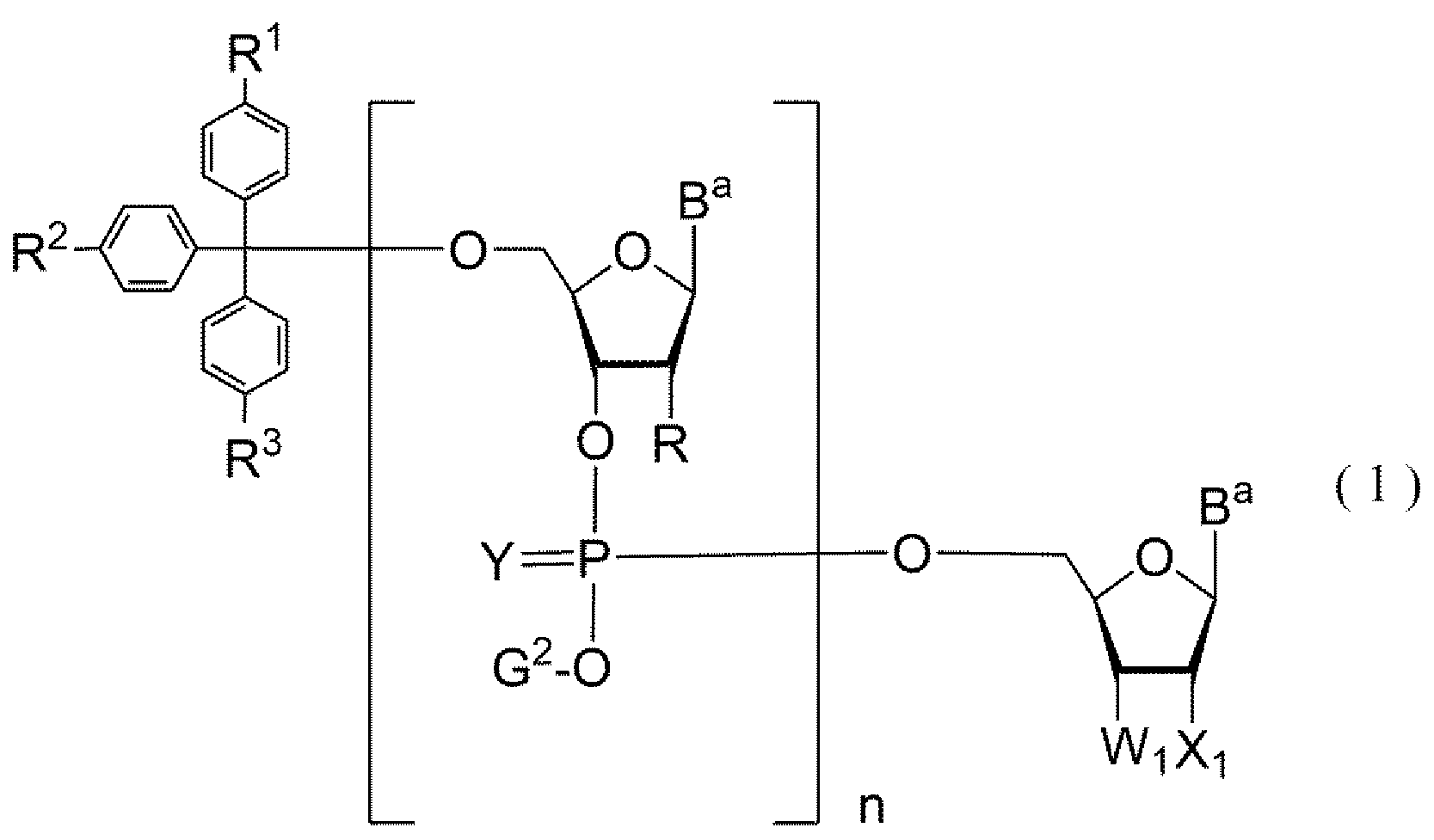
(식 중,(In the expression,
G2 는, 수산기의 보호기를 나타내고,G 2 represents a protecting group for a hydroxyl group;
Ba 는, 각각 독립적으로 동일 또는 상이하며, 보호기로 보호되어 있어도 되는 핵산 염기를 나타내고,B a is the same or different each independently and represents a nucleic acid base which may be protected by a protecting group;
R1, R2 및 R3 은, 각각 독립적으로 동일 또는 상이하며, 수소 원자 또는 알콕시기를 나타내고,R 1 , R 2 and R 3 are the same or different each independently and represent a hydrogen atom or an alkoxy group;
R 은, 각각 독립적으로 동일 또는 상이하며, 보호된 수산기, 수소 원자, 불소 원자, 메톡시기, 2-메톡시에틸기, 또는 OQ' 기를 나타내고,R, each independently the same or different, represents a protected hydroxyl group, hydrogen atom, fluorine atom, methoxy group, 2-methoxyethyl group, or OQ' group;
Q' 는, 각각 독립적으로 동일 또는 상이하며, 리보오스의 4' 위치의 탄소 원자와 결합하고 있는 메틸렌기, 리보오스의 4' 위치의 탄소 원자와 결합하고 있는 에틸렌기, 또는 리보오스의 4' 위치의 탄소 원자와 결합하고 있는 에틸리덴기를 나타내고,Q', each independently identical or different, is a methylene group bonded to a carbon atom at the 4' position of ribose, an ethylene group bonded to a carbon atom at the 4' position of ribose, or a carbon atom at the 4' position of ribose Represents an ethylidene group bonded to an atom,
Y 는, 각각 독립적으로 동일 또는 상이하며, 산소 원자 또는 황 원자를 나타내고,Y is the same or different each independently, and represents an oxygen atom or a sulfur atom,
n 은, 1 ∼ 200 중 어느 정수를 나타내고,n represents any integer from 1 to 200;
W1 은 OZ 기를 나타내고, 또한 X1 은 R 기를 나타내거나, 혹은W 1 represents an OZ group, and X 1 represents an R group, or
W1 은 OV 기를 나타내고, 또한 X1 은 OZ 기를 나타내고,W 1 represents an OV group, and X 1 represents an OZ group;
V 는, 수산기의 보호기를 나타내고,V represents a protecting group for a hydroxyl group;
Z 는, 고상 담체 및 연결기로 이루어지는 구조를 갖는 기이다.Z is a group having a structure consisting of a solid carrier and a linking group.
그리고, n 이 2 이상의 정수일 때, 식 (1) 로 나타내는 핵산 올리고머는, 각각의 뉴클레오티드의 사이에, 비뉴클레오티드 링커가 삽입되어 있어도 된다.)And, when n is an integer of 2 or more, the nucleic acid oligomer represented by formula (1) may have a non-nucleotide linker inserted between each nucleotide.)
로 나타내는 핵산 올리고머와, 포름알데히드와 트리클로로아세트산의 몰비 (포름알데히드 mol/트리클로로아세트산 mol) 가 11 × 10-5 이하인 트리클로로아세트산 용액을 반응시키는 공정을 포함하는, 식 (2) :Equation (2) including a step of reacting a nucleic acid oligomer represented by and a trichloroacetic acid solution having a molar ratio of formaldehyde and trichloroacetic acid (mol formaldehyde/mol trichloroacetic acid) of 11 × 10 -5 or less:
[화학식 2][Formula 2]

(식 중,(In the expression,
G2, Ba, R, Y, X1, W1 및 n 은, 상기와 같고, 그리고,G 2 , B a , R, Y, X 1 , W 1 and n are as described above, and
식 (1) 에 있어서 정의된 바와 같이, 뉴클레오티드의 사이에, 비뉴클레오티드 링커가 삽입되어 있어도 된다.)As defined in formula (1), a non-nucleotide linker may be inserted between nucleotides.)
로 나타내는 핵산 올리고머의 제조 방법.A method for producing a nucleic acid oligomer represented by
항 2. 전항 1 에 기재된 공정과, 추가로, 당해 공정에서 생성되는 식 (2) 로 나타내는 핵산 올리고머로부터 Z 로 나타내는 기를 제거하는 공정, 그리고 수산기 및 핵산 염기의 보호기를 제거하는 공정을 포함하는, 식 (2') :
[화학식 3][Formula 3]

(식 중,(In the expression,
Y 및 n 은, 상기와 같고,Y and n are the same as above,
Bc 는, 각각 독립적으로 동일 또는 상이하며, 핵산 염기를 나타내고,B c , each independently the same or different, represents a nucleic acid base;
G4 는, 각각 독립적으로 동일 또는 상이하며, 수소 원자, 알칼리 금속 이온, 암모늄 이온, 알킬암모늄 이온, 또는 하이드록시알킬암모늄 이온을 나타내고,G 4 , each independently identical or different, represents a hydrogen atom, an alkali metal ion, an ammonium ion, an alkylammonium ion, or a hydroxyalkylammonium ion;
R' 는, 각각 독립적으로 동일 또는 상이하며, 수산기, 수소 원자, 불소 원자, 메톡시기, 2-메톡시에틸기, 또는 OQ' 기를 나타내고,R', each independently the same or different, represents a hydroxyl group, a hydrogen atom, a fluorine atom, a methoxy group, a 2-methoxyethyl group, or an OQ' group;
Q' 는, 상기와 같고, 그리고,Q' is the same as above, and
X3 및 W3 은 각각, 각각 독립적으로 수산기를 나타내거나, 혹은X 3 and W 3 each independently represent a hydroxyl group, or
X3 은 R' 기를 나타내고, 또한 W3 은 수산기를 나타낸다.)X 3 represents an R' group, and W 3 represents a hydroxyl group.)
로 나타내는 핵산 올리고머의 제조 방법.A method for producing a nucleic acid oligomer represented by
항 3. 식 (2) 로 나타내는 핵산 올리고머를, 아미다이트법으로 임의로 사슬 길이를 신장한 식 (3) :
[화학식 4][Formula 4]

(식 중,(In the expression,
G2, Ba, R, Y, X1 및 W1 은, 상기와 같고,G 2 , B a , R, Y, X 1 and W 1 are as described above;
G5 는,For G5 ,
[화학식 5][Formula 5]
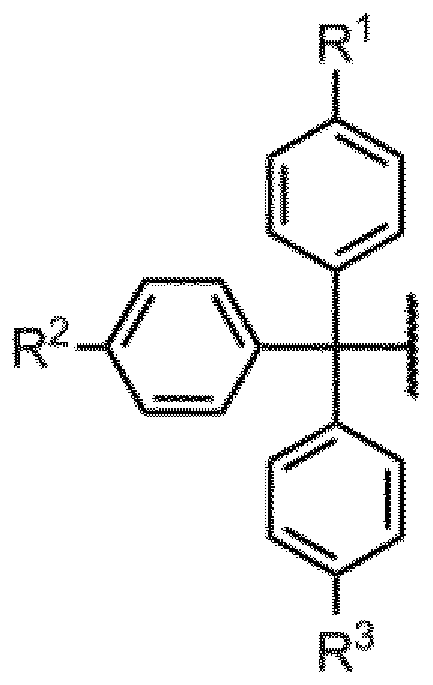
로 나타내는 수산기의 보호기, 또는 수소 원자를 나타내고,Represents a protecting group for a hydroxyl group represented by , or a hydrogen atom,
R1, R2 및 R3 은, 상기와 같고, 그리고,R 1 , R 2 and R 3 are the same as above, and
m 은, m ≥ n 을 만족하는 정수이다.)m is an integer that satisfies m ≥ n.)
으로 나타내는 핵산 화합물을 얻는 공정, 그리고A step of obtaining a nucleic acid compound represented by
식 (3) 으로 나타내는 화합물로부터, 식 (4) :From the compound represented by formula (3), formula (4):
[화학식 6][Formula 6]

(식 중,(In the expression,
G5, R, Y 및 m 은, 상기와 같고,G 5 , R, Y and m are as described above;
G4 는, 각각 독립적으로 동일 또는 상이하며, 수소 원자, 알칼리 금속 이온, 암모늄 이온, 알킬암모늄 이온, 또는 하이드록시알킬암모늄 이온을 나타내고,G 4 , each independently identical or different, represents a hydrogen atom, an alkali metal ion, an ammonium ion, an alkylammonium ion, or a hydroxyalkylammonium ion;
BC 는, 각각 독립적으로 동일 또는 상이하며, 핵산 염기를 나타내고,B C , each independently the same or different, represents a nucleic acid base,
X2 는 수산기를 나타내고, 또한 W2 는 OV 기를 나타내거나, 혹은X 2 represents a hydroxyl group, and W 2 represents an OV group, or
X2 는 R 기를 나타내고, 또한 W2 는 수산기를 나타내고, 그리고,X 2 represents an R group, and W 2 represents a hydroxyl group, and
V 는, 수산기의 보호기를 나타낸다.)V represents a protecting group for a hydroxyl group.)
로 나타내는 화합물을 절출하고,Excising the compound represented by
또한 식 (4) 로 나타내는 화합물을 탈보호하여, 식 (5) :Further, by deprotecting the compound represented by formula (4), formula (5):
[화학식 7][Formula 7]

(식 중,(In the expression,
G4, Bc, Y 및 m 은, 상기와 같고, R' 는, 각각 독립적으로 동일 또는 상이하며, 수산기, 수소 원자, 불소 원자, 메톡시기, 2-메톡시에틸기, 또는 OQ' 기를 나타내고,G 4 , B c , Y and m are the same as above, R' is independently the same or different, and represents a hydroxyl group, a hydrogen atom, a fluorine atom, a methoxy group, a 2-methoxyethyl group, or an OQ'group;
Q' 는, 상기와 같고, 그리고,Q' is the same as above, and
X3 및 W3 은 각각, 각각 독립적으로 수산기를 나타내거나, 혹은X 3 and W 3 each independently represent a hydroxyl group, or
X3 은 R' 기를 나타내고, 또한 W3 은 수산기를 나타낸다.)X 3 represents an R' group, and W 3 represents a hydroxyl group.)
로 나타내는 핵산 올리고머를 제조하는 공정을 추가로 포함하는, 전항 1 에 기재된 제조 방법.The production method according to 1 above, further comprising a step of producing the nucleic acid oligomer represented by .
항 4. 비뉴클레오티드 링커가, 아미노산 골격으로 이루어지는 링커인, 전항 1 ∼ 3 중 어느 한 항에 기재된 제조 방법.Item 4. The production method according to any one of
항 5. 아미노산 골격으로 이루어지는 링커가, 하기 식 (A14-1), (A14-2) 및 (A14-3) 으로 이루어지는 군에서 선택되는 구조를 갖는 링커인, 전항 4 에 기재된 제조 방법.
[화학식 8][Formula 8]

(식 중, Y 는, 상기와 같다.)(In the formula, Y is as described above.)
항 6. 트리클로로아세트산 용액이, 디클로로메탄, 아세토니트릴, 및 방향족 유기 용매로 이루어지는 군에서 선택되는 적어도 1 개의 용매를 포함하는, 전항 1 ∼ 5 중 어느 한 항에 기재된 제조 방법.Item 6. The production method according to any one of
항 7. 트리클로로아세트산 용액 중의 포름알데히드와 트리클로로아세트산의 몰비 (포름알데히드 mol/트리클로로아세트산 mol) 가 54 × 10-6 이하인, 전항 1 ∼ 6 중 어느 한 항에 기재된 제조 방법.Item 7. The production method according to any one of
항 8. 트리클로로아세트산 용액 중의 포름알데히드와 트리클로로아세트산의 몰비 (포름알데히드 mol/트리클로로아세트산 mol) 가 27 × 10-6 이하인, 전항 1 ∼ 6 중 어느 한 항에 기재된 제조 방법.Item 8. The production method according to any one of
항 9. 핵산 올리고머가, 리보 핵산 (RNA) 인, 전항 1 ∼ 8 중 어느 한 항에 기재된 제조 방법.Item 9. The production method according to any one of
항 10. 핵산 올리고머가, 리보 핵산 (RNA) 이고, 그 리보오스의 2' 위치의 수산기의 보호기가, 식 (6) 으로 나타내는 보호기인, 전항 1 ∼ 8 중 어느 한 항에 기재된 제조 방법.Item 10. The production method according to any one of
식 (6) :Equation (6):
[화학식 9][Formula 9]

(식 중,(In the expression,
q 는, 1 ∼ 5 중 어느 정수를 나타내고,q represents any integer from 1 to 5;
Ra 및 Rb 는, 각각 독립적으로 동일 또는 상이하며, 메틸기, 에틸기 또는 수소 원자를 나타내고,R a and R b are the same or different each independently and represent a methyl group, an ethyl group or a hydrogen atom;
* 표시는, 리보오스의 2' 위치의 수산기 유래의 산소 원자와의 결합점을 나타내고, 그리고,* indicates a bonding point with an oxygen atom derived from a hydroxyl group at the 2' position of ribose, and
EW 는, 전자 구인기를 나타낸다.)E W represents an electron trap.)
항 11. Ra 및 Rb 가 동시에 수소 원자이고, 또한 EW 가 시아노기인, 전항 10 에 기재된 제조 방법.
항 12. 핵산 올리고머가, 40 사슬 길이 이상의 올리고머인, 전항 1 ∼ 11 중 어느 한 항에 기재된 제조 방법.Item 12. The production method according to any one of
항 13. 핵산 올리고머가, 50 사슬 길이 이상의 올리고머인, 전항 1 ∼ 11 중 어느 한 항에 기재된 제조 방법.
항 14. 핵산 올리고머가, 60 사슬 길이 이상의 올리고머인, 전항 1 ∼ 11 중 어느 한 항에 기재된 제조 방법.Item 14. The production method according to any one of
항 15. 핵산 올리고머가, 80 사슬 길이 이상의 올리고머인, 전항 1 ∼ 11 중 어느 한 항에 기재된 제조 방법.
항 16. 핵산 올리고머가, 100 사슬 길이 이상의 올리고머인, 전항 1 ∼ 11 중 어느 한 항에 기재된 제조 방법.
항 17. 포름알데히드와 트리클로로아세트산의 몰비 (포름알데히드 mol/트리클로로아세트산 mol) 가 11 × 10-5 이하인, 트리클로로아세트산 용액.Item 17. A trichloroacetic acid solution wherein the molar ratio of formaldehyde to trichloroacetic acid (mol formaldehyde/mol trichloroacetic acid) is 11 x 10 -5 or less.
항 18. 포름알데히드와 트리클로로아세트산의 몰비 (포름알데히드 mol/트리클로로아세트산 mol) 가 54 × 10-6 이하인, 전항 17 에 기재된 트리클로로아세트산 용액.Item 18. The trichloroacetic acid solution according to Item 17, wherein the molar ratio of formaldehyde to trichloroacetic acid (mol of formaldehyde/mol of trichloroacetic acid) is 54 × 10 -6 or less.
항 19. 포름알데히드와 트리클로로아세트산의 몰비 (포름알데히드 mol/트리클로로아세트산 mol) 가 27 × 10-6 이하인, 전항 17 에 기재된 트리클로로아세트산 용액.Item 19. The trichloroacetic acid solution according to Item 17, wherein the molar ratio of formaldehyde to trichloroacetic acid (mol of formaldehyde/mol of trichloroacetic acid) is 27 × 10 -6 or less.
항 20. 포름알데히드를 포함하는 미정제 트리클로로아세트산과, 포름알데히드와 공비하는 용매를 포함하는 용액으로부터, 포름알데히드를 공비시켜 증류 제거함으로써 정제 트리클로로아세트산을 얻는 공정을 포함하는, 전항 17 ∼ 19 중 어느 한 항에 기재된 트리클로로아세트산의 제조 방법.Item 20. Item 20. Item 17 to Item 19, which includes a step of obtaining purified trichloroacetic acid by azeotropically distilling formaldehyde from a solution containing crude trichloroacetic acid containing formaldehyde and a solvent that is azeotropic with formaldehyde. The method for producing trichloroacetic acid according to any one of the above.
항 21. 공비 용매의 비점이, 198 ℃ 이하인, 전항 20 에 기재된 제조 방법.Item 21. The production method according to Item 20, wherein the boiling point of the azeotropic solvent is 198°C or lower.
항 22. 공비 용매가, 디클로로메탄, 아세토니트릴 또는 방향족 유기 용매인, 전항 20 또는 21 에 기재된 제조 방법.Item 22. The production method according to Item 20 or 21, wherein the azeotropic solvent is dichloromethane, acetonitrile or an aromatic organic solvent.
항 23. 방향족 유기 용매가 톨루엔인, 전항 22 에 기재된 제조 방법.Item 23. The production method according to Item 22, wherein the aromatic organic solvent is toluene.
항 24. 전항 20 에 기재된 트리클로로아세트산의 정제 공정, 및 당해 공정에서 얻어진 정제 트리클로로아세트산을 사용하는 전항 1 ∼ 3 중 어느 한 항에 기재된 공정을 포함하는, 핵산 올리고머의 제조 방법.Item 24. A method for producing a nucleic acid oligomer comprising the step of purifying trichloroacetic acid according to item 20 and the step according to any one of
항 25. 트리클로로아세트산 용액으로서, 전항 17, 18 및 19 중 어느 한 항에 기재된 트리클로로아세트산 용액을 선택하는 공정을 포함하는, 전항 1 ∼ 16 및 20 ∼ 24 중 어느 한 항에 기재된 제조 방법.Item 25. The production method according to any one of
본 발명은, 효율적인 핵산 올리고머의 제조 방법을 제공한다. 본 발명의 제조 방법에 의해, 제조되는 핵산 올리고머의 수율 향상을 기대할 수 있다.The present invention provides an efficient method for preparing nucleic acid oligomers. The production method of the present invention can be expected to improve the yield of nucleic acid oligomers produced.
도 1 은, 식 (1) 로 나타내는 핵산 올리고머로부터 식 (5) 로 나타내는 핵산 올리고머를 제조하는 전형예를 나타내는 스킴 A 이다. 도면 중, G1 로는, 수산기의 보호기로서 기능할 수 있는 것이면 특별히 제한없이 사용할 수 있고, 아미다이트 화합물에서 사용되는 공지된 보호기를 널리 사용할 수 있다. 또, G3 은, 각각 독립적으로 동일 또는 상이하며, 알킬기를 나타내고, 혹은 2 개의 G3 은 서로 결합하여 고리형 구조를 형성하고 있어도 된다. G3 으로는, 각각 독립적으로 동일 또는 상이하며, 알킬기, 예를 들어 메틸기, 에틸기, 프로필기, 또는 이소프로필기인 것이 바람직하고, 양방이 이소프로필기인 것이 보다 바람직하다. 그 밖의 기호는 상기와 같다.1 is Scheme A showing a typical example of producing a nucleic acid oligomer represented by formula (5) from a nucleic acid oligomer represented by formula (1). In the figure, G 1 can be used without particular limitation as long as it can function as a protecting group for a hydroxyl group, and known protecting groups used in amidite compounds can be widely used. In addition, G 3 is the same or different each independently, and represents an alkyl group, or two G 3 groups may be bonded to each other to form a cyclic structure. As G 3 , each independently the same or different, an alkyl group such as a methyl group, an ethyl group, a propyl group, or an isopropyl group is preferable, and it is more preferable that both are isopropyl groups. Other symbols are as above.
상기 식 (1) 로 나타내는 핵산 올리고머에, 포름알데히드 농도가 일정 이하인 트리클로로아세트산 용액을 반응시켜, 상기 식 (2) 로 나타내는 핵산 올리고머를 얻는 방법에 대해 설명한다.A method for obtaining a nucleic acid oligomer represented by the above formula (2) by reacting the nucleic acid oligomer represented by the above formula (1) with a trichloroacetic acid solution having a formaldehyde concentration of a certain level or less will be described.
본 발명의 트리클로로아세트산 용액 중의 포름알데히드와 트리클로로아세트산의 몰비 (포름알데히드 mol/트리클로로아세트산 mol) 는, 통상적으로 11 × 10-5 이하, 바람직하게는 54 × 10-6 이하, 보다 바람직하게는 27 × 10-6 이하이다. 본 발명의 트리클로로아세트산 용액으로는, 상기 포름알데히드와 트리클로로아세트산의 몰비의 범위 내에서 포름알데히드를 포함하는 것이 예시된다. 트리클로로아세트산 용액 중의 포름알데히드 농도 측정 방법에는, 고속 액체 크로마토그래프법이 있다. 고속 액체 크로마토그래프법에서는, 포름알데히드와 아세틸아세톤을 반응시키고, 얻어진 3,5-디아세틸-1,4-디하이드로루티딘의 양을 측정하여, 포름알데히드의 농도를 산출한다. 이렇게 하여 상기 포름알데히드와 트리클로로아세트산의 몰비의 범위의 용액을 선택할 수 있다. 상기 용액은, 예를 들어, 하기의 공비에 의한 방법으로 직접 조제해도 되고, 원하는 것을 선택해도 된다.The molar ratio of formaldehyde to trichloroacetic acid in the trichloroacetic acid solution of the present invention (mol of formaldehyde/mol of trichloroacetic acid) is usually 11 × 10 -5 or less, preferably 54 × 10 -6 or less, more preferably is less than or equal to 27 × 10 -6 . As the trichloroacetic acid solution of the present invention, one containing formaldehyde within the range of the molar ratio of formaldehyde and trichloroacetic acid is exemplified. As a method for measuring the concentration of formaldehyde in a trichloroacetic acid solution, there is a high performance liquid chromatography method. In the high-performance liquid chromatography method, formaldehyde and acetylacetone are reacted, the amount of 3,5-diacetyl-1,4-dihydrolutidine obtained is measured, and the concentration of formaldehyde is calculated. In this way, it is possible to select a solution within a range of molar ratios of formaldehyde and trichloroacetic acid. The said solution may be prepared directly, for example by the method by the following azeotropy, and you may select a desired one.
트리클로로아세트산 용액 중의 트리클로로아세트산의 농도는, 통상적으로 0.1 ∼ 1.2 M, 바람직하게는 0.1 ∼ 0.6 M, 보다 바람직하게는 0.1 ∼ 0.3 M 이다.The concentration of trichloroacetic acid in the trichloroacetic acid solution is usually 0.1 to 1.2 M, preferably 0.1 to 0.6 M, and more preferably 0.1 to 0.3 M.
트리클로로아세트산의 희석 용매로는, 반응에 관여하지 않으면 특별히 한정되지 않지만, 디클로로메탄, 아세토니트릴, 방향족 유기 용매, 물 또는 임의의 혼합 용매를 들 수 있고, 바람직하게는 디클로로메탄, 아세토니트릴, 및 방향족 유기 용매로 이루어지는 군에서 선택되는 적어도 1 개의 용매를 들 수 있고, 보다 바람직하게는 방향족 유기 용매를 들 수 있다. 방향족 유기 용매로는, 톨루엔을 들 수 있다.The diluting solvent for trichloroacetic acid is not particularly limited as long as it is not involved in the reaction, but includes dichloromethane, acetonitrile, an aromatic organic solvent, water, or any mixed solvent, preferably dichloromethane, acetonitrile, and At least one solvent selected from the group consisting of aromatic organic solvents is exemplified, and more preferably an aromatic organic solvent is exemplified. As an aromatic organic solvent, toluene is mentioned.
상기 반응에 있어서의 반응 온도는, 0 ∼ 40 ℃ 가 바람직하고, 보다 바람직하게는 10 ∼ 30 ℃ 이다.The reaction temperature in the above reaction is preferably from 0 to 40°C, more preferably from 10 to 30°C.
트리클로로아세트산 용액 중의 포름알데히드는, 임의의 용매 또는 임의의 혼합 용매와의 공비에 의해 제거하여, 그 양을 저감시킬 수 있고, 공비 용매로는, 트리클로로아세트산보다 비점이 낮은 용매이면, 특별히 한정되지 않지만, 디클로로메탄, 아세토니트릴, 방향족 유기 용매 또는 임의의 혼합 용매를 들 수 있고, 바람직하게는 디클로로메탄, 아세토니트릴, 또는 방향족 유기 용매를 들 수 있고, 보다 바람직하게는 방향족 유기 용매를 들 수 있다. 방향족 유기 용매로는, 톨루엔을 들 수 있다.Formaldehyde in the trichloroacetic acid solution can be removed by azeotropy with any solvent or any mixed solvent to reduce the amount, and the azeotropic solvent is particularly limited as long as it is a solvent with a lower boiling point than trichloroacetic acid. However, dichloromethane, acetonitrile, an aromatic organic solvent, or any mixed solvent may be used, preferably dichloromethane, acetonitrile, or an aromatic organic solvent, more preferably an aromatic organic solvent. there is. As an aromatic organic solvent, toluene is mentioned.
공비 용매의 비점은, 200 ℃ 이하가 바람직하고, 보다 바람직하게는 198 ℃ 이하이다.The boiling point of the azeotropic solvent is preferably 200°C or lower, more preferably 198°C or lower.
트리클로로아세트산 용액의 보관에는, 유리제 용기, 플라스틱제 용기, 또는 금속제 용기를 사용할 수 있다. 플라스틱제 용기로는, 폴리에틸렌 또는 폴리프로필렌제 등의 용기를 사용할 수 있고, 금속제 용기로는, SUS 제 용기 또는 하스텔로이제 등의 용기를 사용할 수 있다.A glass container, a plastic container, or a metal container can be used for storage of the trichloroacetic acid solution. As the plastic container, a container made of polyethylene or polypropylene or the like can be used, and as the metal container, a container made of SUS or a container made of Hastelloy can be used.
공기 분위기하 또는 불활성 가스 분위기하에서 산화 용액을 보관할 수 있고, 불활성 가스로는, 아르곤, 질소, 이산화탄소 또는 헬륨 등을 사용할 수 있다.The oxidizing solution can be stored under an air atmosphere or an inert gas atmosphere, and argon, nitrogen, carbon dioxide or helium can be used as the inert gas.
5' 위치의 수산기에 보호기를 갖는 핵산 화합물로는, 상기 식 (1) 의 핵산 화합물이 예시된다. 트리클로로아세트산 용액을 반응시켜 생성되는 핵산 화합물로는, 상기 식 (2) 로 나타내는 핵산 화합물이 예시된다.Examples of the nucleic acid compound having a protecting group on the hydroxyl group at the 5' position include the nucleic acid compound of the above formula (1). As a nucleic acid compound produced by reacting a trichloroacetic acid solution, a nucleic acid compound represented by the formula (2) is exemplified.
상기 식 (1) 및 (2) 에 있어서, Q' 로 나타내는, 각각 독립적으로 동일 또는 상이하며, 리보오스의 4' 위치의 탄소 원자와 결합하고 있는 메틸렌기, 리보오스의 4' 위치의 탄소 원자와 결합하고 있는 에틸렌기, 또는 리보오스의 4' 위치의 탄소 원자와 결합하고 있는 에틸리덴기를 나타내는 화합물로서, 구체적으로는 하기 식 (7) 의 LNA-1, LNA-2, 또는 LNA-3 으로 나타내는 구조를 들 수 있다.In the above formulas (1) and (2), each independently the same or different, represented by Q', a methylene group bonded to the carbon atom at the 4' position of ribose, bonded to the carbon atom at the position 4' of ribose as a compound showing an ethylene group or an ethylidene group bonded to a carbon atom at the 4' position of ribose, specifically a structure represented by LNA-1, LNA-2, or LNA-3 of the following formula (7) can be heard
[화학식 10][Formula 10]

(식 중, Ba 는, 보호되어 있어도 되는 핵산 염기를 나타낸다.)(In the formula, B a represents a nucleic acid base that may be protected.)
Z 로 나타내는, 고상 담체, 및 고상 담체와 핵산 올리고머의 3' 말단의 리보오스의 2' 위치 혹은 3' 위치의 수산기의 산소 원자를 연결하는 연결기로 이루어지는 구조를 갖는 기로는, 보다 구체적으로는, 하기 식 (8) 로 나타내는 구조를 들 수 있다.Examples of the solid phase carrier represented by Z and a group having a structure comprising a linking group connecting the solid phase carrier and a linking group connecting the oxygen atom of the hydroxyl group at the 2' position or 3' position of ribose at the 3' end of the nucleic acid oligomer include the following The structure represented by Formula (8) is mentioned.
[화학식 11][Formula 11]

식 (8) 에 있어서, Sp 는, 스페이서를 나타낸다.In Formula (8), Sp represents a spacer.
스페이서 (Sp) 로는, 예를 들어, 하기 식 (9) 에 나타내는 구조식을 갖는 것이 예시된다.As spacer (Sp), what has structural formula shown by following formula (9) is illustrated, for example.
[화학식 12][Formula 12]

Linker 는, 예를 들어, 하기 식 (10) 에 나타내는 구조여도 되고, 또는 식 (10) 의 구조에 있어서 헥사메틸렌아미노기 부분을 갖지 않는 구조로서, 아미노프로필기가 Si 에 결합한 구조여도 된다. 또는, Linker 는 하기 식 (11) 로 나타내는 구조여도 된다.Linker may be, for example, a structure shown in formula (10) below, or a structure in which an aminopropyl group is bonded to Si as a structure without a hexamethylene amino group moiety in the structure of formula (10). Alternatively, the structure represented by the following formula (11) may be sufficient as Linker.
[화학식 13][Formula 13]
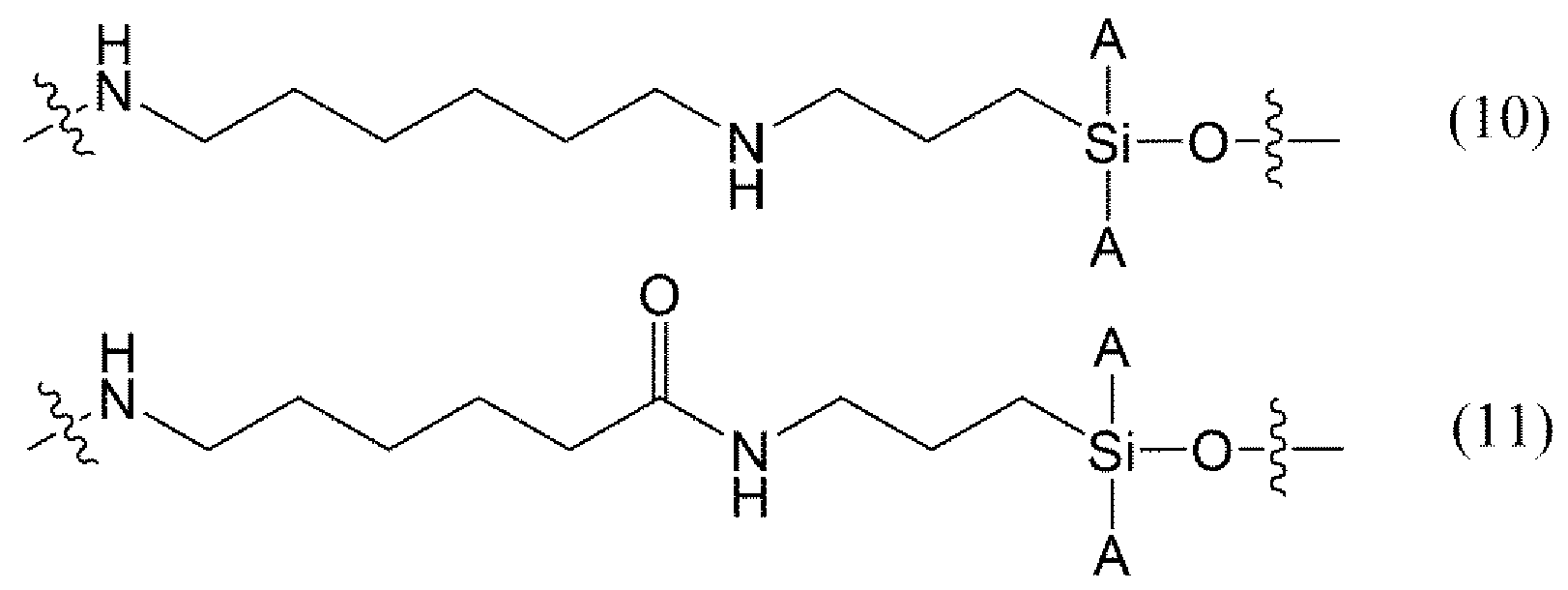
(식 중,(In the expression,
A 는, 수산기, 알콕시기, 또는 알킬기 중 어느 것이어도 된다. 알콕시기로는, 예를 들어 메톡시기 및 에톡시기를 들 수 있다. 알킬기로는, 예를 들어 메틸기, 에틸기, 이소프로필기, n-프로필기를 들 수 있다. Si 는, 담체 표면의 수산기의 산소와 결합하고 있는 것을 나타낸다.)A may be any of a hydroxyl group, an alkoxy group, or an alkyl group. As an alkoxy group, a methoxy group and an ethoxy group are mentioned, for example. As an alkyl group, a methyl group, an ethyl group, an isopropyl group, and n-propyl group are mentioned, for example. Si represents that it is bonded to the oxygen of the hydroxyl group on the surface of the carrier.)
Solid support 로는, 무기 다공질 담체나 유기계 수지 담체 등을 들 수 있다. 무기 다공질 담체에는, 예를 들어, Controlled Pore Glass (CPG) 를 들 수 있다. 유기계 수지 담체에는, 예를 들어, 폴리스티렌으로 이루어지는 담체를 들 수 있다.Examples of the solid support include inorganic porous carriers and organic resin carriers. Examples of the inorganic porous carrier include Controlled Pore Glass (CPG). Examples of organic resin carriers include carriers made of polystyrene.
본 발명에서 사용되는 핵산 올리고머 내에 포함되는 뉴클레오시드 (리보오스, 및 디옥시리보오스) 로는, DNA, RNA, 2'-O-MOE (2'-O-메톡시에틸), 2'-O-Me, 2'-F RNA, 및 상기 LNA 가 예시되지만, 상기 뉴클레오시드는, 이것들에 한정되지 않는다.Nucleosides (ribose and deoxyribose) included in the nucleic acid oligomer used in the present invention include DNA, RNA, 2'-O-MOE (2'-O-methoxyethyl), 2'-O-Me, Although 2'-F RNA and the said LNA are exemplified, the said nucleoside is not limited to these.
상기 트리클로로아세트산 용액에 의한 탈보호 공정을 포함하는, 고상 합성법에 의한 핵산 올리고머의 합성 방법은, 전형적으로는, 이하의 공정을 포함한다.The method for synthesizing a nucleic acid oligomer by solid phase synthesis, including the deprotection step with the trichloroacetic acid solution, typically includes the following steps.
(1) 고상 담체에 링커를 개재하여 결합하고 있는 수산기가 보호된 뉴클레오시드의 5' 위치의 수산기를 탈보호하는 공정,(1) a step of deprotecting the hydroxyl group at the 5' position of the nucleoside in which the hydroxyl group bound to the solid carrier via the linker is protected;
(2) 상기 공정에서 생성된 5' 위치의 수산기를 포스포르아미다이트 화합물과 커플링 반응시켜 아인산트리에스테르 화합물을 얻는 공정,(2) a step of obtaining a phosphorous acid triester compound by subjecting the hydroxyl group at the 5' position generated in the above step to a coupling reaction with a phosphoramidite compound;
(3) 상기 공정에서 생성된 아인산트리에스테르를 산화시켜 인산트리에스테르로 변환시켜 신장한 핵산 분자를 제조하는 공정, 혹은, 티오인산트리에스테르로 변환시키는 임의의 공정,(3) a step of oxidizing the phosphorous acid triester produced in the above step to convert it into a phosphoric acid triester to produce an extended nucleic acid molecule, or an arbitrary step of converting it into a thiophosphate triester;
(4) 상기 공정 (1) ∼ (3), 즉, 생성된 핵산 분자의 5' 위치의 수산기의 탈보호 공정, 5' 위치의 수산기와 아미다이트 화합물의 커플링 공정, 및 생성된 아인산트리에스테르의 산화 공정으로 구성되는 일련의 반응의 사이클을, 임의의 횟수 반복하여, 고상 담체 상에 핵산 분자를 합성하는 공정, 및(4) Steps (1) to (3) above, that is, the deprotection step of the hydroxyl group at the 5' position of the nucleic acid molecule produced, the step of coupling the hydroxyl group at the 5' position to the amidite compound, and the resulting phosphorous acid tri A step of synthesizing nucleic acid molecules on a solid phase carrier by repeating a cycle of a series of reactions consisting of an ester oxidation step any number of times; and
(5) 공정 (4) 에서 생성된 고상 담체 상의 핵산 분자를, 절출 및 탈보호하는 공정에 제공하고, 고상 담체로부터 유리시켜, 보호기가 제거된 핵산 올리고머를 제조하는 공정.(5) A step of subjecting the nucleic acid molecule on the solid phase carrier generated in step (4) to a step of excising and deprotecting, releasing it from the solid phase carrier to produce a nucleic acid oligomer from which the protecting group is removed.
단, 상기 핵산 올리고머의 합성 방법에 있어서는, 공정 (2) 또는 (3) 에 계속해서, 포스포르아미다이트 화합물과의 커플링 반응이 진행되지 않았던 5' 위치의 수산기를 캐핑하는 공정을 포함하고 있어도 되고, 공정 (4) 를 구성하는 일련의 반응의 사이클의 어느 공정의 사이에 캐핑 공정이 부가되어 있어도 된다.However, in the method for synthesizing the nucleic acid oligomer described above, subsequent to step (2) or (3), the step of capping the hydroxyl group at the 5' position where the coupling reaction with the phosphoramidite compound did not proceed is included, Alternatively, a capping step may be added between any of the steps in the cycle of a series of reactions constituting the step (4).
상기 (5) 의 공정은, 보다 구체적으로는, 공정 (4) 에서 생성된 고상 담체 상의 핵산 분자를, 이하의 공정 (5-1) 및 (5-2) 의 반응의 순서로 실시하고, 이어서 공정 (5-3) 의 반응에 제공함으로써 실시된다. 여기서 공정 (5-1) 의 반응의 실시는, 임의여도 되고, 공정 (5-2) 의 반응의 실시는, 일본 특허공보 제4705716호에 기재된 방법을 사용해도 된다. 그 결과, 고상 담체로부터 유리된 핵산 분자로부터 보호기가 제거된 핵산 올리고머, 혹은, 5' 말단의 수산기가 보호된 핵산 올리고머를 제조할 수 있다.In the step (5) above, more specifically, the nucleic acid molecules on the solid carrier produced in step (4) are subjected to the following steps (5-1) and (5-2) in the order of reaction, and then It is implemented by subjecting to the reaction of step (5-3). Here, the implementation of the reaction in the step (5-1) may be arbitrary, and the method described in Japanese Patent Publication No. 4705716 may be used for the implementation of the reaction in the step (5-2). As a result, a nucleic acid oligomer having a protecting group removed from a nucleic acid molecule released from a solid carrier or a nucleic acid oligomer having a 5' terminal hydroxyl group protected can be prepared.
(5-1) 핵산 분자의 5' 말단의 수산기의 보호기를 탈보호하는 반응,(5-1) a reaction to deprotect the protecting group of the hydroxyl group at the 5' end of the nucleic acid molecule;
(5-2) 핵산 분자를 고상 담체로부터 절출하여 유리시키는 반응, 및(5-2) a reaction in which nucleic acid molecules are excised and released from a solid carrier, and
(5-3) 핵산 분자를 구성하는 리보오스의 2' 위치 혹은 3' 말단의 3' 위치의 수산기의 보호기를 탈보호하는 반응.(5-3) A reaction for deprotecting the protecting group of the hydroxyl group at the 2'-position or the 3'-terminal 3'-position of ribose constituting the nucleic acid molecule.
상기 공정 (1) 내지 (5) 의 스킴을, 도 1 에 나타낸다. 도 1 에 나타내는 공정 (1) 또는 공정 (4) 에 있어서의 탈보호 반응이, 상기 트리클로로아세트산 용액을 사용하여 실시된다. 스킴 A 에 있어서의 화학식 중의 치환기의 정의는, 상기 정의와 같다.The scheme of the said process (1) - (5) is shown in FIG. The deprotection reaction in step (1) or step (4) shown in Fig. 1 is performed using the trichloroacetic acid solution. The definition of the substituent in the chemical formula in Scheme A is the same as the above definition.
상기 식 (1) 의 핵산 화합물은, 또한 아미다이트법에 의해 뉴클레오티드형 또는 비뉴클레오티드형의 링커를 사용해서 임의의 사슬 길이만큼 신장하여, 상기 식 (3) 으로 나타내는 핵산 화합물의 제조에 사용할 수 있다. 상기 식 (3) 의 고상 담체에 결합한 핵산 화합물로부터 핵산 화합물만을 절출하여, 상기 식 (4) 로 나타내는 핵산 올리고머를 얻은 후, 또한 탈보호하여 상기 식 (5) 로 나타내는 핵산 올리고머를 얻을 수도 있다. 이하, 각 식 중의 치환기에 대해 더욱 상세하게 설명한다.The nucleic acid compound of the above formula (1) can be further extended by an arbitrary chain length using a nucleotide type or non-nucleotide type linker by the amidite method, and used for production of the nucleic acid compound represented by the above formula (3). . A nucleic acid oligomer represented by the formula (5) can also be obtained by excising only the nucleic acid compound from the nucleic acid compound bound to the solid carrier of the formula (3) to obtain a nucleic acid oligomer represented by the formula (4), and then further deprotecting. Hereinafter, the substituent in each formula is demonstrated in more detail.
Ba 로 나타내는 보호기로 보호되어 있어도 되는 핵산 염기 및 Bc 로 나타내는 핵산 염기는, 특별히 한정되지 않는다. 당해 핵산 염기로는, 아데닌, 시토신, 구아닌, 우라실, 티민, 5-메틸시토신, 슈도우라실, 및 1-메틸슈도우라실 등을 들 수 있다. 또, 당해 핵산 염기는, 치환기에 의해 치환되어 있어도 된다. 그러한 치환기로는, 예를 들어, 플루오로기나 클로로기나 브로모기나 요오드기와 같은 할로겐 원자, 아세틸기와 같은 아실기, 메틸기나 에틸기와 같은 알킬기, 벤질기와 같은 아릴알킬기, 메톡시기와 같은 알콕시기, 메톡시에틸기와 같은 알콕시알킬기, 시아노에틸기와 같은 시아노알킬기, 하이드록시기, 하이드록시알킬기, 아실옥시메틸기, 아미노기, 모노알킬아미노기, 디알킬아미노기, 카르복시기, 시아노기, 및 니트로기 등, 그리고 그것들의 2 종류 이상의 치환기의 조합을 들 수 있다.The nucleic acid base that may be protected with the protecting group represented by B a and the nucleic acid base represented by B c are not particularly limited. Examples of the nucleic acid base include adenine, cytosine, guanine, uracil, thymine, 5-methylcytosine, pseudouracil, and 1-methylpseudouracil. In addition, the nucleic acid base may be substituted by a substituent. Such substituents include, for example, a halogen atom such as a fluoro group, a chloro group, a bromo group, or an iodine group, an acyl group such as an acetyl group, an alkyl group such as a methyl group or an ethyl group, an arylalkyl group such as a benzyl group, an alkoxy group such as a methoxy group, or a methoxy group. alkoxyalkyl groups such as oxyethyl groups, cyanoalkyl groups such as cyanoethyl groups, hydroxyl groups, hydroxyalkyl groups, acyloxymethyl groups, amino groups, monoalkylamino groups, dialkylamino groups, carboxy groups, cyano groups, and nitro groups, etc., and those A combination of two or more types of substituents of is exemplified.
Ba 로 나타내는 보호기로 보호되어 있어도 되는 핵산 염기의 보호기로는, 특별히 한정되지 않고, 공지된 핵산 화학에서 사용되는 보호기를 사용할 수 있고, 그러한 보호기로는, 예를 들어, 벤조일기, 4-메톡시벤조일기, 4-메틸벤조일기, 아세틸기, 프로피오닐기, 부티릴기, 이소부티릴기, 페닐아세틸기, 페녹시아세틸기, 4-tert-부틸페녹시아세틸기, 4-이소프로필페녹시아세틸기, 및 (디메틸아미노)메틸렌기 등, 그리고 그것들의 2 종류 이상의 보호기의 조합을 들 수 있다.The protecting group of the nucleic acid base which may be protected by the protecting group represented by B a is not particularly limited, and a protecting group used in known nucleic acid chemistry can be used. Toxybenzoyl group, 4-methylbenzoyl group, acetyl group, propionyl group, butyryl group, isobutyryl group, phenylacetyl group, phenoxyacetyl group, 4-tert-butylphenoxyacetyl group, 4-isopropylphenoxyacetyl groups, (dimethylamino)methylene groups, and combinations of two or more types of protecting groups thereof.
Ba 는, 보다 구체적으로는,B a is, more specifically,
[화학식 14][Formula 14]

(상기 식 중,(In the above formula,
R4 는, 수소 원자, 메틸기, 페녹시아세틸기, 4-tert-부틸페녹시아세틸기, 4-이소프로필페녹시아세틸기, 페닐아세틸기, 아세틸기 또는 벤조일기를 나타내고,R 4 represents a hydrogen atom, a methyl group, a phenoxyacetyl group, a 4-tert-butylphenoxyacetyl group, a 4-isopropylphenoxyacetyl group, a phenylacetyl group, an acetyl group or a benzoyl group;
R5 는, 수소 원자, 아세틸기, 이소부티릴기 또는 벤조일기를 나타내고,R 5 represents a hydrogen atom, an acetyl group, an isobutyryl group or a benzoyl group;
R6 은, 수소 원자, 페녹시아세틸기, 4-tert-부틸페녹시아세틸기, 4-이소프로필페녹시아세틸기, 페닐아세틸기, 아세틸기 또는 이소부티릴기를 나타내고,R 6 represents a hydrogen atom, a phenoxyacetyl group, a 4-tert-butylphenoxyacetyl group, a 4-isopropylphenoxyacetyl group, a phenylacetyl group, an acetyl group or an isobutyryl group;
R7 은, 2-시아노에틸기를 나타내고,R 7 represents a 2-cyanoethyl group;
R8 은, 수소 원자, 메틸기, 벤조일기, 4-메톡시벤조일기 또는 4-메틸벤조일기를 나타내고, 그리고,R 8 represents a hydrogen atom, a methyl group, a benzoyl group, a 4-methoxybenzoyl group or a 4-methylbenzoyl group, and
R9 는, 디메틸아미노메틸렌기를 나타낸다.)R 9 represents a dimethylaminomethylene group.)
중 어느 것으로 나타내는 기를 나타낸다.The group represented by any of them is shown.
Bc 로는, 보다 구체적으로는, 상기 Ba 의 구체예로부터 보호기를 제거한 기를 들 수 있다.More specifically, examples of B c include a group obtained by removing a protecting group from the specific examples of B a above.
G5 는, 바람직하게는 이하의 기이다.G 5 is preferably the following groups.
[화학식 15][Formula 15]

(식 중,(In the expression,
R1, R2 및 R3 은, 각각 독립적으로 동일 또는 상이하며, 수소 원자 또는 알콕시기를 나타낸다.)R 1 , R 2 and R 3 are the same or different each independently and represent a hydrogen atom or an alkoxy group.)
R1, R2 및 R3 은, 1 개가 수소 원자이고, 나머지 2 개가 동일 또는 상이한 (동일이 바람직하다) 알콕시기인 것이 바람직하고, 알콕시기로는 메톡시기가 특히 바람직하다. 보다 바람직하게는 G5 는, 4,4'-디메톡시트리틸기 (DMTr 기) 이다.It is preferable that one of R 1 , R 2 and R 3 is a hydrogen atom and the other two are the same or different (preferably the same) alkoxy groups, and a methoxy group is particularly preferable as the alkoxy group. More preferably, G 5 is a 4,4'-dimethoxytrityl group (DMTr group).
G2 로는, 수산기의 보호기로서 기능할 수 있는 것이면 특별히 제한없이 사용할 수 있고, 아미다이트 화합물에서 사용되는 공지된 보호기를 널리 사용할 수 있다. G2 로는, 예를 들어, 알킬기, 알케닐기, 알키닐기, 시클로알킬기, 할로알킬기, 아릴기, 헤테로아릴기, 아릴알킬기, 시클로알케닐기, 시클로알킬알킬기, 시클릴알킬기, 하이드록시알킬기, 아미노알킬기, 알콕시알킬기, 헤테로시클릴알케닐기, 헤테로시클릴알킬기, 헤테로아릴알킬기, 실릴기, 실릴옥시알킬기, 모노, 디 또는 트리알킬실릴기, 모노, 디 또는 트리알킬실릴옥시알킬기 등을 들 수 있고, 이것들은 1 개 이상의 전자 구인기로 치환되어 있어도 된다.G 2 can be used without particular limitation as long as it can function as a protecting group for a hydroxyl group, and known protecting groups used in amidite compounds can be widely used. Examples of G 2 include an alkyl group, an alkenyl group, an alkynyl group, a cycloalkyl group, a haloalkyl group, an aryl group, a heteroaryl group, an arylalkyl group, a cycloalkenyl group, a cycloalkylalkyl group, a cyclylalkyl group, a hydroxyalkyl group, and an aminoalkyl group. , An alkoxyalkyl group, a heterocyclylalkenyl group, a heterocyclylalkyl group, a heteroarylalkyl group, a silyl group, a silyloxyalkyl group, a mono, di or trialkylsilyl group, a mono, di or trialkylsilyloxyalkyl group, and the like, These may be substituted with one or more electron withdrawing groups.
G2 는, 바람직하게는 전자 구인기로 치환된 알킬기이다. 당해 전자 구인기로는, 예를 들어, 시아노기, 니트로기, 알킬술포닐기, 할로겐 원자, 아릴술포닐기, 트리할로메틸기, 및 트리알킬아미노기 등을 들 수 있고, 바람직하게는 시아노기이다.G 2 is preferably an alkyl group substituted with an electron withdrawing group. Examples of the electron withdrawing group include a cyano group, a nitro group, an alkylsulfonyl group, a halogen atom, an arylsulfonyl group, a trihalomethyl group, and a trialkylamino group, and a cyano group is preferable.
G2 로는, 특히 바람직한 것은, 이하의 기이다.As G 2 , the following groups are particularly preferred.
[화학식 16][Formula 16]
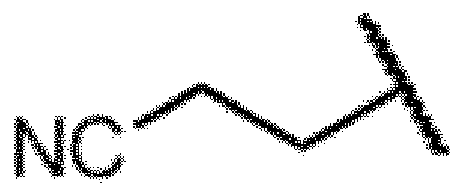
상기 R1, R2, R3 및 G2 의 정의에 있어서의 알킬기는, 직사슬형 또는 분기사슬형 중 어느 것이어도 되고, 바람직하게는 탄소수 1 ∼ 12 의 알킬기, 보다 바람직하게는 탄소수 1 ∼ 6 의 알킬기이다. 구체적인 알킬기의 예로는, 예를 들어, 메틸기, 에틸기, n-프로필기, 이소프로필기, n-부틸기, 이소부틸기, tert-부틸기, n-펜틸기, 이소펜틸기, 및 헥실기를 들 수 있다. 상기 치환기의 정의에 있어서의 알콕시기를 구성하는 알킬기 부분은, 여기서의 알킬기의 정의와 동일한 정의를 갖는다.The alkyl group in the above definition of R 1 , R 2 , R 3 and G 2 may be either a linear or branched chain, preferably an alkyl group having 1 to 12 carbon atoms, more preferably an alkyl group having 1 to 12 carbon atoms. It is an alkyl group of 6. Examples of specific alkyl groups include, for example, methyl, ethyl, n-propyl, isopropyl, n-butyl, isobutyl, tert-butyl, n-pentyl, isopentyl, and hexyl groups. can be heard The alkyl group moiety constituting the alkoxy group in the definition of the substituent has the same definition as the definition of the alkyl group here.
또, 본 발명의 방법에 있어서, 아미다이트 화합물은, 프리의 상태 또는 염의 상태로 사용할 수 있다. 아미다이트 화합물의 염으로는, 염기 부가염 또는 산 부가염을 들 수 있지만, 특별히 제한되지 않는다. 염기 부가염으로는, 구체적으로는, 나트륨염, 마그네슘염, 칼륨염, 칼슘염, 알루미늄염 등의 무기 염기와의 염 ; 메틸아민, 에틸아민, 에탄올아민 등의 유기 염기와의 염 ; 리신, 오르니틴, 아르기닌 등의 염기성 아미노산과의 염 ; 및 암모늄염을 들 수 있다. 산 부가염으로는, 구체적으로는, 염산, 브롬화수소산, 요오드화수소산, 황산, 질산, 인산 등의 광산 ; 포름산, 아세트산, 프로피온산, 옥살산, 말론산, 말산, 타르타르산, 푸마르산, 숙신산, 락트산, 말레산, 시트르산, 메탄술폰산, 트리플루오로메탄술폰산, 에탄술폰산 등의 유기산 ; 및, 아스파르트산, 글루탐산 등의 산성 아미노산과의 산 부가염을 들 수 있다. 아미다이트 화합물에는, 염, 수화물, 용매화물, 및 결정 다형 등의 형태도 포함된다.In the method of the present invention, the amidite compound can be used in a free state or a salt state. The salt of the amidite compound includes a base addition salt or an acid addition salt, but is not particularly limited. Examples of the base addition salt include salts with inorganic bases such as sodium salts, magnesium salts, potassium salts, calcium salts and aluminum salts; Salts with organic bases, such as methylamine, ethylamine, and ethanolamine; Salts with basic amino acids, such as lysine, ornithine, and arginine; and ammonium salts. As an acid addition salt, Specifically, Mineral acids, such as hydrochloric acid, hydrobromic acid, hydroiodic acid, sulfuric acid, nitric acid, phosphoric acid; organic acids such as formic acid, acetic acid, propionic acid, oxalic acid, malonic acid, malic acid, tartaric acid, fumaric acid, succinic acid, lactic acid, maleic acid, citric acid, methanesulfonic acid, trifluoromethanesulfonic acid, and ethanesulfonic acid; and acid addition salts with acidic amino acids such as aspartic acid and glutamic acid. Forms, such as a salt, a hydrate, a solvate, and a crystal polymorph, are also contained in an amidite compound.
R 은, 바람직하게는 보호된 수산기를 나타낸다. R 이 보호된 수산기를 나타낼 때의 보호기, 또는 V 로 나타내는 수산기의 보호기는, 아미다이트법에 있어서 사용할 수 있는 것이면 되며, 예를 들어, 2'-tert-부틸디메틸실릴 (TBS) 기, 2'-비스(2-아세톡시)메틸 (ACE) 기, 2'-(트리이소프로필실록시)메틸 (TOM) 기, 2'-(2-시아노에톡시)에틸 (CEE) 기, 2'-(2-시아노에톡시)메틸 (CEM) 기, 2'-파라-톨루일술포닐에톡시메틸 (TEM) 기, 2'-EMM 기 (국제공개 제2006/022323호) 외에, 국제공개 제2013/027843호 및 국제공개 제2019/208571호에 기재된 것을 사용할 수 있다. V 는, 바람직하게는 2'-tert-부틸디메틸실릴 (TBS) 기이다. 또, 본 발명의 방법으로 제조되는 핵산 올리고머가 리보 핵산 (RNA) 인 경우 등, 핵산 올리고머 내에 리보오스가 포함되는 경우, 그 리보오스의 2' 위치의 수산기의 보호기로서, 상기 식 (6) 으로 나타내는 보호기가 바람직한 보호기로서 예시된다. 더욱 바람직하게는 EW 로 나타내는 전자 구인기로서 시아노기를 갖는 식 (12) 로 나타내는 보호기가 예시된다.R preferably represents a protected hydroxyl group. The protecting group when R represents a protected hydroxyl group or the protecting group for the hydroxyl group represented by V may be any one that can be used in the amidite method, for example, 2'-tert-butyldimethylsilyl (TBS) group, 2' -bis(2-acetoxy)methyl (ACE) group, 2'-(triisopropylsiloxy)methyl (TOM) group, 2'-(2-cyanoethoxy)ethyl (CEE) group, 2'- (2-cyanoethoxy)methyl (CEM) group, 2'-para-toluylsulfonylethoxymethyl (TEM) group, 2'-EMM group (International Publication No. 2006/022323), International Publication No. 2013 /027843 and International Publication No. 2019/208571 can be used. V is preferably a 2'-tert-butyldimethylsilyl (TBS) group. Further, when the nucleic acid oligomer produced by the method of the present invention is ribonucleic acid (RNA) or the like, when ribose is contained in the nucleic acid oligomer, a protecting group represented by the above formula (6) is used as a protecting group for the hydroxyl group at the 2' position of the ribose. is exemplified as a preferred protecting group. More preferably, a protecting group represented by formula (12) having a cyano group as an electron withdrawing group represented by E W is exemplified.
[화학식 17][Formula 17]
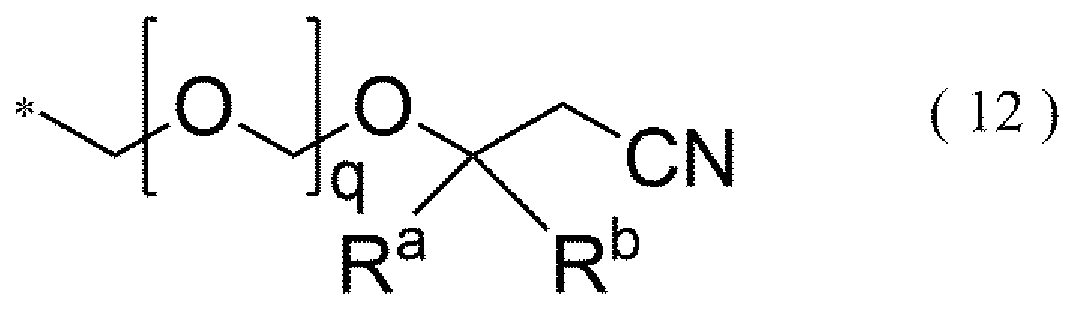
(식 중,(In the expression,
q, Ra 및 Rb 는, 상기 식 (6) 에 있어서의 정의와 동일한 의미이다.)q, R a and R b have the same meaning as defined in the above formula (6).)
더욱 바람직하게는 식 (12) 로 나타내는 기에 있어서, q 가 1 이고, Ra 및 Rb 가 동시에 수소 원자인 기가 예시된다.More preferably, in the group represented by formula (12), a group in which q is 1 and R a and R b are both hydrogen atoms is exemplified.
식 (12) 로 나타내는 보호기는, 예를 들어 국제공개 제2013/027843호 및 국제공개 제2019/208571호의 기재에 따라서 합성할 수 있고, 이러한 보호기를 갖는 아미다이트 화합물을 핵산 화합물의 제조에 사용할 수 있다.The protecting group represented by formula (12) can be synthesized, for example, according to the descriptions of International Publication No. 2013/027843 and International Publication No. 2019/208571, and an amidite compound having such a protecting group can be used for production of a nucleic acid compound. can
핵산의 신장 반응에는, 도 1 의 스킴 A 에 기재된 식 (13) 의 아미다이트 화합물이 사용된다.For the nucleic acid elongation reaction, an amidite compound of the formula (13) described in scheme A in FIG. 1 is used.
비뉴클레오티드 링커로는, 아미노산 골격으로 이루어지는 링커 (예를 들어, 일본 특허공보 제5157168호 또는 일본 특허공보 제5554881호에 기재된 아미노산 골격으로 이루어지는 링커) 가 예시된다. 구체적으로는, 비한정적인 예로서, 예를 들어, 식 (A14-1) 혹은 (A14-2) 혹은 (A14-3) (예를 들어, 국제공개 제2019/074110호에 기재) 으로 나타내는 링커가 예시된다. 이들 링커 이외에 국제공개 제2012/005368호, 국제공개 제2018/182008호 또는 국제공개 제2019/074110호에 기재된 링커가 예시된다.As the non-nucleotide linker, a linker composed of an amino acid skeleton (for example, a linker composed of an amino acid skeleton described in Japanese Patent Publication No. 5157168 or Japanese Patent Publication No. 5554881) is exemplified. Specifically, as a non-limiting example, for example, a linker represented by formula (A14-1) or (A14-2) or (A14-3) (for example, described in International Publication No. 2019/074110) is exemplified. In addition to these linkers, the linkers described in International Publication No. 2012/005368, International Publication No. 2018/182008 or International Publication No. 2019/074110 are exemplified.
[화학식 18][Formula 18]

(식 중, Y 는, 상기와 같다.)(In the formula, Y is as described above.)
식 (13) 에 있어서의 R 기 및 식 (5) 에 있어서의 R' 기가, 수산기 이외의 치환기인 뉴클레오티드 및 아미다이트는, 일본 특허공보 제3745226호 등에 기재된 공지된 방법, 국제공개 제2001/053528호 혹은 일본 공개특허공보 2014-221817호 및 그것들에 인용되는 공지된 방법으로 합성되는 뉴클레오시드로부터 제조할 수도 있고, 나아가서는, 시판품으로서 입수 가능한 것을 사용해서, 후술하는 실시예에 기재된 방법에 준거하여 또는 이들 방법에 적절히 변경을 부가한 방법에 의해 제조할 수 있다.Nucleotides and amidites in which the R group in the formula (13) and the R' group in the formula (5) are substituents other than a hydroxyl group are obtained by a known method described in Japanese Patent Publication No. 3745226 or the like, International Publication No. 2001/053528 or Japanese Unexamined Patent Publication No. 2014-221817 and those synthesized from nucleosides by known methods cited therein, and furthermore, using commercially available products, in accordance with the method described in the Examples described later. or by a method in which a change is appropriately added to these methods.
G4 는, 수소 원자, 알칼리 금속 이온, 암모늄 이온, 알킬암모늄 이온, 또는 하이드록시알킬암모늄 이온을 나타낸다. 알칼리 금속 이온으로는, 예를 들어, 나트륨 이온, 및 리튬 이온을 들 수 있다. 또, 알킬암모늄 이온으로서, 구체적인 알킬기의 예로는, 예를 들어, 메틸기, 에틸기, n-프로필기, 이소프로필기, n-부틸기, 이소부틸기, tert-부틸기, n-펜틸기, 이소펜틸기, 및 헥실기를 들 수 있지만, 보다 구체적으로는, 예를 들어, 디에틸암모늄 이온, 트리에틸암모늄 이온, 테트라부틸암모늄 이온, 헥실암모늄 이온, 및 디부틸암모늄 이온 등을 들 수 있다. 또, 하이드록시알킬암모늄 이온으로서, 구체적인 하이드록시알킬 부분의 예로는, 예를 들어, 하이드록시메틸, 하이드록시에틸, 하이드록시-n-프로필, 하이드록시이소프로필, 하이드록시-n-부틸, 및 트리스하이드록시메틸을 들 수 있지만, 보다 구체적인 하이드록시알킬암모늄 이온의 예로는, 트리스하이드록시메틸암모늄 이온 등을 들 수 있다. G4 는, 바람직하게는 수소 원자를 나타낸다.G 4 represents a hydrogen atom, an alkali metal ion, an ammonium ion, an alkylammonium ion, or a hydroxyalkylammonium ion. As an alkali metal ion, a sodium ion and a lithium ion are mentioned, for example. In addition, as an alkylammonium ion, examples of specific alkyl groups include, for example, methyl group, ethyl group, n-propyl group, isopropyl group, n-butyl group, isobutyl group, tert-butyl group, n-pentyl group, iso Although a pentyl group and a hexyl group are mentioned, More specifically, a diethylammonium ion, a triethylammonium ion, a tetrabutylammonium ion, a hexylammonium ion, a dibutylammonium ion, etc. are mentioned, for example. In addition, as a hydroxyalkylammonium ion, examples of specific hydroxyalkyl moieties include, for example, hydroxymethyl, hydroxyethyl, hydroxy-n-propyl, hydroxyisopropyl, hydroxy-n-butyl, and Although trishydroxymethyl is mentioned, as a more specific example of a hydroxyalkylammonium ion, a trishydroxymethylammonium ion etc. are mentioned. G 4 preferably represents a hydrogen atom.
G5 는, 수소 원자, 또는 상기 수산기의 보호기를 나타내고, 보호기를 나타내는 경우에는 G1 도 동일한 보호기를 나타낸다. G5 는 탈보호된 경우에는 수소 원자인데, 그 경우의 뉴클레오티드 화합물도 또한, 일련의 핵산 신장 반응의 공정에 제공된다.G 5 represents a hydrogen atom or a protective group for the hydroxyl group, and when representing a protective group, G 1 also represents the same protective group. G 5 is a hydrogen atom when deprotected, and the nucleotide compound in that case is also subjected to a series of nucleic acid extension reaction steps.
Y 는, 바람직하게는 산소 원자이다.Y is preferably an oxygen atom.
W1 및 X1 은, 바람직하게는 W1 이 OZ 기를 나타내고, 또한 X1 이 R 기를 나타낸다.As for W 1 and X 1 , preferably W 1 represents an OZ group and X 1 represents an R group.
W2 및 X2 는, 바람직하게는 W2 가 수산기를 나타내고, 또한 X2 가 R 기를 나타낸다.As for W 2 and X 2 , preferably W 2 represents a hydroxyl group and X 2 represents an R group.
W3 및 X3 은, 바람직하게는 각각, 각각 독립적으로 수산기를 나타낸다.W 3 and X 3 preferably each independently represent a hydroxyl group.
R' 는, 바람직하게는 수산기이다.R' is preferably a hydroxyl group.
상기 공정 (1) 내지 (5) 의 아미다이트법에 의한 핵산 화합물의 합성은, 도 1 의 스킴 중의 공정 (1) 또는 공정 (5) 에 있어서의 본 발명에 관련된 탈보호 공정 이외에는, 일반적으로 공지된 방법 (예를 들어, 상기 일본 특허공보 제5157168호 또는 일본 특허공보 제5554881호에 기재된 방법) 에 따라서, 핵산 신장 반응을 실시할 수 있다. 이하, 각 공정에 대해 설명한다.The synthesis of nucleic acid compounds by the amidite method in the above steps (1) to (5) is generally known, except for the deprotection step related to the present invention in the step (1) or step (5) in the scheme of FIG. The nucleic acid extension reaction can be carried out according to the disclosed method (for example, the method described in Japanese Patent Publication No. 5157168 or Japanese Patent Publication No. 5554881). Hereinafter, each process is demonstrated.
(핵산 신장 반응)(nucleic acid elongation reaction)
본 명세서에 있어서,「핵산 신장 반응」이란, 포스포디에스테르 결합을 개재하여, 뉴클레오티드를 순차적으로 결합시킴으로써, 올리고뉴클레오티드를 신장시키는 반응을 의미한다. 핵산 신장 반응은, 일반적인 포스포르아미다이트법의 순서에 따라서 실시할 수 있다. 핵산 신장 반응은, 포스포르아미다이트법을 채용하는 핵산 자동 합성 장치 등을 사용하여 실시해도 된다.In the present specification, "nucleic acid elongation reaction" means a reaction in which oligonucleotides are elongated by sequentially linking nucleotides via phosphodiester bonds. The nucleic acid extension reaction can be carried out according to the procedure of a general phosphoramidite method. The nucleic acid extension reaction may be carried out using an automated nucleic acid synthesizer or the like employing the phosphoramidite method.
핵산 올리고머의 사슬 길이는, 예를 들어, 20 mer 이상 (즉, n ≥ 19), 40 mer 이상 (즉, n ≥ 39), 50 mer 이상 (즉, n ≥ 49), 60 mer 이상 (즉, n ≥ 59), 80 mer 이상 (즉, n ≥ 79), 100 mer 이상 (즉, n ≥ 99), 2 ∼ 200 mer (즉, 1 ≤ n ≤ 199), 10 ∼ 150 mer (즉, 9 ≤ n ≤ 149), 15 ∼ 110 mer (즉, 14 ≤ n ≤ 109) 여도 된다.The chain length of the nucleic acid oligomer is, for example, 20 mer or more (i.e. n ≥ 19), 40 mer or more (i.e. n ≥ 39), 50 mer or more (i.e. n ≥ 49), 60 mer or more (i.e. n ≥ 59), 80 mer or more (ie n ≥ 79), 100 mer or more (ie n ≥ 99), 2 to 200 mer (
공정 (1) 의 탈보호 공정은, 고상 담체 상에 담지된 올리고뉴클레오티드 사슬 말단의 5' 수산기의 보호기를 탈보호하는 공정이다. 일반적인 보호기로는, 4,4'-디메톡시트리틸기 (DMTr 기) 나 4-모노메톡시트리틸기, 4,4',4"-트리메톡시트리틸기가 사용된다. 탈보호는, 산을 사용하여 실시할 수 있다. 탈보호용의 산으로는, 예를 들어, 트리플루오로아세트산, 트리클로로아세트산, 트리플루오로메탄술폰산, 디클로로아세트산, 메탄술폰산, 염산, 아세트산, 및 p-톨루엔술폰산 등을 들 수 있다.The deprotection step of step (1) is a step of deprotecting the protecting group of the 5' hydroxyl group at the terminal of the oligonucleotide chain supported on the solid carrier. As a general protecting group, a 4,4'-dimethoxytrityl group (DMTr group), a 4-monomethoxytrityl group, or a 4,4',4"-trimethoxytrityl group is used. Acids for deprotection include, for example, trifluoroacetic acid, trichloroacetic acid, trifluoromethanesulfonic acid, dichloroacetic acid, methanesulfonic acid, hydrochloric acid, acetic acid, and p-toluenesulfonic acid. can be heard
공정 (2) 의 축합 공정은, 상기 탈보호 공정에 의해 탈보호한 올리고뉴클레오티드 사슬 말단의 5' 수산기에 대하여, 도 1 의 스킴 A 에 기재된 하기 식 (13) 으로 나타내는 뉴클레오시드 포스포르아미다이트를 결합시키는 반응이다. 또한, 핵산 신장에 사용하는 포스포르아미다이트로는, 식 (13) 또는 (A9) ∼ (A12) 로 나타내는 아미다이트 화합물을 사용한다. 또, 그 밖에 사용 가능한 포스포르아미다이트로서, 2'-OMe, 2'-F, 2'-O-tert-부틸디메틸실릴기, 2'-O-메톡시에틸기, 2'-H, 및 2'-플루오로-2'-디옥시-β-D-아라비노푸라노실기 등을 들 수 있다. 상기 뉴클레오시드 포스포르아미다이트로는, 5' 수산기가 보호기 (예, DMTr 기) 로 보호된 것을 사용한다. 축합 공정은, 상기 뉴클레오시드 포스포르아미다이트를 활성화하는 활성화제 또는 축합제를 사용하여 실시할 수 있다. 활성화제 또는 축합제로는, 예를 들어, 5-벤질티오-1H-테트라졸 (BTT) (5-벤질메르캅토-1H-테트라졸이라고도 칭한다), 1H-테트라졸, 4,5-디시아노이미다졸 (DCI), 5-에틸티오-1H-테트라졸 (ETT), N-메틸벤즈이미다졸륨트리플레이트 (N-MeBIT), 벤즈이미다졸륨트리플레이트 (BIT), N-페닐이미다졸륨트리플레이트 (N-PhIMT), 이미다졸륨트리플레이트 (IMT), 5-니트로벤즈이미다졸륨트리플레이트 (NBT), 1-하이드록시벤조트리아졸 (HOBT) 또는 5-(비스-3,5-트리플루오로메틸페닐)-1H-테트라졸 등을 들 수 있다.In the condensation step of step (2), the 5' hydroxyl group at the terminal of the oligonucleotide chain deprotected by the deprotection step is a nucleoside phosphoramidide represented by the following formula (13) described in scheme A of FIG. It is a reaction that binds As the phosphoramidite used for nucleic acid extension, an amidite compound represented by formula (13) or (A9) to (A12) is used. In addition, as other usable phosphoramidites, 2'-OMe, 2'-F, 2'-O-tert-butyldimethylsilyl group, 2'-O-methoxyethyl group, 2'-H, and 2'-fluoro-2'-deoxy-β-D-arabinofuranosyl group; and the like. As the nucleoside phosphoramidite, one in which the 5' hydroxyl group is protected with a protecting group (eg, DMTr group) is used. The condensation step can be carried out using an activator or condensation agent that activates the nucleoside phosphoramidite. Examples of the activator or condensing agent include 5-benzylthio-1H-tetrazole (BTT) (also referred to as 5-benzylmercapto-1H-tetrazole), 1H-tetrazole, and 4,5-dicyanoimine. dazole (DCI), 5-ethylthio-1H-tetrazole (ETT), N-methylbenzimidazolium triflate (N-MeBIT), benzimidazolium triflate (BIT), N-phenylimidazolium triflate Plate (N-PhIMT), imidazolium triflate (IMT), 5-nitrobenzimidazolium triflate (NBT), 1-hydroxybenzotriazole (HOBT) or 5-(bis-3,5-tri Fluoromethylphenyl) -1H- tetrazole etc. are mentioned.
도 1 의 스킴 A 에 기재된 식 (13) 으로 나타내는 뉴클레오시드 포스포르아미다이트 (이하, 아미다이트라고 호칭한다) 란, 이하와 같다.The nucleoside phosphoramidite represented by formula (13) described in scheme A of FIG. 1 (hereinafter referred to as amidite) is as follows.
식 :ceremony :
[화학식 19][Formula 19]
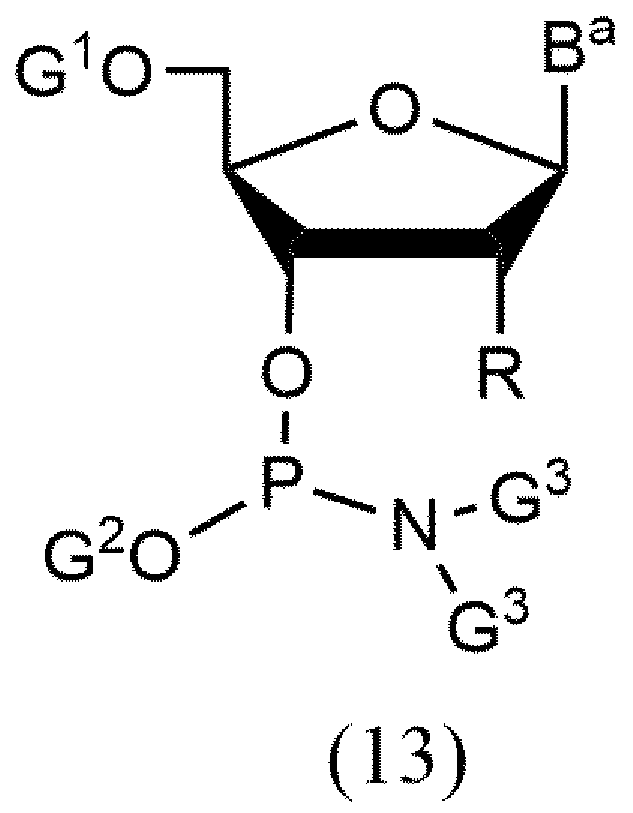
(식 중,(In the expression,
G1, G2, G3, Ba, 및 R 은, 상기와 같다.) 으로 나타내는 화합물.G 1 , G 2 , G 3 , B a , and R are as described above.) A compound represented by.
축합 공정 후에는, 적절히 미반응의 5' 수산기를 캐핑해도 된다. 캐핑은, 무수 아세트산-테트라하이드로푸란 용액, 또는 페녹시아세트산 무수물/N-메틸이미다졸 용액 등의 공지된 캐핑 용액을 사용하여 실시할 수 있다.After the condensation step, the unreacted 5' hydroxyl group may be appropriately capped. Capping can be performed using a known capping solution such as an acetic anhydride/tetrahydrofuran solution or a phenoxyacetic anhydride/N-methylimidazole solution.
공정 (3) 의 산화 공정은, 상기 축합 공정에 의해 형성된 아인산기를 인산기 또는 티오인산기로 변환시키는 공정이다. 본 공정은, 3 가의 인에서 5 가의 인으로 산화제를 사용하여 변환시키는 반응이며, 고상 담체에 담지되어 있는 올리고 핵산 유도체에 산화제를 반응시킴으로써 실시할 수 있다.The oxidation step of step (3) is a step of converting the phosphorous acid group formed in the condensation step to a phosphoric acid group or a thiophosphoric acid group. This step is a reaction in which trivalent phosphorus is converted into pentavalent phosphorus using an oxidizing agent, and can be carried out by reacting an oxidizing agent with an oligonucleic acid derivative supported on a solid carrier.
아인산기를 인산기로 변환시키는 경우에는,「산화제」로서, 예를 들어, 요오드를 사용할 수 있다. 그 산화제는, 0.005 ∼ 2 M 의 농도가 되도록 조제하여 사용할 수 있다. 산화의 산소원으로는 물을 사용할 수 있고, 반응을 진행시키는 염기로는 피리딘, N-메틸이미다졸 (NMI), N-메틸모르폴린, 또는 트리에틸아민 등을 사용할 수 있다. 또, 용매로는, 반응에 관여하지 않으면 특별히 한정되지 않지만, 아세토니트릴, 테트라하이드로푸란 (THF) 또는 이것들의 임의 비율의 혼합 용매를 들 수 있다. 예를 들어, 요오드/물/피리딘/아세토니트릴, 혹은 요오드/물/피리딘, 혹은 요오드/물/피리딘/NMI, 혹은 요오드/물/피리딘/THF 를 사용할 수 있다. 반응 온도는, 5 ℃ ∼ 50 ℃ 가 바람직하다. 반응 시간은, 통상적으로 1 분 ∼ 30 분이 적당하다. 사용하는 시약의 양은 고상 담체에 담지되어 있는 화합물 1 mol 에 대하여 1 ∼ 100 mol 이 바람직하고, 보다 바람직하게는 1 ∼ 10 mol 이다.When converting a phosphorous acid group into a phosphoric acid group, iodine can be used as an "oxidizing agent", for example. The oxidizing agent can be used after being prepared so as to become a concentration of 0.005 to 2 M. Water may be used as an oxygen source for oxidation, and pyridine, N-methylimidazole (NMI), N-methylmorpholine, or triethylamine may be used as a base that promotes the reaction. Further, the solvent is not particularly limited as long as it does not participate in the reaction, but examples thereof include acetonitrile, tetrahydrofuran (THF), and a mixed solvent of these in an arbitrary ratio. For example, iodine/water/pyridine/acetonitrile, or iodine/water/pyridine, or iodine/water/pyridine/NMI, or iodine/water/pyridine/THF may be used. As for reaction temperature, 5 degreeC - 50 degreeC are preferable. As for reaction time, 1 minute - 30 minutes are suitable normally. The amount of the reagent to be used is preferably 1 to 100 mol, more preferably 1 to 10 mol, based on 1 mol of the compound supported on the solid carrier.
아인산트리에스테르기를 티오인산트리에스테르기로 변환시키는 경우에는,「산화제」로서, 예를 들어, 황, 3H-1,2-벤조디티올-3-온-1,1-디옥사이드 (Beaucage 시약), 3-아미노-1,2,4-디티아졸-5-티온 (ADTT), 5-페닐-3H-1,2,4-디티아졸-3-온 (POS), [(N,N-디메틸아미노메틸리덴)아미노]-3H-1,2,4-디티아졸린-3-티온 (DDTT), 및 페닐아세틸디술파이드 (PADS) 를 사용할 수 있다. 그 산화제는, 0.001 ∼ 2 M 의 농도가 되도록 적당한 용매로 희석시켜 사용할 수 있다. 반응에 사용하는 용매로는, 반응에 관여하지 않으면 특별히 한정되지 않지만, 예를 들어, 디클로로메탄, 아세토니트릴, 피리딘 또는 이것들의 임의 비율의 혼합 용매를 들 수 있다. 산화 공정은, 상기 캐핑 조작 후에 실시해도 되고, 반대로 산화 공정 후에 캐핑 조작을 실시해도 되며, 이 순서는 한정되지 않는다.When converting a phosphorous acid triester group to a thiophosphoric acid triester group, as an "oxidizing agent", for example, sulfur, 3H-1,2-benzodithiol-3-one-1,1-dioxide (Beaucage reagent), 3 -Amino-1,2,4-dithiazol-5-thione (ADTT), 5-phenyl-3H-1,2,4-dithiazol-3-one (POS), [(N,N-dimethylaminomethyl leaden)amino]-3H-1,2,4-dithiazoline-3-thione (DDTT), and phenylacetyldisulfide (PADS) can be used. The oxidizing agent can be used after being diluted with an appropriate solvent so as to have a concentration of 0.001 to 2 M. The solvent used in the reaction is not particularly limited as long as it does not participate in the reaction, and examples thereof include dichloromethane, acetonitrile, pyridine, or a mixed solvent of any ratio thereof. The oxidation step may be performed after the above capping operation, or conversely, the capping operation may be performed after the oxidation step, and the order is not limited.
공정 (5-1) 에 있어서, 신장의 마지막에 도입한 뉴클레오티드의 5' 위치의 수산기의 보호기는, 후술하는 고상 담체로부터의 절출 및 보호기의 탈보호 후, 5' 위치의 수산기의 보호기를 태그로 하는 칼럼 정제를 위해 사용해도 되고, 칼럼 정제 후, 5' 위치의 수산기의 보호기를 탈보호해도 된다.In step (5-1), the hydroxyl protecting group at the 5' position of the nucleotide introduced at the end of elongation is cleaved from a solid carrier described later and the protecting group is deprotected, and then the hydroxyl protecting group at the 5' position is converted into a tag. It may be used for column purification to perform purification, or after column purification, the protecting group of the hydroxyl group at the 5' position may be deprotected.
공정 (5-2) 에 있어서, 인산 보호기를 탈보호하는 공정은, 원하는 서열을 갖는 핵산의 합성이 완료된 후에는, 인산 부분의 보호기를 탈보호하기 위해 아민 화합물을 작용시킨다. 아민 화합물로는, 예를 들어, 일본 특허공보 제4705716호에 기재되는 디에틸아민 등을 들 수 있다.In step (5-2), in the step of deprotecting the phosphate protecting group, after synthesis of the nucleic acid having the desired sequence is completed, an amine compound is applied to deprotect the protecting group of the phosphate moiety. As an amine compound, the diethylamine etc. which are described in Japanese Patent Publication No. 4705716 are mentioned, for example.
공정 (5-2) 에 있어서의, 고상 담체 상에서 원하는 사슬 길이로 신장된 핵산 올리고머의 고상 담체로부터의 절출은, 통상적으로 절출제로서 농암모니아수를 사용하여 실시된다.In step (5-2), excision of the nucleic acid oligomer extended to a desired chain length on the solid phase carrier from the solid phase carrier is usually carried out using concentrated ammonia water as the excision agent.
또한 암모니아 또는 아민 화합물 등을 사용하여, 예를 들어, 고상 담체로부터 올리고뉴클레오티드 사슬을 절단하여 회수한다. 아민 화합물로는, 예를 들어, 메틸아민, 에틸아민, 이소프로필아민, 에틸렌디아민, 또는 디에틸아민 등을 들 수 있다.Further, oligonucleotide chains are cleaved and recovered from, for example, a solid carrier using ammonia or an amine compound. As an amine compound, methylamine, ethylamine, isopropylamine, ethylenediamine, or diethylamine etc. are mentioned, for example.
공정 (5-3) 에 있어서, 공정 (5-2) 에 있어서 고상 담체로부터 절출된 핵산 화합물 (4) 의 리보오스의 2' 위치 혹은 3' 위치의 수산기의 보호기는, 국제공개 제2006/022323호, 국제공개 제2013/027843호, 또는 국제공개 제2019/208571호에 기재된 방법에 따라서 제거할 수 있어, 탈보호된 핵산 올리고머 (5) 를 얻을 수 있다.In step (5-3), the protecting group for the hydroxyl group at the 2' or 3' position of the ribose of the nucleic acid compound (4) excised from the solid carrier in step (5-2) is , International Publication No. 2013/027843, or International Publication No. 2019/208571, it can be removed according to the method to obtain a deprotected nucleic acid oligomer (5).
본 발명의 제조 방법을 사용하여 제조 가능한 핵산 올리고머로는, 핵산 올리고머 내에 포함되는 뉴클레오시드가, RNA, DNA, 그리고 2'-O-MOE, 2'-O-Me, 2'-F 를 갖는 RNA, 및 LNA 인 핵산 올리고머를 들 수 있지만, 이것들에 한정되는 것은 아니다. 예를 들어, Xiulong, Shen 등 저 (著), Nucleic Acids Research, 2018, Vol.46, No.46, 1584-1600, 및 Daniel O'Reilly 등 저, Nucleic Acids Research, 2019, Vol.47, No.2, 546-558 에 기재된 다양한 뉴클레오시드의 예를 들 수 있다. 바람직하게는 본 발명의 방법으로 제조되는 핵산 올리고머는 RNA 이다.Nucleic acid oligomers that can be produced using the production method of the present invention include RNA, DNA, and nucleosides contained in the nucleic acid oligomer having 2'-O-MOE, 2'-O-Me, and 2'-F. RNA, and nucleic acid oligomers such as LNA, but are not limited thereto. For example, Xiulong, Shen et al., Nucleic Acids Research, 2018, Vol.46, No.46, 1584-1600, and Daniel O'Reilly et al., Nucleic Acids Research, 2019, Vol.47, No. Examples of the various nucleosides described in .2, 546-558 can be given. Preferably, the nucleic acid oligomer produced by the method of the present invention is RNA.
본 발명의 제조 방법에 있어서 사용 가능한 핵산 올리고머의 전형적인 예를, 실시예에 기재된 예에 추가하여 하기의 예를 나타내지만, 이것들에 한정되는 것은 아니다.Typical examples of nucleic acid oligomers that can be used in the production method of the present invention are shown in addition to the examples described in Examples, but are not limited thereto.
이하, 서열의 설명 중, U 는 우리딘을, C 는 시티딘을, A 는 아데노신을, 또 G 는 구아노신을 나타낸다.Hereinafter, in the description of sequences, U represents uridine, C represents cytidine, A represents adenosine, and G represents guanosine.
국제공개 제2019/060442호에 기재되어 있는, 하기의 서열 (A) 및 (B) 를 갖는 핵산 올리고머를 들 수 있다.Nucleic acid oligomers having the following sequences (A) and (B) described in International Publication No. 2019/060442 are exemplified.
서열 (A) : 5'-AUGGAAUmACUCUUGGUUmACdTdT-3' (Antisense) (서열 번호 1) 21 merSequence (A): 5′-AUGGAAUmACUCUUGGUUmACdTdT-3′ (Antisense) (SEQ ID NO: 1) 21 mer
서열 (B) : 5'-GUmAACmCmAAGAGUmAUmUmCmCmAUmdTdT-3' (Sense) (서열 번호 2) 21 merSequence (B): 5′-GUmAACmCmAAGAGUmAUmUmCmCmAUmdTdT-3′ (Sense) (SEQ ID NO: 2) 21 mer
서열 (A) 및 (B) 중, Um 은 2'-O-메틸우리딘을, Cm 은 2'-O-메틸시티딘을, 또 dT 는 티미딘을 나타낸다.In sequences (A) and (B), Um represents 2'-O-methyluridine, Cm represents 2'-O-methylcytidine, and dT represents thymidine.
Daniel O'Reilly 등 저, Nucleic Acids Research, 2019, Vol.47, No.2, 546-558 에 기재되어 있는 핵산 올리고머 (553 페이지 참조) 를 들 수 있다. 전형예로서, 하기의 서열 (C) 를 갖는 핵산 올리고머를 들 수 있다.Nucleic acid oligomers (see page 553) described in Daniel O'Reilly et al., Nucleic Acids Research, 2019, Vol.47, No.2, 546-558 are exemplified. As a typical example, a nucleic acid oligomer having the following sequence (C) is exemplified.
서열 (C) : 5'-AGAGCCAGCCUUCUUAUUGUUUUAGAGCUAUGCUGU-3' (서열 번호 3) 36 merSequence (C): 5′-AGAGCCAGCCUUCUUAUUGUUUUAGAGCUAUGCUGU-3′ (SEQ ID NO: 3) 36 mer
일본 특허공보 제4965745호에 기재되어 있는 핵산 올리고머를 들 수 있다. 전형예로서, 하기의 서열 (D) 를 갖는 핵산 올리고머를 들 수 있다.and nucleic acid oligomers described in Japanese Patent Publication No. 4965745. As a typical example, a nucleic acid oligomer having the following sequence (D) is exemplified.
서열 (D) : 5'-CCAUGAGAAGUAUGACAACAGCC-P-GGCUGUUGUCAUACUUCUCAUGGUU-3' (서열 번호 4, 5) 49 merSequence (D): 5′-CCAUGAGAAGUAUGACAACAGCC-P-GGCUGUUGUCAUACUUCUCAUGGUU-3′ (SEQ ID NOs: 4, 5) 49 mer
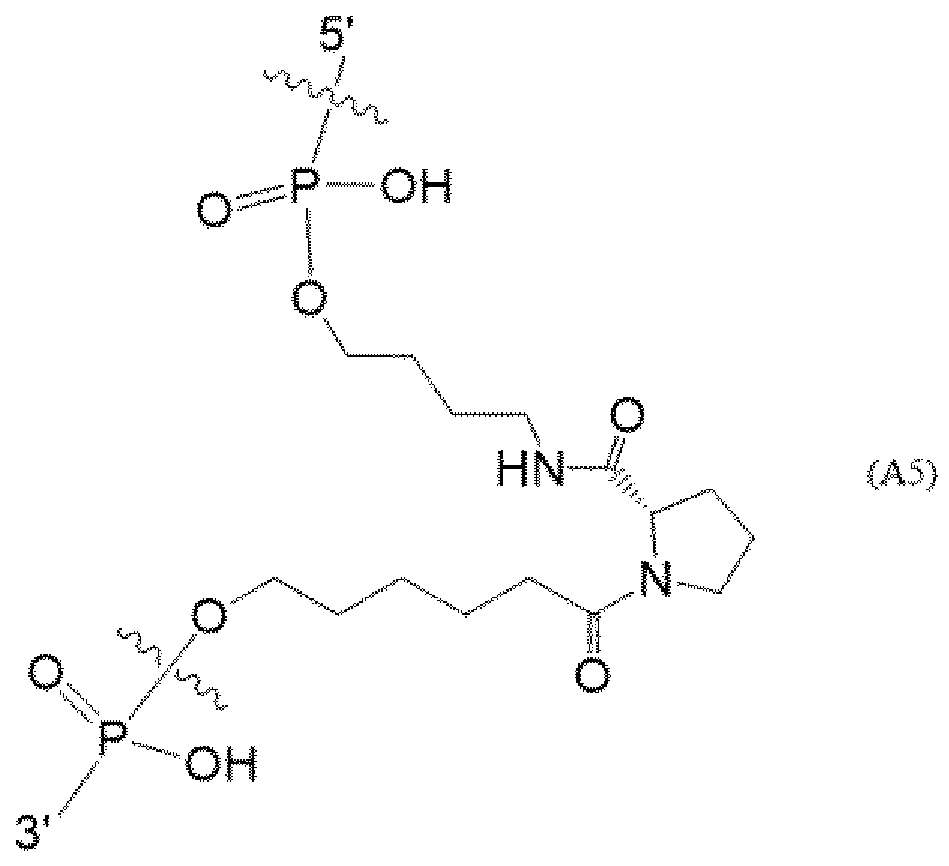
서열 (D) 중, "P" 는, 이하의 식 (A5) 에 있어서 파선으로 구분되는 부분 구조로 나타낸다.In the sequence (D), "P" is represented by a partial structure separated by a broken line in the following formula (A5).
또한, 서열표 중의 서열 번호 4 의 기재는, 서열 (D) 의 5' 말단에서부터「P」의 전까지의 하기의 서열 (D1) 의 염기 서열을 나타내고, 서열 번호 5 의 기재는, 서열 (D) 의「P」의 후에서부터 3' 말단까지의 하기의 서열 (D2) 의 염기 서열을 나타낸다.In addition, the description of SEQ ID NO: 4 in the sequence table shows the nucleotide sequence of the following sequence (D1) from the 5' end of sequence (D) to the front of "P", and the description of SEQ ID NO: 5 represents sequence (D) The nucleotide sequence of the following sequence (D2) from the end of "P" to the 3' end of "P" is shown.
서열 (D1) : 5'-CCAUGAGAAGUAUGACAACAGCC-3' (서열 번호 4) 23 merSequence (D1): 5′-CCAUGAGAAGUAUGACAACAGCC-3′ (SEQ ID NO: 4) 23 mer
서열 (D2) : 5'-GGCUGUUGUCAUACUUCUCAUGGUU-3' (서열 번호 5) 25 merSequence (D2): 5′-GGCUGUUGUCAUACUUCUCAUGGUU-3′ (SEQ ID NO: 5) 25 mer
Nucleic Acids Research, 2019, Vol.47, No.2 : 547 에 기재되어 있는, 하기의 서열 (E) 를 갖는 핵산 올리고머를 들 수 있다.Nucleic acid oligomers described in Nucleic Acids Research, 2019, Vol.47, No.2: 547 and having the following sequence (E) are exemplified.
서열 (E) : 5'-ACAGCAUAGCAAGUUAAAAUAAGGCUAGUCCGUUAUCAACUUGAAAAAGUGGCACCGAGUCGGUGCU-3' (서열 번호 6) 67 merSequence (E): 5′-ACAGCAUAGCAAGUUAAAAUAAGGCUAGUCCGUUAUCAACUUGAAAAAGUGGCACCGAGUCGGUGCU-3′ (SEQ ID NO: 6) 67 mer
일본 공표특허공보 2015-523856호, 173 페이지에 기재되어 있는, 하기의 서열 (F) 를 갖는 핵산 올리고머를 들 수 있다.A nucleic acid oligomer having the following sequence (F) described in Japanese Patent Publication No. 2015-523856, page 173 is exemplified.
서열 (F) : 5'-GUUUUCCCUUUUCAAAGAAAUCUCCUGGGCACCUAUCUUCUUAGGUGCCCUCCCUUGUUUAAACCUGACCAGUUAACCGGCUGGUUAGGUUUUU-3' (서열 번호 7) 94 merSequence (F): 5′-GUUUUCCCUUUUCAAAGAAAUCUCCUGGGCACCUAUCUUCUUAGGUGCCCUCCCUUGUUUAAACCUGACCAGUUAACCGGCUGGUUAGGUUUUU-3′ (SEQ ID NO: 7) 94 mer
일본 공표특허공보 2017-537626호에 기재되어 있는 핵산 올리고머를 들 수 있다. 전형예로서, 하기의 서열 (G), (H), (I), 및 (J) 를 갖는 핵산 올리고머를 들 수 있다.Nucleic acid oligomers described in Japanese Patent Publication No. 2017-537626 are exemplified. Typical examples include nucleic acid oligomers having the following sequences (G), (H), (I), and (J).
서열 (G) : 5'-AGUCCUCAUCUCCCUCAAGCGUUUUAGAGCUAGUAAUAGCAAGUUAAAAUAAGGCUAGUCCGUUAUCAACUUGAAAAAGUGGCACCGAGUCGGUGCUUUU-3' (서열 번호 8) 100 merSequence (G): 5′-AGUCCUCAUCUCCCUCAAGCGUUUUAGAGCUAGUAAUAGCAAGUUAAAAUAAGGCUAGUCCGUUAUCAACUUGAAAAAGUGGCACCGAGUCGGUGCUUUU-3′ (SEQ ID NO: 8) 100 mer
서열 (H) : 5'-GCAGAUGUAGUGUUUCCACAGUUUAAGAGCUAUGCUGGAAACAGCAUAGCAAGUUUAAAUAAGGCUAGUCCGUUAUCAACUUGAAAAAGUGGCACCGAGUCGGUGCUUUUUUU-3' (서열 번호 9) 113 merSequence (H): 5′-GCAGAUGUAGUGUUUCCACAGUUUAAGAGCUAUGCUGGAAACAGCAUAGCAAGUUUAAAUAAGGCUAGUCCGUUAUCAACUUGAAAAAGUGGCACCGAGUCGGUGCUUUUUUU-3′ (SEQ ID NO: 9) 113 mer
서열 (I) : 5'-dAdGdTdCdCdTdCdAdTdCdTdCdCdCdTdCdAdAdGdCGUUUAAGAGCUAUGCUGGUAACAGCAUAGCAAGUUUAAAUAAGGCUAGUCCGUUAUCAACUUGAAAAAGUGGCACCGAGUCGGUGCUUUUUUU-3' (서열 번호 10) 113 merSequence (I): 5′-dAdGdTdCdCdTdCdAdTdCdTdCdCdCdTdCdAdAdGdCGUUUAAGAGCUAUGCUGGUAACAGCAUAGCAAGUUUAAAUAAGGCUAGUCCGUUAUCAACUUGAAAAAGUGGCACCGAGUCGGUGCUUUUUUU-3′ (SEQ ID NO: 10) 113 mer
서열 (I) 중, dT 는 티미딘을, dC 는 2'-디옥시시티딘을, dA 는 2'-디옥시아데노신을, 또 dG 는 2'-디옥시구아노신을 나타낸다.In sequence (I), dT represents thymidine, dC represents 2'-deoxycytidine, dA represents 2'-deoxyadenosine, and dG represents 2'-deoxyguanosine.
서열 (J) : 5'-AmsGmsUmsCCUCAUCUCCCUCAAGCGUUUAAGAGCUAUGCUGGUAACAGCAUAGC AAGUUUAAAUAAGGCUAGUCCGUUAUCAACUUGAAAAAGUGGCACCGAGUCGGUGCUUUUmsUmsUmsU-3' (서열 번호 11) 113 merSequence (J): 5′-AmsGmsUmsCCUCAUCUCCCUCAAGCGUUUAAGAGCUAUGCUGGUAACAGCAUAGC AAGUUUAAAUAAGGCUAGUCCGUUAUCAACUUGAAAAAGUGGCACCGAGUCGGUGCUUUUmsUmsUmsU-3′ (SEQ ID NO: 11) 113 mer
서열 (J) 중, Um 은 2'-O-메틸우리딘을, Am 은 2'-O-메틸아데노신을, Gm 은 2'-O-메틸구아노신을, 또 s 는 포스포로티오에이트 수식을 나타낸다.In the sequence (J), Um represents 2'-O-methyluridine, Am represents 2'-O-methyladenosine, Gm represents 2'-O-methylguanosine, or s represents a phosphorothioate modification. .
실시예Example
이하, 실시예에 의해 본 발명을 더욱 상세하게 설명하지만, 본 발명은 이들 예에 한정되는 것은 아니다.Hereinafter, the present invention will be described in more detail by examples, but the present invention is not limited to these examples.
<측정 방법><measurement method>
먼저, 이하의 시험에서 사용한 각종 측정 방법을 이하에 나타낸다.First, various measuring methods used in the following tests are shown below.
올리고뉴클레오티드 순도는, HPLC 를 사용하여 측정하였다.Oligonucleotide purity was measured using HPLC.
HPLC 측정 조건을 하기 표 1 에 나타낸다.The HPLC measurement conditions are shown in Table 1 below.
(측정 방법 1 : 올리고뉴클레오티드 순도의 측정)(Measurement method 1: measurement of oligonucleotide purity)

(측정 방법 2 : 올리고뉴클레오티드 수량의 측정)(Measurement method 2: Measurement of quantity of oligonucleotides)
상기 미정제 생성물의 OD260 을 측정하였다. OD260 이란 1 mL 용액 (pH =7.5) 에 있어서의 10 ㎜ 광로 길이당의 UV 260 ㎚ 의 흡광도를 나타낸다. 일반적으로 RNA 에서는 1 OD = 40 ㎍ 인 것이 알려져 있는 점에서, 상기 OD260 의 측정값에 기초하여, 수량을 산출하였다.The OD 260 of the crude product was determined. OD 260 represents the absorbance of UV 260 nm per 10 mm optical path length in a 1 mL solution (pH = 7.5). Since it is generally known that 1 OD = 40 μg for RNA, the quantity was calculated based on the measured value of OD 260 described above.
(측정 방법 3 : 포름알데히드 농도의 측정)(Measurement method 3: measurement of formaldehyde concentration)
트리클로로아세트산 용액 중의 포름알데히드 농도 측정 방법에는, 고속 액체 크로마토그래프법이 있다. 고속 액체 크로마토그래프법에서는, 포름알데히드와 아세틸아세톤을 반응시키고, 얻어진 3,5-디아세틸-1,4-디하이드로루티딘의 양을 측정하여, 포름알데히드의 농도를 산출한다.As a method for measuring the concentration of formaldehyde in a trichloroacetic acid solution, there is a high performance liquid chromatography method. In the high-performance liquid chromatography method, formaldehyde and acetylacetone are reacted, the amount of 3,5-diacetyl-1,4-dihydrolutidine obtained is measured, and the concentration of formaldehyde is calculated.
<트리클로로아세트산 용액의 조제><Preparation of trichloroacetic acid solution>
이하의 시험에서 사용한 포름알데히드 농도가 상이한 트리클로로아세트산 용액은, 미리 포름알데히드 농도가 낮은 트리클로로아세트산 용액을 조제하고, 얻어진 트리클로로아세트산 용액에 포름알데히드 수용액을 첨가하여 조제하였다.Trichloroacetic acid solutions having different formaldehyde concentrations used in the following tests were prepared by preparing trichloroacetic acid solutions having a low formaldehyde concentration in advance and adding formaldehyde aqueous solution to the obtained trichloroacetic acid solution.
<올리고뉴클레오티드의 고상 합성><Solid phase synthesis of oligonucleotide>
서열 (I) : 5'-GGCACCGAGUCGGUGCUUUU-3' (서열 번호 12) 20 merSequence (I): 5'-GGCACCGAGUCGGUGCUUUU-3' (SEQ ID NO: 12) 20 mer
서열 (II) : 5'-AAGGCUAGUCCGUUAUCAACUUGAAAAAGUGGCACCGAGUCGGUGCUUUU-3' (서열 번호 13) 50 merSequence (II): 5′-AAGGCUAGUCCGUUAUCAACUUGAAAAAGUGGCACCGAGUCGGUGCUUUU-3′ (SEQ ID NO: 13) 50 mer
서열 (III) : 5'-AUAACUCAAUUUGUAAAAAAGUUUUAGAGCUAGAAAUAGCAAGUUAAAAUAAGGCUAGUCCGUUAUCAACUUGAAAAAGUGGCACCGAGUCGGUGCUUUU-3' (서열 번호 14) 100 merSequence (III): 5′-AUAACUCAAUUUGUAAAAAGUUUUAGAGCUAGAAAUAGCAAGUUAAAAUAAGGCUAGUCCGUUAUCAACUUGAAAAAGUGGCACCGAGUCGGUGCUUUU-3′ (SEQ ID NO: 14) 100 mer
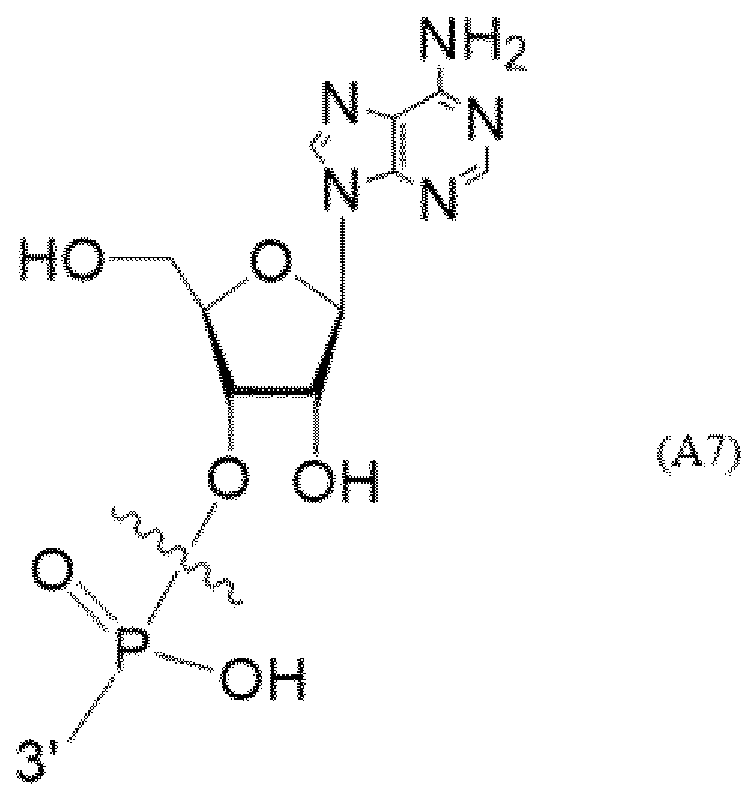
상기 서열 (I), (II) 및 (III) 중, "A" 는, 이하의 식 (A1) 에 있어서 파선으로 구분되는 부분 구조로 나타낸다. "C" 는, 이하의 식 (A2) 에 있어서 파선으로 구분되는 부분 구조로 나타낸다. "G" 는, 이하의 식 (A3) 에 있어서 파선으로 구분되는 부분 구조로 나타낸다. U 는, 이하의 식 (A4) 에 있어서 파선으로 구분되는 부분 구조로 나타낸다. 또한, 3' 말단의 "U" 는, 이하의 식 (A8) 에 있어서 파선으로 구분되는 부분 구조로 나타낸다. 또, 서열 (I) 중, 5' 말단의 "G" 는, 이하의 식 (A6) 에 있어서 파선으로 구분되는 부분 구조로 나타내고, 서열 (II) 및 (III) 중, 5' 말단의 "A" 는, 이하의 식 (A7) 에 있어서 파선으로 구분되는 부분 구조로 나타낸다.Among the sequences (I), (II) and (III), "A" is represented by a partial structure separated by a broken line in the following formula (A1). "C" is represented by a partial structure separated by a broken line in the following formula (A2). "G" is represented by a partial structure separated by a broken line in the following formula (A3). U is represented by a partial structure separated by a broken line in the following formula (A4). In addition, "U" at the 3' end is represented by a partial structure separated by a broken line in the following formula (A8). In addition, in sequence (I), "G" at the 5' end is represented by a partial structure separated by a broken line in the following formula (A6), and in sequences (II) and (III), "A" at the 5' end " is represented by a partial structure separated by a broken line in the following formula (A7).
[화학식 20][Formula 20]

[화학식 21][Formula 21]
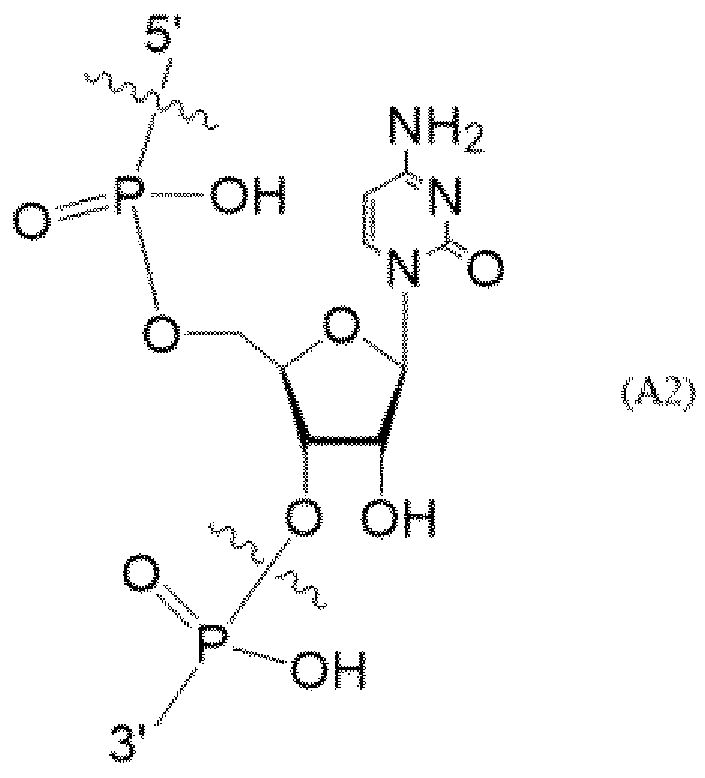
[화학식 22][Formula 22]
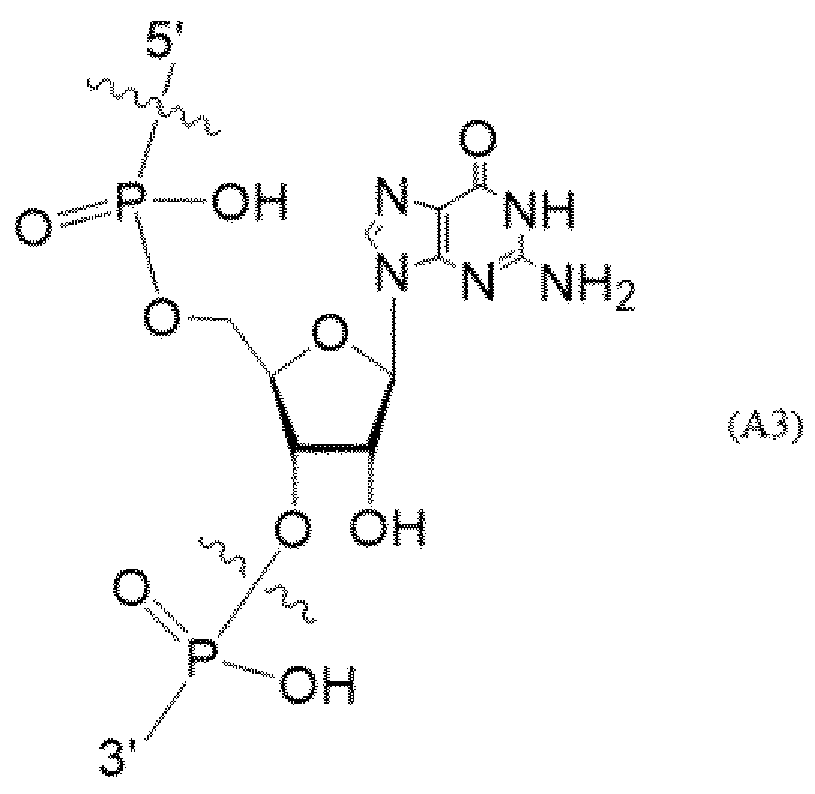
[화학식 23][Formula 23]

[화학식 24][Formula 24]
[화학식 25][Formula 25]

[화학식 26][Formula 26]
[화학식 27][Formula 27]

고상 담체로서, Controlled Pore Glass (CPG) 를 사용하고, 핵산 합성기로서 NTS M-4MX-E (일본 테크노 서비스사 제조) 를 사용하여, 포스포르아미다이트 고상 합성법에 의해, 상기 서열 (I), (II) 및 (III) 으로 이루어지는 올리고뉴클레오티드를 3' 측에서 5' 측을 향하여 합성하였다. 합성은, 약 1 μmol 스케일로 실시하였다. 또, 합성에는, US2012/0035246 의 실시예 2 에 기재된 우리딘 EMM 아미다이트 (A11), 실시예 3 에 기재된 시티딘 EMM 아미다이트 (A9), 실시예 4 에 기재된 아데노신 EMM 아미다이트 (A12), 및 실시예 5 에 기재된 구아노신 EMM 아미다이트 (A10) 를 사용하고, 디블로킹 용액으로서 3 % 트리클로로아세트산톨루엔 용액을 사용하고, 축합제로서 5-벤질메르캅토-1H-테트라졸을 사용하고, 산화제로서 요오드 용액을 사용하고, 캐핑 용액으로서 페녹시아세트산 무수물 용액과 N-메틸이미다졸 용액을 사용하였다.The sequence (I), Oligonucleotides consisting of (II) and (III) were synthesized from the 3' side toward the 5' side. Synthesis was performed on a scale of about 1 µmol. In the synthesis, uridine EMM amidite (A11) described in Example 2 of US2012/0035246, cytidine EMM amidite (A9) described in Example 3, and adenosine EMM amidite described in Example 4 ( A12), and guanosine EMM amidite (A10) described in Example 5 were used, a 3% trichloroacetate toluene solution was used as a deblocking solution, and 5-benzylmercapto-1H-tetrazole was used as a condensing agent. was used, an iodine solution was used as an oxidizing agent, and a phenoxyacetic anhydride solution and an N-methylimidazole solution were used as a capping solution.
[화학식 28][Formula 28]

[화학식 29][Formula 29]

[화학식 30][Formula 30]

[화학식 31][Formula 31]
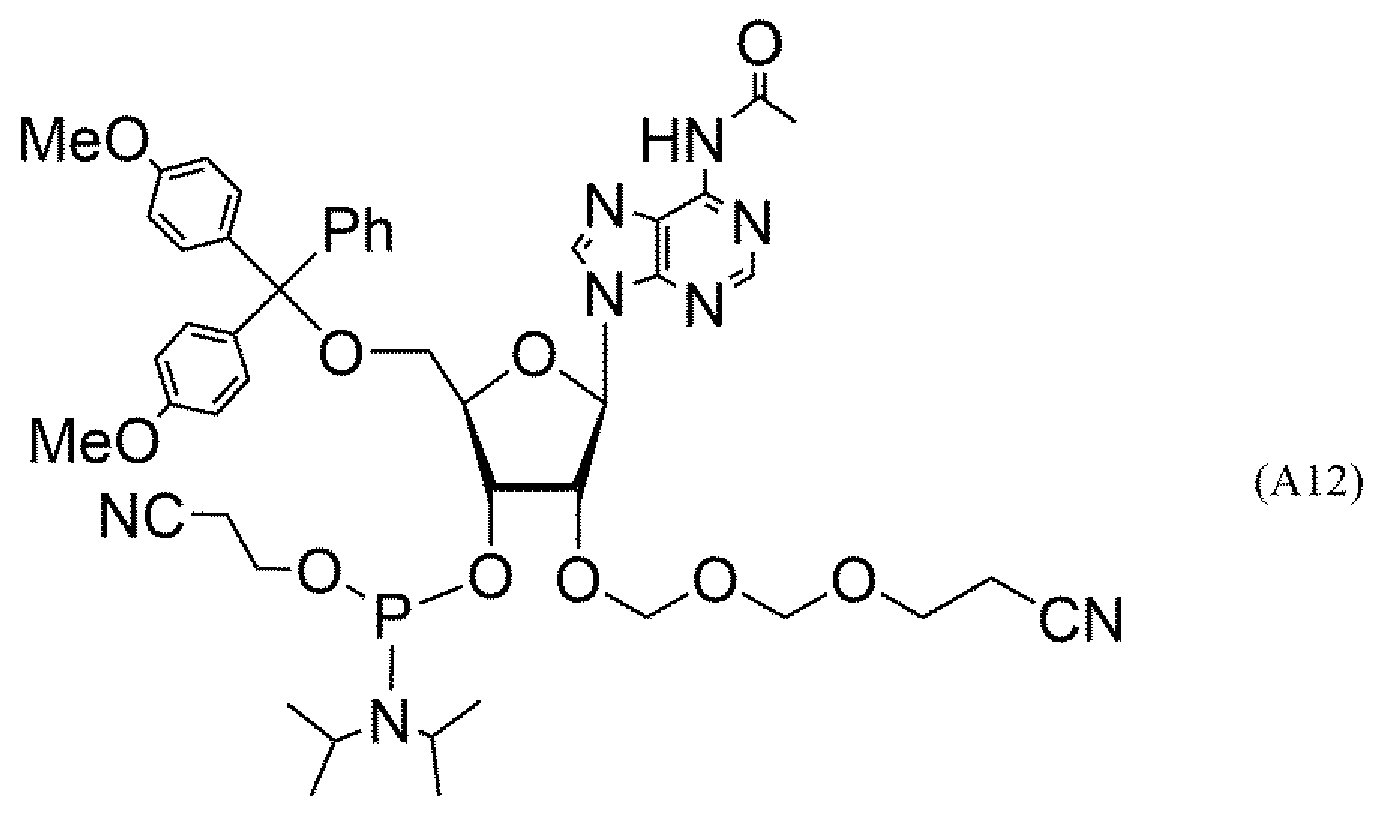
다음으로, 본 발명의 제법에 의해 제조되는 올리고뉴클레오티드 (핵산 올리고머) 의 구체적인 제조예를 나타낸다. 여기서, 하기의 실시예에 있어서 본 발명의 제법에 의해 제조되는 올리고뉴클레오티드는, 상기 서열 (I), (II) 및 (III) 을 갖는 올리고뉴클레오티드이다.Next, specific production examples of oligonucleotides (nucleic acid oligomers) produced by the production method of the present invention are shown. Here, in the examples below, the oligonucleotides produced by the production method of the present invention are oligonucleotides having the above sequences (I), (II) and (III).
또, 이하의 실시예 및 비교예 중에 기재하는 우리딘 유도체란, 하기의 구조식으로 나타내는 화합물을 의미한다. 하기 구조식에 있어서 도시된 서클은, CPG 를 모식적으로 나타내는 것이다.In addition, the uridine derivative described in the following Examples and Comparative Examples means a compound represented by the following structural formula. Circles shown in the following structural formula schematically represent CPG.
[화학식 32][Formula 32]
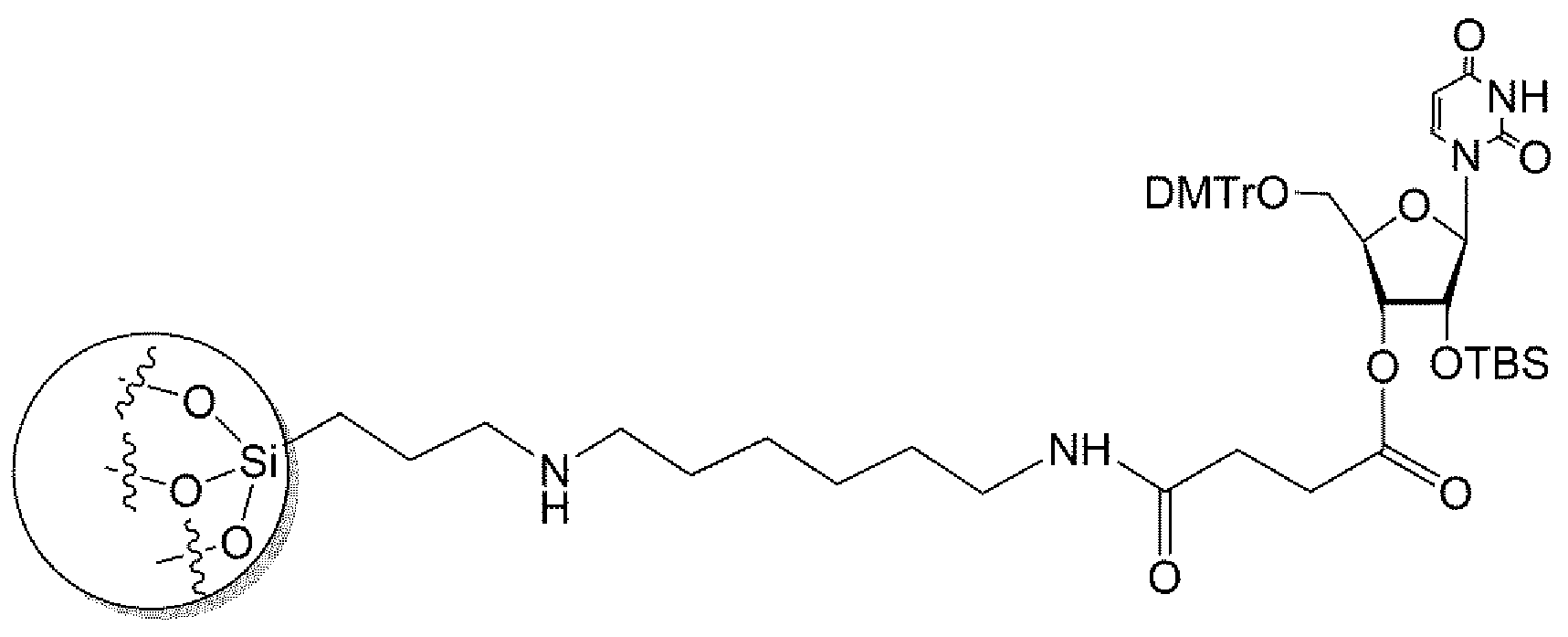
(실시예 1)(Example 1)
0.99 μmol 의 우리딘 유도체를 담지한 Controlled Pore Glass (CPG) 와, 식 (A9), 식 (A10), 식 (A11), 또는 식 (A12) 에 나타내는 아미다이트를 사용하여, 서열 (I) 에 나타내는 핵산 올리고머를 NTS M-4MX-E (일본 테크노 서비스사 제조) 에 의해, 3' 측에서 5' 측을 향하여 자동 합성하였다. 자동 합성의 순서는, 먼저, 3 % 트리클로로아세트산톨루엔 용액을 CPG 에 송액하여, 5' 위치의 트리틸 보호기를 탈보호하였다. 이 때, 사용한 트리클로로아세트산 용액 중의 포름알데히드 농도는, 측정 방법 3 에 의해 측정할 수 있고, 트리클로로아세트산 용액 중의 포름알데히드와 트리클로로아세트산의 몰비 (포름알데히드 mol/트리클로로아세트산 mol) 는 33 × 10-7 이었다. 계속해서, 각종 아미다이트와 축합제로서 5-벤질메르캅토-1H-테트라졸을 CPG 에 송액하여, 5' 위치의 수산기에 커플링 반응을 진행시켰다. 계속해서, 50 mM 요오드를 포함하는 산화 용액을 송액하여, 아인산기를 인산기로 변환시켰다. 계속해서, 캐핑 용액으로서 0.1 M 페녹시아세트산 무수물 아세토니트릴 용액과 10 % N-메틸이미다졸/10 % 2,6-루티딘아세토니트릴 용액을 사용하여, 커플링이 진행되지 않았던 반응점에 캐핑을 실시하였다. 추가로 이들 공정을 합계 19 회 반복한 후, 5' 말단의 염기에 있어서의 보호기 (DMTr 기) 를 3 % 트리클로로아세트산톨루엔 용액으로 탈보호하여, 서열 (I) 에 나타내는 서열의 핵산 올리고뉴클레오티드를 CPG 담체 상에 합성하였다. 그 후, 0.99 μmol 분 (分) 의 올리고뉴클레오티드를 담지한 CPG 담체에 대하여, 28 % 암모니아수 1.5 mL 와 에탄올 0.5 mL 를 유입하고, 혼합물을 40 ℃ 에서 4 시간 보온함으로써 핵산 올리고머를 고상 담체로부터 유리시킨 후, 농축에 의해 용매를 제거하였다. 이어서 유리 올리고뉴클레오티드를 디메틸술폭사이드 1.5 mL 에 용해 후, 아세토니트릴 1.0 mL, 니트로메탄 20 μL 와 교반자를 넣은 후, 몰레큘러시브 4 A 로 탈수 처리를 실시한 1 M 의 불화테트라-n-부틸암모늄 (TBAF) 의 디메틸술폭사이드 용액 2.08 mL 를 스터러에 의한 교반하 실온에서 유입하고, 혼합물을 33 ℃ 에서 4 시간 보온함으로써 2'-EMM 보호기의 탈보호를 실시하였다. 그 후, 핵산 올리고머의 생성물을 침전 조작에 의해 얻었다. 얻어진 생성물에 대해, 상기 측정 방법 1 에 기재된 방법을 사용하여, 올리고뉴클레오티드의 순도를 측정한 결과, 순도는 72.6 % 였다. 또, 상기 측정 방법 2 에 기재된 방법을 사용하여, 올리고뉴클레오티드의 수량을 측정한 결과, 수량은 4369 ㎍ 이고, 1.00 μmol 의 우리딘 유도체를 담지한 CPG 당의 수량으로 환산하면 4413 ㎍ 이었다. 결과를 표 2 에 나타낸다.Using Controlled Pore Glass (CPG) carrying 0.99 μmol of a uridine derivative and an amidite represented by Formula (A9), Formula (A10), Formula (A11), or Formula (A12), sequence (I) The nucleic acid oligomer shown in was automatically synthesized from the 3' side to the 5' side by NTS M-4MX-E (manufactured by Techno Service Co., Ltd., Japan). In the procedure of the automatic synthesis, first, a 3% trichloroacetic acid toluene solution was fed to CPG to deprotect the trityl protecting group at the 5' position. At this time, the concentration of formaldehyde in the used trichloroacetic acid solution can be measured by
(실시예 2)(Example 2)
실시예 1 의 실험에 있어서, 1.00 μmol 의 우리딘 유도체를 담지한 Controlled Pore Glass (CPG) 와, 포름알데히드와 트리클로로아세트산의 몰비 (포름알데히드 mol/트리클로로아세트산 mol) 가 11 × 10-5 인 3 % 트리클로로아세트산톨루엔 용액을 사용하는 것 이외에는, 동일한 방법으로 서열 (I) 의 핵산 올리고머를 얻었다. 상기 측정 방법 1 에 기재된 방법을 사용하여, 올리고뉴클레오티드의 순도를 측정한 결과, 생성물의 순도는 71.4 % 였다. 또, 상기 측정 방법 2 에 기재된 방법을 사용하여, 올리고뉴클레오티드의 수량을 측정한 결과, 1.00 μmol 의 우리딘 유도체를 담지한 CPG 당의 수량은 4236 ㎍ 이었다. 결과를 표 2 에 나타낸다.In the experiment of Example 1, Controlled Pore Glass (CPG) carrying 1.00 μmol of a uridine derivative and the molar ratio of formaldehyde and trichloroacetic acid (mol of formaldehyde/mol of trichloroacetic acid) was 11 × 10 -5 A nucleic acid oligomer of sequence (I) was obtained in the same manner except for using a 3% trichloroacetic acid toluene solution. As a result of measuring the purity of the oligonucleotide using the method described in
(참고예 1)(Reference Example 1)
실시예 1 의 실험에 있어서, 0.97 μmol 의 우리딘 유도체를 담지한 Controlled Pore Glass (CPG) 와, 포름알데히드와 트리클로로아세트산의 몰비 (포름알데히드 mol/트리클로로아세트산 mol) 가 26 × 10-5 인 3 % 트리클로로아세트산톨루엔 용액을 사용하는 것 이외에는, 동일한 방법으로 서열 (I) 의 핵산 올리고머를 얻었다. 상기 측정 방법 1 에 기재된 방법을 사용하여, 올리고뉴클레오티드의 순도를 측정한 결과, 생성물의 순도는 69.7 % 였다. 또, 상기 측정 방법 2 에 기재된 방법을 사용하여, 올리고뉴클레오티드의 수량을 측정한 결과, 수량은 3982 ㎍ 이고, 1.00 μmol 의 우리딘 유도체를 담지한 CPG 당의 수량으로 환산하면 4105 ㎍ 이었다. 결과를 표 2 에 나타낸다.In the experiment of Example 1, Controlled Pore Glass (CPG) carrying 0.97 μmol of the uridine derivative and the molar ratio of formaldehyde and trichloroacetic acid (mol of formaldehyde/mol of trichloroacetic acid) was 26 × 10 -5 A nucleic acid oligomer of sequence (I) was obtained in the same manner except for using a 3% trichloroacetic acid toluene solution. As a result of measuring the purity of the oligonucleotide using the method described in
(실시예 3)(Example 3)
1.01 μmol 의 우리딘 유도체를 담지한 Controlled Pore Glass (CPG) 와, 식 (A9), 식 (A10), 식 (A11), 또는 식 (A12) 에 나타내는 아미다이트를 사용하여, 서열 (II) 에 나타내는 핵산 올리고머를 NTS M-4MX-E (일본 테크노 서비스사 제조) 에 의해, 3' 측에서 5' 측을 향하여 자동 합성하였다. 자동 합성의 순서는, 먼저, 3 % 트리클로로아세트산톨루엔 용액을 CPG 에 송액하여, 5' 위치의 트리틸 보호기를 탈보호하였다. 이 때, 사용한 트리클로로아세트산 용액 중의 포름알데히드 농도는, 측정 방법 3 에 의해 측정할 수 있고, 트리클로로아세트산 용액 중의 포름알데히드와 트리클로로아세트산의 몰비 (포름알데히드 mol/트리클로로아세트산 mol) 는 33 × 10-7 이었다. 계속해서, 각종 아미다이트와 축합제로서 5-벤질메르캅토-1H-테트라졸을 CPG 에 송액하여, 5' 위치의 수산기에 커플링 반응을 진행시켰다. 계속해서, 50 mM 요오드를 포함하는 산화 용액을 송액하여, 아인산기를 인산기로 변환시켰다. 계속해서, 캐핑 용액으로서 0.1 M 페녹시아세트산 무수물 아세토니트릴 용액과 10 % N-메틸이미다졸/10 % 2,6-루티딘아세토니트릴 용액을 사용하여, 커플링이 진행되지 않았던 반응점에 캐핑을 실시하였다. 추가로 이들 공정을 합계 49 회 반복한 후, 5' 말단의 염기에 있어서의 보호기 (DMTr 기) 를 3 % 트리클로로아세트산톨루엔 용액으로 탈보호하여, 서열 (II) 에 나타내는 서열의 핵산 올리고뉴클레오티드를 CPG 담체 상에 합성하였다. 그 후, 1.01 μmol 분의 올리고뉴클레오티드를 담지한 CPG 담체에 대하여, 28 % 암모니아수 1.5 mL 와 에탄올 0.5 mL 를 유입하고, 혼합물을 40 ℃ 에서 4 시간 보온함으로써 핵산 올리고머를 고상 담체로부터 유리시킨 후, 농축에 의해 용매를 제거하였다. 이어서 유리 올리고뉴클레오티드를 디메틸술폭사이드 1.5 mL 에 용해 후, 아세토니트릴 1.0 mL, 니트로메탄 20 μL 와 교반자를 넣은 후, 몰레큘러시브 4 A 로 탈수 처리를 실시한 1 M 의 불화테트라-n-부틸암모늄 (TBAF) 의 디메틸술폭사이드 용액 2.08 mL 를 스터러에 의한 교반하 실온에서 유입하고, 혼합물을 33 ℃ 에서 4 시간 보온함으로써 2'-EMM 보호기의 탈보호를 실시하였다. 그 후, 핵산 올리고머의 생성물을 침전 조작에 의해 얻었다. 얻어진 생성물에 대해, 상기 측정 방법 1 에 기재된 방법을 사용하여, 올리고뉴클레오티드의 순도를 측정한 결과, 순도는 43.1 % 였다. 또, 상기 측정 방법 2 에 기재된 방법을 사용하여, 올리고뉴클레오티드의 수량을 측정한 결과, 수량은 9941 ㎍ 이고, 1.00 μmol 의 우리딘 유도체를 담지한 CPG 당의 수량으로 환산하면 9843 ㎍ 이었다. 결과를 표 2 에 나타낸다.Using Controlled Pore Glass (CPG) carrying 1.01 µmol of a uridine derivative and an amidite represented by Formula (A9), Formula (A10), Formula (A11), or Formula (A12), sequence (II) The nucleic acid oligomer shown in was automatically synthesized from the 3' side to the 5' side by NTS M-4MX-E (manufactured by Techno Service Co., Ltd., Japan). In the procedure of the automatic synthesis, first, a 3% trichloroacetic acid toluene solution was fed to CPG to deprotect the trityl protecting group at the 5' position. At this time, the concentration of formaldehyde in the used trichloroacetic acid solution can be measured by
(실시예 4)(Example 4)
실시예 3 의 실험에 있어서, 1.01 μmol 의 우리딘 유도체를 담지한 Controlled Pore Glass (CPG) 와, 포름알데히드와 트리클로로아세트산의 몰비 (포름알데히드 mol/트리클로로아세트산 mol) 가 11 × 10-5 인 3 % 트리클로로아세트산톨루엔 용액을 사용하는 것 이외에는, 동일한 방법으로 서열 (II) 의 핵산 올리고머를 얻었다. 상기 측정 방법 1 에 기재된 방법을 사용하여, 올리고뉴클레오티드의 순도를 측정한 결과, 생성물의 순도는 36.5 % 였다. 또, 상기 측정 방법 2 에 기재된 방법을 사용하여, 올리고뉴클레오티드의 수량을 측정한 결과, 수량은 9710 ㎍ 이고, 1.00 μmol 의 우리딘 유도체를 담지한 CPG 당의 수량으로 환산하면 9614 ㎍ 이었다. 결과를 표 2 에 나타낸다.In the experiment of Example 3, Controlled Pore Glass (CPG) carrying 1.01 μmol of a uridine derivative and the molar ratio of formaldehyde and trichloroacetic acid (mol of formaldehyde/mol of trichloroacetic acid) was 11 × 10 -5 A nucleic acid oligomer of sequence (II) was obtained in the same manner except for using a 3% trichloroacetic acid toluene solution. As a result of measuring the purity of the oligonucleotide using the method described in
(참고예 2)(Reference Example 2)
실시예 3 의 실험에 있어서, 1.02 μmol 의 우리딘 유도체를 담지한 Controlled Pore Glass (CPG) 와, 포름알데히드와 트리클로로아세트산의 몰비 (포름알데히드 mol/트리클로로아세트산 mol) 가 26 × 10-5 인 3 % 트리클로로아세트산톨루엔 용액을 사용하는 것 이외에는, 동일한 방법으로 서열 (II) 의 핵산 올리고머를 얻었다. 상기 측정 방법 1 에 기재된 방법을 사용하여, 올리고뉴클레오티드의 순도를 측정한 결과, 생성물의 순도는 33.2 % 였다. 또, 상기 측정 방법 2 에 기재된 방법을 사용하여, 올리고뉴클레오티드의 수량을 측정한 결과, 수량은 9158 ㎍ 이고, 1.00 μmol 의 우리딘 유도체를 담지한 CPG 당의 수량으로 환산하면 8978 ㎍ 이었다. 결과를 표 2 에 나타낸다.In the experiment of Example 3, Controlled Pore Glass (CPG) carrying 1.02 µmol of a uridine derivative and a molar ratio of formaldehyde and trichloroacetic acid (mol of formaldehyde/mol of trichloroacetic acid) was 26 × 10 -5 A nucleic acid oligomer of sequence (II) was obtained in the same manner except for using a 3% trichloroacetic acid toluene solution. As a result of measuring the purity of the oligonucleotide using the method described in
(실시예 5)(Example 5)
1.00 μmol 의 우리딘 유도체를 담지한 Controlled Pore Glass (CPG) 와, 식 (A9), 식 (A10), 식 (A11), 또는 식 (A12) 에 나타내는 아미다이트를 사용하여, 서열 (III) 에 나타내는 핵산 올리고머를 NTS M-4MX-E (일본 테크노 서비스사 제조) 에 의해, 3' 측에서 5' 측을 향하여 자동 합성하였다. 자동 합성의 순서는, 먼저, 3 % 트리클로로아세트산톨루엔 용액을 CPG 에 송액하여, 5' 위치의 트리틸 보호기를 탈보호하였다. 이 때, 사용한 트리클로로아세트산 용액 중의 포름알데히드 농도는, 측정 방법 3 에 의해 측정할 수 있고, 트리클로로아세트산 용액 중의 포름알데히드와 트리클로로아세트산의 몰비 (포름알데히드 mol/트리클로로아세트산 mol) 는 33 × 10-7 이었다. 계속해서, 각종 아미다이트와 축합제로서 5-벤질메르캅토-1H-테트라졸을 CPG 에 송액하여, 5' 위치의 수산기에 커플링 반응을 진행시켰다. 계속해서, 50 mM 요오드를 포함하는 산화 용액을 송액하여, 아인산기를 인산기로 변환시켰다. 계속해서, 캐핑 용액으로서 0.1 M 페녹시아세트산 무수물 아세토니트릴 용액과 10 % N-메틸이미다졸/10 % 2,6-루티딘아세토니트릴 용액을 사용하여, 커플링이 진행되지 않았던 반응점에 캐핑을 실시하였다. 추가로 이들 공정을 합계 99 회 반복한 후, 5' 말단의 염기에 있어서의 보호기 (DMTr 기) 를 3 % 트리클로로아세트산톨루엔 용액으로 탈보호하여, 서열 (III) 에 나타내는 서열의 핵산 올리고뉴클레오티드를 CPG 담체 상에 합성하였다. 그 후, 1.00 μmol 분의 올리고뉴클레오티드를 담지한 CPG 담체에 대하여, 28 % 암모니아수 1.5 mL 와 에탄올 0.5 mL 를 유입하고, 혼합물을 40 ℃ 에서 4 시간 보온함으로써 핵산 올리고머를 고상 담체로부터 유리시킨 후, 농축에 의해 용매를 제거하였다. 이어서 유리 올리고뉴클레오티드를 디메틸술폭사이드 1.5 mL 에 용해 후, 아세토니트릴 1.0 mL, 니트로메탄 20 μL 와 교반자를 넣은 후, 몰레큘러시브 4 A 로 탈수 처리를 실시한 1 M 의 불화테트라-n-부틸암모늄 (TBAF) 의 디메틸술폭사이드 용액 2.08 mL 를 스터러에 의한 교반하 실온에서 유입하고, 혼합물을 33 ℃ 에서 4 시간 보온함으로써 2'-EMM 보호기의 탈보호를 실시하였다. 그 후, 핵산 올리고머의 생성물을 침전 조작에 의해 얻었다. 얻어진 생성물에 대해, 상기 측정 방법 1 에 기재된 방법을 사용하여, 올리고뉴클레오티드의 순도를 측정한 결과, 순도는 32.8 % 였다. 또, 상기 측정 방법 2 에 기재된 방법을 사용하여, 올리고뉴클레오티드의 수량을 측정한 결과, 1.00 μmol 의 우리딘 유도체를 담지한 CPG 당의 수량은 15722 ㎍ 이었다. 결과를 표 2 에 나타낸다.Using Controlled Pore Glass (CPG) carrying 1.00 µmol of a uridine derivative and an amidite represented by Formula (A9), Formula (A10), Formula (A11), or Formula (A12), sequence (III) The nucleic acid oligomer shown in was automatically synthesized from the 3' side to the 5' side by NTS M-4MX-E (manufactured by Techno Service Co., Ltd., Japan). In the procedure of the automatic synthesis, first, a 3% trichloroacetic acid toluene solution was fed to CPG to deprotect the trityl protecting group at the 5' position. At this time, the concentration of formaldehyde in the used trichloroacetic acid solution can be measured by
(실시예 6)(Example 6)
실시예 5 의 실험에 있어서, 1.01 μmol 의 우리딘 유도체를 담지한 Controlled Pore Glass (CPG) 와, 포름알데히드와 트리클로로아세트산의 몰비 (포름알데히드 mol/트리클로로아세트산 mol) 가 11 × 10-5 인 3 % 트리클로로아세트산톨루엔 용액을 사용하는 것 이외에는, 동일한 방법으로 서열 (III) 의 핵산 올리고머를 얻었다. 상기 측정 방법 1 에 기재된 방법을 사용하여, 올리고뉴클레오티드의 순도를 측정한 결과, 생성물의 순도는 30.9 % 였다. 또, 상기 측정 방법 2 에 기재된 방법을 사용하여, 올리고뉴클레오티드의 수량을 측정한 결과, 수량은 14754 ㎍ 이고, 1.00 μmol 의 우리딘 유도체를 담지한 CPG 당의 수량으로 환산하면 14608 ㎍ 이었다. 결과를 표 2 에 나타낸다.In the experiment of Example 5, Controlled Pore Glass (CPG) carrying 1.01 μmol of uridine derivative and the molar ratio of formaldehyde and trichloroacetic acid (mol of formaldehyde/mol of trichloroacetic acid) was 11 × 10 -5 A nucleic acid oligomer of sequence (III) was obtained in the same manner except for using a 3% trichloroacetic acid toluene solution. As a result of measuring the purity of the oligonucleotide using the method described in
(참고예 3)(Reference Example 3)
실시예 5 의 실험에 있어서, 0.97 μmol 의 우리딘 유도체를 담지한 Controlled Pore Glass (CPG) 와, 포름알데히드와 트리클로로아세트산의 몰비 (포름알데히드 mol/트리클로로아세트산 mol) 가 26 × 10-5 인 3 % 트리클로로아세트산톨루엔 용액을 사용하는 것 이외에는, 동일한 방법으로 서열 (III) 의 핵산 올리고머를 얻었다. 상기 측정 방법 1 에 기재된 방법을 사용하여, 올리고뉴클레오티드의 순도를 측정한 결과, 생성물의 순도는 26.7 % 였다. 또, 상기 측정 방법 2 에 기재된 방법을 사용하여, 올리고뉴클레오티드의 수량을 측정한 결과, 수량은 13283 ㎍ 이고, 1.00 μmol 의 우리딘 유도체를 담지한 CPG 당의 수량으로 환산하면 13694 ㎍ 이었다. 결과를 표 2 에 나타낸다.In the experiment of Example 5, Controlled Pore Glass (CPG) carrying 0.97 µmol of the uridine derivative and the molar ratio of formaldehyde and trichloroacetic acid (mol of formaldehyde/mol of trichloroacetic acid) was 26 × 10 -5 A nucleic acid oligomer of sequence (III) was obtained in the same manner except for using a 3% trichloroacetic acid toluene solution. As a result of measuring the purity of the oligonucleotide using the method described in
(실시예 7)(Example 7)
포름알데히드와 트리클로로아세트산의 몰비 (포름알데히드 mol/트리클로로아세트산 mol) 가 25 × 10-5 인 트리클로로아세트산 30 g 에 톨루엔 300 mL 를 첨가하고, 이배퍼레이터를 사용하여, 40 ℃ 에서 톨루엔과 포름알데히드를 공비 증류 제거하여, 무색 유상 (油狀) 의 트리클로로아세트산 용액 34 g 을 얻었다. 얻어진 트리클로로아세트산 용액에 포함되는 포름알데히드를 측정 방법 3 에 기재된 방법으로 분석한 결과, 포름알데히드와 트리클로로아세트산의 몰비는 25 × 10-7 이었다.300 mL of toluene was added to 30 g of trichloroacetic acid having a molar ratio of formaldehyde to trichloroacetic acid (mol of formaldehyde/mol of trichloroacetic acid) of 25 × 10 -5 , and the mixture was stirred with toluene at 40°C using an evaporator. Formaldehyde was removed by azeotropic distillation to obtain 34 g of a colorless oily trichloroacetic acid solution. As a result of analyzing formaldehyde contained in the obtained trichloroacetic acid solution by the method described in
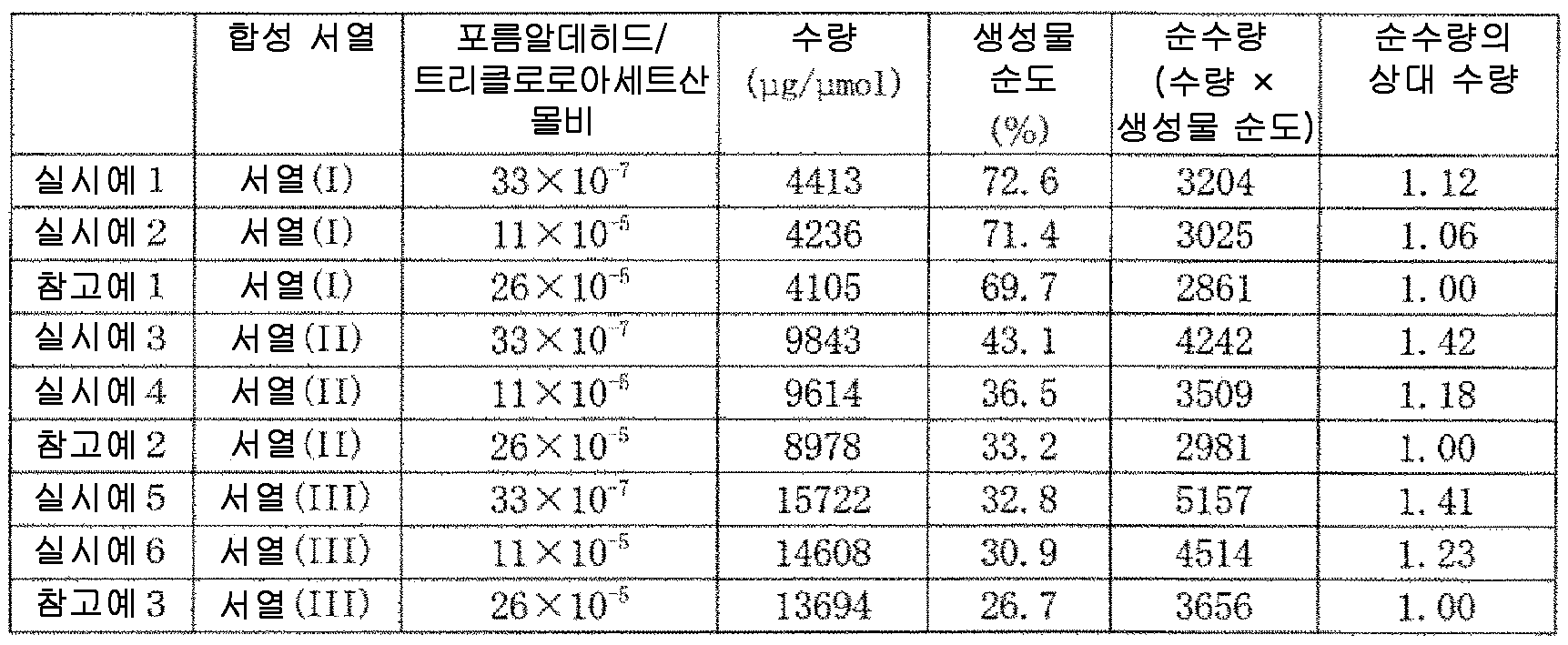
상기 표 2 의 결과로부터, 포름알데히드 농도가 일정 이하인 본 발명의 트리클로로아세트산 용액을 사용한 경우에는, 참고예 1, 참고예 2 및 참고예 3 의 트리클로로아세트산 용액을 사용한 경우와 비교하여, 고수율로 핵산 올리고머가 얻어졌다.From the results of Table 2, when the trichloroacetic acid solution of the present invention having a formaldehyde concentration of less than a certain level was used, compared to the case of using the trichloroacetic acid solutions of Reference Example 1, Reference Example 2 and Reference Example 3, the yield was high. As a result, nucleic acid oligomers were obtained.
본 발명은, 효율적인 핵산 올리고머의 제조 방법을 제공한다. 또, 핵산 올리고머의 제조 방법에 따라서 제조되는 핵산 올리고머의 수율 향상을 기대할 수 있다.The present invention provides an efficient method for preparing nucleic acid oligomers. In addition, an improvement in the yield of nucleic acid oligomers produced according to the method for producing nucleic acid oligomers can be expected.
서열표 프리텍스트sequence table free text
서열표의 서열 번호 1 ∼ 14 는, 본 발명의 제조 방법에 따라서 제조되는 올리고뉴클레오티드의 염기 서열을 나타낸다.SEQ ID NOs: 1 to 14 in the sequence table show the nucleotide sequences of oligonucleotides produced by the production method of the present invention.
SEQUENCE LISTING <110> SUMITOMO CHEMICAL COMPANY, LIMITED <120> METHOD FOR PRODUCING NUCLEIC ACID OLIGOMER <130> S44830WO01 <150> JP 2020-118316 <151> 2020-07-09 <160> 14 <170> PatentIn version 3.5 <210> 1 <211> 21 <212> RNA <213> Artificial Sequence <220> <223> Synthetic oligonucleotide <220> <221> modified_base <222> (7)..(7), (17)..(17) <223> um <220> <221> modified_base <222> (20)..(21) <223> dT <400> 1 auggaanacu cuuggunacn n 21 <210> 2 <211> 21 <212> RNA <213> Artificial Sequence <220> <223> Synthetic oligonucleotide <220> <221> modified_base <222> (2)..(2), (12)..(12), (14)..(15), (19)..(19) <223> um <220> <221> modified_base <222> (5)..(6), (16)..(17) <223> cm <220> <221> modified_base <222> (20)..(21) <223> dT <400> 2 gnaannaaga gnannnnann n 21 <210> 3 <211> 36 <212> RNA <213> Artificial Sequence <220> <223> Synthetic oligonucleotide <400> 3 agagccagcc uucuuauugu uuuagagcua ugcugu 36 <210> 4 <211> 23 <212> RNA <213> Artificial Sequence <220> <223> Synthetic oligonucleotide <400> 4 ccaugagaag uaugacaaca gcc 23 <210> 5 <211> 25 <212> RNA <213> Artificial Sequence <220> <223> Synthetic oligonucleotide <400> 5 ggcuguuguc auacuucuca ugguu 25 <210> 6 <211> 67 <212> RNA <213> Artificial Sequence <220> <223> Synthetic oligonucleotide <400> 6 acagcauagc aaguuaaaau aaggcuaguc cguuaucaac uugaaaaagu ggcaccgagu 60 cggugcu 67 <210> 7 <211> 94 <212> RNA <213> Artificial Sequence <220> <223> Synthetic oligonucleotide <400> 7 guuuucccuu uucaaagaaa ucuccugggc accuaucuuc uuaggugccc ucccuuguuu 60 aaaccugacc aguuaaccgg cugguuaggu uuuu 94 <210> 8 <211> 100 <212> RNA <213> Artificial Sequence <220> <223> Synthetic oligonucleotide <400> 8 aguccucauc ucccucaagc guuuuagagc uaguaauagc aaguuaaaau aaggcuaguc 60 cguuaucaac uugaaaaagu ggcaccgagu cggugcuuuu 100 <210> 9 <211> 113 <212> RNA <213> Artificial Sequence <220> <223> Synthetic oligonucleotide <400> 9 gcagauguag uguuuccaca guuuaagagc uaugcuggaa acagcauagc aaguuuaaau 60 aaggcuaguc cguuaucaac uugaaaaagu ggcaccgagu cggugcuuuu uuu 113 <210> 10 <211> 113 <212> RNA <213> Artificial Sequence <220> <223> Synthetic oligonucleotide <220> <221> modified_base <222> (1)..(1), (8)..(8), (17)..(18) <223> dA <220> <221> modified_base <222> (2)..(2), (19)..(19) <223> dG <220> <221> modified_base <222> (3)..(3), (6)..(6), (9)..(9), (11)..(11), (15)..(15) <223> dT <220> <221> modified_base <222> (4)..(5), (7)..(7), (10)..(10), (12)..(14), (16)..(16), (20)..(20) <223> dC <400> 10 nnnnnnnnnn nnnnnnnnnn guuuaagagc uaugcuggua acagcauagc aaguuuaaau 60 aaggcuaguc cguuaucaac uugaaaaagu ggcaccgagu cggugcuuuu uuu 113 <210> 11 <211> 113 <212> RNA <213> Artificial Sequence <220> <223> Synthetic oligonucleotide <220> <221> modified_base <222> (1)..(1) <223> am <220> <221> modified_base <222> (2)..(2) <223> gm <220> <221> modified_base <222> (3)..(3), (110)..(112) <223> um <400> 11 nnnccucauc ucccucaagc guuuaagagc uaugcuggua acagcauagc aaguuuaaau 60 aaggcuaguc cguuaucaac uugaaaaagu ggcaccgagu cggugcuuun nnu 113 <210> 12 <211> 20 <212> RNA <213> Artificial Sequence <220> <223> Synthetic oligonucleotide <400> 12 ggcaccgagu cggugcuuuu 20 <210> 13 <211> 50 <212> RNA <213> Artificial Sequence <220> <223> Synthetic oligonucleotide <400> 13 aaggcuaguc cguuaucaac uugaaaaagu ggcaccgagu cggugcuuuu 50 <210> 14 <211> 100 <212> RNA <213> Artificial Sequence <220> <223> Synthetic oligonucleotide <400> 14 auaacucaau uuguaaaaaa guuuuagagc uagaaauagc aaguuaaaau aaggcuaguc 60 cguuaucaac uugaaaaagu ggcaccgagu cggugcuuuu 100 SEQUENCE LISTING <110> SUMITOMO CHEMICAL COMPANY, LIMITED <120> METHOD FOR PRODUCING NUCLEIC ACID OLIGOMER <130> S44830WO01 <150> JP 2020-118316 <151> 2020-07-09 <160> 14 <170> PatentIn version 3.5 <210> 1 <211> 21 <212> RNA <213> artificial sequence <220> <223> Synthetic oligonucleotide <220> <221> modified_base <222> (7)..(7), (17)..(17) <223> um <220> <221> modified_base <222> (20)..(21) <223> dT <400> 1 auggaanacu cuuggunacn n 21 <210> 2 <211> 21 <212> RNA <213> artificial sequence <220> <223> Synthetic oligonucleotide <220> <221> modified_base <222> (2)..(2), (12)..(12), (14)..(15), (19)..(19) <223> um <220> <221> modified_base <222> (5)..(6), (16)..(17) <223> cm <220> <221> modified_base <222> (20)..(21) <223> dT <400> 2 gnaannaaga gnannnnann n 21 <210> 3 <211> 36 <212> RNA <213> artificial sequence <220> <223> Synthetic oligonucleotide <400> 3 agagccagcc uucuuauugu uuuagagcua ugcugu 36 <210> 4 <211> 23 <212> RNA <213> artificial sequence <220> <223> Synthetic oligonucleotide <400> 4 ccaugagaag uaugacaaca gcc 23 <210> 5 <211> 25 <212> RNA <213> artificial sequence <220> <223> Synthetic oligonucleotide <400> 5 ggcuguuguc auacuucuca ugguu 25 <210> 6 <211> 67 <212> RNA <213> artificial sequence <220> <223> Synthetic oligonucleotide <400> 6 acagcauagc aaguuaaaau aaggcuaguc cguuaucaac uugaaaaagu ggcaccgagu 60 cggugcu 67 <210> 7 <211> 94 <212> RNA <213> artificial sequence <220> <223> Synthetic oligonucleotide <400> 7 guuuucccuu uucaaagaaa ucuccugggc accuaucuuc uuaggugccc ucccuuguuu 60 aaaccugacc aguuaaccgg cugguuaggu uuuu 94 <210> 8 <211> 100 <212> RNA <213> artificial sequence <220> <223> Synthetic oligonucleotide <400> 8 aguccucauc ucccucaagc guuuuagagc uaguaauagc aaguuaaaau aaggcuaguc 60 cguuaucaac uugaaaaagu ggcaccgagu cggugcuuuu 100 <210> 9 <211> 113 <212> RNA <213> artificial sequence <220> <223> Synthetic oligonucleotide <400> 9 gcagauguag uguuuccaca guuuaagagc uaugcuggaa acagcauagc aaguuuaaau 60 aaggcuaguc cguuaucaac uugaaaaagu ggcaccgagu cggugcuuuu uuu 113 <210> 10 <211> 113 <212> RNA <213> artificial sequence <220> <223> Synthetic oligonucleotide <220> <221> modified_base <222> (1)..(1), (8)..(8), (17)..(18) <223> dA <220> <221> modified_base <222> (2)..(2), (19)..(19) <223> dG <220> <221> modified_base <222> (3)..(3), (6)..(6), (9)..(9), (11)..(11), (15)..(15) <223> dT <220> <221> modified_base <222> (4)..(5), (7)..(7), (10)..(10), (12)..(14), (16)..(16), (20) )..(20) <223> dC <400> 10 nnnnnnnnnn nnnnnnnnnn guuuaagagc uaugcuggua acagcauagc aaguuuaaau 60 aaggcuaguc cguuaucaac uugaaaaagu ggcaccgagu cggugcuuuu uuu 113 <210> 11 <211> 113 <212> RNA <213> artificial sequence <220> <223> Synthetic oligonucleotide <220> <221> modified_base <222> (1)..(1) <223> am <220> <221> modified_base <222> (2)..(2) <223> gm <220> <221> modified_base <222> (3)..(3), (110)..(112) <223> um <400> 11 nnnccucauc ucccucaagc guuuaagagc uaugcuggua acagcauagc aaguuuaaau 60 aaggcuaguc cguuaucaac uugaaaaagu ggcaccgagu cggugcuuun nnu 113 <210> 12 <211> 20 <212> RNA <213> artificial sequence <220> <223> Synthetic oligonucleotide <400> 12 ggcaccgagu cggugcuuuu 20 <210> 13 <211> 50 <212> RNA <213> artificial sequence <220> <223> Synthetic oligonucleotide <400> 13 aaggcuaguc cguuaucaac uugaaaaagu ggcaccgagu cggugcuuuu 50 <210> 14 <211> 100 <212> RNA <213> artificial sequence <220> <223> Synthetic oligonucleotide <400> 14 auaacucaau uuguaaaaaa guuuuagagc uagaaauagc aaguuaaaau aaggcuaguc 60 cguuaucaac uugaaaaagu ggcaccgagu cggugcuuuu 100
Claims (25)
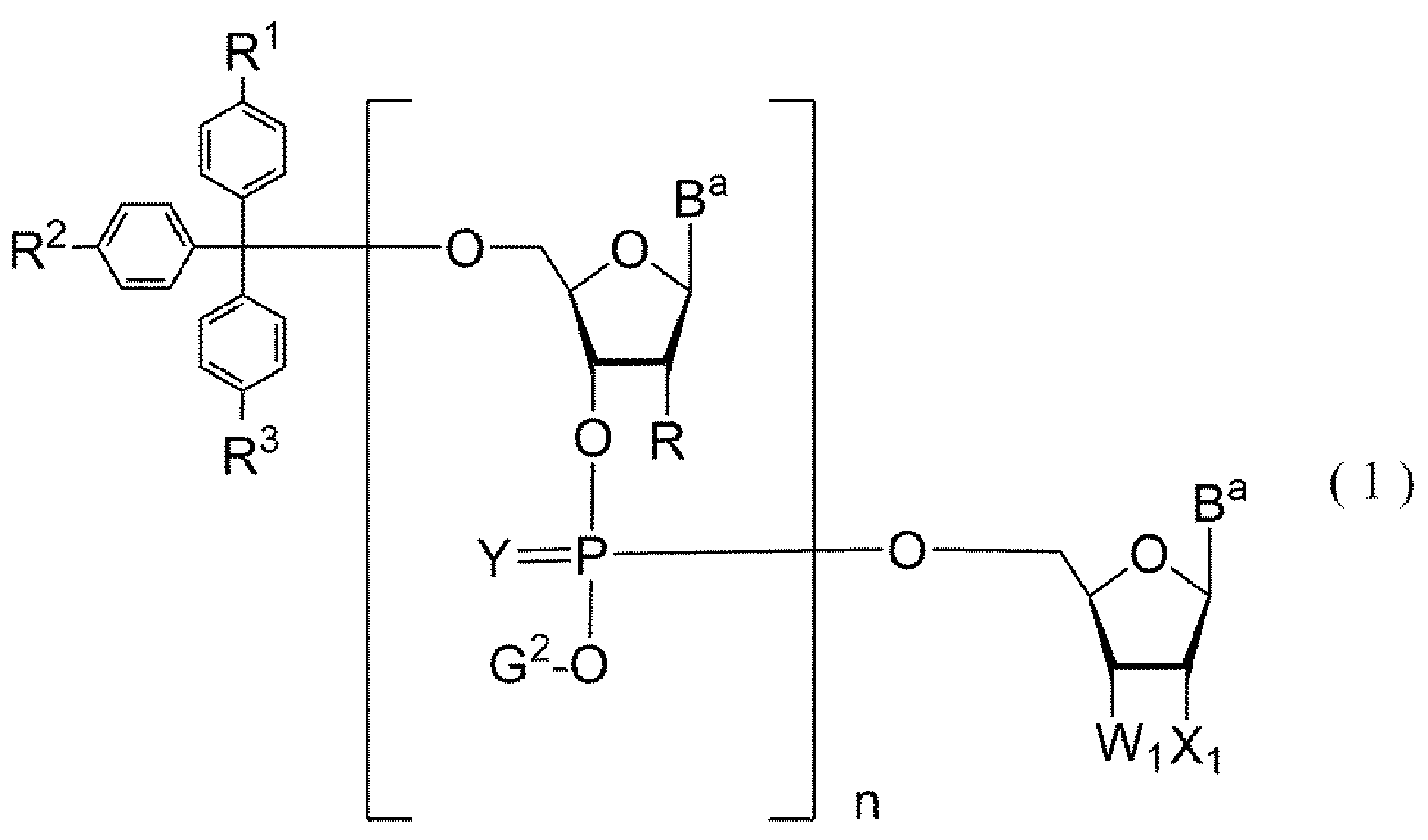
(식 중,
G2 는, 수산기의 보호기를 나타내고,
Ba 는, 각각 독립적으로 동일 또는 상이하며, 보호기로 보호되어 있어도 되는 핵산 염기를 나타내고,
R1, R2 및 R3 은, 각각 독립적으로 동일 또는 상이하며, 수소 원자 또는 알콕시기를 나타내고,
R 은, 각각 독립적으로 동일 또는 상이하며, 보호된 수산기, 수소 원자, 불소 원자, 메톡시기, 2-메톡시에틸기, 또는 OQ' 기를 나타내고,
Q' 는, 각각 독립적으로 동일 또는 상이하며, 리보오스의 4' 위치의 탄소 원자와 결합하고 있는 메틸렌기, 리보오스의 4' 위치의 탄소 원자와 결합하고 있는 에틸렌기, 또는 리보오스의 4' 위치의 탄소 원자와 결합하고 있는 에틸리덴기를 나타내고,
Y 는, 각각 독립적으로 동일 또는 상이하며, 산소 원자 또는 황 원자를 나타내고,
n 은, 1 ∼ 200 중 어느 정수를 나타내고,
W1 은 OZ 기를 나타내고, 또한 X1 은 R 기를 나타내거나, 혹은
W1 은 OV 기를 나타내고, 또한 X1 은 OZ 기를 나타내고,
V 는, 수산기의 보호기를 나타내고,
Z 는, 고상 담체 및 연결기로 이루어지는 구조를 갖는 기이다.
그리고, n 이 2 이상의 정수일 때, 식 (1) 로 나타내는 핵산 올리고머는, 각각의 뉴클레오티드의 사이에, 비뉴클레오티드 링커가 삽입되어 있어도 된다.)
로 나타내는 핵산 올리고머와, 포름알데히드와 트리클로로아세트산의 몰비 (포름알데히드 mol/트리클로로아세트산 mol) 가 11 × 10-5 이하인 트리클로로아세트산 용액을 반응시키는 공정을 포함하는, 식 (2) :

(식 중,
G2, Ba, R, Y, X1, W1 및 n 은, 상기와 같고, 그리고,
식 (1) 에 있어서 정의된 바와 같이, 뉴클레오티드의 사이에, 비뉴클레오티드 링커가 삽입되어 있어도 된다.)
로 나타내는 핵산 올리고머의 제조 방법.Equation (1):
(In the expression,
G 2 represents a protecting group for a hydroxyl group;
B a is the same or different each independently and represents a nucleic acid base which may be protected by a protecting group;
R 1 , R 2 and R 3 are the same or different each independently and represent a hydrogen atom or an alkoxy group;
R, each independently the same or different, represents a protected hydroxyl group, hydrogen atom, fluorine atom, methoxy group, 2-methoxyethyl group, or OQ'group;
Q', each independently identical or different, is a methylene group bonded to a carbon atom at the 4' position of ribose, an ethylene group bonded to a carbon atom at the 4' position of ribose, or a carbon atom at the 4' position of ribose Represents an ethylidene group bonded to an atom,
Y is the same or different each independently, and represents an oxygen atom or a sulfur atom,
n represents any integer from 1 to 200;
W 1 represents an OZ group, and X 1 represents an R group, or
W 1 represents an OV group, and X 1 represents an OZ group;
V represents a protecting group for a hydroxyl group;
Z is a group having a structure consisting of a solid carrier and a linking group.
And, when n is an integer of 2 or more, the nucleic acid oligomer represented by formula (1) may have a non-nucleotide linker inserted between each nucleotide.)
Equation (2) including a step of reacting a nucleic acid oligomer represented by and a trichloroacetic acid solution having a molar ratio of formaldehyde and trichloroacetic acid (mol formaldehyde/mol trichloroacetic acid) of 11 × 10 -5 or less:
(In the expression,
G 2 , B a , R, Y, X 1 , W 1 and n are as described above, and
As defined in formula (1), a non-nucleotide linker may be inserted between nucleotides.)
A method for producing a nucleic acid oligomer represented by
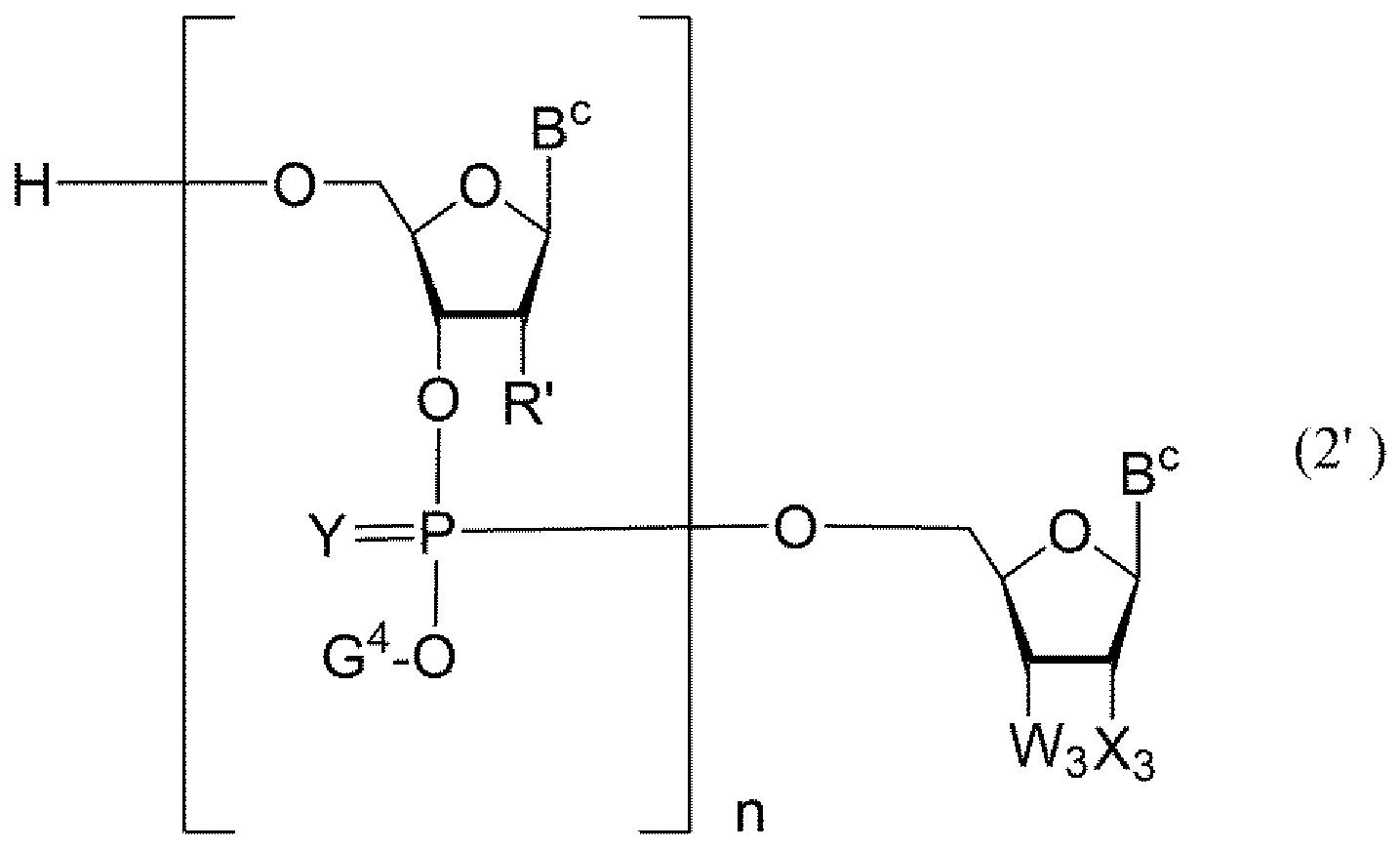
(식 중,
Y 및 n 은, 상기와 같고,
Bc 는, 각각 독립적으로 동일 또는 상이하며, 핵산 염기를 나타내고,
G4 는, 각각 독립적으로 동일 또는 상이하며, 수소 원자, 알칼리 금속 이온, 암모늄 이온, 알킬암모늄 이온, 또는 하이드록시알킬암모늄 이온을 나타내고,
R' 는, 각각 독립적으로 동일 또는 상이하며, 수산기, 수소 원자, 불소 원자, 메톡시기, 2-메톡시에틸기, 또는 OQ' 기를 나타내고,
Q' 는, 상기와 같고, 그리고,
X3 및 W3 은 각각, 각각 독립적으로 수산기를 나타내거나, 혹은
X3 은 R' 기를 나타내고, 또한 W3 은 수산기를 나타낸다.)
로 나타내는 핵산 올리고머의 제조 방법.A formula (including the step according to claim 1, and further, a step of removing the group represented by Z from the nucleic acid oligomer represented by formula (2) produced in the step, and a step of removing a hydroxyl group and a protecting group of a nucleic acid base) ( 2') :
(In the expression,
Y and n are the same as above,
B c , each independently the same or different, represents a nucleic acid base;
G 4 , each independently identical or different, represents a hydrogen atom, an alkali metal ion, an ammonium ion, an alkylammonium ion, or a hydroxyalkylammonium ion;
R', each independently the same or different, represents a hydroxyl group, a hydrogen atom, a fluorine atom, a methoxy group, a 2-methoxyethyl group, or an OQ'group;
Q' is the same as above, and
X 3 and W 3 each independently represent a hydroxyl group, or
X 3 represents an R' group, and W 3 represents a hydroxyl group.)
A method for producing a nucleic acid oligomer represented by
식 (2) 로 나타내는 핵산 올리고머를, 아미다이트법으로 임의로 사슬 길이를 신장한 식 (3) :
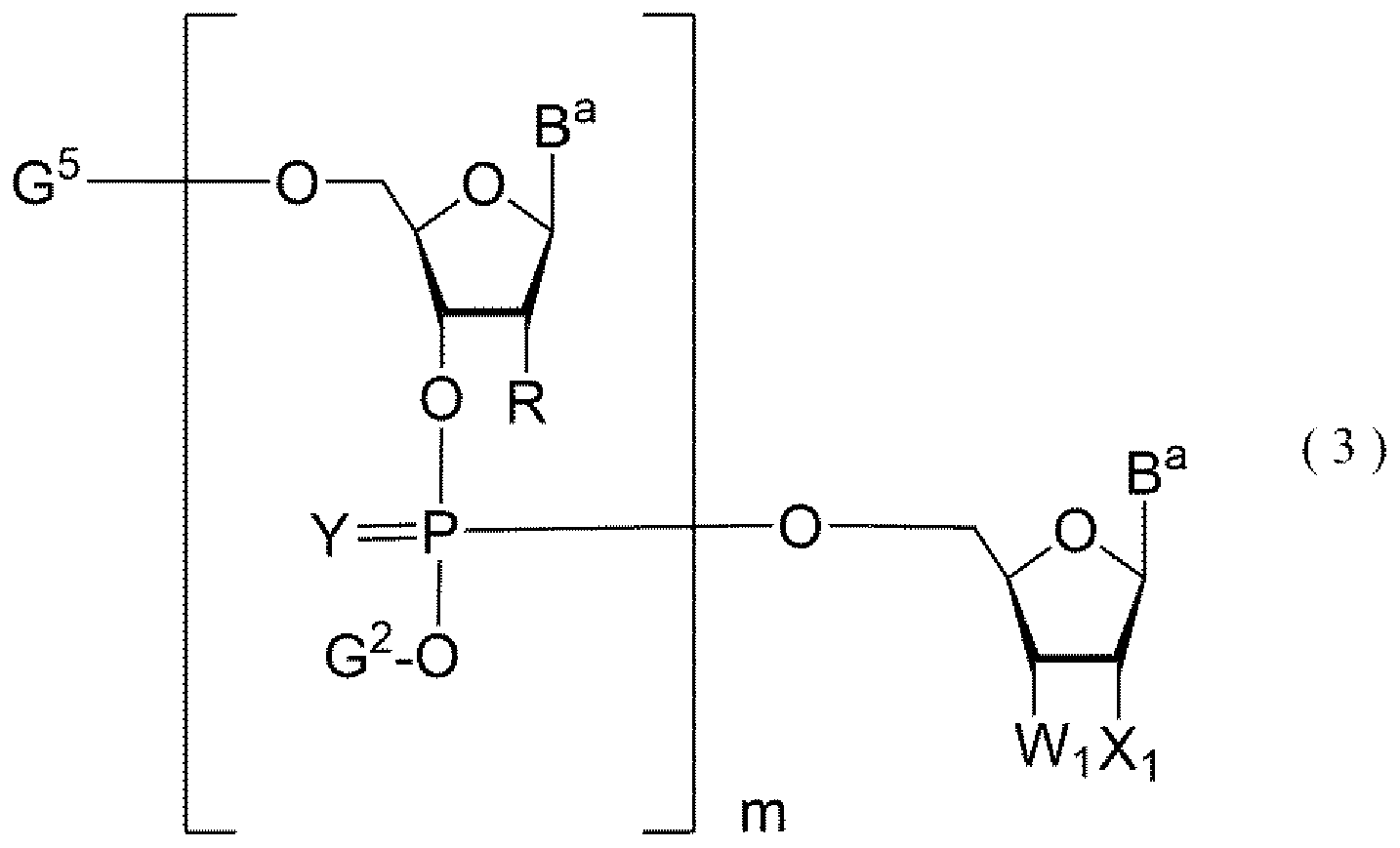
(식 중,
G2, Ba, R, Y, X1 및 W1 은, 상기와 같고,
G5 는,
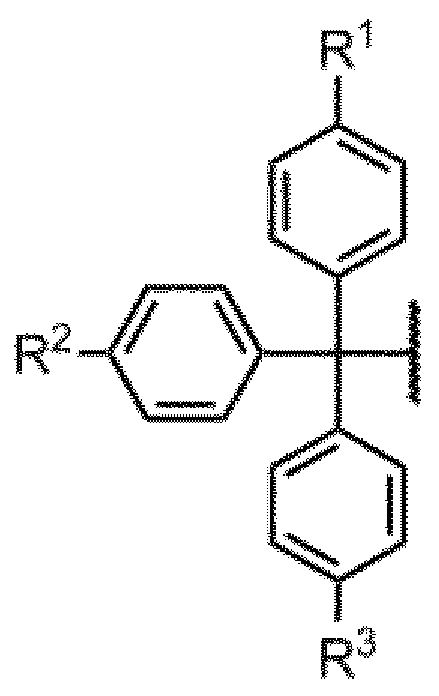
로 나타내는 수산기의 보호기, 또는 수소 원자를 나타내고,
R1, R2 및 R3 은, 상기와 같고, 그리고,
m 은, m ≥ n 을 만족하는 정수이다.)
으로 나타내는 핵산 화합물을 얻는 공정, 그리고
식 (3) 으로 나타내는 화합물로부터, 식 (4) :

(식 중,
G5, R, Y 및 m 은, 상기와 같고,
G4 는, 각각 독립적으로 동일 또는 상이하며, 수소 원자, 알칼리 금속 이온, 암모늄 이온, 알킬암모늄 이온, 또는 하이드록시알킬암모늄 이온을 나타내고,
BC 는, 각각 독립적으로 동일 또는 상이하며, 핵산 염기를 나타내고,
X2 는 수산기를 나타내고, 또한 W2 는 OV 기를 나타내거나, 혹은
X2 는 R 기를 나타내고, 또한 W2 는 수산기를 나타내고, 그리고,
V 는, 수산기의 보호기를 나타낸다.)
로 나타내는 화합물을 절출하고,
또한 식 (4) 로 나타내는 화합물을 탈보호하여, 식 (5) :

(식 중,
G4, Bc, Y 및 m 은, 상기와 같고, R' 는, 각각 독립적으로 동일 또는 상이하며, 수산기, 수소 원자, 불소 원자, 메톡시기, 2-메톡시에틸기, 또는 OQ' 기를 나타내고,
Q' 는, 상기와 같고, 그리고,
X3 및 W3 은 각각, 각각 독립적으로 수산기를 나타내거나, 혹은
X3 은 R' 기를 나타내고, 또한 W3 은 수산기를 나타낸다.)
로 나타내는 핵산 올리고머를 제조하는 공정을 추가로 포함하는, 제조 방법.According to claim 1,
Formula (3) obtained by arbitrarily extending the chain length of the nucleic acid oligomer represented by formula (2) by the amidite method:
(In the expression,
G 2 , B a , R, Y, X 1 and W 1 are as described above;
For G5 ,
Represents a protecting group for a hydroxyl group represented by , or a hydrogen atom,
R 1 , R 2 and R 3 are the same as above, and
m is an integer that satisfies m ≥ n.)
A step of obtaining a nucleic acid compound represented by
From the compound represented by formula (3), formula (4):
(In the expression,
G 5 , R, Y and m are as described above;
G 4 , each independently identical or different, represents a hydrogen atom, an alkali metal ion, an ammonium ion, an alkylammonium ion, or a hydroxyalkylammonium ion;
B C , each independently the same or different, represents a nucleic acid base,
X 2 represents a hydroxyl group, and W 2 represents an OV group, or
X 2 represents an R group, and W 2 represents a hydroxyl group, and
V represents a protecting group for a hydroxyl group.)
Excising the compound represented by
Further, by deprotecting the compound represented by formula (4), formula (5):
(In the expression,
G 4 , B c , Y and m are the same as above, R' is independently the same or different, and represents a hydroxyl group, a hydrogen atom, a fluorine atom, a methoxy group, a 2-methoxyethyl group, or an OQ'group;
Q' is the same as above, and
X 3 and W 3 each independently represent a hydroxyl group, or
X 3 represents an R' group, and W 3 represents a hydroxyl group.)
A production method further comprising a step of producing a nucleic acid oligomer represented by .
비뉴클레오티드 링커가, 아미노산 골격으로 이루어지는 링커인, 제조 방법.According to any one of claims 1 to 3,
A production method in which the non-nucleotide linker is a linker composed of an amino acid backbone.
아미노산 골격으로 이루어지는 링커가, 하기 식 (A14-1), (A14-2) 및 (A14-3) 으로 이루어지는 군에서 선택되는 구조를 갖는 링커인, 제조 방법.
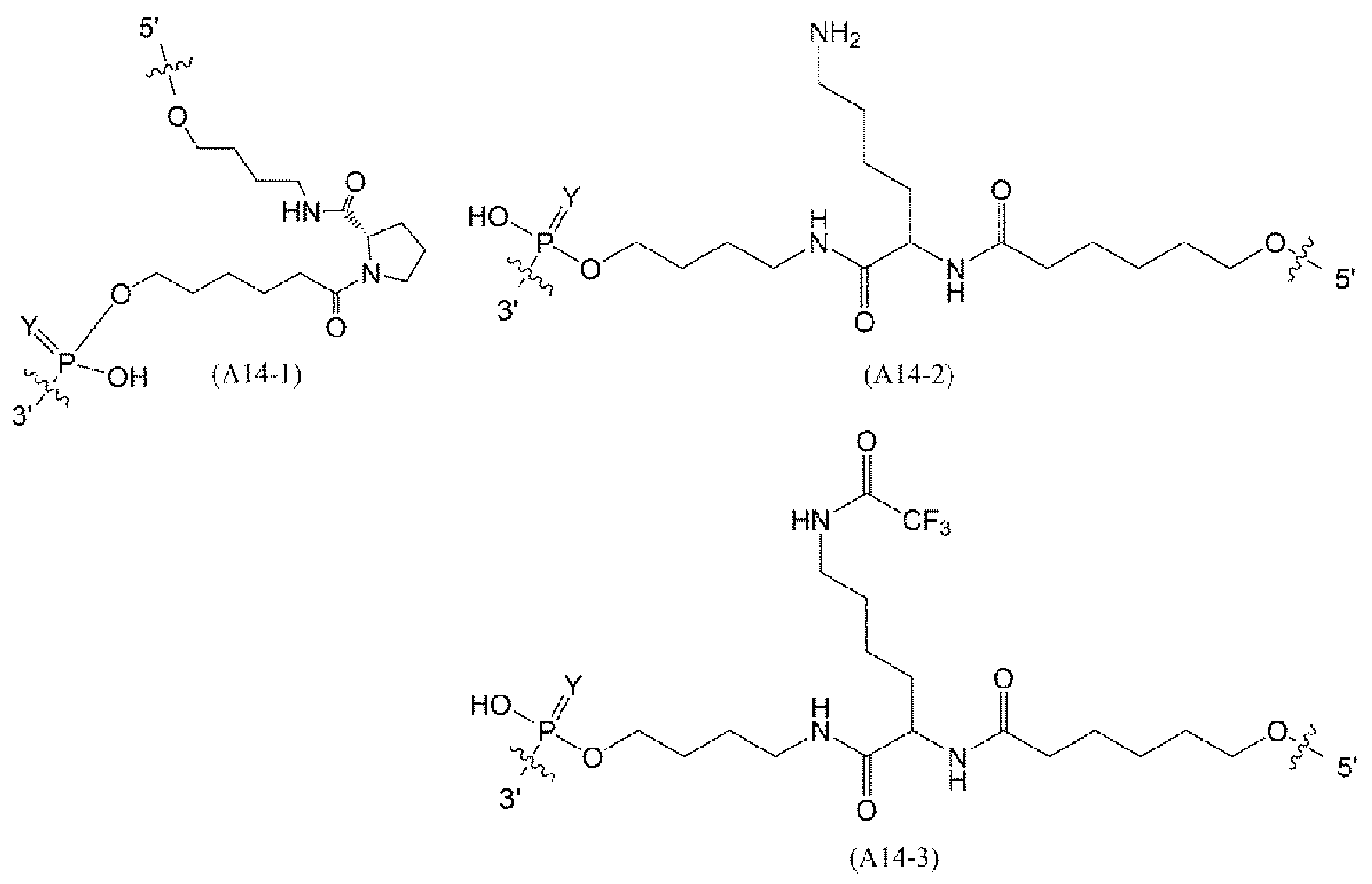
(식 중, Y 는, 상기와 같다.)According to claim 4,
A production method in which a linker composed of an amino acid skeleton is a linker having a structure selected from the group consisting of the following formulas (A14-1), (A14-2) and (A14-3).
(In the formula, Y is as described above.)
트리클로로아세트산 용액이, 디클로로메탄, 아세토니트릴, 및 방향족 유기 용매로 이루어지는 군에서 선택되는 적어도 1 개의 용매를 포함하는, 제조 방법.According to any one of claims 1 to 5,
A production method in which the trichloroacetic acid solution contains at least one solvent selected from the group consisting of dichloromethane, acetonitrile, and aromatic organic solvents.
트리클로로아세트산 용액 중의 포름알데히드와 트리클로로아세트산의 몰비 (포름알데히드 mol/트리클로로아세트산 mol) 가 54 × 10-6 이하인, 제조 방법.According to any one of claims 1 to 6,
The production method according to claim 1 , wherein the molar ratio of formaldehyde to trichloroacetic acid in the trichloroacetic acid solution (mol of formaldehyde/mol of trichloroacetic acid) is 54×10 -6 or less.
트리클로로아세트산 용액 중의 포름알데히드와 트리클로로아세트산의 몰비 (포름알데히드 mol/트리클로로아세트산 mol) 가 27 × 10-6 이하인, 제조 방법.According to any one of claims 1 to 6,
The method according to claim 1 , wherein the molar ratio of formaldehyde to trichloroacetic acid in the trichloroacetic acid solution (mol of formaldehyde/mol of trichloroacetic acid) is 27 × 10 -6 or less.
핵산 올리고머가, 리보 핵산 (RNA) 인, 제조 방법.According to any one of claims 1 to 8,
A manufacturing method in which the nucleic acid oligomer is ribonucleic acid (RNA).
핵산 올리고머가, 리보 핵산 (RNA) 이고, 그 리보오스의 2' 위치의 수산기의 보호기가, 식 (6) 으로 나타내는 보호기인, 제조 방법.
식 (6) :

(식 중,
q 는, 1 ∼ 5 중 어느 정수를 나타내고,
Ra 및 Rb 는, 각각 독립적으로 동일 또는 상이하며, 메틸기, 에틸기 또는 수소 원자를 나타내고,
* 표시는, 리보오스의 2' 위치의 수산기 유래의 산소 원자와의 결합점을 나타내고, 그리고,
EW 는, 전자 구인기를 나타낸다.)According to any one of claims 1 to 8,
A production method in which the nucleic acid oligomer is ribonucleic acid (RNA), and the protecting group of the hydroxyl group at the 2' position of the ribose is a protecting group represented by formula (6).
Equation (6):
(In the expression,
q represents any integer from 1 to 5;
R a and R b are the same or different each independently and represent a methyl group, an ethyl group or a hydrogen atom;
* indicates a bonding point with an oxygen atom derived from a hydroxyl group at the 2' position of ribose, and
E W represents an electron trap.)
Ra 및 Rb 가 동시에 수소 원자이고, 또한 EW 가 시아노기인, 제조 방법.According to claim 10,
The manufacturing method in which R a and R b are both hydrogen atoms, and E W is a cyano group.
핵산 올리고머가, 40 사슬 길이 이상의 올리고머인, 제조 방법.According to any one of claims 1 to 11,
A production method in which the nucleic acid oligomer is an oligomer having a chain length of 40 or more.
핵산 올리고머가, 50 사슬 길이 이상의 올리고머인, 제조 방법.According to any one of claims 1 to 11,
A manufacturing method in which the nucleic acid oligomer is an oligomer having a chain length of 50 or more.
핵산 올리고머가, 60 사슬 길이 이상의 올리고머인, 제조 방법.According to any one of claims 1 to 11,
A production method in which the nucleic acid oligomer is an oligomer having a chain length of 60 or more.
핵산 올리고머가, 80 사슬 길이 이상의 올리고머인, 제조 방법.According to any one of claims 1 to 11,
A production method in which the nucleic acid oligomer is an oligomer having a chain length of 80 or more.
핵산 올리고머가, 100 사슬 길이 이상의 올리고머인, 제조 방법.According to any one of claims 1 to 11,
A production method in which the nucleic acid oligomer is an oligomer having a chain length of 100 or more.
포름알데히드와 트리클로로아세트산의 몰비 (포름알데히드 mol/트리클로로아세트산 mol) 가 54 × 10-6 이하인, 트리클로로아세트산 용액.18. The method of claim 17,
A trichloroacetic acid solution wherein the molar ratio of formaldehyde to trichloroacetic acid (mol formaldehyde/mol trichloroacetic acid) is 54 x 10 -6 or less.
포름알데히드와 트리클로로아세트산의 몰비 (포름알데히드 mol/트리클로로아세트산 mol) 가 27 × 10-6 이하인, 트리클로로아세트산 용액.18. The method of claim 17,
A trichloroacetic acid solution wherein the molar ratio of formaldehyde to trichloroacetic acid (mol formaldehyde/mol trichloroacetic acid) is 27 x 10 -6 or less.
포름알데히드를 포함하는 미정제 트리클로로아세트산과, 포름알데히드와 공비하는 용매를 포함하는 용액으로부터, 포름알데히드를 공비시켜 증류 제거함으로써 정제 트리클로로아세트산을 얻는 공정을 포함하는, 트리클로로아세트산의 제조 방법.According to any one of claims 17 to 19,
A method for producing trichloroacetic acid, comprising a step of obtaining purified trichloroacetic acid by azeotropically distilling formaldehyde from a solution containing crude trichloroacetic acid containing formaldehyde and a solvent that is azeotropic with formaldehyde.
공비 용매의 비점이, 198 ℃ 이하인, 제조 방법.21. The method of claim 20,
The manufacturing method in which the boiling point of an azeotrope solvent is 198 degreeC or less.
공비 용매가, 디클로로메탄, 아세토니트릴 또는 방향족 유기 용매인, 제조 방법.According to claim 20 or 21,
The manufacturing method in which the azeotrope solvent is dichloromethane, acetonitrile, or an aromatic organic solvent.
방향족 유기 용매가 톨루엔인, 제조 방법.23. The method of claim 22,
The manufacturing method in which the aromatic organic solvent is toluene.
Applications Claiming Priority (3)
| Application Number | Priority Date | Filing Date | Title |
|---|---|---|---|
| JP2020118316 | 2020-07-09 | ||
| JPJP-P-2020-118316 | 2020-07-09 | ||
| PCT/JP2021/025835 WO2022009959A1 (en) | 2020-07-09 | 2021-07-08 | Method for producing nucleic acid oligomer |
Publications (1)
| Publication Number | Publication Date |
|---|---|
| KR20230034969A true KR20230034969A (en) | 2023-03-10 |
Family
ID=79552589
Family Applications (1)
| Application Number | Title | Priority Date | Filing Date |
|---|---|---|---|
| KR1020227045527A Pending KR20230034969A (en) | 2020-07-09 | 2021-07-08 | Methods for preparing nucleic acid oligomers |
Country Status (6)
| Country | Link |
|---|---|
| US (1) | US20230242570A1 (en) |
| EP (1) | EP4180442A4 (en) |
| JP (1) | JP7759323B2 (en) |
| KR (1) | KR20230034969A (en) |
| CN (1) | CN115867559A (en) |
| WO (1) | WO2022009959A1 (en) |
Families Citing this family (2)
| Publication number | Priority date | Publication date | Assignee | Title |
|---|---|---|---|---|
| JPWO2023054350A1 (en) * | 2021-09-28 | 2023-04-06 | ||
| CN118891269A (en) * | 2022-03-23 | 2024-11-01 | 住友化学株式会社 | Method for producing nucleic acid oligomer |
Citations (1)
| Publication number | Priority date | Publication date | Assignee | Title |
|---|---|---|---|---|
| WO2006022323A1 (en) | 2004-08-26 | 2006-03-02 | Nippon Shinyaku Co., Ltd. | Phosphoramidite compound and method for producing oligo-rna |
Family Cites Families (13)
| Publication number | Priority date | Publication date | Assignee | Title |
|---|---|---|---|---|
| US6077709A (en) | 1998-09-29 | 2000-06-20 | Isis Pharmaceuticals Inc. | Antisense modulation of Survivin expression |
| US6887990B1 (en) | 1999-02-05 | 2005-05-03 | Amersham Biosciences Corp | Method for deprotecting oligonucleotides |
| US6261840B1 (en) | 2000-01-18 | 2001-07-17 | Isis Pharmaceuticals, Inc. | Antisense modulation of PTP1B expression |
| DK2410054T4 (en) | 2006-10-18 | 2020-02-10 | Ionis Pharmaceuticals Inc | Antisense Compounds |
| EP2431466B1 (en) | 2010-07-08 | 2015-10-07 | Bonac Corporation | Single-strand nucleic acid molecule for controlling gene expression |
| CN103052711B (en) | 2010-08-03 | 2016-08-03 | 株式会社博纳克 | Single-stranded nucleic acid molecule with a nitrogen-containing alicyclic backbone |
| US8691782B2 (en) | 2010-08-03 | 2014-04-08 | Bonac Corporation | Single-stranded nucleic acid molecule having nitrogen-containing alicyclic skeleton |
| WO2013027843A1 (en) | 2011-08-25 | 2013-02-28 | 株式会社ボナック | Glucoside compound, method for producing thioether, ether, method for producing ether, method for producing glucoside compound, method for producing nucleic acid |
| WO2018182008A1 (en) | 2017-03-31 | 2018-10-04 | 株式会社ボナック | Cyclic nucleic acid molecule having gene expression control function |
| US11806360B2 (en) | 2017-09-19 | 2023-11-07 | Alnylam Pharmaceuticals, Inc. | Compositions and methods for treating transthyretin (TTR) mediated amyloidosis |
| EP3696269A4 (en) | 2017-10-13 | 2021-09-01 | Bonac Corporation | Single-stranded nucleic acid molecule, and production method therefor |
| KR102670605B1 (en) | 2018-04-24 | 2024-05-29 | 스미또모 가가꾸 가부시끼가이샤 | Amidite compound and method for producing polynucleotide using the compound |
| JP2020118316A (en) | 2019-01-21 | 2020-08-06 | シャープ株式会社 | Air conditioner and system |
-
2021
- 2021-07-08 KR KR1020227045527A patent/KR20230034969A/en active Pending
- 2021-07-08 WO PCT/JP2021/025835 patent/WO2022009959A1/en not_active Ceased
- 2021-07-08 JP JP2022535389A patent/JP7759323B2/en active Active
- 2021-07-08 EP EP21836863.7A patent/EP4180442A4/en active Pending
- 2021-07-08 CN CN202180047319.8A patent/CN115867559A/en active Pending
- 2021-07-08 US US18/003,630 patent/US20230242570A1/en active Pending
Patent Citations (1)
| Publication number | Priority date | Publication date | Assignee | Title |
|---|---|---|---|---|
| WO2006022323A1 (en) | 2004-08-26 | 2006-03-02 | Nippon Shinyaku Co., Ltd. | Phosphoramidite compound and method for producing oligo-rna |
Also Published As
| Publication number | Publication date |
|---|---|
| JP7759323B2 (en) | 2025-10-23 |
| JPWO2022009959A1 (en) | 2022-01-13 |
| CN115867559A (en) | 2023-03-28 |
| WO2022009959A1 (en) | 2022-01-13 |
| US20230242570A1 (en) | 2023-08-03 |
| EP4180442A4 (en) | 2025-05-14 |
| EP4180442A1 (en) | 2023-05-17 |
Similar Documents
| Publication | Publication Date | Title |
|---|---|---|
| JP7777452B2 (en) | Method for producing nucleic acid oligomers | |
| KR20230074205A (en) | Methods for preparing nucleic acid oligomers | |
| JP7759323B2 (en) | Method for producing nucleic acid oligomers | |
| JP7698631B2 (en) | Method for producing nucleic acid oligomer | |
| EP4097117B1 (en) | Process of preparing nucleic acid oligomer | |
| KR20250042734A (en) | Method for producing oligonucleotides | |
| EP4410770A1 (en) | Production method for purified dichloroacetic acid | |
| EP4563559A1 (en) | Thionizing solution | |
| EP4477659A1 (en) | Method for producing oligonucleotide | |
| KR20250128304A (en) | Method for producing oligonucleotides |
Legal Events
| Date | Code | Title | Description |
|---|---|---|---|
| PA0105 | International application |
Patent event date: 20221223 Patent event code: PA01051R01D Comment text: International Patent Application |
|
| PG1501 | Laying open of application | ||
| PA0201 | Request for examination |
Patent event code: PA02012R01D Patent event date: 20240702 Comment text: Request for Examination of Application |