KR20230019261A - Multi-layer video bitstream and other signaling concepts for output timing derivation - Google Patents
Multi-layer video bitstream and other signaling concepts for output timing derivation Download PDFInfo
- Publication number
- KR20230019261A KR20230019261A KR1020237000224A KR20237000224A KR20230019261A KR 20230019261 A KR20230019261 A KR 20230019261A KR 1020237000224 A KR1020237000224 A KR 1020237000224A KR 20237000224 A KR20237000224 A KR 20237000224A KR 20230019261 A KR20230019261 A KR 20230019261A
- Authority
- KR
- South Korea
- Prior art keywords
- picture
- output
- layer
- data stream
- video data
- Prior art date
- Legal status (The legal status is an assumption and is not a legal conclusion. Google has not performed a legal analysis and makes no representation as to the accuracy of the status listed.)
- Pending
Links
Images


Classifications
-
- H—ELECTRICITY
- H04—ELECTRIC COMMUNICATION TECHNIQUE
- H04N—PICTORIAL COMMUNICATION, e.g. TELEVISION
- H04N19/00—Methods or arrangements for coding, decoding, compressing or decompressing digital video signals
- H04N19/30—Methods or arrangements for coding, decoding, compressing or decompressing digital video signals using hierarchical techniques, e.g. scalability
- H04N19/31—Methods or arrangements for coding, decoding, compressing or decompressing digital video signals using hierarchical techniques, e.g. scalability in the temporal domain
-
- H—ELECTRICITY
- H04—ELECTRIC COMMUNICATION TECHNIQUE
- H04N—PICTORIAL COMMUNICATION, e.g. TELEVISION
- H04N19/00—Methods or arrangements for coding, decoding, compressing or decompressing digital video signals
- H04N19/10—Methods or arrangements for coding, decoding, compressing or decompressing digital video signals using adaptive coding
- H04N19/102—Methods or arrangements for coding, decoding, compressing or decompressing digital video signals using adaptive coding characterised by the element, parameter or selection affected or controlled by the adaptive coding
- H04N19/103—Selection of coding mode or of prediction mode
- H04N19/105—Selection of the reference unit for prediction within a chosen coding or prediction mode, e.g. adaptive choice of position and number of pixels used for prediction
-
- H—ELECTRICITY
- H04—ELECTRIC COMMUNICATION TECHNIQUE
- H04N—PICTORIAL COMMUNICATION, e.g. TELEVISION
- H04N19/00—Methods or arrangements for coding, decoding, compressing or decompressing digital video signals
- H04N19/10—Methods or arrangements for coding, decoding, compressing or decompressing digital video signals using adaptive coding
- H04N19/169—Methods or arrangements for coding, decoding, compressing or decompressing digital video signals using adaptive coding characterised by the coding unit, i.e. the structural portion or semantic portion of the video signal being the object or the subject of the adaptive coding
- H04N19/17—Methods or arrangements for coding, decoding, compressing or decompressing digital video signals using adaptive coding characterised by the coding unit, i.e. the structural portion or semantic portion of the video signal being the object or the subject of the adaptive coding the unit being an image region, e.g. an object
- H04N19/172—Methods or arrangements for coding, decoding, compressing or decompressing digital video signals using adaptive coding characterised by the coding unit, i.e. the structural portion or semantic portion of the video signal being the object or the subject of the adaptive coding the unit being an image region, e.g. an object the region being a picture, frame or field
-
- H—ELECTRICITY
- H04—ELECTRIC COMMUNICATION TECHNIQUE
- H04N—PICTORIAL COMMUNICATION, e.g. TELEVISION
- H04N19/00—Methods or arrangements for coding, decoding, compressing or decompressing digital video signals
- H04N19/10—Methods or arrangements for coding, decoding, compressing or decompressing digital video signals using adaptive coding
- H04N19/169—Methods or arrangements for coding, decoding, compressing or decompressing digital video signals using adaptive coding characterised by the coding unit, i.e. the structural portion or semantic portion of the video signal being the object or the subject of the adaptive coding
- H04N19/187—Methods or arrangements for coding, decoding, compressing or decompressing digital video signals using adaptive coding characterised by the coding unit, i.e. the structural portion or semantic portion of the video signal being the object or the subject of the adaptive coding the unit being a scalable video layer
-
- H—ELECTRICITY
- H04—ELECTRIC COMMUNICATION TECHNIQUE
- H04N—PICTORIAL COMMUNICATION, e.g. TELEVISION
- H04N19/00—Methods or arrangements for coding, decoding, compressing or decompressing digital video signals
- H04N19/10—Methods or arrangements for coding, decoding, compressing or decompressing digital video signals using adaptive coding
- H04N19/169—Methods or arrangements for coding, decoding, compressing or decompressing digital video signals using adaptive coding characterised by the coding unit, i.e. the structural portion or semantic portion of the video signal being the object or the subject of the adaptive coding
- H04N19/188—Methods or arrangements for coding, decoding, compressing or decompressing digital video signals using adaptive coding characterised by the coding unit, i.e. the structural portion or semantic portion of the video signal being the object or the subject of the adaptive coding the unit being a video data packet, e.g. a network abstraction layer [NAL] unit
-
- H—ELECTRICITY
- H04—ELECTRIC COMMUNICATION TECHNIQUE
- H04N—PICTORIAL COMMUNICATION, e.g. TELEVISION
- H04N19/00—Methods or arrangements for coding, decoding, compressing or decompressing digital video signals
- H04N19/30—Methods or arrangements for coding, decoding, compressing or decompressing digital video signals using hierarchical techniques, e.g. scalability
-
- H—ELECTRICITY
- H04—ELECTRIC COMMUNICATION TECHNIQUE
- H04N—PICTORIAL COMMUNICATION, e.g. TELEVISION
- H04N19/00—Methods or arrangements for coding, decoding, compressing or decompressing digital video signals
- H04N19/46—Embedding additional information in the video signal during the compression process
-
- H—ELECTRICITY
- H04—ELECTRIC COMMUNICATION TECHNIQUE
- H04N—PICTORIAL COMMUNICATION, e.g. TELEVISION
- H04N19/00—Methods or arrangements for coding, decoding, compressing or decompressing digital video signals
- H04N19/70—Methods or arrangements for coding, decoding, compressing or decompressing digital video signals characterised by syntax aspects related to video coding, e.g. related to compression standards
Landscapes
- Engineering & Computer Science (AREA)
- Multimedia (AREA)
- Signal Processing (AREA)
- Compression Or Coding Systems Of Tv Signals (AREA)
Abstract
제1 측면은 계층간 레퍼런스를 갖는 다중계층 비디오 비트스트림에서 코딩된 계층 비디오 시퀀스 경계를 처리하기 위한 개념을 제공한다. 제2 측면은 예를 들어, 픽처 출력의 반복 횟수의 액세스 유닛 특정 시그널링 및 출력 계층 특정 시그널링과 관련하여 픽처 출력 타이밍의 처리, 시그널링 및 유도을 위한 개념을 제공한다.A first aspect provides a concept for processing coded layer video sequence boundaries in a multi-layer video bitstream with inter-layer references. The second aspect provides concepts for processing, signaling and derivation of picture output timing, eg in relation to access unit specific signaling and output layer specific signaling of the number of repetitions of picture output.
Description
본 개시는 다중-계층 비디오 비트스트림 및 출력 타이밍 유도을 위한 기타 시그널링 개념에 관한 것이다.This disclosure relates to multi-layer video bitstreams and other signaling concepts for output timing derivation.
본 개시는 다중-계층 비디오 비트스트림 및 출력 타이밍 유도을 위한 기타 시그널링 개념에 관한 것이다.This disclosure relates to multi-layer video bitstreams and other signaling concepts for output timing derivation.
본 개시의 실시예는 비디오 인코더(video encoder), 비디오 디코더(video decoder), 비디오 시퀀스(video sequence)를 비디오 비트스트림(video bitstream)으로 인코딩(encoding)하는 방법, 및 비디오 비트스트림으로부터 비디오 시퀀스를 디코딩(decoding)하는 방법에 관한 것이다. 추가 실시예는 비디오 비트스트림에 관한 것이다. Embodiments of the present disclosure provide a video encoder, a video decoder, a method for encoding a video sequence into a video bitstream, and a video sequence from the video bitstream. It's about decoding. A further embodiment relates to a video bitstream.
비디오는 하나 이상의 코딩된 비디오 시퀀스 유닛으로 비디오 비트스트림으로 코딩될 수 있으며, 각각은 비디오의 공통 시간 프레임의 하나 이상의 픽처를 포함하는 일련의 액세스 유닛(access unit)을 포함한다. 비디오 데이터가 비디오 비트스트림의 여러 계층으로 인코딩되는 다중계층 비디오 비트스트림의 경우, 계층은 개별 코딩된 계층 비디오 시퀀스를 포함할 수 있으며, 다른 계층의 코딩된 계층 비디오 시퀀스는 반드시 동일한 액세스 유닛으로 시작/중지할 필요가 없다. 코딩된 계층 비디오 시퀀스는 독립적으로 코딩된 픽처(picture), 예를 들어 의존적으로 코딩된 픽처의 액세스 유닛과 다른 액세스 유닛의 픽처와 독립적으로 디코딩될 수 있는 IRAP 픽처로 시작할 수 있다. 제1 유형의 독립적으로 코딩된 픽처, 예를 들어 동일한 계층의 픽처가 연관될 수 있는 CRA 픽처가 있을 수 있으며, 이 픽처는 코딩 순서에서 제1 유형 픽처를 따르지만 제1 유형 픽처 전에 표시되도록 스케줄링된다. 이러한 픽처는 RASL 픽처로 지칭될 수 있다. 이러한 RASL 픽처는 디코딩 순서에서 RASL 픽처가 연관되는 제1 유형 픽처에 선행하는 픽처에 대한 레퍼런스를 가질 수 있다. 즉, RASL 픽처는 이전의 코딩된 계층 비디오 시퀀스의 픽처에 대한 레퍼런스를 가질 수 있다. 결과적으로, RASL 픽처에 대한 레퍼런스 픽처(reference picture)가 비디오 비트스트림 내에 존재하지 않아 RASL 픽처가 올바르게 디코딩되지 않는 경우가 있을 수 있다. 이 경우, 프리젠테이션 순서(presentation order)상 제1 유형 픽처보다 앞선 픽처는 출력에서 제외된다는 표시가 있을 수 있다. 다만, RASL 픽처는 다른 계층의 픽처에 대한 계층간 레퍼런스 픽처가 될 수 있다. RASL 픽처를 디코딩할 수 없는 경우, RASL 픽처에 의존하는 픽처도 올바르게 디코딩되지 않을 수 있다. A video may be coded into a video bitstream in one or more coded video sequence units, each containing a series of access units containing one or more pictures of a common temporal frame of video. In the case of a multi-layer video bitstream in which video data is encoded into different layers of the video bitstream, a layer may contain individual coded layer video sequences, and coded layer video sequences of different layers must start with/with the same access unit. There is no need to stop. A coded layer video sequence may start with an independently coded picture, eg, an IRAP picture that can be decoded independently of an access unit of a dependently coded picture and a picture of another access unit. There may be CRA pictures to which independently coded pictures of a first type, eg pictures of the same layer, may be associated, which follow the first type pictures in coding order but are scheduled to be displayed before the first type pictures. . Such pictures may be referred to as RASL pictures. Such a RASL picture may have a reference to a picture that precedes the first type picture to which the RASL picture is related in decoding order. That is, a RASL picture may have a reference to a picture of a previous coded layer video sequence. As a result, there may be cases where a RASL picture is not correctly decoded because a reference picture for the RASL picture does not exist in the video bitstream. In this case, there may be an indication that a picture preceding the first type picture in presentation order is excluded from output. However, a RASL picture can be an inter-layer reference picture for pictures of other layers. If a RASL picture cannot be decoded, a picture that depends on the RASL picture may also not be decoded correctly.
본 발명의 제1 측면은 다중계층 비디오 비트스트림에서 코딩된 계층 비디오 시퀀스 경계를 처리하기 위한 개념을 제공한다. 제1 측면에 따른 실시예는 RASL 픽처가 디코딩 가능하지 않거나 출력에서 제외되는 RASL 픽처에 대한 계층간 레퍼런스(inter-layered reference)를 갖는 픽처가 출력을 위해 표시되는 것을 방지할 수 있다. 이를 위해, 올바르게 디코딩될 수 없는 RASL 픽처에 대한 계층간 레퍼런스를 갖는 이러한 픽처는 비디오 비트스트림에 존재하지 않거나 출력에서 제외된다. A first aspect of the present invention provides a concept for processing coded layer video sequence boundaries in a multi-layer video bitstream. An embodiment according to the first aspect may prevent a picture having an inter-layered reference to a RASL picture that is not decodable or excluded from output from being displayed for output. To this end, those pictures with inter-layer references to RASL pictures that cannot be correctly decoded are not present in the video bitstream or excluded from the output.
제1 측면의 실시예에 따르면, 제1 계층이 제2 계층에 의존하도록 제1 계층 및 제2 계층을 다중계층 비디오 비트스트림으로 인코딩함에 있어서, 인코더는 후속 액세스 유닛 중 다음 액세스 유닛 내에서 인코딩하고, 코딩 순서에서, 제2 계층에서 시퀀스 식별자의 끝을 포함하는 액세스 유닛을 따르고, 다음 액세스 유닛은 제1 계층에서 픽처가 인코딩될 제2 계층의 시퀀스 식별자의 끝을 갖는 액세스 유닛에 가장 가까운 액세스 유닛이고, 픽처는 디코딩 리프레시를 사용하고 리딩 픽처의 출력 없이 제1 계층으로 인코딩될 것이다. 다음 액세스 유닛의 제1 픽처는 디코딩 리프레시를 사용하여 리딩 픽처의 출력 없이 인코딩되므로, 예를 들어 제2 계층의 RASL 픽처에 대한 계층간(inter-layered reference) 레퍼런스를 갖는 픽처도 RASL 픽처여야 하며, 따라서 선행 픽처를 출력하지 않음을 표시하여 출력을 방지할 수 있다. 리딩 픽처가 출력되지 않음을 표시하는 것은 제2 계층의 시퀀스 식별자의 끝에서 종료하도록 표시된 제2 계층의 코딩된 계층 비디오 시퀀스의 일부인, 계층간 참조를 통해 간접적으로, 픽처에 의존하는 픽처가 출력되는 것을 방지할 수 있다. According to an embodiment of the first aspect, in encoding the first layer and the second layer into the multi-layer video bitstream such that the first layer depends on the second layer, the encoder encodes within a next access unit of subsequent access units and , in coding order, follows the access unit containing the end of the sequence identifier in the second layer, and the next access unit is the access unit closest to the access unit having the end of the sequence identifier in the second layer in which the picture will be encoded in the first layer. , the picture will be encoded in the first layer using decoding refresh and without outputting the leading picture. Since the first picture of the next access unit is encoded without outputting a leading picture using decoding refresh, for example, a picture having an inter-layered reference to a RASL picture of a second layer must also be a RASL picture, Therefore, it is possible to prevent output by indicating that the preceding picture is not output. Indicating that the leading picture is not output is indirectly through inter-layer reference, which is part of a coded layer video sequence of the second layer indicated to end at the end of the sequence identifier of the second layer, in which a picture dependent picture is output. that can be prevented
본 발명의 제2 측면은 디코딩된 픽처의 출력 타이밍(output timing), 즉 디코딩된 픽처가 디코더의 출력 버퍼(output buffer)로부터 출력되는 출력 시간에 관한 것이다. 픽처 출력 타이밍의 유도는, 예를 들어 픽처 타이밍 보충 향상 정보(picture timing supplemental enhancement information)(PT SEI)에 의해 액세스 유닛 레벨에서 시그널링될 수 있다. 부가적으로 또는 대안적으로, 픽처 출력 타이밍은 출력 계층 레벨, 즉 비디오 비트스트림의 개별 출력 계층을 참조하여 시그널링될 수 있다. 예를 들어, 액세스 유닛 및/또는 출력 계층에 대한 픽처 출력 타이밍에 대한 정보는 픽처가 출력되는 횟수, 즉 반복되는 횟수에 대한 정보를 포함할 수 있다. A second aspect of the present invention relates to the output timing of a decoded picture, that is, the output time when a decoded picture is output from an output buffer of a decoder. Derivation of picture output timing may be signaled at the access unit level by, for example, picture timing supplemental enhancement information (PT SEI). Additionally or alternatively, picture output timing may be signaled with reference to the output layer level, ie the individual output layer of the video bitstream. For example, information about picture output timing for an access unit and/or an output layer may include information about the number of times a picture is output, that is, the number of repetitions.
제2 측면의 제1 하위 측면에 따르면, 비디오 비트스트림에 포함된 PT SEI 메시지가 픽처 출력 곱셈 신택스 요소를 포함하는지 여부를 나타내는 게이팅 플래그(gating flag)가 비디오 비트스트림에 제공된다. 픽처 출력 곱셈 신택스 요소(picture output multiplication syntax element)는 자신이 참조하는 액세스 유닛의 픽처가 곱셈된 픽처 출력 대상인지 여부를 나타내며, 만약 그렇다면 액세스 유닛의 픽처 중 몇 개의 출력 픽처를 생성해야 하는지를 나타낸다. 게이팅 플래그는 곱해진 픽처 출력에 관한 정보가 PT SEI 메시지 또는 다른 수단, 예를 들어 개별 출력 계층을 참조하는 프레임 필드 SEI 메시지로부터 검색되는지 여부를 구별하기 위한 수단을 제공한다. 따라서, 게이팅 플래그의 시그널링은 출력 계층 세트의 상이한 출력 계층에서 상이한 프레임 속도의 시그널링을 허용한다. 즉, 게이팅 플래그는 하나의 액세스 유닛 내에서 서로 다른 픽처에 대해 개별적으로 곱해진 픽처 출력 신호를 허용한다. According to a first sub-aspect of the second aspect, a gating flag indicating whether a PT SEI message included in the video bitstream includes a picture output multiplication syntax element is provided in the video bitstream. A picture output multiplication syntax element indicates whether a picture of an access unit to which it refers is a multiplied picture output target, and if so, how many output pictures of the pictures of the access unit should be generated. The gating flag provides a means for distinguishing whether information about the multiplied picture output is retrieved from a PT SEI message or other means, eg a frame field SEI message referencing a separate output layer. Thus, signaling of the gating flag allows signaling of different frame rates at different output layers of a set of output layers. That is, the gating flag allows separately multiplied picture output signals for different pictures within one access unit.
제2 측면의 제2 하위 측면은 프레임 필드 신택스 요소와 함께 액세스 유닛의 픽처의 곱해진 픽처 출력을 사용하기 위한 개념을 제공하는데, 이는 픽처 시퀀스의 픽처가 필드 또는 프레임, 예를 들어, 인터레이스 또는 프로그레시브 픽처를 표현하는 위치를 나타낸다. 따라서, 제2 하위 측면의 실시예는 프레임 또는 필드가 사용되는 경우 픽처 출력 시간의 신호화를 허용한다. A second sub-aspect of the second aspect provides a concept for using a multiplied picture output of a picture of an access unit with a frame field syntax element, which means that a picture of a picture sequence is a field or frame, eg interlaced or progressive Indicates a position representing a picture. Thus, embodiments of the second sub-aspect allow signaling of picture output times when frames or fields are used.
제2 측면의 제3 하위 측면은 비디오 비트스트림의 액세스 유닛을 참조하는 PT SEI의 픽처 출력 곱셈 신택스 요소 및 비디오 비트스트림의 출력 계층을 참조하는 프레임 필드 SEI의 추가 픽처 출력 곱셈 신택스 요소의 수단에 의해 픽처 출력의 횟수를 시그널링하는 개념을 제공한다. 실시예에 따르면, 픽처 출력 곱셈 신택스 요소는 추가 픽처 출력 곱셈 신택스 요소보다 작거나 동일하며, 예를 들어, 추가 픽처 출력 곱셈 신택스 요소는 픽처 출력 곱셈 신택스 요소의 정수배이다. PT SEI 메시지에 포함된 픽처 출력 곱셈 신택스 요소는 액세스 유닛에 따라 다를 수 있으므로 픽처 출력 곱셈 신택스 요소에 의해 표시된 반복 또는 곱셈의 결과로 달성되는 출력에 대한 픽처 리프레시 간격을 결정할 수 있다. 따라서, 픽처 출력 곱셈 신택스 요소에 의해, 액세스 유닛에 대한 픽처 출력을 위한 타이밍 정보, 및 곱셈의 경우 그 사이에 제시되는 픽처 사이의 간격이 결정될 수 있다. 프레임 필드 SEI 메시지에서 시그널링되는 추가 픽처 출력 곱셈 신택스 요소는 픽처 리프레시 간격, 즉 픽처 출력 곱셈 신택스 요소에서 결정된 간격으로, 콘텐츠를 제공할 수 있도록 픽처가 얼마나 자주 반복되어야 하는지에 대한 계층별 정보(layer specific information)를 제공할 수 있다. 예를 들어, 픽처 출력 곱셈 신택스 요소의 정수배보다 크거나 동일한 추가 픽처 출력 곱셈 신택스 요소를 요구하는 것은, 픽처 출력 곱셈 신택스 요소에 의해 시그널링되는 픽처 리프레시 간격은 추가 픽처 출력 곱셈 신택스 요소에 의해 시그널링되는 픽처 출력 횟수에 의해 달성되는 것을 보장할 수 있다. 예를 들어, 제1 필드 및 제2 필드의 경우, 추가 픽처 출력 곱셈 신택스 요소는 픽처 출력 곱셈 신택스 요소가 시그널링하는 곱셈 값의 2배에 해당하는 곱셈 값을 시그널링할 수 있다. A third sub-aspect of the second aspect is by means of a picture output multiplication syntax element of a PT SEI referring to an access unit of a video bitstream and an additional picture output multiplication syntax element of a frame field SEI referring to an output layer of a video bitstream. Provides a concept of signaling the number of picture outputs. According to an embodiment, the picture output multiplication syntax element is less than or equal to the additional picture output multiplication syntax element, eg, the additional picture output multiplication syntax element is an integer multiple of the picture output multiplication syntax element. Since the picture output multiplication syntax element included in the PT SEI message may differ depending on the access unit, a picture refresh interval for an output achieved as a result of repetition or multiplication indicated by the picture output multiplication syntax element may be determined. Accordingly, timing information for outputting a picture for an access unit and an interval between pictures presented therebetween in the case of multiplication may be determined by the picture output multiplication syntax element. The additional picture output multiplication syntax element signaled in the frame field SEI message is the picture refresh interval, that is, the interval determined in the picture output multiplication syntax element, which is layer specific information about how often a picture should be repeated in order to be able to provide content. information) can be provided. For example, requiring an additional picture output multiplication syntax element greater than or equal to an integer multiple of the picture output multiplication syntax element means that the picture refresh interval signaled by the picture output multiplication syntax element is the picture signaled by the additional picture output multiplication syntax element. It can be guaranteed to be achieved by the number of outputs. For example, in the case of the first field and the second field, the additional picture output multiplication syntax element may signal a multiplication value corresponding to twice the multiplication value signaled by the picture output multiplication syntax element.
제2 측면의 제4 하위 측면은, 예를 들어, 비디오 비트스트림에서 이 정보를 명시적으로 시그널링하지 않고, 출력 프레임 속도가 후속 코딩된 비디오 시퀀스들 사이의 경계를 넘어 일정한지 여부를 비디오 비트스트림으로부터 유도하기 위한 개념을 제공한다. 명시적인 시그널링 대신 이 정보를 유추하면 비디오 비트스트림을 스플라이싱(splicing)할 때 각각의 정보를 수정하거나 여전히 2인지 여부를 확인할 필요가 없다는 이점이 있다. A fourth sub-aspect of the second aspect relates to determining whether the output frame rate is constant across boundaries between subsequent coded video sequences, e.g. without explicitly signaling this information in the video bitstream. It provides a concept for deriving from Inferring this information instead of explicit signaling has the advantage that when splicing the video bitstream, there is no need to modify each piece of information or check whether it is still 2 or not.
코딩된 비디오 시퀀스의 요소 픽처 출력 시간(예를 들어, 액세스 유닛의 출력 시간)을 유도하기 위한 제2 측면의 제5 하위 측면은, 엘리멘탈 출력 픽처 듀레이션 신택스 요소(elemental output picture duration syntax element), 예를 들어 elemental_duration_in_tc_minus1에, 기초하며, 이는 파라미터 세트, 예를 들어, HRD 및 타이밍 정보를 갖는 비디오 파라미터 세트 또는 시퀀스 파라미터 세트의 일부일 수 있다. 이 개념은 비디오 비트스트림으로 인코딩된 하나 이상의 신택스 요소가 제1 상태를 갖는 경우 액세스 유닛이 곱셈 출력의 대상이 아니라고 유추할 수 있다는 것을 약속하는 아이디어에 의존한다. 결과적으로, 액세스 유닛의 픽처가 다중 출력 대상인지 여부에 대한 정보가 유추될 수 있는 경우, 이 개념은 이 정보를 시그널링하는 PT SEI 메시지를 요구하지 않고 요소 픽처 출력 시간을 결정하도록 허용할 수 있다. 예를 들어, 이 경우 개별 픽처의 출력 시간에 대한 정보에 기초하여 엘리멘탈 출력 픽처 시간이 유도될 수 있는데, 이는 예를 들어 엘리멘탈 출력 픽처 듀레이션 신택스 요소에 의해 제공될 수 있다. 따라서, 이 개념은 PT SEI 메시지가 없을 때 엘리멘탈 픽처 출력 시간을 유도하는 것을 허용할 수 있고 및/또는 PT SEI 메시지의 시그널링을 생략하는 것을 허용할 수 있다. A fifth sub-aspect of the second aspect for deriving an elemental picture output time (eg, an output time of an access unit) of a coded video sequence is an elemental output picture duration syntax element, example eg elemental_duration_in_tc_minus1, which may be part of a parameter set, eg a video parameter set with HRD and timing information or a sequence parameter set. This concept relies on the idea of promising that if one or more syntax elements encoded into the video bitstream have a first state, it can be inferred that an access unit is not a target of multiplication output. As a result, if information on whether a picture of an access unit is a multi-output target can be inferred, this concept can allow element picture output time to be determined without requiring a PT SEI message signaling this information. For example, in this case, an elemental output picture time may be derived based on information about an output time of an individual picture, which may be provided by, for example, an elemental output picture duration syntax element. Thus, this concept may allow deriving the elemental picture output time in the absence of a PT SEI message and/or may allow omitting the signaling of a PT SEI message.
제2 측면의 제6 하위 측면은 고정된 픽처 속도가 시그널링되는 비디오 비트스트림에서 출력 픽처가 없는 처리에 대한 개념을 제공한다. 제6 하위 측면에 따르면, 비디오 비트스트림에 대해 고정된 픽처 속도가 지시되면, 픽처는 출력 픽처로 진행하지 않으며, 즉 출력에서 생략되도록 지시된 픽처가 반복된다. 따라서, 출력 픽처가 없는 경우에도 고정된 픽처 비율을 유지할 수 있다. A sixth sub-aspect of the second aspect provides a concept for processing without an output picture in a video bitstream for which a fixed picture rate is signaled. According to the sixth sub-aspect, if a fixed picture rate is indicated for a video bitstream, a picture does not proceed to an output picture, that is, a picture instructed to be omitted from output is repeated. Therefore, a fixed picture ratio can be maintained even when there is no output picture.
본 발명의 실시예 및 유리한 구현이 도면과 관련하여 아래에서 더 상세히 설명되며, 그 중에서:
도 1은 실시예에 따른 인코더, 디코더 및 비디오 비트스트림을 도시하고,
도 2는 비트스트림의 2개의 계층의 예를 도시하고, 2개의 계층은 서로 다른 IRAP 주기를 가지고,
도 3은 시퀀스의 끝 표시 없이 2개의 계층 비디오 비트스트림에 랜덤 액세스하는 예를 도시하고,
도 4는 제1 측면의 실시예에 따라 정렬된 시퀀스 종료 표시를 갖는 코딩된 비디오 시퀀스의 예를 도시한다.
도 5는 제1 측면의 실시예에 따른 종속 계층의 예를 도시하고,
도 6은 시간적 서브계층의 예를 도시하고,
도 7은 비트스트림 스플라이싱의 예를 도시하고,
도 8은 프레임 반복의 예를 도시하고,
도 9는 서로 다른 프레임 속도를 가진 두 개의 계층을 가진 비트스트림의 예를 도시하고,
도 10은 한 계층에서 출력 프레임의 반복을 갖는 2계층 비트스트림의 예를 도시하고,
도 11은 하위 측면 2.3의 실시예에 따른 인코더 및 비디오 비트스트림을 도시하고,
도 12는 GOP 크기 및 DPB 파라미터와 재배열(reordering)에 관한 예를 도시하고,
도 13은 하위 측면 2.5의 실시예에 따른 인코더, 디코더 및 비디오 비트스트림의 예를 도시하고,
도 14는 출력하지 않을 픽처를 포함하는 비트스트림의 예를 도시한다.
Embodiments and advantageous implementations of the invention are described in more detail below with reference to the drawings, among which:
1 shows an encoder, decoder and video bitstream according to an embodiment;
2 shows an example of two layers of a bitstream, the two layers have different IRAP cycles,
3 shows an example of random access to a two-layer video bitstream without an end-of-sequence indication;
4 shows an example of a coded video sequence with an end-of-sequence indication aligned according to an embodiment of the first aspect.
5 shows an example of a dependent layer according to an embodiment of the first aspect;
6 shows an example of a temporal sublayer;
7 shows an example of bitstream splicing;
8 shows an example of frame repetition;
9 shows an example of a bitstream with two layers with different frame rates;
10 shows an example of a two-layer bitstream with repetition of output frames in one layer;
11 shows an encoder and a video bitstream according to an embodiment of sub-aspect 2.3;
12 shows an example of GOP size and DPB parameters and reordering;
13 shows an example of an encoder, decoder and video bitstream according to an embodiment of sub-aspect 2.5;
14 shows an example of a bitstream including a picture not to be output.
이하에서, 실시예가 상세히 논의되지만, 실시예는 매우 다양한 비디오 코딩 개념으로 구현될 수 있는 많은 적용 가능한 개념을 제공한다는 것을 이해해야 한다. 논의된 특정 실시예는 본 개념을 구현하고 사용하기 위한 특정 방식의 예시일 뿐이며, 실시예의 범위를 제한하지 않는다. 이하의 설명에서, 본 발명의 실시예에 대한 보다 완전한 설명을 제공하기 위해 복수의 세부사항이 제시된다. 그러나, 다른 실시예가 이들 특정 세부 사항 없이 실시될 수 있다는 것이 당업자에게 명백할 것이다. 다른 경우에, 잘 알려진 구조 및 장치는 본 명세서에 설명된 예를 모호하게 하는 것을 피하기 위해 상세보다는 블록 다이어그램의 형태로 표시된다. 또한, 본 명세서에서 설명되는 서로 다른 실시예들의 특징들은 특별히 언급하지 않는 한 서로 결합될 수 있다.In the following, embodiments are discussed in detail, but it should be understood that the embodiments provide many applicable concepts that can be implemented in a wide variety of video coding concepts. The specific embodiments discussed are merely illustrative of specific ways to implement and use the present concepts, and do not limit the scope of the embodiments. In the following description, numerous details are set forth in order to provide a more complete description of embodiments of the present invention. However, it will be apparent to those skilled in the art that other embodiments may be practiced without these specific details. In other instances, well-known structures and devices are shown in block diagram form rather than in detail in order to avoid obscuring the examples described herein. In addition, features of different embodiments described in this specification may be combined with each other unless otherwise noted.
이하의 실시예의 설명에 있어서, 동일 또는 유사한 구성요소 또는 동일한 기능을 갖는 구성요소에 대해서는 동일한 참조 부호를 부여하거나 동일한 명칭으로 식별하고, 동일한 레퍼런스 번호가 제공되거나 동일한 이름으로 식별되는 요소의 반복 설명은 일반적으로 생략된다. 따라서, 동일하거나 유사한 레퍼런스 번호를 갖거나 동일한 이름으로 식별되는 구성 요소에 대해 제공된 설명은 상호 교환 가능하거나 다른 실시예에서 서로 적용될 수 있다.In the description of the following embodiments, the same or similar components or components having the same function are given the same reference numerals or identified with the same names, and repeated descriptions of elements provided with the same reference numbers or identified with the same names usually omitted. Accordingly, descriptions provided for elements having the same or similar reference numbers or identified by the same name are interchangeable or may be applied to each other in different embodiments.
개시된 개념의 실시예에 대한 상세한 설명은 인코더, 디코더, 및 본 발명의 실시예가 내장될 수 있는 프레임워크를 제공하는 비디오 비트스트림의 예에 대한 설명으로 시작한다. 이하, 본 발명의 개념의 실시예들에 대한 설명이 그러한 개념들이 도 1의 인코더, 디코더에 어떻게 내장될 수 있는지에 대한 설명과 함께 제시된다. 그러나, 이어지는 도 2 및 다음과 관련하여 설명된 실시예는 또한 도 1에 대해 설명된 프레임워크에 따라 동작하지 않는 인코더 및 디코더를 형성하는 데 사용될 수 있다. 인코더와 디코더는 예시 목적으로 도 1에서 공동으로 설명되었지만 서로 별도로 구현될 수 있음에 유의하시오. 인코더 및 디코더가 하나의 장치 내에서 결합될 수 있거나, 둘 중 하나가 다른 하나의 일부로 구현될 수 있다는 것이 또한 주목된다. 또한, 본 발명의 일부 실시예는 도 1을 레퍼런스하여 설명된다. A detailed description of embodiments of the disclosed concept begins with a description of an example of an encoder, decoder, and video bitstream that provides a framework into which embodiments of the present invention may be embedded. Hereinafter, descriptions of embodiments of the inventive concepts are presented along with descriptions of how such concepts may be embedded in the encoder and decoder of FIG. 1 . However, the embodiments described in connection with FIG. 2 that follow and in the following may also be used to form encoders and decoders that do not operate according to the framework described with respect to FIG. 1 . Note that the encoder and decoder are jointly described in FIG. 1 for illustrative purposes but may be implemented separately from each other. It is also noted that the encoder and decoder can be combined within one device, or one can be implemented as part of the other. Also, some embodiments of the invention are described with reference to FIG. 1 .
0. 도 1에 따른 인코더(encoder)(10), 디코더(decoder)(50) 및 비디오 비트스트림(video bitstream)(14)0.
도 1은 인코더(10) 및 디코더(50)의 예를 도시한다. 인코더(10)(인코딩 장치라고도 함)는 비디오 시퀀스(12)를 비디오 비트스트림(14)(비트스트림, 데이터 스트림, 비디오 데이터 스트림 또는 스트림이라고도 함)으로 인코딩한다. 비디오 시퀀스(12)는 픽처(13)의 시퀀스를 포함하고, 픽처(13)는 프리젠테이션 순서 또는 픽처 순서(picture order)(17)로 배치된다. 즉, 각각의 픽처(picture)(13)는 비디오 시퀀스(video sequence)(12)의 프레임을 나타낼 수 있고 비디오 시퀀스(12)의 프레젠테이션 순서의 순간과 연관될 수 있다. 비디오 시퀀스(12)에 기초하여, 인코더(10)는 코딩된 비디오 시퀀스(20)를 비디오 비트스트림(14)으로 인코딩할 수 있다. 인코더(10)는 액세스 유닛(access unit)(22)의 형태로 코딩된 비디오 시퀀스(20)를 형성할 수 있고, 각각의 액세스 유닛(22)은 공통 시점에 속하는 비디오 데이터를 인코딩했다. 즉, 액세스 유닛(22) 각각은 비디오 시퀀스(12)의 프레임 중 하나를 인코딩할 수 있다. 인코더(10)는 비디오 시퀀스(12)의 픽처 순서(17)와 다를 수 있는 코딩 순서(coding order)(19)에 따라 코딩된 비디오 시퀀스(20)를 비디오 비트스트림(14)으로 인코딩한다. 1 shows an example of an
인코더(10)는 코딩된 비디오 시퀀스(20)를 하나 이상의 계층으로 인코딩할 수 있다. 즉, 비디오 비트스트림(14)은 하나 이상의 계층을 포함하는 단일 계층 또는 다중-계층 비디오 비트스트림일 수 있다. 각각의 액세스 유닛(22)은 하나 이상의 코딩된 픽처(26)를 포함한다(예를 들어, 도 1의 픽처(260, 261), 아포스트로피와 별표는 특정 항목을 참조하는 데 사용되며 아래 첨자 인덱스는 픽처가 속한 계층을 나타낸다). 다음에서, 코딩된 픽처는 단순히 픽처로 지칭될 수 있음에 유의한다. 각각의 픽처(26)은 코딩된 비디오 시퀀스의 계층(24) 중 하나, 예를 들어 도 1의 계층(240, 241)에 속한다. 도 1에서, 예시적으로 2개의 계층, 즉 제1 계층(241) 및 제2 계층(240)이 도시되어 있다. 개시된 개념에 따른 실시예에서, 코딩된 비디오 시퀀스(20) 및 비디오 비트스트림(14)은 반드시 다중 계층을 포함할 필요는 없지만, 1, 2 또는 그 이상의 계층을 포함할 수 있다. 도 1의 예에서, 각각의 액세스 유닛(22)은 제1 계층(241)의 코딩된 픽처(261) 및 제2 계층(240)에 대한 코딩된 픽처(260)를 포함한다. 그러나, 각각의 액세스 유닛(22)은 반드시는 아니지만 코딩된 비디오 시퀀스(20)의 각각의 계층에 대한 코딩된 픽처를 포함할 수 있음에 유의한다. 예를 들어, 계층(240, 241) 은 상이한 프레임 속도(또는 픽처 속도)를 가질 수 있고 및/또는 액세스 유닛(22)의 액세스 유닛의 상보적 서브세트에 대한 픽처를 포함할 수 있다.
전술한 바와 같이, 액세스 유닛 중 하나의 픽처(260, 261)은 동일한 시간 인스턴트의 이미지 콘텐츠를 나타낸다. 예를 들어, 동일한 액세스 유닛(22)의 픽처(260, 261)는 상이한 품질, 예를 들어 해상도 또는 충실도로 동일한 이미지 콘텐츠를 나타낼 수 있다. 즉, 계층(240)은 코딩된 비디오 시퀀스(20)의 제1 버전을 나타낼 수 있고 계층(241)은 코딩된 비디오 시퀀스(20)의 제2 버전을 나타낼 수 있다. 따라서, 디코더(50)와 같은 디코더 또는 추출기는 디코딩되거나 비디오 비트스트림(14)으로부터 추출될 코딩된 비디오 시퀀스(20)의 상이한 버전들 사이에서 선택할 수 있다. 예를 들어, 계층(240)은 코딩된 비디오 시퀀스의 추가 계층과 독립적으로 디코딩되어 제1 품질의 디코딩된 비디오 시퀀스를 제공할 수 있는 반면, 제1 계층(241)과 제2 계층(240)의 공동 디코딩(joint decoding)은 제1 품질보다 높은 제2 품질의 디코딩된 비디오 시퀀스를 제공할 수 있다. 예를 들어, 제1 계층(241)는 제2 계층(240)에 의존하여 인코딩될 수 있다. 즉, 제2 계층(240)는 제1 계층(241)에 대한 레퍼런스 계층일 수 있다. 예를 들어, 이 시나리오에서, 제1 계층(241)은 향상 계층(enhancement layer)으로 지칭될 수 있고 제2 계층(240)은 기본 계층으로 지칭될 수 있다. 픽처(260)은 픽처(261)보다 더 작은 픽처 크기, 동일한 픽처 크기 또는 더 큰 픽처 크기를 가질 수 있다. 예를 들어, 픽처 크기는 픽처의 2차원 배치에서 샘플의 수를 나타낼 수 있다. 픽처(260, 261)가 반드시 동일한 이미지 콘텐츠를 나타낼 필요는 없지만, 예를 들어 픽처(261)는 픽처(260) 의 이미지 콘텐츠의 발췌 부분을 나타낼 수 있다는 점에 유의한다. 예를 들어, 일부 시나리오에서, 비디오 비트스트림(14)의 상이한 계층은 서로 독립적으로 인코딩될 수 있는 비디오 비트스트림으로 코딩된 픽처의 상이한 서브픽처를 포함할 수 있다. 따라서, 추가 예에서, 계층(240, 241)은 서로 독립적으로 비디오 비트스트림(14)으로 인코딩될 수 있다. As described above, the
인코더(10)는 액세스 유닛(22)을 비디오 비트스트림(14)의 비트스트림 부분(bitstream portion)(16)으로 인코딩한다. 예를 들어, 각각의 액세스 유닛(22)은 하나 이상의 비트스트림 부분(16)으로 인코딩될 수 있다. 예를 들어, 픽처(26)은 슬라이스의 타일로 세분될 수 있고, 각각의 슬라이스는 하나의 비트스트림 부분(16)으로 인코딩될 수 있다. 픽처(26)가 인코딩되는 비트스트림 부분(16)은 비디오 코딩된 계층(Video Coded Layer)(VCL) NAL 유닛으로 지칭될 수 있다. 비디오 비트스트림(14)은 비-VCL NAL 유닛, 예를 들어 설명 데이터가 코딩되는 비트스트림 부분(23, 29)을 더 포함할 수 있다. 설명 데이터는 디코딩을 위한 정보 또는 코딩된 비디오 시퀀스(20)에 대한 정보를 제공할 수 있다. 설명 데이터가 인코딩되는 비트스트림 부분은 개별 비트스트림 부분과 연관될 수 있으며, 예를 들어, 그들은 개별 슬라이스를 참조할 수 있거나, 픽처(26) 중 하나 또는 액세스 유닛(22) 중 하나와 연관될 수 있거나, 액세스 유닛의 시퀀스와 연관될 수 있는데, 즉 코딩된 비디오 시퀀스(20)와 연관될 수 있다. 비디오(12)는 코딩된 비디오 시퀀스(20)의 시퀀스로 코딩될 수 있다는 것에 유의하라.
디코더(50)(디코딩 장치라고도 함)는 비디오 비트스트림(14)을 디코딩하여 디코딩된 비디오 시퀀스(51)를 얻는다. 디코더(50)에 제공된 비디오 비트스트림(14)은 반드시 인코더에 의해 제공된 비디오 비트스트림(14)에 대응하지 않지만, 그러나 디코더(50)에 의해 디코딩된 비디오 비트스트림이 인코더(10)와 같은 인코더에 의해 인코딩된 비디오 비트스트림의 서브-비트스트림일 수 있도록 인코더에 의해 제공된 비디오 비트스트림으로부터 추출되었을 수 있음에 유의해야 한다. 이전에 언급된 바와 같이, 디코더(50)는 비디오 데이터 스트림(14)으로 코딩된 전체 코딩된 비디오 시퀀스(20)를 디코딩할 수 있거나 그 일부를, 예를 들어, 코딩된 비디오 시퀀스(20)의 계층의 서브세트 및/또는 코딩된 비디오 시퀀스(20)의 시간적 서브세트를 디코딩할 수 있다(즉, 코딩된 비디오 시퀀스(20)에 의해 제공되는 최대 프레임 속도보다 낮은 프레임 속도를 갖는 비디오 시퀀스). 따라서, 디코딩된 비디오 시퀀스(51)는 반드시 인코더(10)에 의해 인코딩된 비디오 시퀀스(12)에 대응하지 않는다. 또한 디코딩된 비디오 시퀀스(51)는 양자화 손실(quantization loss)과 같은 코딩 손실(coding loss)로 인해 비디오 시퀀스(12)와 더 다를 수 있음에 유의하라. 디코딩된 비디오 시퀀스(51)는 디코딩된 비디오 시퀀스의 각각의 프레임에 대해 코딩된 비디오 시퀀스(20)의 각각의 계층으로부터 디코딩되는 하나 이상의 디코딩된 픽처(decoded picture)(53)을 포함한다. 다시 말해서, 예들에서, 디코딩된 비디오 시퀀스(51)는 코딩된 비디오 시퀀스(20)와 유사하게 하나 이상의 계층을 포함할 수 있다. 디코딩된 픽처(53)는 예에서 픽처 순서(17)에 대응할 수 있는 출력 순서(18)에 따라 출력될 수 있다. 그러나, 디코딩된 비디오 시퀀스(51)는 반드시 비디오 시퀀스(12)의 모든 프레임을 포함하는 것은 아니며, 섹션 2에서 상세히 설명되는 바와 같이 하나의 픽처의 다중 인스턴스(multiple instance), 즉 반복을 포함할 수도 있다.A decoder 50 (also referred to as a decoding device) decodes the
픽처(26)는 이전에 코딩된 픽처로부터 비디오 비트스트림(14)의 픽처를 표현하는 신호 또는 계수를 예측하기 위한 예측 툴(prediction tool)을 사용하여 인코딩될 수 있다. 즉, 인코더(10)는 미리 결정된 픽처(26*), 예를 들어 이전에 인코딩된 픽처를 사용하여 현재 인코딩될 픽처를 인코딩하기 위해 예측 툴을 사용할 수 있다. 상응하게, 디코더(50)는 이전 디코딩된 픽처로부터 현재 디코딩될 픽처(26*)를 예측하기 위해 예측 툴을 사용할 수 있다. 이하의 설명에서, 특정 픽처 또는 블록, 예를 들어 현재 코딩된 픽처 또는 블록은 레퍼런스 부호 내의 (*)를 사용하여 레퍼런스될 것이다. 예를 들어, 도 1의 픽처(261*)은 현재 코딩된 픽처로서 고려되며, 여기서 현재 코딩된 픽처(26*는 인코더(10)에 의해 인코딩된 현재 인코딩된 픽처 및 디코더(50)에 의해 수행된 디코딩 프로세스에서 현재 디코딩된 픽처를 동등하게 참조할 수 있다.
코딩된 비디오 시퀀스(20)의 다른 픽처로부터 픽처의 예측은 또한 인터-예측(inter-prediction)으로 지칭될 수 있다. 예를 들어, 픽처(261*)은 픽처(261*)과는 다른 액세스 유닛(22)에 속하는 픽처(261'으로부터의 시간적 인터-예측을 사용하여 인코딩될 수 있다. 따라서, 픽처(261*)은 동일한 계층에 속하지만 픽처(261*)과는 다른 액세스 유닛에 속하는 픽처(261')에 대한 인트라-계층 레퍼런스(intra-layer reference)(32)를 포함할 수 있다. 추가로 또는 대안적으로, 픽처(261*)는 다른 계층, 예를 들어 하위 계층(lower layer)의 픽처로부터의 (인터-) 예측을 사용하여 선택적으로 예측될 수 있다 (각 층(24)과 연관될 수 있는 층 인덱스에 의해 더 낮다). 예를 들어, 픽처(261*)는 동일한 액세스 유닛에 속하지만 다른 계층에 속하는 픽처(260')에 대한 계층간 레퍼런스(inter-layer reference)(34)를 포함할 수 있다. 즉, 도 1에서, 픽처(261', 260')은 현재 코딩된 픽처(261*)에 대한 가능한 레퍼런스 픽처의 예일 수 있다. 비디오 비트스트림(14)에서 시그널링된 변환 계수의 결정에서와 같이 픽처 자체의 계수를 예측하기 위해 예측이 사용될 수 있거나, 픽처의 인코딩에서 사용되는 신택스 요소의 예측을 위해 사용될 수 있음에 유의한다.Prediction of a picture from another picture in the coded
본 명세서에 기술된 실시예들은 다목적 비디오 코딩(VVC) 또는 다른 비디오 코덱의 맥락에서 구현될 수 있다.The embodiments described herein may be implemented in the context of Versatile Video Coding (VVC) or other video codecs.
다음에서, 도 1을 레퍼런스하여 및 도 1과 관련하여 설명된 특징을 여러 개념 및 실시예가 설명될 것이다. 인코더, 비디오 비트스트림 또는 디코더와 관련하여 설명된 특징은 이러한 엔티티의 다른 항목에 대한 설명으로도 이해되어야 한다는 점을 지적한다. 예를 들어, 비디오 데이터 스트림에 존재하는 것으로 설명된 특징은 이 특징을 비디오 비트스트림으로 인코딩하도록 구성되는 인코더와 비디오 비트스트림에서 특징을 읽도록 구성되는 디코더 또는 추출기에 대한 설명으로 이해되어야 한다. 또한 비디오 비트스트림으로 코딩된 표시에 기초한 정보의 유추은 인코더 및 디코더 측에서 동일하게 수행될 수 있음이 지적된다. 다음 섹션들에서 설명되는 측면들은 서로 결합될 수 있다는 것이 추가로 주목된다. In the following, several concepts and embodiments of features described with reference to and in connection with FIG. 1 will be described. It is pointed out that features described in relation to an encoder, video bitstream or decoder should also be understood as descriptions of other items of these entities. For example, a feature described as being present in a video data stream should be understood as a description of an encoder configured to encode the feature into the video bitstream and a decoder or extractor configured to read the feature from the video bitstream. It is also pointed out that the inference of information based on the representation coded into the video bitstream can be equally performed at the encoder and decoder sides. It is further noted that the aspects described in the following sections may be combined with each other.
1. 다중계층 비트스트림의 시퀀스의 끝(End of Sequence)(EOS) 의미1. End of Sequence (EOS) Meaning of Multilayer Bitstream
이 섹션은 도 1을 레퍼런스하여 제1 측면에 따른 실시예를 설명한다. 섹션 0에 설명된 세부사항은 제1 측면에 따른 실시예에 선택적으로 적용될 수 있다. This section describes an embodiment according to the first aspect with reference to FIG. 1 . The details described in
제1 측면의 실시예에 따르면, 비디오 비트스트림(40)은 예를 들어 도 1에 도시된 바와 같이 다중계층 비디오 비트스트림(multilayered video bitstream)이다. 섹션 0에서 설명한 바와 같이, 픽처(26)는 코딩된 계층간 예측일 수 있으므로, 디코딩을 위해서는 동일한 계층의 다른 픽처의 정보가 필요하다. 대안적으로, 디코딩 시, 다른 계층의 픽처 정보가 필요하도록 계층간 예측을 이용하여 픽처를 코딩할 수도 있다. 대조적으로, 독립적으로 코딩된 픽처 또는 랜덤 액세스 가능한 픽처는 자신의 액세스 유닛과 다른 액세스 유닛(22)에 속하는 픽처에 의존하지 않는 픽처일 수 있다. 즉, 독립적으로 코딩된 픽처는 시간적 인터 예측을 사용하지 않고 코딩된다. 예를 들어, 인트라 랜덤 액세스 포인트(Intra Random Access Point)(IRAP) 픽처는 독립적으로 코딩된 픽처일 수 있다. IRAP 픽처의 예로는 순시 디코딩 리프레시(Instantaneous Decoding Refresh)(IDR) 픽처와 클린 랜덤 액세스(Clean Random Access)(CRA) 픽처가 있다. 섹션 0에서 언급한 바와 같이, 코딩 순서(19)는 픽처 순서 및 프리젠테이션 순서(출력 순서라고도 함)와 반드시 일치하지는 않는다. 선행 픽처에 의존하여, 종속적으로 코딩되고, 코딩 순서 및 프리젠테이션 순서에서 선행하는 픽처는 트레일링 픽처(trailing picture)라고 할 수 있다. 종속적으로 코딩된 픽처의 또 다른 예는 이전에 코딩된 액세스 유닛의 픽처에 의존하지만 종속적으로 코딩된 픽처가 프레젠테이션 순서 19에서 의존하는 픽처에 선행하는 픽처다. 이러한 픽처의 예는 랜덤 액세스 스킵 리딩(Random Access Skipped Leading)(RASL) 픽처일 수 있다. RASL 픽처는 독립적으로 코딩된 픽처, 예를 들어 그것이 의존할 수 있는 CRA 픽처와 연관될 수 있고, 독립적으로 코딩된 픽처는 코딩 순서에서 RASL 픽처에 선행하지만 프리젠테이션 순서에서 RASL 픽처를 뒤따른다. 또한, RASL 픽처는 코딩 순서에서 연관된 독립적으로 코딩된(예를 들어, CRA) 픽처에 선행하는 하나 이상의 픽처를 포함하는 하나 이상의 추가 픽처에 의존(즉 레퍼런스를 포함)할 수 있다. 독립적으로 코딩된 픽처가 코딩된 비디오(계층) 시퀀스 시작 픽처인 경우(예를 들어, 비트스트림에서 제1이거나 시퀀스 표시 종료 후 제1이기 때문에), 독립적으로 코딩된 픽처에 선행하는 픽처는 코드화된 순서대로 버퍼에서 지워지면 RASL 픽처가 누락된 레퍼런스(missing reference)로 인해 잘못 디코딩될 수 있으므로 출력에서 제외될 수 있다.According to an embodiment of the first aspect, the video bitstream 40 is a multilayered video bitstream as shown in FIG. 1 for example. As described in
코딩된 비디오 시퀀스(21)는, 각각의 계층(24)에, 하나 이상의 코딩된 계층 비디오 시퀀스를 포함할 수 있다. 코딩된 계층 비디오 시퀀스는 코딩된 계층 비디오 시퀀스 시작 픽처, 예를 들어 독립적으로 코딩된 픽처로 시작할 수 있고, 코딩된 계층 비디오 시퀀스 시작 픽처부터, 코딩 순서(19)에서, 뛰따르는 코딩된 비디오 계층 시퀀스 시작 픽처까지, 또는 코딩된 계층 비디오 시퀀스의 끝까지 각 계층의 모든 픽처를 포함할 수 있다. 각 계층(24)은 코딩된 계층 비디오 시퀀스의 다른 수 및/또는 다른 배치를 가질 수 있다는 점에 유의하라. 즉, 상이한 계층의 코딩된 계층 비디오 시퀀스 시작 픽처가 반드시 동일한 액세스 유닛 내에서 정렬될 필요는 없다. The
도 2는 상이한 주기의 IRAP 픽처를 갖는 2개의 계층(240, 241)의 예를 도시한다.2 shows an example of two
비트스트림이 다중 계층을 포함할 때, 각 계층의 IRAP 픽처가 정렬될 필요는 없으며, 예를 들어 하위 계층 L0, 예를 들어 도1의 계층(240)은 상위 종속 계층 L1, 예를 들어 도 1 의 계층(241)보다 더 빈번한 IRAP 픽처를 가질 수 있다. 하위 계층의 CLVS(21')가 그러한 각각의 IRAP 픽처에서 멈추는 동안, 상위 계층의 CLVS는, 예를 들어 상위 계층이 아닌 하위 계층에 IDR AU를 가짐으로써, 또는 시퀀스의 끝(End of Sequence)(EOS) NAL 유닛을 통해 도 2에 나타나는 바와 같이, 진행할 수 있다.When the bitstream includes multiple layers, the IRAP pictures of each layer do not need to be aligned, for example, the lower layer L0, for example, the
비트스트림이, 제1 CLVS0 21'을 중지시키는, 새로운 CLVS(21'')의 시작 전에 소위 시퀀스의 끝(end-of-sequence)(EOS) NAL 유닛(41)을 포함해야 하는 경우가 존재한다(도 2의 CRA인 CLVSS 픽처(260*)에서). 이어서, CLVSS 픽처(CRA)는 1과 동일한 NoOutputBeforeRecoveryFlag를 갖고, CLVSS 픽처(260*) 이전의 레퍼런스 누락으로 인해 올바르게 재구성될 수 없는 RASL 픽처(260')가 출력에서 생략된다. 그러나, RASL 픽처(260')의 AU(22')의 다른 픽처가 예측을 위한 레퍼런스로서 RASL을 사용하는 경우(예를 들어, MV와 같은 샘플 또는 신택스), 다른 픽처(도 2의 L1의 트레일(L1 Trail), 예를 들어 픽처(261')는 또한 잘못 재구성되어 이후에 출력된다.There is a case where the bitstream must contain a so-called end-of-sequence (EOS)
제1 측면의 제1 실시예에 따르면, 인코더(10)는 제1 계층(241)의 픽처(261) 중에서 비-RASL 픽처, 예를 들어 도 2의 픽처(261')를 인코딩하도록 구성되고, 비-RASL 픽처는 제2 계층(240)의 RASL 픽처, 예를 들어 도 2의 픽처(260')에 대해, 제2 계층(240)의 RASL 픽처(260 ')로부터의 예측이 없는 방식으로 일시적으로 정렬된다. 또한, 인코더(10)는, 제1 계층(241)의 rRASL 픽처에 대한 계층간 예측 레퍼런스(inter-layer prediction reference)로서 제2 계층(240)의 RASL 픽처를 사용하여, 제2 계층(240)의 RASL 픽처에 임시로 정렬된 제1 계층(241)의 RASL 픽처를 인코딩한다. 예를 들어, 도 2를 레퍼런스하면, 픽처(261')rk RASL 픽처일 것이라고 가정하면, 인코더(10)는 예를 들어, 계층간 예측 레퍼런스의 제2 계층(240)의 RASL 픽처(260')를 사용하여 제1 RASL 픽처로 지칭되는 픽처(2601')를 인코딩할 것이다. 제2 계층(240)의 RASL 픽처(260')를 제2 RASL 픽처라고 할 수 있다. 픽처(261')이 비-RASL 픽처인 도 2에 도시된 경우에, 제1 실시예에 따른 인코더(10)는 제3 RASL 픽처(260')로부터의 예측 없는 방식으로 제1 RASL 픽처(261')를 인코딩한다.According to the first embodiment of the first aspect, the
픽처의 계층간 예측 레퍼런스를 사용하는 것은, 벡터 기반 인터-예측 및/또는 모션 벡터 예측의 관점에서, 현재 인코딩된 픽처를 인터 예측하기 위한 레퍼런스 픽처 목록을 형성하기 위해 이전 인코딩된 픽처를 모집할 때 동일한 픽처를 고려하는 것을 의미할 수 있다. 선택적으로, 계층간 예측 레퍼런스로서 픽처를 사용하는 것은 현재 인코딩된 픽처의 인터-예측된 블록에 대한 레퍼런스 인덱스(reference indices)를 통해 레퍼런스 픽처 목록에서 레퍼런스되는 것과 동일한 픽처를 고려하는 것을 추가로 의미할 수 있다. Using a picture's inter-layer prediction reference is, in terms of vector-based inter-prediction and/or motion vector prediction, when recruiting previously encoded pictures to form a reference picture list for inter-prediction of a currently encoded picture. It can mean considering the same picture. Optionally, using a picture as an inter-layer prediction reference would further mean considering the same picture as being referenced in the reference picture list via the reference indices for inter-predicted blocks of the currently encoded picture. can
특정 픽처에서 예측하지 않고 픽처를 인코딩한다는 것은, 벡터 기반 인터-예측 및/또는 모션 벡터 예측의 관점에서 현재 코딩된 픽처를 인터-예측하기 위한 레퍼런스 픽처 목록을 형성하고 및/또는 현재 인코딩된 픽처의 상호 예측된 블록에 대해 특정 픽처가 레퍼런스 인덱스를 통해 현재 인코딩된 픽처의 레퍼런스 픽처 목록에서 레퍼런스되는 것을 방지하기 위해, 이전에 인코딩된 픽처를 모집할 때 특정 픽처를 피하라는 의미일 수 있다. Encoding a picture without predicting at a specific picture means forming a reference picture list for inter-prediction of the currently coded picture in terms of vector-based inter-prediction and/or motion vector prediction and/or In order to prevent a specific picture from being referenced in the reference picture list of the currently encoded picture for an inter-predicted block, it may mean to avoid a specific picture when collecting previously encoded pictures.
즉, 제1 측면의 제1 실시예에 따르면, 레퍼런스 픽처가 RASL 픽처가 아닌 경우, RASL 픽처는 계층간 레퍼런스 픽처로서 금지되므로, RASL 픽처와 동일한 액세스 유닛의 L1 트레일링 픽처는 올바르게 재구성할 수 있다. 여기서 논의된 제약은 RASL 픽처가 RPL(레퍼런스 픽처 목록)에 존재하지 않거나 RPL에서 선택되지 않음으로써 레퍼런스로 사용되지 않는다는 것을 의미하며, 즉, RPL의 비활성 레퍼런스거나 사용되지 않는 레퍼런스일 수 있다.That is, according to the first embodiment of the first aspect, if the reference picture is not a RASL picture, the RASL picture is prohibited as an inter-layer reference picture, so the L1 trailing picture of the same access unit as the RASL picture can be correctly reconstructed. . The constraint discussed here means that a RASL picture is not used as a reference by not being present in the RPL (Reference Picture List) or not selected in the RPL, that is, it may be an inactive reference in the RPL or an unused reference.
그러나, 이 제약은 불필요하게 엄격하며 이것이 문제가 되지 않는 경우가 있는데, 예를 들어 도 3에 표시된 것처럼 EOS NUT가 없다.However, this constraint is unnecessarily strict and there are cases where this is not a problem, e.g. there is no EOS NUT as shown in FIG.
도 3은 진행 중인 EOS 표시가 없는 랜덤 액세스 픽처의 예를 도시한다. 3 shows an example of a random access picture without an ongoing EOS indication.
이러한 경우, L1 트레일에서 L0 RASL로의 상기 레퍼런스는 CRA 위치 22*에서 튜닝(랜덤 액세스)할 때만 문제가 되지만, 디코더는 어쨌든 각 향상 계층에서 IRAP 픽처를 만날 때까지 향상 계층 L1의 모든 픽처를 스킵할 것이다.In this case, the reference from the L1 trail to the L0 RASL only matters when tuning (random access) at
도 3의 예에서 픽처(260* 제2 계층(240)의 픽처는 CRA 픽처, 예를 들어 하나 이상의 RASL 픽처가 의존할 수 있는 독립적으로 코딩된 픽처다. 도 3의 예에서, 도 2와 대조적으로, 코딩 순서(19)에서 CRA 픽처(260*)보다 선행하는 픽처인 제2 계층(240)의 픽처는 시퀀스의 끝 표시(41)를 갖지 않는다. 그럼에도 불구하고, CRA 픽처(260*)는 코딩된 계층 비디오 시퀀스 시작 픽처일 수 있고, 예를 들어, 이 경우, RASL 픽처(260')와 같은 CRA 픽처(260*)에 의존하는 어떤 RASL 픽처도 출력을 위해 표시되지 않는다. 예를 들어, CRA 픽처(260')는, 후술하는 복구 슬랙(recovery slack) 전 출력 없음이 1로 설정되고 후술되는 HandleCraAsClvsStartFlag가 1로 설정되면, 코딩된 계층 비디오 시퀀스 시작 픽처(coded layer video sequence start picture)일 수 있다.In the example of FIG. 3, the
제1 측면의 제2 실시예에 따르면, 인코더(10)는 제2 계층(240)의 RASL 픽처를 사용할 수 있고, 제1 계층의 픽처가 RASL 픽처고, 제2 계층(240)의 RASL 픽처(260')가 연관된 CRA 픽처(260')가 코딩된 계층 비디오 시퀀스 시작 픽처이면, RASL 픽처(260')를 제2 층(240)의 RASL 픽처에 일시적으로 정렬된, 예를 들어 동일한 액세스 유닛의 일부인 제1 계층(241)의 픽처에 대한 계층간 예측 레퍼런스 픽처로서 제안한다. 즉, 도 3의 예에서, 픽처(261')은 픽처(260')과 시간적으로 정렬되며, 즉 두 픽처는 동일한 액세스 유닛(22') 내에 있다. 제2 계층(240)의 픽처(260')는 CRA 픽처(260*)와 연관된 RASL 픽처다. 제2 실시예에 따르면, 픽처(261')이 RASL 픽처인 경우, 인코더(10)는 픽처(260')를 픽처(261')에 대한 계층간 레퍼런스 픽처로서 사용한다. 픽처(261')가 비-RASL 픽처면, 인코더(10)는 픽처(260')를 픽처(261')에 대한 계층간 레퍼런스 픽처로서 사용하고, CRA 픽처(260*)이 코딩된 계층 비디오 시퀀스(21'')의 시작을 형성하지 않으면. 그렇지 않으면, 즉, 픽처(261')가 비-RASL 픽처고 CRA 픽처(260*)가 코딩된 계층 비디오 시퀀스(21'')의 시작을 형성하는 경우, 인코더(10)는 계층간 레퍼런스 픽처로써 픽처(260')을 인코딩하지 않고 픽처(261')를 인코딩한다. CRA 픽처(260*)가 코딩된 계층 비디오 시퀀스(21'')의 시작을 형성하는 경우, 코딩 순서(19)의 이전 픽처를 사용할 수 없으므로 RASL 픽처(260')가 잘못 디코딩될 수 있다.According to the second embodiment of the first aspect, the
즉, 제1 측면의 제2 실시예의 예에 따르면, 위의 제1 실시예(레퍼런스 픽처가 RASL 픽처가 아닌 경우 RASL 픽처는 계층간 레퍼런스 픽처로 금지됨)는 다음 조건에 따른다:That is, according to the example of the second embodiment of the first aspect, the above first embodiment (a RASL picture is prohibited as an inter-layer reference picture if the reference picture is not a RASL picture) is subject to the following condition:
· EOS NAL 유닛을 따르는 CRA와 연관된 RASL 픽처(도 2 참조)· RASL picture associated with CRA following EOS NAL unit (see Fig. 2)
· HandleCraAsClvsStartFlag를 1로 설정하는 외부 수단에 의해 NoOutputBeforeRecoveryFlag가 1로 설정된 CRA와 연관된 RASL 픽처(픽처 3 참조).· A RASL picture associated with a CRA with NoOutputBeforeRecoveryFlag set to 1 by external means that sets HandleCraAsClvsStartFlag to 1 (see Picture 3).
후자의 경우는 모든 CRA가 새로운 CLVS의 시작으로 처리된다는 것을 API에 의해 디코더에 알리는 경우이므로 처리는 이러한 NAL 유닛의 존재 없이 EOS NAL 유닛이 있는 경우와 동일하다.The latter case is when the API informs the decoder that all CRAs are processed as the start of a new CLVS, so the processing is the same as the case with EOS NAL units without the existence of these NAL units.
다시 말해, 제약 조건(ILRP 레퍼런스 픽처로서 RASL을 허용하지 않음)은 다음과 같이 1로 설정된 NoOutputBeforeRecoveryFlag(어느 쪽이든: EOS NAL의 존재 또는 외부 수단)을 갖는 연관된 CRA가 조건으로 될 수 있다: In other words, the constraint (not allowing RASL as an ILRP reference picture) can be conditional on the associated CRA with NoOutputBeforeRecoveryFlag set to 1 (either: presence of EOS NAL or external means) as follows:
- 현재 픽처 슬라이스의 RefPicList[ 0 ] 또는 RefPicList[ 1 ]에 있는 경우 각 ILRP 항목이 참조하는 픽처에 다음 제약 조건이 모두 적용된다: - If in RefPicList[ 0 ] or RefPicList[ 1 ] of the current picture slice, all of the following constraints apply to the picture referenced by each ILRP item:
o 픽처는 현재 픽처와 동일한 AU에 있어야 한다.o The picture must be in the same AU as the current picture.
o 픽처는 DPB에 있어야 한다.o The picture must be in DPB.
o 픽처는 현재 픽처의 nuh_layer_id보다 작은 nuh_layer_id refPicLayerId를 가져야 한다.o A picture must have a nuh_layer_id refPicLayerId smaller than the nuh_layer_id of the current picture.
o 관련 CRA가 1로 설정된 NoOutputBeforeRecoveryFlag를 갖고 현재 픽처가 RASL이 아닌 경우 픽처는 RASL 픽처가 아니다.o If the associated CRA has NoOutputBeforeRecoveryFlag set to 1 and the current picture is not a RASL picture, then the picture is not a RASL picture.
o 다음 제약 조건 중 하나가 적용된다: o One of the following constraints applies:
o 픽처는 IRAP 픽처이어야 한다.o The picture must be an IRAP picture.
o 픽처는 Max(0, vps_max_tid_il_ref_pics_plus1[ currLayerIdx ][ refLayerIdx ] - 1 ) 이하의 TemporalId를 가져야 하며, 여기서 currLayerIdx 및 refLayerIdx는 각각 GeneralLayerIdx[ nuh_layer_id ] 및 GeneralLayerIdx[ refpicLayerId ]와 동일하다.o A picture must have a TemporalId less than or equal to Max(0, vps_max_tid_il_ref_pics_plus1[currLayerIdx][refLayerIdx]-1), where currLayerIdx and refLayerIdx are GeneralLayerIdx[nuh_layer_id] and GeneralLayerIdx[refpicLayerId], respectively.
도 4는 비디오 데이터 스트림(14)으로 인코딩될 수 있는 코딩된 비디오 시퀀스(20)의 예를 도시한다. 코딩된 비디오 시퀀스(20)는 제1 계층(240) 및 제2 계층(241)을 포함하고, 제2 계층은 제1 계층의 레퍼런스 계층이다. 액세스 유닛(22')에서 제2 계층(240)은 액세스 유닛(22')이 제2 계층(240)의 코딩된 계층 비디오 시퀀스(210')의 코딩 순서(19)에서 마지막 액세스 유닛임을 나타내는 시퀀스의 끝 표시(41)를 갖고, 코딩 순서(19)에서 액세스 유닛(22')을 따르는 액세스 유닛(22'')에서 제2 계층(240)의 새로운 코딩된 계층 비디오 시퀀스(210'')가 시작된다. 4 shows an example of a
제1 측면의 제3 실시예에 따르면, 인코더(10)는 시퀀스 표시의 끝(41)(시퀀스 식별자의 끝이라고도 함)을 갖는 액세스 유닛(22') 각각에 제1계층(241) 및 도 4에 도시된 바와 같이 시퀀스의 끝 표시(41)을 삽입하도록 구성된다. According to the third embodiment of the first aspect, the
결과적으로, 제1 계층(241)가 액세스 유닛(22')에서 시퀀스의 끝 표시(41)를 가지므로, 제1 계층(24')의 코딩된 계층 비디오 시퀀스(211')의 끝은 액세스 유닛(22')으로 끝나고, 결과적으로 제2 계층(240)의 코딩된 계층 비디오 시퀀스(210')와 동일한 액세스 유닛에서 끝난다. 따라서, 계층(241)에서, 새로운 코딩된 계층 비디오 시퀀스(211'')는 액세스 유닛(22'')으로 시작하고, 제2 계층(240)의 다음 코딩된 계층 비디오 시퀀스(210'')의 시작과 동기화된다. 제1 계층(241)에서의 시퀀스 표시(41)의 끝으로 인해, 다음 코딩된 계층 비디오 시퀀스(211'')의 RASL 픽처는 비동기 코딩된 계층 비디오 시퀀스 경계에 대한 전술한 문제를 피하는 것과 같이 RASL 픽처가 아닐 것이다. Consequently, since the
제3 실시예에 대한 대안이 도 4에 대해 설명된 시나리오에 따른 비디오 비트스트림을 도시하는 도 5와 관련하여 설명된다. 그러나, 이 실시예에 따르면, 인코더(10)는 반드시 액세스 유닛(22')에서 제1 계층(241)의 시퀀스 종료 표시(41)의 끝을 삽입하지 않는다(예에서 삽입할 수 있음). 대안적인 제3 실시예에 따르면, 인코더(10)는 제2 계층(240)에서 시퀀스의 끝 표시(41)를 갖는 액세스 유닛(22')을 뒤따르는 다음 액세스 유닛(22'', 22''') 내에서 다음으로 인코딩하도록 구성되고, 액세스 유닛(22'', 22''')에서 픽처(261'')가 인코딩될 것이고, 픽처(261'')는 디코더 리프레시를 사용하고 리딩 픽처의 출력 없이 제1 계층(241)으로 인코딩될 것이다. 즉, 다음 액세스 유닛(22'', 22''')은 액세스 유닛(22')에 이어 코딩 순서(19)에서 액세스 유닛 중 제1계층의 픽처가 인코딩될 액세스 유닛이고, 이들 액세스 유닛 중에서, 다음 액세스 유닛(22'', 22''')은 가장 가까운 액세스 유닛(22')을 따르는 것이다. 도 5에서, 참조 부호(241) 및 계층(242)을 사용하여 참조되는 제1 계층의 2 개의 예가 예시된다. 제1 계층의 이들 2개의 예는 예시 목적을 위해 도 5에 함께 도시되어 있지만 독립적인 예를 나타낼 수 있다는 점에 유의한다. 따라서, 예에서, 이러한 제1 계층 중 하나 이상이 코딩된 비디오 시퀀스(20)에 존재할 수 있다. 계층(242)에서, 다음 액세스 유닛은 액세스 유닛(22''')이고, 픽처(26 ''')는 (액세스 유닛(22'')이 제1 계층에 픽처를 가지지 않기 때문에) 코딩될 것이며, 여기서 계층에서 픽처(241)에서, 다음 액세스 유닛은 22''이며, 픽처(261'')이 코딩될 것이다. An alternative to the third embodiment is described with respect to FIG. 5 showing a video bitstream according to the scenario described with respect to FIG. 4 . However, according to this embodiment, the
디코딩 리프레시를 사용하고 리딩 픽처의 출력 없이 제2 계층(240)에 종속적으로 코딩되는 제1 계층(241, 242)의 픽처(261'', 261''')를 인코딩함으로써, RASL 픽처인 제2 계층(240)의 픽처에 의존하는 제1 계층(241, 242)의 픽처는, 예에서 픽처(260''')의 경우일 수 있다는 사실의 결과가 RASL 픽처일 수도 있으므로 표시되지 않는다. By encoding the pictures 26 1 '' and 26 1 ''' of the
디코딩 리프레시를 사용하여 픽처(261'', 261''')를 인코딩하는 것은, 예를 들어 픽처(261'', 261''')가, 픽처(261'', 261''')이 속한 유닛, 즉 각각 액세스 유닛(22'', 22'''), 예를 들어 픽처(261'', 261''')은 IDR 또는 CRA 픽처일 수 있는, 액세스 유닛과 상이한 액세스 유닛의 픽처를 참조하지 않고 인코딩됨을 의미할 수 있다. 픽처(261'', 261''')의 "리딩 픽처(leading picture)"라는 용어는 코딩 순서(19)에서 픽처(261'', 261''')를 따르지만, 프리젠테이션 순서(18)에서, 픽처(261'', 262''')에 선행하는 픽처를 나타낼 수 있고, 픽처는 코딩 순서(19)에서 픽처(261'', 262''')에 선행하는 픽처에 의존하는(즉, 레퍼런스를 포함하는) 픽처에 의존한다. 리딩 픽처의 예는 RASL 픽처일 수 있다. 따라서, 리딩 픽처의 출력이 없는 픽처(261'', 261''')을 인코딩하는 것은, 예를 들어, 코딩 순서(19)에서 픽처(261'', 262')에 따르나 프리젠테이션 순서에서 픽처(261'', 262''')에 선행하는 제1 계층(241, 242)의 픽처는 존재하지 않거나(예를 들어, RASL 픽처가 없음), 또는 출력되지 않는 것으로 표시되는 것을 의미할 수 있다. 다시 말해서, 대안적인 제3 실시예의 예에 따르면, 인코더(10)는 다음 액세스 유닛(22'', 22''') 내의 제1 계층(241'')으로 인코딩될 픽처(261'')가 코딩된 계층 비디오 시퀀스 시작 픽처가 되도록 제1 계층을 인코딩하도록 구성된다.Encoding pictures 26 1 '' and 261 ''' using decoding refresh means, for example, that pictures 261'' and 261''' are The unit to which it belongs, that is, the access unit 22'' and 22''' respectively, for example, the picture 261'' and 261''', is a picture of an access unit different from the access unit, which may be an IDR or CRA picture. It can mean encoded without reference. The term "leading picture" of picture 26 1 '', 26 1 ''' follows picture 26 1 '', 26 1 ''' in
예를 들어, 픽처(261'', 261''')을 IDR로 인코딩하는 것은 코딩 순서에서 픽처(261'', 261''')에 후속하는 선행 픽처, 예를 들어 RASL 픽처가 제1 계층(241, 242)에 존재하지 않는다는 것을 의미할 수 있다. 달리 말하면, 예를 들어, IDR 픽처인 픽처(261''')은 리딩 픽처인 픽처(261''')을 금지할 수 있고, 따라서 픽처(261''')이, 예를 들어, 도 3의 픽처(261')과 픽처(260') 사이의 레퍼런스로서, RASL 픽처에 대한 계층간 레퍼런스를 갖는 것을 또한 금지할 수 있다. 따라서, 디코딩 리프레시를 사용하고 리딩 픽처의 출력 없이 픽처(261'', 261''')를 인코딩하는 한 예는 IDR로서 픽처(261'', 261''')를 인코딩하는 것이다.For example, encoding the picture (26 1 '', 261''') with IDR encodes a preceding picture following the picture (261'', 261''') in coding order, for example, a RASL picture, as the first This may mean that it does not exist in
대안적으로, 픽처(261'', 261''')는 CRA로서 인코딩될 수 있고, 리딩 픽처의 어떠한 출력도 예를 들어 제1 계층(241, 242)의 액세스 유닛(22')에서 시퀀스의 끝 표시(41)를 사용하여 달성될 수 있다. 이때, 일례로, 코딩 순서에서 픽처(261'', 261''')를 따르는 리딩 픽처가 제1 계층(241, 242)에 존재할 수 있으나, 출력에서 제외되어, 잘못된 디코딩이 적용되지 않도록 된다. 따라서, 계층(241)의 픽처(261''')이 계층(240)의 픽처(260''')에 의존하고 픽처(260''')이 RASL 픽처인 경우에도 픽처(260'')'은 출력되지 않는다. Alternatively, the picture 26 1 '', 26 1 ''' can be encoded as a CRA, and any output of the leading picture is, for example, the access unit 22' of the
도 4와 관련하여 설명된 제3 실시예의 제1 대안의 제약과 비교하여, 도 5에 대한 제2 대안 예는 인코더(10)가 반드시 제1 계층(241)에 시퀀스의 끝 표시(41)를 삽입할 필요가 없다는 이점을 갖는다. Compared to the constraints of the first alternative of the third embodiment described with respect to FIG. 4 , the second alternative to FIG. 5 is that the
즉, 제3 실시예의 예에 따르면, 계층 k가 계층 l에 의존하고 계층 I가 EOS NAL 유닛을 포함할 때, 계층 k 는 또한 동일한 위치에서 EOS NAL을 포함하거나 다음 AU는 계층 k (예를 들어, IDR)에 대한 CLVSS 픽처를 포함해야 한다.That is, according to the example of the third embodiment, when layer k depends on layer l and layer I includes an EOS NAL unit, layer k also includes an EOS NAL unit at the same location or the next AU is layer k (eg , IDR) should include the CLVSS picture.
2. 픽처 출력 타이밍 측면(Picture Output Timing Aspects)2. Picture Output Timing Aspects
이 섹션은 제1 내지 6개의 하위 측면을 포함하는 제2 측면에 따른 실시예를 설명한다. 제2 측면에 따른 실시예는 도 1을 참조하여 설명되며, 그 세부사항 및 특징은 선택적으로 제2 측면에 따른 실시예에 포함될 수 있다. 또한, 섹션 1에 기술된 세부사항, 예를 들어 픽처의 코딩 유형, 픽처 간의 의존성, 코딩된 비디오 계층 시퀀스 등에 관한 세부사항은 제2 측면의 실시예에 선택적으로 적용될 수 있다.This section describes an embodiment according to the second aspect comprising the first to six sub-aspects. An embodiment according to the second aspect is described with reference to FIG. 1 , the details and features of which may optionally be included in the embodiment according to the second aspect. Further, details described in
도 1과 관련하여 설명된 바와 같이, 디코더(decoder)(50)는 비디오 비트스트림(video bitstream)(14) 또는 그 일부를 디코딩하여 디코딩된 비디오 시퀀스(decoded video sequence)(51)를 제공한다. 디코더(50)는 디코딩된 픽처 버퍼(decoded picture buffer)(DPB)에서 디코딩된 비디오 시퀀스(51)의 디코딩된 픽처(decoded picture)(53)를 제공할 수 있다. 제2 측면에 따른 몇몇 실시예는 디코딩된 픽처 버퍼로부터의 디코딩된 픽처(53)의 출력 타이밍에 관련될 수 있고, 여기서 디코딩된 픽처(53)는 예를 들어 프리젠테이션을 위해 디스플레이에 제공될 수 있다. 디코더(50)는 프리젠테이션 순서(presentation order)(18)에 따라 디코딩된 픽처 버퍼에 디코딩된 픽처(53)를 제공할 수 있다. 도 1과 관련하여 설명된 바와 같이, 디코더(50)는 비디오 비트스트림(14)의 모든 픽처를 반드시 디코딩 및/또는 출력할 필요는 없지만, 비디오 비트스트림(14)으로 인코딩된 픽처의 서브세트를 디코딩 및/또는 출력할 수 있으며, 픽처는 픽처가 연관된 계층에 의해 및/또는 픽처의 시간적 서브세트의 정의에 의해 정의될 수 있다. 시간적 서브세트(Temporal subset)는 도 6과 관련하여 설명된 바와 같이 시간적 계층(temporal layer)에 의해 정의될 수 있다. As described with respect to FIG. 1 , a
도 6은 코딩된 비디오 시퀀스(20)의 시간적 계층의 예를 도시한다. 도 6은 제1 시간적 서브계층(first temporal sublayer)(250)의 픽처(26)을 포함하는 계층(layer)(240)을 도시한다. 추가 계층(241)은 제2 시간적 계층(251)의 픽처를 포함한다. 제1 시간적 서브계층(first temporal sublayer)(250)과 제2 시간적 서브계층(251)는 도 6에 도시된 바와 같이 동일한 프레임 속도를 가질 수 있지만, 제1 시간적 서브계층(250)의 픽처는 제2 시간적 서브계층의 픽처와 다른 액세스 유닛(22)에 속할 수 있으며, 즉, 제1 시간적 서브계층(250)의 픽처는 제2 시간적 서브계층(251 )의 픽처와 다른 시점에 속할 수 있다. 도 6에서, 픽처(26)는 코딩 순서(19)보다는 프리젠테이션 순서(18)에 따라 배치된다는 것이 주목된다. 도 6은 계층, 즉 제1 시간적 서브계층(250) 및 제2 시간적 서브계층(251) 각각에 대한 픽처를 포함하는 계층(242)의 추가 예를 도시한다. 결과적으로, 계층(242)은 계층(240 및 241) 보다 더 높은 프레임 속도를 갖는다. 도 6에 도시된 계층들의 조합은 예시적인 예이고, 코딩된 비디오 시퀀스는 각각이 하나 이상의 시간적 서브계층을 포함할 수 있는 계층들의 임의의 조합을 포함할 수 있다는 것이 주목된다. 결과적으로, 각각의 액세스 유닛(22)은 하나 이상의 계층(24)의 픽처를 포함할 수 있다. 6 shows an example of the temporal hierarchy of a
시간적 서브계층은 예를 들어 시간적 서브계층과 연관된 인덱스에 의해 정의될 수 있는 계층적 순서를 가질 수 있다. 예를 들어, 제2 시간적 서브계층(251)는 제1 시간적 서브계층(250)보다 계층적 순서가 더 높을 수 있다. Temporal sub-layers may have a hierarchical order, which may be defined, for example, by an index associated with the temporal sub-layer. For example, the second
디코더(50)는 예를 들어 디코딩을 위한 최대 시간적 서브계층을 선택함으로써 디코딩을 위해 비디오 비트스트림(14)에 포함된 하나 이상의 시간적 서브계층을 선택할 수 있다. 즉, 디코더는 계층적 순서가 동일하거나 낮은 모든 시간적 서브계층을 최대 시간적 서브계층으로 디코딩할 수 있다.
예를 들어, 디코더(50)는 어느 시간적 서브계층 비디오 비트스트림(14)까지 디코딩되어야 하는지를 나타내는 명령을 수신할 수 있다. 다른 예에서, 디코더(50)는 자체적으로 디코딩될 최대 시간적 서브계층을 결정할 수 있다. 다시 말해, 디코더(50)에 의해 디코딩될 픽처(26)의 전술한 시간적 서브세트는 디코딩될 최대 시간적 서브계층의 선택에 의해 정의될 수 있다. For example, the
전술한 바와 같이, 디코딩될 픽처(26)의 서브세트는 디코딩을 위해 비디오 비트스트림(14)에 포함된 계층(24)의 계층 서브세트를 선택함으로써 추가로 정의될 수 있다. 비디오 비트스트림(14)은 디코딩 가능한 비트스트림에 대한 몇 가지 선택을 제공할 수 있다. 예를 들어, 비디오 비트스트림(14)의 단일 계층은 추가 계층과 독립적으로 디코더(50)에 의해 디코딩될 수 있는 디코딩 가능한 비트스트림을 나타낼 수 있다. 대안적으로, 비디오 비트스트림(14)의 계층들의 조합 또는 모든 계층들은 디코딩 가능한 비트스트림을 나타낼 수 있고 디코딩을 위해 선택될 수 있다. 예를 들어, 비디오 비트스트림(14)은 OLS 표시, 예를 들어 비디오 비트스트림(14)의 설명 데이터(descriptive data)(23)를 포함할 수 있다. OLS 지시는 하나 이상의 출력 계층 세트(Output Layer Set)(OLS)를 지시할 수 있다. 각각의 OLS는 비디오 비트스트림(14)의 하나 이상의 계층(24)을 OLS에 속하는 것으로 표시할 수 있다. 즉, OLS는 하나 이상 또는 모든 계층(24)을 포함할 수 있다. 예에서, OLS의 하나 이상의 또는 모든 계층은 OLS의 출력 계층으로 표시될 수 있다. OLS는 선택적으로 비출력 계층을 더 포함할 수 있다. 예를 들어, 품질 스케일러블(quality scalable) 비트스트림의 예에서 OLS의 출력 계층의 레퍼런스 계층은 OLS에 포함될 수 있으며, 레퍼런스 계층을 참조하는 출력 계층은 디코딩을 위해 참조 계층을 요구할 수 있지만 레퍼런스 계층 자체가 반드시 출력 계층일 필요는 없기 때문이다. As described above, the subset of
디코더(50)는 예를 들어 외부 수단에 의해 제공된 명령의 기초를 디코딩하기 위해 비디오 비트스트림(14)의 OLS 표시에 표시된 OLS 중 OLS를 선택할 수 있다. 다른 예에서, 디코더(50)는 자체적으로 디코딩될 OLS를 선택할 수 있다. 결과적으로, 디코딩될 비트스트림은 OLS와 디코딩를 위한 최대 시간적 서브계층을 선택함으로써 정의될 수 있다. The
예를 들어, 디코더(50)는 디코딩될 OLS의 출력 계층의 일부이고, 예를 들어 최대 시간 서브계층에 의해 정의되는 픽처의 시간적 서브세트에 포함되는 각 픽처에 대해, 디코딩된 픽처(53)를 디코딩된 픽처 버퍼에 제공할 수 있다. For example, the
예를 들어, 디코딩될 최대 시간적 서브계층은, 디코더(50)에 제공되거나 디코더에 의해 유도될 수 있는, 후술하는 변수 Htid로 표현될 수 있다. For example, the maximum temporal sub-layer to be decoded may be represented by the variable Htid, described below, which may be provided to or derived by the
디코더(50)는 출력 버퍼, 즉 디코딩된 픽처 버퍼로부터 디코딩된 픽처(53)을 출력 시간에 출력할 수 있다. 즉, 디코더(50)는 각각의 디코딩된 픽처(53)에 대해 각각의 픽처가 출력될 출력 시간을 결정할 수 있다. 예를 들어, 픽처의 출력 시간은 비디오 비트스트림(14)의 설명 데이터 내에서 디코더(50)에 제공될 수 있다. 예를 들어, 픽처의 출력 시간은 비디오 비트스트림(14)의 픽처 타이밍(PT) 보충 향상 정보(SEI) 메시지에 의해 제공될 수 있다. 예를 들어, PT SEI 메시지는 각각의 액세스 유닛(22)에 제공될 수 있다. 그러나, 비디오 비트스트림(14)은 그러한 출력 타이밍 정보를 반드시 제공할 필요는 없다. 오히려, 디코더(50)는 픽처에 대한 출력 타이밍을 결정할 수 있다. 예를 들어, 디코더(50)는 디코더(50)에 의해 디코딩된 비트스트림이 일정한 출력 픽처 속도를 갖는 경우에 픽처의 출력 타이밍을 자체적으로 유도할 수 있다. The
현재 사양(예를 들어, VVC)에는 비트스트림이 일정한 출력 픽처 속도를 갖는다는 것을 표현하기 위해 다음과 같은 텍스트가 포함되어 있다.The current specification (e.g., VVC) contains the following text to express that a bitstream has a constant output picture rate.
픽처 n을 포함하는 CVS에 대해 Htid가 i와 동일하고 fixed_pic_rate_general_flag[i]가 1과 동일하고, 픽처 n이 출력되는 픽처고 출력되는 비트스트림(출력 순서에서)의 마지막 픽처가 아닌 경우, DpbOutputElementalInterval[ n ]에 대해 계산된 값은 ClockTick * ( elemental_duration_in_tc_minus1[ i ] + 1 )와 동일해야하고, 여기서 ClockTick은, 수식 C.16에서 사용하도록 지정된 출력 순서 nextPicInOutputOrder의 다음 픽처에 대해 다음 조건 중 하나가 참인 경우, 수식 C.1에 지정된 바와 같다(픽처 n을 포함하는 CVS에 대한 ClockTick 값 사용): For a CVS containing picture n, if Htid is equal to i, fixed_pic_rate_general_flag[i] is equal to 1, and picture n is an output picture and not the last picture in the output bitstream (in output order), DpbOutputElementalInterval[n ] must be equal to ClockTick * ( elemental_duration_in_tc_minus1[ i ] + 1 ), where ClockTick is equal to: As specified in Equation C.1 (using the ClockTick value for the CVS containing picture n):
- 픽처 nextPicInOutputOrder는 픽처 n과 동일한 CVS에 있다.- Picture nextPicInOutputOrder is in the same CVS as picture n.
- picture nextPicInOutputOrder는 다른 CVS에 있고 fixed_pic_rate_general_flag[ i ]는 픽처 nextPicInOutputOrder를 포함하는 CVS에서 1과 동일하고, ClockTick의 값은 두 CVS에 대해 동일하고 elemental_duration_in_tc_minus1[ i ]의 값은 두 CVS에 대해 동일하다.- picture nextPicInOutputOrder is in different CVS and fixed_pic_rate_general_flag[i] is equal to 1 in the CVS containing picture nextPicInOutputOrder, the value of ClockTick is the same for both CVSs and the value of elemental_duration_in_tc_minus1[i] is the same for both CVSs.
Htid가 i과 동일하고 fixed_pic_rate_within_cvs_flag[i]가 픽처 n을 포함하는 CVS에 대해 1과 동일하고, 픽처 n은 출력되는 픽처고 출력되는 CVS(출력 순서에서)의 마지막 픽처가 아니며, DpbOutputElementalInterval[n]에 대해 계산된 값은 ClockTick *(elemental_duration_in_tc_minus1[i] + 1)과 동일해야 하는 경우, 여기서 ClockTick은, 수식 C.16에서 사용하도록 지정된 출력 순서 nextPicInOutputOrder의 후속 픽처가 픽처 n으로 동일한 CVS에 있는 경우, 수식 C.1에 지정된 바와 같다(픽처 n을 포함하는 CVS에 대한 ClockTick 값 사용). Htid is equal to i, fixed_pic_rate_within_cvs_flag[i] is equal to 1 for the CVS containing picture n, picture n is the output picture and not the last picture of the output CVS (in output order), and DpbOutputElementalInterval[n] should be equal to ClockTick *(elemental_duration_in_tc_minus1[i] + 1), where ClockTick is the next picture in the output order nextPicInOutputOrder specified for use in Equation C.16 is in the same CVS as picture n, then Equation As specified in C.1 (using ClockTick value for CVS containing picture n).
요약하면, 가상 레퍼런스 디코더(HRD) 파라미터의 일부로서 SPS에는 2개의 제어 플래그(control flag)(시퀀스 파라미터 세트, 예를 들어 각 코딩된 비디오 시퀀스와 연관된 설명 데이터, 예를 들어 코딩된 비디오 시퀀스(CVS) 20)가 있다. 하나의 제어 플래그는 fixed_pic_rate_within_cvs_flag이며, 이는 CLVS(또는 CVS) 내에서 모든 출력 픽처가 등거리 출력 시간을 가짐을 나타낸다. 다른 제어 플래그는 fixed_pic_rate_general_flag이며, 이는 이러한 플래그를 포함하는 SPS를 참조하는 제1 AU로 시작하는 CVS가 ClockTick의 값이 둘 개의 CVS에 대해 동일한 경우 CVS의 경계에서도 이전 CVS와 출력 픽처 사이의 등거리 출력 시간을 채우는 것을 나타내고, 및 elemental_duration_in_tc_minus1의 값은 동일하다.In summary, as part of the hypothetical reference decoder (HRD) parameters, the SPS contains two control flags (a set of sequence parameters, e.g. descriptive data associated with each coded video sequence, e.g. a coded video sequence (CVS) ) 20). One control flag is fixed_pic_rate_within_cvs_flag, which indicates that all output pictures within CLVS (or CVS) have equidistant output times. Another control flag is fixed_pic_rate_general_flag, which means that if the CVS starting with the first AU referring to the SPS containing this flag has the same value of ClockTick for both CVSs, even at the border of the CVSs, the output time is equidistant between the previous CVS and the output picture. , and the values of elemental_duration_in_tc_minus1 are the same.
출력 속도가 일정한지 여부(fixed_pic_rate_within_cvs_flag)의 시그널링이 각각의 서브계층, 예를 들어 시간적 서브계층(25)에 대해 주어진다는 점에 유의하라. 즉, 시간적 확장성을 허용하는 비트스트림이 생성되면 이 특성(일정한 화면 속도)은 서로 다른 수의 서브계층이 수신될 때 달성할 수 있는 각 가능한 프레임 속도에 대해 시그널링된다. HTid는 비트스트림에 존재하는 가장 높은 임시 ID를 참조하며, 예를 들어 원래 비트스트림에 시간적 ids가 0에서 3인 4개의 서브계층이 있고, 가장 높은 서브계층이 삭제된 경우 HTid는 2가 되고, HTid = 2에 대한 고정_pic_rate_within_cvs_flag 파라미터는 출력 속도가 일정한지 여부를 평가하기 위해 디코더에서 고려된다.Note that signaling of whether the output rate is constant (fixed_pic_rate_within_cvs_flag) is given for each sublayer, eg, the
문제는 이 솔루션이 도 7에 표시된 것처럼 CVS 연결을 포함하는 스플라이싱 또는 편집이 수행될 때 SPS(예를 들어, fixed_pic_rate_general_flag)를 수정해야 한다는 것이다.The problem is that this solution needs to modify the SPS (eg fixed_pic_rate_general_flag) when splicing or editing involving CVS concatenation is performed as shown in FIG. 7 .
도 7은 이전에 코딩된 비디오 시퀀스에 대한 코딩된 비디오 시퀀스일 수 있는 SPS 수정의 예를 도시한다. 도 7의 상부 패널은 첫 번째 경우를 예시하고, 여기서 제1 비디오 시퀀스(201) 및 제2 비디오 시퀀스(202)의 스플라이싱은 비트스트림을 초래하고, 여기서 연속 픽처 사이의 타이밍 간격(timing interval)(71)에 의해 정의되는 픽처 속도는 제1 비디오 시퀀스(201)와 제2 비디오 시퀀스(202) 사이의 경계에서 일정하다. 도 7의 하부 패널은 타이밍 간격(71) 및 제1 비디오 시퀀스(201)와 제2 비디오 시퀀스(202) 사이의 경계가 경계에서 일정하지 않은 제2 경우를 예시한다. 7 shows an example of an SPS modification that can be a coded video sequence relative to a previously coded video sequence. The upper panel of FIG. 7 illustrates the first case, where the splicing of the
도 7 및 다음의 도 8 내지 10 및 12에서, 공통 시간적 서브계층(25)에 속하는 픽처는 그 수직 위치에 대해 공통 레벨로 예시된다는 점에 유의한다. Note that in FIG. 7 and the following FIGS. 8 to 10 and 12, pictures belonging to a common
비트스트림이 일정한 출력 프레임 속도를 갖는다는 시그널링을 넘어 비트스트림에서 이 정보(예를 들어, fixed_pic_rate_general_flag)를 표시하는 이점 중 하나는 또한 버퍼링 기간 SEI 메시지 또는 픽처 타이밍 SEI 메시지와 같이 더 복잡한 HRD 파리미터를 사용하지 않고(또는 무시) 디코딩된 픽처의 출력 시간을 유도하지만 출력 시간을 유도하기 위해 일정한 출력 프레임 속도의 속성을 사용할 수 있다. 즉, 예를 들어, PT SEI 메시지 및/또는 BP SEI 메시지는 생략될 수 있고, 즉 비디오 비트스트림(14)에 존재하지 않거나, 디코딩된 픽처에 대한 출력 시간을 유도할 때 디코더(50)에 의해 무시될 수 있다. One of the benefits of indicating this information (e.g. fixed_pic_rate_general_flag) in the bitstream beyond signaling that the bitstream has a constant output frame rate is also the use of more complex HRD parameters such as the buffering period SEI message or the picture timing SEI message. deriving the output time of the decoded picture without (or ignoring) it, but using the property of constant output frame rate to derive the output time. That is, for example, the PT SEI message and/or the BP SEI message may be omitted, i.e. not present in the
사양이 이러한 방식으로(예를 들어, PT 및/또는 BP SEI 메시지를 사용하지 않고) 출력 시간을 유도해야 하는 한 가지 문제는 CVS에서 제1 AU의 출력 시간을 결정할 방법이 없다는 것이다. CVS의 제1 AU의 출력 시간을 알고 있다면, 시그널링된 델타(ClockTick * (elemental_duration_in_tc_minus1[ i ] + 1 ) )를 이전 출력 픽처에 단순히 추가하여 CVS 내의 출력 시간이 일정함을 플래그가 나타낼 때 추가 픽처의 출력 시간을 쉽게 결정할 수 있다.One problem with the specification having to derive the output time in this way (eg, without using PT and/or BP SEI messages) is that there is no way in the CVS to determine the output time of the first AU. If the output time of the first AU in CVS is known, simply add the signaled delta (ClockTick * (elemental_duration_in_tc_minus1[ i ] + 1 ) ) to the previous output picture to determine the output time of the additional picture when the flag indicates that the output time in CVS is constant. Output time can be easily determined.
또한 현재 사양은 다음을 나타낸다: Also, the current specification indicates:
elemental_duration_in_tc_minus1[ i ] 더하기 1(존재하는 경우)은 Htid가 i와 동일할 때, 아래 지정된 대로 출력 순서로 연속 픽처의 HRD 출력 시간을 지정하는 엘리멘탈 유닛 사이의 시간적 거리(클록 틱)를 지정한다. elemental_duration_in_tc_minus1[ i ]의 값은 0에서 2047까지를 포함하는 범위에 있어야 한다. elemental_duration_in_tc_minus1 [ i ] plus 1 (if present) specifies the temporal distance (in clock ticks) between elemental units specifying the HRD output time of consecutive pictures in output order as specified below, when Htid is equal to i. The value of elemental_duration_in_tc_minus1[ i ] must be in the range from 0 to 2047.
픽처 n을 포함하는 CVS에 대해 Htid가 i와 동일하고 fixed_pic_rate_general_flag[i]가 1과 동일하고, 픽처 n이 출력되는 픽처고 출력되는 비트스트림(출력 순서에서)의 마지막 픽처가 아닌 경우, 변수 DpbOutputElementalInterval[n]의 값은 다음과 같이 지정된다: For a CVS containing picture n, if Htid is equal to i, fixed_pic_rate_general_flag[i] is equal to 1, and picture n is an output picture and not the last picture in the output bitstream (in output order), the variable DpbOutputElementalInterval[ The value of n] is specified as follows:
DpbOutputElementalInterval[ n ] = DpbOutputInterval[ n ] elementalOutputPeriods (113)DpbOutputElementalInterval[ n ] = DpbOutputInterval[ n ] elementalOutputPeriods (113)
여기서 DpbOutputInterval[n]은 수식 C.16에서 지정되고, elementalOutputPeriods는 다음과 같이 지정된다: where DpbOutputInterval[n] is specified in Equation C.16 and elementalOutputPeriods is specified as:
-
픽처 n에 대해 PT SEI 메시지가 있으면 elementalOutputPeriods는 pt_display_elemental_periods_minus1 + 1의 값과 동일하다.-
If there is a PT SEI message for picture n, elementalOutputPeriods is equal to the value of
- 그렇지 않으면, elementalOutputPeriods는 1과 동일하다.- Otherwise, elementalOutputPeriods is equal to 1.
이는 일정한 출력 속도가 디코딩되는 픽처에 반드시 적용되는 것이 아니라 디스플레이/출력되는 픽처에 적용된다는 것을 의미하고, 즉, DpbOutputInterval[n]이 아니라 DpbOutputElementalInterval[n]에 적용된다. 즉, 일정한 출력 비율은 프레임의 반복을 포함하며, 즉 elementalOutputPeriods가 1이 아닌 것은 특정 화면이 반복된다는 것을 의미한다. 도 8에 예가 나와 있다.This means that the constant output rate does not necessarily apply to the picture being decoded, but to the picture being displayed/output, i.e. it applies to DpbOutputElementalInterval[n] rather than DpbOutputInterval[n]. That is, a constant output rate includes repetition of frames, that is, elementalOutputPeriods other than 1 means that a specific screen is repeated. An example is shown in FIG. 8 .
도 8은 비디오 비트스트림의 예, 예를 들어 액세스 유닛(22*)에 픽처가 없는 도 7의 상부 패널(upper panel)의 예를 도시한다. 예를 들어, 픽처가 전송 중에 손실되거나 잘못 디코딩되거나 출력에서 제외되거나 존재하지 않는 경우에 발생할 수 있는 이러한 상황에서, 이전 액세스 유닛의 픽처(26*)는 일정한 프레임 속도를 달성하기 위해 반복될 수 있다. 예를 들어, 픽처(26*)이 속한 액세스 유닛에 표시가 있을 수 있으며, 이 표시는 액세스 유닛의 픽처가 반복되어야 함을 나타낸다. 예를 들어, 표시는 반복 횟수를 나타낼 수 있다.8 shows an example of a video bitstream, eg the upper panel of FIG. 7 without a picture in the
예를 들어, DpbOutputInterval[n]은, 즉, 예를 들어 도 8의 액세스 유닛 출력 간격(access unit output interval)(61)의, 액세스 유닛의 유닛의 반복 출력과 같은, 공통 시간 프레임에 속하는 콘텐츠의, 액세스 유닛(22)의 출력에 대한 시간 간격의 듀레이션을 나타낼 수 있다. 대조적으로, DpbOutputElementalInterval[n]은 단일 요소의 출력에 대한 시간 간격, 즉 픽처에 대한 또는 픽처의 반복에 대한 시간 간격, 예를 들어 도 8의 픽처 출력 간격(picture output intervall)(63)을 나타낼 수 있다. For example, DpbOutputInterval[n] is the content belonging to a common time frame, i.e., repeated output of a unit of an access unit, for example of the access
반복을 위해 아래에서 사용되는 신택스 요소(pt_display_elemental_periods_minus1)는 반드시 프레임 반복일 필요는 없다. 또한 프레임으로 인코딩 및 디코딩된 프레임이 디스플레이 단계에서 필드로 디스플레이될 때 인터레이스 콘텐츠에 사용될 수 있다.The syntax element (pt_display_elemental_periods_minus1) used below for repetition is not necessarily frame repetition. It can also be used for interlaced content when frames encoded and decoded into frames are displayed as fields in the display stage.
다음 사양 텍스트를 참조하라: See the following specification text:
sps_field_seq_flag가 0과 동일하고 fixed_pic_rate_within_cvs_flag[ TemporalId ]가 1과 동일한 경우, 0보다 큰 pt_display_elemental_periods_minus1의 값은 수식 113에 의해 주어진 바와 같이 DpbOutputElementalInterval[n]과 동일한 고정 프레임 리프레쉬 간격을 사용하는 디스플레이에 대한 프레임 반복 주기(frame repetition period)를 나타내는 데 사용될 수 있다.When sps_field_seq_flag is equal to 0 and fixed_pic_rate_within_cvs_flag[ TemporalId ] is equal to 1, the value of pt_display_elemental_periods_minus1 greater than 0 is the frame repetition period for a display using a fixed frame refresh interval equal to DpbOutputElementalInterval[n] as given by Equation 113 ( frame repetition period).
다음 신택스 예 및 그에 대한 신맨틱은 예시이며 이해를 용이하게 한다:The following syntax examples and their semantics are illustrative and facilitate understanding:
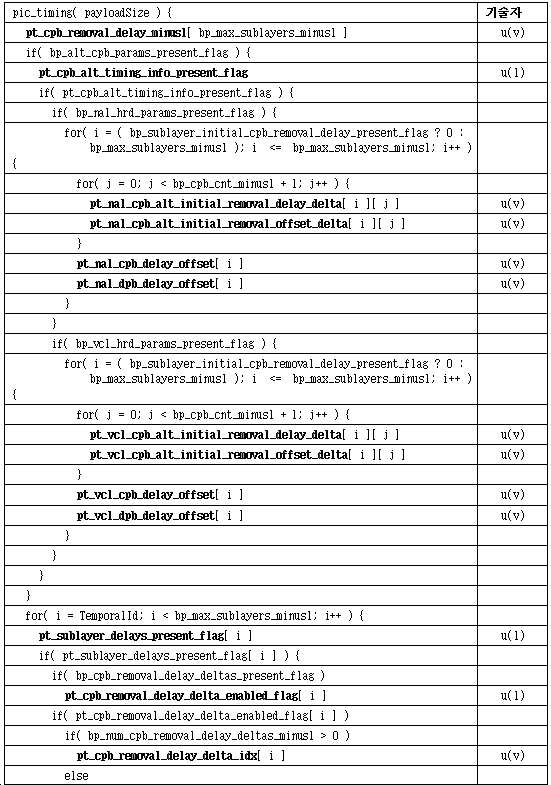
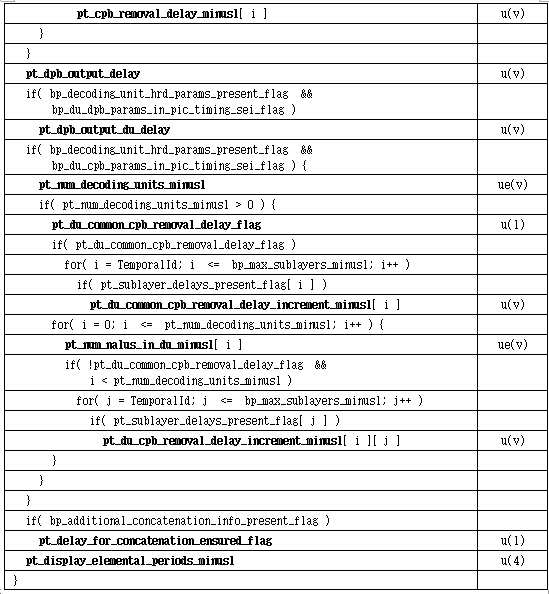
PT SEI 메시지는 SEI 메시지와 연관된 AU에 대한 CPB 제거 지연 및 DPB 출력 지연 정보(output delay information)를 제공한다.The PT SEI message provides CPB removal delay and DPB output delay information for the AU associated with the SEI message.
현재 AU에 적용 가능한 BP SEI 메시지의 bp_nal_hrd_params_present_flag 또는 bp_vcl_hrd_params_present_flag가 1과 동일하면, 변수 CpbDpbDelaysPresentFlag는 1로 설정된다. 그렇지 않으면, CpbDpbDelaysPresentFlag는 0과 동일하게 설정된다.If bp_nal_hrd_params_present_flag or bp_vcl_hrd_params_present_flag of the BP SEI message applicable to the current AU is equal to 1, the variable CpbDpbDelaysPresentFlag is set to 1. Otherwise, CpbDpbDelaysPresentFlag is set equal to 0.
PT SEI 메시지의 존재는 다음과 같이 지정된다: The presence of a PT SEI message is specified as follows:
- CpbDpbDelaysPresentFlag가 1과 동일하면, PT SEI 메시지는 현재 AU와 연관된다.- If CpbDpbDelaysPresentFlag is equal to 1, the PT SEI message is associated with the current AU.
- 그렇지 않으면(CpbDpbDelaysPresentFlag가 0과 동일함), 현재 AU와 연관된 PT SEI 메시지가 없을 것이다.- Otherwise (CpbDpbDelaysPresentFlag equal to 0), there will be no PT SEI message associated with the current AU.
PT SEI 메시지 신택스의 TemporalId는 PT SEI 메시지를 담고 있는 SEI NAL 유닛의 TemporalId이다.TemporalId of the PT SEI message syntax is the TemporalId of the SEI NAL unit containing the PT SEI message.
pt_cpb_removal_delay_minus1[ i ] + 1은 PT SEI 메시지와 연관된 AU의 공칭 CPB 제거 시간과 Htid가 i와 동일할 때 BP SEI 메시지를 포함하는 디코딩 순서의 이전 AU 사이의 클록 틱(clock tick) 수를 계산하는 데 사용된다. 이 값은 또한 HSS용 CPB에 AU 데이터가 도착하는 가능한 가장 빠른 시간을 계산하는 데 사용된다. pt_cpb_removal_delay_minus1[ i ]의 길이는 bp_cpb_removal_delay_length_minus1 + 1비트이다. pt_cpb_removal_delay_minus1 [ i ] + 1 is used to calculate the number of clock ticks between the nominal CPB removal time of the AU associated with the PT SEI message and the previous AU in decoding order containing the BP SEI message when Htid equals i. used This value is also used to calculate the earliest possible time for AU data to arrive at CPB for HSS. The length of pt_cpb_removal_delay_minus1[ i ] is bp_cpb_removal_delay_length_minus1 + 1 bit.
pt_cpb_alt_timing_info_present_flagequal to 1 specifies that the syntax elements pt_nal_cpb_alt_initial_removal_delay_delta[ i ][ j ], pt_nal_cpb_alt_initial_removal_offset_delta[ i ][ j ], pt_nal_cpb_delay_offset[ i ], pt_nal_dpb_delay_offset[ i ], pt_vcl_cpb_alt_initial_removal_delay_delta[ i ][ j ], pt_vcl_cpb_alt_initial_removal_offset_delta[ i ][ j ] , pt_vcl_cpb_delay_offset[ i ], pt_vcl_dpb_delay_offset[ i ]가 PT SEI 메시지에 존재할 수 있다. 0과 동일한 pt_cpb_alt_timing_info_present_flag는 이러한 신택스 요소가 PT SEI 메시지에 존재하지 않음을 지정한다. 연결된 픽처가 RASL 픽처인 경우 pt_cpb_alt_timing_info_present_flag의 값은 0과 동일해야 한다. pt_cpb_alt_timing_info_present_flag equal to 1 specifies that the syntax elements pt_nal_cpb_alt_initial_removal_delay_delta[ i ][ j ], pt_nal_cpb_alt_initial_removal_offset_delta[ i ][ j ], pt_nal_cpb_delay_offset[ i ], pt_nal_dpb_delay_offset[ i ], pt_vcl_cpb_alt_initial_removal_delay_delta[ i ][ j ], pt_vcl_cpb_alt_initial_removal_offset_delta[ i ][ j ] , pt_vcl_cpb_delay_offset[i], and pt_vcl_dpb_delay_offset[i] may exist in the PT SEI message. pt_cpb_alt_timing_info_present_flag equal to 0 specifies that this syntax element is not present in the PT SEI message. If the concatenated picture is a RASL picture, the value of pt_cpb_alt_timing_info_present_flag must be equal to 0.
참고 1 - pt_cpb_alt_timing_info_present_flag의 값은 디코딩 순서에서 IRAP picture에 뒤따르는 둘 이상의 AU에 대해 1과 동일할 수 있다. 그러나 대체 타이밍은 pt_cpb_alt_timing_info_present_flag가 1과 동일하고 디코딩 순서에서 IRAP 픽처를 따르는 제1 AU에만 적용된다.Reference 1 - The value of pt_cpb_alt_timing_info_present_flag may be equal to 1 for two or more AUs following the IRAP picture in decoding order. However, the alternative timing applies only to the first AU whose pt_cpb_alt_timing_info_present_flag is equal to 1 and which follows the IRAP picture in decoding order.
pt_nal_cpb_alt_initial_removal_delay_delta[i][j]는 90kHz 클록 유닛으로 NAL HRD에 대한 j번째 CPB에 대한 i번째 서브계층에 대한 대체 초기 CPB 제거 지연 델타(removal delay delta)를 지정한다. pt_nal_cpb_alt_initial_removal_delay_delta[i][j]의 길이는 bp_cpb_initial_removal_delay_length_minus1 + 1비트이다. pt_nal_cpb_alt_initial_removal_delay_delta [i][j] specifies the replacement initial CPB removal delay delta for the i-th sublayer for the j-th CPB for NAL HRD in 90 kHz clock units. The length of pt_nal_cpb_alt_initial_removal_delay_delta[i][j] is bp_cpb_initial_removal_delay_length_minus1 + 1 bit.
pt_cpb_alt_timing_info_present_flag가 1이고 pt_nal_cpb_alt_initial_removal_delay_delta[ i ][ j ]가 bp_max_sublayers_minus1보다 작은 i 값에 대해 존재하지 않으면, 그 값은 0과 동일하다고 유추된다.If pt_cpb_alt_timing_info_present_flag is 1 and pt_nal_cpb_alt_initial_removal_delay_delta[i][j] does not exist for an i value smaller than bp_max_sublayers_minus1, the value is inferred to be equal to 0.
pt_nal_cpb_alt_initial_removal_offset_delta[ i ][ j ]는 90kHz 클록 유닛으로 NAL HRD에 대한 j번째 CPB에 대한 i번째 서브계층에 대한 대체 초기 CPB 제거 오프셋 델타를 지정한다. pt_nal_cpb_alt_initial_removal_offset_delta[i][j]의 길이는 bp_cpb_initial_removal_delay_length_minus1 + 1비트이다. pt_nal_cpb_alt_initial_removal_offset_delta [ i ][ j ] specifies the replacement initial CPB removal offset delta for the i-th sublayer for the j-th CPB for NAL HRD in 90 kHz clock units. The length of pt_nal_cpb_alt_initial_removal_offset_delta[i][j] is bp_cpb_initial_removal_delay_length_minus1 + 1 bit.
pt_cpb_alt_timing_info_present_flag가 1이고 pt_nal_cpb_alt_initial_removal_offset_delta[ i ][ j ]가 bp_max_sublayers_minus1보다 작은 i 값에 대해 존재하지 않으면, 그 값은 0과 동일하다고 유추된다.If pt_cpb_alt_timing_info_present_flag is 1 and pt_nal_cpb_alt_initial_removal_offset_delta[i][j] does not exist for an i value less than bp_max_sublayers_minus1, the value is inferred to be equal to 0.
pt_nal_cpb_delay_offset[ i ]는, NAL HRD에 대한 i번째 서브계층에 대해, PT SEI 메시지와 관련된 AU가 BP SEI 메시지와 관련된 AU의 디코딩 순서 바로 뒤에 오는 경우, PT SEI 메시지와 연관된 AU 및 디코딩 순서에서 다음 AU의 공칭 CPB 제거 시간의 유도에 사용될 오프셋을 지정한다. pt_nal_cpb_delay_offset[i]의 길이는 bp_cpb_removal_delay_length_minus1 + 1비트이다. 존재하지 않는 경우, pt_nal_cpb_delay_offset[ i ] 값은 0과 같다고 유추된다. pt_nal_cpb_delay_offset [i] is, for the ith sublayer for the NAL HRD, if the AU associated with the PT SEI message immediately follows the decoding order of the AU associated with the BP SEI message, the AU associated with the PT SEI message and the next AU in decoding order Specifies the offset to be used in the derivation of the nominal CPB removal time of The length of pt_nal_cpb_delay_offset[i] is bp_cpb_removal_delay_length_minus1 + 1 bit. If not present, the value of pt_nal_cpb_delay_offset[ i ] is inferred to be equal to 0.
NAL HRD에 대한 i 번째 서브계층에 대해, PT SEI 메시지와 연관된 AU가 디코딩 순서에서 BP SEI 메시지와 연관된 IRAP AU을 직접 따르는 경우, pt_nal_dpb_delay_offset[ i ]는 BP SEI 메시지와 연관된 IRAP AU의 DPB 출력 시간을 유도하기 위해 사용될 오프셋을 지정한다. pt_nal_dpb_delay_offset[i]의 길이는 bp_dpb_output_delay_length_minus1 + 1비트이다. 존재하지 않는 경우, pt_nal_dpb_delay_offset[ i ] 값은 0과 같다고 유추된다.For the i-th sublayer for NAL HRD, when the AU associated with the PT SEI message directly follows the IRAP AU associated with the BP SEI message in decoding order, pt_nal_dpb_delay_offset [i] is the DPB output time of the IRAP AU associated with the BP SEI message Specifies the offset to be used for derivation. The length of pt_nal_dpb_delay_offset[i] is bp_dpb_output_delay_length_minus1 + 1 bit. If not present, the value of pt_nal_dpb_delay_offset[ i ] is inferred to be equal to 0.
pt_vcl_cpb_alt_initial_removal_delay_delta[i][j]는 90kHz 클록 유닛으로 VCL HRD에 대한 j번째 CPB에 대한 i번째 서브계층에 대한 대체 초기 CPB 제거 지연 델타를 지정한다. pt_vcl_cpb_alt_initial_removal_delay_delta[ i ][ j ]의 길이는 bp_cpb_initial_removal_delay_length_minus1 + 1 비트이다. pt_vcl_cpb_alt_initial_removal_delay_delta [i][j] specifies the alternate initial CPB removal delay delta for the ith sublayer for the jth CPB for the VCL HRD in 90 kHz clock units. The length of pt_vcl_cpb_alt_initial_removal_delay_delta[i][j] is bp_cpb_initial_removal_delay_length_minus1 + 1 bits.
pt_cpb_alt_timing_info_present_flag가 1이고 pt_vcl_cpb_alt_initial_removal_delay_delta[ i ][ j ]가 bp_max_sublayers_minus1보다 작은 i 값에 대해 존재하지 않으면, 그 값은 0과 동일하다고 유추된다.If pt_cpb_alt_timing_info_present_flag is 1 and pt_vcl_cpb_alt_initial_removal_delay_delta[i][j] does not exist for an i value smaller than bp_max_sublayers_minus1, the value is inferred to be equal to 0.
pt_vcl_cpb_alt_initial_removal_offset_delta[i][j]는 90kHz 클록 유닛으로 VCL HRD에 대한 j번째 CPB에 대한 i번째 서브계층에 대한 대체 초기 CPB 제거 오프셋 델타를 지정한다. pt_vcl_cpb_alt_initial_removal_offset_delta[ i ][ j ]의 길이는 bp_cpb_initial_removal_delay_length_minus1 + 1 비트이다. pt_vcl_cpb_alt_initial_removal_offset_delta [i][j] specifies the replacement initial CPB removal offset delta for the ith sublayer for the jth CPB for the VCL HRD in 90 kHz clock units. The length of pt_vcl_cpb_alt_initial_removal_offset_delta[i][j] is bp_cpb_initial_removal_delay_length_minus1 + 1 bits.
pt_cpb_alt_timing_info_present_flag가 1이고 pt_vcl_cpb_alt_initial_removal_offset_delta[ i ][ j ]가 bp_max_sublayers_minus1보다 작은 i 값에 대해 존재하지 않으면, 그 값은 0과 동일하다고 유추된다.If pt_cpb_alt_timing_info_present_flag is 1 and pt_vcl_cpb_alt_initial_removal_offset_delta[i][j] does not exist for an i value smaller than bp_max_sublayers_minus1, the value is inferred to be equal to 0.
pt_vcl_cpb_delay_offset[ i ]는, VCL HRD에 대한 i번째 서브계층에 대해, PT SEI 메시지와 관련된 AU가 BP SEI 메시지와 관련된 AU의 디코딩 순서 바로 뒤에 오는 경우, PT SEI 메시지와 연관된 AU 및 디코딩 순서에서 다음 AU의 공칭 CPB 제거 시간의 유도에 사용될 오프셋을 지정한다. pt_vcl_cpb_delay_offset[i]의 길이는 bp_cpb_removal_delay_length_minus1 + 1비트이다. 존재하지 않을 때, pt_vcl_cpb_delay_offset[ i ]의 값은 0과 동일한 것으로 유추된다. pt_vcl_cpb_delay_offset [i] is, for the ith sublayer for the VCL HRD, if the AU associated with the PT SEI message immediately follows the decoding order of the AU associated with the BP SEI message, the AU associated with the PT SEI message and the next AU in decoding order Specifies the offset to be used in the derivation of the nominal CPB removal time of The length of pt_vcl_cpb_delay_offset[i] is bp_cpb_removal_delay_length_minus1 + 1 bit. When not present, the value of pt_vcl_cpb_delay_offset[ i ] is inferred to be equal to 0.
VCL HRD에 대한 i 번째 서브계층에 대해, PT SEI 메시지와 연관된 AU가 디코딩 순서에서 BP SEI 메시지와 연관된 IRAP AU을 직접 따르는 경우, pt_vcl_dpb_delay_offset[ i ]는 BP SEI 메시지와 연관된 IRAP AU의 DPB 출력 시간을 유도하기 위해 사용될 오프셋을 지정한다. pt_vcl_dpb_delay_offset[i]의 길이는 bp_dpb_output_delay_length_minus1 + 1비트이다. 존재하지 않을 때, pt_vcl_dpb_delay_offset[ i ]의 값은 0과 동일한 것으로 유추된다.For the i-th sublayer for the VCL HRD, if the AU associated with the PT SEI message directly follows the IRAP AU associated with the BP SEI message in decoding order, pt_vcl_dpb_delay_offset [i] is the DPB output time of the IRAP AU associated with the BP SEI message Specifies the offset to be used for derivation. The length of pt_vcl_dpb_delay_offset[i] is bp_dpb_output_delay_length_minus1 + 1 bit. When not present, the value of pt_vcl_dpb_delay_offset[ i ] is inferred to be equal to 0.
현재 픽처의 변수 BpResetFlag는 다음과 같이 유도된다: The variable BpResetFlag of the current picture is derived as follows:
- 현재 픽처가 BP SEI 메시지와 연관되어 있으면 BpResetFlag는 1로 설정된다: - BpResetFlag is set to 1 if the current picture is associated with a BP SEI message:
- 그렇지 않으면, BpResetFlag가 0과 동일하게 설정된다.- Otherwise, BpResetFlag is set equal to 0.
1과 동일한 pt_sublayer_delays_present_flag[ i ]는 pt_cpb_removal_delay_delta_idx[ i ] 또는 pt_cpb_removal_delay_minus1[ i ] 및 pt_du_common_cpb_removal_delay_increment_minus1[ i ] 또는 pt_du_common_cpb_removal_delay_increment_minus1[ i ]가 현재 서브계층에 대한 Tempor id와 동일함을 지정한다. 0과 동일한 sublayer_delays_present_flag[ i ]는 pt_cpb_removal_delay_delta_idx[ i ] 또는 pt_cpb_removal_delay_minus1[ i ] 및 pt_du_common_cpb_removal_delay_increment_minus1[ i ] 또는 i 와 동일한 Temp_Idlayer를 갖는 pt_du_common_cpb_removal_delay_increment_minus1[ ][ ]이 존재하지 않음을 지정한다. pt_sublayer_delays_present_flag[ bp_max_sublayers_minus1 ]의 값은 1로 유추된다. 존재하지 않는 경우, 0 내지 bp_max_sublayers_minus1 - 1까지를 포함하는 범위에 있는 임의의 i에 대한 pt_sublayer_delays_present_flag[ i ]의 값은 0과 동일하다고 유추된다. pt_sublayer_delays_present_flag [ i ] equal to 1 specifies pt_cpb_removal_delay_delta_idx [ i ] or pt_cpb_removal_delay_minus1 [ i ] and pt_du_common_cpb_removal_delay_increment_minus1 [ i ] or pt_du_common_cpb_removal_delay_increment_minus1 [ i ] specifies the current Tempor sublayer for the sublayer. sublayer_delays_present_flag[i] equal to 0 specifies pt_cpb_removal_delay_delta_idx[i] or pt_cpb_removal_delay_minus1[i] and pt_du_common_cpb_removal_delay_increment_minus1[i] or pt_du_common_cpb_removal_deuslay_minus1[i] with Temp_Idlayer equal to i does not exist. The value of pt_sublayer_delays_present_flag [ bp_max_sublayers_minus1 ] is inferred to be 1. If not present, the value of pt_sublayer_delays_present_flag[i] for any i in the range of 0 to bp_max_sublayers_minus1 - 1 is inferred to be equal to 0.
1과 동일한 pt_cpb_removal_delay_delta_enabled_flag[ i ]는 pt_cpb_removal_delay_delta_idx[ i ]가 PT SEI 메시지에 존재함을 지정한다. 0과 동일한 pt_cpb_removal_delay_delta_enabled_flag[ i ]는 pt_cpb_removal_delay_delta_idx[ i ]가 PT SEI 메시지에 존재하지 않음을 지정한다. 존재하지 않는 경우 pt_cpb_removal_delay_delta_enabled_flag[ i ] 값은 0과 동일하다고 유추된다.pt_cpb_removal_delay_delta_enabled_flag [ i ] equal to 1 specifies that pt_cpb_removal_delay_delta_idx [ i ] is present in the PT SEI message. pt_cpb_removal_delay_delta_enabled_flag[ i ] equal to 0 specifies that pt_cpb_removal_delay_delta_idx[ i ] is not present in the PT SEI message. If not present, the value of pt_cpb_removal_delay_delta_enabled_flag[ i ] is inferred to be equal to 0.
pt_cpb_removal_delay_delta_idx[ i ]는 0에서 bp_num_cpb_removal_delay_deltas_minus1까지 범위의 j에 대한 bp_cpb_removal_delay_delta_val[ j ]의 목록에서 i와 동일한 Htid에 적용되는 CPB 제거 델타의 인덱스를 지정한다. pt_cpb_removal_delay_delta_idx[ i ]의 길이는 Ceil( Log2( bp_num_cpb_removal_delay_deltas_minus1 + 1 ) ) 비트이다. pt_cpb_removal_delay_delta_idx[ i ]가 존재하지 않고 pt_cpb_removal_delay_delta_enabled_flag[ i ]가 1과 동일한 경우, pt_cpb_removal_delay_delta_idx[ i ]의 값은 0과 동일한 것으로 유추된다. pt_cpb_removal_delay_delta_idx [ i ] specifies the index of the CPB removal delta applied to the Htid equal to i in the list of bp_cpb_removal_delay_delta_val [ j ] for j ranging from 0 to bp_num_cpb_removal_delay_deltas_minus1. The length of pt_cpb_removal_delay_delta_idx[ i ] is Ceil( Log2( bp_num_cpb_removal_delay_deltas_minus1 + 1 ) ) bits. When pt_cpb_removal_delay_delta_idx[i] does not exist and pt_cpb_removal_delay_delta_enabled_flag[i] is equal to 1, the value of pt_cpb_removal_delay_delta_idx[i] is inferred to be equal to 0.
현재 픽처의 변수 CpbRemovalDelayMsb[ i ] 및 CpbRemovalDelayVal[ i ]는 다음과 같이 유도된다: The variables CpbRemovalDelayMsb[i] and CpbRemovalDelayVal[i] of the current picture are derived as follows:
- 현재 AU가 HRD를 초기화하는 AU인 경우, CpbRemovalDelayMsb[ i ] 및 CpbRemovalDelayVal[ i ]는 모두 0으로 설정되고 cpbRemovalDelayValTmp[ i ]의 값은 pt_cpb_removal_delay_minus1[ i ] + 1와 동일하게 설정된다.- If the current AU is an AU initializing the HRD, both CpbRemovalDelayMsb [ i ] and CpbRemovalDelayVal [ i ] are set to 0 and the value of cpbRemovalDelayValTmp [ i ] is set equal to pt_cpb_removal_delay_minus1 [ i ] + 1.
- 그렇지 않으면, 픽처 prevNonDiscardablePic가 RASL 또는 RADL이 아닌 TemporalId가 0인 디코딩 순서의 이전 픽처가 되도록 하고, prevCpbRemovalDelayMinus1[ i ], prevCpbRemovalDelayMsb[ i ] 및 prevBpResetFlag가 픽처 prevNonDiscardablePic에 대해 각각 cpbRemovalDelayValTmp[ i ] - 1, CpbRemovalDelayMsb[ i ] 및 BpResetFlag의 값과 동일하게 설정되도록 하고 다음이 적용된다: - Otherwise, let picture prevNonDiscardablePic be the previous picture in decoding order with TemporalId equal to 0, not RASL or RADL, and prevCpbRemovalDelayMinus1[ i ], prevCpbRemovalDelayMsb[ i ] and prevBpResetFlag set to cpbRemovalDelayValTmp[ i ] - 1, CpbRemovalDelayValTmp[ i ] - 1 for picture prevNonDiscardablePic, respectively. i ] and set equal to the value of BpResetFlag, and the following applies:
- CpbRemovalDelayMsb[ i ]는 다음과 같이 유도된다: - CpbRemovalDelayMsb[ i ] is derived as follows:
cpbRemovalDelayValTmp[ i ] = pt_cpb_removal_delay_delta_enabled_flag[ i ] ?cpbRemovalDelayValTmp[ i ] = pt_cpb_removal_delay_delta_enabled_flag[ i ] ?
pt_cpb_removal_delay_minus1[ bp_max_sublayers_minus1 ] + 1 + pt_cpb_removal_delay_minus1[ bp_max_sublayers_minus1 ] + 1 +
bp_cpb_removal_delay_delta_val[ pt_cpb_removal_delay_delta_idx[ i ] ] : bp_cpb_removal_delay_delta_val[ pt_cpb_removal_delay_delta_idx[ i ] ]:
pt_cpb_removal_delay_minus1[ i ] + 1 pt_cpb_removal_delay_minus1[ i ] + 1
if( prevBpResetFlag )if( prevBpResetFlag )
CpbRemovalDelayMsb[ i ] = 0 CpbRemovalDelayMsb[ i ] = 0
else if( cpbRemovalDelayValTmp[ i ] < prevCpbRemovalDelayMinus1[ i ] )else if( cpbRemovalDelayValTmp[ i ] < prevCpbRemovalDelayMinus1[ i ] )
CpbRemovalDelayMsb[ i ] = prevCpbRemovalDelayMsb[ i ] + 2bp_cpb_removal_delay_length_minus1 + 1 (D.1)CpbRemovalDelayMsb[ i ] = prevCpbRemovalDelayMsb[ i ] + 2 bp_cpb_removal_delay_length_minus1 + 1 (D.1)
elseelse
CpbRemovalDelayMsb[ i ] = prevCpbRemovalDelayMsb[ i ] CpbRemovalDelayMsb[ i ] = prevCpbRemovalDelayMsb[ i ]
- CpbRemovalDelayVal은 다음과 같이 유도된다:- CpbRemovalDelayVal is derived as follows:
if( pt_sublayer_delays_present_flag[ i ] )if( pt_sublayer_delays_present_flag[ i ] )
CpbRemovalDelayVal[ i ] = CpbRemovalDelayMsb[ i ] + cpbRemovalDelayValTmp[ i ] (D.2) CpbRemovalDelayVal[ i ] = CpbRemovalDelayMsb[ i ] + cpbRemovalDelayValTmp[ i ] (D.2)
elseelse
CpbRemovalDelayVal[ i ] = CpbRemovalDelayVal[ i + 1 ] CpbRemovalDelayVal[ i ] = CpbRemovalDelayVal[ i + 1 ]
CpbRemovalDelayVal[i]의 값은 1에서 232까지의 범위에 있어야 한다.The value of CpbRemovalDelayVal [i] must be in the range of 1 to 232.
변수 AuDpbOutputDelta[ i ]는 다음과 같이 유도된다: The variable AuDpbOutputDelta[ i ] is derived as follows:
AuDpbOutputDelta[ i ] = CpbRemovalDelayVal[ i ] -AuDpbOutputDelta[ i ] = CpbRemovalDelayVal[ i ] -
( pt_cpb_removal_delay_minus1[ bp_max_sublayers_minus1 ] + 1 ) - (D.3) ( pt_cpb_removal_delay_minus1[ bp_max_sublayers_minus1 ] + 1 ) - (D.3)
( i = = bp_max_sublayers_minus1 ? 0 : bp_dpb_output_tid_offset[ i ] ) ( i = = bp_max_sublayers_minus1 ? 0 : bp_dpb_output_tid_offset[ i ] )
여기서 bp_dpb_output_tid_offset[ i ]의 값은 연관된 BP SEI 메시지에서 찾을 수 있다.Here, the value of bp_dpb_output_tid_offset[ i ] can be found in the associated BP SEI message.
pt_dpb_output_delay는 픽처의 DPB 출력 시간을 계산하는 데 사용된다. 디코딩된 픽처가 DPB에서 출력되기 전에 CPB에서 AU를 제거한 후 대기할 클럭 틱 수를 지정한다. pt_dpb_output_delay is used to calculate the DPB output time of a picture. Specifies the number of clock ticks to wait after removing the AU from the CPB before a decoded picture is output from the DPB.
참고 2 - 디코딩된 픽처는 "단기 레퍼런스를 위해 사용됨" 또는 "장기 레퍼런스를 위해 사용됨"으로 여전히 표시되어 있을 때 출력 시간에 DPB에서 제거되지 않는다.NOTE 2 - A decoded picture is not removed from the DPB at output time when it is still marked as "used for short-term reference" or "used for long-term reference".
pt_dpb_output_delay의 길이는 bp_dpb_output_delay_length_minus1 + 1비트이다. max_dec_pic_buffering_minus1[ Htid ]이 0과 동일할 때, pt_dpb_output_delay의 값은 0과 동일해야 한다.The length of pt_dpb_output_delay is bp_dpb_output_delay_length_minus1 + 1 bit. When max_dec_pic_buffering_minus1[ Htid ] is equal to 0, the value of pt_dpb_output_delay shall be equal to 0.
디코더를 따르는 출력 타이밍으로부터 출력되는 임의의 픽처의 pt_dpb_output_delay로부터 유도된 출력 시간은 디코딩 순서에서 후속 CVS의 임의의 픽처의 pt_dpb_output_delay로부터 유도된 출력 시간보다 선행해야 한다.The output time derived from pt_dpb_output_delay of any picture output from the output timing following the decoder must precede the output time derived from pt_dpb_output_delay of any picture of the subsequent CVS in decoding order.
이 신택스 요소의 값에 의해 설정된 픽처 출력 순서는 PicOrderCntVal의 값에 의해 설정된 순서와 동일해야 한다.The picture output order set by the value of this syntax element must be the same as the order set by the PicOrderCntVal value.
디코딩 순서에서 ph_no_output_of_prior_pics_flag가 1과 동일하거나 1과 동일한 것으로 유추되는 CLVSS 픽처보다 선행하기 때문에 "범핑(bumping)" 프로세스에 의해 출력되지 않은 픽처들의 경우, pt_dpb_output_delay에서 유도된 출력 시간은 동일한 CVS 내의 모든 픽처들에 상대적인 PicOrderCntVal이 증가함에 따라 증가해야 한다.For pictures that are not output by the “bumping” process because they precede a CLVSS picture whose ph_no_output_of_prior_pics_flag is equal to 1 or inferred to be equal to 1 in decoding order, the output time derived from pt_dpb_output_delay is equal to all pictures in the same CVS should increase as PicOrderCntVal relative to .
pt_dpb_output_du_delay는 DecodingUnitHrdFlag가 1일 때 픽처의 DPB 출력 시간을 계산하는 데 사용된다. 디코딩된 픽처가 DPB에서 출력되기 전에 CPB에서 AU의 마지막 DU를 제거한 후 대기할 하위 클록 틱 수를 지정한다. pt_dpb_output_du_delay is used to calculate the DPB output time of a picture when DecodingUnitHrdFlag is 1. Specifies the number of sub-clock ticks to wait after removing the last DU of an AU from CPB before a decoded picture is output from DPB.
신택스 요소 pt_dpb_output_du_delay의 길이는 bp_dpb_output_delay_du_length_minus1 + 1에 의해 비트 단위로 제공된다.The length of the syntax element pt_dpb_output_du_delay is provided in bits by bp_dpb_output_delay_du_length_minus1 + 1.
디코더를 따르는 출력 타이밍으로부터 출력되는 임의의 픽처의 pt_dpb_output_du_delay로부터 유도된 출력 시간은 디코딩 순서에서 후속 CVS의 임의의 픽처의 pt_dpb_output_du_delay로부터 유도된 출력 시간보다 선행해야 한다.The output time derived from pt_dpb_output_du_delay of any picture output from the output timing following the decoder must precede the output time derived from pt_dpb_output_du_delay of any picture of the subsequent CVS in decoding order.
이 신택스 요소의 값에 의해 설정된 픽처 출력 순서는 PicOrderCntVal의 값에 의해 설정된 순서와 동일해야 한다.The picture output order set by the value of this syntax element must be the same as the order set by the PicOrderCntVal value.
디코딩 순서에서 ph_no_output_of_prior_pics_flag가 1과 동일하거나 1과 동일한 것으로 유추되는 CLVSS 픽처보다 선행하기 때문에 "범핑(bumping)" 프로세스에 의해 출력되지 않은 픽처들의 경우, pt_dpb_output_du_delay에서 유도된 출력 시간은 동일한 CVS 내의 모든 픽처들에 상대적인 PicOrderCntVal이 증가함에 따라 증가해야 한다.For pictures that were not output by the "bumping" process because they preceded a CLVSS picture whose ph_no_output_of_prior_pics_flag was equal to 1 or inferred to be equal to 1 in decoding order, the output time derived from pt_dpb_output_du_delay is equal to all pictures in the same CVS should increase as PicOrderCntVal relative to .
CVS의 임의의 두 픽처들에 대해, DecodingUnitHrdFlag가 1과 동일한 경우, 두 픽처들의 출력 시간들 간의 차이는 DecodingU조nitHrdFlag가 0와 동일한 경우의 동일한 차이와 동일해야 한다.For any two pictures of CVS, when DecodingUnitHrdFlag is equal to 1, the difference between the output times of the two pictures must be equal to the same difference when DecodingUnitHrdFlag is equal to 0.
pt_num_decoding_units_minus1+ 1은 PT SEI 메시지와 연관된 AU의 DU 수를 지정한다. pt_num_decoding_units_minus1의 값은 0에서 PicSizeInCtbsY - 1까지의 범위에 있어야 한다.
1과 동일한 pt_du_common_cpb_removal_delay_flag는 신택스 요소 pt_du_common_cpb_removal_delay_increment_minus1[ i ]가 존재함을 지정한다. 0과 동일한 pt_du_common_cpb_removal_delay_flag는 신택스 요소 pt_du_common_cpb_removal_delay_increment_minus1[ i ]가 존재하지 않음을 지정한다. 존재하지 않는 경우 pt_du_common_cpb_removal_delay_flag는 0과 동일하다고 유추된다. pt_du_common_cpb_removal_delay_flag equal to 1 specifies that the syntax element pt_du_common_cpb_removal_delay_increment_minus1[ i ] is present. pt_du_common_cpb_removal_delay_flag equal to 0 specifies that the syntax element pt_du_common_cpb_removal_delay_increment_minus1[i] is not present. If not present, pt_du_common_cpb_removal_delay_flag is inferred to be equal to 0.
pt_du_common_cpb_removal_delay_increment_minus1[ i ] + 1은, 클록 서브틱(sub-tick) 단위로, Htid가 i와 같을 때 PT SEI 메시지와 관련된 AU에서 디코딩 순서로 임의의 두 연속 DU의 공칭 CPB 제거 시간 사이의 듀레이션을 지정한다(절 C.1 참조). 이 값은 부록 C에 명시된 대로 HSS용 CPB에 DU 데이터가 도착하는 가능한 가장 빠른 시간을 계산하는 데에도 사용된다. 이 신택스 요소의 길이는 bp_du_cpb_removal_delay_increment_length_minus1 + 1비트이다. pt_du_common_cpb_removal_delay_increment_minus1 [ i ] + 1 specifies the duration, in clock sub-tick units, between the nominal CPB removal time of any two consecutive DUs in decoding order in the AU associated with the PT SEI message when Htid is equal to i (see Section C.1). This value is also used to calculate the earliest possible time for DU data to arrive at the CPB for HSS as specified in Annex C. The length of this syntax element is bp_du_cpb_removal_delay_increment_length_minus1 + 1 bit.
pt_du_common_cpb_removal_delay_increment_minus1[ i ]가 bp_max_sublayers_minus1보다 작은 i 값에 대해 존재하지 않는 경우, 그 값은 pt_du_common_cpb_removal_delay_increment_minus1[ bp_max_sublayers_minus1 ]과 동일하다고 유추된다.If pt_du_common_cpb_removal_delay_increment_minus1[i] does not exist for an i value less than bp_max_sublayers_minus1, the value is inferred to be equal to pt_du_common_cpb_removal_delay_increment_minus1[bp_max_sublayers_minus1].
pt_num_nalus_in_du_minus1[ i ] + 1은 PT SEI 메시지가 연관된 AU의 i번째 DU에 있는 NAL 유닛의 수를 지정한다. pt_num_nalus_in_du_minus1[ i ]의 값은 0에서 PicSizeInCtbsY - 1까지를 포함하는 범위에 있어야 한다. pt_num_nalus_in_du_minus1 [i] + 1 specifies the number of NAL units in the i-th DU of the AU with which the PT SEI message is associated. The value of pt_num_nalus_in_du_minus1[ i ] must be in the range from 0 to PicSizeInCtbsY - 1.
AU의 제1 DU는 AU에서 디코딩 순서로 제1 pt_num_nalus_in_du_minus1[0] + 1개의 연속적인 NAL 유닛으로 구성된다. AU의 i번째(0보다 큰 i를 갖는) DU는 디코딩 순서에서 AU의 이전 DU의 마지막 NAL 유닛 바로 뒤에 오는 pt_num_nalus_in_du_minus1[ i ] + 1개의 연속 NAL 유닛으로 구성된다. 각 DU에는 적어도 하나의 VCL NAL 유닛이 있어야 한다. VCL NAL 유닛과 연관된 모든 비 VCL NAL 유닛은 VCL NAL 유닛과 동일한 DU에 포함된다.The first DU of an AU consists of the first pt_num_nalus_in_du_minus1[0] + 1 consecutive NAL unit in decoding order in the AU. The i-th (with i greater than 0) DU of an AU consists of pt_num_nalus_in_du_minus1[ i ] + 1 consecutive NAL unit immediately following the last NAL unit of the previous DU of the AU in decoding order. Each DU must have at least one VCL NAL unit. All non-VCL NAL units associated with a VCL NAL unit are included in the same DU as the VCL NAL unit.
pt_du_cpb_removal_delay_increment_minus1[ i ][ j ] + 1은, 클록 서브틱 단위로, Htid가 j와 같을 때 PT SEI 메시지와 연관된 AU에서 디코딩 순서로 (i + 1)번째 DU와 i번째 DU의 공칭 CPB 제거 시간 사이의 듀레이션을 지정한다. 이 값은 부록 C에 명시된 대로 HSS용 CPB에 DU 데이터가 도착하는 가능한 가장 빠른 시간을 계산하는 데에도 사용된다. 이 신택스 요소의 길이는 bp_du_cpb_removal_delay_increment_length_minus1 + 1비트이다. pt_du_cpb_removal_delay_increment_minus1 [ i ][ j ] + 1 is, in clock subtick units, between the (i + 1)th DU in decoding order and the nominal CPB removal time of the ith DU in the AU associated with the PT SEI message when Htid is equal to j Specifies the duration of This value is also used to calculate the earliest possible time for DU data to arrive at the CPB for HSS as specified in Annex C. The length of this syntax element is bp_du_cpb_removal_delay_increment_length_minus1 + 1 bit.
pt_du_cpb_removal_delay_increment_minus1[ i ][ j ]가 bp_max_sublayers_minus1보다 작은 j 값에 대해 존재하지 않는 경우, 그 값은 pt_du_cpb_removal_delay_increment_minus1[ i ][ bp_max_sublayers_minus1 ]과 동일하다고 유추된다.If pt_du_cpb_removal_delay_increment_minus1[i][j] does not exist for a value of j smaller than bp_max_sublayers_minus1, the value is inferred to be equal to pt_du_cpb_removal_delay_increment_minus1[i][bp_max_sublayers_minus1].
1과 동일한 pt_delay_for_concatenation_ensured_flag는 최종 도착 시간과 PT SEI 메시지와 연관된 AU의 CPB 제거 시간 간의 차이가 1과 동일한 bp_concatenation_flag와 bp_max_initial_removal_delay_for_concatenation 값보다 작거나 같은 InitCpbRemovalDelay[ ][ ][편집(Ed.)(와이케이(YK)): 여기에서 "InitCpbRemovalDelay[ Htid ][ ScIdx ]"를 사용하는 것이 정확한지 확인하라.]인 BP SEI 메시지가 있는 AU가 뒤따를 때, bp_max_initial_removal_delay_for_concatenation 값보다 작거나 같으면, bp_cpb_removal_delay_delta_minus1로 계산된 CPB에서 다음 AU의 공칭 제거 시간이 적용됨 같음을 지정한다. 0과 동일한 pt_delay_for_concatenation_ensured_flag는 최종 도착 시간과 PT SEI 메시지와 연관된 AU의 CPB 제거 시간 간의 차이가 max_val_initial_removal_delay_for_splicing의 값을 초과하거나 초과하지 않을 수 있음을 지정한다. pt_delay_for_concatenation_ensured_flag equal to 1 indicates that the difference between the final arrival time and the CPB removal time of the AU associated with the PT SEI message is less than or equal to the bp_concatenation_flag and bp_max_initial_removal_delay_for_concatenation values of InitCpbRemovalDelay[ ][ ] [Ed. (YK) ): Make sure the use of "InitCpbRemovalDelay[ Htid ][ ScIdx ]" here is correct.] When followed by an AU with a BP SEI message that is less than or equal to the value of bp_max_initial_removal_delay_for_concatenation, the next AU in the CPB calculated by bp_cpb_removal_delay_delta_minus1 Specifies that the nominal purge time is applied equal. pt_delay_for_concatenation_ensured_flag equal to 0 specifies that the difference between the final arrival time and the CPB removal time of the AU associated with the PT SEI message may or may not exceed the value of max_val_initial_removal_delay_for_splicing.
sps_field_seq_flag가 0이고 fixed_pic_rate_within_cvs_flag[TemporalId]가 1일 때 pt_display_elemental_periods_minus1 더하기 1은 디스플레이 모델에 대해 현재 코딩된 픽처가 차지하는 요소 픽처 주기 간격의 수를 나타낸다. When sps_field_seq_flag is 0 and fixed_pic_rate_within_cvs_flag[TemporalId] is 1, pt_display_elemental_periods_minus1 plus 1 indicates the number of element picture period intervals occupied by the currently coded picture for the display model.
fixed_pic_rate_within_cvs_flag[ TemporalId ]가 0과 동일하거나 sps_field_seq_flag가 1일 때, pt_display_elemental_periods_minus1의 값은 0과 동일해야 한다.When fixed_pic_rate_within_cvs_flag[ TemporalId ] is equal to 0 or sps_field_seq_flag is 1, the value of pt_display_elemental_periods_minus1 shall be equal to 0.
sps_field_seq_flag가 0과 동일하고 fixed_pic_rate_within_cvs_flag[TemporalId]가 1과 동일한 경우, 0보다 큰 pt_display_elemental_periods_minus1의 값은 수식 113에 의해 주어진 바와 같이 DpbOutputElementalInterval[n]과 동일한 고정 프레임 리프레쉬 간격을 사용하는 디스플레이에 대한 프레임 반복 주기(frame repetition period)를 나타내는 데 사용될 수 있다.When sps_field_seq_flag is equal to 0 and fixed_pic_rate_within_cvs_flag[TemporalId] is equal to 1, the value of pt_display_elemental_periods_minus1 greater than 0 is the frame repetition period for a display using a fixed frame refresh interval equal to DpbOutputElementalInterval[n] as given by Equation 113 ( frame repetition period).
여기에서 다루는 문제에 대한 논의를 재개합시다.Let's resume our discussion of the issues covered here.
해결해야 할 추가 문제는 때때로 PT SEI 메시지가 존재하지 않을 수도 있지만 유사한 결과를 얻어야 한다는 것이며, 즉, PT SEI 메시지가 선택 사항이기 때문에 PT SEI 메시지 없이 반복을 허용해야 한다.An additional problem to be addressed is that sometimes a PT SEI message may not exist, but a similar result should be obtained, i.e. allow repetition without a PT SEI message, since the PT SEI message is optional.
또한 sps_field_seq_flag가 1일 때 필요하고 0일 때 선택적 프레임 필드 정보 SEI 메시지와 PT SEI 메시지(pt_display_elemental_periods_minus1)의 정보와의 상호 작용이 있음에 유의하라. 이러한 SEI(frame-field information SEI)도 PT SEI 메시지와 동일한 값을 갖는 신택스 요소를 갖는다. 즉:Note also that when sps_field_seq_flag is 1, it is necessary, and when it is 0, there is an interaction between the optional frame field information SEI message and the information of the PT SEI message (pt_display_elemental_periods_minus1). This frame-field information SEI (SEI) also has a syntax element having the same value as the PT SEI message. in other words:
display_elemental_periods_minus1 더하기 1이 존재할 때(field_pic_flag가 꺼져 있는 경우에만 코딩될 수 있거나 field_pic_flag가 켜져 있는 경우 코딩되지 않을 수 있음) FixedPicRateWithinCvsFlag가 1과 동일할 때 현재 코딩된 픽처가 디스플레이 모델을 위해 차지하는 엘리멘탈 픽처 기간 간격의 수를 나타낸다. display_elemental_periods_minus1의 값은 DisplayElementalPeriods - 1과 동일해야 하며 다음과 같이 제한된다: When display_elemental_periods_minus1 plus 1 is present (can be coded only if field_pic_flag is off or not coded if field_pic_flag is on), when FixedPicRateWithinCvsFlag equals 1, the number of elemental picture period intervals that the currently coded picture occupies for the display model. represents a number. The value of display_elemental_periods_minus1 must be equal to DisplayElementalPeriods - 1, limited to:
- display_fields_from_frame_flag가 1과 동일하면, display_elemental_periods_minus1은 1 또는 2와 동일해야 한다.- If display_fields_from_frame_flag is equal to 1, display_elemental_periods_minus1 must be equal to 1 or 2.
- 그렇지 않으면, FixedPicRateWithinCvsFlag가 0과 동일할 때 display_elemental_periods_minus1은 0과 동일해야 한다.- Otherwise, display_elemental_periods_minus1 shall be equal to 0 when FixedPicRateWithinCvsFlag is equal to 0.
field_pic_flag(프레임-필드 SEI에서, sps_field_seq_flag와 같아야 함), FixedPicRateWithinCvsFlag, bottom_field_flag, display_fields_from_frame_flag, top_field_first_flag 및 display_elemental_periods_minus1(DisplayElementalPeriods를 통해)은 Table 14에 지정되고, 존재하지 않는 신택스 요소는 "-"로 디스플레이된다. Table 14에 나열되지 않은 신택스 요소의 조합은 ITU-T | ISO/IEC에 의해 향후 사용을 위해 예약되고 이 사양의 이 버전을 준수하는 비트스트림에 존재해서는 안 된다.field_pic_flag (in frame-field SEI, must be equal to sps_field_seq_flag), FixedPicRateWithinCvsFlag, bottom_field_flag, display_fields_from_frame_flag, top_field_first_flag and display_elemental_periods_minus1 (via DisplayElementalPeriods) are specified in Table 14, and non-existent syntax elements are displayed as "-". Combinations of syntax elements not listed in Table 14 are ITU-T | Reserved for future use by ISO/IEC and MUST NOT be present in bitstreams conforming to this version of this specification.
참고 1- FixedPicRateWithinCvsFlag가 1일 때 디스플레이된 디스플레이 시간은 프레임-필드 정보 SEI 메시지의 신택스 요소 값으로 디스플레이된 디스플레이 패턴을 따르는 디스플레이 모델의 시간 지속 시간을 설명하도록 제한된다(디스플레이 프로세스가 이 사양의 범위를 벗어남). 비디오 디코더 모델은 크롭된 디코딩된 전체 픽처만 출력하도록 지정될 수 있지만, 모델링된 디스플레이 거동은 display_fields_from_frame_flag가 0일 때 여러 시간 간격 동안 프레임을 반복적으로 디스플레이하거나 display_fields_from_frame_flag가 1일 때 프레임의 개별 필드를 순차적으로 디스플레이하는 것과 같은 다른 단계가 포함되는 경우가 있다.Note 1- When FixedPicRateWithinCvsFlag is 1, the displayed display time is limited to describe the time duration of the display model following the displayed display pattern as the value of the syntax element of the Frame-Field Information SEI message (if the display process is outside the scope of this specification) get out). A video decoder model can be specified to output only the entire cropped decoded picture, but the modeled display behavior is either displaying frames repeatedly over multiple time intervals when display_fields_from_frame_flag is 0, or sequentially displaying individual fields of a frame when display_fields_from_frame_flag is 1. Other steps may be involved, such as displaying.
참고 2- 프레임 더블링은 예를 들어 50Hz 프로그레시브 스캔 디스플레이에 25Hz 프로그레시브 스캔 비디오를 디스플레이하거나 60Hz 프로그레시브 스캔 디스플레이에 30Hz 프로그레시브 스캔 비디오를 쉽게 디스플레이하는 데 사용할 수 있다. 60Hz 프로그레시브 스캔 디스플레이에서 24Hz 프로그레시브 스캔 비디오를 쉽게 디스플레이하기 위해 두 프레임 걸러마다 프레임 더블링과 프레임 트리플링을 번갈아 조합하여 사용할 수 있다.Note 2-frame doubling can easily be used to display 25Hz progressive scan video on a 50Hz progressive scan display or 30Hz progressive scan video on a 60Hz progressive scan display, for example. To easily display 24Hz progressive-scan video on a 60Hz progressive-scan display, a combination of frame doubling and frame tripling can be alternated every other frame.
그와 같은 순서대로Bottom Field, Top Field, Bottom Field Repeat,
in that order
그와 같은 순서대로top field, bottom field, top field repeat,
in that order
n 엘리멘탈 기간 동안 디스플레이됨(progressive) frames
n Displayed for Elemental Period
각각 1 엘리멘탈 기간 동안 디스플레이됨Bottom field, top field, in that order.
Displayed for 1 elemental period each
각각 1 엘리멘탈 기간 동안 디스플레이됨Top field, bottom field, in that order.
Displayed for 1 elemental period each
그 순서대로,
각각 1 엘리멘탈 기간 동안 디스플레이됨Bottom Field, Top Field, Bottom Field Repeat,
in that order,
Displayed for 1 elemental period each
그 순서대로,
각각 1 엘리멘탈 기간 동안 디스플레이됨top field, bottom field, top field repeat,
in that order,
Displayed for 1 elemental period each
1 엘리멘탈 기간 동안 디스플레이됨top field
Displayed for 1 elemental period
1 엘리멘탈 기간 동안 디스플레이됨bottom field
Displayed for 1 elemental period
출력 계층의 일부에 필드가 포함된 경우 다중 계층에 문제가 있으며(예를 들어, 인터레이스 비디오에서 픽처는 제1 필드와 제2 필드로 파티셔닝될 수 있으며 제1 필드와 제2 필드는 연속적인 시간 인스턴스에서 출력된다. 따라서, 제1 필드의 픽처는 제1 시간적 서브계층, 예를 들어 250에 속하는 것으로 간주될 수 있고, 제2 필드의 픽처는 제2 시간적 서브계층, 예를 들어 251에 속하는 것으로 간주될 수 있고, 계층의 비디오 시퀀스는 따라서 더 높은, 예를 들어 더블, 프레임 속도를 갖는 필드을 갖음) 및 일부 계층은 두 세트가 함께 함께 설정되지 않음(예를 들어, 하나는 필드가 있고 하나는 필드가 없는 두 계층을 포함하는 비트스트림)은 상이한 출력 프레임 속도를 가질 것이며; 즉, 이는 보다 일반적인 경우에서, 아래 도 9와 같이 출력 프레임 속도가 상이한 출력 계층이 있는 다중 계층 비트스트림에 문제가 발생한다. Multiple layers are problematic when some of the output layers contain fields (e.g., in interlaced video, a picture can be partitioned into a first field and a second field, where the first field and second field are contiguous time instances Therefore, a picture of a first field can be regarded as belonging to a first temporal sub-layer, for example, 25 0 , and a picture of a second field belongs to a second temporal sub-layer, for example, 25 1 . A video sequence of a layer thus has fields with a higher, e.g. double, frame rate) and some layers do not have the two sets together (e.g. one has fields and one has fields). bitstreams containing two layers without the field) will have different output frame rates; That is, in a more general case, a problem arises in a multi-layer bitstream having output layers having different output frame rates, as shown in FIG. 9 below.
도 9는 제1 계층(241) 및 제2 계층(240)을 갖는 비디오 비트스트림을 도시한다. 제1 계층(241)은 3 개의 시간적 서브계층, 즉 서브계층(250) , 서브계층(251) 및 서브계층 (252)을 포함한다. 대조적으로, 제2 계층(240)은 제1 시간적 서브계층(250), 제2 시간적 서브계층(251)의 픽처를 포함하지만 제3 시간적 서브계층(252)의 픽처를 포함하지 않는다. 따라서, 제2 계층(240)은 더 낮은, 예를 들어 제1 계층의 프레임 속도의 절반이다. 9 shows a video bitstream having a
즉, 도 9는 프레임 속도가 다른 2계층 비트스트림의 예를 보여준다. 예를 들어, 상위 계층(241)은 필드를 가질 수 있고 하위 계층(240)은 프로그레시브 프레임(예를 들어, 인터레이스 없음)을 가질 수 있다. That is, FIG. 9 shows an example of two-layer bitstreams having different frame rates. For example, the
도 9의 예에서, 최상위 계층(241)은 하위 계층(240)과 같이 두 배의 프레임 속도를 가지며 반복을 갖지 않는다. 그러나 고정 프레임 속도가 OLS에 대해 시그널링된다면, 도 10에서 아래에 도시된 바와 같이 실제로는 최하위계층(240)에서 반복이 요구될 수 있다.In the example of FIG. 9 , the
도 10은 상위 계층(241)보다 낮은 코딩된 프레임율을 갖는 하위 계층(240) 의 출력 프레임이 반복되는 도 9의 비디오 비트스트림의 예를 도시한다. 출력 프레임의 반복으로 인해 두 계층의 출력 프레임 속도가 동일할 수 있다. 도 8에서와 유사하게, 계층(240)의 액세스 유닛 출력 간격(access unit output intervall)(63)은 다중 픽처 출력 간격(multple picture output intervall)(63)을 포함한다.FIG. 10 shows an example of the video bitstream of FIG. 9 in which the output frames of the
요약하면 다음 문제는 본 발명의 이 측면에서 해결되며, 번호는 하위 측면을 나타내며, 그 실시예는 각 섹션에서 설명된다: In summary, the following problems are addressed in this aspect of the present invention, the numbers denoting the sub-aspects, the embodiments of which are described in each section:
1. 출력 계층 세트의 출력 계층에서 다른 프레임 속도(예를 들어, 향상 계층의 필드와 기본 계층의 프레임이 있는 멀티뷰)One. Different frame rates at the output layer of the output layer set (e.g. multiview with fields in the enhancement layer and frames in the base layer)
2. PT SEI 메시지와 Frame-field information SEI 메시지의 상호작용 2. Interaction between PT SEI message and Frame-field information SEI message
3. PT SEI 메시지 없이 프레임/필드 반복3. Repeat frame/field without PT SEI message
4. CVS에서 일정한 출력 프레임 속도가 유도되고 그렇지 않으면 스플라이싱 후 SPS 재작성이 필요하다는 시그널링되지 않는다4. A constant output frame rate is derived from CVS, otherwise it is not signaled that SPS rewrite is required after splicing.
5. PT SEI 메시지가 존재하지 않거나 사용되지 않고 출력 시간 유도.5. PT SEI message does not exist or is not used and output time derived.
6. 출력되지 않는 픽처 처리 및 일정한 출력 프레임 속도에 미치는 영향: 실제로 위에 언급되지는 않았지만, 일부 픽처가 출력되지 않으면 PT SEI 메시지에 없거나 PT SEI 메시지가 무시될 때 출력 시간을 유도하는 것이 복잡할 수 있다.6. Handling non-output pictures and their effect on constant output frame rate: Although not actually mentioned above, deriving the output time can be complicated if some pictures are not output, are not in the PT SEI message or when the PT SEI message is ignored.
제2 측면의 하위 측면의 설명으로 시작하기 전에, 디코딩된 픽처의 출력 시간을 결정하기 위한 전술한 수단의 간략한 요약이 설명된다. 예를 들어, 비디오 비트스트림(14)은 픽처 출력 타이밍에 대한 정보를 전달하는 PT SEI 메시지를 포함할 수 있다. PT SEI 메시지는 픽처 출력 곱셈 신택스 요소, 예를 들어 pt_display_elemental_periods_minus1을 포함할 수 있다. 예를 들어, PT SEI 메시지는 액세스 유닛 레벨에 대한 정보를 시그널링할 수 있다. 즉, PT SEI 메시지는 액세스 유닛(22)에 관련될 수 있다. 즉, PT SEI 메시지는 하나의 액세스 유닛(22) 내의 모든 픽처에 대해 유효할 수 있다. PT SEI 메시지에서 시그널링된 픽처 출력 곱셈 신택스 요소는, 예를 들어 도 10의 하위 계층(240)에 대해 도시된 바와 같이, 각각의 PT SEI 메시지가 참조하는 액세스 유닛이 곱셈된 픽처 출력을 받는지 여부에 대한 정보를 밝힐 수 있다. 예를 들어, pt_display_elemental_periods_minus1이 0인 것은 픽처 출력이 곱셈되지 않음을 의미할 수 있고, pt_display_elemental_periods_minus1 0은 픽처 출력이 반복됨을 나타낼 수 있다. 픽처 출력이 곱해지면, 픽처 출력 곱셈 신택스 요소는 예를 들어 pt_display_elemental_periods_minus1의 값에 의해 각각의 액세스 유닛의 하나의 픽처로부터 얼마나 많은 출력 픽처가 생성될 것인지를 나타낼 수 있다. Before starting with the description of the sub-aspect of the second aspect, a brief summary of the foregoing means for determining the output time of a decoded picture is described. For example, the
디코더는 pt_display_elemental_periods_minus1상의 elementalOutputPeriods라고 불리는 변수를 유도할 수 있다는 점을 유의하라. Note that the decoder can derive a variable called elementalOutputPeriods on pt_display_elemental_periods_minus1.
예를 들어, 디코더(50)는 pt_display_elemental_periods_minus1 +1과 동일한 엘리멘탈 출력 기간(elemental output period)을 설정할 수 있다. For example, the
즉, 인코더(10)는 PT SEI 메시지를 인코딩할 수 있고, 비디오 비트스트림(14)은 포함할 수 있으며, 디코더(50)는 디코딩할 수 있다. That is, the
또한, 비디오 비트스트림(14)은 인코더(10)에 의해 인코딩되고 디코더(50)에 의해 디코딩되는 FFI SEI 메시지라고도 하는 프레임 필드 보충 향상 정보(프레임 필드 SEI) 메시지를 포함할 수 있으며, 이는 미리 결정된 액세스 유닛의 프레임 필드 구조에 정보를, 예를 들어, 해당 액세스 유닛의 픽처가 프레임 또는 필드로 코딩되었는지 여부, 프레임으로 코딩된 경우 픽처 출력을 위한 필드로 동일한지 또는 변경되었는지를, 전달하며, 그리고 하단과 상단 필드(제1 및 제2 필드) 중에서 어떤 순서로는 픽처 출력에 사용된다. 예를 들어, FFI SEI 메시지는 추가 픽처 출력 곱셈 신택스 요소, 예를 들어 FFI_display_elemental_periods_minus1을 포함할 수 있다. 예를 들어, 추가 픽처 출력 곱셈 신택스 요소는, 예를 들어 프레임 필드의 사용 사례에 대해, 코딩된 픽처가 반복되는지 여부, 즉 FFI SEI 메시지가 참조하는 픽처가 다중 픽처 출력 대상인지 여부를 나타낼 수 있다. FFI SEI는 PT SEI 메시지와 달리 전체 액세스 유닛이 아니라 단일 픽처를 참조할 수 있음에 유의하라.
이하에서, PT SEI 메시지의 전술한 픽처 출력 곱셈 신택스 요소는 PT 곱셈 지시자로 지칭될 수 있고, FFI SEI 메시지의 추가적인 픽처 출력 곱셈 신택스 요소는 FF 곱셈 지시자로 지칭될 수 있다. Hereinafter, the aforementioned picture output multiplication syntax element of the PT SEI message may be referred to as a PT multiplication indicator, and an additional picture output multiplication syntax element of the FFI SEI message may be referred to as a FF multiplication indicator.
예를 들어, 픽처가 곱셈된 픽처 출력 대상이라는 정보를 도출하면, 각각 픽처 출력 곱셈 신택스 요소 또는 추가 픽처 출력 곱셈 신택스 요소가 나타내는 수에 따라 각각의 액세스 유닛(PT 곱셈 표시의 경우) 또는 각각의 픽처(예를 들어, FF 곱셈 표시의 경우)에 대해, 디코더(50)는 픽처 출력의 횟수, 예를 들어 디코딩된 프레임 외 필드의 반복 또는 생성을, 설정할 수 있다. 즉, 디코더(50)는 각각의 픽처의 하나 이상의 반복을 출력 버퍼에 제공할 수 있다. 본 개시내용의 실시예에 따르면, 이는 특정 상황에 대해서만 사실일 수 있다는 점에 유의한다. For example, when information indicating that a picture is a multiplied picture output target is derived, each access unit (in the case of PT multiplication indication) or each picture according to the number indicated by the picture output multiplication syntax element or the additional picture output multiplication syntax element, respectively. (eg, in the case of FF multiplication indication), the
2.1 출력 계층 세트의 다른 출력 계층에서 다른 프레임 속도2.1 Different frame rates at different output layers in a set of output layers
논의한 바와 같이, 모든 HRD SEI 메시지(BP, PT 및 DUI)가 전역적으로 각각의 AU에, 즉 계층을 구분하지 않고 AU 내의 각 픽처에, 적용되기 때문에 출력 계층 세트의 다른 출력 계층에 다른 프레임 속도가 있을 때 문제가 있을 수 있으며, 따라서 pt_display_elemental_periods_minus1의 단일 값으로 서로 다른 반복 패턴 또는 elementalOutputPeriods의 서로 다른 값을 나타낼 수 없다. 이는 다른 하위 측면, 예를 들어 하위 측면 2.3 및 2.5의 실시예에도 적용될 수 있음에 유의한다.As discussed, since all HRD SEI messages (BP, PT and DUI) are applied globally to each AU, i.e. to each picture within an AU without layer distinction, different output layers in the output layer set have different frame rates. , so a single value of pt_display_elemental_periods_minus1 cannot represent different repeating patterns or different values of elementalOutputPeriods. Note that this may also apply to the embodiments of other sub-aspects, for example sub-aspects 2.3 and 2.5.
따라서, 일 실시예에서, elementalOutputPeriods가 PT SEI 메시지 내에 설정되는지 여부를 나타내는 PT SEI 메시지에 게이팅 플래그(예를 들어, pt_display_elemental_periods_present_flag)가 있다.Thus, in one embodiment, there is a gating flag (eg, pt_display_elemental_periods_present_flag) in the PT SEI message indicating whether elementalOutputPeriods is set in the PT SEI message.

따라서, 실시예에 따르면, 디코더(50)는 액세스 유닛(22)에 대해 PT SEI 메시지를 디코딩할 수 있다. 디코더(50)는, 픽처 타이밍 보충 향상 정보 메시지로부터, 게이팅 플래그(예를 들어, pt_display_elemental_periods_present_flag) 및, 게이팅 플래그가 제1 상태이면, 미리 정해진 액세스 유닛이 곱셈된 픽처 출력(예를 들어, pt_display_elemental_periods_minus1)(예를 들어, pt_display_elemental_periods_minus1이 0이거나 0보다 큼)대상인지 및, 그렇다면, 얼마나 많은 출력 픽처가 미리 결정된 액세스 유닛(예를 들어, pt_display_elemental_periods_minus1이 0보다 큼)에서 생성되는지에 대한 정보를 드러내는 픽처 출력 곱셈 신택스 요소 (예를 들어, pt_display_elemental_periods_minus1)를 디코딩할 수 있다.Thus, according to an embodiment,
pt_display_elemental_periods_minus1가 유추되는 경우의 시맨틱: 존재하지 않는 경우 pt_display_elemental_periods_minus1 값은 사용되지 않으므로 유추되지 않는다. 대신 정보는 2.3에서와 같이 다른 방법으로 취하게 된다.Semantics when pt_display_elemental_periods_minus1 is inferred: If it does not exist, the pt_display_elemental_periods_minus1 value is not used and therefore not inferred. Instead, the information is taken in other ways as in 2.3.
이 경우는 2.5의 측면이 고려되지 않는 한 적용되며, 이 경우 elementalOutputPeriods의 값이 1로 제약되도록 신호되는 제약이 있다(2.5 참조). This case applies unless the aspect of 2.5 is taken into account, in which case there is a constraint signaled so that the value of elementalOutputPeriods is constrained to 1 (see 2.5).
다른 실시예에서, 다음 중 하나가 적용될 때 pt_display_elemental_periods_present_flag가 0과 동일할 것을 요구하는 비트스트림 제약이 있다:In another embodiment, there is a bitstream constraint requiring that pt_display_elemental_periods_present_flag be equal to 0 when one of the following applies:
· OLS 출력 계층의 프레임 속도가 상이하다· The frame rate of the OLS output layer is different
· 비트스트림에 해당하는 OLS의 출력 계층이 참조하는 모든 SPS의 sps_field_seq_flag 값은 동일하지 않다.· The sps_field_seq_flag values of all SPSs referenced by the OLS output layer corresponding to the bitstream are not the same.
2.2 PT SEI 메시지와 Frame-field information SEI 메시지의 상호작용 2.2 Interaction of PT SEI message and Frame-field information SEI message
논의된 바와 같이, 프레임을 출력하는 방법에 대한 추가 정보를 나타내는 프레임-필드 정보 SEI 메시지가 존재할 수 있다. 이를 위해, 일 실시예에서, 프레임-필드 정보 SEI 메시지와 함께 픽처 타이밍 SEI 메시지 내의 정보의 사용이 제약 방식으로 사용된다. (위의 실시예에 따라, 이것은 PT SEI 메시지가 존재하고 신택스 요소 pt_display_elemental_periods_present_flag가 1일 때에만 적용됨을 유의하라)As discussed, there may be a Frame-Field Information SEI message indicating additional information on how to output the frame. To this end, in one embodiment, the use of information in the Picture Timing SEI message together with the Frame-Field Information SEI message is used in a constrained manner. (Note that according to the above embodiment, this only applies when a PT SEI message is present and the syntax element pt_display_elemental_periods_present_flag is equal to 1)
계층의 VCL NAL 유닛에 의해 참조되는 SPS의 sps_field_seq_flag가 1과 동일할 때(비트스트림은 필드를 포함함), pt_display_elemental_periods_minus1은 프레임-필드 정보 SEI 메시지의 값에 관계없이 0과 동일해야 한다. 그렇지 않으면, 계층의 VCL NAL 유닛에 의해 참조되는 SPS의 sps_field_seq_flag가 0이고(비트스트림에 프레임 포함) display_fields_from_frame_flag가 0이고(프레임이 필드로 표시되지 않음) fixed_pic_rate_within_cvs_flag[ TemporalId ]가 0인 경우 , 그러면 pt_display_elemental_periods_minus1의 값은 0이 되고, 즉, 일정한 출력 프레임 속도가 없고 프레임에서 필드 출력이 없는 경우입니다.When sps_field_seq_flag of the SPS referenced by the layer's VCL NAL unit is equal to 1 (the bitstream contains the field), pt_display_elemental_periods_minus1 shall be equal to 0 regardless of the value of the frame-field information SEI message. Otherwise, if the sps_field_seq_flag of the SPS referenced by the layer's VCL NAL unit is 0 (frames are included in the bitstream), display_fields_from_frame_flag is 0 (frames are not represented as fields), and fixed_pic_rate_within_cvs_flag[ TemporalId ] is 0, then pt_display_elemental_periods_minus1 of The value will be 0, that is, if there is no constant output frame rate and there is no field output in the frame.
하위 측면 2.2의 실시예에 따르면, 인코더(10)는, 비디오 데이터 스트림의 미리 결정된 액세스 유닛(22)에 대해, 비디오 데이터 스트림(14)으로, 미리 결정된 액세스 유닛에 대한 픽처 출력 타이밍에 대한 정보를 전달하는 PT SEI 메시지를 인코딩하도록 구성된다. 또한, 인코더(10)는, 미리 결정된 액세스 유닛의 픽처를 포함하는, 픽처 시퀀스, 픽처 시퀀스의 픽처가 필드를 표현하는지 또는 프레임(예를 들어 프로그레시브 프레임)을 표현하는지를 나타내는 프레임-필드 신택스 요소(예를 들어 sps_field_seq_flag)를 포함하는 시퀀스 파라미터 세트(예를 들어 SPS), 및 비디오 데이터 스트림에 대한 픽처 출력이 고정-픽처 속도를 포함하는지 여부를 나타내는 고정-픽처 속도 플래그(예를 들어 SPS 또는 VPS에서)에 대해 인코딩하도록 구성된다. 인코더(10)는, 픽처 시퀀스의 픽처가 필드를 표현하는 것을 나타내는 프레임-필드 신택스 요소의 경우, 미리 결정된 액세스 유닛에 대해 곱해진 픽처 출력이 없음을 나타내는 것으로서 픽처 출력 곱셈 신택스 요소(예를 들어, pt_display_elemental_periods_minus1), 및/또는 According to the embodiment of sub-aspect 2.2, the
픽처 시퀀스의 픽처가 프레임을 표현하는 것을 나타내는 프레임-필드 신택스 요소의 경우, 프레임이 필드로서 디스플레이되지 않음을 나타내는 비디오 데이터 스트림의 프레임-필드 신택스 요소(예를 들어, 프레임-필드 추가 향상 정보 메시지에 표시되거나 부재의 경우 유추됨), 및 고정-픽처 속도를 수반하지 않는 것으로 픽처 출력을 나타내는 고정-픽처 속도 플래그를 설정하도록 구성된다.For a frame-field syntax element indicating that a picture in a picture sequence represents a frame, a frame-field syntax element of a video data stream indicating that a frame is not displayed as a field (e.g., in a frame-field addition enhancement information message) indicated or inferred if absent), and set a fixed-picture rate flag indicating a picture output as not carrying a fixed-picture rate.
일 실시예에 따르면, 비디오 데이터 스트림(14)은 하나 이상의 출력 계층의 출력 계층 세트(OLS)를 포함하는 다중 계층 비디오 데이터 스트림이다(예를 들어, 픽처가 출력되는 계층; 출력되지 않지만 레퍼런스 계층 역할을 하는 하나 이상의 레퍼런스 계층이 있을 수 있음). 본 실시예에 따르면, 픽처 타이밍 추가 향상 정보 메시지는 미리 결정된 액세스 유닛으로 코딩된 픽처를 갖는 다중-계층 비디오 데이터 스트림의 모든 출력 계층에 대한 픽처 출력 타이밍에 대한 정보를 전달한다. 이 실시예에 따르면, 픽처 시퀀스는 미리 결정된 액세스 유닛의 미리 결정된 출력 계층의 픽처를 포함하는 미리 결정된 출력 계층의 것이고, 프레임-필드 신택스 요소(예를 들어, sps_field_seq_flag)는 픽처 시퀀스의 픽처가 미리 결정된 출력 계층은 필드를 나타내거나 프레임을 나타낸다. 이 실시예에 따르면, 고정-픽처 속도 플래그(예를 들어, SPS 또는 VPS에서)는 출력 계층 세트에 대한 픽처 출력이 출력 계층 세트에 대해 고정된 픽처 계층을 포함하는지 여부를 나타낸다. 이 실시예에 따르면, 인코더는, 미리 결정된 출력 계층의 픽처 시퀀스의 픽처가 필드를 표현하는 것을 나타내는 프레임-필드 신택스 요소의 경우, 미리 결정된 액세스 유닛에 대해 곱해진 픽처 출력이 없음을 나타내는 것으로서 픽처 출력 곱셈 신택스 요소(예를 들어, pt_display_elemental_periods_minus1), 및/또는 According to one embodiment,
프레임-필드 신택스 요소가 상기 미리 결정된 출력 계층의 픽처 시퀀스의 픽처가 프레임을 표현한다는 것을 나타내는 경우, 프레임이 필드로 표시되지 않음을 나타내는(예를 들어, 프레임-필드 추가 향상 정보 메시지에 표시되거나 없는 경우에 의해 유도됨) 프레임-필드 신택스 요소(예를 들어, display_fields_from_frame_flag), 및 고정-픽처 속도를 포함하지 않는 것으로 설정된 출력 계층에 대한 픽처 출력을 나타내는 고정-픽처 속도 플래그를 설정하도록 구성된다.If a frame-field syntax element indicates that a picture in the sequence of pictures of the predetermined output layer represents a frame, it indicates that the frame is not represented as a field (e.g., indicated in a frame-field addition enhancement information message or not). derived by case) frame-field syntax element (eg, display_fields_from_frame_flag), and a fixed-picture rate flag indicating a picture output for an output layer set to not including a fixed-picture rate.
일 실시예에 따르면, 인코더(10)는, 비디오 데이터 스트림의 미리 결정된 액세스 유닛에 대해, 미리 결정된 액세스 유닛에 대한 프레임-필드 구조에 대한 정보를 전달하는 FFI SEI 메시지를 비디오 데이터 스트림(14)으로 인코딩하도록 구성되고, 프레임-필드 신택스 요소(예를 들어, display_fields_from_frame_flag)를 포함한다.According to one embodiment, the encoder (10), for a predetermined access unit of the video data stream, sends an FFI SEI message conveying information about the frame-field structure for the predetermined access unit to the video data stream (14). It is configured to encode and includes a frame-field syntax element (eg, display_fields_from_frame_flag).
실시예에 따르면, 비디오 데이터 스트림(14)은 하나 이상의 출력 계층의 출력 계층 세트(OLS)를 포함하는 다중 계층 비디오 데이터 스트림이다(예를 들어, 픽처가 출력되는 계층; 출력되지 않지만 레퍼런스 계층 역할을 하는 하나 이상의 레퍼런스 계층이 있을 수 있음). 본 실시예에 따르면, 픽처 타이밍 추가 향상 정보 메시지는 미리 결정된 액세스 유닛으로 코딩된 픽처를 갖는 다중-계층 비디오 데이터 스트림의 모든 출력 계층에 대한 픽처 출력 타이밍에 대한 정보를 전달한다. 이 실시예에 따르면, 프레임-필드 보충 향상 정보 메시지는 다중-계층 비디오 데이터 스트림의 미리 결정된 출력 계층에 대해 특정하고 미리 결정된 액세스 유닛에 대한 미리 결정된 출력 계층과 관련된 프레임-필드 구조에 대한 정보를 전달한다. 이 실시예에 따르면, 픽처 시퀀스는 미리 결정된 액세스 유닛의 미리 결정된 출력 계층의 픽처를 포함하는 미리 결정된 출력 계층의 것이고, 프레임-필드 신택스 요소(예를 들어, sps_field_seq_flag)는 픽처 시퀀스의 픽처가 미리 결정된 출력 계층은 필드를 나타내거나 프레임을 나타낸다. 이 실시예에 따르면, 고정-픽처 속도 플래그(예를 들어, SPS 또는 VPS에서)는 출력 계층 세트에 대한 픽처 출력이 출력 계층 세트에 대해 고정된 픽처 계층을 포함하는지 여부를 나타낸다. 이 실시예에 따르면, 인코더는 미리 결정된 액세스 유닛에 대해 곱해진 픽처 출력이 없음을 나타내는 것으로서 픽처 출력 곱셈 신택스 요소(예를 들어, pt_display_elemental_periods_minus1), According to an embodiment, the
프레임-필드 신택스 요소가 미리 결정된 출력 계층의 픽처 시퀀스의 픽처가 필드를 표현한다는 것을 나타내는 경우, If the frame-field syntax element indicates that a picture of a sequence of pictures of a predetermined output layer represents a field,
프레임-필드 신택스 요소가 상기 미리 결정된 출력 계층의 픽처 시퀀스의 픽처가 프레임을 표현한다는 것을 나타내는 경우, 프레임이 필드로서 디스플레이되지 않음을 나타내는 프레임-필드 신택스 요소(예를 들어, 프레임-필드 추가 향상 정보 메시지에 표시되거나 부재의 경우 유추됨), 및 출력 계층 세트에 대해 고정-픽처 속도를 수반하지 않는 것으로 픽처 출력을 나타내는 고정-픽처 속도 플래그를 설정하도록 구성된다.If a frame-field syntax element indicates that a picture in the sequence of pictures of the predetermined output layer represents a frame, a frame-field syntax element indicating that the frame is not displayed as a field (e.g., frame-field additional enhancement information) message or inferred if absent), and set a fixed-picture rate flag indicating the picture output as not carrying a fixed-picture rate for the set of output layers.
2.3 PT SEI 메시지가 없는 프레임 또는 필드 반복2.3 Repetition of frames or fields without PT SEI messages
다른 실시예에서, 위에 나열된 세 번째 문제(PT SEI 메시지가 없는 프레임/필드 반복)는 elementalOutputPeriods에 대한 외부 수단(예를 들어, API)에 의해 PT가 존재하지 않거나 프레임-필드 정보 SEI 메시지가 있을 때 1뿐만 아니라 1이 되도록 해결된다. 또한 다른 계층의 출력 프레임 속도가 다를 때 elementalOutputPeriods와 관련된 PT SEI 메시지에 정보가 없고 프레임-필드 정보 SEI가 계층별 SEI 메시지로 이 정보를 제공하므로 1)에 표시된 문제를 해결한다. In another embodiment, the third problem listed above (frame/field repetition without PT SEI message) occurs when a PT does not exist or there is a frame-field information SEI message by external means (e.g. API) for elementalOutputPeriods. It resolves to be 1 as well as 1. It also solves the problem indicated in 1) as there is no information in the PT SEI message related to elementalOutputPeriods when the output frame rate of different layers is different and the Frame-Field Information SEI provides this information in the SEI message per layer.
elemental_duration_in_tc_minus1[ i ] 더하기 1(존재하는 경우)은 Htid가 i와 동일할 때, 아래 지정된 대로 출력 순서로 연속 픽처의 HRD 출력 시간을 지정하는 엘리멘탈 유닛 사이의 시간적 거리(클록 틱)를 지정한다. elemental_duration_in_tc_minus1[ i ]의 값은 0에서 2047까지를 포함하는 범위에 있어야 한다. elemental_duration_in_tc_minus1 [ i ] plus 1 (if present) specifies the temporal distance (in clock ticks) between elemental units specifying the HRD output time of consecutive pictures in output order as specified below, when Htid is equal to i. The value of elemental_duration_in_tc_minus1[ i ] must be in the range from 0 to 2047.
픽처 n을 포함하는 CVS에 대해 Htid가 i와 동일하고 fixed_pic_rate_general_flag[i]가 1과 동일하고, 픽처 n이 출력되는 픽처고 출력되는 비트스트림(출력 순서에서)의 마지막 픽처가 아닌 경우, 변수 DpbOutputElementalInterval[n]의 값은 다음과 같이 지정된다: For a CVS containing picture n, if Htid is equal to i, fixed_pic_rate_general_flag[i] is equal to 1, and picture n is an output picture and not the last picture in the output bitstream (in output order), the variable DpbOutputElementalInterval[ The value of n] is specified as follows:
DpbOutputElementalInterval[ n ] = DpbOutputInterval[ n ] elementalOutputPeriods (113)DpbOutputElementalInterval[ n ] = DpbOutputInterval[ n ] elementalOutputPeriods (113)
여기서 DpbOutputInterval[n]은 수식 C.16에서 지정되고, elementalOutputPeriods는 다음과 같이 지정된다: where DpbOutputInterval[n] is specified in Equation C.16, and elementalOutputPeriods is specified as:
-
픽처 n에 대해 PT SEI 메시지가 존재하고 pt_display_elemental_periods_present_flag가 1인 경우, elementalOutputPeriods는 pt_display_elemental_periods_minus1 + 1의 값과 동일하다.-
If a PT SEI message exists for picture n and pt_display_elemental_periods_present_flag is 1, elementalOutputPeriods is equal to the value of
- 외부 수단이 제공되는 경우 elementalOutputPeriods는 elementalOutputPeriods의 값과 동일하며 외부 수단을 통해 제공된 값과 동일하게 설정된다.- If an external means is provided, elementalOutputPeriods is equal to the value of elementalOutputPeriods and is set equal to the value provided through the external means.
그렇지 않으면(elementalOutputPeriods의 값을 설정하기 위한 외부 수단이 제공되지 않음), 프레임-필드 정보 SEI 메시지가 미리 정의된 인덱스가 있는 계층에 제공되면 elementalOutputPeriods의 값은 display_elemental_periods_minus1 + 1로 설정된다. (참고로, 본 명세서 전체에서 display_elemental_periods_minus1은 상술한 ffi_display_elemental_periods_minus1 신택스 요소에 대한 다른 이름일 수 있음) Otherwise (no external means for setting the value of elementalOutputPeriods is provided), the value of elementalOutputPeriods is set to display_elemental_periods_minus1 + 1 if the frame-field information SEI message is provided to a layer with a predefined index. (For reference, throughout this specification, display_elemental_periods_minus1 may be another name for the above-mentioned ffi_display_elemental_periods_minus1 syntax element)
- 그렇지 않으면, elementalOutputPeriods는 1과 동일하다.- Otherwise, elementalOutputPeriods is equal to 1.
여기서 사용된 미리 정의된 인덱스를 갖는 계층, 예를 들어 가장 높은 프레임 속도를 갖는 계층은 다음 방법 중 하나를 통해 식별된다: The layer with the predefined index used herein, e.g. the layer with the highest frame rate, is identified via one of the following methods:
· HRD SEI, VPS/SPS 또는 기타 수단(예를 들어, fixed_pic_rate_layer_index)에서 추가 시그널링을 통해 표시하거나, 또는 · Indicated through additional signaling in HRD SEI, VPS/SPS or other means (eg fixed_pic_rate_layer_index), or
· 가장 높은 서브계층 식별자 값(temporal_id)을 포함하는 계층, 또는· The layer containing the highest sub-layer identifier value (temporal_id), or
· 적용가능한 PT SEI 메시지에서 pt_display_elemental_periods_minus1과 display_elemental_periods_minus1의 상이한 값을 갖는 프레임-필드 SEI 메시지· Frame-field SEI messages with different values of pt_display_elemental_periods_minus1 and display_elemental_periods_minus1 in the applicable PT SEI message
elementalOuputPeriods를 결정하기 위해 사용할 프레임 파일 정보 SEI 메시지를 식별하기 위해 계층의 인덱스를 사용하는 대안으로 다음 중 하나가 고려된다: As an alternative to using the index of the layer to identify the frame file information SEI message to use to determine elementalOuputPeriods, one of the following is considered:
1) 그렇지 않으면, 프레임-필드 정보 SEI 메시지가 출력 순서에서 AU n 및 다음 AU 모두에 존재하는 출력 픽처, 즉 nextPicInOutputOrder를 포함하는 AU를 갖는 계층에 대해 제공되는 경우, elementalOutputPeriods의 값은 display_elemental_periods_minus1 + 1로 설정된다.One) Otherwise, if the frame-field information SEI message is provided for a layer with an output picture present in both AU n and the next AU in output order, that is, an AU containing nextPicInOutputOrder, the value of elementalOutputPeriods is set to display_elemental_periods_minus1 + 1 .
2) 그렇지 않고, AU에 존재하는 출력 픽처에 대해 프레임-필드 정보 SEI 메시지가 제공되면, elementalOutputPeriods의 값은 모든 출력 계층 중에서 가장 낮은 값인 display_elemental_periods_minus1 + 1로 설정된다.2) Otherwise, if the frame-field information SEI message is provided for an output picture present in the AU, the value of elementalOutputPeriods is set to display_elemental_periods_minus1 + 1, which is the lowest value among all output layers.
따라서, 하위 측면 2.3의 실시예에 따르면, 디코더(50)는 비디오 데이터 스트림의 미리 결정된 액세스 유닛, 예를 들어 현재 디코딩된 액세스 유닛에 대한: 디코더의 API를 통해 미리 결정된 액세스 유닛에 대한 픽처 출력 횟수가 제공되면, API를 통해 제공되는 픽처 출력 횟수를 채택하는 경우, 및/또는프레임-필드 추가 향상 정보 메시지가 미리 결정된 액세스 유닛에 대한 프레임-필드 구조에 대한 정보를 전달하는비디오 데이터 스트림에 존재하는 경우, 추가 픽처 출력 곱셈 신택스 요소(예를 들어, display_elemental_periods_minus1)를 포함하는, 기준 중 하나 이상에 따라 픽처 출력의 횟수를 유도하고, 프레임-필드 추가 향상 정보 메시지로부터 추가 픽처 출력 곱셈 신택스 요소를 디코딩하고 및 추가 픽처 출력 곱셈 신택스 요소에 따라 미리 결정된 액세스 유닛에 대한 픽처 출력 횟수를 설정하도록 구성된다.Thus, according to an embodiment of sub-aspect 2.3, the
일반적으로 픽처 출력 곱셈 신택스 요소는 pt_display_elemental_periods_minus1 +1로 디스플레이될 수 있거나 인코딩 전에 1을 빼는 선택이 기호화 방식의 단순한 선택이기 때문에 pt_display_elemental_periods_minus1로 디스플레이될 수 있음에 유의하라. 즉, 픽처 출력 곱셈 신택스 요소의 값은 픽처 출력 횟수에 해당하거나 픽처 출력 횟수에서 1을 뺀 값에 대응할 수 있다. 추가 픽처 출력 곱셈 신택스 요소에 대해서도 동일하게 적용된다.Note that in general, the picture output multiplication syntax element can be displayed as pt_display_elemental_periods_minus1 +1 or pt_display_elemental_periods_minus1 since the choice of subtracting 1 before encoding is a simple choice of encoding scheme. That is, the value of the picture output multiplication syntax element may correspond to the number of picture outputs or a value obtained by subtracting 1 from the number of picture outputs. The same applies to additional picture output multiplication syntax elements.
일 실시예에 따르면, 비디오 데이터 스트림(14)은 다중-계층 비디오 데이터 스트림이며, 이는 전술한 바와 같이 미리 결정된 액세스 유닛으로 코딩된 픽처를 갖는 다중 계층 비디오 데이터 스트림의 모든 출력 계층에 대한 픽처 출력 타이밍에 대한 정보를 전달한다. According to one embodiment, the
실시예에 따르면, 위의 기준 세트는 다음을 더 포함한다: PT SEI 메시지가 픽처 출력 곱셈 신택스 요소(예를 들어, pt_display_elemental_periods_minus1)를 포함하는 비디오 데이터 스트림에 존재하는 경우, PT SEI 메시지로부터 픽처 출력 곱셈 신택스 요소를 디코딩하고 및 픽처 출력 곱셈 신택스 요소에 따라 미리 결정된 액세스 유닛에 대한 픽처 출력 횟수를 설정하도록 구성된다.According to an embodiment, the above set of criteria further includes: picture output multiplication from a PT SEI message if the PT SEI message is present in a video data stream containing a picture output multiplication syntax element (eg pt_display_elemental_periods_minus1) and to decode the syntax element and set the number of picture outputs for the predetermined access unit according to the picture output multiplication syntax element.
앞서 언급한 바와 같이, PT SEI 메시지는 미리 결정된 액세스 유닛의 모든 픽처에 관련될 수 있고, FFI SEI 메시지는 미리 결정된 액세스 유닛으로 코딩되는 미리 결정된 출력 계층의 픽처에 대한 프레임-필드 구조에 대한 정보를 메시지로 전달할 수 있다.As mentioned above, the PT SEI message can relate to all pictures of a predetermined access unit, and the FFI SEI message provides information on the frame-field structure of pictures of a predetermined output layer coded in a predetermined access unit. It can be delivered as a message.
예를 들어, 추가 픽처 출력 곱셈 신택스 요소에 따라 미리 결정된 액세스 유닛에 대한 픽처 출력 횟수를 설정함에 있어서, 디코더(50)는 추가 픽처 출력 곱셈 신택스 요소에 따라 미리 결정된 출력 계층에 대한 픽처 출력 횟수를 설정할 수 있고 추가 픽처 출력 곱셈 신택스 요소를 사용하여 미리 결정된 액세스 유닛에 대한 출력간 픽처 간격(예를 들어, 상기 도입된 변수 DpbOutputElementalInterval)을 결정하도록 한다. 일 실시예에 따르면, 디코더(50)는, 미리 결정된 출력 계층이 출력 순서에서 미리 결정된 액세스 유닛 및 바로 뒤따르는 액세스 유닛으로 코딩된 픽처를 갖는 경우, 횟수를 설정하는 이 선택을 수행한다. For example, in setting the number of picture outputs for a predetermined access unit according to the additional picture output multiplication syntax element, the
실시예에 따르면, 디코더(50)는 다음 기준 중 하나 이상에 따라 추가 픽처 출력 곱셈 신택스 요소에 따라 미리 결정된 액세스 유닛에 대한 픽처 출력 횟수 설정을 수행할 수 있다: 제1 기준에 따르면, 미리 결정된 출력 계층이 미리 결정된 액세스 유닛 및 바로 다음 액세스 유닛으로 코딩된 픽처를 출력 순서대로 갖는 경우, 추가 픽처 출력 곱셈 신택스 요소에 따라 미리 결정된 출력 계층에 대한 픽처 출력 횟수를 설정할 수 있고 추가 픽처 출력 곱셈 신택스 요소를 사용하여 미리 결정된 액세스 유닛에 대한 출력간 픽처 간격(DpbOutputElementalInterval)을 결정하도록 한다(예를 들어, elementalOuputPeriods를 결정하기 위해 사용할 프레임 파일 정보 SEI 메시지를 식별하기 위해 계층의 인덱스를 사용하기 위한 위의 대안 중 대안 1). 제2 기준에 따라, 임의의 다른 출력 계층이 미리 결정된 출력 계층으로 코딩된 픽처를 갖고 이 다른 출력 계층이 추가 픽처 출력 곱셈 신택스 요소를 갖는 프레임-필드 추가 향상 정보 메시지를 갖는 경우, 추가 픽처 출력 곱셈 신택스 요소에 따라 미리 결정된 출력 계층에 대한 픽처 출력 횟수를 설정할 수 있고 추가 픽처 출력 곱셈 신택스 요소 및 추가 픽처 출력 곱셈 신택스 요소 중 더 작은 것을 사용하여 미리 결정된 액세스 유닛에 대한 출력 간 픽처 간격(DpbOutputElementalInterval)을 결정한다(예를 들어, elementalOuputPeriods를 결정하기 위해 사용할 프레임 파일 정보 SEI 메시지를 식별하기 위해 계층의 인덱스를 사용하기 위한 위의 대안 중 대안 2).According to an embodiment, the
일 실시예에 따르면, 하나 이상의 출력 계층은 미리 결정된 출력 계층으로 코딩된 픽처를 갖고 프레임-필드 보충 향상 정보 메시지를 포함하고, 미리 결정된 출력 계층의 추가 픽처 출력 곱셈 신택스 요소가 가장 작다. 본 실시예에 따르면, 추가 픽처 출력 곱셈 신택스 요소에 따라 미리 결정된 액세스 유닛에 대한 픽처 출력 횟수를 설정함에 있어서, 디코더(50)는 추가 픽처 출력 곱셈 신택스 요소에 따라 미리 결정된 출력 계층에 대한 픽처 출력 횟수를 설정하고, 및 추가 픽처 출력 곱셈 신택스 요소를 사용하여 미리 결정된 액세스 유닛에 대한 출력간 픽처 간격(DpbOutputElementalInterval)을 결정하도록 한다. According to one embodiment, one or more output layers have a picture coded into the predetermined output layer and include a frame-field supplemental enhancement information message, and the additional picture output multiplication syntax element of the predetermined output layer is the smallest. According to the present embodiment, in setting the number of picture outputs for a predetermined access unit according to the additional picture output multiplication syntax element, the
일 실시예에 따르면, 디코더(50)는, 픽처 출력 곱셈 신택스 요소에 따라 미리 결정된 액세스 유닛에 대한 픽처 출력 횟수를 설정하면, 모든 출력 계층에 대해 픽처 출력 횟수를 동일하게 설정하고 픽처 출력 곱셈 신택스 요소를 사용하여 미리 결정된 액세스 유닛에 대한 출력간 픽처 간격(DpbOutputElementalInterval)을 결정하도록 한다. 추가 픽처 출력 곱셈 신택스 요소에 따라 미리 결정된 액세스 유닛에 대한 픽처 출력 횟수를 설정하면, 디코더(50)는 추가 픽처 출력 곱셈 신택스 요소에 따라 미리 결정된 출력 계층에 대한 픽처 출력 횟수를 설정하고, 및 추가 픽처 출력 곱셈 신택스 요소를 사용하여 미리 결정된 액세스 유닛에 대한 출력간 픽처 간격(DpbOutputElementalInterval)을 결정하도록 한다.According to an embodiment, when setting the number of picture outputs for a predetermined access unit according to the picture output multiplication syntax element, the
실시예에 따르면, 디코더(50)는 다음 중 하나에 따라 미리 결정된 출력 계층을 결정한다:According to an embodiment, the
다중-계층 비디오 데이터 스트림의 시그널링(예를 들어, 미리 결정된 출력 계층을 구체적으로 표시함)에 기초하여,Based on the signaling of the multi-layer video data stream (eg, specifically indicating a predetermined output layer),
가장 높은 시간적 서브계층을 가진 출력 계층으로서(예를 들어, 디코더는 각 출력 계층에 속하는 하위 계층을 결정하고 가장 높은 출력 계층을 지정한다(계층의 관점에서, 즉 출력 계층의 다른 시간 계층이 의존하지 않는 계층을 가장 높은 시간 계층으로 지정)), 또는 As the output layer with the highest temporal sub-layer (e.g., the decoder determines which sub-layer belongs to each output layer and designates the highest output layer (in terms of layers, i.e., on which other temporal sub-layers of the output layer do not depend) designate the highest temporal layer as the highest temporal layer)), or
추가 픽처 출력 곱셈 신택스 요소가 픽처 출력 곱셈 신택스 요소와 다른 출력 계층 세트의 출력 계층으로서.As an output layer of a set of output layers in which the additional picture output multiplication syntax element differs from the picture output multiplication syntax element.
실시예에 따르면, 인코더(10)는 다중-계층 비디오 데이터 스트림에서 미리 결정된 출력 계층(예를 들어, 구체적으로 미리 결정된 출력 계층을 나타냄)에 대한 시그널링을 제공할 수 있다. 대안적으로, 인코더(10)는 미리 결정된 출력 계층으로서 최고 시간적 서브계층을 갖는 출력 계층을 선택할 수 있다(예를 들어, 디코더는 각 출력 계층에 속하는 하위 계층을 결정하고 가장 높은 출력 계층을 지정한다(계층의 관점에서, 즉 출력 계층의 다른 시간 계층이 의존하지 않는 계층을 가장 높은 시간 계층으로 지정)). 대안적으로, 인코더(10)는 추가 픽처 출력 곱셈 신택스 요소가 픽처 출력 곱셈 신택스 요소와 상이한 출력 계층 세트의 출력 계층이 되도록 미리 결정된 출력 계층을 선택할 수 있다.According to an embodiment, the
하위 측면 2.3의 절대적인 실시예에 대한 대안으로, 추가 실시예는 예를 들어 도 11과 관련하여 설명된 바와 같이 비트스트림 제약에 의해 문제를 해결한다.As an alternative to the absolute embodiment of sub-aspect 2.3, a further embodiment solves the problem by bitstream constraints, for example as described in relation to FIG. 11 .
도 11은 하위 측면 2.3의 실시예에 따른 인코더(10)를 도시한다. 도 11의 인코더(10)는 선택적으로 도 1의 인코더(10)에 대응할 수 있다. 이 실시예에 따른 비디오 비트스트림(14)은 예를 들어 도 1과 관련하여 설명된 바와 같이 단일 계층 비디오 비트스트림 또는 다중계층 비디오 비트스트림일 수 있다. 섹션 0에서 설명한 바와 같이, 비디오 비트스트림(14)은 액세스 유닛(22)의 시퀀스를 인코딩하였다. 액세스 유닛(22) 중 미리 결정된 액세스 유닛은 도 11의 레퍼런스 부호 22*를 사용하여 레퍼런스된다. 예를 들어, 미리 결정된 액세스 유닛은 현재 코딩된 액세스 유닛이다. 이 실시예에 따른 인코더(10)는 미리 결정된 액세스 유닛(22*)에 대해 비디오 비트스트림(14)으로 PT SEI 메시지, 예를 들어 이 섹션 내에서 전술한 바와 같은 PT SEI 메시지를 인코딩한다. PT SEI 메시지는 미리 결정된 액세스 유닛(22*)에 대한 픽처 출력 타이밍에 대한 정보를 전달한다. PT SEI 메시지(73)는 이하에서 PT 곱셈 표시자(multiplication indicator)(73)라고도 명명되는 픽처 출력 곱셈 신택스 요소(picture output multiplication syntax element)(74)를 포함한다. 예를 들어, PT 곱셈 지시자(73)는 전술한 바와 같이 미리 결정된 액세스 유닛(22*)의 픽처에 대한 픽처 출력 횟수를 나타낼 수 있다. 11 shows an
이 실시예에 따르면, 인코더(10)는, 미리 결정된 액세스 유닛(22*)에 대한 프레임 필드 구조에 대한 정보를 전달하는 FFI SEI 메시지(83), 예를 들어 이 섹션에서 소중하게 설명된 FFI SEI 메시지를 비디오 데이터 스트림(14)으로 추가로 인코딩한다. FFI SEI 메시지(83)는 다음에서 FF 곱셈 표시자(84)로도 명명될 수 있는 추가 픽처 출력 곱셈 신택스 요소(84)를 포함한다. 전술한 바와 같이, FF 곱셈 지시자(83)는 미리 결정된 액세스 유닛(22*)의 픽처 중 하나에 대한 픽처 출력 횟수를 나타낼 수 있다. 예를 들어, FFI SEI 메시지(83)는 계층 중 하나, 예를 들어 비디오 비트스트림(14)의 출력 계층 중 하나를 참조할 수 있다. According to this embodiment, the
PT 곱셈 지시자(84) 및 FF 곱셈 지시자(84)는 심볼화 방식을 사용하여 비디오 비트스트림으로 인코딩될 수 있으며, 각 신택스 요소의 실제 값은 각 신택스 요소가 표현되는 픽처 출력 횟수에서 1을 빼서 유도될 수 있다. 다시 말해서, 예에서, 비디오 비트스트림(14)에 기록된 PT 곱셈 표시자(74) 및 FF 곱셈 표시자(84)의 실제 값은 PT 곱셈 표시자(74) 및 FF 곱셈 표시자(84)에 의해 표현된 값과 예를 들어 1의 값만큼 다를 수 있다. 다만, PT 곱셈 지시자(74) 및 FF 곱셈 지시자(84)의 값은 실제 픽처 출력 횟수를 표현하는 값으로 이해되어야 한다. The
도 11의 실시예에 따르면, PT 곱셈 지시자는 FF 곱셈 지시자보다 작거나 동일하다. According to the embodiment of FIG. 11, the PT multiplication indicator is less than or equal to the FF multiplication indicator.
실시예에 따르면, FFI SEI(83)의 정보는 비디오 비트스트림(14)의 계층에 지정된다. 예를 들어, 비디오 비트스트림(14)은 비디오 비트스트림(14)의 각각의 출력 계층에 대한 FFI SEI 메시지(84)를 포함할 수 있다. 대안적으로, FFI SEI 메시지(83)는 액세스 유닛 레벨 G에서 제공될 수 있고, 하나의 FFI SEI 메시지(83)는 미리 결정된 액세스 유닛(22*)에 대해 제공될 수 있으며, FFI SEI 메시지(83)는 미리 결정된 액세스 유닛(22*)로 코딩된 픽처를 갖는 하나 이상의 출력 계층 각각에 대한 각각의 곱셈 표시자(84)를 포함한다. 이 실시예에 따르면, PT 곱셈 지시자(84)는 하나 이상의 모든 출력 계층의 FF 곱셈 지시자(84)와 동일하거나 작다. 예를 들어, 출력 계층은 예를 들어 섹션 2의 서론 부분에서 설명된 바와 같이 디코더(50)에 의해 출력을 위해 고려되는 픽처인 계층을 나타낼 수 있다. According to an embodiment, the information of the
예를 들어, 비디오 비트스트림(14)은 다중계층 비디오 비트스트림이고 인코더(10)는 비디오 비트스트림(14)의 하나 이상의 출력 계층에 대해 각각 하나의 FFI SEI 메시지(83)를 제공하여, 각각이 각각의 FF 곱셈 표시자(84)을 포함하는 하나 이상의 FFI SEI 메시지(83)를 제공한다. 하나의 FFI SEI 메시지(83) 각각은 계층들 중 하나를 참조할 수 있고, 그 중 하나 이상의 계층은 비디오 비트스트림(14)에 표시된 OLS의 출력 계층으로 표시될 수 있다. 이 실시예에 따르면, 출력 계층에 대해 시그널링된 각각의 FFI SEI 메시지(83)에서 시그널링된 모든 FF 곱셈 지표(84)는 PT 곱셈 지표(74)보다 크거나 동일하다. 따라서, FF 곱셈 지표(84)를 넘어선 가장 작은 값은 ≥ PT 곱셈 지표(74)이다. For example,
실시예에 따르면, 미리 결정된 액세스 유닛(22*)에 대한 PT 곱셈 지시자(74)는 미리 결정된 액세스 유닛(22*) 내의 출력 계층의 모든 FFI SEI 메시지의 FF 곱셈 지시자(84)의 값을 초과하는 가장 작은 값과 동일하다.According to an embodiment, the
즉, 대안적으로 AU에 적용되는 PT SEI 메시지의 pt_display_elemental_periods_minus1은 AU의 출력 계층의 모든 프레임-필드 정보 SEI 메시지에서 display_elemental_periods_minus1의 가장 작은 값과 동일하다.That is, alternatively, pt_display_elemental_periods_minus1 of the PT SEI message applied to the AU is equal to the smallest value of display_elemental_periods_minus1 in all frame-field information SEI messages of the output layer of the AU.
실시예에 따르면, FF 곱셈 표시자(84)는 PT 곱셈 표시자(74)의 정수배이다. 이 제약은 특히 각각의 신택스 요소에 의해 표현되는 픽처 출력 횟수에 대한 실제 값에 대해 유효하다는 점에 유의한다. According to an embodiment, the
예를 들어, 디코더(50)는 엘리멘탈 출력 기간을 PT_display_elemental_periods_minus1 +1로 설정하고 디스플레이 엘리멘탈 기간을 display_elemental_periods_minus1 +1로 설정함으로써 전술한 ElementalOuputPeriods 및 DisplayElementalPeriods를 유도할 수 있다. 이 경우, 상기 제약은 변수 엘리멘탈 출력 기간 및 디스플레이 엘리멘탈 기간에 적용될 수 있으며, 즉, 디스플레이 엘리멘탈 기간은 엘리멘탈 출력 기간의 정수배일 수 있다. For example, the
다른 실시예에 따르면, 이에 따라 비디오 비트스트림(14)은 다계층 비디오 데이터 스트림이고 14는 다계층 비디오 데이터 스트림이고 이에 따라 PT SEI 메시지(83)는 다중 계층 비디오 비트스트림(14)의 모든 출력 계층을 참조하고, 이에 따라 FFI SEI 메시지는 미리 결정된 출력 계층과 관련되고, 이에 따라 미리 결정된 출력 계층의 픽처에 관련되고, 이는 미리 결정된 액세스 유닛(22*)으로 코딩되고, 인코더(10)는 PT 곱셈 신택스 요소(74) 및 FF 곱셈 표시자(84)를 인코딩하도록 구성되어 FF 곱셈 표시자(84)는 PT 곱셈 표시자(74)의 x 배가 되도록 하고, 여기서 x는 미리 결정된 액세스 유닛(22*)과 액세스 유닛(22)의 선행 또는 후속 액세스 유닛 사이의 거리이고, 이는 여기에 인코딩된 미리 결정된 출력 계층의 픽처를 갖는다.According to another embodiment, the
즉, 대안적으로, AU에 적용되는 PT SEI 메시지의 pt_display_elemental_periods_minus1과 AU에 존재하는 계층의 각 픽처에 적용되는 프레임-필드 정보 SEI 메시지의 display_elemental_periods_minus1은 동일할 필요가 없다: 그러나 다음과 같은 비트스트림 제약이 있다: That is, alternatively, pt_display_elemental_periods_minus1 of the PT SEI message applied to the AU and display_elemental_periods_minus1 of the frame-field information SEI message applied to each picture of a layer existing in the AU need not be the same: However, the following bitstream constraints there is:
각 계층에 대해 picA 및 picB를 2개의 연속 출력 픽처이라고 하고 AuA 및 AuB를 출력 순서에서 n번째 출력 AU 및 m번째 AU라고 하면, display_elemental_periods_minus1 값 = ((mn)* (pt_display_elemental_periods_minus1 +1 ) ) - 1이다.Let picA and picB be two successive output pictures for each layer, and AuA and AuB the nth output AU and mth AU in output order, display_elemental_periods_minus1 value = ((mn)* (pt_display_elemental_periods_minus1 +1 ) ) - 1 .
2.4 프레임 속도 주기성 유도2.4 Frame rate periodicity derivation
이 하위 측면의 실시예에 따르면, CVS에 걸쳐 일정한 출력 프레임 속도가 유도되고 그렇지 않으면 스플라이싱 후에 SPS 재작성을 요구하므로 시그널링되지 않는다. 다시 말해서, CVS에 걸친 출력 프레임 속도가 일정한지 여부를 시그널링하는 대신에, 이 정보는 예를 들어 디코더(50)에 의해 유도될 수 있다.According to an embodiment of this sub-aspect, a constant output frame rate is derived over the CVS and otherwise not signaled since it requires SPS rewriting after splicing. In other words, instead of signaling whether the output frame rate across the CVS is constant, this information can be derived by the
즉, 추가적인 실시예에서, 위에 열거된 네 번째 문제는 다음과 같이 해결된다. 고정 프레임 속도(고정된 픽처 속도) 특성이 접합점 이후에 유지되는지 여부를 알리는 대신 이 특성은 다음과 같이 유도된다.That is, in a further embodiment, the fourth problem listed above is solved as follows. Instead of telling whether the fixed frame rate (fixed picture rate) property is maintained after the junction, this property is derived as follows.
픽처 n을 포함하는 CVS에 대해 Htid가 i와 동일하고 
- 픽처 nextPicInOutputOrder는 픽처 n과 동일한 CVS에 있다.- Picture nextPicInOutputOrder is in the same CVS as picture n.
-
picture nextPicInOutputOrder는 다른 CVS에 있고 
- GOP 크기는 동일하다. - The GOP size is the same.
- DPB 파라미터는 동일하다. - The DPB parameters are the same.
- DPB 파라미터 내의 재배열 파라미터(Reordering parameter)는 동일하다. - Reordering parameters in the DPB parameters are the same.
- nextPicInOutputOrder는 noOutput 픽처가 아니다. - nextPicInOutputOrder is not a noOutput picture.
- RASL 픽처는 nextPicInOutputOrder(CRA임)와 연결되어 있지 않다.- A RASL picture is not associated with nextPicInOutputOrder (which is CRA).
- CVS에서 제1 AU의 출력 지연을 나타내는 추가 신택스 요소(다음의 측면 오류! 참조 원본을 찾을 수 없습니다.에서 설명됨) - Additional syntax element indicating output delay of the 1st AU in CVS (described in Side error in! Reference source not found .)
- nextPicInOutputOrder는 NoOutputOfPriorPicsFlag의 0과 동일한 값을 가지며, 이는 nextPicInOutputOrder의 픽처 헤더에서 ph_no_output_of_prior_pics_flag와 동일하게 설정된다. 이 파라미터는 CVS 경계에서 이전 CVS의 DPB에 있는 이전 픽처가 출력되지 않음을 나타낸다.- nextPicInOutputOrder has a value equal to 0 of NoOutputOfPriorPicsFlag, which is set equal to ph_no_output_of_prior_pics_flag in the picture header of nextPicInOutputOrder. This parameter indicates that the previous picture in the DPB of the previous CVS at the CVS boundary is not output.
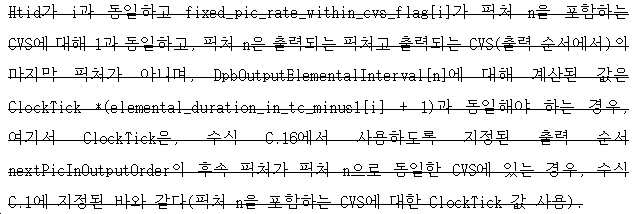
픽처의 그룹(Group Of Pictures)(GOP) 크기와 DPB 파라미터 및 재배열에 관한 측면은 다음 도 12에 설명되어 있다. 픽처(26) 아래의 제1 숫자는 디코딩 시간에 해당하고 제2 숫자는 출력 시간에 해당한다(즉, 픽처 아래의 숫자는 "디코딩 시간 - 출력 시간"으로 지정됨). GOP 크기에 따라 출력 시간과 디코딩 시간의 차이가 달라지는 것을 알 수 있다. 이것은 DPB 파라미터의 일부이거나 비트스트림에 추가된 일부 재배열 정보일 수 있다. 예를 들어 GOP 4의 경우 값은 2이고 GOP 8의 경우 값은 3이다.Aspects of Group Of Pictures (GOP) size and DPB parameters and rearrangement are described in FIG. 12 below. The first number under the
따라서, 이 하위 측면의 실시예에 따르면, 비디오 데이터 스트림(14)은 코딩된 비디오 시퀀스의 연결이고, 인코더(10)는, 비디오 데이터 스트림(14)의 각각의 코딩된 비디오 시퀀스(20)에 대해, 픽처 출력이 각각의 코딩된 비디오 시퀀스(20) 내의 고정된 픽처 속도를 수반하는지 여부를 나타내는 고정된 픽처 속도 플래그(fixed picture rate flag)(예를 들어 fixed_pic_rate_within_cvs_flag)를 포함하는 파라미터 세트, 및 고정-픽처 속도 플래그가 픽처 출력이 각각의 코딩된 비디오 시퀀스 내의 고정-픽처 속도를 포함함을 나타내면, 엘리멘탈 출력 픽처 듀레이션 신택스 요소(예를 들어, elemental_duration_in_tc_minus1[i])를 인코딩하도록 구성된다. 이 실시예에 따르면, 인코더(10)는 제1 코딩된 비디오 시퀀스로부터 제2 코딩된 비디오 시퀀스로의 전이에 적용하기 위해 픽처 속도 연속성이 검출 가능한 하나 이상의 연속성 검출 가능성 신택스 요소를 통해 데이터 스트림(14)에서 시그널링하도록 구성되고, 다음 사항이 모두 적용되는 경우: Thus, according to an embodiment of this sub-aspect, the
- 제1 및 제2 코딩된 비디오 시퀀스의 고정된 픽처 속도 플래그는 제1 및 제2 코딩된 비디오 시퀀스에서 고정된 픽처 속도를 수반하는 것으로서 출력 계층 세트에 대한 픽처 출력을 나타내고,- The fixed picture rate flags of the first and second coded video sequences indicate the picture output for the output layer set as carrying the fixed picture rate in the first and second coded video sequences;
- 제1 및 제2 코딩된 비디오 시퀀스에 대한 엘리멘탈 출력 픽처 듀레이션 신택스 요소는 동일하고,- Elemental output picture duration syntax elements for the first and second coded video sequences are the same;
- 조건 세트 중 하나 이상의 조건이 적용되며, 여기서 조건 세트는 다음 중 하나 이상을 포함한다: - One or more of the set of conditions apply, where the set of conditions includes one or more of the following:
· 제1 및 제2 코딩된 비디오 시퀀스는 GOP 크기가 일치하고,· the first and second coded video sequences match in GOP size;
· 제1 및 제2 코딩된 비디오 시퀀스는 디코딩 순서에서 다른 출력 픽처를 선행하고 출력 순서에서 후자를 따를 수 있는 출력 픽처의 최대 허용 수를 나타내는 재배열 신택스 요소(예를 들어, max_num_reorder_pics)에서 일치하고,· The first and second coded video sequences match in a reordering syntax element (e.g., max_num_reorder_pics) indicating the maximum allowed number of output pictures that may precede other output pictures in decoding order and follow the latter in output order,
· 제1 및 제2 코딩된 비디오 시퀀스는 DPB 파라미터에서 일치하고(예를 들어, DPB 픽처 제거 시간 표시).· The first and second coded video sequences match in DPB parameters (eg DPB picture removal time indication).
· 제2 코딩된 비디오 시퀀스는 RASL 픽처와 연관된 IRAP로 시작하지 않고(예를 들어, CRA로 시작하지 않음).· The second coded video sequence does not start with an IRAP associated with a RASL picture (eg, does not start with a CRA).
·
제1 및 제2 코딩된 비디오 시퀀스는 비디오 데이터 스트림에서 시그널링된 출력 지연 신택스 요소에서 일치하며, 이는 제1 및 제2 코딩된 비디오 시퀀스의 제1 액세스 유닛의 출력 지연을 나타내는 것(예를 들어, CVS 1의 제1 AU 및 CVS 2의 제1 AU는 그들의 디코딩 시간과 관련된 동일한 출력 지연을 갖는다. 예를 들어 픽처 시간에서 둘 다 출력할 디코딩에서 3개의 픽처 시간 지연을 나타내는 신택스 요소 =3을 가짐), ·
The first and second coded video sequences coincide in an output delay syntax element signaled in the video data stream, which indicates the output delay of the first access unit of the first and second coded video sequences (e.g., The 1st AU of
· 제2 코딩된 비디오 시퀀스의 제1 AU는 비-출력 픽처가 아니고, · The first AU of the second coded video sequence is not a non-output picture,
· 제2 코딩된 비디오 시퀀스의 제1 AU는 제1 코딩된 비디오 시퀀스의 이전 픽처가 출력되지 않는다는 것을 나타내지 않는다.· The first AU of the second coded video sequence does not indicate that the previous picture of the first coded video sequence is not output.
출력되지 않는 픽처에 관한 문제는 이 문서의 섹션 2.6에 자세히 설명되어 있다. RASL 픽처와 연관된 측면은 CVS의 제1 AU와 연관될 때 이러한 RASL 픽처가 출력되지 않으므로 출력되지 않는 픽처로 볼 수 있기 때문에 출력되지 않는 픽처와 연관된다.The issue of non-printing pictures is detailed in Section 2.6 of this document. The aspect associated with the RASL picture is associated with a picture that is not output because such a RASL picture is not output when associated with the first AU of the CVS and therefore can be viewed as a picture that is not output.
2.5 출력 시간 유도(예를 들어, PT SEI 메시지가 없거나 사용되지 않음)2.5 Output time derivation (eg no PT SEI message or no use)
이 하위 측면에 따른 실시예는 위에 나열된 다섯 번째 문제를 해결할 수 있다.Embodiments according to this sub-aspect can solve the fifth problem listed above.
하위 측면 2.5의 제1 실시예에 따르면, 디코더(50)는, 다중계층 비디오 데이터 스트림의 미리 결정된 코딩된 비디오 시퀀스에 대해, 픽처 출력이 미리 결정된 코딩된 비디오 시퀀스 내에서 고정-픽처 속도를 포함하는지 여부를 나타내는 고정-픽처 속도 플래그, 및, 고정-픽처 속도 플래그가 픽처 출력이 미리 결정된 코딩된 비디오 시퀀스 내의 고정-픽처 속도를 포함함을 나타내는 경우, 엘리멘탈 출력 픽처 듀레이션 신택스 요소를 포함하는 파라미터 세트를 디코딩하도록 구성된다. 이 실시예에 따르면, 디코더(50)는, 엘리멘탈 출력 픽처 듀레이션 신택스 요소에 의해 결정되는 제1 인자(factor) 및 디코딩 순서에서 OLS의 모든 픽처에 선행하고 출력 순서에서 해당 픽처를 따를 수 있는 출력 픽처 세트의 최대 허용 픽처 수를 나타내는 DPB 파라미터의 재배열 신택스 요소를 사용하여 결정된 제2 인자를 갖는, 곱에 기초하여 미리 결정된 코딩된 비디오 시퀀스에 대한 출력 지연(제1 픽처의 픽처 출력 시간)을 결정하도록 구성된다. 대안적으로, 디코더(50)는, 엘리멘탈 출력 픽처 듀레이션 신택스 요소에 의해 결정되는 제1 인자 및 비디오 데이터 스트림의 지연 신택스 요소에 의해 표시되는 제2 인자를 갖는, 곱에 기초하여 미리 결정된 코딩된 비디오 시퀀스에 대한 출력 지연(제1 픽처의 픽처 출력 시간)을 결정하도록 구성된다. According to the first embodiment of sub-aspect 2.5, the
제1 실시예에 따르면, 다중-계층 비디오 데이터 스트림의 미리 결정된 코딩된 비디오 시퀀스에 대해, 인코더(10)는 파라미터 세트(예를 들어, HRD 및 타이밍 정보를 갖는 VPS 파라미터 세트 또는 SPS 파라미터 세트)를, 픽처 출력이 미리 결정된 코딩된 비디오 시퀀스 내의 고정-픽처 속도를 포함하는지 여부를 표시하는, 고정-픽처 속도 플래그, 예를 들어 fixed_pic_rate_within_cvs_flag, 및, 고정-픽처 속도 플래그가 픽처 출력이 미리 결정된 코딩된 비디오 시퀀스 내의 고정-픽처 속도를 포함함을 나타내는 경우, 엘리멘탈 출력 픽처 듀레이션 신택스 요소, 예를 들어 elemental_duration_in_tc_minus1를 포함하는 비디오 데이터 스트림(14)으로 인코딩하도록 구성된다. 이 실시예에 따르면, 인코더(10)는 하나 이상의 출력 지연 계산가능 신택스 요소(예를 들어, 현재 PT/BP-?? SEI가 요구되지 않거나 비디오 데이터 스트림에 포함되지 않음을 나타내는 것들)를 미리 결정된 코딩된 비디오 시퀀스에 대한 출력 지연(제1 픽처의 픽처 출력 시간)은, 엘리멘탈 출력 픽처 듀레이션 신택스 요소에 의해 결정되는 제1 인자 및 디코딩 순서에서 OLS의 임의의 픽처에 선행하고 출력 순서에서 해당 픽처를 따를 수 있는 출력 픽처 세트의 픽처의 최대 허용 수를 나타내는 DPB 파라미터의 재배열 신택스 요소를 사용하여 결정된 제2 인자를 갖는, 곱을 기반으로 계산 가능한 데이터 스트림에서 시그널링되도록 구성된다. 이 실시예에 따르면, 인코더(10)는 하나 이상의 출력 지연 계산가능 신택스 요소(예를 들어, 현재 PT/BP-?? SEI가 요구되지 않거나 비디오 데이터 스트림에 포함되지 않음을 나타내는 것들)를 미리 결정된 코딩된 비디오 시퀀스에 대한 출력 지연(제1 픽처의 픽처 출력 시간)은, 엘리멘탈 출력 픽처 듀레이션 신택스 요소에 의해 결정되는 제1 인자 및 비디오 데이터 스트림(14)에서 지연 신택스 요소에 의해 표시되는 제2 인자를 갖는, 곱을 기반으로 계산 가능한 데이터 스트림에서 시그널링되도록 구성된다. According to a first embodiment, for a predetermined coded video sequence of a multi-layer video data stream, the
다시 말해, 하위 측면 2.5에 따른 제1 실시예는 타이밍 정보가 PT SEI 및 BP SEI 없이 유도될 수 있고 DPB 파라미터 또는 추가 파라미터에 의존하는 제1 AU(예를 들어, CVS(20)의 제1 AU)에 대한 outputTime을 유도할 수 있음을 비트스트림에서 표시하는 것으로 구성된다. 버퍼링 기간(Buffering Period)(BP) SEI 메시지와 픽처 타이밍(Picture Timing)(PT) SEI 메시지에는 CPB에서 AU를 제거할 때와 DPB에서 AU를 출력할 때 등의 타이밍 정보가 포함되어 있음에 유의하라. AU를 디코딩할 때(CPB에서 제거) 및 출력할 때(DPB에서)를 유도하는 데 사용할 수 있는 몇 가지 값(예를 들어, 비트스트림에 존재하는 서로 다른 최고 시간적 ID에 대한 값)이 있다. 출력 시간(output time)은 아래에 설명된 일부 조건에서 이러한 SEI 메시지의 도움 없이 유도될 수 있다. 출력 시간은 다음 두 옵션 중 하나로 유도될 수 있다: In other words, a first embodiment according to sub-aspect 2.5 provides that the timing information can be derived without the PT SEI and the BP SEI and the first AU dependent on the DPB parameters or additional parameters (eg the first AU of the CVS 20). ), which consists in indicating in the bitstream that the outputTime for . Note that the Buffering Period (BP) SEI message and the Picture Timing (PT) SEI message include timing information such as when removing an AU from the CPB and outputting an AU from the DPB. . There are several values (e.g. values for different highest temporal IDs present in the bitstream) that can be used to derive an AU when decoding (removing it from the CPB) and when outputting it (from the DPB). The output time can be derived without the help of these SEI messages under some conditions described below. The output time can be derived from one of two options:
- DPB 파라미터가 사용되는 경우, 출력 시간의 값은 ClockTick * ( elemental_duration_in_tc_minus1[ i ] + 1 ) * NumPics로 유도되고, 여기서 NumPics는 DPB 파라미터(max_num_reorder_pics) 또는 디코딩 순서에서 OLS의 모든 픽처를 선행하고 출력 순서에서 해당 픽처를 따를 수 있는 OLS의 최대 허용 픽처 수 + max_num_reorder_pics[ i ]는 Htid가 i와 동일할 때 디코딩 순서에서 OLS의 임의의 픽처에 선행하고 출력 순서에서 해당 픽처를 따를 수 있는 OLS의 최대 허용 픽처 수이다.- If the DPB parameter is used, the value of the output time is derived as ClockTick * ( elemental_duration_in_tc_minus1[ i ] + 1 ) * NumPics, where NumPics precedes the DPB parameter (max_num_reorder_pics) or all pictures in the OLS in decoding order and in output order. The maximum allowed number of pictures in OLS that can follow that picture + max_num_reorder_pics[ i ] is the maximum allowed picture in OLS that can precede any picture in OLS in decoding order and follow that picture in output order when Htid is equal to i. It is a number.
- 추가 시그널링은 주어진 픽처 NumPics 수를 나타내는 고정된 픽처 속도와 관련된 VPS 또는 SPS에 추가되며 이 신택스는 ClockTick * ( elemental_duration_in_tc_minus1[ i ] + 1 ) * NumPics로 유도되는 출력 시간의 값을 계산하는 데 사용된다.- Additional signaling is added to the VPS or SPS associated with a fixed picture rate representing a given number of pictures NumPics and this syntax is used to calculate the value of the output time derived from ClockTick * ( elemental_duration_in_tc_minus1[ i ] + 1 ) * NumPics.
도 13은 하위 측면 2.5의 제2 실시예에 따른 인코더(10), 비디오 비트스트림(14) 및 디코더(50)의 예를 도시한다. 인코더(10), 비디오 비트스트림(14) 및 디코더(50)는 선택적으로 도 1에 따른 인코더(10), 비디오 비트스트림(14) 및 디코더(50)에 대응할 수 있다. 또한, 이 하위 측면에 따른 실시예는 하위 측면 2.3, 예를 들어 도 11과 관련하여 설명된 특징 및 세부 사항을 선택적으로 포함할 수 있다.Figure 13 shows an example of an
도 13의 실시예에 따르면, 인코더(10)는 미리 결정된 코딩된 비디오 시퀀스(20)에 대한 파라미터 세트(parameter set)(93)를 비디오 비트스트림(14)으로 인코딩한다. 즉, 파라미터 세트(93)는 비디오 비트스트림(video bitstream)(14)의 하나 이상의 코딩된 비디오 시퀀스(20) 중 하나와 관련되어 있다. 파라미터 세트(93)는 예를 들어 여기에 설명된 fixed_pic_rate_within_CVS_flag에 대응할 수 있는 고정된 픽처 속도 플래그(fixed picture rate flag)(94)를 포함한다. 고정된 픽처 속도 플래그(94)는 픽처 출력이 미리 결정된 코딩된 비디오 시퀀스(20) 내의 고정된 픽처 속도를 수반하는지 여부를 나타낸다. 고정된 픽처 속도 플래그(93)가 픽처 출력이 미리 결정된 코딩된 비디오 시퀀스(20) 내의 고정된 픽처 속도를 수반함을 나타내면, 파라미터 세트(93)는 예를 들어 여기에 설명된 elemental_duration_in_tc_minus1에 대응할 수 있는 엘리멘탈 출력 픽처 듀레이션 신택스 요소(elemental output picture duration syntax element)(96)를 더 포함한다. 예를 들어, 엘리멘탈 출력 픽처 듀레이션 신택스 요소(96)는 픽처 출력 간격의 듀레이션, 예를 들어 단일 픽처에 대한 픽처 출력 간격(duration of picture output interval)(63)의 듀레이션을 나타낼 수 있다.According to the embodiment of FIG. 13 , the
예를 들어, 도 13에 도시된 바와 같이, 비디오 비트스트림(14)의 각각의 액세스 유닛(22)은 엘리멘탈 픽처 출력 시간(elemental picture output time)(36)과 연관될 수 있다. 엘리멘탈 출력 픽처 시간(36)은 각각의 액세스 유닛(22)의 픽처가 디코더(50)에 의해 출력되는 시간 인스턴스, 예를 들어 디코더(50)가 각각의 액세스 유닛(즉, 그 픽처)을 출력 버퍼에 제공하는 시간 인스턴스를 나타낼 수 있다. 액세스 유닛 출력 간격(access unit output interval)(37)은 연속 액세스 유닛의 엘리멘탈 픽처 출력 시간(36) 사이의 시간 간격을 나타낼 수 있고, 예를 들어 도 8 및 도 10과 관련하여 설명된 액세스 유닛 출력 간격(61)에 대응할 수 있다. For example, as shown in FIG. 13 , each
도 13의 실시예에 따르면, 인코더(10)는 하나 이상의 신택스 요소(66)를 비디오 비트스트림(14)으로 인코딩하고, 디코더(50)는, 하나 이상의 신택스 요소(66)가 제1 상태를 갖는 경우, 하나 이상의 신택스 요소(66)가 참조하는 코딩된 비디오 시퀀스(20)의 액세스 유닛이 제1 상태를 가지며, 액세스 유닛의 픽처는 곱셈 출력 대상이 아님을 유추할 수 있다 (예를 들어, pt_display_elemental_periods_minus1을 0으로 유추하거나 elementalOutputs를 1로 유추). 결과적으로, 디코더(50)는, 예를 들어 액세스 유닛 출력 간격(37, 61)을 엘리멘탈 출력 픽처 듀레이션 신택스 요소(96)에 의해 표시된 픽처 출력 간격의 값과 동일하게 설정함으로써 엘리멘탈 출력 픽처 듀레이션 신택스 요소(96)를 사용하여 엘리멘탈 출력 픽처 시간(36)을 유도할 수 있다. 결과적으로, 디코더(50)는 반복 횟수에 대한 표시가 없을 때, 예를 들어 비디오 비트스트림(14)에서 결과적으로 생략될 수 있는 PT SEI가 없을 때, 엘리멘탈 출력 픽처 시간(36)을 결정할 수 있다.According to the embodiment of FIG. 13 , the
예를 들어, 디코더(50)는, 일반적으로, 각각의 액세스 유닛의 픽처의 반복 횟수 및 엘리멘탈 출력 픽처 듀레이션 신택스 요소(96)에 의해 표시되는, 예를 들어, 픽처 출력 곱셈 신택스 요소 또는 추가 픽처 출력 곱셈 신택스 요소(섹션 2.3 참조)에 의해 표시되는 바와 같은, 엘리멘탈 출력 픽처 듀레이션에 기초하여 엘리멘탈 픽처 출력 시간(36)을 유도할 수 있다. 이를 위해, 디코더(50)는 픽처 출력 간격, 예를 들어 변수 DpbOutputElementalInterval로 표현되는 픽처 출력 간격(63)의 듀레이션을 elemental_duration_in_tc_minus1에 의해 표시된 값과 동일하게 설정할 수 있고(여기서 표시된 값은 비트스트림에 실제로 기록된 값에 1을 더한 값에 해당할 수 있고, 예를 들어 신택스 요소 ClockTick에 의해, 비디오 비트스트림(14)에서 선택적으로 시그널링될 수 있는 클록 틱 듀레이션 시간에 의해, 예를 들어 DpbOutputElementalInterval= ClockTick *(elemental_duration_in_tc_minus1 + 1)와 같이, 선택적으로 스케일링될 수 있음.) 및 DpbOutputElementalInterval 및 각 픽처의 반복 횟수를 사용하여 변수 DpbOutputInterval(예를 들어, 액세스 유닛 출력 간격(61)의 지속 시간)을 유도하며(예를 들어, 섹션 2의 서론 부분에 주어진 elemental_duration_in_tc_minus1의 정의에서 수식 (113), 여기서 변수 elementalOutputs는 반복 횟수를 나타냄), 신택스 요소(66)가 제1 상태를 갖는 경우 1로 유추된다. 결과적으로, 하나 이상의 신택스 요소(66)가 제1 상태를 갖는 경우에, 디코더(50)는 액세스 유닛 출력 간격(37(또는 61))의 듀레이션, 예를 들어 DpbOutputInterval을 elemental_duration_in_tc_minus1에 의해 표시된 값과 동일하게 설정할 수 있다(예를 들어, 1을 더하거나 클록 틱 듀레이션 시간을 곱하여 실제 값에서 유도된 값, 예를 들어, DpbOutputInterval= ClockTick *(elemental_duration_in_tc_minus1 + 1)임). 달리 말하면, 하나 이상의 신택스 요소(66)가 제1 상태를 갖는 이 경우에, 디코더(50)는 엘리멘탈 픽처 듀레이션 신택스 요소(96)를 액세스 유닛 출력 간격(37, 61)의 듀레이션을 참조하는 것으로 해석할 수 있다.For example, the
예를 들어, 고정된 픽처 속도 플래그(94) 및 선택적으로 엘리멘탈 출력 픽처 듀레이션 신택스 요소(96)를 포함하는 파라미터 세트(93)는 코딩된 비디오 시퀀스(20)에 전체적으로 관련될 수 있는 시퀀스 파라미터 세트(SPS)일 수 있고, SPS는 HRD 및 타이밍 정보를 포함한다. 대안적으로, 파라미터 세트(93)는 비디오 비트스트림(14)에 전체적으로 관련될 수 있는 비디오 파라미터 세트(VPS)일 수 있다.For example, the parameter set 93 comprising the fixed
도 13의 실시예에 따르면, 인코더(10)는 하나 이상의 신택스 요소(66)를 비디오 비트스트림(14)으로 인코딩한다. 인코더(10)는, 하나 이상의 신택스 요소(66)가 제1 상태를 갖는 경우, 코딩된 비디오 시퀀스(20)(또는 비디오 비트스트림(14))의 각각의 액세스 유닛(22)에 대해, 각각의 액세스 유닛(22)이 곱셈 출력을 받지 않는 것으로 유추되는 방식으로 비디오 비트스트림(14)을 인코딩한다. 예를 들어, 섹션 2의 서론 부분 및 섹션 2.3과 관련하여 설명된 가변 엘리멘탈 출력 기간은 하나로 유추될 수 있다. 따라서, 코딩된 비디오 시퀀스(20)에 대한 엘리멘탈 픽처 출력 시간(36)은 엘리멘탈 출력 픽처 듀레이션 신택스 요소에 기초하여 결정 가능하다. According to the embodiment of FIG. 13 ,
즉, 예를 들어, 하나 이상의 신택스 요소(66)가 제1 상태를 갖는 경우, 디코더(50)는 액세스 유닛(22)이 곱셈 출력 대상이 아니라고 유추할 수 있고, 결과적으로, 미리 정해진 액세스 유닛의 선행 액세스 유닛의 엘리멘탈 픽처 출력 시간(36)에 엘리멘탈 출력 픽처 듀레이션 신택스 요소(96)에 의해 시그널링되는 엘리멘탈 출력 픽처 듀레이션을 더함으로써 미리 정해진 액세스 유닛의 엘리멘탈 픽처 출력 시간을 결정할 수 있다.That is, for example, if one or
예를 들어, 하나 이상의 신택스 요소(66)가 제1 상태를 갖는 경우, 인코더(10)는 임의의 픽처 출력 곱셈 신택스 요소, 예를 들어 PT 곱셈 표시자(74)(또는 pt_display_elemental_periods_minus1)를 제공하는 경우, 그것이 단일 픽처 출력, 즉 다중 픽처 출력이 없음을 시그널링하도록 픽처 출력 곱셈 신택스 요소를 제공할 수 있다. 따라서, 디코더(50)는 하나 이상의 신택스 요소(66)가 제1 상태를 갖는 경우에 픽처 출력 곱셈 신택스 요소가 곱셈되지 않은 출력, 즉 단일 출력을 나타낸다고 유추할 수 있다.For example, if one or
실시예에 따르면, 하나 이상의 신택스 요소(66)는 비디오 비트스트림(14)의 비트스트림 부분을 참조하는 HRD 파라미터(또는 비트스트림 적합성 파라미터), 예를 들어, general_nal_hrd_params_present_flag=0이고, 및 비디오 비트스트림(14), 예를 들어, general_vcl_hrd_params_present_flag=0의 코딩된 계층을 참조하는 HRD 파라미터(또는 비트스트림 적합성 파라미터)를 포함하는(또는 포함하지 않는) 비디오 비트스트림(14) 중 하나 이상을 나타낸다. According to an embodiment, one or
실시예에 따르면, 하나 이상의 신택스 요소(66)는 제1 신택스 요소 및 제2 신택스 요소 중 하나 이상을 포함할 수 있으며,각각은 코딩된 픽처 버퍼(CPB) 및 가상 레퍼런스 디코더의 각각의 동작 모드에 대한, 예를 들어, NAL 동작(예를 들어, SEI NAL 유닛 및 VCL 데이터 상단의 헤더를 포함할 수 있는 동작 모드) 및 VCL 동작(예를 들어, 코딩된 비디오 데이터를 배타적으로 고려할 수 있는 동작 모드, 예를 들어 VCL NAL 유닛)에 대한, 비트레이트 파라미터를 포함하지 않는(또는 포함하는) 비디오 비트스트림(14)을 나타낸다. 예를 들어, 하나 이상의 신택스 요소(66)는 general_nal_hrd_params_present_flag 및 general_vcl_hrd_params_present_flag 중 하나 또는 모두를 포함할 수 있다.According to an embodiment, the one or
예를 들어, 제1 상태는 하나 이상의 신택스 요소가 비디오 비트스트림(14)이 코딩된 코딩된 픽처 버퍼(CPB) 및 비트레이트 파라미터, 가상 레퍼런스 디코더의 NAL 동작 모드 및 VCL 동작 모드, 예를 들어 general_nal_hrd_params_present_flag =0 및 general_vcl_hrd_params_present_flag=0, 모두를 포함하지 않는다는 것을 표시하는 상태일 수 있다.For example, the first state may include the coded picture buffer (CPB) and bitrate parameters in which the
예를 들어, 하나 이상의 신택스 요소(66)는 비디오 비트스트림(14)의 하나 이상의 파라미터 세트로 인코딩될 수 있다.For example, one or
도 13의 실시예의 예에 따르면, 하나 이상의 신택스 요소(66)가 제2 상태를 갖는 경우, 예를 들어 하나 이상의 신택스 요소(66)가 비디오 비트스트림(14)이 위에서 언급한 하나 이상의 파라미터를 포함함을 나타내는 것을 나타내는 경우, 인코더(10)는, 비디오 비트스트림(14) 또는 코딩된 비디오 시퀀스(20)의 각각의 액세스 유닛(22)에 대해, 픽처 출력 곱셈 신택스 요소, 예를 들어, 도 11에 대해 설명된 바와 같은 픽처 출력 곱셈 신택스 요소(74)를, 예를 들어, 도 11에 대해 설명된 바와 같이, 비디오 비트스트림(14)의 PT SEI 메시지(73)로 인코딩할 수 있다. 도 11과 관련하여 설명된 바와 같이, 픽처 출력 곱셈 신택스 요소(74)는 각각의 액세스 유닛(22), 즉 PT SEI 메시지(73)가 참조하는 액세스 유닛이 곱셈 출력을 받는지 및, 그렇다면, 각각의 액세스 유닛(22)으로부터 얼마나 많은 순차 출력 픽처가 생성될 것인지 여부에 대한 정보를 드러낼 수 있다. 이 예에 따르면, 엘리멘탈 픽처 출력 시간(36)은 엘리멘탈 출력 픽처 듀레이션 신택스 요소(96) 및 픽처 출력 곱셈 신택스 요소에 기초하여 결정 가능하다. 예를 들어, 디코더(50)는 하나 이상의 신택스 요소(66)가 제2 상태를 갖는 경우 각각의 액세스 유닛에 대한 픽처 출력 곱셈 신택스 요소를 디코딩할 수 있고 엘리멘탈 출력 픽처 듀레이션 신택스 요소(96) 및 픽처 출력 곱셈 신택스 요소에 기초하여 코딩된 비디오 시퀀스(20)의 액세스 유닛에 대한 요소 픽처 출력 시간(36)을 결정할 수 있다. 예를 들어, 디코더(50)는, 예를 들어 위에서 언급한 변수 elementalOutputs 및 수식(113)을 사용하여, 제1 신택스 요소가 제1 경우를 갖지만 반복을 1로 유추하지 않는 경우에 대해 위에서 설명한바와 같이, 각각의 액세스 유닛(22)에 대해, 엘리멘탈 출력 픽처 듀레이션 신택스 요소에 의해 표시된 출력 듀레이션에 픽처 출력 곱셈 신택스 요소에 의해 표시된 반복 횟수를 곱할 수 있다. According to the example of the embodiment of FIG. 13 , when one or
즉, 추가 실시예, 예를 들어 도 13의 실시예에서, 비트스트림에 표시가 있는, 예를 들어 VPS 또는 SPS에서, 비트스트림에 PT SEI 및 BP SEI가 없고 및/또는 필요하지 않은 경우, 또한 프레임 필드 SEI 메시지가 존재하지 않거나 필요하지 않다는 정보가 있으며, 그런 다음 반복을 포함하거나 고려할 필요가 없으며, 즉, 디코더는 elementalOutputPeriods를 1로 유도할 수 있다. 이는 타이밍이 PT SEI 메시지 및 BP SEI 메시지 없이 또는 대안적으로 비트스트림 제약으로 유도될 수 있음을 나타내는 언급된 신택스 요소로 수행될 수 있다. 이 경우, PT SEI 메시지가 존재하지 않거나 신택스 요소가 존재하지 않을 때, pt_display_elemental_periods_minus1은 0으로 유추될 수 있다. That is, in a further embodiment, for example the embodiment of FIG. 13 , if there is an indication in the bitstream, for example in VPS or SPS, there is no PT SEI and BP SEI in the bitstream and/or is not required, also There is information that the frame field SEI message does not exist or is not needed, then it does not need to include or consider repetitions, i.e. the decoder can derive elementalOutputPeriods to 1. This can be done with the mentioned syntax element indicating that the timing can be derived without the PT SEI message and the BP SEI message or alternatively with bitstream constraints. In this case, when a PT SEI message does not exist or a syntax element does not exist, pt_display_elemental_periods_minus1 can be inferred to be 0.
no_timing_infomation_sei_message_needed_flag로 비트스트림 제약이 추가되거나 예를 들어 CPB 및 NAL 또는 VCL 동작에 대한 비트레이트 파라미터의 존재를 나타내는 general_nal_hrd_params_present_flag 및 general_vcl_hrd_params_present_flag가 둘 다 0인 경우에 대해 설명된 동작을 조건화한다. 후자의 경우, PT SEI 메시지 또는 BP SEI 메시지가 존재할 필요가 없으며 그들 없이 동작이, elementalOutputPeriods를 1로 유도하고 elemental_duration_in_tc_minus1[ I ]를 출력 시간을 유도하기 위한 출력 픽처 속도로 사용에 의해, 간단히 수행될 수 있다.Conditions the described operation for the case where a bitstream constraint is added with no_timing_infomation_sei_message_needed_flag or both general_nal_hrd_params_present_flag and general_vcl_hrd_params_present_flag are 0 indicating the presence of bitrate parameters for CPB and NAL or VCL operations, for example. In the latter case, the PT SEI message or BP SEI message need not be present and operation without them can be performed simply by deriving elementalOutputPeriods to 1 and using elemental_duration_in_tc_minus1[ I ] as the output picture rate to derive the output time. there is.
따라서, 하위 측면(2.5)은 PT SEI 메시지가 존재하지 않고 엘리멘탈 픽처 출력 시간(36)을 결정하기 위한 개념을 제공한다. 결과적으로, PT SEI 메시지는 반드시 비디오 비트스트림(14)으로 인코딩될 필요가 없으며, 따라서 비디오 비트스트림(14)에서 시그널링 오버헤드를 피한다.Thus, sub-aspect 2.5 provides a concept for determining the elemental
2.6 출력되지 않는 픽처 처리 및 일정한 출력 프레임 속도에 미치는 영향 2.6 Handling non-output pictures and how they affect constant output frame rates
위에서 설명한 것처럼 일부 픽처가 출력되지 않으면 PT SEI 메시지에 없거나 PT SEI 메시지가 무시될 때 출력 시간을 유도하는 것이 복잡할 수 있다.As described above, deriving the output time can be complicated if some pictures are not output, are not in the PT SEI message or when the PT SEI message is ignored.
PT SEI 메시지가 있을 때 noOuttut 픽처에는 관련 출력 시간이 있지만 픽처가 출력되지 않으므로 이러한 출력 시간은 무시된다. 출력 시간 슬롯을 "점유"하는 것으로 비트스트림에서 디코딩되는 그러한 픽처를 카운트하면 아래 픽처 14에 표시된 것처럼 실제로 출력되는 두 출력 픽처 사이의 거리가 더 이상 등거리가 되지 않게 된다. 예를 들어, 도 14의 예에서, 픽처(26*은 예를 들어 계층 제휴에 의해 noOutput 픽처로 표시된다. 즉, 도 8은 출력 픽처가 없는 경우의 등거리 픽처의 예를 나타내고 있다. When there is a PT SEI message, the noOuttut picture has an associated output time, but since the picture is not output, these output times are ignored. Counting those pictures that are decoded from the bitstream as "occupying" the output time slots results in the distance between the two output pictures being actually output no longer equidistant, as shown in Figure 14 below. For example, in the example of Fig. 14, the
이 하위 측면의 제1 실시예에 따르면, 디코더(50)는, 비디오 데이터 스트림에 대한 픽처 출력이 고정된 픽처 속도를 포함하는 지 여부를 나타내는, 고정-픽처 속도 플래그, 예를 들어 섹션 2.5에서와 같은 것 및 고정-픽처 속도 플래그가 픽처 출력이 고정 픽처 속도를 포함함을 나타내면, 엘리멘탈 출력 픽처 듀레이션 신택스 요소를 포함하는 파라미터 세트를 디코딩하도록 구성된다. 이 실시예에 따르면, 디코더(50)는 비디오 데이터 스트림(14)으로부터 각각의 픽처가 디스플레이되는지 여부를 나타내는 픽처 출력 플래그를 각각의 픽처에 대해 디코딩한다. 이 실시예에 따르면, 디코더(50)는, 출력 순서에서, 출력되지 않도록 지시된 추가 픽처, 예를 들어 도 14의 픽처(26*)에 선행하는 픽처, 예를 들어 도 14의 픽처(26')가 반복 출력되는 것으로 유추한다.According to a first embodiment of this sub-aspect, the
다시 말해서, 일 실시예에서, 예를 들어 이전 단락 중 하나의 예에서, 픽처가 출력되는지 여부를 나타내는 플래그, 즉 (ph_pic_output_flag)는 출력 시간의 유도를 위해 고려되며, 즉 디코더는 디스플레이할 필요가 없는 픽처, 즉 디코더의 지속적인 출력이 없는 픽처를 수신할 준비가 되어 있다. 이러한 경우 일정한 디스플레이 속도가 달성되고 출력 순서의 이전 픽처가 반복을 통해 이를 보상해야 하는 비트스트림 제약이 있다.In other words, in one embodiment, for example in one of the previous paragraphs, a flag indicating whether a picture is output, namely (ph_pic_output_flag), is taken into account for derivation of the output time, i.e. the decoder does not need to display It is ready to receive pictures, i.e. pictures without continuous output from the decoder. In this case, there is a bitstream constraint that a constant display speed is achieved and the previous picture in the output order must compensate for it through repetition.
제2 실시예에 따르면, 인코더(10)는 고정-픽처 속도 플래그 및, 고정-픽처 속도 플래그가 픽처 출력이 고정-픽처 속도를 포함함을 나타내면, 엘리멘탈 출력 픽처 듀레이션 신택스 요소를 포함하는 파라미터 세트를 비디오 데이터 스트림(14)으로 인코딩하도록 구성된다. 이 실시예에 따르면, 인코더(10)는 비디오 데이터 스트림(14)으로 각각의 픽처가 디스플레이되는지 여부를 나타내는 픽처 출력 플래그를 각각의 픽처에 대해 인코딩하도록 구성된다. 이 실시예에 따르면, 고정-픽처 속도 플래그가 비디오 데이터 스트림(14)에 대한 픽처 출력이 고정-픽처 속도를 포함함을 나타내는 경우, 인코더(10)는 각각의 픽처가 디스플레이될 것임을 나타내는 것으로 각 픽처에 대한 픽처 출력 플래그를 설정한다. 대안적으로 또는 부가적으로, 고정-픽처 속도 플래그가 비디오 데이터 스트림(14)에 대한 픽처 출력이 고정-픽처 속도를 포함함을 나타내는 경우, 인코더(10)는 비디오 데이터 스트림(14)의 코딩된 비디오 시퀀스의 제1 픽처가 아닌 각각의 픽처에 대한 픽처 출력 플래그를 각각의 픽처가 표시될 것임을 나타내는 것으로 설정한다. 대안적으로 또는 부가적으로, 고정-픽처 속도 플래그가 비디오 데이터 스트림(14)에 대한 픽처 출력이 고정-픽처 속도를 포함함을 나타내는 경우, 인코더(10)는 비디오 데이터 스트림(14)의 코딩된 비디오 시퀀스의 제1 픽처가 아닌 또는 비디오 데이터 스트림(14)의 코딩된 비디오 시퀀스 내에 있고 각각의 픽처가 디스플레이될 것임을 나타내는, 다른 무출력 픽처에 선행되지 않는 각 픽처에 대해 픽처 출력 플래그를 설정한다. 따라서, 예를 들어 인코더(10)는 비디오 비트스트림(14)을 제공하여 디코더가 출력 순서에서 출력되지 않도록 표시된 추가 픽처에 선행하는 픽처가 반복 출력될 것임을 유추할 수 있게 한다.According to the second embodiment, the
예에서, 인코더(10)는 각각의 픽처에 대한 픽처 출력 플래그가 각각의 픽처가 디스플레이되는 것을 나타내는 것으로 설정되는지 여부를 나타내는 플래그를 비디오 데이터 스트림(14)으로 인코딩하도록 구성된다. 대안적으로 또는 부가적으로, 플래그는 비디오 데이터 스트림(14)의 코딩된 비디오 시퀀스의 제1 픽처가 아닌 각 픽처에 대한 픽처 출력 플래그가 각각의 픽처가 디스플레이될 것임을 나타내는 것으로 설정되는지 여부를 나타낸다. 대안적으로 또는 추가적으로, 플래그는, 비디오 데이터 스트림(14)의 코딩된 비디오 시퀀스의 제1 픽처가 아닌 또는 비디오 데이터 스트림(14)의 코딩된 비디오 시퀀스 내에 있고 다른 무출력 픽처에 선행되지 않는 각 픽처에 대해 각각의 픽처가 디스플레이될 것임을 나타내는 것으로 설정되는지 여부를 나타낸다.In the example,
예들에서, 인코더(10)는 고정-픽처 속도 플래그가 비디오 데이터 스트림(14)에 대한 픽처 출력이 고정-픽처 속도를 수반함을 나타내는 경우에 플래그를 설정하도록 구성된다.In examples,
다시 말해서, 다른 실시예에서, 예를 들어 제2 실시예의 예에서, 비트스트림에 표시된 고정 픽처 속도가 있을 때, 비트스트림 제약은 다음을 금지한다: In other words, in another embodiment, for example in the example of the second embodiment, when there is a fixed picture rate indicated in the bitstream, the bitstream constraint prohibits:
· 비트스트림 내의 비출력 픽처, 또는 · A non-output picture within a bitstream, or
· 적어도 CVS에서 제1 AU가 아닌 비출력 픽처, 또는 · A non-output picture that is not the first AU at least in CVS, or
· CVS에 출력 픽처가 있으면 CVS에서 해당 출력 픽처 다음에 더 이상 출력되지 않는 픽처가 있을 수 없다.· If there is an output picture in CVS, there cannot be a picture that is not output anymore after that output picture in CVS.
다른 실시예에서, 출력 픽처가 고정된 픽처 속도에 적용 가능할 뿐만 아니라 더 넓은 개념으로서 제약되지 않는다는 것을 나타내는 비트스트림 제약이 추가된다. In another embodiment, a bitstream constraint is added indicating that the output picture is not only applicable to a fixed picture rate, but is not constrained as a broader concept.

1과 동일한 general_no_no_output_pics_constraint_flag 는 ph_pic_output_flag가 1과 동일해야 함을 지정한다. 0과 동일한 general_no_no_output_pics_constraint_flag는 그러한 제약을 부과하지 않는다. general_no_no_output_pics_constraint_flag equal to 1 specifies that ph_pic_output_flag must be equal to 1. general_no_no_output_pics_constraint_flag equal to 0 imposes no such constraint.
또한, 고정된 픽처 속도를 사용하는 경우 제약 플래그를 설정해야 하는 비트스트림 제약이 있다.Also, there are bitstream constraints that require setting constraint flags when using a fixed picture rate.
fixed_pic_rate_general_flag[ i ]가 임의의 i 값에 대해 1과 동일할 때 general_no_no_output_pics_constraint_flag가 1과 동일해야 한다는 것은 비트스트림 적합성의 요구 사항이다.It is a requirement of bitstream conformance that general_no_no_output_pics_constraint_flag should be equal to 1 when fixed_pic_rate_general_flag[i] is equal to 1 for any value of i.
3. 추가 실시예3. Additional Examples
이전 섹션에서 일부 측면이 장치의 맥락에서 특징으로 설명되었지만 이러한 설명은 방법의 해당 특징에 대한 설명으로도 간주될 수 있음이 분명하다. 일부 측면이 방법의 맥락에서 특징으로 설명되었지만, 이러한 설명은 장치의 기능에 관한 대응하는 특징의 설명으로도 간주될 수 있음이 분명하다.Although some aspects have been described as features in the context of a device in the previous section, it is clear that these descriptions can also be considered as descriptions of corresponding features of the method. Although some aspects have been described as features in the context of a method, it is clear that such descriptions may also be regarded as descriptions of corresponding features relating to the functioning of the device.
방법 단계들의 일부 또는 전부는, 예를 들어 마이크로프로세서, 프로그래밍 가능한 컴퓨터 또는 전자 회로와 같은 하드웨어 장치에 의해(또는 사용하여) 실행될 수 있다. 일부 실시예들에서, 가장 중요한 방법 단계들 중 하나 이상이 이러한 장치에 의해 실행될 수 있다.Some or all of the method steps may be executed by (or using) a hardware device such as, for example, a microprocessor, programmable computer, or electronic circuitry. In some embodiments, one or more of the most important method steps may be performed by such an apparatus.
본 발명의 인코딩된 이미지 신호는 디지털 저장 매체에 저장될 수 있거나 무선 전송 매체 또는 인터넷과 같은 유선 전송 매체와 같은 전송 매체를 통해 전송될 수 있다.The encoded image signal of the present invention may be stored in a digital storage medium or may be transmitted over a transmission medium such as a wireless transmission medium or a wired transmission medium such as the Internet.
특정 구현 요건들에 따라, 본 발명의 실시예들은 하드웨어 또는 소프트웨어로 또는 적어도 부분적으로 하드웨어로(at least partially in hardware) 또는 적어도 부분적으로 소프트웨어(at least partially in software )로 구현될 수 있다. 구현은 각각의 방법이 수행되도록 프로그래밍 가능한 컴퓨터 시스템과 협력하는(또는 협력할 수 있는), 예를 들어 전자적으로 판독 가능한 제어 신호들이 저장된 플로피 디스크, DVD, Blu-Ray, CD, ROM, PROM, EPROM, EEPROM 또는 FLASH 메모리와 같은 디지털 저장 매체를 사용하여 수행될 수 있다. 따라서, 디지털 저장 매체는 컴퓨터 판독 가능(computer readable)하다.Depending on specific implementation requirements, embodiments of the invention may be implemented in hardware or software or at least partially in hardware or at least partially in software. An implementation may cooperate (or may cooperate) with a programmable computer system to perform each method, e.g. a floppy disk, DVD, Blu-Ray, CD, ROM, PROM, EPROM stored with electronically readable control signals. , can be performed using a digital storage medium such as EEPROM or FLASH memory. Accordingly, the digital storage medium is computer readable.
본 발명에 따른 일부 실시예들은 본 명세서에 설명된 방법들 중 하나가 수행되도록 프로그래밍 가능한 컴퓨터 시스템과 협력할 수 있는 전자적으로 판독 가능한 제어 신호들을 갖는 데이터 캐리어(data carrier)를 포함한다.Some embodiments according to the present invention include a data carrier having electronically readable control signals capable of cooperating with a programmable computer system to perform one of the methods described herein.
일반적으로, 본 발명의 실시예들은 프로그램 코드를 갖는 컴퓨터 프로그램 제품(computer program product)으로서 구현될 수 있으며, 프로그램 코드(program code)는 컴퓨터 프로그램 제품이 컴퓨터 상에서 실행될 때 방법들 중 하나를 수행하기 위해 동작한다. 프로그램 코드는, 예를 들어 기계 판독 가능한 캐리어(machine readable carrier)에 저장될 수 있다.In general, embodiments of the invention may be implemented as a computer program product having program code for performing one of the methods when the computer program product is executed on a computer. It works. The program code may be stored, for example, in a machine readable carrier.
다른 실시예들은 기계 판독 가능한 캐리어에 저장된, 본 명세서에 설명된 방법들 중 하나를 수행하기 위한 컴퓨터 프로그램을 포함한다.Other embodiments include a computer program for performing one of the methods described herein stored on a machine-readable carrier.
즉, 본 발명의 방법의 실시예는, 따라서 컴퓨터 프로그램이 컴퓨터에서 실행될 때, 본 명세서에 설명된 방법들 중 하나를 수행하기 위한 프로그램 코드를 갖는 컴퓨터 프로그램이다.That is, an embodiment of the method of the present invention is thus a computer program having program code for performing one of the methods described herein, when the computer program is run on a computer.
따라서, 본 발명의 방법들의 추가 실시예는 본 명세서에 설명된 방법들 중 하나를 수행하기 위한 컴퓨터 프로그램을 포함하고, 컴퓨터 프로그램이 기록되어 있는 데이터 캐리어(또는 디지털 저장 매체, 또는 컴퓨터 판독 가능 매체)이다. 데이터 캐리어, 디지털 저장 매체 또는 기록 매체(recorded medium)는 일반적으로 유형(tangible) 및/또는 비일시적(non-transitory)이다.Accordingly, a further embodiment of the methods of the present invention comprises a computer program for performing one of the methods described herein, and a data carrier (or digital storage medium, or computer readable medium) having the computer program recorded thereon. am. A data carrier, digital storage medium or recorded medium is generally tangible and/or non-transitory.
따라서, 본 발명의 방법의 추가 실시예는 본 명세서에 설명된 방법들 중 하나를 수행하기 위한 컴퓨터 프로그램을 표현하는 신호들의 시퀀스 또는 데이터 스트림이다. 예를 들어, 신호들의 시퀀스 또는 데이터 스트림은 데이터 통신 연결(data communication connection), 예를 들어 인터넷을 통해 전송되도록 구성될 수 있다.Accordingly, a further embodiment of the method of the present invention is a sequence of signals or data stream representing a computer program for performing one of the methods described herein. For example, a sequence of signals or a data stream may be configured to be transmitted over a data communication connection, for example the Internet.
추가 실시예는 본 명세서에 설명된 방법들 중 하나를 수행하도록 구성되거나 개조된(adaped) 처리 수단(processing means), 예를 들어 컴퓨터, 또는 프로그래밍 가능한 논리 장치를 포함한다.Further embodiments include processing means, eg a computer, or programmable logic device configured or adapted to perform one of the methods described herein.
추가 실시예는 본 명세서에 설명된 방법들 중 하나를 수행하기 위한 컴퓨터 프로그램이 설치된 컴퓨터를 포함한다.A further embodiment includes a computer having a computer program installed thereon for performing one of the methods described herein.
본 발명에 따른 추가 실시예는 본 명세서에 설명된 방법들 중 하나를 수행하기 위한 컴퓨터 프로그램을 수신기에 (예를 들어, 전자적으로(electronically) 또는 광학적으로(optically)) 전송하도록 구성된 장치 또는 시스템을 포함한다. 수신기는, 예를 들어 컴퓨터, 모바일 장치, 메모리 장치 등일 수 있다. 장치 또는 시스템은, 예를 들어 컴퓨터 프로그램을 수신기에 전송하기 위한 파일 서버(file server)를 포함할 수 있다.A further embodiment according to the present invention is an apparatus or system configured to transmit (e.g. electronically or optically) a computer program for performing one of the methods described herein to a receiver. include The receiver may be, for example, a computer, mobile device, memory device, or the like. The device or system may include, for example, a file server for transmitting a computer program to a receiver.
일부 실시예들에서, 프로그래밍 가능한 로직 장치(예를 들어, 필드 프로그래머블 게이트 어레이(field programmable gate array))는 본 명세서에 설명된 방법들의 기능들(functionalities) 중 일부 또는 전부를 수행하는 데 사용될 수 있다. 일부 실시예들에서, 필드 프로그래머블 게이트 어레이(field programmable gate array)는 본 명세서에 설명된 방법들 중 하나를 수행하기 위해 마이크로프로세서(microprocessor)와 협력할 수 있다. 일반적으로, 방법은 임의의 하드웨어 장치에 의해 수행되는 것이 바람직하다.In some embodiments, a programmable logic device (eg, a field programmable gate array) may be used to perform some or all of the functionalities of the methods described herein. . In some embodiments, a field programmable gate array may cooperate with a microprocessor to perform one of the methods described herein. Generally, the method is preferably performed by any hardware device.
본 명세서에 설명된 장치는 하드웨어 장치(hardware apparatus)를 사용하여, 또는 컴퓨터를 사용하여, 또는 하드웨어 장치와 컴퓨터의 조합을 사용하여 구현될 수 있다.The devices described herein may be implemented using a hardware apparatus, using a computer, or using a combination of a hardware apparatus and a computer.
여기에 설명된 방법들은 하드웨어 장치를 사용하여, 또는 컴퓨터를 사용하여, 또는 하드웨어 장치와 컴퓨터의 조합을 사용하여 수행될 수 있다.The methods described herein may be performed using a hardware device, or using a computer, or using a combination of a hardware device and a computer.
전술한 상세한 설명에서, 개시 내용을 간소화할 목적으로 다양한 특징들이 예에서 함께 그룹화됨을 알 수 있다. 이 개시 방법은 청구된 예가 각 청구에 명시적으로 인용된 것보다 더 많은 특징을 요구한다는 의도를 반영하는 것으로 해석되어서는 안 된다. 오히려, 다음의 청구범위가 반영하는 바와 같이, 주제는 개시된 단일 예의 모든 특징보다 적을 수 있다. 따라서 다음 청구범위는 상세한 설명에 포함되며, 여기서 각 청구범위는 별도의 예로서 자체적으로 설 수 있다. 각각의 청구범위는 별도의 예로서 그 자체로 존재할 수 있지만, 종속항은 청구범위에서 하나 이상의 다른 청구범위와의 특정 조합을 언급할 수 있지만, 다른 예는 또한 종속항과 서로 다른 종속항의 주제의 조합 또는 각 특징과 다른 종속항 또는 독립항의 조합을 포함할 수 있음에 유의해야 한다. 이러한 조합은 특정 조합을 의도하지 않는다고 명시되지 않는 한 본 명세서에서 제안된다. 또한, 이 청구항이 독립항에 직접 종속되지 않더라도 다른 독립항에 대한 청구항의 특징도 포함하도록 의도된다.In the foregoing Detailed Description, it can be seen that various features are grouped together in the examples for purposes of streamlining the disclosure. This method of disclosure is not to be interpreted as reflecting an intention that the claimed examples require more features than are expressly recited in each claim. Rather, as the following claims reflect, subject matter may lie in less than all features of a single disclosed example. Accordingly, the following claims are hereby incorporated into the Detailed Description, wherein each claim may stand on its own as a separate example. While each claim may stand on its own as a separate example, a dependent claim may refer to a particular combination with one or more other claims in a claim, but other examples may also refer to a subject matter of a dependent claim and a different dependent claim. It should be noted that combinations or combinations of individual features with other dependent or independent claims may be included. Such combinations are suggested herein unless it is specifically stated that no particular combination is intended. It is also intended to cover features of claims to other independent claims even if this claim is not directly dependent on the independent claims.
전술한 실시예는 본 개시의 원리를 설명하기 위한 것일 뿐이다. 본 명세서에 설명된 배열들 및 세부사항들의 수정들 및 변형들이 당업자에게 명백할 것임을 이해해야 한다. 따라서, 본 명세서의 실시예들의 설명 및 서술을 통해 제공된 특정 세부사항들이 아니라 임박한 특허 청구항들(impending patent claims) 범위에 의해서만 제한되는 것이 의도이다.The foregoing embodiments are only intended to illustrate the principles of the present disclosure. It should be understood that modifications and variations of the arrangements and details described herein will be apparent to those skilled in the art. Accordingly, it is the intention that the description and description of the embodiments herein be limited only by the scope of the impending patent claims rather than the specific details provided.
Claims (83)
제2 계층(240)의 제2 RASL 픽처에 시간적으로 정렬된 제1 계층(241)의 제1 RASL 픽처에 대해, 상기 제2 RASL 픽처를 계층간 예측 레퍼런스로 사용하고
상기 제2 계층(240)의 제3 RASL 픽처로부터 예측하지 않는 방식으로, 제3 RASL픽처(260')에 시간적으로 정렬된 제1 계층(241)의 픽처 중에서 비-RASL(261') 픽처를 인코딩하는
인코더.
In an encoder (10) for encoding a multi-layer video data stream (14),
For a first RASL picture of a first layer 24 1 temporally aligned to a second RASL picture of a second layer 24 0 , the second RASL picture is used as an inter-layer prediction reference,
Non-RASL 261' among pictures of the first layer 24 1 temporally aligned to the third RASL picture 26 0 ' by not predicting from the third RASL picture of the second layer 24 0 . ) to encode the picture
encoder.
벡터 기반 인터-예측 및/또는 모션 벡터 예측의 관점에서 상기 제1 계층(241)의 상기 제1 RASL 픽처의 현재 인코딩된 픽처를 인터 예측하기 위한 레퍼런스 픽처 목록을 형성하기 위해 이전 인코딩된 픽처를 모집할 때 동일한 것을 고려함으로써, 또는
벡터 기반 인터-예측 및/또는 모션 벡터 예측의 관점에서 상기 제1 계층(241)의 상기 제1 RASL 픽처의 현재 인코딩된 픽처를 인터 예측하기 위한 레퍼런스 픽처 목록을 형성하기 위해 이전 인코딩된 픽처를 모집하는 것을 고려하거나, 및 상기 현재 인코딩된 픽처의 인터-예측된 블록에 대한 레퍼런스 인덱스를 통해 상기 레퍼런스 픽처 목록에서 참조되는 것과 동일한 것을 고려함으로써,
상기 제2 RASL 픽처를 계층간 예측 레퍼런스로 사용하도록 구성되는
인코더.
According to claim 1,
A previously encoded picture to form a reference picture list for inter prediction of a current encoded picture of the first RASL picture of the first layer 24 1 in terms of vector-based inter-prediction and / or motion vector prediction By considering the same when recruiting; or
A previously encoded picture to form a reference picture list for inter prediction of a current encoded picture of the first RASL picture of the first layer 24 1 in terms of vector-based inter-prediction and / or motion vector prediction By considering recruiting, and considering the same as those referenced in the reference picture list via the reference index for the inter-predicted block of the currently encoded picture,
Configured to use the second RASL picture as an inter-layer prediction reference
encoder.
벡터 기반 인터-예측 및/또는 모션 벡터 예측의 관점에서 상기 제1 계층(241)의 상기 비-RASL 픽처의 현재 인코딩된 픽처를 인터 예측하기 위한 레퍼런스 픽처 목록을 형성하기 위해 이전 인코딩된 픽처를 모집할 때 상기 제2 계층(240)의 제3 RASL 픽처를 회피함으로써, 및/또는
상기 제1 계층(241)의 비-RASL 픽처의 현재 인코딩된 픽처의 인터-예측된 블록에 대한 레퍼런스 인덱스를 통해 상기 제1 계층(241)의 제2 비-RASL 픽처의 현재 인코딩된 픽처의 레퍼런스 픽처 목록에서 참조되는 것으로서 상기 제2 계층(240)의 제3 RASL 픽처를 회핌함으로써,
상기 제2 계층(240)의 상기 제3 RASL 픽처로부터의 예측 없이 상기 제1 계층(241)의 비-RASL 픽처를 인코딩하도록 구성되는
인코더.
According to claim 1 or 2,
a previously encoded picture to form a reference picture list for inter prediction of the current encoded picture of the non-RASL picture of the first layer 24 1 in terms of vector-based inter-prediction and/or motion vector prediction. By avoiding the third RASL picture of the second layer 24 0 when recruiting, and/or
The current encoded picture of the second non-RASL picture of the first layer 24 1 through the reference index for the inter-predicted block of the current encoded picture of the non-RASL picture of the first layer 24 1 By avoiding the third RASL picture of the second layer 24 0 as referenced in the reference picture list of
And configured to encode a non-RASL picture of the first layer (24 1 ) without prediction from the third RASL picture of the second layer (24 0 )
encoder.
상기 방법은:
제2 계층(240)의 제2 RASL 픽처에 시간적으로 정렬된 제1 계층(241)의 제1 RASL 픽처에 대해, 상기 제2 RASL 픽처를 계층간-예측 레퍼런스로 사용하는 단계 및
상기 제2 계층(240)의 제3 RASL 픽처로부터 예측하지 않는 방식으로, 제3 RASL픽처(260')에 시간적으로 정렬된 상기 제1 계층(241)의 픽처 중에서 비-RASL(261') 픽처를 인코딩하는 단계를 포함하는
방법.
A method of encoding (10) a multi-layer video data stream (14), comprising:
The method is:
For a first RASL picture of a first layer (24 1 ) temporally aligned to a second RASL picture of a second layer (24 0 ), using the second RASL picture as an inter-layer-prediction reference; and
A non - RASL (26 1 ') encoding a picture
method.
A video data stream (14) produced by an encoder (10) according to claim 1.
제2 계층(240)의 제2 RASL 픽처(260')에 시간적으로 정렬된 제1 계층(241)의 제1 RASL 픽처에 대해, 상기 제2 RASL 픽처를 계층간-예측 레퍼런스로 사용하도록,
상기 제2 계층(240)의 제3 RASL 픽처(260')에 시간적으로 정렬되고, 상기 제2 계층(240)의 코딩된 계층 비디오 시퀀스의 시작을 형성하지 않는 상기 제2 계층(240)의 CRA 픽처(260*)와 연관되는, 상기 제1 계층(241)의 제1 비-RASL 픽처(261')에 대해, 상기 제2 계층(240)의 제3 RASL 픽처를 계층간-예측 참조로 사용하도록 및
상기 제2 계층(240)의 네 번째 RASL 픽처에 시간적으로 정렬되고, 상기 제2 계층(240)의 코딩된 계층 비디오 시퀀스의 시작을 형성하는 상기 제2 계층(240)의 CRA 픽처와 연관되는, 상기 제1 계층(241)의 제2 비-RASL 픽처를, 상기 제2 계층(240)의 네 번째 RASL 픽처로부터 예측이 없는 방식으로, 인코딩하도록 구성되는
인코더.
In an encoder (10) for encoding a multi-layer video data stream (14),
For the first RASL picture of the first layer 24 1 temporally aligned to the second RASL picture 26 0 'of the second layer 24 0 , the second RASL picture is used as an inter-layer prediction reference so,
The second layer ( 24 For a first non-RASL picture 26 1 ′ of the first layer 24 1 , which is associated with a CRA picture 26 0 * of 0 ), a third RASL picture of the second layer 24 0 to use as inter-layer-prediction reference and
a CRA picture of the second layer (24 0 ) temporally aligned to a fourth RASL picture of the second layer (24 0 ) and forming the beginning of a coded layer video sequence of the second layer (24 0 ); and Associated, configured to encode, in a prediction-free manner, a second non-RASL picture of the first layer (24 1 ) from a fourth RASL picture of the second layer (24 0 )
encoder.
벡터 기반 인터-예측 및/또는 모션 벡터 예측의 관점에서 상기 제1 계층(241)의 제1 비-RASL 픽처 및 상기 제1 RASL 픽처의 현재 인코딩된 픽처를 인터 예측하기 위한 레퍼런스 픽처 목록을 형성하기 위해 이전 인코딩된 픽처를 모집할 때 동일한 것을 고려하거나, 또는
벡터 기반 인터-예측 및/또는 모션 벡터 예측의 관점에서 상기 제1 계층(241)의 제1 비-RASL 픽처 및 상기 제1 RASL 픽처의 현재 인코딩된 픽처를 인터 예측하기 위한 레퍼런스 픽처 목록을 형성하기 위해 이전 인코딩된 픽처를 모집하는 것을 고려하거나, 및 상기 현재 인코딩된 픽처의 인터-예측된 블록에 대한 레퍼런스 인덱스를 통해 상기 레퍼런스 픽처 목록에서 참조되는 것과 동일한 것을 고려함으로써,
상기 제2 RASL 픽처를 계층간 예측 레퍼런스로 사용하도록 구성되는
인코더.
According to claim 6,
Formation of a reference picture list for inter-prediction of a first non-RASL picture of the first layer 24 1 and a current encoded picture of the first RASL picture in terms of vector-based inter-prediction and / or motion vector prediction consider the same when recruiting previously encoded pictures to do so, or
Formation of a reference picture list for inter-prediction of a first non-RASL picture of the first layer 24 1 and a current encoded picture of the first RASL picture in terms of vector-based inter-prediction and / or motion vector prediction By considering recruiting previously encoded pictures to do so, and considering the same ones referenced in the reference picture list via reference indices to inter-predicted blocks of the current encoded picture,
Configured to use the second RASL picture as an inter-layer prediction reference
encoder.
벡터 기반 인터-예측 및/또는 모션 벡터 예측의 관점에서 상기 제1 계층(241)의 제2 비-RASL 픽처의 현재 인코딩된 픽처를 인터 예측하기 위한 레퍼런스 픽처 목록을 형성하기 위해 이전 인코딩된 픽처를 모집할 때 상기 제2 계층(240)의 제3 RASL 픽처를 회피함으로써, 및/또는
상기 제1 계층(241)의 제2 비-RASL 픽처의 현재 인코딩된 픽처의 인터-예측된 블록에 대한 레퍼런스 인덱스를 통해 상기 제1 계층(241)의 제2 비-RASL 픽처의 현재 인코딩된 픽처의 레퍼런스 픽처 목록에서 참조되는 것으로서 상기 제2 계층(240)의 제3 RASL 픽처를 회핌함으로써,
상기 제2 계층(240)의 제3 RASL 픽처로부터의 예측 없이 상기 제1 계층(241)의 제2 비-RASL 픽처를 인코딩하도록 구성되는
인코더.
According to any one of claims 6 and 7,
Previously encoded picture to form a reference picture list for inter-prediction of the current encoded picture of the second non-RASL picture of the first layer 24 1 in terms of vector-based inter-prediction and/or motion vector prediction. By avoiding the third RASL picture of the second layer 24 0 when recruiting , and/or
Current encoding of the second non-RASL picture of the first layer 24 1 through a reference index for an inter-predicted block of a current encoded picture of the second non-RASL picture of the first layer 24 1 . By avoiding the third RASL picture of the second layer 24 0 as being referenced in the reference picture list of the referenced picture,
And configured to encode a second non-RASL picture of the first layer (24 1 ) without prediction from a third RASL picture of the second layer (24 0 )
encoder.
제2 계층(240)의 제2 RASL 픽처에 시간적으로 정렬된 제1 계층(241)의 제1 RASL 픽처에 대해, 상기 제2 RASL 픽처를 계층간-예측 레퍼런스로 사용하는 단계,
상기 제2 계층(240)의 제3 RASL 픽처(260')를 사용하도록 시간적으로 정렬되고, 상기 제2 계층(240)의 코딩된 계층 비디오 시퀀스의 시작을 형성하지 않는 상기 제2 계층(240)의 CRA 픽처(260*)와 연관되는, 상기 제1 계층(241)의 제1 비-RASL 픽처(261')에 대해, 상기 제2 계층(240)의 제3 RASL 픽처를 계층간-예측 참조로 사용하는 단계 및
상기 제2 계층(240)의 네 번째 RASL 픽처에 시간적으로 정렬되고, 상기 제2 계층(240)의 코딩된 계층 비디오 시퀀스의 시작을 형성하는 상기 제2 계층(240)의 CRA 픽처(260*)와 연관되는, 상기 제1 계층(241)의 제2 비-RASL 픽처를, 상기 제2 계층(240)의 네 번째 RASL 픽처로부터 예측이 없는 방식으로, 인코딩하는 단계를 포함하는
방법.
A method of encoding (10) a multi-layer video data stream (14), comprising:
For a first RASL picture of a first layer (24 1 ) temporally aligned to a second RASL picture of a second layer (24 0 ), using the second RASL picture as an inter-layer-prediction reference;
The second layer, which is temporally aligned to use the third RASL picture 26 0 ′ of the second layer 24 0 , and which does not form the beginning of a coded layer video sequence of the second layer 24 0 . For the first non-RASL picture 261 ′ of the first layer 24 1 , which is associated with the CRA picture 26 0 * of (24 0 ), the third RASL of the second layer 24 0 using the picture as an inter-layer-prediction reference; and
A CRA picture ( 26 0 *), in a prediction-free manner, encoding a second non-RASL picture of the first layer (24 1 ) from a fourth RASL picture of the second layer (24 0 ) doing
method.
Video data stream (14) produced by an encoder (10) according to claim 6.
제2 계층(240)에 의존하는 방식으로 상기 다중-계층 비디오 데이터 스트림으로 코딩되는 제1 계층(241, 242)에 대해,
상기 제2 계층(240)에서, 코딩 순서에서 각각의 앤게스 유닛(22')를 따르는 액세스 유닛(22'')을 갖는 제2 계층(240)의 새로운 코딩된 계층 비디오 시퀀스(21'1')의 시작을 나타내기 위해 시퀀스 식별자(41)의 끝을 갖는 각각의 액세스 유닛(22')에 대해,
상기 각각의 액세스 유닛(22') 내의 시퀀스 식별자(41)의 대응하는 끝을 상기 제1 계층(241, 242)에 삽입하도록, 또는
코딩 순서에서 상기 각각의 액세스 유닛(22')을 따르고, 다음 액세스 유닛(22'', 22''')으로 상기 제1 계층(241, 242)의 픽처(261'', 262''')가 인코딩되고, 상기 각각의 액세스 유닛(22')에 가장 가깝고, 상기 제1 계층(241, 242)의 픽처(261'', 262''')는 리딩 픽처의 출력 없이 디코딩 리프레시를 사용하는, 후속 액세스 유닛들 중에서 다음 액세스 유닛(22'', 22''') 내에서, 인코딩하도록 구성되는
인코더.
In an encoder (10) for encoding a multi-layer video data stream (14),
For a first layer 24 1 , 24 2 coded into the multi-layer video data stream in a manner dependent on the second layer 24 0 ,
In the second layer 24 0 , a new coded layer video sequence 21' of the second layer 24 0 having an access unit 22'' following each Anges unit 22' in coding order. For each access unit 22' having the end of the sequence identifier 41 to indicate the start of 1 '),
to insert the corresponding end of the sequence identifier 41 in each access unit 22' into the first layer 24 1 , 24 2 , or
Following each access unit 22' in coding order, the picture 26 1 '', 26 2 of the first layer 24 1 , 24 2 as the next access unit 22'', 22'''''') is encoded and is closest to each access unit 22', and the picture 26 1 '', 26 2 ''' of the first layer 24 1 , 24 2 is the leading picture. configured to encode, within the next access unit 22'', 22''' among subsequent access units, using decoding refresh without output
encoder.
상기 비디오 데이터 스트림(14)은 코딩된 비디오 시퀀스(20)를 나타내고, 상기 인코더는 상기 코딩된 비디오 시퀀스의 각각의 픽처(26)를 상기 다중-계층 비디오 데이터 스트림(14)의 계층 중 하나로 인코딩하도록 구성되고, 상기 계층은 상기 제1 및 제2 계층을 포함하고, 상기 코딩된 비디오 시퀀스는 액세스 유닛(22)을 포함하고, 각각의 액세스 유닛(22)은 공통 시간 인스턴스에 속하는 상기 코딩된 비디오 시퀀스(20)의 하나 이상의 인코딩된 픽처를 갖고, 각각의 픽처는 상기 다중-계층 비디오 비트스트림(14)의 계층 중 하나에 속한
인코더.
According to claim 11,
The video data stream (14) represents a coded video sequence (20) and the encoder is configured to encode each picture (26) of the coded video sequence into one of the layers of the multi-layer video data stream (14). wherein the layer includes the first and second layers, the coded video sequence includes access units 22, each access unit 22 belonging to a common time instance. (20), each picture belonging to one of the layers of the multi-layer video bitstream (14).
encoder.
상기 다음 액세스 유닛(22'', 22''') 내의 상기 제1 계층(241, 242)의 픽처(261'', 262''')는 상기 비디오 데이터 스트림의 다른 픽처와 독립적으로 인코딩되도록, 및
상기 제1 계층이, 디코딩 순서(19)에서 상기 다음 액세스 유닛(22'', 22''') 내의 상기 제1 계층(241, 242)의 픽처(261'', 262''')를 따르고, 프리젠테이션 순서에서 상기 다음 액세스 유닛(22'', 22''') 내의 상기 제1 계층(241, 242)의 픽처(26 1 '', 26 2 ''')에 선행하고, 코딩 순서(19)에서 상기 제1 계층(241, 242)의 픽처(261'', 262''')에 선행하는 픽처에 대한 참조를 포함하는, 상기 제1 계층(241, 242)의 리딩 픽처를 포함하는 경우, 상기 선행 픽처는 출력되지 않는 것으로 표시되도록,
상기 제1 계층을 인코딩하도록 구성되는
인코더.
According to claim 11 or 12,
The picture 26 1 '', 26 2 ''' of the first layer 24 1 , 24 2 in the next access unit 22'', 22''' is independent of other pictures of the video data stream. so that it is encoded as , and
The picture 26 1 '', 26 2 '' of the first layer 24 1 , 24 2 in the next access unit 22'', 22''' in the decoding order 19 '), and to the picture 26 1 '', 26 2 ''' of the first layer 24 1 , 24 2 in the next access unit 22'', 22''' in presentation order. precedes, and contains a reference to a picture that precedes the picture 26 1 '', 26 2 ''' of the first layer 24 1 , 24 2 in coding order 19, the first layer ( 24 1 , 24 2 ), so that the preceding picture is marked as not being output,
configured to encode the first layer
encoder.
상기 리딩 픽처는 RASL 픽처인
인코더.
According to any one of claims 11 to 13,
The leading picture is a RASL picture
encoder.
제2 계층(240)에 의존하는 방식으로 상기 다중-계층 비디오 데이터 스트림으로 코딩되는 제1 계층(241, 242)에 대해,
상기 제2 계층(240)에서, 코딩 순서에서 각각의 앤게스 유닛(22')를 따르는 액세스 유닛(22'')을 갖는 제2 계층(240)의 새로운 코딩된 계층 비디오 시퀀스의 시작을 나타내기 위해 시퀀스 식별자(41)의 끝을 갖는 각각의 액세스 유닛(22')에 대해,
상기 제1 계층(241)은 상기 각각의 액세스 유닛(22') 내에서 시퀀스 식별자(41)의 대응하는 끝을 갖거나, 또는
후속 액세스 유닛 중 다음 액세스 유닛(22'', 22''') 내에서, 코딩 순서에서, 상기 각각의 액세스 유닛(22')을 따르고, 다음 액세스 유닛(22'', 22''')으로 상기 제1 계층(241)의 픽처가 인코딩되고, 및 상기 각각의 액세스 유닛(22')에 가장 가까운, 상기 제1 계층(241)의 픽처(261는 리딩 픽처의 출력 없이 디코딩 리프레시를 사용하여 인코딩되는
다중-계층 비디오 데이터 스트림.
For the multi-layer video data stream 14,
For a first layer 24 1 , 24 2 coded into the multi-layer video data stream in a manner dependent on the second layer 24 0 ,
In the second layer 24 0 , the start of a new coded layer video sequence of the second layer 24 0 with an access unit 22'' following each Anges unit 22' in coding order. For each access unit 22' having the end of the sequence identifier 41 to indicate,
The first layer 24 1 has a corresponding end of a sequence identifier 41 in each access unit 22', or
Within the next access unit 22'', 22''' of the subsequent access units, following each access unit 22', in coding order, to the next access unit 22'', 22''' The picture 24 1 of the first layer 24 1 is encoded, and the picture 26 1 of the first layer 24 1 , which is closest to the respective access unit 22 ′, undergoes decoding refresh without outputting a leading picture. encoded using
Multi-layer video data stream.
상기 방법은:
제2 계층(240)에 의존하는 방식으로 상기 다중-계층 비디오 데이터 스트림으로 코딩되는 제1 계층(241, 242)에 대해,
상기 제2 계층(240)에서, 코딩 순서에서 각각의 액세스 유닛(22')를 따르는 액세스 유닛(22'')을 갖는 제2 계층(240)의 새로운 코딩된 계층 비디오 시퀀스(21'1')의 시작을 나타내기 위해 시퀀스 식별자(41)의 끝을 갖는 각각의 액세스 유닛(22')에 대해,
상기 각각의 액세스 유닛(22') 내의 시퀀스 식별자(41)의 대응하는 끝을 상기 제1 계층(241, 242)에 삽입하는 단계, 또는
코딩 순서에서 상기 각각의 액세스 유닛(22')을 따르고, 다음 액세스 유닛(22'', 22''')으로 상기 제1 계층(241, 242)의 픽처(261'', 262''')가 인코딩되고, 상기 각각의 액세스 유닛(22')에 가장 가깝고, 상기 제1 계층(241, 242)의 픽처(261'', 262''')는 리딩 픽처의 출력 없이 디코딩 리프레시를 사용하는, 후속 액세스 유닛들 중에서 다음 액세스 유닛(22'', 22''') 내에서, 인코딩하는 단계를 포함하는
방법.
A method of encoding (10) a multi-layer video data stream (14), comprising:
The method is:
For a first layer 24 1 , 24 2 coded into the multi-layer video data stream in a manner dependent on the second layer 24 0 ,
In the second layer 24 0 , a new coded layer video sequence 21' 1 of the second layer 24 0 having an access unit 22'' following each access unit 22' in coding order. For each access unit 22' having the end of the sequence identifier 41 to indicate the beginning of '),
inserting the corresponding end of the sequence identifier 41 in each access unit 22' into the first layer 24 1 , 24 2 , or
Following each access unit 22' in coding order, the picture 26 1 '', 26 2 of the first layer 24 1 , 24 2 as the next access unit 22'', 22'''''') is encoded and is closest to each access unit 22', and the picture 26 1 '', 26 2 ''' of the first layer 24 1 , 24 2 is the leading picture. encoding, in a next access unit (22'', 22''') among subsequent access units, using decoding refresh without output;
method.
상기 비디오 데이터 스트림(14)의 미리 결정된 액세스 유닛에 대해, 상기 비디오 데이터 스트림(14)으로부터, 픽처 출력 타이밍에 대한 정보를 전달하는 픽처 타이밍 보완 향상 정보 메시지를 디코딩하도록, 및
상기 픽처 타이밍 보충 향상 정보 메시지로부터, 게이팅 플래그 및, 상기 게이팅 플래그가 제1 상태에 있는 경우, 상기 미리 결정된 액세스 유닛이 곱셈된 픽처 출력 대상인지, 그렇다면, 얼마나 많은 출력 픽처가 상기 미리 결정된 액세스 유닛으로부터 생성되는지 여부에 대한 정보를 드러내는 픽처 출력 곱셈 신택스 요소를 디코딩하도록 구성되는
디코더.
In a decoder (50) for decoding a video data stream (14),
For a predetermined access unit of the video data stream (14), to decode a picture timing supplementation enhancement information message conveying information about picture output timing from the video data stream (14), and
From the Picture Timing Supplemental Enhancement Information message, a gating flag and, if the gating flag is in the first state, whether the predetermined access unit is the multiplied picture output target, and if so, how many output pictures are from the predetermined access unit. configured to decode a picture output multiplication syntax element revealing information about whether it is generated
decoder.
상기 비디오 데이터 스트림(14)의 미리 결정된 액세스 유닛에 대해, 상기 비디오 데이터 스트림(14)으로부터, 상기 미리 결정된 액세스 유닛에 대한 프레임-필드 구조에 대한 정보를 전달하는 프레임-필드 보충 향상 정보 메시지를 디코딩하도록, 및
상기 프레임-필드 추가 향상 정보 메시지로부터 추가 픽처 출력 곱셈 신택스 요소를 디코딩하도록 구성되는
디코더.
According to claim 17,
For a predetermined access unit of the video data stream 14, decoding a frame-field supplemental enhancement information message conveying information about the frame-field structure for the predetermined access unit, from the video data stream 14 to do, and
And configured to decode an additional picture output multiplication syntax element from the frame-field additional enhancement information message.
decoder.
상기 비디오 데이터 스트림(14)은 다중-계층 비디오 데이터 스트림(14)이고,
상기 픽처 타이밍 추가 향상 정보 메시지는 상기 미리 결정된 액세스 유닛으로 코딩된 픽처를 갖는 상기 다중-계층 비디오 데이터 스트림의 모든 출력 계층에 대한 상기 픽처 출력 타이밍에 대한 정보를 전달하고, 및
상기 프레임-필드 보충 향상 정보 메시지는, 상기 미리 결정된 액세스 유닛으로 코딩되는, 미리 결정된 출력 계층의 픽처에 대한 상기 프레임-필드 구조에 대한 정보를 전달하는
디코더.
According to claim 18,
the video data stream (14) is a multi-layer video data stream (14);
The picture timing additional enhancement information message conveys information about the picture output timing for all output layers of the multi-layer video data stream having pictures coded with the predetermined access unit, and
The frame-field supplementary enhancement information message conveys information about the frame-field structure for a picture of a predetermined output layer, which is coded with the predetermined access unit.
decoder.
상기 게이팅 플래그가 상기 제1 상태인 경우 상기 픽처 출력 곱셈 신택스 요소에 따라 상기 미리 결정된 액세스 유닛에 대한 픽처 출력 횟수를 설정하는
디코더.
According to any one of claims 17 to 20,
Setting the number of picture outputs for the predetermined access unit according to the picture output multiplication syntax element when the gating flag is in the first state
decoder.
상기 비디오 데이터 스트림(14)의 미리 결정된 액세스 유닛에 대해, 상기 비디오 데이터 스트림(14)으로, 픽처 출력 타이밍에 대한 정보를 전달하는 픽처 타이밍 보완 향상 정보 메시지를 인코딩하도록, 및
상기 픽처 타이밍 보충 향상 정보 메시지로, 게이팅 플래그 및, 상기 게이팅 플래그가 제1 상태에 있는 경우, 상기 미리 결정된 액세스 유닛이 곱셈된 픽처 출력 대상인지, 그렇다면, 얼마나 많은 출력 픽처가 상기 미리 결정된 액세스 유닛으로부터 생성되는지 여부에 대한 정보를 드러내는 픽처 출력 곱셈 신택스 요소를 인코딩하도록 구성되는
인코더.
In an encoder (10) for encoding a video data stream (14),
Encode, for a predetermined access unit of the video data stream (14), into the video data stream (14) a picture timing supplementation enhancement information message conveying information about picture output timing; and
With the Picture Timing Supplemental Enhancement Information message, a gating flag and, if the gating flag is in the first state, whether the predetermined access unit is a multiplied picture output target, and if so, how many output pictures are from the predetermined access unit. configured to encode a picture output multiplication syntax element revealing information about whether it is generated
encoder.
비디오 데이터 스트림(14)의 미리 결정된 액세스 유닛에 대해, 비디오 데이터 스트림(14)으로, 상기 미리 결정된 액세스 유닛에 대한 프레임-필드 구조에 대한 정보를 전달하는 프레임-필드 보충 향상 정보 메시지를 인코딩하도록, 및
추가 픽처 출력 곱셈 신택스 요소를 상기 프레임-필드 보충 향상 정보 메시지로 인코딩하도록 구성되는
인코더.
According to claim 21,
For a predetermined access unit of a video data stream (14), to encode a frame-field supplemental enhancement information message conveying information about a frame-field structure for the predetermined access unit into the video data stream (14), and
configured to encode an additional picture output multiplication syntax element into the frame-field supplemental enhancement information message
encoder.
상기 비디오 데이터 스트림(14)은 다중-계층 비디오 데이터 스트림(14)이고,
상기 픽처 타이밍 추가 향상 정보 메시지는 상기 미리 결정된 액세스 유닛으로 코딩된 픽처를 갖는 상기 다중-계층 비디오 데이터 스트림의 모든 출력 계층에 대한 상기 픽처 출력 타이밍에 대한 정보를 전달하고, 및
상기 프레임-필드 보충 향상 정보 메시지는, 상기 미리 결정된 액세스 유닛으로 코딩되는, 미리 결정된 출력 계층의 픽처에 대한 상기 프레임-필드 구조에 대한 정보를 전달하는
인코더.
According to claim 21,
the video data stream (14) is a multi-layer video data stream (14);
The picture timing additional enhancement information message conveys information about the picture output timing for all output layers of the multi-layer video data stream having pictures coded with the predetermined access unit, and
The frame-field supplementary enhancement information message conveys information about the frame-field structure for a picture of a predetermined output layer, which is coded with the predetermined access unit.
encoder.
상기 다중-계층 비디오 데이터 스트림(14)의 출력 계층 세트의 출력 계층의 프레임 속도가 다른 경우 및/또는
상기 출력 계층 세트의 출력 계층에 대한 상기 다중-계층 비디오 데이터 스트림(14)의 시퀀스 파라미터 세트에 존재하는 프레임-필드 신택스 요소가, 서로 동일하지 않고, 각 프레임-필드 신택스 요소가 각 출력 계층의 픽처가 필드를 표현하는 지 프레임을 표현하는 지를 나타내는 경우,
상기 게이팅 플래그를 상기 제1 상태가 아니게 설정하도록 구성되는
인코더.
According to any one of claims 21 to 23,
When the frame rate of the output layer of the output layer set of the multi-layer video data stream 14 is different and/or
The frame-field syntax elements present in the sequence parameter set of the multi-layer video data stream 14 for the output layer of the output layer set are not identical to each other, and each frame-field syntax element corresponds to a picture of each output layer. indicates whether represents a field or a frame,
configured to set the gating flag to other than the first state.
encoder.
상기 게이팅 플래그가 상기 제1 상태인 경우 상기 픽처 출력 곱셈 신택스 요소에 따라 상기 미리 결정된 액세스 유닛에 대한 픽처 출력 횟수를 설정하도록 구성되는
인코더.
The method of any one of claims 21 to 24,
And configured to set the number of picture outputs for the predetermined access unit according to the picture output multiplication syntax element when the gating flag is in the first state.
encoder.
상기 방법은:
상기 비디오 데이터 스트림(14)의 미리 결정된 액세스 유닛에 대해, 상기 비디오 데이터 스트림(14)으로부터, 픽처 출력 타이밍에 대한 정보를 전달하는 픽처 타이밍 보완 향상 정보 메시지를 디코딩하는 단계, 및
상기 픽처 타이밍 보충 향상 정보 메시지로부터, 게이팅 플래그 및, 상기 게이팅 플래그가 제1 상태에 있는 경우, 상기 미리 결정된 액세스 유닛이 곱셈된 픽처 출력 대상인지, 그렇다면, 얼마나 많은 출력 픽처가 상기 미리 결정된 액세스 유닛으로부터 생성되는지 여부에 대한 정보를 드러내는 픽처 출력 곱셈 신택스 요소를 디코딩하는 단계를 포함하는
방법.
A method of decoding (50) a video data stream (14), comprising:
The method is:
decoding, from the video data stream (14), a Picture Timing Supplemental Enhancement Information message conveying information about picture output timing, for a predetermined access unit of the video data stream (14); and
From the Picture Timing Supplemental Enhancement Information message, a gating flag and, if the gating flag is in the first state, whether the predetermined access unit is the multiplied picture output target, and if so, how many output pictures are from the predetermined access unit. Decoding a picture output multiplication syntax element revealing information about whether it is generated
method.
상기 방법은:
상기 비디오 데이터 스트림(14)의 미리 결정된 액세스 유닛에 대해, 상기 비디오 데이터 스트림(14)으로, 픽처 출력 타이밍에 대한 정보를 전달하는 픽처 타이밍 보완 향상 정보 메시지를 인코딩하는 단계, 및
상기 픽처 타이밍 보충 향상 정보 메시지로, 게이팅 플래그 및, 상기 게이팅 플래그가 제1 상태에 있는 경우, 상기 미리 결정된 액세스 유닛이 곱셈된 픽처 출력 대상인지, 그렇다면, 얼마나 많은 출력 픽처가 상기 미리 결정된 액세스 유닛으로부터 생성되는지 여부에 대한 정보를 드러내는 픽처 출력 곱셈 신택스 요소를 인코딩하는 단계를 포함하는
방법.
A method of encoding (10) a video data stream (14), comprising:
The method is:
Encoding, for a predetermined access unit of the video data stream (14), into the video data stream (14) a picture timing supplementation enhancement information message conveying information about picture output timing; and
With the Picture Timing Supplemental Enhancement Information message, a gating flag and, if the gating flag is in the first state, whether the predetermined access unit is a multiplied picture output target, and if so, how many output pictures are from the predetermined access unit. Encoding a picture output multiplication syntax element revealing information about whether it is generated
method.
A video data stream (14) produced by an encoder (10) according to claim 21.
상기 비디오 데이터 스트림(14)의 미리 결정된 액세스 유닛에 대해, 상기 상기 미리 결정된 액세스 유닛에 대한 픽처 출력 타이밍에 대한 정보를 전달하는 픽처 타이밍 추가 향상 정보 메시지, 및
상기 미리 결정된 액세스 유닛의 픽처를 포함하는 픽처 시퀀스에 대해, 상기 픽처 시퀀스의 픽처가 필드를 표현하는 지 또는 프레임을 표현하는 지를 나타내는 프레임-필드 신택스 요소를 포함하는 시퀀스 파라미터 세트,
비디오 데이터 스트림(14)에 대한 픽처 출력이 고정-픽처 속도를 포함하는지 여부를 나타내는 고정-픽처 속도 플래그를
상기 비디오 데이터 스트림(14)으로 인코딩하도록 구성되고, 및
상기 인코더(10)는,
상기 픽처 시퀀스의 픽처가 필드를 표현하는 것을 나타내는 프레임-필드 신택스 요소의 경우, 및/또는
상기 프레임-필드 신택스 요소가 픽처 시퀀스의 픽처가 프레임을 표현하는 것을 나타내고, 비디오 데이터 스트림(14)의 프레임-필드 신택스 요소가 프레임이 필드로 디스플레이되지 않음을 나타내고, 및 고정-픽처 속도 플래그가 픽처 출력이 고정-픽처 속도를 포함하지 않음을 나타내는 경우,
상기 미리 결정된 액세스 유닛에 대해 곱셈된 픽처 출력이 없음을 나타내도록 픽처 출력 곱셈 신택스 요소를 설정하도록 구성되는
인코더.
In an encoder (10) for encoding a video data stream (14),
For a predetermined access unit of the video data stream (14), a picture timing addition enhancement information message conveying information about picture output timing for the predetermined access unit, and
For a picture sequence including a picture of the predetermined access unit, a sequence parameter set including a frame-field syntax element indicating whether a picture of the picture sequence represents a field or a frame;
A fixed-picture rate flag indicating whether the picture output for the video data stream 14 includes a fixed-picture rate
configured to encode into the video data stream (14), and
The encoder 10,
In the case of a frame-field syntax element indicating that a picture of the picture sequence represents a field, and/or
The frame-field syntax element indicates that a picture in the picture sequence represents a frame, the frame-field syntax element of the video data stream 14 indicates that a frame is not displayed as a field, and the fixed-picture rate flag indicates that the picture Indicates that the output does not contain a fixed-picture rate;
And configured to set a picture output multiplication syntax element to indicate that there is no multiplied picture output for the predetermined access unit.
encoder.
상기 비디오 데이터 스트림(14)은 하나 이상의 출력 계층의 출력 계층 세트를 포함하는 다중-계층 비디오 데이터 스트림(14)이고,
상기 픽처 타이밍 추가 향상 정보 메시지는 상기 미리 결정된 액세스 유닛으로 코딩된 픽처를 갖는 상기 다중-계층 비디오 데이터 스트림의 모든 출력 계층에 대한 상기 픽처 출력 타이밍에 대한 정보를 전달하고, 및
상기 픽처 시퀀스는 상기 미리 결정된 출력 계층에 속하며, 상기 미리 결정된 액세스 유닛의 미리 결정된 출력 계층의 픽처를 포함하고, 상기 프레임-필드 신택스 요소는 상기 미리 결정된 출력 계층의 픽처 시퀀스의 픽처가 필드를 표현하는 지 또는 프레임을 표현하는 지를 나타내고,
상기 고정-픽처 속도 플래그는 상기 출력 계층 세트에 대한 픽처 출력이 출력 계층 세트에 대해 고정된 픽처 계층을 포함하는지 여부를 나타내고,
상기 인코더(10)는,
상기 프레임-필드 신택스 요소가 상기 미리 결정된 출력 계층의 픽처 시퀀스의 픽처가 필드를 표현한다는 것을 나타내는 경우,
상기 프레임-필드 신택스 요소가 상기 미리 결정된 출력 계층의 픽처 시퀀스의 픽처가 프레임을 표현하는 것을 나타내고, 프레임-필드 신택스 요소가 상기 프레임이 필드로 디스플레이되지 않음을 나타내고, 및 고정-픽처 속도 플래그가 고정 픽처 속도를 포함하지 않는 것으로 설정된 상기 출력 계층에 대한 상기 픽처 출력을 나타내는 경우,
상기 미리 결정된 액세스 유닛에 대해 곱셈된 픽처 출력이 없음을 나타내는 것으로 픽처 출력 곱셈 신택스 요소를 설정하도록 구성되는
인코더.
According to claim 29,
the video data stream (14) is a multi-layer video data stream (14) comprising an output layer set of one or more output layers;
The picture timing additional enhancement information message conveys information about the picture output timing for all output layers of the multi-layer video data stream having pictures coded with the predetermined access unit, and
The picture sequence belongs to the predetermined output layer and includes a picture of a predetermined output layer of the predetermined access unit, and the frame-field syntax element specifies that a picture of the picture sequence of the predetermined output layer represents a field. Indicates whether to represent a frame or a frame,
The fixed-picture rate flag indicates whether the picture output for the output layer set includes a fixed picture layer for the output layer set,
The encoder 10,
If the frame-field syntax element indicates that a picture of a sequence of pictures of the predetermined output layer represents a field,
The frame-field syntax element indicates that a picture in the sequence of pictures of the predetermined output layer represents a frame, the frame-field syntax element indicates that the frame is not displayed as a field, and a fixed-picture rate flag is fixed. If indicating the picture output for the output layer set to not including a picture rate,
And configured to set a picture output multiplication syntax element to indicate that there is no multiplied picture output for the predetermined access unit.
encoder.
상기 비디오 데이터 스트림(14)의 미리 결정된 액세스 유닛에 대해,
상기 미리 결정된 액세스 유닛에 대한 프레임-필드 구조에 대한 정보를 전달하고, 프레임-필드 신택스 요소를 포함하는 프레임-필드 보충 향상 정보 메시지를
상기 비디오 데이터 스트림(14)으로 인코딩하도록 구성되는
인코더.
The method of any one of claims 29 and 30,
For a predetermined access unit of the video data stream 14,
A Frame-Field Supplemental Enhancement Information message carrying information on the frame-field structure for the predetermined access unit and including a frame-field syntax element
configured to encode into the video data stream (14)
encoder.
상기 비디오 데이터 스트림(14)은 하나 이상의 출력 계층의 출력 계층 세트를 포함하는 다중-계층 비디오 데이터 스트림(14)이고,
상기 픽처 타이밍 추가 향상 정보 메시지는 상기 미리 결정된 액세스 유닛으로 코딩된 픽처를 갖는 상기 다중-계층 비디오 데이터 스트림의 모든 출력 계층에 대한 상기 픽처 출력 타이밍에 대한 정보를 전달하고, 및
상기 프레임-필드 보충 향상 정보 메시지는 상기 다중-계층 비디오 데이터 스트림(14)의 미리 결정된 출력 계층에 대해 특정하고 상기 미리 결정된 액세스 유닛에 대한 상기 미리 결정된 출력 계층과 관련된 상기 프레임-필드 구조에 대한 상기 정보를 전달하고,
상기 픽처 시퀀스는 상기 미리 결정된 출력 계층에 속하며, 상기 미리 결정된 액세스 유닛의 상기 미리 결정된 출력 계층의 픽처를 포함하고, 상기 프레임-필드 신택스 요소는 상기 미리 결정된 출력 계층의 픽처 시퀀스의 픽처가 필드를 표현하는 지 또는 프레임을 표현하는 지를 나타내고,
상기 고정-픽처 속도 플래그는 상기 출력 계층 세트에 대한 픽처 출력이 상기 출력 계층 세트에 대해 고정된 픽처 속도를 포함하는지 여부를 나타내고,
상기 프레임-필드 신택스 요소가 상기 미리 결정된 출력 계층의 픽처 시퀀스의 픽처가 필드를 표현한다는 것을 나타내는 경우,
상기 프레임-필드 신택스 요소가 상기 미리 결정된 출력 계층의 픽처 시퀀스의 픽처가 프레임을 표현하는 것을 나타내고, 상기 프레임-필드 신택스 요소가 상기 프레임이 필드로 디스플레이되지 않음을 나타내고, 및 고정-픽처 속도 플래그가 고정 픽처 속도를 포함하지 않는 것으로 설정된 상기 출력 계층에 대한 상기 픽처 출력을 나타내는 경우,
상기 인코더(10)는 상기 미리 결정된 액세스 유닛에 대해 곱해진 픽처 출력이 없음을 나타내는 것으로 픽처 출력 곱셈 신택스 요소를 설정하도록 구성되는
인코더.
According to claim 31,
the video data stream (14) is a multi-layer video data stream (14) comprising an output layer set of one or more output layers;
The picture timing additional enhancement information message conveys information about the picture output timing for all output layers of the multi-layer video data stream having pictures coded with the predetermined access unit, and
The frame-field supplemental enhancement information message is specific to a predetermined output layer of the multi-layer video data stream 14 and is a description of the frame-field structure associated with the predetermined output layer for the predetermined access unit. convey information,
The picture sequence belongs to the predetermined output layer and includes a picture of the predetermined output layer of the predetermined access unit, and the frame-field syntax element represents a picture of the picture sequence of the predetermined output layer field. Indicates whether or not to express a frame,
The fixed-picture rate flag indicates whether a picture output for the output layer set includes a fixed picture rate for the output layer set,
If the frame-field syntax element indicates that a picture of a sequence of pictures of the predetermined output layer represents a field,
the frame-field syntax element indicates that a picture in the sequence of pictures of the predetermined output layer represents a frame, the frame-field syntax element indicates that the frame is not displayed as a field, and a fixed-picture rate flag If indicating the picture output for the output layer set to not including a fixed picture rate,
Wherein the encoder (10) is configured to set a picture output multiplication syntax element to indicate that there is no multiplied picture output for the predetermined access unit.
encoder.
상기 방법은:
상기 비디오 데이터 스트림(14)의 미리 결정된 액세스 유닛에 대해, 상기 상기 미리 결정된 액세스 유닛에 대한 픽처 출력 타이밍에 대한 정보를 전달하는 픽처 타이밍 추가 향상 정보 메시지, 및
상기 미리 결정된 액세스 유닛의 픽처를 포함하는 픽처 시퀀스에 대해, 상기 픽처 시퀀스의 픽처가 필드를 표현하는 지 또는 프레임을 표현하는 지를 나타내는 프레임-필드 신택스 요소를 포함하는 시퀀스 파라미터 세트, 비디오 데이터 스트림(14)에 대한 픽처 출력이 고정-픽처 속도를 포함하는지 여부를 나타내는 고정-픽처 속도 플래그를 상기 비디오 데이터 스트림(14)으로 인코딩하는 단계를 포함하고, 및
상기 방법은:
상기 픽처 시퀀스의 픽처가 필드를 표현하는 것을 나타내는 프레임-필드 신택스 요소의 경우, 및/또는
상기 프레임-필드 신택스 요소가 상기 픽처 시퀀스의 픽처가 프레임을 표현하는 것을 나타내고, 상기 비디오 데이터 스트림(14)의 프레임-필드 신택스 요소가 상기 프레임이 필드로 디스플레이되지 않음을 나타내고, 및 상기 고정-픽처 속도 플래그가 상기 픽처 출력이 고정 픽처 속도를 포함하지 않음을 나타내는 경우,
상기 미리 결정된 액세스 유닛에 대해 곱해진 픽처 출력이 없음을 나타내도록 픽처 출력 곱셈 신택스 요소를 설정하는 단계를 포함하는
방법.
A method of encoding (10) a video data stream (14), comprising:
The method is:
For a predetermined access unit of the video data stream (14), a picture timing addition enhancement information message conveying information about picture output timing for the predetermined access unit, and
For a picture sequence including a picture of the predetermined access unit, a sequence parameter set including a frame-field syntax element indicating whether a picture of the picture sequence represents a field or a frame, a video data stream 14 encoding into the video data stream 14 a fixed-picture rate flag indicating whether the picture output for ) includes a fixed-picture rate, and
The method is:
In the case of a frame-field syntax element indicating that a picture of the picture sequence represents a field, and/or
the frame-field syntax element indicates that a picture of the sequence of pictures represents a frame, the frame-field syntax element of the video data stream 14 indicates that the frame is not displayed as a field, and the fixed-picture If the rate flag indicates that the picture output does not contain a fixed picture rate,
Setting a picture output multiplication syntax element to indicate that there is no multiplied picture output for the predetermined access unit.
method.
A video data stream (14) generated by an encoder (10) according to claim 29.
상기 비디오 데이터 스트림(14)의 미리 결정된 액세스 유닛에 대해,
상기 디코더의 API를 통해 상기 미리 결정된 액세스 유닛에 대한 픽처 출력 횟수가 제공되면, 상기 API를 통해 제공되는 픽처 출력 횟수를 채택하는 경우, 및/또는
프레임-필드 추가 향상 정보 메시지가 상기 미리 결정된 액세스 유닛에 대한 프레임-필드 구조에 대한 정보를 전달하고, 추가 픽처 출력 곱셈 신택스 요소를 포함하는 상기 비디오 데이터 스트림(14)에 존재하는 경우,
상기 프레임-필드 추가 향상 정보 메시지로부터 상기 추가 픽처 출력 곱셈 신택스 요소를 디코딩하고 및 상기 추가 픽처 출력 곱셈 신택스 요소에 따라 상기 미리 정해진 액세스 유닛에 대한 픽처 출력 횟수를 설정하도록 구성되는
디코더.
In a decoder (50) for decoding a video data stream (14),
For a predetermined access unit of the video data stream 14,
If the number of picture outputs for the predetermined access unit is provided through the API of the decoder, when the number of picture outputs provided through the API is adopted, and/or
If a frame-field additional enhancement information message is present in the video data stream 14, carrying information about the frame-field structure for the predetermined access unit and containing an additional picture output multiplication syntax element,
Decode the additional picture output multiplication syntax element from the frame-field additional enhancement information message and set the number of picture outputs for the predetermined access unit according to the additional picture output multiplication syntax element.
decoder.
상기 비디오 데이터 스트림(14)은 다중-계층 비디오 데이터 스트림(14)이고,
상기 픽처 타이밍 추가 향상 정보 메시지는 상기 미리 결정된 액세스 유닛으로 코딩된 픽처를 갖는 상기 다중-계층 비디오 데이터 스트림의 모든 출력 계층에 대한 상기 픽처 출력 타이밍에 대한 정보를 전달하는
디코더.
The method of claim 35,
the video data stream (14) is a multi-layer video data stream (14);
The picture timing additional enhancement information message conveys information about the picture output timing for all output layers of the multi-layer video data stream having pictures coded with the predetermined access unit.
decoder.
픽처 타이밍 보충 향상 정보 메시지가, 상기 미리 결정된 액세스 유닛에 대한 픽처 출력 타이밍에 대한 정보를 전달하고, 픽처 출력 곱셈 신택스 요소 요소를 포함하는 비디오 데이터 스트림(14)에 존재하는 경우,
상기 픽처 전역 보충 향상 정보 메시지로부터 상기 픽처 출력 곱셈 신택스 요소를 디코딩하고 및 상기 픽처 출력 곱셈 신택스 요소에 따라 상기 미리 정해진 액세스 유닛에 대한 픽처 출력 횟수를 설정하도록 구성되는
디코더.
The method of any one of claims 35 and 36,
If a picture timing supplemental enhancement information message is present in the video data stream 14, which conveys information about picture output timing for the predetermined access unit and includes a picture output multiplication syntax element element,
Decode the picture output multiplication syntax element from the picture global supplemental enhancement information message and set the number of picture outputs for the predetermined access unit according to the picture output multiplication syntax element.
decoder.
상기 비디오 데이터 스트림(14)은 다중-계층 비디오 데이터 스트림(14)이고,
상기 픽처 타이밍 추가 향상 정보 메시지는 상기 미리 결정된 액세스 유닛으로 코딩된 픽처를 갖는 상기 다중-계층 비디오 데이터 스트림의 모든 출력 계층에 대한 상기 픽처 출력 타이밍에 대한 정보를 전달하고, 및
상기 프레임-필드 보충 향상 정보 메시지는, 상기 미리 결정된 액세스 유닛으로 코딩되는, 미리 결정된 출력 계층의 픽처에 대한 상기 프레임-필드 구조에 대한 정보를 전달하는
디코더.
38. The method of claim 37,
the video data stream (14) is a multi-layer video data stream (14);
The picture timing additional enhancement information message conveys information about the picture output timing for all output layers of the multi-layer video data stream having pictures coded with the predetermined access unit, and
The frame-field supplementary enhancement information message conveys information about the frame-field structure for a picture of a predetermined output layer, which is coded with the predetermined access unit.
decoder.
상기 추가 픽처 출력 곱셈 신택스 요소에 따라 상기 미리 결정된 액세스 유닛에 대한 픽처 출력 횟수를 설정하면,
상기 추가 픽처 출력 곱셈 신택스 요소에 따라 상기 미리 결정된 출력 계층에 대한 픽처 출력 횟수를 설정하도록 구성되고
상기 추가 픽처 출력 곱셈 신택스 요소를 사용하여 상기 미리 결정된 액세스 유닛에 대한 출력간 픽처 간격을 결정하도록 구성되는
디코더.
The method of any one of claims 36 to 38,
If the number of picture outputs for the predetermined access unit is set according to the additional picture output multiplication syntax element,
and set the number of picture outputs for the predetermined output layer according to the additional picture output multiplication syntax element.
And configured to determine a picture interval between outputs for the predetermined access unit using the additional picture output multiplication syntax element.
decoder.
상기 추가 픽처 출력 곱셈 신택스 요소에 따라 상기 미리 결정된 액세스 유닛에 대한 픽처 출력 횟수를 설정하면,
상기 미리 결정된 출력 계층이 상기 미리 결정된 액세스 유닛 및 출력 순서에 바로 뒤따르는 액세스 유닛으로 코딩된 픽처를 갖는 경우,
상기 추가 픽처 출력 곱셈 신택스 요소에 따라 상기 미리 결정된 출력 계층에 대한 픽처 출력 횟수를 설정하도록, 및
상기 추가 픽처 출력 곱셈 신택스 요소를 사용하여 상기 미리 결정된 액세스 유닛에 대한 출력간 픽처 간격을 결정하도록 구성되는
디코더.
40. The method of any one of claims 36 to 39,
If the number of picture outputs for the predetermined access unit is set according to the additional picture output multiplication syntax element,
If the predetermined output layer has a picture coded with the predetermined access unit and an access unit immediately following the output order,
set the number of picture outputs for the predetermined output layer according to the additional picture output multiplication syntax element; and
And configured to determine a picture interval between outputs for the predetermined access unit using the additional picture output multiplication syntax element.
decoder.
상기 추가 픽처 출력 곱셈 신택스 요소에 따라 상기 미리 결정된 액세스 유닛에 대한 픽처 출력 횟수를 설정하면,
상기 미리 결정된 출력 계층이 상기 미리 결정된 액세스 유닛 및 출력 순서에 바로 뒤따르는 액세스 유닛으로 코딩된 픽처를 갖는 경우,
상기 추가 픽처 출력 곱셈 신택스 요소에 따라 상기 미리 결정된 출력 계층에 대한 픽처 출력 횟수를 설정하도록, 및
상기 추가 픽처 출력 곱셈 신택스 요소를 사용하여 상기 미리 결정된 액세스 유닛에 대한 출력간 픽처 간격을 결정하도록, 및/또는
임의의 다른 출력 계층이 상기 미리 결정된 출력 계층으로 코딩된 픽처를 갖고 이 다른 출력 계층이 추가 픽처 출력 곱셈 신택스 요소를 갖는 프레임-필드 추가 향상 정보 메시지를 갖는 경우,
상기 추가 픽처 출력 곱셈 신택스 요소에 따라 상기 미리 결정된 출력 계층에 대한 픽처 출력 횟수를 설정하도록, 및
상기 추가 픽처 출력 곱셈 신택스 요소 및 더 추가된 픽처 출력 곱셈 신택스 요소 중 더 작은 것을 사용하여 상기 미리 결정된 액세스 유닛에 대한 출력간 픽처 간격을 결정하도록 구성되는
디코더.
The method of any one of claims 36 to 40,
If the number of picture outputs for the predetermined access unit is set according to the additional picture output multiplication syntax element,
If the predetermined output layer has a picture coded with the predetermined access unit and an access unit immediately following the output order,
set the number of picture outputs for the predetermined output layer according to the additional picture output multiplication syntax element; and
To determine a picture spacing between outputs for the predetermined access unit using the additional picture output multiplication syntax element, and/or
If any other output layer has a picture coded with the predetermined output layer and this other output layer has a frame-field additional enhancement information message with an additional picture output multiplication syntax element,
set the number of picture outputs for the predetermined output layer according to the additional picture output multiplication syntax element; and
Determine a picture interval between outputs for the predetermined access unit using a smaller one of the additional picture output multiplication syntax element and the further added picture output multiplication syntax element.
decoder.
하나 이상의 출력 계층은 상기 미리 결정된 출력 계층으로 코딩된 픽처를 갖고 프레임-필드 보충 향상 정보 메시지를 포함하고, 상기 미리 결정된 출력 계층의 추가 픽처 출력 곱셈 신택스 요소가 가장 작고,
상기 추가 픽처 출력 곱셈 신택스 요소에 따라 상기 미리 결정된 액세스 유닛에 대한 픽처 출력 횟수를 설정하면,
상기 추가 픽처 출력 곱셈 신택스 요소에 따라 상기 미리 결정된 출력 계층에 대한 픽처 출력 횟수를 설정하고, 및
상기 추가 픽처 출력 곱셈 신택스 요소를 사용하여 상기 미리 결정된 액세스 유닛에 대한 출력간 픽처 간격을 결정하는
디코더.
The method of any one of claims 36 to 41,
one or more output layers have a picture coded into the predetermined output layer and include a frame-field supplementary enhancement information message, and an additional picture output multiplication syntax element of the predetermined output layer is the smallest;
If the number of picture outputs for the predetermined access unit is set according to the additional picture output multiplication syntax element,
set the number of picture outputs for the predetermined output layer according to the additional picture output multiplication syntax element; and
Determining a picture interval between outputs for the predetermined access unit using the additional picture output multiplication syntax element
decoder.
상기 픽처 출력 곱셈 신택스 요소에 따라 상기 미리 결정된 액세스 유닛에 대한 픽처 출력 횟수를 설정하면,
모든 출력 계층에 대해 픽처 출력 횟수를 동일하게 설정하고 상기 픽처 출력 곱셈 신택스 요소를 사용하여 상기 미리 결정된 액세스 유닛에 대한 출력간 픽처 간격을 결정하도록,
상기 추가 픽처 출력 곱셈 신택스 요소에 따라 상기 미리 결정된 액세스 유닛에 대한 픽처 출력 횟수를 설정하면,
상기 추가 픽처 출력 곱셈 신택스 요소에 따라 상기 미리 결정된 출력 계층에 대한 픽처 출력 횟수를 설정하고 상기 추가 픽처 출력 곱셈 신택스 요소를 사용하여 상기 미리 결정된 액세스 유닛에 대한 출력간 픽처 간격을 결정하도록 구성되는
디코더.
The method of any one of claims 36 to 42,
If the number of picture outputs for the predetermined access unit is set according to the picture output multiplication syntax element,
Set the same number of picture outputs for all output layers and determine a picture interval between outputs for the predetermined access unit using the picture output multiplication syntax element,
If the number of picture outputs for the predetermined access unit is set according to the additional picture output multiplication syntax element,
Set the number of picture outputs for the predetermined output layer according to the additional picture output multiplication syntax element and determine a picture interval between outputs for the predetermined access unit using the additional picture output multiplication syntax element.
decoder.
상기 다중-계층 비디오 데이터 스트림(14)의 시그널링에 기초하여,
시간적 서브계층이 가장 높은 출력 계층으로, 또는
상기 추가 픽처 출력 곱셈 신택스 요소가 상기 픽처 출력 곱셈 신택스 요소와 상기 다른 출력 계층 세트의 출력 계층으로서
상기 미리 결정된 출력 계층을 결정하도록 구성되는
디코더.
The method of any one of claims 36 to 43,
Based on the signaling of the multi-layer video data stream 14,
to the output layer with the highest temporal sublayer, or
The additional picture output multiplication syntax element is the picture output multiplication syntax element as an output layer of the other output layer set.
configured to determine the predetermined output layer.
decoder.
상기 방법은:
상기 비디오 데이터 스트림(14)의 미리 결정된 액세스 유닛에 대해,
미리 결정된 액세스 유닛에 대한 픽처 출력 횟수가 API를 통해 제공되는 경우, API를 통해 제공되는 픽처 출력 횟수를 채택하는 단계, 및/또는
미리 결정된 액세스 유닛에 대한 프레임-필드 구조에 대한 정보를 전달하고, 및 추가 픽처 출력 곱셈 신택스 요소를 포함하는 상기 비디오 데이터 스트림(14)에 프레임-필드 추가 향상 정보 메시지가 존재하는 경우,
상기 프레임-필드 추가 향상 정보 메시지로부터 상기 추가 픽처 출력 곱셈 신택스 요소를 디코딩하는 단계 및 상기 추가 픽처 출력 곱셈 신택스 요소에 따라 상기 미리 결정된 액세스 유닛에 대한 픽처 출력 횟수를 설정하는 단계를 포함하는
방법.
A method of decoding (50) a video data stream (14), comprising:
The method is:
For a predetermined access unit of the video data stream 14,
When the number of picture outputs for the predetermined access unit is provided through the API, adopting the number of picture outputs provided through the API, and/or
If there is a frame-field addition enhancement information message in the video data stream 14 that conveys information on the frame-field structure for a predetermined access unit and includes an additional picture output multiplication syntax element,
Decoding the additional picture output multiplication syntax element from the frame-field additional enhancement information message and setting the number of picture outputs for the predetermined access unit according to the additional picture output multiplication syntax element.
method.
상기 비디오 데이터 스트림(14)의 미리 결정된 액세스 유닛(22*)에 대해,
상기 미리 결정된 액세스 유닛(22*)에 대한 픽처 출력 타이밍에 대한 정보를 전달하고, 픽처 출력 곱셈 신택스 요소 요소(74)를 포함하는 픽처 타이밍 보충 향상 정보 메시지(73)을 갖는 상기 비디오 데이터 스트림(14)을 제공하도록,
상기 미리 결정된 액세스 유닛(22*)에 대한 프레임-필드 구조에 대한 정보를 전달하고, 추가 픽처 출력 곱셈 신택스 요소 요소(84)를 포함하는 프레임-필드 보충 향상 정보 메시지(83)을 갖는 상기 비디오 데이터 스트림(14)을 제공하도록 및
상기 출력 곱셈 신택스 요소(74)가 상기 추가 픽처 출력 곱셈 신택스 요소(84)보다 작거나 같도록 하는 방식으로 상기 픽처 출력 곱셈 신택스 요소(74) 및 상기 추가 픽처 출력 곱셈 신택스 요소(84)를 인코딩하도록 구성되는
인코더.
In an encoder (10) for encoding a video data stream (14),
For a predetermined access unit 22* of the video data stream 14,
The video data stream 14 having a Picture Timing Supplemental Enhancement Information message 73 carrying information about picture output timing for the predetermined access unit 22* and including a picture output multiplication syntax element element 74 ) to provide,
the video data with a frame-field supplementary enhancement information message 83 carrying information about the frame-field structure for the predetermined access unit 22* and containing an additional picture output multiplication syntax element element 84 to provide stream 14 and
To encode the picture output multiplication syntax element (74) and the additional picture output multiplication syntax element (84) in such a way that the output multiplication syntax element (74) is less than or equal to the additional picture output multiplication syntax element (84). composed of
encoder.
상기 미리 결정된 액세스 유닛(22*)에 대한 상기 프레임-필드 구조에 대한 정보를 전달하고, 상기 미리 결정된 액세스 유닛(22*)로 코딩된 픽처를 갖는 하나 이상의 출력 계층에 대해 추가 픽처 출력 곱셈 신택스 요소 요소(84)를 포함하는 상기 프레임-필드 보충 향상 정보 메시지(83)을 갖는 상기 비디오 데이터 스트림(14)을 제공하도록 및
상기 하나 이상의 출력 계층의 모두의 상기 출력 곱셈 신택스 요소(74)가 상기 추가 픽처 출력 곱셈 신택스 요소(84)보다 작거나 같도록 하는 방식으로 상기 하나 이상의 출력 계층에 대해 상기 픽처 출력 곱셈 신택스 요소(74) 및 상기 추가 픽처 출력 곱셈 신택스 요소(84)를 인코딩하도록 구성되는
인코더.
47. The method of claim 46,
An additional picture output multiplication syntax element carrying information about the frame-field structure for the predetermined access unit 22* and for one or more output layers having pictures coded with the predetermined access unit 22*. to provide the video data stream (14) with the frame-field supplemental enhancement information message (83) comprising elements (84); and
The picture output multiply syntax element (74) for the one or more output layers in such a way that the output multiply syntax element (74) of all of the one or more output layers is less than or equal to the additional picture output multiply syntax element (84). ) And the additional picture output multiplication syntax element 84 configured to encode
encoder.
상기 추가 출력 곱셈 신택스 요소(84)가 상기 픽처 출력 곱셈 신택스 요소(84)의 정수 배인 방식으로 상기 픽처 출력 곱셈 신택스 요소(74) 및 상기 픽처 출력 곱셈 신택스 요소(74)를 인코딩하도록 구성되는
인코더.
The method of any one of claims 46 and 47,
configured to encode the picture output multiply syntax element (74) and the picture output multiply syntax element (74) in such a way that the additional output multiply syntax element (84) is an integer multiple of the picture output multiply syntax element (84)
encoder.
상기 비디오 데이터 스트림(14)은 다중-계층 비디오 데이터 스트림(14)이고,
상기 픽처 타이밍 추가 향상 정보 메시지는 상기 미리 결정된 액세스 유닛(22*)으로 코딩된 픽처를 갖는 상기 다중-계층 비디오 데이터 스트림의 모든 출력 계층에 대한 상기 픽처 출력 타이밍에 대한 정보를 전달하고, 및
상기 프레임-필드 보충 향상 정보 메시지는, 상기 미리 결정된 액세스 유닛(22*)으로 코딩되는, 미리 결정된 출력 계층의 픽처에 대한 상기 프레임-필드 구조에 대한 정보를 전달하고,
상기 인코더(10)는,
상기 추가 픽처 출력 곱셈 신택스 요소는 상기 픽처 출력 곱셈 신택스 요소의 x배로 되도록 구성되고, x는 인코딩된 상기 미리 결정된 출력 계층의 픽처를 갖는 선행 또는 후속 액세스 유닛까지의 상기 미리 결정된 액세스 유닛(22*)의 AU 거리인
인코더.
49. The method of any one of claims 46 to 48,
the video data stream (14) is a multi-layer video data stream (14);
The picture timing additional enhancement information message carries information about the picture output timing for all output layers of the multi-layer video data stream having a coded picture with the predetermined access unit 22*, and
the frame-field supplementary enhancement information message conveys information about the frame-field structure for a picture of a predetermined output layer, coded with the predetermined access unit (22*);
The encoder 10,
The additional picture output multiplication syntax element is configured to be x times the picture output multiplication syntax element, where x is the predetermined access unit 22* to a preceding or subsequent access unit having a picture of the predetermined output layer encoded. is the AU distance of
encoder.
상기 다중-계층 비디오 데이터 스트림(14)의 시그널링에 기초하여,
시간적 서브계층이 가장 높은 출력 계층으로, 또는
상기 추가 픽처 출력 곱셈 신택스 요소가 상기 픽처 출력 곱셈 신택스 요소와 다른 출력 계층 세트의 출력 계층으로서
상기 미리 결정된 출력 계층 결정하도록 구성되는
인코더.
The method of claim 49,
Based on the signaling of the multi-layer video data stream 14,
to the output layer with the highest temporal sublayer, or
As an output layer of an output layer set in which the additional picture output multiplication syntax element is different from the picture output multiplication syntax element,
configured to determine the predetermined output layer
encoder.
상기 비디오 데이터 스트림(14)의 미리 결정된 액세스 유닛(22*)에 대해,
상기 미리 결정된 액세스 유닛(22*)에 대한 픽처 출력 타이밍에 대한 정보를 전달하고, 픽처 출력 곱셈 신택스 요소 요소(74)를 포함하는 픽처 타이밍 보충 향상 정보 메시지(73), 및
상기 미리 결정된 액세스 유닛(22*)에 대한 프레임-필드 구조에 대한 정보를 전달하고, 추가 픽처 출력 곱셈 신택스 요소 요소(84)를 포함하는 프레임-필드 보충 향상 정보 메시지(83)를 포함하고,
상기 픽처 출력 곱셈 신택스 요소(74) 및 상기 추가 픽처 출력 곱셈 신택스 요소(84)는 상기 출력 곱셈 신택스 요소(74)가 상기 추가 화상 출력 곱셈 신택스 요소(84)보다 작거나 같도록 하는 방식으로 인코딩되는
비디오 데이터 스트림.
In the video data stream 14,
For a predetermined access unit 22* of the video data stream 14,
a picture timing supplemental enhancement information message 73 conveying information on picture output timing for the predetermined access unit 22*, and containing a picture output multiplication syntax element element 74; and
a frame-field supplementary enhancement information message (83) conveying information on the frame-field structure for the predetermined access unit (22*) and containing an additional picture output multiplication syntax element element (84);
The picture output multiplication syntax element (74) and the additional picture output multiplication syntax element (84) are encoded in such a way that the output multiplication syntax element (74) is less than or equal to the additional picture output multiplication syntax element (84).
video data stream.
상기 방법은:
상기 비디오 데이터 스트림(14)의 미리 결정된 액세스 유닛(22*)에 대해,
상기 미리 결정된 액세스 유닛(22*)에 대한 픽처 출력 타이밍에 대한 정보를 전달하고, 픽처 출력 곱셈 신택스 요소 요소(74)를 포함하는 픽처 타이밍 보충 향상 정보 메시지(73)을 갖는 상기 비디오 데이터 스트림(14)을 제공하는 단계,
상기 미리 결정된 액세스 유닛(22*)에 대한 프레임-필드 구조에 대한 정보를 전달하고, 추가 픽처 출력 곱셈 신택스 요소 요소(84)를 포함하는 프레임-필드 보충 향상 정보 메시지(83)을 갖는 상기 비디오 데이터 스트림(14)을 제공하는 단계 및
상기 출력 곱셈 신택스 요소(74)가 상기 추가 픽처 출력 곱셈 신택스 요소(84)보다 작거나 같도록 하는 방식으로 상기 픽처 출력 곱셈 신택스 요소(74) 및 상기 추가 픽처 출력 곱셈 신택스 요소(84)를 인코딩하는 단계를 포함하는
방법.
A method of encoding (10) a video data stream (14), comprising:
The method is:
For a predetermined access unit 22* of the video data stream 14,
The video data stream 14 having a Picture Timing Supplemental Enhancement Information message 73 carrying information about picture output timing for the predetermined access unit 22* and including a picture output multiplication syntax element element 74 ) providing;
the video data with a frame-field supplementary enhancement information message 83 carrying information about the frame-field structure for the predetermined access unit 22* and containing an additional picture output multiplication syntax element element 84 providing a stream 14; and
Encoding the picture output multiplication syntax element (74) and the additional picture output multiplication syntax element (84) in such a way that the output multiplication syntax element (74) is less than or equal to the additional picture output multiplication syntax element (84) step included
method.
코딩된 비디오 시퀀스의 연결인 상기 비디오 데이터 스트림(14)은,
각각의 코딩된 비디오 시퀀스에 대해,
픽처 출력이 상기 각각의 코딩된 비디오 시퀀스 내의 고정된 픽처 속도를 수반하는지 여부를 나타내는 고정된 픽처 속도 플래그, 및 상기 고정-픽처 속도 플래그가 상기 픽처 출력이 상기 각각의 코딩된 비디오 시퀀스 내의 고정된 픽처 속도를 포함함을 나타내는 경우, 엘리멘탈 출력 픽처 듀레이션 신택스 요소를 포함하는 파라미터 세트를 디코딩하도록, 및
제1 및 제2 코딩된 비디오 시퀀스의 고정된 픽처 속도 플래그는 상기 제1 및 제2 코딩된 비디오 시퀀스에서 고정된 픽처 속도를 수반하는 것으로서 출력 계층 세트에 대한 상기 픽처 출력을 나타내고,
제1 및 제2 코딩된 비디오 시퀀스에 대한 엘리멘탈 출력 픽처 듀레이션 신택스 요소는 동일하고,
조건 세트 중 하나 이상의 조건이 적용된다는 것이 모두가 적용되는 경우,
제1 코딩된 비디오 시퀀스에서 제2 코딩된 비디오 시퀀스로 전환할 때 적용할 픽처 속도 연속성을 결정하도록 구성되고,
상기 조건 세트는:
상기 제1 및 제2 코딩된 비디오 시퀀스는 GOP 크기가 일치하고,
상기 제1 및 제2 코딩된 비디오 시퀀스는, 디코딩 순서에서 다른 출력 픽처를 선행하고 출력 순서에서 후자를 따를 수 있는 출력 픽처의 최대 허용 수를 나타내는 재배열 신택스 요소에서 일치하고,
상기 제1 및 제2 코딩된 비디오 시퀀스는 DPB 파라미터에서 일치하고,
상기 제2 코딩된 비디오 시퀀스는 RASL 픽처와 연관된 IRAP로 시작하지 않고,
상기 제1 및 제2 코딩된 비디오 시퀀스는, 상기 제1 및 제2 코딩된 비디오 시퀀스의 제1 액세스 유닛의 출력 지연을 나타내는 상기 비디오 데이터 스트림(14)에서 시그널링된 출력 지연 신택스 요소에서 일치하고,
상기 제2 코딩된 비디오 시퀀스의 제1 AU는 비-출력 픽처가 아니고, 및
상기 제2 코딩된 비디오 시퀀스의 상기 제1 AU는 상기 제1 코딩된 비디오 시퀀스의 이전 픽처가 출력되지 않는다는 것을 나타내지 않는 것 중 하나 이상을 포함하는
디코더.
In a decoder (50) for decoding a video data stream (14),
The video data stream 14, which is a concatenation of coded video sequences,
For each coded video sequence,
A fixed picture rate flag indicating whether the picture output follows a fixed picture rate within each coded video sequence, and the fixed-picture rate flag indicates whether the picture output follows a fixed picture rate within each coded video sequence. to decode a parameter set containing an elemental output picture duration syntax element when indicating that it contains a speed; and
fixed picture rate flags of the first and second coded video sequences indicate the picture output for an output layer set as carrying the fixed picture rate in the first and second coded video sequences;
Elemental output picture duration syntax elements for the first and second coded video sequences are the same;
If one or more conditions from a set of conditions apply, all apply,
Determine a picture rate continuity to apply when switching from a first coded video sequence to a second coded video sequence;
The set of conditions above are:
the first and second coded video sequences match GOP sizes;
the first and second coded video sequences match in a reordering syntax element indicating a maximum allowed number of output pictures that may precede other output pictures in decoding order and follow the latter in output order;
the first and second coded video sequences match in DPB parameters;
The second coded video sequence does not start with an IRAP associated with a RASL picture,
the first and second coded video sequences coincide in an output delay syntax element signaled in the video data stream (14) indicating an output delay of a first access unit of the first and second coded video sequences;
The first AU of the second coded video sequence is not a non-output picture, and
The first AU of the second coded video sequence does not indicate that the previous picture of the first coded video sequence is not output.
decoder.
코딩된 비디오 시퀀스의 연결인 상기 비디오 데이터 스트림(14)은:
각각의 코딩된 비디오 시퀀스에 대해,
픽처 출력이 상기 각각의 코딩된 비디오 시퀀스 내의 고정된 픽처 속도를 수반하는지 여부를 나타내는 고정된 픽처 속도 플래그, 및 상기 고정-픽처 속도 플래그가 상기 픽처 출력이 상기 각각의 코딩된 비디오 시퀀스 내의 고정된 픽처 속도를 포함함을 나타내는 경우, 엘리멘탈 출력 픽처 듀레이션 신택스 요소를 포함하는 파라미터 세트를 인코딩하도록, 및
제1 및 제2 코딩된 비디오 시퀀스의 고정된 픽처 속도 플래그는 상기 제1 및 제2 코딩된 비디오 시퀀스에서 고정된 픽처 속도를 수반하는 것으로서 상기 출력 계층 세트에 대한 픽처 출력을 나타내고,
제1 및 제2 코딩된 비디오 시퀀스에 대한 엘리멘탈 출력 픽처 듀레이션 신택스 요소는 동일하고,
조건 세트 중 하나 이상의 조건이 적용된다는 것이 모두가 적용되는 경우,
제1 코딩된 비디오 시퀀스로부터 제2 코딩된 비디오 시퀀스로의 전환에 적용하기 위해 픽처 속도 연속성이 검출 가능한 하나 이상의 연속성 검출가능성 신택스 요소를 통해 데이터 스트림에서 시그널링하도록 구성되고,
상기 조건 세트는:
상기 제1 및 제2 코딩된 비디오 시퀀스는 GOP 크기가 일치하고,
상기 제1 및 제2 코딩된 비디오 시퀀스는, 디코딩 순서에서 다른 출력 픽처를 선행하고 출력 순서에서 후자를 따를 수 있는 출력 픽처의 최대 허용 수를 나타내는 재배열 신택스 요소에서 일치하고,
상기 제1 및 제2 코딩된 비디오 시퀀스는 DPB 파라미터에서 일치하고,
상기 제2 코딩된 비디오 시퀀스는 RASL 픽처와 연관된 IRAP로 시작하지 않고,
상기 제1 및 제2 코딩된 비디오 시퀀스는, 상기 제1 및 제2 코딩된 비디오 시퀀스의 제1 액세스 유닛의 출력 지연을 나타내는 상기 비디오 데이터 스트림(14)에서 시그널링된 출력 지연 신택스 요소에서 일치하고,
상기 제2 코딩된 비디오 시퀀스의 제1 AU는 비-출력 픽처가 아니고, 및
상기 제2 코딩된 비디오 시퀀스의 상기 제1 AU는 상기 제1 코딩된 비디오 시퀀스의 이전 픽처가 출력되지 않는다는 것을 나타내지 않는 것 중 하나 이상을 포함하는
인코더.
In an encoder (10) for encoding a video data stream (14),
The video data stream 14, which is a concatenation of coded video sequences, is:
For each coded video sequence,
A fixed picture rate flag indicating whether the picture output follows a fixed picture rate within each coded video sequence, and the fixed-picture rate flag indicates whether the picture output follows a fixed picture rate within each coded video sequence. to encode a parameter set that includes an elemental output picture duration syntax element when indicating that it includes a speed; and
the fixed picture rate flags of the first and second coded video sequences indicate the picture output for the output layer set as carrying the fixed picture rate in the first and second coded video sequences;
Elemental output picture duration syntax elements for the first and second coded video sequences are the same;
If one or more conditions from a set of conditions apply, all apply,
configured to signal in the data stream via one or more continuity detectability syntax elements in which picture rate continuity is detectable to apply to a transition from a first coded video sequence to a second coded video sequence;
The set of conditions above are:
the first and second coded video sequences match GOP sizes;
the first and second coded video sequences match in a reordering syntax element indicating a maximum allowed number of output pictures that may precede other output pictures in decoding order and follow the latter in output order;
the first and second coded video sequences match in DPB parameters;
The second coded video sequence does not start with an IRAP associated with a RASL picture,
the first and second coded video sequences coincide in an output delay syntax element signaled in the video data stream (14) indicating an output delay of a first access unit of the first and second coded video sequences;
The first AU of the second coded video sequence is not a non-output picture, and
The first AU of the second coded video sequence does not indicate that the previous picture of the first coded video sequence is not output.
encoder.
상기 비디오 데이터 스트림(14)은 코딩된 비디오 시퀀스의 연결이며,
상기 방법은:
각각의 코딩된 비디오 시퀀스에 대해,
픽처 출력이 상기 각각의 코딩된 비디오 시퀀스 내의 고정된 픽처 속도를 수반하는지 여부를 나타내는 고정된 픽처 속도 플래그, 및 상기 고정-픽처 속도 플래그가 상기 픽처 출력이 상기 각각의 코딩된 비디오 시퀀스 내의 고정된 픽처 속도를 포함함을 나타내는 경우, 엘리멘탈 출력 픽처 듀레이션 신택스 요소를 포함하는 파라미터 세트를 디코딩하는 단계, 및
제1 및 제2 코딩된 비디오 시퀀스의 고정된 픽처 속도 플래그는 상기 제1 및 제2 코딩된 비디오 시퀀스에서 고정된 픽처 속도를 수반하는 것으로서 상기 출력 계층 세트에 대한 픽처 출력을 나타내고,
제1 및 제2 코딩된 비디오 시퀀스에 대한 엘리멘탈 출력 픽처 듀레이션 신택스 요소는 동일하고,
조건 세트 중 하나 이상의 조건이 적용된다는 것이 모두가 적용되는 경우,
제1 코딩된 비디오 시퀀스에서 제2 코딩된 비디오 시퀀스로 전환할 때 적용할 픽처 속도 연속성을 결정하는 단계를 포함하고,
상기 조건 세트는:
상기 제1 및 제2 코딩된 비디오 시퀀스는 GOP 크기가 일치하고,
상기 제1 및 제2 코딩된 비디오 시퀀스는, 디코딩 순서에서 다른 출력 픽처를 선행하고 출력 순서에서 후자를 따를 수 있는 출력 픽처의 최대 허용 수를 나타내는 재배열 신택스 요소에서 일치하고,
상기 제1 및 제2 코딩된 비디오 시퀀스는 DPB 파라미터에서 일치하고,
상기 제2 코딩된 비디오 시퀀스는 RASL 픽처와 연관된 IRAP로 시작하지 않고,
상기 제1 및 제2 코딩된 비디오 시퀀스는, 상기 제1 및 제2 코딩된 비디오 시퀀스의 제1 액세스 유닛의 출력 지연을 나타내는 상기 비디오 데이터 스트림(14)에서 시그널링된 출력 지연 신택스 요소에서 일치하고,
상기 제2 코딩된 비디오 시퀀스의 제1 AU는 비-출력 픽처가 아니고, 및
상기 제2 코딩된 비디오 시퀀스의 상기 제1 AU는 상기 제1 코딩된 비디오 시퀀스의 이전 픽처가 출력되지 않는다는 것을 나타내지 않는 것 중 하나 이상을 포함하는
방법.
A method of decoding (50) a video data stream (14), comprising:
The video data stream 14 is a concatenation of coded video sequences,
The method is:
For each coded video sequence,
A fixed picture rate flag indicating whether the picture output follows a fixed picture rate within each coded video sequence, and the fixed-picture rate flag indicates whether the picture output follows a fixed picture rate within each coded video sequence. decoding a parameter set comprising an elemental output picture duration syntax element when indicating that it contains a velocity; and
the fixed picture rate flags of the first and second coded video sequences indicate the picture output for the output layer set as carrying the fixed picture rate in the first and second coded video sequences;
Elemental output picture duration syntax elements for the first and second coded video sequences are the same;
If one or more conditions from a set of conditions apply, all apply,
Determining a picture rate continuity to apply when switching from a first coded video sequence to a second coded video sequence;
The set of conditions above are:
the first and second coded video sequences match GOP sizes;
the first and second coded video sequences match in a reordering syntax element indicating a maximum allowed number of output pictures that may precede other output pictures in decoding order and follow the latter in output order;
the first and second coded video sequences match in DPB parameters;
The second coded video sequence does not start with an IRAP associated with a RASL picture,
the first and second coded video sequences coincide in an output delay syntax element signaled in the video data stream (14) indicating an output delay of a first access unit of the first and second coded video sequences;
The first AU of the second coded video sequence is not a non-output picture, and
The first AU of the second coded video sequence does not indicate that the previous picture of the first coded video sequence is not output.
method.
상기 비디오 데이터 스트림(14)은 코딩된 비디오 시퀀스의 연결이며,
상기 방법은:
각각의 코딩된 비디오 시퀀스에 대해,
픽처 출력이 상기 각각의 코딩된 비디오 시퀀스 내의 고정된 픽처 속도를 수반하는지 여부를 나타내는 고정된 픽처 속도 플래그, 및 상기 고정-픽처 속도 플래그가 상기 픽처 출력이 상기 각각의 코딩된 비디오 시퀀스 내의 고정된 픽처 속도를 포함함을 나타내는 경우, 엘리멘탈 출력 픽처 듀레이션 신택스 요소를 포함하는 파라미터 세트를 인코딩하는 단계, 및
제1 및 제2 코딩된 비디오 시퀀스의 고정된 픽처 속도 플래그는 상기 제1 및 제2 코딩된 비디오 시퀀스에서 고정된 픽처 속도를 수반하는 것으로서 상기 출력 계층 세트에 대한 픽처 출력을 나타내고,
제1 및 제2 코딩된 비디오 시퀀스에 대한 엘리멘탈 출력 픽처 듀레이션 신택스 요소는 동일하고,
조건 세트 중 하나 이상의 조건이 적용된다는 것이 모두가 적용되는 경우,
제1 코딩된 비디오 시퀀스로부터 제2 코딩된 비디오 시퀀스로의 전환에 적용하기 위해 픽처 속도 연속성이 검출 가능한 하나 이상의 연속성 검출가능성 신택스 요소를 통해 데이터 스트림에서 시그널링하는 단계를 포함하고,
상기 조건 세트는:
상기 제1 및 제2 코딩된 비디오 시퀀스는 GOP 크기가 일치하고,
상기 제1 및 제2 코딩된 비디오 시퀀스는, 디코딩 순서에서 다른 출력 픽처를 선행하고 출력 순서에서 후자를 따를 수 있는 출력 픽처의 최대 허용 수를 나타내는 재배열 신택스 요소에서 일치하고,
상기 제1 및 제2 코딩된 비디오 시퀀스는 DPB 파라미터에서 일치하고,
상기 제2 코딩된 비디오 시퀀스는 RASL 픽처와 연관된 IRAP로 시작하지 않고,
상기 제1 및 제2 코딩된 비디오 시퀀스는, 상기 제1 및 제2 코딩된 비디오 시퀀스의 제1 액세스 유닛의 출력 지연을 나타내는 상기 비디오 데이터 스트림(14)에서 시그널링된 출력 지연 신택스 요소에서 일치하고,
상기 제2 코딩된 비디오 시퀀스의 제1 AU는 비-출력 픽처가 아니고, 및
상기 제2 코딩된 비디오 시퀀스의 상기 제1 AU는 상기 제1 코딩된 비디오 시퀀스의 이전 픽처가 출력되지 않는다는 것을 나타내지 않는 것 중 하나 이상을 포함하는
방법.
A method of encoding (10) a video data stream (14), comprising:
The video data stream 14 is a concatenation of coded video sequences,
The method is:
For each coded video sequence,
A fixed picture rate flag indicating whether the picture output follows a fixed picture rate within each coded video sequence, and the fixed-picture rate flag indicates whether the picture output follows a fixed picture rate within each coded video sequence. Encoding a parameter set comprising an elemental output picture duration syntax element when indicating that it includes a speed; and
the fixed picture rate flags of the first and second coded video sequences indicate the picture output for the output layer set as carrying the fixed picture rate in the first and second coded video sequences;
Elemental output picture duration syntax elements for the first and second coded video sequences are the same;
If one or more conditions from a set of conditions apply, all apply,
Signaling in the data stream via one or more continuity detectability syntax elements in which picture rate continuity is detectable to apply a transition from the first coded video sequence to the second coded video sequence;
The set of conditions above are:
the first and second coded video sequences match GOP sizes;
the first and second coded video sequences match in a reordering syntax element indicating a maximum allowed number of output pictures that may precede other output pictures in decoding order and follow the latter in output order;
the first and second coded video sequences match in DPB parameters;
The second coded video sequence does not start with an IRAP associated with a RASL picture,
the first and second coded video sequences coincide in an output delay syntax element signaled in the video data stream (14) indicating an output delay of a first access unit of the first and second coded video sequences;
The first AU of the second coded video sequence is not a non-output picture, and
The first AU of the second coded video sequence does not indicate that the previous picture of the first coded video sequence is not output.
method.
A video data stream (14) produced by an encoder (10) according to claim 54.
다중-계층 비디오 데이터 스트림(14)의 미리 결정된 코딩된 비디오 시퀀스에 대해,
픽처 출력이 상기 미리 결정된 코딩된 비디오 시퀀스 내의 고정된 픽처 속도를 수반하는지 여부를 나타내는 고정-픽처 속도 플래그, 및, 상기 고정-픽처 속도 플래그가 상기 픽처 출력이 상기 미리 결정된 코딩된 비디오 시퀀스 내의 고정된 픽처 속도를 포함함을 나타내는 경우, 엘리멘탈 출력 픽처 듀레이션 신택스 요소를 포함하는 파라미터 세트를 디코딩하도록,
상기 엘리멘탈 출력 픽처 듀레이션 신택스 요소에 의해 결정된 제1 인자를 갖고 및 디코딩 순서에서 OLS의 모든 픽처에 선행하고 출력 순서에서 해당 픽처를 따를 수 있는 상기 출력 픽처 세트의 최대 허용 픽처 수를 나타내는 DPB 파라미터의 재배열 신택스 요소를 사용하여 결정된 제2 인자를 갖는 곱, 또는
상기 비디오 데이터 스트림(14)에서 상기 엘리멘탈 출력 픽처 듀레이션 신택스 요소에 의해 결정된 제1 인자 및 지연 신택스 요소에 의해 표시된 제2 인자를 갖는 곱에 기초하여 상기 미리 결정된 코딩된 비디오 시퀀스에 대한 출력 지연(제1 픽처의 픽처 출력 시간)을 결정하도록 구성되는
디코더.
In a decoder (50) for decoding a video data stream (14),
For a predetermined coded video sequence of the multi-layer video data stream 14,
A fixed-picture rate flag indicating whether the picture output follows a fixed picture rate within the predetermined coded video sequence, and the fixed-picture rate flag indicates whether the picture output follows a fixed picture rate within the predetermined coded video sequence. To decode a parameter set containing an elemental output picture duration syntax element when indicating the inclusion of a picture rate,
Reproduction of a DPB parameter indicating the maximum allowable number of pictures of the output picture set that has a first factor determined by the elemental output picture duration syntax element and that precedes all pictures of OLS in decoding order and can follow that picture in output order. a product with a second factor determined using an array syntax element, or
An output delay for the predetermined coded video sequence based on a product in the video data stream 14 with a first factor determined by the elemental output picture duration syntax element and a second factor indicated by a delay syntax element (th configured to determine the picture output time of 1 picture)
decoder.
상기 비디오 데이터 스트림(14)의 미리 결정된 코딩된 비디오 시퀀스(20)에 대해,
픽처 출력이 상기 미리 결정된 코딩된 비디오 시퀀스 내의 고정된 픽처 속도를 수반하는지 여부를 나타내는 고정-픽처 속도 플래그(94), 및, 고정-픽처 속도 플래그가 픽처 출력이 미리 결정된 코딩된 비디오 시퀀스 내의 고정된 픽처 속도를 포함함을 나타내는 경우, 엘리멘탈 출력 픽처 듀레이션 신택스 요소(96)를 포함하는 파라미터 세트(93)를 디코딩하도록, 및
상기 비디오 데이터 스트림(14)으로부터 하나 이상의 신택스 요소(66)를 디코딩하도록,
상기 하나 이상의 신택스 요소(66)가 제1 상태를 갖는 경우,
상기 엘리멘탈 출력 픽처 듀레이션 신택스 요소(96)에 기초하여 상기 미리 결정된 코딩된 비디오 시퀀스에 대한 엘리멘탈 픽처 출력 시간(36)을 결정하도록 및
상기 코딩된 비디오 시퀀스(20)의 각 액세스 유닛(22)에 대해, 각각의 액세스 유닛(22)이 곱셈된 출력 대상인지 여부, 및 만약 그렇다면, 각각의 액세스 유닛(22)으로부터 얼마나 많은 순차 출력 픽처가 생성될 것인지에 대한 정보를 드러내는, 상기 비디오 데이터 스트림(14)의 픽처 타이밍 보충 향상 정보 메시지(73)의 픽처 출력 곱셈 신택스 요소(74)가 곱셈되지 않은 출력을 나타내는 것으로 유추하도록 구성되는
디코더.
In a decoder (50) for decoding a video data stream (14),
For a predetermined coded video sequence (20) of said video data stream (14),
a fixed-picture rate flag 94 indicating whether the picture output follows a fixed picture rate within the predetermined coded video sequence, and the fixed-picture rate flag indicates whether the picture output follows a fixed picture rate within the predetermined coded video sequence. to decode a parameter set (93) comprising an elemental output picture duration syntax element (96) when indicating the inclusion of a picture rate; and
to decode one or more syntax elements (66) from the video data stream (14);
If the one or more syntax elements 66 have a first state,
determine an elemental picture output time (36) for the predetermined coded video sequence based on the elemental output picture duration syntax element (96); and
For each access unit 22 of the coded video sequence 20, whether each access unit 22 is a multiplied output destination, and if so, how many sequential output pictures from each access unit 22 configured to infer that the picture output multiplication syntax element 74 of the picture timing supplemental enhancement information message 73 of the video data stream 14, revealing information about whether .
decoder.
상기 하나 이상의 신택스 요소(66)가 제2 상태를 갖는 경우,
상기 비디오 데이터 스트림(14)의 각각의 액세스 유닛(22)에 대해, 각각의 액세스 유닛(22)이 곱셈 출력 대상인지 여부에 대한 정보 및, 만약 그렇다면, 상기 각각의 액세스 유닛(22)으로부터 얼마나 많은 순차 출력 픽처가 생성되어야 하는지에 대한 정보를 나타내는, 상기 비디오 데이터 스트림(14)의 픽처 타이밍 보충 향상 정보 메시지로부터 픽처 출력 곱셈 신택스 요소를 디코딩하도록,
상기 엘리멘탈 출력 픽처 듀레이션 신택스 요소 및 상기 픽처 출력 곱셈 신택스 요소에 기초하여 상기 미리 결정된 코딩된 비디오 시퀀스에 대한 상기 출력 지연을 결정하도록 구성되는
디코더.
The method of claim 59,
If the one or more syntax elements 66 have a second state,
For each access unit 22 of the video data stream 14, information as to whether each access unit 22 is subject to multiplication output and, if so, how many times from each access unit 22. To decode a picture output multiplication syntax element from a picture timing supplemental enhancement information message of the video data stream (14) indicating information about whether a sequential output picture is to be generated,
Determine the output delay for the predetermined coded video sequence based on the elementary output picture duration syntax element and the picture output multiplication syntax element.
decoder.
하나 이상의 신택스 요소(66)는:
픽처 타이밍 보충 향상 정보 메시지를 포함하지 않는 상기 비디오 데이터 스트림(14), 픽처 타이밍 보충 향상 정보 메시지를 요구하지 않는 상기 비디오 데이터 스트림(14), 프레임-필드 보충 향상 정보 메시지를 포함하지 않는 상기 비디오 데이터 스트림(14),
프레임-필드 보충 향상 정보 메시지를 요구하지 않는 상기 비디오 데이터 스트림(14),
버퍼링 기간 추가 향상 정보 메시지를 포함하지 않는 상기 비디오 데이터 스트림(14), 보충 향상 정보 메시지를 요구하지 않는 상기 비디오 데이터 스트림(14) 중 하나 이상을 나타내는
디코더.
The method of any one of claims 59 and 60,
One or more syntax elements 66 are:
the video data stream 14 not including a picture timing supplemental enhancement information message, the video data stream 14 not requiring a picture timing supplemental enhancement information message, the video data not including a frame-field supplemental enhancement information message stream(14);
the video data stream (14) not requiring a frame-field supplemental enhancement information message;
buffering period indicating one or more of the video data streams 14 not containing an additional enhancement information message and the video data streams 14 not requiring a supplemental enhancement information message.
decoder.
상기 하나 이상의 신택스 요소(66)는:
NAL 동작을 위한 CPB 및 비트레이트 파라미터를 포함하지 않는 상기 비디오 데이터 스트림(14),
VCL 동작을 위한 CPB 및 비트레이트 파라미터를 포함하지 않는 상기 비디오 데이터 스트림(14) 중 하나 이상을 나타내는
디코더.
The method of any one of claims 59 to 61,
The one or more syntax elements 66 are:
the video data stream (14) not including CPB and bitrate parameters for NAL operation;
Representing one or more of the video data streams 14 not including CPB and bitrate parameters for VCL operation.
decoder.
상기 비디오 데이터 스트림(14)의 하나 이상의 파라미터 세트로부터 상기 하나 이상의 신택스 요소(66)를 디코딩하도록 구성되는
디코더.
The method of any one of claims 59 to 62,
configured to decode the one or more syntax elements (66) from one or more parameter sets of the video data stream (14).
decoder.
다중-계층 비디오 데이터 스트림(14)의 미리 결정된 코딩된 비디오 시퀀스에 대해,
픽처 출력이 상기 미리 결정된 코딩된 비디오 시퀀스 내의 고정된 픽처 속도를 수반하는지 여부를 나타내는 고정-픽처 속도 플래그, 및, 상기 고정-픽처 속도 플래그가 상기 픽처 출력이 상기 미리 결정된 코딩된 비디오 시퀀스 내의 고정된 픽처 속도를 포함함을 나타내는 경우, 엘리멘탈 출력 픽처 듀레이션 신택스 요소를 포함하는 비디오 데이터 스트림(14)으로 파라미터 세트를 인코딩하도록, 및
하나 이상의 출력 지연 계산 가능성 신택스 요소를 통해 상기 미리 결정된 코딩된 비디오 시퀀스에 대한 출력 지연이:
상기 엘리멘탈 출력 픽처 듀레이션 신택스 요소에 의해 결정된 제1 인자를 갖고 및 디코딩 순서에서 OLS의 모든 픽처에 선행하고 출력 순서에서 해당 픽처를 따를 수 있는 상기 출력 픽처 세트의 최대 허용 픽처 수를 나타내는 DPB 파라미터의 재배열 신택스 요소를 사용하여 결정된 제2 인자를 갖는 곱, 또는
상기 비디오 데이터 스트림(14)에서 상기 엘리멘탈 출력 픽처 듀레이션 신택스 요소에 의해 결정된 제1 인자 및 지연 신택스 요소에 의해 표시된 제2 인자를 갖는 곱에 기초하여 계산될 수 있는 데이터 스트림에서 시그널링되도록 구성되는
디코더.
In an encoder (10) for encoding a video data stream (14),
For a predetermined coded video sequence of the multi-layer video data stream 14,
A fixed-picture rate flag indicating whether the picture output follows a fixed picture rate within the predetermined coded video sequence, and the fixed-picture rate flag indicates whether the picture output follows a fixed picture rate within the predetermined coded video sequence. to encode the parameter set into a video data stream (14) containing an elemental output picture duration syntax element when indicating the inclusion of a picture rate; and
The output delay for the predetermined coded video sequence via one or more output delay computability syntax elements is:
Reproduction of a DPB parameter indicating the maximum allowable number of pictures of the output picture set that has a first factor determined by the elemental output picture duration syntax element and that precedes all pictures of OLS in decoding order and can follow that picture in output order. a product with a second factor determined using an array syntax element, or
configured to be signaled in a data stream capable of being calculated based on a product with a first factor determined by the elemental output picture duration syntax element and a second factor indicated by a delay syntax element in the video data stream (14).
decoder.
상기 비디오 데이터 스트림(14)의 미리 결정된 코딩된 비디오 시퀀스(20)에 대해,
픽처 출력이 상기 미리 결정된 코딩된 비디오 시퀀스 내의 고정된 픽처 속도를 수반하는지 여부를 나타내는 고정-픽처 속도 플래그(94), 및, 고정-픽처 속도 플래그가 픽처 출력이 미리 결정된 코딩된 비디오 시퀀스 내의 고정된 픽처 속도를 포함함을 나타내는 경우, 엘리멘탈 출력 픽처 듀레이션 신택스 요소(96)를 포함하는 파라미터 세트(93)를 상기 비디오 데이터 스트림(14)으로 인코딩하도록, 및
하나 이상의 신택스 요소(66)가 제1 상태를 갖는 경우,
상기 미리 결정된 코딩된 비디오 시퀀스에 대한 엘리멘탈 픽처 출력 시간(36)은 상기 엘리멘탈 출력 픽처 듀레이션 신택스 요소(96)에 기초하여 결정 가능하고, 상기 코딩된 비디오 시퀀스(20)의 각각의 액세스 유닛(22)에 대해, 상기 각각의 액세스 유닛(22)이 곱셈된 출력 대상이 아닌 것으로 유추할 수 있도록,
하나 이상의 신택스 요소(66)를 상기 비디오 데이터 스트림(14)으로 인코딩하도록 구성되는
인코더.
In an encoder (10) for encoding a video data stream (14),
For a predetermined coded video sequence (20) of said video data stream (14),
a fixed-picture rate flag 94 indicating whether the picture output follows a fixed picture rate within the predetermined coded video sequence, and the fixed-picture rate flag indicates whether the picture output follows a fixed picture rate within the predetermined coded video sequence. to encode into the video data stream (14) a parameter set (93) comprising an elemental output picture duration syntax element (96) when indicating the inclusion of a picture rate; and
If one or more syntax elements 66 have a first state,
An elemental picture output time 36 for the predetermined coded video sequence is determinable based on the elemental output picture duration syntax element 96, and each access unit 22 of the coded video sequence 20 , so that each access unit 22 can be inferred that it is not a multiplied output target,
configured to encode one or more syntax elements (66) into the video data stream (14).
encoder.
상기 하나 이상의 신택스 요소(66)가 제2 상태를 갖는 경우,
상기 미리 결정된 코딩된 비디오 시퀀스에 대한 상기 엘리멘탈 픽처 출력 시간(36)은 상기 엘리멘탈 출력 픽처 듀레이션 신택스 요소 및 픽처 출력 곱셈 신택스 요소에 기초하여 결정 가능하도록,
상기 비디오 데이터 스트림(14)의 각각의 액세스 유닛(22)에 대해, 각각의 액세스 유닛(22)이 곱셈 출력 대상인지 여부에 대한 정보 및, 만약 그렇다면, 상기 각각의 액세스 유닛(22)으로부터 얼마나 많은 순차 출력 픽처가 생성되어야 하는지에 대한 정보를 드러내는, 픽처 출력 곱셈 신택스 요소(74)를 상기 비디오 데이터 스트림(14)의 픽처 타이밍 보충 향상 정보 메시지로 인코딩하도록 구성되는
인코더.
66. The method of claim 65,
If the one or more syntax elements 66 have a second state,
The elemental picture output time 36 for the predetermined coded video sequence is determinable based on the elemental output picture duration syntax element and the picture output multiplication syntax element,
For each access unit 22 of the video data stream 14, information as to whether each access unit 22 is subject to multiplication output and, if so, how many times from each access unit 22. configured to encode a picture output multiplication syntax element (74) into a Picture Timing Supplemental Enhancement Information message of the video data stream (14), revealing information about whether a sequential output picture is to be generated.
encoder.
하나 이상의 신택스 요소(66)는:
픽처 타이밍 보충 향상 정보 메시지를 포함하지 않는 상기 비디오 데이터 스트림(14),
픽처 타이밍 보충 향상 정보 메시지를 요구하지 않는 상기 비디오 데이터 스트림(14),
프레임-필드 보충 향상 정보 메시지를 포함하지 않는 상기 비디오 데이터 스트림(14),
프레임-필드 보충 향상 정보 메시지를 요구하지 않는 상기 비디오 데이터 스트림(14),
버퍼링 기간 추가 향상 정보 메시지를 포함하지 않는 상기 비디오 데이터 스트림(14),
보충 향상 정보 메시지를 요구하지 않는 상기 비디오 데이터 스트림(14) 중 하나 이상을 나타내는
인코더.
The method of any one of claims 65 and 66,
One or more syntax elements 66 are:
the video data stream (14) not containing a Picture Timing Supplemental Enhancement Information message;
the video data stream (14) not requiring a Picture Timing Supplemental Enhancement Information message;
the video data stream (14) not containing a frame-field supplemental enhancement information message;
the video data stream (14) not requiring a frame-field supplemental enhancement information message;
the video data stream (14) not containing a buffering period additional enhancement information message;
representing one or more of the video data streams (14) not requiring a supplemental enhancement information message.
encoder.
하나 이상의 신택스 요소(66)는:
NAL 동작을 위한 CPB 및 비트레이트 파라미터를 포함하지 않는 상기 비디오 데이터 스트림(14),
VCL 동작을 위한 CPB 및 비트레이트 파라미터를 포함하지 않는 상기 비디오 데이터 스트림(14) 중 하나 이상을 나타내는
인코더.
The method of any one of claims 65 to 67,
One or more syntax elements 66 are:
the video data stream (14) not including CPB and bitrate parameters for NAL operation;
Representing one or more of the video data streams 14 not including CPB and bitrate parameters for VCL operation.
encoder.
상기 하나 이상의 신택스 요소를 상기 비디오 데이터 스트림(14)의 하나 이상의 파라미터 세트로 인코딩하도록 구성된
인코더.
The method of any one of claims 65 to 68,
configured to encode the one or more syntax elements into one or more parameter sets of the video data stream (14).
encoder.
상기 비디오 데이터 스트림(14)의 미리 결정된 코딩된 비디오 시퀀스(20)에 대해,
픽처 출력이 상기 미리 결정된 코딩된 비디오 시퀀스 내의 고정된 픽처 속도를 수반하는지 여부를 나타내는 고정-픽처 속도 플래그(94), 및, 상기 고정-픽처 속도 플래그가 상기 픽처 출력이 상기 미리 결정된 코딩된 비디오 시퀀스 내의 고정된 픽처 속도를 포함함을 나타내는 경우, 엘리멘탈 출력 픽처 듀레이션 신택스 요소(96)를 포함하는 파라미터 세트(93), 및
하나 이상의 신택스 요소(66)가 제1 상태를 갖는 경우,
상기 미리 결정된 코딩된 비디오 시퀀스에 대한 엘리멘탈 픽처 출력 시간(36)은 상기 엘리멘탈 출력 픽처 듀레이션 신택스 요소(96)에 기초하여 결정 가능하고, 상기 코딩된 비디오 시퀀스(20)의 각각의 액세스 유닛(22)에 대해, 상기 각각의 액세스 유닛(22)이 곱셈된 출력 대상이 아닌 것으로 유추할 수 있도록, 인코딩된, 하나 이상의 신택스 요소(66)를 포함하는
비디오 데이터 스트림.
In the video data stream 14,
For a predetermined coded video sequence (20) of said video data stream (14),
a fixed-picture rate flag 94 indicating whether the picture output follows a fixed picture rate within the predetermined coded video sequence, and the fixed-picture rate flag determines whether the picture output follows the predetermined coded video sequence a parameter set 93 comprising an elemental output picture duration syntax element 96, when indicating that it contains a fixed picture rate in , and
If one or more syntax elements 66 have a first state,
An elemental picture output time 36 for the predetermined coded video sequence is determinable based on the elemental output picture duration syntax element 96, and each access unit 22 of the coded video sequence 20 For , each access unit 22 is encoded so that it can be inferred that it is not a multiplied output object, comprising one or more syntax elements 66
video data stream.
상기 방법은:
다중-계층 비디오 데이터 스트림(14)의 미리 결정된 코딩된 비디오 시퀀스에 대해, 픽처 출력이 상기 미리 결정된 코딩된 비디오 시퀀스 내의 고정된 픽처 속도를 수반하는지 여부를 나타내는 고정-픽처 속도 플래그, 및, 상기 고정-픽처 속도 플래그가 상기 픽처 출력이 상기 미리 결정된 코딩된 비디오 시퀀스 내의 고정된 픽처 속도를 포함함을 나타내는 경우, 엘리멘탈 출력 픽처 듀레이션 신택스 요소를 포함하는 파라미터 세트를 디코딩하는 단계, 및
상기 엘리멘탈 출력 픽처 듀레이션 신택스 요소에 의해 결정된 제1 인자를 갖고 및 디코딩 순서에서 OLS의 모든 픽처에 선행하고 출력 순서에서 해당 픽처를 따를 수 있는 상기 출력 픽처 세트의 최대 허용 픽처 수를 나타내는 DPB 파라미터의 재배열 신택스 요소를 사용하여 결정된 제2 인자를 갖는 곱, 또는
상기 비디오 데이터 스트림(14)에서 상기 엘리멘탈 출력 픽처 듀레이션 신택스 요소에 의해 결정된 제1 인자 및 지연 신택스 요소에 의해 표시된 제2 인자를 갖는 곱에 기초하여 상기 미리 결정된 코딩된 비디오 시퀀스에 대한 출력 지연(제1 픽처의 픽처 출력 시간)을 결정하는 단계를 포함하는
방법.
A method of decoding (50) a video data stream (14), comprising:
The method is:
For a pre-determined coded video sequence of multi-layer video data stream 14, a fixed-picture rate flag indicating whether a picture output follows a fixed picture rate within the pre-determined coded video sequence, and the fixed - if the picture rate flag indicates that the picture output comprises a fixed picture rate within the predetermined coded video sequence, decoding a parameter set comprising an elemental output picture duration syntax element; and
Reproduction of a DPB parameter indicating the maximum allowable number of pictures of the output picture set that has a first factor determined by the elemental output picture duration syntax element and that precedes all pictures of OLS in decoding order and can follow that picture in output order. a product with a second factor determined using an array syntax element, or
An output delay for the predetermined coded video sequence based on a product in the video data stream 14 with a first factor determined by the elemental output picture duration syntax element and a second factor indicated by a delay syntax element (th determining a picture output time of one picture)
method.
상기 방법은:
상기 비디오 데이터 스트림(14)의 미리 결정된 코딩된 비디오 시퀀스에 대해,
픽처 출력이 상기 미리 결정된 코딩된 비디오 시퀀스 내의 고정된 픽처 속도를 수반하는지 여부를 나타내는 고정-픽처 속도 플래그, 및, 상기 고정-픽처 속도 플래그가 상기 픽처 출력이 상기 미리 결정된 코딩된 비디오 시퀀스 내의 고정된 픽처 속도를 포함함을 나타내는 경우, 엘리멘탈 출력 픽처 듀레이션 신택스 요소를 포함하는 파라미터 세트를 디코딩하는 단계, 및
비디오 데이터 스트림(14)에서 하나 이상의 신택스 요소를 디코딩하는 단계,
하나 이상의 신택스 요소에 제1 상태가 있는 경우,
상기 엘리멘탈 출력 픽처 듀레이션 신택스 요소에 기초하여 상기 미리 결정된 코딩된 비디오 시퀀스에 대한 상기 엘리멘탈 픽처 출력 시간을 결정하는 단계, 및
상기 코딩된 비디오 시퀀스(20)의 각각의 액세스 유닛(22)에 대해, 상기 각각의 액세스 유닛(22)이 곱셈된 출력 대상인지 여부, 및 만약 그렇다면, 상기 각각의 액세스 유닛(22)으로부터 얼마나 많은 순차 출력 픽처가 생성될 것인지에 대한 정보를 드러내는, 상기 비디오 데이터 스트림(14)의 픽처 타이밍 보충 향상 정보 메시지의 픽처 출력 곱셈 신택스 요소가 곱셈되지 않은 출력을 나타내는 것으로 유추하는 단계를 포함하는
방법.
A method of decoding (50) a video data stream (14), comprising:
The method is:
For a predetermined coded video sequence of the video data stream (14),
A fixed-picture rate flag indicating whether the picture output follows a fixed picture rate within the predetermined coded video sequence, and the fixed-picture rate flag indicates whether the picture output follows a fixed picture rate within the predetermined coded video sequence. decoding a parameter set comprising an elemental output picture duration syntax element when indicating that it includes a picture rate; and
decoding one or more syntax elements from the video data stream (14);
If one or more syntax elements have a first state,
determining the elemental picture output time for the predetermined coded video sequence based on the elemental output picture duration syntax element; and
For each access unit 22 of the coded video sequence 20, whether or not each access unit 22 is the subject of a multiplied output, and if so, how many times from each access unit 22 Inferring that a picture output multiplication syntax element of a picture timing supplemental enhancement information message of the video data stream (14), revealing information about whether a sequential output picture is to be generated, represents an unmultiplied output
method.
상기 방법은:
다중-계층 비디오 데이터 스트림(14)의 미리 결정된 코딩된 비디오 시퀀스에 대해, 픽처 출력이 상기 미리 결정된 코딩된 비디오 시퀀스 내의 고정된 픽처 속도를 수반하는지 여부를 나타내는 고정-픽처 속도 플래그, 및, 상기 고정-픽처 속도 플래그가 상기 픽처 출력이 상기 미리 결정된 코딩된 비디오 시퀀스 내의 고정된 픽처 속도를 포함함을 나타내는 경우, 엘리멘탈 출력 픽처 듀레이션 신택스 요소를 포함하는 상기 비디오 데이터 스트림(14)으로 파라미터 세트를 인코딩하는 단계,
하나 이상의 출력 지연 계산 가능성 신택스 요소를 통해 상기 미리 결정된 코딩된 비디오 시퀀스에 대한 출력 지연이:
상기 엘리멘탈 출력 픽처 듀레이션 신택스 요소에 의해 결정된 제1 인자를 갖고 및 디코딩 순서에서 OLS의 모든 픽처에 선행하고 출력 순서에서 해당 픽처를 따를 수 있는 상기 출력 픽처 세트의 최대 허용 픽처 수를 나타내는 DPB 파라미터의 재배열 신택스 요소를 사용하여 결정된 제2 인자를 갖는 곱, 또는
상기 비디오 데이터 스트림(14)에서 상기 엘리멘탈 출력 픽처 듀레이션 신택스 요소에 의해 결정된 제1 인자 및 지연 신택스 요소에 의해 표시된 제2 인자를 갖는 곱에 기초하여 계산될 수 있는 상기 데이터 스트림에서 시그널링하는 단계를 포함하는
방법.
A method of encoding (10) a video data stream (14), comprising:
The method is:
For a pre-determined coded video sequence of multi-layer video data stream 14, a fixed-picture rate flag indicating whether a picture output follows a fixed picture rate within the pre-determined coded video sequence, and the fixed - encoding a parameter set into the video data stream (14) containing an elemental output picture duration syntax element if a picture rate flag indicates that the picture output comprises a fixed picture rate within the predetermined coded video sequence. step,
The output delay for the predetermined coded video sequence via one or more output delay computability syntax elements is:
Reproduction of a DPB parameter indicating the maximum allowable number of pictures of the output picture set that has a first factor determined by the elemental output picture duration syntax element and that precedes all pictures of OLS in decoding order and can follow that picture in output order. a product with a second factor determined using an array syntax element, or
signaling in the data stream capable of being calculated based on a product with a first factor determined by the elemental output picture duration syntax element in the video data stream (14) and a second factor indicated by a delay syntax element; doing
method.
A video data stream (14) produced by an encoder (10) according to claim 64.
상기 방법은:
상기 비디오 데이터 스트림(14)의 미리 결정된 코딩된 비디오 시퀀스(20)에 대해,
픽처 출력이 상기 미리 결정된 코딩된 비디오 시퀀스 내의 고정된 픽처 속도를 수반하는지 여부를 나타내는 고정-픽처 속도 플래그(94), 및, 상기 고정-픽처 속도 플래그가 상기 픽처 출력이 상기 미리 결정된 코딩된 비디오 시퀀스 내의 고정된 픽처 속도를 포함함을 나타내는 경우, 엘리멘탈 출력 픽처 듀레이션 신택스 요소(96)를 포함하는 상기 비디오 데이터 스트림(14)으로 파라미터 세트를 인코딩하는 단계, 및
하나 이상의 신택스 요소(66)가 제1 상태를 갖는 경우,
상기 미리 결정된 코딩된 비디오 시퀀스에 대한 엘리멘탈 픽처 출력 시간(36)은 상기 엘리멘탈 출력 픽처 듀레이션 신택스 요소(96)에 기초하여 결정 가능하고, 상기 코딩된 비디오 시퀀스(20)의 각각의 액세스 유닛(22)에 대해, 상기 각각의 액세스 유닛(22)이 곱셈된 출력 대상이 아닌 것으로 유추할 수 있도록,
하나 이상의 신택스 요소(66)를 상기 비디오 데이터 스트림(14)으로 인코딩하는 단계를 포함하는
방법.
A method of encoding (10) a video data stream (14), comprising:
The method is:
For a predetermined coded video sequence (20) of said video data stream (14),
a fixed-picture rate flag 94 indicating whether the picture output follows a fixed picture rate within the predetermined coded video sequence, and the fixed-picture rate flag determines whether the picture output follows the predetermined coded video sequence encoding a set of parameters into the video data stream (14) comprising an elemental output picture duration syntax element (96),
If one or more syntax elements 66 have a first state,
An elemental picture output time 36 for the predetermined coded video sequence is determinable based on the elemental output picture duration syntax element 96, and each access unit 22 of the coded video sequence 20 , so that each access unit 22 can be inferred that it is not a multiplied output target,
encoding one or more syntax elements (66) into the video data stream (14).
method.
상기 비디오 데이터 스트림(14)에 대한 픽처 출력이 고정된 픽처 속도를 포함하는지 여부를 나타내는 고정-픽처 속도 플래그 및, 상기 고정-픽처 속도 플래그가 상기 픽처 출력이 고정된 픽처 속도를 포함함을 나타내는 경우, 엘리멘탈 출력 픽처 듀레이션 신택스 요소를 포함하는 파라미터 세트를 디코딩하도록, 및
상기 비디오 데이터 스트림(14)으로부터, 각각의 픽처에 대해, 상기 각각의 픽처가 디스플레이될 것인지 여부를 나타내는 픽처 출력 플래그를 디코딩하도록,
출력 순서에서, 출력하지 않겠다고 표시된 추가 픽처에 선행하는, 픽처가 반복 출력되는 것으로 유추하도록 구성되는
디코더.
In a decoder (50) for decoding a video data stream (14),
A fixed-picture rate flag indicating whether the picture output for the video data stream 14 includes a fixed picture rate, and if the fixed-picture rate flag indicates that the picture output includes a fixed picture rate , to decode a parameter set comprising an elemental output picture duration syntax element, and
To decode, for each picture, from the video data stream (14) a picture output flag indicating whether the respective picture is to be displayed;
In the output order, configured to infer that a picture preceding an additional picture marked not to be output is repeatedly output
decoder.
상기 비디오 데이터 스트림(14)에 대한 픽처 출력이 고정된 픽처 속도를 포함하는지 여부를 나타내는 고정-픽처 속도 플래그 및, 상기 고정-픽처 속도 플래그가 상기 픽처 출력이 고정된 픽처 속도를 포함함을 나타내는 경우, 엘리멘탈 출력 픽처 듀레이션 신택스 요소를 포함하는 파라미터 세트를 상기 비디오 데이터 스트림(14)로 디코딩하도록, 및
각각의 픽처에 대해, 상기 각각의 픽처가 디스플레이될 것인지 여부를 나타내는 픽처 출력 플래그를 상기 비디오 데이터 스트림(14)으로 인코딩하도록,
상기 고정-픽처 속도 플래그가 상기 비디오 데이터 스트림(14)에 대한 픽처 출력이 고정된 픽처 속도를 포함함을 나타내면,
상기 각각의 픽처가 디스플레이될 것임을 나타내는 것으로서 각각의 픽처에 대한 상기 픽처 출력 플래그를 설정하도록, 및/또는
상기 각각의 픽처가 디스플레이될 것임을 나타내는 것으로 상기 비디오 데이터 스트림(14)의 코딩된 비디오 시퀀스의 제1 픽처가 아닌 각 픽처에 대해 상기 픽처 출력 플래그를 설정하도록, 및/또는
상기 비디오 데이터 스트림(14)의 코딩된 비디오 시퀀스의 제1 픽처가 아닌 또는 상기 비디오 데이터 스트림(14)의 코딩된 비디오 시퀀스 내에 있고 상기 각각의 픽처가 디스플레이될 것임을 나타내는 것으로, 다른 무출력 픽처에 선행되지 않는 각 픽처에 대해 상기 픽처 출력 플래그를 설정하도록 구성되는
인코더.
In an encoder (10) for encoding a video data stream (14),
A fixed-picture rate flag indicating whether the picture output for the video data stream 14 includes a fixed picture rate, and if the fixed-picture rate flag indicates that the picture output includes a fixed picture rate , to decode a parameter set comprising an elemental output picture duration syntax element into the video data stream 14, and
To encode, for each picture, into the video data stream (14) a picture output flag indicating whether the respective picture is to be displayed;
If the fixed-picture rate flag indicates that the picture output for the video data stream 14 includes a fixed picture rate,
set the picture output flag for each picture as indicating that each picture is to be displayed; and/or
set the picture output flag for each picture that is not the first picture of a coded video sequence of the video data stream (14) to indicate that the respective picture is to be displayed; and/or
not the first picture of the coded video sequence of the video data stream 14 or within the coded video sequence of the video data stream 14 and indicating that each picture is to be displayed, preceding other non-output pictures configured to set the picture output flag for each picture that is not
encoder.
각 픽처에 대한 상기 픽처 출력 플래그는 상기 각각의 픽처가 디스플레이될 것임을 나타내는 것으로 설정되는지, 및/또는
상기 각각의 픽처가 디스플레이될 것임을 나타내는 것으로 상기 비디오 데이터 스트림(14)의 코딩된 비디오 시퀀스의 제1 픽처가 아닌 각 픽처에 대해 상기 픽처 출력 플래그를 설정되는지, 및/또는
비디오 데이터 스트림(14)의 코딩된 비디오 시퀀스의 제1 픽처가 아니거나 비디오 데이터 스트림(14)의 코딩된 비디오 시퀀스 내에 있고 독점적으로 선행하지 않는 각 픽처에 대한 상기 픽처 출력 플래그는 상기 각각의 픽처가 디스플레이될 것임을 나타내는 것으로 설정되는지를 나타내는 상기 비디오 데이터 스트림(14)으로 플래그를 인코딩하도록 구성되는
인코더.
77. The method of claim 77,
the picture output flag for each picture is set to indicate that the respective picture is to be displayed; and/or
the picture output flag is set for each picture that is not the first picture of a coded video sequence of the video data stream 14 to indicate that the respective picture is to be displayed; and/or
The picture output flag for each picture that is not the first picture of the coded video sequence of the video data stream 14 or that is within the coded video sequence of the video data stream 14 and does not exclusively precede it, the picture output flag indicates that each picture configured to encode a flag into the video data stream (14) indicating whether it is set to indicate that it will be displayed.
encoder.
상기 고정-픽처 속도 플래그가 상기 비디오 데이터 스트림(14)에 대한 픽처 출력이 고정된 픽처 속도를 포함함을 나타내는 경우 상기 플래그를 설정하도록 구성되는
인코더.
78. The method of claim 78,
and set the flag if the fixed-picture rate flag indicates that the picture output for the video data stream (14) includes a fixed picture rate.
encoder.
상기 방법은:
상기 비디오 데이터 스트림(14)에 대한 픽처 출력이 고정된 픽처 속도를 포함하는지 여부를 나타내는 고정-픽처 속도 플래그 및, 상기 고정-픽처 속도 플래그가 상기 픽처 출력이 고정된 픽처 속도를 포함함을 나타내는 경우, 엘리멘탈 출력 픽처 듀레이션 신택스 요소를 포함하는 파라미터 세트를 디코딩하는 단계, 및
상기 비디오 데이터 스트림(14)으로부터, 각각의 픽처에 대해, 상기 각각의 픽처가 디스플레이될 것인지 여부를 나타내는 픽처 출력 플래그를 디코딩하는 단계,
출력 순서에서, 출력하지 않겠다고 표시된 추가 픽처에 선행하는 픽처가 반복 출력되는 것으로 유추하는 단계를 포함하는
방법.
A method of decoding (50) a video data stream (14), comprising:
The method is:
A fixed-picture rate flag indicating whether the picture output for the video data stream 14 includes a fixed picture rate, and if the fixed-picture rate flag indicates that the picture output includes a fixed picture rate , decoding a parameter set comprising an elemental output picture duration syntax element, and
decoding, for each picture, from the video data stream (14) a picture output flag indicating whether the respective picture is to be displayed;
Inferring that, in the output order, a picture preceding an additional picture marked not to be output is repeatedly output.
method.
상기 방법은:
상기 비디오 데이터 스트림(14)에 대한 픽처 출력이 고정된 픽처 속도를 포함하는지 여부를 나타내는 고정-픽처 속도 플래그 및, 상기 고정-픽처 속도 플래그가 상기 픽처 출력이 고정된 픽처 속도를 포함함을 나타내는 경우, 엘리멘탈 출력 픽처 듀레이션 신택스 요소를 포함하는 파라미터 세트를 상기 비디오 데이터 스트림(14)으로 인코딩하는 단계, 및
각 픽처에 대해, 각각의 픽처가 디스플레이될 것인지 여부를 나타내는 픽처 출력 플래그를 상기 비디오 데이터 스트림(14)으로 디코딩하는 단계,
상기 고정-픽처 속도 플래그가 상기 비디오 데이터 스트림(14)에 대한 픽처 출력이 고정된 픽처 속도를 포함함을 나타내면,
상기 각각의 픽처가 디스플레이될 것임을 나타내는 것으로서 각 픽처에 대한 상기 픽처 출력 플래그를 설정하는 단계, 및/또는
상기 각각의 픽처가 디스플레이될 것임을 나타내는 것으로 상기 비디오 데이터 스트림(14)의 코딩된 비디오 시퀀스의 제1 픽처가 아닌 각 픽처에 대해 상기 픽처 출력 플래그를 설정하는 단계, 및/또는
상기 비디오 데이터 스트림(14)의 코딩된 비디오 시퀀스의 제1 픽처가 아닌 또는 상기 비디오 데이터 스트림(14)의 코딩된 비디오 시퀀스 내에 있고 상기 각각의 픽처가 디스플레이될 것임을 나타내는 것으로, 다른 무출력 픽처에 전적으로 선행되지 않는 각 픽처에 대해 상기 픽처 출력 플래그를 설정하는 단계를 포함하는
방법.
A method of encoding (10) a video data stream (14), comprising:
The method is:
A fixed-picture rate flag indicating whether the picture output for the video data stream 14 includes a fixed picture rate, and if the fixed-picture rate flag indicates that the picture output includes a fixed picture rate , encoding a parameter set comprising an elemental output picture duration syntax element into the video data stream 14, and
For each picture, decoding a picture output flag indicating whether each picture is to be displayed into the video data stream (14);
If the fixed-picture rate flag indicates that the picture output for the video data stream 14 includes a fixed picture rate,
setting the picture output flag for each picture as indicating that the respective picture is to be displayed; and/or
setting the picture output flag for each picture that is not the first picture of a coded video sequence of the video data stream (14) to indicate that the respective picture is to be displayed; and/or
not the first picture of the coded video sequence of the video data stream 14 or within the coded video sequence of the video data stream 14 and indicating that each picture is to be displayed, exclusively to other non-output pictures. Setting the picture output flag for each picture that is not preceded
method.
A video data stream (14) produced by an encoder (10) according to claim 77.
Claims 4, 9, 16, 26, 27, 33, 45, 52, 55, 56, 71 when executed on a computer or signal processor. A computer program for implementing the method of any one of claims 72, 73, 75, 80 and 81.
Applications Claiming Priority (3)
| Application Number | Priority Date | Filing Date | Title |
|---|---|---|---|
| EP20179393 | 2020-06-10 | ||
| EP20179393.2 | 2020-06-10 | ||
| PCT/EP2021/065442 WO2021250087A1 (en) | 2020-06-10 | 2021-06-09 | Miscellaneous signaling concepts for multi-layer video bitstreams and for output timing derivation |
Publications (1)
| Publication Number | Publication Date |
|---|---|
| KR20230019261A true KR20230019261A (en) | 2023-02-07 |
Family
ID=71111201
Family Applications (1)
| Application Number | Title | Priority Date | Filing Date |
|---|---|---|---|
| KR1020237000224A Pending KR20230019261A (en) | 2020-06-10 | 2021-06-09 | Multi-layer video bitstream and other signaling concepts for output timing derivation |
Country Status (7)
| Country | Link |
|---|---|
| US (2) | US12225236B2 (en) |
| EP (1) | EP4165873A1 (en) |
| JP (2) | JP7752641B2 (en) |
| KR (1) | KR20230019261A (en) |
| CN (2) | CN116171575B (en) |
| TW (1) | TWI793632B (en) |
| WO (1) | WO2021250087A1 (en) |
Families Citing this family (1)
| Publication number | Priority date | Publication date | Assignee | Title |
|---|---|---|---|---|
| US11856233B2 (en) * | 2021-02-18 | 2023-12-26 | Sharp Kabushiki Kaisha | Systems and methods for signaling buffer output information in video coding |
Family Cites Families (18)
| Publication number | Priority date | Publication date | Assignee | Title |
|---|---|---|---|---|
| JP3232081B2 (en) * | 1997-10-31 | 2001-11-26 | 松下電器産業株式会社 | Image coding method |
| JP4844456B2 (en) * | 2006-06-15 | 2011-12-28 | 日本ビクター株式会社 | Video signal hierarchical encoding apparatus, video signal hierarchical encoding method, and video signal hierarchical encoding program |
| US8953038B2 (en) * | 2009-08-31 | 2015-02-10 | International Business Machines Corporation | Distributed video surveillance storage cost reduction using statistical multiplexing principle |
| JP5553663B2 (en) * | 2010-03-31 | 2014-07-16 | 日立コンシューマエレクトロニクス株式会社 | Video transmission device, video reception device, video transmission system |
| US9942545B2 (en) * | 2013-01-03 | 2018-04-10 | Texas Instruments Incorporated | Methods and apparatus for indicating picture buffer size for coded scalable video |
| US9596486B2 (en) * | 2013-04-05 | 2017-03-14 | Qualcomm Incorporated | IRAP access units and bitstream switching and splicing |
| US9467700B2 (en) * | 2013-04-08 | 2016-10-11 | Qualcomm Incorporated | Non-entropy encoded representation format |
| US10003815B2 (en) * | 2013-06-03 | 2018-06-19 | Qualcomm Incorporated | Hypothetical reference decoder model and conformance for cross-layer random access skipped pictures |
| US9525883B2 (en) * | 2013-07-15 | 2016-12-20 | Qualcomm Incorporated | Cross-layer alignment of intra random access point pictures |
| KR102725872B1 (en) * | 2013-07-15 | 2024-11-04 | 지이 비디오 컴프레션, 엘엘씨 | Layer id signaling using extension mechanism |
| US9854270B2 (en) | 2013-12-19 | 2017-12-26 | Qualcomm Incorporated | Device and method for scalable coding of video information |
| JP6468847B2 (en) * | 2015-01-07 | 2019-02-13 | キヤノン株式会社 | Image decoding apparatus, image decoding method, and program |
| CN107580780B (en) * | 2015-02-05 | 2020-05-12 | 思科技术公司 | Method for processing video stream |
| US20160286226A1 (en) * | 2015-03-24 | 2016-09-29 | Nokia Technologies Oy | Apparatus, a method and a computer program for video coding and decoding |
| JP6229758B2 (en) * | 2016-05-30 | 2017-11-15 | 富士通株式会社 | Video coding method |
| CN120786074A (en) * | 2019-12-05 | 2025-10-14 | 夏普株式会社 | System and method for signaling picture timing and decoding unit information in video coding |
| US11451789B2 (en) * | 2020-05-20 | 2022-09-20 | Sharp Kabushiki Kaisha | Systems and methods for signaling buffering period information in video coding |
| US11856233B2 (en) * | 2021-02-18 | 2023-12-26 | Sharp Kabushiki Kaisha | Systems and methods for signaling buffer output information in video coding |
-
2021
- 2021-06-09 CN CN202180056306.7A patent/CN116171575B/en active Active
- 2021-06-09 EP EP21730951.7A patent/EP4165873A1/en active Pending
- 2021-06-09 JP JP2022572714A patent/JP7752641B2/en active Active
- 2021-06-09 KR KR1020237000224A patent/KR20230019261A/en active Pending
- 2021-06-09 CN CN202511729826.6A patent/CN121397227A/en active Pending
- 2021-06-09 US US18/008,534 patent/US12225236B2/en active Active
- 2021-06-09 WO PCT/EP2021/065442 patent/WO2021250087A1/en not_active Ceased
- 2021-06-10 TW TW110121238A patent/TWI793632B/en active
-
2024
- 2024-12-09 US US18/973,401 patent/US20250106438A1/en active Pending
-
2025
- 2025-09-30 JP JP2025163602A patent/JP2025186515A/en active Pending
Also Published As
| Publication number | Publication date |
|---|---|
| WO2021250087A1 (en) | 2021-12-16 |
| JP2023528786A (en) | 2023-07-06 |
| US12225236B2 (en) | 2025-02-11 |
| US20250106438A1 (en) | 2025-03-27 |
| TWI793632B (en) | 2023-02-21 |
| JP7752641B2 (en) | 2025-10-10 |
| CN121397227A (en) | 2026-01-23 |
| CN116171575B (en) | 2025-11-21 |
| CN116171575A (en) | 2023-05-26 |
| EP4165873A1 (en) | 2023-04-19 |
| JP2025186515A (en) | 2025-12-23 |
| TW202211688A (en) | 2022-03-16 |
| US20230345051A1 (en) | 2023-10-26 |
Similar Documents
| Publication | Publication Date | Title |
|---|---|---|
| JP7589289B2 (en) | A video codec that allows random access by subpicture or region and the concept of video compositing using this video codec | |
| KR102162124B1 (en) | Low delay concept in multi-layered video coding | |
| KR101895176B1 (en) | Dependent random access point pictures | |
| KR20180005234A (en) | Composite variable video streaming | |
| KR20140057533A (en) | An encoder and method thereof for assigning a lowest layer identity to clean random access pictures | |
| KR20230015385A (en) | Signaling of picture information in access units | |
| JP2017525175A (en) | Robust encoding and decoding of pictures in video | |
| JP2025186515A (en) | A versatile signaling concept for multi-layer video bitstream and output timing derivation | |
| JP2022042507A (en) | Picture and layer included in vvc image item | |
| KR102850966B1 (en) | Device and method for video data streams, video encoders, virtual reference decoders and output layer sets | |
| JP2022042505A (en) | Transition period for image transition in media file | |
| KR20230122106A (en) | File parser, file generator, encoder, decoder, client, server, and methods using parameter sets for coded video sequences | |
| JP2026012909A (en) | A concept for drift-suppressing video coding. | |
| HK40088574A (en) | Miscellaneous signaling concepts for multi-layer video bitstreams and for output timing derivation | |
| JP2007067842A (en) | Apparatus and method for editing moving image coding data | |
| EP2953366A1 (en) | Video coding device and video coding method | |
| US20140211843A1 (en) | Moving image encoding device and moving image encoding method |
Legal Events
| Date | Code | Title | Description |
|---|---|---|---|
| PA0105 | International application |
St.27 status event code: A-0-1-A10-A15-nap-PA0105 |
|
| A201 | Request for examination | ||
| E13-X000 | Pre-grant limitation requested |
St.27 status event code: A-2-3-E10-E13-lim-X000 |
|
| P11-X000 | Amendment of application requested |
St.27 status event code: A-2-2-P10-P11-nap-X000 |
|
| P13-X000 | Application amended |
St.27 status event code: A-2-2-P10-P13-nap-X000 |
|
| PA0201 | Request for examination |
St.27 status event code: A-1-2-D10-D11-exm-PA0201 |
|
| PG1501 | Laying open of application |
St.27 status event code: A-1-1-Q10-Q12-nap-PG1501 |
|
| D21 | Rejection of application intended |
Free format text: ST27 STATUS EVENT CODE: A-1-2-D10-D21-EXM-PE0902 (AS PROVIDED BY THE NATIONAL OFFICE) |
|
| PE0902 | Notice of grounds for rejection |
St.27 status event code: A-1-2-D10-D21-exm-PE0902 |
|
| P11 | Amendment of application requested |
Free format text: ST27 STATUS EVENT CODE: A-2-2-P10-P11-NAP-X000 (AS PROVIDED BY THE NATIONAL OFFICE) |
|
| P11-X000 | Amendment of application requested |
St.27 status event code: A-2-2-P10-P11-nap-X000 |