KR20230009499A - Extended Time Action Acylated Insulin Compounds - Google Patents
Extended Time Action Acylated Insulin Compounds Download PDFInfo
- Publication number
- KR20230009499A KR20230009499A KR1020227043481A KR20227043481A KR20230009499A KR 20230009499 A KR20230009499 A KR 20230009499A KR 1020227043481 A KR1020227043481 A KR 1020227043481A KR 20227043481 A KR20227043481 A KR 20227043481A KR 20230009499 A KR20230009499 A KR 20230009499A
- Authority
- KR
- South Korea
- Prior art keywords
- compound
- γglu
- pharmaceutically acceptable
- acceptable salt
- lys
- Prior art date
- Legal status (The legal status is an assumption and is not a legal conclusion. Google has not performed a legal analysis and makes no representation as to the accuracy of the status listed.)
- Pending
Links
Classifications
-
- C—CHEMISTRY; METALLURGY
- C07—ORGANIC CHEMISTRY
- C07K—PEPTIDES
- C07K14/00—Peptides having more than 20 amino acids; Gastrins; Somatostatins; Melanotropins; Derivatives thereof
- C07K14/435—Peptides having more than 20 amino acids; Gastrins; Somatostatins; Melanotropins; Derivatives thereof from animals; from humans
- C07K14/575—Hormones
- C07K14/62—Insulins
-
- A—HUMAN NECESSITIES
- A61—MEDICAL OR VETERINARY SCIENCE; HYGIENE
- A61K—PREPARATIONS FOR MEDICAL, DENTAL OR TOILETRY PURPOSES
- A61K38/00—Medicinal preparations containing peptides
-
- A—HUMAN NECESSITIES
- A61—MEDICAL OR VETERINARY SCIENCE; HYGIENE
- A61K—PREPARATIONS FOR MEDICAL, DENTAL OR TOILETRY PURPOSES
- A61K38/00—Medicinal preparations containing peptides
- A61K38/16—Peptides having more than 20 amino acids; Gastrins; Somatostatins; Melanotropins; Derivatives thereof
- A61K38/17—Peptides having more than 20 amino acids; Gastrins; Somatostatins; Melanotropins; Derivatives thereof from animals; from humans
- A61K38/22—Hormones
- A61K38/28—Insulins
-
- A—HUMAN NECESSITIES
- A61—MEDICAL OR VETERINARY SCIENCE; HYGIENE
- A61K—PREPARATIONS FOR MEDICAL, DENTAL OR TOILETRY PURPOSES
- A61K47/00—Medicinal preparations characterised by the non-active ingredients used, e.g. carriers or inert additives; Targeting or modifying agents chemically bound to the active ingredient
- A61K47/50—Medicinal preparations characterised by the non-active ingredients used, e.g. carriers or inert additives; Targeting or modifying agents chemically bound to the active ingredient the non-active ingredient being chemically bound to the active ingredient, e.g. polymer-drug conjugates
- A61K47/51—Medicinal preparations characterised by the non-active ingredients used, e.g. carriers or inert additives; Targeting or modifying agents chemically bound to the active ingredient the non-active ingredient being chemically bound to the active ingredient, e.g. polymer-drug conjugates the non-active ingredient being a modifying agent
- A61K47/54—Medicinal preparations characterised by the non-active ingredients used, e.g. carriers or inert additives; Targeting or modifying agents chemically bound to the active ingredient the non-active ingredient being chemically bound to the active ingredient, e.g. polymer-drug conjugates the non-active ingredient being a modifying agent the modifying agent being an organic compound
- A61K47/542—Carboxylic acids, e.g. a fatty acid or an amino acid
-
- A—HUMAN NECESSITIES
- A61—MEDICAL OR VETERINARY SCIENCE; HYGIENE
- A61K—PREPARATIONS FOR MEDICAL, DENTAL OR TOILETRY PURPOSES
- A61K47/00—Medicinal preparations characterised by the non-active ingredients used, e.g. carriers or inert additives; Targeting or modifying agents chemically bound to the active ingredient
- A61K47/50—Medicinal preparations characterised by the non-active ingredients used, e.g. carriers or inert additives; Targeting or modifying agents chemically bound to the active ingredient the non-active ingredient being chemically bound to the active ingredient, e.g. polymer-drug conjugates
- A61K47/51—Medicinal preparations characterised by the non-active ingredients used, e.g. carriers or inert additives; Targeting or modifying agents chemically bound to the active ingredient the non-active ingredient being chemically bound to the active ingredient, e.g. polymer-drug conjugates the non-active ingredient being a modifying agent
- A61K47/62—Medicinal preparations characterised by the non-active ingredients used, e.g. carriers or inert additives; Targeting or modifying agents chemically bound to the active ingredient the non-active ingredient being chemically bound to the active ingredient, e.g. polymer-drug conjugates the non-active ingredient being a modifying agent the modifying agent being a protein, peptide or polyamino acid
- A61K47/65—Peptidic linkers, binders or spacers, e.g. peptidic enzyme-labile linkers
-
- A—HUMAN NECESSITIES
- A61—MEDICAL OR VETERINARY SCIENCE; HYGIENE
- A61P—SPECIFIC THERAPEUTIC ACTIVITY OF CHEMICAL COMPOUNDS OR MEDICINAL PREPARATIONS
- A61P3/00—Drugs for disorders of the metabolism
- A61P3/08—Drugs for disorders of the metabolism for glucose homeostasis
- A61P3/10—Drugs for disorders of the metabolism for glucose homeostasis for hyperglycaemia, e.g. antidiabetics
Landscapes
- Health & Medical Sciences (AREA)
- Life Sciences & Earth Sciences (AREA)
- Chemical & Material Sciences (AREA)
- Diabetes (AREA)
- Medicinal Chemistry (AREA)
- General Health & Medical Sciences (AREA)
- Animal Behavior & Ethology (AREA)
- Engineering & Computer Science (AREA)
- Pharmacology & Pharmacy (AREA)
- Organic Chemistry (AREA)
- Veterinary Medicine (AREA)
- Public Health (AREA)
- Bioinformatics & Cheminformatics (AREA)
- Endocrinology (AREA)
- Proteomics, Peptides & Aminoacids (AREA)
- Epidemiology (AREA)
- Zoology (AREA)
- Gastroenterology & Hepatology (AREA)
- Biochemistry (AREA)
- Hematology (AREA)
- Obesity (AREA)
- Chemical Kinetics & Catalysis (AREA)
- General Chemical & Material Sciences (AREA)
- Nuclear Medicine, Radiotherapy & Molecular Imaging (AREA)
- Emergency Medicine (AREA)
- Molecular Biology (AREA)
- Genetics & Genomics (AREA)
- Biophysics (AREA)
- Toxicology (AREA)
- Immunology (AREA)
- Peptides Or Proteins (AREA)
- Medicines That Contain Protein Lipid Enzymes And Other Medicines (AREA)
- Organic Low-Molecular-Weight Compounds And Preparation Thereof (AREA)
Abstract
본원에 기재된 화합물은 제I형 및/또는 제II형 당뇨병 및/또는 고혈당증의 치료에 관한 것이다. 보다 특히, 기재된 화합물은 혈당을 낮추는 연장된 시간 작용 아실화된 인슐린 화합물, 이러한 화합물을 함유하는 제약 조성물, 이러한 화합물의 치료적 용도, 및 상기 아실화된 인슐린 화합물을 제조하는데 사용되는 중간체 화합물에 관한 것이다.The compounds described herein are directed to the treatment of type I and/or type II diabetes and/or hyperglycemia. More particularly, the disclosed compounds relate to extended time acting acylated insulin compounds that lower blood sugar, pharmaceutical compositions containing such compounds, therapeutic uses of such compounds, and intermediate compounds used to prepare such acylated insulin compounds. will be.
Description
본 발명은 당뇨병 및/또는 고혈당증의 치료 분야에 관한 것이다. 특히, 본 발명은 혈당을 낮추는 화합물, 이러한 화합물을 함유하는 제약 조성물 및 이러한 화합물의 치료적 용도에 관한 것이다.The present invention relates to the field of treatment of diabetes and/or hyperglycemia. In particular, the present invention relates to compounds that lower blood sugar, pharmaceutical compositions containing such compounds and therapeutic uses of such compounds.
당뇨병 환자를 위한 인슐린 대체 요법은 이상적으로는 건강한 개인의 내인성 인슐린 분비 패턴과 가능한 한 밀접하게 유사할 것이다. 인슐린에 대한 생리적 요구는 두 단계로 구분될 수 있다: (a) "식사" 인슐린으로도 공지된, 식사-관련 혈당 급증을 처리하기 위해 인슐린 펄스를 필요로 하는 영양소 흡수 단계, 및 (b) "기저" 인슐린으로도 공지된, 최적의 공복 혈당을 유지하기 위한 간 글루코스 생산량을 조절하기 위해 인슐린의 지속 전달을 필요로 하는 흡수 후 단계.Insulin replacement therapy for diabetic patients will ideally resemble the endogenous insulin secretion pattern of healthy individuals as closely as possible. The physiological need for insulin can be divided into two phases: (a) the nutrient uptake phase, which requires insulin pulses to handle meal-related blood sugar spikes, also known as "meal" insulin, and (b) the "meal" insulin phase. Also known as basal" insulin, the post-absorption phase that requires sustained delivery of insulin to regulate hepatic glucose production to maintain optimal fasting blood glucose.
당뇨병을 가진 환자를 위한 효과적인 인슐린 요법은 일반적으로 두 가지 유형의 외인성 인슐린 제제의 조합 사용을 포함할 수 있다: 속효성, 식사시간 식사 인슐린, 및 식사 사이의 혈당 수준을 제어하기 위해 1일 1회 또는 2회 투여되는 더 긴 지효성 기저 인슐린. 에뮬레이션하는 것이 바람직할 수 있는 내인성 인슐린의 하나 이상의 특성은 인간 인슐린 수용체에 대한 결합 친화도, 인간 IGF-1 수용체에 비해 인간 인슐린 수용체에 대한 우선적 결합, 인간 인슐린 수용체의 인산화, 및 혈중 글루코스 저하를 포함한다. Effective insulin therapy for patients with diabetes may generally involve the combined use of two types of exogenous insulin preparations: fast-acting, mealtime mealtime insulin, and either once daily or between meals to control blood glucose levels. A longer-acting basal insulin administered in two doses. One or more properties of endogenous insulin that may be desirable to emulate include binding affinity to the human insulin receptor, preferential binding to the human insulin receptor over the human IGF-1 receptor, phosphorylation of the human insulin receptor, and lowering blood glucose. do.
바람직한 외인성 기저 인슐린은 또한 연장된 시간 작용을 제공하여야 하며- 즉, 이는 저혈당증의 상당한 위험 없이, 바람직하게는 24시간 이상, 그리고 가장 바람직하게는 168시간 이상 동안 혈당 수준을 제어할 것이다. 일부 기저 인슐린은 24시간 이상의 작용 지속기간을 갖는다. 연장된 시간-작용 프로파일을 가진 화합물은 그 시간 동안 유효성의 유의한 변화 없이, 야간 저혈당증의 위험을 낮추고 환자의 저혈당증 위험을 증가시키지 않으면서 일일 투여 시간에 더 큰 가변성을 허용할 수 있다. 따라서, 주간 투여가 매우 바람직하다. 바람직할 수 있는 외인성 기저 인슐린의 특성은 약화된 수용체 결합을 포함하며, 이는 혈류로부터 감소된 청소율, 및/또는 다중 농도에서의 화학적 안정성을 초래할 수 있으며, 이는 연장된 저장-수명 안정성 및/또는 농축 제제에서의 안정성에 기여할 수 있으며, 이는 다중-용량 장치에서 사용할 수 있게 한다. Preferred exogenous basal insulins should also provide an extended time action - i.e., they will control blood glucose levels without significant risk of hypoglycemia, preferably for more than 24 hours, and most preferably for more than 168 hours. Some basal insulins have a duration of action greater than 24 hours. Compounds with an extended time-action profile may allow for greater variability in the time of daily dosing without significant change in efficacy over that time, lowering the risk of nocturnal hypoglycemia and increasing the patient's risk of hypoglycemia. Therefore, weekly dosing is highly preferred. Properties of exogenous basal insulin that may be desirable include weakened receptor binding, which may result in reduced clearance from the bloodstream, and/or chemical stability at multiple concentrations, which may result in extended shelf-life stability and/or concentration. may contribute to stability in the formulation, which allows for use in multi-dose devices.
환자의 당뇨병 및/또는 고혈당증에 대한 대체 치료법에 대한 필요성이 존재한다. 일부 아실화된 인슐린 화합물은 공지되어 있으며, 예를 들어, 미국 특허 번호 7,615,532, 미국 특허 번호 10,400,021, U.S. 9,045,560, U.S. 9,018,161을 참조하나 추가적인 대체 치료법에 대한 필요성이 남아 있다. A need exists for alternative treatments for diabetes and/or hyperglycemia in patients. Some acylated insulin compounds are known, for example, US Pat. No. 7,615,532, US Pat. No. 10,400,021, U.S. Pat. 9,045,560, U.S. 9,018,161 but there remains a need for additional alternative therapies.
본 발명은 당뇨병의 치료, 헤모글로빈 A1c의 감소, 및/또는 혈당 수준의 감소를 필요로 하는 환자에서 당뇨병을 치료하고, 헤모글로빈 A1c를 감소시키고/시키거나, 혈당 수준을 감소시키는데 유용한 연장된 시간 작용 아실화된 인슐린 화합물을 제공한다. 본 발명의 화합물은 하기 바람직한 특성 중 임의의 것을 갖는다: 생체내 화합물의 공지된 아실화된 인슐린 (예를 들어, 인슐린 데글루덱)보다 느린 청소율, 향상된 생체이용률, 시간이 지남에 따라 인간에서 보다 안정적인 약동학적 프로파일, 및/또는 증가된 작용 지속기간. 게다가, 본 발명의 화합물은 낮은 화학적 분해율을 나타내며, 이는 상기 화합물이 증가된 화학적 안정성을 갖고/갖거나, 공지된 아실화된 인슐린보다 더 긴 저장-수명을 달성할 수 있음을 나타낸다. The present invention is an extended time action drug useful for treating diabetes, reducing hemoglobin A1c, and/or reducing blood glucose levels in a patient in need thereof. An acylated insulin compound is provided. Compounds of the present invention have any of the following desirable properties: slower clearance than known acylated insulin (eg, insulin degludec) of the compound in vivo, improved bioavailability, better bioavailability in humans over time stable pharmacokinetic profile, and/or increased duration of action. Moreover, the compounds of the present invention exhibit a low rate of chemical degradation, indicating that the compounds have increased chemical stability and/or are capable of achieving longer shelf-life than known acylated insulins.
본 발명은 화학식 I의 화합물; 또는 그의 제약상 허용되는 염을 제공한다:The present invention relates to compounds of formula I; or a pharmaceutically acceptable salt thereof:

여기서 X는 -Lys-Gly-, -Lys-(2-[2-(2-아미노에톡시)에톡시]아세트산)-, 및 -εLys-Gly-로 이루어진 군으로부터 선택된다.wherein X is selected from the group consisting of -Lys-Gly-, -Lys-(2-[2-(2-aminoethoxy)ethoxy]acetic acid)-, and -εLys-Gly-.
따라서 화학식 I의 화합물; 또는 그의 제약상 허용되는 염은, Accordingly, compounds of formula I; Or a pharmaceutically acceptable salt thereof,
위치 A14에서의 천연 티로신 아미노산 잔기가 글루탐산 아미노산 잔기로 돌연변이된 서열식별번호: 1의 A 쇄, 및 위치 B16에서의 천연 티로신 아미노산 잔기가 히스티딘 아미노산 잔기로 돌연변이되고, 위치 B25에서의 천연 페닐알라닌 아미노산 잔기가 히스티딘 아미노산 잔기로 돌연변이되고, 위치 B30에서의 천연 트레오닌 아미노산 잔기가 결실된 서열식별번호: 2의 B 쇄 서열A chain of SEQ ID NO: 1 wherein the native tyrosine amino acid residue at position A14 is mutated to a glutamic acid amino acid residue, and the native tyrosine amino acid residue at position B16 is mutated to a histidine amino acid residue and the native phenylalanine amino acid residue at position B25 is B chain sequence of SEQ ID NO: 2 mutated to a histidine amino acid residue and deleted for the native threonine amino acid residue at position B30.
로 이루어진 변형된 인간 인슐린이며; 여기서, 서열식별번호: 1의 위치 6에서의 시스테인과 서열식별번호: 1의 위치 11에서의 시스테인 사이에 디술피드 결합이 존재하고, 서열식별번호: 1의 위치 7에서의 시스테인과 서열식별번호: 2의 위치 7에서의 시스테인 사이에 디술피드 결합이 존재하고, 서열식별번호: 1의 위치 20에서의 시스테인과 서열식별번호: 2의 위치 19에서의 시스테인 사이에 디술피드 결합이 존재하고; 여기서A modified human insulin consisting of; wherein there is a disulfide bond between a cysteine at position 6 of SEQ ID NO: 1 and a cysteine at position 11 of SEQ ID NO: 1 and a cysteine at position 7 of SEQ ID NO: 1 and SEQ ID NO: there is a disulfide bond between the cysteine at position 7 of SEQ ID NO: 2 and a disulfide bond between the cysteine at position 20 of SEQ ID NO: 1 and the cysteine at position 19 of SEQ ID NO: 2; here
위치 B29에서의 리신 아미노산 잔기는 리신 측쇄의 엡실론-아미노 기와 HO2C-(CH2)18-CO-γGlu-γGlu-γGlu-Lys-Gly-, HO2C-(CH2)18-CO-γGlu-γGlu-γGlu-Lys-(2-[2-(2-아미노에톡시)에톡시]아세트산)-, 또는 HO2C-(CH2)18-CO-γGlu-γGlu-γGlu-εLys-Gly-의 접합에 의해 화학적으로 변형된다.The lysine amino acid residue at position B29 is the epsilon-amino group of the lysine side chain and HO 2 C-(CH 2 ) 18 -CO-γGlu-γGlu-γGlu-Lys-Gly-, HO 2 C-(CH 2 ) 18 -CO- γGlu-γGlu-γGlu-Lys-(2-[2-(2-aminoethoxy)ethoxy]acetic acid)-, or HO 2 C-(CH 2 ) 18 -CO-γGlu-γGlu-γGlu-εLys-Gly - is chemically modified by the conjugation of
본 발명의 바람직한 실시양태에 따르면, X는 -Lys-Gly-; 또는 그의 제약상 허용되는 염이다.According to a preferred embodiment of the present invention, X is -Lys-Gly-; or a pharmaceutically acceptable salt thereof.
본 발명의 또 다른 바람직한 실시양태에 따르면, X는 -Lys-(2-[2-(2-아미노에톡시)에톡시]아세트산)-; 또는 그의 제약상 허용되는 염이다.According to another preferred embodiment of the present invention, X is -Lys-(2-[2-(2-aminoethoxy)ethoxy]acetic acid)-; or a pharmaceutically acceptable salt thereof.
본 발명의 추가의 바람직한 실시양태에 따르면, X는 -εLys-Gly-; 또는 그의 제약상 허용되는 염이다. According to a further preferred embodiment of the invention, X is -εLys-Gly-; or a pharmaceutically acceptable salt thereof.
본 발명의 보다 바람직한 실시양태, X는 -Lys-Gly-; 또는 그의 제약상 허용되는 염이다. A more preferred embodiment of the present invention, X is -Lys-Gly-; or a pharmaceutically acceptable salt thereof.
본 발명의 바람직한 실시양태는 서열식별번호: 1의 A 쇄, 서열식별번호: 3의 B 쇄로 이루어진 화학식 I의 화합물인 하기 화합물; 또는 그의 제약상 허용되는 염을 제공한다: Preferred embodiments of the present invention are the following compounds which are compounds of Formula I consisting of A chain of SEQ ID NO: 1 and B chain of SEQ ID NO: 3; or a pharmaceutically acceptable salt thereof:

여기서 B 쇄 상의 위치 29에서의 리신 측쇄의 엡실론-아미노 기는 HO2C-(CH2)18-CO-γGlu-γGlu-γGlu-Lys-Gly-와 접합함으로써 화학적으로 변형된다.Here the epsilon-amino group of the lysine side chain at position 29 on the B chain is chemically modified by conjugating with HO 2 C-(CH 2 ) 18 -CO-γGlu-γGlu-γGlu-Lys-Gly-.
바람직하게는, 본 발명은 서열식별번호: 1의 A 쇄, 서열식별번호: 4의 B 쇄로 이루어진 화학식 I의 화합물인 하기 화합물; 또는 그의 제약상 허용되는 염을 제공한다: Preferably, the present invention relates to the following compounds which are compounds of Formula I consisting of A chain of SEQ ID NO: 1 and B chain of SEQ ID NO: 4; or a pharmaceutically acceptable salt thereof:

여기서 B 쇄 상의 위치 29에서의 리신 측쇄의 엡실론-아미노 기는 HO2C-(CH2)18-CO-γGlu-γGlu-γGlu-Lys-(2-[2-(2-아미노에톡시)에톡시]아세트산)-과 접합함으로써 화학적으로 변형된다.wherein the epsilon-amino group of the lysine side chain at position 29 on the B chain is HO 2 C-(CH 2 ) 18 -CO-γGlu-γGlu-γGlu-Lys-(2-[2-(2-aminoethoxy)ethoxy ]acetic acid)- and is chemically modified.
바람직하게는, 본 발명은 서열식별번호: 1의 A 쇄, 서열식별번호: 5의 B 쇄로 이루어진 화학식 I의 화합물인 하기 화합물; 또는 그의 제약상 허용되는 염을 제공한다: Preferably, the present invention relates to the following compounds which are compounds of Formula I consisting of A chain of SEQ ID NO: 1 and B chain of SEQ ID NO: 5; or a pharmaceutically acceptable salt thereof:

여기서 B 쇄 상의 위치 29에서의 리신 측쇄의 엡실론-아미노 기는 HO2C-(CH2)18-CO-γGlu-γGlu-γGlu-εLys-Gly-와 접합함으로써 화학적으로 변형된다.Here the epsilon-amino group of the lysine side chain at position 29 on the B chain is chemically modified by conjugating with HO 2 C-(CH 2 ) 18 -CO-γGlu-γGlu-γGlu-εLys-Gly-.
본 출원의 또 다른 측면에 따르면, 화학식 I의 화합물, 또는 그의 제약상 허용되는 염 및 1종 이상의 제약상 허용되는 부형제를 포함하는 제약 조성물이 제공된다.According to another aspect of the present application, there is provided a pharmaceutical composition comprising a compound of Formula I, or a pharmaceutically acceptable salt thereof, and one or more pharmaceutically acceptable excipients.
본 출원의 또 다른 측면은 제I형 및/또는 제II형 당뇨병의 치료를 필요로 하는 환자에게 유효량의, 본 발명에 따른 화학식 I의 화합물; 또는 그의 제약상 허용되는 염, 또는 화학식 I의 화합물을 포함하는 제약 조성물을 투여하는 것을 포함하는, 환자에서 제I형 및/또는 제II형 당뇨병을 치료하는 방법을 제공한다.Another aspect of the present application relates to an effective amount of a compound of formula I according to the present invention for a patient in need of treatment for type I and/or type II diabetes; or a pharmaceutically acceptable salt thereof, or a pharmaceutical composition comprising a compound of formula (I), in a patient for the treatment of type I and/or type II diabetes.
본 출원의 추가 측면은 고혈당증의 치료를 필요로 하는 환자에게 유효량의, 본 발명에 따른 화학식 I의 화합물; 또는 그의 제약상 허용되는 염, 또는 화학식 I의 화합물을 포함하는 제약 조성물을 투여하는 것을 포함하는, 환자에서 고혈당증을 치료하는 방법을 제공한다.A further aspect of the present application is an effective amount of a compound of formula I according to the present invention in a patient in need of treatment for hyperglycemia; or a pharmaceutically acceptable salt thereof, or a pharmaceutical composition comprising a compound of Formula I.
본 출원의 또 다른 측면은 또한 요법에 사용하기 위한, 화학식 I의 화합물, 또는 그의 제약상 허용되는 염을 제공한다.Another aspect of the present application also provides a compound of Formula I, or a pharmaceutically acceptable salt thereof, for use in therapy.
본 출원은 당뇨병 치료 및/또는 고혈당증 치료에 사용하기 위한, 화학식 I의 화합물 또는 그의 제약상 허용되는 염을 추가로 제공한다.This application further provides a compound of Formula I, or a pharmaceutically acceptable salt thereof, for use in the treatment of diabetes and/or hyperglycemia.
본 발명의 화합물은 하기에 기재된 신규 중간체 화합물을 사용하여 제조된다.Compounds of the present invention are prepared using novel intermediate compounds described below.
본 출원의 추가 측면에 따르면, 하기 화학식을 갖는 화합물 A가 제공된다:According to a further aspect of the present application there is provided Compound A having the formula:

본 출원은 또한 하기 화학식을 갖는 화합물 B를 제공한다:This application also provides Compound B having the formula:

본 출원은 또한 하기 화학식을 갖는 화합물 C를 제공한다:This application also provides Compound C having the formula:

본 발명의 또 다른 측면은 화합물 A, B, 및 C 중 어느 하나로부터 선택된 화합물을 사용하여 화학식 I의 화합물을 제조하는 방법을 제공한다.Another aspect of the present invention provides a method for preparing a compound of Formula I using a compound selected from any one of Compounds A, B, and C.
본 출원의 또 다른 측면은 제I형 및/또는 제II형 당뇨병 및/또는 고혈당증의 치료용 의약의 제조에 있어서, 화학식 I의 화합물 중 어느 하나, 또는 그의 제약상 허용되는 염의 용도를 제공한다.Another aspect of the present application provides the use of any one of the compounds of Formula I, or a pharmaceutically acceptable salt thereof, in the manufacture of a medicament for the treatment of type I and/or type II diabetes and/or hyperglycemia.
본 출원은 화학식 I의 화합물, 또는 그의 제약상 허용되는 염의 제법 또는 제조에서의 화합물 A, B, 또는 C 중 임의의 하나의 용도를 추가로 제공한다.This application further provides the use of any one of Compounds A, B, or C in the preparation or manufacture of a compound of Formula I, or a pharmaceutically acceptable salt thereof.
본원에 사용된 바와 같은 용어 "치료" 또는 "치료하는"은 당뇨병 또는 고혈당증, 또는 그러한 병태의 증상 및 합병증을 퇴치하거나 완화할 목적으로 인슐린 투여가 지시되는 다른 병태를 갖는 환자의 관리 및 케어를 지칭한다. 치료될 환자는 동물이며, 바람직하게는, 인간이다.As used herein, the term “treatment” or “treating” refers to the management and care of patients with diabetes or hyperglycemia or other conditions for which insulin administration is indicated for the purpose of combating or alleviating the symptoms and complications of such conditions. do. The patient to be treated is an animal, preferably a human.
본원에 사용된 바와 같이, 용어 "유효량"은 본 발명의 화합물 또는 본 발명의 화합물을 함유하는 제약 조성물의 양 또는 용량을 지칭하며, 이는 환자 또는 대상체에게 단일 또는 다중 용량 투여 직후, 연구원, 수의사, 의사 또는 기타 임상의가 추구하고 있는 조직, 체계, 동물, 포유동물 또는 인간에 대한 생물학적 또는 의학적 반응 또는 원하는 치료 효과를 도출할 것이다. 용량은 더 높은 초기 로딩 용량에 이어서, 더 낮은 용량을 포함할 수 있다. As used herein, the term "effective amount" refers to an amount or dose of a compound of the present invention or a pharmaceutical composition containing a compound of the present invention, immediately after single or multiple dose administration to a patient or subject, a researcher, veterinarian, will elicit the biological or medical response or desired therapeutic effect in a tissue, system, animal, mammal or human that is being sought by a physician or other clinician. The dose may include a higher initial loading dose followed by a lower dose.
용어 "환자", "대상체," 및 "개체"는 본원에서 상호교환적으로 사용되며 동물을 지칭한다. 바람직하게는, 용어는 인간을 지칭한다. 특정 실시양태에서, 환자, 바람직하게는 인간은 혈중 글루코스 수준을 낮추는 것으로부터 이익을 얻을 질환 또는 장애 또는 병태를 추가로 특징으로 한다. The terms “patient,” “subject,” and “individual” are used interchangeably herein and refer to an animal. Preferably, the term refers to a human. In certain embodiments, the patient, preferably a human, is further characterized by a disease or disorder or condition that would benefit from lowering blood glucose levels.
본 발명의 화합물을 포함하는 제약 조성물은 이러한 치료를 필요로 하는 환자에게 비경구로 투여될 수 있다. 비경구 투여는 시린지, 임의로 펜형 시린지, 또는 기계적 구동 인젝터에 의한 피하, 근육내 또는 정맥내 주사에 의해 수행될 수 있다. 대안적으로, 비경구 투여는 주입 펌프에 의해 수행될 수 있다.A pharmaceutical composition comprising a compound of the present invention can be administered parenterally to a patient in need of such treatment. Parenteral administration may be effected by subcutaneous, intramuscular or intravenous injection by syringe, optionally a pen-type syringe, or mechanically driven injector. Alternatively, parenteral administration may be performed by means of an infusion pump.
본 발명의 실시양태는 치료 유효량의 본 발명의 화합물 및 1종 이상의 제약상 허용되는 부형제를 이를 필요로 하는 환자에게 투여하는 것을 포함하는, 환자에게 투여, 바람직하게는 매주 투여하기에 적합한 제약 조성물을 제공한다. 이러한 제약 조성물은 관련 기술분야에 널리 공지된 제약품에 대한 통상적인 부형제를 사용하여 다양한 기술 중 임의의 것에 의해 제조될 수 있다. (Remington's Pharmaceutical Sciences, 21st Edition, University of the Sciences in Philadelphia, Philadelphia, PA, USA (2006)). Embodiments of the present invention provide a pharmaceutical composition suitable for administration, preferably weekly, to a patient in need thereof, comprising administering to a patient in need thereof a therapeutically effective amount of a compound of the present invention and one or more pharmaceutically acceptable excipients. to provide. Such pharmaceutical compositions may be prepared by any of a variety of techniques using conventional excipients for pharmaceutical products well known in the art. (Remington's Pharmaceutical Sciences, 21st Edition, University of the Sciences in Philadelphia, Philadelphia, PA, USA (2006)).
청구된 화합물은 당뇨병 및/또는 당뇨병과 관련된 병태를 치료하는데 유용한 1종 이상의 추가 치료제와 동시, 개별 또는 순차적 조합으로 사용될 수 있다. 청구된 화합물과 조합될 수 있는 추가 치료제의 비제한적 예는, 인슐린 또는 인슐린 유사체; 비구아니드; 술포닐우레아; 티아졸리딘디온; 디펩티딜 펩티다제-4 ("DPP-4") 억제제; 나트륨-의존성 글루코스 수송체 (SGLT2) 억제제; 인크레틴 화합물 예컨대 글루카곤-유사-펩티드-1 (GLP-1) 또는 GLP-1 유사체, 위 억제 폴리펩티드 (GIP) 또는 GIP 유사체, 옥신토모듈린 또는 옥신토모듈린 유사체; 또는 전술한 작용제 중 임의의 것의 조합을 포함한다. 청구된 화합물 및 추가 치료제(들)는 동일한 전달 경로 및 장치 예컨대 단일 환제, 캡슐, 정제, 또는 주사용 제제를 통해 함께 투여될 수 있거나; 또는 개별 전달 장치 또는 경로에서 동시에 개별적으로 투여될 수 있거나; 또는 순차적으로 투여될 수 있다.The claimed compounds may be used simultaneously, separately or in sequential combination with one or more additional therapeutic agents useful for treating diabetes and/or conditions associated with diabetes. Non-limiting examples of additional therapeutic agents that can be combined with the claimed compounds include insulin or insulin analogs; biguanides; sulfonylurea; thiazolidinedione; dipeptidyl peptidase-4 (“DPP-4”) inhibitors; sodium-dependent glucose transporter (SGLT2) inhibitors; Incretin compounds such as glucagon-like-peptide-1 (GLP-1) or GLP-1 analogs, gastric inhibitory polypeptide (GIP) or GIP analogs, oxyntomodulin or oxyntomodulin analogs; or a combination of any of the foregoing agents. The claimed compound and the additional therapeutic agent(s) may be administered together via the same delivery route and device such as a single pill, capsule, tablet, or injectable formulation; or can be administered separately at the same time in separate delivery devices or routes; or may be administered sequentially.
본원에 사용된 바와 같이, "BHI"는 생합성 인간 인슐린을 의미하고, "TFA"는 트리플루오로아세트산을 의미하고, "Boc"는 tert-부틸옥시카르보닐을 의미하고, "tBu"는 tert-부틸을 의미하고, "PyBop"은 벤조트리아졸-1-일-옥시트리피롤리디노포스포늄 헥사플루오로포스페이트를 의미하고, "DMF"는 디메틸포름아미드를 의미하고, "DIEA"는 디이소프로필에틸아민을 의미하고, "DCM"은 디클로로메탄을 의미하고, "HFIP"는 헥사플루오로 이소프로판올을 의미하고, "ACN"은 아세토니트릴을 의미하고, "Fmoc"는 플루오레닐메틸옥시카르보닐을 의미하고, "DMSO"는 디메틸 술폭시드를 의미하고, "TCI"는 2쇄 인슐린을 의미하고, "SCI"는 단일 쇄 인슐린을 의미하고, "TIS"는 트리이소프로필실란을 의미하고, "TSTU"는 (O-(N-숙신이미딜)-N,N,N',N'-테트라메틸우로늄 테트라플루오로보레이트를 의미하고, "Su"는 숙신이미딜을 의미하고, "CpB"는 카르복세펩티다제-B를 의미하고, "RP-HPLC"는 역상 HPLC를 의미하고, "hr"은 시간을 의미하고, "min"은 분을 의미하고, "EDTA"는 에틸렌디아민테트라아세트산을 의미하고, "BSA"는 소 혈청 알부민을 의미하고, "HSA"는 인간 혈청 알부민을 의미하고, "C20-OH"는 이코산디온산을 의미하고, "γGlu"는 그의 측쇄 감마 카르복실 기를 통해 연결된 L-글루탐산을 의미하고, "Lys"는 L-리신을 의미하고, "εLys"는 그의 측쇄 엡실론-아미노 기를 통해 연결된 L-리신을 의미하고, Gly는 글리신을 의미한다.As used herein, “BHI” refers to biosynthetic human insulin, “TFA” refers to trifluoroacetic acid, “Boc” refers to tert-butyloxycarbonyl, and “tBu” refers to tert- butyl, "PyBop" means benzotriazol-1-yl-oxytripyrrolidinophosphonium hexafluorophosphate, "DMF" means dimethylformamide, and "DIEA" means diisopropyl means ethylamine, “DCM” means dichloromethane, “HFIP” means hexafluoro isopropanol, “ACN” means acetonitrile, and “Fmoc” means fluorenylmethyloxycarbonyl "DMSO" means dimethyl sulfoxide, "TCI" means two-chain insulin, "SCI" means single-chain insulin, "TIS" means triisopropylsilane, and "TSTU " means (O-(N-succinimidyl)-N,N,N',N'-tetramethyluronium tetrafluoroborate, "Su" means succinimidyl, and "CpB" means "RP-HPLC" means reverse phase HPLC, "hr" means hours, "min" means minutes, "EDTA" means ethylenediaminetetraacetic acid "BSA" means bovine serum albumin, "HSA" means human serum albumin, "C20-OH" means icosanedioic acid, and "γGlu" is linked through its side chain gamma carboxyl group. L-glutamic acid, "Lys" means L-lysine, "εLys" means L-lysine linked through its side chain epsilon-amino group, and Gly means glycine.
화학식 I은 아미노산 잔기의 구조가 확장된, 리신인, B 쇄의 잔기 29를 제외하고, 인슐린 A 쇄 및 B 쇄의 아미노산 잔기의 표준 단일 문자 아미노산 코드를 함유한다. C20-OtBu는 CO-(CH2)18-CO2-t부틸 또는 20-tert-부톡시-20-옥소-에이코산산이라고도 하며, γGlu(OtBu)는 L-글루탐산 α-t-부틸 에스테르이고, Lys(Boc)는 L-리신 엡실론-아미노 t-부톡시카르보닐이다. A14E, B16H, B25H, desB30-인간 2쇄 인슐린 (TCI; A14E, B16H, B25H, desB30-BHI)은 A 쇄 상의 위치 14에서의 티로신 아미노산 잔기가 글루탐산 아미노 잔기로 돌연변이되고, B 쇄 상의 위치 16에서의 천연 티로신 아미노산 잔기가 히스티딘 아미노산 잔기로 돌연변이되고, B 쇄 상의 위치 25에서의 천연 페닐알라닌 아미노산 잔기가 히스티딘 아미노산 잔기로 돌연변이되고, 위치 B30에서의 천연 트레오닌 아미노산 잔기가 결실된 변형된 인간 인슐린을 지칭한다.Formula I contains the standard single letter amino acid codes for the amino acid residues of the insulin A chain and B chain, except for residue 29 of the B chain, which is lysine, in which the structure of the amino acid residue is expanded. C20-OtBu is also called CO-(CH 2 ) 18 -CO 2 -tbutyl or 20-tert-butoxy-20-oxo-eicosanoic acid, γGlu(OtBu) is L-glutamic acid α-t-butyl ester, Lys(Boc) is L-lysine epsilon-amino t-butoxycarbonyl. A14E, B16H, B25H, desB30-human two-chain insulin (TCI; A14E, B16H, B25H, desB30-BHI) has a tyrosine amino acid residue at position 14 on the A chain mutated to a glutamic acid amino residue and at position 16 on the B chain refers to a modified human insulin in which the native tyrosine amino acid residue of is mutated to a histidine amino acid residue, the native phenylalanine amino acid residue at position 25 on the B chain is mutated to a histidine amino acid residue, and the native threonine amino acid residue at position B30 is deleted. .
2-[2-(2-아미노에톡시)에톡시]아세트산, γGlu, 및 εLys의 구조. Structures of 2-[2-(2-aminoethoxy)ethoxy]acetic acid, γGlu, and εLys.

실시예 1은 링커-지방산 중간체: C20-OtBu-γGlu(OtBu)-γGlu(OtBu)-γGlu(OtBu)-Lys(Boc)-Gly-OH로 B 쇄의 위치 29에서의 리신의 엡실론-아미노 기의 선택적 아실화에 의해 생성될 수 있는 화학식 I의 화합물이며, 여기서 C20-OtBu는 20-tert-부톡시-20-옥소-에이코산산이고, γGlu(OtBu)는 그의 측쇄 감마 카르복실 기를 통해 연결된 L-글루탐산 α-t-부틸 에스테르이고, Lys(Boc)는 L-리신 엡실론-아미노 t-부톡시카르보닐이고, Gly는 글리신이다. Example 1 shows the epsilon-amino group of lysine at position 29 of the B chain with the linker-fatty acid intermediate: C20-OtBu-γGlu(OtBu)-γGlu(OtBu)-γGlu(OtBu)-Lys(Boc)-Gly-OH. A compound of formula I which can be produced by selective acylation of wherein C20-OtBu is 20-tert-butoxy-20-oxo-eicosanoic acid and γGlu(OtBu) is L linked through its side chain gamma carboxyl group. -glutamic acid α-t-butyl ester, Lys(Boc) is L-lysine epsilon-amino t-butoxycarbonyl, and Gly is glycine.
실시예 2는 링커-지방산 중간체: C20-OtBu-γGlu(OtBu)-γGlu(OtBu)-γGlu(OtBu)-Lys(Boc)-(2-[2-(2-아미노에톡시)에톡시]아세트산)-OH로 B 쇄의 위치 29에서의 리신의 엡실론-아미노 기의 선택적 아실화에 의해 생성될 수 있는 화학식 I의 화합물이며, 여기서 C20-OtBu는 20-tert-부톡시-20-옥소-에이코산산이고, γGlu(OtBu)는 그의 측쇄 감마 카르복실 기를 통해 연결된 L-글루탐산 α-t-부틸 에스테르이고, Lys(Boc)는 L-리신 엡실론-아미노 t-부톡시카르보닐이다.Example 2 is a linker-fatty acid intermediate: C20-OtBu-γGlu(OtBu)-γGlu(OtBu)-γGlu(OtBu)-Lys(Boc)-(2-[2-(2-aminoethoxy)ethoxy]acetic acid )-OH, wherein C20-OtBu is 20-tert-butoxy-20-oxo-eico acid acid, γGlu(OtBu) is L-glutamic acid α-t-butyl ester linked through its side chain gamma carboxyl group, and Lys(Boc) is L-lysine epsilon-amino t-butoxycarbonyl.
실시예 3은 링커-지방산 중간체: C20-OtBu-γGlu(OtBu)-γGlu(OtBu)-γGlu(OtBu)-εLys(Boc)-Gly-OH로 B 쇄의 위치 29에서의 리신의 엡실론-아미노 기의 선택적 아실화 후에, 산 불안정 Boc 및 tBu 보호기의 제거에 의해 생성될 수 있는 화학식 I의 화합물이며, 여기서 C20-OtBu는 20-tert-부톡시-20-옥소-에이코산산이고, γGlu(OtBu)는 그의 측쇄 감마 카르복실 기를 통해 연결된 L-글루탐산 α-t-부틸 에스테르이고, εLys(Boc)는 그의 측쇄 엡실론-아미노 기를 통해 연결된 L-리신 알파 아미노 t-부톡시카르보닐이고, Gly는 글리신이다.Example 3 shows the linker-fatty acid intermediate: C20-OtBu-γGlu(OtBu)-γGlu(OtBu)-γGlu(OtBu)-εLys(Boc)-Gly-OH to the epsilon-amino group of lysine at position 29 of the B chain. A compound of formula I which can be produced by selective acylation of , followed by removal of the acid labile Boc and tBu protecting groups, wherein C20-OtBu is 20-tert-butoxy-20-oxo-eicosanoic acid and γGlu(OtBu) is L-glutamic acid α-t-butyl ester linked through its side chain gamma carboxyl group, εLys(Boc) is L-lysine alpha amino t-butoxycarbonyl linked through its side chain epsilon-amino group, and Gly is glycine .
화학식 I의 화합물의 생성은 세 가지 주요 단계에서 발생할 수 있다: 1) A14E, B16H, B25H, desB30-BHI의 생성, 2) 링커-지방산 중간체의 합성, 및 3) 화학식 I의 화합물을 단리하기 위한 아실화, 탈보호, 정제 및 염 교환. The production of compounds of Formula I can occur in three main steps: 1) production of A14E, B16H, B25H, desB30-BHI, 2) synthesis of linker-fatty acid intermediates, and 3) to isolate compounds of Formula I. Acylation, deprotection, purification and salt exchange.
본 화합물의 인슐린 부분은 재조합 DNA 기술을 사용한 전구체 단백질 분자의 생산을 통한 것과 같이, 관련 기술분야의 통상의 기술자에게 공지된 다양한 기술에 의해 제조될 수 있다. cDNA 및 합성 DNA를 포함한 DNA는 이중-가닥 또는 단일-가닥일 수 있다. 본원에 기재된 바와 같은 전구체 단백질 분자를 코딩하는 코딩 서열은 유전자 코드의 중복 또는 축퇴의 결과에 따라 변할 수 있다. DNA는 본 발명의 전구체 단백질을 생산하기 위해 숙주 세포에 도입될 수 있다. 전구체 단백질을 생산하기 위한 발현 시스템으로 적절한 숙주 세포를 일시적으로 또는 안정적으로 형질감염시키거나 형질전환시킨다. 숙주 세포는 박테리아 세포 예컨대 에스케리치아 콜라이(Escherichia coli)의 K12 또는 B 균주, 진균 세포 예컨대 효모 세포, 또는 포유동물 세포 예컨대 차이니즈 햄스터 난소 ("CHO") 세포일 수 있다. The insulin portion of the present compound can be prepared by a variety of techniques known to those skilled in the art, such as through the production of precursor protein molecules using recombinant DNA technology. DNA, including cDNA and synthetic DNA, can be double-stranded or single-stranded. Coding sequences encoding precursor protein molecules as described herein may change as a result of duplication or degeneracy of the genetic code. DNA can be introduced into host cells to produce the precursor proteins of the invention. An appropriate host cell is transiently or stably transfected or transformed with the expression system to produce the precursor protein. The host cell may be a bacterial cell such as the K12 or B strain of Escherichia coli , a fungal cell such as a yeast cell, or a mammalian cell such as a Chinese Hamster Ovary ("CHO") cell.
발현 벡터는 전형적으로 에피솜으로서 또는 숙주 염색체 DNA의 통합 부분으로서 숙주 유기체에서 복제가능하다. 통상적으로, 발현 벡터는 원하는 DNA 서열로 형질전환된 그러한 세포의 선택을 허용하기 위해, 선택 마커, 예를 들어, 테트라시클린, 네오마이신, 및 디히드로폴레이트 리덕타제를 함유할 것이다.Expression vectors are typically replicable in the host organism either as an episomal or as an integral part of the host chromosomal DNA. Typically, expression vectors will contain selection markers such as tetracycline, neomycin, and dihydrofolate reductase to allow selection of those cells transformed with the desired DNA sequence.
본 발명의 화합물은 관련 기술분야에 공지된 다양한 절차, 뿐만 아니라 하기에 기재된 그러한 방법에 의해 제조될 수 있다. 기재된 경로 각각에 대한 구체적 합성 단계는 본원에 기재된 화합물을 제조하기 위해 상이한 방식으로 조합될 수 있다. 실시예 2 및 3은 실시예 1의 것과 유사한 방식으로 제조된다.The compounds of the present invention can be prepared by a variety of procedures known in the art, as well as those methods described below. The specific synthetic steps for each of the pathways described can be combined in different ways to prepare the compounds described herein. Examples 2 and 3 were prepared in a similar manner to that of Example 1.
화학식 I의 아실화된 인슐린의 제조Preparation of acylated insulin of Formula I
실시예 1Example 1

실시예 1은 서열식별번호: 1의 A 쇄, 서열식별번호: 3의 B 쇄로 이루어진 화학식 I의 화합물이며, 여기서 B 쇄 상의 위치 29에서의 Lys는 HO2C-(CH2)18-CO-γGlu-γGlu-γGlu-Lys-Gly-과의 접합에 의해 화학적으로 변형된다.Example 1 is a compound of formula I consisting of the A chain of SEQ ID NO: 1 and the B chain of SEQ ID NO: 3, wherein the Lys at position 29 on the B chain is HO 2 C-(CH 2 ) 18 -CO- It is chemically modified by conjugation with γGlu-γGlu-γGlu-Lys-Gly-.
실시예 1의 합성 개요: 실시예 1은 성숙한 생합성 A14E, B16H, B25H, desB30-인간 2쇄 인슐린 (TCI; A14E, B16H, B25H, desB30-BHI)의 B 쇄의 위치 29에서의 리신의 엡실론-아미노 기의 선택적 아실화에 의해 또는 화합물 A (C20-OtBu-γGlu(OtBu)-γGlu-(OtBu)-γGlu(OtBu)-Lys(Boc)-Gly-OH)에 의해 지정된 링커-지방산 중간체를 가진 단일 쇄 인슐린 (SCI; 프리-프로인슐린 A14E, B16H, B25H, desB30-BHI) 구축물의 B 쇄의 위치 29에서의 리신의 유사 엡실론-아미노 기의 직접적인 아실화에 의해 생성된다. 선호되는 방법은 프리-프로인슐린 SCI 구축물의 아실화이다. 이 방법은 인슐린 분자의 A1 및 B1 아미노 말단이 각각 C-펩티드 및 리더 서열에 의해 차단되기 때문에 B 쇄의 위치 29에서의 리신의 엡실론-아미노 기의 더 높은 아실화 효율을 제공한다. 실시예 1의 완전히 성숙한 2쇄 생성물은 아실화 및 TFA 탈보호 단계에 후속적으로, CpB 및 트립신으로 효소적 소화를 통해 달성된다. SCI 구축물의 N-말단의 아실화가 발생하여, 이중 아실화된 부산물을 야기하더라도, 리더 서열의 효소적 제거는 또한 이러한 물질을 원하는 생성물로 전환한다. Synthesis overview of Example 1: Example 1 describes the epsilon- with a linker-fatty acid intermediate designated by selective acylation of the amino group or by compound A (C20-OtBu-γGlu(OtBu)-γGlu-(OtBu)-γGlu(OtBu)-Lys(Boc)-Gly-OH) It is produced by direct acylation of the analogous epsilon-amino group of lysine at position 29 of the B chain of single chain insulin (SCI; pre-proinsulin A14E, B16H, B25H, desB30-BHI) constructs. A preferred method is acylation of pre-proinsulin SCI constructs. This method provides higher acylation efficiency of the epsilon-amino group of lysine at position 29 of the B chain because the A1 and B1 amino termini of the insulin molecule are blocked by the C-peptide and leader sequences, respectively. The fully mature two-chain product of Example 1 is achieved through acylation and TFA deprotection steps followed by enzymatic digestion with CpB and trypsin. Although acylation of the N-terminus of the SCI construct occurs, resulting in a double acylated byproduct, enzymatic removal of the leader sequence also converts this material to the desired product.
분자의 생성은 세 가지 주요 단계에서 발생한다:The creation of molecules occurs in three main steps:
1) 단일 쇄 프리-프로인슐린 구축물 (SCI)의 이. 콜라이(E. coli) 발현 및 정제: 이것은 바람직한 아실화 방법에 사용될 수 있거나, 이는 성숙한 2쇄 인슐린 유사체 (TCI, A14E, B16H, B25H, desB30-BHI)로 효소적으로 프로세싱될 수 있다;1) E. of a single chain pre-proinsulin construct (SCI). E. coli expression and purification: it can be used in the desired acylation method, or it can be enzymatically processed into mature two-chain insulin analogues (TCI, A14E, B16H, B25H, desB30-BHI);
2) 링커 지방산 중간체 (화합물 A)의 합성; 및2) Synthesis of linker fatty acid intermediate (Compound A); and
3a) 실시예 1을 수득하기 위한 TCI의 아실화, 탈보호, 또는 3b) SCI의 아실화, 탈보호, 및 효소적 소화와 후속 정제 및 염 교환.3a) acylation, deprotection of TCI to obtain Example 1, or 3b) acylation, deprotection, and enzymatic digestion of SCI followed by purification and salt exchange.
신규 발현 벡터가 개발되어 이. 콜라이 발효에 사용되어 SCI 인슐린 구축물을 생성하고; 그것은 하기 서열로 구성된다 (서열식별번호: 7):A novel expression vector has been developed and E. used in E. coli fermentation to produce SCI insulin constructs; It consists of the following sequence (SEQ ID NO: 7):

여기서, 잔기 1-34는 리더 펩티드를 구성하고, 잔기 35-63은 B-쇄 (desB30T)를 구성하고, 잔기 64-97은 변형된 C-펩티드 (천연 프로인슐린 넘버링 규칙을 사용하는 des64K)를 구성하고, 잔기 98-118은 A-쇄를 구성한다. 디술피드 결합은 천연 인슐린 디술피드 연결성에 상응한다. 디술피드 결합은 C41과 C104; C53과 C117; 및 C103과 C108 사이에 있다. CpB 및 트립신으로 효소적 소화 직후, 완전히 성숙된 TCI 유사체가 생성된다.Here, residues 1-34 constitute the leader peptide, residues 35-63 constitute the B-chain (desB30T) and residues 64-97 constitute the modified C-peptide (des64K using the natural proinsulin numbering convention). and residues 98-118 constitute the A-chain. Disulfide bonds correspond to natural insulin disulfide connectivity. Disulfide bonds are C41 and C104; C53 and C117; and between C103 and C108. Immediately after enzymatic digestion with CpB and trypsin, fully mature TCI analogs are produced.

디술피드 결합은 C7 (서열식별번호: 1)과 C7 (서열식별번호: 8); C20 (서열식별번호: 1)과 C19 (서열식별번호: 8); 및 C6 (서열식별번호: 1)과 C11 (서열식별번호: 1) 사이에 있다. SCI 및 TCI 구축물 둘 다 정제를 위해 표준 RP-HPLC 컬럼을 통과하고 아실화 반응 전에 고체 TFA 염으로서 동결건조된다는 점에 주목한다. 링커 지방산 분자는 고상 합성을 사용하여 생성된다. 이 분자는 용액상 방법만을 사용하거나, 고상 방법과 조합하여 생성될 수 있다. Disulfide bonds are C7 (SEQ ID NO: 1) and C7 (SEQ ID NO: 8); C20 (SEQ ID NO: 1) and C19 (SEQ ID NO: 8); and between C6 (SEQ ID NO: 1) and C11 (SEQ ID NO: 1). Note that both the SCI and TCI constructs are passed through standard RP-HPLC columns for purification and lyophilized as solid TFA salts prior to the acylation reaction. Linker fatty acid molecules are created using solid phase synthesis. These molecules can be produced using only solution phase methods or in combination with solid phase methods.
TCI 또는 SCI A14E, B16H, B25H, desB30-BHI에 대한 링커 지방산의 접합은 Boc/tBu 보호된 아미노산-기반 링커 지방산의 용해도로 인해 건조 유기 용매 (DMSO) 중에서 수행된다. 그러나, 유기 용매의 사용을 최소화하기 위해 링커 지방산이 수용액에 가용성이 되도록 대안적인 보호/탈보호 계획을 고안할 수 있다. 마찬가지로, 트리플루오로아세트산 (TFA)을 사용하여 Boc/tBu 보호기를 제거하는 산성 화학적 변환은 대안적 수단에 의해 달성할 수 있다. Conjugation of linker fatty acids to TCI or SCI A14E, B16H, B25H, desB30-BHI is performed in dry organic solvent (DMSO) due to the solubility of the Boc/tBu protected amino acid-based linker fatty acids. However, alternative protection/deprotection schemes can be devised such that the linker fatty acids are soluble in aqueous solutions to minimize the use of organic solvents. Likewise, an acidic chemical transformation using trifluoroacetic acid (TFA) to remove the Boc/tBu protecting group can be achieved by alternative means.
링커 지방산 분자인 화합물 A는 고상 합성을 사용하여 생성된다The linker fatty acid molecule, compound A, is produced using solid phase synthesis
화합물 A (C20-OtBu)-γGlu(OtBu)-γGlu(OtBu)-γGlu(OtBu)-Lys(Boc)-Gly-OH는, 고상 펩티드 합성에 의해 생성되었다. Fmoc-Lys(Boc)-OH (769 mg, 1.6 mmol, 수지에 대해 1.5 당량)를 10 mL DMF 중에서 PyBop (849 mg, 1.6 mmol, 수지에 대해 1.49 당량) 및 DIEA (1520 ul, 8.7 mmol, 8 당량)와 2분 동안 혼합한 다음에 H-Gly-2-클로로트리틸-클로라이드 수지 (1.1 g, 0.99 mmol/g, 1.1 mmol; 펩티드 인터네셔널(Peptides International) RHG-1160-PI)를 함유하는 반응 용기로 옮기고, 이는 DCM 중에서 사전-팽윤시키고 DMF로 사전-세척하였다. 슬러리를 1.5시간 동안 혼합하고, 여과한 다음에 수지를 DMF로 잘 세척하였다 (카이저 검사(Kaiser test)는 음성임). Fmoc 보호기는 수지를 20% 피페리딘/DMF (10 mL, 30분)로 처리하여 제거하였다. 수지 (40 mL)의 DMF 세척 후, 카이저 검사는 양성이며, 최종 생성물은 H-Lys(Boc)-Gly-2-클로로트리틸-클로라이드 수지 (이론상 1.1 mmol)였다.Compound A (C20-OtBu)-γGlu(OtBu)-γGlu(OtBu)-γGlu(OtBu)-Lys(Boc)-Gly-OH was produced by solid phase peptide synthesis. Fmoc-Lys(Boc)-OH (769 mg, 1.6 mmol, 1.5 equiv. relative to resin) was mixed with PyBop (849 mg, 1.6 mmol, 1.49 equiv. relative to resin) and DIEA (1520 ul, 8.7 mmol, 8 equiv. relative to resin) in 10 mL DMF. equivalent) for 2 minutes followed by reaction containing H-Gly-2-chlorotrityl-chloride resin (1.1 g, 0.99 mmol/g, 1.1 mmol; Peptides International RHG-1160-PI) Transferred to a container, which was pre-swelled in DCM and pre-washed with DMF. The slurry was mixed for 1.5 hours, filtered and the resin washed well with DMF (Kaiser test was negative). The Fmoc protecting group was removed by treating the resin with 20% piperidine/DMF (10 mL, 30 min). After washing the resin (40 mL) with DMF, the Kaiser test was positive and the final product was H-Lys(Boc)-Gly-2-chlorotrityl-chloride resin (1.1 mmol theoretical).
Fmoc-Glu-OtBu (701 mg, 1.6 mmol, 1.5 eq)를 10 mL DMF 중에서 DIEA를 염기 (1520 μl, 8.7 mmol, 8.0 당량)로서 사용하여 PyBop (845 mg, 1.6 mmol, 1.49 당량)로 (2분) 사전-활성화시키고, 수지로 옮겼다. 슬러리를 3시간 동안 혼합하고, 여과하고, 수지를 DMF로 잘 세척하였다 (카이저 검사는 음성임). Fmoc 보호기는 수지를 20% 피페리딘/DMF (10 mL, 30분)로 처리한 후에 수지를 DMF 세척 (40 mL, 카이저 검사는 양성임)하여 제거하였다. 두 번째 및 세 번째 Fmoc-Glu-OtBu 잔기는 1.5시간의 커플링 시간을 사용하여 상기 조건을 반복함으로써 수지에 커플링되었다. (2 minutes) pre-activated and transferred to resin. The slurry was mixed for 3 hours, filtered and the resin washed well with DMF (Kaiser test negative). The Fmoc protecting group was removed by treating the resin with 20% piperidine/DMF (10 mL, 30 min) followed by a DMF wash (40 mL, Kaiser test positive). The second and third Fmoc-Glu-OtBu moieties were coupled to the resin by repeating the above conditions using a coupling time of 1.5 hours.
마지막 Fmoc 보호기를 제거한 후, 20-tert-부톡시-20-옥소-이코산산 (660 mg, 1.60 mmol, 1.5 당량)을 10 mL DMF 중에서 DIEA를 염기 (1520 μl, 8.7 mmol, 8.0 당량)로서 사용하여 PyBop (845 mg, 1.6 mmol, 1.49 당량)로 (2분) 사전-활성화시키고, 수지로 옮겼다. 슬러리를 3시간 동안 혼합하고, 여과하고, 수지를 DMF로 잘 세척하였다 (카이저 검사는 음성임). 수지로부터의 절단: 보호된 링커-지방산은 1시간 동안 30% HFIP/DCM (20 mL)과 혼합함으로써 수지로부터 절단하였다. 수지를 여과제거하고 DCM으로 잘 세정하였다. 조합된 여액은 진공에서 오일로 증발시켰다. 잔류 오일을 ACN (15-20 mL)으로 희석하고 진공에서 다시 오일로 증발시켰다. 샘플을 다시 ACN (15-20 mL)으로 용해시키고 진공에서 증발시켜 오일을 형성시켰다. 부드러운 질소 스트림은 잔류 ACN을 증발시켜 2.3 그램의 미정제 무정형 고체 (이론적 수율 = 1.4 그램)를 제공하였다. After removal of the last Fmoc protecting group, 20-tert-butoxy-20-oxo-icosanoic acid (660 mg, 1.60 mmol, 1.5 equiv) was used as base (1520 μl, 8.7 mmol, 8.0 equiv) with DIEA in 10 mL DMF. was pre-activated (2 min) with PyBop (845 mg, 1.6 mmol, 1.49 equiv) and transferred to the resin. The slurry was mixed for 3 hours, filtered and the resin washed well with DMF (Kaiser test negative). Cleavage from Resin: The protected linker-fatty acid was cleaved from the resin by mixing with 30% HFIP/DCM (20 mL) for 1 hour. The resin was filtered off and washed well with DCM. The combined filtrate was evaporated to an oil in vacuo. The residual oil was diluted with ACN (15-20 mL) and evaporated back to an oil in vacuo. The sample was again dissolved with ACN (15-20 mL) and evaporated in vacuo to form an oil. A gentle stream of nitrogen evaporated the residual ACN to give 2.3 grams of crude amorphous solid (theoretical yield = 1.4 grams).
정제: 미정제 샘플을 2 mL DMF 및 20 mL ACN (플라스크 세척 포함)에 용해시켰다. 물을 첨가하여 35 mL의 탁한 용액을 제공하였다. 10 mL의 추가 ACN은 투명한 용액을 제공하였다 (총 부피는 45 mL (33% 수성)와 동일함). 샘플을 반-정제용(semi-prep) 시아노 RP-HPLC 컬럼 (실라크롬(SilaChrom) XDB1-CN; 10 μm, 100 Å; 2.1 x 25 cm)에 로딩함으로써 정제를 수행하였다. 샘플은 60℃에서 15 mL/분, 71분에 걸쳐 40-75% B 구배를 사용하여 용리시켰다 (A-완충제 = 물 중 0.15% TFA 및 B-완충제 = ACN). 분석용 RP-HPLC에 의해 원하는 생성물을 함유하는 것으로 결정된 분획을 풀링하고, 냉동시키고, 동결건조시켜 696 mg의 화합물 A를 백색 무정형 고체 (이론치의 52%; RP-HPLC에 의한 91% 순도; 관찰치 MW = 1239.6 달톤; 이론치 MW = 1239.65 달톤)로서 제공하였다. Purification: The crude sample was dissolved in 2 mL DMF and 20 mL ACN (including flask wash). Water was added to give 35 mL of a cloudy solution. An additional 10 mL of ACN gave a clear solution (total volume equal to 45 mL (33% aqueous)). Purification was performed by loading the sample onto a semi-prep cyano RP-HPLC column (SilaChrom XDB1-CN; 10 μm, 100 Å; 2.1 x 25 cm). Samples were eluted using a 40-75% B gradient over 71 min at 60° C. at 15 mL/min (A-buffer = 0.15% TFA in water and B-buffer = ACN). Fractions determined to contain the desired product by analytical RP-HPLC were pooled, frozen and lyophilized to yield 696 mg of Compound A as a white amorphous solid (52% of theory; 91% purity by RP-HPLC; observed). MW = 1239.6 Daltons; theoretical MW = 1239.65 Daltons).
화합물 B (C20-OtBu)-γGlu(OtBu)-γGlu(OtBu)-γGlu(OtBu)-Lys(Boc)-(2-[2-(2-아미노에톡시)에톡시]아세트산)-OH는, 출발 수지를 H-(2-[2-(2-아미노에톡시)에톡시]아세트산)-2-클로로트리틸-클로라이드 수지 (1.8 g, 0.62 mmol/g, 1.1 mmol; 펩티드 인터네셔널 RHX-11074-PI)로 변경하는 것을 제외하고는, 실질적으로 화합물 A의 합성 절차에 의해 기재된 바와 같이 제조하였다. 화합물 B는 RP-HPLC에 의해 백색 무정형 고체로서 단리되었다. 관찰치 MW = 1327.5 달톤; 이론치 MW = 1327.73 달톤.Compound B (C20-OtBu)-γGlu(OtBu)-γGlu(OtBu)-γGlu(OtBu)-Lys(Boc)-(2-[2-(2-aminoethoxy)ethoxy]acetic acid)-OH is The starting resin was H-(2-[2-(2-aminoethoxy)ethoxy]acetic acid)-2-chlorotrityl-chloride resin (1.8 g, 0.62 mmol/g, 1.1 mmol; Peptide International RHX-11074- Prepared substantially as described by the procedure for the synthesis of Compound A, except for the change to PI). Compound B was isolated as a white amorphous solid by RP-HPLC. Observed MW = 1327.5 Daltons; Theoretical MW = 1327.73 Daltons.
화합물 C (C20-OtBu)-γGlu(OtBu)-γGlu(OtBu)-γGlu(OtBu)-εLys(Boc)-Gly-OH는, Fmoc-Lys(Boc)-OH 빌딩 블록을 Boc-L-Lys(Fmoc)-OH로 변경하는 것을 제외하고는, 실질적으로 화합물 A의 합성 절차에 의해 기재된 바와 같이 제조하였다. 화합물 C는 RP-HPLC에 의해 백색 무정형 고체로서 단리하였다. 관찰치 MW = 1239.5 달톤; 이론치 MW = 1239.65 달톤. Compound C (C20-OtBu)-γGlu(OtBu)-γGlu(OtBu)-γGlu(OtBu)-εLys(Boc)-Gly-OH is the Fmoc-Lys(Boc)-OH building block Boc-L-Lys( Prepared substantially as described by the procedure for the synthesis of Compound A, except for the change to Fmoc)-OH. Compound C was isolated as a white amorphous solid by RP-HPLC. Observed MW = 1239.5 Daltons; Theoretical MW = 1239.65 Daltons.
실시예 1을 단리하기 위한 아실화, 탈보호, 정제 및 염 교환Acylation, deprotection, purification and salt exchange to isolate Example 1
아실화: 화합물 A ((C20-OtBu)-γGlu(OtBu)-γGlu(OtBu)-γGlu(OtBu)-Lys(Boc)-Gly-OH) (60.8 mg; 0.0437mmol; 1.2 당량; 상기에 기재된 합성) 및 TSTU (12.04 mg 0.040 mmol; 1.1 당량)를 200 μL의 디메틸 술폭시드 (DMSO)에 용해시켰다. 디이소프로필에틸아민 (DIEA, 25.3 μL; 0.145 mmol; 4 당량)을 이 용액에 첨가하고 생성된 혼합물을 실온에서 30분 동안 인큐베이션하여 DMSO 중에서 화합물 A-OSu 에스테르를 생성하고 직접 사용하였다. Acylation: Compound A ( (C20-OtBu)-γGlu(OtBu)-γGlu(OtBu)-γGlu(OtBu)-Lys(Boc)-Gly-OH) (60.8 mg; 0.0437 mmol; 1.2 eq; Synthesis described above ) and TSTU (12.04 mg 0.040 mmol; 1.1 equiv) were dissolved in 200 μL of dimethyl sulfoxide (DMSO). Diisopropylethylamine (DIEA, 25.3 μL; 0.145 mmol; 4 eq) was added to this solution and the resulting mixture was incubated at room temperature for 30 minutes to generate the compound A-OSu ester in DMSO and used directly.
2 mL의 건조 디메틸 술폭시드 (DMSO)에 용해된 2쇄 인슐린 A14E, B16H, B25H, desB30-BHI (TFA 염; 205 mg; 0.0364 mmol)의 용액에, 1,8-디아자비시클로[5.4.0]운데크-7-엔 (DBU; 81.6 μL 0.546 mmol, 15 당량, 시그마-알드리치 카탈로그 33482)을 첨가한 직후에 건조 DMSO 중 상기 화합물 A-OSu 에스테르를 첨가하였다. 반응 혼합물을 주위 온도에서 12분 동안 교반하고 디에틸 에테르/DCM/TFA의 혼합물 (30:10:0.2 v/v; 40 mL 부피)에 첨가하였다. 생성된 백색 침전물을 원심분리에 의해 단리하고 디에틸 에테르로 1회 연화처리하였다. To a solution of two-chain insulin A14E, B16H, B25H, desB30-BHI (TFA salt; 205 mg; 0.0364 mmol) dissolved in 2 mL of dry dimethyl sulfoxide (DMSO), 1,8-diazabicyclo[5.4.0 The above compound A-OSu ester in dry DMSO was added immediately after the addition of ]undec-7-ene (DBU; 81.6 μL 0.546 mmol, 15 eq, Sigma-Aldrich catalog 33482). The reaction mixture was stirred at ambient temperature for 12 minutes and added to a mixture of diethyl ether/DCM/TFA (30:10:0.2 v/v; 40 mL volume). The resulting white precipitate was isolated by centrifugation and triturated once with diethyl ether.
탈보호 (Boc 및 OtBu 기의 제거): 상기 에테르-습윤 백색 침전물을 TFA/트리이소프로필실란 (TIS)/물의 혼합물 (92.5:5.0:2.5 v/v; 5 mL)로 20분 동안 처리하였다. 디에틸 에테르 (40 mL)를 첨가하고 생성된 침전물을 원심분리에 의해 수집하고 에테르로 1회 세척하고, 건조시켰다. 역상 (RP)-HPLC 분석은 완전한 탈보호 단계를 나타냈다 (9% 미반응 A14E, B16H, B25H, desB30-BHI; 61% B29-아실화된 생성물; 13% A1, B29-비스-아실화된 생성물). Deprotection (removal of Boc and OtBu groups): The ether-wet white precipitate was treated with a mixture of TFA/triisopropylsilane (TIS)/water (92.5:5.0:2.5 v/v; 5 mL) for 20 min. Diethyl ether (40 mL) was added and the resulting precipitate was collected by centrifugation, washed once with ether, and dried. Reverse phase (RP)-HPLC analysis showed a complete deprotection step (9% unreacted A14E, B16H, B25H, desB30-BHI; 61% B29-acylated product; 13% A1, B29-bis-acylated product ).
정제: 상기 미정제 생성물을 20 mM 트리스 HCl, pH 8/ACN (60:40 v/v; 15 mL)에 용해시켰다. 스트립을 사용한 pH 측정은 2 내지 3의 산성 pH를 나타낸다. 2 mL의 1 M 트리스 HCl (pH 8)을 첨가하여 수준을 조정하여 용액의 pH를 또한 최대 8이 되도록 하였다. A-완충제: 20 mM 트리스 HCl, pH 8/ACN (60/40 v/v). 및 B-완충제: 20 mM 트리스 HCl, pH 8과, 0.5 NaCl/ACN (60/40 v/v)를 사용한 GE 소스(Source) 30Q 음이온 교환 컬럼 (2.6 x 10 cm)을 사용한 음이온 교환 크로마토그래피를 초기 정제 단계로서 수행하였다. 샘플을 컬럼에 로딩하고 일정한 UV 기준선에 도달할 때까지 A-완충제로 세척하였다. 샘플은 다단계 구배로 용리시켰다: 1분에 걸쳐 0-8% B, 이어서 59분에 걸쳐 8-50% B, 및 마지막으로 12분 동안 90% B 유지. 유량은 10 mL/분으로 설정하고, UV 모니터링은 225 nm 및 280 nm로 설정하고 분획 수집 시간은 0.5분 동안으로 설정하였다. 워터스(Waters) X 실렉트(Select) CSH C18, 4.6x50 mm 컬럼을 사용한 분석용 RP-HPLC를 사용하여 원하는 생성물을 함유하는 분획을 확인하였다. 원하는 분획을 풀링하고 (~80 mL 총 부피) 밀리(milli)-Q 물로 200 mL로 희석하였다. Purification: The above crude product was dissolved in 20 mM Tris HCl, pH 8/ACN (60:40 v/v; 15 mL). pH measurement using a strip indicates an acidic pH of 2 to 3. The pH of the solution was also brought up to 8 by adding 2 mL of 1 M Tris HCl (pH 8) to adjust the level. A-buffer: 20 mM Tris HCl, pH 8/ACN (60/40 v/v). and B-buffer: anion exchange chromatography using a GE Source 30Q anion exchange column (2.6 x 10 cm) with 20 mM Tris HCl, pH 8, and 0.5 NaCl/ACN (60/40 v/v). This was done as an initial purification step. Samples were loaded onto the column and washed with A-buffer until a constant UV baseline was reached. Samples were eluted with a multi-step gradient: 0-8% B over 1 min, then 8-50% B over 59 min, and finally a 90% B hold over 12 min. The flow rate was set to 10 mL/min, the UV monitoring was set to 225 nm and 280 nm, and the fraction collection time was set to 0.5 min. Analytical RP-HPLC using a Waters X Select CSH C18, 4.6x50 mm column was used to identify fractions containing the desired product. The desired fractions were pooled (~80 mL total volume) and diluted to 200 mL with milli-Q water.
RP-HPLC에 의한 정제: 상기 희석된 분획을 크로마실(Kromasil) C18 컬럼 (2.1 x 25 cm)에 로딩하고 표준 TFA/물/ACN 구배를 사용하여 추가로 정제하였다. 완충제-A = 0.15% TFA / 물 및 완충제 B = ACN. 샘플은 다단계 구배로 용리시켰다: 1분에 걸쳐 0-10% B, 이어서 15 mL/분의 유량으로 71분에 걸쳐 10-45% B, 분획 수집 시간은 0.5분으로 설정하고 컬럼 온도는 50℃였다. UV 모니터링은 225 nm 및 280 nm에서 수행하였다. 워터스 X 실렉트 CSH C18, 4.6 x 50 mm 컬럼을 사용한 분석용 RP-HPLC를 사용하여 원하는 생성물을 함유하는 분획을 확인하였다. 원하는 분획을 풀링하였다 (~113 mL 총 부피, RP-HPLC에 의해 99.8%). Purification by RP-HPLC: The diluted fractions were loaded onto a Kromasil C18 column (2.1 x 25 cm) and further purified using a standard TFA/water/ACN gradient. Buffer-A = 0.15% TFA/water and Buffer B = ACN. Samples were eluted with a multi-step gradient: 0-10% B over 1 min, then 10-45% B over 71 min at a flow rate of 15 mL/min, with a fraction collection time set at 0.5 min and a column temperature of 50 °C. was UV monitoring was performed at 225 nm and 280 nm. Analytical RP-HPLC using a Waters X Select CSH C18, 4.6 x 50 mm column was used to identify fractions containing the desired product. The desired fractions were pooled (~113 mL total volume, 99.8% by RP-HPLC).
염 교환, HCl 염으로의 전환: 염 HCl 전환에 사용되는 용리 완충제는 A1-완충제: 0.1 M 수성 염화암모늄 및 A2-완충제: 0.01% HCl과 완충제 B: ACN이다. 상기 풀링된 분획을 물로 200 mL로 희석하고 크로마실 C18 컬럼 (2.1 x 25 cm) HPLC 컬럼에 다시 로딩하였다. 컬럼은 3개의 컬럼 부피의 A1-완충제에 이어서 3개의 컬럼 부피의 A2-완충제로 세척하였다. 샘플은 1분에 걸쳐 0-10 % (A2 -B), 이어서 71분에 걸쳐 10-70% (A2 -B)의 구배를 사용하여 용리시키고 225 nm 및 280 nm UV 모니터링하였다. 원하는 생성물을 함유하는 분획을 분석용 RP-HPLC (컬럼: 워터스 X 실렉트 CSH C18, 4.6x50 mm)로 확인하고, 풀링하고, 냉동시키고, 동결건조시켜 실시예 1의 화합물을 백색 분말 (153 mg, 0.023 mmol; 64% 전체 수율)로서 수득하였다. 순도는 분석용 RP-HPLC에 의해 확인하고 98.9%인 것으로 밝혀졌다. ESMS 디컨볼루션된 스펙트럼: 관찰치 MW: 6531.2 달톤; 이론치 MW: 6,533.4 달톤. Salt exchange, conversion to HCl salt: The elution buffer used for salt HCl conversion is A 1 -buffer: 0.1 M aqueous ammonium chloride and A 2 -buffer: 0.01% HCl and buffer B: ACN. The pooled fractions were diluted to 200 mL with water and loaded back onto a Cromasil C18 column (2.1 x 25 cm) HPLC column. The column was washed with 3 column volumes of A 1 -buffer followed by 3 column volumes of A 2 -buffer. Samples were eluted using a gradient of 0-10% (A 2 -B) over 1 min, then 10-70% (A 2 -B) over 71 min and monitored 225 nm and 280 nm UV. Fractions containing the desired product were identified by analytical RP-HPLC (Column: Waters X Select CSH C18, 4.6x50 mm), pooled, frozen and lyophilized to yield the compound of Example 1 as a white powder (153 mg , 0.023 mmol; 64% overall yield). Purity was checked by analytical RP-HPLC and found to be 98.9%. ESMS deconvoluted spectrum: Observed MW: 6531.2 Daltons; Theoretical MW: 6,533.4 Daltons.
SCI의 아실화의 대안적 방법: 화합물 A ((C20-OtBu)-γGlu(OtBu)-γGlu(OtBu)-γGlu(OtBu)-Lys(Boc)-Gly-OH) (584.6 mg; 0.424 mmol; 3.5 당량) 및 TSTU (125.6 mg 0.417 mmol; 3.4 당량)를 1.0 mL의 건조 DMSO에 용해시켰다. DIEA (168.3 μL; 0.966 mmol; 8 당량)를 첨가하고 생성된 혼합물을 실온에서 30분 동안 인큐베이션하여 DMSO 중에서 화합물 A-O-(N-숙신이미딜 에스테르 (화합물 A-OSu 에스테르)를 생성하고 직접 사용하였다. Alternative method of acylation of SCI: Compound A ((C20-OtBu)-γGlu(OtBu)-γGlu(OtBu)-γGlu(OtBu)-Lys(Boc)-Gly-OH) (584.6 mg; 0.424 mmol; 3.5 equiv) and TSTU (125.6 mg 0.417 mmol; 3.4 equiv) were dissolved in 1.0 mL of dry DMSO. DIEA (168.3 μL; 0.966 mmol; 8 eq) was added and the resulting mixture was incubated at room temperature for 30 min to yield compound AO-(N-succinimidyl ester (compound A-OSu ester) in DMSO and used directly .
16 mL의 건조 DMSO에 용해된 SCI-A14E, B16H, B25H, desB30-BHI (TFA 염; 1587 mg; 0.121 mmol)의 용액에, 1,8-디아자비시클로[5.4.0]운데크-7-엔 (DBU; 452 μL 3.02 mmol, 25 당량, 시그마-알드리치 카탈로그 33482)을 첨가한 후에, DMSO 중 화합물 A-OSu 에스테르를 분량으로 (1.11 당량, 0.4 당량, 0.4 당량, 0.7 당량, 0.4 당량) 대략 10분 간격으로 각각의 분량에 대해 첨가하였다. 반응의 진행은 분석용 RP-HPLC에 의해 모니터링하였다. 반응 혼합물을 주위 온도에서 총 60분 동안 교반한 후, 이를 2개의 동일한 50 mL 분량으로 분할하고, 디에틸 에테르/DCM/TFA의 혼합물 (30:10:0.2 v/v; 40 mL 부피)로 채웠다. 생성된 백색 침전물을 원심분리에 의해 단리하고 세척하고 30 mL의 디에틸 에테르로 2회 연화처리하였다.To a solution of SCI-A14E, B16H, B25H, desB30-BHI (TFA salt; 1587 mg; 0.121 mmol) dissolved in 16 mL of dry DMSO, 1,8-diazabicyclo[5.4.0]undec-7- After addition of N (DBU; 452 μL 3.02 mmol, 25 equiv, Sigma-Aldrich catalog 33482), portion the compound A-OSu ester in DMSO (1.11 equiv, 0.4 equiv, 0.4 equiv, 0.7 equiv, 0.4 equiv) to approximately It was added for each portion at 10 minute intervals. The progress of the reaction was monitored by analytical RP-HPLC. After the reaction mixture was stirred at ambient temperature for a total of 60 minutes, it was split into two equal 50 mL portions and charged with a mixture of diethyl ether/DCM/TFA (30:10:0.2 v/v; 40 mL volume). . The resulting white precipitate was isolated by centrifugation, washed and triturated twice with 30 mL of diethyl ether.
탈보호 (Boc 및 OtBu 기의 제거): 상기 에테르-습윤 백색 침전물을 각각 TFA/트리이소프로필실란의 혼합물 (TIS; 알드리치(Aldrich))/물 (92.5:5.0:2.5 v/v; 10 mL)로 30분 동안 처리하였다. 각각의 혼합물에, 디에틸 에테르 (40 mL)를 첨가하고 생성된 침전물을 원심분리에 의해 수집하고 에테르로 1회 세척하였다. 수집된 펠릿은 완전히 건조시켜 잔류 에테르를 제거하고 미세한 분말로 분쇄하였다. RP-HPLC 분석은 완전한 탈보호 단계를 나타냈다 (4% 미반응 SCI-A14E, B16H, B25H, desB30-BHI; 51% B29-아실화된 생성물; 38% N-말단, B29 비스-아실화된 생성물). Deprotection (removal of Boc and OtBu groups): the ether-wet white precipitate was separated with a mixture of TFA/triisopropylsilane (TIS; Aldrich)/water (92.5:5.0:2.5 v/v; 10 mL), respectively. treated for 30 minutes. To each mixture, diethyl ether (40 mL) was added and the resulting precipitate was collected by centrifugation and washed once with ether. The collected pellets were completely dried to remove residual ether and ground into a fine powder. RP-HPLC analysis showed a complete deprotection step (4% unreacted SCI-A14E, B16H, B25H, desB30-BHI; 51% B29-acylated product; 38% N-terminal, B29 bis-acylated product ).
효소적 소화 (리더 서열 및 C-펩티드 제거): 건조 분말화된 미정제 생성물을 0.1 M 트리스 HCl pH 8 (600 mL)에 완전히 용해시켰다. 이 용액에, 6.0 mL의 0.1 M CaCl2 용액, 6.363 mL의 카르복시펩티다제-B 스톡 용액 (물 중 2.9 mg/mL) 및 1.587 mL의 트립신 스톡 용액 (물 중 1.0 mg/mL)을 첨가하였다. 용액을 실온에서 120분 동안 인큐베이션하였다. 분석용 RP-HPLC 및 LC-MS 분석은 실시예 1의 성숙한 화합물 (IFA-197)의 완전한 생성을 확인시켜 주었다. 용액을 45 mL의 빙초산 (pH 종이에 의해 pH 2-3)으로 산성화하였다. Enzymatic digestion (removal of leader sequence and C-peptide): The dry powdered crude product was completely dissolved in 0.1 M Tris HCl pH 8 (600 mL). To this solution, 6.0 mL of 0.1 M CaCl 2 solution, 6.363 mL of carboxypeptidase-B stock solution (2.9 mg/mL in water) and 1.587 mL of trypsin stock solution (1.0 mg/mL in water) were added. . The solution was incubated for 120 minutes at room temperature. Analytical RP-HPLC and LC-MS analysis confirmed complete production of the mature compound of Example 1 (IFA-197). The solution was acidified with 45 mL of glacial acetic acid (pH 2-3 by pH paper).
정제용 RP-HPLC에 의한 소화 생성물의 단리: 상기 산성화 소화 용액에 함유된 원하는 생성물을 일련의 정제용 RP-HPLC 정제 시행으로 단리하였다. 일반적으로, 원하는 생성물은 0.05% TFA를 함유하는 선형 물/ACN 구배를 사용하는 RP-HPLC 컬럼으로부터 용리시키고, 원하는 생성물을 함유하는 분획은 풀링하고, 냉동시키고, 동결건조시켰다. 이 단계 동안 원하는 순도가 달성되면, 음이온 교환 (AEX) 크로마토그래피를 생략할 수 있다. Isolation of Digestion Product by Preparative RP-HPLC: The desired product contained in the acidified digestion solution was isolated by a series of preparative RP-HPLC purification runs. In general, the desired product was eluted from the RP-HPLC column using a linear water/ACN gradient containing 0.05% TFA and the fractions containing the desired product were pooled, frozen and lyophilized. If the desired purity is achieved during this step, anion exchange (AEX) chromatography can be omitted.
정제용 AEX 크로마토그래피에 의한 초기 정제 단계 (임의적): A-완충제: 20 mM 트리스 HCl, pH 8/ACN (60/40 v/v). 및 B-완충제: 20 mM 트리스 HCl, pH 8와, 0.5 NaCl/ACN (60/40 v/v)를 사용하여 GE 소스 30Q 음이온 교환 컬럼 (2.6 x 11.5 cm)을 사용한 AEX를 수행하여 임의의 잔류 C-펩티드 또는 리더 서열을 제거하였다. 동결건조된 분말의 두 뱃치를 12 mM 트리스, pH 8/40% ACN으로 용해시켰다 (추가 1 M 트리스 HCl, pH 8 완충제를 사용하여, pH가 8이 되도록 함). 후속적으로 각각의 용액을 100% A-완충제로 평형화되는 AEX 컬럼에 로딩하고 일정한 UV 기준선에 도달할 때까지 A-완충제로 세척하였다. 샘플은 60분에 걸쳐 0-50% B의 선형 구배와 12분 동안 100% B 유지로 용리시켰다. 유량은 10 mL/분으로 설정하고, UV 모니터링은 225 nm 및 280 nm로 설정하고 분획 수집 시간은 0.5분 동안으로 설정하였다. Initial purification step by preparative AEX chromatography (optional): A-buffer: 20 mM Tris HCl, pH 8/ACN (60/40 v/v). and B-buffer: AEX using a GE Source 30Q anion exchange column (2.6 x 11.5 cm) using 20 mM Tris HCl, pH 8, 0.5 NaCl/ACN (60/40 v/v) was performed to remove any residual C-peptide or leader sequences were removed. Two batches of lyophilized powder were dissolved in 12 mM Tris, pH 8/40% ACN (additional 1 M Tris HCl, pH 8 buffer was used to bring the pH to 8). Each solution was subsequently loaded onto an AEX column equilibrated with 100% A-buffer and washed with A-buffer until a constant UV baseline was reached. Samples were eluted with a linear gradient of 0-50% B over 60 minutes and 100% B hold over 12 minutes. The flow rate was set to 10 mL/min, the UV monitoring was set to 225 nm and 280 nm, and the fraction collection time was set to 0.5 min.
워터스 X실렉트 CSH C18, 4.6 x 50 mm 컬럼을 사용한 분석용 RP-HPLC를 사용하여 원하는 생성물을 함유하는 분획을 확인하였다. 원하는 분획을 풀링하여 (225 mL 총 부피) 탈염/HCl 전환 단계까지 4℃에 보관하였다. Analytical RP-HPLC using a Waters X Select CSH C18, 4.6 x 50 mm column was used to identify fractions containing the desired product. The desired fractions were pooled (225 mL total volume) and stored at 4° C. until the desalting/HCl conversion step.
염 교환; HCl 염으로의 전환: A1-완충제: 0.1 M 수성 염화암모늄 및 A2-완충제: 0.01% HCl과 완충제 B: ACN를 가진, 페노메넥스 루나(Phenomenex Luna) C18(2) 컬럼 (2.1 x 25 cm, 5 μm, 100 Å)을 사용하는 정제용 RP-HPLC를 통해 탈염 및 HCl 염 형태로의 전환을 동시에 달성하였다. AEX 정제 단계로부터 풀링된 용액을 세 등분 (각각 75 mL)으로 분할하였다. 각각의 부분을 75 mL의 밀리-Q 물 및 1.5 mL의 빙초산으로 희석하였다. 각각의 용액 (~151 mL)을 A1-완충제로 평형화된 RP-HPLC 컬럼에 로딩하고, A1-완충제로 2 컬럼 부피, A2-완충제로 2 컬럼 부피로 세척하였다. 샘플은 1분에 걸쳐 5-10 % (A2 -B), 이어서 55℃에서 15 mL/분으로 71분에 걸쳐 10-40 % (A2 -B)의 선형 구배로 용리시켰다. 원하는 생성물을 함유하는 분획을 RP-HPLC (컬럼: 워터스 X실렉트 CSH C18, 4.6 x 50 mm)에 의해 확인하고, 풀링하고, 냉동시키고, 동결건조시켜 실시예 1-HCl 염을 백색 무정형 분말 (354 mg, 0.054 mmol; 45% 전체 수율)로서 수득하였다. 순도는 분석용 RP-HPLC에 의해 확인하고 99%인 것으로 밝혀졌다. ESMS: 디컨볼루션된 스펙트럼: 관찰치 MW: 6531.2 달톤; 이론치 MW: 6,533.4 달톤. salt exchange; Conversion to HCl salt: A 1 -buffer: 0.1 M aqueous ammonium chloride and A 2 -buffer: 0.01% HCl and buffer B: Phenomenex Luna C18(2) column (2.1 x 25 cm, 5 μm, 100 Å), desalting and conversion to the HCl salt form were simultaneously achieved via preparative RP-HPLC. The pooled solution from the AEX purification step was split into three equal portions (75 mL each). Each portion was diluted with 75 mL of Milli-Q water and 1.5 mL of glacial acetic acid. Each solution (˜151 mL) was loaded onto an equilibrated RP-HPLC column with A 1 -buffer, washed with 2 column volumes of A 1 -buffer and 2 column volumes of A 2 -buffer. Samples were eluted with a linear gradient of 5-10% (A 2 -B) over 1 min, then 10-40% (A 2 -B) over 71 min at 55° C. at 15 mL/min. Fractions containing the desired product were identified by RP-HPLC (Column: Waters X Select CSH C18, 4.6 x 50 mm), pooled, frozen and lyophilized to give Example 1-HCl salt as a white amorphous powder ( 354 mg, 0.054 mmol; 45% overall yield). Purity was checked by analytical RP-HPLC and found to be 99%. ESMS: Deconvolved Spectrum: Observed MW: 6531.2 Daltons; Theoretical MW: 6,533.4 Daltons.
실시예 2Example 2

실시예 2는 서열식별번호: 1의 A 쇄, 서열식별번호: 4의 B 쇄로 이루어진 화학식 I의 화합물이며, 여기서 B 쇄 상의 위치 29에서의 Lys 측쇄의 엡실론-아미노 기는 HO2C-(CH2)18-CO-γGlu-γGlu-γGlu-Lys-(2-[2-(2-아미노에톡시)에톡시]아세트산)-과 접합함으로써 화학적으로 변형된다. Example 2 is a compound of formula I consisting of the A chain of SEQ ID NO: 1 and the B chain of SEQ ID NO: 4, wherein the epsilon-amino group of the Lys side chain at position 29 on the B chain is HO 2 C-(CH 2 ) 18 -CO-γGlu-γGlu-γGlu-Lys-(2-[2-(2-aminoethoxy)ethoxy]acetic acid)-.
실시예 2는 ((C20-OtBu)-γGlu(OtBu)-γGlu(OtBu)-γGlu(OtBu)-Lys(Boc)-(2-[2-(2-아미노에톡시)에톡시]아세트산)-OH) (화합물 B)를 아실화 단계에 사용하는 것을 제외하고는, 실질적으로 실시예 1의 절차에 의해 기재된 바와 같이 제조하였다. ESMS: 디컨볼루션된 스펙트럼: 관찰치 MW: 6620.1 달톤; 이론치 MW: 6,621.5달톤. Example 2 is ( (C20-OtBu)-γGlu(OtBu)-γGlu(OtBu)-γGlu(OtBu)-Lys(Boc)-(2-[2-(2-aminoethoxy)ethoxy]acetic acid)- OH) (Compound B) was prepared substantially as described by the procedure of Example 1, except that it was used for the acylation step. ESMS: Deconvolved Spectrum: Observed MW: 6620.1 Daltons; Theoretical MW: 6,621.5 daltons.
실시예 3Example 3

실시예 3은 서열식별번호: 1의 A 쇄, 서열식별번호: 5의 B 쇄로 이루어진 화학식 I의 화합물이며, 여기서 B 쇄 상의 위치 29에서의 Lys 측쇄의 엡실론-아미노 기는 HO2C-(CH2)18-CO-γGlu-γGlu-γGlu-εLys-Gly-와 접합함으로써 화학적으로 변형된다. Example 3 is a compound of Formula I consisting of the A chain of SEQ ID NO: 1 and the B chain of SEQ ID NO: 5, wherein the epsilon-amino group of the Lys side chain at position 29 on the B chain is HO 2 C-(CH 2 ) is chemically modified by conjugating with 18 -CO-γGlu-γGlu-γGlu-εLys-Gly-.
실시예 3은 ((C20-OtBu)-γGlu(OtBu)-γGlu(OtBu)-γGlu(OtBu)-εLys(Boc)-(Gly)-OH) (화합물 C)를 아실화 단계에서 사용하는 것을 제외하고는, 실질적으로 실시예 1의 절차에 의해 기재된 바와 같이 제조하였다. ESMS 디컨볼루션된 스펙트럼: 관찰치 MW: 6532.0 달톤; 이론치 MW: 6,533.4 달톤.Example 3 except that ( (C20-OtBu)-γGlu(OtBu)-γGlu(OtBu)-γGlu(OtBu)-εLys(Boc)-(Gly)-OH) (Compound C) is used in the acylation step. and prepared substantially as described by the procedure of Example 1. ESMS deconvoluted spectrum: Observed MW: 6532.0 Daltons; Theoretical MW: 6,533.4 Daltons.
시험관내 수용체 친화도Receptor affinity in vitro
실시예 1, 2 및 3 및 대조군 화합물 (생합성 인간 인슐린 (BHI), 및 인슐린-유사 성장 인자 1 (IGF-1))은, 재조합 hIR-A, hIR-B 또는 hIGF-1R을 과발현하는 안정적으로-형질감염된 293 HEK 세포로부터 차등 원심분리 단계를 사용하여 제조된 막을 사용한 인간 인슐린 수용체 (hIR) 및 인간 IGF-1 수용체 (hIGF-1R) 섬광 근접 검정 (SPA) 경쟁적 방사성리간드 결합 검정에서 시험되었다.Examples 1, 2 and 3 and control compounds (biosynthetic human insulin (BHI), and insulin-like growth factor 1 (IGF-1)) stably overexpress recombinant hIR-A, hIR-B or hIGF-1R - tested in human insulin receptor (hIR) and human IGF-1 receptor (hIGF-1R) scintillation proximity assay (SPA) competitive radioligand binding assays using membranes prepared using differential centrifugation steps from transfected 293 HEK cells.
안정적으로 형질감염된 세포주는 pcDNA3.1 발현 플라스미드를 사용하여 수용체 cDNA를 인간 배아 신장 (HEK) 293 세포로 서브클로닝한 후에 지네티신(Geneticin)으로 선택하여 제조하였다. 생성된 세포주는 인간 IR-A, 인간 IR-B 함유 C-말단 C9 태그 (TETSQVAPA (서열식별번호: 6)), 인간 IGF-1R 및 래트 IR-A 함유 C-말단 C9 태그 (TETSQVAPA)이다. 세포는 5% CO2, 가습 환경에서 성장시켰다. 전형적으로, 수용체에 따라 계대 6에서 12까지의 세포 펠릿은 막 제조를 위해 냉동시켰다. Stably transfected cell lines were prepared by subcloning the receptor cDNA into human embryonic kidney (HEK) 293 cells using the pcDNA3.1 expression plasmid followed by selection with Geneticin. The resulting cell lines are human IR-A, human IR-B containing C-terminal C9 tag (TETSQVAPA (SEQ ID NO: 6)), human IGF-1R and rat IR-A containing C-terminal C9 tag (TETSQVAPA). Cells were grown in a 5% CO 2 , humidified environment. Typically, cell pellets from passages 6 to 12, depending on the recipient, are frozen for membrane preparation.
냉동된 세포 펠릿은 50 mL의 완충제당 EDTA (로슈 다이아그노스틱스(Roche Diagnostics))를 가진 콤플리트(Complete)® 프로테아제 억제제 정제 1개를 함유하는 빙-냉 균질화/재현탁 완충제 (50 mM 트리스-HCl, pH 7.5)에서 해동시켰다. 세포는 오버헤드 모터 구동 테플론-글래스 포터-엘베헴(Potter-Elvehjem) 균질화기로 15 내지 20회의 스트로크를 사용하여 균질화한 후에, 4℃에서 10분 동안 1100 x g에서 원심분리하였다. 상청액을 얼음에 보관하고 펠릿을 이전과 같이 균질화하고 4℃에서 10분 동안 1100 x g에서 원심분리하였다. 모든 상청액을 합한 후에 4℃에서 60분 동안 35,000 x g에서 원심분리하였다. 펠릿은 프로테아제 억제제를 함유하는 완충제 (4 내지 5 mL/g의 출발 세포 페이스트)에 재현탁시키고 -80℃에서 보관하기 전에 액체 질소에서 급속 냉동시켰다. BSA를 표준으로서 사용하는 비신콘산 (BCA) 키트 (써모사이언티픽(ThermoScientific))를 사용하여 단백질 농도를 결정하였다. Frozen cell pellets were prepared in ice-cold homogenization/resuspension buffer (50 mM Tris- HCl, pH 7.5). Cells were homogenized using 15-20 strokes with an overhead motor driven Teflon-glass Potter-Elvehjem homogenizer, followed by centrifugation at 1100 xg for 10 minutes at 4°C. The supernatant was kept on ice and the pellet was homogenized as before and centrifuged at 1100 xg for 10 min at 4°C. All supernatants were combined and then centrifuged at 35,000 xg for 60 minutes at 4°C. Pellets were resuspended in buffer containing protease inhibitors (4-5 mL/g of starting cell paste) and flash frozen in liquid nitrogen before being stored at -80°C. Protein concentration was determined using a bicinconic acid (BCA) kit (ThermoScientific) using BSA as standard.
수용체 결합 친화도 (Ki)는, 둘 다 퍼킨 엘머(Perkin Elmer)로부터 입수한, 인간 재조합 (3-[125I]-아이오도티로실-A14)-인슐린 (2200 Ci/mmol) 또는 인간 재조합 [125I]-인슐린-유사 성장 인자-1 (1853 Ci/mmol)을 사용한 경쟁적 방사성리간드 결합 검정으로부터 결정하였다. 검정은 폴리비닐톨루엔 (PVT) 밀 배아 응집소-커플링된 SPA 비드 (퍼킨 엘머)를 사용하는 섬광 근접 검정 (SPA) 방법으로 수행하였다. 검정 완충제 (50 mM 트리스-HCl, pH 7.5, 150 mM NaCl)는 0.1% (w/v) 지방산 무함유 BSA, 0.001% (w/v) NP-40 (4-노닐페닐-폴리에틸렌 글리콜), 또는 0.1% (w/v) 지방산 무함유 HSA를 함유하였고 모든 화합물 시험 및 시약 제조에 사용되었다. 시험 샘플 또는 대조군의 3배 연속 희석액을 사용하는 10-포인트 농도 반응 곡선은 프리덤(Freedom)/에보 로봇(Evo robot) (테칸(Tecan)®)을 사용하여 검정 완충제에서 제조하였다. 50 μL의 화합물 희석액을 TeMO 로봇 (테칸®)을 가진 96-웰 백색, 투명-바닥 마이크로플레이트 (코닝(Corning))에 첨가한 후에 방사성리간드 (50 μL), 멤브레인 (50 μL) 및 SPA 비드 (50 μL)를 첨가하고, 모두는 멀티플로(Multiflo) F/X (바이오텍(Biotek)) 벌크 분배 기기를 사용하여 첨가하였다. 방사성리간드의 최종 농도는 ~40 pM이고 첨가된 SPA 비드의 양은 0.15 mg/웰이다.Receptor binding affinity (K i ) was determined by human recombinant (3-[ 125 I]-iodotyrosyl-A14)-insulin (2200 Ci/mmol) or human recombinant, both from Perkin Elmer. It was determined from a competitive radioligand binding assay using [ 125 I]-insulin-like growth factor-1 (1853 Ci/mmol). The assay was performed with a scintillation proximity assay (SPA) method using polyvinyltoluene (PVT) wheat germ agglutinin-coupled SPA beads (Perkin Elmer). Assay buffer (50 mM Tris-HCl, pH 7.5, 150 mM NaCl) contains 0.1% (w/v) fatty acid-free BSA, 0.001% (w/v) NP-40 (4-nonylphenyl-polyethylene glycol), or It contained 0.1% (w/v) fatty acid free HSA and was used for all compound testing and reagent preparation. Ten-point concentration response curves using 3-fold serial dilutions of test samples or controls were prepared in assay buffer using a Freedom/Evo robot (Tecan®). Radioligand (50 μL), membrane (50 μL) and SPA beads ( 50 μL) was added, all added using a Multiflo F/X (Biotek) bulk dispensing instrument. The final concentration of radioligand is ~40 pM and the amount of SPA beads added is 0.15 mg/well.
친화도 상수 (Ki)는 방정식 Ki = IC50 / (1 + L*/Kd)를 기준으로 한 IC50 값으로부터 계산하였으며, 여기서 L*은 실험에 사용된 방사성리간드의 농도와 동일하고 Kd는 포화 결합 분석으로부터 결정된, 각각의 수용체에 대한 방사성리간드에 대한 평형 결합 친화도 상수와 동일하다. Affinity constants (Ki) were calculated from IC 50 values based on the equation Ki = IC 50 / (1 + L*/Kd), where L* is equal to the concentration of radioligand used in the experiment and Kd is saturated. Equal to the equilibrium binding affinity constant for the radioligand for each receptor, determined from the binding assay.
기하 평균, Ki = 10(Log Ki 값의 산술 평균) Geometric Mean, Ki = 10 (arithmetic mean of Log Ki values)
오차는 SEM = 기하평균 x ((Log10 Ki 값의 표준 편차)/(n의 제곱근)) x ln10인 델타 방법을 사용하여 계산된다.Errors are calculated using the delta method where SEM = geometric mean x ((standard deviation of Log10 Ki values)/(square root of n)) x ln10.
표 1A, B, C: 인간 인슐린 수용체 아형 A 및 B (hIR-A 및 hIR-B) 및 인간 인슐린-유사 성장 인자-1 수용체 (hIGF-1R) 결합 친화도, Ki 값은 기하 평균이고 SEM은 델타 방법을 사용하여 계산된 오차이다. Table 1A, B, C : human insulin receptor subtypes A and B (hIR-A and hIR-B) and human insulin-like growth factor-1 receptor (hIGF-1R) binding affinity, Ki values are geometric mean and SEM is This is the error calculated using the delta method.
<표 1A> < Table 1A >
0.1% (w/v) BSA0.1% (w/v) BSA

<표 1B> < Table 1B >
0.001% (w/v) NP-400.001% (w/v) NP-40

<표 1C>< Table 1C >
0.1% (w/v) HSA 0.1% (w/v) HSA
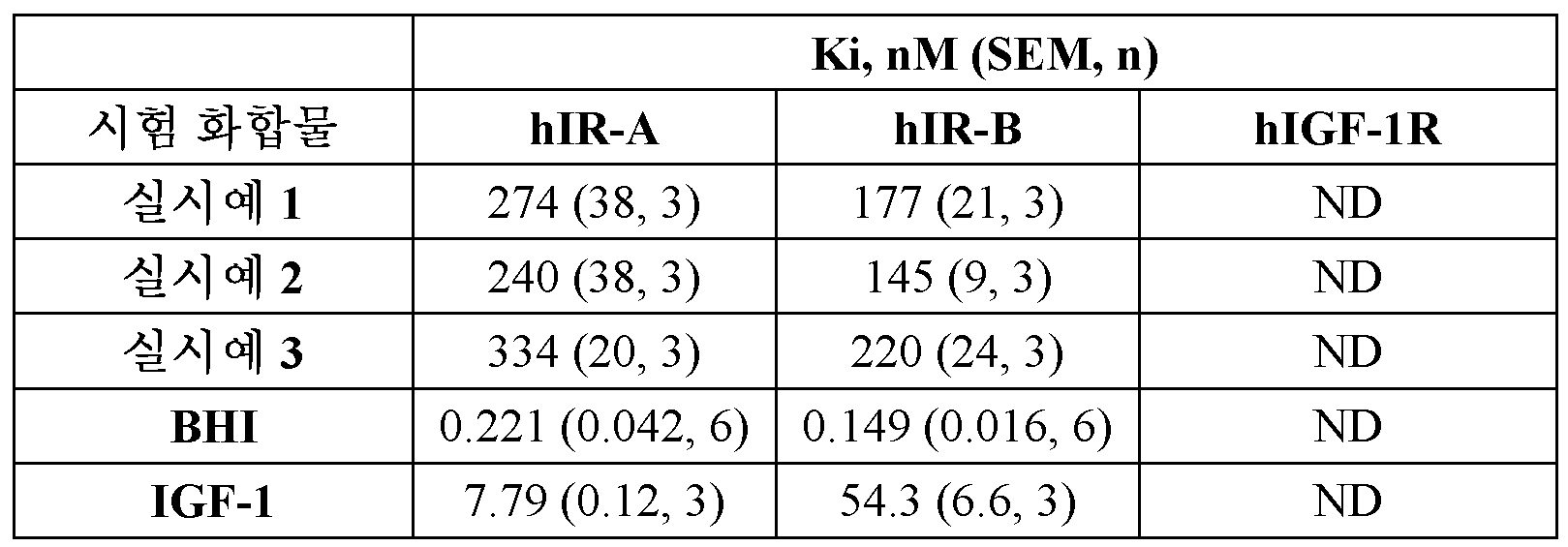
표 1A, 1B 및 1C의 데이터는 실시예 1, 2 및 3이 검정 완충제 중에서 0.1% BSA, 0.001% NP-40, 또는 0.1% HSA를 사용하여 hIGF-R에 대한 매우 낮은 결합으로 인간 IR-A 및 인간 IR-B에 결합함을 나타낸다.The data in Tables 1A, 1B and 1C show that Examples 1, 2 and 3 showed human IR-A with very low binding to hIGF-R using 0.1% BSA, 0.001% NP-40, or 0.1% HSA in assay buffer. and binds to human IR-B.
수용체 기능 활성화Receptor function activation
인슐린 수용체는 세포내 티로신 키나제 도메인을 함유하고 있으며 이는 리간드 결합 직후 자체 티로신 잔기를 자가-인산화하여 인슐린 신호전달 경로를 유도하는 작용을 하는 어댑터 단백질을 동원할 수 있게 한다. hIR-A, hIR-B, 또는 hIGF-1R을 과발현하는 HEK293 세포의 리간드 처리 후 티로신 잔기 상에서 수용체 자가-인산화의 자극에 대한 기능적 세포 활성을 결정하며, 각각 C-말단 C9 에피토프 (TETSQVAPA, 서열식별번호: 6)를 가진다.Insulin receptors contain intracellular tyrosine kinase domains that auto-phosphorylate their own tyrosine residues immediately after ligand binding, allowing recruitment of adapter proteins that act to induce the insulin signaling pathway. Determination of functional cellular activity for stimulation of receptor auto-phosphorylation on tyrosine residues after ligand treatment of HEK293 cells overexpressing hIR-A, hIR-B, or hIGF-1R, each with a C-terminal C9 epitope (TETSQVAPA, sequence identification) number: 6).
hIR-A 또는 hIR-B-C9를 과발현하는 HEK293 세포를 트립시노겐화하고 1000 rpm에서 회전시켰다. 세포를 피루브산나트륨 + 0.1% BSA가 없는 DMEM 고글루코스를 함유하는 기아 배지로 재현탁시키고 50K-60K 세포/웰의 밀도로 96 웰 폴리-D-리신 코팅된 플레이트에 시딩하였다. 세포를 표준 조직 배양 조건 하에 밤새 인큐베이션하였다. 알부민 결합의 효과를 평가하기 위해, 피루브산나트륨 + 0.1% BSA가 없는 DMEM 고글루코스를 함유하는 배지에서 세포 자극을 수행하였다. hIR-A 또는 hIR-B 세포를 10 내지 0.0000169 μM 범위의 다양한 농도의 리간드로 37℃에서 60분 동안 자극한 후, 세포를 검정 당일에 50 mM 트리스 (pH 7.5), 150 mM NaCl, 1% NP40 및 새롭게 첨가된 완전한 프로테아제 억제제 칵테일 (피어스(Pierce) A32955) + 2 mM 바나데이트 (시그마 S6508)를 함유하는 용해 완충제에 의해 용해시켰다. 각각의 수용체의 키나제 도메인에 의한 티로신 자가-인산화 수준은 세포 용해물을 ELISA 플레이트에 적용하여 결정하였으며; 여기서, 활성화된 수용체는 IR-A의 경우 3.5 ㎍/ml의 IR (Ab 83-14) 또는 IR-B의 경우 2 ㎍/ml의 C9 에피토프 태그에 대한 항체에 의해 포획한 후, 1:5000 비로 항-포스포티로신 호스 래디시 퍼옥시다제 접합체, HRP 항체 (밀리포어(Millipore) 16-105)를 사용하여 티로신 인산화의 수준을 검출하였다.HEK293 cells overexpressing hIR-A or hIR-B-C9 were trypsinogenized and spun at 1000 rpm. Cells were resuspended in starvation medium containing DMEM high glucose without sodium pyruvate + 0.1% BSA and seeded in 96 well poly-D-lysine coated plates at a density of 50K-60K cells/well. Cells were incubated overnight under standard tissue culture conditions. To evaluate the effect of albumin binding, cell stimulation was performed in medium containing DMEM high glucose without sodium pyruvate + 0.1% BSA. hIR-A or hIR-B cells were stimulated with various concentrations of ligand ranging from 10 to 0.0000169 μM at 37° C. for 60 min, then the cells were incubated on the day of assay in 50 mM Tris (pH 7.5), 150 mM NaCl, 1% NP40. and lysis buffer containing freshly added Complete Protease Inhibitor Cocktail (Pierce A32955) + 2 mM vanadate (Sigma S6508). The level of tyrosine auto-phosphorylation by the kinase domain of each receptor was determined by applying cell lysates to ELISA plates; Here, the activated receptor was captured by an antibody against the C9 epitope tag at 3.5 μg/ml of IR (Ab 83-14) for IR-A or 2 μg/ml for IR-B, followed by a 1:5000 ratio. Levels of tyrosine phosphorylation were detected using an anti-phosphotyrosine horseradish peroxidase conjugate, HRP antibody (Millipore 16-105).
IR ELISA의 경우, 96-웰 플레이트를 IR-A의 경우 3.5 ㎍/mL에서 Ab 83-14로 또는 IR-B의 경우 2 ㎍/mL 항-C9 Ab로 코팅하였다. 항체를 20 mM 탄산나트륨, pH 9.6에 희석하고 4℃에서 밤새 인큐베이션하였다. 둘째 날에, 플레이트를 TBST (0.1% 트윈 20을 함유하는 1X TBS)로 3회 세척하였다. 플레이트를 TBST 중 1% BSA로 1시간 동안 차단하였다. 차단 완충제를 제거하고, 세포 용해물을 플레이트에 적용하였다. 플레이트를 진탕기에서 1시간 동안 실온에서 인큐베이션하였다. 플레이트를 1X TBST로 3회 세척하였다. 2차 항체 (1X 프로테이나제 및 포스파타제 억제제 칵테일을 함유하는 TBST에서 10 mL (1/5000) 중 2 μL의 항-포스포티로신-HRP (밀리포어 16-105))를 적용하였다. 플레이트를 진탕기에서 실온에서 1시간 동안 추가로 인큐베이션하였다. pIR에 대한 신호를 발생시키기 위해, 플레이트를 TBST로 4회 세척하였다. TMB 기질 (피어스 34021)을 100 μL/웰의 부피로 플레이트에 첨가하고 실온에서 5분 동안 인큐베이션하였다. 100 μL/웰의 2N H2SO4를 첨가하여 반응을 정지시키고 플레이팅된 것을 5분 동안 인큐베이션하였다. 플레이트는 OD450 nm에서 판독하였다.For IR ELISA, 96-well plates were coated with Ab 83-14 at 3.5 μg/mL for IR-A or 2 μg/mL anti-C9 Ab for IR-B. Antibodies were diluted in 20 mM sodium carbonate, pH 9.6 and incubated overnight at 4°C. On the second day, the plates were washed 3 times with TBST (1X TBS containing 0.1% Tween 20). Plates were blocked with 1% BSA in TBST for 1 hour. Blocking buffer was removed and cell lysates were applied to plates. Plates were incubated at room temperature for 1 hour on a shaker. Plates were washed 3 times with 1X TBST. A secondary antibody (2 μL of anti-phosphotyrosine-HRP (Millipore 16-105) in 10 mL (1/5000) in TBST containing 1X proteinase and phosphatase inhibitor cocktail) was applied. Plates were further incubated for 1 hour at room temperature on a shaker. To generate a signal for pIR, the plate was washed 4 times with TBST. TMB substrate (Pierce 34021) was added to the plate in a volume of 100 μL/well and incubated for 5 minutes at room temperature. The reaction was stopped by adding 100 μL/well of 2N H 2 SO 4 and plated incubated for 5 minutes. Plates were read at OD450 nm.
인슐린 수용체 활성화, 0.1% 카세인 (BSA-무함유 방법)Insulin receptor activation, 0.1% casein (BSA-free method)
0.1% 카세인의 존재 하에 IRA 및 IRB 인산화에 대한 실시예의 효과를 측정하기 위해, hIRA-HEK293-zeo 또는 hIRB-C9-HEK293-G418 세포를 먼저 0.1% BSA와 함께 고글루코스를 가지며 피루브산나트륨을 갖지 않는 DMEM (깁코(Gibco) 11965-084) 중에서 96-웰 폴리-D-리신 코팅된 플레이트 (바이오코트(Biocoat) 354461)에 60,000개 세포/웰로 플레이팅하였다. 다음으로 세포를 조직 배양 인큐베이터에서 37℃에서 밤새 인큐베이션하였다. 96-웰 ELISA 플레이트는 또한 20 mM 탄산나트륨 완충제 (pH 9.6)에서 3.5 ㎍/mL 항인슐린 수용체 항체 83-14 (IRA 검정용) 또는 2.0 ㎍/mL 항-C9 항체 (IRB 검정용)로 코팅하고 4℃에서 밤새 인큐베이션하였다.To determine the effect of the examples on IRA and IRB phosphorylation in the presence of 0.1% casein, hIRA-HEK293-zeo or hIRB-C9-HEK293-G418 cells were first treated with 0.1% BSA with high glucose and without sodium pyruvate. Plated at 60,000 cells/well in 96-well poly-D-lysine coated plates (Biocoat 354461) in DMEM (Gibco 11965-084). Cells were then incubated overnight at 37° C. in a tissue culture incubator. A 96-well ELISA plate was also coated with 3.5 μg/mL anti-insulin receptor antibody 83-14 (for IRA assay) or 2.0 μg/mL anti-C9 antibody (for IRB assay) in 20 mM sodium carbonate buffer (pH 9.6) and 4 Incubated overnight at °C.
다음날, ELISA 플레이트를 200 μL의 세척 완충제 (0.1% 트윈®을 가진 TBS-T)으로 3X 세척하고 TBS-T 중 1% BSA로 적어도 1시간 동안 차단하였다. 검정 배지는 고글루코스를 가지며 피루브산나트륨을 갖지 않는 DMEM 중에 0.1% 카세인으로 제조하였다. 하기 화합물은 검정 배지에서 각각의 농도로 희석하였다: 인간 인슐린은 200 nM으로, 실시예는 60 μM으로, hIGF-1은 20 μM으로, 그리고 AspB10은 200 nM으로 희석하였다. 상기 화합물을 1:3 희석으로 연속 희석하였다. 세포 플레이트를 50 μL 검정 배지로 2회 세정한 다음에 50 μL의 검정 배지와 50 μL의 희석된 화합물을 세포 플레이트의 개별 웰로 옮겼다. 200 nM BHI를 옮겼다. 플레이트를 37℃에서 1시간 동안 인큐베이션하였다.The next day, ELISA plates were washed 3X with 200 μL of wash buffer (TBS-T with 0.1% Tween®) and blocked with 1% BSA in TBS-T for at least 1 hour. Assay medium was prepared with 0.1% casein in DMEM with high glucose and no sodium pyruvate. The following compounds were diluted at their respective concentrations in the assay medium: human insulin was diluted to 200 nM, Example was diluted to 60 μM, hIGF-1 was diluted to 20 μM, and AspB10 was diluted to 200 nM. The compounds were serially diluted in 1:3 dilutions. The cell plate was washed twice with 50 μL assay medium, then 50 μL of assay medium and 50 μL of diluted compounds were transferred to individual wells of the cell plate. 200 nM BHI was transferred. Plates were incubated at 37° C. for 1 hour.
프로테아제 억제제 (피어스 A32965) 및 소듐 오르토바나데이트 (2 mM의 최종 농도)를 용해 완충제 (50 mM 트리스 pH 7.4, 150 mM NaCl, 및 1% NP40)에 첨가하였다. 1시간 인큐베이션한 후, 세포 플레이트를 먼저 100 μL의 차가운 DPBS로 세척하고 4℃에서 15분 동안 100 μL 용해 완충제에서 용해시켰다. 세포 용해물 플레이트를 혼합하고 300 μL의 BHI 처리된 세포 용해물을 BHI로 처리한 세포 플레이트 절반으로부터 희석 플레이트의 첫 번째 컬럼으로 옮겼다. 이 희석 플레이트의 다른 11개 컬럼에 200 μL의 용해 완충제를 첨가하고, 100 μL의 용해물을 200 μL의 용해 완충제로 옮기고 11회 반복함으로써 용해물을 1:3으로 11회 연속 희석하였다. 10 μL의 용해물을 화합물로 처리한 세포 플레이트로부터 희석 플레이트로 옮기고, 190 μL의 용해물을 각각의 웰에 첨가하였다. ELISA 플레이트는 전에 기재된 바와 같이 세척한 다음에 100 μL의 희석된 용해물을 적절한 ELISA 플레이트로 옮겼다. 플레이트를 진탕기에서 실온에서 1시간 동안 인큐베이션하였다.A protease inhibitor (Pierce A32965) and sodium orthovanadate (final concentration of 2 mM) were added to lysis buffer (50 mM Tris pH 7.4, 150 mM NaCl, and 1% NP40). After 1 hour incubation, the cell plate was first washed with 100 μL of cold DPBS and lysed in 100 μL lysis buffer for 15 minutes at 4°C. The cell lysate plate was mixed and 300 μL of the BHI treated cell lysate was transferred from the BHI treated cell plate half to the first column of the dilution plate. Lysates were serially diluted 1:3 11 times by adding 200 μL of lysis buffer to the other 11 columns of this dilution plate, transferring 100 μL of lysate into 200 μL of lysis buffer and repeating 11 times. 10 μL of lysate was transferred from the compound-treated cell plate to the dilution plate, and 190 μL of lysate was added to each well. The ELISA plate was washed as previously described and then 100 μL of the diluted lysate was transferred to the appropriate ELISA plate. Plates were incubated for 1 hour at room temperature on a shaker.
플레이트를 전과 같이 세척하고 TBST (프로테아제 억제제 및 40 μM 소듐 오르토바나데이트 포함) 중에서 1:5000으로 희석된 100 μL의 2차 항체를 각각의 플레이트에 첨가하였다. 플레이트를 진탕기에서 실온에서 1시간 동안 인큐베이션하였다. 플레이트를 전과 같이 세척하고 50 μL TMB를 플레이트에 첨가하여 약 2분 동안 발생시켰다. 50 μL 2N 황산으로 TMB 반응을 중단하고 플레이트를 450 nm에서 판독하였다. Plates were washed as before and 100 μL of secondary antibody diluted 1:5000 in TBST (with protease inhibitors and 40 μM sodium orthovanadate) was added to each plate. Plates were incubated for 1 hour at room temperature on a shaker. The plate was washed as before and 50 μL TMB was added to the plate and allowed to rise for about 2 minutes. Stop the TMB reaction with 50 μL 2N sulfuric acid and read the plate at 450 nm.
기능적 효능을 최대 효능 농도 (100 nM)의 양성 대조군, 인간 인슐린 (hIR-A 및 hIR-B 인산화 검정) 또는 10 nM의 양성 대조군 hIGF-1 (hIGF-1R 인산화 검정)에 비해 최대 반응의 절반을 도출하는 농도 (EC50)로서 보고하였다. EC50 값은 4-파라미터 로지스틱 비선형 회귀 분석 (NGR 스크리너 13)으로부터 결정하였다. 필요한 경우, 곡선 상단 또는 하단 파라미터를 각각 100 또는 0으로 설정하였다.Functional efficacy was measured by half maximal response compared to the maximal efficacious concentration (100 nM) of the positive control, human insulin (hIR-A and hIR-B phosphorylation assay), or the positive control hIGF-1 at 10 nM (hIGF-1R phosphorylation assay). Reported as the resulting concentration (EC 50 ). EC 50 values were determined from 4-parameter logistic nonlinear regression analysis (NGR Screener 13). If necessary, the upper or lower curve parameters were set to 100 or 0, respectively.
EC50에 대해 보고된 값은 기하 평균으로서 나타내며 평균의 표준 오차 (SEM)는 델타 방법을 사용하여 계산되며, 여기서 독립적인 결정의 수는 "n"으로 표시된다 (표 2).The values reported for EC 50 are presented as geometric means and the standard error of the mean (SEM) is calculated using the delta method, where the number of independent determinations is denoted by “n” (Table 2).
<표 2><Table 2>
인간 인슐린 수용체 아형 A 및 B (hIR-A 및 hIR-B) 활성화 기하평균, (SEM, n)Human insulin receptor subtypes A and B (hIR-A and hIR-B) activation geometric mean, (SEM, n)

표 2의 데이터는 실시예 1, 2 및 3이 인간 인슐린 수용체 A 및 B에 결합하고 자극함을 나타낸다.The data in Table 2 indicate that Examples 1, 2 and 3 bind to and stimulate human insulin receptors A and B.
제I형 당뇨병의 래트 모델에서 생체내 효능의 평가Evaluation of In Vivo Efficacy in a Rat Model of Type I Diabetes
실시예 1, 2, 및 3의 글루코스-저하 및 약동학을 스트렙토조토신 (STZ)-처리된 래트 당뇨병 모델에서 조사하였다. 400-425 그램 체중의 수컷 스프라그-다울리(Sprague-Dawley) 래트를 인디애나주 인디애나폴리스 소재의 엔비고로부터 입수하였다. 대략 1주 동안 순응시킨 후, 래트를 이소플루란으로 마취시키고 자노사르(Zanosar) (89256, 테바 페어런터럴 메디신즈(Teva Parenteral Medicines), 40 mg/kg, IV)를 단회 주사하였다. 래트는 자노사르 주사 후 3일간 연구에 사용하였으며; 400-550 mg/dl의 공복이 아닌 혈당을 가진 동물만이 이들 연구에 사용되었다. The glucose-lowering and pharmacokinetics of Examples 1, 2, and 3 were investigated in a streptozotocin (STZ)-treated rat diabetic model. Male Sprague-Dawley rats weighing 400-425 grams were obtained from Envigo, Indianapolis, IN. After acclimatization for approximately 1 week, rats were anesthetized with isoflurane and given a single injection of Zanosar (89256, Teva Parenteral Medicines, 40 mg/kg, IV). Rats were used in the study for 3 days after Zanosar injection; Only animals with non-fasting blood glucose of 400-550 mg/dl were used in these studies.
혈당과 체중의 비교가능한 분산을 제공하기 위해 래트를 군으로 분배하고; 래트를 무작위화하였다. 혈당은 아큐-첵(Accu-Chek) 아비바(Aviva) 혈당계 (로슈)를 사용하여 측정하였다. Rats were divided into groups to provide comparable variances in blood glucose and body weight; Rats were randomized. Blood glucose was measured using an Accu-Chek Aviva glucometer (Roche).
시험 물품 (펩티드 용액; 1 mL/kg; 피하; 투여 단계의 1일차에 단일 용량) 또는 비히클 (10 mM 트리스, 19 mg/mL 글리세롤, 3.15 mg/mL m-크레졸, pH 7.6; 1 mL/kg; 피하; 투여 단계의 1일차에 단일 용량)을 투여 1일차에 오전 8시에 동물 체중을 기준으로 하여 투여하였다. 글루코스 측정을 위한 혈액 샘플을 꼬리 채혈에 의해 수집하였다. 동물은 실험 내내 음식과 물에 자유롭게 접근하였다. 이들 연구로부터의 혈장 샘플을 화합물 수준 분석을 위해 보냈다.Test article (peptide solution; 1 mL/kg; subcutaneous; single dose on day 1 of dosing phase) or vehicle (10 mM Tris, 19 mg/mL glycerol, 3.15 mg/mL m-cresol, pH 7.6; 1 mL/kg ; subcutaneously; single dose on day 1 of dosing phase) was administered based on animal body weight at 8 am on day 1 of dosing. Blood samples for glucose measurement were collected by tail bleed. Animals had free access to food and water throughout the experiment. Plasma samples from these studies were sent for compound level analysis.
투여 후 0, 1, 2, 4, 6, 8, 10, 12, 18, 24, 36, 48, 60, 72, 84, 96, 108, 및 120시간에, 전혈을 혈당계를 사용하여 전혈 글루코스에 대해 수집하였다. 값이 30 mg/dL 초과로 차이가 나지 않는 한, 값을 이중으로 기록하였다. 이것이 발생하는 경우에, 삼중 값이 기록되었다. 래트가 35 mg/dL 미만의 글루코스로 저하되면, 동일 군 내에서 >100 mg/dL인 래트를 제외하고 전체 군에 2 mL의 50% 덱스트로스로 경구 투여하였다. 구조된 래트를 관찰하고 덱스트로스 로드 후 2 내지 4시간마다 혈당을 측정하였다. 관찰 기간 동안, 래트가 35 mg/dL 미만의 글루코스로 떨어지면, 동일 군 내에서 >100 mg/dL인 래트를 제외하고 전체 군에 2 mL의 50% 덱스트로스를 경구 투여하였다. 덱스트로스 로드 후 2 내지 4시간마다 혈당을 측정하여 관찰을 계속하였다. 래트에게 2 mL의 50% 덱스트로스를 경구 투여한 경우, 이후에 기록된 모든 글루코스 값은 연구 계산으로부터 배제하였다. 동물이 구조되더라도, 이들은 PK가 덱스트로스 볼루스에 의해 영향을 받지 않으므로 PK 시점을 수집하기 위한 연구를 계속하였다.At 0, 1, 2, 4, 6, 8, 10, 12, 18, 24, 36, 48, 60, 72, 84, 96, 108, and 120 hours post-dose, whole blood was measured for whole blood glucose using a glucometer. collected about. Values were recorded in duplicate unless the values differed by more than 30 mg/dL. In cases where this occurred, triplicate values were recorded. When the rats were lowered to less than 35 mg/dL glucose, all groups were orally administered with 2 mL of 50% dextrose, except for rats >100 mg/dL within the same group. Rescued rats were observed and blood glucose was measured every 2 to 4 hours after dextrose loading. During the observation period, when the rats dropped to less than 35 mg/dL glucose, all groups were orally administered 2 mL of 50% dextrose, except for rats >100 mg/dL within the same group. Observation was continued by measuring blood glucose every 2 to 4 hours after the dextrose load. When rats were orally administered 2 mL of 50% dextrose, all glucose values recorded thereafter were excluded from study calculations. Even if the animals were rescued, they continued the study to collect PK time points as PK was not affected by the dextrose bolus.
면역친화도-LC/MS 래트 혈장 검정: 실시예의 PK를 특성화하기 위해, 혈장 샘플 (10 μL 분취량)을 면역침전에 이어서 LC/MS 분석을 통해 무손상 인슐린 농도에 대해 분석하였다. 표준 및 블랭크 샘플을 실시예를 사용하여 100% 대조군 래트 혈장에서 제조하고, 안정한 동위원소-표지된 항체 (실시예와 관련 없음)를 내부 표준으로서 모든 표준 및 샘플에 첨가하였다. 면역침전을 위해, 비오틴-표지된 항인간 뮤린 항체 (피츠제럴드(Fitzgerald), 10R-I134E)를 포획 시약으로서 사용하며, 이는 이후 디날(Dynal) M-280 스트렙타비딘-코팅된 자기 비드 (인비트로겐(Invitrogen) 60210)에 의해 결합되었다. 자기 비드-고정화된 샘플을 0.1% CHAPS에 이어서 PBS로 세척하고, 실시예를 20% ACN, 2% 수성 포름산, 및 20% 인비트로솔(Invitrosol) (인비트로겐, 46-5553)을 함유하는 용액으로 용리시켰다. 혈장 샘플을 0.01 내지 5.3 ㎍/mL (1.6 내지 802 nM)의 범위에 걸쳐 써모(Thermo) Q/이그젝티브 플러스(Exactive Plus) 질량 분석기를 사용하여 정량화하였다. Immunoaffinity-LC/MS Rat Plasma Assay: To characterize the PK of the examples, plasma samples (10 μL aliquots) were analyzed for intact insulin concentrations via immunoprecipitation followed by LC/MS analysis. Standards and blank samples were prepared from 100% control rat plasma using the Examples, and a stable isotope-labeled antibody (not related to the Examples) was added as an internal standard to all standards and samples. For immunoprecipitation, a biotin-labeled anti-human murine antibody (Fitzgerald, 10R-I134E) is used as a capture reagent, which is then followed by Dynal M-280 streptavidin-coated magnetic beads (Invir bound by Invitrogen 60210). Magnetic bead-immobilized samples were washed with 0.1% CHAPS followed by PBS, and the examples were washed with a solution containing 20% ACN, 2% aqueous formic acid, and 20% Invitrosol (Invitrogen, 46-5553). eluted with Plasma samples were quantified using a Thermo Q/Exactive Plus mass spectrometer over the range of 0.01 to 5.3 μg/mL (1.6 to 802 nM).
비구획 약동학적 분석은 피닉스 윈논린(Phoenix WinNonLin) v8.1을 사용하여 수행하였다. 래트 PK 분석의 경우, 제거 반감기의 추정에 사용된 농도는 50 nmol/kg 용량 군의 경우 투여 후 44 내지 120시간, 100 nmol/kg 용량 군의 경우 투여 후 32 내지 120시간, 200 nmol/kg 용량 군의 경우 투여 후 18 내지 120시간, 그리고 400 nmol/kg 용량 군의 경우 투여 후 18 내지 120시간의 평균이었다. Noncompartmental pharmacokinetic analysis was performed using Phoenix WinNonLin v8.1. For the rat PK assay, the concentrations used for estimation of the elimination half-life were 44 to 120 hours after dosing for the 50 nmol/kg dose group and 32 to 120 hours after dosing for the 100 nmol/kg dose group and 200 nmol/kg dose It was the mean of 18 to 120 hours after administration for the group and 18 to 120 hours after administration for the 400 nmol/kg dose group.
표 3A, 3B: 스트렙토조토신 (STZ)-처리된 래트 당뇨병 모델에서 실시예 1의 글루코스-저하 (3A) 및 약동학 효과 (3B). Tables 3A, 3B: Glucose-lowering (3A) and pharmacokinetic effects (3B) of Example 1 in a streptozotocin (STZ)-treated rat diabetic model.
<표 3A>< Table 3A >
실시예 1의 50, 100, 200, 또는 400 nmol/kg의 단일 피하 투여 후 STZ-처리된 수컷 스프라그-다울리 래트에서의 실시예 1의 글루코스-저하.Glucose-lowering of Example 1 in STZ-treated male Sprague-Dawley rats after single subcutaneous administration of 50, 100, 200, or 400 nmol/kg of Example 1.
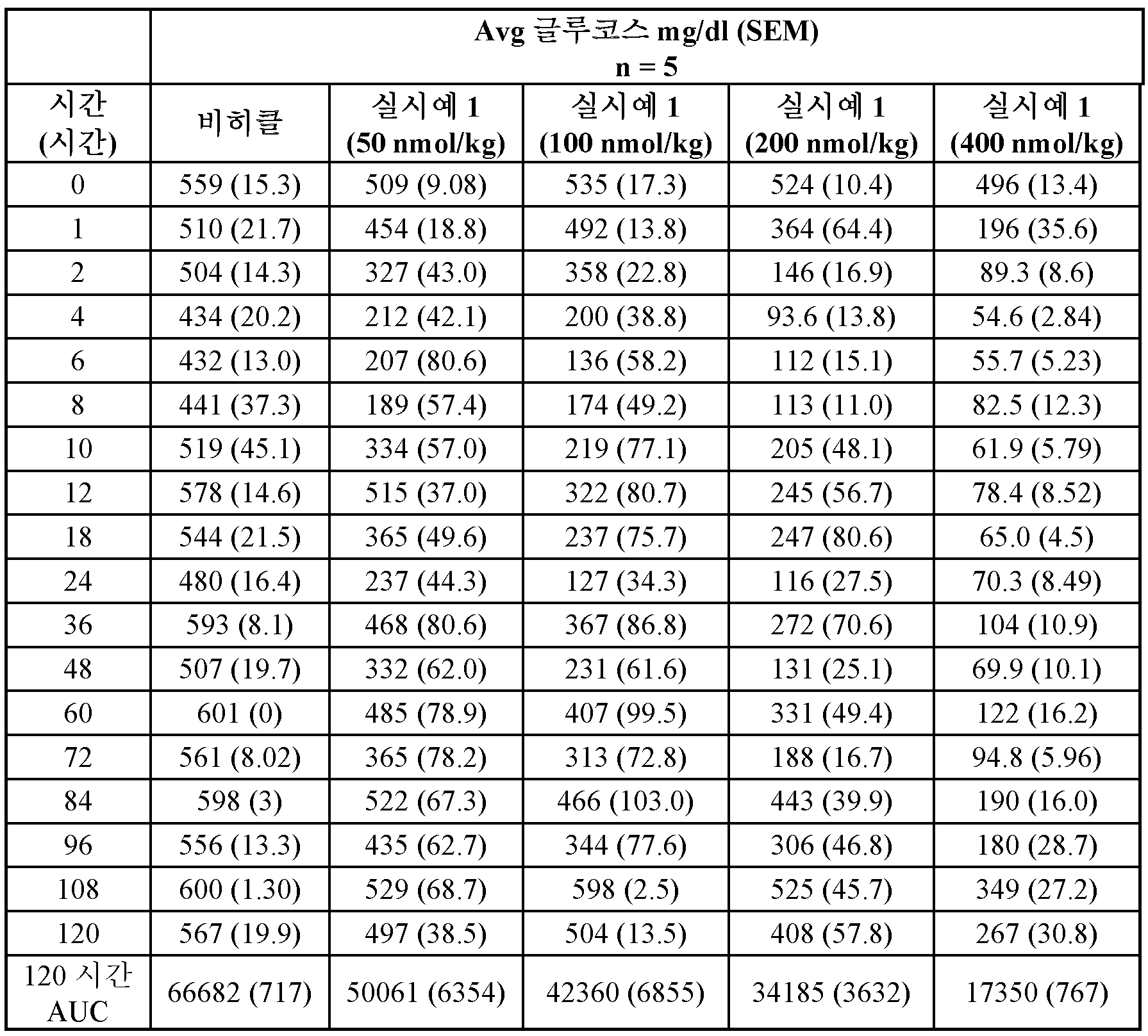
*601 초과의 값은 혈당계 상에서의 높은 판독값이기 때문에 측정되지 않음*Values above 601 are not measured because they are high readings on the glucometer.
<표 3B>< Table 3B >
실시예 1의 50, 100, 200, 또는 400 nmol/kg의 단일 피하 투여 후 STZ-처리된 수컷 스프라그-다울리 래트에서의 실시예 1의 평균 약동학적 파라미터.Mean pharmacokinetic parameters of Example 1 in STZ-treated male Sprague-Dawley rats after single subcutaneous administration of 50, 100, 200, or 400 nmol/kg of Example 1.

<표 4A> < Table 4A >
실시예 2의 50, 100, 200, 또는 400 nmol/kg의 단일 피하 투여 후 STZ-처리된 수컷 스프라그-다울리 래트에서의 실시예 2의 글루코스-저하.Glucose-lowering of Example 2 in STZ-treated male Sprague-Dawley rats after single subcutaneous administration of 50, 100, 200, or 400 nmol/kg of Example 2.

*601 초과의 값은 혈당계 상에서의 높은 판독값이기 때문에 측정되지 않음*Values above 601 are not measured because they are high readings on the glucometer.
<표 4B> < Table 4B >
실시예 2의 50, 100, 200, 또는 400 nmol/kg의 단일 피하 투여 후 STZ-처리된 수컷 스프라그-다울리 래트에서의 실시예 2의 평균 약동학적 파라미터.Mean pharmacokinetic parameters of Example 2 in STZ-treated male Sprague-Dawley rats after single subcutaneous administration of 50, 100, 200, or 400 nmol/kg of Example 2.
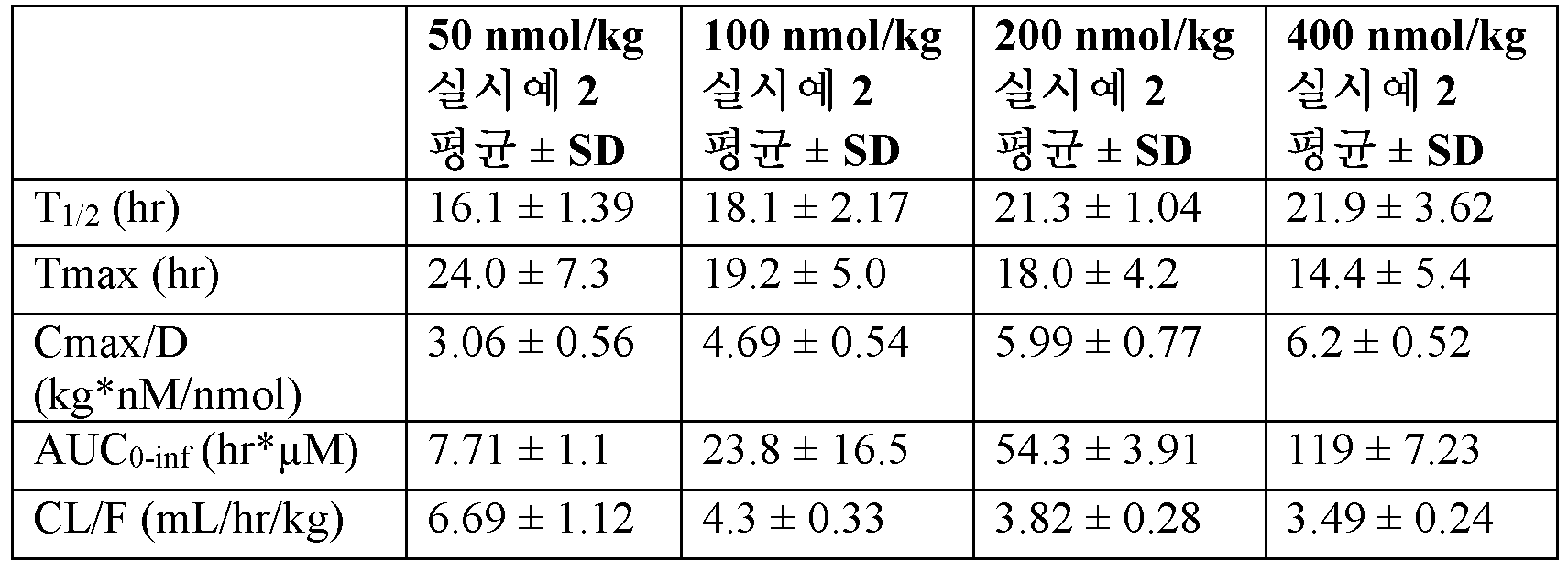
<표 5A> < Table 5A >
실시예 3의 50, 100, 200, 또는 400 nmol/kg의 단일 피하 투여 후 STZ-처리된 수컷 스프라그-다울리 래트에서의 실시예 3의 글루코스-저하.Glucose-lowering of Example 3 in STZ-treated male Sprague-Dawley rats after single subcutaneous administration of 50, 100, 200, or 400 nmol/kg of Example 3.

*601 초과의 값은 혈당계 상에서의 높은 판독값이기 때문에 측정되지 않음*Values above 601 are not measured because they are high readings on the glucometer.
<표 5B> < Table 5B >
실시예 3의 50, 100, 200, 또는 400 nmol/kg의 단일 피하 투여 후 STZ-처리된 수컷 스프라그-다울리 래트에서의 실시예 3의 평균 약동학적 파라미터.Mean pharmacokinetic parameters of Example 3 in STZ-treated male Sprague-Dawley rats after single subcutaneous administration of 50, 100, 200, or 400 nmol/kg of Example 3.

표 3B, 4B, 5B에 대한 약어: AUC0-inf = 0에서 무한대까지의 곡선 아래 면적, CL/F = 청소율/생체이용률, Tmax = 최대 농도까지의 시간, Cmax/D = 용량당 최대 혈장 농도, T1/2 = 반감기. [데이터는 평균 +/- SD (N=5)임Abbreviations for Tables 3B, 4B, 5B: AUC 0-inf = area under the curve from 0 to infinity, CL/F = clearance/bioavailability, Tmax = time to maximum concentration, Cmax/D = maximum plasma concentration per dose. , T 1/2 = half-life. [Data are mean +/- SD (N=5)
표 3A, 4A 및 5A의 데이터는 모든 세 가지 실시예에 대해 생체내 강력한 용량-의존적 글루코스-저하 효과를 나타낸다. 표 3B, 4B, 및 5B의 데이터는 모든 세 가지 실시예에 대해 생체내 지속 작용 시간을 나타낸다. The data in Tables 3A, 4A and 5A show a potent dose-dependent glucose-lowering effect in vivo for all three examples. The data in Tables 3B, 4B, and 5B show the duration of action in vivo for all three examples.
제I형 당뇨병의 돼지 모델에서 약물 청소율의 평가Assessment of Drug Clearance in a Porcine Model of Type I Diabetes
본 연구의 목적은 3.6 nmol/kg의 단일 피하 투여 후 당뇨병 유카탄(Yucatan) 소형 돼지(miniature swine)에서 실시예의 글루코스-저하 및 약동학을 조사하는 것이다. 혈액 샘플을 투여 후 168시간에 걸쳐 수집하였다.The purpose of this study was to investigate the glucose-lowering and pharmacokinetics of the examples in diabetic Yucatan miniature swine after a single subcutaneous dose of 3.6 nmol/kg. Blood samples were collected over 168 hours post administration.
당뇨병 (알록산 유발됨), 거세, 수컷 유카탄 미니 돼지 (평균 23개월령, 평균 체중 44 kg)를 개별적으로 하우징하고 항상 신선한 물에 자유롭게 접근하도록 하며 하루에 두끼 하우스 식단을 공급하였다. 동물은 연구 중이 아닐 경우는 그의 당뇨병 상태를 관리하기 위해 하루에 2회 적절한 유지 기저 및 식사 인슐린을 투여받았다. 동물을 무작위로 처리 군에 배치하고 그의 우리로 복귀시켰다. 실시예는 6량체 제제 (19 mg/mL 글리세롤, 4 Zn/hex, 3.15 mg/mL m-크레졸, 10 mM 트리스, pH 7.6)에서 400 U/mL로서 제제화하였다.Diabetic (alloxan induced), castrated, male Yucatan mini-pigs (average age 23 months, average weight 44 kg) were individually housed and fed a house diet of two meals a day with free access to fresh water at all times. Animals received appropriate maintenance basal and dietary insulin twice daily to manage their diabetic status when not on study. Animals were randomly assigned to treatment groups and returned to their cages. Examples were formulated as 400 U/mL in a hexameric formulation (19 mg/mL glycerol, 4 Zn/hex, 3.15 mg/mL m-cresol, 10 mM Tris, pH 7.6).
연구 전날, 돼지는 그의 일일 배급량의 절반을 공급받고 그의 아침 유지 투여에서 0.2 U/kg 휴마로그 믹스(Humalog Mix) 75/25를 투여받았다. 예정된 시험 용량 투여 대략 12시간 전에, 돼지는 그의 일일 배급량의 절반을 공급받고 0.2 U/kg의 휴마로그만을 투여받았다. 모든 동물은 24시간 샘플이 수집될 때까지 공복 상태를 유지하였다.The day before the study, pigs were fed half of their daily ration and were dosed with 0.2 U/kg Humalog Mix 75/25 in their morning maintenance dose. Approximately 12 hours prior to scheduled test dose administration, pigs were fed half of their daily ration and received only 0.2 U/kg of Humalog. All animals were kept fasted until 24-hour samples were collected.
연구 당일 아침, 모든 동물을 구속을 위해 슬링에 배치하고 그의 혈관 접근 포트에 접근 (혈액 샘플링을 위해 장착됨)하고 개방성을 점검하였다. 동물을 처리군 (n=6)에 무작위로 배치하고 그의 개별 우리로 복귀시켰다. 처음 2개의 투여 전 샘플을 수집하고, 동물에게 U100 인슐린 시린지로 옆구리에 (0분) 피하로 시험 물품 0.6 U/kg/3.6 nmol/Kg (400 U/ml 인슐린 농도 기준, 평균 부피 7 유닛/돼지)을 주사하였다. 모든 연구 동물은 잔류 혈액 수집 기간 내내 깨끗한, 신선한 물에 자유롭게 접근하도록 하였다.On the morning of the study, all animals were placed in slings for restraint and their vascular access ports were accessed (mounted for blood sampling) and checked for patency. Animals were randomly assigned to treatment groups (n=6) and returned to their individual cages. The first two pre-dose samples are collected, and the animals are given 0.6 U/kg/3.6 nmol/Kg of test article (based on 400 U/ml insulin concentration, average volume 7 units/pig) subcutaneously in the flank (0 min) with a U100 insulin syringe. ) was injected. All study animals had free access to clean, fresh water throughout the residual blood collection period.
일련의 혈액 샘플 (각각 4.0 mL)을 각각의 동물로부터 수집하고 하기 시점에 K3EDTA 항응고제를 함유하는 튜브에 넣었다: 피하 (sc) 투여 후 -0.5, 0, 1.5, 3, 6, 12, 18, 24, 36, 42, 48, 54, 60, 72, 96, 120, 144, 및 168시간.Serial blood samples (4.0 mL each) were collected from each animal and placed into tubes containing K 3 EDTA anticoagulant at the following time points: -0.5, 0, 1.5, 3, 6, 12, 18 after subcutaneous (sc) administration. , 24, 36, 42, 48, 54, 60, 72, 96, 120, 144, and 168 hours.
동물에게 300 그램의 S-9 규정식을 공급하고 24시간 및 60시간 샘플 후에 0.2 U/kg 휴마로그 sc를 투여하였다. 72시간 샘플 후, 동물은 그의 정상적인 유지 인슐린 및 섭식 요법을 재개하였다. 모든 샘플은 아침 식사 및 유지 인슐린 투여 전에 수집하였다.Animals were fed 300 grams of S-9 diet and dosed with 0.2 U/kg Humalog sc after 24 and 60 hour samples. After the 72 hour sample, the animal resumed its normal maintenance insulin and feeding regimen. All samples were collected before breakfast and maintenance insulin administration.
전혈 샘플은 수집 직후 습윤 얼음에 유지하였다. 이어서 혈장을 원심분리 (~4℃에서 적어도 15분 동안 ~3000 RPM)에 의해 분리하고 2개의 분취량으로 나누고 글루코스 분석의 경우 대략 -20℃ 또는 PK 분석의 경우 -70℃에서 냉동 보관하였다.Whole blood samples were kept on wet ice immediately after collection. Plasma was then separated by centrifugation (~3000 RPM for at least 15 minutes at ~4°C), divided into two aliquots and stored frozen at approximately -20°C for glucose assays or -70°C for PK assays.
혈장 글루코스 농도는 자동화된 벡크만(Beckman) AU480 임상 화학 분석기(Clinical Chemistry Analyzer) (벡크만 쿨터(Beckman Coulter), 캘리포니아주 브레아)를 사용하여 결정하고, 그래프패드 프리즘(Graphpad Prism) 8로 그래프로 표시하였다. Plasma glucose concentrations were determined using an automated Beckman AU480 Clinical Chemistry Analyzer (Beckman Coulter, Brea, Calif.) and graphed with a Graphpad Prism 8. indicated.
면역친화도-LC/MS 돼지 혈장 검정: 시험 실시예의 PK를 특성화하기 위해, 혈장 샘플 (100 μL 분취량)을 면역침전에 이어서 LC/MS 분석을 통해 무손상 실시예 농도에 대해 분석하였다. 표준 및 블랭크 샘플을 시험 실시예를 사용하여 100% 대조군 돼지 혈장에서 제조하고, 안정한 동위원소-표지된 항체 (실시예와 관련 없음)를 내부 표준으로서 모든 표준 및 샘플에 첨가하였다. 면역침전을 위해, 비오틴-표지된 항인간 뮤린 항체 (피츠제럴드, 카탈로그 번호 10R-I134E)를 포획 시약으로서 사용하며, 이는 이후 디날 M-280 스트렙타비딘-코팅된 자기 비드 (인비트로겐 60210)에 의해 결합되었다. 자기 비드-고정화된 샘플을 0.1% CHAPS에 이어서 PBS로 세척하고, 시험 실시예 및 그의 내부 표준을 20% ACN, 2% 수성 포름산, 및 20% 인비트로솔 (인비트로겐, 46-5553)을 함유하는 용액으로 용리시켰다. 혈장 샘플은 0.1 내지 52.3 ng/mL (0.016 내지 8.0 nM)의 범위에 걸쳐 써모 Q/이그젝티브 플러스 질량 분석기를 사용하여 정량화하였다. Immunoaffinity-LC/MS Porcine Plasma Assay: To characterize the PK of the test examples, plasma samples (100 μL aliquots) were analyzed for intact example concentrations via immunoprecipitation followed by LC/MS analysis. Standards and blank samples were prepared in 100% control porcine plasma using the test examples, and a stable isotope-labeled antibody (not related to the example) was added as an internal standard to all standards and samples. For immunoprecipitation, a biotin-labeled anti-human murine antibody (Fitzgerald, Cat. No. 10R-I134E) is used as a capture reagent, which is then spiked onto Dynal M-280 streptavidin-coated magnetic beads (Invitrogen 60210). combined by Magnetic bead-immobilized samples were washed with 0.1% CHAPS followed by PBS, test examples and their internal standards containing 20% ACN, 2% aqueous formic acid, and 20% Invitrosol (Invitrogen, 46-5553). was eluted with a solution of Plasma samples were quantified using a Thermo Q/Ejective Plus mass spectrometer over a range of 0.1 to 52.3 ng/mL (0.016 to 8.0 nM).
약동학적 분석: 비구획 약동학적 분석은 피닉스 윈논린 v8.1을 사용하여 수행하였다. 래트 PK 분석의 경우, 제거 반감기의 추정에 사용된 농도는 투여 후 50 내지 160시간의 평균이었다 (3.6 nmol/kg SC에 상응). Pharmacokinetic Analysis: Non-compartmental pharmacokinetic analysis was performed using Phoenix Winnonlin v8.1. For the rat PK assay, the concentration used for estimation of the elimination half-life was the average of 50 to 160 hours post-dose (corresponding to 3.6 nmol/kg SC).
<표 6A> < Table 6A >
글루코스-저하 데이터Glucose-lowering data

<표 6B> < Table 6B >
단일 피하 투여 후 수컷 당뇨병-유발 유카탄 돼지에서 실시예 1, 2, 3의 평균 PK 파라미터.Mean PK parameters of Examples 1, 2, 3 in male diabetic Yucatan pigs after a single subcutaneous administration.

약어: T1/2 = 반감기, Tmax = 최대 농도까지의 시간, Cmax = 최대 혈장 농도, AUC0-inf = 0에서 무한대까지의 곡선 아래 면적, CL/F = 청소율/생체이용률 (시험 실시예의 경우 N=6)Abbreviations: T 1/2 = half-life, T max = time to maximum concentration, C max = maximum plasma concentration, AUC 0-inf = area under the curve from 0 to infinity, CL/F = clearance/bioavailability (test run Example N=6)
표 6A 및 6B의 데이터는 제I형 당뇨병의 돼지 모델에서 모든 세 가지 실시예에 대해 강력하고 장기간에 걸친 생체내 글루코스-저하 효과를 나타낸다.The data in Tables 6A and 6B show strong and long-term in vivo glucose-lowering effects for all three examples in a porcine model of type I diabetes.
서열order
서열식별번호: 1 변형된 인슐린 A-쇄 (A14E); 화학식 I의 A-쇄SEQ ID NO: 1 modified insulin A-chain (A14E); A-chain of Formula I
GIVEQCCTSICSLEQLENYCN GIVEQCCTSICSLEQLENYCN
서열식별번호: 2 변형된 인슐린 B-쇄 (B16H, B25H, desB30); 화학식 I의 B-쇄SEQ ID NO: 2 modified insulin B-chain (B16H, B25H, desB30); B-chain of Formula I
FVNQHLCGSHLVEALHLVCGERGFHYTPK FVNQHLCGSHLVEALHLVCGERGFHYTPK
여기서 위치 29에서의 Lys는 Lys 측쇄의 엡실론-아미노 기와 HO2C-(CH2)18-CO-γGlu-γGlu-γGlu-X- (여기서 X는 Lys-Gly-임), -Lys-(2-[2-(2-아미노에톡시)에톡시]아세트산)-, 또는 -εLys-Gly-의 접합에 의해 화학적으로 변형된다.where Lys at position 29 is the epsilon-amino group of the Lys side chain and HO 2 C-(CH 2 ) 18 -CO-γGlu-γGlu-γGlu-X- (where X is Lys-Gly-), -Lys-(2 -[2-(2-aminoethoxy)ethoxy]acetic acid)-, or chemically modified by conjugation of -εLys-Gly-.
서열식별번호: 3 실시예 1의 B-쇄SEQ ID NO: 3 B-chain of Example 1
FVNQHLCGSHLVEALHLVCGERGFHYTPKFVNQHLCGSHLVEALHLVCGERGFHYTPK
여기서 위치 29에서의 Lys는 Lys 측쇄의 엡실론-아미노 기와 HO2C-(CH2)18-CO-γGlu-γGlu-γGlu-Lys-Gly-의 접합에 의해 화학적으로 변형된다.Here, Lys at position 29 is chemically modified by conjugation of the epsilon-amino group of the Lys side chain with HO 2 C-(CH 2 ) 18 -CO-γGlu-γGlu-γGlu-Lys-Gly-.
서열식별번호: 4 실시예 2의 B-쇄SEQ ID NO: 4 B-chain of Example 2
FVNQHLCGSHLVEALHLVCGERGFHYTPK FVNQHLCGSHLVEALHLVCGERGFHYTPK
여기서 위치 29에서의 Lys는 Lys 측쇄의 엡실론-아미노 기와 HO2C-(CH2)18-CO-γGlu-γGlu-γGlu-Lys-(2-[2-(2-아미노에톡시)에톡시]아세트산)-의 접합에 의해 화학적으로 변형된다.where Lys at position 29 is the epsilon-amino group of the Lys side chain and HO 2 C-(CH 2 ) 18 -CO-γGlu-γGlu-γGlu-Lys-(2-[2-(2-aminoethoxy)ethoxy] acetic acid) - is chemically modified by conjugation.
서열식별번호: 5 실시예 3의 B-쇄SEQ ID NO: 5 B-chain of Example 3
FVNQHLCGSHLVEALHLVCGERGFHYTPK FVNQHLCGSHLVEALHLVCGERGFHYTPK
여기서 위치 29에서의 Lys는 Lys 측쇄의 엡실론-아미노 기와 HO2C-(CH2)18-CO-γGlu-γGlu-γGlu-εLys-Gly-의 접합에 의해 화학적으로 변형된다.Here, Lys at position 29 is chemically modified by conjugation of the epsilon-amino group of the Lys side chain with HO 2 C-(CH 2 ) 18 -CO-γGlu-γGlu-γGlu-εLys-Gly-.
서열식별번호: 6 C-말단 C9 에피토프SEQ ID NO: 6 C-terminal C9 epitope
TETSQVAPATETSQVAPA
서열식별번호: 7 단일 쇄 인슐린 SEQ ID NO: 7 single chain insulin
MHHHHHHQAIFVLQGSLDQDPEFENLYFQIEGGRFVNQHLCGSHLVEALHLVCGERGFHYTPKRREAEDLQVGQVELGGGPGAGSLQPLALEGSLQRGIVEQCCTSICSLEQLENYCNMHHHHHHQAIFVLQGSLDQDPEFENLYFQIEGGRFVNQHLCGSHLVEALHLVCGERGFHYTPKRREAEDLQVGQVELGGGPGAGSLQPLALEGSLQRGIVEQCCTSICSLEQLENYCN
서열식별번호: 8 변형된 인슐린 B-쇄 (B16H, B25H, desB30)SEQ ID NO: 8 modified insulin B-chain (B16H, B25H, desB30)
FVNQHLCGSHLVEALHLVCGERGFHYTPK FVNQHLCGSHLVEALHLVCGERGFHYTPK
SEQUENCE LISTING <110> Eli Lilly and Company <120> Extended Time Action Acylated Insulin Compounds <130> X22664 <150> US 63/025,463 <151> 2020-05-15 <160> 8 <170> PatentIn version 3.5 <210> 1 <211> 21 <212> PRT <213> Artificial Sequence <220> <223> Synthetic Construct <220> <221> DISULFID <222> (6)..(11) <400> 1 Gly Ile Val Glu Gln Cys Cys Thr Ser Ile Cys Ser Leu Glu Gln Leu 1 5 10 15 Glu Asn Tyr Cys Asn 20 <210> 2 <211> 29 <212> PRT <213> Artificial Sequence <220> <223> Synthetic Construct <220> <221> MOD_RES <222> (29)..(29) <223> Epsilon amino group of Lys is chemically modified by conjugation with HO2C-(CH2)18-CO-gammaGlu-gammaGlu-gammaGlu-X-, wherein X is -Lys-Gly-, -Lys-(2-[2-(2-aminoethoxy)ethoxy]acetic acid)-, or -epsilonLys-Gly- <400> 2 Phe Val Asn Gln His Leu Cys Gly Ser His Leu Val Glu Ala Leu His 1 5 10 15 Leu Val Cys Gly Glu Arg Gly Phe His Tyr Thr Pro Lys 20 25 <210> 3 <211> 29 <212> PRT <213> Artificial Sequence <220> <223> Synthetic Construct <220> <221> MOD_RES <222> (29)..(29) <223> Epsilon amino group of Lys is chemically modified by conjugation with HO2C-(CH2)18-CO-gammaGlu-gammaGlu-gammaGlu-Lys-Gly- <400> 3 Phe Val Asn Gln His Leu Cys Gly Ser His Leu Val Glu Ala Leu His 1 5 10 15 Leu Val Cys Gly Glu Arg Gly Phe His Tyr Thr Pro Lys 20 25 <210> 4 <211> 29 <212> PRT <213> Artificial Sequence <220> <223> Synthetic Construct <220> <221> MOD_RES <222> (29)..(29) <223> Epsilon amino group of Lys is chemically modified by conjugation with HO2C-(CH2)18-CO-gammaGlu-gammaGlu-gammaGlu-Lys-(2-[2-(2-aminoetho xy)ethoxy]acetic acid)- <400> 4 Phe Val Asn Gln His Leu Cys Gly Ser His Leu Val Glu Ala Leu His 1 5 10 15 Leu Val Cys Gly Glu Arg Gly Phe His Tyr Thr Pro Lys 20 25 <210> 5 <211> 29 <212> PRT <213> Artificial Sequence <220> <223> Synthetic Construct <220> <221> MOD_RES <222> (29)..(29) <223> Epsilon amino group of Lys is chemically modified by conjugation with HO2C-(CH2)18-CO-gammaGlu-gammaGlu-gammaGlu-epsilonLys-Gly- <400> 5 Phe Val Asn Gln His Leu Cys Gly Ser His Leu Val Glu Ala Leu His 1 5 10 15 Leu Val Cys Gly Glu Arg Gly Phe His Tyr Thr Pro Lys 20 25 <210> 6 <211> 9 <212> PRT <213> Artificial Sequence <220> <223> Synthetic Construct <400> 6 Thr Glu Thr Ser Gln Val Ala Pro Ala 1 5 <210> 7 <211> 118 <212> PRT <213> Artificial Sequence <220> <223> Synthetic Construct <220> <221> DISULFID <222> (41)..(104) <220> <221> DISULFID <222> (53)..(117) <220> <221> DISULFID <222> (103)..(108) <400> 7 Met His His His His His His Gln Ala Ile Phe Val Leu Gln Gly Ser 1 5 10 15 Leu Asp Gln Asp Pro Glu Phe Glu Asn Leu Tyr Phe Gln Ile Glu Gly 20 25 30 Gly Arg Phe Val Asn Gln His Leu Cys Gly Ser His Leu Val Glu Ala 35 40 45 Leu His Leu Val Cys Gly Glu Arg Gly Phe His Tyr Thr Pro Lys Arg 50 55 60 Arg Glu Ala Glu Asp Leu Gln Val Gly Gln Val Glu Leu Gly Gly Gly 65 70 75 80 Pro Gly Ala Gly Ser Leu Gln Pro Leu Ala Leu Glu Gly Ser Leu Gln 85 90 95 Arg Gly Ile Val Glu Gln Cys Cys Thr Ser Ile Cys Ser Leu Glu Gln 100 105 110 Leu Glu Asn Tyr Cys Asn 115 <210> 8 <211> 29 <212> PRT <213> Artificial Sequence <220> <223> Synthetic Construct <400> 8 Phe Val Asn Gln His Leu Cys Gly Ser His Leu Val Glu Ala Leu His 1 5 10 15 Leu Val Cys Gly Glu Arg Gly Phe His Tyr Thr Pro Lys 20 25 SEQUENCE LISTING <110> Eli Lilly and Company <120> Extended Time Action Acylated Insulin Compounds <130> X22664 <150> US 63/025,463 <151> 2020-05-15 <160> 8 <170> PatentIn version 3.5 <210> 1 <211> 21 <212> PRT <213> artificial sequence <220> <223> synthetic construction <220> <221> DISULFID <222> (6)..(11) <400> 1 Gly Ile Val Glu Gln Cys Cys Thr Ser Ile Cys Ser Leu Glu Gln Leu 1 5 10 15 Glu Asn Tyr Cys Asn 20 <210> 2 <211> 29 <212> PRT <213> artificial sequence <220> <223> synthetic construction <220> <221> MOD_RES <222> (29)..(29) <223> Epsilon amino group of Lys is chemically modified by conjugation with HO2C-(CH2)18-CO-gammaGlu-gammaGlu-gammaGlu-X-, wherein X is -Lys-Gly-, -Lys-(2-[2-(2-aminoethoxy)ethoxy]acetic acid)-, or -epsilonLys-Gly- <400> 2 Phe Val Asn Gln His Leu Cys Gly Ser His Leu Val Glu Ala Leu His 1 5 10 15 Leu Val Cys Gly Glu Arg Gly Phe His Tyr Thr Pro Lys 20 25 <210> 3 <211> 29 <212> PRT <213> artificial sequence <220> <223> synthetic construction <220> <221> MOD_RES <222> (29)..(29) <223> Epsilon amino group of Lys is chemically modified by conjugation with HO2C-(CH2)18-CO-gammaGlu-gammaGlu-gammaGlu-Lys-Gly- <400> 3 Phe Val Asn Gln His Leu Cys Gly Ser His Leu Val Glu Ala Leu His 1 5 10 15 Leu Val Cys Gly Glu Arg Gly Phe His Tyr Thr Pro Lys 20 25 <210> 4 <211> 29 <212> PRT <213> artificial sequence <220> <223> synthetic construction <220> <221> MOD_RES <222> (29)..(29) <223> Epsilon amino group of Lys is chemically modified by conjugation with HO2C-(CH2)18-CO-gammaGlu-gammaGlu-gammaGlu-Lys-(2-[2-(2-aminoetho xy)ethoxy]acetic acid)- <400> 4 Phe Val Asn Gln His Leu Cys Gly Ser His Leu Val Glu Ala Leu His 1 5 10 15 Leu Val Cys Gly Glu Arg Gly Phe His Tyr Thr Pro Lys 20 25 <210> 5 <211> 29 <212> PRT <213> artificial sequence <220> <223> synthetic construction <220> <221> MOD_RES <222> (29)..(29) <223> Epsilon amino group of Lys is chemically modified by conjugation with HO2C-(CH2)18-CO-gammaGlu-gammaGlu-gammaGlu-epsilonLys-Gly- <400> 5 Phe Val Asn Gln His Leu Cys Gly Ser His Leu Val Glu Ala Leu His 1 5 10 15 Leu Val Cys Gly Glu Arg Gly Phe His Tyr Thr Pro Lys 20 25 <210> 6 <211> 9 <212> PRT <213> artificial sequence <220> <223> synthetic construction <400> 6 Thr Glu Thr Ser Gln Val Ala Pro Ala 1 5 <210> 7 <211> 118 <212> PRT <213> artificial sequence <220> <223> synthetic construction <220> <221> DISULFID <222> (41)..(104) <220> <221> DISULFID <222> (53)..(117) <220> <221> DISULFID <222> (103).. (108) <400> 7 Met His His His His His Gln Ala Ile Phe Val Leu Gln Gly Ser 1 5 10 15 Leu Asp Gln Asp Pro Glu Phe Glu Asn Leu Tyr Phe Gln Ile Glu Gly 20 25 30 Gly Arg Phe Val Asn Gln His Leu Cys Gly Ser His Leu Val Glu Ala 35 40 45 Leu His Leu Val Cys Gly Glu Arg Gly Phe His Tyr Thr Pro Lys Arg 50 55 60 Arg Glu Ala Glu Asp Leu Gln Val Gly Gln Val Glu Leu Gly Gly Gly 65 70 75 80 Pro Gly Ala Gly Ser Leu Gln Pro Leu Ala Leu Glu Gly Ser Leu Gln 85 90 95 Arg Gly Ile Val Glu Gln Cys Cys Thr Ser Ile Cys Ser Leu Glu Gln 100 105 110 Leu Glu Asn Tyr Cys Asn 115 <210> 8 <211> 29 <212> PRT <213> artificial sequence <220> <223> synthetic construction <400> 8 Phe Val Asn Gln His Leu Cys Gly Ser His Leu Val Glu Ala Leu His 1 5 10 15 Leu Val Cys Gly Glu Arg Gly Phe His Tyr Thr Pro Lys 20 25
Claims (17)

여기서 X는 -Lys-Gly-, -Lys-(2-[2-(2-아미노에톡시)에톡시]아세트산)-, 및 -εLys-Gly-로 이루어진 군으로부터 선택된다.compounds of formula I; or a pharmaceutically acceptable salt thereof:
wherein X is selected from the group consisting of -Lys-Gly-, -Lys-(2-[2-(2-aminoethoxy)ethoxy]acetic acid)-, and -εLys-Gly-.

인 화합물, 또는 그의 제약상 허용되는 염.According to claim 1,
A phosphorus compound, or a pharmaceutically acceptable salt thereof.

인 화합물, 또는 그의 제약상 허용되는 염.According to claim 1,
A phosphorus compound, or a pharmaceutically acceptable salt thereof.

인 화합물, 또는 그의 제약상 허용되는 염.According to claim 1,
A phosphorus compound, or a pharmaceutically acceptable salt thereof.

Applications Claiming Priority (3)
| Application Number | Priority Date | Filing Date | Title |
|---|---|---|---|
| US202063025463P | 2020-05-15 | 2020-05-15 | |
| US63/025,463 | 2020-05-15 | ||
| PCT/US2021/032144 WO2021231676A1 (en) | 2020-05-15 | 2021-05-13 | Extended time action acylated insulin compounds |
Publications (1)
| Publication Number | Publication Date |
|---|---|
| KR20230009499A true KR20230009499A (en) | 2023-01-17 |
Family
ID=78524979
Family Applications (1)
| Application Number | Title | Priority Date | Filing Date |
|---|---|---|---|
| KR1020227043481A Pending KR20230009499A (en) | 2020-05-15 | 2021-05-13 | Extended Time Action Acylated Insulin Compounds |
Country Status (18)
| Country | Link |
|---|---|
| US (1) | US20230174609A1 (en) |
| EP (1) | EP4149516A4 (en) |
| JP (1) | JP7456007B2 (en) |
| KR (1) | KR20230009499A (en) |
| CN (1) | CN115867308B (en) |
| AU (2) | AU2021273262A1 (en) |
| BR (1) | BR112022022885A2 (en) |
| CA (1) | CA3177905A1 (en) |
| CL (3) | CL2022003187A1 (en) |
| CO (1) | CO2022016338A2 (en) |
| CR (1) | CR20220641A (en) |
| EC (1) | ECSP22087958A (en) |
| IL (1) | IL297976A (en) |
| MX (1) | MX2022014309A (en) |
| PE (1) | PE20230832A1 (en) |
| UA (1) | UA129395C2 (en) |
| WO (1) | WO2021231676A1 (en) |
| ZA (1) | ZA202212408B (en) |
Families Citing this family (6)
| Publication number | Priority date | Publication date | Assignee | Title |
|---|---|---|---|---|
| CN116162147B (en) * | 2021-11-24 | 2023-10-03 | 成都奥达生物科技有限公司 | Long-acting insulin analogue |
| CN115850385B (en) * | 2022-07-04 | 2023-08-11 | 北京惠之衡生物科技有限公司 | Expression-promoting peptide and application thereof |
| CN115894719B (en) * | 2022-11-24 | 2023-10-20 | 武汉禾元生物科技股份有限公司 | A kind of human serum albumin-insulin conjugate and preparation method thereof |
| AR133774A1 (en) | 2023-09-11 | 2025-10-29 | Novo Nordisk As | ANTI-IL-6 DOMAIN ANTIBODIES |
| WO2025098457A1 (en) * | 2023-11-07 | 2025-05-15 | 甘李药业股份有限公司 | Acylated insulin for reducing blood glucose |
| CN118063589A (en) * | 2024-02-04 | 2024-05-24 | 乐普健糖药业(重庆)有限公司 | Ultra-long acting insulin analogue, and preparation method and application thereof |
Family Cites Families (12)
| Publication number | Priority date | Publication date | Assignee | Title |
|---|---|---|---|---|
| US5693609A (en) * | 1994-11-17 | 1997-12-02 | Eli Lilly And Company | Acylated insulin analogs |
| KR20010024556A (en) | 1997-10-24 | 2001-03-26 | 피터 지. 스트링거 | Insoluble Insulin Compositions |
| US6444641B1 (en) * | 1997-10-24 | 2002-09-03 | Eli Lilly Company | Fatty acid-acylated insulin analogs |
| EP2107069B1 (en) | 2003-08-05 | 2013-01-16 | Novo Nordisk A/S | Novel insulin derivatives |
| JP5864834B2 (en) | 2006-09-22 | 2016-02-17 | ノボ・ノルデイスク・エー/エス | Protease resistant insulin analogue |
| WO2009010428A1 (en) * | 2007-07-16 | 2009-01-22 | Novo Nordisk A/S | Protease stabilized, pegylated insulin analogues |
| JP5749155B2 (en) | 2008-03-18 | 2015-07-15 | ノボ・ノルデイスク・エー/エス | Protease stabilized acylated insulin analogue |
| ES2640285T3 (en) * | 2012-04-19 | 2017-11-02 | Novo Nordisk A/S | Human amylin analogs |
| TWI669309B (en) * | 2015-06-22 | 2019-08-21 | 美商美國禮來大藥廠 | Glucagon and glp-1 co-agonist compounds |
| US20170008928A1 (en) | 2015-07-06 | 2017-01-12 | Novo Nordisk A/S | Novel peptides and peptide derivatives and uses thereof |
| JOP20190273A1 (en) * | 2017-05-26 | 2019-11-24 | Lilly Co Eli | Insulin treated with basil complex |
| CA3091993A1 (en) * | 2018-02-27 | 2019-09-06 | Zp Spv 3 K/S | Compstatin analogues and their medical uses |
-
2021
- 2021-05-13 CA CA3177905A patent/CA3177905A1/en active Pending
- 2021-05-13 UA UAA202204237A patent/UA129395C2/en unknown
- 2021-05-13 CN CN202180049612.8A patent/CN115867308B/en active Active
- 2021-05-13 BR BR112022022885A patent/BR112022022885A2/en unknown
- 2021-05-13 WO PCT/US2021/032144 patent/WO2021231676A1/en not_active Ceased
- 2021-05-13 PE PE2022002656A patent/PE20230832A1/en unknown
- 2021-05-13 KR KR1020227043481A patent/KR20230009499A/en active Pending
- 2021-05-13 EP EP21805284.3A patent/EP4149516A4/en active Pending
- 2021-05-13 JP JP2022569032A patent/JP7456007B2/en active Active
- 2021-05-13 MX MX2022014309A patent/MX2022014309A/en unknown
- 2021-05-13 CR CR20220641A patent/CR20220641A/en unknown
- 2021-05-13 AU AU2021273262A patent/AU2021273262A1/en not_active Abandoned
- 2021-05-13 IL IL297976A patent/IL297976A/en unknown
- 2021-05-13 US US17/998,090 patent/US20230174609A1/en active Pending
-
2022
- 2022-11-14 ZA ZA2022/12408A patent/ZA202212408B/en unknown
- 2022-11-15 CL CL2022003187A patent/CL2022003187A1/en unknown
- 2022-11-15 EC ECSENADI202287958A patent/ECSP22087958A/en unknown
- 2022-11-15 CO CONC2022/0016338A patent/CO2022016338A2/en unknown
-
2025
- 2025-03-06 CL CL2025000631A patent/CL2025000631A1/en unknown
- 2025-03-06 CL CL2025000632A patent/CL2025000632A1/en unknown
- 2025-04-23 AU AU2025202879A patent/AU2025202879A1/en active Pending
Also Published As
| Publication number | Publication date |
|---|---|
| MX2022014309A (en) | 2022-12-07 |
| CL2022003187A1 (en) | 2023-03-03 |
| PE20230832A1 (en) | 2023-05-19 |
| BR112022022885A2 (en) | 2022-12-20 |
| EP4149516A1 (en) | 2023-03-22 |
| UA129395C2 (en) | 2025-04-09 |
| EP4149516A4 (en) | 2024-11-13 |
| AU2025202879A1 (en) | 2025-05-15 |
| CO2022016338A2 (en) | 2022-11-29 |
| IL297976A (en) | 2023-01-01 |
| US20230174609A1 (en) | 2023-06-08 |
| ZA202212408B (en) | 2025-06-25 |
| CN115867308A (en) | 2023-03-28 |
| JP2023526069A (en) | 2023-06-20 |
| ECSP22087958A (en) | 2022-12-30 |
| AU2021273262A1 (en) | 2022-12-08 |
| CR20220641A (en) | 2023-01-19 |
| CL2025000632A1 (en) | 2025-06-23 |
| JP7456007B2 (en) | 2024-03-26 |
| CL2025000631A1 (en) | 2025-07-04 |
| CN115867308B (en) | 2025-12-30 |
| CA3177905A1 (en) | 2021-11-18 |
| WO2021231676A1 (en) | 2021-11-18 |
Similar Documents
| Publication | Publication Date | Title |
|---|---|---|
| EP3727426B1 (en) | Incretin analogs and uses thereof | |
| JP7270105B2 (en) | Insulin analogues and methods of their use | |
| JP7456007B2 (en) | Long-acting acylated insulin compounds | |
| US20060217290A1 (en) | Insulin analogs having protracted time action | |
| TWI672315B (en) | Acylated insulin compound | |
| EA047479B1 (en) | CYLATED INSULIN COMPOUNDS OF LONG-ACTING |
Legal Events
| Date | Code | Title | Description |
|---|---|---|---|
| A201 | Request for examination | ||
| E13-X000 | Pre-grant limitation requested |
St.27 status event code: A-2-3-E10-E13-lim-X000 |
|
| P11-X000 | Amendment of application requested |
St.27 status event code: A-2-2-P10-P11-nap-X000 |
|
| P13-X000 | Application amended |
St.27 status event code: A-2-2-P10-P13-nap-X000 |
|
| PA0105 | International application |
St.27 status event code: A-0-1-A10-A15-nap-PA0105 |
|
| PA0201 | Request for examination |
St.27 status event code: A-1-2-D10-D11-exm-PA0201 |
|
| PG1501 | Laying open of application |
St.27 status event code: A-1-1-Q10-Q12-nap-PG1501 |
|
| E902 | Notification of reason for refusal | ||
| PE0902 | Notice of grounds for rejection |
St.27 status event code: A-1-2-D10-D21-exm-PE0902 |
|
| T11-X000 | Administrative time limit extension requested |
St.27 status event code: U-3-3-T10-T11-oth-X000 |
|
| E13-X000 | Pre-grant limitation requested |
St.27 status event code: A-2-3-E10-E13-lim-X000 |
|
| P11-X000 | Amendment of application requested |
St.27 status event code: A-2-2-P10-P11-nap-X000 |
|
| D22 | Grant of ip right intended |
Free format text: ST27 STATUS EVENT CODE: A-1-2-D10-D22-EXM-PE0701 (AS PROVIDED BY THE NATIONAL OFFICE) |
|
| PE0701 | Decision of registration |
St.27 status event code: A-1-2-D10-D22-exm-PE0701 |