KR20220162148A - Biocompatible porous materials and methods of manufacture and use - Google Patents
Biocompatible porous materials and methods of manufacture and use Download PDFInfo
- Publication number
- KR20220162148A KR20220162148A KR1020227037273A KR20227037273A KR20220162148A KR 20220162148 A KR20220162148 A KR 20220162148A KR 1020227037273 A KR1020227037273 A KR 1020227037273A KR 20227037273 A KR20227037273 A KR 20227037273A KR 20220162148 A KR20220162148 A KR 20220162148A
- Authority
- KR
- South Korea
- Prior art keywords
- open
- struts
- microns
- silicone
- formation
- Prior art date
- Legal status (The legal status is an assumption and is not a legal conclusion. Google has not performed a legal analysis and makes no representation as to the accuracy of the status listed.)
- Withdrawn
Links
Images


Classifications
-
- A—HUMAN NECESSITIES
- A61—MEDICAL OR VETERINARY SCIENCE; HYGIENE
- A61L—METHODS OR APPARATUS FOR STERILISING MATERIALS OR OBJECTS IN GENERAL; DISINFECTION, STERILISATION OR DEODORISATION OF AIR; CHEMICAL ASPECTS OF BANDAGES, DRESSINGS, ABSORBENT PADS OR SURGICAL ARTICLES; MATERIALS FOR BANDAGES, DRESSINGS, ABSORBENT PADS OR SURGICAL ARTICLES
- A61L15/00—Chemical aspects of, or use of materials for, bandages, dressings or absorbent pads
- A61L15/16—Bandages, dressings or absorbent pads for physiological fluids such as urine or blood, e.g. sanitary towels, tampons
- A61L15/22—Bandages, dressings or absorbent pads for physiological fluids such as urine or blood, e.g. sanitary towels, tampons containing macromolecular materials
- A61L15/24—Macromolecular compounds obtained by reactions only involving carbon-to-carbon unsaturated bonds; Derivatives thereof
-
- C—CHEMISTRY; METALLURGY
- C08—ORGANIC MACROMOLECULAR COMPOUNDS; THEIR PREPARATION OR CHEMICAL WORKING-UP; COMPOSITIONS BASED THEREON
- C08J—WORKING-UP; GENERAL PROCESSES OF COMPOUNDING; AFTER-TREATMENT NOT COVERED BY SUBCLASSES C08B, C08C, C08F, C08G or C08H
- C08J9/00—Working-up of macromolecular substances to porous or cellular articles or materials; After-treatment thereof
- C08J9/36—After-treatment
- C08J9/365—Coating
-
- C—CHEMISTRY; METALLURGY
- C08—ORGANIC MACROMOLECULAR COMPOUNDS; THEIR PREPARATION OR CHEMICAL WORKING-UP; COMPOSITIONS BASED THEREON
- C08J—WORKING-UP; GENERAL PROCESSES OF COMPOUNDING; AFTER-TREATMENT NOT COVERED BY SUBCLASSES C08B, C08C, C08F, C08G or C08H
- C08J9/00—Working-up of macromolecular substances to porous or cellular articles or materials; After-treatment thereof
- C08J9/36—After-treatment
- C08J9/40—Impregnation
- C08J9/405—Impregnation with polymerisable compounds
-
- A—HUMAN NECESSITIES
- A61—MEDICAL OR VETERINARY SCIENCE; HYGIENE
- A61L—METHODS OR APPARATUS FOR STERILISING MATERIALS OR OBJECTS IN GENERAL; DISINFECTION, STERILISATION OR DEODORISATION OF AIR; CHEMICAL ASPECTS OF BANDAGES, DRESSINGS, ABSORBENT PADS OR SURGICAL ARTICLES; MATERIALS FOR BANDAGES, DRESSINGS, ABSORBENT PADS OR SURGICAL ARTICLES
- A61L15/00—Chemical aspects of, or use of materials for, bandages, dressings or absorbent pads
- A61L15/16—Bandages, dressings or absorbent pads for physiological fluids such as urine or blood, e.g. sanitary towels, tampons
- A61L15/22—Bandages, dressings or absorbent pads for physiological fluids such as urine or blood, e.g. sanitary towels, tampons containing macromolecular materials
- A61L15/26—Macromolecular compounds obtained otherwise than by reactions only involving carbon-to-carbon unsaturated bonds; Derivatives thereof
-
- A—HUMAN NECESSITIES
- A61—MEDICAL OR VETERINARY SCIENCE; HYGIENE
- A61L—METHODS OR APPARATUS FOR STERILISING MATERIALS OR OBJECTS IN GENERAL; DISINFECTION, STERILISATION OR DEODORISATION OF AIR; CHEMICAL ASPECTS OF BANDAGES, DRESSINGS, ABSORBENT PADS OR SURGICAL ARTICLES; MATERIALS FOR BANDAGES, DRESSINGS, ABSORBENT PADS OR SURGICAL ARTICLES
- A61L15/00—Chemical aspects of, or use of materials for, bandages, dressings or absorbent pads
- A61L15/16—Bandages, dressings or absorbent pads for physiological fluids such as urine or blood, e.g. sanitary towels, tampons
- A61L15/42—Use of materials characterised by their function or physical properties
- A61L15/425—Porous materials, e.g. foams or sponges
-
- A—HUMAN NECESSITIES
- A61—MEDICAL OR VETERINARY SCIENCE; HYGIENE
- A61L—METHODS OR APPARATUS FOR STERILISING MATERIALS OR OBJECTS IN GENERAL; DISINFECTION, STERILISATION OR DEODORISATION OF AIR; CHEMICAL ASPECTS OF BANDAGES, DRESSINGS, ABSORBENT PADS OR SURGICAL ARTICLES; MATERIALS FOR BANDAGES, DRESSINGS, ABSORBENT PADS OR SURGICAL ARTICLES
- A61L27/00—Materials for grafts or prostheses or for coating grafts or prostheses
- A61L27/14—Macromolecular materials
- A61L27/18—Macromolecular materials obtained otherwise than by reactions only involving carbon-to-carbon unsaturated bonds
-
- A—HUMAN NECESSITIES
- A61—MEDICAL OR VETERINARY SCIENCE; HYGIENE
- A61L—METHODS OR APPARATUS FOR STERILISING MATERIALS OR OBJECTS IN GENERAL; DISINFECTION, STERILISATION OR DEODORISATION OF AIR; CHEMICAL ASPECTS OF BANDAGES, DRESSINGS, ABSORBENT PADS OR SURGICAL ARTICLES; MATERIALS FOR BANDAGES, DRESSINGS, ABSORBENT PADS OR SURGICAL ARTICLES
- A61L27/00—Materials for grafts or prostheses or for coating grafts or prostheses
- A61L27/28—Materials for coating prostheses
- A61L27/34—Macromolecular materials
-
- A—HUMAN NECESSITIES
- A61—MEDICAL OR VETERINARY SCIENCE; HYGIENE
- A61L—METHODS OR APPARATUS FOR STERILISING MATERIALS OR OBJECTS IN GENERAL; DISINFECTION, STERILISATION OR DEODORISATION OF AIR; CHEMICAL ASPECTS OF BANDAGES, DRESSINGS, ABSORBENT PADS OR SURGICAL ARTICLES; MATERIALS FOR BANDAGES, DRESSINGS, ABSORBENT PADS OR SURGICAL ARTICLES
- A61L27/00—Materials for grafts or prostheses or for coating grafts or prostheses
- A61L27/50—Materials characterised by their function or physical properties, e.g. injectable or lubricating compositions, shape-memory materials, surface modified materials
- A61L27/52—Hydrogels or hydrocolloids
-
- A—HUMAN NECESSITIES
- A61—MEDICAL OR VETERINARY SCIENCE; HYGIENE
- A61L—METHODS OR APPARATUS FOR STERILISING MATERIALS OR OBJECTS IN GENERAL; DISINFECTION, STERILISATION OR DEODORISATION OF AIR; CHEMICAL ASPECTS OF BANDAGES, DRESSINGS, ABSORBENT PADS OR SURGICAL ARTICLES; MATERIALS FOR BANDAGES, DRESSINGS, ABSORBENT PADS OR SURGICAL ARTICLES
- A61L27/00—Materials for grafts or prostheses or for coating grafts or prostheses
- A61L27/50—Materials characterised by their function or physical properties, e.g. injectable or lubricating compositions, shape-memory materials, surface modified materials
- A61L27/56—Porous materials, e.g. foams or sponges
-
- A—HUMAN NECESSITIES
- A61—MEDICAL OR VETERINARY SCIENCE; HYGIENE
- A61L—METHODS OR APPARATUS FOR STERILISING MATERIALS OR OBJECTS IN GENERAL; DISINFECTION, STERILISATION OR DEODORISATION OF AIR; CHEMICAL ASPECTS OF BANDAGES, DRESSINGS, ABSORBENT PADS OR SURGICAL ARTICLES; MATERIALS FOR BANDAGES, DRESSINGS, ABSORBENT PADS OR SURGICAL ARTICLES
- A61L31/00—Materials for other surgical articles, e.g. stents, stent-grafts, shunts, surgical drapes, guide wires, materials for adhesion prevention, occluding devices, surgical gloves, tissue fixation devices
- A61L31/04—Macromolecular materials
- A61L31/06—Macromolecular materials obtained otherwise than by reactions only involving carbon-to-carbon unsaturated bonds
-
- A—HUMAN NECESSITIES
- A61—MEDICAL OR VETERINARY SCIENCE; HYGIENE
- A61L—METHODS OR APPARATUS FOR STERILISING MATERIALS OR OBJECTS IN GENERAL; DISINFECTION, STERILISATION OR DEODORISATION OF AIR; CHEMICAL ASPECTS OF BANDAGES, DRESSINGS, ABSORBENT PADS OR SURGICAL ARTICLES; MATERIALS FOR BANDAGES, DRESSINGS, ABSORBENT PADS OR SURGICAL ARTICLES
- A61L31/00—Materials for other surgical articles, e.g. stents, stent-grafts, shunts, surgical drapes, guide wires, materials for adhesion prevention, occluding devices, surgical gloves, tissue fixation devices
- A61L31/08—Materials for coatings
- A61L31/10—Macromolecular materials
-
- A—HUMAN NECESSITIES
- A61—MEDICAL OR VETERINARY SCIENCE; HYGIENE
- A61L—METHODS OR APPARATUS FOR STERILISING MATERIALS OR OBJECTS IN GENERAL; DISINFECTION, STERILISATION OR DEODORISATION OF AIR; CHEMICAL ASPECTS OF BANDAGES, DRESSINGS, ABSORBENT PADS OR SURGICAL ARTICLES; MATERIALS FOR BANDAGES, DRESSINGS, ABSORBENT PADS OR SURGICAL ARTICLES
- A61L31/00—Materials for other surgical articles, e.g. stents, stent-grafts, shunts, surgical drapes, guide wires, materials for adhesion prevention, occluding devices, surgical gloves, tissue fixation devices
- A61L31/14—Materials characterised by their function or physical properties, e.g. injectable or lubricating compositions, shape-memory materials, surface modified materials
- A61L31/145—Hydrogels or hydrocolloids
-
- A—HUMAN NECESSITIES
- A61—MEDICAL OR VETERINARY SCIENCE; HYGIENE
- A61L—METHODS OR APPARATUS FOR STERILISING MATERIALS OR OBJECTS IN GENERAL; DISINFECTION, STERILISATION OR DEODORISATION OF AIR; CHEMICAL ASPECTS OF BANDAGES, DRESSINGS, ABSORBENT PADS OR SURGICAL ARTICLES; MATERIALS FOR BANDAGES, DRESSINGS, ABSORBENT PADS OR SURGICAL ARTICLES
- A61L31/00—Materials for other surgical articles, e.g. stents, stent-grafts, shunts, surgical drapes, guide wires, materials for adhesion prevention, occluding devices, surgical gloves, tissue fixation devices
- A61L31/14—Materials characterised by their function or physical properties, e.g. injectable or lubricating compositions, shape-memory materials, surface modified materials
- A61L31/146—Porous materials, e.g. foams or sponges
-
- C—CHEMISTRY; METALLURGY
- C08—ORGANIC MACROMOLECULAR COMPOUNDS; THEIR PREPARATION OR CHEMICAL WORKING-UP; COMPOSITIONS BASED THEREON
- C08J—WORKING-UP; GENERAL PROCESSES OF COMPOUNDING; AFTER-TREATMENT NOT COVERED BY SUBCLASSES C08B, C08C, C08F, C08G or C08H
- C08J7/00—Chemical treatment or coating of shaped articles made of macromolecular substances
- C08J7/04—Coating
- C08J7/042—Coating with two or more layers, where at least one layer of a composition contains a polymer binder
-
- C—CHEMISTRY; METALLURGY
- C08—ORGANIC MACROMOLECULAR COMPOUNDS; THEIR PREPARATION OR CHEMICAL WORKING-UP; COMPOSITIONS BASED THEREON
- C08J—WORKING-UP; GENERAL PROCESSES OF COMPOUNDING; AFTER-TREATMENT NOT COVERED BY SUBCLASSES C08B, C08C, C08F, C08G or C08H
- C08J7/00—Chemical treatment or coating of shaped articles made of macromolecular substances
- C08J7/04—Coating
- C08J7/056—Forming hydrophilic coatings
-
- C—CHEMISTRY; METALLURGY
- C08—ORGANIC MACROMOLECULAR COMPOUNDS; THEIR PREPARATION OR CHEMICAL WORKING-UP; COMPOSITIONS BASED THEREON
- C08J—WORKING-UP; GENERAL PROCESSES OF COMPOUNDING; AFTER-TREATMENT NOT COVERED BY SUBCLASSES C08B, C08C, C08F, C08G or C08H
- C08J9/00—Working-up of macromolecular substances to porous or cellular articles or materials; After-treatment thereof
- C08J9/36—After-treatment
- C08J9/40—Impregnation
- C08J9/42—Impregnation with macromolecular compounds
-
- A—HUMAN NECESSITIES
- A61—MEDICAL OR VETERINARY SCIENCE; HYGIENE
- A61L—METHODS OR APPARATUS FOR STERILISING MATERIALS OR OBJECTS IN GENERAL; DISINFECTION, STERILISATION OR DEODORISATION OF AIR; CHEMICAL ASPECTS OF BANDAGES, DRESSINGS, ABSORBENT PADS OR SURGICAL ARTICLES; MATERIALS FOR BANDAGES, DRESSINGS, ABSORBENT PADS OR SURGICAL ARTICLES
- A61L2420/00—Materials or methods for coatings medical devices
- A61L2420/08—Coatings comprising two or more layers
-
- C—CHEMISTRY; METALLURGY
- C08—ORGANIC MACROMOLECULAR COMPOUNDS; THEIR PREPARATION OR CHEMICAL WORKING-UP; COMPOSITIONS BASED THEREON
- C08J—WORKING-UP; GENERAL PROCESSES OF COMPOUNDING; AFTER-TREATMENT NOT COVERED BY SUBCLASSES C08B, C08C, C08F, C08G or C08H
- C08J2205/00—Foams characterised by their properties
- C08J2205/04—Foams characterised by their properties characterised by the foam pores
- C08J2205/044—Micropores, i.e. average diameter being between 0,1 micrometer and 0,1 millimeter
-
- C—CHEMISTRY; METALLURGY
- C08—ORGANIC MACROMOLECULAR COMPOUNDS; THEIR PREPARATION OR CHEMICAL WORKING-UP; COMPOSITIONS BASED THEREON
- C08J—WORKING-UP; GENERAL PROCESSES OF COMPOUNDING; AFTER-TREATMENT NOT COVERED BY SUBCLASSES C08B, C08C, C08F, C08G or C08H
- C08J2205/00—Foams characterised by their properties
- C08J2205/04—Foams characterised by their properties characterised by the foam pores
- C08J2205/05—Open cells, i.e. more than 50% of the pores are open
-
- C—CHEMISTRY; METALLURGY
- C08—ORGANIC MACROMOLECULAR COMPOUNDS; THEIR PREPARATION OR CHEMICAL WORKING-UP; COMPOSITIONS BASED THEREON
- C08J—WORKING-UP; GENERAL PROCESSES OF COMPOUNDING; AFTER-TREATMENT NOT COVERED BY SUBCLASSES C08B, C08C, C08F, C08G or C08H
- C08J2207/00—Foams characterised by their intended use
- C08J2207/10—Medical applications, e.g. biocompatible scaffolds
-
- C—CHEMISTRY; METALLURGY
- C08—ORGANIC MACROMOLECULAR COMPOUNDS; THEIR PREPARATION OR CHEMICAL WORKING-UP; COMPOSITIONS BASED THEREON
- C08J—WORKING-UP; GENERAL PROCESSES OF COMPOUNDING; AFTER-TREATMENT NOT COVERED BY SUBCLASSES C08B, C08C, C08F, C08G or C08H
- C08J2375/00—Characterised by the use of polyureas or polyurethanes; Derivatives of such polymers
- C08J2375/04—Polyurethanes
-
- C—CHEMISTRY; METALLURGY
- C08—ORGANIC MACROMOLECULAR COMPOUNDS; THEIR PREPARATION OR CHEMICAL WORKING-UP; COMPOSITIONS BASED THEREON
- C08J—WORKING-UP; GENERAL PROCESSES OF COMPOUNDING; AFTER-TREATMENT NOT COVERED BY SUBCLASSES C08B, C08C, C08F, C08G or C08H
- C08J2405/00—Characterised by the use of polysaccharides or of their derivatives not provided for in groups C08J2401/00 or C08J2403/00
- C08J2405/08—Chitin; Chondroitin sulfate; Hyaluronic acid; Derivatives thereof
-
- C—CHEMISTRY; METALLURGY
- C08—ORGANIC MACROMOLECULAR COMPOUNDS; THEIR PREPARATION OR CHEMICAL WORKING-UP; COMPOSITIONS BASED THEREON
- C08J—WORKING-UP; GENERAL PROCESSES OF COMPOUNDING; AFTER-TREATMENT NOT COVERED BY SUBCLASSES C08B, C08C, C08F, C08G or C08H
- C08J2427/00—Characterised by the use of homopolymers or copolymers of compounds having one or more unsaturated aliphatic radicals, each having only one carbon-to-carbon double bond, and at least one being terminated by a halogen; Derivatives of such polymers
- C08J2427/02—Characterised by the use of homopolymers or copolymers of compounds having one or more unsaturated aliphatic radicals, each having only one carbon-to-carbon double bond, and at least one being terminated by a halogen; Derivatives of such polymers not modified by chemical after-treatment
- C08J2427/12—Characterised by the use of homopolymers or copolymers of compounds having one or more unsaturated aliphatic radicals, each having only one carbon-to-carbon double bond, and at least one being terminated by a halogen; Derivatives of such polymers not modified by chemical after-treatment containing fluorine atoms
- C08J2427/16—Homopolymers or copolymers of vinylidene fluoride
-
- C—CHEMISTRY; METALLURGY
- C08—ORGANIC MACROMOLECULAR COMPOUNDS; THEIR PREPARATION OR CHEMICAL WORKING-UP; COMPOSITIONS BASED THEREON
- C08J—WORKING-UP; GENERAL PROCESSES OF COMPOUNDING; AFTER-TREATMENT NOT COVERED BY SUBCLASSES C08B, C08C, C08F, C08G or C08H
- C08J2433/00—Characterised by the use of homopolymers or copolymers of compounds having one or more unsaturated aliphatic radicals, each having only one carbon-to-carbon double bond, and only one being terminated by only one carboxyl radical, or of salts, anhydrides, esters, amides, imides, or nitriles thereof; Derivatives of such polymers
- C08J2433/04—Characterised by the use of homopolymers or copolymers of compounds having one or more unsaturated aliphatic radicals, each having only one carbon-to-carbon double bond, and only one being terminated by only one carboxyl radical, or of salts, anhydrides, esters, amides, imides, or nitriles thereof; Derivatives of such polymers esters
- C08J2433/14—Characterised by the use of homopolymers or copolymers of compounds having one or more unsaturated aliphatic radicals, each having only one carbon-to-carbon double bond, and only one being terminated by only one carboxyl radical, or of salts, anhydrides, esters, amides, imides, or nitriles thereof; Derivatives of such polymers esters of esters containing halogen, nitrogen, sulfur, or oxygen atoms in addition to the carboxy oxygen
-
- C—CHEMISTRY; METALLURGY
- C08—ORGANIC MACROMOLECULAR COMPOUNDS; THEIR PREPARATION OR CHEMICAL WORKING-UP; COMPOSITIONS BASED THEREON
- C08J—WORKING-UP; GENERAL PROCESSES OF COMPOUNDING; AFTER-TREATMENT NOT COVERED BY SUBCLASSES C08B, C08C, C08F, C08G or C08H
- C08J2439/00—Characterised by the use of homopolymers or copolymers of compounds having one or more unsaturated aliphatic radicals, each having only one carbon-to-carbon double bond, and at least one being terminated by a single or double bond to nitrogen or by a heterocyclic ring containing nitrogen; Derivatives of such polymers
- C08J2439/04—Homopolymers or copolymers of monomers containing heterocyclic rings having nitrogen as ring member
- C08J2439/06—Homopolymers or copolymers of N-vinyl-pyrrolidones
-
- C—CHEMISTRY; METALLURGY
- C08—ORGANIC MACROMOLECULAR COMPOUNDS; THEIR PREPARATION OR CHEMICAL WORKING-UP; COMPOSITIONS BASED THEREON
- C08J—WORKING-UP; GENERAL PROCESSES OF COMPOUNDING; AFTER-TREATMENT NOT COVERED BY SUBCLASSES C08B, C08C, C08F, C08G or C08H
- C08J2483/00—Characterised by the use of macromolecular compounds obtained by reactions forming in the main chain of the macromolecule a linkage containing silicon with or without sulfur, nitrogen, oxygen, or carbon only; Derivatives of such polymers
- C08J2483/04—Polysiloxanes
Landscapes
- Health & Medical Sciences (AREA)
- Chemical & Material Sciences (AREA)
- Life Sciences & Earth Sciences (AREA)
- Veterinary Medicine (AREA)
- Public Health (AREA)
- General Health & Medical Sciences (AREA)
- Animal Behavior & Ethology (AREA)
- Epidemiology (AREA)
- Medicinal Chemistry (AREA)
- Chemical Kinetics & Catalysis (AREA)
- Materials Engineering (AREA)
- Engineering & Computer Science (AREA)
- Dispersion Chemistry (AREA)
- Polymers & Plastics (AREA)
- Organic Chemistry (AREA)
- Transplantation (AREA)
- Heart & Thoracic Surgery (AREA)
- Surgery (AREA)
- Dermatology (AREA)
- Oral & Maxillofacial Surgery (AREA)
- Vascular Medicine (AREA)
- Hematology (AREA)
- Materials For Medical Uses (AREA)
- Manufacture Of Porous Articles, And Recovery And Treatment Of Waste Products (AREA)
- Prostheses (AREA)
- Immobilizing And Processing Of Enzymes And Microorganisms (AREA)
- Surgical Instruments (AREA)
Abstract
다공질 개방 또는 반-개방 셀형 구조물을 갖는 구성물의 생산에 사용되는 방법 및 재료가 본원에 제공된다. 구성물은 베이스로서 다공질 매트릭스 및 그 위의 생체적합성 컨포말한 코팅을 포함할 수 있다. Methods and materials used in the production of constructs having porous open or semi-open cellular structures are provided herein. The construct may include a porous matrix as a base and a biocompatible conformal coating thereon.
Description
관련 출원에 대한 상호-참조Cross-Reference to Related Applications
[0001] 본 출원은 2020년 3월 27일에 출원된 미국 가출원 번호 제63/001,049호의 이익을 주장하며, 상기 출원의 개시 내용은 모든 목적 상 인용에 의해 본원에 완전히 포함된다.[0001] This application claims the benefit of U.S. Provisional Application No. 63/001,049, filed March 27, 2020, the disclosure of which is fully incorporated herein by reference for all purposes.
인용에 의한 포함Inclusion by citation
[0002] 본 명세서에서 언급된 모든 간행물 및 특허 출원은 각각의 개별 간행물 또는 특허 출원이 인용에 의해 포함되는 것으로 구체적이고 개별적으로 지시된 것과 동일한 정도로 본원에 인용에 의해 포함된다.[0002] All publications and patent applications mentioned in this specification are herein incorporated by reference to the same extent as if each individual publication or patent application was specifically and individually indicated to be incorporated by reference.
[0003] 포움은 카시트의 완충에서부터 진동 감소 및 방음에 이르기까지 다양한 산업 및 소비자 적용에 사용된다. 포움은 기계적 특성이 강성에서 가요성까지, 그리고 미세구조가 완전 개방 셀에서 완전 폐쇄 셀까지 다양하며, 여기서 공극은 모두 적어도 2개 초과의 다른 공극에 완전히 상호연결되고 공극은 각각 서로 완전히 분리된다. 가요성 개방 셀형 포움은 주로 폴리우레탄으로부터 생산되며, 여기서 임의로 물, 가교제, 프리폴리머, 촉매, 충전제, 또는 발포제 중 하나 이상의 존재 하에, 이소시아네이트와 폴리올의 반응은 포움 기계적, 화학적 및 구조적 특성을 제어한다. 그러나, 개방 셀형 폴리우레탄 포움의 구조적 특성은 일반적으로 개별 공극 크기가 25 내지 2500 um의 범위인 20-140 인치당 공극(ppi)으로 일반적으로 제한된다. 유사하게, 화학적 특성은 구성물이 제조되는 재료의 특성으로 제한된다. 이와 같이, 에스테르 기반 폴리올은 가수분해 공격에 취약하고 일부 산 또는 염기 접촉 적용에서 잘 수행되지 않는다. 유사하게, 예로서, 열 안정성은 폴리우레탄 사슬의 열 안정성(일반적으로 150℃ 작동 온도를 초과하지 않음)으로 제한된다. 마지막으로, 기계적 특성은 미세구조와 폴리머 사슬의 조합으로 제한되며, 따라서 폴리우레탄 포움의 경우 재료를 제조하는 데 사용되는 폴리우레탄의 기계적 특성으로 제한된다.[0003] Foams are used in a variety of industrial and consumer applications, from cushioning in car seats to vibration reduction and sound insulation. Foams vary in mechanical properties from rigid to flexible and in microstructure from fully open to fully closed cells, wherein all pores are fully interconnected to at least two or more other pores and each of the pores is completely separated from one another. Flexible open cell foams are produced primarily from polyurethanes, where the reaction of isocyanates with polyols, optionally in the presence of one or more of water, crosslinking agents, prepolymers, catalysts, fillers, or blowing agents, controls the foam mechanical, chemical and structural properties. However, the structural properties of open-celled polyurethane foam are generally limited to 20-140 pores per inch (ppi), with individual pore sizes ranging from 25 to 2500 um. Similarly, chemical properties are limited to the properties of the material from which the construct is made. As such, ester-based polyols are susceptible to hydrolytic attack and do not perform well in some acid or base contact applications. Similarly, by way of example, thermal stability is limited to the thermal stability of the polyurethane chain (generally not exceeding 150° C. operating temperature). Finally, mechanical properties are limited to the combination of microstructure and polymer chains and, therefore, in the case of polyurethane foam, to the mechanical properties of the polyurethane used to make the material.
[0004] 이러한 한계로 인해, 폴리우레탄 포움은 이의 생물학적, 화학적, 구조적 또는 기계적 특성이 적합하지 않은 많은 적용에서 수행될 수 없다. 이와 같이, 유사한 미세구조(또는 현재의 폴리우레탄 포움에 이용 가능한 범위를 벗어나 가변적인 것)를 갖는 구성물은 다른 비-폴리우레탄 재료가 요망된다. 이러한 이유로, 개방 셀형 폴리올레핀 포움(예를 들어, WIPO 특허 출원 WO/2002/022339호) 및 실리콘 포움(예를 들어, 미국 특허 5153231호)을 포함하는 비-폴리우레탄 포움이 생산되었다. 그러나, 이러한 재료의 미세구조는 다양한 공극 크기, 공극 당 상호연결, 외표면의 구조, 공극률, 상호연결의 크기, 및 지지 스트럿의 크기가 매우 제한적이다. 그러나, 가장 중요한 것은, 이러한 재료의 특성이 원료 자체에 대해 예상되는 것보다 실질적으로 더 낮다는 것이다. 예를 들어, 실리콘은 1200% 초과의 파단 신율을 달성할 수 있는 반면, 개방 셀형 폴리우레탄 포움은 40-100%의 파단 신율을 달성하기 어렵다.[0004] Due to these limitations, polyurethane foam cannot perform in many applications where its biological, chemical, structural or mechanical properties are not suitable. As such, constructs with similar microstructures (or those that vary outside the range available for current polyurethane foams) are desired for other non-polyurethane materials. For this reason, non-polyurethane foams have been produced, including open cell polyolefin foams (eg, WIPO patent application WO/2002/022339) and silicone foams (eg, US Pat. No. 5153231). However, the microstructure of these materials is very limited by the variety of pore sizes, interconnections per void, structure of the outer surface, porosity, size of interconnections, and size of support struts. Most importantly, however, the properties of these materials are substantially lower than would be expected for the raw material itself. For example, silicone can achieve elongations at break of greater than 1200%, whereas open cell polyurethane foams have difficulty achieving elongations at break of 40-100%.
[0005] 제어 가능한 공극 크기, 공극률, 상호연결성, 공극 당 상호연결 수, 상호연결 직경, 및 스트럿 크기를 갖는 개방 또는 반-개방 셀형의 상호연결된 네트워크를 갖고, 베이스 재료과 유사한 기계적 및 화학적 특성을 지니는, 미세구조물을 생산하기 위한 방법이 필요하다.[0005] A microstructure having an open or semi-open cell interconnected network with controllable pore size, porosity, interconnectivity, number of interconnections per void, interconnection diameter, and strut size, and having mechanical and chemical properties similar to those of the base material. A method is needed to produce
[0006] 따라서, 포움의 기계적, 화학적 또는 미세구조 특성을 손상시키지 않는 벌크를 포함하는 다양한 폴리머 및 복합체의 복합 포움 구조물을 생성하는 것이 요망된다. [0006] Accordingly, it is desirable to create composite foam structures of various polymers and composites, including bulk, that do not compromise the mechanical, chemical or microstructural properties of the foam.
[0007] 포움을 포함하는 구조물은 조직과의 접촉을 포함하는 것과 같은 의료 적용에서 비-제한적인 용도를 찾을 수 있다. 이러한 의학적 적용에서, 구조물은 생체적합성이고, 저밀도이고, 비교적 높은 공극률을 가져야 할 수 있다. 또한, 구조물은 하부 포움 재료 단독으로는 달성될 수 없는 하나 이상의 물리적 특성이 유리할 수 있다. 이와 같이, 구조물은 하나 이상의 요망되는 물리적 특징을 부여하기 위해 하나 이상의 방식으로 변형되는 것이 유리할 수 있다.[0007] Structures comprising foam may find non-limiting uses in medical applications, such as those involving contact with tissue. In these medical applications, the structure may need to be biocompatible, low density, and have a relatively high porosity. Additionally, the structure may benefit from one or more physical properties that cannot be achieved with the underlying foam material alone. As such, it may be advantageous for a structure to be deformed in one or more ways to impart one or more desired physical characteristics.
개시의 개요Summary of Initiation
[0008] 본원의 개시는 개방 셀형 및 반-개방 셀형 다공질 재료의 분야에 관한 것이다.[0008] The disclosure herein relates to the field of open celled and semi-open celled porous materials.
[0009] 다공질 구조물 및 보이드를 함유하는 구조물은 다양한 의학적 적용에 사용된다. 예를 들어, 펠트 및 직포는 봉합 및 문합 지지를 위한 버트레스 구조물로서 사용되며, 다른 직물은 심장 적용에 사용되며, 예를 들어, 심장 메쉬 및 펠트의 사용이 매우 일반적이다. 메쉬는 또한 탈장의 지지, 조직 고정, 일반 조직 벌킹, 및 기계적 지지를 위한 부인과 및 일반 수술에서 다수 사용된다. 섬유질 재료, 특히 직포는 또한 유방 임플란트 적용, 특히 재건 수술 동안 지지 슬링으로 사용된다. 다공질, 비-섬유질, 및 섬유질 구조물은 또한 조직 공학 적용 뿐만 아니라 골 이식, 재건, 및 보강에 사용되어 왔다. 일반적으로, 구조물은 1) 다공질, 개방 셀형 또는 반-개방 셀형 구조물, 및 2) 펠트, 부직포, 편직물, 직조물 등을 함유하는 섬유질 구조물의 2개의 일반적인 서브세트로 나뉠 수 있다. 개방 셀형 또는 반-개방 셀형 구조물은 주로 로스트-포로겐 접근법, 가스 포밍, 또는 후속 고화와 함께 에멀젼화에 의해 제조되었다. 직물, 직포, 부직포, 및 펠트는 표준 텍스타일 가공 기술에 의해 제조된다. 일반적으로, 개방 또는 반-개방 셀형 구조물은 불량한 기계적 특성, 제한된 상호연결성, 공극률, 또는 상호연결 직경을 갖는다. 이와 같이, 이러한 재료의 미세구조에 대한 제어는 불량하므로, 일반적으로 적용이 제한된다. 펠트 및 부직포는 티슈-유사 구조를 가지며, 일반적으로 실질적으로 상호연결되어 상당량의 공극률을 포함하지만, 부직포의 기계적 특성은 섬유가 용이하게 제거되고, 구조가 쉽게 손실되고, 파단 신율이 대부분 매우 낮아 일반적으로 불량하다. 직조물 또는 편직물은 두꺼운 비-조직 유사 섬유 및 섬유 복합체를 가지며, 전형적으로 직물의 평면에서 이물질 캡슐이 형성되기 쉬운 환경을 생성하는 하나의 층으로 제한된다. 이러한 구조물의 제한된 공극률 및 상호연결성은 최대 기계적- 및 생체적합성을 위해 주변 조직으로의 충분한 조직 해체 및 생체적합성을 허용하지 않는다. 이러한 구조물의 제한된 공극률 및 상호연결성은 또한 상처의 커버링, 삼출물 제거, 기계적 접촉 방지 등을 원하는 국소 적용에서 이러한 디바이스의 사용을 최소화한다. 폴리우레탄 포움은, 예를 들어, 우수한 조직 내성장, 삼출물 흡수 및 제거, 기계적 접촉에 대한 장벽, 삼출물 흡수, 및 충분한 기계적 강도를 위해 충분한 공극률 및 상호연결성을 제공하는 미세구조를 갖는다. 또한, 폴리우레탄의 기계적 특성은 많은 주변 조직에 매우 적합하다. 미세구조에 대한 제어는 다소 제한적이지만, 기존 미세구조 및 기계적 특성은 우수한 조직 생체적합성, 기계적 적합성을 제공하고, 고전적인 의미에서 이물질 반응의 형성을 방지하여, 임플란트 전체에 걸쳐 영양 전달, 셀 이동성을 허용하고, 신체에 의한 감염 또는 분리의 위험 증가를 방지하고, 자연 조직 구조를 형성하기에 최적의 환경을 허용한다. 그러나, 폴리우레탄은 체액, 조직, 및 세포의 존재 하에 폴리머 골격이 겪는 바람직하지 않은 생분해, 및 잠재적으로 독성 또는 발암성 부산물의 방출로 인해 포움로서 이들의 생물의학적 적용이 매우 제한적이다. 폴리우레탄의 생분해는 생물학적 조직에 대한 짧은 노출 시간 후에 개시될 수 있고, 수개월 내지 1년 이상 지속될 수 있어서, 폴리우레탄 디바이스의 완전한 분해를 초래할 수 있다.[0009] Porous structures and structures containing voids are used in a variety of medical applications. For example, felt and woven fabrics are used as buttress structures for suturing and anastomotic support, and other fabrics are used for cardiac applications, for example the use of cardiac mesh and felt is very common. Meshes are also used in numerous gynecological and general surgeries for support of hernias, tissue fixation, general tissue bulking, and mechanical support. Fibrous materials, particularly woven fabrics, are also used as support slings during breast implant applications, particularly reconstructive surgery. Porous, non-fibrous, and fibrous constructs have also been used for bone grafting, reconstruction, and reinforcement as well as tissue engineering applications. In general, structures can be divided into two general subsets: 1) porous, open-celled or semi-open-celled structures, and 2) fibrous structures containing felts, nonwovens, knits, wovens, and the like. Open-celled or semi-open-celled structures have been prepared primarily by the lost-porogen approach, gas foaming, or emulsification with subsequent solidification. Woven, woven, nonwoven, and felt are made by standard textile processing techniques. Generally, open or semi-open cell structures have poor mechanical properties, limited interconnectivity, porosity, or interconnect diameter. As such, poor control over the microstructure of these materials generally limits their application. Felts and nonwovens have a tissue-like structure and are generally substantially interconnected and contain a significant amount of porosity, but the mechanical properties of nonwovens are that the fibers are easily removed, the structure is easily lost, and the elongation at break is mostly very low. bad as Woven or knitted fabrics have thick, non-tissue-like fibers and fiber composites, typically limited to one layer that creates an environment prone to the formation of foreign encapsulation in the plane of the fabric. The limited porosity and interconnectivity of these structures do not allow for sufficient tissue disintegration and biocompatibility into the surrounding tissue for maximum mechano- and biocompatibility. The limited porosity and interconnectivity of these structures also minimizes the use of these devices in topical applications where wound covering, exudate removal, mechanical contact prevention, and the like are desired. Polyurethane foams, for example, have a microstructure that provides sufficient porosity and interconnectivity for good tissue ingrowth, exudate absorption and removal, barrier to mechanical contact, exudate absorption, and sufficient mechanical strength. Additionally, the mechanical properties of polyurethane are well suited to many surrounding tissues. Although control over the microstructure is rather limited, the existing microstructure and mechanical properties provide good tissue biocompatibility, mechanical compatibility, and prevent the formation of foreign body reactions in the classical sense, thus improving nutrient delivery, cell mobility throughout the implant. It permits an optimal environment for the formation of natural tissue structures, preventing an increased risk of infection or isolation by the body. However, polyurethanes have very limited their biomedical applications as foams due to the undesirable biodegradation that the polymer backbone undergoes in the presence of bodily fluids, tissues, and cells, and the release of potentially toxic or carcinogenic byproducts. Biodegradation of polyurethane can initiate after a short exposure time to biological tissue and can last from several months to over a year, resulting in complete degradation of the polyurethane device.
[0010] 개방- 또는 반-개방 셀형 구조는 다양한 의료 적용에서 독립형 디바이스로서 또는 어셈블리 또는 완성된 디바이스의 부품으로서 바람직하다. 구조물의 화학은 동일 반응계에서 안정성을 제공하거나, 바람직하게는 생물학적 제제로 변형 가능하고, 임의로 생물활성에 의해 제어된 생분해를 가질 수 있다. 구조물은 원하는 경우 조직 접촉 및 조직 통합을 위한 최적의 환경을 생성할 수 있는 미세구조 뿐만 아니라 고유하게 규정된 세트의 물리적 및 화학적 특성을 가져야 한다. 마지막으로, 개방 셀형 구조물은 생체적합성이어야 하고, 특정 개별 의학적 적용에 적합하도록 이의 미세구조, 물리적, 화학적, 및 생물학적 특성에서 맞춤화될 수 있어야 한다.[0010] Open- or semi-open cell structures are desirable as stand-alone devices or as parts of assemblies or finished devices in a variety of medical applications. The chemistry of the construct provides stability in situ, or is preferably transformable into a biologic, and optionally has controlled biodegradation by bioactivity. The construct must have a uniquely defined set of physical and chemical properties as well as a microstructure capable of creating an optimal environment for tissue contact and tissue integration, if desired. Finally, the open cell structure must be biocompatible and can be tailored in its microstructure, physical, chemical, and biological properties to suit the specific individual medical application.
[0011] 본원에서 사용되는 바와 같이, 개방 셀형 또는 개방 셀은 또한 개방 공극으로 지칭될 수 있고, 그 반대의 경우도 마찬가지이다.[0011] As used herein, open celled or open cells may also be referred to as open voids and vice versa.
[0012] 본 개시의 한 비제한적인 양태는 임의로 의료 적용에서의 용도를 찾을 수 있는 개방 또는 반-개방 셀형 구성물에 관한 것이다. 구성물은 저밀도, 고다공질, 및 적어도 50% 공극률(개방 셀 %), 및 바람직하게는 75% 초과의 공극률, 또는 그 초과인 동시에 의학적 용도를 위해 생체적합성일 수 있다. 구성물은 임의로 제조 단계 없이 구성물에 더 큰 순응성을 부여하는 방식으로 제조될 수 있다. 추가로 또는 대안적으로, 구성물은 구성물의 제조 동안 부여될 수 있는 습윤성을 가질 수 있다. 본 개시의 한 가지 비-제한적인 양태는 개방 또는 반-개방 셀형 구성물을 제조하는 방법에 관한 것이고, 여기서 구성물은 임의로 의학적 적용에서의 용도를 찾을 수 있다. 제조된 구성물은 저밀도이고 비교적 높은 다공질인 동시에 의료 적용에 사용되는 경우 생체적합성일 수 있다. 제조 공정은 임의로 구성물에 더 큰 순응성을 부여할 수 있고, 추가로 또는 대안적으로, 제조 공정은 최종 구성물에 습윤성을 부여할 수 있다. [0012] One non-limiting aspect of the present disclosure relates to open or semi-open cellular constructs that may optionally find use in medical applications. The composition may be low density, high porosity, and at least 50% porosity (open cell %), and preferably greater than 75% porosity, or greater, while being biocompatible for medical use. The composition may optionally be manufactured in a way that imparts greater conformability to the composition without a manufacturing step. Additionally or alternatively, the composition may have wettability properties that may be imparted during manufacture of the composition. One non-limiting aspect of the present disclosure relates to a method of making an open or semi-open cell construct, wherein the construct may optionally find use in medical applications. The fabricated construct may be low density and relatively highly porous while being biocompatible when used in medical applications. The manufacturing process may optionally impart greater conformability to the composition and, additionally or alternatively, the manufacturing process may impart wettability to the final composition.
[0013] 본원에서 사용되는 바와 같이, 구성물의 % 공극률은 개방 셀 또는 개방 공극인 구성물의 %, 또는 인접한 공극으로부터 차단되기 보다는 다른 공극에 상호연결된 셀(공극)을 지칭한다. 추가로, 본원에서 매우 다공질이라는 어구는 높은 공극률, 예컨대, 50-98% 공극률, 예컨대, 80-98% 공극률을 갖는 구성물을 지칭한다. [0013] As used herein, % porosity of a constituent refers to the percentage of a constituent that is open cells or open voids, or cells interconnected to other voids (voids) rather than being blocked from adjacent voids. Additionally, the phrase highly porous herein refers to a composition having a high porosity, eg, 50-98% porosity, eg, 80-98% porosity.
[0014] 일부 예에서, 본 개시는 매트릭스 또는 주형 재료로서 폴리우레탄 폴리머 및 포움로부터 다공질 개방 셀형 구성물을 제조하기 위한 공정을 제공한다. [0014] In some examples, the present disclosure provides a process for making a porous, open-celled construct from foam and a polyurethane polymer as a matrix or mold material.
[0015] 일부 양태에서, 본 개시는 제자리에 남아 있고 최종 복합 다공질 구조물의 일부가 되는 다공질의 개방 또는 반-개방 셀형 주형 구조물의 사용에 의해 다공질 구조물을 형성하거나 제조하는 방법을 포함한다. 제조된 구조물은 본원에서 구성물 또는 최종(또는 완성된) 구성물으로 지칭될 수 있다.[0015] In some aspects, the present disclosure includes a method of forming or manufacturing a porous structure by use of a porous open or semi-open cellular template structure that remains in place and becomes part of the final composite porous structure. A fabricated structure may be referred to herein as a construct or a final (or finished) construct.
[0016] 일부 예에서, 최종 구성물은 실리콘 층 또는 코팅과 같은 생체적합성 층 또는 코팅을 포함한다. 생체적합성 층은 컨포말한 실리콘 층일 수 있고, 다공질 폴리우레탄 매트릭스 상에 배치될 수 있다. 생체적합성 층은 최종 구성물에 생체적합성을 부여할 수 있으며, 이는 일부 의학적 적용에서 유리하거나 필수적일 수 있다. 최종 구성물은 생체적합성 층으로 인해 생체적합성일 수 있지만, 여전히 매우 다공질일 수 있다. 생체적합성 층은 최종 구성물의 공극률을 유의미한 방식으로 감소시키지 않도록 충분히 얇을 수 있다.[0016] In some examples, the final construct includes a biocompatible layer or coating such as a silicone layer or coating. The biocompatible layer may be a conformal silicone layer and may be disposed on a porous polyurethane matrix. A biocompatible layer may impart biocompatibility to the final construct, which may be advantageous or necessary for some medical applications. The final construct may be biocompatible due to the biocompatible layer, but may still be very porous. The biocompatible layer may be sufficiently thin so as not to significantly reduce the porosity of the final composition.
[0017] 임의로, 생체적합성 층 또는 코팅(예를 들어, 실리콘)이 다공질 주형 구조물 상에 생성되거나 형성된 후, 하나 이상의 추가 특성이 생체적합성 구성물에 부여될 수 있다. 단지 예로서, 구조물(예를 들어, 의료용)의 일부 사용은 구성물이 생체적합성 층을 추가한 후 달성되지 않은 순응성 또는 연성을 갖는 경우에 유리할 수 있다. 추가되거나 증가된 순응성은 구성물이 일부 조직 또는 해부학에 더 잘 순응하도록 도울 수 있다. 본원의 일부 예에서, 구성물의 순응성은 하나 이상의 제조 단계에 의해 증가될 수 있다. 단지 예로서, 구성물은 DMSO와 같은 순응성을 증가시키는 제제에 노출될 수 있는데, 이는 예상치 못한 결과였다. 추가로 또는 대안적으로, 습윤성은, 예를 들어, 컨포말한 생체적합성 구조물 상에 친수성 층(예를 들어, 하이드로겔)을 추가함으로써 구성물에 부여될 수 있다. [0017] Optionally, after a biocompatible layer or coating (eg, silicone) has been created or formed on the porous template structure, one or more additional properties may be imparted to the biocompatible construct. By way of example only, some uses of a construct (eg, medical) may be advantageous where the construct has unattainable conformability or softness after the addition of a biocompatible layer. The added or increased conformability may help the construct better conform to some tissue or anatomy. In some examples herein, the conformability of the construct may be increased by one or more manufacturing steps. By way of example only, the construct could be exposed to agents that increase compliance, such as DMSO, which was an unexpected result. Additionally or alternatively, wettability can be imparted to the construct, for example by adding a hydrophilic layer (eg hydrogel) on top of the conformal biocompatible construct.
[0018] 일부 대안적인 양태에서, 본 개시는 화학적 제제 또는 제제들과의 접촉에 의해 용해되어 주형이 없는 다공질 구성물을 생성하는 다공질의 개방 또는 반-개방 셀형 주형 구조물의 사용에 의해 얻어진 다공질 구조물을 형성하는 방법을 포함한다. [0018] In some alternative aspects, the present disclosure provides a method of forming a porous structure obtained by the use of a porous open or semi-open cell molded structure that is dissolved by contact with a chemical agent or agents to create a mold-free cellular molded structure. includes
[0019] 일부 양태에서, 본원의 제조 방법은 다공질의 개방 셀형 또는 반-개방 셀형 구조물을 제공하고, 이러한 구조물을 코팅하거나 이러한 구조물을 재료로 함침시키고, 과량의 재료를 제거하여 요망되는 복합 구조를 생성하고, 고형화, 경화, 건조, 및 /또는 코팅 재료의 중합, 및 임의로 멸균, 정제, 세척, 또는 다른 단계와 같은 이후의 하나 이상의 후처리 단계를 포함할 수 있다. 제조 동안 수행되는 단계 및/또는 이들의 순서는 제조된 구조물의 특정 용도에 기초할 수 있다.[0019] In some embodiments, the fabrication methods herein provide a porous, open-celled or semi-open-celled structure, coat or impregnate the structure with a material, remove excess material to create a desired composite structure, solidification, curing, drying, and/or polymerization of the coating material, and optionally one or more subsequent post-processing steps such as sterilization, purification, washing, or other steps. The steps performed during fabrication and/or their sequence may be based on the specific use of the fabricated structure.
[0020] 일부 양태에서, 본원의 개시는 이러한 공극을 둘러싸는 스트럿 크기, 스트럿 내부의 보이드 크기, 공극의 평균 상호연결성, 공극 크기, 및 상호연결 직경과 함께, 상호연결되거나 반-상호연결된 공극을 포함하여, 제조된, 일반적으로, 다공질 구조물인 구성물을 기술한다. 이러한 파라미터는 제조 방법의 단계에 따라 특정 범위 내에 있을 수 있다. 사용의 특정 적용은 이러한 구성물 파라미터 중 하나 이상을 지시하거나, 요구하거나, 이로부터 유리할 수 있다.[0020] In some aspects, the disclosure herein includes interconnected or semi-interconnected voids, with the strut size surrounding such voids, the void size within the struts, the average interconnectivity of the voids, the void size, and the interconnection diameter, The fabricated, generally porous structure, is described. These parameters may be within a certain range depending on the stage of the manufacturing method. Certain applications of use may dictate, require, or benefit from one or more of these constituent parameters.
[0021] 또한, 일부 양태에서, 본원의 개시는 베이스 재료, 폴리머-폴리머 블렌드, 폴리머-세라믹, 또는 폴리머-금속 복합체를 생성하는 데 사용되는 첨가제, 및 구조물의 코팅을 포함하는 최종 구성물 구조를 포함하는 재료를 기술한다. [0021] Further, in some aspects, the present disclosure provides materials comprising a final constituent structure comprising a base material, a polymer-polymer blend, a polymer-ceramic, or an additive used to create a polymer-metal composite, and a coating of the structure. describe
[0022] 본 개시의 일 양태는 의료 적용을 위한 생체적합성 개방 또는 반-개방 셀형 재료이다.[0022] One aspect of the present disclosure is a biocompatible open or semi-open cell material for medical applications.
[0023] 이러한 양태에서, 재료는 개방 또는 반-개방 셀형 구성물을 포함할 수 있다. 구성물은, 임의로 30 마이크론 내지 95 마이크론의 두께를 가질 수 있는 복수의 스트럿을 포함할 수 있다. 복수의 구성물 스트럿은 매트릭스 주형(예를 들어, 폴리우레탄 매트릭스를 포함하거나 이로 구성됨) 및 매트릭스 주형 상의 컨포말한 생체적합성 층(예를 들어, 실리콘)을 포함할 수 있다. 컨포말한 생체적합성 층은 임의로 및 바람직하게는 1 마이크론 내지 20 마이크론(대안적으로 필요에 따라 최대 50 마이크로일 수 있음)의 두께를 갖는다. 구성물 스트럿은 또한 최종 구성물에 습윤성을 부여할 수 있는 컨포말한 생체적합성 층 상에 친수성 코팅을 임의로(반드시 그렇지는 않음) 포함할 수 있다. 임의의 친수성 코팅은 10 마이크로 미만, 예컨대, 5 마이크론 이하의 두께를 가질 수 있다. 복수의 스트럿은 복수의 공극(개방 공간)을 한정하고, 최종 구성물은 80-99% 공극률, 예컨대, 85%-98% 공극률, 예컨대, 90%-99% 공극률을 가질 수 있다. 복수의 공극은 임의로 직경이 200 내지 900 마이크론이다. 복수의 공극은 임의로 5-2200 마이크론의 상호연결 직경을 갖는다.[0023] In this aspect, the material may include open or semi-open cellular formations. The formation may include a plurality of struts, which may optionally have a thickness of 30 microns to 95 microns. The plurality of component struts may include a matrix template (eg comprising or consisting of a polyurethane matrix) and a conformal biocompatible layer (eg silicone) on the matrix template. The conformal biocompatible layer optionally and preferably has a thickness of 1 micron to 20 microns (alternatively may be up to 50 microns as desired). The construct struts may also optionally (but not necessarily) include a hydrophilic coating on the conformal biocompatible layer that may impart wettability to the final construct. Any hydrophilic coating can have a thickness of less than 10 microns, such as less than or equal to 5 microns. The plurality of struts define a plurality of voids (open spaces), and the final composition may have 80-99% porosity, eg 85%-98% porosity, eg 90%-99% porosity. The plurality of pores are optionally 200 to 900 microns in diameter. The plurality of pores optionally have an interconnection diameter of 5-2200 microns.
[0024] 이러한 양태에서, 임의의 친수성 코팅은 컨포말한 생체적합성 층에 공유 결합될 수 있고, 그 자체에 공유 결합될 수 있다. [0024] In this aspect, any hydrophilic coating may be covalently bonded to the conformal biocompatible layer and may be covalently bonded to itself.
[0025] 이러한 양태에서, 임의의 친수성 코팅은 PEGA, HEA, 또는 HEMA 중 적어도 하나를 포함할 수 있다.[0025] In this aspect, any hydrophilic coating can include at least one of PEGA, HEA, or HEMA.
[0026] 이러한 양태에서, 생체적합성(예를 들어, 실리콘) 코팅은 임의로 1 마이크론 내지 15 마이크론, 예컨대, 5 마이크론 내지 15 마이크론, 예컨대, 5 내지 10 마이크론의 두께를 가질 수 있다.[0026] In this aspect, the biocompatible (eg, silicone) coating may optionally have a thickness between 1 micron and 15 microns, such as between 5 microns and 15 microns, such as between 5 and 10 microns.
[0027] 이러한 양태에서, 구성물은, 구성물의 상부 또는 하부의 촬영된 이미지에서, 복수의 스트럿 사이의 개방 공간으로 한정되는 개방 면적 %가 20-35%일 수 있다.[0027] In this aspect, the formation may have a percent open area defined as the open space between the plurality of struts of 20-35% in a photographed image of the top or bottom of the formation.
[0028] 이러한 양태에서, 구성물은 0.01 g/cc 내지 0.2 g/cc의 밀도를 가질 수 있다.[0028] In this aspect, the constituents may have a density of 0.01 g/cc to 0.2 g/cc.
[0029] 이러한 양태에서, 구성물은 45 mm 내지 60 mm의 측정된 SAG를 가질 수 있으며, 이는 구성물의 제조 동안 적어도 부분적으로 순응성 향상 단계로 인한 것일 수 있다.[0029] In this aspect, the construct may have a measured SAG between 45 mm and 60 mm, which may be due at least in part to a conformability enhancing step during fabrication of the construct.
[0030] 이러한 양태에서, 임의의 친수성 코팅은 50% 내지 95%, 예컨대, 60% 내지 95%, 예컨대, 70% 내지 90%, 임의로 약 70%, 약 75%, 약 80% 또는 약 85%의 물 함량을 가질 수 있다. [0030] In this embodiment, any hydrophilic coating has a water content of 50% to 95%, such as 60% to 95%, such as 70% to 90%, optionally about 70%, about 75%, about 80% or about 85%. can have
[0031] 본 개시의 일 양태는 복수의 스트럿을 포함하는 개방 또는 반-개방 셀형 구조물이며, 여기서 복수의 스트럿은 폴리우레탄 매트릭스 및 폴리우레탄 주형 상의 컨포말한 실리콘 코팅을 포함한다. 복수의 스트럿은 30 마이크론 내지 95 마이크론의 두께를 가질 수 있고, 컨포말한 실리콘 코팅은 1 마이크론 내지 20 마이크론의 두께를 가질 수 있다. 복수의 스트럿은 복수의 공극을 한정하고, 구성물은 80-98%의 공극률을 가질 수 있다. 복수의 공극은 200 내지 600 마이크론의 직경을 가질 수 있다. 복수의 공극은 5-2200 마이크론의 상호연결 직경을 가질 수 있다.[0031] One aspect of the present disclosure is an open or semi-open cellular structure comprising a plurality of struts, wherein the plurality of struts comprises a polyurethane matrix and a conformal silicone coating on a polyurethane mold. The plurality of struts may have a thickness of 30 microns to 95 microns, and the conformal silicone coating may have a thickness of 1 micron to 20 microns. The plurality of struts define a plurality of voids, and the composition may have a porosity of 80-98%. The plurality of pores may have a diameter of 200 to 600 microns. The plurality of pores may have an interconnect diameter of 5-2200 microns.
[0032] 이러한 양태에서, 실리콘 코팅은, 예를 들어, 1 마이크론 내지 15 마이크론, 예컨대, 1 마이크론 내지 10 마이크론, 또는 5 마이크론 내지 15 마이크론의 두께를 가질 수 있다.[0032] In this aspect, the silicone coating may have a thickness of, for example, 1 micron to 15 microns, such as 1 micron to 10 microns, or 5 microns to 15 microns.
[0033] 이러한 양태에서, 구성물은 0.01 g/cc 내지 0.2 g/cc의 밀도를 가질 수 있다.[0033] In this aspect, the constituents may have a density of 0.01 g/cc to 0.2 g/cc.
[0034] 이러한 양태에서, 구성물은 45 mm 내지 60 mm의 측정된 SAG를 가질 수 있다.[0034] In this aspect, the construct may have a measured SAG between 45 mm and 60 mm.
[0035] 이러한 양태는 본원에서 청구되고, 기술되고/거나 예시된 임의의 다른 적합한 구성물 특징을 포함할 수 있다.[0035] Such aspects may include any other suitable constituent features claimed, described and/or exemplified herein.
[0036] 본 개시의 일 양태는 임의로 의료 적용을 위한 생체적합성 개방 또는 반-개방 셀형 구성물의 제조 방법이다.[0036] One aspect of the present disclosure is a method of making a biocompatible open or semi-open cellular construct, optionally for medical applications.
[0037] 이러한 양태는 개방 또는 반-개방 셀형 매트릭스 또는 주형(예를 들어, 폴리우레탄 매트릭스)을 분산액(예를 들어, 실리콘 분산액)에 침지시켜 포움 매트릭스를 분산액에 노출시키는 것을 포함할 수 있고, 포움 주형은 복수의 주형 공극을 한정하는 복수의 주형 스트럿을 포함한다. 방법은 또한 분산액이 복수의 주형 공극으로 통과하게 하는 것을 포함할 수 있다. 방법은 복수의 주형 공극으로부터 분산액의 적어도 일부를 제거하는 것을 포함할 수 있다. 방법은 실리콘을 경화시켜 복수의 주형 스트럿 상에 컨포말한 실리콘 코팅을 형성시키는 것을 추가로 포함할 수 있다. 방법은 경화 단계 이후 시점에, 습윤성을 부여할 수 있는 컨포말한 코팅 상에 친수성 층을 형성하는 것을 추가로 포함할 수 있고, 여기서 컨포말한 코팅 상에 친수성 층을 형성하는 것은 복수의 구성물 공극을 한정하는 복수의 구성물 스트럿을 포함하는 구성물을 생성한다. 복수의 구성물 스트럿은 30 마이크론 내지 90 마이크론의 두께를 가질 수 있다. 컨포말한 실리콘 코팅은 1 마이크론 내지 20 마이크론(대안적으로 최대 50 마이크론)의 두께를 가질 수 있다. 구성물은 80-98%의 공극률, 임의로 85-98%의 공극률, 임의로 95%-98%의 공극률을 가질 수 있다.[0037] This embodiment may include exposing the foam matrix to the dispersion by immersing the open or semi-open cellular matrix or mold (eg, polyurethane matrix) in the dispersion (eg, silicone dispersion), wherein the foam mold is It includes a plurality of mold struts defining a plurality of mold voids. The method may also include passing the dispersion through a plurality of mold voids. The method may include removing at least a portion of the dispersion from the plurality of mold voids. The method may further include curing the silicone to form a conformal silicone coating on the plurality of mold struts. The method may further include, at a point after the curing step, forming a hydrophilic layer on the conformal coating capable of imparting wettability, wherein forming the hydrophilic layer on the conformal coating forms a plurality of constituent pores. Creates a formation comprising a plurality of formation struts defining a. The plurality of member struts may have a thickness of 30 microns to 90 microns. The conformal silicone coating may have a thickness of 1 micron to 20 microns (alternatively up to 50 microns). The composition may have a porosity of 80-98%, optionally a porosity of 85-98%, optionally a porosity of 95%-98%.
[0038] 이러한 양태에서, 분산액은 최대 35% 실리콘일 수 있는데, 이는 매트릭스 주형 상에 비교적 얇은 컨포말한 생체적합성 층을 형성할 수 있는 데 기여할 수 있다.[0038] In this aspect, the dispersion may be up to 35% silicone, which may contribute to the formation of a relatively thin, conformal, biocompatible layer on the matrix template.
[0039] 이러한 양태에서, 구성물의 상부 또는 하부의 이미지에서, 구성물은 복수의 스트럿 사이의 개방 공간으로 한정되는 개방 면적 %를 가지며, 여기서 폴리우레탄 매트릭스의 상부 또는 하부의 이미지에서 컨포말의 부재에서 매트릭스는 복수의 매트릭스 스트럿 사이의 개방 공간으로 한정되는 개방 면적 %를 가지며, 임의로, 여기서 구성물 개방 면적 %와 매트릭스 개방 면적 % 사이의 차이는 10% 미만이고, 임의로, 구성물 개방 면적 %와 매트릭스 개방 면적 %의 차이가 5% 미만이다.[0039] In this aspect, in the top or bottom image of the formation, the formation has a % open area defined as the open space between the plurality of struts, wherein in the top or bottom image of the polyurethane matrix, in the absence of conformal, the matrix has a plurality of struts. has a % open area defined by the open space between the matrix struts of , optionally wherein the difference between the % composition open area and the % matrix open area is less than 10%, and optionally, the difference between % composition open area and % matrix open area is less than 5%.
[0040] 이러한 양태에서, 방법은 임의로 생체적합성 실리콘 컨포말한 층을 경화시키는 것에 후속하는 시점에, 추출을 수행하여 미경화 실리콘을 제거하는 것을 추가로 포함할 수 있고, 이는 또한 폴리우레탄 포움 주형의 최소 부분을 제거할 수 있다.[0040] In this aspect, the method may further include performing an extraction to remove the uncured silicone, optionally at a time subsequent to curing the biocompatible silicone conformal layer, which also results in at least a portion of the polyurethane foam mold. can be removed.
[0041] 이러한 양태에서, 복수의 주형 공극으로부터 실리콘 분산액의 적어도 일부를 제거하는 것은 폴리우레탄 포움 주형을 방사시켜 실리콘 분산액의 적어도 일부를 제거하는 것을 포함할 수 있다.[0041] In this aspect, removing at least a portion of the silicone dispersion from the plurality of mold voids may include spinning the polyurethane foam mold to remove at least a portion of the silicone dispersion.
[0042] 이러한 방법은 침지, 허용, 제거, 및 경화 단계를 반복하는 것을 추가로 포함할 수 있다. 반복은 1-10회, 예컨대, 1-5회, 또는 1-3회 침지, 허용, 제거 및 경화 단계를 반복하는 것을 포함할 수 있다.[0042] Such methods may further include repeating the steps of soaking, allowing, removing, and curing. Repetition may include repeating the soak, allow, remove and cure steps 1-10 times, such as 1-5 times, or 1-3 times.
[0043] 이러한 양태에서, 방법은 경화 단계의 시점에 후속하여, 코팅된 주형 스트럿의 순응성을 증가시키는 것을 추가로 포함할 수 있다. 복수의 구성물 스트럿의 순응성을 증가시키는 것은 복수의 코팅된 주형 스트럿을 적어도 30분 동안 DMSO에 노출시키는 것과 같이, 복수의 코팅된 주형 스트럿을 DMSO에 노출시키는 것을 포함할 수 있다. 방법은 DMSO를 추출하는 추출 단계를 수행하는 것을 추가로 포함한다. [0043] In this aspect, the method may further include increasing the conformability of the coated mold struts subsequent to the point of the curing step. Increasing the conformability of the plurality of member struts may include exposing the plurality of coated mold struts to DMSO, such as exposing the plurality of coated mold struts to DMSO for at least 30 minutes. The method further includes performing an extraction step of extracting the DMSO.
[0044] 이러한 양태에서, 컨포말한 층 상에 친수성 층을 형성하는 임의의 단계는 5 마이크론 미만의 두께를 갖는 친수성 층을 형성하는 것을 포함할 수 있다. 임의로 친수성 층을 형성하기 전에, 방법은 컨포말한 실리콘 코팅을 코로나 처리하고, 코로나 처리된 컨포말한 실리콘 코팅을 실란 커플링제와 같은 커플링제에 노출시키는 것을 포함할 수 있다. 본원의 임의의 친수성 코팅은 친수성 재료의 하나 이상의 층을 포함할 수 있다.[0044] In this aspect, the optional step of forming a hydrophilic layer on the conformal layer may include forming a hydrophilic layer having a thickness of less than 5 microns. Optionally prior to forming the hydrophilic layer, the method may include corona treating the conformal silicone coating and exposing the corona treated conformal silicone coating to a coupling agent, such as a silane coupling agent. Any hydrophilic coating herein may include one or more layers of hydrophilic material.
[0045] 이러한 양태는 본원에 기술되거나 청구된 임의의 다른 적합한 방법 단계를 추가로 포함할 수 있다.[0045] Such aspects may further include any other suitable method steps described or claimed herein.
[0046] 본 개시의 일 양태는 임의로 의료 적용을 위한 생체적합성 개방 또는 반-개방 셀형 구성물의 제조 방법이다. 방법은 개방 또는 반-개방 셀형 포움 매트릭스 또는 주형(예를 들어, 폴리우레탄)을 분산액(예를 들어, 실리콘 분산액)에 노출시키는 것을 포함할 수 있고, 포움 주형은 복수의 주형 공극을 한정하는 복수의 주형 스트럿을 포함한다. 방법은 실리콘 분산액을 복수의 주형 공극으로 통과시키고, 복수의 주형 공극으로부터 임의의 실리콘 분산액의 적어도 일부를 제거하는 것을 포함할 수 있다. 방법은 실리콘을 경화시켜 복수의 주형 스트럿 상에 컨포말한 실리콘 코팅을 포함하는 복수의 구성물 스트럿을 형성하는 것을 포함할 수 있고, 복수의 구성물 스트럿은 복수의 구성물 공극을 한정한다. 방법은 임의로 경화 단계 이후의 순응성에 비해 복수의 구조물 스트럿의 순응성을 증가시키는 것을 포함할 수 있다. 복수의 구성물 스트럿의 순응성을 증가시키는 것은 복수의 구성물 스트럿을 순응성 향상제에 노출시키는 것을 포함할 수 있다. 복수의 구성물 스트럿을 순응성 향상제에 노출시키는 것은 복수의 구성물 스트럿을 임의로 적어도 30분 동안 DMSO에 노출시키는 것을 포함할 수 있고, 방법은 DMSO의 적어도 일부를 추출하는 추출 단계를 수행하는 것을 추가로 포함할 수 있다. [0046] One aspect of the present disclosure is a method of making a biocompatible open or semi-open cellular construct, optionally for medical applications. The method may include exposing an open or semi-open cell foam matrix or mold (eg, polyurethane) to a dispersion (eg, silicone dispersion), wherein the foam mold comprises a plurality of mold voids defining a plurality of mold voids. including the molded struts of The method may include passing the silicone dispersion through a plurality of mold voids and removing at least a portion of any silicone dispersion from the plurality of mold voids. The method can include curing the silicone to form a plurality of formation struts comprising a conformal silicone coating on the plurality of mold struts, the plurality of formation struts defining the plurality of formation voids. The method may optionally include increasing the conformability of the plurality of structural struts relative to the conformance after the curing step. Increasing the compliance of the plurality of member struts may include exposing the plurality of member struts to a compliance enhancer. Exposing the plurality of member struts to the compliance enhancer may include exposing the plurality of member struts to DMSO, optionally for at least 30 minutes, and the method may further include performing an extraction step of extracting at least a portion of the DMSO. can
[0047] 이러한 양태에서, 경화 단계는 실리콘을 경화시켜 1 마이크론 내지 20 마이크론의 두께를 갖는 컨포말한 실리콘 코팅을 포함하는 복수의 구성물 스트럿을 형성하는 것을 포함할 수 있다. 경화 단계는 실리콘을 경화시켜 30 마이크론 내지 90 마이크론의 두께를 갖는 복수의 구성물 스트럿을 형성하는 것을 포함할 수 있다. 최종 구성물은 80-98%의 공극률, 예컨대, 90%-98%의 공극률을 가질 수 있다.[0047] In this aspect, the curing step may include curing the silicone to form a plurality of member struts comprising a conformal silicone coating having a thickness of 1 micron to 20 microns. The curing step may include curing the silicone to form a plurality of member struts having a thickness of between 30 microns and 90 microns. The final composition may have a porosity of 80-98%, such as 90%-98%.
[0048] 이러한 양태에서, 방법은 침지, 허용, 제거, 및 경화 단계를 반복하는 것, 임의로 침지, 허용, 제거 및 경화 단계를 1-10회, 임의로 1-5회(예를 들어, 1-3회) 반복하는 것을 추가로 포함할 수 있다. [0048] In this embodiment, the method comprises repeating the soak, allow, remove, and cure steps, optionally soak, allow, remove, and cure steps 1-10 times, optionally 1-5 times (eg, 1-3 times). It may further include repeating.
[0049] 이러한 양태에서, 구성물은 0.01 g/cc 내지 0.2 g/cc의 밀도를 가질 수 있다.[0049] In this aspect, the constituents may have a density of 0.01 g/cc to 0.2 g/cc.
[0050] 이러한 양태에서, 구성물은 45 mm 내지 60 mm의 측정된 SAG를 가질 수 있다.[0050] In this aspect, the construct may have a measured SAG between 45 mm and 60 mm.
[0051] 본 개시의 일 양태는 임의로 의료 적용을 위한 생체적합성 개방 또는 반-개방 셀형 구성물이다. 구성물은 본원에 기술되거나 청구된 임의의 구성물일 수 있다. 구성물은, 구성물의 상부 또는 하부의 이미지에서, 복수의 스트럿 사이의 개방 공간으로 한정되는 개방 면적 %가 20-35%일 수 있다. 대안적으로 또는 추가로, 구성물은, 구성물의 상부 및 하부에 직교하는 단면의 촬영된 이미지에서, 복수의 스트럿 사이의 개방 공간으로 한정되는 20-35%의 개방 면적 %를 가질 수 있다. [0051] One aspect of the present disclosure is a biocompatible open or semi-open celled construct, optionally for medical applications. The construct may be any construct described or claimed herein. The formation may have a % open area defined as the open space between the plurality of struts in the image of the top or bottom of the formation, 20-35%. Alternatively or additionally, the formation may have an open area % of 20-35% defined as the open space between the plurality of struts in the photographed image of the cross section orthogonal to the top and bottom of the formation.
[0052] 구성물은 베이스 매트릭스 또는 주형(예를 들어, 폴리우레탄) 및 베이스 매트릭스 상의 컨포말한 생체적합성 코팅(실리콘)을 포함하는 복수의 스트럿을 포함할 수 있다. 복수의 스트럿은 30 마이크론 내지 90 마이크론의 두께를 가질 수 있고, 컨포말한 실리콘 코팅은 1 마이크론 내지 20 마이크론의 두께를 가질 수 있다. 복수의 스트럿은 복수의 공극을 한정하고, 구성물은 80-98%의 공극률, 예컨대, 90%-98%의 공극률을 가질 수 있다. 개방 면적 %는 임의로 25-30%일 수 있다. [0052] The construct may include a plurality of struts comprising a base matrix or mold (eg polyurethane) and a conformal biocompatible coating (silicone) on the base matrix. The plurality of struts may have a thickness of 30 microns to 90 microns, and the conformal silicone coating may have a thickness of 1 micron to 20 microns. The plurality of struts define a plurality of voids, and the formation may have a porosity of 80-98%, such as 90%-98%. The open area % may optionally be 25-30%.
[0053] 이러한 양태에서, 컨포말한 코팅(예를 들어, 실리콘) 없이 베이스 매트릭스 단독(예를 들어, 폴리우레탄 매트릭스)은 25-35%의 개방 면적 %를 가질 수 있다. 컨포말한 코팅 없이 매트릭스 단독은, 예를 들어, 30%의 개방 면적 %를 가질 수 있다.[0053] In this aspect, the base matrix alone (eg polyurethane matrix) without the conformal coating (eg silicone) may have an open area % of 25-35%. A matrix alone without a conformal coating may have an open area % of, for example, 30%.
[0054] 이러한 양태에서, 구성물은 0.01 g/cc 내지 0.2 g/cc의 밀도를 가질 수 있다.[0054] In this aspect, the constituents may have a density of 0.01 g/cc to 0.2 g/cc.
[0055] 이러한 양태에서, 구성물은 45 mm 내지 60 mm의 측정된 SAG를 가질 수 있다.[0055] In this aspect, the construct may have a measured SAG between 45 mm and 60 mm.
[0056] 이러한 양태에서, 구성물은 구성물에 습윤성을 부여할 수 있는 컨포말한 실리콘 층 상의 친수성 코팅을 추가로 포함할 수 있고, 여기서 친수성 코팅은 임의로 5 마이크론 이하의 두께를 가질 수 있다.[0056] In this aspect, the formation may further include a hydrophilic coating on the conformal silicone layer capable of imparting wettability to the formation, wherein the hydrophilic coating may optionally have a thickness of 5 microns or less.
[0057] 이러한 양태는 본원에 기술되거나 청구된 임의의 다른 적합한 특징을 포함할 수 있다.[0057] Such aspects may include any other suitable features described or claimed herein.
[0058] 본 개시의 일 양태는 임의로 의료 적용을 위한 생체적합성 개방 또는 반-개방 셀형 구성물이다. 구성물은 본원의 임의의 구성물(예를 들어, 위에 컨포말한 실리콘 코팅을 갖는 폴리우레탄 매트릭스를 포함함)일 수 있다. 구성물의 상부 또는 하부의 이미지에서, 구성물은 컨포말한 코팅의 부재 하에서 복수의 스트럿과 매트릭스 또는 주형(예를 들어, 폴리우레탄) 사이의 개방 공간으로 한정되는 개방 면적 %를 갖고, 매트릭스의 상부 또는 하부에 따른 이미지에서, 복수의 매트릭스 스트럿 사이의 개방 공간으로 한정된 개방 면적 %를 갖고, 여기서 구성물 개방 면적 %와 매트릭스 개방 면적 % 사이의 차이는 10% 미만이다. 구성물은 복수의 공극을 한정하는 복수의 스트럿을 포함한다. 스트럿은 베이스 매트릭스 또는 주형(예를 들어, 폴리우레탄) 및 주형 상의 컨포말한 코팅(예를 들어, 실리콘)을 포함할 수 있다. 복수의 스트럿은 임의로 30 마이크론 내지 90 마이크론의 두께를 가질 수 있고, 컨포말한 임의의 실리콘 코팅은 임의로 1 마이크론 내지 20 마이크론의 두께를 가질 수 있다. 복수의 스트럿은 복수의 공극을 한정할 수 있고, 여기서 구성물은 임의로 80-98% 공극률, 예컨대, 90% 내지 98% 공극률일 수 있다.[0058] One aspect of the present disclosure is a biocompatible open or semi-open celled construct, optionally for medical applications. The construct can be any construct herein (eg comprising a polyurethane matrix with a conformal silicone coating thereon). In the image of the top or bottom of the formation, the formation has a percent open area defined as the open space between the plurality of struts and the matrix or mold (eg polyurethane) in the absence of a conformal coating, and the top or bottom of the matrix In the image along the bottom, the open area % is defined as the open space between the plurality of matrix struts, where the difference between the composition open area % and the matrix open area % is less than 10%. The formation includes a plurality of struts defining a plurality of air gaps. The struts may include a base matrix or mold (eg polyurethane) and a conformal coating (eg silicone) on the mold. The plurality of struts may optionally have a thickness of 30 microns to 90 microns, and any conformal silicone coating may optionally have a thickness of 1 micron to 20 microns. The plurality of struts may define a plurality of voids, wherein the constituents may optionally be 80-98% porosity, such as 90% to 98% porosity.
[0059] 이러한 양태에서, 구성물 개방 면적 %와 매트릭스 개방 면적 % 사이의 차이는 5% 미만일 수 있다.[0059] In this aspect, the difference between the construct open area % and the matrix open area % may be less than 5%.
[0060] 이러한 양태에서, 구성물은 구성물에 습윤성을 부여하기 위해 컨포말한 임의의 실리콘 층 상에 친수성 코팅을 추가로 포함할 수 있고, 여기서 친수성 코팅은 5 마이크론 미만의 두께를 가질 수 있다.[0060] In this aspect, the composition may further include a hydrophilic coating on any conformal silicone layer to impart wettability to the composition, wherein the hydrophilic coating may have a thickness of less than 5 microns.
[0061]
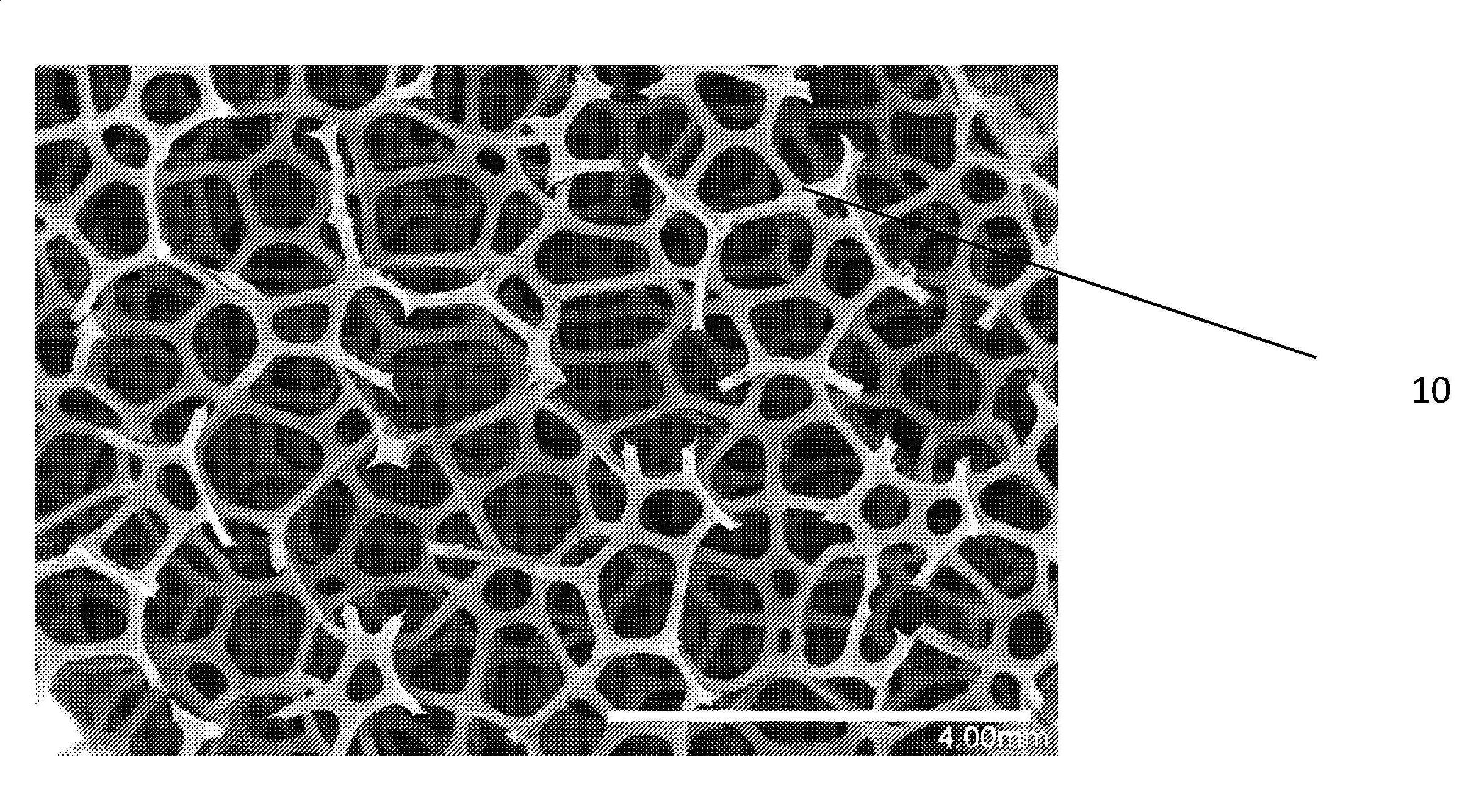
도 1은 상업적인 개방 셀 폴리우레탄 포움의 주사 전자 현미경 사진 이미지를 예시한다.
[0062]
도 2는 예시적인 개방 셀 실리콘-코팅된 구성물의 주사 전자 현미경 사진 이미지를 예시한다.
[0063]
도 3a, 3b 및 3c는 셀형 재료의 주사 전자 현미경 사진 이미지를 예시한다.
[0064]
도 4는 개방 셀 재료 내의 특징부의 주사 전자 현미경 사진 이미지를 예시한다.
[0065]
도 5는 예시적인 개방 면적 % 계산 및 이미지를 예시한다.
[0066]
도 6은 본원의 구성물의 측정된 SAG를 예시한다.
[0067]
도 7은 매트릭스 및 컨포말한 생체적합성 코팅뿐만 아니라 그 위의 친수성 코팅을 포함하는 예시적인 구성물을 예시한다.1 illustrates a scanning electron micrograph image of a commercial open cell polyurethane foam.
[0062] FIG. 2 illustrates a scanning electron micrograph image of an exemplary open cell silicon-coated construct.
[0063] Figures 3a, 3b and 3c illustrate scanning electron micrograph images of cellular materials.
4 illustrates a scanning electron micrograph image of a feature in an open cell material.
5 illustrates example open area % calculations and images.
[0066] Figure 6 illustrates the measured SAG of constructs herein.
[0067] Figure 7 illustrates an exemplary construct comprising a matrix and a conformal biocompatible coating as well as a hydrophilic coating thereon.
상세한 설명details
[0068] 본원의 개시는 개방 셀형 및 반-개방 셀형 다공질 재료의 분야에 관한 것이다. 본 개시의 비-제한적인 양태는 임의로 의료 적용에서 용도를 확인할 수 있는 개방 또는 반-개방 셀형 구성물이다. 구성물은 저밀도이고 비교적 고다공질(즉, 적어도 50% 공극률, 및 바람직하게는 적어도 75% 공극률, 또는 그 초과)인 동시에 의학적 용도에 생체적합성일 수 있다. 구성물은 임의로 순응성 향상 단계를 포함하지 않는 제조 절차와 비교하여 구성물의 순응성 또는 연성을 향상시키는 방식으로 제조될 수 있다. 구성물은 임의로 평활성 향상 단계를 포함하지 않는 제조 공정과 비교하여 구성물의 평활성을 향상시키는 단계 또는 절차로 제조될 수 있다. 일부 예에서, 순응성의 향상뿐만 아니라 최종 구성물의 평활성의 증가를 초래하는 단일 노출 단계가 수행될 수 있다. 추가로 또는 대안적으로, 구성물은 구성물의 제조 동안 부여될 수 있는 습윤성을 가질 수 있다. 본 개시의 비-제한적인 양태는 개방 또는 반-개방 셀형 구성물을 제조하는 방법에 관한 것이고, 여기서 구성물은 임의로 의학적 적용에서의 용도를 찾을 수 있다. 제조된 구성물은 저밀도이고 비교적 다공질(즉, 적어도 75% 공극률, 및 임의로 적어도 80% 공극률, 및 적어도 90% 공극률, 및 임의로 적어도 95% 공극률)인 동시에 의료 적용에 사용되는 경우 생체적합성일 수 있다. 제조 공정은 임의로 구성물에 더 큰 순응성/연성 및/또는 연성(예를 들어, 사용 중일 때 마찰을 감소시키는)을 부여할 수 있고, 추가로 또는 대안적으로, 제조 공정은 최종 구성물에 습윤성을 부여할 수 있다. [0068] The disclosure herein relates to the field of open celled and semi-open celled porous materials. A non-limiting aspect of the present disclosure is an open or semi-open celled construct that may optionally find use in medical applications. The composition may be low density and relatively high porosity (ie, at least 50% porosity, and preferably at least 75% porosity, or more) while being biocompatible for medical use. The construct may optionally be manufactured in a manner that enhances the conformability or ductility of the construct compared to manufacturing procedures that do not include a conformability enhancing step. The composition may optionally be made with steps or procedures that enhance the smoothness of the composition compared to a manufacturing process that does not include a smoothness enhancing step. In some instances, a single exposure step may be performed that results in an increase in smoothness of the final composition as well as improved conformability. Additionally or alternatively, the composition may have wettability properties that may be imparted during manufacture of the composition. A non-limiting aspect of the present disclosure relates to a method of making an open or semi-open cell construct, wherein the construct may optionally find use in medical applications. The fabricated construct may be low density and relatively porous (i.e., at least 75% porosity, and optionally at least 80% porosity, and at least 90% porosity, and optionally at least 95% porosity) while being biocompatible when used in medical applications. The manufacturing process may optionally impart greater conformability/softness and/or softness (eg, reducing friction when in use) to the composition, and additionally or alternatively, the manufacturing process imparts wettability to the final composition can do.
[0069] 본 개시의 일 양태는 구성물을 생체적합성으로 만들지만 여전히 매우 다공질이고 저밀도인 위에 컨포말한 생체적합성 코팅 또는 층을 갖는 주형 매트릭스(예를 들어, 폴리우레탄)를 갖는 구성물에 관한 것이다. 고다공질 또는 고공극률은 일반적으로 본원에서 공극 또는 개방 공간을 한정하는 스트럿의 저밀도 구성물과 함께 차단되지 않은 높은 백분율의 개방 셀 공극을 갖는 것을 지칭한다. 의료 적용과 같은 일부 용도는 고다공질 및 저밀도인 생체적합성 구성물로부터 크게 유리할 수 있다. 예를 들어, 생체적합성 고다공질(고공극률), 저밀도 구성물은 이를 통한 우수한 공기 및 액체 흐름을 제공할 수 있다. 다공질 재료를 통한 공기 흐름이 조직을 산소에 노출시키도록 하는 것이 매우 유리할 수 있다. 상처 치유 적용 및 용도에서 다공질 재료를 통해 액체 흐름을 허용하는 것은 매우 유리할 수 있다. 또한, 고다공질 재료는 염증 문제를 피하거나 최소화하면서 우수한 조직 접촉을 촉진할 수 있다. 또한, 고다공질 재료는 우수한 조직 통합을 허용하거나 제공할 수 있다. 생체적합성은, 예를 들어, 구성물이 장기간에 걸쳐 적용에 사용되도록 할 수 있다. 일부 비교적 단기 용도는 예를 들어 3-30일(또는 더 짧은)에 걸친 조직 접촉을 포함할 수 있지만, 더 장기 적용은 구성물이 30일 초과, 예컨대, 최대 10년 이상 동안 조직 접촉 적용에 사용되도록 할 수 있다.[0069] One aspect of the present disclosure relates to a construct having a mold matrix (eg polyurethane) with a conformal biocompatible coating or layer over which makes the construct biocompatible but still very porous and low density. High porosity or high porosity generally refers herein to having a high percentage of unobstructed open cell voids with low density constituents of struts defining the voids or open spaces. Some uses, such as medical applications, can benefit greatly from biocompatible constructs that are highly porous and low in density. For example, a biocompatible high porosity (high porosity), low density construct can provide good air and liquid flow therethrough. It can be very advantageous to have air flow through a porous material to expose the tissue to oxygen. Allowing liquid flow through porous materials can be very advantageous in wound healing applications and uses. In addition, highly porous materials can promote good tissue contact while avoiding or minimizing inflammatory issues. In addition, highly porous materials may allow or provide good tissue integrity. Biocompatibility can, for example, allow the composition to be used in applications over a long period of time. Some relatively short term uses may include tissue contact over eg 3-30 days (or shorter), while longer term applications may allow the composition to be used in tissue contact applications for more than 30 days, eg up to 10 years or more. can do.
[0070] 그러므로, 적용에 따라, 구성물의 고다공질 성질을 손실하지 않으면서 고다공질 매트릭스에 컨포말한 생체적합성 층을 추가할 수 있는 것이 매우 유리할 수 있다.[0070] Therefore, depending on the application, it can be very advantageous to be able to add a conformal biocompatible layer to the highly porous matrix without losing the highly porous nature of the construct.
[0071] 일부 예에서, 고다공질 생체적합성 구성물을 유지하는 것은 추가된 생체적합성 재료가 공극을 차단하는 것을 방지하기 위해 이미 고다공질 매트릭스 주형 상에 생체적합성 재료의 비교적 매우 얇은 컨포말한 층을 제공하고 고공극률 구성물을 제공하는 것을 포함한다. 최종 구성물의 고다공질 성질을 손실하지 않으면서 코팅을 제공하는 것을 도울 수 있는 제조 단계의 예시적인 방법은 하기에 더 상세히 기재된다.[0071] In some instances, maintaining a high porosity biocompatible construct already provides a relatively very thin conformal layer of biocompatible material on the highly porous matrix template to prevent the added biocompatible material from blocking the pores and has a high porosity. Including providing the composition. Exemplary methods of fabrication steps that can help provide coatings without losing the highly porous nature of the final composition are described in more detail below.
[0072] 일부 예시적인 구현예에서, 본원의 개방 또는 반-개방 셀형 구성물은 1 마이크론 내지 50 마이크론, 예컨대, 2 마이크론 내지 25 마이크론, 및 일부 경우에 2 마이크론 내지 15 마이크론, 예컨대, 2 마이크론 내지 10 마이크론인 생체적합성 층 또는 코팅을 포함할 수 있다. 일부 예에서, 코팅은 5 마이크론 이하, 예컨대, 1-5 마이크론일 수 있다. 임의의 이러한 예에서, 최종 코팅은 복수의 단계로 적용되거나 생성될 수 있고, 이들 각각은 층 또는 코팅을 추가하며, 여기서 최종 코팅 또는 층은 생체적합성 코팅 또는 층을 함께 한정하는 복수의 순차적으로 형성된 층을 포함한다 .[0072] In some exemplary embodiments, open or semi-open cellular constructs herein are biomaterials that are 1 micron to 50 microns, such as 2 microns to 25 microns, and in some cases 2 microns to 15 microns, such as 2 microns to 10 microns. Compatibility layers or coatings may be included. In some examples, the coating may be 5 microns or less, such as 1-5 microns. In any of these examples, the final coating may be applied or produced in a plurality of steps, each of which adds a layer or coating, wherein the final coating or layer is a plurality of sequentially formed layers that together define a biocompatible coating or layer. contains layers.
[0073] 베이스 주형 매트릭스에 첨가되는 생체적합성 재료의 양을 특징화하는 것을 돕는 예시적인 방법은 생체적합성 코팅의 첨가 후 공극 크기가 얼마나 감소하는지이다. 유의미한 감소 없이 컨포말한 코팅을 첨가하는 것은 공극 크기가 본원에 기재된 바와 같이 매우 다공질인 최종 구성물을 유지하고 생성하는 것을 돕는다. 구성물은 디지털 현미경 이미지 분석과 같은 이미지 분석에 의해 이러한 방식으로 특징화될 수 있다. 예를 들어, 생체적합성 층을 추가한 후 공극 크기의 감소는 2차원(예를 들어, 이미지)에서, 생체적합성 층이 추가되기 전 및 그 후의 다공질 구조물의 스트럿 사이에 개방된 2D 면적(개방 면적)의 백분율을 비교함으로써 정량화될 수 있고, 여기서 스트럿 사이의 개방 면적 %는, 예를 들어, 디지털 현미경을 사용할 때 이미지 분석에 의해 계산될 수 있다. 예를 들어, 개방 면적(2차원 이미지에서)은 구조물의 임의의 면(예를 들어, 상부면, 하부면)을 따라 촬영된 이미지에서의 개방 면적일 수 있거나, 구조물의 단면을 통해(예를 들어, 상부 면 및/또는 바닥 면에 직교하는 구조물의 중간을 통한 단면) 촬영된 이미지에서의 개방 면적일 수 있다. 개방 면적은 개방된 면적(해당 2차원 이미지에서)의 퍼센트로서 특징화될 수 있다(즉, 구조적 스트럿 사이에서 이에 의해 한정되는 영역).[0073] An exemplary way to help characterize the amount of biocompatible material added to the base template matrix is how much the pore size decreases after addition of the biocompatible coating. Adding a conformal coating without a significant reduction in pore size helps to maintain and create a highly porous final construct as described herein. Constructs can be characterized in this way by image analysis, such as digital microscopy image analysis. For example, the reduction in pore size after adding the biocompatible layer is the 2D area open between the struts of the porous structure before and after the biocompatible layer is added (open area ), where the % open area between struts can be calculated, for example, by image analysis when using a digital microscope. For example, the open area (in a two-dimensional image) can be the open area in an image taken along any side of a structure (eg, top surface, bottom surface), or through a cross-section of a structure (eg, a top surface, a bottom surface). For example, a cross section through the middle of the structure orthogonal to the top and/or bottom side) may be the open area in the captured image. The open area can be characterized as a percentage of the open area (in the corresponding two-dimensional image) (ie, the area defined by and between structural struts).
[0074] 2차원에서 개방 면적 %를 결정하거나 계산하는 데 사용될 수 있는 단지 예시적인 디지털 현미경 및 이와 관련된 소프트웨어는 Keyence로부터의 VHX 7000 디지털 현미경이지만, 구성물의 2차원 이미지에서 개방된 또는 이의 상부 또는 하부 표면의 촬영과 같은 구성물을 통해 면적 퍼센트를 계산하기 위해 결정하는 데 적합한 경우 다른 디지털 현미경이 개방 면적 %를 결정하거나 계산하는 데 사용될 수 있다.[0074] Only an exemplary digital microscope and related software that can be used to determine or calculate percent open area in two dimensions is the VHX 7000 digital microscope from Keyence, but taking a two-dimensional image of a construct open or its upper or lower surface. Other digital microscopes may be used to determine or calculate open area percentages if suitable to determine to calculate area percentages through such constructs.
[0075] 개방 면적 %를 결정하는 일부 방법은 스트럿과 공극(개방 면적) 사이의 최상의 대비를 생성하는 데 도움이 될 수 있는, 임의로 높은 동적 범위 함수를 갖는 마스터 공극률 이미지를 촬영하거나 얻는 것을 포함할 수 있다. 밝기 추출 모드는 개방된 공극에 대응할 수 있는 어두운 면적을 선택하도록 설정될 수 있다. 자동 면적 측정 이미지는 마스터 측정 이미지로 저장될 수 있다. 이는 반복 가능한 측정 파라미터를 생성하기 위해 샘플 및 영역의 후속 측정에 사용될 수 있다. 일부 방법은 +10의 임계값, 작은 그레인 환경의 제거; 및 3X 배율로 밝기 추출 모드를 사용하여 이미지를 수집하는 것을 포함할 수 있다. 본원에 열거된 개방 면적 %를 계산하는 것은 이미징을 위한 5 mm x 5 mm 면적을 갖는 직사각형 기하학 도구를 사용하여 측정을 위한 시험 면적을 선택하는 것을 포함하였다. 도 5는 이미지 분석 면적의 예를 예시한다. 이러한 특정 이미지를 사용한 이러한 특정 구성물에 대한 개방 면적 %는 20-35%의 개방 면적 %의 예인 "면적 비율"로서 28%로 열거된다.[0075] Some methods of determining the open area % can include taking or obtaining a master porosity image with an optionally high dynamic range function, which can help create the best contrast between struts and air gaps (open area). Brightness extraction mode can be set to select dark areas that can correspond to open voids. The automatic area measurement image can be saved as a master measurement image. This can be used for subsequent measurements of the sample and area to create repeatable measurement parameters. Some methods have a threshold of +10, removal of small grain environments; and collecting images using brightness extraction mode at 3X magnification. Calculating the percent open area listed herein involved selecting a test area for measurement using a rectangular geometry tool with a 5 mm x 5 mm area for imaging. 5 illustrates an example of an image analysis area. The open area % for this particular construction using this particular image is listed as 28% as an "area percentage" which is an example of an open area % of 20-35%.
[0076] 단지 예로서, 폴리우레탄은 주형의 면을 따라 30%의 개방 면적을 가질 수 있다. 구성물은 본원의 방법을 이용하여 구성되었으며, 이들 중 일부는, 공극률을 유의미하게 감소시키지 않는 생체적합성 층 또는 코팅의 예인, 25-30%의 개방 면적인 하나 이상의 면(예를 들어, 상부 및 하부)을 갖는다. 본원의 임의의 최종 구성물은 20-29%의 개방 면적을 갖는 하나 이상의 면을 가질 수 있다. 구성물은 단면이 25 - 30% 개방 면적인 본원의 방법을 사용하여 구성되었다.[0076] By way of example only, the polyurethane may have an open area of 30% along the face of the mold. Constructs have been constructed using the methods herein, some of which have one or more sides (e.g., top and bottom) that are 25-30% open area, which are examples of biocompatible layers or coatings that do not significantly reduce porosity. ) has Any final composition herein may have one or more faces with an open area of 20-29%. Constructs were constructed using the methods herein with a cross section of 25 - 30% open area.
[0077] 본원의 임의의 구성물은 또한 20%-30% 개방 면적인, 상부 면 및 하부 면과 직교하는 단면에서 촬영한 이미지에서 개방 면적 %를 가질 수 있다.[0077] Any of the constructs herein may also have a % open area in images taken in cross-sections orthogonal to the top and bottom faces, which is 20%-30% open area.
[0078] 또한, 첨가되는 생체적합성 재료의 양을 특징화하는 데 도움이 되는 추가적인 방법은 생체적합성 층이 없는 주형 매트릭스 재료의 개방 면적에 대한 구성물의 개방 면적의 비교이다. 예를 들어, 일부 구성물은, 구성물의 상부 또는 하부를 따라 촬영한 이미지에서, 복수의 스트럿 사이의 개방 공간으로 한정되는 개방 면적 %를 가질 수 있고, 여기서 매트릭스(예를 들어, 폴리우레탄)는 폴리우레탄 매트릭스의 상부 또는 하부를 따라 촬영된 이미지에서 컨포말한 생체적합성 코팅의 부재에서 복수의 매트릭스 스트럿 사이의 개방 공간으로 한정되는 개방 면적 %를 갖는다. 본원의 임의의 구성물로, 구성물 개방 면적 %와 매트릭스 개방 면적 % 사이의 차이는 10% 미만이다. 일부 구현예에서, 차이는 5% 미만이다. 개방 면적 %의 비교적 작은 차이는 본원에서 비교적 얇은 컨포말한 생체적합성 층 또는 코팅을 강조한다. [0078] Also, an additional method to help characterize the amount of biocompatible material added is the comparison of the open area of the construct to the open area of the mold matrix material without the biocompatible layer. For example, some structures may have a % open area defined as open space between a plurality of struts, in images taken along the top or bottom of the structure, where the matrix (eg polyurethane) is In the image taken along the top or bottom of the urethane matrix, the conformal biocompatible coating has a percent open area defined as the open space between the plurality of matrix struts. With any construct herein, the difference between the percent open area of the construct and the percent open area of the matrix is less than 10%. In some embodiments, the difference is less than 5%. The relatively small difference in percent open area highlights the relatively thin conformal biocompatible layer or coating herein.
[0079] 본원의 임의의 구현예에서, 최종 구성물은 90% 초과, 임의로 95% 또는 그 초과의 개방 셀의 퍼센트(공극률)를 가질 수 있다. 이는 본원에서 차단된 공극 윈도우를 갖지 않는 셀의 수를 지칭하며, 일반적으로 본원에서 공극률로 지칭된다.[0079] In any embodiment herein, the final composition may have a percentage of open cells (porosity) greater than 90%, optionally greater than or equal to 95%. This refers herein to the number of cells that do not have a blocked void window, and is generally referred to herein as porosity.
[0080] 일부 의학적 적용에 매우 유리할 수 있는 본원의 일부 구성물의 추가 이점은 구성물이 매트릭스 및 생체적합성 재료 자체로는 달성되지 않는 이에 부여되는 순응성 또는 연성을 갖는다는 것이다. 예를 들어, 구성물의 순응성 또는 연성을 증가시키는 것은 구성물과 이것이 배치되는 조직 사이의 마찰을 감소시킬 수 있고, 이는 조직 마모를 감소시키거나 없앨 수 있다. 또한, 순응성을 증가시키는 것은 구성물을 더 쉽게 구부릴 수 있게 하여, 구성물이 배치되는 조직 또는 해부학적 구조와 더 잘 순응하고 더 잘 접촉하도록 도울 수 있다. 본원의 구성물의 순응성을 증가시킬 수 있는 선택적이고 예시적인 방법 단계는 하기에 제공된다.[0080] An additional advantage of some of the constructs herein, which can be very advantageous for some medical applications, is that the constructs have conformability or softness imparted to them that is not achieved with the matrix and biocompatible materials themselves. For example, increasing the conformability or softness of a construct can reduce friction between the construct and the tissue on which it is placed, which can reduce or eliminate tissue abrasion. In addition, increasing conformability may make the construct more bendable, helping the construct to better conform and make better contact with the tissue or anatomy upon which it is placed. Optional and exemplary method steps that may increase the conformability of the constructs herein are provided below.
[0081] 일부 용도의 경우, 최종 구성물이 물과 접촉할 때 습윤성이 부여되는 것이 유리하거나 필요할 수 있다. 예를 들어, 일부 의학적 용도는 구성물이 생체적합성 층에 대하여 배치된 코팅으로 부여될 수 있는 어느 정도의 습윤성을 가질 것을 요구할 수 있다. 또한, 코팅의 가교는 코팅이 안정한 것을 보장할 수 있다. 구성물에 습윤성을 부여하면 조직과의 상용성이 개선될 수 있다. 습윤성은 또한 구성물이 조직과 접촉할 때 유체 흐름을 개선할 수 있으며, 이는 적용에 따라 매우 유리할 수 있다. [0081] For some applications, it may be advantageous or necessary for the final composition to be imparted with wettability when in contact with water. For example, some medical applications may require the composition to have some wettability that can be imparted with a coating disposed over a biocompatible layer. Also, crosslinking of the coating can ensure that the coating is stable. Imparting wettability to the composition may improve compatibility with tissues. Wettability can also improve fluid flow when the composition is in contact with tissue, which can be very advantageous depending on the application.
[0082] 일부 임의의 예에서, 습윤성은 생체적합성 층에 대하여 친수성 하이드로겔 코팅을 추가함으로써 부여된다. 친수성 하이드로겔 코팅은 5 마이크론 미만, 예를 들어, 3 마이크론 미만의 두께를 가질 수 있다. 친수성 하이드로겔 코팅은 물에 노출될 때 물을 흡수하여 최종 구성물의 고다공질 성질을 유의미하게 잃지 않으면서 습윤성 및 이의 관련 이점을 부여하도록 구성될 수 있다.[0082] In some optional examples, wettability is imparted by adding a hydrophilic hydrogel coating to the biocompatible layer. The hydrophilic hydrogel coating can have a thickness of less than 5 microns, such as less than 3 microns. Hydrophilic hydrogel coatings can be constructed to absorb water when exposed to water, imparting wettability and its related benefits without significantly losing the highly porous nature of the final composition.
[0083] 본원의 임의의 최종 구성물은 물에 노출될 때 50% 내지 95%, 예컨대, 50% 내지 95%, 65% 내지 95%, 70% 내지 95%, 75% 내지 95%의 물 함량을 갖도록 구성된 친수성 코팅을 포함할 수 있고, 이는 친수성 반응을 제공하는 데 도움이 될 수 있다.[0083] Any final construct herein is a hydrophilic composition configured to have a water content of 50% to 95%, e.g., 50% to 95%, 65% to 95%, 70% to 95%, 75% to 95% when exposed to water. coatings, which can help provide a hydrophilic reaction.
[0084] 본원에서 임의의 구성물의 습윤성은 임의로 구성물의 표면이 한 방울의 물에 노출될 때 고착성 적하 기술을 이용하여 물의 접촉각에 의해 특징화될 수 있다. 접촉각은 표면과 표면에 적용된 물 사이에서 측정된 각도를 지칭하며, 일반적으로 접촉각은 표면의 습윤성이 증가함에 따라 감소한다. 컨포말한 실리콘 코팅인 외부 층(즉, 외부 하이드로겔 층 없이)을 갖는 본원의 구성물은 부분적으로 실리콘의 소수성 성질로 인해 90 내지 110도, 예컨대, 90도 내지 95도의 접촉각을 가질 수 있다. 친수성 습윤 가능한 층인 외부 층을 갖는 본원의 구성물은 5 내지 35도일 수 있다. 예를 들어, 수중 50-80%의 물 함량을 갖는 일부 친수성 코팅은 20-35도의 접촉각을 가질 수 있고, 예를 들어, 수중 81-95%의 물 함량을 갖는 일부 친수성 코팅은 5-20도의 접촉각을 가질 수 있다. [0084] The wettability of any composition herein can optionally be characterized by the contact angle of water when the surface of the composition is exposed to a drop of water using the stick drop technique. Contact angle refers to the angle measured between a surface and the water applied to the surface, and generally the contact angle decreases as the wettability of the surface increases. Constructs herein having an outer layer that is a conformal silicone coating (i.e., without an outer hydrogel layer) may have a contact angle between 90 and 110 degrees, such as between 90 and 95 degrees, due in part to the hydrophobic nature of silicone. A composition herein having an outer layer that is a hydrophilic wettable layer may be 5 to 35 degrees. For example, some hydrophilic coatings with a water content of 50-80% in water may have a contact angle of 20-35 degrees, and some hydrophilic coatings with a water content of 81-95% in water, for example, a contact angle of 5-20 degrees. may have a contact angle.
[0085] 본원의 일부 구성물의 추가적인 이점은 최종 구성물이 최소량의 화학물질의 침출 또는 침출 없이 매우 생체적합성(청정)하다는 것이며, 이는 구성물이 조직과 접촉될 때 의학적 용도의 적용에 매우 유리하거나 요구될 수 있다. 매우 청정한 생체적합성 구성물은 조직과 접촉할 때 독성이 없음을 보장할 수 있다. 본원의 구성물의 매우 생체적합성인 성질은 하나 이상의 제조 단계로 인해 적어도 부분적으로 개선되거나 부여될 수 있으며, 이의 예는 하기에 기재되어 있다. 예를 들어, 하나 이상의 실리콘 경화 단계는 매우 낮은 수준의 미반응(예를 들어, 미경화) 재료가 추출되는(예를 들어, 5% 미만) 추출 단계에 의해 입증되는 바와 같이 매우 효율적일 수 있다. 따라서, 하나 이상의 효율적인 경화 단계는 구성물이 조직과 접촉하여 사용될 때 화학물질의 침출을 최소화하거나 제거하는 것을 도울 수 있고, 이는 구성물을 사용하기에 더 안전하게 만들 수 있다.[0085] An additional advantage of some of the compositions herein is that the final composition is very biocompatible (pure) with or without leaching of minimal amounts of chemicals, which can be very advantageous or required for medical applications when the composition is in contact with tissue. A very clean biocompatible construct can ensure that it is non-toxic when in contact with tissue. The highly biocompatible properties of the constructs herein can be improved or imparted at least in part due to one or more manufacturing steps, examples of which are set forth below. For example, one or more silicone curing steps can be very efficient, as evidenced by an extraction step in which very low levels of unreacted (eg, uncured) material are extracted (eg, less than 5%). Thus, one or more effective curing steps can help minimize or eliminate leaching of chemicals when the composition is used in contact with tissue, which can make the composition safer to use.
[0086] 일부 양태에서, 본 개시는 40-99.6%의 공극률(즉, 개방 셀 %), 및 바람직하게는 60-99%, 및 가장 바람직하게는 80-98% 공극률을 갖는 본 발명의 다공질 구조물(최종 구성물)를 기술한다. 구조물은 개방 셀형 또는 반-개방형 셀일 수 있으며, 각 셀은 평균적으로 이웃 셀에 대한 2개 초과의 연결 및 이웃 셀에 대한 최대 18개의 연결, 가장 바람직하게는 이웃 셀에 대한 5 내지 12개의 연결을 함유한다. 구조물은, 대부분 5-2500 um, 더욱 바람직하게는 15-1500 um, 및 가장 바람직하게는 25-900 um 범위이고, 평균 50-900 um, 및 더욱 바람직하게는 150-800 um, 및 가장 바람직하게는 250-650 um인 상호연결 직경을 가질 수 있다. 구조물은 또한 50-3500 um, 더욱 바람직하게는 150-2500 um, 및 가장 바람직하게는 250-1500 um 범위의 공극 크기를 함유해야 한다. 구조물은 임의로 일부 대안에서 용매, 더욱 바람직하게는 유기 용매, 예컨대, DMSO(디메틸설폭사이드), NMP(N-메틸피롤리돈), DMF(N,N-디메틸포름아미드), 디옥산, 아세톤, 아세토니트릴, 헥산, 톨루엔, 클로로포름, 디클로로메탄, 이소프로판올, 또는 에탄올, 가장 바람직하게는 아세톤, 아세토니트릴, DMSO, NMP, 또는 DMF, 또는 임의의 상기 언급된 용매들의 혼합물에 의해 액체, 겔, 또는 현탁액 형태로 또는 그 전체가 용해 가능할 수 있다. 임의의 이러한 구조물은 본원에서 매트릭스 재료, 또는 이의 유도체로서 지칭될 것이다.[0086] In some embodiments, the present disclosure provides a porous structure (final constituent) of the present invention having a porosity (i.e., open cell %) of 40-99.6%, and preferably 60-99%, and most preferably 80-98% porosity. ) is described. The structures may be open celled or semi-open cells, each cell having on average more than 2 connections to neighboring cells and up to 18 connections to neighboring cells, most preferably 5 to 12 connections to neighboring cells. contain The structures mostly range from 5-2500 um, more preferably 15-1500 um, and most preferably 25-900 um, with an average of 50-900 um, and more preferably 150-800 um, and most preferably may have an interconnection diameter of 250-650 um. The structure should also contain pore sizes in the range of 50-3500 um, more preferably 150-2500 um, and most preferably 250-1500 um. The construct is optionally in some alternatives a solvent, more preferably an organic solvent such as DMSO (dimethylsulfoxide), NMP (N-methylpyrrolidone), DMF (N,N-dimethylformamide), dioxane, acetone, liquid, gel, or suspension with acetonitrile, hexane, toluene, chloroform, dichloromethane, isopropanol, or ethanol, most preferably acetone, acetonitrile, DMSO, NMP, or DMF, or a mixture of any of the aforementioned solvents It may be soluble in form or in its entirety. Any such structure will be referred to herein as a matrix material, or a derivative thereof.
[0087] 본원의 개시는 또한 코팅 또는 함침에 의해 생체적합성일 수 있는 코팅 재료(예를 들어, 실리콘)로 매트릭스 재료의 개별 구조를 둘러싸는 것을 포함하는 혁신적인 공정을 기술한다. 코팅 공정은 매트릭스 재료의 공극을 완전히 또는 부분적으로 함침시키고, 이어서 컨포말한 코팅(임의로 이러한 생체적합성인)이 주형 매트릭스의 스트럿에서 유지되고 공극의 비-폐색이 가능하도록 과량의 제거를 수행함으로써 액체 상태, 또는 액화된 구성 재료, 용액 상태, 겔 상태, 에멀젼 상태, 현탁액 상태, 또는 혼합물 상태의 코팅 재료를 사용하여 실시될 수 있다.[0087] The disclosure herein also describes an innovative process involving enclosing individual structures of a matrix material with a coating material (eg, silicone) that may be biocompatible by coating or impregnation. The coating process involves completely or partially impregnating the pores of the matrix material, followed by removal of excess liquid so that the conformal coating (optionally such biocompatible) remains on the struts of the mold matrix and allows non-occlusion of the pores. It can be carried out using a coating material in a state, or a liquefied constituent material, a solution state, a gel state, an emulsion state, a suspension state, or a mixture state.
[0088] 코팅 재료는 하나 이상의 용융 가능한 폴리머, 용해 가능한 폴리머, 용융 가능한 또는 용해 가능한 폴리머 혼합물, 용융 가능한 또는 용해 가능한 폴리머 용액, 용융 가능한 또는 용해 가능한 모노머 혼합물 또는 용액, 용융 가능한 또는 용해 가능한 프리폴리머 혼합물 또는 용액, 용융 가능한 또는 용해 가능한 올리고머 혼합물 또는 용액, 또는 분말, 겔, 또는 액체 형태의 폴리머, 세라믹, 또는 금속과 임의의 상기 언급된 것들의 조합을 포함한다. 일부 특정 구현예에서, 폴리머는 유기 용매 중의 용해 가능한 폴리머의 용액이고, 용해 가능한 폴리머는 과량의 구성 재료가 제거되고 용매가 증발함에 따라 매트릭스 재료에 침착된다. 또 다른 특정 구현예에서, 용융된 재료는 매트릭스 재료의 구조에 함침되고 표면 장력으로 인해 매트릭스 재료의 내부 구조를 습윤시킨다. 추가의 또 다른 구현예에서, 코팅 재료는 에멀젼이고, 이후 매트릭스 재료의 내부 구조 상에 침착되는 매트릭스 재료의 존재 하에 에멀젼에서 배출된다. 일부 일반적인 구현예에서, 구성 재료의 일부 또는 전부를 포함하는 폴리머는 키토산, 키틴-키토산 코폴리머, PLGA 코폴리머, 폴리카프로락톤과 또 다른 폴리에스테르의 폴리카프로락톤 호모폴리머 또는 코폴리머, 실리콘 프리폴리머, 실리콘 폴리머, 폴리에틸렌, Viton 프리폴리머, PVDF, 폴리스티렌, 폴리비닐 알코올, 폴리비닐 알코올-아세테이트 코폴리머, 올레핀 폴리머 또는 코폴리머, 폴리사카라이드 또는 폴리사카라이드를 함유하는 코폴리머, 폴리에스테르 또는 폴리에스테르 코폴리머, 폴리에테르 또는 폴리에테르 코폴리머, 폴리에틸렌아민, 알기네이트, 폴리카보네이트, 폴리아미드, 폴리아민, 폴리우레아, 또는 코폴리머, 블렌드, 선형 또는 가교된 하이드로겔 호모폴리머 또는 코폴리머, 실록산 성분을 함유하는 선형 또는 가교된 하이드로겔 호모폴리머 또는 코폴리머, 은 나노입자 또는 은 마이크로입자와 같은 첨가제를 함유하는 선형 또는 가교된 하이드로겔 호모폴리머 또는 코폴리머, 상기 언급된 폴리머들 중 어느 하나 이상의 다가전해질 복합체일 수 있다. 코팅 재료는 임의로 최대 80 부피%의 세라믹 또는 금속을 미세섬유 형태의 분말로 함유할 수 있다. 일부 구현예에서, 세라믹 분말은 평균 직경이 5nm 내지 100 um, 더욱 바람직하게는 평균 직경이 25nm 내지 25 um, 및 가장 바람직하게는 평균 직경이 150nm 내지 10 um이다. 일부 구현예에서, 세라믹 분말은 섬유의 모양, 또는 구형 모양, 또는 수지상 모양이다. 일부 구현예에서, 세라믹 분말은 소듐 클로라이드 염, 칼슘 카보네이트, 실리카, 알루미나, 지르코니아, 다이아몬드 더스트, 알루미늄 니트라이드, 알루미늄 카바이드, 또는 전술한 것들 중 어느 하나 이상의 혼합물이다. 추가의 다른 구현예에서, 금속 분말은 전술한 세라믹 분말의 크기 범위이고 전술한 세라믹 분말의 모양을 갖는다. 다른 구현예에서, 금속 분말은 금 분말, 은, 구리, 알루미늄, 또는 철이다. 다른 구현예에서, 금속 분말은 주석, 강철, 니티놀, 니콜로이, 알길로이, 또는 다른 합금과 같은 합금이다. 또 다른 구현예에서, 재료은 생물활성제, 예컨대, 소분자 약제, 펩티드, 소분자 화학 작용제, 대분자, 예컨대, 항체, 트랩, 단백질, DNA, RNA 등을 함유한다.[0088] The coating material may include one or more meltable polymers, soluble polymers, meltable or dissolvable polymer mixtures, meltable or soluble polymer solutions, meltable or soluble monomer mixtures or solutions, meltable or soluble prepolymer mixtures or solutions, molten possible or soluble oligomer mixtures or solutions, or combinations of any of the foregoing with polymers, ceramics, or metals in powder, gel, or liquid form. In some specific embodiments, the polymer is a solution of a soluble polymer in an organic solvent, and the soluble polymer is deposited on the matrix material as excess constituent materials are removed and the solvent evaporates. In another specific embodiment, the molten material impregnates the structure of the matrix material and wets the internal structure of the matrix material due to surface tension. In yet another embodiment, the coating material is an emulsion and then exits the emulsion in the presence of the matrix material which is deposited on the internal structure of the matrix material. In some general embodiments, the polymer comprising some or all of the constituent materials is chitosan, a chitin-chitosan copolymer, a PLGA copolymer, a polycaprolactone homopolymer or copolymer of polycaprolactone and another polyester, a silicone prepolymer, Silicone polymers, polyethylene, Viton prepolymers, PVDF, polystyrene, polyvinyl alcohol, polyvinyl alcohol-acetate copolymers, olefin polymers or copolymers, polysaccharides or copolymers containing polysaccharides, polyesters or polyester copolymers , polyethers or polyether copolymers, polyethyleneamines, alginates, polycarbonates, polyamides, polyamines, polyureas, or copolymers, blends, linear or crosslinked hydrogel homopolymers or copolymers, linear containing siloxane components or a linear or cross-linked hydrogel homopolymer or copolymer containing an additive such as a crosslinked hydrogel homopolymer or copolymer, silver nanoparticles or silver microparticles, a polyelectrolyte complex of one or more of the aforementioned polymers. have. The coating material may optionally contain up to 80% by volume of a ceramic or metal powder in the form of microfibrils. In some embodiments, the ceramic powder has an average diameter of 5 nm to 100 um, more preferably an average diameter of 25 nm to 25 um, and most preferably an average diameter of 150 nm to 10 um. In some embodiments, the ceramic powder is fibrous, or spherical, or dendritic. In some embodiments, the ceramic powder is a sodium chloride salt, calcium carbonate, silica, alumina, zirconia, diamond dust, aluminum nitride, aluminum carbide, or a mixture of any one or more of the foregoing. In yet another embodiment, the metal powder is in the size range of the ceramic powder described above and has the shape of the ceramic powder described above. In other embodiments, the metal powder is gold powder, silver, copper, aluminum, or iron. In other embodiments, the metal powder is an alloy such as tin, steel, nitinol, nicoloy, argiloy, or other alloy. In another embodiment, the material contains bioactive agents such as small molecule drugs, peptides, small molecule chemical agents, large molecules such as antibodies, traps, proteins, DNA, RNA, and the like.
[0089] 본원의 임의의 예시적인 제조 방법은 또한 최종 구성물의 요망되는 미세구조를 수득하기 위한 공정을 포함할 수 있고, 여기서 코팅되거나 함침된 구성물 재료는 최종 구성물 재료의 요망되는 구조를 달성하기 위해 요망되는 양의 구성물 재료만을 보유하는 방식으로 제거된다. 구체적으로, 본원의 일부 구현예에서, 코팅 재료는 공극 및 매트릭스 재료를 완전히 채우고, 이어서 이것이 부피 기준으로 원래의 60-80% 수준이 되도록 부분적으로 제거되고, 다른 구현예에서 코팅 재료는 부피 기준으로 원래의 40-60% 수준이 되도록 제거되고, 추가의 다른 구현예에서 코팅 재료는 20-40% 수준으로 제거되고, 추가의 다른 구현예에서 코팅은 10-20% 수준으로 제거되고, 추가의 다른 구현예에서 코팅 재료는 3-10 부피% 수준으로 제거된다.[0089] Any exemplary manufacturing method herein may also include a process to obtain a desired microstructure of the final constituent material, wherein the coated or impregnated constituent material is applied in a desired amount to achieve the desired structure of the final constituent material. are removed in such a way as to retain only the constituent materials of the Specifically, in some embodiments of the present disclosure, the coating material completely fills the voids and the matrix material, and then partially removed so that it is at 60-80% of its original level by volume, and in other embodiments, the coating material is removed by volume. In yet other embodiments, the coating material is removed to the original 40-60% level, in yet other embodiments the coating material is removed to the 20-40% level, and in still other embodiments the coating is removed to the 10-20% level, and in further other embodiments the coating material is removed to the 10-20% level. In embodiments the coating material is removed at a level of 3-10% by volume.
[0090] 재료의 제거 후, 고화, 경화, 또는 중합 단계 중 하나 이상이 이어서 코팅 재료에 대해 수행될 수 있다. 일 구현예에서, 용액, 혼합물, 겔, 에멀젼 또는 현탁액의 형태인 코팅되거나 함침된 구성물 재료는 동결 건조에 의해 고화된다. 또 다른 구현예에서, 코팅 재료는 건조, 침전, 용액, 에멀젼, 현탁액, 혼합물, 또는 현탁액 상으로부터의 분리에 의해 고화된다. 추가의 또 다른 구현예에서, 재료는 고화 공정 전 또는 후에 중합된다. 추가의 또 다른 구현예에서, 재료는 고화 공정 전 또는 후에 가교된다. 고화된 코팅 재료는 매트릭스 재료의 내부 구조를 컨포말하게 코팅하거나, 매트릭스 재료와 상이한 구조를 형성할 수 있다. 바람직한 구현예에서, 코팅 재료는 주로 컨포말한 방식으로 매트릭스 재료를 코팅한다. 일부 구현예에서, 고화는 진공에 의해 보조되고, 추가의 다른 구현예에서, 침전은 액체, 가스 또는 온도 변화의 적용에 의해 촉진된다. 추가의 또 다른 구현예에서, 고화는 별도의 가교제의 도입과 함께 또는 도입 없이 열 및/또는 UV 방사선에 의해 임의로 촉진되는 중합 반응에 의해 촉진된다. 추가의 또 다른 구현예에서, 고화는 플라즈마에 노출된 후 가교에 의해 촉진된다. 일부 특정 구현예에서, 약 80%의 담체 용매의 열이 가해지고; 다른 특정 구현예에서, 용융된 구성물 폴리머는 빙점 미만으로 냉각되고; 추가의 다른 구현예에서, 프리폴리머는 가교 또는 중합 반응을 개시하기 위해 가열된다.[0090] After removal of the material, one or more of the steps of solidification, curing, or polymerization may then be performed on the coating material. In one embodiment, the coated or impregnated component material in the form of a solution, mixture, gel, emulsion or suspension is solidified by freeze drying. In another embodiment, the coating material is solidified by drying, precipitation, separation from a solution, emulsion, suspension, mixture, or suspension phase. In yet another embodiment, the material is polymerized before or after the solidification process. In yet another embodiment, the material is crosslinked before or after the solidification process. The solidified coating material may conformally coat the internal structure of the matrix material or form a structure different from that of the matrix material. In a preferred embodiment, the coating material coats the matrix material in a predominantly conformal manner. In some embodiments, solidification is assisted by vacuum, and in still other embodiments, precipitation is facilitated by the application of a liquid, gas or temperature change. In yet another embodiment, solidification is catalyzed by a polymerization reaction optionally catalyzed by heat and/or UV radiation with or without the introduction of a separate crosslinking agent. In yet another embodiment, solidification is promoted by crosslinking after exposure to plasma. In some specific embodiments, heat of about 80% of the carrier solvent is applied; In another specific embodiment, the molten constituent polymer is cooled below freezing point; In still other embodiments, the prepolymer is heated to initiate a crosslinking or polymerization reaction.
[0091] 일부 구현예에서, 코팅 또는 함침 단계는 중량 기준으로 원래 구성물 재료의 예컨대, 대략 20-50%, 또는 대략 50-100%, 또는 대략 100-200 중량%, 또는 대략 200-500 중량%까지 매트릭스 재료의 미세구조 내의 코팅 재료의 양을 증가시키기 위해 고화, 침전, 경화 또는 겔화 단계 후에 반복된다. 일부 구현예에서, 임의로 2 내지 10개, 및 일부 경우에 10 내지 50개가 있을 수 있는 제1 및 임의의 후속 코팅 또는 함침 단계는 동일하지 않고, 상이한 코팅 또는 함침 재료의 사용, 상이한 후속 건조 또는 고화 단계를 포함할 수 있다. 구체적으로, 하나의 임의의 구현예에서, 제1 함침 단계는 아세트산 중 키토산의 4% 용액을 사용하여 이루어지고, 건조되어 아세트산의 적어도 90 중량%가 제거되고, 제2 함침 단계는 알기네이트의 2% 용액으로 이루어지며, 이는 함침 후 적어도 95 중량%의 고형물로 다시 한번 건조된다. 다른 특정 구현예에서, 제1 또는 임의의 후속 건조, 고화, 또는 중합 단계 후에 화학적 개질, 또는 중화, 또는 화학적 반응, 또는 물리적 상태 변화가 이어진다.[0091] In some embodiments, the coating or impregnating step may include, for example, about 20-50%, or about 50-100%, or about 100-200%, or about 200-500%, by weight of the original constituent material, by weight of the matrix material. It is repeated after the solidification, precipitation, curing or gelation step to increase the amount of coating material in the microstructure of the. In some embodiments, the first and optional subsequent coating or impregnation steps, which may optionally be from 2 to 10, and in some cases from 10 to 50, are not identical, use of different coating or impregnating materials, different subsequent drying or solidification steps may be included. Specifically, in one optional embodiment, the first impregnation step is with a 4% solution of chitosan in acetic acid, dried to remove at least 90% by weight of the acetic acid, and the second impregnation step is with a 2% solution of alginate. % solution, which after impregnation is dried once again to a solids of at least 95% by weight. In certain other embodiments, the first or any subsequent drying, solidification, or polymerization step is followed by chemical modification, or neutralization, or chemical reaction, or physical state change.
[0092] 하나 이상의 코팅 또는 함침, 및 건조, 고화, 및/또는 중합 단계 후, 일부 구현예에서, 매트릭스 재료는 임의로 매트릭스 재료를 용해시킬 수 있는 용매에 의해 적어도 부분적으로 제거될 수 있다. 임의의 제거는 주위 조건에서 또는 대략 40-60℃ 또는 60-80℃ 또는 80-120℃와 같은 상승된 온도에서 및 임의로 교반과 함께 일어날 수 있다. 매트릭스 재료의 표적화된 제거는 어디에서도 0.5 내지 100 중량%, 바람직하게는 20 내지 100 중량%, 및 가장 바람직하게는 80 내지 100 중량%일 수 있다.[0092] After one or more coating or impregnating, and drying, solidifying, and/or polymerization steps, in some embodiments, the matrix material may optionally be at least partially removed by a solvent capable of dissolving the matrix material. Optional removal may occur at ambient conditions or at elevated temperatures such as approximately 40-60°C or 60-80°C or 80-120°C and optionally with agitation. Targeted removal of matrix material may be anywhere from 0.5 to 100 wt%, preferably from 20 to 100 wt%, and most preferably from 80 to 100 wt%.
[0093]
도 1은 예시적인 상업적 폴리우레탄 포움의 구조의 고배율 1을 나타낸다. 단지 하나의 예시적인 스트럿(10)이 표지되고, 공극은 스트럿 사이의 개방 공간이다. 도 2는 예시적인 스트럿(20) 중 하나만이 표지된, 실리콘 코팅을 포함하는 구성물의 예시적인 구조물의 고배율(2)을 도시한다. 공극은 스트럿 사이에 있고 스트럿에 의해 한정되는 개방 공간이다. 도 2의 구성물은 도 1의 폴리우레탄 포움에 존재하는 개방 셀 상호연결 구조물과 유사한 외관을 갖는다는 것을 쉽게 알 수 있다. 도 2는 본원에 기재된 매트릭스 및 컨포말한 코팅 층을 포함하는 임의의 구성물을 나타낸다. [0093]
1 shows a high magnification 1 of the structure of an exemplary commercial polyurethane foam. Only one
[0094] 매트릭스 재료가 적어도 부분적으로 및 임의로 제거되는 구현예에서, 매트릭스 재료의 임의의 제거 후, 추가 코팅 또는 함침 단계는 1) 원래의 매트릭스 재료에 의해 남겨진 보이드 충전; 또는 2) 구성물 재료의 스트럿에 외부 보강재를 추가 중 하나 이상을 달성하기 위해 수행될 수 있다. 추가적인 임의의 코팅 단계 동안, 매트릭스 재료에 의해 남겨진 원래의 보이드의 5-100%, 및 일부 바람직한 구현예에서 15-100%, 및 임의로 가장 바람직하게는 50-95%가 충전될 수 있다. 추가의 코팅 단계는 추가의 고화, 경화, 중합, 및/또는 가교 단계 중 하나 이상이 이어질 수 있고, 추가의 코팅 또는 화학적 개질 단계가 그 후에 이어질 수 있다.[0094] In embodiments in which the matrix material is at least partially and optionally removed, after any removal of the matrix material, additional coating or impregnating steps may include: 1) filling of voids left by the original matrix material; or 2) adding an external stiffener to the strut of the constituent material. During the additional optional coating step, 5-100%, and in some preferred embodiments 15-100%, and optionally most preferably 50-95% of the original voids left by the matrix material may be filled. Additional coating steps may be followed by one or more of additional solidification, curing, polymerization, and/or crosslinking steps, followed by additional coating or chemical modification steps.
[0095] 본원의 임의의 건조, 중합, 가교, 겔화, 고화, 및/또는 경화 단계 후 임의의 시점에, 추가의 후속 가공 단계가 수행될 수 있다. 일부 구현예에서, 후속-가공 단계는 중화, 화학적 개질, 또는 세척, 멸균, 정제, 건조, 또는 용매 제거 단계(이들의 임의의 조합을 포함함) 중 하나 이상일 수 있다.[0095] At any point after any of the drying, polymerization, crosslinking, gelling, solidifying, and/or curing steps herein, additional subsequent processing steps may be performed. In some embodiments, the post-processing step can be one or more of neutralization, chemical modification, or washing, sterilization, purification, drying, or solvent removal steps, including any combination thereof.
[0096] 본 개시의 일 양태는 본원의 예시적인 공정으로부터 생성된 최종(또는 완성된) 구성물을 포함한다. 예를 들어, 최종 구성물은 임의로 50-99% 공극률, 더욱 바람직하게는 60-98.5% 공극률, 및 가장 바람직하게는 80-98% 공극률을 갖는 다공질 구조를 포함할 수 있다.[0096] One aspect of the present disclosure includes a final (or finished) construct resulting from the exemplary processes herein. For example, the final composition may optionally include a porous structure having 50-99% porosity, more preferably 60-98.5% porosity, and most preferably 80-98% porosity.
[0097] 본원의 최종 구성물은 또한 각 셀이 평균적으로 이웃 셀에 대한 2개 초과의 연결 및 이웃 셀에 대한 최대 16개의 연결, 가장 바람직하게는 이웃 셀에 대한 5 내지 12개의 연결을 함유하는 상호연결되거나 반-상호연결된 공극을 함유할 수 있다. 본원에서 완성된 구성물은 대부분 5-2200 um, 더욱 바람직하게는 15-1500 um, 및 가장 바람직하게는 25-800 um 범위이고, 평균 50-800 um, 및 더욱 바람직하게는 150-750 um, 및 가장 바람직하게는 250-600 um 범위의 상호연결 직경을 포함할 수 있다. 본원의 완성된 구성물은 또한 50-3000 um, 더욱 바람직하게는 150-2000 um, 및 가장 바람직하게는 250-1200 um 범위의 공극 크기를 함유할 수 있다.[0097] The final constructs herein may also be interconnected or semi-interconnected where each cell contains on average more than 2 connections to neighboring cells and up to 16 connections to neighboring cells, most preferably 5 to 12 connections to neighboring cells. - may contain interconnected pores. Constructs completed herein mostly range from 5-2200 um, more preferably 15-1500 um, and most preferably 25-800 um, with an average of 50-800 um, and more preferably 150-750 um, and Most preferably, it may include interconnection diameters in the range of 250-600 um. The finished constructs herein may also contain pore sizes in the range of 50-3000 um, more preferably 150-2000 um, and most preferably 250-1200 um.
[0098] 일부 구현예에서, 구성물을 이의 최종 상태에서 지지하는 스트럿은 이의 가장 얇은 섹션이 10-50 um의 범위이고, 추가의 다른 구현예에서 스트럿은 이의 가장 얇은 섹션이 25-150 um이고, 추가의 다른 구현예에서 스트럿은 이의 가장 얇은 섹션이 50-250 um이고, 추가의 다른 구현예에서 스트럿은 가장 얇은 섹션이 150-500 um이다. 평균적으로, 스트럿은 이의 가장 얇은 섹션이 평균 25 내지 1000 um, 더욱 바람직하게는 35 내지 800 um, 및 가장 바람직하게는 50 내지 600 um일 수 있다.[0098] In some embodiments, the strut supporting the formation in its final state ranges from 10-50 um at its thinnest section, and in further other embodiments the strut ranges from 25-150 um at its thinnest section, with further other In embodiments the strut is 50-250 um in its thinnest section, and in further other embodiments the strut is 150-500 um in its thinnest section. On average, the struts may average 25 to 1000 um, more preferably 35 to 800 um, and most preferably 50 to 600 um in their thinnest section.
[0099] 일부 구현예에서, 최종 구성물은 이의 가장 얇은 섹션이 평균적으로 10-150 um의 최종 스트럿 내에 보이드를 함유하고, 추가의 다른 구현예에서 보이드는 5-75 um이고, 추가의 다른 구현예에서 보이드는 0.5-50 um이다. 일반적으로, 보이드는 매트릭스 재료 스트럿의 원래 크기의 0-100%, 및 더욱 바람직하게는 매트릭스 재료 스트럿의 원래 크기의 0-80%, 및 가장 바람직하게는 0-45%이다.[0099] In some embodiments, the final formation contains voids in the final struts whose thinnest section averages 10-150 um, in further other embodiments the voids are 5-75 um, and in further other embodiments the voids are 0.5-50 μm. Generally, the voids are 0-100% of the original size of the matrix material struts, and more preferably 0-80%, and most preferably 0-45% of the original size of the matrix material struts.
[00100] 하기 개시는 주형 재료가 용해되지 않는 동안 본원에 기재된 구성물의 제조 중 수행될 수 있는 예시적인 단계를 포함한다. 단계는 순서대로 기재될 수 있지만, 순서에 약간의 변동성이 있을 수 있는 것으로 이해된다. 이러한 방법 단계 중 하나 이상을 이용하여 제조된 구성물은 의학적으로 그리고 조직과 접촉하여 사용될 때 본원에 기재된 하나 이상의 이점, 예컨대, 개선된 생체적합성, 고다공질, 임의의 향상된 평활성, 및 임의의 향상된 습윤성을 제공할 수 있다.[00100] The following disclosure includes exemplary steps that may be performed during manufacture of the constructs described herein while the mold material is not dissolved. Although the steps may be described in order, it is understood that there may be some variability in order. Constructs made using one or more of these method steps may exhibit one or more of the advantages described herein, such as improved biocompatibility, high porosity, optional improved smoothness, and optional improved wettability when used medically and in contact with tissue. can provide
[00101] 일부 제조 방법은 다공질 주형 매트릭스로 시작하거나 이를 제공하는 것을 포함하며, 이는 일부 경우에 고다공질 폴리우레탄 매트릭스일 수 있다. 방법은 요망되는 치수를 갖는 다공질 주형 재료를 형성하는 것을 포함할 수 있다. 주형 재료를 형성하는 것은 주형을 요망되는 치수로 절단하여 길이 및 폭 치수보다 비교적 훨씬 낮은 높이를 가질 수 있는 주형 재료의 시트를 형성하는 것을 포함할 수 있다. [00101] Some manufacturing methods include starting with or providing a porous mold matrix, which in some cases may be a highly porous polyurethane matrix. The method may include forming a porous mold material having desired dimensions. Forming the mold material may include cutting the mold to the desired dimensions to form a sheet of mold material that may have a height relatively well below the length and width dimensions.
[00102] 일부 방법은 다공질 주형 재료 상에 컨포말한 생체적합성 층 또는 코팅을 생성하는 데 사용될 생체적합성 재료를 제조하는 것을 포함할 수 있다. 일부 예에서, 방법은 임의로 용매로서 자일렌을 사용하여 실리콘 분산액을 제조하는 것을 포함할 수 있다. 일부 방법에서, 분산액은 비교적 낮은 백분율의 실리콘을 가지며, 이는 비교적 얇은 실리콘 층의 생성을 용이하게 할 수 있고, 이의 이점은 본원에 제공된다(예를 들어, 최종 구성물의 고다공질 성질을 잃지 않음). 일부 예에서, 분산액은 자일렌 용매와 함께 5 내지 35%의 실리콘일 수 있다. 일부 예에서, 분산액은 10% 내지 35%의 실리콘, 예컨대, 15% 내지 25%의 실리콘일 수 있다. 일부 특정 예에서, 분산액은 20%의 실리콘 수지 내지 80%의 자일렌 용매를 포함하지만, 다른 상대 백분율이 사용될 수 있다. 임의로 분산액은 탈기되어 기포를 제거할 수 있다. [00102] Some methods may include preparing a biocompatible material that will be used to create a conformal biocompatible layer or coating on a porous template material. In some examples, the method may include preparing a silicone dispersion, optionally using xylene as a solvent. In some methods, the dispersion has a relatively low percentage of silicon, which can facilitate the creation of a relatively thin layer of silicon, the advantages of which are provided herein (eg, without losing the highly porous nature of the final composition). . In some examples, the dispersion may be 5 to 35% silicone with xylene solvent. In some examples, the dispersion may be 10% to 35% silicone, such as 15% to 25% silicone. In some specific examples, the dispersion includes from 20% silicone resin to 80% xylene solvent, although other relative percentages may be used. Optionally the dispersion may be degassed to remove air bubbles.
[00103] 일부 예에서, 실리콘 분산액은 다공질 주형 재료 상에 코팅될 수 있다. 이는 임의로 개방 또는 반-개방 셀형 다공질 주형을 실리콘 분산액에 침지시켜 주형 구조를 실리콘 분산액에 노출시키는 것을 포함할 수 있고, 여기서 주형 구조는 복수의 주형 공극을 한정하는 복수의 주형 스트럿을 포함한다. 방법은 침지 후, 실리콘을 복수의 주형 공극 내로 통과시키는 것을 포함할 수 있다. 이에 후속하여, 임의로 과량의 분산액을 제거하는 방사 공정으로 과량의 분산액을 제거할 수 있다. 방법은 생체적합성 재료를 경화시켜 주형 매트릭스의 스트럿 상에 컨포말한 층의 적어도 일부를 형성하는 것을 추가로 포함할 수 있다. 컨포말한 층은 매트릭스의 스트럿 주위로 완전히 연장된다. 경화 단계는 복수의 주형 스트럿 상에 컨포말한 생체적합성 코팅(예를 들어, 실리콘)을 포함하는 복수의 구성물 스트럿을 형성하고, 여기서 복수의 구성물 스트럿은 복수의 구성물 공극을 한정한다.[00103] In some examples, the silicone dispersion may be coated onto the porous mold material. This may optionally include immersing the open or semi-open cell porous mold in the silicone dispersion to expose the mold structure to the silicone dispersion, wherein the mold structure includes a plurality of mold struts defining a plurality of mold voids. The method may include, after immersion, passing the silicone through a plurality of mold voids. Subsequent to this, the excess dispersion may optionally be removed by a spinning process to remove the excess dispersion. The method may further include curing the biocompatible material to form at least a portion of the conformal layer on the struts of the template matrix. The conformal layer extends completely around the struts of the matrix. The curing step forms a plurality of constituent struts comprising a conformal biocompatible coating (eg, silicone) on the plurality of mold struts, wherein the plurality of constituent struts define a plurality of constituent voids.
[00104] 컨포말한 생체적합성 층에 첨가하기 위해 하나 이상의 코팅 및 경화 단계가 추가로 수행될 수 있다. 예를 들어, 방법은 1개의 추가 코팅 및 경화 단계, 2개의 추가 코팅 및 경화 단계, 3개의 추가 코팅 및 경화 단계, 또는 그 초과, 예컨대, 4 내지 10개의 추가 코팅 및 경화 단계를 포함할 수 있다. [00104] One or more additional coating and curing steps may be performed to add to the conformal biocompatible layer. For example, the method may include 1 additional coating and curing step, 2 additional coating and curing steps, 3 additional coating and curing steps, or more, such as 4 to 10 additional coating and curing steps. .
[00105] 하나 이상의 경화 단계 후에(얼마나 많은 코팅 단계가 수행되었는지에 따라), 임의의 미경화 생체적합성 재료, 예컨대, 실리콘을 제거하기 위해 추출 단계가 수행될 수 있다(여기서, 추출은 또한 약간 소량의 주형 재료를 제거할 수 있음). 예를 들어, 방법은 자일렌에서의 추출을 포함할 수 있다.[00105] After one or more curing steps (depending on how many coating steps have been performed), an extraction step may be performed to remove any uncured biocompatible material, such as silicone, where extraction may also be performed with some small amount of the casting material. can be removed). For example, the method may include extraction in xylene.
[00106] 본 개시와 관련된 구성물 개발로부터의 예상치 못한 결과는 구성물의 제조 동안, 특히 샘플 구성물을 디메틸설폭사이드("DMSO")에 노출시킬 때 구성물의 순응성 또는 연성이 향상될 수 있다는 것이었다. 추가로, 이 단계는 또한 구성물의 표면에 평활성을 향상시켰다. DMSO는 처음에 매트릭스가 용해된 일부 구성물의 제조에 사용되었다(이의 예는 본원에 포함됨; 예를 들어, 용해된 폴리우레탄 매트릭스). 구성물이 DMSO에 노출될 때 매트릭스-코팅된 구성물의 연성 또는 순응성뿐만 아니라 이의 평활성의 예상치 못한 향상이 관찰되었다. 최종 구성물의 의도된 용도에 따라, 구성물을 연화시키는 것이 유리할 수 있고(더 순응성이 되게 함), 이의 예시적인 이점은 상기에 기재되어 있다. 예를 들어, 이를 보다 순응성으로 만드는 것은 이것이 적용되는 조직에 더 잘 부착되거나 순응하도록 할 수 있다. 추가로, 구조물 평활성의 증가는 대부분의 상업적으로 입수 가능한 포움 재료 또는 구조물에 더하여 예비-코팅된 주형에 비해 더 낮은 마찰을 야기할 수 있다. 의료 적용에 사용될 때, 더 낮은 마찰은 조직과 접촉할 때 더 적은 마모로 이어질 수 있다. 일부 주형/생체적합성 재료 구성물의 경우, 용도에 따라, 생체적합성 층을 추가한 후의 순응성 및/또는 평활성은 요망되는 순응성 및/또는 평활성이 아닐 수 있다. 일부 예에서, 구성물은 순응성 및/또는 평활성 향상제에 노출될 수 있으며, 이는 구성물을 보다 더 연성이고 더 순응성일뿐만 아니라 더 평활성이 되게 할 수 있다. 예시적인 순응성 및/또는 연성 향상제는 DMSO, 디메틸포름아미드, 감마-부틸락톤, 및 디메틸아세트아미드를 포함한다. 일부 예에서, 구성물은 DMSO 및 아세톤 용액에 노출될 수 있다. 예를 들어, 구성물은 30분, 1시간, 및 1시간 30분, 또는 그 초과 동안 처리될 수 있다. 순응성 및/또는 연성 향상제는 처리 후 물로 추출될 수 있다. DMSO에 대한 노출의 예시적인 이점은 일부 구성물의 경우, 노출이 단지 하나의 재료(예를 들어, DMSO)에 대한 노출을 요구하면서 순응성(연성) 뿐만 아니라 평활성 둘 모두를 증가시킬 수 있고, 이것이 제조를 단순화할 수 있다는 것이다. [00106] An unexpected result from the development of constructs related to the present disclosure was that the conformability or ductility of the constructs could be improved during fabrication of the constructs, particularly when exposing sample constructs to dimethylsulfoxide ("DMSO"). Additionally, this step also improved the smoothness of the surface of the construct. DMSO was initially used in the preparation of some constituents with dissolved matrices (examples of which are included herein; eg, dissolved polyurethane matrices). An unexpected improvement in the softness or conformability of the matrix-coated construct as well as its smoothness was observed when the construct was exposed to DMSO. Depending on the intended use of the final composition, it may be advantageous to soften the composition (making it more conformable), exemplary benefits of which are described above. For example, making it more conformable may allow it to better adhere or conform to the tissue to which it is applied. Additionally, the increase in structure smoothness may result in lower friction compared to pre-coated molds in addition to most commercially available foam materials or structures. When used in medical applications, lower friction may lead to less wear when in contact with tissue. For some mold/biocompatible material constructions, depending on the application, the conformability and/or smoothness after adding the biocompatible layer may not be the desired conformability and/or smoothness. In some instances, the construct may be exposed to a conformability and/or smoothness enhancer, which may render the construct softer and more conformable as well as smoother. Exemplary conformability and/or softness enhancers include DMSO, dimethylformamide, gamma-butyllactone, and dimethylacetamide. In some instances, constructs may be exposed to DMSO and acetone solutions. For example, the composition can be treated for 30 minutes, 1 hour, and 1 hour 30 minutes, or longer. The conformability and/or softness enhancer can be extracted with water after treatment. An exemplary benefit of exposure to DMSO is that for some formulations, exposure can increase both conformability (softness) as well as smoothness while requiring exposure to only one material (e.g., DMSO), which allows manufacturing that it can be simplified.
[00107] 일부 적용에서, 구성물은 물 또는 체액과 접촉할 때 도움이 될 수 있는 이에 부여되는 습윤성을 갖는 것이 바람직할 수 있다(이의 추가 이점은 상기 기재됨). 예를 들어, 일부 구성물은 구성물에 습윤성을 부여하기 위해 이에 첨가되는 하이드로겔 코팅을 포함할 수 있다. 일부 예에서, 하이드로겔 코팅은 컨포말한 실리콘 층의 표면에 적용될 수 있다. 하이드로겔 코팅은 실리콘에 공유 결합될 수 있고, 또한 그 자체에 공유 결합 및 가교된다. 이는 물 또는 체액과 접촉할 때 최종 구성물의 표면에 습윤성을 부여할 수 있다. 부여된 습윤성은 의학적 적용에 따라 구성물의 효과를 향상시킬 수 있다. 예를 들어, 습윤성은 구성물이 배치되는 조직에 더 잘 부착되도록 돕는다(더 강한 접착력). [00107] In some applications, it may be desirable for the construct to have wettability imparted to it, which can be helpful when in contact with water or bodily fluids (additional benefits of which are described above). For example, some compositions may include a hydrogel coating added to them to impart wettability to the composition. In some instances, a hydrogel coating may be applied to the surface of the conformal silicone layer. The hydrogel coating can be covalently bonded to the silicone and also covalently bonded and cross-linked to itself. This can impart wettability to the surface of the final composition when in contact with water or bodily fluids. The imparted wettability can enhance the effectiveness of the composition according to medical applications. For example, wettability helps the composition adhere better to the tissue on which it is placed (stronger adhesion).
[00108] 일부 예에서, 하이드로겔 층은 실리콘에 공유 결합되고 또한 그 자체에 공유 결합되고 가교되는 친수성 층이다.[00108] In some examples, the hydrogel layer is a hydrophilic layer that is covalently bonded to the silicone and also covalently bonded and cross-linked to itself.
[00109] 하이드로겔 층은, 예를 들어, PEGA, HEA, HEMA 또는 NVP를 비-제한적으로 포함하는 하나 이상의 친수성 모노머를 포함할 수 있다. 예를 들어, 50%의 하이드로겔 모노머 혼합물 및 50%의 자일렌을 포함하는 하이드로겔 모노머 혼합물이 먼저 제조될 수 있다. 일부 비-제한적인 예에서, 모노머 혼합물은 50% 폴리에틸렌글리콜 아크릴레이트(예를 들어, PEGA 480), 50% 2-하이드록시에틸 아크릴레이트(HEA), 가교제(예를 들어, 알릴 메타크릴레이트(AMA)) 및 개시제(예를 들어, AIBN 개시제)를 포함할 수 있다. 일부 구현예에서, 가교제는 혼합물에 약 .5%로 존재하고, 개시제는 약 1%로 존재한다.[00109] The hydrogel layer can include one or more hydrophilic monomers including, but not limited to, for example, PEGA, HEA, HEMA or NVP. For example, a hydrogel monomer mixture comprising 50% hydrogel monomer mixture and 50% xylene may be prepared first. In some non-limiting examples, the monomer mixture is 50% polyethylene glycol acrylate (eg, PEGA 480), 50% 2-hydroxyethyl acrylate (HEA), a crosslinker (eg, allyl methacrylate ( AMA)) and an initiator (eg AIBN initiator). In some embodiments, the crosslinker is present in the mixture at about .5% and the initiator is present at about 1%.
[00110] 친수성 층을 형성하기 전에, 생체적합성 층(예를 들어, 실리콘)은 친수성 재료과 반응시키기 위해 층을 프라이밍하도록 처리될 수 있다. 예를 들어, 컨포말한 실리콘 층은 1회 이상 코로나 처리될 수 있고, 이는 실리콘의 표면 화학을 변화시키고 이것이 하나 이상의 친수성 모노머에 공유 결합되게 한다. [00110] Prior to forming the hydrophilic layer, the biocompatible layer (eg, silicone) may be treated to prime the layer to react with the hydrophilic material. For example, a conformal silicone layer can be corona treated one or more times, which changes the surface chemistry of the silicone and causes it to covalently bond to one or more hydrophilic monomers.
[00111] 구성물을 표면 처리한 후, 구성물은 커플링제, 예컨대, 에탄올 중 5% 실란 커플링제에 함침될 수 있다. 커플링제에 대한 노출은 실리콘과 모노머 혼합물 사이의 반응성 및 이에 따라 이들 사이의 공유 결합의 형성을 가능하게 한다. 일부 예에서, 실란 커플링제는 3-(트리메톡시실릴) 메타크릴레이트를 포함할 수 있다.[00111] After surface treatment of the construct, the construct may be impregnated with a coupling agent, such as 5% silane coupling agent in ethanol. Exposure to the coupling agent enables reactivity between the silicone and the monomer mixture and thus formation of covalent bonds between them. In some examples, the silane coupling agent may include 3-(trimethoxysilyl) methacrylate.
[00112] 구성물은 후속하여, 예컨대, 소정 온도의 오븐에서 경화될 수 있다.[00112] The composition may subsequently be cured, for example in an oven at a given temperature.
[00113] 이어서, 구성물은 하이드로겔 모노머 혼합물로 처리되고, 건조되고, 경화될 수 있다. 경화 후, 에탄올 추출과 같이, 미경화 모노머를 제거하기 위해 추출 단계가 수행될 수 있다. 구성물은 이제 실리콘 층을 둘러싸는 친수성 층을 포함한다.[00113] The construct may then be treated with the hydrogel monomer mixture, dried, and cured. After curing, an extraction step may be performed to remove uncured monomers, such as ethanol extraction. The composition now includes a hydrophilic layer surrounding the silicone layer.
[00114] 본원에 제공된 예는 상이한 유형의 구성물을 제조하는 데 사용될 수 있고, 이의 특정 방법은 적용의 의도된 용도에 기초할 수 있다. 예를 들어, 의학적 용도를 위한 구성물은 특정 의학적 적용에 유리한 특징을 부여하는 방법 단계를 임의로 포함할 수 있다. 일부 구성물은 비-의학적 용도를 가질 수 있고, 따라서 이러한 구성물에 하나 이상의 특징을 부여할 필요 또는 요망이 없을 수 있다. 또한, 지금까지의 개시는 매트릭스 재료가 용해되지 않는 구성물에 초점을 맞출 수 있었지만, 이어지는 일부 예는 매트릭스의 적어도 일부를 제거하는 단계를 포함하며, 이는 본원에서 대안적인 및 임의의 구성물을 제공한다.[00114] The examples provided herein can be used to make different types of constructs, the specific method of which can be based on the intended use of the application. For example, a composition for medical use may optionally include method steps that impart advantageous characteristics to the particular medical application. Some constructs may have non-medical uses, and thus there may be no need or desire to attribute one or more characteristics to such constructs. Further, while the disclosure to date may have focused on constituents in which the matrix material does not dissolve, some of the examples that follow include removing at least a portion of the matrix, providing alternative and optional constituents herein.
[00115] 실시예 1 [00115] Example 1
[00116] 제공된 예시적인 서열은 이러한 실시예 1의 단계를 포함하였다. 18.0 그램의 Wacker 625 파트 A 실리콘 및 2.0 그램의 Wacker 625 파트 B 실리콘을 PET 용기에서 80.0 g의 자일렌에 첨가하였다. 완전한 분산이 일어날 때까지 자기 교반기를 통해 교반하였다. 분산액을 저 프로파일 침지 용기에 부었다. 진공 오븐에 넣고 진공(~75 cm Hg)을 유입하였다. 5분 동안 완전 진공으로 유지되도록 하였다. 유닛을 주변 압력으로 배출하였다. 진공 - 환기 사이클을 2회 더 반복하였다.[00116] The exemplary sequences provided included the steps of this Example 1. 18.0 grams of Wacker 625 Part A silicone and 2.0 grams of Wacker 625 Part B silicone were added to 80.0 g of xylene in a PET vessel. Stir through a magnetic stirrer until complete dispersion occurs. The dispersion was poured into a low profile dip vessel. It was placed in a vacuum oven and a vacuum (~75 cm Hg) was introduced. Full vacuum was maintained for 5 minutes. The unit was vented to ambient pressure. The vacuum-vent cycle was repeated two more times.
[00117] 이 실시예에서, 매트릭스는 폴리우레탄 매트릭스였다. 폴리우레탄 스톡 포움 시트를 사용할 준비가 될 때까지 검은색 플라스틱 백에 저장하였다. 보관하는 동안 주변 햇빛과 공기에 대한 노출이 최소화해야 되어야 한다. 단일 폴리우레탄 포움 시트를 제거하고 휨에 대해 육안으로 검사하고, 바람직하게는 평평한 시트만을 사용하였다. 폴리우레탄 포움 시트를 종이 절단기에 놓고 6 x 6인치 조각으로 절단하였다(다른 크기도 적용에 따라 절단될 수 있음). 포움 시트를 파일로 조립하고, 사용할 준비가 될 때까지 상부에 불투명 재료(종이, 천 등)을 놓았다. 이는 햇빛 및 입자에 대한 노출을 최소화하였다.[00117] In this example, the matrix was a polyurethane matrix. Polyurethane stock foam sheets were stored in black plastic bags until ready to use. During storage, exposure to ambient sunlight and air should be minimized. A single sheet of polyurethane foam was removed and inspected visually for warping, preferably only a flat sheet was used. The polyurethane foam sheet was placed on a paper cutter and cut into 6 x 6 inch pieces (other sizes may be cut depending on the application). The foam sheets were assembled into piles and an opaque material (paper, cloth, etc.) was placed on top until ready to use. This minimized exposure to sunlight and particles.
[00118] 포움 시트를 상기 생성된 분산액에 넣고 완전히 포화되게 하였다. 한 모서리를 집어서(예를 들어, 집게로) 분산액으로부터 포움 시트를 제거하였다. 적하 형성될 때까지 과량을 배출시켰다. 하부 에지가 테이블과 평행이 되도록 포움 시트를 스핀 건조기에 놓았다. 스핀 건조기가 용량에 도달할 때까지 나머지 시트로 반복하였다. 활성화하고 1초 동안 방사시켰다. 샘플의 방향을 수직으로 조정하였다(동일한 면이 일정하게 유지되도록 하부에서 에지로). 활성화하고 1초 동안 방사시켰다. 모든 포움 샘플을 제거하고 경화 랙에 놓았다. 오븐을 50℃로 예열하였다. 샘플이 들어 있는 랙을 오븐에 놓았다. 50℃에서 1시간 동안 건조시켰다. 온도를 110℃로 상승시키고 2시간 동안 유지시켰다. 오븐에서 랙을 제거하고 진행하기 전에 샘플을 실온으로 냉각시켰다. 총 3개의 실리콘 코트가 적용될 때까지 분산-코팅-경화 사이클을 반복하였다. 3개의 포움 샘플 당 약 500 ml의 5개의 자일렌 배쓰를 제조하였다. 각 실리콘 복합 샘플을 첫 번째 배쓰에 1시간 동안 담갔다. 샘플을 제거하고 극세사 타월 또는 등가물(저린트)로 블롯 건조시켰다. 샘플을 다음 배쓰에 넣고 반복하였다. 총 공정은 5개 배스 x 3개 샘플로 대략 5시간 후에 추출된 샘플을 생성하였다. 약 4시간 동안 80℃의 오븐에 넣었다. 용기에 아세톤을 첨가하였고, 부피는 용기의 크기에 좌우되었다. 복합 시트를 첨가하고 완전히 포화되게 하였다. 필요한 경우, 높이가 용기에서 약 ¼ 인치가 될 때까지 추가 아세톤을 첨가하였다. DMSO를 부피 기준 1/1의 DMSO/아세톤의 근사 비율에 이르도록 첨가하였다. 샘플(들)에 대한 최소 기포 형성 및 최소 용매 충격을 보장하기 위해 용기의 내벽 아래로 DMSO를 첨가하였다. 진공 오븐에 넣고 완전 진공으로 유도하였다. 비등이 나타날 것이다. 주위 압력으로 배기하였다. 진공 오븐에서 용기를 꺼내고 실온의 워터 배쓰에 넣었다. 워터 배쓰를 80℃로 가열하고 아세톤을 비등시켰다(기포가 보일 것이다). 완전한 아세톤 제거를 위한 시간은 약 15분이었다. 이 온도에서 1시간 동안 유지되도록 하였다. 뜨거운 DMSO에서 샘플을 제거하고 다음 단계로 진행하였다. DI 수를 50℃로 예열하였다. 각각의 포움 유닛을 DI 수에 첨가하고 침지시켰다. 유닛을 약간 교반하면서 15분 동안 물에 담기게 하였다. 포움 유닛을 물에서 제거하고 천으로 블롯 건조시켰다. 유닛을 에탄올 세척 1에 넣고 15분 동안 침지시켰다. 에탄올 세척 1에서 유닛을 제거하고 에탄올 2의 새로운 용기로 옮기기 전에 블롯 건조시켰다. 에탄올 세척 2에 15분 동안 침지시킨 후, 유닛을 제거하고, 에탄올의 제3 용기로 옮기기 전에 블롯 건조시켰다. 에탄올 세척 3에 15분 동안 노출시킨 후, 유닛을 제거하고, 블롯 건조시켰다. 천으로 각 유닛을 블롯팅하고, 랙에 평평하게 놓고, 50℃의 오븐에 넣었다. 1시간 후, 오븐에서 유닛을 꺼내고, 다음 단계로 진행하였다.[00118] A foam sheet was placed into the resulting dispersion and allowed to fully saturate. The foam sheet was removed from the dispersion by pinching (eg, with forceps) one corner. The excess was drained until a drop was formed. The foam sheet was placed in the spin dryer with the bottom edge parallel to the table. Repeat with the remaining sheets until the spin dryer reaches capacity. Activated and emitted for 1 second. Orientation of the sample was adjusted vertically (bottom to edge to keep the same plane constant). Activated and emitted for 1 second. All foam samples were removed and placed on a curing rack. The oven was preheated to 50°C. The rack containing the samples was placed in an oven. Dried at 50 °C for 1 hour. The temperature was raised to 110 °C and held for 2 hours. Remove the rack from the oven and allow the sample to cool to room temperature before proceeding. The disperse-coat-cure cycle was repeated until a total of three coats of silicone had been applied. Five xylene baths of about 500 ml per three foam samples were prepared. Each silicone composite sample was immersed in the first bath for 1 hour. Samples were removed and blot dried with a microfiber towel or equivalent (low lint). The sample was placed in the next bath and repeated. The total process was 5 baths x 3 samples resulting in samples that were extracted after approximately 5 hours. It was placed in an oven at 80° C. for about 4 hours. Acetone was added to the vessel and the volume depended on the size of the vessel. A composite sheet was added and allowed to fully saturate. If necessary, additional acetone was added until the height was about ¼ inch from the vessel. DMSO was added to an approximate ratio of 1/1 DMSO/acetone by volume. DMSO was added down the inner wall of the vessel to ensure minimal bubble formation and minimal solvent bombardment of the sample(s). It was placed in a vacuum oven and induced to full vacuum. boiling will appear. Vented to ambient pressure. The vessel was removed from the vacuum oven and placed in a water bath at room temperature. The water bath was heated to 80° C. and the acetone was boiled (bubbles will be visible). The time for complete acetone removal was about 15 minutes. It was kept at this temperature for 1 hour. The sample was removed from the hot DMSO and proceeded to the next step. DI water was preheated to 50 °C. Each foam unit was added to DI water and soaked. The unit was submerged in water for 15 minutes with slight agitation. The foam unit was removed from the water and blot dried with a cloth. The unit was placed in ethanol wash 1 and soaked for 15 minutes. Remove units from ethanol wash 1 and blot dry before transferring to a new container of ethanol 2. After soaking in ethanol wash 2 for 15 minutes, the unit was removed and blot dried before being transferred to a third vessel of ethanol. After exposure to ethanol wash 3 for 15 minutes, the unit was removed and blot dried. Each unit was blotted with a cloth, laid flat on a rack, and placed in an oven at 50°C. After 1 hour, the unit was removed from the oven and proceeded to the next step.
[00119] 다음 약어가 이 실시예에서 사용된다: PEGA 480 = 폴리(에틸렌글리콜) 메틸 에테르 아크릴레이트, MW = 480; HEA = 2-하이드록시에틸 아크릴레이트; AMA = 알릴 메타크릴레이트; AIBN = 2,2'-아조비스(2-메틸-프로피오니트릴); TPM = 3-(트리메톡시실릴)프로필 메타크릴레이트. 실시예는 임의의 친수성 층에 대하여 다음 예시적인 조성을 포함한다. (모노머 혼합): PEGA 480, HEA, AMA 50/50/0.5%. AIBN 1%. AMA의 그램은 PEGA 480과 HEA의 총 그램을 기준으로 하고, AIBN의 그램은 PEGA 480과 HEA의 총 그램을 기준으로 한다.[00119] The following abbreviations are used in this example: PEGA 480 = poly(ethylene glycol) methyl ether acrylate, MW = 480; HEA = 2-hydroxyethyl acrylate; AMA = allyl methacrylate; AIBN = 2,2'-azobis(2-methyl-propionitrile); TPM = 3-(trimethoxysilyl)propyl methacrylate. Examples include the following exemplary compositions for any hydrophilic layer. (Monomer Blend): PEGA 480, HEA, AMA 50/50/0.5%. AIBN 1%. Grams in AMA are based on total grams of PEGA 480 and HEA, and grams in AIBN are based on total grams of PEGA 480 and HEA.
[00120] 95% 에탄올/물을 pH 4.0에 도달할 때까지 빙초산으로 산성화시켰다. 95% 에탄올 중 5%(g)의 실란 커플링제의 용액을 제조하였다. 5분 동안 교반하여 실라놀을 형성시켰다. 실리콘 복합 포움을 면당 3회 통과, 통과 당 대략 1초로 코로나 처리하였다. 실리콘-폴리우레탄 복합물을 완전 포화가 일어날 때까지 3분 동안 실라놀 용액에 함침시켰다. 샘플을 제거하고 80℃에서 1시간 동안 및 이어서 110℃에서 30분 동안 오븐에 넣었다. 자일렌 중 하이드로겔 모노머 혼합물의 50/50(g/g) 혼합물을 제조하였다. 용액을 적절한 단계까지 저장하였다. 건조 포움 구성물 샘플을 완전히 포화될 때까지 모노머 혼합물 용액에 넣었다. 샘플을 제거하고 극세사 타월을 사용하여 블롯팅하였다. 샘플을 80℃에서 2시간 동안, 및 이어서 110℃에서 4시간 동안 오븐에 넣었다.[00120] 95% ethanol/water was acidified with glacial acetic acid until pH 4.0 was reached. A solution of 5% (g) silane coupling agent in 95% ethanol was prepared. Stirred for 5 minutes to form silanol. The silicone composite foam was corona treated with 3 passes per side, approximately 1 second per pass. The silicone-polyurethane composite was immersed in the silanol solution for 3 minutes until complete saturation occurred. The sample was removed and placed in an oven at 80°C for 1 hour and then at 110°C for 30 minutes. A 50/50 (g/g) mixture of the hydrogel monomer mixture in xylene was prepared. The solution was stored until appropriate stage. A dry foam composition sample was placed into the monomer mixture solution until fully saturated. Samples were removed and blotted using microfiber towels. The samples were placed in an oven at 80°C for 2 hours and then at 110°C for 4 hours.
[00121] 각 코팅된 샘플을 배쓰에 함침시켜 95% 에탄올로 처리하였다. 총 처리 시간은 총 3개의 배쓰로 배쓰 당 15분이었다. 샘플을 종이 타월을 사용하여 배쓰 사이에 블롯팅 건조시켰다. 샘플을 80℃의 오븐에서 1시간 동안 건조시켰다.[00121] Each coated sample was immersed in a bath and treated with 95% ethanol. The total treatment time was 15 minutes per bath with a total of 3 baths. Samples were blotted dry between baths using paper towels. The samples were dried in an oven at 80° C. for 1 hour.
[00122] 하기 표 1은 구성물의 특성을 포함하여 본원에 기재된 기술을 이용하여 생산된 샘플 구성물을 예시한다. 표 1은 최종 구성물 특성뿐만 아니라 마이크론 단위의 생체적합성 층(이 경우 실리콘) 두께를 포함한다. 표 1은 또한 마이크론 단위의 임의의 하이드로겔 두께 및 물 함량을 포함한다. 표 1의 샘플은 100 PPI 및 1/8 인치 두께의 폴리우레탄 포움 주형으로 제조되었다.[00122] Table 1 below illustrates sample constructs produced using the techniques described herein, including properties of the constructs. Table 1 contains the biocompatible layer (silicon in this case) thickness in microns as well as final composition properties. Table 1 also includes optional hydrogel thicknesses and water contents in microns. The samples in Table 1 were made with 100 PPI and 1/8 inch thick polyurethane foam molds.
[00123] 표 1에 제시된 바와 같이, 샘플 1-12 모두에 대한 공극률은 95% 이상이며, 이의 예시적인 이점은 본원에 기재된다. 실제로, 12개 샘플 중 10개에 대해 공극률은 98% 또는 99%이다. 이러한 12개 샘플의 밀도는 모두 0.01 g/cc 내지 0.2 g/cc, 예컨대, 0.01 g/cc 내지 0.15 g/cc, 또는 예컨대, 0.05 g/cc 내지 0.18 g/cc, 예컨대, 0.05 g/cc 내지 0.15 g/cc이다. 표 1에 제시된 바와 같이, 이러한 예시적인 샘플은 66 마이크론 내지 80 마이크론의 스트럿 두께를 가지며, 이는 35 마이크론 내지 90 마이크론의 스트럿 두께의 예이다. 표 1은 또한 22% 내지 29%인 12개 샘플의 개방 면적 %를 나타내며, 이는 20% 내지 35%의 개방 면적 %의 예이며, 본원에 더 상세히 기재된다. 표 1은 또한 12개의 샘플에 대해 시험되고 측정된 "SAG"를 포함한다. 이러한 맥락에서 사용되는 SAG는 일반적으로 샘플의 처진 양을 나타내는 특성을 지칭한다. 이러한 샘플에 대해, SAG는 6 x 6 x 1/8 인치 구성물 샘플을 사용하여 측정하였다. 1/8 인치 직경을 갖는 8-인치 막대를 샘플 시트의 중간에 놓았다. 시트는 예시적인 도 6에 도시된 바와 같이 로드에 의해 균형을 이루는데, 이는 임의의 양의 처짐을 유발한다. "SAG"는 로드가 위치한 중심과 처짐 동안 재료의 최저점 사이의 측정이다. 표 1의 샘플에 대해, SAG 측정은 50 mm 내지 56 mm였으며, 이는 45 mm 내지 60 mm의 SAG를 갖는 구성물의 예이다. 표 1은 또한 이러한 샘플에서 실리콘인 생체적합성 층에 대한 예시적인 두께를 열거한다. 이러한 예에서, 두께는 3 마이크론 내지 12 마이크론이며, 이는 1 마이크론 내지 20 마이크론, 예컨대, 1 마이크론 내지 15 마이크론의 컨포말한 생체적합성 층 두께의 예이다.[00123] As shown in Table 1, the porosity for all samples 1-12 is greater than 95%, the exemplary advantages of which are described herein. In fact, for 10 out of 12 samples the porosity is 98% or 99%. The density of these 12 samples all ranged from 0.01 g/cc to 0.2 g/cc, such as from 0.01 g/cc to 0.15 g/cc, or from 0.05 g/cc to 0.18 g/cc, such as from 0.05 g/cc to 0.15 g/cc. 0.15 g/cc. As shown in Table 1, these exemplary samples have a strut thickness of 66 microns to 80 microns, which is an example of a strut thickness of 35 microns to 90 microns. Table 1 also shows the % open area of the 12 samples, which ranged from 22% to 29%, which is an example of the % open area from 20% to 35%, described in more detail herein. Table 1 also includes the "SAG" tested and measured for 12 samples. SAG, used in this context, generally refers to a property that describes the amount of sagging of a sample. For these samples, SAG was measured using 6 x 6 x 1/8 inch constituent samples. An 8-inch rod with a 1/8 inch diameter was placed in the middle of the sample sheet. The seat is balanced by a rod as shown in exemplary Figure 6, which causes a certain amount of deflection. "SAG" is the measurement between the center where the rod is located and the lowest point of the material during deflection. For the samples in Table 1, the SAG measurements were between 50 mm and 56 mm, which is an example of a construct with a SAG between 45 mm and 60 mm. Table 1 also lists exemplary thicknesses for the biocompatible layer that is silicone in these samples. In this example, the thickness is 3 microns to 12 microns, which is an example of a conformal biocompatible layer thickness of 1 micron to 20 microns, such as 1 micron to 15 microns.
[00124] 표 1은 또한 임의의 및 예시적인 하이드로겔(예를 들어, 물에 노출될 때 습윤성인 건조 친수성 층) 두께 및 물에 노출될 때 물 함량을 열거한다. 나타낸 바와 같이, 샘플은 2 마이크론 내지 4 마이크론의 두께를 가지며, 이는 공극률을 유의하게 감소시키지 않으면서 습윤성을 부여한다. 나타낸 두께는 1 마이크론 내지 5 마이크론의 두께의 예이지만, 일부 구현예에서 하이드로겔 두께는 최대 10 마이크론일 수 있다.[00124] Table 1 also lists optional and exemplary hydrogel (eg, a dry hydrophilic layer that is wettable when exposed to water) thickness and water content when exposed to water. As shown, the samples have a thickness of 2 microns to 4 microns, which imparts wettability without significantly reducing the porosity. Thicknesses shown are examples of thicknesses from 1 micron to 5 microns, although in some embodiments the hydrogel thickness can be up to 10 microns.
[00125] 표 1은 또한 물에 노출될 때 50% 내지 95%의 물 함량을 가질 수 있는 예시적인 하이드로겔 층을 열거한다. 일반적으로, 친수성 하이드로겔 층은 건조하지만, 물에 노출될 때 물의 흡수 시 습윤성을 부여한다.[00125] Table 1 also lists exemplary hydrogel layers that can have a water content of 50% to 95% when exposed to water. In general, the hydrophilic hydrogel layer is dry, but imparts wettability upon absorption of water when exposed to water.
[00126] 표 1은 또한 열거된 각각의 재료로 제조된 3개의 샘플과 함께 구성물에 대한 예시적인 재료를 열거한다.[00126] Table 1 also lists exemplary materials for the constructs with three samples made with each material listed.
[00127] 표 1:[00127] Table 1:

[00128] 인치 당 공극의 변화("PPI")를 포함하여 이용 가능한 상이한 유형의 폴리우레탄 포움이 존재한다는 것이 주지된다. 예를 들어, 일부 폴리우레탄 포움은 100 PPI를 갖는 반면, 예를 들어, 일부 폴리우레탄 포움은 40 PPI를 갖는다. PPI가 증가함에 따라, 공극 직경은 일반적으로 감소하고, 그 반대도 마찬가지이다. 본원의 구성물 및 이와 관련된 개념은 다양한 PPI를 갖는 폴리우레탄 포움에 적용될 수 있으며, 이의 예는 표 2에 열거되어 있다. 본원의 임의의 개시 또는 청구범위(또는 본 개시에 기초하여 작성될 수 있는 청구범위)는 표 2의 치수를 포함하거나 도입하거나 고려할 수 있다. 예를 들어, 표 1에 기재된 구성물은 100 PPI 폴리우레탄 매트릭스에 기초할 수 있다. 예를 들어, 40 PPI인 대안적인 매트릭스는, 예를 들어, 표 2에 예시된 바와 같이, 더 큰 공극 직경을 가질 수 있고, 또한 더 큰 상호연결 공극 직경을 가질 수 있다. 비교적 더 낮은 PPI 매트릭스의 스트럿 두께는 일반적으로 표 2에 나타낸 바와 같이 더 클 것이다. 따라서, 임의의 청구된 범위는 40 PPI 매트릭스와 같은 더 낮은 PPI 매트릭스를 고려하여 수정될 수 있다. [00128] It is noted that there are different types of polyurethane foam available, including varying pores per inch ("PPI"). For example, some polyurethane foams have 100 PPI, while some polyurethane foams, for example, have 40 PPI. As the PPI increases, the pore diameter generally decreases and vice versa. The compositions herein and related concepts can be applied to polyurethane foams having various PPIs, examples of which are listed in Table 2. Any disclosure or claim herein (or claims that may be made based on this disclosure) may include, incorporate, or contemplate the dimensions in Table 2. For example, the formulations listed in Table 1 may be based on a 100 PPI polyurethane matrix. An alternative matrix, eg, 40 PPI, may have a larger pore diameter, eg, as illustrated in Table 2, and may also have a larger interconnect pore diameter. The strut thickness of a relatively lower PPI matrix will generally be greater as shown in Table 2. Accordingly, any claimed range may be modified to account for a lower PPI matrix, such as a 40 PPI matrix.
[00129] 표 2(마이크론) - 예시적인 폴리우레탄 포움[00129] Table 2 (microns) - Exemplary Polyurethane Foam
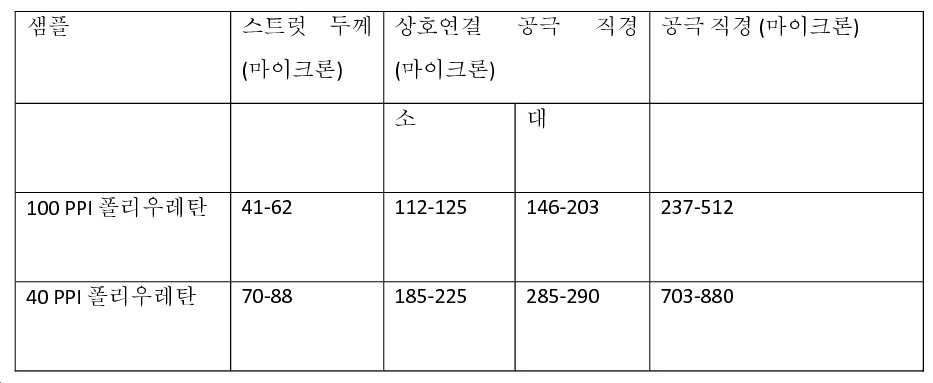
[00130] 표 2는 매트릭스 PPI에 기초한 스트럿 두께, 상호연결 공극 직경, 및 공극 직경의 변화를 예시한다. 따라서, 표 2는 최종 구성물의 일부인 특정 폴리우레탄 매트릭스에 의존할 수 있는 최종 구성물 치수의 변동에 대한 지지를 제공한다.[00130] Table 2 illustrates variations in strut thickness, interconnect pore diameter, and pore diameter based on matrix PPI. Thus, Table 2 provides support for variations in final composition dimensions that may depend on the particular polyurethane matrix being part of the final composition.
[00131] 실시예 2: 예시적인 최종 복합 구성물의 제조 공정 [00131] Example 2: Process for Manufacturing Exemplary Final Composite Constructs
[00132] 다음 파라미터를 갖는 개방 셀형 폴리우레탄 포움 시트(매트릭스 재료의 예)는 상업적으로 입수된다: 1/8 인치 두께, 12 x 12 인치 길이 x 폭, 100 PPI(인치당 공극). 폴리우레탄 포움 시트를, 분산액(예시적인 실리콘 재료)의 총 질량을 기준으로 15% 고형물인, 자일렌 중 Nusil MED 4830의 분산액에 침지시켰다. 분산액을 공극에 완전히 함침시킨 후, 생성된 포움을 그레이트로 옮기고 과량의 분산액을 에어 나이프를 통해 제거하였다. 생성된 포움을 오븐의 랙에 놓고 4시간 동안 150℃에 적용함으로써 경화시켰다. 건조 및 경화된 구성물을 실리콘 침지, 과잉 제거 및 경화의 2회의 추가 사이클에 적용하였다. 생성된 구성물을 60℃에서 1시간 동안 DMSO의 용기에 넣었다. 후속하여, 재료를 DI 수로 2회 헹구고, 린트-비함유 재료로 무광택 처리하여 과량의 물을 제거하고, 마지막으로 95% 에탄올로 3회 헹구었다. 재료를 50℃의 오븐에서 1시간 동안 랙에 놓았다. 최종 구성물은 폴리우레탄 매트릭스 상에 실리콘의 복합 구조를 갖는 연성 및 순응성 개방 셀형 포움을 생성하였다. 이는 친수성 층이 첨가되지 않은 구성물의 예이다.[00132] An open cell polyurethane foam sheet (an example of a matrix material) with the following parameters is commercially available: 1/8 inch thick, 12 x 12 inch length x width, 100 PPI (voids per inch). A sheet of polyurethane foam was immersed in a dispersion of Nusil MED 4830 in xylene, 15% solids based on the total mass of the dispersion (an exemplary silicone material). After completely impregnating the pores with the dispersion, the resulting foam was transferred to a grate and excess dispersion was removed through an air knife. The resulting foam was cured by placing it on a rack in an oven and subjecting it to 150° C. for 4 hours. The dried and cured construct was subjected to two additional cycles of silicone dipping, excess removal and curing. The resulting construct was placed in a container of DMSO at 60° C. for 1 hour. Subsequently, the material was rinsed twice with DI water, matted with a lint-free material to remove excess water, and finally rinsed three times with 95% ethanol. The material was placed on a rack in an oven at 50°C for 1 hour. The final construct produced a soft and conformable open cell foam having a composite structure of silicone on a polyurethane matrix. This is an example of a composition in which no hydrophilic layer is added.
[00133] 실시예 3: 예시적인 임의로 코팅된 복합 구성물의 제조 공정 [00133] Example 3: Process for Manufacturing Exemplary Optionally Coated Composite Constructs
[00134]
실시예 2에서 생성된 포움 재료의 각 면을 포움의 표면에 대해 0.5 인치 전극 거리에서 60초 동안 코로나 처리하였다. 이어서, 개방 셀형 포움을 에탄올성 모노머 혼합물 80% 에탄올:20% 모노머 혼합물의 용액에 침지시켰다. 모노머 혼합물의 조성은 다음과 같았다: 80% N-비닐 피롤리돈(NVP): 0.5% 알릴메타크릴레이트 및 0.5% AIBN 개시제를 함유하는 20% 2-하이드록시에틸 메타크릴레이트(HEMA). 가교제 및 개시제 농도를 NVP와 HEMA의 총 질량에 기초하여 계산하였다. 과량의 에탄올성 모노머 혼합물을 에어 나이프를 통해 제거하였다. 이어서, 포움을 60℃에서 4시간 동안 랙 상의 오븐에 넣었다. 임의의 가교된 친수성 폴리머 코팅은 다공질 구성물의 실리콘 표면에 습윤성을 부여하며, 이의 예시적인 이점은 본원에 기재되어 있다.[00134]
Each side of the foam material produced in Example 2 was corona treated for 60 seconds at a 0.5 inch electrode distance to the surface of the foam. The open cell foam was then dipped into a solution of an
[00135] 실시예 4: 최종 구성물의 제조 공정 [00135] Example 4: Manufacturing process of the final construct
[00136]
세 번째 실시예에서, 기계적 온전성을 유지하지만 실온에서 디메틸 설폭사이드에 의한 용해를 억제하지 않기에 충분한 가교도, 및 97.8%의 공극률, 평균 공극 직경 800 μm, 9개의 공극 당 상호연결 평균 수 및 400 um의 평균 상호연결 직경을 갖는 폴리우레탄 포움 주형(예를 들어, 매트릭스 재료)을 10 mm의 두께를 갖는 폴리우레탄 포움의 30 cm x 30 cm 시트 위에 용액을 디켄팅함으로써 1% wt/wt의 아세트산 및 99% wt/wt의 탈이온수 중 2% wt/wt의 키토산을 함유하는 91% 탈아세틸화된 키토산 용액으로 코팅하였다 포움을 디캔팅 동안 15%의 두께로 일련의 롤러에 의해 스퀴징하여 키토산 용액의 최대 함침을 허용한 다음, 다시 원래 두께의 25%로 스퀴징하여 과량의 키토산 용액을 제거하고, 중량 기준 픽업이 원래 폴리우레탄 포움의 10%가 될 때까지 반복하였다. 이어서, 함침된 포움을 37℃에서 12시간 동안 건조시키고, 에탄올 용액 중 과량의 20 몰 암모니아로 세척함으로써 중화시켰다. 중량 기준으로 원래의 폴리우레탄 포움의 80%의 픽업을 달성하도록 함침, 건조, 및 중화 공정을 8회 반복하였다. 이어서, 함침된 포움을 40℃에서 6시간 동안 DMSO에 침지시킨 다음, 교반하면서 100℃에서 3시간 동안 DI 수로 세척하였다. 용해 및 세척 공정을 3회 반복하였다.[00136]
In a third example, a degree of crosslinking sufficient to maintain mechanical integrity but not inhibit dissolution by dimethyl sulfoxide at room temperature, and a porosity of 97.8%, an average pore diameter of 800 μm, an average number of interconnections per 9 pores, and A polyurethane foam mold (e.g. matrix material) having an average interconnect diameter of 400 um was prepared by decanting the solution onto a 30 cm x 30 cm sheet of polyurethane foam having a thickness of 10 mm to obtain 1% wt/wt. Coated with a 91% deacetylated chitosan solution containing 2% wt/wt chitosan in acetic acid and 99% wt/wt chitosan in deionized water. The foam was squeezed by a series of rollers to a thickness of 15% during decanting to Maximum soaking of the solution was allowed, then excess chitosan solution was removed by squeezing back to 25% of the original thickness, and this was repeated until the pick-up by weight was 10% of the original polyurethane foam. The impregnated foam was then dried at 37° C. for 12 hours and neutralized by washing with
[00137] 실시예 5: 보이드가 충전된 예시적인 최종 구성물의 제조 공정 [00137] Example 5: Manufacturing Process for Exemplary Final Constituents Filled with Voids
[00138] 이 실시예는 매트릭스의 적어도 일부를 제거하는 공정을 포함하는 구성물을 형성하는 방법을 제공한다. 다섯 번째 실시예에서, 37℃에서 4시간 내에 DMF에 의해 용해될 수 있고, 98%의 공극률, 1300 um의 평균 공극 크기, 800 um의 평균 상호연결 직경, 및 7.4개의 공극 당 평균 상호연결 수를 함유하는 약하게 가교된 폴리우레탄 포움을 계량 디캔팅에 의해 아세톤 중 30cP의 작용성화된 Viton 프리폴리머로 코팅하였다. 폴리우레탄 포움을 이의 원래 변위의 30%로 1000 um의 공극을 함유하는 필터 그레이트에 의해 압축하고, 최대 함침을 야기하기 위해 코팅이 적용될 때 방출하였다. 원래 높이의 100%로 방출된 후, 필터 그레이트를 높이의 50%의 압축을 가하고, 하우스 진공을 폴리우레탄 포움의 바닥으로부터 가하여 과량의 Viton 프리폴리머 용액을 제거하였다. 함침 공정이 완료된 후, 재료를 120℃에서 4시간 동안 중합시키고, 80℃에서 6시간 동안 건조시켰다. 이후, 베이스 포움을 교반하면서 DMF에 용해시키고, 중심 보이드를 함유하는 생성된 구성물을 교반하면서 반복된 침지에서 아세톤 및 물에서 세척하였다. 건조 후, Viton 프리폴리머의 코팅을 실시예 1에 기재된 방식으로 적용하였다. 코팅을 건조시키고 경화시켰다. 공정을 원래의 폴리우레탄 포움에 의해 남겨진 보이드의 80%가 충전될 때까지 반복하였다.[00138] This embodiment provides a method of forming a construct comprising removing at least a portion of the matrix. In a fifth example, it can be dissolved by DMF at 37° C. in 4 hours, and has a porosity of 98%, an average pore size of 1300 μm, an average interconnection diameter of 800 μm, and an average number of interconnections per pore of 7.4. A lightly cross-linked polyurethane foam containing was coated with 30 cP of functionalized Viton prepolymer in acetone by metered decanting. The polyurethane foam was compressed with a filter grate containing 1000 um pores at 30% of its original displacement and released when the coating was applied to cause maximum wetting. After being released to 100% of its original height, the filter grate was compressed to 50% of its height, and a house vacuum was applied from the bottom of the polyurethane foam to remove excess Viton prepolymer solution. After the impregnation process was completed, the material was polymerized at 120° C. for 4 hours and dried at 80° C. for 6 hours. The base foam was then dissolved in DMF with stirring and the resulting formation containing the central void was washed in acetone and water in repeated soaks with stirring. After drying, a coating of Viton prepolymer was applied in the manner described in Example 1. The coating was dried and cured. The process was repeated until 80% of the voids left by the original polyurethane foam were filled.
[00139] 실시예 6: 다가전해질 착물화로 예시적인 최종 구성물의 제조 방법 [00139] Example 6: Methods of Preparing Exemplary Final Constituents by Polyelectrolyte Complexation
[00140] 이 실시예는 매트릭스의 적어도 일부를 제거하는 공정을 포함하는 구성물을 형성하는 방법을 제공한다. 여섯 번째 실시예에서, 3시간에 걸쳐 40℃에서 DMSO에 용해될 수 있는 폴리우레탄 포움을 2 중량부의 키토산, 2 중량부의 아세트산, 및 96 중량부의 탈이온수로 구성된 키토산(76% 탈아세틸화된) 용액으로 함침시켰다. 함침 공정을 폴리우레탄 포움의 이동 시트 위에서 커튼에 용액을 디캔팅한 후 스퀴지 롤에 의해 원래 높이의 10%로 연속 압축하고, 뜨거운 공기(5% 습도, 60C)를 이용하여 300PSI에서 팬 블레이드를 사용하여 건조시켰다. 이어서, 코팅된 포움을 알기네이트 용액(2부의 알기네이트, 98부의 탈이온수)에서 코팅된 커튼이었고, 커튼을 탈이온수로 세척하고, 뜨거운 공기(10% 습도, 40℃)를 사용하여 300PSI에서 팬 블레이드에 의해 건조시켰다. 건조 기준으로 (원래 폴리우레탄 포움 중량의) 120% 중량 픽업이 달성될 때까지 공정을 반복하였다. 생성된 재료를 50/50 에탄올/물 중 5 몰 암모니아의 세척에 의해 중화시키고, 완전히 중성이 될 때까지 DI 수로 세척하고, 40℃에서 4시간 동안 건조시켰다. 건조 후, 베이스 폴리우레탄 포움을 40℃에서 4시간 동안 DMSO에 용해시키고, 재료를 12시간 동안 교반하면서 물에서 세척하였다.[00140] This embodiment provides a method of forming a construct comprising removing at least a portion of the matrix. In a sixth example, a polyurethane foam soluble in DMSO at 40° C. over 3 hours was prepared by adding 2 parts chitosan, 2 parts acetic acid, and 96 parts deionized water (76% deacetylated) chitosan. impregnated with the solution. The impregnation process was carried out by decanting the solution on a curtain on a moving sheet of polyurethane foam, followed by continuous compression to 10% of its original height by squeegee rolls, and fan blades at 300 PSI using hot air (5% humidity, 60 C). dried. The coated foam was then curtain coated in an alginate solution (2 parts alginate, 98 parts deionized water), the curtain washed with deionized water, fan at 300 PSI using hot air (10% humidity, 40°C). Dried with a blade. The process was repeated until a weight pickup of 120% (of the original polyurethane foam weight) on a dry basis was achieved. The resulting material was neutralized by washing with 5 molar ammonia in 50/50 ethanol/water, washed with DI water until completely neutral, and dried at 40° C. for 4 hours. After drying, the base polyurethane foam was dissolved in DMSO at 40° C. for 4 hours, and the material was washed in water with stirring for 12 hours.
[00141] 실시예 7: 최종 구성물 [00141] Example 7: Final construct
[00142] 이 실시예는 매트릭스의 적어도 일부를 제거하는 공정을 포함하는 구성물을 형성하는 방법을 제공한다. 일곱 번째 실시예에서, 용해성 포움, 및 실리콘 HTV 프리폴리머를 사용하여 달성되는 최종 구성물이 기술된다. 최종 구성물은 86%의 공극률, 150 um의 공극 크기의 표준 편차를 갖는 650 um의 평균 공극 크기, 80 um의 상호연결 직경의 표준 편차를 갖는 350 um의 평균 상호연결 직경, 1.4의 공극 당 상호연결의 표준 편차를 갖는 6개의 공극 당 평균 상호연결 수, 및 37 um의 스트럿 직경의 표준 편차를 갖는 155 um의 평균 스트럿 직경을 가졌다.[00142] This embodiment provides a method of forming a construct comprising removing at least a portion of the matrix. In a seventh example, the final formulation achieved using the soluble foam and the silicone HTV prepolymer is described. The final construct has a porosity of 86%, an average pore size of 650 um with a pore size standard deviation of 150 um, an average interconnection diameter of 350um with an interconnection diameter standard deviation of 80um, and interconnects per pore of 1.4. and an average strut diameter of 155 um with a standard deviation of strut diameter of 37 um.
[00143] 실시예 8: 강화된 최종 구성물 [00143] Example 8: Enhanced final construct
[00144] 이 실시예는 매트릭스의 적어도 일부를 제거하는 공정을 포함하는 구성물을 형성하는 방법을 제공한다. 여덟 번째 실시예에서, 일련의 강화된 최종 구성물이 기술된다. 구성물은 용해 가능한 폴리우레탄 포움의 함침, 및 이어서 과량의 용액의 제거, 과량의 용액의 건조, 폴리우레탄 포움의 부재 하에서 구성물 기계적 온전성을 제공하기에 충분한 축적을 달성하기 위한 단계의 반복, 폴리우레탄 포움의 용해, 및 그 후에 용해 가능한 폴리우레탄 포움에 의해 남겨진 보이드의 충전을 달성하기 위해 함침 동안 사용된 원래 재료의 일련의 반복 코팅을 이용하여 달성되었다. 하기 구성물이 달성되었다:[00144] This embodiment provides a method of forming a construct comprising removing at least a portion of the matrix. In an eighth embodiment, a series of enhanced final constructs are described. The construct is impregnated with soluble polyurethane foam, followed by removal of excess solution, drying of excess solution, repetition of steps to achieve build-up sufficient to provide mechanical integrity of the construct in the absence of polyurethane foam, polyurethane This was accomplished using a series of repeat coatings of the original material used during impregnation to achieve dissolution of the foam, and then filling of the voids left by the dissolvable polyurethane foam. The following composition was achieved:
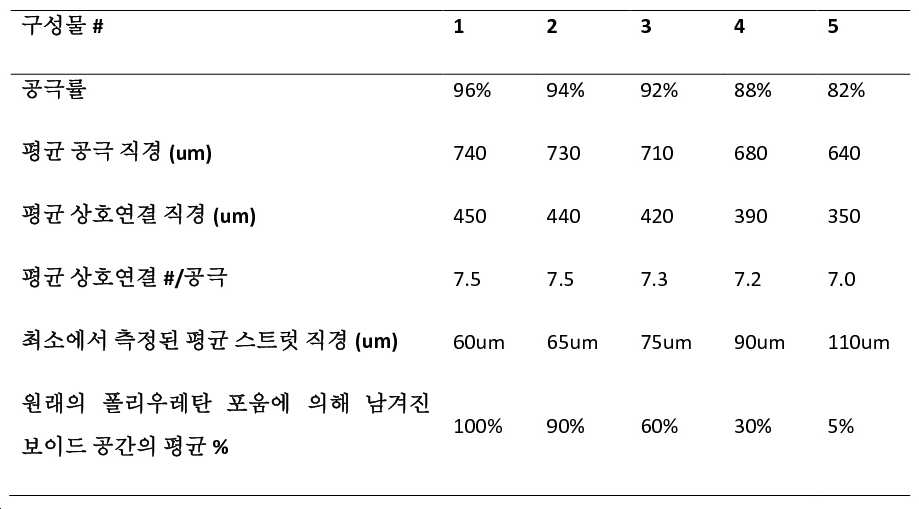
[00145] 실시예 9: 하이드로겔 조성물로부터 최종 구성물의 제조 공정 [00145] Example 9: Manufacturing Process of Final Constituents from Hydrogel Compositions
[00146] 아홉 번째 실시예에서, 97.8%의 공극률, 800 um의 평균 공극 직경, 9개의 공극 당 평균 상호연결 수, 및 400 um의 평균 상호연결 직경을 갖는 폴리우레탄 포움 주형을 0.1%의 에틸렌글리콜 디메타크릴레이트 가교제, 0.1%의 AIBN(아조이소부티로니트릴) 개시제, 및 99.8%의 2-하이드록시에틸-메타크릴레이트 친수성 모노머를 함유하는 하이드로겔 혼합물로 코팅하였다. 혼합물을 10 mm의 두께를 갖는 30 cm x 30 cm의 폴리우레탄 포움 시트에 적용하였다. 포움을 디캔팅 동안 15%의 두께로 일련의 롤러에 의해 스퀴징하여 혼합물의 최대 함침을 허용한 다음, 다시 원래 두께의 25%로 스퀴징하여 과량의 혼합물을 제거하고, 중량 기준 픽업이 원래 폴리우레탄 포움의 10%가 될 때까지 반복하였다. 이어서, 함침된 포움을 12시간 동안 80℃에서 강제 공기 오븐에 넣었다. 이어서, 함침된 포움을 40℃에서 4시간 동안 NMP에 침지시킨 다음, 교반하면서 100℃에서 3시간 동안 DI 수로 세척하였다. 용해 및 세척 공정을 3회 반복하였다. 최종 구성물을 4시간 동안 물에 침지시키고, 블롯팅 건조시키고, 칭량하였다. 측정된 평형 함수율은 38%였다.[00146] In a ninth example, a polyurethane foam mold having a porosity of 97.8%, an average pore diameter of 800 um, an average interconnection number per 9 pores, and an average interconnection diameter of 400 um was prepared by mixing 0.1% ethylene glycol dimethacrylic acid with 0.1% ethylene glycol dimethacrylic acid. It was coated with a hydrogel mixture containing a late crosslinker, 0.1% AIBN (azoisobutyronitrile) initiator, and 99.8% 2-hydroxyethyl-methacrylate hydrophilic monomer. The mixture was applied to a polyurethane foam sheet of 30 cm x 30 cm with a thickness of 10 mm. During decanting, the foam is squeezed by a series of rollers to a thickness of 15% to allow for maximum impregnation of the mixture, then squeezed again to 25% of the original thickness to remove excess mixture, and pick-up by weight is the original polyurethane. Repeat until 10% of foam. The impregnated foam was then placed in a forced air oven at 80° C. for 12 hours. The impregnated foam was then immersed in NMP at 40° C. for 4 hours and then washed with DI water at 100° C. for 3 hours with stirring. The dissolving and washing process was repeated three times. The final construct was soaked in water for 4 hours, blotted dry and weighed. The measured equilibrium moisture content was 38%.
[00147] 상기 섹션에 열거된 다양한 구현예는 단지 예이며, 서로 임의의 조합으로, 또는 당 분야에 공지된 다른 구현예와 조합하여 적용될 수 있는 것으로 이해된다. 재료, 화학적 및 물리적 특성, 뿐만 아니라 미세구조의 설명은 예로서 기술되며, 본원의 발명의 범위를 제한하려는 것이 아니다.[00147] It is understood that the various embodiments listed in the above section are examples only and may be applied in any combination with one another or with other embodiments known in the art. Descriptions of materials, chemical and physical properties, as well as microstructures are described by way of example and are not intended to limit the scope of the invention herein.
[00148] 하기 개시는 의료 적용에서 본원의 임의의 개방 셀형 또는 반-개방 셀형 구성물의 예시적인 사용 방법에 관한 것이다. 하기 방법은 반드시 상기 기재된 임의의 특정 최종 구성물을 필요로 하지 않는다. 본원에 기재된 구성물의 일부 양태는 본원의 예시적인 사용 방법에 적용될 수 있지만, 본원의 구성물은, 예컨대, 변형이 특정 용도에 구성물을 더욱 바람직하게 만드는 경우와 같이, 본원의 구성물은 하나 이상의 방식으로 변형될 수 있다. 보다 구체적으로, 본 개시는 주어진 공극률, 공극의 특정 상호연결성, 특정 상호연결 직경, 및 이식 가능한 및 비-이식 가능한 의학적 적용에서 특정 공극 크기 및 공극 크기 다분산성을 포함하는, 폴리머, 폴리머 복합체, 폴리머-세라믹 복합체, 폴리머-금속 복합체, 폴리머-폴리머 블렌드, 또는 코팅된 상기 언급된 재료의 용도를 기술한다. 일부 구현예에서, 재료는 약물 또는 생물활성제를 위해 또는 이와 함께 및/또는 주어진 조직, 기관, 또는 신체 부위에 약물 또는 생물활성제를 전달하기 위해 사용될 수 있다. 재료는 독립형 디바이스로서 또는 디바이스 어셈블리 내의 구성요소로서 존재할 수 있다.[00148] The following disclosure relates to exemplary methods of use of any of the open celled or semi-open celled constructs of the present disclosure in medical applications. The methods below do not necessarily require any specific final constructs described above. While some aspects of the constructs described herein may apply to exemplary methods of use herein, the constructs herein may be modified in one or more ways, e.g., where the modification makes the construct more desirable for a particular application. It can be. More specifically, the present disclosure relates to polymers, polymer composites, polymers, including specific pore size and pore size polydispersity in a given porosity, specific interconnectivity of pores, specific interconnection diameter, and implantable and non-implantable medical applications. - Describes the use of the above-mentioned materials that are ceramic composites, polymer-metal composites, polymer-polymer blends, or coated. In some embodiments, a material may be used for or in conjunction with a drug or bioactive agent and/or to deliver the drug or bioactive agent to a given tissue, organ, or body site. A material may exist as a stand-alone device or as a component within a device assembly.
[00149] 일부 특정 구현예에서, 재료는 조직과 직접 또는 비-직접적으로 접촉하여 사용될 수 있다. 본원의 재료는, 예를 들어, 비제한적으로 상처 접촉 적용, 조직 보강 또는 벌크 적용, 재건 절차 또는 조직 지지, 기관 이식 적용, 지지 적용, 탈장 복구 절차, 혈관 문합 절차, 일반적인 수술 절차, 부인과 적용, 외과적 유착 예방 적용, 상처 드레싱 적용에서, 궤양에 대한 치료로서, 화학적 화상을 포함하는 화상의 치료로서, 골 수복, 재건 또는 보강 절차를 위해, 치과 수술 적용에서, 조직 고정 또는 문합 적용, 심장 수술 적용, 혈관내 치료 적용, 대동맥 동맥류 치료 적용, 신경외과 절차, 및 힘줄 재건 수술에서 제한 없이 사용될 수 있다.[00149] In some specific embodiments, the material may be used in direct or non-direct contact with tissue. Materials herein may be used for, but not limited to, wound contact applications, tissue reinforcement or bulk applications, reconstructive procedures or tissue supports, organ transplant applications, support applications, hernia repair procedures, vascular anastomosis procedures, general surgical procedures, gynecological applications, In surgical adhesion prevention applications, in wound dressing applications, as treatment for ulcers, as treatment of burns, including chemical burns, for bone repair, reconstructive or reinforcing procedures, in dental surgery applications, tissue fixation or anastomosis applications, cardiac surgery applications, endovascular treatment applications, aortic aneurysm treatment applications, neurosurgery procedures, and tendon reconstructive surgery.
[00150] 의료 적용에 사용될 때, 의료 디바이스는 임의로 포움 요소에 적어도 80 부피%의 공극을 갖는 완전 개방 또는 반-개방 셀 포움의 적어도 일부를 포함하고, 여기서 포움 요소는 적어도 하나의 천연 또는 하나의 합성 폴리머를 포함한다. 일부 구현예에서, 포움은 고정 요소를 갖지 않는 요소일 수 있다. 이의 예는 접착제를 함유하지 않고, 테이프, 거즈 커버링, 또는 임의의 다른 고정 메커니즘과 같은 별도의 고정 요소에 의해 조직 위에 제자리에 유지되는 포움이다. 또한, 포움은 적어도 하나, 더욱 바람직하게는 여러 개의 또는 연속적인 고정 요소에 부착될 수 있다. 본원의 고정 요소는 일반적으로 의료 디바이스를 조직에 부착하거나 고정하는 데 사용되는 것으로 기재된다.[00150] When used in medical applications, the medical device optionally comprises at least a portion of a fully open or semi-open cell foam having at least 80% voids by volume in the foam element, wherein the foam element comprises at least one natural or one synthetic polymer. include In some implementations, the foam can be an element that does not have a fixed element. An example of this is a foam that does not contain adhesive and is held in place over tissue by a separate fixation element such as tape, gauze covering, or any other fixation mechanism. Furthermore, the foam may be attached to at least one, more preferably several or continuous fixing elements. Fixation elements herein are generally described as being used to attach or secure a medical device to tissue.
[00151] 본원에서 예시적인 사용 방법은 의료 적용에서 개방 셀형 또는 반-개방 셀형 재료의 용도를 포함한다. 일부 특정 용도는 폴리디메틸 실록산 또는 실리콘, 폴리우레탄, 폴리비닐 알코올, 폴리비닐피롤리돈, 폴리(2-하이드록시에틸메타크릴레이트), 폴리에스테르, 폴리에테르, 폴리 L-락티드, 폴리 L-락티드-코-글리콜리드 코폴리머, 키토산 또는 키토산-키틴 코폴리머, 덱스트란, 폴리비닐리덴 플루오라이드, 실리콘, 플루오로실리콘, 폴리카프로락톤, PEEK, PET, PTFE, PCTFE, PVC, 폴리에틸렌, 폴리스티렌, 나일론, 페놀-포름알데히드, 파라-아라미드, 폴리클로로프렌, 폴리아미드, 폴리아크릴로니트릴, 폴리이미드, 방향족 폴리에스테르, 폴리-p-페닐렌-2,6-벤조비스옥사졸, 폴리펩티드, 폴리사카라이드, 또는 지방산 폴리머 또는 코폴리머 중 하나 이상을 포함하는 폴리머성, 개방 셀형 또는 반-개방형 셀형 구조물의 사용을 포함한다.[00151] Exemplary methods of use herein include the use of open celled or semi-open celled materials in medical applications. Some specific applications are polydimethylsiloxane or silicone, polyurethane, polyvinyl alcohol, polyvinylpyrrolidone, poly(2-hydroxyethylmethacrylate), polyester, polyether, poly L-lactide, poly L- Lactide-co-glycolide copolymer, chitosan or chitosan-chitin copolymer, dextran, polyvinylidene fluoride, silicone, fluorosilicone, polycaprolactone, PEEK, PET, PTFE, PCTFE, PVC, polyethylene, polystyrene , nylon, phenol-formaldehyde, para-aramid, polychloroprene, polyamide, polyacrylonitrile, polyimide, aromatic polyester, poly-p-phenylene-2,6-benzobisoxazole, polypeptide, polysaccharide and the use of polymeric, open celled or semi-open celled structures comprising one or more of rides, or fatty acid polymers or copolymers.
[00152] 일부 용도에서, 의료 디바이스는, 적어도 하나의 폴리머를 포함할 수 있고, 가장 최적으로 최대 3개의 폴리머를 포함하는 포움 요소를 포함한다. 폴리머는 생안정성 또는 생분해성일 수 있다. 일부 구현예에서, 포움 요소를 포함하는 폴리머는 합성이고, 폴리에스테르, 폴리아미드, 폴리아크릴레이트, 폴리아크릴아미드, 폴리카보네이트, 폴리에테르, 폴리에테르-에스테르, 폴리무수물, 폴리페놀, 폴리펩티드, 폴리이미드, 폴리우레탄, 폴리우레아, 폴리실록산, 폴리비닐, 코폴리머 또는 이들의 블렌드의 부류로부터의 폴리머일 수 있다. 다른 구현예에서, 폴리머는 폴리에스테르, 폴리아미드, 폴리아크릴레이트, 폴리아크릴아미드, 폴리카보네이트, 폴리에테르, 폴리에테르-에스테르, 폴리무수물, 폴리페놀, 폴리펩티드, 폴리이미드, 폴리우레탄, 폴리우레아, 폴리실록산, 폴리비닐, 이들의 코폴리머 또는 블렌드의 부류와 관련된다.[00152] In some applications, the medical device includes a foam element that can include at least one polymer, and most optimally includes up to three polymers. Polymers may be biostable or biodegradable. In some embodiments, the polymer comprising the foam element is synthetic and includes polyesters, polyamides, polyacrylates, polyacrylamides, polycarbonates, polyethers, polyether-esters, polyanhydrides, polyphenols, polypeptides, polyimides. , polyurethanes, polyureas, polysiloxanes, polyvinyls, copolymers or blends thereof. In other embodiments, the polymer is a polyester, polyamide, polyacrylate, polyacrylamide, polycarbonate, polyether, polyether-ester, polyanhydride, polyphenol, polypeptide, polyimide, polyurethane, polyurea, polysiloxane , polyvinyls, copolymers or blends thereof.
[00153] 일부 특정 구현예에서, 포움 구조물의 적어도 일부는 연질 실리콘, 폴리우레탄으로 구성되거나, Dacron, 키토산, 울, 폴리 글리콜리드, 폴리 락티드, 폴리 카보네이트, 폴리 부티레이트, 비닐 기반 폴리머, 이들의 블렌드 또는 코폴리머의 펠트인 백킹을 갖는다. 이러한 포움 구조 또는 구성물의 예는 상기에 더 상세히 기재될 수 있다.[00153] In some specific embodiments, at least a portion of the foam structure is composed of soft silicone, polyurethane, Dacron, chitosan, wool, poly glycolide, poly lactide, poly carbonate, poly butyrate, vinyl based polymers, blends or co It has a backing that is a felt of a polymer. Examples of such foam structures or compositions may be described in more detail above.
[00154] 일부 특정 구현예에서, 완성된 포움 복합재 구조물의 적어도 일부는 폴리에테르- 또는 폴리에스테르-기반 폴리우레탄과 함께 실리콘 또는 이의 유도체를 포함하며, 이들의 예는 상기 기재된다. [00154] In some specific embodiments, at least a portion of the finished foam composite structure includes silicone or a derivative thereof along with a polyether- or polyester-based polyurethane, examples of which are described above.
[00155] 추가의 다른 구현예에서, 완성된 포움 복합재 구조물의 적어도 일부는 폴리에테르- 또는 폴리에스테르-기반 폴리우레탄과 함께 친수성 코팅, 실리콘 또는 이의 유도체를 포함하며, 이들의 예는 본원에 기재된다.[00155] In yet another embodiment, at least a portion of the finished foam composite structure includes a hydrophilic coating, silicone or a derivative thereof, along with a polyether- or polyester-based polyurethane, examples of which are described herein.
[00156] 추가의 다른 구현예에서, 포움 구조물의 적어도 일부는, 비제한적으로 디메틸설폭사이드, N-메틸피롤리딘, 2-에탄올, 아세톤 등인 용매 또는 용매들로 후속-가공된, 폴리에테르- 또는 폴리에스테르-기반 폴리우레탄과 함께 친수성 코팅, 실리콘 또는 이의 유도체를 포함한다. 이러한 용매 중 하나 이상으로 포움을 처리하면 포움 매트릭스로부터 오염물의 추출과 함께 표면에 연성 및 낮은 마찰이 부여되며, 이에 대한 추가 세부사항은 상기 기재된다.[00156] In yet another embodiment, at least a portion of the foam structure is a polyether- or polyester post-processed with a solvent or solvents that are, but are not limited to, dimethylsulfoxide, N-methylpyrrolidine, 2-ethanol, acetone, and the like. -Includes hydrophilic coatings, silicones or their derivatives, together with polyurethane based. Treatment of the foam with one or more of these solvents imparts softness and low friction to the surface along with extraction of contaminants from the foam matrix, further details of which are described above.
[00157] 추가의 다른 구현예에서, 선형 하이드로겔 폴리머, 가교된 하이드로겔 폴리머, 선형 실리콘 하이드로겔 폴리머, 및 가교된 실리콘 하이드로겔 폴리머는 하나 이상의 친수성 규소-함유 모노머 및/또는 마크로머로부터의 단위를 함유하는 임의의 폴리머를 포함하는 하기 호모폴리머 또는 코폴리머 시스템 중 적어도 하나 또는 하나 이상의 친수성 비-실리콘-함유 모노머 및/또는 마크로머로부터의 단위를 함유하는 임의의 폴리머를 포함하는 하기 호모폴리머 또는 코폴리머 시스템 중 하나를 포함하는 개방 셀형 또는 반-개방 셀형 구조물로서 사용된다. 예를 들어, 폴리머는 다음 공중합 가능한 화합물을 갖는 코폴리머를 포함할 수 있다: 아크릴계 모노머, 예컨대, 메틸 아크릴레이트, 에틸 아크릴레이트 및 아크릴산; 메타크릴계 모노머, 예컨대, 메틸 메타크릴레이트, 에틸 메타크릴레이트, 2-하이드록시에틸 메타크릴레이트 및 메타크릴산; 실록산 모노머, 예컨대, 트리스(트리메틸실록시)실릴프로필 메타크릴레이트, 비스(트리메틸실록시)메틸실릴프로필 메타크릴레이트, 펜타메틸디실록산프로필 메타크릴레이트, 트리스(트리메틸실록시)실릴프로필옥시에틸 메타크릴레이트, 및 트리스(폴리디메틸실록시)실릴프로필 메타크릴레이트; 플루오로실록산 모노머, 예컨대, 트리(디메틸트리플루오로프로필실록시)실릴프로필 메타크릴레이트; 플루오로알킬 모노머, 예컨대, 2,2,2-트리플루오로에틸 메타크릴레이트, 2,2,3,3,3-펜타플루오로프로필 메타크릴레이트 및 헥사플루오로이소프로필 메타크릴레이트; 하이드록실 기를 함유하는 플루오로알킬 및 플루오로알킬에테르 모노머, 예컨대, 1,1,2,2-테트라플루오로에톡시-2-하이드록시프로필 메타크릴레이트; 친수성 모노머, 예컨대, N-비닐피롤리돈, N,N'-디메틸아크릴아미드 및 N-비닐-N-메틸아세트아미드; 가교 가능한 모노머, 예컨대, 에틸렌 글리콜 디메타크릴레이트, 테트라에틸렌 글리콜 디메타크릴레이트 및 테트라메틸디실록산 비스(프로필메타크릴레이트). 이들 중에서, 실록산 메타크릴레이트, 플루오로알킬실록산 메타크릴레이트, 플루오로알킬 메타크릴레이트, 하이드록실 기를 함유하는 플루오로알킬에테르 메타크릴레이트, 친수성 모노머, 분자 내에 2개 이상의 불포화 기를 갖는 가교성 모노머 및 분자 말단에 중합 가능한 불포화 기를 갖는 실록산 마크로머와의 코폴리머가 있다. [00157] In still other embodiments, the linear hydrogel polymers, crosslinked hydrogel polymers, linear silicone hydrogel polymers, and crosslinked silicone hydrogel polymers contain units from one or more hydrophilic silicon-containing monomers and/or macromers. At least one of the following homopolymer or copolymer systems comprising any of the following homopolymer or copolymer systems comprising any polymer containing units from one or more hydrophilic non-silicone-containing monomers and/or macromers It is used as an open-celled or semi-open-celled structure comprising either. For example, the polymer may include copolymers with the following copolymerizable compounds: acrylic monomers such as methyl acrylate, ethyl acrylate and acrylic acid; methacrylic monomers such as methyl methacrylate, ethyl methacrylate, 2-hydroxyethyl methacrylate and methacrylic acid; Siloxane monomers such as tris(trimethylsiloxy)silylpropyl methacrylate, bis(trimethylsiloxy)methylsilylpropyl methacrylate, pentamethyldisiloxanepropyl methacrylate, tris(trimethylsiloxy)silylpropyloxyethyl meth acrylate, and tris(polydimethylsiloxy)silylpropyl methacrylate; fluorosiloxane monomers such as tri(dimethyltrifluoropropylsiloxy)silylpropyl methacrylate; fluoroalkyl monomers such as 2,2,2-trifluoroethyl methacrylate, 2,2,3,3,3-pentafluoropropyl methacrylate and hexafluoroisopropyl methacrylate; fluoroalkyl and fluoroalkylether monomers containing hydroxyl groups, such as 1,1,2,2-tetrafluoroethoxy-2-hydroxypropyl methacrylate; hydrophilic monomers such as N-vinylpyrrolidone, N,N'-dimethylacrylamide and N-vinyl-N-methylacetamide; Crosslinkable monomers such as ethylene glycol dimethacrylate, tetraethylene glycol dimethacrylate and tetramethyldisiloxane bis(propylmethacrylate). Among these, siloxane methacrylates, fluoroalkylsiloxane methacrylates, fluoroalkyl methacrylates, fluoroalkylether methacrylates containing a hydroxyl group, hydrophilic monomers, crosslinkable monomers having two or more unsaturated groups in the molecule and copolymers with siloxane macromers having polymerizable unsaturated groups at molecular terminals.
추가의 다른 구현예에서, 폴리머-세라믹 복합체는 분말, 섬유, 수지상 구조, 플레이크, 컨포말 또는 비-컨포말 코팅, 첨가제 또는 블렌드 형태로 다음을 포함하는 세라믹 또는 광석 중 적어도 하나를 포함하는 개방 셀형, 또는 반-개방 셀형 구조물로서 사용된다: 알루미늄 마그네슘 보라이드, 알루미늄 옥시니트라이드, 바륨 스트론튬 코발트 페라이트, 바륨 티타네이트, 베릴륨 옥사이드, 비스무트 스트론튬 칼슘 구리 옥사이드, 비스크, 보론 니트라이드, 브리퀘테이지, 칼슘 알루미네이트, 크리테르졸, 디스프로슘 티타네이트, 클레이, 페라이트, 프리트, 흄드 실리카, 게르마늄 디옥사이드, 유리, 하프늄 디보라이드, 하이드록실아파타이트, 제스모나이트, 란타넘 갈륨 실리케이트, 란타넘 헥사보라이드, 란타넘 스트론튬 코발트 페라이트, 란타넘 스트론튬 망가나이트, 납 스칸듐 탄탈라이트, 납 지르코네이트 티타네이트, 리토판, 루미세라, 마그네슘 디보라이드, 마그네슘 옥사이드, 마르텐사이트, 몰리브데넘 디실리사이드, 나일 실트, 석영, 실리콘 카바이드, 실리카, 실리콘 보라이드, 실리콘 디옥사이드, 실리콘 니트라이드, 실리콘 옥시니트라이드, 스트론튬 티타네이트, 지르코니아, 티타늄 카바이드, 카본 나노튜브, 텅스텐 디실리사이드, 텅스텐 니트라이드, 이트륨 바륨 구리 옥사이드, 아연 옥사이드, 알루미나 강화 지르코니아, 지르코늄 디옥사이드, 아르겐타이트, 바라이트, 보크사이트, 베릴, 보르나이트, 카시테라이트, 휘동석, 황동석, 크로마이트, 진사, 코발타이트, 콜럼바이트-탄탈라이트 또는 콜탄, 백운석, 방연광, 적철광, 일메나이트, 자철광, 공작석, 몰리브덴, 펜틀란다이트, 자철석, 회중석, 스페릴라이트, 섬아연석, 우라니나이트, 울프라마이트, 또는 이들 중 하나 이상의 조합물. In still other embodiments, the polymer-ceramic composite is an open celled composite comprising at least one of a ceramic or ore comprising in the form of a powder, fiber, dendritic structure, flake, conformal or non-conformal coating, additive or blend , or as semi-open cell structures: aluminum magnesium boride, aluminum oxynitride, barium strontium cobalt ferrite, barium titanate, beryllium oxide, bismuth strontium calcium copper oxide, bisque, boron nitride, briquettege, calcium Aluminate, Critterzol, Dysprosium Titanate, Clay, Ferrite, Frit, Fumed Silica, Germanium Dioxide, Glass, Hafnium Diboride, Hydroxylapatite, Jesmonite, Lanthanum Gallium Silicate, Lanthanum Hexaboride, Lanthanum Strontium Cobalt Ferrite, Lanthanum Strontium Manganite, Lead Scandium Tantalite, Lead Zirconate Titanate, Lithophane, Lumicera, Magnesium Diboride, Magnesium Oxide, Martensite, Molybdenum Disilicide, Nile Silt, Quartz, Silicon Carbide, Silica, Silicon Boride, Silicon Dioxide, Silicon Nitride, Silicon Oxynitride, Strontium Titanate, Zirconia, Titanium Carbide, Carbon Nanotube, Tungsten Disilicide, Tungsten Nitride, Yttrium Barium Copper Oxide, Zinc Oxide, Alumina Hardened zirconia, zirconium dioxide, argentite, barite, bauxite, beryl, bornite, carsiterite, chalcedony, chalcopyrite, chromite, cinnabar, cobaltite, columbite-tantalite or coltan, dolomite, galena, hematite , ilmenite, magnetite, malachite, molybdenum, pentlandite, magnetite, scheelite, sperillite, sphalerite, uraninite, wolframite, or a combination of one or more of these.
[00159] 추가의 다른 구현예에서, 개방 또는 반-개방 셀 구조물은 리튬, 나트륨, 칼륨, 루비듐, 세슘, 프랑슘, 베릴륨, 마그네슘, 칼슘, 스트론튬, 바륨, 라듐, 알루미늄, 갈륨, 인듐, 주석, 탈륨, 납, 비스무트, 스칸듐, 티탄, 바나듐, 크로뮴, 망간, 철, 코발트, 니켈, 구리, 아연, 이트륨, 지르코늄, 니오븀, 몰리브덴, 테크네튬, 루테늄, 로듐, 팔라듐, 은, 카드뮴, 란탄, 하프늄, 탄탈, 텅스텐, 레늄, 오스뮴, 이리듐, 백금, 금, 수은, 악티늄, 러더포듐, 두브늄, 시보지움, 보륨, 하슘, 마이트네륨, 다름스타튬, 뢴트게늄, 코페르니슘, 세륨, 프라세오디뮴, 네오디뮴, 프로메튬, 사마륨, 유로퓸, 가돌리늄, 테르븀, 디스프로슘, 홀뮴, 에르븀, 툴륨, 이테르븀, 루테튬, 토륨, 프로탁티늄, 우라늄, 넵투늄, 플루토늄, 아메리슘, 큐륨, 베르켈륨, 캘리포늄, 아인슈타이늄, 페르뮴, 멘델레븀, 노벨륨, 로렌슘 또는 이들 중 하나 이상의 합금과 같은 금속을 포함하는 폴리머-금속 복합체의 적어도 일부를 포함할 수 있다. 추가의 다른 구현예에서, 개방 셀형 구조물의 적어도 일부 또는 개방 셀 구조물 상의 코팅은, 예를 들어, 은 설파디아진 항생제와 같은 금속유기 화합물을 함유할 수 있다.[00159] In still other embodiments, the open or semi-open cell structure is lithium, sodium, potassium, rubidium, cesium, francium, beryllium, magnesium, calcium, strontium, barium, radium, aluminum, gallium, indium, tin, thallium, lead , bismuth, scandium, titanium, vanadium, chromium, manganese, iron, cobalt, nickel, copper, zinc, yttrium, zirconium, niobium, molybdenum, technetium, ruthenium, rhodium, palladium, silver, cadmium, lanthanum, hafnium, tantalum, tungsten , Rhenium, Osmium, Iridium, Platinum, Gold, Mercury, Actinium, Rutherfordium, Dubnium, Cybogium, Borium, Hassium, Mitenerium, Darmstadtium, Roentgenium, Copernicium, Cerium, Praseodymium, Neodymium, Promethium , samarium, europium, gadolinium, terbium, dysprosium, holmium, erbium, thulium, ytterbium, lutetium, thorium, protactinium, uranium, neptunium, plutonium, americium, curium, berkelium, californium, einsteinium, fermium, mendelevium , at least a portion of a polymer-metal composite comprising a metal such as nobelium, lawrencium, or an alloy of one or more of these. In yet another embodiment, at least a portion of the open cell structure or coating on the open cell structure may contain a metalorganic compound, such as, for example, silver sulfadiazine antibiotic.
[00160] 또한, 약물, 강화 첨가제, 항균제, 소독제, 습윤성 향상제, UV 안정화제, 텍스처라이저 등을 포함하는 제제는 재료에서 한 성분일 수 있다. 성분은 폴리머에 화학적으로 결합될 수 있거나 물리적 블렌드로서 존재할 수 있거나 폴리머 매트릭스 내에 포획될 수 있다. [00160] Additionally, agents including drugs, strengthening additives, antimicrobial agents, disinfectants, wettability enhancers, UV stabilizers, texturizers, and the like may be a component in the material. The components may be chemically bonded to the polymer or may exist as a physical blend or may be entrapped within a polymer matrix.
[00161] 본원의 일부 구현예에서, 손실 매트릭스 접근법은 개방 셀형 및 반-개방 셀형 구조물을 생성하는 데 사용될 수 있다. 폴리머는 미리 결정된 크기 및 기하학적 구조의 입자, 섬유 등을 포함하는 액체 또는 고체 포로겐 성분의 존재 하에 경화, 건조, 또는 달리 고화될 수 있다. 폴리머의 고화 후, 액체 또는 고체 포로겐 성분이 용해되거나 달리 제거되어 개방 셀형 또는 반-개방 셀형인 최종 재료를 제공한다. [00161] In some implementations of the present disclosure, loss matrix approaches may be used to create open celled and semi-open celled structures. The polymer may be cured, dried, or otherwise solidified in the presence of a liquid or solid porogen component, including particles, fibers, etc., of predetermined size and geometry. After solidification of the polymer, the liquid or solid porogen component is dissolved or otherwise removed to provide a final material that is open-celled or semi-open-celled.
[00162] 추가의 다른 방법에서, 손실 주형 접근법은 개방 셀형 및 반-개방 셀형 구조물을 생성하는 데 사용될 수 있다. 폴리머는 경화되거나, 건조되거나, 달리 주형으로서 개방 셀형 또는 반-개방 셀형 폴리우레탄 포움 주위에 컨포말한 코팅으로서 고화되며, 이의 예는 본원의 다른 곳에 기재되어 있다. 폴리머의 고화 후, 폴리우레탄 포움 주형은 임의로 적어도 부분적으로 용해되거나 적어도 부분적으로 제거되어 개방 셀형 또는 반-개방 셀형인 최종 재료를 제공할 수 있다. 그러나, 폴리우레탄 포움 주형은 제거되지 않을 수 있다.[00162] In yet another method, a lossy template approach can be used to create open celled and semi-open celled structures. The polymer is cured, dried, or otherwise solidified as a conformal coating around an open-celled or semi-open-celled polyurethane foam as a template, examples of which are described elsewhere herein. After solidification of the polymer, the polyurethane foam mold can optionally be at least partially dissolved or at least partially removed to provide a final material that is open celled or semi-open celled. However, polyurethane foam molds may not be removed.
[00163] 추가의 다른 방법에서, 주형 접근법은 개방 셀형 및 반-개방 셀형 구조물을 생성하는 데 사용될 수 있다. 폴리머는 경화되거나, 건조되거나, 달리 주형으로서 개방 셀형 또는 반-개방 셀형 폴리우레탄 포움 주위에 컨포말한 코팅으로서 고화될 수 있다. 구성물은 의료 디바이스로서 그대로 사용되고, 용매로 후처리된 후, 의료 디바이스로서 그대로 사용될 수 있거나, 체액(이의 예는 본원에 기재됨)에 대한 습윤성을 촉진시키기 위해 친수성 특성을 갖는 폴리머 재료로 코팅된 후 그대로 사용된다.[00163] In yet another method, the template approach can be used to create open celled and semi-open celled structures. The polymer may be cured, dried, or otherwise solidified as a conformal coating around an open-celled or semi-open-celled polyurethane foam as a template. The construct can be used as such as a medical device, post-treated with a solvent, used as such as a medical device, or coated with a polymeric material having hydrophilic properties to promote wettability to bodily fluids (examples of which are described herein) and then used as is
[00164]
도 3a 내지 3c는 비교를 위한 셀형 재료의 주사 전자 현미경 사진 이미지를 보여준다. 완전 개방 셀 재료(도 3a)는 도시된 바와 같이 모든 공극 사이에 상호연결을 갖고, 반-개방 셀형 재료(도 3b)는 도시된 바와 같이 이웃하는 공극과 상호연결되지 않는 일부 폐쇄된 공극을 함유하고, 완전 폐쇄 셀 재료(도 3c)는 도시된 바와 같이 폐쇄된 셀로서 모든 공극을 갖는다. 도 4에서, 상호연결 직경(42), 공극 직경(44), 및 상호연결된 공극(46)의 수는 본원의 구성물의 구조를 설명하는 것을 도울 수 있는 특징이다. [00164]
3A to 3C show scanning electron micrograph images of cellular materials for comparison. A fully open cell material (FIG. 3a) has interconnections between all pores as shown, while a semi-open cell material (FIG. 3B) contains some closed pores that are not interconnected with neighboring pores as shown. and the fully closed cell material (FIG. 3c) has all pores as closed cells as shown. In FIG. 4 ,
[00165] 본원의 임의의 실시예에서, 최종 구성물은 40-99.7%의 공극률을 가질 수 있고, 보다 특정한 구현예에서, 공극률은 60-99%이고, 일부 가장 특정한 구현예에서, 공극률은 75-97%이다. 고다공질 구성물의 예시적인 이점이 본원에 기재된다. 또한, 재료는 공극 당 하나 이상의 상호연결을 갖는 공극을 함유할 것이다. 보다 구체적으로, 공극 당 상호연결의 수는 평균 2.1 내지 16개, 및 보다 구체적으로 2.5 내지 12개일 수 있다. 상호연결 직경은 평균 5 um 내지 1400 um, 보다 특정한 구현예에서 20 um 내지 1200 um, 및 가장 특히 50 내지 900 um의 범위일 수 있다. 재료는 5-2500 um, 및 보다 구체적으로 50-1500 um 범위의 공극 크기의 표준 편차를 포함하는 평균 20 내지 2400 um, 및 보다 구체적으로 50-1800 um의 공극 크기를 포함할 수 있다.[00165] In any embodiment herein, the final composition may have a porosity of 40-99.7%, in more specific embodiments, the porosity is 60-99%, and in some most specific embodiments, the porosity is 75-97%. . Exemplary advantages of highly porous constructs are described herein. Additionally, the material will contain pores with one or more interconnections per void. More specifically, the number of interconnections per void can range from 2.1 to 16 on average, and more specifically from 2.5 to 12. Interconnect diameters may range from 5 um to 1400 um on average, in more specific embodiments from 20 um to 1200 um, and most particularly from 50 to 900 um. The material may comprise a pore size of from 20 to 2400 um on average, and more specifically from 50-1800 um, with a standard deviation of pore sizes ranging from 5-2500 um, and more specifically from 50-1500 um.
[00166] 일반적으로, 본원의 재료는 외과적, 외래환자 절차, 가정-간호, 및 자가-간호 뿐만 아니라 이식 가능 및 비-이식 가능 의료 절차 둘 모두에서 입원 환자, 응급실 및 수술실을 포함하는 의료 적용에 사용된다. [00166] In general, the materials herein are used in medical applications, including inpatient, emergency room and operating room, in both implantable and non-implantable medical procedures, as well as surgical, outpatient procedures, home-care, and self-care. .
[00167] 일부 예시적인 용도에서, 재료는 사용 시점에 투여되는 약물, 생물학적 제제, 또는 다른 생물활성제와 함께 사용되고, 사용 전 또는 사용 중에 함침되거나, 약물, 생물학적 또는 생물활성제, 또는 주변 환경으로의 제어 또는 즉시 방출을 위한 약물, 생물학적 제제, 또는 생물활성제를 함유하는 코팅으로 코팅될 수 있다. 특정 제제는 소분자 약물, 펩티드, DNA, RNA, 단백질, 항체, 효소, 당, 지방산 또는 다른 생물활성, 생물학적, 또는 생물학적으로 유래된 분자를 포함할 수 있다.[00167] In some exemplary uses, the material is used with a drug, biological agent, or other bioactive agent administered at the point of use, impregnated before or during use, or controlled or immediate release of the drug, biological or bioactive agent, or into the surrounding environment. can be coated with a coating containing a drug, biological agent, or bioactive agent for Certain agents may include small molecule drugs, peptides, DNA, RNA, proteins, antibodies, enzymes, sugars, fatty acids, or other bioactive, biological, or biologically derived molecules.
[00168] 일부 용도에서, 개방 셀형 또는 반-개방 셀형 재료는 피부, 진피, 표피, 피하 조직, 근육 조직, 혈관 조직, 신경 조직, 체내의 유체로 채워진 공간 및 강, 위장관의 일부, 심혈관 조직, 골 및 골수, 힘줄 및 인대, 조직 막, 신장, 간, 췌장, 폐, 땀샘, 지방 조직, 눈, 또는 구강으로의 상기 제제의 방출을 비제한적으로 포함하는 주어진 조직, 기관, 또는 신체 부위에 상기 약물, 생물활성제, 또는 생물학적 제제를 전달하는 데 사용될 수 있다.[00168] In some applications, the open-celled or semi-open-celled material is skin, dermis, epidermis, subcutaneous tissue, muscle tissue, vascular tissue, nerve tissue, fluid-filled spaces and cavities in the body, parts of the gastrointestinal tract, cardiovascular tissue, bone and bone marrow. , the drug, organism, to a given tissue, organ, or body site, including but not limited to release of the agent into tendons and ligaments, tissue membranes, kidneys, liver, pancreas, lungs, sweat glands, adipose tissue, eyes, or the oral cavity. It can be used to deliver active agents, or biological agents.
[00169] 보다 구체적으로, 일부 구현예에서, 재료는 상처 치료 적용, 화상, 만성 또는 비-만성 궤양, 피부 감염, 총상(gun-shot wound)의 치료, 미용 또는 치료적 수술 후 흉터 감소, 또는 피부에 대한 일반적인 보호 또는 피부로의 약물 전달에 사용될 수 있다. 다른 구현예에서, 재료는 조직 보강 또는 벌킹 적용, 예컨대, 유방 재건 또는 보강 절차 동안 조직의 지지 또는 일반적인 보강, 종양 제거 후 조직 충전, 수술 후 조직 제거 국소 조직 보강, 재건 절차 또는 조직 지지, 장기 이식 적용에서 이식물 지지, 이식물에 약물 또는 생리활성제 전달 둘 모두, 이식 전, 그 동안, 및 그 후에 이식물 보호, 봉합, 문합, 또는 일반 조직 연결 절차를 지지하기 위한 지지 적용, 탈장 복구 절차에서 지지체, 조직 유착 형성의 예방, 감염 또는 조직 침식 예방, 혈관 문합 절차에서 지지체, 수술 후 또는 수술 후 접근 동안 재협착 및 감염 예방을 위한 혈관 조직으로의 약물 전달, 직접 활성 또는 약물 전달을 통해 조직의 형성에서 문합을 지지하도록 향상시키는 지지체, 감염을 감소시키거나 외과적 유착을 감소시키기 위한 일반적인 수술 절차, 조직 지지, 보강, 감염 예방으로서 부인과 적용, 복부, 힘줄 부근, 인대, 근육, 강도의 수술을 위한 일반적인 외과적 유착 예방 적용, 상처를 보호하기 위한 상처 드레싱 적용, 감염 예방 또는 치유 증진, 치유 촉진 및 증진을 위해 또는 잠재적으로 궤양에 생체활성제를 전달하기 위한 궤양의 치료, 흉터 감소, 치료 후 화상 외관 증진을 위한 화학적 화상을 비롯한 화상 치료, 감염 예방, 통증 감소, 치유 촉진, 골 회복, 재건, 또는 회복, 재건, 또는 보강된 부분의 강도를 향상시키기 위한 보강 절차, 감염 예방, 탈회골, 골 형성 단백질, 골 시멘트의 사용으로 골 모양 형성, 치유 향상 및 지지 제공, 치과 수술 적용에서 치유 증진, 감염 예방 또는 일반적으로 조직 내성장, 과성장, 또는 하나 이상의 주어진 조직 타입의 형성의 일반적인 촉진을 위한 조직 스캐폴드 형성, 조직 고정 또는 문합 적용에서 지지체 및 국소 약물 전달용 수단, 심장 수술 적용에서 이환된 조직 또는 수술 후 수술 부위에 약물 전달, 공동 차단을 위한 대동맥류, 딸기 동맥류, 방추형 동맥류, 또는 혈관 기형의 치료 동안 정상 조직 구조 회복의 지지, 영역 내 조직 성장의 촉진, 충전, 압력 감소, 또는 파열 예방에 사용될 수 있다. 또한, 재료는 절제 후 조직 재생 또는 신생 조직 형성을 향상시키기 위한 신경외과 절차 뿐만 아니라 치유 속도를 향상시키거나, 재구성된 조직을 강화시키거나, 성장 동안 지지하기 위한 힘줄 및 인대 재건의 치료에 사용될 수 있다.[00169] More specifically, in some embodiments, the material is used for wound healing applications, treatment of burns, chronic or non-chronic ulcers, skin infections, gun-shot wounds, reduction of scars after cosmetic or therapeutic surgery, or for use on the skin. It can be used for general protection or for drug delivery to the skin. In other embodiments, the material is used for tissue augmentation or bulking applications, such as support or general reinforcement of tissue during breast reconstruction or augmentation procedures, tissue filling after tumor removal, local tissue augmentation after tissue removal after surgery, tissue support or reconstruction procedures, organ transplantation. Implant support in applications, both drug or bioactive agent delivery to the implant, implant protection before, during, and after implantation, support applications to support suturing, anastomosis, or general tissue joining procedures, in hernia repair procedures scaffolds, prevention of tissue adhesion formation, prevention of infection or tissue erosion, scaffolds in vascular anastomotic procedures, delivery of drugs to vascular tissue for prevention of restenosis and infection post-operatively or during post-operative access, treatment of tissues by direct activation or drug delivery scaffolds to improve to support anastomoses in formation, general surgical procedures to reduce infection or reduce surgical adhesions, tissue support, reinforcement, gynecological applications as infection prophylaxis, abdominal, tendon, ligament, muscle, strength surgery General surgical adhesion prevention application for wound healing, application of wound dressings to protect wounds, prevention of infection or enhancement of healing, treatment of ulcers to facilitate and enhance healing or potentially to deliver bioactive agents to ulcers, scar reduction, post-treatment burns Treatment of burns, including chemical burns, to enhance appearance, prevent infection, reduce pain, promote healing, restore, reconstruct, or repair, reconstruct, or reinforcing procedures to improve the strength of a reinforced part, prevent infection, demineralize, bone Formulation proteins, the use of bone cement, to shape bone, enhance healing and provide support, promote healing in dental surgical applications, prevent infections or generally promote tissue ingrowth, overgrowth, or formation of one or more given tissue types. Formation of tissue scaffolds, scaffolds and means for topical drug delivery in tissue fixation or anastomosis applications, drug delivery to diseased tissues or postoperative surgical sites in cardiac surgery applications, aortic aneurysms, strawberry aneurysms, fusiform aneurysms, or blood vessels for cavity blockage during the treatment of malformations It may be used to support restoration of normal tissue structures, promote tissue growth in an area, fill, reduce pressure, or prevent rupture. In addition, the material may be used in the treatment of tendon and ligament reconstructions to improve healing rates, strengthen reconstituted tissue, or support it during growth, as well as neurosurgical procedures to enhance tissue regeneration or new tissue formation after excision. have.
[00170] 다른 특정 양태에서, 재료는, 제한 없이, 종양 성장의 감염 감소, 종양 괴사 및 아폽토시스의 촉진, 조직 벌킹, 조직 지지, 및 조직에 국소적으로 생물활성제 전달 중 하나 이상을 위한 치료제를 국소적으로 전달하기 위해 암 절제 절차 동안 사용될 수 있다.[00170] In certain other embodiments, the material topically delivers a therapeutic agent for one or more of, without limitation, reducing infection of tumor growth, promoting tumor necrosis and apoptosis, tissue bulking, tissue support, and delivering a bioactive agent topically to a tissue. It can be used during cancer resection procedures to
[00171] 제형, 재료, 사용 방법, 미세구조, 또는 생물활성제는 본원에 기재된 구조가 요망되는 기능을 수행하고 본 발명의 범위 내에 유지되는 정도로 당업자에 의해 달라질 수 있음이 이해되어야 한다. 다양한 부분, 성분 또는 특징은 상기 언급된 제형의 요망되는 기능을 달성하기 위해 당업자에 의해 변형되거나 변형되지 않고 조합되어 사용될 수 있다.[00171] It should be understood that the formulations, materials, methods of use, microstructures, or bioactive agents may be varied by those skilled in the art to the extent that the structures described herein perform the desired function and remain within the scope of the present invention. The various parts, components or features may be used in combination with or without modification by those skilled in the art to achieve the desired function of the aforementioned formulation.
[00172] 또한, 본원에 기재된 모든 개별 특징 및 사용 방법, 및 이러한 특징 및 사용 방법 중 둘 이상의 각각 및 모든 조합은 이러한 특징 및 사용 방법이 이러한 조합에서 서로 모순되지 않는 한 본 발명의 범위 내에 포함된다. 특정 부분 또는 이러한 부분의 조합은 본 개시의 목적을 여전히 달성하면서 당업자에 의해 변경될 수 있는 것으로 이해된다.[00172] In addition, all individual features and methods of use described herein, as well as each and every combination of two or more of these features and methods of use, are included within the scope of the present invention to the extent that such features and methods of use do not contradict each other in such combinations. It is understood that any particular portion or combination of such portions may be modified by those skilled in the art while still achieving the objectives of the present disclosure.
[00173] 마지막으로, 본 개시에 제공된 특정 범위는 제한적이지 않고 단지 예시의 목적일 뿐이며, 지정된 범위를 벗어난 값은 제안된 기계적 원리에 대한 수정 없이 본원에 제공된 이점을 달성하는 데 사용될 수 있음이 이해된다.[00173] Finally, it is understood that the specific ranges provided in this disclosure are not limiting and are for illustrative purposes only, and that values outside the specified ranges may be used to achieve the advantages provided herein without modification of the proposed mechanical principles.
[00174] 예시적인 구성물 및 사용 방법 [00174] Exemplary Compositions and Methods of Use
[00175] 실시예 10. 재건 절차의 실시예에서, 유방의 부분적 또는 완전한 유방절제술은 조직화된 유방 임플란트의 직접 이식으로 수행되었다. 임플란트를 둘러싼 조직은 87%의 공극률, 560 um 평균 공극 직경, 350 um 평균 상호연결 직경, 및 공극 당 5.4개의 상호연결을 함유하는 4.5 mm 두께의 실리콘 포움의 15 x 5 cm 시트로 보강되었다. 실리콘 매트릭스는 조직 해체를 가능하게 하여, 임플란트 주위에 조직화된 이물질 캡슐의 형성을 방지하고, 이에 의해 수술-후 피막 구축 또는 일반적인 조직 강성의 가능성을 감소시켰다. 또한, 포움은 임플란트의 주변에 벌크를 제공함으로써 주변 조직에서 임플란트에 대한 지지체를 보강하였다.[00175] Example 10. In an example of a reconstruction procedure, a partial or complete mastectomy of the breast was performed with direct implantation of an organized breast implant. The tissue surrounding the implant was reinforced with a 15 x 5 cm sheet of 4.5 mm thick silicone foam containing 87% porosity, 560 um average pore diameter, 350 um average interconnect diameter, and 5.4 interconnects per void. The silicone matrix allowed for tissue disintegration, preventing the formation of an organized foreign body capsule around the implant, thereby reducing the possibility of post-surgical capsule contracture or general tissue stiffness. Additionally, the foam reinforced support for the implant in the surrounding tissue by providing bulk to the periphery of the implant.
[00176] 실시예 11: 실시예 10의 변형예에서, 포움은 생분해성 콜라겐을 포함하였고, 포움 전체에 걸쳐 평균 93%의 공극률, 740 um의 평균 공극 크기, 540 um의 평균 상호연결 직경, 및 공극 당 평균 7.4개의 상호연결을 함유하는 임플란트에 부착되었다.[00176] Example 11: In a variation of Example 10, the foam included biodegradable collagen and had an average porosity of 93% throughout the foam, an average pore size of 740 um, an average interconnect diameter of 540 um, and an average per pore 7. Attached to an implant containing 4 interconnections.
[00177] 실시예 12: 10 중량%의 흡수성 하이드로겔 폴리머를 함유하고, 양면(각각 폭 4 cm 및 5cm 길이)에서 건강한 조직에 대한 고정을 위해 사용된 2개의 시트에 부착된 완전 개방된 셀형 키토산 포움(99.7% 탈아세틸화됨)의 2.5 cm 폭 5 cm 길이 스트립을 지혈 후 상처 치유에 사용하였다. 고정 시트는 감압 접착제를 함유하고, 2개의 엘라스토머 스트립에 의해 에지에서 서로 결합되었다. 배킹을 제거하고 디바이스가 상처에 적용하면, 감압 접착제는 상처 부위를 둘러싼 건강한 조직에 그 자체로 부착되고, 엘라스토머 스트립은 고정 시트를 함께 당김으로써 상처 부위에 수축을 가하였다. 완전 개방 셀형 키토산 포움은 항균 및 친육아형성 특성에 의해 조직 치유를 촉진하는 반면, 하이드로겔은 삼출물을 제거하였다. 나머지 개방 셀은 감염 및 기계적 응력으로부터 보호를 제공하면서 최적의 화학적 환경을 제공하기에 충분한 산소 투과성을 허용하였다.[00177] Example 12: Fully open celled chitosan foam (99.7 cm) attached to two sheets containing 10% by weight of an absorbent hydrogel polymer and used for fixation to healthy tissue on both sides (4 cm wide and 5 cm long, respectively). % deacetylated) was used for wound healing after hemostasis. The holding sheet contained a pressure sensitive adhesive and was bonded to each other at the edges by two elastomeric strips. When the backing is removed and the device is applied to the wound, the pressure sensitive adhesive adheres to itself to the healthy tissue surrounding the wound, and the elastomeric strip applies contraction to the wound by pulling the anchoring sheet together. Fully open cell chitosan foam promotes tissue healing by virtue of its antibacterial and pro-granulogenic properties, while the hydrogel removes exudates. The remaining open cells allowed sufficient oxygen permeability to provide an optimal chemical environment while providing protection from infection and mechanical stress.
[00178] 실시예 13: 염증 또는 증식의 하나 이상의 단계를 조절하는 생물활성제를 실시예 1의 구성물로부터의 방출을 통해 및 임의로 디메틸 설폭사이드와 같은 투과제를 사용하여 상처 부위에 전달하였다. 이러한 특정 실시예의 목적 상, 항-HMGB1 항체를 혈관 과투과성을 약화시키고 상처 치유 과정을 촉진시키기 위해 상처 부위에 전달하였다.[00178] Example 13: A bioactive agent that modulates one or more stages of inflammation or proliferation is delivered to the wound site via release from the construct of Example 1 and optionally using a penetrant such as dimethyl sulfoxide. For the purposes of this particular example, an anti-HMGB1 antibody was delivered to the wound site to attenuate vascular hyperpermeability and promote the wound healing process.
[00179] 실시예 14. 일례에서, 상처 치유의 지혈 단계 동안 적용되도록 설계된 상처 드레싱은 상처 접촉 표면에서 콜라겐, 키토산, 및 임의로 알기네이트 마이크론입자, 뿐만 아니라 상처 치유의 육아형성 및 증식 단계의 조기 발병을 개시히도록 의도된 하나 이상의 성장 인자를 함유하였다. 재료는, 약 30%의 개방 셀에 매립된 흡수성 하이드로겔을 함유하고 임의로 상처 치유의 후기 단계 동안 조직 형성을 촉진하는 생물활성제를 함유하는, 95%의 개방 셀을 갖는, 실리콘 포움으로 구성된 재료는 구성물의 상부 층으로부터 흡수 및 분리되었다.[00179] Example 14. In one example, a wound dressing designed to be applied during the hemostatic phase of wound healing initiates collagen, chitosan, and optionally alginate micronparticles at the wound contact surface, as well as the early onset of the granulation and proliferative phases of wound healing. It contains one or more growth factors intended to The material consists of silicone foam, with 95% open cells, containing an absorbable hydrogel embedded in about 30% open cells and optionally containing a bioactive agent that promotes tissue formation during the later stages of wound healing. absorbed and separated from the upper layer of the constituents.
[00180] 실시예 15. 주변 조직의 변형으로 인한 스트레스로부터 상처를 차폐하도록 설계된 요소가 장착된 상처 치유의 초기 단계 동안 적용되는 상처 드레싱은 상처 치유의 지혈 단계가 완료된 후에만 차폐 요소의 기능이 이용될 수 있도록 설계된 제한 요소를 가졌다. 이 실시예에서 제한 요소는 상처 드레싱의 변형을 최대로 방지하는 외골격 프레임이고, 이 실시예에서 차폐 요소는 상처 에지에 수직인 수축 방향으로 상처 드레싱을 당기는 일련의 수축 스트립이었다.[00180] Example 15. A wound dressing applied during the initial phase of wound healing equipped with elements designed to shield the wound from stress due to deformation of the surrounding tissue is such that the function of the shielding element is available only after the hemostatic phase of wound healing has been completed. It has design limiting factors. The limiting element in this embodiment is an exoskeleton frame that provides maximum resistance to deformation of the wound dressing, and in this embodiment the shielding element is a series of constriction strips that pull the wound dressing in a contraction direction perpendicular to the wound edge.
[00181] 실시예 16. 포움-기반 의료 디바이스는 상처 치유의 초기 단계 동안 상처 위에 배치되었다. 포움 디바이스의 구성은 30의 쇼어 A 듀로미터를 갖는 의료용 등급 실리콘으로 코팅된 75% 초과의 개방 셀을 갖는 폴리우레탄 포움이었다. 포움 구성물을 60℃에서 1시간 동안 디메틸설폭사이드에 함침시킨 후 물 및 에탄올을 세척하여 후속 가공하였다. 생성된 포움은 다공질이고, 연성이고, 순응성이며, 상처 치유 절차를 지원하기 위해 사용될 때 해부학적 특징에 부합하였다. [00181] Example 16. A foam-based medical device was placed over a wound during an early stage of wound healing. The construction of the foam device was a polyurethane foam with greater than 75% open cells coated with medical grade silicone having a Shore A durometer of 30. The foam components were impregnated in dimethyl sulfoxide at 60° C. for 1 hour and subsequently processed by washing with water and ethanol. The resulting foam was porous, soft, conformable, and conformed to anatomical features when used to support wound healing procedures.
[00182] 실시예 17. 실시예 15에 기재된 디바이스의 변형으로서, 5 내지 50 마이크론의 건조 두께를 갖는 35 내지 85%의 평형 함수율을 갖는 친수성 코팅을 실리콘 코팅의 표면에 적용하였다. 생성된 포움은 물에 습윤성이며 연성이고 순응성이며 상처 치유를 지원하는 해부학적 특징에 부합하였다. [00182] Example 17. As a modification of the device described in Example 15, a hydrophilic coating having an equilibrium moisture content of 35 to 85% with a dry thickness of 5 to 50 microns was applied to the surface of the silicone coating. The resulting foam was water-wettable, soft, conformable, and conformed to anatomical features that supported wound healing.
[00183] 실시예 18. 상처 드레싱은 상처 치유의 상이한 단계 동안 상이한 장력으로 상처 드레싱을 당기는 2 세트의 차폐 요소를 구비하여 각각 상처 치유의 증식 및 육아형성 단계 동안 최적의 장력 수준을 가능하게 하였다. 차폐 요소가 건강한 조직에 대한 접착 요소의 결합 직후에 노출되기 때문에 제1 단계는 상처 드레싱의 배치 시 활성화되고, 제2 단계는 상처 치유의 후기 단계 동안 임의로 활성화되어 상처 부위에서의 장력 최적화를 가능하게 하였다.[00183] Example 18. A wound dressing was provided with two sets of shielding elements that pulled the wound dressing at different tensions during different phases of wound healing to allow optimal tension levels during the proliferative and granulation phases of wound healing, respectively. The first stage is activated upon placement of the wound dressing, as the shielding elements are exposed immediately after bonding of the adhesive elements to healthy tissue, and the second stage is optionally activated during later stages of wound healing to allow for tension optimization at the wound site. did
[00184] 실시예 19. 0.1 mm 내지 25 mm의 범위의 두께를 갖는 피부-비함유 개방 셀 다공질 표면을 갖는 95% 초과의 개방 셀을 갖는 100% 실리콘 포움이 상처 드레싱으로서 작용하였다. 상처 드레싱의 길이 및 폭은 상처의 크기 및 기하학 및 투여 당사자의 선호도에 의해 결정되었다. 포움은 초기 또는 후기 단계 상처에 적용되고 피부 또는 피부 표면과 직접 접촉하였다. 실리콘 포움은 테이프, 접착성 거즈, 테이프가 있는 거즈, 또는 임의의 다른 일반적인 고정 방법을 사용하여 고정되고 제 위치로 유지되었다. 실리콘 포움은 2일, 3일, 또는 7일에 새로운 포움으로 교환되었다. [00184] Example 19. A 100% silicone foam having greater than 95% open cells with a skin-free open cell porous surface with a thickness ranging from 0.1 mm to 25 mm served as a wound dressing. The length and width of the wound dressing was determined by the size and geometry of the wound and the preference of the administering party. The foam is applied to early or late stage wounds and is in direct contact with the skin or skin surface. The silicone foam was secured and held in place using tape, adhesive gauze, gauze with tape, or any other common fastening method. The silicone foam was replaced with new foam on the 2nd, 3rd, or 7th day.
[00185] 실시예 20. 다음 차이로 실시예 19를 참조하였다. 실리콘 포움은 재부착 가능한 접착제의 형태로 한 면에 고정 요소를 함유하였다. 테이프와 같은 이차 디바이스를 사용한 고정은 필요하지 않았다.[00185] Example 20. Reference was made to Example 19 with the following differences. The silicone foam contained a fixing element on one side in the form of a repositionable adhesive. Fixation with a secondary device such as tape was not required.
[00186] 실시예 21. 0.1 mm 내지 25 mm의 범위의 두께를 갖는 피부-비함유 개방 셀 다공질 표면을 갖는 95% 초과의 개방 셀을 갖는 100% 실리콘 포움은 흉터 감소 패치로서 작용하였다. 패치의 길이 및 폭은 상처의 크기 및 기하학 및 투여 당사자의 선호도에 의해 결정되었다. 포움은 수술에 따라 또는 수술 절차 또는 외상 후 일부 초기 상처 치유 후에 흉터 위에 적용되고 피부와 직접 접촉되었다. 실리콘 포움은 한 면에 재부착 가능한 접착제를 함유하고 피부에 고정시키기 위해 사용되었다.[00186] Example 21. A 100% silicone foam with greater than 95% open cells with a skin-free open cell porous surface with a thickness ranging from 0.1 mm to 25 mm served as a scar reduction patch. The length and width of the patch was determined by the size and geometry of the wound and the preference of the administering party. Foams have been applied over scars and in direct contact with the skin following surgery or after some initial wound healing after a surgical procedure or trauma. Silicone foam contains a repositionable adhesive on one side and is used to secure to the skin.
[00187] 실시예 22. 하이드로겔 조성물로 코팅된 베이스 성분으로서 실리콘을 갖는 복합 개방 셀 포움이 상처 드레싱으로서 작용하였다. 하이드로겔 조성물은 30 내지 99%의 평형 함수율을 갖는 가교된 하이드로겔이었다. 하이드로겔 코팅은 실리콘 베이스의 개방 셀 상호연결된 네트워크와 관련하여 컨포말했다. 상처 드레싱은 포움 복합체가 건조함을 의미하는 제로겔 상태로 피부 표면에 적용될 수 있다. 대안적으로, 상처 드레싱은 수화된 상태로 피부 표면에 적용될 수 있다. 개방 셀 복합 디바이스는 상처 부위로부터 삼출물을 회수하는 데 매우 효과적이었다.[00187] Example 22. A composite open cell foam with silicone as a base component coated with a hydrogel composition served as a wound dressing. The hydrogel composition was a cross-linked hydrogel with an equilibrium moisture content of 30 to 99%. The hydrogel coating is conformal in terms of an open cell interconnected network of silicon base. The wound dressing can be applied to the skin surface in a zero-gel state, meaning that the foam composite is dry. Alternatively, the wound dressing may be applied to the skin surface in a hydrated state. The open cell composite device was very effective in recovering exudate from the wound site.
[00188] 실시예 23. 다음 차이로 실시예 14를 참조하였다. 하이드로겔 조성물은 나노실버, 비구아나이드, 또는 다른 정균제 또는 살균제와 같은 항미생물제를 함유하였다.[00188] Example 23. Reference was made to Example 14 with the following differences. The hydrogel composition contained antimicrobial agents such as nanosilver, biguanides, or other bacteriostatic or bactericidal agents.
[00189] 실시예 24. 생체흡수성, 생체적합성, 및 저알레르기성 폴리머로 제조된 포움은, 예를 들어, 흑색종 제자리 치료, 또는 비정형 모반의 제거의 경우와 같이 수술 절제 후 상처층의 오목한 외관을 방지하기 위해 조직의 봉합 전에 수술 부위에 피하로 이식되어 조직 보강 매트릭스로서 작용하였다. 매트릭스는 친수성, >80% 초과 공극률의 고공극률, 공극 당 고도로 상호연결된 >3.4개의 상호연결, 평균 >150 um의 큰 공극 직경, 및 평균 >75 um의 큰 공극 상호연결 직경 구조를 포함하였다. 재료는 스타-페그(star-peg) 가교제로 부분 가교된 히알루론산이고, 7일의 기간에 걸쳐 상처층으로 용리되는 상처 치유를 촉진하도록 생물활성제로 개질되었다. 디바이스는 재료 치수(직사각형 시트의 경우 길이 및 폭 및 원형 디스크의 경우 직경)의 약 25%의 간격으로 이격된 둥근 탭에 의해 고정되었다.[00189] Example 24. Foams made of bioabsorbable, biocompatible, and hypoallergenic polymers are used to prevent the concave appearance of the wound bed after surgical excision, for example, in the case of melanoma in situ treatment, or removal of atypical birthmarks. It was implanted subcutaneously at the surgical site prior to suturing of the tissue to act as a tissue reinforcing matrix. The matrix contained a structure that was hydrophilic, high porosity >80% porosity, highly interconnected >3.4 interconnects per pore, large pore diameter averaging >150 um, and large pore interconnect diameter averaging >75 um. The material is hyaluronic acid partially crosslinked with a star-peg crosslinker and modified with a bioactive agent to promote wound healing that elutes into the wound bed over a period of 7 days. The device was secured by round tabs spaced at intervals of about 25% of the material dimensions (length and width for rectangular sheets and diameter for circular disks).
[00190] 실시예 25. 재료는 0.5 x 0.5 cm 직경 내지 25 x 25 cm 길이 및 폭의 시트의 상처 드레싱이었고, 만성 궤양에 대한 상처 드레싱 또는 배액 시트로서 작용하였다. 재료는 실리콘 시트 및 실리콘 시트에 부착된 친수성 포움을 가졌다. 실리콘 시트는 두께가 100-250 um이고, 친수성 상호연결 포움은 두께가 2.5 mm였다. 포움의 공극률은 >75%이고, 상호연결성은 광석 당 2.3개 초과의 상호연결이고, 공극 상호연결 직경은 평균 180 um였다(반면에, 공극 직경은 평균 250 um임). 친수성 폴리머는 수분을 24-180% 질량/질량으로 흡수할 수 있고, 상처가 폐쇄됨에 따라 포움 및 육아 조직의 상부 층 또는 포움으로 방출되는 항균제를 함유할 수 있다.[00190] Example 25. The material was a wound dressing in sheets from 0.5 x 0.5 cm in diameter to 25 x 25 cm in length and width and served as a wound dressing or drainage sheet for chronic ulcers. The material had a silicone sheet and a hydrophilic foam attached to the silicone sheet. The silicone sheet was 100-250 um thick, and the hydrophilic interconnect foam was 2.5 mm thick. The porosity of the foam was >75%, the interconnectivity was greater than 2.3 interconnects per ore, and the pore interconnect diameter averaged 180 um (while the pore diameter averaged 250 um). The hydrophilic polymer can absorb 24-180% mass/mass of moisture and can contain antimicrobial agents that are released into the foam and upper layer of granulation tissue or foam as the wound closes.
[00191] 실시예 26. 94%의 공극률, 840 μm의 평균 직경 공극, 620 μm의 평균 상호연결 직경, 및 공극 당 8.7개의 상호연결을 함유하는 개방 셀형 폴리 감마 하이드록시 부티레이트 포움의 3개의 25 x 10 cm 시트를 이식물의 3개의 면으로부터 120도 축에 위치시켜 간 이식과 함께 이식하였다. 폴리머 포움은 이식 후 2년에 걸쳐 제어 방출을 위한 항거부 약물을 함유하였다. 약물은 표적 조직으로 국소적으로 방출되고, 조기 거부 또는 면역원성 반응의 기회를 감소시켰다. 또한, 치료가 국소적으로 수행되기 때문에 전신 투여로부터의 부작용이 최소화되었다. 마지막으로, 이식물을 둘러싼 조직이 해체되어 이식물 주위에 보다 자연스러운 조직 구조가 형성됨에 따라 섬유질 캡슐 반응이 예방되었다.[00191] Example 26. Three 25 x 10 cm sheets of open cell poly gamma hydroxy butyrate foam containing 94% porosity, average diameter pores of 840 μm, average interconnect diameter of 620 μm, and 8.7 interconnects per void was placed on an axis of 120 degrees from three sides of the implant and transplanted together with the liver transplant. The polymer foam contained anti-rejection drug for controlled release over 2 years post implantation. The drug is released locally to the target tissue and reduces the chance of premature rejection or immunogenic response. In addition, side effects from systemic administration were minimized because the treatment was performed topically. Finally, the fibrous capsule reaction was prevented as the tissue surrounding the implant disintegrated to form a more natural tissue structure around the implant.
[00192] 실시예 27. 5 x 5 cm 2.5 mm 두께의 반-개방 셀형 포움이 심장 개복 수술 동안 심장 지지 메쉬로서 이식되고, Dacron을 포함하는 포움은 98.1%의 공극률, 350 um의 평균 공극 크기, 및 150 um의 평균 상호연결 직경을 포함하였다. 포움은 또한 4.3개의 공극 당 평균 상호연결 수를 함유하였다. 이식된 재료는 조직 내성장을 가능하게 하고 봉합 동안 및 수술 후 지지를 제공하였다. 재료는 고정시키고, 조직에 국소적으로 항혈전제 및 친-치유제를 전달하여, 수술-후 부작용의 위험을 최소화하는 데 사용되었다. 재료는 봉합으로 주변 조직에 고정되고 3-6개월의 기간에 걸쳐 과성장하여 주변 조직으로 통합되는 비-생분해성이었다.[00192] Example 27. A 5 x 5 cm 2.5 mm thick semi-open cellular foam implanted as a cardiac support mesh during open heart surgery, a foam comprising Dacron has a porosity of 98.1%, an average pore size of 350 um, and 150 um included the average interconnection diameter of . The foam also contained an average number of interconnections per void of 4.3. The implanted material allowed for tissue ingrowth and provided support during and after closure. The material was used to immobilize and deliver antithrombotic and pro-healing agents topically to the tissue, minimizing the risk of post-surgical side effects. The material was non-biodegradable, anchored to the surrounding tissue with sutures and overgrown and incorporated into the surrounding tissue over a period of 3-6 months.
[00193] 실시예 29. 650 um의 평균 공극 크기, 350 um의 평균 상호연결 직경, 6.3개의 공극 당 평균 상호연결 수, 및 94%의 평균 공극률을 함유하는 5 x 3 cm 3 mm 두께의 개방 셀형 키토산 포움 시트를 투석 접근을 위한 문합 동안 동정맥 누공을 지지하는 데 사용되었다. 개방 셀형 포움은 중간 분자량의 87% 탈아세틸화된 키토산이고, 친-증식제가 매립된 76% 탈아세틸화된 키토산으로 코팅되었다. 친-증식제는 처음 4주에 걸쳐 동정맥루에 전달되고, 처음 3일에 걸쳐 버스트 방출이 일어나 누공 성숙을 촉진하는 반면, 키토산은 투석을 위한 누공의 접근으로 인한 감염 위험을 감소시켰다. 이 실시예에서, 접근(또는 접근에 대한 증가된 시간)을 위한 지지 구조의 생성을 촉진하는 문합을 벌크화하고 제어된 약물 전달을 통한 감염의 예방으로서 이중 목적이 포움에 의해 제공되었다.[00193] Example 29. 5 x 3 cm 3 mm thick open cell chitosan foam sheet containing an average pore size of 650 um, an average interconnection diameter of 350 um, an average interconnection number per pore of 6.3, and an average porosity of 94% was used to support an arteriovenous fistula during anastomosis for dialysis access. The open cell foam was medium molecular weight 87% deacetylated chitosan and coated with 76% deacetylated chitosan in which the pro-proliferative agent was embedded. The pro-proliferative agent was delivered to the arteriovenous fistula over the first 4 weeks and burst release occurred over the first 3 days to promote fistula maturation, whereas chitosan reduced the risk of infection due to access of the fistula for dialysis. In this example, the dual purpose of the foam is served by bulking the anastomosis to promote creation of a support structure for access (or increased time to access) and prevention of infection through controlled drug delivery.
Claims (62)
개방 또는 반-개방 셀형 폴리우레탄 포움 매트릭스를 실리콘 분산액에 침지시켜 폴리우레탄 포움 주형을 실리콘 분산액에 노출시키는 단계로서, 상기 폴리우레탄 포움 주형이 복수의 주형 공극을 한정하는 복수의 주형 스트럿을 포함하는 단계,
상기 실리콘이 상기 복수의 주형 공극 내로 통과하도록 하는 단계;
상기 복수의 주형 공극으로부터 상기 실리콘 분산액의 적어도 일부를 제거하는 단계;
상기 실리콘을 경화시켜 상기 복수의 주형 스트럿 상에 컨포말한 실리콘 코팅을 형성시키는 단계,
경화 단계 이후의 시점에, 증가하는 단계로 상기 실리콘 코팅된 주형 스트럿의 순응성에 비해 상기 실리콘 코팅된 주형 스트럿의 순응성을 증가시키는 단계;
상기 경화 단계 이후의 시점에, 상기 컨포말한 실리콘 코팅 상에 친수성 층을 형성하여 습윤성을 부여하는 단계로서, 상기 컨포말한 실리콘 코팅 상에 친수성 층을 형성하는 것이 복수의 구성물 공극을 한정하는 복수의 구성물 스트럿을 포함하는 구성물을 생성하는 단계를 포함하고,
상기 복수의 구성물 스트럿이 30 마이크론 내지 90 마이크론의 두께를 갖고,
상기 컨포말한 실리콘 코팅이 1 마이크론 내지 20 마이크론의 두께를 갖고,
상기 구성물이 80-98% 개방 공극인, 방법.A method of manufacturing a biocompatible open or semi-open cell construct for medical applications, the method comprising:
exposing a polyurethane foam mold to the silicone dispersion by dipping an open or semi-open cell polyurethane foam matrix into the silicone dispersion, the polyurethane foam mold comprising a plurality of mold struts defining a plurality of mold voids; ,
forcing the silicon to pass into the plurality of mold voids;
removing at least a portion of the silicone dispersion from the plurality of mold voids;
Curing the silicone to form a conformal silicone coating on the plurality of mold struts;
at a point after the curing step, increasing the conformability of the silicone coated mold strut relative to the conformability of the silicone coated mold strut in incremental steps;
At a time point after the curing step, forming a hydrophilic layer on the conformal silicone coating to impart wettability, wherein forming a hydrophilic layer on the conformal silicone coating defines a plurality of component voids generating a formation comprising a formation strut;
wherein the plurality of member struts have a thickness of between 30 microns and 90 microns;
the conformal silicone coating has a thickness of 1 micron to 20 microns;
wherein the construct is 80-98% open voids.
개방 또는 반-개방 셀형 폴리우레탄 포움 매트릭스를 실리콘 분산액에 노출시키는 단계로서, 상기 폴리우레탄 포움 주형이 복수의 주형 공극을 한정하는 복수의 주형 스트럿을 포함하는 단계,
실리콘 분산액이 상기 복수의 주형 공극 내로 통과하도록 하는 단계;
상기 복수의 주형 공극으로부터 상기 실리콘 분산액의 적어도 일부를 제거하는 단계;
상기 실리콘을 경화시켜 상기 복수의 주형 스트럿 상에 컨포말한 실리콘 코팅을 포함하는 복수의 구성물 스트럿을 형성하는 단계로서, 상기 복수의 구성물 스트럿이 복수의 구성물 공극을 한정하는 단계; 및
상기 경화 단계 이후의 순응성에 비해 상기 복수의 구성물 스트럿의 순응성을 증가시키는 단계를 포함하는, 방법.A method of manufacturing a biocompatible open or semi-open cell construct for medical applications, the method comprising:
exposing an open or semi-open cell polyurethane foam matrix to the silicone dispersion, wherein the polyurethane foam mold comprises a plurality of mold struts defining a plurality of mold voids;
allowing the silicone dispersion to pass into the plurality of mold voids;
removing at least a portion of the silicone dispersion from the plurality of mold voids;
curing the silicone to form a plurality of formation struts comprising a conformal silicone coating on the plurality of mold struts, the plurality of formation struts defining a plurality of formation voids; and
and increasing the conformability of the plurality of member struts relative to the conformability after the curing step.
상기 복수의 스트럿이
폴리우레탄 주형, 및
상기 폴리우레탄 주형 상의 컨포말한 실리콘 층(상기 컨포말한 실리콘 층은 1 마이크론 내지 20 마이크론의 두께를 가짐), 및
상기 구성물에 습윤성을 부여하도록 구성된 상기 컨포말한 실리콘 층 상의 친수성 코팅(상기 친수성 코팅은 5 마이크론 미만의 두께를 가짐)을 포함하고,
상기 복수의 스트럿이 복수의 공극을 한정하고, 상기 구성물이 80-98% 개방 공극이고,
상기 복수의 공극이 200 내지 900 마이크론의 직경을 갖는, 재료.A biocompatible open or semi-open cell material for medical applications comprising an open or semi-open cell structure comprising a plurality of struts having a thickness of 30 microns to 95 microns, comprising:
The plurality of struts
polyurethane mold, and
a conformal silicone layer on the polyurethane mold, the conformal silicone layer having a thickness of 1 micron to 20 microns; and
a hydrophilic coating on the conformal silicone layer configured to impart wettability to the construct, the hydrophilic coating having a thickness of less than 5 microns;
the plurality of struts define a plurality of air gaps, the formation being 80-98% open air gap;
wherein the plurality of pores have a diameter of 200 to 900 microns.
상기 복수의 스트럿이
폴리우레탄 매트릭스; 및
폴리우레탄 주형 상의 컨포말한 실리콘 코팅(상기 컨포말한 실리콘 코팅은 1 마이크론 내지 20 마이크론의 두께를 가짐)을 포함하고,
상기 복수의 스트럿이 복수의 공극을 한정하고, 상기 구성물이 80-98% 개방 공극이고,
상기 복수의 공극이 200 내지 900 마이크론의 직경을 갖는, 재료.A biocompatible open or semi-open cell material for medical applications comprising an open or semi-open cell structure comprising a plurality of struts having a thickness of 30 microns to 95 microns, comprising:
The plurality of struts
polyurethane matrix; and
a conformal silicone coating on a polyurethane mold, the conformal silicone coating having a thickness of 1 micron to 20 microns;
the plurality of struts define a plurality of air gaps, the formation being 80-98% open air gap;
wherein the plurality of pores have a diameter of 200 to 900 microns.
상기 복수의 스트럿이
폴리우레탄 매트릭스; 및
폴리우레탄 주형 상의 컨포말한 실리콘 코팅(상기 컨포말한 실리콘 코팅은 1 마이크론 내지 20 마이크론의 두께를 가짐)을 포함하고,
상기 복수의 스트럿이 복수의 공극을 한정하고, 상기 구성물이 80-98% 개방 공극이고,
상기 구성물이, 상기 구성물의 상부 또는 하부의 이미지에서, 상기 복수의 스트럿 사이의 개방 공간으로 한정되는 개방 면적 %가 20-35%인, 재료.A biocompatible open or semi-open celled material for medical applications comprising an open or semi-open celled construct comprising a plurality of struts having a thickness of 30 microns to 90 microns, comprising:
The plurality of struts
polyurethane matrix; and
a conformal silicone coating on a polyurethane mold, the conformal silicone coating having a thickness of 1 micron to 20 microns;
the plurality of struts define a plurality of air gaps, the formation being 80-98% open air gap;
wherein the formation has a % open area defined in the image of the top or bottom of the formation to the open space between the plurality of struts of 20-35%.
상기 복수의 스트럿이
폴리우레탄 매트릭스; 및
폴리우레탄 주형 상의 컨포말한 실리콘 코팅(상기 컨포말한 실리콘 코팅은 1 마이크론 내지 20 마이크론의 두께를 가짐)을 포함하고,
상기 복수의 스트럿이 복수의 공극을 한정하고, 상기 구성물이 80-98% 개방 공극이고,
상기 구성물이, 상기 구성물의 상부 및 하부에 직교하는 단면의 촬영된 이미지에서, 상기 복수의 스트럿 사이의 개방 공간으로서 한정되는 개방 면적 %가 20-35%인, 재료.A biocompatible open or semi-open celled material for medical applications comprising an open or semi-open celled construct comprising a plurality of struts having a thickness of 30 microns to 90 microns, comprising:
The plurality of struts
polyurethane matrix; and
a conformal silicone coating on a polyurethane mold, the conformal silicone coating having a thickness of 1 micron to 20 microns;
the plurality of struts define a plurality of air gaps, the formation being 80-98% open air gap;
wherein the formation has a percent open area defined as an open space between the plurality of struts of 20-35% in a photographed image of a cross-section orthogonal to the top and bottom of the formation.
상기 복수의 스트럿이
폴리우레탄 매트릭스; 및
상기 폴리우레탄 매트릭스 상의 컨포말한 실리콘 코팅(상기 컨포말한 실리콘 코팅은 1 마이크론 내지 20 마이크론의 두께를 가짐)을 포함하고,
상기 복수의 스트럿이 복수의 공극을 한정하고, 상기 구성물이 80-98% 개방 공극이고,
상기 구성물은, 상기 구성물의 상부 또는 하부에 따른 이미지에서, 상기 복수의 스트럿 사이의 개방 공간으로 한정되는 개방 면적 %를 갖고,
상기 컨포말한 실리콘 코팅의 부재 하에 폴리우레탄 매트릭스가, 상기 폴리우레탄 매트릭스의 상부 또는 하부에 따른 이미지에서, 상기 복수의 매트릭스 스트럿 사이의 개방 공간으로 한정되는 개방 면적 %를 갖고,
상기 구성물 개방 면적 %와 상기 매트릭스 개방 면적 % 사이의 차이가 10% 미만인, 재료.A biocompatible open or semi-open celled material for medical applications comprising an open or semi-open celled construct comprising a plurality of struts having a thickness of 30 microns to 90 microns, comprising:
The plurality of struts
polyurethane matrix; and
a conformal silicone coating on the polyurethane matrix, wherein the conformal silicone coating has a thickness of 1 micron to 20 microns;
the plurality of struts define a plurality of air gaps, the formation being 80-98% open air gap;
the formation has an open area % defined as an open space between the plurality of struts in the image along the top or bottom of the formation;
a polyurethane matrix in the absence of the conformal silicone coating has a % open area defined in the image along the top or bottom of the polyurethane matrix as the open space between the plurality of matrix struts;
wherein the difference between the composition % open area and the matrix open area % is less than 10%.
Applications Claiming Priority (3)
| Application Number | Priority Date | Filing Date | Title |
|---|---|---|---|
| US202063001049P | 2020-03-27 | 2020-03-27 | |
| US63/001,049 | 2020-03-27 | ||
| PCT/US2021/024496 WO2021195571A1 (en) | 2020-03-27 | 2021-03-26 | Biocompatible porous materials and methods of manufacture and use |
Publications (1)
| Publication Number | Publication Date |
|---|---|
| KR20220162148A true KR20220162148A (en) | 2022-12-07 |
Family
ID=77855632
Family Applications (1)
| Application Number | Title | Priority Date | Filing Date |
|---|---|---|---|
| KR1020227037273A Withdrawn KR20220162148A (en) | 2020-03-27 | 2021-03-26 | Biocompatible porous materials and methods of manufacture and use |
Country Status (8)
| Country | Link |
|---|---|
| US (3) | US11149127B1 (en) |
| EP (1) | EP4125734A4 (en) |
| JP (1) | JP2023519897A (en) |
| KR (1) | KR20220162148A (en) |
| AU (1) | AU2021244612A1 (en) |
| CA (1) | CA3168775A1 (en) |
| IL (2) | IL295740B2 (en) |
| WO (1) | WO2021195571A1 (en) |
Families Citing this family (4)
| Publication number | Priority date | Publication date | Assignee | Title |
|---|---|---|---|---|
| KR20220162148A (en) | 2020-03-27 | 2022-12-07 | 포라젠 엘엘씨 | Biocompatible porous materials and methods of manufacture and use |
| US12188886B2 (en) * | 2021-07-30 | 2025-01-07 | Nanoscout Holdings Pty Ltd. | System and method for detecting microbial agents |
| CN116328047B (en) * | 2022-12-22 | 2023-10-10 | 上海琦识医疗科技有限公司 | Precise medical catheter |
| CN116947347B (en) * | 2023-07-17 | 2025-10-31 | 山东高速集团有限公司 | Porous aggregate for cooling pavement, modified asphalt mixture and preparation method |
Family Cites Families (25)
| Publication number | Priority date | Publication date | Assignee | Title |
|---|---|---|---|---|
| US3544489A (en) | 1966-06-14 | 1970-12-01 | Ppg Industries Inc | Non-pigmented,opaque,microporous film and process and composition for preparing same |
| US4595610A (en) | 1984-07-02 | 1986-06-17 | Dow Corning Corporation | Curable silicone compositions for the protection of polyurethane foam |
| AU617667B2 (en) | 1986-11-04 | 1991-12-05 | Allergan, Inc. | Open-cell, silicone-elastomer medical implant and method for making |
| FR2673948B1 (en) | 1991-03-13 | 1995-03-10 | Dow Corning Sa | EXPANDABLE SILICONE COMPOSITIONS USEFUL IN THE PRODUCTION OF MEDICAL DRESSINGS. |
| AUPM349094A0 (en) * | 1994-01-25 | 1994-02-17 | Commonwealth Scientific And Industrial Research Organisation | Surface treatment of substrates |
| WO2002022339A1 (en) | 2000-09-15 | 2002-03-21 | International Foam Technology Center, A Division Of Sekisui America Corporation | Open cell foamed articles |
| US20030065377A1 (en) * | 2001-09-28 | 2003-04-03 | Davila Luis A. | Coated medical devices |
| US7613491B2 (en) | 2002-05-22 | 2009-11-03 | Dexcom, Inc. | Silicone based membranes for use in implantable glucose sensors |
| WO2005032418A2 (en) | 2003-10-01 | 2005-04-14 | University Of Washington | Novel porous biomaterials |
| JP5019342B2 (en) | 2003-12-25 | 2012-09-05 | シンジーテック株式会社 | Silicone elastomer porous body |
| US7842848B2 (en) | 2006-11-13 | 2010-11-30 | Ossur Hf | Absorbent structure in an absorbent article |
| US9050176B2 (en) * | 2009-04-03 | 2015-06-09 | Biomerix Corporation | At least partially resorbable reticulated elastomeric matrix elements and methods of making same |
| US8877822B2 (en) | 2010-09-28 | 2014-11-04 | Allergan, Inc. | Porogen compositions, methods of making and uses |
| US8889751B2 (en) * | 2010-09-28 | 2014-11-18 | Allergan, Inc. | Porous materials, methods of making and uses |
| US20110196488A1 (en) * | 2010-02-03 | 2011-08-11 | Allergan, Inc. | Degradation resistant implantable materials and methods |
| US9138309B2 (en) * | 2010-02-05 | 2015-09-22 | Allergan, Inc. | Porous materials, methods of making and uses |
| US9205577B2 (en) * | 2010-02-05 | 2015-12-08 | Allergan, Inc. | Porogen compositions, methods of making and uses |
| CA2797691A1 (en) | 2010-04-27 | 2011-11-03 | Alexei Goraltchouk | Foam-like materials and methods for producing same |
| AU2011291564A1 (en) * | 2010-08-20 | 2013-03-21 | Allergan, Inc. | Implantable materials |
| US9145466B2 (en) * | 2011-07-07 | 2015-09-29 | Air Products And Chemicals, Inc. | Process for producing flexible polyurethane foam using natural oil polyols |
| SE537637C2 (en) * | 2012-09-18 | 2015-09-01 | Corticalis As | Titanium dioxide scaffold, method of producing this scaffolding medical implant including it |
| US20140275864A1 (en) * | 2013-03-15 | 2014-09-18 | Hydrofera, Llc | Polyurethane dressing and method for making same |
| WO2015134028A1 (en) * | 2014-03-06 | 2015-09-11 | Orteq Inc | Polyurethane foam for use in medical implants |
| US10799380B2 (en) * | 2015-08-20 | 2020-10-13 | The Johns Hopkins University | Gastric device and method of use thereof |
| KR20220162148A (en) | 2020-03-27 | 2022-12-07 | 포라젠 엘엘씨 | Biocompatible porous materials and methods of manufacture and use |
-
2021
- 2021-03-26 KR KR1020227037273A patent/KR20220162148A/en not_active Withdrawn
- 2021-03-26 EP EP21774902.7A patent/EP4125734A4/en active Pending
- 2021-03-26 WO PCT/US2021/024496 patent/WO2021195571A1/en not_active Ceased
- 2021-03-26 AU AU2021244612A patent/AU2021244612A1/en active Pending
- 2021-03-26 US US17/214,702 patent/US11149127B1/en active Active
- 2021-03-26 IL IL295740A patent/IL295740B2/en unknown
- 2021-03-26 JP JP2022558446A patent/JP2023519897A/en active Pending
- 2021-03-26 IL IL321910A patent/IL321910A/en unknown
- 2021-03-26 CA CA3168775A patent/CA3168775A1/en active Pending
- 2021-10-19 US US17/451,360 patent/US11692075B2/en active Active
-
2023
- 2023-06-27 US US18/342,210 patent/US12492294B2/en active Active
Also Published As
| Publication number | Publication date |
|---|---|
| EP4125734A4 (en) | 2024-05-29 |
| WO2021195571A1 (en) | 2021-09-30 |
| US20220033611A1 (en) | 2022-02-03 |
| AU2021244612A1 (en) | 2022-09-15 |
| IL295740B2 (en) | 2025-12-01 |
| US20210301098A1 (en) | 2021-09-30 |
| IL295740A (en) | 2022-10-01 |
| JP2023519897A (en) | 2023-05-15 |
| EP4125734A1 (en) | 2023-02-08 |
| IL295740B1 (en) | 2025-08-01 |
| US11149127B1 (en) | 2021-10-19 |
| US11692075B2 (en) | 2023-07-04 |
| CA3168775A1 (en) | 2021-09-30 |
| US12492294B2 (en) | 2025-12-09 |
| US20240034853A1 (en) | 2024-02-01 |
| IL321910A (en) | 2025-09-01 |
Similar Documents
| Publication | Publication Date | Title |
|---|---|---|
| US12492294B2 (en) | Biocompatible porous materials and methods of manufacture and use | |
| JP7189975B2 (en) | Porogen materials, methods of manufacture, and uses | |
| JP4934036B2 (en) | Anti-adhesion barrier | |
| JP5852640B2 (en) | Porogen composition, method of manufacture, and use | |
| US9138309B2 (en) | Porous materials, methods of making and uses | |
| JP2016519222A (en) | Core-sheath fiber and method for making it and method for using it | |
| KR20120087152A (en) | Implants and methods for manufacturing same | |
| US9138308B2 (en) | Mucosal tissue adhesion via textured surface | |
| CN212261986U (en) | Implantable structures, implantable medical devices and tissue engineering scaffolds | |
| WO2014022657A1 (en) | Mucosal tissue adhesion via textured surface | |
| AU2015215916B2 (en) | Porous materials, methods of making and uses | |
| HK1180620A (en) | Porous materials, methods of making and uses | |
| HK1180620B (en) | Porous materials, methods of making and uses |
Legal Events
| Date | Code | Title | Description |
|---|---|---|---|
| PA0105 | International application |
St.27 status event code: A-0-1-A10-A15-nap-PA0105 |
|
| PG1501 | Laying open of application |
St.27 status event code: A-1-1-Q10-Q12-nap-PG1501 |
|
| PC1203 | Withdrawal of no request for examination |
St.27 status event code: N-1-6-B10-B12-nap-PC1203 |