KR20220156861A - Compositions of antiviral agents for use in prophylaxis or post-exposure treatment of infectious or respiratory diseases - Google Patents
Compositions of antiviral agents for use in prophylaxis or post-exposure treatment of infectious or respiratory diseases Download PDFInfo
- Publication number
- KR20220156861A KR20220156861A KR1020227035533A KR20227035533A KR20220156861A KR 20220156861 A KR20220156861 A KR 20220156861A KR 1020227035533 A KR1020227035533 A KR 1020227035533A KR 20227035533 A KR20227035533 A KR 20227035533A KR 20220156861 A KR20220156861 A KR 20220156861A
- Authority
- KR
- South Korea
- Prior art keywords
- mol
- antiviral agent
- composition
- alkyl
- antiviral
- Prior art date
- Legal status (The legal status is an assumption and is not a legal conclusion. Google has not performed a legal analysis and makes no representation as to the accuracy of the status listed.)
- Pending
Links
Images


Classifications
-
- A—HUMAN NECESSITIES
- A61—MEDICAL OR VETERINARY SCIENCE; HYGIENE
- A61K—PREPARATIONS FOR MEDICAL, DENTAL OR TOILETRY PURPOSES
- A61K31/00—Medicinal preparations containing organic active ingredients
- A61K31/70—Carbohydrates; Sugars; Derivatives thereof
- A61K31/7042—Compounds having saccharide radicals and heterocyclic rings
- A61K31/7052—Compounds having saccharide radicals and heterocyclic rings having nitrogen as a ring hetero atom, e.g. nucleosides, nucleotides
- A61K31/706—Compounds having saccharide radicals and heterocyclic rings having nitrogen as a ring hetero atom, e.g. nucleosides, nucleotides containing six-membered rings with nitrogen as a ring hetero atom
- A61K31/7064—Compounds having saccharide radicals and heterocyclic rings having nitrogen as a ring hetero atom, e.g. nucleosides, nucleotides containing six-membered rings with nitrogen as a ring hetero atom containing condensed or non-condensed pyrimidines
- A61K31/7076—Compounds having saccharide radicals and heterocyclic rings having nitrogen as a ring hetero atom, e.g. nucleosides, nucleotides containing six-membered rings with nitrogen as a ring hetero atom containing condensed or non-condensed pyrimidines containing purines, e.g. adenosine, adenylic acid
-
- A—HUMAN NECESSITIES
- A61—MEDICAL OR VETERINARY SCIENCE; HYGIENE
- A61K—PREPARATIONS FOR MEDICAL, DENTAL OR TOILETRY PURPOSES
- A61K31/00—Medicinal preparations containing organic active ingredients
- A61K31/33—Heterocyclic compounds
- A61K31/395—Heterocyclic compounds having nitrogen as a ring hetero atom, e.g. guanethidine or rifamycins
- A61K31/435—Heterocyclic compounds having nitrogen as a ring hetero atom, e.g. guanethidine or rifamycins having six-membered rings with one nitrogen as the only ring hetero atom
- A61K31/47—Quinolines; Isoquinolines
- A61K31/4706—4-Aminoquinolines; 8-Aminoquinolines, e.g. chloroquine, primaquine
-
- A—HUMAN NECESSITIES
- A61—MEDICAL OR VETERINARY SCIENCE; HYGIENE
- A61K—PREPARATIONS FOR MEDICAL, DENTAL OR TOILETRY PURPOSES
- A61K31/00—Medicinal preparations containing organic active ingredients
- A61K31/33—Heterocyclic compounds
- A61K31/395—Heterocyclic compounds having nitrogen as a ring hetero atom, e.g. guanethidine or rifamycins
- A61K31/53—Heterocyclic compounds having nitrogen as a ring hetero atom, e.g. guanethidine or rifamycins having six-membered rings with three nitrogens as the only ring hetero atoms, e.g. chlorazanil, melamine
-
- A—HUMAN NECESSITIES
- A61—MEDICAL OR VETERINARY SCIENCE; HYGIENE
- A61K—PREPARATIONS FOR MEDICAL, DENTAL OR TOILETRY PURPOSES
- A61K31/00—Medicinal preparations containing organic active ingredients
- A61K31/70—Carbohydrates; Sugars; Derivatives thereof
- A61K31/7042—Compounds having saccharide radicals and heterocyclic rings
- A61K31/7052—Compounds having saccharide radicals and heterocyclic rings having nitrogen as a ring hetero atom, e.g. nucleosides, nucleotides
- A61K31/706—Compounds having saccharide radicals and heterocyclic rings having nitrogen as a ring hetero atom, e.g. nucleosides, nucleotides containing six-membered rings with nitrogen as a ring hetero atom
-
- A—HUMAN NECESSITIES
- A61—MEDICAL OR VETERINARY SCIENCE; HYGIENE
- A61K—PREPARATIONS FOR MEDICAL, DENTAL OR TOILETRY PURPOSES
- A61K47/00—Medicinal preparations characterised by the non-active ingredients used, e.g. carriers or inert additives; Targeting or modifying agents chemically bound to the active ingredient
- A61K47/06—Organic compounds, e.g. natural or synthetic hydrocarbons, polyolefins, mineral oil, petrolatum or ozokerite
- A61K47/28—Steroids, e.g. cholesterol, bile acids or glycyrrhetinic acid
-
- A—HUMAN NECESSITIES
- A61—MEDICAL OR VETERINARY SCIENCE; HYGIENE
- A61K—PREPARATIONS FOR MEDICAL, DENTAL OR TOILETRY PURPOSES
- A61K47/00—Medicinal preparations characterised by the non-active ingredients used, e.g. carriers or inert additives; Targeting or modifying agents chemically bound to the active ingredient
- A61K47/50—Medicinal preparations characterised by the non-active ingredients used, e.g. carriers or inert additives; Targeting or modifying agents chemically bound to the active ingredient the non-active ingredient being chemically bound to the active ingredient, e.g. polymer-drug conjugates
- A61K47/69—Medicinal preparations characterised by the non-active ingredients used, e.g. carriers or inert additives; Targeting or modifying agents chemically bound to the active ingredient the non-active ingredient being chemically bound to the active ingredient, e.g. polymer-drug conjugates the conjugate being characterised by physical or galenical forms, e.g. emulsion, particle, inclusion complex, stent or kit
- A61K47/6905—Medicinal preparations characterised by the non-active ingredients used, e.g. carriers or inert additives; Targeting or modifying agents chemically bound to the active ingredient the non-active ingredient being chemically bound to the active ingredient, e.g. polymer-drug conjugates the conjugate being characterised by physical or galenical forms, e.g. emulsion, particle, inclusion complex, stent or kit the form being a colloid or an emulsion
- A61K47/6911—Medicinal preparations characterised by the non-active ingredients used, e.g. carriers or inert additives; Targeting or modifying agents chemically bound to the active ingredient the non-active ingredient being chemically bound to the active ingredient, e.g. polymer-drug conjugates the conjugate being characterised by physical or galenical forms, e.g. emulsion, particle, inclusion complex, stent or kit the form being a colloid or an emulsion the form being a liposome
-
- A—HUMAN NECESSITIES
- A61—MEDICAL OR VETERINARY SCIENCE; HYGIENE
- A61K—PREPARATIONS FOR MEDICAL, DENTAL OR TOILETRY PURPOSES
- A61K9/00—Medicinal preparations characterised by special physical form
- A61K9/0012—Galenical forms characterised by the site of application
- A61K9/007—Pulmonary tract; Aromatherapy
- A61K9/0073—Sprays or powders for inhalation; Aerolised or nebulised preparations generated by other means than thermal energy
- A61K9/0078—Sprays or powders for inhalation; Aerolised or nebulised preparations generated by other means than thermal energy for inhalation via a nebulizer such as a jet nebulizer, ultrasonic nebulizer, e.g. in the form of aqueous drug solutions or dispersions
-
- A—HUMAN NECESSITIES
- A61—MEDICAL OR VETERINARY SCIENCE; HYGIENE
- A61K—PREPARATIONS FOR MEDICAL, DENTAL OR TOILETRY PURPOSES
- A61K9/00—Medicinal preparations characterised by special physical form
- A61K9/10—Dispersions; Emulsions
- A61K9/127—Synthetic bilayered vehicles, e.g. liposomes or liposomes with cholesterol as the only non-phosphatidyl surfactant
-
- A—HUMAN NECESSITIES
- A61—MEDICAL OR VETERINARY SCIENCE; HYGIENE
- A61K—PREPARATIONS FOR MEDICAL, DENTAL OR TOILETRY PURPOSES
- A61K9/00—Medicinal preparations characterised by special physical form
- A61K9/10—Dispersions; Emulsions
- A61K9/127—Synthetic bilayered vehicles, e.g. liposomes or liposomes with cholesterol as the only non-phosphatidyl surfactant
- A61K9/1271—Non-conventional liposomes, e.g. PEGylated liposomes or liposomes coated or grafted with polymers
-
- A—HUMAN NECESSITIES
- A61—MEDICAL OR VETERINARY SCIENCE; HYGIENE
- A61P—SPECIFIC THERAPEUTIC ACTIVITY OF CHEMICAL COMPOUNDS OR MEDICINAL PREPARATIONS
- A61P11/00—Drugs for disorders of the respiratory system
-
- A—HUMAN NECESSITIES
- A61—MEDICAL OR VETERINARY SCIENCE; HYGIENE
- A61P—SPECIFIC THERAPEUTIC ACTIVITY OF CHEMICAL COMPOUNDS OR MEDICINAL PREPARATIONS
- A61P31/00—Antiinfectives, i.e. antibiotics, antiseptics, chemotherapeutics
- A61P31/12—Antivirals
Landscapes
- Health & Medical Sciences (AREA)
- Chemical & Material Sciences (AREA)
- Life Sciences & Earth Sciences (AREA)
- Public Health (AREA)
- Animal Behavior & Ethology (AREA)
- Pharmacology & Pharmacy (AREA)
- General Health & Medical Sciences (AREA)
- Medicinal Chemistry (AREA)
- Veterinary Medicine (AREA)
- Epidemiology (AREA)
- Dispersion Chemistry (AREA)
- Engineering & Computer Science (AREA)
- Bioinformatics & Cheminformatics (AREA)
- General Chemical & Material Sciences (AREA)
- Chemical Kinetics & Catalysis (AREA)
- Nuclear Medicine, Radiotherapy & Molecular Imaging (AREA)
- Organic Chemistry (AREA)
- Pulmonology (AREA)
- Oncology (AREA)
- Communicable Diseases (AREA)
- Virology (AREA)
- Molecular Biology (AREA)
- Otolaryngology (AREA)
- Oil, Petroleum & Natural Gas (AREA)
- Pharmaceuticals Containing Other Organic And Inorganic Compounds (AREA)
- Medicinal Preparation (AREA)
- Medicines That Contain Protein Lipid Enzymes And Other Medicines (AREA)
- Acyclic And Carbocyclic Compounds In Medicinal Compositions (AREA)
Abstract
병원성 감염에 대한 예방 또는 치료에 사용하기 위한 항바이러스제의 조성물이 제공된다. 조성물의 리포솜 항바이러스제는 리포솜 및 리포솜에 포획된 항바이러스제를 갖는다. 항바이러스제는 리포솜에 안정적으로 캡슐화되었고, 생성된 리포솜 항바이러스제는 감소된 부작용으로 이를 필요로 하는 대상체를 치료하기 위해 흡입 경로를 통한 투여를 위해 안정적으로 에어로졸화되거나 분무되는 것으로 입증되었다.A composition of an antiviral agent for use in preventing or treating a pathogenic infection is provided. The liposomal antiviral agent of the composition has the liposome and the antiviral agent entrapped in the liposome. Antiviral agents have been stably encapsulated in liposomes, and the resulting liposomal antiviral agents have been demonstrated to be stably aerosolized or nebulized for administration via the inhalation route to treat subjects in need thereof with reduced side effects.
Description
[001] 본 발명은 항바이러스제의 전달을 위한 약물 전달 시스템에 관한 것이다. 본 발명은 약물 전달 시스템을 제조하는 방법에 관한 것이다. 본 발명은 또한 감소된 전신 부작용을 갖는, 폐 전달 시스템에 적합한 서방형 약학적 조성물에 관한 것이다. [001] The present invention relates to a drug delivery system for delivery of an antiviral agent. The present invention relates to a method of manufacturing a drug delivery system. The present invention also relates to sustained release pharmaceutical compositions suitable for pulmonary delivery systems with reduced systemic side effects.
[002] 감염성 질병은 접촉, 비말, 및 혈액-매개 감염과 같은 상이한 감염 경로에 의해 전염될 수 있고, 영향을 받는 물리적 환경에서의 약물의 생체이용률은 약물의 조직적인 투여에 의해 낮을 수 있다. 표적 조직의 표적 세포로의 약물 전달 시스템의 침투는 흡입을 통해 폐 감염성 질병과 같은 감염성 질병을 효과적으로 치료하는데 중요한 장애물이다. 표적 상피 세포에 대한 약물 전달 시스템 부착 전 리포솜 내부의 약물 물질 보유는 리포솜의 지질 막을 가로지르는 자유로운 하전되지 않은 약물 물질의 확산 속도에 기반하여 하나의 리포솜 약물에서 다른 리포솜 약물로 변경될 수 있으며, 이는 리포솜 외부의 미세환경뿐만 아니라 이의 내부의 수성 환경의 존재 하에 지질 장벽의 물리화학적 특성에 크게 의존한다. [002] Infectious diseases can be transmitted by different routes of infection, such as contact, droplet, and blood-borne infections, and the bioavailability of drugs in the affected physical environment can be lowered by systemic administration of the drug. Penetration of drug delivery systems into target cells of target tissues is an important obstacle to effectively treating infectious diseases such as pulmonary infectious diseases via inhalation. The drug substance retention inside the liposome prior to attachment of the drug delivery system to the target epithelial cell can be altered from one liposomal drug to another based on the diffusion rate of the free, uncharged drug substance across the lipid membrane of the liposome, which is It is highly dependent on the physicochemical properties of the lipid barrier in the presence of the microenvironment outside the liposome as well as the aqueous environment inside it.
[003] 감염 또는 다른 알려지지 않은 이유에 의해 유발된 호흡기 질병은 특히 효율적인 바이러스 복제 및 바이러스-유도된 세포용해 또는 면역병리에 의해 야기되는 세포 손상을 수반하는 것을 특징으로 하는 것들 중에서 조기 사망을 초래하는 매우 심각하고 쇠약하게 하는 폐 질병이다. 감염된 세포주 및 사후 폐 조직은 아폽토시스, 괴사, 또는 때때로 융합체 형성으로 인한 세포변성 변화를 나타내었다. [003] Respiratory diseases caused by infection or other unknown causes lead to premature death, particularly among those characterized by efficient viral replication and cell damage caused by virus-induced cytolysis or immunopathology. It is a very serious and debilitating lung disease. Infected cell lines and post-mortem lung tissue showed cytopathic changes due to apoptosis, necrosis, or occasionally syncytia formation.
[004] 리포솜은 미국 특허 공개 번호 US20110104259A1호에 설명된 바와 같이 천식의 치료에서 흡입을 통해 약물의 불쾌한 맛을 가리기 위한 약물 담체로서 이용되었다. 약물 물질의 리포솜 캡슐화는 약물 물질의 약동학적 프로파일을 변경하고/하거나, 국소 물리적 환경에서 느린 약물 방출을 제공하고/하거나, 덜 빈번한 약물 투여로 최적의 투여 용량을 가능하게 하고/하거나, 가능하게는 부작용 및 독성을 감소시킬 수 있다. 그러나, 흡입 경로를 통해 전체적으로 리포솜에 의해 전달되는 퀴닌 화합물 또는 다른 항바이러스제가 바이러스의 세포내 표적 부위로의 진입을 위한 도켓 부위로서 적합한 수용체를 발현하는 표적 세포주 상에 침착과 같은 필요한 기능을 효과적으로 발휘하고, 생체내에서 요망되는 약동학적 프로파일을 수행할 것인지의 여부는 공지되어 있지 않다. [004] Liposomes have been used as drug carriers to mask the unpleasant taste of drugs via inhalation in the treatment of asthma as described in US Patent Publication No. US20110104259A1. Liposomal encapsulation of a drug substance alters the pharmacokinetic profile of the drug substance, provides slow drug release in the local physical environment, enables optimal dosage with less frequent drug administration, and/or possibly Side effects and toxicity can be reduced. However, quinine compounds or other antiviral agents delivered entirely by liposomes through the inhalation route effectively perform the necessary functions such as deposition on target cell lines expressing suitable receptors as a docket site for entry into the intracellular target site of the virus. However, it is not known whether they will perform the desired pharmacokinetic profile in vivo.
[005] 항바이러스제를 재조제하기 위해 리포솜 기술을 이용하면 중증 급성 호흡기 증후군을 예방하기 위한 예방적 용량 또는 부작용이 감소된 호흡기 질병 또는 감염성 질병을 치료하기 위한 치료학적 용량으로 흡입용 리포솜 제형을 생성할 수 있다는 것은 용이하게 명백하지 않다. 현재, 예방으로서 화학예방, 경증 사례의 치료, SARS-CoV2로도 알려진 코로나바이러스, COVID-19와 같은 바이러스의 감염에 의해 야기된 급성 호흡 곤란 증후군(ARDS), 급성 폐 손상(ALI) 또는 중증 급성 호흡기 증후군(SARS)의 치료를 위한 약물 제품으로서 흡입을 위한 실용적인 리포솜 약물 제형은 없다. [005] Using liposomal technology to reconstitute an antiviral agent produces a liposomal formulation for inhalation with either a prophylactic dose to prevent severe acute respiratory syndrome or a therapeutic dose to treat respiratory or infectious diseases with reduced side effects. It is not readily apparent that it can. Currently, chemoprevention as prophylaxis, treatment of mild cases, acute respiratory distress syndrome (ARDS), acute lung injury (ALI), or severe acute respiratory syndrome caused by infection with viruses such as COVID-19, coronavirus also known as SARS-CoV2 There is no viable liposomal drug formulation for inhalation as a drug product for the treatment of SARS.
[006] 항바이러스제, 예를 들어, 퀴닌 화합물 및 뉴클레오시드 화합물에 대한 투여 빈도 및/또는 투여량을 감소시키고, 폐 전달을 위한 요망되는 예방적 또는 치료적 창을 표적화함으로써 균형을 달성하기 위해 미리 결정된 캡슐화 효율을 갖는 흡입성 제형에 대한 충족되지 않은 요구가 남아 있다. 또한, 호흡기 질병에 적합한 제형은 흡입 가능하고, 분무 후 충분한 캡슐화 효율을 나타내고, 개선된 안정성 또는 폐 계면활성제와 같은 국소 물질에 의한 파괴에 대한 적절한 내성을 가지며, 추가로 폐 환경에서 요망되는 효능에 도달하기 위한 잠재성을 보장하기 위해 원하는 용량 강도를 갖는 특성을 가져야 한다. 본 발명은 이러한 요구 및 다른 요구를 다룬다. [006] to achieve balance by reducing the frequency and/or dose of administration for antiviral agents, e.g., quinine compounds and nucleoside compounds, and targeting the desired prophylactic or therapeutic window for pulmonary delivery There remains an unmet need for inhalable formulations with predetermined encapsulation efficiencies. In addition, formulations suitable for respiratory diseases are inhalable, exhibit sufficient encapsulation efficiency after nebulization, have improved stability or adequate resistance to breakdown by topical substances such as pulmonary surfactants, and additionally meet the desired efficacy in the pulmonary environment. It must have properties with the desired capacity strength to ensure its potential to reach. The present invention addresses these and other needs.
[007] 본 발명은 적어도 하나의 지질, 선택적으로 인지질(들) 및 스테롤, 및/또는 폴리에틸렌 글리콜(PEG)-개질된 인지질; 및 리포솜의 수성 내부에 캡슐화된 항바이러스제를 포함하는, 특히 흡입을 통한 호흡기 질병 또는 감염성 질병의 치료를 위한 리포솜 약물 제형을 제공한다. [007] The present invention relates to at least one lipid, optionally phospholipid(s) and sterol, and/or polyethylene glycol (PEG)-modified phospholipid; and an antiviral agent encapsulated in the aqueous interior of the liposome, particularly for the treatment of respiratory diseases or infectious diseases via inhalation.
[008] 호흡기 질병 또는 감염성 질병의 기존 치료 패러다임을 개선하고, 느리고 지속적인 약물 방출의 이점을 이용하기 위해, 본 발명자는 호흡기 질병의 예방적 또는 강화된 치료를 위해 에어로졸화되고 흡입될 수 있는 수성 현탁액 내에 리포솜 항바이러스제 및 미리 결정된 양의 유리 항바이러스제를 포함하는 항바이러스제의 조성물을 개발하였다. 특히, SARS 예방 또는 치료를 위한 흡입성 제형이 필요하다. [008] To improve the existing treatment paradigm of respiratory diseases or infectious diseases, and to take advantage of the slow and sustained drug release, the present inventors have developed an aerosolized, inhalable aqueous suspension for prophylactic or intensified treatment of respiratory diseases. A composition of an antiviral agent comprising a liposomal antiviral agent and a pre-determined amount of a free antiviral agent within the antiviral agent has been developed. In particular, there is a need for an inhalable formulation for preventing or treating SARS.
[009] 본 발명의 개시는 1) 흡입된 유리 약물 물질과 비교하여 더 긴 치료 효과 달성, 2) 질병 부위 또는 바이러스 감염된 부위에 직접 약물 전달, 3) 더 빠른 작용 개시, 4) 약물 부작용 및 전신 효과 감소, 5) 경구 투여에서 관찰되는 초회 통과 대사를 우회하여, 약물 물질의 생체이용률 증가(및 가능하게는 심장독성, 망막병증의 안구 증상, 구역, 구토, 설사 및 복부 불편함 및 간독성을 포함하는 위장(GI) 효과의 감소), 6) 리포솜 약물로부터의 지속 방출을 통해 표적 조직에서 약물 물질의 체류 시간 증가, 7) 약물 투여의 빈도 감소, 8) 비-침습성 흡입 전달, 및/또는 9) 환자 결과 및 순응 개선의 이점을 갖는 호흡기 질병 또는 감염성 질병, 특히 SARS의 예방 또는 치료에 사용하기 위한 항바이러스제의 조성물을 제공한다. [009] The disclosure of the present invention 1) achieves a longer therapeutic effect compared to inhaled free drug substance, 2) delivers the drug directly to the diseased or virally infected site, 3) has a faster onset of action, 4) reduces side effects and systemic effects of the drug. reduced efficacy, 5) increased bioavailability of the drug substance, bypassing the first pass metabolism observed with oral administration (and possibly including cardiotoxicity, ocular symptoms of retinopathy, nausea, vomiting, diarrhea and abdominal discomfort, and hepatotoxicity reduction of gastrointestinal (GI) effects), 6) increased residence time of the drug substance in the target tissue through sustained release from liposomal drugs, 7) decreased frequency of drug administration, 8) non-invasive inhaled delivery, and/or 9 ) compositions of antiviral agents for use in the prevention or treatment of respiratory or infectious diseases, particularly SARS, with the benefit of improving patient outcome and compliance.
[0010] 특정 구현예에서, 본 발명의 개시에 따른 항바이러스제는 바람직한 방출 프로파일 및 감소된 독성, 특히, 심장 독성을 갖는 조성물을 달성하기 위해 본 발명의 개시에 따른 항바이러스제의 조성물을 형성시키기 위해 결정된 양으로 리포솜 내에 캡슐화된다. [0010] In certain embodiments, the antiviral agent according to the present disclosure is used to form a composition of the antiviral agent according to the present disclosure to achieve a composition having a desired release profile and reduced toxicity, in particular cardiotoxicity. encapsulated within liposomes in determined amounts.
[0011] 흡입 가능하고 리포솜 항바이러스제를 포함하는 호흡기 질병의 치료 또는 예방에 사용하기 위한 항바이러스제의 조성물이 제공되며, 상기 리포솜 항바이러스제는, [0011] A composition of an antiviral agent for use in the treatment or prevention of a respiratory disease comprising an inhalable and liposomal antiviral agent is provided, wherein the liposomal antiviral agent comprises:
적어도 하나의 지질을 포함하는 리포솜; 및 liposomes comprising at least one lipid; and
리포솜에 캡슐화된 항바이러스제를 포함한다.Antiviral agents encapsulated in liposomes.
[0012] 일부 구현예에서, 리포솜은 하나 이상의 인지질 및 스테롤로 구성된 지질 이중층을 포함하고, 여기서 스테롤은 콜레스테롤이고, 인지질(들):콜레스테롤은 1:1 내지 2:1, 선택적으로 3:2의 몰비로 존재한다. [0012] In some embodiments, a liposome comprises a lipid bilayer composed of one or more phospholipids and a sterol, wherein the sterol is cholesterol, and the phospholipid(s):cholesterol is in a ratio of 1:1 to 2:1, optionally 3:2. exist in molar ratio.
[0013] 일부 구현예에서, 하나 이상의 인지질은 포스포콜린(PC)을 포함하며, 이는 수소화된 대두 포스파티딜콜린(HSPC), 1,2-디스테아로일-sn-글리세로-3-포스포콜린(DSPC), 1,2-디팔미토일-sn-글리세로-3-포스포콜린(DPPC), 또는 이들의 혼합물일 수 있으나 이에 제한되지 않는다. 일부 다른 구현예에서, 하나 이상의 인지질은 DSPC 및 1,2-디팔미토일-sn-글리세로-3-포스포에탄올아민(DPPE)을 1:1 또는 3:2의 몰비로 포함한다. [0013] In some embodiments, the one or more phospholipids comprises phosphocholine (PC), which is hydrogenated soy phosphatidylcholine (HSPC), 1,2-distearoyl-sn-glycero-3-phosphocholine (DSPC), 1,2-dipalmitoyl-sn-glycero-3-phosphocholine (DPPC), or mixtures thereof, but is not limited thereto. In some other embodiments, the one or more phospholipids comprises DSPC and 1,2-dipalmitoyl-sn-glycero-3-phosphoethanolamine (DPPE) in a molar ratio of 1:1 or 3:2.
[0014] 일부 구현예에서, 리포솜 항바이러스제는 4-아미노퀴놀린 화합물을 포함한다. [0014] In some embodiments, the liposomal antiviral agent comprises a 4-aminoquinoline compound.
[0015] 일부 구현예에서, 4-아미노퀴놀린 화합물은 클로로퀸, 및 하이드록시클로로퀸 및 아모디아퀸으로 구성된 군으로부터 선택된다. [0015] In some embodiments, the 4-aminoquinoline compound is selected from the group consisting of chloroquine, and hydroxychloroquine and amodiaquine.
[0016] 일부 구현예에서, 항바이러스제는 하기 구조식 I의 뉴클레오시드 화합물을 포함한다: [0016] In some embodiments, the antiviral agent comprises a nucleoside compound of structural formula I:

상기 식에서,In the above formula,
각각의 R1, R2, R3, R4 또는 R5는 독립적으로 H, ORa, N(Ra)2, N3, CN, NO2, S(O)nRa, 할로겐 또는 메틸이고, 여기서 n은 0, 1 또는 2이고;Each R 1 , R 2 , R 3 , R 4 or R 5 is independently H, OR a , N(R a ) 2 , N 3 , CN, NO 2 , S(O) n R a , halogen or methyl , where n is 0, 1 or 2;
R6은 CN 또는 H이고;R 6 is CN or H;
각각의 Ra는 독립적으로 H, (C1-C8)알킬, (C2-C8)알케닐, (C2-C8)알키닐, 아릴(C1-C8)알킬, (C4-C8)카보사이클릴알킬, -C(=O)R11, -C(=O)OR11, -C(=O)NR11R12, -C(=O)SR11, -S(O)R11, -S(O)2R11, -S(O)(OR11), -S(O)2(OR11), 또는 -SO2NR11R12이고;Each R a is independently H, (C 1 -C 8 )alkyl, (C 2 -C 8 )alkenyl, (C 2 -C 8 )alkynyl, aryl(C 1 -C 8 )alkyl, (C 4 -C 8 )carbocyclylalkyl, -C(=O)R 11 , -C(=O)OR 11 , -C(=O)NR 11 R 12 , -C(=O)SR 11 , -S (O)R 11 , -S(O) 2 R 11 , -S(O)(OR 11 ), -S(O) 2 (OR 11 ), or -SO 2 NR 11 R 12 ;
R7은 H이고;R 7 is H;
각각의 X1 또는 X2는 독립적으로 C-R10 또는 N이고;each X 1 or X 2 is independently CR 10 or N;
R8은 할로겐, NR11R12, N(R11)(OR11), NR11NR11R12, N3, NO, NO2, CHO, CN, -CH(=NR11), -CH=NHNR11, -CH=N(OR11), -CH(OR11)2, -C(=O)NR11R12, -C(=S)NR11R12, -C(=O)OR11, (C1-C8)알킬, (C2-C8)알케닐, (C2-C8)알키닐, 아릴(C1-C8)알킬, (C4-C8)카보사이클릴알킬, 선택적으로 치환되는 아릴, 선택적으로 치환되는 헤테로아릴, -C(=O)(C1-C8)알킬, -S(O)n(C1-C8)알킬, 아릴(C1-C8)알킬, OR11 또는 SR11이고; 여기서 각각의 아릴 또는 헤테로아릴은 독립적으로 하나 이상의 Z 기로 선택적으로 치환되고;R 8 is halogen, NR 11 R 12 , N(R 11 )(OR 11 ), NR 11 NR 11 R 12 , N 3 , NO, NO 2 , CHO, CN, -CH(=NR 11 ), -CH= NHNR 11 , -CH=N(OR 11 ), -CH(OR 11 ) 2 , -C(=O)NR 11 R 12 , -C(=S)NR 11 R 12 , -C(=O)OR 11 , (C 1 -C 8 )alkyl, (C 2 -C 8 )alkenyl, (C 2 -C 8 )alkynyl, aryl(C 1 -C 8 )alkyl, (C 4 -C 8 )carbocyclyl Alkyl, optionally substituted aryl, optionally substituted heteroaryl, -C(=O)(C 1 -C 8 )alkyl, -S(O) n (C 1 -C 8 )alkyl, aryl(C 1 - C 8 )alkyl, OR 11 or SR 11 ; wherein each aryl or heteroaryl is independently optionally substituted with one or more Z groups;
각각의 R9 또는 R10은 독립적으로 H, 할로겐, R11, OR11, SR11, NR11R12, N(R11)(OR11), NR11NR11R12, N3, NO, NO2, CHO, CN, -CH(=NR11), -CH=NHNR11, -CH=N(OR11), -CH(OR11)2, -C(=O)NR11R12, -C(=S)NR11R12, -C(=O)OR11이고;Each R 9 or R 10 is independently H, halogen, R 11 , OR 11 , SR 11 , NR 11 R 12 , N(R 11 )(OR 11 ), NR 11 NR 11 R 12 , N 3 , NO; NO 2 , CHO, CN, -CH(=NR 11 ), -CH=NHNR 11 , -CH=N(OR 11 ), -CH(OR 11 ) 2 , -C(=O)NR 11 R 12 , - C(=S)NR 11 R 12 , -C(=O)OR 11 ;
각각의 R11 또는 R12는 독립적으로 H, (C1-C8)알킬, (C2-C8)알케닐, (C2-C8)알키닐, (C4-C8)카보사이클릴알킬, 선택적으로 치환되는 아릴, 선택적으로 치환되는 헤테로아릴, -C(=O)(C1-C8)알킬, -S(O)n(C1-C8)알킬 또는 아릴(C1-C8)알킬이고; 여기서 각각의 아릴 또는 헤테로아릴은 독립적으로 하나 이상의 Z 기로 선택적으로 치환되거나;Each R 11 or R 12 is independently H, (C 1 -C 8 )alkyl, (C 2 -C 8 )alkenyl, (C 2 -C 8 )alkynyl, (C 4 -C 8 )carbocycle Rylalkyl, optionally substituted aryl, optionally substituted heteroaryl, -C(=O)(C 1 -C 8 )alkyl, -S(O) n (C 1 -C 8 )alkyl or aryl(C 1 -C 8 )alkyl; wherein each aryl or heteroaryl is independently optionally substituted with one or more Z groups;
R11 또는 R12는 이들이 둘 모두 부착되어 있는 질소와 함께 취해져 3 내지 7원 헤테로사이클릭 고리를 형성하고, 여기서 상기 헤테로사이클릭 고리의 임의의 하나의 탄소 원자는 -O-, -S- 또는 -NRa-로 선택적으로 대체될 수 있고,R 11 or R 12 taken together with the nitrogen to which they are both attached form a 3 to 7 membered heterocyclic ring wherein any one carbon atom of the heterocyclic ring is -O-, -S- or may optionally be replaced by -NR a -,
각각의 Z 기는 독립적으로 할로겐, -O-, =O, -ORb, -SRb, -S-, -NRb 2, -N+Rb 3, =NRb, -CN, -OCN, -SCN, -N=C=O, -NCS, -NO, -NO2, =N2, -N3, -NHC(=O)Rb, -OC(=O)Rb, -NHC(=O)NRb 2, -S(=O)2-, -S(=O)2OH, -S(=O)2Rb, -OS(=O)2ORb, -S(=O)2OH, -S(=O)Rb, -OP(=O)(ORb)2, -P(=O)(ORb)2, -P(=O)(O-)2, -P(O)(ORb)(O-), -C(=O)Rb, -C(=O)X, -C(S)Rb, -C(O)ORb, -C(O)O-, -C(S)ORb, -C(O)SRb, -C(S)SRb, -C(O)NRb 2, -C(S)NRb 2, -C(=NRb)NRb 2이고, 여기서, 각각의 Rb는 독립적으로 H, 알킬, 아릴, 아릴알킬 또는 헤테로사이클이고; 여기서, 각각의 상기 (C1-C8)알킬의 비-말단 탄소 원자 중 하나 이상은 -O-, -S- 또는 -NRa-로 선택적으로 대체된다.Each Z group is independently halogen, -O - , =O, -OR b , -SR b , -S-, -NR b 2 , -N + R b 3 , =NR b , -CN, -OCN, - SCN, -N=C=O, -NCS, -NO, -NO 2 , =N 2 , -N 3 , -NHC(=O)R b , -OC(=O)R b , -NHC(=O )NR b 2 , -S(=O) 2 -, -S(=O) 2 OH, -S(=O) 2 R b , -OS(=O) 2 OR b , -S(=O) 2 OH, -S(=O)R b , -OP(=O)(OR b ) 2 , -P(=O)(OR b ) 2 , -P(=O)(O - ) 2 , -P( O)(OR b )(O - ), -C(=O)R b , -C(=O)X, -C(S)R b , -C(O)OR b , -C(O)O - , -C(S)OR b , -C(O)SR b , -C(S)SR b , -C(O)NR b 2 , -C(S)NR b 2 , -C(=NR b )NR b 2 , wherein each R b is independently H, alkyl, aryl, arylalkyl or heterocycle; wherein at least one of the non-terminal carbon atoms of each of said (C 1 -C 8 )alkyl is optionally replaced with -O-, -S- or -NR a -.
[0017] 일부 구현예에서, 본 발명의 개시에 따른 항바이러스제의 조성물은 항생제, 보충물, 항레트로바이러스제 또는 이들의 조합을 추가로 포함한다. 항생제의 예는 페니실린(암피실린 + 설박탐, 피페라실린 + 타조박탐, 마크롤리드, 세팔로스포린, 아미노글리코시드 및 글리코펩티드이다. 일부 구현예에서, 항생제는 커리마이신 및 아지트로마이신으로 구성된 군으로부터 선택된다. [0017] In some embodiments, the composition of an antiviral agent according to the present disclosure further comprises an antibiotic, a supplement, an antiretroviral agent, or a combination thereof. Examples of antibiotics are penicillins (ampicillin + sulbactam, piperacillin + tazobactam, macrolides, cephalosporins, aminoglycosides and glycopeptides. In some embodiments, the antibiotic is from the group consisting of curomycin and azithromycin. is selected from
[0018] 또 다른 양태에서, 본 발명의 개시는 또한 적어도 0.01 mol/mol 및 선택적으로 0.01 mol/mol 내지 2.0 mol/mol, 0.05 mol/mol 내지 2.0 mol/mol, 0.05 mol/mol 내지 1.5 mol/mol, 0.05 mol/mol 내지 1.0 mol/mol, 0.05 mol/mol 내지 0.5 mol/mol, 0.05 mol/mol 내지 0.3 mol/mol, 0.05 mol/mol 내지 0.2 mol/mol, 0.05 mol/mol 내지 0.15 mol/mol, 0.01 mol/mol 내지 1 mol/mol, 0.05 mol/mol 내지 0.1 mol/mol, 0.07 mol/mol 내지 0.09 mol/mol, 또는 약 0.085 mol/mol의 약물 대 지질 비; 및 0.1 mg/mL 내지 10 mg/mL 범위의 항바이러스제의 농도를 갖는, 감염성 질병 또는 호흡기 질병의 예방 또는 치료에 사용하기 위한 항바이러스제의 조성물 또는 상기 항바이러스제의 조성물을 함유하는 입자의 에어로졸화된 조성물을 제공한다. [0018] In another aspect, the present disclosure also provides at least 0.01 mol/mol and optionally 0.01 mol/mol to 2.0 mol/mol, 0.05 mol/mol to 2.0 mol/mol, 0.05 mol/mol to 1.5 mol/mol. mol, 0.05 mol/mol to 1.0 mol/mol, 0.05 mol/mol to 0.5 mol/mol, 0.05 mol/mol to 0.3 mol/mol, 0.05 mol/mol to 0.2 mol/mol, 0.05 mol/mol to 0.15 mol/ mol, 0.01 mol/mol to 1 mol/mol, 0.05 mol/mol to 0.1 mol/mol, 0.07 mol/mol to 0.09 mol/mol, or a drug to lipid ratio of about 0.085 mol/mol; and a composition of an antiviral agent for use in the prevention or treatment of an infectious disease or respiratory disease having a concentration of the antiviral agent in the range of 0.1 mg/mL to 10 mg/mL, or an aerosolization of particles containing the composition of the antiviral agent. composition is provided.
[0019] 또 다른 양태에서, 본 발명의 개시는 또한 적어도 0.01 mol/mol, 선택적으로 적어도 0.05 mol/mol, 선택적으로 0.01 mol/mol 내지 2.0 mol/mol, 0.05 mol/mol 내지 2.0 mol/mol, 0.05 mol/mol 내지 1.5 mol/mol, 0.05 mol/mol 내지 1.0 mol/mol, 0.05 mol/mol 내지 0.5 mol/mol, 0.05 mol/mol 내지 0.3 mol/mol, 0.05 mol/mol 내지 0.2 mol/mol, 0.05 mol/mol 내지 0.15 mol/mol, 선택적으로 약 0.5 mol/mol의 약물-대-지질 비; 및 조성물을 기준으로 하여 1 mg/mL 내지 10 mg/mL 범위의 퀴닌 화합물의 농도를 갖는, 본 발명의 개시에 따른 호흡기 질병의 예방 또는 치료에 사용하기 위한 리포솜 퀴닌 화합물을 포함하는 입자의 에어로졸화된 조성물을 제공한다. [0019] In another aspect, the present disclosure also provides at least 0.01 mol/mol, optionally at least 0.05 mol/mol, alternatively from 0.01 mol/mol to 2.0 mol/mol, from 0.05 mol/mol to 2.0 mol/mol, 0.05 mol/mol to 1.5 mol/mol, 0.05 mol/mol to 1.0 mol/mol, 0.05 mol/mol to 0.5 mol/mol, 0.05 mol/mol to 0.3 mol/mol, 0.05 mol/mol to 0.2 mol/mol, a drug-to-lipid ratio of 0.05 mol/mol to 0.15 mol/mol, optionally about 0.5 mol/mol; and aerosolization of particles comprising a liposomal quinine compound for use in the prevention or treatment of respiratory diseases according to the present disclosure having a concentration of the quinine compound in the range of 1 mg/mL to 10 mg/mL based on the composition. provided a composition.
[0020] 또 다른 양태에서, 본 발명의 개시는 또한 적어도 0.01 mol/mol, 선택적으로 적어도 0.05 mol/mol, 선택적으로 0.01 mol/mol 내지 1 mol/mol, 0.03 mol/mol 내지 0.5 mol/mol, 0.03 mol/mol 내지 0.15 mol/mol, 0.03 mol/mol 내지 0.1 mol/mol, 선택적으로 약 0.05 mol/mol, 0.05 mol/mol 내지 0.5 mol/mol, 0.05 mol/mol 내지 0.15 mol/mol, 0.05 mol/mol 내지 0.1 mol/mol, 0.07 mol/mol 내지 0.1 mol/mol, 선택적으로 약 0.085 mol/mol의 약물-대-지질 비; 및 조성물을 기준으로 하여 0.1 mg/mL 내지 5 mg/mL 범위의 뉴클레오시드 화합물의 농도를 갖는, 본 발명의 개시에 따른 감염성 질병의 예방 또는 치료에 사용하기 위한 리포솜 뉴클레오시드 화합물을 포함하는 입자의 에어로졸화된 조성물을 제공한다. [0020] In another aspect, the present disclosure also provides at least 0.01 mol/mol, optionally at least 0.05 mol/mol, alternatively from 0.01 mol/mol to 1 mol/mol, from 0.03 mol/mol to 0.5 mol/mol, 0.03 mol/mol to 0.15 mol/mol, 0.03 mol/mol to 0.1 mol/mol, optionally about 0.05 mol/mol, 0.05 mol/mol to 0.5 mol/mol, 0.05 mol/mol to 0.15 mol/mol, 0.05 mol a drug-to-lipid ratio of /mol to 0.1 mol/mol, 0.07 mol/mol to 0.1 mol/mol, optionally about 0.085 mol/mol; and a liposomal nucleoside compound for use in the prevention or treatment of an infectious disease according to the present disclosure having a concentration of the nucleoside compound in the range of 0.1 mg/mL to 5 mg/mL based on the composition. An aerosolized composition of particles is provided.
[0021] 또 다른 양태에서, 본 발명의 개시는 또한 본 발명의 개시에 따라 사용하기 위한 항바이러스제의 조성물을 포함하는 분무화된 스프레이를 제공한다. [0021] In another aspect, the present disclosure also provides an nebulized spray comprising a composition of an antiviral agent for use according to the present disclosure.
[0022] 또 다른 양태에서, 본 발명의 개시는 또한 본 발명의 개시에 따른 리포솜 항바이러스제를 포함하는 호흡기 질병 또는 감염성 질병의 예방 또는 치료에 사용하기 위한 항바이러스제의 조성물을 함유하는 입자의 에어로졸화된 조성물을 제공한다. [0022] In another aspect, the present disclosure also relates to aerosolization of particles containing a composition of an antiviral agent for use in the prevention or treatment of a respiratory disease or infectious disease comprising a liposomal antiviral agent according to the present disclosure provided a composition.
[0023] 또 다른 양태에서, 본 발명의 개시는 또한 본 발명의 개시에 따른 호흡기 질병의 치료 또는 예방에 사용하기 위한 유효량의 항바이러스제 조성물을 이를 필요로 하는 대상체에 투여하는 것을 포함하는 호흡기 질병 또는 감염성 질병을 치료하거나 예방하기 위한 방법을 제공한다. [0023] In another aspect, the present disclosure also relates to a respiratory disease comprising administering to a subject in need thereof an effective amount of an antiviral composition for use in the treatment or prevention of a respiratory disease according to the present disclosure or A method for treating or preventing an infectious disease is provided.
[0024] 또 다른 양태에서, 본 발명의 개시는 또한 항바이러스제의 조성물을 이를 필요로 하는 대상체에게 투여하기 위한 시스템을 제공한다. 시스템은 본 발명의 개시에 따른 항바이러스제의 조성물 및 폐 전달 장치를 포함한다. 폐 전달 장치는 항바이러스제의 조성물을 에어로졸화할 수 있고, 이에 의해 에어로졸화 후 리포솜 항바이러스제를 함유하는 형성된 입자는 즉각적인 항바이러스 활성을 제공하기에 효과적인 양의 유리 항바이러스제 및 지속적인 항바이러스 활성을 제공하기에 효과적인 양의 리포솜 항바이러스제를 포함한다. [0024] In another aspect, the present disclosure also provides a system for administering a composition of an antiviral agent to a subject in need thereof. The system includes a composition of an antiviral agent according to the present disclosure and a pulmonary delivery device. The pulmonary delivery device is capable of aerosolizing the composition of the antiviral agent, whereby after aerosolization the formed particles containing the liposomal antiviral agent are capable of providing both free antiviral agent in an effective amount to provide immediate antiviral activity and sustained antiviral activity. contains an effective amount of a liposomal antiviral agent.
[0025] 또 다른 양태에서, 본 발명의 개시는 또한 본 발명의 개시에 따른 조성물을 이를 필요로 하는 대상체에게 투여하는 것을 포함하는 호흡기 질병 또는 감염성 질병의 치료와 관련된 합병증에 대해 인간 대상체에서 상기 합병증을 감소시키기 위한 방법을 제공한다. 본 발명의 개시에 따르면, 합병증은 심장독성 또는 간독성을 포함하나 이에 제한되지 않는다. 본 발명의 개시에 따르면, 합병증은 수정된 QT 간격(QTc)의 연장을 포함하나 이에 제한되지 않는다. [0025] In another aspect, the present disclosure also relates to treating a respiratory disease or infectious disease in a human subject for complications associated with the treatment of a respiratory disease or infectious disease comprising administering to a subject in need thereof a composition according to the present disclosure. provides a method for reducing According to the present disclosure, complications include, but are not limited to, cardiotoxicity or hepatotoxicity. According to the present disclosure, complications include, but are not limited to, prolongation of the modified QT interval (QTc).
[0026] 본 발명의 개시의 다른 목적, 이점 및 신규한 특징은 첨부된 도면과 함께 고려될 때 하기 상세한 설명으로부터 더욱 명백해질 것이다. [0026] Other objects, advantages and novel features of the present disclosure will become more apparent from the following detailed description when considered in conjunction with the accompanying drawings.
[0027] 도 1은 본 발명의 개시에 따른 조성물 및 유리 HCQ의 투여 후 래트 폐에서의 HCQ의 약동학적 프로파일을 도시하고;
[0028] 도 2는 본 발명의 개시에 따른 조성물 및 유리 HCQ의 투여 후 래트 혈액에서의 HCQ의 약동학적 프로파일을 도시하고;
[0029] 도 3은 본 발명의 개시에 따른 조성물 및 유리 HCQ의 투여 후 래트 심장에서의 HCQ의 약동학적 프로파일을 도시하고;
[0030] 도 4a 및 4b는 SBECD 제형화된 GS-441524(GS-441524 용액-IV)의 단일 IV 투여 또는 ISPM21(ISPM21-IT)로도 표시되는 리포솜 GS-441524의 단일 IT 투여 후 래트 폐(도 4a) 및 혈장(도 4b)에서의 GS-441524의 평균 농도-시간 프로파일을 나타내는 일련의 그래프를 제시한다; LLOQ: 정량의 하한. [0027] Figure 1 depicts the pharmacokinetic profile of HCQ in the lungs of rats following administration of a composition according to the present disclosure and free HCQ;
[0028] Figure 2 depicts the pharmacokinetic profile of HCQ in rat blood following administration of a composition according to the present disclosure and free HCQ;
[0029] Figure 3 depicts the pharmacokinetic profile of HCQ in rat heart following administration of a composition according to the present disclosure and free HCQ;
[0030] Figures 4A and 4B show rat lungs after a single IV administration of SBECD formulated GS-441524 (GS-441524 Solution-IV) or a single IT administration of liposome GS-441524, also denoted ISPM21 (ISPM21-IT). 4a) and a series of graphs showing the mean concentration-time profiles of GS-441524 in plasma (FIG. 4B); LLOQ: lower limit of quantification.
[0031] 상기 및 본 발명의 개시 전체에 걸쳐 사용되는 바와 같이, 하기 용어는 달리 지시되지 않는 한 하기 의미를 갖는 것으로 이해될 것이다. [0031] As used above and throughout the present disclosure, the following terms will be understood to have the following meanings unless otherwise indicated.
[0032] 본원에서 사용되는 단수 형태는 문맥에서 명백히 달리 지시되지 않는 한 복수의 언급을 포함한다. [0032] As used herein, the singular forms "a" and "an" include plural references unless the context clearly dictates otherwise.
[0033] 본원의 모든 숫자는 "약"에 의해 변형된 것으로 이해될 수 있으며, 이는 양, 시간적 지속기간 등과 같은 측정 가능한 값을 언급할 때 명시된 값으로부터 ±10%, 바람직하게는 ±5%, 더욱 바람직하게는 ±1%, 더욱 더 바람직하게는 ±0.1%의 변동을 포함하는 것을 의미하는데, 이는 달리 명시되지 않는 한 이러한 변화가 리포솜 약물의 요망되는 양을 획득하는데 적합하기 때문이다. [0033] All numbers herein are to be understood as modified by "about", which when referring to a measurable value such as an amount, temporal duration, etc., ±10%, preferably ±5%, More preferably, it is meant to include a variation of ±1%, even more preferably ±0.1%, since unless otherwise specified, such variation is adequate to obtain the desired amount of liposomal drug.
[0034] 본원에서 사용되는 용어 "치료하는" "치료된" 또는 "치료"는 예방적(예를 들어, 예방), 완화적, 및 치유적 용도 또는 결과를 포함한다. 용어 "대상체"는 호흡기 질병 또는 다른 질병을 갖거나 바이러스 감염이 의심되는 척추동물을 포함한다. 바람직하게는, 대상체는 포유동물, 바람직하게는 인간을 포함하는 온혈 동물이다. [0034] As used herein, the term "treating,""treated," or "treatment" includes prophylactic (eg, prophylaxis), palliative, and curative uses or results. The term "subject" includes vertebrates suffering from respiratory or other diseases or suspected of having a viral infection. Preferably, the subject is a mammal, preferably a warm-blooded animal including a human.
[0035] 본원에서 사용되는 용어 "약물"은 본 발명의 개시에 따른 요망되는 치료 효과에 대한 활성에 속하는 항바이러스제, 예를 들어, 퀴닌 화합물 또는 뉴클레오시드 화합물을 지칭한다. 본원에서 사용되는 용어 "약물 대 지질 비(D/L)"는 본 발명의 개시에 따른 조성물에서 항바이러스제 대 적어도 하나의 지질의 비를 지칭한다. 본 발명의 개시에 따른 리포솜 약물의 조성물의 유리 형태 약물 또는 리포솜 약물 중의 약물 함량은 UV-Vis 흡광도 측정 또는 고압 액체 크로마토그래피(HPLC) 방법에 의해 결정될 수 있으나, 이에 제한되지 않는다. 리포솜 및 리포솜 약물의 인지질 함량 또는 농도는 인 검정(문헌[G. Rouser et al., Lipids 1970, 5, 494-496]로부터 적합화됨) 또는 HPLC 방법을 사용하여 리포솜 및 리포솜 약물 샘플의 인 함량을 검정함으로써 결정될 수 있으나 이에 제한되지 않는다. [0035] As used herein, the term "drug" refers to an antiviral agent, such as a quinine compound or a nucleoside compound, that is active for a desired therapeutic effect according to the present disclosure. As used herein, the term “drug to lipid ratio (D/L)” refers to the ratio of antiviral agent to at least one lipid in a composition according to the present disclosure. The drug content in the free form of the liposomal drug composition or liposomal drug according to the present disclosure may be determined by UV-Vis absorbance measurement or high pressure liquid chromatography (HPLC), but is not limited thereto. Phospholipid content or concentration of liposomes and liposomal drugs can be determined by measuring the phosphorus content of liposomes and liposomal drug samples using a phosphorus assay (adapted from G. Rouser et al., Lipids 1970, 5, 494-496) or HPLC methods. It can be determined by assaying, but is not limited thereto.
[0036] 본원에서 사용되는 바와 같이, 약동학적 데이터는 래트에서 획득되었지만, 본 발명의 개시에 따른 흡입 조성물과의 상관된 약동학적 프로파일은 흡입 조성물을 개발하기 위해 고양이, 개, 말, 마우스, 돼지, 비-인간 영장류 및 인간을 포함하나 이에 제한되지 않는 다른 포유동물에서 획득될 수 있다. [0036] As used herein, pharmacokinetic data were obtained in rats, but correlated pharmacokinetic profiles with inhalation compositions according to the present disclosure are feline, canine, equine, mouse, and porcine for developing inhalation compositions. , non-human primates and other mammals, including but not limited to humans.
감염성 질병 및 호흡기 질병Infectious diseases and respiratory diseases
[0037] 본 발명의 개시에서 감염성 질병 및 병원성 감염은 유기체, 예를 들어, 바이러스, 기생충 및 박테리아에 의해 야기되는 장애를 지칭한다. 일 양태에서, 감염성 질병은 분변-구강 전염, 비말 접촉, 성적 전염, 경구 전염, 직접 접촉, 비히클 전염, 수직 전염, 의원성 전염, 또는 벡터-매개 전염을 통해 전염되었다. 또 다른 양태에서, 감염성 질병은 요로 감염, 피부 감염, 호흡기 감염, 치원성 감염, 질 감염 및 양막내 감염을 포함할 수 있으나 이에 제한되지 않는다. [0037] In the present disclosure, infectious diseases and pathogenic infections refer to disorders caused by organisms such as viruses, parasites and bacteria. In one aspect, the infectious disease is transmitted via fecal-oral transmission, droplet contact, sexual transmission, oral transmission, direct contact, vehicle transmission, vertical transmission, iatrogenic transmission, or vector-mediated transmission. In another embodiment, the infectious disease may include, but is not limited to, urinary tract infection, skin infection, respiratory tract infection, odontogenic infection, vaginal infection, and intra-amniotic infection.
[0038] 일부 구현예에서, 감엽성 질병은 급성 이완성 척수염(AFM), 아나플라즈마증, 탄저병, 바베스열원충증, 보툴리누스 중독, 브루셀라증, 캄필로박테리아증, 카르바페넴-내성 감염(CRE/CRPA), 무른궤양, 치쿤구니야 바이러스 감염(치쿤구니야), 클라미디아, 시구아테라(유해한 조류 개화(HABS)), 클로스트리디움 디피실레 감염, 클로스트리디움 퍼프린겐스(엡실론 독소), 콕시디오이데스 진균증 진균 감염(계곡열), 코비드-19(코로나바이러스 질병 2019), 크로이츠펠트-야콥병, 전염성 해면 상뇌증(CJD), 크립토스포리디움증(크립토), 사이클로스포리아증, 뎅기열, 1,2,3,4(뎅기열), 디프테리아, E. 콜리 감염, 시가 독소-생산(STEC), 동부 말 뇌염(EEE), 에볼라 출혈열(에볼라), 에를리히증, 뇌염, 아르보바이러스 또는 파라감염성, 엔테로바이러스 감염, 비-폴리오(비-폴리오 엔테로바이러스), 엔테로바이러스 감염 D68(EV-D68), 람플편모충증(giardiasis)(편모충증), 마비저, 임균 감염(임질), 서혜부 육아종, 헤모필루스 인플루엔자 질병, b형(HIB 또는 h-독감), 한타바이러스 폐 증후군(HPS), 용혈성 요독 증후군(HUS), A형 간염(Hep A), B형 간염(Hep B), C형 간염(Hep C), D형 간염(Hep D), E형 간염(Hep E), 헤르페스, 대상포진, 대상포진 VZV(대상포진), 히스토플라스마증 감염(히스토플라스마증), 인간 면역결핍 바이러스/에이즈(HIV/AIDS), 인간 유두종바이러스(HPV), 인플루엔자(독감), 납 중독 레지오넬라증(레지오넬라병), 나병(한센병), 렙토스피라증, 리스테리아증(리스테리아), 라임병, 성병 림프육아종 감염(LGV), 말라리아, 홍역, 유비저, 수막염, 바이러스성(수막염, 바이러스성), 수막구균 질병, 박테리아(수막염, 박테리아), 중동 호흡기 증후군 코로나바이러스(MERS-CoV), 어린이의 다계통 염증 증후군(MIS-C), 볼거리, 노로바이러스, 마비성 패류 중독(마비성 패류 중독, 시구아테라), 이감염증(이, 머릿니 및 몸니), 골반 염증성 질병(PID), 백일해(백일기침), 페스트; 림프절, 패혈성, 폐렴(페스트), 폐렴구균 질병(폐렴), 소아마비(폴리오), 포와산, 앵무새병(앵무새 열병), 사면발이증(게; 사면발이 감염), 농포성 발진 질병(천연두, 원숭이두창, 우두), Q-열, 광견병, 리신 중독, 리케차증(록키산반점열), 풍진, 선천성 포함(독일 홍역), 살모넬라증 위장염(살모넬라), 옴 감염(옴), 스콤브로이드, 패혈성 쇼크(패혈증), 중증 급성 호흡기 증후군(SARS), 시겔라증 위장염(시겔라), 천연두, 포도구균 감염, 메티실린-저항성(MRSA), 포도구균 식중독, 장독소 - B 중독(포도구균 식중독), 포도구균 감염, 반코마이신 중간체(VISA), 포도구균 감염, 반코마이신 내성(VRSA), 연쇄구균 질병, 그룹 a(침습성)(strep A(침습성)), 연쇄구균 질병, 그룹 b(Strep-B), 연쇄구균 독성-쇼크 증후군, stss, 독성 쇼크(STSS, TSS), 매독, 일차, 이차, 초기 잠복, 후기 잠복, 선천, 파상풍 감염, 파상풍(록턱), 트리코모나스증(트리코모나스 감염), 선모충증 감염(선모충증), 결핵(TB), 결핵(잠복)(LTBI), 야토병(토끼 열), 장티푸스(그룹 D), 발진티푸스, 질증, 박테리아(효모 감염), 베이핑 관련 폐 손상(전자담배 관련 폐 손상), 수두(수두), 비브리오 콜레라(콜레라), 비브리오증(비브리오), 바이러스 출혈열(에볼라, LASSA, 마르부르크), 웨스트 나일 바이러스 감염, 황열병, 예르세니아(예르시니아), 및 지카 바이러스 감염(지카)을 포함하나 이에 제한되지 않는다. [0038] In some embodiments, the cutaneous disease is acute flaccid myelitis (AFM), anaplasmosis, anthrax, barbeth fever, botulism, brucellosis, campylobacteriosis, carbapenem-resistant infections (CRE/ CRPA), soft ulcer, chikungunya virus infection (chikungunya), chlamydia, ciguathera (harmful algae bloom (HABS)), Clostridium difficile infection, Clostridium perfringens (epsilon toxin), cock Sidioidomycosis fungal infection (valley fever), Covid-19 (coronavirus disease 2019), Creutzfeldt-Jakob disease, transmissible spongiform encephalopathy (CJD), cryptosporidiosis (crypto), cyclosporiasis, dengue fever, 1, 2,3,4 (dengue fever), diphtheria, E. coli infection, Shiga toxin-producing (STEC), eastern equine encephalitis (EEE), Ebola hemorrhagic fever (Ebola), ehrlichiosis, encephalitis, arbovirus or parainfectious, enterovirus infection, non-polio (non-polio enterovirus), enterovirus infection D68 (EV-D68), giardiasis (giardiasis), paralysis, gonococcal infection (gonorrhea), inguinal granuloma, Haemophilus influenzae disease, b influenza virus (HIB or h-flu), hantavirus pulmonary syndrome (HPS), hemolytic uremic syndrome (HUS), hepatitis A (Hep A), hepatitis B (Hep B), hepatitis C (Hep C), D Hepatitis (Hep D), hepatitis E (Hep E), herpes, herpes zoster, herpes zoster VZV (herpes zoster), histoplasmosis infection (histoplasmosis), human immunodeficiency virus/AIDS (HIV/AIDS) , human papillomavirus (HPV), influenza (flu), lead poisoning legionellosis (legionella disease), leprosy (hansen disease), leptospirosis, listeriosis (listeria), Lyme disease, sexually transmitted disease lymphogranulomatous infection (LGV), malaria, measles, meningitis, viral (meningitis, viral), meningococcal disease, bacterial (meningitis, bacteria), Middle East respiratory syndrome coronavirus (MERS-CoV), multiple system inflammatory syndrome in children (MIS-C), mumps, Norovirus, paralytic shellfish poisoning (paralytic shellfish poisoning, ciguatera), ear infections (lice, head and body lice), pelvic inflammatory disease (PID), whooping cough (whooping cough), plague; Lymph nodes, septic, pneumonia (plague), pneumococcal disease (pneumonia), polio (polio), powasan, parrot disease (parrot fever), pubic lice (crab; pubic lice infection), pustular rash disease (smallpox, monkeypox) , vaccinia), Q-fever, rabies, ricin poisoning, rickettsiae (Rocky Mountain spot fever), rubella, congenital inclusion (German measles), salmonellosis gastroenteritis (salmonella), scabies infection (scabies), scombroid, septic shock (sepsis), severe acute respiratory syndrome (SARS), shigellosis gastroenteritis (shigella), smallpox, staphylococcal infection, methicillin-resistance (MRSA), staphylococcal food poisoning, enterotoxin-B poisoning (staphylococcal food poisoning), grape Coccal Infection, Vancomycin Intermediate (VISA), Staphylococcal Infection, Vancomycin Resistance (VRSA), Streptococcal Disease, Group a (Invasive) (strep A (Invasive)), Streptococcal Disease, Group b (Strep-B), Streptococcal Toxic-shock syndrome, stss, toxic shock (STSS, TSS), syphilis, primary, secondary, early latent, late latent, congenital, tetanus infection, tetanus (locktuck), trichomoniasis (trichomoniasis infection), trichinosis infection (trichomoniasis) ), tuberculosis (TB), tuberculosis (latent) (LTBI), tularemia (rabbit fever), typhoid fever (group D), typhus, vaginosis, bacterial (yeast infection), vaping-related lung injury (e-cigarette-related lung injury) , chickenpox (varicella), vibrio cholera (cholera), vibriosis (Vibrio), viral hemorrhagic fevers (Ebola, LASSA, Marburg), West Nile virus infection, yellow fever, Yersinia (Yersinia), and Zika virus infection (Zika ), but is not limited thereto.
[0039] 본 발명의 개시에 따른 호흡기 질병은 유체가 폐로 누출되어 호흡이 어렵거나 불가능하게 하는 것을 포함하는 주요 합병증을 갖는 급성 호흡 곤란 증후군(ARDS), 급성 폐 손상(ALI) 또는 중증 급성 호흡기 증후군(SARS)을 포함하나, 이에 제한되지 않는다. 증상은 통상적으로 열, 기침, 젖은 기침, 마른 기침, 호흡곤란 및 피로 또는 근육통, 흉부 압박감, 및 점진적인 숨가쁨의 개시를 포함한다. 합병증은 폐 고혈압, 심부전, 폐렴 또는 폐색전증을 포함한다. [0039] A respiratory disease according to the present disclosure is acute respiratory distress syndrome (ARDS), acute lung injury (ALI) or severe acute respiratory syndrome with major complications including leakage of fluid into the lungs, making breathing difficult or impossible (SARS), but is not limited thereto. Symptoms usually include the onset of fever, cough, wet cough, dry cough, shortness of breath and fatigue or muscle aches, chest tightness, and gradual shortness of breath. Complications include pulmonary hypertension, heart failure, pneumonia or pulmonary embolism.
[0040] 일부 구현예에서, 본 발명의 개시에 따른 항바이러스제의 조성물은 예방으로서의 예방, 경증 사례의 치료, 코로나바이러스 또는 이의 유도체에 의해 유발된 급성 호흡 곤란 증후군(ARDS), 급성 폐 손상(ALI) 또는 중증 급성 호흡기 증후군(SARS)의 치료에 사용하기에 적합하다. [0040] In some embodiments, the composition of an antiviral agent according to the present disclosure is used for prophylaxis as prophylaxis, treatment of mild cases, acute respiratory distress syndrome (ARDS) caused by coronavirus or a derivative thereof, acute lung injury (ALI) ) or for use in the treatment of severe acute respiratory syndrome (SARS).
리포솜 및 리포솜 항바이러스제Liposomal and Liposomal Antivirals
[0041] 본원에서 사용되는 용어 "리포솜" 또는 "리포솜의"는 소포의 집단에 관한 것으로, 각각의 소포는 하나 이상의 이중층 막의 막에 의해 외부 매질로부터 격리된 수성 내부 공간을 갖는 것을 특징으로 한다. 리포솜의 이중층 막은 통상적으로 하나 이상의 지질, 즉, 공간적으로 분리된 소수성 및 친수성 도메인을 포함하는 합성 또는 천연 기원의 양친매성 분자에 의해 형성된다. [0041] As used herein, the term "liposome" or "liposomal" relates to a population of vesicles, each characterized by having an aqueous interior space isolated from the external medium by a membrane of one or more bilayer membranes. The bilayer membrane of liposomes is usually formed by one or more lipids, ie, amphiphilic molecules of synthetic or natural origin comprising spatially separated hydrophobic and hydrophilic domains.
[0042] 리포솜의 내부 수성 공간에는 중성 지질, 예를 들어, 트리글리세라이드, 비수성 상(오일 상), 물-오일 에멀젼, 제2 리포솜 또는 비수성 상을 함유하는 다른 혼합물이 실질적으로 없다. 리포솜의 비제한적인 예는 멸균 필터를 통해 통과할 수 있는 50 nm 내지 10000 nm, 50 nm 내지 500 nm, 50 nm 내지 450 nm, 50 nm 내지 400 nm, 50 nm 내지 350 nm, 50 nm 내지 300 nm, 50 nm 내지 250 nm, 50 nm 내지 200 nm, 100 nm 내지 500 nm, 100 nm 내지 450 nm, 100 nm 내지 400 nm, 100 nm 내지 350 nm, 100 nm 내지 300 nm, 100 nm 내지 250 nm, 또는 100 nm 내지 200 nm의 평균 직경 범위를 갖는 소형 단층 소포(SUV) 및 대형 단층 소포(LUV), 및 다중층 소포(MLV)를 포함한다. 예를 들어, MLV는 포획제를 갖는 선택된 지질 조성물의 수화된 지질 필름, 스프레이-건조된 분말 또는 동결건조된 케이크에 의해 직접 형성될 수 있고; SUV 및 LUV는 초음파처리, 균질화, 미세유동화 또는 압출에 의해 MLV로부터 크기 조절될 수 있다. [0042] The interior aqueous space of the liposome is substantially free of neutral lipids such as triglycerides, a non-aqueous phase (oil phase), a water-oil emulsion, a second liposome or other mixture containing a non-aqueous phase. Non-limiting examples of liposomes are 50 nm to 10000 nm, 50 nm to 500 nm, 50 nm to 450 nm, 50 nm to 400 nm, 50 nm to 350 nm, 50 nm to 300 nm that can be passed through a sterile filter. , 50 nm to 250 nm, 50 nm to 200 nm, 100 nm to 500 nm, 100 nm to 450 nm, 100 nm to 400 nm, 100 nm to 350 nm, 100 nm to 300 nm, 100 nm to 250 nm, or These include small unilamellar vesicles (SUVs) and large unilamellar vesicles (LUVs), and multilamellar vesicles (MLVs), which range in average diameter from 100 nm to 200 nm. For example, MLVs can be formed directly by hydrated lipid films, spray-dried powders or lyophilized cakes of selected lipid compositions with capture agents; SUVs and LUVs can be sized from MLVs by sonication, homogenization, microfluidization or extrusion.
[0043] 일반적으로, 리포솜은 통상적으로 디알리파틱(dialiphatic) 사슬 지질, 예를 들어, 인지질, 디글리세라이드, 디알리파틱 당지질; 단일 지질, 예를 들어, 스핑고미엘린 및 글리코스핑고지질; 스테롤, 예를 들어, 콜레스테롤; 및 이들의 유도체, 및 이들의 조합물로 구성된 군으로부터 선택된 적어도 하나의 지질을 포함하는 지질 혼합물을 포함한다. [0043] In general, liposomes typically contain dialiphatic chain lipids such as phospholipids, diglycerides, dialiphatic glycolipids; single lipids such as sphingomyelin and glycosphingolipids; sterols such as cholesterol; and a mixture of lipids comprising at least one lipid selected from the group consisting of derivatives thereof, and combinations thereof.
[0044] 본 발명의 개시에 따른 인지질의 예는 1,2-디라우로일-sn-글리세로-3-포스포콜린(DLPC), 1,2-디미리스토일-sn-글리세로-3-포스포콜린(DMPC), 1,2-디팔미토일-sn-글리세로-3-포스포콜린(DPPC), 1-팔미토일-2-스테아로일-sn-글리세로-3-포스포콜린(PSPC), 1-팔미토일-2-올레오일-sn-글리세로-3-포스파티딜콜린(POPC), 1,2-디스테아로일-sn-글리세로-3-포스포콜린(DSPC), 1,2-디올레오일-sn-글리세로-3-포스포콜린(DOPC), 수소화된 대두 포스파티딜콜린(HSPC), 1,2-디미리스토일-sn-글리세로-3-포스포-(1'-rac-글리세롤)(소듐 염)(DMPG), 1,2-디팔미토일-sn-글리세로-3-포스포-(1'-rac-글리세롤)(소듐 염)(DPPG), 1-팔미토일-2-스테아로일-sn-글리세로-3-포스포-(1'-rac-글리세롤)(소듐 염)(PSPG), 1,2-디스테아로일-sn-글리세로-3-포스포-(1'-rac-글리세롤)(소듐 염)(DSPG), 1,2-디올레오일-sn-글리세로-3-포스포-(1'-rac-글리세롤)(DOPG), 1,2-디미리스토일-sn-글리세로-3-포스포-L-세린(소듐 염)(DMPS), 1,2-디팔미토일-sn-글리세로-3-포스포-L-세린(소듐 염)(DPPS), 1,2-디스테아로일-sn-글리세로-3-포스포-L-세린(소듐 염)(DSPS), 1,2-디올레오일-sn-글리세로-3-포스포-L-세린(DOPS), 1,2-디미리스토일-sn-글리세로-3-포스페이트(소듐 염)(DMPA), 1,2-디팔미토일-sn-글리세로-3-포스페이트(소듐 염)(DPPA), 1,2-디스테아로일-sn-글리세로-3-포스페이트(소듐 염)(DSPA), 1,2-디올레오일-sn-글리세로-3-포스페이트(소듐 염)(DOPA), 1,2-디팔미토일-sn-글리세로-3-포스포에탄올아민(DPPE), 1-팔미토일-2-올레오일-sn-글리세로-3-포스포에탄올아민(POPE), 1,2-디스테아로일-sn-글리세로-3-포스포에탄올아민(DSPE), 1,2-디올레오일-sn-글리세로-3-포스포에탄올아민(DOPE), 1,2-디팔미토일-sn-글리세로-3-포스포-(1'-미오-이노시톨)(암모늄 염)(DPPI), 1,2-디스테아로일-sn-글리세로-3-포스포이노시톨(암모늄 염)(DSPI), 1,2-디올레오일-sn-글리세로-3-포스포-(1'-미오-이노시톨)(암모늄 염)(DOPI), 카르디올리핀, L-α-포스파티딜콜린(EPC), 및 L-α-포스파티딜에탄올아민(EPE)을 포함하나 이에 제한되지는 않는다. [0044] Examples of phospholipids according to the present disclosure include 1,2-dilauroyl-sn-glycero-3-phosphocholine (DLPC), 1,2-dimyristoyl-sn-glycero- 3-phosphocholine (DMPC), 1,2-dipalmitoyl-sn-glycero-3-phosphocholine (DPPC), 1-palmitoyl-2-stearoyl-sn-glycero-3-phospho Forcholine (PSPC), 1-palmitoyl-2-oleoyl-sn-glycero-3-phosphatidylcholine (POPC), 1,2-distearoyl-sn-glycero-3-phosphocholine (DSPC) , 1,2-dioleoyl-sn-glycero-3-phosphocholine (DOPC), hydrogenated soybean phosphatidylcholine (HSPC), 1,2-dimyristoyl-sn-glycero-3-phospho- (1'-rac-glycerol) (sodium salt) (DMPG), 1,2-Dipalmitoyl-sn-glycero-3-phospho-(1'-rac-glycerol) (sodium salt) (DPPG), 1-Palmitoyl-2-stearoyl-sn-glycero-3-phospho-(1'-rac-glycerol) (sodium salt) (PSPG), 1,2-distearoyl-sn-glycero -3-phospho-(1'-rac-glycerol) (sodium salt) (DSPG), 1,2-dioleoyl-sn-glycero-3-phospho-(1'-rac-glycerol) (DOPG) ), 1,2-dimyristoyl-sn-glycero-3-phospho-L-serine (sodium salt) (DMPS), 1,2-dipalmitoyl-sn-glycero-3-phospho- L-Serine (sodium salt) (DPPS), 1,2-distearoyl-sn-glycero-3-phospho-L-serine (sodium salt) (DSPS), 1,2-dioleoyl-sn -glycero-3-phospho-L-serine (DOPS), 1,2-dimyristoyl-sn-glycero-3-phosphate (sodium salt) (DMPA), 1,2-dipalmitoyl-sn -Glycero-3-phosphate (sodium salt) (DPPA), 1,2-distearoyl-sn-glycero-3-phosphate (sodium salt) (DSPA), 1,2-dioleoyl-sn- Glycero-3-phosphate (sodium salt) (DOPA), 1,2-dipalmitoyl-sn-glycero-3-phosphoethanolamine (DPPE), 1-palmitoyl-2-oleoyl-sn-glycero Rho-3-phosphoethanolamine (POPE), 1,2-distearoyl-sn-glycero-3-phosphoethanolamine (DSPE), 1,2-dioleoyl-sn-glu Lysero-3-phosphoethanolamine (DOPE), 1,2-dipalmitoyl-sn-glycero-3-phospho-(1'-myo-inositol) (ammonium salt) (DPPI), 1,2 -Distearoyl-sn-glycero-3-phosphoinositol (ammonium salt) (DSPI), 1,2-dioleoyl-sn-glycero-3-phospho-(1'-mio-inositol) (ammonium salt) (DOPI), cardiolipin, L-α-phosphatidylcholine (EPC), and L-α-phosphatidylethanolamine (EPE).
[0045] 본 발명의 개시에 따른 리포솜 항바이러스제는 안전하고, 효과적이며, 덜 빈번한 투여일 더 길고 지속적인 약물 방출을 달성하기 위해 소포의 막에 PEG-개질된 포스파티딜에탄올아민(PE)을 혼입함으로써 상당한 양의 폴리에틸렌 글리콜(PEG) 모이어티를 소포의 표면 상에 선택적으로 혼입시킨다. [0045] Liposomal antiviral agents according to the present disclosure are safe, effective, less frequent dosing, and significantly effective by incorporating PEG-modified phosphatidylethanolamine (PE) into the membrane of vesicles to achieve longer and sustained drug release. A positive amount of polyethylene glycol (PEG) moiety is selectively incorporated on the surface of the vesicle.
[0046] 본 발명의 개시에 따른 리포솜 항바이러스제는 저장 동안 용액에서 리포솜 집합 또는 응집 과정을 방지하기 위해 소포의 막에 PEG-개질된 포스파티딜에탄올아민(PE) 또는 지방산을 혼입함으로써 상당한 양의 음전하 모이어티를 소포의 표면 상에 선택적으로 혼입시킨다. [0046] The liposomal antiviral agent according to the disclosure of the present invention has a significant amount of negatively charged moiety by incorporating PEG-modified phosphatidylethanolamine (PE) or fatty acid into the membrane of the vesicle to prevent liposome aggregation or aggregation process in solution during storage. Ti is incorporated selectively on the surface of the vesicle.
[0047] 폴리에틸렌 글리콜-개질된 지질은 지질과 컨쥬게이션된 폴리에틸렌 글리콜 모이어티를 포함한다. 일부 구현예에서, PEG 모이어티는 약 5,00 내지 약 20,000 달톤의 분자량을 갖는다. 특정 구현예에서, PEG-개질된 지질은 인지질과 혼합되어 하나 이상의 이중층 막을 갖는 리포솜을 형성한다. 일부 구현예에서, PEG-개질된 지질의 양은 총 인지질 및 스테롤을 기준으로 0.0001 mol% 내지 40 mol%, 선택적으로 0.001 mol% 내지 30 mol%, 선택적으로 0.01 mol% 내지 20 mol%, 선택적으로 0.0001 mol% 내지 10 mol%, 선택적으로 0.001 mol% 내지 5 mol%, 특히 6 mol% 이하, 선택적으로 5 mol%, 3 mol% 또는 2 mol% 범위이다. 일부 구현예에서, PEG-개질된 지질은 1,000 g/mol 내지 5,000 g/mol 범위의 평균 분자량을 갖는 PEG 모이어티를 갖는다. 특정 구현예에서, PEG-개질된 지질은 폴리에틸렌 글리콜 기에 연결된 포스파티딜에탄올아민(PE-PEG)이다. 추가 구현예에서, PEG-개질된 포스파티딜에탄올아민은 1,2-디스테아로일-sn-글리세로-3-포스포에탄올아민-N-[메톡시(폴리에틸렌 글리콜)](DSPE-PEG)이다. [0047] A polyethylene glycol-modified lipid comprises a polyethylene glycol moiety conjugated with a lipid. In some embodiments, the PEG moiety has a molecular weight between about 5,00 and about 20,000 Daltons. In certain embodiments, PEG-modified lipids are mixed with phospholipids to form liposomes with one or more bilayer membranes. In some embodiments, the amount of PEG-modified lipid is from 0.0001 mol% to 40 mol%, alternatively from 0.001 mol% to 30 mol%, alternatively from 0.01 mol% to 20 mol%, alternatively from 0.0001 mol%, based on total phospholipids and sterols. mol% to 10 mol%, optionally 0.001 mol% to 5 mol%, in particular not more than 6 mol%, optionally 5 mol%, 3 mol% or 2 mol%. In some embodiments, a PEG-modified lipid has a PEG moiety with an average molecular weight ranging from 1,000 g/mol to 5,000 g/mol. In certain embodiments, the PEG-modified lipid is a polyethylene glycol group-linked phosphatidylethanolamine (PE-PEG). In a further embodiment, the PEG-modified phosphatidylethanolamine is 1,2-distearoyl-sn-glycero-3-phosphoethanolamine-N-[methoxy(polyethylene glycol)] (DSPE-PEG) .
[0048] 특정 구현예에서, PEG-개질된 포스파티딜에탄올아민(PE)은 리포솜의 총 지질 함량의 0.0001 mol% 내지 40 mol%, 선택적으로 0.01 mol% 내지 20 mol% 범위의 양의 DSPE-PEG이고, 2,000 g/mol의 평균 분자량을 갖는 PEG 모이어티를 갖는다. [0048] In certain embodiments, the PEG-modified phosphatidylethanolamine (PE) is DSPE-PEG in an amount ranging from 0.0001 mol% to 40 mol%, optionally from 0.01 mol% to 20 mol%, of the total lipid content of the liposome , and has a PEG moiety with an average molecular weight of 2,000 g/mol.
[0049] 용어 "리포솜 항바이러스제" 및 "리포솜 약물"은 본 발명의 개시에서 상호교환적으로 사용된다. 본 발명의 개시에 따른 리포솜 항바이러스제는 포획된 항바이러스제를 갖는 리포솜을 포함하며, 이는 막횡단 pH 구배-구동 원격 로딩 방법을 통해 리포솜의 수성 내부에 항바이러스제를 캡슐화함으로써 제조된다. [0049] The terms "liposomal antiviral agent" and "liposomal drug" are used interchangeably in the present disclosure. Liposomal antiviral agents according to the present disclosure include liposomes with entrapped antiviral agents, which are prepared by encapsulating the antiviral agents in the aqueous interior of liposomes via a transmembrane pH gradient-driven remote loading method.
[0050] 일부 구현예에서, 리포솜은 원격 로딩으로도 공지된 능동 로딩 방법으로서 약물 로딩 공정에서 이후 사용을 위해 막횡단 구배를 갖는 빈 리포솜으로서 단독으로 또는 리포솜의 수성 내부에 약물 물질을 캡슐화하기 위해 하이드록시클로로퀸 또는 GS-441524와 같은 약물 물질과 함께 형성되어 리포솜 약물을 형성한다. [0050] In some embodiments, liposomes are used alone as empty liposomes with a transmembrane gradient for later use in a drug loading process as an active loading method, also known as remote loading, or to encapsulate a drug substance within the aqueous interior of a liposome. Formed with drug substances such as hydroxychloroquine or GS-441524 to form liposomal drugs.
[0051] 일부 구현예에서, 막횡단 pH 구배는 항바이러스제의 리포솜으로의 원격 로딩을 위한 포획제를 사용함으로써 생성되고, 포획제는 암모늄 화합물 및 음이온성 반대이온으로 구성된다. [0051] In some embodiments, a transmembrane pH gradient is created by using a capture agent for remote loading of an antiviral agent into liposomes, the capture agent consisting of an ammonium compound and an anionic counterion.
[0052] 용어 "암모늄 화합물"은 NR4 +에 의해 제시된 양이온성 이온인 비-치환된 또는 치환된 암모늄을 포함하며, 여기서 각각의 R은 독립적으로 H 또는 유기 잔기이고, 유기 잔기는 독립적으로 알킬, 알킬리덴, 헤테로사이클릭 알킬, 사이클로알킬, 아릴, 알케닐, 사이클로알케닐, 또는 이들의 하이드록실-치환된 유도체이며, 이는 선택적으로 이의 탄화수소 사슬 내에 S, O 또는 N 원자를 포함하여 에테르, 에스테르, 티오에테르, 아민 또는 아미드 결합을 형성한다. 일 구현예에서, 암모늄 화합물은 암모늄이다. [0052] The term "ammonium compound" includes unsubstituted or substituted ammonium, the cationic ion represented by NR 4+ , wherein each R is independently H or an organic moiety, and the organic moiety is independently an alkyl , an alkylidene, a heterocyclic alkyl, a cycloalkyl, an aryl, an alkenyl, a cycloalkenyl, or a hydroxyl-substituted derivative thereof, which optionally contains an S, O or N atom in its hydrocarbon chain to form an ether, Forms ester, thioether, amine or amide linkages. In one embodiment, the ammonium compound is ammonium.
[0053] 용어 "음이온성 반대이온"은 음이온성 이온 또는 하나의 음이온성 작용기에 공유 결합된 존재물을 지칭한다. 음이온성 이온 또는 음이온성 작용기는 생리학적 환경에서 음전하를 갖는다. [0053] The term "anionic counterion" refers to an anionic ion or an entity covalently bound to one anionic functional group. Anionic ions or anionic functional groups have a negative charge in the physiological environment.
[0054] 음이온성 이온 또는 음이온성 작용기는 설페이트, 시트레이트, 설포네이트, 포스페이트, 피로포스페이트, 타르트레이트, 석시네이트, 말레에이트, 보레이트, 카복실레이트, 바이카보네이트, 글루쿠로네이트, 클로라이드, 하이드록사이드, 니트레이트, 시아네이트 또는 브로마이드 중 하나 이상으로부터 선택될 수 있다. [0054] The anionic ion or anionic functional group is sulfate, citrate, sulfonate, phosphate, pyrophosphate, tartrate, succinate, maleate, borate, carboxylate, bicarbonate, glucuronate, chloride, hydroxy side, nitrate, cyanate or bromide.
[0055] 일 구현예에서, 음이온성 이온 및 음이온성 작용기는 시트레이트, 설페이트, 설포네이트, 포스페이트, 피로포스페이트 및 카르복실레이트 중 하나 이상으로부터 선택된다. [0055] In one embodiment, the anionic ions and anionic functional groups are selected from one or more of citrates, sulfates, sulfonates, phosphates, pyrophosphates and carboxylates.
[0056] 또 다른 구현예에서, 음이온성 작용기에 연결된 존재물은 천연 또는 합성의 유기 또는 무기 화합물일 수 있다. 존재물의 예는 벤젠, 뉴클레오티드 및 당류와 같은 알킬 기 또는 아릴 기로부터 선택된 비-중합체 물질을 포함하지만, 이에 제한되지 않는다. 알킬은 지시된 수의 탄소 원자를 갖는 포화 탄화수소 라디칼을 지칭한다. 예를 들어, 알킬은 1 내지 4개 탄소의 알킬(C1-4 알킬), 1 내지 6개 탄소의 알킬(C1-6 알킬), 1 내지 8개 탄소의 알킬(C1-8 알킬), 1 내지 10개 탄소의 알킬(C1-10 알킬), 1 내지 12개 탄소의 알킬(C1-12 알킬), 1 내지 14개 탄소의 알킬(C1-14 알킬), 1 내지 16개 탄소의 알킬(C1-16 알킬), 1 내지 18개 탄소의 알킬(C1-18 알킬) 및 1 내지 20개 탄소의 알킬(C1-20 알킬)로 구성된 군으로부터 선택된다. [0056] In another embodiment, the entity linked to the anionic functional group may be a natural or synthetic, organic or inorganic compound. Examples of entities include, but are not limited to, non-polymeric materials selected from alkyl or aryl groups such as benzene, nucleotides and sugars. Alkyl refers to a saturated hydrocarbon radical having the indicated number of carbon atoms. For example, alkyl is an alkyl of 1 to 4 carbons (C 1-4 alkyl), an alkyl of 1 to 6 carbons (C 1-6 alkyl), an alkyl of 1 to 8 carbons (C 1-8 alkyl) , alkyl of 1 to 10 carbons (C 1-10 alkyl), alkyl of 1 to 12 carbons (C 1-12 alkyl), alkyl of 1 to 14 carbons (C 1-14 alkyl), 1 to 16 It is selected from the group consisting of alkyl of carbon (C 1-16 alkyl), alkyl of 1 to 18 carbons (C 1-18 alkyl) and alkyl of 1 to 20 carbons (C 1-20 alkyl).
[0057] 일부 구현예에서, 음이온성 반대이온은 설페이트, 포스페이트, 시트레이트, 글루코네이트, 수크로스 옥타설페이트, 덱스트란 설페이트 및 이들의 조합으로 구성된 군으로부터 선택된다. [0057] In some embodiments, the anionic counterion is selected from the group consisting of sulfate, phosphate, citrate, gluconate, sucrose octasulfate, dextran sulfate, and combinations thereof.
[0058] 일부 구현예에서, 포획제는 암모늄 설페이트, 암모늄 포스페이트, 암모늄 시트레이트, 암모늄 수크로스 옥타설페이트, 암모늄 덱스트란 설페이트, 디메틸암모늄 설페이트, 디메틸암모늄 포스페이트, 디메틸암모늄 시트레이트, 디에틸암모늄 설페이트, 디에틸암모늄 포스페이트, 디에틸암모늄 시트레이트, 디에틸암모늄 수크로스 옥타설페이트, 디에틸암모늄 덱스트란 설페이트, 트리메틸암모늄 설페이트, 트리메틸암모늄 포스페이트, 트리메틸암모늄 시트레이트, 트리에틸암모늄 설페이트, 트리에틸암모늄 포스페이트, 트리에틸암모늄 시트레이트, 트리에틸암모늄 수크로스 옥타설페이트, 트리에틸암모늄 덱스트란 설페이트, 구리 글루코네이트, 구리 글루쿠로네이트 및 이들의 조합으로 구성된 군으로부터 선택된다. [0058] In some embodiments, the capture agent is ammonium sulfate, ammonium phosphate, ammonium citrate, ammonium sucrose octasulfate, ammonium dextran sulfate, dimethylammonium sulfate, dimethylammonium phosphate, dimethylammonium citrate, diethylammonium sulfate, Diethylammonium Phosphate, Diethylammonium Citrate, Diethylammonium Sucrose Octasulfate, Diethylammonium Dextran Sulfate, Trimethylammonium Sulfate, Trimethylammonium Phosphate, Trimethylammonium Citrate, Triethylammonium Sulfate, Triethylammonium Phosphate, Tri ethylammonium citrate, triethylammonium sucrose octasulfate, triethylammonium dextran sulfate, copper gluconate, copper glucuronate, and combinations thereof.
[0059] 일부 구현예에서, 리포솜 항바이러스제는 50 nm 내지 1,000 nm의 평균 입자 직경을 갖는다. 리포솜 항바이러스제의 비제한적인 예는 50 nm 내지 20 μm, 50 nm 내지 10 μm, 50 nm 내지 1000 nm, 50 nm 내지 500 nm, 50 nm 내지 400 nm, 50 nm 내지 300 nm, 50 nm 내지 250 nm, 50 nm 내지 200 nm, 100 nm 내지 300 nm 또는 150 nm 내지 250 nm의 평균 직경 범위를 갖는다. [0059] In some embodiments, the liposomal antiviral agent has an average particle diameter of 50 nm to 1,000 nm. Non-limiting examples of liposomal antiviral agents are 50 nm to 20 μm, 50 nm to 10 μm, 50 nm to 1000 nm, 50 nm to 500 nm, 50 nm to 400 nm, 50 nm to 300 nm, 50 nm to 250 nm , with an average diameter ranging from 50 nm to 200 nm, 100 nm to 300 nm or 150 nm to 250 nm.
[0060] 일부 구현예에서, 항바이러스제는 항말라리아제, 항레트로바이러스제 또는 이들의 조합을 포함하나, 이에 제한되지 않는다. 특히, 항바이러스제는 퀴닌 화합물, 뉴클레오시드 화합물 및 이들의 조합으로 구성된 군으로부터 선택된다. [0060] In some embodiments, antiviral agents include, but are not limited to, antimalarial agents, antiretroviral agents, or combinations thereof. In particular, the antiviral agent is selected from the group consisting of quinine compounds, nucleoside compounds and combinations thereof.
[0061] 용어 "퀴닌 화합물"은 신코나 나무의 껍질로부터 추출된 항말라리아 활성을 갖는 납 화합물인 퀴닌으로부터 유래된 물질을 지칭한다. 하이드록시클로로퀸과 같은 퀴닌 화합물은 폐렴의 악화를 억제하고, 영상 소견을 개선하고, 바이러스 음성 전환을 촉진하고, 질병 경과를 단축시키는데 잠재적인 것으로 나타났다. 그러나, 퀴닌 화합물의 전신 투여는 흐린 시력, 구역, 구토, 복부 경련, 두통, 및 설사와 같은 부작용을 나타낼 수 있다. [0061] The term "quinine compound" refers to a substance derived from quinine, a lead compound with antimalarial activity extracted from the bark of the cinchona tree. Quinine compounds such as hydroxychloroquine have been shown to have potential to inhibit exacerbation of pneumonia, improve imaging findings, promote viral negative conversion, and shorten disease course. However, systemic administration of quinine compounds can result in side effects such as blurred vision, nausea, vomiting, abdominal cramps, headache, and diarrhea.
[0062] 본 발명의 개시에 따른 퀴닌 화합물은 퀴닌 및 다른 4-아미노퀴놀린, 예를 들어, 퀴닌, 퀴니딘, 신코닌, 신코니딘, 클로로퀸(CQ), 하이드록시클로로퀸(HCQ) 등을 포함하나 이에 제한되지는 않는다. 예시적인 퀴닌 화합물, CQ 및 HCQ는 세포내 소기관의 산성화를 방지하고 바이러스 유전체의 리소좀 방출을 억제할 수 있는 것으로 제안된다. 또한, 이러한 약물은 숙주 세포에서 안지오텐신-전환 효소-2(ACE2) 수용체의 당화를 방해하고, 코로나바이러스 표면 상에서 수용체와 스파이크 단백질 사이의 결합 효율을 감소시킬 수 있다. [0062] Quinine compounds according to the present disclosure include quinine and other 4-aminoquinolines such as quinine, quinidine, cinchonine, cinchonidine, chloroquine (CQ), hydroxychloroquine (HCQ), and the like. However, it is not limited thereto. It is suggested that the exemplary quinine compounds, CQ and HCQ, can prevent acidification of organelles and inhibit lysosomal release of viral genomes. In addition, these drugs can interfere with the glycosylation of angiotensin-converting enzyme-2 (ACE2) receptors in host cells and reduce the binding efficiency between the receptor and the spike protein on the coronavirus surface.
[0063] RNA 바이러스 감염에 대한 잠재적인 요법으로서 사용되는 RNA-의존성 RNA 중합효소와 같은 비구조적 바이러스 단백질의 억제제로서의 뉴클레오시드가 보고되었다. 뉴클레오시드는 세포에 의해 흡수되고 생체내에서 트리포스페이트로 전환되어 중합효소 뉴클레오티드 결합 부위에 대해 경쟁하여 중합효소 연쇄 반응을 종결시킬 것으로 예상된다. 트리포스페이트로의 이러한 전환은 일반적으로 잠재적인 뉴클레오시드 중합효소 억제제에 대한 추가적인 구조적 요건을 부여하는 세포 키나제에 의해 매개된다. 뉴클레오시드 키나제에 의한 모노포스페이트의 형성은 일반적으로 3개의 인산화 사건의 속도 제한 단계로 간주된다. US7,964,580호는 모(parent) 뉴클레오시드 단독을 투여하는 것에 비해 뉴클레오시드 모노포스페이트의 세포내 농도를 극적으로 향상시키는 세포로의 흡수 및 수송을 최적화하기 위해 적합한 분배 계수를 획득하기 위해 중성 친지성 기로 가려진 포스포라미데이트 모이어티를 함유하는 프로뉴클레오시드를 개시한다. 논란의 여지가 있는 관찰이 예측되고 있지만 포스페이트 에스테르 모이어티의 효소-매개된 가수분해는 아마도 원하는 부위로의 표적화 전 순환 직후 표적 뉴클레오시드 모노포스페이트 대신에 뉴클레오시드 자체를 생산한다. 예를 들어, 정맥내 투여를 통해, 공지된 뉴클레오시드 화합물인 (2R,3R,4S,5R)-2-(4-아미노피롤로[2,1-f][1,2,4]트리아진-7-일)-3,4-디하이드록시-5-(하이드록시메틸)옥솔란-2-카보니트릴(GS-441524로도 공지됨)은 이의 모노포스페이트 형태보다 렘데시버의 더 안정한 대사산물이다(Humeniuk R, Mathias A, Cao H, et al. Safety, Tolerability, and Pharmacokinetics of Remdesivir, An Antiviral for Treatment of COVID-19, in Healthy Subjects. Clin Transl Sci. 2020;13(5):896-906. doi:10.1111/cts.12840). 임계 속도 제한 뉴클레오시드 키나제가 풍부한 표적 세포 부위로의 뉴클레오시드 화합물의 효율적인 전달은 넓은 스펙트럼의 뉴클레오시드 화합물의 상이한 프로뉴클레오시드의 복잡한 제조 공정을 피하기 위한 보편적인 플랫폼 해법일 수 있다. [0063] Nucleosides as inhibitors of non-structural viral proteins such as RNA-dependent RNA polymerase have been reported to be used as potential therapies for RNA viral infections. Nucleosides are taken up by cells and converted in vivo to triphosphate, which is expected to compete for polymerase nucleotide binding sites and terminate the polymerase chain reaction. This conversion to triphosphate is usually mediated by cellular kinases, which impose additional structural requirements on potential nucleoside polymerase inhibitors. Formation of monophosphate by nucleoside kinases is generally considered the rate limiting step of the three phosphorylation events. US7,964,580 is neutral to obtain a suitable partition coefficient to optimize uptake and transport into cells which dramatically enhances intracellular concentrations of nucleoside monophosphates compared to administration of the parent nucleoside alone. Disclosed are pronucleosides containing a phosphoramidate moiety masked by a lipophilic group. Controversial observations are anticipated, but enzyme-mediated hydrolysis of the phosphate ester moiety produces the nucleoside itself instead of the target nucleoside monophosphate, presumably immediately after cycling prior to targeting to the desired site. For example, via intravenous administration, the known nucleoside compound (2R,3R,4S,5R)-2-(4-aminopyrrolo[2,1-f][1,2,4]tri Azin-7-yl)-3,4-dihydroxy-5-(hydroxymethyl)oxolane-2-carbonitrile (also known as GS-441524) is a more stable metabolizer of remdesivir than its monophosphate form. (Humeniuk R, Mathias A, Cao H, et al. Safety, Tolerability, and Pharmacokinetics of Remdesivir, An Antiviral for Treatment of COVID-19, in Healthy Subjects. Clin Transl Sci. 2020;13(5):896- 906. doi:10.1111/cts.12840). Efficient delivery of nucleoside compounds to target cell sites rich in critical rate-limiting nucleoside kinases may be a universal platform solution to avoid the complicated manufacturing process of different pronucleosides of a broad spectrum of nucleoside compounds.
[0064] 일부 구현예에서, 본 발명의 개시에 따른 항바이러스제의 조성물은 항생제, 보충물, 또는 이들의 조합을 추가로 포함한다. [0064] In some embodiments, the composition of an antiviral agent according to the present disclosure further comprises an antibiotic, a supplement, or a combination thereof.
[0065] 일부 구현예에서, 항바이러스제는 미국 특허 번호 US8,008,264호 및 US9,481704호에 설명된 바와 같은 하나 이상의 1'-치환된 카르바-뉴클레오시드 화합물 또는 2'-치환된 카르바-뉴클레오시드 화합물을 포함한다. [0065] In some embodiments, the antiviral agent is one or more 1'-substituted carba-nucleoside compounds or 2'-substituted carba nucleosides as described in U.S. Patent Nos. US8,008,264 and US9,481704. -Includes nucleoside compounds.
[0066] 일부 구현예에서, 항바이러스제는 1'-치환된 카르바-뉴클레오시드 화합물 및 이의 약학적으로 허용되는 염을 포함하나 이에 제한되지 않는 뉴클레오시드 화합물에 관한 것이다. [0066] In some embodiments, the antiviral agent relates to nucleoside compounds, including but not limited to 1'-substituted carba-nucleoside compounds and pharmaceutically acceptable salts thereof.
[0067] 일부 구현예에서, 항바이러스제는 RNA-의존성 RNA 바이러스 중합효소의 억제제를 포함하고, 상기 억제제는 하기 구조식 (I)의 뉴클레오시드 화합물을 포함한다: [0067] In some embodiments, the antiviral agent comprises an inhibitor of RNA-dependent RNA viral polymerase, wherein the inhibitor comprises a nucleoside compound of structural formula (I):

상기 식에서,In the above formula,
각각의 R1, R2, R3, R4 또는 R5는 독립적으로 H, ORa, N(Ra)2, N3, CN, NO2, S(O)nRa, 할로겐 또는 메틸이고, 여기서 n은 0, 1 또는 2이고;Each R 1 , R 2 , R 3 , R 4 or R 5 is independently H, OR a , N(R a ) 2 , N 3 , CN, NO 2 , S(O) n R a , halogen or methyl , where n is 0, 1 or 2;
R6은 CN 또는 H이고;R 6 is CN or H;
각각의 Ra는 독립적으로 H, (C1-C8)알킬, (C2-C8)알케닐, (C2-C8)알키닐, 아릴(C1-C8)알킬, (C4-C8)카보사이클릴알킬, -C(=O)R11, -C(=O)OR11, -C(=O)NR11R12, -C(=O)SR11, -S(O)R11, -S(O)2R11, -S(O)(OR11), -S(O)2(OR11), 또는 -SO2NR11R12이고;Each R a is independently H, (C 1 -C 8 )alkyl, (C 2 -C 8 )alkenyl, (C 2 -C 8 )alkynyl, aryl(C 1 -C 8 )alkyl, (C 4 -C 8 )carbocyclylalkyl, -C(=O)R 11 , -C(=O)OR 11 , -C(=O)NR 11 R 12 , -C(=O)SR 11 , -S (O)R 11 , -S(O) 2 R 11 , -S(O)(OR 11 ), -S(O) 2 (OR 11 ), or -SO 2 NR 11 R 12 ;
R7은 H이고;R 7 is H;
각각의 X1 또는 X2는 독립적으로 C-R10 또는 N이고;each X 1 or X 2 is independently CR 10 or N;
R8은 할로겐, NR11R12, N(R11)(OR11), NR11NR11R12, N3, NO, NO2, CHO, CN, -CH(=NR11), -CH=NHNR11, -CH=N(OR11), -CH(OR11)2, -C(=O)NR11R12, -C(=S)NR11R12, -C(=O)OR11, (C1-C8)알킬, (C2-C8)알케닐, (C2-C8)알키닐, 아릴(C1-C8)알킬, (C4-C8)카보사이클릴알킬, 선택적으로 치환되는 아릴, 선택적으로 치환되는 헤테로아릴, -C(=O)(C1-C8)알킬, -S(O)n(C1-C8)알킬, 아릴(C1-C8)알킬, OR11 또는 SR11이고; 여기서 각각의 아릴 또는 헤테로아릴은 독립적으로 하나 이상의 Z 기로 선택적으로 치환되고;R 8 is halogen, NR 11 R 12 , N(R 11 )(OR 11 ), NR 11 NR 11 R 12 , N 3 , NO, NO 2 , CHO, CN, -CH(=NR 11 ), -CH= NHNR 11 , -CH=N(OR 11 ), -CH(OR 11 ) 2 , -C(=O)NR 11 R 12 , -C(=S)NR 11 R 12 , -C(=O)OR 11 , (C 1 -C 8 )alkyl, (C 2 -C 8 )alkenyl, (C 2 -C 8 )alkynyl, aryl(C 1 -C 8 )alkyl, (C 4 -C 8 )carbocyclyl Alkyl, optionally substituted aryl, optionally substituted heteroaryl, -C(=O)(C 1 -C 8 )alkyl, -S(O) n (C 1 -C 8 )alkyl, aryl(C 1 - C 8 )alkyl, OR 11 or SR 11 ; wherein each aryl or heteroaryl is independently optionally substituted with one or more Z groups;
각각의 R9 또는 R10은 독립적으로 H, 할로겐, R11, OR11, SR11, NR11R12, N(R11)(OR11), NR11NR11R12, N3, NO, NO2, CHO, CN, -CH(=NR11), -CH=NHNR11, -CH=N(OR11), -CH(OR11)2, -C(=O)NR11R12, -C(=S)NR11R12, -C(=O)OR11이고;Each R 9 or R 10 is independently H, halogen, R 11 , OR 11 , SR 11 , NR 11 R 12 , N(R 11 )(OR 11 ), NR 11 NR 11 R 12 , N 3 , NO; NO 2 , CHO, CN, -CH(=NR 11 ), -CH=NHNR 11 , -CH=N(OR 11 ), -CH(OR 11 ) 2 , -C(=O)NR 11 R 12 , - C(=S)NR 11 R 12 , -C(=O)OR 11 ;
각각의 R11 또는 R12는 독립적으로 H, (C1-C8)알킬, (C2-C8)알케닐, (C2-C8)알키닐, (C4-C8)카보사이클릴알킬, 선택적으로 치환되는 아릴, 선택적으로 치환되는 헤테로아릴, -C(=O)(C1-C8)알킬, -S(O)n(C1-C8)알킬 또는 아릴(C1-C8)알킬이고; 여기서 각각의 아릴 또는 헤테로아릴은 독립적으로 하나 이상의 Z 기로 선택적으로 치환되거나;Each R 11 or R 12 is independently H, (C 1 -C 8 )alkyl, (C 2 -C 8 )alkenyl, (C 2 -C 8 )alkynyl, (C 4 -C 8 )carbocycle Rylalkyl, optionally substituted aryl, optionally substituted heteroaryl, -C(=O)(C 1 -C 8 )alkyl, -S(O) n (C 1 -C 8 )alkyl or aryl(C 1 -C 8 )alkyl; wherein each aryl or heteroaryl is independently optionally substituted with one or more Z groups;
R11 또는 R12는 이들이 둘 모두 부착되어 있는 질소와 함께 취해져 3 내지 7원 헤테로사이클릭 고리를 형성하고, 여기서 상기 헤테로사이클릭 고리의 임의의 하나의 탄소 원자는 -O-, -S- 또는 -NRa-로 선택적으로 대체될 수 있고,R 11 or R 12 taken together with the nitrogen to which they are both attached form a 3 to 7 membered heterocyclic ring wherein any one carbon atom of the heterocyclic ring is -O-, -S- or may optionally be replaced by -NR a -,
각각의 Z 기는 독립적으로 할로겐, -O-, =O, -ORb, -SRb, -S-, -NRb 2, -N+Rb 3, =NRb, -CN, -OCN, -SCN, -N=C=O, -NCS, -NO, -NO2, =N2, -N3, -NHC(=O)Rb, -OC(=O)Rb, -NHC(=O)NRb 2, -S(=O)2-, - S(=O)2OH, -S(=O)2Rb, -OS(=O)2Orb, -S(=O)2OH, -S(=O)Rb, -OP(=O)(ORb)2, -P(=O)(ORb)2, -P(=O)(O-)2, -P(O)(ORb)(O-), -C(=O)Rb, -C(=O)X, -C(S)Rb, -C(O)ORb, -C(O)O-, -C(S)ORb, -C(O)SRb, -C(S)SRb, -C(O)NRb 2, -C(S)NRb 2, -C(=NRb)NRb 2이고, 여기서, 각각의 Rb는 독립적으로 H, 알킬, 아릴, 아릴알킬 또는 헤테로사이클이고; 여기서, 각각의 상기 (C1-C8)알킬의 비-말단 탄소 원자 중 하나 이상은 -O-, -S- 또는 -NRa-로 선택적으로 대체된다.Each Z group is independently halogen, -O - , =O, -OR b , -SR b , -S-, -NR b 2 , -N + R b 3 , =NR b , -CN, -OCN, - SCN, -N=C=O, -NCS, -NO, -NO 2 , =N 2 , -N 3 , -NHC(=O)R b , -OC(=O)R b , -NHC(=O )NR b 2 , -S(=O) 2 -, -S(=O) 2 OH, -S(=O) 2 R b , -OS(=O) 2 Or b , -S(=O) 2 OH, -S(=O)R b , -OP(=O)(OR b ) 2 , -P(=O)(OR b ) 2 , -P(=O)(O-) 2 , -P( O)(OR b )(O-), -C(=O)R b , -C(=O)X, -C(S)R b , -C(O)OR b , -C(O)O -, -C(S)OR b , -C(O)SR b , -C(S)SR b , -C(O)NR b 2 , -C(S)NR b 2 , -C(=NR b )NR b 2 , wherein each R b is independently H, alkyl, aryl, arylalkyl or heterocycle; wherein at least one of the non-terminal carbon atoms of each of said (C 1 -C 8 )alkyl is optionally replaced with -O-, -S- or -NR a -.
[0068] 일부 구현예에서, 항바이러스제는 하기로 구성된 군으로부터 선택된 화합물 또는 이의 약학적으로 허용되는 염이다: [0068] In some embodiments, the antiviral agent is a compound selected from the group consisting of or a pharmaceutically acceptable salt thereof:


[0069] 일 양태에서, 리포솜 항바이러스제는 하나 이상의 인지질, 스테롤, 및 선택적인 폴리에틸렌 글리콜(PEG)-개질된 지질, 특히 PEG-개질된 포스파티딜에탄올아민(PEG-PE)을 포함하는 지질 이중층; 및 지질 이중층에 의해 둘러싸이고 하나 이상의 항바이러스제를 함유하는 수성 내부를 포함한다. [0069] In one aspect, the liposomal antiviral agent comprises a lipid bilayer comprising one or more phospholipids, a sterol, and an optional polyethylene glycol (PEG)-modified lipid, particularly PEG-modified phosphatidylethanolamine (PEG-PE); and an aqueous interior surrounded by a lipid bilayer and containing one or more antiviral agents.
[0070] 일 구현예에서, 하나 이상의 인지질은 중성 인지질이고, PEG-개질된 지질은 DSPE-PEG이다. DSPE-PEG의 양은 총 인지질 및 스테롤을 기준으로 하여 0.001 내지 5 mol%, 선택적으로 0.0001 mol% 내지 40 mol%, 선택적으로 6 mol% 미만, 선택적으로 0.001 mol% 내지 30 mol%의 범위이다. [0070] In one embodiment, the one or more phospholipids are neutral phospholipids and the PEG-modified lipids are DSPE-PEG. The amount of DSPE-PEG ranges from 0.001 to 5 mol%, optionally from 0.0001 mol% to 40 mol%, optionally less than 6 mol%, optionally from 0.001 mol% to 30 mol%, based on total phospholipids and sterols.
[0071] 일 구현예에서, 리포솜 항바이러스제의 조성물은 적어도 0.01 mol/mol 내지 0.1 mol/mol인 약물 대 지질 비(항바이러스제 대 적어도 하나의 지질의 비)를 갖고, DPPC, 콜레스테롤을 포함하는 지질 이중층; 및 지질 이중층에 의해 둘러싸이고 포획제에 의해 포획된 항바이러스제를 함유하는 수성 내부를 포함하고, 여기서 항바이러스제는 (2R,3R,4S,5R)-2-(4-아미노피롤로[2,1-f][1,2,4]트리아진-7-일)-3,4-디하이드록시-5-(하이드록시메틸)옥솔란-2-카보니트릴(GS-441524)이고, 포획제는 암모늄 설페이트이다. [0071] In one embodiment, the composition of the liposomal antiviral agent has a drug to lipid ratio (ratio of antiviral agent to at least one lipid) that is at least 0.01 mol/mol to 0.1 mol/mol, and comprises DPPC, a lipid comprising cholesterol. double layer; and an aqueous interior containing an antiviral agent surrounded by the lipid bilayer and entrapped by a trapping agent, wherein the antiviral agent is (2R,3R,4S,5R)-2-(4-aminopyrrolo[2,1 -f][1,2,4]triazin-7-yl)-3,4-dihydroxy-5-(hydroxymethyl)oxolane-2-carbonitrile (GS-441524), and the trapping agent is It is ammonium sulfate.
흡입 가능한 조성물 및 이의 에어로졸화된 입자Inhalable compositions and aerosolized particles thereof
[0072] 본 발명의 개시에 따른 항바이러스제의 조성물은 전술한 바와 같은 리포솜 항바이러스제를 함유하는 입자의 흡입 가능한 에어로졸화된 조성물의 제조에 적합화된다. 조성물은 흡입을 위해 분무된 스프레이 또는 에어로졸로서, 또는 수막강내 투여에 의해 투여될 수 있다. 흡입 투여가 바람직하다. 전반적인 결과는 유리 약물 또는 비경구 형태의 약물과 비교하여 덜 빈번한 투여 및 향상된 치료 지수이다. 조성물 중 리포솜 항바이러스제는 폐 라이닝 또는 폐 계면활성제와 양립하면서 약물을 보호하는 능력으로 인해 특히 유리하다. [0072] Compositions of an antiviral agent according to the present disclosure are adapted for the manufacture of inhalable aerosolized compositions of particles containing a liposomal antiviral agent as described above. The composition may be administered as a nebulized spray or aerosol for inhalation, or by intrathecal administration. Inhalation administration is preferred. The overall result is less frequent dosing and an improved therapeutic index compared to free drug or parenteral forms of the drug. Liposomal antiviral agents in the composition are particularly advantageous due to their ability to protect the drug while being compatible with lung linings or lung surfactants.
[0073] 일 구현예에서, 본 발명의 개시에 따른 항바이러스제의 조성물은 적어도 0.01 mol/mol, 선택적으로 적어도 0.1 mol/mol, 및 바람직하게는 0.05 mol/mol 내지 1 mol/mol, 선택적으로 0.1 mol/mol 내지 0.7 mol/mol, 선택적으로 0.15 mol/mol 내지 0.6 mol/mol 및 선택적으로 0.15 mol/mol 내지 0.2 mol/mol 범위의 약물 대 지질 비(D/L)를 갖는다. 약물 대 지질 비는 항바이러스제 대 적어도 하나의 지질의 몰비를 지칭한다. 특정 구현예에서, 적어도 하나의 지질은 중성 인지질 및 스테롤을 1:1 또는 3:2의 몰비로 포함한다. 선택적으로, 중성 인지질은 DPPC이고, 스테롤은 콜레스테롤이다. [0073] In one embodiment, the composition of the antiviral agent according to the present disclosure is at least 0.01 mol/mol, optionally at least 0.1 mol/mol, and preferably between 0.05 mol/mol and 1 mol/mol, optionally 0.1 mol/mol. and a drug to lipid ratio (D/L) ranging from mol/mol to 0.7 mol/mol, optionally from 0.15 mol/mol to 0.6 mol/mol, and optionally from 0.15 mol/mol to 0.2 mol/mol. Drug to lipid ratio refers to the molar ratio of antiviral agent to at least one lipid. In certain embodiments, the at least one lipid comprises a neutral phospholipid and a sterol in a molar ratio of 1:1 or 3:2. Optionally, the neutral phospholipid is DPPC and the sterol is cholesterol.
[0074] 일 구현예에서, 항바이러스제의 조성물은 1 mM 내지 200 mM, 1 mM 내지 100 mM, 5 mM 내지 100 mM, 10 mM 내지 180 mM, 15 mM 내지 140 mM, 20 내지 160 mM, 30 mM 내지 140 mM, 및 40 mM 내지 120 mM 범위의 농도로 적어도 하나의 지질을 갖는다. 대안적으로, 항바이러스제의 조성물은 1 mM 내지 100 mM, 5 mM 내지 100 mM, 5 mM 내지 90 mM, 10 mM 내지 80 mM, 15 mM 내지 70 mM 또는 20 mM 내지 60 mM 범위의 농도의 하나 이상의 인지질을 갖는다. [0074] In one embodiment, the composition of the antiviral agent is 1 mM to 200 mM, 1 mM to 100 mM, 5 mM to 100 mM, 10 mM to 180 mM, 15 mM to 140 mM, 20 to 160 mM, 30 mM to 140 mM, and at least one lipid at a concentration ranging from 40 mM to 120 mM. Alternatively, the composition of the antiviral agent comprises one or more at a concentration ranging from 1 mM to 100 mM, 5 mM to 100 mM, 5 mM to 90 mM, 10 mM to 80 mM, 15 mM to 70 mM, or 20 mM to 60 mM. have phospholipids.
[0075] 일 구현예에서, 항바이러스제의 조성물은 0.1 mg/mL 내지 80 mg/mL, 0.5 mg/mL 내지 60 mg/mL, 1 내지 30 mg/mL, 2 mg/mL 내지 15 mg/mL, 0.5 mg/mL 내지 70 mg/mL, 0.5 mg/mL 내지 60 mg/mL, 0.5 mg/mL 내지 50 mg/mL, 0.5 mg/mL 내지 40 mg/mL, 0.5 mg/mL 내지 30 mg/mL, 0.5 mg/mL 내지 20 mg/mL, 0.5 mg/mL 내지 10 mg/mL, 0.5 mg/mL 내지 8 mg/mL, 0.5 mg/mL 내지 5 mg/mL, 1.0 mg/mL 내지 6 mg/mL, 1.5 mg/mL 내지 5.0 mg/mL, 1.5 mg/mL 내지 4.0 mg/mL 또는 약 2.0 mg/mL 범위의 퀴닌 화합물의 총 농도를 갖는다. [0075] In one embodiment, the composition of the antiviral agent is 0.1 mg/mL to 80 mg/mL, 0.5 mg/mL to 60 mg/mL, 1 to 30 mg/mL, 2 mg/mL to 15 mg/mL, 0.5 mg/mL to 70 mg/mL, 0.5 mg/mL to 60 mg/mL, 0.5 mg/mL to 50 mg/mL, 0.5 mg/mL to 40 mg/mL, 0.5 mg/mL to 30 mg/mL, 0.5 mg/mL to 20 mg/mL, 0.5 mg/mL to 10 mg/mL, 0.5 mg/mL to 8 mg/mL, 0.5 mg/mL to 5 mg/mL, 1.0 mg/mL to 6 mg/mL, and a total concentration of the quinine compound in the range of 1.5 mg/mL to 5.0 mg/mL, 1.5 mg/mL to 4.0 mg/mL or about 2.0 mg/mL.
[0076] 일 구현예에서, 항바이러스제의 조성물은 1 mM 내지 100 mM, 5 mM 내지 100 mM, 5 mM 내지 90 mM, 10 mM 내지 80 mM, 15 mM 내지 70 mM 또는 20 mM 내지 60 mM 범위의 농도의 하나 이상의 인지질; 및 0.01 mol/mol 내지 1 mol/mol, 0.03 mol/mol 내지 0.5 mol/mol, 0.03 mol/mol 내지 0.15 mol/mol, 0.03 mol/mol 내지 0.1 mol/mol, 약 0.005 mol/mol, 0.05 mol/mol 내지 0.1 mol/mol, 0.07 mol/mol 내지 0.09 mol/mol, 또는 0.085 mol/mol의 약물-대-지질(D/L) 비 범위를 가지며, 여기서 항바이러스제는 1'-치환된 카르바-뉴클레오시드 화합물, 유리 5'-OH 기를 갖는 2'-치환된 카르바-뉴클레오시드 화합물이다. [0076] In one embodiment, the composition of the antiviral agent is in the range of 1 mM to 100 mM, 5 mM to 100 mM, 5 mM to 90 mM, 10 mM to 80 mM, 15 mM to 70 mM, or 20 mM to 60 mM concentration of one or more phospholipids; and 0.01 mol/mol to 1 mol/mol, 0.03 mol/mol to 0.5 mol/mol, 0.03 mol/mol to 0.15 mol/mol, 0.03 mol/mol to 0.1 mol/mol, about 0.005 mol/mol, 0.05 mol/mol. mol to 0.1 mol/mol, 0.07 mol/mol to 0.09 mol/mol, or 0.085 mol/mol, wherein the antiviral agent has a drug-to-lipid (D/L) ratio range of 1'-substituted carba- Nucleoside compounds, 2'-substituted carba-nucleoside compounds with a free 5'-OH group.
[0077] 일부 구현예에서, 리포솜 항바이러스제의 조성물은 유리 형태 항바이러스제를 추가로 갖고, 본 발명의 개시에 따른 조성물의 유리 형태 항바이러스제는 조성물의 항바이러스제의 총량의 60%, 50%, 45%, 40%, 35%, 30%, 25%, 20%, 15%, 10%, 5% 미만, 또는 10% 내지 40%, 15% 내지 35% 또는 10% 내지 30% 범위의 양으로 존재한다. [0077] In some embodiments, the composition of the liposomal antiviral agent further has a free form antiviral agent, and the free form antiviral agent of the composition according to the present disclosure is 60%, 50%, 45% of the total amount of the antiviral agent in the composition %, 40%, 35%, 30%, 25%, 20%, 15%, 10%, less than 5%, or present in an amount ranging from 10% to 40%, 15% to 35%, or 10% to 30% do.
[0078] 일부 구현예에서, 본 발명의 개시의 조성물을 함유하는 입자의 에어로졸화된 조성물은 에어-제트 분무기, 초음파 분무기, 진동 메시 분무기, 응결 에어로졸 발생기, 전기-유체역학적 분무기 또는 당 분야에 공지된 다른 폐 전달 장치로 구성된 군으로부터 선택되는 분무기로 조성물을 에어로졸화함으로써 생성된다. [0078] In some embodiments, an aerosolized composition of particles containing a composition of the present disclosure is an air-jet nebulizer, an ultrasonic nebulizer, a vibrating mesh nebulizer, a condensation aerosol generator, an electro-hydrodynamic nebulizer, or known in the art. by aerosolizing the composition with a nebulizer selected from the group consisting of other pulmonary delivery devices.
[0079] 일부 구현예에서, 입자의 에어로졸화된 조성물은 0.5 μm 내지 5 μm, 및 선택적으로 1 μm 내지 3 μm의 질량 중앙값 공기역학적 직경을 갖는다. [0079] In some embodiments, the aerosolized composition of particles has a mass median aerodynamic diameter of from 0.5 μm to 5 μm, and optionally from 1 μm to 3 μm.
[0080] 에어로졸화 후, 본 발명의 개시에 따른 조성물에서 리포솜 항바이러스제의 리포솜으로부터 항바이러스제의 누출은 항바이러스제의 일부가 리포솜에 의해 포획되지 않은 유리 형태가 되게 한다. 에어로졸화된 조성물에서 생성된 유리 형태 항바이러스제는 60%, 50%, 40%, 30%, 20%, 10% 또는 5% 미만; 선택적으로 0.1% 내지 50%, 0.5% 내지 40%, 0.5% 내지 30%, 0.5% 내지 20%, 0.5% 내지 10%, 0.5% 내지 5%, 10% 내지 50%, 15% 내지 45%, 20% 내지 45%, 25% 내지 35% 범위의 제어된 백분율로 존재한다. [0080] After aerosolization, leakage of the antiviral agent from the liposomes of the liposomal antiviral agent in the composition according to the present disclosure results in a portion of the antiviral agent being in free form not entrapped by the liposome. less than 60%, 50%, 40%, 30%, 20%, 10% or 5% of the antiviral agent in free form produced in the aerosolized composition; optionally 0.1% to 50%, 0.5% to 40%, 0.5% to 30%, 0.5% to 20%, 0.5% to 10%, 0.5% to 5%, 10% to 50%, 15% to 45%; It is present in controlled percentages ranging from 20% to 45%, 25% to 35%.
[0081] 특정 구현예에서, 입자의 에어로졸화된 조성물은 시간당 투여된 약물 용량의 약 0.5% 내지 25%의 방출 속도를 수행할 필요가 있는 대상체에게 폐 전달을 거치며, 최소 약 12 내지 24시간 후에 항바이러스제의 완전한 방출이 발생한다. [0081] In certain embodiments, the aerosolized composition of particles undergoes pulmonary delivery to a subject in need of a release rate of between about 0.5% and 25% of the dose of drug administered per hour, after at least about 12 to 24 hours. Complete release of the antiviral agent occurs.
[0082] 본 발명의 개시는 하기 특정한 비제한적인 실시예를 참조하여 추가로 설명될 것이다. [0082] The present disclosure will be further explained with reference to the following specific non-limiting examples.
실시예Example
[0083] 하기 실시예는 본 발명의 개시의 특정 구현예의 제조 및 특성을 예시한다. [0083] The following examples illustrate the manufacture and properties of certain embodiments of the present disclosure.
실시예 1: 리포솜 항바이러스제의 안정성Example 1: Stability of Liposomal Antiviral Agents
본 발명의 개시에 따른 리포솜 항바이러스제는 포획된 항바이러스제를 갖는 리포솜을 포함하며, 이는 당 분야에 공지된 바와 같이 능동 로딩 또는 수동 로딩에 의해 제조되었다.Liposomal antiviral agents according to the present disclosure include liposomes with entrapped antiviral agents, which have been prepared by active loading or passive loading as is known in the art.
A. 능동 로딩에 의한 리포솜 항바이러스제의 제조A. Preparation of Liposomal Antiviral Agents by Active Loading
I. 빈 리포솜의 제조I. Preparation of Empty Liposomes
[0084] 원격 로딩을 위한 빈 리포솜을 제조하는 공정은 하기 단계를 포함할 수 있는 박막 수화 방법 또는 용매 주입에 의해 수행되었다: [0084] The process for preparing empty liposomes for remote loading was performed by thin film hydration method or solvent injection which may include the following steps:
1. DSPE-PEG2000의 존재 또는 부재 하에 미리 결정된 몰비로 인지질, 콜레스테롤의 지질 혼합물을 칭량하고, 이들을 둥근-바닥 플라스크에서 10 mL의 클로로포름에 첨가하는 단계;1. Weigh a lipid mixture of phospholipid, cholesterol in a predetermined molar ratio with or without DSPE-PEG2000 and add them to 10 mL of chloroform in a round-bottom flask;
2. 플라스크를 지질 조성에 따라 적합한 온도의 회전식 증발기에 넣고, 플라스크를 교반하여 지질 혼합물을 용해시킨 후, 교반하면서 플라스크를 진공하에 놓아 클로로포름을 증발시켜 건조된 지질 필름을 획득하는 단계;2. Put the flask in a rotary evaporator at a suitable temperature according to the lipid composition, stir the flask to dissolve the lipid mixture, and then place the flask under vacuum while stirring to evaporate chloroform to obtain a dried lipid film;
3. 포획제를 증류수에 첨가하고 용액을 볼텍싱하여 분말을 용해시킴으로써 포획제 용액(예를 들어, 암모늄 설페이트(A.S.))을 제조하는 단계;3. Prepare a trapping agent solution (eg, ammonium sulfate (A.S.)) by adding the trapping agent to distilled water and vortexing the solution to dissolve the powder;
4. 포획제 용액을 건조된 지질 필름에 첨가하고, 이를 지질 조성에 따라 적합한 온도에서 교반하여 리포솜 용액을 형성시키는 단계;4. Adding the capture agent solution to the dried lipid film and stirring it at a suitable temperature according to the lipid composition to form a liposome solution;
5. 액체 질소 및 지질 조성에 따른 적합한 온도로 리포솜 용액을 수조에 의해 동결-해동시켜 리포솜 샘플을 획득하는 단계;5. Obtaining a liposome sample by freezing-thawing the liposome solution in a water bath at liquid nitrogen and a suitable temperature according to the lipid composition;
6. 획득된 리포솜 샘플을 지질 조성에 따라 적합한 온도에서 0.2 μm 폴리카보네이트 막, 0.1 μm 폴리카보네이트 막을 통해 압출하여 설계된 입자 크기를 얻는 단계;6. Extruding the obtained liposome sample through a 0.2 μm polycarbonate membrane or a 0.1 μm polycarbonate membrane at a suitable temperature according to the lipid composition to obtain a designed particle size;
7. 압출된 리포솜 샘플을 투석하여 유리 포획제를 제거한 후, 샘플을 투석 백(MWCO: 25 kD)에 첨가하고, 백을 밀봉하고, 100X 부피의 9.4%(w/v) 수크로스 용액 또는 염수 또는 적합한 완충액에서 투석 백을 교반하고; 1시간, 4시간 후에 수크로스 용액 또는 염수 또는 적합한 완충액을 추가로 교체하고, 밤새 교반되도록 방치하는 단계; 및7. After dialysis of the extruded liposome sample to remove the free capture agent, the sample is added to a dialysis bag (MWCO: 25 kD), the bag is sealed and 100X volume of 9.4% (w/v) sucrose solution or saline or by agitating the dialysis bag in a suitable buffer; further replacement of the sucrose solution or saline or suitable buffer after 1 hour, 4 hours and leaving to stir overnight; and
8. 투석된 리포솜 샘플을 0.45 μm PTFE 막을 통해 여과함으로써 멸균하여 빈 리포솜을 획득하는 단계.8. Sterilize the dialyzed liposome sample by filtration through a 0.45 μm PTFE membrane to obtain empty liposomes.
II. 리포솜 항바이러스제를 획득하기 위한 리포솜으로의 항바이러스제의 약물 로딩II. Drug Loading of Antiviral Agents into Liposomes to Obtain Liposomal Antiviral Agents
[0085] 하기 방법은 원격 로딩에 의해 리포솜에서 하이드록시클로로퀸 또는 클로로퀸의 캡슐화를 위한 통상적인 프로토콜을 나타내며, 이는 하기 단계를 포함한다: [0085] The following method represents a conventional protocol for encapsulation of hydroxychloroquine or chloroquine in liposomes by remote loading, which includes the following steps:
1. 9.4%(w/v) 수크로스 또는 적합한 매질 중 40 mg/mL 또는 적합한 농도의 하이드록시클로로퀸 또는 클로로퀸의 용액을 제조하고 이를 적합한 온도에서 간단히 가열하여 하이드록시클로로퀸 또는 클로로퀸을 함유하는 스톡 용액(이하, 스톡 용액으로 표시함)을 획득하는 단계;1. 9.4% (w/v) sucrose or a stock solution containing hydroxychloroquine or chloroquine by preparing a solution of 40 mg/mL or suitable concentration of hydroxychloroquine or chloroquine in a suitable medium and briefly heating it at a suitable temperature Obtaining (hereinafter referred to as a stock solution);
2. 실시예 1, 섹션 A(I)에 따른 공정에 의해 제조된 바와 같은 빈 리포솜[통상적인 구현예에서, 3:2의 몰비의 DPPC:콜레스테롤, 300 mM 암모늄 설페이트(A.S.), 및 30 mM 인지질 농도의 조건을 가짐], 염수 용액, 및 스톡 용액을 원뿔형 튜브로 함께 혼합하여 D/L 비를 100 g/mol 또는 0.19 mol/mol이 되는 것을 목표로 하는 로딩 용액을 획득하는 단계;2. Empty liposomes as prepared by the process according to Example 1, Section A(I) [in a typical embodiment, DPPC:cholesterol, 300 mM Ammonium Sulphate (A.S.), and 30 mM in a molar ratio of 3:2 having conditions of phospholipid concentration], mixing the saline solution and the stock solution together in a conical tube to obtain a loading solution targeting a D/L ratio of 100 g/mol or 0.19 mol/mol;
3. 로딩 용액을 적합한 온도에서 30분 또는 설계된 기간 동안 연속적으로 진탕시켜 약물 로딩된 리포솜의 샘플을 형성시키는 단계;3. Continuously shaking the loading solution at a suitable temperature for 30 minutes or a designed period to form a sample of drug-loaded liposomes;
4. 유리 약물을 제거하거나, 완충액을 변경하거나, 필요한 경우 투석 방법 또는 막-기반 접선 유동 여과(TFF)에 의해 약물 농도를 조정하는 단계;4. removing free drug, changing the buffer, or adjusting the drug concentration if necessary by dialysis methods or membrane-based tangential flow filtration (TFF);
5. 크기-배제 컬럼 크로마토그래피 및 HPLC 분석을 사용하여 최종 샘플의 약물 캡슐화(즉, 로딩 효율)를 결정하여 전체 조성물을 기준으로 하여 2 mg/mL 내지 10 mg/mL 범위의 약물 농도의 리포솜 항바이러스제 및 0.05 mol/mol 대 1.5 mol/mol의 비의 항바이러스제 대 지질의 조성물(하기 제형 #1 내지 #3 참조)을 획득하는 단계.5. Size-exclusion column chromatography and HPLC analysis were used to determine the drug encapsulation (i.e., loading efficiency) of the final sample to form liposomes at drug concentrations ranging from 2 mg/mL to 10 mg/mL based on total composition. Obtaining a composition of a viral agent and an antiviral agent to lipid in a ratio of 0.05 mol/mol to 1.5 mol/mol (see Formulations #1 to #3 below).

B. 수동 로딩에 의한 리포솜 항바이러스제의 제조B. Preparation of Liposomal Antiviral Agents by Manual Loading
[0086] 리포솜은 박막 수화 방법 또는 용매 주입 방법을 통해 제조될 수 있다. 용매 주입 방법에 의해 리포솜 항바이러스제를 제조하기 위한 공정은 하기 단계를 포함하는 방법에 의해 구현된다: [0086] Liposomes can be prepared through a thin film hydration method or a solvent injection method. A process for preparing a liposomal antiviral agent by solvent injection method is implemented by a method comprising the following steps:
1. DSPE-PEG2000의 존재 또는 부재 하에 미리 결정된 몰비로 인지질, 콜레스테롤의 지질 혼합물을 칭량하고, 이들을 플라스크에서 10 mL의 에탄올에 첨가하여 지질을 함유하는 용매 상을 형성시키는 단계;1. Weighing a lipid mixture of phospholipids, cholesterol in a predetermined molar ratio, with or without DSPE-PEG2000, and adding them to 10 mL of ethanol in a flask to form a solvent phase containing lipids;
2. 0.9% 소듐 클로라이드(염수) 또는 적합한 매질 중의 하이드록시클로로퀸 또는 클로로퀸 용액을 40 mg/mL 내지 60 mg/mL의 농도 또는 적합한 농도로 제조하여 수 상을 형성시키는 단계;2. preparing a solution of 0.9% sodium chloride (saline) or hydroxychloroquine or chloroquine in a suitable medium at a concentration of 40 mg/mL to 60 mg/mL or a suitable concentration to form an aqueous phase;
3. 40 mL의 지시된 수 상(40 mg/mL 하이드록시클로로퀸)을 50℃에서 적어도 30분 동안 예비 가온시키는 단계;3. Pre-warm 40 mL of the indicated water phase (40 mg/mL hydroxychloroquine) at 50° C. for at least 30 minutes;
4. 용해된 지질 혼합물, 즉, 용매 상을 주사기에 의해 교반 하에 예비 가온된 수 상에 첨가하여 프로-리포솜 샘플을 형성시킨 후, 프로-리포솜 샘플을 50℃에서 5분 동안 계속 교반하는 단계;4. The dissolved lipid mixture, i.e., the solvent phase, is added by syringe to the pre-warmed water phase under agitation to form a pro-liposome sample, then the pro-liposome sample is continuously stirred at 50° C. for 5 minutes;
5. 프로-리포솜 샘플을 지질 조성에 따라 적합한 온도에서 0.2 μm 폴리카보네이트 막을 통해 압출하여 설계된 입자 크기를 얻는 단계;5. Extruding the pro-liposome sample through a 0.2 μm polycarbonate membrane at a suitable temperature depending on the lipid composition to obtain the designed particle size;
6. 압출된 리포솜 샘플을 정용여과하여 염수(0.9% NaCl)로 유리 약물 물질을 제거하는 단계; 및6. Diafiltering the extruded liposome sample to remove free drug substance with saline (0.9% NaCl); and
7. 0.2 μm 폴리카보네이트 막을 통해 여과함으로써 정용여과된 리포솜 샘플을 멸균하여 리포솜 항바이러스제를 획득하는 단계.7. Sterilize the diafiltered liposomal sample by filtering through a 0.2 μm polycarbonate membrane to obtain the liposomal antiviral agent.
본 발명의 개시에 따른 항바이러스제의 조성물은 1.0 mg/mL 내지 4 mg/mL의 농도의 항바이러스제의 농도로 표적화하기 위한 유리 형태 항바이러스제, 및 전체 조성물을 기준으로 각각 적어도 0.05 mol/mol 내지 0.30 mol/mol의 비의 항바이러스제 대 지질(하기 제형 #4 내지 #6 참조)을 첨가함으로써 제형화될 수 있다.Compositions of the antiviral agent according to the present disclosure include a free form antiviral agent for targeting at a concentration of the antiviral agent at a concentration of 1.0 mg/mL to 4 mg/mL, and at least 0.05 mol/mol to 0.30 mol/mol to 0.30, respectively, based on the total composition. It can be formulated by adding a mol/mol ratio of antiviral agent to lipid (see Formulations #4 to #6 below).

C. 리포솜 항바이러스제의 저장 안정성C. Storage Stability of Liposomal Antiviral Agents
[0087] 4℃에서 저장된 상기 섹션 A 및 B에서 제조된 바와 같은 리포솜 하이드록시클로로퀸 또는 클로로퀸의 안정성은 적어도 2주 또는 설계된 기간 동안 모니터링될 수 있다. 리포솜 약물 샘플을 획득하기 위한 암모늄 설페이트에 의한 능동 로딩 또는 수동 로딩에 의해 빈 리포솜에 로딩된 하이드록시클로로퀸 또는 클로로퀸이 연구될 수 있다. 4℃ 또는 적합한 온도에서 2주 이상 또는 설계된 기간 동안 리포솜 약물 샘플을 저장한 후, 리포솜의 약물 역가, 물리화학적 특성이 시간 경과에 따라 연구될 수 있다. [0087] The stability of liposomal hydroxychloroquine or chloroquine as prepared in Sections A and B above stored at 4°C can be monitored for at least 2 weeks or a designed period of time. Hydroxychloroquine or chloroquine loaded into empty liposomes can be studied by active loading or passive loading with ammonium sulfate to obtain a liposomal drug sample. After storing the liposomal drug samples for at least 2 weeks or a designed period at 4° C. or a suitable temperature, the drug potency, physiochemical properties of the liposomes can be studied over time.
실시예 2: 동물 모델에서 흡입된 리포솜 항바이러스제의 전임상 평가Example 2: Preclinical evaluation of inhaled liposomal antiviral agents in animal models
[0088] 동물에서 실시예 1B에서 제조된 바와 같은 리포솜 하이드록시클로로퀸(HCQ)의 예시적인 조성물(TLC19로도 표시됨)의 독성을 조사하였다. HCQ 설페이트 용액(유리 HCQ)의 단일-용량 정맥내(IV)/기관내(IT) 투여 또는 TLC19의 파일럿 제형의 IT 투여 후 스프라그-돌리(Sprague-Dawley; SD) 래트에서의 1개의 예비 개념 증명 약동학(PK) 및 조직 분포 연구(연구 번호 PK20021)를 수행하였다. 연구는 HCQ의 조직 분포, 주로 폐, 및 전신 노출을 조사하기 위해 설계되었다. [0088] The toxicity of an exemplary composition of liposomal hydroxychloroquine (HCQ) (also designated TLC19) as prepared in Example 1B in animals was investigated. One preliminary concept in Sprague-Dawley (SD) rats following single-dose intravenous (IV)/intratracheal (IT) administration of HCQ sulfate solution (free HCQ) or IT administration of a pilot formulation of TLC19 Proof pharmacokinetics (PK) and tissue distribution studies (study number PK20021) were performed. The study was designed to investigate the tissue distribution of HCQ, primarily the lungs, and systemic exposure.
[0089] 총 52마리의 래트를 3개의 처리 그룹으로 할당하였다; 각 래트는 IT 투여 또는 IV 주사를 통해 단일 용량의 HCQ를 수용하였다. 혈액 및 폐를 포함하는 기관/조직 샘플을 투여 후 0.25, 1(혈액만), 4, 24 및 72시간에 미리 지정된 시점에 수집하고, 탠덤 질량분광법과 함께 액체 크로마토그래피를 통한 HCQ의 결정에 사용하였다. 연구 설계는 하기 표 1에 요약되어 있다. A total of 52 rats were assigned to 3 treatment groups; Each rat received a single dose of HCQ either via IT administration or IV injection. Organ/tissue samples including blood and lungs are collected at pre-specified time points at 0.25, 1 (blood only), 4, 24 and 72 hours post-dose and used for determination of HCQ by liquid chromatography with tandem mass spectrometry did The study design is summarized in Table 1 below.
표 1: 연구 설계의 요약(연구 번호 PK20021)Table 1: Summary of Study Design (Study No. PK20021)

[0090] 혈액, 폐 및 심장에서 HCQ의 농도를 Analyst® 또는 MassLynx 소프트웨어를 사용하여 계산한 반면, 약동학적 PK 파라미터를 Phoenix® WinNonlin®을 사용하여 결정하였다. TLC19 파일럿 제형 및 유리 HCQ의 투여 후 폐, 혈액 및 심장에서 HCQ 농도 대 시간 프로파일은 각각 도 1, 도 2 및 도 3에 예시되어 있다. 폐, 혈액 및 심장에서 HCQ의 평균 PK 파라미터는 표 2에 열거되어 있다. [0090] Concentrations of HCQ in blood, lung and heart were calculated using Analyst ® or MassLynx software, while pharmacokinetic PK parameters were determined using Phoenix ® WinNonlin ® . HCQ concentration versus time profiles in lung, blood and heart following administration of TLC19 pilot formulation and free HCQ are illustrated in Figures 1, 2 and 3, respectively. Mean PK parameters of HCQ in lung, blood and heart are listed in Table 2.
표 2: 래트에서 TLC19 및 유리 HCQ의 투여 후 폐, 혈액 및 심장에서 HCQ의 평균 약동학적 파라미터(연구 번호 PK20021)Table 2: Mean pharmacokinetic parameters of HCQ in lung, blood and heart after administration of TLC19 and free HCQ in rats (study number PK20021)
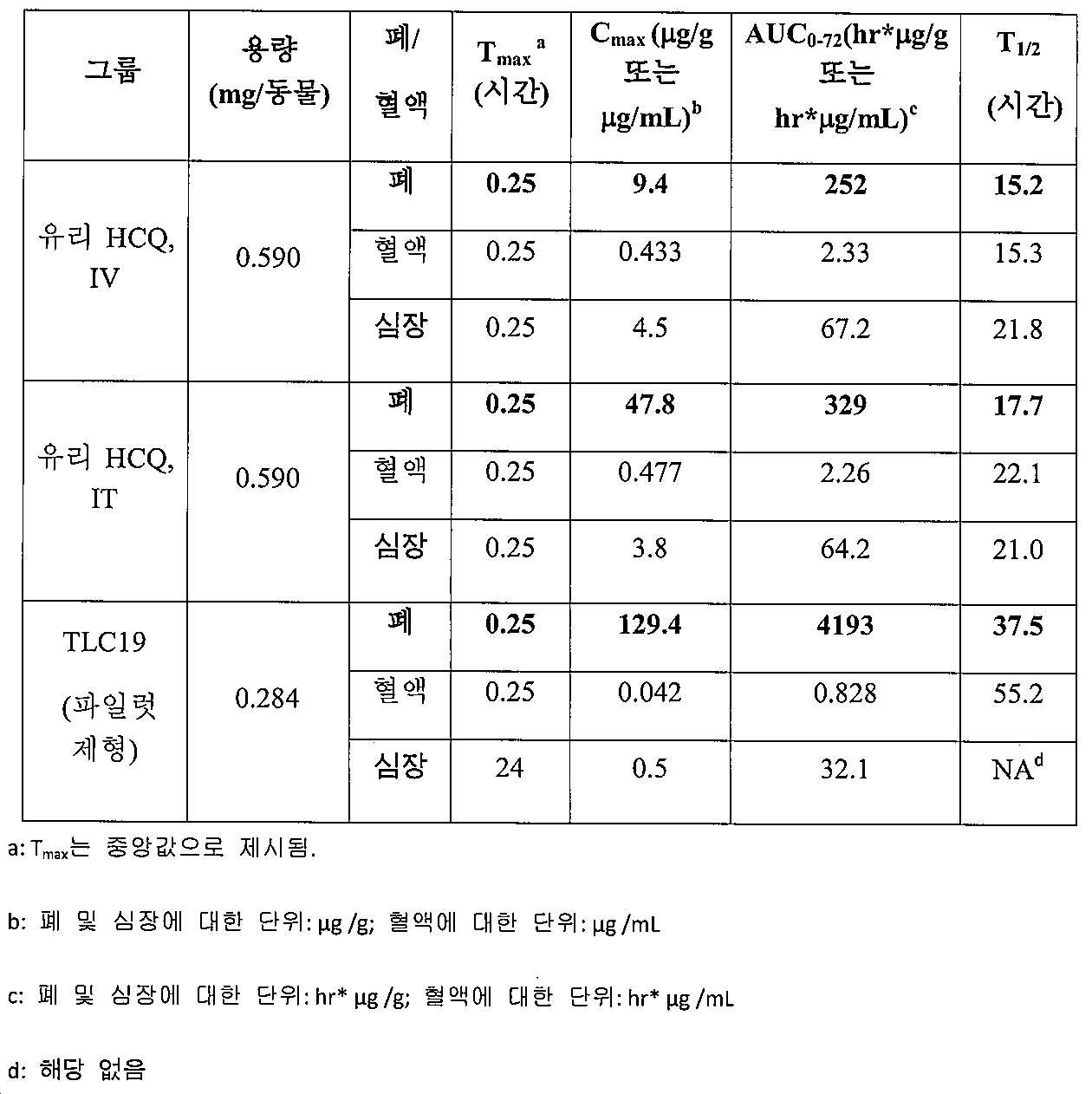
[0091] 유리 HCQ가 투여된 래트에서의 폐 분포와 관련하여, HCQ 농도는 투여 후 처음 24시간 동안, 특히 유리 HCQ IT 투여 그룹에서 지속적으로 빠르게 감소하였고; 평균 HCQ 농도는 IT 그룹에서 47.8 μg/g에서 2.16 μg/g으로 및 IV 그룹에서 9.4 μg/g에서 3.77 μg/g으로 감소하였다. 대조적으로, 폐에서 HCQ 침착의 정도는 유리 HCQ 그룹과 비교하여 TLC19(파일럿 제형) 그룹에 대해 유의하게 상승하였고, 이는 리포솜 약물의 지속-방출 특성에 기인하며; TLC19 그룹은 평균 HCQ 농도가 유리 HCQ 용량의 절반의 투여 후 투여 후 처음 24시간 동안 129 μg/g에서 57.1 μg/g으로 감소함에 따라 특정 기간 동안 폐에서 HCQ의 방출을 지속시켰다. [0091] Regarding lung distribution in rats administered with free HCQ, HCQ concentrations continuously and rapidly decreased during the first 24 hours after administration, especially in the free HCQ IT administration group; The average HCQ concentration decreased from 47.8 μg/g to 2.16 μg/g in the IT group and from 9.4 μg/g to 3.77 μg/g in the IV group. In contrast, the degree of HCQ deposition in the lungs was significantly elevated for the TLC19 (pilot formulation) group compared to the free HCQ group, which is attributed to the sustained-release properties of the liposomal drug; The TLC19 group sustained release of HCQ in the lungs for a specific period of time as mean HCQ concentrations decreased from 129 μg/g to 57.1 μg/g in the first 24 hours post-dose after administration of half the free HCQ dose.
[0092] 유리 HCQ IV 및 IT 그룹에서 폐에서 HCQ의 반감기는 각각 15.2시간 및 17.7시간이었고, 이는 HCQ가 생리학적 pH에서 세포막을 통해 빠르게 자유롭게 이동할 수 있다는 HCQ의 물리화학적 특성과 일치한다. TLC19(파일럿 제형) 그룹에서 HCQ의 반감기(37.5 시간)는 유리 HCQ 그룹의 약 2배였다. TLC19(파일럿 제형) 그룹의 AUC0-72 및 Cmax에 대한 폐 노출은 용량으로 표준화될 때 유리 HCQ IV 그룹의 폐 노출의 각각 35배 및 29배였다. 이러한 결과는 HCQ의 지속 방출된 제형인 TLC19(파일럿 제형)가 IV 또는 IT 투여를 통해 유리 HCQ와 비교하여 HCQ의 폐 체류 시간을 성공적으로 연장시켰음을 시사한다. 그리고 본 발명의 연구에서, 유리 HCQ의 IV 또는 IT 투여는 폐에서 HCQ 농도를 오랫동안 유지할 수 없었다. [0092] The half-lives of HCQ in the lungs in the free HCQ IV and IT groups were 15.2 and 17.7 hours, respectively, consistent with the physicochemical property of HCQ that it can move rapidly and freely through cell membranes at physiological pH. The half-life of HCQ (37.5 hours) in the TLC19 (pilot formulation) group was about twice that of the free HCQ group. Lung exposure for AUC 0-72 and C max in the TLC19 (pilot formulation) group was 35- and 29-fold that of the free HCQ IV group, respectively, when standardized by dose. These results suggest that the sustained release formulation of HCQ, TLC19 (pilot formulation), successfully prolonged the pulmonary residence time of HCQ compared to free HCQ via IV or IT administration. And in our study, IV or IT administration of free HCQ could not maintain HCQ concentrations in the lungs for long.
[0093] 전신 노출의 경우, HCQ는 HCQ 투여 후 빠르게 흡수되어 시스템에 분포되었다. 3개 그룹의 혈액에서의 HCQ의 중앙값 Tmax는 투여 후 0.25시간이었다. Cmax 및 AUC를 포함하는 전체 전신 노출은 유리 HCQ IV 및 IT 그룹에서 유사하였다. TLC19(파일럿 제형)의 경우, 혈액에서의 HCQ의 Cmax는 유리 HCQ의 Cmax보다 유의하게 낮았다. 소량의 HCQ는 TLC19(파일럿 제형)의 투여 후 1시간 이내에 초기 피크 농도를 초래하였다. 나머지 HCQ는 폐에 머물렀는데, 이는 투여 후 24시간 내지 72시간 사이에 TLC19(파일럿 제형)의 연장된 체류 시간 및 지속적으로 낮은 평균 혈액 농도를 가능하게 하였다. 시간 경과에 따라 관찰된 더 낮은 혈액 HCQ 농도 수준은 HCQ가 국소 부위에서 점차적으로 방출되었음을 시사한다. 더 큰 반감기에 의해 반영되는 바와 같이, TLC19(파일럿 제형)는 제형화되지 않은 HCQ 용액보다 더 긴 방출 프로파일을 나타내었다. [0093] In the case of systemic exposure, HCQ was rapidly absorbed and distributed in the system after HCQ administration. The median T max of HCQ in the blood of the three groups was 0.25 hours after administration. Total systemic exposure, including C max and AUC, was similar in the free HCQ IV and IT groups. For TLC19 (pilot formulation), the C max of HCQ in blood was significantly lower than that of free HCQ. Small amounts of HCQ resulted in initial peak concentrations within 1 hour after administration of TLC19 (pilot formulation). The remaining HCQ stayed in the lungs, which allowed for prolonged residence time and consistently low mean blood concentrations of TLC19 (pilot formulation) between 24 and 72 hours post-dose. The lower blood HCQ concentration levels observed over time suggest that HCQ was gradually released at the local site. As reflected by the greater half-life, TLC19 (pilot formulation) showed a longer release profile than the unformulated HCQ solution.
[0094] HCQ는 보정된 QT 간격(QTc)의 연장을 포함하는 심장 장애를 유발하는 것으로 나타났다. 심장에서 TLC19의 분포를 결정하기 위해, 심장 조직에서 HCQ PK 프로파일을 결정하였다(도 3). TLC19는 HCQ 용액과 비교할 때 더 낮은 심장 노출(Cmax)을 가졌다. 용량이 표준화될 때 모든 그룹에서 유사한 AUC가 관찰되었다. 전신 투여(즉, 경구 또는 IV)보다 국소(즉, IT 투여)에 필요한 더 낮은 용량을 고려하면, 이러한 결과는 TLC19가 통상적인 HCQ 투여보다 적은 심장독성을 유발할 수 있음을 시사한다. [0094] HCQ has been shown to induce cardiac disturbances including prolongation of the corrected QT interval (QTc). To determine the distribution of TLC19 in the heart, HCQ PK profiles were determined in cardiac tissue (FIG. 3). TLC19 had a lower cardiac exposure (C max ) when compared to the HCQ solution. Similar AUCs were observed in all groups when doses were standardized. Given the lower dose required for local (ie IT administration) than for systemic administration (ie oral or IV), these results suggest that TLC19 may induce less cardiotoxicity than conventional HCQ administration.
[0095] 2개의 전임상 PK 연구는 스프라그-돌리(SD) 래트에서 IT 투여를 통해 TLC19 최적화된 제형에 대해 수행될 것이며, 하기와 같이 기술될 것이다. [0095] Two preclinical PK studies will be conducted on TLC19 optimized formulations via IT administration in Sprague-Dawley (SD) rats and will be described below.
[0096] (1) SD 래트에서 단일-용량 PK 연구: TLC19의 단일-용량 IT 투여 후 혈액 약동학 및 조직 농도 연구는 SD 래트에서 수행될 수 있었다. 혈액 및 폐를 포함하는 주요 기관은 예정된 샘플링 시점에 수집될 수 있었고; HCQ의 농도는 전혈 및 기관에 대해 결정될 것이다. TLC19의 예비 PK 프로파일을 결정할 수 있었고; 폐에서 TLC19의 약물 분포의 백분율을 또한 계산할 수 있었다. [0096] (1) Single-dose PK study in SD rats: Blood pharmacokinetics and tissue concentration studies after single-dose IT administration of TLC19 could be performed in SD rats. Major organs, including blood and lungs, could be collected at scheduled sampling time points; Concentrations of HCQ will be determined for whole blood and organs. was able to determine the preliminary PK profile of TLC19; The percentage of drug distribution of TLC19 in the lung could also be calculated.
[0097] (2) SD 래트에서의 다중-용량 PK 연구: 연구는 다중-용량 IT 투여 후 TLC19의 약물 축적을 특성화하고 평가하도록 설계된다. 혈액 및 폐를 포함하는 주요 기관은 첫 번째 및 마지막 투여 후 예정된 샘플링 시점에 수집될 수 있었다. 혈액 및 폐에서 TLC19의 축적 속도를 계산할 수 있었다. [0097] (2) Multi-dose PK study in SD rats: The study is designed to characterize and evaluate drug accumulation of TLC19 after multi-dose IT administration. Blood and major organs including lungs could be collected at scheduled sampling points after the first and last dose. Accumulation rates of TLC19 in blood and lungs could be calculated.
실시예 3: 리포솜 항바이러스제의 제조Example 3: Preparation of liposomal antiviral agent
[0098] 설포부틸에테르-β-사이클로덱스트린(SBECD)은 Zibo Qianhui Biological Technology co., ltd, China에서 구입하였다. SBECD 제형화된 GS-441524(1.0 mg/mL GS-441524 함유)를 약 4.4의 pH를 갖는 150 mg/mL SBECD 용액에 GS-441524(항바이러스제)를 용해시킴으로써 제조하고, 시험 물품 (1) GS-441524 용액-IV으로 사용하였다. [0098] Sulfobutylether-β-cyclodextrin (SBECD) was purchased from Zibo Qianhui Biological Technology co., ltd, China. SBECD formulated GS-441524 (containing 1.0 mg/mL GS-441524) was prepared by dissolving GS-441524 (antiviral agent) in a 150 mg/mL SBECD solution having a pH of about 4.4, test article (1) GS -441524 was used as Solution-IV.
[0099] 연구 약물(리포솜 GS-441524, ISPM21로도 표시됨)은 Taiwan Liposome Company, Ltd., Taiwan에 의해 제조되었다. 이는 약 200 nm의 평균 입자 크기를 갖는 리포솜에 캡슐화된 GS-441524로 구성된다. GS-441524는 Formosa Pharmaceuticals, Inc.에 의해 순수한 담황색 분말로서 제공되었다. 리포솜은 둘 모두가 폐 계면활성제의 천연 성분인 디팔미토일포스파티딜콜린(Nippon Fine Chemical co., ltd., Japan) 및 콜레스테롤(Dishman, The Netherlands)로 구성된다23. 빈, 예비형성된 리포솜을 용매 주입을 통해 제조하였다. 간략하게, 적절한 양의 지질 혼합물(1,2-디팔미토일-sn-글리세로-3-포스포콜린(DPPC) 및 콜레스테롤)을 에탄올(JT Baker, USA)에 용해시키고, 50℃에서 교반하면서 암모늄 설페이트 용액에 주입하였다. 압출기를 사용하여, 50℃에서 0.2 μm 폴리카보네이트 막을 통한 압출에 의해 리포솜의 크기를 약 200 nm로 조정하였다. 캡슐화되지 않은 암모늄 설페이트 및 에탄올을 정용여과에 의해 제거하여 최종 빈 리포솜을 획득하였다. [0099] The study drug (Liposome GS-441524, also indicated as ISPM21) was manufactured by Taiwan Liposome Company, Ltd., Taiwan. It consists of GS-441524 encapsulated in liposomes with an average particle size of about 200 nm. GS-441524 was provided as a pure light yellow powder by Formosa Pharmaceuticals, Inc. Liposomes are composed of dipalmitoylphosphatidylcholine (Nippon Fine Chemical co., ltd., Japan) and cholesterol (Dishman, The Netherlands), both natural components of lung surfactant 23 . Empty, preformed liposomes were prepared via solvent injection. Briefly, an appropriate amount of lipid mixture (1,2-dipalmitoyl-sn-glycero-3-phosphocholine (DPPC) and cholesterol) was dissolved in ethanol (JT Baker, USA) and stirred at 50 °C. Ammonium sulfate solution was injected. Using an extruder, the liposomes were sized to about 200 nm by extrusion through a 0.2 μm polycarbonate membrane at 50° C. Unencapsulated ammonium sulfate and ethanol were removed by diafiltration to obtain final empty liposomes.
[00100] 리포솜에서 GS-441524의 캡슐화는 능동 로딩 방법을 사용하여 수행되었다. 비어 있는 예비형성된 리포솜을 GS-441524 약물 용액과 혼합하고, 50℃에서 인큐베이션하여 pH가 6 내지 7인 최종 ISPM21 샘플(리포솜 약물 현탁액)을 획득하고, 이를 시험 물품 (2) ISPM21-IT로서 사용하였다. [00100] Encapsulation of GS-441524 in liposomes was performed using an active loading method. Empty preformed liposomes were mixed with GS-441524 drug solution and incubated at 50°C to obtain a final ISPM21 sample (liposome drug suspension) with a pH of 6-7, which was used as test article (2) ISPM21-IT. .
A. 리포솜 뉴클레오시드 화합물의 제조A. Preparation of Liposomal Nucleoside Compounds
I. 빈 리포솜의 제조I. Preparation of Empty Liposomes
[00101] 리포솜은 박막 수화 방법 또는 용매 주입 방법을 통해 제조될 수 있다. [00101] Liposomes can be prepared through a thin film hydration method or a solvent injection method.
[00102] 용매 주입 방법에 의해 빈 리포솜을 제조하기 위한 공정은 하기 단계를 포함하는 방법에 의해 구현된다: [00102] A process for preparing empty liposomes by solvent injection method is implemented by a method comprising the following steps:
1. DSPE-PEG2000의 존재 또는 부재 하에 미리 결정된 몰비의 인지질, 콜레스테롤의 지질 혼합물을 칭량하고, 이들을 상승된 온도에서 에탄올에 의해 용해시키는 단계;1. Weighing a lipid mixture of phospholipid, cholesterol in a predetermined molar ratio with or without DSPE-PEG2000 and dissolving them with ethanol at elevated temperature;
2. 포획제를 증류수에 첨가하고 용액을 혼합하여 염을 용해시킴으로써 포획제 용액(예를 들어, 암모늄 설페이트(A.S.))을 제조하는 단계;2. Preparing a trapping agent solution (eg, ammonium sulfate (A.S.)) by adding the trapping agent to distilled water and mixing the solution to dissolve the salt;
3. 지질 조성물에 따라 적합한 온도에서 지질 혼합물을 포획제 용액에 첨가하여 리포솜 용액을 형성시키는 단계;3. Adding the lipid mixture to the capture agent solution at a suitable temperature depending on the lipid composition to form a liposome solution;
4. 획득된 리포솜 용액을 지질 조성에 따라 적합한 온도에서 폴리카보네이트 막을 통해 압출하여 설계된 입자 크기를 얻는 단계;4. Extruding the obtained liposome solution through a polycarbonate membrane at a suitable temperature according to the lipid composition to obtain the designed particle size;
5. 유리 포획제 및 에탄올을 제거하기 위한 수크로스 용액 또는 염수 또는 적합한 완충액에 대한 압출된 리포솜의 정용여과 단계.5. Diafiltration of the extruded liposomes against a sucrose solution or saline or suitable buffer to remove free trapping agent and ethanol.
II. 리포솜으로의 항바이러스제의 약물 로딩II. Drug loading of antiviral agents into liposomes
[00103] 하기 방법은 원격 로딩에 의해 리포솜에서 뉴클레오시드 화합물의 캡슐화를 위한 통상적인 프로토콜을 나타내며, 이는 하기 단계를 포함한다: [00103] The following method represents a conventional protocol for encapsulation of nucleoside compounds in liposomes by remote loading, and includes the following steps:
1. 적합한 매질에서 15.4 mg/mL 또는 적합한 농도의 뉴클레오시드 화합물의 용액을 제조하여 뉴클레오시드 화합물을 함유하는 스톡 용액(이하, 스톡 용액으로 표시됨)을 획득하는 단계;1. Preparing a solution of the nucleoside compound at 15.4 mg/mL or a suitable concentration in a suitable medium to obtain a stock solution containing the nucleoside compound (hereinafter referred to as stock solution);
2. 실시예 1, 섹션 (A), 섹션 (I)에 따른 공정에 의해 제조된 바와 같은 빈 리포솜[통상적인 구현예에서, 3:2의 몰비의 DPPC:콜레스테롤, 포획제로서 300 mM 암모늄 설페이트(A.S.), 및 20-50 mM 인지질 농도의 조건을 가짐], 및 스톡 용액을 원뿔형 튜브로 함께 혼합하여 D/L 비를 25 g/mol 또는 원하는 D/L 비가 되는 것을 목표로 하는 로딩 용액을 획득하는 단계; 2. Empty liposomes as prepared by the process according to Example 1, section (A), section (I) [in a typical embodiment, DPPC:cholesterol in a molar ratio of 3:2, 300 mM ammonium sulfate as capture agent (A.S.), and with conditions of 20-50 mM phospholipid concentration], and stock solutions were mixed together in a conical tube to obtain a loading solution aiming for a D/L ratio of 25 g/mol or the desired D/L ratio. obtaining;
3. 로딩 용액을 적합한 온도에서 60분 또는 설계된 기간 동안 연속적으로 진탕시켜 약물 로딩된 리포솜을 형성시키는 단계;3. Continuously shaking the loading solution at a suitable temperature for 60 minutes or a designed period to form drug-loaded liposomes;
4. NaOH 용액 또는 완충 용액을 약물 로딩된 리포솜에 첨가하여 용액의 pH를 6.0 내지 7.0으로 조정하는 단계; 및4. Adjusting the pH of the solution to 6.0-7.0 by adding NaOH solution or buffer solution to the drug-loaded liposomes; and
5. 크기-배제 컬럼 크로마토그래피 및 UV-Vis 흡광도 측정 또는 HPLC 분석을 사용하여 최종 샘플의 약물 캡슐화(즉, 로딩 효율)를 결정하는 단계.5. Determining the drug encapsulation (i.e., loading efficiency) of the final sample using size-exclusion column chromatography and UV-Vis absorbance measurement or HPLC analysis.
표 A: 상이한 약물 대 지질 비의 약물 로딩 프로파일 Table A: Drug loading profile of different drug to lipid ratios

B. 리포솜 항바이러스제의 저장 안정성B. Storage Stability of Liposomal Antiviral Agents
[00104] 4℃에서 저장된 리포솜 뉴클레오시드 화합물의 안정성은 적어도 2개월 또는 설계된 기간 동안 모니터링될 수 있다. 리포솜 약물 샘플(표 A)을 획득하기 위해 포획제로서 300 mM의 암모늄 설페이트 또는 75 mM의 트리에틸암모늄 수크로스 옥타설페이트와 함께 빈 리포솜에 로딩된 뉴클레오시드 화합물을 연구할 수 있었다. 4℃ 또는 적합한 온도에서 2개월 이상 또는 설계된 기간 동안 리포솜 약물 샘플을 저장한 후, 리포솜의 약물 역가, 물리화학적 특성이 시간 경과에 따라 연구될 수 있었다. [00104] The stability of liposomal nucleoside compounds stored at 4°C can be monitored for at least 2 months or a designed period. Nucleoside compounds loaded into empty liposomes could be studied with 300 mM ammonium sulfate or 75 mM triethylammonium sucrose octasulfate as capture agents to obtain liposomal drug samples (Table A). After storing the liposomal drug sample for at least 2 months or a designed period at 4° C. or a suitable temperature, the drug potency, physicochemical properties of the liposomes can be studied over time.
실시예 4: 리포솜 항바이러스제의 방출 프로파일Example 4: Release Profile of Liposomal Antiviral Agents
모의 폐액에서 시험관내 약물 방출In vitro drug release in simulated lung fluid
[00105] 실시예 1에 의해 제조된 리포솜 항바이러스제의 방출 프로파일 실험을 수행하여 이들의 지속 방출 특성을 입증할 수 있었다. 시험관내 방출(IVR) 실험을 위한 프로토콜은 다음과 같이 요약된다: [00105] A release profile test of the liposomal antiviral agents prepared in Example 1 was conducted to demonstrate their sustained release characteristics. The protocol for in vitro release (IVR) experiments is summarized as follows:
1. 0.5 mL의 리포솜 항바이러스제의 각 샘플을 4.5 mL의 SLF(37℃에서 예비 가온됨)와 혼합하고 희석된 샘플을 15-mL 원심분리 튜브에 배치함으로써 시험 물품을 10배 희석하는 단계;1. Diluting the test article 10-fold by mixing 0.5 mL of each sample of liposomal antiviral with 4.5 mL of SLF (pre-warmed at 37° C.) and placing the diluted sample in a 15-mL centrifuge tube;
2. 희석된 샘플을 함유하는 원심분리기 튜브를 Intelli-믹서 회전기의 샘플 웰에 놓고 20 rpm으로 회전시키면서 37℃에서 인큐베이션하는 단계; 및2. Place the centrifuge tube containing the diluted sample into the sample well of the Intelli-mixer rotator and incubate at 37° C. while spinning at 20 rpm; and
3. 캡슐화된 효율을 분석하기 위해 미리 결정된 시점에 1 mL의 희석된 샘플을 샘플링하는 단계.3. Sampling 1 mL of the diluted sample at predetermined time points to analyze encapsulation efficiency.
[00106] 뉴클레오시드 화합물 캡슐화 효율을 결정하기 위한 분석 방법은 다음과 같다: [00106] The assay method for determining the nucleoside compound encapsulation efficiency is as follows:
a. 2 mL의 G50 컬럼을 조건 용액으로 패킹하고 세척하는 단계;a. Packing and washing a 2 mL G50 column with the conditioned solution;
b. 0.1 mL의 샘플을 컬럼에 첨가한 후, 0.45 mL의 용리액을 첨가하고 용액이 용리되기를 기다리는 단계;b. After adding 0.1 mL of sample to the column, add 0.45 mL of eluent and wait for the solution to elute;
c. 0.8 mL의 용리액을 컬럼에 첨가하고 용리액을 리포솜 형태로 수집하는 단계;c. adding 0.8 mL of the eluent to the column and collecting the eluent in the form of liposomes;
d. 적합한 용매에 의해 컬럼-전 및 컬럼-후 샘플(리포솜 형태 및 총 형태)을 파괴하는 단계; 및d. disrupting the pre- and post-column samples (liposomal form and total form) with a suitable solvent; and
e. UV-Vis 또는 HPLC 방법을 사용하여 지시된 파장에서 샘플의 흡광도를 측정하여 각 샘플의 약물 농도를 결정하는 단계.e. Determining the drug concentration of each sample by measuring the absorbance of the sample at the indicated wavelengths using UV-Vis or HPLC methods.
[00107] 리포솜에서 항바이러스제의 캡슐화 효율(EE)은 다음 식에 의해 계산되고 획득될 수 있다: 약물의 리포솜 형태(LF)를 약물의 총 형태(TF)로 나눈 값: [00107] The encapsulation efficiency (EE) of an antiviral agent in liposomes can be calculated and obtained by the equation: Liposomal form of drug (LF) divided by total form of drug (TF):
EE(%) = LF/TF*100%.EE(%) = LF/TF*100%.
[00108] 방출 프로파일은 시간에 대한 방출 속도(%)를 나타내기 위해 플롯팅될 수 있다. 방출 속도는 다음 식에 의해 계산될 수 있다: 각 시점에서 초기 리포솜 형태에서 리포솜 형태를 뺀 후, 초기 리포솜 형태로 나눈 값: [00108] The release profile can be plotted to show the release rate (%) versus time. The release rate can be calculated by the formula: At each time point, the initial liposomal form minus the liposomal form divided by the initial liposomal form:
(LFt0-LFt)/ LFt0*100%.(LF t0 -LF t )/ LF t0 *100%.
[00109] 약물 물질의 연장된 방출 프로파일은 개선된 효능 및 더 낮은 투여 빈도로의 치료를 위해 요망된다. 따라서, 모든 제형 중에서 더 느리거나 적합한 방출 프로파일을 갖는 선택된 리포솜 항바이러스제를 하기 독성 연구에 사용하였다. [00109] An extended release profile of a drug substance is desired for treatment with improved efficacy and lower dosing frequency. Therefore, among all formulations, selected liposomal antivirals with slower or more suitable release profiles were used in the following toxicity studies.
실시예 5: 동물 모델에서 흡입된 리포솜 항바이러스제의 약동학Example 5: Pharmacokinetics of Inhaled Liposomal Antiviral Agents in Animal Models
연구 설계study design
[00110] 총 48마리의 암컷 SD 래트(BioLASCO Taiwan Co., Ltd.)를 2개의 처리 그룹 중 하나에 할당하였다: (1) GS-441524 용액-IV: 24마리의 래트에게 동물 당 0.20 mg의 GS-441524의 단일 용량을 IV 주사를 통해 투여하였고; (2) ISPM21-IT: 24마리의 래트에 임상 환경에서 흡입을 모방하는데 사용되는 투여 경로인 IT 점적주입을 통해 동물 당 0.20 mg의 ISPM21(1.0 mg/mL GS-441524를 함유하는 리포솜 현탁액)의 단일 용량을 투여하였다. 혈액 샘플에 대한 샘플링 시점은 투여 후 0.25, 1, 4, 24, 및 72시간이었고, 폐 샘플에 대한 샘플링 시점은 투여 후 0.25, 4, 24, 및 72시간이었다. 동물과 관련된 모든 절차는 TLC 동물 시설에서 그리고 TLC, Taiwan (#TLC20IACUC037)의 기관 동물 관리 및 사용 위원회(IACUC)의 윤리적 지침에 따라 수행되었다. [00110] A total of 48 female SD rats (BioLASCO Taiwan Co., Ltd.) were assigned to one of two treatment groups: (1) GS-441524 Solution-IV: 24 rats at 0.20 mg per animal. A single dose of GS-441524 was administered via IV injection; (2) ISPM21-IT: 24 rats received 0.20 mg of ISPM21 (liposomal suspension containing 1.0 mg/mL GS-441524) per animal via IT instillation, a route of administration used to mimic inhalation in clinical settings. A single dose was administered. Sampling time points for blood samples were 0.25, 1, 4, 24, and 72 hours after administration, and sampling time points for lung samples were 0.25, 4, 24, and 72 hours after administration. All procedures involving animals were performed in the TLC animal facility and in accordance with the ethical guidelines of the Institutional Animal Care and Use Committee (IACUC) of TLC, Taiwan (#TLC20IACUC037).
혈액 및 폐 샘플 수집 및 취급Collection and handling of blood and lung samples
[00111] 예정된 샘플링 시점에 경정맥으로부터 항응고제로서 K2EDTA를 갖는 수집 튜브로 혈액을 수집하였다. 샘플이 항응고제와 완전히 혼합되도록 각 수집 튜브를 부드럽게 뒤집었다. 실제 샘플링 시간을 기록하였다. 수집된 혈액 샘플을 2-8℃에서 1,500xg에서 10분 동안 원심분리하여 혈장을 획득하였다. 상층액 혈장을 즉시 표지된 마이크로튜브로 옮겼다. 혈장을 즉시 처리되지 않으면 -80℃로 설정된 냉동고로 옮겼다. 혈장 수확은 혈액 수집 후 2시간 이내에 완료되었다. [00111] Blood was collected from the jugular vein into collection tubes with K 2 EDTA as anticoagulant at scheduled sampling time points. Each collection tube was gently inverted to ensure the sample was thoroughly mixed with the anticoagulant. The actual sampling time was recorded. Plasma was obtained by centrifuging the collected blood samples at 2-8° C. at 1,500×g for 10 minutes. Supernatant plasma was immediately transferred into labeled microtubes. Plasma was immediately transferred to a freezer set at -80°C if not processed. Plasma harvest was completed within 2 hours of blood collection.
[00112] 동물을 예정된 폐 샘플 수집 시간에 안락사시켰다. 각각의 래트를 KD Scientific® 주사기 펌프에 의해 적어도 8분 동안 약 100 mL의 2 mM K2EDTA/염수 용액으로 관류시켰다. 관류 후, 폐를 취하고 액체 질소에서 동결시켰다. 동결 후, 폐를 칭량하고 -80℃ 냉동고로 이동할 때까지 습윤 얼음에 두었다. 모든 폐 샘플을 균질화될 때까지 -80℃ 냉동고에 저장하였다. [00112] Animals were euthanized at scheduled lung sample collection times. Each rat was perfused with approximately 100 mL of 2 mM K 2 EDTA/saline solution for at least 8 minutes by KD Scientific ® syringe pump. After perfusion, lungs were taken and frozen in liquid nitrogen. After freezing, lungs were weighed and placed on wet ice until transferred to a -80°C freezer. All lung samples were stored in a -80°C freezer until homogenized.
생물분석 및 PK 계산Bioassay and PK calculation
[00113] 단백질 침전을 위해 메탄올과 잘 혼합하기 전에 혈액 샘플에 내부 표준 (6,7-디메틸-2,3-디-2-피리딜퀴녹살린)을 첨가하였다. 원심분리 후, 상층액을 분석을 위해 탠덤 질량 분광계(Waters Xevo™ TQ-S)와 커플링된 액체 크로마토그래피(Waters I-Class UPLC)(LC-MS/MS)에 주입하였다. 폐 샘플의 경우, 조직/기관을 0.1% 포름산과 함께 50% 메탄올로 균질화하였다. 단백질 침전을 위해 메탄올과 잘 혼합하기 전에 조직/기관 균질액을 내부 표준(IS)과 함께 첨가하였다. 생성된 샘플 상층액을 원심분리 후 분석을 위해 LC-MS/MS에 주입하였다. GS-441524의 농도는 MassLynx 소프트웨어를 사용하여 계산되었다. 선형 범위는 폐 및 혈장 검정에 대해 각각 10-10000 ng/mL 및 0.5-500 ng/mL이었다. GS-441524의 PK 파라미터는 Phoenix® WinNonlin®(버전 8.0 이상)을 사용하여 희소 샘플링 계산을 적용하는 비-구획 방법에 의해 계산되었다. [00113] An internal standard (6,7-dimethyl-2,3-di-2-pyridylquinoxaline) was added to the blood samples before mixing well with methanol for protein precipitation. After centrifugation, the supernatant was injected into a liquid chromatography (Waters I-Class UPLC) (LC-MS/MS) coupled with a tandem mass spectrometer (Waters Xevo™ TQ-S) for analysis. For lung samples, tissues/organs were homogenized in 50% methanol with 0.1% formic acid. Tissue/organ homogenate was added along with an internal standard (IS) before mixing well with methanol for protein precipitation. The resulting sample supernatant was injected into LC-MS/MS for analysis after centrifugation. The concentration of GS-441524 was calculated using MassLynx software. The linear range was 10-10000 ng/mL and 0.5-500 ng/mL for lung and plasma assays, respectively. The PK parameters of GS- 441524 were calculated by a non-compartmental method applying sparse sampling calculations using Phoenix® WinNonlin® (version 8.0 or later).
결과result
폐에서의 GS-441524 약동학GS-441524 Pharmacokinetics in the lungs
[00114] ISPM21의 단일 용량 IT 투여 후, GS-441524 용액-IV와 비교하여 ISPM21-IT에 대해 폐에서 긴 반감기(22.8 시간) 및 더 높은 GS-441524 수준(도 4a)이 관찰되었다(표 3). 폐에서 GS-441524 용액-IV의 반감기 및 AUC는 농도가 제1 시점(0.25 시간)에서만 측정 가능하기 때문에 계산될 수 없었다. 특히, 0.2 mg의 ISPM21-IT의 단일 용량은 74.9 μg/g의 Cmax 및 369 h*μg/g의 AUC0-72를 달성하였고, 이는 GS-441524 용액-IV와 비교하여 207배의 Cmax로 현저히 더 높은 폐 노출을 나타낸다(표 4). [00114] After single-dose IT administration of ISPM21, a longer half-life (22.8 hours) and higher GS-441524 levels in the lungs (FIG. 4A) were observed for ISPM21-IT compared to GS-441524 solution-IV (Table 3). ). The half-life and AUC of GS-441524 Solution-IV in the lung could not be calculated because the concentration was only measurable at the first time point (0.25 hour). In particular, a single dose of 0.2 mg of ISPM21-IT achieved a C max of 74.9 μg/g and an AUC 0-72 of 369 h*μg/g, a C max of 207-fold compared to GS-441524 Solution-IV. , indicating a significantly higher lung exposure (Table 4).
표 3: GS-441524 용액-IV 또는 ISPM21-IT의 단일 투여 후 래트 폐 및 혈장에서의 GS-441524의 약동학적 파라미터 Table 3: Pharmacokinetic parameters of GS-441524 in rat lung and plasma after single administration of GS-441524 solution-IV or ISPM21-IT

표 4: ISPM21-IT 대 GS-441524 용액-IV에 대한 농도-시간 곡선하 면적 및 용량-표준화된 최대 농도의 비 Table 4: Ratio of area under the concentration-time curve and dose-normalized maximum concentration for ISPM21-IT versus GS-441524 Solution-IV

혈장에서의 GS-441524 약동학GS-441524 Pharmacokinetics in Plasma
[00115] 단일 용량 투여 후, ISPM21-IT는 GS-441524 용액-IV와 비교하여 혈장에서 유사한 PK 프로파일(도 4b) 및 AUC(표 3 및 4)를 나타내었다. ISPM21-IT의 혈장 반감기(9.98시간)는 GS-441524 용액-IV의 혈장 반감기(7.43시간)보다 약간 더 길었다. 특히, ISPM21-IT는 GS-441524 용액-IV에 비해 혈장에서 더 낮은 전신 노출(Cmax의 37%)을 나타내었다(표 4). [00115] After single dose administration, ISPM21-IT showed a similar PK profile in plasma (FIG. 4B) and AUC (Tables 3 and 4) compared to GS-441524 Solution-IV. The plasma half-life of ISPM21-IT (9.98 hours) was slightly longer than that of GS-441524 Solution-IV (7.43 hours). In particular, ISPM21-IT showed lower systemic exposure in plasma (37% of C max ) compared to GS-441524 Solution-IV (Table 4).
[00116] 이 래트 PK 연구에서, 폐로의 흡입성 ISPM21의 표적화된 전달을 조사하였고, 폐에서 GS-441524의 유의하게 더 높은 노출을 갖는 지속 방출이 입증되었다. ISPM21의 단일 IT 투여 후, 투여 후 72시간에 폐에서 GS-441524의 평균 농도는 1.07 μg/g(3.67 μM, 폐 조직 샘플의 밀도가 1 g/mL이라고 가정함)이었으며, 이는 ISPM21이 폐에서 SARS-CoV-감염된 인간 기도 상피(HAE) 세포에 대한 0.18 μM의 시험관내 항바이러스 EC50보다 19배 더 높은 비교적 높은 GS-441524 농도를 유지할 수 있음을 나타낸다. [00116] In this rat PK study, targeted delivery of inhalable ISPM21 to the lung was investigated and sustained release with significantly higher exposure of GS-441524 in the lung was demonstrated. After a single IT administration of ISPM21, the average concentration of GS-441524 in the lungs at 72 hours post-dose was 1.07 μg/g (3.67 μM, assuming a lung tissue sample density of 1 g/mL), indicating that ISPM21 was not present in the lungs. 19-fold higher in vitro antiviral EC 50 of 0.18 μM against SARS-CoV-infected human airway epithelial (HAE) cells.
Claims (40)
적어도 하나의 지질을 포함하는 리포솜; 및
리포솜에 캡슐화된 항바이러스제를 포함하는,
항바이러스제의 조성물.A composition of an antiviral agent for use in the prevention or treatment of a respiratory disease or infectious disease comprising a liposomal antiviral agent, wherein the liposomal antiviral agent comprises:
liposomes comprising at least one lipid; and
Including an antiviral agent encapsulated in liposomes,
Composition of an antiviral agent.

상기 식에서,
각각의 R1, R2, R3, R4 또는 R5는 독립적으로 H, ORa, N(Ra)2, N3, CN, NO2, S(O)nRa, 할로겐 또는 메틸이고, 여기서 n은 0, 1 또는 2이고;
R6은 CN 또는 H이고;
각각의 Ra는 독립적으로 H, (C1-C8)알킬, (C2-C8)알케닐, (C2-C8)알키닐, 아릴(C1-C8)알킬, (C4-C8)카보사이클릴알킬, -C(=O)R11, -C(=O)OR11, -C(=O)NR11R12, -C(=O)SR11, -S(O)R11, -S(O)2R11, -S(O)(OR11), -S(O)2(OR11), 또는 -SO2NR11R12이고;
R7은 H이고;
각각의 X1 또는 X2는 독립적으로 C-R10 또는 N이고;
R8은 할로겐, NR11R12, N(R11)(OR11), NR11NR11R12, N3, NO, NO2, CHO, CN, -CH(=NR11), -CH=NHNR11, -CH=N(OR11), -CH(OR11)2, -C(=O)NR11R12, -C(=S)NR11R12, -C(=O)OR11, (C1-C8)알킬, (C2-C8)알케닐, (C2-C8)알키닐, 아릴(C1-C8)알킬, (C4-C8)카보사이클릴알킬, 선택적으로 치환되는 아릴, 선택적으로 치환되는 헤테로아릴, -C(=O)(C1-C8)알킬, -S(O)n(C1-C8)알킬, 아릴(C1-C8)알킬, OR11 또는 SR11이고; 여기서 각각의 아릴 또는 헤테로아릴은 독립적으로 하나 이상의 Z 기로 선택적으로 치환되고;
각각의 R9 또는 R10은 독립적으로 H, 할로겐, R11, OR11, SR11, NR11R12, N(R11)(OR11), NR11NR11R12, N3, NO, NO2, CHO, CN, -CH(=NR11), -CH=NHNR11, -CH=N(OR11), -CH(OR11)2, -C(=O)NR11R12, -C(=S)NR11R12, -C(=O)OR11이고;
각각의 R11 또는 R12는 독립적으로 H, (C1-C8)알킬, (C2-C8)알케닐, (C2-C8)알키닐, (C4-C8)카보사이클릴알킬, 선택적으로 치환되는 아릴, 선택적으로 치환되는 헤테로아릴, -C(=O)(C1-C8)알킬, -S(O)n(C1-C8)알킬 또는 아릴(C1-C8)알킬이고; 여기서 각각의 아릴 또는 헤테로아릴은 독립적으로 하나 이상의 Z 기로 선택적으로 치환되거나;
R11 또는 R12는 이들이 둘 모두 부착되어 있는 질소와 함께 취해져 3 내지 7원 헤테로사이클릭 고리를 형성하고, 여기서 상기 헤테로사이클릭 고리의 임의의 하나의 탄소 원자는 -O-, -S- 또는 -NRa-로 선택적으로 대체될 수 있고,
각각의 Z 기는 독립적으로 할로겐, -O-, =O, -ORb, -SRb, -S-, -NRb 2, -N+Rb 3, =NRb, -CN, -OCN, -SCN, -N=C=O, -NCS, -NO, -NO2, =N2, -N3, -NHC(=O)Rb, -OC(=O)Rb, -NHC(=O)NRb 2, -S(=O)2-, -S(=O)2OH, -S(=O)2Rb, -OS(=O)2Orb, -S(=O)2OH, -S(=O)Rb, -OP(=O)(ORb)2, -P(=O)(ORb)2, -P(=O)(O-)2, -P(O)(ORb)(O-), -C(=O)Rb, -C(=O)X, -C(S)Rb, -C(O)ORb, -C(O)O-, -C(S)ORb, -C(O)SRb, -C(S)SRb, -C(O)NRb 2, -C(S)NRb 2, -C(=NRb)NRb 2이고, 여기서, 각각의 Rb는 독립적으로 H, 알킬, 아릴, 아릴알킬 또는 헤테로사이클이고; 여기서, 각각의 상기 (C1-C8)알킬의 비-말단 탄소 원자 중 하나 이상은 -O-, -S- 또는 -NRa-로 선택적으로 대체된다.The composition of the antiviral agent according to claim 1, wherein the antiviral agent is a nucleoside compound of structural formula I:
In the above formula,
Each R 1 , R 2 , R 3 , R 4 or R 5 is independently H, OR a , N(R a ) 2 , N 3 , CN, NO 2 , S(O) n R a , halogen or methyl , where n is 0, 1 or 2;
R 6 is CN or H;
Each R a is independently H, (C 1 -C 8 )alkyl, (C 2 -C 8 )alkenyl, (C 2 -C 8 )alkynyl, aryl(C 1 -C 8 )alkyl, (C 4 -C 8 )carbocyclylalkyl, -C(=O)R 11 , -C(=O)OR 11 , -C(=O)NR 11 R 12 , -C(=O)SR 11 , -S (O)R 11 , -S(O) 2 R 11 , -S(O)(OR 11 ), -S(O) 2 (OR 11 ), or -SO 2 NR 11 R 12 ;
R 7 is H;
each X 1 or X 2 is independently CR 10 or N;
R 8 is halogen, NR 11 R 12 , N(R 11 )(OR 11 ), NR 11 NR 11 R 12 , N 3 , NO, NO 2 , CHO, CN, -CH(=NR 11 ), -CH= NHNR 11 , -CH=N(OR 11 ), -CH(OR 11 ) 2 , -C(=O)NR 11 R 12 , -C(=S)NR 11 R 12 , -C(=O)OR 11 , (C 1 -C 8 )alkyl, (C 2 -C 8 )alkenyl, (C 2 -C 8 )alkynyl, aryl(C 1 -C 8 )alkyl, (C 4 -C 8 )carbocyclyl Alkyl, optionally substituted aryl, optionally substituted heteroaryl, -C(=O)(C 1 -C 8 )alkyl, -S(O) n (C 1 -C 8 )alkyl, aryl(C 1 - C 8 )alkyl, OR 11 or SR 11 ; wherein each aryl or heteroaryl is independently optionally substituted with one or more Z groups;
Each R 9 or R 10 is independently H, halogen, R 11 , OR 11 , SR 11 , NR 11 R 12 , N(R 11 )(OR 11 ), NR 11 NR 11 R 12 , N 3 , NO; NO 2 , CHO, CN, -CH(=NR 11 ), -CH=NHNR 11 , -CH=N(OR 11 ), -CH(OR 11 ) 2 , -C(=O)NR 11 R 12 , - C(=S)NR 11 R 12 , -C(=O)OR 11 ;
Each R 11 or R 12 is independently H, (C 1 -C 8 )alkyl, (C 2 -C 8 )alkenyl, (C 2 -C 8 )alkynyl, (C 4 -C 8 )carbocycle Rylalkyl, optionally substituted aryl, optionally substituted heteroaryl, -C(=O)(C 1 -C 8 )alkyl, -S(O) n (C 1 -C 8 )alkyl or aryl(C 1 -C 8 )alkyl; wherein each aryl or heteroaryl is independently optionally substituted with one or more Z groups;
R 11 or R 12 taken together with the nitrogen to which they are both attached form a 3 to 7 membered heterocyclic ring wherein any one carbon atom of the heterocyclic ring is -O-, -S- or may optionally be replaced by -NR a -,
Each Z group is independently halogen, -O - , =O, -OR b , -SR b , -S-, -NR b 2 , -N + R b 3 , =NR b , -CN, -OCN, - SCN, -N=C=O, -NCS, -NO, -NO 2 , =N 2 , -N 3 , -NHC(=O)R b , -OC(=O)R b , -NHC(=O )NR b 2 , -S(=O) 2 -, -S(=O) 2 OH, -S(=O) 2 R b , -OS(=O) 2 Or b , -S(=O) 2 OH, -S(=O)R b , -OP(=O)(OR b ) 2 , -P(=O)(OR b ) 2 , -P(=O)(O-) 2 , -P( O)(OR b )(O-), -C(=O)R b , -C(=O)X, -C(S)R b , -C(O)OR b , -C(O)O -, -C(S)OR b , -C(O)SR b , -C(S)SR b , -C(O)NR b 2 , -C(S)NR b 2 , -C(=NR b )NR b 2 , wherein each R b is independently H, alkyl, aryl, arylalkyl or heterocycle; wherein at least one of the non-terminal carbon atoms of each of said (C 1 -C 8 )alkyl is optionally replaced with -O-, -S- or -NR a -.
하나 이상의 인지질 및 콜레스테롤을 포함하는 리포솜; 및
리포솜에 캡슐화된 하이드록시클로로퀸, 클로로퀸, 또는 (2R,3R,4S,5R)-2-(4-아미노피롤로[2,1-f][1,2,4]트리아진-7-일)-3,4-디하이드록시-5-(하이드록시메틸)옥솔란-2-카보니트릴을 포함하고,
상기 조성물이 0.5 mg/mL 내지 15 mg/mL, 0.5 mg/mL 내지 5 mg/mL, 또는 0.5 mg/mL 내지 4 mg/mL 범위의 총 항바이러스제의 농도; 5 mM 내지 60 mM 범위의 지질 농도, 및 0.01 mol/mol 내지 2 mol/mol, 0.01 mol/mol 내지 0.3 mol/mol, 0.03 mol/mol 내지 0.5 mol/mol, 0.03 mol/mol 내지 0.15 mol/mol, 0.03 mol/mol 내지 0.1 mol/mol, 선택적으로 약 0.05 mol/mol, 또는 0.05 mol/mol 내지 0.15 mol/mol 범위의 약물 대 지질비를 갖는,
항바이러스제의 조성물.A composition of antiviral agents for use in the prevention or treatment of respiratory diseases or infectious diseases, including liposomal antiviral agents and free form antiviral agents, wherein the liposomal antiviral agent comprises:
liposomes comprising one or more phospholipids and cholesterol; and
Hydroxychloroquine, chloroquine, or (2R,3R,4S,5R)-2-(4-aminopyrrolo[2,1-f][1,2,4]triazin-7-yl) encapsulated in liposomes -3,4-dihydroxy-5-(hydroxymethyl)oxolane-2-carbonitrile;
The concentration of the total antiviral agent in the range of 0.5 mg/mL to 15 mg/mL, 0.5 mg/mL to 5 mg/mL, or 0.5 mg/mL to 4 mg/mL; Lipid concentration ranging from 5 mM to 60 mM, and from 0.01 mol/mol to 2 mol/mol, 0.01 mol/mol to 0.3 mol/mol, 0.03 mol/mol to 0.5 mol/mol, 0.03 mol/mol to 0.15 mol/mol , having a drug to lipid ratio ranging from 0.03 mol/mol to 0.1 mol/mol, optionally about 0.05 mol/mol, or from 0.05 mol/mol to 0.15 mol/mol;
Composition of an antiviral agent.
적어도 하나의 지질을 포함하는 리포솜; 및
리포솜에 캡슐화된 항바이러스제를 포함하는,
제1항 내지 제16항 중 어느 한 항에 따른 항바이러스제의 조성물을 포함하는 입자의 에어로졸화된 조성물.For use in the prevention or treatment of infectious or respiratory diseases through inhalation;
liposomes comprising at least one lipid; and
Including an antiviral agent encapsulated in liposomes,
An aerosolized composition of particles comprising a composition of an antiviral agent according to any one of claims 1 to 16.
항바이러스제의 조성물을 에어로졸화시킬 수 있는 폐 전달 장치를 포함하는, 항바이러스제의 조성물을 이를 필요로 하는 대상체에게 투여하기 위한 시스템으로서,
상기 항바이러스제의 에어로졸화된 조성물이 즉각적인 항바이러스 활성을 제공하기에 효과적인 양의 유리 항바이러스제 및 지속적인 항바이러스 활성을 제공하기에 효과적인 양의 리포솜 항바이러스제를 함유하는 입자를 포함하는,
시스템.A composition of an antiviral agent according to any one of claims 1 to 16; and
A system for administering a composition of an antiviral agent to a subject in need thereof comprising a pulmonary delivery device capable of aerosolizing the composition of the antiviral agent, comprising:
Wherein the aerosolized composition of an antiviral agent comprises particles containing an effective amount of free antiviral agent to provide immediate antiviral activity and an amount of liposomal antiviral agent effective to provide sustained antiviral activity.
system.
포획제를 사용한 원격 로딩에 의해 리포솜에 캡슐화된 항바이러스제로서, 상기 포획제가 암모늄 화합물 및 음이온성 반대이온으로 구성되고, 상기 음이온성 반대이온이 수크로스 옥타설페이트, 덱스트란 설페이트, 설페이트, 시트레이트, 글루코네이트, 설포네이트, 포스페이트, 피로포스페이트, 타르트레이트, 석시네이트, 말레에이트, 보레이트, 카복실레이트, 바이카보네이트, 글루쿠로네이트, 클로라이드, 하이드록사이드, 니트레이트, 시아네이트, 브로마이드 및 이들의 조합으로 구성된 군으로부터 선택되는, 항바이러스제를 포함하는,
리포솜 항바이러스제를 포함하는, 감염성 질병의 치료에 사용하기 위한 항바이러스제의 약학적 조성물.liposomes comprising at least one lipid; and
An antiviral agent encapsulated in liposomes by remote loading using a capture agent, wherein the capture agent is composed of an ammonium compound and an anionic counterion, wherein the anionic counterion is selected from sucrose octasulfate, dextran sulfate, sulfate, citrate, gluconates, sulfonates, phosphates, pyrophosphates, tartrates, succinates, maleates, borates, carboxylates, bicarbonates, glucuronates, chlorides, hydroxides, nitrates, cyanates, bromides and combinations thereof Selected from the group consisting of, including an antiviral agent,
A pharmaceutical composition of an antiviral agent for use in the treatment of an infectious disease, comprising a liposomal antiviral agent.

상기 식에서,
각각의 R1, R2, R3, R4 또는 R5는 독립적으로 H, ORa, N(Ra)2, N3, CN, NO2, S(O)nRa, 할로겐 또는 메틸이고, 여기서 n은 0, 1 또는 2이고;
R6은 CN 또는 H이고;
각각의 Ra는 독립적으로 H, (C1-C8)알킬, (C2-C8)알케닐, (C2-C8)알키닐, 아릴(C1-C8)알킬, (C4-C8)카보사이클릴알킬, -C(=O)R11, -C(=O)OR11, -C(=O)NR11R12, -C(=O)SR11, -S(O)R11, -S(O)2R11, -S(O)(OR11), -S(O)2(OR11), 또는 -SO2NR11R12이고;
R7은 H이고;
각각의 X1 또는 X2는 독립적으로 C-R10 또는 N이고;
R8은 할로겐, NR11R12, N(R11)(OR11), NR11NR11R12, N3, NO, NO2, CHO, CN, -CH(=NR11), -CH=NHNR11, -CH=N(OR11), -CH(OR11)2, -C(=O)NR11R12, -C(=S)NR11R12, -C(=O)OR11, (C1-C8)알킬, (C2-C8)알케닐, (C2-C8)알키닐, 아릴(C1-C8)알킬, (C4-C8)카보사이클릴알킬, 선택적으로 치환되는 아릴, 선택적으로 치환되는 헤테로아릴, -C(=O)(C1-C8)알킬, -S(O)n(C1-C8)알킬, 아릴(C1-C8)알킬, OR11 또는 SR11이고; 여기서 각각의 아릴 또는 헤테로아릴은 독립적으로 하나 이상의 Z 기로 선택적으로 치환되고;
각각의 R9 또는 R10은 독립적으로 H, 할로겐, R11, OR11, SR11, NR11R12, N(R11)(OR11), NR11NR11R12, N3, NO, NO2, CHO, CN, -CH(=NR11), -CH=NHNR11, -CH=N(OR11), -CH(OR11)2, -C(=O)NR11R12, -C(=S)NR11R12, -C(=O)OR11이고;
각각의 R11 또는 R12는 독립적으로 H, (C1-C8)알킬, (C2-C8)알케닐, (C2-C8)알키닐, (C4-C8)카보사이클릴알킬, 선택적으로 치환되는 아릴, 선택적으로 치환되는 헤테로아릴, -C(=O)(C1-C8)알킬, -S(O)n(C1-C8)알킬 또는 아릴(C1-C8)알킬이고; 여기서 각각의 아릴 또는 헤테로아릴은 독립적으로 하나 이상의 Z 기로 선택적으로 치환되거나;
R11 또는 R12는 이들이 둘 모두 부착되어 있는 질소와 함께 취해져 3 내지 7원 헤테로사이클릭 고리를 형성하고, 여기서 상기 헤테로사이클릭 고리의 임의의 하나의 탄소 원자는 -O-, -S- 또는 -NRa-로 선택적으로 대체될 수 있고,
각각의 Z 기는 독립적으로 할로겐, -O-, =O, -ORb, -SRb, -S-, -NRb 2, -N+Rb 3, =NRb, -CN, -OCN, -SCN, -N=C=O, -NCS, -NO, -NO2, =N2, -N3, -NHC(=O)Rb, -OC(=O)Rb, -NHC(=O)NRb 2, -S(=O)2-, -S(=O)2OH, -S(=O)2Rb, -OS(=O)2ORb, -S(=O)2OH, -S(=O)Rb, -OP(=O)(ORb)2, -P(=O)(ORb)2, -P(=O)(O-)2, -P(O)(ORb)(O-), -C(=O)Rb, -C(=O)X, -C(S)Rb, -C(O)ORb, -C(O)O-, -C(S)ORb, -C(O)SRb, -C(S)SRb, -C(O)NRb 2, -C(S)NRb 2, -C(=NRb)NRb 2이고, 여기서, 각각의 Rb는 독립적으로 H, 알킬, 아릴, 아릴알킬 또는 헤테로사이클이고; 여기서, 각각의 상기 (C1-C8)알킬의 비-말단 탄소 원자 중 하나 이상은 -O-, -S- 또는 -NRa-로 선택적으로 대체된다.25. The pharmaceutical composition of an antiviral agent according to claim 24, wherein the antiviral agent is a nucleoside compound of structural formula (I):
In the above formula,
Each R 1 , R 2 , R 3 , R 4 or R 5 is independently H, OR a , N(R a ) 2 , N 3 , CN, NO 2 , S(O) n R a , halogen or methyl , where n is 0, 1 or 2;
R 6 is CN or H;
Each R a is independently H, (C 1 -C 8 )alkyl, (C 2 -C 8 )alkenyl, (C 2 -C 8 )alkynyl, aryl(C 1 -C 8 )alkyl, (C 4 -C 8 )carbocyclylalkyl, -C(=O)R 11 , -C(=O)OR 11 , -C(=O)NR 11 R 12 , -C(=O)SR 11 , -S (O)R 11 , -S(O) 2 R 11 , -S(O)(OR 11 ), -S(O) 2 (OR 11 ), or -SO 2 NR 11 R 12 ;
R 7 is H;
each X 1 or X 2 is independently CR 10 or N;
R8 is halogen, NR 11 R 12 , N(R 11 )(OR 11 ), NR 11 NR 11 R 12 , N 3 , NO, NO 2 , CHO, CN, -CH(=NR 11 ), -CH=NHNR 11 , -CH=N(OR 11 ), -CH(OR 11 ) 2 , -C(=O)NR 11 R 12 , -C(=S)NR 11 R 12 , -C(=O)OR 11 , (C 1 -C 8 )alkyl, (C 2 -C 8 )alkenyl, (C 2 -C 8 )alkynyl, aryl(C 1 -C 8 )alkyl, (C 4 -C 8 )carbocyclylalkyl , optionally substituted aryl, optionally substituted heteroaryl, -C(=O)(C 1 -C 8 )alkyl, -S(O) n (C 1 -C 8 )alkyl, aryl(C 1 -C 8 ) alkyl, OR 11 or SR 11 ; wherein each aryl or heteroaryl is independently optionally substituted with one or more Z groups;
Each R 9 or R 10 is independently H, halogen, R 11 , OR 11 , SR 11 , NR 11 R 12 , N(R 11 )(OR 11 ), NR 11 NR 11 R 12 , N 3 , NO; NO 2 , CHO, CN, -CH(=NR 11 ), -CH=NHNR 11 , -CH=N(OR 11 ), -CH(OR 11 ) 2 , -C(=O)NR 11 R 12 , - C(=S)NR 11 R 12 , -C(=O)OR 11 ;
Each R 11 or R 12 is independently H, (C 1 -C 8 )alkyl, (C 2 -C 8 )alkenyl, (C 2 -C 8 )alkynyl, (C 4 -C 8 )carbocycle Rylalkyl, optionally substituted aryl, optionally substituted heteroaryl, -C(=O)(C 1 -C 8 )alkyl, -S(O) n (C 1 -C 8 )alkyl or aryl(C 1 -C 8 )alkyl; wherein each aryl or heteroaryl is independently optionally substituted with one or more Z groups;
R 11 or R 12 taken together with the nitrogen to which they are both attached form a 3 to 7 membered heterocyclic ring wherein any one carbon atom of the heterocyclic ring is -O-, -S- or may optionally be replaced by -NR a -,
Each Z group is independently halogen, -O - , =O, -OR b , -SR b , -S - , -NR b 2 , -N + R b 3 , =NR b , -CN, -OCN, - SCN, -N=C=O, -NCS, -NO, -NO 2 , =N 2 , -N 3 , -NHC(=O)R b , -OC(=O)R b , -NHC(=O )NR b 2 , -S(=O) 2 -, -S(=O) 2 OH, -S(=O) 2 R b , -OS(=O) 2 OR b , -S(=O) 2 OH, -S(=O)R b , -OP(=O)(OR b ) 2 , -P(=O)(OR b ) 2 , -P(=O)(O - ) 2 , -P( O)(OR b )(O - ), -C(=O)R b , -C(=O)X, -C(S)R b , -C(O)OR b , -C(O)O - , -C(S)OR b , -C(O)SR b , -C(S)SR b , -C(O)NR b 2 , -C(S)NR b 2 , -C(=NR b )NR b 2 , wherein each R b is independently H, alkyl, aryl, arylalkyl or heterocycle; wherein at least one of the non-terminal carbon atoms of each of said (C 1 -C 8 )alkyl is optionally replaced with -O-, -S- or -NR a -.


Applications Claiming Priority (7)
| Application Number | Priority Date | Filing Date | Title |
|---|---|---|---|
| US202062993060P | 2020-03-22 | 2020-03-22 | |
| US62/993,060 | 2020-03-22 | ||
| US202063017297P | 2020-04-29 | 2020-04-29 | |
| US63/017,297 | 2020-04-29 | ||
| US202163134645P | 2021-01-07 | 2021-01-07 | |
| US63/134,645 | 2021-01-07 | ||
| PCT/US2021/023405 WO2021194927A1 (en) | 2020-03-22 | 2021-03-22 | Composition of antiviral agent for use in prophylactic or post-exposure treatment of infectious or respiratory diseases |
Publications (1)
| Publication Number | Publication Date |
|---|---|
| KR20220156861A true KR20220156861A (en) | 2022-11-28 |
Family
ID=75478291
Family Applications (1)
| Application Number | Title | Priority Date | Filing Date |
|---|---|---|---|
| KR1020227035533A Pending KR20220156861A (en) | 2020-03-22 | 2021-03-22 | Compositions of antiviral agents for use in prophylaxis or post-exposure treatment of infectious or respiratory diseases |
Country Status (9)
| Country | Link |
|---|---|
| US (1) | US20230181615A1 (en) |
| EP (1) | EP4125810A1 (en) |
| JP (1) | JP2023518694A (en) |
| KR (1) | KR20220156861A (en) |
| CN (2) | CN121401286A (en) |
| AU (1) | AU2021244195A1 (en) |
| CA (1) | CA3171394A1 (en) |
| TW (1) | TW202143949A (en) |
| WO (1) | WO2021194927A1 (en) |
Families Citing this family (5)
| Publication number | Priority date | Publication date | Assignee | Title |
|---|---|---|---|---|
| MX2022011370A (en) * | 2020-03-23 | 2022-10-07 | John M H Gregg | Anti-viral compounds and methods for administration thereof. |
| AU2023249795A1 (en) | 2022-04-08 | 2024-10-17 | Shy Therapeutics, Llc | Compounds that interact with ras superfamily proteins for treatment of cancers, inflammatory diseases, rasopathies, and fibrotic disease |
| CN116850199A (en) * | 2023-06-06 | 2023-10-10 | 福建医科大学附属协和医院 | Use of corimycin and its monomers for preparing drugs for improving sepsis induced by lipopolysaccharide and cecal ligation and puncture |
| US20250032598A1 (en) * | 2023-07-24 | 2025-01-30 | Alexandre Vasilievich Ivachtchenko | Compounds, Pharmaceuticals, Formulations, and Methods for Treating and Preventing RNA Virus Infections and Associated Diseases |
| CN117122576A (en) * | 2023-08-08 | 2023-11-28 | 中国人民解放军空军军医大学 | Preparation method and application of hydroxychloroquinoline targeted nano drug delivery system |
Family Cites Families (14)
| Publication number | Priority date | Publication date | Assignee | Title |
|---|---|---|---|---|
| IE63869B1 (en) * | 1986-11-06 | 1995-06-14 | Res Dev Foundation | Aerosols containing liposomes and method for their preparation |
| WO2005020885A2 (en) * | 2003-05-21 | 2005-03-10 | Isis Pharmaceuticals, Inc. | Compositions and methods for the treatment of severe acute respiratory syndrome (sars) |
| HUE029994T2 (en) * | 2005-12-08 | 2017-04-28 | Insmed Inc | Lipid-based preparations of antinfectants for the treatment of lung infections |
| US20080138397A1 (en) | 2006-10-24 | 2008-06-12 | Aradigm Corporation | Processes for taste-masking of inhaled formulations |
| US7964580B2 (en) | 2007-03-30 | 2011-06-21 | Pharmasset, Inc. | Nucleoside phosphoramidate prodrugs |
| WO2009132135A1 (en) * | 2008-04-23 | 2009-10-29 | Gilead Sciences, Inc. | 1' -substituted carba-nucleoside analogs for antiviral treatment |
| TW201201815A (en) * | 2010-05-28 | 2012-01-16 | Gilead Sciences Inc | 1'-substituted-carba-nucleoside prodrugs for antiviral treatment |
| PL2834258T3 (en) * | 2012-03-13 | 2017-07-31 | Gilead Sciences, Inc. | 2'- substituted carba-nucleoside analogs for antiviral treatment |
| CN107708672A (en) * | 2015-06-15 | 2018-02-16 | 华盛顿大学 | Multidrug lipid nanoparticle compositions and related methods for prolonging drug levels in blood and lymphoid tissues |
| WO2017184668A1 (en) * | 2016-04-20 | 2017-10-26 | Gilead Sciences, Inc. | Methods for treating flaviviridae virus infections |
| CA3101102A1 (en) * | 2018-04-23 | 2019-10-31 | Tlc Biopharmaceuticals, Inc. | Inhalable liposomal sustained release composition for use in treating pulmonary diseases |
| CN111991401A (en) * | 2020-09-21 | 2020-11-27 | 南方科技大学 | Application of compound in treatment of SARS-CoV-2 infection |
| CN111991375A (en) * | 2020-09-25 | 2020-11-27 | 中国药科大学 | Reed-ciclovir liposome for aerosol inhalation and preparation method thereof |
| CN116874490A (en) * | 2020-12-30 | 2023-10-13 | 南方科技大学 | Compound ATV014 or its pharmaceutically acceptable salt and pharmaceutical compositions thereof |
-
2021
- 2021-03-22 WO PCT/US2021/023405 patent/WO2021194927A1/en not_active Ceased
- 2021-03-22 CA CA3171394A patent/CA3171394A1/en active Pending
- 2021-03-22 JP JP2022554352A patent/JP2023518694A/en active Pending
- 2021-03-22 KR KR1020227035533A patent/KR20220156861A/en active Pending
- 2021-03-22 TW TW110110236A patent/TW202143949A/en unknown
- 2021-03-22 CN CN202511352966.6A patent/CN121401286A/en active Pending
- 2021-03-22 AU AU2021244195A patent/AU2021244195A1/en active Pending
- 2021-03-22 US US17/912,933 patent/US20230181615A1/en active Pending
- 2021-03-22 CN CN202180023098.0A patent/CN115315252A/en active Pending
- 2021-03-22 EP EP21718405.0A patent/EP4125810A1/en active Pending
Also Published As
| Publication number | Publication date |
|---|---|
| CN115315252A (en) | 2022-11-08 |
| US20230181615A1 (en) | 2023-06-15 |
| EP4125810A1 (en) | 2023-02-08 |
| WO2021194927A1 (en) | 2021-09-30 |
| AU2021244195A1 (en) | 2022-09-15 |
| JP2023518694A (en) | 2023-05-08 |
| CA3171394A1 (en) | 2021-09-30 |
| TW202143949A (en) | 2021-12-01 |
| CN121401286A (en) | 2026-01-27 |
Similar Documents
| Publication | Publication Date | Title |
|---|---|---|
| US12533313B2 (en) | Inhalable liposomal sustained release composition for use in treating pulmonary diseases | |
| JP7686017B2 (en) | Methods for treating nontuberculous mycobacterial pulmonary infections - Patents.com | |
| KR20220156861A (en) | Compositions of antiviral agents for use in prophylaxis or post-exposure treatment of infectious or respiratory diseases | |
| EP1443900B1 (en) | Lipid carrier compositions with enhanced blood stability | |
| DK168982B1 (en) | A process for forming small vesicles comprising a phospholipid and encapsulating an antifungal polyene antibiotic and composition formed by this method for use in a method of treating systemic fungal infections | |
| EP3067046B1 (en) | Lipid-based compositions of antiinfectives for treating pulmonary infections | |
| CN101917972A (en) | Liposomal vancomycin formulation | |
| JP2015502400A (en) | Liposomal chlorite or chlorate composition | |
| EP1448165B1 (en) | Lipid carrier compositions and methods for improved drug retention | |
| CN115666552B (en) | Liposomes containing eribulin or its pharmaceutically acceptable salt containing ethylenediaminetetraacetic acid or its salt | |
| TW202320803A (en) | Methods for preparing liposomal formulations | |
| TWI853932B (en) | Inhalable sustained release composition of bronchodilator for use in treating pulmonary disease | |
| HK40082187A (en) | Composition of antiviral agent for use in prophylactic or post-exposure treatment of infectious or respiratory diseases | |
| HK40043569A (en) | Inhalable liposomal sustained release composition for use in treating pulmonary diseases | |
| HK40043569B (en) | Inhalable liposomal sustained release composition for use in treating pulmonary diseases | |
| HK1228744B (en) | Lipid-based compositions of antiinfectives for treating pulmonary infections |
Legal Events
| Date | Code | Title | Description |
|---|---|---|---|
| PA0105 | International application |
St.27 status event code: A-0-1-A10-A15-nap-PA0105 |
|
| PG1501 | Laying open of application |
St.27 status event code: A-1-1-Q10-Q12-nap-PG1501 |
|
| R17-X000 | Change to representative recorded |
St.27 status event code: A-3-3-R10-R17-oth-X000 |
|
| A201 | Request for examination | ||
| PA0201 | Request for examination |
St.27 status event code: A-1-2-D10-D11-exm-PA0201 |
|
| D21 | Rejection of application intended |
Free format text: ST27 STATUS EVENT CODE: A-1-2-D10-D21-EXM-PE0902 (AS PROVIDED BY THE NATIONAL OFFICE) |
|
| PE0902 | Notice of grounds for rejection |
St.27 status event code: A-1-2-D10-D21-exm-PE0902 |