KR20220123300A - Nucleic acid synthesis method using segment-type amidite - Google Patents
Nucleic acid synthesis method using segment-type amidite Download PDFInfo
- Publication number
- KR20220123300A KR20220123300A KR1020227027277A KR20227027277A KR20220123300A KR 20220123300 A KR20220123300 A KR 20220123300A KR 1020227027277 A KR1020227027277 A KR 1020227027277A KR 20227027277 A KR20227027277 A KR 20227027277A KR 20220123300 A KR20220123300 A KR 20220123300A
- Authority
- KR
- South Korea
- Prior art keywords
- nucleoside
- group
- phosphoramidite
- substituted
- independently
- Prior art date
- Legal status (The legal status is an assumption and is not a legal conclusion. Google has not performed a legal analysis and makes no representation as to the accuracy of the status listed.)
- Pending
Links
Classifications
-
- C—CHEMISTRY; METALLURGY
- C07—ORGANIC CHEMISTRY
- C07H—SUGARS; DERIVATIVES THEREOF; NUCLEOSIDES; NUCLEOTIDES; NUCLEIC ACIDS
- C07H21/00—Compounds containing two or more mononucleotide units having separate phosphate or polyphosphate groups linked by saccharide radicals of nucleoside groups, e.g. nucleic acids
-
- C—CHEMISTRY; METALLURGY
- C07—ORGANIC CHEMISTRY
- C07H—SUGARS; DERIVATIVES THEREOF; NUCLEOSIDES; NUCLEOTIDES; NUCLEIC ACIDS
- C07H21/00—Compounds containing two or more mononucleotide units having separate phosphate or polyphosphate groups linked by saccharide radicals of nucleoside groups, e.g. nucleic acids
- C07H21/04—Compounds containing two or more mononucleotide units having separate phosphate or polyphosphate groups linked by saccharide radicals of nucleoside groups, e.g. nucleic acids with deoxyribosyl as saccharide radical
-
- C—CHEMISTRY; METALLURGY
- C07—ORGANIC CHEMISTRY
- C07H—SUGARS; DERIVATIVES THEREOF; NUCLEOSIDES; NUCLEOTIDES; NUCLEIC ACIDS
- C07H1/00—Processes for the preparation of sugar derivatives
-
- Y—GENERAL TAGGING OF NEW TECHNOLOGICAL DEVELOPMENTS; GENERAL TAGGING OF CROSS-SECTIONAL TECHNOLOGIES SPANNING OVER SEVERAL SECTIONS OF THE IPC; TECHNICAL SUBJECTS COVERED BY FORMER USPC CROSS-REFERENCE ART COLLECTIONS [XRACs] AND DIGESTS
- Y02—TECHNOLOGIES OR APPLICATIONS FOR MITIGATION OR ADAPTATION AGAINST CLIMATE CHANGE
- Y02P—CLIMATE CHANGE MITIGATION TECHNOLOGIES IN THE PRODUCTION OR PROCESSING OF GOODS
- Y02P20/00—Technologies relating to chemical industry
- Y02P20/50—Improvements relating to the production of bulk chemicals
- Y02P20/55—Design of synthesis routes, e.g. reducing the use of auxiliary or protecting groups
Landscapes
- Chemical & Material Sciences (AREA)
- Organic Chemistry (AREA)
- Molecular Biology (AREA)
- Life Sciences & Earth Sciences (AREA)
- Health & Medical Sciences (AREA)
- Biochemistry (AREA)
- Engineering & Computer Science (AREA)
- Genetics & Genomics (AREA)
- General Health & Medical Sciences (AREA)
- Biotechnology (AREA)
- Saccharide Compounds (AREA)
- Preparation Of Compounds By Using Micro-Organisms (AREA)
- Immobilizing And Processing Of Enzymes And Microorganisms (AREA)
Abstract
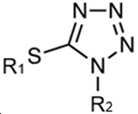
본 발명의 목적은 분절-타입 아미디트(segment-type amidite)를 사용하여 올리고뉴크레오타이드를 합성하는 방법을 제공하는 것이다. 올리고뉴클레오타이드 생산하는 방법은 활성제 존재하에서, 뉴클레오사이드 포스포아미디트를 뉴클레오타이드 (nucleotide) 또는 뉴클레오사이드 (nucleoside)의 3' 또는 5' 에 있는 티올 그룹 (thiol group) 또는 하이드록실 그룹 (hydroxyl group)과 커플링시키는 커플링 단계 적어도 하나를 포함하며, 상기 적어도 한 커플링 단계에서, 상기 뉴클레오사이드 포스포아미디트는 (a) 두 개 또는 그 이상의 뉴클레오사이드 부분 (nucleoside portions) 또는 (b) 적어도 하나의 뉴클레오사이드 부분과 링커 부분을 가지며, 및 상기 활성제는 화학식 (3)((화학식 (3)에서, X는 유기 염기를 나타낸다)) 또는 화학식 (4) ((화학식 (4)에서, R1 및 R2는 H, 선형 또는 가지형 C1-7 알킬 그룹 (C1-7 alkyl group), 및 선택적으로 치환될 수 있는 방향족 그룹으로 구성된 그룹으로부터 각 독립적으로 선택된다))로서 대표되는 구조를 갖는다.

Description
본 발명은 분절-타입 아미디트(segment-type amidite)를 사용하여 올리고뉴클레오타이드를 합성하는 방법에 관한 것이다.The present invention relates to a method for synthesizing oligonucleotides using a segment-type amidite.
포스포아미디트(phosphoramidite) 방법은 DNA 올리고뉴클레오타이드 및 RNA 올리고뉴클레오타이드와 같은 핵산의 화학적 합성에서 널리 사용된다. 이 방법에서, 원하는 서열을 가진 올리고뉴클레오타이드는 적절히 보호된 뉴클레오사이드(nucleosides)를 연속적으로 한 번에 하나씩 첨가하여 전형적으로 합성된다. 그러나, 이 반응은 100% 확률로 일어나지 않으며, 첨가된 뉴클레오사이드는 합성 반응 동안에 분해될 수 있으며, 그러므로 원하는 길이 (N) 보다 길이가 1 또는 그 이상(n) 더 짧은 올리고뉴클레오타이드 (N-n) 머(mers)가 불가피하게 생성될 수 있다. 합성 후에, 올리고뉴클레오타이드는 크로마토그래피(chromatography) 또는 이와 유사한 것으로 정제된다; 원하는 길이(N)를 가진 올리고뉴클레오타이드(N) 머(mer) 및 원하는 길이보다 하나의 뉴클레오타이드가 짧은 올리고뉴클레오타이드 (N-1) 머(mer)는 비슷한 크로마토그래피 이동성을 가지며, 그러므로, (N-1) 머(mer)의 존재는 올리고뉴클레오타이드의 정제 효율 및 정제된 생산품의 순도에 영향을 크게 미친다. The phosphoramidite method is widely used in the chemical synthesis of nucleic acids such as DNA oligonucleotides and RNA oligonucleotides. In this method, oligonucleotides with the desired sequence are typically synthesized by sequential addition of appropriately protected nucleosides, one at a time. However, this reaction does not occur with 100% probability, the added nucleosides may be degraded during the synthesis reaction, and therefore oligonucleotide (N-n) mers 1 or more (n) shorter in length than the desired length (N). (mers) can inevitably be generated. After synthesis, the oligonucleotides are purified by chromatography or the like; An oligonucleotide (N) mer of the desired length (N) and an oligonucleotide (N-1) mer shorter than the desired length (N-1) have comparable chromatographic mobility, and therefore (N-1 ), the presence of mers greatly affects the purification efficiency of the oligonucleotide and the purity of the purified product.
올리고뉴클레오타이드 (N-1) 머(mer)의 생산을 억제하는 방법으로서, 특허 문서 1 및 2 및 비-특허 문서 1 에서, 두 개 또는 세 개의 뉴클레오사이드 잔기((분절-타입 아미디트(segment-type amidite))를 가진 뉴클레오사이드 포스포아미디트(nucleoside phosphoramidite)가 합성에서 사용된 방법이 서술되었다; 그러나, 이 방법들은 충분히 효과적이지 않다.A method for inhibiting the production of oligonucleotide (N-1) mers, in Patent Documents 1 and 2 and Non-Patent Document 1, two or three nucleoside residues ((segment-type amidite) Methods have been described in which nucleoside phosphoramidite with -type amidite) was used in the synthesis; however, these methods are not sufficiently effective.
또한, 특허 문서 3은 올리고뉴크레오타이드 합성에서 1H-테트라졸(1H-tetrazole)보다 좀 더 안전하게 사용될 수 있는 사카린 유도체(saccharin derivative)를 활성제로서 서술한다. 그러나, 특허 문서 3에서, 사카린 유도체의 활성제로서의 수행능력은 충분히 조사되지 않았다. 더욱이, 특히 문서 4 에서, 적어도 하나의 피리디늄 염(pyridinium salt) 및 적어도 하나의 치환된 이미다졸 (substituted imidazole)을 포함하는 활성제인, 이미다졸리움 염(imidazolium salts) 및 벤즈이미다졸리움 염(benzimidazolium salt)이 1H-테트라졸 대신하여 활성제로서 서술된다. 그러나, 특허 문서 4는 사카린과 함께 염을 활성제로 사용하는 것은 서술하지 않고 있다.In addition, Patent Document 3 describes a saccharin derivative as an active agent that can be used more safely than 1H-tetrazole in oligonucleotide synthesis. However, in Patent Document 3, the performance of saccharin derivatives as an activator has not been sufficiently investigated. Moreover, particularly in document 4, imidazolium salts and benzimidazolium salts, which are active agents comprising at least one pyridinium salt and at least one substituted imidazole ( benzimidazolium salt) is described as an activator in place of 1H-tetrazole. However, Patent Document 4 does not describe the use of a salt as an active agent together with saccharin.
[인용 목록][List of Citations]
[특허 문서][Patent Document]
[특허 문서 1] WO 02/20543[Patent Document 1] WO 02/20543
[특허 문서 2] JP No. 2017-514479[Patent Document 2] JP No. 2017-514479
[특허 문서 3] US Pat. No. 7,501,505[Patent Document 3] US Pat. No. 7,501,505
[특허 문서 4] US Pat. No. 6,642,373[Patent Document 4] US Pat. No. 6,642,373
[비-특허 문서][Non-Patent Document]
[비-특허 문서 1] 이량체(dimer) 및 삼량체(trimer) 포스포아미디트 블럭 커플링(phosphoramidite block coupling)을 통한 RNA 합성[Tetrahedron Letters 52 (2011) 2575-2578][Non-Patent Document 1] RNA synthesis through dimer and trimer phosphoramidite block coupling [Tetrahedron Letters 52 (2011) 2575-2578]
본 발명은 분절-타입 아미디트(segment-type amidite)를 사용하여 올리고뉴클레오타이드를 합성하는 방법을 제공하는 것이 목적이다.An object of the present invention is to provide a method for synthesizing an oligonucleotide using a segment-type amidite.
본 발명의 발명자들은 분절-타입 아미디트(segment-type amidite)를 사용하여 올리고뉴클레오타이드를 합성하는 방법을 진지하게 연구했으며, 이 방법에서 유용한 활성제를 발견했다. 그러한 발견에 기반을 둔 추가의 연구의 결과로서, 본 발명가들은 본 발명을 완성했다.The inventors of the present invention seriously studied a method for synthesizing oligonucleotides using a segment-type amidite, and found a useful activator in this method. As a result of further research based on such findings, the present inventors have accomplished the present invention.
즉, 본 발명은 다음과 연관된다. That is, the present invention relates to the following.
[1] 올리고뉴클레오타이드를 생산하는 방법으로, 뉴클레오사이드 포스포아미디트(nucleoside phosphoramidite)를 활성제 존재하에서 한 뉴클레오타이드 또는 뉴클레오사이드의 3' 또는 5' 하이드록실 또는 티올 그룹에 결합하는 커플링 단계(coupling steps) 하나 또는 그 이상의 수행을 포함하고,[1] A method for producing an oligonucleotide, comprising a coupling step of binding a nucleoside phosphoramidite to a 3' or 5' hydroxyl or thiol group of a nucleotide or nucleoside in the presence of an active agent ( coupling steps) comprising one or more performance;
상기 적어도 한 커플링 단계에서, 뉴클레오사이드 포스포아미디트는In said at least one coupling step, the nucleoside phosphoramidite is
(a) 두 개 또는 그 이상의 뉴클레오사이드 잔기를 가진 한 뉴클레오사이드 포스포아미디트 또는(a) a nucleoside phosphoramidite having two or more nucleoside residues or
(b) 하나 또는 그 이상의 뉴클레오사이드 잔기 및 링커 잔기를 가진 한 뉴클레오사이드 포스포아미디트이고,(b) a nucleoside phosphoramidite having one or more nucleoside residues and a linker residue,
상기 활성제는 하기의 화학식으로 대표되는 구조를 가진다:The active agent has a structure represented by the formula:
[화학식 3][Formula 3]
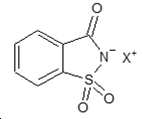
상기 X는 유기 염 (organic base)인,Wherein X is an organic salt (organic base),
또는 하기의 화학식에 의한다:or by the formula:
[화학식 4][Formula 4]

상기 R1 및 R2는 H, 선형 또는 가지형 C1-7 알킬 그룹(C1-7 alkyl group), 및 선택적으로 치환될 수 있는 방향족 그룹(aromatic groups)으로 구성된 그룹으로부터 각각 독립적으로 선택된다.wherein R 1 and R 2 are each independently selected from the group consisting of H, a linear or branched C 1-7 alkyl group, and optionally substituted aromatic groups. .
[2] [1]에 따른 상기 방법으로, [2] The method according to [1],
상기 X는 N-메틸이미다졸(N-methylimidazole), 피리딘 (pyridine) 또는 3-메틸피리딘(3-methylpyridine)이고,Wherein X is N-methylimidazole (N-methylimidazole), pyridine (pyridine) or 3-methylpyridine (3-methylpyridine),
R1은 H, CnH2n+1 또는 벤질 그룹(benzyl group), R 1 is H, C n H 2n+1 or a benzyl group,
R2은 H, CH3, 또는 C6H5, 및 R 2 is H, CH 3 , or C 6 H 5 , and
n 은 1, 2 또는 3이다.n is 1, 2 or 3.
[3] [1] 또는 [2]에 따른 상기 방법으로, 상기 활성제는 5-머르캅토-1-메틸테트라졸 (5-mercapto-1-methyltetrazole) (1-Me-MCT), 5-머르캅토-1-페닐테트라졸(5-mercapto-1-phenyltetrazole) (1-Ph-MCT), 사카린 1-메틸이미다졸(saccharin 1-methylimidazole)(SMI), 또는 5-에틸티오-1H-테트라졸(5-ethylthio-1H-tetrazole) (ETT)이다.[3] The method according to [1] or [2], wherein the active agent is 5-mercapto-1-methyltetrazole (1-Me-MCT), 5-mercapto -1-phenyltetrazole (5-mercapto-1-phenyltetrazole) (1-Ph-MCT), saccharin 1-methylimidazole (SMI), or 5-ethylthio-1H-tetrazole (5-ethylthio-1H-tetrazole) (ETT).
[4] [1] 내지 [3] 중 어느 하나에 따른 상기 방법으로, 상기 적어도 두 번 또는 그 이상 수행된 커플링 단계의 마지막 단계에서,[4] The method according to any one of [1] to [3], wherein in the last step of the coupling step performed at least twice or more,
상기 뉴클레오사이드 포스포아미디트는The nucleoside phosphoramidite is
(a) 두 개 또는 그 이상의 뉴클레오사이드 잔기를 가진 한 뉴클레오사이드 포스포아미디트 또는 (a) a nucleoside phosphoramidite having two or more nucleoside residues or
(b) 하나 또는 그 이상의 뉴클레오사이드 잔기 및 링커 잔기를 가진 한 뉴클레오사이드 포스포아미디트이다.(b) a nucleoside phosphoramidite having one or more nucleoside residues and a linker residue.
[5] [1] 내지 [4] 중 어느 하나에 따른 상기 방법으로, 상기 적어도 두 번 또는 그 이상 수행된 커플링 단계의 마지막 단계에서,[5] The method according to any one of [1] to [4], wherein in the last step of the coupling step performed at least twice or more,
상기 뉴클레오사이드 포스포아미디트는 3개의 뉴클레오사이드 잔기를 가진 한 뉴클레오사이드 포스포아미디트이다.The nucleoside phosphoramidite is a nucleoside phosphoramidite having three nucleoside residues.
[6] [1] 내지 [5] 중 어느 하나에 따른 상기 방법으로, 상기 적어도 두 번 또는 그 이상 수행된 커플링 단계 중 하나에서,[6] The method according to any one of [1] to [5], in one of the coupling steps performed at least twice or more,
상기 뉴클레오사이드 포스포아미디트는 1개의 뉴클레오사이드 잔기를 가진 한 뉴클레오사이드 포스포아미디트이다.The nucleoside phosphoramidite is a nucleoside phosphoramidite having one nucleoside residue.
[7] [1] 내지 [6] 중 어느 하나에 따른 상기 방법으로, 상기 커플링 단계 중 마지막 단계에서만 두번 또는 그 이상 수행되는,[7] The method according to any one of [1] to [6], wherein the coupling step is performed twice or more only in the last step,
상기 뉴클레오사이드 포스포아미디트는The nucleoside phosphoramidite is
(a) 3개의 뉴클레오사이드 잔기를 가진 한 뉴클레오사이드 포스포아미디트이거나, 또는(a) one nucleoside phosphoramidite having three nucleoside residues, or
(b) 하나 또는 그 이상의 뉴클레오사이드 잔기 및 링커 잔기를 가진 한 뉴클레오사이드 포스포아미디트, 및 (b) a nucleoside phosphoramidite having one or more nucleoside residues and a linker residue, and
다른 커플링 단계에서,In another coupling step,
상기 뉴클레오사이드 포스포아미디트는 하나의 뉴클레오사이드 잔기를 가진 뉴클레오사이드 포스포아미디트이다.The nucleoside phosphoramidite is a nucleoside phosphoramidite having one nucleoside residue.
[8] [1] 내지 [7] 중 어느 하나에 따른 상기 방법으로, 상기 두 개 또는 그 이상의 뉴클레오사이드 잔기를 가진 뉴클레오사이드 포스포아미디트는 하기의 화학식 (I)으로 대표하는 뉴클레오사이드 포스포아미디트이다:[8] The method according to any one of [1] to [7], wherein the nucleoside phosphoramidite having two or more nucleoside residues is a nucleo represented by the following formula (I) It is a side phosphoramidite:
[화학식 (I)][Formula (I)]

상기,remind,
X1는 각각 독립적으로 -O- 또는 -S- 이고;each X 1 is independently —O— or —S—;
X2는 각각 독립적으로 -O- 또는 -S- 이고;each X 2 is independently —O— or —S—;
X3는 각각 독립적으로 -O-, -S-, -CH2- 또는 -(CH2)2- 이고;each X 3 is independently —O—, —S—, —CH 2 — or —(CH 2 ) 2 —;
R1은 보호 그룹(protecting group) 이고;R 1 is a protecting group;
R2는 각각 독립적으로 -H, -NHR6, 할로겐(halogen), -CN, -CF3, 또는 아실-기반 한(acyl-based) 보호 그룹, 에테르-기반 한(ether-based) 보호 그룹 또는 시릴-기반한(silyl-based) 보호 그룹에 의해 보호된 하이드록실 그룹(hydroxyl group);R 2 is each independently -H, -NHR 6 , halogen, -CN, -CF 3 , or an acyl-based protecting group, an ether-based protecting group, or a hydroxyl group protected by a silyl-based protecting group;
R3는 각각 독립적으로 -OCH2CH2CN, -SCH2CH2CN, 치환된 또는 비치환된 지방족 그룹(aliphatic group), -OR7 또는 -SR7;R 3 is each independently -OCH 2 CH 2 CN, -SCH 2 CH 2 CN, a substituted or unsubstituted aliphatic group, -OR 7 or -SR 7 ;
R4 및 R5 각각 독립적으로 치환된 또는 비치환된 지방족 그룹(substituted or unsubstituted aliphatic group), 치환된 또는 비치환된 방향족 그룹 (aromatic group), 치환된 또는 비치환된 아르알킬 그룹(aralkyl group); 또는R 4 and R 5 are each independently a substituted or unsubstituted aliphatic group, a substituted or unsubstituted aromatic group, a substituted or unsubstituted aralkyl group ; or
R4 및 R5는 이들이 결합하는 질소와 함께 헤테로사이클로알킬 그룹 (heterocycloalkyl group) 또는 헤테로방향족 그룹(heteroaromatic group)을 형성하고;R 4 and R 5 together with the nitrogen to which they are attached form a heterocycloalkyl group or a heteroaromatic group;
R6 는 각각 독립적으로 -H, 치환된 또는 비치환된 지방족 그룹 (substituted or unsubstituted aliphatic group), 치환된 또는 비치환된 방향족 그룹 (aromatic group), 치환된 또는 비치환된 아르알킬 그룹(aralkyl group) 또는 보호 그룹이고;R 6 is each independently -H, a substituted or unsubstituted aliphatic group, a substituted or unsubstituted aromatic group, a substituted or unsubstituted aralkyl group ) or a protecting group;
R7은 각각 독립적으로 치환된 또는 비치환된 지방족 그룹 (aliphatic group), 치환된 또는 비치환된 방향족 그룹 (aromatic group), 또는 치환된 또는 비치환된 아르알킬 그룹(aralkyl group)이고;each R 7 is independently a substituted or unsubstituted aliphatic group, a substituted or unsubstituted aromatic group, or a substituted or unsubstituted aralkyl group;
B1, B2 및 B3 는 각각 독립적으로 -H, 또는 보호된 또는 비보호된 염기 (protected or unprotected base) 이고; 및B 1 , B 2 and B 3 are each independently —H, or a protected or unprotected base; and
n 은 0 또는 양수 (positive integer);n is 0 or a positive integer;
또는 이의 입체 이성질체 (stereoisomer) 이다.or a stereoisomer thereof.
[9] [8]에 따른 방법으로, 상기 n 은 0 또는 1이다.[9] The method according to [8], wherein n is 0 or 1.
[10] [8] 또는 [9] 에 따른 상기 방법으로, 상기 R2는 -H이다.[10] The method according to [8] or [9], wherein R 2 is —H.
[11] [8] 내지 [10] 중 어느 하나에 따른 상기 방법으로, 상기 R3 는 -OCH2CH2CN이다.[11] The method according to any one of [8] to [10], wherein R 3 is —OCH 2 CH 2 CN.
[12] [1] 내지 [11] 중 어느 하나에 따른 상기 방법으로, 상기 하나 또는 그 이상의 뉴클레오사이드 잔기 및 링커 잔기를 가진 뉴클레오사이드 포스포아미디트는 하기의 화학식 (II)로 대표된다:[12] The method according to any one of [1] to [11], wherein the nucleoside phosphoramidite having one or more nucleoside residues and a linker residue is represented by the following formula (II) :
[화학식 (II)][Formula (II)]

상기,remind,
X1는 각각 독립적으로 -O- 또는 -S- 이고;each X 1 is independently —O— or —S—;
X2는 각각 독립적으로 -O- 또는 -S- 이고;each X 2 is independently —O— or —S—;
X3는 각각 독립적으로 -O-, -S-, -CH2- 또는 -(CH2)2- 이고;each X 3 is independently —O—, —S—, —CH 2 — or —(CH 2 ) 2 —;
L은 링커(linker)이고;L is a linker;
R2는 각각 독립적으로 -H, -NHR6, 할로겐(halogen), -CN, -CF3, 또는 아실-기반한(acyl-based)보호 그룹, 에테르-기반한(ether-based) 보호 그룹 또는 시릴-기반한(silyl-based) 보호 그룹에 의해 보호된 하이드록실 그룹(hydroxyl group);each R 2 is independently -H, -NHR 6 , halogen, -CN, -CF 3 , or an acyl-based protecting group, an ether-based protecting group, or silyl- a hydroxyl group protected by a silyl-based protecting group;
R3는 각각 독립적으로 -OCH2CH2CN, -SCH2CH2CN, 치환된 또는 비치환된 지방족 그룹(aliphatic group), -OR7 또는 -SR7;R 3 is each independently -OCH 2 CH 2 CN, -SCH 2 CH 2 CN, a substituted or unsubstituted aliphatic group, -OR 7 or -SR 7 ;
R4 및 R5 각각 독립적으로 치환된 또는 비치환된 지방족 그룹(substituted or unsubstituted aliphatic group), 치환된 또는 비치환된 방향족 그룹 (aromatic group), 치환된 또는 비치환된 아르알킬 그룹(aralkyl group); 또는R 4 and R 5 are each independently a substituted or unsubstituted aliphatic group, a substituted or unsubstituted aromatic group, a substituted or unsubstituted aralkyl group ; or
R4 및 R5는 이들이 결합하는 질소와 함께 헤테로사이클로알킬 그룹 (heterocycloalkyl group) 또는 헤테로방향족 그룹(heteroaromatic group)을 형성하고;R 4 and R 5 together with the nitrogen to which they are attached form a heterocycloalkyl group or a heteroaromatic group;
R6는 각각 독립적으로 -H, 치환된 또는 비치환된 지방족 그룹(substituted or unsubstituted aliphatic group), 치환된 또는 비치환된 방향족 그룹 (aromatic group), 치환된 또는 비치환된 아르알킬 그룹 (aralkyl group) 또는 보호 그룹이고;R 6 is each independently -H, a substituted or unsubstituted aliphatic group, a substituted or unsubstituted aromatic group, a substituted or unsubstituted aralkyl group ) or a protecting group;
R7은 각각 독립적으로 치환된 또는 비치환된 지방족 그룹(aliphatic group), 치환된 또는 비치환된 방향족 그룹(aromatic group), 또는 치환된 또는 비치환된 아르알킬 그룹(aralkyl group)이고;each R 7 is independently a substituted or unsubstituted aliphatic group, a substituted or unsubstituted aromatic group, or a substituted or unsubstituted aralkyl group;
B1 및 B2는 각각 독립적으로 -H, 또는 보호된 또는 비보호된 염기(protected or unprotected base) 이고; 및B 1 and B 2 are each independently —H, or a protected or unprotected base; and
n 은 0 또는 양수(positive integer);n is 0 or a positive integer;
또는 이의 입체 이성질체(stereoisomer) 이다.or a stereoisomer thereof.
[13] 올리고뉴클레오타이드를 생산하는 방법으로, 활성제(activator)의 존재 하에서 뉴클레오사이드 포스포아미디트를 뉴클레오타이드(nucleotide) 또는 뉴클레오사이드(nucleoside)의 3' 또는 5' 하이드록실(hydroxyl) 또는 티올(thiol) 그룹에 결합시키는 하나 또는 그 이상의 커플링 단계의 수행을 포함하고,[13] As a method for producing oligonucleotides, 3' or 5' hydroxyl or thiol of nucleotide or nucleoside by nucleoside phosphoramidite in the presence of an activator performing one or more coupling steps to bind to a (thiol) group;
상기 적어도 한 커플링 단계에서, 상기 뉴클레오사이드 포스포아미디트는In the at least one coupling step, the nucleoside phosphoramidite is
(a) 2개 또는 3개의 뉴클레오사이드 잔기를 가진 한 뉴클레오사이드 포스포아미디트이거나, 또는(a) a nucleoside phosphoramidite having two or three nucleoside residues, or
(b) 하나 또는 그 이상의 뉴클레오사이드 잔기 및 링커 잔기를 가진 한 뉴클레오사이드 포스포아미디트이고, 및 (b) a nucleoside phosphoramidite having one or more nucleoside residues and a linker residue, and
상기 활성제는 하기의 화학식으로 대표되는 구조를 가진다:The active agent has a structure represented by the formula:
[화학식 3][Formula 3]

상기 X는 유기 염기, 또는 하기의 화학식에 의한다:wherein X is an organic base, or of the formula:
[화학식 4] [Formula 4]

상기 R1 및 R2는 각각 H, 선형 또는 가지형 C1-7 알킬 그룹, 및 선택적으로 치환될 수 있는 방향족 그룹으로 구성된 그룹으로부터 각각 선택된다.R 1 and R 2 are each selected from the group consisting of H, a linear or branched C 1-7 alkyl group, and an optionally substituted aromatic group.
[14] [13] 에 따른 방법으로, 상기[14] The method according to [13], wherein the
X는 N-메틸이미다졸(N-methylimidazole), 피리딘(pyridine) 또는 3-메틸피리딘(3-methylpyridine),X is N-methylimidazole (N-methylimidazole), pyridine (pyridine) or 3-methylpyridine (3-methylpyridine),
R1은 H, CnH2n+1 또는 벤질 그룹(benzyl group), R 1 is H, C n H 2n+1 or a benzyl group,
R2는 H, CH3, 또는 C6H5, 및 R 2 is H, CH 3 , or C 6 H 5 , and
n은 1, 2 또는 3 이다.n is 1, 2 or 3.
[15] 올리고뉴클레오타이드를 생산하는 방법으로, 활성제(activator)의 존재하에 뉴클레오사이드 포스포아미디트를 뉴클레오타이드(nucleotide) 또는 뉴클레오사이드(nucleoside)의 3' 또는 5' 하이드록실(hydroxyl) 또는 티올(thiol) 그룹에 결합시키는 하나 또는 그 이상의 커플링 단계의 수행을 포함하고,[15] As a method for producing oligonucleotides, in the presence of an activator, nucleoside phosphoramidite is added to 3' or 5' hydroxyl or thiol of nucleotide or nucleoside performing one or more coupling steps to bind to a (thiol) group;
상기 적어도 한 커플링 단계에서, 상기 뉴클레오사이드 포스포아미디트는In the at least one coupling step, the nucleoside phosphoramidite is
(a) 2개 또 그 이상의 뉴클레오사이드 잔기를 가진 한 뉴클레오사이드 포스포아미디트이거나, 또는(a) a nucleoside phosphoramidite having two or more nucleoside residues, or
(b) 하나 또는 그 이상의 뉴클레오사이드 잔기 및 링커 잔기를 가진 한 뉴클레오사이드 포스포아미디트이고, 및 (b) a nucleoside phosphoramidite having one or more nucleoside residues and a linker residue, and
상기 활성제의 HOMO 에너지 (a.u.)는 아세토니트릴(acetonitrile)에서 -0.21407 내지 -0.16858이고, 및 The HOMO energy (a.u.) of the active agent is -0.21407 to -0.16858 in acetonitrile, and
상기 활성제의 궤도 계수(orbital coefficient)는 아세토니트릴(acetonitrile) 에서0.31531 내지 0.59405이다.The orbital coefficient of the active agent ranges from 0.31531 to 0.59405 in acetonitrile.
[16] [15]에 따른 방법으로, 상기 활성제의 pKa는 물에서3.65 내지 7이다.[16] The method according to [15], wherein the active agent has a pKa of 3.65 to 7 in water.
[17] 올리고뉴클레오타이드를 생산하는 방법으로, 활성제(activator)의 존재 하에 뉴클레오사이드 포스포아미디트를 뉴클레오타이드(nucleotide) 또는 뉴클레오사이드(nucleoside)의 3' 또는 5' 하이드록실(hydroxyl)또는 티올(thiol) 그룹에 결합시키는 하나 또는 그 이상의 커플링 단계의 수행을 포함하고,[17] As a method for producing oligonucleotides, 3' or 5' hydroxyl or thiol of nucleotide or nucleoside by nucleoside phosphoramidite in the presence of an activator performing one or more coupling steps to bind to a (thiol) group;
상기 적어도 한 커플링 단계에서, 뉴클레오사이드 포스포아미디트는In said at least one coupling step, the nucleoside phosphoramidite is
(a) 2 개 또는3 개의 뉴클레오사이드 잔기를 가진 한 뉴클레오사이드 포스포아미디트이거나, 또는(a) a nucleoside phosphoramidite having 2 or 3 nucleoside residues, or
(b) 하나 또는 그 이상의 뉴클레오사이드 잔기 및 링커 잔기를 가진 한 뉴클레오사이드 포스포아미디트이고, 및 (b) a nucleoside phosphoramidite having one or more nucleoside residues and a linker residue, and
활성제의 HOMO 에너지 (a.u.)는 아세토니트릴(acetonitrile) 에서 -0.22024 내지 -0.16858이고, 및 The HOMO energy (a.u.) of the active agent is -0.22024 to -0.16858 in acetonitrile, and
활성제의 궤도 계수(orbital coefficient)는 아세토니트릴(acetonitrile) 에서0.31531 내지 0.59405이다.The orbital coefficient of the activator ranges from 0.31531 to 0.59405 in acetonitrile.
[18] [17]에 따른 방법으로, 상기 활성제의pKa는 물에서3.65 내지 7이다.[18] The method according to [17], wherein the pKa of the active agent is 3.65 to 7 in water.
[19] 올리고뉴클레오타이드를 생산하는 방법으로, 활성제(activator)의 존재하에서 뉴클레오사이드 포스포아미디트를 뉴클레오타이드(nucleotide) 또는 뉴클레오사이드(nucleoside)의 3' 또는 5' 하이드록실(hydroxyl) 또는 티올(thiol) 그룹에 결합시키는 하나 또는 그 이상의 커플링 단계의 수행을 포함하고,[19] A method for producing oligonucleotides, in the presence of an activator, nucleoside phosphoramidite is added to 3' or 5' hydroxyl or thiol of nucleotide or nucleoside performing one or more coupling steps to bind to a (thiol) group;
상기 적어도 한 커플링 단계에서, 상기 뉴클레오사이드 포스포아미디트는In the at least one coupling step, the nucleoside phosphoramidite is
(a) 2개 또는 3개의 뉴클레오사이드 잔기를 가진 한 뉴클레오사이드 포스포아미디트이거나, 또는(a) a nucleoside phosphoramidite having two or three nucleoside residues, or
(b) 하나 또는 그 이상의 뉴클레오사이드 잔기 및 링커 잔기를 가진 한 뉴클레오사이드 포스포아미디트이고, 및(b) a nucleoside phosphoramidite having one or more nucleoside residues and a linker residue, and
상기 활성제의pKa는 물에서 3.65 내지 7이다.The pKa of the active agent is between 3.65 and 7 in water.
[20] 올리고뉴클레오타이드를 생산하는 방법으로, 활성제(activator)의 존재 하에서 뉴클레오사이드 포스포아미디트를 뉴클레오타이드(nucleotide) 또는 뉴클레오사이드(nucleoside)의 3' 또는 5' 하이드록실(hydroxyl) 또는 티올(thiol) 그룹에 결합시키는 하나 또는 그 이상의 커플링 단계의 수행을 포함하고,[20] As a method for producing oligonucleotides, 3' or 5' hydroxyl or thiol of nucleotide or nucleoside by nucleoside phosphoramidite in the presence of an activator performing one or more coupling steps to bind to a (thiol) group;
상기 적어도 한 커플링 단계에서, 상기 뉴클레오사이드 포스포아미디트는In the at least one coupling step, the nucleoside phosphoramidite is
(a) 2개 또는 그 이상의 뉴클레오사이드 잔기를 가진 한 뉴클레오사이드 포스포아미디트이거나, 또는(a) a nucleoside phosphoramidite having two or more nucleoside residues, or
(b) 하나 또는 그 이상의 뉴클레오사이드 잔기 및 링커 잔기를 가진 한 뉴클레오사이드 포스포아미디트이고, 및(b) a nucleoside phosphoramidite having one or more nucleoside residues and a linker residue, and
상기 활성제의 pKa는 물에서 4.3 내지 7이다.The active agent has a pKa of 4.3 to 7 in water.
본 발명의 활성제의 사용으로, 올리고뉴클레오타이드는 2개 또는 그 이상의 뉴클레오사이드 잔기를 가진 뉴클레오사이드 포스포아미디트, 즉, 분절-타입 아미디트(segment-type amidite), 또는 하나 또는 그 이상의 뉴클레오사이드 잔기 및 링커 잔기를 가진 뉴클레오사이드 포스포아미디트With the use of the active agents of the present invention, oligonucleotides are nucleoside phosphoramidite having two or more nucleoside residues, i.e., a segment-type amidite, or one or more nucleoside residues. Nucleoside phosphoramidite having a cleoside residue and a linker residue
를 사용하여 높은 효율로 합성될 수 있다. 추가로, 2개 또는 그 이상의 뉴클레오사이드 잔기를 가진 뉴클레오사이드 포스포아미디트, 즉, 분절-타입 아미디트(segment-type amidite)를 사용함으로써, 커플링 단계의 마지막 단계에서, 원하는 올리고뉴클레오타이드의 크로마토그래피적인 이동과 거의 비슷한 크로마토그래피적인 이동성을 갖는 정제에 의해 제거되기 어려운 (N-1) 머(mers)의 생산이 억제될 수 있다. 더욱이, 본 발명의 활성제를 활성제로 사용하는 것은 합성 과정 동안에 분절-타입 아미디트의 분해를 억제하는데 또한 기여한다. can be synthesized with high efficiency using In addition, by using a nucleoside phosphoramidite having two or more nucleoside residues, that is, a segment-type amidite, in the last step of the coupling step, the desired oligonucleotide The production of difficult-to-remove (N-1) mers can be suppressed by purification with chromatographic mobility almost similar to that of . Moreover, the use of the active agent of the present invention as an active agent also contributes to inhibiting the degradation of fragment-type amidites during the synthesis process.
이후부터, 본 발명이 상세히 서술될 것이다.Hereinafter, the present invention will be described in detail.
본 명세서에서 달리 정의되지 않는 한, 본 명세서에서 사용된 모든 기술적 및 과학적 용어는 당업자에 의해 일반적으로 이해되는 것과 동일한 의미를 갖는다. 본 명세서에 참조된 모든 특허, 출원 및 기타 간행물 또는 정보들은 전체가 참고문헌으로 포함된다. 본 명세서에서 언급된 발행물 및 본 명세서에서의 서술 사이에 불일치가 있는 경우에는, 본 명세서에서의 서술이 우선한다.Unless defined otherwise herein, all technical and scientific terms used herein have the same meaning as commonly understood by one of ordinary skill in the art. All patents, applications and other publications or information referenced herein are incorporated by reference in their entirety. In the event of any inconsistency between the publications mentioned herein and the statements herein, the statements herein control.
본 발명은, 한 측면에서, 올리고뉴클레오타이드를 생산하는 방법에 관련되며, 이는 활성제(activator)의 존재하에서 뉴클레오사이드 포스포아미디트를 비치환된 하이드록실(hydroxyl) 그룹 또는 비치환된 티올(thiol) 그룹을 갖는 뉴클레오타이드(nucleotide) 또는 뉴클레오사이드 (nucleoside)에 결합하는 하나 또는 그 이상의 커플링 단계의 수행을 포함한다.The present invention, in one aspect, relates to a method for producing an oligonucleotide, wherein the nucleoside phosphoramidite is converted to an unsubstituted hydroxyl group or an unsubstituted thiol in the presence of an activator. ) comprising performing one or more coupling steps to bind to a nucleotide or nucleoside having a group.
본 발명에서, 올리고뉴클레오타이드는 소위-말하는 포스포아미디트 방법을 사용하여 생산되며, 상기 뉴클레오타이드는, 적절한 활성제의 존재하에서, 뉴클레오사이드 포스포아미디트 및 용액 속에 있는 또는 고체 지지체에 있는 뉴클레오사이드 사이에 축합 반응(condensation reaction)에 의해 첨가된다.In the present invention, oligonucleotides are produced using the so-called phosphoramidite method, wherein said nucleotides are, in the presence of an appropriate active agent, a nucleoside phosphoramidite and a nucleoside in solution or on a solid support. It is added by a condensation reaction in between.
본 발명에서, 올리고뉴클레오타이드는 염기(base), 당(sugar) 및 인산 (phosphoric acid)이 포스포디에스테르 결합(phosphodiester bond)으로 연결되어 있는 구조를 가진 화합물을 의미하며, 이는2'-디옥시리보핵산(2'-deoxyribonucleic acid) (이후, "DNA") 및 리보핵산(ribonucleic acid) (이후 "RNA")와 같은 자연적으로 존재하는 올리고뉴클레오타이드, 및 변형된 당 잔기, 변형된 인산염 잔기, 또는 변형된 핵염기(necleobase)를 함유하는 핵산을 포함한다. 당 잔기에의 변형은 리보스 링(ribose ring)을 헥소스(hexose), 사이클로펜틸(cyclopentyl), 또는 사이클로헥실(cyclohexyl) 링 으로의 대체를 포함한다. 다른 한편으로, 자연적으로 존재하는 핵산의 D-리보스 링(D-ribose ring)은 L-리보스 링(L-ribose ring)으로 대체될 수 있거나, 또는 자연적으로 존재하는 핵산의 β-아노머(β-anomer)는 a-아노머(α-anomer)로 대체될 수 있다. 올리고뉴클레오타이드는 또한 하나 또는 그 이상의 무염기 잔기(abasic moieties)를 포함할 수 있다. 변형된 인산염 잔기에는 포스포로티오에이트(phosphorothioates), 포스포로디티오에이트(phosphorodithioates), 메틸포스포네이트(methylphosphonates), 및 메틸인산염(methyl phosphate)을 또한 포함할 수 있다. 그러한 핵산 유사체(analogs)는 당업자에게 공지되어 있다. 상기 혼합물의 두 개 또는 그 이상의 혼합물을 포함하고 있는 올리고뉴클레오타이드는, 예를 들어, 디옥시리보- 또는 리보뉴클레오사이드의 혼합물로부터, 특히 2'-O-메틸 리보뉴클레오사이드 (2'-O-methyl ribonucleoside) 또는 2'-O-메톡시에틸 리보뉴클레오사이드(2'-O-methoxyethyl ribonucleoside)와 같은 디옥시리보뉴클레오사이드와 2'-O-치환된 리보뉴클레오사이드의 혼합물로부터 생산될 수 있다. 뉴클레오사이드의 혼합물을 포함하는 올리고뉴클레오타이드의 예에는 라이보자임(ribozymes)이 포함된다.In the present invention, the oligonucleotide refers to a compound having a structure in which a base, a sugar, and a phosphoric acid are linked by a phosphodiester bond, which is 2'-deoxyribonucleic acid ( naturally occurring oligonucleotides, such as 2'-deoxyribonucleic acid (hereinafter "DNA") and ribonucleic acid (hereinafter "RNA"), and modified sugar residues, modified phosphate residues, or modified nuclei Includes nucleic acids containing nucleotides. Modifications to sugar moieties include replacement of the ribose ring with a hexose, cyclopentyl, or cyclohexyl ring. On the other hand, the D-ribose ring of a naturally occurring nucleic acid can be replaced with an L-ribose ring, or the β-anomer of a naturally occurring nucleic acid (β -anomer) can be replaced with an a-anomer (α-anomer). Oligonucleotides may also contain one or more abasic moieties. Modified phosphate moieties may also include phosphorothioates, phosphorodithioates, methylphosphonates, and methyl phosphates. Such nucleic acid analogs are known to those skilled in the art. Oligonucleotides comprising a mixture of two or more of said mixtures can be prepared, for example, from a mixture of deoxyribo- or ribonucleosides, in particular 2'-O-methyl ribonucleosides (2'-O-methyl ribonucleoside) or a mixture of a 2'-O-substituted ribonucleoside with a deoxyribonucleoside such as 2'-O-methoxyethyl ribonucleoside. Examples of oligonucleotides comprising a mixture of nucleosides include ribozymes.
본 발명에서, 뉴클레오사이드 포스포아미디트((분절-타입 아미디트, (segment-type amidite))는 아미디트(amidite)로 유도체화한 뉴클레오사이드를 의미한다. 아미디트화(Amiditation)는, 예를 들어, 적절히 보호된 뉴클레오사이드를 1H-테트라졸(1H-tetrazole)을 활성제로 사용하여2-시아노에틸-N,N,N′,N′-테트라이소프로필포스포로디아미디트(2-cyanoethyl-N,N,N′,N′-tetraisopropylphosphorodiamidite)와 반응시켜 수행될 수 있다.In the present invention, the nucleoside phosphoramidite ((segment-type amidite)) means a nucleoside derivatized with amidite. Amiditation is , for example, 2-cyanoethyl-N,N,N',N'-tetraisopropylphosphorodiamidite using 1H-tetrazole as the activator with an appropriately protected nucleoside It can be carried out by reaction with (2-cyanoethyl-N,N,N′,N′-tetraisopropylphosphorodiamidite).
본 발명에서, 뉴클레오사이드는 염기 및 당이 결합된 화합물을 의미하고, 및 이는 아데노신(adenosine), 티미딘(thymidine), 구아노신(guanosine), 시티딘(cytidine), 및 우리딘(uridine)과 같은 자연에 존재하는 뉴클레오사이드, 또는 변형된 뉴클레오사이드(modified nucleoside)일 수 있다. 염기는 아데닌(adenine), 구아닌(guanine), 사이토신(cytosine), 티민(thymine), 및 우라실(uracil)과 같은 자연에 존재하는 염기, 또는 변형된 염기일 수 있다. 뉴클레오사이드의 당 잔기는 자연에 존재하는 디옥시리보스 또는 리보스일 수 있으며, 및 이는 D-형태 또는 L-형태일 수 있다.In the present invention, a nucleoside refers to a compound in which a base and a sugar are bonded, and it is adenosine, thymidine, guanosine, cytidine, and uridine. It may be a nucleoside that exists in nature, such as, or a modified nucleoside. The base may be a naturally occurring base such as adenine, guanine, cytosine, thymine, and uracil, or a modified base. The sugar moiety of the nucleoside may be naturally occurring deoxyribose or ribose, and it may be in the D-form or the L-form.
본 발명에서, 활성제는 뉴클레오사이드 포스포아미디트를 뉴클레오사이드 또는 뉴클레오타이드와 반응시키는데 사용되며, 또한 활성화 제제 또는 커플링 제제라고도 불린다.In the present invention, an active agent is used to react a nucleoside phosphoramidite with a nucleoside or nucleotide, also referred to as an activating agent or coupling agent.
본 발명의 한 실시 예에서, 활성제는 하기의 구조식으로 대표되는 구조를 가진다: In one embodiment of the present invention, the active agent has a structure represented by the following structural formula:
[화학식3][Formula 3]
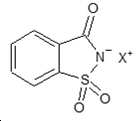
상기 X 는 유기 염기(organic base)이고, 사카린(saccharin)과 염 복합체(salt complex)를 형성하고, 및 바람직하게 N-메틸이미다졸(N-methylimidazole), 피리딘(pyridine) 또는 3-메틸피리딘(3-methylpyridine), 또는 하기의 화학식에 의한다:X is an organic base, forms a salt complex with saccharin, and preferably N-methylimidazole, pyridine or 3-methylpyridine (3-methylpyridine), or of the formula:
[화학식 4][Formula 4]

상기 R1 및 R2는 H, 선형 또는 가지형 C1-7 알킬 그룹(C1-7 alkyl group), 및 선택적으로 치환될 수 있는 방향족 그룹(aromatic groups)으로 구성된 그룹으로부터 각각 독립적으로 선택된다.wherein R 1 and R 2 are each independently selected from the group consisting of H, a linear or branched C 1-7 alkyl group, and optionally substituted aromatic groups. .
바람직하게, R1 및 R2는 각각 독립적으로, H, 메틸 그룹, 에틸 그룹(ethyl group), 프로필 그룹(propyl group), 부틸 그룹(butyl group), 펜틸 그룹(pentyl group), 헥실 그룹(hexyl group), 페닐 그룹(phenyl group) 또는 벤질 그룹(benzyl group)이고, 좀 더 바람직하게는, R1은H, CnH2n+1 또는 벤질 그룹 (benzyl group)이고, R2 는 H, CH3, 또는 C6H5, 이고, 및 n 은1, 2 또는 3이다.Preferably, R 1 and R 2 are each independently H, a methyl group, an ethyl group, a propyl group, a butyl group, a pentyl group, a hexyl group group), a phenyl group or a benzyl group, more preferably, R 1 is H, C n H 2n+1 or a benzyl group, R 2 is H, CH 3 , or C 6 H 5 , and n is 1, 2 or 3.
본 발명의 한 실시예에서, 활성제는 예를 들어, 5-머르캅토-1-메틸테트라졸 (5-mercapto-1-methyltetrazole) (1-Me-MCT)이다: In one embodiment of the invention, the active agent is, for example, 5-mercapto-1-methyltetrazole (1-Me-MCT):
[화학식 5][Formula 5]

5-머르캅토-1-페닐테트라졸 (5-mercapto-1-phenyltetrazole) (1-Ph-MCT): 5-mercapto-1-phenyltetrazole (1-Ph-MCT):
[화학식 6][Formula 6]

5-벤질티오테트라졸 (5-benzylthiotetrazole) (BTT): 5-benzylthiotetrazole (BTT):
[화학식 7][Formula 7]

사카린 1-메틸이미다졸 (saccharin 1-methylimidazole)(SMI): Saccharin 1-methylimidazole (SMI):
[화학식 8][Formula 8]

5-에틸티오-1H-테트라졸(5-ethylthio-1H-tetrazole)(ETT): 5-ethylthio-1H-tetrazole (ETT):
[화학식 9][Formula 9]

4,5,-디시아노이미다졸(4,5-dicyanoimidazole) (DCI): 4,5,-dicyanoimidazole (DCI):
[화학식 10][Formula 10]

또는 벤즈이미다졸 트리플루오로메탄설포네이트 (benzimidazole trifluoromethanesulfonate) (BIT): or benzimidazole trifluoromethanesulfonate (BIT):
[화학식 11][Formula 11]

및 이는 바람직하게 1-Me-MCT, 1-Ph-MCT, SMI, ETT, 또는 BTT, 및 더 바람직하게는 1-Me-MCT, 1-Ph-MCT, 또는 SMI이다.and preferably 1-Me-MCT, 1-Ph-MCT, SMI, ETT, or BTT, and more preferably 1-Me-MCT, 1-Ph-MCT, or SMI.
본 발명의 한 실시예에서, 아세토니트릴(acetonitrile)에서 본 발명의 활성제의 HOMO 에너지 (a.u)는 -0.22024 내지 -0.16858이다. 예를 들어, 아세토니트릴에서 본 발명의 활성제의 HOMO 에너지 (a.u)는 -0.21995 내지 -0.16858, -0.21407 내지 -0.16858, -0.19928 내지 -0.16858, -0.18904 내지-0.16858, 또는 -0.18741 내지 -0.16858, 및 바람직하게 -0.21407 내지 -0.16858 (a.u.), 및 좀 더 바람직하게 -0.18904 내지 -0.16858 (a.u.) 이다.In one embodiment of the invention, the HOMO energy (a.u) of the active agent of the invention in acetonitrile is between -0.22024 and -0.16858. For example, the HOMO energy (a.u) of an active agent of the present invention in acetonitrile is -0.21995 to -0.16858, -0.21407 to -0.16858, -0.19928 to -0.16858, -0.18904 to -0.16858, or -0.18741 to -0.16858, and preferably -0.21407 to -0.16858 (a.u.), and more preferably -0.18904 to -0.16858 (a.u.).
본 발명의 한 실시예에서, 아세토니트릴에서 본 발명의 활성제의 궤도 계수 (orbital coefficient) 는 0.31531 내지0.59405. 예를 들어, 아세토니트릴에서 본 발명의 활성제의 궤도 계수는0.31531 내지0.59405, 0.39931 내지 0.59405, 0.51802 내지 0.59405, 또는0.53787 내지0.59405, 및 바람직하게 0.39931 내지0.59405이다. In one embodiment of the invention, the orbital coefficient of the active agent of the invention in acetonitrile is 0.31531 to 0.59405. For example, the orbital coefficients of the active agents of the present invention in acetonitrile are from 0.31531 to 0.59405, from 0.39931 to 0.59405, from 0.51802 to 0.59405, or from 0.53787 to 0.59405, and preferably from 0.39931 to 0.59405.
본 발명의 한 실시예에서, 아세토니트릴에서 활성제의 HOMO 에너지 (a.u)는 -0.22024 내지-0.16858이고, 및 아세토니트릴에서 상기 활성제의 궤도 계수는0.31531 내지0.59405이다.In one embodiment of the present invention, the HOMO energy (a.u) of the active agent in acetonitrile is -0.22024 to -0.16858, and the orbital coefficient of the active agent in acetonitrile is 0.31531 to 0.59405.
본 발명의 한 실시예에서, 아세토니트릴에서 활성제의 HOMO 에너지 (a.u)는 -0.21407 내지 -0.16858이고, 및 아세토니트릴에서 상기 활성제의 궤도 계수는 0.31531 내지0.59405이다.In one embodiment of the present invention, the HOMO energy (a.u) of the active agent in acetonitrile is from -0.21407 to -0.16858, and the orbital coefficient of the active agent in acetonitrile is from 0.31531 to 0.59405.
HOMO 에너지 및 궤도 계수는, 양자화학 계산 프로그램, 예를 들어, 가우시안(Gaussian)에 의해서 제조된 양자 화학 계산 프로그램 가우시안 16 (Gaussian16)에서 베케-스타일 3-계수 밀도 기능적 이론 (Becke-style 3-parameter density functional theory, B3LYP)을 사용하여 최적화 계산에 의해 얻어질 수 있다.HOMO energies and orbital coefficients are calculated using a quantum chemistry calculation program, for example, a quantum chemistry calculation program Gaussian 16 manufactured by Gaussian, in the Becke-style 3-parameter density functional theory (Becke-style 3-parameter). density functional theory, B3LYP) can be obtained by optimization calculations.
본 발명의 한 실시예에서, 물에서 25°C 에서 본 발명의 활성제의 pKa는3.65내지 7.0; 예를 들어, 3.86 내지 7.0, 4.1 내지 7.0, 4.3 내지 7.0, 4.5 내지 7.0, 5.0 내지 7.0, 5.5 내지 7.0, 6.0 내지 7.0, 또는 6.5 내지 7.0이다. In one embodiment of the invention, the pKa of the active agent of the invention at 25°C in water is 3.65 to 7.0; For example, 3.86 to 7.0, 4.1 to 7.0, 4.3 to 7.0, 4.5 to 7.0, 5.0 to 7.0, 5.5 to 7.0, 6.0 to 7.0, or 6.5 to 7.0.
본 발명의 한 실시예에서, 올리고뉴크레오타이드를 생산하는 방법에서 적어도 한 커플링 단계에서, 뉴클레오사이드 포스포아미디트는 (a) 두 개 또는 그 이상의 뉴클레오사이드 잔기를 가진 뉴클레오사이드 포스포아미디트, 또는 (b) 하나 또는 그 이상의 뉴클레오사이드 잔기 및 링커 잔기를 가진 뉴클레오사이드 포스포아미디트이다.In one embodiment of the present invention, in at least one coupling step in the method for producing an oligonucleotide, the nucleoside phosphoramidite comprises (a) a nucleoside phosphor having two or more nucleoside residues. Poamidite, or (b) a nucleoside phosphoramidite having one or more nucleoside residues and a linker residue.
본 발명의 한 실시예에서, 올리고뉴크레오타이드를 생산하는 방법에서 적어도 한 커플링 단계에서, 뉴클레오사이드 포스포아미디트는 (a) 두 개 또는 세 개의 뉴클레오사이드 잔기를 가진 뉴클레오사이드 포스포아미디트, 또는 (b) 하나 또는 그 이상의 뉴클레오사이드 잔기 및 링커 잔기를 가진 뉴클레오사이드 포스포아미디트이다. In one embodiment of the present invention, in at least one coupling step in the method for producing an oligonucleotide, the nucleoside phosphoramidite comprises (a) a nucleoside phosphor having two or three nucleoside residues. Poamidite, or (b) a nucleoside phosphoramidite having one or more nucleoside residues and a linker residue.
두 개 또는 세 개의 뉴클레오사이드 잔기를 가진 뉴클레오사이드 포스포아미디트는 4개 또는 그 이상의 뉴클레오사이드 잔기를 가진 뉴클레오사이드 포스포아미디트에 비교하여, 이들의 더 작은 분자 크기 때문에 좀 더 높은 이동성 및 더 빠른 반응율을 초래하여, 아마도 더 높은 퍼센트의 반응을 가지는 것으로 예상된다. Nucleoside phosphoramidites having two or three nucleoside residues are more nucleoside phosphoramidites because of their smaller molecular size compared to nucleoside phosphoramidites having four or more nucleoside residues. It is expected to have a higher percent response, possibly resulting in higher mobility and faster reaction rates.
본 발명의 한 실시예에서, 올리고뉴클레오타이드를 생산하는 방법에서 두 번 또는 그 이상 수행된 커플링 단계의 적어도 마지막 단계에서, 뉴클레오사이드 포스포아미디트는 (a) 두 개 또는 그 이상의 뉴클레오사이드 잔기를 가진 뉴클레오사이드 포스포아미디트, 또는 (b) 하나 또는 그 이상의 뉴클레오사이드 잔기 및 한 링커 잔기를 가진 한 뉴클레오사이드 포스포아미디트이다.In one embodiment of the present invention, in at least the last step of the coupling step performed twice or more in the method for producing an oligonucleotide, the nucleoside phosphoramidite is (a) two or more nucleosides a nucleoside phosphoramidite having a residue, or (b) a nucleoside phosphoramidite having one or more nucleoside residues and a linker residue.
본 발명의 한 실시예에서, 올리고뉴클레오타이드를 생산하는 방법에서 두 번 또는 그 이상 수행된 커플링 단계의 적어도 마지막 단계에서, 뉴클레오사이드 포스포아미디트는 세 개의 뉴클레오사이드 잔기를 가진 뉴클레오사이드 포스포아미디트이다. In one embodiment of the present invention, in at least the last step of the coupling step performed twice or more in the method for producing an oligonucleotide, the nucleoside phosphoramidite is a nucleoside having three nucleoside residues. It is phosphoramidite.
본 발명의 한 실시예에서, 올리고뉴클레오타이드를 생산하는 방법에서 두 번 또는 그 이상 수행된 커플링 단계의 적어도 마지막 단계에서, 뉴클레오사이드 포스포아미디트는 한 개의 뉴클레오사이드 잔기를 가진 뉴클레오사이드 포스포아미디트이다.In one embodiment of the present invention, in at least the last step of the coupling step performed twice or more in the method for producing an oligonucleotide, the nucleoside phosphoramidite is a nucleoside having one nucleoside residue. It is phosphoramidite.
본 발명의 한 실시예에서, 올리고뉴클레오타이드를 생산하는 방법에서 두 번 또는 그 이상 수행된 커플링 단계의 마지막 단계에서만, 뉴클레오사이드 포스포아미디트는 (a) 세 개 뉴클레오사이드 잔기를 가진 뉴클레오사이드 포스포아미디트, 또는 (b) 하나 또는 그 이상의 뉴클레오사이드 잔기 및 한 링커 잔기를 가진 한 뉴클레오사이드 포스포아미디트이고, 및 다른 커플링 단계에서, 상기 뉴클레오사이드 포스포아미디트는 하나의 뉴클레오사이드 잔기를 갖는 뉴클레오사이드 포스포아미디트이다.In one embodiment of the present invention, only in the last step of the coupling step performed twice or more in the method for producing an oligonucleotide, the nucleoside phosphoramidite (a) a nucleoside having three nucleoside residues a cleoside phosphoramidite, or (b) a nucleoside phosphoramidite having one or more nucleoside residues and a linker residue, and in another coupling step, the nucleoside phosphoramidite is It is a nucleoside phosphoramidite having one nucleoside residue.
본 발명에서, 두 개 또는 그 이상의 뉴클레오사이드 잔기를 가진 뉴클레오사이드 포스포아미디트는, 예를 들어, WO 2019/21206에서 서술된 대로 제조될 수 있다. In the present invention, a nucleoside phosphoramidite having two or more nucleoside residues can be prepared, for example, as described in WO 2019/21206.
본 발명의 한 실시예에서, 두 개 또는 그 이상의 뉴클레오사이드 잔기를 가진 뉴클레오사이드 포스포아미디트는 하기의 화학식 (I)으로 대표되는 뉴클레오사이드 포스포아미디트이다:In one embodiment of the present invention, the nucleoside phosphoramidite having two or more nucleoside residues is a nucleoside phosphoramidite represented by the following formula (I):
[화학식 (I)][Formula (I)]

또는 이의 입체이성질체이다.or a stereoisomer thereof.
화학식 (I)에서, X1는 각각 독립적으로 -O- 또는 -S- 이다.In formula (I), each X 1 is independently -O- or -S-.
화학식 (I)에서, X2는 각각 독립적으로 -O- 또는 -S- 이다.In formula (I), each X 2 is independently -O- or -S-.
화학식 (I)에서, X3는 각각 독립적으로 -O-, -S-, -CH2- 또는 -(CH2)-이다.In formula (I), each X 3 is independently -O-, -S-, -CH 2 - or -(CH 2 ) - .
화학식 (I)에서, R1은 보호 그룹 (protecting group), 바람직하게는 산-분해성(acid-labile) 보호 그룹, 또는 t-부틸디메틸시릴 (t-butyldimethylsilyl) 또는 트리이소프로필시릴(triisopropylsilyl)과 같은 트리알킬시릴 그룹(trialkylsilyl group)이다. 산-분해성 보호 그룹은 양성자 산(protic acid) 또는 루이스 산(Lewis acid)에 그룹을 접촉하여 제거시킬 수 있다. 산-분해성 보호 그룹은 당업자에게 공지되어 있다. 산-분해성 보호 그룹의 예에는 치환된 또는 비치환된 트리틸 그룹(substituted or unsubstituted trityl group), 치환된 또는 비치환된 테트라하이드로피라닐 그룹(tetrahydropyranyl group), 치환된 또는 비치환된 테트라하이드로푸라닐 그룹(tetrahydrofuranyl group), 또는 픽실 그룹 (pixyl group), 등이 포함된다. 트리틸 그룹은 보통 알콕시 그룹 (alkoxy groups)과 같은 전자 공여 그룹으로 치환된다. 좀 더 바람직한 실시 예에서, R1은 치환된 또는 비치환된 트리틸(trityl), 9-페닐잔테닐(9-phenylxanthenyl) ((이후 "픽실(pixyl")) 또는 테트라하이드로피라닐(tetrahydropyranyl) ((이후 "THP"))이다. 더 나아가 좀 더 바람직한 실시 예에서, R1은 비치환된 트리틸(trityl), 모노알콕시트리틸(monoalkoxytrityl), 디알콕시트리틸(dialkoxytrityl), 트리알콕시트리틸(trialkoxytrityl), THP또는 픽실(pixyl)이다. 가장 바람직하게 R1은 4,4-디메톡시트리틸 (4,4'-dimethoxytrityl) 이다.In formula (I), R 1 is a protecting group, preferably an acid-labile protecting group, or t-butyldimethylsilyl or triisopropylsilyl and The same trialkylsilyl group. Acid-degradable protecting groups can be removed by contacting the group with a protic acid or Lewis acid. Acid-degradable protecting groups are known to those skilled in the art. Examples of acid-degradable protecting groups include a substituted or unsubstituted trityl group, a substituted or unsubstituted tetrahydropyranyl group, a substituted or unsubstituted tetrahydrofura tetrahydrofuranyl group, or pixyl group, and the like. The trityl group is usually substituted with an electron donating group such as an alkoxy group. In a more preferred embodiment, R 1 is a substituted or unsubstituted trityl, 9-phenylxanthenyl ((hereinafter "pixyl")) or tetrahydropyranyl) ((hereinafter "THP")) In a further more preferred embodiment, R 1 is unsubstituted trityl, monoalkoxytrityl, dialkoxytrityl, trialkoxytri trialkoxytrityl, THP or pixyl Most preferably R 1 is 4,4'-dimethoxytrityl.
화학식 (I)에서, R2는 각각 독립적으로 -H, -NHR6, 할로겐(halogen), CN, CF3, 또는 아실-기반한(acyl-based) 보호 그룹, 에테르-기반한(ether-based) 보호 그룹 또는 시릴-기반한(silyl-based) 보호 그룹에 의해 보호된 하이드록실 그룹(hydroxyl group) 중 어느 하나이다. 할로겐은, 예를 들어, F, Cl, Br, 및 I이다. 아실-기반한 (acyl-based) 보호 그룹의 예에는 아세틸(acetyl), 벤조일(benzoyl), 피발로닐(pivaloyl) 등이 포함된다. 에테르-기반한(ether-based) 보호 그룹의 예에는 벤질(benzyl), p-메톡시벤질(p-methoxybenzyl, PMB), 아릴(allyl) 등이 포함된다. 시릴-기반한 (silyl-based) 보호 그룹의 예에는 t-부틸디메틸시릴(t-butyldimethylsilyl, TBS),t-부틸디페닐시릴(t-butyldphenylsilyl, TBDPS), t-트리이소프로필시릴(t-triisopropylsilyl, TIPS),트리에틸시릴(triethylsilyl, TES), 트리메틸시릴(trimethylsilyl, TMS), 등이 포함된다. 이는 바람직하게 -H이다.In formula (I), each R 2 is independently —H, —NHR 6 , halogen, CN, CF 3 , or an acyl-based protecting group, ether-based protecting either a hydroxyl group protected by a group or a silyl-based protecting group. Halogen is, for example, F, Cl, Br, and I. Examples of acyl-based protecting groups include acetyl, benzoyl, pivaloyl, and the like. Examples of ether-based protecting groups include benzyl, p-methoxybenzyl (PMB), allyl, and the like. Examples of silyl-based protecting groups include t-butyldimethylsilyl (TBS), t-butyldphenylsilyl (TBDPS), t-triisopropylsilyl (t-triisopropylsilyl) , TIPS), triethylsilyl (TES), trimethylsilyl (TMS), and the like. It is preferably -H.
화학식 (I)에서, R3는 각각 독립적으로 -OCH2CH2CN, -SCH2CH2CN, 치환된 또는 비치환된 지방족 그룹(aliphatic group), -OR7 또는 -SR7이고, 바람직하게는 -OCH2CH2CN이다. 치환된 또는 비치환된 지방족 그룹 (aliphatic group)의 예에는, 4-(시아노부트-2-에닐티오 (4-cyanobut-2-enylthio), 4-시아노부트-2-에닐옥시(4-cyanobut-2-enyloxy), 아릴티오(allylthio), 아릴옥시(allyloxy), 크로틸티오(crotylthio) 또는 크로틸옥시(crotyloxy) 등이 포함되나, 이것에만 국한되지는 않는다.In formula (I), each R 3 is independently —OCH 2 CH 2 CN, —SCH 2 CH 2 CN, a substituted or unsubstituted aliphatic group, —OR 7 or —SR 7 , preferably is -OCH 2 CH 2 CN. Examples of substituted or unsubstituted aliphatic groups include 4-(cyanobut-2-enylthio), 4-cyanobut-2-enyloxy (4- cyanobut-2-enyloxy), allylthio, allyloxy, crotylthio or crotyloxy, and the like.
화학식 (I)에서, R4 및 R5 각각 독립적으로 치환된 또는 비치환된 지방족 그룹(aliphatic group), 치환된 또는 비치환된 방향족 그룹(aromatic group), 치환된 또는 비치환된 아르알킬 그룹(aralkyl group); 또는In formula (I), R 4 and R 5 are each independently a substituted or unsubstituted aliphatic group, a substituted or unsubstituted aromatic group, a substituted or unsubstituted aralkyl group ( aralkyl group); or
R4 및 R5 는 이들이 결합하는 질소와 함께 헤테로사이클로알킬 그룹 (heterocycloalkyl group) 또는 헤테로방향족 그룹(heteroaromatic group)을 형성한다. 치환된 또는 비치환된 지방족 그룹(aliphatic group)의 예에는, 이것에만 국한하지 않으나, 메틸(methyl), 에틸(ethyl), 이소프로필(isopropyl), 등이 포함되고, 바람직하게 이소프로필이다. 치환된 또는 비치환된 방향족(aromatic) 그룹의 예에는, 이것에만 국한하지 않으나, 페닐(phenyl), 벤질(benzyl), 나프틸(naphthyl), 2-피레닐메틸(2-pyrenylmethyl) 등이 포함되고, 바람직하게는 페닐 (phenyl), 벤질(benzyl) 이다. 치환된 또는 비치환된 아르알킬(aralkyl) 그룹의 예에는, 이것에만 국한하지 않으나, 2-플루오로페닐메톡시피페리딘-4-일 (2-fluorophenylmethoxypiperidine-4-yl), 등이 포함된다. 헤테로사이클로알킬(heterocycloalkyl) 그룹의 예에는, 이것에만 국한하지 않으나, 피롤리디노(pyrrolidino), 모르포리노(morpholino), 등이 포함되며, 바람직하게 모르포리노(morpholino)이다. R 4 and R 5 together with the nitrogen to which they are attached form a heterocycloalkyl group or a heteroaromatic group. Examples of a substituted or unsubstituted aliphatic group include, but are not limited to, methyl, ethyl, isopropyl, and the like, preferably isopropyl. Examples of substituted or unsubstituted aromatic groups include, but are not limited to, phenyl, benzyl, naphthyl, 2-pyrenylmethyl, and the like. and preferably phenyl (phenyl), benzyl (benzyl). Examples of substituted or unsubstituted aralkyl groups include, but are not limited to, 2-fluorophenylmethoxypiperidin-4-yl, and the like. Examples of heterocycloalkyl groups include, but are not limited to, pyrrolidino, morpholino, and the like, preferably morpholino.
화학식 (I)에서, R6 는 각각 독립적으로 -H, 치환된 또는 비치환된 지방족 그룹(substituted or unsubstituted aliphatic group), 치환된 또는 비치환된 방향족 그룹(aromatic group), 치환된 또는 비치환된 아르알킬 그룹(aralkyl group), 또는 아실 그룹(acyl group)을 포함하는 보호 그룹 어느 하나이다. 치환된 또는 비치환된 지방족 그룹의 예에는, 이것에만 국한하지 않으나, 메틸, 에틸, 아릴(allyl), 1-펜테닐(1-pentenyl), 2-메톡시에틸(2-methoxyethyl) 등이 포함되고, 바람직하게는 메틸, 아릴, 2-메톡시에틸이다. 치환된 또는 비치환된 방향족 그룹의 예에는, 이것에만 국한하지 않으나, 페닐(phenyl), 벤질(benzyl), 나프틸(naphthyl), 2-피레닐메틸(2-pyrenylmethyl) 등이 포함되고, 바람직하게는 페닐(phenyl), 벤질(benzyl) 이다. 치환된 또는 비치환된 아르알킬 그룹의 예에는, 이것에만 국한하지 않으나, 2-플루오로페닐메톡시피페리딘-4-일(2-fluorophenylIn formula (I), each R 6 is independently -H, a substituted or unsubstituted aliphatic group, a substituted or unsubstituted aromatic group, a substituted or unsubstituted Any protecting group containing an aralkyl group or an acyl group. Examples of substituted or unsubstituted aliphatic groups include, but are not limited to, methyl, ethyl, allyl, 1-pentenyl, 2-methoxyethyl, and the like. and preferably methyl, aryl, 2-methoxyethyl. Examples of a substituted or unsubstituted aromatic group include, but are not limited to, phenyl, benzyl, naphthyl, 2-pyrenylmethyl, and the like, preferably phenyl (phenyl), benzyl (benzyl). Examples of substituted or unsubstituted aralkyl groups include, but are not limited to, 2-fluorophenylmethoxypiperidin-4-yl (2-fluorophenyl
methoxypiperidine-4-yl), 등이 포함된다. 보호 그룹은, 예를 들어, t-부틸디메틸시릴(t-butyldimethylsilyl), 트리플루오로아세틸(trifluoroacetyl), tert-부톡시카보닐(tert-butoxycarbonyl), 벤질옥시카보닐(benzyloxycarbonyl), 프탈로일(phthaloyl), p-톨루엔설포닐(p-toluenesulfonyl)이다.methoxypiperidine-4-yl), and the like. The protecting group is, for example, t-butyldimethylsilyl, trifluoroacetyl, tert-butoxycarbonyl, benzyloxycarbonyl, phthaloyl (phthaloyl), p-toluenesulfonyl (p-toluenesulfonyl).
화학식 (I)에서, R7은 치환된 또는 비치환된 지방족 그룹(aliphatic group), 치환된 또는 비치환된 방향족 그룹(aromatic group), 또는 치환된 또는 비치환된 아르알킬 그룹(aralkyl group)이다. 치환된 또는 비치환된 지방족 그룹의 예에는, 이것에만 국한하지 않으나, THP, 4- 메톡시테트라하이드로피라닐In formula (I), R 7 is a substituted or unsubstituted aliphatic group, a substituted or unsubstituted aromatic group, or a substituted or unsubstituted aralkyl group . Examples of substituted or unsubstituted aliphatic groups include, but are not limited to, THP, 4- methoxytetrahydropyranyl
(4-methoxytetrahydropyranyl) 등이 포함된다. 치환된 또는 비치환된 방향족 그룹의 예에는, 이것에만 국한하지 않으나, o-클로로페닐(o-chlorophenyl) 또는 p-클로로페닐(p-chlorophenyl), 등이 포함된다. 치환된 또는 비치환된 아르알킬 그룹에는, 이것에만 국한하지 않으나, 2-플루오로페닐메톡시피페리딘-4-일(2-fluorophenylmethoxypiperidine-4-yl) 등이 포함된다.(4-methoxytetrahydropyranyl) and the like. Examples of substituted or unsubstituted aromatic groups include, but are not limited to, o-chlorophenyl or p-chlorophenyl, and the like. Substituted or unsubstituted aralkyl groups include, but are not limited to, 2-fluorophenylmethoxypiperidin-4-yl and the like.
화학식 (I)에서, B1, B2 및 B3 는 각각 독립적으로 H, 또는 보호된 또는 비보호된 염기(protected or unprotected base) 이다. 보호된 또는 비보호된 염기의 예에는, 이것에만 국한하지 않으나, 아데닌(adenine), 구아닌(guanine), 사이토신(cytosine), 티민(thymine), 및 우라실(uracil)과 같은 자연에 존재하는 염기; 7-데아자구아닌(7-deazaguanine), 7-데아자-8-아자구아닌(7-deaza-8-azaguanine), 5-프로피닐사이토신(5-propynylcytosine), 5-프로피닐우라실(5-propynyluracil), 7-데아자아데닌(7-deazaadenine), 7-데아자-8-아자아데닌(7-deaza-8-azaadenine), 7-데아자-6-옥소퓨린(7-deaza-6-oxopurine), 6-옥소퓨린(6-oxopurine), 3-데아자아데노신(3-deazaadenosine), 2-옥소-5-메틸피리미딘(2-oxo-5-methylpyrimidine), 2-옥소-4-메틸티오-5-메틸피리미딘(2-oxo-4-methylthio-5-methylpyrimidine), 2-티오카보닐-4-옥소-5-메틸피리미딘(2-thiocarbonyl-4-oxo-5-methylpyrimidine, 4-옥소-5-메틸피리미딘(4-oxo-5-methylpyrimidine), 2-아미노퓨린(2-aminopurine), 5-플루오로우라실(5-fluorouracil), 2,6-디아마노퓨린(2,6-diaminopurine), 8-아미노퓨린(8-aminopurine), 4-트리아졸로-5-메틸티민 (4-triazolo-5-methylthymine), 및 4-트리아졸로-5-메틸우라실(4-triazolo-5-methyluracil)과 같은 변형된 염기를 포함한다.In formula (I), B 1 , B 2 and B 3 are each independently H, or a protected or unprotected base. Examples of protected or unprotected bases include, but are not limited to, naturally occurring bases such as adenine, guanine, cytosine, thymine, and uracil; 7-deazaguanine, 7-deaza-8-azaguanine, 5-propynylcytosine, 5-propynyluracil (5- propynyluracil), 7-deazaadenine, 7-deaza-8-azaadenine, 7-deaza-6-oxopurine ), 6-oxopurine (6-oxopurine), 3-deazaadenosine (3-deazaadenosine), 2-oxo-5-methylpyrimidine (2-oxo-5-methylpyrimidine), 2-oxo-4-methylthio -5-methylpyrimidine (2-oxo-4-methylthio-5-methylpyrimidine), 2-thiocarbonyl-4-oxo-5-methylpyrimidine (2-thiocarbonyl-4-oxo-5-methylpyrimidine, 4- Oxo-5-methylpyrimidine (4-oxo-5-methylpyrimidine), 2-aminopurine (2-aminopurine), 5-fluorouracil (5-fluorouracil), 2,6-diamanopurine (2,6- diaminopurine), 8-aminopurine, 4-triazolo-5-methylthymine, and 4-triazolo-5-methyluracil ) and modified bases such as
화학식 (I)에서, n 은 0 또는 양수(positive integer)이고, 바람직하게 0 또는 그 이상 및 4 또는 그 미만, 및 좀 더 바람직하게는 0 또는 1이다.In formula (I), n is 0 or a positive integer, preferably 0 or more and 4 or less, and more preferably 0 or 1.
본 발명의 한 실시예에서, 하나 또는 그 이상의 뉴클레오사이드 잔기 및 링커 잔기를 가진 뉴클레오사이드 포스포아미디트는 링커가, 예를 들어, 포스파이트(phosphite), 포스페이트(phosphate), 티오포스페이트(thiophosphate) 또는 디티오포스페이트 (dithiophosphate)의 인 원자(phosphorus atom)를 통해 뉴클레오사이드의 5' 위치에 결합하는 뉴클레오사이드 포스포아미디트이다. In one embodiment of the present invention, a nucleoside phosphoramidite having one or more nucleoside residues and a linker residue is a linker, for example, phosphite, phosphate, thiophosphate ( It is a nucleoside phosphoramidite bonded to the 5' position of the nucleoside through the phosphorus atom of thiophosphate) or dithiophosphate.
본 발명의 한 실시 예에서, 하나 또는 그 이상의 뉴클레오사이드 잔기 및 링커 잔기를 가진 뉴클레오사이드 포스포아미디트는, 원료 재료로서, 글랜 리서치(Glen Research)로부터 구할 수 있는 하기의 링커 잔기를 가진 포스포아미디트로부터 제조될 수 있으나, 이것에만 국한하지는 않는다:.In one embodiment of the present invention, the nucleoside phosphoramidite having one or more nucleoside residues and linker residues, as a raw material, has the following linker residues available from Glen Research It can be prepared from, but is not limited to, phosphoramidite.
PC 링커 포스포아미디트 (PC Linker Phosphoramidite) (3-(4,4'-디메톡시트리틸)-1-(2-니트로페닐)-프로판-1-일-[(2-시아노에틸)-(N,N-디이소프로필)]-포스포아미디트) ((3-(4,4'-Dimethoxytrityl)-1-(2-nitrophenyl)-propan-1-yl-[(2-cyanoethyl)-(N,N-diisopropyl)]-phosphoramidite))PC Linker Phosphoramidite (3-(4,4'-dimethoxytrityl)-1-(2-nitrophenyl)-propan-1-yl-[(2-cyanoethyl)- (N,N-diisopropyl)]-phosphoamidite) ((3-(4,4'-Dimethoxytrityl)-1-(2-nitrophenyl)-propan-1-yl-[(2-cyanoethyl)- (N,N-diisopropyl)]-phosphoramidite))
[화학식12][Formula 12]
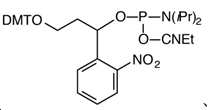
5'-아미노옥시-변형제-11-CE 포스포아미디트(5'-Aminooxy-Modifier-11-CE Phosphoramidite) (10-[N-디메톡시트리틸-아미노옥시에틸)]-트리에틸렌글라이콜-1-[(2-시아노에틸)-(N,N-디이소프로필)]-포스포아미디트) ((10-[N-dimethoxytrityl-aminooxyethyl)]-triethyleneglycol-1-[(2-cyanoethyl)-(N,N-diisopropyl)]-phosphoramidite))5'-Aminooxy-Modifier-11-CE Phosphoramidite (10-[N-dimethoxytrityl-aminooxyethyl)]-triethylenegly Col-1-[(2-cyanoethyl)-(N,N-diisopropyl)]-phosphoamidite) ((10-[N-dimethoxytrityl-aminooxyethyl)]-triethyleneglycol-1-[(2- cyanoethyl)-(N,N-diisopropyl)]-phosphoramidite))
[화학식 13][Formula 13]

a-토코페롤-TEG 포스포아미디트 (α-Tocopherol-TEG Phosphoramidite) (1- 디메톡시트리틸옥시-3-O-[(9-DL-a-토코페릴)-트리에틸렌글라이콜-1-일]-글리세릴-2-O-[(2-시아노에틸)-(N,N-디이소프로필)]-포스포아미디트 ((1-dimethoxytrityloxy-3-O-[(9-DL-α-tocopheryl)-triethyleneglycol-1-yl]-glyceryl-2-O-[(2-cyanoethyl)-(N,N,-diisopropyl)]-phosphoramidite))a-Tocopherol-TEG Phosphoramidite (α-Tocopherol-TEG Phosphoramidite) (1-dimethoxytrityloxy-3-O-[(9-DL-a-tocopheryl)-triethylene glycol-1- yl]-glyceryl-2-O-[(2-cyanoethyl)-(N,N-diisopropyl)]-phosphoamidite ((1-dimethoxytrityloxy-3-O-[(9-DL- α-tocopheryl)-triethyleneglycol-1-yl]-glyceryl-2-O-[(2-cyanoethyl)-(N,N,-diisopropyl)]-phosphoramidite))
[화학식 14][Formula 14]

5'-DBCO-TEG 포스포아미디트 (5'-DBCO-TEG Phosphoramidite) (10-(6-옥소-6-(디벤조[b,f]아자사이클로옥트-4-인-1-일)-카프로아미도-N-에틸)-O- 트리에틸렌글라이콜-1-[(2-시아노에틸)-(N,N-디이소프로필)]-포스포아미디트 ((10-(6-oxo-6-(dibenzo[b,f]azacyclooct-4-yn-1-yl)-caproamido-N-ethyl)-O-triethyleneglycol-1-[(2-cyanoethyl)-(N,N-diisopropyl)]-phosphoramidite))5'-DBCO-TEG Phosphoramidite (5'-DBCO-TEG Phosphoramidite) (10-(6-oxo-6-(dibenzo[b,f]azacyclooct-4-yn-1-yl)- Caproamido-N-ethyl)-O-triethyleneglycol-1-[(2-cyanoethyl)-(N,N-diisopropyl)]-phosphoamidite ((10-(6- oxo-6-(dibenzo[b,f]azacyclooct-4-yn-1-yl)-caproamido-N-ethyl)-O-triethyleneglycol-1-[(2-cyanoethyl)-(N,N-diisopropyl)] -phosphoramidite))
[화학식 15][Formula 15]

5'-콜레스테릴-TEG 포스포아미디트 (5'-Cholesteryl-TEG Phosphoramidite) (10-O-[1-프로필-3-N-카바모일콜레스테릴]-트리에틸렌글라이콜-1-[(2-시아노에틸)-(N,N-디이소프로필)]-포스포아미디트((10-O-[1-propyl-3-N-carbamoylcholesteryl]-triethyleneglycol-1-[(2-cyanoethyl)-(N,N-diisopropyl)]-phosphoramidite))5'-Cholesteryl-TEG Phosphoramidite (5'-Cholesteryl-TEG Phosphoramidite) (10-O-[1-propyl-3-N-carbamoylcholesteryl]-triethylene glycol-1- [(2-cyanoethyl)-(N,N-diisopropyl)]-phosphoamidite ((10-O-[1-propyl-3-N-carbamoylcholesteryl]-triethyleneglycol-1-[(2- cyanoethyl)-(N,N-diisopropyl)]-phosphoramidite))
[화학식 16][Formula 16]

DNP-TEG 포스포아미디트 (DNP-TEG Phosphoramidite) (1-디메톡시트리틸옥시-3-O-[N-(2,4-디니트로페닐)-3-N-아미노프로필-(트리에틸렌글라이콜)]-글리세릴-2-O-(2-시아노에틸)-(N,N-디이소프로필)]-포스포아미디트) ((1-Dimethoxytrityloxy-3-O-[N-(2,4-dinitrophenyl)-3-N-aminopropyl-(triethyleneglycol)]-glyceryl-2-O-(2-cyanoethyl)-(N,N-diisopropyl)-phosphoramidite))DNP-TEG Phosphoramidite (1-dimethoxytrityloxy-3-O-[N-(2,4-dinitrophenyl)-3-N-aminopropyl-(triethylenegle) lycol)]-glyceryl-2-O-(2-cyanoethyl)-(N,N-diisopropyl)]-phosphoamidite) ((1-Dimethoxytrityloxy-3-O-[N-( 2,4-dinitrophenyl)-3-N-aminopropyl-(triethyleneglycol)]-glyceryl-2-O-(2-cyanoethyl)-(N,N-diisopropyl)-phosphoramidite))
[화학식17][Formula 17]

콜레스테릴-TEG-포스포아미디트(Cholesteryl-TEG Phosphoramidite) (1-디메톡시트리틸옥시-3-O-(N-콜레스티릴-3-아미노프로필) -트리에틸렌글라이콜-글리세릴-2-O-(2-시아노에틸)-(N,N-디이소프로필)]-포스포아미디트 ((1-Dimethoxytrityloxy-3-O-(N-cholesteryl-3-aminopropyl)-triethyleneglycol-glyceryl-2-O-(2-cyanoethyl)-(N,N,-diisopropyl)-phosphoramidite))Cholesteryl-TEG Phosphoramidite (1-dimethoxytrityloxy-3-O- (N-cholestyryl-3-aminopropyl) -triethylene glycol-glyceryl -2-O-(2-cyanoethyl)-(N,N-diisopropyl)]-phosphoamidite ((1-Dimethoxytrityloxy-3-O-(N-cholesteryl-3-aminopropyl)-triethyleneglycol- glyceryl-2-O-(2-cyanoethyl)-(N,N,-diisopropyl)-phosphoramidite))
[화학식 18][Formula 18]

5'-아미노-변형제-TEG CE-포스포아미디트(5'-Amino-Modifier TEG CE-Phosphoramidite) (10-(O-트리플루오로아세트아미도-N-에틸)-트리에틸렌글라이콜-1-[(2-시아노에틸)-(N,N-디이소프로필)]- 포스포아미디트) ((10-(O-trifluoroacetamido-N-ethyl)-triethyleneglycol-1-[(2-cyanoethyl)-(N,N-diisopropyl)]-phosphoramidite))5'-Amino-Modifier-TEG CE-Phosphoramidite (5'-Amino-Modifier TEG CE-Phosphoramidite) (10-(O-trifluoroacetamido-N-ethyl)-triethylene glycol -1-[(2-cyanoethyl)-(N,N-diisopropyl)]-phosphoamidite) ((10-(O-trifluoroacetamido-N-ethyl)-triethyleneglycol-1-[(2- cyanoethyl)-(N,N-diisopropyl)]-phosphoramidite))
[화학식 19][Formula 19]

스페이서 포스포아미디트 18(Spacer Phosphoramidite 18) (18-O-디메톡시트리틸헥사에틸렌글라이콜,1-[(2-시아노에틸)-(N,N-디이소프로필)]- 포스포아미디트) (N,N-diisopropyl)]-phosphoramidite) ((18-O-Dimethoxytritylhexaethyleneglycol,1-[(2-cyanoethyl)-(N,N-diisopropyl)]-phosphoramidite))Spacer Phosphoramidite 18 (18-O-dimethoxytritylhexaethylene glycol, 1-[(2-cyanoethyl)-(N,N-diisopropyl)]-phospho amidite) (N,N-diisopropyl)]-phosphoramidite) ((18-O-Dimethoxytritylhexaethyleneglycol,1-[(2-cyanoethyl)-(N,N-diisopropyl)]-phosphoramidite))
[화학식 20][Formula 20]

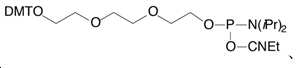
스페이서 포스포아미디트 9 (Spacer Phosphoramidite 9) (9-O- 디메톡시트리틸-트리에틸렌글라이콜, 1-[(2-시아노에틸)-(N,N-디이소프로필)]-포스포아미디트) ((9-O-Dimethoxytrityl-triethyleneglycol,1-[(2-cyanoethyl)-(N,N-diisopropyl)]-phosphoramidite))Spacer Phosphoramidite 9 (9-O-dimethoxytrityl-triethylene glycol, 1-[(2-cyanoethyl)-(N,N-diisopropyl)]-phos Poamidite) ((9-O-Dimethoxytrityl-triethyleneglycol,1-[(2-cyanoethyl)-(N,N-diisopropyl)]-phosphoramidite))
[화학식 21][Formula 21]
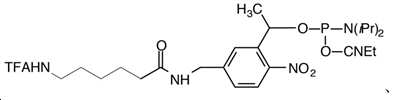
PC-아미노-변형제-포스포아미디트 (PC Amino-Modifier Phosphoramidite) ([(6-트리플루오로아세틸아미도카프로아미도메틸)-1-(2-니트로페닐)-에틸]-2-시아노에틸)-(N,N-디이소프로필)]-포스포아미디트) (([(6-Trifluoroacetylamidocaproamidomethyl)-1-(2-nitrophenyl)-ethyl]-2-cyanoethyl-(N,N-diisopropyl)-phosphoramidite))PC-Amino-Modifier Phosphoramidite ([(6-trifluoroacetylamidocaproamidomethyl)-1-(2-nitrophenyl)-ethyl]-2-cya Noethyl)-(N,N-diisopropyl)]-phosphoamidite) (([(6-Trifluoroacetylamidocaproamidomethyl)-1-(2-nitrophenyl)-ethyl]-2-cyanoethyl-(N,N-diisopropyl) )-phosphoramidite))
[화학식 22][Formula 22]
티올-변형제 C6 S-S (Thiol-Modifier C6 S-S) (1-O-디메톡시트리틸-헥실-디설파이드, 1'-[(2-시아노에틸)-(N,N-디이소프로필)]-포스포아미디트) ((1-O-Dimethoxytrityl-hexyl-disulfide,1'-[(2-cyanoethyl)-(N,N-diisopropyl)]-phosphoramidite))Thiol-Modifier C6 S-S (1-O-dimethoxytrityl-hexyl-disulfide, 1'-[(2-cyanoethyl)-(N,N-diisopropyl)]- phosphoramidite) ((1-O-Dimethoxytrityl-hexyl-disulfide,1'-[(2-cyanoethyl)-(N,N-diisopropyl)]-phosphoramidite))
[화학식 23][Formula 23]

5'-카복시-변형제-C10 (5'-Carboxy-Modifier C10) (10-카복시-데실-(2-시아노에틸)-(N,N-디이소프로필)]-포스포아미디트, N-하이드록시석신이미드 에스테르) ((10-Carboxy-decyl-(2-cyanoethyl)-(N,N-diisopropyl)-phosphoramidite, N-hydroxysuccinimide ester))5'-carboxy-modifier-C10 (5'-Carboxy-Modifier C10) (10-carboxy-decyl-(2-cyanoethyl)-(N,N-diisopropyl)]-phosphoamidite, N -Hydroxysuccinimide ester) ((10-Carboxy-decyl-(2-cyanoethyl)-(N,N-diisopropyl)-phosphoramidite, N-hydroxysuccinimide ester))
[화학식 24][Formula 24]

5'-티올-변형제 C6 (5'-Thiol-Modifier C6) (S-트리틸-6-머르캅토헥실-1-[(2-시아노에틸)-(N,N-디이소프로필)]-포스포아미디트) ((S-Trityl-6-mercaptohexyl-1-[(2-cyanoethyl)-(N,N-diisopropyl)]-phosphoramidite))5'-Thiol-Modifier C6 (S-trityl-6-mercaptohexyl-1-[(2-cyanoethyl)-(N,N-diisopropyl)] -phosphoamidite) ((S-Trityl-6-mercaptohexyl-1-[(2-cyanoethyl)-(N,N-diisopropyl)]-phosphoramidite))
[화학식 25][Formula 25]

디티올 세리놀 포스포아미디트 (Dithiol Serinol Phosphoramidite) (3- 디메톡시트리틸트리틸옥시-2-(3-((R)-a-리포아미도)프로판아미도)프로필-1-O-(2-시아노에틸)-(N,N-디이소프로필)]-포스포아미디트) ((3-Dimethoxytrityloxy-2-(3-((R)-α-lipoamido)propanamido)propyl-1-O-(2-cyanoethyl)-(N,N-diisopropyl)-phosphoramidite))Dithiol Serinol Phosphoramidite (3-dimethoxytrityltrityloxy-2-(3-((R)-a-lipoamido)propanamido)propyl-1-O-( 2-Cyanoethyl)-(N,N-diisopropyl)]-phosphoamidite) ((3-Dimethoxytrityloxy-2-(3-((R)-α-lipoamido)propanamido)propyl-1-O -(2-cyanoethyl)-(N,N-diisopropyl)-phosphoramidite))
[화학식 26][Formula 26]

5'-말레이미드-변형제 포스포아미디트(5'-Maleimide-Modifier Phosphoramidite) (2-(1,7-디메틸-3,5-디옥소-10-옥사-4-아자트리사이클로[5.2.1.02,6]덱-8-엔-4-일)-에틸-1-O-[(2-시아노에틸)-(N,N-디이소프로필)]-포스포아미디트) ((2-(1,7-Dimethyl-3,5-dioxo-10-oxa-4-azatricyclo[5.2.1.02,6]dec-8-en-4-yl)-ethyl-1-O-[(2-cyanoethyl)-(N,N-diisopropyl)]-phosphoramidite))5'-Maleimide-Modifier Phosphoramidite (2-(1,7-dimethyl-3,5-dioxo-10-oxa-4-azatricyclo[5.2. 1.02,6]dec-8-en-4-yl)-ethyl-1-O-[(2-cyanoethyl)-(N,N-diisopropyl)]-phosphoamidite) ((2- (1,7-Dimethyl-3,5-dioxo-10-oxa-4-azatricyclo[5.2.1.02,6]dec-8-en-4-yl)-ethyl-1-O-[(2-cyanoethyl) -(N,N-diisopropyl)]-phosphoramidite))
[화학식 27][Formula 27]

PC 비오틴 포스포아미디트 (PC Biotin Phosphoramidite) (1-[2-니트로-5-(6-(N-(4,4'-디메톡시트리틸))-비오틴아미도카프로아미도메틸)페닐]-에틸-[2-시아노에틸-(N,N-디이소프로필)]-포스포아미디트) ((1-[2-Nitro-5-(6-(N-(4,4'-dimethoxytrityl))-biotinamidocaproamidomethyl)phenyl]-ethyl-[2-cyanoethyl-(N,N-diisopropyl)]-phosphoramidite)PC Biotin Phosphoramidite (1-[2-nitro-5-(6-(N-(4,4'-dimethoxytrityl))-biotinamidocaproamidomethyl)phenyl] -Ethyl-[2-cyanoethyl-(N,N-diisopropyl)]-phosphoamidite) ((1-[2-Nitro-5-(6-(N-(4,4'-dimethoxytrityl) ))-biotinamidocaproamidomethyl)phenyl]-ethyl-[2-cyanoethyl-(N,N-diisopropyl)]-phosphoramidite)
[화학식 28][Formula 28]

보호된 비오틴LC 세리놀 포스포아미디트 (Protected BiotinLC Serinol Phosphoramidite) (3-디메톡시트리틸옥시-2-(3-((4-t-부틸벤조일)-비오티닐-3-아미노프로필)-디에틸렌글라이코릴-프로필아미도-글라이카노일아미도)프로필-1-O-(2-시아노에틸)-(N,N-디이소프로필)]-포스포아미디트) ((3-Dimethoxytrityloxy-2-(3-((4-t-butylbenzoyl)-biotinyl-3-aminopropyl)-diethyleneglycolyl-propylamido-glycanoylamido)propyl-1-O-(2-cyanoethyl)-(N,N-diisopropyl)-phosphoramidite))Protected BiotinLC Serinol Phosphoramidite (3-dimethoxytrityloxy-2-(3-((4-t-butylbenzoyl)-biotinyl-3-aminopropyl)- Diethyleneglycolyl-propylamido-glycanoylamido)propyl-1-O-(2-cyanoethyl)-(N,N-diisopropyl)]-phosphoamidite) ((3- Dimethoxytrityloxy-2-(3-((4-t-butylbenzoyl)-biotinyl-3-aminopropyl)-diethyleneglycolyl-propylamido-glycanoylamido)propyl-1-O-(2-cyanoethyl)-(N,N-diisopropyl)-phosphoramidite )))
[화학식 29][Formula 29]

6-플루오레신 세리놀 포스포아미디트 (6-Fluorescein Serinol Phosphoramidite) (3-디메톡시트리틸옥시-2-(3-(6-카복시-(디-O-피바로일- 플루오레신)프로판아미도)프로필)-1-O-(2-시아노에틸)-(N,N-디이소프로필)]-포스포아미디트)((3-Dimethoxytrityloxy-2-(3-(6-carboxy-(di-O-pivaloyl-fluorescein)propanamido)propyl)-1-O-(2-cyanoethyl)-(N,N-diisopropyl)-phosphoramidite))6-Fluorescein Serinol Phosphoramidite (3-dimethoxytrityloxy-2-(3-(6-carboxy-(di-O-pivaloyl-fluorescein) propanamido)propyl)-1-O-(2-cyanoethyl)-(N,N-diisopropyl)]-phosphoamidite)((3-Dimethoxytrityloxy-2-(3-(6-carboxy) -(di-O-pivaloyl-fluorescein)propanamido)propyl)-1-O-(2-cyanoethyl)-(N,N-diisopropyl)-phosphoramidite))
[화학식 30][Formula 30]

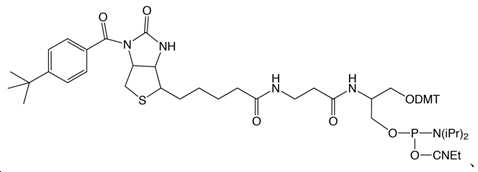
보호된 비오틴 세리놀 포스포아미디트 (Protected Biotin Serinol Phosphoramidite) (3-디메톡시트리틸옥시-2-(3-((4-t-부틸벤조일)-비오티닐)프로판아미도)프로필-1-O-(2-시아노에틸)-(N,N-디이소프로필)]-포스포아미디트) ((3-Dimethoxytrityloxy-2-(3-((4-t-butylbenzoyl)-biotinyl)propanamido)propyl-1-O-(2-cyanoethyl)-(N,N-diisopropyl)-phosphoramidite))Protected Biotin Serinol Phosphoramidite (3-dimethoxytrityloxy-2-(3-((4-t-butylbenzoyl)-biotinyl)propanamido)propyl-1 -O-(2-cyanoethyl)-(N,N-diisopropyl)]-phosphoamidite) ((3-Dimethoxytrityloxy-2-(3-((4-t-butylbenzoyl)-biotinyl)propanamido )propyl-1-O-(2-cyanoethyl)-(N,N-diisopropyl)-phosphoramidite))
[화학식 31][Formula 31]
1-에티닐-d스페이서 CE 포스포아미디트 (1-Ethynyl-dSpacer CE Phosphoramidite) (5'-O-디메톡시트리틸-1'-에티닐-2'-디옥시리보스-3'-[(2-시아노에틸)-(N,N-디이소프로필)]-포스포아미디트 ((5'-O-Dimethoxytrityl-1'-ethynyl-2'-deoxyribose-3'-[(2-cyanoethyl)-(N,N-diisopropyl)]-phosphoramidite))1-Ethynyl-dSpacer CE Phosphoramidite (5'-O-dimethoxytrityl-1'-ethynyl-2'-deoxyribose-3'-[(2) -Cyanoethyl)-(N,N-diisopropyl)]-phosphoamidite ((5'-O-Dimethoxytrityl-1'-ethynyl-2'-deoxyribose-3'-[(2-cyanoethyl)- (N,N-diisopropyl)]-phosphoramidite))
[화학식 32][Formula 32]

아조벤젠 포스포아미디트 (Azobenzene Phosphoramidite) (3-O-(디메톡시트리틸)-2-N-(4-카복시아조벤젠)-D-트레오닌-1-일-O-[(2-시아노에틸)-(N,N-디이소프로필)]-포스포아미디트) ((3-O-(Dimethoxytrityl)-2-N-(4-carboxyazobenzene)-D-threonin-1-yl-O-[(2-cyanoethyl)-(N,N-diisopropyl)]-phosphoramidite))Azobenzene Phosphoramidite (3-O-(dimethoxytrityl)-2-N-(4-carboxyzobenzene)-D-threonine-1-yl-O-[(2-cyanoethyl) -(N,N-diisopropyl)]-phosphoamidite) ((3-O-(Dimethoxytrityl)-2-N-(4-carboxyazobenzene)-D-threonin-1-yl-O-[(2 -cyanoethyl)-(N,N-diisopropyl)]-phosphoramidite))
[화학식 33][Formula 33]

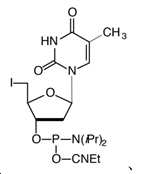
5'-I-dT-CE 포스포아미디트(5'-I-dT-CE Phosphoramidite) (5'-아이오도-2'-디옥시티미딘,3'-[(2-시아노에틸)-(N,N-디이소프로필)]-포스포아미디트)5'-I-dT-CE Phosphoramidite (5'-iodo-2'-deoxythymidine, 3'-[(2-cyanoethyl)- (N,N-diisopropyl)]-phosphoamidite)
5'-I-dT-CE Phosphoramidite (5'-Iodo-2'-deoxyThymidine,3'-[(2-cyanoethyl)-(N,N-diisopropyl)]-phosphoramidite)5'-I-dT-CE Phosphoramidite (5'-Iodo-2'-deoxyThymidine,3'-[(2-cyanoethyl)-(N,N-diisopropyl)]-phosphoramidite)
[화학식 34][Formula 34]
소라렌 C6 포스포아미디트(Psoralen C6 Phosphoramidite) (6-[4'-(하이드록시메틸)-4,5',8-트리메틸소라렌]-헥실-1-O-[(2-시아노에틸)-(N,N-디이소프로필)]-포스포아미디트)((6-[4'-(Hydroxymethyl)-4,5',8-trimethylpsoralen]-hexyl-1-O-(2-cyanoethyl)-(N,N-diisopropyl)-phosphoramidite)Psoralen C6 Phosphoramidite (6-[4'-(hydroxymethyl)-4,5',8-trimethylpsoralen]-hexyl-1-O-[(2-cyanoethyl)- (N,N-diisopropyl)]-phosphoamidite) ((6-[4'-(Hydroxymethyl)-4,5',8-trimethylpsoralen]-hexyl-1-O-(2-cyanoethyl)- (N,N-diisopropyl)-phosphoramidite)
[화학식 35][Formula 35]

소라렌 C2 포스포아미디트 (Psoralen C2 Phosphoramidite) ((2-[4'-(하이드록시메틸)-4,5',8-트리메틸소라렌]-에틸-1-O-[(2-시아노에틸)-(N,N-디이소프로필)]-포스포아미디트) ((2-[4'-(Hydroxymethyl)-4,5',8-trimethylpsoralen]-ethyl-1-O-(2-cyanoethyl)-(N,N-diisopropyl)-phosphoramidite))Psoralen C2 Phosphoramidite ((2-[4'-(hydroxymethyl)-4,5',8-trimethylpsoralen]-ethyl-1-O-[(2-cyanoethyl) -(N,N-diisopropyl)]-phosphoamidite) ((2-[4'-(Hydroxymethyl)-4,5',8-trimethylpsoralen]-ethyl-1-O-(2-cyanoethyl) -(N,N-diisopropyl)-phosphoramidite))
[화학식 36][Formula 36]
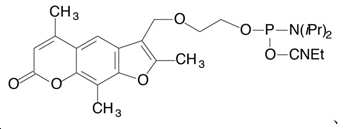
3-시아노비닐카바졸 포스포아미디트(3-Cyanovinylcarbazole Phosphoramidite, CNVK) (5'-O-(4,4'-디메톡시트리틸)-1'-(3- 시아노비닐카바졸-9-일)-2'-디옥시-β-D-리보푸라노실-3'-[(2-시아노에틸)-(N,N-디이소프로필)]-포스포아미디트) ((5'-O-(4,4'-Dimethoxytrityl)-1'-(3-cyanovinylcarbazol-9-yl)-2'-deoxy-
[화학식 37][Formula 37]

본 발명의 한 실시예에서, 하나 또는 그 이상의 뉴클레오사이드 잔기 및 링커 잔기를 가진 뉴클레오사이드 포스포아미디트는 하기의 화학식 (II) 로 대표되는 뉴클레오사이드 포스포아미디트이다:In one embodiment of the present invention, the nucleoside phosphoramidite having one or more nucleoside residues and a linker residue is a nucleoside phosphoramidite represented by the formula (II):
[화학식 (II)][Formula (II)]

또는 이의 입체이성질체이다.or a stereoisomer thereof.
화학식 (II)에서, X1는 각각 독립적으로 -O- 또는 -S- 이다.In formula (II), each X 1 is independently -O- or -S-.
화학식 (II)에서, X2는 각각 독립적으로 -O- 또는 -S-이다.In formula (II), each X 2 is independently —O— or —S—.
화학식 (II)에서, X3는 각각 독립적으로 -O-, -S-, -CH2- 또는 -(CH2)2- 이다.In Formula (II), each X 3 is independently -O-, -S-, -CH 2 - or -(CH 2 ) 2 -.
화학식 (II)에서, L은 링커다. 링커의 예에는, 이것에만 국한하지 않으나, 하기 및 이와 유사한 것이 포함된다:In formula (II), L is a linker. Examples of linkers include, but are not limited to, the following and the like:
[화학식 38][Formula 38]

[화학식 39][Formula 39]

[화학식 40][Formula 40]
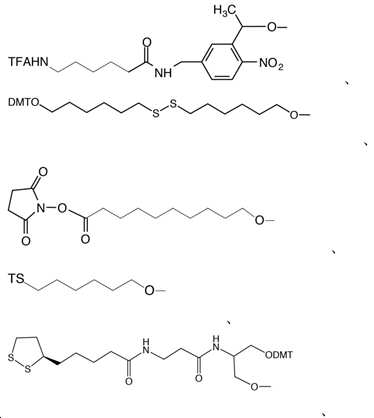
[화학식 41][Formula 41]
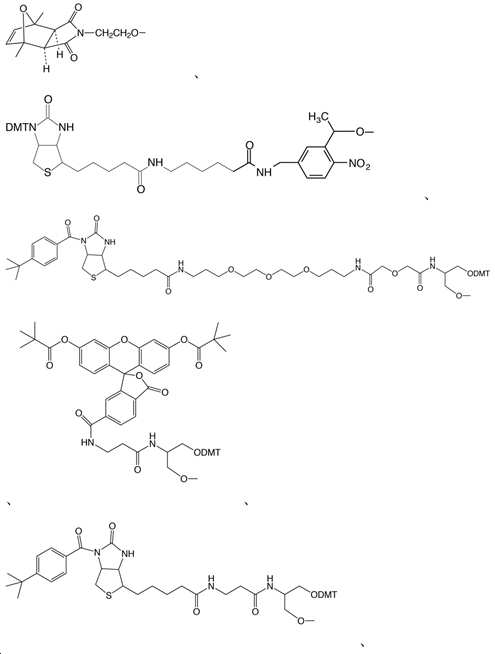
[화학식 42][Formula 42]

화학식 (II)에서, R2는 각각 독립적으로 -H, -NHR6, 할로겐(halogen), -CN, -CF3, 또는 아실-기반한(acyl-based)보호 그룹, 에테르-기반한(ether-based) 보호 그룹 또는 시릴-기반한(silyl-based) 보호 그룹에 의해 보호된 하이드록실 그룹(hydroxyl group) 중 어느 하나이다. 할로겐은, 예를 들어, F, Cl, Br, 및 I이다. 아실-기반한(acyl-based) 보호 그룹의 예에는 아세틸(acetyl), 벤조일(benzoyl), 피발로닐(pivaloyl), 등이 포함된다. 에테르-기반한(ether-based) 보호 그룹의 예에는 벤질(benzyl), p-메톡시벤질(p-methoxybenzyl, PMB), 아릴(allyl), 등이 포함된다. 시릴-기반한 (silyl-based) 보호 그룹의 예에는 t-부틸디메틸시릴 (t-butyldimethylsilyl, TBS), t-부틸디페닐시릴 (t-butyldiphenylsilyl, TBDPS), t-트리이소프로필시릴(t-triisopropylsilyl, TIPS), 트리에틸시릴(triethylsilyl, TES), 트리메틸시릴(trimethylsilyl, TMS) 등이 포함된다. 이는 바람직하게 -H이다.In formula (II), each R 2 is independently -H, -NHR 6 , halogen, -CN, -CF 3 , or an acyl-based protecting group, ether-based ) protecting group or a hydroxyl group protected by a silyl-based protecting group. Halogen is, for example, F, Cl, Br, and I. Examples of acyl-based protecting groups include acetyl, benzoyl, pivaloyl, and the like. Examples of ether-based protecting groups include benzyl, p-methoxybenzyl (PMB), allyl, and the like. Examples of silyl-based protecting groups include t-butyldimethylsilyl (TBS), t-butyldiphenylsilyl (TBDPS), t-triisopropylsilyl , TIPS), triethylsilyl (TES), trimethylsilyl (TMS), and the like. It is preferably -H.
화학식 (II)에서, R3는 각각 독립적으로 -OCH2CH2CN, -SCH2CH2CN, 치환된 또는 비치환된 지방족 그룹 (aliphatic group), -OR7 또는 -SR7이고 바람직하게는 -OCH2CH2CN이다. 치환된 또는 비치환된 지방족 그룹 (aliphatic group)의 예에는, 이것에만 국한하지 않으나, 4-(시아노부트-2-에닐티오(4-cyanobut-2-enylthio), 4-시아노부트-2-에닐옥시(4-cyanobut-2-enyloxy), 아릴티오(allylthio), 아릴옥시(allyloxy), 크로틸티오(crotylthio) 또는 크로틸옥시(crotyloxy), 등이 포함된다.In formula (II), each R 3 is independently —OCH 2 CH 2 CN, —SCH 2 CH 2 CN, a substituted or unsubstituted aliphatic group, —OR 7 or —SR 7 and preferably -OCH 2 CH 2 CN. Examples of substituted or unsubstituted aliphatic groups include, but are not limited to, 4-(cyanobut-2-enylthio), 4-cyanobut-2 -enyloxy (4-cyanobut-2-enyloxy), arylthio (allylthio), aryloxy (allyloxy), crotylthio (crotylthio) or crotyloxy (crotyloxy), and the like are included.
화학식 (II)에서, R4 및 R5 각각 독립적으로 치환된 또는 비치환된 지방족 그룹 (aliphatic group), 치환된 또는 비치환된 방향족 그룹 (aromatic group), 치환된 또는 비치환된 아르알킬 그룹 (aralkyl group); 또는In formula (II), R 4 and R 5 are each independently a substituted or unsubstituted aliphatic group, a substituted or unsubstituted aromatic group, a substituted or unsubstituted aralkyl group ( aralkyl group); or
R4 및 R5 는 이들이 결합하는 질소와 함께 헤테로사이클로알킬 그룹 (heterocycloalkyl group) 또는 헤테로방향족 그룹(heteroaromatic group)을 형성한다. 치환된 또는 비치환된 지방족 그룹 (aliphatic group)의 예에는, 이것에만 국한하지 않으나, 메틸(methyl), 에틸(ethyl), 이소프로필(isopropyl), 등이 포함되고 바람직하게 이소프로필이다. 치환된 또는 비치환된 방향족 그룹의 예에는, 이것에만 국한하지 않으나, 페닐(phenyl), 벤질(benzyl), 토루일(toluyl), 아니릴(anilyl) 등이 포함되고, 바람직하게 페닐(phenyl), 벤질(benzyl), 이다. 헤테로사이클로알킬 그룹의 예에는, 이것에만 국한하지 않으나, 피롤리디노(pyrrolidino), 모르포리노(morpholino), 등이 포함된다.R 4 and R 5 together with the nitrogen to which they are attached form a heterocycloalkyl group or a heteroaromatic group. Examples of a substituted or unsubstituted aliphatic group include, but are not limited to, methyl, ethyl, isopropyl, and the like, preferably isopropyl. Examples of substituted or unsubstituted aromatic groups include, but are not limited to, phenyl, benzyl, toluyl, anilyl, etc., preferably phenyl , benzyl, and Examples of heterocycloalkyl groups include, but are not limited to, pyrrolidino, morpholino, and the like.
화학식 (II)에서, R6는 각각 독립적으로 -H, 치환된 또는 비치환된 지방족 그룹 (aliphatic group), 치환된 또는 비치환된 방향족 그룹 (aromatic group), 치환된 또는 비치환된 아르알킬 그룹(aralkyl group), 또는 아실 그룹 (acyl group) 을 포함하는 보호 그룹 어느 하나이다. 치환된 또는 비치환된 지방족 그룹의 예에는, 이것에만 국한하지 않으나, 메틸, 에틸, 아릴(allyl), 1-펜테닐(1-pentenyl), 2-메톡시에틸(2-methoxyethyl) 등이 포함되고, 및 바람직하게는 메틸, 아릴, 2-메톡시에틸이다. 치환된 또는 비치환된 방향족 그룹의 예에는, 이것에만 국한하지 않으나, 페닐(phenyl), 벤질(benzyl), 나프틸(naphthyl), 2-피레닐메틸In formula (II), each R 6 is independently —H, a substituted or unsubstituted aliphatic group, a substituted or unsubstituted aromatic group, a substituted or unsubstituted aralkyl group (aralkyl group), or any one of a protecting group containing an acyl group (acyl group). Examples of substituted or unsubstituted aliphatic groups include, but are not limited to, methyl, ethyl, allyl, 1-pentenyl, 2-methoxyethyl, and the like. and preferably methyl, aryl, 2-methoxyethyl. Examples of substituted or unsubstituted aromatic groups include, but are not limited to, phenyl, benzyl, naphthyl, 2-pyrenylmethyl
(2-pyrenylmethyl) 등이 포함되고, 바람직하게는 페닐(phenyl), 벤질(benzyl)이다. 보호 그룹은, 예를 들어, t-부틸디메틸시릴(t-butyldimethylsilyl) 이다. (2-pyrenylmethyl) and the like, preferably phenyl (phenyl), benzyl (benzyl). The protecting group is, for example, t-butyldimethylsilyl.
화학식 (II)에서, R7 은 치환된 또는 비치환된 지방족 그룹(aliphatic group), 치환된 또는 비치환된 방향족 그룹(aromatic group), 또는 치환된 또는 비치환된 아르알킬 그룹(aralkyl group)이다. 치환된 또는 비치환된 지방족 그룹의 예에는, 이것에만 국한하지 않으나, THP, 4- 메톡시테트라하이드로피라닐In formula (II), R 7 is a substituted or unsubstituted aliphatic group, a substituted or unsubstituted aromatic group, or a substituted or unsubstituted aralkyl group . Examples of substituted or unsubstituted aliphatic groups include, but are not limited to, THP, 4- methoxytetrahydropyranyl
(4-methoxytetrahydropyranyl) 등이 포함된다. 치환된 또는 비치환된 방향족 그룹의 예에는, 이것에만 국한하지 않으나, o-클로로페닐(o-chlorophenyl) 또는 p-클로로페닐(p-chlorophenyl) 등이 포함된다. 치환된 또는 비치환된 아르알킬 그룹에는, 이것에만 국한하지 않으나, 2-플루오로페닐메톡시피페리딘-4-일(2-fluorophenylmethoxypiperidine-4-yl) 등이 포함된다.(4-methoxytetrahydropyranyl) and the like. Examples of substituted or unsubstituted aromatic groups include, but are not limited to, o-chlorophenyl or p-chlorophenyl and the like. Substituted or unsubstituted aralkyl groups include, but are not limited to, 2-fluorophenylmethoxypiperidin-4-yl and the like.
화학식 (II)에서, B1 및 B2 는 각각 독립적으로 H, 또는 보호된 또는 비보호된 염기(protected or unprotected base)이다. 보호된 또는 비보호된 염기의 예에는, 이것에만 국한하지 않으나, 아데닌(adenine), 구아닌(guanine), 사이토신(cytosine), 티민(thymine), 및 우라실(uracil)과 같은 자연에 존재하는 염기; 7-데아자구아닌(7-deazaguanine), 7-데아자-8-아자구아닌In formula (II), B 1 and B 2 are each independently H, or a protected or unprotected base. Examples of protected or unprotected bases include, but are not limited to, naturally occurring bases such as adenine, guanine, cytosine, thymine, and uracil; 7-deazaguanine, 7-deaza-8-azaguanine
(7-deaza-8-azaguanine), 5-프로피닐사이토신(5-propynylcytosine), 5-프로피닐우라실(5-propynyluracil), 7-데아자아데닌(7-deazaadenine), 7-데아자-8-아자아데닌(7-deaza-8-azaadenine), 7-데아자-6-옥소퓨린(7-deaza-6-oxopurine), 6-옥소퓨린(6-oxopurine), 3-데아자아데노신(3-deazaadenosine), 2-옥소-5-메틸피리미딘(2-oxo-5-methylpyrimidine), 2-옥소-4-메틸티오-5-메틸피리미딘(7-deaza-8-azaguanine), 5-propynylcytosine, 5-propynyluracil, 7-deazaadenine, 7-deaza-8 -azaadenine (7-deaza-8-azaadenine), 7-deaza-6-oxopurine (7-deaza-6-oxopurine), 6-oxopurine (6-oxopurine), 3-deazaadenosine (3- deazaadenosine), 2-oxo-5-methylpyrimidine, 2-oxo-4-methylthio-5-methylpyrimidine
(2-oxo-4-methylthio-5-methylpyrimidine), 2-티오카보닐-4-옥소-5-메틸피리미딘(2-thiocarbonyl-4-oxo-5-methylpyrimidine), 4-옥소-5-메틸피리미딘(4-oxo-5-methylpyrimidine), 2-아미노퓨린(2-aminopurine), 5-플루오로우라실(5-fluorouracil), 2,6-디아마노퓨린(2,6-diaminopurine), 8-아미노퓨린(8-aminopurine), 4-트리아졸로-5-메틸티민 (4-triazolo-5-methylthymine), 및 4-트리아졸로-5-메틸우라실(4-triazolo-5-methyluracil)과 같은 변형된 염기를 포함한다. 바람직한 실시 예에서, B1 및 B2 중 적어도 하나는 아데닌이다.(2-oxo-4-methylthio-5-methylpyrimidine), 2-thiocarbonyl-4-oxo-5-methylpyrimidine (2-thiocarbonyl-4-oxo-5-methylpyrimidine), 4-oxo-5-methyl Pyrimidine (4-oxo-5-methylpyrimidine), 2-aminopurine (2-aminopurine), 5-fluorouracil, 2,6-diamanopurine (2,6-diaminopurine), 8- Modified modifications such as 8-aminopurine, 4-triazolo-5-methylthymine, and 4-triazolo-5-methyluracil contains bases. In a preferred embodiment, at least one of B 1 and B 2 is adenine.
화학식 (II)에서, n 은 0 또는 양수(positive integer)이고, 바람직하게 0 또는 그 이상 및 4 또는 그 미만, 및 좀 더 바람직하게는 0 또는 1이다. In formula (II), n is 0 or a positive integer, preferably 0 or more and 4 or less, and more preferably 0 or 1.
[실시 예][Example]
본 발명은 하기의 실시예를 참조하여 좀 더 상세하게 서술될 것이며, 이는 본 발명의 특정한 실시예를 보여준다; 본 발명은 이것에만 국한하지 않는다. The invention will be described in more detail with reference to the following examples, which show specific examples of the invention; The present invention is not limited thereto.
실시예 1: 연속적인 방법(sequential method) 및 분절 방법(segment method)의 비교Example 1: Comparison of sequential method and segment method
(1)올리고뉴클레오타이드의 합성(1) Synthesis of oligonucleotides
반응 컬럼을 dT NittoPhase® HL dT300 (Nitto Denko Corporation)로 1573μmol에 해당하는 양으로 채워 넣고, 핵산 합성기 AKTA oligopilot plus100 (Cytiva, the former GE Healthcare Japan)를 사용하여 17머(mer)(5' CCG ATT AAG CGA AGC TT 3') DNA 올리고뉴클레오타이드가 합성되었다. 그 후, 17 머(mer) DNA가 붙어 있는 고체상 케리어 (solid phase carrier)가 205μmol에 해당하는 양으로 반응 컬럼에 채워졌으며, 합성은 핵산 합성기 AKTA oligopilot plus100을 사용하여 5-에틸티오-1H-테트라졸 (5-ethylthio-1H-tetrazole, ETT)을 활성제로 사용하여 하기의 세 컨디션으로 수행되었다:연속적인 방법으로 여기서는 dC, dT, dA가 연속적으로 축합된다; 분절 방법 1로 여기서는 dATC가 1.8 당량의 아마디트 당량과 축합 시간 5분으로 축합되었으며; 분절 방법2로 여기서는 dATC가 3,0 당량의 아마디트 당량과 축합 시간 10분으로 축합되었다. 다른 합성 시약으로서, 보통 사용되는 탈보호제(deprotecting reagent), 캡핑제(capping reagent) 및 산화 용액(oxidizing solution)이 사용되었다. dATC는 WO 2019/212061에 서술된 대로 만들어졌다.The reaction column was filled with dT NittoPhase® HL dT300 (Nitto Denko Corporation) in an amount equivalent to 1573 μmol, and 17 mers (5' CCG ATT) using a nucleic acid synthesizer AKTA oligopilot plus100 (Cytiva, the former GE Healthcare Japan) AAG CGA AGC TT 3') DNA oligonucleotides were synthesized. Thereafter, a solid phase carrier to which 17-mer DNA was attached was charged to the reaction column in an amount corresponding to 205 μmol, and the synthesis was performed using a nucleic acid synthesizer AKTA oligopilot plus100, 5-ethylthio-1H-tetra Using a sol (5-ethylthio-1H-tetrazole, ETT) as the activator, the following three conditions were carried out: in a continuous manner, in which dC, dT, and dA were condensed successively; Segmentation method 1 wherein dATC was condensed with 1.8 equivalents of Ahmadite equivalent with a condensation time of 5 minutes; Segmentation method 2 wherein dATC was condensed with 3,0 equivalents of amadite equivalent and a condensation time of 10 minutes. As other synthetic reagents, commonly used deprotecting reagents, capping reagents and oxidizing solutions were used. dATC was prepared as described in WO 2019/212061.
DNA 올리고뉴클레오타이드가 결합되어있는 고체상 케리어 (solid phase carrier)는 28% 암모니아수에 침지시키고, 상기DNA 올리고 뉴클레오타이드는 고체상 케리어로부터 잘라내었다. 이 용액의 일부분은 물로 희석시켜 DNA 올리고뉴클레오타이드 샘플 용액을 제조하였다. 나머지 용액은 정제되지 않은 용액(crude solution)으로서 사용되었다.The solid phase carrier to which the DNA oligonucleotide is bound was immersed in 28% aqueous ammonia, and the DNA oligonucleotide was cut from the solid phase carrier. A portion of this solution was diluted with water to prepare a DNA oligonucleotide sample solution. The remaining solution was used as a crude solution.
(2) 올리고뉴클레오타이드 정제(2) oligonucleotide purification
얻어진 정제되지 않은 용액은 정제 장치 AKTA pure 25 (Cytiva, the former GE Healthcare Japan)로 정제하였다 ((정제 컨디션:컬럼: 25 cm Х 10 mm, CV = 19.6 mL GE 소스 15Q 레진, 버퍼: 초순수 물(ultrapure water)로 조정된 NaOH, NaCl)).The obtained crude solution was purified with a purification apparatus AKTA pure 25 (Cytiva, the former GE Healthcare Japan) ((purification condition: column: 25 cm Х 10 mm, CV = 19.6 mL GE source 15Q resin, buffer: ultrapure water ( NaOH, NaCl)) adjusted with ultrapure water).
(3) DNA올리고뉴클레오타이드 분석(3) DNA oligonucleotide analysis
정제 전 및 후에 DNA 올리고뉴클레오타이드 샘플 용액은 고성능 액체 크로마토그래피(high performance liquid chromatography, HPLC)로 측정되었다((측정 컨디션: 컬럼: Waters XBridge OST C18, 2.5μm, 50 Х 4.6mm, UV검출: 260nm, 버퍼 A: 물에 있는HFIP/TEA, 버퍼 B: 메탄올(methanol)).DNA oligonucleotide sample solutions before and after purification were measured by high performance liquid chromatography (HPLC) (measurement conditions: Column: Waters XBridge OST C18, 2.5 μm, 50 Х 4.6 mm, UV detection: 260 nm, Buffer A: HFIP/TEA in water, Buffer B: methanol).
(4) 결과(4) Results
표 1은 정제 전에 DNA 올리고뉴클레오타이드 샘플 용액의 분석 결과를 보여준다. Table 1 shows the results of analysis of DNA oligonucleotide sample solutions before purification.
(Sequential method)continuous method
(Sequential method)
(Segment method 1)Segmentation Method 1
(Segment method 1)
(Segment method 2)Segmentation Method 2
(Segment method 2)
여기서, 불순물 I은 HPLC 측정에서 (N-1) 머(mer) 근처에서 나타나는 불순물을 의미하고, 불순물II는 HPLC 측정에서 (N-2) 머 근처에서 나타나는 불순물을 의미하고, 및 불순물III은 HPLC 측정에서 (N-3) 머 근처에서 나타나는 불순물을 의미한다.Here, impurity I means an impurity appearing near the (N-1) mer in HPLC measurement, impurity II means an impurity appearing near the (N-2) mer in HPLC measurement, and impurity III is HPLC (N-3) Means impurities that appear near the mer in the measurement.
연속적인 방법으로 합성되었을 때, 불순물 I 및 불순물 II 의 함량은 각각 2.9% 및 2.8% 이었으며, 반면에 분절 방법 I으로 합성되었을 때 그 함량은 각각 0.6% 및 0.4%였고, 및 분절 방법 II로 합성되었을 때 그 함량은 각각 0.7% 및1.8%였다. 분절 방법으로 합성되었을 때, 불순물 I 및 불순물 II 의 함량은 연속적인 방법으로 합성된 경우와 비교하였을 때 상당히 감소될 수 있었다.When synthesized by continuous method, the contents of impurity I and impurity II were 2.9% and 2.8%, respectively, whereas when synthesized by fragmentation method I, their contents were 0.6% and 0.4%, respectively, and synthesized by fragmentation method II The content was 0.7% and 1.8%, respectively. When synthesized by the segmentation method, the contents of impurity I and impurity II could be significantly reduced compared with the case synthesized by the continuous method.
표 2는 정제 후에 DNA 올리고뉴클레오타이드 샘플 용액의 분석 결과를 보여준다. Table 2 shows the analysis results of the DNA oligonucleotide sample solution after purification.
(Segment method 1)Segmentation Method 1
(Segment method 1)
(Segment method 2)Segmentation Method 2
(Segment method 2)
표적 올리고뉴클레오타이드의 순도는 연속적 방법에서는 90.46%, 분절 방법1에서는 92.34% 이고 및 분절 방법 2에서는 92.53%이었으며; 상기 분절방법으로 합성되었을 때, 표적 올리고뉴클레오타이드는 연속적인 방법으로 합성된 경우와 비교하여 높은 순도로 얻어질 수 있었다. 추가로, FLP ((전장 생산물(full-length product), 순도 Х 총 OD))는 연속적인 방법에서는 9302이었으며, 반면에 분절 방법1에서는 10702이었고 분절 방법2에서는10724이었으며; 및 분절 방법으로 합성되었을 때, 표적 올리고뉴클레오타이드는 연속적인 방법으로 합성된 경우와 비교하여 높은 수율을 얻을 수 있었다.The purity of the target oligonucleotide was 90.46% in the continuous method, 92.34% in the segmentation method 1 and 92.53% in the segmentation method 2; When synthesized by the above fragmentation method, the target oligonucleotide could be obtained with a higher purity than when synthesized by a continuous method. In addition, the FLP ((full-length product, purity Х total OD)) was 9302 for the continuous method, whereas 10702 for segment method 1 and 10724 for segment method 2; And when synthesized by the fragmentation method, the target oligonucleotide was able to obtain a high yield compared to the case of synthesis by a continuous method.
실시예 2: 반응 퍼센트의 비교 Example 2: Comparison of percent response
(1)DNA 올리고뉴클레오타이드의 합성(1) Synthesis of DNA oligonucleotides
반응 컬럼에 NittoPhase® HL UnyLinker 350 (Nitto Denko Corporation) 로 2953μmol에 해당하는 양으로 채워 넣고, 핵산 합성기 AKTA oligopilot plus100을 사용하여 17머(mer)(5' CCG ATT AAG CGA AGC TT 3') DNA 올리고뉴클레오타이드가 합성되었다. 그 후 17머(mer) DNA가 붙어 있는 고체상 케리어 (solid phase carrier)를 90μmol에 해당하는 양으로 반응 컬럼에 채웠으며, 및1.8 당량의 양에 해당하는 아미디트를 가진 dGCC를 핵산 합성기AKTA oligopilot plus10 및 하기의 활성제를 사용하여 5분의 축합 시간(condensation time) 으로 축합시켰다: 5-머르캅토-1-메틸테트라졸 (5-mercapto-1-methyltetrazole,1-Me-MCT), 5-머르캅토-1-페닐테트라졸(5-mercapto-1-phenyltetrazole, 1-Ph-MCT), 5-벤질티오테트라졸(5-benzylthiotetrazole, BTT), 사카린 1-메틸이미다졸(saccharin 1-methylimidazole, SMI), 5-에틸티오-1H-테트라졸(5-ethylthio-1H-tetrazole, ETT), 4,5-디시아노이미다졸(4,5-dicyanoimidazole, DCI), 5-[3,5-비스(트리플루오로메틸)페닐]-1H-테트라졸(5-[3,5-bis(trifluoromethyl)phenyl]-1H-tetrazole) ((활성제 42(Activator42)), 또는 벤즈이미다졸 트리플루오로메탄 설포네이트(benzimidazole trifluoromethanesulfonate, BIT). 모든 활성제는 0.25M로 조정하기 위하여 아세토니트릴에 용해시켰다. 사용된 다른 합성 시약에는: 탈보호제로서 톨루엔에 있는3% DCA; 산화제로서 물에 있는 피리딘 (pyridine), 아이오다인 (iodine); 캡핑제제(caping reagent)로서 아세토니트릴에 있는 피리딘 (pyridine), N-메틸이미다졸(N-methylimidazole), 무수 아세틱(acetic anhydride) 또는 무수 이소부티릭 (isobutyric anhydride); 및 아민 세척 반응 용액(amine wash reaction solution)으로서 아세토니트릴에 포함되어 있는 TBA가 포함된다. dGCC는 WO 2019/212061에 서술된 대로 제조되었다.The reaction column was filled with NittoPhase® HL UnyLinker 350 (Nitto Denko Corporation) in an amount corresponding to 2953 μmol, and 17-mer (5' CCG ATT AAG CGA AGC TT 3') DNA oligo using a nucleic acid synthesizer AKTA oligopilot plus100 Nucleotides were synthesized. After that, a solid phase carrier with 17 mer DNA was charged into the reaction column in an amount corresponding to 90 μmol, and dGCC having an amidite corresponding to an amount of 1.8 equivalents was performed using a nucleic acid synthesizer AKTA oligopilot plus10. and the following activators with a condensation time of 5 minutes: 5-mercapto-1-methyltetrazole (1-Me-MCT), 5-mercapto -1-phenyltetrazole (5-mercapto-1-phenyltetrazole, 1-Ph-MCT), 5-benzylthiotetrazole (BTT), saccharin 1-methylimidazole (SMI) ), 5-ethylthio-1H-tetrazole (5-ethylthio-1H-tetrazole, ETT), 4,5-dicyanoimidazole (4,5-dicyanoimidazole, DCI), 5- [3,5-bis ( trifluoromethyl)phenyl]-1H-tetrazole (5-[3,5-bis(trifluoromethyl)phenyl]-1H-tetrazole) ((Activator42)), or benzimidazole trifluoromethane sulfonate (benzimidazole trifluoromethanesulfonate, BIT).All active agents were dissolved in acetonitrile to adjust to 0.25 M. Other synthetic reagents used include: 3% DCA in toluene as deprotecting agent; pyridine in water as oxidizing agent; iodine; pyridine, N-methylimidazole, acetic anhydride or isobutyric anhydride in acetonitrile as a capping reagent and TBA contained in acetonitrile as an amine wash reaction solution. . dGCC was prepared as described in WO 2019/212061.
DNA 올리고뉴클레오타이드가 결합된 고체상 케리어 (solid phase carrier)는 수용성 암모니아에 침지시키고, 및 상기 DNA 올리고뉴클레오타이드는 고체상 케리어로부터 잘렸다.A solid phase carrier to which the DNA oligonucleotide was bound was immersed in aqueous ammonia, and the DNA oligonucleotide was cleaved from the solid phase carrier.
여기, 활성제 42 (Activator42)는 하기의 구조를 갖는다. Here, the activator 42 (Activator42) has the following structure.
[화학식 43][Formula 43]

(2)RNA 올리고뉴클레오타이드의 합성(2) Synthesis of RNA oligonucleotides
반응 컬럼에 NittoPhase® HL rU250 (Kinovate Life Science)를 327 μmol에 해당하는 양으로 채웠으며, 17머(mer) (5' CCG AUU AAG CGA AGC UU 3') RNA 올리고뉴클레오타이드가 핵산 합성기 AKTA oligopilot plus100을 사용하여 합성되었다. 그 후, 17머(mer) RNA가 붙어있는 고체상 케리어가 반응 컬럼에 85 μmol에 해당하는 양으로 채워졌으며, 2.0 당량에 해당하는 양의 아미디트를 가진 rAUC를 핵산 합성기 AKTA oligopilot plus10및 하기의 활성제를 사용하여 축합 시간 15분으로 축합시켰다: 5-머르캅토-1-메틸테트라졸(5-mercapto-1-methyltetrazole,1-Me-MCT), 사카린 1-메틸이미다졸(saccharin 1-methylimidazole, SMI), 또는 5-[3,5-비스(트리플루오로메틸)페닐]-1H-테트라졸(5-[3,5-bis(trifluoromethyl)phenyl]-1H-tetrazole) ((활성제 42(Activator42)). 모든 활성제는 0.25M로 조정하기 위하여 아세토니트릴에 용해시켰다. 사용된 다른 합성 시약에는: 탈보호제로서 톨루엔에 있는 3% DCA; 산화제로서 물에 있는 피리딘 (pyridine), 아이오다인 (iodine); 캡핑제제 (caping reagent)로서 아세토니트릴에 있는 피리딘(pyridine), N-메틸이미다졸(N-methylimidazole), 무수 아세틱(acetic anhydride); 및 아민 세척 반응 용액 (amine wash reaction solution) 으로서 아세토니트릴에 포함되어 있는 TBA가 포함된다. rAUC는 WO 2019/212061에 서술된 대로 제조되었다.The reaction column was filled with NittoPhase® HL rU250 (Kinovate Life Science) in an amount corresponding to 327 μmol, and 17 mer (5' CCG AUU AAG CGA AGC UU 3') RNA oligonucleotides were used with a nucleic acid synthesizer AKTA oligopilot plus100. was synthesized using After that, the solid-phase carrier to which 17-mer RNA is attached was filled in the reaction column in an amount corresponding to 85 μmol, and rAUC having an amidite in an amount corresponding to 2.0 equivalents was added to the nucleic acid synthesizer AKTA oligopilot plus10 and the following activators. Condensation was carried out for a condensation time of 15 minutes using: 5-mercapto-1-methyltetrazole (1-Me-MCT), saccharin 1-methylimidazole (saccharin 1-methylimidazole, SMI), or 5-[3,5-bis(trifluoromethyl)phenyl]-1H-tetrazole (5-[3,5-bis(trifluoromethyl)phenyl]-1H-tetrazole) ((Activator42 )).All active agents were dissolved in acetonitrile to adjust to 0.25 M. Other synthetic reagents used include: 3% DCA in toluene as deprotecting agent; pyridine, iodine in water as oxidizing agent. ); pyridine, N-methylimidazole, acetic anhydride in acetonitrile as a capping reagent; and as an amine wash reaction solution TBA contained in acetonitrile rAUC was prepared as described in WO 2019/212061.
RNA 올리고뉴클레오타이드가 결합된 고체상 케리어(solid phase carrier)는 AMA 시약 ((28-30% 수용성 암모니아:수용성 메틸아민 용액 (aqueous methylamine solution)=1:1))에 침지시켰으며, 필터를 통해 여과되었으며, 및 DMSO로 세척되었다. 그 후 얼음 베스(ice bath) 에서 천천히 TEA.3HF를 떨어뜨리고 흔들면서, 상기 RNA 올리고뉴클레오타이드를 고체상 케리어로부터 잘라내었다. The RNA oligonucleotide-bound solid phase carrier was immersed in AMA reagent ((28-30% aqueous ammonia:aqueous methylamine solution=1:1)) and filtered through a filter. , and DMSO. Thereafter, TEA.3HF was slowly dropped in an ice bath and shaken, and the RNA oligonucleotide was cut from the solid-phase carrier.
(3) 반응 퍼센트의 분석(3) Analysis of percent response
자른 후에 각 올리고뉴클레오타이드 샘플 용액은 고성능 액체 크로마토그래피 (high performance liquid chromatography, HPLC)로 측정되었다 (측정 컨디션: 컬럼: Waters XBridge OST C18, 2.5 μm, 50 Х 4.6mm, UV 검출: 260nm, 버퍼 A: 물에 있는 HFIP/TEA , Buffer B: 메탄올). After cutting, each oligonucleotide sample solution was measured by high performance liquid chromatography (HPLC) (measurement condition: Column: Waters XBridge OST C18, 2.5 μm, 50 Х 4.6 mm, UV detection: 260 nm, Buffer A: HFIP/TEA in water, Buffer B: methanol).
DNA 합성에서, HPLC 측정 결과에서 불순물 III 의 피크를 관찰한 후에 1.1 분 이내에 검출된 피크 면적의 합을 100%로 하였으며, 여기서 불순물 III의 피크 면적(%)을 차감하여 반응의 백분율을 구하였다.In DNA synthesis, the sum of the peak areas detected within 1.1 minutes after observing the peak of impurity III in the HPLC measurement result was 100%, and the percentage of the reaction was obtained by subtracting the peak area (%) of impurity III.
RNA 합성에서, HPLC 측정 결과에서 불순물 III의 피크를 관찰한 후에 1.4 분 이내에 검출된 피크 면적의 합을 100%로 하였으며, 여기서 불순물 III의 피크 면적(%)을 차감하여 반응의 백분율을 구하였다.In RNA synthesis, the sum of the peak areas detected within 1.4 minutes after observing the peak of impurity III in the HPLC measurement result was 100%, and the percentage of the reaction was obtained by subtracting the peak area (%) of impurity III.
(4) 결과(4) Results
표 3은 DNA 합성 결과를 보이며, 및 표 4는 RNA 합성 결과를 보여준다.Table 3 shows the DNA synthesis results, and Table 4 shows the RNA synthesis results.
이 실험에서 사용된 활성제의 HOMO 에너지 및 궤도 계수는 표 3 및 4에서 보여준다. HOMO 에너지 및 궤도 계수는 가우시안 (Gaussian)에 의해서 제조된 양자 화학 계산 프로그램 가우시안 16 (Gaussian 16)에서 베케-스타일 3-계수 밀도 기능적 이론 (Becke-style 3-parameter density functional theory) (B3LYP)을, 사용하여 최적화 계산에 의해 얻어졌다. 특별히, 활성제가 아미디트에 친핵성 공격을 할 때, 즉 활성제의 초기 구조에서, 활성 종 (active species) 의 구조는(BIT는 중성 종이고, 다른 것들은 음성 종이다) 다음과 같이 결정된다: 계산하기 전에 분자의 초기 구조는 웹-기반한 계산 지지 프로그램 WebM를 사용하여 생성되고; 및6-31G (d)는 기본 함수에, 전하에서는 -1은 음이온 및 0은 중성 종, 단일항(single term)은 다중도(multiplicity)에, 및 아세토니트릴이은 용매에 입력했다; 그 후 이 순서로 구조 최적화 및 궤도 계산을 실행하여, HOMO 에너지 및 궤도 계수가 얻어졌다. WebMO에서 클린업 기능(Cleanup function)의 “기계적 최적화(Mechanics Optimize)"를 실행하여 분자 모델에서 원자 간의 충돌을 피하기 위하여 초기 구조의 단순한 구조 변형은 적절히 수행되었다.The HOMO energies and orbital coefficients of the activators used in this experiment are shown in Tables 3 and 4. HOMO energies and orbital coefficients are Becke-style 3-parameter density functional theory (B3LYP) in the quantum chemistry calculation program Gaussian 16 prepared by Gaussian, was obtained by optimization calculations using In particular, when the active agent makes a nucleophilic attack on the amidite, i.e. in the initial structure of the active agent, the structure of the active species (BIT is neutral, others are negative) is determined as follows: Before the initial structure of the molecule was generated using the web-based computational support program WebM; and 6-31G (d) entered the fundamental function, -1 for charge, an anion and 0 for neutral species, a single term for multiplicity, and acetonitrile for solvent; Thereafter, structure optimization and orbital calculation were performed in this order, and HOMO energy and orbital coefficient were obtained. A simple structural transformation of the initial structure was appropriately performed to avoid collisions between atoms in the molecular model by executing “Mechanics Optimize” of the Cleanup function in WebMO.
퍼센트reaction
percent
(%)Response Percent
(%)
(%)Response Percent
(%)
표 3 및 4로부터, 활성제 42 보다 더 높은 반응성을 보이는 활성제는 더 높은 HOMO 에너지 수준 및/또는 더 큰 궤도 계수를 가진 것으로 보일 수 있다. 활성제의 높은 HOMO 에너지 수준은 활성제의 HOMO 에너지 수준 및 분절-타입의 아미디트의 LUMO 에너지 수준 사이의 에너지 차이를 감소시켜, 이로써 반응을 촉진하는 것으로 간주된다. 추가로, 활성제의 큰 궤도 계수는 활성제의 질소 원자와 분절-타입 아미디트의 인 원자 사이에 궤도 중첩을 증가시켜, 이로써 반응을 촉진하는 것으로 간주된다. From Tables 3 and 4, it can be seen that activators with higher reactivity than activator 42 have higher HOMO energy levels and/or larger orbital coefficients. It is believed that the high HOMO energy level of the active agent reduces the energy difference between the HOMO energy level of the active agent and the LUMO energy level of the segment-type amidite, thereby accelerating the reaction. Additionally, it is believed that the large orbital coefficient of the activator increases the orbital overlap between the nitrogen atom of the activator and the phosphorus atom of the segment-type amidite, thereby accelerating the reaction.
실시예 3. 분절-타입 아미디트의 분해 비교Example 3. Comparison of degradation of fragment-type amidites
(1) dGCC를 분절-타입 아미디트로서 사용한 올리고뉴클레오타이드의 합성(1) Synthesis of oligonucleotides using dGCC as a fragment-type amidite
실시예 2 (1)에서 얻은 17머(mer) DNA가 붙어 있는 고체상 케리어를 90μmol에 해당하는 양으로 반응 컬럼에 채워 넣었으며, 1.8 당량에 해당하는 아미디트의 양을 가진 dGCC를 핵산 합성기 AKTA oligopilot plus10 및 하기의 활성제를 사용하여 축합 시간 10분으로 축합시켰다: 0.6M 5-머르캅토-1-메틸테트라졸 (5-mercapto-1-methyltetrazole, 1-Me-MCT), 0.5M 5-머르캅토-1-페닐테트라졸 (5-mercapto-1-phenyltetrazole, 1-Ph-MCT), 0.25M 5-벤질티오테트라졸 (5-benzylthiotetrazole, BTT), 0.25M 사카린 1-메틸이미다졸 (saccharin 1-methylimidazole, SMI), 0.6M 5-에틸티오-1H-테트라졸 (5-ethylthio-1H-tetrazole, ETT) 또는 0.25M 5-[3,5-비스(트리플루오로메틸)페닐]-1H-테트라졸(활성제42) (5-[3,5-bis(trifluoromethyl)phenyl]-1H-tetrazole, Activator42). 사용된 다른 합성 시약에는: 탈보호제로서 톨루엔에 있는 3% DCA; 산화제로서 물에 있는 피리딘 (pyridine), 아이오다인 (iodine); 캡핑제제 (caping reagent)로서 아세토니트릴에 있는 피리딘(pyridine), N-메틸이미다졸(N-methylimidazole), 무수 아세틱(acetic anhydride); 및 아민 세척 반응 용액 (amine wash reaction solution)으로서 아세토니트릴에 있는 TBA가 포함된다. dGCC는 WO 2019/212061에 서술된 대로 제조되었다.Example 2 The solid-phase carrier to which the 17-mer DNA obtained in (1) was attached was filled into the reaction column in an amount corresponding to 90 μmol, and dGCC having an amount of amidite corresponding to 1.8 equivalents was used in a nucleic acid synthesizer AKTA oligopilot Condensation was performed using plus10 and the following activators with a condensation time of 10 min: 0.6M 5-mercapto-1-methyltetrazole (1-Me-MCT), 0.5M 5-mercapto -1-phenyltetrazole (5-mercapto-1-phenyltetrazole, 1-Ph-MCT), 0.25 M 5-benzylthiotetrazole (5-benzylthiotetrazole, BTT), 0.25 M saccharin 1-methylimidazole (saccharin 1) -methylimidazole, SMI), 0.6M 5-ethylthio-1H-tetrazole (5-ethylthio-1H-tetrazole, ETT) or 0.25M 5-[3,5-bis(trifluoromethyl)phenyl]-1H- Tetrazole (Activator 42) (5-[3,5-bis(trifluoromethyl)phenyl]-1H-tetrazole, Activator42). Other synthetic reagents used include: 3% DCA in toluene as deprotecting agent; pyridine, iodine in water as an oxidizing agent; pyridine, N-methylimidazole, acetic anhydride in acetonitrile as a capping reagent; and TBA in acetonitrile as an amine wash reaction solution. dGCC was prepared as described in WO 2019/212061.
DNA 올리고뉴클레오타이드가 결합된 고체상 케리어는 55°C에서 수용성 암모니아수에 12 내지 16시간 동안 담갔으며, 및 상기 DNA 올리고뉴클레오타이드를 고체상으로부터 잘라내었다.The solid-phase carrier to which the DNA oligonucleotide was bound was immersed in aqueous ammonia water at 55 °C for 12 to 16 hours, and the DNA oligonucleotide was excised from the solid phase.
(2) DNA 올리고뉴클레오타이드의 분석(2) Analysis of DNA oligonucleotides
잘라낸 DNA 올리고뉴클레오타이드 샘플 용액은 고성능 액체 크로마토그래피 (high performance liquid chromatography, HPLC)로 측정되었다 (측정 컨디션:컬럼: Waters XBridge OST C18, 2.5 μm, 50 Х 4.6 mm, UV 검출: 260nm, 버퍼 A: 물에 있는100-mM HFIP/7-mM TEA, pH 8.0, Buffer B:메탄올, 온도: 60°C). The cleaved DNA oligonucleotide sample solution was measured by high performance liquid chromatography (HPLC) (measurement condition: Column: Waters XBridge OST C18, 2.5 μm, 50 Х 4.6 mm, UV detection: 260 nm, Buffer A: Water in 100-mM HFIP/7-mM TEA, pH 8.0, Buffer B: methanol, temperature: 60 °C).
HPLC 측정 결과에서 불순물III의 피크를 관찰한 후에 1.1 분 이내에 검출된 피크 면적의 합을 100%로 하였으며, 불순물 II의 피크 면적 (%) 이 계산되었다.After observing the peak of impurity III in the HPLC measurement result, the sum of the peak areas detected within 1.1 minutes was taken as 100%, and the peak area (%) of impurity II was calculated.
(3) 결과(3) Results
결과는 표 5에 보여준다. 표 5는 또한 이 실험에서 사용된 활성제의 물에서의 pKa 값을 보여준다.The results are shown in Table 5. Table 5 also shows the pKa values in water of the active agents used in this experiment.
(Impurity II)Impurity II
(Impurity II)
(Activator42)activator42
(Activator42)
활성제 42(Activator42) 를 사용하여 합성한 경우에, 불순물 II의 피크 면적은 9.089%이었으며, 분절-타입 아미디트의 현저한 분해가 관찰되었다. 반면에, 다른 활성제가 사용되었을 때, 불순물 II의 피크 면적은 대략 1 내지 2 %이었으며, 분해가 거의 관찰되지 않았다. 불순물 II는 올리고뉴클레오타이드와 분절-타입 아미디트를 연결하는 포스포디에스테르 결합(phosphodiester bond)이 산에 의해 분해되어 생성되는 것으로 추정한다. When synthesized using Activator42, the peak area of impurity II was 9.089%, and significant degradation of the fragment-type amidite was observed. On the other hand, when other activators were used, the peak area of impurity II was approximately 1-2%, and almost no degradation was observed. Impurity II is presumed to be generated by acid degradation of the phosphodiester bond connecting the oligonucleotide and the fragment-type amidite.
Claims (20)
상기 적어도 한 커플링 단계에서, 뉴클레오사이드 포스포아미디트는
(a) 두 개 또는 그 이상의 뉴클레오사이드 잔기를 가진 한 뉴클레오사이드 포스포아미디트 또는
(b) 하나 또는 그 이상의 뉴클레오사이드 잔기 및 링커 잔기를 가진 한 뉴클레오사이드 포스포아미디트이고 및
상기 활성제는 하기의 화학식으로 대표되는 구조를 가지는, 방법:
[화학식 3]

상기 X 는 유기 염 (organic base)
또는 하기의 화학식에 의하고:
[화학식 4]

상기 R1 및 R2는 H, 선형 또는 가지형 C1-7 알킬 그룹(C1-7 alkyl group), 및 선택적으로 치환될 수 있는 방향족 그룹(aromatic groups)으로 구성된 그룹으로부터 각각 독립적으로 선택되는, 올리고뉴클레오타이드를 생산하는 방법.A method for producing an oligonucleotide, comprising the steps of one or more coupling steps of binding a nucleoside phosphoramidite to a 3' or 5' hydroxyl or thiol group of a nucleotide or nucleoside in the presence of an active agent (coupling steps) comprising:
In said at least one coupling step, the nucleoside phosphoramidite is
(a) a nucleoside phosphoramidite having two or more nucleoside residues or
(b) a nucleoside phosphoramidite having one or more nucleoside residues and a linker residue, and
wherein the active agent has a structure represented by the formula:
[Formula 3]
Wherein X is an organic salt (organic base)
or by the formula:
[Formula 4]
wherein R 1 and R 2 are each independently selected from the group consisting of H, a linear or branched C 1-7 alkyl group, and optionally substituted aromatic groups. , a method for producing oligonucleotides.
상기 X 는 N-메틸이미다졸(N-methylimidazole), 피리딘(pyridine) 또는 3-메틸피리딘(3-methylpyridine)이고,
R1 은 H, CnH2n+1 또는 벤질 그룹(benzyl group) 이고,
R2 은 H, CH3, 또는 C6H5이고, 및
n 은 1, 2 또는 3 인, 방법.According to claim 1,
Wherein X is N-methylimidazole (N-methylimidazole), pyridine (pyridine) or 3-methylpyridine (3-methylpyridine),
R 1 is H, C n H 2n+1 or a benzyl group,
R 2 is H, CH 3 , or C 6 H 5 , and
n is 1, 2 or 3;
뉴클레오사이드 포스포아미디트는
(a) 두 개 또는 그 이상의 뉴클레오사이드 잔기를 가진 뉴클레오사이드 포스포아미디트 또는
(b)하나 또는 그 이상의 뉴클레오사이드 잔기 및 링커 잔기를 가진 뉴클레오사이드 포스포아미디트인, 방법.4. The method according to any one of claims 1 to 3, wherein in at least the last step of the coupling step carried out twice or more,
Nucleoside phosphoramidite
(a) a nucleoside phosphoramidite having two or more nucleoside residues or
(b) a nucleoside phosphoramidite having one or more nucleoside residues and a linker residue.
뉴클레오사이드 포스포아미디트는 3개의 뉴클레오사이드 잔기를 가진 뉴클레오사이드 포스포아미디트인, 방법.5. The method according to any one of claims 1 to 4, wherein in at least the last of the two or more steps of coupling,
wherein the nucleoside phosphoramidite is a nucleoside phosphoramidite having three nucleoside residues.
뉴클레오사이드 포스포아미디트는 1개의 뉴클레오사이드 잔기를 가진 뉴클레오사이드 포스포아미디트인, 방법.6. The method according to any one of claims 1 to 5, wherein in at least one of the two or more steps of coupling,
wherein the nucleoside phosphoramidite is a nucleoside phosphoramidite having one nucleoside residue.
상기 클레오사이드 포스포아미디트가
(a) 3개의 뉴클레오사이드 잔기를 가진 뉴클레오사이드 포스포아미디트이거나, 또는
(b) 하나 또는 그 이상의 뉴클레오사이드 잔기 및 링커 잔기를 가진 뉴클레오사이드 포스포아미디트이고, 및
다른 커플링 단계에서,
상기 클레오사이드 포스포아미디트는 하나의 뉴클레오사이드 잔기를 가진 뉴클레오사이드 포스포아미디트인, 방법.7. The method according to any one of claims 1 to 6, wherein it is carried out twice or more only in the last step of the coupling step.
The cleoside phosphoramidite is
(a) a nucleoside phosphoramidite having three nucleoside residues, or
(b) is a nucleoside phosphoramidite having one or more nucleoside residues and a linker residue, and
In another coupling step,
wherein the cleoside phosphoramidite is a nucleoside phosphoramidite having one nucleoside residue.
[화학식 (I)]

상기,
X1는 각각 독립적으로 -O- 또는 -S- 이고;
X2는 각각 독립적으로 -O- 또는 -S- 이고;
X3는 각각 독립적으로 -O-, -S-, -CH2- 또는 -(CH2)2-이고;
R1은 보호 그룹 (protecting group) 이고;
R2는 각각 독립적으로 -H, -NHR6, 할로겐(halogen), -CN, -CF3, 또는 아실-기반한(acyl-based) 호 그룹, 에테르-기반한 (ether-based) 보호 그룹 또는 시릴-기반한 (silyl-based) 보호 그룹에 의해 보호된 하이드록실 그룹(hydroxyl group)이고;
R3는 각각 독립적으로 -OCH2CH2CN, -SCH2CH2CN, 치환된 또는 비치환된 지방족 그룹(aliphatic group), -OR7 또는 -SR7 이고;
R4 및 R5 각각 독립적으로 치환된 또는 비치환된 지방족 그룹(substituted or unsubstituted aliphatic group), 치환된 또는 비치환된 방향족 그룹 (aromatic group), 치환된 또는 비치환된 아르알킬 그룹 (aralkyl group)이고; 또는
R4 및 R5는 이들이 결합하는 질소와 함께 헤테로사이클로알킬 그룹 (heterocycloalkyl group) 또는 헤테로방향족 그룹(heteroaromatic group)을 형성하고;
R6는 각각 독립적으로 -H, 치환된 또는 비치환된 지방족 그룹(substituted or unsubstituted aliphatic group), 치환된 또는 비치환된 방향족 그룹 (aromatic group), 치환된 또는 비치환된 아르알킬 그룹 (aralkyl group) 또는 보호 그룹이고;
R7은 각각 독립적으로 치환된 또는 비치환된 지방족 그룹(aliphatic group), 치환된 또는 비치환된 방향족 그룹(aromatic group), 또는 치환된 또는 비치환된 아르알킬 그룹 (aralkyl group)이고;
B1, B2 및B3 는 각각 독립적으로 -H, 또는 보호된 또는 비보호된 염기 (protected or unprotected base)이고; 및
n 은 0 또는 양수 (positive integer)이고;
또는 이의 입체 이성질체 (stereoisomer) 인, 방법.The nucleoside phosphoramidite according to any one of claims 1 to 7, wherein the nucleoside phosphoramidite having two or more nucleoside residues is a nucleoside phosphoramidite represented by the following formula (I) , Way:
[Formula (I)]
remind,
each X 1 is independently —O— or —S—;
each X 2 is independently —O— or —S—;
each X 3 is independently —O—, —S—, —CH 2 — or —(CH 2 ) 2 —;
R 1 is a protecting group;
R 2 is each independently -H, -NHR 6 , halogen, -CN, -CF 3 , or an acyl-based arc group, an ether-based protecting group, or silyl- a hydroxyl group protected by a silyl-based protecting group;
each R 3 is independently —OCH 2 CH 2 CN, —SCH 2 CH 2 CN, a substituted or unsubstituted aliphatic group, —OR 7 or —SR 7 ;
R 4 and R 5 are each independently a substituted or unsubstituted aliphatic group, a substituted or unsubstituted aromatic group, a substituted or unsubstituted aralkyl group ego; or
R 4 and R 5 together with the nitrogen to which they are attached form a heterocycloalkyl group or a heteroaromatic group;
R 6 is each independently -H, a substituted or unsubstituted aliphatic group, a substituted or unsubstituted aromatic group, a substituted or unsubstituted aralkyl group ) or a protecting group;
each R 7 is independently a substituted or unsubstituted aliphatic group, a substituted or unsubstituted aromatic group, or a substituted or unsubstituted aralkyl group;
B 1 , B 2 and B 3 are each independently —H, or a protected or unprotected base; and
n is 0 or a positive integer;
or a stereoisomer thereof.
[화학식 (II)]

상기,
X1는 각각 독립적으로 -O- 또는 -S- 이고;
X2는 각각 독립적으로 -O- 또는 -S- 이고;
X3는 각각 독립적으로 -O-, -S-, -CH2- 또는 -(CH2)2- 이고;
L은 링커 (linker)이고;
R2는 각각 독립적으로 -H, -NHR6, 할로겐(halogen), -CN, -CF3, 또는 아실-기반한(acyl-based)보호 그룹, 에테르-기반한 (ether-based) 보호 그룹 또는 시릴-기반한 (silyl-based) 보호 그룹에 의해 보호된 하이드록실 그룹(hydroxyl group)이고;
R3는 각각 독립적으로 -OCH2CH2CN, -SCH2CH2CN, 치환된 또는 비치환된 지방족 그룹 (aliphatic group), -OR7 또는 -SR7이고;
R4 및 R5 는 각각 독립적으로 치환된 또는 비치환된 지방족 그룹 (substituted or unsubstituted aliphatic group), 치환된 또는 비치환된 방향족 그룹 (aromatic group), 치환된 또는 비치환된 아르알킬 그룹 (aralkyl group); 또는
R4 및 R5 는 이들이 결합하는 질소와 함께 헤테로사이클로알킬 그룹 (heterocycloalkyl group) 또는 헤테로방향족 그룹(heteroaromatic group)을 형성하고;
R6 는 각각 독립적으로 -H, 치환된 또는 비치환된 지방족 그룹(substituted or unsubstituted aliphatic group), 치환된 또는 비치환된 방향족 그룹(aromatic group), 치환된 또는 비치환된 아르알킬 그룹(aralkyl group) 또는 보호 그룹이고;
R7 은 각각 독립적으로 치환된 또는 비치환된 지방족 그룹(aliphatic group), 치환된 또는 비치환된 방향족 그룹(aromatic group), 또는 치환된 또는 비치환된 아르알킬 그룹(aralkyl group)이고;
B1 및B2 는 각각 독립적으로 -H, 또는 보호된 또는 비보호된 염기(protected or unprotected base) 이고; 및
n 은 0 또는 양수 (positive integer);
또는 이의 입체 이성질체 (stereoisomer) 인, 방법.12. The method according to any one of claims 1 to 11, wherein the nucleoside phosphoramidite having one or more nucleoside moieties and a linker moiety is represented by formula (II):
[Formula (II)]
remind,
each X 1 is independently —O— or —S—;
each X 2 is independently —O— or —S—;
each X 3 is independently —O—, —S—, —CH 2 — or —(CH 2 ) 2 —;
L is a linker;
each R 2 is independently -H, -NHR 6 , halogen, -CN, -CF 3 , or an acyl-based protecting group, an ether-based protecting group, or silyl- a hydroxyl group protected by a silyl-based protecting group;
each R 3 is independently —OCH 2 CH 2 CN, —SCH 2 CH 2 CN, a substituted or unsubstituted aliphatic group, —OR 7 or —SR 7 ;
R 4 and R 5 are each independently a substituted or unsubstituted aliphatic group, a substituted or unsubstituted aromatic group, a substituted or unsubstituted aralkyl group ); or
R 4 and R 5 together with the nitrogen to which they are attached form a heterocycloalkyl group or a heteroaromatic group;
R 6 is each independently -H, a substituted or unsubstituted aliphatic group, a substituted or unsubstituted aromatic group, a substituted or unsubstituted aralkyl group ) or a protecting group;
each R 7 is independently a substituted or unsubstituted aliphatic group, a substituted or unsubstituted aromatic group, or a substituted or unsubstituted aralkyl group;
B 1 and B 2 are each independently —H, or a protected or unprotected base; and
n is 0 or a positive integer;
or a stereoisomer thereof.
상기 적어도 한 커플링 단계에서, 뉴클레오사이드 포스포아미디트는
(a) 2개 또는3개의 뉴클레오사이드 잔기를 가진 한 뉴클레오사이드 포스포아미디트이거나, 또는
(b) 하나 또는 그 이상의 뉴클레오사이드 잔기 및 링커 잔기를 가진 한 뉴클레오사이드 포스포아미디트이고, 및
상기 활성제는 하기의 화학식으로 대표되는 구조를 가지며:
[화학식 3]

상기 X는 유기 염기, 또는 하기의 화학식에 의하고:
[화학식4]

상기 R1 및 R2 는 각각 선택적으로 치환될 수 있는 H, 선형 또는 가지형 C1-7 알킬 그룹, 및 방향족 그룹으로 구성된 그룹으로부터 각각 독립적으로 선택되는, 방법.A method for producing oligonucleotides, wherein nucleoside phosphoramidite is reacted with 3' or 5' hydroxyl or thiol of nucleotide or nucleoside in the presence of an activator. performing one or more coupling steps to bind to the group;
In said at least one coupling step, the nucleoside phosphoramidite is
(a) a nucleoside phosphoramidite having two or three nucleoside residues, or
(b) a nucleoside phosphoramidite having one or more nucleoside residues and a linker residue, and
The active agent has a structure represented by the formula:
[Formula 3]
wherein X is an organic base, or by the formula:
[Formula 4]
wherein R 1 and R 2 are each independently selected from the group consisting of optionally substituted H, a linear or branched C 1-7 alkyl group, and an aromatic group.
R1 은 H, CnH2n+1 또는 벤질 그룹(benzyl group)이고,
R2 은 H, CH3, 또는 C6H5이고, 및
n 은 1, 2 또는 3 인, 방법.14. The method of claim 13, wherein X is N-methylimidazole (N-methylimidazole), pyridine (pyridine) or 3-methylpyridine (3-methylpyridine),
R 1 is H, C n H 2n+1 or a benzyl group,
R 2 is H, CH 3 , or C 6 H 5 , and
n is 1, 2 or 3;
상기 적어도 한 커플링 단계에서, 뉴클레오사이드 포스포아미디트는
(a) 2개 또는 그 이상의 뉴클레오사이드 잔기를 가진 뉴클레오사이드 포스포아미디트이거나, 또는
(b) 하나 또는 그 이상의 뉴클레오사이드 잔기 및 링커 잔기를 가진 뉴클레오사이드 포스포아미디트이고, 및
활성제의 HOMO 에너지 (a.u.)는 아세토니트릴 (acetonitrile) 에서 -0.21407 내지 -0.16858이고, 및
활성제의 궤도 계수(orbital coefficient)는 아세토니트릴(acetonitrile)에서 0.31531 내지 0.59405인, 방법.A method for producing oligonucleotides, wherein nucleoside phosphoramidite is reacted with 3' or 5' hydroxyl or thiol of nucleotide or nucleoside in the presence of an activator. performing one or more coupling steps to bind to the group;
In said at least one coupling step, the nucleoside phosphoramidite is
(a) a nucleoside phosphoramidite having two or more nucleoside residues, or
(b) is a nucleoside phosphoramidite having one or more nucleoside residues and a linker residue, and
The HOMO energy (au) of the active agent is -0.21407 to -0.16858 in acetonitrile, and
wherein the orbital coefficient of the active agent is from 0.31531 to 0.59405 in acetonitrile.
상기 적어도 한 커플링 단계에서, 상기 뉴클레오사이드 포스포아미디트는
(a) 2개 또는3개의 뉴클레오사이드 잔기를 가진 뉴클레오사이드 포스포아미디트이거나, 또는
(b) 하나 또는 그 이상의 뉴클레오사이드 잔기 및 링커 잔기를 가진 뉴클레오사이드 포스포아미디트이고, 및
활성제의 HOMO 에너지 (a.u.)는 아세토니트릴(acetonitrile)에서 -0.22024 내지 -0.16858이고, 및
활성제의 궤도 계수(orbital coefficient)는 아세토니트릴(acetonitrile)에서 0.31531 내지 0.59405인, 방법.A method for producing oligonucleotides, wherein nucleoside phosphoramidite is reacted with 3' or 5' hydroxyl or thiol of nucleotide or nucleoside in the presence of an activator. performing one or more coupling steps to bind to the group;
In the at least one coupling step, the nucleoside phosphoramidite is
(a) is a nucleoside phosphoramidite having 2 or 3 nucleoside residues, or
(b) is a nucleoside phosphoramidite having one or more nucleoside residues and a linker residue, and
The HOMO energy (au) of the active agent is -0.22024 to -0.16858 in acetonitrile, and
wherein the orbital coefficient of the active agent is from 0.31531 to 0.59405 in acetonitrile.
상기 적어도 한 커플링 단계에서, 상기 뉴클레오사이드 포스포아미디트는
(a) 2개 또는3개의 뉴클레오사이드 잔기를 가진 뉴클레오사이드 포스포아미디트이거나, 또는
(b) 하나 또는 그 이상의 뉴클레오사이드 잔기 및 링커 잔기를 가진 뉴클레오사이드 포스포아미디트이고, 및
상기 활성제의 pKa는 물에서 3.65 내지 7인, 방법.In oligonucleotide production, in the presence of an activator, nucleoside phosphoramidite is added to the 3' or 5' hydroxyl or thiol group of a nucleotide or nucleoside. performing one or more coupling steps to bind;
In the at least one coupling step, the nucleoside phosphoramidite is
(a) is a nucleoside phosphoramidite having 2 or 3 nucleoside residues, or
(b) is a nucleoside phosphoramidite having one or more nucleoside residues and a linker residue, and
wherein the pKa of the active agent is 3.65 to 7 in water.
상기 적어도 한 커플링 단계에서, 뉴클레오사이드 포스포아미디트는
(a) 2개 또는 그 이상의 뉴클레오사이드 잔기를 가진 한 뉴클레오사이드 포스포아미디트이거나, 또는
(b) 하나 또는 그 이상의 뉴클레오사이드 잔기 및 링커 잔기를 가진 한 뉴클레오사이드 포스포아미디트이고, 및
상기 활성제의 pKa는 물에서4.3내지 7인, 방법.
In oligonucleotide production, in the presence of an activator, nucleoside phosphoramidite is added to the 3' or 5' hydroxyl or thiol group of a nucleotide or nucleoside. performing one or more coupling steps to bind;
In said at least one coupling step, the nucleoside phosphoramidite is
(a) a nucleoside phosphoramidite having two or more nucleoside residues, or
(b) a nucleoside phosphoramidite having one or more nucleoside residues and a linker residue, and
wherein the pKa of the active agent is 4.3 to 7 in water.
Applications Claiming Priority (3)
| Application Number | Priority Date | Filing Date | Title |
|---|---|---|---|
| US202062958351P | 2020-01-08 | 2020-01-08 | |
| US62/958,351 | 2020-01-08 | ||
| PCT/JP2021/000273 WO2021141072A1 (en) | 2020-01-08 | 2021-01-07 | Nucleic acid synthesis method using segment-type amidite |
Publications (1)
| Publication Number | Publication Date |
|---|---|
| KR20220123300A true KR20220123300A (en) | 2022-09-06 |
Family
ID=76788087
Family Applications (1)
| Application Number | Title | Priority Date | Filing Date |
|---|---|---|---|
| KR1020227027277A Pending KR20220123300A (en) | 2020-01-08 | 2021-01-07 | Nucleic acid synthesis method using segment-type amidite |
Country Status (6)
| Country | Link |
|---|---|
| US (1) | US20240391945A1 (en) |
| EP (1) | EP4089099A4 (en) |
| JP (2) | JP7657736B2 (en) |
| KR (1) | KR20220123300A (en) |
| CN (1) | CN115315430A (en) |
| WO (1) | WO2021141072A1 (en) |
Family Cites Families (9)
| Publication number | Priority date | Publication date | Assignee | Title |
|---|---|---|---|---|
| US6274725B1 (en) | 1998-06-02 | 2001-08-14 | Isis Pharmaceuticals, Inc. | Activators for oligonucleotide synthesis |
| EP1317466B1 (en) | 2000-09-07 | 2005-02-23 | Avecia Biotechnology, Inc. | Synthons for oligonucleotide synthesis |
| AR036122A1 (en) * | 2001-07-03 | 2004-08-11 | Avecia Biotechnology Inc | A COMPLEX OF SALT THAT INCLUDES AN N-ALQUILIMIDAZOL AND A 1,1-DIOXO-1,2-DIHIDRO-1L6-BENZO [D] -ISOTIAZOL-3-ONA AND A METHOD TO SYNTHEIZE OLIGONUCLEOTIDES USING PHOSPHORAMIDITE CHEMISTRY |
| ATE362937T1 (en) * | 2002-10-15 | 2007-06-15 | Avecia Biotechnology Inc | PROCESS FOR PHOSPHITHYLATION |
| GB0229443D0 (en) * | 2002-12-18 | 2003-01-22 | Avecia Ltd | Process |
| US7339052B2 (en) * | 2005-02-08 | 2008-03-04 | Honeywell International Inc. | Phosphoramidite activator for oligonucleotide synthesis |
| JOP20200257A1 (en) * | 2014-05-01 | 2017-06-16 | Geron Corp | Oligonucleotide Compositions and Methods of Making the Same |
| WO2017111137A1 (en) * | 2015-12-22 | 2017-06-29 | 味の素株式会社 | Oligonucleotide manufacturing method |
| JP7075680B2 (en) * | 2018-05-02 | 2022-05-26 | 株式会社ナティアス | A segment for synthesizing an oligonucleotide, a method for producing the same, and a method for synthesizing an oligonucleotide using the same segment. |
-
2021
- 2021-01-07 KR KR1020227027277A patent/KR20220123300A/en active Pending
- 2021-01-07 JP JP2021570077A patent/JP7657736B2/en active Active
- 2021-01-07 US US17/791,314 patent/US20240391945A1/en active Pending
- 2021-01-07 EP EP21738639.0A patent/EP4089099A4/en active Pending
- 2021-01-07 CN CN202180008662.1A patent/CN115315430A/en active Pending
- 2021-01-07 WO PCT/JP2021/000273 patent/WO2021141072A1/en not_active Ceased
-
2025
- 2025-03-26 JP JP2025051100A patent/JP2025089484A/en active Pending
Also Published As
| Publication number | Publication date |
|---|---|
| EP4089099A4 (en) | 2024-07-24 |
| EP4089099A1 (en) | 2022-11-16 |
| JP2025089484A (en) | 2025-06-12 |
| JPWO2021141072A1 (en) | 2021-07-15 |
| US20240391945A1 (en) | 2024-11-28 |
| CN115315430A (en) | 2022-11-08 |
| JP7657736B2 (en) | 2025-04-07 |
| WO2021141072A1 (en) | 2021-07-15 |
Similar Documents
| Publication | Publication Date | Title |
|---|---|---|
| EP2479182B1 (en) | Novel protecting group for synthesizing rna and derivative thereof | |
| KR101995521B1 (en) | Phosphoramidites for synthetic rna in the reverse direction | |
| JP7492829B2 (en) | Multiple Coupling and Oxidation Methods | |
| JP4580870B2 (en) | Method for producing ribonucleotide or ribonucleotide derivative | |
| JP7097820B2 (en) | A method for increasing the coupling of a sterically defined oxazaphosphoridine phosphoramidite monomer to a nucleoside or oligonucleotide. | |
| CN1262557C (en) | Process for preparing phosphorothioates | |
| JP7719788B2 (en) | Method for producing nucleic acid oligomers | |
| EP1317466B1 (en) | Synthons for oligonucleotide synthesis | |
| US5674856A (en) | Modified oligodeoxyribonucleoditides | |
| CN114502566B (en) | Method for producing nucleic acid oligomer | |
| US20040033967A1 (en) | Alkylated hexitol nucleoside analogues and oligomers thereof | |
| JP7759323B2 (en) | Method for producing nucleic acid oligomers | |
| EP2017282A1 (en) | Method of capping oligonucleic acid | |
| JP7657736B2 (en) | Nucleic acid synthesis using segmented amidites | |
| WO2021193954A1 (en) | Method for producing nucleic acid oligomer | |
| EP3154996B1 (en) | Protecting groups for "z nucleotide" and methods thereof | |
| JP2023130982A (en) | Development of 2'-vinyl rna phosphoroamidite unit | |
| JP2003012690A (en) | Method of producing nucleotide using substituted imidazole derivative or substituted benzimidazole derivative | |
| WO2021080021A1 (en) | Method for producing oligonucleotide | |
| WO2006095739A1 (en) | Process for deblocking the 2'-hydroxyl groups of ribonucleosides |
Legal Events
| Date | Code | Title | Description |
|---|---|---|---|
| PA0105 | International application |
St.27 status event code: A-0-1-A10-A15-nap-PA0105 |
|
| PG1501 | Laying open of application |
St.27 status event code: A-1-1-Q10-Q12-nap-PG1501 |
|
| PA0201 | Request for examination |
St.27 status event code: A-1-2-D10-D11-exm-PA0201 |
|
| R18-X000 | Changes to party contact information recorded |
St.27 status event code: A-3-3-R10-R18-oth-X000 |
|
| R18-X000 | Changes to party contact information recorded |
St.27 status event code: A-3-3-R10-R18-oth-X000 |
|
| PE0902 | Notice of grounds for rejection |
St.27 status event code: A-1-2-D10-D21-exm-PE0902 |