KR20220119446A - Methods of treating or preventing allergic asthma by administering an IL-33 antagonist and/or an IL-4R antagonist - Google Patents
Methods of treating or preventing allergic asthma by administering an IL-33 antagonist and/or an IL-4R antagonist Download PDFInfo
- Publication number
- KR20220119446A KR20220119446A KR1020227025216A KR20227025216A KR20220119446A KR 20220119446 A KR20220119446 A KR 20220119446A KR 1020227025216 A KR1020227025216 A KR 1020227025216A KR 20227025216 A KR20227025216 A KR 20227025216A KR 20220119446 A KR20220119446 A KR 20220119446A
- Authority
- KR
- South Korea
- Prior art keywords
- antibody
- antigen
- seq
- subject
- binding fragment
- Prior art date
- Legal status (The legal status is an assumption and is not a legal conclusion. Google has not performed a legal analysis and makes no representation as to the accuracy of the status listed.)
- Pending
Links
Images




Classifications
-
- C—CHEMISTRY; METALLURGY
- C07—ORGANIC CHEMISTRY
- C07K—PEPTIDES
- C07K16/00—Immunoglobulins [IGs], e.g. monoclonal or polyclonal antibodies
- C07K16/18—Immunoglobulins [IGs], e.g. monoclonal or polyclonal antibodies against material from animals or humans
- C07K16/28—Immunoglobulins [IGs], e.g. monoclonal or polyclonal antibodies against material from animals or humans against receptors, cell surface antigens or cell surface determinants
- C07K16/2803—Immunoglobulins [IGs], e.g. monoclonal or polyclonal antibodies against material from animals or humans against receptors, cell surface antigens or cell surface determinants against the immunoglobulin superfamily
-
- C—CHEMISTRY; METALLURGY
- C07—ORGANIC CHEMISTRY
- C07K—PEPTIDES
- C07K16/00—Immunoglobulins [IGs], e.g. monoclonal or polyclonal antibodies
- C07K16/18—Immunoglobulins [IGs], e.g. monoclonal or polyclonal antibodies against material from animals or humans
- C07K16/24—Immunoglobulins [IGs], e.g. monoclonal or polyclonal antibodies against material from animals or humans against cytokines, lymphokines or interferons
- C07K16/244—Interleukins [IL]
-
- A—HUMAN NECESSITIES
- A61—MEDICAL OR VETERINARY SCIENCE; HYGIENE
- A61P—SPECIFIC THERAPEUTIC ACTIVITY OF CHEMICAL COMPOUNDS OR MEDICINAL PREPARATIONS
- A61P11/00—Drugs for disorders of the respiratory system
- A61P11/06—Antiasthmatics
-
- A—HUMAN NECESSITIES
- A61—MEDICAL OR VETERINARY SCIENCE; HYGIENE
- A61P—SPECIFIC THERAPEUTIC ACTIVITY OF CHEMICAL COMPOUNDS OR MEDICINAL PREPARATIONS
- A61P37/00—Drugs for immunological or allergic disorders
- A61P37/08—Antiallergic agents
-
- C—CHEMISTRY; METALLURGY
- C07—ORGANIC CHEMISTRY
- C07K—PEPTIDES
- C07K16/00—Immunoglobulins [IGs], e.g. monoclonal or polyclonal antibodies
- C07K16/18—Immunoglobulins [IGs], e.g. monoclonal or polyclonal antibodies against material from animals or humans
- C07K16/28—Immunoglobulins [IGs], e.g. monoclonal or polyclonal antibodies against material from animals or humans against receptors, cell surface antigens or cell surface determinants
- C07K16/2866—Immunoglobulins [IGs], e.g. monoclonal or polyclonal antibodies against material from animals or humans against receptors, cell surface antigens or cell surface determinants against receptors for cytokines, lymphokines, interferons
-
- A—HUMAN NECESSITIES
- A61—MEDICAL OR VETERINARY SCIENCE; HYGIENE
- A61K—PREPARATIONS FOR MEDICAL, DENTAL OR TOILETRY PURPOSES
- A61K39/00—Medicinal preparations containing antigens or antibodies
- A61K2039/505—Medicinal preparations containing antigens or antibodies comprising antibodies
-
- A—HUMAN NECESSITIES
- A61—MEDICAL OR VETERINARY SCIENCE; HYGIENE
- A61K—PREPARATIONS FOR MEDICAL, DENTAL OR TOILETRY PURPOSES
- A61K39/00—Medicinal preparations containing antigens or antibodies
- A61K2039/505—Medicinal preparations containing antigens or antibodies comprising antibodies
- A61K2039/507—Comprising a combination of two or more separate antibodies
-
- A—HUMAN NECESSITIES
- A61—MEDICAL OR VETERINARY SCIENCE; HYGIENE
- A61K—PREPARATIONS FOR MEDICAL, DENTAL OR TOILETRY PURPOSES
- A61K39/00—Medicinal preparations containing antigens or antibodies
-
- C—CHEMISTRY; METALLURGY
- C07—ORGANIC CHEMISTRY
- C07K—PEPTIDES
- C07K2317/00—Immunoglobulins specific features
- C07K2317/20—Immunoglobulins specific features characterized by taxonomic origin
- C07K2317/21—Immunoglobulins specific features characterized by taxonomic origin from primates, e.g. man
-
- C—CHEMISTRY; METALLURGY
- C07—ORGANIC CHEMISTRY
- C07K—PEPTIDES
- C07K2317/00—Immunoglobulins specific features
- C07K2317/70—Immunoglobulins specific features characterized by effect upon binding to a cell or to an antigen
- C07K2317/76—Antagonist effect on antigen, e.g. neutralization or inhibition of binding
-
- C—CHEMISTRY; METALLURGY
- C07—ORGANIC CHEMISTRY
- C07K—PEPTIDES
- C07K2317/00—Immunoglobulins specific features
- C07K2317/90—Immunoglobulins specific features characterized by (pharmaco)kinetic aspects or by stability of the immunoglobulin
- C07K2317/92—Affinity (KD), association rate (Ka), dissociation rate (Kd) or EC50 value
Landscapes
- Health & Medical Sciences (AREA)
- Chemical & Material Sciences (AREA)
- Organic Chemistry (AREA)
- Immunology (AREA)
- Medicinal Chemistry (AREA)
- Life Sciences & Earth Sciences (AREA)
- General Health & Medical Sciences (AREA)
- Pulmonology (AREA)
- Genetics & Genomics (AREA)
- Molecular Biology (AREA)
- Proteomics, Peptides & Aminoacids (AREA)
- Biophysics (AREA)
- Biochemistry (AREA)
- General Chemical & Material Sciences (AREA)
- Bioinformatics & Cheminformatics (AREA)
- Chemical Kinetics & Catalysis (AREA)
- Engineering & Computer Science (AREA)
- Nuclear Medicine, Radiotherapy & Molecular Imaging (AREA)
- Pharmacology & Pharmacy (AREA)
- Animal Behavior & Ethology (AREA)
- Public Health (AREA)
- Veterinary Medicine (AREA)
- Medicines Containing Antibodies Or Antigens For Use As Internal Diagnostic Agents (AREA)
- Medicines That Contain Protein Lipid Enzymes And Other Medicines (AREA)
- Peptides Or Proteins (AREA)
- Pharmaceuticals Containing Other Organic And Inorganic Compounds (AREA)
Abstract
대상체의 알레르기성 천식 및 관련 병태를 치료 또는 예방하는 방법이 제공된다. 본원에 개시된 특정 방법은 이를 필요로 하는 대상체에게 항-IL-33 항체와 같은 인터류킨-33(IL-33) 길항제를 포함하는 치료 조성물을 투여하는 단계를 포함한다. 본원에 개시된 다른 방법은 이를 필요로 하는 대상체에게 항-IL-4R 항체와 같은 인터류킨-4R(IL-4R) 길항제를 포함하는 치료 조성물을 투여하는 단계를 포함한다. 본원에 개시된 또 다른 방법은 이를 필요로 하는 대상체에게 항-IL-33 항체와 같은 인터류킨-33(IL-33) 길항제를 포함하는 제1 치료 조성물, 및 항-IL-4R 항체와 같은 인터류킨-4 수용체(IL-4R) 길항제를 포함하는 제2 치료 조성물을 투여하는 단계를 포함한다. 알레르기성 천식 관련 표지 유전자가 제공된다. 알레르기성 천식이 있는 대상체에서 하나 이상의 알레르기성 천식 관련 표지 유전자의 발현 수준을 변경하는(예를 들어, 감소시키는) 방법이 제공된다.Methods of treating or preventing allergic asthma and related conditions in a subject are provided. Certain methods disclosed herein comprise administering to a subject in need thereof a therapeutic composition comprising an interleukin-33 (IL-33) antagonist, such as an anti-IL-33 antibody. Another method disclosed herein comprises administering to a subject in need thereof a therapeutic composition comprising an interleukin-4R (IL-4R) antagonist, such as an anti-IL-4R antibody. Another method disclosed herein provides to a subject in need thereof a first therapeutic composition comprising an interleukin-33 (IL-33) antagonist, such as an anti-IL-33 antibody, and an interleukin-4, such as an anti-IL-4R antibody. administering a second therapeutic composition comprising a receptor (IL-4R) antagonist. A marker gene associated with allergic asthma is provided. Methods of altering (eg, reducing) the expression level of one or more allergic asthma-associated marker genes in a subject with allergic asthma are provided.
Description
관련 출원Related applications
본 출원은 미국 특허 가출원 제62/952,996호(2019년 12월 23일 출원) 및 제62/964,970호(2020년 1월 23일 출원)에 대한 우선권을 주장한다. 이들 출원 각각의 전체 개시내용은 그 전체가 본원에 참조로 포함된다.This application claims priority to U.S. Provisional Patent Application Nos. 62/952,996 (filed December 23, 2019) and 62/964,970 (filed January 23, 2020). The entire disclosure of each of these applications is incorporated herein by reference in its entirety.
기술분야technical field
본 발명은 알레르기성 천식 및 관련 병태의 치료 및/또는 예방에 관한 것이다. 보다 구체적으로, 본 발명은 알레르기성 천식의 치료 또는 예방을 필요로 하는 환자에서 알레르기성 천식을 치료 또는 예방하기 위한 인터류킨-33(IL-33) 길항제의 투여에 관한 것이다. 본 발명은 또한 알레르기성 천식의 치료 또는 예방을 필요로 하는 환자에서 알레르기성 천식을 치료 또는 예방하기 위한 인터류킨-4(IL-4R) 길항제의 투여에 관한 것이다. 마지막으로, 본 발명은 알레르기성 천식의 치료 또는 예방을 필요로 하는 환자에서 알레르기성 천식을 치료 또는 예방하기 위한 IL-33(IL-33) 길항제 및 인터류킨-4 수용체(IL-4R) 길항제의 투여에 관한 것이다.The present invention relates to the treatment and/or prevention of allergic asthma and related conditions. More particularly, the present invention relates to administration of an interleukin-33 (IL-33) antagonist for the treatment or prevention of allergic asthma in a patient in need thereof. The present invention also relates to administration of an interleukin-4 (IL-4R) antagonist for treating or preventing allergic asthma in a patient in need thereof. Finally, the present invention relates to the administration of an IL-33 (IL-33) antagonist and an interleukin-4 receptor (IL-4R) antagonist for treating or preventing allergic asthma in a patient in need thereof. is about
천식은 기도 과민반응, 급성 및 만성 기관지수축, 기도 부종, 및 점액 전색을 특징으로 하는 만성 염증성 기도 질환이다. 천식의 염증 요소는 비만세포, 호산구, T 림프구, 호중구, 및 상피세포를 비롯한 많은 세포 유형과 이들의 생물학적 산물을 포함하는 것으로 여겨진다. 천식 환자는 천명, 숨가쁨, 기침, 및 가슴 조임의 증상을 자주 나타낸다. 대부분의 천식 환자에 있어서, 장기적인 조절을 제공하기 위해 조절제 치료법 및 기관지확장제 치료법이 사용된다. 흡입 코르티코스테로이드(ICS)는 천식 증상의 조절에서 "최적 표준"으로 여겨지며, 흡입 베타2-작용제는 현재 이용가능한 가장 효과적인 기관지확장제이다.Asthma is a chronic inflammatory airway disease characterized by airway hyperresponsiveness, acute and chronic bronchoconstriction, airway edema, and mucus embolism. The inflammatory component of asthma is believed to include many cell types and their biological products, including mast cells, eosinophils, T lymphocytes, neutrophils, and epithelial cells. Asthma sufferers frequently present with symptoms of wheezing, shortness of breath, coughing, and tight chest. In most asthmatics, modulator therapy and bronchodilator therapy are used to provide long-term control. Inhaled corticosteroids (ICS) are considered the "best standard" in the control of asthma symptoms, and inhaled beta2-agonists are the most effective bronchodilators currently available.
제2형-중증 천식은 가장 흔한 지속성 천식 유형이다(문헌[Fahy (2015) Nat. Rev. Immunol. 15:57-65]). 여기에는 중첩 표현형 알레르기성 천식(공기알레르겐에 대한 특정 면역글로불린 E(IgE)의 증가된 발현을 특징으로 함) 및 호산구성 천식(혈액 및/또는 기도/조직 호산구 증가증을 특징으로 함)이 포함된다(문헌[Fahy, Supra; Campo et al. (2013) J. Investig. Allergol. Clin. Immunol. 23:76-88; Wenzel (2012) Clin Exp Allergy 42:650-8]).Type 2-severe asthma is the most common type of persistent asthma (Fahy (2015) Nat. Rev. Immunol. 15:57-65). These include overlapping phenotypic allergic asthma (characterized by increased expression of specific immunoglobulin E (IgE) to air allergens) and eosinophilic asthma (characterized by blood and/or airway/tissue eosinophilia) (Fahy, Supra; Campo et al. (2013) J. Investig. Allergol. Clin. Immunol. 23:76-88; Wenzel (2012) Clin Exp Allergy 42:650-8).
알레르기성 천식은 가장 흔한 유형의 천식이다. 알레르기 감작은 아동 및 성인의 천식 발병 및 중증도에 대한 강력한 위험 인자이다(문헌[Gough et al. (2015) Pediatr. Allergy Immunol. 26:431-437]). 질환의 증상과 진행 중인 염증 과정을 다루는 현재의 알레르기성 천식 치료법은 기저의 조절되지 않는 면역 반응에 영향을 미치지 않으므로, 알레르기성 천식 진행을 조절하는 데 매우 제한적이다(문헌[Dhami et al. (2017) Eur. J. Allergy Clin. Immunol. 72(12):1825-1848]).Allergic asthma is the most common type of asthma. Allergic sensitization is a strong risk factor for the onset and severity of asthma in children and adults (Gough et al. (2015) Pediatr. Allergy Immunol. 26:431-437). Current treatments for allergic asthma, which deal with the symptoms of the disease and the ongoing inflammatory process, do not affect the underlying uncontrolled immune response and are therefore very limited in modulating the progression of allergic asthma (Dhami et al. (2017). ) Eur. J. Allergy Clin. Immunol. 72(12):1825-1848]).
천식, 예를 들어 알레르기성 천식의 치료 및/또는 예방을 위한 신규 표적 치료법에 대한 필요성이 당업계에 존재한다.There is a need in the art for novel targeted therapies for the treatment and/or prevention of asthma, eg, allergic asthma.
일 양태에 따르면, 알레르기성 천식의 치료를 필요로 하는 대상체의 알레르기성 천식을 치료하는 방법으로서, 서열번호 4, 6 및 8을 포함하는 3개의 중쇄 상보성 결정 영역(HCDR) 서열 및 서열번호 12, 14 및 16을 포함하는 3개의 경쇄 상보성 결정 영역(LCDR) 서열을 포함하고 인터류킨-33(IL-33)에 특이적으로 결합하는 항체 또는 이의 항원-결합 단편을 대상체에게 투여하는 단계를 포함하는 방법이 제공된다. 일 양태에서, 서열번호 4, 6 및 8을 포함하는 3개의 중쇄 상보성 결정 영역(HCDR) 서열 및 서열번호 12, 14 및 16을 포함하는 3개의 경쇄 상보성 결정 영역(LCDR) 서열을 포함하고 인터류킨-33(IL-33)에 특이적으로 결합하는 항체 또는 이의 항원-결합 단편이 알레르기성 천식의 치료를 필요로 하는 대상체의 알레르기성 천식을 치료하기 위한 용도로 제공된다.According to one aspect, there is provided a method of treating allergic asthma in a subject in need thereof, comprising three heavy chain complementarity determining region (HCDR) sequences comprising SEQ ID NOs: 4, 6 and 8 and SEQ ID NO: 12; A method comprising administering to a subject an antibody or antigen-binding fragment thereof comprising three light chain complementarity determining region (LCDR) sequences comprising 14 and 16 and specifically binding to interleukin-33 (IL-33) this is provided In one aspect, it comprises three heavy chain complementarity determining region (HCDR) sequences comprising SEQ ID NOs: 4, 6 and 8 and three light chain complementarity determining region (LCDR) sequences comprising SEQ ID NOs: 12, 14 and 16 and comprising an interleukin- An antibody or antigen-binding fragment thereof that specifically binds 33 (IL-33) is provided for use in treating allergic asthma in a subject in need thereof.
특정 예시적 구현예에서, 항체 또는 이의 항원-결합 단편은 서열번호 2의 아미노산 서열을 포함하는 중쇄 가변 영역(HCVR) 및 서열번호 10의 아미노산 서열을 포함하는 경쇄 가변 영역(LCVR)을 포함한다. 특정 예시적 구현예에 따르면, 항체 또는 이의 항원-결합 단편은 REGN3500을 포함한다.In certain exemplary embodiments, the antibody or antigen-binding fragment thereof comprises a heavy chain variable region (HCVR) comprising the amino acid sequence of SEQ ID NO: 2 and a light chain variable region (LCVR) comprising the amino acid sequence of SEQ ID NO: 10. According to certain exemplary embodiments, the antibody or antigen-binding fragment thereof comprises REGN3500.
특정 예시적 구현예에서, 항체 또는 이의 항원-결합 단편은 10 mg/kg의 용량으로 정맥내 투여된다. 특정 예시적 구현예에서, 항체 또는 이의 항원-결합 단편은 약 0.1 mg 내지 약 600 mg, 약 100 mg 내지 약 400 mg, 또는 약 300 mg의 용량으로 피하 투여된다. 특정 예시적 구현예에서, 항체 또는 이의 항원-결합 단편은 약 600 mg 또는 약 300 mg의 초기 용량으로 피하 투여된다. 특정 예시적 구현예에서, 항체 또는 이의 항원-결합 단편은 약 300 mg의 1회 이상의 2차 용량으로 피하 투여된다.In certain exemplary embodiments, the antibody or antigen-binding fragment thereof is administered intravenously at a dose of 10 mg/kg. In certain exemplary embodiments, the antibody or antigen-binding fragment thereof is administered subcutaneously at a dose of about 0.1 mg to about 600 mg, about 100 mg to about 400 mg, or about 300 mg. In certain exemplary embodiments, the antibody or antigen-binding fragment thereof is administered subcutaneously at an initial dose of about 600 mg or about 300 mg. In certain exemplary embodiments, the antibody or antigen-binding fragment thereof is administered subcutaneously in one or more secondary doses of about 300 mg.
다른 양태에 따르면, 알레르기성 천식의 치료를 필요로 하는 대상체의 알레르기성 천식을 치료하는 방법으로서, 서열번호 21, 22 및 23을 포함하는 3개의 중쇄 상보성 결정 영역(HCDR) 서열 및 서열번호 24, 25 및 26을 포함하는 3개의 경쇄 상보성 결정 영역(LCDR) 서열을 포함하고 인터류킨-4R(IL-4R)에 특이적으로 결합하는 항체 또는 이의 항원-결합 단편을 대상체에게 투여하는 단계를 포함하는 방법이 제공된다. 일 양태에서, 서열번호 21, 22 및 23을 포함하는 3개의 중쇄 상보성 결정 영역(HCDR) 서열 및 서열번호 24, 25 및 26을 포함하는 3개의 경쇄 상보성 결정 영역(LCDR) 서열을 포함하고 인터류킨-4R(IL-4R)에 특이적으로 결합하는 항체 또는 이의 항원-결합 단편이 알레르기성 천식의 치료를 필요로 하는 대상체의 알레르기성 천식을 치료하기 위한 용도로 제공된다.According to another aspect, there is provided a method of treating allergic asthma in a subject in need thereof, comprising three heavy chain complementarity determining region (HCDR) sequences comprising SEQ ID NOs: 21, 22 and 23 and SEQ ID NO: 24; A method comprising administering to a subject an antibody or antigen-binding fragment thereof comprising three light chain complementarity determining region (LCDR) sequences comprising 25 and 26 and that specifically binds to interleukin-4R (IL-4R) this is provided In one aspect, it comprises three heavy chain complementarity determining region (HCDR) sequences comprising SEQ ID NOs: 21, 22 and 23 and three light chain complementarity determining region (LCDR) sequences comprising SEQ ID NOs: 24, 25 and 26 and comprising an interleukin- Antibodies or antigen-binding fragments thereof that specifically bind 4R (IL-4R) are provided for use in treating allergic asthma in a subject in need thereof.
특정 예시적 구현예에서, 항체 또는 이의 항원-결합 단편은 서열번호 27의 아미노산 서열을 포함하는 중쇄 가변 영역(HCVR) 및 서열번호 28의 아미노산 서열을 포함하는 경쇄 가변 영역(LCVR)을 포함한다. 특정 예시적 구현예에서, 항체 또는 이의 항원-결합 단편은 두필루맙을 포함한다.In certain exemplary embodiments, the antibody or antigen-binding fragment thereof comprises a heavy chain variable region (HCVR) comprising the amino acid sequence of SEQ ID NO: 27 and a light chain variable region (LCVR) comprising the amino acid sequence of SEQ ID NO: 28. In certain exemplary embodiments, the antibody or antigen-binding fragment thereof comprises dupilumab.
특정 예시적 구현예에서, 항체 또는 이의 항원-결합 단편은 약 0.1 mg 내지 약 600 mg, 약 100 mg 내지 약 400 mg, 또는 약 300 mg의 용량으로 투여된다. 특정 예시적 구현예에서, 항체 또는 이의 항원-결합 단편은 약 600 mg의 초기 용량으로 투여된다. 특정 예시적 구현예에서, 항체 또는 이의 항원-결합 단편은 약 300 mg의 1회 이상의 2차 용량으로 투여된다.In certain exemplary embodiments, the antibody or antigen-binding fragment thereof is administered at a dose of about 0.1 mg to about 600 mg, about 100 mg to about 400 mg, or about 300 mg. In certain exemplary embodiments, the antibody or antigen-binding fragment thereof is administered at an initial dose of about 600 mg. In certain exemplary embodiments, the antibody or antigen-binding fragment thereof is administered in one or more secondary doses of about 300 mg.
특정 예시적 구현예에서, 항체 또는 이의 항원-결합 단편은 매주(q1w), 격주로(q2w), 3주마다(q3w), 또는 4주마다(q4w) 투여된다. 특정 예시적 구현예에서, 항체 또는 이의 항원-결합 단편은 격주로(q2w) 투여된다.In certain exemplary embodiments, the antibody or antigen-binding fragment thereof is administered weekly (q1w), every other week (q2w), every 3 weeks (q3w), or every 4 weeks (q4w). In certain exemplary embodiments, the antibody or antigen-binding fragment thereof is administered every other week (q2w).
특정 예시적 구현예에서, 항체 또는 이의 항원-결합 단편은 피하 투여된다. 특정 예시적 구현예에서, 항체 또는 이의 항원-결합 단편은 자동주사기, 주사바늘 및 시린지, 또는 펜 전달 장치를 사용하여 피하 투여된다.In certain exemplary embodiments, the antibody or antigen-binding fragment thereof is administered subcutaneously. In certain exemplary embodiments, the antibody or antigen-binding fragment thereof is administered subcutaneously using an autoinjector, needle and syringe, or pen delivery device.
다른 양태에 따르면, 알레르기성 천식의 치료를 필요로 하는 대상체의 알레르기성 천식을 치료하는 방법으로서, 서열번호 21, 22 및 23을 포함하는 3개의 중쇄 상보성 결정 영역(HCDR) 서열 및 서열번호 24, 25 및 26을 포함하는 3개의 경쇄 상보성 결정 영역(LCDR) 서열을 포함하고 인터류킨-4R(IL-4R)에 특이적으로 결합하는 항체 또는 이의 항원-결합 단편 약 600 mg의 초기 용량, 및 상기 항체 또는 이의 항원-결합 단편 약 300 mg의 1회 이상의 후속 용량을 대상체에게 투여하는 단계를 포함하는 방법이 제공된다. 다른 양태에서, 서열번호 21, 22 및 23을 포함하는 3개의 중쇄 상보성 결정 영역(HCDR) 서열 및 서열번호 24, 25 및 26을 포함하는 3개의 경쇄 상보성 결정 영역(LCDR) 서열을 포함하고 인터류킨-4R(IL-4R)에 특이적으로 결합하는 항체 또는 이의 항원-결합 단편 약 600 mg의 초기 용량, 및 상기 항체 또는 이의 항원-결합 단편 약 300 mg의 1회 이상의 후속 용량이 알레르기성 천식의 치료를 필요로 하는 대상체의 알레르기성 천식을 치료하기 위한 용도로 제공된다.According to another aspect, there is provided a method of treating allergic asthma in a subject in need thereof, comprising three heavy chain complementarity determining region (HCDR) sequences comprising SEQ ID NOs: 21, 22 and 23 and SEQ ID NO: 24; an initial dose of about 600 mg of an antibody or antigen-binding fragment thereof comprising three light chain complementarity determining region (LCDR) sequences comprising 25 and 26 and specifically binding to interleukin-4R (IL-4R), and said antibody Or one or more subsequent doses of about 300 mg of an antigen-binding fragment thereof to the subject. In another embodiment, it comprises three heavy chain complementarity determining region (HCDR) sequences comprising SEQ ID NOs: 21, 22 and 23 and three light chain complementarity determining region (LCDR) sequences comprising SEQ ID NOs: 24, 25 and 26 and comprising an interleukin- An initial dose of about 600 mg of an antibody or antigen-binding fragment thereof that specifically binds 4R (IL-4R), and one or more subsequent doses of about 300 mg of said antibody or antigen-binding fragment thereof, are administered for the treatment of allergic asthma. for the treatment of allergic asthma in a subject in need thereof.
특정 예시적 구현예에서, 항체 또는 이의 항원-결합 단편은 서열번호 27의 아미노산 서열을 포함하는 중쇄 가변 영역(HCVR) 및 서열번호 28의 아미노산 서열을 포함하는 경쇄 가변 영역(LCVR)을 포함한다.In certain exemplary embodiments, the antibody or antigen-binding fragment thereof comprises a heavy chain variable region (HCVR) comprising the amino acid sequence of SEQ ID NO: 27 and a light chain variable region (LCVR) comprising the amino acid sequence of SEQ ID NO: 28.
다른 양태에 따르면, 알레르기성 천식의 치료를 필요로 하는 대상체의 알레르기성 천식을 치료하는 방법으로서, 서열번호 4, 6 및 8을 포함하는 3개의 중쇄 상보성 결정 영역(HCDR) 서열 및 서열번호 12, 14 및 16을 포함하는 3개의 경쇄 상보성 결정 영역(LCDR) 서열을 포함하고 인터류킨-33(IL-33)에 특이적으로 결합하는 제1 항체 또는 이의 항원-결합 단편, 및 서열번호 21, 22 및 23을 포함하는 3개의 중쇄 상보성 결정 영역(HCDR) 서열 및 서열번호 24, 25 및 26을 포함하는 3개의 경쇄 상보성 결정 영역(LCDR) 서열을 포함하고 인터류킨-4 수용체(IL-4R)에 특이적으로 결합하는 제2 항체 또는 이의 항원-결합 단편을 대상체에게 투여하는 단계를 포함하는 방법이 제공된다. 일 양태에서, 서열번호 4, 6 및 8을 포함하는 3개의 중쇄 상보성 결정 영역(HCDR) 서열 및 서열번호 12, 14 및 16을 포함하는 3개의 경쇄 상보성 결정 영역(LCDR) 서열을 포함하고 인터류킨-33(IL-33)에 특이적으로 결합하는 제1 항체 또는 이의 항원-결합 단편, 및 서열번호 21, 22 및 23을 포함하는 3개의 중쇄 상보성 결정 영역(HCDR) 서열 및 서열번호 24, 25 및 26을 포함하는 3개의 경쇄 상보성 결정 영역(LCDR) 서열을 포함하고 인터류킨-4 수용체(IL-4R)에 특이적으로 결합하는 제2 항체 또는 이의 항원-결합 단편이 알레르기성 천식의 치료를 필요로 하는 대상체의 알레르기성 천식을 치료하기 위한 용도로 제공된다.According to another aspect, there is provided a method of treating allergic asthma in a subject in need thereof, comprising three heavy chain complementarity determining region (HCDR) sequences comprising SEQ ID NOs: 4, 6 and 8 and SEQ ID NO: 12; a first antibody or antigen-binding fragment thereof comprising three light chain complementarity determining region (LCDR) sequences comprising 14 and 16 and specifically binding to interleukin-33 (IL-33), and SEQ ID NOs: 21, 22 and comprising three heavy chain complementarity determining region (HCDR) sequences comprising 23 and three light chain complementarity determining region (LCDR) sequences comprising SEQ ID NOs: 24, 25 and 26 and specific for interleukin-4 receptor (IL-4R) Provided is a method comprising administering to a subject a second antibody or antigen-binding fragment thereof that binds to In one aspect, it comprises three heavy chain complementarity determining region (HCDR) sequences comprising SEQ ID NOs: 4, 6 and 8 and three light chain complementarity determining region (LCDR) sequences comprising SEQ ID NOs: 12, 14 and 16 and comprising an interleukin- A first antibody or antigen-binding fragment thereof that specifically binds to 33 (IL-33), and three heavy chain complementarity determining region (HCDR) sequences comprising SEQ ID NOs: 21, 22 and 23 and SEQ ID NOs: 24, 25 and A second antibody or antigen-binding fragment thereof comprising three light chain complementarity determining region (LCDR) sequences comprising 26 and specifically binding to the interleukin-4 receptor (IL-4R) is in need of treatment of allergic asthma for the treatment of allergic asthma in a subject with
특정 예시적 구현예에서, 제1 항체 또는 이의 항원-결합 단편은 서열번호 2의 아미노산 서열을 포함하는 중쇄 가변 영역(HCVR) 및 서열번호 10의 아미노산 서열을 포함하는 경쇄 가변 영역(LCVR)을 포함한다. 특정 예시적 구현예에서, 제1 항체 또는 이의 항원-결합 단편은 REGN3500을 포함한다.In certain exemplary embodiments, the first antibody or antigen-binding fragment thereof comprises a heavy chain variable region (HCVR) comprising the amino acid sequence of SEQ ID NO: 2 and a light chain variable region (LCVR) comprising the amino acid sequence of SEQ ID NO: 10 do. In certain exemplary embodiments, the first antibody or antigen-binding fragment thereof comprises REGN3500.
특정 예시적 구현예에서, 제2 항체 또는 이의 항원-결합 단편은 서열번호 27의 아미노산 서열을 포함하는 중쇄 가변 영역(HCVR) 및 서열번호 28의 아미노산 서열을 포함하는 경쇄 가변 영역(LCVR)을 포함한다. 특정 예시적 구현예에서, 제2 항체 또는 이의 항원-결합 단편은 두필루맙을 포함한다.In certain exemplary embodiments, the second antibody or antigen-binding fragment thereof comprises a heavy chain variable region (HCVR) comprising the amino acid sequence of SEQ ID NO: 27 and a light chain variable region (LCVR) comprising the amino acid sequence of SEQ ID NO: 28 do. In certain exemplary embodiments, the second antibody or antigen-binding fragment thereof comprises dupilumab.
특정 예시적 구현예에서, 제2 항체 또는 이의 항원-결합 단편은 약 0.1 mg 내지 약 600 mg, 약 100 mg 내지 약 400 mg, 또는 약 300 mg의 용량으로 투여된다. 특정 예시적 구현예에서, 제2 항체 또는 이의 항원-결합 단편은 약 600 mg의 초기 용량으로 투여된다. 특정 예시적 구현예에서, 제2 항체 또는 이의 항원-결합 단편은 항체 또는 이의 항원-결합 단편 약 300 mg의 1회 이상의 후속 용량으로 투여된다.In certain exemplary embodiments, the second antibody or antigen-binding fragment thereof is administered at a dose of about 0.1 mg to about 600 mg, about 100 mg to about 400 mg, or about 300 mg. In certain exemplary embodiments, the second antibody or antigen-binding fragment thereof is administered at an initial dose of about 600 mg. In certain exemplary embodiments, the second antibody or antigen-binding fragment thereof is administered in one or more subsequent doses of about 300 mg of the antibody or antigen-binding fragment thereof.
특정 예시적 구현예에서, 제2 항체 또는 이의 항원-결합 단편은 매주(q1w), 격주로(q2w), 3주마다 1회(q3w), 또는 4주마다 1회(q4w) 투여된다. 특정 예시적 구현예에서, 제2 항체 또는 이의 항원-결합 단편은 격주로(q2w) 투여된다.In certain exemplary embodiments, the second antibody or antigen-binding fragment thereof is administered weekly (q1w), every other week (q2w), once every 3 weeks (q3w), or once every 4 weeks (q4w). In certain exemplary embodiments, the second antibody or antigen-binding fragment thereof is administered every other week (q2w).
특정 예시적 구현예에서, 제2 항체 또는 이의 항원-결합 단편은 피하 투여된다. 특정 예시적 구현예에서, 항체 또는 이의 항원-결합 단편은 자동주사기, 주사바늘 및 시린지, 또는 펜 전달 장치를 사용하여 피하 투여된다.In certain exemplary embodiments, the second antibody or antigen-binding fragment thereof is administered subcutaneously. In certain exemplary embodiments, the antibody or antigen-binding fragment thereof is administered subcutaneously using an autoinjector, needle and syringe, or pen delivery device.
특정 예시적 구현예에서, 제1 항체 또는 이의 항원-결합 단편은 10 mg/kg의 용량으로 정맥내 투여된다. 특정 예시적 구현예에서, 제1 항체 또는 이의 항원-결합 단편은 약 0.1 mg 내지 약 600 mg, 약 100 mg 내지 약 400 mg, 또는 약 300 mg의 용량으로 피하 투여된다. 특정 예시적 구현예에서, 제1 항체 또는 이의 항원-결합 단편은 약 600 mg 또는 약 300 mg의 초기 용량으로 피하 투여된다. 특정 예시적 구현예에서, 제1 항체 또는 이의 항원-결합 단편은 약 300 mg의 1회 이상의 2차 용량으로 피하 투여된다.In certain exemplary embodiments, the first antibody or antigen-binding fragment thereof is administered intravenously at a dose of 10 mg/kg. In certain exemplary embodiments, the first antibody or antigen-binding fragment thereof is administered subcutaneously at a dose of about 0.1 mg to about 600 mg, about 100 mg to about 400 mg, or about 300 mg. In certain exemplary embodiments, the first antibody or antigen-binding fragment thereof is administered subcutaneously at an initial dose of about 600 mg or about 300 mg. In certain exemplary embodiments, the first antibody or antigen-binding fragment thereof is administered subcutaneously in one or more secondary doses of about 300 mg.
다른 양태에 따르면, 알레르기성 천식의 치료를 필요로 하는 대상체의 알레르기성 천식을 치료하는 방법으로서, 서열번호 4, 6 및 8을 포함하는 3개의 중쇄 상보성 결정 영역(HCDR) 서열 및 서열번호 12, 14 및 16을 포함하는 3개의 경쇄 상보성 결정 영역(LCDR) 서열을 포함하고 인터류킨-33(IL-33)에 특이적으로 결합하는 제1 항체 또는 이의 항원-결합 단편(제1 항체 또는 이의 항원-결합 단편은 10 mg/kg의 단회 용량으로 투여됨), 및 서열번호 21, 22 및 23을 포함하는 3개의 중쇄 상보성 결정 영역(HCDR) 서열 및 서열번호 24, 25 및 26을 포함하는 3개의 경쇄 상보성 결정 영역(LCDR) 서열을 포함하고 인터류킨-4 수용체(IL-4R)에 특이적으로 결합하는 제2 항체 또는 이의 항원-결합 단편(제2 항체 또는 이의 항원-결합 단편은 600 mg의 초기 용량 및 약 300 mg의 1회 이상의 후속 용량으로 투여됨)을 대상체에게 투여하는 단계를 포함하는 방법이 제공된다. 일 양태에서, 서열번호 4, 6 및 8을 포함하는 3개의 중쇄 상보성 결정 영역(HCDR) 서열 및 서열번호 12, 14 및 16을 포함하는 3개의 경쇄 상보성 결정 영역(LCDR) 서열을 포함하고 인터류킨-33(IL-33)에 특이적으로 결합하는 제1 항체 또는 이의 항원-결합 단편(제1 항체 또는 이의 항원-결합 단편은 10 mg/kg의 단회 용량으로 투여됨), 및 서열번호 21, 22 및 23을 포함하는 3개의 중쇄 상보성 결정 영역(HCDR) 서열 및 서열번호 24, 25 및 26을 포함하는 3개의 경쇄 상보성 결정 영역(LCDR) 서열을 포함하고 인터류킨-4 수용체(IL-4R)에 특이적으로 결합하는 제2 항체 또는 이의 항원-결합 단편(제2 항체 또는 이의 항원-결합 단편은 600 mg의 초기 용량 및 약 300 mg의 1회 이상의 후속 용량으로 투여됨)이 알레르기성 천식의 치료를 필요로 하는 대상체의 알레르기성 천식을 치료하기 위한 용도로 제공된다.According to another aspect, there is provided a method of treating allergic asthma in a subject in need thereof, comprising three heavy chain complementarity determining region (HCDR) sequences comprising SEQ ID NOs: 4, 6 and 8 and SEQ ID NO: 12; A first antibody or antigen-binding fragment thereof comprising three light chain complementarity determining region (LCDR) sequences comprising 14 and 16 and specifically binding to interleukin-33 (IL-33) (first antibody or antigen- The binding fragment is administered in a single dose of 10 mg/kg), and three heavy chain complementarity determining region (HCDR) sequences comprising SEQ ID NOs: 21, 22 and 23 and three light chains comprising SEQ ID NOs: 24, 25 and 26 A second antibody or antigen-binding fragment thereof comprising a complementarity determining region (LCDR) sequence and specifically binding to the interleukin-4 receptor (IL-4R) (the second antibody or antigen-binding fragment thereof is at an initial dose of 600 mg) and about 300 mg administered in one or more subsequent doses) to the subject. In one aspect, it comprises three heavy chain complementarity determining region (HCDR) sequences comprising SEQ ID NOs: 4, 6 and 8 and three light chain complementarity determining region (LCDR) sequences comprising SEQ ID NOs: 12, 14 and 16 and comprising an interleukin- a first antibody or antigen-binding fragment thereof that specifically binds to 33 (IL-33) (the first antibody or antigen-binding fragment thereof is administered in a single dose of 10 mg/kg), and SEQ ID NOs: 21, 22 and 3 heavy chain complementarity determining region (HCDR) sequences comprising SEQ ID NOs: 24, 25 and 26 and three light chain complementarity determining region (LCDR) sequences comprising SEQ ID NOs: 24, 25 and 26 and specific for interleukin-4 receptor (IL-4R) A second antibody or antigen-binding fragment thereof that binds negatively (the second antibody or antigen-binding fragment thereof is administered in an initial dose of 600 mg and one or more subsequent doses of about 300 mg) is indicated for the treatment of allergic asthma. Provided for use in treating allergic asthma in a subject in need thereof.
특정 예시적 구현예에서, 알레르기성 천식은 경증 알레르기성 천식이다. 특정 예시적 구현예에서, 알레르기성 천식은 경증 지속성 알레르기성 천식이다.In certain exemplary embodiments, the allergic asthma is mild allergic asthma. In certain exemplary embodiments, the allergic asthma is mild persistent allergic asthma.
특정 예시적 구현예에서, 대상체는 집먼지 진드기 알레르겐(HDM)에 알레르기가 있다. 특정 예시적 구현예에서, 대상체는 비흡연자이다. 특정 예시적 구현예에서, 대상체는 임상적으로 안정하고 천식 증상을 조절하기 위해 필요에 따라 속효성 흡입 β2 작용제(SABA) 사용을 필요로 한다.In certain example embodiments, the subject is allergic to a house dust mite allergen (HDM). In certain exemplary embodiments, the subject is a non-smoker. In certain exemplary embodiments, the subject is clinically stable and in need of use of a short-acting inhaled β2 agonist (SABA) as needed to control asthma symptoms.
특정 예시적 구현예에서, 천식 조절 실패(LOAC)가 대상체에서 감소된다. 특정 예시적 구현예에서, 기침, 천명, 및 속효성 흡입 β2 작용제 사용으로 이루어진 군으로부터 선택되는 천식 증상이 대상체에서 감소된다.In certain exemplary embodiments, asthma control failure (LOAC) is reduced in the subject. In certain exemplary embodiments, an asthma symptom selected from the group consisting of cough, wheezing, and use of a fast-acting inhaled β2 agonist is reduced in the subject.
특정 예시적 구현예에서, 하나 이상의 천식 관련 파라미터가 대상체에서 개선된다. 특정 예시적 구현예에서, 천식 관련 파라미터는 1초간 강제 호기량(FEV1), 최대 호기 유량(PEF), 강제 폐활량(FVC), 25%~75% 강제 호기 유량(FEF), 및 대상체에서의 속효성 흡입 β2 작용제 사용의 빈도 또는 투여량 감소로 이루어진 군으로부터 선택된다. 특정 예시적 구현예에서, 기관지확장제 사용전 FEV1이 대상체에서 개선된다.In certain exemplary embodiments, one or more asthma related parameters are improved in the subject. In certain exemplary embodiments, asthma-related parameters include forced expiratory volume in 1 second (FEV1), peak expiratory flow rate (PEF), forced vital capacity (FVC), 25% to 75% forced expiratory flow rate (FEF), and fast-acting inhalation in a subject. a reduction in the frequency or dosage of the β2 agonist use. In certain exemplary embodiments, FEV1 improves in the subject prior to use of the bronchodilator.
특정 예시적 구현예에서, 혈중 호산구 수치가 대상체에서 감소된다.In certain exemplary embodiments, blood eosinophil levels are decreased in the subject.
특정 예시적 구현예에서, 천식 조절 설문 5-질문 버전(ACQ-5) 점수 및 표준화된 활동이 포함된 천식 관련 삶의 질 설문(AQLQ) 점수 중 하나 또는 둘 다가 대상체에서 개선된다.In certain exemplary embodiments, one or both of the Asthma Control Questionnaire Version (ACQ-5) score and the Asthma Related Quality of Life Questionnaire with Standardized Activity (AQLQ) score improve in the subject.
특정 예시적 구현예에서, 대상체에서의 SABA 사용의 빈도 또는 투여량이 감소된다.In certain exemplary embodiments, the frequency or dosage of SABA use in the subject is reduced.
특정 예시적 구현예에서, BAC-유도 폐 염증이 대상체에서 감소된다.In certain exemplary embodiments, BAC-induced pulmonary inflammation is reduced in the subject.
특정 예시적 구현예에서, 제2형 사이토카인의 수치가 대상체에서 감소된다. 특정 예시적 구현예에서, 제2형 사이토카인은 IL-13 및 IL-5로 이루어진 군으로부터 선택된다. 특정 예시적 구현예에서, 제2형 사이토카인의 수치는 하나 이상의 제2형 매개체 유전자의 mRNA 수치를 결정함으로써 측정되며, mRNA 수치는 약 50%, 60%, 70%, 80%, 또는 90% 이상 감소된다. 특정 예시적 구현예에서, 종양 괴사 인자-알파(TNFα), TARC, 폐 및 활성화-조절 케모카인(PARC), CCL1, CCL26, FCER2, SIGLEC8, CCL17, 및 에오탁신-3로 이루어진 군으로부터 선택되는 사이토카인 또는 케모카인의 수치가 대상체에서 감소된다.In certain exemplary embodiments, the level of a
특정 예시적 구현예에서, 초기 알레르겐 반응(EAR) 또는 후기 알레르겐 반응(LAR)이 대상체에서 감소된다. 특정 예시적 구현예에서, FEV1이 대상체에서 20%, 30%, 40%, 50%, 60%, 또는 70% 이상 개선된다. 특정 예시적 구현예에서, FeNO 수치가 대상체에서 감소된다. 특정 예시적 구현예에서, sST2, IL-33, 칼시토닌, 또는 매트릭스 메탈로프로테이나제-12(MMP12)의 혈청 수치가 대상체에서 감소된다. 특정 예시적 구현예에서, CCL26, CCL17, 또는 SIGLEC8의 혈청 수치가 대상체에서 감소된다. 특정 예시적 구현예에서, ASAP1-IT1, AX747757, BC042385, PABPC1P2, AB209315, AX748268, TCEAL5, CCL13, CLC, CACNG8, GPR82, GATA1, PRSS33, FFAR3, LGALS12, ASB2, PTGDR2, IL-13, IL-5, PTGDS, 또는 RD3의 혈청 수치가 대상체에서 감소된다.In certain exemplary embodiments, an early allergen response (EAR) or a late allergen response (LAR) is reduced in the subject. In certain exemplary embodiments, FEV1 is improved by at least 20%, 30%, 40%, 50%, 60%, or 70% in the subject. In certain exemplary embodiments, FeNO levels are decreased in the subject. In certain exemplary embodiments, serum levels of sST2, IL-33, calcitonin, or matrix metalloproteinase-12 (MMP12) are decreased in the subject. In certain exemplary embodiments, the serum level of CCL26, CCL17, or SIGLEC8 is decreased in the subject. In certain exemplary embodiments, ASAP1-IT1, AX747757, BC042385, PABPC1P2, AB209315, AX748268, TCEAL5, CCL13, CLC, CACNG8, GPR82, GATA1, PRSS33, FFAR3, LGALS12, ASB2, PTGDR2, IL-13, IL-5 , PTGDS, or serum levels of RD3 are decreased in the subject.
다른 양태에 따르면, 알레르기성 천식이 있는 대상체에서 사이토카인 수치 또는 케모카인 수치를 감소시키는 방법으로서, 서열번호 4, 6 및 8을 포함하는 3개의 중쇄 상보성 결정 영역(HCDR) 서열 및 서열번호 12, 14 및 16을 포함하는 3개의 경쇄 상보성 결정 영역(LCDR) 서열을 포함하고 인터류킨-33(IL-33)에 특이적으로 결합하는 항체 또는 이의 항원-결합 단편을 대상체에게 투여하는 단계를 포함하는 방법이 제공된다. 일 양태에서, 서열번호 4, 6 및 8을 포함하는 3개의 중쇄 상보성 결정 영역(HCDR) 서열 및 서열번호 12, 14 및 16을 포함하는 3개의 경쇄 상보성 결정 영역(LCDR) 서열을 포함하고 인터류킨-33(IL-33)에 특이적으로 결합하는 항체 또는 이의 항원-결합 단편이 알레르기성 천식이 있는 대상체에서 사이토카인 수치 또는 케모카인 수치를 감소시키기 위한 용도로 제공된다.According to another aspect, there is provided a method of reducing cytokine levels or chemokine levels in a subject with allergic asthma, comprising three heavy chain complementarity determining region (HCDR) sequences comprising SEQ ID NOs: 4, 6 and 8 and SEQ ID NOs: 12, 14 and administering to the subject an antibody or antigen-binding fragment thereof comprising three light chain complementarity determining region (LCDR) sequences comprising 16 and specifically binding to interleukin-33 (IL-33). is provided In one aspect, it comprises three heavy chain complementarity determining region (HCDR) sequences comprising SEQ ID NOs: 4, 6 and 8 and three light chain complementarity determining region (LCDR) sequences comprising SEQ ID NOs: 12, 14 and 16 and comprising an interleukin- An antibody or antigen-binding fragment thereof that specifically binds to 33 (IL-33) is provided for use in reducing cytokine levels or chemokine levels in a subject with allergic asthma.
특정 예시적 구현예에서, 사이토카인은 IL-13 및 IL-5 중 하나 또는 둘 다이다. 특정 예시적 구현예에서, 사이토카인 또는 케모카인은 TNFα, TARC, PARC, CCL1, CCL26, FCER2, SIGLEC8, CCL17, 및 에오탁신-3로 이루어진 군으로부터 선택된다.In certain exemplary embodiments, the cytokine is one or both of IL-13 and IL-5. In certain exemplary embodiments, the cytokine or chemokine is selected from the group consisting of TNFα, TARC, PARC, CCL1, CCL26, FCER2, SIGLEC8, CCL17, and eotaxin-3.
특정 예시적 구현예에서, sST2, IL-33, 칼시토닌, 또는 MMP12의 혈청 수치가 대상체에서 감소된다. 특정 예시적 구현예에서, CCL26, CCL17, 또는 SIGLEC8의 혈청 수치가 대상체에서 감소된다.In certain exemplary embodiments, serum levels of sST2, IL-33, calcitonin, or MMP12 are decreased in the subject. In certain exemplary embodiments, the serum level of CCL26, CCL17, or SIGLEC8 is decreased in the subject.
특정 예시적 구현예에서, 항-IL-33 항체 또는 이의 항원-결합 단편은 서열번호 2의 아미노산 서열을 포함하는 중쇄 가변 영역(HCVR) 및 서열번호 10의 아미노산 서열을 포함하는 경쇄 가변 영역(LCVR)을 포함한다. 특정 예시적 구현예에서, 항-IL-33 항체 또는 이의 항원-결합 단편은 서열번호 18의 아미노산 서열을 포함하는 중쇄 및 서열번호 20의 아미노산 서열을 포함하는 경쇄를 포함한다.In certain exemplary embodiments, the anti-IL-33 antibody or antigen-binding fragment thereof comprises a heavy chain variable region (HCVR) comprising the amino acid sequence of SEQ ID NO: 2 and a light chain variable region (LCVR) comprising the amino acid sequence of SEQ ID NO: 10 ) is included. In certain exemplary embodiments, the anti-IL-33 antibody or antigen-binding fragment thereof comprises a heavy chain comprising the amino acid sequence of SEQ ID NO: 18 and a light chain comprising the amino acid sequence of SEQ ID NO: 20.
특정 예시적 구현예에서, 상기 방법은 IL-4R에 특이적으로 결합하는 항체 또는 이의 항원-결합 단편을 대상체에게 투여하는 단계를 추가로 포함하고, 항체 또는 이의 항원-결합 단편은 서열번호 21, 22 및 23을 포함하는 3개의 중쇄 상보성 결정 영역(HCDR) 서열 및 서열번호 24, 25 및 26을 포함하는 3개의 경쇄 상보성 결정 영역(LCDR) 서열을 포함한다.In certain exemplary embodiments, the method further comprises administering to the subject an antibody or antigen-binding fragment thereof that specifically binds IL-4R, wherein the antibody or antigen-binding fragment thereof is SEQ ID NO: 21; three heavy chain complementarity determining region (HCDR) sequences comprising 22 and 23 and three light chain complementarity determining region (LCDR) sequences comprising SEQ ID NOs: 24, 25 and 26.
다른 양태에 따르면, 알레르기성 천식이 있는 대상체에서 하나 이상의 알레르기성 천식 표지 유전자의 발현을 감소시키는 방법으로서, 서열번호 4, 6 및 8을 포함하는 3개의 중쇄 상보성 결정 영역(HCDR) 서열 및 서열번호 12, 14 및 16을 포함하는 3개의 경쇄 상보성 결정 영역(LCDR) 서열을 포함하고 인터류킨-33(IL-33)에 특이적으로 결합하는 항체 또는 이의 항원-결합 단편을 대상체에게 투여하는 단계를 포함하는 방법이 제공된다. 일 양태에서, 서열번호 4, 6 및 8을 포함하는 3개의 중쇄 상보성 결정 영역(HCDR) 서열 및 서열번호 12, 14 및 16을 포함하는 3개의 경쇄 상보성 결정 영역(LCDR) 서열을 포함하고 인터류킨-33(IL-33)에 특이적으로 결합하는 항체 또는 이의 항원-결합 단편이 알레르기성 천식이 있는 대상체에서 하나 이상의 알레르기성 천식 표지 유전자의 발현을 감소시키기 위해 제공된다.According to another aspect, there is provided a method of reducing the expression of one or more allergic asthma marker genes in a subject with allergic asthma, comprising three heavy chain complementarity determining region (HCDR) sequences comprising SEQ ID NOs: 4, 6 and 8 and SEQ ID NOs: administering to the subject an antibody or antigen-binding fragment thereof comprising three light chain complementarity determining region (LCDR) sequences comprising 12, 14 and 16 and specifically binding to interleukin-33 (IL-33) method is provided. In one aspect, it comprises three heavy chain complementarity determining region (HCDR) sequences comprising SEQ ID NOs: 4, 6 and 8 and three light chain complementarity determining region (LCDR) sequences comprising SEQ ID NOs: 12, 14 and 16 and comprising an interleukin- An antibody or antigen-binding fragment thereof that specifically binds 33 (IL-33) is provided for reducing the expression of one or more allergic asthma marker genes in a subject with allergic asthma.
특정 예시적 구현예에서, 하나 이상의 알레르기성 천식 표지 유전자는 BC042385, AB209315, LOC100607117, BC035084, LOC145474, AX747853, TIMP1, NT5DC2, LOC541471, AREG, PTPN7, RUNDC3, XXYLT1, FAM159A, PTGDS, TESC, ITGB2-AS1, D0574721, CLDN9, LOC100132052, AGAP7, NBEAL2, NTNG2, FLJ45445, KCNH3, POU51P3, OUG1, KIF21B, HSPA7, GAPT, BX6485Q2, PRR52, P1K3R6, LTC4S, CLEC11A, TRABD2A, DLGAP3, VDR, DKFZp686M11215, SIGLEC12, BC016361, BC052769, 및 RHOH로 이루어진 군으로부터 선택된다. 특정 예시적 구현예에서, 하나 이상의 알레르기성 천식 표지 유전자는 ASAP1-IT1, AX747757, BC042385, PABPC1P2, AB209315, AX748268, TCEAL5, CCL17, CCL13, CCL26, CLC, CACNG8, GPR82, GATA1, PRSS33, FFAR3, LGALS12, ASB2, PTGDR2, SIGLEC8, IL13, IL5, PTGDS, 및 RD3로 이루어진 군으로부터 선택된다.In certain exemplary embodiments, the one or more allergic asthma marker genes are BC042385, AB209315, LOC100607117, BC035084, LOC145474, AX747853, TIMP1, NT5DC2, LOC541471, AREG, PTPN7, RUNDC3, XXYLT1, FAM159A, PTGDS, TESC, ITGB2-AS1 , D0574721, CLDN9, LOC100132052, AGAP7, NBEAL2, NTNG2, FLJ45445, KCNH3, POU51P3, OUG1, KIF21B, HSPA7, GAPT, BX6485Q2, PRR52, P1K3R6, LTC4S, BC69MDK61A, SI61F, 6 TRABD1122A, LTC4S, 86BD1122A , and RHOH. In certain exemplary embodiments, the one or more allergic asthma marker genes are ASAP1-IT1, AX747757, BC042385, PABPC1P2, AB209315, AX748268, TCEAL5, CCL17, CCL13, CCL26, CLC, CACNG8, GPR82, GATA1, PRSS33, FFAR3, LGALS12 , ASB2, PTGDR2, SIGLEC8, IL13, IL5, PTGDS, and RD3.
특정 예시적 구현예에서, 항-IL-33 항체 또는 이의 항원-결합 단편은 서열번호 2의 아미노산 서열을 포함하는 중쇄 가변 영역(HCVR) 및 서열번호 10의 아미노산 서열을 포함하는 경쇄 가변 영역(LCVR)을 포함한다. 특정 예시적 구현예에서, 항-IL-33 항체 또는 이의 항원-결합 단편은 서열번호 18의 아미노산 서열을 포함하는 중쇄 및 서열번호 20의 아미노산 서열을 포함하는 경쇄를 포함한다.In certain exemplary embodiments, the anti-IL-33 antibody or antigen-binding fragment thereof comprises a heavy chain variable region (HCVR) comprising the amino acid sequence of SEQ ID NO: 2 and a light chain variable region (LCVR) comprising the amino acid sequence of SEQ ID NO: 10 ) is included. In certain exemplary embodiments, the anti-IL-33 antibody or antigen-binding fragment thereof comprises a heavy chain comprising the amino acid sequence of SEQ ID NO: 18 and a light chain comprising the amino acid sequence of SEQ ID NO: 20.
특정 예시적 구현예에서, 상기 방법은 IL-4R에 특이적으로 결합하는 항체 또는 이의 항원-결합 단편을 대상체에게 투여하는 단계를 추가로 포함하고, 항체 또는 이의 항원-결합 단편은 서열번호 21, 22 및 23을 포함하는 3개의 중쇄 상보성 결정 영역(HCDR) 서열 및 서열번호 24, 25 및 26을 포함하는 3개의 경쇄 상보성 결정 영역(LCDR) 서열을 포함한다.In certain exemplary embodiments, the method further comprises administering to the subject an antibody or antigen-binding fragment thereof that specifically binds IL-4R, wherein the antibody or antigen-binding fragment thereof is SEQ ID NO: 21; three heavy chain complementarity determining region (HCDR) sequences comprising 22 and 23 and three light chain complementarity determining region (LCDR) sequences comprising SEQ ID NOs: 24, 25 and 26.
다른 양태에 따르면, 알레르기성 천식이 있는 대상체에서 제2형 염증성 사이토카인 및 제2형 케모카인 표지 유전자의 임의 조합의 발현을 감소시키는 방법으로서, 서열번호 4, 6 및 8을 포함하는 3개의 중쇄 상보성 결정 영역(HCDR) 서열 및 서열번호 12, 14 및 16을 포함하는 3개의 경쇄 상보성 결정 영역(LCDR) 서열을 포함하고 인터류킨-33(IL-33)에 특이적으로 결합하는 항체 또는 이의 항원-결합 단편을 대상체에게 투여하는 단계를 포함하는 방법이 제공된다. 일 양태에서, 서열번호 4, 6 및 8을 포함하는 3개의 중쇄 상보성 결정 영역(HCDR) 서열 및 서열번호 12, 14 및 16을 포함하는 3개의 경쇄 상보성 결정 영역(LCDR) 서열을 포함하고 인터류킨-33(IL-33)에 특이적으로 결합하는 항체 또는 이의 항원-결합 단편이 알레르기성 천식이 있는 대상체에서 제2형 염증성 사이토카인 및 제2형 케모카인 표지 유전자의 임의 조합의 발현을 감소시키기 위해 제공된다.According to another aspect, there is provided a method of reducing the expression of any combination of a
특정 예시적 구현예에서, 제2형 염증성 사이토카인 및 케모카인 표지 유전자는 IL-5, CCL1, IL-13, GATA2, CCL26, FCER2, CACNG8, CLC, GATA1, LGALS12, SIGLEC8, GGT5, CCL17, 및 MMP10으로 이루어진 군으로부터 선택된다. 특정 예시적 구현예에서, 하나 이상의 제2형 염증성 사이토카인 및 케모카인 표지 유전자는 IL-5, CCL1, IL-13, CCL26, FCER2, SIGLEC8, GGT5, 및 CCL17으로 이루어진 군으로부터 선택된다.In certain exemplary embodiments, the
특정 예시적 구현예에서, 항-IL-33 항체 또는 이의 항원-결합 단편은 서열번호 2의 아미노산 서열을 포함하는 중쇄 가변 영역(HCVR) 및 서열번호 10의 아미노산 서열을 포함하는 경쇄 가변 영역(LCVR)을 포함한다. 특정 예시적 구현예에서, 항-IL-33 항체 또는 이의 항원-결합 단편은 서열번호 18의 아미노산 서열을 포함하는 중쇄 및 서열번호 20의 아미노산 서열을 포함하는 경쇄를 포함한다.In certain exemplary embodiments, the anti-IL-33 antibody or antigen-binding fragment thereof comprises a heavy chain variable region (HCVR) comprising the amino acid sequence of SEQ ID NO: 2 and a light chain variable region (LCVR) comprising the amino acid sequence of SEQ ID NO: 10 ) is included. In certain exemplary embodiments, the anti-IL-33 antibody or antigen-binding fragment thereof comprises a heavy chain comprising the amino acid sequence of SEQ ID NO: 18 and a light chain comprising the amino acid sequence of SEQ ID NO: 20.
특정 예시적 구현예에서, 상기 방법은 IL-4R에 특이적으로 결합하는 항체 또는 이의 항원-결합 단편을 대상체에게 투여하는 단계를 추가로 포함하고, 항체 또는 이의 항원-결합 단편은 서열번호 21, 22 및 23을 포함하는 3개의 중쇄 상보성 결정 영역(HCDR) 서열 및 서열번호 24, 25 및 26을 포함하는 3개의 경쇄 상보성 결정 영역(LCDR) 서열을 포함한다.In certain exemplary embodiments, the method further comprises administering to the subject an antibody or antigen-binding fragment thereof that specifically binds IL-4R, wherein the antibody or antigen-binding fragment thereof is SEQ ID NO: 21; three heavy chain complementarity determining region (HCDR) sequences comprising 22 and 23 and three light chain complementarity determining region (LCDR) sequences comprising SEQ ID NOs: 24, 25 and 26.
다른 양태에 따르면, 알레르기성 천식이 있는 대상체에서 하나 이상의 호산구 표지 유전자의 발현을 감소시키는 방법으로서, 서열번호 4, 6 및 8을 포함하는 3개의 중쇄 상보성 결정 영역(HCDR) 서열 및 서열번호 12, 14 및 16을 포함하는 3개의 경쇄 상보성 결정 영역(LCDR) 서열을 포함하고 인터류킨-33(IL-33)에 특이적으로 결합하는 항체 또는 이의 항원-결합 단편을 대상체에게 투여하는 단계를 포함하는 방법이 제공된다. 일 양태에서, 서열번호 4, 6 및 8을 포함하는 3개의 중쇄 상보성 결정 영역(HCDR) 서열 및 서열번호 12, 14 및 16을 포함하는 3개의 경쇄 상보성 결정 영역(LCDR) 서열을 포함하고 인터류킨-33(IL-33)에 특이적으로 결합하는 항체 또는 이의 항원-결합 단편이 알레르기성 천식이 있는 대상체에서 하나 이상의 호산구 표지 유전자의 발현을 감소시키기 위한 용도로 제공된다.According to another aspect, there is provided a method of reducing the expression of one or more eosinophil marker genes in a subject with allergic asthma, comprising three heavy chain complementarity determining region (HCDR) sequences comprising SEQ ID NOs: 4, 6 and 8 and SEQ ID NO: 12; A method comprising administering to a subject an antibody or antigen-binding fragment thereof comprising three light chain complementarity determining region (LCDR) sequences comprising 14 and 16 and specifically binding to interleukin-33 (IL-33) this is provided In one aspect, it comprises three heavy chain complementarity determining region (HCDR) sequences comprising SEQ ID NOs: 4, 6 and 8 and three light chain complementarity determining region (LCDR) sequences comprising SEQ ID NOs: 12, 14 and 16 and comprising an interleukin- An antibody or antigen-binding fragment thereof that specifically binds 33 (IL-33) is provided for use in reducing the expression of one or more eosinophil marker genes in a subject with allergic asthma.
특정 예시적 구현예에서, 하나 이상의 호산구 표지 유전자는 IL1RL1, ADARB1, SIGLEC8, ASB2, VSTM1, SYNE1, CLC, PTPN7, 및 HDC로 이루어진 군으로부터 선택된다.In certain exemplary embodiments, the one or more eosinophil marker genes are selected from the group consisting of IL1RL1, ADARB1, SIGLEC8, ASB2, VSTM1, SYNE1, CLC, PTPN7, and HDC.
특정 예시적 구현예에서, 항-IL-33 항체 또는 이의 항원-결합 단편은 서열번호 2의 아미노산 서열을 포함하는 중쇄 가변 영역(HCVR) 및 서열번호 10의 아미노산 서열을 포함하는 경쇄 가변 영역(LCVR)을 포함한다. 특정 예시적 구현예에서, 항-IL-33 항체 또는 이의 항원-결합 단편은 서열번호 18의 아미노산 서열을 포함하는 중쇄 및 서열번호 20의 아미노산 서열을 포함하는 경쇄를 포함한다.In certain exemplary embodiments, the anti-IL-33 antibody or antigen-binding fragment thereof comprises a heavy chain variable region (HCVR) comprising the amino acid sequence of SEQ ID NO: 2 and a light chain variable region (LCVR) comprising the amino acid sequence of SEQ ID NO: 10 ) is included. In certain exemplary embodiments, the anti-IL-33 antibody or antigen-binding fragment thereof comprises a heavy chain comprising the amino acid sequence of SEQ ID NO: 18 and a light chain comprising the amino acid sequence of SEQ ID NO: 20.
특정 예시적 구현예에서, 상기 방법은 IL-4R에 특이적으로 결합하는 항체 또는 이의 항원-결합 단편을 대상체에게 투여하는 단계를 추가로 포함하고, 항체 또는 이의 항원-결합 단편은 서열번호 21, 22 및 23을 포함하는 3개의 중쇄 상보성 결정 영역(HCDR) 서열 및 서열번호 24, 25 및 26을 포함하는 3개의 경쇄 상보성 결정 영역(LCDR) 서열을 포함한다.In certain exemplary embodiments, the method further comprises administering to the subject an antibody or antigen-binding fragment thereof that specifically binds IL-4R, wherein the antibody or antigen-binding fragment thereof is SEQ ID NO: 21; three heavy chain complementarity determining region (HCDR) sequences comprising 22 and 23 and three light chain complementarity determining region (LCDR) sequences comprising SEQ ID NOs: 24, 25 and 26.
다른 양태에 따르면, 알레르기성 천식이 있는 대상체에서 하나 이상의 제2형 염증성 표지 유전자의 발현을 감소시키는 방법으로서, 서열번호 4, 6 및 8을 포함하는 3개의 중쇄 상보성 결정 영역(HCDR) 서열 및 서열번호 12, 14 및 16을 포함하는 3개의 경쇄 상보성 결정 영역(LCDR) 서열을 포함하고 인터류킨-33(IL-33)에 특이적으로 결합하는 항체 또는 이의 항원-결합 단편을 대상체에게 투여하는 단계를 포함하는 방법이 제공된다. 일 양태에서, 서열번호 4, 6 및 8을 포함하는 3개의 중쇄 상보성 결정 영역(HCDR) 서열 및 서열번호 12, 14 및 16을 포함하는 3개의 경쇄 상보성 결정 영역(LCDR) 서열을 포함하고 인터류킨-33(IL-33)에 특이적으로 결합하는 항체 또는 이의 항원-결합 단편이 알레르기성 천식이 있는 대상체에서 하나 이상의 제2형 염증성 표지 유전자의 발현을 감소시키기 위한 용도로 제공된다.According to another aspect, there is provided a method of reducing the expression of one or
특정 예시적 구현예에서, 하나 이상의 제2형 염증성 표지 유전자는 IL-4, IL-13, CCL26, CCL13, CCL17, CCL11, POSTN, IL-5, 및 IL-9으로 이루어진 군으로부터 선택된다.In certain exemplary embodiments, the one or
특정 예시적 구현예에서, 항-IL-33 항체 또는 이의 항원-결합 단편은 서열번호 2의 아미노산 서열을 포함하는 중쇄 가변 영역(HCVR) 및 서열번호 10의 아미노산 서열을 포함하는 경쇄 가변 영역(LCVR)을 포함한다. 특정 예시적 구현예에서, 항-IL-33 항체 또는 이의 항원-결합 단편은 서열번호 18의 아미노산 서열을 포함하는 중쇄 및 서열번호 20의 아미노산 서열을 포함하는 경쇄를 포함한다.In certain exemplary embodiments, the anti-IL-33 antibody or antigen-binding fragment thereof comprises a heavy chain variable region (HCVR) comprising the amino acid sequence of SEQ ID NO: 2 and a light chain variable region (LCVR) comprising the amino acid sequence of SEQ ID NO: 10 ) is included. In certain exemplary embodiments, the anti-IL-33 antibody or antigen-binding fragment thereof comprises a heavy chain comprising the amino acid sequence of SEQ ID NO: 18 and a light chain comprising the amino acid sequence of SEQ ID NO: 20.
특정 예시적 구현예에서, 상기 방법은 IL-4R에 특이적으로 결합하는 항체 또는 이의 항원-결합 단편을 대상체에게 투여하는 단계를 추가로 포함하고, 항체 또는 이의 항원-결합 단편은 서열번호 21, 22 및 23을 포함하는 3개의 중쇄 상보성 결정 영역(HCDR) 서열 및 서열번호 24, 25 및 26을 포함하는 3개의 경쇄 상보성 결정 영역(LCDR) 서열을 포함한다.In certain exemplary embodiments, the method further comprises administering to the subject an antibody or antigen-binding fragment thereof that specifically binds IL-4R, wherein the antibody or antigen-binding fragment thereof is SEQ ID NO: 21; three heavy chain complementarity determining region (HCDR) sequences comprising 22 and 23 and three light chain complementarity determining region (LCDR) sequences comprising SEQ ID NOs: 24, 25 and 26.
다른 양태에 따르면, 알레르기성 천식이 있는 대상체에서 사이토카인 수치 또는 케모카인 수치를 감소시키는 방법으로서, 서열번호 21, 22 및 23을 포함하는 3개의 중쇄 상보성 결정 영역(HCDR) 서열 및 서열번호 24, 25 및 26을 포함하는 3개의 경쇄 상보성 결정 영역(LCDR) 서열을 포함하고 인터류킨-4 수용체(IL-4R)에 특이적으로 결합하는 항체 또는 이의 항원-결합 단편을 대상체에게 투여하는 단계를 포함하는 방법이 제공된다. 일 양태에서, 서열번호 21, 22 및 23을 포함하는 3개의 중쇄 상보성 결정 영역(HCDR) 서열 및 서열번호 24, 25 및 26을 포함하는 3개의 경쇄 상보성 결정 영역(LCDR) 서열을 포함하고 인터류킨-4 수용체(IL-4R)에 특이적으로 결합하는 항체 또는 이의 항원-결합 단편이 알레르기성 천식이 있는 대상체에서 사이토카인 수치 또는 케모카인 수치를 감소시키기 위한 용도로 제공된다.According to another aspect, there is provided a method of reducing cytokine levels or chemokine levels in a subject with allergic asthma, comprising three heavy chain complementarity determining region (HCDR) sequences comprising SEQ ID NOs: 21, 22 and 23 and SEQ ID NOs: 24, 25 and administering to the subject an antibody or antigen-binding fragment thereof comprising three light chain complementarity determining region (LCDR) sequences comprising 26 and specifically binding to an interleukin-4 receptor (IL-4R). this is provided In one aspect, it comprises three heavy chain complementarity determining region (HCDR) sequences comprising SEQ ID NOs: 21, 22 and 23 and three light chain complementarity determining region (LCDR) sequences comprising SEQ ID NOs: 24, 25 and 26 and comprising an interleukin- Antibodies or antigen-binding fragments thereof that specifically bind to the 4 receptor (IL-4R) are provided for use in reducing cytokine levels or chemokine levels in a subject with allergic asthma.
특정 예시적 구현예에서, 사이토카인은 IL-13 및 IL-5 중 하나 또는 둘 다이다.In certain exemplary embodiments, the cytokine is one or both of IL-13 and IL-5.
특정 예시적 구현예에서, 사이토카인 또는 케모카인은 TNFα, TARC, PARC, CCL1, CCL26, FCER2, SIGLEC8, CCL17, 및 에오탁신-3로 이루어진 군으로부터 선택된다.In certain exemplary embodiments, the cytokine or chemokine is selected from the group consisting of TNFα, TARC, PARC, CCL1, CCL26, FCER2, SIGLEC8, CCL17, and eotaxin-3.
특정 예시적 구현예에서, sST2, IL-33, 칼시토닌, 또는 MMP12의 혈청 수치가 대상체에서 감소된다. 특정 예시적 구현예에서, CCL26, CCL17, 또는 SIGLEC8의 혈청 수치가 대상체에서 감소된다.In certain exemplary embodiments, serum levels of sST2, IL-33, calcitonin, or MMP12 are decreased in the subject. In certain exemplary embodiments, the serum level of CCL26, CCL17, or SIGLEC8 is decreased in the subject.
특정 예시적 구현예에서, 항체 또는 이의 항원-결합 단편은 서열번호 27의 아미노산 서열을 포함하는 중쇄 가변 영역(HCVR) 및 서열번호 28의 아미노산 서열을 포함하는 경쇄 가변 영역(LCVR)을 포함한다. 특정 예시적 구현예에서, 항체 또는 이의 항원-결합 단편은 두필루맙을 포함한다.In certain exemplary embodiments, the antibody or antigen-binding fragment thereof comprises a heavy chain variable region (HCVR) comprising the amino acid sequence of SEQ ID NO: 27 and a light chain variable region (LCVR) comprising the amino acid sequence of SEQ ID NO: 28. In certain exemplary embodiments, the antibody or antigen-binding fragment thereof comprises dupilumab.
특정 예시적 구현예에서, 상기 방법은 IL-33에 특이적으로 결합하는 항체 또는 이의 항원-결합 단편을 대상체에게 투여하는 단계를 추가로 포함하고, 항체 또는 이의 항원-결합 단편은 서열번호 4, 6 및 8을 포함하는 3개의 중쇄 상보성 결정 영역(HCDR) 서열 및 서열번호 12, 14 및 16을 포함하는 3개의 경쇄 상보성 결정 영역(LCDR) 서열을 포함한다.In certain exemplary embodiments, the method further comprises administering to the subject an antibody or antigen-binding fragment thereof that specifically binds to IL-33, wherein the antibody or antigen-binding fragment thereof is SEQ ID NO: 4; three heavy chain complementarity determining region (HCDR) sequences comprising 6 and 8 and three light chain complementarity determining region (LCDR) sequences comprising SEQ ID NOs: 12, 14 and 16.
다른 양태에 따르면, 알레르기성 천식이 있는 대상체에서 하나 이상의 알레르기성 천식 표지 유전자의 발현을 감소시키는 방법으로서, 서열번호 21, 22 및 23을 포함하는 3개의 중쇄 상보성 결정 영역(HCDR) 서열 및 서열번호 24, 25 및 26을 포함하는 3개의 경쇄 상보성 결정 영역(LCDR) 서열을 포함하고 인터류킨-4 수용체(IL-4R)에 특이적으로 결합하는 항체 또는 이의 항원-결합 단편을 대상체에게 투여하는 단계를 포함하는 방법이 제공된다. 일 양태에서, 서열번호 21, 22 및 23을 포함하는 3개의 중쇄 상보성 결정 영역(HCDR) 서열 및 서열번호 24, 25 및 26을 포함하는 3개의 경쇄 상보성 결정 영역(LCDR) 서열을 포함하고 인터류킨-4 수용체(IL-4R)에 특이적으로 결합하는 항체 또는 이의 항원-결합 단편이 알레르기성 천식이 있는 대상체에서 하나 이상의 알레르기성 천식 표지 유전자의 발현을 감소시키기 위한 용도로 제공된다.According to another aspect, there is provided a method of reducing the expression of one or more allergic asthma marker genes in a subject with allergic asthma, comprising three heavy chain complementarity determining region (HCDR) sequences comprising SEQ ID NOs: 21, 22 and 23 and SEQ ID NOs: administering to the subject an antibody or antigen-binding fragment thereof comprising three light chain complementarity determining region (LCDR) sequences comprising 24, 25 and 26 and specifically binding to an interleukin-4 receptor (IL-4R); A method is provided comprising. In one aspect, it comprises three heavy chain complementarity determining region (HCDR) sequences comprising SEQ ID NOs: 21, 22 and 23 and three light chain complementarity determining region (LCDR) sequences comprising SEQ ID NOs: 24, 25 and 26 and comprising an interleukin- An antibody or antigen-binding fragment thereof that specifically binds to the 4 receptor (IL-4R) is provided for use in reducing the expression of one or more allergic asthma marker genes in a subject with allergic asthma.
특정 예시적 구현예에서, 하나 이상의 알레르기성 천식 표지 유전자는 BC042385, AB209315, LOC100607117, BC035084, LOC145474, AX747853, TIMP1, NT5DC2, LOC541471, AREG, PTPN7, RUNDC3, XXYLT1, FAM159A, PTGDS, TESC, ITGB2-AS1, D0574721, CLDN9, LOC100132052, AGAP7, NBEAL2, NTNG2, FLJ45445, KCNH3, POU51P3, OUG1, KIF21B, HSPA7, GAPT, BX6485Q2, PRR52, P1K3R6, LTC4S, CLEC11A, TRABD2A, DLGAP3, VDR, DKFZp686M11215, SIGLEC12, BC016361, BC052769, 및 RHOH로 이루어진 군으로부터 선택된다. 특정 예시적 구현예에서, 하나 이상의 알레르기성 천식 표지 유전자는 ASAP1-IT1, AX747757, BC042385, PABPC1P2, AB209315, AX748268, TCEAL5, CCL17, CCL13, CCL26, CLC, CACNG8, GPR82, GATA1, PRSS33, FFAR3, LGALS12, ASB2, PTGDR2, SIGLEC8, IL13, IL5, PTGDS, 및 RD3로 이루어진 군으로부터 선택된다.In certain exemplary embodiments, the one or more allergic asthma marker genes are BC042385, AB209315, LOC100607117, BC035084, LOC145474, AX747853, TIMP1, NT5DC2, LOC541471, AREG, PTPN7, RUNDC3, XXYLT1, FAM159A, PTGDS, TESC, ITGB2-AS1 , D0574721, CLDN9, LOC100132052, AGAP7, NBEAL2, NTNG2, FLJ45445, KCNH3, POU51P3, OUG1, KIF21B, HSPA7, GAPT, BX6485Q2, PRR52, P1K3R6, LTC4S, BC69MDK61A, SI61F, 6 TRABD1122A, LTC4S, 86BD1122A , and RHOH. In certain exemplary embodiments, the one or more allergic asthma marker genes are ASAP1-IT1, AX747757, BC042385, PABPC1P2, AB209315, AX748268, TCEAL5, CCL17, CCL13, CCL26, CLC, CACNG8, GPR82, GATA1, PRSS33, FFAR3, LGALS12 , ASB2, PTGDR2, SIGLEC8, IL13, IL5, PTGDS, and RD3.
특정 예시적 구현예에서, 항체 또는 이의 항원-결합 단편은 서열번호 27의 아미노산 서열을 포함하는 중쇄 가변 영역(HCVR) 및 서열번호 28의 아미노산 서열을 포함하는 경쇄 가변 영역(LCVR)을 포함한다. 특정 예시적 구현예에서, 항체 또는 이의 항원-결합 단편은 두필루맙을 포함한다.In certain exemplary embodiments, the antibody or antigen-binding fragment thereof comprises a heavy chain variable region (HCVR) comprising the amino acid sequence of SEQ ID NO: 27 and a light chain variable region (LCVR) comprising the amino acid sequence of SEQ ID NO: 28. In certain exemplary embodiments, the antibody or antigen-binding fragment thereof comprises dupilumab.
특정 예시적 구현예에서, 상기 방법은 IL-33에 특이적으로 결합하는 항체 또는 이의 항원-결합 단편을 대상체에게 투여하는 단계를 추가로 포함하고, 항체 또는 이의 항원-결합 단편은 서열번호 4, 6 및 8을 포함하는 3개의 중쇄 상보성 결정 영역(HCDR) 서열 및 서열번호 12, 14 및 16을 포함하는 3개의 경쇄 상보성 결정 영역(LCDR) 서열을 포함한다.In certain exemplary embodiments, the method further comprises administering to the subject an antibody or antigen-binding fragment thereof that specifically binds to IL-33, wherein the antibody or antigen-binding fragment thereof is SEQ ID NO: 4; three heavy chain complementarity determining region (HCDR) sequences comprising 6 and 8 and three light chain complementarity determining region (LCDR) sequences comprising SEQ ID NOs: 12, 14 and 16.
다른 양태에 따르면, 알레르기성 천식이 있는 대상체에서 제2형 염증성 사이토카인 및 제2형 케모카인 표지 유전자의 임의 조합의 발현을 감소시키는 방법으로서, 서열번호 21, 22 및 23을 포함하는 3개의 중쇄 상보성 결정 영역(HCDR) 서열 및 서열번호 24, 25 및 26을 포함하는 3개의 경쇄 상보성 결정 영역(LCDR) 서열을 포함하고 인터류킨-4 수용체(IL-4R)에 특이적으로 결합하는 항체 또는 이의 항원-결합 단편을 대상체에게 투여하는 단계를 포함하는 방법이 제공된다. 일 양태에서, 서열번호 21, 22 및 23을 포함하는 3개의 중쇄 상보성 결정 영역(HCDR) 서열 및 서열번호 24, 25 및 26을 포함하는 3개의 경쇄 상보성 결정 영역(LCDR) 서열을 포함하고 인터류킨-4 수용체(IL-4R)에 특이적으로 결합하는 항체 또는 이의 항원-결합 단편이 알레르기성 천식이 있는 대상체에서 제2형 염증성 사이토카인 및 제2형 케모카인 표지 유전자의 임의의 조합을 감소시키기 위한 용도로 제공된다.According to another aspect, there is provided a method of reducing the expression of any combination of a
특정 예시적 구현예에서, 제2형 염증성 사이토카인 및 케모카인 표지 유전자는 IL-5, CCL1, IL-13, GATA2, CCL26, FCER2, CACNG8, CLC, GATA1, LGALS12, SIGLEC8, GGT5, CCL17, 및 MMP10으로 이루어진 군으로부터 선택된다. 특정 예시적 구현예에서, 하나 이상의 제2형 염증성 사이토카인 및 케모카인 표지 유전자는 IL-5, CCL1, IL-13, CCL26, FCER2, SIGLEC8, GGT5, 및 CCL17으로 이루어진 군으로부터 선택된다.In certain exemplary embodiments, the
특정 예시적 구현예에서, 항체 또는 이의 항원-결합 단편은 서열번호 27의 아미노산 서열을 포함하는 중쇄 가변 영역(HCVR) 및 서열번호 28의 아미노산 서열을 포함하는 경쇄 가변 영역(LCVR)을 포함한다. 특정 예시적 구현예에서, 항체 또는 이의 항원-결합 단편은 두필루맙을 포함한다.In certain exemplary embodiments, the antibody or antigen-binding fragment thereof comprises a heavy chain variable region (HCVR) comprising the amino acid sequence of SEQ ID NO: 27 and a light chain variable region (LCVR) comprising the amino acid sequence of SEQ ID NO: 28. In certain exemplary embodiments, the antibody or antigen-binding fragment thereof comprises dupilumab.
특정 예시적 구현예에서, 상기 방법은 IL-33에 특이적으로 결합하는 항체 또는 이의 항원-결합 단편을 대상체에게 투여하는 단계를 추가로 포함하고, 항체 또는 이의 항원-결합 단편은 서열번호 4, 6 및 8을 포함하는 3개의 중쇄 상보성 결정 영역(HCDR) 서열 및 서열번호 12, 14 및 16을 포함하는 3개의 경쇄 상보성 결정 영역(LCDR) 서열을 포함한다.In certain exemplary embodiments, the method further comprises administering to the subject an antibody or antigen-binding fragment thereof that specifically binds to IL-33, wherein the antibody or antigen-binding fragment thereof is SEQ ID NO: 4; three heavy chain complementarity determining region (HCDR) sequences comprising 6 and 8 and three light chain complementarity determining region (LCDR) sequences comprising SEQ ID NOs: 12, 14 and 16.
다른 양태에 따르면, 알레르기성 천식이 있는 대상체에서 하나 이상의 호산구 표지 유전자의 발현을 감소시키는 방법으로서, 서열번호 21, 22 및 23을 포함하는 3개의 중쇄 상보성 결정 영역(HCDR) 서열 및 서열번호 24, 25 및 26을 포함하는 3개의 경쇄 상보성 결정 영역(LCDR) 서열을 포함하고 인터류킨-4 수용체(IL-4R)에 특이적으로 결합하는 항체 또는 이의 항원-결합 단편을 대상체에게 투여하는 단계를 포함하는 방법이 제공된다. 일 양태에서, 서열번호 21, 22 및 23을 포함하는 3개의 중쇄 상보성 결정 영역(HCDR) 서열 및 서열번호 24, 25 및 26을 포함하는 3개의 경쇄 상보성 결정 영역(LCDR) 서열을 포함하고 인터류킨-4 수용체(IL-4R)에 특이적으로 결합하는 항체 또는 이의 항원-결합 단편이 알레르기성 천식이 있는 대상체에서 하나 이상의 호산구 표지 유전자의 발현을 감소시키기 위한 용도로 제공된다.According to another aspect, there is provided a method of reducing the expression of one or more eosinophil marker genes in a subject with allergic asthma, comprising: three heavy chain complementarity determining region (HCDR) sequences comprising SEQ ID NOs: 21, 22 and 23; A method comprising administering to a subject an antibody or antigen-binding fragment thereof comprising three light chain complementarity determining region (LCDR) sequences comprising 25 and 26 and specifically binding to an interleukin-4 receptor (IL-4R). A method is provided. In one aspect, it comprises three heavy chain complementarity determining region (HCDR) sequences comprising SEQ ID NOs: 21, 22 and 23 and three light chain complementarity determining region (LCDR) sequences comprising SEQ ID NOs: 24, 25 and 26 and comprising an interleukin- An antibody or antigen-binding fragment thereof that specifically binds to the 4 receptor (IL-4R) is provided for use in reducing the expression of one or more eosinophil marker genes in a subject with allergic asthma.
특정 예시적 구현예에서, 하나 이상의 호산구 표지 유전자는 IL1RL1, ADARB1, SIGLEC8, ASB2, VSTM1, SYNE1, CLC, PTPN7, 및 HDC로 이루어진 군으로부터 선택된다.In certain exemplary embodiments, the one or more eosinophil marker genes are selected from the group consisting of IL1RL1, ADARB1, SIGLEC8, ASB2, VSTM1, SYNE1, CLC, PTPN7, and HDC.
특정 예시적 구현예에서, 항체 또는 이의 항원-결합 단편은 서열번호 27의 아미노산 서열을 포함하는 중쇄 가변 영역(HCVR) 및 서열번호 28의 아미노산 서열을 포함하는 경쇄 가변 영역(LCVR)을 포함한다. 특정 예시적 구현예에서, 항체 또는 이의 항원-결합 단편은 두필루맙을 포함한다.In certain exemplary embodiments, the antibody or antigen-binding fragment thereof comprises a heavy chain variable region (HCVR) comprising the amino acid sequence of SEQ ID NO: 27 and a light chain variable region (LCVR) comprising the amino acid sequence of SEQ ID NO: 28. In certain exemplary embodiments, the antibody or antigen-binding fragment thereof comprises dupilumab.
특정 예시적 구현예에서, 상기 방법은 IL-33에 특이적으로 결합하는 항체 또는 이의 항원-결합 단편을 대상체에게 투여하는 단계를 추가로 포함하고, 항체 또는 이의 항원-결합 단편은 서열번호 4, 6 및 8을 포함하는 3개의 중쇄 상보성 결정 영역(HCDR) 서열 및 서열번호 12, 14 및 16을 포함하는 3개의 경쇄 상보성 결정 영역(LCDR) 서열을 포함한다.In certain exemplary embodiments, the method further comprises administering to the subject an antibody or antigen-binding fragment thereof that specifically binds to IL-33, wherein the antibody or antigen-binding fragment thereof is SEQ ID NO: 4; three heavy chain complementarity determining region (HCDR) sequences comprising 6 and 8 and three light chain complementarity determining region (LCDR) sequences comprising SEQ ID NOs: 12, 14 and 16.
다른 양태에 따르면, 알레르기성 천식이 있는 대상체에서 하나 이상의 제2형 염증성 표지 유전자의 발현을 감소시키는 방법으로서, 서열번호 21, 22 및 23을 포함하는 3개의 중쇄 상보성 결정 영역(HCDR) 서열 및 서열번호 24, 25 및 26을 포함하는 3개의 경쇄 상보성 결정 영역(LCDR) 서열을 포함하고 인터류킨-4 수용체(IL-4R)에 특이적으로 결합하는 항체 또는 이의 항원-결합 단편을 대상체에게 투여하는 단계를 포함하는 방법이 제공된다. 일 양태에서, 서열번호 21, 22 및 23을 포함하는 3개의 중쇄 상보성 결정 영역(HCDR) 서열 및 서열번호 24, 25 및 26을 포함하는 3개의 경쇄 상보성 결정 영역(LCDR) 서열을 포함하고 인터류킨-4 수용체(IL-4R)에 특이적으로 결합하는 항체 또는 이의 항원-결합 단편이 알레르기성 천식이 있는 대상체에서 하나 이상의 제2형 염증성 표지 유전자의 발현을 감소시키기 위한 용도로 제공된다.According to another aspect, there is provided a method of reducing the expression of one or
특정 예시적 구현예에서, 하나 이상의 제2형 염증성 표지 유전자는 IL-4, IL-13, CCL26, CCL13, CCL17, CCL11, POSTN, IL-5, 및 IL-9으로 이루어진 군으로부터 선택된다.In certain exemplary embodiments, the one or
특정 예시적 구현예에서, 항체 또는 이의 항원-결합 단편은 서열번호 27의 아미노산 서열을 포함하는 중쇄 가변 영역(HCVR) 및 서열번호 28의 아미노산 서열을 포함하는 경쇄 가변 영역(LCVR)을 포함한다. 특정 예시적 구현예에서, 항체 또는 이의 항원-결합 단편은 두필루맙을 포함한다.In certain exemplary embodiments, the antibody or antigen-binding fragment thereof comprises a heavy chain variable region (HCVR) comprising the amino acid sequence of SEQ ID NO: 27 and a light chain variable region (LCVR) comprising the amino acid sequence of SEQ ID NO: 28. In certain exemplary embodiments, the antibody or antigen-binding fragment thereof comprises dupilumab.
특정 예시적 구현예에서, 상기 방법은 IL-33에 특이적으로 결합하는 항체 또는 이의 항원-결합 단편을 대상체에게 투여하는 단계를 추가로 포함하고, 항체 또는 이의 항원-결합 단편은 서열번호 4, 6 및 8을 포함하는 3개의 중쇄 상보성 결정 영역(HCDR) 서열 및 서열번호 12, 14 및 16을 포함하는 3개의 경쇄 상보성 결정 영역(LCDR) 서열을 포함한다.In certain exemplary embodiments, the method further comprises administering to the subject an antibody or antigen-binding fragment thereof that specifically binds to IL-33, wherein the antibody or antigen-binding fragment thereof is SEQ ID NO: 4; three heavy chain complementarity determining region (HCDR) sequences comprising 6 and 8 and three light chain complementarity determining region (LCDR) sequences comprising SEQ ID NOs: 12, 14 and 16.
본 발명의 상기 및 다른 특징 및 이점은 첨부 도면과 함께 아래의 예시적인 구현예의 상세한 설명으로부터 보다 충분히 이해될 것이다. 본 특허 파일은 컬러로 작성된 적어도 하나의 도면/사진을 포함한다. 컬러 도면(들)/사진(들)이 있는 본 특허의 사본은 필요한 비용을 납부하면서 요청할 경우 특허청에서 제공할 것이다.
도 1은 기관지 알레르겐 시험감염(BAC)-유도 기도 염증에 대한 치료 효과를 평가하기 위해 설계된 8주 연구의 도해를 나타낸다. 흐름도는 스크리닝시(치료 전)와 치료 개시 후 4주차 및 8주차의, 기준선(BAC 직전) 및 BAC 후(BAC 8시간 후 및 24시간 후)의 유도된 객담 수집 사례를 나타낸다. 객담내 염증성 표지의 BAC-유도 변화는 스크리닝 시점(스크리닝 변화), 치료 개시 후 4주차 시점(4주차 변화) 및 8주차 시점(8주차 변화)에, 기준선과 BAC 후의 객담내 표지를 비교하여 평가된다. 객담내 염증성 표지에 대한 치료 효과는 BAC-유도 스크리닝 변화와 BAC-유도 4주차 변화 사이(스크리닝부터 4주차까지)의 차이 및 BAC-유도 스크리닝 변화와 BAC-유도 8주차 변화 사이(스크리닝부터 8주차까지)의 차이를 평가함으로써 평가될 수 있다.
도 2는 연구 파트 1에 대한 도해를 나타낸다. 적격 환자(최대 총 32명)는 1:1:1:1로 무작위 배정되어 REGN3500, 두필루맙, REGN3500 + 두필루맙 조합, 또는 위약을 투여받는다.
도 3은 연구 파트 2에 대한 도해를 나타낸다. 약 6명의 환자가 1일차부터 4일 동안 하루에 두 번(총 8회 용량), 용량당 500 μg(250 μg씩 2회 퍼프)의 플루티카손 프로피오네이트를 흡입 투여받는다.
도 4는 선천 면역 및 적응 면역의 개시자 및 증폭자로서의 IL-33의 작용기전에 대한 도해를 나타낸다. 도 4에 도시된 바와 같이, IL-33은 조직 손상 후 방출된다.
도 5는 항-IL-33을 사용한 치료가 폐 염증의 만성 집먼지 진드기(HDM) 모델에서 염증을 감소시킨다는 것을 보여주는 데이터를 제시한다. 이 도면은 항-IL-33을 사용한 치료가 염증촉진성 사이토카인 및 케모카인을 억제한다는 것을 보여준다. 항-IL-33 치료를 수반하거나 수반하지 않은 HDM 모델에서 폐 호산구 및 폐 호중구의 수치를 보여주는 데이터가 제시되어 있다. hIL-4, IL-5, IL-1b, TNFα, IFNg, GROa, 및 MCP-1의 수치를 보여주는 폐 사이토카인 유전자 패널의 히트맵이 제시되어 있다. 폐포 SMA 검사 데이터도 제시되어 있다.
도 6은 제1형 및 제2형 염증을 감소시키는 데 있어 항-IL33의 작용기전에 대한 도해를 나타낸다. 이 도면에 나타낸 바와 같이, IL-33은 지속적이고 악화되는 폐 염증 및 리모델링을 유도한다. 항-IL-33은 만성 HDM-유도 폐 염증의 여러 요소를 감소시킨다.
도 7은 본원에 기재된 실시예 1의 연구의 개략도를 나타낸다. 이 도면은 경증 천식 환자의 기관지 알레르겐 시험감염의 단계를 보여준다. 대상체는 위약, 위약과 REGN3500, 두필루맙과 위약, 또는 두필루맙과 REGN3500으로 치료받는다. 각 치료의 효과는 고장성 식염수 흡입 환자의 객담 배출 후 객담내 세포의 RNA 시퀀싱에 의해 결정된다.
도 8은 알레르겐 시험감염 전, 알레르겐 시험감염 8시간 후, 및 알레르겐 시험감염 24시간 후의 제2형 염증과 관련된 다양한 표지 유전자의 발현을 나타낸다. 이들 결과는 스크리닝시 기관지 알레르겐 시험감염에 의해 유도된 상위 유전자가 제2형 염증에 대해 풍부함을 보여주며, 특정 관심 유전자는 IL-4, IL-5, IL-13, IL-9, IL1RL1(IL-33 수용체), Eot-3 (CCL26), TARC (CCL17), 및 FCER2를 포함하나 이에 한정되지 않는다. 목록은 10배보다 큰 평균 상대적 변화, 0.05 미만의 FDR을 기준으로 정렬하여 도출되었다. 알레르겐 시험감염 신호는 재현성이 있었지만, 그 크기는 그룹마다 달랐다. 식별된 상위 유전자는(위에서 아래로 나열) MMP10, WNT5A, CO1B, CD1A, CCL1, CCL17, PPP1R14A, IL-9, IL-5, IL-13, FCER2, CCL26, K3AA1755, GGT5, SIGLEC8, LGALS12, GATA1, CLC, CACNG8, BC015656, AKX05132, FFAR3, CACH1, IL1RL1, HPH4, CC5AML, GATA2, TAL1, HDC, NTRX1, IL-4를 포함했다.
도 9는 8시간 또는 24시간째 알레르겐 시험감염에 의해 유도되고(12 이상의 FC 또는 0.05 이하의 p(adj)) REGN3500에 의해 억제된 상위 제2형 염증성 사이토카인 및 케모카인 표지 유전자를 나타낸다. 이러한 결과는 REGN3500이 IL-5, IL-13, TARC, 및 에오탁신-3를 포함한 제2형 염증성 사이토카인 및 케모카인을 억제했음을 보여준다. REGN3500에 의해 억제되고 기관지 알레르겐 시험감염에 의해 유도된 다른 관심 유전자는 CCL1(활성화된 Th2형 및 Treg 세포를 유인하는 CCR8에 대한 리간드), CCL26, FCER2, SIGLEC8, 및 CCL17을 포함했다.
도 10은 객담내 호산구 수치에 대한 치료 효과를 평가하는 데 사용되는 호산구 유전자 표지를 나타낸다. 10개 유전자의 세트는 알레르겐 시험감염 전과 후 모두에서 객담내 호산구 수와 높은 상관관계를 나타냈다. 이 유전자 세트는 ADARB1, ASB2, CLC, GLOD5, HDC, IL1RL1, PTPN7, SIGLEC8, SYNE1, 및 VSTM1을 포함한다. mRNA 표지는 객담내 호산구 %에 걸쳐 치료 효과 크기(플루티카손)를 검출하는 통계적 성능을 향상시켰다. 유전자는 호산구, 예를 들어 SIGLEC8(호산구, 호염기구, 및 비만세포에서 발현됨), HDC(비만세포에서 발현됨), 및 VSTM1(골수세포에서 발현됨)에만 국한되지는 않았다.
도 11은 호산구 표지 유전자의 억제를 보여주는, 객담내 호산구 표지 유전자에 대한 REGN3500의 효과를 나타낸다. 도 11은 또한 REGN3500이 호중구 표지 유전자에 영향을 미치지 않았음을 보여준다. ADARB1, ASB2, CLC, HDC, IL1RL1, PTPN7, SIGLEC8, SYNE1, 및 VSTM1 유전자에 대한 데이터가 제시되어 있다.
도 12는 제2형 염증성 표지 유전자의 억제를 보여주는, 객담내 제2형 염증성 표지 유전자에 대한 REGN3500의 효과를 나타낸다. 도 12는 또한 제1형 염증성 표지 유전자가 알레르겐 시험감염에 의해 유도되지 않았음을 보여준다. IL4, IL13, CCL26, CCL13, CCL17, CCL11, POSTN, IL5, 및 IL9에 대한 데이터가 제시되어 있다.
도 13a 및 도 13b는 조직 악화를 자극하는 자가-영속적 증폭 루프를 유도하는 데 있어 IL-33 수치 증가의 작용기전을 보여주는 데이터를 나타낸다. 도 13a 및 도 13b는 HDM 모델에서 얻은 데이터를 포함한다. 증가된 IL-33 수치는 조직 악화를 자극하는 자가-영속적 증폭 루프를 유도했다.
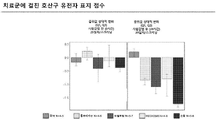
도 14는 치료군에 걸친 호산구 유전자 표지 점수를 나타낸다. 군에는 위약, 플루티카손, 두필루맙, REGN3500, 및 두필루맙과 REGN3500의 병용 요법이 포함된다. 기관지 알레르겐 시험감염 전후의 결과가 제시되어 있다. 이들 결과는 두필루맙과 REGN3500 둘 다 기관지 알레르겐 시험감염 후 호산구 유전자 표지 점수를 감소시킬 수 있었음을 보여준다. 두필루맙과 REGN3500의 병용 치료는 기관지 알레르겐 시험감염 후 호산구 유전자 표지 점수를 감소시키는 데 가장 효과적인 치료였다.
도 15는 치료군에 걸친 제2형 표지 점수를 나타낸다. 군에는 위약, 플루티카손, 두필루맙, REGN3500, 및 두필루맙과 REGN3500의 병용 요법이 포함된다. 기관지 알레르겐 시험감염 전후의 결과가 제시되어 있다. 이들 결과는 플루티카손 치료군보다 REGN3500 치료군에서 제2형 표지 점수의 더 낮은 감소를 보여준다.
도 16은 (8시간 및/또는 24시간째) REGN3500에 영향을 받는 알레르기성 천식 표지 유전자를 나타낸다. 기관지 알레르겐 시험감염 후 발생한, 스크리닝시 및 치료시 결과가 제시되어 있다. 테스트된 유전자는 위에서 아래로 BC042385, AB209315, LOC100607117, BC035084, LOC145474, AX747853, TIMP1, NT5DC2, LOC541471, AREG, PTPN7, RUNDC3, XXYLT1, FAM159A, PTGDS, TESC, ITGB2-AS1, D0574721, CLDN9, LOC100132052, AGAP7, NBEAL2, NTNG2, FLJ45445, KCNH3, POU51P3, OUG1, KIF21B, HSPA7, GAPT, BX6485Q2, PRR52, P1K3R6, LTC4S, CLEC11A, TRABD2A, DLGAP3, VDR, DKFZp686M11215, SIGLEC12, BC016361, BC052769, 및 RHOH를 포함했다.
도 17은 24시간째 기관지 알레르겐 시험감염에 의해 유도되고 REGN3500에 의해 억제된 상위 알레르기성 천식 표지 유전자를 나타낸다. 기관지 알레르겐 시험감염 후 발생한, 스크리닝시 및 치료시 결과가 제시되어 있다. 표시된 유전자는 위에서 아래로 ASAP1-IT1, AX747757, BC042385, PABPC1P2, AB209315, AX748268, TCEAL5, CCL17, CCL13, CCL26, CLC, CACNG8, GPR82, GATA1, PRSS33, FFAR3, LGALS12, ASB2, PTGDR2, SIGLEC8, IL13, IL5, PTGDS, 및 RD3를 포함한다.These and other features and advantages of the present invention will be more fully understood from the following detailed description of exemplary embodiments taken in conjunction with the accompanying drawings. This patent file contains at least one drawing/photo written in color. Copies of this patent with color drawing(s)/photograph(s) will be provided by the Patent Office upon request at the required fee.
1 shows a schematic of an 8-week study designed to evaluate the effect of treatment on bronchial allergen challenge (BAC)-induced airway inflammation. Flowchart shows cases of induced sputum collection at screening (before treatment) and at 4 and 8 weeks after initiation of treatment, at baseline (just before BAC) and after BAC (8 hours and 24 hours after BAC). BAC-induced changes in inflammatory markers in sputum were assessed by comparing the markers in sputum after baseline and BAC at screening (screening changes), at 4 weeks (
2 shows a schematic for
3 shows a schematic for
Figure 4 shows a schematic of the mechanism of action of IL-33 as an initiator and enhancer of innate immunity and adaptive immunity. As shown in Figure 4 , IL-33 is released after tissue injury.
5 presents data showing that treatment with anti-IL-33 reduces inflammation in a chronic house dust mite (HDM) model of lung inflammation. This figure shows that treatment with anti-IL-33 inhibits pro-inflammatory cytokines and chemokines. Data showing the levels of pulmonary eosinophils and pulmonary neutrophils in HDM models with and without anti-IL-33 treatment are presented. A heatmap of a panel of lung cytokine genes showing levels of hIL-4, IL-5, IL-1b, TNFα, IFNg, GROa, and MCP-1 is shown. Alveolar SMA test data are also presented.
6 shows a schematic of the mechanism of action of anti-IL33 in reducing
7 shows a schematic of the study of Example 1 described herein. This figure shows the stages of bronchial allergen challenge in patients with mild asthma. The subject is treated with placebo, placebo and REGN3500, dupilumab and placebo, or dupilumab and REGN3500. The effectiveness of each treatment was determined by RNA sequencing of cells in sputum after sputum excretion in hypertonic saline inhalation patients.
8 shows the expression of various marker genes associated with
9 shows the
10 shows eosinophil gene markers used to evaluate the therapeutic effect on sputum eosinophil counts. The set of 10 genes showed a high correlation with the number of eosinophils in sputum both before and after allergen challenge. This gene set includes ADARB1, ASB2, CLC, GLOD5, HDC, IL1RL1, PTPN7, SIGLEC8, SYNE1, and VSTM1. mRNA labeling improved the statistical performance of detecting the therapeutic effect size (fluticasone) across % eosinophils in sputum. The genes were not limited to eosinophils such as SIGLEC8 (expressed in eosinophils, basophils, and mast cells), HDC (expressed in mast cells), and VSTM1 (expressed in bone marrow cells).
11 shows the effect of REGN3500 on eosinophil marker genes in sputum, showing inhibition of eosinophil marker genes. 11 also shows that REGN3500 did not affect neutrophil marker genes. Data are shown for the ADARB1, ASB2, CLC, HDC, IL1RL1, PTPN7, SIGLEC8, SYNE1, and VSTM1 genes.
12 shows the effect of REGN3500 on the
13A and 13B show data showing the mechanism of action of increased IL-33 levels in inducing a self-persistent amplification loop that stimulates tissue deterioration. 13A and 13B include data obtained from the HDM model. Increased IL-33 levels induced a self-permanent amplification loop that stimulated tissue deterioration.
14 shows eosinophil gene marker scores across treatment groups. Groups include placebo, fluticasone, dupilumab, REGN3500, and dupilumab plus REGN3500. Results before and after bronchial allergen challenge are presented. These results show that both dupilumab and REGN3500 were able to reduce the eosinophil gene marker score after bronchial allergen challenge. Combination treatment with dupilumab and REGN3500 was the most effective treatment for reducing eosinophil gene marker scores after bronchial allergen challenge.
15 shows
Figure 16 shows the allergic asthma marker genes affected by REGN3500 (8 hours and/or 24 hours). Results after bronchial allergen challenge, at screening and at treatment, are presented. The genes tested were from top to bottom BC042385, AB209315, LOC100607117, BC035084, LOC145474, AX747853, TIMP1, NT5DC2, LOC541471, AREG, PTPN7, RUNDC3, XXYLT1, FAM159A, PTGDS, TESC, ITGB2-AS1, DOCAP10013, CLDN974721, CLDN974721 , NBEAL2, NTNG2, FLJ45445, KCNH3, POU51P3, OUG1, KIF21B, HSPA7, GAPT, BX6485Q2, PRR52, P1K3R6, LTC4S, CLEC11A, GLEC11A, GLECBD2A, DLGAP3, VDR, DKFZRH0528669, DKFZRH0528669M, and DKFZRH05286M.
17 shows the top allergic asthma marker genes induced by bronchial allergen challenge at 24 hours and suppressed by REGN3500. Results after bronchial allergen challenge, at screening and at treatment, are presented. Genes shown are from top to bottom: ASAP1-IT1, AX747757, BC042385, PABPC1P2, AB209315, AX748268, TCEAL5, CCL17, CCL13, CCL26, CLC, CACNG8, GPR82, GATA1, PRSS33, FFAR3, LGALS12, ASB2, PTGDR2, IL5, PTGDS, and RD3.
본 발명을 설명하기 전에, 본 발명은 설명된 특정 방법 및 실험 조건이 변할 수 있으므로 이러한 방법 및 실험 조건으로 제한되지 않는 것으로 이해되어야 한다. 또한, 본원에 사용된 용어는 단지 특정 구현예를 설명하기 위한 것이며, 첨부된 청구범위에 의해서만 본 발명의 범위가 제한될 것이기 때문에, 제한하려는 의도가 아님을 이해해야 한다.Before the present invention is described, it is to be understood that the invention is not limited to the specific methods and experimental conditions described as these may vary. It is also to be understood that the terminology used herein is for the purpose of describing particular embodiments only, and is not intended to be limiting, as the scope of the invention will be limited only by the appended claims.
달리 정의되지 않는 한, 본원에서 사용되는 모든 기술 용어 및 과학 용어는 본 발명이 속하는 분야의 당업자가 통상적으로 이해하는 것과 동일한 의미를 갖는다.Unless defined otherwise, all technical and scientific terms used herein have the same meaning as commonly understood by one of ordinary skill in the art to which this invention belongs.
본원에서 사용되는 "약"이라는 용어는 인용된 특정 수치와 관련하여 사용될 때, 해당 값이 인용된 값과 1% 이하로 다를 수 있음을 의미한다. 예를 들어, 본원에서 사용되는 표현 "약 100"은, 99와 101 및 이들 사이의 모든 값(예를 들어, 99.1, 99.2, 99.3, 99.4 등)을 포함한다.As used herein, the term “about,” when used in reference to a particular recited value, means that that value may differ from the recited value by no more than 1%. For example, the expression “about 100,” as used herein, includes 99 and 101 and all values in between (eg, 99.1, 99.2, 99.3, 99.4, etc.).
본원에서 사용되는 "치료" 등의 용어는 증상을 완화하거나, 일시적 또는 영구적으로 증상의 원인을 제거하거나, 또는 지정된 장애 또는 병태의 증상의 출현을 예방하거나 늦추는 것을 의미한다.As used herein, terms such as "treatment" mean alleviating symptoms, temporarily or permanently eliminating the cause of the symptoms, or preventing or delaying the appearance of the symptoms of a designated disorder or condition.
본원에 기재된 것과 유사하거나 동등한 임의의 방법 및 재료가 본 발명의 실시에 사용될 수 있지만, 일반적인 방법 및 재료를 이하 설명한다. 본원에 언급된 모든 간행물은 그 전체가 본원에 참조로 포함된다.Although any methods and materials similar or equivalent to those described herein can be used in the practice of the present invention, the general methods and materials are described below. All publications mentioned herein are incorporated herein by reference in their entirety.
알레르기성 천식 악화 발생률을 감소시키는 방법How to reduce the incidence of allergic asthma exacerbations
본 발명은 알레르기성 천식 악화 발생률의 감소를 필요로 하는 대상체에서 알레르기성 천식 악화 발생률을 감소시키는 방법으로서, 인터류킨-33(IL-33) 길항제를 포함하는 약학적 조성물을 투여하는 단계를 포함하는 방법을 포함한다. 또한, 알레르기성 천식 악화 발생률의 감소를 필요로 하는 대상체에서 알레르기성 천식 악화 발생률을 감소시키는 데 사용하기 위한 인터류킨-33(IL-33) 길항제가 제공된다. 본 발명은 또한 알레르기성 천식 악화 발생률의 감소를 필요로 하는 대상체에서 알레르기성 천식 악화 발생률을 감소시키는 방법으로서, 인터류킨-4 수용체(IL-4R) 길항제를 포함하는 약학적 조성물을 투여하는 단계를 포함하는 방법을 포함한다. 또한, 알레르기성 천식 악화 발생률의 감소를 필요로 하는 대상체에서 알레르기성 천식 악화 발생률을 감소시키는 데 사용하기 위한 인터류킨-4 수용체(IL-4R) 길항제가 제공된다. 본 발명에서 특징으로 하는 방법은 이를 필요로 하는 대상체에게 인터류킨-33(IL-33) 길항제를 포함하는 제1 치료 조성물, 및 인터류킨-4 수용체(IL-4R) 길항제를 포함하는 제2 치료 조성물을 투여하는 단계를 추가로 포함한다. 또한, 알레르기성 천식 악화 발생률의 감소를 필요로 하는 대상체에서 알레르기성 천식 악화 발생률을 감소시키는 데 사용하기 위한 인터류킨-33(IL-33) 길항제 및 인터류킨-4 수용체(IL-4R) 길항제가 제공된다. 특정 구현예에 따르면, IL-33 길항제는 IL-33에 특이적으로 결합하는 항체 또는 이의 항원-결합 단편이다. 본 발명에서 특징으로 하는 방법 또는 용도의 맥락에서 사용될 수 있는 예시적인 항-IL-33 항체는 본원에 기재되어 있다. 특정 구현예에 따르면, IL-4R 길항제는 IL-4R에 특이적으로 결합하는 항체 또는 이의 항원-결합 단편이다. 본 발명에서 특징으로 하는 방법 또는 용도의 맥락에서 사용될 수 있는 예시적인 항-IL-4R 항체는 본원에 기재되어 있다.The present invention provides a method for reducing the incidence of allergic asthma exacerbation in a subject in need thereof, comprising administering a pharmaceutical composition comprising an interleukin-33 (IL-33) antagonist. includes Also provided are interleukin-33 (IL-33) antagonists for use in reducing the incidence of allergic asthma exacerbations in a subject in need thereof. The present invention also provides a method of reducing the incidence of allergic asthma exacerbations in a subject in need thereof, comprising administering a pharmaceutical composition comprising an interleukin-4 receptor (IL-4R) antagonist. including how to Also provided are interleukin-4 receptor (IL-4R) antagonists for use in reducing the incidence of allergic asthma exacerbations in a subject in need thereof. The methods featured in the invention administer to a subject in need thereof a first therapeutic composition comprising an interleukin-33 (IL-33) antagonist and a second therapeutic composition comprising an interleukin-4 receptor (IL-4R) antagonist. It further comprises the step of administering. Also provided are interleukin-33 (IL-33) antagonists and interleukin-4 receptor (IL-4R) antagonists for use in reducing the incidence of allergic asthma exacerbations in a subject in need thereof. . According to certain embodiments, the IL-33 antagonist is an antibody or antigen-binding fragment thereof that specifically binds to IL-33. Exemplary anti-IL-33 antibodies that can be used in the context of a method or use featured in the invention are described herein. According to certain embodiments, the IL-4R antagonist is an antibody or antigen-binding fragment thereof that specifically binds to IL-4R. Exemplary anti-IL-4R antibodies that can be used in the context of a method or use featured in the invention are described herein.
본원에서 사용되는 표현 "천식 악화"는 천식의 하나 이상의 증상 또는 징후의 중증도 및/또는 빈도 및/또는 지속기간의 증가를 의미한다. 또한, "천식 악화"는 천식에 대한 치료적 개입(예를 들어, 스테로이드 치료, 흡입 코르티코스테로이드 치료, 입원 등)을 필요로 하고/하거나 그에 의해 치료 가능한 대상체의 호흡기 건강의 임의의 악화를 포함한다. 2가지 유형의 천식 악화 사례, 즉 천식 조절 실패(LOAC) 사례 및 중증 악화 사례가 존재한다.As used herein, the expression “asthma exacerbation” means an increase in the severity and/or frequency and/or duration of one or more symptoms or signs of asthma. In addition, "asthma exacerbation" includes any deterioration in respiratory health of a subject requiring and/or treatable by therapeutic intervention for asthma (eg, steroid treatment, inhaled corticosteroid treatment, hospitalization, etc.) . There are two types of asthma exacerbation cases: asthma control failure (LOAC) cases and severe exacerbation cases.
특정 구현예에 따르면, 천식 조절 실패(LOAC) 사례는 다음 중 하나 이상으로 정의된다: (a) 2일 연속 오전 PEF에서 기준선으로부터 30% 이상 감소; (b) 2일 연속 (기준선과 비교하여) 24시간 동안 살부타몰/알부테롤 또는 레보살부타몰/레발부테롤의 추가 완화제 퍼프 6회 이상; (c) 마지막으로 처방된 ICS 용량의 4배 이상 ICS 증가(또는 백그라운드 치료법 중단이 완료된 경우 V2에서 처방된 ICS 용량의 50% 이상); (d) 전신(경구 및/또는 비경구) 스테로이드 치료의 사용; 또는 (e) 천식으로 인한 입원 또는 응급실 방문.According to certain embodiments, an asthma control failure (LOAC) event is defined as one or more of the following: (a) a 30% or greater decrease from baseline in morning PEF on 2 consecutive days; (b) at least 6 additional emollient puffs of salbutamol/albuterol or levosalbutamol/levalbuterol for 24 hours (relative to baseline) on 2 consecutive days; (c) an ICS increase of at least 4 times the last prescribed ICS dose (or at least 50% of the ICS dose prescribed in V2 if background therapy discontinuation is complete); (d) the use of systemic (oral and/or parenteral) steroid therapy; or (e) hospitalization or emergency room visits for asthma.
특정 예에서, 천식 악화는 "중증 천식 악화 사례"로 분류될 수 있다. 중증 천식 악화 사례는 사건 이전에 복용한 용량의 4배 이상의 전신 코르티코스테로이드 또는 흡입 코르티코스테로이드 중 어느 하나를 사용한 치료 형태의 즉각적인 개입을 필요로 하는 사건을 의미한다. 특정 구현예에 따르면, 중증 천식 악화 사례는 3일 이상 동안 전신 코르티코스테로이드의 사용; 또는 전신 코르티코스테로이드가 필요한 천식으로 인한 입원 또는 응급실 방문을 필요로 하는 천식 악화로 정의된다. 따라서, 일반적인 표현 "천식 악화"는 "중증 천식 악화"의 보다 구체적인 하위 범주를 포함하고 포괄한다. 따라서, 중증 천식 악화 발생률의 감소를 필요로 하는 환자에서 중증 천식 악화 발생률을 감소시키는 방법이 포함된다.In certain instances, an asthma exacerbation may be classified as a "severe asthma exacerbation event." A severe asthma exacerbation event is an event requiring immediate intervention in the form of treatment with either systemic corticosteroids or inhaled corticosteroids at 4 times the dose taken prior to the event. According to certain embodiments, severe asthma exacerbations include use of systemic corticosteroids for at least 3 days; or asthma exacerbations requiring hospitalization or emergency room visits for asthma requiring systemic corticosteroids. Thus, the generic expression “asthma exacerbation” encompasses and encompasses the more specific subcategory of “severe asthma exacerbation”. Accordingly, methods for reducing the incidence of severe asthma exacerbations in a patient in need thereof are included.
천식 악화 "발생률의 감소"는 IL-4R 길항제를 포함하는 약학적 조성물을 제공받은 대상체가 치료 전보다 치료 후에 더 적은 알레르기성 천식 악화(즉, 적어도 1회의 더 적은 천식 악화)를 경험하거나, 또는 약학적 조성물을 사용한 치료의 개시 후 적어도 4주(예를 들어, 4, 6, 8, 12, 14주 이상) 동안 알레르기성 천식 악화를 경험하지 않는 것을 의미한다. 천식 악화 "발생률의 감소"는 대안적으로, 약학적 조성물 투여 후에, 대상체가 천식 악화를 경험할 가능성이 약학적 조성물을 제공받지 않은 대상체에 비해 적어도 10%(예를 들어, 10%, 15%, 20%, 25%, 30%, 35%, 40%, 45%, 50% 이상) 감소되는 것을 의미한다.A “reduction in incidence” of asthma exacerbations means that a subject receiving a pharmaceutical composition comprising an IL-4R antagonist experiences fewer allergic asthma exacerbations (ie, at least one fewer asthma exacerbations) after treatment than before treatment, or no exacerbation of allergic asthma for at least 4 weeks (eg, 4, 6, 8, 12, 14 or more weeks) after initiation of treatment with the anti-inflammatory composition. A “reduction in incidence” of asthma exacerbations may alternatively be, after administration of the pharmaceutical composition, the likelihood that a subject will experience an exacerbation of asthma by at least 10% (e.g., 10%, 15%, 20%, 25%, 30%, 35%, 40%, 45%, 50% or more).
본 발명은 알레르기성 천식 악화 발생률의 감소를 필요로 하는 대상체에서 알레르기성 천식 악화 발생률을 감소시키는 방법으로서, IL-4R 길항제를 포함하는 약학적 조성물을 대상체에게 투여하는 단계 및 흡입 코르티코스테로이드(ICS)의 1회 이상의 유지 용량 및/또는 제2 조절제, 예를 들어 지속형 베타-작용제(LABA) 또는 류코트리엔 수용체 길항제(LTA)의 1회 이상의 유지 용량을 대상체에게 투여하는 단계를 포함하는 방법을 포함한다. 또한, 알레르기성 천식 악화 발생률의 감소를 필요로 하는 대상체에서 알레르기성 천식 악화 발생률을 감소시키기 위해, 흡입 코르티코스테로이드(ICS)의 1회 이상의 유지 용량 및/또는 제2 조절제, 예를 들어 지속형 베타-작용제(LABA) 또는 류코트리엔 수용체 길항제(LTA)의 1회 이상의 유지 용량과 조합하여 사용하기 위한 인터류킨-4 수용체(IL-4R) 길항제를 포함하는 약학적 조성물이 제공된다. 본 발명은 알레르기성 천식 악화 발생률의 감소를 필요로 하는 대상체에서 알레르기성 천식 악화 발생률을 감소시키는 방법으로서, IL-33 길항제를 포함하는 약학적 조성물을 대상체에게 투여하는 단계 및 흡입 코르티코스테로이드(ICS)의 1회 이상의 유지 용량 및/또는 제2 조절제, 예를 들어 지속형 베타-작용제(LABA) 또는 류코트리엔 수용체 길항제(LTA)의 1회 이상의 유지 용량을 대상체에게 투여하는 단계를 포함하는 방법을 포함한다. 또한, 알레르기성 천식 악화 발생률의 감소를 필요로 하는 대상체에서 알레르기성 천식 악화 발생률을 감소시키기 위해, 흡입 코르티코스테로이드(ICS)의 1회 이상의 유지 용량 및/또는 제2 조절제, 예를 들어 지속형 베타-작용제(LABA) 또는 류코트리엔 수용체 길항제(LTA)의 1회 이상의 유지 용량과 조합하여 사용하기 위한 인터류킨-33(IL-33) 길항제를 포함하는 약학적 조성물이 제공된다. 적합한 ICS는 플루티카손(예를 들어, 플루티카손 프로피오네이트, 예를 들어 FloventTM), 부데소니드, 모메타손(예를 들어, 모메타손 푸로에이트, 예를 들어 AsmanexTM), 플루니솔리드(예를 들어, AerobidTM), 덱사메타손 아세테이트/페노바르비탈/테오필린(예를 들어, AzmacortTM), 베클로메타손 디프로피오네이트 HFA(QvarTM) 등을 포함하나 이에 한정되지 않는다. 적합한 LABA는 살메테롤(예를 들어, SereventTM), 포르모테롤(예를 들어, ForadilTM) 등을 포함하나 이에 한정되지 않는다. 적합한 LTA는 몬테루카스트(예를 들어, SingulaireTM), 자피르루카스트(예를 들어, AccolateTM) 등을 포함하나 이에 한정되지 않는다.The present invention provides a method for reducing the incidence of allergic asthma exacerbation in a subject in need thereof, comprising administering to the subject a pharmaceutical composition comprising an IL-4R antagonist and an inhaled corticosteroid (ICS) administering to the subject one or more maintenance doses of and/or one or more maintenance doses of a second modulator, such as a long-acting beta-agonist (LABA) or a leukotriene receptor antagonist (LTA). . Also, to reduce the incidence of allergic asthma exacerbations in a subject in need thereof, one or more maintenance doses of an inhaled corticosteroid (ICS) and/or a second modulator, e.g., a long-acting beta Pharmaceutical compositions comprising an interleukin-4 receptor (IL-4R) antagonist for use in combination with one or more maintenance doses of an -agonist (LABA) or leukotriene receptor antagonist (LTA) are provided. The present invention provides a method for reducing the incidence of allergic asthma exacerbation in a subject in need thereof, comprising administering to the subject a pharmaceutical composition comprising an IL-33 antagonist and an inhaled corticosteroid (ICS) administering to the subject one or more maintenance doses of and/or one or more maintenance doses of a second modulator, such as a long-acting beta-agonist (LABA) or a leukotriene receptor antagonist (LTA). . Also, to reduce the incidence of allergic asthma exacerbations in a subject in need thereof, one or more maintenance doses of an inhaled corticosteroid (ICS) and/or a second modulator, e.g., a long-acting beta Provided is a pharmaceutical composition comprising an interleukin-33 (IL-33) antagonist for use in combination with one or more maintenance doses of an -agonist (LABA) or leukotriene receptor antagonist (LTA). Suitable ICS are fluticasone (eg fluticasone propionate, eg Flovent ™ ), budesonide, mometasone (eg mometasone furoate, eg Asmanex ™ ), fluni solids (eg, Aerobid ™ ), dexamethasone acetate/phenobarbital/theophylline (eg, Azmacort ™ ), beclomethasone dipropionate HFA (Qvar ™ ), and the like. Suitable LABAs include, but are not limited to, salmeterol (eg, Serevent ™ ), formoterol (eg, Foradil ™ ), and the like. Suitable LTAs include, but are not limited to, montelukast (eg, Singulaire ™ ), zafirlukast (eg, Accolate ™ ), and the like.
본 발명은 알레르기성 천식 악화 발생률의 감소를 필요로 하는 대상체에서 알레르기성 천식 악화 발생률을 감소시키는 방법으로서, IL-4R 길항제 및 IL-33 길항제 중 하나 또는 둘 다를 포함하는 약학적 조성물을 대상체에게 투여하는 단계, 및 하나 이상의 천식 관련 증상을 제거하거나 감소시키기 위한 하나 이상의 완화 약제를 대상체에게 투여하는 단계를 포함하는 방법을 포함한다. 또한, 알레르기성 천식 악화 발생률의 감소를 필요로 하는 대상체에서 알레르기성 천식 악화 발생률을 감소시키기 위해, 흡입 코르티코스테로이드(ICS)의 1회 이상의 유지 용량 및/또는 제2 조절제, 예를 들어 지속형 베타-작용제(LABA) 또는 류코트리엔 수용체 길항제(LTA)의 1회 이상의 유지 용량과 조합하여 사용하기 위한 IL-4R 길항제 및 IL-33 길항제 중 하나 또는 둘 다를 포함하는 약학적 조성물이 제공된다. 본 발명은 알레르기성 천식 악화 발생률의 감소를 필요로 하는 대상체에서 알레르기성 천식 악화 발생률을 감소시키는 방법으로서, IL-4R 길항제 및 IL-33 길항제 중 하나 또는 둘 다를 포함하는 약학적 조성물을 대상체에게 투여하는 단계, 및 하나 이상의 천식 관련 증상을 제거하거나 감소시키기 위한 하나 이상의 완화 약제를 대상체에게 투여하는 단계를 포함하는 방법을 포함한다. 또한, 알레르기성 천식 악화 발생률의 감소를 필요로 하는 대상체에서 알레르기성 천식 악화 발생률을 감소시키기 위해, 하나 이상의 천식 관련 증상을 제거하거나 감소시키는 하나 이상의 완화 약제와 조합하여 사용하기 위한 IL-4R 길항제 및 IL-33 길항제 중 하나 또는 둘 다를 포함하는 약학적 조성물이 제공된다. 적합한 완화 약제는 속효성 베타2-아드레날린성 수용체 작용제, 예를 들어 알부테롤(즉, 살부타몰, 예를 들어 ProventilTM, VentolinTM, XopenexTM 등), 피르부테롤(예를 들어, MaxairTM), 메타프로테레놀(예를 들어, AlupentTM) 등을 포함하나 이에 한정되지 않는다.The present invention provides a method of reducing the incidence of allergic asthma exacerbation in a subject in need thereof, wherein a pharmaceutical composition comprising one or both of an IL-4R antagonist and an IL-33 antagonist is administered to the subject. and administering to the subject one or more palliative agents to eliminate or reduce one or more asthma-related symptoms. Also, to reduce the incidence of allergic asthma exacerbations in a subject in need thereof, one or more maintenance doses of an inhaled corticosteroid (ICS) and/or a second modulator, e.g., a long-acting beta Pharmaceutical compositions comprising one or both of an IL-4R antagonist and an IL-33 antagonist for use in combination with one or more maintenance doses of an -agonist (LABA) or leukotriene receptor antagonist (LTA) are provided. The present invention provides a method of reducing the incidence of allergic asthma exacerbation in a subject in need thereof, wherein a pharmaceutical composition comprising one or both of an IL-4R antagonist and an IL-33 antagonist is administered to the subject. and administering to the subject one or more palliative agents to eliminate or reduce one or more asthma-related symptoms. Also, an IL-4R antagonist for use in combination with one or more palliative agents that eliminates or reduces one or more asthma-related symptoms to reduce the incidence of allergic asthma exacerbations in a subject in need thereof, and Pharmaceutical compositions comprising one or both IL-33 antagonists are provided. Suitable palliative agents include short-acting beta 2 -adrenergic receptor agonists such as albuterol (ie, salbutamol, eg Proventil ™ , Ventolin ™ , Xopenex ™ , etc.), pirbuterol (eg Maxair ™ ) , metaproterenol (eg, Alupent ™ ), and the like.
천식 관련 파라미터의 개선 방법Methods of improving asthma-related parameters
또한, 본 발명은 하나 이상의 천식 관련 파라미터의 개선을 필요로 하는 대상체에서 하나 이상의 천식 관련 파라미터를 개선하는 방법으로서, IL-33 길항제를 포함하는 약학적 조성물을 대상체에게 투여하는 단계를 포함하는 방법을 포함한다. 또한, 하나 이상의 천식 관련 파라미터의 개선을 필요로 하는 대상체에서 하나 이상의 천식 관련 파라미터를 개선하는 데 사용하기 위한 IL-33 길항제를 포함하는 약학적 조성물이 제공된다. 본 발명은 하나 이상의 천식 관련 파라미터의 개선을 필요로 하는 대상체에서 하나 이상의 천식 관련 파라미터를 개선하는 방법으로서, IL-4R 길항제를 포함하는 약학적 조성물을 대상체에게 투여하는 단계를 포함하는 방법을 추가로 포함한다. 또한, 하나 이상의 천식 관련 파라미터의 개선을 필요로 하는 대상체에서 하나 이상의 천식 관련 파라미터를 개선하는 데 사용하기 위한 IL-4R 길항제를 포함하는 약학적 조성물이 제공된다. 또한, 본 발명은 하나 이상의 천식 관련 파라미터의 개선을 필요로 하는 대상체에서 하나 이상의 천식 관련 파라미터를 개선하는 방법으로서, IL-33 길항제를 포함하는 제1 약학적 조성물 및 IL-4R 길항제를 포함하는 제2 약학적 조성물을 대상체에게 투여하는 단계를 포함하는 방법을 포함한다. 또한, 하나 이상의 천식 관련 파라미터의 개선을 필요로 하는 대상체에서 하나 이상의 천식 관련 파라미터를 개선하는 데 사용하기 위한 IL-33 길항제를 포함하는 제1 약학적 조성물 및 IL-4R 길항제를 포함하는 제2 약학적 조성물이 제공된다. (전술한 바와 같은) 천식 악화 발생률의 감소는 하나 이상의 천식 관련 파라미터의 개선과 상관관계가 있을 수 있으나, 이러한 상관관계가 모든 경우에 반드시 관찰되는 것은 아니다.The present invention also provides a method of ameliorating one or more asthma-related parameters in a subject in need thereof, comprising administering to the subject a pharmaceutical composition comprising an IL-33 antagonist. include Also provided is a pharmaceutical composition comprising an IL-33 antagonist for use in ameliorating one or more asthma-related parameters in a subject in need thereof. The present invention further provides a method of ameliorating one or more asthma-related parameters in a subject in need thereof comprising administering to the subject a pharmaceutical composition comprising an IL-4R antagonist. include Also provided is a pharmaceutical composition comprising an IL-4R antagonist for use in ameliorating one or more asthma-related parameters in a subject in need thereof. The present invention also provides a method of ameliorating one or more asthma-related parameters in a subject in need thereof, comprising a first pharmaceutical composition comprising an IL-33 antagonist and a pharmaceutical composition comprising an IL-4R antagonist. 2 comprising administering the pharmaceutical composition to the subject. Also, a first pharmaceutical composition comprising an IL-33 antagonist and a second pharmaceutical composition comprising an IL-4R antagonist for use in ameliorating one or more asthma-related parameters in a subject in need thereof. A red composition is provided. A decrease in the incidence of asthma exacerbations (as described above) may be correlated with an improvement in one or more asthma-related parameters, although this correlation is not necessarily observed in all cases.
"천식 관련 파라미터"의 예는 다음을 포함한다: (1) 1초간 강제 호기량(FEV1)의 (예를 들어, 12주차의) 기준선으로부터의 상대적 백분율 변화; (2) 25~75% 폐용적에서의 강제 호기 유량(FEF25-75)으로 측정시 (예를 들어, 12주차의) 기준선으로부터의 상대적 백분율 변화; (3) 치료 기간 동안 천식 조절 실패 사례의 연간 비율; (4) 치료 기간 동안 중증 악화 사례의 연간 비율; (5) 치료 기간 동안 천식 조절 실패 사례까지의 시간; (6) 치료 기간 동안 중증 악화 사례까지의 시간; (7) 전체 연구 기간 동안 천식 조절 실패 사례까지의 시간; (8) 전체 연구 기간 동안 중증 악화 사례까지의 시간; (9) 의료 자원 활용; (10) (예를 들어, 12주차의) i) 오전 및 오후 천식 증상 점수, ii) ACQ-5 점수, iii) AQLQ 점수, iv) 오전 및 오후 PEF, v) 증상 경감을 위한 살부타몰/알부테롤 또는 레보살부타몰/레발부테롤의 흡입 횟수/일, vi) 야간 각성의 기준선으로부터의 변화; (11) 12주차 및 24주차의 i) 22-항목 비부비동 결과 테스트(SNOT-22), ii) 병원 불안 및 우울 점수(HADS), iii) EuroQual 설문(EEQ-5D-3L 또는 EQ-5D-5L)의 기준선으로부터의 변화. "천식 관련 파라미터의 개선"은 기준선으로부터 FEV1, AM PEF, 또는 PM PEF 중 하나 이상의 증가 및/또는 기준선으로부터 1일 알부테롤/레발부테롤 사용, ACQ5 점수, 평균 야간 각성, 또는 SNOT-22 점수 중 하나 이상의 감소를 의미한다. 천식 관련 파라미터와 관련하여 본원에서 사용되는 용어 "기준선"은 IL-33 길항제를 포함하는 약학적 조성물의 투여 전 또는 투여 시점의 환자에 대한 천식 관련 파라미터의 수치, IL-4R 길항제를 포함하는 약학적 조성물의 투여 전 또는 투여 시점의 환자에 대한 천식 관련 파라미터의 수치, 또는 IL-33 길항제를 포함하는 제1 약학적 조성물 및 IL-4R 길항제를 포함하는 제2 약학적 조성물을 대상체에게 투여하기 전 또는 투여하는 시점의 환자에 대한 천식 관련 파라미터의 수치를 의미한다.Examples of “asthma related parameters” include: (1) the relative percentage change from baseline (eg, at week 12) in forced expiratory volume (FEV 1 ) in 1 second; (2) relative percentage change from baseline (eg, at week 12) as measured as forced expiratory flow rate (FEF25-75) at 25-75% lung volume; (3) the annual rate of asthma control failures during the treatment period; (4) annual rate of severe exacerbations during treatment; (5) time to event of asthma control failure during treatment period; (6) time to severe exacerbation events during the treatment period; (7) time to event of asthma control failure for the entire study period; (8) time to severe exacerbation events for the entire study period; (9) utilization of medical resources; (10) (eg, at week 12) i) AM and PM asthma symptom score, ii) ACQ-5 score, iii) AQLQ score, iv) AM and PM PEF, v) Salbutamol for symptom relief/ Number of inhalations/day of albuterol or levosalbutamol/levalbuterol, vi) change from baseline in nocturnal wakefulness; (11) i) 22-item Sinus Outcomes Test (SNOT-22) at Weeks 12 and 24, ii) Hospital Anxiety and Depression Score (HADS), iii) EuroQual Questionnaire (EEQ-5D-3L or EQ-5D- 5L) change from baseline. "Improvement in asthma related parameters" is defined as an increase in one or more of FEV 1 , AM PEF, or PM PEF from baseline and/or daily albuterol/levalbuterol use from baseline, ACQ5 score, mean nocturnal wakefulness, or SNOT-22 score reduction of one or more of The term “baseline” as used herein with respect to an asthma-related parameter refers to the level of an asthma-related parameter for a patient prior to or at the time of administration of a pharmaceutical composition comprising an IL-33 antagonist, a pharmaceutical composition comprising an IL-4R antagonist. the value of an asthma-related parameter for the patient prior to or at the time of administration of the composition, or prior to administering to the subject a first pharmaceutical composition comprising an IL-33 antagonist and a second pharmaceutical composition comprising an IL-4R antagonist; or refers to the value of an asthma-related parameter for a patient at the time of administration.
천식 관련 파라미터의 "개선" 여부를 결정하기 위해, 파라미터는 기준선에서 정량화되고 본원에 기재된 약학적 조성물의 투여 후 시점에서 정량화된다. 예를 들어, 천식 관련 파라미터는 약학적 조성물을 사용한 초기 치료 후 1일차, 2일차, 3일차, 4일차, 5일차, 6일차, 7일차, 8일차, 9일차, 10일차, 11일차, 12일차, 14일차, 또는 3주차, 4주차, 5주차, 6주차, 7주차, 8주차, 9주차, 10주차, 11주차, 12주차, 13주차, 14주차, 15주차, 16주차, 17주차, 18주차, 19주차, 20주차, 21주차, 22주차, 23주차, 24주차 이상에서 측정될 수 있다. 치료의 개시 후 특정 시점의 파라미터의 값과 기준선에서의 파라미터의 값 사이의 차이는 천식 관련 파라미터의 "개선"(예를 들어, 경우에 따라 측정 특정 파라미터에 따른 증가 또는 감소) 여부를 확인하는 데 사용된다.To determine whether an asthma-related parameter is “improved”, the parameter is quantified at baseline and at a time point following administration of the pharmaceutical composition described herein. For example, the asthma-related parameter may be 1, 2, 3, 4, 5, 6, 7, 8, 9, 10, 11, 12 after initial treatment with the pharmaceutical composition. 1st, 14th, or 3rd, 4th, 5th, 6th, 7th, 8th, 9th, 10th, 11th, 12th, 13th, 14th, 15th, 16th, 17th , 18 weeks, 19 weeks, 20 weeks, 21 weeks, 22 weeks, 23 weeks, 24 weeks or more. The difference between the value of the parameter at a specific time point after initiation of treatment and the value of the parameter at baseline is used to determine whether an asthma-related parameter is “improved” (eg, increased or decreased depending on the measurement specific parameter, as the case may be). used
"천식 관련 파라미터"는 또한 기준선 발현과 비교하여 하나 이상(예를 들어, 2, 3, 4, 5, 6, 7, 8, 9, 10, 11, 12, 13, 14, 15, 16, 17, 18, 19, 20개 이상)의 알레르기성 천식 "표지 유전자"의 변경된(즉, 증가 또는 감소된) 발현을 포함한다. 표지 유전자와 관련하여 본원에서 사용되는 용어 "기준선"은 IL-33 길항제를 포함하는 약학적 조성물의 투여 전 또는 투여 시점의 환자에 대한 하나 이상의 표지 유전자의 발현의 수치, IL-4R 길항제를 포함하는 약학적 조성물의 투여 전 또는 투여 시점의 환자에 대한 하나 이상의 표지 유전자의 발현의 수치, 또는 IL-33 길항제를 포함하는 제1 약학적 조성물 및 IL-4R 길항제를 포함하는 제2 약학적 조성물을 대상체에게 투여하기 전 또는 투여하는 시점의 환자에 대한 하나 이상의 표지 유전자의 발현의 수치를 의미한다. 특정 예시적 구현예에 따르면, 환자는 하나 이상의 표지 유전자의 증가되거나 감소된 발현에 기초하여, IL-33 길항제를 포함하는 약학적 조성물, IL-4R 길항제를 포함하는 약학적 조성물, 또는 IL-33 길항제를 포함하는 제1 약학적 조성물 및 IL-4R 길항제를 포함하는 제2 약학적 조성물을 사용한 치료를 위해 선택된다.An “asthma related parameter” may also be one or more (eg, 2, 3, 4, 5, 6, 7, 8, 9, 10, 11, 12, 13, 14, 15, 16, 17) compared to baseline expression. , 18, 19, 20 or more) of allergic asthma “marker genes”; The term "baseline," as used herein with reference to a marker gene, refers to the level of expression of one or more marker genes in a patient prior to or at the time of administration of a pharmaceutical composition comprising an IL-33 antagonist, including the IL-4R antagonist. The level of expression of one or more marker genes to the patient prior to or at the time of administration of the pharmaceutical composition, or a first pharmaceutical composition comprising an IL-33 antagonist and a second pharmaceutical composition comprising an IL-4R antagonist to the subject refers to the level of expression of one or more marker genes in a patient prior to or at the time of administration. According to certain exemplary embodiments, the patient, based on the increased or decreased expression of one or more marker genes, a pharmaceutical composition comprising an IL-33 antagonist, a pharmaceutical composition comprising an IL-4R antagonist, or IL-33 selected for treatment with a first pharmaceutical composition comprising an antagonist and a second pharmaceutical composition comprising an IL-4R antagonist.
특정 예시적 구현예에서, 하나 이상의 표지 유전자의 발현은 기준선 발현 수준에 비해 감소된다. 예를 들어, 발현은 기준선 발현 수준의 약 99%, 약 98%, 약 97%, 약 96%, 약 95%, 약 94%, 약 93%, 약 92%, 약 91%, 약 90%, 약 85%, 약 80%, 약 75%, 약 70%, 약 65%, 약 60%, 약 55%, 약 50%, 약 45%, 약 40%, 약 35%, 약 30%, 약 25%, 약 20%, 약 15%, 약 10%, 또는 약 5%, 또는 이들 수치 사이의 임의의 범위인 수준으로 감소된다.In certain exemplary embodiments, the expression of one or more marker genes is reduced relative to a baseline expression level. For example, expression can be about 99%, about 98%, about 97%, about 96%, about 95%, about 94%, about 93%, about 92%, about 91%, about 90% of a baseline expression level, About 85%, about 80%, about 75%, about 70%, about 65%, about 60%, about 55%, about 50%, about 45%, about 40%, about 35%, about 30%, about 25 %, about 20%, about 15%, about 10%, or about 5%, or any range therebetween.
특정 예시적 구현예에서, 하나 이상의 표지 유전자의 발현은 기준선 발현 수준에 비해 증가된다. 예를 들어, 발현은 기준선 발현 수준의 약 105%, 약 110%, 약 120%, 약 125%, 약 130%, 약 135%, 약 140%, 약 145%, 약 150%, 약 175%, 약 200%, 약 225%, 약 250%, 약 275%, 약 300%, 약 400%, 또는 약 500% 이상, 또는 이들 수치 사이의 임의의 범위인 수준으로 감소된다.In certain exemplary embodiments, the expression of one or more marker genes is increased relative to a baseline expression level. For example, expression can be about 105%, about 110%, about 120%, about 125%, about 130%, about 135%, about 140%, about 145%, about 150%, about 175% of a baseline expression level, about 200%, about 225%, about 250%, about 275%, about 300%, about 400%, or about 500% or more, or any range therebetween.
적합한 표지 유전자는 알레르기성 천식 표지 유전자를 포함하며, 이는 제2형 염증성 표지 유전자, 사이토카인 표지 유전자, 케모카인 표지 유전자, 호산구 표지 유전자 등을 포함하나 이에 한정되지 않는다.Suitable marker genes include allergic asthma marker genes, including, but not limited to, type 2 inflammatory marker genes, cytokine marker genes, chemokine marker genes, eosinophil marker genes, and the like.
예시적인 알레르기성 천식 표지 유전자는 도 16 및 도 17에 표시되어 있으며, BC042385, AB209315, LOC100607117, BC035084, LOC145474, AX747853, TIMP1, NT5DC2, LOC541471, AREG, PTPN7, RUNDC3, XXYLT1, FAM159A, PTGDS, TESC, ITGB2-AS1, D0574721, CLDN9, LOC100132052, AGAP7, NBEAL2, NTNG2, FLJ45445, KCNH3, POU51P3, OUG1, KIF21B, HSPA7, GAPT, BX6485Q2, PRR52, P1K3R6, LTC4S, CLEC11A, TRABD2A, DLGAP3, VDR, DKFZp686M11215, SIGLEC12, BC016361, BC052769, RHOH, ASAP1-IT1, AX747757, BC042385, PABPC1P2, AB209315, AX748268, TCEAL5, CCL17, CCL13, CCL26, CLC, CACNG8, GPR82, GATA1, PRSS33, FFAR3, LGALS12, ASB2, PTGDR2, SIGLEC8, IL13, IL5, PTGDS, 및 RD3를포함하나 이에 한정되지 않는다.Exemplary allergic asthma marker genes are shown in FIGS. 16 and 17 , BC042385, AB209315, LOC100607117, BC035084, LOC145474, AX747853, TIMP1, NT5DC2, LOC541471, AREG, PTPN7, RUNDC3, XXYLT1, FAM159A, PTGDS, TESC, PTGDS ITGB2-AS1, D0574721, CLDN9, LOC100132052, AGAP7, NBEAL2, NTNG2, FLJ45445, KCNH3, POU51P3, OUG1, KIF21B, HSPA7, GAPT, BX6485Q2, PRR52, P1K3R6, LTC4S, TRAMBD2A, PRR52, P1K3R6, LTC4S, TRAMBD12A, CLRS112, LTC4S, TRAMB6 BC016361, BC052769, RHOH, ASAP1-IT1, AX747757, BC042385, PABPC1P2, AB209315, AX748268, TCEAL5, CCL17, CCL13, CCL26, CLC, CACNG8, GPR82, GATA1, PRSS33, FFAR3, LGALS12, A IL5, PTGDS, and RD3.
예시적인 제2형 염증성 표지 유전자는 도 8 및 도 12에 표시되어 있으며, IL-4, IL-5, IL-13, IL-9, IL1RL1(IL-33 수용체), Eot-3(CCL26), TARC(CCL17), FCER2, MMP10, WNT5A, CO1B, CD1A, CCL1, CCL17, PPP1R14A, IL-9, IL-5, IL-13, FCER2, CCL26, K3AA1755, GGT5, SIGLEC8, LGALS12, GATA1, CLC, CACNG8, BC015656, AKX05132, FFAR3, CACH1, IL1RL1, HPH4, CC5AML, GATA2, TAL1, HDC, NTRX1, IL-4, IL4, IL13, CCL26, CCL13, CCL17, CCL11, POSTN, IL5, 및 IL9을 포함하나 이에 한정되지 않는다.
예시적인 사이토카인 표지 유전자 및 케모카인 표지 유전자는 도 9에 표시되어 있으며, IL-5, IL-13, TARC, 에오탁신-3, CCL1, CCL26, FCER2, SIGLEC8, 및 CCL17을 포함하나 이에 한정되지 않는다.Exemplary cytokine marker genes and chemokine marker genes are shown in FIG. 9 and include, but are not limited to, IL-5, IL-13, TARC, eotaxin-3, CCL1, CCL26, FCER2, SIGLEC8, and CCL17. .
예시적인 호산구 표지 유전자는 도 11에 표시되어 있으며, ADARB1, ASB2, CLC, HDC, IL1RL1, PTPN7, SIGLEC8, SYNE1, 및 VSTM1을 포함하나 이에 한정되지 않는다.Exemplary eosinophil marker genes are shown in FIG. 11 and include, but are not limited to, ADARB1, ASB2, CLC, HDC, IL1RL1, PTPN7, SIGLEC8, SYNE1, and VSTM1.
표지 유전자의 수준은 노던 블롯팅, 웨스턴 블롯팅, 서던 블롯팅, 면역침강법, 인시튜 혼성화, PCR(예: RT-PCR), 어레이 기술(예: 유전자 발현 계열 분석(SAGE), DNA 마이크로어레이, RNA seq, 타일링 어레이 등), 뉴클레아제 분석 등을 포함한(이에 한정되지 않음), 당업계에 알려진 임의의 적합한 수단을 사용하여 생물학적 샘플에서 검출될 수 있다.The level of the marker gene can be determined by Northern blotting, Western blotting, Southern blotting, immunoprecipitation, in situ hybridization, PCR (eg RT-PCR), array technology (eg gene expression sequencing analysis (SAGE), DNA microarray). , RNA seq, tiling arrays, etc.), nuclease assays, and the like, can be detected in a biological sample using any suitable means known in the art.
본원에서 사용되는 바와 같이, "생물학적 샘플"은 세포 배양물 또는 이의 추출물; 포유동물로부터 얻은 생검 물질 또는 이의 추출물; 및 혈액, 타액, 소변, 대변, 정액, 눈물, 또는 기타 체액 또는 이의 추출물을 포함하나 이에 한정되지 않는다. 예시적인 생물학적 샘플은 객담 및 혈액을 포함한다.As used herein, a “biological sample” includes a cell culture or extract thereof; a biopsy material obtained from a mammal or an extract thereof; and blood, saliva, urine, feces, semen, tears, or other bodily fluids or extracts thereof. Exemplary biological samples include sputum and blood.
본원에서 사용되는 용어 "획득"은 천식 관련 파라미터와 같은 물리적 실체 또는 값을 "직접 획득"하거나 "간접적으로 획득"함으로써 물리적 실체 또는 값, 예를 들어 수치를 갖게 되는 것을 의미한다. "직접 획득함"은 프로세스를 수행하여(예를 들어, 합성 또는 분석 방법을 수행하여) 물리적 실체 또는 값을 얻는 것을 의미한다. "간접적으로 획득함"은 다른 단체 또는 공급처(예를 들어, 물리적 실체 또는 값을 직접 획득한 제3의 실험실)로부터 물리적 실체 또는 값을 제공받는 것을 의미한다. 물리적 실체를 직접 획득함은 물리적 물질, 예를 들어 출발 물질의 물리적 변화를 포함하는 프로세스를 수행하는 것을 포함한다. 예시적인 변화는 둘 이상의 출발 물질로부터 물리적 실체를 제조하는 것, 물질을 전단하거나 단편화하는 것, 물질을 분리하거나 정제하는 것, 둘 이상의 개별 실체를 혼합물로 조합하는 것, 공유 또는 비공유 결합을 끊거나 형성하는 것을 포함하는 화학 반응을 수행하는 것을 포함한다. 값을 직접 획득하는 것은 샘플 또는 다른 물질의 물리적 변화를 포함하는 프로세스를 수행하는 것, 예를 들어 물질(예: 샘플, 피분석물, 또는 시약)의 물리적 변화를 포함하는 분석 프로세스(본원에서 "물리적 분석"이라고도 함)를 수행하는 것을 포함한다.As used herein, the term “acquire” means to “get directly” or “indirectly acquire” a physical entity or value, such as an asthma-related parameter, to have a physical entity or value, eg, a numerical value. "Obtain directly" means to obtain a physical entity or value by performing a process (eg, by performing a synthetic or analytical method). “Indirectly obtained” means receiving a physical entity or value from another entity or source (eg, a third-party laboratory that directly obtained the physical entity or value). Directly acquiring a physical entity includes performing a process comprising a physical change of a physical substance, eg, a starting material. Exemplary changes include preparing a physical entity from two or more starting materials, shearing or fragmenting the material, isolating or purifying the material, combining two or more individual entities into a mixture, breaking covalent or non-covalent bonds, or performing a chemical reaction comprising forming. Directly obtaining a value includes performing a process that includes a physical change in a sample or other substance, e.g., an analytical process that involves a physical change in a substance (eg, a sample, analyte, or reagent) (herein " Also referred to as "physical analysis").
간접적으로 획득되는 정보는 예를 들어 문서 또는 온라인 데이터베이스나 애플리케이션("앱")에서와 같이 전자 형식으로 공급되는 보고서 형식으로 제공될 수 있다. 보고서 또는 정보는 예를 들어 병원이나 진료소와 같은 의료 기관; 또는 의사나 간호사와 같은 의료인에 의해 제공될 수 있다.Information obtained indirectly may be provided in the form of a report, for example supplied in an electronic format, such as in a document or in an online database or application ("App"). Reports or information may be sent to, for example, medical institutions such as hospitals or clinics; Alternatively, it may be provided by a health care provider such as a doctor or nurse.
1초간 강제 호기량(FEVForced expiratory volume in 1 second (FEV) 1One ))
특정 구현예에 따르면, IL-4R 길항제를 환자에게 투여하거나 사용하면 1초간 강제 호기량(FEV1)이 기준선으로부터 증가된다. 일부 구현예에서, IL-33 길항제를 환자에게 투여하거나 사용하면 1초간 강제 호기량(FEV1)이 기준선으로부터 증가된다. 다른 구현예에서, IL-4R 길항제를 IL-33(IL-33) 길항제와 조합하여 환자에게 투여하거나 사용하면 1초간 강제 호기량(FEV1)이 기준선으로부터 증가된다. FEV1을 측정하는 방법은 당업계에 알려져 있다. 예를 들어, 2005 미국 흉부 학회(American Thoracic Society, ATS)/유럽 호흡기 학회(European Respiratory Society, ERS) 권장사항을 충족하는 폐활량계(spirometer)를 사용하여 환자의 FEV1을 측정할 수 있다. 폐활량 측정의 ATS/ERS 표준화를 지침으로 사용할 수 있다. 폐활량 측정은 일반적으로 적어도 6시간 동안 알부테롤을 중단한 후 오전 6시에서 10시 사이에 수행된다. 폐기능 검사는 일반적으로 앉은 자세에서 측정하며 FEV1에 대해 가장 높은 측정치를 기록한다(리터 단위).According to certain embodiments, administration or use of an IL-4R antagonist to a patient increases the forced expiratory volume in 1 second (FEV 1 ) from baseline. In some embodiments, administration or use of an IL-33 antagonist to the patient increases the forced expiratory volume in 1 second (FEV 1 ) from baseline. In another embodiment, administration or use of an IL-4R antagonist in combination with an IL-33 (IL-33) antagonist to a patient increases the forced expiratory volume in 1 second (FEV 1 ) from baseline. Methods for measuring FEV 1 are known in the art. For example, a patient's FEV 1 can be measured using a spirometer that meets the 2005 American Thoracic Society (ATS)/European Respiratory Society (ERS) recommendations. ATS/ERS standardization of spirometry can be used as a guideline. Spirometry is usually performed between 6:00 AM and 10:00 AM after albuterol has been discontinued for at least six hours. Pulmonary function tests are usually measured in a sitting position and record the highest reading for FEV 1 (in liters).
특정 구현예에 따르면, 항-IL-33 길항제를 포함하는 약학적 조성물, 항-IL-4R 길항제를 포함하는 약학적 조성물, 또는 IL-33 길항제 및 IL-4R 길항제를 포함하는 약학적 조성물을 사용한 치료의 개시 후 12주차에 기준선으로부터 적어도 0.05 L의 FEV1 증가를 야기하는 치료적 방법 또는 용도가 제공된다. 예를 들어, IL-33 길항제, IL-4R 길항제, 또는 IL-33 길항제 및 IL-4R 길항제의 투여는 12주차에 기준선으로부터 약 0.05 L, 0.10 L, 0.12 L, 0.14 L, 0.16 L, 0.18 L, 0.20 L, 0.22 L, 0.24 L, 0.26 L, 0.28 L, 0.30 L, 0.32 L, 0.34 L, 0.36 L, 0.38 L, 0.40 L, 0.42 L, 0.44 L, 0.46 L, 0.48 L, 0.50 L 이상의 FEV1 증가를 야기한다.According to a specific embodiment, a pharmaceutical composition comprising an anti-IL-33 antagonist, a pharmaceutical composition comprising an anti-IL-4R antagonist, or a pharmaceutical composition comprising an IL-33 antagonist and an IL-4R antagonist is used. Provided is a therapeutic method or use that results in an increase in FEV 1 from baseline of at least 0.05 L at
기관지 알레르겐 시험감염Bronchial allergen challenge
일부 구현예에 따르면, IL-33 길항제를 환자에게 투여하거나 사용하면 기관지 알레르겐 시험감염(BAC)-유도 폐 염증이 감소된다. 일부 구현예에 따르면, IL-4R 길항제를 환자에게 투여하거나 사용하면 BAC-유도 폐 염증이 감소된다. 일부 구현예에 따르면, IL-4R 길항제 및 IL-33 길항제를 환자에게 투여하거나 사용하면 BAC-유도 폐 염증이 감소된다. BAC는 천식 치료제 테스트를 위한 모델이며 30년 이상 사용되어 왔다(문헌[Diamant et al. Inhaled allergen bronchoprovocation tests. J Allergy Clin Immunol. 2013. 132:1045-1055 e1046; Fahy et al. Analysis of cellular and biochemical constituents of induced sputum after allergen challenge: a method for studying allergic airway inflammation. J Allergy Clin Immunol. 1994. 93:1031-1039; 및 Inman et al. Dose-dependent effects of inhaled mometasone furoate on airway function and inflammation after allergen inhalation challenge. Am J Respir Crit Care Med. 2001. 164:569-574]). BAC는 환자의 2상 기도 반응을 유발하는 알레르겐 흡입을 수반하며, 이는 FEV1의 초기(알레르겐 시험감염 30분 내지 2시간 후) 및 후기(알레르겐 시험감염 약 3 내지 8시간 후) 감소를 특징으로 한다. 이 모델은 기관지폐포 세척, 기관지 생검, 또는 유도된 객담에서의 세포 함량, 사이토카인 생성, 및 mRNA 염증성 표지의 변화 측정을 통해 알레르기성 염증 반응의 평가를 용이하게 한다.According to some embodiments, administration or use of an IL-33 antagonist to the patient reduces bronchial allergen challenge (BAC)-induced lung inflammation. According to some embodiments, administration or use of an IL-4R antagonist to the patient reduces BAC-induced pulmonary inflammation. According to some embodiments, administration or use of an IL-4R antagonist and an IL-33 antagonist to a patient reduces BAC-induced lung inflammation. BAC is a model for testing asthma therapeutics and has been used for over 30 years (Diamant et al. Inhaled allergen bronchoprovocation tests. J Allergy Clin Immunol. 2013. 132:1045-1055 e1046; Fahy et al . Analysis of cellular and biochemical The constituents of induced sputum after allergen challenge: a method for studying allergic airway inflammation. J Allergy Clin Immunol. 1994. 93:1031-1039; and Inman et al . Dose-dependent effects of inhaled mometasone furoate on airway function and inflammation after allergen inhalation challenge. Am J Respir Crit Care Med. 2001. 164:569-574]). BAC involves inhalation of allergens that provoke a phase II airway response in patients, characterized by early (30 minutes to 2 hours post allergen challenge) and late (approximately 3 to 8 hours post allergen challenge) reductions in FEV1. . This model facilitates assessment of allergic inflammatory responses through measurements of changes in cellular content, cytokine production, and mRNA inflammatory markers in bronchoalveolar lavage, bronchial biopsy, or induced sputum.
객담내 mRNA 측정Measurement of mRNA in sputum
유도된 객담 샘플은 기도 염증 평가를 위해 천식의 임상 연구에서 사용된다. 천식 환자의 객담을 정상 대조군의 객담과 비교한 연구에서 단백질 및/또는 RNA를 사용하여 IL-33 및 ST2(문헌[Hamzaoui et al. Induced sputum levels of IL-33 and soluble ST2 in young asthmatic children (J Asthma. 2013. 50:803-809) 및 Salter et al. IL-25 and IL-33 induce Type 2 inflammation in basophils from subjects with allergic asthma. Respir Res. 2016. 17:5]), 에오탁신, TARC(문헌[Heijink et al. Effect of ciclesonide treatment on allergen-induced changes in T cell regulation in asthma. Int Arch Allergy Immunol. 2008. 145:111-121 및 Sekiya et al. Increased levels of a TH2-type CC chemokine thymus and activation-regulated chemokine (TARC) in serum and induced sputum of asthmatics. Allergy. 2002. 57:173-177]), 및 IL-5와 IL-13 둘 다(문헌[Park et al. Interleukin-13 and interleukin-5 in induced sputum of eosinophilic bronchitis: comparison with asthma. Chest. 2005. 128:1921-1927 및 Peters, M.C., Z.K. Mekonnen, S. Yuan, N.R. Bhakta, P.G. Woodruff, and J.V. Fahy. Measures of gene expression in sputum cells can identify TH2-high and TH2-low subtypes of asthma. J Allergy Clin Immunol. 2014. 133:388-394])의 농도가 증가한 것으로 나타났다. IL-4, IL-5, 및 IL-13과 같은 객담내 사이토카인이 증가하고 천식 증상 및 중증도의 존재와 관련이 있다(문헌[Truyen et al. Evaluation of airway inflammation by quantitative Th1/Th2 cytokine mRNA measurement in sputum of asthma patients. Thorax. 2006. 61:202-208]). 이전 연구에서 경증 천식 환자의 BAC는 IL-13 및 IL-5와 같은 제2형 사이토카인 수치를 폐에서 약 10배만큼 급격히 증가시켰다. 흡입 코르티코스테로이드를 사용한 치료는 BAC 매개 제2형 사이토카인의 단백질 및 mRNA 수치의 BAC-매개 상향조절을 상당히 억제했다(문헌[Zuiker et al. Kinetics of TH2 biomarkers in sputum of asthmatics following inhaled allergen. Eur Clin Respir J. 2015. 2 및 Zuiker et al. Sputum RNA signature in allergic asthmatics following allergen bronchoprovocation test. Eur Clin Respir J. 2016. 3:31324]).Derived sputum samples are used in clinical studies of asthma for the assessment of airway inflammation. In a study comparing sputum from asthmatic patients with sputum from normal controls, protein and/or RNA were used to determine IL-33 and ST2 (Hamzaoui et al . Induced sputum levels of IL-33 and soluble ST2 in young asthmatic children (J Asthma. 2013. 50:803-809) and Salter et al . IL-25 and IL-33 induce
일부 구현예에 따르면, IL-4R 길항제를 환자에게 투여하거나 사용하면 제2형 사이토카인의 단백질 및/또는 mRNA 수치의 BAC-유도 상향조절이 억제된다. 일부 구현예에 따르면, IL-33 길항제를 환자에게 투여하거나 사용하면 제2형 사이토카인의 단백질 및/또는 mRNA 수치의 BAC-유도 상향조절이 억제된다. 일부 구현예에 따르면, IL-4R 길항제 및 IL-33 길항제를 환자에게 투여하거나 사용하면 제2형 사이토카인의 단백질 및/또는 mRNA 수치의 BAC-유도 상향조절이 억제된다. 일부 구현예에 따르면, IL-4R 길항제를 환자에게 투여하거나 사용하면 CCL26, CCL17, SIGLEC8, IL-33, ST2, 에오탁신, TARC, IL-4, IL-5, IL-13, ASAP1-IT1, AX747757, BC042385, PABPC1P2, AB209315, AX748268, TCEAL5, CCL13, CLC, CACNG8, GPR82, GATA1, PRSS33, FFAR3, LGALS12, ASB2, PTGDR2, PTGDS, 또는 RD3 중 어느 하나의 단백질 및/또는 mRNA 수치의 BAC-유도 상향조절이 억제된다. 일부 구현예에 따르면, IL-33 길항제를 환자에게 투여하거나 사용하면 CCL26, CCL17, SIGLEC8, IL-33, ST2, 에오탁신, TARC, IL-4, IL-5, IL-13, ASAP1-IT1, AX747757, BC042385, PABPC1P2, AB209315, AX748268, TCEAL5, CCL13, CLC, CACNG8, GPR82, GATA1, PRSS33, FFAR3, LGALS12, ASB2, PTGDR2, PTGDS, 또는 RD3 중 어느 하나의 단백질 및/또는 mRNA 수치의 BAC-유도 상향조절이 억제된다. 일부 구현예에 따르면, IL-4R 길항제 및 IL-33 길항제를 환자에게 투여하거나 사용하면 CCL26, CCL17, SIGLEC8, IL-33, ST2, 에오탁신, TARC, IL-4, IL-5, IL-13, ASAP1-IT1, AX747757, BC042385, PABPC1P2, AB209315, AX748268, TCEAL5, CCL13, CLC, CACNG8, GPR82, GATA1, PRSS33, FFAR3, LGALS12, ASB2, PTGDR2, PTGDS, 또는 RD3 중 어느 하나의 단백질 및/또는 mRNA 수치의 BAC-유도 상향조절이 억제된다.According to some embodiments, administration or use of an IL-4R antagonist to the patient inhibits BAC-induced upregulation of protein and/or mRNA levels of
객담내 사이토카인 및 케모카인Cytokines and chemokines in sputum
일부 구현예에 따르면, IL-4R 길항제를 환자에게 투여하거나 사용하면 IL-13, IL-5, 종양 괴사 인자-알파(TNFα), TARC, 폐 및 활성화 관련 케모카인(PARC), CCL1, CCL26, FCER2, SIGLEC8, CCL17, 및 에오탁신-3를 포함하여, IL-33 경로 및 IL4R 경로 둘 다와 관련된 사이토카인 및 케모카인의 BAC-유도 증가가 억제된다. 일부 구현예에 따르면, IL-33 길항제를 환자에게 투여하거나 사용하면 IL-13, IL-5, 종양 괴사 인자-알파(TNFα), TARC, 폐 및 활성화 관련 케모카인(PARC), CCL1, CCL26, FCER2, SIGLEC8, CCL17, 및 에오탁신-3를 포함하여, IL-33 경로 및 IL4R 경로 둘 다와 관련된 사이토카인 및 케모카인의 BAC-유도 증가가 억제된다. 일부 구현예에 따르면, IL-4R 길항제 및 IL-33 길항제를 환자에게 투여하거나 사용하면 IL-13, IL-5, 종양 괴사 인자-알파(TNFα), TARC, 폐 및 활성화 관련 케모카인(PARC), CCL1, CCL26, FCER2, SIGLEC8, CCL17, 및 에오탁신-3를 포함하여, IL-33 경로 및 IL4R 경로 둘 다와 관련된 사이토카인 및 케모카인의 BAC-유도 증가가 억제된다. 이전 연구에서는 사이토카인 및 케모카인이 BAC 후 유도된 객담에서 측정될 수 있음을 보여주었다. IL-13, IL-5, 종양 괴사 인자-알파(TNFα), TARC, 폐 및 활성화 관련 케모카인(PARC), CCL1, CCL26, FCER2, SIGLEC8, CCL17, 및 에오탁신-3를 포함하여, IL-33 경로 및 IL4R 경로 둘 다와 관련된 사이토카인 및 케모카인은 BAC 후에 증가할 것으로 예상된다.According to some embodiments, administration or use of an IL-4R antagonist to a patient results in IL-13, IL-5, tumor necrosis factor-alpha (TNFα), TARC, lung and activation-associated chemokines (PARC), CCL1, CCL26, FCER2 BAC-induced increases in cytokines and chemokines associated with both the IL-33 pathway and the IL4R pathway are inhibited, including , SIGLEC8, CCL17, and eotaxin-3. According to some embodiments, administration or use of an IL-33 antagonist to a patient results in IL-13, IL-5, tumor necrosis factor-alpha (TNFα), TARC, lung and activation-associated chemokines (PARC), CCL1, CCL26, FCER2. BAC-induced increases in cytokines and chemokines associated with both the IL-33 pathway and the IL4R pathway are inhibited, including , SIGLEC8, CCL17, and eotaxin-3. According to some embodiments, administration or use of an IL-4R antagonist and an IL-33 antagonist to a patient results in IL-13, IL-5, tumor necrosis factor-alpha (TNFα), TARC, lung and activation-associated chemokines (PARC), BAC-induced increases in cytokines and chemokines associated with both the IL-33 pathway and the IL4R pathway are inhibited, including CCL1, CCL26, FCER2, SIGLEC8, CCL17, and eotaxin-3. Previous studies have shown that cytokines and chemokines can be measured in sputum induced after BAC. IL-33, including IL-13, IL-5, tumor necrosis factor-alpha (TNFα), TARC, lung and activation-associated chemokines (PARC), CCL1, CCL26, FCER2, SIGLEC8, CCL17, and eotaxin-3 Cytokines and chemokines involved in both the pathway and the IL4R pathway are expected to increase after BAC.
기관지 알레르겐 시험감염 후 초기 및 후기 단계에서의 FEV1 감소Reduction of FEV1 in early and late stages after bronchial allergen challenge
BAC 후 폐기능의 변화는 흡입 코르티코스테로이드의 효과를 평가하는 대부분의 알레르겐 시험감염 연구에서 표준 평가변수이다. 감작된 환자에서, 알레르겐 흡입은 노출 후 0 내지 2시간 내에 기관지수축을 특징으로 하는 급성 반응을 유발하며, 이를 초기 알레르겐 반응(EAR)이라고 한다. 이러한 EAR은 주로 미리 형성된 비만세포 매개체의 방출을 나타내는 것으로 생각되며 일반적으로 스테로이드에 반응하지 않는다. 초기 알레르겐 반응에 이어 노출 약 3 내지 8시간 후에 후기 알레르겐 반응(LAR)이 발생하는 경우가 많다. 이러한 LAR은 성인 천식 환자의 50% 내지 60%에서 관찰된다. LAR은 염증 세포의 초기 유입과 일치하며 일반적으로 스테로이드에 반응한다. 일부 구현예에 따르면, IL-4R 길항제를 환자에게 투여하거나 사용하면, 예를 들어 FEV1으로 측정시, BAC-유도 EAR 또는 LAR이 약화된다. 일부 구현예에 따르면, IL-33 길항제를 환자에게 투여하거나 사용하면, 예를 들어 FEV1으로 측정시, BAC-유도 EAR 또는 LAR이 약화된다. 일부 구현예에 따르면, IL-4R 길항제 및 IL-33 길항제를 환자에게 투여하거나 사용하면, 예를 들어 FEV1으로 측정시, BAC-유도 EAR 또는 LAR이 약화된다.Changes in lung function after BAC are standard endpoints in most allergen challenge studies evaluating the effectiveness of inhaled corticosteroids. In sensitized patients, inhalation of allergens elicits an acute reaction characterized by bronchoconstriction within 0 to 2 hours after exposure, called the early allergen response (EAR). These EARs are thought to primarily represent the release of preformed mast cell mediators and are generally not responsive to steroids. An early allergen response is often followed by a late allergen response (LAR) about 3 to 8 hours after exposure. Such LARs are observed in 50% to 60% of adult asthmatics. LAR coincides with the initial influx of inflammatory cells and is usually responsive to steroids. According to some embodiments, administration or use of an IL-4R antagonist to a patient attenuates the BAC-induced EAR or LAR, eg, as measured by FEV1. According to some embodiments, administration or use of an IL-33 antagonist to a patient attenuates the BAC-induced EAR or LAR, eg, as measured by FEV1. According to some embodiments, administration or use of an IL-4R antagonist and an IL-33 antagonist to a patient attenuates the BAC-induced EAR or LAR, eg, as measured by FEV1.
호기 산화질소 분율 측정Determination of the fraction of exhaled nitric oxide
BAC에서, 객담내 호산구는 후기 반응을 보이는 천식 환자에서 증가하는 것으로 나타났다. 객담내 호산구와 FeNO의 연관성이 보고된 바 있지만, FeNO는 호산구-특이적 마커가 아니며 비호산구 염증에 존재할 수 있다(문헌[Haldar et al. Mepolizumab and exacerbations of refractory eosinophilic asthma. N Engl J Med. 2009. 360:973-984]). 또한, 기관지 조직의 mRNA 수치는 FeNO 측정과 상관관계가 있다(문헌[Porsbjerg et al. IL-33 is related to innate immune activation and sensitization to HDM in mild steroid-free asthma. Clin Exp Allergy. 2016. 46:564-574]).In BAC, sputum eosinophils were found to be increased in asthma patients with late response. Although an association between sputum eosinophils and FeNO has been reported, FeNO is not an eosinophil-specific marker and may be present in non-eosinophilic inflammation (Haldar et al . Mepolizumab and exacerbations of refractory eosinophilic asthma. N Engl J Med. 2009 360:973-984]). In addition, mRNA levels in bronchial tissues correlate with FeNO measurements (Porsbjerg et al . IL-33 is related to innate immune activation and sensitization to HDM in mild steroid-free asthma. Clin Exp Allergy. 2016. 46: 564-574]).
혈청 바이오마커serum biomarkers
sST2, IL-33, 칼시토닌, 및 매트릭스 메탈로프로테이나제-12(MMP12)의 혈청 수치는 BAC 후 증가할 수 있다. 특정 구현예에 따르면, IL-4R 길항제를 환자에게 투여하거나 사용하면, BAC 후에 일반적으로 나타나는 sST2, IL-33, 칼시토닌, 및 매트릭스 메탈로프로테이나제-12(MMP12)의 혈청 수치 증가가 감소된다. 특정 구현예에 따르면, IL-33 길항제를 환자에게 투여하거나 사용하면, BAC 후에 일반적으로 나타나는 sST2, IL-33, 칼시토닌, 및 매트릭스 메탈로프로테이나제-12(MMP12)의 혈청 수치 증가가 감소된다. 특정 구현예에 따르면, IL-4R 길항제 및 IL-33 길항제를 환자에게 투여하거나 사용하면, BAC 후에 일반적으로 나타나는 sST2, IL-33, 칼시토닌, 및 매트릭스 메탈로프로테이나제-12(MMP12)의 혈청 수치 증가가 감소된다.Serum levels of sST2, IL-33, calcitonin, and matrix metalloproteinase-12 (MMP12) may increase after BAC. According to certain embodiments, administration or use of an IL-4R antagonist to a patient reduces the increase in serum levels of sST2, IL-33, calcitonin, and matrix metalloproteinase-12 (MMP12) commonly seen after BAC. . According to certain embodiments, administration or use of an IL-33 antagonist to a patient reduces the increase in serum levels of sST2, IL-33, calcitonin, and matrix metalloproteinase-12 (MMP12) commonly seen after BAC. . According to certain embodiments, administration or use of an IL-4R antagonist and an IL-33 antagonist to a patient results in serum levels of sST2, IL-33, calcitonin, and matrix metalloproteinase-12 (MMP12) commonly seen after BAC. Numerical increments are reduced.
FEF25-75%FEF25-75%
특정 구현예에 따르면, IL-33 길항제, IL-4R 길항제, 또는 IL-33 길항제 및 IL-4R 길항제를 환자에게 투여하거나 사용하면 FEF25-75%가 기준선으로부터 증가된다. FEF 측정 방법은 당업계에 알려져 있다. 예를 들어, 2005 미국 흉부 학회(American Thoracic Society, ATS)/유럽 호흡기 학회(European Respiratory Society, ERS) 권장사항을 충족하는 폐활량계(spirometer)를 사용하여 환자의 FEV1을 측정할 수 있다. FEF25-75(25% 내지 75%의 강제 호기 유량)는 사람이 최대 호기(즉, 강제 폐활량 또는 FVC) 중에 공기의 절반을 비울 수 있는 속도(초당 리터 단위)이다. 이 파라미터는 FVC의 25%가 호기된 시점으로부터 FVC의 75%가 호기된 시점까지의 평균 유량과 관련된다. 대상체의 FEF25-75%는 소기도 질환 및/또는 염증의 정도와 같은 소기도 기능에 관한 정보를 제공한다. FEF25-75의 변화는 폐쇄성 폐질환의 초기 지표이다. 특정 구현예에서, FEF25-75% 파라미터의 개선 및/또는 증가는 기준선과 비교하여 적어도 10%, 25%, 50% 이상의 개선이다. 특정 구현예에서, 본 발명의 방법은 대상체에서 정상적인 FEF25-75% 값(예를 들어, 평균의 50~60% 내지 최대 130% 범위의 값)을 야기한다.According to certain embodiments, administration or use of an IL-33 antagonist, an IL-4R antagonist, or an IL-33 antagonist and an IL-4R antagonist to a patient increases FEF25-75% from baseline. Methods for measuring FEF are known in the art. For example, a patient's FEV 1 can be measured using a spirometer that meets the 2005 American Thoracic Society (ATS)/European Respiratory Society (ERS) recommendations. FEF25-75 (forced expiratory flow rate of 25% to 75%) is the rate (in liters per second) at which a person can empty half of the air during maximum expiration (ie forced vital capacity or FVC). This parameter relates to the average flow rate from when 25% of the FVC is exhaled to when 75% of the FVC is exhaled. FEF25-75% of subjects provide information regarding small airway function, such as extent of small airway disease and/or inflammation. Changes in FEF25-75 are an early indicator of obstructive pulmonary disease. In certain embodiments, the improvement and/or increase in the FEF25-75% parameter is an improvement of at least 10%, 25%, 50% or more compared to baseline. In certain embodiments, the methods of the invention result in normal FEF25-75% values (eg, values ranging from 50-60% of the mean to up to 130%) in the subject.
오전 및 오후 최대 호기 유량(AM PEF 및 PM PEF)AM and PM peak expiratory flow (AM PEF and PM PEF)
특정 구현예에 따르면, IL-33 길항제, IL-4R 길항제, 또는 IL-33 길항제 및 IL-4R 길항제를 환자에게 투여하거나 사용하면 오전(AM) 및/또는 오후(PM) 최대 호기 유량(AM PEF 및/또는 PM PEF)이 기준선으로부터 증가된다. PEF 측정 방법은 당업계에 알려져 있다. 예를 들어, PEF를 측정하는 한 방법에 따르면, 환자에게 오전(AM) 및 오후(PM) PEF(및 1일 알부테롤 사용, 오전 및 오후 천식 증상 점수, 및 구급 약제를 필요로 하는 천식 증상으로 인한 야간 각성의 횟수)를 기록하기 위한 전자 PEF 계량기를 지급한다. 환자는 장치의 사용에 대해 교육을 받으며, 전자 PEF 계량기의 사용에 대한 설명서가 환자에게 제공된다. 또한, 전문 의료인이 환자에게 전자 PEF 계량기에 관련 변수를 기록하는 방법을 설명할 수 있다. AM PEF는 일반적으로 임의의 알부테롤을 복용하기 전에 기상 후 15분 내(오전 6시에서 오전 10시 사이)에 수행된다. PM PEF는 일반적으로 임의의 알부테롤을 복용하기 전에 오후(오후 6시에서 오후 10시 사이)에 수행된다. 대상체는 PEF를 측정하기 전에 적어도 6시간 동안 알부테롤을 중단해야 한다. 3회의 PEF 측정이 환자에 의해 수행되고, 3개의 값 모두 전자 PEF 계량기에 기록된다. 통상 가장 높은 값이 평가에 사용된다. 기준선 AM PEF는 IL-33 길항제, IL-4R 길항제, 또는 IL-33 길항제 및 IL-4R 길항제를 포함하는 약학적 조성물의 제1 용량 투여 전 7일 동안 기록된 평균 AM 측정으로 계산될 수 있으며, 기준선 PM PEF는 IL-33 길항제, IL-4R 길항제, 또는 IL-33 길항제 및 IL-4R 길항제를 포함하는 약학적 조성물의 제1 용량 투여 전 7일 동안 기록된 평균 PM 측정으로 계산될 수 있다.According to certain embodiments, the administration or use of an IL-33 antagonist, an IL-4R antagonist, or an IL-33 antagonist and an IL-4R antagonist to a patient results in an AM (AM) and/or PM (PM) peak expiratory flow rate (AM PEF). and/or PM PEF) is increased from baseline. Methods for measuring PEF are known in the art. For example, according to one method of measuring PEF, patients were given morning (AM) and afternoon (PM) PEF (and daily albuterol use, morning and afternoon asthma symptom scores, and asthma symptoms requiring rescue medication). An electronic PEF meter to record the number of night awakenings caused by The patient is trained in the use of the device, and instructions for use of the electronic PEF meter are provided to the patient. In addition, the healthcare professional can explain to the patient how to record the relevant parameters on an electronic PEF meter. AM PEF is usually performed within 15 minutes of waking up (between 6:00 AM and 10:00 AM) before taking any albuterol. PM PEF is usually performed in the afternoon (between 6pm and 10pm) before taking any albuterol. Subjects must discontinue albuterol for at least 6 hours prior to measuring PEF. Three PEF measurements are performed by the patient and all three values are recorded on an electronic PEF meter. Usually the highest value is used for evaluation. Baseline AM PEF can be calculated as mean AM measurements recorded for 7 days prior to administration of a first dose of an IL-33 antagonist, an IL-4R antagonist, or a pharmaceutical composition comprising an IL-33 antagonist and an IL-4R antagonist, Baseline PM PEF can be calculated as mean PM measurements recorded for 7 days prior to administration of the first dose of an IL-33 antagonist, an IL-4R antagonist, or a pharmaceutical composition comprising an IL-33 antagonist and an IL-4R antagonist.
특정 예시적 구현예에 따르면, 항-IL-33 길항제, IL-4R 길항제, 또는 IL-33 길항제 및 IL-4R 길항제를 포함하는 약학적 조성물을 사용한 치료의 개시 후 12주차에 기준선으로부터 적어도 1.0 L/분의 AM PEF 및/또는 PM PEF 증가를 야기하는 치료적 방법 또는 용도가 제공된다. 예를 들어, IL-33 길항제, IL-4R 길항제, 또는 IL-33 길항제 및 IL-4R 길항제를 이를 필요로 하는 대상체에게 투여하거나 사용하면 12주차에 기준선으로부터 약 0.5 L/분, 1.0 L/분, 1.5 L/분, 2.0 L/분, 2.5 L/분, 3.0 L/분, 3.5 L/분, 4.0 L/분, 4.5 L/분, 5.0 L/분, 5.5 L/분, 6.0 L/분, 6.5 L/분, 7.0 L/분, 7.5 L/분, 8.0 L/분, 8.5 L/분, 9.0 L/분, 9.5 L/분, 10.0 L/분, 10.5 L/분, 11.0 L/분, 12.0 L/분, 15 L/분, 20 L/분 이상의 PEF 증가를 야기한다.According to certain exemplary embodiments, at least 1.0 L from baseline at
알부테롤/레발부테롤 사용Use of albuterol/levalbuterol
특정 구현예에 따르면, IL-33 길항제, IL-4R 길항제, 또는 IL-33 길항제 및 IL-4R 길항제를 환자에게 투여하거나 사용하면 1일 알부테롤 또는 레발부테롤 사용이 기준선으로부터 감소된다. 알부테롤/레발부테롤 흡입 횟수는 환자에 의해 다이어리, PEF 계량기, 또는 기타 기록 장치에 매일 기록될 수 있다. 본원에 기재된 약학적 조성물을 사용한 치료 중에, 알부테롤/레발부테롤은 정기적 또는 예방적으로 사용되는 것이 아니라, 일반적으로 증상에 대한 필요에 근거하여 사용될 수 있다. 기준선 알부테롤/레발부테롤 흡입 횟수/일은 IL-33 길항제, IL-4R 길항제, 또는 IL-33 길항제 및 IL-4R 길항제를 포함하는 약학적 조성물의 제1 용량 투여 전 7일 동안의 평균에 기초하여 계산될 수 있다.According to certain embodiments, administration or use of an IL-33 antagonist, an IL-4R antagonist, or an IL-33 antagonist and an IL-4R antagonist to a patient reduces daily albuterol or levalbuterol use from baseline. The number of albuterol/levalbuterol inhalations can be recorded daily by the patient in a diary, PEF meter, or other recording device. During treatment with the pharmaceutical compositions described herein, albuterol/levalbuterol is not used routinely or prophylactically, but may generally be used based on the need for symptoms. Baseline number of albuterol/levalbuterol inhalations/day based on mean over 7 days prior to administration of the first dose of an IL-33 antagonist, an IL-4R antagonist, or a pharmaceutical composition comprising an IL-33 antagonist and an IL-4R antagonist can be calculated by
특정 예시적 구현예에 따르면, IL-33 길항제, IL-4R 길항제, 또는 IL-33 길항제 및 IL-4R 길항제를 포함하는 약학적 조성물을 사용한 치료의 개시 후 12주차에 기준선으로부터 적어도 0.25 퍼프/일의 알부테롤/레발부테롤 사용 감소를 야기하는 치료적 방법 또는 용도가 제공된다. 예를 들어, IL-33 길항제, IL-4R 길항제, 또는 IL-33 길항제 및 IL-4R 길항제를 이를 필요로 하는 대상체에게 투여하거나 사용하면 12주차에 기준선으로부터 약 0.25 퍼프/일, 0.50 퍼프/일, 0.75 퍼프/일, 1.00 퍼프/일, 1.25 퍼프/일, 1.5 퍼프/일, 1.75 퍼프/일, 2.00 퍼프/일, 2.25 퍼프/일, 2.5 퍼프/일, 2.75 퍼프/일, 3.00 퍼프/일 이상의 알부테롤/레발부테롤 사용 감소를 야기한다.According to certain exemplary embodiments, at least 0.25 puffs/day from baseline at
OCS 사용Using OCS
특정 구현예에 따르면, IL-33 길항제, IL-4R 길항제, 또는 IL-33 길항제 및 IL-4R 길항제를 환자에게 투여하거나 사용하면 프레드니손과 같은 OCS와 함께 사용될 수 있다. OCS 투여 횟수는 환자에 의해 다이어리, PEF 계량기, 또는 기타 기록 장치에 매일 기록될 수 있다. 본원에 기재된 약학적 조성물을 사용한 치료 중에, 일반적으로 프레드니손의 간헐적인 단기간 사용은 급성 천식 에피소드, 예를 들어 기관지확장제 및 다른 항염증제가 증상을 조절하지 못하는 에피소드를 조절하는 데 사용될 수 있다. 다른 양태에서, 프레드니손은 ICS와 동시에 또는 ICS의 대체물로 사용된다. 경구 프레드니손은 약 5 mg, 10 mg, 15 mg, 20 mg, 25 mg, 30 mg, 35 mg, 또는 40 mg의 투여량으로 투여될 수 있다. OCS는 임의로 하루에 한 번 또는 하루에 여러 번(예를 들어, 1일 2회, 1일 3회, 1일 4회 등) 투여될 수 있다.According to certain embodiments, administration or use of an IL-33 antagonist, an IL-4R antagonist, or an IL-33 antagonist and an IL-4R antagonist to a patient may be used in conjunction with an OCS such as prednisone. The number of OCS administrations may be recorded daily by the patient in a diary, PEF meter, or other recording device. During treatment with the pharmaceutical compositions described herein, intermittent, short-term use of prednisone, generally, may be used to control acute asthmatic episodes, eg, episodes in which bronchodilator and other anti-inflammatory agents fail to control symptoms. In another embodiment, prednisone is used concurrently with or as a substitute for ICS. Oral prednisone may be administered in a dosage of about 5 mg, 10 mg, 15 mg, 20 mg, 25 mg, 30 mg, 35 mg, or 40 mg. OCS may optionally be administered once per day or multiple times per day (eg, twice daily, 3 times daily, 4 times daily, etc.).
특정 예시적 구현예에서, OCS 사용에 대한 대상체의 의존성을 감소시키거나 제거하는 방법 또는 용도가 제공된다. 스테로이드 의존성의 감소 또는 제거는 매우 유리하며 바람직하다. 특정 구현예에서, 일정 시점(예를 들어, 240주차)에 IL-4R 항체 치료법, IL-33 항체 치료법, 또는 IL-4R 항체 치료법과 조합된 IL-33 항체 치료법의 투여 후 50% 이상(예를 들어, 50%, 60%, 70%, 80%, 90% 이상)의 OCS 용량 감소가 달성된다. 특정 구현예에서, OCS는 초기 용량의 투여 이후 제1 용량 후 40주, 45주, 50주, 52주 이상 후에 실질적으로 제거된다. 다른 구현예에서, OCS 사용 수준은 1일당 5 mg 미만(예를 들어, 1일당 5 mg 미만, 4 mg, 3 mg, 2 mg 이하)으로 감소된다. 다른 구현예에서, OCS 사용에 대한 의존성은 IL-33 길항제, IL-4R 길항제, 또는 IL-33 길항제 및 IL-4R 길항제를 사용한 치료 이후 3개월, 6개월, 9개월, 또는 1년 후에 실질적으로 제거된다.In certain example embodiments, a method or use of reducing or eliminating a subject's dependence on OCS use is provided. Reduction or elimination of steroid dependence is highly advantageous and desirable. In certain embodiments, at a time point (eg, Week 240), at least 50% (eg, at Week 240) after administration of an IL-4R antibody therapy, an IL-33 antibody therapy, or an IL-33 antibody therapy in combination with an IL-4R antibody therapy. For example, a reduction in OCS capacity of 50%, 60%, 70%, 80%, 90% or more) is achieved. In certain embodiments, the OCS is substantially eliminated at least 40 weeks, 45 weeks, 50 weeks, 52 weeks or more after the first dose after administration of the initial dose. In other embodiments, the OCS use level is reduced to less than 5 mg per day (eg, less than 5 mg, 4 mg, 3 mg, 2 mg or less per day). In other embodiments, the dependence on OCS use is substantially after 3 months, 6 months, 9 months, or 1 year after treatment with an IL-33 antagonist, an IL-4R antagonist, or an IL-33 antagonist and an IL-4R antagonist. is removed
5-항목 천식 조절 설문(ACQ) 점수5-item Asthma Control Questionnaire (ACQ) Score
특정 구현예에 따르면, IL-33 길항제, IL-4R 길항제, 또는 IL-33 길항제 및 IL-4R 길항제를 환자에게 투여하거나 사용하면 5-항목 천식 조절 설문(ACQ5) 점수가 기준선으로부터 감소된다. ACQ5는 천식 조절을 평가하는 검증된 설문이다.According to certain embodiments, administration or use of an IL-33 antagonist, an IL-4R antagonist, or an IL-33 antagonist and an IL-4R antagonist to a patient reduces the 5-item Asthma Control Questionnaire (ACQ5) score from baseline. The ACQ5 is a validated questionnaire evaluating asthma control.
특정 예시적 구현예에 따르면, IL-33 길항제, IL-4R 길항제, 또는 IL-33 길항제 및 IL-4R 길항제를 포함하는 약학적 조성물을 사용한 치료의 개시 후 12주차에 기준선으로부터 최소 0.10점의 ACQ5 점수 감소를 야기하는 치료적 방법 또는 용도가 제공된다. 예를 들어, IL-33 길항제, IL-4R 길항제, 또는 IL-33 길항제 및 IL-4R 길항제를 이를 필요로 하는 대상체에게 투여하거나 사용하면 12주차에 기준선으로부터 약 0.10점, 0.15점, 0.20점, 0.25점, 0.30점, 0.35점, 0.40점, 0.45점, 0.50점, 0.55점, 0.60점, 0.65점, 0.70점, 0.75점, 0.80점, 0.85점 이상의 ACQ 점수 감소를 야기한다.According to certain exemplary embodiments, an ACQ5 of at least 0.10 from baseline at
야간 각성night awakening
특정 구현예에 따르면, IL-33 길항제, IL-4R 길항제, 또는 IL-33 길항제 및 IL-4R 길항제를 환자에게 투여하거나 사용하면 평균 야간 각성 횟수가 기준선으로부터 감소된다.According to certain embodiments, administration or use of an IL-33 antagonist, an IL-4R antagonist, or an IL-33 antagonist and an IL-4R antagonist to a patient reduces the average number of nocturnal awakenings from baseline.
특정 구현예에서, 상기 방법 또는 용도는 치료의 개시 후 12주차에 평균 야간 각성 횟수를 기준선으로부터 하룻밤당 약 0.10회 이상 감소시킨다. 예를 들어, IL-33 길항제, IL-4R 길항제, 또는 IL-33 길항제 및 IL-4R 길항제를 이를 필요로 하는 대상체에게 투여하거나 사용하면 12주차에 기준선으로부터 하룻밤당 약 0.10회, 0.15회, 0.20회, 0.25회, 0.30회, 0.35회, 0.40회, 0.45회, 0.50회, 0.55회, 0.60회, 0.65회, 0.70회, 0.75회, 0.80회, 0.85회, 0.90회, 0.95회, 1.0회, 2.0회 이상의 평균 야간 각성 횟수 감소를 야기할 수 있다.In certain embodiments, the method or use reduces the average number of nocturnal awakenings from baseline by at least about 0.10 per night at
22-항목 비부비동 결과 테스트(SNOT-22) 점수22-Item Sinus Outcome Test (SNOT-22) Score
특정 구현예에 따르면, IL-33 길항제, IL-4R 길항제, 또는 IL-33 길항제 및 IL-4R 길항제를 환자에게 투여하거나 사용하면 22-항목 비부비동 결과 테스트(SNOT-22) 점수가 기준선으로부터 감소된다. SNOT-22는 삶의 질에 대한 만성 비부비동염의 영향을 평가하는 검증된 설문이다(문헌[Hopkins et al 2009, Clin. Otolaryngol. 34: 447-454]).According to certain embodiments, administration or use of an IL-33 antagonist, an IL-4R antagonist, or an IL-33 antagonist and an IL-4R antagonist to a patient reduces a 22-item Sinus Outcome Test (SNOT-22) score from baseline do. The SNOT-22 is a validated questionnaire evaluating the effect of chronic rhinosinusitis on quality of life (Hopkins et al 2009, Clin. Otolaryngol. 34: 447-454).
특정 예시적 구현예에 따르면, IL-33 길항제, IL-4R 길항제, 또는 IL-33 길항제 및 IL-4R 길항제를 포함하는 약학적 조성물을 사용한 치료의 개시 후 12주차에 기준선으로부터 최소 1점의 SNOT-22 점수 감소를 야기하는 치료적 방법 또는 용도가 제공된다. 예를 들어, IL-33 길항제, IL-4R 길항제, 또는 IL-33 길항제 및 IL-4R 길항제를 이를 필요로 하는 대상체에게 투여하거나 사용하면 12주차에 기준선으로부터 약 1, 2, 3, 4, 5, 6, 7, 8, 9, 10, 11, 12, 13점 이상의 SNOT-22 점수 감소를 야기할 수 있다.According to certain exemplary embodiments, a SNOT of at least 1 from baseline at
바이오마커biomarker
특정 구현예에 따르면, IL-33 길항제, IL-4R 길항제, 또는 IL-33 길항제 및 IL-4R 길항제를 환자에게 투여하거나 사용하면 바이오마커로 측정되는 폐기능이 개선된다. 예를 들어, 바이오마커는 호기 산화질소 분율(FeNO), 에오탁신-3, 총 IgE, 페리오스틴, 또는 흉선 및 활성화-조절 케모카인(TARC)일 수 있다. 특정 구현예에서, 폐기능의 개선은 치료 후 4주차, 12주차, 또는 24주차의 감소 또는 증가로(적절하게) 표시된다.According to certain embodiments, administration or use of an IL-33 antagonist, an IL-4R antagonist, or an IL-33 antagonist and an IL-4R antagonist to a patient improves lung function as measured by a biomarker. For example, the biomarker can be exhaled nitric oxide fraction (FeNO), eotaxin-3, total IgE, periostin, or thymus and activation-modulating chemokine (TARC). In certain embodiments, improvement in lung function is indicated by a decrease or increase (as appropriate) at 4 weeks, 12 weeks, or 24 weeks post treatment.
천식 치료 방법How to treat asthma
일부 구현예에서, 본 발명은 알레르기성 천식(예를 들어, 경증 알레르기성 천식 및 경증 지속성 알레르기성 천식 포함)의 치료를 필요로 하는 대상체의 알레르기성 천식을 치료하는 방법으로서, IL-33 길항제, IL-4R 길항제, 또는 IL-33 길항제 및 IL-4R 길항제를 포함하는 약학적 조성물을 대상체에게 투여하는 단계를 포함하는 방법을 제공한다. 또한, 알레르기성 천식(예를 들어, 경증 알레르기성 천식 및 경증 지속성 알레르기성 천식 포함)의 치료를 필요로 하는 대상체의 알레르기성 천식을 치료하기 위한, 항-IL-33 길항제, IL-4R 길항제, 또는 IL-33 길항제 및 IL-4R 길항제를 포함하는 약학적 조성물이 제공된다. 특정 구현예에서, 상기 방법은 대상체의 알레르기성 천식을 치료하는 데 유용하다. 일부 구현예에서, 상기 방법은 대상체의 경증 지속성 알레르기성 천식을 치료하는 데 유용하다.In some embodiments, the present invention provides a method of treating allergic asthma in a subject in need thereof (including, for example, mild allergic asthma and mild persistent allergic asthma), comprising: an IL-33 antagonist; Provided is a method comprising administering to a subject an IL-4R antagonist, or a pharmaceutical composition comprising an IL-33 antagonist and an IL-4R antagonist. Also, anti-IL-33 antagonists, IL-4R antagonists, for the treatment of allergic asthma in a subject in need thereof, including for example mild allergic asthma and mild persistent allergic asthma; or a pharmaceutical composition comprising an IL-33 antagonist and an IL-4R antagonist. In certain embodiments, the method is useful for treating allergic asthma in a subject. In some embodiments, the method is useful for treating mild persistent allergic asthma in a subject.
본원에서 사용되는 용어 "천식"은 "간헐적 천식" 또는 "기관지 천식"과 상호교환적으로 사용될 수 있다. "천식", "기관지 천식", 및 "간헐적 천식"은 다음 중 하나 또는 임의의 조합에 해당하는 천식을 지칭한다: 증상이 주당 2일 이하로 발생함; 증상이 정상 활동을 방해하지 않음; 야간 증상이 한 달에 2일 미만 발생함; 또는 대상체가 천식 발작을 앓고 있지 않은 경우 하나 이상의 폐기능 검사가 정상임(예를 들어, 80% 초과의 1초간 강제 호기량(FEV1) 및/또는 최대 호기 유량(PEF)).As used herein, the term “asthma” may be used interchangeably with “intermittent asthma” or “bronchial asthma”. "Asthma", "bronchial asthma", and "intermittent asthma" refer to asthma for one or any combination of the following: symptoms occur no more than 2 days per week; symptoms do not interfere with normal activities; Nocturnal symptoms occur less than 2 days per month; or one or more lung function tests are normal if the subject is not suffering from an asthma attack (eg, forced expiratory volume in 1 second (FEV1) and/or peak expiratory flow rate (PEF) greater than 80%).
알레르기성 천식은 알레르겐, 예를 들어 집먼지 진드기, 애완동물 비듬, 꽃가루, 진균 등과 같은 흡입 알레르겐(예: 통년성 공기알레르겐 및 계절성 공기알레르겐)에 의해 유발되는 천식을 지칭한다. 특정 구현예에서, 알레르겐은 집먼지 진드기(HDM) 알레르겐(예: 통년성 공기알레르겐)이다.Allergic asthma refers to asthma caused by allergens, for example, inhaled allergens (eg, perennial air allergens and seasonal air allergens) such as house dust mites, pet dander, pollen, fungi, and the like. In certain embodiments, the allergen is a house dust mite (HDM) allergen (eg, a perennial air allergen).
본원에서 사용되는 바와 같이, "통년성 공기알레르겐"은 집먼지 진드기, 진균, 비듬 등과 같이 일년 내내 환경에 존재할 수 있는 공기 중 알레르겐을 지칭한다. 통년성 공기알레르겐은 알테르나리아 알테르나타(Alternaria alternata), 아스페르길루스 푸미가투스(Aspergillus fumigatus), 아우레오바시디움 풀루란스(Aureobasidium pullulans), 칸디다 알비칸스(Candida albicans), 클라도스포리움 허바룸(Cladosporium herbarum), 더마토파고이데스 파리내(Dermatofagoides farinae), 더마토파고이데스 프테로니시누스(Dermatofagoides pteronyssinus), 뮤코 라세모수스(Mucor racemosus), 페니실리움 크리소게눔(Penicillium chrysogenum), 포마 베타에(Phoma betae), 세토멜라놈마 로스트라타(Setomelanomma rostrata), 스템필리움 허바룸(Stemphylium herbarum), 고양이 비듬, 개 비듬, 소 비듬, 닭 깃털, 거위 깃털, 오리 깃털, 바퀴벌레(예를 들어, 독일 바퀴벌레, 동양 바퀴벌레), 마우스 소변, 땅콩 가루, 견과류 가루 등을 포함하나 이에 한정되지 않는다.As used herein, “perennial air allergens” refers to airborne allergens that may be present in the environment year-round, such as house dust mites, fungi, dandruff, and the like. Perennial air allergens are Alternaria alternata (Alternaria alternata) , Aspergillus fumigatus (Aspergillus fumigatus ), Aureobasidium pullulans (Aureobasidium pullulans ), Candida albicans (Candida albicans) , Cladosporium herb barum (Cladosporium herbarum) , Dermatofagoides farinae , Dermatofagoides pteronyssinus , Mucor racemosus (Mucor racemosus) , Penicillium chrysogenum chrysogenum (Penicillium ) Betae (Phoma betae), Setomelanomma rostrata , Stemphylium herbarum , cat dander, dog dander, cow dander, chicken feathers, goose feathers, duck feathers, cockroaches (e.g. , German cockroach, oriental cockroach), mouse urine, peanut powder, nut powder, and the like.
본원에서 사용되는 바와 같이, "계절성 공기알레르겐"은 꽃가루 및 포자와 같이 계절에 따라 환경에 존재하는 공기 중 알레르겐을 지칭한다. 계절성 공기알레르겐은 나무 꽃가루(예를 들어, 자작나무, 오리나무, 삼나무, 개암나무, 서어나무, 밤나무, 버드나무, 포플러, 린든, 소나무, 단풍나무, 참나무, 올리브 등), 잔디 꽃가루(예를 들어, 호밀, 부들 등), 잡초 꽃가루(예를 들어, 돼지풀, 질경이, 쐐기풀, 쑥, 명아주, 수영 등), 특정 계절, 온도 등에서 증가하는 진균 포자(예를 들어, 곰팡이) 등을 포함하나 이에 한정되지 않는다.As used herein, "seasonal air allergen" refers to airborne allergens that are present in the environment depending on the season, such as pollen and spores. Seasonal air allergens include tree pollen (e.g. birch, alder, cedar, hazel, hornbeam, chestnut, willow, poplar, linden, pine, maple, oak, olive, etc.), grass pollen (e.g. For example, rye, cattail, etc.), weed pollen (e.g., ragweed, plantain, nettle, mugwort, codfish, swimming, etc.), fungal spores (e.g., mold) that increase in certain seasons, temperatures, etc. However, the present invention is not limited thereto.
본원에서 사용되는 용어 "지속성 천식" 또는 "지속성 기관지 천식"은 (기관지) 천식/간헐적 (기관지) 천식보다 더욱 중증인 천식을 지칭한다. 지속성 천식 또는 지속성 기관지 천식을 앓는 대상체는 다음 중 하나 이상을 경험한다: 주당 2일 초과의 증상; 정상 활동을 방해하는 증상; 한 달에 2일을 초과하여 발생하는 야간 증상; 또는 대상체가 천식 발작을 앓고 있지 않은 경우 정상이 아닌 하나 이상의 폐기능 검사(예를 들어, 80% 미만의 1초간 강제 호기량(FEV1) 및/또는 최대 호기 유량(PEF)); 대상체가 매일 천식 조절 약제에 의존함; 대상체가 중증 천식 재발(flare-up) 이후 지난 1년 동안 1회를 초과하여 전신 스테로이드를 사용함; 또는 천식 증상의 완화를 위해 주당 2일을 초과하여 속효성 베타-2 작용제를 사용함.As used herein, the term “persistent asthma” or “persistent bronchial asthma” refers to asthma that is more severe than (bronchial) asthma/intermittent (bronchial) asthma. Subjects with persistent asthma or persistent bronchial asthma experience one or more of the following: symptoms more than 2 days per week; symptoms that interfere with normal activities; nocturnal symptoms that occur more than 2 days per month; or one or more lung function tests that are not normal if the subject is not suffering from an asthma attack (eg, forced expiratory volume in 1 second (FEV 1 ) and/or peak expiratory flow rate (PEF) of less than 80%); subject's daily dependence on asthma control medications; subject has used systemic steroids more than once in the past year after a severe asthma flare-up; or using a short-acting beta-2 agonist for more than 2 days per week for relief of asthma symptoms.
천식/간헐적 천식, 기관지 천식/간헐적 기관지 천식, 및 지속성 천식/지속성 기관지 천식은 "경증", "중등도", "중증", 또는 "중등도 내지 중증"으로 분류될 수 있다. "경증의 간헐적 천식" 또는 "경증의 간헐적 기관지 천식"은 주 1회 미만의 증상을 갖고, 80% 이상의 1초간 강제 호기량(FEV1) 또는 최대 호기 유량(PEF)을 갖는 것으로 정의된다. "경증의 지속성 천식" 또는 "경증의 지속성 기관지 천식"은 증상 빈도가 주당 1회 초과이지만 1일당 1회 미만이고, FEV1 또는 PEF의 변동성이 20%~30% 미만인 점에서 상이하다. "중등도의 간헐적 천식" 또는 "중등도의 간헐적 기관지 천식"은 주 1회 미만의 증상을 갖고, 60~80%의 1초간 강제 호기량(FEV1) 또는 최대 호기 유량(PEF)을 갖는 것으로 정의된다. "중등도의 지속성 천식" 또는 "중등도의 지속성 기관지 천식"은 매일의 증상, 활동 및/또는 수면에 영향을 미칠 수 있는 악화, 주 1회 초과의 야간 증상을 갖고, 속효성 흡입 베타-2 작용제의 매일 사용, 및 60~80%의 1초간 강제 호기량(FEV1) 또는 최대 호기 유량(PEF)을 갖는 것으로 정의된다. "중증의 간헐적 천식" 또는 "중증의 간헐적 기관지 천식"은 주 1회 미만의 증상을 갖고, 60%의 1초간 강제 호기량(FEV1) 또는 최대 호기 유량(PEF)을 갖는 것으로 정의된다. "중증의 지속성 천식" 또는 "중증의 지속성 기관지 천식"은 매일의 증상, 활동 및/또는 수면에 영향을 미칠 수 있는 빈번한 악화, 빈번한 야간 증상, 신체 활동의 제한을 갖고, 속효성 흡입 베타-2 작용제의 매일 사용, 및 60%의 1초간 강제 호기량(FEV1) 또는 최대 호기 유량(PEF)을 갖는 것으로 정의된다. "중등도 내지 중증의 간헐적 천식" 또는 "중등도 내지 중증의 간헐적 기관지 천식"은 중등도의 간헐적 천식/중등도의 간헐적 기관지 천식의 증상과 중증의 간헐적 천식/중증의 간헐적 기관지 천식의 증상 사이의 증상을 갖는 것으로 정의된다. "중등도 내지 중증의 지속성 천식" 또는 "중등도 내지 중증의 지속성 기관지 천식"은 중등도의 지속성 천식/중등도의 지속성 기관지 천식의 증상과 중증의 지속성 천식/중증의 지속성 기관지 천식의 증상 사이의 증상을 갖는 것으로 정의된다.Asthma/intermittent asthma, bronchial asthma/intermittent bronchial asthma, and persistent asthma/persistent bronchial asthma may be classified as “mild,” “moderate,” “severe,” or “moderate to severe.” "Mild intermittent asthma" or "mild intermittent bronchial asthma" is defined as having symptoms less than once a week and having a forced expiratory volume (FEV 1 ) or maximum expiratory flow rate (PEF) in 1 second of 80% or more. "Mild persistent asthma" or "mild persistent bronchial asthma" differs in that the frequency of symptoms is greater than once per week but less than once per day, and the variability of FEV 1 or PEF is less than 20% to less than 30%. "Moderate intermittent asthma" or "moderate intermittent bronchial asthma" is defined as having symptoms less than once a week and having a forced expiratory volume (FEV 1 ) or maximum expiratory flow rate (PEF) of 60-80% per second. "Moderate persistent asthma" or "moderate persistent bronchial asthma" has daily symptoms, exacerbations that may affect activity and/or sleep, nocturnal symptoms more than once a week, and daily doses of short-acting inhaled beta-2 agonists Used, and defined as having a forced expiratory volume (FEV 1 ) or maximum expiratory flow rate (PEF) in one second of 60-80%. "Severe intermittent asthma" or "severe intermittent bronchial asthma" is defined as having symptoms less than once a week and having a forced expiratory volume (FEV 1 ) or peak expiratory flow rate (PEF) of 60% per second. "Severe persistent asthma" or "severe persistent bronchial asthma" is a short-acting inhaled beta-2 agonist with frequent exacerbations, frequent nocturnal symptoms, limitation of physical activity that may affect daily symptoms, activity and/or sleep is defined as having a forced expiratory volume (FEV 1 ) or maximum expiratory flow rate (PEF) in one second of 60%. "Moderate to Severe Intermittent Asthma" or "Moderate to Severe Intermittent Bronchial Asthma" is defined as having symptoms between the symptoms of moderate intermittent asthma/moderate intermittent bronchial asthma and the symptoms of severe intermittent asthma/severe intermittent bronchial asthma. Defined. "Moderate to severe persistent asthma" or "moderate to severe persistent bronchial asthma" is defined as having symptoms between moderate persistent asthma/moderate persistent bronchial asthma and symptoms of severe persistent asthma/severe persistent bronchial asthma. Defined.
본원에서 사용되는 용어 "부적절하게 조절되는 천식"은 천식이 문헌["Expert Panel Report 3: Guidelines for the Diagnosis and Management of Asthma," National Heart, Blood and Lung Institute, NIH, Aug. 28, 2007]에 의해 정의되는 바와 같이 "잘 조절되지 않는" 또는 "매우 불량하게 조절되는" 환자를 지칭한다. "잘 조절되지 않는 천식"은 주 2일 초과의 증상, 주 1회 내지 3회의 야간 각성, 정상 활동에 대한 일부 제한, 증상 조절을 위한 주당 2일 초과의 속효성 베타2-작용제 사용, 예측 및/또는 개인 최고치의 60~80%의 FEV1, 1~2의 ATAQ 점수, 1.5 이상의 ACQ 점수, 및 16~19의 ACT 점수를 갖는 것으로 정의된다. "매우 불량하게 조절되는 천식"은 하루 종일 나타나는 증상, 주당 4회 이상의 야간 각성, 정상 활동에 대한 극도의 제한, 증상 조절을 위한 1일당 수 회의 속효성 베타2-작용제 사용, 예측 및/또는 개인 최고치의 60% 미만의 FEV1, 3~4의 ATAQ 점수, N/A의 ACQ 점수, 및 15 이하의 ACT 점수를 갖는 것으로 정의된다.As used herein, the term “adequately controlled asthma” refers to asthma as described in “Expert Panel Report 3: Guidelines for the Diagnosis and Management of Asthma,” National Heart, Blood and Lung Institute, NIH, Aug. 28, 2007] and refers to a patient that is "not well controlled" or "very poorly controlled". "Well-controlled asthma" is defined as symptoms of more than 2 days per week,
일부 구현예에서, 세계 천식 기구(Global Initiative for Asthma, GINA) 2009년도 지침 및 다음 기준 중 하나 이상에 기초하여 대상체가 의사로부터 중등도 내지 중증의 조절되지 않는 천식 진단을 받는 경우, 대상체는 그러한 천식을 갖는 것으로 식별된다: i) 초기 용량의 IL-4R 길항제, IL-33 길항제, 또는 초기 용량의 IL-33 길항제 및 IL-4R 길항제의 투여 전 1개월 이상 동안 안정적인 용량의 ICS/LABA와 함께 중간 내지 높은 용량의 ICS/LABA(1일 2회 2 플루티카손 프로피오네이트 250 μg 또는 효력이 동등한 ICS 1일 투여량)를 사용한 기존 치료; ii) 초기 용량의 IL-4R 길항제, IL-33 길항제, 또는 초기 용량의 IL-33 길항제 및 IL-4R 길항제의 투여 전 정상 예측치의 40 내지 80% FEV1; iii) 초기 용량의 IL-4R 길항제, IL-33 길항제, 또는 초기 용량의 IL-33 길항제 및 IL-4R 길항제의 투여 전 1.5 이상의 ACQ-5 점수; iv) 초기 용량의 IL-4R 길항제, IL-33 길항제, 또는 초기 용량의 IL-33 길항제 및 IL-4R 길항제의 투여 전 살부타몰/알부테롤 200 μg 내지 400 μg(2~4회 흡입) 후 FEV1에서 최소 12% 및 200 mL의 가역성; 또는 v) 초기 용량의 IL-4R 길항제, IL-33 길항제, 또는 초기 용량의 IL-33 길항제 및 IL-4R 길항제의 투여 전 1년 이내에, 다음 사례 중 임의의 사례를 경험함: (a) 천식 악화에 대한 1회 이상의 전신(경구 또는 비경구) 스테로이드 버스트 치료, (b) 천식 악화에 대한 입원 또는 응급/긴급 진료 방문.In some embodiments, if the subject is diagnosed with moderate to severe uncontrolled asthma by a physician based on the Global Initiative for Asthma (GINA) 2009 guidelines and one or more of the following criteria, the subject has such asthma are identified as having: i) an initial dose of an IL-4R antagonist, an IL-33 antagonist, or an intermediate to stable dose of ICS/LABA for at least 1 month prior to administration of an initial dose of an IL-33 antagonist and an IL-4R antagonist. conventional treatment with high-dose ICS/LABA (250 μg of fluticasone propionate 2 times daily or equivalent ICS daily dose); ii) 40 to 80% FEV 1 of the predicted normal value prior to administration of the initial dose of IL-4R antagonist, IL-33 antagonist, or initial dose of IL-33 antagonist and IL-4R antagonist; iii) an ACQ-5 score of at least 1.5 prior to administration of the initial dose of IL-4R antagonist, IL-33 antagonist, or initial dose of IL-33 antagonist and IL-4R antagonist; iv) 200 μg to 400 μg of salbutamol/albuterol (2-4 inhalations) before administration of an initial dose of IL-4R antagonist, IL-33 antagonist, or initial dose of IL-33 antagonist and IL-4R antagonist Reversibility of at least 12% and 200 mL in FEV 1 ; or v) experienced any of the following events within 1 year prior to administration of the initial dose of the IL-4R antagonist, the IL-33 antagonist, or the initial dose of the IL-33 antagonist and the IL-4R antagonist: (a) asthma One or more systemic (oral or parenteral) steroid bursts for exacerbations, (b) hospitalization or emergency/urgent care visits for asthma exacerbations.
"중증 천식"은 흡입 코르티코스테로이드 및 추가의 조절제(예를 들어, 지속형 흡입 베타 2 작용제, 몬테루카스트, 및/또는 테오필린)를 사용한 고용량 치료에 의해 또는 (예를 들어, 1년에 최소 6개월 동안) 경구 코르티코스테로이드 치료에 의해 적절한 조절이 달성될 수 없거나 치료를 줄이면 적절한 조절이 상실되는 천식을 지칭한다. 특정 구현예에서, 중증 천식은 고용량 ICS 및 적어도 하나의 추가 조절제(예를 들어, LABA, 몬테루카스트, 또는 테오필린) 또는 6개월/년 초과의 경구 코르티코스테로이드로 치료되는 천식을 포함하며, 이 경우 치료를 줄이면 다음 중 적어도 하나가 발생하거나 발생할 것이다: ACT <20 또는 ACQ >1.5; 지난 12개월 동안 2회 이상의 악화; 지난 12개월 동안 병원에서 치료를 받았거나 기계 환기를 필요로 하는 1회 이상의 악화; 또는 80% 미만의 FEV1(FEV1/FVC가 정상의 하한 미만인 경우).“Severe asthma” is defined by high-dose treatment with inhaled corticosteroids and additional modulators (eg, long-acting inhaled
"스테로이드-의존성 천식"은 다음 치료 중 하나 이상을 필요로 하는 천식을 지칭한다: 지난 12개월 동안 빈번한 단기간의 경구 코르티코스테로이드 치료 버스트; 지난 12개월 동안 고용량 흡입 코르티코스테로이드의 정기적 사용; 지속형 주사 코르티코스테로이드의 정기적 사용; 경구 코르티코스테로이드의 매일 사용; 격일의 경구 코르티코스테로이드; 또는 지난 1년 동안 경구 코르티코스테로이드의 장기적인 사용."Steroid-dependent asthma" refers to asthma requiring one or more of the following treatments: frequent short bursts of oral corticosteroid treatment in the past 12 months; regular use of high-dose inhaled corticosteroids in the past 12 months; regular use of long-acting injectable corticosteroids; daily use of oral corticosteroids; oral corticosteroids every other day; or long-term use of oral corticosteroids in the past year.
"경구 코르티코스테로이드-의존성 천식"은 12개월의 기간에 걸친 3회 이상의 30일의 경구 코르티코스테로이드(OCS) 조제 및 최초 OCS 조제 후 12개월 이내의 1차 천식 진단을 갖는 대상체를 지칭한다. OCS-의존성 천식이 있는 대상체는 또한 다음 중 하나 또는 임의의 조합을 경험할 수 있다: 의사 처방 LABA 및 고용량 ICS(총 1일 용량이 500 μg을 초과하는 플루티카손 프로피오네이트 건조 분말 제형 등가물)를 적어도 3개월 동안 받음(ICS 및 LABA는 조합 제품의 일부일 수 있거나, 또는 개별 흡입기에 의해 제공될 수 있음); 표준 치료 관행에 따라 추가 유지 천식 조절제 약제, 예를 들어 류코트리엔 수용체 길항제(LTRA), 테오필린, 지속형 무스카린 길항제(LAMA), 2차 ICS 및 크로몬을 받음; 7.5 이상 내지 30 mg 이하(프레드니손 또는 프레드니솔론 등가물)의 용량으로 천식 치료를 위해 OCS를 받음; 격일로(또는 격일마다 다른 용량으로) 투여된 OCS 용량을 받음; 정상 예측치의 80% 미만의 오전 기관지확장제(BD) 전 FEV1; (알부테롤/살부타몰 4회 퍼프의 투여 15 내지 30분 후) 12% 이상 및 200 mL 이상의 FEV1의 BD 후 (알부테롤/살부타몰) 가역성으로 기록된 바와 같은 천식의 증거가 있음; 또는 12개월 이내에 적어도 1회의 천식 악화 사례의 이력이 있음."Oral corticosteroid-dependent asthma" refers to a subject who has at least three 30-day oral corticosteroid (OCS) dispensings over a period of 12 months and a primary asthma diagnosis within 12 months of the initial OCS dispensing. Subjects with OCS-dependent asthma may also experience one or any combination of the following: a physician prescribed LABA and high-dose ICS (fluticasone propionate dry powder formulation equivalent with a total daily dose greater than 500 μg). received for at least 3 months (ICS and LABA may be part of a combination product, or may be provided by separate inhalers); receiving additional maintenance asthma modulator medications such as leukotriene receptor antagonist (LTRA), theophylline, long-acting muscarinic antagonist (LAMA), second-line ICS and chromone according to standard of care practice; receiving OCS for the treatment of asthma at a dose of 7.5 or greater to 30 mg or less (prednisone or prednisolone equivalent); receiving OCS doses administered every other day (or at different doses every other day); FEV1 pre-morning bronchodilators (BD) less than 80% of normal predicted; (15-30 minutes after administration of 4 puffs of albuterol/salbutamol) there is evidence of asthma as documented as (albuterol/salbutamol) reversibility after BD of ≥12% and ≥200 mL of FEV1 (albuterol/salbutamol); or a history of at least 1 exacerbation of asthma within 12 months.
일 양태에서, 다음의 단계를 포함하는 천식 치료 방법이 제공된다: (a) 마이크로리터당 적어도 300개 세포의 혈중 호산구 수치를 나타내는 환자를 선택하는 단계; 및 (b) IL-33 길항제, IL-4R 길항제, 또는 IL-33 길항제 및 IL-4R 길항제를 포함하는 약학적 조성물을 환자에게 투여하는 단계. 사용을 위한 조성물의 일 양태에서, 환자는 마이크로리터당 적어도 300개 세포의 혈중 호산구 수치를 나타낸다.In one aspect, there is provided a method of treating asthma comprising the steps of: (a) selecting a patient having a blood eosinophil level of at least 300 cells per microliter; and (b) administering to the patient an IL-33 antagonist, an IL-4R antagonist, or a pharmaceutical composition comprising an IL-33 antagonist and an IL-4R antagonist. In one aspect of the composition for use, the patient exhibits a blood eosinophil count of at least 300 cells per microliter.
다른 양태에서, 다음의 단계를 포함하는 천식 치료 방법이 제공된다: (a) 마이크로리터당 150~299개 세포의 혈중 호산구 수치를 나타내는 환자를 선택하는 단계; 및 (b) IL-33 길항제, IL-4R 길항제, 또는 IL-33 길항제 및 IL-4R 길항제를 포함하는 약학적 조성물을 환자에게 투여하는 단계. 사용을 위한 조성물의 일 양태에서, 환자는 마이크로리터당 150~299개 세포의 혈중 호산구 수치를 나타낸다.In another aspect, there is provided a method of treating asthma comprising the steps of: (a) selecting a patient having a blood eosinophil level of 150-299 cells per microliter; and (b) administering to the patient an IL-33 antagonist, an IL-4R antagonist, or a pharmaceutical composition comprising an IL-33 antagonist and an IL-4R antagonist. In one aspect of the composition for use, the patient exhibits a blood eosinophil count of 150-299 cells per microliter.
다른 양태에서, 다음의 단계를 포함하는 천식 치료 방법이 제공된다: (a) 마이크로리터당 150개 미만 세포의 혈중 호산구 수치를 나타내는 환자를 선택하는 단계; 및 (b) IL-33 길항제, IL-4R 길항제, 또는 IL-33 길항제 및 IL-4R 길항제를 포함하는 약학적 조성물을 환자에게 투여하는 단계. 사용을 위한 조성물의 일 양태에서, 환자는 마이크로리터당 150개 미만 세포의 혈중 호산구 수치를 나타낸다.In another aspect, there is provided a method of treating asthma comprising the steps of: (a) selecting a patient with a blood eosinophil level of less than 150 cells per microliter; and (b) administering to the patient an IL-33 antagonist, an IL-4R antagonist, or a pharmaceutical composition comprising an IL-33 antagonist and an IL-4R antagonist. In one aspect of the composition for use, the patient exhibits a blood eosinophil count of less than 150 cells per microliter.
일 양태에서, 다음의 단계를 포함하는 천식 치료 방법이 제공된다: (a) 낮은 수준의 페리오스틴 수치를 나타내는 환자를 선택하는 단계; 및 (b) IL-33 길항제, IL-4R 길항제, 또는 IL-33 길항제 및 IL-4R 길항제를 포함하는 약학적 조성물을 환자에게 투여하는 단계. 사용을 위한 조성물의 일 양태에서, 환자는 낮은 수준의 페리오스틴 수치를 나타낸다.In one aspect, there is provided a method of treating asthma comprising the steps of: (a) selecting a patient exhibiting a low level of periostin; and (b) administering to the patient an IL-33 antagonist, an IL-4R antagonist, or a pharmaceutical composition comprising an IL-33 antagonist and an IL-4R antagonist. In one aspect of the composition for use, the patient exhibits low levels of periostin.
다른 양태에서, 다음의 단계를 포함하는 천식 치료 방법이 제공된다: (a) 높은 수준의 페리오스틴을 나타내는 환자를 선택하는 단계; 및 (b) IL-33 길항제, IL-4R 길항제, 또는 IL-33 길항제 및 IL-4R 길항제를 포함하는 약학적 조성물을 환자에게 투여하는 단계. 사용을 위한 조성물의 일 양태에서, 환자는 높은 수준의 페리오스틴 수치를 나타낸다.In another aspect, there is provided a method of treating asthma comprising the steps of: (a) selecting a patient who exhibits high levels of periostin; and (b) administering to the patient an IL-33 antagonist, an IL-4R antagonist, or a pharmaceutical composition comprising an IL-33 antagonist and an IL-4R antagonist. In one aspect of the composition for use, the patient exhibits high levels of periostin.
본원에서 사용되는 바와 같이, "높은 수준의 페리오스틴"은 약 60 ng/mL 이상, 약 65 ng/mL 이상, 약 70 ng/mL 이상, 약 75 ng/mL 이상, 또는 약 80 ng/mL 이상, 약 85 ng/mL 이상, 약 90 ng/mL 이상, 약 95 ng/mL 이상, 약 100 ng/mL 이상의 혈중 페리오스틴 측정치를 의미한다. 특히 예시적인 구현예에서, 높은 수준의 페리오스틴은 약 75.0 ng/mL 이상 또는 약 74.4 ng/mL 이상이다.As used herein, a “high level of periostin” is at least about 60 ng/mL, at least about 65 ng/mL, at least about 70 ng/mL, at least about 75 ng/mL, or at least about 80 ng/mL. , means a blood periostin level of about 85 ng/mL or more, about 90 ng/mL or more, about 95 ng/mL or more, and about 100 ng/mL or more. In particularly exemplary embodiments, the high level of periostin is at least about 75.0 ng/mL or at least about 74.4 ng/mL.
본원에서 사용되는 바와 같이, "낮은 수준의 페리오스틴"은 약 100 ng/mL 미만, 약 95 ng/mL 미만, 약 90 ng/mL 미만, 약 85 ng/mL 미만, 약 80 ng/mL 미만, 약 75 ng/mL 미만, 약 70 ng/mL 미만, 약 65 ng/mL 미만, 또는 약 60 ng/mL 미만의 혈중 페리오스틴 측정치를 의미한다. 특히 예시적인 구현예에서, 낮은 수준의 페리오스틴은 약 75.0 ng/mL 미만 또는 약 74.4 ng/mL 미만이다.As used herein, a “low level of periostin” is less than about 100 ng/mL, less than about 95 ng/mL, less than about 90 ng/mL, less than about 85 ng/mL, less than about 80 ng/mL, means a blood periostin measurement of less than about 75 ng/mL, less than about 70 ng/mL, less than about 65 ng/mL, or less than about 60 ng/mL. In particularly exemplary embodiments, the low level of periostin is less than about 75.0 ng/mL or less than about 74.4 ng/mL.
관련 양태에서, 백그라운드 치료법에 대한 부가적(add-on) 치료법을 포함하는 천식 치료 방법이 제공된다. 관련 양태에서, 환자의 알레르기성 천식을 치료하는 데 사용하기 위한 IL-33 길항제로서, 백그라운드 치료법에 대한 부가적 치료법으로 사용되는 IL-33 길항제가 또한 제공된다. 특정 구현예에서, IL-33 길항제, IL-4R 길항제, 또는 IL-33 길항제 및 IL-4R 길항제는 특정 기간(예를 들어, 1주, 2주, 3주, 1개월, 2개월, 5개월, 12개월, 18개월, 24개월 이상)("안정기"라고도 함) 동안 백그라운드 치료법을 받고 있는 천식 환자에게 부가적 치료법으로서 투여된다. 일부 구현예에서, 백그라운드 치료법은 ICS 및/또는 LABA를 포함한다.In a related aspect, a method of treating asthma comprising an add-on therapy to a background therapy is provided. In a related aspect, there is also provided an IL-33 antagonist for use in treating allergic asthma in a patient, wherein the IL-33 antagonist is used as an adjunct therapy to background therapy. In certain embodiments, the IL-33 antagonist, IL-4R antagonist, or IL-33 antagonist and IL-4R antagonist are administered for a specified period of time (e.g., 1 week, 2 weeks, 3 weeks, 1 month, 2 months, 5 months). , 12 months, 18 months, 24 months or longer) (also referred to as "stabilization phase") as adjunctive therapy to asthma patients receiving background therapy. In some embodiments, the background therapy comprises ICS and/or LABA.
일부 구현예에서, 본 발명은 1회 이상의 알레르기성 천식 악화의 치료를 위한 ICS 및/또는 LABA에 대한 천식 환자의 의존성을 감소시키는 방법으로서, (a) ICS, LABA, 또는 이의 조합을 포함하는 백그라운드 천식 치료법으로 잘 조절되지 않는 천식이 있는 환자를 선택하는 단계; 및 IL-33 길항제, IL-4R 길항제, 또는 IL-33 길항제 및 IL-4R 길항제를 포함하는 약학적 조성물을 환자에게 투여하는 단계를 포함하는 방법을 포함한다. 사용을 위한 조성물의 일 양태에서, 환자는 ICS, LABA, 또는 이의 조합을 포함하는 백그라운드 천식 치료법으로 잘 조절되지 않는 천식을 앓고 있다.In some embodiments, the present invention provides a method of reducing the dependence of an asthma patient on an ICS and/or LABA for the treatment of one or more exacerbations of allergic asthma comprising (a) a background comprising ICS, LABA, or a combination thereof. selecting a patient with asthma that is not well controlled with asthma therapy; and administering to the patient an IL-33 antagonist, an IL-4R antagonist, or a pharmaceutical composition comprising an IL-33 antagonist and an IL-4R antagonist. In one aspect of the composition for use, the patient has asthma that is not well controlled with background asthma therapy comprising ICS, LABA, or a combination thereof.
일부 구현예에서, 본 발명은 만성 비부비동염, 알레르기성 비염, 알레르기성 진균 비부비동염, 알레르기성 기관지-폐 아스페르길루스증, 통합 기도 질환, 처그-스트라우스 증후군, 혈관염, 만성 폐쇄성 폐질환(COPD), 및 운동 유발성 기관지연축과 같은 천식 관련 병태 또는 합병증을 치료하거나 완화하는 방법을 포괄한다. 또한, 만성 비부비동염, 알레르기성 비염, 알레르기성 진균 비부비동염, 알레르기성 기관지-폐 아스페르길루스증, 통합 기도 질환, 처그-스트라우스 증후군, 혈관염, 만성 폐쇄성 폐질환(COPD), 및 운동 유발성 기관지연축과 같은 천식 관련 병태 또는 합병증의 치료를 필요로 하는 대상체의 천식 관련 병태 또는 합병증을 치료하기 위한, 항-IL-33 길항제, IL-4R 길항제, 또는 IL-33 길항제 및 IL-4R 길항제를 포함하는 약학적 조성물이 제공된다.In some embodiments, the present invention relates to chronic rhinosinusitis, allergic rhinitis, allergic fungal rhinosinusitis, allergic broncho-pulmonary aspergillosis, integrated airway disease, Churg-Strauss syndrome, vasculitis, chronic obstructive pulmonary disease (COPD). ), and methods of treating or ameliorating asthma-related conditions or complications, such as exercise-induced bronchospasm. Also chronic rhinosinusitis, allergic rhinitis, allergic fungal rhinosinusitis, allergic broncho-pulmonary aspergillosis, integrated airway disease, Chug-Strauss syndrome, vasculitis, chronic obstructive pulmonary disease (COPD), and exercise-induced An anti-IL-33 antagonist, an IL-4R antagonist, or an IL-33 antagonist and an IL-4R antagonist for treating an asthma-related condition or complications in a subject in need thereof, such as bronchospasm. There is provided a pharmaceutical composition comprising.
또한, 본 발명은 지속성 천식의 치료 방법을 포함한다. 또한, 지속성 천식의 치료를 필요로 하는 대상체의 지속성 천식을 치료하기 위한, 항-IL-33 길항제, IL-4R 길항제, 또는 IL-33 길항제 및 IL-4R 길항제를 포함하는 약학적 조성물이 제공된다. 본원에서 사용되는 용어 "지속성 천식"은 대상체가 주간 및/또는 야간에 적어도 주 1회 증상을 가지며, 증상이 수 시간 내지 수 일 지속되는 것을 의미한다. 대안적인 특정 구현예에서, 지속성 천식은 "경증 지속성"(예를 들어, 주 2회 초과이나 매일보다는 적게, 일상 활동 또는 수면을 방해하기에 충분히 심각한 증상을 갖고/갖거나 폐기능이 정상이거나 기관지확장제의 흡입으로 회복됨), "중등도 지속성"(예를 들어, 매일 증상이 발생하며, 적어도 주마다 수면이 방해되고/방해되거나 폐기능이 중등도로 비정상임), 또는 "중증 지속성"(예를 들어, 승인된 약제의 올바른 사용에도 불구하고 증상이 계속되고/계속되거나 폐기능이 심각하게 영향을 받음)이다.The invention also encompasses methods of treating persistent asthma. Also provided is a pharmaceutical composition comprising an anti-IL-33 antagonist, an IL-4R antagonist, or an IL-33 antagonist and an IL-4R antagonist for treating persistent asthma in a subject in need thereof. . As used herein, the term “persistent asthma” means that a subject has symptoms at least once a week during the day and/or at night, and the symptoms persist for hours to days. In certain alternative embodiments, persistent asthma is "mild persistent" (e.g., more than twice a week but less than daily, with symptoms severe enough to interfere with daily activities or sleep, and/or has normal lung function or bronchial reversible with inhalation of dilators), "moderately persistent" (e.g., daily symptoms occur, sleep disturbed and/or moderately abnormal lung function at least weekly), or "severely persistent" (e.g., , symptoms persist despite correct use of approved medications and/or lung function is severely affected).
인터류킨-33(IL-33) 길항제 및 인터류킨-4 수용체(IL-4R) 길항제Interleukin-33 (IL-33) antagonists and interleukin-4 receptor (IL-4R) antagonists
본원에 개시된 방법은 이를 필요로 하는 대상체에게 IL-33 길항제를 포함하는 치료 조성물을 투여하는 단계를 임의로 포함한다. 본원에서 사용되는 바와 같이, "IL-33 길항제"는 IL-33에 결합하거나 이와 상호작용하는 제제로서, IL-33이 시험관내 또는 생체내 세포에서 발현되는 경우 IL-33의 정상적인 생물학적 신호전달 기능을 억제하는 임의의 제제이다.The methods disclosed herein optionally comprise administering to a subject in need thereof a therapeutic composition comprising an IL-33 antagonist. As used herein, an “IL-33 antagonist” is an agent that binds to or interacts with IL-33 and functions as a normal biological signaling function of IL-33 when IL-33 is expressed in cells in vitro or in vivo. Any agent that inhibits
본원에 개시된 방법은 이를 필요로 하는 대상체에게 IL-4R 길항제를 포함하는 치료 조성물을 투여하는 단계를 임의로 포함한다. 본원에서 사용되는 바와 같이, "IL-4R 길항제"는 IL-4R에 결합하거나 이와 상호작용하는 제제로서, IL-4R이 시험관내 또는 생체내 세포에서 발현되는 경우 IL-4R의 정상적인 생물학적 신호전달 기능을 억제하는 임의의 제제이다.The methods disclosed herein optionally comprise administering to a subject in need thereof a therapeutic composition comprising an IL-4R antagonist. As used herein, an “IL-4R antagonist” is an agent that binds to or interacts with IL-4R and functions as a normal biological signaling function of IL-4R when the IL-4R is expressed in cells in vitro or in vivo. Any agent that inhibits
IL-33 길항제 및 IL-4R 길항제 카테고리의 비제한적 예는 소분자 IL-33 길항제, 소분자 IL-4R 길항제, 항-IL-33 압타머, 항-IL-4R 압타머, 펩티드계 IL-33 길항제 또는 펩티드계 IL-4R 길항제(예를 들어, "펩티바디" 분자),및 인간 IL-33 또는 인간 IL-4R에 특이적으로 결합하는 항체 또는 이의 항원-결합 단편을 포함한다.Non-limiting examples of categories of IL-33 antagonists and IL-4R antagonists include small molecule IL-33 antagonists, small molecule IL-4R antagonists, anti-IL-33 aptamers, anti-IL-4R aptamers, peptide-based IL-33 antagonists or peptide-based IL-4R antagonists (eg, “peptibody” molecules), and antibodies or antigen-binding fragments thereof that specifically bind human IL-33 or human IL-4R.
특정 구현예에 따르면, IL-33 길항제는 본원의 다른 곳에 기재된 바와 같은 본 발명에서 특징으로 하는 방법의 맥락에서 사용될 수 있는 항-IL-33 항체 또는 이의 항원-결합 단편을 포함한다. 예를 들어, 일 구현예에서, IL-33 길항제는 각각 서열번호 2 및 10의 중쇄 가변 영역(HCVR) 및 경쇄 가변 영역(LCVR)으로부터 유래하는 중쇄 및 경쇄 CDR(상보성 결정 영역) 서열을 포함하고 IL-33에 특이적으로 결합하는 항체 또는 이의 항원-결합 단편이다. 다른 구현예에서, IL-33 길항제는 각각 서열번호 4, 6 및 8, 및 서열번호 12, 14 및 16의 중쇄 및 경쇄 CDR 서열을 포함하고 IL-33에 특이적으로 결합하는 항체 또는 이의 항원-결합 단편이다. 다른 구현예에서, IL-33 길항제는 각각 서열번호 2 및 10의 HCVR/LCVR 쌍을 포함하고 IL-33에 특이적으로 결합하는 항체 또는 이의 항원-결합 단편이다.According to certain embodiments, IL-33 antagonists include anti-IL-33 antibodies or antigen-binding fragments thereof that can be used in the context of a method featured in the invention as described elsewhere herein. For example, in one embodiment, the IL-33 antagonist comprises heavy and light chain CDR (complementarity determining region) sequences derived from heavy chain variable regions (HCVRs) and light chain variable regions (LCVRs) of SEQ ID NOs: 2 and 10, respectively, and An antibody or antigen-binding fragment thereof that specifically binds to IL-33. In another embodiment, the IL-33 antagonist comprises an antibody or antigen thereof comprising the heavy and light chain CDR sequences of SEQ ID NOs: 4, 6 and 8, and SEQ ID NOs: 12, 14 and 16, respectively, that specifically binds to IL-33; It is a binding fragment. In another embodiment, the IL-33 antagonist is an antibody or antigen-binding fragment thereof comprising the HCVR/LCVR pair of SEQ ID NOs: 2 and 10, respectively, and specifically binding to IL-33.
REGN3500 HCVR, DNA 서열:REGN3500 HCVR, DNA sequence:
aggtgcagct ggtggagtct gggggaaact tggaacagcc tggggggtcc cttagactct cctgtacagc ctctggattc acctttagca gatctgccat gaactgggtc cgccgggctc cagggaaggg gctggagtgg gtctcaggaa ttagtggtag tggtggtcga acatactacg cagactccgt gaagggccgg ttcaccatct ccagagacaa ttccaagaat acgctatatc tgcaaatgaa cagcctgagc gccgaggaca cggccgcata ttactgtgcg aaagattcgt atactaccag ttggtacgga ggtatggacg tctggggcca cgggaccacg gtcaccgtct cctca (서열번호 1).aggtgcagct ggtggagtct gggggaaact tggaacagcc tggggggtcc cttagactct cctgtacagc ctctggattc acctttagca gatctgccat gaactgggtc cgccgggctc cagggaaggg gctggagtgg gtctcaggaa ttagtggtag tggtggtcga acatactacg cagactccgt gaagggccgg ttcaccatct ccagagacaa ttccaagaat acgctatatc tgcaaatgaa cagcctgagc gccgaggaca cggccgcata ttactgtgcg aaagattcgt atactaccag ttggtacgga ggtatggacg tctggggcca cgggaccacg gtcaccgtct cctca (서열번호 1).
REGN3500 HCVR, 아미노산 서열:REGN3500 HCVR, amino acid sequence:
VQLVESGGNLEQPGGSLRLSCTASGFTFSRSAMNWVRRAPGKGLEWVSGISGSGGRTYYADSVKGRFTISRDNSKNTLYLQMNSLSAEDTAAYYCAKDSYTTSWYGGMDVWGHGTTVTVSS (서열번호 2).VQLVESGGNLEQPGGSLRLSCTASGFTFSRSAMNWVRRAPGKGLEWVSGISGSGGRTYYADSVKGRFTISRDNSKNTLYLQMNSLSAEDTAAYYCAKDSYTTSWYGGMDVWGHGTTVTVSS (SEQ ID NO: 2).
REGN3500 HCDR1, DNA 서열:REGN3500 HCDR1, DNA sequence:
ggattcacctt tagcagatct gcc (서열번호 3).ggattcacctt tagcagatct gcc (SEQ ID NO: 3).
REGN3500 HCDR1, 아미노산 서열:REGN3500 HCDR1, amino acid sequence:
GFTFSRSA (서열번호 4).GFTFSRSA (SEQ ID NO: 4).
REGN3500 HCDR2, DNA 서열:REGN3500 HCDR2, DNA sequence:
attagtggtag tggtggtcga aca (서열번호 5).attagtggtag tggtggtcga aca (SEQ ID NO: 5).
REGN3500 HCDR2, 아미노산 서열:REGN3500 HCDR2, amino acid sequence:
ISGSGGRT (서열번호 6).ISGSGGRT (SEQ ID NO: 6).
REGN3500 HCDR3, DNA 서열:REGN3500 HCDR3, DNA sequence:
gcgaaagattc gtatactacc agttggtacg gaggtatgga cgtc (서열번호 7).gcgaaagattc gtatactacc agttggtacg gaggtatgga cgtc (SEQ ID NO: 7).
REGN3500 HCDR3, 아미노산 서열:REGN3500 HCDR3, amino acid sequence:
AKDSYTTSWYGGMDV (서열번호 8).AKDSYTTSWYGGMDV (SEQ ID NO: 8).
REGN3500 LCVR, DNA 서열:REGN3500 LCVR, DNA sequence:
acatccagat gacccagtct ccatcttccg tgtctgcatc tgtaggagac agagtcacca tcacttgtcg ggcgagtcag ggtattttca gctggttagc ctggtatcag cagaaaccag gaaaagcccc taagctcctg atctatgctg cttccagttt acaaagtggg gtcccatcaa gattcagcgg cagtggatct gggacagatt tcactctcac catcagcagc ctgcagcctg aggattttgc aatttactat tgtcaacagg ctaacagtgt cccgatcacc ttcggccaag ggacacgact ggagattaaa cga (서열번호 9).acatccagat gacccagtct ccatcttccg tgtctgcatc tgtaggagac agagtcacca tcacttgtcg ggcgagtcag ggtattttca gctggttagc ctggtatcag cagaaaccag gaaaagcccc taagctcctg atctatgctg cttccagttt acaaagtggg gtcccatcaa gattcagcgg cagtggatct gggacagatt tcactctcac catcagcagc ctgcagcctg aggattttgc aatttactat tgtcaacagg ctaacagtgt cccgatcacc ttcggccaag ggacacgact ggagattaaa cga (서열번호 9).
REGN3500 LCVR, 아미노산 서열:REGN3500 LCVR, amino acid sequence:
IQMTQSPSSVSASVGDRVTITCRASQGIFSWLAWYQQKPGKAPKLLIYAASSLQSGVPSRFSGSGSGTDFTLTISSLQPEDFAIYYCQQANSVPITFGQGTRLEIKR (서열번호 10).IQMTQSPSSVSASVGDRVTITCRASQGIFSWLAWYQQKPGKAPKLLIYAASSLQSGVPSRFSGSGSGTDFTLTISSLQPEDFAIYYCQQANSVPITFGQGTRLEIKR (SEQ ID NO:10).
REGN3500 LCDR1, DNA 서열:REGN3500 LCDR1, DNA sequence:
cagggtatttt cagctgg (서열번호 11).cagggtatttt cagctgg (SEQ ID NO: 11).
REGN3500 LCDR1, 아미노산 서열:REGN3500 LCDR1, amino acid sequence:
QGIFSW (서열번호 12).QGIFSW (SEQ ID NO: 12).
REGN3500 LCDR2, DNA 서열:REGN3500 LCDR2, DNA sequence:
gctgcttcc (서열번호 13).gctgcttcc (SEQ ID NO: 13).
REGN3500 LCDR2, 아미노산 서열:REGN3500 LCDR2, amino acid sequence:
AAS (서열번호 14).AAS (SEQ ID NO: 14).
REGN3500 LCDR3, DNA 서열:REGN3500 LCDR3, DNA sequence:
caacaggctaa cagtgtcccg atcacc (서열번호 15).caacaggctaa cagtgtcccg atcacc (SEQ ID NO: 15).
REGN3500 LCDR3, 아미노산 서열:REGN3500 LCDR3, amino acid sequence:
QQANSVPIT (서열번호 16).QQANSVPIT (SEQ ID NO: 16).
다른 구현예에서, IL-33 길항제는 각각 서열번호 18 및 20의 HC/LC 쌍을 포함하는 REGN3500 항체이다.In another embodiment, the IL-33 antagonist is a REGN3500 antibody comprising the HC/LC pair of SEQ ID NOs: 18 and 20, respectively.
REGN3500 중쇄 DNA 서열:REGN3500 heavy chain DNA sequence:
aggtgcagct ggtggagtct gggggaaact tggaacagcc tggggggtcc cttagactct cctgtacagc ctctggattc acctttagca gatctgccat gaactgggtc cgccgggctc cagggaaggg gctggagtgg gtctcaggaa ttagtggtag tggtggtcga acatactacg cagactccgt gaagggccgg ttcaccatct ccagagacaa ttccaagaat acgctatatc tgcaaatgaa cagcctgagc gccgaggaca cggccgcata ttactgtgcg aaagattcgt atactaccag ttggtacgga ggtatggacg tctggggcca cgggaccacg gtcaccgtct cctcagcctc caccaagggc ccatcggtct tccccctggc gccctgctcc aggagcacct ccgagagcac agccgccctg ggctgcctgg tcaaggacta cttccccgaa ccggtgacgg tgtcgtggaa ctcaggcgcc ctgaccagcg gcgtgcacac cttcccggct gtcctacagt cctcaggact ctactccctc agcagcgtgg tgaccgtgcc ctccagcagc ttgggcacga agacctacac ctgcaacgta gatcacaagc ccagcaacac caaggtggac aagagagttg agtccaaata tggtccccca tgcccaccct gcccagcacc tgagttcctg gggggaccat cagtcttcct gttcccccca aaacccaagg acactctcat gatctcccgg acccctgagg tcacgtgcgt ggtggtggac gtgagccagg aagaccccga ggtccagttc aactggtacg tggatggcgt ggaggtgcat aatgccaaga caaagccgcg ggaggagcag ttcaacagca cgtaccgtgt ggtcagcgtc ctcaccgtcc tgcaccagga ctggctgaac ggcaaggagt acaagtgcaa ggtctccaac aaaggcctcc cgtcctccat cgagaaaacc atctccaaag ccaaagggca gccccgagag ccacaggtgt acaccctgcc cccatcccag gaggagatga ccaagaacca ggtcagcctg acctgcctgg tcaaaggctt ctaccccagc gacatcgccg tggagtggga gagcaatggg cagccggaga acaactacaa gaccacgcct cccgtgctgg actccgacgg ctccttcttc ctctacagca ggctcaccgt ggacaagagc aggtggcagg aggggaatgt cttctcatgc tccgtgatgc atgaggctct gcacaaccac tacacacaga agtccctctc cctgtctctg ggtaaatga (서열번호 17).aggtgcagct ggtggagtct gggggaaact tggaacagcc tggggggtcc cttagactct cctgtacagc ctctggattc acctttagca gatctgccat gaactgggtc cgccgggctc cagggaaggg gctggagtgg gtctcaggaa ttagtggtag tggtggtcga acatactacg cagactccgt gaagggccgg ttcaccatct ccagagacaa ttccaagaat acgctatatc tgcaaatgaa cagcctgagc gccgaggaca cggccgcata ttactgtgcg aaagattcgt atactaccag ttggtacgga ggtatggacg tctggggcca cgggaccacg gtcaccgtct cctcagcctc caccaagggc ccatcggtct tccccctggc gccctgctcc aggagcacct ccgagagcac agccgccctg ggctgcctgg tcaaggacta cttccccgaa ccggtgacgg tgtcgtggaa ctcaggcgcc ctgaccagcg gcgtgcacac cttcccggct gtcctacagt cctcaggact ctactccctc agcagcgtgg tgaccgtgcc ctccagcagc ttgggcacga agacctacac ctgcaacgta gatcacaagc ccagcaacac caaggtggac aagagagttg agtccaaata tggtccccca tgcccaccct gcccagcacc tgagttcctg gggggaccat cagtcttcct gttcccccca aaacccaagg acactctcat gatctcccgg acccctgagg tcacgtgcgt ggtggtggac gtgagccagg aagaccccga ggtccagttc aactggtacg tggatggcgt ggaggtgcat aatgccaaga caaagccgcg ggaggagcag ttcaacagca cgtaccgtgt ggtcagcgtc ctcaccgtcc tgcaccagga ctggctgaac ggcaaggagt acaagtgcaa ggtctccaac aaaggcctcc cgtcctccat cgagaaaacc atctccaaag ccaaagggca gccccgagag ccacaggtgt acaccctgcc cccatcccag gaggagatga ccaagaacca ggtcagcctg acctgcctgg tcaaaggctt ctaccccagc gacatcgccg tggagtggga gagcaatggg cagccggaga acaactacaa gaccacgcct cccgtgctgg actccgacgg ctccttcttc ctctacagca ggctcaccgt ggacaagagc aggtggcagg aggggaatgt cttctcatgc tccgtgatgc atgaggctct gcacaaccac tacacacaga agtccctctc cctgtctctg ggtaaatga (서열번호 17).
REGN3500 중쇄 아미노산 서열:REGN3500 heavy chain amino acid sequence:
VQLVESGGNLEQPGGSLRLSCTASGFTFSRSAMNWVRRAPGKGLEWVSGISGSGGRTYYADSVKGRFTISRDNSKNTLYLQMNSLSAEDTAAYYCAKDSYTTSWYGGMDVWGHGTTVTVSSASTKGPSVFPLAPCSRSTSESTAALGCLVKDYFPEPVTVSWNSGALTSGVHTFPAVLQSSGLYSLSSVVTVPSSSLGTKTYTCNVDHKPSNTKVDKRVESKYGPPCPPCPAPEFLGGPSVFLFPPKPKDTLMISRTPEVTCVVVDVSQEDPEVQFNWYVDGVEVHNAKTKPREEQFNSTYRVVSVLTVLHQDWLNGKEYKCKVSNKGLPSSIEKTISKAKGQPREPQVYTLPPSQEEMTKNQVSLTCLVKGFYPSDIAVEWESNGQPENNYKTTPPVLDSDGSFFLYSRLTVDKSRWQEGNVFSCSVMHEALHNHYTQKSLSLSLGK (서열번호 18).VQLVESGGNLEQPGGSLRLSCTASGFTFSRSAMNWVRRAPGKGLEWVSGISGSGGRTYYADSVKGRFTISRDNSKNTLYLQMNSLSAEDTAAYYCAKDSYTTSWYGGMDVWGHGTTVTVSSASTKGPSVFPLAPCSRSTSESTAALGCLVKDYFPEPVTVSWNSGALTSGVHTFPAVLQSSGLYSLSSVVTVPSSSLGTKTYTCNVDHKPSNTKVDKRVESKYGPPCPPCPAPEFLGGPSVFLFPPKPKDTLMISRTPEVTCVVVDVSQEDPEVQFNWYVDGVEVHNAKTKPREEQFNSTYRVVSVLTVLHQDWLNGKEYKCKVSNKGLPSSIEKTISKAKGQPREPQVYTLPPSQEEMTKNQVSLTCLVKGFYPSDIAVEWESNGQPENNYKTTPPVLDSDGSFFLYSRLTVDKSRWQEGNVFSCSVMHEALHNHYTQKSLSLSLGK (서열번호 18).
REGN3500 경쇄 DNA 서열:REGN3500 light chain DNA sequence:
acatccagat gacccagtct ccatcttccg tgtctgcatc tgtaggagac agagtcacca tcacttgtcg ggcgagtcag ggtattttca gctggttagc ctggtatcag cagaaaccag gaaaagcccc taagctcctg atctatgctg cttccagttt acaaagtggg gtcccatcaa gattcagcgg cagtggatct gggacagatt tcactctcac catcagcagc ctgcagcctg aggattttgc aatttactat tgtcaacagg ctaacagtgt cccgatcacc ttcggccaag ggacacgact ggagattaaa cgaactgtgg ctgcaccatc tgtcttcatc ttcccgccat ctgatgagca gttgaaatct ggaactgcct ctgttgtgtg cctgctgaat aacttctatc ccagagaggc caaagtacag tggaaggtgg ataacgccct ccaatcgggt aactcccagg agagtgtcac agagcaggac agcaaggaca gcacctacag cctcagcagc accctgacgc tgagcaaagc agactacgag aaacacaaag tctacgcctg cgaagtcacc catcagggcc tgagctcgcc cgtcacaaag agcttcaaca ggggagagtg ttag (서열번호 19).acatccagat gacccagtct ccatcttccg tgtctgcatc tgtaggagac agagtcacca tcacttgtcg ggcgagtcag ggtattttca gctggttagc ctggtatcag cagaaaccag gaaaagcccc taagctcctg atctatgctg cttccagttt acaaagtggg gtcccatcaa gattcagcgg cagtggatct gggacagatt tcactctcac catcagcagc ctgcagcctg aggattttgc aatttactat tgtcaacagg ctaacagtgt cccgatcacc ttcggccaag ggacacgact ggagattaaa cgaactgtgg ctgcaccatc tgtcttcatc ttcccgccat ctgatgagca gttgaaatct ggaactgcct ctgttgtgtg cctgctgaat aacttctatc ccagagaggc caaagtacag tggaaggtgg ataacgccct ccaatcgggt aactcccagg agagtgtcac agagcaggac agcaaggaca gcacctacag cctcagcagc accctgacgc tgagcaaagc agactacgag aaacacaaag tctacgcctg cgaagtcacc catcagggcc tgagctcgcc cgtcacaaag agcttcaaca ggggagagtg ttag (SEQ ID NO:19).
REGN3500 경쇄 아미노산 서열:REGN3500 light chain amino acid sequence:
IQMTQSPSSVSASVGDRVTITCRASQGIFSWLAWYQQKPGKAPKLLIYAASSLQSGVPSRFSGSGSGTDFTLTISSLQPEDFAIYYCQQANSVPITFGQGTRLEIKRTVAAPSVFIFPPSDEQLKSGTASVVCLLNNFYPREAKVQWKVDNALQSGNSQESVTEQDSKDSTYSLSSTLTLSKADYEKHKVYACEVTHQGLSSPVTKSFNRGEC (서열번호 20).Column IQMTQSPSSVSASVGDRVTITCRASQGIFSWLAWYQQKPGKAPKLLIYAASSLQSGVPSRFSGSGSGTDFTLTISSLQPEDFAIYYCQQANSVPITFGQGTRLEIKRTVAAPSVFIFPPSDEQLKSGTASVTYVCLLNNFYPREAKVQNSQESVKVTEDFAIYYCQQQANSVPITFGQGTRLEIKRTVAAPSVFIFPPSDEQLKSGTASVTYVCLLNNFYPREAKVQNSQESVKVDNALQSSEKHQNumber 20GNRACEVTTEKDSTKSGSS.
특정 구현예에 따르면, IL-4R 길항제는 본원의 다른 곳에 기재된 바와 같은 본 발명에서 특징으로 하는 방법의 맥락에서 사용될 수 있는 항-IL-4R 항체 또는 이의 항원-결합 단편을 포함한다. 예를 들어, 일 구현예에서, IL-4R 길항제는 각각 서열번호 27 및 28의 중쇄 가변 영역(HCVR) 및 경쇄 가변 영역(LCVR)으로부터 유래하는 중쇄 및 경쇄 CDR(상보성 결정 영역) 서열을 포함하고 IL-4R에 특이적으로 결합하는 항체 또는 이의 항원-결합 단편이다. 다른 구현예에서, IL-4R 길항제는 각각 서열번호 21, 22 및 23, 및 서열번호 24, 25 및 26의 중쇄 및 경쇄 CDR 서열을 포함하고 IL-4R에 특이적으로 결합하는 항체 또는 이의 항원-결합 단편이다. 다른 구현예에서, IL-4R 길항제는 각각 서열번호 27 및 28의 HCVR/LCVR 쌍을 포함하고 IL-4R에 특이적으로 결합하는 항체 또는 이의 항원-결합 단편이다.According to certain embodiments, IL-4R antagonists include anti-IL-4R antibodies or antigen-binding fragments thereof that can be used in the context of a method featured in the invention as described elsewhere herein. For example, in one embodiment, the IL-4R antagonist comprises heavy and light chain CDR (complementarity determining region) sequences derived from heavy chain variable regions (HCVRs) and light chain variable regions (LCVRs) of SEQ ID NOs: 27 and 28, respectively, and An antibody or antigen-binding fragment thereof that specifically binds to IL-4R. In another embodiment, the IL-4R antagonist comprises an antibody or antigen thereof comprising heavy and light chain CDR sequences of SEQ ID NOs: 21, 22 and 23, and SEQ ID NOs: 24, 25 and 26, respectively, that specifically binds IL-4R; It is a binding fragment. In another embodiment, the IL-4R antagonist is an antibody or antigen-binding fragment thereof comprising the HCVR/LCVR pair of SEQ ID NOs: 27 and 28, respectively, and that specifically binds to IL-4R.
두필루맙 HCDR1 아미노산 서열:Dupilumab HCDR1 amino acid sequence:
GFTFRDYA (서열번호 21).GFTFRDYA (SEQ ID NO: 21).
두필루맙 HCDR2 아미노산 서열:Dupilumab HCDR2 amino acid sequence:
ISGSGGNT (서열번호 22).ISGSGGNT (SEQ ID NO: 22).
두필루맙 HCDR3 아미노산 서열:Dupilumab HCDR3 amino acid sequence:
AKDRLSITIRPRYYGL (서열번호 23).AKDRLSITIRPRIYGL (SEQ ID NO:23).
두필루맙 LCDR1 아미노산 서열:Dupilumab LCDR1 amino acid sequence:
QSLLYSIGYNY (서열번호 24).QSLLYSIGYNY (SEQ ID NO: 24).
두필루맙 LCDR2 아미노산 서열:Dupilumab LCDR2 amino acid sequence:
LGS (서열번호 25).LGS (SEQ ID NO: 25).
두필루맙 LCDR3 아미노산 서열:Dupilumab LCDR3 amino acid sequence:
MQALQTPYT (서열번호 26).MQALQTPYT (SEQ ID NO: 26).
두필루맙 HCVR 아미노산 서열:Dupilumab HCVR amino acid sequence:
EVQLVESGGGLEQPGGSLRLSCAGSGFTFRDYAMTWVRQAPGKGLEWVSSISGSGGNTYYADSVKGRFTISRDNSKNTLYLQMNSLRAEDTAVYYCAKDRLSITIRPRYYGLDVWGQGTTVTVS (서열번호 27).EVQLVESGGGLEQPGGSLRLSCAGSGFTFRDYAMTWVRQAPGKGLEWVSSISGSGGNTYYADSVKGRFTISRDNSKNTLYLQMNSLRAEDTAVYYCAKDRLSITIRPRIYGLDVWGQGTTVTVS (SEQ ID NO: 27).
두필루맙 LCVR 아미노산 서열:Dupilumab LCVR amino acid sequence:
DIVMTQSPLSLPVTPGEPASISCRSSQSLLYSIGYNYLDWYLQKSGQSPQLLIYLGSNRASGVPDRFSGSGSGTDFTLKISRVEAEDVGFYYCMQALQTPYTFGQGTKLEIK (서열번호 28).DIVMTQSPLSLPVTPGEPASISCRSSQSLLYSIGYNYLDWYLQKSGQSPQLLIYLGSNRASGVPDRFSGSGSGTDFTLKISRVEAEDVGFYYCMQALQTPYTFGQGTKLEIK (SEQ ID NO: 28).
다른 구현예에서, IL-4R 길항제는 두필루맙이다.In another embodiment, the IL-4R antagonist is dupilumab.
두필루맙 HC 아미노산 서열:Dupilumab HC amino acid sequence:
EVQLVESGGGLEQPGGSLRLSCAGSGFTFRDYAMTWVRQAPGKGLEWVSSISGSGGNTYYADSVKGRFTISRDNSKNTLYLQMNSLRAEDTAVYYCAKDRLSITIRPRYYGLDVWGQGTTVTVSSASTKGPSVFPLAPCSRSTSESTAALGCLVKDYFPEPVTVSWNSGALTSGVHTFPAVLQSSGLYSLSSVVTVPSSSLGTKTYTCNVDHKPSNTKVDKRVESKYGPPCPPCPAPEFLGGPSVFLFPPKPKDTLMISRTPEVTCVVVDVSQEDPEVQFNWYVDGVEVHNAKTKPREEQFNSTYRVVSVLTVLHQDWLNGKEYKCKVSNKGLPSSIEKTISKAKGQPREPQVYTLPPSQEEMTKNQVSLTCLVKGFYPSDIAVEWESNGQPENNYKTTPPVLDSDGSFFLYSRLTVDKSRWQEGNVFSCSVMHEALHNHYTQKSLSLSLG (서열번호 29) (아미노산 1~124 = HCVR; 아미노산 125~451 = HC 불변).EVQLVESGGGLEQPGGSLRLSCAGSGFTFRDYAMTWVRQAPGKGLEWVSSISGSGGNTYYADSVKGRFTISRDNSKNTLYLQMNSLRAEDTAVYYCAKDRLSITIRPRYYGLDVWGQGTTVTVSSASTKGPSVFPLAPCSRSTSESTAALGCLVKDYFPEPVTVSWNSGALTSGVHTFPAVLQSSGLYSLSSVVTVPSSSLGTKTYTCNVDHKPSNTKVDKRVESKYGPPCPPCPAPEFLGGPSVFLFPPKPKDTLMISRTPEVTCVVVDVSQEDPEVQFNWYVDGVEVHNAKTKPREEQFNSTYRVVSVLTVLHQDWLNGKEYKCKVSNKGLPSSIEKTISKAKGQPREPQVYTLPPSQEEMTKNQVSLTCLVKGFYPSDIAVEWESNGQPENNYKTTPPVLDSDGSFFLYSRLTVDKSRWQEGNVFSCSVMHEALHNHYTQKSLSLSLG (서열번호 29) (아미노산 1~124 = HCVR; 아미노산 125~451 = HC 불변).
두필루맙 LC 아미노산 서열:Dupilumab LC amino acid sequence:
DIVMTQSPLSLPVTPGEPASISCRSSQSLLYSIGYNYLDWYLQKSGQSPQLLIYLGSNRASGVPDRFSGSGSGTDFTLKISRVEAEDVGFYYCMQALQTPYTFGQGTKLEIKRTVAAPSVFIFPPSDEQLKSGTASVVCLLNNFYPREAKVQWKVDNALQSGNSQESVTEQDSKDSTYSLSSTLTLSKADYEKHKVYACEVTHQGLSSPVTKSFNRGEC (서열번호 30) (아미노산 1~112 = LCVR; 아미노산 112~219 = LC 불변).DIVMTQSPLSLPVTPGEPASISCRSSQSLLYSIGYNYLDWYLQKSGQSPQLLIYLGSNRASGVPDRFSGSGSGTDFTLKISRVEAEDVGFYYCMQALQTPYTFGQGTKLEIKRTVAAPSVFIFPPSDEQLKSGTASVVCLLNNFYPREAKVQWKVDNALQSGNSQESVTEQDSKDSTYSLSSTLTLSKADYEKHKVYACEVTHQGLSSPVTKSFNRGEC (서열번호 30) (아미노산 1~112 = LCVR; 아미노산 112~219 = LC 불변).
용어 "인간 IL-33"(hIL-33)은 인터류킨-33(IL-33)에 특이적으로 결합하는 인간 사이토카인 수용체를 지칭한다. 용어 "인간 IL-4R"(hIL-4R)은 인터류킨-4(IL-4)에 특이적으로 결합하는 인간 사이토카인 수용체, 예를 들어 IL-4Rα를 지칭한다.The term “human IL-33” (hIL-33) refers to a human cytokine receptor that specifically binds to interleukin-33 (IL-33). The term “human IL-4R” (hIL-4R) refers to a human cytokine receptor, such as IL-4Rα, that specifically binds to interleukin-4 (IL-4).
용어 "항체"는 4개의 폴리펩티드 쇄, 즉 이황화 결합에 의해 상호 연결된 2개의 중(H)쇄 및 2개의 경(L)쇄를 포함하는 면역글로불린 분자, 및 이의 다량체(예를 들어, IgM)를 지칭한다. 각각의 중쇄는 중쇄 가변 영역(본원에서 HCVR 또는 VH로 약칭됨) 및 중쇄 불변 영역을 포함한다. 중쇄 불변 영역은 3개의 도메인 CH1, CH2, 및 CH3을 포함한다. 각각의 경쇄는 경쇄 가변 영역(본원에서 LCVR 또는 VL로 약칭됨) 및 경쇄 불변 영역을 포함한다. 경쇄 불변 영역은 1개의 도메인(CL1)을 포함한다. VH 및 VL 영역은 프레임워크 영역(FR)으로 칭해지는 보다 보존된 영역이 산재된, 상보성 결정 영역(CDR)으로 칭해지는 초가변성의 영역으로 더 세분될 수 있다. 각각의 VH 및 VL은 아미노-말단에서 카복시-말단으로 FR1, CDR1, FR2, CDR2, FR3, CDR3, FR4의 순서로 배열된 3개의 CDR 및 4개의 FR로 구성된다. 상이한 구현예에서, 항-IL-33 항체, 항-IL-4R 항체, 또는 이의 항원-결합 부분의 FR은 인간 생식계열 서열과 동일할 수 있거나, 또는 자연적으로 또는 인공적으로 변형될 수 있다. 아미노산 공통 서열은 둘 이상의 CDR의 병행 분석에 기초하여 정의될 수 있다.The term “antibody” refers to an immunoglobulin molecule comprising four polypeptide chains, two heavy (H) chains and two light (L) chains interconnected by disulfide bonds, and multimers thereof (eg, IgM). refers to Each heavy chain comprises a heavy chain variable region (abbreviated herein as HCVR or V H ) and a heavy chain constant region. The heavy chain constant region comprises three
용어 "항체"는 또한 전체 항체 분자의 항원-결합 단편을 포함한다. 본원에서 사용되는 용어 항체의 "항원-결합 부분", 항체의 "항원-결합 단편" 등은 항원에 특이적으로 결합하여 복합체를 형성하는, 자연적으로 발생하거나, 효소에 의해 얻을 수 있거나, 합성적이거나, 유전자 조작된 임의의 폴리펩티드 또는 당단백질을 포함한다. 항체의 항원-결합 단편은, 예를 들어 항체 가변 도메인 및 임의로 불변 도메인을 암호화하는 DNA의 조작 및 발현을 수반하는 단백질 분해 또는 재조합 유전자 조작 기술과 같은 임의의 적합한 표준 기술을 사용하여 전체 항체 분자로부터 유래될 수 있다. 이러한 DNA는 알려져 있고/있거나, 예를 들어 상업적 공급원, DNA 라이브러리(예를 들어, 파지-항체 라이브러리 포함)로부터 쉽게 입수가능하거나, 합성될 수 있다. DNA는 시퀀싱될 수 있고 화학적으로 또는 분자 생물학 기술을 사용하여, 예를 들어 하나 이상의 가변 및/또는 불변 도메인을 적합한 구성으로 배열하거나, 코돈을 도입하거나, 시스테인 잔기를 생성하거나, 아미노산을 변형, 부가, 또는 결실시키는 것 등에 의해 조작될 수 있다.The term “antibody” also includes antigen-binding fragments of whole antibody molecules. As used herein, the terms “antigen-binding portion” of an antibody, “antigen-binding fragment” of an antibody, etc. are naturally occurring, enzymatically obtainable, or synthetically binding to an antigen to form a complex. or any genetically engineered polypeptide or glycoprotein. Antigen-binding fragments of antibodies can be prepared from whole antibody molecules using any suitable standard technique, such as, for example, proteolytic or recombinant genetic engineering techniques involving manipulation and expression of DNA encoding the antibody variable domains and optionally constant domains. can be derived Such DNA is known and/or readily available, for example, from commercial sources, DNA libraries (including, for example, phage-antibody libraries), or can be synthesized. DNA can be sequenced and chemically or using molecular biology techniques, for example, arranging one or more variable and/or constant domains in a suitable configuration, introducing codons, generating cysteine residues, modifying, adding amino acids , or by deleting them.
항원-결합 단편의 비제한적인 예는 (i) Fab 단편; (ii) F(ab')2 단편; (iii) Fd 단편; (iv) Fv 단편; (v) 단쇄 Fv(scFv) 분자; (vi) dAb 단편; 및 (vii) 항체의 초가변 영역을 모방하는 아미노산 잔기로 이루어진 최소 인식 단위(예를 들어, CDR3 펩티드와 같은 단리된 상보성 결정 영역(CDR)), 또는 구속성 FR3-CDR3-FR4 펩티드를 포함하나 이에 한정되지 않는다. 도메인-특이적 항체, 단일 도메인 항체, 도메인-결실 항체, 키메라 항체, CDR-이식 항체, 디아바디, 트리아바디, 테트라바디, 미니바디, 나노바디(예를 들어, 1가 나노바디, 2가 나노바디 등), 소형 모듈 면역약제(SMIP), 및 상어 가변 IgNAR 도메인과 같은 다른 조작된 분자도 "항원-결합 단편"이라는 표현에 포함된다.Non-limiting examples of antigen-binding fragments include (i) Fab fragments; (ii) a F(ab')2 fragment; (iii) Fd fragments; (iv) Fv fragments; (v) single chain Fv (scFv) molecules; (vi) dAb fragments; and (vii) minimal recognition units (e.g., isolated complementarity determining regions (CDRs) such as CDR3 peptides) consisting of amino acid residues that mimic the hypervariable region of an antibody, or constraint FR3-CDR3-FR4 peptides; not limited Domain-specific antibodies, single domain antibodies, domain-deleted antibodies, chimeric antibodies, CDR-grafted antibodies, diabodies, triabodies, tetrabodies, minibodies, Nanobodies (eg, monovalent Nanobodies, bivalent nanobodies) body, etc.), small modular immunopharmaceuticals (SMIPs), and other engineered molecules such as shark variable IgNAR domains are also encompassed by the expression "antigen-binding fragment".
항체의 항원-결합 단편은 일반적으로 적어도 하나의 가변 도메인을 포함할 것이다. 가변 도메인은 임의의 크기 또는 아미노산 조성을 가질 수 있고, 일반적으로 하나 이상의 프레임워크 서열에 인접하거나 이와 인-프레임인 적어도 하나의 CDR을 포함할 것이다. VH 도메인이 VL 도메인과 연관된 항원-결합 단편에서, VH 및 VL 도메인은 서로에 대해 임의의 적합한 배열로 위치할 수 있다. 예를 들어, 가변 영역은 이량체일 수 있고 VH-VH, VH-VL, 또는 VL-VL 이량체를 포함할 수 있다. 대안적으로, 항체의 항원-결합 단편은 단량체 VH 또는 VL 도메인을 함유할 수 있다.An antigen-binding fragment of an antibody will generally comprise at least one variable domain. A variable domain can be of any size or amino acid composition and will generally comprise at least one CDR that is adjacent to or in-frame with one or more framework sequences. In antigen-binding fragments in which the V H domain is associated with a V L domain, the V H and V L domains may be positioned in any suitable arrangement with respect to each other. For example, the variable region may be a dimer and may comprise a V H -V H , V H -V L , or V L -V L dimer. Alternatively, antigen-binding fragments of antibodies may contain monomeric V H or V L domains.
특정 구현예에서, 항체의 항원-결합 단편은 적어도 하나의 불변 도메인에 공유적으로 연결된 적어도 하나의 가변 도메인을 함유할 수 있다. 본원에 기재된 항체의 항원-결합 단편 내에서 발견될 수 있는 가변 및 불변 도메인의 비제한적인 예시적 구성은 (i) VH-CH1; (ii) VH-CH2; (iii) VH-CH3; (iv) VH-CH1-CH2; (v) VH-CH1-CH2-CH3; (vi) VH-CH2-CH3; (vii) VH-CL; (viii) VL-CH1; (ix) VL-CH2; (x) VL-CH3; (xi) VL-CH1-CH2; (xii) VL-CH1-CH2-CH3; (xiii) VL-CH2-CH3; 및 (xiv) VL-CL을 포함한다. 위에 열거된 임의의 예시적 구성을 포함하는 가변 및 불변 도메인의 임의의 구성에서, 가변 및 불변 도메인은 서로 직접 연결되거나 전체 또는 부분 힌지 또는 링커 영역에 의해 연결될 수 있다. 힌지 영역은 단일 폴리펩티드 분자에서 인접한 가변 및/또는 불변 도메인 사이의 유연성 또는 준-유연성의 연결을 생성하는 적어도 2개(예를 들어, 5, 10, 15, 20, 40, 60개 이상)의 아미노산으로 구성될 수 있으며, 일반적으로 힌지 영역은 2 내지 60개의 아미노산, 일반적으로 5 내지 50개, 또는 일반적으로 10 내지 40개의 아미노산으로 구성될 수 있다. 또한, 본원에 기재된 항체의 항원-결합 단편은 (예를 들어, 이황화 결합(들)에 의해) 서로 및/또는 하나 이상의 단량체 VH 또는 VL 도메인과 비공유적으로 연관된 위에 열거된 임의의 가변 및 불변 도메인 구성의 동종이량체 또는 이종이량체(또는 다른 다량체)를 포함할 수 있다.In certain embodiments, an antigen-binding fragment of an antibody may contain at least one variable domain covalently linked to at least one constant domain. Non-limiting exemplary configurations of variable and constant domains that may be found within antigen-binding fragments of the antibodies described herein include (i) V H -
전체 항체 분자와 마찬가지로, 항원-결합 단편은 단일특이적 또는 다중특이적(예를 들어, 이중특이적)일 수 있다. 항체의 다중특이적 항원-결합 단편은 일반적으로 적어도 2개의 상이한 가변 도메인들을 포함할 것이며, 각각의 가변 도메인은 별개 항원에 또는 동일한 항원의 상이한 에피토프에 특이적으로 결합할 수 있다. 임의의 다중특이적 항체 형식은 당업계에서 이용가능한 통상적인 기술을 사용하여 본원에 기재된 항체의 항원-결합 단편의 맥락에서 사용하기 위해 조정될 수 있다.As with whole antibody molecules, antigen-binding fragments can be monospecific or multispecific (eg, bispecific). A multispecific antigen-binding fragment of an antibody will generally comprise at least two different variable domains, each variable domain capable of specifically binding to a separate antigen or to a different epitope of the same antigen. Any multispecific antibody format can be adapted for use in the context of antigen-binding fragments of the antibodies described herein using conventional techniques available in the art.
항체의 불변 영역은 보체를 고정하고 세포-의존성 세포독성을 매개하는 항체의 능력에 있어 중요하다. 따라서, 항체의 동형은 항체가 세포 독성을 매개하는 것이 바람직한지 여부에 기초하여 선택될 수 있다.The constant region of an antibody is important for the antibody's ability to anchor complement and mediate cell-dependent cytotoxicity. Thus, an isotype of an antibody can be selected based on whether it is desirable for the antibody to mediate cytotoxicity.
용어 "인간 항체"는 인간 생식계열 면역글로불린 서열로부터 유래된 가변 및 불변 영역을 갖는 항체를 포함한다. 본 발명의 특징으로 하는 인간 항체는 그럼에도 불구하고, 예를 들어 CDR, 특히 CDR3 내에 인간 생식계열 면역글로불린 서열에 의해 암호화되지 않는 아미노산 잔기(예를 들어, 시험관내 무작위 또는 부위-특이적 돌연변이유발에 의해 또는 생체내 체세포 돌연변이에 의해 도입된 돌연변이)를 포함할 수 있다. 그러나, 용어 "인간 항체"는 마우스와 같은 다른 포유동물 종의 생식계열로부터 유래된 CDR 서열이 인간 프레임워크 서열에 이식된 항체를 포함하지 않는다.The term “human antibody” includes antibodies having variable and constant regions derived from human germline immunoglobulin sequences. Human antibodies featured in the present invention may nevertheless be susceptible to amino acid residues not encoded by human germline immunoglobulin sequences, e.g., in a CDR, in particular CDR3, (e.g., subject to random or site-specific mutagenesis in vitro). mutations introduced by or by somatic mutation in vivo). However, the term “human antibody” does not include antibodies in which CDR sequences derived from the germline of another mammalian species, such as mouse, have been grafted onto human framework sequences.
용어 "재조합 인간 항체"는 숙주 세포에 형질감염된 재조합 발현 벡터를 사용하여 발현된 항체(아래에서 추가로 설명됨), 재조합형 조합 인간 항체 라이브러리로부터 단리된 항체(아래에서 추가로 설명됨), 인간 면역글로불린 유전자에 대한 유전자 이식 동물(예를 들어, 마우스)로부터 단리된 항체(예를 들어, 문헌[Taylor et al. (1992) Nucl. Acids Res. 20:6287-6295] 참조), 또는 인간 면역글로불린 유전자 서열을 다른 DNA 서열에 스플라이싱하는 것을 수반하는 임의의 다른 수단에 의해 제조되거나, 발현되거나, 생성되거나, 단리된 항체와 같은, 재조합 수단에 의해 제조되거나, 발현되거나, 생성되거나, 단리된 모든 인간 항체를 포함한다. 이러한 재조합 인간 항체는 인간 생식계열 면역글로불린 서열로부터 유래된 가변 및 불변 영역을 갖는다. 그러나 특정 구현예에서, 이러한 재조합 인간 항체는 시험관내 돌연변이유발(또는, 인간 Ig 서열에 대해 유전자 이식 동물이 사용되는 경우, 생체내 체세포 돌연변이유발) 과정을 거치고, 이에 따라 재조합 항체의 VH 및 VL 영역의 아미노산 서열은 인간 생식계열 VH 및 VL 서열로부터 유래되고 이와 관련되지만 생체내 인간 항체 생식계열 레퍼토리 내에 자연적으로 존재하지 않을 수 있는 서열이다.The term “recombinant human antibody” refers to an antibody expressed using a recombinant expression vector transfected into a host cell (described further below), an antibody isolated from a recombinant combinatorial human antibody library (described further below), a human Antibodies isolated from transgenic animals (eg, mice) to immunoglobulin genes (see, eg, Taylor et al. (1992) Nucl. Acids Res. 20:6287-6295), or human immunity produced, expressed, produced, or isolated by recombinant means, such as an antibody produced, expressed, produced, or isolated by any other means that involves splicing the globulin gene sequence to another DNA sequence. all human antibodies. Such recombinant human antibodies have variable and constant regions derived from human germline immunoglobulin sequences. However, in certain embodiments, such recombinant human antibodies are subjected to in vitro mutagenesis (or in vivo somatic mutagenesis, if transgenic animals are used for human Ig sequences), thus resulting in the V H and V of the recombinant antibody. The amino acid sequence of the L region is a sequence derived from and related to the human germline V H and V L sequences, but which may not naturally exist in the human antibody germline repertoire in vivo.
인간 항체는 힌지 이질성(hinge heterogeneity)과 관련이 있는 두 가지 형태로 존재할 수 있다. 한 형태에서, 면역글로불린 분자는 이량체가 사슬간 중쇄 이황화 결합에 의해 결합되어 있는 약 150~160 kDa의 안정적인 4개의 사슬 구성체를 포함한다. 제2 형태에서는, 이량체가 사슬간 이황화 결합을 통해 연결되어 있지 않으며, 공유 결합된 경쇄 및 중쇄로 구성된 약 75~80 kDa의 분자가 형성된다(절반 항체). 이러한 형태는 친화성 정제 후에도 분리하기가 매우 어려웠었다.Human antibodies can exist in two forms, which are related to hinge heterogeneity. In one form, the immunoglobulin molecule comprises a stable four-chain construct of about 150-160 kDa in which the dimers are bound by interchain heavy chain disulfide bonds. In the second form, the dimers are not linked via interchain disulfide bonds, and a molecule of about 75-80 kDa is formed consisting of a covalently linked light and heavy chain (half antibody). This form was very difficult to isolate even after affinity purification.
여러 가지 온전한 IgG 동형에서 제2 형태의 출현 빈도는 항체의 힌지 영역 동형과 관련된 구조적 차이로 인한 것이지만, 이에 국한되지 않는다. 인간 IgG4 힌지의 힌지 영역 내의 단일 아미노산 치환은 인간 IgG1 힌지를 사용하여 일반적으로 관찰되는 수준까지 제2 형태의 출현을 상당히 감소시킬 수 있다(문헌[Angal et al. (1993) Molecular Immunology 30:105]). 본 발명은, 예를 들어 생성에 있어, 원하는 항체 형태의 수율을 개선하는 데 바람직할 수 있는 힌지, CH2 또는 CH3 영역 내의 하나 이상의 돌연변이를 갖는 항체를 포괄한다.The frequency of appearance of the second form in several intact IgG isotypes is due to, but is not limited to, structural differences associated with the hinge region isotypes of antibodies. A single amino acid substitution within the hinge region of a human IgG4 hinge can significantly reduce the appearance of the second form to levels normally observed using human IgG1 hinges (Angal et al. (1993) Molecular Immunology 30:105). ). The present invention encompasses antibodies having one or more mutations in the hinge,
"단리된 항체"는 자연 환경의 적어도 하나의 구성요소로부터 식별되고 분리 및/또는 회수된 항체를 의미한다. 예를 들어, 유기체의 적어도 하나의 구성요소로부터 분리 또는 제거되거나, 또는 항체가 자연적으로 존재하거나 자연적으로 생성되는 조직 또는 세포로부터 분리 또는 제거된 항체는 "단리된 항체"이다. 단리된 항체는 또한 재조합 세포 내의 동소 항체를 포함한다. 단리된 항체는 적어도 1회의 정제 또는 단리 단계를 거친 항체이다. 특정 구현예에 따르면, 단리된 항체는 다른 세포 물질 및/또는 화학물질이 실질적으로 없을 수 있다.By "isolated antibody" is meant an antibody that has been identified, isolated and/or recovered from at least one component of its natural environment. For example, an "isolated antibody" is an antibody that has been isolated or removed from at least one component of an organism, or from a tissue or cell in which the antibody naturally exists or is naturally produced. Isolated antibodies also include orthotopic antibodies in recombinant cells. An isolated antibody is an antibody that has undergone at least one purification or isolation step. According to certain embodiments, an isolated antibody may be substantially free of other cellular material and/or chemicals.
"특이적으로 결합" 등의 용어는 항체 또는 이의 항원-결합 단편이 생리학적 조건에서 상대적으로 안정적인 항원과 복합체를 형성함을 의미한다. 항체가 항원에 특이적으로 결합하는지 여부의 결정 방법은 당업계에 잘 알려져 있으며, 예를 들어 평형투석, 표면 플라즈몬 공명 등을 포함한다. 예를 들어, 본 발명에서 특징으로 하는 IL-33 또는 IL-4R에 "특이적으로 결합하는" 항체는 표면 플라즈몬 공명 분석으로 측정시, 약 1000 nM 미만, 약 500 nM 미만, 약 300 nM 미만, 약 200 nM 미만, 약 100 nM 미만, 약 90 nM 미만, 약 80 nM 미만, 약 70 nM 미만, 약 60 nM 미만, 약 50 nM 미만, 약 40 nM 미만, 약 30 nM 미만, 약 20 nM 미만, 약 10 nM 미만, 약 5 nM 미만, 약 4 nM 미만, 약 3 nM 미만, 약 2 nM 미만, 약 1 nM 미만, 또는 약 0.5 nM 미만의 KD로 각각 IL-33 또는 IL-4R, 또는 이의 일부에 결합하는 항체를 포함한다. 그러나, 인간 IL-33 또는 인간 IL-4R에 특이적으로 결합하는 단리된 항체는 다른(비인간) 종에서 유래한 IL-33 또는 IL-4R 분자와 같은 다른 항원에 대해 교차 반응성을 가질 수 있다.Terms such as "specifically binds" mean that an antibody or antigen-binding fragment thereof forms a complex with an antigen that is relatively stable under physiological conditions. Methods for determining whether an antibody specifically binds to an antigen are well known in the art and include, for example, equilibrium dialysis, surface plasmon resonance, and the like. For example, an antibody that "specifically binds" to IL-33 or IL-4R featured in the present invention is less than about 1000 nM, less than about 500 nM, less than about 300 nM, as measured by surface plasmon resonance analysis, less than about 200 nM, less than about 100 nM, less than about 90 nM, less than about 80 nM, less than about 70 nM, less than about 60 nM, less than about 50 nM, less than about 40 nM, less than about 30 nM, less than about 20 nM, IL-33 or IL-4R, or a K D of less than about 10 nM, less than about 5 nM, less than about 4 nM, less than about 3 nM, less than about 2 nM, less than about 1 nM, or less than about 0.5 nM, respectively antibody that binds to a moiety. However, isolated antibodies that specifically bind human IL-33 or human IL-4R may have cross-reactivity to other antigens, such as IL-33 or IL-4R molecules from other (non-human) species.
상기 방법에 유용한 항-IL-33 및 항-IL-4R 항체는 항체가 유래되는 상응하는 생식계열 서열과 비교하여 중쇄 및 경쇄 가변 도메인의 프레임워크 및/또는 CDR 영역 내에 하나 이상의 아미노산 치환, 삽입, 및/또는 결실(예를 들어, 1, 2, 3, 4, 5, 6, 7, 8, 9, 또는 10개의 치환 및/또는 1, 2, 3, 4, 5, 6, 7, 8, 9, 또는 10개의 삽입 및/또는 1, 2, 3, 4, 5, 6, 7, 8, 9, 또는 10개의 결실)을 포함할 수 있다. 이러한 돌연변이는 본원에 개시된 아미노산 서열을 예를 들어 공개 항체 서열 데이터베이스로부터 이용할 수 있는 생식계열 서열과 비교함으로써 용이하게 확인할 수 있다. 본 발명은 본원에 개시된 아미노산 서열 중 임의의 것으로부터 유래된 항체 및 이의 항원-결합 단편의 사용을 수반하는 방법을 포함하며, 하나 이상의 프레임워크 내의 하나 이상의 아미노산(예를 들어, 1, 2, 3, 4, 5, 6, 7, 8, 9, 또는 10개의 아미노산) 및/또는 하나 이상(예를 들어, 사량체 항체에 대해서는 1, 2, 3, 4, 5, 6, 7, 8, 9, 10, 11, 또는 12개, 또는 항체의 HCVR 및 LCVR에 대해서는 1, 2, 3, 4, 5, 또는 6개)의 CDR 영역은 항체가 유래되는 생식계열 서열의 상응하는 잔기(들)로, 또는 다른 인간 생식계열 서열의 상응하는 잔기(들)로, 또는 상응하는 생식계열 잔기(들)의 보존적 아미노산 치환으로 돌연변이된다(이러한 서열 변화는 본원에서 집합적으로 "생식계열 돌연변이"로 지칭됨). 당업자는 본원에 개시된 중쇄 및 경쇄 가변 영역 서열로 시작하여, 하나 이상의 개별 생식계열 돌연변이 또는 이들의 조합을 포함하는 수많은 항체 및 항원-결합 단편을 용이하게 생성할 수 있다. 특정 구현예에서, V H 및/또는 V L 도메인 내의 프레임워크 및/또는 CDR 잔기 모두는 항체가 유래된 원래 생식계열 서열에서 발견되는 잔기로 다시 돌연변이된다. 다른 구현예에서, 오직 특정 잔기만이, 예를 들어 FR1의 처음 8개 아미노산 또는 FR4의 마지막 8개 아미노산 내에서 발견되는 돌연변이된 잔기만이 또는 CDR1, CDR2, 또는 CDR3 내에서 발견되는 돌연변이된 잔기만이 원래의 생식계열 서열로 다시 돌연변이된다. 다른 구현예에서, 프레임워크 및/또는 CDR 잔기(들) 중 하나 이상은 상이한 생식계열 서열(즉, 항체가 원래 유래된 생식계열 서열과 상이한 생식계열 서열)의 상응하는 잔기(들)로 돌연변이된다. 또한, 항체는 프레임워크 및/또는 CDR 영역 내에 2개 이상의 생식계열 돌연변이의 임의의 조합을 포함할 수 있으며, 예를 들어 특정 개별 잔기가 특정 생식계열 서열의 상응하는 잔기로 돌연변이되는 한편, 원래의 생식계열 서열과는 상이한 특정 다른 잔기는 유지되거나, 상이한 생식계열 서열의 상응하는 잔기로 돌연변이된다. 하나 이상의 생식계열 돌연변이를 포함하는 항체 및 항원-결합 단편은 일단 수득되면, 개선된 결합 특이성, 증가된 결합 친화성, 개선되거나 강화된 길항 또는 작용성 생물학적 특성(경우에 따라), 감소된 면역원성 등과 같은 하나 이상의 원하는 특성에 대해 용이하게 시험될 수 있다. 이러한 일반적인 방식으로 수득된 항체 및 항원-결합 단편의 용도는 본 발명 내에 포함된다.Anti-IL-33 and anti-IL-4R antibodies useful in the above methods may contain one or more amino acid substitutions, insertions, and/or insertions within the framework and/or CDR regions of the heavy and light chain variable domains compared to the corresponding germline sequence from which the antibody is derived; and/or deletions (eg, 1, 2, 3, 4, 5, 6, 7, 8, 9, or 10 substitutions and/or 1, 2, 3, 4, 5, 6, 7, 8, 9, or 10 insertions and/or 1, 2, 3, 4, 5, 6, 7, 8, 9, or 10 deletions). Such mutations can be readily identified by comparing the amino acid sequences disclosed herein with germline sequences available, for example, from public antibody sequence databases. The invention encompasses methods involving the use of antibodies and antigen-binding fragments thereof derived from any of the amino acid sequences disclosed herein, wherein one or more amino acids within one or more frameworks (eg, 1, 2, 3 , 4, 5, 6, 7, 8, 9, or 10 amino acids) and/or one or more (eg, 1, 2, 3, 4, 5, 6, 7, 8, 9 for a tetrameric antibody) , 10, 11, or 12, or 1, 2, 3, 4, 5, or 6 for the HCVR and LCVR of the antibody) are the corresponding residue(s) of the germline sequence from which the antibody is derived. , or to the corresponding residue(s) of another human germline sequence, or by conservative amino acid substitutions of the corresponding germline residue(s) (such sequence changes are collectively referred to herein as "germline mutations") being). One skilled in the art, starting with the heavy and light chain variable region sequences disclosed herein, can readily generate numerous antibodies and antigen-binding fragments comprising one or more individual germline mutations or combinations thereof. In certain embodiments, both framework and/or CDR residues within the V H and/or V L domains are mutated back to residues found in the original germline sequence from which the antibody was derived. In other embodiments, only certain residues, e.g., only mutated residues found within the first 8 amino acids of FR1 or the last 8 amino acids of FR4, or mutated residues found within CDR1, CDR2, or CDR3 are mutated back to the original germline sequence. In other embodiments, one or more of the framework and/or CDR residue(s) are mutated to the corresponding residue(s) of a different germline sequence (ie, a germline sequence different from the germline sequence from which the antibody was originally derived). . In addition, an antibody may comprise any combination of two or more germline mutations within the framework and/or CDR regions, e.g., certain individual residues are mutated to corresponding residues of a particular germline sequence, while the original Certain other residues that differ from the germline sequence are maintained or mutated to the corresponding residues of the different germline sequence. Antibodies and antigen-binding fragments comprising one or more germline mutations, once obtained, have improved binding specificity, increased binding affinity, improved or enhanced antagonistic or agonistic biological properties (as the case may be), reduced immunogenicity can readily be tested for one or more desired properties, such as The use of antibodies and antigen-binding fragments obtained in this general manner is encompassed within the present invention.
본 발명은 또한 하나 이상의 보존적 치환을 갖는 본원에 개시된 HCVR, LCVR, 및/또는 CDR 아미노산 서열 중 임의 서열의 변이체를 포함하는 항-IL33 또는 항-IL-4R 항체의 사용을 수반하는 방법을 포함한다. 예를 들어, 본 발명은 본원에 개시된 HCVR, LCVR, 및/또는 CDR 아미노산 서열 중 임의의 서열에 대해, 예를 들어 10개 이하, 8개 이하, 6개 이하, 4개 이하 등의 보존적 아미노산 치환이 있는 HCVR, LCVR, 및/또는 CDR 아미노산 서열을 갖는 항-IL-4R 항체의 용도를 포함한다.The invention also includes methods involving the use of anti-IL33 or anti-IL-4R antibodies comprising variants of any of the HCVR, LCVR, and/or CDR amino acid sequences disclosed herein having one or more conservative substitutions. do. For example, the present invention provides for any of the HCVR, LCVR, and/or CDR amino acid sequences disclosed herein, for example, no more than 10, no more than 8, no more than 6, no more than 4, etc. conservative amino acids. and the use of anti-IL-4R antibodies having HCVR, LCVR, and/or CDR amino acid sequences with substitutions.
용어 "표면 플라즈몬 공명"은, 예를 들어 BIAcore™ 시스템(Biacore Life Sciences division of GE Healthcare, Piscataway, NJ)을 사용하여 바이오센서 매트릭스 내 단백질 농도 변화의 검출에 의해 실시간 상호작용의 분석을 가능하게 하는 광학 현상을 의미한다.The term “surface plasmon resonance” refers to a method that enables analysis of real-time interactions by, for example, detection of changes in protein concentration within a biosensor matrix using the BIAcore™ system (Biacore Life Sciences division of GE Healthcare, Piscataway, NJ). optical phenomenon.
용어 "KD"는 특정 항체-항원 상호작용의 평형 해리상수를 의미한다.The term “K D ” refers to the equilibrium dissociation constant of a particular antibody-antigen interaction.
용어 "에피토프"는 파라토프로 알려진 항체 분자의 가변 영역 내의 특정 항원-결합 부위와 상호작용하는 항원 결정기를 의미한다. 단일 항원은 둘 이상의 에피토프를 가질 수 있다. 따라서, 서로 다른 항체는 항원의 서로 다른 영역에 결합할 수 있고 서로 다른 생물학적 효과를 가질 수 있다. 에피토프는 입체형태이거나 선형일 수 있다. 입체형태적 에피토프는 선형 폴리펩티드 사슬의 서로 다른 부분의 공간적으로 병치된 아미노산에 의해 생성된다. 선형 에피토프는 폴리펩티드 사슬 내의 인접한 아미노산 잔기들에 의해 생성된 것이다. 특정 상황에서, 에피토프는 항원 상의 당류, 포스포릴기, 또는 설포닐기의 모이어티를 포함할 수 있다.The term “epitope” refers to an antigenic determinant that interacts with a specific antigen-binding site within the variable region of an antibody molecule known as a paratope. A single antigen may have more than one epitope. Thus, different antibodies may bind different regions of an antigen and may have different biological effects. Epitopes may be conformational or linear. Conformational epitopes are produced by spatially juxtaposed amino acids of different parts of a linear polypeptide chain. A linear epitope is one produced by contiguous amino acid residues within a polypeptide chain. In certain circumstances, an epitope may include moieties of saccharides, phosphoryl groups, or sulfonyl groups on the antigen.
인간 항체의 제조Preparation of human antibodies
유전자 이식 마우스에서 인간 항체를 생성하는 방법은 당업계에 알려져 있다. 임의의 이러한 공지된 방법을 사용하여 인간 IL-33 또는 인간 IL-4R에 특이적으로 결합하는 인간 항체를 제조할 수 있다.Methods for generating human antibodies in transgenic mice are known in the art. Any of these known methods can be used to prepare human antibodies that specifically bind human IL-33 or human IL-4R.
VELOCIMMUNE® 기술(예를 들어, 문헌[US 6,596,541, Regeneron Pharmaceuticals] 참조) 또는 단클론 항체를 생성하기 위한 임의의 기타 공지된 방법을 사용하여, 인간 가변 영역 및 마우스 불변 영역을 갖는 IL-33 또는 IL-4R에 대한 고친화성 키메라 항체를 먼저 단리한다. VELOCIMMUNE® 기술은 마우스가 항원 자극에 반응하여 인간 가변 영역 및 마우스 불변 영역을 포함하는 항체를 생성하도록, 내인성 마우스 불변 영역 유전자좌에 작동가능하게 연결된 인간 중쇄 및 경쇄 가변 영역을 포함하는 게놈을 갖는 유전자 이식 마우스의 생성을 수반한다. 항체의 중쇄 및 경쇄의 가변 영역을 암호화하는 DNA를 단리하여, 인간 중쇄 및 경쇄 불변 영역을 암호화하는 DNA에 작동가능하게 연결한다. 그런 다음, 완전 인간 항체를 발현할 수 있는 세포에서 DNA를 발현시킨다.IL-33 or IL- with human variable regions and mouse constant regions using VELOCIMMUNE® technology (see, eg, US 6,596,541, Regeneron Pharmaceuticals) or any other known method for generating monoclonal antibodies. A high affinity chimeric antibody to 4R is first isolated. The VELOCIMMUNE® technology is a transgenic gene having a genome comprising human heavy and light chain variable regions operably linked to an endogenous mouse constant region locus, such that the mouse generates antibodies comprising human variable regions and mouse constant regions in response to antigenic stimulation. It involves the creation of mice. DNA encoding the variable regions of the heavy and light chains of the antibody is isolated and operably linked to DNA encoding the human heavy and light chain constant regions. The DNA is then expressed in cells capable of expressing fully human antibodies.
일반적으로, VELOCIMMUNE® 마우스를 관심 항원으로 시험감염시키고, 항체를 발현하는 마우스로부터 림프 세포(예를 들어, B세포)를 회수한다. 림프 세포를 골수종 세포주와 융합시켜 불멸 하이브리도마 세포주를 제조할 수 있으며, 이러한 하이브리도마 세포주는 관심 항원에 특이적인 항체를 생성하는 하이브리도마 세포주를 식별하기 위해 스크리닝되고 선별된다. 중쇄 및 경쇄의 가변 영역을 암호화하는 DNA는 단리되어 중쇄 및 경쇄의 바람직한 동형 불변 영역에 연결될 수 있다. 이러한 항체 단백질은 CHO 세포와 같은 세포에서 생성될 수 있다. 대안적으로, 항원-특이적 키메라 항체 또는 경쇄 및 중쇄의 가변 도메인을 암호화하는 DNA를 항원-특이적 림프구로부터 직접 단리할 수 있다.In general, VELOCIMMUNE® mice are challenged with the antigen of interest, and lymphocytes (eg, B cells) are recovered from the mice expressing the antibody. Immortal hybridoma cell lines can be prepared by fusion of lymphoid cells with myeloma cell lines, which are screened and selected to identify hybridoma cell lines that produce antibodies specific for the antigen of interest. DNA encoding the variable regions of the heavy and light chains can be isolated and linked to the desired isoform constant regions of the heavy and light chains. Such antibody proteins can be produced in cells such as CHO cells. Alternatively, DNA encoding antigen-specific chimeric antibodies or the variable domains of light and heavy chains can be isolated directly from antigen-specific lymphocytes.
먼저, 인간 가변 영역 및 마우스 불변 영역을 갖는 고친화성 키메라 항체를 단리한다. 항체를 특성화하고, 당업자에게 알려진 표준 절차를 사용하여 친화성, 선택성, 에피토프 등을 비롯한 바람직한 특성에 대해 선별한다. 마우스 불변 영역을 목적하는 인간 불변 영역으로 대체하여 본 발명에서 특징으로 하는 완전 인간 항체, 예를 들어 야생형 또는 변형된 IgG1 또는 IgG4를 생성한다. 선택되는 불변 영역은 구체적인 용도에 따라 달라질 수 있지만, 가변 영역에는 고친화성 항원-결합 및 표적 특이성 특성이 존재한다.First, a high affinity chimeric antibody having a human variable region and a mouse constant region is isolated. Antibodies are characterized and screened for desirable properties, including affinity, selectivity, epitope, and the like, using standard procedures known to those of skill in the art. The mouse constant regions are replaced with the desired human constant regions to generate fully human antibodies featured in the present invention, eg wild-type or modified IgG1 or IgG4. The constant region selected may depend on the specific application, but the variable region has high affinity antigen-binding and target specificity properties.
일반적으로, 상기 방법에 사용될 수 있는 항체는 고체상에 고정된 항원 또는 용액상 중의 항원에 결합시켜 측정할 때 전술한 바와 같이 높은 친화성을 갖는다. 마우스 불변 영역을 목적하는 인간 불변 영역으로 대체하여 본 발명에서 특징으로 하는 완전 인간 항체를 생성한다. 선택되는 불변 영역은 구체적인 용도에 따라 달라질 수 있지만, 가변 영역에는 고친화성 항원-결합 및 표적 특이성 특성이 존재한다.In general, the antibody that can be used in the method has a high affinity as described above when measured by binding to an antigen immobilized on a solid phase or an antigen in a solution phase. The fully human antibodies featured in the present invention are generated by replacing the mouse constant regions with the desired human constant regions. The constant region selected may depend on the specific application, but the variable region has high affinity antigen-binding and target specificity properties.
일 구현예에서, 본 발명에서 특징으로 하는 방법의 맥락에서 사용될 수 있는 IL-33에 특이적으로 결합하는 인간 항체 또는 이의 항원-결합 단편은 서열번호 2의 아미노산 서열을 갖는 중쇄 가변 영역(HCVR) 내에 포함되는 3개의 중쇄 CDR(HCDR1, HCDR2, 및 HCDR3)을 포함한다. 항체 또는 항원-결합 단편은 서열번호 10의 아미노산 서열을 갖는 경쇄 가변 영역(LCVR) 내에 포함되는 3개의 경쇄 CDR(LCVR1, LCVR2, LCVR3)을 포함할 수 있다. 다른 구현예에서, 본 발명에서 특징으로 하는 방법의 맥락에서 사용될 수 있는 IL-4R에 특이적으로 결합하는 인간 항체 또는 이의 항원-결합 단편은 서열번호 27의 아미노산 서열을 갖는 중쇄 가변 영역(HCVR) 내에 포함되는 3개의 중쇄 CDR(HCDR1, HCDR2, 및 HCDR3)을 포함한다. 항체 또는 항원-결합 단편은 서열번호 28의 아미노산 서열을 갖는 경쇄 가변 영역(LCVR) 내에 포함되는 3개의 경쇄 CDR(LCVR1, LCVR2, LCVR3)을 포함할 수 있다.In one embodiment, the human antibody or antigen-binding fragment thereof that specifically binds to IL-33 that can be used in the context of the methods featured in the present invention is a heavy chain variable region (HCVR) having the amino acid sequence of SEQ ID NO:2. It comprises three heavy chain CDRs (HCDR1, HCDR2, and HCDR3) comprised within. The antibody or antigen-binding fragment may comprise three light chain CDRs (LCVR1, LCVR2, LCVR3) comprised within a light chain variable region (LCVR) having the amino acid sequence of SEQ ID NO:10. In another embodiment, the human antibody or antigen-binding fragment thereof that specifically binds IL-4R, which can be used in the context of the methods featured in the present invention, comprises a heavy chain variable region (HCVR) having the amino acid sequence of SEQ ID NO:27. It comprises three heavy chain CDRs (HCDR1, HCDR2, and HCDR3) comprised within. The antibody or antigen-binding fragment may comprise three light chain CDRs (LCVR1, LCVR2, LCVR3) comprised within a light chain variable region (LCVR) having the amino acid sequence of SEQ ID NO:28.
HCVR 및 LCVR 아미노산 서열 내의 CDR을 식별하는 방법 및 기술은 당업계에 잘 알려져 있으며, 본원에 개시된 특정 HCVR 및/또는 LCVR 아미노산 서열 내의 CDR을 식별하는 데 사용될 수 있다. CDR의 경계를 식별하기 위해 사용될 수 있는 예시적인 규칙은 예를 들어 Kabat 정의, Chothia 정의, 및 AbM 정의를 포함한다. 일반적으로, Kabat 정의는 서열 가변성을 기반으로 하고, Chothia 정의는 구조 루프 영역의 위치를 기반으로 하며, AbM 정의는 Kabat와 Chothia 접근법 간의 절충이다. 예를 들어, 문헌[Kabat, "Sequences of Proteins of Immunological Interest," National Institutes of Health, Bethesda, Md. (1991); Al-Lazikani et al., J. Mol. Biol. 273:927-948 (1997); 및 Martin et al., Proc. Natl. Acad. Sci. USA 86:9268-9272 (1989)] 참조. 항체 내의 CDR 서열을 식별하기 위해 공개 데이터베이스도 이용할 수 있다.Methods and techniques for identifying CDRs within HCVR and LCVR amino acid sequences are well known in the art and can be used to identify CDRs within certain HCVR and/or LCVR amino acid sequences disclosed herein. Exemplary rules that may be used to identify the boundaries of CDRs include, for example, Kabat definitions, Chothia definitions, and AbM definitions. In general, the Kabat definition is based on sequence variability, the Chothia definition is based on the location of structural loop regions, and the AbM definition is a compromise between the Kabat and Chothia approaches. See, e.g., Kabat, "Sequences of Proteins of Immunological Interest," National Institutes of Health, Bethesda, Md. (1991); Al-Lazikani et al. , J. Mol. Biol. 273 :927-948 (1997); and Martin et al. , Proc. Natl. Acad. Sci. USA 86 :9268-9272 (1989)]. Public databases are also available to identify CDR sequences within antibodies.
특정 구현예에서, 항체 또는 이의 항원-결합 단편은 서열번호 2 및 10의 중쇄 및 경쇄 가변 영역 아미노산 서열 쌍(HCVR/LCVR)으로부터의 6개의 CDR(HCDR1, HCDR2, HCDR3, LCDR1, LCDR2, 및 LCDR3)을 포함한다.In certain embodiments, the antibody or antigen-binding fragment thereof comprises six CDRs (HCDR1, HCDR2, HCDR3, LCDR1, LCDR2, and LCDR3) from the heavy and light chain variable region amino acid sequence pairs (HCVR/LCVR) of SEQ ID NOs: 2 and 10. ) is included.
특정 구현예에서, 항체 또는 이의 항원-결합 단편은 서열번호 4/6/8/12/14/16의 아미노산 서열을 갖는 6개의 CDR(HCDR1/HCDR2/HCDR3/LCDR1/LCDR2/LCDR3)을 포함한다.In certain embodiments, the antibody or antigen-binding fragment thereof comprises six CDRs (HCDR1/HCDR2/HCDR3/LCDR1/LCDR2/LCDR3) having the amino acid sequence of SEQ ID NOs: 4/6/8/12/14/16. .
특정 구현예에서, 항체 또는 이의 항원-결합 단편은 서열번호 2 및 10의 HCVR/LCVR 아미노산 서열 쌍을 포함한다.In certain embodiments, the antibody or antigen-binding fragment thereof comprises an HCVR/LCVR amino acid sequence pair of SEQ ID NOs: 2 and 10.
일 구현예에서, 항체는 서열번호 2 및 10의 HCVR/LCVR 아미노산 서열 쌍을 포함하고 서열번호 18 및 20의 중쇄/경쇄 아미노산 서열 쌍을 포함하는 REGN3500이다.In one embodiment, the antibody is REGN3500 comprising HCVR/LCVR amino acid sequence pairs of SEQ ID NOs: 2 and 10 and heavy/light chain amino acid sequence pairs of SEQ ID NOs: 18 and 20.
특정 구현예에서, 항체 또는 이의 항원-결합 단편은 서열번호 27 및 28의 중쇄 및 경쇄 가변 영역 아미노산 서열 쌍(HCVR/LCVR)으로부터의 6개의 CDR(HCDR1, HCDR2, HCDR3, LCDR1, LCDR2, 및 LCDR3)을 포함한다.In certain embodiments, the antibody or antigen-binding fragment thereof comprises six CDRs (HCDR1, HCDR2, HCDR3, LCDR1, LCDR2, and LCDR3) from the heavy and light chain variable region amino acid sequence pairs (HCVR/LCVR) of SEQ ID NOs: 27 and 28. ) is included.
특정 구현예에서, 항체 또는 이의 항원-결합 단편은 서열번호 21/22/23/24/25/26의 아미노산 서열을 갖는 6개의 CDR(HCDR1/HCDR2/HCDR3/LCDR1/LCDR2/LCDR3)을 포함한다.In certain embodiments, the antibody or antigen-binding fragment thereof comprises 6 CDRs (HCDR1/HCDR2/HCDR3/LCDR1/LCDR2/LCDR3) having the amino acid sequence of SEQ ID NOs: 21/22/23/24/25/26 .
특정 구현예에서, 항체 또는 이의 항원-결합 단편은 서열번호 27 및 28의 HCVR/LCVR 아미노산 서열 쌍을 포함한다.In certain embodiments, the antibody or antigen-binding fragment thereof comprises an HCVR/LCVR amino acid sequence pair of SEQ ID NOs: 27 and 28.
일 구현예에서, 항체는 서열번호 27 및 28의 HCVR/LCVR 아미노산 서열 쌍을 포함하고 서열번호 29 및 30의 중쇄/경쇄 아미노산 서열 쌍을 포함하는 두필루맙이다.In one embodiment, the antibody is dupilumab comprising HCVR/LCVR amino acid sequence pairs of SEQ ID NOs: 27 and 28 and heavy/light chain amino acid sequence pairs of SEQ ID NOs: 29 and 30.
약학적 조성물pharmaceutical composition
본 발명은 IL-33 길항제, IL-4R 길항제, 또는 IL-33 길항제 및 IL-4R 길항제가 약학적 조성물 내에 함유되어 있는, IL-33 길항제, IL-4R 길항제, 또는 IL-33 길항제 및 IL-4R 길항제를 환자에게 투여하는 단계를 포함하는 방법을 포함한다. 본 발명은 또한 IL-33 길항제, IL-4R 길항제, 또는 IL-33 길항제 및 IL-4R 길항제가 약학적 조성물 내에 함유되어 있는, 사용을 위한 IL-33 길항제, IL-4R 길항제, 또는 IL-33 길항제 및 IL-4R 길항제를 포함한다. 본 발명에서 특징으로 하는 약학적 조성물은 적절한 담체, 부형제, 및 적절한 운반, 전달, 내약성 등을 제공하는 기타 제제와 함께 제형화된다. 모든 약제사에게 알려진 처방집[Remington's Pharmaceutical Sciences, Mack Publishing Company, Easton, PA]에서 다수의 적절한 제형을 확인할 수 있다. 이러한 제형은 예를 들어 산제, 페이스트, 연고, 젤리, 왁스, 오일, 지질, 지질(양이온성 또는 음이온성) 함유 소포체(예컨대, LIPOFECTIN™), DNA 접합체, 무수 흡수 페이스트, 수중유 및 유중수 에멀젼, 에멀젼형 카보왁스(다양한 분자량의 폴리에틸렌 글리콜), 반고체 겔, 및 카보왁스를 함유한 반고체 혼합물을 포함한다. 또한 문헌[Powell et al. "Compendium of excipients for parenteral formulations" PDA (1998) J. Pharm. Sci. Technol. 52:238-311] 참조.The present invention relates to an IL-33 antagonist, an IL-4R antagonist, or an IL-33 antagonist, an IL-4R antagonist, or an IL-33 antagonist and an IL-33 antagonist, wherein the IL-33 antagonist and IL-4R antagonist are contained in a pharmaceutical composition. and methods comprising administering to the patient a 4R antagonist. The present invention also relates to an IL-33 antagonist, IL-4R antagonist, or IL-33 for use, wherein the IL-33 antagonist, IL-4R antagonist, or IL-33 antagonist and IL-4R antagonist are contained in a pharmaceutical composition. antagonists and IL-4R antagonists. The pharmaceutical compositions featured in the present invention are formulated with suitable carriers, excipients, and other agents that provide suitable transport, delivery, tolerability, and the like. Many suitable formulations can be found in the formulary known to all pharmacists [Remington's Pharmaceutical Sciences, Mack Publishing Company, Easton, PA]. Such formulations include, for example, powders, pastes, ointments, jellies, waxes, oils, lipids, lipids (cationic or anionic) containing vesicles (eg LIPOFECTIN™), DNA conjugates, anhydrous absorbent pastes, oil-in-water and water-in-oil emulsions. , emulsified carbowax (polyethylene glycol of various molecular weights), semisolid gels, and semisolid mixtures containing carbowax. See also Powell et al. "Compendium of excipients for parenteral formulations" PDA (1998) J. Pharm. Sci. Technol. 52:238-311].
환자에게 투여되는 항체의 용량은 환자의 연령 및 체격, 증상, 병태, 투여경로 등에 따라 달라질 수 있다. 용량은 일반적으로 체중 또는 체표면적에 따라 계산된다. 병태의 중증도에 따라, 치료의 빈도 및 기간이 조정될 수 있다. 항-IL-33 항체 또는 항-IL-4R 항체를 포함하는 약학적 조성물을 투여하기 위한 효과적인 투여량 및 일정은 경험적으로 결정될 수 있다. 예를 들어, 주기적인 평가로 환자 경과를 모니터링할 수 있고 그에 따라 용량을 조정할 수 있다. 또한, 당업계에 잘 알려진 방법을 사용하여 투여량의 종간 조정을 수행할 수 있다(예를 들어, 문헌[Mordenti et al., 1991, Pharmaceut. Res. 8:1351]).The dose of the antibody administered to the patient may vary depending on the patient's age and physique, symptoms, conditions, administration route, and the like. Dosage is generally calculated according to body weight or body surface area. Depending on the severity of the condition, the frequency and duration of treatment may be adjusted. Effective dosages and schedules for administering an anti-IL-33 antibody or a pharmaceutical composition comprising an anti-IL-4R antibody can be determined empirically. For example, periodic assessments may monitor patient progress and adjust dose accordingly. In addition, methods well known in the art can be used to effect interspecies adjustment of dosage (eg, Mordenti et al. , 1991, Pharmaceut. Res. 8 :1351).
다양한 전달 시스템, 예를 들어 리포솜 내 캡슐화, 마이크로입자, 마이크로캡슐, 돌연변이 바이러스를 발현할 수 있는 재조합 세포, 수용체 매개 세포내이입이 알려져 있으며, 본 발명에서 특징으로 하는 약학적 조성물을 투여하기 위해 사용될 수 있다(예를 들어, 문헌[Wu et al., 1987, J. Biol. Chem. 262:4429-4432] 참조). 투여 방법은 피내, 근육내, 복강내, 정맥내, 피하, 비강내, 기관내, 경막외, 및 경구 경로를 포함하나 이에 한정되지 않는다. 조성물은 임의의 편리한 경로에 의해, 예를 들어 주입 또는 볼루스 주사에 의해, 상피 또는 점막피부의 내벽(예컨대, 구강 점막, 직장 점막, 및 내장 점막 등)을 통한 흡수에 의해 투여될 수 있으며, 다른 생물학적 활성제와 함께 투여될 수 있다.Various delivery systems are known, for example encapsulation in liposomes, microparticles, microcapsules, recombinant cells capable of expressing mutant viruses, receptor mediated endocytosis, and may be used to administer the pharmaceutical compositions featured in the present invention. (see, eg, Wu et al., 1987, J. Biol. Chem. 262:4429-4432). Methods of administration include, but are not limited to, intradermal, intramuscular, intraperitoneal, intravenous, subcutaneous, intranasal, intratracheal, epidural, and oral routes. The composition may be administered by any convenient route, for example by infusion or bolus injection, by absorption through the lining of the epithelium or mucocutaneous lining (e.g., oral mucosa, rectal mucosa, and intestinal mucosa, etc.), It may be administered in combination with other biologically active agents.
본 발명에서 특징으로 하는 약학적 조성물은 표준 주사바늘 및 시린지를 사용하여 피하 또는 정맥내 전달될 수 있다. 또한, 피하 전달과 관련하여, 펜 전달 장치(예를 들어, 자동주사기 펜)는 본 발명에서 특징으로 하는 약학적 조성물을 전달하는 데 용이하게 활용된다. 이러한 펜 전달 장치는 재사용이 가능하거나 일회용일 수 있다. 재사용이 가능한 펜 전달 장치는 일반적으로 약학적 조성물을 함유하는 교체 가능한 카트리지를 이용한다. 카트리지 내의 약학적 조성물이 전부 투여되어 카트리지가 비게 되면, 빈 카트리지는 용이하게 폐기되고, 약학적 조성물을 함유하는 새로운 카트리지로 교체될 수 있다. 이후, 펜 전달 장치는 재사용될 수 있다. 일회용 펜 전달 장치에는, 교체 가능한 카트리지가 없다. 대신, 일회용 펜 전달 장치는 장치 내의 저장소에 보유된 약학적 조성물로 미리 채워진다. 약학적 조성물의 저장소가 비게 되면, 전체 장치가 폐기된다.The pharmaceutical composition featured in the present invention can be delivered subcutaneously or intravenously using a standard needle and syringe. Further, with respect to subcutaneous delivery, pen delivery devices (eg, autoinjector pens) are readily utilized to deliver the pharmaceutical compositions featured in the present invention. Such pen delivery devices may be reusable or disposable. Reusable pen delivery devices generally utilize a replaceable cartridge containing the pharmaceutical composition. When the cartridge is empty after all of the pharmaceutical composition in the cartridge has been administered, the empty cartridge can be easily discarded and replaced with a new cartridge containing the pharmaceutical composition. Thereafter, the pen delivery device can be reused. Disposable pen delivery devices do not have replaceable cartridges. Instead, the disposable pen delivery device is pre-filled with the pharmaceutical composition held in a reservoir within the device. When the reservoir of the pharmaceutical composition is empty, the entire device is discarded.
다수의 재사용 가능 펜 및 자동주사기 전달 장치가 약학적 조성물의 피하 전달에 활용된다. 몇 가지만 예를 들면, AUTOPEN™(Owen Mumford, Inc., Woodstock, UK), DISETRONIC™ 펜(Disetronic Medical Systems, Bergdorf, Switzerland), HUMALOG MIX 75/25™ 펜, HUMALOG™ 펜, HUMALIN 70/30™ 펜(Eli Lilly and Co., Indianapolis, IN), NOVOPEN™ I, II 및 III(Novo Nordisk, Copenhagen, Denmark), NOVOPEN JUNIOR™(Novo Nordisk, Copenhagen, Denmark), BD™ 펜(Becton Dickinson, Franklin Lakes, NJ), OPTIPEN™, OPTIPEN PRO™, OPTIPEN STARLET™, 및 OPTICLIK™(Sanofi-Aventis, Frankfurt, Germany)이 있으나, 이에 한정되지 않는다. 본 발명에서 특징으로 하는 약학적 조성물의 피하 전달에 적용되는 일회용 펜 전달 장치의 예를 몇 가지만 언급하면, SOLOSTAR™ 펜(Sanofi-Aventis), FLEXPEN™(Novo Nordisk) 및 KWIKPEN™(Eli Lilly), SURECLICKTM 자동주사기(Amgen, Thousand Oaks, CA), PENLETTM(Haselmeier, Stuttgart, Germany), EPIPEN(Dey, L.P.), 및 HUMIRATM 펜(Abbott Labs, Abbott Park IL)이 있으나, 이에 한정되지 않는다. 대용량 전달 장치(예를 들어, 대용량 주사기)의 예는, 예를 들어 BD Libertas West SmartDose, Enable Injections, SteadyMed PatchPump, Sensile SenseTrial, YPsomed YpsoDose, Bespak Lapas 등과 같은 볼루스 주사기를 포함하나 이에 한정되지 않는다.A number of reusable pens and autoinjector delivery devices are utilized for subcutaneous delivery of pharmaceutical compositions. AUTOPEN™ (Owen Mumford, Inc., Woodstock, UK), DISETRONIC™ pen (Disetronic Medical Systems, Bergdorf, Switzerland), HUMALOG MIX 75/25™ pen, HUMALOG™ pen, HUMALIN 70/30™, to name just a few. Pens (Eli Lilly and Co., Indianapolis, IN), NOVOPEN™ I, II and III (Novo Nordisk, Copenhagen, Denmark), NOVOPEN JUNIOR™ (Novo Nordisk, Copenhagen, Denmark), BD™ Pens (Becton Dickinson, Franklin Lakes) , NJ), OPTIPEN™, OPTIPEN PRO™, OPTIPEN STARLET™, and OPTICLIK™ (Sanofi-Aventis, Frankfurt, Germany). To name just a few examples of disposable pen delivery devices applied for subcutaneous delivery of pharmaceutical compositions featured in the present invention, SOLOSTAR™ pens (Sanofi-Aventis), FLEXPEN™ (Novo Nordisk) and KWIKPEN™ (Eli Lilly), SURECLICK ™ autoinjectors (Amgen, Thousand Oaks, CA), PENLET ™ (Haselmeier, Stuttgart, Germany), EPIPEN (Dey, LP), and HUMIRA ™ pens (Abbott Labs, Abbott Park IL). Examples of high volume delivery devices (eg, high volume syringes) include, but are not limited to, bolus syringes such as, for example, BD Libertas West SmartDose, Enable Injections, SteadyMed PatchPump, Sensile SenseTrial, YPsomed YpsoDose, Bespak Lapas, and the like.
부비동에 직접 투여하기 위해, 본 발명에서 특징으로 하는 약학적 조성물은 예를 들어 마이크로카테터(예를 들어, 내시경 및 마이크로카테터), 에어로졸화기, 분말 디스펜서, 네뷸라이저, 또는 흡입기를 사용하여 투여될 수 있다. 상기 방법은 이를 필요로 하는 대상체에게 에어로졸화 제형으로 IL-33 길항제 또는 IL-4R 길항제를 투여하는 단계를 포함한다. 예를 들어, IL-33 또는 IL-4R에 대한 에어로졸화 항체를 투여하여 환자의 천식을 치료할 수 있다. 에어로졸화 항체는 예를 들어 본원에 그 전문이 참조로 포함되는 US 8,178 098에 기재된 바와 같이 제조될 수 있다.For administration directly to the sinuses, the pharmaceutical compositions featured in the present invention may be administered using, for example, microcatheters (eg, endoscopes and microcatheters), aerosolizers, powder dispensers, nebulizers, or inhalers. have. The method comprises administering to a subject in need thereof an IL-33 antagonist or an IL-4R antagonist in an aerosolized formulation. For example, an aerosolized antibody to IL-33 or IL-4R may be administered to treat asthma in a patient. Aerosolized antibodies can be prepared, for example, as described in US 8,178 098, which is incorporated herein by reference in its entirety.
특정 상황에서, 약학적 조성물은 제어 방출 시스템으로 전달될 수 있다. 일 구현예에서, 펌프가 사용될 수 있다(상기 문헌[Langer]; 문헌[Sefton, 1987, CRC Crit. Ref. Biomed. Eng. 14:201] 참조). 다른 구현예에서, 폴리머 재료가 사용될 수 있다(문헌[Medical Applications of Controlled Release, Langer and Wise (eds.), 1974, CRC Pres., Boca Raton, Florida] 참조). 또 다른 구현예에서, 제어 방출 시스템은 조성물의 표적에 근접하여 배치될 수 있으므로, 전신 용량의 일부만 필요하다(예를 들어, 상기 문헌[Medical Applications of Controlled Release, vol. 2, pp. 115-138, Goodson, 1984] 참조). 다른 제어 방출 시스템은 문헌[Langer, 1990, Science 249:1527-1533]에 의한 검토에서 논의된다.In certain circumstances, the pharmaceutical composition may be delivered in a controlled release system. In one embodiment, a pump may be used (see Langer, supra; Sefton, 1987, CRC Crit. Ref. Biomed. Eng. 14:201). In other embodiments, polymeric materials may be used (see Medical Applications of Controlled Release, Langer and Wise (eds.), 1974, CRC Pres., Boca Raton, Florida). In another embodiment, the controlled release system can be deployed in proximity to the target of the composition, so that only a fraction of the systemic dose is required (see, e.g., Medical Applications of Controlled Release, vol. 2, pp. 115-138, supra). , Goodson, 1984). Other controlled release systems are discussed in a review by Langer, 1990, Science 249:1527-1533.
주사용 제제는 정맥내, 피하, 피내, 및 근육내 주사, 점적 주입 등을 위한 투여 형태를 포함할 수 있다. 이러한 주사용 제제는 공지된 방법에 의해 제조될 수 있다. 예를 들어, 주사용 제제는 예를 들어 주사용으로 통상적으로 사용되는 멸균 수성 매질 또는 유성 매질에 상기 항체 또는 이의 염을 용해, 현탁, 또는 유화시킴으로써 제조될 수 있다. 주사용 수성 매질로서, 예를 들어 생리 식염수, 글루코스 및 다른 보조제를 함유하는 등장성 용액 등이 있으며, 이들은 알코올(예를 들어, 에탄올), 폴리알코올(예를 들어, 프로필렌 글리콜, 폴리에틸렌 글리콜), 비이온성 계면활성제(예를 들어, 폴리소르베이트 80, HCO-50(수소화된 피마자유의 폴리옥시에틸렌(50 mol) 부가물)) 등과 같은 적절한 가용화제와 조합하여 사용될 수 있다. 유성 매질로서, 예를 들어 참깨유, 대두유 등이 사용될 수 있으며, 이들은 벤질 벤조에이트, 벤질 알코올 등과 같은 가용화제와 조합하여 사용될 수 있다. 이렇게 제조된 주사제는 일반적으로 적절한 앰플에 채워진다.Formulations for injection may include dosage forms for intravenous, subcutaneous, intradermal, and intramuscular injection, instillation, and the like. Such injection preparations can be prepared by a known method. For example, an injectable preparation can be prepared, for example, by dissolving, suspending, or emulsifying the antibody or a salt thereof in a sterile aqueous or oily medium commonly used for injection. Aqueous media for injection include, for example, physiological saline, isotonic solutions containing glucose and other adjuvants, and these include alcohols (eg ethanol), polyalcohols (eg propylene glycol, polyethylene glycol), Nonionic surfactants (eg, polysorbate 80, HCO-50 (polyoxyethylene (50 mol) adduct of hydrogenated castor oil)) and the like may be used in combination with suitable solubilizing agents. As the oily medium, for example, sesame oil, soybean oil, etc. may be used, and these may be used in combination with a solubilizing agent such as benzyl benzoate, benzyl alcohol, and the like. Injections thus prepared are usually filled in suitable ampoules.
유리하게는, 상기 기재된 경구 또는 비경구용 약학적 조성물은 활성 성분의 용량을 맞추기에 적합한 단위 용량의 투여 형태로 제조된다. 단위 용량의 이러한 투여 형태는 예를 들어 정제, 환제, 캡슐제, 주사제(앰플), 좌제 등을 포함한다.Advantageously, the pharmaceutical compositions for oral or parenteral use as described above are prepared in dosage form in unit dose suitable for adapting the dosage of the active ingredient. Such dosage forms in unit dose include, for example, tablets, pills, capsules, injections (ampoules), suppositories, and the like.
본 발명에 사용될 수 있는 항-IL-4R 항체를 포함하는 예시적인 약학적 조성물은 예를 들어 미국 특허 출원 공개 2012/0097565호에 개시되어 있다.Exemplary pharmaceutical compositions comprising anti-IL-4R antibodies that may be used in the present invention are disclosed, for example, in US Patent Application Publication No. 2012/0097565.
투여량Dosage
본 발명에서 특징으로 하는 방법 또는 용도에 따라 대상체에게 투여되는 IL-33 길항제(예를 들어, 항-IL-33 항체 또는 이의 항원-결합 단편) 또는 IL-4R 길항제(예를 들어, 항-IL-4R 항체 또는 이의 항원-결합 단편)의 양은 일반적으로 치료 유효량이다. 본원에서 사용되는 어구 "치료 유효량"은 다음 중 하나 이상을 야기하는 IL-33 길항제 또는 IL-4R 길항제의 양을 의미한다: (a) 알레르기성 천식 악화 발생률의 감소; (b) (본원의 다른 곳에 정의된 바와 같은) 하나 이상의 알레르기성 천식 관련 파라미터의 개선; 및/또는 (c) 상기도 염증성 병태의 하나 이상의 증상 또는 징후의 검출 가능한 개선. 또한, "치료 유효량"은 대상체에서 알레르기성 천식을 억제하거나, 예방하거나, 완화하거나, 또는 그 진행을 지연시키는 IL-33 길항제 또는 IL-4R 길항제의 양을 포함한다.An IL-33 antagonist (eg, anti-IL-33 antibody or antigen-binding fragment thereof) or IL-4R antagonist (eg, anti-IL) administered to a subject according to a method or use featured in the present invention -4R antibody or antigen-binding fragment thereof) is generally a therapeutically effective amount. As used herein, the phrase “therapeutically effective amount” means an amount of an IL-33 antagonist or IL-4R antagonist that results in one or more of the following: (a) a reduction in the incidence of allergic asthma exacerbations; (b) amelioration of one or more allergic asthma related parameters (as defined elsewhere herein); and/or (c) detectable amelioration of one or more symptoms or signs of an upper respiratory tract inflammatory condition. A “therapeutically effective amount” also includes an amount of an IL-33 antagonist or IL-4R antagonist that inhibits, prevents, ameliorates, or delays the progression of allergic asthma in a subject.
항-IL-33 항체 또는 항-IL-4R의 경우에, 치료 유효량은 약 0.05 mg 내지 약 700 mg, 예를 들어 약 0.05 mg, 약 0.1 mg, 약 1.0 mg, 약 1.5 mg, 약 2.0 mg, 약 3.0 mg, 약 5.0 mg, 약 7.0 mg, 약 10 mg, 약 20 mg, 약 30 mg, 약 40 mg, 약 50 mg, 약 60 mg, 약 70 mg, 약 80 mg, 약 90 mg, 약 100 mg, 약 110 mg, 약 120 mg, 약 130 mg, 약 140 mg, 약 150 mg, 약 160 mg, 약 170 mg, 약 180 mg, 약 190 mg, 약 200 mg, 약 210 mg, 약 220 mg, 약 230 mg, 약 240 mg, 약 250 mg, 약 260 mg, 약 270 mg, 약 280 mg, 약 290 mg, 약 300 mg, 약 310 mg, 약 320 mg, 약 330 mg, 약 340 mg, 약 350 mg, 약 360 mg, 약 370 mg, 약 380 mg, 약 390 mg, 약 400 mg, 약 410 mg, 약 420 mg, 약 430 mg, 약 440 mg, 약 450 mg, 약 460 mg, 약 470 mg, 약 480 mg, 약 490 mg, 약 500 mg, 약 510 mg, 약 520 mg, 약 530 mg, 약 540 mg, 약 550 mg, 약 560 mg, 약 570 mg, 약 580 mg, 약 590 mg, 약 600 mg, 약 610 mg, 약 620 mg, 약 630 mg, 약 640 mg, 약 650 mg, 약 660 mg, 약 670 mg, 약 680 mg, 약 690 mg, 또는 약 700 mg의 항-IL-33 항체 또는 항-IL-4R 항체일 수 있다. 특정 구현예에서, 300 mg의 항-IL-4R 항체가 투여된다.In the case of an anti-IL-33 antibody or anti-IL-4R, a therapeutically effective amount is about 0.05 mg to about 700 mg, for example about 0.05 mg, about 0.1 mg, about 1.0 mg, about 1.5 mg, about 2.0 mg, about 3.0 mg, about 5.0 mg, about 7.0 mg, about 10 mg, about 20 mg, about 30 mg, about 40 mg, about 50 mg, about 60 mg, about 70 mg, about 80 mg, about 90 mg, about 100 mg, about 110 mg, about 120 mg, about 130 mg, about 140 mg, about 150 mg, about 160 mg, about 170 mg, about 180 mg, about 190 mg, about 200 mg, about 210 mg, about 220 mg, about 230 mg, about 240 mg, about 250 mg, about 260 mg, about 270 mg, about 280 mg, about 290 mg, about 300 mg, about 310 mg, about 320 mg, about 330 mg, about 340 mg, about 350 mg, about 360 mg, about 370 mg, about 380 mg, about 390 mg, about 400 mg, about 410 mg, about 420 mg, about 430 mg, about 440 mg, about 450 mg, about 460 mg, about 470 mg, about 480 mg, about 490 mg, about 500 mg, about 510 mg, about 520 mg, about 530 mg, about 540 mg, about 550 mg, about 560 mg, about 570 mg, about 580 mg, about 590 mg, about 600 mg, about 610 mg, about 620 mg, about 630 mg, about 640 mg, about 650 mg, about 660 mg, about 670 mg, about 680 mg, about 690 mg, or about 700 mg of an anti-IL-33 antibody or anti-IL-4R antibody. In certain embodiments, 300 mg of anti-IL-4R antibody is administered.
개별 용량 내에 함유되는 IL-33 길항제 또는 IL-4R 길항제의 양은 환자 체중 킬로그램당 항체 밀리그램(즉, mg/kg)으로 표현될 수 있다. 예를 들어, IL-4R 길항제는 약 0.0001 내지 약 30 mg/kg(환자 체중)의 용량으로 환자에게 투여될 수 있다. 항-IL-33 항체 또는 항-IL-4R 항체의 경우, 치료 유효량은 약 1 mg/kg, 약 2 mg/kg, 약 3 mg/kg, 약 4 mg/kg, 약 5 mg/kg, 약 6 mg/kg, 약 7 mg/kg, 약 8 mg/kg, 약 9 mg/kg, 약 10 mg/kg, 약 11 mg/kg, 약 12 mg/kg, 약 13 mg/kg, 약 14 mg/kg, 약 15 mg/kg, 약 16 mg/kg, 약 17 mg/kg, 약 18 mg/kg, 약 19 mg/kg, 약 20 mg/kg, 약 21 mg/kg, 약 22 mg/kg, 약 23 mg/kg, 약 24 mg/kg, 약 25 mg/kg, 약 26 mg/kg, 약 27 mg/kg, 약 28 mg/kg, 약 29 mg/kg, 또는 약 30 mg/kg의 항-IL-33 항체 또는 항-IL-4R 항체일 수 있다. 특정 구현예에서, 10 mg/kg의 항-IL-33 항체가 투여된다.The amount of IL-33 antagonist or IL-4R antagonist contained within an individual dose may be expressed in milligrams of antibody per kilogram of patient body weight (ie, mg/kg). For example, the IL-4R antagonist may be administered to a patient at a dose of about 0.0001 to about 30 mg/kg (patient body weight). For an anti-IL-33 antibody or an anti-IL-4R antibody, a therapeutically effective amount is about 1 mg/kg, about 2 mg/kg, about 3 mg/kg, about 4 mg/kg, about 5 mg/kg, about 6 mg/kg, about 7 mg/kg, about 8 mg/kg, about 9 mg/kg, about 10 mg/kg, about 11 mg/kg, about 12 mg/kg, about 13 mg/kg, about 14 mg /kg, about 15 mg/kg, about 16 mg/kg, about 17 mg/kg, about 18 mg/kg, about 19 mg/kg, about 20 mg/kg, about 21 mg/kg, about 22 mg/kg , about 23 mg/kg, about 24 mg/kg, about 25 mg/kg, about 26 mg/kg, about 27 mg/kg, about 28 mg/kg, about 29 mg/kg, or about 30 mg/kg It may be an anti-IL-33 antibody or an anti-IL-4R antibody. In certain embodiments, 10 mg/kg of anti-IL-33 antibody is administered.
일부 구현예에서, IL-4R 길항제 또는 IL-33 길항제의 용량은 호산구 수에 따라 달라질 수 있다. 예를 들어, 대상체는 300개 세포/μL 이상, 또는 300~499개 세포/μL, 또는 500개 세포/μL 이상(HEos)의 혈중 호산구 수(높은 혈중 호산구); 200~299개 세포/μL의 혈중 호산구 수(중간 수준의 혈중 호산구); 또는 200개 세포/μL 미만의 혈중 호산구 수(낮은 혈중 호산구)를 가질 수 있다.In some embodiments, the dose of the IL-4R antagonist or IL-33 antagonist may vary depending on the number of eosinophils. For example, the subject has a blood eosinophil count (high blood eosinophils) of at least 300 cells/μL, or between 300 and 499 cells/μL, or at least 500 cells/μL (HEos); blood eosinophil count of 200-299 cells/μL (medium level of blood eosinophils); or have a blood eosinophil count of less than 200 cells/μL (low blood eosinophils).
일부 구현예에서, IL-4R 길항제 또는 IL-33 길항제의 용량은 페리오스틴 수치에 따라 달라질 수 있다. 예를 들어, 대상체는 높은 페리오스틴 수치(예를 들어, 75.0 ng/mL 또는 74.4 ng/mL 이상) 또는 낮은 페리오스틴 수치(예를 들어, 75.0 ng/mL 미만 또는 74.4 ng/mL 미만)를 가질 수 있다.In some embodiments, the dose of the IL-4R antagonist or IL-33 antagonist may vary depending on the periostin level. For example, the subject will have a high periostin level (eg, greater than or equal to 75.0 ng/mL or 74.4 ng/mL) or a low periostin level (eg, less than 75.0 ng/mL or less than 74.4 ng/mL). can
일부 구현예에서, 상기 방법은 IL-33 길항제 약 5 mg/kg 내지 약 15 mg/kg, 예를 들어 IL-33 길항제 약 10 mg/kg의 초기 용량을 포함한다. 특정 구현예에서, 상기 방법은 IL-4R 길항제 약 200 내지 약 600 mg, 예를 들어 IL-4R 길항제 약 600 mg의 초기 용량을 포함한다.In some embodiments, the method comprises an initial dose of about 5 mg/kg to about 15 mg/kg of IL-33 antagonist, eg, about 10 mg/kg of IL-33 antagonist. In certain embodiments, the method comprises an initial dose of about 200 to about 600 mg of the IL-4R antagonist, for example about 600 mg of the IL-4R antagonist.
특정 구현예에서, 상기 방법은 IL-4R 길항제 약 200 내지 약 300 mg의 1회 이상의 유지 용량을 포함한다.In certain embodiments, the method comprises one or more maintenance doses of about 200 to about 300 mg of the IL-4R antagonist.
특정 구현예에서, IL-33 길항제의 투여 기간 동안 ICS 및 LABA가 투여된다. 특정 구현예에서, IL-4R 길항제의 투여 기간 동안 ICS 및 LABA가 투여된다.In certain embodiments, ICS and LABA are administered during the administration of the IL-33 antagonist. In certain embodiments, ICS and LABA are administered during the administration of the IL-4R antagonist.
특정 구현예에서, 초기 용량은 600 mg의 항-IL-4R 항체 또는 이의 항원-결합 단편을 포함하며, 1회 이상의 유지 용량은 격주로 투여되는 300 mg의 항체 또는 이의 항원-결합 단편을 포함한다.In certain embodiments, the initial dose comprises 600 mg of the anti-IL-4R antibody or antigen-binding fragment thereof and the one or more maintenance doses comprise 300 mg of the antibody or antigen-binding fragment thereof administered every other week .
다른 구현예에서, 초기 용량은 600 mg의 항-IL-4R 항체 또는 이의 항원-결합 단편을 포함하며, 1회 이상의 유지 용량은 4주마다 투여되는 300 mg의 항체 또는 이의 항원-결합 단편을 포함한다.In another embodiment, the initial dose comprises 600 mg of the anti-IL-4R antibody or antigen-binding fragment thereof and the one or more maintenance doses comprise 300 mg of the antibody or antigen-binding fragment thereof administered every 4 weeks do.
다른 구현예에서, 초기 용량은 600 mg의 항-IL-4R 항체 또는 이의 항원-결합 단편을 포함하며, 1회 이상의 유지 용량은 주 1회 투여되는 300 mg의 항체 또는 이의 항원-결합 단편을 포함한다.In another embodiment, the initial dose comprises 600 mg of the anti-IL-4R antibody or antigen-binding fragment thereof and the one or more maintenance doses comprise 300 mg of the antibody or antigen-binding fragment thereof administered once a week do.
다른 구현예에서, 초기 용량은 600 mg의 항-IL-4R 항체 또는 이의 항원-결합 단편을 포함하며, 1회 이상의 유지 용량은 3주마다 투여되는 300 mg의 항체 또는 이의 항원-결합 단편을 포함한다.In another embodiment, the initial dose comprises 600 mg of the anti-IL-4R antibody or antigen-binding fragment thereof and the one or more maintenance doses comprise 300 mg of the antibody or antigen-binding fragment thereof administered every 3 weeks do.
일 구현예에서, 대상체는 6세 내지 18세 미만이며, IL-33 항체 또는 이의 항원-결합 단편 또는 IL-4R 항체 또는 이의 항원-결합 단편은 2 mg/kg 또는 4 mg/kg으로 투여된다.In one embodiment, the subject is between 6 and 18 years of age and the IL-33 antibody or antigen-binding fragment thereof or IL-4R antibody or antigen-binding fragment thereof is administered at 2 mg/kg or 4 mg/kg.
다른 구현예에서, 대상체는 12세 내지 18세 미만이며, IL-33 항체 또는 이의 항원-결합 단편 또는 IL-4R 항체 또는 이의 항원-결합 단편은 2 mg/kg 또는 4 mg/kg으로 투여된다.In other embodiments, the subject is between the ages of 12 and less than 18 years of age and the IL-33 antibody or antigen-binding fragment thereof or IL-4R antibody or antigen-binding fragment thereof is administered at 2 mg/kg or 4 mg/kg.
다른 구현예에서, 대상체는 6세 내지 12세 미만이며, IL-33 항체 또는 이의 항원-결합 단편 또는 IL-4R 항체 또는 이의 항원-결합 단편은 2 mg/kg 또는 4 mg/kg으로 투여된다.In other embodiments, the subject is between 6 and 12 years of age and the IL-33 antibody or antigen-binding fragment thereof or IL-4R antibody or antigen-binding fragment thereof is administered at 2 mg/kg or 4 mg/kg.
다른 구현예에서, 대상체는 2세 내지 6세 미만이며, IL-33 항체 또는 이의 항원-결합 단편 또는 IL-4R 항체 또는 이의 항원-결합 단편은 2 mg/kg 또는 4 mg/kg으로 투여된다.In other embodiments, the subject is between 2 and 6 years of age and the IL-33 antibody or antigen-binding fragment thereof or IL-4R antibody or antigen-binding fragment thereof is administered at 2 mg/kg or 4 mg/kg.
또 다른 구현예에서, 대상체는 2세 미만이며, IL-33 항체 또는 이의 항원-결합 단편 또는 IL-4R 항체 또는 이의 항원-결합 단편은 2 mg/kg 또는 4 mg/kg으로 투여된다.In another embodiment, the subject is less than 2 years of age and the IL-33 antibody or antigen-binding fragment thereof or IL-4R antibody or antigen-binding fragment thereof is administered at 2 mg/kg or 4 mg/kg.
병용 요법combination therapy
본 발명에서 특징으로 하는 방법의 특정 구현예는 IL-33 길항제와 조합된 하나 이상의 추가 치료제, IL-4R 길항제와 조합된 하나 이상의 추가 치료제, 또는 IL-33 길항제 및 IL-4R 길항제와 조합된 하나 이상의 추가 치료제를 대상체에게 투여하는 단계를 포함한다. 본 발명의 특정 구현예는 추가 치료제와 조합하여 사용하기 위한 IL-33 길항제, IL-4R 길항제, 또는 IL-33 길항제 및 IL-4R 길항제를 포함한다. 본 발명의 특정 구현예는 IL-33 길항제, IL-4R 길항제, 또는 IL-33 길항제 및 IL-4R 길항제와 사용을 위한 추가 치료제의 조합을 포함한다. 본원에서 사용되는 "~와 조합하여"라는 표현은 추가 치료제가 IL-4R 길항제, IL-33 길항제, 또는 IL-33 길항제 및 IL-4R 길항제를 포함하는 약학적 조성물 이전, 이후, 또는 그와 동시에 투여됨을 의미한다. 일부 구현예에서, "~와 조합하여"라는 용어는 IL-33 길항제, IL-4R 길항제, 또는 IL-33 길항제 및 IL-4R 길항제, 및 추가 치료제의 순차적 또는 동시 투여를 포함한다. 본 발명은 천식 또는 관련 병태를 치료하거나 적어도 1회의 악화를 감소시키는 방법으로서, 상가적 또는 상승적 활성을 위해 추가 치료제와 조합하여 IL-33 길항제, IL-4R 길항제, 또는 IL-33 길항제 및 IL-4R 길항제를 투여하는 단계를 포함하는 방법을 포함한다.Certain embodiments of the methods featured in the present invention include one or more additional therapeutic agents in combination with an IL-33 antagonist, one or more additional therapeutic agents in combination with an IL-4R antagonist, or one in combination with an IL-33 antagonist and an IL-4R antagonist. administering to the subject one or more additional therapeutic agents. Certain embodiments of the invention include an IL-33 antagonist, an IL-4R antagonist, or an IL-33 antagonist and an IL-4R antagonist for use in combination with an additional therapeutic agent. Certain embodiments of the invention include an IL-33 antagonist, an IL-4R antagonist, or a combination of an IL-33 antagonist and an IL-4R antagonist and an additional therapeutic agent for use. As used herein, the expression “in combination with” means that the additional therapeutic agent is before, after, or concurrently with a pharmaceutical composition comprising an IL-4R antagonist, an IL-33 antagonist, or an IL-33 antagonist and an IL-4R antagonist. means administered. In some embodiments, the term “in combination with” includes sequential or simultaneous administration of an IL-33 antagonist, an IL-4R antagonist, or an IL-33 antagonist and an IL-4R antagonist, and an additional therapeutic agent. The present invention provides a method of treating asthma or related conditions or reducing at least one exacerbation, comprising an IL-33 antagonist, an IL-4R antagonist, or an IL-33 antagonist and an IL-33 antagonist in combination with an additional therapeutic agent for additive or synergistic activity. methods comprising administering a 4R antagonist.
예를 들어, IL-33 길항제, IL-4R 길항제, 또는 IL-33 길항제 및 IL-4R 길항제를 포함하는 약학적 조성물 "이전에" 투여되는 경우, 추가 치료제는 IL-33 길항제, IL-4R 길항제, 또는 IL-33 길항제 및 IL-4R 길항제를 포함하는 약학적 조성물의 투여 약 72시간, 약 60시간, 약 48시간, 약 36시간, 약 24시간, 약 12시간, 약 10시간, 약 8시간, 약 6시간, 약 4시간, 약 2시간, 약 1시간, 약 30분, 약 15분, 또는 약 10분 전에 투여될 수 있다. IL-33 길항제, IL-4R 길항제, 또는 IL-33 길항제 및 IL-4R 길항제를 포함하는 약학적 조성물 "이후에" 투여되는 경우, 추가 치료제는 IL-33 길항제, IL-4R 길항제, 또는 IL-33 길항제 및 IL-4R 길항제를 포함하는 약학적 조성물의 투여 약 10분, 약 15분, 약 30분, 약 1시간, 약 2시간, 약 4시간, 약 6시간, 약 8시간, 약 10시간, 약 12시간, 약 24시간, 약 36시간, 약 48시간, 약 60시간, 또는 약 72시간 후에 투여될 수 있다. IL-33 길항제, IL-4R 길항제, 또는 IL-33 길항제 및 IL-4R 길항제를 포함하는 약학적 조성물과 "동시" 투여는 IL-33 길항제, IL-4R 길항제, 또는 IL-33 길항제 및 IL-4R 길항제를 포함하는 약학적 조성물의 투여(전, 후, 또는 동시) 5분 미만 내에 추가 치료제가 별개 투여 형태로 대상체에게 투여되거나, IL-33 길항제, IL-4R 길항제, 또는 IL-33 길항제 및 IL-4R 길항제와 추가 치료제 둘 다를 포함하는 단일 복합 투여 제형으로서 대상체에게 투여됨을 의미한다.For example, when administered "prior to" an IL-33 antagonist, an IL-4R antagonist, or a pharmaceutical composition comprising an IL-33 antagonist and an IL-4R antagonist, the additional therapeutic agent is an IL-33 antagonist, an IL-4R antagonist or about 72 hours, about 60 hours, about 48 hours, about 36 hours, about 24 hours, about 12 hours, about 10 hours, about 8 hours, administration of a pharmaceutical composition comprising an IL-33 antagonist and an IL-4R antagonist , about 6 hours, about 4 hours, about 2 hours, about 1 hour, about 30 minutes, about 15 minutes, or about 10 minutes. When administered "after" an IL-33 antagonist, an IL-4R antagonist, or a pharmaceutical composition comprising an IL-33 antagonist and an IL-4R antagonist, the additional therapeutic agent is an IL-33 antagonist, an IL-4R antagonist, or an IL- 33 Administration of a pharmaceutical composition comprising an antagonist and an IL-4R antagonist about 10 minutes, about 15 minutes, about 30 minutes, about 1 hour, about 2 hours, about 4 hours, about 6 hours, about 8 hours, about 10 hours , about 12 hours, about 24 hours, about 36 hours, about 48 hours, about 60 hours, or about 72 hours. Administration "concurrently" with an IL-33 antagonist, an IL-4R antagonist, or a pharmaceutical composition comprising an IL-33 antagonist and an IL-4R antagonist is an IL-33 antagonist, an IL-4R antagonist, or an IL-33 antagonist and an IL- The additional therapeutic agent is administered to the subject in separate dosage forms within less than 5 minutes of administration (before, after, or concurrently) of the pharmaceutical composition comprising the 4R antagonist, or an IL-33 antagonist, an IL-4R antagonist, or an IL-33 antagonist and is administered to the subject as a single combined dosage formulation comprising both an IL-4R antagonist and an additional therapeutic agent.
추가 치료제는 예를 들어, 다른 IL-33 길항제, 다른 IL-4R 길항제, IL-1 길항제(예를 들어, 미국 특허 6,927,044호에 기재된 바와 같은 IL-1 길항제 포함), IL-6 길항제, IL-6R 길항제(예를 들어, 미국 특허 7,582,298에 기재된 바와 같은 항-IL-6R 항체), TNF 길항제, IL-8 길항제, IL-9 길항제, IL-17 길항제, IL-5 길항제, IgE 길항제, CD48 길항제, 류코트리엔 억제제, 항진균제, NSAID, 속효성 베타2 작용제(예를 들어, 비톨테롤, 페노테롤, 이소프레날린, 이소프로테네롤, 레보살부타몰, 레발부테롤, 오르시프레날린, 메타프로테레놀, 피르부테롤, 프로카테롤, 리토드린, 살부타몰, 알부테롤, 또는 터부탈린), 지속형 베타2 작용제(예를 들어, 살메테롤 또는 포르모테롤), 흡입 코르티코스테로이드(예를 들어, 플루티카손 또는 부데소니드), 전신 코르티코스테로이드(예를 들어, 경구 또는 정맥내), 메틸잔틴, 네도크로밀 소듐, 크로몰린 소듐, 또는 이들의 조합일 수 있다. 예를 들어, 특정 구현예에서, IL-4R 길항제, IL-33 길항제, 또는 IL-33 길항제 및 IL-4R 길항제를 포함하는 약학적 조성물은 지속형 베타2 작용제 및 흡입 코르티코스테로이드를 포함하는 조합물(예를 들어, 플루티카손 + 살메테롤[예를 들어, Advair®(GlaxoSmithKline)]; 또는 부데소니드 + 포르모테롤[예를 들어, SYMBICORT®(Astra Zeneca)])과 함께 투여된다.Additional therapeutic agents include, for example, other IL-33 antagonists, other IL-4R antagonists, IL-1 antagonists (including, for example, IL-1 antagonists as described in US Pat. No. 6,927,044), IL-6 antagonists, IL- 6R antagonist (eg, anti-IL-6R antibody as described in US Pat. No. 7,582,298), TNF antagonist, IL-8 antagonist, IL-9 antagonist, IL-17 antagonist, IL-5 antagonist, IgE antagonist, CD48 antagonist , leukotriene inhibitors, antifungals, NSAIDs, short-acting beta 2 agonists (eg, bitolterol, fenoterol, isoprenaline, isoprotenerol, levosalbutamol, levalbuterol, orciprenaline, metaproterenol, pirbuterol, procaterol, ritodrin, salbutamol, albuterol, or terbutalin), long-acting beta 2 agonists (eg, salmeterol or formoterol), inhaled corticosteroids (eg, fluticasone or budesonide), systemic corticosteroids (eg, oral or intravenous), methylxanthine, nedocromil sodium, cromolin sodium, or a combination thereof. For example, in certain embodiments, an IL-4R antagonist, an IL-33 antagonist, or a pharmaceutical composition comprising an IL-33 antagonist and an IL-4R antagonist is a combination comprising a long-acting beta 2 agonist and an inhaled corticosteroid. (eg, fluticasone + salmeterol [eg, Advair® (GlaxoSmithKline)]; or budesonide + formoterol [eg, SYMBICORT® (Astra Zeneca)]).
투여 요법dosing regimen
특정 구현예에 따르면, 정의된 시간 경과에 걸쳐 다회 용량의 IL-33 길항제, IL-4R 길항제, 또는 IL-33 길항제 및 IL-4R 길항제가 대상체에게 투여될 수 있다. 이러한 방법 또는 용도는 대상체에게 다회 용량의 IL-33 길항제, IL-4R 길항제, 또는 IL-33 길항제 및 IL-4R 길항제를 순차적으로 투여하는 단계를 포함한다. 본원에서 사용되는 바와 같이, "순차적 투여"는 IL-33 길항제, IL-4R 길항제, 또는 IL-33 길항제 및 IL-4R 길항제의 각 용량이 상이한 시점에, 예를 들어 소정 간격(예를 들어, 수 시간, 수 일, 수 주, 또는 수 개월)으로 분리된 상이한 날에 대상체에게 투여됨을 의미한다. IL-33 길항제, IL-4R 길항제, 또는 IL-33 길항제 및 IL-4R 길항제의 단회 초기 용량, 이어지는 IL-33 길항제, IL-4R 길항제, 또는 IL-33 길항제 및 IL-4R 길항제의 1회 이상의 2차 용량, 및 임의로 이어지는 IL-33 길항제, IL-4R 길항제, 또는 IL-33 길항제 및 IL-4R 길항제의 1회 이상의 3차 용량을 환자에게 순차적으로 투여하는 단계를 포함하는 방법 또는 용도가 포함된다.According to certain embodiments, multiple doses of the IL-33 antagonist, IL-4R antagonist, or IL-33 antagonist and IL-4R antagonist may be administered to the subject over a defined time course. Such methods or uses include sequentially administering to a subject multiple doses of an IL-33 antagonist, an IL-4R antagonist, or an IL-33 antagonist and an IL-4R antagonist. As used herein, “sequential administration” refers to an IL-33 antagonist, an IL-4R antagonist, or each dose of an IL-33 antagonist and an IL-4R antagonist at a different time point, e.g., at a predetermined interval (e.g., is administered to the subject on different days separated by hours, days, weeks, or months). A single initial dose of an IL-33 antagonist, an IL-4R antagonist, or an IL-33 antagonist and an IL-4R antagonist, followed by one or more doses of an IL-33 antagonist, an IL-4R antagonist, or an IL-33 antagonist and an IL-4R antagonist. a method or use comprising sequentially administering to the patient a second dose and optionally subsequent one or more tertiary doses of an IL-33 antagonist, IL-4R antagonist, or IL-33 antagonist and IL-4R antagonist do.
본 발명은 치료 반응이 달성되는 한, IL-33 길항제, IL-4R 길항제, 또는 IL-33 길항제 및 IL-4R 길항제를 포함하는 약학적 조성물을 약 주 4회, 주 2회, 주 1회(q1w), 2주마다 1회(격주로 또는 q2w), 3주마다 1회(3주마다 또는 q3w), 4주마다 1회(매월 또는 q4w), 5주마다 1회(q5w), 6주마다 1회(q6w), 8주마다 1회(q8w), 12주마다 1회(q12w)의 투여 빈도 또는 그 미만의 빈도로 대상체에게 투여하는 단계를 포함하는 방법 또는 용도를 포함한다. 항-IL-33 항체 또는 항-IL-4R 항체를 포함하는 약학적 조성물의 투여를 수반하는 특정 구현예에서, 약 75 mg, 100 mg, 150 mg, 200 mg, 또는 300 mg의 양의 주 1회 투여가 사용될 수 있다. 항-IL-33 항체 또는 항-IL-4R 항체를 포함하는 약학적 조성물의 투여를 수반하는 다른 구현예에서, 약 75 mg, 100 mg, 150 mg, 200 mg, 또는 300 mg의 양의 2주마다 1회 투여(격주 투여)가 사용될 수 있다. 항-IL-33 항체 또는 항-IL-4R 항체를 포함하는 약학적 조성물의 투여를 수반하는 다른 구현예에서, 약 75 mg, 100 mg, 150 mg, 200 mg, 또는 300 mg의 양의 3주마다 1회 투여가 사용될 수 있다. 항-IL-33 항체 또는 항-IL-4R 항체를 포함하는 약학적 조성물의 투여를 수반하는 다른 구현예에서, 약 75 mg, 100 mg, 150 mg, 200 mg, 또는 300 mg의 양의 4주마다 1회 투여(매월 투여)가 사용될 수 있다. 항-IL-33 항체 또는 항-IL-4R 항체를 포함하는 약학적 조성물의 투여를 수반하는 다른 구현예에서, 약 75 mg, 100 mg, 150 mg, 200 mg, 또는 300 mg의 양의 5주마다 1회 투여가 사용될 수 있다. 항-IL-33 항체 또는 항-IL-4R 항체를 포함하는 약학적 조성물의 투여를 수반하는 다른 구현예에서, 약 75 mg, 100 mg, 150 mg, 200 mg, 또는 300 mg의 양의 6주마다 1회 투여가 사용될 수 있다. 항-IL-33 항체 또는 항-IL-4R 항체를 포함하는 약학적 조성물의 투여를 수반하는 다른 구현예에서, 약 75 mg, 100 mg, 150 mg, 200 mg, 또는 300 mg의 양의 8주마다 1회 투여가 사용될 수 있다. 항-IL-33 항체 또는 항-IL-4R 항체를 포함하는 약학적 조성물의 투여를 수반하는 다른 구현예에서, 약 75 mg, 100 mg, 150 mg, 200 mg, 또는 300 mg의 양의 12주마다 1회 투여가 사용될 수 있다. 일 구현예에서, 투여 경로는 피하이다.The present invention provides an IL-33 antagonist, an IL-4R antagonist, or a pharmaceutical composition comprising an IL-33 antagonist and an IL-4R antagonist about 4 times a week, twice a week, once a week ( q1w), once every 2 weeks (biweekly or q2w), once every 3 weeks (every 3 weeks or q3w), once every 4 weeks (monthly or q4w), once every 5 weeks (q5w), 6 weeks and methods or uses comprising administering to the subject at a frequency of once every (q6w), once every 8 weeks (q8w), once every 12 weeks (q12w) or less. In certain embodiments involving administration of an anti-IL-33 antibody or a pharmaceutical composition comprising an anti-IL-4R antibody,
용어 "주"는 (n x 7일) ± 2일, 예를 들어 (n x 7일) ± 1일, 또는 (n x 7일)의 기간을 의미하며, 여기서 "n"은 예를 들어, 1, 2, 3, 4, 5, 6, 8, 12 이상의 주 수를 나타낸다.The term "week" means a period of (
용어 "초기 용량", "후속 용량(들)", "2차 용량(들)", 및 "3차 용량(들)"은 IL-4R 길항제 또는 IL-33 길항제 투여의 시간 순서를 나타낸다. 따라서, "초기 용량"은 치료 요법의 시작시에 투여되는 용량("기준선 용량"이라고도 함)이고; "후속 용량" 또는 "2차 용량"은 초기 용량 후에 투여되는 용량이고; "3차 용량"은 2차 용량 후에 투여되는 용량이다. 초기, 후속, 2차, 및 3차 용량은 모두 동일한 양의 IL-33 길항제 또는 IL-4R 길항제를 함유할 수 있지만, 일반적으로 투여 빈도의 측면에서 서로 다를 수 있다. 그러나 특정 구현예에서, 초기, 후속, 2차, 및/또는 3차 용량에 함유된 IL-33 길항제 또는 IL-4R 길항제의 양은 치료 과정 중에 서로 달라진다(예를 들어, 적절하게 상향 또는 하향 조정됨). 특정 구현예에서, 2회 이상(예를 들어, 2, 3, 4, 또는 5회 이상)의 용량이 "초기 용량" 또는 "로딩 용량"으로서 치료 요법의 시작시에 투여된 다음, 후속 용량(예를 들어, "유지 용량")이 덜 빈번하게 투여된다. 일 구현예에서, 유지 용량은 로딩 또는 초기 용량보다 더 적을 수 있다. 예를 들어, IL-4R 길항제 600 mg의 1회 이상의 로딩 용량에 이어 약 75 mg 내지 약 300 mg의 유지 용량이 투여될 수 있다.The terms "initial dose", "subsequent dose(s)", "second dose(s)", and "tertiary dose(s)" refer to the temporal sequence of IL-4R antagonist or IL-33 antagonist administration. Thus, an “initial dose” is the dose administered at the beginning of a treatment regimen (also referred to as a “baseline dose”); A “subsequent dose” or “second dose” is a dose administered after the initial dose; A “tertiary dose” is a dose administered after the second dose. The initial, subsequent, secondary, and tertiary doses may all contain the same amount of IL-33 antagonist or IL-4R antagonist, but may differ from each other in terms of frequency of administration in general. However, in certain embodiments, the amount of IL-33 antagonist or IL-4R antagonist contained in the initial, subsequent, secondary, and/or tertiary doses varies from one another (e.g., adjusted upward or downward as appropriate) during the course of treatment. ). In certain embodiments, two or more (e.g., 2, 3, 4, or 5 or more) doses are administered at the beginning of a treatment regimen as an “initial dose” or “loading dose” followed by subsequent doses ( For example, a "maintenance dose") is administered less frequently. In one embodiment, the maintenance dose may be less than the loading or initial dose. For example, one or more loading doses of 600 mg of the IL-4R antagonist may be administered followed by a maintenance dose of about 75 mg to about 300 mg.
특정 구현예에서, 초기 용량은 IL-4R 길항제 약 400 mg 내지 약 600 mg이다. 일 구현예에서, 초기 용량은 IL-4R 길항제 400 mg이다. 다른 구현예에서, 초기 용량은 IL-4R 길항제 600 mg이다.In certain embodiments, the initial dose is from about 400 mg to about 600 mg of the IL-4R antagonist. In one embodiment, the initial dose is 400 mg of IL-4R antagonist. In another embodiment, the initial dose is 600 mg of IL-4R antagonist.
특정 구현예에서, 후속 용량은 IL-4R 길항제 약 200 내지 약 300 mg이다. 일 구현예에서, 후속 용량은 IL-4R 길항제 200 mg이다. 다른 구현예에서, 후속 용량은 IL-4R 길항제 300 mg이다.In certain embodiments, the subsequent dose is from about 200 to about 300 mg of the IL-4R antagonist. In one embodiment, the subsequent dose is 200 mg of the IL-4R antagonist. In another embodiment, the subsequent dose is 300 mg of the IL-4R antagonist.
특정 구현예에서, 초기 용량은 IL-33 길항제 약 5 mg/kg 내지 약 15 mg/kg이다. 일 구현예에서, 초기 용량은 IL-33 길항제 10 mg/kg이다.In certain embodiments, the initial dose is from about 5 mg/kg to about 15 mg/kg of the IL-33 antagonist. In one embodiment, the initial dose is 10 mg/kg of IL-33 antagonist.
특정 구현예에서, 후속 용량은 IL-33 길항제 약 5 mg/kg 내지 약 15 mg/kg이다. 일 구현예에서, 후속 용량은 IL-33 길항제 5 mg/kg이다. 다른 구현예에서, 후속 용량은 IL-33 길항제 10 mg/kg이다. 다른 구현예에서, 대상체에게 후속 용량이 투여되지 않는다(예를 들어, 대상체에게 초기 용량만이 투여됨).In certain embodiments, the subsequent dose is from about 5 mg/kg to about 15 mg/kg of the IL-33 antagonist. In one embodiment, the subsequent dose is 5 mg/kg of IL-33 antagonist. In another embodiment, the subsequent dose is 10 mg/kg of the IL-33 antagonist. In other embodiments, no subsequent dose is administered to the subject (eg, only the initial dose is administered to the subject).
특정 구현예에서, 로딩 용량은 유지 용량의 2배이다. 특정 구현예에서, 초기 용량은 유지 용량과 동일한 양이다. 특정 구현예에서, 초기 용량은 유일한 투여 용량이다.In certain embodiments, the loading dose is twice the maintenance dose. In certain embodiments, the initial dose is an amount equal to the maintenance dose. In certain embodiments, the initial dose is the only dose administered.
일부 구현예에서, 초기 용량은 300 mg의 항체 또는 이의 항원-결합 단편을 포함하고, 1회 이상의 유지 용량은 격주로 투여되는 300 mg의 항체 또는 이의 항원-결합 단편을 포함한다.In some embodiments, the initial dose comprises 300 mg of the antibody or antigen-binding fragment thereof and the one or more maintenance doses comprise 300 mg of the antibody or antigen-binding fragment thereof administered every other week.
일부 구현예에서, 초기 용량은 300 mg의 항체 또는 이의 항원-결합 단편을 포함하고, 1회 이상의 유지 용량은 4주마다 투여되는 300 mg의 항체 또는 이의 항원-결합 단편을 포함한다.In some embodiments, the initial dose comprises 300 mg of the antibody or antigen-binding fragment thereof and the one or more maintenance doses comprise 300 mg of the antibody or antigen-binding fragment thereof administered every 4 weeks.
일부 구현예에서, 대상체는 경증 알레르기성 천식을 앓고, 초기 용량은 600 mg의 항체 또는 이의 항원-결합 단편을 포함하고, 1회 이상의 유지 용량은 4주마다 투여되는 300 mg의 항체 또는 이의 항원-결합 단편을 포함한다.In some embodiments, the subject has mild allergic asthma, the initial dose comprises 600 mg of the antibody or antigen-binding fragment thereof, and one or more maintenance doses are 300 mg of the antibody or antigen- binding fragments.
일부 구현예에서, 초기 용량은 10 mg/kg의 항체 또는 이의 항원-결합 단편을 포함하고, 1회 이상의 유지 용량은 격주로 투여되는 10 mg/kg의 항체 또는 이의 항원-결합 단편을 포함한다.In some embodiments, the initial dose comprises 10 mg/kg of the antibody or antigen-binding fragment thereof and the one or more maintenance doses comprise 10 mg/kg of the antibody or antigen-binding fragment thereof administered every other week.
일부 구현예에서, 초기 용량은 10 mg/kg의 항체 또는 이의 항원-결합 단편을 포함하고, 1회 이상의 유지 용량은 4주마다 투여되는 10 mg/kg의 항체 또는 이의 항원-결합 단편을 포함한다.In some embodiments, the initial dose comprises 10 mg/kg of the antibody or antigen-binding fragment thereof and the one or more maintenance doses comprise 10 mg/kg of the antibody or antigen-binding fragment thereof administered every 4 weeks. .
일부 구현예에서, 대상체는 경증 알레르기성 천식을 앓고, 초기 용량은 10 mg/kg의 항체 또는 이의 항원-결합 단편을 포함한다.In some embodiments, the subject has mild allergic asthma, and the initial dose comprises 10 mg/kg of the antibody or antigen-binding fragment thereof.
예시적인 일 구현예에서, 각각의 후속, 2차, 및/또는 3차 용량은 직전의 용량 후 1 내지 14주(예를 들어, 1, 1½, 2, 2½, 3, 3½, 4, 4½, 5, 5½, 6, 6½, 7, 7½, 8, 8½, 9, 9½, 10, 10½, 11, 11½, 12, 12½, 13, 13½, 14, 14½주 이상) 후에 투여된다. 어구 "직전 용량"은, 다중 투여의 순서에서, 사이에 끼어드는 용량 없이 순서에서 바로 다음 용량의 투여 전에 환자에게 투여되는 IL-33 길항제 또는 IL-4R 길항제의 용량을 의미한다.In one exemplary embodiment, each subsequent, second, and/or tertiary dose is administered 1 to 14 weeks after the immediately preceding dose (eg, 1 , 1½, 2, 2½, 3, 3½, 4, 4½, 5, 5½, 6, 6½, 7, 7½, 8, 8½, 9, 9½, 10, 10½, 11, 11½, 12, 12½, 13, 13½, 14, 14½ weeks or more). The phrase “immediate dose” means, in a sequence of multiple administrations, the dose of an IL-33 antagonist or IL-4R antagonist administered to a patient prior to administration of the immediately next dose in the sequence without intervening doses.
상기 방법 또는 용도는 IL-33 길항제 또는 IL-4R 길항제의 임의의 횟수의 2차 및/또는 3차 용량을 환자에게 투여하는 단계를 포함할 수 있다. 예를 들어, 특정 구현예에서, 단회의 2차 용량만이 환자에게 투여된다. 다른 구현예에서, 2회 이상(예를 들어, 2, 3, 4, 5, 6, 7, 8회 이상)의 2차 용량이 환자에게 투여된다. 마찬가지로, 특정 구현예에서, 단회의 3차 용량만이 환자에게 투여된다. 다른 구현예에서, 2회 이상(예를 들어, 2, 3, 4, 5, 6, 7, 8회 이상)의 3차 용량이 환자에게 투여된다.The method or use may comprise administering to the patient any number of secondary and/or tertiary doses of an IL-33 antagonist or IL-4R antagonist. For example, in certain embodiments, only a single second dose is administered to the patient. In other embodiments, two or more (eg, 2, 3, 4, 5, 6, 7, 8 or more) secondary doses are administered to the patient. Likewise, in certain embodiments, only a single tertiary dose is administered to the patient. In other embodiments, two or more (eg, 2, 3, 4, 5, 6, 7, 8 or more) tertiary doses are administered to the patient.
다회의 2차 용량을 수반하는 구현예에서, 각각의 2차 용량은 다른 2차 용량과 동일한 빈도로 투여될 수 있다. 예를 들어, 각각의 2차 용량은 직전 용량 후 1 내지 2주 후에 환자에게 투여될 수 있다. 유사하게, 다회의 3차 용량을 수반하는 구현예에서, 각각의 3차 용량은 다른 3차 용량과 동일한 빈도로 투여될 수 있다. 예를 들어, 각각의 3차 용량은 직전 용량 후 2 내지 4주 후에 환자에게 투여될 수 있다. 대안적으로, 2차 및/또는 3차 용량이 환자에게 투여되는 빈도는 치료 요법의 과정에 걸쳐 달라질 수 있다. 또한, 투여 빈도는 임상 검사 후 개별 환자의 요구에 따라 의사에 의해 치료 과정 중에 조정될 수 있다.In embodiments involving multiple secondary doses, each secondary dose may be administered at the same frequency as the other secondary doses. For example, each secondary dose may be administered to the patient 1-2 weeks after the immediately preceding dose. Similarly, in embodiments involving multiple tertiary doses, each tertiary dose may be administered at the same frequency as the other tertiary doses. For example, each tertiary dose may be administered to the
본 발명은 천식 또는 관련 병태를 치료하기 위해 환자에게 IL-33 길항제, IL-4R 길항제, 또는 IL-33 길항제 및 IL-4R 길항제, 및 추가 치료제를 순차 투여하는 단계를 포함하는 방법을 포함한다. 본 발명은 또한 천식 또는 관련 병태를 치료하기 위해 환자에게 사용하기 위한 IL-33 길항제, IL-4R 길항제, 또는 IL-33 길항제 및 IL-4R 길항제를 포함하며, 상기 환자는 IL-33 길항제 또는 IL-33 길항제 및 IL-4R 길항제 및 추가 치료제의 순차적 투여로 치료된다. 일부 구현예에서, 상기 방법 또는 용도는 IL-33 길항제의 1회 이상의 용량 또는 IL-33 길항제 및 IL-4R 길항제 둘 다의 1회 이상의 용량에 이어 추가 치료제의 1회 이상(예를 들어, 2, 3, 4, 5, 6, 7, 8회 이상)의 용량을 투여하는 단계를 포함한다. 예를 들어, IL-4R 길항제 약 75 mg 내지 약 300 mg의 1회 이상의 용량 및/또는 IL-33 길항제 약 5 mg/kg 내지 약 20 mg/kg의 1회 이상의 용량이 투여될 수 있고, 이후 천식의 하나 이상의 증상을 치료하거나, 완화하거나, 감소시키거나, 개선하기 위해 추가 치료제(예를 들어, 흡입 코르티코스테로이드 또는 베타2-작용제 또는 본원의 다른 곳에 기재된 바와 같은 임의의 다른 치료제)의 1회 이상(예를 들어, 2, 3, 4, 5, 6, 7, 8회 이상)의 용량이 투여될 수 있다. 일부 구현예에서, 하나 이상의 천식 관련 파라미터의 개선을 야기하는 1회 이상(예를 들어, 2, 3, 4, 5, 6, 7, 8회 이상)의 용량으로 IL-33 길항제 및/또는 IL-33 길항제가 투여된 후, 천식의 적어도 하나의 증상의 재발을 방지하기 위한 제2 치료제가 투여된다. 대안적인 구현예는 IL-33 길항제 및/또는 IL-4R 길항제와 추가 치료제의 동시 투여에 관한 것이다. 예를 들어, IL-33 길항제 및/또는 IL-4R 길항제의 1회 이상(예를 들어, 2, 3, 4, 5, 6, 7, 8회 이상)의 용량이 투여되고, IL-33 길항제 및/또는 IL-4R 길항제와 비교하여 유사하거나 상이한 빈도의 별개의 투여량으로 추가 치료제가 투여된다. 일부 구현예에서, 추가 치료제는 IL-33 길항제 및/또는 IL-4R 길항제 이전, 이후, 또는 그와 동시에 투여된다.The present invention includes methods comprising sequentially administering to a patient an IL-33 antagonist, an IL-4R antagonist, or an IL-33 antagonist and an IL-4R antagonist, and an additional therapeutic agent for treating asthma or a related condition. The present invention also includes an IL-33 antagonist, an IL-4R antagonist, or an IL-33 antagonist and an IL-4R antagonist for use in a patient for treating asthma or a related condition, wherein the patient comprises an IL-33 antagonist or an IL treated with sequential administration of -33 antagonist and IL-4R antagonist and additional therapeutic agent. In some embodiments, the method or use comprises one or more doses of an IL-33 antagonist or one or more doses of both an IL-33 antagonist and an IL-4R antagonist followed by one or more doses of an additional therapeutic agent (e.g., 2 , 3, 4, 5, 6, 7, 8 or more). For example, one or more doses of about 75 mg to about 300 mg of an IL-4R antagonist and/or one or more doses of about 5 mg/kg to about 20 mg/kg of an IL-33 antagonist may be administered, followed by one dose of an additional therapeutic agent (eg, an inhaled corticosteroid or beta2-agonist or any other therapeutic agent as described elsewhere herein) to treat, alleviate, reduce, or ameliorate one or more symptoms of asthma. More than one (eg, 2, 3, 4, 5, 6, 7, 8 or more) doses may be administered. In some embodiments, an IL-33 antagonist and/or IL in one or more (eg, 2, 3, 4, 5, 6, 7, 8 or more) doses that result in an improvement in one or more asthma related parameters. After the -33 antagonist is administered, a second therapeutic agent is administered to prevent recurrence of at least one symptom of asthma. An alternative embodiment relates to the simultaneous administration of an IL-33 antagonist and/or IL-4R antagonist and an additional therapeutic agent. For example, one or more (eg, 2, 3, 4, 5, 6, 7, 8 or more) doses of an IL-33 antagonist and/or IL-4R antagonist are administered, and the IL-33 antagonist and/or the additional therapeutic agent is administered in separate dosages at a similar or different frequency as compared to the IL-4R antagonist. In some embodiments, the additional therapeutic agent is administered before, after, or concurrently with the IL-33 antagonist and/or IL-4R antagonist.
특정 구현예에서, IL-33 길항제 및/또는 IL-4R 길항제는 12주, 14주, 16주, 18주, 20주, 22주, 24주, 26주, 28주, 30주, 32주, 34주, 36주, 38주, 40주, 42주, 44주, 46주, 48주 이상 동안 격주로 투여된다. 다른 구현예에서, IL-33 길항제 및/또는 IL-4R 길항제는 12주, 16주, 20주, 24주, 28주, 32주, 36주, 40주, 44주, 48주 이상 동안 4주마다 투여된다. 특정 구현예에서, IL-33 길항제 및/또는 IL-4R 길항제는 적어도 24주 동안 투여된다.In certain embodiments, the IL-33 antagonist and/or IL-4R antagonist is administered at 12 weeks, 14 weeks, 16 weeks, 18 weeks, 20 weeks, 22 weeks, 24 weeks, 26 weeks, 28 weeks, 30 weeks, 32 weeks, administered every other week for at least 34 weeks, 36 weeks, 38 weeks, 40 weeks, 42 weeks, 44 weeks, 46 weeks, 48 weeks or more. In other embodiments, the IL-33 antagonist and/or IL-4R antagonist is administered for 4 weeks for at least 12 weeks, 16 weeks, 20 weeks, 24 weeks, 28 weeks, 32 weeks, 36 weeks, 40 weeks, 44 weeks, 48 weeks or more. is administered every In certain embodiments, the IL-33 antagonist and/or IL-4R antagonist is administered for at least 24 weeks.
본 발명은 경증 알레르기성 천식이 있는 대상체를 치료하는 방법으로서, IL-4R에 특이적으로 결합하는 항체 또는 이의 항원-결합 단편, 및/또는 IL-33에 특이적으로 결합하는 항체 또는 이의 항원-결합 단편의 로딩 용량을 대상체에게 투여하는 단계를 포함하는 방법을 포함한다. 특정 구현예에서, 상기 방법 또는 용도는 대상체에게 복수의 유지 용량의 항체(들) 또는 이의 항원-결합 단편(들)을 투여하는 단계를 포함하며, 복수의 유지 용량은 치료 단계 중에 투여된다.The present invention provides a method of treating a subject with mild allergic asthma, wherein an antibody or antigen-binding fragment thereof that specifically binds to IL-4R, and/or an antibody or antigen thereof that specifically binds to IL-33- methods comprising administering to the subject a loading dose of the binding fragment. In certain embodiments, the method or use comprises administering to the subject a plurality of maintenance doses of the antibody(s) or antigen-binding fragment(s) thereof, wherein the plurality of maintenance doses are administered during the treatment phase.
치료군treatment group
예를 들어, "이를 필요로 하는 대상체"는 예를 들어, 치료 전에 하나 이상의 천식 관련 파라미터, 예를 들어 FEV1 저하(예를 들어, 2.0 L 미만), FEF25-75% 저하, AM PEF 저하(예를 들어, 400 L/분 미만), PM PEF 저하(예를 들어, 400 L/분 미만), 최소 2.5의 ACQ5 점수, 하룻밤당 최소 1회의 야간 각성, 및/또는 최소 20의 SNOT-22 점수를 나타내는(또는 나타낸 적이 있는) 대상체를 포함할 수 있다.For example, a "subject in need thereof" can be, e.g., prior to treatment, one or more asthma-related parameters, e.g., FEV 1 lowering (e.g., less than 2.0 L), FEF25-75% lowering, AM PEF lowering ( e.g., less than 400 L/min), lowered PM PEF (e.g., less than 400 L/min), an ACQ5 score of at least 2.5, at least one nocturnal awakening per night, and/or a SNOT-22 score of at least 20 may include subjects who exhibit (or have ever shown).
본 발명에서 특징으로 하는 방법은 이를 필요로 하는 대상체에게 IL-33 길항제, IL-4R 길항제, 또는 IL-33 길항제 및 IL-4R 길항제 둘 다를 포함하는 치료 조성물을 투여하는 단계를 포함한다. 표현 "이를 필요로 하는 대상체"는 천식(예를 들어, 알레르기성 천식)의 하나 이상의 증상 또는 징후를 나타내거나, 또는 천식으로 진단된 인간 또는 비인간 동물을 의미한다. 다양한 구현예에서, 상기 방법은 경증 지속성 알레르기성 천식을 포함하여, 경증, 중등도 내지 중증, 및 중증 알레르기성 천식의 치료를 필요로 하는 환자에서 이를 치료하는 데 사용될 수 있다.The methods featured in the present invention comprise administering to a subject in need thereof a therapeutic composition comprising an IL-33 antagonist, an IL-4R antagonist, or both an IL-33 antagonist and an IL-4R antagonist. The expression “subject in need thereof” means a human or non-human animal that exhibits one or more symptoms or signs of asthma (eg, allergic asthma), or has been diagnosed with asthma. In various embodiments, the method can be used to treat mild, moderate to severe, and severe allergic asthma in a patient in need thereof, including mild persistent allergic asthma.
관련 구현예에서, "이를 필요로 하는 대상체"는 IL-4R 길항제 또는 IL-33 길항제 및 IL-4R 길항제 둘 다를 투여받기 전에 SABA 또는 ICS/LABA의 조합물을 처방받았거나 현재 복용하고 있는 대상체일 수 있다. SABA의 예는 비톨테롤, 페노테롤, 이소프레날린, 이소프로테네롤, 레보살부타몰, 레발부테롤, 오르시프레날린, 메타프로테레놀, 피르부테롤, 프로카테롤, 리토드린, 살부타몰, 알부테롤, 또는 터부탈린을 포함하나 이에 한정되지 않는다.In a related embodiment, a "subject in need thereof" is a subject who was prescribed or currently taking a SABA or combination of ICS/LABA prior to receiving an IL-4R antagonist or both an IL-33 antagonist and an IL-4R antagonist. can Examples of SABAs include bitolterol, phenoterol, isoprenaline, isoprotenerol, levosalbutamol, levalbuterol, orciprenaline, metaproterenol, pirbuterol, procaterol, ritodrin, salbuta molar, albuterol, or terbutaline.
ICS의 예는 모메타손 푸로에이트, 부데소니드, 및 플루티카손 프로피오네이트를 포함하나 이에 한정되지 않는다. LABA의 예는 포르모테롤 및 살메테롤을 포함하나 이에 한정되지 않는다. ICS/LABA 치료법의 예는 플루티카손/살메테롤 병용 요법 및 부데소니드/포르모테롤 병용 요법을 포함하나 이에 한정되지 않는다. 예를 들어, 본 발명은 필요에 따른 IL-4R 길항제 및/또는 IL-33 길항제의 투여 직전 2주 이상 동안 일련의 SABA를 복용한(이러한 이전의 치료는 본원에서 "백그라운드 치료"로 지칭됨) 환자에게 IL-4R 길항제 또는 IL-33 길항제 및 IL-4R 길항제 둘 다를 투여하는 단계를 포함하는 방법을 포함한다. 본 발명은 IL-4R 길항제 및/또는 IL-33 길항제의 투여와 조합하여 백그라운드 치료가 계속되는 치료 방법을 포함한다. 또 다른 구현예에서, LABA의 양은 IL-4R 길항제 및/또는 IL-33 길항제 투여 시작 전 또는 후에 점차적으로 감소된다. 일부 구현예에서, 적어도 12개월 이상 동안 경증 지속성 천식 환자를 치료하는 방법이 제공된다. 일 구현예에서, 경증 지속성 알레르기성 천식 환자는 본 방법에 따라 IL-4R 길항제 및/또는 IL-33 길항제를 투여받을 수 있다.Examples of ICS include, but are not limited to, mometasone furoate, budesonide, and fluticasone propionate. Examples of LABAs include, but are not limited to, formoterol and salmeterol. Examples of ICS/LABA therapies include, but are not limited to, fluticasone/salmeterol combination therapy and budesonide/formoterol combination therapy. For example, the present invention provides for administration of a series of SABAs for at least 2 weeks immediately prior to administration of an IL-4R antagonist and/or IL-33 antagonist as needed (such prior treatment is referred to herein as "background treatment"). methods comprising administering to the patient an IL-4R antagonist or both an IL-33 antagonist and an IL-4R antagonist. The present invention includes methods of treatment in which background treatment is continued in combination with administration of an IL-4R antagonist and/or an IL-33 antagonist. In another embodiment, the amount of LABA is gradually decreased before or after initiation of administration of the IL-4R antagonist and/or IL-33 antagonist. In some embodiments, a method of treating a patient with mild persistent asthma for at least 12 months or longer is provided. In one embodiment, a patient with mild persistent allergic asthma may be administered an IL-4R antagonist and/or an IL-33 antagonist according to the method.
일부 구현예에서, "이를 필요로 하는 대상체"는 천식 관련 바이오마커의 수치가 증가된 대상체일 수 있다. 천식 관련 바이오마커의 예는 IgE, 흉선 및 활성화-조절 케모카인(TARC), 에오탁신-3, CEA, YKL-40, 및 페리오스틴을 포함하나 이에 한정되지 않는다. 일부 구현예에서, "이를 필요로 하는 대상체"는 300개 세포/μL 이상, 150~299개 세포/μL, 또는 150개 세포/μL 미만의 혈중 호산구를 갖는 대상체일 수 있다. 일 구현예에서, "이를 필요로 하는 대상체"는 호기 산화질소 분율(FeNO)로 측정시 기관지 또는 기도 염증 수치가 증가된 대상체일 수 있다.In some embodiments, a “subject in need thereof” may be a subject with elevated levels of an asthma-related biomarker. Examples of asthma-related biomarkers include, but are not limited to, IgE, thymus and activation-modulating chemokines (TARC), eotaxin-3, CEA, YKL-40, and periostin. In some embodiments, a "subject in need thereof" can be a subject with blood eosinophils greater than or equal to 300 cells/μL, 150-299 cells/μL, or less than 150 cells/μL. In one embodiment, a “subject in need thereof” may be a subject with increased levels of bronchial or airway inflammation as measured by the fraction of exhaled nitric oxide (FeNO).
일부 구현예에서, "이를 필요로 하는 대상체"는 18세 이상의 대상체, 12세 이상의 대상체, 12세 내지 17세(12세 내지 18세 미만)의 대상체, 6세 내지 11세(6세 내지 12세 미만)의 대상체, 및 2세 내지 5세(2세 내지 6세 미만)의 대상체로 구성된 군으로부터 선택된다. 일부 구현예에서, "이를 필요로 하는 대상체"는 성인, 청소년, 및 소아로 구성된 군으로부터 선택된다. 일부 구현예에서, "이를 필요로 하는 대상체"는 18세 이상의 성인, 12세 내지 17세(12세 내지 18세 미만)의 청소년, 6세 내지 11세(6세 내지 12세 미만)의 소아, 및 2세 내지 5세(2세 내지 6세 미만)의 소아로 구성된 군으로부터 선택된다. 대상체는 2세 미만, 예를 들어 12개월 내지 23개월, 또는 6개월 내지 11개월일 수 있다.In some embodiments, a "subject in need thereof" refers to a subject 18 years of age or older, a subject 12 years old or older, a subject 12 to 17 years old (12 to less than 18 years old), 6 to 11 years old (6 to 12 years old). younger than), and subjects from 2 to 5 years of age (2 to less than 6 years of age). In some embodiments, a “subject in need thereof” is selected from the group consisting of adults, adolescents, and children. In some embodiments, a "subject in need thereof" includes adults 18 years of age or older,
건강한 대상체의 정상 IgE 수치는 약 100 kU/L 미만이다(예를 들어, IMMUNOCAP® 분석[Phadia, Inc. Portage, MI]을 사용하여 측정). 따라서, 본 발명은 증가된 혈청 IgE 수치(약 100 kU/L 초과, 약 150 kU/L 초과, 약 500 kU/L 초과, 약 1000 kU/L 초과, 약 1500 kU/L 초과, 약 2000 kU/L 초과, 약 2500 kU/L 초과, 약 3000 kU/L 초과, 약 3500 kU/L 초과, 약 4000 kU/L 초과, 약 4500 kU/L 초과, 또는 약 5000 kU/L 초과의 혈청 IgE 수치)를 나타내는 대상체를 선택하는 단계, 및 치료 유효량의 IL-33 길항제 및/또는 IL-4R 길항제를 포함하는 약학적 조성물을 대상체에게 투여하는 단계를 포함하는 방법을 포함한다.Normal IgE levels in healthy subjects are less than about 100 kU/L (eg, as measured using the IMMUNOCAP® assay [Phadia, Inc. Portage, MI]). Accordingly, the present invention relates to increased serum IgE levels (greater than about 100 kU/L, greater than about 150 kU/L, greater than about 500 kU/L, greater than about 1000 kU/L, greater than about 1500 kU/L, greater than about 2000 kU/L) serum IgE levels greater than L, greater than about 2500 kU/L, greater than about 3000 kU/L, greater than about 3500 kU/L, greater than about 4000 kU/L, greater than about 4500 kU/L, or greater than about 5000 kU/L) a method comprising selecting a subject exhibiting
건강한 대상체의 TARC 수치는 106 ng/L 내지 431 ng/L의 범위이고, 평균은 약 239 ng/L이다(TARC 수치를 측정하기 위한 예시적인 분석 시스템은 R&D Systems(Minneapolis, MN)에서 카탈로그 번호 DDN00로 제공하는 TARC 정량적 ELISA 키트임). 따라서, 본 발명은 증가된 TARC 수치(약 431 ng/L 초과, 약 500 ng/L 초과, 약 1000 ng/L 초과, 약 1500 ng/L 초과, 약 2000 ng/L 초과, 약 2500 ng/L 초과, 약 3000 ng/L 초과, 약 3500 ng/L 초과, 약 4000 ng/L 초과, 약 4500 ng/L 초과, 또는 약 5000 ng/L 초과의 혈청 TARC 수치)를 나타내는 대상체를 선택하는 단계, 및 치료 유효량의 IL-33 길항제 및/또는 IL-4R 길항제를 포함하는 약학적 조성물을 대상체에게 투여하는 단계를 포함하는 방법을 포함한다.TARC levels in healthy subjects ranged from 106 ng/L to 431 ng/L, with a mean of about 239 ng/L (an exemplary assay system for measuring TARC levels is catalog number DDN00 from R&D Systems (Minneapolis, MN) TARC Quantitative ELISA Kit). Accordingly, the present invention provides increased TARC levels (greater than about 431 ng/L, greater than about 500 ng/L, greater than about 1000 ng/L, greater than about 1500 ng/L, greater than about 2000 ng/L, greater than about 2500 ng/L selecting a subject that exhibits a serum TARC level greater than, greater than about 3000 ng/L, greater than about 3500 ng/L, greater than about 4000 ng/L, greater than about 4500 ng/L, or greater than about 5000 ng/L; and administering to the subject a pharmaceutical composition comprising a therapeutically effective amount of an IL-33 antagonist and/or an IL-4R antagonist.
에오탁신-3는 Th2 사이토카인 IL-4 및 IL-13에 의해 상향조절되는, 기도 상피세포에 의해 방출되는 케모카인의 군에 속한다(문헌[Lilly et al 1999, J. Allergy Clin. Immunol. 104: 786-790]). 본 발명은 에오탁신-3 수치가 증가된, 예컨대 약 100 pg/ml 초과, 약 150 pg/ml 초과, 약 200 pg/ml 초과, 약 300 pg/ml 초과, 또는 약 350 pg/ml 초과인 환자를 치료하기 위해 IL-33 길항제 및/또는 IL-4R 길항제를 투여하는 단계를 포함하는 방법을 포함한다. 혈청 에오탁신-3 수치는 예를 들어 ELISA에 의해 측정될 수 있다.Eotaxin-3 belongs to a group of chemokines released by airway epithelial cells, which are upregulated by the Th2 cytokines IL-4 and IL-13 (Lilly et al 1999, J. Allergy Clin. Immunol. 104: 786-790]). The present invention relates to patients with elevated eotaxin-3 levels, such as greater than about 100 pg/ml, greater than about 150 pg/ml, greater than about 200 pg/ml, greater than about 300 pg/ml, or greater than about 350 pg/ml. and administering an IL-33 antagonist and/or an IL-4R antagonist to treat Serum eotaxin-3 levels can be measured, for example, by ELISA.
호기 NO 분율(FeNO)은 기관지 또는 기도 염증의 바이오마커이다. FeNO는 IL-4 및 IL-13을 포함하는 염증성 사이토카인에 반응하여 기도 상피세포에 의해 생성된다(문헌[Alwing et al 1993, Eur. Respir. J. 6: 1368-1370]). 건강한 성인의 FeNO 수치는 2 내지 30 ppb(10억분율) 범위이다. FeNO를 측정하기 위한 예시적인 분석은 Aerocrine AB(Solna, Sweden)의 NIOX 기기를 사용하여 이루어진다. 평가는 폐활량 측정 전 및 최소 1시간의 금식 후에 수행될 수 있다. 호기 NO(FeNO)의 수치가 증가된, 예컨대 약 30 ppb 초과, 약 31 ppb 초과, 약 32 ppb 초과, 약 33 ppb 초과, 약 34 ppb 초과, 또는 약 35 ppb 초과인 환자에게 IL-33 길항제 및/또는 IL-4R 길항제를 투여하는 단계를 포함하는 방법이 본원에 포함된다.Exhaled NO fraction (FeNO) is a biomarker of bronchial or airway inflammation. FeNO is produced by airway epithelial cells in response to inflammatory cytokines including IL-4 and IL-13 (Alwing et al 1993, Eur. Respir. J. 6: 1368-1370). FeNO levels in healthy adults range from 2 to 30 parts per billion (ppb). An exemplary assay for measuring FeNO is made using a NIOX instrument from Aerocrine AB (Solna, Sweden). Assessments may be performed prior to spirometry and after a minimum of 1 hour of fasting. IL-33 antagonist and Included herein are methods comprising administering an IL-4R antagonist.
암배아 항원(CEA)(CEA 세포 부착 분자 5[CEACAM5]로도 알려져 있음)은 폐의 비신생물성 질환과 상관관계가 있는 것으로 확인된 종양 마커이다(문헌[Marechal et al 1988, Anticancer Res. 8: 677-680]). 혈청 중 CEA 수치는 ELISA에 의해 측정될 수 있다. 본 발명은 CEA 수치가 증가된, 예컨대 약 1.0 ng/ml 초과, 약 1.5 ng/ml 초과, 약 2.0 ng/ml 초과, 약 2.5 ng/ml 초과, 약 3.0 ng/ml 초과, 약 4.0 ng/ml 초과, 또는 약 5.0 ng/ml 초과인 환자에게 IL-33 길항제 및/또는 IL-4R 길항제를 투여하는 단계를 포함하는 방법을 포함한다.Carcinogenic antigen (CEA) (also known as CEA cell adhesion molecule 5 [CEACAM5]) is a tumor marker that has been shown to correlate with non-neoplastic diseases of the lung (Marechal et al 1988, Anticancer Res. 8: 677-680]). CEA levels in serum can be measured by ELISA. The present invention relates to an increased CEA level, such as greater than about 1.0 ng/ml, greater than about 1.5 ng/ml, greater than about 2.0 ng/ml, greater than about 2.5 ng/ml, greater than about 3.0 ng/ml, greater than about 4.0 ng/ml greater than, or greater than about 5.0 ng/ml, a method comprising administering an IL-33 antagonist and/or an IL-4R antagonist to a patient.
YKL-40[N-말단 아미노산 티로신(Y), 리신(K), 및 류신(L)과 40 kD의 분자량을 따서 명명]은 천식 악화, IgE, 및 호산구에 대해 상향조절되고 상관관계가 있는 것으로 확인된 키티나제-유사 단백질이다(문헌[Tang et al 2010 Eur. Respir. J. 35: 757-760]). 혈청 YKL-40 수치는 예를 들어, ELISA에 의해 측정된다. 본 발명은 YKL-40 수치가 증가된, 예컨대 약 40 ng/ml 초과, 약 50 ng/ml 초과, 약 100 ng/ml 초과, 약 150 ng/ml 초과, 약 200 ng/ml 초과, 또는 약 250 ng/ml 초과인 환자에게 IL-33 길항제 및/또는 IL-4R 길항제를 투여하는 단계를 포함하는 방법을 포함한다.YKL-40 [named after the molecular weight of 40 kD with the N-terminal amino acids tyrosine (Y), lysine (K), and leucine (L)] has been shown to be upregulated and correlated with asthma exacerbation, IgE, and eosinophils. It is an identified chitinase-like protein (Tang et al 2010 Eur. Respir. J. 35: 757-760). Serum YKL-40 levels are measured, for example, by ELISA. The present invention relates to an increase in YKL-40 levels, such as greater than about 40 ng/ml, greater than about 50 ng/ml, greater than about 100 ng/ml, greater than about 150 ng/ml, greater than about 200 ng/ml, or about 250 methods comprising administering an IL-33 antagonist and/or an IL-4R antagonist to a patient greater than ng/ml.
페리오스틴은 섬유증과 관련된 분비 기질세포(matricellular) 단백질이며, 이의 발현은 배양된 기관지 상피세포 및 기관지 섬유모세포에서 재조합 IL-4 및 IL-13에 의해 상향조절된다(문헌[Jia et al. (2012) J. Allergy Clin. Immunol.130:647]). 인간 천식 환자에서, 페리오스틴 발현 수준은 상피하 섬유증의 지표인 망상 기저막 두께와 상관관계가 있다(상기 문헌). 페리오스틴 수치가 증가된(예를 들어, 74.4 ng/mL 이상인) 환자에게 IL-33 길항제 및/또는 IL-4R 길항제를 투여하는 단계를 포함하는 방법이 본원에 포함된다.Periostin is a secretory matrix cell protein associated with fibrosis, and its expression is upregulated by recombinant IL-4 and IL-13 in cultured bronchial epithelial cells and bronchial fibroblasts (Jia et al. (2012) ) J. Allergy Clin. Immunol. 130:647]). In human asthmatic patients, periostin expression levels correlate with reticular basement membrane thickness, an indicator of subepithelial fibrosis (supra). Included herein are methods comprising administering an IL-33 antagonist and/or an IL-4R antagonist to a patient with elevated periostin levels (eg, 74.4 ng/mL or greater).
유도 객담내 호산구 및 호중구는 기도 염증의 잘 확립된 직접적인 마커이다(문헌[Djukanovic et al 2002, Eur. Respire. J. 37: 1S-2S]). 고장성 식염수 용액의 흡입으로 객담을 유도하고, 당업계에 알려진 방법, 예를 들어 유럽 호흡기 학회의 지침에 따라 세포 계수를 위해 처리한다.Eosinophils and neutrophils in induced sputum are well-established direct markers of airway inflammation (Djukanovic et al 2002, Eur. Respire. J. 37: 1S-2S). Sputum is induced by inhalation of hypertonic saline solution and treated for cell counting according to methods known in the art, for example, guidelines of the European Respiratory Society.
일부 구현예에서, 대상체는 300개 세포/μL 이상(HEos), 또는 300~499개 세포/μL, 또는 500개 세포/μL 이상의 혈중 호산구 수(높은 혈중 호산구), 200~299개 세포/μL의 혈중 호산구 수(중간 수준의 혈중 호산구), 또는 200개 세포/μL 미만의 혈중 호산구 수(낮은 혈중 호산구)의 군으로 분류되며, 호산구 수치에 기초한 용량 또는 투약 요법으로 IL-33 길항제 및/또는 IL-4R 길항제를 투여받는다.In some embodiments, the subject has a blood eosinophil count (high blood eosinophils) of at least 300 cells/μL (HEos), or between 300 and 499 cells/μL, or at least 500 cells/μL, between 200 and 299 cells/μL. classified as a blood eosinophil count (moderate blood eosinophils), or blood eosinophil count <200 cells/μL (low blood eosinophils); Receive a -4R antagonist.
일부 구현예에서, 대상체는 150개 세포/μL 이상의 혈중 호산구 수, 300개 세포/μL 이상의 혈중 호산구 수, 또는 500개 세포/μL 이상의 혈중 호산구 수에 의해 정의되는 "호산구 표현형" 천식을 앓고, IL-33 길항제 및/또는 IL-4R 길항제를 투여받는다.In some embodiments, the subject has an "eosinophil phenotype" asthma, defined by a blood eosinophil count of at least 150 cells/μL, a blood eosinophil count of at least 300 cells/μL, or a blood eosinophil count of at least 500 cells/μL, IL -33 antagonist and/or IL-4R antagonist is administered.
일부 구현예에서, 대상체는 본원에서 정의된 바와 같은 높은 혈중 페리오스틴 수치에 의해 정의되는 "페리오스틴 표현형" 천식을 앓고, IL-33 길항제 및/또는 IL-4R 길항제를 투여받는다.In some embodiments, the subject has a “periostin phenotype” asthma defined by high blood periostin levels as defined herein and is administered an IL-33 antagonist and/or an IL-4R antagonist.
일부 구현예에서, "이를 필요로 하는 대상체"는 천식 증상을 조절하기 위해 필요에 따라 흡입 속효성 β2 작용제(SABA)만을 필요로 하거나 피부단자검사로 측정시 집먼지 진드기(HDM) 알레르겐에 알레르기가 있는 경증 지속성 알레르기성 천식을 앓는 임상적으로 안정한 비흡연자인 대상체이다.In some embodiments, a "subject in need thereof" requires only an inhaled fast-acting β2 agonist (SABA) as needed to control asthma symptoms, or mild allergy to house dust mite (HDM) allergens as determined by skin prick test. Subjects who are clinically stable non-smokers with persistent allergic asthma.
약력학적 천식 관련 파라미터의 평가 방법Methods for Assessment of Pharmacodynamic Asthma-Related Parameters
또한, 본 발명은 IL-33 길항제, IL-4R 길항제, 또는 IL-33 길항제 및 IL-4R 길항제를 포함하는 약학적 조성물의 투여에 의해 야기되는 하나 이상의 약력학적 천식 관련 파라미터의 평가를 필요로 하는 대상체에서 하나 이상의 약력학적 천식 관련 파라미터를 평가하는 방법을 포함한다. (전술한 바와 같은) 알레르기성 천식 악화 발생률의 감소 또는 (전술한 바와 같은) 하나 이상의 천식 관련 파라미터의 개선은 하나 이상의 약력학적 천식 관련 파라미터의 개선과 상관관계가 있을 수 있으나, 이러한 상관관계가 모든 경우에 반드시 관찰되는 것은 아니다.In addition, the present invention relates to an IL-33 antagonist, an IL-4R antagonist, or a pharmaceutical composition comprising an IL-33 antagonist and an IL-4R antagonist, requiring evaluation of one or more pharmacodynamic asthma-related parameters caused by administration methods of assessing one or more pharmacodynamic asthma related parameters in a subject. A reduction in the incidence of allergic asthma exacerbations (as described above) or an improvement in one or more asthma-related parameters (as described above) may be correlated with an improvement in one or more pharmacodynamic asthma-related parameters, although these correlations are not cases are not necessarily observed.
"약력학적 천식 관련 파라미터"의 예는 예를 들어 다음을 포함한다: (a) 바이오마커 발현 수준; (b) 혈청 단백질 및 RNA 분석; (c) 유도 객담내 호산구 및 호중구 수치; (d) 호기 산화질소(FeNO); 및 (e) 혈중 호산구 수. "약력학적 천식 관련 파라미터의 개선"은 예를 들어 페리오스틴, TARC, 에오탁신-3, 또는 IgE와 같은 하나 이상의 바이오마커의 기준선으로부터의 감소, 객담내 호산구 또는 호중구, FeNO, 페리오스틴, 또는 혈중 호산구 수의 감소를 의미한다. 약력학적 천식 관련 파라미터와 관련하여 본원에서 사용되는 용어 "기준선"은 본원에 기재된 약학적 조성물의 투여 전 또는 투여 시점의 환자에 대한 약력학적 천식 관련 파라미터의 수치를 의미한다.Examples of “pharmacodynamic asthma related parameters” include, for example: (a) biomarker expression levels; (b) serum protein and RNA analysis; (c) eosinophil and neutrophil counts in induced sputum; (d) exhaled nitric oxide (FeNO); and (e) blood eosinophil counts. "Improvement of pharmacodynamic asthma-related parameters" is, for example, a decrease from baseline in one or more biomarkers such as periostin, TARC, eotaxin-3, or IgE, eosinophils or neutrophils in sputum, FeNO, periostin, or blood It means a decrease in the number of eosinophils. The term “baseline” as used herein in reference to a pharmacodynamic asthma-related parameter refers to the level of a pharmacodynamic asthma-related parameter for a patient prior to or at the time of administration of a pharmaceutical composition described herein.
약력학적 천식 관련 파라미터를 평가하기 위해, 파라미터는 기준선에서 정량화되고 약학적 조성물의 투여 후 시점에서 정량화된다. 예를 들어, 약력학적 천식 관련 파라미터는 약학적 조성물을 사용한 초기 치료 후 1일차, 2일차, 3일차, 4일차, 5일차, 6일차, 7일차, 8일차, 9일차, 10일차, 11일차, 12일차, 14일차, 또는 3주차, 4주차, 5주차, 6주차, 7주차, 8주차, 9주차, 10주차, 11주차, 12주차, 13주차, 14주차, 15주차, 16주차, 17주차, 18주차, 19주차, 20주차, 21주차, 22주차, 23주차, 24주차 이상에서 측정될 수 있다. 치료의 개시 후 특정 시점의 파라미터의 값과 기준선에서의 파라미터의 값 사이의 차이는 약력학적 천식 관련 파라미터의 "개선"과 같은 변화(예를 들어, 경우에 따라 측정 특정 파라미터에 따른 증가 또는 감소) 여부를 확인하는 데 사용된다.To assess pharmacodynamic asthma related parameters, the parameters are quantified at baseline and at time points after administration of the pharmaceutical composition. For example, pharmacodynamic asthma-related parameters can be determined on
특정 구현예에서, IL-33 길항제, IL-4R 길항제, 또는 IL-33 길항제 및 IL-4R 길항제를 환자에게 투여하면 특정 바이오마커의 발현의 감소 또는 증가와 같은 변화를 야기한다. 천식 관련 바이오마커는 (a) 총 IgE; (b) 흉선 및 활성화-조절 케모카인(TARC); (c) YKL-40; (d) 혈청 중 암배아 항원; (e) 혈장 중 에오탁신-3; 및 (f) 혈청 중 페리오스틴을 포함하나 이에 한정되지 않는다. 예를 들어, 천식 환자에게 IL-33 길항제 및/또는 IL-4R 길항제를 투여하면 TARC 또는 에오탁신-3 수치의 감소, 또는 총 혈청 IgE 수치의 감소 중 하나 이상을 야기할 수 있다. 이러한 감소는 IL-33 길항제, IL-4R 길항제, 또는 IL-33 길항제 및 IL-4R 길항제의 투여 후 1주차, 2주차, 3주차, 4주차, 5주차 이상에서 검출될 수 있다. 바이오마커 발현은 당업계에 알려진 방법에 의해 평가될 수 있다. 예를 들어, 단백질 수치는 ELISA(효소 결합 면역흡착 분석)에 의해 측정될 수 있다. RNA 수치는 예를 들어 중합효소 연쇄 반응에 커플링된 역전사(RT-PCR)에 의해 측정될 수 있다.In certain embodiments, administration of an IL-33 antagonist, an IL-4R antagonist, or an IL-33 antagonist and an IL-4R antagonist to a patient results in a change, such as a decrease or increase in the expression of a particular biomarker. Asthma-associated biomarkers include (a) total IgE; (b) thymus and activation-regulating chemokines (TARC); (c) YKL-40; (d) carcinoembryonic antigens in serum; (e) eotaxin-3 in plasma; and (f) periostin in serum. For example, administration of an IL-33 antagonist and/or an IL-4R antagonist to a patient with asthma may result in one or more of a decrease in TARC or eotaxin-3 levels, or a decrease in total serum IgE levels. This decrease can be detected at 1, 2, 3, 4, 5 or more weeks after administration of the IL-33 antagonist, IL-4R antagonist, or IL-33 antagonist and IL-4R antagonist. Biomarker expression can be assessed by methods known in the art. For example, protein levels can be measured by ELISA (Enzyme Linked Immunosorbent Assay). RNA levels can be measured, for example, by reverse transcription coupled to the polymerase chain reaction (RT-PCR).
위에 논의된 바와 같은 바이오마커 발현은 혈청 중 단백질 또는 RNA의 검출에 의해 분석될 수 있다. 혈청 샘플은 또한 IL-33 길항제 및/또는 IL-4R 길항제를 사용한 치료에 대한 반응, IL-4/IL-13 신호전달, 천식, 아토피, 또는 호산구성 질환과 관련된 추가의 단백질 또는 RNA 바이오마커를 모니터링하는 데 사용될 수 있다(예를 들어, 가용성 IL-4Rα, IL-4, IL-13, 페리오스틴 등의 측정에 의함). 일부 구현예에서 RNA 샘플은 RNA 수치(비유전적 분석), 예를 들어 바이오마커의 RNA 수치를 결정하는 데 사용되고, 다른 구현예에서 RNA 샘플은 전사체 시퀀싱(예: 유전자 분석)에 사용된다.Biomarker expression as discussed above can be analyzed by detection of protein or RNA in serum. Serum samples may also contain additional protein or RNA biomarkers associated with response to treatment with an IL-33 antagonist and/or IL-4R antagonist, IL-4/IL-13 signaling, asthma, atopy, or eosinophilic disease. can be used to monitor (eg, by measurement of soluble IL-4Ra, IL-4, IL-13, periostin, etc.). In some embodiments, the RNA sample is used to determine RNA levels (non-genetic analysis), eg, RNA levels of a biomarker, and in other embodiments, the RNA sample is used for transcriptome sequencing (eg, genetic analysis).
실시예Example
하기 실시예는 본 발명에서 특징으로 하는 방법 및 조성물을 제조하고 사용하는 방법의 완전한 개시 및 설명을 당업자에게 제공하기 위해 제시되며, 본 발명자들이 그들의 발명으로 간주하는 것의 범위를 제한하는 의도는 아니다. 사용된 숫자(예를 들어, 양, 온도 등)와 관련하여 정확성을 보장하기 위해 노력했지만, 일부 실험 오차 및 편차를 고려해야 한다. 달리 명시되지 않는 한, 부는 중량부이고, 분자량은 평균 분자량이고, 온도는 섭씨 온도이고, 압력은 대기압 또는 대기압 근처이다.The following examples are presented to provide those skilled in the art with a complete disclosure and description of how to make and use the methods and compositions featured in the present invention, and are not intended to limit the scope of what the inventors regard as their invention. Efforts have been made to ensure accuracy with respect to numbers used (eg, amounts, temperature, etc.), but some experimental errors and deviations should be accounted for. Unless otherwise specified, parts are parts by weight, molecular weight is average molecular weight, temperature is in degrees Celsius, and pressure is at or near atmospheric.
하기 실시예에서 사용된 예시적인 IL-33 길항제는 SAR440340으로 명명된 인간 항-IL-33 항체이며, 이는 REGN3500 또는 이의 국제 일반 명칭(INN)인 이테페키맙으로도 지칭된다. 하기의 실시예에 사용된 예시적인 IL-4R 길항제는 두필루맙(즉, DUPIXENT®)으로 명명된 인간 항-IL-4R 항체이다.An exemplary IL-33 antagonist used in the Examples below is a human anti-IL-33 antibody designated SAR440340, also referred to as REGN3500 or its International Common Name (INN), itepekimab. An exemplary IL-4R antagonist used in the Examples below is a human anti-IL-4R antibody designated dupilumab (ie, DUPIXENT®).
실시예 1. 알레르기성 천식 환자에서의 기관지 알레르겐 시험감염 후 염증 마커에 대한 REGN3500, 두필루맙, 및 REGN3500 + 두필루맙 조합의 효과를 평가하기 위한 무작위, 위약대조, 병행패널 연구Example 1. Randomized, placebo-controlled, parallel panel study to evaluate the effect of REGN3500, dupilumab, and REGN3500 plus dupilumab combination on inflammatory markers after bronchial allergen challenge in patients with allergic asthma
개요 및 연구 근거Overview and Research Basis
REGN3500과 두필루맙은 완전 인간 단클론 항체(mAb)이다. 두필루맙은 항-인터류킨-4 수용체 알파 서브유닛(IL-4Rα) mAb이다. REGN3500은 선천성 및 적응성 염증 캐스케이드를 개시 및 증폭하는 염증촉진성 사이토카인인 IL-33을 표적화한다(문헌[Cayrol et al. IL-33: an alarmin cytokine with crucial roles in innate immunity, inflammation and allergy. Curr Opin Immunol. 2014. 31:31-37]).REGN3500 and dupilumab are fully human monoclonal antibodies (mAbs). Dupilumab is an anti-interleukin-4 receptor alpha subunit (IL-4Rα) mAb. REGN3500 targets IL-33, a pro-inflammatory cytokine that initiates and amplifies innate and adaptive inflammatory cascades (Cayrol et al . IL-33: an alarmin cytokine with crucial roles in innate immunity, inflammation and allergy. Curr Opin Immunol. 2014. 31:31-37]).
본 연구는 집먼지 진드기(HDM)에 감수성이 있는 경증 천식 성인 환자에서, 위약 대비 REGN3500, 두필루맙, 및 REGN3500 + 두필루맙 조합의 치료 효과, 및 흡입 HDM 기관지 알레르겐 시험감염(BAC)에 의해 유발된 알레르기성 염증 경로에 대한 흡입 코르티코스테로이드의 효과를 평가하기 위한 것이다. 흡입 BAC 모델은 30년 이상 천식 치료제 개발에 효과적으로 사용되어 왔다(문헌[Diamant et al. Inhaled allergen bronchoprovocation tests. J Allergy Clin Immunol. 2013. 132:1045-1055 e1046, Fahy et al. Analysis of cellular and biochemical constituents of induced sputum after allergen challenge: a method for studying allergic airway inflammation. J Allergy Clin Immunol. 1994. 93:1031-1039, Inman et al. Dose-dependent effects of inhaled mometasone furoate on airway function and inflammation after allergen inhalation challenge. Am J Respir Crit Care Med. 2001.164:569-574]).This study investigated the therapeutic effects of REGN3500, dupilumab, and REGN3500 plus dupilumab combination versus placebo, and allergy induced by inhaled HDM bronchial allergen challenge (BAC) in adult patients with mild asthma susceptible to house dust mite (HDM). To evaluate the effect of inhaled corticosteroids on the sexual inflammatory pathway. The inhaled BAC model has been effectively used in the development of asthma therapeutics for over 30 years (Diamant et al . Inhaled allergen bronchoprovocation tests. J Allergy Clin Immunol. 2013. 132:1045-1055 e1046, Fahy et al . Analysis of cellular and biochemical constituents of induced sputum after allergen challenge: a method for studying allergic airway inflammation. J Allergy Clin Immunol. 1994. 93:1031-1039, Inman et al . Dose-dependent effects of inhaled mometasone furoate on airway function and inflammation after allergen inhalation challenge (Am J Respir Crit Care Med. 2001.164:569-574).
기관지 알레르겐 시험감염은 환자의 2상 기도 반응을 유발하는 알레르겐 흡입을 수반하며, 이는 1초간 강제 호기량(FEV1)의 초기(알레르겐 시험감염 30분 내지 2시간 후) 및 후기(알레르겐 시험감염 약 3 내지 8시간 후) 감소를 특징으로 한다. 이 모델은 기관지폐포 세척, 기관지 생검, 또는 유도된 객담에서의 세포 함량, 사이토카인 생성, 및 mRNA 염증성 표지의 변화 측정을 통해 알레르기성 염증 반응의 평가를 용이하게 한다(문헌[Zuiker et al. Sputum RNA signature in allergic asthmatics following allergen bronchoprovocation test. Eur Clin Respir J. 2016. 3:31324]). 도 7에 도시된 바와 같이, 본 연구는 BAC 모델을 활용하여 유도 객담에서 측정되는 알레르기성 염증의 치료로 인한 변화를 평가하며, 특히 표적화 선택된 mRNA 표지의 변화에 중점을 둔다.Bronchial allergen challenge involves inhalation of an allergen that provokes a phase II airway response in the patient, which is in the early (30 min to 2 h after allergen challenge) and late (about 3 to 3) forced expiratory volume (FEV1) in 1 sec. after 8 hours) decrease. This model facilitates the assessment of allergic inflammatory responses through bronchoalveolar lavage, bronchial biopsy, or measurement of changes in cell content, cytokine production, and mRNA inflammatory markers in induced sputum (Zuiker et al . Sputum). RNA signature in allergic asthmatics following allergen bronchoprovocation test. Eur Clin Respir J. 2016. 3:31324]). As shown in Figure 7 , this study utilizes the BAC model to evaluate the treatment-induced changes in allergic inflammation as measured in induced sputum, with particular focus on the changes in the target-selected mRNA markers.
본 연구 설계의 주요 특징은 BAC에 대한 치료 전후 효과의 환자내 비교를 가능하게 하기 위한 치료전 BAC의 요건이다.A key feature of this study design is the requirement of pre-treatment BAC to enable intra-patient comparison of pre- and post-treatment effects on BAC.
본 연구의 목적은 천식 발병에 기여하는 것으로 여겨지는, 천식 기도의 알레르기성 염증과 관련된 분자적 기전에 대한 REGN3500, 두필루맙, 및 REGN3500 + 두필루맙 조합의 효과를 평가하는 것이다. 이 목표를 달성하기 위해, 본 연구에서는 HDM을 사용하여 조절된 BAC로 유도된 경증 알레르기성 천식 환자의 객담내 염증의 선별 마커의 발현을 조사한다. 객담내 염증 경로 분자의 발현 변화에 대한 REGN3500, 두필루맙, 또는 REGN3500 + 두필루맙 조합을 사용한 치료의 효과 비교는 REGN3500 + 두필루맙 조합이 상가 효과가 있는지 여부에 대한 데이터를 제공한다.The purpose of this study was to evaluate the effect of REGN3500, dupilumab, and REGN3500 plus dupilumab combination on the molecular mechanisms associated with allergic inflammation of the asthmatic airways, which are believed to contribute to the pathogenesis of asthma. To achieve this goal, this study uses HDM to investigate the expression of selectable markers of inflammation in sputum in patients with BAC-induced mild allergic asthma modulated by HDM. Comparison of the effects of treatment with REGN3500, dupilumab, or the REGN3500 plus dupilumab combination on changes in the expression of inflammatory pathway molecules in sputum provides data on whether the REGN3500 plus dupilumab combination has an additive effect.
목적purpose
1차 목적은 스크리닝시와 비교하여 치료 개시 후 4주차의, 경증 알레르기성 천식이 있는 성인에서 기관지 알레르겐 시험감염(BAC) 후 유도된 객담내 염증성 유전자 발현 표지의 변화에 대한, 위약 대비, REGN3500, 두필루맙, 및 REGN3500 + 두필루맙 조합의 효과를 평가하는 것이다.The primary objective was for changes in markers of inflammatory gene expression in sputum induced after bronchial allergen challenge (BAC) in adults with mild allergic asthma at 4 weeks after initiation of treatment compared to at screening, versus placebo, REGN3500, To evaluate the effect of dupilumab, and REGN3500 plus dupilumab combination.
본 연구의 2차 목적은 다음과 같다: BAC를 겪는 경증 알레르기성 천식 성인 환자에서 제한된 용량의 REGN3500 및 REGN3500 + 두필루맙 조합의 안전성 및 내약성 평가; BAC를 겪는 경증 알레르기성 천식 성인 환자에서 REGN3500의 약동학(PK) 프로파일 평가; 연속 BAC를 겪는 경증 알레르기성 천식 성인 환자에서 REGN3500 및 두필루맙의 면역원성 평가; 연속 BAC를 겪는 경증 알레르기성 천식 성인 환자에서 혈청내 총 인터류킨-33(IL-33) 수치의 측정을 통한 REGN3500의 표적 결합 평가; 및 스크리닝시와 비교하여 치료 개시 후 4일차의, 경증 알레르기성 천식이 있는 성인에서 BAC 후 유도된 객담내 염증성 유전자 발현 표지의 변화에 대한 플루티카손의 효과 평가.The secondary objectives of this study were: to evaluate the safety and tolerability of a limited-dose REGN3500 and REGN3500 plus dupilumab combination in adult patients with mild allergic asthma suffering from BAC; Evaluation of the pharmacokinetic (PK) profile of REGN3500 in adult patients with mild allergic asthma suffering from BAC; Immunogenicity evaluation of REGN3500 and dupilumab in adult patients with mild allergic asthma undergoing continuous BAC; evaluation of target binding of REGN3500 by measurement of serum total interleukin-33 (IL-33) levels in adult patients with mild allergic asthma undergoing continuous BAC; and to evaluate the effect of fluticasone on changes in markers of inflammatory gene expression in sputum induced after BAC in adults with mild allergic asthma at
본 연구의 탐구적 목적은 경증 알레르기성 천식 성인 환자에서 다음을 수행하는 것이었다: 스크리닝시와 비교하여 치료 개시 후 8주차의, BAC 후 유도된 객담내 염증성 유전자 발현 표지의 변화에 대한 REGN3500, 두필루맙, REGN3500 + 두필루맙 조합, 및 위약의 효과 평가; 스크리닝시와 비교하여 치료 개시 후 4주차 및 8주차의, BAC 후 유도된 객담내 염증성 사이토카인 단백질의 변화에 대한 REGN3500, 두필루맙, REGN3500 + 두필루맙 조합, 및 위약의 효과 평가; 스크리닝시와 비교하여 치료 개시 후 4주차 및 8주차의, BAC 후 IL-33 경로 활성화의 혈청 마커의 변화에 대한 REGN3500, 두필루맙, REGN3500 + 두필루맙 조합, 및 위약의 잠재적 효과 평가; 스크리닝시와 비교하여 치료 개시 후 4주차 및 8주차의, BAC 전 FEV1 및 호기 산화질소 분율(FeNO)의 변화 및 BAC 0~2시간 후 및 3~8시간 후 FEV1 곡선 아래 면적(AUC)의 변화를 비롯한 폐기능 파라미터에 대한 REGN3500, 두필루맙, REGN3500 + 두필루맙 조합, 및 위약의 효과 평가; 및 스크리닝시와 비교하여 치료 개시 후 4주차 및 8주차의, 객담내 유전자 발현 표지, 객담내 사이토카인, IL-33 및 IL-4R 활성의 혈청 바이오마커의 변화, 및 BAC 후 FeNO 및 FEV1 AUC의 변화에 대한 REGN3500, 두필루맙, 또는 REGN3500 + 두필루맙 조합의 효과와 흡입 플루티카손 프로피오네이트의 효과의 비교.The exploratory objective of this study was to perform the following in adult patients with mild allergic asthma: REGN3500, dupilumab, on changes in markers of post-BAC induced inflammatory gene expression in sputum at 8 weeks post-treatment initiation compared to screening. , REGN3500 plus dupilumab combination, and evaluation of the effect of placebo; To evaluate the effect of REGN3500, dupilumab, REGN3500 plus dupilumab combination, and placebo on changes in inflammatory cytokine protein in sputum induced after BAC at 4 and 8 weeks after initiation of treatment compared to screening; Evaluating the potential effect of REGN3500, dupilumab, REGN3500 plus dupilumab combination, and placebo on changes in serum markers of IL-33 pathway activation after BAC at 4 and 8 weeks after initiation of treatment compared to screening; Changes in FEV1 and exhaled nitric oxide fraction (FeNO) before BAC and area under the FEV1 curve (AUC) 0-2 hours and 3-8 hours after BAC at 4 and 8 weeks after initiation of treatment compared with screening evaluation of the effect of REGN3500, dupilumab, REGN3500 plus dupilumab combination, and placebo on pulmonary function parameters including; and changes in serum biomarkers of gene expression markers in sputum, cytokines in sputum, IL-33 and IL-4R activity, and FeNO and FEV1 AUCs after BAC at 4 and 8 weeks after initiation of treatment compared to screening. Comparison of the effect of REGN3500, dupilumab, or REGN3500 plus dupilumab combination and inhaled fluticasone propionate on changes.
연구 설계study design
본 연구에서는 흡입 BAC 모델을 사용하여 기도 염증에 대한 REGN3500, 두필루맙, 및 REGN3500 + 두필루맙 조합의 영향을 평가한다. 흡입 BAC 모델은 유도된 알레르기성 기도 염증의 잘 확립되고 재현 가능한 모델로서, 기능적, 세포적, 및 분자적 수준에서 약물 치료 효과를 평가할 수 있다. 이전 연구에서 이 모델의 적용이 유도 객담내 염증성 유전자의 mRNA 측정을 통해 치료 반응을 평가하는 데 사용될 수 있음이 입증되었다(문헌[Zuiker et al. Sputum RNA signature in allergic asthmatics following allergen bronchoprovocation test. Eur Clin Respir J. 2016. 3:31324]). 여러 발표된 보고서에 따르면 BAC에 따른 염증 반응은 기관지 폐포액과 객담 모두에서 제2형 사이토카인의 상향조절을 유발하는 것으로 나타났다(문헌[Erin et al. Optimized dialysis and protease inhibition of sputum dithiothreitol supernatants. Am J Respir Crit Care Med. 2008. 177:132-141, Huang et al. IL-13 expression at the sites of allergen challenge in patients with asthma. J Immunol. 1995. 155:2688-2694]). 본 연구의 가설은 BAC 모델로부터의 제2형 염증의 급성 상향조절이 이러한 알레르기성 기도 염증에 대한 REGN3500, 두필루맙, 및 REGN3500 + 두필루맙 조합의 효과 평가를 가능하게 한다는 것이다.In this study, we evaluate the effect of REGN3500, dupilumab, and REGN3500 plus dupilumab combination on airway inflammation using an inhaled BAC model. The inhalation BAC model is a well-established and reproducible model of induced allergic airway inflammation, which can evaluate the effects of drug treatment at functional, cellular, and molecular levels. Previous studies have demonstrated that the application of this model can be used to evaluate therapeutic response through mRNA measurement of inflammatory genes in induced sputum (Zuiker et al . Sputum RNA signature in allergic asthmatics following allergen bronchoprovocation test. Eur Clin Respir J. 2016. 3:31324]). Several published reports have shown that BAC-dependent inflammatory responses induce upregulation of
본 연구는 무작위, 이중맹검, 위약대조 요소(파트 1)와 오픈라벨 요소(파트 2)로 구성된 2-파트 연구이다.This study is a randomized, double-blind, 2-part study consisting of a placebo-controlled component (Part 1) and an open-label component (Part 2).
도 1에 도시된 바와 같이, 연구 파트 1에서, 환자는 REGN3500(정맥내(IV), 단회 용량), 두필루맙(피하(SC), 2회 용량, 14일 간격), REGN3500(IV, 단회 용량) + 두필루맙(SC, 2회 용량, 14일 간격), 또는 위약을 투여받도록 무작위 배정된다. 등록된 환자는 스크리닝 기간 중에, 그리고 연구 약물(들)의 제1 용량 투여 4주 및 8주 후에 BAC를 받는다. BAC-유도 폐 염증에 대한 연구 약물의 효과는 객담내 분자 표지(mRNA 및 단백질)의 측정을 통해 평가된다. 객담내 분자 표지는 스크리닝시 및 치료 개시 후 4주차 및 8주차에 BAC 전(기준선)과 BAC 후에 평가된다(도 1). BAC 전과 후의 객담내 표지의 BAC-유도 차이가 스크리닝시(스크리닝 변화) 및 치료후 4주차 및 8주차(4주차 변화 및 8주차 변화)에서 평가되고 관찰될 것이다. REGN3500과 두필루맙은 모두 긴 반감기를 나타내기 때문에, 현재 연구에서 4주차와 8주차 모두에서 BAC 변화를 평가하여 기도 염증에 대한 연구 약물 치료의 잠재적 영향의 지속성을 모니터링한다. 유도된 객담내 유전자 표지에 대한 연구 약물 치료의 효과는 BAC-유도 스크리닝 변화와 BAC-유도 4주차 변화 사이(스크리닝부터 4주차까지)의 차이 및 BAC-유도 스크리닝 변화와 BAC-유도 8주차 변화 사이(스크리닝부터 8주차까지)의 차이를 평가함으로써 평가될 수 있다.As shown in Figure 1 , in
BAC 모델은 흡입 코르티코스테로이드와 같이 천식에 효과적이고 강력한 항염증제를 개발하는 데 사용되어 왔다(문헌[Hansel et al. The allergen challenge. Clin Exp Allergy. 2002. 32:162-167, Inman et al. Dose-dependent effects of inhaled mometasone furoate on airway function and inflammation after allergen inhalation challenge. Am J Respir Crit Care Med. 2001. 164:569-574, 및 Ravensberg et al. Validated safety predictions of airway responses to house dust mite in asthma. Clin Exp Allergy. 2007. 37:100-107]). 이러한 연구의 일반적인 평가변수가 후기 FEV1의 변화이지만(알레르겐 노출 4~8시간 후에 일반적으로 관찰되는 FEV1의 감소), 이 모델은 또한 BAC 후 기도에서 측정된 염증성 마커의 우수한 테스트 재시험 재현성을 나타냈다(문헌[Fahy et al. Analysis of cellular and biochemical constituents of induced sputum after allergen challenge: a method for studying allergic airway inflammation. J Allergy Clin Immunol. 1994. 93:1031-1039, Inman et al. Dose-dependent effects of inhaled mometasone furoate on airway function and inflammation after allergen inhalation challenge. Am J Respir Crit Care Med. 2001. 164:569-574, 및 Zuiker et al. Kinetics of TH2 biomarkers in sputum of asthmatics following inhaled allergen. Eur Clin Respir J. 2015. 2]).The BAC model has been used to develop effective and potent anti-inflammatory agents for asthma, such as inhaled corticosteroids (Hansel et al . The allergen challenge. Clin Exp Allergy. 2002. 32:162-167, Inman et al . Dose- dependent effects of inhaled mometasone furoate on airway function and inflammation after allergen inhalation challenge. Am J Respir Crit Care Med. 2001. 164:569-574, and Ravensberg et al . Validated safety predictions of airway responses to house dust mite in asthma. Clin Exp Allergy. 2007. 37:100-107]). Although the general endpoint of these studies is a change in late FEV1 (a decrease in FEV1 commonly observed after 4 to 8 hours of allergen exposure), this model also showed good test-retest reproducibility of inflammatory markers measured in the airways after BAC (see literature). [Fahy et al . Analysis of cellular and biochemical constituents of induced sputum after allergen challenge: a method for studying allergic airway inflammation. J Allergy Clin Immunol. 1994. 93:1031-1039, Inman et al . Dose-dependent effects of inhaled mometasone furoate on airway function and inflammation after allergen inhalation challenge. Am J Respir Crit Care Med. 2001. 164:569-574, and Zuiker et al . Kinetics of TH2 biomarkers in sputum of asthmatics following inhaled allergen. Eur Clin Respir J. 2015. 2]).
적은 수의 환자로 결과를 해석하는 능력을 향상시키기 위해, 각 환자는 스크리닝 기간 중에 BAC를 받는다. 연구에 포함되기 위해, 각 환자는 (BAC 0~30분 후) 초기 FEV1 감소 및 (BAC 3~8시간 후) 후기 FEV1 감소를 모두 나타내야 한다. 이전 연구에서는 초기 및 후기 FEV1 감소가 모두 있는 환자가 이 기간에 FEV1 감소가 없는 환자보다 후기 단계에서 더 높은 제2형 사이토카인 수치를 갖는다는 것이 입증되었다. 연구 파트 1에서 두 번째 BAC는 연구 치료의 제1 용량 후 약 4주 후에 수행된다. 효과의 지속성에 대한 평가를 제공하기 위해 치료 개시 약 8주 후에 세 번째 BAC가 제안된다. 이러한 데이터는 REGN3500, 두필루맙, 및 REGN3500 + 두필루맙 조합의 기도 효과에 대한 PK/약력학(PD) 모델을 생성할 수 있는 능력을 제공한다.To improve the ability to interpret results with a small number of patients, each patient receives a BAC during the screening period. To be included in the study, each patient must show both an early decrease in FEV1 (after 0-30 minutes BAC) and a late decrease in FEV1 (after 3-8 hours BAC). Previous studies have demonstrated that patients with both early and late FEV1 reductions have
6명의 환자로부터 얻은 데이터는 치료 효과를 검출하기에 충분한 통계적 검정력을 제공할 것으로 예상된다. 모든 절차를 성공적으로 완료하는 데 기술적 어려움이 있을 수 있으므로 각 치료 그룹에 대해 최대 8명의 환자가 등록된다. 그룹당 6명의 환자로부터 얻은 데이터는 지정된 mRNA 사이토카인 발현에 대해 2.5~5배의 치료 효과 크기를 검출하는 80%보다 높은 검정력을 허용할 것으로 예상된다.Data from six patients are expected to provide sufficient statistical power to detect treatment effects. A maximum of 8 patients are enrolled for each treatment group as there may be technical difficulties in successfully completing all procedures. Data from 6 patients per group are expected to allow greater than 80% power to detect a 2.5 to 5-fold therapeutic effect size for a given mRNA cytokine expression.
도 3에 도시된 바와 같이, 본 연구의 파트 2에서 환자는 스크리닝 BAC를 받은 후, 오픈라벨 고용량 흡입 플루티카손 프로피오네이트의 단기 과정을 받는다. 흡입 플루티카손 프로피오네이트 치료 개시 4일 후에 두 번째 BAC가 제공된다. 본 연구의 이 파트는 mRNA 알레르기성 염증 표지에 대한 이전에 보고된 코르티코스테로이드 효과(문헌[Zuiker et al. Sputum RNA signature in allergic asthmatics following allergen bronchoprovocation test. Eur Clin Respir J. 2016. 3:31324])를 확인하고, 알레르겐-유도 염증에 대한 연구 약물의 효과를 평가하기 위해 비교기를 제공하기 위한 양성 대조군 역할을 한다.As shown in Figure 3 , in
이는 2개의 별개 파트를 가진 1b상 연구이다. 파트 1은 스크리닝 기간을 제외하고 42주로 구성된다. 파트 2는 스크리닝 기간을 제외하고 2주로 구성된다. 파트 1과 파트 2는 동시에 진행된다.This is a Phase 1b study with two separate parts.
본 연구의 파트 1은 경증 지속성 알레르기성 천식 환자에서 (객담내 사이토카인 mRNA에 의해 측정되는) 폐 염증 및 HDM을 이용한 BAC에 대한 후기 염증성 기도 반응의 측정에 대한 REGN3500, 두필루맙, REGN3500 + 두필루맙 조합, 또는 위약의 효과를 평가하기 위한 무작위, 이중맹검, 위약대조, 이중더미 병행그룹 연구이다. 환자는 다음 치료 그룹 중 하나로 무작위 배정된다: REGN3500(IV 단회 용량); 두필루맙(SC 2회 용량, Q2W); REGN3500(IV 단회 용량) + 두필루맙(SC 2회 용량, Q2W) 조합, 및 위약(IV 단회 용량 및 SC 2회 용량, Q2W).
폐 염증에 대한 치료 효과 및 HDM을 이용한 BAC에 대한 후기 염증성 기도 반응의 측정에 대한 치료 효과가 평가된다. 환자는 58일차부터 293일차 연구 방문 종료시까지 추적 관찰된다.The therapeutic effect on pulmonary inflammation and the therapeutic effect on measurement of late inflammatory airway response to BAC using HDM is evaluated. Patients will be followed up from Day 58 through the end of the Day 293 study visit.
파트 2는 흡입 플루티카손 프로피오네이트의 단기 과정을 수반한 오픈라벨 치료를 포함한다. 환자는 4일에 걸쳐 8회 용량의 흡입 플루티카손 프로피오네이트를 투여받고 15일차 연구 방문이 끝날 때까지 추적 관찰된다. 객담내 사이토카인 mRNA 및 후기 기도 반응의 측정에 대한 플루티카손 프로피오네이트의 효과는 파트 1의 측정과 비교하기 위한 양성 대조군으로 사용된다.
항약물 항체 변수에는 다음과 같은 상태(양성 또는 음성) 및 역가가 포함된다: 분석된 모든 시점의 ADA 분석에서 음성인 총 환자 수, 분석된 모든 시점의 ADA 분석에서 양성인 총 환자 수, 기존 면역반응성이 있는 총 환자 수, 치료-응급 ADA 반응이 있는 총 환자 수, 치료-강화 ADA 반응이 있는 총 환자 수, 및 역가 범주: 낮음(역가<1,000), 보통(1,000 ≤ 역가 ≤10,000), 및 높음(역가 >10,000).Antidrug antibody parameters include the following status (positive or negative) and titer: total number of patients negative in ADA assay at all time points analyzed, total number of patients positive in ADA assay at all time points analyzed, pre-existing immunoreactivity total number of patients with , total number of patients with treatment-emergent ADA response, total number of patients with treatment-emergent ADA response, and titer categories: low (titer<1,000), moderate (1,000 ≤ titer ≤10,000), and high (Titer >10,000).
스크리닝screening
본 연구에 포함된 모든 환자는 천식 증상을 조절하기 위해 필요에 따라 속효성 흡입 β2 작용제만을 필요로 하고 피부단자검사로 측정시 HDM에 대해 아토피성인 경증 지속성 알레르기성 천식이 있는 임상적으로 안정한 비흡연자이다.All patients included in this study were clinically stable nonsmokers with mild persistent allergic asthma that was atopic to HDM as measured by skin prick and required only a short-acting inhaled β2 agonist as needed to control asthma symptoms. .
스크리닝 기간(-28일차 ~ -1일차) 중에, 잠재적인 연구 환자에 대해 사전 연구 절차를 수행한다. 다른 모든 항목 기준을 충족하는 환자는 기도 알레르기 반응의 기준선 평가를 제공하고 적격성을 결정하기 위해 흡입 HDM 알레르겐 시험감염을 받는다. 스크리닝 기간(-28일차 ~ -1일차) 중, 환자는 스크리닝 BAC 중에 초기 및 후기 단계 알레르기 반응을 모두 나타내야 한다.During the screening period (Day −28 to Day −1), perform pre-study procedures on potential study patients. Patients who meet all other entry criteria receive an inhalation HDM allergen challenge to determine eligibility and provide a baseline assessment of airway allergic response. During the screening period (Day −28 to Day −1), patients should exhibit both early and late stage allergic reactions during screening BAC.
환자는 객담 유도를 견뎌야 하고 스크리닝 중에 적절한 객담 샘플을 제공해야 한다. 적절한 객담 샘플에 대한 정의는 연구 매뉴얼에 제공된다. 스크리닝 과정 중에 BAC 전 적절한 객담 샘플을 생성하지 못한 환자는 임상시험자의 승인을 받아 객담 유도를 위해 다시 스크리닝될 수 있다. BAC 후 객담을 생성하지 못한 환자는 연구에 등록할 수 없다.Patients must tolerate sputum induction and provide an appropriate sputum sample during screening. Definitions of appropriate sputum samples are provided in the study manual. Patients who fail to generate an adequate sputum sample prior to BAC during the screening process may be rescreened for sputum induction with the Investigator's approval. Patients who fail to produce sputum after BAC cannot be enrolled in the study.
스크리닝 시험감염 중에 개별 환자에 대해 적절한 EAR을 나타내는 데 필요한 알레르겐의 용량은 치료 후 BAC(파트 1에 대해 치료 개시 후 29일차 및 57일차, 및 파트 2에 대해 치료 개시 후 4일차)에서 이 특정 환자에 대한 알레르겐의 용량 요법을 계산하는 데 사용된다. 연구에 포함되기 위해, 환자는 BAC 전 FEV1으로부터 15% 이상의 FEV1 감소로 정의되는 적절한 LAR을 나타내야 한다(그러나, 환자는 자신의 FEV1이 예측치의 25% 미만 또는 1.4 L 미만으로 떨어지지 않아야 함). 스크리닝 BAC 중의 절차는 시험의 치료 단계에서 수행된 절차와 유사하다.The dose of allergen required to produce an appropriate EAR for an individual patient during the screening challenge was determined for this particular patient in the post-treatment BAC (days 29 and 57 after initiation of treatment for
연구 파트 1
도 2에 도시된 바와 같이, 적격 환자(최대 총 32명)는 1:1:1:1로 무작위 배정되어 REGN3500, 두필루맙, REGN3500 + 두필루맙 조합, 또는 위약을 투여받는다. 본 연구의 치료 그룹에는 REGN3500 + 두필루맙 조합의 첫 번째 임상 투여가 포함되기 때문에, 잠재적인 안전성 문제를 해결하기 위해 파트 1은 2개의 단계로 수행된다. 처음 8명의 환자가 연구 약물을 투여받기 위해 1:1:1:1로 무작위 배정된다. 1일차에, REGN3500 그룹의 환자는 REGN3500(IV 10 mg/kg)에 이어 두필루맙-매칭 위약(SC)을 투여받고, 두필루맙 그룹의 환자는 REGN3500-매칭 위약(IV)에 이어 두필루맙(SC 600 mg)의 로딩 용량을 투여받고(300 mg 2회 주사), REGN3500 + 두필루맙 조합의 환자는 REGN3500(10 mg/kg IV)에 이어 두필루맙(SC 600 mg)을 투여받고(300 mg 2회 주사), 위약 그룹의 환자는 REGN3500-매칭 위약(IV)에 이어 두필루맙-매칭 위약(SC)의 2회 주사를 투여받는다.As shown in Figure 2 , eligible patients (up to a total of 32) are randomized 1:1:1:1 to receive REGN3500, dupilumab, REGN3500 plus dupilumab combination, or placebo. Since the treatment group in this study includes the first clinical administration of the REGN3500 + dupilumab combination,
15일차(2주차)에, 두필루맙 그룹 또는 REGN3500 + 두필루맙 조합 그룹에 배정된 환자는 두필루맙(SC 300 mg)을 투여받고, 다른 모든 환자는 두필루맙-매칭 위약(SC)을 투여받는다.On Day 15 (Week 2), patients assigned to either the dupilumab group or the REGN3500 plus dupilumab combination group will receive dupilumab (
이러한 처음 8명의 환자는 연구 24일차(방문 7)까지 안전성 평가를 완료한다. RSOC(Regeneron Safety Oversight Committee)에서 데이터의 비맹검 안전성 검토를 수행한다. RSOC에서 안전성 데이터를 검토하고 추가 등록을 승인하면 나머지 약 24명의 환자가 등록된다. 이 나머지 환자는 무작위로 배정되어 처음 8명의 환자에 대해 설명한 바와 같이 치료를 받는다.These first 8 patients will complete a safety assessment by Study Day 24 (Visit 7). An unblinded safety review of the data is performed by the Regeneron Safety Oversight Committee (RSOC). After the RSOC reviews the safety data and approves additional enrollments, the remaining approximately 24 patients will be enrolled. These remaining patients were randomly assigned to receive treatment as described for the first 8 patients.
등록된 모든 환자는 24일차±2일 및 52일차±2일에 병원에 복귀해 기준선 유도 객담 샘플을 제공한다. 적절한 객담 샘플을 얻을 수 없는 경우, 환자는 기준선 객담 생성을 위한 두 번째 시도를 위해 72시간 후에 복귀할 수 있다. BAC 전 객담 수집은 BAC 최소 72시간 전에 이루어져야 한다. 기준선 유도 객담 샘플 수집 72시간 후, 각각 29일차±2일 및 57일차±2일에, 환자는 병원에 복귀하고, HDM을 이용한 BAC를 받기 전에 FEV1 및 FeNO의 측정을 수행한다. 29일차±2일(4주차) 및 57일차±2일(8주차) 방문 모두에서 흡입 BAC 8시간 후 및 24시간 후 객담 유도를 수행한다. 환자는 내부에서 BAC 후 적어도 8시간 모니터링되고, 연구 의사가 안정하다고 간주할 때 연구 장소를 떠날 수 있다. BAC 사이의 휴약 기간은 최소 21일이다.All enrolled patients return to the hospital on days 24±2 and 52±2 days to receive a baseline derived sputum sample. If adequate sputum samples cannot be obtained, patients may return after 72 hours for a second attempt to generate baseline sputum. Sputum collection prior to BAC must be at least 72 hours prior to BAC. 72 hours after baseline-induced sputum sample collection, on Days 29±2 and Day 57±2, respectively, patients return to the hospital and measurements of FEV1 and FeNO are performed prior to receiving BAC with HDM. Sputum induction is performed 8 h and 24 h post inhalation BAC at both the Day 29±2 (Week 4) and Day 57±2 (Week 8) visits. Patients will be monitored internally for at least 8 hours after BAC and may leave the study site when deemed stable by the study physician. The washout period between BACs is at least 21 days.
폐활량 측정에 의해 평가되는 폐기능, 객담내 mRNA, 객담내 사이토카인, FeNO, 및 IL-33 및 IL-4R 활성의 추가 혈청 마커의 측정은 아래 표 1에 표시된 이벤트 일정에 자세히 기재된 바와 같이 수행된다. 환자는 연구 방문 종료시(293일차)까지 예정 방문 BAC 후 추적 관찰된다.Measurements of lung function assessed by spirometry, mRNA in sputum, cytokines in sputum, FeNO, and additional serum markers of IL-33 and IL-4R activity are performed as detailed in the event schedule indicated in Table 1 below. . Patients will be followed up after scheduled visit BAC until the end of the study visit (Day 293).
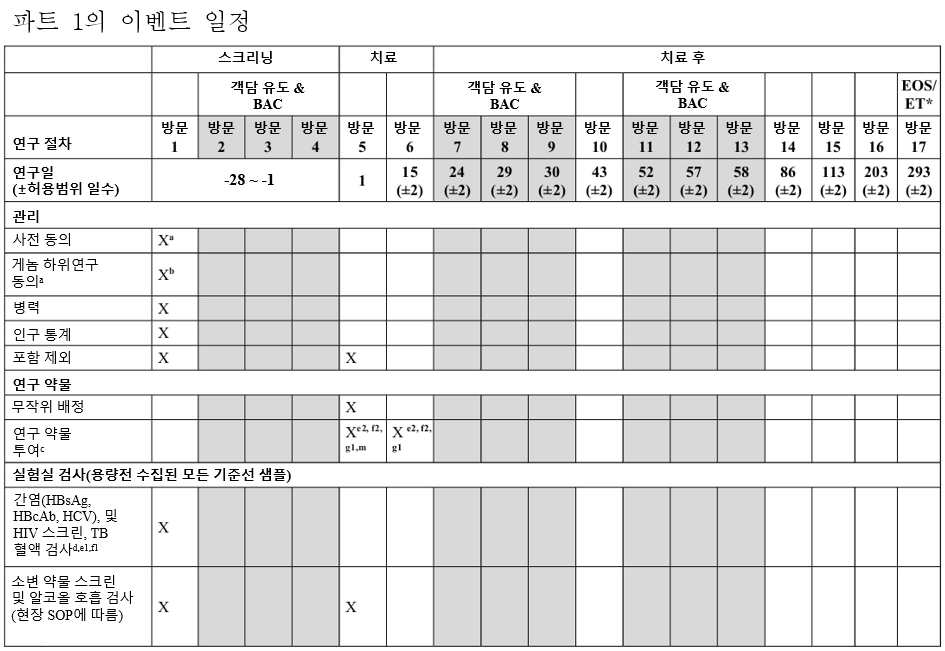


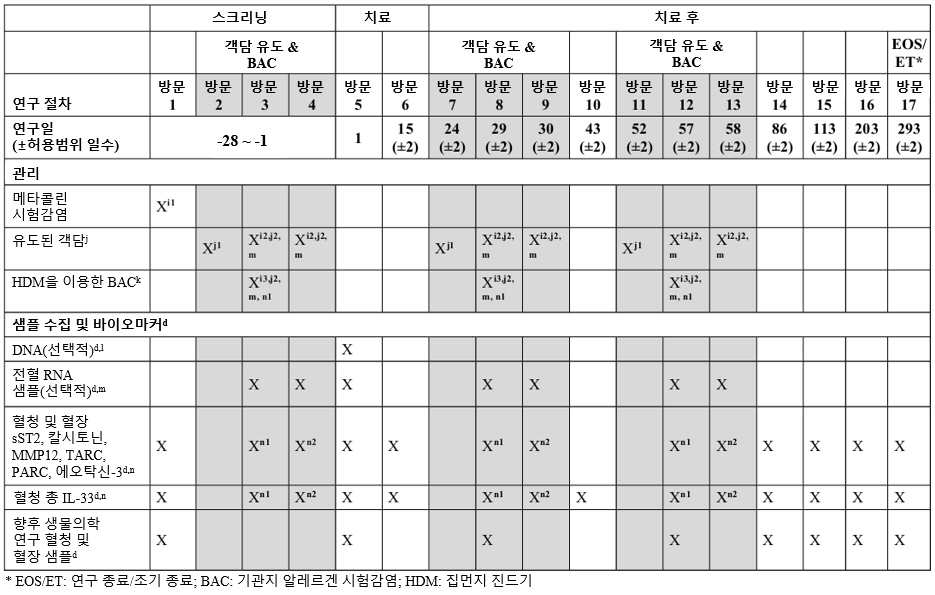
이벤트 일정 표 1에 대한 각주Footnote to Event Schedule Table 1
a. 스크리닝 기간 전에 별도의 방문을 통해 사전 동의를 받을 수 있다.a. Prior consent may be obtained through a separate visit prior to the screening period.
b. 환자는 DNA 분석을 위한 샘플을 수집하기 전에 별도의 사전 동의서(ICF)에 서명해야 한다. 포함/제외 기준을 충족하는 환자는 게놈 하위연구 참여 선택 여부와 관계없이 연구에 등록할 자격이 있다.b. Patients must sign a separate informed consent form (ICF) prior to collecting samples for DNA analysis. Patients who meet the inclusion/exclusion criteria are eligible to be enrolled in the study, whether or not they choose to participate in the genomic substudy.
c. REGN3500(또는 매칭 위약)은 1일차에 단회 IV 용량으로 투여된다. 두필루맙(또는 매칭 위약)은 1일차 2회 주사 및 15일차 1회 주사로 SC 투여된다. 연구 약물의 정맥내 투여는 연구 약물의 SC 투여 전에 IV와 SC 투여 사이에 적어도 1시간을 두고 수행한다. 두필루맙의 SC 용량 투여 후 1일차 및 15일차에 환자는 퇴원 전 8시간 동안 관찰된다. 환자는 주입 완료 2시간 후에 식사를 할 수 있다.c. REGN3500 (or matching placebo) is administered as a single IV dose on
d. 모든 혈액 샘플(안전성 실험, PK, ADA, 바이오마커, 및 향후 생물의학 연구)은 최소 8시간의 밤새 금식 후에 수집해야 한다.d. All blood samples (safety trials, PK, ADA, biomarkers, and future biomedical studies) should be collected after an overnight fast of at least 8 hours.
e. 활력징후 측정:e. Vital Sign Measurements:
e1. 활력징후는 채혈 전에 수집해야 한다. e1. Vital signs should be collected prior to blood collection.
e2. 연구 1일차 및 15일차에, 활력징후는 연구 약물 투여 전, 연구 약물의 IV 주입 종료 직후(10분 이내) 및 SC 주사 전, 및 주사 종료 1, 2, 4, 및 8시간 후에 수집한다.
e2. On
f. ECG 측정에 대한 세부사항:f. Details on ECG measurements:
f1. 심전도는 채혈을 필요로 하는 방문 중 채혈 전에 수행한다. f1. Electrocardiography is performed prior to blood collection during visits requiring blood collection.
f2. 1일차 및 15일차에, 연구 약물의 IV 주입 종료 직후(10분 이내) 및 SC 주사 종료 4시간 후에 ECG를 수행한다.
f2. On
g. PK 및 ADA에 대한 모든 혈액 샘플은 연구 약물 투여의 개시 전에 수집한다.g. All blood samples for PK and ADA are collected prior to initiation of study drug administration.
g1. 1일차 및 15일차에, 안전성 실험, ADA, 및 바이오마커에 대한 샘플은 연구 약물 투여의 시작 전에 수집한다(금식).
g1. On
h. 병원 내 폐활량 측정은 표준 폐활량계로 미국 흉부 학회의 적합성 품질 관리 기준에 따라 수행된다(문헌[Miller et al. Standardisation of spirometry. Eur Respir J. 2005. 26:319-338]).h. In-hospital spirometry is performed according to the conformity quality control criteria of the American Thoracic Society with a standard spirometer (Miller et al . Standardization of spirometry. Eur Respir J. 2005. 26:319-338).
i. FeNO는 최소 1시간의 금식 후에 수행해야 한다.i. FeNO should be performed after a minimum of 1 hour of fasting.
i1. FeNO 측정은 폐활량 측정 및 메타콜린 시험감염 전에 수행해야 한다. i1. FeNO measurements should be performed prior to spirometry and methacholine challenge.
i2. FeNO 측정은 객담 유도 전에 수행해야 한다. i2. FeNO measurements should be performed prior to sputum induction.
i3. 시험감염일(방문 3, 방문 8, 및 방문 12)에, BAC 수행 전, 및 BAC 8시간 후 및 23시간 후에 FeNO를 측정한다. i3. FeNO is measured on the day of challenge (Visit 3, Visit 8, and Visit 12), before performing BAC, and 8 hours and 23 hours after BAC.
j. 객담을 채취할 수 있는 날은 회색으로 표시되어 있다.j. The days when sputum can be collected are shown in gray.
j1. 알레르겐 전 스크리닝 객담 샘플은 방문 1에서 수행된 메타콜린 시험감염 최소 48시간 후, 및 방문 3에서 수행된 BAC 72시간 전에 수집한다. 다른 알레르겐 전 객담 샘플은 BAC 최소 72시간 전에 수집한다. 첫 번째 시도에서 BAC 전 샘플을 수집할 수 없는 경우, 최소 72시간 후에 반복 시도를 수행할 수 있다.
j1. Pre-Allergen Screening Sputum samples are collected at least 48 hours after the methacholine challenge performed at
j2. BAC 일(방문 3, 방문 8, 방문 12)에, 객담을 시험감염 8시간 후, 및 다음 날, BAC 약 24시간 후(방문 4, 방문 9, 및 방문 13)에 또한 수집한다. j2. On BAC day (Visit 3, Visit 8, Visit 12), sputum is also collected 8 hours post challenge, and on the following day, approximately 24 hours after BAC (Visit 4, Visit 9, and Visit 13).
l. DNA 샘플은 1일차에 수집해야 한다. 그러나, DNA는 시험 과정 중 임의의 방문시에 수집할 수도 있다.l. DNA samples should be collected on
m. RNA 샘플 추출을 위한 전혈은 지정 날짜에 BAC, 폐활량 측정, 또는 유도 객담 절차 전에 지정 연구 방문에서만 수집해야 한다. RNA 샘플에 대한 전혈은 연구 약물 치료일에 약물 투여 전에 수집해야 한다.m. Whole blood for RNA sampling should be collected only at designated study visits prior to BAC, spirometry, or induction sputum procedures on designated days. Whole blood for RNA samples should be collected prior to drug administration on study drug treatment days.
n. 바이오마커 샘플은 연구 중 특정 시점에 수집하고, 주의 사항은 다음과 같다:n. Biomarker samples are collected at specific time points during the study, with the following precautions:
n1. BAC 일(방문 3, 방문 8, 및 방문 12)의 바이오마커 및 총 IL-33 샘플은 BAC 전 및 BAC 8시간 후(BAC 8시간 후 객담 샘플의 수집 후)에 수집해야 한다. n1. Biomarker and total IL-33 samples on BAC days (Visit 3, Visit 8, and Visit 12) should be collected before BAC and 8 hours post BAC (after collection of sputum samples 8 hours post BAC).
n2. BAC 다음 날(방문 4, 방문 9, 및 방문 13)에 수집되는 바이오마커 샘플은 객담 샘플의 수집 후, BAC 24시간 후에 수집해야 한다. n2. Biomarker samples collected on the day following BAC (Visit 4, Visit 9, and Visit 13) should be collected 24 hours after the collection of the sputum sample, BAC.
연구 파트 2
도 3에 도시된 바와 같이, 연구 파트 2에서, 약 6명의 환자가 1일차부터 4일 동안 하루에 두 번(총 8회 용량), 용량당 500 μg(250 μg씩 2회 퍼프)의 플루티카손 프로피오네이트를 흡입 투여받는다. 환자는 1일차에 병원에서 약물을 투여받고 흡입기 기술을 검토한다. 환자는 2일차 및 3일차 동안 약물을 자가 투여하기 위해 집으로 보내진다. 유도 객담 샘플은 1일차 플루티카손의 제2 용량 후에 수집한다. 4일차에, 환자는 BAC 절차 전에 (병원에서) 플루티카손 프로피오네이트를 투여받고, (병원 또는 집에서) 객담 유도 후 다음 날 제2 용량을 자가 투여한다. 환자는 플루티카손 프로피오네이트 8회 용량 중 7번째를 투여받은 후 연구 파트 1에서와 유사한 HDM을 이용한 흡입 BAC를 제공받는다. 유도된 객담 샘플은 4일차 HDM 시험감염 8시간 후 및 24시간 후에 수집한다. 폐활량 측정에 의해 평가되는 폐기능, 객담내 mRNA, 객담내 사이토카인, FeNO, 및 IL-33 및 IL-4R 활성의 추가 혈청 마커의 측정은 파트 1에 기재된 것과 유사하게 수행된다. 환자가 4일차에 복귀할 수 없는 경우, 환자는 추가로 최대 2일 동안 1일 2회 플루티카손 프로피오네이트를 계속 투여할 수 있다. 환자가 병원에 복귀하면 4일차 절차를 따른다.As shown in Figure 3 , in
환자는 약 2주의 총 기간 동안 일반적인 시험 활동을 유지한다.Patients maintain normal trial activity for a total period of approximately 2 weeks.
본 연구의 파트 2는 파트 1과 병행하여 진행된다. 파트 2를 완료한 환자는 최소 21일의 휴약 기간 후 파트 1에 참여할 수 있다.

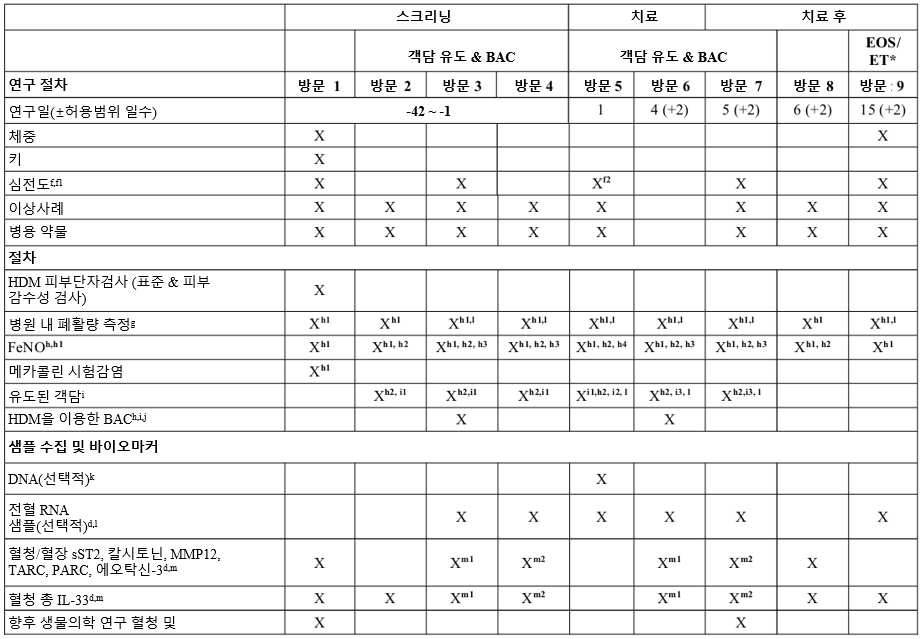

이벤트 일정 표 2에 대한 각주Footnotes to Event Schedule Table 2
a. 스크리닝 기간 전에 별도의 방문을 통해 사전 동의를 받을 수 있다.a. Prior consent may be obtained through a separate visit prior to the screening period.
b. 환자는 DNA 분석을 위한 샘플을 수집하기 전에 별도의 사전 동의서(ICF)에 서명해야 한다. 포함/제외 기준을 충족하는 환자는 게놈 하위연구 참여 선택 여부와 관계없이 연구에 등록할 자격이 있다.b. Patients must sign a separate informed consent form (ICF) prior to collecting samples for DNA analysis. Patients who meet the inclusion/exclusion criteria are eligible to be enrolled in the study, whether or not they choose to participate in the genomic substudy.
c. 환자는 1일차부터 4일 연속 1일 2회 흡입 플루티카손 프로피오네이트의 자가 투여를 시작한다. 환자는 1일차에 병원에서, 2일차 및 3일차에 집에서 플루티카손 프로피오네이트를 투여받는다. 4일차에, 환자는 BAC 절차 전에 (병원에서) 플루티카손 프로피오네이트를 투여받고, (병원 또는 집에서) 객담 유도 후 다음 날 제2 용량을 자가 투여한다.c. Patients begin self-administration of inhaled fluticasone propionate twice daily for 4 consecutive days from
d. 모든 혈액 샘플(안전성 실험, 바이오마커, 및 향후 생물의학 연구)은 최소 8시간의 밤새 금식 후에 수집해야 한다.d. All blood samples (safety trials, biomarkers, and future biomedical studies) should be collected after an overnight fast of at least 8 hours.
e. 활력징후 측정에 대한 세부사항:e. Details on Vital Sign Measurements:
e1. 활력징후는 채혈 전에 수집해야 한다. e1. Vital signs should be collected prior to blood collection.
e2. 연구 1일차에, 활력징후는 연구 약물 투여 전, 플루티카손 투여 종료 직후(10분 이내), 및 1, 2, 4, 8, 및 12시간 후에 수집한다.
e2. On
f. ECG 측정에 대한 세부사항:f. Details on ECG measurements:
f1. 심전도는 채혈 전에 수행한다. f1. Electrocardiography is performed before blood collection.
f2. 1일차에, ECG는 플루티카손 프로피오네이트의 투여 전 및 종료 직후(10분 이내)에 수행해야 한다.
f2. On
g. 병원 내 폐활량 측정은 표준 폐활량계로 미국 흉부 학회의 적합성 품질 관리 기준에 따라 수행된다(문헌[Miller et al. Standardisation of spirometry. Eur Respir J. 2005. 26:319-338]).g. In-hospital spirometry is performed according to the conformity quality control criteria of the American Thoracic Society with a standard spirometer (Miller et al . Standardization of spirometry. Eur Respir J. 2005. 26:319-338).
h. FeNO는 최소 1시간의 금식 후에 수행해야 한다.h. FeNO should be performed after a minimum of 1 hour of fasting.
h1. FeNO 측정은 폐활량 측정 및 메타콜린 시험감염 전에 수행해야 한다. h1. FeNO measurements should be performed prior to spirometry and methacholine challenge.
h2. FeNO 측정은 객담 유도 전에 수행해야 한다. h2. FeNO measurements should be performed prior to sputum induction.
h3. FeNO는 BAC 일에 BAC 전 및 BAC 8시간 후 및 23시간 후에 측정한다. h3. FeNO is measured before BAC and 8 hours and 23 hours after BAC on BAC days.
h4. 1일차 FeNO 측정은 투여 전이어야 한다. h4. The first FeNO measurement should be prior to dosing.
i. 스크리닝 및 치료 기간 동안, 모든 BAC 전 객담 샘플은 BAC 72시간 전에 수집해야 한다.i. During the screening and treatment period, all pre-BAC sputum samples should be collected 72 hours prior to BAC.
i1. 스크리닝 중에, BAC 전 유도 객담 샘플은 BAC 최소 72시간 전에 수집한다. 스크리닝시 첫 번째 시도에서 BAC 전 샘플을 수집할 수 없는 경우, 최소 72시간 후에 반복을 수행할 수 있다. 방문 3에, 객담을 시험감염 8시간 후, 및 다음 날, BAC 약 24시간 후(방문 4)에 수집한다.
i1. During screening, pre-BAC induced sputum samples are collected at least 72 hours prior to BAC. If pre-BAC samples cannot be collected on the first trial at screening, repeats may be performed after a minimum of 72 hours. At
i2. 유도 객담 샘플(BAC 전)은 1일차 플루티카손의 제2 용량 후에 수집한다. BAC 전 객담 샘플의 반복은 치료 중 BAC에 대해 허용되지 않는다.
i2. Induced sputum samples (before BAC) are collected after the second dose of fluticasone on
i3. 4일차에, 환자는 제1 용량의 플루티카손 투여 후 연구 파트 1에서와 유사한 HDM을 이용한 BAC를 제공받는다. 유도된 객담 샘플은 4일차 BAC 8시간 후 및 24시간 후에 수집한다.
i3. On
k. DNA 샘플은 1일차에 수집해야 하지만, 시험 과정 중 임의의 방문시에 수집할 수도 있다.k. DNA samples should be collected on
l. 전혈 RNA 샘플은 해당 날짜에 BAC, 폐활량 측정, 또는 유도 객담 절차 전, 표에 표시된 방문에서만 수집해야 한다. 전혈 RNA 샘플은 약물 투여 전에 수집해야 한다.l. Whole blood RNA samples should be collected only at the visits indicated in the table, prior to the BAC, spirometry, or induced sputum procedures on that date. Whole blood RNA samples should be collected prior to drug administration.
m. 바이오마커 샘플은 연구 차트에 명시된 바와 같이 연구 중 수시로 수집할 수 있고, 주의 사항은 다음과 같다:m. Biomarker samples may be collected at any time during the study as specified in the study chart, with the following precautions:
m1. BAC 일의 바이오마커 및 총 IL-33 샘플은 BAC 전 및 BAC 8시간 후 객담 샘플의 수집 후, BAC 8시간 후에 수집해야 한다. m1. Biomarker and total IL-33 samples on day BAC should be collected 8 hours after BAC, after collection of sputum samples before BAC and 8 hours post BAC.
m2. BAC 다음 날 수집되는 바이오마커는 객담 샘플의 수집 후, BAC 24시간 후에 수집해야 한다. m2. Biomarkers collected the day after BAC should be collected 24 hours after BAC, following collection of the sputum sample.
연구 모집단:Study Population:
본 연구의 환자 집단은 HDM 알레르겐에 알레르기가 있는 성인 천식 환자이다. 많은 연구에서 BAC가 알레르기성 천식 환자의 유도된 객담에서 측정될 수 있는 염증성 유전자 표지의 현저하고 재현 가능한 상향조절을 유도한다는 것이 입증되었다. 기관지 알레르겐 시험감염(BAC)은 폐 염증에 대한 REGN3500 및 두필루맙의 잠재적 영향을 평가할 수 있는 기회를 제공한다. 경험이 풍부한 임상시험자가 적절한 환경에서 수행하는 경우, BAC는 본 연구에 제안된 환자 모집단에서 안전하고 내약성이 좋다. 그러나, 중증의 급성 기관지수축이나 아나필락시스를 유발할 위험이 있으므로(문헌[Diamant et al. Inhaled allergen bronchoprovocation tests. J Allergy Clin Immunol. 2013. 132:1045-1055 e1046]), BAC는 중증 또는 불안정한 천식이 있는 환자에 대해 수행되지 않는다.The patient population in this study was adult asthmatic patients allergic to HDM allergens. Numerous studies have demonstrated that BAC induces significant and reproducible upregulation of inflammatory gene markers that can be measured in induced sputum in patients with allergic asthma. The bronchial allergen challenge (BAC) offers an opportunity to evaluate the potential effects of REGN3500 and dupilumab on lung inflammation. BACs are safe and well tolerated in the patient population proposed for this study when performed in appropriate settings by experienced investigators. However, due to the risk of developing severe acute bronchoconstriction or anaphylaxis (Diamant et al . Inhaled allergen bronchoprovocation tests. J Allergy Clin Immunol. 2013. 132:1045-1055 e1046), BAC is recommended for patients with severe or unstable asthma. It is not performed on the patient.
인구통계 및 기준선 특성은 표준 인구통계(예를 들어, 연령, 성별, 인종, 민족, 체중, 키), 각 환자의 병력 및 약물 이력을 포함한 질환 특성, 및 바이오마커(총 IL-33, sST2, 칼시토닌, 및 MMP12)를 포함한다.Demographic and baseline characteristics include standard demographics (e.g., age, sex, race, ethnicity, weight, height), disease characteristics including each patient's medical and drug history, and biomarkers (total IL-33, sST2, calcitonin, and MMP12).
등록에는 연구의 2개 파트에 대해 영국에서 최대 38명의 환자(파트 1에 대해 약 32명의 환자 및 파트 2에 대해 약 6명의 환자)가 포함된다.Enrollment includes up to 38 patients in the UK for two parts of the study (about 32 patients for
경증 지속성 알레르기성 천식이 있는 18~60세의 최대 약 38명의 비흡연 성인 환자(남성과 여성)가 본 연구에 등록된다. 본 연구에 포함된 환자는 임상적으로 안정적이어야 하며, 천식 증상을 조절하기 위해 필요에 따라 속효성 β2 작용제만을 필요로 해야 한다. 본 연구에 포함된 환자는 피부단자검사로 측정시 HDM에 알레르기가 있어야 한다.Up to approximately 38 non-smoking adult patients (male and female) aged 18 to 60 years with mild persistent allergic asthma will be enrolled in this study. Patients included in this study should be clinically stable and require only short-acting β2 agonists as needed to control asthma symptoms. Patients included in this study must be allergic to HDM as measured by skin prick test.
연구 코호트study cohort
본 연구에는 2개의 파트가 있다. 연구 파트 1의 환자는 코호트 1을 구성하고 파트 2의 환자는 코호트 2를 구성한다.This study has two parts. Patients in
파트 1에서는, 약 32명의 환자가 1:1:1:1로 무작위 배정되어 REGN3500(IV 단회 용량), 두필루맙(SC 2회 용량, Q2W), REGN3500(IV 단회 용량) + 두필루맙(SC 2회 용량, Q2W), 또는 위약(IV 단회 용량 및 SC 2회 용량, Q2W)을 투여받고, 치료 그룹당 약 8명의 환자가 포함된다. 코호트 1에서 치료 그룹당 6명의 환자에 대한 데이터를 얻기 위해 약 8명의 환자가 치료 그룹에 배정된다.In
파트 2에서는, 약 6명의 환자가 코호트 2에서 흡입 플루티카손 프로피오네이트로 오픈라벨 치료를 받는다.In
포함 기준inclusion criteria
환자는 연구에 포함될 자격이 있으려면 다음 기준을 충족해야 한다. 1. 18세 이상 60세 이하의 남성 및 여성. 2. 스크리닝시 사전 연구에서 체질량 지수(BMI)가 17~33 kg/m2임(BMI= 체중 [kg]/ 신장 [m]2). 3. 필요에 따라 속효성 β2 작용제를 사용한 치료만을 필요로 하고 임상적으로 안정한, 기침, 천명을 포함한 전형적인 증상과 함께 최소 6개월 동안 경증 알레르기성 천식의 병력이 있음. 천식 병력을 제외하고, 환자는 스크리닝시 및/또는 연구 약물의 초기 용량 투여 전에 수행된 병력, 신체 검사, 활력징후 측정, ECG, 및 실험실 안전성 테스트에 기초하여 양호한 건강 상태인 것으로 판단됨. 4. 스크리닝시 기관지확장제 전 강제 호기량 FEV1이 예측치의 70% 이상임. 5. 최소 12개월 동안 비흡연자이거나 과거 흡연자임. 환자의 누적 담배 노출이 5갑-년 이하이어야 함[갑-년 = (하루에 피우는 담배 수 × 흡연 연수) ÷ 20]. 6. HDM에 대해 아토피를 나타내며, 스크리닝시 피부단자검사 양성으로 확인됨(양성 반응을 정의하기 위해 발진은 음성 대조군보다 3 mm 이상 커야 함). 7. 양성 알레르겐-유도 초기 및 후기 기도 기관지수축으로 나타나는 흡입 BAC에 대한 이중 반응자임(EAR은 흡입 BAC 후 30분 동안 시험감염 전 희석제 후 기준선 값으로부터 최소 20%의 FEV1 감소로 정의되고, LAR은 최종 농도의 알레르겐 투여 후 3~8시간 사이에 최소 3번(그중 2번은 연속적이어야 함) 215%의 FEV1의 희석제 후 값으로부터의 감소로 정의됨). 8. 객담 유도를 견딜 수 있고 스크리닝 기간 중 BAC 후(BAC 8시간 후 또는 24시간 후 시점)에 적절한 객담을 생성할 수 있음. 9. 이용가능한 대체 치료법 및 연구와 관련된 위험을 이해하고, 연구 절차를 수행할 수 있고, 서면 동의서를 제공하여 참여에 자발적으로 동의함. 10. 금지된 약물 및 절차를 포함하여 연구 프로토콜에 명시된 제한 사항을 기꺼이 준수함. 11. 스크리닝시 메타콜린 시험감염 테스트에 양성 반응을 나타냄(메타콜린 PC20이 16 mg/mL 이하에서 희석제 후 값과 비교하여 220% FEV1 감소).Patients must meet the following criteria to be eligible for inclusion in the study. 1. Men and women aged 18 to 60 years. 2. Body mass index (BMI) of 17-33 kg/m2 in pre-study at screening (BMI=weight [kg]/height [m]2). 3. Clinically stable, requiring treatment with short-acting β2 agonists only as needed, with a history of mild allergic asthma for at least 6 months with typical symptoms including cough and wheezing. With the exception of asthma history, patients are judged in good health based on medical history, physical examination, vital sign measurements, ECG, and laboratory safety tests performed at screening and/or prior to administration of the initial dose of study drug. 4. At screening, forced expiratory volume FEV1 before bronchodilators was more than 70% of the predicted value. 5. A non-smoker or former smoker for at least 12 months. The patient's cumulative tobacco exposure must be less than or equal to 5 pack-years [pack-year = (number of cigarettes smoked per day × number of years smoked) ÷ 20]. 6. Atopic dermatitis for HDM, confirmed as positive for skin prick at screening (to define a positive reaction, the rash must be 3 mm or more larger than the negative control). 7. Dual responder to inhalation BAC manifested by positive allergen-induced early and late airway bronchoconstriction (EAR is defined as a reduction in FEV1 of at least 20% from baseline values after diluent before challenge for 30 min after inhalation BAC, and LAR is Defined as a decrease from the post-diluent value of FEV1 of 215%, at least 3 times between 3 and 8 hours after administration of the last concentration of allergen (2 of which must be continuous). 8. Able to withstand sputum induction and produce adequate sputum after BAC (8 hours or 24 hours after BAC) during the screening period. 9. Understand the available alternative treatments and risks associated with the study, be able to conduct the research procedure, and voluntarily consent to participation by providing written informed consent. 10. Willingly comply with the restrictions set forth in the study protocol, including prohibited drugs and procedures. 11. Positive methacholine challenge test at screening (220% FEV1 reduction compared to post-diluent values at methacholine PC20 up to 16 mg/mL).
제외 기준Exclusion Criteria
1. 삽관이 필요하고/하거나 과탄산혈증, 호흡정지 및/또는 저산소 발작과 관련된 천식 에피소드로 정의되는, 생명을 위협하는 천식의 병력이 있는 환자. 2. 스크리닝 전 12개월 동안 천식으로 입원했거나 응급실에 다녀온 적이 있는 환자. 3. 스크리닝 전 또는 연구 약물의 초기 용량 투여 전 4주 이내에 천식 악화 또는 호흡기 감염이 있었던 환자. 4. 세계 만성 폐쇄성 폐질환 기구(GOLD) 지침(2013년 업데이트)에 정의된 만성 폐쇄성 폐질환(COPD)과 같은 기타 기도/폐 질환의 진단, 낭포성 섬유증, 기관지확장증, 또는 알파-1 항트립신 결핍 또는 제한성 폐질환의 병력이 있는 환자. 5. 스크리닝 BAC 후, FEV1이 예측치의 25% 미만으로 감소하고/하거나 FEV1이 1.4 L 미만이거나, 알레르겐 노출 후 합리적인 시간(약 30분) 이내에 기관지확장제로 해결되지 않는 숨가쁨과 관련된 FEV1의 증상성 감소가 있는 환자. 6. 처방 또는 비처방 약 또는 음식에 대해 중증 알레르기의 병력 또는 아나필락시 반응의 병력 또는 심각한 불내성이 있는 환자. 7. 스크리닝 후 및/또는 무작위 배정 전 8주 이내에 경구 또는 전신 코르티코스테로이드를 사용했거나 4주 이내에 코르티코스테로이드/비강 코르티코스테로이드를 흡입한 적이 있는 환자. 8. 스크리닝 후 또는 연구 약물의 초기 용량 투여 전 4주 이내에 속효성 β-작용제를 제외한 임의의 다른 천식 치료제(예를 들어, 류코트리엔 수용체 길항제, 무스카린 길항제, 터부탈린, 테오필린 베타 차단제, 디곡신, NSAID, MAO 억제제, 또는 삼환계 항우울제)을 사용한 적이 있는 환자. 승인된 약물 또는 임상시험용 생물학적 제제(예를 들어, 항-IgE 또는 항-IL5)에 대해, 스크리닝 후 6개월 또는 최소 5 반감기 중 더 긴 기간 내에 사용한 적이 있는 환자. 9. 스크리닝 전 또는 연구 약물의 초기 용량 투여 전 8주 또는 5 반감기(알고 있는 경우) 중 더 긴 기간 내에 임상시험용 약물로 치료를 받은 적이 있는 환자. 10. 스크리닝 전 12주 이내에 생(약독화) 백신으로 치료를 받은 적이 있는 환자. 11. MDRD 식을 기반으로 추정한 사구체 여과율이 스크리닝시 60 mL/min/1.73m2 미만인 환자. 12. 스크리닝시 HBsAg, HBcAb, 또는 HCV에 대해 양성인 환자. 13. 스크리닝 방문시 인간 면역결핍 바이러스(HIV) 감염 또는 HIV 혈청양성의 알려진 병력이 있는 환자. 14. 스크리닝시 결핵(TB)에 대한 혈액 검사에서 양성 결과를 받은 환자. 15. 결핵 또는 전신 진균 질환의 병력이 있는 환자. 16. 현재 또는 최근(스크리닝 이전 2개월 이내)의 진단된 박테리아, 원충, 바이러스, 기생충 감염이 있거나; 기생충 감염이 의심되거나 기생충 감염 위험이 높은 환자. 17. 임상적으로 유의미한 신경계, 내분비, 위장, 심혈관, 혈액, 간, 면역, 신장, 또는 임의의 기타 기관계 질환의 병력이 있는 환자(천식 또는 알레르기성 비염과 같은 기타 경증 알레르기성 질환은 제외). 단순 신결석(신장 결석)의 병력이 있는 환자는 임상시험자의 재량에 따라 연구에 등록될 수 있음. 18. 지난 2개월 내에 대수술을 받았거나 연구 또는 추적 기간 중에 수술이 예상되는 환자. 19. 적절하게 치료된 기저세포 암종 또는 자궁경부 상피 암종 환자 및 스크리닝 전 10년 넘게 성공적으로 치료된 기타 악성종양 환자(임상시험자 및 치료의사 모두의 판단에 따라, 적절한 추적관찰에서 스크리닝 시간 동안 재발의 징후가 나타나지 않았음). 20. 스크리닝 중 또는 무작위 배정 전 소변 약물 검사 결과가 양성인 환자(예를 들어, 암페타민/메스암페타민, 바르비투르산염, 벤조디아제핀, 칸나비노이드, 코카인, 아편제, 및 코티닌), 단 임상시험자의 소견에 따라 양성 검사 결과가 환자에게 현재 허용된 약물로 인한 것일 수 있는 경우는 제외. 21. 스크리닝 방문 전 1년 이내에 약물 또는 알코올 남용의 병력이 있는 환자. 22. 스크리닝 전 48시간 이내에 알코올을 섭취한 환자. 23. 알코올 섭취에 대한 연구 제한사항을 준수하려 하지 않는 환자. 연구 기간 동안, 성인의 알코올 섭취는 하루 2잔 이하로 제한됨(1잔은 일반 맥주 12온스, 와인 5온스, 또는 80프루프 증류주 1.5온스에 해당). 환자는 BAC와 관련된 연구 방문 후 48시간 이내에 알코올 섭취를 자제해야 함. 24. 카페인 섭취에 대한 연구 제한사항을 준수하려 하지 않는 환자. 환자는 모든 연구 방문 전 8시간 동안 카페인을 자제해야 함. 디카페인 제품은 허용됨. 25. 법적 동의 연령 미만이거나 정신적 또는 법적으로 무능력자인 환자. 26. 연구 임상시험자의 소견에 따라 연구 결과에 혼동을 초래할 수 있거나 연구 참여가 환자에게 추가적인 위험을 초래할 수 있는 임의의 질병에 대한 병력이 있는 환자. 27. 스크리닝 방문 전 4주 이내에 새로운 운동 루틴이 있거나 이전 운동 루틴에 대한 주요 변경이 있는 환자. 연구 기간 동안 유사한 수준의 운동을 유지하려 하지 않거나 시험 기간 동안 비정상적으로 격렬한 운동을 자제하려 하지 않는 환자는 제외됨. 28. 임신 중이거나, 임신을 계획 중이거나, 수유 중인 환자. 29. 성생활 활동 가임기 여성으로서, 첫 번째 치료 시작 전, 연구 중, 및 마지막 투여 후 최소 4개월 동안 매우 효과적인 피임법을 사용하려 하지 않는 환자. 매우 효과적인 피임법에는 스크리닝 전 2회 이상의 월경 주기 동안 배란 억제와 관련된 경구 피임약(에스트로겐/프로게스테론 또는 고용량 프로게스테론을 함유한 피임약 등)의 안정적인 사용; 자궁내 기구; 자궁내 호르몬 방출 시스템; 양측 난관 결찰; 파트너의 정관수술; 및/또는 성적 금욕이 포함됨. 남성 환자의 피임은 필요하지 않음. 30. 독시사이클린 및/또는 테트라사이클린에 대해 또는 임상시험용 제품 제형의 임의의 성분에 대해 알려진 감수성이 있는 환자.1. Patients with a history of life-threatening asthma, defined as an asthma episode requiring intubation and/or associated with hypercapnia, respiratory arrest and/or hypoxic attack. 2. Patients who have been hospitalized for asthma or have been to the emergency room for 12 months prior to screening. 3. Patients with asthma exacerbation or respiratory infection within 4 weeks prior to screening or prior to administration of the initial dose of study drug. 4. Diagnosis of other airway/pulmonary diseases such as chronic obstructive pulmonary disease (COPD), cystic fibrosis, bronchiectasis, or alpha-1 antitrypsin as defined in the World Organization for Chronic Obstructive Pulmonary Disease (GOLD) Guidelines (updated 2013) Patients with a history of deficiency or restrictive pulmonary disease. 5. After screening BAC, decrease in FEV1 of less than 25% of predicted and/or decrease in symptoms of FEV1 associated with shortness of breath that is not resolved with bronchodilator within a reasonable time (approx. patients with 6. Patients with a history of severe allergy or anaphylactic reaction or severe intolerance to prescription or over-the-counter medications or foods. 7. Patients who have used oral or systemic corticosteroids within 8 weeks after screening and/or prior to randomization, or inhaled corticosteroids/nasal corticosteroids within 4 weeks. 8. Any other asthma treatment (e.g., leukotriene receptor antagonist, muscarinic antagonist, terbutaline, theophylline beta blocker, digoxin, NSAID, MAO inhibitors, or tricyclic antidepressants). Patients who have used an approved drug or investigational biologic (eg, anti-IgE or anti-IL5) within 6 months of screening or at least 5 half-life, whichever is longer. 9. Patients previously treated with investigational drugs within 8 weeks or 5 half-life (if known), whichever is greater, prior to screening or administration of the initial dose of study drug. 10. Patients who have been treated with a live (attenuated) vaccine within 12 weeks prior to screening. 11. Patients with a glomerular filtration rate of less than 60 mL/min/1.73 m 2 at screening, estimated based on the MDRD equation. 12. Patients positive for HBsAg, HBcAb, or HCV at screening. 13. Patients with a known history of human immunodeficiency virus (HIV) infection or HIV seropositivity at the screening visit. 14. Patients who have a positive blood test for tuberculosis (TB) at screening. 15. Patients with a history of tuberculosis or systemic fungal disease. 16. Have a current or recent (within 2 months prior to screening) diagnosed bacterial, protozoan, viral, or parasitic infection; Patients with suspected parasitic infection or at high risk of parasitic infection. 17. Patients with a history of clinically significant neurological, endocrine, gastrointestinal, cardiovascular, hematologic, hepatic, immune, renal, or any other organ system disease (excluding asthma or other mild allergic diseases such as allergic rhinitis). Patients with a history of uncomplicated kidney stones (kidney stones) may be enrolled in the study at the investigator's discretion. 18. Patients who have had major surgery within the past 2 months or are expected to undergo surgery during the study or follow-up period. 19. Adequately treated patients with basal cell carcinoma or cervical epithelial carcinoma and other malignancies successfully treated for >10 years prior to screening (at appropriate follow-up, at the discretion of both the investigator and treating physician, the risk of recurrence during the screening period) no signs were shown). 20. Patients with positive urine drug test results during screening or prior to randomization (e.g., amphetamine/methamphetamine, barbiturates, benzodiazepines, cannabinoids, cocaine, opiates, and cotinine), as determined by the investigator Except when a positive test result may be due to a drug currently approved for the patient. 21. Patients with a history of drug or alcohol abuse within 1 year prior to the screening visit. 22. Patients who consumed alcohol within 48 hours prior to screening. 23. Patients unwilling to comply with study restrictions on alcohol intake. During the study period, alcohol consumption in adults was limited to no more than 2 drinks per day (1 drink is equivalent to 12 ounces of plain beer, 5 ounces of wine, or 1.5 ounces of 80 proof spirits). Patients should refrain from alcohol consumption within 48 hours of study visits related to BAC. 24. Patients unwilling to comply with study restrictions on caffeine intake. Patients should refrain from caffeine for 8 hours prior to all study visits. Decaffeinated products are allowed. 25. Patients under the age of consent or mentally or legally incapacitated. 26. Patients with a history of any disease that, in the opinion of the study investigator, could confound study results or in which study participation would pose an additional risk to the patient. 27. Patients with a new exercise routine or major change to a previous exercise routine within 4 weeks prior to the screening visit. Patients who were unwilling to maintain a similar level of exercise for the duration of the study or who were unwilling to refrain from unusually strenuous exercise during the trial were excluded. 28. Patients who are pregnant, planning to become pregnant or are lactating. 29. Sexually active women of childbearing potential who are unwilling to use highly effective contraception prior to initiation of first treatment, during study, and for at least 4 months after last dose. Very effective methods of contraception include stable use of oral contraceptives (such as estrogen/progesterone or high-dose progesterone-containing contraceptives) associated with ovulation suppression during at least two menstrual cycles prior to screening; intrauterine apparatus; intrauterine hormone release system; bilateral tubal ligation; partner's vasectomy; and/or sexual abstinence. Contraception is not required for male patients. 30. Patients with known sensitivity to doxycycline and/or tetracycline or to any component of the investigational product formulation.
연구 치료research treatment
파트 1
REGN3500은 동결 건조 분말로서 공급된다. REGN3500과 매칭되는 위약(REGN3500-매칭 위약)은 REGN3500과 동일한 제형으로 제조되지만 단백질(즉, 활성물질, 항-IL-33 단클론 항체)이 첨가되지 않는다. REGN3500 또는 REGN3500-매칭 위약의 바이알은 주입 전에 멸균수로 재구성된다. REGN3500 및 REGN3500-매칭 위약은 1일차에 임상시험자 또는 기타 자격을 갖춘 연구 인력에 의해 IV 투여된다.REGN3500 is supplied as a freeze-dried powder. REGN3500-matched placebo (REGN3500-matched placebo) is prepared in the same formulation as REGN3500, but without the addition of protein (ie active substance, anti-IL-33 monoclonal antibody). A vial of REGN3500 or REGN3500-matched placebo is reconstituted with sterile water prior to infusion. REGN3500 and REGN3500-matched placebo are administered IV by the investigator or other qualified study personnel on
두필루맙은 프리필드(pre-filled) 시린지로 공급되며, 각 시린지는 150 mg/mL 용액의 연구 약물 2 mL(300 mg)를 전달할 수 있다. 두필루맙과 매칭되는 위약(두필루맙-매칭 위약)은 단백질의 첨가 없이, 두필루맙과 동일한 제형으로 제조된다. 두필루맙 또는 두필루맙-매칭 위약은 1일차 2회 주사(600 mg) 및 15일차 1회 주사(300 mg)로 임상시험자 또는 기타 자격을 갖춘 연구 인력에 의해 SC 투여된다. 모든 SC 주사는 복부에 주사된다.Dupilumab is supplied in pre-filled syringes, each capable of delivering 2 mL (300 mg) of study drug in a 150 mg/mL solution. Dupilumab-matched placebo (dupilumab-matched placebo) is manufactured in the same formulation as dupilumab, without the addition of protein. Dupilumab or dupilumab-matched placebo is administered SC by the investigator or other qualified research personnel as 2 injections on Day 1 (600 mg) and 1 injection on Day 15 (300 mg). All SC injections are injected into the abdomen.
환자는 다음 치료 요법 중 하나로 REGN3500, 두필루맙, REGN3500 + 두필루맙 조합, 또는 위약을 투여받도록 무작위로 균등하게 배정된다. REGN3500: 1일차에 REGN3500 IV 10 mg/kg + 두필루맙-매칭 위약 SC 2회 주사; 15일차에 두필루맙-매칭 위약 SC 1회 주사; 두필루맙: 1일차에 REGN3500-매칭 위약 IV + 두필루맙 SC 300 mg 2회 주사(600 mg 총 로딩 용량); 15일차에 두필루맙 SC 300 mg 1회 주사; REGN3500 + 두필루맙 조합: 1일차에 REGN3500 IV 10 mg/kg + 두필루맙 SC 300 mg 2회 주사(600 mg 총 로딩 용량); 15일차에 두필루맙 SC 300 mg 1회 주사; 및 위약: 1일차에 REGN3500-매칭 위약 IV + 두필루맙-매칭 위약 SC 2회 주사; 15일차에 두필루맙-매칭 위약 SC 1회 주사. 모든 환자는 먼저 IV 주입 후 SC 주사를 받는다. SC 주사와 IV 주입 사이에 최소 1시간 동안 환자를 관찰한다.Patients are randomly and evenly assigned to receive REGN3500, dupilumab, the REGN3500 plus dupilumab combination, or placebo on one of the following treatment regimens: REGN3500:
파트 2
플루티카손 프로피오네이트(250 μg/퍼프)는 정량 흡입기로 공급되며, 1일차부터 4일차까지 1일 2회, 용량당 500 μg(250 μg씩 2회 퍼프)을 흡입하여 투여된다.Fluticasone propionate (250 μg/puff) is supplied by metered dose inhaler and is administered by inhalation of 500 μg per dose (2 puffs of 250 μg each), twice daily from
치료 배정treatment assignment
연구 파트 1에서, 무작위 배정은 2개의 개별 단계로 이루어진다. 대화형 음성 응답 시스템(IVRS)/대화형 웹 응답 시스템(IWRS)에 의해 지정 연구 약사(또는 자격을 갖춘 피지정자)에게 제공되는 중앙 무작위 배정 방식에 따라 8명의 환자가 1:1:1:1로 무작위 배정되어 REGN3500, 두필루맙, REGN3500 + 두필루맙 조합, 또는 위약을 투여받는다. 처음 8명의 환자가 24일(방문 7) 연구 방문을 통해 안전성 평가를 완료하고 RSOC가 안전성 데이터를 검토하고 추가 등록을 승인한 후, 또 다른 약 24명의 환자가 처음 8명의 환자와 유사하게 1:1:1:1로 무작위 배정되어 REGN3500, 두필루맙, REGN3500 + 두필루맙 조합, 또는 위약을 투여받을 수 있다.In
연구 파트 2에서는, 약 6명의 환자가 등록되어 플루티카손 프로피오네이트로 오픈라벨 치료를 받는다. 파트 2를 완료한 환자는 최소 21일의 휴약 기간 후 파트 1에 참여할 수 있다.In
파트 1의 경우, 연구 환자, 주요 임상시험자, 및 연구 현장 직원은 연구 전반에 걸쳐 모든 무작위 배정에 대해 맹검 상태를 유지한다. Regeneron 연구 책임자, 의료 모니터, 연구 모니터, 및 연구 현장과 정기적으로 접촉하는 임의의 기타 Regeneron 및 계약 연구기관(CRO) 직원은 모든 환자 무작위 배정에 대해 맹검 상태를 유지한다.For
연구 수행에 관련되지 않은 선별된 개인은 안전성 검토 또는 기타 데이터 검토를 위해 필요에 따라 비맹검 데이터에 액세스할 수 있다.Selected individuals not involved in the conduct of the study may access unblinded data as needed for safety review or other data review.
약제 넘버링 시스템으로 코딩된 맹검 연구 약물 키트가 사용된다. 맹검을 유지하기 위해, 이러한 코드를 제품 로트 번호와 연결하는 목록은 연구 수행에 관련된 개인이 액세스할 수 없다.A blinded study drug kit coded with a drug numbering system is used. To remain blind, the list linking these codes to product lot numbers is not accessible to individuals involved in conducting the study.
항약물 항체 및 약물 농도 결과는 현장에 전달되지 않으며, 임상시험의뢰 운영팀은 최종 데이터베이스 잠금이 끝날 때까지 환자 식별과 관련된 결과에 액세스할 수 없다. 혈청 약물 농도 수준, ADA, 및 바이오마커의 결정을 담당하는 생물분석 분석자, 생물분석팀 대표, 및 임상 약리학 대표는 투여 정보에 대해 맹검되지 않는다.Anti-drug antibody and drug concentration results are not delivered to the site, and the referral operations team does not have access to patient identification-related results until the final database lock is over. Bioanalytical analysts, bioanalytical team representatives, and clinical pharmacology representatives responsible for the determination of serum drug concentration levels, ADA, and biomarkers are not blinded to dosing information.
치료 물류 및 책임Treatment Logistics and Responsibility
연구 파트 1의 경우, 약제 넘버링 시스템을 사용하여 맹검 임상시험용 연구 약물에 라벨을 부착한다. 약제 번호와 제품 로트 번호를 연결하는 목록은 연구 약물 포장을 담당하는 그룹(또는 회사)에서 관리한다. 맹검을 유지하기 위해, 이 목록은 연구 수행에 관련된 개인이 액세스할 수 없다. 이 자동화 시스템은 또한, 만료 날짜 처리에 특히 중점을 둔, 임상시험에서 대화형 응답 기술(IVRS)의 사용에 대한 EMA 소견서에 따라 임상시험용 연구 약물의 만료 날짜를 관리하는 데 사용된다(EMA/INS/GCP/600788/2011, Dec 2013). 두필루맙 약물 라벨에는 만료 날짜가 포함된다. REGN3500의 약물 라벨에는 만료 날짜가 포함되지 않는다.For
파트 2의 경우, 오픈라벨 연구 약물은 라벨에 제품 로트 번호와 만료 날짜를 표시한다. 연구 약물은 2℃ 내지 8℃의 온도에서 현장에 보관된다.For
REGN3500, 두필루맙, 및 각 연구 약물에 대한 매칭 위약은 정기적으로 또는 연구 중 필요에 따라 임상시험자 또는 피지정자에게 2℃ 내지 8℃의 온도로 배송된다. 연구 중 특정 시점(예를 들어, 중간 현장 모니터링 방문), 현장 폐쇄 방문시, 및 현장 모니터에 의한 약물 조정 및 문서화 후, 모든 개봉 및 미개봉 연구 약물은 폐기되거나 임상시험의뢰자 또는 피지정자에게 반환된다.REGN3500, dupilumab, and matching placebo for each study drug are delivered at a temperature of 2°C to 8°C to the investigator or designee on a regular basis or as needed during the study. At certain points in the study (e.g., interim site monitoring visits), at site closure visits, and after drug adjustment and documentation by site monitors, all opened and unopened study drug is discarded or returned to the sponsor or designee.
모든 약물 책임 기록은 최신 상태로 유지해야 한다. 임상시험자는 모든 개봉 및 미개봉 연구 약물에 대해 설명할 수 있어야 한다. 이러한 기록에는 각 환자에게 분배된 날짜, 수량, 및 연구 약물, 각 환자로부터 반환된(해당되는 경우) 날짜, 수량, 및 연구 약물, 및 현장에서 폐기하거나 임상시험의뢰자 또는 피지정자에게 반환된 날짜, 수량, 및 연구 약물이 포함되어야 한다. 모든 책임 기록은 임상시험의뢰자 및 규제 기관 검사관이 검사할 수 있도록 해야 하며; 사본은 연구 종료시 임상시험의뢰자에게 제공되어야 한다.All drug liability records must be kept up to date. Investigators should be able to account for all opened and unopened investigational drugs. These records include the date, quantity, and study drug dispensed to each patient, the date, quantity, and study drug returned from each patient (if applicable), and the date on-site discarded or returned to the sponsor or designee; Quantity, and study drug should be included. All accountability records should be made available for inspection by sponsors and regulatory inspectors; Copies should be provided to the sponsor at the end of the study.
모든 약물 준수 기록은 최신 상태로 유지해야 하며, 임상시험의뢰자 및 규제 기관 검사관이 검사할 수 있도록 해야 한다.All drug compliance records should be kept up to date and made available for inspection by sponsors and regulatory inspectors.
병용 약물 및 절차Concomitant drugs and procedures
사전 동의 시점부터 치료 기간 종료시까지 투여된 모든 치료는 병용 약물로 간주된다. 여기에는 연구 이전에 시작되었고 연구 중에 진행 중인 약물이 포함된다. 모든 병용 약물은 Regeneron 의료 모니터의 검토 및 승인을 받아야 한다. 각 환자에 대한 병용 약물에 대한 정보는 스크리닝부터 연구가 끝날 때까지 각 연구 방문시 기록된다.All treatments administered from the time of informed consent to the end of the treatment period are considered concomitant medications. This includes drugs that were initiated prior to the study and are ongoing during the study. All concomitant medications must be reviewed and approved by the Regeneron Medical Monitor. Information on concomitant medications for each patient is recorded at each study visit from screening to study end.
임상시험책임자 또는 피지정자와 의료 모니터가 동의하지 않는 한, 임의의 새로운 처방약으로 치료를 시작하는 것은 스크리닝 시점부터 연구 방문 종료시까지 금지된다.Initiation of treatment with any new prescription drug is prohibited from the time of screening until the end of the study visit, unless the Investigator or designee and the medical monitor agree otherwise.
또한, 자격 기준에 따라 연구 기간 동안 다음의 약물 및 절차가 금지된다: 류코트리엔 수용체 길항제, 무스카린 길항제, 터부탈린, 테오필린 베타 차단제, 디곡신, NSAID, MAO 억제제, 또는 삼환계 항우울제, 로풀루밀라스트, 및 크로글리케이트; 생물학적 요법(예: 항-IgE, 항-IL-5) 또는 면역요법(피하 면역요법(SCIT), 설하 면역요법(SLIT), 또는 경구 면역요법(OIT)); 생(약독화) 백신 치료; 경구 및 전신 코르티코스테로이드; 흡입 또는 비강 코르티코스테로이드 치료; 스크리닝 방문 전 4주 이내에 새로운 운동 루틴의 시작 또는 이전 운동 루틴에 대한 주요 변경(환자는 연구 기간 동안 유사한 수준의 운동을 유지하고 시험 기간 동안 비정상적으로 격렬한 운동을 자제할 의사가 있었어야 함); 연구 기간 동안, 성인의 알코올 섭취는 하루 2잔 이하로 제한되고(1잔은 일반 맥주 12온스, 와인 5온스, 또는 80프루프 증류주 1.5온스에 해당) 환자는 스크리닝 및 알레르겐 관련 연구 방문 전 48시간 동안 알코올 섭취를 자제해야 함; 및 환자는 모든 연구 방문 전 8시간 동안 카페인을 자제해야 함(디카페인 제품은 허용됨).In addition, according to eligibility criteria, the following drugs and procedures are prohibited during the study period: leukotriene receptor antagonists, muscarinic antagonists, terbutaline, theophylline beta blockers, digoxin, NSAIDs, MAO inhibitors, or tricyclic antidepressants, roflumilast, and croupilast. glycols; biological therapy (eg, anti-IgE, anti-IL-5) or immunotherapy (subcutaneous immunotherapy (SCIT), sublingual immunotherapy (SLIT), or oral immunotherapy (OIT)); live (attenuated) vaccine treatment; oral and systemic corticosteroids; inhaled or nasal corticosteroid treatment; initiation of a new exercise routine or major change to a previous exercise routine within 4 weeks prior to the screening visit (patients must have been willing to maintain a similar level of exercise for the duration of the study and refrain from unusually strenuous exercise for the duration of the study); For the duration of the study, alcohol intake in adults was limited to no more than 2 drinks per day (1 glass equivalent to 12 ounces of plain beer, 5 ounces of wine, or 1.5 ounces of 80 proof spirits) and patients were allowed to consume for 48 hours prior to screening and allergen related study visits. to refrain from drinking alcohol; and patients must refrain from caffeine for 8 hours prior to all study visits (decaf products are allowed).
다음의 약물은 허용된다: 속효성 β-작용제; 스크리닝 전 6개월 넘게 안정적인 용량을 투여받은 환자에 의한 갑상선 대체 요법; 비타민과 칼슘 보충제; 처방전 없이 구입할 수 있는 항히스타민제 및 충혈 완화제; 파라세타몰(파라세타몰 투여와 관련된 모든 지침을 준수하고 국소 최대 허용 일일 복용량을 초과하지 않도록 주의해야 함); 완하제; 제산제; 및 가열-사멸 백신.The following drugs are permitted: short-acting β-agonists; thyroid replacement therapy in patients receiving stable doses for >6 months prior to screening; vitamin and calcium supplements; over-the-counter antihistamines and decongestants; Paracetamol (all instructions regarding paracetamol administration should be followed and care should be taken not to exceed the local maximum tolerated daily dose); laxative; antacids; and heat-kill vaccines.
연구 절차research procedure
하기 절차는 연구 적격성의 결정 또는 기준선 모집단의 특성화를 위한 유일한 목적으로 수행된다: 인구 통계, 병력, HIV, 간염 및 약물 스크리닝, HDM 피부단자검사, 메타콜린 시험감염.The following procedures are performed for the sole purpose of determining study eligibility or characterizing the baseline population: demographics, medical history, HIV, hepatitis and drug screening, HDM skin prick test, methacholine challenge.
안전 절차: 환자에 의해 보고되거나 임상시험자에 의해 관찰된 AE를 통해, 그리고 임상 실험실 검사(예를 들어, 생화학, 혈액학, 및 소변검사), 활력징후, 및 표준 12-리드 ECG 자동 판독을 통해 환자 안전을 모니터링한다. 임상적으로 유의한 이상(존재하는 경우)은 해결될 때까지 또는 임상적으로 안정될 때까지 모니터링한다.Safety Procedures: Patient via patient-reported or Investigator-observed AE, and via clinical laboratory tests (e.g., biochemistry, hematology, and urinalysis), vital signs, and standard 12-lead ECG automatic readings. Monitor safety. Clinically significant abnormalities (if any) are monitored until resolved or clinically stable.
활력징후: 표 1 및 표 2에 따른 시점에서 투여 전 최소 5분의 휴식 후, 온도, 혈압, 맥박, 및 호흡을 포함한 활력징후를 수집한다.Vital Signs: Collect vital signs including temperature, blood pressure, pulse, and respiration after at least 5 minutes of rest before dosing at time points according to Tables 1 and 2.
신체 검사: 표 1 및 표 2에 따른 시점에, 키와 체중을 포함한 철저하고 완전한 신체 검사를 수행한다. 환자의 병력에 따라 나타날 수 있는 모든 이상을 검사하고 평가하는 데 주의를 기울여야 한다.Physical Examination: At the time points according to Tables 1 and 2, a thorough and complete physical examination including height and weight is performed. Care should be taken to examine and evaluate any abnormalities that may appear based on the patient's medical history.
심전도: 심전도는 채혈을 필요로 하는 방문 중 채혈 전에 수행해야 한다. 표 1 및 표 2에 명시된 시점에 표준 12-리드 ECG를 수행한다. 심실 박동수로부터 심박수를 기록하고, PR, QRS, RR, 및 QT 간격을 기록한다. ECG 스트립 또는 보고서는 소스와 함께 유지한다. ECG 절차의 경우, 환자가 최소 10분 동안 앙와위 자세를 유지한 후 12-리드 ECG가 전신적으로 디지털 기록된다. 연구 전반에 걸쳐 각 ECG 기록에 대해 동일한 위치에 전극을 배치한다. 각각의 ECG는 날짜, 시간, 환자의 이니셜 및 번호, 연구 의사의 서명, 및 각 리드에 대한 최소 3개의 복합파를 포함하는 평가(HR, PR, QRS, RR, QT 간격, 및 QTc)가 포함된 단일 12리드 ECG(25 mm/s, 10 mm/mV) 출력으로 이어지는 12개 리드의 10초간 동시 기록으로 구성된다. 판독값은 즉각적인 안전성 평가에 사용된다. 임상시험자의 의학적 소견 및 ECG 값을 eCFF에 기록한다.Electrocardiography: An electrocardiogram should be performed prior to blood collection during visits requiring blood collection. A standard 12-lead ECG is performed at the time points specified in Tables 1 and 2. The heart rate is recorded from the ventricular rate, and the PR, QRS, RR, and QT intervals are recorded. ECG strips or reports should be kept with the source. For the ECG procedure, a 12-lead ECG is digitally recorded systemically after the patient remains in the supine position for at least 10 minutes. Place electrodes in the same location for each ECG recording throughout the study. Each ECG includes date, time, patient's initials and number, study physician's signature, and an assessment (HR, PR, QRS, RR, QT interval, and QTc) that includes at least three complex waves for each lead. It consists of a 10-second simultaneous recording of 12 leads followed by a single 12-lead ECG (25 mm/s, 10 mm/mV) output. The readings are used for immediate safety assessment. The investigator's medical findings and ECG values are recorded in the eCFF.
HDM 피부단자검사: 스크리닝 방문시, 포함 기준을 확인하기 위해 HDM 알레르겐을 이용한 표준 피부단자검사를 수행한다. 이후, 희석된 HDM 용액을 이용한 일련의 피부단자검사를 수행하여 피부 감수성을 측정한다. 피부 감수성은 스크리닝 BAC 중에 사용될 알레르겐 용량 요법을 결정하는 데 사용된다.HDM Skin Prick Test: At the screening visit, a standard skin prick test with the HDM allergen is performed to confirm inclusion criteria. Thereafter, a series of skin prick tests using the diluted HDM solution are performed to measure skin sensitivity. Skin sensitivity is used to determine the allergen dose regimen to be used during screening BAC.
메타콜린 시험감염: 스크리닝 방문시, 포함 기준을 확인하고 스크리닝 BAC 중에 사용되는 알레르겐 용량 요법을 결정하기 위해 메타콜린 시험감염을 수행한다. 메타콜린 시험감염은 2분 평상호흡 프로토콜을 사용하여 ATS/ERS(1999) 지침에 따라 수행된다(Crapo RO, et al. Guidelines for methacholine and exercise challenge testing-1999, 미국 흉부 학회의 이 공식 성명은 ATS 이사회에서 채택되었음, July 1999. Am J Respir Crit Care Med. 2000 Jan;161(1):309-29).Methacholine Challenge: At the screening visit, a methacholine challenge is performed to confirm inclusion criteria and to determine the allergen dose regimen used during screening BAC. Methacholine challenge is performed according to ATS/ERS (1999) guidelines using a 2-minute tidal breathing protocol (Crapo RO, et al . Guidelines for methacholine and exercise challenge testing-1999, this official statement of the American Thoracic Society is ATS Adopted by the Board of Directors, July 1999. Am J Respir Crit Care Med. 2000 Jan;161(1):309-29).
실험실 검사:Lab Tests:
혈액학, 화학, 소변검사, 및 임신 테스트 샘플은 중앙 실험실에서 분석한다. 혈액 샘플 수집에 대한 자세한 지침은 연구 현장에 제공된 실험실 매뉴얼에 있다.Hematology, chemistry, urinalysis, and pregnancy test samples are analyzed in a central laboratory. Detailed instructions for blood sample collection are in the laboratory manual provided at the study site.
실험실 검사를 위한 샘플은 표 1에 따라 방문시 수집한다. 검사는 다음을 포함한다:Samples for laboratory testing are collected at the visit according to Table 1. Inspections include:
기타 실험실 검사Other laboratory tests
환자는 난포 자극 호르몬(FSH) 수치(폐경기 여성만 해당)에 대해 검사를 받고, 표 1 및 표 2에 나열된 시점에 혈청 및 소변 임신 검사(여성만 해당)를 받는다. 혈청/혈장 sST2, 및 총 IL-33, 칼시토닌, MMP12, TARC, PARC, 에오탁신-3의 평가를 위해 샘플을 수집한다. HIV, HBsAg, HBcAb, 및 HCV에 대한 검사와 TB에 대한 혈액 검사를 수행한다. 또한, 약물 스크리닝을 위해 소변 샘플을 수집한다. 온전한 부갑상선 호르몬(iPTH), 25-하이드록시 비타민 D 샘플은 파트 1에서 수집하고(표 1), 연구 파트 2에서는 수집하지 않는다.Patients will be tested for follicle stimulating hormone (FSH) levels (menopausal women only), and serum and urine pregnancy tests (females only) at the time points listed in Tables 1 and 2. Samples are collected for evaluation of serum/plasma sST2, and total IL-33, calcitonin, MMP12, TARC, PARC, eotaxin-3. Tests for HIV, HBsAg, HBcAb, and HCV, and blood tests for TB. In addition, urine samples are collected for drug screening. Intact parathyroid hormone (iPTH), 25-hydroxy vitamin D samples are collected in Part 1 (Table 1) and not in
약동학 및 항약물 항체 절차Pharmacokinetics and Antidrug Antibody Procedures
표 1에 나열된 시점에 약물 농도에 대한 샘플을 수집한다. 미사용 샘플은 탐구적 바이오마커 연구에 사용될 수 있다.Collect samples for drug concentrations at the time points listed in Table 1. Unused samples can be used for exploratory biomarker studies.
항약물 항체 측정 및 샘플: 표 1에 나열된 시점에 ADA 평가용 샘플을 수집한다. 탐구적 분석의 결과는 임상 연구 보고서와는 별도로 보고한다. ADA 분석을 위해 수집된 미사용 샘플은 향후 생물의학 연구에 사용될 수 있다.Antidrug Antibody Measurements and Samples: Collect samples for ADA evaluation at the time points listed in Table 1. Results of exploratory analyzes are reported separately from clinical study reports. Unused samples collected for ADA analysis can be used for future biomedical research.
약력학적 절차: 약력학적 절차에는 BAC, 객담 유도, 객담내 mRNA의 유전자 발현 수준 측정, 병원 내 FEV1, FeNO의 측정, 및 순환 바이오마커의 측정이 포함된다.Pharmacodynamic procedures: Pharmacodynamic procedures include BAC, sputum induction, measurement of gene expression levels of mRNA in sputum, measurement of FEV1, FeNO in hospital, and measurement of circulating biomarkers.
기관지 알레르겐 시험감염: HDM을 이용한 BAC는 Cockcroft 알레르겐 계산(문헌[(Cockcroft et al. The links between allergen skin test sensitivity, airway responsiveness and airway response to allergen. Allergy. 2005 Jan;60(1):56-59)])을 활용하는 표준 절차에 따라, 그리고 표 1 및 표 2에 명시된 스크리닝 방문시 초기 및 후기 반응의 존재를 확인하기 위한 연구 매뉴얼에 기술된 바와 같이 수행한다. 치료 후 BAC는 스크리닝 BAC로부터 계산된 용량 요법을 사용하여 수행한다. EAR은 처음 120분(스크리닝시 포함되는 경우 30분) 이내에 FEV1의 가장 큰 감소로서 측정된다. LAR은 알레르겐 흡입 3~8시간 후에 FEV1의 감소로서 측정된다.Bronchial allergen challenge: BAC using HDM was calculated for Cockcroft allergens (Cockcroft et al . The links between allergen skin test sensitivity, airway responsiveness and airway response to allergen. Allergy. 2005 Jan;60(1):56-59). )])), and as described in the study manual to confirm the presence of early and late responses at the screening visits specified in Tables 1 and 2. Post-treatment BAC is performed using the dose regimen calculated from the screening BAC. EAR is measured as the largest decrease in FEV1 within the first 120 minutes (30 minutes if included in screening). LAR is measured as a decrease in
객담 유도: 표 1 및 표 2에 따른 시점에 객담 유도를 수행한다. 고장성 식염수(4.5% NaCl)를 분무하고, 클립으로 코를 막은 상태에서 5분 동안(x4) 입을 통해 흡입한다. 폐활량 측정은 안전 절차에 따라 각각의 5분 유도 후 약 7분 후에 수행한다. 일부 환자에서는 천명과 호흡곤란이 발생하지만, 객담 유도는 일반적으로 내약성이 좋다. 고장성 식염수를 사용한 객담 유도로 인한 기도 수축은 흡입 속효성 β2 작용제로 치료하면 신속하게 회복될 수 있다(문헌[Wong et al. Safety of one method of sputum induction in asthmatic subjects. Am J Respir Crit Care Med. 1997. 156:299-303]).Sputum induction: Perform sputum induction at time points according to Tables 1 and 2. Nebulize hypertonic saline (4.5% NaCl) and inhale through mouth for 5 minutes (x4) with the nose clipped. Spirometry is performed approximately 7 minutes after each 5-minute induction in accordance with safety procedures. Although some patients develop wheezing and dyspnea, sputum induction is generally well tolerated. Airway constriction due to sputum induction with hypertonic saline can be rapidly reversed by treatment with inhaled short-acting β2 agonists (Wong et al . Safety of one method of sputum induction in asthmatic subjects. Am J Respir Crit Care Med. 1997. 156:299-303]).
유도된 객담내 유전자 발현 수준의 측정: 표 1 및 표 2에 따른 시점에, 유도된 객담 샘플을 수집한다. 객담을 RNA로 처리하고, Taqman 분석, RNAseq 또는 Nanostring을 사용하여 유전자 발현 분석을 수행한다. 연구된 유전자는 천식의 병태생리학(제1형 및 제2형 염증), 표적 결합, 및 REGN3500, 두필루맙, 및/또는 REGN3500 + 두필루맙 병용 요법의 작용기전과 관련이 있는 것으로 여겨지는 유전자이다. 제1형 염증에 대한 분자 표지는 IFNγ, CXCL9, CXCL10, CXCL11, IL-8, MPO, 및 호중구 엘라스타제에 대한 유전자를 포함할 수 있다. 제2형 염증에 대한 분자 표지는 IL-4, IL-5, IL-13, IL-9, CCL17, CCL26, CCL13, 및 CCL11에 대한 유전자를 포함할 수 있다. 연구 기간 동안 잠재적으로 관련성이 있거나 새로운 바이오마커가 추가로 발견되면 연구 유전자 목록이 변경되거나 확장될 수 있다.Determination of gene expression levels in induced sputum: At time points according to Tables 1 and 2, induced sputum samples are collected. Treat sputum with RNA and perform gene expression analysis using Taqman analysis, RNAseq or Nanostring. The genes studied are genes believed to be involved in the pathophysiology of asthma (
폐활량 측정: 병원 내 폐활량 측정은 표준 폐활량계로 미국 흉부 학회의 적합성 품질 관리 기준에 따라 수행된다(문헌[Miller et al. Force. Standardisation of spirometry. Eur Respir J. 2005. 26:319-338]). 연구 기간(스크리닝 및 치료, 및 치료 후 기간) 동안, 환자는 예정된 연구 방문마다(표 1 및 표 2) 병원 내 폐활량 측정(FEV1) 측정을 받아야 한다.Spirometry: In-hospital spirometry is performed according to the conformity quality control criteria of the American Thoracic Society with a standard spirometer (Miller et al . Force. Standardization of spirometry. Eur Respir J. 2005. 26:319-338). During the study period (screening and treatment, and post-treatment period), patients must have in-hospital spirometry (FEV1) measurements at every scheduled study visit (Table 1 and Table 2).
호기 산화질소 분율: 천식 환자의 FeNO 수치 측정은 기도 염증의 지표로 사용된다. 호기 산화질소 분율은 호기 응축물로부터 분석된다. FeNO 측정 전 최소 2시간 동안 질산염이 풍부한 음식 및 최소 1시간 동안 음식 또는 음료를 식음하지 않도록 환자에게 지시하고, FeNO 측정은 폐활량 측정 전에 수행해야 한다. 연구 기간(스크리닝, 치료, 및 치료 후 기간) 동안, 환자는 지정된 대로(표 1 및 표 2) FeNO 측정을 받아야 한다.Exhaled nitric oxide fraction: Measurement of FeNO levels in asthmatic patients is used as an indicator of airway inflammation. The aerobic nitric oxide fraction is analyzed from the aerobic condensate. Instruct the patient not to eat or drink nitrate-rich food for at least 2 hours and food or beverages for at least 1 hour before FeNO measurement, and FeNO measurement should be performed prior to spirometry. During the study period (screening, treatment, and post-treatment periods), patients should receive FeNO measurements as indicated (Table 1 and Table 2).
순환 바이오마커: 표 1 및 표 2에 따른 시점에 순환 바이오마커 샘플을 수집한다. 바이오마커 측정은 염증성 질환 병리생물학 또는 관련 생리학적 및 병원성 과정의 바이오마커에 대한 영향을 결정하기 위해 혈청 및 혈장 샘플에서 수행한다. 연구된 바이오마커는 질환의 병태생리학, 표적 결합, REGN3500(및/또는 병용 요법)의 작용기전, 및 가능한 독성과 관련이 있는 것으로 여겨지는 것이다. 혈액에서 연구된 바이오마커는 IL-33, 가용성 ST2, 칼시토닌, 및 MMP12를 포함할 수 있지만 이에 한정되지 않는다.Circulating Biomarkers: Circulating biomarker samples are collected at time points according to Tables 1 and 2. Biomarker measurements are performed on serum and plasma samples to determine the effect on biomarkers of inflammatory disease pathobiology or related physiological and pathogenic processes. The biomarkers studied are those believed to be related to the pathophysiology of the disease, target binding, the mechanism of action of REGN3500 (and/or combination therapy), and possible toxicity. Biomarkers studied in blood may include, but are not limited to, IL-33, soluble ST2, calcitonin, and MMP12.
향후 생물의학 연구: 미사용 PK 및 ADA 샘플뿐만 아니라 향후 생물의학 연구 샘플은 데이터베이스 잠금의 최종 날짜 이후 최대 15년 동안 보관된다. 미사용 샘플은 염증성 질환 연구를 포함한 향후 생물의학 연구에 활용될 수 있다. 15년이 지나면 남은 샘플은 모두 폐기된다.Future Biomedical Research: Unused PK and ADA samples as well as future biomedical research samples will be retained for up to 15 years after the last date of database lock. Unused samples can be used for future biomedical research, including inflammatory disease research. After 15 years, all remaining samples are discarded.
게놈 하위연구 - 선택사항: 게놈 하위연구 참여에 동의한 환자는 샘플을 수집하기 전에 별도의 게놈 하위연구 ICF에 서명해야 한다. 환자는 1차 연구에 등록하기 위해 게놈 하위연구에 참여할 필요는 없다. DNA 및 전혈 RNA 샘플 모두 게놈 하위연구에서 다룬다. DNA 추출을 위한 샘플은 1일차/기준선(투여 전)에 수집해야 하지만, 임의의 연구 방문시 수집할 수도 있다. 전혈 RNA 샘플은 연구 차트에 명시된 대로 수집해야 한다. 게놈 하위연구를 위한 DNA 샘플은 ICH(International Council of Harmonisation) 가이드라인 E15에 정의된 바와 같이 이중-암호화된다. 하위연구 샘플은 데이터베이스 잠금의 최종 날짜 이후 최대 15년 동안 보관되며 연구 목적으로 사용될 수 있다. 게놈 분석의 목적은 임상 또는 바이오마커 반응, 기타 임상 결과 측정, 및 가능한 AE와의 게놈 연관성을 확인하는 것이다. 또한 게놈 변이와 다른 질환의 예후 또는 진행 사이의 연관성도 연구할 수 있다. 이러한 데이터는 연구 약물 또는 질환과 관련된 게놈 마커를 확인하고 검증하기 위해 다른 연구에서 수집된 데이터와 함께 사용되거나 조합될 수 있다. 분석에는 후보 유전자 및 주변 게놈 영역의 서열 결정 또는 단일 뉴클레오티드 다형성 연구가 포함될 수 있다. 전체 엑솜 시퀀싱, 전체 게놈 시퀀싱, DNA 복제 수 변이, 및 전사체 시퀀싱을 포함한 다른 방법도 사용할 수 있다. 방법 목록은 본 연구 과정이나 샘플 보관 기간 중에 개발될 수 있는 새로운 방법론을 포함하도록 확장될 수 있다.Genome Substudy - Optional: Patients who consent to participate in the Genome Substudy must sign a separate Genome Substudy ICF prior to sample collection. Patients are not required to participate in a genomic substudy to be enrolled in the primary study. Both DNA and whole blood RNA samples are covered in the genomic substudy. Samples for DNA extraction should be collected on
평가변수evaluation variable
객담내 mRNA 측정Measurement of mRNA in sputum
유도된 객담 샘플은 기도 염증 평가를 위해 천식의 임상 연구에서 사용되었다. 천식 환자의 객담을 정상 대조군의 객담과 비교한 연구에서 단백질 및/또는 RNA를 사용하여 IL-33 및 ST2(문헌[Hamzaoui et al. Induced sputum levels of IL-33 and soluble ST2 in young asthmatic children. J Asthma. 2013. 50:803-809 및 Salter et al. IL-25 and IL-33 induce Type 2 inflammation in basophils from subjects with allergic asthma. Respir Res. 2016. 17:5]), 에오탁신, TARC(문헌[Heijink et al. Effect of ciclesonide treatment on allergen-induced changes in T cell regulation in asthma. Int Arch Allergy Immunol. 2008. 145:111-121 및 Sekiya et al. Increased levels of a TH2-type CC chemokine thymus and activation-regulated chemokine (TARC) in serum and induced sputum of asthmatics. Allergy. 2002. 57:173-177]), 및 IL-5와 IL-13 둘 다(문헌[Park et al. Interleukin-13 and interleukin-5 in induced sputum of eosinophilic bronchitis: comparison with asthma. Chest. 2005. 128:1921-1927 및 Peters et al. Measures of gene expression in sputum cells can identify TH2-high and TH2-low subtypes of asthma. J Allergy Clin Immunol. 2014. 133:388-394])의 농도가 증가한 것으로 나타났다. IL-4, IL-5, 및 IL-13과 같은 객담내 사이토카인이 증가하고 천식 증상 및 중증도의 존재와 관련이 있다(문헌[Truyen et al. Evaluation of airway inflammation by quantitative Th1/Th2 cytokine mRNA measurement in sputum of asthma patients. Thorax. 2006. 61:202-208]).Induced sputum samples were used in a clinical study of asthma for the assessment of airway inflammation. In a study comparing the sputum of asthmatic patients with that of normal controls, protein and/or RNA were used to determine IL-33 and ST2 (Hamzaoui et al . Induced sputum levels of IL-33 and soluble ST2 in young asthmatic children. J Asthma 2013. 50:803-809 and Salter et al . IL-25 and IL-33 induce
이전 연구에서 경증 천식 환자의 BAC는 IL-13 및 IL-5와 같은 제2형 사이토카인 수치를 폐에서 약 10배만큼 급격히 증가시켰다. 흡입 코르티코스테로이드를 사용한 치료는 BAC 매개 제2형 사이토카인의 단백질 및 mRNA 수치의 BAC-매개 상향조절을 상당히 억제했다(문헌[Zuiker et al. Kinetics of TH2 biomarkers in sputum of asthmatics following inhaled allergen. Eur Clin Respir J. 2015. 2 및 Zuiker et al. Sputum RNA signature in allergic asthmatics following allergen bronchoprovocation test. Eur Clin Respir J. 2016. 3:31324]).In a previous study, BAC in patients with mild asthma dramatically increased levels of
본 연구에서 평가변수는 제2형 염증성 유전자 발현에 대한 REGN3500, 두필루맙, 및 조합된 REGN3500 + 두필루맙 치료의 효과를 조사하기 위해 설계되었다. 또한, 객담내 mRNA 측정을 분석하여 제1형 및 제2형 염증과 관련된 유전자와 세포 함량의 변화를 반영하는 유전자를 포함하는 보다 광범위한 유전자 발현 프로파일을 평가한다.The endpoints in this study were designed to investigate the effects of REGN3500, dupilumab, and combined REGN3500 plus dupilumab treatment on
객담내 사이토카인 및 케모카인Cytokines and chemokines in sputum
이전 연구에서는 사이토카인 및 케모카인이 BAC 후 유도된 객담에서 측정될 수 있음을 보여주었다. 이전 연구에서 볼 수 있는 변화의 효과 크기는 mRNA 유전자 표지의 측정이 단백질 표지의 측정보다 우수할 수 있음을 보여주었지만, 본 연구는 탐구적 평가변수로서 사이토카인 및 케모카인 단백질 평가를 위한 샘플을 수집한다. IL-13, IL-5, 종양 괴사 인자-알파(TNFα), TARC, 폐 및 활성화 관련 케모카인(PARC), 및 에오탁신-3를 포함하여, IL-33 경로 및 IL4R 경로 둘 다와 관련된 사이토카인 및 케모카인은 BAC 후에 증가할 것으로 예상된다. 사이토카인 및 케모카인의 이러한 증가는 REGN3500 및/또는 두필루맙을 사용한 치료에 의해 둔화될 것으로 예상된다.Previous studies have shown that cytokines and chemokines can be measured in sputum induced after BAC. Although the effect size of changes seen in previous studies has shown that measurement of mRNA gene markers can be superior to measurements of protein markers, this study collected samples for the evaluation of cytokines and chemokine proteins as exploratory endpoints. do. Cytokines involved in both the IL-33 pathway and the IL4R pathway, including IL-13, IL-5, tumor necrosis factor-alpha (TNFα), TARC, lung and activation-associated chemokines (PARC), and eotaxin-3 and chemokines are expected to increase after BAC. These increases in cytokines and chemokines are expected to be blunted by treatment with REGN3500 and/or dupilumab.
기관지 알레르겐 시험감염 후 초기 및 후기 단계에서의 FEV1 감소Reduction of FEV1 in early and late stages after bronchial allergen challenge
BAC 후 폐기능의 변화는 흡입 코르티코스테로이드의 효과를 평가하는 대부분의 알레르겐 시험감염 연구에서 표준 평가변수이다. 감작된 환자에서, 알레르겐 흡입은 노출 후 0 내지 2시간 내에 기관지수축을 특징으로 하는 급성 반응을 유발하며, 이를 초기 알레르겐 반응(EAR)이라고 한다. 이러한 EAR은 주로 미리 형성된 비만세포 매개체의 방출을 나타내는 것으로 생각되며 일반적으로 스테로이드에 반응하지 않는다. 초기 알레르겐 반응에 이어 노출 약 3 내지 8시간 후에 후기 알레르겐 반응(LAR)이 발생하는 경우가 많다. 이러한 LAR은 성인 천식 환자의 50% 내지 60%에서 관찰되지만, 본 연구의 모든 환자에 대해 등록이 필요하다. LAR은 염증 세포의 초기 유입과 일치하며 일반적으로 스테로이드에 반응한다.Changes in lung function after BAC are standard endpoints in most allergen challenge studies evaluating the effectiveness of inhaled corticosteroids. In sensitized patients, inhalation of allergens elicits an acute reaction characterized by bronchoconstriction within 0 to 2 hours after exposure, called the early allergen response (EAR). These EARs are thought to primarily represent the release of preformed mast cell mediators and are generally not responsive to steroids. An early allergen response is often followed by a late allergen response (LAR) about 3 to 8 hours after exposure. Although this LAR is observed in 50% to 60% of adult asthmatics, enrollment is required for all patients in this study. LAR coincides with the initial influx of inflammatory cells and is usually responsive to steroids.
이러한 FEV1 평가변수의 재현성은 교차 연구 설계가 12명의 환자를 대상으로 시행되는 경우 90% 초과의 검정력으로 EAR 및/또는 LAR의 약 50% 약화를 나타내기에 충분한 것으로 보고된다. 본 병행설계 연구의 경우, 목표는 궁극적으로 FEV1의 변화로 이어지는 염증 자극 변화를 반영하는 객담내 유전자 표지의 변화를 평가하는 것이다.The reproducibility of this FEV1 endpoint is reported to be sufficient to indicate approximately 50% attenuation of the EAR and/or LAR with >90% power when a crossover study design is conducted with 12 patients. For this parallel design study, the goal was to evaluate changes in sputum gene markers that reflect changes in inflammatory stimuli that ultimately lead to changes in FEV1.
호기 산화질소 분율 측정Determination of the fraction of exhaled nitric oxide
BAC에서, 객담내 호산구는 후기 반응을 보이는 천식 환자에서 증가하는 것으로 나타났다. 객담내 호산구와 FeNO의 연관성이 보고된 바 있지만, FeNO는 호산구-특이적 마커가 아니며 비호산구 염증에 존재할 수 있다(문헌[Haldar et al. Mepolizumab and exacerbations of refractory eosinophilic asthma. N Engl J Med. 2009. 360:973-984]). 제1형 및 제2형 유전자의 mRNA 수치 변화로 평가할 때 기준선에서의 FeNO 수치와 REGN3500 및/또는 두필루맙 반응 사이의 강한 상관관계는 향후 연구를 위한 반응성 환자에 대한 PD 바이오마커로서 비교적 간단하고 저렴한 측정인 FeNO의 유용성을 뒷받침할 것이다.In BAC, sputum eosinophils were found to be increased in asthma patients with late response. Although an association between sputum eosinophils and FeNO has been reported, FeNO is not an eosinophil-specific marker and may be present in non-eosinophilic inflammation (Haldar et al . Mepolizumab and exacerbations of refractory eosinophilic asthma. N Engl J Med. 2009 360:973-984]). A strong correlation between baseline FeNO levels and REGN3500 and/or dupilumab responses, as assessed by changes in mRNA levels of
통계 분석statistical analysis
본 연구는 역사적으로 BAC 시험(일반적으로 치료 그룹당 약 20명의 환자)의 1차 평가변수인 LAR의 변화가 아닌 1차 평가변수, 즉 (위약에 대해서가 아닌) 활성 치료에 대한 객담내 IL-13, IL-15, 및 ST2 mRNA의 억제에 대해 강화되었다. 치료 그룹당 6명의 환자는 흡입 코르티코스테로이드에서 관찰된 변화와 동일한 IL-5 및 IL-13 유전자 발현 수준의 변화를 검출하기 위해 양측 0.05 유의 수준에서 99% 초과의 검정력을 제공한다(위약에 대한 치료 차이를 기반으로 한 최대 관찰 효과 크기 3.7). 객담 샘플이 BAC 후 생성되고 mRNA 측정에 적합하도록 하기 위해 치료 그룹당 약 8명의 환자가 연구 파트 1에 등록될 수 있다.This study has historically been the primary endpoint of the BAC trial (typically about 20 patients per treatment group), but not change in LAR, the primary endpoint, i.e. IL-13 in sputum for active treatment (not placebo). , IL-15, and inhibition of ST2 mRNA. Six patients per treatment group provide greater than 99% power at the two-sided 0.05 significance level to detect changes in IL-5 and IL-13 gene expression levels identical to those observed with inhaled corticosteroids (treatment difference versus placebo). Maximum observed effect size based on 3.7). Approximately 8 patients per treatment group can be enrolled in
효능 평가변수는 전체 분석 세트(FAS)를 사용하여 분석된다. 연구 파트 1의 경우, FAS는 모든 무작위 배정된 환자를 포함하며 할당된(무작위 배정) 치료를 기반으로 한다.Efficacy endpoints are analyzed using the Full Analysis Set (FAS). For
안전성 분석 세트: 안전성 분석 세트(SAF)는 연구 약물의 적어도 1회 용량을 받은 모든 무작위 배정 환자를 포함한다. 환자는 치료에 따라 분석된다. 모든 안전성 분석은 SAF를 기반으로 요약된다.Safety Analysis Set: The Safety Analysis Set (SAF) includes all randomized patients who received at least one dose of study drug. Patients are analyzed according to treatment. All safety analyzes are summarized based on the SAF.
약동학 분석 세트: PK 분석 세트는 연구 약물을 투여받았고 연구 약물 투여 후 누락되지 않은 투여 후 PK 결과가 1개 이상 있는 치료받은 모든 환자를 포함한다.Pharmacokinetic Analysis Set: The PK analysis set includes all treated patients who received study drug and had at least one post-dose PK result that was not missed after study drug administration.
항약물 항체(ADA) 분석 세트: ADA 집단은 연구 약물을 투여받았고 연구 약물의 제1 용량 후 누락되지 않은 ADA 결과가 1개 이상 있는 치료받은 모든 환자를 포함한다.Antidrug Antibody (ADA) Assay Set: The ADA population includes all treated patients who received study drug and had at least one non-missing ADA outcome after the first dose of study drug.
통계 방법statistical method
연속 변수의 경우, 기술통계는 다음의 정보를 포함한다: 계산에 반영된 환자 수(n), 평균, 중앙값, 표준 편차, Q1, Q3, 최소값, 및 최대값. 범주형 또는 순서형 데이터의 경우, 각 범주에 대한 빈도 및 백분율이 표시된다.For continuous variables, descriptive statistics include the following information: number of patients (n) reflected in the calculation, mean, median, standard deviation, Q1, Q3, minimum, and maximum. For categorical or ordinal data, the frequency and percentage for each category are shown.
환자 배치에 대해, 다음과 같은 것들이 제공된다: 표적 적응증에 관한 포함 기준을 충족하고 ICF에 서명한 스크리닝된 총 환자 수; 무작위 배정 번호를 받은 무작위 배정된 총 환자 수; 각 분석 세트의 총 환자 수; 연구를 중단한 총 환자 수 및 중단 사유; 치료받았지만 무작위 배정되지 않은 환자, 무작위 배정되었지만 치료받지 않은 환자, 및 무작위 배정되었지만 무작위 배정된 대로 치료받지 않은 환자의 목록; 및 치료를 조기에 중단한 환자의 목록과 중단 사유.For patient placement, the following are provided: the total number of screened patients who met the inclusion criteria for the target indication and signed the ICF; Total number of randomized patients who received a randomization number; total number of patients in each analysis set; the total number of patients who discontinued the study and the reason for the discontinuation; list of patients who were treated but not randomized, randomized but not treated, and randomized but not treated as randomized; and a list of patients who discontinued treatment prematurely and reasons for discontinuation.
인구통계학적 및 기준선 특성은 치료 그룹 및 모든 환자를 합하여 기술적으로 요약된다.Demographic and baseline characteristics are summarized descriptively by summing treatment groups and all patients.
1차 효능 분석: 연구의 각 개별 환자에 대해, 스크리닝시 및 29일차에 HDM을 이용한 BAC를 수행한다. BAC 전 값으로부터의 유도된 IL-13 mRNA의 배수 변화를 시험감염 8시간 후 및 24시간 후에 얻는다(스크리닝시 및 29일차). 스크리닝시 BAC 전 값으로부터의 배수 변화와 29일차의 BAC 전 값으로부터의 배수 변화의 차이(8시간 및 24시간)를 각 환자에 대해 계산한다. 스크리닝과 29일차 사이의 기준선으로부터의 이러한 배수 변화를 REGN3500, 두필루맙, REGN3500 + 두필루맙 조합, 및 위약 그룹 간에 계산한다. 또한, 더 광범위한 제2형 알레르겐 표지에 대한 REGN3500의 효과를 평가한다. 공분산 모델의 분석(ANCOVA)을 사용하여 mRNA 발현 수준의 배수 변화 차이를 별도로 분석한다. mRNA 수치 및 기준선으로부터의 배수 변화에 대한 기술통계가 치료 및 시점에 의해 또한 제공된다.Primary Efficacy Analysis: For each individual patient in the study, BAC with HDM is performed at screening and on Day 29. Fold changes in the induced IL-13 mRNA from pre-BAC values are obtained at 8 h and 24 h post challenge (at screening and day 29). The difference between the fold change from the pre-BAC value at screening and the fold change from the pre-BAC value on Day 29 (8 h and 24 h) is calculated for each patient. This fold change from baseline between screening and Day 29 is calculated between the REGN3500, dupilumab, REGN3500 plus dupilumab combination, and placebo groups. In addition, the effect of REGN3500 on a broader range of markers of
2차 효능 분석: 유전자 발현 기반 평가변수의 경우, 연속 효능 변수는 1차 분석과 동일한 분석 방법을 사용한다. REGN3500의 약동학적 파라미터는 산술 평균, SD, 변동계수(CV, %), 최소값, Q1, 중앙값, Q3, 최대값, 및 관찰 횟수로 요약된다.Secondary efficacy analysis: For gene expression-based endpoints, continuous efficacy variables use the same analysis method as the primary analysis. The pharmacokinetic parameters of REGN3500 are summarized as arithmetic mean, SD, coefficient of variation (CV, %), minimum, Q1, median, Q3, maximum, and number of observations.
안전성 분석: 치료 순응도/투여 및 모든 임상 안전성 변수는 SAF를 사용하여 분석된다. 안전성 분석은 SAF를 기반으로 한다. 여기에는 보고된 TEAE 및 기타 안전 정보가 포함된다(즉, 임상 실험실 평가, 활력징후, 및 12-리드 ECG 결과). 각 치료 그룹에 대한 안전성 결과 요약이 제시된다. 안전성 변수의 경우, 3개의 관찰 기간이 정의된다: 치료전 기간은 ICF에 서명한 때부터 연구 약물의 제1 용량 전까지의 시간으로 정의된다. 치료 기간은 연구 약물의 제1 용량부터 연구 약물의 마지막 용량까지의 날 + 7일로 정의된다. 치료후 기간은 연구 약물의 마지막 용량 후 시간 + 7일로 정의된다. 치료 후 발생하는 이상사례(TEAE)는 기준선에 존재하지 않거나 치료 기간 동안 기존 상태의 악화를 나타내는 것으로 정의된다.Safety Analysis: Treatment compliance/administration and all clinical safety parameters are analyzed using SAF. The safety analysis is based on the SAF. This includes reported TEAEs and other safety information (ie, clinical laboratory assessments, vital signs, and 12-lead ECG results). A summary of safety outcomes for each treatment group is presented. For safety variables, three observation periods are defined: the pretreatment period is defined as the time from signing of the ICF to the first dose of study drug. The treatment period is defined as the days from the first dose of study drug to the last dose of study drug plus 7 days. The post-treatment period is defined as the time + 7 days after the last dose of study drug. Adverse events that occur after treatment (TEAEs) are defined as non-existent at baseline or presenting worsening of pre-existing conditions during treatment.
활력징후: 활력징후(온도, 맥박, 혈압, 및 호흡수)는 기술통계를 사용해 기준선 및 기준선으로부터의 각 예정된 평가 시간까지의 변화로 요약된다.Vital Signs: Vital signs (temperature, pulse, blood pressure, and respiration rate) are summarized using descriptive statistics as baseline and change from baseline to each scheduled assessment time.
실험실 검사: 실험실 검사 결과는 기술통계를 사용해 기준선 및 기준선으로부터의 각 예정된 평가 시간까지의 변화로 요약된다. 임의의 무작위 배정 후 시점에서 잠재적으로 임상적으로 유의한 값(PCSV)을 갖는 환자의 수 및 백분율이 각 임상 실험실 검사에 대해 요약된다. 기준선 정상/비정상 및 기타 표 및 그래프 방법을 기반으로 하는 이동 표를 사용하여 관심 실험실 검사에 대한 결과를 표시할 수 있다.Laboratory Tests: Laboratory test results are summarized using descriptive statistics as baseline and change from baseline to each scheduled evaluation time. The number and percentage of patients with potentially clinically significant values (PCSV) at any post-randomization time point are summarized for each clinical laboratory test. Moving tables based on baseline normal/abnormal and other tabular and graphical methods can be used to display results for laboratory tests of interest.
치료 노출: 연구 중 노출 기간은 치료 그룹별(위약 통합)로 표시되고 다음과 같이 계산된다: (마지막 연구 약물 주사 날짜 - 첫 번째 약물 주사 날짜) +7. 무작위 배정되고 이중 맹검 연구 약물에 노출된 환자의 수(%)가 각 치료 그룹에 대해 특정 기간으로 표시된다. 또한, 연구 중 노출 기간은 환자 수, 평균, SD, 최소값, Q1, 중앙값, Q3, 및 최대값을 사용하여 각 치료 그룹에 대해 요약된다.Treatment Exposure: Duration of exposure during the study is expressed by treatment group (placebo pooled) and is calculated as follows: (date of last study drug injection - date of first drug injection) +7. The number of randomized, double-blind study drug-exposed patients (%) is indicated for each treatment group as a specific time period. In addition, duration of exposure during the study is summarized for each treatment group using number of patients, mean, SD, minimum, Q1, median, Q3, and maximum.
치료 순응도: 프로토콜 정의 임상시험용 제품을 사용한 순응도는 다음과 같이 계산된다: 치료 순응도 = (노출 기간 동안 임상시험용 제품 주사 횟수) / (노출 기간 동안 계획된 임상시험용 제품 주사 횟수) x 100%. 치료 순응도는 연구 파트 1에서 각 치료 그룹에 대해 특정 범위로 표시된다.Treatment Compliance: Protocol Definition Compliance with the investigational product is calculated as follows: Treatment compliance = (number of injections of investigational product during exposure period) / (number of injections of investigational product planned during exposure period) x 100%. Treatment adherence is expressed as a specific range for each treatment group in
약물 농도 데이터의 분석: 각 샘플링 시간의 약물 및 총목표 농도는 기술통계를 사용해 요약된다. 약물 및 총 목표 농도의 요약은 명목 시점(즉, 프로토콜에 지정된 시점)으로 표시된다. REGN3500 및 총 IL-33의 농도의 플롯은 시간 경과에 따라 표시된다(선형 및 로그 척도). 척도가 선형인 경우, 정량화 하한(LLOQ) 미만의 농도는 0으로 설정된다. 로그 척도 수치에서, LLOQ 미만의 농도는 LLOQ/2로 간주된다.Analysis of drug concentration data: Drug and total target concentrations for each sampling time are summarized using descriptive statistics. Summaries of drug and total target concentrations are presented as nominal time points (ie, time points specified in the protocol). Plots of concentrations of REGN3500 and total IL-33 are displayed over time (linear and log scale). If the scale is linear, concentrations below the lower limit of quantification (LLOQ) are set to zero. On log scale values, concentrations below the LLOQ are considered LLOQ/2.
항약물 항체 데이터의 분석: REGN3500 및/또는 두필루맙에 대한 ADA 분석에서 양성 반응의 발생률은 그룹별로, 절대 발생률(n) 및 환자 백분율(%)로 평가된다. 모든 ADA 역가 수준 목록은 REGN3500 및/또는 두필루맙에 대한 ADA 분석에서 양성인 환자에 대해 제공된다. 기능적 REGN3500의 농도 플롯을 조사할 수 있고 개별 농도-시간 프로파일에 대한 ADA의 잠재적 영향을 평가할 수 있다. 안전성 및 효능에 대한 REGN3500 및/또는 두필루맙에 대한 ADA의 잠재적 영향에 대한 평가를 조사할 수 있다.Analysis of Antidrug Antibody Data: The incidence of positive reactions in the ADA assay for REGN3500 and/or dupilumab is assessed by group, as absolute incidence (n) and percentage of patients (%). A listing of all ADA titer levels is provided for patients positive in the ADA assay for REGN3500 and/or dupilumab. Concentration plots of functional REGN3500 can be examined and the potential impact of ADA on individual concentration-time profiles can be assessed. Assessment of the potential impact of ADA to REGN3500 and/or dupilumab on safety and efficacy may be investigated.
약력학 및 바이오마커 데이터의 분석: 객담내 유전자 발현(mRNA) 결과에 대한 REGN3500, 두필루맙, 및 REGN3500 + 두필루맙의 약력학적 효과는 하우스키핑 유전자 발현으로 정규화된 사이토카인 유전자 발현의 평균 log2 배수-변화(FCH) 값(SD, Q1, Q2, SEM, 최소값, 최대값, 및 관찰 횟수)으로 요약된다. 유전자 발현의 변화는 알레르겐 흡입 시험감염 후의 변화와 치료 전 기준선으로부터 시간 경과에 따른 변화로 평가된다. 위약에 대비 REGN3500, 두필루맙, 또는 REGN3500과 두필루맙의 조합의 잠재적 완화 효과를 조사하기 위해 4주차 및 8주차에 알레르겐 흡입 시험감염 후 사이토카인 유전자 발현의 증가를 투여 전 수준과 비교한다. FEV1에 대한 REGN3500, 두필루맙, 및 REGN3500과 두필루맙의 조합의 약력학적 효과는 측정값(SD, Q1, Q3, SEM, 최소값, 평균, 중앙값, 최대값, 및 관찰 횟수), 29일차 기준선(SD, Q1, Q3, SEM, 최소값, 평균, 중앙값, 최대값, 및 관찰 횟수)으로부터의 백분율 변화로 요약된다(병원 내 FEV1). REGN3500, 두필루맙, 및 REGN3500과 두필루맙의 조합의 약력학적 파라미터(순환 마커 및 FeNO)는 측정값(SD, Q1, Q3, SEM, 최소값, 평균, 중앙값, 최대값, 및 관찰 횟수), 기준선(SD, Q1, Q3, SEM, 최소값, 평균, 중앙값, 최대값, 및 관찰 횟수)으로부터의 변화, 및 기준선(SD, Q1, Q3, SEM, 최소값, 평균, 중앙값, 최대값, 및 관찰 횟수)으로부터의 백분율 변화로 요약된다. IL-33의 기준선 농도와 다른 기준선 바이오마커(칼시토닌, sST2, 및 MMP12, TARC, PARC, 에오탁신-3, 및 FeNO) 간의 상관관계 분석이 수행된다. 각 상관 분석에 대해 Pearson 또는 Spearman 상관관계가 있는 산점도가 제공된다.Analysis of Pharmacodynamic and Biomarker Data: The pharmacodynamic effects of REGN3500, dupilumab, and REGN3500 plus dupilumab on sputum gene expression (mRNA) results were the mean log2 fold-change in cytokine gene expression normalized to housekeeping gene expression. (FCH) values (SD, Q1, Q2, SEM, minimum, maximum, and number of observations) are summarized. Changes in gene expression are assessed as changes after allergen inhalation challenge and changes over time from baseline before treatment. To investigate the potential alleviating effect of REGN3500, dupilumab, or a combination of REGN3500 and dupilumab versus placebo, the increase in cytokine gene expression following allergen inhalation challenge at
추가 통계 데이터 처리 규칙: 기준선의 정의. 달리 명시되지 않는 한, 모든 측정에 대한 기준선 평가는 연구 약물의 투여 전에 취해진 가장 최근의 유효한 측정값이다. 대부분의 변수에 대해, 1일차 절차 및 평가가 기준선으로 간주된다.Additional Statistical Data Processing Rules: Definition of Baseline. Unless otherwise specified, baseline assessments for all measurements are the most recent valid measurements taken prior to administration of study drug. For most variables,
누락된 데이터를 처리하기 위한 일반 규칙: 아래에 달리 명시되지 않는 한, 누락된 샘플링 또는 농도 값은 파생된 PK 파라미터의 계산에서 값을 가정하지 않고 누락된 상태로 둔다. 실제 샘플링 시간이 누락되었지만 유효한 농도 값이 측정된 경우, 예정된 프로토콜 시간을 파생된 PK 파라미터의 계산에 사용할 수 있다. SC 투여에서 이전 용량 값의 누락은 PK 계산을 위해 0으로 설정된다. AE 또는 병용 약물의 시작 날짜가 불완전하거나 누락된 경우, 불완전한 날짜(예: 월 및 연도)가 이벤트가 치료 전에 시작되었음을 분명히 나타내는 경우를 제외하고는 연구 약물 복용 당일 또는 이후에 발생한 것으로 가정한다. 부분 날짜가 연구 약물 복용 날짜와 같은 월 또는 연도를 나타내는 경우, 시작 날짜는 연구 약물 복용 날짜로 가정되고, 그렇지 않으면 누락된 날짜 또는 달이 첫 번째 날 또는 첫 번째 달로 가정된다. 누락된 실험실 데이터, ECG 데이터, 활력징후 데이터, 또는 신체 검사 데이터에 대해서는 데이터를 가정하지 않는다. 프로토콜 허용범위를 벗어난 평가는 임상시험자가 기록한 CRF 평가에 따라 표시된다. 추가 평가(비프로토콜 임상 방문과 관련되거나 AE를 조사 또는 관리하는 과정에서 얻은 실험실 데이터 또는 활력징후)는 목록에 포함되지만 요약에는 포함되지 않는다. 주어진 방문에 대해 둘 이상의 실험실 값을 사용할 수 있는 경우, 첫 번째 관찰이 요약에 사용되고 목록에는 모든 관찰이 표시된다.General Rules for Handling Missing Data: Unless otherwise specified below, missing sampling or concentration values are left missing without assuming a value in the calculation of the derived PK parameters. If the actual sampling time is missing but valid concentration values are determined, the scheduled protocol time can be used for calculation of the derived PK parameters. Missing previous dose values in SC administration are set to zero for PK calculations. If the start date of an AE or concomitant drug is incomplete or missing, it is assumed that it occurred on or after study drug administration, unless the incomplete date (e.g., month and year) clearly indicates that the event started prior to treatment. If the partial date represents the same month or year as the study drug dose date, the start date is assumed to be the study drug dose date, otherwise the missing date or month is assumed to be the first day or first month. No data are assumed for missing laboratory data, ECG data, vital signs data, or physical examination data. Assessments outside the protocol tolerances are marked according to the CRF assessment recorded by the investigator. Additional assessments (laboratory data or vital signs related to non-protocol clinical visits or obtained in the course of investigating or managing an AE) are included in the list but not in the summary. If more than one laboratory value is available for a given visit, the first observation is used for the summary and the list displays all observations.
결과result
REGN3500 및 두필루맙 단독요법에 의한 치료는 알레르겐-유도 호산구 표지 및 CCL26, CCL17, 및 SIGLEC8을 포함한 광범위한 제2형 염증성 표지를 유의하게 억제했다. REGN3500에 의해 억제된 많은 유전자는 비록 역학은 다르지만 두필루맙에 의해서도 억제되었다. 하나의 군에서만 여러 유전자가 억제되었으며, 이는 두 분자가 중첩 경로 및 별개의 경로를 모두 조절함을 시사한다. 두 분자의 조합은 단독요법에서 관찰된 것과 유사한 제2형 염증 억제를 제공했다.Treatment with REGN3500 and dupilumab monotherapy significantly inhibited allergen-induced eosinophil markers and a broad range of
도 5는 REGN3500을 사용한 치료가 폐 염증의 만성 집먼지 진드기(HDM) 모델에서 염증을 감소시켰음을 보여주는 데이터를 제시한다. REGN3500을 사용한 치료는 염증촉진성 사이토카인과 케모카인을 억제했다. 이러한 결과는 항-IL-33 치료를 수반하거나 수반하지 않은 HDM 모델에서 폐 호산구 및 폐 호중구의 수치를 보여주는 데이터를 기반으로 했다. 제시된 다른 데이터는 hIL-4, IL-5, IL-1b, TNFα, IFNg, GROa, 및 MCP-1의 수치를 보여주는 사이토카인 패널의 폐 히트맵을 포함한다. 폐포 SMA 검사도 수행되었다. 5 presents data showing that treatment with REGN3500 reduced inflammation in a chronic house dust mite (HDM) model of lung inflammation. Treatment with REGN3500 inhibited pro-inflammatory cytokines and chemokines. These results were based on data showing the levels of pulmonary eosinophils and pulmonary neutrophils in HDM models with and without anti-IL-33 treatment. Other data presented include lung heatmaps of a panel of cytokines showing levels of hIL-4, IL-5, IL-1b, TNFα, IFNg, GROa, and MCP-1. Alveolar SMA examination was also performed.
객담내 기관지 알레르겐 시험감염 분자 표지의 분석이 도 8에 나타나 있으며, 이는 알레르겐 시험감염 전, 알레르겐 시험감염 8시간 후, 및 알레르겐 시험감염 24시간 후의 제2형 염증과 관련된 다양한 유전자의 발현을 나타낸다. IL-4, IL-5, IL-13, IL-9, IL1RL1(IL-33 수용체), Eot-3 (CCL26), TARC (CCL17), 및 FCER2를 비롯한, 스크리닝시 기관지 알레르겐 시험감염에 의해 유도된 상위 유전자는 제2형 염증에 대해 풍부했다.Analysis of bronchial allergen challenge molecular markers in sputum is shown in FIG. 8 , showing the expression of various genes associated with
알레르겐 시험감염에 의해 유도된 다양한 유전자의 REGN3500에 의한 억제에 대한 분석이 도 9에 나타나 있으며, 이는 IL-5, IL-13, Eot-3(CCL26), 및 TARC(CCL17)를 비롯한, 기관지 알레르겐 시험감염에서 유도된 제2형 염증성 사이토카인 및 케모카인의 다양한 유전자가 REGN3500에 의해 억제되었음을 보여준다. REGN3500에 의해 억제되고 기관지 알레르겐 시험감염에 의해 유도된 다른 유전자는 CCL1(활성화된 Th2형 및 Treg 세포를 유인하는 CCR8에 대한 리간드), CCL26, FCER2, SIGLEC8, 및 CCL17을 포함했다.Analysis of inhibition by REGN3500 of various genes induced by allergen challenge is shown in FIG. 9 , which includes bronchial allergens, including IL-5, IL-13, Eot-3 (CCL26), and TARC (CCL17). It shows that various genes of challenge-induced
객담내 호산구에 대한 치료 효과 평가에 활용되는 유전자 표지가 도 10에 제시된다. 10개 유전자의 세트는 알레르겐 시험감염 전과 후 모두에서 객담내 호산구 수와 높은 상관관계를 나타냈다. 이러한 유전자는 ADARB1, ASB2, CLC, GLOD5, HDC, IL1RL1, PTPN7, SIGLEC8, SYNE1, 및 VSTM1을 포함했다. 이러한 유전자는 호산구에만 국한되지는 않는다. 예를 들어 SIGLEC8은 호산구, 호염기구, 및 비만세포에서 발현되고; HDC는 비만세포에서 발현되고; VSTM1은 골수세포에서 발현된다.A gene marker used to evaluate the therapeutic effect on eosinophils in sputum is shown in FIG. 10 . The set of 10 genes showed a high correlation with the number of eosinophils in sputum both before and after allergen challenge. These genes included ADARB1, ASB2, CLC, GLOD5, HDC, IL1RL1, PTPN7, SIGLEC8, SYNE1, and VSTM1. These genes are not limited to eosinophils. For example, SIGLEC8 is expressed on eosinophils, basophils, and mast cells; HDC is expressed in mast cells; VSTM1 is expressed in bone marrow cells.
도 11은 REGN3500 치료가 객담내 호산구 표지 유전자를 억제했음을 보여준다. ADARB1, ASB2, CLC, HDC, IL1RL1, PTPN7, SIGLEC8, SYNE1, 및 VSTM1에 대한 데이터가 제시되어 있다. 항-IL-33(REGN3500) 치료 매개 효과는 호중구 표지 유전자에 대해 언급되지 않았다. 11 shows that REGN3500 treatment suppressed eosinophil marker genes in sputum. Data for ADARB1, ASB2, CLC, HDC, IL1RL1, PTPN7, SIGLEC8, SYNE1, and VSTM1 are shown. No anti-IL-33 (REGN3500) treatment-mediated effects were noted for the neutrophil marker gene.
도 12는 REGN3500 치료가 객담내 제2형 염증성 표지 유전자를 억제했음을 보여준다. IL-4, IL-13, CCL26, CCL13, CCL17, CCL11, POSTN, IL-5, 및 IL-9에 대한 데이터가 제시되어 있다. 도 12는 또한 제1형 염증성 표지 유전자가 알레르겐 시험감염에 의해 유도되지 않았음을 보여준다. 12 shows that REGN3500 treatment suppressed the
종합하면, 도 8 내지 도 12의 데이터는 혈액 호산구의 감소가 항-IL-33의 일관된 약력학적 효과임을 보여준다. 호중구에서 항-IL-33 매개 감소는 관찰되지 않았다. 또한, 기타 순환 제2형 염증성 매개체에서 항-IL-33 매개 감소는 관찰되지 않았다.Taken together, the data in Figures 8-12 show that the reduction of blood eosinophils is a consistent pharmacodynamic effect of anti-IL-33. No anti-IL-33 mediated reduction was observed in neutrophils. In addition, no anti-IL-33 mediated reduction was observed in other circulating
도 14는 두필루맙과 REGN3500 둘 다 기관지 알레르겐 시험감염 후 호산구 유전자 표지 점수를 감소시킬 수 있었음을 보여준다. 두필루맙과 REGN3500의 병용 치료는 기관지 알레르겐 시험감염 후 호산구 유전자 표지 점수를 감소시키는 데 가장 효과적인 치료였다. 도 14는 치료군에 걸친 호산구 유전자 표지 점수를 나타낸다. 군에는 위약, 플루티카손, 두필루맙, REGN3500, 및 두필루맙과 REGN3500의 병용 요법이 포함된다. 기관지 알레르겐 시험감염 전후의 결과가 제시되어 있다. 14 shows that both dupilumab and REGN3500 were able to reduce eosinophil gene marker scores after bronchial allergen challenge. Combination therapy of dupilumab and REGN3500 was the most effective treatment for reducing eosinophil gene marker scores after bronchial allergen challenge. 14 shows eosinophil gene marker scores across treatment groups. Groups include placebo, fluticasone, dupilumab, REGN3500, and dupilumab plus REGN3500. Results before and after bronchial allergen challenge are presented.
도 15는 플루티카손 치료군보다 REGN3500 치료군에서 제2형 표지 점수의 더 낮은 감소를 보여준다. 도 15는 치료군에 걸친 제2형 표지 점수를 나타낸다. 군에는 위약, 플루티카손, 두필루맙, REGN3500, 및 두필루맙과 REGN3500의 병용 요법이 포함된다. 기관지 알레르겐 시험감염 전후의 결과가 제시되어 있다. 15 shows a lower decrease in the
도 16은 기관지 알레르겐 시험감염 8시간 후 및 24시간 후에 다양한 치료군에 의해 영향을 받는 유전자를 보여주는 데이터를 제시한다. 도 16은 위약, 플루티카손, 두필루맙, REGN3500, 및 두필루맙과 REGN3500의 병용 요법에 의해.영향을 받는 유전자를 나타낸다. 기관지 알레르겐 시험감염 후 발생하는, 스크리닝시 및 치료시 결과가 제시되어 있다. 테스트된 유전자는 위에서 아래로 BC042385, AB209315, LOC100607117, BC035084, LOC145474, AX747853, TIMP1, NT5DC2, LOC541471, AREG, PTPN7, RUNDC3, XXYLT1, FAM159A, PTGDS, TESC, ITGB2-AS1, D0574721, CLDN9, LOC100132052, AGAP7, NBEAL2, NTNG2, FLJ45445, KCNH3, POU51P3, OUG1, KIF21B, HSPA7, GAPT, BX6485Q2, PRR52, P1K3R6, LTC4S, CLEC11A, TRABD2A, DLGAP3, VDR, DKFZp686M11215, SIGLEC12, BC016361, BC052769, 및 RHOH를 포함한다. 16 presents data showing genes affected by various treatment groups 8 and 24 hours after bronchial allergen challenge. 16 shows genes affected by placebo, fluticasone, dupilumab, REGN3500, and dupilumab plus REGN3500. Results at screening and at treatment, occurring following bronchial allergen challenge, are presented. Genes tested are from top to bottom BC042385, AB209315, LOC100607117, BC035084, LOC145474, AX747853, TIMP1, NT5DC2, LOC541471, AREG, PTPN7, RUNDC3, XXYLT1, FAM159A, PTGDS, TESC, ITGB2-AS1, D0574721, CLDN974721 , NBEAL2, NTNG2, FLJ45445, KCNH3, POU51P3, OUG1, KIF21B, HSPA7, GAPT, BX6485Q2, PRR52, P1K3R6, LTC4S, CLEC11A, GLEC11A, TRABD2A, DLGAP3, VDR, DKFZRH0528669, DKFZRH0528669, DKFZRH056769M.
도 17은 24시간째 기관지 알레르겐 시험감염에 의해 유도되고 REGN3500에 의해 억제된 상위 유전자가 ASAP1-IT1, AX747757, BC042385, PABPC1P2, AB209315, AX748268, TCEAL5, CCL17, CCL13, CCL26, CLC, CACNG8, GPR82, GATA1, PRSS33, FFAR3, LGALS12, ASB2, PTGDR2, SIGLEC8, IL13, IL5, PTGDS, 및 RD3임을(위에서 아래로) 보여준다. 도 17은 위약, 플루티카손, 두필루맙, REGN3500, 및 두필루맙과 REGN3500의 병용 요법에 의해.영향을 받는 유전자를 나타낸다. 기관지 알레르겐 시험감염 후 발생하는, 스크리닝시 및 치료시 결과가 제시되어 있다. 17 shows that the top genes induced by bronchial allergen challenge and repressed by REGN3500 at 24 hours were ASAP1-IT1, AX747757, BC042385, PABPC1P2, AB209315, AX748268, TCEAL5, CCL17, CCL13, CCL26, CLC, CACNG8, GPR82, GATA1, PRSS33, FFAR3, LGALS12, ASB2, PTGDR2, SIGLEC8, IL13, IL5, PTGDS, and RD3 (top to bottom). 17 shows genes affected by placebo, fluticasone, dupilumab, REGN3500, and dupilumab plus REGN3500. Results at screening and at treatment, occurring following bronchial allergen challenge, are presented.
SEQUENCE LISTING <110> SANOFI <120> METHODS FOR TREATING OR PREVENTING ALLERGIC ASTHMA BY ADMINISTERING AN IL-33 ANTAGONIST AND/OR AN IL-4R ANTAGONIST <130> 712480: SA9-284PC <140> PCT/US2020/066559 <141> 2020-12-22 <150> 62/964,970 <151> 2020-01-23 <150> 62/952,996 <151> 2019-12-23 <160> 30 <170> PatentIn version 3.5 <210> 1 <211> 365 <212> DNA <213> Artificial Sequence <220> <221> source <223> /note="Description of Artificial Sequence: Synthetic polynucleotide" <400> 1 aggtgcagct ggtggagtct gggggaaact tggaacagcc tggggggtcc cttagactct 60 cctgtacagc ctctggattc acctttagca gatctgccat gaactgggtc cgccgggctc 120 cagggaaggg gctggagtgg gtctcaggaa ttagtggtag tggtggtcga acatactacg 180 cagactccgt gaagggccgg ttcaccatct ccagagacaa ttccaagaat acgctatatc 240 tgcaaatgaa cagcctgagc gccgaggaca cggccgcata ttactgtgcg aaagattcgt 300 atactaccag ttggtacgga ggtatggacg tctggggcca cgggaccacg gtcaccgtct 360 cctca 365 <210> 2 <211> 121 <212> PRT <213> Artificial Sequence <220> <221> source <223> /note="Description of Artificial Sequence: Synthetic polypeptide" <400> 2 Val Gln Leu Val Glu Ser Gly Gly Asn Leu Glu Gln Pro Gly Gly Ser 1 5 10 15 Leu Arg Leu Ser Cys Thr Ala Ser Gly Phe Thr Phe Ser Arg Ser Ala 20 25 30 Met Asn Trp Val Arg Arg Ala Pro Gly Lys Gly Leu Glu Trp Val Ser 35 40 45 Gly Ile Ser Gly Ser Gly Gly Arg Thr Tyr Tyr Ala Asp Ser Val Lys 50 55 60 Gly Arg Phe Thr Ile Ser Arg Asp Asn Ser Lys Asn Thr Leu Tyr Leu 65 70 75 80 Gln Met Asn Ser Leu Ser Ala Glu Asp Thr Ala Ala Tyr Tyr Cys Ala 85 90 95 Lys Asp Ser Tyr Thr Thr Ser Trp Tyr Gly Gly Met Asp Val Trp Gly 100 105 110 His Gly Thr Thr Val Thr Val Ser Ser 115 120 <210> 3 <211> 24 <212> DNA <213> Artificial Sequence <220> <221> source <223> /note="Description of Artificial Sequence: Synthetic oligonucleotide" <400> 3 ggattcacct ttagcagatc tgcc 24 <210> 4 <211> 8 <212> PRT <213> Artificial Sequence <220> <221> source <223> /note="Description of Artificial Sequence: Synthetic peptide" <400> 4 Gly Phe Thr Phe Ser Arg Ser Ala 1 5 <210> 5 <211> 24 <212> DNA <213> Artificial Sequence <220> <221> source <223> /note="Description of Artificial Sequence: Synthetic oligonucleotide" <400> 5 attagtggta gtggtggtcg aaca 24 <210> 6 <211> 8 <212> PRT <213> Artificial Sequence <220> <221> source <223> /note="Description of Artificial Sequence: Synthetic peptide" <400> 6 Ile Ser Gly Ser Gly Gly Arg Thr 1 5 <210> 7 <211> 45 <212> DNA <213> Artificial Sequence <220> <221> source <223> /note="Description of Artificial Sequence: Synthetic oligonucleotide" <400> 7 gcgaaagatt cgtatactac cagttggtac ggaggtatgg acgtc 45 <210> 8 <211> 15 <212> PRT <213> Artificial Sequence <220> <221> source <223> /note="Description of Artificial Sequence: Synthetic peptide" <400> 8 Ala Lys Asp Ser Tyr Thr Thr Ser Trp Tyr Gly Gly Met Asp Val 1 5 10 15 <210> 9 <211> 323 <212> DNA <213> Artificial Sequence <220> <221> source <223> /note="Description of Artificial Sequence: Synthetic polynucleotide" <400> 9 acatccagat gacccagtct ccatcttccg tgtctgcatc tgtaggagac agagtcacca 60 tcacttgtcg ggcgagtcag ggtattttca gctggttagc ctggtatcag cagaaaccag 120 gaaaagcccc taagctcctg atctatgctg cttccagttt acaaagtggg gtcccatcaa 180 gattcagcgg cagtggatct gggacagatt tcactctcac catcagcagc ctgcagcctg 240 aggattttgc aatttactat tgtcaacagg ctaacagtgt cccgatcacc ttcggccaag 300 ggacacgact ggagattaaa cga 323 <210> 10 <211> 107 <212> PRT <213> Artificial Sequence <220> <221> source <223> /note="Description of Artificial Sequence: Synthetic polypeptide" <400> 10 Ile Gln Met Thr Gln Ser Pro Ser Ser Val Ser Ala Ser Val Gly Asp 1 5 10 15 Arg Val Thr Ile Thr Cys Arg Ala Ser Gln Gly Ile Phe Ser Trp Leu 20 25 30 Ala Trp Tyr Gln Gln Lys Pro Gly Lys Ala Pro Lys Leu Leu Ile Tyr 35 40 45 Ala Ala Ser Ser Leu Gln Ser Gly Val Pro Ser Arg Phe Ser Gly Ser 50 55 60 Gly Ser Gly Thr Asp Phe Thr Leu Thr Ile Ser Ser Leu Gln Pro Glu 65 70 75 80 Asp Phe Ala Ile Tyr Tyr Cys Gln Gln Ala Asn Ser Val Pro Ile Thr 85 90 95 Phe Gly Gln Gly Thr Arg Leu Glu Ile Lys Arg 100 105 <210> 11 <211> 18 <212> DNA <213> Artificial Sequence <220> <221> source <223> /note="Description of Artificial Sequence: Synthetic oligonucleotide" <400> 11 cagggtattt tcagctgg 18 <210> 12 <211> 6 <212> PRT <213> Artificial Sequence <220> <221> source <223> /note="Description of Artificial Sequence: Synthetic peptide" <400> 12 Gln Gly Ile Phe Ser Trp 1 5 <210> 13 <211> 9 <212> DNA <213> Artificial Sequence <220> <221> source <223> /note="Description of Artificial Sequence: Synthetic oligonucleotide" <400> 13 gctgcttcc 9 <210> 14 <211> 3 <212> PRT <213> Artificial Sequence <220> <221> source <223> /note="Description of Artificial Sequence: Synthetic peptide" <400> 14 Ala Ala Ser 1 <210> 15 <211> 27 <212> DNA <213> Artificial Sequence <220> <221> source <223> /note="Description of Artificial Sequence: Synthetic oligonucleotide" <400> 15 caacaggcta acagtgtccc gatcacc 27 <210> 16 <211> 9 <212> PRT <213> Artificial Sequence <220> <221> source <223> /note="Description of Artificial Sequence: Synthetic peptide" <400> 16 Gln Gln Ala Asn Ser Val Pro Ile Thr 1 5 <210> 17 <211> 1349 <212> DNA <213> Artificial Sequence <220> <221> source <223> /note="Description of Artificial Sequence: Synthetic polynucleotide" <400> 17 aggtgcagct ggtggagtct gggggaaact tggaacagcc tggggggtcc cttagactct 60 cctgtacagc ctctggattc acctttagca gatctgccat gaactgggtc cgccgggctc 120 cagggaaggg gctggagtgg gtctcaggaa ttagtggtag tggtggtcga acatactacg 180 cagactccgt gaagggccgg ttcaccatct ccagagacaa ttccaagaat acgctatatc 240 tgcaaatgaa cagcctgagc gccgaggaca cggccgcata ttactgtgcg aaagattcgt 300 atactaccag ttggtacgga ggtatggacg tctggggcca cgggaccacg gtcaccgtct 360 cctcagcctc caccaagggc ccatcggtct tccccctggc gccctgctcc aggagcacct 420 ccgagagcac agccgccctg ggctgcctgg tcaaggacta cttccccgaa ccggtgacgg 480 tgtcgtggaa ctcaggcgcc ctgaccagcg gcgtgcacac cttcccggct gtcctacagt 540 cctcaggact ctactccctc agcagcgtgg tgaccgtgcc ctccagcagc ttgggcacga 600 agacctacac ctgcaacgta gatcacaagc ccagcaacac caaggtggac aagagagttg 660 agtccaaata tggtccccca tgcccaccct gcccagcacc tgagttcctg gggggaccat 720 cagtcttcct gttcccccca aaacccaagg acactctcat gatctcccgg acccctgagg 780 tcacgtgcgt ggtggtggac gtgagccagg aagaccccga ggtccagttc aactggtacg 840 tggatggcgt ggaggtgcat aatgccaaga caaagccgcg ggaggagcag ttcaacagca 900 cgtaccgtgt ggtcagcgtc ctcaccgtcc tgcaccagga ctggctgaac ggcaaggagt 960 acaagtgcaa ggtctccaac aaaggcctcc cgtcctccat cgagaaaacc atctccaaag 1020 ccaaagggca gccccgagag ccacaggtgt acaccctgcc cccatcccag gaggagatga 1080 ccaagaacca ggtcagcctg acctgcctgg tcaaaggctt ctaccccagc gacatcgccg 1140 tggagtggga gagcaatggg cagccggaga acaactacaa gaccacgcct cccgtgctgg 1200 actccgacgg ctccttcttc ctctacagca ggctcaccgt ggacaagagc aggtggcagg 1260 aggggaatgt cttctcatgc tccgtgatgc atgaggctct gcacaaccac tacacacaga 1320 agtccctctc cctgtctctg ggtaaatga 1349 <210> 18 <211> 448 <212> PRT <213> Artificial Sequence <220> <221> source <223> /note="Description of Artificial Sequence: Synthetic polypeptide" <400> 18 Val Gln Leu Val Glu Ser Gly Gly Asn Leu Glu Gln Pro Gly Gly Ser 1 5 10 15 Leu Arg Leu Ser Cys Thr Ala Ser Gly Phe Thr Phe Ser Arg Ser Ala 20 25 30 Met Asn Trp Val Arg Arg Ala Pro Gly Lys Gly Leu Glu Trp Val Ser 35 40 45 Gly Ile Ser Gly Ser Gly Gly Arg Thr Tyr Tyr Ala Asp Ser Val Lys 50 55 60 Gly Arg Phe Thr Ile Ser Arg Asp Asn Ser Lys Asn Thr Leu Tyr Leu 65 70 75 80 Gln Met Asn Ser Leu Ser Ala Glu Asp Thr Ala Ala Tyr Tyr Cys Ala 85 90 95 Lys Asp Ser Tyr Thr Thr Ser Trp Tyr Gly Gly Met Asp Val Trp Gly 100 105 110 His Gly Thr Thr Val Thr Val Ser Ser Ala Ser Thr Lys Gly Pro Ser 115 120 125 Val Phe Pro Leu Ala Pro Cys Ser Arg Ser Thr Ser Glu Ser Thr Ala 130 135 140 Ala Leu Gly Cys Leu Val Lys Asp Tyr Phe Pro Glu Pro Val Thr Val 145 150 155 160 Ser Trp Asn Ser Gly Ala Leu Thr Ser Gly Val His Thr Phe Pro Ala 165 170 175 Val Leu Gln Ser Ser Gly Leu Tyr Ser Leu Ser Ser Val Val Thr Val 180 185 190 Pro Ser Ser Ser Leu Gly Thr Lys Thr Tyr Thr Cys Asn Val Asp His 195 200 205 Lys Pro Ser Asn Thr Lys Val Asp Lys Arg Val Glu Ser Lys Tyr Gly 210 215 220 Pro Pro Cys Pro Pro Cys Pro Ala Pro Glu Phe Leu Gly Gly Pro Ser 225 230 235 240 Val Phe Leu Phe Pro Pro Lys Pro Lys Asp Thr Leu Met Ile Ser Arg 245 250 255 Thr Pro Glu Val Thr Cys Val Val Val Asp Val Ser Gln Glu Asp Pro 260 265 270 Glu Val Gln Phe Asn Trp Tyr Val Asp Gly Val Glu Val His Asn Ala 275 280 285 Lys Thr Lys Pro Arg Glu Glu Gln Phe Asn Ser Thr Tyr Arg Val Val 290 295 300 Ser Val Leu Thr Val Leu His Gln Asp Trp Leu Asn Gly Lys Glu Tyr 305 310 315 320 Lys Cys Lys Val Ser Asn Lys Gly Leu Pro Ser Ser Ile Glu Lys Thr 325 330 335 Ile Ser Lys Ala Lys Gly Gln Pro Arg Glu Pro Gln Val Tyr Thr Leu 340 345 350 Pro Pro Ser Gln Glu Glu Met Thr Lys Asn Gln Val Ser Leu Thr Cys 355 360 365 Leu Val Lys Gly Phe Tyr Pro Ser Asp Ile Ala Val Glu Trp Glu Ser 370 375 380 Asn Gly Gln Pro Glu Asn Asn Tyr Lys Thr Thr Pro Pro Val Leu Asp 385 390 395 400 Ser Asp Gly Ser Phe Phe Leu Tyr Ser Arg Leu Thr Val Asp Lys Ser 405 410 415 Arg Trp Gln Glu Gly Asn Val Phe Ser Cys Ser Val Met His Glu Ala 420 425 430 Leu His Asn His Tyr Thr Gln Lys Ser Leu Ser Leu Ser Leu Gly Lys 435 440 445 <210> 19 <211> 644 <212> DNA <213> Artificial Sequence <220> <221> source <223> /note="Description of Artificial Sequence: Synthetic polynucleotide" <400> 19 acatccagat gacccagtct ccatcttccg tgtctgcatc tgtaggagac agagtcacca 60 tcacttgtcg ggcgagtcag ggtattttca gctggttagc ctggtatcag cagaaaccag 120 gaaaagcccc taagctcctg atctatgctg cttccagttt acaaagtggg gtcccatcaa 180 gattcagcgg cagtggatct gggacagatt tcactctcac catcagcagc ctgcagcctg 240 aggattttgc aatttactat tgtcaacagg ctaacagtgt cccgatcacc ttcggccaag 300 ggacacgact ggagattaaa cgaactgtgg ctgcaccatc tgtcttcatc ttcccgccat 360 ctgatgagca gttgaaatct ggaactgcct ctgttgtgtg cctgctgaat aacttctatc 420 ccagagaggc caaagtacag tggaaggtgg ataacgccct ccaatcgggt aactcccagg 480 agagtgtcac agagcaggac agcaaggaca gcacctacag cctcagcagc accctgacgc 540 tgagcaaagc agactacgag aaacacaaag tctacgcctg cgaagtcacc catcagggcc 600 tgagctcgcc cgtcacaaag agcttcaaca ggggagagtg ttag 644 <210> 20 <211> 213 <212> PRT <213> Artificial Sequence <220> <221> source <223> /note="Description of Artificial Sequence: Synthetic polypeptide" <400> 20 Ile Gln Met Thr Gln Ser Pro Ser Ser Val Ser Ala Ser Val Gly Asp 1 5 10 15 Arg Val Thr Ile Thr Cys Arg Ala Ser Gln Gly Ile Phe Ser Trp Leu 20 25 30 Ala Trp Tyr Gln Gln Lys Pro Gly Lys Ala Pro Lys Leu Leu Ile Tyr 35 40 45 Ala Ala Ser Ser Leu Gln Ser Gly Val Pro Ser Arg Phe Ser Gly Ser 50 55 60 Gly Ser Gly Thr Asp Phe Thr Leu Thr Ile Ser Ser Leu Gln Pro Glu 65 70 75 80 Asp Phe Ala Ile Tyr Tyr Cys Gln Gln Ala Asn Ser Val Pro Ile Thr 85 90 95 Phe Gly Gln Gly Thr Arg Leu Glu Ile Lys Arg Thr Val Ala Ala Pro 100 105 110 Ser Val Phe Ile Phe Pro Pro Ser Asp Glu Gln Leu Lys Ser Gly Thr 115 120 125 Ala Ser Val Val Cys Leu Leu Asn Asn Phe Tyr Pro Arg Glu Ala Lys 130 135 140 Val Gln Trp Lys Val Asp Asn Ala Leu Gln Ser Gly Asn Ser Gln Glu 145 150 155 160 Ser Val Thr Glu Gln Asp Ser Lys Asp Ser Thr Tyr Ser Leu Ser Ser 165 170 175 Thr Leu Thr Leu Ser Lys Ala Asp Tyr Glu Lys His Lys Val Tyr Ala 180 185 190 Cys Glu Val Thr His Gln Gly Leu Ser Ser Pro Val Thr Lys Ser Phe 195 200 205 Asn Arg Gly Glu Cys 210 <210> 21 <211> 8 <212> PRT <213> Artificial Sequence <220> <221> source <223> /note="Description of Artificial Sequence: Synthetic peptide" <400> 21 Gly Phe Thr Phe Arg Asp Tyr Ala 1 5 <210> 22 <211> 8 <212> PRT <213> Artificial Sequence <220> <221> source <223> /note="Description of Artificial Sequence: Synthetic peptide" <400> 22 Ile Ser Gly Ser Gly Gly Asn Thr 1 5 <210> 23 <211> 16 <212> PRT <213> Artificial Sequence <220> <221> source <223> /note="Description of Artificial Sequence: Synthetic peptide" <400> 23 Ala Lys Asp Arg Leu Ser Ile Thr Ile Arg Pro Arg Tyr Tyr Gly Leu 1 5 10 15 <210> 24 <211> 11 <212> PRT <213> Artificial Sequence <220> <221> source <223> /note="Description of Artificial Sequence: Synthetic peptide" <400> 24 Gln Ser Leu Leu Tyr Ser Ile Gly Tyr Asn Tyr 1 5 10 <210> 25 <211> 3 <212> PRT <213> Artificial Sequence <220> <221> source <223> /note="Description of Artificial Sequence: Synthetic peptide" <400> 25 Leu Gly Ser 1 <210> 26 <211> 9 <212> PRT <213> Artificial Sequence <220> <221> source <223> /note="Description of Artificial Sequence: Synthetic peptide" <400> 26 Met Gln Ala Leu Gln Thr Pro Tyr Thr 1 5 <210> 27 <211> 124 <212> PRT <213> Artificial Sequence <220> <221> source <223> /note="Description of Artificial Sequence: Synthetic polypeptide" <400> 27 Glu Val Gln Leu Val Glu Ser Gly Gly Gly Leu Glu Gln Pro Gly Gly 1 5 10 15 Ser Leu Arg Leu Ser Cys Ala Gly Ser Gly Phe Thr Phe Arg Asp Tyr 20 25 30 Ala Met Thr Trp Val Arg Gln Ala Pro Gly Lys Gly Leu Glu Trp Val 35 40 45 Ser Ser Ile Ser Gly Ser Gly Gly Asn Thr Tyr Tyr Ala Asp Ser Val 50 55 60 Lys Gly Arg Phe Thr Ile Ser Arg Asp Asn Ser Lys Asn Thr Leu Tyr 65 70 75 80 Leu Gln Met Asn Ser Leu Arg Ala Glu Asp Thr Ala Val Tyr Tyr Cys 85 90 95 Ala Lys Asp Arg Leu Ser Ile Thr Ile Arg Pro Arg Tyr Tyr Gly Leu 100 105 110 Asp Val Trp Gly Gln Gly Thr Thr Val Thr Val Ser 115 120 <210> 28 <211> 112 <212> PRT <213> Artificial Sequence <220> <221> source <223> /note="Description of Artificial Sequence: Synthetic polypeptide" <400> 28 Asp Ile Val Met Thr Gln Ser Pro Leu Ser Leu Pro Val Thr Pro Gly 1 5 10 15 Glu Pro Ala Ser Ile Ser Cys Arg Ser Ser Gln Ser Leu Leu Tyr Ser 20 25 30 Ile Gly Tyr Asn Tyr Leu Asp Trp Tyr Leu Gln Lys Ser Gly Gln Ser 35 40 45 Pro Gln Leu Leu Ile Tyr Leu Gly Ser Asn Arg Ala Ser Gly Val Pro 50 55 60 Asp Arg Phe Ser Gly Ser Gly Ser Gly Thr Asp Phe Thr Leu Lys Ile 65 70 75 80 Ser Arg Val Glu Ala Glu Asp Val Gly Phe Tyr Tyr Cys Met Gln Ala 85 90 95 Leu Gln Thr Pro Tyr Thr Phe Gly Gln Gly Thr Lys Leu Glu Ile Lys 100 105 110 <210> 29 <211> 451 <212> PRT <213> Artificial Sequence <220> <221> source <223> /note="Description of Artificial Sequence: Synthetic polypeptide" <400> 29 Glu Val Gln Leu Val Glu Ser Gly Gly Gly Leu Glu Gln Pro Gly Gly 1 5 10 15 Ser Leu Arg Leu Ser Cys Ala Gly Ser Gly Phe Thr Phe Arg Asp Tyr 20 25 30 Ala Met Thr Trp Val Arg Gln Ala Pro Gly Lys Gly Leu Glu Trp Val 35 40 45 Ser Ser Ile Ser Gly Ser Gly Gly Asn Thr Tyr Tyr Ala Asp Ser Val 50 55 60 Lys Gly Arg Phe Thr Ile Ser Arg Asp Asn Ser Lys Asn Thr Leu Tyr 65 70 75 80 Leu Gln Met Asn Ser Leu Arg Ala Glu Asp Thr Ala Val Tyr Tyr Cys 85 90 95 Ala Lys Asp Arg Leu Ser Ile Thr Ile Arg Pro Arg Tyr Tyr Gly Leu 100 105 110 Asp Val Trp Gly Gln Gly Thr Thr Val Thr Val Ser Ser Ala Ser Thr 115 120 125 Lys Gly Pro Ser Val Phe Pro Leu Ala Pro Cys Ser Arg Ser Thr Ser 130 135 140 Glu Ser Thr Ala Ala Leu Gly Cys Leu Val Lys Asp Tyr Phe Pro Glu 145 150 155 160 Pro Val Thr Val Ser Trp Asn Ser Gly Ala Leu Thr Ser Gly Val His 165 170 175 Thr Phe Pro Ala Val Leu Gln Ser Ser Gly Leu Tyr Ser Leu Ser Ser 180 185 190 Val Val Thr Val Pro Ser Ser Ser Leu Gly Thr Lys Thr Tyr Thr Cys 195 200 205 Asn Val Asp His Lys Pro Ser Asn Thr Lys Val Asp Lys Arg Val Glu 210 215 220 Ser Lys Tyr Gly Pro Pro Cys Pro Pro Cys Pro Ala Pro Glu Phe Leu 225 230 235 240 Gly Gly Pro Ser Val Phe Leu Phe Pro Pro Lys Pro Lys Asp Thr Leu 245 250 255 Met Ile Ser Arg Thr Pro Glu Val Thr Cys Val Val Val Asp Val Ser 260 265 270 Gln Glu Asp Pro Glu Val Gln Phe Asn Trp Tyr Val Asp Gly Val Glu 275 280 285 Val His Asn Ala Lys Thr Lys Pro Arg Glu Glu Gln Phe Asn Ser Thr 290 295 300 Tyr Arg Val Val Ser Val Leu Thr Val Leu His Gln Asp Trp Leu Asn 305 310 315 320 Gly Lys Glu Tyr Lys Cys Lys Val Ser Asn Lys Gly Leu Pro Ser Ser 325 330 335 Ile Glu Lys Thr Ile Ser Lys Ala Lys Gly Gln Pro Arg Glu Pro Gln 340 345 350 Val Tyr Thr Leu Pro Pro Ser Gln Glu Glu Met Thr Lys Asn Gln Val 355 360 365 Ser Leu Thr Cys Leu Val Lys Gly Phe Tyr Pro Ser Asp Ile Ala Val 370 375 380 Glu Trp Glu Ser Asn Gly Gln Pro Glu Asn Asn Tyr Lys Thr Thr Pro 385 390 395 400 Pro Val Leu Asp Ser Asp Gly Ser Phe Phe Leu Tyr Ser Arg Leu Thr 405 410 415 Val Asp Lys Ser Arg Trp Gln Glu Gly Asn Val Phe Ser Cys Ser Val 420 425 430 Met His Glu Ala Leu His Asn His Tyr Thr Gln Lys Ser Leu Ser Leu 435 440 445 Ser Leu Gly 450 <210> 30 <211> 219 <212> PRT <213> Artificial Sequence <220> <221> source <223> /note="Description of Artificial Sequence: Synthetic polypeptide" <400> 30 Asp Ile Val Met Thr Gln Ser Pro Leu Ser Leu Pro Val Thr Pro Gly 1 5 10 15 Glu Pro Ala Ser Ile Ser Cys Arg Ser Ser Gln Ser Leu Leu Tyr Ser 20 25 30 Ile Gly Tyr Asn Tyr Leu Asp Trp Tyr Leu Gln Lys Ser Gly Gln Ser 35 40 45 Pro Gln Leu Leu Ile Tyr Leu Gly Ser Asn Arg Ala Ser Gly Val Pro 50 55 60 Asp Arg Phe Ser Gly Ser Gly Ser Gly Thr Asp Phe Thr Leu Lys Ile 65 70 75 80 Ser Arg Val Glu Ala Glu Asp Val Gly Phe Tyr Tyr Cys Met Gln Ala 85 90 95 Leu Gln Thr Pro Tyr Thr Phe Gly Gln Gly Thr Lys Leu Glu Ile Lys 100 105 110 Arg Thr Val Ala Ala Pro Ser Val Phe Ile Phe Pro Pro Ser Asp Glu 115 120 125 Gln Leu Lys Ser Gly Thr Ala Ser Val Val Cys Leu Leu Asn Asn Phe 130 135 140 Tyr Pro Arg Glu Ala Lys Val Gln Trp Lys Val Asp Asn Ala Leu Gln 145 150 155 160 Ser Gly Asn Ser Gln Glu Ser Val Thr Glu Gln Asp Ser Lys Asp Ser 165 170 175 Thr Tyr Ser Leu Ser Ser Thr Leu Thr Leu Ser Lys Ala Asp Tyr Glu 180 185 190 Lys His Lys Val Tyr Ala Cys Glu Val Thr His Gln Gly Leu Ser Ser 195 200 205 Pro Val Thr Lys Ser Phe Asn Arg Gly Glu Cys 210 215 SEQUENCE LISTING <110> SANOFI <120> METHODS FOR TREATING OR PREVENTING ALLERGIC ASTHMA BY ADMINISTERING AN IL-33 ANTAGONIST AND/OR AN IL-4R ANTAGONIST <130> 712480: SA9-284PC <140> PCT/US2020/066559 <141> 2020-12-22 <150> 62/964,970 <151> 2020-01-23 <150> 62/952,996 <151> 2019-12-23 <160> 30 <170> PatentIn version 3.5 <210> 1 <211> 365 <212> DNA <213> Artificial Sequence <220> <221> source <223> /note="Description of Artificial Sequence: Synthetic polynucleotide" <400> 1 aggtgcagct ggtggagtct gggggaaact tggaacagcc tggggggtcc cttagactct 60 cctgtacagc ctctggctc c cgcctgg cagggaaggg gctggagtgg gtctcaggaa ttagtggtag tggtggtcga acatactacg 180 cagactccgt gaagggccgg ttcaccatct ccagagacaa ttccaagaat acgctatatc 240 tgcaaatgaa cagcctgagc gccgaggaca cggccgcata ttactgtgcg aaagattcgt 300 atactaccag ttggtacgga ggtatggacg tctggggcca cgggaccacg gtcaccgtct 360 cctca 365 <210> 2 <211> 121 <212> PRT <213> Artificial Sequence <220> <221> source <223> /note="Descripti on of Artificial Sequence: Synthetic polypeptide" <400> 2 Val Gln Leu Val Glu Ser Gly Gly Asn Leu Glu Gln Pro Gly Gly Ser 1 5 10 15 Leu Arg Leu Ser Cys Thr Ala Ser Gly Phe Thr Phe Ser Arg Ser Ala 20 25 30 Met Asn Trp Val Arg Arg Ala Pro Gly Lys Gly Leu Glu Trp Val Ser 35 40 45 Gly Ile Ser Gly Ser Gly Gly Arg Thr Tyr Tyr Ala Asp Ser Val Lys 50 55 60 Gly Arg Phe Thr Ile Ser Arg Asp Asn Ser Lys Asn Thr Leu Tyr Leu 65 70 75 80 Gln Met Asn Ser Leu Ser Ala Glu Asp Thr Ala Ala Tyr Tyr Cys Ala 85 90 95 Lys Asp Ser Tyr Thr Thr Ser Trp Tyr Gly Gly Met Asp Val Trp Gly 100 105 110 His Gly Thr Thr Val Thr Val Ser Ser 115 120 <210> 3 <211> 24 <212> DNA <213> Artificial Sequence <220> <221> source <223> /note="Description of Artificial Sequence: Synthetic oligonucleotide" <400> 3 ggattcacct ttagcagatc tgcc 24 <210> 4 <211> 8 <212> PRT <213> Artificial Sequence <220> <221> source <223> /note="Description of Artificial Sequence: Synthetic pe ptide" <400> 4 Gly Phe Thr Phe Ser Arg Ser Ala 1 5 <210> 5 <211> 24 <212> DNA <213> Artificial Sequence <220> <221> source <223> /note="Description of Artificial Sequence: Synthetic oligonucleotide" <400> 5 attagtggta gtggtggtcg aaca 24 <210> 6 <211> 8 <212> PRT <213> Artificial Sequence <220> <221> source <223> /note="Description of Artificial Sequence: Synthetic peptide" <400> 6 Ile Ser Gly Ser Gly Gly Arg Thr 1 5 <210> 7 <211> 45 <212> DNA <213> Artificial Sequence <220> <221> source <223> /note="Description of Artificial Sequence: Synthetic oligonucleotide" <400> 7 gcgaaagatt cgtatactac cagttggtac ggaggtatgg acgtc 45 <210> 8 <211> 15 <212> PRT <213> Artificial Sequence <220> <221> source <223> /note="Description of Artificial Sequence : Synthetic peptide" <400> 8 Ala Lys Asp Ser Tyr Thr Thr Ser Trp Tyr Gly Gly Met Asp Val 1 5 10 15 <210> 9 <211> 323 <212> DNA <213> Artificial Sequence <220> <221> source <223> /note="Description of Artificial Sequence: Synthetic polynucleotide" <400> 9 acatccagat gacccagtct ccatcttccg tgtctgcatc tgtaggagac agagtcacca 60 tcacttgtcg ggcgagtcag ggtattttca gctggttagc ctggtatcag cagaaaccag 120 gaaaagcccc taagctcctg atctatgctg cttccagttt acaaagtggg gtcccatcaa 180 gattcagcgg cagtggatct gggacagatt tcactctcac catcagcagc ctgcagcctg 240 aggattttgc aatttactat tgtcaacagg ctaacagtgt cccgatcacc ttcggccaag 300 ggacacgact ggagattaaa cga 323 <210 > 10 <211> 107 <212> PRT <213> Artificial Sequence <220> <221> source <223> /note="Description of Artificial Sequence: Synthetic polypeptide" <400> 10 Ile Gln Met Thr Gln Ser Pro Ser Ser Val Ser Ala Ser Val Gly Asp 1 5 10 15 Arg Val Thr Ile Thr Cys Arg Ala Ser Gln Gly Ile Phe Ser Trp Leu 20 25 30 Ala Trp Tyr Gln Gln Lys Pro Gly Lys Ala Pro Lys Leu Leu Ile Tyr 35 40 45 Ala Ala Ser Ser Leu Gln Ser Gly Val Pro Ser Arg Phe Ser Gly Ser 50 55 60 Gly Ser Gly Thr Asp Phe Thr Leu Thr Ile Ser Ser Leu Gln Pro Glu 65 70 75 80 Asp Phe Ala Ile Tyr Tyr Cys Gln Gln Ala Asn Ser Val Pro Ile Thr 85 90 95 Phe Gly Gln Gly Thr Arg Leu Glu Ile Lys Arg 100 105 <210> 11 <211> 18 <212> DNA <213> Artificial Sequence <220> <221> source <223> /note="Description of Artificial Sequence: Synthetic oligonucleotide" <400> 11 cagggtattt tcagctgg 18 <210> 12 <211> 6 <212> PRT <213> Artificial Sequence <220> <221> source <223> /note="Description of Artificial Sequence: Synthetic peptide" <400 > 12 Gln Gly Ile Phe Ser Trp 1 5 <210> 13 <211> 9 <212> DNA <213> Artificial Sequence <220> <221> source <223> /note="Description of Artificial Sequence: Synthetic oligonucleotide" < 400> 13 gctgcttcc 9 <210> 14 <211> 3 <212> PRT <213> Artificial Sequence <220> <221> source <223> /note="Description of Artificial Sequence: Synthetic peptide" <400> 14 Ala Ala Ser 1 <210> 15 <211> 27 <212> DNA <213> Artificial Sequence <220> <221> source <223> /note="Description of Artificial Sequence: Synthetic oligonucleotide" <400> 15 caacaggcta acagtgtccc gatcacc 27 <210> 16 <211 > 9 <212> PRT <213> Artificial Sequence <220> <221> source <223> /note="Description of Artificial Sequence: Synthetic peptide" <400> 16 Gln Gln Ala Asn Ser Val Pro Ile Thr 1 5 <210 > 17 <211> 1349 <212> DNA <213> Artificial Sequence <220> <221> source <223> /note="Description of Artificial Sequence: Synthetic polynucleotide" <400> 17 aggtgcagct ggtggagtct gggggaaact tggaacagcc tggggggtcc cttagactct 60 cctgtacagc ctctggattc acctttagca gatctgccat gaactgggtc cgccgggctc 120 cagggaaggg gctggagtgg gtctcaggaa ttagtggtag tggtggtcga acatactacg 180 cagactccgt gaagggccgg ttcaccatct ccagagacaa ttccaagaat acctttagca aatgaa cagcctgagc gccgaggaca cggccgcata ttactgtgcg aaagattcgt 300 atactaccag ttggtacgga ggtatggacg tctggggcca cgggaccacg gtcaccgtct 360 cctcagcctc caccaagggc ccatcggtct tccccctggc gccctgctcc aggagcacct 420 ccgagagcac agccgccctg ggctgcctgg tcaaggacta cttccccgaa ccggtgacgg 480 tgtcgtggaa ctcaggcgcc ctgaccagcg gcgtgcacac cttcccggct gtcctacagt 540 cctcaggact ctactccctc agcagcgtgg tgaccgtgcc ctccagcagc ttgggcacga 600 agacctacac ctgcaacgta gatcacaagc ccagcaacac caaggtggac aagagagttg 660 agtccaaata tggtccccca tgcccaccct gcccagcacc tgagttcctg gggggaccat 720 cagtcttcct gttcccccca aaacccaagg acactctcat gatctcccgg acccctgagg 780 tcacgtgcgt ggtggtggac gtgagccagg aagaccccga ggtccagttc aactggtacg 840 tggatggcgt ggaggtgcat aatgccaaga caaagccgcg ggaggagcag ttcaacagca 900 cgtaccgtgt ggtcagcgtc ctcaccgtcc tgcaccagga ctggctgaac ggcaaggagt 960 acaagtgcaa ggtctccaac aaaggcctcc cgtcctccat cgagaaaacc atctccaaag 1020 ccaaagggca gccccgagag ccacaggtgt acaccctgcc cccatcccag gaggagatga 1080 ccaagaacca ggtcagcctgacctgcctgg tcaaaggctt ctaccccagc gacatcgccg 1140 tggagtggga gagcaatggg cagccggaga acaactacaa gaccacgcct cccgtgctgg 1200 actccgacgg ctccttcttc ctctacagca ggctcaccgt ggacaagagc aggtggcagg 1260 aggggaatgt cttctcatgc tccgtgatgc atgaggctct gcacaaccac tacacacaga 1320 agtccctctc cctgtctctg ggtaaatga 1349 <210> 18 <211> 448 <212> PRT <213> Artificial Sequence <220> <221> source <223> /note="Description of Artificial Sequence: Synthetic polypeptide" <400> 18 Val Gln Leu Val Glu Ser Gly Gly Asn Leu Glu Gln Pro Gly Gly Ser 1 5 10 15 Leu Arg Leu Ser Cys Thr Ala Ser Gly Phe Thr Phe Ser Arg Ser Ala 20 25 30 Met Asn Trp Val Arg Arg Ala Pro Gly Lys Gly Leu Glu Trp Val Ser 35 40 45 Gly Ile Ser Gly Ser Gly Gly Arg Thr Tyr Tyr Ala Asp Ser Val Lys 50 55 60 Gly Arg Phe Thr Ile Ser Arg Asp Asp Asn Ser Lys Asn Thr Leu Tyr Leu 65 70 75 80 Gln Met Asn Ser Leu Ser Ala Glu Asp Thr Ala Ala Tyr Tyr Cys Ala 85 90 95 Lys Asp Ser Tyr Thr Thr Ser Trp Tyr Gly Gly Met Asp Val Trp Gly 100 105 110 His Gly Thr Thr Val Thr Val Ser Ser Ala Ser Thr Lys Gly Pro Ser 115 120 125 Val Phe Pro Leu Ala Pro Cys Ser Arg Ser Thr Ser Glu Ser Thr Ala 130 135 140 Ala Leu Gly Cys Leu Val Lys Asp Tyr Phe Pro Glu Pro Val Thr Val 145 150 155 160 Ser Trp Asn Ser Gly Ala Leu Thr Ser Gly Val His Thr Phe Pro Ala 165 170 175 Val Leu Gln Ser Ser Gly Leu Tyr Ser Leu Ser Ser Val Val Thr Val 180 185 190 Pro Ser Ser Ser Leu Gly Thr Lys Thr Tyr Thr Cys Asn Val Asp His 195 200 205 Lys Pro Ser Asn Thr Lys Val Asp Lys Arg Val Glu Ser Lys Tyr Gly 210 215 220 Pro Pro Cys Pro Pro Cys Pro Ala Pro Glu Phe Leu Gly Gly Pro Ser 225 230 235 240 Val Phe Leu Phe Pro Pro Lys Pro Lys Asp Thr Leu Met Ile Ser Arg 245 250 255 Thr Pro Glu Val Thr Cys Val Val Val Asp Val Ser Gln Glu Asp Pro 260 265 270 Glu Val Gln Phe Asn Trp Tyr Val Asp Gly Val Glu Val His Asn Ala 275 280 285 Lys Thr Lys Pro Arg Glu Glu Gln Phe Asn Ser Thr Tyr Arg Val Val 290 295 300 Ser Val Leu Thr Val Leu His Gln Asp Trp Leu Asn Gly Lys Glu Tyr 305 310 315 320 Lys Cys Lys Val Ser Asn Lys Gly Leu Pro Ser Ser Ile Glu Lys Thr 325 330 335 Ile Ser Lys Ala Lys Gly Gln Pro Arg Glu Pro Gln Val Tyr Thr Leu 340 345 350 Pro Pro Ser Gln Glu Glu Met Thr Lys Asn Gln Val Ser Leu Thr Cys 355 360 365 Leu Val Lys Gly Phe Tyr Pro Ser Asp Ile Ala Val Glu Trp Glu Ser 370 375 380 Asn Gly Gln Pro Glu Asn Asn Tyr Lys Thr Thr Pro Pro Val Leu Asp 385 39 0 395 400 Ser Asp Gly Ser Phe Phe Leu Tyr Ser Arg Leu Thr Val Asp Lys Ser 405 410 415 Arg Trp Gln Glu Gly Asn Val Phe Ser Cys Ser Val Met His Glu Ala 420 425 430 Leu His Asn His Tyr Thr Gln Lys Ser Leu Ser Leu Ser Leu Gly Lys 435 440 445 <210> 19 <211> 644 <212> DNA <213> Artificial Sequence <220> <221> source <223> /note="Description of Artificial Sequence: Synthetic polynucleotide" < 400> 19 acatccagat gacccagtct ccatcttccg tgtctgcatc tgtaggagac agagtcacca 60 tcacttgtcg ggcgagtcag ggtattttca gctggttagc ctggtatcag cagaaaccag 120 gaaaagcccc taagctcctg atctatgctg cttccagttt acaaagtggg gtcccatcaa 180 gattcagcgg cagtggatct gggacagatt tcactctcac catcagcagc ctgcagcctg 240 aggattttgc aatttactat tgtcaacagg ctaacagtgt cccgatcacc ttcggccaag 300 ggacacgact ggagattaaa cgaactgtgg ctgcaccatc tgtcttcatc ttcccgccat 360 ctgatgagca gttgaaatct ggaactgcct ctgttgtgtg cctgctgaat aa cttctatc 420 ccagagaggc caaagtacag tggaaggtgg ataacgccct ccaatcgggt aactcccagg 480 agagtgtcac agagcaggac agcaaggaca gcacctacag cctcagcagc accctgacgc 540 tgagcaaagc agactacgag aaacacaaag tctacgcctg cgaagtcacc catcagggcc 600 tgagctcgcc cgtcacaaag agcttcaaca ggggagagtg ttag 644 <210> 20 <211> 213 <212> PRT <213> Artificial Sequence <220> < 221> source <223> /note="Description of Artificial Sequence: Synthetic polypeptide" <400> 20 Ile Gln Met Thr Gln Ser Pro Ser Ser Val Ser Ala Ser Val Gly Asp 1 5 10 15 Arg Val Thr Ile Thr Cys Arg Ala Ser Gln Gly Ile Phe Ser Trp Leu 20 25 30 Ala Trp Tyr Gln Gln Lys Pro Gly Lys Ala Pro Lys Leu Leu Ile Tyr 35 40 45 Ala Ala Ser Ser Leu Gln Ser Gly Val Pro Ser Arg Phe Ser Gly Ser 50 55 60 Gly Ser Gly Thr Asp Phe Thr Leu Thr Ile Ser Ser Leu Gln Pro Glu 65 70 75 80 Asp Phe Ala Ile Tyr Tyr Cys Gln Gln Ala Asn Ser Val Pro Ile Thr 85 90 95 Phe Gly Gln Gly Thr Arg Leu Glu Ile Lys Arg Thr Val Ala Ala Pro 100 105 110 Ser Val Phe Ile Phe Pro Pro Ser Asp Glu Gln Leu Lys Ser Gly Thr 115 120 125 Ala Ser Val Val Cys Leu Leu Asn Asn Phe Tyr Pro Arg Glu Ala Lys 130 135 140 Val Gln Trp Lys Val Asp Asn Ala Leu Gln Ser Gly Asn Ser Gln Glu 145 150 155 160 Ser Val Thr Glu Gln Asp Ser Lys Asp Ser Thr Tyr Ser Leu Ser Ser Ser 165 170 175 Thr Leu Thr Leu Ser Lys Ala Asp Tyr Glu Lys His Lys Val Tyr Ala 180 185 190 Cys Glu Val Thr His Gln Gly Leu Ser Ser Pro Val Thr Lys Ser Phe 195 200 205 Asn Arg Gly Glu Cys 210 <210> 21 <211> 8 <212> PRT <213> Artificial Sequence < 220> <221> source <223> /note="Description of Artificial Sequence: Synthetic peptide" <400> 21 Gly Phe Thr Phe Arg Asp Tyr Ala 1 5 <210> 22 <211> 8 <212> PRT <213> Artificial Sequence <220> <221> source <223> /note="Description of Artificial Sequence: Synthetic peptide" <400> 22 Ile Ser Gly Ser Gly Gly Asn Thr 1 5 <210> 23 <211> 16 <212> PRT <213> Artificial Sequence <220> <221> source <223> /note="Description of Artificial Sequence: Synthetic peptide" <400> 23 Ala Lys Asp Arg Leu Ser Ile Thr Ile Arg Pro Arg Tyr Tyr Gly Leu 1 5 10 15 <210> 24 <211> 11 <212> PRT <213> Artificial Sequence <220> <221> source <223> /note="Description of Artificial Sequence: Synthetic peptide" <400> 24 Gln Ser Leu Leu Tyr Se r Ile Gly Tyr Asn Tyr 1 5 10 <210> 25 <211> 3 <212> PRT <213> Artificial Sequence <220> <221> source <223> /note="Description of Artificial Sequence: Synthetic peptide" <400 > 25 Leu Gly Ser 1 <210> 26 <211> 9 <212> PRT <213> Artificial Sequence <220> <221> source <223> /note="Description of Artificial Sequence: Synthetic peptide" <400> 26 Met Gln Ala Leu Gln Thr Pro Tyr Thr 1 5 <210> 27 <211> 124 <212> PRT <213> Artificial Sequence <220> <221> source <223> /note="Description of Artificial Sequence: Synthetic polypeptide" < 400> 27 Glu Val Gln Leu Val Glu Ser Gly Gly Gly Leu Glu Gln Pro Gly Gly 1 5 10 15 Ser Leu Arg Leu Ser Cys Ala Gly Ser Gly Phe Thr Phe Arg Asp Tyr 20 25 30 Ala Met Thr Trp Val Arg Gln Ala Pro Gly Lys Gly Leu Glu Trp Val 35 40 45 Ser Ser Ile Ser Gly Ser Gly Gly Asn Thr Tyr Tyr Ala Asp Ser Val 50 55 60 Lys Gly Arg Phe Thr Ile Ser Arg Asp Asn Ser Lys Asn Thr Leu Tyr 65 70 75 80 Leu Gln Met Asn Ser Leu Arg Ala Glu Asp Thr Ala Val T yr Tyr Cys 85 90 95 Ala Lys Asp Arg Leu Ser Ile Thr Ile Arg Pro Arg Tyr Tyr Gly Leu 100 105 110 Asp Val Trp Gly Gly Gly Thr Thr Val Thr Val Ser 115 120 <210> 28 <211> 112 <212> PRT <213> Artificial Sequence <220> <221> source <223> /note="Description of Artificial Sequence: Synthetic polypeptide" <400> 28 Asp Ile Val Met Thr Gln Ser Pro Leu Ser Leu Pro Val Thr Pro Gly 1 5 10 15 Glu Pro Ala Ser Ile Ser Cys Arg Ser Ser Gln Ser Leu Leu Tyr Ser 20 25 30 Ile Gly Tyr Asn Tyr Leu Asp Trp Tyr Leu Gln Lys Ser Gly Gln Ser 35 40 45 Pro Gln Leu Leu Ile Tyr Leu Gly Ser Asn Arg Ala Ser Gly Val Pro 50 55 60 Asp Arg Phe Ser Gly Ser Gly Ser Gly Thr Asp Phe Thr Leu Lys Ile 65 70 75 80 Ser Arg Val Glu Ala Glu Asp Val Gly Phe Tyr Tyr Cys Met Gln Ala 85 90 95 Leu Gln Thr Pro Tyr Thr Phe Gly Gln Gly Thr Lys Leu Glu Ile Lys 100 105 110 <210> 29 <211> 451 <212> PRT <213> Artificial Sequence <220> <221> source <223> / note="Description of Artificial Sequence: Synthetic polypeptide" <400> 29 Glu Val Gln Leu Val Glu Ser Gly Gly Gly Leu Glu Gln Pro Gly Gly 1 5 10 15 Ser Leu Arg Leu Ser Cys Ala Gly Ser Gly Phe Thr Phe Arg Asp Tyr 20 25 30 Ala Met Thr Trp Val Arg Gln Ala Pro Gly Lys Gly Leu Glu Trp Val 35 40 45 Ser Ser Ile Ser Gly Ser Gly Gly Asn Thr Tyr Tyr Ala Asp Ser Val 50 55 60 Lys Gly Arg Phe Thr Ile Ser Arg Asp Asn Ser Lys Asn Thr Leu Tyr 65 70 75 80 Leu Gln Met Asn Ser Leu Arg Ala Glu Asp Thr Ala Val Tyr Tyr Cys 85 90 95 Ala Lys Asp Arg Leu Ser Ile Thr Ile Arg Pro Arg Tyr Tyr Gly Leu 100 105 110 Asp Val Trp Gly Gly Gly Thr Thr Val Thr Val Ser Ser Ala Ser Thr 115 120 125 Lys Gly Pro Ser Val Phe Pro Leu Ala Pro Cys Ser Arg Ser Thr Ser 130 135 140 Glu Ser Thr Ala Ala Leu Gly Cys Leu Val Lys Asp Tyr Phe Pro Glu 145 150 155 160 Pro Val Thr Val Se r Trp Asn Ser Gly Ala Leu Thr Ser Gly Val His 165 170 175 Thr Phe Pro Ala Val Leu Gln Ser Ser Gly Leu Tyr Ser Leu Ser Ser 180 185 190 Val Val Thr Val Pro Ser Ser Ser Leu Gly Thr Lys Thr Tyr Thr Cys 195 200 205 Asn Val Asp His Lys Pro Ser Asn Thr Lys Val Asp Lys Arg Val Glu 210 215 220 Ser Lys Tyr Gly Pro Pro Cys Pro Pro Cys Pro Ala Pro Glu Phe Leu 225 230 235 240 Gly Gly Pro Ser Val Phe Leu Phe Pro Pro Lys Pro Lys Asp Thr Leu 245 250 255 Met Ile Ser Arg Thr Pro Glu Val Thr Cys Val Val Val Asp Val Ser 260 265 270 Gin Glu Asp Pro Glu Val Gln Phe Asn Trp Tyr Val Asp Gly Val Glu 275 280 285 Val His Asn Ala Lys Thr Lys Pro Arg Glu Glu Gln Phe Asn Ser Thr 290 295 300 Tyr Arg Val Val Ser Val Leu Thr Val Leu His Gln Asp Trp Leu Asn 305 310 315 320 Gly Lys Glu Tyr Lys Cys Lys Val Ser Asn Lys Gly Leu Pro Ser Ser 325 330 335 Ile Glu Lys Thr Ile Ser Lys Ala Lys Gly Gln Pro Arg Glu Pro Gln 340 345 350 Val Tyr Thr Leu Pro Ser Gln Glu Glu Met Thr Lys Asn Gln Val 355 360 365 Ser Leu Thr Cys Leu Val Lys Gly Phe Tyr Pro Ser Asp Ile Ala Val 370 375 380 Glu Trp Glu Ser Asn Gly Gln Pro Glu Asn Asn Tyr Lys Thr Thr Pro 385 390 395 400 Pro Val Leu Asp Ser Asp Gly Ser Phe Phe Leu Tyr Ser Arg Leu Thr 405 410 415 Val Asp Lys Ser Arg Trp Gln Glu Gly Asn Val Phe Ser Cys Ser Val 420 425 430 Met His Glu Ala Leu His Asn His Tyr Thr Gln Lys Ser Leu Ser Leu 435 440 445 Ser Leu Gly 450 <210> 30 <211> 219 <212> PRT <213> Artificial Sequence <220> <221> source <223> /note="D description of Artificial Sequence: Synthetic polypeptide" <400> 30 Asp Ile Val Met Thr Gln Ser Pro Leu Ser Leu Pro Val Thr Pro Gly 1 5 10 15 Glu Pro Ala Ser Ile Ser Cys Arg Ser Ser Gln Ser Leu Leu Tyr Ser 20 25 30 Ile Gly Tyr Asn Tyr Leu Asp Trp Tyr Leu Gln Lys Ser Gly Gln Ser 35 40 45 Pro Gln Leu Leu Ile Tyr Leu Gly Ser Asn Arg Ala Ser Gly Val Pro 50 55 60 Asp Arg Phe Ser Gly Ser Gly Ser Gly Thr Asp Phe Thr Leu Lys Ile 65 70 75 80 Ser Arg Val Glu Ala Glu Asp Val Gly Phe Tyr Tyr Cys Met Gln Ala 85 90 95 Leu Gln Thr Pro Tyr Thr Phe Gly Gly Gly Thr Lys Leu Glu Ile Lys 100 105 110 Arg Thr Val Ala Ala Pro Ser Val Phe Ile Phe Pro Pro Ser Asp Glu 115 120 125 Gln Leu Lys Ser Gly Thr Ala Ser Val Val Cys Leu Leu Asn Asn Phe 130 135 140 Tyr Pro Arg Glu Ala Lys Val Gln Trp Lys Val Asp Asn Ala Leu Gln 145 150 155 160 Ser Gly Asn Ser Gln Glu S er Val Thr Glu Gln Asp Ser Lys Asp Ser 165 170 175 Thr Tyr Ser Leu Ser Ser Thr Leu Thr Leu Ser Lys Ala Asp Tyr Glu 180 185 190 Lys His Lys Val Tyr Ala Cys Glu Val Thr His Gln Gly Leu Ser Ser 195 200 205Pro Val Thr Lys Ser Phe Asn Arg Gly Glu Cys 210 215
Claims (95)
서열번호 21, 22 및 23을 포함하는 3개의 중쇄 상보성 결정 영역(HCDR) 서열 및 서열번호 24, 25 및 26을 포함하는 3개의 경쇄 상보성 결정 영역(LCDR) 서열을 포함하고 인터류킨-4R(IL-4R)에 특이적으로 결합하는 항체 또는 이의 항원-결합 단편 약 600 mg의 초기 용량; 및
상기 항체 또는 이의 항원-결합 단편 약 300 mg의 1회 이상의 후속 용량을 투여하는 단계를 포함하는 방법.A method of treating allergic asthma in a subject in need thereof, comprising:
three heavy chain complementarity determining region (HCDR) sequences comprising SEQ ID NOs: 21, 22 and 23 and three light chain complementarity determining region (LCDR) sequences comprising SEQ ID NOs: 24, 25 and 26; an initial dose of about 600 mg of an antibody or antigen-binding fragment thereof that specifically binds 4R); and
and administering one or more subsequent doses of about 300 mg of said antibody or antigen-binding fragment thereof.
서열번호 4, 6 및 8을 포함하는 3개의 중쇄 상보성 결정 영역(HCDR) 서열 및 서열번호 12, 14 및 16을 포함하는 3개의 경쇄 상보성 결정 영역(LCDR) 서열을 포함하고 인터류킨-33(IL-33)에 특이적으로 결합하는 제1 항체 또는 이의 항원-결합 단편; 및
서열번호 21, 22 및 23을 포함하는 3개의 중쇄 상보성 결정 영역(HCDR) 서열 및 서열번호 24, 25 및 26을 포함하는 3개의 경쇄 상보성 결정 영역(LCDR) 서열을 포함하고 인터류킨-4 수용체(IL-4R)에 특이적으로 결합하는 제2 항체 또는 이의 항원-결합 단편을 투여하는 단계를 포함하는 방법.A method of treating allergic asthma in a subject in need thereof, comprising:
three heavy chain complementarity determining region (HCDR) sequences comprising SEQ ID NOs: 4, 6 and 8 and three light chain complementarity determining region (LCDR) sequences comprising SEQ ID NOs: 12, 14 and 16; 33) a first antibody or antigen-binding fragment thereof that specifically binds; and
three heavy chain complementarity determining region (HCDR) sequences comprising SEQ ID NOs: 21, 22 and 23 and three light chain complementarity determining region (LCDR) sequences comprising SEQ ID NOs: 24, 25 and 26; -4R), administering a second antibody or antigen-binding fragment thereof that specifically binds.
서열번호 4, 6 및 8을 포함하는 3개의 중쇄 상보성 결정 영역(HCDR) 서열 및 서열번호 12, 14 및 16을 포함하는 3개의 경쇄 상보성 결정 영역(LCDR) 서열을 포함하고 인터류킨-33(IL-33)에 특이적으로 결합하는 제1 항체 또는 이의 항원-결합 단편(제1 항체 또는 이의 항원-결합 단편은 10 mg/kg의 단회 용량으로 투여됨); 및
서열번호 21, 22 및 23을 포함하는 3개의 중쇄 상보성 결정 영역(HCDR) 서열 및 서열번호 24, 25 및 26을 포함하는 3개의 경쇄 상보성 결정 영역(LCDR) 서열을 포함하고 인터류킨-4 수용체(IL-4R)에 특이적으로 결합하는 제2 항체 또는 이의 항원-결합 단편(제2 항체 또는 이의 항원-결합 단편은 600 mg의 초기 용량 및 약 300 mg의 1회 이상의 후속 용량으로 투여됨)을 투여하는 단계를 포함하는 방법.A method of treating allergic asthma in a subject in need thereof, comprising:
three heavy chain complementarity determining region (HCDR) sequences comprising SEQ ID NOs: 4, 6 and 8 and three light chain complementarity determining region (LCDR) sequences comprising SEQ ID NOs: 12, 14 and 16; 33) a first antibody or antigen-binding fragment thereof that specifically binds to (the first antibody or antigen-binding fragment thereof is administered in a single dose of 10 mg/kg); and
three heavy chain complementarity determining region (HCDR) sequences comprising SEQ ID NOs: 21, 22 and 23 and three light chain complementarity determining region (LCDR) sequences comprising SEQ ID NOs: 24, 25 and 26; administering a second antibody or antigen-binding fragment thereof that specifically binds -4R) (the second antibody or antigen-binding fragment thereof is administered in an initial dose of 600 mg and one or more subsequent doses of about 300 mg) A method comprising the steps of:
Applications Claiming Priority (5)
| Application Number | Priority Date | Filing Date | Title |
|---|---|---|---|
| US201962952996P | 2019-12-23 | 2019-12-23 | |
| US62/952,996 | 2019-12-23 | ||
| US202062964970P | 2020-01-23 | 2020-01-23 | |
| US62/964,970 | 2020-01-23 | ||
| PCT/US2020/066559 WO2021133776A1 (en) | 2019-12-23 | 2020-12-22 | Methods for treating or preventing allergic asthma by administering an il-33 antagonist and/or an il-4r antagonist |
Publications (1)
| Publication Number | Publication Date |
|---|---|
| KR20220119446A true KR20220119446A (en) | 2022-08-29 |
Family
ID=74191948
Family Applications (1)
| Application Number | Title | Priority Date | Filing Date |
|---|---|---|---|
| KR1020227025216A Pending KR20220119446A (en) | 2019-12-23 | 2020-12-22 | Methods of treating or preventing allergic asthma by administering an IL-33 antagonist and/or an IL-4R antagonist |
Country Status (11)
| Country | Link |
|---|---|
| US (1) | US20230340101A1 (en) |
| EP (1) | EP4081544A1 (en) |
| JP (1) | JP2023508360A (en) |
| KR (1) | KR20220119446A (en) |
| CN (1) | CN115151568A (en) |
| AU (1) | AU2020415382A1 (en) |
| BR (1) | BR112022011388A2 (en) |
| CA (1) | CA3162507A1 (en) |
| IL (1) | IL294066A (en) |
| MX (1) | MX2022007958A (en) |
| WO (1) | WO2021133776A1 (en) |
Families Citing this family (5)
| Publication number | Priority date | Publication date | Assignee | Title |
|---|---|---|---|---|
| EP3999114A1 (en) | 2019-07-16 | 2022-05-25 | Sanofi Biotechnology | Methods for treating or preventing asthma by administering an il-4r antagonist |
| JP2024544855A (en) * | 2021-11-11 | 2024-12-05 | リジェネロン・ファーマシューティカルズ・インコーポレイテッド | Treatment of pulmonary disease based on interleukin-33 (IL-33) polygenic risk score stratification |
| KR20250017964A (en) * | 2023-07-28 | 2025-02-04 | 재단법인 아산사회복지재단 | Biomarkers for predicting the therapeutic effect of a biological agent on asthma using blood proteome and the uses thereof |
| WO2025088063A2 (en) * | 2023-10-24 | 2025-05-01 | Sanofi | Systems and methods for monitoring a medicament dosing schedule |
| CN117949666B (en) * | 2024-01-12 | 2025-07-15 | 首都医科大学附属北京同仁医院 | A marker, method and application for predicting or evaluating the efficacy of anti-IL-4Rα monoclonal antibody in treating nasal diseases associated with type 2 inflammation of nasal mucosa |
Family Cites Families (10)
| Publication number | Priority date | Publication date | Assignee | Title |
|---|---|---|---|---|
| US6927044B2 (en) | 1998-09-25 | 2005-08-09 | Regeneron Pharmaceuticals, Inc. | IL-1 receptor based cytokine traps |
| US6596541B2 (en) | 2000-10-31 | 2003-07-22 | Regeneron Pharmaceuticals, Inc. | Methods of modifying eukaryotic cells |
| US8178098B2 (en) | 2001-04-03 | 2012-05-15 | National Jewish Health | Method to inhibit airway hyperresponsiveness using aerosolized T cell receptor antibodies |
| MX2008014804A (en) | 2006-06-02 | 2009-01-27 | Regeneron Pharma | High affinity antibodies to human il-6 receptor. |
| PT2624865T (en) | 2010-10-06 | 2018-11-05 | Regeneron Pharma | STABILIZED FORMULATIONS CONTAINING INTERLEUCIN-4 (IL-4R) ANTI-RECEIVER ANTIBODIES |
| JO3532B1 (en) * | 2013-03-13 | 2020-07-05 | Regeneron Pharma | Anti-il-33 antibodies and uses thereof |
| WO2017191107A1 (en) * | 2016-05-03 | 2017-11-09 | Bayer Pharma Aktiengesellschaft | Amide-substituted phenyltriazole derivatives and uses thereof |
| ES2994774T3 (en) * | 2016-09-01 | 2025-01-31 | Regeneron Pharma | Methods for preventing or treating allergy by administering an il-4r antagonist |
| TWI857389B (en) * | 2016-12-01 | 2024-10-01 | 美商再生元醫藥公司 | Methods of treating inflammatory conditions |
| EP3999114A1 (en) * | 2019-07-16 | 2022-05-25 | Sanofi Biotechnology | Methods for treating or preventing asthma by administering an il-4r antagonist |
-
2020
- 2020-12-22 KR KR1020227025216A patent/KR20220119446A/en active Pending
- 2020-12-22 US US17/786,226 patent/US20230340101A1/en active Pending
- 2020-12-22 EP EP20842863.1A patent/EP4081544A1/en active Pending
- 2020-12-22 AU AU2020415382A patent/AU2020415382A1/en active Pending
- 2020-12-22 CA CA3162507A patent/CA3162507A1/en active Pending
- 2020-12-22 WO PCT/US2020/066559 patent/WO2021133776A1/en not_active Ceased
- 2020-12-22 JP JP2022538719A patent/JP2023508360A/en active Pending
- 2020-12-22 MX MX2022007958A patent/MX2022007958A/en unknown
- 2020-12-22 BR BR112022011388A patent/BR112022011388A2/en unknown
- 2020-12-22 CN CN202080096917.XA patent/CN115151568A/en active Pending
-
2022
- 2022-06-19 IL IL294066A patent/IL294066A/en unknown
Also Published As
| Publication number | Publication date |
|---|---|
| MX2022007958A (en) | 2022-10-07 |
| AU2020415382A1 (en) | 2022-08-18 |
| EP4081544A1 (en) | 2022-11-02 |
| WO2021133776A1 (en) | 2021-07-01 |
| JP2023508360A (en) | 2023-03-02 |
| US20230340101A1 (en) | 2023-10-26 |
| CA3162507A1 (en) | 2021-07-01 |
| IL294066A (en) | 2022-08-01 |
| BR112022011388A2 (en) | 2022-08-30 |
| CN115151568A (en) | 2022-10-04 |
Similar Documents
| Publication | Publication Date | Title |
|---|---|---|
| US20240199751A1 (en) | Methods for treating or preventing asthma by administering an il-4r antagonist | |
| KR20220119446A (en) | Methods of treating or preventing allergic asthma by administering an IL-33 antagonist and/or an IL-4R antagonist | |
| KR20200081429A (en) | How to treat or prevent asthma by administering an IL-4R antagonist | |
| US20210000949A1 (en) | Methods for treating or preventing asthma by administering an il-33 antagonist | |
| US20220169739A1 (en) | Methods for treating asthma in pediatric subjects by administering an il-4r antagonist | |
| JP2025164767A (en) | Methods for treating COPD by administering an IL-33 antagonist | |
| EA050548B1 (en) | METHOD OF TREATMENT OR PREVENTION OF ALLERGIC ASTHMA BY ADMINISTRATION OF AN IL-33 ANTAGONIST AND/OR IL-4R ANTAGONIST | |
| AU2020266593B2 (en) | Methods for treating or preventing asthma by administering an IL-33 antagonist | |
| RU2838119C2 (en) | Methods of treating or preventing asthma by administering an il-33 antagonist | |
| US20250388685A1 (en) | Methods for treating chronic rhinosinusitis without nasal polyps by administering an il-4r antagonist | |
| HK40076109B (en) | Methods for treating or preventing asthma by administering an il-4r antagonist | |
| JP2019178153A (en) | Methods for treating or preventing asthma by administering il-4r antagonist | |
| HK40006965A (en) | Methods for treating or preventing asthma by administering an il-4r antagonist |
Legal Events
| Date | Code | Title | Description |
|---|---|---|---|
| PA0105 | International application |
St.27 status event code: A-0-1-A10-A15-nap-PA0105 |
|
| PG1501 | Laying open of application |
St.27 status event code: A-1-1-Q10-Q12-nap-PG1501 |
|
| E13-X000 | Pre-grant limitation requested |
St.27 status event code: A-2-3-E10-E13-lim-X000 |
|
| P11-X000 | Amendment of application requested |
St.27 status event code: A-2-2-P10-P11-nap-X000 |
|
| P13-X000 | Application amended |
St.27 status event code: A-2-2-P10-P13-nap-X000 |
|
| PA0201 | Request for examination |
St.27 status event code: A-1-2-D10-D11-exm-PA0201 |
|
| R18-X000 | Changes to party contact information recorded |
St.27 status event code: A-3-3-R10-R18-oth-X000 |
|
| P11-X000 | Amendment of application requested |
St.27 status event code: A-2-2-P10-P11-nap-X000 |
|
| P13-X000 | Application amended |
St.27 status event code: A-2-2-P10-P13-nap-X000 |
|
| PE0902 | Notice of grounds for rejection |
St.27 status event code: A-1-2-D10-D21-exm-PE0902 |