KR20220045987A - Lightfield displays for consumer devices - Google Patents
Lightfield displays for consumer devices Download PDFInfo
- Publication number
- KR20220045987A KR20220045987A KR1020227009072A KR20227009072A KR20220045987A KR 20220045987 A KR20220045987 A KR 20220045987A KR 1020227009072 A KR1020227009072 A KR 1020227009072A KR 20227009072 A KR20227009072 A KR 20227009072A KR 20220045987 A KR20220045987 A KR 20220045987A
- Authority
- KR
- South Korea
- Prior art keywords
- user
- holographic
- display
- consumer device
- energy
- Prior art date
- Legal status (The legal status is an assumption and is not a legal conclusion. Google has not performed a legal analysis and makes no representation as to the accuracy of the status listed.)
- Pending
Links
Images


Classifications
-
- G—PHYSICS
- G02—OPTICS
- G02B—OPTICAL ELEMENTS, SYSTEMS OR APPARATUS
- G02B30/00—Optical systems or apparatus for producing three-dimensional [3D] effects, e.g. stereoscopic images
- G02B30/10—Optical systems or apparatus for producing three-dimensional [3D] effects, e.g. stereoscopic images using integral imaging methods
-
- G—PHYSICS
- G06—COMPUTING OR CALCULATING; COUNTING
- G06F—ELECTRIC DIGITAL DATA PROCESSING
- G06F3/00—Input arrangements for transferring data to be processed into a form capable of being handled by the computer; Output arrangements for transferring data from processing unit to output unit, e.g. interface arrangements
- G06F3/01—Input arrangements or combined input and output arrangements for interaction between user and computer
- G06F3/048—Interaction techniques based on graphical user interfaces [GUI]
- G06F3/0481—Interaction techniques based on graphical user interfaces [GUI] based on specific properties of the displayed interaction object or a metaphor-based environment, e.g. interaction with desktop elements like windows or icons, or assisted by a cursor's changing behaviour or appearance
- G06F3/04815—Interaction with a metaphor-based environment or interaction object displayed as three-dimensional, e.g. changing the user viewpoint with respect to the environment or object
-
- G—PHYSICS
- G03—PHOTOGRAPHY; CINEMATOGRAPHY; ANALOGOUS TECHNIQUES USING WAVES OTHER THAN OPTICAL WAVES; ELECTROGRAPHY; HOLOGRAPHY
- G03H—HOLOGRAPHIC PROCESSES OR APPARATUS
- G03H1/00—Holographic processes or apparatus using light, infrared or ultraviolet waves for obtaining holograms or for obtaining an image from them; Details peculiar thereto
- G03H1/0005—Adaptation of holography to specific applications
-
- G—PHYSICS
- G03—PHOTOGRAPHY; CINEMATOGRAPHY; ANALOGOUS TECHNIQUES USING WAVES OTHER THAN OPTICAL WAVES; ELECTROGRAPHY; HOLOGRAPHY
- G03H—HOLOGRAPHIC PROCESSES OR APPARATUS
- G03H3/00—Holographic processes or apparatus using ultrasonic, sonic or infrasonic waves for obtaining holograms; Processes or apparatus for obtaining an optical image from them
-
- G—PHYSICS
- G06—COMPUTING OR CALCULATING; COUNTING
- G06F—ELECTRIC DIGITAL DATA PROCESSING
- G06F21/00—Security arrangements for protecting computers, components thereof, programs or data against unauthorised activity
- G06F21/30—Authentication, i.e. establishing the identity or authorisation of security principals
- G06F21/31—User authentication
-
- G—PHYSICS
- G06—COMPUTING OR CALCULATING; COUNTING
- G06F—ELECTRIC DIGITAL DATA PROCESSING
- G06F21/00—Security arrangements for protecting computers, components thereof, programs or data against unauthorised activity
- G06F21/60—Protecting data
- G06F21/62—Protecting access to data via a platform, e.g. using keys or access control rules
- G06F21/6218—Protecting access to data via a platform, e.g. using keys or access control rules to a system of files or objects, e.g. local or distributed file system or database
-
- G—PHYSICS
- G06—COMPUTING OR CALCULATING; COUNTING
- G06F—ELECTRIC DIGITAL DATA PROCESSING
- G06F21/00—Security arrangements for protecting computers, components thereof, programs or data against unauthorised activity
- G06F21/70—Protecting specific internal or peripheral components, in which the protection of a component leads to protection of the entire computer
- G06F21/82—Protecting input, output or interconnection devices
- G06F21/84—Protecting input, output or interconnection devices output devices, e.g. displays or monitors
-
- G—PHYSICS
- G06—COMPUTING OR CALCULATING; COUNTING
- G06F—ELECTRIC DIGITAL DATA PROCESSING
- G06F3/00—Input arrangements for transferring data to be processed into a form capable of being handled by the computer; Output arrangements for transferring data from processing unit to output unit, e.g. interface arrangements
- G06F3/01—Input arrangements or combined input and output arrangements for interaction between user and computer
- G06F3/011—Arrangements for interaction with the human body, e.g. for user immersion in virtual reality
-
- G—PHYSICS
- G06—COMPUTING OR CALCULATING; COUNTING
- G06F—ELECTRIC DIGITAL DATA PROCESSING
- G06F3/00—Input arrangements for transferring data to be processed into a form capable of being handled by the computer; Output arrangements for transferring data from processing unit to output unit, e.g. interface arrangements
- G06F3/01—Input arrangements or combined input and output arrangements for interaction between user and computer
- G06F3/011—Arrangements for interaction with the human body, e.g. for user immersion in virtual reality
- G06F3/014—Hand-worn input/output arrangements, e.g. data gloves
-
- G—PHYSICS
- G06—COMPUTING OR CALCULATING; COUNTING
- G06F—ELECTRIC DIGITAL DATA PROCESSING
- G06F3/00—Input arrangements for transferring data to be processed into a form capable of being handled by the computer; Output arrangements for transferring data from processing unit to output unit, e.g. interface arrangements
- G06F3/01—Input arrangements or combined input and output arrangements for interaction between user and computer
- G06F3/016—Input arrangements with force or tactile feedback as computer generated output to the user
-
- G—PHYSICS
- G06—COMPUTING OR CALCULATING; COUNTING
- G06F—ELECTRIC DIGITAL DATA PROCESSING
- G06F3/00—Input arrangements for transferring data to be processed into a form capable of being handled by the computer; Output arrangements for transferring data from processing unit to output unit, e.g. interface arrangements
- G06F3/01—Input arrangements or combined input and output arrangements for interaction between user and computer
- G06F3/03—Arrangements for converting the position or the displacement of a member into a coded form
- G06F3/033—Pointing devices displaced or positioned by the user, e.g. mice, trackballs, pens or joysticks; Accessories therefor
- G06F3/038—Control and interface arrangements therefor, e.g. drivers or device-embedded control circuitry
-
- G—PHYSICS
- G06—COMPUTING OR CALCULATING; COUNTING
- G06F—ELECTRIC DIGITAL DATA PROCESSING
- G06F3/00—Input arrangements for transferring data to be processed into a form capable of being handled by the computer; Output arrangements for transferring data from processing unit to output unit, e.g. interface arrangements
- G06F3/01—Input arrangements or combined input and output arrangements for interaction between user and computer
- G06F3/048—Interaction techniques based on graphical user interfaces [GUI]
- G06F3/0484—Interaction techniques based on graphical user interfaces [GUI] for the control of specific functions or operations, e.g. selecting or manipulating an object, an image or a displayed text element, setting a parameter value or selecting a range
-
- G—PHYSICS
- G06—COMPUTING OR CALCULATING; COUNTING
- G06F—ELECTRIC DIGITAL DATA PROCESSING
- G06F3/00—Input arrangements for transferring data to be processed into a form capable of being handled by the computer; Output arrangements for transferring data from processing unit to output unit, e.g. interface arrangements
- G06F3/16—Sound input; Sound output
- G06F3/167—Audio in a user interface, e.g. using voice commands for navigating, audio feedback
-
- G—PHYSICS
- G10—MUSICAL INSTRUMENTS; ACOUSTICS
- G10K—SOUND-PRODUCING DEVICES; METHODS OR DEVICES FOR PROTECTING AGAINST, OR FOR DAMPING, NOISE OR OTHER ACOUSTIC WAVES IN GENERAL; ACOUSTICS NOT OTHERWISE PROVIDED FOR
- G10K15/00—Acoustics not otherwise provided for
- G10K15/02—Synthesis of acoustic waves
-
- H—ELECTRICITY
- H04—ELECTRIC COMMUNICATION TECHNIQUE
- H04L—TRANSMISSION OF DIGITAL INFORMATION, e.g. TELEGRAPHIC COMMUNICATION
- H04L67/00—Network arrangements or protocols for supporting network services or applications
- H04L67/2866—Architectures; Arrangements
- H04L67/30—Profiles
- H04L67/306—User profiles
-
- H—ELECTRICITY
- H04—ELECTRIC COMMUNICATION TECHNIQUE
- H04N—PICTORIAL COMMUNICATION, e.g. TELEVISION
- H04N13/00—Stereoscopic video systems; Multi-view video systems; Details thereof
- H04N13/30—Image reproducers
- H04N13/302—Image reproducers for viewing without the aid of special glasses, i.e. using autostereoscopic displays
- H04N13/307—Image reproducers for viewing without the aid of special glasses, i.e. using autostereoscopic displays using fly-eye lenses, e.g. arrangements of circular lenses
-
- G—PHYSICS
- G03—PHOTOGRAPHY; CINEMATOGRAPHY; ANALOGOUS TECHNIQUES USING WAVES OTHER THAN OPTICAL WAVES; ELECTROGRAPHY; HOLOGRAPHY
- G03H—HOLOGRAPHIC PROCESSES OR APPARATUS
- G03H1/00—Holographic processes or apparatus using light, infrared or ultraviolet waves for obtaining holograms or for obtaining an image from them; Details peculiar thereto
- G03H1/0005—Adaptation of holography to specific applications
- G03H2001/0061—Adaptation of holography to specific applications in haptic applications when the observer interacts with the holobject
-
- G—PHYSICS
- G06—COMPUTING OR CALCULATING; COUNTING
- G06F—ELECTRIC DIGITAL DATA PROCESSING
- G06F2221/00—Indexing scheme relating to security arrangements for protecting computers, components thereof, programs or data against unauthorised activity
- G06F2221/21—Indexing scheme relating to G06F21/00 and subgroups addressing additional information or applications relating to security arrangements for protecting computers, components thereof, programs or data against unauthorised activity
- G06F2221/2149—Restricted operating environment
-
- G—PHYSICS
- G06—COMPUTING OR CALCULATING; COUNTING
- G06F—ELECTRIC DIGITAL DATA PROCESSING
- G06F3/00—Input arrangements for transferring data to be processed into a form capable of being handled by the computer; Output arrangements for transferring data from processing unit to output unit, e.g. interface arrangements
- G06F3/01—Input arrangements or combined input and output arrangements for interaction between user and computer
- G06F3/011—Arrangements for interaction with the human body, e.g. for user immersion in virtual reality
- G06F3/013—Eye tracking input arrangements
-
- G—PHYSICS
- G06—COMPUTING OR CALCULATING; COUNTING
- G06F—ELECTRIC DIGITAL DATA PROCESSING
- G06F3/00—Input arrangements for transferring data to be processed into a form capable of being handled by the computer; Output arrangements for transferring data from processing unit to output unit, e.g. interface arrangements
- G06F3/01—Input arrangements or combined input and output arrangements for interaction between user and computer
- G06F3/017—Gesture based interaction, e.g. based on a set of recognized hand gestures
Landscapes
- Engineering & Computer Science (AREA)
- Theoretical Computer Science (AREA)
- General Engineering & Computer Science (AREA)
- Physics & Mathematics (AREA)
- General Physics & Mathematics (AREA)
- Human Computer Interaction (AREA)
- Computer Security & Cryptography (AREA)
- Multimedia (AREA)
- Computer Hardware Design (AREA)
- Signal Processing (AREA)
- Software Systems (AREA)
- Health & Medical Sciences (AREA)
- General Health & Medical Sciences (AREA)
- Audiology, Speech & Language Pathology (AREA)
- Optics & Photonics (AREA)
- Computer Networks & Wireless Communication (AREA)
- Acoustics & Sound (AREA)
- Databases & Information Systems (AREA)
- Bioethics (AREA)
- Holo Graphy (AREA)
- User Interface Of Digital Computer (AREA)
Abstract
라이트필드 디스플레이 시스템은 사용자에게 몰입형 동작 경험을 제공하면서, 소비자 장치의 사용자에게 홀로그래픽 콘텐츠를 제공하는 소비자 장치에서 구현된다. 시스템은 사용자를 위한 홀로그래픽 콘텐츠를 생성하고 제공한다. 시스템은 사용자로부터 명령을 수신한다. 일부 실시예들에서, 제공된 홀로그래픽 콘텐츠는 사용자로부터 명령을 수신하기 위해 시스템에 의해 사용되는 홀로그래픽 사용자 인터페이스를 포함할 수 있다. 이어서, 시스템은 수신된 명령들을 인식하고, 시스템에 의해 실행하기 위한 하나 이상의 계산 명령들을 결정하며, 결정된 계산 명령을 실행한다.Lightfield display systems are implemented in consumer devices that provide holographic content to users of consumer devices while providing users with an immersive motion experience. The system creates and provides holographic content for users. The system receives commands from the user. In some embodiments, the provided holographic content may include a holographic user interface used by the system to receive a command from the user. The system then recognizes the received instructions, determines one or more computational instructions for execution by the system, and executes the determined computational instruction.
Description
관련 출원의 교차 참조Cross-reference to related applications
본 출원은 국제출원들 PCT/US2017/042275, PCT/US2017/042276, PCT/US2017/042418, PCT/US2017/042452, PCT/US2017/042462, PCT/US2017/042466, PCT/US2017/042467, PCT/US2017/042468, PCT/US2017/042469, PCT/US2017/042470, 및 PCT/US2017/042679에 관련되며, 이들 모두는 그 전체 내용이 본원에 인용되어 포함된다.This application is directed to international applications PCT/US2017/042275, PCT/US2017/042276, PCT/US2017/042418, PCT/US2017/042452, PCT/US2017/042462, PCT/US2017/042466, PCT/US2017/042467, PCT/ US2017/042468, PCT/US2017/042469, PCT/US2017/042470, and PCT/US2017/042679, all of which are incorporated herein by reference in their entirety.
배경background
본 개시는 오븐, 냉장고, 난로, 세탁기, 건조기, 홈 어시스턴트(예를 들어, 아마존의 알렉사(Alexa)™ ) 및 식기세척기와 같은 소비자 장치, 및 구체적으로는 소비자 장치의 라이트필드 디스플레이에 관한 것이다.The present disclosure relates to consumer devices such as ovens, refrigerators, stoves, washing machines, dryers, home assistants (eg, Amazon's Alexa™ ) and dishwashers, and specifically to lightfield displays of consumer devices.
통상적인 소비자 장치(본원에서는 장치라고도 함)는 일반적으로 사용자 인터페이스를 위한 2차원(2D) 시각 디스플레이에 의존한다. 장치 상의 2D 디스플레이 스크린은 사용자에게 장치에 의해 제공되는 기능들의 범위를 디스플레이하고, 사용자가 원하는 기능을 선택하고 구성할 수 있도록 하기 위한 반응형 디스플레이를 제공하도록 설계된다. 그러나, 이러한 2D 시각 디스플레이는 장치 표면 상에 그들이 점유하는 공간으로 인해 제한된다. 결과적으로, 디스플레이 콘텐츠는 또한 2D 시각 디스플레이로 제한되며, 이는 장치 사용자에게 제공될 수 있는 관찰 경험을 제한한다. 특히, 2D 시각 디스플레이는 사용자에게 몰입형 동작 경험을 제공하는 데에 제한된 기회를 제공한다.A typical consumer device (also referred to herein as a device) generally relies on a two-dimensional (2D) visual display for a user interface. The 2D display screen on the device is designed to provide a responsive display for displaying to the user the range of functions provided by the device and allowing the user to select and configure the desired function. However, these 2D visual displays are limited due to the space they occupy on the device surface. Consequently, display content is also limited to 2D visual displays, which limits the viewing experience that can be provided to device users. In particular, 2D visual displays offer limited opportunities to provide users with an immersive motion experience.
설명된 실시예들은 장치들을 사용하는 동안 사용자에게 몰입형 동작 경험을 제공하는 소비자 장치들의 라이트필드 디스플레이 시스템을 포함하는 기술에 관한 것이다.The described embodiments relate to technology including a lightfield display system in consumer devices that provides an immersive motion experience to a user while using the devices.
소비자 장치의 라이트필드(LF: light field) 디스플레이 시스템은 소비자 장치의 사용자에게 보이기 위한 홀로그래픽 콘텐츠를 생성한다. 생성된 홀로그래픽 콘텐츠는 소비자 장치의 사용자에게 디스플레이되는 홀로그래픽 사용자 인터페이스일 수 있다. 라이트필드 디스플레이 시스템은 사용자로부터 명령을 수신할 수 있다. LF 디스플레이 시스템은 수신된 사용자 명령에 기초하여 계산 명령을 결정하고, 결정된 계산 명령을 적절하게 실행한다. 일부 실시예들에서, 홀로그래픽 콘텐츠는 생성된 홀로그래픽 콘텐츠 상의 촉각 표면으로 증강된다. 촉각 표면은 사용자에게 촉각 감각을 제공할 수 있다. 소비자 장치 내의 라이트필드 시스템은 소비자 장치 내에 존재하는 객체의 홀로그래픽 이미지를 디스플레이할 수 있고, 객체에 관한 정보를 수신할 수 있으며, 수신된 정보에 기초하여 표시된 홀로그래픽 콘텐츠를 수정할 수 있다.A light field (LF) display system of a consumer device generates holographic content for viewing to a user of the consumer device. The generated holographic content may be a holographic user interface displayed to a user of the consumer device. The lightfield display system may receive a command from a user. The LF display system determines a calculation command based on the received user command, and appropriately executes the determined calculation command. In some embodiments, the holographic content is augmented with a tactile surface on the generated holographic content. The tactile surface may provide a tactile sensation to a user. The lightfield system in the consumer device may display a holographic image of an object present in the consumer device, receive information about the object, and modify the displayed holographic content based on the received information.
일부 실시예들에서, 소비자 장치는 홀로그래픽 콘텐츠, LF 디스플레이 어셈블리, 및 명령 인터페이스를 생성하도록 구성된 컨트롤러를 포함하는 LF 디스플레이 시스템을 포함한다. LF 디스플레이 어셈블리는 하나 이상의 LF 디스플레이 모듈들의 가시 부피 내에 위치된 소비자 장치의 하나 이상의 사용자들에게 홀로그래픽 객체 부피 내에 홀로그래픽 콘텐츠를 제공하도록 구성된 하나 이상의 LF 디스플레이 모듈들을 포함한다.In some embodiments, a consumer device includes a LF display system that includes a controller configured to generate holographic content, an LF display assembly, and a command interface. The LF display assembly includes one or more LF display modules configured to provide holographic content within a volume of a holographic object to one or more users of a consumer device located within a visible volume of the one or more LF display modules.
일부 실시예들에서, LF 디스플레이 시스템은 추적 시스템 및/또는 관찰자 프로파일링 모듈을 포함한다. 추적 시스템 및 관찰자 프로파일링 모듈은 소비자 장치의 사용자들의 특성, 사용자를 기술하는 사용자 프로파일, 및/또는 소비자 장치의 동작 동안 제공되는 홀로그래픽 콘텐츠에 대한 사용자들의 반응들을 모니터링 및 저장할 수 있다. 홀로그래픽 콘텐츠는 모니터링되거나 저장된 정보 중 임의의 것에 기초하여 디스플레이를 위해 생성될 수 있다.In some embodiments, the LF display system includes a tracking system and/or an observer profiling module. The tracking system and observer profiling module may monitor and store characteristics of users of the consumer device, a user profile that describes the user, and/or users' reactions to holographic content provided during operation of the consumer device. Holographic content may be generated for display based on any of the monitored or stored information.
일부 실시예들에서, 소비자 장치의 사용자는 홀로그래픽 콘텐츠와 상호작용할 수 있고, 상호작용은 홀로그래픽 콘텐츠 생성 시스템에 대한 입력으로서 작용할 수 있다. 예를 들어, 일부 실시예들에서, LF 디스플레이 시스템의 일부 또는 전부는 하나 이상의 초음파 스피커들을 포함한다. 복수의 초음파 스피커들은 홀로그래픽 콘텐츠의 적어도 일부와 일치하는 햅틱 표면을 생성하도록 구성될 수 있다. 추적 시스템은 (예를 들어, LF 디스플레이 모듈들의 이미징 센서들 및/또는 일부 다른 카메라들에 의해 캡처된 이미지들을 통해) 홀로그래픽 객체와 사용자의 상호작용을 추적하도록 구성된다. 그리고 LF 디스플레이 시스템은 상호작용에 기초하여 홀로그래픽 콘텐츠를 생성하도록 구성된다.In some embodiments, a user of the consumer device may interact with the holographic content, and the interaction may act as an input to the holographic content creation system. For example, in some embodiments, some or all of the LF display system includes one or more ultrasonic speakers. The plurality of ultrasonic speakers may be configured to create a haptic surface consistent with at least a portion of the holographic content. The tracking system is configured to track the user's interaction with the holographic object (eg, via images captured by imaging sensors of the LF display modules and/or some other cameras). and the LF display system is configured to generate the holographic content based on the interaction.
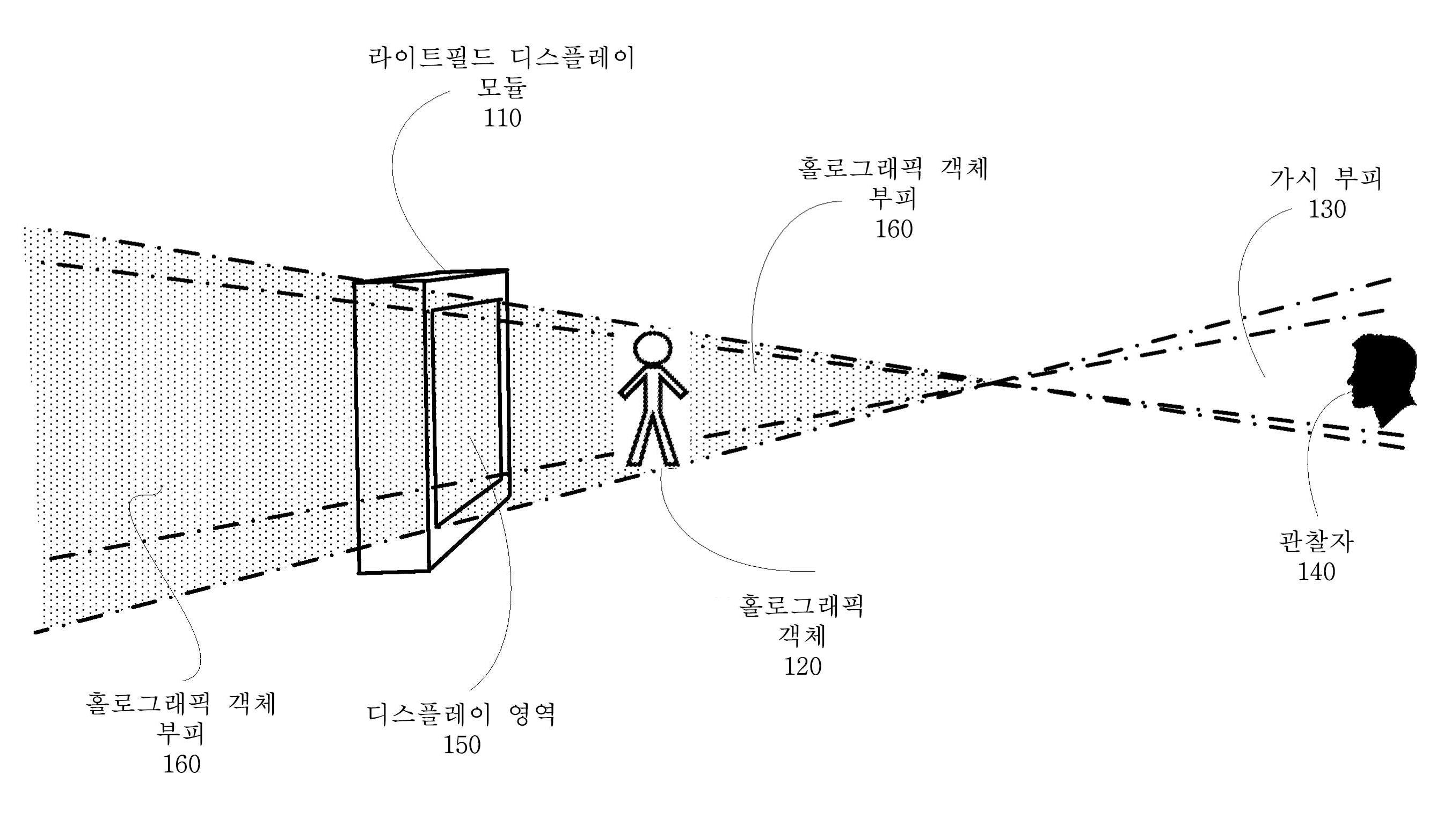
도 1은 하나 이상의 실시예들에 따른 홀로그래픽 객체를 제공하는 라이트필드 디스플레이 모듈의 도면이다.
도 2a는 하나 이상의 실시예들에 따른, 라이트필드 디스플레이 모듈의 일부분의 단면도이다.
도 2b는 하나 이상의 실시예들에 따른, 라이트필드 디스플레이 모듈의 일부분의 단면도이다.
도 3a는 하나 이상의 실시예들에 따른, 라이트필드 디스플레이 모듈의 사시도이다.
도 3b는 하나 이상의 실시예들에 따른, 인터리빙(interleaved)된 에너지 중계 장치들을 포함하는 라이트필드 디스플레이 모듈의 단면도이다.
도 4a는 하나 이상의 실시예들에 따른, 단일 측면의 이음매 없는 표면 환경을 형성하기 위해 2차원으로 타일링(tiled)되는 라이트필드 디스플레이 시스템의 일부의 사시도이다.
도 4b는 하나 이상의 실시예들에 따른, 다중-측면의 이음매 없는 표면 환경에서의 라이트필드 디스플레이 시스템의 일부의 사시도이다.
도 4c는 하나 이상의 실시예들에 따른, 날개형 구성의 집합 표면을 갖는 라이트필드 디스플레이 시스템의 평면도이다.
도 4d는 하나 이상의 실시예들에 따른, 경사진 구성의 집합 표면을 갖는 라이트필드 디스플레이 시스템의 측면도이다.
도 4e는 하나 이상의 실시예들에 따른, 장치의 전방 패널 상에 집합 표면을 갖는 라이트필드 디스플레이 시스템의 평면도이다.
도 5는 하나 이상의 실시예들에 따른, 라이트필드 디스플레이 시스템의 블록도이다.
도 6은 하나 이상의 실시예들에 따른, 네트워크 연결된 소비자 장치 시스템의 라이트필드 디스플레이 시스템에 대한 네트워크 환경의 블록도이다.
도 7은 소비자 장치와 함께 라이트필드 디스플레이를 사용하는 일 실시예의 예시적인 디스플레이이다.
도 8은 하나 이상의 실시예들에 따른, 라이트필드 디스플레이 시스템을 사용하여 소비자 장치와의 상호작용을 가능하게 하는 방법을 도시하는 흐름도이다.1 is a diagram of a lightfield display module that provides a holographic object in accordance with one or more embodiments.
2A is a cross-sectional view of a portion of a lightfield display module, in accordance with one or more embodiments.
2B is a cross-sectional view of a portion of a lightfield display module, in accordance with one or more embodiments.
3A is a perspective view of a lightfield display module, in accordance with one or more embodiments.
3B is a cross-sectional view of a lightfield display module including interleaved energy relay devices, in accordance with one or more embodiments.
4A is a perspective view of a portion of a lightfield display system that is tiled in two dimensions to form a single-sided, seamless surface environment, in accordance with one or more embodiments.
4B is a perspective view of a portion of a lightfield display system in a multi-sided seamless surface environment, in accordance with one or more embodiments.
4C is a top view of a lightfield display system having an aggregation surface in a winged configuration, in accordance with one or more embodiments.
4D is a side view of a lightfield display system having an aggregation surface in an inclined configuration, in accordance with one or more embodiments.
4E is a top view of a lightfield display system having an aggregation surface on a front panel of a device, in accordance with one or more embodiments.
5 is a block diagram of a lightfield display system, in accordance with one or more embodiments.
6 is a block diagram of a network environment for a lightfield display system of a networked consumer device system, in accordance with one or more embodiments.
7 is an exemplary display of one embodiment of using a lightfield display with a consumer device.
8 is a flow diagram illustrating a method of enabling interaction with a consumer device using a lightfield display system, in accordance with one or more embodiments.
개요summary
라이트필드(LF: light field) 디스플레이 시스템은 적어도 하나의 홀로그래픽 객체를 포함하는 홀로그래픽 콘텐츠를 장치 사용자에게 제공하기 위해 소비자 장치에서 구현된다. 용어 "사용자", "장치 사용자" 및 "관찰자"는 본원에서 상호 교환 가능하게 사용된다. 용어 "기기", "가전 장치", "소비자 가전 장치", "소비자 장치" 및 "장치"는 본원에서 상호 교환 가능하게 사용되며, 해당 용어들은 청소, 요리 및 음식 보존과 같은 집안일을 달성하는 전기적/기계적 기계뿐만 아니라 홈 어시스턴트(예를 들어, 아마존 Alexa™ 또는 구글 Home™)을 지칭한다. 예들은 냉장고, 난로, 세탁기, 건조기, 및 식기세척기, 로티 메이커(roti-maker), 압력밥솥 등과 같은 소비자 장치가 포함된다.A light field (LF) display system is implemented in a consumer device to provide a device user with holographic content comprising at least one holographic object. The terms “user”, “device user” and “observer” are used interchangeably herein. The terms "appliance", "household appliance", "consumer appliance", "consumer device" and "device" are used interchangeably herein, and the terms refer to an electrical appliance that accomplishes chores such as cleaning, cooking, and preserving food. /refers to mechanical machines as well as home assistants (eg Amazon Alexa™ or Google Home™). Examples include refrigerators, stoves, washing machines, dryers, and consumer devices such as dishwashers, roti-makers, pressure cookers, and the like.
장치를 사용하는 동안 장치 사용자에게 몰입형 동작 경험을 제공하기 위해 장치의 LF 표시 시스템이 장치 기능과 통합된다. 장치 기능은 기계적 및 전자적 제어 시스템을 사용하여 가능하며, 여기서 전자 제어 시스템은 다양한 소프트웨어 클라이언트 응용 프로그램을 포함하는 컴퓨터 프로그램 모듈을 실행함으로써 가능할 수 있고, 이를 사용하여 장치 사용자가 장치를 작동시킬 수 있다. LF 디스플레이 시스템은 장치의 가시 부피 내의 관찰자에게 보일 수 있는 하나 이상의 홀로그래픽 객체들을 포함하는 홀로그래픽 콘텐츠를 제공하도록 구성된 LF 디스플레이 모듈을 포함한다. LF 디스플레이 시스템에 의해 제공되는 홀로그래픽 콘텐츠는 장치 기능과 통합되며, 이는 장치를 동작하는 동안 장치 사용자의 몰입적 경험을 증가시킨다. 홀로그래픽 객체는 또한 다른 감각 자극(예를 들어, 촉각, 음향, 온도, 또는 후각)으로 증강될 수 있다. 예를 들어, LF 디스플레이 시스템 내의 초음파 방출기들은 부피 햅틱 투사를 생성하는 초음파 압력파를 투사할 수 있다. 부피 햅틱 투사는 투사된 홀로그래픽 객체들의 일부 또는 전부에 대응하는 촉각 표면을 제공한다. 홀로그래픽 콘텐츠는 추가적인 시각적 콘텐츠(즉, 2D 또는 3D 시각 콘텐츠)를 포함할 수 있다. 결맞은(cohesive) 경험이 인에이블되는 것을 보장하기 위한 에너지 소스들의 조정은 다수의 에너지 소스들을 이용한 구현들에서의 시스템의 일부이다(즉, 정확한 햅틱 느낌 및 감각 자극들을 임의의 주어진 시점에 제공하는 홀로그래픽 객체들). 예를 들어, LF 시스템은 홀로그래픽 콘텐츠 및 하나 이상의 햅틱 표면의 프리젠테이션을 조정하기 위한 컨트롤러를 포함할 수 있다.The device's LF display system is integrated with the device capabilities to provide an immersive motion experience to the device user while using the device. Device functionality may be enabled using mechanical and electronic control systems, wherein the electronic control system may be enabled by executing computer program modules comprising various software client applications, which may be used by a device user to operate the device. The LF display system includes a LF display module configured to provide holographic content comprising one or more holographic objects visible to an observer within a visible volume of the device. The holographic content provided by the LF display system is integrated with device functionality, which increases the device user's immersive experience while operating the device. Holographic objects may also be augmented with other sensory stimuli (eg, touch, sound, temperature, or smell). For example, ultrasonic emitters in a LF display system can project an ultrasonic pressure wave that produces a volumetric haptic projection. The volumetric haptic projection provides a tactile surface corresponding to some or all of the projected holographic objects. The holographic content may include additional visual content (ie, 2D or 3D visual content). Coordination of energy sources to ensure that a cohesive experience is enabled is part of the system in implementations using multiple energy sources (ie, providing accurate haptic feel and sensory stimuli at any given point in time). holographic objects). For example, the LF system may include a controller for coordinating the presentation of holographic content and one or more haptic surfaces.
일부 실시예들에서, LF 디스플레이 시스템은 시스템이 적어도 하나의 유형의 에너지를 투사할 수 있게 하고, 동시에, 사용자에 응답하고 반응형 경험을 생성하기 위한 목적으로 적어도 하나의 유형의 에너지를 감지할 수 있게 하는 구성요소들을 포함할 수 있다. 감지된 에너지는 사용자가 홀로그래픽 콘텐츠에 반응하는 어떻게 반응하는지를 기록하기 위해 사용될 수 있다. 예를 들어, LF 디스플레이 시스템은, 관찰을 위한 홀로그래픽 객체들뿐만 아니라 햅틱 인지를 위한 초음파를 투사하고, 동시에, 사용자에 의한 터치 반응을 검출하기 위해 초음파를 감지하면서, 사용자 및 다른 장면 분석을 추적하기 위한 이미징 정보를 동시에 기록할 수 있다. 일 예로서, 이러한 시스템은 사실상 사용자에 의해 가상으로 "터치"될 때 터치 자극에 따라 그의 "행동"을 수정하는 홀로그래픽 객체를 투사할 수 있다. 환경의 에너지 감지를 수행하는 디스플레이 시스템 구성요소들은 디스플레이 표면에 통합될 수 있거나, 초음파 스피커와 같은 디스플레이 표면과 분리된 전용 센서 및 카메라와 같은 이미징 캡처 장치일 수 있다.In some embodiments, the LF display system enables the system to project at least one type of energy, while being capable of sensing at least one type of energy for the purpose of responsive to a user and creating a responsive experience. It may contain components that enable it. The sensed energy can be used to record how the user reacts to the holographic content. For example, the LF display system projects ultrasound for haptic perception as well as holographic objects for observation, while simultaneously sensing ultrasound to detect touch response by the user, while tracking user and other scene analysis. It is possible to simultaneously record imaging information for As an example, such a system may in fact project a holographic object that, when virtually "touched" by a user, modifies its "behavior" in response to a touch stimulus. Display system components that perform energy sensing of the environment may be integrated into the display surface, or may be dedicated sensors and imaging capture devices such as cameras that are separate from the display surface, such as an ultrasonic speaker.
LF 디스플레이 시스템은 생성된 홀로그래픽 객체들에 기초하여 소비자 장치들에 다양한 경험들을 제공하도록 구성될 수 있다. 예를 들어, 일 실시예에서, 냉장고 상의 LF 디스플레이 시스템은 시각 애플리케이션을 통해 내부 냉장고 선반 내용물의 홀로그래픽 뷰를 사용자에게 제공하도록 구현될 수 있다. LF 디스플레이 어셈블리는 단일 측면의 또는 다중 측면의 이음매 없는(seamless) 표면 환경을 형성할 수 있다. 홀로그래픽 콘텐츠는 장치 디스플레이 화면 자체와 같은 실제 객체들을 증강시키거나 향상시킬 수 있다. 예를 들어, 일 실시예에서, 장치 상의 LF 디스플레이 시스템은 홀로그래픽 사인(holographic sign)을 제공하도록 구현될 수 있다(예를 들어, 오븐의 외부 표면 상에 "케이크 굽기: 완료까지: 12분"). 또한, 사용자는 3D 안경 또는 임의의 다른 헤드기어와 같은 안경 장치를 필요로 하지 않고도 홀로그래픽 콘텐츠를 자유롭게 볼 수 있다.The LF display system may be configured to provide various experiences to consumer devices based on the generated holographic objects. For example, in one embodiment, the LF display system on the refrigerator may be implemented to provide a user with a holographic view of interior refrigerator shelf contents via a visual application. The LF display assembly may form a single-sided or multi-sided seamless surface environment. Holographic content may augment or enhance real-world objects, such as the device display screen itself. For example, in one embodiment, the LF display system on the device may be implemented to provide a holographic sign (eg, "Bake Cake: Till Finish: 12 Minutes" on the exterior surface of the oven. ). In addition, the user can freely view the holographic content without the need for a glasses device such as 3D glasses or any other headgear.
일부 실시예들에서, LF 디스플레이 시스템은 추적 시스템 및/또는 감각 피드백 어셈블리를 통해 입력을 수신할 수 있다. 입력에 기초하여, LF 디스플레이 시스템은 관련 구성요소들에 피드백을 제공할 뿐만 아니라 홀로그래픽 콘텐츠를 조정할 수 있다.In some embodiments, the LF display system may receive input via a tracking system and/or sensory feedback assembly. Based on the input, the LF display system can adjust the holographic content as well as provide feedback to the relevant components.
LF 디스플레이 시스템은 또한, 적어도 LF 디스플레이 시스템의 가시 부피 내에서 사용자의 움직임을 추적하기 위한 시스템을 포함할 수 있다. 사용자의 추적된 움직임은 장치를 사용하는 사용자의 경험을 향상시키기 위해 사용될 수 있다. 예를 들어, LF 디스플레이 시스템은 홀로그래픽 콘텐츠와의 사용자 상호작용(예를 들어, 홀로그래픽 버튼을 누르는 것)을 용이하게 하기 위해 추적 정보를 사용할 수 있다. LF 디스플레이 시스템은 추적된 정보를 사용하여 홀로그래픽 객체에 대한 손가락 위치를 모니터링할 수 있다. 예를 들어, 홀로그래픽 객체는 사용자에 의해 "푸시(push)"될 수 있는 버튼일 수 있다. LF 디스플레이 시스템은 상기 버튼에 대응하고 상기 버튼과 실질적으로 동일한 공간을 점유하는 촉각 표면을 생성하기 위해 초음파 에너지를 투사할 수 있다. LF 디스플레이 시스템은 추적 정보를 사용하여 촉각 표면의 위치를 동적으로 이동시키고 버튼을 사용자에 의해 "푸시(push)"되는 것처럼 동적으로 이동시킬 수 있다. LF 디스플레이 시스템은 추적 정보를 이용하여, 눈 맞춤을 관찰하고/하거나 사용자와 다른 방식으로 상호작용하는 홀로그래픽 객체를 렌더링할 수 있다. LF 디스플레이 시스템은 추적 정보를 사용하여 사용자를 "터치"하는 홀로그래픽 객체를 렌더링할 수 있으며, 여기서 초음파 스피커는 홀로그래픽 객체가 터치를 통해 사용자와 상호작용할 수 있는 촉각 표면을 생성한다.The LF display system may also include a system for tracking movement of a user at least within the visible volume of the LF display system. The tracked movement of the user may be used to enhance the user's experience using the device. For example, a LF display system may use tracking information to facilitate user interaction with holographic content (eg, pressing a holographic button). The LF display system can use the tracked information to monitor finger position relative to the holographic object. For example, a holographic object may be a button that may be “pushed” by a user. The LF display system may project ultrasonic energy to create a tactile surface corresponding to the button and occupying substantially the same space as the button. The LF display system can use the tracking information to dynamically move the position of the tactile surface and dynamically move a button as if it were “pushed” by the user. The LF display system may use the tracking information to render a holographic object that observes eye contact and/or otherwise interacts with the user. The LF display system can use tracking information to render a holographic object that "touches" a user, where an ultrasonic speaker creates a tactile surface on which the holographic object can interact with the user through touch.
추가적으로, LF 디스플레이 시스템은 각각의 장치 사용자에게 개인화된 콘텐츠를 제공하기 위해 각각의 사용자를 식별하기 위한 사용자 프로파일링 시스템을 포함할 수 있다. 사용자 프로파일링 시스템은 홀로그래픽 콘텐츠를 개인화하기 위한 후속 사용에 사용될 수 있는 장치의 사용자의 특정 사용에 관한 다른 정보를 더 기록할 수 있다.Additionally, the LF display system may include a user profiling system for identifying each user to provide personalized content to each device user. The user profiling system may further record other information about the user's particular use of the device that may be used for subsequent use to personalize the holographic content.
라이트필드 디스플레이 시스템 개요Lightfield Display System Overview
도 1은 하나 이상의 실시예들에 따른, 홀로그래픽 객체(120)를 나타내는 라이트필드(LF, light field) 디스플레이 모듈(110)의 도면(100)이다. LF 디스플레이 모듈(110)은 라이트필드(LF) 디스플레이 시스템의 일부이다. LF 디스플레이 시스템은 하나 이상의 LF 디스플레이 모듈들을 사용하여 적어도 하나의 홀로그래픽 객체를 포함하는 홀로그래픽 콘텐츠를 제공한다. LF 디스플레이 시스템은 하나 또는 다수의 사용자들에게 홀로그래픽 콘텐츠를 제공할 수 있다. 일부 실시예들에서, LF 디스플레이 시스템은 또한 다른 감각 콘텐츠(예를 들어, 터치, 음향, 냄새, 또는 온도)로 홀로그래픽 콘텐츠를 증강시킬 수 있다. 예를 들어, 이하에서 설명되는 바와 같이, 초음파 음파의 투사는 홀로그래픽 객체의 일부 또는 전부의 표면을 시뮬레이션할 수 있는 공중(mid-air)의 촉감을 발생시킬 수 있다. LF 디스플레이 시스템은 하나 이상의 LF 디스플레이 모듈들(110)을 포함하고, 이는 도 2 내지 도 8과 관련하여 아래에서 상세히 설명된다.1 is a diagram 100 of a light field (LF)
LF 디스플레이 모듈(110)은 홀로그래픽 객체들(예를 들어, 홀로그래픽 객체(120))을 하나 이상의 사용자들(예를 들어, 관찰자(140))에게 제공하는 홀로그래픽 디스플레이이다. LF 디스플레이 모듈(110)은 에너지 장치층(예를 들어, 방출형 전자적 디스플레이 또는 음향 투사 장치) 및 에너지 도파층(예를 들어, 광학 렌즈 어레이)을 포함한다. 추가적으로, LF 디스플레이 모듈(110)은 다수의 에너지 소스들 또는 검출기들을 함께 조합하여 단일 표면을 형성하기 위해, 에너지 중계(relay) 층을 포함할 수 있다. 고 수준에서, 에너지 장치층은 에너지(예를 들어, 홀로그래픽 콘텐츠)를 생성하고, 이어서 이는 에너지 도파관을 사용하여 하나 이상의 4차원(4D) 라이트필드 기능들에 따라 공간 내의 특정 영역에 지향된다. LF 디스플레이 모듈(110)은 또한 하나 이상의 유형의 에너지를 동시에 투사 및/또는 감지할 수 있다. 예를 들어, LF 디스플레이 모듈(110)은 가시 부피 내의 초음파 촉각 표면뿐만 아니라 홀로그래픽 이미지를 투사할 수 있는 한편, 동시에 가시 부피로부터 이미징 데이터를 검출할 수 있다. LF 디스플레이 모듈(110)의 동작은 도 2 내지 도 3과 관련하여 아래에서 상세히 설명된다.The
LF 디스플레이 모듈(110)은 하나 이상의 4D 라이트필드 기능들(예를 들어, 플렌옵틱(plenoptic) 기능으로부터 도출된)을 이용하여 홀로그래픽 객체 부피(160) 내에 홀로그래픽 객체들을 생성한다. 홀로그래픽 객체는 3차원(3D), 2차원(2D), 또는 이들의 일부 조합일 수 있다. 또한, 홀로그래픽 객체들은 다색(예를 들어, 풀(full) 컬러)일 수 있다. 홀로그래픽 객체(120)는 홀로그래픽 객체 부피(160) 내의 임의의 위치에 배치될 수 있다. 홀로그래픽 객체는 스크린 평면의 전방에, 스크린 평면 뒤에 투사되거나, 스크린 평면에 의해 분할될 수 있다. 홀로그래픽 객체(120)는 홀로그래픽 객체 부피(160) 내의 어디에서나 인식되도록 제공될 수 있다. 홀로그래픽 객체 부피(160) 내의 홀로그래픽 객체는 관찰자(140)에게 공간 내에 떠있는 것처럼 보일 수 있다.The
홀로그래픽 객체 부피(160)는 홀로그래픽 객체가 관찰자(140)에 의해 인지될 수 있는 부피를 나타낸다. 홀로그래픽 객체 부피(160)는 홀로그래픽 객체가 디스플레이 영역(150)의 평면의 전방에 제공될 수 있도록, 디스플레이 표면(150)의 전방에서(즉, 관찰자(140)를 향하여) 연장될 수 있다. 또한, 홀로그래픽 객체 부피(160)는 디스플레이 영역(150)의 표면 뒤에(즉, 관찰자(140)로부터 멀어지게) 연장될 수 있어서, 홀로그래픽 객체가 마치 디스플레이 영역(150)의 평면 뒤에 있는 것처럼 표시될 수 있다. 즉, 홀로그래픽 객체 부피(160)는 디스플레이 영역(150)으로부터 기원하는(예를 들어, 투사되는) 그리고 홀로그래픽 객체를 생성하도록 수렴하는 모든 광선을 포함할 수 있다. 여기서, 광선은 디스플레이 표면의 전방에, 디스플레이 표면에, 또는 디스플레이 표면 뒤에 있는 지점에서 수렴할 수 있다. 보다 단순하게, 홀로그래픽 객체 부피(160)는 홀로그래픽 객체가 관찰자에 의해 인식될 수 있는 모든 부피를 내포한다.The holographic object volume 160 represents a volume in which the holographic object can be perceived by the
가시 부피(130)는 LF 디스플레이 시스템에 의해 홀로그래픽 객체 부피(160) 내에 표시되는 홀로그래픽 객체들(예를 들어, 홀로그래픽 객체(120))이 완전히 보일 수 있는 공간의 부피이다. 홀로그래픽 객체들은 실제 객체들과 구별될 수 없도록 홀로그래픽 객체 부피(160) 내에 제공될 수 있고, 가시 부피(130) 내에서 보일 수 있다. 홀로그래픽 객체는 물리적으로 존재할 경우에 해당 객체의 표면으로부터 생성되는 것과 동일한 광선을 투사함으로써 형성된다. 그리고 스테레오스코픽(stereoscopic) 디스플레이와는 달리, 홀로그래픽 객체 부피(160) 내의 수렴된 에너지 전파 경로의 관찰된 위치는 관찰자(140)가 가시 부피(130) 주변으로 이동함에 따라 변하지 않는다(예를 들어, 도 2와 관련하여 후술하는 바와 같음). 대신에, 홀로그래픽 가시 부피(130)에 위치한 2명의 사람들은 실제로 존재하는 것처럼 객체의 적절한 뷰를 볼 수 있을 것이다. 따라서, 관찰자(140)는 가시 부피 내에서 제한되지 않을 수 있다. 이와 달리, 통상적인 시스템들은 종종 관찰자가 특정 시야로(예를 들어, 디스플레이에 대해 고정된 위치를 갖는 의자에) 제약되는 것을 요구한다.The
일부 경우에, 홀로그래픽 객체 부피(160) 및 대응하는 가시 부피(130)는 단일 관찰자를 위해 설계되도록 상대적으로 작을 수 있다. 다른 실시예들에서, 예를 들어, 도 4a 및 도 4b에 관해 상세히 후술하는 바와 같이, LF 디스플레이 모듈들은 더 큰 홀로그래픽 객체 부피들 및 대규모 관찰자들(예컨대, 1명 내지 수천 명)을 수용할 수 있는 대응하는 가시 부피들을 생성하도록 확장 및/또는 타일링될 수 있다. 본 개시에서 제시된 LF 디스플레이 모듈들은, 모듈의 전체 표면이 베젤을 필요로 하지 않고, 비활성 공간 또는 사각지대가 없는 홀로그래픽 이미징 광학계를 포함하도록 구성된다. 이러한 실시예들에서, LF 디스플레이 모듈들은 이미징 영역이 LF 디스플레이 모듈들 사이에서 타일의 이음매(seam)를 가로질러 연속적이도록 타일링(tiled)될 수 있고, 타일형 모듈들 사이의 접합 선은 본질적으로 눈의 시력을 사용해서는 검출될 수 없다.In some cases, the holographic object volume 160 and the corresponding
가시 부피(130)의 유연한 크기 및/또는 형상은 관찰자가 가시 부피(130) 내에서 제한되지 않게 할 수 있다. 예를 들어, 관찰자(140)는 가시 부피(130) 내에서 다른 위치로 이동할 수 있고, 대응하는 관점으로부터 홀로그래픽 객체(120)의 상이한 뷰를 볼 수 있다. 예를 들어, 도 1을 참조하면, 관찰자(140)는 홀로그래픽 객체(120)가 사용자와 상호작용하는 시뮬레이션된 아바타일 수 있는 홀로그래픽 캐릭터의 정면 뷰인 것처럼 보이도록 홀로그래픽 객체(120)에 대해 제1 위치에 있다. 관찰자(140)는 캐릭터의 상이한 뷰를 보기 위해 홀로그래픽 객체(120)에 대해 다른 위치로 이동할 수 있다. 예를 들어, 관찰자(140)는, 마치 관찰자(140)가 실제 사람을 보고 있고 실제 사람에 대한 그/그녀의 상대적 위치를 변경하여 그 사람의 상이한 측면을 보는 것처럼, 캐릭터의 좌측 측면, 캐릭터의 우측 측면 등을 관찰하도록 이동할 수 있다. 일부 실시예들에서, 홀로그래픽 객체(120)는 홀로그래픽 객체(120)에 대해 시야에서 차단되지 않은 선(즉, 객체/사람에 의해 차단되지 않음)을 갖는, 가시 부피(130) 내의 모든 관찰자들에게 보일 수 있다. 이들 관찰자는 홀로그래픽 객체(120)의 상이한 관점을 보기 위해 가시 부피 내에서 움직일 수 있도록, 제한되지 않을 수 있다. 따라서, LF 디스플레이 시스템은 마치 홀로그래픽 객체들이 물리적으로 존재하는 것처럼 복수의 제한되지 않은 관찰자들이 실세계 공간에서 홀로그래픽 객체들의 상이한 관점들을 동시에 볼 수 있도록, 홀로그래픽 객체들을 제공할 수 있다.The flexible size and/or shape of the
이와 달리, 일반적으로, 통상적인 디스플레이(예를 들어, 입체, 가상 현실, 증강 현실 또는 혼합 현실)에서는 콘텐츠를 보기 위해서 각각의 관찰자가 특정 종류의 외부 장치(예를 들어, 3-D 안경, 근안(near-eye) 디스플레이, 또는 헤드마운트형 디스플레이)를 착용할 필요가 있다. 추가적으로 및/또는 대안적으로, 통상적인 디스플레이들은 관찰자가(예를 들어, 디스플레이에 대해 고정된 위치를 갖는 의자에서) 특정 가시 위치로 제한될 것을 필요로 할 수도 있다. 예를 들어, 스테레오스코픽 디스플레이에 의해 도시된 객체를 관찰할 때, 관찰자는 객체 상에서보다는 디스플레이 표면 상에 항상 초점을 맞추고, 디스플레이는 항상 그 인식된 객체 주위를 이동하려고 시도하는 관찰자를 따르는 객체의 두 개의 뷰들만을 제공할 것인데, 이는 그 객체에 대한 인식의 왜곡을 초래할 것이다. 그러나, 라이트필드 디스플레이를 이용하면, LF 디스플레이 시스템에 의해 제공되는 홀로그래픽 객체의 관찰자들은 홀로그래픽 객체를 보기 위해 외부 장치를 착용할 필요가 없다. LF 디스플레이 시스템은, 특별한 아이웨어(eyewear), 안경, 또는 헤드마운트형 액세서리에 대한 어떠한 요건도 없이, 물리적 객체가 관찰자들에게 보일 수 있는 것과 거의 동일한 방식으로 관찰자들에게 보이는 방식으로 홀로그래픽 객체를 제공한다. 또한, 관찰자는 가시 부피 내의 임의의 위치로부터 홀로그래픽 콘텐츠를 볼 수 있다.In contrast, in general, in a typical display (eg, stereoscopic, virtual, augmented or mixed reality), each viewer requires a certain kind of external device (eg, 3-D glasses, near-eye) to view the content. (near-eye) displays, or head-mounted displays). Additionally and/or alternatively, conventional displays may require that the viewer be limited to a specific viewing position (eg, in a chair having a fixed position relative to the display). For example, when observing an object shown by a stereoscopic display, the observer always focuses on the display surface rather than on the object, and the display is always two of the object following the observer trying to move around the perceived object. We will only provide views, which will lead to distortion of our perception of the object. However, with the lightfield display, observers of the holographic object provided by the LF display system do not need to wear an external device to view the holographic object. The LF display system displays holographic objects in much the same way that physical objects can be seen by them, without any requirements for special eyewear, glasses, or head-mounted accessories. to provide. In addition, the viewer can view the holographic content from any location within the visible volume.
특히, 홀로그래픽 객체 부피(160) 내의 홀로그래픽 객체들에 대한 잠재적인 위치들은 부피의 크기에 의해 제한된다. 홀로그래픽 객체 부피(160)의 크기를 증가시키기 위해, LF 디스플레이 모듈(110)의 디스플레이 영역(150)의 크기가 증가될 수 있고/있거나, 개별적인 LF 디스플레이 모듈들의 디스플레이 영역들보다 더 큰 유효 디스플레이 영역을 갖는 이음매 없는 디스플레이 표면을 형성하는 방식으로 다수의 LF 디스플레이 모듈들이 함께 타일링될 수 있다. LF 디스플레이 모듈들을 타일링하는 것에 관한 일부 실시예들은 도 4a 및 도 4b에 관해 이하에서 설명된다. 도 1에 도시된 바와 같이, 디스플레이 영역(150)은 피라미드인 홀로그래픽 객체 부피(160)를 야기하는 직사각형이다. 다른 실시예들에서, 디스플레이 영역은 소정의 다른 형상(예를 들어, 육각형)을 가질 수 있으며, 이는 또한 대응하는 가시 부피의 형상에 영향을 미친다.In particular, potential positions for holographic objects within holographic object volume 160 are limited by the size of the volume. To increase the size of the holographic object volume 160 , the size of the
추가적으로, 상기 설명은 LF 디스플레이 모듈(110)과 관찰자(140) 사이에 있는 홀로그래픽 객체 부피(160)의 일 부분 내에 홀로그래픽 객체(120)를 제공하는 것에 초점을 맞추지만, LF 디스플레이 모듈(110)은 디스플레이 영역(150)의 평면 뒤에 나타나는 콘텐츠를 더 제공할 수 있다. 예를 들어, LF 디스플레이 모듈(110)은 디스플레이 영역(150)이, 홀로그래픽 객체(120)가 그 안에 존재하는 방인 것으로 보이게 할 수 있다. 디스플레이된 콘텐츠는 관찰자(140)가 방 안의 다른 객체들을 보기 위해 디스플레이된 표면을 통해 볼 수 있도록 할 수 있다. 또한, LF 디스플레이 시스템은 디스플레이 표면(150)의 평면의 후방 및 전방을 포함하는 홀로그래픽 객체 부피(160) 주위로 매끄럽게 이동하는 콘텐츠를 생성할 수 있다.Additionally, while the description above focuses on providing the holographic object 120 within a portion of the holographic object volume 160 between the
도 2a는 하나 이상의 실시예들에 따른, LF 디스플레이 모듈(210)의 일 부분의 단면(200)이다. LF 디스플레이 모듈(210)은 LF 디스플레이 모듈(110)일 수 있다. 다른 실시예들에서, LF 디스플레이 모듈(210)은 디스플레이 영역(150)과 다른 디스플레이 영역 형상을 갖는 다른 LF 디스플레이 모듈일 수 있다. 예시된 실시예에서, LF 디스플레이 모듈(210)은 에너지 장치층(220), 에너지 중계층(230), 및 에너지 도파층(240)을 포함한다. LF 디스플레이 모듈(210)의 일부 실시예들은 여기에서 설명되는 것들과는 상이한 구성요소들을 갖는다. 예를 들어, 일부 실시예들에서, LF 디스플레이 모듈(210)은 에너지 중계층(230)을 포함하지 않는다. 유사하게, 기능들은 본원에 설명된 것과 다른 방식으로 구성요소들 중에 분배될 수 있다.2A is a
여기에서 설명되는 디스플레이 시스템은 실세계에서 일반적으로 물체를 둘러싸고 있는 에너지를 복제하는 에너지의 방출을 제공한다. 여기서, 방출된 에너지는 디스플레이 표면 상의 모든 좌표로부터 특정 방향을 향해 지향된다. 디스플레이 표면으로부터 지향된 에너지는 많은 에너지 광선들의 수렴을 가능하게 하며, 이에 의해, 가상 객체들을 생성할 수 있다. 가시광의 경우, 예를 들어, LF 디스플레이는 홀로그래픽 객체 부피 내의 임의의 지점에서 수렴하도록 매우 많은 수의 광선을 투사할 것이고, 따라서 이들은 투사되는 객체보다 더 멀리 위치한 관찰자의 관점으로부터 이 공간의 영역에 위치하는 실세계 객체의 표면으로부터 나오는 것처럼 보일 것이다. 이런 식으로, LF 디스플레이는 관찰자의 관점으로부터 그러한 물체의 표면을 벗어나는 반사된 광의 광선들을 생성하고 있다. 관찰자 관점은 임의의 주어진 가상 객체에 대해 변할 수 있고, 관찰자는 그 가상 객체의 상이한 뷰를 볼 것이다.The display systems described herein provide an emission of energy that replicates the energy that normally surrounds objects in the real world. Here, the emitted energy is directed towards a specific direction from all coordinates on the display surface. Energy directed from the display surface enables the convergence of many energy rays, thereby creating virtual objects. In the case of visible light, for example, an LF display will project a very large number of light rays to converge at any point within the holographic object volume, and thus they will be projected onto an area of this space from the point of view of an observer located further away than the projected object. It will appear to come from the surface of the real-world object it is located on. In this way, the LF display is creating rays of reflected light that exit the surface of such an object from the viewer's point of view. The observer perspective may change for any given virtual object, and the observer will see a different view of that virtual object.
에너지 장치층(220)은 하나 이상의 전자 디스플레이(예를 들어, OLED와 같은 발광 디스플레이) 및 본원에 설명된 바와 같은 하나 이상의 다른 에너지 투사 및/또는 에너지 수신 장치를 포함한다. 하나 이상의 전자 디스플레이들은 (예를 들어, LF 디스플레이 시스템의 컨트롤러로부터) 디스플레이 명령들에 따른 콘텐츠를 디스플레이하도록 구성된다. 하나 이상의 전자 디스플레이는 각각 개별적으로 제어되는 강도(intensity)를 갖는 복수의 픽셀을 포함한다. 발광 LED 및 OLED 디스플레이와 같은 여러 유형의 상업용 디스플레이가 LF 디스플레이에 사용될 수 있다.Energy device layer 220 includes one or more electronic displays (eg, light emitting displays such as OLEDs) and one or more other energy projecting and/or energy receiving devices as described herein. The one or more electronic displays are configured to display content according to display instructions (eg, from a controller of the LF display system). The one or more electronic displays include a plurality of pixels each having an intensity that is individually controlled. Several types of commercial displays can be used for LF displays, such as luminescent LED and OLED displays.
에너지 장치층(220)은 또한, 하나 이상의 음향 투사 장치 및/또는 하나 이상의 음향 수신 장치를 포함할 수 있다. 음향 방출 장치는 홀로그래픽 객체(250)를 보완하는 하나 이상의 압력파를 생성한다. 생성된 압력파는 예를 들어, 가청, 초음파, 또는 이들의 일부 조합일 수 있다. 초음파 압력파는 부피 촉각 감각을 위해 사용된다(예를 들어, 홀로그래픽 객체(250)의 표면에서). 가청 압력파는 홀로그래픽 객체(250)를 보완할 수 있는 오디오 콘텐츠(예를 들어, 몰입형 오디오)를 제공하기 위해 사용된다. 예를 들어, 홀로그래픽 객체(250)가 캐릭터이라고 가정하면, 하나 이상의 음향 투사 장치는 (1) 관찰자들이 홀로그래픽 객체(250)를 터치할 수 있도록, 제공되는 캐릭터의 표면과 함께 배치되는 촉각 표면을 생성하는 데 사용될 수 있고/있거나, (2) 캐릭터로부터의 예컨대 음성 인사에 대응하는 오디오 콘텐츠를 제공하는 데 사용될 수 있다. 음향 수신 장치(예를 들어, 마이크 또는 마이크 어레이)는 LF 디스플레이 모듈(210)의 로컬 영역 내의 초음파 및/또는 가청 압력파를 모니터링하도록 구성될 수 있다.The energy device layer 220 may also include one or more sound projecting devices and/or one or more sound receiving devices. The acoustic emitting device generates one or more pressure waves that complement the
에너지 장치층(220)은 또한, 하나 이상의 이미징 센서들을 포함할 수 있다. 이미징 센서는 적어도 가시 광 대역의 광에 민감하고, 일부 경우에는 다른 대역(예를 들어, 적외선)의 광에 민감할 수 있다. 이미징 센서는 예를 들어 시모스(CMOS, complementary metal oxide semi-conductor) 어레이, 전하 결합 소자(CCD), 광검출기들의 어레이, 광을 포획하는 몇몇 다른 센서, 또는 이들의 일부 조합일 수 있다. LF 디스플레이 시스템은 관찰자들의 위치 추적을 위해 하나 이상의 이미징 센서에 의해 캡처된 데이터를 사용할 수 있다.Energy device layer 220 may also include one or more imaging sensors. The imaging sensor is sensitive to light in at least the visible light band, and in some cases may be sensitive to light in other bands (eg, infrared). The imaging sensor may be, for example, a complementary metal oxide semi-conductor (CMOS) array, a charge coupled device (CCD), an array of photodetectors, some other sensor that captures light, or some combination thereof. The LF display system may use data captured by one or more imaging sensors to track the position of observers.
에너지 중계층(230)은 에너지 장치층(220)과 에너지 도파층(240) 사이에서 에너지(예를 들어, 전자기, 기계적 압력파)를 중계한다. 에너지 중계층(230)은 하나 이상의 에너지 중계 요소들(260)을 포함한다. 각각의 에너지 중계 요소는 제1 표면(265) 및 제2 표면(270)을 포함하고, 이는 2개의 표면들 사이의 에너지를 중계한다. 각각의 에너지 중계 요소의 제1 표면(265)은 하나 이상의 에너지 장치들(예를 들어, 전자 디스플레이 또는 음향 투사 장치)에 연결될 수 있다. 에너지 중계 요소는 예를 들어, 유리, 탄소, 광섬유, 광학 필름, 플라스틱, 폴리머, 또는 이들의 일부 조합으로 구성될 수 있다. 추가적으로, 일부 실시예들에서, 에너지 중계 요소는 제1 표면(265)과 제2 표면(270) 사이를 통과하는 에너지의 확대(증가 또는 감소)를 조절할 수 있다. 중계부가 확대를 제공하는 경우, 중계부는 테이퍼(taper)라고 불리는 접합된 테이퍼형(tapered) 중계부들의 어레이의 형태를 취할 수 있으며, 테이퍼의 일 단부의 면적은 반대쪽 단부보다 실질적으로 클 수 있다. 테이퍼의 큰 단부는 이음매 없는 에너지 표면(275)을 형성하기 위해 함께 접합할 수 있다. 하나의 장점은 다수의 디스플레이의 베젤과 같은 다수의 에너지 소스의 기계적인 엔벨로프(envelope)를 수용하기 위해, 각각의 테이퍼의 다수의 작은 단부들 상에 공간이 생성된다는 것이다. 이러한 여분의 공간은 에너지 소스가 작은 테이퍼 면 위에 나란히 배치될 수 있게 하며, 각각의 에너지 소스는 작은 테이퍼 표면으로 에너지를 지향시키고 큰 이음매 없는 에너지 표면으로 중계되도록 하는 활성(active) 영역을 가진다. 테이퍼형 중계를 사용하는 또 다른 장점은 테이퍼들의 큰 단부에 의해 형성된 조합된 이음매 없는 에너지 표면 상에 비-이미징 데드(dead) 공간이 존재하지 않는다는 점이다. 테두리 또는 베젤이 존재하지 않으며, 따라서 이음매 없는 에너지 표면이 함께 타일링되어, 눈의 시력에 따라서는 실질적으로 이음매가 없는 더 큰 표면을 형성할 수 있다.The
인접한 에너지 중계 요소들의 제2 표면들은 함께 모여서 에너지 표면(275)을 형성한다. 일부 실시예들에서, 인접한 에너지 중계 요소들의 엣지들 사이의 구분은, 에너지 표면(275)이 가시 부피(285) 내의 관찰자(280)의 관점으로부터 효과적으로 이음매 없도록(seamless), 20/40 시력보다 더 양호한 사람 시력에 의해 정의되는 바와 같은 최소의 인지 가능한 윤곽보다 더 작다.The second surfaces of adjacent energy relay elements are brought together to form an
일부 실시예들에서, 하나 이상의 에너지 중계 요소들은 에너지 국소화(energy localization)를 나타내며, 여기서 표면들(265, 270)에 실질적으로 수직한 세로(longitudinal) 방향에서의 에너지 전달 효율은 수직한 가로(transverse) 평면에서의 전달 효율보다 훨씬 더 높고, 에너지 밀도는 에너지 파동이 표면(265)과 표면(270) 사이에서 전파될 때 이 가로 평면 내에 매우 국소화된다. 이러한 에너지의 국소화는 이미지와 같은 에너지 분배가 해상도에서의 어떠한 큰 손실 없이도 이들 표면들 사이에서 효율적으로 중계될 수 있게 한다.In some embodiments, the one or more energy relay elements exhibit energy localization, wherein energy transfer efficiency in a longitudinal direction substantially perpendicular to
에너지 도파층(240)은 에너지 도파층(240) 내의 도파(waveguide) 요소들을 사용하여 에너지 표면(275) 상의 위치(예를 들어, 좌표)로부터, 디스플레이 표면으로부터 홀로그래픽 가시 부피(285)까지의 바깥으로의 특정 전파 경로로 에너지를 지향시킨다. 일 예로서, 전자기 에너지의 경우, 에너지 도파층(240) 내의 도파 요소들은 가시 부피(285)를 관통하여 상이한 전파 방향들을 따라 이음매 없는 에너지 표면(275) 상의 위치들로부터 광을 지향시킨다. 다양한 예들에서, 광은 홀로그래픽 객체 부피(255) 내에 홀로그래픽 객체(250)를 형성하기 위해 4D 라이트필드 기능에 따라 지향된다.
에너지 도파층(240)은 에너지 도파층(240) 내의 도파(waveguide) 요소들을 사용하여 에너지 표면(275) 상의 위치(예를 들어, 좌표)로부터, 디스플레이 표면으로부터 홀로그래픽 가시 부피(285)까지의 바깥으로의 특정 전파 경로로 에너지를 지향시킨다. 일 예로서, 전자기 에너지의 경우, 에너지 도파층(240) 내의 도파 요소들은 가시 부피(285)를 관통하여 상이한 전파 방향들을 따라 이음매 없는 에너지 표면(275) 상의 위치들로부터 광을 지향시킨다. 다양한 예들에서, 광은 홀로그래픽 객체 부피(255) 내에 홀로그래픽 객체(250)를 형성하기 위해 4D 라이트필드 기능에 따라 지향된다.
에너지 도파층(240) 내의 각각의 도파 요소는, 예를 들어, 하나 이상의 구성요소들로 구성된 렌즈릿(lenslet)일 수 있다. 일부 구성들에서, 렌즈릿은 볼록 렌즈일 수 있다. 볼록 렌즈는 구면, 비구면 또는 자유 형태인 표면 프로파일을 가질 수 있다. 추가적으로, 일부 실시예들에서, 도파 요소들의 일부 또는 전부는 하나 이상의 추가적인 광학 요소들을 포함할 수 있다. 추가적인 광학 요소는 예를 들어, 배플(baffle), 볼록 렌즈, 오목 렌즈, 구면 렌즈, 비구면 렌즈, 자유 형태 렌즈, 액정 렌즈, 액체 렌즈, 굴절 요소, 회절 요소, 또는 이들의 일부 조합과 같은 에너지-억제 구조일 수 있다. 일부 실시예들에서, 렌즈릿 및/또는 추가적인 광학 요소들 중 적어도 하나는 자신의 광학 출력을 동적으로 조절할 수 있다. 예를 들어, 렌즈릿은 액정 렌즈 또는 액체 렌즈일 수 있다. 렌즈릿 및/또는 적어도 하나의 추가적인 광학 요소의 표면 프로파일의 동적 조정은 도파 요소로부터 투사되는 광의 추가적인 지향성 제어를 제공할 수 있다.Each waveguide element in the
도시된 예에서, LF 디스플레이의 홀로그래픽 객체 부피(255)는 광선(256) 및 광선(257)에 의해 형성되는 경계를 갖지만, 다른 광선에 의해 형성될 수도 있다. 홀로그래픽 객체 부피(255)는 에너지 도파층(240)의 전방(즉, 관찰자(280) 쪽으로) 및 후방으로(즉, 관찰자(280)로부터 멀리) 연장되는 연속적인 부피이다. 도시된 예에서, 광선(256) 및 광선(257)은 사용자에 의해 인지될 수 있는 디스플레이 표면(277)의 법선에 대해 가장 높은 각도로 LF 디스플레이 모듈(210)의 서로 반대되는 엣지들로부터 투사되지만, 이들은 다른 투사된 광선들일 수 있다. 광선들은 디스플레이의 시야를 정의하고, 따라서 홀로그래픽 가시 부피(285)에 대한 경계를 정의한다. 일부 경우에, 광선들은 전체 디스플레이가 비네팅(vignetting) 없이 관찰될 수 있는 홀로그래픽 가시 부피(예를 들어, 이상적인 가시 부피)를 정의한다. 디스플레이의 시야가 증가함에 따라, 광선(256)과 광선(257)의 수렴 지점이 디스플레이에 더 근접할 것이다. 따라서, 더 큰 시야를 갖는 디스플레이는 관찰자(280)가 더 가까운 가시 거리에서 전체 디스플레이를 볼 수 있게 한다. 또한, 광선(256, 257)은 이상적인 홀로그래픽 객체 부피를 형성할 수 있다. 이상적인 홀로그래픽 객체 부피 내에 제공된 홀로그래픽 객체는 가시 부피(285)의 임의의 위치에서 볼 수 있다.In the example shown, the
일부 예들에서, 홀로그래픽 객체들은 가시 부피(285)의 일부에만 제공될 수 있다. 즉, 홀로그래픽 객체 부피는 임의의 수의 가시 서브 부피(예를 들어, 가시 서브 부피(290))로 분할될 수 있다. 또한, 홀로그래픽 객체는 홀로그래픽 객체 부피(255)의 외부에 투사될 수 있다. 예를 들어, 홀로그래픽 객체(251)는 홀로그래픽 객체 부피(255)의 외부에 제공된다. 홀로그래픽 객체(251)가 홀로그래픽 객체 부피(255)의 외부에 제공되기 때문에, 이는 가시 부피(285)의 모든 위치에서 보이지 않는다. 예를 들어, 홀로그래픽 객체(251)는 가시 서브 부피(290)의 위치에서 보일 수 있지만, 관찰자(280)의 위치에서는 보이지 않을 수 있다.In some examples, holographic objects may be provided in only a portion of the
예를 들어, 도 2b를 참조하면, 상이한 가시 서브 부피들로부터의 홀로그래픽 콘텐츠를 보는 것이 예시된다. 도 2b는 하나 이상의 실시예들에 따른 LF 디스플레이 모듈의 일 부분의 단면(200)을 도시한다. 도 2b의 단면은 도 2a의 단면과 동일하다. 그러나, 도 2b는 LF 디스플레이 모듈(210)로부터 투사된 상이한 광선들의 세트를 도시한다. 광선(256)과 광선(257)은 여전히 홀로그래픽 객체 부피(255) 및 가시 부피(285)를 형성한다. 그러나, 도시된 바와 같이, LF 디스플레이 모듈(210)의 상부 및 LF 디스플레이 모듈(210)의 하부로부터 투사된 광선들은 가시 부피(285) 내에서 다양한 가시 서브 부피들(예를 들어, 가시 서브 부피들(290A, 290B, 290C, 및 290D))을 형성하도록 오버랩된다. 제1 가시 서브 부피(예를 들어, 290A) 내의 관찰자는 다른 가시 서브 부피들(예를 들어, 290B, 290C, 및 290D) 내의 관찰자들이 인지할 수 없는 홀로그래픽 객체 부피(255) 내에 제공된 홀로그래픽 콘텐츠를 인지할 수 있다.For example, referring to FIG. 2B , viewing holographic content from different visible sub-volumes is illustrated. 2B shows a
더 간단히, 도 2a에 도시된 바와 같이, 홀로그래픽 객체 부피(255)는 홀로그래픽 객체들이 가시 부피(285) 내의 관찰자들(예를 들어, 관찰자(280))에 의해 인지될 수 있도록 LF 디스플레이 시스템에 의해 제공될 수 있는 부피이다. 이런 식으로, 가시 부피(285)는 이상적인 가시 부피의 일 예이고, 홀로그래픽 객체 부피(255)는 이상적인 객체 부피의 일 예이다. 그러나, 다양한 구성들에서, 다른 예시적인 가시 부피들에서의 관찰자들이 홀로그래픽 콘텐츠를 인지할 수 있도록, 관찰자들은 다른 예시적인 홀로그래픽 객체 부피들에서 LF 디스플레이 시스템(200)에 의해 제공되는 홀로그래픽 객체들을 인지할 수 있다. 보다 일반적으로, "눈-선(eye-line) 가이드라인"은 LF 디스플레이 모듈로부터 투사된 홀로그래픽 콘텐츠를 볼 때 적용된다. 눈-선(eye-line) 가이드라인은 관찰자의 눈 위치 및 보고 있는 홀로그래픽 객체에 의해 형성되는 선이 LF 디스플레이 표면과 교차해야 한다고 강조한다.More simply, as shown in FIG. 2A , the
LF 디스플레이 모듈(210)에 의해 제공되는 홀로그래픽 콘텐츠를 보는 경우, 관찰자(280)의 각각의 눈은 홀로그래픽 객체(250)의 상이한 관점을 보게 되는데, 그 이유는 홀로그래픽 콘텐츠가 4D 라이트필드 기능에 따라 제공되기 때문이다. 또한, 관찰자(280)가 가시 부피(285) 내에서 이동함에 따라, 그는 또한 가시 부피(285) 내의 다른 관찰자들과 마찬가지로 홀로그래픽 객체(250)의 상이한 관점들을 볼 수 있다. 통상의 기술자에 의해 이해되는 바와 같이, 4D 라이트필드 기능은 당업계에 잘 알려져 있으며, 본원에서는 더 상세히 설명되지 않을 것이다.When viewing the holographic content provided by the
본원에 더 상세하게 설명되는 바와 같이, 일부 실시예들에서, LF 디스플레이는 하나 이상의 유형의 에너지를 투사할 수 있다. 예를 들어, LF 디스플레이는 예를 들어, 기계적 에너지 및 전자기 에너지와 같은 2가지 유형의 에너지를 투사할 수 있다. 이러한 구성에서, 에너지 중계층(230)은, 에너지 표면(275)에서 함께 인터리빙(interleaved)되되 에너지가 2개의 상이한 에너지 장치층들(220)로 중계되도록 분리되는, 2개의 개별적인 에너지 중계부들을 포함한다. 여기서, 하나의 중계부는 전자기 에너지를 전달하도록 구성될 수 있는 반면, 다른 중계부는 기계적 에너지를 수송하도록 구성될 수 있다. 일부 실시예들에서, 기계적 에너지는 에너지 도파층(240) 상의 전자기 도파 요소들 사이의 위치들로부터 투사될 수 있고, 하나의 전자기 도파 요소로부터 다른 전자기 도파 요소로 광이 전송되는 것을 억제하는 구조들의 형성을 돕는다. 일부 실시예들에서, 에너지 도파층(240)은 또한 컨트롤러로부터의 디스플레이 명령들에 따른 특정 전파 경로들을 따라서 집속된 초음파를 수송하는 도파 요소들을 포함할 수 있다.As described in more detail herein, in some embodiments, the LF display can project one or more types of energy. For example, an LF display can project two types of energy, for example mechanical energy and electromagnetic energy. In this configuration,
다른 실시예들(도시되지 않음)에서, LF 디스플레이 모듈(210)은 에너지 중계층(230)을 포함하지 않음에 유의해야 한다. 이 경우에, 에너지 표면(275)은 에너지 장치층(220) 내에 하나 이상의 인접한 전자 디스플레이를 사용하여 형성된 방출 표면이다. 그리고 일부 실시예들에서, 인접한 전자 디스플레이들의 엣지들 사이의 구분은, 에너지 표면이 가시 부피(285) 내의 관찰자(280)의 관점으로부터 효과적으로 이음매 없도록(seamless), 사람 눈의 20/40 시력에 의해 정의되는 바와 같은 최소의 인지 가능한 윤곽보다 더 작다.It should be noted that in other embodiments (not shown), the
LF 디스플레이 모듈LF display module
도 3a는 하나 이상의 실시예들에 따른 LF 디스플레이 모듈(300A)의 사시도이다. LF 디스플레이 모듈(300A)은 LF 디스플레이 모듈(110) 및/또는 LF 디스플레이 모듈(210)일 수 있다. 다른 실시예들에서, LF 디스플레이 모듈(300A)은 일부 다른 LF 디스플레이 모듈일 수 있다. 예시된 실시예들에서, LF 디스플레이 모듈(300A)은 에너지 장치층(310), 에너지 중계층(320), 및 에너지 도파층(330)을 포함한다. LF 디스플레이 모듈(300A)은 본원에 기술된 바와 같이 디스플레이 표면(365)으로부터 홀로그래픽 콘텐츠를 제공하도록 구성된다. 편의상, 디스플레이 표면(365)은 LF 디스플레이 모듈(300A)의 프레임(390) 상의 점선으로 도시되지만, 보다 정확하게는, 프레임(390)의 내부 림(rim)에 의해 한정된 도파 요소들의 전방에 직접 위치된다. LF 디스플레이 모듈(300A)의 일부 실시예들은 여기에서 설명되는 것들과는 상이한 구성요소들을 갖는다. 예를 들어, 일부 실시예들에서, LF 디스플레이 모듈(300A)은 에너지 중계층(320)을 포함하지 않는다. 유사하게, 기능들은 본원에 설명된 것과 다른 방식으로 구성요소들 중에 분배될 수 있다.3A is a perspective view of a
에너지 장치층(310)은 에너지 장치층(220)의 일 실시예이다. 에너지 장치층(310)은 4개의 에너지 장치들(340)(도면에는 3개가 도시됨)을 포함한다. 에너지 장치들(340)은 모두 동일한 유형(예를 들어, 모두 전자 디스플레이들)일 수 있거나, 하나 이상의 상이한 유형들을 포함(예를 들어, 전자 디스플레이들 및 적어도 하나의 음향 에너지 장치를 포함)할 수 있다.The
에너지 중계층(320)은 에너지 중계층(230)의 일 실시예이다. 에너지 중계층(320)은 4개의 에너지 중계 요소(350)(도면에는 3개가 도시됨)를 포함한다. 에너지 중계 장치들(350)은 모두 동일한 유형의 에너지(예를 들어, 광)를 중계하거나, 하나 이상의 상이한 유형들(예를 들어, 광 및 소리)을 중계할 수 있다. 각각의 중계 요소들(350)은 제1 표면 및 제2 표면을 포함하고, 에너지 중계 요소들(350)의 제2 표면은 하나의 이음매 없는 에너지 표면(360)을 형성하도록 배열된다. 예시적인 실시예에서, 각각의 에너지 중계 요소들(350)은 제1 표면이 제2 표면보다 더 작은 표면 영역을 갖도록 테이퍼되며, 이는 테이퍼의 작은 단부 상에 에너지 장치들(340)의 기계적인 엔벨로프(envelope)들을 수용할 수 있게 한다. 이는 또한, 전체 영역이 에너지를 투사할 수 있기 때문에, 이음매 없는 에너지 표면에 경계가 없어지게 한다. 이는, 전체 조합된 표면이 이음매 없도록, 사각지대 또는 베젤 없이, 다수의 인스턴스들(300)을 함께 배치함으로써 이러한 이음매 없는 에너지 표면이 타일링(tiled)될 수 있음을 의미한다. 다른 실시예들에서, 제1 표면 및 제2 표면은 동일한 표면적을 갖는다.The energy relay layer 320 is an embodiment of the
에너지 도파층(330)은 에너지 도파층(240)의 일 실시예이다. 에너지 도파층(330)은 복수의 도파 요소들(370)을 포함한다. 도 2와 관련하여 위에서 설명된 바와 같이, 에너지 도파층(330)은 홀로그래픽 객체를 형성하기 위해 4D 플렌옵틱(plenoptic) 기능에 따라서 특정 전파 경로를 따라 이음매 없는 에너지 표면(360)으로부터 에너지를 지향시키도록 구성된다. 도시된 실시예에서, 에너지 도파층(330)은 프레임(390)에 의해 한정되는 것에 유의해야 한다. 다른 실시예들에서는, 프레임(390)이 없고/없거나, 프레임(390)의 두께가 감소된다. 프레임(390)의 두께의 제거 또는 감소는 LF 디스플레이 모듈(300A)을 추가적인 LF 디스플레이 모듈들(300)과 함께 타일링하는 것을 용이하게 할 수 있다.The
도시된 실시예에서, 이음매 없는 에너지 표면(360) 및 에너지 도파층(330)은 평면형(planar)이다. 다른 실시예들에서, 도시되지는 않았지만, 이음매 없는 에너지 표면(360) 및 에너지 도파층(330)은 하나 이상의 차원들에서 만곡될 수 있다.In the illustrated embodiment, the seamless energy surface 360 and
LF 디스플레이 모듈(300A)은 이음매 없는 에너지 표면의 표면 상에 상주하는 추가적인 에너지 소스들로 구성될 수 있고, 라이트필드에 대해 에너지 필드의 추가적인 투사를 허용한다. 일 실시예에서, 음향 에너지 필드는 이음매 없는 에너지 표면(360) 상의 임의의 수의 위치들에 장착된 정전기 스피커들(도시되지 않음)로부터 투사될 수 있다. 또한, LF 디스플레이 모듈(300A)의 정전기 스피커들은 듀얼 에너지 표면이 동시에 소리 필드들 및 홀로그래픽 콘텐츠를 투사하도록, 라이트필드 디스플레이 모듈(300A) 내에 위치된다. 예를 들어, 정전기 스피커들은 전자기 에너지의 일부 파장들에 대해 투과성인 하나 이상의 다이어프램 요소들로 형성될 수 있으며, 전도성 요소들을 이용하여 구동될 수 있다. 정전기 스피커들은 다이어프램 요소들이 도파 요소들의 일부를 덮도록 이음매 없는 에너지 표면(360)에 장착될 수 있다. 스피커들의 전도성 전극들은 전자기 도파들 사이의 광 전송을 억제하도록 설계되고/되거나 전자기 도파 요소들(예를 들어, 프레임(390)) 사이의 위치들에 위치하는 구조물들과 함께 배치될 수 있다. 다양한 구성들에서, 스피커들은 가청 소리를 투사하고/하거나 햅틱 표면을 생성하는 집속된 초음파 에너지의 여러 소스들을 투사할 수 있다.The
일부 구성들에서, 에너지 장치(340)는 에너지를 감지할 수 있다. 예를 들어, 에너지 장치는 마이크, 광 센서, 음향 트랜스듀서 등일 수 있다. 이와 같이, 에너지 중계 장치들은 또한 이음매 없는 에너지 표면(360)으로부터 에너지 장치층(310)으로 에너지를 중계할 수 있다. 즉, 에너지 장치들 및 에너지 중계 장치들(340)이 에너지를 방출하고 동시에 감지(예를 들어, 라이트필드들을 방출하고 소리를 감지)하도록 구성될 때, LF 디스플레이 모듈의 이음매 에너지 표면(360)은 양방향성 에너지 표면을 형성한다.In some configurations, the energy device 340 can sense energy. For example, the energy device may be a microphone, an optical sensor, an acoustic transducer, or the like. As such, the energy relay devices may also relay energy from the seamless energy surface 360 to the
보다 광범위하게, LF 디스플레이 모듈(340)의 에너지 장치(340)는 에너지 소스 또는 에너지 센서일 수 있다. LF 디스플레이 모듈(300A)은 사용자에게 고품질 홀로그래픽 콘텐츠의 투사를 용이하게 하기 위해 에너지 소스들 및/또는 에너지 센서들로서 작용하는 다양한 유형들의 에너지 장치들을 포함할 수 있다. 다른 소스들 및/또는 센서들은 열 센서들 또는 소스들, 적외선 센서들 또는 소스들, 이미지 센서들 또는 소스들, 음향 에너지를 생성하는 기계적 에너지 트랜스듀서들, 피드백 소스들 등을 포함할 수 있다. 많은 다른 센서들 또는 소스들이 가능하다. 또한, LF 디스플레이 모듈들은, LF 디스플레이 모듈이 커다란 집합된 이음매 없는 에너지 표면으로부터 여러 유형의 에너지를 투사하고 감지하는 어셈블리를 형성할 수 있도록 타일링(tiled)될 수 있다.More broadly, the energy device 340 of the LF display module 340 may be an energy source or an energy sensor. The
LF 디스플레이 모듈(300A)의 다양한 실시예들에서, 이음매 없는 에너지 표면(360)은 다양한 표면 부분들을 가질 수 있으며, 각각의 표면 부분은 특정 유형의 에너지를 투사 및/또는 방출하도록 구성된다. 예를 들어, 이음매 없는 에너지 표면이 듀얼-에너지 표면일 때, 이음매 없는 에너지 표면(360)은 전자기 에너지를 투사하는 하나 이상의 표면 부분들, 및 초음파 에너지를 투사하는 하나 이상의 다른 표면 부분들을 포함한다. 초음파 에너지를 투사하는 표면 부분들은 도파관 요소들 사이의 이음매 없는 에너지 표면(360) 상에 위치될 수 있고/있거나 도파관 요소들 사이의 광 투과를 억제하도록 설계된 구조물들과 함께 위치될 수 있다. 이음매 없는 에너지 표면이 양방향 에너지 표면인 예에서, 에너지 중계층(320)은 이음매 없는 에너지 표면(360)에서 인터리빙되는 2개의 유형의 에너지 중계 장치들을 포함할 수 있다. 다양한 실시예들에서, 이음매 없는 에너지 표면(360)은 특정한 도파 요소들(370) 아래의 표면의 부분들이 모두 에너지 소스들, 모두 에너지 센서들, 또는 에너지 소스들 및 에너지 센서들의 혼합이 되도록, 구성될 수 있다.In various embodiments of
도 3b는 하나 이상의 실시예들에 따른, 인터리빙된 에너지 중계 장치들을 포함하는 LF 디스플레이 모듈(300B)의 단면도이다. LF 디스플레이 모듈(300B)은 둘 이상의 유형의 에너지를 투사하기 위한 듀얼 에너지 투사 장치로서, 또는 한 유형의 에너지를 투사하고 동시에 다른 유형의 에너지를 감지하기 위한 양방향 에너지 장치로서, 구성될 수 있다. LF 디스플레이 모듈(300B)은 LF 디스플레이 모듈(110) 및/또는 LF 디스플레이 모듈(210)일 수 있다. 다른 실시예들에서, LF 디스플레이 모듈(302)은 일부 다른 LF 디스플레이 모듈일 수 있다.3B is a cross-sectional view of a
LF 디스플레이 모듈(300B)은 도 3a의 LF 디스플레이 모듈(300A)의 것들과 유사하게 구성된 많은 구성요소들을 포함한다. 예를 들어, 예시된 실시예에서, LF 디스플레이 모듈(300B)은 적어도 도 3a에 관해 기술된 것들의 동일한 기능을 포함하는, 에너지 장치층(310), 에너지 중계층(320), 이음매 없는 에너지 표면(360), 및 에너지 도파층(330)을 포함한다. 추가적으로, LF 디스플레이 모듈(300B)은 디스플레이 표면(365)으로부터 에너지를 제공하고/하거나 수신한다. 특히, LF 디스플레이 모듈(300B)의 구성요소들은 대안적으로, 도 3a의 LF 디스플레이 모듈(300A)의 구성요소들과 연결되고/되거나 지향(orient)된다. LF 디스플레이 모듈(300B)의 일부 실시예들은 여기에서 설명되는 것들과는 상이한 구성요소들을 갖는다. 유사하게, 기능들은 본원에 설명된 것과 다른 방식으로 구성요소들 중에 분배될 수 있다. 도 3b는 더 큰 면적을 갖는 듀얼 에너지 투사 표면 또는 양방향성 에너지 표면을 생성하도록 타일링될 수 있는 하나의 LF 디스플레이 모듈(302)의 설계를 도시한다.The
일 실시예에서, LF 디스플레이 모듈(300B)은 양방향 LF 디스플레이 시스템의 LF 디스플레이 모듈이다. 양방향 LF 디스플레이 시스템은 디스플레이 표면(365)으로부터 에너지를 투사함과 동시에 에너지를 감지할 수 있다. 이음매 없는 에너지 표면(360)은 이음매 없는 에너지 표면(360) 상에 근접하게 인터리빙되는 에너지 투사 위치 및 에너지 감지 위치 모두를 포함한다. 따라서, 도 3b의 예에서, 에너지 중계층(320)은 도 3a의 에너지 중계층과는 상이한 방식으로 구성된다. 편의상, LF 디스플레이 모듈(300B)의 에너지 중계층은 본원에서 "인터리빙된 에너지 중계층"으로 지칭될 것이다.In one embodiment, the
인터리빙된 에너지 중계층(320)은 두 개의 레그들, 즉, 제1 에너지 중계 장치(350A) 및 제2 에너지 중계 장치(350B)를 포함한다. 각각의 레그들은 밝은 음영 영역으로 도시되어 있다. 각각의 레그들은 플렉시블 중계 물질로 제조될 수 있고, 다양한 크기들 및 형상들의 에너지 장치들과 함께 사용하기에 충분한 길이로 형성될 수 있다. 인터리빙된 에너지 중계층의 일부 영역들에서, 두 개의 레그들은 이음매 없는 에너지 표면(360)에 접근함에 따라 함께 조밀하게(tightly) 인터리빙(interleaved)된다. 도시된 예에서, 인터리빙된 에너지 중계 장치들(352)은 어두운 음영 영역으로 도시되어 있다.The interleaved energy relay layer 320 includes two legs, that is, a first
이음매 없는 에너지 표면(360)에서 인터리빙되는 동안, 에너지 중계 장치들은 상이한 에너지 장치들로부터/그에 대해 에너지를 중계하도록 구성된다. 에너지 장치들은 에너지 장치층(310)에 존재한다. 도시된 바와 같이, 에너지 장치(340A)는 에너지 중계 장치(350A)에 연결되고, 에너지 장치(340B)는 에너지 중계 장치(350B)에 연결된다. 다양한 실시예들에서, 각각의 에너지 장치는 에너지 소스 또는 에너지 센서일 수 있다.While interleaved at the seamless energy surface 360 , the energy relay devices are configured to relay energy to/from different energy devices. Energy devices are present in the
에너지 도파층(330)은 일련의 수렴 지점들을 향하여 투사된 경로들을 따라 이음매 없는 에너지 표면(360)으로부터 에너지 파들을 조향(steer)하기 위한 도파 요소들(370)을 포함한다. 이 예에서, 홀로그래픽 객체(380)는 일련의 수렴 지점들에 형성된다. 특히, 도시된 바와 같이, 홀로그래픽 객체(380)에서의 에너지의 수렴은 디스플레이 표면(365)의 관찰자 측에서 발생한다. 그러나, 다른 예에서, 에너지의 수렴은, 디스플레이 표면(365)의 전방 및 디스플레이 표면(365)의 후방 둘 모두에서 연장되는, 홀로그래픽 객체 부피 내의 어느 곳에도 존재할 수 있다. 도파 요소들(370)은 후술하는 바와 같이 에너지 장치(예를 들어, 에너지 센서)로 들어오는 에너지를 동시에 조향할 수 있다.
LF 디스플레이 모듈(300B)의 일 예시적인 실시예에서, 에너지 소스로서 발광 디스플레이가 사용되고, 에너지 센서로서 이미징 센서가 사용된다. 이런 식으로, LF 디스플레이 모듈(300B)은 홀로그래픽 콘텐츠를 투사함과 동시에 디스플레이 표면(365)의 전방에서 해당 부피로부터 광을 검출할 수 있다.In one exemplary embodiment of the
일 실시예에서, LF 디스플레이 모듈(300B)은 디스플레이 표면(365)의 전방에 라이트필드를 투사하고 동시에 디스플레이 표면(365)의 전방으로부터 라이트필드를 캡처하도록 구성된다. 이 실시예에서, 에너지 중계 장치(350A)는 도파 요소들(370) 아래에 위치된 이음매 없는 에너지 표면(360)에서의 제1 세트의 위치들을 에너지 장치(340A)에 연결한다. 일 예에서, 에너지 장치(340A)는 소스 픽셀들의 어레이를 갖는 방출형(emissive) 디스플레이이다. 에너지 중계 장치(340B)는 도파 요소들(370) 아래에 위치된 이음매 없는 에너지 표면(360)에서의 제2 세트의 위치들을 에너지 장치(340B)에 연결한다. 일 예에서, 에너지 장치(340B)는 센서 픽셀들의 어레이를 갖는 이미징 센서이다. LF 디스플레이 모듈(302)은 특정 도파관 요소(370) 아래에 있는 이음매 없는 에너지 표면(365)에서의 위치들이 모든 발광 디스플레이 위치들, 모든 이미징 센서 위치들, 또는 위치들의 일부 조합이 되도록 구성될 수 있다. 다른 실시예들에서, 양방향 에너지 표면은 다양한 다른 형태의 에너지를 투사하고 수신할 수 있다.In one embodiment, the
LF 디스플레이 모듈(300B)의 다른 예시적인 실시예에서, LF 디스플레이 모듈은 2개의 상이한 유형의 에너지를 투사하도록 구성된다. 예를 들어, 에너지 장치(340A)는 전자기 에너지를 방출하도록 구성된 방출 디스플레이이고, 에너지 장치(340B)는 기계적 에너지를 방출하도록 구성된 초음파 변환기이다. 이와 같이, 광 및 소리는 이음매 없는 에너지 표면(360)에서의 다양한 위치들로부터 투사될 수 있다. 이러한 구성에서, 에너지 중계 장치(350A)는 에너지 장치(340A)를 이음매 없는 에너지 표면(360)에 연결하고 전자기 에너지를 중계한다. 에너지 중계 장치는 전자기 에너지를 수송하는 데에 효율적인 특성들(예를 들어, 가변 굴절률)을 갖도록 구성된다. 에너지 중계 장치(350B)는 에너지 장치(340B)를 이음매 없는 에너지 표면(360)에 연결하고 기계적 에너지를 중계한다. 에너지 중계 장치(350B)는 초음파 에너지의 효율적인 수송(예를 들어, 상이한 음향 임피던스를 갖는 물질들의 분포)을 위한 특성들을 갖도록 구성된다. 일부 실시예들에서, 기계적 에너지는 에너지 도파층(330) 상의 도파 요소들(370) 사이의 위치들로부터 투사될 수 있다. 기계적 에너지를 투사하는 위치들은 광이 하나의 전자기 도파 요소로부터 다른 전자기 도파 요소로 전송되는 것을 억제하는 역할을 하는 구조물들을 형성할 수 있다. 일 예에서, 초음파 기계적 에너지를 투사하는 공간적으로 분리된 위치들의 어레이는 공중(mid-air) 중의 3차원 햅틱 형상들 및 표면들을 생성하도록 구성될 수 있다. 표면들은 투사된 홀로그래픽 객체(예를 들어, 홀로그래픽 객체(380))와 일치할 수 있다. 일부 예들에서, 어레이에 걸친 위상 지연들 및 진폭 변동들은 햅틱 형상들의 생성을 보조할 수 있다.In another exemplary embodiment of the
다양한 실시예들에서, 양방향 LF 디스플레이 모듈(302)은 특정 유형의 에너지 장치를 포함하는 각각의 에너지 장치층을 갖는 다수의 에너지 장치층들을 포함할 수 있다. 이러한 예들에서, 에너지 중계층들은 이음매 없는 에너지 표면(360)과 에너지 장치층(330) 사이에서 적절한 유형의 에너지를 중계하도록 구성된다.In various embodiments, the interactive LF display module 302 may include multiple energy device layers, each energy device layer containing a particular type of energy device. In these examples, the energy relay layers are configured to relay an appropriate type of energy between the seamless energy surface 360 and the
타일형 LF 디스플레이 모듈Tiled LF Display Module
도 4a는 하나 이상의 실시예들에 따른, 단일-측면의 이음매 없는 표면 환경을 형성하기 위해 2차원으로 타일링(tiled)되는 LF 디스플레이 시스템(400)의 일 부분의 사시도이다. LF 디스플레이 시스템(400)은 어레이(410)를 형성하도록 타일링되는 복수의 LF 디스플레이 모듈들을 포함한다. 보다 명시적으로, 어레이(410) 내의 작은 사각형들 각각은 타일형 LF 디스플레이 모듈(412)을 나타낸다. 어레이(410)는 예를 들어, 표면의 일부 또는 전부를 커버할 수 있다.4A is a perspective view of a portion of a
어레이(410)는 하나 이상의 홀로그래픽 객체들을 투사할 수 있다. 예를 들어, 도시된 실시예에서 어레이(410)는 홀로그래픽 객체(420) 및 홀로그래픽 객체(430)를 투사한다. LF 디스플레이 모듈들의 타일링은 훨씬 더 큰 가시 부피뿐만 아니라, 객체들이 어레이(410)로부터 더 먼 거리로 투사될 수 있게 한다. 예를 들어, 도시된 실시예에서, 가시 부피는 근사적으로, LF 디스플레이 모듈(412)의 전방(및 후방)의 국소화된 부피가 아니라, 어레이(410)의 전방 및 후방에 있는 전체 영역이다.
일부 실시예들에서, LF 디스플레이 시스템(400)은 홀로그래픽 객체(420)를 관찰자(430) 및 관찰자(434)에 제공한다. 관찰자(430) 및 관찰자(434)는 홀로그래픽 객체(420)의 상이한 관점들을 수신한다. 예를 들어, 관찰자(430)에게는 홀로그래픽 객체(420)의 직접적인 뷰가 제공되는 반면, 관찰자(434)에게는 홀로그래픽 객체(430)의 더 경사진 뷰가 제공된다. 관찰자(430) 및/또는 관찰자(434)가 이동함에 따라, 그들은 홀로그래픽 객체(420)의 상이한 관점들을 제공받는다. 이는 관찰자가 홀로그래픽 객체에 대해 이동함으로써 홀로그래픽 객체와 시각적으로 상호작용할 수 있게 한다. 예를 들어, 관찰자(430)가 홀로그래픽 객체(420) 주위를 걸어갈 때, 관찰자(430)는 홀로그래픽 객체(420)가 어레이(410)의 홀로그래픽 객체 부피 내에 남아 있는 한, 홀로그래픽 객체(420)의 상이한 측면들을 보게 된다. 따라서, 관찰자(430) 및 관찰자(434)는 마치 실제로 존재하는 것처럼 실제 공간에서 홀로그래픽 객체(420)를 동시에 볼 수 있다. 추가적으로, 홀로그래픽 객체(420)는 물리적 객체가 보이는 것과 거의 동일한 방식으로 관찰자들에게 보이기 때문에, 홀로그래픽 객체(420)의 관찰자(440) 및 관찰자(450)는 홀로그래픽 객체(420)를 보기 위해 외부 장치를 착용할 필요가 없다. 또한, 여기에서, 홀로그래픽 객체(422)는 어레이의 가시 부피가 어레이의 표면 뒤로 연장되기 때문에, 어레이 뒤에 도시되어 있다. 이런 식으로, 홀로그래픽 객체(422)는 어레이(410)의 표면보다 관찰자들로부터 더 멀리 떨어져 있는 것처럼 관찰자(430) 및/또는 관찰자(434)에게 제공될 수 있다.In some embodiments,
일부 실시예들에서, LF 디스플레이 시스템(400)은 관찰자(430) 및 관찰자(435)의 위치들을 추적하는 추적 시스템을 포함할 수 있다. 일부 실시예들에서, 추적된 위치는 일반적으로 관찰자의 위치이다. 다른 실시예들에서, 추적되는 위치는 관찰자의 눈의 위치이다. 눈의 위치 추적은 눈이 어디를 보고 있는지를 추적하는 시선 추적(예를 들어, 응시 위치를 결정하기 위해 방향을 사용함)과는 상이하다. 관찰자(440)의 눈과 관찰자(450)의 눈은 서로 다른 위치에 있다.In some embodiments, the
다양한 구성들에서, LF 디스플레이 시스템(400)은 하나 이상의 추적 시스템들을 포함할 수 있다. 예를 들어, 도 4a의 예시된 실시예에서, LF 디스플레이 시스템은 어레이(410) 외부에 있는 추적 시스템(440)을 포함한다. 여기서, 추적 시스템은 어레이(410)에 연결된 카메라 시스템일 수 있다. 외부 추적 시스템들은 도 5a와 관련하여 더욱 상세히 설명된다. 다른 예시적인 실시예들에서, 추적 시스템은 본원에 기술된 바와 같이 어레이(410) 내에 통합될 수 있다. 예를 들어, 어레이(410)에 포함된 LF 디스플레이 모듈(412)의 에너지 장치(예를 들어, 에너지 장치(340))는 어레이(440)의 전방에서 관찰자들의 이미지들을 캡처하도록 구성될 수 있다. 어느 경우든, LF 디스플레이 시스템(400)의 추적 시스템(들)은 어레이(410)에 의해 제공되는 홀로그래픽 콘텐츠를 보는 관찰자(예를 들어, 관찰자(430) 및/또는 관찰자(434))에 관한 추적 정보를 결정한다.In various configurations, the
추적 정보는 관찰자의 위치에 대한(예를 들어, 추적 시스템에 대한) 공간 내의 위치, 또는 관찰자의 일 부분의 위치(예를 들어, 관찰자의 한쪽 또는 양쪽 눈, 또는 관찰자의 말단부들)를 기술한다. 추적 시스템은 추적 정보를 결정하기 위해 임의의 수의 깊이 결정 기술들을 이용할 수 있다. 깊이 결정 기술들은 예를 들어, 구조화된 광, 비행 시간, 스테레오 이미징, 일부 다른 깊이 결정 기술, 또는 이들의 몇몇 조합을 포함할 수 있다. 추적 시스템은 하나 이상의 적외선 소스들(예를 들어, 구조화된 광원), 적외선 이미지들을 캡처할 수 있는 하나 이상의 이미징 센서들(예를 들어, 적-청-녹 적외선 카메라), 및 추적 모듈을 포함할 수 있다. 추적 시스템은 관찰자들의 위치들을 결정하기 위해 깊이 추정 기술들을 사용할 수 있다. 일부 실시예들에서, LF 디스플레이 시스템(400)은 관찰자(440) 및/또는 관찰자(450)의 추적된 위치들에 기초하여 홀로그래픽 객체들을 생성한다. 예를 들어, LF 디스플레이 시스템(400)은 어레이(410) 및/또는 특정 위치의 임계 거리 내에 들어오는 관찰자에 응답하여 홀로그래픽 객체를 생성할 수 있다.Tracking information describes a location in space relative to the observer's position (eg, relative to the tracking system), or the position of a portion of the observer (eg, one or both eyes of the observer, or the distal ends of the observer). . The tracking system may use any number of depth determination techniques to determine tracking information. Depth determination techniques may include, for example, structured light, time-of-flight, stereo imaging, some other depth determination technique, or some combination thereof. The tracking system may include one or more infrared sources (eg, a structured light source), one or more imaging sensors capable of capturing infrared images (eg, a red-blue-green infrared camera), and a tracking module. can The tracking system may use depth estimation techniques to determine the positions of the observers. In some embodiments, the
LF 디스플레이 시스템(400)은 추적 정보에 부분적으로 기초하여 각각의 관찰자에 맞춤화된 하나 이상의 홀로그래픽 객체들을 제공할 수 있다. 예를 들어, 관찰자(430)에게는 홀로그래픽 객체(420)가 제공될 수 있지만, 홀로그래픽 객체(422)는 제공되지 않을 수 있다. 그리고 관찰자(434)에게는 홀로그래픽 객체(422)가 제공될 수 있지만, 홀로그래픽 객체(420)는 제공되지 않을 수 있다. LF 디스플레이 시스템(400)은 관찰자(440) 및 관찰자(450)의 각각의 위치를 추적한다. LF 디스플레이 시스템(400)은 홀로그래픽 객체가 제공되어야 하는 위치에 대한 그들의 상대적인 위치에 기초하여 관찰자에게 보이는 홀로그래픽 객체의 관점을 결정한다. LF 디스플레이 시스템(400)은 결정된 관점에 대응하는 특정 픽셀들로부터 광을 선택적으로 투사한다. 따라서, 관찰자(434) 및 관찰자(430)는 동시에, 잠재적으로 완전히 상이한 경험을 가질 수 있다. 즉, LF 디스플레이 시스템(400)은 가시 부피의 가시 서브 부피에 홀로그래픽 콘텐츠를 제공할 수 있다. 예를 들어, 예시된 바와 같이, 가시 부피는 어레이의 전방 및 후방의 모든 공간으로 표현된다. 이 예에서, LF 디스플레이 시스템(400)이 관찰자(430) 및 관찰자(434)의 위치를 추적할 수 있기 때문에, LF 디스플레이 시스템(400)은 2개의 상이한 홀로그래픽 인터페이스를 2명의 관찰자들에게 제공하여 장치를 작동시킬 수 있다. 따라서, LF 디스플레이 시스템(400)은 "회전 가능한(turnable) 다이얼"(예를 들어, 홀로그래픽 객체(420))을 관찰자(430) 주위의 가시 서브 부피에, 그리고 "누를 수 있는 버튼들의 세트" 콘텐츠(예를 들어, 홀로그래픽 객체(422))를 관찰자(434) 주위의 가시 서브 부피에 투사할 수 있다. 이와 달리, 통상적인 시스템들은 그러한 맞춤형 경험을 제공하기 위해 개별 헤드셋을 사용해야 할 것이다.The
일부 실시예들에서, LF 디스플레이 시스템(400)은 하나 이상의 감각 피드백 시스템들을 포함할 수 있다. 감각 피드백 시스템들은 홀로그래픽 객체들(420, 422)을 증강시키는 다른 감각 자극들(예를 들어, 촉각, 음향, 온도, 및/또는 후각)을 제공한다. 예를 들어, 도 4a의 예시된 실시예에서, LF 디스플레이 시스템(400)은 어레이(410) 외부의 감각 피드백 시스템(442)을 포함한다. 일 예에서, 감각 피드백 시스템(442)은 어레이(410)에 연결된 정전기 스피커일 수 있다. 외부 감각 피드백 시스템은 도 5a와 관련하여 더욱 상세히 설명된다. 다른 예시적인 실시예들에서, 감각 피드백 시스템은 본원에 기술된 바와 같이 어레이(410) 내에 통합될 수 있다. 예를 들어, 어레이(410)에 포함된 LF 디스플레이 모듈(412)의 에너지 장치(예를 들어, 도 3b의 에너지 장치(340A))는 어레이의 전방에서 관찰자들에게 초음파 에너지를 투사하고 및/또는 어레이의 전방에서 관찰자들로부터 이미징 정보를 수신하도록 구성될 수 있다. 어느 경우든, 감각 피드백 시스템은 어레이(410)에 의해 제공되는 홀로그래픽 콘텐츠(예를 들어, 홀로그래픽 객체(420) 및/또는 홀로그래픽 객체(422))를 보는 관찰자(예를 들어, 관찰자(430) 및/또는 관찰자(434))에게 감각 콘텐츠를 제공하고/하거나 그로부터 감각 콘텐츠를 수신한다.In some embodiments, the
LF 디스플레이 시스템(400)은 어레이의 외부에 있는 하나 이상의 음향 투사 장치들을 포함하는 감각 피드백 시스템을 포함할 수 있다. 대안적으로 또는 추가적으로, LF 디스플레이 시스템(400)은 본원에 기술된 바와 같이 어레이(410) 내에 통합된 하나 이상의 음향 투사 장치들을 포함할 수 있다. 음향 투사 장치는 관찰자의 일 부분이 하나 이상의 표면들의 임계 거리 내에 도달하는 경우 홀로그래픽 객체의 하나 이상의 표면들에 대해 (예를 들어, 홀로그래픽 객체(420)의 표면에서) 부피 촉각 감각을 생성하는 초음파 압력파를 투사할 수 있다. 부피 촉각 감각은 사용자가 홀로그래픽 객체의 표면들을 만지고 느낄 수 있게 한다. 또한, 복수의 음향 투사 장치들은 관찰자들에게 오디오 콘텐츠(예를 들어, 몰입형 오디오)를 제공하는 가청 압력파를 투사할 수 있다. 따라서, 초음파 압력파 및/또는 가청 압력파는 부피 촉각 표면이 홀로그래픽 객체의 표면의 임계 거리 내에 위치되거나, 또는 제공된 홀로그래픽 객체의 표면과 일치하게 함으로써, 제공된 홀로그래픽 객체를 보완하도록 작용할 수 있다. 일부 실시예들에서, 사용자에 의한 터치에 대한 생성된 부피 촉각 표면의 저항은 LF 디스플레이 시스템(400)에서 결정된 파라미터의 값에 기초할 수 있다. 일부 실시예들에서, 부피 촉각 표면은 LF 디스플레이 시스템(400)의 추적 시스템(440)으로부터 얻어진 정보에 적어도 부분적으로 기초하여 생성, 수정, 업데이트, 또는 삭제될 수 있다. 일부 실시예들에서, LF 디스플레이 시스템은 부피 촉각 표면을 생성하기 위해 인공 지능 모델과 함께 추적 시스템(440)으로부터 획득된 정보를 사용하였다.The
다양한 실시예들에서, LF 디스플레이 시스템(400)은 관찰자의 추적된 위치에 부분적으로 기초하여 다른 감각 자극들을 제공할 수 있다. 예를 들어, 도 4a에 도시된 홀로그래픽 객체(422)는 회전 가능한 다이얼이고, LF 디스플레이 시스템(400)은 시각적으로(즉, 홀로그래픽 객체(422)가 회전하는 것으로 보임) 그리고 청각적으로(즉, 하나 이상의 음향 투사 장치들은 홀로그래픽 객체(430)로부터 발산하는 클릭하는 회전 소리로서 관찰자(440)가 인지하는 소리를 방출함) 회전하는 홀로그래픽 객체(422)를 가질 수 있다.In various embodiments, the
도시된 구성에서, 홀로그래픽 가시 부피는 구성(200)의 가시 부피(285)와 유사한 방식으로 제한될 수 있음에 유의해야 한다. 이는 관찰자가 하나의 디스플레이 유닛으로 경험하게 될 인지되는 몰입도를 제한할 수 있다. 이를 해결하는 한 가지 방법은 도 4b와 관련하여 후술하는 바와 같이, 장치의 복수의 측면들을 따라 타일링되는 복수의 LF 디스플레이 모듈들을 사용하는 것이다.It should be noted that in the illustrated configuration, the holographic visible volume may be constrained in a manner similar to the
도 4b는 하나 이상의 실시예들에 따른, 다중-측면의 이음매 없는 표면 환경에서의 LF 디스플레이 시스템(402)의 일 부분의 사시도이다. LF 디스플레이 시스템(402)은 복수의 LF 디스플레이 모듈들이 다중 측면의 이음매 없는 표면 환경을 생성하도록 타일링되는 것을 제외하고는, LF 디스플레이 시스템(400)과 실질적으로 유사하다. 보다 구체적으로, LF 디스플레이 모듈들은 6개의 면의 집합된(aggregated) 이음매 없는 표면 환경인 어레이를 형성하도록 타일링된다. 다른 실시예들에서, 복수의 LF 디스플레이 모듈들은 표면의 전부가 아닌 일부, 또는 이들의 일부 조합을 커버할 수 있다. 다른 실시예들에서, 복수의 LF 디스플레이 모듈들은 일부 다른 집합된 이음매 없는 표면을 형성하도록 타일링된다. 예를 들어, 표면은 원통형의 집합 에너지 환경이 형성되도록 만곡될 수 있다.4B is a perspective view of a portion of a
LF 디스플레이 시스템(402)은 하나 이상의 홀로그래픽 객체들을 투사할 수 있다. 예를 들어, 도시된 실시예에서, LF 디스플레이 시스템(402)은 홀로그래픽 객체(420)를 6개의 면의 집합된 이음매 없는 표면 환경에 의해 둘러싸인 영역으로 투사한다. 따라서, LF 디스플레이 시스템의 가시 부피는 또한 6면의 집합된 이음매 없는 표면 환경 내에 포함된다. 도시된 구성에서, 관찰자(432)는 홀로그래픽 객체(420)와, 홀로그래픽 객체(420)를 형성하기 위해 사용되는 에너지(예를 들어, 광 및/또는 압력파)를 투사하는 LF 디스플레이 모듈(414)의 사이에 위치될 수 있음에 유의해야 한다. 따라서, 관찰자(434)의 위치로 인해, 관찰자(430)는 LF 디스플레이 모듈(414)로부터의 에너지로부터 형성된 홀로그래픽 객체(420)를 인지하는 것을 방해받을 수 있다. 그러나, 도시된 구성에서, (예를 들어, 관찰자(434)에 의해) 방해받지 않고, 홀로그래픽 객체(420)를 형성하기 위한 에너지를 투사할 수 있는 적어도 하나의 다른 LF 디스플레이 모듈, 예를 들어, LF 디스플레이 모듈(416)이 존재한다. 이런 식으로, 공간 내의 관찰자들에 의한 막힘(occlusion)은 홀로그래픽 투사들의 일부 부분이 사라지게 할 수 있지만, 그 효과는 부피의 단지 한쪽 면만 홀로그래픽 디스플레이 패널들로 채워지는 경우보다는 훨씬 더 작다. 홀로그래픽 객체(422)는 홀로그래픽 객체 부피가 집합 표면 뒤로 연장되기 때문에 6면의 집합된 이음매 없는 표면 환경의 인클로저 "외부"에 도시되어 있다. 따라서, 관찰자(430) 및/또는 관찰자(434)는 홀로그래픽 객체(422)를 그들이 통과할 수 있는 6면 환경의 "외부"로서 인지할 수 있다.The
도 4a를 참조하여 전술한 바와 같이, 일부 실시예들에서, LF 디스플레이 시스템(402)은 관찰자들의 위치들을 능동적으로 추적하고, 추적된 위치들에 기초하여 홀로그래픽 콘텐츠를 제공하도록 상이한 LF 디스플레이 모듈들에 동적으로 지시할 수 있다. 따라서, 다중-측면의 구성은 제한되지 않은 관찰자들이 다중-측면의 이음매 없는 표면 환경에 의해 둘러싸인 영역을 관통하여 자유롭게 이동할 수 있는 홀로그래픽 객체들을 제공하기 위한 보다 강건한(robust)(예를 들어, 도 4a에 비해) 환경을 제공할 수 있다.As described above with reference to FIG. 4A , in some embodiments, the
특히, 다양한 LF 디스플레이 시스템들은 상이한 구성들을 가질 수 있다. 또한, 각각의 구성은, 집합적으로, 이음매 없는 디스플레이 표면("집합 표면")을 형성하는, 표면들의 특정 배향을 가질 수 있다. 즉, LF 디스플레이 시스템의 LF 디스플레이 모듈들은 다양한 집합 표면들을 형성하도록 타일링될 수 있다. 예를 들어, 도 4b에서, LF 디스플레이 시스템(402)은 6면의 집합 표면을 형성하도록 타일링된 LF 디스플레이 모듈들을 포함한다. 일부 다른 예들에서, 집합 표면은 전체 표면이 아니라 표면의 일 부분에만 발생할 수 있다. 일부 예들은 본원에서 설명된다.In particular, various LF display systems may have different configurations. Additionally, each configuration may have a particular orientation of surfaces, which collectively form a seamless display surface (“aggregate surface”). That is, the LF display modules of the LF display system can be tiled to form various aggregation surfaces. For example, in FIG. 4B ,
일부 구성들에서, LF 디스플레이 시스템의 집합 표면은 국부화된 가시 부피를 향해 에너지를 투사하도록 구성된 집합 표면을 포함할 수 있다. 국부적인 가시 부피에 에너지를 투사하는 것은, 예를 들어, 특정 가시 부피 내의 투사된 에너지의 밀도를 증가시키고, 그 부피 내의 관찰자들에 대한 FOV를 증가시키며, 가시 부피를 디스플레이 표면에 더 가깝게 하는 것에 의해, 더 높은 품질의 가시 경험을 가능하게 한다.In some configurations, the aggregation surface of the LF display system can include an aggregation surface configured to project energy toward a localized visible volume. Projecting energy into a local visible volume includes, for example, increasing the density of the projected energy within a particular visible volume, increasing the FOV for observers within that volume, and bringing the visible volume closer to the display surface. This enables a higher quality visual experience.
예를 들어, 도 4c는 "날개형(winged)" 구성으로 집합 표면을 갖는 LF 디스플레이 시스템(450A)의 평면도를 도시한다. LF 디스플레이 시스템(450A)은 집합 표면(460)을 형성하도록 타일링된 LF 디스플레이 모듈들을 포함한다. LF 디스플레이 시스템(450A)은 3개의 부분들, 즉, (i) 제1 중앙 부분(462), (ii) 제1 부분(462)에 연결되고, 중앙 부분의 전방을 향하여 에너지를 투사하도록 중앙 부분으로부터 특정 각도로 배치된 제2 부분(464)(즉, 제1 측면), 및 (iii) 제1 부분(462)에 연결되고 중앙 부분의 전방을 향하여 에너지를 투사하도록 중앙 부분으로부터 특정 각도로 배치된 제3 부분(466)(즉, 제2 측면)을 포함하는, 집합 표면(460)을 갖는다. 제1 중앙부가 수평 및 수직축을 갖는 수직면에 있도록 모바일 장치가 유지될 때, 제2 및 제3 부분들은 수평축을 따라 중앙 부분의 전방을 향하여 각진다.For example, FIG. 4C shows a top view of a
이 예에서, LF 디스플레이 시스템(450A)의 가시 부피(468A)는 집합 표면(460)의 3개의 부분들에 의해 부분적으로 둘러싸인 장치의 전방에 배치된다. 관찰자를 적어도 부분적으로 둘러싸는 집합 표면("주위 표면")은 관찰자들의 몰입적 경험을 증가시킨다.In this example, the
설명을 위해, 예를 들어, 단지 중앙 표면만을 갖는 집합 표면을 고려한다. 도 2a를 참조하면, 디스플레이 표면의 어느 한쪽 단부로부터 투사되는 광선들은 전술한 바와 같이 이상적인 홀로그래픽 부피 및 이상적인 가시 부피를 생성한다. 이제, 예를 들어, 중앙 표면이 관찰자를 향해 각진 2개의 측면들을 포함하는 경우를 고려한다. 이 경우에, 광선(256) 및 광선(257)은 중앙 표면의 법선으로부터 더 큰 각도로 투사될 것이다. 따라서, 가시 부피의 시야는 증가할 것이다. 유사하게, 홀로그래픽 가시 부피는 디스플레이 표면에 더 가까울 것이다. 추가적으로, 2개의 제2 부분 및 제3 부분이 가시 부피에 더 가까이 경사지기 때문에, 디스플레이 표면으로부터 고정된 거리에 투사되는 홀로그래픽 객체들은 해당 가시 부피에 더 가깝다.For the sake of illustration, for example, consider an aggregation surface having only a central surface. Referring to FIG. 2A , light rays projected from either end of the display surface create an ideal holographic volume and an ideal visible volume as described above. Now consider, for example, the case where the central surface comprises two sides that are angled towards the viewer. In this case, ray 256 and ray 257 will be projected at a greater angle from the normal of the central surface. Thus, the field of view of the visible volume will increase. Similarly, the holographic visible volume will be closer to the display surface. Additionally, since the two second and third portions are inclined closer to the visible volume, holographic objects projected at a fixed distance from the display surface are closer to the corresponding visible volume.
단순화를 위해, 단지 중앙 표면만을 갖는 디스플레이 표면은 평면형의(planar) 시야, (중앙의) 디스플레이 표면과 가시 부피 사이의 평면형의 임계 간격, 및 홀로그래픽 객체와 가시 부피 사이의 평면형의 근접성을 갖는다. 관찰자를 향해서 각진 하나 이상의 측면들을 추가하는 것은 평면형의 시야에 비해 시야를 증가시키고, 평면형의 간격에 비해 디스플레이 표면과 가시 부피 사이의 간격을 감소시키며, 평면형의 근접성에 비해 디스플레이 표면과 홀로그래픽 객체 사이의 근접성을 증가시킨다. 관찰자를 향해 측면들을 더 경사지게 하는 것은 시야를 더 증가시키고, 간격을 더 감소시키며, 근접성을 더 증가시킨다. 즉, 측면들의 각진 배치는 관찰자들에 대한 몰입적 경험을 증가시킨다.For simplicity, a display surface having only a central surface has a planar field of view, a planar critical spacing between the (central) display surface and the visible volume, and a planar proximity between the holographic object and the visible volume. Adding one or more sides that are angled towards the viewer increases the field of view compared to a planar field of view, decreases the spacing between the display surface and the visible volume compared to a planar spacing, and between the display surface and the holographic object relative to the planar proximity. increase the proximity of Further tilting the sides towards the viewer further increases the field of view, further reduces the spacing, and further increases proximity. That is, the angled arrangement of the sides increases the immersive experience for the observer.
또한, 도 6과 관련하여 아래에서 설명되는 바와 같이, 편향 광학계는 LF 디스플레이 파라미터들(예를 들어, 치수들 및 FOV)에 대한 가시 부피의 크기 및 위치를 최적화하기 위해 사용될 수 있다.Further, as described below with respect to FIG. 6, deflection optics can be used to optimize the size and position of the visible volume for LF display parameters (eg dimensions and FOV).
도 4d를 참조하면, 유사한 예에서, 도 4d는 "경사진" 구성으로 집합 표면을 갖는 LF 디스플레이 시스템(450B)의 측면도를 도시한다. LF 디스플레이 시스템(450B)은 집합 표면(460)을 형성하도록 타일링된 LF 디스플레이 모듈들을 포함한다. 집합 표면(460)은 3개의 부분들, 즉, (i) 제1 부분(462)(즉, 중앙면), (ii) 제1 부분(462)에 연결되고, 중앙 부분의 전방을 향하여 에너지를 투사하도록 중앙 부분으로부터 특정 각도로 배치된 제2 부분(464)(즉, 제1 측면), 및 (iii) 제1 부분(462)에 연결되고, 중앙 부분의 전방을 향하여 에너지를 투사하도록 중앙 부분으로부터 특정 각도로 배치된 제3 부분(464)(즉, 제2 측면)을 포함한다. 제1 부분이 수평 및 수직축을 갖는 수직면이 되도록 모바일 장치가 유지될 때, 제2 및 제3 부분들은 수직축을 따라 중앙 부분의 전방을 향해 각진다.Referring to FIG. 4D , in a similar example, FIG. 4D depicts a side view of a
이 예에서, LF 디스플레이 시스템(450B)의 가시 부피(468B)은 중앙 부분의 전방에 있고 집합 표면(460)의 세 부분들에 의해 부분적으로 둘러싸인다. 도 4c에 도시된 구성과 유사하게, 2개의 측면 부분들(예를 들어, 제2 부분(464) 및 제3 부분(466))은 관찰자를 둘러싸고 주위 표면을 형성하도록 각진다. 주위 표면은 홀로그래픽 가시 부피(468B) 내의 임의의 관찰자의 관점으로부터 가시 FOV를 증가시킨다. 추가적으로, 주위 표면은 투사된 객체들이 더 가깝게 보이도록 가시 부피(468B)가 디스플레이의 표면에 더 가깝게 되게 한다. 즉, 측면들의 각진 배치는 시야를 증가시키고, 간격을 감소시키며, 집합 표면의 근접성을 증가시키며, 그에 따라 관찰자들에 대한 몰입형 경험을 증가시킨다. 또한, 아래에서 설명되는 바와 같이, 가시 부피(468B)의 크기 및 위치를 최적화하기 위해 편향 광학계가 사용될 수 있다.In this example, the
집합 표면(460)의 측면 부분들의 경사진 구성은, 제3 부분(466)이 경사지지 않은 경우보다, 홀로그래픽 콘텐츠가 가시 부피(468B)에 더 가깝게 제공될 수 있게 한다. 예를 들어, 제공된 캐릭터의 하단 말단부(예를 들어, 레그들)는 LF 디스플레이 시스템을 경사진 구성으로 형성하는데, 편평한 전면 디스플레이를 갖는 LF 디스플레이 시스템이 사용된 경우보다 더 가깝고 더 현실적으로 보일 수 있다. 또한, LF 디스플레이 시스템의 구성 및 그것이 위치되는 환경은 가시 부피들 및 가시 서브 부피들의 형태 및 위치들을 알려줄 수 있다.The beveled configuration of the side portions of the
예를 들어, 도 4e는 집합 표면(460)을 갖는 LF 디스플레이 시스템(450C)의 평면도를 도시한다. LF 디스플레이 시스템(450C)은 집합 표면(460)으로부터 다양한 광선들을 투사한다. 집합 표면(460)의 좌측으로부터 투사된 광선들은 수평 각도 범위(481)를 가지며, 집합 표면의 우측으로부터 투사된 광선들은 수평 각도 범위(482)를 가지며, 집합 표면(460)의 중심으로부터 투사된 광선들은 수평 각도 범위(483)를 가진다. 이러한 지점들 사이에서, 투사된 광선들은 각도 범위의 중간 값을 취할 수 있다. 이런 식으로 디스플레이 표면에 걸쳐 투사된 광선들에서 경사진 편향 각도를 갖는 것은 가시 부피(468C)를 생성한다.For example, FIG. 4E shows a top view of a
LF 디스플레이 시스템의 제어Control of LF display system
도 5는 하나 이상의 실시예들에 따른 LF 디스플레이 시스템(500)의 블록도이다. LF 디스플레이 시스템(500)은 LF 디스플레이 어셈블리(510) 및 컨트롤러(520)를 포함한다. LF 디스플레이 어셈블리(510)는 라이트필드(light field)를 투사하는 하나 이상의 LF 디스플레이 모듈들(512)을 포함한다. LF 디스플레이 모듈(512)은 다른 유형의 에너지를 투사 및/또는 감지하는 통합된 에너지 소스(들) 및/또는 에너지 센서(들)를 포함하는 소스/센서 시스템(514)을 포함할 수 있다. 컨트롤러(520)는 데이터 저장부(522), 네트워크 인터페이스(524), LF 처리 엔진(530), 명령 라이브러리(532), 및 보안 모듈(534)을 포함한다. 컨트롤러(520)는 또한 추적 모듈(526), 및 사용자 프로파일링 모듈(528)을 포함할 수 있다. 일부 실시예들에서, LF 디스플레이 시스템(500)은 또한, 감각 피드백 시스템(570) 및 추적 시스템(580)을 포함한다. 도 1, 도 2, 도 3 및 도 4와 관련하여 설명된 LF 디스플레이 시스템들은 LF 디스플레이 시스템(500)의 실시예들이다. 다른 실시예들에서, LF 디스플레이 시스템(500)은 본원에 설명된 것들보다 더 많은 또는 더 적은 모듈들을 포함한다. 유사하게, 기능들은 본원에 설명된 것과 다른 방식으로 모듈들 및/또는 다른 엔티티들 중에 분배될 수 있다. LF 디스플레이 시스템(500)의 응용예들은 또한 도 6 내지 도 8과 관련하여 아래에서 상세히 설명된다.5 is a block diagram of an
LF 디스플레이 어셈블리(510)는 가시 부피 내에 위치된 관찰자들에게 보일 수 있는 홀로그래픽 객체 부피 내에 홀로그래픽 콘텐츠를 제공한다. LF 디스플레이 어셈블리(510)는 컨트롤러(520)로부터 수신된 디스플레이 명령들을 실행함으로써 홀로그래픽 콘텐츠를 제공할 수 있다. 홀로그래픽 콘텐츠는, LF 디스플레이 어셈블리(510)의 집합 표면의 전방에, LF 디스플레이 어셈블리(510)의 집합 표면 뒤에, 또는 이들의 일부 조합에 투사되는, 하나 이상의 홀로그래픽 객체들을 포함할 수 있다. 컨트롤러(520)를 이용하여 디스플레이 명령들을 생성하는 것은 이하에서 더 상세히 설명된다.The
LF 디스플레이 어셈블리(510)는 LF 디스플레이 어셈블리(510)에 포함된 하나 이상의 LF 디스플레이 모듈들(예를 들면, LF 디스플레이 모듈(110), LF 디스플레이 시스템(200), 및 LF 디스플레이 모듈(300) 중 임의의 것)을 사용하여 홀로그래픽 콘텐츠를 제공한다. 편의상, 하나 이상의 LF 디스플레이 모듈들은 본원에서 LF 디스플레이 모듈(512)로 설명될 수 있다. LF 디스플레이 모듈(512)은 LF 디스플레이 어셈블리(510)를 형성하도록 타일링될 수 있다. LF 디스플레이 모듈들(512)은 다양한 이음매 없는 표면 환경들(예를 들어, 단일 면, 다면형, 만곡된 면 등)로서 구성될 수 있다. 즉, 타일형 LF 디스플레이 모듈들은 집합 표면을 형성한다. 전술한 바와 같이, LF 디스플레이 모듈(512)은 홀로그래픽 콘텐츠를 제공하는 에너지 장치층(예를 들어, 에너지 장치층(220)) 및 에너지 도파층(예를 들어, 에너지 도파층(240))을 포함할 수 있다. 또한, LF 디스플레이 모듈(512)은 홀로그래픽 콘텐츠를 제공할 때 에너지 장치층과 에너지 도파층 간에 에너지를 전달하는 에너지 중계층(예를 들어, 에너지 중계층(230))을 포함할 수 있다.The
또한, LF 디스플레이 모듈(512)은 전술한 바와 같이 에너지 투사 및/또는 에너지 감지를 위해 구성된 다른 통합 시스템들을 포함할 수 있다. 예를 들어, 라이트필드 디스플레이 모듈(512)은 에너지를 투사 및/또는 감지하도록 구성된 임의의 수의 에너지 장치들(예를 들어, 에너지 장치(340))을 포함할 수 있다. 편의상, LF 디스플레이 모듈(512)의 통합된 에너지 투사 시스템들 및 통합된 에너지 감지 시스템들은, 본원에서 집합적으로, 소스/센서 시스템(514)으로서 기술될 수 있다. 소스/센서 시스템(514)은 소스/센서 시스템(514)이 LF 디스플레이 모듈(512)과 동일한 이음매 없는 에너지 표면을 공유하도록LF 디스플레이 모듈(512) 내에 통합된다. 즉, LF 디스플레이 어셈블리(510)의 집합 표면은 LF 디스플레이 모듈(512) 및 소스/센서 모듈(514) 모두의 기능을 포함한다. 즉, 소스/센서 시스템(514)을 갖는 LF 디스플레이 모듈(512)을 포함하는 LF 어셈블리(510)는 라이트필드를 투사하면서 동시에 에너지를 투사 및/또는 감지할 수 있다. 예를 들어, LF 디스플레이 어셈블리(510)는 전술한 바와 같이 듀얼-에너지 표면 또는 양방향 에너지 표면으로서 구성된 LF 디스플레이 모듈(512) 및 소스/센서 시스템(514)을 포함할 수 있다.Additionally, the
일부 실시예들에서, LF 디스플레이 시스템(500)은 감각 피드백 어셈블리(570)를 이용하여, 생성된 홀로그래픽 콘텐츠를 다른 감각 콘텐츠(예를 들어, 조정된 터치, 오디오, 또는 후각)로 증강시킨다. 감각 피드백 시스템(570)은 컨트롤러(520)로부터 수신된 디스플레이 명령들을 실행함으로써 홀로그래픽 콘텐츠의 투사를 증강시킬 수 있다. 일반적으로, 감각 피드백 시스템(570)은 LF 디스플레이 어셈블리(510)(예를 들어, 감각 피드백 시스템(442)) 외부에 있는 임의의 개수의 감각 피드백 장치를 포함한다. 일부 예시적인 감각 피드백 장치들은 조정된 음향 투사 및 수신 장치, 방향제 투사 장치, 온도 조절 장치, 힘 작동 장치, 압력 센서, 변환기 등을 포함할 수 있다. 일부 경우에, 감각 피드백 시스템(570)은 라이트필드 디스플레이 어셈블리(510)와 유사한 기능을 가질 수 있고, 그 반대도 가능하다. 예를 들어, 감각 피드백 시스템(570) 및 라이트필드 디스플레이 어셈블리(510) 모두는 소리 필드를 생성하도록 구성될 수 있다. 또 다른 예로서, 감각 피드백 시스템(570)은, 라이트필드 디스플레이(510) 어셈블리가 햅틱 표면을 생성하도록 구성되지 않는 동안, 햅틱 표면을 생성하도록 구성될 수 있다.In some embodiments, the
예를 들어, 라이트필드 디스플레이 시스템(500)의 예시적인 실시예에서, 감각 피드백 시스템(570)은 음향 투사 장치를 포함할 수 있다. 음향 투사 장치는 컨트롤러(520)로부터 수신된 디스플레이 명령들을 실행할 때 홀로그래픽 콘텐츠를 보완하는 하나 이상의 압력파를 생성하도록 구성된다. 생성된 압력파들은 예를 들어, 가청(소리의 경우), 초음파(터치의 경우), 또는 이들의 일부 조합일 수 있다. 유사하게, 감각 피드백 시스템(570)은 방향제 투사 장치를 포함할 수 있다. 방향제 투사 장치는 컨트롤러로부터 수신된 디스플레이 명령들을 실행할 때 타겟 영역의 일부 또는 전부에 향기를 제공하도록 구성될 수 있다. 또한, 감각 피드백 시스템(570)은 온도 조절 장치를 포함할 수 있다. 온도 조절 장치는 컨트롤러(520)로부터 수신된 디스플레이 명령들을 실행할 때 타겟 영역의 일부 또는 전부에서 온도를 증가 또는 감소시키도록 구성된다. 일부 실시예들에서, 감각 피드백 시스템(570)은 힘 작동 장치를 포함할 수 있다. 힘 작동 장치는 타겟 영역 내의 일부 물리적 객체들을 이동시키기 위해 사용될 수 있다.For example, in an exemplary embodiment of the
일부 실시예들에서, 감각 피드백 어셈블리(570)는 LF 디스플레이 시스템(500)의 사용자들로부터 입력을 수신하도록 구성된다. 이 경우, 감각 피드백 시스템(570)은 사용자들로부터 입력을 수신하기 위한 다양한 감각 피드백 장치들을 포함한다. 센서 피드백 장치들은 음향 수신 장치(예를 들어, 마이크), 압력 센서, 움직임 검출기 등과 같은 장치들을 포함할 수 있다. 감각 피드백 어셈블리(570)는 홀로그래픽 콘텐츠가 제공됨에 따라 감각 피드백을 제공하도록 구성되는 감각 피드백 장치들을 포함할 수 있다. 감각 피드백 시스템은 홀로그래픽 콘텐츠 및/또는 감각 피드백을 조정하기 위해 검출된 입력을 컨트롤러(520)에 전송할 수 있다.In some embodiments,
예를 들어, 라이트필드 디스플레이 어셈블리의 예시적인 실시예에서, 감각 피드백 시스템(570)은 마이크를 포함한다. 마이크는 하나 이상의 장치 사용자들에 의해 생성된 오디오를 녹음하도록 구성된다. 감각 피드백 시스템(570)은 기록된 오디오를 사용자 입력으로서 컨트롤러(520)에 제공한다. 컨트롤러(520)는 홀로그래픽 콘텐츠를 생성하기 위해 사용자 입력을 사용할 수 있다. 유사하게, 감각 피드백 시스템(570)은 압력 센서를 포함할 수 있다. 압력 센서는 사용자에 의해 압력 센서에 인가되는 힘을 측정하도록 구성된다. 감각 피드백 시스템(570)은 사용자 입력으로서, 측정된 힘을 컨트롤러(520)에 제공할 수 있다.For example, in an exemplary embodiment of a lightfield display assembly,
일부 실시예들에서, 감각 피드백 어셈블리(570)는 또한 사용자의 움직임을 리디렉션하도록 구성된다. 일 실시예에서, 감각 피드백 어셈블리(570)는, 예를 들어, 타이머가 종료되기 전에 오븐의 문을 개방하는 것과 같은 움직임을 억제하기 위해 촉각 압력 파를 생성할 수 있는 음향 투사 장치를 포함한다. 다른 실시예에서, 감각 피드백 어셈블리(570)는 사용자가 추가 동작하는 것을 사용자에게 청각적으로 신호 제공(예를 들어, "오븐의 문을 열지 마세요")하기 위해 음향 방출 장치를 사용할 수 있다.In some embodiments,
일부 실시예들에서, LF 디스플레이 시스템(500)은 추적 시스템(580)을 포함한다. 추적 시스템(580)은 장치의 사용자에 관한 정보, 위치, 움직임, 제스처, 표정, 시선, 및/또는 연령 및 성별과 같은 타겟 영역 내의 사람들의 다른 특성을 포함하는 정보를 획득하도록 구성된 임의의 수의 추적 장치들을 포함한다. 일반적으로, 추적 장치들은 LF 디스플레이 어셈블리(510)의 외부에 있다. 일부 예시적인 추적 장치들은 카메라 어셈블리("카메라"), 깊이 센서, 구조화된 광, LIDAR 시스템, 카드 스캐닝 시스템, 또는 타겟 영역 내의 관찰자를 추적할 수 있는 임의의 다른 추적 장치를 포함한다.In some embodiments, the
추적 시스템(580)은 타겟 영역의 일부 또는 전부에 빛을 비추는 하나 이상의 에너지 소스들을 포함할 수 있다. 그러나, 일부 경우에, 타겟 영역은 홀로그래픽 콘텐츠를 제공할 때 LF 디스플레이 어셈블리(510)로부터의 자연 광 및/또는 주변광으로 조명된다. 에너지 소스는 컨트롤러(520)로부터 수신된 명령들을 실행할 때 광을 투사한다. 광은 예를 들어, 구조화된 광 패턴, 빛의 펄스(예를 들어, IR 플래시), 또는 이들의 일부 조합일 수 있다. 추적 시스템은 가시 대역(~380 nm 내지 750 nm), 적외선(IR) 대역(~750 nm 내지 1700 nm), 자외선 대역(10 nm 내지 380 nm), 전자기 스펙트럼의 일부 다른 부분, 또는 이들의 일부 조합의 광을 투사할 수 있다. 소스는 예를 들어, 발광 다이오드(LED), 마이크로 LED, 레이저 다이오드, TOF 깊이 센서, 튜닝가능한 레이저 등을 포함할 수 있다.
추적 시스템(580)은 컨트롤러(520)로부터 수신된 명령들을 실행할 때 하나 이상의 방출 파라미터들을 조절할 수 있다. 방출 파라미터는 추적 시스템(580)의 소스로부터 광이 어떻게 투사되는지에 영향을 주는 파라미터이다. 방출 파라미터는 예를 들어, 밝기, 펄스 속도(연속적인 조명을 포함하기 위함), 파장, 펄스 길이, 광이 소스 어셈블리로부터 어떻게 투사되는지에 영향을 주는 일부 다른 파라미터, 또는 이들의 일부 조합을 포함할 수 있다. 일 실시예에서, 소스는 비행 시간(time-of-flight) 동작으로 광의 펄스들을 투사한다.
추적 시스템(580)의 카메라는 타겟 영역으로부터 반사된 광(예를 들어, 구조화된 광 패턴)의 이미지들을 캡처한다. 카메라는 컨트롤러(520)로부터 수신된 추적 명령들을 실행할 때 이미지들을 캡처한다. 전술한 바와 같이, 광은 추적 시스템(580)의 소스에 의해 투사될 수 있다. 카메라는 하나 이상의 카메라들을 포함할 수 있다. 즉, 카메라는 예를 들어, 포토다이오드들의 어레이(1D 또는 2D), CCD 센서, CMOS 센서, 추적 시스템(580)에 의해 광 투사의 일부 또는 전부를 검출하는 일부 다른 장치, 또는 이들의 일부 조합일 수 있다. 일 실시예에서, 추적 시스템(580)은 LF 디스플레이 어셈블리(510)의 외부에 있는 라이트필드 카메라를 포함할 수 있다. 다른 실시예들에서, 카메라는 LF 디스플레이 어셈블리(510)에 포함된 LF 디스플레이 모듈의 일부로서 포함된다. 예를 들어, 전술한 바와 같이, 라이트필드 모듈(512)의 에너지 중계 요소가 에너지 장치층(220)에서 발광 디스플레이 및 이미징 센서 모두를 인터리빙하는 양방향 에너지 층인 경우, LF 디스플레이 어셈블리(510)는 라이트필드를 투사하고 동시에 디스플레이 전방의 가시 영역으로부터의 이미징 정보를 기록하도록 구성될 수 있다. 일 실시예에서, 양방향 에너지 표면으로부터의 캡처된 이미지들은 라이트필드 카메라를 형성한다. 카메라는 캡처된 이미지들을 컨트롤러(520)에 제공한다. 일부 실시예들에서, 카메라 어셈블리는 장치의 특정 부분을 조명하여 관찰자에게 디스플레이하기 위한 시각 정보를 생성할 수 있다. 예를 들어, 카메라와 같은 내부 센서들이 냉장고 내에 상주할 수 있고, 냉장고의 내용물의 홀로그래픽 디스플레이를 생성하는 것에 관한 정보를 컨트롤러(520)에 제공할 수 있다.The camera of
추적 시스템(580)의 카메라는 컨트롤러(520)로부터 수신된 추적 명령들을 실행할 때 하나 이상의 이미징 파라미터들을 조절할 수 있다. 이미징 파라미터는 카메라 어셈블리가 이미지들을 어떻게 캡처하는지에 영향을 주는 파라미터이다. 이미징 파라미터는 예를 들어, 프레임 레이트(frame rate), 구경(aperture), 게인, 노출 길이, 프레임 타이밍, 카메라 어셈블리가 이미지들을 캡처하는 방식에 영향을 주는 일부 다른 파라미터, 또는 이들의 일부 조합을 포함할 수 있다.The camera of the
일부 실시예들에서, 추적 시스템(580)은 또한 LF 디스플레이 시스템(500)의 관찰자들로부터 입력을 수신하도록 구성된다. 추적 시스템(580)은 관찰자의 신체 움직임을 추적하고, 특정한 추적된 움직임에 관한 정보를 컨트롤러(520)에 전송할 수 있다. 일부 실시예들에서, 추적 시스템(580)은 사용자에게 제공되는 홀로그래픽 사용자 인터페이스와 협력하여 사용된다.In some embodiments, the
컨트롤러(520)는 LF 디스플레이 어셈블리(510) 및 LF 디스플레이 시스템(500)의 임의의 다른 구성요소를 제어한다. 컨트롤러(520)는 데이터 저장부(522), 네트워크 인터페이스(524), 추적 모듈(526), 사용자 프로파일링 모듈(528), 라이트필드 처리 엔진(530), 및 명령 라이브러리(532)를 포함한다. 다른 실시예들에서, 컨트롤러(520)는 본원에 설명된 것들보다 더 많은 또는 더 적은 모듈들을 포함한다. 유사하게, 기능들은 본원에 설명된 것과 다른 방식으로 모듈들 및/또는 다른 엔티티들 중에 분배될 수 있다. 예를 들어, 추적 모듈(526)은 LF 디스플레이 어셈블리(510) 또는 추적 시스템(580)의 일부일 수 있다.The
데이터 저장부(522)는 LF 디스플레이 시스템(500)에 대한 정보를 저장하는 메모리이다. 저장된 정보는 디스플레이 명령, 추적 명령, 방출 파라미터, 이미징 파라미터, 타겟 영역들의 가상 모델, 추적 정보, 카메라에 의해 캡처된 이미지, 하나 이상의 사용자 프로파일들, 라이트필드 디스플레이 어셈블리(510)에 대한 보정 데이터, LF 모듈들(512)의 해상도 및 방향을 포함하는 LF 디스플레이 시스템(510)에 대한 구성 데이터, 원하는 가시 부피 기하학적 형상, 3D 모델, 장면 및 환경, 재료 및 텍스처를 포함하는 그래픽 생성을 위한 콘텐츠, 비밀번호, 스마트 카드, 보안 모듈(534)에 의해 사용될 수 있는 생체인식 데이터와 같은 인증 인자를 포함하는 보안 관련 정보, LF 디스플레이 시스템(500)에 의해 사용될 수 있는 다른 정보, 또는 이들의 일부 조합을 포함할 수 있다. 데이터 저장부(522)는 읽기 전용 메모리(ROM), 동적 랜덤 액세스 메모리(DRAM), 정적 랜덤 액세스 메모리(SRAM), 또는 이들의 일부 조합과 같은 메모리이다.The
네트워크 인터페이스(524)는 라이트필드 디스플레이 시스템이 네트워크를 통해 다른 시스템들 또는 환경들과 통신하게 한다. 일 예에서, LF 디스플레이 시스템(500)은 네트워크 인터페이스(524)를 통해 제3자 제공자와 같은 원격 서버로부터 홀로그래픽 콘텐츠를 수신한다. 다른 예에서, LF 디스플레이 시스템(500)은 네트워크 인터페이스(524)를 사용하여 홀로그래픽 콘텐츠를 원격 데이터 저장부에 전송한다.
추적 모듈(526)은 LF 디스플레이 시스템(500)에 의해 제공되는 콘텐츠를 관찰하는 관찰자들을 추적한다. 이를 위해, 추적 모듈(526)은 추적 시스템(580)의 소스(들) 및/또는 카메라(들)의 동작을 제어하는 추적 명령들을 생성하고, 추적 시스템(580)에 추적 명령들을 제공한다. 추적 시스템(580)은 추적 명령들을 실행하고, 추적 모듈(526)에 대한 추적 입력을 컨트롤러(520)를 통해 제공한다.The
추적 모듈(526)은 모바일 장치의 타겟 영역 내의 하나 이상의 관찰자들의 위치를 결정할 수 있다. 결정된 위치는 일부 기준점(예를 들어, 디스플레이 표면)에 대해 상대적일 수 있다. 다른 실시예들에서, 결정된 위치는 타겟 영역의 가상 모델 내에 있을 수 있다. 추적되는 위치는, 예를 들어, 관찰자의 추적된 위치 및/또는 관찰자의 일 부분의 추적된 위치(예를 들어, 눈 위치, 손 위치 등)일 수 있다. 추적 모듈(526)은 추적 시스템(580)의 카메라들로부터 하나 이상의 캡처된 이미지들을 사용하여 위치를 결정한다. 추적 시스템(580)의 카메라들은 LF 디스플레이 시스템(500) 주위에 분포될 수 있고, 스테레오 내의 이미지들을 캡처할 수 있으며, 추적 모듈(526)이 관찰자들을 수동적으로 추적할 수 있게 한다. 다른 실시예들에서, 추적 모듈(526)은 관찰자들을 능동적으로 추적한다. 즉, 추적 시스템(580)은 타겟 영역의 일부 부분을 비추고, 타겟 영역을 이미징하며, 추적 모듈(526)은 비행시간 및/또는 구조화된 광 깊이 결정 기술들을 이용하여 위치를 결정한다. 추적 모듈(526)은 결정된 위치들을 이용하여 추적 정보를 생성한다.
추적 모듈(526)은 또한 예를 들어, 장치를 동작시키기 위해 홀로그래픽 사용자 인터페이스(이하에서 더 설명됨)를 사용하는 동안에, LF 디스플레이 시스템(500)의 관찰자들로부터의 입력들로서 추적 정보를 수신할 수 있다. 추적 정보는 관찰자가 LF 디스플레이 시스템(500)에 의해 제공되는 다양한 입력 옵션들에 대응하는 신체 움직임들을 포함할 수 있다. 예를 들어, 추적 모듈(526)은 관찰자의 신체 움직임을 추적하고, LF 처리 엔진(530)에 대한 입력으로서 임의의 다양한 이동을 할당할 수 있다. 추적 모듈(526)은 추적 정보를 데이터 저장부(522), LF 처리 엔진(530), 사용자 프로파일링 모듈(528), 명령 저장부(532), LF 디스플레이 시스템(500)의 임의의 다른 구성요소, 또는 이들의 일부 조합에 제공할 수 있다.The
추적 모듈(526)에 대한 컨텍스트를 제공하기 위해, 전자레인지에서 사용되는 LF 디스플레이 시스템(500)의 예시적인 실시예를 고려한다. 사용자가 달려오고 장치를 향해 소리를 지름으로써 전자레인지 안에 있는 터진 삶은 계란에 반응하는 경우, 추적 시스템(580)은 사용자의 움직임을 기록하고 기록을 추적 모듈(526)에 전송할 수 있다. 추적 모듈(526)은 기록에서 사용자 손의 움직임을 추적하고, 아래에서 설명되는 입력을 LF 처리 엔진(530)으로 전송한다. 후술하는 바와 같이, 사용자 프로파일링 모듈(528)은 이미지 내의 정보가 사용자의 움직임이 부정적인 반응과 연관됨을 나타내는 것으로 결정한다. 따라서, LF 처리 엔진(530)은 사용자에게 위로를 나타내도록 적절한 홀로그래픽 콘텐츠를 생성한다. 예를 들어, LF 처리 엔진(530)은 홀로그래픽 객체 부피에 "다음엔 운이 좋을 거야!"를 언급하는 슬픈 얼굴의 홀로그래픽 아바타를 투사할 수 있다.To provide context for the
LF 디스플레이 시스템(500)은 사용자들을 식별하고 프로파일링하도록 구성된 사용자 프로파일링 모듈(528)을 포함한다. 사용자 프로파일링 모듈(528)은 LF 디스플레이 시스템(500)에 의해 디스플레이되는 홀로그래픽 콘텐츠를 관찰하는 사용자(또는 사용자들)의 프로파일을 생성한다. 사용자 프로파일 모듈(528)은 사용자 입력 및 모니터링된 사용자 행동, 동작, 및 반응에 부분적으로 기초하여 사용자 프로파일을 생성한다. 사용자 프로파일링 모듈(528)은 추적 시스템(580)(예를 들어, 기록된 이미지, 비디오, 소리 등)으로부터 획득된 정보에 액세스하고, 그 정보를 처리하여 다양한 정보를 결정할 수 있다. 다양한 예들에서, 사용자 프로파일링 모듈(528)은 사용자 행동, 동작 및 반응을 결정하기 위해 머신 비전 및/또는 머신러닝 알고리즘들을 사용할 수 있다. 모니터된 사용자 행동은, 예를 들어, 미소, 응원, 박수, 웃음, 두려움, 비명, 흥분 수준, 움찔함, 제스처의 다른 변화, 또는 사용자에 의한 움직임 등을 포함할 수 있다.The
보다 일반적으로, 사용자 프로파일은 LF 디스플레이 시스템으로부터의 홀로그래픽 콘텐츠를 관찰하는 사용자에 대해 수신 및/또는 결정된 임의의 정보를 포함할 수 있다. 예를 들어, 각각의 사용자 프로파일은 해당 사용자의 동작 또는 반응을 LF 디스플레이 시스템(500)에 의해 디스플레이되는 콘텐츠에 로그할 수 있다. 사용자 프로파일에 포함될 수 있는 일부 예시적인 정보가 아래에 제공된다.More generally, a user profile may include any information received and/or determined about a user viewing holographic content from an LF display system. For example, each user profile may log that user's actions or reactions into the content displayed by the
사용자 프로파일은 LF 디스플레이 시스템(500)에 의해 디스플레이되는 콘텐츠에 대한 사용자의 행동에 기초할 수 있다. 일부 실시예들에서, 장치 내에 존재하는 소프트웨어 애플리케이션들은 LF 디스플레이 시스템(500)과 기능적으로 통합될 수 있고, 사용자 프로파일은 장치에서 이러한 소프트웨어 애플리케이션들을 실행하는 동안 모니터링되는 사용자 행동에 기초한다.The user profile may be based on the user's actions on the content displayed by the
따라서, 예를 들어, 모니터링된 행동은 사용자가 하루 또는 일주일과 같은 기간에 장치를 사용하는 횟수, 사용자가 장치 상의 특정 세팅을 얼마나 자주 사용하는지(예를 들어, 세탁 장치가 무거운 침구 세탁 설정으로 얼마나 자주 사용되는지), 사용자가 특정 유형의 홀로그래픽 콘텐츠에 어떻게 반응하는지(예를 들어, 오븐에서, 사용자가 무엇 때문에 가장 빠른 반응을 보이는지, 굽는 시간 설정이 20분을 초과했음을 나타내는 부호와 함께 구운 칠면조의 홀로그래픽 이미지 또는 까맣게 탄 칠면조의 깜빡이는 홀로그래픽 이미지), 특정 장치의 사용과 관련된 일부 다른 행동 또는 이들의 일부 조합과 같은 특징들을 포함할 수 있다. 일부 실시예들에서, 장치는 또한 사용자들의 계층들(예를 들어, 세탁소의 세탁기에 대한 일별 사용자, 주간 사용자, 간헐적 사용자)을 가질 수 있다. 이러한 실시예들에서, 추적 시스템은 사용자를 긍정적으로 식별할 수 있다. 추적 시스템이 사용자 프로파일링 모듈에 액세스하면, LF 디스플레이 시스템(500)은 사용자의 상태(예를 들어, 일별 사용자, 주간 사용자, 간헐적 사용자)를 결정할 수 있고, 해당 사용자의 상태에 특정한 홀로그래픽 콘텐츠를 제공할 수 있다. 사용자 프로파일링 모듈은 사용자 프로파일과 함께 저장될 수 있는 컨트롤러(520)의 다른 모듈들 또는 구성요소들로부터 사용자에 대한 추가적인 정보를 추가적으로 더 수신할 수 있다. 그 후, 컨트롤러(520)의 다른 구성요소들은 또한 해당 사용자에게 제공될 후속 콘텐츠를 결정하기 위해, 저장된 사용자 프로파일들에 액세스할 수 있다.Thus, for example, monitored behavior may be based on the number of times a user uses the device in a period such as a day or a week, how often the user uses a particular setting on the device (eg, how much the laundry machine is with a heavy bedding washing setting). frequently used), how the user reacts to certain types of holographic content (e.g. in the oven, roasted turkey with a sign indicating that the user responds the fastest to what, and the bake time setting exceeds 20 minutes) of a holographic image of a charred turkey or a flashing holographic image of a charred turkey), some other behavior associated with the use of a particular device, or some combination thereof. In some embodiments, the device may also have tiers of users (eg, daily user, weekly user, intermittent user for a laundry's washing machine). In such embodiments, the tracking system may positively identify the user. When the tracking system accesses the user profiling module, the
다른 예에서, 사용자는 홀로그래픽 콘텐츠와 함께 제공되는 햅틱 인터페이스들에 대한 선호도, 예를 들어, LF 디스플레이 시스템(100)에 의해 생성될 수 있고 장치 사용자에게 옵션으로서 제공될 수 있는 홀로그래픽 키보드 터치 인터페이스에서의 선호되는 키 클릭 감도들을 나타낼 수 있다.In another example, a user may have a preference for haptic interfaces presented with holographic content, eg, a holographic keyboard touch interface that may be generated by the LF display system 100 and provided as an option to the device user. may indicate preferred key click sensitivities in .
사용자 프로파일 정보의 일부로서 저장된 다른 사용자 특징들은, 예를 들어, 사용자의 이름, 사용자의 나이, 인종, 관찰 위치, 장치 및 응용 프로그램 설정 선호도, 거주지 위치, 임의의 다른 인구통계 정보, 또는 이들의 일부 조합을 포함할 수 있다.Other user characteristics stored as part of the user profile information may include, for example, the user's name, the user's age, race, location of observation, device and application settings preferences, residential location, any other demographic information, or portions thereof. Combinations may be included.
사용자 프로파일링 모듈(528)은 또한 사용자 프로파일을 구축 및/또는 업데이트하기 위해 제3자 시스템 또는 시스템들로부터 특정 사용자(또는 사용자들)과 연관된 프로파일에 액세스할 수 있다. 관찰자 프로파일링 모듈(528)은 사용자(또는 사용자들)의 소셜 미디어 계정으로부터의 정보를 이용하여 사용자 프로파일을 업데이트하도록 구성될 수 있다. 예를 들어, 사용자의 소셜 미디어 또는 다른 온라인 계정들에 링크된 제3자 벤더들과의 사용자 상호작용들은 사용자 프로파일링 모듈(528)에 의해 액세스될 수 있는 추가적인 사용자 프로파일 정보를 제공할 수 있다. 따라서, 사용자 프로파일 정보는 세탁기와 연관된 LF 디스플레이 시스템 내의 선호되는 세탁 세제 제품, 또는 홈 오디오 시스템에서 재생하기 위한 선호되는 음악 장르와 같은 정보를 저장할 수 있다.
일부 실시예들에서, 데이터 저장부(522)는 사용자 프로파일링 모듈(528)에 의해 생성되고, 업데이트되며, 그리고/또는 유지되는 사용자 프로파일들을 저장하는 사용자 프로파일 저장부를 포함한다. 사용자 프로파일은 사용자 프로파일링 모듈(528)에 의해 임의의 시간에 데이터 저장부에서 업데이트될 수 있다. 예를 들어, 일 실시예에서, 사용자 프로파일 저장부는 특정 사용자가 LF 디스플레이 시스템(500)에 의해 제공되는 홀로그래픽 콘텐츠를 볼 때 그들의 사용자 프로필에 있는 특정 사용자에 관한 정보를 수신 및 저장한다. 이 예에서, 사용자 프로파일링 모듈(528)은 사용자들을 인식할 수 있는 얼굴 인식 알고리즘을 포함하고, 제공된 홀로그래픽 콘텐츠를 사용자들이 관찰할 때 긍정적으로 식별할 수 있다. 예를 들어, 사용자가 LF 디스플레이 시스템(500)의 타겟 영역에 진입할 때, 추적 시스템(580)은 사용자의 이미지를 획득한다. 사용자 프로파일링 모듈(528)은 캡처된 이미지를 입력하고, 얼굴 인식 알고리즘을 이용하여 사용자의 얼굴을 식별한다. 식별된 얼굴은 프로파일 저장부 내의 사용자 프로파일과 연관되며, 그에 따라, 해당 사용자에 관하여 획득된 모든 입력 정보가 그들의 프로파일에 저장될 수 있다. 사용자 프로파일링 모듈은 또한 사용자를 긍정적으로 식별하기 위해 카드 식별 스캐너, 음성 식별자, 무선 주파수 식별(RFID) 칩 스캐너, 바코드 스캐너 등을 이용할 수 있다.In some embodiments,
사용자 프로파일링 모듈(528)이 사용자들을 긍정적으로 식별할 수 있기 때문에, 사용자 프로파일링 모듈(528)은 LF 디스플레이 시스템(500)에 대한 각각의 사용자의 각각의 방문을 결정할 수 있다. 그 후, 사용자 프로파일링 모듈(528)은 각각의 사용자에 대한 사용자 프로파일 내의 각각의 방문의 시간 및 날짜를 저장할 수 있다. 유사하게, 사용자 프로파일링 모듈(528)은 감각 피드백 시스템(570), 추적 시스템(580) 및/또는 LF 디스플레이 어셈블리(510)의 임의의 조합으로부터, 사용자로부터 수신된 입력을 그것이 발생할 때마다 저장할 수 있다. 사용자 프로파일 시스템(528)은 사용자 프로파일과 함께 저장될 수 있는 컨트롤러(520)의 다른 모듈들 또는 구성요소들로부터 사용자에 관한 추가적인 정보를 더 수신할 수 있다. 그 후, 컨트롤러(520)의 다른 구성요소들은 또한 해당 사용자에게 제공될 후속 콘텐츠를 결정하기 위해, 저장된 사용자 프로파일들에 액세스할 수 있다. 컨트롤러(520)는 저장된 사용자 프로파일들로부터 적어도 부분적으로 액세스된 데이터에 기초하여 홀로그래픽 콘텐츠를 생성하도록 구성될 수 있다.Because
LF 처리 엔진(530)은, LF 디스플레이 어셈블리(510)에 의해 실행될 때, LF 디스플레이 어셈블리(510)로 하여금 홀로그래픽 콘텐츠를 제공하게 하는 래스터화된 포맷("래스터화된 데이터")으로 4D 좌표들을 생성한다. LF 처리 엔진(530)은 데이터 저장부(522)로부터 래스터화된 데이터에 액세스할 수 있다. 추가적으로, LF 처리 엔진(530)은 벡터화된 데이터 세트로부터 래스터화된 데이터를 구성할 수 있다. 벡터화된 데이터는 이하에 설명된다. LF 처리 엔진(530)은 또한, 홀로그래픽 객체들을 증강시키는 감각 콘텐츠를 제공하기 위해 필요한 감각 명령들을 생성할 수 있다. 전술한 바와 같이, 감각 명령들은 LF 디스플레이 시스템(500)에 의해 실행될 때, 햅틱 표면들, 소리 필드들, 및 LF 디스플레이 시스템(500)에 의해 지원되는 다른 형태의 감각 에너지를 생성할 수 있다. LF 처리 엔진(530)은 데이터 저장부(522)로부터의 감각 명령들에 액세스하거나, 감각 명령들을 구성하여 벡터화된 데이터 세트를 형성할 수 있다. 종합하면, 4D 좌표들 및 감각 데이터는 홀로그래픽 및 감각 콘텐츠를 생성하기 위해 LF 디스플레이 시스템에 의해 실행될 수 있는 디스플레이 명령들로서 홀로그래픽 데이터를 나타낸다.The
LF 디스플레이 시스템(500) 내의 다양한 에너지 소스들을 통한 에너지의 흐름을 기술하는 래스터화된 데이터의 양은 매우 크다. 데이터 저장부(522)로부터 액세스될 때 LF 디스플레이 시스템(500) 상에 래스터화된 데이터를 디스플레이할 수 있지만, LF 디스플레이 시스템(500) 상에서 효율적으로 전송하고 수신하며(예를 들어, 네트워크 인터페이스(524)를 통해), 이어서 래스터화된 데이터를 디스플레이할 수는 없다. 예를 들어, LF 디스플레이 시스템(500)에 의한 홀로그래픽 투사를 위한 짧은 비디오(예를 들어, 새로운 사용자에게 장치의 사용을 설명하는 튜토리얼)를 나타내는 래스터화된 데이터를 고려할 수 있다. 이 예에서, LF 디스플레이 시스템(500)은 수 기가비트 픽셀들을 포함하는 디스플레이를 포함하고, 래스터화된 데이터는 디스플레이 상의 각각의 픽셀 위치에 대한 정보를 포함한다. 래스터화된 데이터의 대응하는 크기는 방대하며(예를 들어, 비디오 디스플레이 시간의 초당 수 기가 바이트), 네트워크 인터페이스(524)를 통한 상업용 네트워크를 통해서는 전송이 효율적으로 관리되지 못할 수 없다. 데이터 저장부(522) 상에 래스터화된 데이터를 단지 저장하는 추가적인 문제점은, 감각 피드백 시스템(570) 또는 추적 모듈(526)로부터의 입력들을 이용하여 반응형 경험이 요구될 때 발생한다. 반응형 경험을 가능하게 하기 위해, LF 처리 엔진(530)에 의해 생성된 라이트필드 콘텐츠는 감각 또는 추적 입력에 응답하여 실시간으로 변경될 수 있다. 즉, 일부 경우에, LF 콘텐츠는 단순히 데이터 저장부(522)로부터 판독되지 못할 수 있다.The amount of rasterized data describing the flow of energy through the various energy sources within the
따라서, 일부 구성들에서, LF 디스플레이 시스템(500)에 의해 디스플레이하기 위한 홀로그래픽 콘텐츠를 나타내는 데이터는 벡터화된 데이터 포맷("벡터화된 데이터")으로 LF 처리 엔진(530)에 전송될 수 있다. 벡터화된 데이터는 래스터화된 데이터보다 여러 배(order)만큼 더 작을 수 있다. 또한, 벡터화된 데이터는 데이터의 효율적인 공유를 가능하게 하는 데이터 세트 크기를 가지면서 높은 이미지 품질을 제공한다. 예를 들어, 벡터화된 데이터는 보다 밀도 높은 데이터 세트로부터 도출된 희소 데이터 세트일 수 있다. 따라서, 벡터화된 데이터는, 조밀한 래스터화된 데이터로부터 얼마나 희소한 벡터화된 데이터가 샘플링되는지에 기초하여, 이미지 품질과 데이터 전송 크기 사이에 조정 가능한 균형을 가질 수 있다. 벡터화된 데이터를 생성하기 위한 조정 가능한 샘플링은 주어진 네트워크 속도에 대한 이미지 품질의 최적화를 가능하게 한다. 결과적으로, 벡터화된 데이터는 네트워크 인터페이스(524)를 통해 홀로그래픽 콘텐츠의 효율적인 전송을 가능하게 한다. 벡터화된 데이터는 또한 홀로그래픽 콘텐츠가 상용 네트워크를 통해 라이브 스트리밍될 수 있게 한다.Accordingly, in some configurations, data representing holographic content for display by the
요약하면, LF 처리 엔진(530)은 데이터 저장부(522)로부터 액세스된 래스터화된 데이터, 데이터 저장부(522)로부터 액세스된 벡터화된 데이터, 또는 네트워크 인터페이스(524)를 통해 수신된 벡터화된 데이터로부터 도출된 홀로그래픽 콘텐츠를 생성할 수 있다. 일부 구성들에서, LF 처리 엔진(530)은 데이터 저장부로부터 액세스된 래스터화된 데이터의 조합, 데이터 저장부(522)로부터 액세스된 벡터화된 데이터, 및 네트워크 인터페이스를 통해 수신된 벡터화된 데이터의 조합을 사용하여 홀로그래픽 콘텐츠를 생성할 수 있다. 다양한 구성들에서, 벡터화된 데이터는 데이터 전송 전에 인코딩될 수 있고, LF 컨트롤러(520)에 의한 수신 후에 디코딩될 수 있다. 일부 예들에서, 벡터화된 데이터는 데이터 압축과 관련된 추가된 데이터 보안 및 성능 향상을 위해 인코딩된다. 예를 들어, 네트워크 인터페이스에 의해 수신된 벡터화된 데이터는 홀로그래픽 스트리밍 애플리케이션으로부터 수신된 인코딩된 벡터화된 데이터일 수 있다. 일부 예들에서, 벡터화된 데이터 내의 인코딩된 정보 콘텐츠에 액세스하기 위해, 벡터화된 데이터는 디코더, LF 처리 엔진(530), 또는 이들 모두를 필요로 할 수 있다. 인코더 및/또는 디코더 시스템들은 고객들에게 이용 가능하거나 제3자 벤더들에게 라이센스 부여될 수 있다.In summary, the
벡터화된 데이터는, 반응형 경험을 지원할 수 있는 방식으로 LF 디스플레이 시스템(500)에 의해 지원되는 각각의 감각 도메인에 대한 모든 정보를 포함한다. 예를 들어, 반응형 홀로그래픽 경험에 대한 벡터화된 데이터는 LF 디스플레이 시스템(500)에 의해 지원되는 각각의 감각 도메인에 대한 정확한 물리적 특성을 제공할 수 있는 임의의 벡터화된 속성들을 포함할 수 있다. 벡터화된 속성들은 합성적으로 프로그램되고, 캡처되며, 컴퓨터로 평가되는 등일 수 있는 임의의 속성들을 포함할 수 있다. LF 처리 엔진(530)은 벡터화된 데이터 내의 벡터화된 속성들을 래스터화된 데이터로 변환하도록 구성될 수 있다. 그 후, LF 처리 엔진(530)은 LF 디스플레이 어셈블리(510)를 사용하여, 벡터화된 데이터로부터 변환된 홀로그래픽 콘텐츠를 투사할 수 있다. 다양한 구성들에서, 벡터화된 속성들은 하나 이상의 적색/녹색/청색/알파 채널(RGBA) + 깊이 이미지, 하나의 고해상도 중심 이미지 및 더 낮은 해상도의 다른 뷰들을 포함할 수 있는 다양한 해상도에서 깊이 정보를 갖거나 갖지 않는 다중 뷰 이미지들, 알베도 및 반사도와 같은 재료 특성, 표면 법선, 다른 광학적 효과, 표면 식별, 기하학적 객체 좌표, 가상 카메라 좌표, 디스플레이 평면 위치, 조명 좌표, 표면에 대한 촉각적 강성(stiffness), 촉각적 연성, 촉각적 강도, 소리 필드의 진폭 및 좌표, 환경 조건, 텍스처에 대한 기계 수용체와 관련된 체성감각 에너지 벡터, 또는 온도, 청각 및 임의의 다른 감각 도메인 속성을 포함할 수 있다. 많은 다른 벡터화된 속성들이 또한 가능하다.The vectorized data includes all information for each sensory domain supported by the
LF 디스플레이 시스템(500)은 또한 반응형 관찰 경험을 생성할 수 있다. 즉, 홀로그래픽 콘텐츠는 사용자 위치, 제스처, 상호작용, 홀로그래픽 콘텐츠와의 상호작용, 또는 사용자 프로파일링 모듈(528) 및/또는 추적 모듈(526)로부터 도출된 다른 정보를 포함하는 입력 자극에 응답할 수 있다. 예를 들어, 디스플레이된 홀로그래픽 객체가 사용자 상호작용에 응답하여 즉시 특정 방향으로 이동해야 하는 경우, LF 처리 엔진(530)은 해당 장면의 렌더링을 업데이트하여 홀로그래픽 객체가 그 필요한 방향으로 이동하게 할 수 있다. 이는, 사용자 상호작용에 정확하게 응답하는 적절한 객체 배치 및 이동, 충돌 검출, 폐색, 색상, 음영, 조명 등을 이용한 3D 그래픽 장면에 기초하여 실시간으로 라이트필드를 렌더링하기 위해, LF 처리 엔진(530)으로 하여금 벡터화된 데이터 세트를 사용하도록 요구할 수 있다. LF 처리 엔진(530)은 벡터화된 데이터를 LF 디스플레이 어셈블리(510)에 의한 표시를 위해 래스터화된 데이터로 변환한다.The
래스터화된 데이터는 실시간 성능을 나타내는 홀로그래픽 콘텐츠 명령들 및 감각 명령들(디스플레이 명령들)을 포함한다. LF 디스플레이 어셈블리(510)는 디스플레이 명령들을 실행함으로써 실시간 공연의 홀로그래픽 및 감각 콘텐츠를 동시에 투사한다. LF 디스플레이 시스템(500)은 추적 모듈(526) 및 사용자 프로파일링 모듈(528)과 함께, 제공된 실시간 성능으로 사용자 상호작용(예를 들어, 음성 응답, 터치 등)을 모니터링한다. 사용자 상호작용에 응답하여, LF 처리 엔진은 사용자에게 디스플레이하기 위해 추가적인 홀로그래픽 및/또는 감각 콘텐츠를 생성함으로써 반응형 경험을 생성한다.The rasterized data includes holographic content instructions and sensory instructions (display instructions) representing real-time performance. The
예를 들어, 장치 내의 애플리케이션의 실행 동안, 사용자의 가시 부피 내의 한 덩어리의 빵을 나타내는 홀로그래픽 객체를 생성하는 LF 처리 엔진(530)을 포함한 LF 디스플레이 시스템(500)의 예시적인 실시예를 고려한다. 사용자는 해당 덩어리를 나타내는 홀로그래픽 객체를 터치하기 위해 이동할 수 있다. 이에 대응하여, 추적 시스템(580)은 홀로그래픽 객체에 대한 사용자의 손의 움직임을 추적한다. 사용자의 움직임은 추적 시스템(580)에 의해 기록되고 컨트롤러(520)로 전송된다. 추적 모듈(526)은 사용자의 손의 움직임을 연속적으로 결정하고, 결정된 움직임들을 LF 처리 엔진(530)에 전송한다. LF 처리 엔진(530)은 장면 내에서 사용자의 손의 배치를 결정하고, 홀로그래픽 객체의 임의의 필요한 변화(위치, 색상, 또는 폐색)를 포함하여 그래픽의 실시간 렌더링을 조절한다. LF 처리 엔진(530)은 (예를 들어, 초음파 스피커를 사용하여) 부피 햅틱 투사 시스템을 사용하여 촉각 표면을 생성하도록 LF 디스플레이 어셈블리(510)(및/또는 감각 피드백 시스템(570))에 명령한다. 생성된 촉각 표면은 홀로그래픽 객체의 적어도 일부에 대응하고, 홀로그래픽 객체의 외부 표면의 일부 또는 전부와 실질적으로 동일한 공간을 점유한다. LF 처리 엔진(530)은 추적 정보를 사용하여, 빵 덩어리를 터치하는 시각적 및 촉각적인 인식을 사용자에게 제공하도록 렌더링된 홀로그래픽 객체의 위치와 함께 촉각 표면의 위치를 이동시키도록 LF 디스플레이 어셈블리(510)에 동적으로 지시한다. 보다 단순하게, 자신의 손이 홀로그래픽 빵 덩어리를 터치하는 것을 사용자가 관찰할 때, 사용자는 그의 손이 홀로그래픽 빵 덩어리를 터치하는 것을 나타내는 햅틱 피드백을 동시에 느낄 수 있고, 터치에 응답하여 해당 덩어리는 위치 또는 움직임을 변화시킨다.For example, consider an exemplary embodiment of a
LF 처리 엔진(530)은 장치를 사용하여 미디어 콘텐츠의 사용자들에게 동시 디스플레이를 위한 홀로그래픽 콘텐츠를 제공할 수 있다. 예를 들어, LF 디스플레이 시스템(500)으로 증강된 오븐 상에서 관찰되고 있는 요리 비디오는, 비디오("홀로그래픽 콘텐츠 트랙") 동안 사용자에게 제공될 홀로그래픽 콘텐츠를 포함할 수 있다. 홀로그래픽 콘텐츠 트랙은 장치에 의해 수신되어 데이터 저장부(522)에 저장될 수 있다. 홀로그래픽 콘텐츠 트랙은 장치 상에서 비디오를 관찰하는 사용자의 관찰 경험을 향상시키는 홀로그래픽 콘텐츠를 포함한다.The
홀로그래픽 콘텐츠 트랙 내의 홀로그래픽 콘텐츠는 홀로그래픽 콘텐츠를 디스플레이하기 위해 임의의 개수의 시간적, 청각적, 시각적 등의 신호들과 연관될 수 있다. 예를 들어, 홀로그래픽 콘텐츠 트랙은 비디오 중 특정 시간에 디스플레이될 홀로그래픽 콘텐츠를 포함할 수 있다. 일 예로서, 홀로그래픽 콘텐츠 트랙은 "처음부터 애플 파이를 굽는 방법" 비디오가 시작된 후 12분 42초 후에 비디오 중에 디스플레이하기 위해 조리된 애플 파이를 포함할 수 있다. 다른 예에서, 홀로그래픽 콘텐츠 트랙은 감각 피드백 시스템(570)이 특정 오디오 신호를 기록할 때 제공될 홀로그래픽 콘텐츠를 포함한다. 일 예로서, 홀로그래픽 콘텐츠 트랙은, 감각 피드백 어셈블리(570)에 의해 기록된 오디오가, 사용자/플레이어가 더 많은 도움을 요청했음을 나타내는 경우, 베이킹 비디오 중에 제공되는 반죽 손질 명령을 나타내는 홀로그래픽 아바타를 포함한다. 다른 예에서, 홀로그래픽 콘텐츠 트랙은 추적 시스템(580)이 특정 시각적 신호를 기록할 때 디스플레이할 홀로그래픽 콘텐츠를 포함한다. 일 예로서, 홀로그래픽 콘텐츠 트랙은, 비디오 튜토리얼이 디스플레이되고 있는 동안 사용자가 장치로부터 멀리 이동하고 있다는 것을 나타내는 정보를 추적 시스템(580)이 기록하는 경우, 디스플레이 상에 "멈출까요?"라는 단어와 함께 홀로그래픽 깜빡이는 사인(sign)을 포함한다. 청각 및 시각적 신호를 결정하는 것은 아래에 더 상세히 설명된다.The holographic content in the holographic content track may be associated with any number of temporal, audible, visual, etc. signals to display the holographic content. For example, a holographic content track may contain holographic content to be displayed at a specific time in the video. As an example, the holographic content track may include a cooked apple pie for display during the video 12 minutes and 42 seconds after the “how to bake an apple pie from scratch” video begins. In another example, the holographic content track contains holographic content to be presented when
홀로그래픽 콘텐츠 트랙은 또한 공간 렌더링 정보를 포함할 수 있다. 즉, 홀로그래픽 콘텐츠 트랙은 디스플레이된 비디오 트랙에 홀로그래픽 콘텐츠를 제공하기 위한 공간 위치를 나타낼 수 있다. 예를 들어, 홀로그래픽 콘텐츠 추적은 특정 홀로그래픽 콘텐츠가 다른 것들이 아닌 몇몇 홀로그래픽 가시 부피에 제공되어야 한다는 것을 나타낼 수 있다. 예를 들어, LF 처리 엔진(530)은 사용자의 얼굴 바로 앞에 있는 홀로그래픽 가시 부피 내에 냉장고 선반의 내용물을 디스플레이하는 홀로그래픽 스크린을 제공할 수 있다. 유사하게, 홀로그래픽 콘텐츠 트랙은 다른 것들에는 제공되지 않는 일부 가시 부피들에 제공되는 홀로그래픽 콘텐츠를 나타낼 수 있다. 예를 들어, LF 처리 엔진은 사용자의 얼굴 바로 앞에 있는 가시 부피에 홀로그래픽 스크린을 제공할 수 있지만, 디스플레이된 내용물이 사용자에게만 개인적인 것이 되도록 임의의 다른 가시 부피에는 이를 제공하지 않을 수 있다.The holographic content track may also include spatial rendering information. That is, the holographic content track may represent a spatial location for providing holographic content to the displayed video track. For example, holographic content tracking may indicate that certain holographic content should be presented in some holographic visible volumes and not others. For example, the
LF 처리 엔진(530)은 장치 상에서 실행하는 특정 애플리케이션과 함께 사용자에게 디스플레이하기 위해 홀로그래픽 콘텐츠를 제공할 수 있다. LF 처리 엔진(530) 등에 의해 생성되는, 장치 상에서 실행되는 특정 애플리케이션들과 관련한 광고 콘텐츠의 일부(예를 들어, 세탁기에서 정교한 세척 사이클이 시작되는 경우 실크 및 울에 특화된 세탁 세제)로서 제공되는 홀로그래픽 콘텐츠는 네트워크를 통해 장치에 수신될 수 있다. 홀로그래픽 콘텐츠는 데이터 저장부(522)에 저장될 수 있거나, 또는 네트워크 인터페이스(524)를 통해 벡터화된 포맷으로 LF 디스플레이 시스템(500)으로 스트리밍될 수 있다. 예를 들어, 세탁기의 사용자가 구체적으로 "손빨래" 사이클 상에서 세탁물 세척 사이클을 시작할 때, LF 디스플레이 시스템(500)은 실크 및 울을 위해 특별히 설계된 세탁 세제에 대한 광고의 홀로그래픽 콘텐츠를 액세스하고, 세척 사이클 동안 이를 디스플레이할 수 있다.The
LF 처리 엔진(500)은 또한 특정 위치에서 환경적 특성에 맞게 홀로그래픽 콘텐츠를 수정할 수 있다. 예를 들어, 소비자 장치가 어두운 방 공간, 밝게 조명된 방, 햇빛 드는 장소 등에 위치하는지 여부에 기초하여, LF 처리 엔진은 해당 위치의 조명에 적합한 밝기로 디스플레이되도록 홀로그래픽 콘텐츠를 수정할 수 있다. LF 처리 엔진은 추적 모듈(580) 내의 카메라 시스템으로부터의 정보와 함께 데이터 저장부(522)에 저장된 데이터를 사용하여 홀로그래픽 콘텐츠의 디스플레이를 사용자 정의할 수 있다. 또한, 홀로그래픽 콘텐츠의 수정은 사용자 프로파일링 모듈(528)에 의해 결정되는 바와 같은 사용자 디스플레이 선호도들을 또한 가질 수 있다.The
LF 처리 엔진(530)은 또한, LF 디스플레이 시스템(500)에 의해 디스플레이하기 위한 홀로그래픽 콘텐츠를 생성할 수 있다. 여기서 중요한 것은, 디스플레이를 위한 홀로그래픽 콘텐츠를 생성하는 것이 디스플레이를 위한 홀로그래픽 콘텐츠에 액세스하거나, 수신하는 것과는 다르다는 것이다. 즉, 콘텐츠를 생성할 때, LF 처리 엔진(530)은 이전에 생성된 및/또는 수신된 콘텐츠에 액세스하는 것과 달리, 디스플레이를 위해 완전히 새로운 콘텐츠를 생성한다. LF 처리 엔진(530)은 데이터 저장부(522), 추적 모듈(526), 사용자 프로파일링 모듈(528), 감각 피드백 시스템(570), 추적 시스템(580) 또는 이들의 일부 조합으로부터 정보를 획득 또는 수신하여 디스플레이를 위한 홀로그래픽 콘텐츠를 생성할 수 있다. 일부 예들에서, LF 처리 엔진(530)은 LF 디스플레이 시스템(500)의 구성요소들(예를 들어, 추적 정보 및/또는 사용자 프로파일)로부터 정보를 액세스하고, 그 정보에 기초하여 콘텐츠를 생성하며, 생성된 콘텐츠를 LF 디스플레이 시스템(500)을 사용하여 응답으로 디스플레이할 수 있다. 생성된 콘텐츠는 홀로그래픽 콘텐츠일 수 있다. 생성된 홀로그래픽 콘텐츠는 LF 디스플레이 시스템(500)에 의해 디스플레이될 때 다른 감각 콘텐츠(예를 들어, 터치, 오디오 또는 냄새)로 증강될 수 있다. 또한, LF 디스플레이 시스템(500)은 생성된 홀로그래픽 콘텐츠를 미래의 사용을 위해 데이터 저장부(522)에 저장할 수 있다.The
일부 실시예들에서, LF 처리 엔진(530)은 생성된 홀로그래픽 디스플레이가 소비자 장치의 동작 상태를 변경하는 것에 응답하여 업데이트되거나, 수정되거나, 삭제되거나, 일시 중지되거나, 또는 이들의 조합이 되게 할 수 있다. 일부 실시예들에서, LF 처리 엔진(530)은 추적 시스템(580)에 의해 수신되고 추적 모듈(526)에 의해 해석되는 정보에 응답하여 생성된 홀로그래픽 디스플레이가 업데이트되거나, 수정되거나, 삭제되거나, 일시 중지되거나, 또는 이들의 일부 조합이 되게 할 수 있다. 예를 들어, 추적 모듈(580)은, 장치와 상호작용하고 있는 사용자와 눈을 맞추도록 홀로그래픽 콘텐츠를 다시 렌더링하기 위해 캡처된 시선 정보를 추적 시스템(580)으로부터 LF 디스플레이 모듈로 제공할 수 있다.In some embodiments, the
일부 실시예들에서, LF 디스플레이 시스템(500)은 명령 라이브러리(532)를 포함한다. 명령 라이브러리(532)는 사용자 명령들을 인식하고 해석하는 명령 인터페이스로서 동작할 수 있다. 사용자 명령들은 감각 피드백 시스템(570)(예를 들어, 오디오), 추적 모듈(526)(예를 들어, 추적된 제스처 또는 표정), 사용자 프로파일링 모듈(528)(예를 들어, 저장된 개별 선호도), 또는 이들의 일부 조합으로부터 수신된 추적 정보에 기초하여 해석될 수 있다. 명령 라이브러리(532)는 사용자 명령들을 해석하기 위해 휴리스틱스(heuristics)를 적용할 수 있고, LF 처리 엔진(530)이 적절한 디스플레이, 촉각 및 임의의 다른 다중 감각 정보를 생성하도록 지시할 수 있다. 명령 라이브러리(532)는 LF 디스플레이 시스템(500)에 의해 실행될 수 있는 계산 명령들에 대한 수신된 사용자 명령들의 매핑을 저장한다. 명령 라이브러리(532)는 또한 저장된 매핑과 연관된 휴리스틱스를 저장한다. 명령 라이브러리(532)는 LF 디스플레이 시스템(500)에 의해 디스플레이되는 홀로그래픽 사용자 인터페이스를 통해 사용자 명령들을 수신할 수 있다. 디스플레이된 홀로그래픽 사용자 인터페이스를 통해 수신된 가능한 사용자 명령들의 예는 사용자에 의한 홀로그래픽 객체의 다양한 특정 터치 접촉(예를 들어, 특정 디스플레이된 홀로그래픽 "버튼"에 대한 손가락 터치) 및 홀로그래픽 객체의 표면에 대한 다양한 터치 움직임(예를 들어, 디스플레이된 홀로그래픽 "노브(knob)"에 대한 회전)을 포함할 수 있다. 일부 실시예들에서, 터치 접촉 또는 터치 움직임은 디스플레이된 홀로그래픽 사용자 인터페이스에서 사용자가 디스플레이된 홀로그래픽 객체의 임계 거리 내에 있는 것으로 추적 모듈(526)에 의해 결정될 때 발생하는 것으로 결정될 수 있다. 일부 실시예들에서, 사용자 명령들은 타겟 영역 내에 있는 동안 사용자가 말하는 음성 명령(예를 들어, 음향 수신기를 사용하여 캡처되는 "할머니의 사과 파이 비디오를 보여줘" 형태의 음성 명령), 추적 시스템(580)에 의해 캡처된 제스처 및 신체 움직임(예를 들어, 타이머가 일시 정지되어야 한다는 것을 나타내기 위해 타겟 영역 내의 사용자가 들어올리는 손), 감각 피드백 시스템(570)의 일부로서 디스플레이에 연결된 물리적 스위치, 노브, 버튼, 또는 다이얼의 감지, 또는 이들의 조합과 같은, 사용자에 의해 제공되는 감각 피드백을 포함할 수 있다.In some embodiments, the
수신된 사용자 명령들에 대응하는 LF 처리 엔진에 의해 실행되는 계산 명령들은 특정 홀로그래픽 객체들을 디스플레이하고, 홀로그래픽 콘텐츠의 디스플레이를 업데이트하며, 특정 홀로그래픽 객체의 디스플레이를 수정하고, 홀로그래픽 객체들의 시퀀스를 디스플레이하며, LF 디스플레이 시스템(500)에 의해 제공되는 콘텐츠를 일시 정지 또는 재생하고, 디스플레이된 객체를 삭제하거나, 또는 이들을 조합한 명령들을 포함할 수 있다. 다른 계산 명령들은, 예를 들어, 굽기 온도 설정 버튼과 같은 소비자 장치 컨트롤과 같은 다른 센서들 및 컨트롤들을 작동시키는 것, 및 소비자 장치의 동작 상태를 변경하는 것을 포함할 수 있다. 따라서, 일부 실시예들에서, 예를 들어, 디스플레이된 홀로그래픽 "다이얼"을 회전시키는 검출된 사용자 액션이 추적 시스템(580)에 의해 명령 라이브러리(532)에 보고된다. 이에 응답하여, 명령 라이브러리(532)는 저장된 휴리스틱스로부터의 휴리스틱을 적용하고, 예를 들어, 장치에 타이머 애플리케이션을 적절히 설정하기 위해 시스템으로 명령들을 전송하는 것을 포함하는 계산 명령이 실행될 필요가 있다고 결정할 수 있다.Calculation instructions executed by the LF processing engine corresponding to the received user commands display specific holographic objects, update the display of holographic content, modify the display of the specific holographic object, and sequence of holographic objects may include commands to display, pause or play content provided by the
일부 실시예들에서, 명령 라이브러리(532)는 낮은 신뢰도로 검출될 수 있는 사용자 명령들에 기초한 모호한 매핑들을 해결하기 위해 데이터 저장부(522) 및 추적 모듈(580)로부터 정보를 수신한다. 그러나, 추적 시스템(580)으로부터의 정보 및 데이터 저장부(522)로부터의 사용자 프로파일 정보는 매핑을 명확하게 하고 실행될 특정의 계산 명령을 결정하기 위해 충분한 휴리스틱 정보를 제공할 수 있다. 이 결정된 계산 명령은 실행을 위해 LF 처리 엔진(530)에 제공된다.In some embodiments,
일부 실시예들에서, LF 디스플레이 시스템(500)은 보안 모듈(534)을 포함한다. 보안 모듈(534)은 LF 디스플레이 시스템에 의해 제공되는 기능들 중 적어도 일부에 대한 보안 액세스를 강화한다. 그렇게 하기 위해, 보안 모듈(534)은 소비자 장치의 사용자로부터 암호 또는 생체인식 데이터와 같은 인증 암호 정보를 수신하기 위해 LF 디스플레이 시스템(500)에 의해 사용자 인터페이스 요소들을 생성할 수 있다. 보안 모듈은 데이터 저장부(522)에 저장된 데이터에 기초하여 암호 정보를 인증한다. 사용자를 인증하는 것에 후속하여, 보안 모듈(534)은 LF 디스플레이 시스템(500)의 기능들 중 일부 또는 전부에 대해 사용자에 의한 보안 액세스를 가능하게 할 수 있다. 일부 실시예들에서, 보안 모듈(534)은 내부 기계 구성요소들 및 내부 회로와 같이 구성요소들의 이미지들을 기록하도록 위치되는 내부 카메라들과 같은, 소비자 장치 내의 내부 센서들을 활성화시킬 수 있다. 일부 실시예들에서, 보안 모듈(534)은 관찰을 위해 인증된 사용자에게 직접적으로 내부 카메라들로부터의 이미지들을 제공할 수 있다. 일부 실시예들에서, 보안 모듈(534)은 내부 센서들로부터 정보를 수신하고, 수신된 정보에 기초하여 홀로그래픽 콘텐츠를 생성하기 위한 정보를 LF 처리 엔진(530)에 제공할 수 있다. 일부 실시예들에서, LF 처리 엔진(530)은 내부 센서들로부터의 정보를 처리할 수 있고, 데이터 저장부(522) 내의 저장된 데이터에 매핑하기 위해 처리된 데이터를 사용하며, 홀로그래픽 콘텐츠를 생성/검색하여 이들을 사용자에게 디스플레이할 수 있다. 일부 실시예들에서, LF 처리 엔진(530)은 내부 센서들로부터의 정보를 데이터 저장부(522)에 저장된 정보에 매핑하고 그 후 홀로그래픽 콘텐츠를 생성/검색하기 위해, AI 모델을 이용할 수 있다. 예를 들어, 인가된 오븐 수리 기술자는 오븐의 그릴(broiler) 요소와 관련된 내부 회로에 대한 보안 액세스를 획득하기 위해 인증 암호를 제공할 수 있다. 인증되면, 보안 모듈(534)은 내부 카메라들을 활성화시켜 내부 회로에 관련된 이미지들을 수신하고, 이미지들을 LF 처리 엔진(530)에 제공할 수 있다. LF 처리 엔진(530)은 수신된 이미지 데이터를 처리하고, 처리된 이미지 데이터를, 고장난 가열 요소의 묘사와 연관되고 데이터 저장부(522)에 저장된 데이터에 매핑할 수 있다. 이어서, LF 처리 엔진은 매핑된 데이터에 기초하여 고장난 가열 요소를 묘사하는 홀로그래픽 콘텐츠를 생성 또는 검색하고, 이를 인증된 오븐 수리 기술자에게 디스플레이할 수 있다. 보안 모듈(534)은 소비자 장치의 사용자를 데이터 저장부(522), 사용자 프로파일링 모듈(528), LF 처리 엔진(530), 명령 라이브러리(532), LF 디스플레이 시스템(500)의 임의의 다른 구성요소, 또는 이들의 일부 조합으로 인증하는 것과 관련된 정보를 제공할 수 있다.In some embodiments, the
LF 디스플레이 시스템을 위한 동적 콘텐츠 생성Dynamic content creation for LF display systems
일부 실시예들에서, LF 처리 엔진(530)은 LF 디스플레이 시스템(500)에 의해 디스플레이하기 위한 홀로그래픽 콘텐츠를 생성하기 위해 인공지능(artificial intelligence, AI) 모델을 포함한다. AI 모델은 회귀 모델, 신경망, 분류기, 또는 임의의 다른 AI 알고리즘을 포함하지만 이에 제한되지 않는, 지도 또는 비-지도 학습 알고리즘을 포함할 수 있다. AI 모델은 사용자의 행동에 대한 정보를 포함할 수 있는LF 디스플레이 시스템(500)에 의해(예를 들어, 추적 시스템(580)에 의해) 기록된 사용자 정보에 기초하여 사용자 선호들을 결정하는 데 사용될 수 있다. AI 모델은 또한 데이터 저장부(522)의 사용자 프로파일 저장부 내의 각각의 사용자의 학습된 선호도들을 저장할 수 있다. 일부 예들에서, 다수의 사용자들이 장치를 동작시킬 수 있을 때, AI 모델은 그 사용자의 학습된 선호도들에 기초하여 특정한 개별 사용자에 대한 홀로그래픽 콘텐츠를 생성할 수 있다. AI 모델은 홀로그래픽 콘텐츠를 생성하기 위해 데이터 저장부(522)로부터의 정보에 액세스할 수 있다. 일부 실시예들에서, AI 모델은 학습 알고리즘의 결과를 사용하여, 명령 라이브러리(532)에 저장된 명령 매핑을 위한 사용자-특이적 휴리스틱스를 확립할 수 있다.In some embodiments, the
사용자들의 특성들을 식별하고, 반응을 식별하며, 그리고/또는 식별된 정보에 기초하여 홀로그래픽 콘텐츠를 생성하는 데에 사용될 수 있는 AI 모델의 일 예는 노드 계층들을 갖는 컨볼루션(convolutional) 신경망 모델이며, 여기서 현재 층의 노드들에서의 값들은 이전 층의 노드들에서의 값들의 변환이다. 모델의 변환은 현재 계층과 이전 계층을 연결하는 가중치 및 파라미터 세트를 통해 결정된다. 일부 예들에서, 변환은 또한, 모델의 이전 계층들 사이에서 변환하는 데 사용된 가중치들 및 파라미터들의 세트를 통해 결정될 수 있다.An example of an AI model that may be used to identify characteristics of users, identify a reaction, and/or generate holographic content based on the identified information is a convolutional neural network model with layers of nodes. , where the values at the nodes of the current layer are transformations of the values at the nodes of the previous layer. The transformation of the model is determined through a set of weights and parameters that link the current layer with the previous layer. In some examples, the transform may also be determined via the set of weights and parameters used to transform between previous layers of the model.
모델에 대한 입력은 제1 컨볼루션 층으로 인코딩된 추적 시스템(580)에 의해 얻어진 이미지일 수 있고, 모델의 출력은 신경망의 출력층으로부터 디코딩된 홀로그래픽 콘텐츠이다. 대안적으로 또는 추가적으로, 출력은 이미지 내의 사용자의 결정된 특성일 수 있다. 이 예에서, AI 모델은 신경망의 중간층들 중 하나에서 사용자 특성을 나타내는 이미지 내의 잠재적인 정보를 식별할 수 있다. 계층들에서 식별되는 요소들 간의 관련성 정보는 대응하는 중간층들 사이에 변환 세트를 적용함으로써 검색될 수 있다. 변환을 위한 가중치 및 파라미터는 시작층 내에 포함된 정보와 최종 출력층으로부터 얻어진 정보 사이의 관계를 나타낼 수 있다. 예를 들어, 가중치 및 파라미터는 이미지에서의 미소짓는 사용자를 나타내는 정보에 포함된 형상, 색상, 크기 등의 정량화일 수 있다. 가중치 및 파라미터는 이력 데이터(예를 들어, 이전에 추적된 사용자들)에 기초할 수 있다.The input to the model may be an image obtained by the
일 실시예에서, AI 모델은 강화 학습으로 훈련된 결정론적 방법들을 포함한다(따라서, 강화 학습 모델을 생성한다). 모델은 입력들로서 추적 시스템(580)으로부터의 측정들 및 출력들로서 생성된 홀로그래픽 콘텐츠에 대한 변화들을 사용하여 성능의 품질을 증가시키도록 훈련된다.In one embodiment, the AI model includes deterministic methods trained with reinforcement learning (thus creating a reinforcement learning model). The model is trained to increase the quality of performance using measurements from tracking
강화 학습은 수치적 보상 신호를 극대화하기 위해 기계가 '무엇을 해야 할지'(상황을 동작에 어떻게 매핑할지)를 학습하는 머신러닝 시스템이다. 학습자(예를 들어, LF 처리 엔진(530))는 어떤 동작들을 취해야 하는지(예를 들어, 미리 정해진 홀로그래픽 콘텐츠를 생성하는 것)를 지시하지 않고, 대신에 어떤 동작들이 가장 많은 보상을 산출하는지(예를 들어, 사용자를 더 많이 미소짓게 함으로써 홀로그래픽 콘텐츠의 품질을 증가시킴)를 시도함으로써 발견한다. 일부 경우에, 동작들은 즉각적인 보상뿐만 아니라 그 다음 상황에도 영향을 미칠 수 있으며, 그 결과, 모든 후속 보상들에 영향을 줄 수 있다. 이러한 두 가지 특성들(시행착오 검색 및 지연된 보상)은 강화 학습의 2개의 차별화된 특징들이다.Reinforcement learning is a machine learning system in which a machine learns “what to do” (how to map a situation to an action) in order to maximize a numerical reward signal. The learner (eg, LF processing engine 530 ) does not dictate which actions to take (eg, generating predetermined holographic content), but instead which actions yield the most reward. Discover by trying (for example, increasing the quality of holographic content by making the user smile more). In some cases, actions may affect not only the immediate reward, but also the situation that follows, and, in turn, may affect all subsequent rewards. These two characteristics (trial and error search and delayed reward) are two differentiating characteristics of reinforcement learning.
AI 모델은 임의의 개수의 머신러닝 알고리즘을 포함할 수 있다. 사용될 수 있는 일부 다른 AI 모델들은 선형 회귀 및/또는 로지스틱 회귀, 분류 트리 및 회귀 트리, k-평균 클러스터링, 벡터 양자화 등이다. 일반적으로, LF 처리 엔진(530)은 추적 모듈(526) 및/또는 사용자 프로파일링 모듈(528)로부터 입력을 받고, 머신러닝 모델은 응답으로 홀로그래픽 콘텐츠를 생성한다. 유사하게, AI 모델은 홀로그래픽 콘텐츠의 렌더링을 지시할 수 있다.An AI model may include any number of machine learning algorithms. Some other AI models that may be used are linear and/or logistic regression, classification trees and regression trees, k-means clustering, vector quantization, and the like. In general, the
네트워크 환경network environment
도 6은 하나 이상의 실시예들에 따른, 시스템 환경(600)의 블록도를 도시한다. 시스템 환경(600)은 하나 이상의 네트워크 연결된 소비자 장치(610), 네트워크(620) 및 하나 이상의 제3자 콘텐츠 제공자(630)를 포함한다.6 illustrates a block diagram of a
일 실시예에서, 소비자 장치(610)는 전자 제어 시스템 또는 기계적 제어 시스템 또는 이들의 조합에 의해 인에이블되는 하나 이상의 소비자 지향 기능들을 제공하는 휴대용 장치이다. 네트워크 연결된 소비자 장치는 또한 컴퓨터 프로그램 모듈들, 예를 들어, 사용자가 인터넷을 브라우징하고, 미디어 콘텐츠를 소비하며, 장치를 사용하는 과정에서 다양한 소프트웨어 애플리케이션을 실행할 수 있게 하는 웹 브라우저 또는 클라이언트 애플리케이션을 실행할 수 있다. 소비자 장치(610)는, 예를 들어, 세탁기, 오븐, 냉장고, 또는 임의의 다른 네트워크 연결 가능한 소비자 장치일 수 있다. 소비자 장치(610)는 장치에 특이적인 소비자 관련 기능들에 부가하여 라이트필드 디스플레이 시스템(612) 및 사용자 인터페이스(614)를 포함한다. 다른 실시예들에서, 소비자 장치(610)는 본원에 기술된 것들보다 더 많은 또는 더 적은 수의 모듈들을 포함한다. 유사하게, 기능들은 본원에 설명된 것과 다른 방식으로 모듈들 및/또는 다른 엔티티들 중에 분배될 수 있다.In one embodiment,
도 6에 도시된 LF 디스플레이 시스템(616)은 도 5에 도시된 LF 디스플레이 시스템(500)의 일 실시예이다. 사용자(640)는 사용자 인터페이스(614)를 통해 소비자 장치(610)와 상호작용할 수 있다.The LF display system 616 illustrated in FIG. 6 is an embodiment of the
네트워크(620)는 유선 및/또는 무선 통신 시스템들 모두를 사용하는, 근거리 및/또는 광역 네트워크들의 임의의 조합을 포함할 수 있다. 예를 들어, 근거리 네트워크는 WiFi 및 블루투스 네트워크를 포함할 수 있다. 일 실시예에서, 네트워크(620)는 표준 통신 기술들 및/또는 프로토콜들을 사용한다. 예를 들어, 네트워크(620)는 이더넷, 802.11, WiMAX(worldwide interoperability for microwave access), 3G, 4G, 코드 분할 다중 접속(CDMA), 디지털 가입자 회선(DSL) 등과 같은 기술들을 사용하는 통신 링크들을 포함한다. 네트워크(620)를 통해 통신하기 위해 사용되는 네트워킹 프로토콜들의 예들은 다중프로토콜 라벨 스위칭(MPLS), 전송 제어 프로토콜/인터넷 프로토콜(TCP/IP), 하이퍼텍스트 전송 프로토콜(HTTP), 간단한 메일 전송 프로토콜(SMTP), 및 파일 전송 프로토콜(FTP)을 포함한다. 네트워크(620)를 통해 교환된 데이터는 HTML(hypertext markup language) 또는 XML(extensible markup language)과 같은 임의의 적합한 포맷을 사용하여 표현될 수 있다. 일부 실시예들에서, 네트워크(620)의 통신 링크들 모두 또는 일부는 임의의 적절한 기술들을 사용하여 암호화될 수 있다.
하나 이상의 제3자 콘텐츠 제공자들(630)은 네트워크(620)를 통해 소비자 장치(610)와 통신할 수 있다. 일 실시예에서, 제3자 콘텐츠 제공자(630)는 실행을 위한 애플리케이션뿐만 아니라 소비자 장치(610)에 디스플레이하기 위한 콘텐츠를 제공하는 애플리케이션 공급자일 수 있다. 새로운 애플리케이션, 새로운 콘텐츠뿐만 아니라, 기존 애플리케이션 및 콘텐츠에 대한 업데이트들은 네트워크(620)를 통한 푸시-인에이블 또는 풀-인에이블 업데이트들 중 임의의 것을 통해 제3자 콘텐츠 제공자(630)로부터 소비자 장치(610)에서의 실행 및/또는 디스플레이를 위해 이용 가능할 수 있다. 이러한 애플리케이션 및 콘텐츠는 라이트필드 디스플레이 시스템(612)에 의한 투사 및 디스플레이를 위해 데이터 저장부(522)에 저장될 홀로그래픽 콘텐츠 트랙을 포함할 수 있다. 소비자 장치(610)가 이용할 수 있는 콘텐츠는 소비자 장치(610)의 기능을 사용하는 것과 연관하여 라이트필드 디스플레이 시스템(612)에 의해 디스플레이될 광고, 제품 제안, 및 제품 쿠폰을 포함할 수 있다. 예를 들어, 인기 애니메이션 캐릭터를 묘사하는 홀로그래픽 콘텐츠가 제3자 콘텐츠 제공자로부터 다운로드될 수 있고, 하나 이상의 애플리케이션들에서 사용자를 표현하기 위한 "홀로그래픽 아바타"로서 사용자(640)에 의해 사용하기 위해 라이트필드 디스플레이 시스템(612)에 저장될 수 있다.One or more third
하나 이상의 실시예들에서, 소비자 장치(610)에 대한 비인가된 네트워크 액세스가 방지되는 것을 보장하기 위해, 시스템은 보안 설정들을 사용하여, 소비자 장치(610)에 대한 보안 접속을 확립하고/하거나 소비자 장치(610)에 콘텐츠를 다운로드하기 위해, 특정 엔티티에 의해 소비자 장치(610)에 대한 네트워크 액세스를 인증할 수 있다. 일부 실시예들에서, 소비자 장치(610)는 비밀번호 및 스마트 카드와 같은 인증 수단들을 포함하거나, 네트워크(620) 또는 사용자 인터페이스(614)를 통해 소비자 장치(610)에 액세스할 때 액세스 제어를 시행하기 위해 생체인식 방법들을 사용할 수 있다. 사용자 인터페이스(614)에 대한 보안 액세스는, 홀로그래픽 사용자 인터페이스, 감각 피드백 시스템(570)의 일부일 수 있는 통상적인 물리적 사용자 인터페이스 또는 오디오 인터페이스, 추적 시스템(580)에 의해 캡처된 제스처들에 의존하고 추적 모듈(526)에 의해 처리되는 인터페이스, 또는 네트워크 인터페이스(524)를 통해 수신된 명령들 중 임의의 것을 포함하는, 사용자 인터페이스(614)의 가능한 구성들 중 임의의 구성을 위해 실현될 수 있다.In one or more embodiments, to ensure that unauthorized network access to
LF 디스플레이 시스템의 홀로그래픽 사용자 인터페이스 및 "터치" 해석Holographic User Interface and "Touch" Interpretation of LF Display Systems
이하에서는 사용자가 소비자 장치와 상호작용하기 위한 홀로그래픽 사용자 인터페이스(UI: user interface)를 생성하기 위한 LF 디스플레이 시스템의 일부 실시예들의 설명이 제공된다. 이 설명은 도 5의 LF 디스플레이 시스템(500)에 예시된 구성요소들을 참조한다.A description of some embodiments of a LF display system for creating a holographic user interface (UI) for a user to interact with a consumer device is provided below. This description refers to the components illustrated in the
일부 실시예들에서, 생성된 홀로그래픽 UI는 사용자에게 제공되는 하나 이상의 홀로그래픽 UI 개체들을 포함하는 사용자 인터페이스이다. 일부 실시예들에서, 제공된 홀로그래픽 UI 개체들은, 예를 들어, 홀로그래픽 객체들이 존재하는 것으로 보이는 가상 디스플레이 스크린 이미지를 도시하는 가상 이미지 디스플레이의 일부일 수 있다. 일부 실시예들에서, 제공된 홀로그래픽 객체들 및/또는 가상 이미지들은 장치 상의 물리적 UI를 증가시킬 수 있다. 생성된 홀로그래픽 UI 객체들은 "버튼", "노브(knob)", "다이얼", "키패드" 등과 같은 3D 홀로그래픽 객체를 포함할 수 있지만, 이에 제한되지 않는다. 생성된 홀로그래픽 객체들은 또한 다수의 옵션들의 목록을 갖는 홀로그래픽 메뉴를 디스플레이하는 홀로그래픽 "스크린"과 같은 2D 홀로그래픽 객체들을 포함할 수 있다. 사용자는 홀로그래픽 메뉴에서 특정 옵션을 (예를 들면, 손가락으로) 포인팅하거나 터치함으로써 옵션들 중 하나 이상을 선택하도록 (예를 들어, 구두로, 또는 시각적으로 표시된 프롬프트를 통해) 프롬프트될 수 있다.In some embodiments, the generated holographic UI is a user interface that includes one or more holographic UI objects that are presented to the user. In some embodiments, the provided holographic UI objects may be part of a virtual image display that shows, for example, a virtual display screen image in which the holographic objects appear to be present. In some embodiments, provided holographic objects and/or virtual images may augment the physical UI on the device. The generated holographic UI objects may include, but are not limited to, 3D holographic objects such as “button”, “knob”, “dial”, “keypad”, and the like. The generated holographic objects may also include 2D holographic objects, such as a holographic “screen” that displays a holographic menu with a list of multiple options. A user may be prompted (eg, verbally or via a visually displayed prompt) to select one or more of the options by pointing or touching a particular option in the holographic menu (eg, with a finger).
일부 실시예들에서, 제공된 홀로그래픽 UI 객체들은, 제공된 홀로그래픽 객체의 표면과 함께 위치되는 촉각 표면을 생성하기 위해 촉각 자극들로 증강될 수 있다. 따라서, 예를 들어, 감각 피드백 시스템(570)은 초음파 에너지, 예를 들어 압력파를 투사하여, 홀로그래픽 "버튼" 상의 전방에 디스플레이된 표면과 함께 배치되는 촉각 표면을 생성할 수 있다. 추적 시스템(580)은 홀로그래픽 버튼을 향하는 사용자의 움직임(예를 들어, 사용자의 손가락의 움직임)을 추적할 수 있다. 움직임 정보는 추적 시스템(580)에 의해 추적 모듈(520)로 전송될 수 있다. 컨트롤러(520)의 추적 모듈(526)은, 추적되는 손가락이, 제공된 촉각 표면의 특정 임계 거리 내에 있을 때, 손가락이 "터치"하는 것으로 또는 홀로그래픽 "버튼"을 "누르는 것"으로 결정할 수 있다. 또한, 이러한 결정에 응답하여, LF 디스플레이 어셈블리(510)는, 예를 들어, 사용자에 의해 "푸시"될 때 홀로그래픽 "버튼"을 이동시킴으로써 야기되는 새로운 위치로 촉각 표면의 위치를 이동하게 하면서, 홀로그래픽 "버튼"뿐만 아니라 제공된 촉각 표면을 상이한 위치에 있게 더 렌더링할 수 있다.In some embodiments, provided holographic UI objects may be augmented with tactile stimuli to create a tactile surface that is co-located with the surface of the provided holographic object. Thus, for example,
다른 실시예에서, 홀로그래픽 UI는 사용자에게 인사하는 홀로그래픽 캐릭터를 제공하는 것을 포함할 수 있다. 일부 실시예들에서, 제시된 홀로그래픽 캐릭터의 다양한 특성, 예를 들어, 시각, 오디오, 및 성격 특성은 적어도 부분적으로 사용자에 의해 구성될 수 있다. 일부 실시예들에서, 제공된 홀로그래픽 캐릭터의 다양한 특성은 네트워크를 통해 온라인 시스템으로부터 수신된 정보에 기초할 수 있고, 가능하게는 거래 비용에 대한 대가일 수 있다. 일부 실시예들에서, 홀로그래픽 캐릭터는 홀로그래픽 UI 객체들의 프리젠테이션과 함께 제공될 수 있다. 다른 실시예들에서, 홀로그래픽 캐릭터가 사용자에게 먼저 제공될 수 있고, 그 후에 홀로그래픽 UI 객체들과 함께 홀로그래픽 "메뉴" 디스플레이가 제공될 수 있다. 또 다른 실시예들에서, 모든 상호작용들은 LF 디스플레이 시스템에서 음향 수신기들에 의해 수신되는 사용자로부터의 구두 음성 명령들을 포함할 수 있다. 일부 실시예들에서, 제공된 홀로그래픽 캐릭터는 사용자에 대한 구두 응답을 발행하기 위해 음향 자극으로 증강될 수 있다. 일부 실시예들에서, 홀로그래픽 캐릭터는 인공지능 모델을 사용하여 생성되거나 수정될 수 있다. 일부 실시예들에서, 홀로그래픽 캐릭터는 액세스된 사용자 프로파일 데이터에 기초하여 생성될 수 있다. 또한, 사용자 프로파일 정보가 업데이트되는 경우, 생성된 홀로그래픽 캐릭터는 또한 사용자 프로파일 정보에 대한 변경들에 기초하여 수정될 수 있다. 일부 실시예들에서, 생성된 홀로그래픽 캐릭터는 사용자로부터의 인식된 명령들에 기초하여 수정될 수 있다.In another embodiment, the holographic UI may include providing a holographic character greeting the user. In some embodiments, various characteristics of a presented holographic character, eg, visual, audio, and personality characteristics, may be configured, at least in part, by the user. In some embodiments, various characteristics of a provided holographic character may be based on information received from an online system via a network, possibly in exchange for a transaction fee. In some embodiments, a holographic character may be provided with presentation of holographic UI objects. In other embodiments, a holographic character may be presented to the user first, followed by a holographic "menu" display with holographic UI objects. In still other embodiments, all interactions may include verbal voice commands from the user that are received by acoustic receivers in the LF display system. In some embodiments, the provided holographic character may be augmented with an acoustic stimulus to issue a verbal response to the user. In some embodiments, the holographic character may be created or modified using an artificial intelligence model. In some embodiments, the holographic character may be generated based on accessed user profile data. Further, when the user profile information is updated, the generated holographic character may also be modified based on changes to the user profile information. In some embodiments, the generated holographic character may be modified based on recognized commands from the user.
일부 실시예들에서, 추적 모듈(526)은 추적 시스템(580)으로부터 수신된 정보에 기초하여 LF 디스플레이 시스템 전방의 홀로그래픽 객체 부피 및/또는 가시 부피 내의 정보를 추적하고, 추적된 정보를 명령 라이브러리(532)에 전송할 수 있다. 명령 라이브러리(532)는 수신된 정보를 분석하고, 분석에 기초하여 저장된 휴리스틱스를 사용할 수 있으며, 사용자 인터페이스가 사용자에게 디스플레이될 필요가 있다고 결정할 수 있다. 또한, 사용자 프로파일링 모듈(528)에 의해 저장된 사용자 프로파일 정보를 사용하여, 명령 라이브러리(532)는 다른 저장된 휴리스틱스를 적용할 수 있고, 장치의 사용자에게 인사하는, 생성될 필요가 있는 특정 홀로그래픽 캐릭터의 디스플레이를 포함한 사용자 맞춤형 사용자 인터페이스를 저장된 매핑으로부터 결정할 수 있다. 명령 라이브러리(532)는, 홀로그래픽 객체 부피 내에 디스플레이하기 위해 사용자에게 인사하는 결정된 홀로그래픽 캐릭터를 디스플레이하도록, 계산 명령을 LF 처리 엔진(530)에 발행할 수 있다. 이 계산 명령을 실행하는 것은, LF 처리 엔진(530)이 홀로그래픽 캐릭터를 렌더링하고 디스플레이하는 것에 관한 이미지 데이터를 데이터 저장부(522)로부터 획득하는 것을 포함할 수 있다. 명령 라이브러리(532)는 또한 감각 피드백 어셈블리(570)에서 음향 트랜스듀서를 트리거하여, 디스플레이된 홀로그래픽 캐릭터와 동기화되는 음성 인사를 전송할 수 있다. LF 처리 엔진(530)은 추적 시스템(580)으로부터 획득된 추적 정보를 이용하여, 홀로그래픽 캐릭터가 눈을 바라보고/보거나 눈을 마주치게 하거나, 사용자와 다른 방식으로 상호작용하도록 렌더링할 수 있다. 사용자로부터의 언어 반응은 수신된 응답 데이터를 추가적인 처리를 위해 컨트롤러(520)에 제공하는, 감각 피드백 어셈블리(570) 내에 위치된 음향 수신 장치(예를 들어, 마이크 또는 마이크 어레이)에 의해 수신될 수 있다. 명령 라이브러리(532)는 감각 피드백 어셈블리(570)로부터 수신된 데이터를 사용할 수 있고, 음성 인식 소프트웨어와 같은 휴리스틱스 및 인식 소프트웨어를 적용할 수 있으며, 예를 들어, 사용자에 의한 구두 발언에 응답하여 타이머 설정 인터페이스가 사용자에게 디스플레이될 필요가 있다는 것을 결정할 수 있다.In some embodiments, the
다른 실시예에서, 사용자는 전자레인지를 이용하여 물을 가열하는 설정 옵션과 같은 특정한 원하는 장치 기능들의 디스플레이로 또한 증강되는, 특정한 사용자 맞춤형 3D 홀로그래픽 사용자 인터페이스의 프리젠테이션으로 항상 시작하도록 LF 디스플레이 시스템을 구성할 수 있다. 일부 실시예들에서, 장치 사용자는 다양한 기능들을 이용하여 사용자가 사용하기 위해 제공되는 원하는 특정 홀로그래픽 사용자 인터페이스들을 갖도록 LF 디스플레이 시스템과 관련된 다양한 장치 기능들에 대한 설정들을 구성할 수 있다. 예를 들어, 건조기 LF 디스플레이 시스템은 "보통" 설정으로 건조기를 사용하는 것을 선택할 때보다 더 많은 선택가능한 옵션을 제공하기 위해, "대량" 세탁물로 건조기를 사용하도록 선택할 때 제공되는 특정 홀로그래픽 UI를 갖도록 사용자에 의해 구성될 수 있다.In another embodiment, the user configures the LF display system to always start with the presentation of a specific custom 3D holographic user interface, also augmented with display of specific desired device functions, such as a setting option to heat water using a microwave oven. configurable. In some embodiments, the device user may use the various functions to configure settings for various device functions associated with the LF display system to have the specific desired holographic user interfaces provided for use by the user. For example, the dryer LF display system has a specific holographic UI that is provided when choosing to use the dryer with “bulk” laundry to provide more options than when choosing to use the dryer with “normal” settings. It can be configured by the user to have
다른 실시예들에서, 홀로그래픽 사용자 인터페이스는 본원에 설명된 것들보다 더 많은 또는 더 적은 기능들을 포함한다. 유사하게, 기능들은 본원에서 설명되는 것과는 상이한 방식으로 LF 디스플레이 시스템(500) 내의 모듈들 및/또는 상이한 엔티티들 사이에서 분배될 수 있다.In other embodiments, the holographic user interface includes more or fewer functions than those described herein. Similarly, functions may be distributed among different entities and/or modules within the
추적 시스템(580)은 추적 시스템(580) 내의 카메라를 사용하여 사용자의 움직임을 추적할 수 있다. 사용자의 움직임은 터치 해석을 위해 추적 시스템(580)에 의해 컨트롤러(520)로 전송될 수 있다. 일부 실시예들에서, 터치 해석은 다음과 같이 수행되는데, 즉, 추적 시스템(580)은 사용자가 제공된 홀로그래픽 객체에 접근할 때(예를 들어, 하나 이상의 손가락으로) 사용자 움직임을 먼저 추적한다. 추적 시스템(580)은 추적된 움직임 정보를 컨트롤러(520)에 전송한다. 추적 모듈(526)은 추적된 손가락이 제공된 홀로그래픽 객체로부터 임계 거리 내에 있다고 결정하고, 응답으로 사용자가 홀로그래픽 객체를 "터치하고 있다"고 결정한다. 다른 실시예들에서, 터치 해석은 추적 시스템(580)에 의해, 제공된 홀로그래픽 객체들에 대한 다른 종류의 움직임들을 추적하는 것을 포함할 수 있다. 사용자에 의한 추적된 움직임은, 사용자가 하나 이상의 제공된 홀로그래픽 객체들에 대하여 위치 변경, 움직임, 푸시, 누름, 다이얼, 회전, 타이핑, 찌름, 스위치 이동 등 중 하나 이상을 수행하고 있다고 결정하는 것을 포함할 수 있지만, 이에 제한되는 것은 아니다.
일부 실시예들에서, 감각 피드백 시스템(570)은 디스플레이된 홀로그래픽 객체를 증강시키는 부피 촉각 표면의 "터치"를 감지할 수 있다. 이러한 결정은, 부피 촉각 표면을 생성하는 데 필요한 초음파 에너지에 손가락 또는 다른 신체 부분을 노출시킴으로써 야기되는 임계치 수정들을 검출하는 감각 피드백 시스템(570) 내의 압력 센서들로부터의 입력을 수신하는 것에 기초할 수 있다. 이러한 정보는 추가적인 분석을 위해 컨트롤러(520)로 전송될 수 있다. 근접성의 감지는 또한 부피 촉각 표면의 투사에 필요한 초음파 트랜스듀서에 인가되는 구동 전력을 모니터링하고, 이 구동 전력에서 임계치 변화를 검출함으로써 물리적 객체의 존재를 추론함으로써 달성될 수 있다.In some embodiments,
소비자 장치의 사용자 맞춤형 홀로그래픽 표시Custom holographic displays on consumer devices
일부 실시예들에서, LF 디스플레이 시스템은 도 5의 사용자 프로파일링 시스템(528)에 의해 획득되는 것과 같은 사용자 프로파일 정보와 조합하여 이러한 추적 시스템을 사용하여, 사용자 맞춤형 반응형 경험을 생성할 수 있다. 따라서, 홀로그래픽 UI 생성 애플리케이션에서, 사용자에 기초하여, 생성된 홀로그래픽 "버튼"은 크기가 상이할 수 있는데, 예를 들어, 어린이의 경우 작은 것일 수 있고, 고령 사용자에게는 쉽게 관찰될 수 있는 크고, 더 밝은 색상 등을 가질 수 있다. 또한, 일부 실시예들에서, LF 디스플레이 시스템은 특정 사용자들을 위한 특정 콘텐츠를 디스플레이하도록 사용자 맞춤화될 수 있다. 따라서, 예를 들어, LF 디스플레이 시스템은 한 사용자를 위한 홀로그래픽 "버튼들" 및 다른 사용자를 위한 홀로그래픽 "다이얼"을 디스플레이하도록 사용자 맞춤화될 수 있다. 다른 실시예들에서, LF 디스플레이 모듈은 장치 사용자와 상호작용하기 위해(예를 들어, 보고, 말하고, 듣거나, 터치하거나, 또는 이들의 일부 조합) 사용자 맞춤화된 홀로그래픽 캐릭터를 디스플레이할 수 있다. 추가적으로, 추적 시스템은 사용자의 시선을 추적할 수 있다. 추적 시스템은 장치와 상호작용하고 있는 사용자와 눈을 맞추도록 홀로그래픽 콘텐츠를 다시 렌더링하기 위해 LF 디스플레이 모듈에 시선 정보를 제공할 수 있다.In some embodiments, the LF display system may use this tracking system in combination with user profile information, such as that obtained by the
일부 추가적인 실시예들에서, 사용자 프로파일링 시스템은 사용자 선호도들 또는 다른 사용자 특성을 저장하기 위해 각각의 장치 사용자들에 대한 사용자 프로파일들을 구축할 수 있다. 사용자 프로파일들은 추적 시스템을 이용하여 또는 컨트롤러(즉, 컨트롤러(520))와 같은 LF 디스플레이 시스템의 다른 구성요소와 함께 구현될 수 있고, 데이터 저장부(즉, 데이터 저장부(530))에 저장될 수 있다. 사용자 프로파일은 사용자 프로파일링 시스템에 의해 수집된 모든 데이터를 이용하여 각각의 사용자에 대해 구축될 수 있다. 추가적으로, 추적 시스템 또는 감각 피드백 어셈블리와 같은 다른 구성요소들은 데이터 저장부에 저장될 사용자 프로파일에 데이터를 제공할 수 있다.In some additional embodiments, the user profiling system may build user profiles for each device user to store user preferences or other user characteristics. User profiles may be implemented using a tracking system or with other components of the LF display system, such as a controller (ie, controller 520 ), and may be stored in a data store (ie, data store 530 ). can A user profile may be built for each user using all data collected by the user profiling system. Additionally, other components, such as a tracking system or sensory feedback assembly, may provide data to the user profile to be stored in a data store.
LF 디스플레이 시스템은 각각의 후속하는 사용 동안에 사용자에게 홀로그래픽 콘텐츠를 개인화하기 위해 사용자 프로파일링 시스템을 이용할 수 있다. 예를 들어, LF 디스플레이 시스템은 이름별로(예를 들어, 시각적으로 또는 청각적으로) 사용자를 어드레스할 수 있다. 다른 예들에서, LF 디스플레이 시스템은 이전에 생성된 홀로그래픽 콘텐츠에 대한 사용자의 반응에 대응하는 홀로그래픽 콘텐츠를 생성한다. 예를 들어, 화요일 밤에 주기적으로 구운 치킨을 먹고, 데이터 저장부가 이러한 정보를 저장하는 경우, 오븐의 LF 디스플레이 시스템은 화요일 저녁에 "오븐을 350도로 켤까요?"라는 질문을 하기 위해 홀로그래픽 캐릭터를 생성할 수 있다.The LF display system may utilize the user profiling system to personalize the holographic content to the user during each subsequent use. For example, the LF display system may address a user by name (eg, visually or audibly). In other examples, the LF display system generates holographic content corresponding to a user's reaction to previously generated holographic content. For example, if you periodically eat grilled chicken on a Tuesday night, and the data store stores this information, the oven's LF display system will turn on a holographic character to ask the question "Shall I turn on the oven at 350 degrees?" on Tuesday evening. can create
도 7은 하나 이상의 실시예들에 따른, 소비자 장치(710)의 일부로서 구현되는 LF 디스플레이 시스템(700)의 일 실시예의 도면이다. LF 디스플레이 시스템(700)은 도 5에서 설명된 바와 같은 LF 디스플레이 시스템(500)의 일 실시예이다. LF 디스플레이 시스템(700)은 LF 디스플레이 모듈(720)을 갖는 소비자 장치(710)(예를 들어, 장치)로 구성된다. 하나 이상의 실시예들에서, 장치(710)는 물리적 특징(예를 들어, 버튼 등)을 포함할 수 있는 하나 이상의 제어 패널들(730) 및/또는 사용자에 의해 장치에 액세스하기 위한 2D 디지털 디스플레이들(2D 터치스크린들을 포함함)과 함께 제공된다. 또한, 장치(710)는 장치의 사용자에게 홀로그래픽 콘텐츠를 생성하기 위한 LF 디스플레이 어셈블리(예를 들어, 도 5의 LF 디스플레이 어셈블리(510))를 포함한다. 또한, LF 디스플레이 시스템(700)은 컨트롤러(520), 사용자 프로파일링 모듈(528), 감각 피드백 어셈블리(570), 및 추적 시스템(580)과 같이, 도 5에 도시된 LF 디스플레이 시스템(500)의 다른 구성요소들의 임의의 조합을 포함할 수 있다.7 is a diagram of one embodiment of a
LF 디스플레이 시스템은 하나 이상의 LF 디스플레이 모듈들을 사용하여 사용자에게 적어도 하나의 홀로그래픽 객체를 포함하는 홀로그래픽 콘텐츠를 제공할 수 있다. 홀로그래픽 객체는 3차원(3D), 2차원(2D), 또는 이들의 일부 조합일 수 있다. 또한, 홀로그래픽 객체들은 다색(예를 들어, 풀(full) 컬러)일 수 있다. 도 7에서, 홀로그래픽 객체 부피(740)는 디스플레이 모듈(720)의 전방 및 후방 모두에서(예를 들어, 도 1에 도시된 것과 유사하게) 연장된다. 그러나, 설명을 용이하게 하기 위해, 소비자 장치(710) 뒤에 있는 홀로그래픽 객체 부피(740)의 부분은 도 7에서 생략되어 있다. 가시 부피(750)는 LF 디스플레이 모듈(720)에 의해 제공된 홀로그래픽 객체를 사용자가 볼 수 있는 가시 공간을 나타낸다. 홀로그래픽 객체(762 및 764)는 홀로그래픽 객체 부피(740) 내의 어느 곳에나 배치될 수 있으며, 이는 LF 디스플레이 모듈(720)로부터 시작되어 홀로그래픽 객체를 생성하기 위해 수렴하는 모든 광선을 포함하며, 수렴 지점들의 세트는 장치의 디스플레이 영역의 전방에 위치한다. 관찰자 A(772) 및 관찰자 B(774)는 디스플레이된 홀로그래픽 객체들(762 및 764)을 볼 수 있다. 디스플레이된 홀로그래픽 객체들(762 및 764)은 사용자의 움직임에 대해 응답할 수 있다. 예를 들어, 홀로그래픽 다이얼 또는 버튼은 추적 시스템으로 감지될 수 있는 사용자 손 동작들에 응답하여 이동할 수 있고, 추적 시스템에 의해 감지되는 사용자 제스처들을 이용하여 회전될 수 있고, 감각 피드백 시스템(예를 들어, 570)에 의해 수신된 음성 명령들에 따라, 또는 일부 다른 사용자 입력을 이용하여 회전될 수 있다.The LF display system may provide holographic content including at least one holographic object to a user by using one or more LF display modules. A holographic object may be three-dimensional (3D), two-dimensional (2D), or some combination thereof. Also, holographic objects may be multicolored (eg, full color). In FIG. 7 , the
홀로그래픽 객체들(762 및 764)은 또한 그들의 표면들에 근접하거나 또는 그와 일치하도록 투사된 촉각 표면들을 가질 수 있다. 이러한 촉각 표면들은 사용자의 움직임에 응답할 수 있는데, 예를 들어, 표면 상의 터치는 감각 피드백 시스템이 적절한 촉각 반응(또는 예를 들어, 사용자의 손가락 또는 손 위치에 대응하는 적절한 대응하는 촉각 반응)을 트리거하게 할 수 있는 추적 시스템에 의해 감지될 수 있다. 따라서, 예를 들어, 홀로그래픽 객체(762)를 향한 손가락(770)의 움직임뿐만 아니라, 홀로그래픽 객체(762)의 촉각 표면 상의 손가락(770)의 "터치"는 LF 디스플레이 시스템의 추적 시스템에 의해 설정될 수 있다.
사용자 맞춤형 홀로그래픽 디스플레이와 관련하여 전술한 바와 같이, 추적 시스템(580)이 관찰자 A(772)의 존재를 추적할 때, 구성된 설정은 관찰자(772)를 위한 홀로그래픽 객체(762)(즉, 홀로그래픽 "버튼")(만)의 사용자 맞춤형 디스플레이를 야기할 수 있다. 따라서, 관찰자 B(774)가 존재하지 않는 경우 홀로그래픽 객체(764)의 디스플레이는 제공되지 않을 수 있다. 유사하게, 관찰자(774)의 존재를 감지한 경우, 구성된 세팅은 관찰자(774)를 위한 홀로그래픽 객체(764)(즉, 홀로그래픽 "다이얼")(만)의 사용자 맞춤형 디스플레이를 야기할 수 있다.As described above with respect to the user-customizable holographic display, when the
LF 디스플레이 시스템들의 다른 예시적인 실시예들이 아래에 설명된다. 실시예들의 설명은 예시의 목적으로 추가된다. 설명은 모든 가능한 장치들 내에 있는 LF 디스플레이 시스템들의 배타적인 설명인 것으로 의도되지는 않는다.Other exemplary embodiments of LF display systems are described below. The description of the embodiments is added for purposes of illustration. The description is not intended to be an exclusive description of LF display systems in all possible devices.
예시적인 실시예: 홈 어시스턴트의 LF 디스플레이 시스템Illustrative Embodiments: Home Assistant's LF Display System
이하에서는 홈 어시스턴트 장치(예를 들어, 아마존의 ALEXA 및 구글의 HOME)의 일부로서 LF 디스플레이 시스템의 일부 실시예들의 설명이 제공된다. 이 설명은 도 5의 LF 디스플레이 시스템(500)에 예시된 구성요소들을 참조한다. 그러한 홈 어시스턴트 시스템은 또한 홈 조명, 홈 기후, 홈 엔터테인먼트 시스템, 기기, 카메라, 도어 록, 또는 다른 장치를 제어할 수 있는 홈 자동화 시스템으로 배가될 수 있다.A description of some embodiments of an LF display system as part of a home assistant device (eg, ALEXA from Amazon and HOME from Google) is provided below. This description refers to the components illustrated in the
일부 실시예들에서, 감각 피드백 시스템(570)은 장치의 근처에서 검출된 감지 데이터(예를 들어, 감각 피드백 시스템(570)의 음향 마이크에 의해 캡처된 사용자로부터의 음성 명령과 같은 오디오 데이터)를 수신할 수 있거나, 추적 시스템(580)은 카메라에 의해 캡처된 사용자 움직임에 관한 시각적 정보를 수신할 수 있다. 이러한 수신된 정보는 홈 어시스턴트 내의 라이트필드 디스플레이 시스템(500) 내의 컨트롤러(520)로 전송된다. 컨트롤러(520)는 이러한 정보를 추가적인 처리 및 해석을 위해 명령 라이브러리(532)에 전달할 수 있다. 명령 라이브러리(532)는 사용자 프로파일링 시스템(528)에 의해 저장된 사용자 프로파일 정보와 함께, 필요한 경우, 사용자 제스처를 해석하고, 저장된 휴리스틱스를 적용하며, 사용자에게 전술한 바와 같은 홀로그래픽 사용자 인터페이스를 제공하기 위해 계산 명령을 LF 처리 엔진에 전송하기 위해, 수신된 정보를 해석할 수 있다.In some embodiments,
디스플레이된 홀로그래픽 사용자 인터페이스는 홈 어시스턴트와의 상호작용을 용이하게 하기 위해 사용자에 의해 원하는 바와 같이 구성될 수 있다. 사용자에게 제공되는 홀로그래픽 사용자 인터페이스는 홈 어시스턴트와 통합되어 홈 어시스턴트에 의해 제공되는 모든 기능들의 디스플레이 및 실행을 가능하게 한다. 홈 어시스턴트와 통합된 LF 디스플레이 시스템(500)에 의해 제공되는 기능의 예들은, 사용자로부터의 터치 명령에 응답하여 사용자에게 디스플레이되는 메뉴 선택들의 홀로그래픽 및 촉각 스크린, 및 디스플레이된 홀로그래픽 인터페이스를 통해 사용자에 의한 이러한 설정들의 재구성을 용이하게 하는 홈 보안, 조명 또는 장치의 홀로그래픽 디스플레이를 포함하는 홀로그래픽 사용자 인터페이스를 포함하지만, 이에 제한되는 것은 아니다.The displayed holographic user interface may be configured as desired by the user to facilitate interaction with the home assistant. The holographic user interface presented to the user is integrated with the home assistant to enable display and execution of all functions provided by the home assistant. Examples of functionality provided by a
소비자 장치(예를 들어, 홈 어시스턴트)에 대한 홀로그래픽 사용자 인터페이스는 전술한 바와 같이, 홀로그래픽 캐릭터를 특징으로 할 수 있다. 홀로그래픽 캐릭터는, 외모(예를 들어, 유명인사의 외모), 옷(또는 없음), 성격, 음성(예를 들어, 유명인사의 억양 또는 음성), 성질, 언어(예를 들어, 사용되는 욕설의 양), 또는 다른 특징 중 임의의 것을 포함하는, 취향에 따라 변경될 수 있는 다양한 특성을 가질 수 있다. 홀로그래픽 캐릭터는 CG 캐릭터(예를 들어, 슈퍼 히어로)의 외모, 배우 또는 운동선수와 같은 유명한 인물, 다수의 이용 가능한 아바타들 중 하나의 랜덤 선택, 또는 다른 외모를 가질 수 있다. 홀로그래픽 캐릭터의 외모는 인식 가능한 홈 어시스턴트 음성(예를 들어, 외모에 일치하는 유명인사 음성)을 동반할 수 있고, 사용자에 의해 쉽게 변경될 수 있다. 홀로그래픽 캐릭터는 AI 모델에 의해 생성되고 개인화될 수 있다. 홀로그래픽 캐릭터는 또한 사용자에게 보다 매력적으로 만들기 위해 사용자 프로파일 또는 소셜 미디어 계정에 액세스할 수 있다. 예를 들어, 홀로그래픽 캐릭터는 사용자의 소셜 미디어 계정들 상에 나타나는 사진들 또는 설명들에서의 관찰된 특성에 기초하여 재생 가능한 피드백을 제공할 수 있거나, 또는 스케줄링된 이벤트 날의 달력 리마인더에 기초하여 농담을 제공할 수 있다. 사용자에게 재미를 주기 위해서, 홀로그래픽 캐릭터는 사용자의 선택에 따라, 기분이 좋지 않거나 기분이 좋을 수 있다. 홈 어시스턴트 또는 홈 오토메이션 장치와 같은 소비자 장치 상에서 보여지고 경험되는 홀로그래픽 캐릭터들의 특징들에 대한 많은 선택들은, 일부 경우에, 거래 수수료에 대한 대가로, 온라인 상점과 같은 제3자 콘텐츠 제공자(630)를 통해 네트워크(620)를 통해 다운로드 가능할 수 있다.A holographic user interface for a consumer device (eg, a home assistant) may feature a holographic character, as described above. A holographic character may be characterized by appearance (eg, celebrity appearance), clothing (or none), personality, voice (eg, celebrity accent or voice), temperament, language (eg, profanity used) amount of), or any of other characteristics, which may have various characteristics that can be changed according to taste. The holographic character may have the appearance of a CG character (eg, a superhero), a famous person such as an actor or athlete, a random selection of one of a number of available avatars, or another appearance. The appearance of the holographic character may be accompanied by a recognizable home assistant voice (eg, a celebrity voice matching the appearance) and may be easily changed by the user. Holographic characters can be created and personalized by AI models. The holographic character may also have access to a user profile or social media account to make it more attractive to the user. For example, the holographic character may provide playable feedback based on an observed characteristic in photos or descriptions appearing on the user's social media accounts, or based on a calendar reminder of a scheduled event day. You can provide a joke. To entertain the user, the holographic character may be in a bad mood or a good mood, depending on the user's choice. Many choices for the characteristics of holographic characters viewed and experienced on a consumer device, such as a home assistant or home automation device, are offered by a third
다른 실시예들에서, 홈 어시스턴트 홀로그래픽 캐릭터는 인식되는 사용자에게 애정이 있을 수 있는 가상 애완동물로서 제공될 수 있거나, 인식되지 않은 사람이 집의 일부에서 관찰될 때 보호하는 방식으로 행동하는 감시 동물(보호견 또는 재잘되는 앵무새)로서 제공될 수 있다.In other embodiments, the home assistant holographic character may be presented as a virtual pet that may be affectionate to a recognized user, or a watchdog that behaves in a protective manner when an unrecognized person is observed in a part of the home. (guard dog or chattering parrot).
예시적인 실시예: 오븐의 LF 디스플레이 시스템Illustrative embodiment: LF display system of an oven
이하에서는 가정용 오븐과 같은 소비자 장치의 일부로서 LF 디스플레이 시스템의 일부 실시예들에 대한 설명이 제공된다. 이 설명은 도 5의 LF 디스플레이 시스템(500)에 예시된 구성요소들을 참조한다.A description is provided below of some embodiments of a LF display system as part of a consumer device, such as a home oven. This description refers to the components illustrated in the
일부 실시예들에서, 장치 내의 라이트필드 디스플레이 시스템(500) 내에서, 추적 모듈(526)은 추적 시스템(580)으로부터 LF 디스플레이 시스템의 전방에서 (예를 들어, 홀로그래픽 객체 부피 및/또는 가시 부피 내에서) 캡처된 이미지들을 수신할 수 있다. 추적 모듈(526)은 사용자의 존재를 결정할 수 있다. 컨트롤러(520) 내의 명령 라이브러리(532)는, 사용자 프로파일링 시스템(528)에 의해 저장된 사용자 프로파일 정보와 함께, 추적 모듈(526)로부터 수신된 추적된 정보를 사용하여, 사용자에게 전술한 바와 같은 홀로그래픽 사용자 인터페이스를 제공하도록 LF 디스플레이 어셈블리(510)에 계산 명령을 전송하기 위한 휴리스틱스를 적용할 수 있다.In some embodiments, within the
앞서 언급한 바와 같이, 일부 실시예들에서, LF 디스플레이 시스템(500)은 또한 제공된 홀로그래픽 콘텐츠를 다른 감각 콘텐츠(예를 들어, 터치, 온도)로 증강시킬 수 있다. 따라서, 예를 들어, 오븐과 연관된 LF 디스플레이 시스템(500)은 오븐에서 구워지는 빵 덩어리의 홀로그래픽 이미지를 제공할 수 있다. 홀로그래픽 "덩어리"는 제공된 홀로그래픽 "덩어리"의 상부 표면과 함께 위치되는 촉각 표면을 생성하기 위해 촉각 자극으로 증강될 수 있다. 따라서, 감각 피드백 시스템(570)은 음향 에너지, 예를 들어, 압력파를 투사하여, 함께 위치된 촉각 "덩어리" 표면을 생성할 수 있다. 또한, 함께 위치된 촉각 "덩어리" 표면의 품질은 사용자에게 제공되는 터치의 감각이 오븐 내에서의 실제 구워지는 덩어리의 "구워짐(done-ness)" 상태를 반영하도록 주기적으로 수정될 수 있다.As noted above, in some embodiments, the
따라서, 일부 실시예들에서, LF 디스플레이 시스템은 표면의 제공된 강도가 장치 내의 덩어리의 "구워짐"을 묘사할 수 있도록, 장치 제어 시스템으로부터 시간, 온도 등과 같은 파라미터 값들을 획득할 수 있고, 제공된 촉각 표면의 강도를 조절하기 위해 빵 덩어리에 대한 굽기 시간에 관한 데이터 저장부(522) 내의 데이터와 함께 파라미터 값들을 사용할 수 있다. 예를 들어, LF 디스플레이 시스템은 주어진 시점에서의 렌더링된 촉각 표면의 강도가 주어진 시간에 오븐 내의 실제 덩어리의 "구워짐"을 반영하여 사용자로부터의 "접촉"에 응답하도록, 적절하게 변화하는 압력파를 생성하기 위해, 감각 피드백 어셈블리(570) 내의 초음파 방출기들을 제어하는 데에 획득된 정보를 사용할 수 있다.Thus, in some embodiments, the LF display system may obtain parameter values, such as time, temperature, etc., from the device control system, such as time, temperature, etc., from the device control system, such that the provided intensity of the surface may describe the "burning" of the mass in the device, and the provided tactile sense The parameter values may be used together with data in the
일부 실시예들에서, 추적 시스템(580)은 제공된 홀로그래픽 덩어리를 향하는 사용자의 움직임(예를 들어, 사용자의 손가락의 움직임)을 추적할 수 있다. 움직임 정보는 추적 시스템(580)에 의해 컨트롤러(520)로 전송될 수 있다. 컨트롤러(520)는, 추적되는 손가락이 제공된 촉각적 덩어리 표면의 특정 임계 거리 내에 있을 때, 손가락이 홀로그래픽 덩어리를 "접촉하고" 있거나 "푸시하고" 있는 것으로 결정할 수 있다. 또한, 이러한 결정에 응답하여, LF 디스플레이 어셈블리(510)는, 예를 들어, 사용자에 의해 "푸시"될 때 홀로그래픽 "덩어리"를 이동시킴으로써 야기되는 새로운 위치로 촉각 표면의 위치가 이동하게 하면서, 홀로그래픽 "덩어리"뿐만 아니라 제공된 촉각 표면을 상이한 위치에 더 렌더링할 수 있다. 다시, 새로운 위치로의 "표면"의 이동의 양은 덩어리의 "구워짐"을 반영할 수 있다.In some embodiments, the
일부 실시예들은 홀로그래픽 객체들을 어떻게 디스플레이할 지를 결정하기 위해 감각 피드백 어셈블리(570)로부터의 입력을 이용할 수 있다. 홀로그래픽 객체들의 디스플레이는 LF 디스플레이 시스템(500)에서 파라미터의 값을 수신하는 것에 응답하여 수정될 수 있다. 파라미터들의 예들은 시간, 온도, 압력, 힘, 오디오 데시벨 레벨 등 또는 이들의 일부 조합을 포함할 수 있다. 예를 들어, 구운 칠면조는 타이머 또는 온도 센서 입력에 기초하여 오븐 내에서 굽는 시간이 진행됨에 따라 색이 천천히 변하는 홀로그래픽 객체로서 묘사될 수 있다. 다른 실시예에서, LF 디스플레이 시스템(500)이 감각 피드백 어셈블리(570)의 일부로서 가열 유닛을 구비하는 경우, 구운 칠면조의 홀로그래픽 표현 주위의 온도는 시간 또는 온도가 증가함에 따라 상승될 수 있다. 데이터는 홀로그래픽 객체를 생성하기 위해 (레시피 정보와 같은) 데이터 저장부 내에 저장된 데이터로부터 얻어지는 것뿐만 아니라 (온도 센서와 같은) 오븐 내에 위치된 추가적인 센서로부터 얻어질 수 있다.Some embodiments may use input from
일부 실시예들에서, 사용자에 의해 행해진 동작 선택들은 홀로그래픽 콘텐츠의 디스플레이에 영향을 미칠 수 있다. 예를 들어, 사용자가 저온 10시간 사이클 상에서 오븐을 사용하는 동작을 선택한 것으로 LF 디스플레이 시스템이 결정하는 경우, LF 디스플레이 시스템은 10시간 사이클의 종료 시에만 오븐 내용물의 홀로그래픽 묘사를 제공할 수 있다.In some embodiments, action selections made by the user may affect the display of the holographic content. For example, if the LF display system determines that the user has selected the operation of using the oven on a low temperature ten hour cycle, the LF display system may provide a holographic depiction of the oven contents only at the end of the ten hour cycle.
예시적인 실시예: 냉장고의 LF 디스플레이 시스템Illustrative embodiment: LF display system of a refrigerator
LF 디스플레이 시스템의 일부 실시예들은 가정용 냉장고와 같은 장치들에서 발견된다. 일부 실시예들에서, 추적 모듈(526)은 (도 5에 도시된 바와 같이) 추적 시스템(580)으로부터 수신된 정보에 기초하여 LF 디스플레이 시스템 전방의 홀로그래픽 객체 부피 및/또는 가시 부피 내의 정보를 추적하고, 이 추적된 정보를 명령 라이브러리(532)에 전송할 수 있다. 명령 라이브러리(532)는 추적 모듈(526)로부터 수신된, 추적된 정보를 사용자 프로파일링 시스템(528)에 의해 저장된 사용자 프로파일 정보와 함께 사용하고, 명령 라이브러리(532)에 휴리스틱스를 적용하며, 계산 명령을 LF 처리 엔진(530)에 전송한다. LF 처리 엔진(530)은 계산 명령을 실행하고, LF 디스플레이 어셈블리로 하여금 냉장고의 내용물의 홀로그래픽 디스플레이를 투사하게 한다. 일부 실시예들에서, 냉장고의 내용물을 디스플레이하는 것은 냉장고 내용물의 이미지 데이터를 LF 디스플레이 시스템(500)에 제공하기 위해 냉장고 내에 위치된 내부 카메라 센서들을 포함한다. 다른 실시예들에서, LF 디스플레이 시스템(500)은 홀로그래픽 디스플레이를 생성하기 위해, 사용자에 의해 물리적 제어 패널 상에 수동으로 입력된, 또는 추적 시스템(580)에 의한 사용자 제스처의 인식에 기초한 사용자 명령들을 수신한다. 예를 들어, 추적 모듈(526)은 냉장고 내용물의 일 부분만을 나타내는 홀로그래픽 디스플레이(예를 들어, 냉동고에 내장된 제빙기를 통해 현재 이용가능한 얼음의 양, 또는 다른 예로서, 냉장고 문 선반의 내용물)를 생성하기 위해, 명령 라이브러리(532)에 의한 휴리스틱스에 기초하여 매핑된 사용자 제스처들을 검출하여, 계산 명령을 LF 디스플레이 시스템으로 전송한다. 이 예에 따라, 원하는 특정 홀로그래픽 디스플레이를 생성하는 것은 원하는 이미지 데이터를 획득하기 위해 감각 피드백 시스템(570) 내의 카메라 센서들을 사용하는 것을 포함할 수 있고, 획득된 이미지들에 기초하여 디스플레이 표면으로부터 투사된 홀로그래픽 객체를 렌더링할 수 있다.Some embodiments of LF display systems are found in devices such as home refrigerators. In some embodiments, the
일부 실시예들에서, LF 디스플레이 시스템은 시스템으로 하여금 동시에 적어도 하나의 유형의 에너지를 방출하고, 동시에, 사용자에게 응답하고 사용자에 대한 반응형 경험을 생성하기 위해 이미지 추적 정보뿐만 아니라 장치 내부로부터의 이미지 정보를 사용할 수 있게 하는 요소들을 포함할 수 있음은 앞서 언급되었다. 따라서, 예를 들어, 일 실시예에서, LF 디스플레이 시스템(500)은 냉장고의 내용물을 디스플레이할 수 있다. 사용자가 예를 들어, 우유 1갤런과 같은 특정한 도시된 홀로그래픽 객체를 "이동"시킨다는 것을 감지하면, 시스템은 상이한 홀로그래픽 객체, 예를 들어, 냉장고 내의 우유 1갤런의 뒤에 있는 샐러드 녹색 채소들의 팩을 묘사하도록 프레젠테이션을 수정할 수 있다.In some embodiments, the LF display system allows the system to simultaneously emit at least one type of energy and, at the same time, respond to the user and create a responsive experience for the user as well as image tracking information as well as image from inside the device. It has been noted above that the information may include elements that make it available. Thus, for example, in one embodiment, the
장치 서비스 및 유지보수 지원Device service and maintenance support
LF 디스플레이 시스템을 사용하는 추가적인 실시예들은 소비자 장치(예를 들어, 기기) 내에서 서비스 및 유지보수 기능들을 용이하게 하는 것을 포함한다. LF 디스플레이 시스템은 소비자 장치의 정상 동작 하에서 소비자 장치 사용자에 대한 특정 유형의 홀로그래픽 객체들만의 디스플레이를 허용하기 위해 제위치에 있는 액세스 제어 정책들을 가질 수 있다. 그러나, 라이센스가 있는 소비자 장치 서비스 기술자는 소비자 장치(예를 들어, 식기세척기와 같은 장치)의 유지보수 서비스 및/또는 수리 중에 소비자 장치 내의 내부 기계적 요소를 나타내는 홀로그래픽 객체들의 디스플레이를 활성화하기 위해 소비자 장치 시스템 내의 보안 액세스를 획득할 수 있다. 이 디스플레이는 소비자 장치 내에 위치된 센서들로부터 유도된 다양한 센서 데이터를 이용하여 생성될 수 있다. 따라서, 예를 들어, 라이선스 있는 냉장고 기술자는 냉장고의 제빙 기능에 대한 서비스 또는 유지보수 작업을 수행하는 동안, 응축기 팬 및 모터 어셈블리, 물 튜빙, 얼음 절삭 그리드 어셈블리 등과 같은 냉장고의 사용자에게 쉽게 볼 수 없는 내부 기계 부품뿐만 아니라, 냉장고의 제빙기와 관련된 회로를 포함하는, 냉장고의 제빙기의 홀로그래픽 디스플레이를 안전하게 인에이블시킬 수 있다.Additional embodiments using a LF display system include facilitating service and maintenance functions within a consumer device (eg, appliance). The LF display system may have access control policies in place to allow display of only certain types of holographic objects to the consumer device user under normal operation of the consumer device. However, a licensed consumer device service technician is required to activate the display of holographic objects representing internal mechanical elements within the consumer device during maintenance service and/or repair of the consumer device (eg, a device such as a dishwasher). Secure access within the device system may be obtained. This display may be generated using various sensor data derived from sensors located within the consumer device. Thus, for example, a licensed refrigerator technician may perform service or maintenance work on the ice-making function of the refrigerator, which is not readily visible to the user of the refrigerator, such as the condenser fan and motor assembly, water tubing, ice-cutting grid assembly, etc. It is possible to safely enable the holographic display of the ice maker of the refrigerator, including circuits associated with the ice maker of the refrigerator, as well as internal mechanical components.
도 8은 하나 이상의 실시예들에 따른, 라이트필드 디스플레이 시스템을 사용하여 소비자 장치와의 사용자 상호작용을 가능하게 하는 프로세스를 도시하는 흐름도이다. 일 실시예에서, 도 8의 프로세스는 (도 5에 도시된 바와 같이) 라이트필드 디스플레이 시스템(500)에 의해 수행된다. 다른 엔티티들은 다른 실시예들에서 프로세스의 단계들 중 일부 또는 전부를 수행할 수 있다. 마찬가지로, 실시예들은 상이한 및/또는 추가적인 단계들을 포함할 수 있거나, 또는 상이한 순서로 단계들을 수행할 수 있다.8 is a flow diagram illustrating a process for enabling user interaction with a consumer device using a lightfield display system, in accordance with one or more embodiments. In one embodiment, the process of FIG. 8 is performed by a lightfield display system 500 (as shown in FIG. 5 ). Other entities may perform some or all of the steps of the process in other embodiments. Likewise, embodiments may include different and/or additional steps, or perform the steps in a different order.
라이트필드 디스플레이 시스템(500)은 사용자로부터 명령을 수신한다(810). 사용자 명령은 물리적 컨트롤, 예를 들어, 압축될 수 있는 물리적 버튼, 회전될 수 있는 물리적 다이얼, 및 물리적 터치 가능한 스크린을 통해 수신될 수 있으며, 이들 모두는 소비자 장치 상에 위치되고 감각 피드백 시스템(570)의 일부일 수 있다. 다른 예에서, 사용자 명령들은 감각 피드백 시스템(570)의 일부인 음향 마이크와 같은 음향 수신기들에서 음성 명령들로서 수신될 수 있다. 수신된 사용자 명령은 추가적인 해석 및 분석을 위해 컨트롤러를 통해 명령 라이브러리(532)로 중계된다. 사용자 명령은 또한 디스플레이된 홀로그래픽 UI와 같이, 사용자에 의한 홀로그래픽 객체 상호 작용을 통해 수신될 수 있다. 사용자 명령은 또한 추적 모듈(526)로부터의 명령들을 통해 사용자를 추적하고 있는 추적 시스템(580)을 통해 수신될 수 있다. 사용자 명령은 추적 시스템(580)으로 하여금 디스플레이된 홀로그래픽 UI 상의 홀로그래픽 "버튼"과 같은, 촉각적인 홀로그래픽 표면을 사용자가 터치했다는 것을 검출할 때 수신될 수 있다. 수신된 사용자 명령은 추가적인 해석 및 분석을 위해 컨트롤러를 통해 명령 라이브러리(532)로 중계된다. 유사하게, 사용자 명령은 사용자에 의해 만들어진 제스처들 또는 움직임들의 형태일 수 있다. 사용자 움직임 또는 제스처는 추적 시스템(580)에 의해 식별될 수 있고, 분석 및 해석을 위해 명령 라이브러리(532)로 중계될 수 있다. 사용자 명령들은 또한 소비자 장치에서 통신 네트워크를 통해 수신되어, 분석 및 해석을 위해 명령 라이브러리(532)로 전송될 수 있다.The light
라이트필드 디스플레이 시스템(500)은 사용자 명령을 처리하여 계산 명령을 결정한다(820). 라이트필드 디스플레이 시스템(500) 내의 명령 라이브러리(532)는, 필요한 경우, 사용자 제스처를 해석하기 위해, 추적 모듈과 함께, 가능하게는 사용자 프로파일링 시스템(528)에 의해 저장된 사용자 프로파일 정보와 관련하여, 수신된 사용자 명령을 해석하고, 저장된 휴리스틱스를 적용할 수 있으며, 수신된 사용자 명령에 기초하여 계산 명령을 결정한다. 결정된 계산 명령의 일 예는 소비자 장치의 사용자에 의한 디스플레이를 위한 더 많은 홀로그래픽 콘텐츠를 생성하기 위한 명령이다. 또 다른 예는 생성된 홀로그래픽 콘텐츠를 변경하는 것일 수 있다. 결정된 계산 명령은, 예를 들어, 사용자의 시선을 추적하기 위한 이미징 센서와 같은, LF 디스플레이 시스템 내의 센서들을 활성화시킬 수 있다. 결정된 계산 명령은 또한 소비자 장치 내의 컨트롤들을 활성화시킬 수 있다. 예를 들어, 계산 명령은 냉장고의 온도 설정을 감소시킬 수 있다.The
라이트필드 디스플레이 시스템은 계산 명령에 기초하여 디스플레이를 위해 홀로그래픽 콘텐츠를 생성한다(830). 라이트필드 디스플레이 시스템(500)의 LF 처리 엔진(530)은 명령 라이브러리(532)로부터 결정된 계산 명령을 수신하고, 계산 명령에 기초하여 디스플레이를 위한 홀로그래픽 콘텐츠를 생성한다(830). 따라서, 예를 들어, 계산 명령은 LF 처리 엔진(530)이 오븐에서 굽는 한 덩어리의 빵의 홀로그래픽 디스플레이를 생성하도록 지시할 수 있다. 이에 응답하여, LF 처리 엔진(530)은 필요한 홀로그래픽 콘텐츠를 생성하기 전에, 먼저, 굽는 덩어리의 "구워짐"을 도시하기 위해, 도시된 덩어리의 색 및 촉각적 특징들과 같은 홀로그래픽 디스플레이의 특징들을 결정하고, 데이터 저장부(522) 등으로부터 저장된 사용자 프로파일 특징들을 획득할 수 있다.The lightfield display system generates 830 holographic content for display based on the calculation command. The
라이트필드 디스플레이 시스템(500)은 생성된 홀로그래픽 콘텐츠를 디스플레이한다(840). 컨트롤러(520)는 LF 처리 엔진(530)으로부터 LF 디스플레이 모듈(512)에 홀로그래픽 콘텐츠를 투사하기 위해 디스플레이 명령들을 전송한다. LF 디스플레이 모듈(512)은 홀로그래픽 콘텐츠를 사용자에게 디스플레이한다.The light
추가 구성 정보Additional configuration information
본 개시의 실시예들에 대한 전술한 설명은 예시의 목적으로 제공되었지만, 개시된 정확한 형태들로 배타적으로 또는 본 개시를 제한하는 것으로 의도되는 것은 아니다. 통상의 기술자는 위의 개시 내용에 비추어 많은 수정 및 변형이 가능하다는 것을 이해할 수 있다.The foregoing description of embodiments of the disclosure has been presented for purposes of illustration, but is not intended to be exhaustive or to limit the disclosure to the precise forms disclosed. Those skilled in the art will appreciate that many modifications and variations are possible in light of the above disclosure.
본 설명의 일부 부분들은 정보에 대한 동작들의 알고리즘들 및 기호 표현들의 관점에서 본 개시의 실시예들을 기술한다. 이러한 알고리즘 설명들 및 표현들은 작업 내용을 다른 통상의 기술자들에게 효과적으로 전달하기 위해, 데이터 처리 분야의 통상의 기술자들에 의해 통상적으로 사용된다. 이러한 동작들은, 기능적으로, 계산적으로, 또는 논리적으로 기술되지만, 컴퓨터 프로그램들 또는 균등한 전기 회로들, 마이크로코드 등에 의해 구현되는 것으로 이해된다. 나아가, 일반성을 잃지 않고, 이러한 동작들의 모듈들을 모듈들로 지칭하는 것이 종종 편리하다는 것이 입증되었다. 설명된 동작들 및 그들의 연관된 모듈들은 소프트웨어, 펌웨어, 하드웨어, 또는 이들의 임의의 조합으로 구현될 수 있다.Some portions of this description describe embodiments of the present disclosure in terms of algorithms and symbolic representations of operations on information. These algorithmic descriptions and representations are commonly used by those skilled in the data processing arts to effectively convey the substance of their work to others skilled in the art. Such operations, although described functionally, computationally, or logically, are understood to be implemented by computer programs or equivalent electrical circuits, microcode, or the like. Furthermore, without loss of generality, it has proven convenient at times to refer to modules of these operations as modules. The described operations and their associated modules may be implemented in software, firmware, hardware, or any combination thereof.
본원에 설명된 단계들, 동작들, 또는 프로세스들 중 임의의 것은 하나 이상의 하드웨어 또는 소프트웨어 모듈들로, 단독으로 또는 다른 장치들과 조합하여 수행되거나 구현될 수 있다. 일 실시예에서, 소프트웨어 모듈은, 기술된 단계들, 동작들, 또는 프로세스들 중 임의의 것 또는 전부를 수행하기 위해 컴퓨터 프로세서에 의해 실행될 수 있는 컴퓨터 프로그램 코드를 포함하는 컴퓨터-판독가능 매체를 포함한, 컴퓨터 프로그램 제품으로 구현된다.Any of the steps, operations, or processes described herein may be performed or implemented in one or more hardware or software modules, alone or in combination with other devices. In one embodiment, a software module comprises a computer-readable medium containing computer program code executable by a computer processor to perform any or all of the described steps, operations, or processes. , implemented as a computer program product.
본 개시의 실시예들은 또한, 본원에서의 동작들을 수행하기 위한 장치에 관한 것일 수 있다. 이 장치는 필요한 목적을 위해 특별히 구성될 수 있고/있거나, 컴퓨터에 저장된 컴퓨터 프로그램에 의해 선택적으로 활성화되거나 재구성되는 범용 컴퓨팅 장치를 포함할 수 있다. 이러한 컴퓨터 프로그램은 비-일시적, 유형의 컴퓨터 판독가능 저장 매체, 또는 컴퓨터 시스템 버스에 연결될 수 있는 전자 명령들을 저장하기에 적합한 임의의 유형의 매체에 저장될 수 있다. 또한, 본 명세서에서 언급되는 임의의 컴퓨팅 시스템들은 단일 프로세서를 포함할 수 있거나, 증가된 컴퓨팅 능력을 위해 다수의 프로세서 설계들을 이용하는 아키텍처일 수 있다.Embodiments of the present disclosure may also relate to an apparatus for performing the operations herein. The device may be specially constructed for the necessary purposes and/or may comprise a general purpose computing device selectively activated or reconfigured by a computer program stored on a computer. Such a computer program may be stored in a non-transitory, tangible computer-readable storage medium, or any tangible medium suitable for storing electronic instructions capable of being coupled to a computer system bus. Also, any computing systems referred to herein may include a single processor or may be an architecture that utilizes multiple processor designs for increased computing power.
본 개시의 실시예들은 또한, 본원에 기술된 컴퓨팅 프로세스에 의해 생성되는 제품에 관한 것일 수 있다. 이러한 제품은 컴퓨팅 프로세스로부터 발생하는 정보를 포함할 수 있으며, 여기서 해당 정보는 비-일시적인 유형의 컴퓨터 판독가능 저장 매체 상에 저장되고, 본원에 기술된 컴퓨터 프로그램 제품 또는 다른 데이터 조합의 임의의 실시예를 포함할 수 있다. 마지막으로, 본 명세서에서 사용되는 언어는 주로 가독성 및 교육 목적을 위해 선택되었고, 본 발명의 청구 대상을 기술하거나 제한하기 위해 선택되지 않았을 수 있다. 따라서, 본 개시의 범위는 이러한 상세한 설명에 의해 제한되는 것이 아니라, 본원에 기초하여 발행하는 임의의 청구항들에 의해 제한되는 것으로 의도된다. 따라서, 실시예들의 개시는 다음의 청구항들에 제공된 본 개시의 범위를 제한하는 것이 아니라 예시적인 것이다.Embodiments of the present disclosure may also relate to products produced by the computing processes described herein. Such products may include information resulting from computing processes, wherein the information is stored on a tangible, non-transitory computer-readable storage medium, any embodiment of a computer program product or other data combination described herein. may include Finally, the language used herein has been chosen primarily for readability and educational purposes, and may not be chosen to describe or limit the claimed subject matter. Accordingly, it is intended that the scope of the present disclosure not be limited by this detailed description, but rather be limited by any claims it issues based on this application. Accordingly, the disclosure of the embodiments is illustrative rather than limiting of the scope of the disclosure provided in the following claims.
Claims (54)
라이트필드(LF) 디스플레이 시스템을 포함하고, 상기 LF 디스플레이 시스템은,
홀로그래픽 콘텐츠를 생성하도록 구성된 컨트롤러;
상기 생성된 홀로그래픽 콘텐츠를 상기 소비자 장치의 사용자에게 제공하도록 구성되는 하나 이상의 LF 디스플레이 모듈들을 포함하는 LF 디스플레이 어셈블리; 및
상기 사용자로부터 하나 이상의 명령들을 인식하도록 구성된 명령 인터페이스를 포함하는, 소비자 장치.A consumer device, comprising:
A light field (LF) display system, the LF display system comprising:
a controller configured to generate holographic content;
a LF display assembly comprising one or more LF display modules configured to provide the generated holographic content to a user of the consumer device; and
and a command interface configured to recognize one or more commands from the user.
상기 홀로그래픽 콘텐츠가 제공될 때 감각 피드백을 제공하도록 구성된 적어도 하나의 감각 피드백 장치를 포함하는 감각 피드백 시스템을 더 포함하는, 소비자 장치.According to claim 1, wherein the LF display system is
and a sensory feedback system comprising at least one sensory feedback device configured to provide sensory feedback when the holographic content is presented.
상기 소비자 장치의 사용자에 관한 정보를 획득하도록 구성된 하나 이상의 추적 장치들을 포함하는 추적 시스템을 더 포함하고,
상기 컨트롤러는 상기 추적 시스템에 의해 획득된 정보에 부분적으로 기초하여 상기 사용자를 위한 상기 홀로그래픽 콘텐츠를 생성하도록 구성되는, 소비자 장치.According to claim 1, wherein the LF display system,
a tracking system comprising one or more tracking devices configured to obtain information about a user of the consumer device;
and the controller is configured to generate the holographic content for the user based in part on information obtained by the tracking system.
네트워크 인터페이스를 통해 온라인 시스템으로부터 벡터화된 포맷의 상기 홀로그래픽 콘텐츠의 적어도 일부를 검색하고;
상기 홀로그래픽 콘텐츠의 벡터화된 포맷을 상기 LF 디스플레이 어셈블리에 의한 프리젠테이션을 위해 래스터화된 포맷으로 변환하도록 더 구성되는, 소비자 장치.The method of claim 1, wherein the controller
retrieve at least a portion of the holographic content in a vectorized format from an online system via a network interface;
and convert the vectorized format of the holographic content to a rasterized format for presentation by the LF display assembly.
사용자 프로파일링 모듈을 더 포함하고, 상기 사용자 프로파일링 모듈은,
상기 추적 시스템에 의해 획득된 상기 정보에 액세스하고,
상기 사용자를 식별하기 위해 상기 정보를 처리하며,
상기 사용자에 대한 사용자 프로파일을 생성하도록 구성되고,
상기 컨트롤러는 상기 사용자 프로파일에 부분적으로 기초하여 상기 사용자를 위한 상기 홀로그래픽 콘텐츠를 생성하도록 더 구성되는, LF 디스플레이 시스템.12. The method of claim 11,
Further comprising a user profiling module, the user profiling module,
access the information obtained by the tracking system;
processing said information to identify said user;
and create a user profile for the user;
and the controller is further configured to generate the holographic content for the user based in part on the user profile.
상기 사용자의 소셜 미디어 계정으로부터의 정보를 사용하여 상기 사용자 프로파일을 업데이트하도록 더 구성되고,
상기 컨트롤러는 상기 업데이트된 사용자 프로파일에 부분적으로 기초하여 상기 홀로그래픽 콘텐츠를 생성하도록 구성되는, LF 디스플레이 시스템.22. The method of claim 21, wherein the user profile module
further configured to update the user profile using information from the user's social media account;
and the controller is configured to generate the holographic content based in part on the updated user profile.
상기 사용자에 관한 정보를 획득하도록 구성된 하나 이상의 추적 장치들을 포함하는 추적 시스템을 더 포함하고,
상기 컨트롤러는 상기 추적 시스템에 의해 획득된 정보에 기초하여 상기 사용자를 위한 상기 홀로그래픽 캐릭터를 생성하도록 구성되는, 소비자 장치.34. The method of claim 33,
a tracking system comprising one or more tracking devices configured to obtain information about the user;
and the controller is configured to generate the holographic character for the user based on information obtained by the tracking system.
사용자 프로파일링 모듈을 더 포함하고, 상기 사용자 프로파일링 모듈은,
상기 추적 시스템에 의해 획득된 상기 정보에 액세스하고,
상기 사용자를 식별하기 위해 상기 정보를 처리하며,
상기 사용자에 대한 사용자 프로파일을 생성하도록 구성되고,
상기 컨트롤러는 상기 사용자 프로파일에 부분적으로 기초하여 상기 사용자를 위한 상기 홀로그래픽 캐릭터를 생성하도록 구성되는, 소비자 장치.43. The method of claim 42,
Further comprising a user profiling module, the user profiling module,
access the information obtained by the tracking system;
processing said information to identify said user;
and create a user profile for the user;
and the controller is configured to generate the holographic character for the user based in part on the user profile.
상기 사용자의 소셜 미디어 계정으로부터의 정보를 사용하여 상기 사용자 프로파일을 업데이트하도록 더 구성되고,
상기 컨트롤러는 상기 업데이트된 사용자 프로파일에 부분적으로 기초하여 상기 홀로그래픽 캐릭터를 생성하도록 구성되는, 소비자 장치.47. The method of claim 46, wherein the user profiling module is
further configured to update the user profile using information from the user's social media account;
and the controller is configured to generate the holographic character based in part on the updated user profile.
인증 모듈을 포함하는 보안 모듈을 더 포함하고, 상기 보안 모듈은
사용자로부터 보안 암호를 수신하고,
수신된 보안 암호를 인증하며,
상기 소비자 장치의 하나 이상의 기능들에 대한 보안 액세스를 인에이블하고,
상기 인증에 응답하여 특정 홀로그래픽 콘텐츠의 생성을 인에이블하도록 구성되는, 소비자 장치.According to claim 1, wherein the LF display system is
Further comprising a security module comprising an authentication module, wherein the security module
receive a secure password from the user;
Authenticate the received security password,
enable secure access to one or more functions of the consumer device;
and enable generation of specific holographic content in response to the authentication.
상기 소비자 장치 내의 내부 센서들에 의해 캡처된 데이터를 수신하고,
상기 수신된 데이터를 상기 컨트롤러에 제공하도록 더 구성되는, 소비자 장치.52. The method of claim 51, wherein the security module
receive data captured by internal sensors within the consumer device;
and provide the received data to the controller.
Applications Claiming Priority (1)
| Application Number | Priority Date | Filing Date | Title |
|---|---|---|---|
| PCT/US2019/047107 WO2021034315A1 (en) | 2019-08-19 | 2019-08-19 | Light field display for consumer devices |
Publications (1)
| Publication Number | Publication Date |
|---|---|
| KR20220045987A true KR20220045987A (en) | 2022-04-13 |
Family
ID=74660024
Family Applications (1)
| Application Number | Title | Priority Date | Filing Date |
|---|---|---|---|
| KR1020227009072A Pending KR20220045987A (en) | 2019-08-19 | 2019-08-19 | Lightfield displays for consumer devices |
Country Status (7)
| Country | Link |
|---|---|
| US (1) | US12210723B2 (en) |
| EP (1) | EP4018232A4 (en) |
| JP (1) | JP7620800B2 (en) |
| KR (1) | KR20220045987A (en) |
| CN (1) | CN114450624A (en) |
| CA (1) | CA3147628A1 (en) |
| WO (1) | WO2021034315A1 (en) |
Cited By (1)
| Publication number | Priority date | Publication date | Assignee | Title |
|---|---|---|---|---|
| WO2025095212A1 (en) * | 2023-11-03 | 2025-05-08 | (주)다인시스 | Terminal for providing realistic tactile content and method thereof |
Families Citing this family (4)
| Publication number | Priority date | Publication date | Assignee | Title |
|---|---|---|---|---|
| US11886625B1 (en) | 2020-12-21 | 2024-01-30 | Apple Inc. | Method and device for spatially designating private content |
| EP4115779B1 (en) * | 2021-07-06 | 2025-09-03 | Vorwerk & Co. Interholding GmbH | Household appliance with multifunctional display |
| DE102021213588A1 (en) | 2021-12-01 | 2023-06-01 | BSH Hausgeräte GmbH | Fluid-carrying household appliance |
| WO2025204836A1 (en) * | 2024-03-28 | 2025-10-02 | ソニーグループ株式会社 | Information provision system, information provision method, and information provision program |
Family Cites Families (62)
| Publication number | Priority date | Publication date | Assignee | Title |
|---|---|---|---|---|
| NL192610C (en) | 1990-12-13 | 1997-11-04 | Enschede & Zonen Grafisch | Image carrier and method for printing an image on an image carrier. |
| US6466185B2 (en) | 1998-04-20 | 2002-10-15 | Alan Sullivan | Multi-planar volumetric display system and method of operation using psychological vision cues |
| JP3922871B2 (en) | 2000-09-18 | 2007-05-30 | 松下電器産業株式会社 | Notification device and notification method |
| US20030222977A1 (en) | 2002-06-03 | 2003-12-04 | Kazutora Yoshino | Intelligent system and 3D virtual object generator |
| AU2005269256B2 (en) | 2004-08-03 | 2008-08-07 | Silverbrook Research Pty Ltd | Head mounted display with wave front modulator |
| JP2006145988A (en) | 2004-11-22 | 2006-06-08 | Olympus Corp | Device and system for information superposition display |
| EP1994768A2 (en) | 2006-03-15 | 2008-11-26 | Zebra Imaging, Inc. | Dynamic autostereoscopic displays |
| US20080144174A1 (en) | 2006-03-15 | 2008-06-19 | Zebra Imaging, Inc. | Dynamic autostereoscopic displays |
| US20150121287A1 (en) | 2006-07-03 | 2015-04-30 | Yoram Ben-Meir | System for generating and controlling a variably displayable mobile device keypad/virtual keyboard |
| US20140300695A1 (en) | 2007-08-11 | 2014-10-09 | Massachusetts Institute Of Technology | Full-Parallax Acousto-Optic/Electro-Optic Holographic Video Display |
| US8149265B2 (en) | 2007-08-11 | 2012-04-03 | Massachusetts Institute Of Technology | Holographic video display system |
| US10108146B2 (en) | 2007-08-11 | 2018-10-23 | Massachusetts Institute Of Technology | Anisotropic leaky-mode modulator for holographic video displays |
| US8212768B2 (en) * | 2007-10-31 | 2012-07-03 | Fimed Properties Ag Limited Liability Company | Digital, data, and multimedia user interface with a keyboard |
| US20100156895A1 (en) | 2008-10-26 | 2010-06-24 | Zebra Imaging, Inc. | Processing Pre-recorded Hogel Data |
| US8458225B2 (en) * | 2010-02-17 | 2013-06-04 | Lockheed Martin Corporation | Spatially referenced multi-sensory data digitally encoded in a voxel database |
| US8943541B2 (en) * | 2010-10-11 | 2015-01-27 | Eldon Technology Limited | Holographic 3D display |
| US8692738B2 (en) | 2011-06-10 | 2014-04-08 | Disney Enterprises, Inc. | Advanced Pepper's ghost projection system with a multiview and multiplanar display |
| WO2012173612A1 (en) | 2011-06-15 | 2012-12-20 | Hewlett Packard Development Company, L.P. | Security image printing |
| CN102231044A (en) | 2011-06-29 | 2011-11-02 | 浙江大学 | Stereoscopic three-dimensional display based on multi-screen splicing |
| CN103858074B (en) * | 2011-08-04 | 2018-10-19 | 视力移动技术有限公司 | Systems and methods for interacting with devices via 3D displays |
| US8525829B2 (en) | 2011-09-19 | 2013-09-03 | Disney Enterprises, Inc. | Transparent multi-view mask for 3D display systems |
| US8593564B2 (en) | 2011-09-22 | 2013-11-26 | Apple Inc. | Digital camera including refocusable imaging mode adaptor |
| WO2013057649A1 (en) * | 2011-10-20 | 2013-04-25 | Koninklijke Philips Electronics N.V. | Holographic user interfaces for medical procedures |
| US8917453B2 (en) | 2011-12-23 | 2014-12-23 | Microsoft Corporation | Reflective array waveguide |
| US9612395B2 (en) | 2012-01-26 | 2017-04-04 | Corning Incorporated | Optical fiber with a variable refractive index profile |
| CN102591124A (en) | 2012-02-21 | 2012-07-18 | 浙江大学 | Transverse wide-visual field tridimensional display method and system based on spliced light field |
| KR20130112541A (en) | 2012-04-04 | 2013-10-14 | 삼성전자주식회사 | Plenoptic camera apparatus |
| US9594500B2 (en) * | 2012-06-27 | 2017-03-14 | sigmund lindsay clements | Touch Free hygienic display control panel for a smart toilet |
| US9841563B2 (en) | 2012-08-04 | 2017-12-12 | Paul Lapstun | Shuttered waveguide light field display |
| US9860522B2 (en) | 2012-08-04 | 2018-01-02 | Paul Lapstun | Head-mounted light field display |
| US8754829B2 (en) | 2012-08-04 | 2014-06-17 | Paul Lapstun | Scanning light field camera and display |
| US9092600B2 (en) * | 2012-11-05 | 2015-07-28 | Microsoft Technology Licensing, Llc | User authentication on augmented reality display device |
| KR20150103723A (en) | 2013-01-03 | 2015-09-11 | 메타 컴퍼니 | Extramissive spatial imaging digital eye glass for virtual or augmediated vision |
| US9417762B2 (en) | 2013-01-09 | 2016-08-16 | Northrop Grumman Systems Corporation | System and method for providing a virtual immersive environment |
| US9310769B2 (en) | 2013-03-28 | 2016-04-12 | Disney Enterprises, Inc. | Coarse integral holographic display |
| US9304492B2 (en) | 2013-10-31 | 2016-04-05 | Disney Enterprises, Inc. | Scalable and tileable holographic displays |
| CN103616770B (en) | 2013-12-12 | 2016-02-17 | 北京理工大学 | Based on the panorama three-dimensional display apparatus of multi-projector and transmission-type scattering screen |
| US9615068B2 (en) | 2014-01-15 | 2017-04-04 | Disney Enterprises, Inc. | Optical vortex 3D displays |
| CN103777455B (en) | 2014-02-25 | 2016-08-17 | 浙江大学 | Spherical immersion 3 D displaying method based on light field splicing and system |
| US9465361B2 (en) | 2014-03-31 | 2016-10-11 | Disney Enterprises, Inc. | Image based multiview multilayer holographic rendering algorithm |
| CN105334690B (en) | 2014-08-14 | 2018-07-27 | 台达电子工业股份有限公司 | Surrounding light field display and operation method thereof |
| US9959658B2 (en) * | 2015-02-26 | 2018-05-01 | Rovi Guides, Inc. | Methods and systems for generating holographic animations |
| US9740169B2 (en) | 2015-03-19 | 2017-08-22 | Disney Enterprises, Inc. | Holographic high power illumination distribution system |
| US10591869B2 (en) | 2015-03-24 | 2020-03-17 | Light Field Lab, Inc. | Tileable, coplanar, flat-panel 3-D display with tactile and audio interfaces |
| US9602047B2 (en) | 2015-03-24 | 2017-03-21 | Ecole Polytechnique Federale De Lausanne (Eplf) | Self-tracking solar concentrator device |
| JP2018516422A (en) | 2015-05-28 | 2018-06-21 | アイサイト モバイル テクノロジーズ エルティーディー. | Gesture control system and method for smart home |
| US9712810B2 (en) | 2015-06-03 | 2017-07-18 | Disney Enterprises, Inc. | Tracked automultiscopic 3D tabletop display |
| US20160364003A1 (en) * | 2015-06-10 | 2016-12-15 | Wayne Patrick O'Brien | Holographic interface for manipulation |
| US10318225B2 (en) * | 2015-09-01 | 2019-06-11 | Microsoft Technology Licensing, Llc | Holographic augmented authoring |
| WO2017127897A1 (en) | 2016-01-27 | 2017-08-03 | Paul Lapstun | Shuttered waveguide light field display |
| JP7298809B2 (en) | 2016-07-15 | 2023-06-27 | ライト フィールド ラボ、インコーポレイテッド | Energy propagation and lateral Anderson localization by two-dimensional, light-field and holographic relays |
| JP2018014575A (en) | 2016-07-19 | 2018-01-25 | Gatebox株式会社 | Image display device, image display method, and image display program |
| GB2552703B (en) * | 2016-08-04 | 2018-11-14 | Ford Global Tech Llc | A holographic display system |
| US10154253B2 (en) | 2016-08-29 | 2018-12-11 | Disney Enterprises, Inc. | Multi-view displays using images encoded with orbital angular momentum (OAM) on a pixel or image basis |
| CN116883628A (en) | 2016-12-05 | 2023-10-13 | 奇跃公司 | Wearable system and method for providing virtual remote control in mixed reality environment |
| US10775740B2 (en) * | 2017-01-24 | 2020-09-15 | International Business Machines Corporation | Holographic projection of digital objects in video content |
| GB201709199D0 (en) * | 2017-06-09 | 2017-07-26 | Delamont Dean Lindsay | IR mixed reality and augmented reality gaming system |
| US20190156715A1 (en) * | 2017-07-10 | 2019-05-23 | Pierce Elliott James | Method and system for facilitating provisioning of holographic content |
| US10444703B2 (en) | 2017-07-28 | 2019-10-15 | International Business Machines Corporation | Method and system for simulation of forces using holographic objects |
| US10560689B2 (en) | 2017-11-28 | 2020-02-11 | Paul Lapstun | Viewpoint-optimized light field display |
| CN112055836B (en) | 2018-01-14 | 2022-09-27 | 光场实验室公司 | Optical field vision correction device |
| CN108537835A (en) * | 2018-03-29 | 2018-09-14 | 香港光云科技有限公司 | Holographic image generation and display method and equipment |
-
2019
- 2019-08-19 KR KR1020227009072A patent/KR20220045987A/en active Pending
- 2019-08-19 JP JP2022510867A patent/JP7620800B2/en active Active
- 2019-08-19 CA CA3147628A patent/CA3147628A1/en active Pending
- 2019-08-19 EP EP19942261.9A patent/EP4018232A4/en active Pending
- 2019-08-19 US US17/636,549 patent/US12210723B2/en active Active
- 2019-08-19 WO PCT/US2019/047107 patent/WO2021034315A1/en not_active Ceased
- 2019-08-19 CN CN201980100483.3A patent/CN114450624A/en active Pending
Cited By (1)
| Publication number | Priority date | Publication date | Assignee | Title |
|---|---|---|---|---|
| WO2025095212A1 (en) * | 2023-11-03 | 2025-05-08 | (주)다인시스 | Terminal for providing realistic tactile content and method thereof |
Also Published As
| Publication number | Publication date |
|---|---|
| CA3147628A1 (en) | 2021-02-25 |
| JP2022552064A (en) | 2022-12-15 |
| US20220300143A1 (en) | 2022-09-22 |
| JP7620800B2 (en) | 2025-01-24 |
| EP4018232A4 (en) | 2023-05-03 |
| CN114450624A (en) | 2022-05-06 |
| US12210723B2 (en) | 2025-01-28 |
| EP4018232A1 (en) | 2022-06-29 |
| WO2021034315A1 (en) | 2021-02-25 |
Similar Documents
| Publication | Publication Date | Title |
|---|---|---|
| JP7667980B2 (en) | Mobile Devices | |
| JP7620800B2 (en) | Consumer Devices | |
| JP7536317B2 (en) | Light Field Display System for Performance Events | |
| JP2024050567A (en) | Light Field Display System | |
| KR20220012285A (en) | Commercial system based on light field display system | |
| JP7688418B2 (en) | Light Field Display System for Gaming Environments | |
| US20220329917A1 (en) | Light Field Display System for Adult Applications | |
| KR20210143208A (en) | Lightfield Display Systems for Cinemas | |
| KR20220106770A (en) | Lightfield display systems for video games and esports |
Legal Events
| Date | Code | Title | Description |
|---|---|---|---|
| PA0105 | International application |
Patent event date: 20220318 Patent event code: PA01051R01D Comment text: International Patent Application |
|
| PG1501 | Laying open of application | ||
| PA0201 | Request for examination |
Patent event code: PA02012R01D Patent event date: 20220818 Comment text: Request for Examination of Application |
|
| E902 | Notification of reason for refusal | ||
| PE0902 | Notice of grounds for rejection |
Comment text: Notification of reason for refusal Patent event date: 20240530 Patent event code: PE09021S01D |
|
| E701 | Decision to grant or registration of patent right | ||
| PE0701 | Decision of registration |
Patent event code: PE07011S01D Comment text: Decision to Grant Registration Patent event date: 20250509 |